Help keep Salon independent

“Nasty”: Trump badmouths immigrants, Harris and dead supporter in foul fundraiser tirade

Ex-president Donald Trump told a cold-blooded joke about the widow of a rallygoer killed by a would-be assassin to a group of megadonors, a leaked audio tape revealed.

In the 12-minute clip obtained by the Guardian​​​​​​, Trump recalled his efforts to raise funds for three victims shot during a failed assassination attempt at his Butler, Pennsylvania rally this summer. The audio, leaked from an August fundraising dinner in Aspen, Colorado, finds the former president riffing on the family of Corey Comperatore, who was killed at the event, and downplaying the damage.

“We put out a GoFundMe and we raised more than $6 million for the group that got hurt, which is essentially three people,” Trump said, adding that Mar-A-Lago club members raised an additional $1 million. Trump got quippy while discussing his interaction with Comperatore’s widow, Helen.

“The wife, this beautiful woman, I handed her the check – we handed her the check – and she said, ‘This is so nice, and I appreciate it, but I’d much rather have my husband.’ Now, I know some of the women in this room wouldn’t say the same,” Trump joked. “I know at least four couples. There are four couples, Governor [Greg Abbott], that I know and you’re not one of them. At least four couples here would have been thrilled, actually.”

The comment is an extended riff on statements Trump made that same month during another campaign rally. Trump, who was reportedly slow to call Comperatore’s widow, wasn't satisfied with roasting his dead supporters and their loved ones. He also hurled xenophobic insults at immigrants from every corner of the world.

Trump told the group a debunked story about ex-convicts from the Democratic Republic of the Congo coming to the U.S.

“We said, ‘Where do you come from?’ They said, ‘Prison’," he shared. "‘What did you do?’ ‘None of your f—king business what we did.’ You know why? Because they’re murderers.”

“These are the toughest people. These people are coming in from Africa, from the Middle East. They’re coming in from all parts of Asia, the bad parts, the parts where they’re rough, and the only thing good is they make our criminals look extremely nice,” Trump continued. “They make our Hell’s Angels look like the nicest people on earth.”

Elsewhere in the recording, Trump referred to Kamala Harris as "nasty" member of the "radical left."

"If she wins it’s going to be a disaster," he said. "Thank God she's supposed to be horrible at debating."

Trump attacks “low IQ” Liz Cheney after she rallies with Kamala Harris in Wisconsin

Former Rep. Liz Cheney, R-Wyo., has not forgiven Donald Trump for his actions on Jan. 6. At a rally Thursday with Vice President Kamala Harris in Wisconsin, Cheney told the crowd that they shouldn't forget the 2021 attack on the U.S. Capitol either.

“In this election, putting patriotism ahead of partisanship is not an aspiration — it is our duty,” Cheney said to cheers, ABC News reported.

In her speech, Cheney, who helped lead the congressional investigation into the Jan. 6 insurrection, warned against the possible re-election of the Republican presidential nominee, who she called “a threat unlike any we have faced before.”

Cheney went on to describe accounts from former Trump aides who saw the former president in front of a television, watching rioters overrun the Capitol as if it were a spectacle. Cheney said Trump’s inability to accept his defeat was a grave threat to democracy: "At the very heart of our survival as a republic is the peaceful transition of power.”

As a conservative, Cheney said she felt the need to support Harris because of the threat Trump poses. However, she also said Harris “will be a president who will defend the rule of law and I know that she will be a president who can inspire all of our children — and, if I might say so, especially our little girls.”

Speaking in front of a sign that read, “Country Over Party,” Cheney criticized those who would minimize the seriousness of Jan 6.

“We have a responsibility, all of us, to remind people that our institutions don’t defend themselves,” she said. “We the people have to do that, we the people defend our institutions.” 

Cheney also went after Trump's running mate, Sen. JD Vance, R-Ohio, who would have “thrown out the votes of the people of Wisconsin.” Vance has repeatedly denied Trump's loss — though he privately predicted it — and has said he would have blocked certification of President Joe Biden's victory had he been vice president at the time.

Cheney's remarks triggered a series of angry posts from the Republican nominee.

"Liz Cheney lost her Congressional Seat by the largest margin in the history of Congress for a sitting Representative. The people of Wyoming are really smart! She is a low IQ War Hawk that, as a member of the J6 Unselect Committee of Political Hacks and Thugs, ILLEGALLY DESTROYED & DELETED all documents, information, and evidence. Her father, Dick, was a leader of our ridiculous journey into the Middle East, where Trillions of Dollars were spent, millions of people were killed – and for what? NOTHING!" he wrote, referring to the 2003 invasion of Iraq, which the former president himself supported at the time.

Garth Brooks accused of rape and assault in lawsuit from former employee

Garth Brooks, one of the biggest stars in country music, has been accused of sexual assault in a lawsuit filed by his ex-makeup and hair stylist on Thursday, NPR reported.

In the lawsuit against Brooks, an unidentified woman claimed that during her tenure working for Brooks, the musician sexually assaulted her in 2019 after years of unwanted advances. She also added that Brooks filed a lawsuit against her last month to absolve himself of the alleged abuse and silence her.

The country musician has categorically denied the allegations. Brooks said in a statement Thursday, "I have been hassled to no end with threats, lies and tragic tales of what my future would be if I did not write a check for many millions of dollars. It has been like having a loaded gun waved in my face."

The lawsuit alleged that the woman has worked for Brooks' wife, singer Trisha Yearwood since 1999. However, in 2019, financial strife hit her life, which prompted Brooks to offer her more work with him. The woman stated that Brooks took advantage of her need for work. According to the filing, she said in one incident Brooks exposed himself to her. In another circumstance, she claimed that Brooks raped her in a Los Angeles hotel suite while Brooks he was preparing for a Grammys tribute.

The lawsuit was filed in California under the state's Sexual Abuse and Cover-Up Accountability Act. This allows people to file and revive sexual abuse claims that could have been barred by the statute of limitations.

Brooks is a high-standing figure in the country music world decades after his start in the industry. Even outside of the country music sphere, the artist has sold tens of millions of albums and continues to play sold-out stadiums, according to The New York Times

But the lawsuit paints a different picture. One that alleges one of Nashville's powerful artists allegedly used his power to silence a woman. Three weeks ago, an anonymous lawsuit was filed in Mississippi which identified “a celebrity and public figure who resides in Tennessee” who said a woman residing in Mississippi made “false and outrageous allegations of sexual misconduct she claims occurred years ago,” The New York Times reported. The unidentified man asked a judge to protect his identity and strike down the allegations against him.

However, the lawsuit filed on Thursday called the Mississippi lawsuit “a blatant attempt to further control and bully his sexual assault victim by utilizing his multimillionaire resources to game the legal system.”

We need your help to stay independent

Additionally, the makeup artist stopped working for Brooks in 2020, a year after the alleged assault. The lawsuit said the woman sent him a text explaining why she couldn't work in a hostile environment. Her message said, “I mean you no harm, and if you truly value my work, I am happy to show up tomorrow and/or whenever you may need my services.” The lawsuit said she also sent the message to Brooks' wife, Yearwood.

But the woman also said that Brooks took her phone and deleted some of his texts. The lawsuit added that some texts remain and the court filing included a partly redacted image of a text between Brooks and the woman that seem to be flirty. The text, the suit said, was one of the attempts Brooks “encouraged Ms. Roe to speak in a sexualized manner to him."

The suit against Brooks is one of many lawsuits filed against dominating male figures in the music industry in the last year like Sean "Diddy" Combs. Civil claims against Combs and other figures were also filed through the California law and a similar one in New York, The New York Times reported.

“Grotesquerie” slices into our numbing habit of mixing God, American carnage and celebrity skin

If all horror is metaphor, then of course “Grotesquerie” would feature a turducken. The hedonistic holiday feast occasions Det. Lois Tryon (Niecy Nash-Betts) to drop the culinary term “engastrated,” which she explains to her daughter Merritt (Raven Goodwin) describes when the remains of one animal are stuffed inside of another animal – here, a chicken inside of a duck inside of a turkey, each separated by layers of andouille sausage stuffing. 

The word lends a technical remove to a grisly concept unless you love food and haven’t seen the gore and entrails served up rare and glistening throughout the previous episode. Absent those images, watching Lois debone, stuff and truss up a turducken would be mouthwatering. 

Subtlety has never been a Ryan Murphy signature, so not even the food porn in “Grotesquerie” offers a safe harbor. 
The same episode that shows the corpse of a dead woman with what look like intestines coming out of her mouth features a tight shot of Lesley Manville’s manicured hand selecting a clean grape from a dish before the camera zooms in on her scarlet lips as she greedily masticates it. 

A snug frame of a flower bed in full bloom is interrupted by vomit. People are reduced to meat and parts arranged in artistic displays reminiscent of Renaissance paintings. Carolina Costa’s unrelentingly intimate shots of viscera through the first three episodes refuse to allow us distance from these murders. Since we came for the shock value, the camera shoves our faces in its guts, bellowing to eat up.

Following all that, Lois’ gastronomical overkill, a gift from a mother who loves to drink and cook for a daughter who can’t control her food intake, is appropriately filmed to look like a maniac readying his disturbing masterpiece. What should be mouthwatering instead physicalizes this show’s defining descriptor: disgust.

There’s nothing in the first four episodes of “Grotesquerie” that other crime shows haven’t flirted with if not displayed outright. “Hannibal” broke that barrier a decade ago by using fetching cinematographic and sensual editing to make cannibalism look appetizing. 

Even so, Murphy and his collaborators Jon Robin Baitz and Joe Baken use that bar to push onto the audience things we haven’t seen and yet can’t erase from memory, the vilest of which is never shown. 

When Lois meets her eventual crime-solving partner Sister Megan (Micaela Diamond) she will only say, “Think about the worst thing you could never unsee, boiling in a pot.” 

For the viewer, that guesswork is eliminated by the macabre tableau to which she’s referring. A mother and her two young children have been gruesomely killed, their bodies placed upright at a formal table laden with a hearty meal. What remains of the father is on the kitchen floor, and a cutting board – and yes, in front of his family. 

And there is an empty highchair.

All this comes before a close-up on a suppurating bedsore.

Murphy’s work always tries to tease out a metanarrative about the American condition, whether the topic celebrates fame and glamor or is an indictment of our failings and excesses. Some are more successful than others, and it's too early to say whether “Grotesquerie” fits in the win column; the critical consensus is on the lower side of mixed. It’s easy to see why.

Lois is a walking TV trope made tolerable solely by the muscle and sinew of Nash-Betts’ performance: another gifted detective who has seen too much and self-medicates with gallons of vodka.  

Sister Megan is a virginal bride of Christ, and a journalist with a morbid fascination with serial killers and crime scenes. The show’s title is also the killer’s moniker, reflecting his fascination with Biblical allusions in his baroque murder scenes Lois suspects are designed to taunt her. 

Lois and Megan’s separate entanglements spell out the humanity behind symbolism. Merritt shares Lois’ addictive tendencies, but her vice is food. Lois is trapped in a marriage to a man (Courtney B. Vance) who cheated on her, and to whom she said horrid if understandable things before he fell into a coma. 

Sister Megan finds a kindred spirit in Father Charlie (Nicholas Alexander Chavez), who, along with sporting a pompadour and the abs of Michelangelo’s David, has a kink for self-flagellation and leather chaps.

Initially, the two are drawn to each other through their shared weird hobby, giggling over diner burgers at the mischief of Ed Gein. Not long afterward,  the good sister is turning on the priest by describing how Lois’ lurid crime scenes are displayed.  

The opening episodes of “Grotesquerie” do little to reveal the moral bubbling beneath the obscenity. Murphy has dropped a few hints in interviews in saying he was inspired by the sinking feeling that the world is ending, sucked into the vortex of a death spiral between good and evil. 

Four installments into its 10-episode season, however, “Grotesquerie” strains at the seams with concepts. It is a Ryan Murphy Troupe alumni showcase. It is a cop drama. But if it has any lasting value, that may rest in its role as a loathsome parable of America’s tortured obsession with human bodies, ground into a sausage of fear and religiosity. Despite its aggressive appearance, the “Grotesquerie” strain of cultural critique may be, if not nuanced, at least thought-provoking instead of merely provocative. 

We need your help to stay independent

Murphy’s a frequent flyer in the political and social commentary class of series creators, having taken on Trumpism earlier than most via his “Cult” season of “American Horror Story.”

There are familiar shades of that here. By the time the series was announced, Donald Trump had already taken to referencing “Hannibal Lecter” at his campaign rallies to the great glee of his followers, some of whom have called for civil war with the excitement of fan campaigning for a WWE spectacle. The MAGA crossover with Christian nationalism is substantial, captured in the nonsensical lawn signs with slogans reading “God Guns and Trump.”

It would be unfair to place the sole blame for the degeneracy of civil norms on one segment of the public. We all love true crime, wherein American entertainment studios polish real murder cases into heightened drama. Between that and bloodless network procedurals, death transforms from a tragedy and a sin into a mystery or a puzzle. Distraction. 

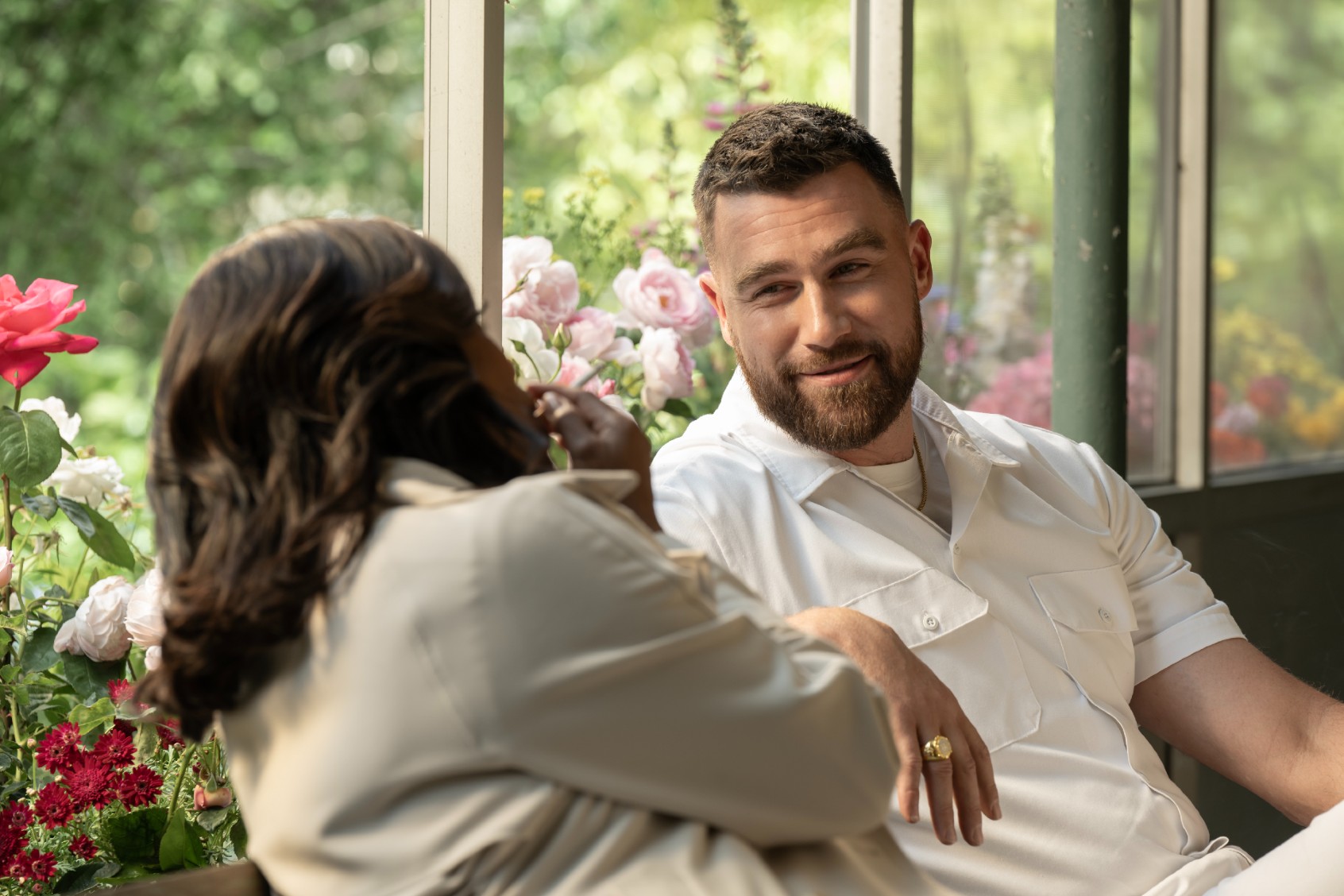
Niecy Nash and Travis Kelce in "Grotesquerie" (Prashant Gupta/FX)

Death as mass entertainment has been a hitmaker since Victorian penny dreadfuls came into fashion. Today crime shows are clipped out to join the nausea-inducing casual threats of political violence, alongside images of Palestinian children blown apart by American-made bombs, all traveling the same social media rapids as Instagram reels and TikToks of cooking demos. 

On that stage of destruction and distraction, that which should nourish us and everything that’s killing us, are weighted equally. If the flood numbs Americans to crises and catastrophes that comprise daily life in other parts of the world, can you blame us? 

Another bit of “Grotesquerie”’s on-the-nose commentary on Christian nationalism materializes in its intentionally ridiculous Father Charlie subplot. He’s a man whose vanity distracts his flock with his looks even as he preaches that the flesh is fallible and something to be overcome by, among other things, teaching a spin class online for his flock and contemplating an OnlyFans page.

But his interest in Sister Megan, other than the sexual exploitation, is as a tool to spread fear as a recruiting tactic. Murphy and his co-creators could have used any denomination's religious institutional hypocrisy, but the Catholic church is irresistibly theatrical and has a track record of sex scandals and being judgmental. (Lapsed Catholic here — I know of what I speak.)

Catholicism also makes a ceremony of transubstantiating flesh into a sacrament to feed the soul. But the human body is a disorderly thing predisposed to rot from the outside in. Our frailties inform how we indulge ourselves to soothe the fears destroying us. That applies to Lois and her alcoholism; to Merritt and her overeating; to Megan and her compulsions for sex and death.

So what does Taylor Swift’s boyfriend have to do with all of this? I suppose Travis Kelce, who makes his scripted series debut in the third episode, serves a similar purpose to Kim Kardashian’s hire for “American Horror Story.” Murphy understands spectacle’s power to compel an audience, and Kardashian drew fresh eyes to a weathered title in a crowded field. Her performances garnered largely positive reactions, although I’m not sure why people were surprised that Kardashian could act. She got her start in a widely distributed independent film, remember?

Like her, Kelce gives doubters a reason to stick around. Murphy, Baitz and Baken don’t write anything for his nice guy hospital orderly Ed Lachlan that he didn’t perform in his forgettable E! reality show “Catching Kelce,” only here he’s flirting with Nash-Betts. All flesh fades to dust, but celebrity skin is made of more resilient stuff.

Kelce, then, is another type of distraction, a reminder that Murphy trades in some of the same extravagances he may be critiquing. This is the same producer behind Netflix’s “Monster” anthology, a future version of which will feature Gein. Synergy!

But “Grotesquerie” isn’t all cynicism and doubt. Murphy and his collaborators hint that there may be hope for us yet during a fourth episode road trip, as a conflicted and lovelorn Sister Megan breaks into a rendition of “I Don’t Know How to Love Him” from “Jesus Christ Superstar.” 

She's in the passenger seat as Lois drives down a desert highway choked with smoke (cough climate change cough) following coordinates left by the killer directing them to some mysterious end.


Want a daily wrap-up of all the news and commentary Salon has to offer? Subscribe to our morning newsletter, Crash Course.


Nothing’s on the radio, so why not sing? (Besides giving Diamond a reason to showcase her Tony Award-worthy pipes, we should say.) Sister Megan warbles softly at first, before putting the full might of her lungs and vocal cords behind the melody and lyrics.  To their mutual delight, Lois joins her, the score’s melody arcing behind them. 

They spontaneously clasp hands through the concluding chorus, smiling blissfully at their harmony. The moment seems to manifest out of thin air, except everything leading up to it explains the why of that song, and those two, in that setting. 

They’re both at a loss as to how to make things right in their lives, and in a world increasingly barren of understanding and farther from whatever name one has for divine goodness. But they have each other. For what that's worth.

Barreling down that red-lit highway, they might be “Thelma & Louise,” but the road they’re taking is straight out of “Se7en,” whose duo ended their day trip by unwrapping a head in a box. More people are familiar with the second movie than the first these days, which also says something about our predilection for the visceral in life and on TV. 

Sister Megan says as much: “Aren’t we smarter than this?” she asks Lois. “Don’t we know how this movie ends?” 

We might just decide we'll have to see.

Two new episodes of "Grotesquerie" debut Wednesday at 10 p.m. on FX and stream the next day on Hulu.  

Rudy Giuliani texted 2020 “fake electors” plot to the wrong number

The 2020 fake electors plot failed in part because Rudy Giuliani texted the wrong number, according to the recent court filing by special counsel Jack Smith, The Guardian reported.

After Donald Trump lost the presidential election to Joe Biden four years ago, he enlisted Giuliani to lead his campaign’s legal team. At the time, Giuliani tried to persuade Republican officials in swing states where Trump lost to submit fake, alternate slates of electors so that the current Republican nominee could claim victory. He has since been disbarred.

Giuliani explained the conspiracy to overturn the election in a text message:

“So I need you to pass a joint resolution from the legislature that states the election is in dispute, there’s an ongoing investigation by the legislature, and the Electors sent by Governor Whitmer are not the official electors of the state of Michigan and do not fall within the Safe Harbor deadline under Michigan law."

According to the special counsel, however, that message — intended for a Republican lawmaker in Michigan — was sent to an undisclosed but definitely wrong number.

Beyond Michigan, Giuliani and other Trump allies sought to organize fake electors in Arizona, Georgia, Nevada, New Mexico, Pennsylvania and Wisconsin. The goal was to have Vice President Mike Pence either recognize the electors as legitimate or cite the existence of alternate slates as reason to throw the election to the House of Representatives, where Trump would prevail.

The anti-democratic conspiracy forms part of the case brought by the special counsel, who this week filed a document providing new details about Trump's efforts to overturn the 2020 election.

Marjorie Taylor Greene pushes conspiracy theory claiming “they” control the weather

Before entering Congress, Rep. Marjorie Taylor Greene, R-Ga., claimed that wildfires in California were not caused by natural causes but by secret Jewish space lasers. Now the close ally of former President Donald Trump is again claiming a shadowy cabal — not climate change — is to blame for extreme weather events.

In a Thursday night post on X, Greene asserted: “Yes they can control the weather. It’s ridiculous for anyone to lie and say it can’t be done.”

Greene did not specify who "they" are but was presumably referring to Hurricane Helene, which left behind a trail of destruction across the southeast and claimed over 200 lives.

In an earlier post from Thursday, Greene shared a map implying the hurricane, by design, disproportionately impacted Republican-leaning parts of the country.

"This is a map of hurricane affected areas with an overlay of electoral map by political party shows how hurricane devastation could affect the election," she wrote. 

This is not the first, second or third time Greene has succumbed to spreading far-right conspiracy theories, several of which hinge on technology that does not exist. Just earlier this year, the Georgia Republican introduced an amendment that called for "the development of space laser technology on the southwest border."

“Deadly”: Experts warn Trump and Vance are “backpedaling” on abortion to conceal a darker reality

During Tuesday night's vice presidential debate, Ohio Sen. JD Vance conceded that Republicans need to do a better job of regaining Americans' trust on the issue of abortion, delivering a more moderate response to the question of restrictions than the far-right position he previously espoused. But experts warn that abortion rights would still be at risk if former President Donald Trump regains power.

Responding to Democratic Minnesota Gov. Tim Walz's claim that he and Trump will adopt Project 2025's proposed abortion surveillance policies, Vance recalled growing up in a working-class community where he knew “a lot of young women who decided to terminate those pregnancies.” He spoke of an unnamed friend who he said had aborted a pregnancy from an abusive relationship, how she told him keeping the pregnancy would have "destroyed her life" and how the exchange impacted his perspective.

“I think that what I take from that as a Republican who proudly wants to protect innocent life in this country, who proudly wants to protect the vulnerable, is that my party, we’ve got to do so much better of a job at earning the American people’s trust back on this issue where they, frankly, just don’t trust us,” Vance said. “That’s one of the things that Donald Trump and I are endeavoring to do. I want us as a Republican Party to be pro-family in the fullest sense of the word.” 

Steven Greene, a professor of political science at North Carolina State University who researches abortion policy and public opinion, told Salon that while Vance's critique of the Republican Party is true, it's also reflective of Trump's determining that advocating for states to set their policies is "the most palatable, the most politically effective" position.

"Donald Trump has recognized that, certainly, the Republican position of a national abortion ban is completely toxic," Greene said in an interview. In settling on allowing states to determine their own abortion policies, Trump is "trying to walk a fine line. He does not want to get the pro-lifers too mad at him and frustrated and saying, 'Why is Donald Trump abandoning us?' And he also doesn't want to actually take their full positions of a national abortion ban."

Vance's Tuesday night criticism of the Republican Party marked a notable departure from his running mate's comments, which have repeatedly characterized the Supreme Court's decision to overturn Roe. v. Wade and eliminate federal protection for abortion as something Americans had wanted. The junior senator's remarks came as he sparred with Democratic vice presidential nominee Walz over abortion restrictions and reproductive care and defended Trump's state-level abortion policy stance as better reflecting the country's "diverse" viewpoints. 

“California has a different viewpoint on this than Georgia. Georgia has a different viewpoint from Arizona. And the proper way to handle this, as messy as democracy sometimes is, is to let voters make these decisions, let the individual states make their abortion policy,” he said. 

Experts say, however, that leaving decisions on abortion care up to the states isn't as enfranchising a proposition as it sounds. 

Chloe Thurston, a Northwestern University political science professor who has written on abortion policy, told Salon that Americans' far-reaching but overwhelmingly supportive preferences on abortion policy aren't always reflected in their state's laws.

"People have every reason to be skeptical of just how honest Trump and Vance are being with them about where they would take abortion policy."

The lower visibility and salience of state-level elections give voters with stricter preferences on abortion policy a leg up in deciding policy because voters who don't pay as much attention skip out on the polls, she explained. Baked-in barriers to advancing ballot referendum and legislative hurdles like gerrymandering, which can create an elected majority that opposes abortion regulations despite constituents' wishes, also play a role in boosting the discrepancy between voters' desires and the policies their state legislators implement. 

While kicking the decision back to the states can read as a "nice, democratic and innocent idea," and boosts Trump and Vance's claims of federal incompetence, the consequences of doing so have also proven "deadly," added Wendy Hansen, a University of New Mexico professor of political science whose research has explored abortion policy. 

In August, Amber Thurman, a Georgia woman who suffered a rare complication from abortion pills, died from an infection after Georgia passed a law banning the abortion treatment that would have saved her life. Earlier this summer, Texas woman Kate Cox, whose fetus' lethal anomaly doctors said threatened her health and future fertility, left the state to obtain an abortion after the state Supreme Court denied her request for a restraining order on its near-total abortion ban. Lawyers said her condition was deteriorating as she awaited a determination on whether she could obtain abortion care. 

The overturn of Roe v. Wade made these women's harrowing realities possible and Trump and Vance's proposed state-varied abortion policy could beget more of them, Hansen suggested. 

"Instead of saying that they supported, and in Trump's case orchestrated, the overturn of Roe, Trump and Vance are backpedaling by now emphasizing that all they want to do is to give the power back to the states for the states' voters to decide," she said in an email, adding that: In effect, they're "both working to keep voters that they have alienated by supporting bans on abortions."

Allowing states to decide is "concealing what could end up being pretty coercive in different places and also deeply unpopular," added Thurston. "So it doesn't really, again, solve that problem they're talking about winning back trust because what you end up with are 50 different standards that don't necessarily reflect public opinion."

Taken against Vance's previous opinion on abortion policy — saying on a podcast while campaigning for the Senate in 2022 that he "certainly would like abortion to be illegal nationally” — his responses on the debate stage Tuesday read as "evasive," Thurston said.

We need your help to stay independent

Vance disputed having supported a national abortion ban when questioned on his previous stance during Tuesday's debate, claiming to have instead pushed for minimum national standards on abortion policy, citing the nation's ban on partial-birth abortions as an example. 

But Thurston said those policies, while sounding more palatable, could also leave the door open for greater restrictions while stepping on some of the state autonomy to make decisions around abortion that the Trump platform is pushing for. 

"You're not necessarily letting states choose, but you're also able to adopt that language of sounding moderate and flexible," she said. "It doesn't necessarily mean that those policies have to go in a moderate and flexible direction. They could also be used to make abortion less accessible."

For his part, Vance told CBS moderators Tuesday that Ohio voters overwhelmingly choosing to codify a right to an abortion up through the fetus' viability (between 22-24 weeks) into its Constitution last fall, in part, motivated his change in position on a national ban. He reiterated his and Trump's commitment to pro-family policies like making childcare and fertility treatments more accessible.

Vance also later accused Democrats of taking a "very radical pro-abortion stance" and claimed that Democratic presidential nominee and Vice President Kamala Harris would force medical providers who opposed abortions to "violate their freedom of conscience" and provide them.

"We can be a big and diverse country where we respect people's freedom of conscience and make the country more pro-baby and pro-family," Vance said, reiterating his states-decide position.

But Greene argued that varied abortion policies, many of which have shown to be restrictive following the fall of Roe, violate the freedom of conscience of people who think it's appropriate for them to obtain an abortion but live in the "wrong state" and cannot.


Want a daily wrap-up of all the news and commentary Salon has to offer? Subscribe to our morning newsletter, Crash Course.


Using the example of a person seeking an abortion for a placental detachment at 18-weeks, Greene argued Republicans in heavily restrictive states often write their abortion bans in ways that aren't as thoughtful or careful as they should be. 

"From my perspective, you want to make sure every single person having a placental detachment at 18 weeks gets an abortion so they don't die," Greene said. "To make a policy that allows for that means there's going to be some people who are having what we would call an elective abortion at 18 weeks, that, shall we say, sneak through the cracks.

"The Republicans are so committed to this idea that nobody's going to cheat the system, that no unworthy person is going to get their 18-week abortion — they would never admit it to themselves — [that] the reality is that they are willing to roll the dice with the lives of these women who are suffering complications in pregnancy."

Weighing in during Tuesday night's debate, the former president took to Truth Social to declare his commitment to vetoing a federal abortion ban should it reach his desk in a potential second presidency. His proclamation came after he refused to make such a commitment during his debate with Harris last month.

“Everyone knows I would not support a federal abortion ban, under any circumstances, and would, in fact, veto it, because it is up to the states to decide based on the will of their voters (The will of the people!),” Trump wrote.

Prior to standing firmly behind a states-decide position, Trump had been notoriously wishy-washy in his stance on abortion policy. His presidential record, however, reflected a staunchly pro-life position. He made good on his 2016 campaign promise to confirm justices to the Supreme Court he felt would work to topple Roe v. Wade and claimed credit when the court did so 6-3 in its 2022 Dobbs v. Jackson Women's Health Organization decision. He also prioritized defunding Planned Parenthood clinics, which offer abortion care, and unsuccessfully tried to undermine the Affordable Care Act's coverage for contraceptives. 

Given his record and both Trump and Vance's previous perspectives on abortion, Hansen and Greene said American voters can't necessarily trust Trump wouldn't sign a national ban or restriction. Hansen noted, however, that she didn't believe that would ever come to pass. 

"Let's just say the House and Senate pass a national abortion ban. Does Donald Trump truly veto that? That seems a stretch," Greene said. "People have every reason to be skeptical of just how honest Trump and Vance are being with them about where they would take abortion policy."

Removing barriers to opioid addiction treatment is critical. So why aren’t we doing it?

There’s a treatment for opioid use disorder (OUD) that literally saves lives. It has been proven to reduce the risk of overdose death by as much as 60% and reduce the risk of any cause of death by half. It is also one of the oldest and most rigorously studied treatments for opioid use disorder: medication treatment with methadone or buprenorphine (also known as opioid agonist treatment, or OAT).

Since the start of the overdose crisis, serious efforts have been made to expand the availability of OAT. Federal agencies have been proactively removing barriers to OAT and allocating resources to its expansion. OAT is also a core strategy that can be funded with the billions of dollars obtained by local communities through the global opioid settlement

Despite all this, tens of thousands of people are still dying annually. Estimates suggest that the number of opioid overdose deaths declined in 2023, but just barely, with more than 80,000 US lives lost to opioids in a single year.

This past year, my colleagues and I set out to explore this contradiction: why, when we have treatments that are proven to prevent overdose death, are so many people still dying? To do so, we homed in on residential treatment centers across the state of North Carolina, where many North Carolinians living with OUD expect to receive guidance, support and – naturally – lifesaving medical treatment. 

What we found, published recently in the Journal of Substance Use and Addiction Treatment, was staggering. After a four-month-long audit of private organizations across North Carolina advertising themselves as residential treatment centers, we found that only seven of those centers provided on-site access to OAT. Another nine allowed the use of OAT obtained through other providers. The remaining 49 centers – 74% percent of the organizations we identified – barred clients from receiving OAT while participating in their program. Moreover, more than half of the centers that were state-licensed providers of substance use services prohibited the use of these medications in their programs. 

For too long, research-backed solutions to overdose deaths have been eschewed in favor of untested, ideological, punitive and moralistic measures.

The reason? When we called them to ask, most centers banning OAT told us these medications are “more addictive than illicit drugs,” that OAT is “bad for you,” and that OAT “will kill you.” These statements are factually incorrect. A few centers also gave prejudiced answers, describing OAT as “legal heroin,” “not true recovery,” or “just trading one addiction for another.” That’s a hard statement to swallow in the face of 80,000 deaths a year and decades of science demonstrating that OAT could cut those deaths in half.

According to the current, best practice treatment guidelines set by the American Society of Addiction Medicine (ASAM), residential care for substance use disorders must include “access to medications for [opioid use disorder] – made available on-site or in the immediate community.” Based on our recent findings, it’s clear that North Carolinians seeking treatment for opioid use disorder cannot expect to receive ASAM’s lifesaving, gold-standard of care from the majority of “residential treatment centers” across the state. 


Want more health and science stories in your inbox? Subscribe to Salon's weekly newsletter Lab Notes.


Sadly, this broken treatment system is not isolated to North Carolina. A nationwide study recently found that only 1 in 4 of the nearly 10 million US residents living with opioid use disorder ever receive OAT. Right now, we’re losing more than 100,000 people to drug overdose every year, yet our treatment system is still broken, insufficient and years behind the curve.

What can be done to make lifesaving treatment available for everyone who needs it in North Carolina and elsewhere? 

The first step policymakers can take is to tighten regulations on licensed residential treatment centers. Currently, North Carolina does not require licensed service providers to facilitate access to OAT. Updating the state’s licensing and Medicaid regulations to mandate facilitated access to OAT could substantially reduce overdose rates across the state. Moreover, state and local officials can rigorously enforce existing state laws that prohibit service providers who do not offer evidence-based treatments from giving the false impression that they do.  

Second, North Carolina policymakers should take advantage of the approximately $1.5 billion in opioid settlement funds that will be distributed across the state in the coming years — funds that provide the state with a unique opportunity to expand access to lifesaving, evidence-based medication like OAT.

We need your help to stay independent

However, as of September 2024, fewer than one-third of local governments in North Carolina have released plans to expand access to evidence-based treatment. Instead, state and local leaders have allocated tens of millions of dollars to residential treatment centers that adopt strict anti-OAT or abstinence-only stances — a form of “treatment” recently shown to be worse for participants than no treatment at all. State and local leaders must take action to reverse this trend and ensure that these once-in-a-lifetime settlement funds are used to help — not hurt — North Carolinians.

For too long, research-backed solutions to overdose deaths have been eschewed in favor of untested, ideological, punitive and moralistic measures, leaving millions of Americans without the lifesaving treatment they need. Our research in North Carolina starkly reveals the dire situation for people with opioid use disorder. At the same time, these findings shine a light on how simple it can be – through steps like improving regulation, funding medication access, and enforcing existing laws – to reap the full, lifesaving impact of the most promising overdose prevention strategy available to us. 

We can end overdose deaths — not just reduce them. Achieving this goal is within our reach, but only if we use the tools that actually work.

Top execs exit Trump Media amid allegations of CEO Devin Nunes’ mismanagement and retaliation

ProPublica is a Pulitzer Prize-winning investigative newsroom. Sign up for The Big Story newsletter to receive stories like this one in your inbox.

Former President Donald Trump’s media company has forced out executives in recent days after internal allegations that its CEO, former Rep. Devin Nunes, is mismanaging the company, according to interviews and records of communications among former employees.

Several people involved with Trump Media believe the ousters are retaliation following what they describe as an anonymous “whistleblower” complaint regarding Nunes that went to the company’s board of directors.

The chief operating officer and chief product officer have left the company, along with at least two lower-level staffers, according to interviews, social media posts and communications between former staffers reviewed by ProPublica. The company, which runs the social media platform Truth Social, disclosed the departure of the chief operating officer in a securities filing Thursday afternoon.

ProPublica has not seen the whistleblower complaint. But several people with knowledge of the company said the concerns revolve around alleged mismanagement by Nunes. One person said they include allegations of misuse of funds, hiring of foreign contractors and interfering with product development.

In a statement, a spokesperson for Trump Media did not answer specific questions but said that ProPublica’s inquiry to the company “utterly fabricates implications of improper and even illegal conduct that have no basis in reality.”

“This story is the fifth consecutive piece in an increasingly absurd campaign by ProPublica, likely at the behest of political interest groups, to damage TMTG based on false and defamatory allegations and vague innuendo,” the statement said, adding that “TMTG strictly adheres to all laws and applicable regulations.”

Trump Media’s board comprises a set of powerful figures in Trump’s world, including his son Donald Trump Jr., former U.S. Trade Representative Robert Lighthizer and the businesswoman Linda McMahon, a major donor and current co-chair of Trump’s transition planning committee.

Nunes was named CEO of the company in 2021, with Trump hailing him as “a fighter and a leader” who “will make an excellent CEO.” As a member of Congress, Nunes was known as one of Trump’s staunchest loyalists.

After the internal allegations about Nunes were made at Trump Media, the company enlisted a lawyer to investigate and interview staffers, according to a person with knowledge of the company.

Then, last week, some employees who were interviewed by the lawyer were notified they were being pushed out, the person said. The employees being pushed out include a human relations director and a product designer, along with Chief Operating Officer Andrew Northwall and Chief Product Officer Sandro De Moraes. The person with knowledge of the company said Trump Media asked the employees to sign an agreement pledging not to make public claims of wrongdoing against the company in exchange for severance.

On Thursday afternoon, Northwall posted on Truth Social announcing he had “decided to resign from my role at Trump Media,” adding that he was “incredibly grateful” to Trump and Nunes “for this opportunity.”

“As I step back, I look forward to focusing more on my family and returning to my entrepreneurial journey,” the statement said.

De Moraes now identifies himself on his Truth Social bio as the “Former Chief Product Officer” of the company.

Some word of the departures became public earlier this week when former Trump Media employee Alex Gleason said in a social media post that “Truth Social in shambles. Many more people fired.”

Trump personally owns nearly 60% of the company. That stake, even after a recent decline in the company’s stock price, is worth nearly $2 billion on paper, a significant chunk of Trump’s fortune. He said last month he was not planning to sell his shares. What role Trump plays, if any, in the day-to-day operations of the company is not clear.

Since it launched in 2021, the company has become a speculation-fueled meme stock, but its actual business has generated virtually no revenue and Truth Social has not emerged as a serious competitor to the major social media platforms.

Among Nunes’ moves as CEO, as ProPublica has reported, was inking a large streaming TV deal with several obscure firms, including one controlled by a major political donor. He also traveled to the Balkans over the summer and met with the prime minister of North Macedonia, a trip whose purpose was never publicly explained by the company.

Trump Media has a formal whistleblower policy, adopted when the company went public in March, that encourages employees to report illegal activity and other “business conduct that damages the Company’s good name” and business interests.

Do you have any information about Trump Media that we should know? Robert Faturechi can be reached by email at robert.faturechi@propublica.org and by Signal or WhatsApp at 213-271-7217. Justin Elliott can be reached by email at justin@propublica.org or by Signal or WhatsApp at 774-826-6240.

Merriam-Webster adds “burrata,” “street corn” and more common food terms to its dictionary

The 2024 edition of the Merriam-Webster Dictionary features over 200 new words, including specific foods, food trends, nutritional terms and other common American food terms.

“Our lexicographers monitor a huge range of sources to select which words and definitions to add,” says Peter Sokolowski, editor at large for Merriam-Webster. “From academic journals to social media, these give us a very thorough view of the English language.” Each addition “has demonstrated widespread use over time, and offer[s] a window into the world today,” Forbes’ Melissa Kravitz Hoeffner wrote.

Some food-themed nouns include street corn (which the dictionary defines as “grilled corn on the cob that is coated with a creamy spread”), burrata (“mozzarella formed into a ball-shaped casing that contains curds and cream”) and capicola (“a seasoned Italian pork that is cut from the neck and top shoulder”).

Notable adjectives include ultra-processed, which describes food “containing or made primarily with highly processed ingredients including artificial additives (such as coloring, flavoring, and preservatives) and typically having high levels of fat, sugar, or salt.” 

The dictionary also includes a definition for the International Bitterness Unit, which is “used to assess the concentration of a bitter compound found in hops in order to provide information about how bitter a beer is.”

Here lies a dream in the Sonoran Desert, where migrants risk death to cross into the US

After turning off the West Ajo Highway, 20 miles west of Tucson, a car full of volunteers heads down a dirt track, carefully traversing the wide fractures in the road en route to plant the first cross of the day. The road is flanked on each side by rusted four-barred fences, behind which lie a couple of buildings with corrugated iron roofs. 

The car is quiet, apart from the spade, bucket and cross rolling around in the trunk.   

The car parks and the riders get out and stand in a circle. David, one of the volunteers, glances back and forth between a piece of white paper in his left hand and a GPS satellite phone in the other, listening for the distant beep every time the system acknowledges a coordinate. 

Still looking at the GPS, David sets off slowly behind the others. Diane holds a pick axe; Alvaro Enciso, the artist who leads this project, drags a spade; Haley lugs a large water container; Alyssa carries a wooden cross and Peter leans gently to his left side to counteract the heavy bucket of cement in his right hand.

After walking less than 50 feet, they arrive and, almost immediately, Alvaro digs his spade into the parched earth. Once Alvaro is satisfied with his digging he holds the cross in position while Peter bends down and offloads some dry cement around its base. Haley follows with the water, careful to distribute it evenly. 

This is one of approximately 1,700 crosses Alvaro has planted across the desert as part of his project, “Donde Mueren Los Sueños.” Translated roughly into English, it means “Where Dreams Die.” 

The cross shape isn’t meant to invoke religion, but rather the intersection of life and death. Alvaro has been installing them on sites like this since 2013.

Alvaro Enciso and a group of volunteers walking through an ocotillo forest. (Crispin Kerr-Dineen)

“The spaces that I was visiting were talking to me,” he says. “Telling me, there’s a story here that — if you don’t tell it, it’s going to disappear.”

Dogs bark in the background, unsure about the new faces on the edge of their property. Diane, wearing a red and black cap and a tie-dyed sweater, speaks: “This site was reported May 1, 2024, for unidentified persons.”

Diane points to the settlement they’d just driven past and continues: “The human remains were found on the porch of a private residence. The dogs had brought a human skull to the porch. The cause of death is undetermined. The skull is thought to be over six months old.”

* * *

In 1994, under the Clinton administration, the United States Border Patrol introduced a strategy known as prevention through deterrence. The strategy tightened security at popular, urban ports of entry along the U.S.-Mexico border. Migrants then looked for more remote areas, like the Sonoran Desert in Southern Arizona, to cross undetected.

Since 2000, 4,284 migrants are known to have died crossing the Sonoran Desert. Because bodies decompose incredibly quickly in the sweltering heat, the total number is almost certainly higher.

The Sonoran Desert bridges Northern Mexico and the southern United States and covers approximately 100,000 square miles, a surface area larger than the United Kingdom. Temperatures in the desert can reach up to 120 degrees Fahrenheit in the summer months and dip below freezing during the winter.

“People just weren’t crossing from Mexico through Arizona until it became more difficult to cross in major populated areas,” Dr. Greg Hess, Chief Medical Officer for Pima County, Arizona, explains. “[So] people started to look for other routes and slowly migration started moving to Arizona. That’s the problem with Arizona, it’s just too hot and dry. If something goes wrong, there’s relatively little recourse in the environment that people can fall back on, like water and food or anything.”

Hess has been the Chief Medical Examiner and a forensic pathologist for Pima County, an area that covers a vast expanse of the Sonoran Desert in Southern Arizona, since 2011. He says his department has seen, on average, around 170 migrant bodies arrive each year since 2002.

“The number one cause of death is undetermined. With very decomposed remains, it’s very difficult to tell how the person died,” Hess says. “That said, for most of the remains that come in good condition, those that have not been deceased in the desert for very long, 97% of the time those people die as a result of exposure.”

“Exposure” in these cases likely means dehydration, hyperthermia or hypothermia, or some other death due to lack of protection from environmental elements.

"I never thought in my wildest dreams that I would have to flee the country."

With many of the remains already skeletal, identifying the bodies can be a challenge, especially since documents found with a person may not be accurate. Forensic anthropologists work with Hess to develop a profile. After determining, most notably through the pelvis bone, if it’s a male or a female body, they will examine ethnicity characteristics consistent with native populations from Mexico or Central America. With no leads on identification, DNA comparisons are tricky. About a third of the 4,284 bodies recovered remain unidentified. 

Although tightened border security in 1994 saw a sharp increase in migrants crossing through more remote areas, border-crossing deaths in the Sonoran Desert started long before then. 

Growing up in El Salvador, Dora Rodriguez walked to school every day, even in the rain. 

“I grew up in a country that is beautiful. A country surrounded by trees, rivers and mountains,” Dora explains with fondness in her voice. 

“I never thought in my wildest dreams that I would have to flee the country. But when I graduated high school, that changed.”

Dora graduated high school in November 1979, a month after civil war broke out across El Salvador. She started hearing about death squads who were coming for anyone they deemed suspicious. Members of youth groups, like Dora, were a target then — seen as enemies of the government. 

“It was for me and my mother the most painful decision we had to make [to leave El Salvador.]”

Soon, only 19, Dora set off with a group of friends for the United States. 


Want a daily wrap-up of all the news and commentary Salon has to offer? Subscribe to our morning newsletter, Crash Course.


On the first trip Dora made to El Norte she was arrested and sent back home on a seven-day bus journey. For her second trip, she hired smugglers to take her across the border but was again arrested and sent back home. On her third try, in July 1980, Dora crossed over barbed wire into the Sonoran Desert on the United States side of the border with 25 other migrants when tragedy struck. The smuggler who guided them was a young man who didn’t know the route. Soon they were lost, with very limited supplies of water. 

After a few hours of falling down into desert washes and getting spiked by cactuses, the group realized they were in trouble. 

“Where do you go? Where do you walk? Where’s the way out? When you’re in the middle of the desert and you look around you, everything is the same,” Dora explains.

On the first night, one of the group died from a heart attack. By the second night, having run out of water, the group started drinking their own urine. 

“It was like we were sitting on a hot pavement. The trees in the desert are not very thick with shade. There was no comfort.”

With blisters on her feet and cactus spikes all over her body, Dora recalls struggling to walk. She told her uncle to leave her to die under a tree. He refused and tied his belt to Dora’s waist and they carried on walking. On the fourth morning, Dora stopped walking. 

The next day, Dora heard noises in the back of her head. The rumble of motorcycles.

Before long, she was in the hands of a border patrol agent with IV drips in her arms. The border patrol agent pleaded with her not to die and to stay awake. 

Of the 25 people who crossed the border with her, 13 died, including three teenage sisters.

After the fateful crossing, Dora was not granted asylum, but was allowed to remain in the country due to, in her words, being a “witness of a criminal activity by smugglers.” In 1982, she married her high school sweetheart, a green card holder, and then ten years later, she became a United States citizen.

We need your help to stay independent

Today, Dora resides in Tucson, where she is the Director of Salvavision, a nonprofit offering aid and support to migrants and deportees on both sides of the border. Through her work, she still hears people explaining that attempting to cross the desert is their only hope. 

Last month, a woman from southern Mexico explained to Dora on the Mexican side of the border that she couldn’t go back home, where organized crime and cartels were rampant, and that to provide for her children she must attempt to cross the desert. Still, Dora warned her against it.

* * *

"I’m grateful that I’m one of the lucky ones. One of these people could’ve been me."

Now the cement has partially solidified. Alvaro takes a few steps back. He tilts his head and moves his arm, asking one of the volunteers to adjust the cross slightly. He then takes a picture. 

“This project is about witnessing something, except I decided not to be a silent witness,” Alvaro explains. He's been the subject of several films and articles over the course of this project. Every year, the need for such attention intensifies as the deaths continue.

“I'm trying to compare my own life to the people who died out there. I’m grateful that I’m one of the lucky ones," Alvaro says. "One of these people could’ve been me. He and I, she and I, came from the same circumstances."

Now 78, Alvaro grew up in Colombia drawing planes. In hindsight, he realizes he was dreaming of a ticket out, for a better life. 

“I hated being poor. I didn’t want to resign to the idea of being poor forever.”

After finishing high school, his family wanted him to work so he could contribute to the household. But Alvaro wanted a college degree — he wanted the American dream, which was revered in Colombia. Alvaro left Colombia at 20 with visa documents in hand.

After arriving at JFK, Alvaro soon realized the American Dream he heard about in Colombia was greatly exaggerated. There were no gold-plated streets or a college education waiting with his name on it.

“[I had] no idea how difficult it was going to be. It took me a few years to get it together. In the meantime,” Alvaro says, lifting and readjusting his red cap. 

“I was drafted into the U.S. Army. Fourteen months in Vietnam,” Alvaro pauses, then takes a long breath. “Survived.” 

After his service, Alvaro went to Queens College in New York, on the GI Bill. While in school, he worked part-time jobs in New York City, driving taxis in Manhattan and, on weekends, mopping floors at a peep show on 42nd Street. Throwing his hands up, Alvaro remarks, “very menial work,” and then with a smile continues, “but I wanted to go to college.” 

"That person had a name, that person had family, that person had people who loved them, that person had dreams and that dream died in that piece of terrain, there."

Alvaro finished college, went to graduate school and then landed a federal government job in the Washington D.C./Baltimore area. After 20 years there, he decided to move to New Mexico to become an artist, which is when he started to think about his cultural identity. 

Alvaro moved from New Mexico to Southern Arizona to be in the borderlands. At first, before the project started, he would go to the sites, sometimes spending the night, hoping some kind of message would form from the energy he felt.

“It needed to exist. [It’s] addressing a situation that’s happening right now, which makes it very contemporary. [It’s] an artistic attempt to tell a reality. It becomes part of the landscape, part of the political landscape.”

Watch the companion documentary to this article here


Alvaro and his volunteers walk through an Ocotillo forest to place the most remote cross of the day. After five miles of off-road driving from Arizona State Route 286, followed by a half-mile hike, the feeling of remoteness starts to kick in. Surrounded on all sides by a continuous oppressive chorus of cicadas and the mountain ranges making up the Altar Valley, you quickly lose any sense of direction. 

Using his spade as a support, Alvaro leads a quiet group back to the car. Back when the project started in 2013, Alvaro had a long history of fitness, as a marathon runner and cyclist, to lean on while traversing mountains. Now, 11 years later, these are long mornings, especially for a soon-to-be octogenarian.

“My mental health is pretty good. It all depends on how my body will let me do it. What I do on Tuesdays has become a very important part of my life. It provides me with meaning and purpose, and I think it's important.”

In the upcoming presidential election, immigration consistently shows up as one of the most pressing issues Americans think about when heading to the polls. Alvaro emphasizes that there is no easy solution for such a complicated issue, and that this country has had immigration issues since day one. However, his project aims to humanize an issue that can get overgeneralized in political rhetoric. 

“One of the elements of the project is to honor the courage that it takes for someone to leave everything behind, but also, to give this person, or these people, these 1,700 people, a little bit of presence, those people that didn’t make the news. The death went,” Alvaro lifts his hand up to the sky, “without anybody knowing.”

“That person had a name, that person had family, that person had people who loved them, that person had dreams and that dream died in that piece of terrain, there.”

Liz Cheney and Democrats’ big tent strategy: Why courting Republicans works for Kamala Harris

I once wrote that Liz Cheney was the most dangerous woman in America. I thought she could easily be the nominee in 2024 and believed that she'd be worse than her father because she was just as right-wing but had served during the chaotic Trump era. I cautioned that "Democrats should work very hard to keep the loyalty of women who have left the GOP in recent years. Cheney or (Nikki) Haley could potentially get them back if the Dems are perceived to have failed them."

I concluded that it was likely that the first woman president would have to be a Republican because I didn't think independent men (and maybe some Democrats, too) would vote for a Democratic woman, fearing that they just aren't "tough enough." Cheney was in the GOP leadership at the time and made it up the ladder faster than anyone I could remember. She came into the job with a stellar Republican pedigree as the daughter of Dick "Prince of Darkness" Cheney and backed Trump to the hilt. She was tough as nails and also seemed to be a pretty savvy politician. She worried me — a lot.

Cheney drew the line at Trump's attempt to overturn the election, his incitement of an insurrection and the Big Lie he perpetuates to this day.

Needless to say, I was wrong about everything.

Today Liz Cheney has been drummed out of the Republican Party and a Black and South Asian Woman from California, Kamala Harris, is running for president on the Democratic ticket. Cheney appeared in Wisconsin on Thursday and said "I tell you, I have never voted for a Democrat, but this year I am proudly casting my vote for VP Kamala Harris."

She added: "We are not going back!"

I will admit this is not entirely comfortable. I've seen so little true political courage from Republicans in the last couple of decades, and especially in the last eight years, that I reflexively mistrust it. I've been on the other side of Liz Cheney on virtually every issue for as long as I can remember and I'm sure I still am. And after all, she supported Trump for years and didn't speak up when he demonstrated his unfitness both at home and abroad.

But unlike others in her party who either stood silent or spoke out briefly then retreated into their comfy partisan rabbit holes, Cheney drew the line at Trump's attempt to overturn the election, his incitement of an insurrection and the Big Lie he perpetuates to this day. She became the voice of those Republicans who finally had enough of Trump and rejected the fascistic impulses that showed themselves in living color during that period between the election of 2020 and January 6, 2021.

And while it may have been uncomfortable for me to see my chosen candidate bask in the warmth of a Liz Cheney endorsement, I would imagine it was just as uncomfortable for Cheney to campaign for a pro-choice, gun regulating, Obamacare-loving, union-backing, billionaire-taxing, liberal Democrat. Yet she did it.

And for all of my distrust of her in the past, I believe Cheney is entirely earnest when she exhorts those listening, "so help us right the ship of our democracy so that history will say of us, when our time of testing came, we did our duty, and we prevailed because we loved our country more."

It was a good speech and frankly moving to see the two strong women with polar opposite ideologies come together to oppose the narcissistic authoritarian who tried to stop the peaceful transfer of power and is promising to do even worse next time.

Her reason for doing this is simple. She believes that Donald Trump is an existential threat to the nation and the world and she became convinced of this when he openly defied the Constitution and staged an attempted coup. That so few of her allegedly patriotic Republican brethren didn't draw that line is still shocking to me. I respect her for standing up against them when the cost to her was so high. The Republican Party as currently constituted, and as it will stay constituted for some time to come, Donald Trump or not, is never going to make Liz Cheney president.

We need your help to stay independent

The question a lot of Democrats are asking is why the Harris campaign wanted Cheney to campaign with her in Wisconsin anyway. Several other Republican apostates, including former Trump staffer Cassidy Hutchinson, who testified before the January 6 Committee, will be holding events in the final days in the swing states. They have launched a new ad campaign aimed specifically at these voters.

It would seem they believe that there are some persuadable independents and Republicans who could be moved by the type of argument Cheney made yesterday. This MSNBC segment featured some of those voters:

JD Vance's unfortunate gaffe the other night in the debate in which he could not say that Trump didn't win the election reminded everyone of the stakes in this election once again. And while they couldn't have predicted it, special counsel Jack Smith dropping the new detailed brief on the case against Trump for his actions on January 6 only reinforced it.

According to The Bulwark's Sarah Longwell, who has been doing focus groups with Republican and independent voters for the past year, there is, in fact, a group that is motivated by this topic. She points out that the reason Trump didn't want the Smith documents unsealed is because he didn't want January 6 to return as a "high salience issue this close to the election." Reminding these voters about it is "the number one way to sort of push those voters back away from Trump."


Want a daily wrap-up of all the news and commentary Salon has to offer? Subscribe to our morning newsletter, Crash Course.


The polling shows that the race is very close in the battleground states, which is terrifying. For whatever reason there are tens of millions of Republicans and independents who still believe that Trump was justified in plotting to overturn the election in defiance of the law and the Constitution. Many of them don't think that storming the Capitol to stop the certification of the vote was any big deal either. But if there are a few swing voters out there who feel differently, it's well worth going after them.

I realize that there are Democrats who really hate this strategy. In the past I've railed against it too, worrying about the Democrats compromising their values and beliefs. But this is different. Liz Cheney and the other anti-Trump Republicans coming forward to endorse her are doing it to stand against the criminal Donald Trump and the extremist, authoritarian agenda he is running on. Kamala Harris isn't promising to back abortion bans or burn books about gay penguins to get their votes. It's about turning back the tide of fascism whether its face is Trump, Vance or Ted Cruz. (Cheney endorsed Cruz's opponent Colin Allred for just that reason.)

And Democrats need to remember that even as we are fighting to maintain some semblance of a working democracy, as shaky as it is, the stakes are extremely high and very personal for millions of vulnerable people who will pay the price if we don't win. I think former Harry Reid aide and Democratic strategist Adam Jentleson said it best:

Beating Trump means building as big and broad a coalition as possible. It's really that simple. The people who will suffer if he wins are counting on us to do it.

So thanks Liz and all the other Republicans who are pitching in to help make that happen. We need every voter we can get. 

Right-wing Pennsylvania school board has surveillance windows installed on gender-neutral bathrooms

A school district in southeastern Pennsylvania has outraged parents by installing privacy-eliminating surveillance windows in gender-neutral bathrooms based on the advise of a right-wing advocacy group, the York Dispatch reported.

The South Western School District, located about 120 miles west of Philadelphia, has carved out gaping windows that peer into the gender-neutral bathrooms at the Emory H. Markle Middle School. Bathrooms that are explicitly for men or women only are exempt from this policy.

The windows, ostensibly to discourage drug use and other transgressions, were first floated at an August meeting of the South Western school board. They have since been installed on the district's so-called "gender identity" bathrooms, the product of a 2023 compromise to accommodate LGBTQ+ students. Passersby can now see into the bathrooms' wash areas.

Board President Matthew Gelazela, responding to concern among parents, defended the decision on Wednesday, arguing that, "in making the area outside of stalls more viewable, we are better able to monitor for a multitude of prohibited activities such as any possible vaping, drug use, bullying or absenteeism," the Evening Sun reported. The change is "in similar fashion to what has existed for years in our elementary schools," he added.

However, the Evening Sun reported that the windows were installed based on guidance from a right-wing, anti-LGBTQ+ law firm. At its August meeting, the school board said it had approved the bathroom "openings" to "comply with guidance from the Independence Law Center."

On its website, the Independence Law Center describes its mission asz to "defend human life at all stages and defend the rights of the people to freely exercise their religion, as well as all the other First Amendment freedoms that depend on that first freedom."

Parents with children in the school district say they are uncomfortable with the surveillance, with one parent telling the York Dispatch that her son would not have to visit a bathroom further away from his classroom. Critics have also pointed out that the stated justification for the surveillance would apply to all bathrooms, not just gender-neutral ones, suggesting the policy has less to do with safety and more to do with the identity of those using the facilities.

 Jennifer Holahan of Penn Township shared her surprise over the decision with the Evening Sun.

"I was a kid at one time. If I was going to get in trouble, it wouldn't just be the one bathroom. Like we only smoke cigarettes in the gender-inclusive bathroom?" she said. "That's the most ridiculous thing I've ever heard."

What “The Golden Girls” teaches us about personal finance

Growing up, I remember watching reruns of “The Golden Girls” with my mom. We loved watching the antics between the four women, even if I didn’t understand all the grown-up jokes. 

Years later, I still love watching “The Golden Girls" on my own or with friends

As a kid, I never questioned why four grown women would live together. It just looked like so much fun. When I was on a trip with my college friends years ago, we joked about how we should all live together if we outlive our husbands. 

Now, as an adult, I can clearly see why just a few sound financial moves could have prevented all of the characters' problems. Here’s what I learned about money from Blanche, Dorothy, Rose and Sophia. 

A bond of friendship, finances

While the four women have an enviable friendship, their bond is built on one thing: money. Or a lack thereof. 

Blanche, who owns the house, has to have roommates because her income doesn’t cover her mortgage. Dorothy, whose husband divorced her after 38 years of marriage, also can’t afford to live alone. The same is true for Rose, whose husband died, and Sophia, a widow living off Social Security. Money is what brings them together. 

Now, as a financial writer and speaker, I can clearly see what went wrong for all four women — and it wasn’t just bad luck. 

Not enough life insurance 

For both Blanche and Rose, their husbands clearly didn’t have enough life insurance to cover the women’s living expenses after they died (an irony, since Rose’s husband was an insurance salesman). 

“They would be in what is called the ‘black-out period,’ not qualifying for survivor benefits (dependents in the home) and not old enough for widow benefits (age 60 early and reduced),” said financial planner Megan Kopka, CFP, RLP of Kopka Financial.

We need your help to stay independent

For Dorothy, her salary as a substitute teacher doesn’t let her build an adequate rainy day or retirement fund, even though she receives alimony from her ex-husband. As the matriarch of the group, Sophia lives on a fixed income and doesn’t have a steady income source. 

Whether you're married or living with someone, you need to get life insurance if you rely on their income to cover your expenses. Premiums for term life insurance are generally inexpensive. According to life insurance provider PolicyGenius, a 30-year-old man will pay only $29 per month for a 20-year, $500,000 policy.

To calculate how much you need for life insurance, add up your monthly expenses and multiply that by 12. Subtract your current salary from that figure. Then, multiply that number by how many years you want covered. Most people choose to have life insurance last as long as their mortgage term. Also, make sure to add in any future major expenses, like your child’s college education. 

Poor financial literacy skills

During the series, Dorothy always explains that her husband handled the finances, even though she also worked. If she had had more financial literacy, she would have been able to invest on her own so she would have had more savings later on. She could have also managed the family’s budget so she would have known exactly where their money was going.

Even if you trust your spouse to manage the household finances, it still makes sense to have your own retirement savings. This can be in the form of an IRA, 401(k) or 403(b).

“I recommend that women have a variety of different accounts, such as retirement plans or IRAs, as well as investments that are not tax-advantaged so that they have flexibility when they need money,” Laura J. Cook, CFP Flourish Financial Life Planning LLC.

In one episode, Rose finds out that her husband’s company’s pension is going away, which means she either needs to find cheaper living arrangements or a better-paying job. Again, this shows why relying on a company pension can be tricky and why it makes sense to have your own retirement savings separate from a company pension. 

No matter where you are in life, investing for the future can give you more freedom so you can choose what your “golden years” look like. That way, if you still want to live with friends, it can be a choice and not your only option.

Kamala Harris challenges Donald Trump’s masculinity

When Joe Biden passed the torch to Kamala Harris, she almost immediately went on the attack against Donald Trump. This represented a radical change from Biden's approach to the Democrats' political battle with Trump and his MAGAfied Republican Party.

Trump’s strengths and brand are based on being a bully. He insults his enemies. He shows no respect for norms of behavior or human decency. Trump attacks again and again until his target is left shell-shocked. He attempts to dominate and control every situation. His social dominance orientation is centered on hostile sexism, crude masculinity and, of course, racism.

In a recent essay at the Guardian, Carter Sherman writes:

[B]ut Americans’ obsession with masculinity is, to the point that it can determine the outcome even of presidential elections where two men are running. (So, most of them.) Americans revere presidents as role models, fixating on their status — real or perceived — as founding fathers, real fathers, war heroes, and masters of diplomacy and making money and cheating on their wives without getting caught (or, at least, without getting divorced). Because presidents epitomize American notions of manhood, elections reveal what kind of man, what type and degree of masculinity, is most respected and deserving of power.

Trump has turned his campaign into a pitch for hyper-traditional masculinity. At this year’s Republican national convention, he walked on stage to the James Brown song "It’s a Man’s Man’s Man’s World" and was introduced by Dana White, the president of the Ultimate Fighting Championship who was caught slapping his wife on camera. On the campaign trail, he has hammed it up with YouTubers and podcasters who have male-centric audiences and dim views of women.

With the general public and her opponent so preoccupied by masculinity, Harris is not emphasizing her pioneering nomination. Rather, in order to win a contest that no woman has ever won, she’s trying to take advantage of stereotypes about men, women and leadership — and, when they can’t work in her favor, using them to kneecap Trump instead.

Masculinity, it turns out, may be the most partisan issue in US politics.

Instead of trying to avoid Trump’s perceived strengths, Harris and her campaign have attacked them through mockery and ridicule. Trump is notoriously thin-skinned and easily provoked. Harris has used that character flaw against him successfully; Trump almost always takes the bait.

Instead of engaging Trump on his terms, Harris either outright ignores him or responds as though he is an adult baby throwing a tantrum. Where others have backed down, Harris, a former prosecutor, knows that the best strategy is to directly confront bullies and thugs, who are not used to such a response — especially from a woman. For example, during their first and likely only debate, Harris confronted and directly engaged Trump’s lies and bullying behavior. It appeared that Trump did not know how to respond. This self-appointed alpha male who has been called America’s "first white president," was symbolically neutered by a Black South Asian woman.

In a series of recent conversations with Salon, political scientist M. Steven Fish described Harris’ version of high-dominance leadership style and how she deployed it to defeat Trump during their debate:

… [S]he scrapped the time-worn, fruitless Democratic practice of treating Trump mainly as a dangerous, imperious liar. Instead, she cast him as insecure, tiresome and small. Playing on Trump’s crowd-size obsession, she invited viewers to attend a Trump rally, telling them they would see the crowds thinning out early as bored spectators headed for the doors. A stammering Trump responded, “We have the biggest rallies, the most incredible rallies in the history of politics!” and then launched into his conspiracy theory lies about how immigrants were eating people’s pets in Springfield, Ohio.

Rather than just calling Trump a friend of dictators, she got deliciously derisive. She mentioned that “It is well known that he exchanged love letters with Kim Jong-un” and pointed out that “If Donald Trump were president, Putin would be sitting in Kyiv right now.” Turning to Trump, she said America’s enemies were rooting for him since “they can manipulate you with flattery and favors. And that is why so many military leaders who you have worked with have told me you are a disgrace.” 

Trump and his surrogates — most notably his running mate, Sen. JD Vance — have reacted with more racism, white supremacy, antisemitism, misogyny, threats of violence, demagoguery, lies and other antidemocratic and antisocial behavior. As described by Stephen Collinson at CNN, Trump and his campaign have gone “feral.”

Harris and her surrogates are not deterred by Trump and his campaign’s response to the growing pressure. For example, Harris has challenged Trump to a second debate. Given how badly he was publicly thrashed during their first encounter, Trump has declared that there will be no rematch. In a new ad, Harris’s campaign is using Trump’s attempts to escape a second debate as part of its high-dominance leadership strategy. As the Washington Post reports:

For the millions of football fans who tuned in from home for Saturday night’s much anticipated matchup between the University of Georgia and the University of Alabama, [Harris] also ran a new ad nationally on ABC that hammers home her point.

“Winners never back down from a challenge. Champions know it’s anytime, anyplace. But losers, they whine and waffle and take their ball home,” the narrator says at the start of the spot, over images of a football game and washed-out footage of Trump missing a golf putt.

The 30-second ad ends with footage of Harris challenging him to another debate, with the words “When we fight, we win” hanging on a sign in the background.

“Well, Donald, I do hope you’ll reconsider to meet me on the debate stage. If you’ve got something to say, say it to my face,” Harris says.

We need your help to stay independent

As the Post reports, the Harris campaign is seeking to challenge Trump's masculinity directly, "sending surrogates on cable news to mock Trump’s rejection of another meeting in increasingly blunt terms," with Harris strategist David Plouffe, a veteran of Barack Obama's campaigns, repeatedly referring to Trump as "chicken man" on social media:

“She took his lunch money last time,” Harris-Walz campaign co-chair Mitch Landrieu said Thursday on MSNBC. “He lost and he knows it and he’s afraid of being humiliated again,” Sen. Raphael G. Warnock (D-Ga.) said days earlier.

Rep. Robert Garcia (D-Calif.) went even further on Sept. 21. “If you remember the first debate, he would not even look at her once. He never even glanced at her because he is a coward,” he said. “He’s too scared to debate her.”

Harris' campaign is even attacking Trump in his own safe space, posting the aforementioned campaign ad on Truth Social, the social media platform Trump owns. 

Harris’ high-dominance leadership style appears to be working. It must still overcome the final test: whether enough Americans will be comfortable with a Black woman as president, or whether the country’s institutional, systemic and cultural hostility toward Black people win out.

In another example of high-dominance leadership, Harris is undermining Trump’s political brand and persona as a tough guy who respects (and admires) tyrants and “killers” like Vladimir Putin and brags that he could shoot someone on Fifth Avenue without alienating his followers. (On that latter point, Trump is likely correct.) During a recent interview with Oprah Winfrey, Harris shared the unexpected news that she is a gun owner and would defend herself and her family with lethal force if necessary. That was clearly an attempt to chip away at the Trump-Republican brand as exclusive defenders of “gun rights,” and an effort to undermine the deep connection, in American popular imagination (as well as in law and history), between guns and white masculinity.

“Democrats don’t need Harris to go out and shoot guns in her campaign ad or on the campaign trail,” Nichole Bauer, a Louisiana State University professor who studies political communication, told the Guardian. “But they do need her to display those masculine qualities that we associate with political leaders, and those are really masculine qualities that we don’t always think of as being gendered — like talking about her experience as a vice-president, an attorney general, a senator.”

Military leadership and service (and the claims on rights and citizenship that come with it) are also broadly perceived in American culture asthe near-exclusive province of men and “traditional” masculinity. To that point, the role of president and commander in chief of the most powerful military on the planet is also gendered. Harris is showing strength against Trump in that arena as well. Last week, she was endorsed by more than 700 national security leaders and former military officials.


Want a daily wrap-up of all the news and commentary Salon has to offer? Subscribe to our morning newsletter, Crash Course.


At Slate, Fred Kaplan focuses on how Harris’ acceptance speech at the Democratic National Convention demonstrated her strengths in national security:

Most of her speech dealt with traditional domestic themes, but the passages on defense and foreign policy formed in many ways the most impassioned part of her speech — and certainly rank among the most muscular delivered by any candidate at a Democratic convention in living memory….

None of this should be overstated. Harris has been the leading figure in Biden’s foreign policy. His special advisers — National Security Advisor Jake Sullivan, Secretary of State Antony Blinken, and CIA Director William Burns — have been the main executors. But Kamala Harris has been in the room where it’s happened; she’s observed all of it and engaged in much of it. That alone makes her more prepared to step up to the job of commander in chief than any incoming president, except for Biden himself, in more than 50 years.

A recent public opinion poll by the Associated Press-NORC Center for Public Affairs suggests that Harris' attacks on Trump’s brand of hyper-masculinity appear to be working. As the Daily Beast summarized the findings, respondents “chose Harris 59 percent over Trump’s 57 percent when it came to which candidate they felt was tough enough to be president," and favored Harris 55 to 46 percent on "which candidate would change the country for the better," and by 54 to 43 percent on who "was more likely to fight for them.”

Harris now appears to lead Trump by a narrow margin in national polls, although they remain essentially tied in the battleground states that will decide the results in the Electoral College. Public opinion polls have consistently shown that national security and immigration-related issues are strengths for Trump and the Republicans.

Harris, like other Black women, experiences the double bind of having to navigate racism and sexism. Her high-dominance leadership style appears to be working, but it must still overcome the final test: whether enough (white) Americans will be comfortable with a Black woman as president, or whether the country’s deep institutional, systemic and cultural hostility toward Black people – and Black women in particular – put aspiring dictator Trump back in the White House.

The “personal is political” is not an exclusive slogan and principle of feminists or leftists. White men are Trump’s strongest supporters. In Harris’ strong leadership and her successful undermining of Trump’s hyper-masculinity and bullying behavior, many white men may feel a collective narcissistic injury and growing feelings of insecurity and obsolescence. (In reality, white men still dominate economic, political and cultural power in America.) When white male decide between Harris and Trump on Election Day, the extent of this aggrieved white masculinity (and its effects on white women and others invested in it) may be the fulcrum on which the future of American democracy pivots.

Republican women know Donald Trump is no “protector” of women

Off the rails is how I would describe Donald Trump when he says he will be the protector of women.

I woke up the other day and grabbed my cellphone to check my email where, courtesy of the internet, I had the pleasure of hearing the former president update me about the situation for American women. Now, early-morning Trump early is not exactly the dream scenario for most of us gals but what the hey. This particular morning, I learned that my current state of what I always thought of as moderate happiness was all an illusion, a cruel charade perpetrated by the fake news to make all of us ladies feel we were content with life under Joe Biden and the evil Kamala Harris.

But Trump enlightened me. Turns out I am less healthy, less safe on the streets, and poorer, paying more for all those cosmetics I smuggle in among the groceries so hubby doesn’t see that I am spending too much on frivolous items. (As an aside, we gals have to buy lots of cosmetics to keep our looks, lest hubby trade us in for a younger model, as Trump did. But I extrapolate here. In fairness, Trump did not actually say that. I’d characterize it as a nuanced trope underlying his overall message for us gals, except I don’t have the education or the intellect to use words like trope.)

But I digress. Apparently, I am “more stressed and depressed and unhappy and less confident in the future than I was four years ago.” Gosh! All this enlightenment before I even get out of bed in the morning. Fortunately, help is on the way.

“I will fix all of that and fast. At long last, this nation, our national nightmare will end.” Why? Because Trump will be our protector!

Good old Donald Trump will make me “safe at the border.” (I assume he means the Mexican border, not the borders of my hometown, which the FBI happens to characterize as one of the safest in the country, partly because so many of its immigrant citizens are such exemplary citizens.) The good news is that Trump will not only ensure my border safety. He is going to make me and all the rest of my female posse safe “on the sidewalks of [our] now violent cities in the suburbs which are under migrant criminal siege.” Who knew?

We need your help to stay independent

The even better news is that — true friend to women that he is — Trump is not content just to ensure my border safety. Nope. He is dealing with all those problematic emotional issues we gals wrestle with once we get our hair curlers out and put on our makeup and our six-inch heels so our fannies jiggle just right when we walk.

Donald assures me I will “no longer be abandoned, lonely or scared. I will no longer be in danger, will no longer have anxiety from all of the problems our country has today.”

How? Trump will be my protector! Women will be “happy, healthy, confident, and free.” All we have to do is vote for him.

Wow! I’m so relieved. And I hadn’t even gotten out of bed that day. No need. I can just roll over and go back to sleep, secure in the knowledge that old “Grab them by the pussy" is on the job, taking care of me.

The man the jury said must pay E. Jean Carroll $83.3 million for sexual assault and defamation is taking time off from his numerous appeals and his presidential campaign to be my protector.  The man who paid hush money to the adult film star Stormy Daniels and appointed the judges who overturned Roe v. Wade is going to take care of me. The man famous for his demeaning, derogatory, and just plain nasty comments about women, this man is going to be our protector, ladies. All we have to do is hop in our stilettos and hurry on down to vote for him, and we will be “happy, healthy, confident, and free.”

Seriously?

Now, I’ve been thinking a lot recently about the moral courage of a few Republican leaders – women like Liz Cheney – who found the strength to stand up to Donald Trump. The former Republican congresswoman campaigned in Wisconsin, known as the birthplace of the Republican Party, with Harris on Wednesday. Three other Republican women, former Trump White House aides Cassidy Hutchinson, Alyssa Farah Griffin and Sarah Matthews, are set to campaign for Harris in Pennsylvania next week. I know not all Republicans, and certainly not all women, are stupid enough to fall for Trump’s blatant lies about how he will treat women. We finally have a chance – an excellent chance – to elect a strong woman who, as president, will work to ensure equal treatment for women. Why would any woman want to return to the world of phony protection offered by Trump?

It's time for a woman president. Women can make a difference in this election by voting for Harris and giving Trump the message that he no longer needs to “protect” women. We can take care of ourselves just fine.

Astronomers detect a planet near Barnard’s star, which is relatively close to Earth

Barnard b may have an unassuming name, but the not-so-distant exoplanet is attracting excited attention from scientists. Newly discovered by astronomers publishing for the journal Astronomy and Astrophysics, Barnard b orbits the closest solo star to our own solar system, known as Barnard's star. In the process, Barnard b raises hopes about the possibility of discovering life beyond Earth.

This is not to say that Barnard b itself is a candidate for extraterrestrial life. It is one of the lowest mass exoplanets ever discovered, roughly half the size of Venus, and therefore qualifies as a "sub-Earth." More damning from the perspective of hosting life, Barnard b has a surface temperature of roughly 5,000 degrees Fahrenheit (2,800 degrees Celsius), meaning it is too hot to maintain liquid water.

Yet Barnard b's mere existence hints at the presence of other exoplanets in that solar system, some of which may be more hospitable to life. This is why Barnard b is a promising location for these astronomical searches, much like the closest star to our solar system, the Alpha Centauri stars (Proxima Centauri, Centauri A and Centauri B). By contrast, Barnard's star is the closest solo star to our own. Overall, the importance of this study is that it holds out promise for future research.

"This result further stimulates the search for Earth-and sub-Earth-mass planets in the nearest stars of the solar neighbourhood, and encourages new detailed studies with current and future facilities," the authors write. In a press statement team leader Jonay González Hernández, from the Instituto de Astrofísica de Canarias in Spain, said that "ESO’s Extremely Large Telescope (ELT), currently under construction, is set to transform the field of exoplanet research. The ELT’s ANDES instrument will allow researchers to detect more of these small, rocky planets in the temperate zone around nearby stars, beyond the reach of current telescopes, and enable them to study the composition of their atmospheres."

Dockworkers’ union scores big labor victory after three-day strike

Seventy-two hours after tens of thousands of members of the International Longshoremen's Association walked off their jobs on the docks from Maine to Texas they were back to work — with a 62 percent wage hike. The last time this workforce went on strike was in 1977 — and it took seven weeks to reach a settlement.

The ILA had initially pressed for a 77 percent increase in wages. Union members have a base salary of just over $80,000, but that can reach the low six figures depending on how much overtime they work. It’s dangerous work. The new wage scale puts East Coast dock workers on par with their West Coast counterparts, who inked a new contract last year.

What a difference a half-century can make. Make no mistake: This kind of win like this gives all workers, union and non-union, a critical lesson — collective action produces results.

That last dock strike, 47 years ago, came a few years before the election of Ronald Reagan, who kneecapped the American labor movement for a generation when he summarily fired thousands of striking air traffic controllers. Back then, the striking workers who complained of the crushing stress of juggling jet aircraft, with hundreds of lives at stake, wanted a four-day work week and had the audacity to complain about aging infrastructure.

Those complaints resonate with today’s air traffic controllers. As the New York Times reported late last year, the FAA has formed a panel to look “into the potential risks posed by exhaustion among air traffic controllers” who work “round-the clock schedules that have pushed them to the physical and emotional brink.”

In the 1980s, 59 percent of Americans supported Reagan's tactics in breaking the air traffic controller's union. At that time, close to 20 percent of American workers were union members. Today, just 6 percent of private sector workers are in unions while close to a third of public sector workers have representation, which nets out to roughly 10 percent of the entire U.S. workforce.

In the wake of the COVID pandemic, with the loss of thousands of essential workers, the "great resignation" that followed and a generation of ever greater wealth concentration and income disparity, some 70 percent of Americans register support for unions, the highest proportion since the 1950s.

At the same time, we are seeing an uptick in strike activity and labor organizing. In 2023, the National Labor Relations Board received 2,510 applications from workers for union representation, a 53 percent spike in applications from the previous year.

The landscape has radically shifted from when the days when Reagan, at one time the president of a Hollywood actors' union, burnished his tough-guy image by firing the air traffic controllers.

In 2023, President Joe Biden walked the picket line with striking auto workers.

In addition to the wage agreement that ended the dockworkers' strike, the ILA and the United States Maritime Alliance or USMX, which represents shippers, also agreed to extend their Master Contract until Jan. 15, 2025, giving them time to negotiate unresolved issues, including the future of automation on the docks.

USMX is a trade group that represents management and shipping companies, including global multinationals like Hapag-Lloyd and Maersk. USMX leaders had asked President Biden to invoke the Taft-Hartley Act, which would have forced the union back to work while negotiations continued. Just before the strike deadline, USMX filed an unfair labor practice charge against the ILA, requesting “injunctive relief — requiring the union to resume bargaining — so that a deal could be finalized,” as Reuters reported.

We need your help to stay independent

But hours after the strike began it was clear that Biden would not invoke Taft-Hartley and was firmly in the union’s corner. The ILA pledged not to impede military cargo nor extend their work stoppage to the cruise industry.

“Now is not the time for ocean carriers to refuse to negotiate a fair wage for these essential workers while raking in record profits,” Biden said in a statement from the White House. “My administration will be monitoring any price gouging activity that benefits foreign ocean carriers, including those on the USMX board.”

“Over the last week and more, I have spent hours on the phone and in meetings with the parties urging them to find a way to reach a fair contract,” said Acting Labor Secretary Julie Su. “This country’s port workers put their health and safety on the line to keep working through the pandemic so we could get the goods we needed as COVID raged and these workers will help communities recover from the devastating effects of Hurricane Helene. As these companies make billions and their CEOs bring in millions of dollars in compensation per year, they have refused to put an offer on the table that reflects workers’ sacrifice and contributions to their employer’s profits.”

New York City Mayor Eric Adams, who was recently indicted on federal corruption charges, was likely eager to seize on a different narrative. He used his weekly press conference to offer support to the strikers, telling reporters he did not want Biden to invoke Taft-Hartley.

“I’m going to stop over and see the striking workers,” Adams told reporters. “I know what it is to be on a picket line and to fight for your rights as an employee.”

In a statement, the ILA said the carriers represented by USMX "want to enjoy rich billion-dollar profits" while offering union workers "an unacceptable wage package. … It’s disgraceful that most of these foreign-owned shipping companies are engaged in a ‘Make and Take’ operation: They want to make their billion-dollar profits at United States ports, and off the backs of American ILA longshore workers, and take those earnings out of this country and into the pockets of foreign conglomerates.”

The ILA accused the shippers of “gouging” their customers, fueling inflation that hurt American consumers. “They are now charging $30,000 for a full container, a whopping increase from $6,000 per container just a few weeks ago," the union said. “It’s unheard of and they are doubling their $30,000 fee stuffing the same container from multiple shippers.”

Back in December of 2022, facing a looming railroad strike over sick time, Biden appeared to tip the scale to the railroads, signing legislation that forced that stressed workforce to take a deal rank-and-file union members had already rejected.

“It was tough for me but it was the right thing to do at the moment — save jobs, to protect millions of working families from harm and disruption and to keep the supply chains stable around the holidays,” the president said.

But during last year’s UAW strike against the "Big Three" U.S. automakers, Biden backed the union.


Want a daily wrap-up of all the news and commentary Salon has to offer? Subscribe to our morning newsletter, Crash Course.


“You’ve heard me say it many times, Wall Street didn’t build the country,” Biden told the strikers. “The middle class built the country, and unions built the middle class. … You deserve what you’ve earned, and you’ve earned a hell of a lot more than you’re getting paid now.”

The UAW had a distinct PR advantage in that the general public knows who the big car manufacturers are. But trans-Atlantic container service involves a few large companies with little public-facing presence, although the deals they cut and the prices they settle on have a big impact on every consumer and every business.

In addition to wages, the issue of increasing automation at the ports still looms large and might make a long-term deal challenging. For decades now, the rail and maritime freight sectors have come under increasing pressure to automate and reduce crew requirements, often putting workers and the public at greater risk.

In the aftermath of the Norfolk Southern rail disaster in East Palestine, Ohio, which resulted in the release of a vast quantity of vinyl chloride and other highly toxic chemicals, elected officials from both parties blasted the railroad, which made for a worthy target.

Norfolk Southern, which is one of just seven remaining "Class One" railroads — there were nearly 50 of those in the 1980s — reportedly increased its shareholder payout by some 4,500 percent while cutting its railroad workforce by a third before the Ohio disaster. That was achieved by slashing costs, successfully resisting regulation and deploying more costly technology as the rail carrier made its trains longer, heavier and more profitable.

Earlier this year a ship called the Dali, a 1,000-foot floating behemoth that can hold 10,000 shipping containers but is operated by a 22-member crew, crashed into Baltimore’s Francis Scott Key Bridge, causing the death of six construction workers. That collapse screwed up port operations in Baltimore for months. Although the ship had a checkered safety record, the Coast Guard said it passed inspection last September. 

Roland “Rex” Rexha, secretary-treasurer of the Marine Engineers’ Beneficial Association, the oldest maritime trade union in the U.S., said that the Baltimore disaster highlighted the downside of not having ships escorted by tug boats until they reach the open sea — as well as the risks created by building ever larger vessels while using automation as a justification for reducing crew size, and what he called the "wide variance between U.S. maritime safety standards and the rest of the world.” 

Longshoremen suspend strike, as ports agree to pay raise demands

Workers represented by the International Longshoremen’s Association will return to their posts following the suspension of a widespread strike across the Eastern United States.

The strike ends after a tentative deal was reached between the dockworkers and the management group United States Maritime Alliance, suspending a action that had the potential to disrupt the U.S. economy. The dockworkers won a 62 percent wage increase over six years, shy of their ask of 77 percent, according to a report from the Washington Post. 

Those raises will be doled out in $4-per-hour increases over the next six years.

“Effective immediately, all current job actions will cease and all work covered by the master contract will resume,” a statement from the parties read. 

The strike, which began on Tuesday after dock workers said management stalled pay increases and refused to provide sufficient protections against automation, threatened to cripple the economy as key imports were set to be held up.

The agreement extended an existing contract until Jan. 15, giving dockworkers and the United States Maritime Alliance time to hammer out the details.

The success for dock laborers is yet another big win for unionized workers, who have notched a string of victories across the nation in recent years. Harold Daggett, the leader of the ILA, was prepared to play hardball, telling workers on a picket line on Tuesday night, “nothing’s gonna move without us.”

The strike’s hasty end is a relief for workers and American consumers alike, who could have faced shortages and price hikes on key products. The agreement also avoids a brewing political fight, as former President Donald Trump prepared to hit Vice President Kamala Harris on the potential economic fallout.

Trump won’t have to respond to bombshell Smith filing until after election

Former President Donald Trump will not have to respond to special counsel Jack Smith’s massive recent filing in the ongoing election interference case against him until after the election, a judge ruled on Thursday.

Smith's Wednesday filing exposed a multitude of accusations against the former president and alleged extensive attempts to interfere with the transfer of power from the Trump administration to that of President Joe Biden. D.C. judge Tanya Chutkan granted the ex-president’s motion to delay a response to that filing in part, denying an ask for a late-November response date but pushing the required response date until November 7.

The case was already delayed by months earlier this year when the Supreme Court agreed to hear the issue of presidential immunity in the case, ultimately handing down a sweeping ruling that sent Smith back to the drawing board.

Smith’s office filed a superseding indictment in August with the revised charges, framing Trump’s plot to steal the 2020 election as the actions of a private citizen, not those taken in his capacity as president.

A trial was already out of the question before the election, but the scheduling decision makes it all but certain that Smith’s will be the final word in the case before voters cast their ballots.

Trump, whose legal issues have defined much of his 2024 campaign for president, has evaded accountability in the short term, with many of the highest-profile cases being tossed or facing substantial delays. Smith’s office has been a target of Trump, who has hinted that he would compel the Justice Department to end probes into him in a second term.

Marjorie Taylor Greene: After Trump win, we should prosecute Jack Smith

Marjorie Taylor Greene has an idea for the first item on Donald Trump's second-term agenda: prosecute Special Counsel Jack Smith

“What Jack Smith is doing is completely illegal. He should be prosecuted,” Greene said in an appearance on Steve Bannon’s "War Room" podcast on Thursday. “After we win on November 5, Jack Smith should be prosecuted."

Smith's office unveiled a damning filing on Wednesday, making public some of the most extreme allegations and evidence of election interference against the former president. Smith has served as an independent special counsel since 2022, tasked with investigating Trump’s election interference scheme and classified documents case, the latter of which was ultimately tossed by Trump-appointed judge Aileen Cannon.

Greene’s suggestion that Smith’s appointment was illegal was one that Cannon used as justification to toss that case, though judges in other Trump cases, including D.C. Judge Tanya Chutkan, have rejected the argument. 

In the clip, Greene also called for prosecution against U.S. Attorney Matthew Graves, who prosecuted participants in the Jan. 6 riots. Greene filed articles of impeachment against Graves last year.

The comments also suggest a worrying attitude towards prosecutorial independence in a possible second Trump term. The remarks come as Trump plots for a return to the White House, detailing plans to install loyalists in a possible attempt to influence investigations.

Trump reportedly already trialed the practice of weaponizing the Justice Department in his first term as president, directing it to investigate critics and seize reporters’ phones, and threatening to fire opponents. 

But proposals within Project 2025, and Trump’s own remarks, indicate that the candidate would have an unprecedentedly vocal role in the Department of Justice’s business, filling the agency with staffers who would be more willing than the old-guard officials of his first term to go after political opponents.

Doug Emhoff denies allegation that he hit ex-girlfriend

Second Gentleman Doug Emhoff, husband of Vice President Kamala Harris, denied a recent allegation, published in the Daily Mail, that he slapped an ex-girlfriend across the face in 2012.

A Wednesday report from the British outlet alleged that Emhoff assaulted his partner at the Cannes Film Festival in 2012, corroborated by interviews with Emhoff’s ex-girlfriend’s friends.

Per the report, Emhoff slapped his then-partner who was flirting with another man. The story goes on to say he followed her into her car as she fled. The victim of the alleged assault was unnamed in the article and did not comment to the publication. 

The allegations have picked up steam amongst right-wing media and commentators, with Megyn Kelly and Trump aide Stephen Miller chiming in.

“If this were a Republican, it would be leading every news channel,” Kelly said on her SiriusXM radio show on Wednesday. "Most of us would have left it alone if he hadn’t then paraded himself out there — and let the media parade himself out there — like he was the ideal husband on steroids.”

Emhoff’s office vehemently denied the allegations in a statement to Semafor on Thursday.

“This report is untrue,” the statement said, adding that “any suggestion that he would or has ever hit a woman is false.”

Emhoff, who married Harris in 2014, has taken a prominent role in her campaign for president, adopting a “wife guy” persona, that  he was asked about in a recent interview with MSNBC's Jen Psaki.

“To me it’s the right thing to do– support women,” Emhoff said. “I’ve always been like this.”

Former Memphis Police officers convicted on tampering charges in Tyre Nichols case

A jury handed down a mixed verdict on Thursday for three former Memphis Police officers who were involved in the fatal beating of Tyre Nichols in 2023. Two of the three officers were acquitted on civil rights charges stemming from Nichols death, but all three were convicted on charges of witness tampering. 

Tadarrius Bean, Justin Smith and Demetrius Haley were all members of Memphis' since-disbanded SCORPION unit. They were part of a group of five officers who beat Nichols following a traffic stop in Jan. 2023. Nichols died of his injuries several days later. All five former officers involved face state charges of second-degree murder, though two officers not in court on Thursday have agreed to plead guilty.

When footage of the officers beating Nichols was released, it caused shock and led to widespread protests. Georgia State Law professor Anthony Michael Kreis said the bodycam footage showed "a depraved indifference toward human life" and said the beating was "nothing short of an extra-judicial execution."

In the ruling on Thursday,  Bean and Smith were acquitted on federal charges of violating Nichols’ civil rights causing death. Haley was convicted of a lesser charge of violating civil rights causing injury. Haley famously sent a photo of Nichols after the beating to several people.

Bean, Smith and Haley face up to 20 years in prison on their federal witness tampering charges. A date has not been set for their state murder cases.


“No wonder they didn’t want to release it”: “Salem’s Lot” reboot generates negative reviews

A new adaptation of horror master Stephen King's 1975 novel, "Salem's Lot," debuted on Max on Thursday to largely mixed reviews, with many online arguing that the reboot doesn't hold a candle to its literary and cinematic predecessors.

Directed by Gary Dauberman — who served as a screenwriter for "The Nun" and "It" — the latest iteration of "Salem's Lot" stars Lewis Pullman as Ben Mears, an author who returns to his hometown of Jerusalem's Lot looking for writing fodder, only to find that a number of townspeople are transforming into vampires. The novel was previously adapted in 1979 and 2004 for separate miniseries, the latter of which saw lead performances from Rob Lowe and Donald Sutherland

Given Dauberman's background writing for horror films, it comes as a surprise that the latest iteration of "Salem's Lot" was panned by a significant amount of King fans. Some claimed that the lack of theatrical release was a strong indication of the movie's lackluster quality. "Five minutes into the new 'Salem’s Lot' and I can see why it went straight to streaming," one X/Twitter user wrote. "Woof. it’s just terrible flat digital cinematography that’s become the hallmark of cheap modern movies. Also bad acting, writing and the sound sounds cheap and hollow."

"'Salem's Lot' 2024 is so bad. No wonder why they didn't want to release it. I didn't expect much but holy s**t," another user tweeted. "People better stop complaints about the 2004 miniseries now. Not a single scene was scary to me, or even creepy. They also didn't use the stairs trap scene for some reason."

Variety's chief film critic, Peter Debruge, affirmed the criticism percolating on social media with his review of "Salem's Lot," published on Thursday. While Debruge complimented the movie's attempts at diversity and its assortment of plot twists, he called out the "junky look of this film’s visual effects," a seemingly irredeemable quality that he claimed rendered "Salem's Lot" "destined for streaming, where it joins the two miniseries in the small-screen graveyard."


Want a daily wrap-up of all the news and commentary Salon has to offer? Subscribe to our morning newsletter, Crash Course.


Other social media users criticized the garbled plotline. One X/Twitter user argued, "It feels like a string of scenes continuously forgetting about essential characters, relegating much of their development offscreen. Whatever reason there is to get engaged in any of this is sucked out dry."

While one viewer took to X/Twitter to credit "Salem's Lot"'s "effective moments" and sense of "camp," they ultimately concluded that "the story is simply too rushed and truncated to work well."

"Characters aren't really established, so it's hard to care. A pity as there is promise here, killed by years of excessive cutting I suspect," they added. 

"Salem's Lot" is streaming now on Max.