Spring Offer: Get 1 Year, Save 58%

“Always look at the numbers yourself”: Manhattan prosecutors use Trump’s own books against him

While all eyes are on Stormy Daniels, the first witness on the stand Tuesday in Donald Trump's criminal trial was Sally Franklin, senior vice president at the Penguin Random House. The 26-year veteran of the publishing house was there to speak about Trump's ghostwritten books, including advise therein that could be relevant to his defense.

Prosecutors themselves drew attention to excerpts from two of Trump’s books, "Trump: How to Get Rich," “Pay Attention to the Details," and "Trump: Think Like a Billionaire."

“Always look at the numbers yourself. If things turn grim, you’re the one left holding the checkbook," states one of the excerpts, which Trump wrote with the help of a ghostwriter. “I always sign my checks so I know where my money is going,” Trump states in another.

While the defense has maintained that Trump was unaware of the $130,000 payment made to Daniels to keep quiet about her alleged sexual encounter with him, the excerpts  read into the record by Franklin  are suggestive of a "penny-pinching" micromanager eager to track where all his money goes.

Prosecutors argue that Trump would have known about any scheme to falsify business records to cover up a $130,000 hush payment to Daniels. On Monday, a current Trump Organization account testified that money to allegedly reimburse Michael Cohen for the payment came from Trump's own personal bank account.

Before she left the stand, Franklin read another excerpt from a Trump book, stating: "When somebody hurts you, just go after them as viciously and as violently as you can."


“Intimidated and terrorized”: Rachel Maddow sounds alarm over Republicans undermining “rule of law”

MSNBC host Rachel Maddow on Monday delved into how former President Donald Trump and his staunchest supporters have endangered the rule of law and democracy at large.

Maddow began by referencing Trump's criminal hush-money trial in Manhattan, specifically highlighting the ex-president's consistent violation of his gag order, which Judge Juan Merchan has repeatedly stated could land him in jail. 

“I also worry about the people who would have to execute the sanction: court officers, the correction officers, the Secret Service detail, among others," Maddow quoted Merchan as saying. "I worry about them and about what would go into executing such a sanction."

Despite Trump's continued inflammatory remarks, Merchan has indicated that he doesn't wish to jail him, as it would disrupt legal proceedings. "Of course, I’m also aware of the broader implications of such a sanction," Merchan said. "But, at the end of the day, I have a job to do … Your continued violations of this Court’s lawful Order threaten to interfere with the administration of justice in constant attacks that constitute a direct attack on the rule of law. I cannot allow that to continue, So, as much as I do not want to impose a jail sanction, and I have done everything I can to avoid doing so, I want you to understand  that I will.”

Maddow then segued into a more comprehensive discussion about the rule of law, which she argued was not an abstract "miasma" but rather, is "specific stuff." She argued that court orders must be obeyed (and any violations should face punitive consequence) and that people who work in the judicial system should be free to complete their work without the fear of intimidation or harassment — as they have been constantly subjected to by Trump throughout his many legal woes. 

"That's the rule of law. That’s a nuts and bolts concrete thing and it is under intense, incredible pressure," Maddow said. 

The MSNBC host then underscored several GOP initiatives that are running concurrent to Trump's hush-money trial that she asserted are further examples of right-wing-led efforts to thwart the rule of law. The GOP-controlled state Senate in Georgia, for example, is reportedly planning to subpoena Fulton Country District Attorney Fani Willis, who is spearheading the former president's election interference case in the state. As soon as Willis launched the probe, Maddow argued, "the Republican-led legislature in Georgia started moving to try to curtail her authority to give themselves the ability to fire her."

Maddow also cited Trump's recent fundraiser at his Mar-a-Lago resort in West Palm Beach, during which he spent a portion of the event verbally attacking special counsel Jack Smith, who is leading the classified documents Espionage Act prosecution against Trump in Florida as well as the election subversion case against him in Washington D.C.

We need your help to stay independent

"Deranged Jack Smith, one of the sickest prosecutors in the world — the sick, evil, thug … take a look at the deranged," Trump said on Saturday in recordings obtained by NBC News. "And he’s perfect because you look at him. He’s not attractive both inside and out. I mean, you couldn’t get a better guy if you’re trying to make the devil that deranged.”

The former president continued, "Yes. This is one unattractive dude. That’s why — fricken a**hole." Maddow also pulled up a screenshot from a Friday post Trump shared to Truth Social, writing, "DERANGED JACK SMITH. HE IS A CRIMINAL!"

The rule of law, Maddow explained, "is not something you just proclaim to be true and then set it and forget it. Terrorizing judges and juries and witnesses and prosecutors is something that breaks the rule of law." She then displayed headlines from various news outlets showing instances of MAGA fans threatening various legal figures — including Willis, New York Attorney General Letitia James, Manhattan District Attorney Alvin Bragg, and more — over their prosecution of Trump. 


Want a daily wrap-up of all the news and commentary Salon has to offer? Subscribe to our morning newsletter, Crash Course.


"What you’re seeing here is actively and currently damaging the rule of law right now, because people are being intimidated and terrorized," Maddow said. "People who work in the legal system as these alleged crimes are adjudicated there are being harassed, threatened with firing, and intimidated and threatened. And it is happening in all the criminal cases that surround Trump.”

"This is damage to the rule of law and it is here already," she added. "When participating in the adjudications of alleged crimes by a political figure and his followers bring you death threats — the rule of law has been bent, the rule of law has been broken."

Maddow followed by noting that the notion that a former president of the United States could face jail time for breaking the rule of law is no longer a "thought experiment." It is no longer a "theoretical prospect," she claimed, arguing that legal figures in imminent jeopardy need defending. 

So what is the solution to these sociopolitical quandaries, according to Maddow? "One way to start dealing with that is to stop pretending that it's not happening," she alleged. This is crucial, she said, because it's not only the rule of law that has come under fire with Trump's ascension into power — the democratic system is also at risk. 

Without mincing words, Maddow continued, "Democracy is mortal. It can be killed … it goes away when there stops being an expectation that we are governed by Democratic means. There stops being an expectation that elections are how we decide who’s in power. The way you lose your democracy is by losing the expectation that we are participating in an election because all sides in that election plan to accept the result.”

The Rachel Maddow Show with Rachel Maddow airs on Mondays at 9 p.m. ET on MSNBC.

“You remind me of my daughter”: Stormy Daniels testifies that Trump compared her to Ivanka

After meeting the future president of the United States at a golf tournament in 2006, adult film star Stormy Daniels testified Tuesday that Donald Trump's personal bodyguard asked if she would like to have dinner with the once-and-future Republican nominee.

"No, with an expletive in front," Daniels said she told the aide in response, per NBC News. But she reconsidered after meeting with her publicist, she said, recalling their words: "If nothing else, you'll get a great story" and "what's the worst that could happen?"

But, according to Daniels, dinner never happened. When she got to Trump's hotel room, she found him in pajamas — he later changed — and eager to discuss her work in the adult film industry, where she had risen from performer to director, and whether she had ever contracted and STD ("I've never tested positive for anything," Daniels said).

Hungry and annoyed by the questioning, Daniels said she told Trump she'd had "enough of his arrogance," stating: "Someone should spank you with that," referring to a magazine in Trump's hand. "I took it from him and I said, 'turn around,' and I swatted him," she testified. "And he was much more polite."

Over the course of two hours, Daniels said she and Trump continued to discuss the world of pornography, including whether stars ever "hooked up" off camera. Trump during the exchange brought up Melania, whom he married a year earlier, and assured Daniels that they did not “even sleep in the same room," according to The New York Times.

At one point, Daniels said Trump compared her to Ivanka. "You remind me of my daughter," Trump said, according to Daniels, an apparent reference to them both being blonde, intelligent and underestimated.

After a trip to the bathroom, Daniels said she found Trump sitting in his underwear on the bed.

CNN reported that, as Daniels spoke, Trump was "looking straight ahead with a scowl on his face." But he wasn't the only one unhappy with all the details being aired in a Manhattan courtroom.

Judge Juan Merchan looked "unusually angry," The New York Times reported, and admonished prosecutors, saying "the degree of detail that we are going into here is just unnecessary."

Judge Cannon grants Trump’s latest request for a delay, possibly pushing trial to after the election

The federal judge overseeing Donald Trump’s classified documents case has reversed her own decision and elected to postpone the deadline for a crucial court filing in the criminal proceeding. This decision, revealed Monday, increases the risk that the trial will be pushed back past the November election.

Judge Aileen M. Cannon’s postponement of the filing deadline  a list of the classified documents that the defense team would like to present at trial  is another feather in Trump’s cap, marking his latest successful attempt at delaying the classified documents trial. If he wins, Trump can then order his Justice department to drop the matter entirely, The New York Times reported

Trump's lawyers were supposed to file their list by this Thursday, a deadline Cannon had set last month. The judge did not announce a new deadline, nor has she announced a trial start date. The trial had been slated to start May 20, but that date was scrapped at a March 1 hearing.

When the list of defense documents is filed, it will be an integral part of the criminal trial, with lawyers for both sides arguing over what jurors would be allowed to hear at trial. This is “a contested process, balancing issues of public access and national security, that could take months to complete,” according to the Times.  

The first time Trump’s team asked for a delay of the Thursday deadline was about a month ago, when they sought to have it pushed to June. At the time, they argued that they were too busy defending the former president in one of the other four criminal cases against him: the Manhattan hush money trial.

But on Monday the defense pointed to a different reason, arguing that special counsel Jack Smith’s office hadn’t properly secured the classified files that they seized them from Trump’s private club and residence in Mar-a-Lago and that they needed more time to assess that revelation. Smith in a filing last week had noted that some of the files were not in their original order, possibly due to an earlier review by a so-called special master that had been sought by the defense.


Trump suggests he’s willing to “sacrifice” and go to jail rather than comply with his gag order

Just hours after the former president was again found to have violated his gag order, Donald Trump told reporters he was willing to do so again, even if it means jail time.

Addressing reporters Monday evening outside the Manhattan courthouse where's he standing trial, Trump, who is barred from attacking jurors and witnesses, complained that “I have to watch every word I tell you people." The gag order, he insisted, is a "disgrace."

All the while, his lawyer, Todd Blanche stood behind him, expressionless. He did not intervene when his client went on to claim that he is indifferent to the threat of jail time (“It appears that the $1,000 fines are not serving as a deterrent. Going forward, this court will have to consider a jail sanction,” Judge Juan Merchan said Monday).

“Frankly, you know what, our Constitution is much more important than jail,” Trump said, a claim that comes after he previously called for the "termination" of the U.S. Constitution so he could return to office after losing an election. “It’s not even close," the presumptive Republican candidate continued. "I’ll do that sacrifice any day.”

Trump has already been using the contempt charges against in his election campaign. Attempting to make lemonade out of lemons, a fundraiser email sent out before court on Monday read, in red lettering: “The liberal judge in New York just threatened to THROW ME IN JAIL. They want me in HANDCUFFS,” Politico reported.

Despite Trump's rhetoric, Merchan said Monday that he would prefer not to jail Trump for breaking the gag order, citing the disruption it would cause to proceedings.


“Close to being smoking guns”: Legal experts say new Trump trial documents are the “star witnesses”

On the opening day of Donald Trump’s criminal trial in Manhattan, the former president’s lead defense counsel asked jurors to use their common sense – to actually reflect on the prosecution’s argument that an infamous cheapskate would not only pay off an adult film star, spending $130,000 to buy her silence about a one-night stand that he says never happened, but dole out an additional $300,000 or so to compensate Michael Cohen, is former fixer, for making a wire transfer?

“Think for a moment,” Todd Blanche instructed the 12 people who will decide if Trump, charged with 34 counts of falsifying business records, engaged in a conspiracy to hide the hush payment and break campaign finance laws. “Would a frugal businessman,” Blanche asked, “would a man who pinches pennies, repay a $130,000 debt to the tune of $420,000?”

On Monday, day 12 of the trial, prosecutors introduced a document that appears to succinctly answer that question: yes.

The testimony from current and former accountants at the Trump Organization may not have had the drama of Hope Hicks breaking down in tears while testifying about her former boss’ knowledge of hush payments. But while the discussion may have been dry and at times arcane, delving into the world of invoice processing and the accounts payable department, the documents they discussed may be the most damning pieces of evidence that prosecutors have introduced so far.

“I’d even say they’re close to being smoking guns,” New York University Law Prof. Ryan Goodman, former general counsel for the Department of Defense, said on MSNBC, referring to a pair of financial documents that explicitly detail why Cohen was paid so much money for what the defense has insisted all along were routine “legal expenses.”

One is a statement from the account that Cohen set up to make the $130,000 payment to Stormy Daniels, which he submitted to the Trump Organization as proof of the expense he incurred. On that statement are handwritten notes from the company’s former chief financial officer, Allen Weisselberg, explaining that Cohen’s reimbursement was to be “grossed up to” $360,000 – covering the taxes Cohen would owe from reporting the payment as income – and an additional $60,000, bringing the total to: $420,000.

We need your help to stay independent

There is no mention of “legal expenses” on the document, nor any reference to a retainer agreement with Cohen. In effect, Weisselberg – currently behind bars on Rikers Island after pleading guilty to perjury in Trump’s civil fraud trial – was “doing the handwritten notes on the hush money payment,” Goodman said. “It’s extraordinary.”

In fact, as Trump Organization controller Jeffrey McConney testified Monday, there was never any discussion of legal expenses. The money paid to Cohen was, he said, for something else: “Michael was complaining that his bonus wasn’t large enough. This was to make up for whatever he thought he was owed.”

McConney’s own notes, written on stationery with “TRUMP” at the top, explain that Cohen was to be paid more than double his stated expenses for purposes of a “bonus” and “for taxes,” the money coming in monthly installments “from DJT.” A current Trump Organization accountant, Deborah Tarasoff, testified that any payment from the personal account of “DJT,” the former president, would have to be approved by the man himself.


Want a daily wrap-up of all the news and commentary Salon has to offer? Subscribe to our morning newsletter, Crash Course.


“The documents that the jury saw [Monday] – the invoices, the checks/check stubs, and the ledgers – are the star witnesses,” former U.S. attorney Joyce Vance wrote on her website. The accountants’ testimony established the documents’ authenticity, while prosecutors “have done a pretty good job of establishing they were false business records.” All of that goes a long way to boosting the credibility of Cohen himself, limiting the defense’s ability to argue that the whole case is the product of a disgruntled employee bitter he didn’t get a job at the White House.

When defense attorney Emil Bove got a chance to cross examine the past and present Trump Organization accountants, he focused on establishing that neither worked directly with the former president.

“It’s the strategy I would use,” CNN legal analyst Norm Eisen wrote in a Monday night column. But with the documents the prosecution has introduced – and earlier testimony from Hicks and former National Enquirer publisher David Pecker speaking to Trump’s awareness of the catch-and-kill hush money scheme – it’s not one he thinks is likely to persuade jurors.

“As with prior witnesses, both sides scored points,” Eisen wrote, “but the prosecution tallied many more.”

Death toll from floods in Brazil reaches 83, with climate change viewed as a major driver

With one Brazilian official decrying it as "the worst disaster" in his state's history, the recent floods in Rio Grande do Sul have claimed 83 lives at the time of this writing and scientists agree climate change was a culprit. The death toll is expected to rise.

The torrential downpour — which bombarded Rio Grande do Sul in just four days with more than 70 percent of all the rain it would normally get in the month of April — destroyed roads, left thousands without water and power and destroyed key infrastructure. Brazilian climatologist Francisco Eliseu Aquino said the devastating storms were the result of a “disastrous cocktail” including global warming and the usual El Niño-La Niña weather pattern. These two factors, when combined, have caused intensified storms from Indonesia and Kenya to the United Arab Emirates.

“Extreme El Niño and La Niña events may increase in frequency from about one every 20 years to one every 10 years by the end of the 21st century under aggressive greenhouse gas emission scenarios,” writes Michael McPhaden, Senior Scientist with NOAA’s Pacific Marine Environmental Laboratory in Seattle. “The strongest events may also become even stronger than they are today.”

Brazilian President Luiz Inácio Lula da Silva also blamed the floods on climate change, arguing that the disaster will require significant reconstruction efforts in the state. Rio Grande do Sul Governor Eduardo Leite, who earlier referred to the flood as the state's "worst disaster" ever, compared the upcoming investment to the Marshall Plan, America's famous reconstruction program for Europe after World War II.

The 28 boldest Met Gala looks from this year’s fairy tale garden-themed red carpet

As New York City glides out of hibernation and into a colorful, vivid spring another Met Gala season awakened on Monday night. This time, the official dress code for this year's attending celebrities, influencers, fashion experts and designers is “The Garden of Time.”

The theme refers to the short story of the same name by J.G. Ballard, in which a wealthy Count and Countess live in a walled villa encrusted by a garden of crystal flowers, each of which can slow time when plucked. These must be deployed judiciously as threatened by a violent and angry working class mob encroaches upon their estate. The theme also parallels the Metropolitan Museum of Art Costume Insitute exhibition that will pay homage to the natural world in “Sleeping Beauties: Reawakening Fashion," referring to past Met Gala pieces that are so fragile, they could only be worn once, and are enhanced using AI and soundscapes.

Citizen fashion critics – sitting in our comfy sweatpants and t-shirts at home – were treated to delicate floral and botanical couture looks, in addition to a bit of fairy tale imagery, on the iconic Met steps. Sadly, no one really addressed the "eat the rich" story from "Garden in Time," unless it was to play the privileged elite keeping out the rabble. Instead a surprising amount of beige, brown and other earth tones hit the red carpet. Fashion and culture's biggest night was hosted by tastemakers like Zendaya, Jennifer Lopez, Bad Bunny, Chris Hemsworth, who were joined by annual host Anna Wintour, editor-in-chief of Vogue.

Here are some of the most eye-catching looks from this year's ton:

1
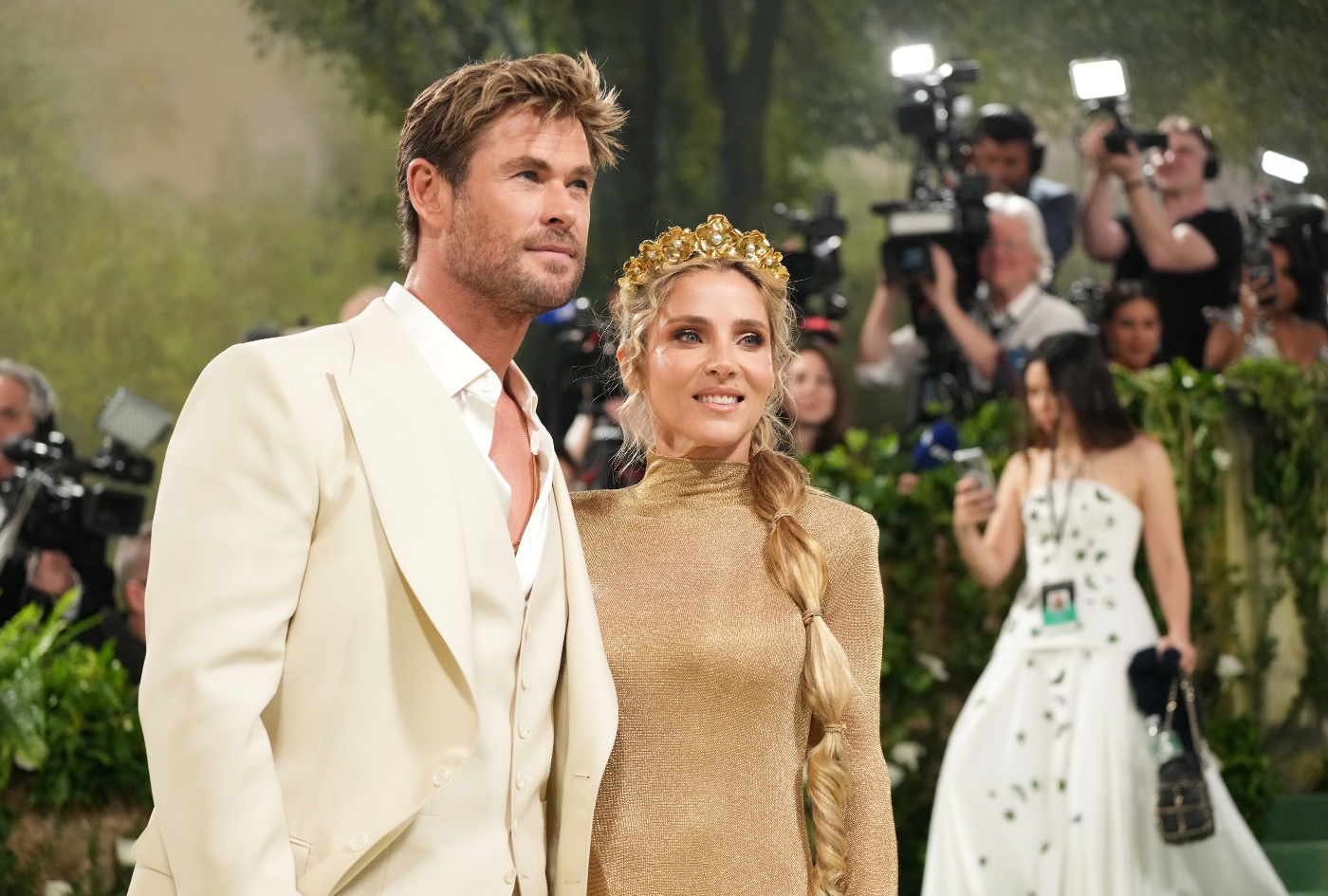
Chris Hemsworth and Elsa Pataky
Chris Hemsworth and Elsa Pataky at Met Gala 2024 on May 6 in New York City (Jeff Kravitz/FilmMagic)
Chris Hemsworth’s look is as boring as every man’s on the Met Gala carpet. In a cream ill-fitting three-piece suit, the host should've shown up in something that isn’t so monochromatic, especially considering the theme. But the Marvel and “Furiosa: A Mad Max Saga” actor looks like a golden Aussie hunk alongside his wife, Elsa Pataky, who somewhat makes up for his lackluster inspiration with her sheer golden gown and matching crown. Still not sure they got the memo for the theme though . . . 

2
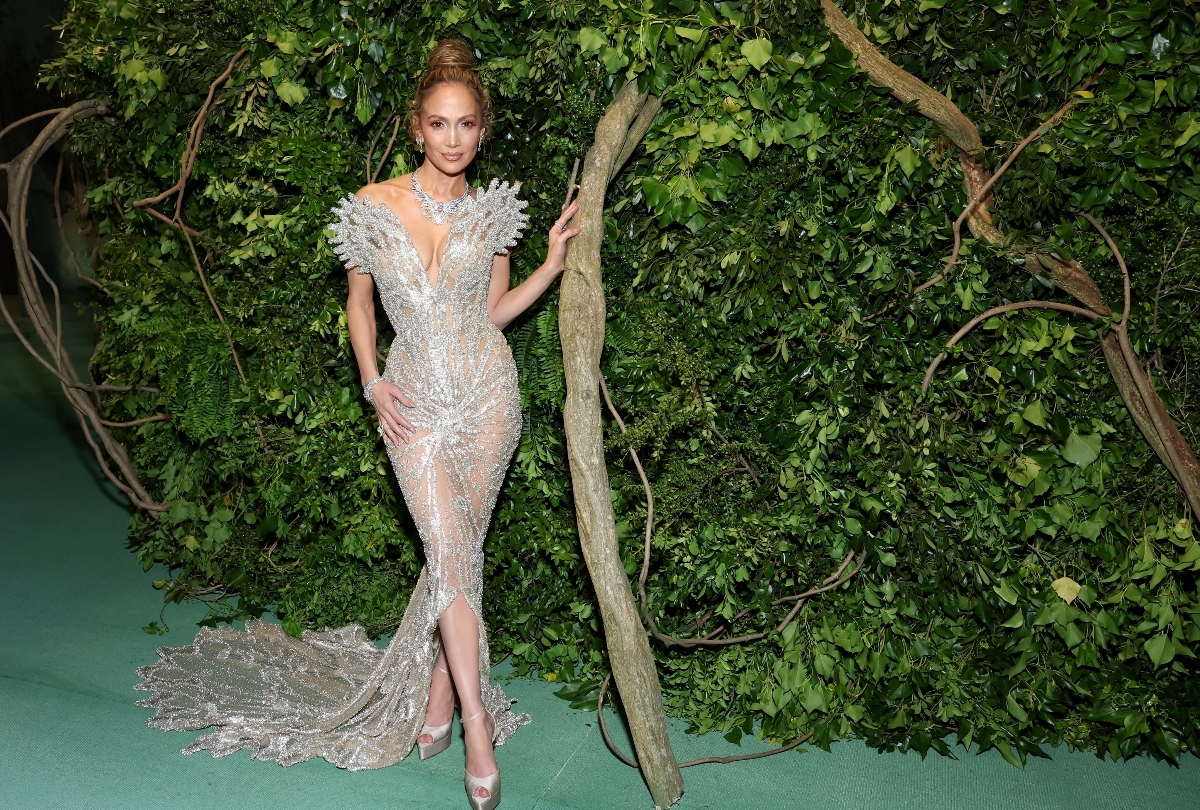
Jennifer Lopez
Jennifer Lopez at Met Gala 2024 on May 6 in New York City (Cindy Ord/MG24/Getty Images for The Met Museum/Vogue)
Jennifer Lopez is back in her city, ready to order a ham and cheese sandwich at the bodega. Don’t forget about the orange drink – if you know you know. The Bronx native is draped in 2 million beads, symbolizing a graceful butterfly in line with the botanical theme but also looking as intricate as her wildly, disorienting “This Is Me Now” musical film. Her outfit is as mindbending as Lopez’s perplexing public persona.

3
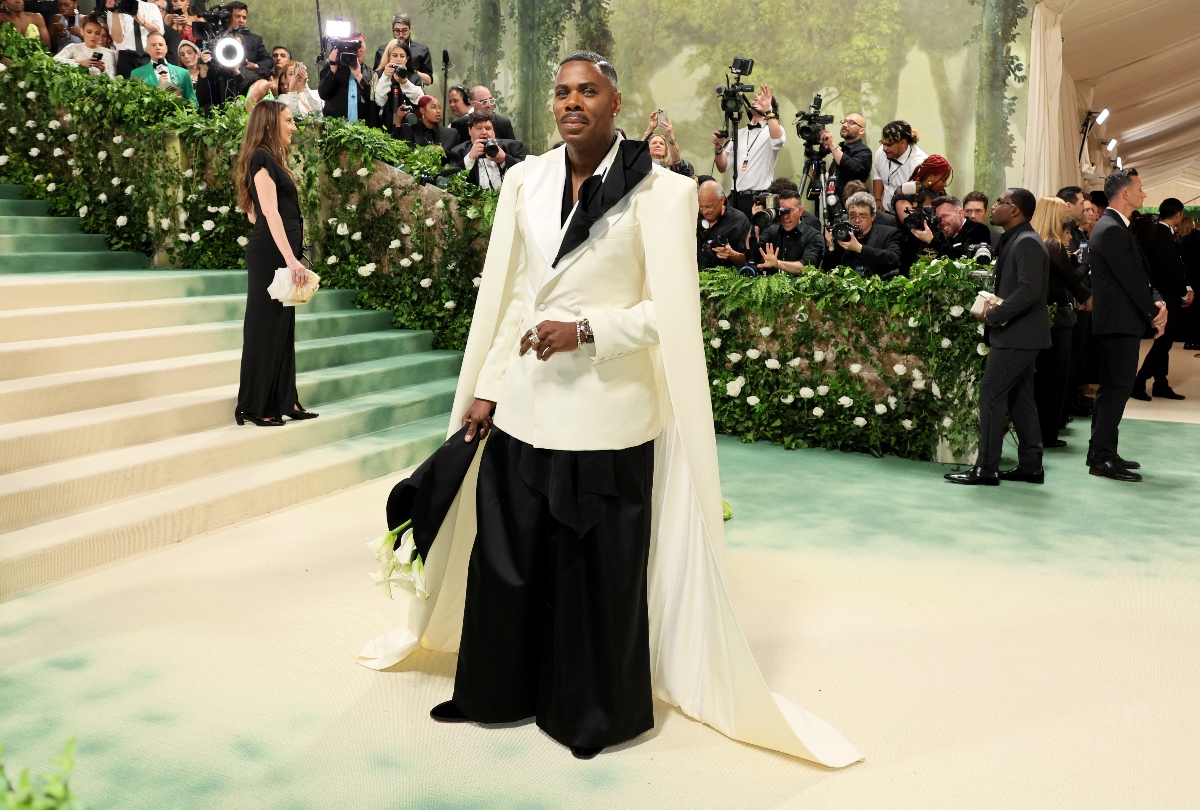
Colman Domingo
Colman Domingo at Met Gala 2024 on May 6 in New York City (Dia Dipasupil/Getty Images)
When Colman Domingo is on the red carpet, you know he’s going to serve a look worth swooning over. In a stunning, silk suit inspired by André Leon Talley, Chadwick Boseman and Chicano culture, Domingo is smooth. He looks dapper holding a bouquet of white flowers to match the outfit.


4
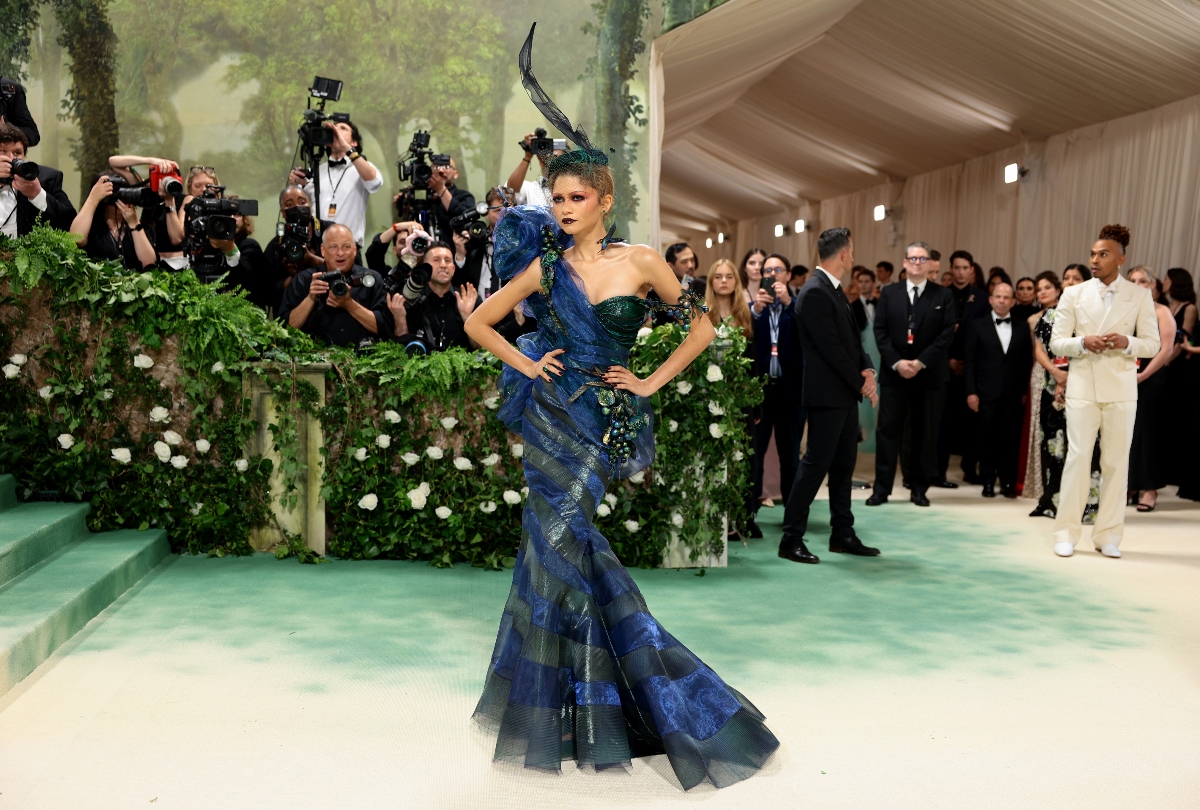
Zendaya
Zendaya at Met Gala 2024 on May 6 in New York City (Dimitrios Kambouris/Getty Images for The Met Museum/Vogue)
As this year’s co-host, Zendaya shows up. Hot off the “Challengers” press tour, she leaves the tennis-inspired dressing behind and trades it for a gothic fairy look instead. The actress leans into the drama with 1920s flapper-esque makeup almost making her look as deathly pale as a Victorian child. Maleficent only wishes.


5
Rebecca Ferguson
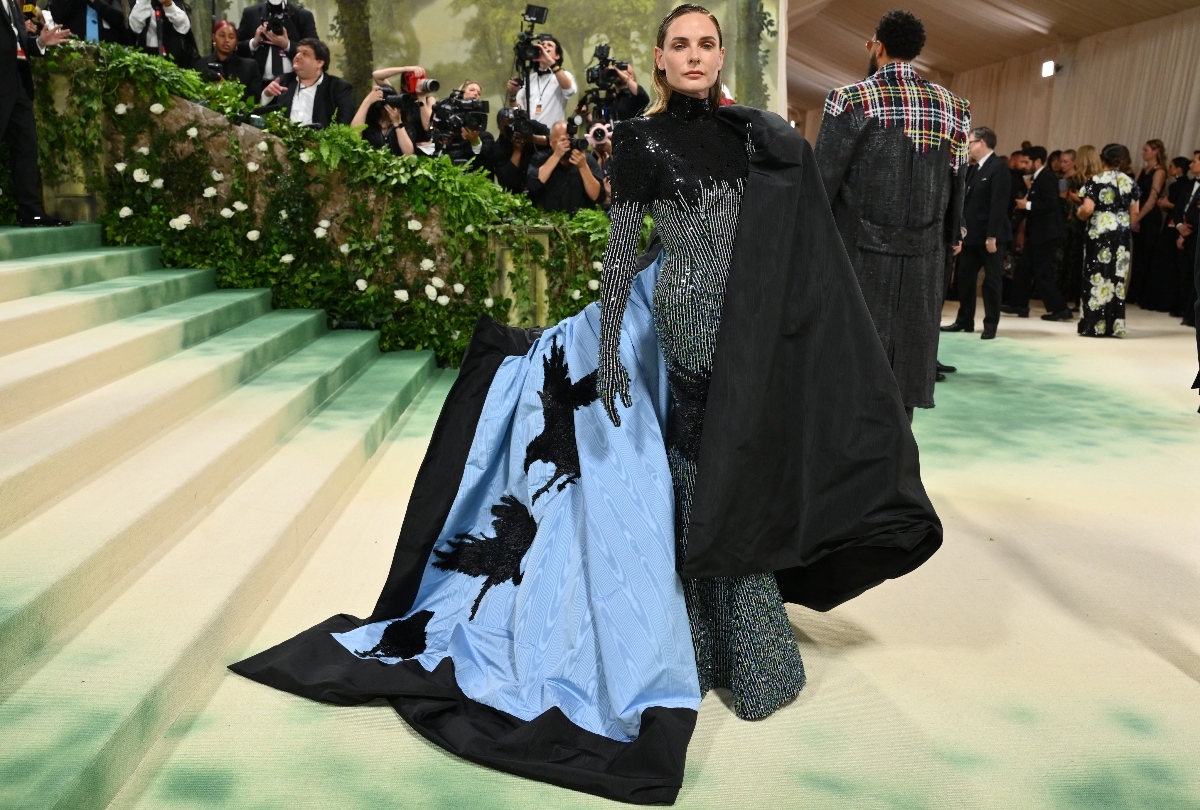
Rebecca Ferguson at Met Gala 2024 on May 6 in New York City (ANGELA WEISS/AFP via Getty Images)Sorry to the Reverend Mother but she’s not cutting it this time and she couldn’t convince us otherwise with her Bene Gesserit voice. Rebecca Ferguson’s wildly confusing two-piece gown is a rare miss from the actress. The overwhelming sequin piece definitely highlights her more dark, masculine energy but it certainly isn’t flattering. The huge ravens inside her cape is meant to be an interesting reveal but it just looks quite offputting.Sorry to the Reverend Mother but she’s not cutting it this time and she couldn’t convince us otherwise with her Bene Gesserit voice. Rebecca Ferguson’s wildly confusing two-piece gown is a rare miss from the actress. The overwhelming sequin piece definitely highlights her more dark, masculine energy but it certainly isn’t flattering. The huge ravens inside her cape is meant to be an interesting reveal but it just looks quite offputting.
Sorry to "Dune's" the Reverend Mother but she’s not cutting it this time and she couldn’t convince us otherwise with her Bene Gesserit voice. Rebecca Ferguson’s wildly confusing two-piece gown is a rare miss from the actress. The overwhelming sequin piece definitely highlights her more dark, masculine energy but it certainly isn’t flattering. The huge ravens inside her cape are meant to be an interesting reveal, but it just looks quite offputting.
 
6
Mindy Kaling
Mindy Kaling at Met Gala 2024 on May 6 in New York City (Jamie McCarthy/Getty Images)
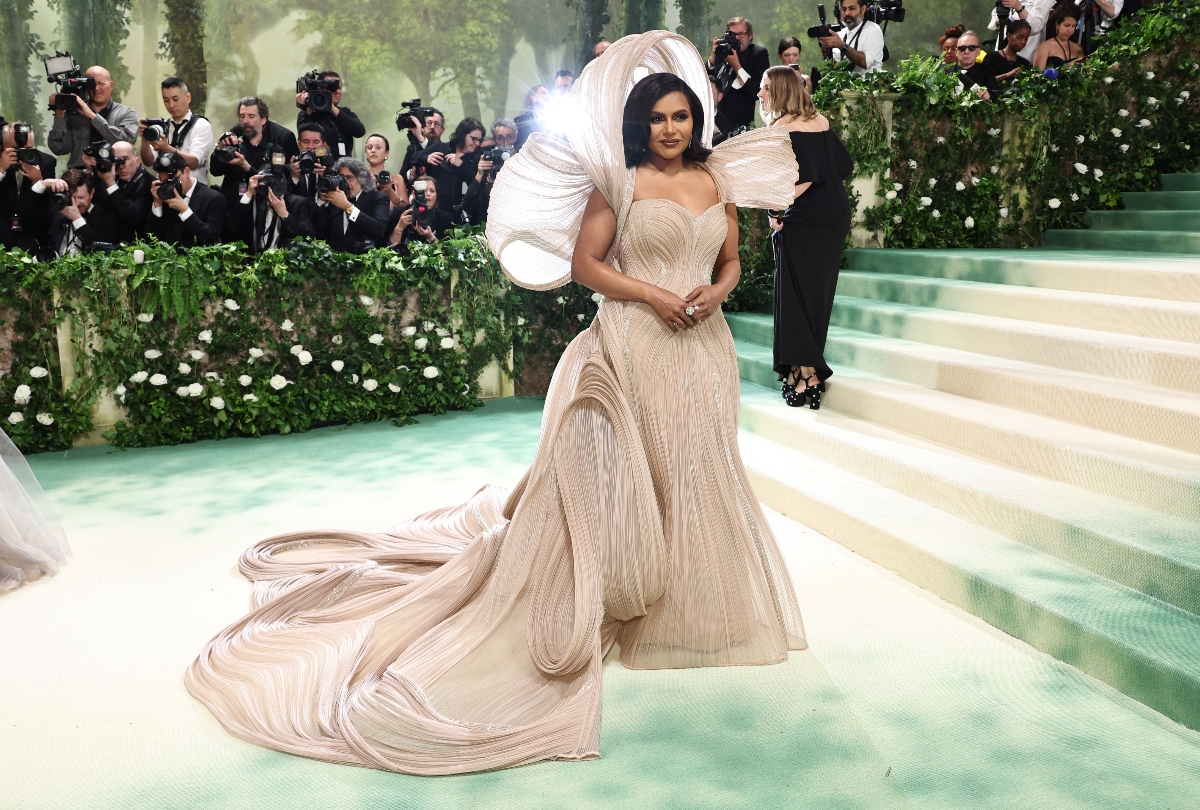
None of Mindy Kaling’s characters could ever make it to a prestigious event like this — they’d probably crash it drunk. But Kaling’s look shows she’s more than worthy to be on the cream and green carpet. She’s in an otherworldly avant-garde piece that arches over her head. From the back, the dress stuns as it drapes like neverending sand dunes.


7
Gwendoline Christie
Gwendoline Christie at Met Gala 2024 on May 6 in New York City (Getty Images for The Met Museum/Vogue)
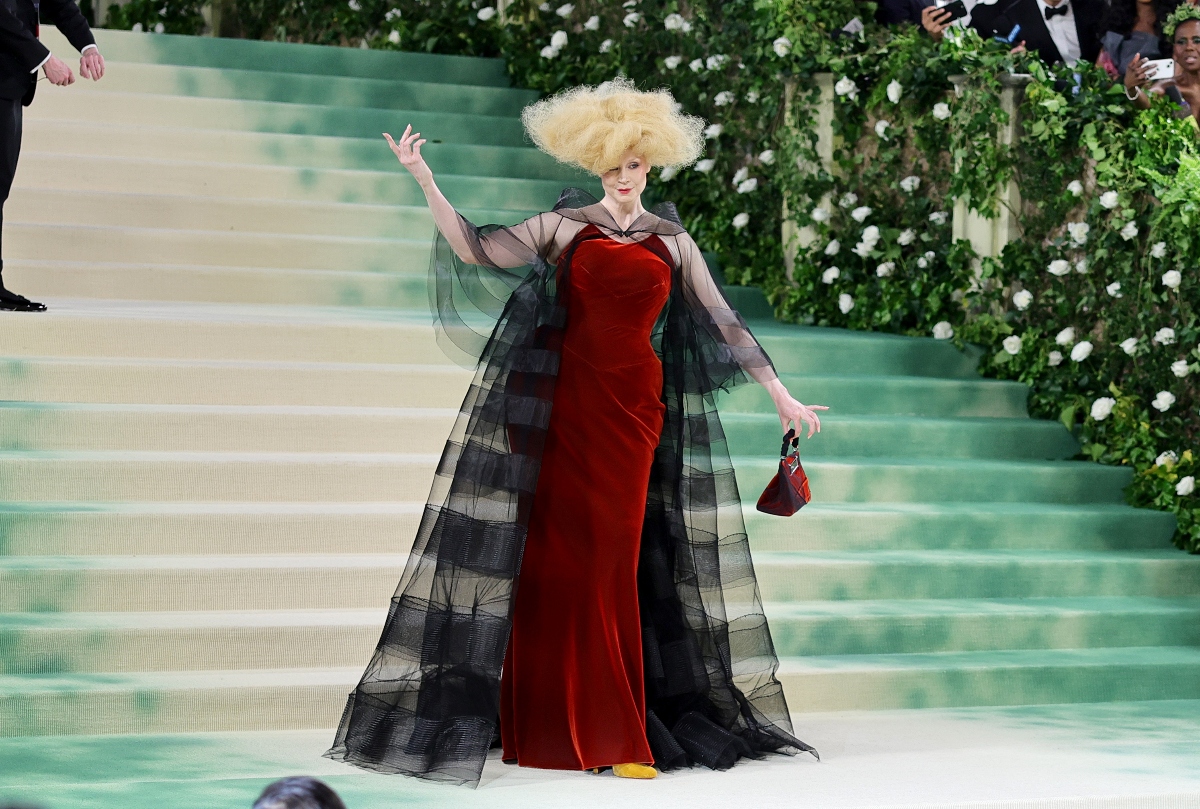
As one of Vogue's red carpet hosts, the “Game of Thrones” star does not disappoint as she mimics a villainous Cruella de Vil. Her blonde locks are teased so high above her head that depending on who you ask, it looks like a bird's nest or a stratocumulus cloud. Her black and blood-red gown does help lean into the dark female villain look.

8
Lea Michele
Lea Michele at Met Gala 2024 on May 6 in New York City (Theo Wargo/GA/The Hollywood Reporter via Getty Images)
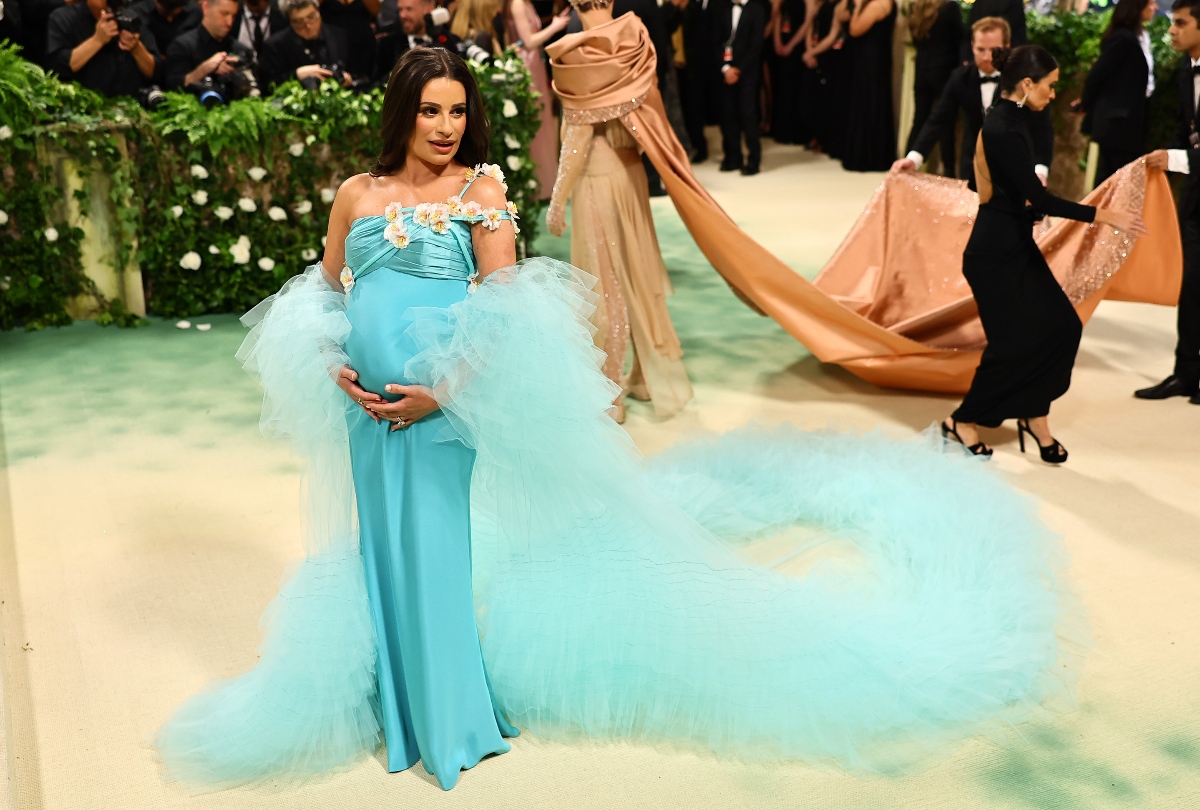
Rachel Berry would probably trip Lea Michelle to snake her way onto that green and cream carpet. The “Glee” and “Funny Girl” alum looks angelic holding her baby bump in a baby blue Rodarte gown. A matching tulle cape and the train are the outfit’s main attractions, leaning into the dreamy fairy tale theme of the exhibit.


9
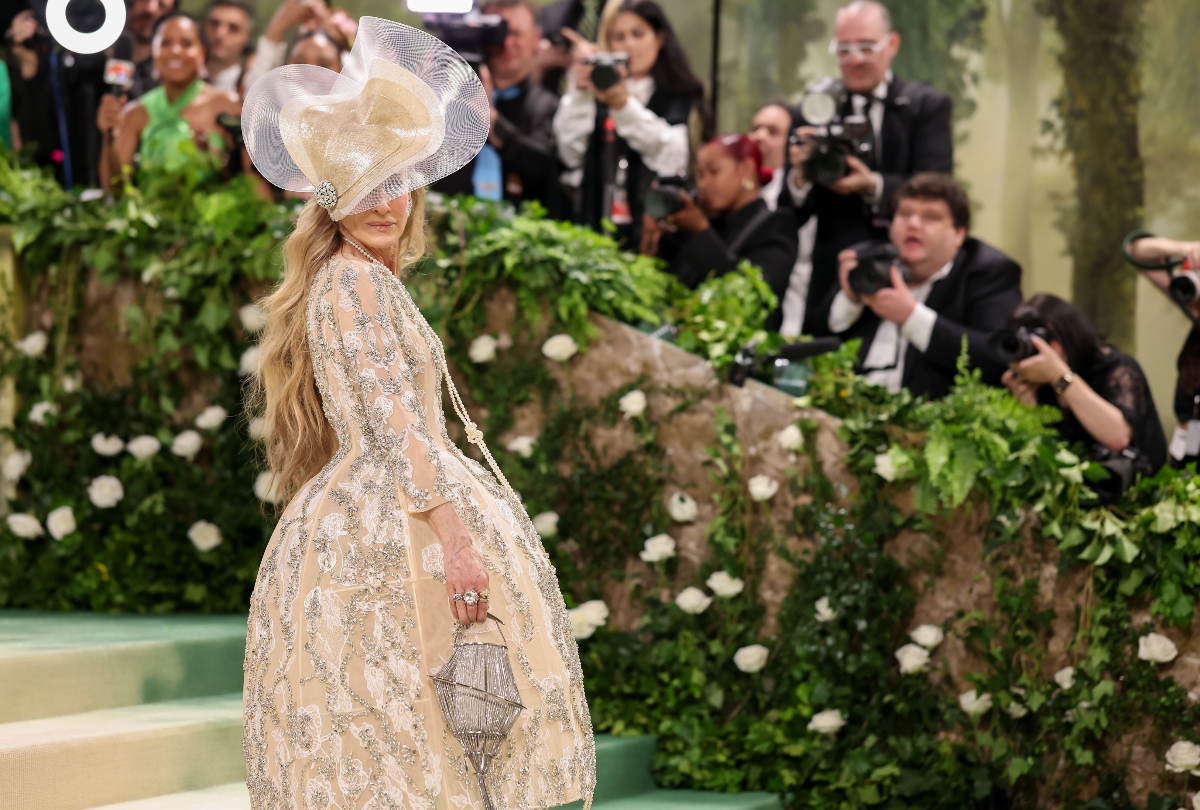
Sarah Jessica Parker
Sarah Jessica Parker at Met Gala 2024 on May 6 in New York City (John Shearer/WireImage)
I wonder if Sarah Jessica Parker knows what the “Big’s going to Paris” meme is. In an age where “Sex and The City” has come back in full swing, Parker always stays relevant and timeless. The star looks like she’s come back from afternoon tea with the queen. Her pearl necklace hangs as long as her dress almost looking like she could play jump rope with it. The oversized brim of her fascinator-style hat completes the dramatic look.
10
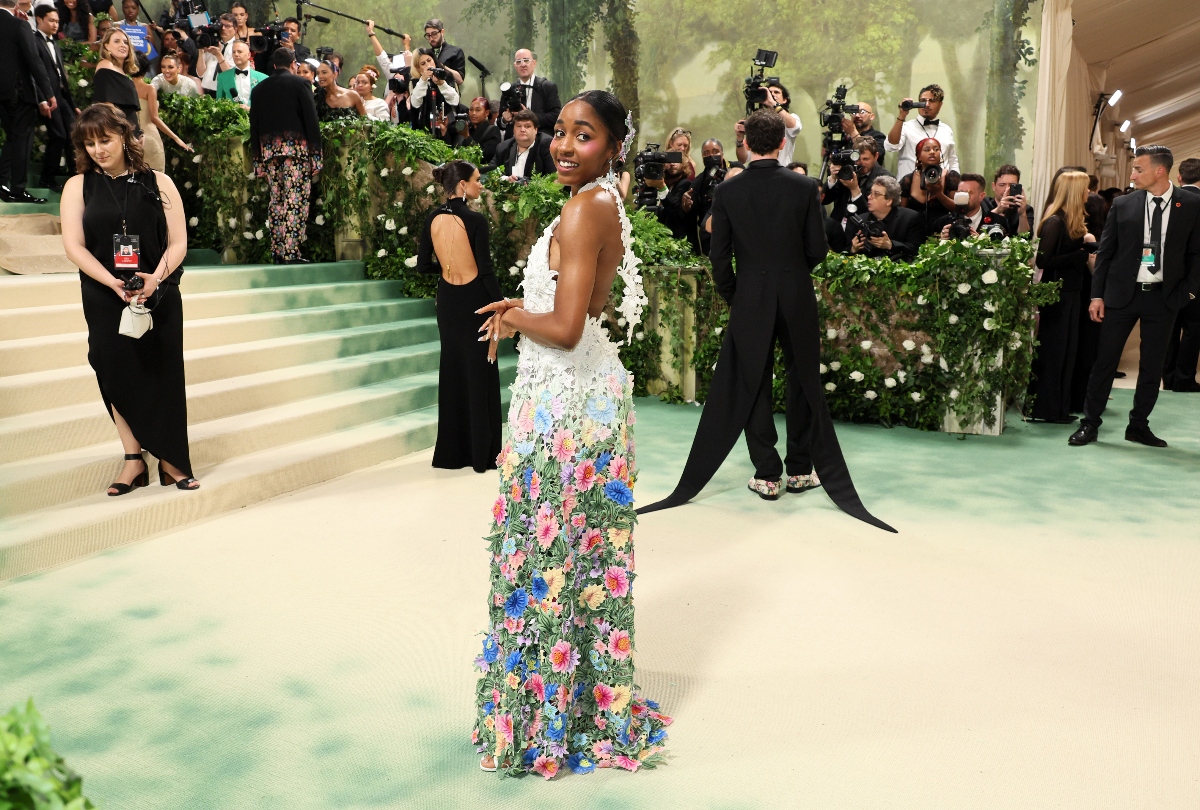
Ayo Edibiri
Ayo Edibiri at Met Gala 2024 on May 6 in New York City (Dia Dipasupil/Getty Images)
Everyone’s obsessed with the ever-loveable cool nerdiness of Ayo Edibiri. I just wish she looked as chic here as she has on every other carpet. Edibiri’s outfit is on theme — she is head to toe in an ombre floral gown — but it doesn’t do much for her quirky personality. However, her makeup looks like she was kissed by strawberries – perfect for the people’s princess.


11
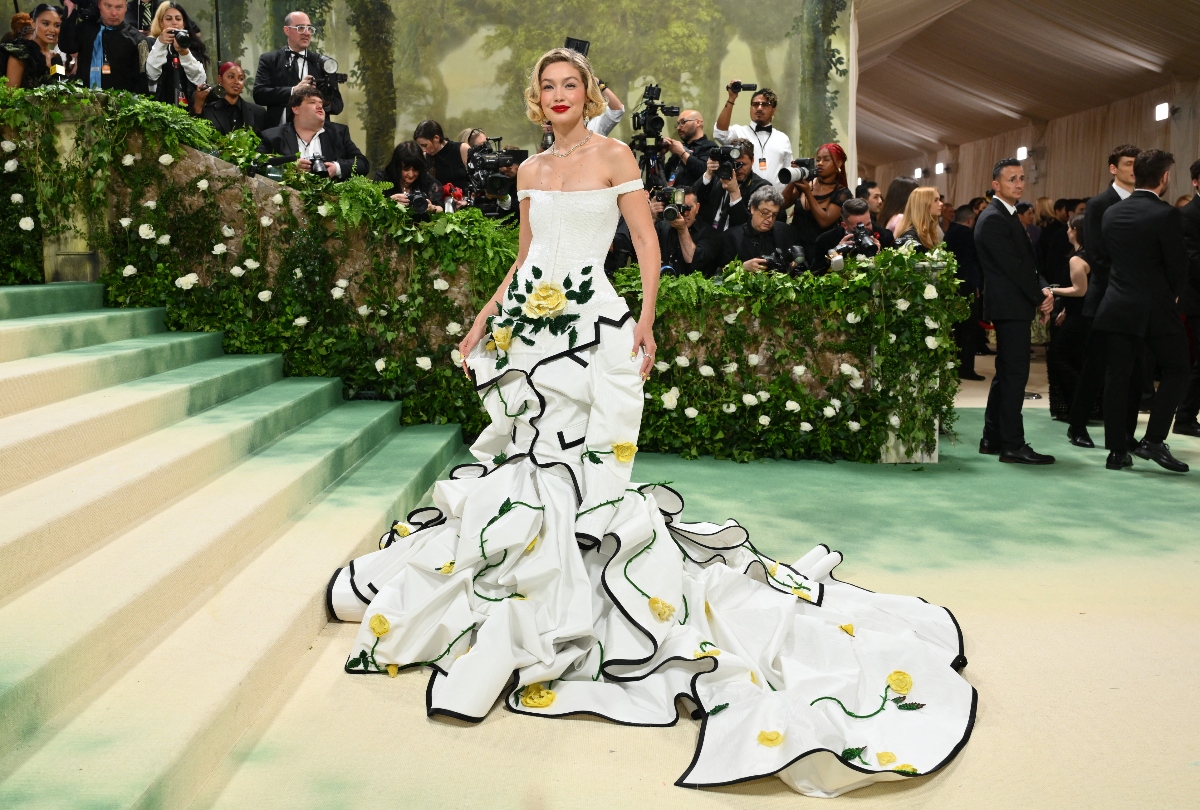
Gigi Hadid
Gigi Hadid at the 2024 Met Gala on May 6 in New York City (ANGELA WEISS/AFP via Getty Images)
Move over for a supermodel. Gigi Hadid walked out of the Mark Hotel in her off-the-shoulder mermaid gown adorned with a yellow flower front and center. She even sweetly handed the bouquet of yellow flowers to fans waiting on the sidelines. But what fans didn’t get to see was the ruffled suit-inspired train attached to the model: a nod to the gown’s designer Thom Browne and his signature look.
12
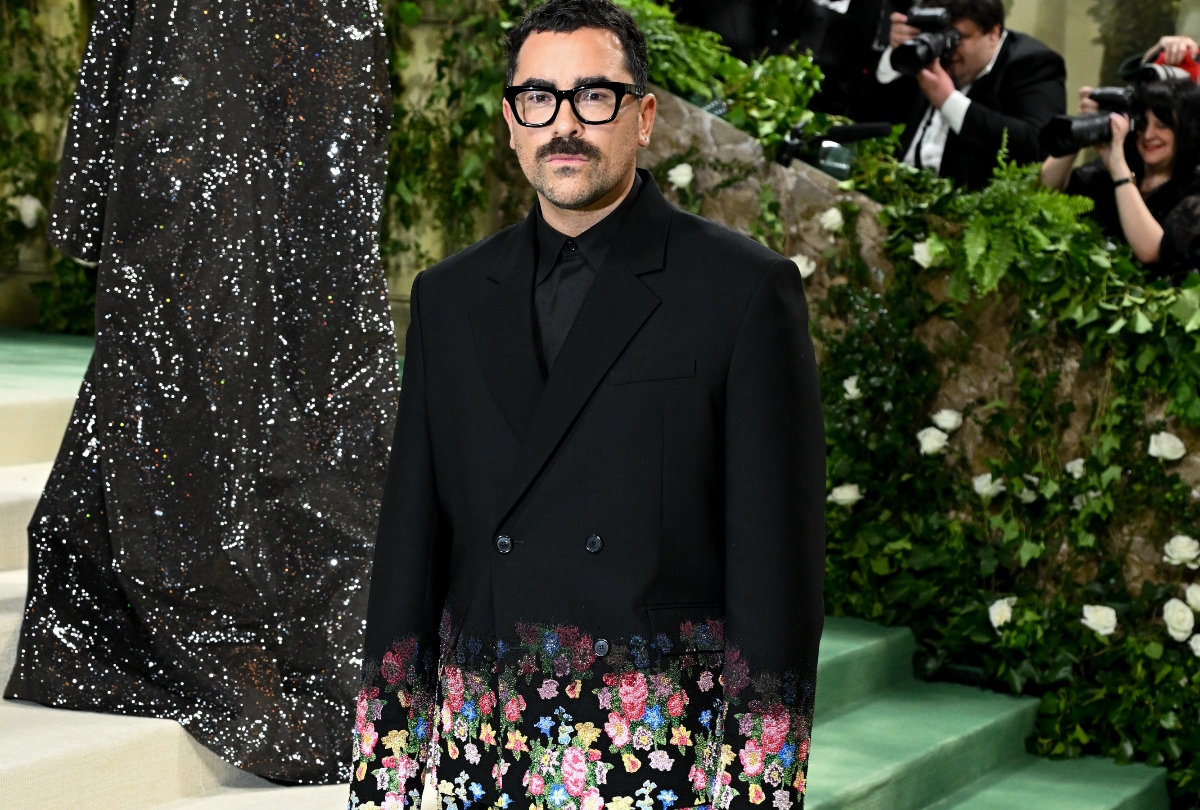
Dan Levy
Dan Levy at the 2024 Met Gala on May 6 in New York City (Gilbert Flores/Variety via Getty Images)
Unfortunately, menswear can be so basic sometimes. Even when someone like Dan Levy is experimenting with color and patterns it still doesn’t look right. Levy’s suit looks like a flower threw up on it. Like Ayo Edibiri’s ombre flower gown — which reserves its bottom half to a riot of pastel flowers — Levy’s suit does nothing for the eye. But at least he is trying something new. I’m pretty sure Alexis would say, “Ew, David" to this.

13
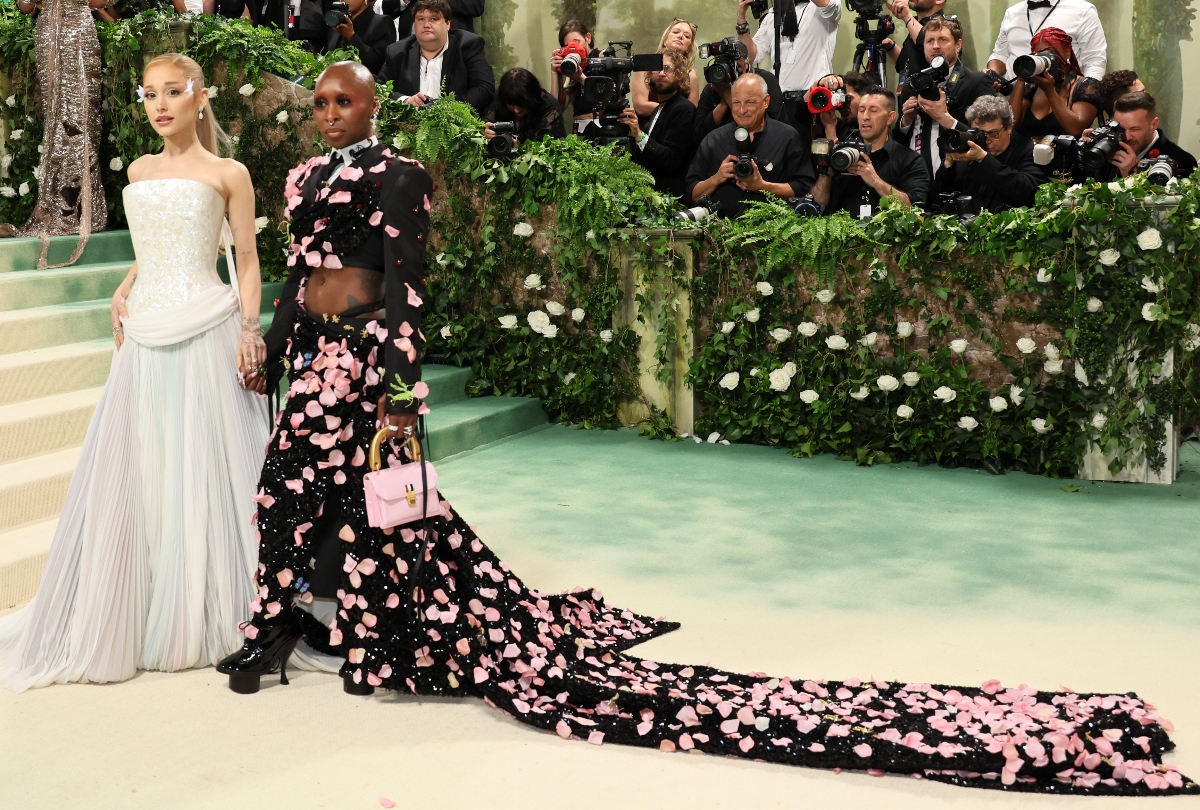
Ariana Grande and Cynthia Erivo
Ariana Grande and Cynthia Erivo at the 2024 Met Gala on May 6 in New York City (Dia Dipasupil/Getty Images)
Our new Glinda and Elphaba are inseparable. Triple threats Ariana Grande and Cynthia Erivo are the new powerhouse duo coming soon to theaters in November in "Wicked." Grande is so clearly in her Glinda era with her blonde ponytail almost matching the shade of her mother-of-pearl gown made by Loewe. Erivo's gown is actually a suit by Thom Browne. Petals cascade down the length, playing with the silhouette and possibilities of a suit. Erivo's outfit is obviously the darker half of the two.


14
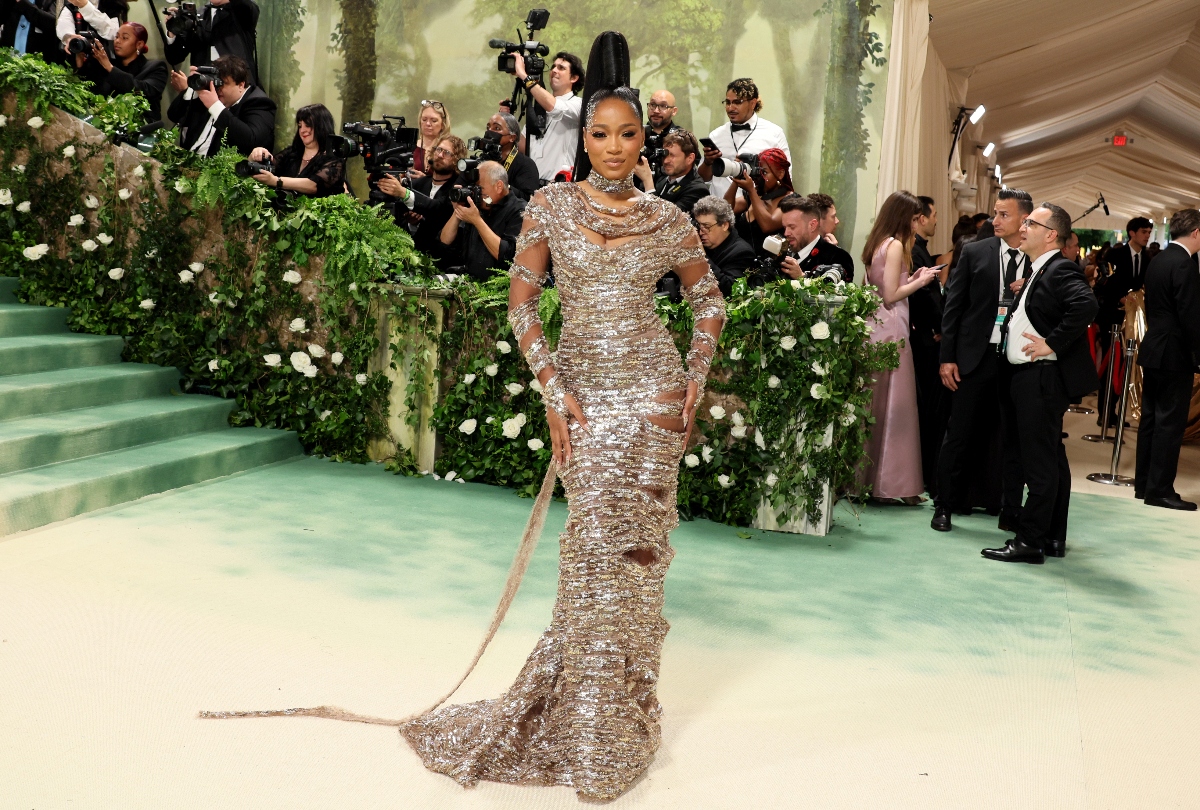
Keke Palmer
Keke Palmer at the 2024 Met Gala on May 6 in New York City (Dia Dipasupil/Getty Images)
Sorry to Keke Palmer but her sequined dress with intentional holes throughout its train is neither flattering nor on theme. Its dull color does nothing for the internet’s favorite childhood star. However, her hair in an exaggerated ponytail certainly brings the drama we are used to seeing from the actress.
15
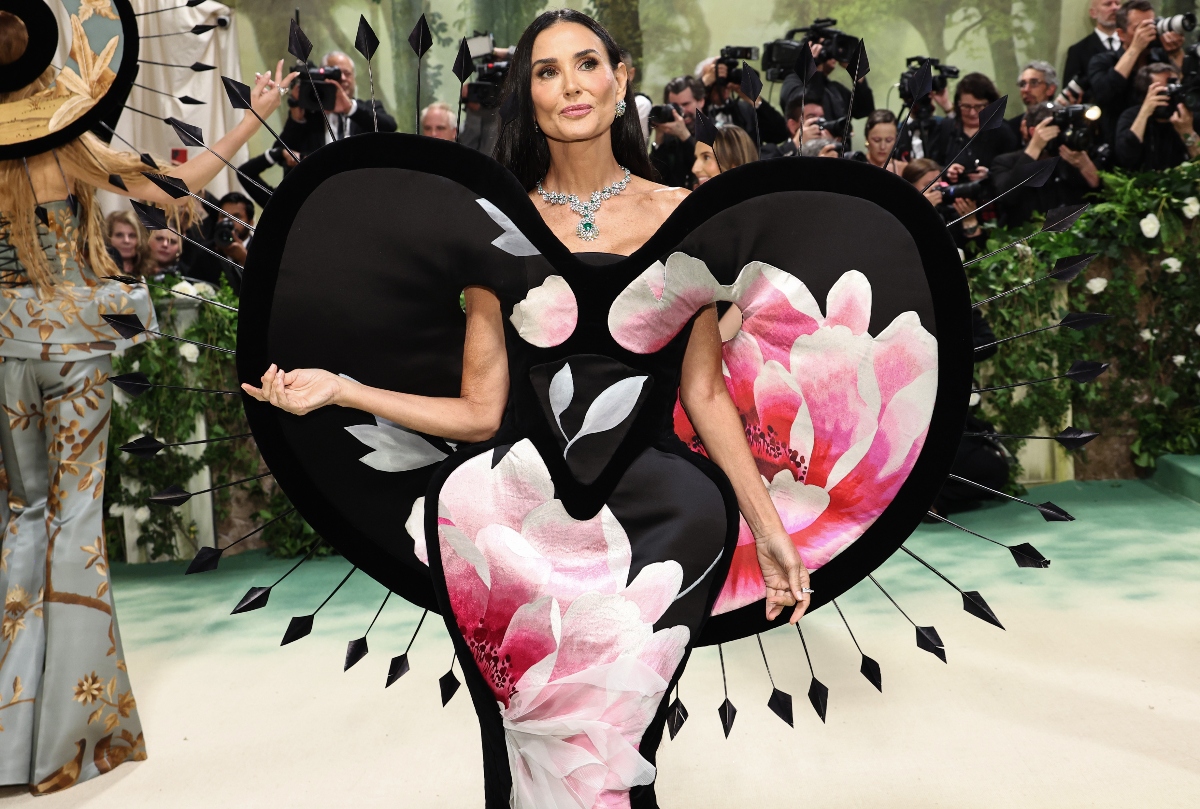
Demi Moore
Demi Moore at the 2024 Met Gala on May 6 in New York City (Jamie McCarthy/Getty Images)
Demi Moore came out to the Met Gala to step on necks. The playful silhouette of her gown showcases it as a couture piece, one emulating  Georgia O'Keeffe's feminine floral motif. The dress’ roundness is playful while allowing the actress to look like a flower blossoming in her dress. The piece is one of the standout gowns of the evening.
16
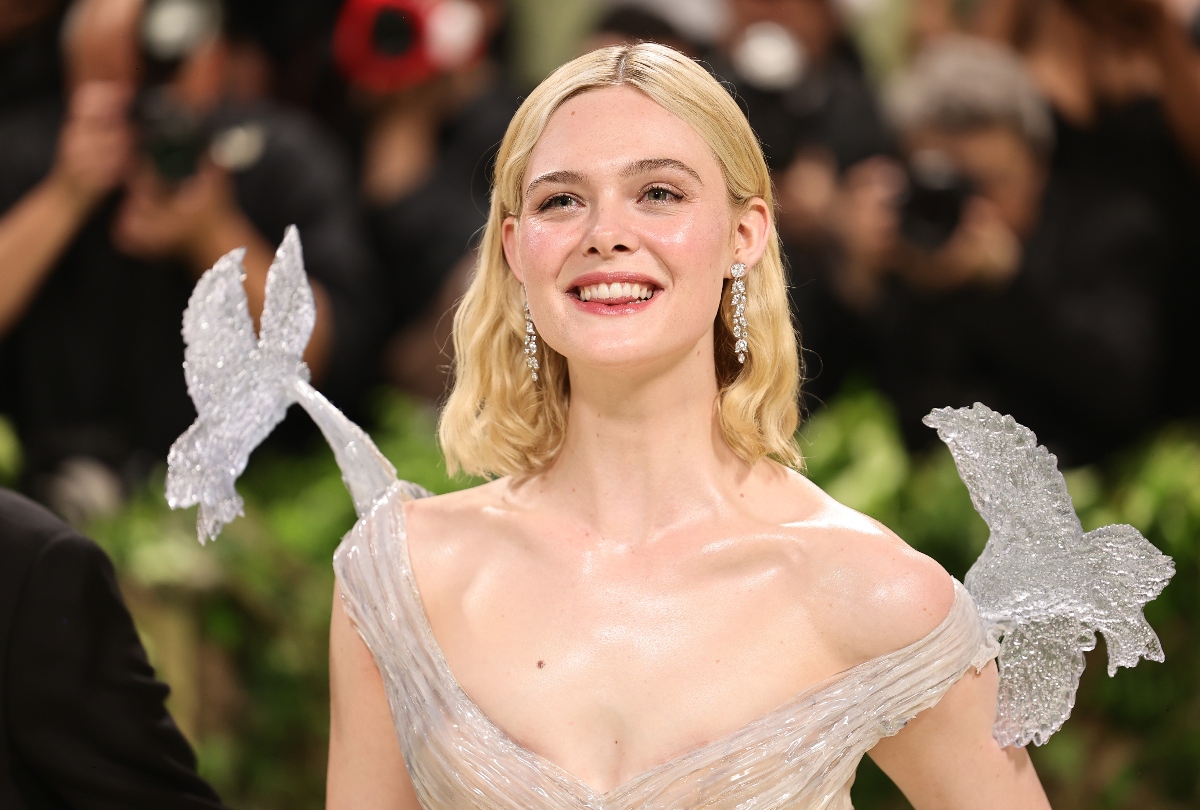
Elle Fanning
Elle Fanning at the 2024 Met Gala on May 6 in New York City (Theo Wargo/GA/The Hollywood Reporter via Getty Images)
Ever the regal and literal Sleeping Beauty, Elle Fanning does not disappoint in what looks like a 3D-printed fountain dress. Reminiscent of a previous Met look from Zac Posen on actress Nina Dobrev, the sculpted dress hugs Fanning’s body like she’s in the Louvre. Two bird adornments made to look like they're sipping from the fountain flit about her shoulders, really driving home her Disney princess status.

17
Taika Waititi and Rita Ora
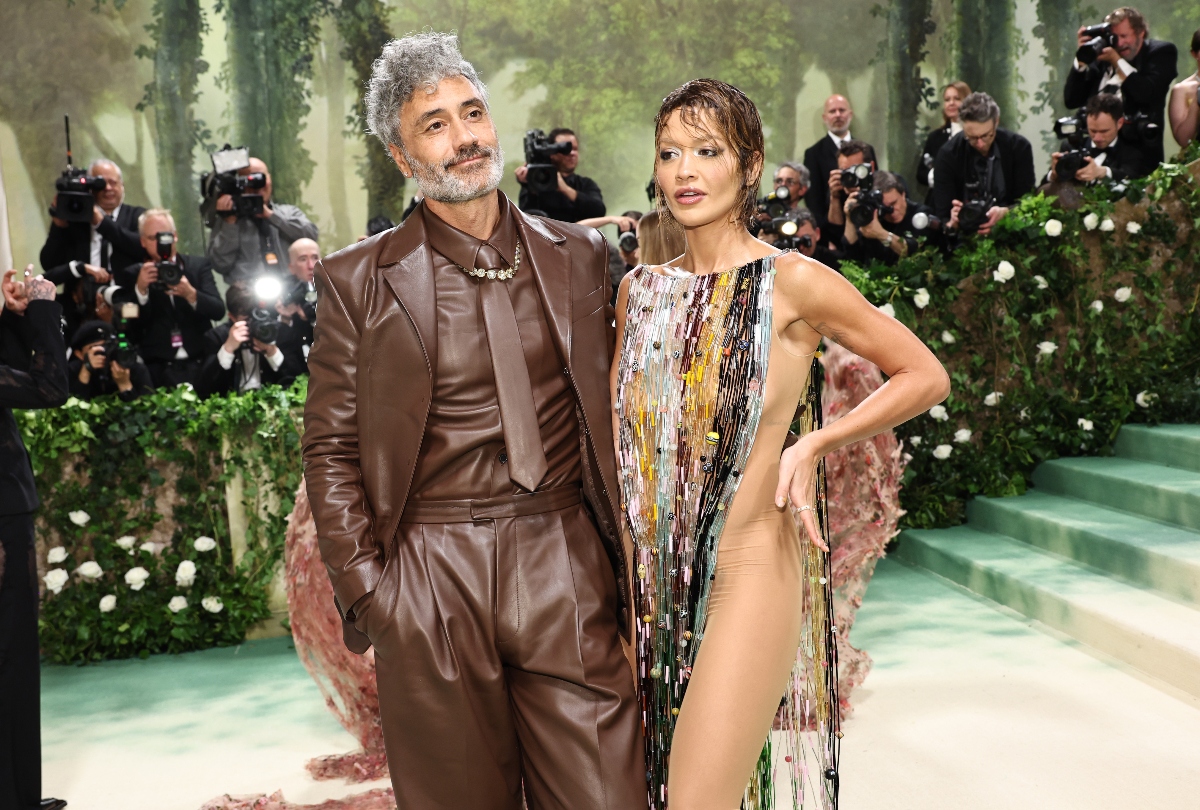
Taika Waititi and Rita Ora at the 2024 Met Gala on May 6 in New York City (Jamie McCarthy/Getty Images)
Taika Waititi and Rita Ora are clearly not dressed for the same function. In a disgustingly all-brown leather suit, the filmmaker looks like an uncomfortable leather couch still wrapped in plastic film. Ora is in a beaded dress that covers her front and back side and hangs like she’s fringe in a mid-century modern bar. 

18
Kim Kardashian
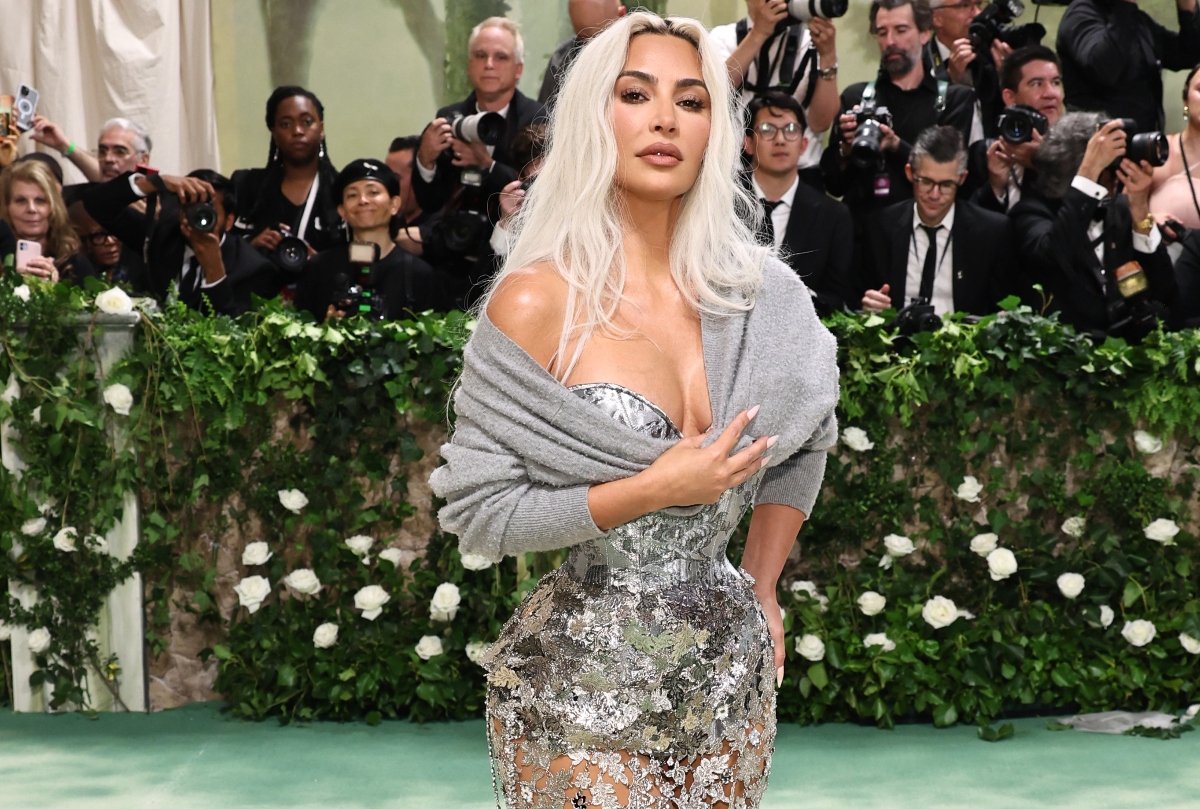
Kim Kardashian at the 2024 Met Gala on May 6 in New York City (Jamie McCarthy/Getty Images)
Kim Kardashian is no stranger to fitting into a tiny dress. Remember when she lost weight to fit into the iconic Marilyn Monroe dress? This time around, Kardashian is wearing Margiela. Her slim frame looks even more exaggerated as her metal lace gown snuggly hugs her body. It's so snug that it appears the gray shrug over her shoulders is being used to hide a wardrobe malfunction. I wonder if ever the fashion critic and Kardashian’s daughter North West hates or loves her outfit.

19
Lil Nas X
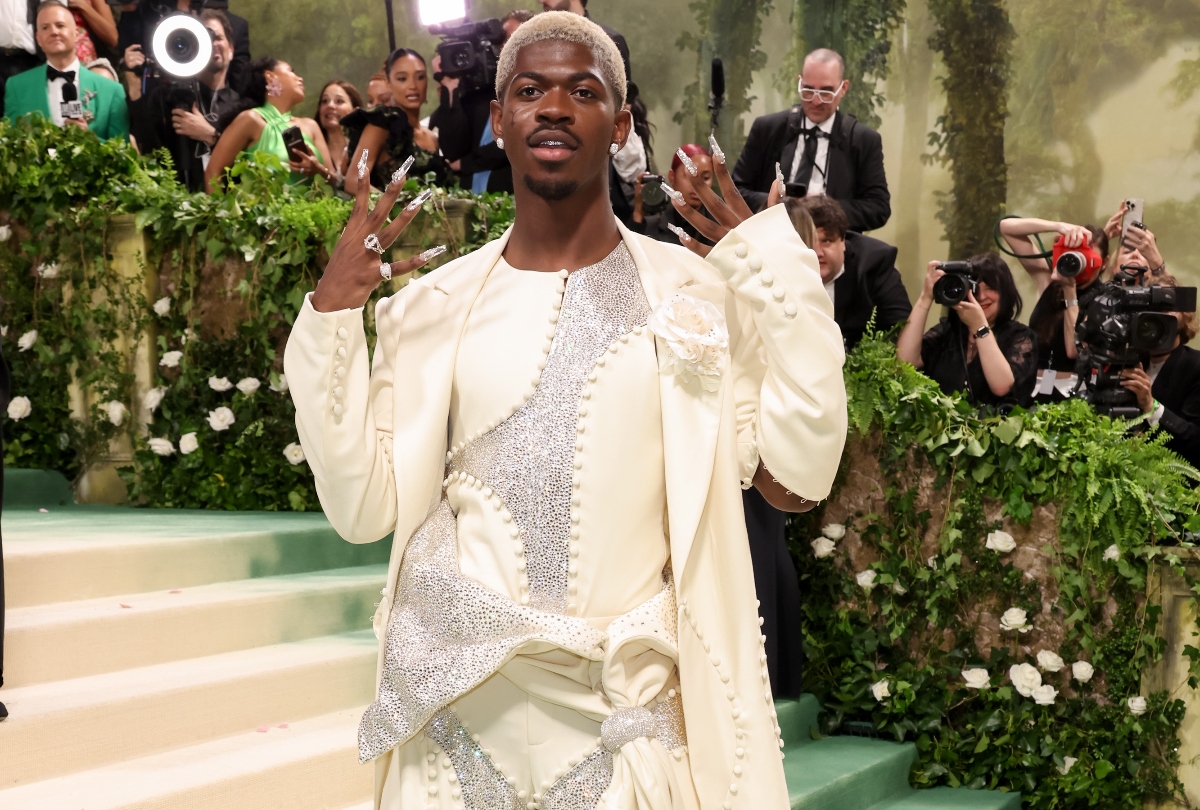
Lil Nas X at the 2024 Met Gala on May 6 in New York City (John Shearer/WireImage)
Lil Nas X does men’s fashion right. While the rapper might be an internet troll who loves to mess with conservatives, he does take one thing seriously, and that's fashion. In a cream, ‘70s Prince homage, Lil Nas’ one-piece suit, coat and matching acrylic nails are not here to play games. He even has bleached his hair as another accessory to the loungey outfit.


20
Lana Del Rey
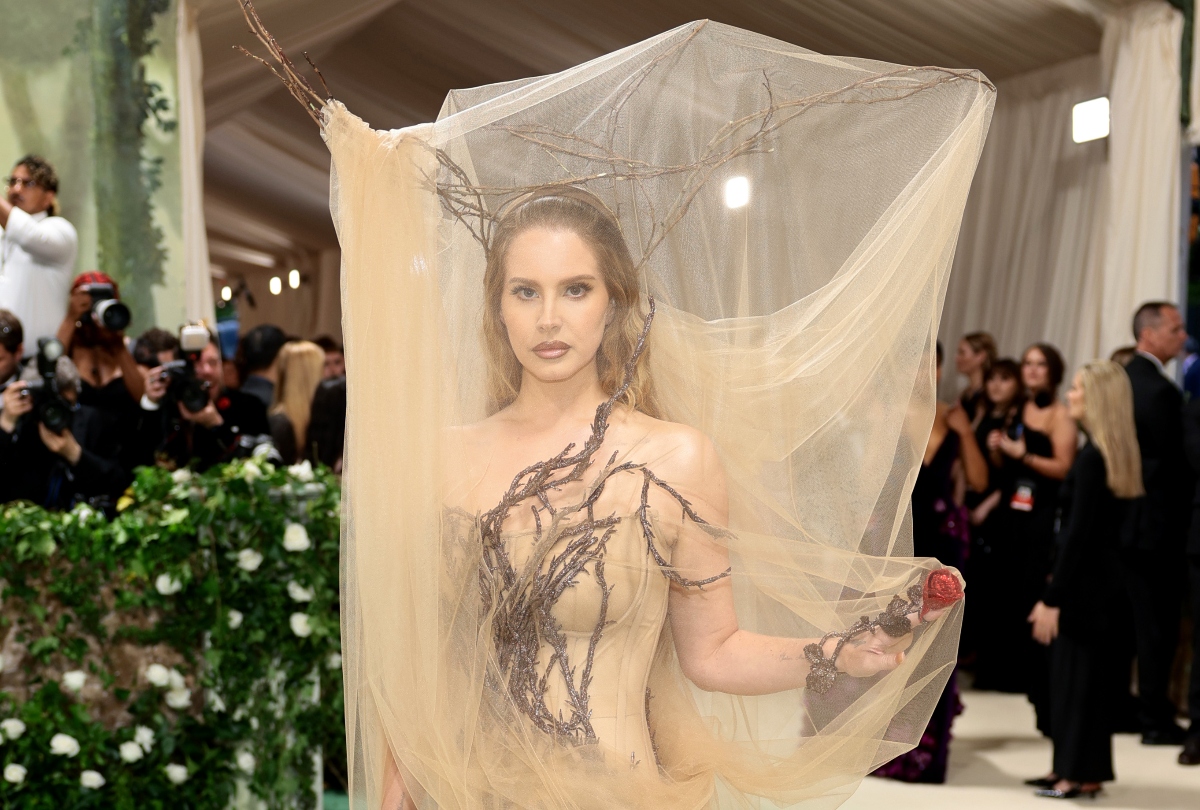
Lana Del Rey at the 2024 Met Gala on May 6 in New York City (Dimitrios Kambouris/Getty Images for The Met Museum/Vogue)
Straight out of a Robert Eggers film, singer Lana Del Rey is haunting. With antlers on her head, wrapped in fabric covering her face the singer looks like she is growing with her dress. It is archival Alexander McQueen and right on theme. Plus, it can keep out mosquitos. Win-win.

21
Angel Reese
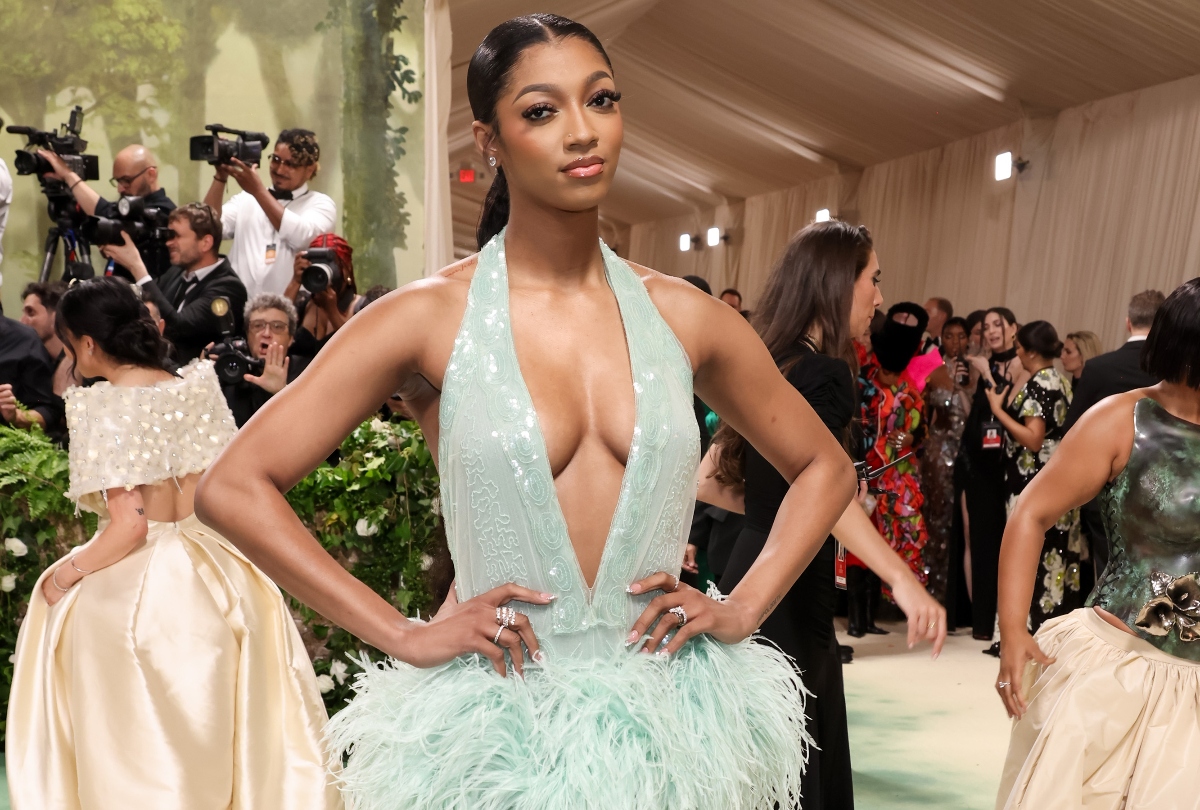
Angel Reese at the 2024 Met Gala on May 6 in New York City (John Shearer/WireImage)
Angel Reese does not play when it comes to basketball and certainly not fashion either. On the newly minted WNBA player’s 22nd birthday, she experienced her first-ever Met Gala. While the mint dress with plunging neckline and maribou feathered tutu does not do anything for the 6-foot-3 baller (honestly, it looks a bit like a loofah) it’s a welcome surprise to see young female athletes become hyper-visible.

22
Usher
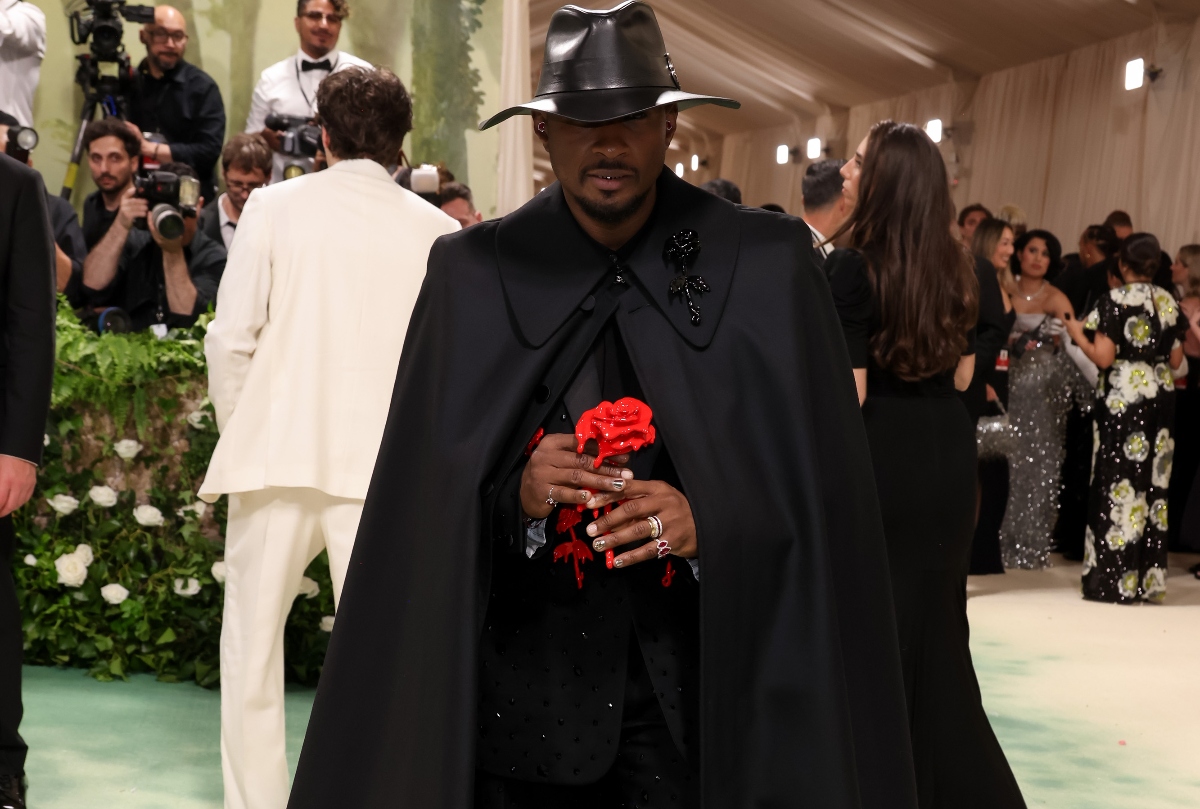
Usher at the 2024 Met Gala on May 6 in New York City (John Shearer/WireImage)
Usher Baby is one of the few men on the carpet who brings the performance. The singer is known for oozing sex appeal and suaveness, so it’s only right that he seemingly dresses as a cross between a pimp and Zorro. I mean c’mon, he even has a bejeweled rose in his hands as a prop. A cape and leather hat also help bring mystery and intrigue to the singer’s look.

23
Lizzo
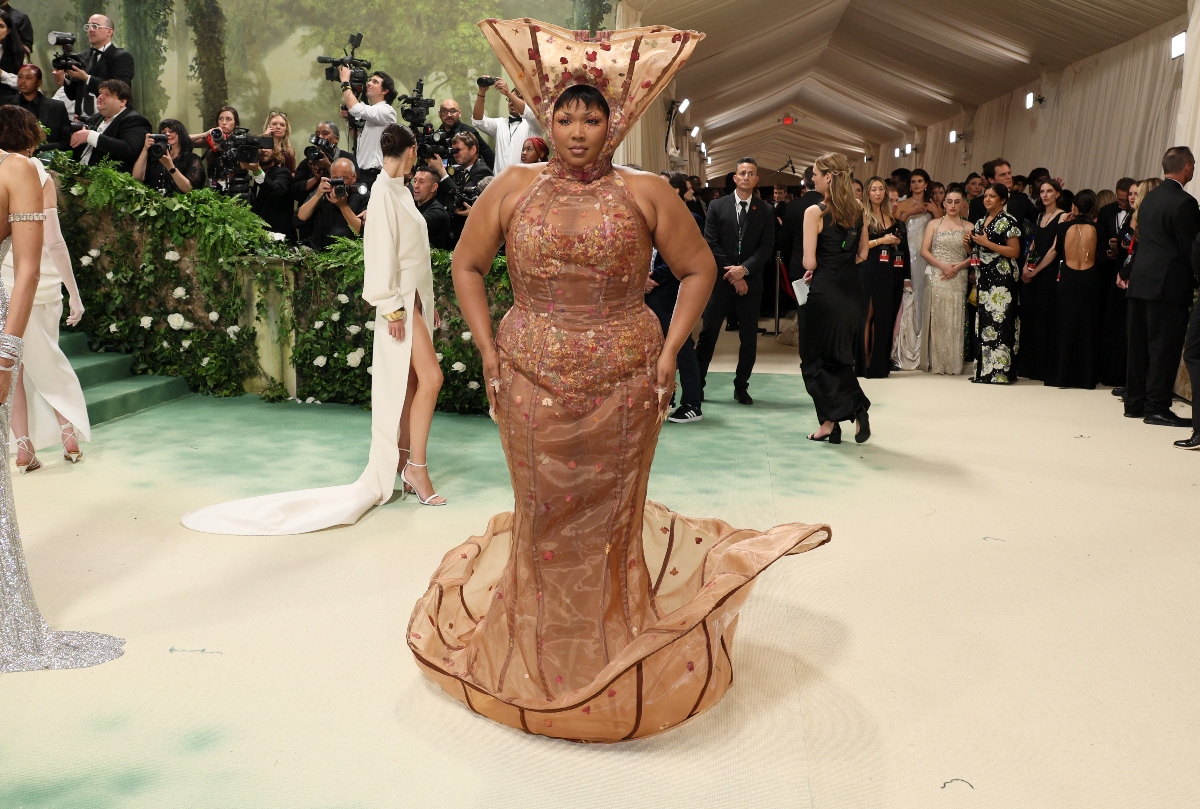
Lizzo at the 2024 Met Gala on May 6 in New York City (Dia Dipasupil/Getty Images)
Lizzo’s tree-inspired Met Gala look is certainly eye-catching. Whether that has a positive or negative connotation is up to you to decide. People online are comparing the look to Lumiere from “Sleeping Beauty” for its length and headpiece that almost mimics a candelabra. While the look isn’t a complete miss, it falls in the mid-category of tonight’s looks. Be our guest and tell us what you think.


24
Cardi B
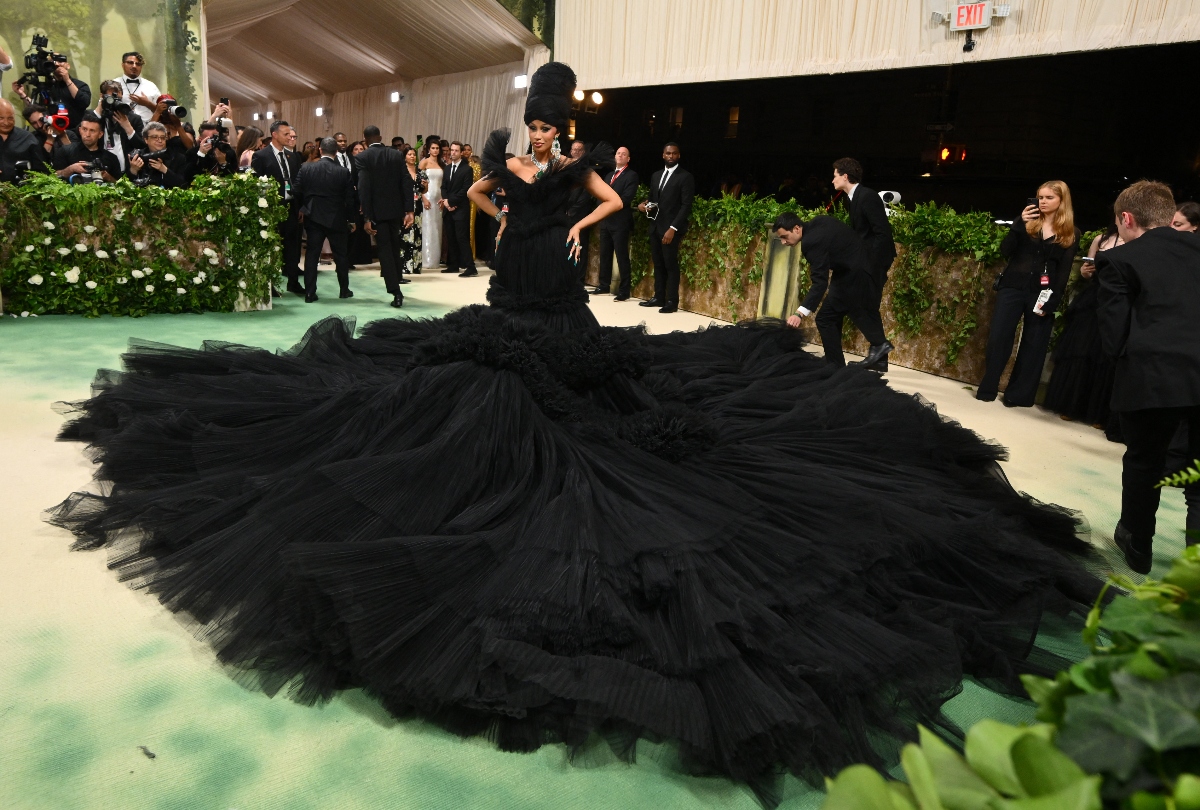
Cardi B at the 2024 Met Gala on May 6 in New York City (ANGELA WEISS/AFP via Getty Images)
Cardi B always knows how to be the loudest person in the room and that’s apparent in her fashion choices. The rapper’s tiered black tulle skirt took about nine men to unfold as her entire train engulfed the carpet at her arrival. Her black Marge Simpson-esque headpiece, long green nails and jewelry to match really nail the "what I wear to my rich husband’s funeral" vibe of the outfit.

25
Stray Kids
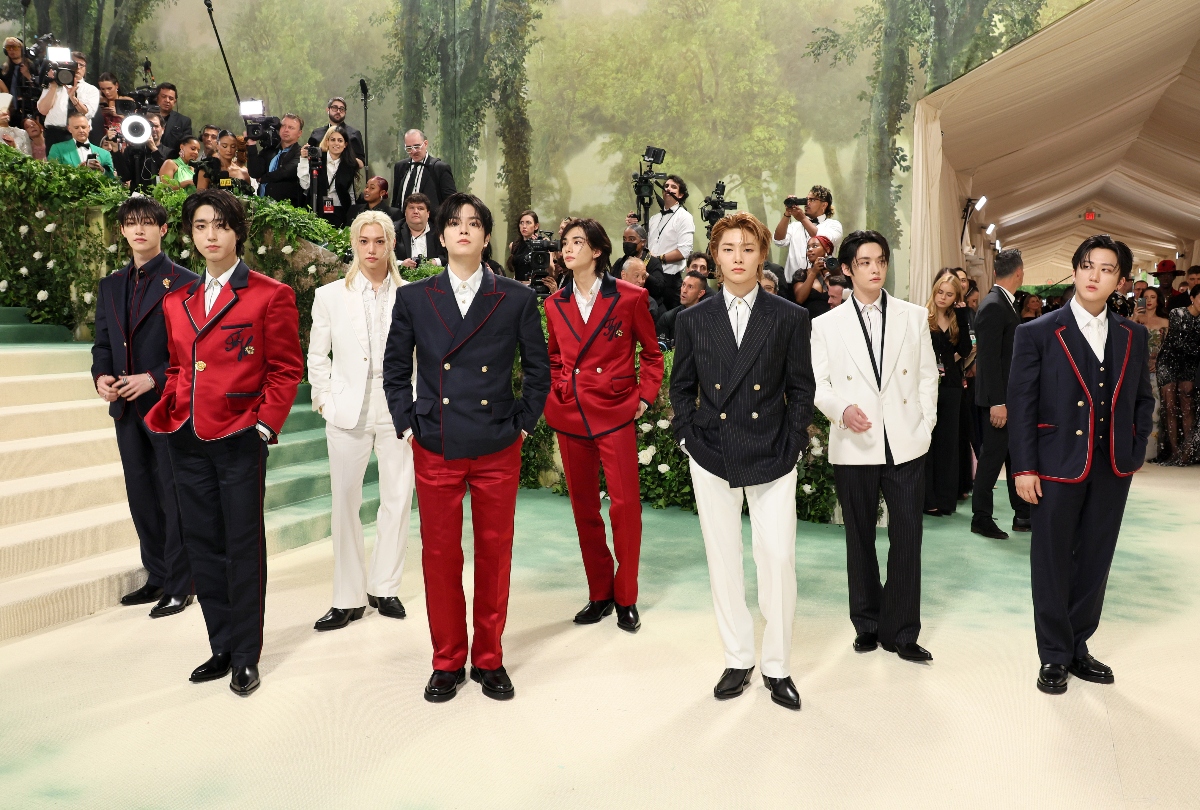
Stray Kids at the 2024 Met Gala on May 6 in New York City (Dia Dipasupil/Getty Images)
Here's K-pop group Stray Kids giving Stays palpitations with their Tommy Hilfiger-designed Prince Charming ensemble. And while there's no denying that they're fairy tale-worthy, Hilfiger missed the memo on the Met Gala's sense of whimsy and theatricality. Where are the crowns? Never mind, we'll go write our own AO3 fic . . .
26
Nicki Minaj
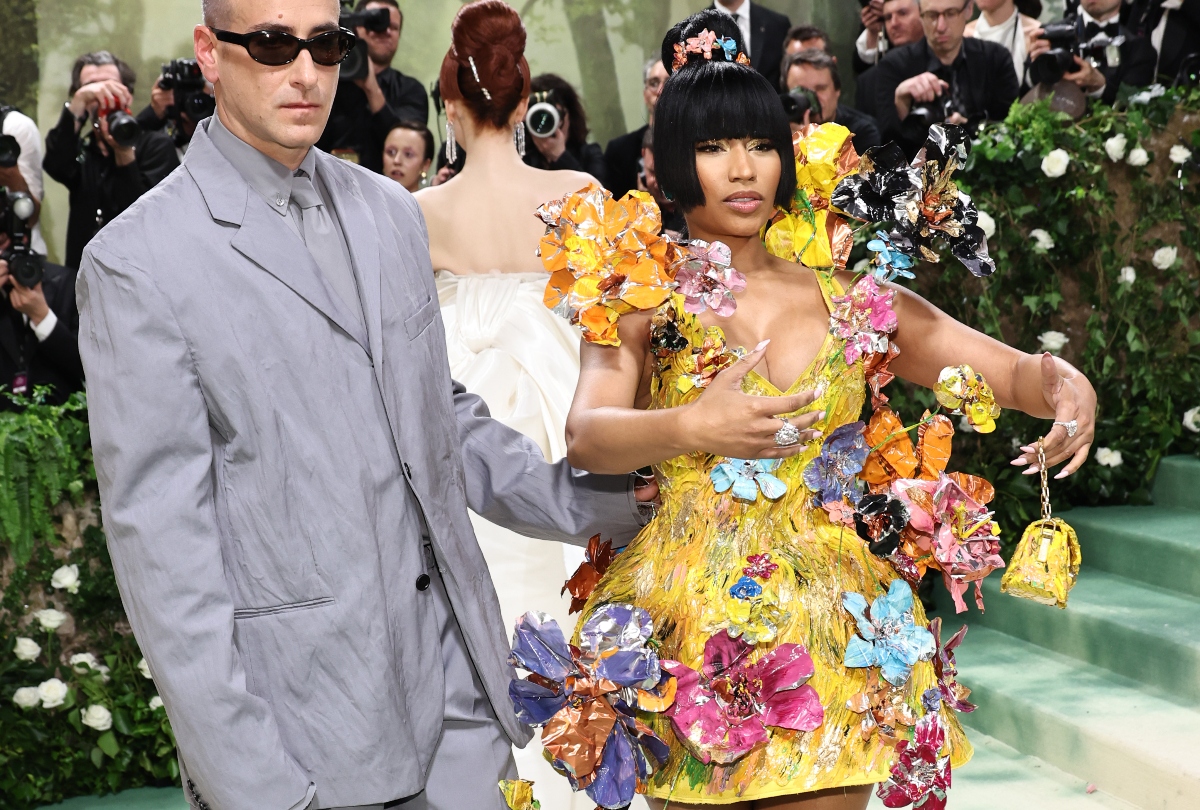
Francesco Risso with Nicki Minaj at the 2024 Met Gala on May 6 in New York City (Jamie McCarthy/Getty Images)
Finally, some spring colors hit this garden party. Nicki Minaj is the self-proclaimed Harajuku Barbie and at this year’s Met Gala, she looks the part. The rapper has never shied away from wearing bright pinks and yellows during the early stages of her career. It’s the look we all widely associate with the rapper, even if she wants to change her image. But here, Minaj plays into her Barbie status in a short yellow mini dress that almost looks like it was painted on her. Pink, blue, purple and orange 3D flowers help give texture to the gown.

27
Sydney Sweeney
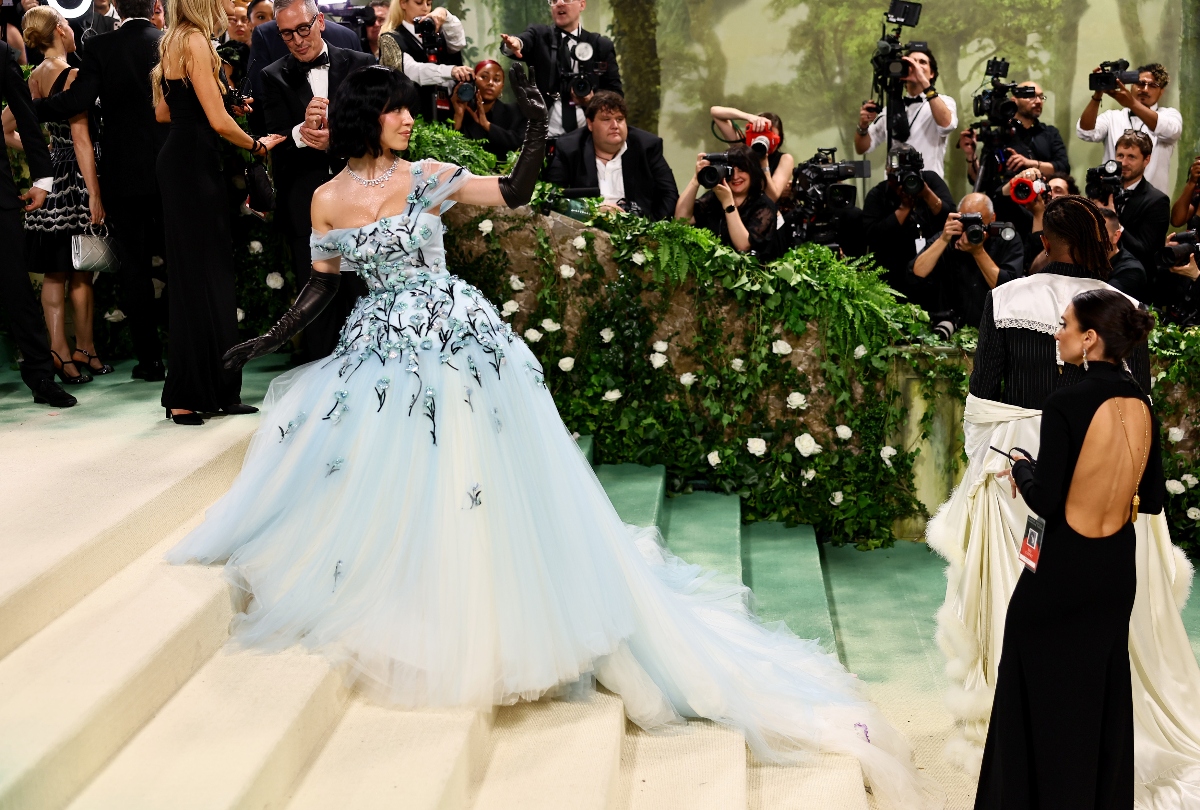
Sydney Sweeney at the 2024 Met Gala on May 6 in New York City (Theo Wargo/GA/The Hollywood Reporter via Getty Image)
Sydney Sweeney eerily looks like Billie Eilish in this powder blue tulle ballgown. The matching leather gloves and short black bob wig are incredibly jarring juxtaposed with the dress’ vibrancy. The “Anyone But You” actress is rarely interesting or experimental fashion-wise and when she tries to experiment, as in this case, she looks like another celebrity.

28
Zendaya (yes, again!)
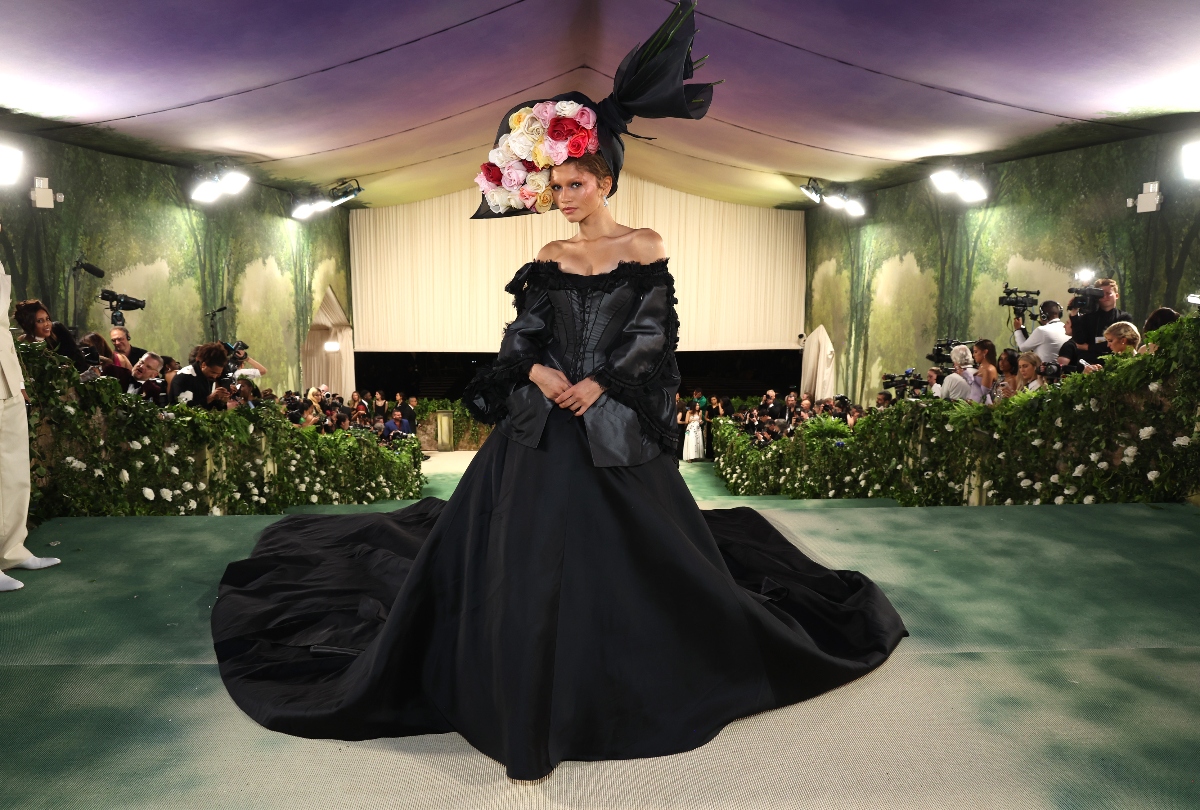
Zendaya at the 2024 Met Gala on May 6 in New York City (Kevin Mazur/MG24/Getty Images for The Met Museum/Vogue)
Zendaya is back at it again. Alongside her incredible and prolific stylist Law Roach, the method dresser is in her second gown of the evening wearing a black archival Givenchy gown that again highlights Victorian-era fashions. But the ensemble has a bit of a twist. An Alexander McQueen bouquet of colorful roses sits on her head, stunningly framing her pale face, bleached eyebrows and shimmering purple eyeshadow. The actress can’t help but literally blow people’s expectations out of the water when it comes to her personal fashions. In this look, she really is here to plot to kill her fictional husband and take over his billion-dollar estate.

Judge Cannon’s secret right-wing getaway: Why didn’t we know about this?

Let me ask you a question: How many all-expenses-paid vacations at luxury hunting and fishing lodges have you enjoyed over the last few years? I’m not talking about a motel in the boonies of the Upper Peninsula of Michigan or a drafty log cabin on a lake in Maine or Minnesota. We’re talking about a luxury resort on 1,200 acres alongside the Yellowstone River just outside Yellowstone National Park. We’re talking about a lodge featuring rooms with stone fireplaces that go for upwards of $1,000 a night in high season, meals that include “house-cured meats from local ranches, garden-fresh produce from nearby farms, and, of course plenty of Northwest craft beers and spirits,” as the resort’s website describes the offerings.

It's called the Sage Lodge in Pray, Montana, and it’s where George Mason University sends gaggles of federal judges for a week-long “colloquium” every year or so. Paid for by the Law and Economics Center at the Antonin Scalia Law School, the “colloquium” held at the Sage Lodge in 2021, for example, featured lectures on such subjects as “Woke Law!” – and yes, the exclamation point is part of the lecture topic — by one Todd J. Zywicki, who is George Mason University Foundation Professor of Law at the Antonin Scalia Law School and a senior fellow at the Center for Monetary and Financial Alternatives of the Cato Institute. Another juicy topic covered at the Sage Lodge in 2021 was “Unprofitable Education: Student Loans, Higher Education Costs, and the Regulatory State,” also featuring a lecture by Zywicki, a topic that rings what we might call a rather different bell after the Supreme Court struck down President Biden’s student loan forgiveness program last year.

The Antonin Scalia Law School, by the way, was established and largely funded by the efforts of Leonard Leo of the Federalist Society, who helped put together $30 million from conservative donors, including Leo himself, to rename the law school after the late legendary right-wing justice, who it will be remembered died of a heart attack in 2016 at another luxury hunting lodge, that one in Texas, while on a trip paid for by wealthy conservative “friends of the court,” I guess we could call them. The other major donor to the Scalia Law School was the Charles Koch Foundation, which threw in a handy $10 million.

Why are we talking about luxury hunting lodges and right-wing “colloquiums” for judges? Because one of our favorite federal judges, Aileen Cannon of Florida, currently presiding over the case against Donald Trump over the secret documents he kept at Mar-a-Lago, was a guest at that same 2021 “colloquium” at the Sage Lodge, and the one held in 2022 as well. The thing is, Cannon failed to file the form known as a Privately Funded Seminar Disclosure Report, which lists whoever paid for the judge to attend the seminar, who the speakers were and what topics were discussed. The form is supposed to be posted on the website of every federal court within 30 days of the time a judge attending such an all-expenses-paid seminar. Cannon, however, somehow forgot to do so, so anyone who might be interested in learning who was paying for Cannon’s vacations and the nature of her judicial education would have been  out of luck.

So why do we suppose Judge Cannon was so shy about who’s paying for her luxury trips and what she might have learned there? Oh, I don’t know … might it be because she didn’t want anyone to know about her links to the Leonard Leo wing of legal theory? Could it have been that she didn’t want it known that she had taken money from an organization that was in large part funded by billionaires friendly to the man whose case she was presiding over?

We need your help to stay independent

I mean, 10 grand or so in first-class air travel and luxury accommodations and bottomless trips to the luxo-resort’s “local produce” salad bar and steak pit might start to look like a bribe when you pay attention to what was actually being discussed between float trips down the Yellowstone and hikes through the mountains, don’t you think?

Wouldn’t you love to see the thank-you notes Cannon sent to Leonard Leo and his pals? I would. But until NPR called up Judge Cannon and asked her about her journeys out to the Montana luxury resort, nobody knew a thing about who had tried to curry favor with her. That was when she hurriedly filled out the forms and posted the disclosure she had actually been required to post within 30 days of returning from her trip.. So now we know what she was concealing, but we didn’t know where she had been or who she had been listening to when she first got the Trump case and made the rulings — later overturned by judges of the 11th Circuit — that many legal experts had said were ridiculously favorable to Trump.  


Want a daily wrap-up of all the news and commentary Salon has to offer? Subscribe to our morning newsletter, Crash Course.


Being a federal judge is a lifetime appointment. It’s almost impossible to get rid of a federal judge once they’re on the bench. But it’s not a right, it’s a privilege. Citizens should have the right to know who is attempting to influence judges and why. That’s why the Congress established federal reporting rules. 

Right-wingers like Mitch McConnell and Leonard Leo made no secret of their ambition to appoint as many conservatives as they could to the federal courts, including the Supreme Court. Judges like Cannon sneak off to remote luxury lodges in Montana to listen to right-wing legal scholars spouting off on subjects that sound like topics at a CPAC convention, about  “woke” laws and the “regulatory state,” and they do that for a reason: so we won’t know who’s paying for their time and their attention and their fun.

Gee, is it possible that Leonard Leo and his pals think they might be getting a return on their investment?

Beatles “Let It Be” doc: Disney+ restored version is a superb testament to resilience and creativity

In recent years, music aficionados have been blessed with an embarrassment of riches —particularly when it comes to the Beatles. A newly restored version of "Let It Be" (1970), splendidly directed by Michael Lindsay-Hogg, marks the latest gem in the Beatles’ multiverse. The film was unveiled during a private screening last week at an Upper West Side cineplex, and it didn’t disappoint. Returned to its original glory, "Let It Be" is a work of sheer beauty, capturing rock ‘n’ roll’s most extraordinary foursome as they battled a series of daunting conditions and rediscovered their art in the nick of time.

Crediting filmmaker Peter Jackson as his “silent partner,” Lindsay-Hogg reveled in the opportunity to restore his film in the wake of "Get Back" (2021), the three-part treatment that Jackson assembled from Lindsay-Hogg’s original footage. As Lindsay-Hogg pointed out prior to the screening, outside of the "Let It Be" project, “there had been no documentation of these amazing four guys who changed the history of music.” Indeed, beyond Lindsay-Hogg’s footage, we have scant imagery of the Beatles crafting their timeless music in the studio.

As it happens, "Let It Be" is the result of one of the strangest, most labyrinthine journeys in the history of cinema. In May 1970, when Lindsay-Hogg’s documentary was originally released, the world was in mourning. Scarcely a month earlier, Paul McCartney had announced the Beatles’ disbandment. Hence, moviegoers understandably viewed "Let It Be," along with the film’s soundtrack, as epitaphs of sorts.

In truth, it was all a misunderstanding. Lindsay-Hogg shot "Let It Be" in January 1969, four months prior to that fateful evening in May when the other Beatles accosted McCartney at Olympic Studios, delivering an ultimatum that they should sign notorious American businessman Allen Klein as their manager post-haste. When McCartney balked, all hell broke loose. “That was the night we broke the Beatles,” he later explained to music historian Mark Lewisohn. “Really, that was the big crack in the Liberty Bell. It never came back together after that one.”

But in January 1969, the Beatles were wrestling with other problems — namely, that they had set themselves up with a tall order. Months earlier, they had mimed promo films of “Hey Jude” and “Revolution” for Lindsay-Hogg’s cameras. Flush with excitement after playing in front of a studio audience, they began contemplating the idea of making a bravura return to the stage after a two-year absence from live performance. It must have seemed like a good idea that night at Twickenham Film Studios. But time, alas, was their enemy. 

Given other commitments — for one thing, Ringo Starr was set to begin filming "The Magic Christian" with Peter Sellers in early February — they would be forced to complete this new project entirely in the month of January. Lindsay-Hogg was tasked with documenting the Beatles while they rehearsed material for the stage. Incredibly, they felt the need to compose a host of new songs in spite of the fact that some 40 days earlier they had released "The Beatles (The White Album)," the double-LP that contained a whopping 30 brand-spanking new numbers. Surely, they could draw from the contents of that magnum opus during their January 1969 Twickenham rehearsals? After all, "The White Album" was currently ensconced at the top of the international music charts.

But not the Beatles. Their rage for seeking out new forms of expression, for creation for creation’s sake is why, even decades later they are still pop music’s consensus GOAT. But as it turned out, compiling new songs was the least of their problems. On Jan. 10, George Harrison abruptly quit the band, sending his Beatle colleagues into a mad scramble to rejoin their ranks. After stewing for a few days, Harrison agreed to return to the fold if the group agreed to scrap their plans for staging a concert and abandon Twickenham in favor of their newly built basement studio at Apple’s Savile Row headquarters. 


Love the Beatles? Listen to Ken's podcast "Everything Fab Four."


At this juncture, Lindsay-Hogg shifted his focus from documenting the Beatles’ rehearsals to capturing the band doing what they did best — indeed, better than anyone ever — making an album. As if things couldn’t get any worse, the project was delayed for yet another week after they discovered that Beatles insider and crackpot inventor Magic Alex Mardas had bungled the project of outfitting the basement studio. With eight-track recording coming into vogue during that era, Magic Alex vowed to provide the group with double the recording capacity — even if he didn’t quite understand what multitrack recording meant. “It was a 16-track system,” Harrison later remarked, and Magic Alex “had 16 little, tiny speakers all around the walls. The whole thing was a disaster and had to be ripped out.”

The dramedy of errors that had brought the Beatles to this juncture set up perhaps their finest moment as a working rock ‘n’ roll group. The circumstances were now in place for the band to notch a come-from-behind victory, the kind that only the truly great ones can pull off. With just 10 days remaining in advance of their self-imposed deadline, they staged their improbable comeback. 


Want a daily wrap-up of all the news and commentary Salon has to offer? Subscribe to our morning newsletter, Crash Course.


And Lindsay-Hogg’s film — then and now — captures these moments in all their magnificence. With the clock running down before their eyes, the Beatles bring such classic tunes as “Get Back,” “Don’t Let Me Down,” “Let It Be,” “The Long and Winding Road,” and “Two of Us” to life in Apple Studios, culminating in the famous Rooftop Concert on Jan. 30. It’s a marvel to behold the group as they transform the impossible into the possible — and seemingly without effort, no less. If there’s a living testament to the Beatles’ resilience and unstoppable creativity, "Let It Be" is it.

The fully restored "Let It Be" streams on Disney+ beginning Wednesday, May 8.


Reading Sylvia Plath and my dead friend’s Instagram

Heather had invited me over to her apartment in Inwood several times in the last year or so, but for one reason or another, the scheduling had never worked out. We kept promising each other, “soon.” Now I was finally here, for the first time, to help pack up her things. She’d been dead for a week.

I scanned the stacks of books teetering against one wall, not on shelves but layered like bricks, and a slim off-white spine called to me: Sylvia Plath’s "Ariel." It felt like a morbidly appropriate souvenir of this day.

Heather was a definite Plath Girl as a teenager. I was too — just two of countless teenage girls since the ’60s to proclaim our love for the bracing and violent "Ariel" poems, and "The Bell Jar," Plath’s fictionalized account of her first mental breakdown, suicide attempt and institutionalization — a not-at-all-subtle way of making sure the world knew we were in pain. “I just really identify with Esther Greenwood,” we’d tell adults: a threat. Claiming Plath was a way to elevate our teenage sadness from pedestrian and expected and cliché to literary, tragic, romantic. To tie our early-aughts angst to a dignified and important history.

We weren’t the first or the last teenage girls to romanticize sadness and tragedy, of course. Before Plath there were Virginia Woolf, Emily Dickinson and the Brontë sisters, each with her own morose devotees.

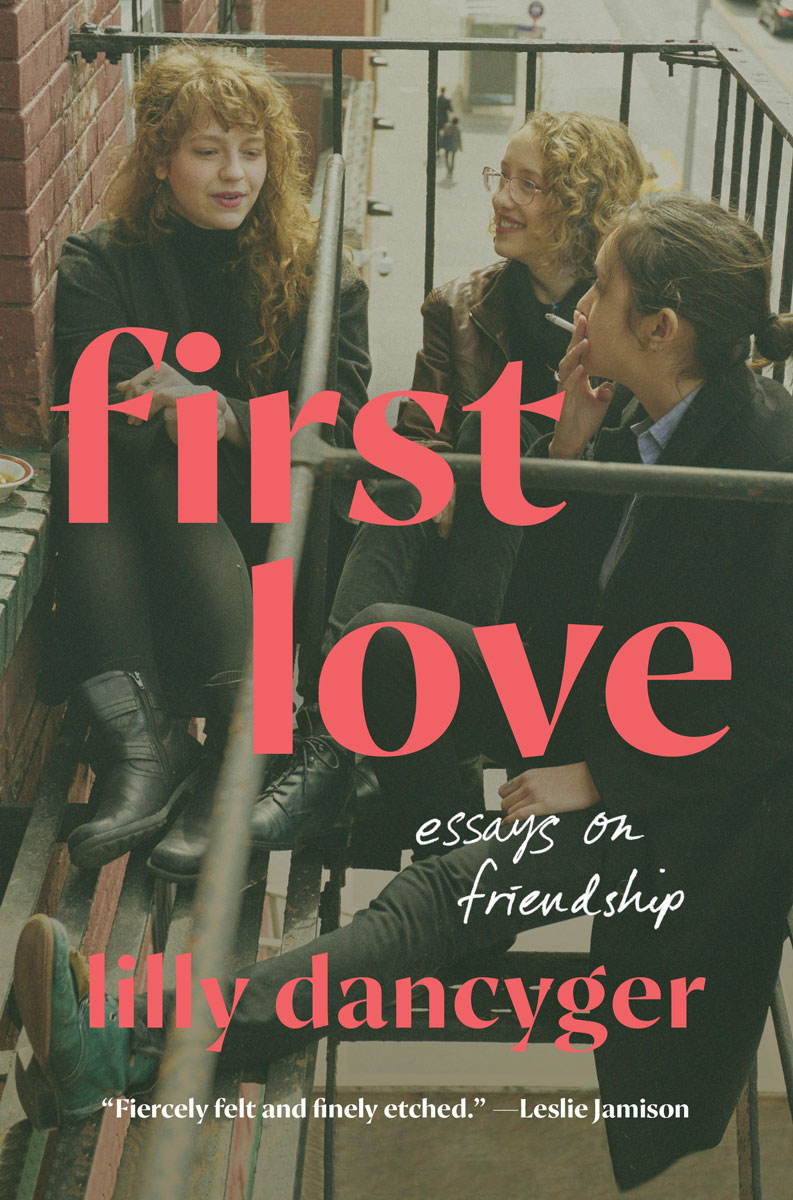
First Love: Essays On Friendship By Lilly DancygerFirst Love: Essays On Friendship By Lilly Dancyger (Courtesy of The Dial Press)

More recently, there was the “sad girl aesthetic” era of Tumblr — young women posting photos of themselves with mascara tears running down their cheeks, or black-and-white selfies in which they’re staring mournfully into the distance, with quotes about depression and existential ennui for captions. The social media sad girl has a very specific tone — the inherent vulnerability of expressing sadness coated in a protective gloss of sardonic humor and irony. Alongside the dramatic crying selfies, sad girl Tumblr pages were full of simple, morose statements like “I hate my life” written in glittery pink cursive or pastels, the cheerful presentation clashing with the message to strike the discordant note central to so much internet humor.

* * *

When I got home from packing up Heather’s apartment, I wrote “Heather’s” on the title page of her copy of “Ariel” in small, neat script, as if I could forget. I started to read it, but only got as far as “Lady Lazarus,” five poems in — to the line about meaning to “last it out and not come back at all” —  before the connection to Heather felt too painfully literal. I closed the worn paperback and slid it onto a shelf, where it would sit unopened for years.

Claiming Plath was a way to elevate our teenage sadness from pedestrian and expected and cliché to literary, tragic, romantic.

The tragedy of her death mingling with the brilliance of her poetry made Plath an icon, but it also made her sadness and her tragic end her defining traits. It wasn’t until decades later that a new generation of Plath scholars would advocate for dimension in readings of her work — pushing fans to celebrate her birthday rather than her death date, publishing analyses and close readings of her poems about bees rather than only the ones that evoke death and violence. “The public perception of Plath as a witchy death-goddess had been born and would not soon die,” Plath biographer Heather Clark writes.

I don’t want to flatten Heather in this way — as sure as I am that she would absolutely relish the title “witchy death-goddess.” It’s too easy to remember her as a sad girl because of her sad death. To rewrite her life, starting with the end. But there was so much more to her than that.

She carried herself with the ease of a beautiful woman, swinging her hips and not blushing at raunchy jokes, when the rest of us were still awkward girls.

She was proud of being Jewish and proud of being Chinese and she delighted in the exploration of both sides of her heritage, through study and food and fashion — cooking noodle kugel in a qipao and calling herself a “Lower East Side special.”

She had this guffawing laugh — not the cackle that cracked the air around her when someone else said something funny, but a single goofy exhaled chuckle, the laugh she laughed after she said something she thought was funny. It was so totally incongruous with the hot girl it emanated from, so unexpectedly and endearingly dopey, you couldn’t help but laugh at her laughing at her own joke.

These are the things I most want to remember about Heather.

But the sadness was such a big part of who she was, of how she saw herself and how she moved through the world, it would be as much a disservice to her to gloss over it as it would be to let it take over my memory of her completely.

* * *

The first time Heather called me in the middle of the night saying she wanted to kill herself, I treated it like an emergency.

It’s too easy to remember her as a sad girl because of her sad death. To rewrite her life, starting with the end.

I woke up to my phone buzzing on the table next to my bed, confused. It was past three in the morning. I blinked the sleep from my eyes and cleared my throat before answering urgently, “Hello?”

On the other side of the line, Heather sobbed. When she finally spoke, it was more of a wail, “I wanna die!”

I offered to come to her, asked if she wanted to come to me, asked if I should call an ambulance, but I realized quickly that she didn’t want to be rescued, she just wanted to be heard. She wanted someone to know how much she was hurting. So I listened. I got back into bed and lay down, but didn’t close my eyes.

“I love you,” I said. “I’m so glad you’re alive. I’m so sorry.”

Eventually her sobs slowed to sniffles. I asked if she thought she’d be able to sleep and she sighed, “Yeah.” When I woke up again a few hours later, there was a text from her: “Thanks. Feeling better. Love you. <3”

But that call was just the first of many.

They all played out the same way, but after the third, or fourth, or twentieth time over the next few years, my responses lost some of their urgency. I stopped fearing that her life was truly at stake and came to understand the calls to be a release valve. They became routine. Then they became overwhelming. I started to run out of ways to tell her to go back to therapy, to take her meds; to reassure her that she was loved and yes, she would be missed if she died — desperately. I could sense her wariness, not wanting to give me more of her pain than I could handle. I would never stop taking her calls, but she could tell they were wearing on me, that I didn’t know what else to say.

Eventually, the calls stopped.

I learned after she died that I was one of several people who got these calls — she rotated between us, trying not to dump too much on any one person. But still, one by one, we ’d all burned out. We all reported the same thing to each other, after: “Eventually, she stopped calling.”

* * *

In the year before her death, when she’d run out of people to call in the middle of the night, Heather started venting her sadness on Instagram instead. She posted frequently, mostly memes about mental illness and extreme close-ups of her face, bleary-eyed like she’d been crying. Slack, expressionless. Wearing too much makeup. Her posts made me uncomfortable.

We’d posted all kinds of dark s**t on our LiveJournals back in the day, sure — but Instagram was different, less anonymous. And we were adults now, with professional jobs. I also didn’t yet fully understand what her recent bipolar diagnosis meant; how much was out of her control. I judged her for being such a mess.

Layered over that visceral reaction was a more conscious understanding that I was wrong — that she could post whatever she wanted — and I didn’t like myself for judging her. So rather than staying in the cycle of having a knee-jerk negative reaction each time I scrolled past a new lurid selfie and then feeling guilty for recoiling, I unfollowed her. (This was before Instagram had a “mute” option.)

I know that Heather’s Instagram isn’t a work of art on par with “Ariel.” But it was a hurting woman’s connection to the world; it was how she expressed herself.

Of course, after Heather died, I wanted to go back and scroll through all of those selfies, to examine them like clues, to see if maybe there was a caption that would feel like a message from beyond death, like Plath’s “Dying/ Is an art.” But she’d locked her account, so I couldn’t re-follow after she died. It took seven years for me to swallow my guilt and ask our friend Sydney to take screenshots of some of Heather’s posts and send them to me.

I remembered Heather’s feed as one bleary-eyed, desperate-looking selfie after another, hard to look at and hard to look away from. But in the month before she died, I notice when Sydney sends me a folder full of screenshots, there were only a few of these. I find them beautiful now — not for their tragedy, but just because they’re my friend’s beautiful face. They don’t look as dramatic as I remembered. Interspersed with these selfies is a perfectly normal-looking amalgam of glimpses of her life: a sign for evening services at her synagogue, a spread of new paints, a David Foster Wallace meme, a tattoo she liked of a sloth’s face and the words “Live slow, Die whenever,” and an absolutely stunning black-and-white photograph of her in which her hair is curled and her eyebrows darkened, and she looks like a Wong Kar-wai heroine.

Twelve days before she died, Heather posted a smiling photo of herself with the caption “One week. Different world. Different mood. Different me. Living proof. Things do get better.” I scanned back through her posts and saw that seven days earlier she’d posted two depressed-looking selfies; one of her in bed, her hair covering her eyes, her mouth slack; another of her holding a cigarette, staring blank and expressionless past the camera. But it’s the smiling “Things do get better” post that gets me in the gut. To see that she was trying, that she had hope, even, just 12 days before she decided there would be no hope for her ever again. In this picture, she’s smiling, but her eyes are glassy, with dark circles under them. I can see the strain, the effort it took her to feel optimistic. Or maybe I can only see that now, looking back, knowing she’d be dead less than two weeks later. Would Plath’s reference to carbon monoxide in “A Birthday Present” (“Sweetly, sweetly I breathe in”) feel as ominous if you didn’t know she died exactly that way soon after writing it?

I know that Heather’s Instagram isn’t a work of art on par with “Ariel.” But it was a hurting woman’s connection to the world; it was how she expressed herself. And now it’s an archive rich with posthumous meaning. So I don’t think the comparison is that much of a stretch, actually.

* * *

Heather’s last post ever is a meme, white text against a dark purple background: “i put the hot in psychotic.” A decade later, this meme and the bleak black-and-white selfies are clearly recognizable as pitch-perfect examples of the sad girl aesthetic. Heather didn’t have a Tumblr account, as far as I know, but she embodied the aesthetic on her Instagram right at the time when it started to spill over onto that platform and others beyond its birthplace.

Today, the once-controversial jokes of the online sad girl are ubiquitous far beyond their original little corner of the internet, with people posting casually about depression and dissociation on their otherwise professional Twitter accounts. The Reddit group r/depressionmemes — a mix of the general “lol life is pain” brand of memes you can expect to find on other social media, and posts that directly express, if in meme form, suicidal ideation — has tens of thousands of members. And the sad girl lives on in yet another generation on TikTok, where “#SadTok” videos of (still pretty, young, mostly white) girls looking into the camera as tears roll down their cheeks have millions and millions of views.

If jokes about wanting to die are so casual now, how are we supposed to know when somebody means it?

When Heather and I loudly proclaimed our misery as teenagers, we were signaling our separation from the herd, our rejection of the social standard. Declaring that we saw the world clearly enough to see how f**ked up everything was, even if the powers that be didn’t want us to notice. But these sentiments aren’t subversive anymore — they’re almost assumed as a baseline.

This sense that everyone is depressed feels like it’s at least in part a reaction to the political climate and the literal climate of the last few years; the pervasive feeling that the world is ending, for real this time. Impending fascism, global pandemic, daily mass shootings and frequent catastrophic weather events have primed us all for malaise. And there’s something cathartic about how normal it feels now to say out loud that everything feels hopeless and you’re not sure you’re going to live much longer. But I also can’t help but think of Heather these days when I see one internet acquaintance after another post about being too depressed to cook — not as if this were a dire state to be in, but as a casual way to ask for recommendations of easy recipes; or express their enjoyment of new music by any of the new guard of sad girls like Mitski, Lucy Dacus and Phoebe Bridgers by posting about how hard they’re crying. It all feels so normal that it doesn’t worry me at all. But the fact that it doesn’t worry me sometimes worries me. If jokes about wanting to die are so casual now, how are we supposed to know when somebody means it?

The internet makes it difficult to tell what’s real. This is a common conversation in terms of presenting only our most manicured selves, especially on Instagram — the most aspirational of the mainstream social media platforms. The prevalence of posts about depression feels like a reaction to the too-perfect online aesthetic that developed with rise of influencers. People are rejecting the shiny illusion and trying to show each other that sometimes our hair is dirty and our desks are cluttered and our coffee doesn’t have little foam hearts on it; that sometimes we even want to die. But even when people try to post about the messy, ugly, real stuff, it still feels like a manicured presentation. Like it’s all still curated and put on for consumption, another lever to pull in adjusting how we want to be seen by the world. So much so that even a depression that will soon lead to suicide can feel, through the filter of social media, like content.

Heather wasn’t just sad, she was prone to severe depression. But because being a sad girl had been part of how she presented herself to the world for so long, it seemed like she could go on posting mental illness memes and playing “Crazy” on the jukebox at the bar forever and ultimately she’d be OK.

If you are in crisis, please call the 988 Suicide and Crisis Lifeline by dialing 988, or contact the Crisis Text Line by texting TALK to 741741.

Gagged Trump quickly deletes Truth Social post panicking over “unprecedented” witness

Former President Donald Trump on Tuesday posted and quickly deleted a complaint about an upcoming witness on Truth Social despite being under a gag order barring him from publicly attacking witnesses.

Trump, whose legal team has not received advance notice of upcoming witnesses from prosecutors after he violated the gag order, wrote Tuesday morning that he was just “told who the witness is today.”

“This is unprecedented, no time for lawyers to prepare,” Trump claimed, even though his team has long had the full witness list. “No Judge has ever run a trial in such a biased and partisan way.”

The post was deleted less than 30 minutes later.

Former U.S. Attorney Barb McQuade noted that there is "no legal requirement to provide notice in advance of the day’s witnesses."

"In fact, in federal court, there is even no requirement to share witness lists with opposing counsel. And in light of safety concerns here, there are strong reasons to protect witness identity," she added.

The post came a day after Judge Juan Merchan fined Trump $1,000 for his 10th gag order violation and warned that he could face jail if he breaches the order again.

Georgia State Law Prof. Anthony Michael Kreis said the post may not violate the gag order since it was "really directed at the process" rather than the witness. 

"But the quick removal seems like the most public-facing evidence we have the Trump absolutely does not want to see the inside of a jail cell," he added. 

Adult film star Stormy Daniels is expected to testify on Tuesday, her attorney Clark Brewster told The Associated Press. Trump’s alleged hush-money payments to Daniels are at the heart of the 34 felony charges against him. Trump is accused of illegally covering up the payment to prevent Daniels’ claim of a sexual encounter from coming out during his campaign. Trump has denied the allegations and the affair.

A timeline of Drake and Kendrick Lamar’s long-running beef

The steadily festering tensions between Drake and Kendrick Lamar, two of the biggest names in rap, culminated explosively over the weekend with a series of scathing diss tracks released from both sides. The songs, released in quick succession, were riddled with allegations of pedophilia, domestic abuse, body modifications, parentage and more.

Though the artists' longstanding beef stretches back for more than a decade, it's been largely characterized by indirect subtleties in songs, coupled with generally unfriendly public-facing rapport. 

Drake and Lamar's feuding could be said to have emanated in part from their contrasting career trajectories: Drake has enjoyed considerable commercial success, churning out chart-topping hits since breaking onto the scene with his first album, "Thank Me Later," produced in partnership with Young Money Entertainment. In contrast, Lamar, while not as much of a hitmaker, has produced conceptually profound lyrics about the idiosyncracies of the Black experience that speak to family, love, religion, socioeconomic, growing up in Compton, California and more. Lamar made history in April 2018 when he became the first hip-hop artist to receive the prestigious Pulitzer Prize for his 2017 album, "Damn."

Drake featured Lamar as a guest artist on his second album —"Take Care" (2011) — before inviting him and rapper A$AP Rocky to be the opening acts on his "Club Paraside Tour," which kicked off in February 2012. The two rappers collaborated in October 2012 for "Poetic Justice," a track nodding to the 1993 film of the same name starring Janet Jackson, from Lamar's album, "Good Kid, M.A.A.D City." That same year, they were featured on A$AP Rocky's hit song, "F**king Problems." And yet, despite having a seemingly amicable origin story, things ostensibly soured between the rappers once Drake saw meteoric fame. 

Here's the breakdown of the embittered relations between the frenemies turned outright adversaries:

August 2013: Lamar hits out at Drake and others on Big Sean's "Control"

The earliest seeds of the feud are planted when Lamar steps in as a guest on rapper Big Sean's song, "Control," calling out Drake and other industry names while simultaneously referring to himself as the "King of New York" and the "King of the Coast."

“I got love for you all but I’m trying to murder you n****/ Trying to make sure your core fans never heard of you n****/ They don’t want to hear not one more noun or verb from you n**** ," he raps.

Speaking to Billboard later that month, Drake made light of the jab as an "ambitious thought."

"That’s all it was," he said. "I know good and well that [Lamar]’s not murdering me, at all, in any platform."

September 22, 2013: Drake placates beef rumors

During a live interview in New York with RapRadar, Drake acknowledged that while Lamar's lyrics were undoubtedly a "moment to talk about," the duo had a friendly interaction at the MTV VMAs not long after, according to TODAY.

“I saw him five days later at the VMAs, and it was all love,” Drake said.

October 2013: Lamar takes aim at Drake during his BET Hip-Hop awards cypher

Lamar's insult would come on the heels of Drake's September 2013 album, "Nothing Was the Same."

At the BET Hip-Hop Awards cypher, a gathering of rap artists exchanging lyrics competitively, Lamar refuted Drake's previous assertions of friendships.

“Nothing’s been the same since they dropped ‘Control’/ And tucked a sensitive rapper back in his pajama clothes/ Ha ha joke’s on you, high-five . . . I’m bulletproof/ Your shots never penetrate/ Pin the tail on the donkey, boy you been a fake," Lamar rapped.

December 19, 2013: Drake says he feels like he is being "baited"

Speaking to "Vibe," Drake candidly shared his thoughts on feeling as goaded by Lamar on "Control."

“Where it became an issue is that I was rolling out an album while that verse was still bubbling, so my album rollout became about this thing. What am I supposed to say? Nah, we’ll be buddy-buddy?" Drake asked.

"Mind you, I never once said he’s a bad guy (or) I don’t like him. I think he’s a f**king genius in his own right, but I also stood my ground as I should."

"And with that came another step, which then I have to realize I’m being baited and I’m not gonna fall," he added. "[Michael] Jordan doesn’t have to play pickup to prove that he could play ball, no offense. But I’m not gonna give you the chance to shake me necessarily, ’cause I feel great. There’s no real issue."

March 26, 2024: Lamar claps back on Future and Metro Boomin's track, "Like That"

The lyrical blows can most recently be traced back to late March, when Lamar contributed to "Like That," a song off Atlanta rapper Future and producer Metro Boomin's studio album "We Don't Trust You." Lamar on the track referred to Drake's 2023 album, "For All the Dogs," in which rapper J. Cole cited himself, Drake, and Lamar as "the big three" of contemporary rap artists.

"Motherf**k the big three, n****, it's just big me," Lamar rapped. A few bars later he noted how, "Prince outlived Mike Jack'," seemingly placing himself and Drake in the same roles as those artists.

J. Cole in early April went on to release "7 Minute Drill," a bonafide Lamar diss track, in response; however, he ultimately reneged and expressed regret, referring to the decision to air the song as the “lamest s**t I did in my f***in’ life,” per Variety. The song was also scrubbed from streaming services.

April 19, 2024: Drake releases diss tracks, "Push Ups" and "Taylor Made Freestyle" in response

Shortly thereafter, Drake dropped "Push Ups," which explicitly criticized Lamar's height, referring to him as a "pipsqueak." 

“How the f**k you big steppin’ with a size-seven men’s on?” he raps in the song, referring to the title of Lamar’s 2022 studio album “Mr. Morale and the Big Steppers.”

The track also cited a woman named "Whitney," a likely reference to Lamar's long-time partner, Whitney Alford, whom Drake would mention in later disses. 

In "Taylor Made Freestyle," which only debuted on social media, Drake implemented AI vocals from the late rapper, Tupac Shakur, and Snoop Dogg. 

“Since ‘Like That,’ your tone changed a little, you not as enthused,” Drake sang. “How are you not in the booth? It feel like you kinda removed.”

“Kendrick we need ya, the West Coast savior / Engraving your name in some hip-hop history,” raps the artificially generated voice of Shakur. “Call him a b***h for me / Talk about him liking young girls as a gift for me.”

Shakur's estate subsequently threatened legal action. “The Estate is deeply dismayed and disappointed by your unauthorized use of Tupac’s voice and personality,” litigator Howard King, who represents Shakur's estate, wrote in a statement provided to Billboard. “Not only is the record a flagrant violation of Tupac’s publicity and the estate’s legal rights, it is also a blatant abuse of the legacy of one of the greatest hip-hop artists of all time. The Estate would never have given its approval for this use.”

April 30, 2024: Lamar releases "Euphoria"

In his first decisive response titled to mirror Drake's involvement with the hit Max series of the same name, Lamar on a six-minute diss track leaned into especially personal attacks. “Know you a master manipulator and habitual liar too,” he rapped. “But don’t tell no lie about me and I won’t tell truths ’bout you.”

“I hate the way that you walk, the way that you talk, I hate the way that you dress,” Lamar added. “I hate the way that you sneak diss. If I catch flight, it’s gon’ be direct.” And he called Drake’s standing as a father into question: “Teachin’ him morals, integrity, discipline/listen, man, you don’t know nothin’ ’bout that.”

Lamar went on to highlight the Toronto-born rapper's biracial identity, asking him "How many more Black features til' you finally feel you're Black enough?"

May 3, 2024: Lamar doubles down with "6:16 in LA"

Released exclusively to his Instagram page, Lamar in "6:16 in LA" jested at Drake's tendency to title his tracks after times and places. 

"Have you ever thought that OVO was working for me?" Lamar asked, referencing Drake's independently owned music label while also implying that he had covertly infiltrated Drake's team.

"Fake bully, I hate bullies/ You must be a terrible person/ Everyone inside your team is whispering that you deserve it," he raps as he continues to imply that key insiders at OVO are Team Lamar."

May 3, 2024: Drake retorts with "Family Matters"

Drake in a nearly eight-minute diss track — which dropped with an accompanying music video — levels unsubstantiated, incriminating allegations at Lamar, accusing him of domestic abuse and infidelity in his relationship with Alford.

“You the Black messiah wifing up a mixed queen/ And hit vanilla cream to help out with your self-esteem/ On some Bobby s**t, I wanna know what Whitney need,” Drake rhymes.

In a later jab that mixes the claims with a cutting gibe at Lamar's height yet again, he asks, “When you put your hands on your girl, is it self-defense ’cause she’s bigger than you?”

May 4, 2024: Lamar quickly drops "Meet the Grahams"

Lamar wasted no time in returning the sentiment, rolling out "Meet the Grahams" less than an hour after "Family Matters" went live. 

In this particular song, Lamar took aim at Drake's paternity, claiming that he has a secret daughter that the public doesn't know about while also invoking Drake's previous denial of his son, Adonis Graham, whom he shares with French artist Sophie Brussaux. Drake had initially refuted his fatherhood, before backtracking. In his 2018 double album, "Scorpion," he claimed that he "wasn't hidin' my kid from the world / I was hidin' the world from my kid."

“You lied about your son, you lied about your daughter, huh, you lied about them other kids that’s out there hoping that you come,” Lamar seethed. 

The rapper also came for Drake's body image, probing rumors that he has dabbled in certain cosmetic body modifications. “Get some discipline, don’t cut them corners like your daddy did. / F**k what Ozempic did. Don’t pay to play with them Brazilians, get a gym membership,” Lamar raps. 

May 4, 2024: Lamar pushes the allegations further with "Not Like Us"

Lamar refused to hold back in littering his diss tracks with bold implications, critiquing unverified claims about Drake's penchant for young girls. 

 “Say, Drake, I hear you like ‘em young/ You better not ever go to cell block one,” he spits, before delivering a blistering reference to Drake's 2021 album, "Certified Lover Boy."

 “Certified Lover Boy? Certified pedophiles,” Lamar raps. 

Later in the track, he comes for Drake's legitimacy as a rapper, saying he's “not a colleague,” but a “colonizer.”

May 5, 2024: Drake volleys back with "The Heart Part 6"

Creating his own additions to Lamar's "The Heart" volumes 1-4, Drake in "The Heart Part 6" attempts to quash rumors of pedophilia and a hidden daughter. 

He begins by declaring that the "Pulitzer Prize winner is definitely spiralin'," before later rapping that "This Epstein angle was the s**t I expected."

"You know, at least your fans are gettin’ some raps out of you/ I’m happy I could motivate you/ Bring you back to the game," Drake said. "Just let me know when we’re gettin’ to the facts/ Everything in my s**t is facts/ I’m waitin’ on you to return the favor."

Kristi Noem doubles down on Puppygate — can MAGA’s endless trolling go any lower?

By any normal political standards, the reaction that Kristi Noem, the MAGA-friendly governor of South Dakota, got to her recent revelation that she'd once shot a pet dog named Cricket was bad. It wasn't just liberals who were horrified, either, but pretty much the entire political press and most Republicans. Even some of the nastiest trolls of the MAGA-sphere could not countenance her story, and at least one fundraiser meant to feature Noem was canceled. Any political expert would have advised Noem to take one of those long vacations that Fox News hosts indulge in whenever the on-air racism becomes too blatant. Instead, Noem just keeps on digging herself deeper.

On the Sunday talk show "Face the Nation," Noem was asked about another passage in her portentously titled book "No Going Back," in which she "jokingly" threatens Joe Biden's dog, Commander, writing, "Commander, say hello to Cricket for me." Among many other things, this supposedly humorous remark undercuts Noem's post-publication claims that she killed Cricket reluctantly, suggesting that she thought the whole thing was a big laugh. When pressed about this during the Sunday interview, Noem refused to walk it back, arguing that Biden's dog has bitten people and the only way to hold the president "accountable" is to insist that he kill the dog. After this latest debacle, Noem played the victim on Twitter, complaining that the host had "interrupted" her and it was all some kind of liberal plot. 

Saying nothing is always a free and available option, so it's a notably odd choice for Noem to keep on talking about how many dogs she wants to kill. It's possible or likely that she suffers from the narcissistic delusion common to Donald Trump and his leading sycophants — essentially, that if they keep on talking they can wiggle out of any bad situation. But whatever is going on in the governor's head, this bizarre behavior is a clear result of the "always be trolling" mentality that dominates the MAGA-fied Republican Party. 


Want more Amanda Marcotte on politics? Subscribe to her newsletter Standing Room Only.


That can be traced back to the rise of Rush Limbaugh and Ann Coulter, but of course it was Trump who made clear that the single best way to get love and attention from the GOP base was to deliberately offend the "liberals." Trump trolled his way to the Republican nomination in 2016 by mocking women's bodies, making fun of people with disabilities and fantasizing about violence against progressive activists. Since then, other Republican politicians and pundits have launched a seemingly endless competition with each other to outrage liberals. That's how we ended up in a world where Sen. Ted Cruz talks about Disney characters having sex and Rep. Majorie Taylor Greene keeps saying incendiary things about Jews

Trolling is a lot like an addictive drug, however: To get the same high, you have to keep upping the dosage. What got the liberals in a tizzy a year ago (or eight years ago) now barely gets a reaction. We now live in a world where Trump gives lengthy interviews in which he validates election violence, brags about turning the Justice Department into his personal vengeance engine and agrees that states can monitor women's pregnancies — and that stuff barely cracks the headlines. The constant assault of right-wing provocation has built up emotional callouses on liberals as well as the mainstream press. It once seemed like a dark joke to say that Trump would eventually resort to kicking puppies to get a rise out of people. Noem skipped that step entirely and went straight to shooting them. 

This all reminds me of infamous punk musician G.G. Allin, whose shows were famously debauched beyond all description. He had his fans, of course, but what people who cared about music understood was that all of Allin's violent and grotesque behavior onstage was basically a distraction from his terrible songs, absence of talent and lack of anything interesting to say.

That's not to say that shock value is only a tool for the mediocre. Plenty of people, from the Dadaists to John Waters, can use unsettling ideas and imagery to make meaningful points or raise interesting questions. But all too often, provocation is the last resort of people who are trying to hide how devoid they are of worthwhile ideas. That's certainly true of the recent proliferation of "edgelords," defined by the Cambridge dictionary as "someone who intentionally expresses opinions that are likely to shock or offend people, especially on the internet, as a way of making others notice or admire them." Edgelords, I hardly need to add, are generally young men who get their adrenaline rush of attention by being nasty, but have nothing of value to say.

As I argued in my 2018 book "Troll Nation," this problem, writ large, is what happened to the entire Republican Party. Most of their ideological views have been discredited and their policy ideas are broadly unpopular. For people who dislike liberals but can't muster coherent arguments against progressive views, trolling offers an outlet. There's no need to keep pretending that "supply-side economics" actually work or that climate change isn't real. Instead, they just offer an endless series of rude gestures directed at anyone and everyone to their left, followed by gleeful high-fiving when their targets respond with predictable anger. 

That attitude, however, tends to unmoor people from even basic morality. We can see that in Donald Trump, whose laundry list of alleged crimes is so long that 88 felony charges across four jurisdictions barely scratch the surface of all the terrible and plausibly illegal things he's done. We see it in many of the Jan. 6 insurrectionists, who all too often started off as low-grade internet trolls, but kept upping their own ante until they were filming themselves storming the Capitol for social media clout. We see it in numerous once-establishment Republicans like former Attorney General Bill Barr, who know full well Trump is a threat to democracy but will vote for him because they can't stand for liberals to win anything

To be clear, I don't think Kristi Noem shot her dog just to troll the left. It sounds more like she lost her temper with the dog, and is now trying to rewrite history to make her impulsive act of violence seem reasonable and justified. But the truly weird decision lies not just in shooting the dog and then writing about it, but in refusing to shut up about it and continuing with the tasteless jokes, no matter how much that makes people hate her. That's the behavior of someone who's been so deeply committed to trolling for so long that she doesn't know any other way to be. It's basically an article of faith in the GOP now that if liberals are yelling at you, you must be doing something right. That's become so deeply ingrained that the true believers — which very much include Kristi Noem — can't even imagine that some kinds of negative attention are so bad that even the MAGA faithful won't like it.

“It’s always DOOMSDAY in my world”: Trump’s desperation is both comical and dangerous

The first weeks of Donald Trump’s hush-money trial in Manhattan have not gone well for the former president. Key prosecution witnesses such as former National Enquirer publisher David Pecker, attorney Keith Davidson and onetime White House aide Hope Hicks have painted a damning portrait of Trump's plot to hide embarrassing information from the public, with the evident goal of impacting the 2016 election. At this point, it would require some arcane or technical point of law or jury nullification (thanks, perhaps to one or more MAGA-friendly jurors) to save him from being convicted.

In response, Trump and his various spokespeople and agents are trying to find new ways to make their hyperbolic messages to the MAGA faithful ever more extreme and graphic. The goal of such a propaganda strategy is to manipulate fear and other negative emotions in order to tie Trump’s followers even more closely to him, in what is already a cult-like relationship.

In this dynamic, Trump’s feelings of peril are shared by his die-hard followers. By implication, those negative feelings can encourage or legitimate violence as the natural and reasonable response to a (nonexistent) existential threat. Of course, it is only Trump who is in personal jeopardy because of his reckless and unprincipled behavior, not his millions of followers.

In a recent commentary for Salon, I described Trump’s horror-movie strategy as

a relentless onslaught designed to create fear and terror about a doomed and ruined America that is being destroyed from within by “vermin,” i.e., the Democrats, liberals, nonwhite people, Muslims, George Soros, the Deep State, “woke,” “Black Lives Matter,” Barack Obama and Hillary Clinton, those who are not white Christians, the evil “news media” [and other] nebulous forces [who aim] to turn the country into a Stalinist-Maoist-Communist hellhole … where the MAGA people, "real Americans” (meaning white people) and their Dear Leader Trump will be imprisoned.

Even by these standards, Trump’s most recent fundraising emails are ghoulish. Last week, Trump told his followers that his “enemies,” such as the “corrupt judges” leading the “witch hunt” against him, literally want to “cut out” his tongue:

I’VE BEEN CONVICTED!

It’s always DOOMSDAY in my world because CORRUPT JUDGES won’t STOP THE WITCH HUNT!

With another FALSE CONVICTION under my belt, I need to know if you still support me! YES or NO

ANSWER NOW

They’d even cut out my tongue if it meant the death of MAGA.

But I know their DIRTY TRICKS would never work on you, Friend.

So I need your help to SHUT THEM DOWN right now.

You haven't missed any important headlines: Trump has not in fact been convicted of anything, to this point. But amplifying and repeating the purported threat is a key element of a successful propaganda or disinformation campaign. Trump and his messengers are connecting “Doomsday,” “the death of MAGA” and grotesque images of torture to trigger the fear centers of the brain. Social psychologists and other scientific experts have repeatedly found that the brain structures and thought processes of conservative-authoritarians are focused on and aroused by fear and negative thoughts. Other research has shown that such people are also more vulnerable to death anxiety than are liberals and moderates.

Cognitive linguist and philosopher George Lakoff has proposed that the divergent political personalities of conservatives and liberals are deeply rooted in family structure, parenting and perceptions of morality and the common good. In a 2003 interview, Lakoff explained his view that "the progressive worldview is modeled on a nurturant parent family" and the assumption "that the world is basically good and can be made better and that one must work toward that":

On a larger scale, specific policies follow, such as governmental protection in form of a social safety net and government regulation, universal education (to ensure competence, fairness), civil liberties and equal treatment (fairness and freedom), accountability (derived from trust), public service (from responsibility), open government (from open communication), and the promotion of an economy that benefits all and functions to promote these values, which are traditional progressive values in American politics.

Conservatives, on the other hand, follow a "strict father model," in Lakoff's view, rooted in an assumption "that the world is dangerous and difficult and that children are born bad and must be made good":

The strict father is the moral authority who supports and defends the family, tells his wife what to do, and teaches his kids right from wrong. The only way to do that is through painful discipline — physical punishment that by adulthood will become internal discipline. The good people are the disciplined people. Once grown, the self-reliant, disciplined children are on their own. Those children who remain dependent (who were spoiled, overly willful, or recalcitrant) should be forced to undergo further discipline or be cut free with no support to face the discipline of the outside world. [my emphasis added]

The MAGAverse and TrumpWorld are still fueled by a profound fear of Barack Obama, as bizarre as that may seem to those outside their worldview. For Trumpists and others on the American or global far right, Obama appears as the human and symbolic embodiment of everything they despise about multiracial pluralistic democracy, and the "elites" they perceive as controlling it. Consider this recent Trump fundraising email:

OBAMA HATES YOU!

The Obama-Biden Cartel is reuniting to take down MAGA & we only have 24 HOURS LEFT to put together a HISTORIC response!

Democrats are SO DESPERATE they’re even turning to HOLLYWOOD HAS-BEENS like George Clooney to prop up their FAILING campaign.

But I have one thing that NO AMOUNT OF DIRTY DOLLARS could possibly buy – THE ENDLESS LOVE AND SUPPORT of Patriotic Americans like YOU!

Trump's campaign struck a similar theme, in even more alarmist terms, a few days later:  

OBAMA RETURNS TO HUMILIATE MAGA!

Barack Obama, George Clooney, and the communist Hollywood “elite” just announced a star-studded fundraiser to TAKE ME OUT!

THEY WILL RAISE MILLIONS INTO CROOKED JOE’S CORRUPT CAMPAIGN! …

My campaign is powered by True Trump Republicans like YOU — not the “elite” liberals propping up the failed Biden regime.

A slightly different tack emerges in another recent email, carrying the all-caps heading "JOE BIDEN THINKS YOU'RE AN IDIOT!": 

He actually believes his ENDLESS SHAM TRIALS would cause YOU to abandon ME!

Can you believe it, Friend? He must be DEMENTED!

Not only are we going to prove him WRONG, we’re going to deliver him a BONE-CRUSHING DEFEAT he’ll never forget!

So before the day ends, I’m calling on EVERY SINGLE TRUMP PATRIOT to chip in and say: I WILL ALWAYS LOVE PRESIDENT TRUMP!

Needless to say, in the real world, President Biden has if anything been overly patient and generous with those who support Trump and the MAGA movement, and has tried to reach out to them repeatedly in a (mostly failed) attempt to find common ground. 

Trump’s horror politics may seem like a new and profoundly disturbing twist, but in fact the American right spent decades preparing the political battlefield, emotionally conditioning and training its public to be respond to false narratives of fear, terror, death and destruction. While the initial goal may not have explicitly been to end pluralistic, multiracial democracy and replace it with a white supremacist pseudo-democracy or "managed democracy," that possibility was always present. Trump, the MAGA movement and their gangster-capitalist allies are taking advantage of the fact that tens of millions of Americans — mostly but not entirely white Americans — have been primed for authoritarian “leadership.”  In that sense and many others, the Age of Trump and the crisis of democracy are symptoms, not causes, of deeper and older structural, cultural, political and economic problems.


Want a daily wrap-up of all the news and commentary Salon has to offer? Subscribe to our morning newsletter, Crash Course.


But Trump and his allies now have a crucial fork in the road. Trump’s criminal trials — and his resulting personal jeopardy — will only get worse for the foreseeable future, and the 2024 presidential election is now less than six months away. Time is running out, and their messaging of terror, doom and dread seems increasingly unregulated. If they frighten their own supporters too badly, they may become numb and assume all is lost. Conversely, dialing down the existential terror risks dampening the enthusiasm of the MAGA faithful for what they've been told is a final battle against “the socialist, Marxist left” as supposedly represented by Biden and the Democrats. The solution is for Donald Trump and his agents to create an optimal level of constant discomfort and fear that they can trigger in some sort of crescendo in the weeks and days before Election Day.   

But we shouldn't underestimate Donald Trump's ability to leverage negative emotions to serve his purposes. As others have observed, the worse things get in America, the better it is for Trump's campaign to seize dictatorial power and smother American's multiracial pluralistic democracy. If we lived in a healthy society, things clearly wouldn't work that way. But we do not. Thus, the perverse incentive(s) and moral hazard driving Donald Trump and the American right-wing’s decades of horror politics and their collective attempts to create a living nightmare for the American people. 

Do we need our wisdom teeth removed? Experts say this common procedure may be unnecessary

There is nothing wise about the way humans view wisdom teeth, according to many experts.

"Removal of impacted teeth where there is no disease is controversial."

Wisdom teeth, or a person's third and final set of back molars, are the last teeth to grow in one's mouth. As far back as the 4th century BC, the Greek philosopher and polymath Aristotle chronicled how these teeth usually erupt around the age of twenty, although he noted cases of wisdom tooth eruptions in people as old as their eighties. Humans evolved wisdom teeth to better grind down hard foods like raw plants, tough meats and nuts, but as our diets became softer and our brains bigger, our species developed larger craniums and smaller jaws.

This leaves wisdom teeth as unwanted tenants in our mouths, taking up precious space and causing pain because they have not taken the hint they are no longer welcome. They can become overcrowded in a person's jaws, causing chronic pain. If they are impacted (pushing against a gum or another tooth), they can cause health issues like decay and infection. People with wisdom tooth problems often struggle with chewing and develop halitosis (bad breath).

As a result, odontectomies — that is, tooth removal surgery —is quite common. For decades, people all over the world often choose to have their wisdom teeth surgically removed because they serve no further purpose and can lead to so many health issues.

Yet some experts say that the procedure is overused. One of those expert is Dr. Edmund Bailey —  an oral surgeon, the lead for globalization for dentistry at the Institute of Dentistry and a faculty member teaching medicine and dentistry at Queen Mary University of London.

"We know that a large proportion of young adults suffer with issues from their wisdom teeth," Bailey said, estimating that roughly 70% of the population undergoes odontectomies for their wisdom teeth. If there is already pain and infection, Bailey thinks this surgery is necessary, but he is concerned that the procedure is often performed preventatively rather than because there are symptoms.

"Removal of impacted teeth where there is no disease is controversial," Bailey said. "Some surgeons will remove the teeth in order to prevent problems in the future; however, the side effects can be significant. These side effects include [not only] pain, but long term problems which include numbness of the lip, chin and tongue can also occur."


Want more health and science stories in your inbox? Subscribe to Salon's weekly newsletter Lab Notes.


"Some surgeons will remove the teeth in order to prevent problems in the future; however, the side effects can be significant."

Part of the problem is that people assume wisdom teeth are always damaging to the mouth, but Bailey said this is not true. Some of the "crowding" caused by wisdom teeth occurs because the jaw changes shape in adulthood; for people who do not experience those changes to their jaws, the wisdom teeth could occupy space in their mouth for long periods without incident.

"People are often very anxious about having their wisdom teeth removed. This can be due to listening to people who have had bad experiences with their own wisdom teeth," Bailey said. "Some people also think that crowding of their front teeth as adults is due to the wisdom teeth ‘pushing’ on them. The evidence shows that this is not the case — instead, it appears that the jaw changes shape in adulthood causing the crowding."

Because this science is not widely understood, experts struggle to understand the true extent to which wisdom teeth are being unnecessarily removed. A 2021 study in the Annals of Medicine and Surgery (London) studied 106 patients who underwent wisdom tooth extractions in the year 2020. They found that only slightly more than three out of four people (76.4%) had wisdom teeth extracted for medically legitimate reasons. The others were removed as a preventative measure even when the patients were not suffering any health issues.

"Monitoring asymptomatic wisdom teeth appears to be an appropriate strategy," the authors write. "Regarding retention versus prophylactic extraction of asymptomatic wisdom teeth, decision-making should be based on the best evidence combined with clinical experience."

Unfortunately for the general public, the medical and dental industries have a financial incentive to continue removing wisdom teeth regardless of whether doing so is wisest for their patient. Dentist Dr. Jay Friedman, a longtime crusader against wisdom tooth extraction, pointed this out in a 2007 article in the American Journal of Public Health. He wrote at the time that 50% of upper third molars classified as impactions are in fact normally developing teeth which would otherwise erupt with minimal discomfort, while only 12% were truly associated with pathological conditions like tooth damage and cysts.

We need your help to stay independent

While preventative surgery might still be justified if it was harmless, Friedman wrote that patients often suffer short-term side effects like pain, swelling, bruising and malaise as well as possible long-term conditions like permanent paresthesia, or numbness of the lip, tongue and cheek.

"Third-molar surgery is a multibillion-dollar industry that generates significant income for the dental profession, particularly oral and maxillofacial surgeons," Friedman writes. "It is driven by misinformation and myths that have been exposed before but that continue to be promulgated by the profession."

In the end, perhaps the wisest practice for people who still have their wisdom teeth is to make sure they choose their doctors and dentists wisely. Because every human mouth is different, only a qualified and honest surgeon can assess whether a specific patient needs to have theirs removed.

"The success of the surgery is linked to the experience of the surgeon," Bailey said. "So choose your surgeon carefully!"

Cassava: The perilous past and promising future of a toxic but nourishing crop

The three staple crops dominating modern diets – corn, rice and wheat – are familiar to Americans. However, fourth place is held by a dark horse: cassava.

While nearly unknown in temperate climates, cassava is a key source of nutrition throughout the tropics. It was domesticated 10,000 years ago, on the southern margin of the Amazon basin in Brazil, and spread from there throughout the region. With a scraggly stem a few meters tall, a handful of slim branches and modest, hand-shaped leaves, it doesn't look like anything special. Cassava's humble appearance, however, belies an impressive combination of productivity, toughness and diversity.

Over the course of millennia, Indigenous peoples bred it from a weedy wild plant into a crop that stores prodigious quantities of starch in potatolike tubers, thrives in Amazonia's poor soils and is nearly invulnerable to pests.

Cassava's many assets would seem to make it the ideal crop. But there's a problem: Cassava is highly poisonous.

How can cassava be so toxic, yet still dominate diets in Amazonia? It's all down to Indigenous ingenuity. For the past 10 years, my collaborator, César Peña, and I have been studying cassava gardens on the Amazon River and its myriad tributaries in Peru. We have discovered scores of cassava varieties, growers using sophisticated breeding strategies to manage its toxicity, and elaborate methods for processing its dangerous yet nutritious products.


Long history of plant domestication

One of the most formidable challenges faced by early humans was getting enough to eat. Our ancient ancestors relied on hunting and gathering, catching prey on the run and collecting edible plants at every opportunity. They were astonishingly good at it. So good that their populations soared, surging out of humanity's birthplace in Africa 60,000 years ago.

Even so, there was room for improvement. Searching the landscape for food burns calories, the very resource being sought. This paradox forced a trade-off for the hunter-gatherers: burn calories searching for food or conserve calories by staying home. The trade-off was nearly insurmountable, but humans found a way.

A little more than 10,000 years ago, they cleared the hurdle with one of the most transformative innovations in history: plant and animal domestication. People discovered that when plants and animals were tamed, they no longer needed to be chased down. And they could be selectively bred, producing larger fruits and seeds and bulkier muscles to eat.

Cassava was the champion domesticated plant in the neotropics. After its initial domestication, it diffused through the region, reaching sites as far north as Panama within a few thousand years. Growing cassava didn't completely eliminate people's need to search the forest for food, but it lightened the load, providing a plentiful, reliable food supply close to home.

Today, almost every rural family across the Amazon has a garden. Visit any household and you will find cassava roasting on the fire, being toasted into a chewy flatbread called casabe, fermenting into the beer called masato, and steaming in soups and stews. Before adopting cassava in these roles, though, people had to figure out how to deal with its toxicity.


Processing a poisonous plant

One of cassava's most important strengths, its pest resistance, is provided by a powerful defense system. The system relies on two chemicals produced by the plant, linamarin and linamarase.

These defensive chemicals are found inside cells throughout the cassava plant's leaves, stem and tubers, where they usually sit idle. However, when cassava's cells are damaged, by chewing or crushing, for instance, the linamarin and linamarase react, releasing a burst of noxious chemicals.

One of them is notorious: cyanide gas. The burst contains other nasty substances as well, including compounds called nitriles and cyanohydrins. Large doses of them are lethal, and chronic exposures permanently damage the nervous system. Together, these poisons deter herbivores so well that cassava is nearly impervious to pests.

Nobody knows how people first cracked the problem, but ancient Amazonians devised a complex, multistep process of detoxification that transforms cassava from inedible to delicious.

It begins with grinding cassava's starchy roots on shredding boards studded with fish teeth, chips of rock or, most often today, a rough sheet of tin. Shredding mimics the chewing of pests, causing the release of the root's cyanide and cyanohydrins. But they drift away into the air, not into the lungs and stomach like when they are eaten.

Next, the shredded cassava is placed in rinsing baskets where it is rinsed, squeezed by hand and drained repeatedly. The action of the water releases more cyanide, nitriles and cyanohydrins, and squeezing rinses them away.

Finally, the resulting pulp can be dried, which detoxifies it even further, or cooked, which finishes the process using heat. These steps are so effective that they are still used throughout the Amazon today, thousands of years since they were first devised.


A powerhouse crop poised to spread

Amazonians' traditional methods of grinding, rinsing and cooking are a sophisticated and effective means of converting a poisonous plant into a meal. Yet, the Amazonians pushed their efforts even further, taming it into a true domesticated crop. In addition to inventing new methods for processing cassava, they began keeping track and selectively growing varieties with desirable characteristics, gradually producing a constellation of types used for different purposes.

In our travels, we have found more than 70 distinct cassava varieties that are highly diverse, physically and nutritionally. They include types ranging in toxicity, some of which need laborious shredding and rinsing and others that can be cooked as is, though none can be eaten raw. There are also types with different tuber sizes, growth rates, starch production and drought tolerance.

Their diversity is prized, and they are often given fanciful names. Just as American supermarkets stock apples called Fuji, Golden Delicious and Granny Smith, Amazonian gardens stock cassavas called bufeo (dolphin), arpón (harpoon), motelo (tortoise) and countless others. This creative breeding cemented cassava's place in Amazonian cultures and diets, ensuring its manageability and usefulness, just as the domestication of corn, rice and wheat cemented their places in cultures elsewhere.

While cassava has been ensconced in South and Central America for millennia, its story is far from over. In the age of climate change and mounting efforts toward sustainability, cassava is emerging as a possible world crop. Its durability and resilience make it easy to grow in variable environments, even when soils are poor, and its natural pest resistance reduces the need to protect it with industrial pesticides. In addition, while traditional Amazonian methods for detoxifying cassava can be slow, they are easy to replicate and speed up with modern machinery.

Furthermore, the preference of Amazonian growers to maintain diverse types of cassava makes the Amazon a natural repository for genetic diversity. In modern hands, they can be bred to produce new types, fitting purposes beyond those in Amazonia itself. These advantages spurred the first export of cassava beyond South America in the 1500s, and its range quickly spanned tropical Africa and Asia. Today, production in nations such as Nigeria and Thailand far outpaces production in South America's biggest producer, Brazil. These successes are raising optimism that cassava can become an eco-friendly source of nutrition for populations globally.

While cassava isn't a familiar name in the U.S. just yet, it's well on its way. It has long flown under the radar in the form of tapioca, a cassava starch used in pudding and boba tea. It's also hitting the shelves in the snack aisle in the form of cassava chips and the baking aisle in naturally gluten-free flour. Raw cassava is an emerging presence, too, showing up under the names "yuca" and "manioc" in stores catering to Latin American, African and Asian populations.

Track some down and give it a try. Supermarket cassava is perfectly safe, and recipes abound. Cassava fritters, cassava fries, cassava cakes … cassava's possibilities are nearly endless.


This article was co-authored by César Rubén Peña.


Stephen Wooding, Assistant Professor of Anthropology and Heritage Studies, University of California, Merced


This article is republished from The Conversation under a Creative Commons license. Read the original article.
Trump signed off on Michael Cohen’s invoices after they were sent to White House, accountant says

Prosecutors in Trump's criminal trial on Monday called to the stand a current Trump Organization accountant as part of an effort to show that the former president was intimately involved in an illicit hush money scheme.

Deborah Tarasoff is currently an accounts payable supervisor at the Trump Organization, which she testified is paying for her legal counsel. That's also where she worked in 2016 and 2017, when the Manhattan District Attorney's Office charges that Trump conspired with his former fixer, Michael Cohen, to falsify business records and cover up a $130,000 hush payment to Stormy Daniels, an adult film star, in violation of campaign finance laws.

Prosecutors began Monday's afternoon session by asking Tarasoff about Allen Weisselberg, the former Trump Organization chief financial officer who is currently serving a jail sentence at Rikers Island. "He had his hands in everything," Tarasoff said.

That comment came after a former Trump Organization controller, Jeffrey McConney, testified earlier in the day that Weisselberg had directed him to make monthly $35,000 payments to Cohen in what were labeled "legal expenses" but which prosecutors say was reimbursement for the money and time he invested in buying the rights to Daniels' story. McConney also noted that most payments to Cohen came from Trump's personal bank account.

But, Tarasoff testified, it was Trump and his sons who had to approve the payment of any invoice of $10,000 or more; in the former president's case, he always used a black Sharpie, and would write "VOID" if he didn't want to approve a payment.

Prosecutors then introduced as evidence a check stub for the first payment to Cohen, totaling $70,000 to cover January and February 2017, and signed by Weisselberg and Eric Trump, CNN reported.

Of the $420,000 total paid to Cohen, $105,000 came from a Trump trust; the rest came from his personal bank account. After he became president, Tarasoff testified that invoices and checks that Trump needed to sign would be sent via FedEx to the White House.

"If he didn't want to sign it, he wouldn't sign it and send it back," she said, per The Washington Post.

“They’re going to blame the accountant”: Expert says Trump lawyers set up witness to be “fall guy”

As the third week of testimony in Donald Trump’s criminal trial in Manhattan begins, prosecutors are launching into the financial nitty gritty of the catch-and-kill scheme that quashed salacious stories about the then-presidential candidate as the 2016 election approached.

One key issue is whether the $420,000 that Trump paid to his former fixer and attorney Michael Cohen was to pay Cohen back for paying off adult film star Stormy Daniels to the tune of $130,000. 

On Monday, former Trump Organization controller Jeff McConney testified that he was told Trump was reimbursing Cohen for an unknown reason. McConney said former Trump chief financial officer Allan Weisselberg told him the payments should be “grossed up” to help cover Cohen’s state, federal and city taxes, NBC News reported. 

In Trump counsel Todd Blanche’s opening statements, he acknowledged Daniels signed an NDA in October 2016 in exchange for $130,000.

But, he told jurors: “you’re going to learn this was not a payback. The $35,000 a month was not a payback to Mr. Cohen for the money that he gave to Ms. Daniels.”

That statement conflicts with Trump's filings in a 2020 California case, where filings submitted by his lawyers said defendant Trump “admitted that Defendant reimbursed EC for EC’s $130,000 payment to Plaintiff, which was in consideration for Plaintiff’s promises not to disclose confidential information pertaining to” Trump’s then-alias David Dennison.

Still, former federal prosecutor Neama Rahmani said those statements alone cannot be used against Trump in the trial. 

“Unless they were verified pleadings, or like a declaration, they are not something that can be used against Trump,” Rahmani said. “Just because his lawyers are making inconsistent arguments is not something that can be used against Trump.”

In August 2018, Trump himself said Cohen’s payments to women did not come from the campaign.

"They weren’t taken out of campaign finance, that’s the big thing," Trump said in an interview in a "Fox & Friends" interview. "That’s a much bigger thing.  Did they come out of the campaign? They didn’t come out of the campaign; they came from me."

And in notable testimony on Monday, McConney also testified that the bulk of the payback came from Trump’s own bank account, according to The New York Times.

Rahmani said that leaves Trump's lawyers with their main argument: "I think what they’re going to say is: Trump had nothing to do with them. Someone else created the records.”

"One important takeaway from the defendant's opening is, they're going to blame the accountant," Rahman said. "The accountant is going to be the fall guy. I think they're going to say that Trump had no involvement in booking these payments to Cohen as legal expenses, that that was something the accountant did."

We need your help to stay independent

Trump is charged with 34 felony counts of falsifying business records, with prosecutors saying he was part of a scheme to kill damaging stories about extramarital affairs ahead of his 2016 campaign. 

Prosecutors are elevating the falsification of business records charges to felonies because they allege Trump caused the falsification to conceal an underlying crime – Manhattan District Attorney Alvin Bragg alleged that Trump tried to “conceal criminal activity, including attempts to violate state and federal election laws." New York’s election conspiracy statute says it’s a misdemeanor to “conspire to promote or prevent the election of any person to a public office by unlawful means.”

Trump denies those charges, as well as the affairs. Each count is punishable by up to four years behind bars. 

In a key piece of evidence played for jurors last week, a Sept. 6, 2016 audio recording includes Trump and Cohen apparently talking about making a $150,000 payment to model Karen McDougal, who claims she and Trump had a ten-month affair after he married Melania Trump.

"‘I need to open up a company for the transfer of all of that info regarding our friend, David,’” Cohen said, apparently referring to National Enquirer publisher David Pecker. 

In the recording, Trump says: "So, what do we got to pay for this? One-fifty?"

Trump later suggests paying in cash. 

Cohen responded: "No, no, no, no, no, I got it.”

“For me, that’s the most compelling evidence of all – it’s on tape, and it’s clear that he’s involved in this scheme,” said Rahmani, president of West Coast Trial Lawyers. 

Chris Truax, an appellate lawyer in San Diego who has served as a legal advisor for the Republican Accountability Project, said Trump’s team have done a “pretty good job” to build reasonable doubt among jurors with the case in front of them. 

But Truax said he himself is surprised by the “strength” of the prosecution’s case.

And he said though he believes the recording is a key piece of direct evidence, he thinks jurors will ultimately be swayed more by the bulk of the circumstantial evidence.

“Does it makes sense that the people working for Donald Trump decided to go out and organize this catch and kill deal for these two women, and especially of course for Stormy Daniels, which is the charges at issue, organize this catch and kill system, paid a lot of money, and then just keep it quiet because we don’t want to bother Donald Trump with this? 'We paid $130,000. But let's not distress him,'" Truax said. "It doesn't make any sense that they wouldn't have at least gone to see him and say: ‘There's this allegation against you. Is it true and what should we do about it?’ But they decided not to involve Donald Trump, who was a famous micromanager in any of this discussion, and simply do it on their own out of the goodness of their heart?”


Want a daily wrap-up of all the news and commentary Salon has to offer? Subscribe to our morning newsletter, Crash Course.


Other prosecution key witnesses so far include former Trump aide Hope Hicks, who Rahmani said didn’t have a “smoking gun” but testified to corroborate Trump’s involvement in day-to-day campaign matters. 

“She was able to connect the dots between Cohen and Trump,” Rahman said.

Hicks also said that Trump was worried about his wife’s reaction to reports of affairs following release of the Access Hollywood recording – a key argument posed by the defense.

Truax said that statement alone doesn’t sink the prosecution’s case. “Something that the prosecution will probably raise is that people very rarely do things with only one idea in their mind," he said.

“To me, it's quite clear that he was deeply concerned about his political campaign, and that was the reason why he was pushing this so hard,” Truax added.

Keith Davidson, a former lawyer for both Daniels and McDougal, testified about the agreement to pay off Daniels, as well as his knowledge of Cohen’s role and Cohen’s frustration while awaiting reimbursement from Trump.

Pecker, meanwhile, in his testimony set the scene for the catch-and-kill scheme and the National Enquirer’s role in killing negative stories about Trump and instead running positive ones.

Trump was also hit with another $1,000 fine for violating his gag order, which in part prohibits him from talking about jurors. 

The judge has warned him that another violation could land him behind bars.

Trump has continued to portray himself as a victim of a vast witch hunt and complained that the courts and prosecutors are persecuting him.

“I don’t know if Trump will ever conform his behavior,” Rahmani said. “Nothing leads me to believe his is willing to comply with his gag orders.”

“Mrs. Doubtfire” star says Robin Williams wrote to her high school principal defending her

An actor from  "Mrs. Doubtfire" has shared how co-star Robin Williams defended her when her participation in the film created tension with her high school.

Lisa Jakub, who played Williams' daughter Lydia Hillard in the 1993 comedy-drama shared on a recent episode of the "Brotherly Love" podcast that the late comedian and actor penned a letter on behalf of her. It had addresssed how her 9th grade principal decided she would not be welcome back to school as a result of her professional obligations, as noted by The Hollywood Reporter.

“We were going to set up this system, pre-internet, where I’d mail my school work back and forth to the school. We did that for a while,” Jakub said on the episode, which also featured co-stars Mara Wilson and Matthew Lawrence.

“We had tutoring, three hours of schoolwork on set every day,” she continued. “We were a couple of months into filming, and my school in Canada sent a note saying, ‘This isn’t working for us anymore, don’t come back.’ . . . I was devastated. It was just so heartbreaking, because I had this life that was very unusual and that was the one normal thing.

“The amazing thing was Robin saw that I was upset; he asked me what was going on," she remembered. "He wrote a letter to my principal saying that he wanted them to rethink this decision and that I was just trying to pursue my education and career at the same time, and could they please support me in this.”

Ultimately, Williams' efforts were futile. “The principal got the letter, framed the letter, put it up in the office, and didn’t ask me to come back,” Jakub said. “Amazing.”

The cultured wars: Why lab-grown meat is inspiring bipartisan hate

Ron DeSantis wants to “protect meat.” 

This is something the governor of Florida — a Republican who was previously, and perhaps fittingly, dubbed “Meatball Ron” by former president Donald Trump — has made clear for months, first while railing against ESG frameworks and a California law that requires farmers to provide more room for breeding pigs, and then eventually in his sustained campaign to ban lab-grown meat, which ultimately succeeded last week. 

“Florida is fighting back against the global elite’s plan to force the world to eat meat grown in a petri dish or bugs to achieve their authoritarian goals,” DeSantis said in a release on May 1 after signing SB 1084, legislation that prohibits the sale of lab-grown meat in the state of Florida.“Our administration will continue to focus on investing in our local farmers and ranchers, and we will save our beef.”

Florida isn’t alone. 

Arizona, Tennessee and Alabama are all similarly considering legislation that would “prohibit the manufacture, sale or distribution of food products made from cultured animal cells.” While it’s worth noting that these bills were all introduced by Republicans, lab-grown meat has recently inspired both skepticism and serious calls for prohibition on both sides of the political aisle. This is despite the fact that those products are not currently readily available to the average consumer — and is occurring even as questions grow around the safety and hygiene of America’s current meat and dairy supply amid spikes in bird flu cases

For instance, on May 2,  Democratic Pennsylvania Sen. John Fetterman came out in support of DeSantis’ ban. “Pains me deeply to agree with Crash-and-Burn Ron, but I co-sign this,” Fetterman said on social media

He continued: “As a member of @SenateAgDems and as some dude who would never serve that slop to my kids, I stand with our American ranchers and farmers.” 

Fetterman’s statement actually encapsulates two of the most common motivations politicians cite when it comes to entertaining the idea of banning lab-grown meat: the idea that its introduction to the mass-market would damage farmers’ livelihoods, and the perception that lab-grown meat is hyper-processed “slop” that shouldn’t be offered to their constituents. 

"As some dude who would never serve that slop to my kids, I stand with our American ranchers and farmers."

To understand these arguments, it’s important to understand what exactly lab-grown or “cultured” meat is. According to Nature, the products begin with a small sample of animal cells, typically muscle cells, which are cultured in a controlled environment like a bioreactor. Provided with nutrients and a scaffold for support, these cells multiply and differentiate into muscle tissue over the course of several weeks. Once enough tissue is grown, it's harvested and processed to resemble conventional meat products, offering a sustainable and potentially more ethical alternative to traditional animal agriculture by mitigating environmental impact and animal welfare concerns.

As reported by WIRED, while two fine dining restaurants, Bar Crenn and China Chilcano, partnered with lab-grown meat companies for limited-run menus last year, lab-grown meat from the two companies that have so-far received regulatory approval, Upside Foods and Good Meat, is not currently served or available for purchase in the United States. Both companies indicated to the publication they planned to relaunch sales sometime this year. 

However, as pointed out in a recent United Kingdom-based study, while there have been many academic papers about the opportunities for lab-grown meat, comparatively little academic work has been done to assess how its introduction to the market might affect farming. 

We need your help to stay independent

“Cultured Meat & Farmers” is a two-year study published in the journal “Frontiers in Sustainable Food Systems” that looked at UK farmers’ attitudes about cultured meat and its potential opportunities and risks. One of the chief concerns cited by those interviewed were how its sale would impact small farms and rural communities, in particular. In the interviews, there is also an undercurrent of distrust towards the quality of the product, a fear shared shared by many farmers and ranchers in the United States (and, as indicated by the “slop” comment, by American politicians as well). In an interview with KOAA News5 in Colorado, Garrett Balsick, the owner of BK Ranch, raised questions about lab-grown meat’s quality in comparison to natural beef.  

“It doesn’t even make sense to me why someone would want to eat that,” Balsick said. “For us as humans to think that we can make a product better than God can is interesting.” 

Is a lab-grown steak more dangerous to American consumers than a caffeine-packed soda spiked with artificial sweeteners and “forever chemicals”? Are nuggets made with lab-grown chicken a more questionable choice than, say, milk from a cow that’s been fed ground-up chicken waste, a common practice which experts say may be contributing to the spread of bird flu? And, even if so, is Big Government infringing on the freedom of American citizens by telling them they can’t toss a lab-grown burger on the grill? 

These are the questions the growing calls to “protect meat” raise and they deserve real, nuanced answers — something a blunt-force ban, even one that enjoys bipartisan support, doesn’t seem to provide. 

“The Sympathizer” pokes holes in “the authenticity that the Auteur is very obsessed about”

From the moment Nicos Damianos makes his entrance in “The Sympathizer” we recognize precisely who he is, other than the fourth character Robert Downey Jr. plays in the series.  He’s the director who can do no wrong, whose vision is absolute, who never apologizes. 

Since he’s shooting what he believes will be his great masterpiece on the Vietnam War experience, “The Hamlet,” the character’s natural real-world corollary should be “Apocalypse Now” director Francis Ford Coppola. Its production was as legendarily chaotic as the creative havoc Damianos wreaks in the fourth episode, which travels through The Captain’s stressful experience as the movie’s cultural consultant.

But according to director and co-showrunner Park Chan-wook, Damianos isn’t a parody of any specific person – including himself, he told Salon in a recent interview.

Instead, “[He] is one facet showing the power of America, which is also its pop culture. Because it is one element that composes the system of America,” Park said. 

He goes on to explain that Downey Jr.’s quartet of characters represents the various faces of America’s power.  

“There's military, education and political. And its art is also on the same level as those categories. [And] artists can be a little complex.” 

That’s putting it mildly. We meet Damianos at the end of the third episode, “Love It or Leave It,” when he arrives late to a meeting at a steakhouse – “the natural habitat of the most dangerous creature on Earth: the white man in a suit and tie.” Downey Jr.’s CIA agent Claude drags The Captain (Hoa Xuande) there to meet the Oscar winner’s other personas – a right-wing politician and a professor with a twisted Orientalism fetish.

Downey Jr.'s shaggy-haired director strolls in after they’re seated and roars, “Thank God I’m here.” Almost immediately he insults The Captain by blurting a horrific epithet that spurs the hero to lunge at him, before enlisting him as the consultant on his Vietnam War opus. 

"Artists can be a little complex."

“To ensure its cultural authenticity,” Damianos explains which, as Park pointed out in our conversation, qualifies as progressive by 1970s American cinema standards.

Park refers to Damianos as The Auteur. “Fundamentally, he is an artist,” he says. “But in a larger context, this [is] a character who is trying to display or perhaps show off the mighty power of what America is to the world."

The Auteur’s episode, “Give Us Some Good Lines,” is the first of the season that Park doesn’t direct, leaving that duty to Fernando Ferreira Meirelles (“The Constant Gardener”). Instead, he and co-showrunner Don McKellar focused their attention on the script which, tellingly, presents his auteur as a man obsessed with “authenticity.”

According to whom? The Captain arrives on set on the first day, eager to do his job of ensuring the Vietnamese people are developed and portrayed realistically. But Damianos thwarts his simplest request to add any dialogue in the movie for his Vietnamese characters – none of whom are played by Vietnamese people, which they only find out after production has begun.

The SympathizerJohn Cho, Hua Xuande, Vy Le and Maxwell Whittington Cooper in "The Sympathizer" (HBO)And yet, Damianos’ Auteur praises himself for his willingness to consider the perspective of the Vietnamese people, who he has all figured out, describing them to The Captain as “innocent, modest, docile . . . much like the water buffalo.” 

“I don't want to hear people talking about their suffering. I want to feel it. Feel it,” Damianos says. “You understand? It's an emotive medium. Feeling is believing.”

The Captain counters, “See, the Vietnamese farmers are actually somewhat different from the water buffalo. For one thing, we're a lot more talkative. You'd be surprised!”

“Give Us Some Good Lines” is rich with the dark humor that makes Viet Thanh Nguyen's 2016 Pulitzer Prize-winning novel singular and defiant of categorization. The Captain’s absurd experience is maddening — and quite frequently hilarious. 

We need your help to stay independent

Since Damianos and the rest of his white crew don’t understand Vietnamese, the Captain, who’s still operating as a double agent for Vietnam’s communist government, can slip a little socialist propaganda into the script that he assures the director is harmless.

Nevertheless, he hits a few roadblocks with his fellow Vietnamese refugees he’s gotten hired as extras, many of whose family members were tortured or killed by Viet Cong soldiers. “I’m not going to say the stupid communist slogan in your . . . movie for 15 bucks a day!” one yells as the cameras are rolling. 

The Auteur cuts and moves on, none the wiser and, more to the point, not caring. 

What Park and Nguyen were hoping to capture is the harmful, exploitative choices creatives like Damianos make in the name of authenticity. 

"When it comes to the authenticity that the Auteur is very obsessed about . . . we were questioning the very idea."

Some of this is very funny, like the Captain’s best friend Bon (Fred Nguyen Khan) finding his calling as an extra who gets killed over and over again. He remarks that dying "authentically" for the camera makes Bon the happiest he’s been since they came to the States.

As the production wears on Meirelles eases off the camp and merges into “Hearts of Darkness” behavioral obscenity. David Duchovny’s star, a “legendary method icon,” uses the cover of his character to abuse The Captain and antagonize his Black co-star Jamie Johnson (Maxwell Whittington-Cooper) a popular soul singer who draws the attention of his boss' daughter Lana (Vy Le) after she sneaks onto the set. Duchovny's actor isn’t merely racist – all part of being in character, understand – he’s demented, wandering off the set with a loaded weapon and returning with a dead deer slung across his shoulders.

The SympathizerDavid Duchovny in "The Sympathizer" (HBO)The worse Duchovny’s star behaves, the more odious Damianos becomes – partly to placate him, but mainly because the star gives the director an excuse to broadcast his cruelest impulses. 

Soon we see the Auteur’s greatest concern is to celebrate the agony and despair of the Vietnamese people and other non-white groups. Duchovny’s hero strides through the jungle as his co-star’s character is shot, and the single Asian guy on his squad (played by John Cho) is tortured to death.

The Captain, meanwhile, flashes back to his various traumas thanks to Damianos’ ugly inspirations, the nadir being a scene where a character named after the Captain’s mother, played by Lana, shows her being violently raped as the director chatters his teeth as if he’s watching a porterhouse being seared.

The Auteur calls it a tribute to her pain. “I’m telling you, the audience will react with visceral revulsion. It will be permanently scarred. It’s the right thing to do! And I . . .  did it for you!”


Want a daily wrap-up of all the news and commentary Salon has to offer? Subscribe to our morning newsletter, Crash Course.


“When it comes to the authenticity that the Auteur is very obsessed about, for me and Viet as well, we were questioning the very idea,” Park explained. “. . . The thing is, it shouldn't be the case that they’re dismissing the true emotion that was happening in Vietnamese people, and just going about portraying whatever the appearance was on the outside.”

Overall Coppola should be relieved to know Damianos isn’t expressed based on him . . . or solely him. Just like the Captain’s miserable contract may seem familiar to anyone who’s been called upon to sell the unpalatable as part of ensuring whatever final product they’re supposed to have a hand in isn’t a complete travesty.

Xuande’s authenticity consultant fights to get underpaid Vietnamese extras more money and better food on the set, but it doesn’t change their valid opinion that “The Hamlet” is giving the Vietnamese perspective short shrift. Nevertheless, The Captain does his Hollywood best to wrap a D-level creation in glamour and tinsel with prestige project pep talk, hoping to sway a handful of his people to say and do things that offend their morality.

“Why do we make art, if not to explore the full complexity of life, to plumb the depths, to unearth the hidden truth, to see a thing from all sides?” he says. Then, smiling brightly, he raises his hand and asks the economic question that both describes their on-set experience and the uncredited job he needs to fill. “Who’s up for torture?

New episodes of "The Sympathizer" air 9 p.m. Sundays on HBO and stream on Max.

Trump paid Michael Cohen from his own personal bank account, former Trump Organization employee says

Day 12 of Donald Trump's Manhattan trial began with a new witness to the stand, Jeffrey McConney, a former employee of the Trump Organization who prosecutors say helped arrange a $130,000 hush money payment to Stormy Daniels, who alleges had a sexual encounter with the former president.

In his testimony on Monday, McConney, who served as a financial controller, reprised his role in the Trump Organization's 2022 civil fraud trial, The New York Times reported, discussing his interactions with the company's former chief financial officer, Allen Weisselberg

McConney said that he and Weisselberg, who is currently in jail, had been close and would eat lunch together every day. He was less close with the former president's ex-fixer, Michael Cohen; asked to describe Cohen's role at the Trump Organization, McConey flatly stated that, “He said he was a lawyer."

But the former Trump Organization staffer also spoke to Trump's interactions with Cohen. In 2017, he testified, Trump told him that Michael Cohen was owed money, some of which was said to be a for a bonus but the rest was "other money." This other money was specifically for the hush payment, which prosecutors allege was falsely described in business records as "legal expenses," and was meant to cover the taxes Cohen would incur by claiming the money as income.

McConney, who started working for Trump in 1987, also testified that, about a year into his employment, he was warned by the Trump himself against paying the former president's bills without first seeing if he could negotiate for a lower payment. That claim could help prosecutors show that Trump would have been intimately involved in any scheme to misclassify the payments to Cohen.

Indeed, on Monday jurors were shown an email, from Weisselberg to McConney, discussing the payments to Cohen, "as per agreement with Don and Eric." McConney said that he had emailed Cohen in 2017, asking him to submit invoices for the money. The subject line read: "$$."

The money to Cohen, McConney testified, came from Trump's personal bank account.


Measuring your food waste for six weeks can change your habits – new study

You've had a long day and you're tired. Faced with making dinner, you look in the fridge and decide to cook something that requires little effort. This is a common scenario, and one that many people act out without really thinking about it.

The fact that there is often little or no conscious thought involved in routine daily food preparation means that ingredients that must be used before they expire are often left to go off.

In research that colleagues and I recently published, we found that overcoming this habitual behavior is key to cutting food waste. Here's how to do it.

Every year, 1.3 billion tons of food is wasted globally. This is the equivalent of one-third of all the food produced for human consumption.

In the UK alone, households wasted 6.4 million tons of food between 2021 and 2022. Accounting for the fossil energy used to grow and harvest that food, as well as the greenhouse gases released when it rots in fields or landfills, this waste equates to 18 million tons of CO₂ emissions.

Food waste harms the environment, but reducing how much food is produced only to be thrown away can curb hunger. It could also save the world more than US$120 billion yearly (£96 billion) – and around £700 a year per household.

We measured fruit and vegetable waste from 154 households across the UK for an initial six-week period. Fruit and vegetables are among the most commonly wasted types of food. This may be because supermarkets often sell these ingredients in bulk or because people buying them sometimes fancy something less healthy and more convenient to prepare when the time comes to cook.

During those six weeks, half of the participants were asked to log what fresh fruit and vegetables they bought and when their purchases had to be used according to the label on the packaging, as well as guidelines provided by the researchers.

In each of these homes, the log was placed on the fridge as a daily reminder of what needed to be used each day to avoid waste. Participants also received daily text messages reminding them to check their food log and add any newly bought fruit and vegetables.

The other half of the households involved in this experiment simply measured their food waste at the end of each week without any reminders to use the fresh produce they had.

We expected the half of households receiving reminders to cut their waste more effectively – in fact, there was only a small difference between the two groups. But we did find that simply measuring fresh produce waste made all households more likely to think about what they were wasting.

This was evident from a range of responses from the participants. Taking part in the study also made participants feel as if they could control the amount of food they were throwing away.

It seems that simply asking people to measure their food waste each week for six weeks kickstarts a thinking process that guides people's behavior in future.


Food waste on the brain

Our findings may seem obvious, but there is more to them.

We found that across all households the reduction of fresh produce waste averaged 108 grams a week. This was sustained for six months after the experiment ended.

The experience of measuring food waste weekly during the experiment seemed to instill a mindfulness about food waste that meant participants were still throwing less away half a year on. It is interesting that only a short period of conscious effort is necessary to encourage lasting changes in behavior.

Research into the psychology of food waste tends to focus on nudges, which are subliminal actions to change behavior, such as menus designed to highlight plant-based options. It is not clear whether such methods, which bypass the conscious mind, work in the long term.

Our study suggests that it takes thought to alter habits. But the good news is that we found people only had to think about reducing food waste for a short time to form an enduring habit of reducing the amount of food they throw away.

Most people have busy lives and simply don't have the mental capacity to spare each day. Strategies for reducing food waste that require only a short-term commitment of mental effort are likely to be most effective.

And even a small reduction in household food waste can make a difference. Our study showed that it is relatively easy for people to cut how much fruit and vegetables they discard each week. If just 1,000 people could do the same, it would save over 9.5 tons of CO₂ a year, the equivalent of 1,140,000 smartphone charges.

Thinking about food waste for six weeks is a small price to pay if the result is a significant and long-term difference to our planet's wellbeing.


            Imagine weekly climate newsletter

Don't have time to read about climate change as much as you'd like?

Get a weekly roundup in your inbox instead. Every Wednesday, The Conversation's environment editor writes Imagine, a short email that goes a little deeper into just one climate issue. Join the 30,000+ readers who've subscribed so far.


Cathrine Jansson-Boyd, Reader in Consumer Psychology, Anglia Ruskin University


This article is republished from The Conversation under a Creative Commons license. Read the original article.