Spring Offer: Get 1 Year, Save 58%

“Unethical behavior”: Sarah Huckabee Sanders knew about Trump hush payments, David Pecker testifies

Former White House press secretary Sarah Huckabee Sanders, now the governor of Arkansas, was intimately involved in covering up Donald Trump's extramarital liaisons, former National Enquirer publisher David Pecker testified last week, Politico reported.

According to Pecker, who as testifying in Donald Trump's Manhattan criminal trial on Friday, Sanders participated in a conference call in which Pecker revealed plans to extend a hush money agreement with Playboy model Karen McDougal, who allegedly had sex with Trump. Hope Hicks, another White House aide, was also on the call, he said.

“They thought that it was a good idea,” Pecker testified.

This is the first time Sanders' name has been brought up in Trump's ongoing hush money trial, in which the former president stands accused of falsifying business records to hide payments made to adult film actress Stormy Daniels ahead of the 2016 election. Hicks will reportedly testify at a later date.

Sanders' alleged involvement is "something that I would categorize as unethical behavior," said former White House deputy press secretary Sarah Matthews, who appeared on MSNBC on Sunday to discuss Trump's legal woes. Matthews resigned from the Trump administration following the Jan. 6 insurrection.

"To think that two employees of the White House whose salaries are being paid by taxpayer dollars are in cahoots with a media outlet to try to cover up an affair and involved in a hush money payment scheme, and that they had knowledge of this is definitely quite concerning," Matthews said.


Legal experts: “Shameful” Supreme Court puts US one vote away from “the end of democracy”

It’s not a hard question, or at least it hasn’t been before: Does the United States have a king – one empowered to do as they please without even the pretext of being governed by a law higher than their own word – or does it have a president? Since Donald Trump began claiming he enjoys absolute immunity from prosecution for his efforts to overturn the 2020 election, two courts have issued rulings striking down this purported right, recognizing that one can have a democracy or a dictatorship, but not both.

“We cannot accept former President Trump’s claim that a President has unbounded authority to commit crimes that would neutralize the most fundamental check on executive power – the recognition and implementation of election results,” states the unanimous opinion of the U.S. Court of Appeals for the D.C. Circuit, issued this past February, upholding a lower court’s take on the question. “Nor can we sanction his apparent contention that the Executive has carte blanche to violate the rights of individual citizens to vote and have their votes cast.”

You can’t well keep a republic if it’s effectively legal to overthrow it. But at oral arguments last week, conservative justices on the Supreme Court – which took up the case rather than cosign the February ruling – appeared desperate to make the simple appear complex. Justice Samuel Alito, an appointee of former President George W. Bush, argued that accountability was what would actually lead to lawlessness.

“If an incumbent who loses a very close, hotly contested election knows that a real possibility after leaving office is not that the president is going to be able to go off into a peaceful retirement but that the president may be criminally prosecuted by a bitter political opponent, will that not lead us into a cycle that destabilizes the functioning of our country as a democracy?” Alito asked Michael Dreeben, the lawyer representing special counsel Jack Smith and the Department of Justice.

As Dreeben reminded the court, no former president, before now, has ever faced criminal prosecution after leaving office. That’s because only one, Donald Trump, refused to accept the outcome of a democratic election and, when all legal avenues were exhausted, encouraged a mob to block the counting of the winner’s electoral votes.

Trump’s own legal counsel, D. John Sauer, argued the former president should even have enjoyed the right go further – to order the military to carry out a coup, or to kill his political rival, without fear that any American law could touch him. While there may be legitimate concerns of a hypothetical prosecution that is frivolous and partisan, that has not happened before and it is not happening now; the risk of an executive, unmoored, seems far greater.

Not all of the court’s right-wing members went as far as Alito, making legal accountability the mother of tyranny, with Justice Amy Coney Barrett, a Trump appointee, credited by observers for challenging Sauer’s claim that a president could only be held accountable if they are successfully impeached and removed from office. But when faced with the absurd – a legal rationale for political assassinations, couched in the language of the U.S. Constitution – none were willing to come out and ask: What are we even doing here?

We need your help to stay independent

Writing at Slate, legal commentators Dahlia Lithwick and Mark Joseph Stern said the court’s right-wing bloc acted like “cynical partisans” eager to spare one man, Donald Trump, from consequences for his actions.

“To at least five of the conservatives, the real threat to democracy wasn’t Trump’s attempt to overturn the election — but the Justice Department’s efforts to prosecute him for the act,” they wrote. “After so much speculation that these reasonable, rational jurists would surely dispose of this ridiculous case quickly and easily, [the oral arguments] delivered a morass of bad-faith hand-wringing on the right about the apparently unbearable possibility that a president might no longer be allowed to wield his powers of office in pursuit of illegal ends.”

Laurence Tribe, a law professor at Harvard University, said the oral arguments were “embarrassing.” Instead of a court hearing, it felt more like congressional showmanship, Tribe told MSNBC; even if it doesn’t end in a total victory for Trump, the hearing itself gave him most of what he wanted – a delay, with any ruling likely to prevent voters from hearing the case against him before they elect another president-king. “It was a shameful performance by the court,” Tribe said, “buying the very time that Donald Trump wanted.”

It says a lot about the state of the conservative legal movement that so many Federalist Society alum, ostensibly committed to limited and constitutional government, would even consider the argument that one person, in America, should stand above all others.


Want a daily wrap-up of all the news and commentary Salon has to offer? Subscribe to our morning newsletter, Crash Course.


“I’m profoundly disturbed about the apparent direction of the court,” J. Michael Luttig told The New Republic’s Greg Sargent. “I now believe that it is unlikely Trump will ever be tried for the crimes he committed in attempting to overturn the 2020 election.”

Luttig is himself a conservative and former federal judge; Trump’s lawyer in the Supreme Court is one of his former law clerks. But he no longer recognizes conservatism as a philosophy of limited government; it is certainly no longer the movement for those who believe no one is above the law.

“The conservative justices’ argument for immunity assumes that Jack Smith’s prosecution of Trump is politically corrupt and seeks a rule that would prevent future presidents from corruptly prosecuting their predecessors,” Luttig said. “But such a rule would license all future presidents to commit crimes against the United States while in office with impunity. Which is exactly what Trump is arguing he’s entitled to do.”

Andrew Weissmann, a former federal prosecutor who worked on special counsel Robert Mueller’s Russia investigation, believes the very fact that the Supreme Court took up the case is alarming. Appearing on MSNBC, he said the very fact Trump’s legal arguments are being considered is a victory for the former president, likely delaying his election-interference trial until after November. But that the court is seriously considering his claim to immunity for all “official acts” taken as president signals that American democracy is in a terrible state.

Trump’s claims “could possibly be squared … with the text of the Constitution or the history of the presidency,” Weissmann said. And yet, “there were justices who actually were taking this seriously. And it just was, frankly, shocking.”

At least four of the court’s conservative justices appear likely to side with Trump, Weissmann argued, suggesting it could hinge on Chief Justice John Roberts, putting the country “one vote away from sort of the end of democracy as we know it, with checks and balances.” The U.S. would not just have an “imperial presidency,” he continued, but a criminally immune king. “What is so shocking is how close we are.”

US working to stop international court from issuing arrest warrant for Benjamin Netanyahu: report

Israeli Prime Minister Benjamin Netanyahu is reportedly growing increasingly concerned that the International Criminal Court is preparing to issue arrest warrants for him and other top government officials for committing war crimes in the Gaza Strip.

The Times of Israel reported Sunday that the Israeli government, in partnership with the U.S., is "making a concerted effort to head off" possible arrest warrants from the ICC, which first launched its war crimes investigation in the occupied Palestinian territories in 2021.

Israel does not recognize the ICC's jurisdiction and has refused to cooperate with the probe. The ICC says it has jurisdiction over Gaza, the West Bank, and East Jerusalem.

Citing an unnamed Israeli government source, The Times of Israel reported that "a major focus of the ICC allegations will be that Israel 'deliberately starved Palestinians in Gaza.'" Other officials who could face arrest warrants are Defense Minister Yoav Gallant and Israel Defense Forces (IDF) Chief of Staff Herzi Halevi.

The Times of Israel's reporting came shortly after Israeli journalist Ben Caspit wrote that Netanyahu is "under unusual stress" over the possibility of arrest warrants and is leading a "nonstop push over the telephone" to forestall ICC action.

Like Israel, the U.S. is not a party to the Rome Statute, which established the ICC in 2002. The legal body is tasked with investigating individuals, not governments.

The U.S., Israel's leading arms supplier, has opposed the ICC's Palestine investigation from the start, with Secretary of State Antony Blinken saying in a 2021 statement that the court "has no jurisdiction over this matter" because "Israel is not a party to the ICC."

But the Biden administration vocally supported the ICC's decision to issue an arrest warrant for Russian President Vladimir Putin over war crimes committed in Ukraine, even though neither Russia nor Ukraine are parties to the Rome Statute.

The Israeli government has been accused of committing numerous war crimes in Gaza since the October 7 Hamas-led attack, including genocideethnic cleansing, and using starvation as a weapon of war. Late last year, the human rights group Democracy for the Arab World Now submitted to the ICC the names of dozens of Israeli military commanders who are believed to have been directly involved in violations of international law.

Reports of potentially imminent ICC action have sparked alarm among conservatives in the United States.

U.S. House Speaker Mike Johnson (R-La.) wrote on social media Friday that the court should "should stand down on this immediately."

In an editorial published that same day, The Wall Street Journal suggested the U.S. and United Kingdom could "risk finding Americans and Britons under the gun" next if they don't warn ICC Prosecutor Karim Khan against issuing arrest warrants for Israeli officials. Human rights organizations and legal experts have said Biden and other U.S. officials could be held liable under international law if they continue supporting Israel's war on Gaza.

"Mr. Khan's candidacy was championed by his native Britain and supported by the U.S.," continues the Journal editorial, "so both countries may have influence if they warn Mr. Khan of what will happen if he proceeds."

The Times of Israel noted Sunday that according to reports in several Israeli media outlets, the U.S. is "part of a last-ditch diplomatic effort to prevent the International Criminal Court from issuing arrest warrants against Prime Minister Benjamin Netanyahu and other Israeli officials."

Trita Parsi, executive vice president of the Quincy Institute for Responsible Statecraft, argued Sunday that "there is absolutely no reason for Biden to be involved in this."

"But once again," Parsi added, "Biden steps in to protect Netanyahu from the consequences of the war crimes he commits, which Biden claims he privately is frustrated about."

Kristi Noem defends killing her dog, says people want “leaders who are authentic”

South Dakota governor and GOP vice presidential prospect Kristi Noem has responded to critics outraged over a story she tells in a new memoir about her killing a young dog, an act she called an "unpleasant job" that "needed to be done."

"What I learned from my years of public service, especially leading South Dakota through COVID, is people are looking for leaders who are authentic, willing to learn from the past, and don’t shy away from tough challenges," Noem wrote Sunday on X. "My hope is anyone reading this book will have an understanding that I always work to make the best decisions I can for the people in my life."

The best decision for her, in one case, was shooting her 14th-month-old wirehair pointer, "Cricket," because the pup was disobedient on a pheasant hunting trip, "chasing all those birds and having the time of her life." The dog also later attacked and killed a neighbor's chickens, Noem wrote in the memoir. "I hated that dog,” she wrote, adding that Cricket was “untrainable," “dangerous to anyone she came in contact with” and “less than worthless … as a hunting dog."

Noem also recalled killing a family goat, who she said was "nasty and mean" and loved to chase her children, knocking them down and ruining their clothes.

Whatever she intended to demonstrate, the bipartisan backlash swiftly followed the reporting on the anecdote, included in Noem's book, "No Going Back: The Truth on What’s Wrong with Politics and How We Move America Forward," which will be released in May.

"Anyone who has ever owned a birddog knows how disgusting, lazy and evil this is," said Ryan Busse, a Democratic gubernatorial candidate in Montana.

"Now my blood is boiling," wrote the MAGA influencer Catturd. "Remember, I’m a country boy who lives on a ranch. There’s a huge difference between putting an old horse down who is suffering, than shooting a 18 month dog for being untrainable. But then to plug your book at the end … I have no words."

The Supreme Court majority sounds sold on Trump’s Big Lie

One might have thought that after the political upheaval caused by the Supreme Court's reversal of Roe v. Wade, the conservative justices would feel that it was the better part of valor to play it cool for a while and let the smoke clear before they launch into another radical assault on American jurisprudence. But apparently, taking away established rights for half the population was just a warm-up act. Last week, they signaled pretty clearly that they're prepared to enshrine an imperial presidency into the U.S. Constitution. 

First, we were all treated to the sickening spectacle of the five conservative men on the court batting around ideas about how many organs need to be failing before an emergency physician can step in to save a pregnant woman's life. You see, they value the rights of states, a government entity, far more than they value the rights of individuals. Well, individual women anyway. It was obvious that at least four of the justices are fully prepared to say that any yahoo in a state can override the federal law against allowing people to bleed to death in an ER. We'll have to see if they can get one of the others to join them in this grotesque display of callous indifference to the suffering of pregnant patients and their families in their worst moments of distress. 

The hotly anticipated immunity case argued the next day really brought home just how far gone the high court is. As you know, Donald Trump has severe psychological problems that make it impossible for him to admit that he has ever lost or done anything wrong. To preserve the fragile hold he had on his psyche in the wake of his loss in 2020, he concocted a fantasy in which he won and cast himself as a big hero exposing the rigged election by the other side. He went so far as to plot a coup and incite an insurrection in a vain attempt to wrest back power and in the process broke a bunch of laws for which he is now being held to account. Naturally, he cannot accept that so he and his lawyers have come up with a novel legal defense in which they claim that a president is immune from the rule of law. 

Trump's argument is quite explicit:

Coming from the man who routinely accused former President Obama of committing crimes and demanded that his Justice Department investigate, that's pretty rich. (And you have to love the way he slides his belief that police officers should be immune as well in there. It's an authoritarian smorgasbord.) 

Everyone has always understood that presidents are subject to the rule of law once they're out of office. In fact, it wasn't until 1973 that the Justice Department's Office of Legal Counsel found it necessary to write a department policy against indicting a sitting president under the assumption that it would interfere with his or her duties while in office. We've mercifully not had to deal with that except in the cases of Richard Nixon, who was pardoned, and Bill Clinton who took a plea deal and gave up his law license for five years, which clearly indicates that their understanding was they had legal liability for the crimes of which they were accused. 

We need your help to stay independent

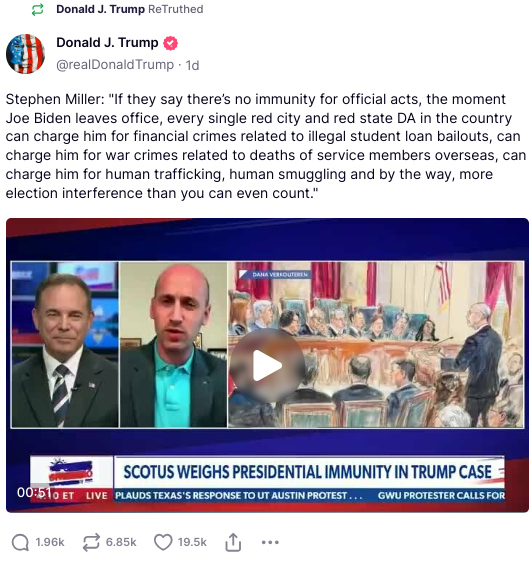
That's all in the past. Today we have a former president accused of very serious crimes who contends that he must be given total immunity. And if he doesn't get it? Well, we'd better hope that he doesn't win the presidency again because unless the court gives presidents total immunity, Joe Biden is going to jail:

That can't be read as anything but a threat. (Nice little country you have here … ) Yet I had no expectations that the right-wing Supreme Court majority would act with restraint on this issue. Bush v. Gore cured me of faith that they have any integrity when a presidential election is on the line. But going into the Supreme Court arguments last week, I think most legal scholars expected the court to be at least somewhat disdainful of the idea that a president must be allowed to be a criminal or he can't do the job. But it turns out that at least four of them, and possibly even six, are quite open to the idea. Justice Samuel Alito went so far as to turn the whole case inside out and upside down by stating:

“If an incumbent who loses a very close, hotly contested election knows that a real possibility after leaving office is not that the president is going to be able to go off into a peaceful retirement but that the president may be criminally prosecuted by a bitter political opponent, will that not lead us into a cycle that destabilizes the functioning of our country as a democracy?”

I'm pretty sure that ship sailed on January 6, 2021. But what that comment, and others made by the right-wingers on the court, shows is that they've bought into Trump's Big Lie that the prosecutions of Donald Trump are partisan exercises brought by his "bitter political opponent." And they are clearly prepared to use their own vast, unaccountable power to even out the score. 


Want a daily wrap-up of all the news and commentary Salon has to offer? Subscribe to our morning newsletter, Crash Course.


If they had any concern about their institution's credibility they wouldn't have even heard the case. Obviously, they don't care about that so it appears that the best we can hope for is that they don't decide to grant this immunity outright but rather come up with some vague distinction between "official" and "private" acts and send it back to the trial court, delaying the case until after the election. If Trump wins, I think we can be quite sure there will be no immunity for Joe Biden. 

It's disconcerting to realize that the right-wing legal intelligentsia is infected with Fox News Brain Rot all the way to the top. You see it from the legal commentators in partisan media, of course. That's to be expected. But it's permeated the entire GOP legal establishment from state attorneys general to judges and to people like Trump's former Attorney General Bill Barr who recently said that despite the fact that he believes Trump committed illegal acts and is unfit for the presidency he plans to vote for him because Democrats want to regulate kitchen appliances and are therefore a greater threat to democracy. And now we see this extremist majority on the Supreme Court acting as rank partisan operators to ensure that a blatant criminal gets every chance to seize power so that he can pacify his broken psyche by wreaking revenge on his enemies. And they seem to be open to taking down our democracy in the process.

As former FBI General Counsel Andrew Weissman said on MSNBC over the weekend, "We are one vote away from the end of democracy as we know it." 

Tire toxicity faces fresh scrutiny after salmon die-offs

For decades, concerns about automobile pollution have focused on what comes out of the tailpipe. Now, researchers and regulators say, we need to pay more attention to toxic emissions from tires as vehicles roll down the road.

At the top of the list of worries is a chemical called 6PPD, which is added to rubber tires to help them last longer. When tires wear on pavement, 6PPD is released. It reacts with ozone to become a different chemical, 6PPD-q, which can be extremely toxic — so much so that it has been linked to repeated fish kills in Washington state.

The trouble with tires doesn’t stop there. Tires are made primarily of natural rubber and synthetic rubber, but they contain hundreds of other ingredients, often including steel and heavy metals such as copper, lead, cadmium, and zinc.

As car tires wear, the rubber disappears in particles, both bits that can be seen with the naked eye and microparticles. Testing by a British company, Emissions Analytics, found that a car’s tires emit 1 trillion ultrafine particles per kilometer driven — from 5 to 9 pounds of rubber per internal combustion car per year.

And what’s in those particles is a mystery, because tire ingredients are proprietary.

The Yurok Tribe in Northern California, along with two other West Coast Native American tribes, have petitioned the Environmental Protection Agency to prohibit 6PPD.

“You’ve got a chemical cocktail in these tires that no one really understands and is kept highly confidential by the tire manufacturers,” said Nick Molden, CEO of Emissions Analytics. “We struggle to think of another consumer product that is so prevalent in the world and used by virtually everyone, where there is so little known of what is in them.”

Regulators have only begun to address the toxic tire problem, though there has been some action on 6PPD.

The chemical was identified by a team of researchers, led by scientists at Washington State University and the University of Washington, who were trying to determine why coho salmon returning to Seattle-area creeks to spawn were dying in large numbers.

Working for the Washington Stormwater Center, the scientists tested some 2,000 substances to determine which one was causing the die-offs, and in 2020 they announced they’d found the culprit: 6PPD.

The Yurok Tribe in Northern California, along with two other West Coast Native American tribes, have petitioned the Environmental Protection Agency to prohibit the chemical. The EPA said it is considering new rules governing the chemical. “We could not sit idle while 6PPD kills the fish that sustain us,” said Joseph L. James, chairman of the Yurok Tribe, in a statement. “This lethal toxin has no place in any salmon-bearing watershed.”

California has begun taking steps to regulate the chemical, last year classifying tires containing it as a “priority product,” which requires manufacturers to search for and test substitutes.

“6PPD plays a crucial role in the safety of tires on California’s roads and, currently, there are no widely available safer alternatives,” said Karl Palmer, a deputy director at the state’s Department of Toxic Substances Control. “For this reason, our framework is ideally suited for identifying alternatives to 6PPD that ensure the continued safety of tires on California’s roads while protecting California’s fish populations and the communities that rely on them.”

The U.S. Tire Manufacturers Association says it has mobilized a consortium of 16 tire manufacturers to carry out an analysis of alternatives. Anne Forristall Luke, USTMA president and CEO, said it “will yield the most effective and exhaustive review possible of whether a safer alternative to 6PPD in tires currently exists.”

Molden, however, said there is a catch. “If they don’t investigate, they aren’t allowed to sell in the state of California,” he said. “If they investigate and don’t find an alternative, they can go on selling. They don’t have to find a substitute. And today there is no alternative to 6PPD.”

California is also studying a request by the California Stormwater Quality Association to classify tires containing zinc, a heavy metal, as a priority product, requiring manufacturers to search for an alternative. Zinc is used in the vulcanization process to increase the strength of the rubber.

When it comes to tire particles, though, there hasn’t been any action, even as the problem worsens with the proliferation of electric cars. Because of their quicker acceleration and greater torque, electric vehicles wear out tires faster and emit an estimated 20% more tire particles than the average gas-powered car.

A recent study in Southern California found tire and brake emissions in Anaheim accounted for 30% of PM2.5, a small-particulate air pollutant, while exhaust emissions accounted for 19%. Tests by Emissions Analytics have found that tires produce up to 2,000 times as much particle pollution by mass as tailpipes.

These particles end up in water and air and are often ingested. Ultrafine particles, even smaller than PM2.5, are also emitted by tires and can be inhaled and travel directly to the brain. New research suggests tire microparticles should be classified as a pollutant of “high concern.”

In a report issued last year, researchers at Imperial College London said the particles could affect the heart, lungs, and reproductive organs and cause cancer.

People who live or work along roadways, often low-income, are exposed to more of the toxic substances.

Tires are also a major source of microplastics. More than three-quarters of microplastics entering the ocean come from the synthetic rubber in tires, according to a report from the Pew Charitable Trusts and the British company Systemiq.

And there are still a great many unknowns in tire emissions, which can be especially complex to analyze because heat and pressure can transform tire ingredients into other compounds.

One outstanding research question is whether 6PPD-q affects people, and what health problems, if any, it could cause. A recent study published in Environmental Science & Technology Letters found high levels of the chemical in urine samples from a region of South China, with levels highest in pregnant women.

The discovery of 6PPD-q, Molden said, has sparked fresh interest in the health and environmental impacts of tires, and he expects an abundance of new research in the coming years. “The jigsaw pieces are coming together,” he said. “But it’s a thousand-piece jigsaw, not a 200-piece jigsaw.”

This article was produced by KFF Health News, which publishes California Healthline, an editorially independent service of the California Health Care Foundation. 

KFF Health News is a national newsroom that produces in-depth journalism about health issues and is one of the core operating programs at KFF—an independent source of health policy research, polling, and journalism. Learn more about KFF.

RFK is now openly gunning for Trump voters — and Republicans are starting to worry

"The Wuhan Cover-Up" blares the subject line of a recent presidential campaign email. Inside, it's all impenetrable conspiracy theory language that reads more like a QAnon post than a normal political fundraiser:

 Why wasn’t Dr. Anthony Fauci charged with a crime, when he lied under oath about his relationships with Peter Daszak and Ralph Baric in order to cover-up Wuhan Coronavirus research? Apparently, lying under oath is only a crime when it contradicts established narratives.

Zombie COVID-19 conspiracy theories? False and defamatory accusations? QAnon-style rhetoric designed to overwhelm and bamboozle the reader? These abusive tactics are all the red flags of MAGA communication. To be certain, fundraising emails across the partisan spectrum can be alarmist and hyperbolic, but accusing innocent people of crimes and spreading lies about deadly diseases are lines most candidates don't cross. The exception, of course, is Donald Trump and his imitators, like Arizona Republican Kari Lake, who's now running for Senate after losing the gubernatorial race in 2022. But outside of the MAGA universe, such tactics are frowned upon for two reasons. One, it's downright evil. Two, it wouldn't work on voters who are outside of the MAGA bubble, as normal people tend to be turned off by slander and overt disinformation. 

But curiously this email did not come from Trump or Lake or any other figures associated with the ethics-free world of MAGA campaigning. It came, readers may not be surprised to learn, from the campaign of Robert F. Kennedy Jr., an independent presidential candidate. The conventional wisdom in Washington has long been that Kennedy is running a spoiler campaign against President Joe Biden, trying to siphon off enough Democratic votes that Donald Trump wins the election. After all, Kennedy used to be a Democrat and his name is so famous his family had to hold a presser disavowing his candidacy. 


Want more Amanda Marcotte on politics? Subscribe to her newsletter Standing Room Only.


This email, however, seems squarely aimed at would-be Trump voters, the only people so soaked in pandemic paranoia and conspiracy theories that any of this would even make sense to them. It's a weird choice for someone trying to undermine Biden's chances! It makes sense, however, if we assume that Kennedy's main priority with his fake run for president is not to spoil the race, but to draw attention and recruit new marks for his longstanding anti-vaccination grift. If you're looking for gullible people who will give you money to lie to them, you will be far more successful appealing to Trump voters than Biden voters. 

Kennedy can be this liberal-triggering agent they can use to taunt people they hate, which has long mattered more to MAGA than policy concerns.

For months, polls have shown that Kennedy is taking away more voters from Biden than Trump, based mostly on Democrats who are dissatisfied with Biden and who knew little about Kennedy besides his name. That's shifted recently. A new NBC News poll shows Biden is two points behind Trump in a two-way race, but two points ahead of Trump if Kennedy is an option. In a Marist poll, Biden's three-point lead widens to five points if Kennedy is on the ballot. It appears the more voters learn about Kennedy — that he's anti-vaccine, a conspiracy theorist, and an all-around weirdo — the more Democrats are turned off and the more MAGA voters are intrigued. 

Hoping he would be a spoiler to benefit Trump, wealthy Republicans have been donating heavily to Kennedy, making them his main source of funding. It's not unreasonable to believe, therefore, that he's in this race to hurt Biden. But the likelier possibility is that Kennedy is in this as an old-fashioned grift, and cares less about the outcome of the race than in getting attention and making money. 

Some crucial context is that Kennedy is the head of an anti-vaccine group that notoriously peddled medical disinformation during the COVID-19 pandemic to great profit. As the Washington Post reported, Kennedy's group "received $23.5 million in contributions, grants and other revenue in 2022 alone — eight times what it collected the year before the pandemic began." Kennedy's salary from running the organization doubled due to this windfall, from $255,000 before the pandemic to over half a million in 2022. With the pandemic functionally over, so are the vast majority of vaccine mandates. That is bad news for anti-vaccination organizations, who depended on the hysteria over mandatory vaccines to raise money. 

It's not a leap, therefore, to see that Kennedy is likely running for president to find a new source of suckers who will give him money. (And attention, which also seems a big motivating factor.) The first set of rubes were those rich GOP donors. But those people are fairweather funders, who will abandon him the moment he's no longer useful. The real money, in the longer term, is in becoming a cult-like leader for QAnon adhernts and other credulous people who may not be rich but are numerous. By targeting MAGA in his search for dummies, Kennedy is simply following that adage: Go hunting where the ducks are. 

The QAnon angle is one that is often overlooked when discussing Kennedy, but shouldn't be. One of the most popular QAnon prophecies is that Kennedy's deceased first cousin, John F. Kennedy Jr., is secretly alive and will make his triumphant return to the public eye in 2024 when he is announced as Trump's running mate. It's likely not a coincidence, then, that earlier this month, Kennedy tweeted, "President Trump calls me an ultra-left radical. I’m soooo liberal that his emissaries asked me to be his VP. I respectfully declined the offer."

For many QAnon believers, it's not much of a leap to get them to wonder if the Kennedy of their prophecy is actually RFK, and not his dead cousin. If so, they are going to be angry with Trump for screwing up the plan. 

We need your help to stay independent

Kennedy was responding to Trump claiming that he's a "leftist radical," which shows Trump is worried about his own people abandoning him for Kennedy. Reporting from Politico confirms that it's not just Trump, either, but the larger GOP that is starting to fret. Kennedy is starting to pull small-dollar donors away from Trump. In turn, Trump's campaign and allies are starting to badmouth Kennedy more. 

To be certain, the Biden campaign still has much to worry about when it comes to Kennedy. Low-information Democratic voters who just see the name and throw their vote away are a very real threat. But Sarah Longwell, the never-Trump data specialist who publishes The Bulwark, argued on a recent podcast that there's "a real opportunity" for the Biden campaign to push some Trump voters towards Kennedy. She notes that, in her focus groups, what Trump voters say they like about Kennedy is that "he is defying his family." 

"What do Republicans like more than anything else?" she said. "Somebody of the libs who's hitting the libs." She reminded listeners that Trump used to be coded this way, as a former Democrat who has turned on his party. Now Kennedy can be this liberal-triggering agent they can use to taunt people they hate, which has long mattered more to MAGA than policy concerns. Already, Kennedy has higher favorability ratings with Republican voters than Democrats. 

There are signs that the Biden campaign is aware of this and is trying to find ways to sell Kennedy to MAGA voters. The Kennedy family press conference, for instance. Most media took it at face value, as the Kennedys trying to discourage Democratic voters from backing their black sheep of a relative. But there may have been another, more important audience: MAGA voters. The message to those voters is that the best way to make the Kennedys cry, perhaps even better than voting for Trump, is to vote for RFK Jr. Similarly, billboards that put Kennedy in a MAGA hat and call him a "spoiler for Trump" aren't just about making Democrats dislike Kennedy. They will also make Trump voters more interested in switching to Kennedy.

None of this is an argument for complacency. Kennedy is still a major threat to Biden, due to those low-information voters who may not know he's an anti-vaccination conspiracy theorist. This race promises to be chaotic as it is, and introducing third-party spoilers makes it all the more unpredictable. Kennedy, whose main goals are money and attention, might discover he can start getting more wealthy Republican donors if he shifts tactics again. All sorts of terrible things could happen. 

For now, the state of play appears to be this: Kennedy's main goal appears to be pulling in marks for his anti-vaccination grift. That means he's got a lot more reason to make a play for MAGA voters than Biden voters. Especially if Trump continues down his path of total self-absorption, Kennedy has a real opportunity to chip off some of his voters by speaking to their esoteric concerns about vaccine mind control and other imaginary threats. The polls suggest this is already happening, and there could be many more chances down the line for MAGA voters to consider giving Kennedy a chance. 

The gag “trap” of Manhattan’s hush-money trial: “Trump will take the bait”

The second week of Donald Trump’s historic criminal trial in Manhattan for allegedly paying hush money to Stormy Daniels to conceal their relationship from the public during the 2016 campaign has concluded. Week three begins Tuesday. 

The so-called walls that have been closing in on Donald Trump ever since his multiple criminal indictments — in this case and the three more serious cases related to the Jan. 6 coup attempt, the larger plot against American democracy and his retention of classified documents — are now much closer. No cameras are allowed in the Manhattan courtroom, but the descriptions of Trump are not flattering. He reportedly appears flustered, angry and overtly hostile. He apparently vacillates between falling asleep and being jolted awake to stare menacingly at witnesses, the judge and other people in the courtroom.

Trump has also been made to look pathetic, if not tragic, given that his own family members, including his wife Melania, have not yet attended the trial. Trump’s throngs of MAGA followers have seemingly abandoned their Dear Leader. So far, only a dozen or so, sometimes fewer, have been “protesting” outside the courthouse.

After only two weeks Donald Trump has basically been reduced to being a mere mortal while in Judge Merchan’s courtroom. This reality is the opposite of the titanic god-king messiah image he tries to present to his followers.

In an attempt to make better sense of the second week of Donald Trump’s hush-money trial, its implications for the 2024 election and the larger democracy crisis, and what may happen next, I recently spoke with a range of experts.

Cheri Jacobus is a political strategist, writer, ex-Republican, and host of the podcast "Politics With Cheri Jacobus."

Trump seems small, shriveled, old, pathetic and weak, falling asleep (among other things), and whining in pressers and on Truth Social to the point where anyone else would have been tossed in the slammer for violating the gag order. He has no family with him, no friends, and mistakenly thought the streets around the courthouse were blocked because the streets were void of pro-Trump protesters. In fact, the main street was open and only one Trump supporter showed up. If this was happening to almost anyone other than Trump, one could feel sorry for him. Trump's fear is visible. Palpable. And fills me with glee.

Trump's cartoonish image of "strength" fed to the unwashed masses at his rallies and Fox News viewers does not hold up in the harsh reality of a Manhattan courtroom. His makeup is gaudy and weird, he doesn't get the special lighting, there is no music for his "entrance", and no sea of MAGA red hats. There is nothing but the long-awaited justice that he's evaded his entire life. Aside from Trump's criminal acts, his evangelical supporters in particular are reminded of his tawdry personal life of sex with porn stars, Playboy models and more, while his wife de jour pretends not to notice.

It's a scene fit for the cover of the National Enquirer,. But its publisher, David Pecker, is a prosecution witness, which makes this even more delicious.

As the trial moves forward, I do expect to see poll numbers dropping for the Donald, especially since Joe Biden is confident and comfortable taking justifiable potshots at Trump not only for his lies, incompetency and policy blunders, but his criminality — and doing it with humor and good cheer. That's got to be getting under Trump's orange skin almost as much as hearing the testimony against him in court. Bravo Dark Brandon!

Dr. John Gartner is a prominent psychologist and contributor to the bestselling book "The Dangerous Case of Donald Trump: 27 Psychiatrists and Mental Health Experts Assess a President."

Trump's trial in Manhattan is providing more evidence of his apparent cognitive decline. Trump fell asleep four out of six days at his own trial. Falling asleep is not in and of itself specific to dementia. I fall asleep at dinner parties, because I’m old and work too hard. Bill Clinton was famous for it. But can you remember a criminal defendant repeatedly unable to stay awake at his own trial? I can’t. It’s obviously very rare. Most people are pumped full of adrenaline when they’re in the dock. Some have argued Trump’s just tired, or perhaps deprived of his stimulants. But lots of defendants are tired and either on drugs, or missing their drugs, while in court, but they don’t repeatedly pass out at their own trials.

"America really needs to know if Trump is incontinent."

This may be the first criminal trial I’ve been aware of where the defendant appears, in my opinion, to have dementia. Is it a coincidence that it’s also the only one I’ve ever known where the defendant can’t remain awake most days? Trump appears to be losing control of his basic biological functions. One is sleep-wake. The other may be excretion. Twitter blew up when both Ben Meiselas and George Conway reported they had heard from multiple credible sources in the courtroom that Trump was loudly passing gas and the smell was overpowering. This was judged by Snopes to be unconfirmed. Personally, I trust the people who reported it. I don’t believe they would make that up. 

Trump's apparent disease is progressing rapidly before our eyes and yet we’re being gaslit that this is "Trump being Trump." That’s true, but it is also true that Trump appears to be dementing and the mainstream media doesn’t want to report on that story.

We need your help to stay independent

The trial is really a form of psychological torture for a malignant narcissist who needs to appear powerful. Instead, he appears small, confused and helpless. Jenifer Rubin wrote in her Washington Post column: “Trump day by day has become smaller, more decrepit, and frankly, somewhat pathetic.” Thankfully, the Biden campaign is amplifying this winning message. To fight back, Trump must act out. He is defying Merchan’s gag order repeatedly, flagrantly and at a manic pace with no thought of the consequences — in the courthouse lobby on a lunch break, on Newsmax in the evening, and then at 3 a.m. on Truth Social.

"Lies helped him win once. Truth will undo him this time."

Merchan will be unable to escape a showdown with Trump, who will compulsively push him to the limit and beyond, forcing an inevitable confrontation. Only one will emerge as dominant, and my money is on the judge, but that’s not a foregone conclusion. If Donald Trump is jailed, he’ll wear his incarceration like a martyr, like he’s Nelson Mandela or Alexei Navalny. While Fox News and his base will stoke right-wing outrage, I think sane people still like presidents who don’t get jailed.

David Rothkopf is the host of the Deep State Radio podcast and the author of several books, including “American Resistance: The Inside Story of How the Deep State Saved the Nation.”

Donald Trump's New York trial reminds us that before there was the big lie, there was the big liar. Lying is so core to everything he is and does that he's a figment of his own imagination. Lies helped him win once. Truth will undo him this time.

Brynn Tannehill is a journalist and author of "American Fascism: How the GOP is Subverting Democracy."

I'm seeing a lot of things that don't make for a single story, but a lot of little ones that add up to this hurting Trump bit by bit electorally. Reports of him repeatedly falling asleep and farting chemical death bombs on his lawyers constantly don't exactly project "Strongman". The judge is already tired of Trump and his lawyers' shenanigans when it comes to flouting the gag order. The DA is asking for 10 counts at $1000 each and a warning that the next one might land him a night in jail. I think this is a trap and Trump will take the bait: the penalty is so low on this first violation that he won't be afraid to step right up to, or over, the line again. That's when the DA asks for a night in jail, and the judge may say yes because he's had it.

While this trial is going on, Trump isn't out on the campaign trail. He's still generating news every day, but all of it is bad. This trial is also expected to last up to three months. His campaign's ground game is reportedly weak. And after this, he probably rolls right into his next trial. His numbers are slipping, and I think they'll keep slipping.

Things are going about as I thought they would, though I hadn't realized how long this would keep Trump off the campaign trail.

The biggest two things I'm looking for are whether Trump takes the stand (he will want to desperately, but he's a terrible witness, it will likely make the situation way worse, and his lawyers know it), and when he finally crosses the line and ends up spending a night in jail for contempt. I think the latter is more or less a foregone conclusion given he's going to be hearing nasty things about himself for weeks, he has anger issues, poor self-control, and the initial punishment is going to be so weak that it will reinforce his belief that he can get away with it indefinitely. Finally, I'm really looking forward to seeing if the DA can make a convincing case that the way the hush money payments were made was illegal, and not just sketchy and underhanded politics. That was always the toughest hill to climb and made this the weakest of the four criminal cases against him.

Attempted TikTok heist by Congress just proves our data is safer with China than the NSA

Among the generation most needed at the polls for a win, it’s common knowledge that voting for President Joseph Robinette Biden is basically like eating a bowl of soggy Cornflakes in lukewarm tap water — you do it because your only other option in the kitchen is a moldy orange slimeball that’s grown legs and now wants to put its enemies in camps. And yet here Biden is, the guy begging us all to swallow another bowl of his mealy-mouth pap at the polls, glibly pissing in our Wheaties.

As of Wednesday, China-based parent company ByteDance has been ordered to either sell its crown-jewel app TikTok to a U.S. company or see it banned here. This comes courtesy of a bill that every news writer in this country is trying their hardest not to describe as a run-of-the-mill mob shakedown ordered from the Oval Office.

And that bill was signed into law by good ol’ train-union-busting, Anita-Hill-ignoring, Delaware-corporate-fiefdom-defending Joe Biden. Behold, the very president who’s relying on TikTok users to share his campaign ads, even though they’re busy uploading videos of their college classmates getting beat to hell by some war-armored cops that — like predatory student loans and medical bankruptcy — Biden could stop, but simply won’t. 

Good ol’ Joe is one trigger-happy SWAT-cop away from having another Kent State on his hands but, thank God, he can at least find the time for a little cybersecurity theater to entertain Republican voters, and still have enough left to put a nice bow on whatever future tech-company sweetheart deal will be funded by this wannabe corporate takeover.

Sure would be a sad day on the Hill if those campaign coffers dried up all because some egomaniacal tech bros stopped making dark-money deposits to everyone’s crack-shack LLCs and post-Citizens-United think tanks.

Good to know he’s out there protecting us innocent Americans from having our data collected by the government of a country that has absolutely no jurisdiction over us, so that our own God-fearing National Security Administration can safely collect that data for itself instead. Isn’t that nice of him? After all, it would be a shame if we were allowed the choice of giving our data to a country that can’t use it to arrest or persecute us, instead of being forced to feed it to the gaping maw of the most massive domestic spying operation the world has ever known, in a country whose prison population is greater than China’s. *Insert screeching eagle here.* FREEDOM! 

And wouldn’t it be a shame if an American company like Microsoft, Amazon, Meta or Twitter (or X, whatever) — which protect user data from government spying about as well as a screen door protects a submarine — was suddenly losing out on the lobbying leverage it gets from quietly playing ball with the Feds’ warrantless wiretaps and gag-orders? Sure would be a sad day on the Hill if those campaign coffers dried up all because some egomaniacal tech bros stopped making dark-money deposits to everyone’s crack-shack LLCs and post-Citizens-United think tanks. 


Want more health and science stories in your inbox? Subscribe to Salon's weekly newsletter Lab Notes.


Fight for the Future’s Evan Greer put it best in the advocacy group’s recent response:

“Whether it’s dressed up as a ban or a forced sale, the bill targeting TikTok is one of the stupidest and most authoritarian pieces of tech legislation we’ve seen in years,” Greer said. “Not only is this bill laughably unconstitutional and a blatant assault on free expression and human rights, it’s also a perfect way to derail momentum toward more meaningful policies like privacy and antitrust legislation that would actually address the harms of Big Tech and surveillance capitalism.”

Biden just did more to promote TikTok and ByteDance — and China itself — than any ad-buy or propagandizing Mao-machine ever could. As Greer put it: “Banning TikTok without passing real tech regulation will just further entrench monopolies like Meta and Google, without doing anything to protect Americans from data harvesting or government propaganda.”

We need your help to stay independent

In the same fell swoop, Biden also made himself look more politically impotent than anything he’s done so far in the Oval — except for, of course, his attempts to pass off chintzy regulatory band-aids as some kind of valiant restoration of abortion access. Nice move getting Net Neutrality restored then letting us all know in the same week that it means jack squat if Uncle Sam’s snoop-net gets threatened. The divest-or-ban play was a lose-lose scenario that only a D-triple-C blue dog could sundown his way into.

If ByteDance sells, Biden looks like a GOP corporate shill and the NSA ends up with a God-tier algorithm; if ByteDance refuses to sell and TikTok is banned, no one under 45 is voting for him. It’s like punching the high school pretty boy — win or lose, people still aren’t going to sit with you at lunch.

And now Biden’s going to wear this TikTok albatross all the way to November because ByteDance isn’t selling. If Biden wants to steal ByteDance’s baby, then the company is going to make sure the whole world sees Biden yanking it out of ByteDance’s hands. So ByteDance is taking this to court as expected, where it could drag out for years. Granted, Biden and Congress did offer ByteDance plenty of time to figure out what it wants to do with its baby — it’s now got nine months to decide. Unlike the rest of us.

An earlier version of this article originally appeared in Salon's Lab Notes, a weekly newsletter from our Science & Health team.

Bernie Sanders blasts Netanyahu for “ethnic cleansing” in Gaza

Senator Bernie Sanders said Israel’s treatment of Gaza is “ethnic cleansing,” calling out Israeli Prime Minister Benjamin Netanyahu on Sunday. 

On CNNs “State of the Union,” Sanders said that the Prime Minister should be held responsible for the staggering death toll and the displacement of Palestinians the conflict has caused. 

When asked about the country-wide pro-Palestine protests that have taken over numerous college campuses, and what he thought of Rep, Ilhan Omar’s remarks last week at Columbia University where her daughter was suspended, he said he understood what Omar communicated.

Columbia University has had national attention after hundreds of pro-Palestinian protesters were arrested earlier this month. CNN played a clip of Omar’s comments when she visited campus.

“I think it is really unfortunate that people don’t care about the fact that all Jewish kids should be kept safe, and that we should not have to tolerate antisemitism or bigotry for all Jewish students, whether they are pro-genocide or anti-genocide,” she said.

“What I think the essential point that Ilhan made is that we do not want to see antisemitism in this country,” Sanders said. “And I think the word genocide is something that is being determined by the International Court of Justice.”

Sanders added that there is no doubt about what Netanyahu is doing: “displacing 80% of the population in Gaza — is ethnic cleansing.”

Sanders has repeatedly criticized Netanyahu for the ongoing war in Gaza, and has opposed more U.S. funding to Israel. He also re-upped his calls for an end to U.S. funding to Israel’s actions in Gaza.


“King James is nourished in fear”: Tony Curran on playing the tortured monarch in “Mary & George”

King James I crouches near the foot of an ornate, golden bed wearing only linen pants. George Villiers, his beautiful young lover, sits naked on the floor, nursing a crescent-shaped open wound on his forearm. It's a bite mark, sustained by the king.

"Poor lamb and poor wolf — on the edge of the dark, dark woods," King James says, his hand sliding languidly over George's shoulder. "Do we enter? Or no? No, no, no."

"What really informed me . . . was looking into the eyes of King James, of looking at paintings."

This erraticism is spurred by a vulnerability in King James that Tony Curran, who portrays the Jacobean era monarch in Starz's 17th-century period drama series, "Mary & George," found especially compelling about the character. "I think there are elements to James, where he just wants to take a bite or something," Curran tells Salon, laughing. "It happened to be poor George, sadly."

The wound functions on a figurative level, too. It's as though James projected his own tortured inner world onto George, physically marking him with impassioned fierceness while simultaneously sharing a wounded piece of himself.

Prior to "The Wolf and the Lamb," the fourth and latest episode of the show to premiere, viewers have already gotten a glimpse into King James and George's (Nicholas Galitzine) budding relationship. Mary Villiers, played by Julianne Moore, has successfully ingratiated herself into the royal ranks by using George as a sexual chess piece; despite her lowly peasant background, Mary's thoughtful scheming has paid off — thus far. 

After the king's previous lover, Robert Carr, the Earl of Somerset (Laurie Davidson) is executed, it seems as though Mary and George have a clear path toward continued ascension. That is until Friday's episode, wherein George becomes bedmates with the Earl's cousin, Peter Carr, igniting a rift between him and James. However, they ultimately reunite once Peter's true intentions are revealed after he attempts to kill George to avenge the Somersets' deaths.

During a moment of reconciliation, James tells George about his first great love, the late Lord Lennox. He reveals how Lennox arranged to have his heart embalmed and sent to James after his death, telling George that he had it buried above Edinburgh in "a quiet, secret spot." 

"But I decidedly recently to bring him home," James adds tearfully, explaining the reason behind his trip to Edinburgh. "Am I a lovesick fool?" he asks George, who assures him that he is not.

Speaking to Salon, Curran talked about King James' layered emotional complexity, and how those fickle feelings extend into his relationship with George Villiers.

The following interview has been edited for length and clarity. 
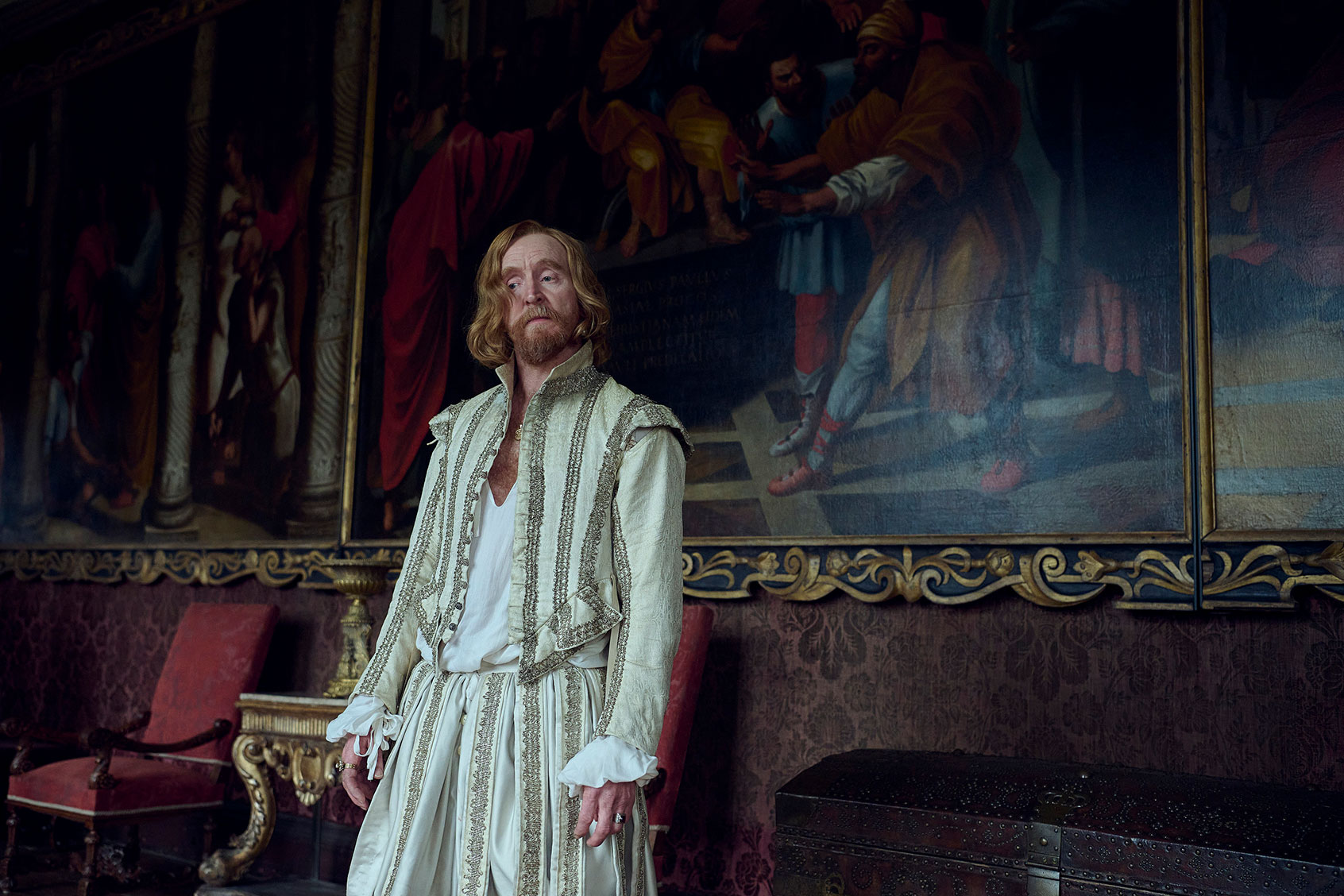
Mary & GeorgeTony Curran as King James I in "Mary & George" (Starz)I'm really curious to learn how much research you did on King James ahead of taking on the role. What specifically about him unlocked your interest in the character?

When I managed to read through all the scripts, it was clear to me that this was going to be quite challenging. But I also relished that, and it was a real joy to get an audition for it. Of course, getting offered [the part], I was really thrilled. The first thing I did was delve into the novel that Benjamin Woolley wrote. I did a deep dive on YouTube. It's incredible how much you can unearth. And I'm still finding things. 

But a lot of what really informed me and helped me was actually was looking into the eyes of King James, of looking at paintings. I saw a sort of vulnerability and a sadness in his eyes. And also talking to Benjamin Woolley, who wrote the non-fiction novel about George and the Villiers and King James, "The King's Assassin." I spoke to him for like two-and-a-half, three hours, and I would also call him up and have Zoom calls with him. It was just the idea of, well, obviously, King James is a monarch we've never really heard much about on screen, on stage, and that was exciting to me. I was like to Benjamin Woolley, "Where's he coming from, this guy? What makes him tick?" He's a very little known king. He was only on the British throne for 23 years. He'd been a king since he was 18 months old, after Mary Queen of Scots was executed.

 Yeah, I was gonna say he had a kind of traumatic upbringing in a lot of ways.

I think that was what was most compelling to me was my [character's] father, Lord Darnley, was assassinated. Mary Queen of Scots was executed by Queen Elizabeth I. I'd been kidnapped once when I was 13 years old for a year. It was a constant traumatic upbringing. And I think that, I thought that was a compelling part of his makeup that we try to bring into this work. This person, this man, this husband, this king, this son, this father, this lover – I think he was deeply, deeply wounded, and he had such trauma in his past life and his ongoing life. And I think that's what made me want to play that role. I found that really interesting to try and portray as well as his love affairs with Lord Lennox, Robert Somerset and George Villiers.

"I think his love for a lot of these men was quite profound and quite true."

Me and Benjamin Woolley talked about it. I was like, "Look in his eyes? What am I looking for?" He goes, "Well, tell me what you think." And I used to think, "He looks like a man who doesn't want to be there. He doesn't really want to be a king. He doesn't really want to be sitting on that throne."

One of the terms Benjamin came up with that I thought was very helpful was that King James is nourished in fear. I wrote it in the back of the novel and I'd always have the novel in my trailer or wherever I was shooting, just to remind myself of his paranoia. But I think a lot of his paranoia was justified.
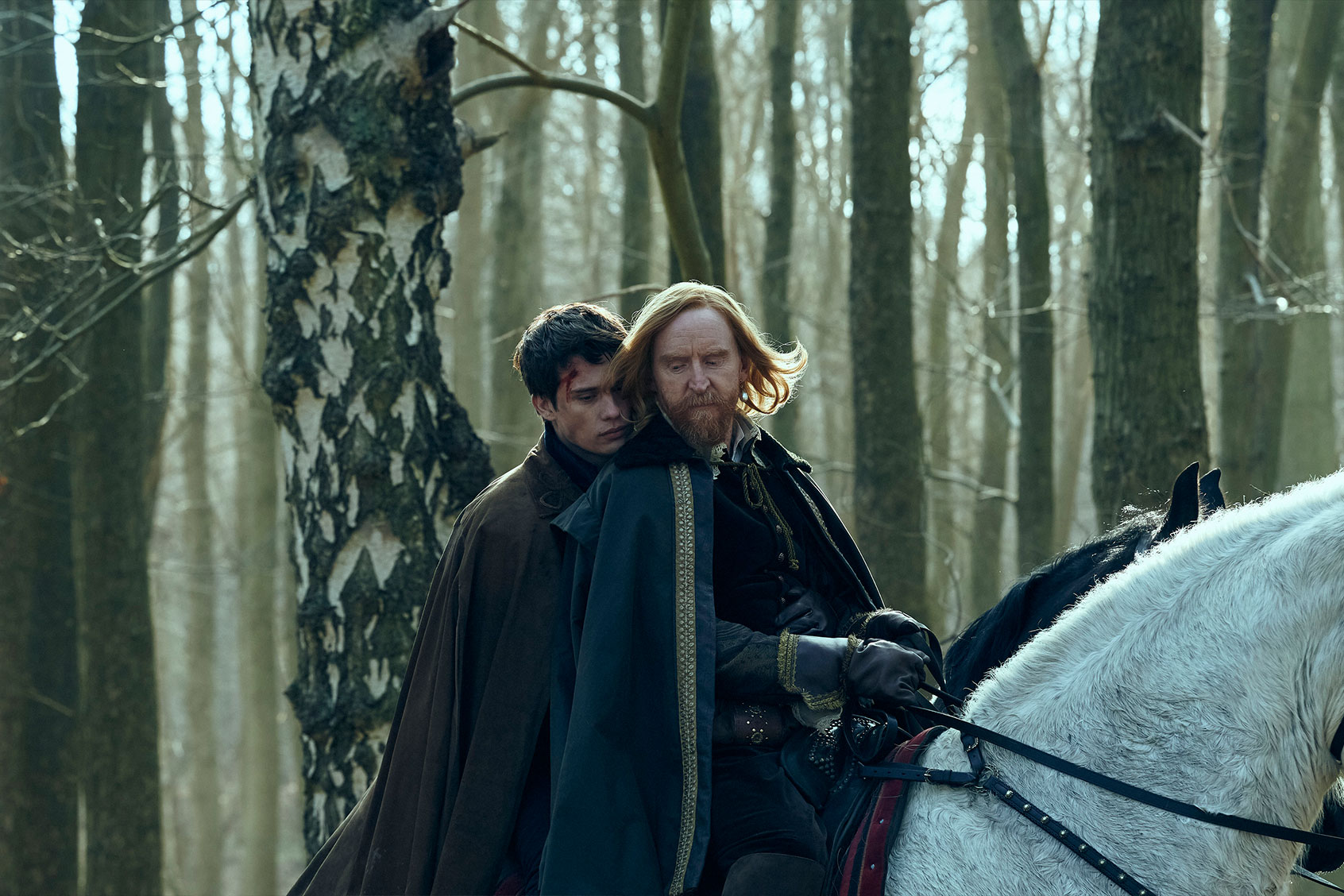
Mary & GeorgeNicholas Galitzine as George Villiers and Tony Curran as King James I in "Mary & George" (Starz)Yeah, I think the vulnerability that you're getting at is really interesting. There's a really deep intensity and humanity in your portrayal of the king, especially I think as it relates to his relationship with George. Is that something that you wanted to emphasize? Their relationship starts out as somewhat transactional, but it begins to evolve into something more profound. It almost feels like it's got this ever-oscillating nature of, "How do we define this relationship between these two men?"

Yeah, that's a good point. I've said before that he's looking for a relationship, he's looking for loyalty, he's looking for something deep inside of him that he wants nourished, he wants a hole to be filled. And I think a lot of that has to do with how there was no matriarchal figure in his life. I've got a friend who's a doctor or a psychologist and I was discussing this with her — about the idea of not being brought up and having a mother, and how profound and how fortunate and how lucky we are when you have both parents or maybe you only have one parent.

But James didn't have any parents. His father was assassinated, his mother was executed. He was brought up by these white, Calvinistic regents and he was educated in the ways of the world and languages and academia and so on. But I think within any human being if you don't have a mother or a father there — or certainly, if you don't have a matriarchal figure or a mother — I think that definitely had a hugely profound effect on who James became and how worked his way through life with these relationships, with these men. Obviously, he was married to Queen Anne and he had children, but I think that he wanted heirs — that was expected of him.

But I think his love for a lot of these men was quite profound and quite true. And there's no doubt that as an individual, he was damaged in many ways, but he was trying to find ways to distract himself. One thing I said before is that, if you can't find meaning in life, you'll find distraction. And I think James, he was trying to find meaning, but then I think he was distracted as well by his lascivious exploits. At the same time he was expressing himself. 

I think the sensuality and sexuality that's in the show, even with Julianne's character and Niamh Elgar — with Mary and Sandie —  I think those relationships became more than just essential exploits. They became quite tender and romantic and loving. And I think with James and George that was certainly there as well. I don't doubt that he cared for George Villiers deeply.

I am interested to learn more about how James sees George. Obviously, they do share this intimate dalliance of sorts, but it's still a relationship born out of Mary's ulterior motive of wanting to ascend into wealth and the upper echelons of royal society. So I'm wondering if you felt like James ever suspected that he was being used for power, or would you say maybe that he was used to that because he was a king and somewhat of a political target in that sense?

I like that word, dalliance. It's a good word!

I think he, of course, suspected that these people had ulterior motives. There was a term people would say about King James, that he's the wisest soul in Christendom. He was canny, he was a thinker. But at the same time, I think if he was to go with his gut feeling — with all these men and women that pass through his court — I think if there was a small percentage of doubt, then nobody would come through his court. I think certainly with the Villiers and with Somerset, he wanted to believe that these people cared about him. In many ways, I guess he had to believe that they cared about him. He wanted that connection, he wanted that compassion, and he wanted to feel that loyalty from these individuals because of his traumatic past and what's happened to him.

So anybody that came into his court, as you mentioned, I think he'd feel like maybe they have an ulterior motive, but in many ways, I think it's sort of quid pro quo with James. And when George started taking on some of the political agenda of the time —  taking on the heavy lifting, if you will — I think James was OK with that. He was like, "Yeah, you do that, just don't step out of line."
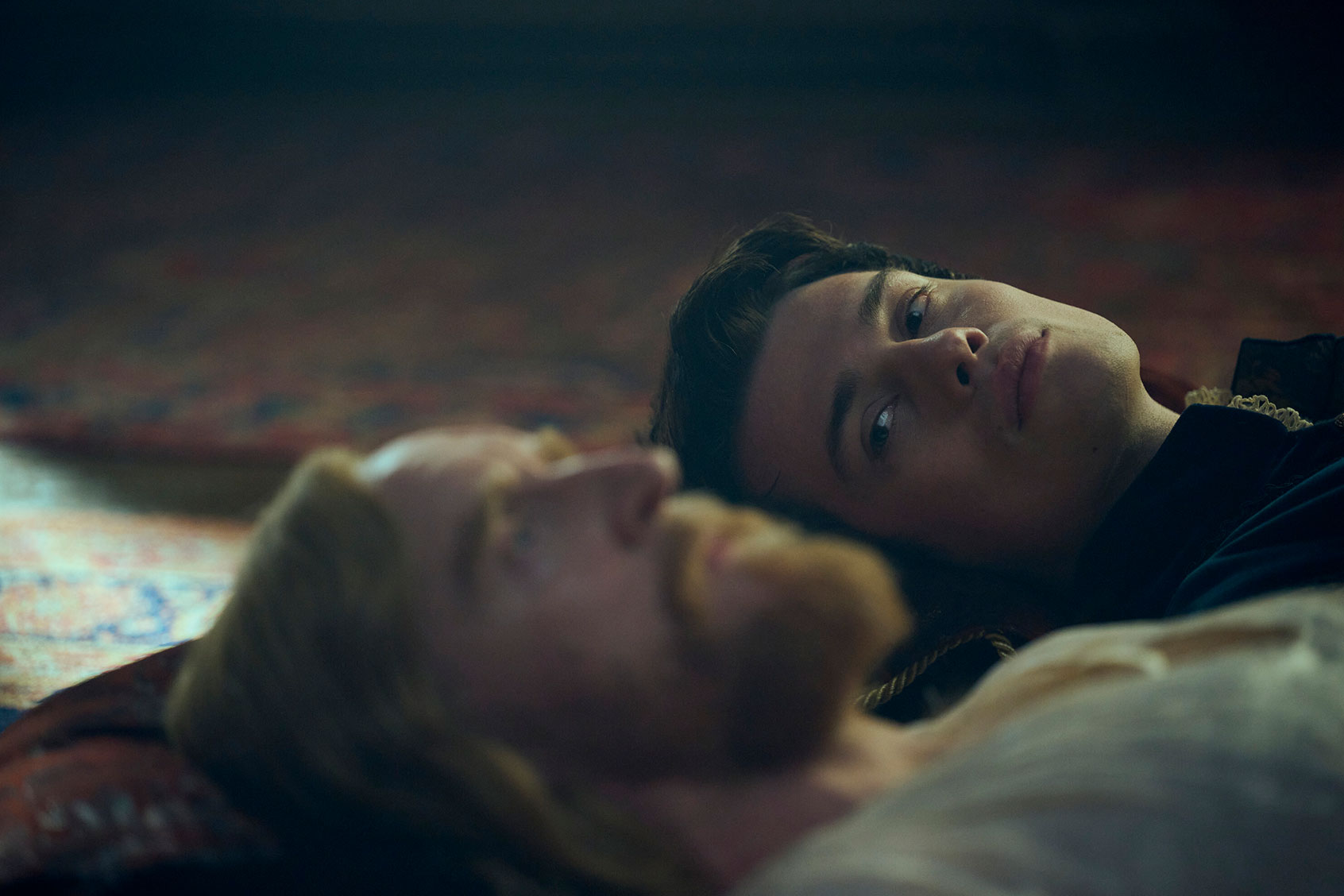
Mary & GeorgeTony Curran and Nicholas Galitzine in "Mary & George" (Starz)In one of the first scenes of Episode 4, "The Wolf and the Lamb," we see the king tenderly caressing a sleeping George in bed before biting his arm very aggressively. That seemed like it took a lot! What went into that scene?

It was funny, that was actually one of the scenes I auditioned with. It was pretty much self-mutilation at that point. I was biting into my own arm. Nicholas, fortunately, wasn't there at the time.

There's a lot of vulnerability in this show and none more so than when you're lying in bed with someone naked. There's a moment of madness that comes over James, I guess. This sort of ravenous wolf — is he the wolf? Who's a wolf in sheep's clothing? In many ways, it's how unpredictable the world is and how James is in that episode. He fluctuates from tenderness to almost wrathfulness. I found it very interesting to play that sort of unpredictability of him and how he changes and George, as he says to his mother something like, "I don't know how to behave in front of him. His mood changes, fleetingly, momentarily. I don't know how he's gonna behave."

But I think a lot of that and those moments came from sort of a deep, dark, darkness within James. I'm not sure if someone could have diagnosed James back in the day whether he would be clinically depressed. But I think a sort of bipolarism if you will — these mood swings that are so joyous and fun to very dark and unpredictable.

Was there anything specific that you and Nicholas did ahead of filming to create chemistry or intimacy or just a level of comfortability where you could do a scene like that?

We didn't really rehearse too much, actually. We met and we had dinner with [director] Oliver Hermanus, our fearless leader, and we just talked about the scenes. We just discussed, "Where's your head at at this point?"

"if you can't find meaning in life, you'll find distraction."

Obviously, Mary Villiers is putting this young man into the lion's den, if you will. And there's so much unpredictability to James. But no, I just think we just talked about where our characters were coming from and what our objectives may have been. We didn't really have a lot of time to rehearse together. I think a lot of what helped us within that was David's [D.C. Moore] script, because it was all there on the page. You can do as much research as you can if you feel like that is your MO as an actor — which I like to, I like to delve into it. But when it comes down to it, it's the old quill: what's on the page. And your instinct for the character and the fact that the director or producers have entrusted you with this role.

Thinking specifically, 1) about the King's relationship with George, and then 2) the way the show portrays queerness — albeit Jacobian-era queerness — more broadly, why do you feel that it's important that this story was portrayed on screen as a period drama?

I think Oliver Hermanus put it quite beautifully when he said that it's not ostensibly a queer story. It's a period in history. It happens to be a period of history that has a fluidity to it, that had a queer king.

So I think that it's important to tell these stories to highlight areas of society. Unfortunately, there are people within our world who have a bone to pick with people because of their color, their sexual orientation, their background. And a lot of that has to do with ignorance and sadly that sort of approach to life. I think there are a lot of things we can highlight. And I think there's empathy and compassion and understanding that can also be, hopefully, brought out in people to tell these stories about these people, about their lives.

We don't really see too many statues of King James in London. I had to search for it when I was there and I found it at Temple Bar, which is sort of in the old city of London. Is that because he wasn't a warmongering king? He calls himself Rex Pacificus or Great King of Peace. Is it because he was a Scotsman put on an English throne? It could be, or because he was queer. I guess that was sort of swept under the rug — "Oh, we don't want a queer Scottish non-warmongering king." Because that's bad for business on the throne.

So I think it's absolutely important to highlight these things. Cause, there are people in them, because they have lives. As heterosexual as we all are, there are LGBTQ+ people in society as well. We're all born under the same sun.

"Mary & George" airs Fridays on Starz and on the Starz app.

https://www.youtube.com/watch?v=OYI7FtJr20c

Mitch McConnell says we face more formidable problems now than during World War II

Minority leader of the U.S. Senate, Mitch McConnell, appeared on NBC's "Meet the Press" on Sunday morning to discuss the Biden administration, aid to Ukraine, and Donald Trump with host Kristen Welker.

Having recently met with Ukraine’s President Volodymyr Zelenskyy to discuss aid and U.S. funding earlier this year, condemning the Biden administration for its lack of due diligence. McConnell said that the administration’s withdrawal from Afghanistan “was a huge mistake.” He continued that this administration underfunds defense, not keeping up with the inflation rates.

“We need to get serious about what we are up against: China, Russia, Iran, and terrorism,” McConnell said, summing up some of the common buzzwords in the political sphere. 

All of these make for a “more formidable combination of problems than we had even going into World War II,” McConnell said. Adding that, of course, terrorism was less of an issue in 1939. 

When asked about what his message was to Zelenskyy and whether the U.S. aid was arriving in Ukraine too late to make a difference, McConnell said “I’m with ‘em.”

According to him, the United States shouldn’t force a settlement, which he also applied to the example of Israel wherein he disagreed with the current administration’s opinion that Israel “ought to have an election.”

“It’s not our job to tell a Democratic ally whether or not to have an election,” McConnell said.

Choosing to glaze past the second half of the question, he added that it is not the State's responsibility to police, through restrictions, how both Ukraine and Israel decide to address their conflict. 

When asked again, he pointed out the benefits the United States has had since it helped Ukraine. 

Welker did not receive a straight answer from McConnell, who was quite critical of Trump after Jan. 6, when she confronted him about his endorsement of former president Trump, and asked if he’d vote for the now criminal defendant. 

“I said three years ago, shortly after the assault on the Capitol, that I would support the nominee of the party, whoever that was, and I do,” he said plainly. 

This is despite what McConnell said in February 2021 when addressing Congress, when he said that without question that former “President Trump is practically and morally responsible for provoking the events of the day.”

McConnell maintained that because the Republican voters have chosen their nominee, all he can do is focus on ensuring that his successor is a majority leader instead of a minority one. 


Biden stole the White House correspondents’ dinner by dishing it out and taking it in return

The White House correspondents’ dinner, also known as the “nerd prom,” is a century-old event where journalists, politicians and celebrities share laughs over friendly jabs and food — held again at the Hilton Washington, in Washington D.C. 

The comedian on site, "SNL" alum Colin Jost, had some competition during the packed event: President Joe Biden, who came correct in full "Joe Cool" mode. Aviators likely on hand to shield himself from any heat coming his way via the jokesters in the room. And both of them did way better than Matt Friend, a warm-up comedian who got crickets and then, worse, groans from the crowd with way too soon jokes about the Trump courthouse self-immolator and Kristi Noem shooting her puppy. 

The president had the crowd in stitches when he put out the disclaimer that all attendees, including the reporters from Fox News who were in attendance, had to be vaccinated and boosted. 

Perhaps they were there for their free meal, Jost later suggested.

“It is the end of an era. Rupert Murdoch stepped down at Fox News, which is strange,” Jost said. “I didn’t think there was a step down from Fox News.”

The jokes of the night were centered around age, Trump, and the election. All of these were rather easy jabs when the two candidates running for president this year are at least ten years older than the average retirement age in the States. Plus, one of them is the first former president to be a defendant in a criminal trial. 

With the election fast approaching in six “extremely long” months from now, Jost gave the audience a snapshot of a perplexing reality.


Want a daily wrap-up of all the news and commentary Salon has to offer? Subscribe to our morning newsletter, Crash Course.


“The Republican candidate for president owes half a billion in fines for bank fraud and is currently spending his days farting himself awake during a porn star hush-money trial,” Jost summarized. “And the race is tied!” 

Jost is right. According to recent national poll averages taken on April 25th, 40.9 percent of likely voters would support Biden and 41.6 percent would support Trump, ABC news reported. What's more, Trump seems to be leading in swing states. 

“The candidate who is a famous New York City playboy took abortion rights away and the guy who is trying to give you your abortion rights back is an 80-year-old Catholic,” Jost pointed out. “How does that make sense?”

Throughout the night, most of Jost’s jokes were met with polite chuckles, some claps, and occasional pity laughs. Biden, who said Jost’s wife, actor Scarlett Johansson, was funnier than her husband, outperformed the seasoned comedian. Perhaps because he managed to deliver his material without looking at his notes.

The president took Jost’s jokes with good humor and furthered them with self-deprecating playfulness. He started by saying it had been some time since he last delivered this speech, which worried his wife, First Lady Jill Biden. 

“I told her, 'don’t worry it’s just like riding a bike,'” Biden said. “She said that’s what I am worried about.”

Leaning into the age issue as hard as anyone else, he went on to joke, “Of course, the 2024 elections are in full swing and, yes, age is an issue,” he said. “I’m a grown man, running against a six-year-old.”

His opponent in the presidential race, who has a penchant for bad-mouthing Biden, was his target for what suddenly became a full-fledged Trump roast. 

“I had a great stretch since the State of the Union, but Donald has had a few tough days lately. You might call it Stormy weather,” Biden said, and added, “What the hell.”

Of course, no one was spared, including the U.S. representative and gun rights activist Lauren Boebert who, funnily enough, attended Rifle High School. 

“Being here is a reminder that folks think what’s going on in Congress is political theater. That’s not true,” Biden said amidst chuckles. “If Congress were theater, they’d have thrown out Lauren Boebert a long time ago.” A dig on her "Beetlejuice" vaping/groping scandal

His next target was the media. “To all my friends in the press and Fox News, some of you complain that I don’t take enough of your questions,” Biden said. “No comment.” In light of the recent flak the president is receiving over his relationship with the press, this landed well. 

“Of course, the New York Times issued a statement blasting me for, quote, actively and effectively avoiding independent journalists. Hey, if that’s what it takes to get the New York Times to say I’m active and effective, I’m for it.”

The president concluded his speech with one last jab at his opposing party that led to an uproar of applause. 

“I’m not really here to roast the GOP. That’s not my style. Besides, there’s nothing I can say about the GOP that Kevin McCarthy hasn’t already put on tape.”

The ethics of eating monsters

His hair was a mess of seaweed, the straggly green strands bobbing up and down on the surface of the water. His expressionless face looking skyward, drained of its life. How he died, they didn’t know. How long he’d been there, they couldn’t tell. He wasn’t exactly human, but some of his features were at least human-like. The party needed sustenance, but looking at this poor creature, floating lifeless in the water, they wondered: “Could we eat him?”

"Delicious in Dungeon" is an anime about food. It is an anime about food and all that food represents as part of human culture. Flavors that excite. Memories recalled by the sensation of taste. The aesthetics of a well-plated entree. The sociology of eating a meal together. Love. And even the ethical considerations we make in our consumption.

It’s that last point that really sets "Delicious in Dungeon" apart from so much of the media on food out there in the cultural zeitgeist. 

Star Wars, throughout its history, has included scenes that allude to an ethics of consumption in its galaxy far, far away. But strangely, these scenes rarely include a confrontation of the ethics (or lack thereof) they depict; rather often these scenes are merely played for laughs. In "The Last Jedi," Chewbacca eats a roast Porg in front of a group of Porgs. The adorable creatures look up with their saucer-sized eyes as one of their own is about to be consumed by the Wookiee. Some of the comments on the YouTube video of this scene talk about how funny it is, which is a fair read as it is played in a humorous manner – even as it depicts something horrific for the Porgs, who clearly are sentient beings. Chewbacca shoos the Porgs away so he can eat in peace.

Star Wars, throughout its history, has included scenes that allude to an ethics of consumption in its galaxy far, far away.

Meanwhile, on "The Mandalorian," a Kowakian monkey lizard is seen roasting on a spit as the camera slowly pans down to show us another of the monkey lizards in a cage watching his friend slowly roasting over the open flame. He looks distressed, but his horror feels like it’s also being played up as comedy. While these animals have previously been depicted as a nuisance (you may recall Jabba the Hutt's cackling pet Salacious B. Crumb), a scene later on in the series shows the monkey lizards to be quite helpful, warning Mando of an ambush. At what point does an animal go from being simply food, to having a level of intelligence that might make us think twice about whether people in this world should be eating them? 

Unfortunately, Star Wars never really interrogates the ethics of eating. Then again, it isn’t often that the ethics of eating are ever considered in fiction, which is why "Delicious in Dungeon" is such a standout series. Among the many things it does right is it gets us thinking, really thinking, about our relationship to food.

* * *

When we write about food, so often it is experiential. It’s understandable, as consuming food is sensory. Food ingrains itself into our brains, into our memories, into our soul so much so that we can’t help but enter a confessional mode of speaking when we talk about it. Food has a strange intimacy to it that allows for such emotional response. But writing on food also speaks to the solipsism of our cultural times, where we place more value in something as an experience and are insistent on including ourselves in our writing. We get absorbed in our own navel gazing. Our relation to food, and the way we talk about it, becomes limited to the personal. Our connection to food is between us and the plate in front of us.

It’s also a sign that we live in outrageous excess that we can wax poetic about an ice cream sandwich the way that only King Louis XV could talk of his love for coffee or bouchée à la reine. Don’t ask an 18th century French peasant how their bread was that day. They’re not performing a monologue and giving that s**t five stars. They’re just happy to have food on the table. We’d rather write about how a heavenly bowl of ramen transformed us rather than grapple with the ethics of what went into the bowl itself. Don’t tell me about the little piggy that sacrificed itself to become chashu for my tummy. 

Delicious in DungeonDelicious in Dungeon (Netflix)And while "Delicious in Dungeon" luxuriates in the sumptuous meals enjoyed by its dungeon dwelling adventurers — the show even hired foodie artist Mao Momiji to draw such mouth-watering dishes as Roast Basilisk, Exorcism Sorbet, and Giant Scorpion and Walking Mushroom Hotpot — it’s in a brief moment of conflict in the heroes’ party that opposing philosophies in the ethics of eating emerge. When party leader, the tall-man Laios Touden, spies a merfolk dead in the water, and immediately starts thinking about how he’d like to prepare it, half-foot Chilchuck Tims shuts him down immediately, saying “ NO WAY! It’s wrong to eat a demi-human!”
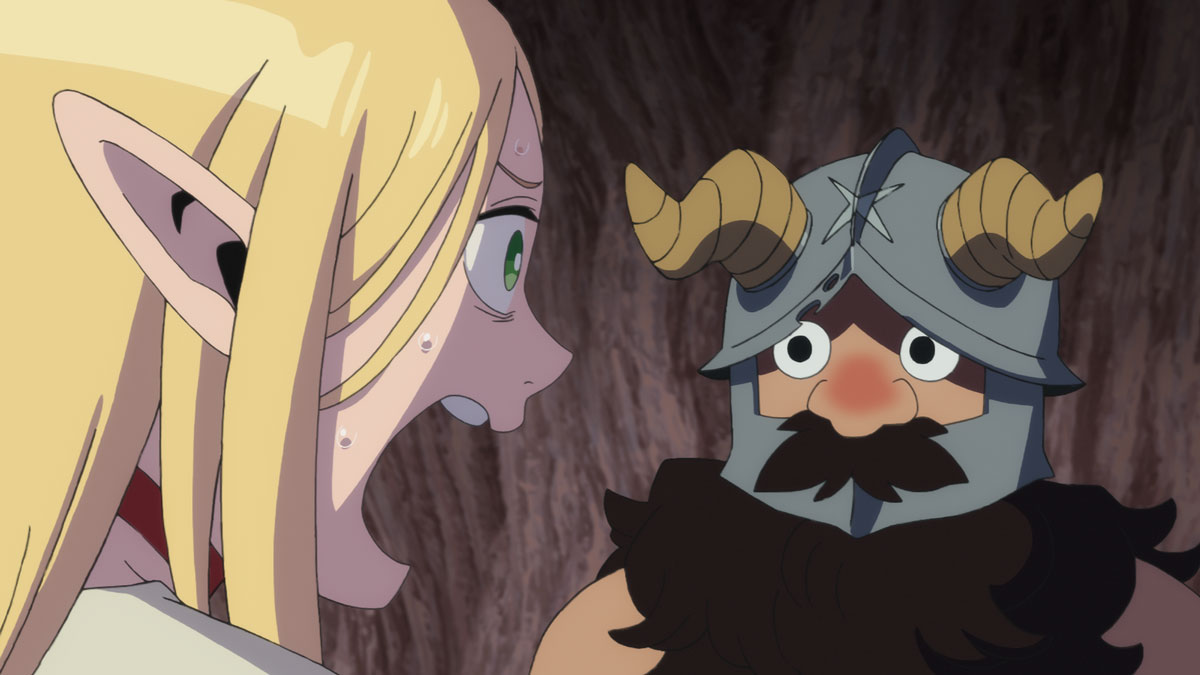
To exist the body needs to take in corpses, things torn up by the roots, ripped out of their natural environment . . . This is the tragedy of eating. Eating always implies sacrificing something, eating must always have a victim, and there is always something or someone who has to die when others eat.

–Danish Author Christian Coff

We think very little about where our food comes from. We often don’t want to think of the barbarism of the act, which is why slaughterhouses and factory farms are often located out in the middle of nowhere. Out of sight, out of mind. We may be vaguely aware of modern animal husbandry practices, some of us may have even read "Omnivore's Dilemma" author Michael Pollan’s seminal 2002 essay "Power Steer," but what do we really know about the animals that end up on our plate? The truth is we don’t want to know. Our heroes in "Delicious in Dungeon" have no such luxury of distance to shield themselves as the immediacy of the next meal requires them to be involved in the entirety of the food process. By centering food in this way, the series opens up discourse on how, in fact, our lives revolve around food, and challenges some of our thinking on food consumption.

It’s a delicate balance, between the aesthetic and the ethical. The sensation of taste and the pleasure food brings versus the maintaining of a sense of rightness in how we pursue these pleasures. "Delicious in Dungeon" makes attempts to examine this balance through the viewpoints of the main party members. Senshi, a Dwarf and the party’s cook, advocates for a kind of utilitarian conservation. Respecting the balance of nature and taking only what one needs. His concern lies with maintaining the ecosystem of the dungeon. Senshi doesn’t kill for the thrill of the hunt or take more than the party needs to survive. But he does concede that something needs to be sacrificed so the party can eat. Which is why he believes that one must enjoy the meals made from the monsters in the dungeon. To turn one’s nose up at a dish would be disrespectful to the animal that was sacrificed. 

Delicious in DungeonDelicious in Dungeon (Netflix)Marcille, the party’s Elven mage, often finds herself eating foods she wishes she didn’t have to consume. Seeing how the sausage is made causes Marcille to reject food. Carolyn Korsmeyer, in her 2012 essay "Ethical Gourmandism," asks the question, “Is the very taste of the food we eat imbued not only with flavor but also with moral valence?” Do our feelings towards how something tastes change if we are made aware of what went into the preparation of the food in question? To avoid this moral valence affecting her enjoyment of a meal, Marcille is often left out of discussions on what will be on the menu in a given episode.
It’s a delicate balance, between the aesthetic and the ethical.

Such is the case with the merfolk that Laios wants to eat. The compromise reached between Chilchuck and Laios is that Laios can use the merfolk’s seaweed hair in a dish, but he also sneaks in some of the merfolk’s eggs, which in the lore of "Delicious in Dungeon" are kept in the hair to protect them from predators. When Marcille notices little pops of flavor, Senshi muses that they must be fish eggs, to which Marcille responds, “They’re delicious!” 

This gets at one of Korsmeyer’s points on the nature of taste sensation: “If one finds a food delicious, then one tacitly recognizes it as good to eat — that is, as nontransgressively edible, in a permissible food category.” Marcille’s reticence towards eating monsters is overridden by her lack of knowledge (or willful ignorance) of a food item’s origin and by the taste being delicious. We do this in the real world too – turning a blind eye to a food’s production when it tastes good. We’re quick to put something into the nontransgressive category simply because we like it. Foie gras anyone?

* * *

Bones and AllTaylor Russell as Maren and Mark Rylance as Sully in "Bones and All" (Yannis Drakoulidis / Metro Goldwyn Mayer Pictures)But what about foods that are transgressively edible? Foods that are taboo. In Luca Guadagnino’s 2022 horror romance film about star-crossed cannibals “Bones and All,” teenage cannibal Maren (played by Taylor Russell) walks in on Sully (Mark Rylance), a fellow cannibal she only just met, chomping on a recently deceased older woman. He looks up at Maren as blood and flesh drip off his face in a scene that is immediately revolting. So much so that audience members left screenings of the film, if Reddit threads are to be believed. It conjures up such a reaction from the viewer because of its transgressive nature.

Human flesh might be the only true universal taboo, but there are a number of foods that for religious or cultural reasons are off limits. To consume them would be to consume something that is transgressively edible, deliberately in opposition to societal norms. In Hinduism, the cow symbolizes a life of nonviolent generosity and has been venerated for millennia as an "unslayable" animal. The pig is considered haram (forbidden) in Muslim cultures. But there are also taboos not based in faith, where a food consumed in one place is frowned upon in another. For example horse meat is consumed in a number of countries in Europe and Asia, but the UK, United States, Canada, Greece and others consider it taboo. Often it is the relationship to a certain animal that can make the consumption of that animal’s flesh a transgressive act. In the world of "Delicious in Dungeon," transgression occurs when someone is willing to take a bite out of a demi-human.  

We need your help to stay independent

It’s here that we get into the way culture and norms shape what foods we see as taboo. From Chilchuck’s perspective, a demi-human has too much in common with a human to be eaten. He notes that the merfolk Laios wants to eat holds a trident as a weapon, making the conclusion that merfolk are smart enough to use tools. He also sees human-like features in the shape of the merfolk’s hands. Laios quickly retorts that humans actually have more DNA in common with the cows and pigs they eat every day and that merfolk are nothing like humans at all.

Erin McKenna, in her essay “Eating Apes, Eating Cows,” examines how different cultural narratives inform eating decisions and what we consider to be off limits. For Americans, the idea of eating a chimpanzee would be an unthinkable taboo. We are “fascinated with accounts of the intelligence and emotional lives of animal beings such as chimpanzees, gorillas, and orangutans, but there is still a general disbelief when it comes to accounts of intelligence and emotions of animal beings we generally consider livestock.” We suppress any feelings or beliefs that contradict this, by denying that cows and pigs have intelligence and are emotional beings, in order to justify eating them because we think they’re tasty. Despite the thousands of years of cattle domesticity and that connection through history, our relationship to cows is now one of complete dominance, we force dairy cows to produce ten times their natural amount of milk they would produce when raising a calf, which means that a dairy cow now only lives an average of six years, compared to a normal lifespan of 15-20 years. These animals live sad lives for our sake.

Delicious in DungeonDelicious in Dungeon (Netflix)If the moral argument being made by Chilchuck is that merfolk and demi-humans are like humans, have intelligence and have emotions, then it should be extended to all animals. His moral stance is valiant, but perhaps doesn’t go far enough. He sees the tools and the human-like features of the merfolk and concludes this showing of intelligence is why eating a demi-human would be wrong, but McKenna says that thinking like this “reinforces the metaphysical framework that puts humans on top and outside of nature.” We anoint ourselves the arbiters of what is and what is not intelligence. We insist that pigs are stupid and therefore we should eat them, when study after study has shown that pigs are, in fact, intelligent and emotional creatures. Which is why Laios is right by countering that cows and pigs have more in common with humans than the merfolk Chilchuck wants to spare, but for Laios this extending of his intelligence judgment just makes every animal and monster fair game to become a meal. But . . . is he wrong to think that?
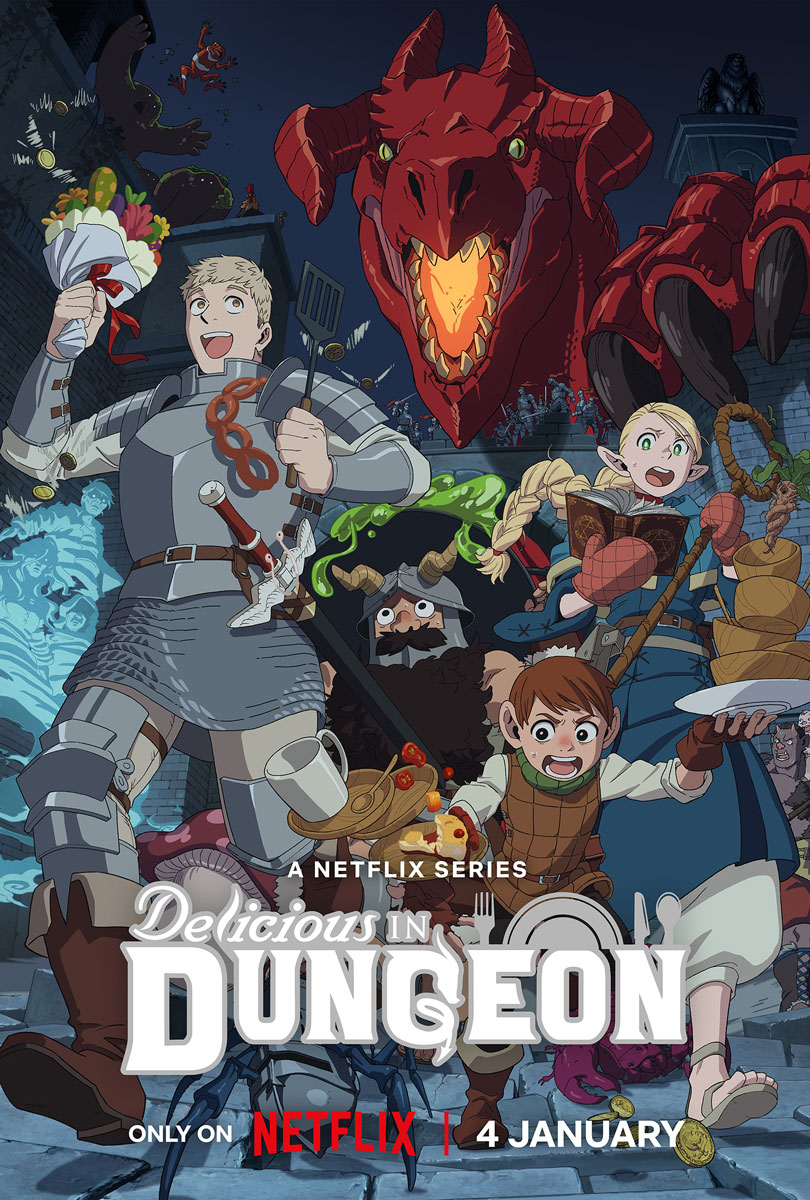
Laios’ approach to life in the dungeon is to eat everything he comes across. He is fanatical about monsters; their physiology, their behaviors and, perhaps most importantly to him, their taste. He is compelled by his consumption, which gives him an almost inhuman aura, yet what appears to be a complete lack of any ethics might be a philosophy in itself. Back to Christian Coff again, who states, “Living beings, including the human being, must eat to stay alive: what is eaten is the world. The need for nourishment forces organisms to open up to the outside world and to develop senses orientated towards the outer world.” Hunger makes one reach out into the world and gain understanding through this opening up to it. We often say that someone is “hungry for knowledge” and here we have Laios who seems to be taking the idiom literally and expanding his world through the act of eating. 

Delicious in DungeonDelicious in Dungeon (Netflix)It may even be that Laios’ approach is one of indiscriminate love. Rebecca Wragg Sykes in her book “Kindred” posits that even an extreme act like cannibalism can be done out of love. Citing neanderthal practices of eating deceased relatives, sucking the marrow out of jaw bones, Sykes makes a case that cannibalism could have been an act of mourning. Eating those who have passed, human or otherwise, so one will not forget them. In Christianity, the faithful drink the blood and eat the body of Christ to receive forgiveness for sins. The Greek philosopher Ovid mused, “The consumption of meat was even seen as a killing of relatives; since everything comes from the earth and returns to earth again we will inevitably eat one other.There are so many ways to frame eating as love, as faith, as part of something greater than one’s self.


Want a daily wrap-up of all the news and commentary Salon has to offer? Subscribe to our morning newsletter, Crash Course.


And if we reframe Laios’ hard-headed approach to eating anything and everything as wholly indiscriminate in this manner, tying it into the idea that we are all, equally, part of a circle of life, that we eat or are eaten, his philosophy is perhaps most in tune with the dungeon that sits at the center of "Delicious in Dungeon." He respects all living creatures equally, but with that, his moral stance is that they are all food, only because they would also make food of him should they be given the chance. The dungeon is the alpha and the omega, it is life and death, for every creature to be found there. After all, it's his sister who was swallowed (but not yet digested!) by a red dragon that has prompted Laios' ongoing quest to save her before it's too late. Is it wrong if he enjoys a few meals along the way?

"Delicious in Dungeon" is an anime about food. It is an anime about food and all that food represents as part of human culture. We will all, one day, become food in some form. Buried in the ground, returned to the soil from which grass will grow and be grazed upon by animals that will end up on a dinner plate somewhere. Eat or be eaten, there is no escaping it. 

"Delicious in Dungeon" is streaming on Netflix.


Columbia crisis: Another massive failure of liberalism

Americans of all stripes across the political spectrum have been understandably transfixed by the wave of student protests against the Gaza war that has spread from elite Ivy League campuses to numerous other schools, some more surprising than others. Police have been called in to break up student encampments not just at Columbia University’s iconic Manhattan campus, which was both ground zero and a natural media target, but at USC in Los Angeles (once upon a time a famously white-bread conservative school), Emory University in Atlanta, the University of Texas at Austin, Ohio State, Indiana University and Cal Poly Humboldt in rural Northern California, among other places.

I intend to work my way back around to the instructive case of Columbia president Minouche Shafik, who apparently believed she could galaxy-brain her way around the protest crisis — and avoid the fate of ousted Harvard president Claudine Gay, among others — by capitulating in advance to the House Republicans’ witch-trial caucus, taking a hard line against alleged or actual antisemitism, and finally calling the cops on her own students. Spoiler alert: None of that was a good idea, and she probably didn’t save her job anyway.

First of all, it’s more accurate to say that the media-consuming public is riveted by the contentious political drama surrounding those scenes of campus discord than by the protests themselves, which are a striking sign of the times but hardly a brand new phenomenon. My own college graduation, in the mid-1980s, was disrupted by a student walkout over the university’s involvement in nuclear weapons research and its non-divestment from the apartheid regime in South Africa. Strident moral positions and overheated rhetoric are features of student activism, which is sometimes effective and at other times purely symbolic; every generation, it’s fair to say, inherits or creates its own iteration.

It’s also worth noting that America’s extraordinary narcissism — another quality shared across the political spectrum — creates a global distortion effect whereby the deaths of at least 34,000 people in a conflict on the other side of the world are transformed into a domestic political and cultural crisis. Nobody actually dies in this domestic crisis, but everyone feels injured: Public discourse is boiled down to idiotic clichés and identity politics is reduced to its dumbest possible self-caricature. When the apparent issues are about who has said the most hateful things, who feels more “unsafe” and in what context, and which political party can get away with twisting events to suit its preferred narrative, then we’re stuck in the TikTok reboot of Plato’s cave, staring at flickering shadows long since severed from reality. 

None of that is the student protesters’ fault, exactly, although they have played an instrumental role in reprocessing the Gaza war — launched, of course, in response to the horrifying Hamas attack on Israel last October — as a theatrical spectacle or “simulation,” full of signs and symbols whose meanings are subject to endless debate. Most of them are expressing genuine (if histrionic) outrage that the U.S. government, self-appointed avatar of democracy and defender of the “rules-based order,” is funding and supporting Israel’s campaign of mass killing, wanton destruction and systematic deprivation against a virtually imprisoned civilian population. 

Exactly how much this student movement has been contaminated by intemperate, hotheaded or outright antisemitic rhetoric is, shall we say, a question of interpretation — but not one that can be credibly answered by Bibi Netanyahu, Elise Stefanik or Mike Johnson. As for those who seek to what-about the current wave of protests by observing that worse things have happened in recent history without driving the students of Emerson College to risk mass arrest in the Boston streets, they are correct while deliberately missing the point. 

Whatever world-historical culpability the U.S. may have had for the genocidal conflicts in Darfur or Rwanda or the former Yugoslavia, for Russia’s massively destructive war in Chechnya or China’s brutal oppression of the Uyghurs or whatever atrocity you’d like to name, those events were not the direct results of U.S. policy and did not carry the White House seal of approval. The Gaza war is, and does. 

As New York Times columnist Nicholas Kristof, a longtime friend and admirer of Joe Biden, wrote last week, “Gaza has become the albatross around Biden’s neck. It is his war, not just Benjamin Netanyahu’s. It will be part of his legacy, an element of his obituary, a blot on his campaign,” in much the same way as the Vietnam War permanently stained the presidency of Lyndon Johnson, who was undermined by the massive antiwar demonstrations of 1968 — including the student rebellion at Columbia, exactly 56 years ago this week, as it happens. 

America’s extraordinary narcissism creates a global distortion effect whereby the massacre of at least 34,000 people in a conflict on the other side of the world is transformed into a domestic political and cultural crisis.

Biden made a series of catastrophic miscalculations in the wake of the Hamas attack of Oct. 7, Kristof argues, and the net effect has been to make the U.S. look weak, hypocritical and profoundly cynical. Longtime British politician and diplomat Chris Patten, a pillar of center-right establishment thinking, told Kristof that Biden had made “a terrible, terrible error” that fed into “Chinese and Russian narratives that the West employs double standards and doesn’t really care about principles.”

I would describe Biden’s predicament as a symptom of the moral and political failures of liberalism, as well as the peculiar status of the United States, a still-dominant global superpower now in irreversible decline. The president did not or could not grasp how rapidly and decisively world opinion would turn against Israel and the U.S., or how little the world trusts American foreign policy after the last six decades or so of misbegotten wars and disastrous blunders. 

Furthermore, and this one is amazing too: Neither Biden nor anyone in his inner circle seemed aware that core Democratic constituencies — Black voters, younger people, progressives — already sympathized with the Palestinian cause and viewed the current Israeli government as a criminal rogue state (or worse). Or perhaps they didn't care: Mainstream Democrats tend to dismiss the significance of the youth vote, assume that Black voters will stick with them no matter what, and are eager to purge or bulldoze the activist left on any available pretext.

But those failures, all damaging enough on their own terms, were amplified and undergirded by Biden’s inexplicable faith that Bibi Netanyahu would somehow turn out to be a responsible leader and partner in a time of crisis, rather than a power-mad racist zealot with years of experience at manipulating American presidents. This miscalculation may seem mystifying when you consider Biden’s long years of public service and his vaunted expertise in foreign policy; Kristof certainly finds it so.

It makes more sense if we understand liberalism, of the 21st-century Biden variety, as faith in the power of human reason, and specifically in its power to bridge differences between competing interests and establish common ground for civil discourse and political compromise. If we lived in a world of rational, self-interested beings willing to acknowledge the perspectives of others — a world of liberals, in other words — that might work out. But we don’t, and in the real world Biden’s miscalculation regarding Netanyahu was a potentially fatal mistake — fatal for Biden’s presidency, fatal for Israel, fatal for the future of the Middle East.

That brings us back at last to Dr. Renat Shafik, who prefers the nickname Minouche, and whose full title in the British House of Lords is the Right Honorable Baroness Shafik DBE. She arrived at Columbia last July, with no experience in American academic life, touted as a champion of diversity and inclusion. (By birth and parentage, she is both Arab and Muslim.) Less than a year later, she summoned the NYPD to the Morningside Heights campus for the first time since the legendary student takeover of 1968. If Joe Biden represents the tragedy of liberalism in its pathetic form — no reasonable person can doubt his good intentions — Shafik represents something darker, and almost farcical. 


Want a daily wrap-up of all the news and commentary Salon has to offer? Subscribe to our morning newsletter, Crash Course.


If you wanted to choose one individual as the face of “neoliberalism” for an encyclopedia entry, you could do a lot worse. Shafik holds an economics PhD from Oxford and a résumé of high-ranking positions at the World Bank, the International Monetary Fund and the Bank of England, three institutions that have been instrumental in driving developing nations into unsustainable debt in pursuit of a disastrously failed model of progress. She came to Columbia after six years of pushing fiscal austerity as director of the London School of Economics, where just last spring she helped defeat a student/faculty strike, reportedly by slashing salary payments and lowering graduation requirements to hustle student protesters out the door.

If you wanted to choose one individual as the face of “neoliberalism” for an encyclopedia entry, you could do a lot worse than Minouche Shafik.

After the Gaza protests erupted at Columbia, Shafik evidently surrounded herself with high-priced lawyers and consultants drawn from the orbit of Bill and Hillary Clinton, who persuaded her that she could save her job by abasing herself before the Republican witch-hunters in Congress and giving them everything they wanted, up to and including confidential university documents they had no right to see. 

This spectacular abdication of any pretense of academic integrity made her look like a liberal of the most craven and spineless kind, the kind who would rather surrender to a police state than stand up for the frequently uncomfortable principles of free speech. To the surprise of absolutely no one, or at least no one outside Shafik’s neoliberal policy bubble, that did nothing to placate Stefanik and Johnson and the rest of the House Republicans, who did not want to be placated and had no interest in reasonable dialogue. 

They wanted to watch Shafik squirm and grovel and then they wanted her head on a spike, while amplifying a largely invented crisis that delights their base and divides core liberal constituencies against each other. They have already achieved two of those three goals, and after alienating nearly everyone on the Columbia campus through her appalling cowardice, Shafik is surely numbering the days. 

Given her record, no one could have expected her to behave differently than she did. The real question is what we might learn from Shafik’s failure, and from the larger set of cultural and political failures it represents. After this disastrous week, one might be tempted to conclude that the slow, agonizing decline of American higher education has finally reached its nadir, and that American liberals will finally be forced to recognize that reason is useless against the enemies of reason. I’m not holding my breath.

Protecting the darkness in Chile’s Atacama desert

Growing up in Chile’s Atacama Desert, Paulina Villalobos thought the Milky Way’s presence in the pristine starry skies was a given. Her father, an amateur astronomer, would wake her when a comet crossed the night sky. But Villalobos later moved to Santiago, the capital, to study architecture. There, the stars disappeared amid a haze of city lights. Just like people who come from the coast miss the ocean, she said, “I missed the sky.”

The extraordinary darkness that sheaths the Atacama, which stretches for hundreds of miles in Chile’s north, has made it a haven for astronomers searching for planets and stars shimmering in the night sky. With its high altitude and clear skies, the region is repeatedly chosen as a site for observatories. According to some estimates, by 2030, Chile will be home to around 70 percent of the world’s astronomical infrastructure.

Yet even here, skyglow from hundreds of miles away can overwhelm the faint light emanating from astronomical objects.

Now, a new regulation aims to darken the night skies.

In October, the Chilean government announced a new National Lighting Standard that will become effective later this year. The updated standards expand restrictions on light luminosity, color, and the hours they can be turned on to protect three major concerns: astronomy, biodiversity, and human health.

According to some estimates, by 2030, Chile will be home to around 70 percent of the world’s astronomical infrastructure.

For astronomers, the stakes can feel high. While the Atacama offers a window to answer fundamental questions about the origin of life, that window is at risk of closing in the next 50 years due to increasing light pollution, said Chilean astronomer Guillermo Blanc. Worldwide, the sky is estimated to get brighter by 10 percent on average each year.

The new rule on light pollution in Chile was informed, in part, by a technical advisory committee, which included astronomers and other scientists — Villalobos, who is now an architect and lighting designer, among them. The new regulation, she said, offers “the possibility of recovering the sky."


Since the 1960s, the Atacama Desert has been an important hub for international astronomy. Today, the region, which boasts more than 300 clear nights per year, hosts some of the world’s most significant observatories, including the internationally funded Atacama Large Millimeter/submillimeter Array and the European Southern Observatory, the latter of which is currently developing the Extremely Large Telescope, set to open in 2028.

NOIRLab, a United States government-funded program, also operates two facilities in the Atacama. The National Science Foundation has invested more than $500 million to build a third facility, the Vera C. Rubin Observatory, which is expected to see first light later in 2025. Yet it too is threatened by light pollution, said Blanc, who works at the Las Campanas Observatory.

The Vera C. Rubin Observatory aims to conduct a 10-year survey of the Southern Hemisphere sky to understand dark matter and energy, take an inventory of the solar system, and map the Milky Way. But in recent years, mining operations and urban development in the area have increased ambient brightness.

These telescopes are being built to operate for 50 or even 100 years, but “the outlook today is very worrisome in 20, 30, 40 years,” Blanc said.

Those problems are global; worldwide, two-thirds of major professional observatories are affected by levels of light pollution that exceed the expected natural levels, according to a 2023 review. While many observations now take place from telescopes orbiting Earth, ground-based telescopes are still essential to interpret observations from those space-based telescopes. And if the sky’s natural brightness increases, it’s harder to observe faint objects, such as distant galaxies forming on the far edge of the universe or gas orbiting around black holes.

Some observations will require more time — and greater investment: “If you have to spend two nights instead of one night to observe a faint thing because the sky is now artificially brighter, that costs money,” said James Lowenthal, a professor of astronomy at Smith College who also leads the Light Pollution subcommittee for the American Astronomical Society. “We're talking literally billions of dollars at stake — at least tens of millions of dollars.”

“The outlook today is very worrisome in 20, 30, 40 years.”

Others might become impossible without better technology: “We are directly cutting the possibility of seeing certain phenomena,” said Rodolfo Angeloni, an assistant scientist at NOIRLab’s Gemini Observatory Southern Operations Center who studies stellar astrophysics and the effects of light pollution on the Chilean sky. “If a sky reaches a certain threshold of brightness, the telescopes installed in the area are simply no longer able to do frontier research.”

He cited the Mount Wilson Observatory in California, where the Milky Way galaxy was first measured, as an example. The extraordinary growth of Los Angeles brought significant levels of light pollution. Today, observatories in California have to work with a brightness in the sky that was previously nonexistent.

Chile, however, has other plans.


Chile’s new regulation on light pollution builds upon a previous rule that only protected certain key astronomical sites. The new regulation, in contrast, will apply nationwide. Its aim is not to blackout La Serena or Santiago, some of Chile’s major cities, but to use specific lighting to reduce negative effects.

In 2019, when the Ministry of the Environment began revising the regulation, Chile took a step towards addressing the problem by incorporating light as a legal pollutant. Over 83 percent of the world’s population lives under light-saturated skies, but light is not normally seen — and legislated — as pollution. Many advocates say that it should be.

The sky “is as polluted as, for example, a river that is full of garbage. It's as polluted as living next to a factory,” said Felipe Loaiza Arias, who works for Chile’s Ministry of the Environment and helped craft the legislation.

The 2023 regulation also recognized that astronomy is not all that’s at risk. Two other focuses were incorporated: biodiversity and human health. Reduced artificial light could aid migrating seabirds, like Markham’s storm-petrel that nests in the Atacama Desert; thousands die each year because of city lights, putting them at risk of extinction. And light pollution also interferes with the circadian rhythm of humans and other species.

The restrictions apply to all outdoor lighting, from the small-scale, such as streetlights, to the large, like mining facilities. Lamps cannot be directed towards the upper hemisphere, and the law regulates their luminosity and color spectrum. Lighting can emit no more than 7 percent of blue light, and in Special Protection Areas, which include astronomical sites and protected areas for biodiversity, it’s limited to just 1 percent.

But there is a major constraint that Blanc and Angeloni agreed on: oversight. Does Chile have the resources to oversee correct lighting all over the country? Loaiza Arias recognized it as a challenge. These types of regulations are massive and ambitious in terms of the sources of light they regulate, Loaiza Arias explained. And because the regulation has limited application when it comes to lights that are already installed, the measures, he said, are more so preventive.

For some people, like Villalobos, more work could be done. Although the regulation is positive, she said, it only oversees individual lights and overlooks the collective light pollution from a facility. If people were aware of light pollution, she says, the issue might be easier to tackle.

Often, urban dwellers are not aware of how over-illuminated their cities are. The use of lighting that is brighter than needed, or turned on at unessential times, has caused a widespread global fog of light. According to one 2016 study, an estimated one-third of the world population cannot see the Milky Way, including 60 percent of Europeans and nearly 80 percent of North Americans.


Although Chile’s new lighting standard is one of the first of its kind in South America, and perhaps even the world, Loaiza Arias believes it is not immediately replicable: Chile recognizes how important astronomy is, both for science and the country’s economy, he said, but another country might have different priorities.

“Chile is showing us the way to how to do this in a sort of holistic fashion,” said Richard Green, an astronomer at the University of Arizona, who has studied dark skies for over 30 years and used to travel to the Atacama as part of his work at the U.S. National Observatory.

Lowenthal, the Smith College astronomer, wonders how other countries could replicate the regulation. Lowenthal believes that the night sky should also be protected, like air and water that are federally regulated under the Clean Air Act and Clean Water Act, respectively. For him, the question is: What will it take for the night sky to be recognized as an essential part of the environment?

“Chile is showing us the way to how to do this in a sort of holistic fashion."

Beyond the consequences for astronomy, the night sky is a heritage and a connection to our human past, Lowenthal added: From Chile to the American Southwest, to Indonesia and Hawai’i, people have deeply understood the sky. Addressing light pollution, he said, is about maintaining that connection.

Villalobos eventually returned to the Atacama and Chile after years abroad studying light. She now sits on the International Committee of DarkSky International, a nonprofit that aims to protect and conserve the night sky. The Atacama Desert, to her, is more than just home to some of the world’s biggest observatories; here, people can experience the awe of the night sky once more.

In the Atacama, Villalobos said, “there’s nothing between you and the universe.”


Note: Numerous interviews for this story were conducted originally in Spanish, and subsequently translated to English.

Alexa Robles-Gil is a Mexican science journalist based in New York City. She’s a contributing writer for the Chilean magazine Endémico.

This article was originally published on Undark. Read the original article.

The self-preservation of the media

The American news media, as an institution, has mostly failed to rise to the challenge of the Age of Trump – even after more than 8 years of experience. But, there are some bold and brave voices who stand out for their truth-telling and role-modeling of pro-democracy journalism and how their peers in the media should be responding to the crisis.

For example, in an excellent critical review and essay at The Philadelphia Inquirer about Alex Garland's new film “Civil War,” Will Bunch highlights how its main characters are emblematic of the failures of the American news media:

The zeitgeist underlying Civil War reminded me of how the five leading TV news networks recently put aside their competitive rivalries to write a rare open letter that revealed the one thing newsroom leaders care passionately about: begging Trump and President Joe Biden to stage televised debates in the fall. That’s because even with Garland’s vision of dystopia too close for comfort, TV bosses still only care about ratings and a showcase for “both sides,” even when one side is a lying, three-term-president-in-waiting. Like Civil War’s Joel, they just want to get that quote, nothing more.

While the major news outlets continue to obsess on “both-sidesing” a five-alarm fire for the American Experiment, aided by reporters seeking to find “the fun” in politics even when our politics feel like 1861, there are some folks who do get it.

In a much-discussed new essay in his newsletter, Chris Quinn, Editor of the Cleveland Plain Dealer, declared his unapologetic and unqualified commitment to pro-democracy journalism and the truth, an approach that does not engage in false equivalency or fake balance between Donald Trump and President Joe Biden. In a subsequent interview with Dan Froomkin at his site Press Watch, Quinn elaborated on why he is not afraid to make the historically accurate comparison between the MAGA movement and the rise of Nazism and the Third Reich:

But you know, I spent most of my life wondering how a country could go down the path Germany went down. It just seemed unfathomable growing up when I did that a country could do that. And then came Donald Trump. And you realize: “Wow! That’s exactly how it happens.”

You demonize the media. You create these phony divisions. You dehumanize groups of people. With Donald Trump it’s not Jewish people, it’s immigrants. He’s basically treating them like they’re nonhuman. We’re following the exact path. And I think a lot of people see that but they’re afraid to say it because they don’t want to be vilified for using the suffering of millions of people to push a cause.

But the reaction I got to that was a whole lot of people that said: “I’m so grateful you’re doing this. I’ve long studied what happened in Germany. That’s exactly what’s happening now.” We are on the edge. If he gets elected, he’s not even being secretive about what he wants to do. I don’t think we can draw those parallels enough, because I think right now in America we are on that edge. And a whole lot of people seem to agree.

Quinn offered these insights into why his fellow editors and other senior decision-makers all too often default to obsolete norms of “bothsideism” and so-called balance when covering Trump’s dangerous and aberrant behavior – behavior that is without equal in American history: “I think they’re afraid of that pushback. I think that the same reason that you’ll see a half dozen stories about Joe Biden’s mental state in the Washington Post and New York Times is it bleeds in, and they’re not setting their own agenda. I wish they would."

His advice for other editors: “I think the false equivalence has got to go, because that’s not what this is anymore.”

I have been publicly chronicling the Age of Trump on an almost daily basis since 2015. I was also one of the first public voices to warn about Trump’s likely victory in 2016. For months, I also tried to desperately warn the American public about the increasing likelihood that Trump would attempt a coup instead of leaving office after his defeat in the 2020 election. I too have some hard-earned insights and suggestions about the American mainstream news media in the Age of Trump – and beyond —  that I have been meditating on for some time.

We must use accurate and direct language to describe the democracy crisis, its historical antecedents and origins, global connections, and what may happen next based on the evidence. To fail to do so is to aid and abet right-wing authoritarianism and other enemies of real “we the people” democracy.

The American news media needs to dedicate itself to pro-democracy journalism not out of idealism but out of self-interest and self-preservation.

We should not assume that “everyone knows” that Donald Trump, the MAGA movement, and other right-wing malign actors are an existential threat to American democracy, freedom, and society. Most Americans are disengaged, uninterested, ignorant, largely uninvolved, with and unsophisticated in their knowledge of politics and current events. Thus the demand to repeatedly, with examples and explanations, show and demonstrate what Trump and his forces believe and plan to do if they take power. 

The Fourth Estate are supposed to be the guardians of democracy. This responsibility is even greater in the Age of Trump. Reporters, journalists, and others with a public platform must proceed from a position of moral clarity, a commitment to the truth, and not be afraid to take a stand on questions of right and wrong. We should seek out real experts and quote them, interview them in long-form, and more generally provide them with a platform. 

Don’t forget the basics and common sense and what should be standing order number one for reporters and journalists: “If someone says it's raining and another person says it's dry, it's not your job to quote them both. Your job is to look out of the window and find out which is true." To reiterate what New York University journalism professor Jay Rosen has so wisely commanded, it is the stakes not the horserace. We must consistently tell the public why this all matters.

Courage is not the absence of fear. Courage is the ability to follow through, persist, and succeed in the face of fear. The Age of Trump and what it has wrought and unleashed upon the country and world are very frightening, if not terrifying.

Donald Trump and the other American neofascists have repeatedly called reporters, journalists, and the news media as a whole (if they are not sufficiently compliant and quislings) “enemies of the people” (Hitler and the Nazis used the slur “lugenpresse”). The American news media needs to dedicate itself to pro-democracy journalism not out of idealism but out of self-interest and self-preservation.

Journalist Masha Gessen wisely told us to “Believe the autocrat.The best predictors of autocrats’ and aspiring autocrats’ behavior are their own public statements because these statements brought them to power in the first place.” America’s mainstream news media needs to stop seeking alternate explanations for Trump’s words and those of his propagandists, allies, and followers. There is little there to be translated. The ugliness is raw, plain and in its own foul way, refreshingly honest.  

Donald Trump and Kari Lake are hypocrites on abortion: Will evangelicals even notice?

I have a hard time with small talk, dinner-party phoniness and the whole idea of sucking up to a boss or someone in a superior professional position. The idea of learning how to "network up," which I once taught students in a high school career course I designed, makes me want to vomit. I know it's good advice, because I've seen it work throughout my entire career by people willing to do it. But I cannot do it personally.  

I have certainly heard the cliché about how we're supposed to treat the janitor with the same respect as the CEO. But in practice, I have rarely seen that happen. What has hurt me professionally is that I tend to treat the blue-collar folks with great respect and upper-level professionals with disdain. Too often, I have no respect for these higher-ups because I find many of them to be incompetent suck-ups.  

"Successful" people often seem to be the type who care more about how they are seen, how much money they make, how big their house is or how much they have traveled, rather than being good people — or even good at their jobs. This way of things is part of American professional culture, which I believe is a big part of why so many people in this country feel spiritually empty. Selling your soul for a promotion, a larger home or job protection can never fill that void. 

This leads me to Donald Trump, Kari Lake and the other so-called Christians who pretended to care about abortion. As I just suggested, there's an important difference between people who are obsessed with how they are perceived and people who are living examples of the beliefs they espouse. Trump and Lake are good examples of the former. Former Vice President Mike Pence, although I believe him to be foolish and wrong-headed, is the latter.  

You see, Pence truly believes that abortion is murder at any stage, that being gay sends you to hell and should be cured and that a liberal pastor like myself is almost certainly controlled by the devil. All of that is real for Pence, which is why he finds a way to embrace every Republican political agenda that points toward those evangelical goals. From my perspective, it's too bad that Pence has ignored the teachings and ministry of Jesus Christ while professing to follow the true form of Christianity. Still, I give him credit for believing in what he is doing. That idea is a total mystery to Donald Trump. I am just guessing here, but I get the strong feeling that Trump does not believe in anything except punishing his enemies, burnishing his greatness and increasing his wealth..  

Did Pence simply not notice when Trump called for him to be killed on Jan. 6, 2021, or any of the many other occasions when Trump proved that he was only pretending to care about the evangelical agenda? Either Pence is really that dumb or he sold his soul to win on the evangelical agenda. Neither of those is a good sign. 

This brings me back, eventually, to my main point. I can only wonder whether betraying yourself is any amount of money or more political power or greater social status. I have known far too many miserably married couples with kids and a nice house who are secretly, or not so secretly, desperate to get out. They stay in in their unhappy situation for financial security, social acceptance, status, real estate and whatever else. Clearly they have their reasons, but I find it indicative of an American society that cares more about branding oneself than expressing anything authentic.  

This is why Donald Trump has been so successful in politics. In every public display of American culture, the brand comes first. Trump is a brand far more than a human being, and I am beginning to think that far too many others are as well. Whether in human relationships, politics, the news media or the churches, everything is understood as a public-facing brand. 

So I am not the least bit surprised that Trump and Lake have changed their tune around abortion. This was always a political game for them and nothing else. You might have noticed that virtually no one in the evangelical movement, other than Pence, has shown any shock or dismay at Trump's reversal — again, none of this ever had anything to do with abortion. It was always about power, revenge and money. 

The hard truth here is that the abortion issue was driven by rage against the feminist movement. Many evangelicals were eager to blame feminism for destroying the American family — and that kind of male rage is not just found within the evangelical church.

Abortion was never a core issue for the evangelical movement until it was seen as a political winner. There was no great outcry from the evangelical churches after Roe v. Wade was decided in the early '70s. It was a full decade later or so when evangelicals came to understand how easy it was to raise money and win elections while blaming all of America's social ills on the evil feminists who want to murder their babies. It didn't matter that no honest Biblical theology backs up this position. In fact, it took almost 40 years for them to come up with some precise cherry-picking of scripture they could use to justify banning abortion.  

Their theology is as weak a faith-based argument as I have ever seen. Using their biblical logic, I could just as easily argue that we should stone to death anyone who looks at porn, feels hatred for others in their hearts or has committed a single sinful act. In fact, it would be easier to make those arguments from the Bible than to argue that abortion is murder.  

The hard truth here is that the abortion issue was driven by rage against the feminist movement. Many evangelicals were eager to blame feminism for destroying the American family. To be sure, that kind of male rage is not just found within the evangelical church. It is evident throughout American society. I find it odd that under American law, violence against women is not defined as a hate crime. If it were, I think we would conclude that women are targeted for hate crimes more than any group in America. Sometimes branding is important.

In any event, we can be sure that Donald Trump never cared about abortion, women's rights, civil rights, workers' rights, the evangelical agenda or anything else with any clarity or consistency. Trump is about Trump and celebrating the Trump brand. Defeating Trump will mean resisting all the small-minded self-branding crap that seems to dominate American behavior.  


Want a daily wrap-up of all the news and commentary Salon has to offer? Subscribe to our morning newsletter, Crash Course.


The only brand I care about is the working-class poor of all races who can't pay their bills, buy a house or pay their rent, and are working two to three jobs while knowing that their kids have fewer opportunities than their parents. 

I recently started working some shifts at FedEx, doing overnight package handling. It's a nightly four-hour workout, unloading massive trailers. As hard as the work is, I love my co-workers more than any group of colleagues I've ever had. There is none of the positive-mindset manifestation crap I see on Instagram, and no arrogant claims about personal, political or religious philosophies. It is just a bunch of people working our asses off for not much lmoney and even less respect. There was a time in America when that kind of work was enough to buy a house, raise a family and send your kids to college, but that's no longer the case. Every one of my FedEx co-workers works multiple jobs and is close to the edge of losing everything, and might live long enough to see their kids have even less.  

The Christian faith should honor hard work and disadvantaged people. It should hear, love and serve the least among us. In fact, we could say that the Christian faith, the American dream and what we used to call blue-collar values need a rebranding, a revaluing and a renewed moral clarity. Perception is seen as everything in America, but perception is not reality. I respect Mike Pence, although I believe he is wrong about almost everything, because at least he believes in what he is doing.   

It is time to stand up for authenticity, for whatever it is you truly believe in. Stop worrying about your legacy and embrace your truth. We need to reclaim our faith in the American dream, and in ourselves as individuals. As a pastor, I have been by the side of people on their deathbeds. Over and over, I have heard them express regret about the times when they pretended to be something they were not, or were untrue to themselves just to get along and go along. As far as we know we are here on this earth just once, and I pray none of us will spend another minute pretending to be something we are not. Forget the brand and embrace yourself. The more Americans can be true to themselves, the more irrelevant a brand like Donald Trump will become.

“Top Chef” makes the case for cabbage

This was far and away the best episode of the current season of “Top Chef” by far. Perhaps this is just because I’m a Savannah stan or because I really, really like Danny — but it felt like the first time the show has unfurled into its former glory. Plus, a “shock boot,” especially one with arguably the two frontrunners in the bottom two, is always exciting. 

It had shades of now-host Kristen Kish’s departure back in the Seattle season, actually; might we see the pattern repeat with Rashika? But first, let’s focus on the real hero of the week: Cabbage. 

Yes, you read that currently. Danny’s winning dish, scallop chou farci-stuffed boiled cabbage with yuzu kosho foam, elicited some of the highest praise I’ve heard from Tom Collichio in 21 seasons of “Top Chef.” I also loved how Tom described the dish: “chaos under water,” comparing the initially calm aesthetic of Danny’s boiled, wrapped cabbage sitting serenely atop the calm white foam, yet containing a whole bunch of unexpected flavor once the diner dove beneath the surface. Kish was also visibly enamored by the dish, offering arguably her most outright positive feedback as a judge/host so far. 

Back in the ninth season, Sarah Gruenberg —the eventual runner-up, current chef/owner of Monteverde Restaurant and Pastificio in Chicago and author of "Listen To Your Vegetables" — also won an elimination challenge, plus rave reviews and accolades. with a fine-dining interpretation of her grandmother's stuffed cabbage rolls

Now, I get it, stuffed cabbage isn’t going to prompt yelps of excitement. For some, the cruciferous vegetable has a certain old-world appeal, buoyed by economic practicality and nostalgia. For others, it’s a bit drab (and the aroma of boiled cabbage isn’t especially appetizing either). 

But in so many instances — certainly including Sarah’s and Danny’s — there’s a type of unvarnished appeal to the durable cabbage leaf, which can be seasoned and heightened in many ways. 

As Salon’s Bibi Hutchings wrote in her recipe for Cabbage Casserole:

"Simple, ignoble, under-appreciated green cabbage: It has got to be one of the most unpretentious and humblest in all of the Cruciferae family, if not among the entire vegetable kingdom. It is nutrient-packed, like the rest of its cruciferous brethren, yet it has not always garnered the same respect as cauliflower, Brussels sprouts or even broccoli." 

We need your help to stay independent

Salon writer Maggie Hennessy is also a member of Team Cabbage, writing "I've come to cherish its versatility — grilled, roasted, sautéd or raw, recipe star or supporting actress."

Last month, Kim Severson wrote in the New York Times visited restaurants in Los Angeles, New York and Atlanta where “the coolest menu item at the moment is . . . cabbage?" 

"Cabbage has spent an eternity as the workhorse of the stir-fry and the braise, the quiet companion to endless duck legs and pulled pork sandwiches. It never complained, even when boiled with corned beef or shoved into a crock for months,” she wrote. “But today, a vegetable that can make your house smell like a 19th-century tenement is the darling of the culinary crowd." 

I actually prefer cabbage raw — preferably red — very, very thinly sliced and tossed with a pert vinaigrette and some sort of braised, crispy protein, but cooked cabbage is a staple for a good reason. I think of the Italian term “povera cucina,” which translates to “poor kitchen”; it encapsulates the cuisine many ate in Italy when experiencing poverty and food scarcity. Cabbage has a sturdy, timeless nature that has made it a staple of such cooking, while also letting it recently become something of an anti-hero. And hey, let’s celebrate that.

It’s about time we embrace cabbage. Perhaps all of the restaurants selling cabbage dishes like hot cakes or Danny’s special dish on this week’s “Top Chef” episode might be the harbinger of a new era for the cruciferous standby.

The verdict is clear: Cabbage is a winner.

Top Chef takeaways, Episode 6

  • I've been waiting for the Savannah breakout episode — and it's now arrived! Also interesting that as she rises, the frontrunners stumble. However, I'd argue that Danny is the actual frontrunner at this point (if you think about it, one of Rasika's wins was actually also his, too.)
  • The more I think about it, I’m sort of amazed that Michelle stayed? Nothing about that dish seemed appetizing or appealing, it was somewhat amateurish, the pork was raw, the pita was burnt, it wasn’t chaotic at all — and she would’ve been another "Quick Fire" winner who went home in the same episode, directly after Charly last week. 
  • As mentioned earlier, I wouldn't be surprised if Rasika straight-up runs the "Last Chance Kitchen" gauntlet and has a Kish-like trajectory circa season 10 — and potential win? Wouldn't that be a fun, full-circle moment. 
  • Interesting to see mustard-spiked dessert rearing its head yet again, this time from Savannah.
  • Always love seeing Christina Tosi!
  • I hate the term “QuickFire cash” – it sounds like something from Nickelodeon or maybe a Food Network show in 2010, not the preeminent fine dining cooking competition on Bravo.

Correspondents’ dinner: Jost to joke across political spectrum, while Biden to stump against Trump

The 2024 White House correspondents’ dinner is Saturday night, with "Saturday Night Live" cast member Colin Jost at the helm of the star-studded D.C. event. The annual dinner, which celebrates the journalists who cover the presidential administration, has featured speeches from every president for the past hundred years, with the exception of Donald Trump.

President Biden is set to speak in front of a roster of guests including Oscar winner Da'Vine Joy Randolph, Scarlett Johansson, Treasury Sec. Janet Yellen, Caitlyn Jenner, along with many more.

Biden’s sense of humor has taken a leading role in the campaign in recent weeks, with viral quips on Truth Social’s financial woes and his predecessor’s infamous “inject bleach” gaffe. On his opponent’s criminal fraud trial, Biden was in good spirits.

“I haven’t had a chance to watch the court proceedings because I’ve been campaigning,” Biden said at a New York campaign event, per pool reports.

Jost is expected to deliver a comedic lashing of figures on both sides of the aisle, something he is used to given his decade of experience doing "Weekend Update."

“Colin Jost knows how to make Saturday nights funny,” Kelly O’Donnell, president of the White House Correspondents’ Association, said of the headliner in a statement. “His smart brand of comedy and keen observation will turn up the heat on the national news media and across the political spectrum," O'Donnell said.

The "SNL" writer and anchor was celebrated at a kick-off “Toast to Colin Jost” event on Friday night, where he brushed arms with second gentleman Doug Emhoff, White House press secretary Karine Jean-Pierre, and a host of national media figures.

Pro-Palestinian demonstrators reportedly plan to stage a “shut down” of the event, per NBC News, while a coalition of Palestinian journalists have urged for a boycott of the dinner due to what they call “the Biden administration’s ongoing complicity” in Israeli attacks on Gaza. Medhi Hasan, whose show on MSNBC ended last year, tweeted in support of the boycott.

You can tune in to the Correspondents’ dinner at 8 p.m. EST on C-SPAN or their YouTube channel.

“The People’s Joker” is the not-so-serious trans coming-of-age film we’ve been missing

The entry point to superhero and anti-hero movies and TV shows is straight and narrow, in the most literal sense. At least that's what Reddit, much of the fandom and even a number of directors and producers would seemingly have you believe. But one of the key pleasures of being part of the LGBTQ+ community is that, with just a little effort of imagination, almost anything can be made gay as hell, if it pleases you so. And we're not the only ones with this superpower. Republicans do it all the time.

In the pre-vax COVID days, when the industry and everyone involved with it was at a standstill, Vera Drew — a Los Angeles based director, writer, editor and actor who worked on Tim and Eric’s "Beef House” and was nominated for an Emmy as lead editor on Sacha Baron Cohen’s “Who Is America?”— decided to use her newly gained expanse of free time queering-up a re-edit of Todd Phillips' "Joker." This was done just for fun after reading a quote from the director in a Vanity Fair article, in which he said "something really stupid," as she correctly describes it. 

In the quote that became the spark of inspiration for Drew's autobiographical trans coming-of-age film, "The People's Joker," Phillips says, “Go try to be funny nowadays with this woke culture. There were articles written about why comedies don’t work anymore — I’ll tell you why, because all the f**king funny guys are like, ‘F**k this s**t, because I don’t want to offend you.’ It’s hard to argue with 30 million people on Twitter. You just can’t do it, right? So you just go, ‘I’m out.’”

To this, Drew thought, well then I'm all in.

While putting her spin on Phillips' "Joker," Drew began to connect lines between the character, as well as the "Batman" franchise as a whole, with the earliest inkling that she may be trans. This experience dates back to 1995 while watching what she calls "Joel Schumacher’s big-budget gay art film, 'Batman Forever,'" seeing Nicole Kidman’s character on the screen and wanting to be her, rather than sleep with her.

The People's JokerVera Drew as Joker the Harlequin in "The People's Joker" (Courtesy of Altered Innocence)She enlisted her friend Bri LeRose ("Lady Dynamite") to help her make something out of all of this, partnering in the writing of a script using DC Comics' characters to tell Drew's own story with a Gotham twist. The crowdfunded movie about a trans Joker began being shown at festivals, starting with the world premiere at the Toronto International Film Festival in 2022. But a major roadblock presented itself down the line: Warner Bros. Discovery, which owns DC Comics and holds the rights to those characters. Ultimately, however, those objections were thwarted by the studio's own version of Kryptonite, exemption under fair use, which makes copyrighted work fair game, more or less, so long as it's “transformed” into something new. And "The People's Joker" is definitely that.
There's nothing fruitier than a bunch of muscle-y dudes in tights BANG POW-ing each other.

Keeping the Warner Bros. Discovery legal team at bay with a parody label as the film's safety net, screenings picked back up in 2023 at Outfest LA, with select runs in U.S. theaters scheduled through June. But there's hope for an even bigger run, now that word is starting to spread. In the credits for the film, Drew thanks Warner Bros. for "giving the movie a ton of publicity."

And fun merch, like a Super Yaki collaboration for limited edition shirts reading, "I watched 'The People's Joker,' now I'm trans," add to the fun of this delightfully subversive project that focuses on the trans experience in a not-so-serious way, proving that woke can, actually, be hilarious, and that not every queer coming-of-age film has to be a tearjerker.


Want a daily wrap-up of all the news and commentary Salon has to offer? Subscribe to our morning newsletter, Crash Course.


"The People's Joker" uses a mix of live action, animation and computer-generated scenes to depict Lorne Michaels (voiced by Maria Bamford) as overlord of UCB (United Clown Bureau), the only outlet for performers in a time and place where comedy has otherwise been made illegal. As one might guess from Michael's name and that acronym, the film pokes fun at both "SNL" and the Upright Citizens Brigade – a comedy institution and training center co-founded by Amy Poehler that many of today's biggest comics have been affiliated with at one time or another. This is a world dominated by the "yes, and" male-dominated sketch comedy scene, wherein women are often seen as less than, resigned to dance sexy, have boobs and laugh at guy’s jokes. 

Gaining entry to UCB first as a Jokeman, as male comics are referred to here, she rebels against the system to carve out a new path as her new identity Joker the Harlequin. And she has plenty to mine after a childhood spent repressed by her mother (Lynn Downey) and Dr. Jonathan Crane/The Scarecrow (Christian Calloway), who prescribed the young Joker Smylex as an antidepressant, which she forms an addiction to and makes part of her act as an adult. As copious amounts of alcohol get added to the mix, this all comes at the risk of her health and general sanity.

The People's JokerVera Drew as Joker the Harlequin in "The People's Joker" (Courtesy of Altered Innocence)In Drew's depiction of UCB, female comics — referred to as Harlequins — are merely support for men's gross jokes about what's in their pants and what comes out of their butts. This is all encouraged and guided by emcee Ra's al Ghul, played in a sleazy but, at times, warmly mentoring way by "Tim and Eric" alum David Liebe Hart, who chomps up every one of his scenes.
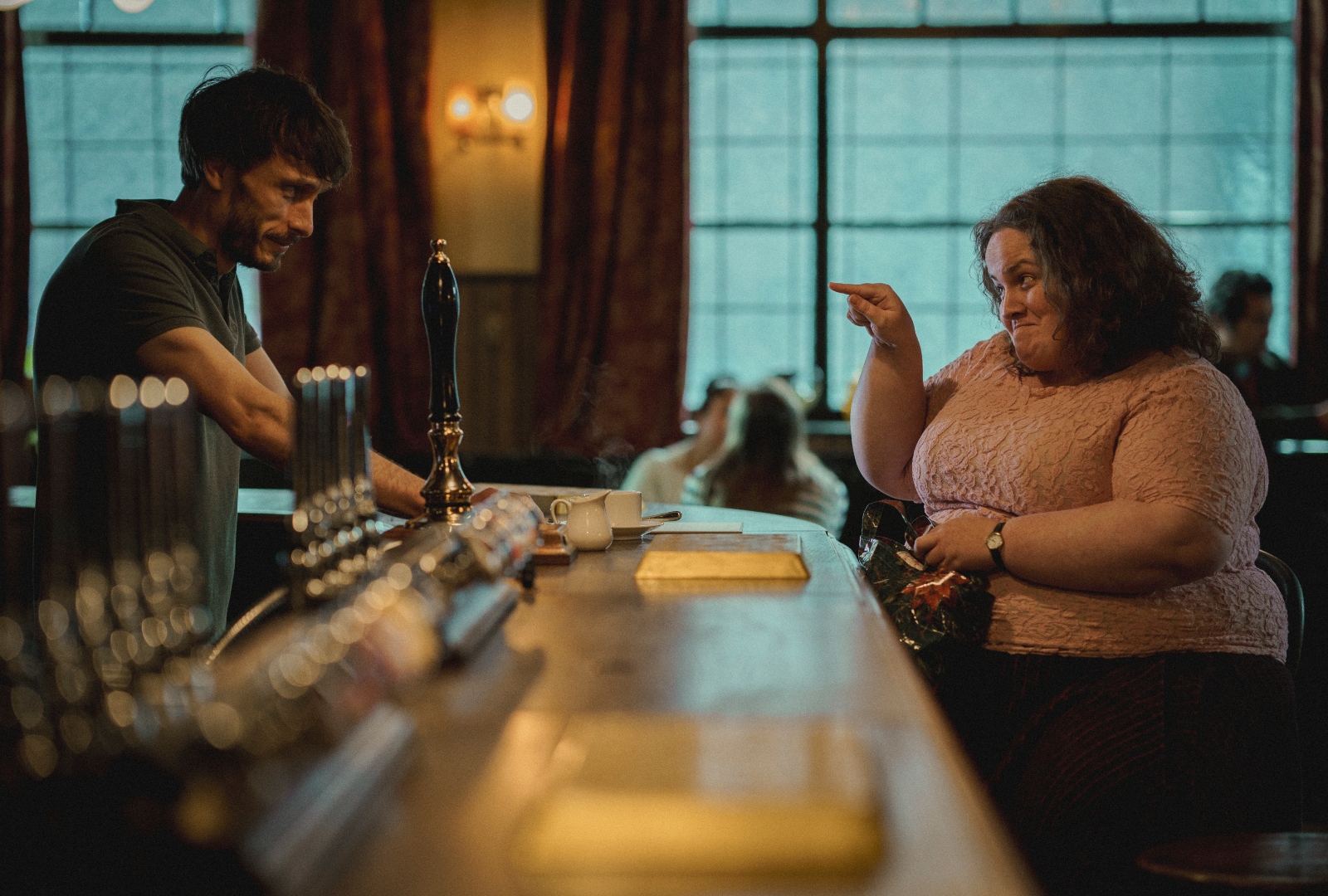
"In a school of clownfish, women rule," Ra's al Ghul tells Joker in a one-on-one, encouraging her to embrace who she is. "When the dominant female dies, the largest male will change his sex and resume her former role as mother of the school. Clownfish know that identity is not fixed. Who you were before is irrelevant to today.”  

"The People's Joker" will likely become a gateway for queers, of any age, inspired to right wrongs in a truly gay way.

Whipping together the finalized version of her Joker costume in a sequence accompanied by a song that sounds like a Prince track from the 1989 "Batman," tweaked just enough as to avoid further legal issues, Joker goes on to battle. Her opponent? Batman (voiced by Phil Braun), who, in this version of Gotham, is a closeted far-right a-hole with a handlebar mustache. He also happens to be the abusive ex of Mr. J (Kane Distler), her boyfriend who's a take on Jared Leto as Joker.

A number of the standard "Batman" villains are who we root for here, which is not a stretch. Joker has always been more fun to watch than a flying bat with rubber nipples anyway. And The Penguin (Nathan Faustyn) is Joker's main support, up to and through the musical number that closes out the film because, of course a musical number would close out a gay parody about Batman. 

Flipping comedy and heteronormative superhero tropes like two cheap tables at a bar, Vera Drew's delivery as Joker calls to mind Ezra Miller's acting style. You know, before the unpleasantness, of course. Which adds something to all of this that's hard to describe. It's almost like the film, in under two hours, allows queer viewers to reclaim a number of things we have lost. Queer actors we liked who ended up being problematic weirdos. Accepting outlets to tell our stories that make room for happy endings and don't just write us off to our graves. And the freedom to enjoy a comic book or movie based on a comic book without having to pass some acceptance test as to how or why we arrived at the fandom. Because, listen, there's nothing fruitier than a bunch of muscle-y dudes in tights BANG POW-ing each other, and Selina Kyle is undeniably more than a few lesbians' roots. These are just facts.  

Just like I came away from the experience of watching "Silence of the Lambs" in the theater as a gay teen in the '90s, suddenly taking an interest in the FBI because I wanted to kiss Jodie Foster on the lips — "The People's Joker" will likely become a gateway for queers, of any age, inspired to right wrongs in a truly gay way. As is our right. If you live in a "don't say gay" state, trans Joker gives you permission to say it with a smile.

"The People's Joker" is currently in theaters.

“Baby Reindeer” is groundbreaking in how it advances the discourse of the “open wound”

"Baby Reindeer" is a show that's been desperately needed. In a digital world that constantly trots in and out of cultural trends with blistering frequency, it can seem difficult to pin down the definition of "meaning." Perhaps even trickier is deciding what merits it. 

It feels altogether disconcerting, then, to say that sexual assault and trauma are partially definitive of the zeitgeist. And yet, it's unfortunately omnipresent, crouching in the shadows over years until it's cast into the light, usually through the courage and strength of a beleaguered survivor.

It would be remiss to exclude the importance, not only of survivors' stories, but of the conversation more broadly from our group chats, classrooms, offices, Slack channels, etc. Thankfully, much of the prevailing discourse around sexual abuse in recent years has been seismically charged, owing to the rise of the #MeToo era.

Like Bell, Donny was methodically groomed by a person he looked up to and was reliant upon.

However, the topic of sexual assault still retains a certain social precarity. Like many other pressing societal ills, it's delineated as quasi-illicit, hardly considered dinner-table-friendly discussion fodder, particularly where it concerns men. The notion that men can be sexually violated is often construed as a joking matter or shrouded in shame and homophobic stigma, as a result of toxic machismo ideology. This is unsettling given that almost one in three men have experienced sexual violence involving physical contact during their lifetime, per the Centers for Disease Control and Prevention. While still notably less than the number of women facing similar conditions, recent studies indicate there is a glaring lack of research into adult male sexual victimization. As such, those stories are few and far between in popular culture and in the real world.

That's where "Baby Reindeer" steps in. Sometimes, it takes viewing something harrowing onscreen to push us to a place where we're ready to both contemplate and talk about its reality.

In Netflix's limited series, creator and star Richard Gadd chronicles his emotional journey of being stalked by and sexually assaulted in real life through his portrayal of a fictionalized version of himself, struggling comedian Donny Dunn who lives in London. In the show, Donny is aggressively pursued over several years by a woman named Martha (Jessica Gunning), who nicknames him "baby reindeer." Compounding this situation is Donny's difficult past, in which he was subject to repeated abuse by television comedy writer Darrien (Tom Goodman-Hill), who entices him with empty words about helping launch his career. 

Richard Gadd as Danny Dunn and Jessica Gunning as Martha Scott in "Baby Reindeer" (Netflix)Predatory groomers masquerading as well-meaning mentors are unfortunately somewhat commonplace, at least in terms of what we've seen on streaming services as of late. In March, Investigation Discovery debuted "Quiet on Set: The Dark Side of Kids TV," an explosive docuseries that unearthed alleged systemic abuse at children's television network, Nickelodeon. Among the most shocking revelations presented in "Quiet on Set" came when former Nickelodeon actor Drake Bell publicly aired the monthlong sexual abuse he endured as a minor from his former acting and dialogue coach, Brian Peck. Like Bell, Donny was methodically groomed by a person he looked up to and was reliant upon, professionally speaking.
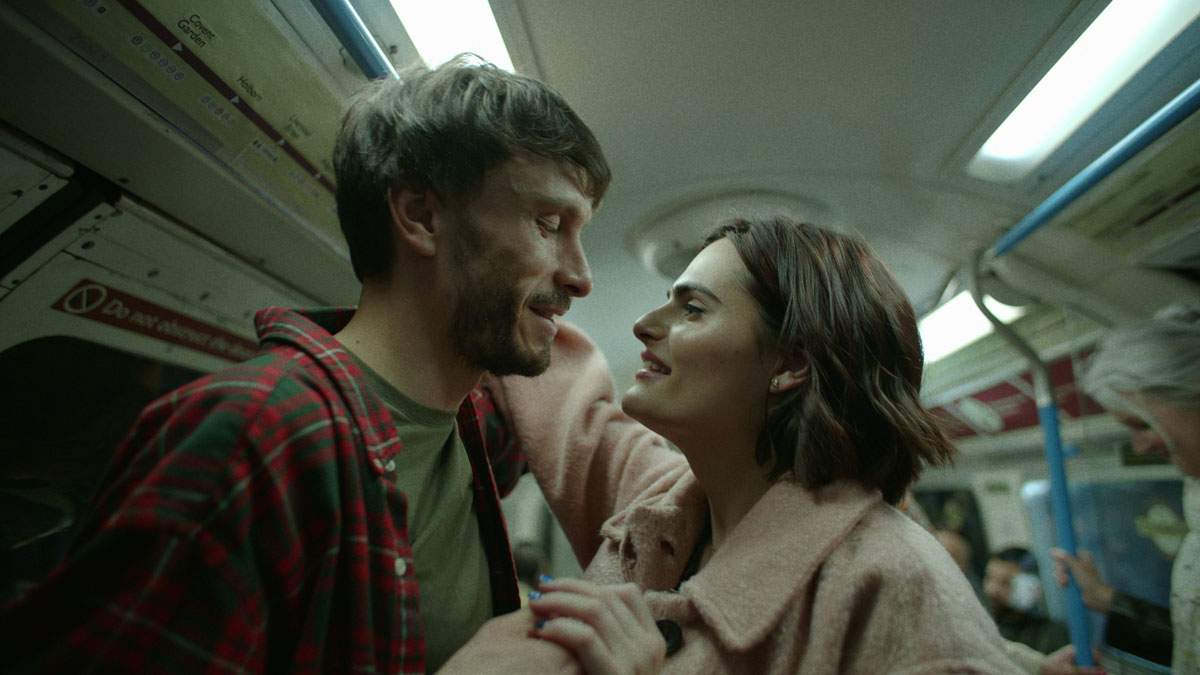
Regrettably, we're already familiar with the idea that a child can be groomed and sexually assaulted. Already established cinematically with films like "The Perks of Being a Wallflower" and "Mystic River," Bell's groundbreaking disclosure propelled such depictions into a tragically realistic context.

"Baby Reindeer's" advancement of the conversation around sexual assault and how we think about it is two-pronged: it highlights systematic grooming and abuse done not only to a male character but to an adult, showing viewers that anyone in a vulnerable position can be taken advantage of.

Five years before his first encounter with Martha, Donny meets Darrien, a "Buddhist, polyamorous pansexual," at the Edinburgh Fringe comedy festival. They strike up a genial conversation at a bar, and Darrien showers Donny with flattery, presumably to gain his trust. Emboldened by the confidence Darrien gives him and the sense of finally having a quantifiable dream, Donny begins spending time at the writer's apartment. Except they don't really talk about Donny's pitch ideas or screenwriting — instead, they spend each session getting ridiculously high on coke, MDMA, heroin, crack and eventually, acid. Darrien gives Donny a macro dose of the stuff and assures him that he will act as his "guide," before breaking into an unsettling "Amazonian jig" set to percussive music. 

Darrien takes advantage of Donny's addled state, violating him in various ways during their hazy hangouts before ultimately raping him one day. The brutal assault leads to the breakdown of Donny's relationship with his girlfriend Keely (Shalom Brune-Franklin) and, unsurprisingly, his psychological state.

Later, when Donny's sexual predilections appear to shift, he's plagued by thoughts of shame. "I started to feel this overwhelming sexual confusion crashing through my body," he says while looking at men on the tube. "I could never tell whether these feelings were because of him or whether they always existed deep down. Did it all happen because I was giving off some vibe I wasn't aware of? Or did what happened make me this way?"

Through Donny's internal monologue, "Baby Reindeer" painfully articulates the intricacies of trauma — his self-blame is an all-too-common yet enduringly complex response to sexual assault. His response to this cocktail of confusing emotions is to date all sorts of people, devoid of love and intimacy, as he endeavors to find answers. 

People who are abused sometimes hurt others.

That all changes when Donny meets Teri (Nava Mau), a transgender woman whom he quickly falls for. Despite their connection, however, Donny is jarred by a barrage of new conflicting feelings. "With every hand-hold or lingering stare," he says, "came a crushing sense of anger and shame that I was falling in love with her. That I couldn't hide in anonymity anymore.

"And perhaps most bitter of all, that I might not feel this way if he [Darrien] hadn't done what he did," Donny adds.

Baby ReindeerRichard Gadd as Donny Dunn and Nava Mau as Teri in "Baby Reindeer" (Netflix)This sentiment powerfully captures a complex portrayal of how trauma perpetuates cyclically;  people who are abused sometimes hurt others. Embattled and unable to surmount his anxiety, Donny repeatedly pushes Teri away and breaks her trust. Their relationship had already begun shakily when he met her on a dating app under a  false identity, posing as a construction worker named Tony. Though he eventually comes clean to Teri about the guise, he is unable to share his trauma with her despite difficulties with physical intimacy, leading her to feel rejected by him. This tension is only exacerbated by Martha, who becomes enraged by their coupling, leading her to physically attack and hurl nasty slurs at Teri when she finds them together in a bar after one of Donny's comedy acts. Though he has more than enough reason to sever ties with Martha, Donny is unable to wholly lose her presence in his life, mired in a mixture of fascination, empathy and guilt. 

Bell in his testimony for "Quiet on Set" similarly expounded on the devastating toll his abuse had on him, as he devolved into struggles with substance abuse and his mental health. In 2021, Bell pleaded guilty to a criminal charge of child endangerment and a misdemeanor charge of disseminating harmful material to a juvenile after a then-15-year-old girl (notably the same age he was when Peck assaulted him) alleged that the former actor had groomed, sexually assaulted and sent sordid messages to her when she was underage. Bell denied the claims.

Toward the end of "Baby Reindeer," Donny confesses in detail his abuse and self-loathing to a crowd of people at the finale of a comedy competition. "That's what abuse does to you, you know?" he says through tears. "It made me this sticking plaster for all of life's weirdos. This open wound for them to sniff at."

Baby ReindeerJessica Gunning as Martha Scott in "Baby Reindeer" (Netflix)In "Baby Reindeer" Darrien is the primary abuser. But Martha crosses a number of boundaries as well. Her emails to Donny are both aggressive, violent and intensely sexually explicit. Without receiving consent, she gropes him under the garish glow of yellow lamps alongside a narrow canal. Later, after infiltrating Donny's home by posing as a new member of Keely's mom's (Nina Sosanya) cooking club, she leaves a semi-nude photo of herself on his desk. 

And yet, as viewers learn by the end of "Baby Reindeer," Martha's serial-stalking tendencies are a perpetuation of pain she weathered as a child, in an ostensibly unstable home. Though her background does not excuse her extreme behavior, it provides insight into the complexity underpinning her obvious mental illness. Donny knows this, too. It's part of why he feels ironically prickled about reporting Martha, and not Darrien, to the police. 

"There was always a sense that she was ill, that she couldn't help it," Donny narrates. "Whereas he was a pernicious, manipulative groomer."

This knowledge elucidates why Gadd "was very keen for Martha to be layered." Speaking to Netflix, he explained that through her character, he wanted to "show this side of stalking, that it is a mental illness. And show the fact that there was someone there who was doing a bad thing, who wasn't necessarily a bad person, that just had a lot of trauma in their life that they were going through."

For all the things "Baby Reindeer" gets right —and there are many— perhaps its most salient success is its depiction of trauma's non-linear effects. As the show aptly illuminates, the fallout from abuse is circuitous, weighty and irrefutably something that deserves greater attention from us all. 

"Baby Reindeer" is now streaming on Netflix.

Bill Barr didn’t take Trump’s “execution orders” too literally

Former Attorney General Bill Barr, who endorsed Donald Trump after quitting the White House and sharply criticizing the former President for years, says Trump often lost his temper when speaking about government officials, but that he didn’t take his comments “too literally.”

In an appearance on CNN, Barr told Kaitlan Collins that he didn’t exactly recall Trump speaking about killing a leaker, but that it wouldn’t have been out of the ordinary.

“I actually don’t remember him saying ‘executing,’ but I wouldn‘t dispute it, you know… The president would lose his temper and say things like that. I doubt he would’ve actually carried it out,” Barr said.

Collins pushed Barr on whether Trump often said things of that nature.

“People sometimes took him too literally,” Barr said. “He would say things similar to that on occasions to blow off steam. But I wouldn’t take them literally every time he did it.”

When asked why he didn’t take the threat more seriously, Barr justified his response by saying, “At the end of the day, it wouldn’t be carried out, and you could talk sense into him.”

Barr said it was just a “feeling” he had that Trump wouldn’t pose a threat to democracy. 

“Having worked for him and seen him in action, I don‘t think he would actually go and kill political rivals and things like that,” Barr told Collins.

Barr was also asked about Trump’s brutal rebuke of his endorsement, in which he called him “weak, slow moving, gutless, and lazy” on Truth Social.

“Classic Trump," he said to that. 

“Cruel and Insane”: Republicans condemn Kristi Noem’s dog-killing revelation

After Vice Presidential candidate contender and South Dakota Governor Kristi Noem’s disturbing revelation that she killed her own dog in an advance passage of her forthcoming book, many across the aisle have come out against the act.

“I’m a dog lover and I am honestly horrified by the Kristi Noem excerpt,” former Trump White House Director of Strategic Communications and co-host of "The View," Alyssa Farah Griffin, said on Twitter. “I wish I hadn’t even read it. A 14-month old dog is still a puppy & can be trained.”

Meghan McCain, daughter of the late Senator John McCain, criticized the passage on Twitter, writing that Noem “can recover from a lot of things in politics . . . but not from killing a dog.”

“All I will distinctly think about Kristi Noem now is that she murdered a puppy who was 'acting up', which is obviously cruel and insane,” McCain added.

Lincoln Project cofounder Rick Wilson kept it simple, tweeting “Good morning to all you who didn’t shoot your puppy in the face.”

Even top Trump ally Laura Loomer was disgusted by this level of cruelty, tweeting, "She can't be VP now."

Noem, seemingly failing to read the room, doubled down on building her animal killing image.

“Tough decisions like this happen all the time on a farm. Sadly, we just had to put down 3 horses a few weeks ago that had been in our family for 25 years,” Noem wrote on Twitter before linking a pre-order page for the book.

But not all on the Right were critical. “The Daily Wire” commentator Michael Knowles took to Twitter to share his unpopular opinion.

“This story makes me like and respect her more,” the CPAC speaker said. Donald Trump also wrote a glowing review for the book on Amazon.

The Biden campaign seemingly shaded Noem, posting a picture of the President and Commander Biden, along with a photo of Vice President Kamala Harris and her pooch Newton.