Spring Offer: Get 1 Year, Save 58%

In defense of Taylor Swift’s performance in “Cats”

When she posed for Time's 2023 "Person of the Year" cover wearing one of her three cats draped around her neck like a boa, Taylor Swift seemed to cement her status as, in the words of New York Magazine, "America’s foremost Cat Lady." But if you really want to pinpoint the 12-time Grammy winner's apex as a feline icon, you need to go back five years, to director Tom Hooper’s unhinged cinematic adaption of Andrew Lloyd Weber's "Cats." But don't think of the movie as "Cats." Think of it as "Cats: Taylor's Version." It's a lot more fun that way.

Her total and unembarrassed commitment to this legitimately goofy, unsettlingly CGI-enhanced production is a thing to behold.

Riding on a wave of acclaimed adaptions like 2012's Oscar winning "Les Miserables," 2014's successful "Into the Woods" and two "Mama Mias," the long awaited film version of one of the most beloved, longest running West End and Broadway musicals of all time seemed a solid bet back in 2019. But "Cats" is an . . . unusual show. For starters, it's based on a book of poetry, T.S. Eliot's "“Old Possum’s Book of Practical Cats." And as such, it's about singing cats. 

You know this, going in. Yet the cinematic adaptation is still really something else. I remember attending an early press screening of the then much-hyped, star-studded musical, and all of us in the audience blinking back into the daylight as if we'd just emerged from a fever dream. It remains one of the oddest movie-going experiences of my life, and Taylor's number, "Macavity," is a showstoppingly bizarre highlight of a showstoppincgly bizarre movie. At the time, I described it by writing that "If 'The Island of Doctor Moreau' had a baby with that Gaspar Noe movie about the dance troupe that gets dosed and has a murder orgy, it would look just like this scene," adding uncomortably, "There are people out there, walking among us right now, who are definitely going to masturbate to it." I watched "Cats" again recently – after Netflix acquired it – and I stand by this.

Yet as Taylor Swift has spent the past few years reevaluating her body of work, she's invited her listeners to do the same, and why shouldn't that include "Cats"? Revising her early albums and embarking on a retrospective "Eras" tour, she's shown how an artist's work and our own relationship to it change over time. I don't know if I can in good conscience encourage anyone to watch or rewatch the movie in its entirety, but I do absolutely recommend a second look at what Swift is doing there. 

First, there's her onscreen performance as Bombalurina in the musical's slinkiest, most Fosse-friendly routine. She floats in on a golden crescent moon, sprinkling catnip from a very Judith Leiber-like rhinestone shaker. She shimmies in heels, she purrs in a quasi London accent, pronouncing "there" as "thuhr." It's mesmerizing, to say the least. Does she have a Broadway belt like her costar Jennifer Hudson? Oh no. Does she make it her own flirty, don't-give-a-hoot thing? Absolutely. The way she sings "His coat is dusty" and then says, as an aside and in her American accent, "from neglect," is pure Swift. And her total and unembarrassed commitment to this legitimately goofy, unsettlingly CGI-enhanced production is a thing to behold. It's camp in the best sense — what Sontag must have had in mind when she described the state of being "bad to the point of enjoyable." 

Like the album "Lover," which had dropped earlier the same year, Swift's contribution to "Cats" feels a part of a shifting phrase in her life and career. "Lover" had been the follow-up to 2017's divisive "Reputation," a fresh declaration of hope, romance and independence. On the cusp of turning 30 and freeing herself from her former label Big Machine Records, Swift would with "Lover" drop a Pride month banger with "You Need to Calm Down," mark her own solo directorial debut (the ambitious video for "The Man"), and create one of the biggest sleeper hits in pop history with "Cruel Summer." This is the Taylor of 2019, and it's the Taylor we see in "Cats" — an artist reaching for a new height of creativity and artistry, and who will do it prowling around like a little kitty cat if she damn well wants to.

Swift's other, often overlooked contribution to "Cats" is the only new song in the adaption. Cowritten with Andrew Lloyd Weber, "Beautiful Ghosts" is sung by the central feline Victoria in the film, and Swift in the closing credits. Even among Swifties, this one's a deep cut, a bittersweet ballad to lost dreams and missed opportunity. On the Taylor Swift reddit sub, one poster sums it up by calling it a "super underrated song [that] definitely deserves more love." It is also, like the whole "Lover" album, peak U.K. Taylor era, as she sings of being "too young to wander London's lonely streets alone and haunted." A lonely and haunted cat, by the way. It's nevertheless just a really pretty, soulful tune, a unique collaboration between the guy who wrote "Memory" and the woman who would go on to show the world how to write a brilliant song from the perspective of a sweater. 

"When Andrew asked, from behind his piano, if I had any ideas on what Victoria might say if she had a song," Swift wrote for Billboard in November of 2019, "I knew what he was asking. He was asking to help him write it." She added, "No matter what happens, I can safely say the memories from my experience working on 'Cats' will be ones I carry with me. Beautiful ghosts, if you will."

What happened, of course, is that the movie came out a month later and became an immediate trainwreck/cult classic, a uniquely unifying moment in pop culture surrealism. Taylor, meanwhile, followed her stint in a catsuit with some of the best work of her career in "Folklore," "Evermore" and "Midnights," would rerecord and release her earlier works, and go on a tour so seismic it's boosting the economy. 

Among her accolades and accomplishments, Swift certainly doesn't need the blip that was "Cats" to boost her resume, but it serves nonetheless as a meaningful moment in her risk-taking, always surprising career. And whatever you think of the film, you can't call Taylor's participation in it a tactical error. "I really had an amazing time with 'Cats,'" she told British Vogue in 2019. "I think I loved the weirdness of it. I loved how I felt I’d never get another opportunity to be like this in my life.”

Caffeine overdrive: The dark side of America’s “no sleep” hustle culture

With nearly 20% of office spaces currently sitting empty across the United States, and as multiple major property and asset management companies have collectively defaulted on billions in commercial-property loans, it may be tempting to think that the cult of workaholism is diminishing as its old cubicle-packed temples seem to continue to crumble, but one visit to a Panera or Starbucks on a random Tuesday afternoon quickly dispels that notion. 

For many remote employees in an era of growing work-from-anywhere flexibility, these third places increasingly operate as the new office (though, of course, speaking as a former freelance writer, such has been the case for gig workers for a very long time). For what they occasionally lack in basic working necessities — namely open table space and working outlets — they make up for in unique amenities, like a friendly barista waiting behind the counter to ask, “One espresso shot or two?” 

It’s a fitting shift because over-caffeinating and overwork have long gone hand-in-hand in American work culture, so much so that discussions of the former are often used as a way to brag about the latter: God, hand me another Red Bull. I was up until midnight pushing that project over the finish line, then had to be back up at 4 a.m. to check the foreign markets. I’m just so busy! This isn’t exactly a new phenomenon. For decades, an estimated 90% of Americans have reported drinking caffeine every day, making it, as “The New York Times” noted back in 1991, the country’s most popular psychoactive substance. 

Generations of workers have used caffeine to rev up their brain cells when they really want to power down in the face of yet another round of spreadsheets, meetings and now Zoom calls. However, in recent years, a new wave of mega-caffeinated beverages have hit the market, seemingly in tandem with the pandemic illustrating some of the fissures of America’s glorification of “no sleep” hustle culture; but following the string of highly-publicized lawsuits surrounding the safety of Panera’s highly-caffeinated “Charged” Lemonade — and growing interest among younger members of the workforce in cutting their caffeine consumption — will our collective desire to feed (or water) that beast finally be quelled? 

As Salon Food has reported, Panera’s Charged Lemonade is at the center of three lawsuits: two in 2023 that allege the drink’s caffeine contents caused the cardiac arrests that killed two separate people, and a third suit filed earlier this month in which a plaintiff alleges the drink caused them permanent heart issues. 

We need your help to stay independent

The large size of the Charged Lemonade contains 390 milligrams of caffeine, which is very close to the Food and Drug Administration’s (FDA) recommended daily maximum limit of 400 milligrams for healthy adults. It’s important to note that at least one of the individuals who died following consuming the beverage, Sarah Katz, had documented prior heart issues, however the Katz family has maintained that Sarah was conscientious about her caffeine consumption and that she was likely unaware of the high caffeine content of the "charged" drink, which contains as much caffeine as an energy drink, because Panera marketed the product as "clean." 

“If she didn’t know that this was an energy drink, it makes the family concerned about who else doesn’t know,” Elizabeth Crawford, the Katz family’s attorney, told “The New York Times” in October. 

While warnings about the product have since been added in-store and online by the company — and, as of this week, the beverage has been removed from the self-serve fountains in some locations — the drinks are still available for purchase. Obviously, the Charged Lemonade isn’t the only highly-caffeinated product on the market. 

Sales of energy drinks in the United States have grown from $12 billion to $19 billion over the past five years, and as their popularity is surging, so are their caffeine levels. “A 12-ounce can of Red Bull contains about 114 milligrams of caffeine — more than three times the amount in a 12-ounce can of Coca-Cola,” Julie Creswell reported for the “Times” last year. “Prime Energy has more: 200 milligrams in each 12-ounce can. A 16-ounce can of Bang Energy Drink, the size typically sold in convenience stores, has 300 milligrams of caffeine.”

Increasingly, the makers of beverages in the energy drink space aren’t just touting their ability to give consumers a physical jolt when they need it. By pairing caffeine with other buzzy active ingredients like ginseng, carnitine, creatine and ginkgo biloba, they position these drinks as enhancers of mental alertness and concentration, too. Such is the case with Starbucks Triple Shot Energy, which contains B vitamins, ginseng and guarana — as well as 225 milligrams of caffeine. Of course, neither desiring a mental boost nor consuming a beverage marketed to do just that is a problem. 

"The problem lies in our society’s continued glorification of busyness and normalization of sleep deprivation."

The problem lies in our society’s continued glorification of busyness and normalization of sleep deprivation. Many of us operate within a work culture where increased job demands and expectations drive individuals to seek those quick-energy solutions again and again because they feel like they have to always be on (or in the parlance of Panera, “charged”). 

As the pandemic demonstrated, even with remote work, the advent of technology, like email and Slack, only further blur the lines between work and personal life, making sustained alertness a perceived necessity. Hustle culture doesn’t have a destination. It’s a Sisyphean grind in which caffeine occasionally makes one feel like they can roll the immense boulder up the hill a little better, only for the boulder to roll back to the bottom and for the loop to begin again. 

It’s no wonder that worker burnout has hit a global high, with 42% of surveyed employees reporting feelings of “exhaustion or energy depletion, negativism or cynicism related to an individual’s job and reduced professional efficacy,” a societal problem even mega-doses of caffeine can’t paper over.

The 6 hottest chilihead moments from Hulu’s “Superhot: The Spicy World of Pepper People” series

For some folks, spice is more than just a culinary preference — it’s a way of life and a source of pleasure even. There exists a tight-knit community of chiliheads, a self-proclaimed label awarded to those who eat, breathe, sleep all things super hot spicy peppers. Such peppers aren’t your measly jalapeños or habaneros. Instead, they include foreboding names like the Ghost pepper, the Carolina Reaper and other peppers that are even spicier.

This chili subculture is explored in Hulu’s latest docuseries “Superhot: The Spicy World of Pepper People.” The 10-part series spotlights several individuals who have devoted their lives to the pursuit of fire: contestants challenging themselves to eat the spiciest peppers known to man in international competitions, pepper growers attempting to cultivate the next uber-spicy pepper right in their backyards, hot sauce enthusiasts experimenting with their fire-burning recipes and one notable chilihead striving to find a hot pepper that can best the world’s hottest (which was the Carolina Reaper at the time).

From showrunner-director Brian Skope, “Superhot: The Spicy World of Pepper People” invites its viewers to take a peek into the wacky yet healing world of chiliheads. Each episode features interviews with several prominent members in the community and chronicles their individual journeys to achieve success.

Here are the six hottest moments from the series:

01
Hot peppers is one chilihead's drug of choice
Superhot: The Spicy World of Pepper PeopleJohnny Scoville in “Superhot: The Spicy World of Pepper People” (Photo courtesy of Hulu)
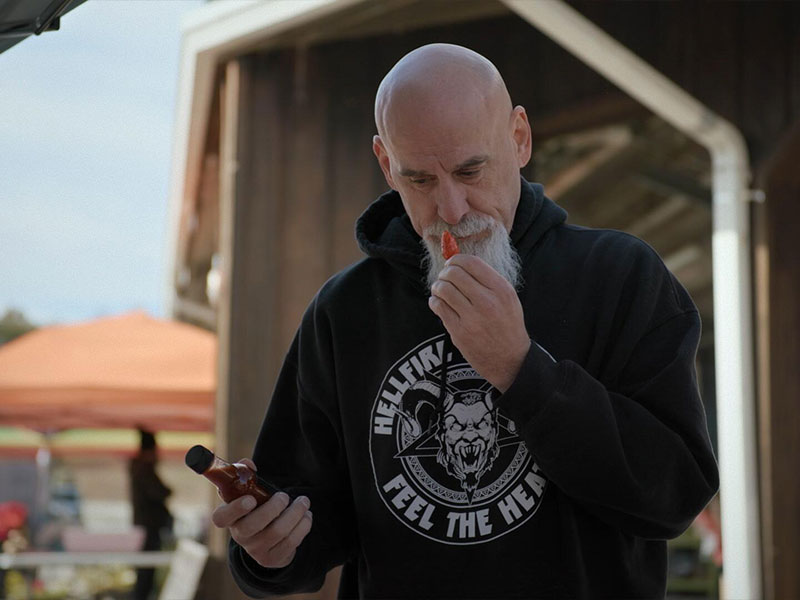
Johnny Scoville, a popular chili pepper reviewer who has been described as the Elvis Presley of chiliheads, became fascinated with peppers after he tried a pepperoncini for the very first time. Scoville currently runs his own YouTube channel, aptly called Chase The Heat, where he tries an array of spicy peppers, flaming hot sauces and other fiery products, much to the amusement of fellow online chiliheads.


“It’s just a beautiful thing,” Scoville said in the documentary. “I love pepper pain. I love pain, and this is my favorite kind of pain.” Eating peppers — and seeking the high of eating an even hotter pepper than the one before — is practically an addiction, Scoville confessed.


“From the time I got to college, I sort of felt like an addict who hadn’t found his drug yet,” he said. “And I basically looked for it, and I tried them all. Over a decade ago, I quit all of them. The only buzz I get is from peppers. There’s always gonna be something hotter, and I’m gonna find it.”  


For chili growers and business owners, an endorsement from Scoville could either make or break their careers. Paul Ouro, co-founder of the League of Fire chili eating competitions, hailed Scoville as “the godfather of chilis” and “a celebrity in the world of chilis.”

02
The 7 Pot Primo pepper is like “cocaine and a car wreck”
Superhot: The Spicy World of Pepper PeopleTroy Primeaux in “Superhot: The Spicy World of Pepper People” (Photo courtesy of Hulu)

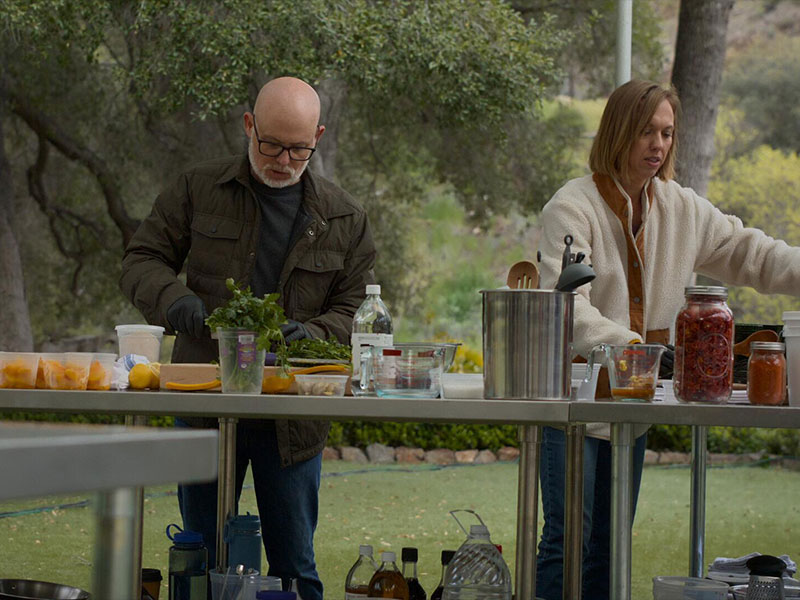
Troy Primeaux, a horticulturist from Louisiana, is also the grower of one of the world’s hottest peppers, the 7 Pot Primo. The pepper itself is bright red in color (there are some orange and yellow varieties too) and bears a scorpion-like tail. Its skin is bubbly and lumpy in texture, like many super hot peppers.


The 7 Pot Primo is considered to be a “superhot chili pepper” and is nearly 300 times hotter than the jalapeño. Its heat level can be compared to the Carolina Reaper — which was the hottest chili pepper in the world according to Guinness World Records from 2013 to 2023.


When asked what it’s like to eat the 7 Pot Primo, Primeaux said it’s like “cocaine and a car wreck, both of which I don’t do anymore.”


“The combination together . . . it’s like about 30 minutes plus of just vasodilation, a bear’s chasing you, you’re deer in headlights.”

03
A chilly tip is offered for eating a spicy chili
Burning Chili PepperBurning Chili Pepper (Getty Images/ThomasVogel)

“Put your toilet paper in the refrigerator,” Primeaux said gleefully in offering a tip for those wanting to try the 7 Pot Primo. “Put your toilet paper in the freezer for Christ’s sake. You know, you need to cool it off before you use it after eating my pepper.”


Some chiliheads do indeed keep a stash of frozen toilet paper, just in case disaster strikes. But not Scoville, who told Variety, “I wouldn’t do it if it killed me in the bathroom the next day. I’m a talented guy — I’d find a different gig.”

04
Shahina Waseem has a 97-win streak for chili-eating competitions
Superhot: The Spicy World of Pepper PeopleShahina Waseem in “Superhot: The Spicy World of Pepper People” (Photo courtesy of Hulu)

Shahina Waseem doesn’t like the flavor of peppers, but she discovered her talent for eating copious amounts of chilis after she entered a chili-eating challenge in Kingston-Upon-Thames and won it. Known as the “UK Chili Queen,” Waseem has competed in nearly 100 chili-eating competitions since and enjoyed many victories. She remains the undefeated chili-eating champion and flaunts an impressive 97 win streak.


“These chilis hurt me just like they do most people,” Waseem wrote in her blog. “The nerves set in days in advance, and I dread each and every competition but I just can't give up when it comes to a [chili] challenge!”


In the documentary, Waseem participated in a mass chili-eating competition against students at Winthrop University and emerged victorious. She also competed against Scoville — who she’s battled in prior competitions — and once again emerged victorious.

05
Capsaicin can wreak major havoc on the body
World Chilli Pepper FairThe World Chilli Pepper Eating Fair, in its 12th edition, brings stands and dealers from all over the world to the centre of Rieti. (Riccardo Fabi/NurPhoto via Getty Images)

Participating in a chili-eating competition is not for the weak. Neither is dealing with the aftermath of eating large amounts of spicy hot peppers in a short amount of time. The pain from spicy hot peppers comes from capsaicin, an active component in peppers that’s also a chemical irritant and neurotoxin for mammals. When it comes into contact with any skin or mucous membrane, capsaicin causes a burning sensation. The higher the capsaicin content, the more severe the burning sensation will be — and the harder it will be for the body to get rid of it. Symptoms of high capsaicin in the body include pain and cramping in the stomach and prolonged diarrhea and nausea.  


The documentary showed us a glimpse of the physical toll chili-eating competitions take on its competitors. Waseem recalled a time when she was sick for 18 hours after a particularly excruciating competition. In a separate competition, she’s seen struggling to pick up the peppers on her plate after her wrists buckled from the intense heat.

06
Scoville finally deems the 7 Pot Primo as the hottest pepper
Superhot: The Spicy World of Pepper PeopleBobby McFadden in “Superhot: The Spicy World of Pepper People” (Photo courtesy of Hulu)

Throughout the series, Scoville is on a quest to find the hottest pepper that arguably has a higher heat content than the Carolina Reaper. The contenders include the Orange Gusher from newbie chili grower Bobby McFadden; the JP Piranha from James Morrow (aka Jimmy Pickles), who grows many chili varieties in his Pittsburgh home; the 7 Pot Primo, from Primeaux; the Nova Brain, from legendary chili grower Gary Montcalm; an accidental chili grown by Drew Goldy and the Killer Yellow from grower Tom Broome.      


The peppers were first put to the test in Scoville’s Chase the Heat Rodeo, where seasoned and aspiring chiliheads sampled each pepper in a fast-paced competition (spoiler: Waseem won). The peppers were then tested in a laboratory and Scoville scale, which measures the heat levels of chillies. All the peppers contained Scoville heat units (SHU) that surpassed the Carolina Reaper’s Guinness benchmark.


For context, the Carolina Reaper has a SHU of 1,641,183. The top prize was awarded to Primeaux’s 7 Pot Primo which has a SHU of 1,790,150. In second place was the JP Piranha and in third place was the Killer Yellow. The Orange Gusher came in fourth, the Nova Brain came in fifth and the accidental pepper came in last place.


Primeaux’s 7 Pot Primo was never recognized as the world's hottest chili pepper because on August 23, 2023, Guinness World Records officially recognized Pepper X as the world's hottest pepper. Pepper X is labeled as an “exceptionally hot” pepper with an SHU of 2,693,000.

"Superhot: The Spicy World of Pepper People" is currently available for streaming on Hulu. Watch the trailer below, via YouTube:


Fani Willis faces possible impeachment over allegations of misconduct

On Friday, Georgia state representative Charlice Byrd (R-Woodstock) introduced a resolution to impeach Fulton County District Attorney Fani Willis over ongoing allegations of misconduct and the added accusal of “Trump Derangement Syndrome.”

In a press release reported on by Newsmax, Byrd states the belief that Willis used her official position for political gain, continuing to question whether there was a conflict of interest when she hired Nathan Wade, one of the lead prosecutors in Donald Trump's Georgia election interference case, with whom she's rumored to have been in a romantic relationship with.

"Fani Willis has a laundry list of potential conflicts that make her unworthy and unfit to be the District Attorney in Fulton County," Byrd writes. "Someone elected to that office is expected to uphold the law and not weaponize their office for political gain. Since Day One when she was elected, Fani Willis has embarrassed the criminal justice system in Fulton County and our state."

The Georgia Senate engaged in a vote on the matter at the start of the weekend, approving the formation of a committee to investigate any potential wrongdoing on Willis' part. 

So much for moving to Europe: Trump’s allies are plotting an EU takeover

It would be funny if it weren’t so potentially tragic — and consequential. No, I’m not thinking about Donald Trump’s 2024 presidential campaign but a related development: the latest decisions from the European Union about Ukraine.

As 2023 ended, European nations failed to agree on a $54 billion package of assistance for Ukraine at a time when that country was desperately trying to stay afloat and continue its fight against Russian occupation forces. Bizarrely, the failure of that proposal coincided with a surprising EU decision to open membership talks with that beleaguered country.

In other words, no military aid for Ukraine in the short term but a possible offer of a golden ticket to join the EU at some unspecified future moment. Ukrainians might well ask themselves whether, at that point, they’ll still have a country.

One person, right-wing Hungarian Prime Minister Viktor Orbán, is largely responsible for that contradictory combo. He singlehandedly blocked the aid package, suggesting that any decision be put off until after European parliamentary elections in early June. Ever the wily tactician, he expects those elections to signal a political sea change, with conservative and far-right forces — think of them as Donald Trump’s allies in Europe — replacing the parliament’s current centrist consensus. Now an outlier, Orbán is counting on a new crop of sympathetic leaders to advance his arch-conservative social agenda and efforts to cut Ukraine loose.

He’s also deeply skeptical of expanding the EU to include Ukraine or other former Soviet republics, not just because of Russian sensitivities but for fear that EU funds could be diverted from Hungary to new members in the east. By leaving the room when that December vote on future membership took place, Orbán allowed consensus to prevail, but only because he knew he still had plenty of time to pull the plug on Ukraine’s bid.

Ukrainians remain upbeat despite the aid delay. As their leader Volodymyr Zelensky tweeted about future EU membership, “This is a victory for Ukraine. A victory for all of Europe. A victory that motivates, inspires, and strengthens.”

Previously an outlier, Viktor Orbán is counting on a new crop of sympathetic European leaders to advance his arch-conservative social agenda and efforts to cut Ukraine loose.

But even if Orbán’s resistance were to be overcome, a larger challenge looms: the EU that will make the final determination on Ukraine’s membership may not prove to be the same regional body as at present. While Russia and Ukraine battle it out over where to define Europe’s easternmost frontier, a fierce political conflict is taking place to the west over the very definition of Europe.

In retrospect, the departure of the United Kingdom from the EU in 2020 may prove to have been just a minor speed bump compared to what Europe faces with the war in Ukraine, the recent success of far-right parties in Italy and the Netherlands, and the prospect that, after the next election, a significantly more conservative European Parliament could at the very least slow the rollout of the European Green Deal.

And worse yet, a full-court press from the far right might even spell the end of the Europe that has long shimmered on the horizon as a greenish-pink ideal. The extinguishing of the one consistent success story of our era — particularly if Donald Trump were also to win the 2024 U.S. presidential election — could challenge the very notion of progress that’s at the heart of any progressive agenda.

Orbán’s allies

For decades, Dutch firebrand Geert Wilders, leader of the far-right Party for Freedom, has regularly garnered headlines for his outrageous statements and proposals to ban Islam, the Quran and/or immigrants altogether. In the run-up to the November 2023 parliamentary elections in the Netherlands, it looked as if he would continue to be an eternal also-ran with a projected vote total in the mid to upper teens. In addition to the usual obstacles he faced, like the lunacy of his platform, he was up against a reputed political powerhouse in Frans Timmermans, the architect of Europe’s Green Deal and the newly deputized leader of the Dutch center-left coalition.

We need your help to stay independent

To everyone’s surprise, however, Wilders’ party exceeded expectations, leading the field with 23% of the vote and more than doubling the number of Party for Freedom seats in the new parliament.

Although mainstream European parties had historically been reluctant to form governments with the far right, some have now opportunistically chosen to do so. Far-right parties now serve in governments in Sweden and Finland, while leading coalitions in Italy and Slovakia.

Wilders, too, wants to lead. He’s even withdrawn a 2018 bill to ban mosques and the Quran in an effort to woo potential partners. Such gestures toward the center have also characterized the strategy of Giorgia Meloni, the head of the far-right Brothers of Italy party, who downplayed its fascist roots and pledged to support both NATO and the EU to win enough centrist backing to become Italy’s current prime minister.

But what happens if there’s no longer a political center that must be wooed?

That’s been the case in Hungary since Orbán took over as prime minister in 2010. He has systematically dismantled judicial, legislative and constitutional checks on his power, while simultaneously marginalizing his political opposition. Nor does he have to compromise with the center, since it’s effectively dropped out of Hungarian politics — and he and his allies are eager to export their Hungarian model to the rest of Europe. Worse yet, they’ve got a strong tailwind. In 2024, the far right is on track to win elections in both Austria and Belgium, while Marine Le Pen’s far-right party leads the polls in France and the equally intemperate, anti-immigrant Alternative für Deutschland is running a strong second to the center-right in Germany.

In 2024, the far right is on track to win elections in both Austria and Belgium, while Marine Le Pen’s far-right party leads the polls in France and the anti-immigrant Alternative für Deutschland is running a strong second in Germany.

No less ominously, the Identity and Democracy bloc, which includes the major French and German far-right parties, is projected to gain more than two dozen seats in the European parliamentary elections this June. The European Conservatives and Reformists bloc, which contains the Finnish, Polish, Spanish and Swedish far-right parties, will also probably pick up a few seats. Throw in unaffiliated representatives from Orbán’s Fidesz party and that bloc could become the largest in the European parliament, even bigger than the center-right coalition currently at the top of the polls.

Such developments only further fuel Orbán’s transnational ambitions. Instead of being the odd man out on votes over Ukrainian aid, he wants to transform the EU with himself at the center of a new status quo. “Brussels is not Moscow,” he tweeted in October. “The Soviet Union was a tragedy. The EU is only a weak contemporary comedy. The Soviet Union was hopeless, but we can change Brussels and the EU.”

With such a strategy, wittingly or not, Orbán is following the Kremlin playbook. Russian President Vladimir Putin has long wanted to undercut European unity as part of an effort to divide the West. With that in mind, he forged alliances with far-right political parties like Italy’s Lega and Austria’s Freedom Party to sow havoc in European politics. His careful cultivation of Orbán has made Hungary functionally his country’s European proxy.

Not all of Europe has jumped on the far-right bandwagon. Voters in Poland last year even kicked out the right-wing Law and Justice party, while the far right lost big in the latest Spanish elections. Also, far-right parties are notoriously hard to herd and forging a consensus among them will undoubtedly prove difficult on issues like NATO, LGBTQ rights and economic policy.

Still, on one key issue they’re now converging. They used to disagree on whether to support leaving the EU, Brexit-style, or staying to fight. Now, they largely favor a take-over-from-within strategy. And to make that happen, they’ve coalesced around two key issues: the strengthening of “Fortress Europe” to keep out those fleeing the Global South and frontally assaulting that cornerstone of recent EU policy, the Green energy transition.

The fate of the Green New Deal

In Germany, the far right has gone after, of all things, the heat pump. The Alternative für Deutschland’s campaign against a bill last year to replace fossil-fuel heating systems with electrical heat pumps propelled the party into second place in the polls (thanks to an exaggeration of the cost of such pumps). The French far right is also on the political rise, fueled in part by its opposition to what its leader Marine Le Pen, in a manifesto issued in 2022, called “an ecology that has been hijacked by climate terrorism, which endangers the planet, national independence and, more importantly, the living standards of the French people.” In the Netherlands, Wilders and the far right have similarly benefited from a farmer backlash against proposals to reduce nitrogen pollution.

A report from the Center for American Progress concludes that European far-right groups “frame environmental policies as elitist while stoking economic anxiety and nationalism, which erodes trust in democratic institutions and further distracts from genuine environmental concerns.” Researchers from the University of Bergen in Norway are even more pointed: “Populist far-right parties portray fossil fuel phase-out as a threat to traditional family values, regional identity, and national sovereignty.”

The European far right, in other words, is mobilizing behind a second "great replacement" theory. According to the initial version of that conspiracy theory, which helped a first wave of right-wing populists take power a few years ago, immigrants were plotting to replace indigenous, mostly white populations in Europe. Now, extremists argue that clean green energy is fast replacing the fossil fuels that anchor traditional (read: white Christian) European communities. This “fossil fascism,” as Andreas Malm and the Zetkin Collective have labeled it, marries "extractivism" to ethno-nationalism, with right-wing whites clinging to oil and coal as tightly as Barack Obama once accused their American counterparts of clinging to guns and religion.


Want a daily wrap-up of all the news and commentary Salon has to offer? Subscribe to our morning newsletter, Crash Course.


Believers in this second great replacement theory have demonized the European Green Deal, which is dedicated to reducing carbon emissions 55% by 2030. The overall deal is a sophisticated industrial policy designed to create jobs in the clean energy sector that will replace those lost by miners, oil riggers and pipeline workers. However urgently needed, the deal doesn’t come cheap and so is vulnerable to charges of “elitism.”

Worse yet, the backlash against Europe’s green turn has expanded to efforts in the European Parliament to block pesticide reduction and weaken legislation on the reduction of packaging. As a result of this backlash, Politico notes, “The Green Deal now limps on, with several key policies on the scrapheap.” A rightward shift in the European Parliament would knock the Green Deal to the ground (and even kick it while down), ensuring a further disastrous heating of this planet.

The war of ideas

The war in Ukraine seems to be about the territory Russia has occupied, the fight over the European Green Deal about politics and the far right’s search for an issue as effective as immigrant-bashing to rally voters. At the center of both struggles, however, is something far more significant. From Vladimir Putin in the Kremlin to Marine Le Pen at the reactionary barricades in Paris, the far right is fighting over the very future of European ideals.

Narrowly, that debate is just the latest iteration of a longstanding question about whether Europe should emphasize expanding its membership or the deeper integration of the present EU. Until now, the compromise has been to set a distinctly high bar for EU membership but provide generous subsidies to the lucky few countries that make it into the club. By turning a cold shoulder to a neighbor in need, after having benefitted enormously from EU largesse since the 1990s, Hungary is challenging that core principle of solidarity.

But Orbán and his allies have a far more radical mission in mind: to transform European identity. Right now, Europe stands for extensive social programs that even right-wing parties are reluctant to consider dismantling. The EU has also advanced the world’s most consequential collective program on a green energy transition. And despite some backlash, it remains a welcoming space for the LGBTQ community.

In other words, the EU is still a beacon for progressives around the world (notwithstanding the neoliberal reforms that are regressively remaking its economic space). It remains an aspirational space for the countries on Europe’s borders that yearn to escape autocracy and relative poverty. It’s similarly so for people in distant lands who imagine Europe as an ark of salvation in an increasingly illiberal world, and even for U.S. progressives who are envious of European health care and industrial policies, as well as its environmental regulations. That the EU’s policies are also the product of vigorous transnational politicking has also been inspirational for internationalists who want stronger cross-border cooperation to help solve global problems.

In the late 1980s, as the Warsaw Pact disintegrated and the Soviet Union began to fall apart, political scientist Francis Fukuyama imagined an “end of history.” The hybrid of market democracy, he argued, would be the answer to all ideological debates and the European Union would serve as the boring, bureaucratic endpoint of global political evolution. Since the invasion of Ukraine, however, history is not only back, but seems to be going backward.

Revolt from within threatens to bring about the end of Europe itself — the end of the social welfare state, of a collective commitment to economic solidarity and of its leading role in addressing climate change.

The far right is at the forefront of that retreat. Even as the EU contemplates expansion eastward, a revolt from within threatens to bring about the end of Europe itself — the end, that is, of the liberal and tolerant social welfare state, of a collective commitment to economic solidarity and of its leading role in addressing climate change. The battle between a democratic Ukraine and the autocratic Russian petro-state is, in other words, intimately connected to the conflicts being waged in Brussels.

Without a vibrant, democratic Ukraine, the eastern frontier of Europe abutting Russia is likely to become a zone of fragile, divided, incoherent “nation states,” hard-pressed to qualify for EU membership. Without a powerful left defending Europe’s gold-standard social safety nets, libertarians are likely to advance their attempts to eat away at or eliminate the regulatory state. Without Europe’s lead, global efforts to address climate change will grow dangerously more diffuse.

Sound familiar? That’s also the agenda of the far right in the United States, led by Donald Trump. His MAGA boosters, like media personalities Tucker Carlson and Steve Bannon, have been pulling for Orbán, Wilders and Putin to send Europe spiraling backward into fascism.

Short on resources and political power, progressives have always possessed one commodity in bulk: hope. The arc of the moral universe is long, Martin Luther King Jr., prophesied so many years ago, but it bends toward justice. Or maybe it doesn’t. Take away the European ideal and no matter what happens in the American presidential election this year, 2024 will be the year that hope dies last.

Trump wants Americans to pay up for his crimes

Donald Trump’s utmost assault on American democracy and the rule of law has been his ability to exploit these foundational institutions to weaken each as he constantly makes a mockery of both. It’s part and parcel of his efforts to sustain personal power. The ultimate goal is to enable oligarchic domination and facilitate financial looting by the uber-wealthy. 

My aim in this commentary is to move beyond Trump’s procedural harms or distractions and to connect his very real substantive crimes, fraudulent behaviors, and policies of deception to the GOP’s larger and unending appropriation of accumulated capital from the US commonwealth.     

Contrary to Trump’s repetitive narrative about how the Justice Department (DOJ), state prosecutors, and the courts are engaging in some kind of persecution or witch-hunt and/or weaponization of the rule of law against the former president as part of a “deep state” conspiracy to interfere with his winning back the presidency in 2024, these civil and criminal agencies of adjudication have been bending over backward to privilege or accommodate Trump’s perpetual lawlessness inside and outside various courthouses across America.

Nevertheless, until Trump is finally criminally convicted by a jury of his peers, Trump’s narrative of persecution or victimization will continue to resonate in the minds of the GOP majority rather than the 91 felony counts against him.  

For example, the latest episodes of indulging the “man-child” occurred during closing arguments of Trump’s $370M civil fraud trial as well as his second sex abuse defamation civil trial in two Manhattan courtrooms located in close proximity.  

In the latter case, which ended Friday with a jury judgment that Trump must pay E. Jean Carroll over $83 million in damages, Judge Lewis Kaplan had this testy exchange with Trump. “I understand you’re probably very eager for me” to remove “you from the trial.” To which Trump sitting between his two lawyers at the defense table shouted back, “I would love it.” Of course, Trump would.

Trump had already been warned that he could be expelled for continuing to disrupt the trial. Nevertheless, the judicially found rapist of Carroll could be heard remarking loud enough to his lawyers for the jurors to hear, “it is a witch hunt” and “it really is a con job.” Never mind that Trump in a previous lawsuit by a jury of his peers had already been found civilly liable for sexual assault as well as defamation of character to the tune of $5 million. It’s little wonder he stormed out of the courtroom on Friday.

In the former case, Judge Arthur Engoron bent the rules and allowed Trump “to go on a courtroom rant lasting several minutes,” which had nothing whatsoever to do with either the law or the facts of the case.  Instead, Trump made another political speech claiming that the New York civil trial is a ‘fraud on me’ and that he was “an innocent man” who claimed among other things that the New York Attorney General Letitia James “hates” him and “doesn’t want me to get elected.” Trump also stated to the presiding judge, “I know this is boring you. I know you have your own agenda” here as well. 

Procedurally, either Trump as the defendant or one of his attorneys, but not both, was entitled to make the closing argument. However, Judge Engoron made an exception allowing Trump and his attorney Chris Kise to speak during closing arguments. Before doing so, the judge re-iterated what he had previously spelled out one week earlier about what Trump could or could not comment about as part of his closing arguments. Predictably, Trump totally disregarded Judge Engoron’s instructions the same as he had Judge Kaplan’s.

On Friday, former federal judge Barbara Jones, appointed by Engoron to monitor the Trump Organization's finances, told the judge that Trump had failed to provide "information required to be submitted to me pursuant to the terms of the monitorship order and review protocol."

Engoron coddled the former president and permitted his procedural misconduct because the judge knew that after his final decision — dismantling Trump’s New York base business empire – to be rendered later this month, Trump and his attorneys would be appealing and filing an avalanche of motions mostly to delay rather than rectify justice. By allowing Trump to speak, Engoron figured there would be one less bogus motion to be made about how the former president had been denied his right to speak on his own behalf.   

Again, I do not want to get caught up in these procedural abuses by Trump and his attorneys because their claims are primarily smokescreens designed to deflect attention away from the substantive lawlessness or fraudulent behavior involved in his adversarial conflicts with the administration of justice. 

We need your help to stay independent

In the case of the fraudulent business trial brought by the New York Attorney General, Trump’s phony legal defense pertaining to his illegal acquisition of money or to his financial looting from both the Internal Revenue System and the US monetary system is that these lending transactions allegedly caused no injuries to the parties involved. 

To paraphrase Trump: nobody was injured here or there were no harms to speak of. Of course, that is pure fiction or nonsense as the summary judgment has already been declared and as the final verdict will be revalidated in the next couple of days when Trump and company find themselves liable for at least $300 million.

Trump’s fraudulent business dealings involved in this civil case, like using other people’s money vis-à-vis deceitfully acquired lower interest rates along with tax evasion, are consistent with the former president’s modus operandi and sheds light on some of the other ways in which the 45th  president’s appointments of free marketers and deregulators facilitated financial looting on a much grander scale. The GOP’s $1.9 trillion tax break for the wealthy, signed by Trump, is perhaps the most infamous example

As I have argued in Indicting the 45th President, “the Racketeer-in-Chief as POTUS had established from the top down an administrative apparatus marked by placing self-interest, profiteering, and corruption above the public welfare.” In similar fashion, Trump’s “networks for raising and flowing cash loads of electronic money also helped to contribute to the ‘deadly insurrection that was rooted in the same self-serving ethos’.”

By the end of 2023, the ex-president had already spent more than $57 million of other people’s money on his legal fees, which will very likely continue to grow for the foreseeable future. While raising money to steal the election was unlawful, raising money to defend those people from trying to steal an election is perfectly lawful.  

As we have learned in some detail from the New York civil fraud trial, Trump has spent most of his dishonest life in search of money. His business history has been filled with overseas financial deals and missed deals. Some of these have involved the Chinese state where Trump “spent a decade unsuccessfully pursuing projects in China, operating an office there during his first run for president and forging a partnership with a major government-controlled company.”  

China along with Britain and Ireland are three nations that we know about where Trump maintains bank accounts. These foreign accounts do not show up on  Trump’s public financial disclosures where he must list his personal assets because these accounts are not in his name. In the case of China, the bank account is controlled by Trump International Hotels Management, LLC, whose tax records reveal that TIHM paid $188,561 in pursuing licensing deals there from 2013 to 2015 that did not pan out. During those same pre-MAGA years Trump had been paying the IRS less than $1,000 annually. 

Until 2019, China’s biggest state-controlled bank rented three floors in Trump Tower stateside, a very lucrative lease that had generated accusations of conflicts of interest for the former president. Citizens for Responsibility and Ethics in Washington (CREW) in its January 15, 2021, report on corruption identified more than 3,700 conflicts of interest while Trump was president because of his decision while in office not to divest from his business interests. 

As far as offshore banking laws and accounts go, the release of Trump’s taxes from 2015 to 2020 revealed that for at least 2016 he had an offshore bank account in the Caribbean nation of St. Martin, a popular place to avoid paying taxes. Nevertheless, recall when he was asked during the 2016 campaign whether U.S. citizens should be allowed to save or invest in offshore bank accounts, Trump responded: “No, too many wealthy citizens are abusing loopholes in offshore banking laws to evade taxes.” 

At the time, key planks in Trump’s tax reform plan would have allegedly ended the practices of U.S. multinationals stockpiling offshore hundreds of billions of dollars and millions of jobs. For the record, the sheltered tax dollars did not come home nor did outsourced jobs ever come back to America. Those were merely “talking points” that were never going to materialize during a Trump administration.

When it came to stocking the laissez-faire policy swamps, Trump’s political appointments included more than its share of high rolling donors with no expertise in anything let alone with an appropriate area of specialty. As for those appointments where expertise was required, those were located primarily in the areas of business, finance, and the law.

The economic orientation or philosophy of these appointments reinforced generally a “hands off” approach to regulation and taxation. These free marketers were not about recouping billions let alone trillions of dollars from the tax avoiding and tax evading superrich or mega corporations. Quite the contrary, these appointments involved persons who had specialized in tax avoidance. For example, four of Trump’s key economic appointments had been beneficiaries of shell companies and offshore banking accounts including Gary Cohn, Rex Tillerson, Steven Mnuchin, and Randal Quarles.  

Chief economic adviser Gary Cohn was the driver behind the White House tax reform act. Leaked documents reveal that between 2002 and 2006 Cohn was either president or vice-president of 22 separate offshore entities in Bermuda for Goldman Sachs. That was before Cohn eventually became the president and COO of Goldman Sachs, one of the foremost banking, securities, and investment management firms in the world.

As for secretary of state Rex Tillerson, leaked documents reveal that before he ascended to chairman and CEO of ExxonMobil in 2006 and while still presiding as president of ExxonMobil Yemen division, Tillerson was also a director of Marib Upstream Services Company that was incorporated in Bermuda in 1997. 

And Treasury Secretary Steven Mnuchin, before joining the Trump administration, was an offshore specialist and deputy chairman of CIT Bank. Mnuchin provided “financing structures for personal aircraft priced at tens of millions of dollars, which customers used to legally avoid sales taxes and other charges.”

Randal Quarles, Trump’s most senior banking “watchdog” was also outed in connection with offshore banks and tax evasion as he appeared prominently in the infamous Paradise Papers.

As we all know the only shining accomplishment of President Trump during his four years in office was a $1.9 trillion tax gift or cut enjoyed primarily by super-wealthy individuals, mega-corporations, and multinational businesses – to the ongoing detriment of the general population — who already had enjoyed the lowest tax rates in the corporate world. 

According to a Joint Committee on Taxation the 2017 Tax Cut and Jobs Act between 2021 and 2031 will have increased the governmental deficit by $1 trillion. The Tax Foundation analysis stated over the same period that the tax cuts would cost $1.47 trillion in decreased revenue while adding only $600 billion in growth and savings.  

These economic projections are consistent with the negative or not “trickling down” benefits and failures to increase production after the same types of Reagan and Bush II administrations’ tax cuts or benefits for the corporate wealthy had also occurred.

What is consistent is that these same types of neoliberal taxing policies or practices of financial looting from other commonwealths around the global economy have yielded the same dismal outcomes in Argentina, Brazil, Russia, and every other nation where they have been employed.

To summarize, reducing the top income tax rates for the rich has to date had no appreciable effect on economic growth anywhere in the world, but it has always been a bonanza for uber capitalists and oligarchs alike.

For the record, the U.S. national debt was $5.6 trillion in 2000 and as of January 2024 stands at over $33.99 trillion. Democratic Presidents Barack Obama (2008-2016) and Joe Biden (2020-2023) in 11 years accounted for $10.3 trillion while Republican Presidents George W. Bush (2000-2008) and Donald Trump (2016-2020) in 12 years accounted for a $10.9 trillion.   

Head-to-head: Trump accounted for the largest deficit growth in the 21st century of $6.7 trillion in four years while Biden accounted for only $2.5 trillion in his first three years in office.

In stark contrast, however, the deficits accumulated during the Obama and Biden administrations have benefitted the American people in numerous ways, for example, from health care coverage to infrastructure development. Meanwhile, the deficits accumulated by Bush II and Trump had only benefited the wealthy. 


Lurid new allegations surface in Vince McMahon’s sex abuse case

The Wall Street Journal has broken the story of a second stage of the sexual abuse/hush money scandal of Vince McMahon, the 78-year-old chief of WWE and its predecessor entities for the last 42 years. (Shortly before this article was published, McMahon resigned his position at WWE and its parent company.)

In 2022 McMahon temporarily “retired” amid revelations that his publicly traded company paid out $14.6 million in hush money to employee victims of his serial abuse. But the character known on television as “Mr. McMahon” during the dominant professional wrestling entity's game-changing late 1990s “Attitude Era” clawed his way back to power — seemingly sidelining his own daughter and the company CEO, Stephanie McMahon, in the process. (Stephanie is married to former wrestler and WWE executive Paul “Triple H” Levesque.)

McMahon then sold WWE to the Endeavor Group, which earlier had acquired the mixed martial arts group UFC. The combined company is now called TKO Group and is run by Ari Emanuel, brother of former Bill Clinton aide and former Chicago mayor Rahm Emanuel.

At the time two years ago, I shared with Salon readers the history of my own decades of reporting on WWE sex and drug scandals, which became the backbone of my 2007 book “Wrestling Babylon: Piledriving Tales of Drug, Sex, Death, and Scandal,” and my book “Chris & Nancy: The True Story of the Benoit Murder-Suicide and Pro Wrestling’s Cocktail of Death,” first published in 2009 (with two subsequent editions).

My 2022 article was particularly focused on McMahon’s long-time friendship and business relationship with Donald Trump, in keeping with the cultural-criticism cliché that the whole of American politics and public life has been “wrestling-ized.” One thing I neglected to mention in that article — you can’t think of everything on deadline! — was that Vince and his wife Linda McMahon (who poured $100 million into two failed U.S. Senate campaigns in Connecticut, and later served in the Trump administration) were the largest donors to the fraudulent Donald J. Trump Foundation, later shut down by New York Attorney General Letitia James. The McMahons’ beneficence was essentially a payout for Trump’s antics in support of a WWE shtick operation called “The Battle of the Billionaires,” which in 2007 gave WWE’s marquee annual event, WrestleMania, its largest-ever pay-per-view numbers to that point.

We need your help to stay independent

Vince McMahon’s circle of cronies also included Rudy Giuliani, who, as mayor of New York, officiated at the City Hall wedding of Marty Bergman and Laura Brevetti. Bergman, a dubious character who was the brother of famed journalist Lowell Bergman, was investigated but never charged for suborning the testimony of McMahon’s former secretary, Emily Feinberg, at McMahon's 1994 trial on steroid-trafficking charges. Brevetti was McMahon’s lead defense attorney in that trial, and succeeded in securing a jury acquittal. (Marty Bergman died in 2008.)

The new legal case against McMahon, recorded in a 67-page civil lawsuit complaint filed Thursday, goes far beyond the mere outline of the 2022 disclosures. The plaintiff, former WWE employee Janel Grant, says she was among the recipients of McMahon’s hush money — though she adds that she initially agreed to a payment of $3 million, accompanied by a nondisclosure agreement, but only received a first installment of $1 million. Grant is asking for the NDA to be voided, plus additional damages.


Want a daily wrap-up of all the news and commentary Salon has to offer? Subscribe to our morning newsletter, Crash Course.


The narrative of the complaint, rendered in a lurid novelistic style and including lightly redacted text messages purportedly written by McMahon, takes the depravity of the story to new depths. In one anecdote, McMahon defecated during a threesome, and Grant’s hair was allegedly smeared with excrement.

Also named as defendants, along with McMahon, are the company and its former executive John Laurinaitis (brother of the late Road Warriors tag team member Joe “Animal” Laurinaitis). Another shocking allegation in the new lawsuit is that McMahon set up Grant for sex with an unidentified “WWE Superstar” as an inducement while that wrestler was being recruited for a new WWE contract after an interval fighting in UFC. In the wrestling “dirt sheet” world, analysts who have studied the timing of that episode and the profile of the fighter speculate that it may have been Brock Lesnar.

With Vince McMahon, as with his buddy and former collaborator Donald Trump, there’s no business like show business.

The Supreme Court could soon boost the bipartisan effort to criminalize homelessness

As local governments across the United States began the massive task of counting the nation's unhoused people this week, legislators in states like Kentucky are gearing up to criminalize homelessness — with the Supreme Court recently agreeing to hear a landmark case out of California that will decide how far cities can go in punishing unsheltered people.

An army of volunteers began conducting the annual Point-in-Time surveys this week to map the extent and gravity of the nation's homelessness crisis, collecting counts of how many people are currently experiencing homelessness to submit to the federal government. Federal resources are allocated to local communities each year based on the national count. 

The survey comes two weeks after the Supreme Court agreed to consider whether fining or arresting people experiencing homelessness, and who don't have access to alternative shelter, violates the Eighth Amendment. The case will impact camping policies nationwide.

The policies seeking to address homelessness aren't distinctly partisan.

One such policy, expansive legislation that would permit property owners to use force — including potentially lethal force — against unhoused people found camping on private property, passed Kentucky's GOP-controlled House of Representatives Thursday. House Bill 5, also known as the "Safer Kentucky Act," includes provisions related to drug possession, bail and homelessness that would intensify criminal penalties for a range of offenses.

Advocates for unhoused Kentuckians have criticized the bill's anti-homelessness provisions, one of which provides that a property owner's use of force is "justifiable" if that individual thinks robbery, criminal trespass or "unlawful camping" is taking place on the property. That justification extends to "deadly physical force" in the event a defendant believes an unhoused person is attempting to "dispossess" them of the property, robbing them or committing arson. The legislation would also bar local municipalities from trying to preempt state laws and make illegal unsanctioned encampments that unhoused Kentuckians erect. 

Representatives in the state's lower chamber passed the legislation Thursday evening in a 74-22 vote, according to the Louisville Courier-Journal, pushing the matter to the state's Senate. 

Supporters of the bill say its full slate of measures would improve overall public safety. But it only "purports" to do so, counters Catherine McGeeney, the director of communications for Louisville organization Coalition for the Homeless.

"We're alarmed that the state legislature is saying that, 'We care about the safety of property owners. We care about the safety of people who have homes, but we are unconcerned with the safety of people who are unhoused or unsheltered,'" McGeeney told Salon before the vote took place Thursday. 

As the country's homelessness and housing crises deepen, HB 5 represents a spate of policies that have cropped up across the US that work to criminalize unhoused Americans in increasingly extreme measures, often going against known evidence-based approaches to ending homelessness.

A "State Level Homelessness Criminalization" tracker, developed by the National Homelessness Law Center and the National Coalition for the Homeless, has tracked 29 bills that have been introduced in state legislatures across the US in the last three years. Most anti-homeless legislation, however, appears at the local level, which the tracker does not account for, Jesse Rabinowitz, the National Homelessness Law Center's campaign and communications director, explained.

A majority of these state-level policies aim to implement some form of statewide ban on building encampments in certain public spaces and seek to impose fines or criminal penalties for doing so. Others also authorize law enforcement to clear these camps or cut funding from evidence-based, supportive approaches like Housing First programs, which prioritize getting unhoused people into permanent housing without requiring them to first participate in other services.  

Earlier this month, a bill was introduced in Indiana that would ban and criminalize camping statewide, classifying it as a Class C misdemeanor punishable by up to 60 days in jail and a $500 fine, among a slate of other measures. 

Two bills in California's State Legislature that failed in committee last year have been granted reconsideration and amended this year. An assembly proposal seeks to authorize local prosecutors to impose a $10 fine on anyone who camps within 10 feet of a school, while a senate bill aims to prohibit a person from sitting, lying, sleeping or storing personal property on any public right-of-way within 1000 feet of a school, daycare center, park or library.

But the "Safer Kentucky Act" marks a new height in the extremity of the measures because of it's allowance for use of force, Rabinowitz told Salon.

We need your help to stay independent

"The Kentucky bill was certainly the most extreme example we've seen," he said. "But all of these efforts to criminalize and arrest people experiencing homelessness, to take away the housing that ends homelessness and to force people to live in state-sanctioned camps, are extreme."

The policies seeking to address homelessness aren't distinctly partisan, Dennis Culhane, a professor of social policy at the University of Pennsylvania specializing in homelessness, told Salon. Instead, they come from both liberal and conservative local and state governments succumbing to pressure from commercial business leaders and the tourism industries, which often take issue with the visibility of encampments erected by unhoused people, he said. 

Ann Oliva, the CEO of the nonpartisan National Alliance to End Homelessness, agreed but noted that some of the "really damaging rhetoric comes from the very top" and the right wing, citing former President Donald Trump's comments on homelessness during his 2024 campaign.

Many of the state bills follow the model legislation outlined by the Cicero Institute, a self-described "non-partisan policy organization" that Vice reported runs Libertarian. The legislation offered by the institute, which has been lobbying for anti-homeless bills across the country, calls for banning camping and curtailing funding for Housing First programs, which the U.S. Department of Housing and Urban Development endorses

The "Safer Kentucky Act" mirrors the Cicero Institute guidelines, as do 18 others included in the homelessness criminalization tracker. 

But those suggested measures diverge from data, which instead shows that providing safe and affordable housing to people is the best solution to the nation's homelessness crisis, Oliva told Salon.

A 2020 analysis carried out by researchers for HUD and the Centers for Disease Control and Prevention found that, compared to treatment first programs, Housing First programs decreased homelessness rates by 88 percent and improved housing stability by 41 percent. The study also saw participants in the programs reporting an improvement in quality of life, community integration and positive life changes compared to clients in treatment first programs. 

In Louisville, Kentucky, for example, Housing First programs have maintained a 97 to 98 percent success rate over the last decade in keeping people housed for more than two years, said McGeeney, who noted the programs are unable to serve all unhoused people in Louisville because of a lack of funding.

Punitive measures instead cause detriment to the person experiencing homelessness, social services and the system overall, ultimately extending "people's homelessness, rather than actually solving the problem for them," Oliva said.

Being ticketed, fined or arrested for "living in an unsheltered location" can "snowball" for a person experiencing homelessness because they lack the resources to pay the fine, she continued. Repeated fines over time stack up into a criminal offense that will then appear on the person's criminal record, and the record will make it more difficult to obtain a job or a lease for housing.

Other criminalizing measures, like encampment clearings, further build unhoused Americans' distrust in the system, while disconnecting them from resources and social services that they've already started processes with, Oliva continued. That displacement makes it more challenging for service providers to locate the unsheltered person, address their needs and continue to build trust, which detracts from the goal of providing housing.

"We don't have enough resources in the system to serve everybody, but this kind of approach actually makes the system less efficient. It makes the system have to work harder to get a person into a stable situation," Oliva added, noting that these disadvantages also further marginalize groups who are overrepresented in the homeless population like Indigenous and Black people, disabled people and LGBTQ people. 

Just over 653,000 people in the US were experiencing homelessness in on any given night in 2023, according to HUD's 2023 Annual Homelessness Assessment report. Nearly 257,000 of those Americans were unsheltered, a number marked by a 10 percent increase in the volume of people experiencing unsheltered homelessness between 2022 and 2023. That value, according to Oliva, has increased every year since 2006. 

Forty percent of the more than 1.1 million year-round, dedicated beds nationwide were available to people currently experiencing homelessness, the report also found. But an approximately "200,000 bed shortfall" compared to the number of people experiencing homelessness still remained, it said. 


Want a daily wrap-up of all the news and commentary Salon has to offer? Subscribe to our morning newsletter, Crash Course.


The underlying cause of homelessness in the country today is its lack of affordable and accessible housing, according to Culhane, who previously served as the director of research at the National Center on Homelessness Among Veterans.

As unsheltered homelessness has boomed, the number of cost-burdened renter households has hit a record high, amounting to 22.4 million in 2022, according to a new report on U.S. rental housing from Harvard's Joint Center for Housing Studies. Fifty percent of all renter households were also cost-burdened in 2022, a value up 3.2 percent from 2019 and 9 percent from 2001. 

"When we had provided access to low-cost housing, for example, throughout much of the 20th century before the decline in Skid Row, there were [single room occupancies], there were hotels and single room rentals that were available to people," Culhane told Salon. 

"We used to have a safety net — [Supplemental Security Income] and Medicaid — that, for better or worse, was preventing most cases of homelessness, and that's not true anymore," he added, noting that the SSI program has only increased according to the consumer price index every year, but the CPI doesn't factor in housing costs, which is much higher than the CPI.

According to HUD's Office of Policy Development and Research, the early 1980s saw two severe recessions, persistent inflation and an economic shift due to deindustrialization that devastated cities and led to the contemporary homelessness and housing crises. "This economic shift, along with the widespread deinstitutionalization of individuals experiencing mental illness, cuts to core programs at HUD and other agencies funding social services, and an inadequate supply of affordable housing facilitated a dramatic rise in homelessness," the office wrote in a Spring 2023 periodical

These factors make clear the stakes in the Supreme Court's decision earlier this month to take on this session what Rabinowitz calls "the most significant case on homelessness since the 1980s": Grants Pass, OR v. Johnson, Gloria, et al.

According to Vox, the case is a challenge to a 2018 federal class action lawsuit in which three people charged the city of Grants Pass of illegally punishing them for being involuntarily homeless. Grants Pass argued unhoused people could just go elsewhere. 

A three-judge panel of the Ninth Circuit in 2022 ruled in favor of the plaintiffs, maintaining that the city, consistent with the Eighth Amendment on cruel and unusual punishment, could not enforce anti-camping laws against unsheltered people when no other shelter was available to them.

If the high court, which Rabinowitz said will hear oral arguments in April, rules in favor of Grants Pass, raises the potential for a "domino effect" that would push more elected officials toward criminalization instead of pursuing housing and services programs, Oliva said.

"When one community like Grants Pass basically makes it illegal to be homeless in their community and they're allowed to do that, where do people go?" she asked. "The question that I keep asking everybody is, 'Where do you think people can go?"

If unsheltered people attempt to go to another neighboring town or city in search of shelter and that municipality also does not have enough shelter or allow them to camp, they're left with limited options, including camping on federal property, has had "disastrous effects," Oliva said. "It just moves people around it doesn't actually solve the issue."

"Nobody wants people to be outside," she added, arguing that the U.S. "should not be in a situation where people are forced to be outside. But we should also create responses that treat people like people."

Ben Shapiro’s new anti-woke rap single tops Justin Timberlake and Britney Spears

At the start of the weekend, music fans have delighted in witnessing supporters of Britney Spears band together to push "Selfish" — a track off of her 2011 album "Femme Fatale" — ahead in the charts after her ex, Justin Timberlake, released a single of the same name on Thursday. And while they succeeded in doing so, neither track sits at the number one spot as of Friday night, having both been beat out by "Facts," a one-off "anti-woke" anthem featuring Ben Shapiro, founder of right-wing media empire The Daily Wire.

In Shapiro's track, he teams up with MAGA rapper Tom MacDonald to lash out at "woke Karens" and people who hate him on the internet, delivering the following lines in what he likely believes to be the best of his ability while wearing a grey hoodie with the words "facts don't care about your feelings" written on it in red letters.

Let's look at the stats, I've got the facts
My money like Lizzo, my pockets are fat
Homie, I'm epic, don't be a WAP
Dawg, it's a yarmulke, homie, no cap
Look at the graphs, look at my charts
You're blowing money on strippers and cars
You're going to prison, I'm on television
Dawg, no one knows who you are
Keep hating on me on the internet
My comment section all woke Karens
I make racks off compound interest
Y'all live with your parents
Nicki, take some notes
I just did this for fun
All my people download this
Let's get a Billboard number one

 Watch the video for "Facts" here:

Andrew Cuomo created “sexually hostile work environment” according to DOJ settlement

An agreement between the Justice Department and the New York State Executive Chamber made public on Friday resolves claims of sexual harassment and retaliation against former New York governor Andrew Cuomo, concluding that he created a "sexually hostile work environment" for at least 13 female government employees.

Back in 2021, New York Attorney General Letitia James released a report detailing the allegations against Cuomo, saying that an independent investigation found that he "harassed multiple women, many of whom were young women, by engaging in unwanted groping, kisses, hugging, and by making inappropriate comments," which he then denied, responding with, "I want you to know directly from me that I never touched anyone inappropriately or made inappropriate sexual advances. I am 63-years-old, I have lived my entire adult life in public view. That is just not who I am and that is not who I have ever been." Stemming from this, he later resigned in August of that same year.

In the latest development in this, which should put the matter to rest, the DOJ details in its report that “Governor Cuomo repeatedly subjected these female employees to unwelcome, non-consensual sexual contact; ogling; unwelcome sexual comments; gender-based nicknames; comments on their physical appearances; and/or preferential treatment based on their physical appearances.” 

In a statement from Rich Azzopardi, a spokesperson for Cuomo, he fires back at the report's conclusion, saying the Justice Department’s work “isn’t worth the paper it’s printed on.”

Verdict: Donald Trump to pay E. Jean Carroll $83.3 million in damages

After a tense day in court on Friday, which saw Donald Trump storming out in the middle of closing arguments in E. Jean Carroll's second defamation suit against the former president, the jury rendered a verdict on the case after deliberating for less than three hours.

After a considerable amount of time spent positioning Carroll as a liar in her claims against him, and even going so far as to insist that he didn't even know the woman, Trump has now been ordered to pay a total of $83.3 million in damages — which breaks down as $18.3 million in compensatory damages and $65 million in punitive damages. As ABC News points out, Carroll had sought at least $12 million for reputation repair, plus additional compensatory and punitive damages, which she was victorious in receiving.

Taking to Truth Social almost immediately after the verdict was received to vent his complaints, Trump writes, "Absolutely ridiculous! I fully disagree with both verdicts, and will be appealing this whole Biden Directed Witch Hunt focused on me and the Republican Party. Our Legal System is out of control, and being used as a Political Weapon. They have taken away all First Amendment Rights. THIS IS NOT AMERICA!"


Taylor Swift and George Carlin nonconsensual deepfakes prompt possible legal actions against AI use

Taylor Swift and the estate of the late George Carlin are both at the center of respective battles in which artificial intelligence was used to recreate their likenesses.

Earlier this week, pornographic deepfake photos of Swift created by AI were widely distributed, reaching 47 million views on X and on numerous other social media sites. NBC News reported that sites like X have been known to be slow to take down sexually explicit deepfakes, but in this case, the images were eventually removed because of a mass-reporting campaign spearheaded by Swift's fans.

In a statement, X said, “Our teams are actively removing all identified images and taking appropriate actions against the accounts responsible for posting them.”

Rep. Yvette Clarke said on X, “What’s happened to Taylor Swift is nothing new. For yrs, women have been targets of deepfakes [without] their consent. And [with] advancements in AI, creating deepfakes is easier & cheaper. This is an issue both sides of the aisle & even Swifties should be able to come together to solve.”

As some individual states like California, Texas and Virginia have adopted some laws to criminalize deepfakes, there is a growing push in Congress to establish a federal law. Last year, Rep. Joseph Morelle proposed the Preventing Deepfakes of Intimate Images Act which would criminalize sharing deepfake pornography without consent," The Guardian reported.

Morelle said the deepfakes “can cause irrevocable emotional, financial, and reputational harm – and unfortunately, women are disproportionately impacted."

Another lawmaker Rep. Tom Kean Jr. is also introducing his own AI Labeling Act. If the proposal is enacted as law it would require all AI-generated content to be labeled as AI.

However, this is not the first time this has happened to a celebrity and certainly won't be the last as the unregulated technology continues to rapidly develop. Any person whose image is accessible online could become the victim of those who want to create pornographic deepfakes of them. The 17-year-old "Doctor Strange and the Mulitverse of Madness" star Xochitl Gomez said she has been unable to remove explicit fakes of herself from the internet. Even social media influencers and online personalities have deepfake nudes circulating. And while these people may not have the clout to effect change, the collective power of Swifties have forced the issue to light.

Reviving the dead through AI

Even people that are no longer alive have been subject to AI manipulation. George Carlin, who died in 2008, is now also involved in a legal battle against the creators of a YouTube comedy special "George Carlin: I’m Glad I’m Dead," which was released on Jan. 9. Carlin's estate is suing the creators for using artificial intelligence to copy the deceased comedian’s voice and style of humor, The Hollywood Reporter said.

The lawsuit which was filed on Thursday, claims that the creators of the comedy special used Carlin's entire body of work to train an AI chatbot without consent or compensation. The suit also raises issues with using the comedian's voice and likeness for the promotion of the work.

Also, the suit asked for an immediate removal of the special and damages. Carlin's estate is one of the first to file a lawsuit on behalf of a deceased celebrity for unlicensed use of their work and likeness to manufacture a new, AI-generated creation. Nonconsensual usage of AI was one of the defining issues of the SAG-AFTRA strike in 2023.

Carlin's daughter, Kelly Carlin, said on X after the release of the special that it “stepped over a line in the world of comedy today that will surely affect dead artists and their estates now.”

Currently, there are no federal laws in the U.S. to protect the likeness of a person from being copied by AI. 

“You will not quarrel with me”: Judge slaps down Trump’s lawyer, warns “there may be consequences”

The federal judge overseeing Donald Trump's defamation trial gave another warning to the former president's lawyer, Alina Habba, as she began closing arguments in the case Friday. The rebuke came just hours after U.S. District Judge Lewis Kaplan threatened Trump's counsel with jail time, according to The Messenger.

Kaplan previously prohibited Trump and his legal team from denying that the former president raped or defamed former columnist E. Jean Carroll, who was awarded $5 million in damages in by a jury in a separate case pertaining to those matters. Habba, however, started her closing arguments violating that rule by defending Trump's years of denials.

"You know why he has not wavered — because it’s the truth," Habba said, garnering an objection from Carroll's lawyer that Kaplan sustained. In another instance, when the Trump attorney, who arrived late to Friday's proceedings, inched close to breaking the rule, Kaplan warned: "If you violate my instructions again, Ms. Habba, there may be consequences."

Habba went on to minimize the onslaught of threatening messages Carroll said she received as a result of Trump's denials. "Ladies and gentlemen, I received three this week alone. That's me on a good day," Habba said, a statement the judge also struck.

Kaplan reminded jurors that "it is established" that the former president sexually abused and defamed Carroll, making clear she was not lying, according to The Messenger. "It is established by a jury," Habba responded, to which the judge shot back, "It is established and you will not quarrel with me. You will finish your statement."

Earlier Friday, prior to the jury's arrival in the courtroom, Kaplan warned Habba that she could face incarceration if she continued to protest his orders after he ruled. 

"You are on the verge of spending some time in the lockup," the judge said. "Sit down."

Salisbury “steak” has never been better

I remember the first time I tasted Salisbury steak.

It was sometime back in elementary school in the town in which I group up in. I sat on the rickety "cafeteria" tables lined up in the school gymnasium and dug into this peculiar, misshapen patty covered in a rich, dense sauce.

Much to my delight, it was . . . delicious? It was so much homier, so much more filling, so much more home-style than the other, oftentimes heinous lunch offerings.

What was this odd dish? Why did I like it so much? 

I never really re-considered it again until years later, when a pal and I were hanging out and got hungry. She rummaged through her freezer and found some Salisbury steaks and I had an immediate flashback to the lunch I had approximately a decade earlier. The frozen iteration, though, was not nearly as enjoyable. 

I then didn't think about Salisbury steak again for a good 15 years.

For some reason, though, as the temperatures plummet and my forearms ache from incessant snow shoveling and salting, I harkened back to these days of yonder for the coziest, comfiest, warmest comfort meal imaginable (besides, I can't always opt for chicken parm.!) I had some ground chicken and a ton of mushrooms in the fridge . . . and that's when it hit me: Why not make Salisbury "steak" out of ground poultry? And the rest is history!


Want more great food writing and recipes? Subscribe to Salon Food's newsletter, The Bite.


Part meatloaf, part meatball, part burger, this peculiar amalgamation (sometimes called "hamburger steak") is any sort of patty comprised of whatever you'd like (plant-based proteins, pork, lamb, beef, turkey), then browned and enveloped in a lush mushroom gravy. 

Here's my version. It brought me right back to the first Salisbury Steak I tasted, way back in elementary school. And that made me happy. 

Lean into your retro era this weekend with this classic dish; it's sure to be a surefire hit.

We need your help to stay independent

Chicken Salisbury "Steak"
Yields
4 to 5 servings
Prep Time
15 minutes
Cook Time
1 hour

Ingredients

1 pound ground chicken (or whatever protein or plant-based protein you'd like)

1 teaspoon adobo

1/3 cup bread crumbs

1 egg

1 teaspoon A1 sauce (I know, I know, just trust me)

1 to 2 teaspoons garlic paste or spread (you can also use a few garlic cloves or a considerable few shakes of garlic powder)

1 teaspoon onion powder

2 teaspoons Dijon mustard, divided

2 teaspoons Worcestershire sauce

Kosher salt

Freshly ground black pepper

1/3 cup heavy cream or sour cream, divided

Canola oil

3 shallots, peeled and finely chopped

1/2 pound mushrooms, cleaned, stemmed and sliced

1/2 cup red wine

2 cups chicken broth or stock

1 tablespoon cornstarch

1 stick butter

Freeze-dried chives


Directions

  1. In a large bowl, mix ground protein with adobo, bread crumbs, egg, A1, garlic paste or spread, onion powder, Dijon, Worcestershire, salt, pepper and cream until well blended.
  2. Heat a large, heavy skillet over medium heat. Add oil. Form a tiny tester patty from the ground chicken mixture and cook to taste for seasoning. 
  3. If need be, add more salt or any other ingredient. Then shape ground chicken mixture into 4 or 5 large portions. Roll into large balls before flattening into patty or burger-like shapes. 
  4. Add patties to pan and cook until well browned on each side, about 5 minutes per side. Remove to a plate.
  5. Drain the oil from the pan.
  6. Add new oil, shallots and salt. Cook for 2 to 3 minutes. 
  7. Add mushrooms (do not season). Cook for 5 minutes or until they begin to brown and release their moisture. 
  8. Add red wine and reduce until the pan is nearly dry.
  9. Add stock and reduce heat to medium-low. Cook for 20 minutes or until the liquid has slightly reduced. 
  10. Make a slurry with the cornstarch and a bit of water. Stir into cooking liquid until it thickens slightly. 
  11. Add butter and let melt. Season.
  12. Add patties back and repeatedly toss, turn and drape with sauce and mushrooms.
  13. Cook everything altogether for another 3 to 5 minutes
  14. Top with chives and serve.

Cook's Notes

-This dish is very often served with mashed potatoes, but I don't really ever make those aside from on holidays. I served mine with roasted cauliflower, but I think the ideal pairing here is actually egg noodles. You want something that can sop up all that terrific sauce!

-If you're not a mushroom person . . . I'm not sure if this is the recipe for you, truthfully? The sauce is legitimately *all* mushroom. You can totally just go with a sauce comprised of stock, onion, butter and herbs, but it might fall a little flat.

The salmon burger might be the pinnacle of burgers

Instead of opting for that delicious 100% all beef patty or choosing a potentially salt-heavy veggie burger option, why not try out this healthy salmon alternative instead?

If there's one thing America does right, it's the burger. It doesn't really matter what town, city or state you are in — as long as it's America, you can find a great burger. I'm sure it's been this way since around 1921, when Edgar “Billy” Ingram and Walter Anderson opened their first White Castle restaurant in Kansas. 

And the ingredients are so simple — a bun, a patty and whatever you choose to add — it's universally delicious, easy to prepare and can make any of us feel like chefs.

Personally, I love Swiss, mushrooms, fried onions, lettuce and tomato on a toasted potato bun. Some love cheddar and bacon, while others enjoy stacking three patties on top of each other for that monster sandwich effect. And all of us are right: You literally cannot go wrong! 

So many people feel like they have to abandon the feeling of biting into a hot burger when they begin their journeys of clean eating, but that could not be further from the truth.


Want more great food writing and recipes? Subscribe to Salon Food's newsletter, The Bite.


Beyond meat does make delicious burgers that are low in cholesterol and taste so close to the real thing that it's scary. I enjoy burgers on cheat days, and will eat a Beyond meat burger at a cookout, knowing that my limit is one. But there are also some healthier options as well, for the people who are more extreme, such as delicious salmon burgers (not to be confused with salmon cakes.) 

I am from Baltimore: We eat crab cakes, we don't know anything about salmon cakes; however, salmon burgers are completely different — super delicious and surprisingly, almost too easy to make. They also pair perfectly with a delicious side salad. 

We need your help to stay independent

Salmon burgers
Yields
4 to 6 servings
Prep Time
10 minutes
Cook Time
10 minutes 

Ingredients

2 ½ pounds salmon

4 minced garlic cloves

2 teaspoons garlic powder

½ teaspoon black pepper

½ teaspoon red pepper

1 egg

½ onion, finely chopped

Burger roll of your choice

Toppings or garnishes of your choosing (cheese, lettuce, tomato, onion, etc.)


Directions

  1. Remove the skin off of the salmon and discard. 

  2. Chop or blend all of the salmon until super-fine and place into a mixing bowl.

  3. Add all other ingredients (aside from burger roll) into bowl.

  4. Blend all ingredients together. Add salt, if your diet permits.

  5. Form the mixture into 4 to 6 patties.

  6. Grill to the temperature of your liking; I prefer medium.

  7. Serve with your favorite toppings. 

Microplastics are accumulating in the bellies of Galápagos penguins, study finds

Microplastics, or plastic particles five millimeters or less across or in length, are so prevalent that they have been spotted all over the world. Tiny plastic flecks and specks have been spotted from the ocean's deepest point, the Mariana Trench, to the pristine reef area of the tiny, remote island republic of Palau. Now a recent study in the journal PLOS One reveals yet another location where microplastics have been identified — inside the bodies of Galápagos penguins (Spheniscus mendiculus), which are endangered birds.

These dignified-looking and endangered penguins, which are native to the Galápagos Islands off the coast of Ecuador, are vulnerable because of how microplastics accumulate in the Galápagos Islands food web. The research, led by scientists from the University of British Columbia, employed sophisticated computer models using data from both islands near populated areas and islands in areas where penguins tend to reside, tracing the evolution of microplastic particles as they make their way through the penguin's native environment. In doing so, they found that there is a rapid increase in microplastic accumulation and contamination throughout the Galápagos Islands food web until roughly the fifth year of an organism's life; then the uptake began to increase more gradually before finally plateauing.

The authors noted that, of the wide spectrum of species studies, the Galápagos penguin showed the highest level of microplastics per biomass. They were followed by a number of fishes that are common consumed by these penguins, including barracuda, anchovy, sardine, herring and zooplankton. The study also raises many questions, such as, how microplastics in food webs relate to the excretion and elimination rate of the affected species, "with particular attention on egestion rates and GI tract retention times, physical-chemical characteristics of retained microplastics, and ecotoxicological health effects. Future modelling work should explore different interactions with microplastic at the primary consumer level."

Seagulls are moving more into urban areas — risking an outbreak of bird flu

This won't surprise most people, but seagulls didn't evolve to eat your french fries. They typically eat what's around the ocean, whether it's fish, molluscs or small mammals. Nonetheless, human wastefulness and urban expansion are providing ample food sources for these birds, which is seeming to significantly change their behavior, specifically where they prefer to live. And it turns out, thanks to our interference, the "sea" in seagull is slowly losing its meaning.

"Zoonotic diseases, and the role that gulls and cities play as reservoirs and spill-over areas for avian influenza should also be considered."

In a recent study published by the journal Ecological Informatics, the researchers used AI modeling that relied on environmental data from specific locations to learn why short-billed gulls (Larus canus) in Fairbanks, Alaska had swapped habitats. Although short-billed gulls typically live along coastlines and other bodies of water, these gulls had moved to human-made structures like parking lots, garbage dumpsters and industrial gravel pads over a span of months.

They were specifically targeting the normal habitats of scavenging ravens, which they had studied before, but what they found was that the two species engaged in what amounted to a territory swap. Ravens take over in the winter and seagulls move in over the summer. When the scientists completed their analysis — which drew on U.S. census data and urban municipality data to paint as complete a picture as possible of the conditions surrounding the gulls' habitat swap — they concluded that, quite simply, human wastefulness was the primary culprit.

"We find that Short-billed Gulls prefer the synergy of industrial areas near man-made water bodies, impervious surfaces, gravel pits, strip malls, transfer sites (garbage dumps) and some young forest vegetation," the authors explain in their introduction.

This information has potentially serious real-world implications. In an interview with the publication Phys.org, University of Alaska Fairbanks professor Falk Huettmann — who served as first author on the paper — explained that these gulls are not innocuous visitors to the human scene. They carry with them the threat of infection outbreaks.

"Gulls are known as the leading vectors of diseases," Huettmann, who is also associated with the university's Institute of Arctic Biology, explained. "They suffer overwhelmingly from bird influenza. What we demonstrate in the maps are essentially disease reservoirs which happen to coincide with human development."

In the study itself, the authors argued that their research methods — which drew heavily from the research of citizen scientists over three years throughout urban Alaska — could also be of broader value to the public.

"The creation and use of city- and gull-specific predictors should be encouraged and utilized to produce novel outputs, e.g., E. coli map, contaminants and disease transmission risk maps," the authors write. "Zoonotic diseases, and the role that gulls and cities play as reservoirs and spill-over areas for avian influenza should also be considered, as well as OneHealth approaches. From an urban planning perspective, analyses can be expanded to issues of contamination, power plant associated heavy metal loads, water quality, heat islands, and man-made climate change."

Indeed, the research itself was accumulated through methods that the authors refer to as a "Big Data approach." This means that they took advantage of open access data that already existed for habitat and urban analysis, in addition to data from field sources and the aforementioned federal and citizen scientist information. The authors argue that their study is the "first-known attempt" to blend the Big Data approach with alternative model assessments to learn more about the behaviors of urban seabirds.


Want more health and science stories in your inbox? Subscribe to Salon's weekly newsletter Lab Notes.


More research needs to be done so humans can learn about exactly how they attract these seabirds into our urban spaces.

If the roaming gulls pose a threat to human health, it is not like humans are in a position to complain of unfairness; if anything, the recent history of human-bird relations has for the most part entailed people wronging their feathered friends. Climate change, for example, is killing Atlantic puffins and other seabirds that are unable to adapt to these changes. Because climate change transforms the ocean currents like the Labrador Current, the warm Gulf Stream is expanding and prompting many North Atlantic fish species to leave their traditional habitats. Their new homes are colder water that is too deep or too far away for seabirds to reach in order to feed their young. Puffin chicks similarly suffer from the erratic weather, with intensified storms drowning their nests and taken a deadly toll on seabirds in numerous other ways.

Similarly a 2023 study in the Journal of Hazardous Materials found that flesh-footed shearwaters are suffering from a disease called fibrosis as they accumulate scar tissue from eating too much plastic pollution. Plastic pollution is directly linked to climate change as most synthetic polymers today are made from fossil fuels. Because these plastics never biodegrade, they remain in our ecosystem forever, often inflicting damage on the hapless wildlife that encounters them.

We need your help to stay independent

"While these birds can look healthy on the outside, they're not doing well on the inside," Dr. Alex Bond, who co-authored the study and is principal curator of birds at the Natural History Museum in London, said in a statement at the time. "This study is the first time that stomach tissue has been investigated in this way and shows that plastic consumption can cause serious damage to these birds' digestive system."

The relationship between humans and seabirds is a complicated one. For every child who is delighted by seabirds as they congregate on a beach or act like "sea rats" in famous movies like "Finding Nemo," there are humans who risk getting sick from interacting with these disease vectors — and there are countless birds suffering in real ways from human activity like climate change and plastic pollution.

Clearly more research needs to be done so humans can learn about exactly how they attract these seabirds into our urban spaces, as well as how we can make sure our industrial activity does not interfere with their lives in the natural world.

Meghan McCain can’t let “The View” beef go, calls Ana Navarro a “surrogate for the Biden campaign”

Former “The View” panelist Meghan McCain is still fuming about her previous workplace on a Thursday episode of her “Meghan McCain Has Entered the Chat” podcast, per Entertainment Weekly. Speaking to guest Joe Concha, the daughter of the late Sen. John McCain, R-Ariz., said she’s still upset over a comment made by “The View” cohost Ana Navarro, who claimed that like Hunter Biden, former hosts of the show have tried to “influence-peddle” on their social status. As a reminder, this comment was made in December, which McCain also addressed then.

"I don't love talking about ‘The View’ all the time," McCain said, amid a conversation about Hunter Biden’s legal woes. "After the recent kerfuffle, which happened about a month ago, I'm still in the middle of trying to get an apology from being compared to Hunter Biden, which I take very seriously. I've never been accused of a crime in my life, I've never touched a drug in my life, I've never gone to rehab, I've never cheated on anyone I've ever dated because when I was growing up, my parents said, 'Don't lie, steal, or cheat, and everything else is fair game.'"

After Concha argued that Navarro, a fellow member of the GOP, was not falling in line with the party’s belief, McCain concurred. “She’s a surrogate for the Biden campaign. A literal surrogate,” McCain said. "I think it's chickens**t that people on the left can't come up with some kind of better talking point to cover for his s****y behavior and his criminal behavior than somehow rope me into this,” McCain said. “I have nothing to do with any of this, but you want to act like his behavior is OK, we know it's not.” 


Ava DuVernay’s “Origin” synthesizes a massive human injustice in something personal

Our ability to connect with a film correlates with its capacity to translate what it is saying into a message we can feel in our skin. Ultimately this is the great challenge Ava DuVernay’s ambitious “Origin” has ahead of it, despite the profound beauty and clarity with which she alchemizes her source material, Isabel Wilkerson’s expansive bestseller “Caste: The Origins of Our Discontents.”

She makes a global wound palpable for each of us.

Wilkerson’s book argues that the human tendency to create social hierarchies relegating certain types of people as lesser than others is not always about race. She bolsters her theory by building links between American slavery and Jim Crow, the class system in India deeming the Dalit people to be “untouchable" and the Nazi regime’s codifying of laws leading up to the Holocaust.

Cerebral, provocative concepts like this tend to be made into documentary series, which “Caste” may yet – no, should – become. But in her fictionalized approach DuVernay exerts a level of craft, care and personalization that achieves something the most thoughtful and thorough non-fiction filmmaking approaches struggle to. She makes a global wound palpable for each of us without assigning blame or individual causation but, instead, expressing them through grief and loss.

Instead of tracing the book’s “pillars,” DuVernay walks us through this very human story beside Wilkerson, portrayed with deliberate sensitivity by Aunjanue Ellis-Taylor, as she’s designing its architecture. Such an approach is bound to be viewed askance by those expecting “Caste” to follow a classically prescribed narrative structure. In that view, “Origin” is a movie about a writer.

There are plenty of those – mainly about white writers, men mostly. Their success tends to be dependent on how famous the author or their work is, along with the performance and fame level of the actor portraying them.

“Origin,” however, takes a sociological phenomenon and asks us to look beyond the inherent anger we may feel about the injustices we witness via the script's leaps through history.

Instead, the film grounds us in the universal pain each person experiences firsthand. For Ellis-Taylor’s Wilkerson, that means contending with the imminent loss of her mother Ruby (Emily Yancy), whose health is declining. Along with Isabel’s husband Brett (Jon Bernthal) and cousin Marion (Niecy Nash-Betts), Ruby is part of Isabel’s core of support and inspiration. Isabel and Brett devote much of their energy to caring for her.

A New York Times editor (Blair Underwood) approaches Isabel to write about Trayvon Martin’s senseless murder in 2012, when the movie begins, and with this, her larger investigation begins to germinate. Underwood’s editor invites Isabel to process the crime into prose, which she declines to do. Instead, it makes her ask why George Zimmerman viewed this 17-year-old Black boy as a threat when all he was doing was walking home from a convenience store, and why these murders keep happening.

Then Isabel’s despairs stack, pressing her to expand her inquiry beyond the United States and diagnose history’s gravest injuries. What is the broader human cost of Nazis burning mountains of books in the 1930s, and how does its regime’s process of dehumanizing the Jewish people link to Jim Crow violence in ‘30s-era Natchez, Mississippi? 

If racism is solely based on skin color, then how does one explain the oppression of Dalit workers in India, whose complexions are of the same or similar color to members of dominant castes, and who are still relegated to cleaning open-air latrines with their bare hands?

OriginNiecy Nash-Betts and Aunjanue Ellis-Taylor in "Origin" (Courtesy of NEON/Atsushi Nishijima)DuVernay has chronicled many stories of anti-Black discrimination in America through such works as “Selma,” “13th” and “When They See Us. “ The way she arranges “Origin” is similar to the approach taken in “Colin in Black and White,” her series co-creation with Colin Kaepernick, in the way that it merges the intimately personal with the historical.

That effort did not stylistically coalesce as successfully as this, which links its persuasiveness to an acknowledgment that most people would not inherently recognize Isabel’s instincts.

“There’s a lot going on in that big brain of yours. I love that,” says her book’s editor (Vera Farmiga). “But I gotta be honest with you: I don’t understand how the woman that was killed by the neo-Nazis –” she’s talking about Heather Heyer “— how that connects to the Dalit professor, connects to Trayvon Martin, connects to your mom. I don’t see it. Yet. But if you can make people see it, that is an incredible book.”

As Isabel strives to fulfill that directive, so does DuVernay.

We need your help to stay independent

“Origin” draws its first and perhaps simplest connection by telling the story behind a famous photograph that went viral in 2011 featuring August Landmesser (Finn Wittrock), a German man who crosses his arms at a Nazi rally in 1936 Hamburg instead of joining fellow citizens in saluting. Landmesser married a Jewish woman named Irma Eckler (Victoria Pedretti), and they went on to have two daughters, but the family was torn apart when he was jailed and eventually conscripted to serve in the war’s final days, and she was arrested by the Gestapo. Both were presumed to have been killed.

The obvious parallels between their love story and Isabel and Brett’s are impossible to miss, a  purposeful arrangement on DuVernay’s part. Grasping the compulsion of so many to stubbornly cling to the notion of caste discrimination as a relic, plenty would interpret Landmesser and Eckler’s story as a past crime that’s been remedied, pointing to Isabel as living proof. After all, the author and her husband are legally married, and nowhere in the film do we see overt instances of the two of them facing discrimination. 

A memory of their origin story, however, shows Brett asserting his privilege, with her permission, to prevent Isabel from being taken advantage of. Afterward, he turns to her and sheepishly asks, “Did I just mansplain?” 

OriginAunjanue Ellis-Taylor and Jon Bernthal in "Origin" (Courtesy of NEON/Atsushi Nishijima)DuVernay and cinematographer Matthew Lloyd also make the most of Ellis-Taylor and Bernthal’s stunning chemistry, casting a dream-like veil over their life together, especially the mundane moments. We eventually recognize that is intentional. But even in scenes where Isabel glides through high society with Brett at her side, as Ellis-Taylor captures Wilkerson as a creative intellectual force, Bernthal renders Brett with indelible perceptivity, establishing him as Isabel’s stalwart champion.

Together with Nash-Betts’ Marion, Isabel’s greatest confidante and relatability filter, the author’s loved ones both ground her and assist her with organizing her ideas into form and action.  

So, too, does “Origin” itself synthesize into a story that is at once that of one person and humanity’s broader capacity to relate to one another and wreck each other. Some of that is conveyed in the settings; the film travels to The Empty Library monument in Berlin and the Dr. Ambedkar National Memorial in Delhi where Isabel listens to academics, docents and historians explain their significance.

Ellis-Taylor’s face becomes an epic poem of expertly sublimated frustration and ire.

DuVernay finds more poignancy in the connective tissue between these pauses, as when Isabel sits down with her German friend Sabine (Connie Nielsen) who tells her with an air of “you poor dear” condescension that there is no point or validity in connecting the United States’ history of legalized chattel slavery and segregation with the Holocaust.

“I would just like you to note for yourself,” this white woman says to Isabel, “that American slavery is rooted in subjugation. Dominating Blacks for the purpose of capitalism . . .  But for the Jews during the Holocaust, the end goal was not subjugation. It was extermination . . . It’s different.”

Isabel bears this quietly, and in that moment Ellis-Taylor’s face becomes an epic poem of expertly sublimated frustration and ire.

That spark sends her to the Berlin State Library, where she finds a direct and irrefutable link.


Want a daily wrap-up of all the news and commentary Salon has to offer? Subscribe to our morning newsletter, Crash Course.


At that point, though, the true potency of “Origin” has already set into our bones by showing us through the quieter moments in Isabel’s journey how it’s possible to acknowledge this vast pain and humble ourselves enough to take it personally, albeit with equanimity instead of resentment.

It’s in the exchange between Ruby and Brett as she reacts to Trayvon Martin’s killing by agonizing aloud over why he didn’t simply comply with Zimmerman given his show of lethal force, and asks Brett to acknowledge that Black people make some white people afraid simply by being.

It’s in witnessing a pair of Dalit workers gently attend to one another as they endure their nauseating duty.

It’s in the scene where Isabel speaks with the now-elderly friend of Al Bright who was part of the Little League baseball team in Dayton, Ohio, that went to a public pool to celebrate Al hitting the winning ball in game one summer in 1951. He mournfully describes watching as Al was denied entry, left on a blanket outside to watch and eventually humiliated by the pool’s on-duty attendant.

It’s also in a moment when Isabel calls a plumber to help her contend with a flooded basement – a disaster on top of her sorrow – and a man wearing a MAGA hat (Nick Offerman) shows up.

At first, the plumber is barely able to look at her. Eventually, Isabel convinces him to see her humanity, not by behaving deferentially but by confessing the agony of her recent loss and asking about the losses he’s sustained that are similar to her own.

This glimmer of empathy is struck in the middle of a mess they’re both standing in, one in which the plumber could abandon the intellectual but relents, realizing she’s done nothing to deserve such inhumanity. This is the light “Origin” shows within its painful diagnosis. And it doesn’t promise a cure, merely that the hope of finding a common covenant, one person at a time, may have to be enough.

"Origin" is now playing in theaters nationwide.

Outcry after Supreme Court allows Alabama to conduct nitrogen execution: “Its ‘guinea pig’ to test”

The European Union, the United Nations and a number of current and former United States and state officials are decrying the execution of Alabama inmate Kenneth Smith, who was put to death via nitrogen hypoxia Thursday night, the nation's first known use of the execution method.

According to CNN, Smith, 58, received a death sentence after participating in a 1988 murder for hire. In 2022, Smith remarkably survived the first attempt to execute him by lethal injection. His attorneys sought to halt the execution but lost a final appeal to the U.S. Supreme Court Thursday evening. They, alongside experts and advocates, expressed concern that nitrogen hypoxia would cause excessive pain and even constitute torture.

The execution began at 7:53 p.m. central time Thursday, and Smith was pronounced dead at 8:25 p.m., Alabama Department of Corrections officials said. Nitrogen flowed for around 15 minutes, according to state corrections commissioner John Hamm. 

How long it took for Smith to die is unclear, CNN reported. 

Media witnesses, in a joint report, said that Smith, who was strapped to a gurney and wore a tight mask that covered his whole face, appeared conscious for “several minutes into the execution,” then "shook and writhed" for about two minutes before breathing deeply for several more minutes. His breath eventually slowed to the point "it was no longer perceptible for media witnesses,” they said.

We need your help to stay independent

Asked about Smith's shaking at the start of the execution, Hamm said during a news conference that Smith appeared to be holding his breath “for as long as he could” and possibly also “struggled against his restraints.”

“There was some involuntary movement and some agonal breathing, so that was all expected and is in the side effects that we’ve seen and researched on nitrogen hypoxia,” Hamm said, referring to an irregular breathing pattern that can occur as someone nears death. “So nothing was out of the ordinary of what we were expecting.”

Smith's spiritual advisor, the Rev. Jeff Hood described the execution at "the most horrible thing I've ever seen."

“It was absolutely horrific,” Hood told CNN, describing how Smith convulsed when the nitrogen began to flow, repeatedly "popped up on the gurney,” and heaved, spat and gasped for air. 

In a lengthy statement to the witnesses before his execution, Smith said, in part, that "Alabama caused humanity to take a step backward," according to reporters who witnessed the execution.

“I’m leaving with love, peace and light. Thank you for supporting me. Love all of you," he reportedly said. Smith also "made a ‘I love you’ sign in sign language with one of his hands that was facing the room where his family was witnessing,” the journalists' report said. 

Supporters of the nitrogen hypoxia method argue it should be painless, often pointing to the gas' role in deadly industrial accidents or suicides. The state said in court records that it believes the method is “perhaps the most humane method of execution ever devised" but did not provide any evidence to back the claim. 

Opponents expressed concerns that the method could go wrong and that the state's plan up until the day of the execution had been kept under wraps. The protocol Alabama published featured a number of redactions that experts told CNN hid key details from the public.

The family of Smith's victim, Elizabeth Sennet, called the execution "bittersweet," viewing it as one last act of justice for the woman, whose husband in 1988 hired someone who hired Smith and another person to kill his wife and make it look like a burglary, court records show.

“Nothing that happened here today is going to bring mom back,” Sennett’s son, Michael, said after the execution. But, he added, “we’re glad this day is over.”


Want a daily wrap-up of all the news and commentary Salon has to offer? Subscribe to our morning newsletter, Crash Course.


The EU and U.N. Human Rights Office expressed regret over the execution, both saying that the death penalty infringes on the right to life and does not prevent crime, according to The Hill.  

“He was writhing and clearly suffering,” said Ravina Shamdasani, a U.N. Human Rights Office spokesperson. “Rather than looking for novel, untested methods to execute people, let’s just bring an end to the death penalty. This is an anachronism that doesn’t belong in the 21st century.”

The diplomatic service of the EU said in a statement that "this method is a particularly cruel and unusual punishment," citing leading experts.

In a dissenting opinion authored by Supreme Court Justice Sonia Sotomayor, who was one of three justices who dissented to Smith's execution — the others being Justices Ketanji Brown Jackson and Elena Kagan — she noted that the nitrogen hypoxia method was "untested."

“Having failed to kill Smith on its first attempt, Alabama has selected him as its ‘guinea pig’ to test a method of execution never attempted before,” Sotomayor wrote. “The world is watching. This Court yet again permits Alabama to ‘experiment … with a human life,’ while depriving Smith of ‘meaningful discovery’ on meritorious constitutional claims.”

Sotomayor added that she was dissenting with “deep sadness, but commitment to the Eighth Amendment’s protection against cruel and unusual punishment.”

Bryan Stevenson, the executive director of Alabama nonprofit the Equal Justice Initiative, described Smith's execution as cruel and unusual in nature and discussed the injustice of the death penalty during an appearance on CNN Thursday night.

The threshold question regarding the death penalty, Stevenson told anchor Laura Coates, isn't whether a person "deserves to die" for a crime committed, but rather if "we deserve to kill."

"In our society, we don't rape people who rape. We don't torture people who torture. That's because we believe that the integrity of the law means that we have to do better than the worst offenders in our society," the public interest attorney said. 

"It's not enough to say this person committed a violent crime, and I don't think we have a system that is consistently and fairly and reliably carried out the death penalty … And that's what creates the Eight Amendment questions," Stevenson continued, noting that the jury that convicted Smith returned a verdict of life that the elected judge later overrode to sentence Smith with death.

Elected officials and other legal experts also spoke out against nitrogen hypoxia and the death penalty Thursday in response to Smith's execution, with Pennsylvania Gov. Josh Shapiro, D, reaffirming his commitment to not signing a death warrant in the Commonwealth.

"In my first months in office, I announced I would not sign a death warrant during my time as Governor of Pennsylvania," Shapiro wrote on X, formerly Twitter. "My position evolved over years of listening and learning — and I came to decide that our justice system is fallible, and the outcome of the death penalty is irreversible."

"Absolutely unconscionable," posted Rep. Ayanna Pressley, D-Mass., before Smith's execution. "We must work to abolish the death penalty and end this cruel and inhumane punishment."

"The death penalty isn’t justice, it’s vengeance," added former Ohio state Sen. Nina Turner, D, who is a senior fellow at the New School's Institute of Race, Power and Political Economy. "We have ways to guarantee offenders won’t offend again. The death penalty is murder by the state and it’s must end."

"Whether or not you support the death penalty, this execution established that nitrogen is no way to do it," former U.S. Attorney Joyce Vance said on X. "Alabama must discontinue."

Alabama, Oklahoma and Mississippi are the only states that have approved the method of execution, which replaces the oxygen in a person's body with nitrogen, leading to death. Alabama, however, is the only of three to have used the method or defined a protocol for carrying it out, CNN reports. 

Korean food traditions go much deeper than barbecue — and this chef is on a mission to preserve them

On a very warm evening a few years ago, I walked into a cool, brisk, minimalist restaurant with heavy, wide wooden doors, sitting down at a relatively tiny table with nothing on it. The menu was as minimal as the space, but as I soon noticed, the flavor of the dishes I ate there were anything but.

Sharp, bright, pungent, robust the multi-course Korean-inspired meal was a stunning culinary experience, but it was the dessert that really put things over the top. Burrata a then-uber trendy up-and-coming “it ingredient” in a dessert? “What a wild idea!” I thought, but I’m nothing if not predictable when it comes to any sort of Italian-adjacent food, so I immediately ordered it. 

The burrata came with sujeonggwa granita essentially a shaved-ice imbued with the flavors of a traditional Korean cinnamon punch with ginger as well as walnuts, for texture, and a smattering of lychee yogurt.

It was, and remains, one of the single best desserts I’ve ever tasted. The cold granita, the crunch of the walnut, the smooth cheese, the tart yogurt, the differing temperatures, the way the granita melted on your tongue; it was truly something else. (It’s still on the menu, by the way!)

The restaurant was Atoboy and the chef was Junghyun “JP” Park, which he operates with his wife, manager Ellia Park. Since that day, they’ve opened Michelin-starred Atomix, plus Naro, Seoul Salon (all in New York City) and most recently, in October, he released “The Korean Cookbook” via PHAIDON, a stunningly comprehensive tome and love letter to everything that defines Korean food. He collaborated with culinary researcher, chef and writer Jungyoon Choi in developing and writing the book, who advised culinary research and history. 

With 350 recipes and nearly 500 pages, the book is truly a compendium. It shows a chef who’s researched and trained extensively, learning every single ounce of the trade and the cuisine, utilizing those building blocks to make a mark in the New York City food scene and the food landscape worldwide, harnessing Korean staples and fundamentals into dishes and menus that are transportative and delicious while also honoring the work that came before his. As Korean food explodes in popularity, Park shows that it is not a monolith and can run the gamut from street food to high-end cuisine; Park's elevated, modern takes on cherished Korean classics and flavors blends those lines into something wholly original.

While many Americans may automatically think of Korean barbecue when the notion of Korean food comes up, or other staples like bulgogi, Korean fried chicken or tteokbokki, Park's deep focus and exploration on banchan and Hansik at large  both throughout the book and also in his restaurants  shines a light on other areas of Korean food that may not be as well known. 

As Park told me, his drive to write such a book coincides with the recent immense growth of the cuisine at large. “As the interest in Korean culture continues to grow, and the limelight on Korean cuisine has grown significantly, we were interested to add to the conversation by creating a cookbook that captures the foundations of Hansik today.”

Chef Junghyun ParkChef Junghyun Park (Photo by Peter Ash Lee/Courtesy of Phaidon)

Hansik, simply defined as “Korean cuisine,” which Park aims to highlight throughout the book to encapsulate its core tenets: “None of the recipes are my own, or creative variations of existing recipes. Rather, they aim to showcase the true Hansik, the recipes of everyday people of Korea.”

As written in the book, "the common thread among most dishes is that the ratio of the vegetable ingredients to meat ingredients is 7:3. Of the ingredient used in hansik, 70% are plant-based. Furthermore, the main flavoring method in hansik is fermentation." 

In addition, Hae Kyung Chung — a professor at Hoseo University whose writing appears in "The Korean Cookbook" — writes that "[Hansik] is rooted in the theory of yin and yang and the five elements, which was a defining philosiphy of the Eastern culture in understand the cosmos."

In recent years, it’s become increasingly clear that there’s a deepening interest in Korean food at large. In a 2022 New York Times article, Ligaya Mishan wrote that "In the United States alone, there are now anywhere from 2,000 to 7,000 Korean restaurants (the higher estimate comes from the marketing research firm IbisWorld) and, according to data analyzed by the New York University food studies scholar Krishnendu Ray, four times as many Korean restaurants merited inclusion in the Michelin Guide to New York in 2022 compared to 2006.” 

It's not just an American "trend,” though, Mishan notes: Korean restaurants worldwide increased by a staggering 262% in the eight-year span between 2009 and 2017.Writing in FORBES earlier just this month, Laurie Wenrer gave high praise to "luxe" Gori, "a tasting menu chef's counter . . . above Anto, a high end Korean steakhouse in New York Midtown East.” With restaurants like COTE or Haenyeo in NYC, “Top Chef’ alum Beverly Kim’s restaurants in Chicago and cookbooks from Eric Kim, Maangchi and many, many more, the interest in Korean culture and cuisine whether street food, comfort food, or highfalutin restaurant offerings is being met. 

For Park, though, the focus of this book was more homegrown: “My restaurants are ultimately very much an expression of my personal palette, my experiences and my creative ideas.”

“It stems from Korean cuisine because I am Korean and it is what I grew up eating – but the recipes and cooking at my restaurants combine my global experiences, my studies, my ideas, that are personal," Park said.

Park was intentional about the book’s appeal to Korean people at large. "Language has a powerful influence and we wanted to be able to use Korean language especially around techniques and ingredients that are distinct to Hansik." Again, he focused on the intent of the book, saying that "this book is aimed at home cooks and/or readers all over the world who are interested in learning about Korean cuisine and Korean culture, we wanted it to provide a resource for anyone interested."

We need your help to stay independent

“We spent the first year to first create the philosophy and framework of the book before delving into specific recipes," he said.

I also asked about the collaboration between Park and Choi. Choi says that "Chef JP has the perspective of a chef responsible for shaping the cultural discourse between diners, especially in a foreign city outside of Korea. His understanding of how people perceive or are interested in Korean cuisine was important in shaping the book." 

In addition, Park remarks that Choi "has a truly deep and factual understanding of Korean cuisine, its history and its roots. Having led countless research projects around Korean cuisine and having produced presentations and written works around it, she has an understanding of the essence of each component of Hansik." Clearly, as they put it, it’s most certainly a “symbiotic relationship.”

Another important note within the fundamentals of Korean food, of course, is rice and banchan at large. “One of the most important or central foundations of Hansik is cooked rice, bap. Due to many historical and geographic reasons, rice was and still remains the centerpiece at any Hansik meal.” 

Park adds that “banchan culture was created and evolved as a way to eat rice deliciously and jang culture also evolved naturally as a way to create delicious banchan.”

The Korean Cookbook by Junghyun Park and Jungyoon ChoiThe Korean Cookbook by Junghyun Park and Jungyoon Choi (Courtesy of Phaidon)


Speaking of seasoned by fermented jangs (fermented soybean sauces) or jeotgals (salted seafood), Park notes the importance of the staple, from ganjang and gochujang to doenjang. “Korean fermented soybean paste, are seasonings that can impart deep flavors to any simple preparation and form the basis of almost all seasonings used in Korean cuisine," he said.

Park also mentions that comfort food's universality is shown throughout Korean food, especially when it comes to something like miyeok-guk, or seaweed soup. "In Korean tradition, one eats miyeok-guk on their birthday as this is the food that mothers will eat as their main guk after giving birth due to its nutritional content. This dish connects families and people: the mothers eating seaweed soup for postpartum care.” In addition, jiggae (Korean stews) in general  in all of its many iterations — can all feel especially restorative or comforting. 

This reminded me, in Italian-American culture, of pastina a grain that has deep, revenant importance throughout both Italy, America and many countries beyond that. Park continued, saying “All children, even through adulthood, remember and express gratitude for the grace of their mothers who gave birth to them and raised them by eating this soup in celebration of their birthday." 

Kimchi, arguably the most widely recognizable and ubiquitous Korean dish (most likely followed by possibly bibimbap), is a dish that Park knew would need to be covered in depth. “Kimchi is iconic in Korean cuisine, especially as it contains all the defining characteristics that make up Hansik.” Namely: its intent (“bap and banchan pairing”), the importance of fermentation, its plant-based and “no-waste” nature and the sheer variety it brings in terms of flavor, color and more. 

“Even the color of kimchi varies from white to green, yellow and red," he said. "It can be made with any vegetable throughout the year. It utilizes the most iconic technique of Korean cuisine, fermentation and can go to show how this singular technique can be applied to create a great range of flavors.” 

Park also referenced kimchi’s place in Korean food and in the book overall. “This is a cookbook that contains the most common expression of iconic recipes, so rather than focusing on unique aspects of one recipe, we would like to highlight that these recipes are meant to express the overall concept of a food – such as kimchi – and then paint the example of the range within each type of food," he said.


Want more great food writing and recipes? Subscribe to Salon Food's newsletter, The Bite.


Technique is another aspect, outside of dishes and ingredients, that "The Korean Cookbook" explains in depth. “A fermented recipe is more delicious when paired with other banchan and eaten with bap, cooked rice, rather than when eaten alone. When kimchi matures and one can't enjoy it fresh, one can eat it in a variety of ways: making kimchi stew and kimchi fried rice are some examples of how to elevate the flavor no matter how mature. It is a dish that has no waste. "

If you're a neophyte looking to delve into Korean food, Park recommends the jjorim or bokkeum chapters as a starting point, or making a variety of banchan or "dishes meant to accompany rice,” to get things started and to acclimate yourself to the tastes of Korean food. 

“One of the greatest charms of the unique bap and banchan culture that defines Hansik, and the way Koreans eat, is that the diner has such a great agency in creating their own flavor and dining experiences. Even as one eats communally – also a characteristic of Hansik – everyone can enjoy their own preferred flavor and texture combinations without overriding the entire experience for others.” 

Park mentions the Korean saying "the cooking ends in the mouth," stating that "This speaks to the unique nature of Hansik, in which the diner has agency to create their own unique preferred combinations of bap & banchan." 

Enjoying Park’s food especially that inventive, original dessert is a perfect indication of the way that Korean fundamentals, flavors and dishes influence his own work. No matter if enjoying Korean food at home or at a high-end Michelin restaurant, the flavors and aromas that have sustained and fulfilled generations will be evident in each bite, and Park is a liaison for bringing those flavors to new diners experiencing those dishes for the first time, as well as those who’ve already loved Korean food since childhood, ever since their first taste of miyeok-guk.

“Excuse me”: Trump causes courtroom disturbance by storming out of Carroll trial

Donald Trump interrupted closing arguments in E. Jean Carroll's second defamation suit against the former president when he stormed out of the courtroom Friday morning. 

"Excuse me," District Judge Lewis Kaplan said, stopping Carroll's lawyer mid-sentence during her closing arguments. "The record will reflect that Donald Trump just rose and walked out of the courtroom."

Judge Kaplan then told Trump's entourage to refrain from following him and remain seated. 

"Defense counsel ought to remain seated. And that includes you, Mr. Epshteyn, even though you aren't part of the defense counsel," Kaplan warned, Politico reported. As the judge has previously admonished, Trump adviser Boris Epshteyn is not allowed to stand and speak in Kaplan's court. 

Trump stood up and left the courtroom immediately after Carroll's lawyer, Roberta Kaplan, called out his continued defamation of her client. "Donald Trump, however, acts as if these rules or law just don’t apply to him," Kaplan told the jury. 

"Did he respect the jury verdict?" she asked of a previous jury ruling last spring which found Trump liable of sexual abuse and defamation. "No. Not at all. Not even for 24 hours."

Before storming out of the Manhattan courtroom, Trump took to social media early Friday to bash writer Carroll and the defamation lawsuit she brought against him following his brief testimony during Thursday's trial hearing. In a video posted to Truth Social, he again denied even knowing Carroll and sexually abusing her in a Manhattan department store in the mid-1990s. The former president also characterized the ongoing trial as a "disgrace to our country."

"I don't even know who this woman is. I have no idea who she is, where she came from. This is another scam, it's a political witch hunt, and somehow we're going to have to fight this stuff," Trump began in the 57-second video message. "We cannot let our country go into this abyss, this is disgraceful."

He went on to describe his attorney's effort to introduce evidence in the trial claiming a link between Carroll's legal bills and George Soros, a billionaire philanthropist who is often the subject of conspiracy theories over his financial support of Democratic and liberal matters. Carroll's case has been financially supported by LinkedIn founder Reid Hoffman, who has previously partnered with Soros to establish an organization. No evidence suggests, however, that Soros is involved in Carroll's lawsuit. Judge Kaplan denied Trump's request Thursday.

We need your help to stay independent

"You have a woman that's financed and lied about it, she totally lied about it, by Democrat operatives like just about the biggest one there is. And she said that wasn't true. They found that she lied about it," Trump added in the clip. "And the judge wasn't even I guess letting it be put in as evidence. The whole thing is a scam, and it's a shame and it's a disgrace to our country."

The former president's online rant came after he took to the witness stand Thursday in a short testimony heavily restricted by the judge's guidelines prohibiting Trump from denying the sexual abuse.

"It's not America. It's not America. This is not America," he muttered on his way out.

Trump’s border power play is a push for civil war

Donald Trump is having a rolling hissy fit that's escalating by the day. From courtrooms to rallies to incoherent interviews, his behavior is making it clear the pressure is getting to him and he's coming unglued. Ever since he realized that Nikki Haley is not going to be a good little girl and quit the race on his time table, Trump has been beside himself.

Trump was so angry on Wednesday that he fired off a post on his Truth Social platform threatening to blackball any Haley donor who continues to give "Birdbrain" any money, declaring "from this moment forth, will be permanently barred from the MAGA camp." (Haley responded with a fundraising pitch and reportedly took in over a million dollars.) I doubt very seriously that Trump will be turning away money from anyone —- he's never left a penny on the sidewalk. But it was a gangster move in keeping with his ritual humiliation of Senator Tim Scott on the stage at his victory speech in New Hampshire, intended to send a message that he's their daddy and nobody should forget it. He's not being subtle.

The putative GOP nominee for president is exhorting Republican governors to send the National Guard to Texas to fight the federal government.

In another attempt to run Haley out of the race as quickly as possible, on Thursday a draft memo from Trump henchman David Bossie, the former president's eyes and ears in the Republican National Committee, was circulated proposing that the RNC officially declare Trump the "presumptive nominee." That idea was quickly quashed and even though he was probably behind it, Trump issued a Truth Social statement saying that he preferred they not do it for the sake of "party unity." But he did express his gratitude for the "respect" the Committee showed him. He sounds more like a mob boss every day.

Trump knows that Haley isn't going to win the nomination unless something catastrophic happens to change things so it's reasonable to ask why he is so agitated and desperate to get her out of the race. Why not just ignore her and carry on with his usual blather about shower heads and windmills and tales of his former glory? I think he's very, very unnerved by the fact that Haley penetrates the right-wing bubble and what she's saying about him —- that he's a loser and he's losing it —- which are the worst charges he can imagine being leveled at him. (In his mind it's far worse than being found liable for rape or espionage or sedition.) She's appearing before Republican voters and some of them may not have heard this before so he really needs for her to shut up and go home. So far, she doesn't seem inclined to do that so the feud will escalate until she does. He's not going to let it go. An uppity woman refusing to bend the knee when he tells her to is something he simply cannot abide.

He's flexing his muscles in Washington with much better results. It was only a matter of time before he openly asserted himself into the arduous negotiations over the funding bill for Ukraine and the border and needless to say he did so in the most destructive and self-serving manner possible. Mitch McConnell reportedly told his caucus this week that "the politics have changed" and Trump doesn't want any legislative action on the border in order to keep it as an election issue for him and it wouldn't be prudent to "undermine" him. Some senators said they didn't hear it exactly that way but it's pretty clear that's exactly what happened.

Trump himself confirmed his wishes on Truth Social last night:


Nobody knows what he means by the country having to "close up" for a while if there is no agreement but you can bet that whatever it is, it will be catastrophic. It's clear that he wants Congress to refuse to do any deal until he can win and create the "PERFECT" border.

We need your help to stay independent

There are reports that this negotiation is not actually dead and there are some Republicans besides Utah's Mitt Romney on the record saying that they are still in favor of passing something since Biden has made such big concessions that they don't think they'll ever get another chance to implement. This news did not seem to persuade the hardcore Trumpers in Congress, however. They don't care about the reality of the border as much as they care about having the issue of the border to express their solidarity with Donald Trump and their racist base. Any real reforms would be counter-productive.

And since they are totally shameless, the utter hypocrisy of standing before the American people and bellowing about the crisis on the border in the same breath that they say they don't want to give Biden a "win" so they'll refuse to take action for the next year is not an impediment.

There is a new dynamic in MAGA world that may shake things up in ways we can't anticipate. This border crisis is no longer just a matter of Washington's dysfunction. 25 Republican governors have come together in solidarity behind Governor Greg Abbott of Texas in his defiance of a Supreme Court order to allow the Border Patrol to remove razor wire the state has installed to maim and kill any migrants who try to cross the border. Declaring that they have a right to defend themselves from an "invasion" (based upon a fatuous reading of the Constitution), Texas is refusing to comply. Essentially, Abbott and the other GOP governors are calling for "nullification" a concept we thought we had settled with the Civil War. Apparently, these states have decided that they might just want another one.

Here's the governor of Oklahoma, Kevin Stitt, openly discussing a violent confrontation with the federal government.


Want a daily wrap-up of all the news and commentary Salon has to offer? Subscribe to our morning newsletter, Crash Course.


Dear Leader is right there with them:


You read that right. The putative GOP nominee for president is exhorting Republican governors to send the National Guard to Texas to fight the federal government. It's unclear how this is going to work out but we know now that these Governors are all on board the Trump train and eager to help him exacerbate the problem for his political gain. The GOP House and Senate could only dream of being this coordinated. The new power center of the MAGA movement is in the states. So if you're getting a feeling of deja vu, you're not alone. We've been here before.

The elemental poetry of an underground particle accelerator in South Dakota

4,850 feet beneath the Black Hills of South Dakota, there’s an underground particle accelerator in a former gold mine. Here, a motorcycle-riding nuclear astrophysicist named Mark Hanhardt thinks about the poetry of Alfred Tennyson while recreating the quantum alchemy of a 13-billion-year-old star.

Pictures from the James Webb Space Telescope contain a glint of what its eye can not yet see, an ancient spectrum of light that Hanhardt peers into with his team. Here, he maps the primordial chemical lineage of the universe back to the Big Bang. Here, with a poem, his doctoral thesis begins:

“Flower in the crannied wall,

I pluck you out of the crannies,

I hold you here, root and all, in my hand,

Little flower — but if I could understand

What you are, root and all, and all in all,

I should know what God and man is.”

If any poem could describe the scientific research being conducted with the Compact Accelerator System for Performing Astrophysical Research (CASPAR) in South Dakota, you’d be hard pressed to find a more perfect fit than the Romantic-era metaphysics of Tennyson’s “Flower in the Crannied Wall.”

“CASPAR appeals to me, specifically because of the poetry of it,” Hanhardt said in a release from the Sanford Underground Research Facility where CASPAR is housed.

Scientists have had a love affair with Tennyson, known as “the poet of science”, since 19th century naturalist William North Rice was reconciling his love of geology with his Methodist faith. Even Joseph Norman Lockyear, founder of the academic journal Nature, was enchanted by Tennyson’s simultaneous hunger for study and embrace of the unknowable. Hanhardt’s chosen verse is short, concise — packing all the star-struck wonder of the universe into just six lines about a flower, connecting the infinite to the minute.

And that’s what CASPAR is all about for the scientists who work with it.

“With CASPAR, physicists are literally tracing our chemical lineage.”

“The idea that understanding these tiny reactions on the smallest quantum scale gives us the ability to understand the universe on the grandest scale possible is amazing. It helps us recognize and appreciate how profound the images coming back from James Webb Space Telescope really are,” Hanhardt said.

CASPAR scientistsNearly a mile beneath the Black Hills of South Dakota at the Sanford Underground Research Facility, a small particle accelerator called CASPAR is premiered by scientists at the machine's official ribbon-cutting. (Sanford Underground Research Facility)

And the telescope, for all its power, needs the help. What scientists like Hanhardt need to find out is beyond the Webb’s reach. What was going on inside those 400-million-year-old stars that appear in the Webb’s pictures? What were the main elements that made them up, and what does that tell us about how the universe — and all matter — evolved into its current state after the Big Bang?

“With CASPAR, physicists are literally tracing our chemical lineage,” he added. “The atoms that make up you and me were forged inside the heart of the stars. And we're studying how that happens. CASPAR is helping James Webb Space Telescope tell the story of how we got from there to here.”

Proton in a crannied star

That path is winding and subatomic. Early stars burned out fast — made of only helium and hydrogen — but when they exploded they scattered entirely new elements out into space. Because that process was so much different for early stars than supernovas that can create elements today, we don’t know exactly how those early elements (thus, new atoms) were even formed.


Want more health and science stories in your inbox? Subscribe to Salon's weekly newsletter Lab Notes.


But South Dakota Mines physics professor Frank Streider is working on it. He said the key to charting the known universe’s path through time is in untangling a complex process known as stellar nucleosynthesis, and then deciphering the subatomic-level reactions inside that process. CASPAR is making this possible by taking the ancient light spectrums captured in Webb photos, and then analyzing their signatures to figure out exactly which elements were producing that light in combusting stars.

“A comprehensive answer to this discrepancy remains elusive to date.”

“Stars of significantly greater mass than our Sun usually serve as the cosmic cauldrons, actively ‘polluting’ the universe with heavier elements,” Strieder, one of the principal investigators leading CASPAR, said in the release. “As soon as you understand the full reaction chains that happen inside the stars, and have all the parameters, you can exactly predict how the star evolves and how long it lives.”

Homestake researcher undergroundA researcher calibrates underground equipment during the famous Homestake experiment, which measured solar neutrinos from 1970 to 1994 in the same subterranean location where the CASPAR particle accelerator is used by physicists today. (Anna Davis / Sanford Underground Research Facility)

One of those heavier elements is lithium, the third element to be formed in the universe. The fourth element to be formed was beryllium. Here’s where things get weird. Lithium was forged inside stars when atomic reactions transformed a helium atom with one extra proton and neutron. Then, as far as we understand, lithium was somehow transformed into beryllium — but some lithium building blocks can be so unstable by themselves that they seemingly fall apart way too quickly for beryllium to emerge.

At that point, the metaphorical bridge of elemental production gets broken. And, since beryllium clearly exists somehow, scientists are squinting into CASPAR to find out how the chain of elemental production managed to continue across the gap in this broken bridge.

“A comprehensive answer to this discrepancy remains elusive to date,” Strieder said, describing how the amount of lithium we expect to see in early stars is different than the amount we’re actually seeing.

Strieder said the gap isn’t just between two main elements like lithium and beryllium, but also appears between multiple types of a single element — when going from lithium-5 to lithium-6, for example, by adding one additional proton. You need both a proton and neutron to keep the balance. But when a balanced lithium atom gets an extra proton and turns into lithium-5, it’s half-life in total seconds equals 10 to the negative-20th power. That’s one one-hundred-quintillionth of a second.

“This is a prominent gap … it’s because there are no mass five stable nuclei,” he said, adding that lithium-8 (the one that comes before beryllium) has a similar problem. “So, you can produce a small amount of lithium 6 and lithium 7, but to go higher is a challenge.”

To see the stars underground

Strieder said that with the power-combo of CASPAR and the Webb telescope, physicists like he and Hanhardt are plotting out research for the future which could finally fill these gaps in our knowledge about the earliest moments in the existence of the universe.

When a balanced lithium atom gets an extra proton and turns into lithium-5, it’s half-life in total seconds equals 10 to the negative-20th power. That’s one one-hundred-quintillionth of a second.

Like atomic building blocks, one iteration of technology sits atop the next at the Sanford Lab. The former Homestake Gold Mine that now houses the lab was, for many years, the busiest mine in the state, delving some 8,000 feet underground, where whitetail deer roam through the valleys now and otter families are spotted by researchers in waterways of the Black Hills.

From 1969 to 1994, the Homestake mine was the site of some of the earliest solar neutrino experiments in history. Called the Homestake experiment, chemist Ray Davis began his work in 1965 in the mine aiming to count neutrinos from the stars with a 100,000-gallon tank of dry cleaning fluid and a wild theory: that when the neutrinos hit the chlorine in the dry-cleaning fluid, they would turn into argon atoms. He was right — or at right enough to win a share of the Nobel Prize for Physics in 2002.

We need your help to stay independent

“To my surprise, a whole new field of neutrino physics has developed in directions I never imagined in the Homestake days,” Davis wrote that year.

Just as Davis was winning his Nobel Prize in 2002, something else happened — the Homestake mine closed down. Without continuous pump operations, it didn’t take long for the waters to begin rising in the old mines.

It took scientists and advocates years of sweat and governmental paper-chasing to secure the site — a premium location for carefully controlled particle experiments — and to turn the mine into the gleaming 12-mile sprawl of underground research facilities and state-of-the-art tech that it is today. Its experiments have injected hundreds of millions of dollars into South Dakota’s economy and household incomes. Its work has attracted partnerships with countries and organizations around the world.

Strieder and Hanhardt are just two of the lab’s roughly 120 staff members, 50% of which the lab says are former Homestake Mining Company workers. Their depth of institutional experience in navigating the old underground mining drifts now forms the foundation of the new scientific knowledge that the Sanford Lab — from the belly of the earth, is culling from the stars.