Spring Offer: Get 1 Year, Save 58%

GOPer fact-checked for crying “election interference” over trial delay that Trump lawyer asked for

Conservative Rep. Elise Stefanik, R-N.Y., called the cancellation of Monday's trial proceedings in writer E. Jean Carroll's defamation trial against Donald Trump as "blatant election interference."

The trial was adjourned for a sick juror, per CNN; however, before being called off, Judge Lewis Kaplan offered to continue with eight of the nine jurors present. While Carroll's legal team gave the OK, Trump attorney Alina Habba asked for an adjournment.

Stefanik on Monday quote tweeted a pro-Trump account on X/Twitter, which claimed "ELECTION INTERFERENCE" because Monday's trial proceedings were bumped to Tuesday, the day of the New Hampshire primary.

"This is blatant election interference!" Stefanik wrote. "Joe Biden and his Democrat cronies are the true threats to democracy! TRUMP 2024!"

CNN chief legal correspondent Paula Reid, a former attorney, set the record straight.

"What? The judge gave lawyers the option to continue with just eight jurors, after one went home sick, but Trump lawyer said she wanted an adjournment for the day," Reid tweeted. "The Trump team had a choice and chose not to proceed today." 

Trump on Monday had also indicated that he wished to testify in his defamation trial. 

"So tomorrow is the New Hampshire primary and he needs to be in New Hampshire," Habba told Kaplan. "He was planning to testify — clearly, he flew in last night to be here. I would just need his testimony to be Wednesday in light of the news about the juror today."

Kaplan at the time said he would not make a decision on Trump's request but did reject a request from Habba for a mistrial after they claimed Carroll destroyed evidence by erasing some of the threats she received after speaking out alleging that Trump sexually assaulted her. 

“It will cost him”: Experts warn new E. Jean Carroll filing signals bad news for Trump

Throughout the ongoing trial in E. Jean Carroll's defamation suit against Donald Trump, the former president has maintained that he never knew the writer and has accused her of fabricating allegations of sexual assault against him. 

Carroll's attorney Roberta Kaplan notified U.S. District Judge Lewis Kaplan over the weekend that she will be using Trump’s words as evidence in the ongoing trial, according to Business Insider.

The defamation lawsuit revolves entirely around the claim that Trump defamed Carroll, asserting that she lied about him raping her in a department store in the mid-1990s. 

Last spring, a jury found that Trump sexually abused Carroll and then defamed her branding her a liar and saying that her accusations were a financially motivated "con job." The jury awarded Carroll $5 million in damages.

Now, Trump has found himself once more in the same federal courthouse, once again defending himself against allegations of defamation. 

In her opening statement, Carroll’s lawyer Shawn Crowley said that the former president used his position in the White House “to lie about what he had done, to attack Ms. Carroll’s hard-earned integrity and to falsely accuse her.”

However, Trump attorney Alina Habba countered that Trump was defending himself when he refuted Carroll's allegation. She told the jury that the ensuing anger from Trump's supporters was predictable and asserted that Carroll exacerbated the situation with her appearances promoting her book.

Trump, who has attacked Carroll since she first accused him of rape in a book excerpt five years ago, has continued to push this narrative even before his day in court calling her allegations a "fake story" and a "witch hunt."

While Trump’s denials outside the court do not matter in terms of supporting claims of innocence, his continued “commenting and attacking” of Carroll can be introduced for the purposes of “proving liability” or “determining damages,” David Schultz, professor of political science at Hamline University, told Salon.

“These statements can be used to show defamation and also for the purpose of determining both real or compensatory damages and punitive damages,” Schultz said. “The more Trump defames arguably the more liable he is and the more it will cost him.”

Roberta Kaplan in a letter to the judge on Sunday accused Trump's defense team of orchestrating a "spectacle" when they sought a mistrial in front of the jury last week, Insider reported. 

One of the exhibits highlights a press conference that Trump held after a contentious first day in court on Wednesday, according to the outlet.

"I have no idea who she is," Trump said, adding that the case was "a rigged deal. It's a made-up, fabricated story."

The exhibits also include a Truth Social post from Trump as early as Saturday in which he denies knowing Carroll.

"Until the filing of this ridiculous lawsuit against me, I knew nothing about this woman, never heard of her, never touched her, had nothing to do with her," Trump wrote.

We need your help to stay independent

Last week, the judge threatened to throw Trump out of the courtroom for making comments arguing he did not sexually abuse Carroll or that he never met her. 

Kaplan informed the jury that it is not their responsibility to determine the truthfulness of Carroll's allegations but instead, they are tasked with determining the damages of defamation over statements Trump made denying the assault and saying he never met her. 

"Since these statements have already been found to be adjudicated as actionable defamation, every time Trump repeats them, he can be sued,” Los Angeles entertainment and libel law attorney Tre Lovell told Salon. 

More importantly, the repeated statements can be used as evidence to show that Trump has “ill will, spite or hatred” for Carroll, which goes to the issue of punitive damages, Lovell said.  

“Carroll’s attorneys are going to use the fact Trump keeps repeating the statements to demonstrate that the only way he will stop is if he's forced to pay a big judgment,” he added. “The fact that the earlier judgment of $5 million rendered in the first trial was not enough to dissuade Trump from repeating the statements is good evidence that a much larger verdict will be necessary."


Want a daily wrap-up of all the news and commentary Salon has to offer? Subscribe to our morning newsletter, Crash Course.


In a conference, the former president also accused Carroll of deleting "massive amounts of evidence,” and his lawyer requested a mistrial. She argued that Carroll got rid of evidence by deleting emails that contained death threats against her, Insider reported.

But her lawyer argued that Carroll had not initiated her lawsuit when she initially removed certain death threats from her inbox in 2019. She argued that Habba's request to prevent the jury from considering damages for the death threats would unfairly restrict the jury's role.

Deleted evidence won’t be that “significant” in terms of rendering a verdict, and if anything, could be argued against Carroll in that such evidence was to benefit her, Lovell said. 

If Trump continues to make public comments, they could serve as evidence to demonstrate his intent and attitude, potentially indicating “malice or recklessness,” trial attorney Tray Gober told Salon. 

“If there are inconsistencies between Trump’s public statements and his courtroom testimony, this could weaken his defense and influence the jury's perception of his credibility,” Gober said. 

The former president’s “persistent public denials” of the allegations, despite a previous jury finding him liable, could “exacerbate” the situation, potentially leading to increased damages, he added.

“His ongoing denials might be interpreted as continued harm to Carroll's reputation, impacting the case's legal dynamics," Gober said.

Sarah Ferguson, Duchess of York, reveals “shock” second cancer diagnosis

Sarah Ferguson, Duchess of York, announced Monday that she had been diagnosed with skin cancer, only months after she was diagnosed with breast cancer in June.

“I have been taking some time to myself as I have been diagnosed with malignant melanoma, a form of skin cancer, my second cancer diagnosis within a year after I was diagnosed with breast cancer this summer and underwent a mastectomy and reconstructive surgery,” Ferguson wrote in an Instagram post.

“It was thanks to the great vigilance of my dermatologist that the melanoma was detected when it was,” she added. “Naturally another cancer diagnosis has been a shock but I’m in good spirits and grateful for the many messages of love and support.” (Ferguson announced that she "beat breast cancer" in December.)

Ferguson encouraged her followers to diligently check their own skin and be mindful of any changes: “I believe my experience underlines the importance of checking the size, shape, [color] and texture and emergence of new moles that can be a sign of melanoma and urge anyone who is reading this to be diligent.”

A spokesperson told People that a dermatologist removed "a number of moles" as Ferguson underwent reconstructive surgery after her mastectomy, one of which was determined to be cancerous.

"I am incredibly thankful to the medical teams that have supported me through both of these experiences with cancer," Ferguson concluded. " . . . I am resting with family at home now, feeling blessed to have their love and support."

“It’s embarrassing”: Republicans worry they have “zero accomplishments” to run on in elections

Republicans are concerned they have few accomplishments to run on in 2024, and according to NBC News, it's coming from the horse's mouth.

Rep. Andy Biggs, R-Ariz., set the tone at the start of the new year during a candid interview with far-right network Newsmax. 

“We have nothing. In my opinion, we have nothing to go out there and campaign on,” Biggs said. “It’s embarrassing.”

Anchor Anchor Chris Salcedo responded in agreement, saying that “the Republican Party in the Congress majority has zero accomplishments.”

As noted by NBC, the discussion underscores the GOP's fraught state. The party has been plagued by infighting at the Congressional level — most notably with the public ousting of former House Speaker Kevin McCarthy, R-Calif., — and has failed to make nearly any headway on passing legislation, often rebuffing opportunities to broker deals with Democrats because the proposed laws are not conservative enough. NBC cited three recent deals in spending, immigration, and tax, but observed how none of these measures are likely to become law because of unrelenting gripes from the far-right.

Newly elected House Speaker Mike Johnson, R-La., has already faced a barrage of criticism from his party for being open to compromises with Democrats, such as the spending deal he recently cut with Senate Majority Leader Chuck Schumer, D-N.Y. Referring to the far-right sect who oppose any sort of bipartisan collaboration, former acting Speaker Patrick McHenry, R-N.C., said he thinks Johnson should “should seek wider counsel than the loudest people who line up in the queue." 

“If we keep extending the pain and creating more suffering, we will pay the price at the ballot box. But if we can get on with governance, and get the best policy wins we can, then you can open-field this thing,” McHenry said. “But at this point, we are sucking wind because we can’t get past the main object in the road. Once we get past that main object, then it’s the president’s performance on the economy, it’s the president’s performance on national security. We need to get the hell out of the way, cut the best deals we can get. And then get on with the political year.”

Sen. Kevin Cramer, R-N.D. noted the sparse list of achievements since the GOP assumed the House majority, calling it "damn thin."

“It would be really nice if they could hang their hat on some accomplishment,” said Cramer, who also warned of negative consequences if House Republicans bungle an immigration deal. “It would be ironic if the thing that prevented them from being able to hang their hat on a good immigration or border security policy would be the election because it could be the only thing that might save some of them,” he said. “The whole ‘burden of governing’ thing that I was hopeful would weigh heavily enough on them to get serious hasn’t worked so far.”

We need your help to stay independent

"The big accomplishments here are what we stopped, not what we got done," claimed House Rules Committee Chair Tom Cole, R-Okla. “Certainly so far we’ve avoided shutting down the government; that’s no small achievement,” he said. “I actually think that House races are going to be shaped more by the presidential race than they are by anything that happens here. The country is very evenly divided. I don’t think very many people are going to vote for one guy for president and a person of a different party for their local congressman or congresswoman.”

Though he faced criticism from fellow Republicans for his remarks, Rep. Chip Roy, R-Texas, told NBC that he maintains his views “because nothing’s been delivered yet — no final product.”

“By the way, it does not matter who’s sitting in the speaker’s seat or who’s got the majority,” Roy said from the House floor last week. “We keep doing the same stupid stuff.”


Want a daily wrap-up of all the news and commentary Salon has to offer? Subscribe to our morning newsletter, Crash Course.


Back in the fall, shortly after McCarthy was pushed out of the House speakership by a far-right coup, Roy made headlines with a scathing takedown of his colleagues. 

“I want my Republican colleagues to give me one thing — one! — that I can go campaign on and say we did. One!” Roy shouted from the House floor. “Anybody sitting in the complex, you want to come down to the floor and come explain to me one material, meaningful, significant thing the Republican majority has done besides, ‘Well, I guess it’s not as bad as the Democrats.’”

Despite grim reactions to the GOP's performance (or lack thereof), some Republicans are holding out hope for the party's future.

“If we can do the tax bill, and if we can do the appropriation bills … if we can do something to actually strengthen the border … then I think that would be a highly, highly, highly successful Congress,” said Rep. Mario Díaz-Balart, R-Fla., a senior appropriator. Republican Party campaign chief Rep. Richard Hudson, N.C., said his party has “legislative accomplishments coming out of the House,” referencing two Republican measures to increase fossil fuel energy production and a “parents’ bill of rights.” However, as NBC noted, neither bill has gained traction in the Senate, which is headed by Democrats.

“I think we’ve got a record to run on,” Hudson said.

Democrats have likewise called out the GOP's lukewarm roster of achievements in recent months. 

“I think people are paying attention to that,” said Rep. Pete Aguilar, D-Calif., chair of the House Democratic Caucus, in an interview. “This is clearly a Republican conference where the only thing that brings them together are impeachments and censures. That’s what they’re about because they can’t pass an agenda. They can’t do anything substantively to help the American people. And so we plan on making that an issue throughout the year.”

Dietary fiber affects more than your colon: How the immune system, brain and overall health benefit

There's no shortage of advice about what to eat, including hype about the latest superfoods that will help you live to 100, or about the newest restrictive diets that claim to help you lose weight and look beautiful. As a researcher from the Farncombe Family Digestive Health Research Institute, I'm well aware that there is no universal "healthy diet" that will work for everyone.

However, most professionals would agree that a diet should be well balanced between the food groups, and it's better to include more things like vegetables and fermented foods in your diet than restrict yourself unnecessarily. Eating foods that promote gut health improves your overall health too.


Why is everyone so concerned about fiber?

The importance of fiber has been known for decades. The late great surgeon and fiber researcher Denis Burkitt once said, "If you pass small stools, you have to have large hospitals." But dietary fiber does more than just help move your bowels. Fiber can be considered a prebiotic nutrient.

Prebiotics aren't actively digested and absorbed, rather they are selectively used to promote the growth of a beneficial species of microbes in our gut. These microbes then help digest foods for us so we can obtain more nutrients, promote gut barrier integrity and prevent the growth of harmful bacteria.

Fibers can also have microbe-independent effects on our immune system when they interact directly with receptors expressed by our cells. These beneficial effects may even help teach the immune system to be more tolerant and reduce inflammation.


Getting enough dietary fiber?

Probably not. The so-called western diet is low in fiber and filled with ultra-processed foods. The recommendation for daily fiber is between 25-38 grams depending on factors like age, sex and activity level. Most people consume about half of the recommendation, and it can negatively affect overall health.

Good sources of dietary fiber include whole grains, fruits and vegetables, beans and legumes, and nuts and seeds. There is a lot of emphasis on soluble fibers and less on insoluble fibers, but in reality, most foods will contain a mixture of both, and they each have their merits.

High fiber snacks are also gaining popularity. With an estimated global value of US$7 billion in 2022, the value of the prebiotic ingredient market is expected to triple by 2032.


The benefits of dietary fiber

There's plenty of evidence supporting the benefits of dietary fiber. Fiber isn't just associated with colon health; it's associated with overall health and brain health through the gut-brain axis. Diets low in fiber have been associated with gastrointestinal disorders such as irritable bowel syndrome or inflammatory bowel disease.

On the other hand, consuming adequate fiber also reduces the risk and mortality associated with cardiovascular diseases and obesity. There are studies that show improvements of cognitive function with certain types of fiber.

There are some gastrointestinal diseases, like Celiac disease, which are not typically associated with the benefits of dietary fiber. However, there isn't a consensus to the specific type of fiber and dose that would be beneficial in treating most diseases.


Not all fiber is good fiber

Shockingly, not all fiber is good for you. Fiber is used as an umbrella term for indigestible plant polysaccharides, so there are many different types with varying fermentability, solubility and viscosity in the gut.

To make things more complex, the source matters too. Fiber from one plant isn't the same as Fiber from another plant. Additionally, the old proverb, "too much good is not good" rings true, where overconsumption of fiber supplements can cause symptoms such as constipation, bloating and gas. This is partly due to the differences in gut microbiomes that affect the ability to metabolize fiber to produce beneficial molecules like short-chain fatty acids.

In some cases, such as irritable bowel syndrome patients, lack of microbes with the capacity to digest fiber may allow intact fibers to interact with intestinal cells directly and exert pro-inflammatory effects. Recent evidence has even shown that excessively high consumption of soluble fibers, such as inulin, a common supplement, can increase the risk of colon cancer development in an experimental animal model.


Part of a healthy diet

Dietary fiber is an important part of a healthy diet that can promote both gut and overall health. Fiber helps you feel more satisfied after meals and helps to regulate your blood sugar and cholesterol. Do your best to consume fiber as part of your diet, and when needed, take only the dose of supplements as recommended.

Prebiotics promote the growth of gut microbes that can affect gut health and immunity in the context of many different diseases, although not all fibers are created equal. While fiber won't cure illness, diet is a great addition to medicines and treatment strategies that can improve their efficacy.

Mark Wulczynski, Medical Sciences PhD Candidate, McMaster University

This article is republished from The Conversation under a Creative Commons license. Read the original article.

A “woke” flour fit and “The Bear” explain why we need to see more bakers of color in the world

There are noble food boycotts, like refusing to buy an item in solidarity with agricultural workers fighting for better working conditions or to stop the inhumane treatment of livestock. Then there are desperately stupid ones, like the right wing’s collective conniption over Bud Light sending transgender influencer Dylan Mulvaney a single can of oat soda with her face on it. Thousands of belching conservatives angrily announced on social media and elsewhere that they’d never drink Bud Light again. Then, what do you know, one of the movement's leaders started serving it at his bar again.

The latest food freakout concerns King Arthur Baking Company’s Baking Pitchfest 2024, described as “half mentorship, half competition,” for entrepreneurs of color who either own bakeries or a brand of baked goods. Since this fits right into the right’s war on diversity, equity and inclusion efforts in schools and corporations, MAGA cultists made it known on Elon Musk’s X and an array of right-wing websites that the 234-year-old flour company had betrayed them.

For more than a century King Arthur’s logo featured a medieval knight bearing a standard featuring a red cross on a white background, a favored graphic among white supremacists. If a segment of the population operated under the belief that this was their flour, they must have been shocked when, amid the 2020 civil rights uprisings, the company abandoned that guy in favor of a crown while doubling down on its DEI efforts. (For the record, King Arthur said its rebrand was “the product of a rigorous 18-month brand research and creative strategy process” that began in 2019.)

Or maybe they weren't. Those folks tend to have hobbies other than making layer cakes.

Unlike other corporations that posted #BLM hashtags on their accounts and called it good, King Arthur continued “fostering an environment of diversity, equity, and inclusion,” it says on its website, which also boasts that the employee-owned company is a certified B Corporation. That designates it as a leader in "the global movement for an inclusive, equitable, and regenerative economy," according to B Lab. I’m spelling out these details as proof that wingnuts are way late here; King Arthur yielded a bounty of reasons for racists to lose their minds en masse years ago.

You know that old saying about drinking poison and waiting for the other person to die? This is pretty much that, only instead of chugging arsenic, these saps are abandoning their go-to pleasures to punish people who offend them, who they’ve never met and never will, and who definitely aren’t thinking about them.

This idiotic hysteria is over a baking contest, remember. One that sounds like “Shark Tank” meets “The Great British Baking Show,” except expressly for marginalized folks. This outsized reaction to a small-batch competition underscores the artificiality of this new right-wing rage boycott. It also foretells how ineffective it will be. Fewer people regularly use flour than knock back cold ones. Those who do may be loyal to a brand for a specific purpose and demonstrated track record.

Some good will come out of this nonsense anyway, in the form of a baked product line and a bakery owned by people of color winning financial support and promotion through King Arthur, the fourth most popular flour behind Pillsbury, store brands and Gold Medal, according to Statista.

For my part, this noise inspired a reconsideration of, and fresh appreciation for, the “Honeydew” entry in Season 2 of “The Bear.” I might have rewatched it anyway, what with the FX show being fresh off its slew of Emmys and Golden Globe wins, including for best comedy.

The featured performer of “Honeydew,” Lionel Boyce, was not among the acting category nominees; his castmates Ayo Edebiri, Jeremy Allen White and Ebon Moss-Bachrach won individual awards, but in Emmys’ case, it was for their work in Season 1.

You know that old saying about drinking poison and waiting for the other person to die? This protest is pretty much that.

Boyce’s Marcus is a pivotal character in Season 2 due to his quiet dedication, natural affinity for baking, and self-starting passion to be great, not simply good. He's also one of the few Black professional bakers we seen on TV who isn't on Food Network.

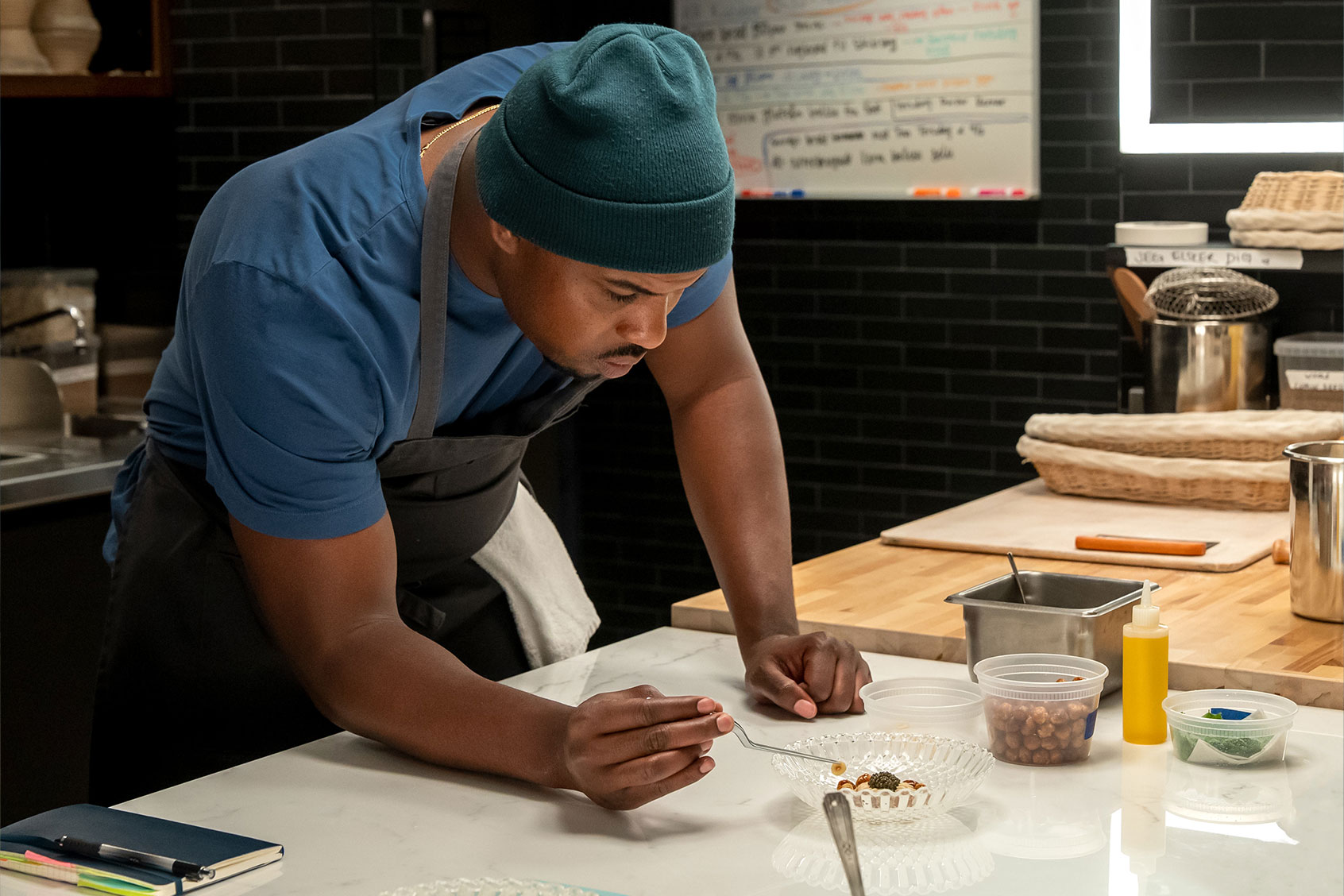
In Season 2 White’s character Carmy Berzatto launches his quest to transform his brother’s run-down sandwich joint into a bistro worthy of a Michelin star and recognizes Marcus’ drive. He funds the baker's trip to Copenhagen, Denmark, home of the world-renowned three-starred Noma. There, he stages (i.e. interns) for a short time with a pastry chef named Luca (Will Poulter), one of many unsung masters Carmy knows. Luca is exacting but gentle, raising Marcus’ game in the short time they have together.

"Honeydew" is a quiet beauty relative to most episodes of "The Bear," so you may not mind watching a few times to fully digest what its writer Stacy Osei-Kuffour is saying about how the fine dining world might treat someone like Marcus versus Luca.

Luca explains he never went to school to be a pastry chef. He ditched out on a check at a restaurant, got caught, was made to bust suds as penance, and ended up loving the kitchen. Marcus, meanwhile, played football to pay for his college education, then couldn’t get a job when he got out.

So he stumbled from one wage gig to the next until he met Carmy’s brother Mike (Jon Bernthal) at The Beef during a phase where he wanted to open a bakery. “I stopped making Big Macs and I learned how to make bread,” Marcus said.

We need your help to stay independent

Both got to that Copenhagen kitchen through happenstance but, purely on paper, Marcus should have had more advantages in the working world as a college graduate. He didn’t. Marcus had to work for the phone company before flipping burgers. Luca got a break from a nice restaurant owner, climbed the ladder and is now in a place to train a friend of a friend. He's the one with the permanent job in one of the world's top dining establishments. Marcus is just visiting. In fairness, Luca also says he's been baking for most of his life. Marcus only has a couple of years under his belt.

Regardless, viewers should know job shadowing on this level rarely happens in the real world. Restaurant workers have gone on record debunking the close personal attention and consideration Luca gives Marcus as a rosy fantasy, but that’s not what I’m talking about. It’s the fact that Marcus gained entry to Luca's rarified, sweetly scented den to pick up a few pointers.

The BearLionel Boyce as Marcus on "The Bear" (Chuck Hodes/FX)Accounts from Black chefs detailing being denied promotions and mentorships at top restaurants abound. In 2021, the New York Times spoke to a group of Black women with dreams of rising in the ranks of the fine-dining world only to be stalled in lower positions despite having more experience than people promoted above them.  

The Washington Post ran a similar story in 2018 featuring an account from Restaurant Opportunities Centers United (ROC United) co-founder Saru Jayaraman, describing a study where she sent 400 pairs of white and minority applicants to fine-dining restaurants in New York, Chicago, Detroit and New Orleans. White applicants were twice as likely to be hired regardless of whether the person of color had a better résumé.

That data may be around six years old, but not much has changed. According to current data analyzed by recruitment website Zippia, only 10.1% of professional chefs are Black.

This was never about the flour; sane people know that. It’s about continuing to deny … people of color an even shot.

In response to a troll’s Jan. 5 post pledging that he “and my white friends and families [sic] will no longer buy and support you [sic] totally RACIST COMPANY" a King Arthur employee identifying themselves as Barb posted this a few days later: “Currently, 40% of the US population are People of Color but in the food and beverage industry, only 23% of founders, 19% of Natural Product Boards Seats and 16% of leadership positions are occupied by People of Color, according to the US Census and the 2019 JEDI/New Hope Benchmarking Survey.

“Plus,” Barb adds, “industry-specific barriers POC face including hiring bias, networking and knowledge gaps and lack of access to capital for diverse founders and more."

“The Bear” confirms this truth when "Honeydew" includes a flash to Edebiri’s Sydney interviewing prospective employees. One of them, a cocky white guy with an impressive resume, looks past her and asks, “When can I talk to the chef?”

“You are,” she says calmly. He responds with a shocked, “Oh.”

King Arthur isn’t the least expensive brand on the shelf, but serious bakers swear by its bread flour due to its high protein content which, as Salon Food Editor Ashlie Stevens counseled me, is the secret to a more consistent texture, along with it being free of bleach and additives.

I simply know it as the only all-purpose flour that makes decent biscuits when I can’t score a bag of White Lily – which makes feather-light biscuits and pancakes but is highly processed and doesn’t perform as well for workaday bakes like drop cookies or yeast breads.

Although this was never about the flour; sane people know that. It’s about continuing to deny non-white pastry chefs and other professional bakers who are people of color an even shot while claiming to champion equality. "Baking Pitchfest helps ensure People of Color have the connections, resources and access they need to be successful." Again, thank you, Barb.


Want a daily wrap-up of all the news and commentary Salon has to offer? Subscribe to our morning newsletter, Crash Course.


By the way, Barb’s reply wasn’t left on the Baking Pitchfest 2024 webpage, which recently removed its description of the contest and replaced it with a sentence explaining that it is pausing online applications “due to overwhelming response to the program.”  

It was left on a 2021 blog entry titled, “How 4 talented bakers took a stand for social justice this year: They’re using cookies and cakes to help us fight inequity.” Those rabid posters may be a couple of years behind, but why should that stop them?

One of the best takeaways Marcus obtains from Luca isn’t related to piping methods or using tweezers to place hazelnut shavings just so. 

“I think at a certain stage it becomes less about skill and it's more about being open, you know. To the world, to yourself, to other people,” Luca says. “You know, most of the incredible things I've eaten haven't been because the skill level is exceptionally high or there's loads of mad fancy techniques. It's because it's been really inspired. . . . You can spend all the time in the world in here. If you don't spend enough time out there?” he says, gesturing to the outside and finishing his thought with a knowing look.

He adds, “Helps to have good people around you too.” 

Certainly there must be a few tradwives whipping up hissy fits about this on TikTok, pledging to abandon King Arthur in favor of some brand best suited to make papier mache paste. To those ladies and everyone else feigning wrathfulness at being left out of one baking contest in the whole wide world I say: enjoy the crappiness of your ashy muffins. You're only burning yourself, but bake on.

CORRECTION: This article has been updated since its publication to clarify the timeline of King Arthur's rebrand.

Ghost kitchens and digital cafes: How our shared spaces are losing their humanity

In 1902, Horn & Hardart opened the first automat in Philadelphia. The concept, which was a precursor to modern fast-food establishments, featured rows of coin-operated vending machines, which would dispense a variety of ready-to-eat hot and cold dishes, like cold-cut sandwiches, slabs of meatloaf and slices of pie. Through the years, the automat became both a symbol of frugality (in his 1912 short story, “The Automat,” writer O. Henry described them as "Mecca for the down-and-outs") and convenience. 

Though the popularity of the Horn & Hardart automat gradually dwindled as Americans ceased to live in a nickel-and-dime economy, and the last location eventually closed its doors in 1991, for a moment in time, the automat represented the first step towards a glimmering future free of pointless, time-consuming human contact, ostensibly leaving its inhabitants open for bigger and better things. 

In reality, the transition towards that future is a little clunkier — and a little more fraught with questions about whether it’s the one we really want. 

Last spring, for instance, I stopped into a Starbucks in downtown Chicago on my way to an interview. There were no tables, no chairs — just a large television screen that showed customers’ names chugging through a digital queue, eventually glowing a cool-green to indicate that order was complete and ready for pickup. In late 2019, the international coffee giant had announced they were shutting down hundreds of their cafe locations in order to open a slate of pickup-only stores, an effort the pandemic seemed to only strengthen. This was my first time visiting one, albeit unintentionally, so I approached the barista behind the counter who kindly informed me that she couldn’t take my order or any form of payment; that would all have to be done on their app. 

Since I was on a time-crunch (and honestly didn’t want to ask my ride to deal with finding parking in another location) I downloaded it, ordered and paid for our drinks and stood to the side, dutifully watching my name work its way through the virtual line. While waiting, a dad in a Bears sweatshirt and knit cap came in with his three tween daughters. Like me, he approached the counter and was given the same politely rehearsed spiel. His daughters each pulled out their phones, but he waved them off. 

They huddle for a moment. I hear some exasperated whispers — Nowhere to sit? They won’t take cash? — that finally erupt with the father declaring: “F**k it, we’re going to Dunkin’” 

In instances like this, whether or not these pickup-only stores are actually more “convenient” than a traditional coffee shop is up for debate, but that experience stayed with me for a different reason. More and more, I visit places that used to be brimming with opportunities for community connection, like restaurants and grocery stores and coffee shops, only to be plagued by the creeping sense that as our shared spaces become increasingly depersonalized, they are losing their humanity. 

Of course, science fiction has long predicted the advent of fully automated restaurants and bars, regarding these futures as equally aspirational and apocalyptic. 

We need your help to stay independent

The robot bartender, for instance, is a common character used to signal this reality, one thought to have been originally popularized in “The Stars My Destination,” Alfred Bester’s 1956 novel written at the height of the Atomic Age. Since then, from “Futurama” to “The Book of Boba Fett,” androids and automatons have slung drinks with admirable precision, but often with a complete lack of the emotional intelligence that makes many real-world bartenders so good at their jobs (I think of the Robot Barman in “The Fifth Element” who pours a mean shot, but doesn’t understand Father Vito Cornelius’ brief musings on the vulnerability of humanity). But what would a space devoid of human staff — or at least most of them — actually look like? 

Apart from the tellingly-named ghost kitchens, fast-food companies, the successors of the original Automat, seem eager to find out. In December 2022, McDonald's launched their first largely automated test location in Fort Worth, Texas, which, as The Guardian reported, drew the ire of activists "who criticized the fast food corporation for entertaining the idea of a costly automatic restaurant rather than pay its workers a living wage." 

I visit places that used to be brimming with opportunities for community connection, like restaurants and grocery stores and coffee shops, only to be plagued by the creeping sense that as our shared spaces become increasingly depersonalized, they are losing their humanity.

"Smaller than a typical McDonald's, the location is geared towards customers on the go rather than those who plan to dine inside," the publication reported. "It limits interactions between team members and customers and uses 'enhanced technology that allows the restaurant team to begin preparing customers' orders when they're near the restaurant.'" 

While McDonald’s clarified with the publication that there were still some humans working back-of-house even at their automated location, a CNBC report last year found that to 82% of restaurant positions could, to some extent, be replaced by robots, and automation could save U.S. fast-food restaurants more than $12 billion in annual wages, per the restaurant consultancy Aaron Allen & Associates. That’s why more and more companies, including Taco Bell, Wendy’s and White Castle, are adapting their physical restaurants for a more digital future. 

However, despite this industry-wide shift, it’s apparent people are still making bids for intimacy and connection when possible. For example, Dutch grocer Jumbo made headlines in 2019 when they announced the introduction of kletskassa, or “chat check-outs.” Per industry publication Grocery Dive, Jumbo first rolled out the chat checkouts as part of the Dutch government’s campaign to fight loneliness and now positions them, alongside “chat corners” where people can enjoy coffee and small talk, as part of community-building efforts.

As of early March 2023, Jumbo had more than 125 slow checkouts across the Netherlands and Belgium, a spokesperson for the company told the publication. 

It’s a simple, but potent antidote for what many researchers have classified as a global loneliness epidemic, and the ways in which isolation can harm both individual and public health. Third places — a term originally coined by sociologist Ray Oldenburg — refers to the places where people spend time between home (“first” place) and work (“second” place). According to the Brookings Institute, for many young Americans, third places are increasingly virtual. “But as Oldenburg notes, the most effective ones for building real community seem to be physical places where people can easily and routinely connect with each other: churches, parks, recreation centers, hairdressers, gyms and even fast-food restaurants,” they wrote. 

They continued: “A recent newspaper article on McDonald’s found that for lower-income Americans, the twin arches are becoming almost the equivalent of the English ‘pub,’ which after all is short for ‘public house’: groups of retirees meeting for coffee and talk, they might hold regular Bible study meetings there, and people treat the restaurant as an inexpensive hangout.” 

In the quest for convenience and efficiency, the evolution of dining spaces, from the historic automats to today's automated and pickup-only establishments, reflects a trajectory toward a future that’s more streamlined, but one that perhaps forgets the soul of shared spaces is undeniably human. 


“Who’s paying for it?”: Fake Biden robocall tells New Hampshire voters to stay home

A fake robocall purporting to be from President Joe Biden targeted New Hampshire voters, telling them to stay away from the polls in the state's presidential primary on Tuesday, per NBC News. 

The New Hampshire attorney general was prompted to look into the matter after Kathy Sullivan, a top New Hampshire Democrat who runs a super PAC that urges Democrats in her state to write in Biden's name in the primary, filed a complaint. NBC reported that Sullivan's personal cell phone number appeared in the caller ID of those receiving the robocall. 

“What a bunch of malarkey,” the phony message begins, citing an oft-used phrase by Biden. The message adds that “it’s important that you save your vote for the November election.”

“Voting this Tuesday only enables the Republicans in their quest to elect Donald Trump again. Your vote makes a difference in November, not this Tuesday,” the message says.

"Although the voice in the robocall sounds like the voice of President Biden, this message appears to be artificially generated based on initial indications," the attorney general's office said in a statement. "These messages appear to be an unlawful attempt to disrupt the New Hampshire Presidential Primary Election and to suppress New Hampshire voters. New Hampshire voters should disregard the content of this message entirely."

Sullivan in an interview said she began receiving calls on Sunday from people who had received the robocall. 

“I said, ‘You got a call from Joe Biden, and he gave you my number?’” Sullivan said after one person, who was not a Biden supporter, informed her of the call. A volunteer for the super PAC who also received the call was able to tape it, sharing it with the write-in group's organizers who then passed it on to NBC. Though the source of the bogus call has not yet been identified, “It’s obviously somebody who wants to hurt Joe Biden," Sullivan said. 

“I want them to be prosecuted to the fullest extent possible because this is an attack on democracy,” Sullivan added. “I’m not going to let it go. I want to know who’s paying for it? Who knew about it? Who benefits?”

Lawyer breaks silence on why he abruptly quit Trump team — predicts Trump could be convicted

Former Trump lawyer Joe Tacopina joined MSNBC Saturday to explain his recent departure from the ex-president's legal team the day before his latest defamation trial began. The conversation with Rev. Al Sharpton would be what Tacopina deemed his "first and only interview" addressing his move. 

“I left the team because it was just my time,” Tacopina said. “I had to follow my compass, and my compass told me it was my time.”

Tacopina elaborated, saying he left the case for "personal reasons" but did not disclose any specifics. He also decided to take a cordial approach to discussing his former client, slightly jabbing at his former colleagues. 

“While I see many lawyers, ex-lawyers of the president go on television once they’re removed from the team, or leave the team and discuss him, and his legal, team and have something to say, and criticize everyone around, it’s not professional,” Tacopina said. “It’s petty. And it’s it’s it shows a lack of confidence in oneself when you go out there and do that.”

The attorney also said that, while he doesn't find Trump's Manhattan criminal case alleging he falsified business records to be very strong, he has more concerns around the two federal indictments the former president is facing. 

“The two federal cases are serious cases,” Tacopina told Sharpton. “And I think they’re they’re not to be taken lightly.”

He added that it's "absolutely" possible Trump could be convicted in either case. 

“Look, do I think there’s a political bent to some of this, some of the the way this was gone about? Yes, I do," Tacopina said, noting that Trump will have to face a jury in three locations — Washington, D.C., New York City and Georgia — that aren't "particularly big Trump venues." 

"So that’s going to be something to really have to grapple with there. And you can’t say there’s no way he’ll get convicted," he said.

Trump lawyer objects to continuing trial amid illness — then complains about trial schedule

Writer E. Jean Carroll's second defamation trial against former President Donald Trump was adjourned Monday in Manhattan for a sick juror, per CNN. U.S. District Judge Lewis Kaplan offered to continue with eight of the nine jurors present, which Carroll's team said would be fine, but Trump attorney Alina Habba asked for an adjournment.

The absent juror reportedly tested positive for COVID. Habba, who was not wearing a mask while sitting next to Trump, told the judge that she had a fever and had dinner with her parents before they tested positive for COVID but said her test came back negative. 

Trump has claimed that he planned to testify on Monday. "So tomorrow is the New Hampshire primary and he needs to be in New Hampshire," Habba told the judge. "He was planning to testify — clearly, he flew in last night to be here. I would just need his testimony to be Wednesday in light of the news about the juror today."

A lawyer for Carroll objected to the delay, telling Kaplan that "we'd like to get this trial over." 

“I just think we should finish tomorrow," the attorney said, according to Politico

"I'm not going to decide right now," Kaplan told Habba.

But Kaplan did shoot down yet another motion for a mistrial from Trump's team after they claimed Carroll destroyed evidence by deleting some of the threats she received after publicly accusing Trump of sexual assault. Kaplan said he would issue a written order shortly. 

“Embarrassing”: Ron DeSantis mocked for dropping out with fake Winston Churchill quote

In bowing out of the running for GOP presidential candidate, Florida Governor Ron DeSantis misattributed a quote to former British Prime Minister Winston Churchill.

"This is America's time for choosing," DeSantis said in a video posted to X/Twitter on Sunday afternoon announcing the suspension of his campaign. "We can choose to allow border invasion, or we can choose to stop it. We can choose reckless borrowing and spending, or we can choose to limit government and lower inflation." Amongst other notes, the Florida governor also patted himself on the back for "leading with conviction, championing an agenda marked by bold colors."

"I'm proud to have delivered on 100% of my promises, and I will not stop now," he added, before saying that Donald Trump is "superior to Joe Biden," in a move that seemingly conceded his endorsement to the former president.

“Success is not final, failure is not fatal: it is the courage to continue that counts," DeSantis captioned the clip, identifying the words as Churchill's. However, the New York Times reported that the quote was falsely attributed, per the International Churchill Society. “We can find no attribution for either one of these, and you will find that they are broadly attributed to Winston Churchill,” the organization stated. “They are found nowhere in his canon, however.”

Following the posting of the video, one Twitter user pointed out that the quote actually appeared in a Budweiser beer ad circa 1938, with a 20th-century copy of "Life Magazine" found on Google Books showing the ad, per Newsweek.

DeSantis' apparent blunder was panned across social media.

"DeSantis quit with a fake Churchill line! Maybe the actual quote is in one of the books he banned?" tweeted Christine Pelosi, a Democratic political consultant and daughter of former House Speaker Nancy Pelosi, D-Calif. The Florida governor is well known as one of the GOP's most staunch "culture warriors," campaigning from a platform that prioritizes objectives such as banning books in school libraries that address topics of sexuality and gender identity and curbing lessons on race studies. 

"He’s quoting George Santos," quipped former attorney George Conway, referring to the disgraced former Congressman who made headlines for habitually lying about his background. 

Following the news of DeSantis' dropping out, critics came for his campaign, which had seen a decided dropoff in popularity in recent months, owing largely to his inability to make good with Disney — the state's largest employer — over his "Don't say gay" crusade, infighting in his campaign, his shoddy response to COVID-19 with anti-vax rhetoric, and reported lack of personal charm.

"Ron DeSantis should be forced to carry his presidential campaign to term," wrote one X/Twitter user, in a sardonic reference to the governor's stringent views on abortion. 

California Governor Gavin Newsom quipped on Sunday that there was a "Fire sale on all Ron DeSantis merch today!" 

We need your help to stay independent

"Congrats to the crack DeSantis comms team," tweeted former MNSBC host Medhi Hasan, "… for being unable to get their guy even to New Hampshire," referring to the fact that DeSantis didn't even make it to the New Hampshire primary. "One of the most embarrassing, hapless, & disastrous presidential campaigns in memory. They couldn’t even teach Ron to smile."


Want a daily wrap-up of all the news and commentary Salon has to offer? Subscribe to our morning newsletter, Crash Course.


The Miami Herald's editorial board, in a scathing opinion piece published on Sunday, claimed that it's "not just that he [DeSantis] was steamrolled by Trump. DeSantis never appeared to want to save the GOP."

"He was more interested in making it a more ravenous, angrier, and intolerant party," the board continued. "That worked for Trump, but didn't work for the governor with all the charisma of burned toast."

"DeSantis could have pitched a kinder form of conservatism or at least a more reasonable version," the board concluded. "Instead, he banked on exploiting division in our country. As he blows out, DeSantis leaves the Republican Party exactly as he found it, under Trump's dominance."

Trump launches new attack on E. Jean Carroll — as her lawyer uses his own words against him

The night before the final day of E. Jean Carroll's defamation trial against Donald Trump, the former president took aim at the writer and her legal team while griping about his Monday court appearance to a booing New Hampshire crowd.

"Look, these are crooked people," he said Sunday night. "These are corrupt people. These are corrupt people. But I'm going for trial tomorrow — all done by political operatives." Trump went on to imply, according to RawStory, that the case was a personal attack by Reid Hoffman, the LinkedIn billionaire who has been financially supporting Carroll's lawsuit. 

"Reid Hoffman, is sponsoring this woman that said terrible things from 30 years ago. He took me — I owned three or four buildings around him. I owned the hotel next to it," Trump continued. "I took her… It's a totally fabricated story. Totally fabricated. And the lawyer is a political operative. Used to be very close to Cuomo. Do you remember him? And a political operative."

Trump's comments came a day after Carroll's lawyer informed U.S. District Judge Lewis Kaplan via court filing that she will submit a spate of evidence of the former president's public remarks against Carroll amid the trial, according to Business Insider. In addition to alleging the case is "fabricated," Trump has repeated claims that he never knew Carroll and accused her of deleting evidence in the case.  

"This is evidence Carroll can use to increase both a compensatory and punitive damages jury award," former Mueller prosecutor Andrew Weissmann wrote on X/Twitter, in response to Carroll's filing. "His continued defamation of Carroll, even as the trial is ongoing, is entirely relevant to the jury’s consideration of punitive damages," added MSNBC legal analyst Lisa Rubin. 

Ron DeSantis ends the most humiliating presidential run in history with one final disgrace

Who would ever have guessed that the latest Republican Great Whitebread Hope would crash and burn even before the New Hampshire primary? It's not as if they always end up being losers. Well, actually they do. Every cycle some highly touted GOP governor is built up to be the second coming of Ronald Reagan and they inevitably come to an ignominious end that generally spells the end of their political future. (When's the last time you heard anything about former heartthrobs Scott Walker of Wisconsin or Tim Pawlenty of Minnesota?) Florida Governor Ron DeSantis, who quit the race on Sunday rather than face another primary drubbing, is no exception. The man from Florida turned out to be a dud, just like so many who have come before him.

The man from Florida turned out to be a dud, just like so many who have come before him.

Despite all the hype he never stood any chance of dethroning Donald Trump for the Republican presidential nomination and it actually had little to do with him. It's because Donald Trump has had the nomination in the bag since Jan. 21, 2021. Even zombie Reagan wouldn't be able to beat him. And there was never any doubt that Trump was going to seek a rematch since he had staked his well-being and the future of the GOP on the Big Lie that the election had been stolen from him.

But DeSantis was one of the most arrogant of all these alleged superstars. And his campaign may have been the worst of all time. There have been quite a few postmortems of this disastrous campaign already, some of them even before he officially dropped out. It wasn't hard to see it coming. Despite the media continuing to take him very seriously almost until the end, it's been clear that his campaign was nose-diving since the spring of last year.

We need your help to stay independent

After his big re-election win in 2022, an anomaly in that otherwise disappointing year for Republicans, he was briefly seen as a rare political talent who could possibly beat Trump when the polls showed them neck and neck. But that was a very short-lived phenomenon:

Conventional wisdom now holds that Trump rose abruptly in the polls because he was indicted. It's just as possible that when national Republicans started to get a good look at DeSantis they decided that Trump was a better choice, indictments or not. And that's because DeSantis is an extremely unlikable politician. (I once compared him to Richard Nixon and I was being unfair to Nixon!)

What DeSantis did to his own state in service of his grasping ambition was downright wicked and it should have tipped off the punditocracy to the fact that he was being unduly influenced by right-wing internet politics. We first knew he was uniquely barbarous when he made defiance of COVID mitigation measures and vaccination programs the central issue of his administration. This was a stance so irresponsible that his state, which has an older demographic than any other state in the union, ended up with a much higher death rate than it should have. And this outrageous irresponsibility continues to this day, with his quack Surgeon General Joseph Ladapo, chosen specifically for his fringe anti-vaccine views, exhorting Florida residents not to get any MRNA boosters, based upon shoddy science. This is despite new studies showing that multiple vaccination shots greatly reduce the chances of contracting long COVID.


Want a daily wrap-up of all the news and commentary Salon has to offer? Subscribe to our morning newsletter, Crash Course.


DeSantis was still flying the COVID resistance flag in his presidential campaign, often using it as his great selling point on the trail. He even brought Ladopo to campaign stops. It's not only an example of his desperately poor leadership, it's also a prime example of his desperately poor political judgment which carried through to his announcement that he was dropping out of the race on Sunday. After everything that's happened since then, DeSantis basically said that he's fine with Trump except for his COVID policy and his support for Dr. Fauci. He truly believes that his COVID policies are his greatest achievement but apparently, Republican voters weren't all that impressed. (Maybe it's because of the high COVID death rates in GOP states.)

Donald Trump has had the nomination in the bag since Jan. 21, 2021. Even zombie Reagan wouldn't be able to beat him.

That wasn't the only problem with his campaign, of course. There was the disastrous announcement event on X which turned out to be symbolic of his whole campaign: lots of hype and then nothing but glitches. The infighting within the campaign and his Super PAC, an experiment that was not only of dubious legality but never really worked. He avoided the mainstream press preferring to focus only on right-wing media, failing to recognize that Donald Trump owns them. And then there is his pathetic lack of personal charm and charisma. If there was ever someone who is not suited to retail politics, it is Ron DeSantis.

He's heading back to Florida now, a state that he has abused so badly in pursuit of his presidential ambitions that it's now just a smoking hulk of what's left of the latest right-wing experiment in governing by Twitter and Newsmax. If he did nothing else he proved that following the advice of the MAGA "intellectuals" like Christopher Rufo may not be the big winner everyone thought it was.

Unfortunately for Florida, they are saddled with a 15-week or 6-week abortion ban, both of which he signed, at least until the courts declare otherwise. Their public schools and higher education are in crisis, beset with controversy over banned books and "don't say gay" laws that are completely out of step with modern America. His "elections policing unit" is backfiring. His administration is riddled with corruption and he's still embroiled in a feud with the state's largest employer which he undertook because someone told him that "fighting the woke" was his ticket to the big time.

Throughout his campaign, he said over and over again that he wanted to make America Florida but the Americans he expected to embrace that vision rejected it out of hand. There's a lesson in that for the Republican Party but I doubt they are going to hear it. After all, he was just trying to be Trump and they are all knocking each other over in the rush to endorse him.

And that even includes DeSantis himself who said just last week, "You can be the most worthless Republican in America, but if you kiss the ring he'll say you're wonderful." Just six days later, without even a hint of embarrassment, he proved that to be true. He kissed the ring and Trump said "he was very gracious, and he endorsed me, so I appreciate that."

His final awkward video, suspending his campaign, was yet another gaffe:

It's a fitting end to one of the most humiliating presidential runs in American history.

“Suicide mission”: Legal experts warn Trump’s plan to testify could turn into a “bloodbath”

Former President Donald Trump has claimed that he plans to testify in his defamation trial on Monday but it’s unclear whether he will actually show up.

Trump has previously made similar claims and then failed to appear, The Washington Post noted, raising questions about whether he would follow through on his vow in the case brought by writer E. Jean Carroll — the second defamation trial he has faced in recent months after a jury previously found him liable for sexually assaulting and defaming the columnist.

Legal experts warned that Trump taking the stand would be “something akin to a suicide mission,” the Post added, especially after tangling with Judge Lewis Kaplan over his courtroom outbursts.

Kaplan is “the worst possible draw for Trump” because he’s “really smart and takes no guff from either side,” veteran white-collar criminal defense lawyer Robert Katzberg told the Post.

“Even if you had the most pro-Trump judge in America overseeing the trial, Donald Trump should not testify. Multiply that by a million with Lewis Kaplan on the bench,” he said. “Given both his lack of any relevant facts as to the only issue remaining — the damages suffered by Ms. Carroll — and Donald Trump’s inability to control himself emotionally, he is begging not only to be debased before the jury, but contempt citations will be looming large.”

New York University Law Prof. Andrew Weissmann, a former federal prosecutor, told MSNBC last week that it is “still not clear that Donald Trump will, in fact, testify because I think that would be a bit of a bloodbath in terms of what he could possibly say in his defense."

Trump “didn’t have the temerity to actually testify” in the first case brought by Carroll, “and the jury made a determination based on clear and convincing evidence that he had done this conduct,” Weissmann said.

We need your help to stay independent

MSNBC legal analyst Lisa Rubin noted on X/Twitter that Trump has “faked us out on testifying at least twice” — repeatedly threatening to testify in the first Carroll case despite never even entering the courtroom and then claiming he had no choice but to testify in New York Attorney General Letitia James’ civil fraud case before declining to take the stand in his own defense in that trial as well.

“We have to prepare that he is going to come, if for no other reason than the sheer logistics of how disruptive his presence in any courthouse or courtroom has been. However, my expectation is that, like he has before, he's bluffing, that he will not come to testify tomorrow,” Rubin said on MSNBC Sunday.


Want a daily wrap-up of all the news and commentary Salon has to offer? Subscribe to our morning newsletter, Crash Course.


"That is in part because there's a very limited range of issues about which he could permissibly testify,” she explained. “This trial is just about damages, it's not about whether he sexually assaulted her, it's not about whether he defamed her or even continues to defame her with each passing day of the campaign. So, ultimately, I predict he won't come and, indeed, our folks in New Hampshire have not seen any indication that he's preparing to testify by taking the time for witness prep."

Trump’s criminal rebrand of the Republican Party is complete

Today’s Republican Party is a de facto political crime organization. Donald Trump continues to be the Big Boss. With his win in the Iowa Republican caucus, Trump further cemented his control over the Republican Party. His “rivals” are all fading away as they try to win back his favor and hope to be hired in the new regime if he takes power in 2025.

In all, the Republican presidential primaries are like a form of political kabuki theater or professional wrestling, as the outcome was very much preordained, even though the commentariat, news media, and others fixated on the “horse race” and “contest” convinced themselves it could somehow turn out any other way than Trump being his party’s candidate for president in 2024.

The Guardian's Alice Herman details Trump's domination last Tuesday:

Before the caucuses, the Florida governor, Ron DeSantis, repeatedly reminded voters and the press that he had toured all of Iowa’s 99 counties. Trump won 98 of them. With the exception of college graduates and voters under 30, who for the most part caucused for DeSantis or the former South Carolina governor Nikki Haley, most other demographic groups reported strong support for Trump this year.

Even young Republican voters favored Trump slightly more strongly this year than in the 2016 Iowa caucuses: CNN entrance polls showed a modest 3% jump in caucus-goers under 30 who support Trump, while his share of supporters over the age of 30 nearly doubled across the board.

Since 2016, Trump has consolidated support among evangelical Christian voters, a key block in Iowa. Just over 20% of Trump’s Iowa supporters in 2016 self-reported as evangelicals or born-again Christians; evangelicals made up 53% of his supporters in 2024 Iowa polling….

The next stop to test the strength and growth of Trump’s base is New Hampshire, which is also demographically less diverse than most of the country and thus not representative of what the US election as a whole will look like.

Even so, Trump is predicted to win the state, further cement his monopoly of the party, and box out those who threaten it.

Trump the Big Boss is now facing five trials and 91 felony charges that could result in him being sentenced to hundreds of years in prison. Trump is responding to this pressure by attacking like the de facto crime boss and aspiring dictator and apparent sociopath that he has repeatedly shown himself to be. Early Thursday morning, Trump raged on his Truth Social platform that he is above the law because "ALL PRESIDENTS MUST HAVE COMPLETE & TOTAL PRESIDENTIAL IMMUNITY…" There is a word for such a leader: dictator. He is continuing to incite violence and death against the judges and other members of law enforcement as well as the witnesses in his trials. Trump’s MAGA followers – who serve as his enforcers and foot soldiers – are following his directives as shown by the increasing incidents of violence, intimidation, and other thuggery targeting their “enemies” across the country.

In his role as the Big Boss of the de facto Republican Party political crime organization, Trump has made himself even more wealthy.

In Florida, where Trump is on trial for allegedly stealing highly classified documents, Judge Aileen Cannon is acting more like his personal attorney and advocate than a neutral party who is enforcing the law. Trump selected Cannon for the bench while he was president; she appears to be paying off the favor to the Big Boss.

In New York, Trump is attending the second trial in the defamation case brought against him by E. Jean Carroll, who the ex-president has been determined by a court of civil law to have sexually assaulted in 1996. On Tuesday, Trump attacked Carrol online on his Truth Social platform while sitting in the same federal courtroom across from her. Trump has also been disruptive and combative in court. Trump is enraged at Carrol for daring to hold him accountable for his evil behavior. Trump is likely attending the trial to intimidate her and by extension the dozens of other women who have credibly accused him of sexual misconduct.

In his role as the Big Boss of the de facto Republican Party political crime organization, Trump has made himself even more wealthy. Documents recently released by House Democrats show that during the first two years of his presidency, Trump’s businesses received almost 8 million dollars from foreign governments, with the majority of the money coming from China. Reporting and other investigations have shown that Trump and his inner circle turned the presidency into a type of personal ATM and influence peddling operation potentially involving tens of millions of dollars. For example, Trump’s son-in-law Jared Kushner received 2 billion dollars from the Saudi government for his new equity firm.

We need your help to stay independent

Donald Trump has promised to be America’s first dictator when/if takes power in 2025. But Trump the Dictator will not be a common political thug: he is now claiming to be the Chosen One, picked by “Jesus Christ” and “God,” a type of messiah and holy man (for fascism and authoritarianism) as he leads his MAGA flock to the paradise on Earth that will be his second regime.

Such claims to god-like status and power are also common traits of autocrats, dictators, and other political criminals. In her newsletter Lucid, historian Ruth Ben-Ghiat explains:

That's why political enablers with connections to faith communities have long been tasked with proclaiming his sanctity, especially when his corruption is in the news. Indeed, the more his crimes come to light, and justice moves to hold him accountable, the more he must be elevated as a being who is in some fashion not bound by the laws of ordinary men….

For those familiar with authoritarian history, it is no wonder that the talking point of Trump's holiness has become prominent as more of his malfeasance and illegal behavior has been made public. Nor is it surprising that Trump would share a depiction of himself as Jesus-adjacent during his Oct. 2023 civil fraud trial. The image implies that Jesus is with him on his righteous path and that, even in court, Trump thinks holy thoughts….

The notion of the strongman as both savior and victim —the leader as a man of the people and a man above all other men— surrounds depraved and corrupt individuals with an aura of holiness. …Appearing as a figure tinged with the divine assists the reception of strongman propaganda campaigns, since any legal troubles must have been manufactured by godless Communist prosecutors, judges, and journalists.

During a recent online interview and “prayer session," Trump’s attorney Alina Habba, his son Eric and daughter-in-law Lara claimed that the ex-president has special divine powers and is being guided by God. Trump’s attorney also made absurd claims that Trump was a “victim” of “demonic forces," as Right Wing Watch reports:

“I think that there is a plan,” Habba said. “There’s God’s plan, and then there’s a demonic plan. And the demonic plan is very easily confused with real life. There’s an orchestrated thing going on here. Don’t get it twisted. We have cases lined up intentionally during election time, intentionally trying to get negative attention right before an election.”

“He’s being pulled from the campaign time and time again to be deposed, to be subpoenaed, to go to trial, to fight the fight to clear his name,” she continued. “But the people that know him and the people that have faith and are reading—the people that are educating themselves, the people that are not listening to the fake news—they will understand and they do understand and they stand with him. And honestly, we’re flipping the ones that don’t know, because their demonic plan is so obvious.”

“Pray for people to open their eyes,” Habba concluded. “They like to call MAGA Republicans a cult mentality. We’re not a cult mentality; we love America. If that’s a cult, I’m happy to love America. I’m happy to be part of that.”

Too many people — including the news media and other professional politics watchers — have convinced themselves that once Trump was on trial, his support would inevitably dissipate, and he would be vanquished from public life as some type of pariah. The opposite has happened, however: Trump and MAGA movement are enduring if not even more ascendant as the ex-president is tied with President Biden. [Trump is also leading Biden in key swing states that Biden won in 2020]. This is more evidence of how Trumpism (like other forms of fascism) is a political and moral sickness throughout American society, a type of collective mass pathology and state of malignant normality, which is a deep cultural problem that is bigger than any one leader or party.

To that point, MSNBC’s Steve Kornacki made the following observation on X/Twitter about Trump’s dominant victory in Iowa and how he believes it was propelled by the ex-president’s criminal indictments.

"The shift came abruptly," Kornacki notes. "A clear rally-around-Trump effect among GOP voters when news of the first indictment (Manhattan DA) broke in March '23. Look how the polling averaged diverged at that moment and never looked back." 

It is true that there is polling and other data suggesting that Trump’s support could weaken among “traditional” Republican voters and independents if he is convicted in court. For example, a recent New York Times/Sienna College poll shows that approximately 25 percent of Trump’s own voters could potentially deem him disqualified from the presidency if he is convicted of a crime. However, the New York Times/Sienna College polling also has contradictory findings that show the enduring power of Trump, the Big Boss:

Mr. Trump’s primary lead has swelled since the summer, even though the share of Republicans and Republican-leaning independents who believe he engaged in criminality rose to 27 percent from 17 percent in July. Mr. Trump is leading not only because he dominates among the large share of Republicans who see him as innocent, but also because he is winning one in three Republican voters who think he engaged in serious criminality.

Support for Mr. Trump in the Times/Siena poll is so thorough that 62 percent of Republicans think that if the former president wins the primary he should remain the Republican Party’s nominee — even if he is subsequently convicted of a federal crime.

I asked Gregg Barak, who is a criminologist and author of the book "Criminology on Trump” for his explanation of why Trump’s perfidy and apparent crimes have not yet significantly (if at all) diminished his popularity among the MAGA people and his other followers. Trump supporters, Barak said, "are primarily identifying with the positive master status of the former president as an outlaw or revolutionary rather than with the negative master status as a fraudster or criminal":

As the former Teflon Don who has now been criminally indicted four times likes to say, “come on, everybody does it,” “everyone is corrupt,” “look at the Biden crime family.” Accordingly, Trump and his supporters want to know, “why is the deep state coming for me other than I am a head in all the 2024 polls”

Americana, in its folklore and historical culture as evidenced in books and films alike, have been celebrating and romanticizing outlaw figures since the 19th century. From Jesse James to Bonnie and Clyde to D.B. Cooper to Donald Trump, regardless of their crimes these iconic outlaws have all been viewed as “thumbing one’s nose” at the system or “flipping off” the elites of society or the rulers of state on behalf of the ordinary people who in their own fantasies can only dream about doing the same kinds of deviant or transgressive things.

While these “outlaws” are on the lam and resisting capture, everyday folks are rooting for them as they try to beat the system. Their fanbase will often identify with them until such time as these outlaws finally meet their ultimate legal demises. In other words, once the former president has been officially stigmatized as a criminal vis-à-vis adjudication and conviction by a jury of his peers, then his supporters — even his MAGA base cult followers — will soften considerably in their emotional enthusiasm for Trump and subsequently the number of supporters will quickly decline, if not, dissolve altogether and relatively quickly.


Want a daily wrap-up of all the news and commentary Salon has to offer? Subscribe to our morning newsletter, Crash Course.


I also asked Rich Logis, a former member of the Republican Party and right-wing pundit, for his thoughts on why Trump’s crimes make him so compelling to his followers:

Not to sound self-aggrandizing or clairvoyant, but I was publicly saying many moons ago that the multi-state and federal indictments of Trump would strengthen the unbreakable bond that remains between the former president and most MAGA adherents. I was confident in this, because, as a former devout MAGA grassroots activist, the impugning of Trump was really a collective impugning of we “real Americans,” who were soldiers—led by Trump, our political general—in a good versus evil war against the existential threats of Democrats, centrists, moderates, globalists and RINOs (Republicans In Name Only). The indictments affirm a pervasive mythology within MAGA: that federal and state law enforcement, and prosecutors, are a weaponized, Lavrentiy Beria-type Stasi that persecutes Republicans and conservatives, and especially, Trump voters. This is, of course, inaccurate; before I left MAGA, I allowed myself to succumb to this mythology. What is factually accurate, however, is often secondary to what is perceived to be true.

Most MAGA voters are good people, and though I don’t defend the ignorance I once possessed in great amounts, we must recognize that they have been traumatized, victimized and exploited. Because Trump is the bulwark against (imaginary) tyranny, indictments assure MAGA voters that they are on the correct historical side—hence why Trump’s legal problems assist him in his retributive re-election campaign. Next action steps: Trump and MAGA candidates must be electorally defeated—no exceptions; and Trump’s likely convictions will carry sentences of many decades (thus making them life sentences).

Barack and Logis’s insights are very helpful as we try to navigate the Trumpocene and what may happen next with Trump and the Republican political crime organization and their MAGA followers as the ex-president is put on trial and the election approaches.

Speaking at the Stop Trump Summit in New York in October, Mary Trump, who is the ex-president’s niece and a trained psychologist, highlighted a powerful truth about the MAGA cult and its devotion to Trump. “They identify not with Donald’s strength … but they identify with his weakness," she explained, "They identify with the fact that he gets away with everything.

As I continue to warn, sick societies produce sick leaders. Trump's followers are not repelled or disgusted by his obvious criminality, violence, and other antisocial and pathological behavior: they are attracted to and idolize it and him. Trump is much more than a man; he is a type of aspirational symbol and cultural force that grants permission for many Americans (and other people) to be their worst true selves. Too many of the country's responsible political elites and others who believe in democracy are risking the future of the country on their faith in the collective character and decency of the American people. On Election Day, the world will see if that faith was merited and then be left to deal with the horrible consequences of what could be a very grave error. 

Greg Abbott is pushing Texas to the brink

To rule is easy, to govern difficult

-Johann Wolfgang von Goethe

At the end of the day, you have to wonder if Texans are comfortable being a part of the United States.

I’m not just talking about the Dallas Cowboys, who have choked so often in the NFL playoffs that they need the Heimlich maneuver when they step on the field, particularly at home against the Green Bay Packers. I mean, in general, you have to question it.

Governor “Hey, Abbott!” – with apologies to Lou Costello – Greg Abbott is certainly among those who think that Texas is still its own country. He has stood stupidly defiant against the federal government for the last few months on the issue of Southern border security and kept the Border Patrol from doing its job while claiming the state of Texas has the right to defend its “sovereignty.”  

Abbott’s “Operation Lone Star” has bused more than 35,000 immigrants to Washington, D.C, New York City, Chicago, Philadelphia, Denver and Los Angeles since April of 2022. He claims that the operation “continues to fill the dangerous gaps created by the Biden administration’s refusal to secure the border.” More on that in a moment.

Now Abbott seems to be making the case for going it alone again in the Lone Star state.

Two of my sons were born in Texas, and I am often reminded that anyone can become an American, but you have to be born a Texan. I used to think that was cute and funny – like the businessman I knew in the early 90s whose wife went into premature labor while they were visiting New York. He had a San Antonio neighbor overnight him 10 pounds of dirt from his backyard that he then placed into a container, so when his son was born he could legitimately say his son’s ass first touched Texas soil. Turns out, what I find cute and funny is deadly serious in Texas. They take their state pride seriously – even if there are (or once were) a sizable number of people in Texas who don’t support much of the lunacy from the state’s Republican Party. When it comes to Texas, they still fully believe they live in their own country. 

As recently as December, Newsweek reported on a strong separatist movement in the Lone Star state. The Texas Nationalist Movement, an organization that supports Texas' independence from the U.S., warned the GOP they have enough signatures to force a vote on the question of whether Texans support secession. Texas nationalists have for years pushed for a referendum on Texas secession, despite the fact there is no provision in the U.S. Constitution for a state to do so. Of course, that hasn’t kept the wildly independent Texans from doing whatever they want. The state first seceded from Mexico in 1836 and spent nine years as its own nation (remember the Alamo!) before it became the 28th U.S. state on Dec. 29, 1845. Texas also seceded from the U.S. in 1861 before being readmitted following the end of the Civil War.

Now Abbott seems to be making the case for going it alone again in the Lone Star state. There’s little practical chance of that, however. The federal government owns and operates 15 military bases in the state with an economic impact of more than $100 billion. San Antonio alone has four bases, with others being scattered from Corpus Christi to El Paso, and other points north and south throughout the state.

Still, it’s a touchy subject for Abbott. I tried all this week to get someone to speak to the issue in the governor’s office. My emails were ignored and when I finally reached someone by phone in Abbott’s press office, they hung up on me. Nothing like transparency in Texas. But, this isn’t unusual, I once got thrown out of the Texas Senate for asking a senator to move so my station’s news photographer could get a better shot. Texans can be arrogant and ignorant – and in government they are often that way all the time. 

The Biden administration is deeply frustrated with Abbott’s moves – and while he continues to play politics with a very serious issue, the federal government – including the U.S. Border Patrol which is far from a bastion of liberals – has tried to get Abbott and Texas to see reason. The general counsel for the Department of Homeland Security recently sent state officials a letter, portions of which read, “Texas’s actions are clearly unconstitutional and are actively disrupting the federal government’s operations. We demand that Texas cease and desist its efforts to block Border Patrol’s access in and around the Shelby Park area and remove all barriers to access in the Shelby Park area,” of Eagle Pass.

DHS gave Texas until January 17 to “cease and desist” its efforts to block the Border Patrol’s access to the park and to remove all barriers to access to the U.S. – Mexico border before referring the matter to the Department of Justice “for appropriate action and (to) consider all other options available to restore Border Patrol’s access to the Border.”

Sounds ominous, but what other options are there? Abbott certainly doesn’t think the Border Patrol will fire upon Texas law enforcement working the border, does he? No rational human being thinks so. That would be disastrous, and yet, we are still at a tipping point in Texas. God only knows what the lunatics may do – and there are plenty of gun-happy lunatics in Texas.

During the 80s I was assigned to cover a story when members of the KKK showed up on the border after President Reagan claimed godless Sandinistas were just a two-hour plane ride away from our southern border. There were many guns on the border on that day. And Texans, of course, love to take matters into their own hands. There’s a long history of that.

We need your help to stay independent

As the current drama in Texas was playing out, The Hill reported, “The House on Wednesday approved a resolution condemning the Biden administration’s border and immigration policies, a move by GOP lawmakers to maintain pressure on the politically polarizing issue in the weeks ahead. The legislation pins the blame on President Biden’s “open-border policies”, highlighting the stark partisanship behind immigration and border policy. It passed 225-187, with 14 Democrats voting in favor.”

The Biden administration has angrily accused the GOP of duplicity, noting that Biden has proposed reforms to immigration that include hiring more Border Patrol agents, but the GOP has refused to take up the issue. Of course, it’s hard to get the GOP to do anything in Congress – they can barely pass legislation for funding the government.

On Wednesday, Biden met with members of Congress to talk about additional funding for Ukraine – something GOP House Speaker Mike Johnson said is linked to immigration reform. After the meeting, Biden was asked – as he walked to Marine One on the South Lawn  – what the sticking points were on immigration reform. Biden said, “I don’t think we have any sticking points left.”

When Johnson and other members of Congress came out to the sticks on the North Lawn to talk to reporters, Johnson shut the door on “comprehensive immigration reform,” telling reporters, “I don’t think now is the time for comprehensive immigration reform, because we know how complicated that is.”

Of course, there won’t be reform – it would ruin the GOP’s chances to run on that issue if they solved the problem. This is a true do-nothing Congress. The GOP doesn’t want to solve problems – it wants to blame Democrats for problems in order to get elected. 

You’ve got a better chance of the Dallas Cowboys winning the Superbowl than finding any common sense in Congress as Republicans continue to speak out of both sides of their mouth. While Johnson said there obviously won’t be any long term reform he also said, “We must insist that the border be the top priority. I think we have some consensus around the table. Everyone understands the urgency of that.” Try to wrap your mind around that lack of logic.

Senator Chuck Schumer saw things differently. He told reporters, “We also talked about the border and how it's so important to deal with the border. The President himself said over and over again that he is willing to move forward on the border. And so we said we have to do both. There were a couple of people in the room that said let's do the border first. We said we have to do both together.”

The response in Texas?


Want a daily wrap-up of all the news and commentary Salon has to offer? Subscribe to our morning newsletter, Crash Course.


Texas authorities arrested migrants at Shelby Park in Eagle Pass, Texas, late Wednesday evening and charged them with criminal trespassing, marking the first arrests of migrants since the state took control of the area at the US-Mexico border last week, an official said. In response to the federal government’s cease-and-desist letter, Texas Attorney General Ken Paxton admitted that Border Patrol has “warrantless access to land within 25 miles of the border, but only ‘for the purpose of patrolling the border to prevent the illegal entry of aliens into the United States.’”

Texas is inching closer to a confrontation and a clash that can never occur and both sides do not want to recognize the root cause of the problem: American politics.

Illegal immigration has been a problem for nearly half a century because of the Mexican oil economy crash in the 70s as well as the US demand for cheap labor and cheap drugs. In the 1980s the US, during the Reagan administration, made some steps toward solving the problem, but there has been nothing done since then by both political parties. The truth is Big Business wants and demands cheap labor – as do most Americans. No one wants to pay $10 for a tomato, and the demand for cocaine, heroin and even fentanyl remains huge, so Big Business holds up a welcome sign while politicians act disingenuously about solving a problem they all had a part in creating. 

Thus, Abbott is willing and able to use the poor and downtrodden to skewer Democrats by saying immigrants are lazy and living off of the welfare state, while at the same time claiming they take all of the jobs. The Christian Republicans scream the loudest about this – ignoring the teachings of the Jesus they claim to worship and ignoring the fact that the nation was built by immigrants – or as Bill Murray reminded us in Stripes, “We're Americans, with a capital 'A', huh? You know what that means? Do ya? That means that our forefathers were kicked out of every decent country in the world. We are the wretched refuse. We're the underdog. We're mutts!” And those that weren’t immigrants were brought here as slaves, but that’s another issue.

American hypocrisy has never been so evident as in how we deal with new arrivals to our shores.

Protect our borders from caravans of foreign illegal immigrants? When Native American tribes tried to stem the tide of illegal immigration it didn’t go so well – and it won’t go well for us now either.

Friday, top U.S. and Mexican officials met in Washington to discuss strengthening cooperation and continuity in addressing the migration issues at the U.S.-Mexico border. This occurred as several Border Patrol sectors on the Southern Border, including Tucson and parts of Texas are reporting a decline in illegal immigration during the last few weeks. The decline is widely attributed to Mexican government efforts, and while the Biden administration wasn’t promising anything concrete from the Friday meetings, they were “cautiously optimistic,” that things will continue to get better on the border.

“That’s the irony of the Texas situation,” a Biden official told me on background. “They’re doing this when the numbers are relatively low.”

This matters little in the world of politics today. 

Maybe at the end of the day, the federal government ought to send in Matt LeFleur and the Green Bay Packers. Governor Abbott wouldn’t stand a chance. Like the Dallas Cowboys, he’s all hat and no cattle

Shattering deceptive mirrors: Younger generations have the chance to buck the beauty industry scam

My darling Gen Z girls, it’s your aging Millennial aunties here. The childless, over-educated divorcees in skinny jeans who dyed your hair with Manic Panic, bought your first deck of tarot cards, drove you to the Women’s March and didn’t tell your parents about the pot (so long as you kept your grades up.) We’re so proud of you. You’ve shouldered burdens far heavier than we did at your age, have keener convictions and are a hundred times funnier. We love you ferociously. And now that you’re coming of age, as 23% of the world’s population and taking the lead in consumer spending, you’re finally ready to learn the most ancient Millennial art: how to brutally murder a luxury industry.

You’ve been treated with contempt by cosmetics companies. And they’ve gotten away with it too long. Enabled by insidious social media algorithms and inescapable surveillance of data-broker ad-tech, they subject you to billion-dollar psychological manipulation campaigns to keep you scrolling and buying crap you don’t need. The latest trend is “skin care” snake oil. Cosmetics companies have done little more than make so many of you starve, hide and hate yourselves. These companies deserve to die — so let’s kill them.

And who better to show you how than us? You see, the Boomers may not have realized it at the time, but when they plunged us into two Bushes and four recessions they turned Millennials into the apex predators of America’s economic ecosystem. A bit like the 40-year-old vagrant Wolverine from X-Men, we’re the eerily resilient PTSD byproducts of military-industrial experiments, filled with anger issues and toxic metals. We can’t pass down any financial tools (your Gen X grandparents got the last) but we can give you our deadliest financial weapon: The ability to break those who make you broke.

Grooming us for makeup

A 2023 Lending Tree survey of 1,950 US consumers found Millennials spend about $2,670 and Gen Z spend about $2,048 annually on beauty products. Mostly, it’s cleansers, toners and serums. Social media influenced 67% of Millennials’ and 64% of Gen Z’ers’ purchases. But you ladies are sharp. About 31% of Gen Z knows online skinfluencers are full of it.

Back in 2017, one marketing whitepaper found 68% of Gen Z girls felt “appearance is a somewhat or very significant source of stress.” Now that burden is laid on Gen Alpha girls, born 2010 and later.

“With the US beauty market reaching an impressive $71.5 billion in 2022, experiencing remarkable 6.1% year-over-year growth, there is immense potential to capitalize on the current inclusivity zeitgeist,” wrote Coresight Research last year, citing a survey of 5,690 teenagers with an average age of 16.


Want more health and science stories in your inbox? Subscribe to Salon's weekly newsletter Lab Notes.


″[We] know from some of our proprietary research, as we enter into the holiday season, that skin care is one of the categories that is at the top of their list,” Ulta Beauty’s chief merchandizing officer told CNBC of Gen Alpha.

So do your aunties — and your younger sisters — one favor. Take a look at the skin care products used by tweens in the pictures of that CNBC article. Notice the shapes and colors of the packaging, how they are designed to be held and applied. Look at how the bottles and objects are visually indistinguishable from lipstick, eyeliner, mascara and foundation. It’s plain as day: the kid-targeted skin care cosmetic genre is just training wheels for makeup, disguised as being healthful rather than alluring, in order to avoid alarming your mothers and aunties.

“63% of female teenagers are in Ulta Beauty’s Ultamate Rewards Program,” wrote Coresight Research. “Teens’ core beauty wallet (cosmetics, skincare and fragrance) stands at $313 annually, a 19% year-over-year increase. This increase was driven by a 32% annual increase in spending on cosmetics, up to $123 annually … surpassing skincare spending for the first time since 2020.”

These companies know exactly what they’re doing. They’re grooming girls for makeup by easing them into it with “skin care” snake-oil. And it’s working. It worked on us. It worked on our parents. It worked on you. And now it’s working on your younger sisters.

A machine for self-hatred

We don’t want to preach about social media like hypocrites. But you’ve got to know what you’re up against, and we’d never ask you to stand on anything without receipts. It’s not hard to find peer-reviewed studies confirming links between social media, unhealthy body image and mental health problems in girls. They’ve spiked since COVID-19 lockdowns pushed more kids online.

In the Irish Journal of Psychological Medicine in 2020, researchers found girls’ body dissatisfaction directly related to time spent on social media. A 2022 study from the University of Delaware found teen girls’ body anxiety connected to other depressive symptoms (with a towering citation list). Studies in Obesity Reviews and Current Psychology found associations between social media exposure, mental health and teen diet in 2023. The same year, a Clinics in Dermatology study found social media can “hinder body dysmorphic disorder patient treatment, leading to excessive use of cosmetic procedures.”

Unsurprisingly, a 2023 review of 21 articles in the Journal of Psychosocial Nursing and Mental Health Services concurred, as did a 2023 review in PLOS Global Public Health.

“Evidence from 50 studies in 17 countries indicates that social media usage leads to body image concerns, eating disorders/disordered eating and poor mental health,” researchers wrote.

We need your help to stay independent

Finally, University of Western Australia researchers said in 2022:

“Adolescent girls appear more vulnerable to experiencing mental health difficulties from social media use than boys … Sexual objectification through images may reinforce to adolescent girls that their value is based on their appearance.”

Are we saying abandon all social media? Not at all. We know you often have to be there. We do too. But caveat emptor, as they say — or “buyer beware” for those of you whose schools slashed Latin studies. Online platforms are Rube Goldberg machines for self-hatred. They pimp our attention spans to companies paying for ads — no matter how it harms our mental health— and then train us to perform for perpetual surveillance. Never underestimate their greed, never forget they conspire with the enemy.

Enough is enough. Makeup for fun and artistry sake is one thing, but we’ve lost too much money and self-esteem to digital con-artists who call us ugly. Your murderous Millennial aunties are with you. Now, let’s rip this industry apart and use its blood for lipstick. 

An earlier version of this article originally appeared in Salon's Lab Notes, a weekly newsletter from our Science & Health team.

Ron DeSantis pulls the plug on his 2024 campaign, giving endorsement to Donald Trump

In a video posted to X (formerly Twitter) on Sunday afternoon, Florida governor and now former Republican presidential candidate, Ron DeSantis, announced that he's calling it quits on his 2024 campaign, saying that no one fought harder on the trail than he and his wife, and that they "left it all out on the field," but don't see a clear path to victory.

"This is America's time for choosing," he says in the wind-up to his announcement. "We can choose to allow border invasion, or we can choose to stop it. We can choose reckless borrowing and spending, or we can choose to limit government and lower inflation."

Highlighting what he wanted to focus on before delivering the news that he's walking away from it, DeSantis hammers down, saying, "The DC elites who facilitated this mess do not care about you, and they do not work for you. They work for themselves."

Crediting himself with having a record of "leading with conviction, championing an agenda marked by bold colors" and delivering on his promises, he admits to not seeing a path forward in this race. 

"I'm proud to have delivered on 100% of my promises, and I will not stop now," he says, giving it up to Donald Trump as being "superior to Joe Biden," officially giving him his endorsement. 

Watch here:

Marjorie Taylor Greene says Johnson is speaker only because “conference is so desperate”

Earlier this week, speaker Mike Johnson (R-La.) claimed to not be worried about Marjorie Taylor Greene's threat to file a motion to vacate him from his newly acquired position, which she made in response to a Ukraine-border deal he's in talks with Democrats about, according to The Hill

“I’ve talked with her about it personally at great length, and she’s made her position very clear,” Johnson said. “We have to do our job. We have to continue to ensure that we’re covering all these bases and we’ll see how this all shakes out. I’m not worried about that. I got a job to do here. And we have to make sure we get the answers that we demanded.”

On Friday, Greene spoke to former White House adviser Steve Bannon about this, saying, "I let Speaker Johnson know that in no way, shape and form will I support any type of [continuing resolution],” and she's since doubled-down on her opinion there, telling Politico “I don’t think he’s safe right now.”

“The only reason he’s speaker is because our conference is so desperate,” Greene furthered to the outlet in a feature published on Sunday. 

Women on top: How “True Detective: Night Country” responds to the franchise’s previous takes on sex

In the space of a hard day of work for “True Detective: Night Country” trooper Evangeline Navarro (Kali Reis), she busts a guy who has assaulted his girlfriend, calms her mentally ill sister after she's experienced a delusion, and has a grim conversation with a man mourning a loved one whose murder remains unsolved.

After all that, the way she gently knocks on the back door to Eddie Qavvik’s place lets us know she’s there for different reasons. Eddie, played by Joel D. Montgrand, is a bootlegger and a dog runner. Fights break out in his bar all the time. But the way he looks at Navarro reveals him to be the softer of the two. He greets her with, “Evangeline.” She responds with his last name – “Qavvik” – implying a shield of formality.

What we see them doing after that, however, is very personal. The scene cuts to Navarro on top of Qavvik rhythmically grinding into him as he pants and smiles, before he squeezes his eyes shut and whispers, “Wait.” She doesn’t, moving faster, more forcefully, placing her hand over his mouth before holding his hands down as he loudly climaxes.

The camera holds a tight shot on Navarro's face as she stares down at Qavvik looking pleased, powerful and victorious. She doesn’t moan, bite her lower lip, or make any of the classic signals the audience has been conditioned to read as "woman getting off on man's manhood." Navarro doesn’t make any sound that would give Qavvik an indication of his performance, because this assignation isn’t about arousing him or the viewer. It’s entirely about and for her.

Then she steals his toothbrush.

“Night Country” creator and director Issa López establishes her imprint on the fourth entry in the “True Detective” franchise long before their interlude, but it is an important benchmark for this chapter. If her turn in the auteur’s chair is meant to explore the female experience, López explained in a recent Zoom interview with Salon, that has to include how her characters handle sex.

“That was very important for me, since [the original] ‘True Detective’ did such a good job of exposing how . . .  a certain type of man conceives the sexual exchange that happens and what impact it has around them, and what it says about the characters,” López said. “I thought it was a perfect opportunity to talk about how women who are powerful, and who are making the decisions in their lives, approach sex. And it's in power. And it's for fun. And it's unashamed. It's just good, fun sex.”

“True Detective: Night Country” hearkens back to the critically acclaimed first season pairing Matthew McConaughey’s Rust Cohle with Woody Harrelson’s Marty Hart. Rust is a haunted man struggling with alcohol addiction who clashes with Marty from the start, but never so angrily as when he calls Harrelson’s detective on his hypocrisy concerning his paternalistic view of women and family.

Marty cheats on his wife Maggie (Michelle Monaghan) while pretending to be righteous, but the way Nic Pizzolatto writes Rust doesn’t make him seem much better. Rust is cold and distant, having more extensive conversations with the sex worker from whom he buys Quaaludes than with his girlfriend.

Both men receive far more dimensionality than the women featured in that season, most of whom are cathouse bunnies or victims or, in Maggie’s case, unhappy buzzkills.

No scene is more indicative of the clarity with which López delivers her side of the conversation with that original season than its first sex scene. The physical circumstances of the encounter are nearly identical, with Marty’s mistress Lisa (Alexandra Daddario) on top of him after she’s handcuffed him to a shelf bracket. But it’s plain that Lisa’s role is to fulfill Marty’s fantasy. Whether she takes pleasure from it is secondary. At times she even responds to his groping with irritation – playfully, perhaps, but she pulls up her shorts nevertheless.

“I was very curious about these women taking pleasure from their sexual partners, for the pleasure."

“You see lots of consensual sex in TV and films with women. But it doesn't mean it's their choice or they have a power dynamic where they control it. Consent doesn't always mean control,” Reis observed in a separate interview with Salon discussing her scene with Montgrand.  

“With this, you see consent and control, and it’s when, where, and who. And why,” she continued. “It doesn't have anything to do with the male in that regard.”

True Detective"True Detective" showrunner Issa López (HBO)“ ’True Detective’ is not an interrogation of masculinity,” wrote Slate critic Willa Paskin in 2014, in one of several essays critiquing the show’s glaring “woman problem. “[I]t is a celebration of one, with none of the squishy girl stuff getting in the way.
Ten years later López takes a kinder view, describing it as “a precise portrayal of the male mind” and “a journey into maleness.” It's about male wishes, desires, fears, insecurities, obsessions, she said, “the things that that men want to look at and the things that men don't want to look at. The way they interact and think of women.”

We need your help to stay independent

But, as López points out, the world has changed massively since 2014. The first two “True Detective” seasons pre-date #MeToo, Donald Trump’s presidency, the pandemic and George Floyd’s murder. “The identity of what America is, and how America relates to itself has changed and become way more complex,” Lopez observed. “ So what happens if you ask the same questions today, to me? My answer is going to come from a female place.”

Squishy, it ain’t. López designed “Night Country” to meditate on women’s fixations, obsessions, insecurities and fears. “Their understanding of the inner workings of the universe and the secrets of the self itself,” she notes. “As long as the flavor of ‘True Detective’ is in it, as long as the DNA of ‘True Detective’ is in it, it allows us to open a different door in this house.”

Windows, too, through which we bear witness. If watching Navarro and Qavvik's scene feels less violative, bear in mind that the first “True Detective” was produced in the pre-intimacy coordinator era. Daddario had to do the scene topless; Reis keeps her bra on and is no less seductive.

“Issa was all about saying, ‘Well, both of these women are very powerful and are in touch with their sexuality, and they experience it and use it and love differently than the men do,'” said Reis' co-star Jodie Foster, who plays police chief Liz Danvers.

The series premiere only hints at what turns on Danvers when a colleague jokes about her having a Tinder profile. (She plays the telltale bell from her phone as a notification about a fantasy football pick.) By the second episode, we get a better of how her view of sex “reveals [her] messy personhood,” as Foster puts it.

“You see lots of consensual sex in TV and films with women. But . . .[c]onsent doesn't always mean control."

Danvers likes to sleep around. Where she gets in trouble is that her partners tend to already be in relationships. Women speak to her with a telltale chill in their voice that has nothing to do with the outdoor temps. Some men become sheepish around her.

“I got the funny part,” Foster joked. “I got the funny sexuality.”

Danvers, López explained, is a straight woman. Navarro is written as a bisexual woman, “but we only see them having sex with men,” she said. This is intentional. “Both of them act in the ways that male characters traditionally have played forever,” she said. “And what's ironic is that Danvers gets all this s**t and all the jokes about her sexuality. Well, if she were a male character, no one would comment on the fact that she f**ks around in town.”

Danvers also has a specific purpose for sex that Foster appreciates. “There's something very interesting about that particular woman using her sexuality as a distraction, the same way you'd use fantasy football or the spelling bee in the New York Times, or you know, anything to keep you from feeling,” the actor observed. “In some ways, it's a way of being in touch with the body without feeling the feelings that you're trying to avoid. And that's very new and interesting for women. And, I think, very true.”

The act between Navarro and Qavvik holds an altogether separate meaning, in that it looks intimate only from one person’s perspective – his. Reis’ character draws pleasure from the experience but the kind not demonstrated by simulated sighs, closed eyes, and shudders. Qavvik is the one who pines for a romance. Navarro does the leaving.

True DetectiveTrue Detective (HBO)And . . . that makes him hotter, somehow. López warmly describes Qavvik as “a perfectly female macho man”: “I do love that this bootlegger, dog runner, super, super male character that Navarro likes to go to bed with is so sentimental and understands her need to be free and be out there and can be OK with it,” she says. “I love that these boundaries are very porous and very flexible.”

Lest viewers weigh her approach incorrectly, López stresses that the sexuality in “Night Country” is not the center of the story. “You know, this is not ‘Sex and the City,' which is great on its own. This is ‘True Detective,’” she said. “As with the other ‘True Detective’ [seasons], sex is part of the lives of these characters, and how they approach it says a lot about who they are,” says Lopez.

“I'm tired of the tropes that we see,” she added. “I was very curious about these women taking pleasure from their sexual partners, for the pleasure. Not for the company. Not for the comfort. Not for the chat. For the pleasure, you know, because they're tense sometimes.”

New episodes of "True Detective: Night Country" air at 9 p.m. Sundays on HBO and stream on Max.  

Beyond their years: Behind the alarming obsession Gens Z and Alpha have with skincare and anti-aging

As long as there have been tweens and teens, they have been hanging out in stores, flocking to brightly-colored merchandise. But the galvanizing recent discovery that the little girls have overtaken our Sephoras seemed to come out of nowhere. NPR reports that adolescents "spent 33% more on cosmetics and 19% more on skin care this year compared with last year," and their presence has set of a wave of polarized hot takes on what they're doing there. 

Yet the strangest aspect of the phenomenon to me is what those consumers are spending their parents' money on, and how our profoundly our collective revulsion — and confusion — around aging has trickled down to a demographic that has itself barely aged a single decade. Suddenly, the Glossier era seems like a simpler time.

"The Sephora fascination started at 11," says Rosy Sandhu, M.D., an internal medicine specialist, founding director of Neem Medical Spa, and mother of a now 12-year old daughter. "And it started not just with her, in fact. It was almost a peer pressure to be part of the cool group of girls. There's so much going on in beauty influencing that they want to go to the mall or to Sephora together and just look at skincare."

But there can be complications when products formulated for adults are used on children. For starters, their skin might not be able to handle them. Sandhu says when her daughter that told her she "needed to do her skincare routine, she surveyed her products. "I was pretty surprised," she says. "There was vitamin C, there was niacinamide, there was hyaluronic acid." These popular ingredients are use to help fight inflammation and retain moisture, among other properties, but children's skin can be more sensitive and delicate. They typically don't need the same level of skincare that adults do.

We need your help to stay independent

And when Sandhu noticed redness under her daughter's eyes recently, she asked what was going on. "She said, 'Mom, I bought this new eye cream because I felt I had dark circles.' I was taken aback because at 11, you don't have dark circles. I saw she had some product which had a low percentage of retinol, which for a a 30 year old would be something I would recommend. But at 11 or 12, it was going to burn her face. What's happening there?"

"She said, 'Mom, I bought this new eye cream because I felt I had dark circles.'"

Why are people who haven't even hit puberty yet going so hard on anti-aging? Some of it may just be geography. Fast food chains are shuttering; and over 2,800 retailers closed down last year alone. As Dr. Sandhu points out, kids want and need spaces to congregate — and especially in the colder months, there aren't that many other options beyond the local Sephora and Ulta. 

Part of the packaging inside these stores — such as Generation Alpha favorite Drunk Elephant (a brand I've always found too rich for this middle-aged wallet) is distinctive for its bright colors, a signature straight out of the Lisa Frank playbook. And then there are, of course, the influencers, sharing their hauls and their elaborate, irresistible routines.


Want more health and science stories in your inbox? Subscribe to Salon's weekly newsletter Lab Notes.


Yet another factor is the increasingly distorted visions we see in our social media feeds. A 2021 UK study of females and nonbinary young adults found that 90% of respondents reported that they used filters or editing "to even out skin tone, reshape jaw or nose, shave off weight, brighten or bronze skin and whiten teeth," with 75% admitting they feel they can "‘never live up to the images you see." A similar U.S. study of teens from Parents Together corroborated with those figures, with 87% of respondents saying they use a filter on social media, and almost 1 in 5 saying they "use a beauty filter on every single one of their posts."

"These girls are super sweet," says Dr. Sandhu. "But I think they're just bombarded by this information. And they feel paranoid and scared of acne or a line. They're just so scared of not being able to be accepted in their social circles if their skin is not perfect and filtered."

We all have to walk around in our skin our whole lives, and it's a good idea to take care of it. Boring as it sounds, that mostly means keeping it clean, hydrated and protected from the sun. (Only 13% of us use sunscreen every day.) But the language we have around skincare, like so many other aspects of our daily lives, fixates almost exclusively on youth. "When it comes to 'anti-aging,' the term is a misnomer that I too am guilty of using sometimes," says David Li, MD, a Boston dermatologist and also the chief operator at Boston Derm Advocate.

"It really should be something like 'wrinkle reduction' or 'sun spot reduction' or a combination of those ideas and maybe more. Of course," he says, "it doesn't sound as sexy as 'anti-aging."

But when it comes to kids, Li adds, "Retinol can be a helpful ingredient for preventing acne, so it makes sense for teens to use it if they have acne." But for children, he says, "I think we need to actually explore this trend a bit more to understand the motivations. Is it really for 'anti-aging'? Or is skincare the new cool toy that people want to have on the playground — and it really ends up being about peer pressure or the need to fit in?" 

I'm not going to hand wring over kids experimenting with nail polish and blush; I'll let someone who didn't spend their middle school years cruising the cosmetics aisle of Walgreens throw the first Lip Smacker there. And I know that a lotion isn't always just a lotion.

"Gen Z and Alpha's interest in skincare may well represent something far deeper," says clinical psychologist and Therapy Rooms co-founder Dr. Daniel Glazer, suggesting it could be "a longing for self-care and purpose during volatile times. Investing in wellness rituals provides stability when so much feels out of control."

He suggests that "Rather than stigmatize their attempts at control or self-soothing, I believe we must guide youth to channel this energy into realms that uplift humanity. When we know our role in life, time becomes less an enemy to conquer and more an ally helping us leave meaningful legacies." He adds, "We all have fears about aging; the young are simply more vocal about it."

"We all have fears about aging; the young are simply more vocal about it."

Personally, I agree, and I also think our cultural terror of growing old must be pretty extreme when actual children are feeling it. And I have other concerns about what happens our aesthetic ideal is somewhere in the toddler zone. As someone who grew up squarely in the Brooke Shields and Love's Baby Soft era, I recognize how rapidly the road can go from "As young as possible is as beautiful as possible" to "As young as possible is as sexy as possible."

"Youthful" is one thing. "Childlike" is something else, and the obsessions and anxieties of tweens boomerang right back to all of us, making the quest to eradicate the visual signals of adulthood turn creepy, fast.

Consider, for instance, a recent Business Insider headline on the headline grabbing "biohacker" Bryan Johnson, who brags that thanks to his "Project Blueprint" protocol, his 46 year-old skin has the same amount of wrinkles as a 10 year-old child. Ah, but is it a 10 year-old who has a rigorous anti-aging skincare routine?

"There has been so much emphasis in magazines and TV and social media about anti-aging, you just feel like everybody, even a fetus, needs to be on them. It's the silliest thing ever," says Dr. Rosy Sandhu. "You have to age to a certain point."

Sandhu also recognizes the distinction between pampering and play and potentially anxiety-inducing practices. "It's different when we do spa parties for young girls, or just take them for manicures, pedicures," she says. "That's cute. That's different. But the messaging right now is going so much into ageism, and that's a worry." And she wonders, "If you're starting to get concerned about this at 11 years of age, what's going to happen at 20 and 30, when you actually start getting early signs of laxity? How are they going to be able to accept that?"

“Saturday Night Live” rips Trump’s lawyers in cold open

Kicking off their first episode of 2024, "Saturday Night Live" tackled Donald Trump's latest court room headlines, bundling them all up to riff on in their cold open, with cast member James Austin Johnson jumping back in as Trump, and Chloe Fineman taking on Alina Habba, Trump's lawyer in the E. Jean Carroll defamation trial, who made a widely criticized attempt at defending her client this week.

"The judge has been very unfair from the beginning," Fineman as Habba says. "And I want to make this perfectly clear, I am new at this, and I am learning."

Tossing it over to Johnson as Trump, he says what most who witnessed her fumbles in court have been thinking, "You're great on TV. Maybe the worst lawyer I've ever had, which is quite an accomplishment. Look at this team, this is the bottom of the barrel folks."

Joking that it's a "red flag" that he's in the lead for president and his legal team is "the best he can get," SNL's Trump reminds the lawyers that they're not getting paid and tells him that he'll see them later at Shakey's.

Watch here:


Is America like the Soviet Union in 1990? It sometimes feels that way

Question: Who owns the parking meters in Chicago?

Answer: Morgan Stanley and the city of Abu Dhabi. In 2008, in order to offset a budget crisis, the city council leased the parking meter system to a company called Chicago Parking Meters LLC, owned by Morgan Stanley and the Abu Dhabi Investment Authority. Rates in most areas quadrupled.

In June 2021, the Supreme Court ruled that Nestlé was allowed to use child slaves in the production of chocolate in Africa. Six individuals from Mali alleged that they were trafficked as children to Ivory Coast to harvest cocoa beans, and that Nestlé aided and abetted in the process. In an 8-1 decision, the Supreme Court found that Nestlé could not be held legally accountable.

In 2022, Human Rights Watch listed the crisis of unaffordable insulin in the U.S. as the fifth-largest human rights crisis in the world, just above migrant deaths between Morocco and Spain.

*  *  *

The era of certainty is gone. The modern age is defined by heightened confusion and inexplicable world events. Britain's decision to leave the European Union. The election (and possible re-election) of Donald Trump. Attempted coups-d’état in the U.S., Russia and Germany. The first global pandemic in a century.

In the face of all this, it’s difficult to escape the feeling that our current system is dysfunctional. There is mass uncertainty about the future in America and other Western nations, bolstered by a series of alarming trends.

The U.S. is currently the only country in the developed world where life expectancy is declining. This is partly due to the effects of the COVID-19 pandemic, but the trend actually began a few years earlier. From 2014 to 2017, life expectancy fell for three consecutive years; this hadn't happened in the U.S. since 1918, and is virtually unheard-of in modern societies not facing war or disease. According to data from the Center for Disease Control, U.S. life expectancy is now at its lowest since 1996. COVID erased two full decades of life-expectancy growth in the U.S, whereas average life expectancy in peer countries decreased only marginally, to about the level of 2018.

Why is this happening in the richest country in the world? The reasons are not obscure. It’s largely happening because of an increasing number of what have been called “deaths of despair” (this mostly means suicides and alcohol- or drug-related fatalities), which disproportionately occur among white middle-class or working-class Americans. The term comes from Princeton researchers Anne Case and Angus Deaton, who speculate that the phenomenon is related to economic inequality and inadequate health care. In 2017, the number of deaths of despair in the U.S. was estimated at 150,000. The U.S. appears to be facing the worst drug epidemic in its history right now. Overdoses have joined car crashes and gun violence as a leading cause of death, and suicide rates hit an all-time high in 2022.

Last year, Surgeon General Vivek Murthy issued a public advisory about loneliness in America, declaring it to be a public health crisis. The mortality impact of being socially disconnected, Murthy reported, was similar to that caused by smoking nearly a pack of cigarettes a day. In 2018, the British government created an unofficial "minister of loneliness" position. Japan did the same in 2021, partly in response to the "Hikikomori phenomenon," a severe form of social isolation in which young men stay in their rooms for periods of six months or more. By some estimates, more than half a million Japanese men have become Hikikomori.

The U.S. is suffering from an inability to provide basic, reliable social services. Although the Biden administration has ramped up infrastructure spending, the American Society of Civil Engineers still grades U.S. infrastructure at C-minus, its second lowest ranking. The U.S. exhibits higher wealth inequality than almost any other developed country, and is the only major developed country that does not guarantee health care to all citizens.

We need your help to stay independent

In other words, these symptoms of decline did not come out of nowhere. We have been following this trajectory for decades. America now ranks as a “developing nation” on a number of international indexes. Our condition is not terminal, but it is moving in the wrong direction. The overall health of our society is backsliding, and it seems conceivable that we could be approaching a major upheaval on the scale of the collapse of communism in the 1990s.

No one can predict the future with certainty. But what is so striking about the current moment is that the most serious threat to America's existing social order is not some better-performing alternative model advocated by our adversaries. It is coming from within. For decades after World War II, anticommunism was the driving force behind our geopolitical strategy. But since the collapse of the Soviet Union, this antagonism has been directed internally.

In the 1970s, power began to shift away from the manufacturing sector and toward financial institutions, constituting a new economic reality no longer organized around the means of production and distribution. Around the same time, we saw a precipitous decline in union membership and collective bargaining. Financial regulations were dismantled. Wages began to stagnate. Speculation increased. Following the collapse of the Democratic coalition forged by Franklin D. Roosevelt and the New Deal, political figures from both parties were unable to envision or enact anything approaching major economic reforms, even after the crash of 2008, the worst since the Great Depression.


Want a daily wrap-up of all the news and commentary Salon has to offer? Subscribe to our morning newsletter, Crash Course.


In the 1960s and 70s, Republicans capitalized on the backlash to civil rights legislation with the “Southern strategy,” drawing Southern white voters away from Democratic Party. They also mobilized evangelical Christians by championing bans on abortion. This has led directly to today’s partisan split, where the domestic agenda is dominated by culture-war issues involving race, sex and gender. Republicans have lost the popular vote in seven of the last eight presidential elections, yet have managed to hold power almost half the time — a form of minority sabotage. The ideal of national unity seems increasingly precarious.

Mitch McConnell, of all people, accurately summarized the nation's polarization crisis: “We cannot keep drifting apart into two separate tribes with a separate set of facts and separate realities with nothing in common except our hostility toward each other and mistrust for the few national institutions that we all still share.”

Mitch McConnell, of all people, said this: “We cannot keep drifting apart into two separate tribes with a separate set of facts and separate realities, with nothing in common except our hostility toward each other."

The days when the public could debate a set of shared facts are over. The news media in America today has become increasingly fragmented, not unlike the situation in nations divided by civil war, where information must be pieced together from conflicting reports delivered by sources loyal to opposing oligarchies. There was once a sort of monoculture in American news media, where people responded to the same set of basic facts. This had its downsides, of course, but today, there is no longer any consensus reality at all. The internet democratized information, but degraded its quality. Incompatible worldviews have been isolated within bubbles where contradictory points of view or unresolved complications cannot reach.

America is effectively becoming two societies, who agree about almost nothing except blaming the other side. This has contributed to a larger culture of social fragmentation: People of all demographic groups feel more alone than ever before, while public trust in the government has been at record lows for years. This kind of turmoil provides fertile ground for populist demagogues.

In recent years, we’ve seen far-right movements emerge around the globe, and far-right leaders come to power, at least temporarily, in the U.S., the U.K., Brazil, Italy, Hungary, Argentina and the Philippines, among other countries. There has also been a resurgence of left-wing politics, though with less electoral success: Bernie Sanders never became the Democratic presidential nominee; Jeremy Corbyn's leadership of the British Labour Party ended in defeat. Meanwhile, the previously dominant political center has all but collapsed in many Western nations, although perhaps Joe Biden and Rishi Sunak offer evidence that it has not become obsolete.

This goes far beyond electoral spectacle; it could be seen as symptomatic of a death-drive. Since 1947, the Bulletin of the Atomic Scientists has maintained the Doomsday Clock, a symbolic measurement of how close the world is to nuclear annihilation. Midnight marks the theoretical destruction point. Last year, because of the ongoing war in Ukraine, the Board placed the clock's hands at 90 seconds to midnight — the closest to Armageddon it has ever been.

Last March, the Intergovernmental Panel on Climate Change released its annual climate change synthesis report, which concluded that uncontrolled greenhouse-gas emissions will lead to “widespread adverse impacts on food and water security, human health and on economies and society and related losses and damages to nature and people.” Last June, smoke from wildfires in Canada drifted hundreds of miles down to the eastern seaboard of the U.S., turning the skies orange over New York City. July was the hottest month ever recorded on Earth.

We should consider what Sigmund Freud in "Civilization and its Discontents" called "the fateful question for the human species":

[W]hether and to what extent their cultural development will succeed in mastering the disturbance of their communal life by the human instinct of aggression and self-destruction. It may be that in this respect, precisely the present time deserves a special interest. Men have gained control over the forces of nature to such an extent that with their help, they would have no difficulty in exterminating one another to the last man. They know this, and hence comes a large part of their current unease, their unhappiness and mood of anxiety. And now it is to be expected that the other of the two "Heavenly Powers," eternal Eros, will make an effort to assert himself in the struggle with his equally immortal adversary. But who can foresee with what success and with what result?

In an era when multiple catastrophes are competing for primacy, it is difficult to resist the conclusion that our society is entering a death spiral. We are in a period of what UC Berkeley professor Alexei Yurchak calls "hypernormalisation," a term he coined to describe life in the Soviet Union during the last years of the Communist regime. It describes a moment when everyone knows the system is failing but no one has a viable alternative vision, so the state of decay comes to seem normal. Is this where we are?

Alternative paths are, in fact, possible, and opinion polling suggests that most Americans want them. Majorities favor raising the minimum wage, increasing taxes on the wealthy, creating national health insurance, enacting the Green New Deal and rebuilding public infrastructure. They oppose cutting or privatizing Social Security, Medicare and Medicaid. In this and many other ways, the gap between what Americans want and what those who supposedly represent them are willing or able to do is stark, even shocking.

It is difficult to resist the conclusion that our society is entering a death spiral. But alternative paths are, in fact, possible, and opinion polling tells us that most Americans want them.

History is clear enough: Positive change nearly always begins with mass movements: the civil rights movement, women’s rights, the Vietnam War protests, the anti-apartheid movement, LGBTQ activism and many more. For a variety of reasons, protest movements in the 21st century — from the Iraq war to Occupy Wall Street, Black Lives Matter and climate justice — have not succeeded in creating large-scale social and economic change, although they have shifted public consciousness to some degree. What the future will require, I believe, is a level of sustained street activism in conjunction with labor militancy and workplace democracy, the likes of which America had in the 1930s. We can see hints of this in the renewed power of labor unions, although these still represent a small proportion of America's workers.

This kind of unified movement could assert power from outside government by controlling key sectors in the economy, with the goal of improving living standards, increasing wages and providing equal access to health care benefits for everyone. More optimistically, such a movement could, in the longer term, help encourage a return to communal life. People engaged in cooperative efforts for their mutual benefit feel less alone — because they are not alone — and feel a greater sense of purpose and stability in their lives.

In one direction lies a future built on citizen engagement and a shared vision. In the other lies the Soviet Union in 1991, a superpower that no one imagined could collapse — until it did.


Never mind Hitler: “Late Fascism” is here, and it doesn’t need Hugo Boss uniforms

Donald Trump’s name appears only a couple of times in “Late Fascism,” the dense, concise and intellectually ambitious new book from Italian philosopher and political theorist Alberto Toscano. That’s obviously a considered decision, and there are more than enough not-very-veiled references to Trump and the MAGA “movement” to make clear that Toscano understands the symbolic importance of America’s homegrown would-be dictator to the phenomenon he’s trying to delineate. 

For that matter, the notorious European political leaders of the 1930s with whom Trump is frequently compared — you know who I mean, the strutting Italian peacock and the little Austrian with the ‘stache — don’t play starring roles in “Late Fascism” either. That’s partly because Toscano is more concerned with political and philosophical theories of fascism and anti-fascism, with the backstage machinery, so to speak, rather than the actors facing the crowd. 

But beyond that, it’s because Toscano’s central argument — as I read this admittedly challenging work — is that fascism should be understood as a “dynamic” or a “process” unfolding throughout recent history, not as a “singular event” associated with charismatic leaders, mass rallies and fashion-forward uniforms that emerged during a global economic crisis and then was defeated, only to resurface unexpectedly in the 21st century. 

Toscano writes in his preface that he does not “intend ‘late fascism’ to operate like an academic brand,” meaning a trendy label embraced as an all-purpose explanation, à la “neoliberalism,” “late capitalism” or “globalization.” He may protest too much: “Late Fascism” is so loaded with moments of insight and illumination into the tormented historical, political and psychological roots of our current crisis that such an outcome may be inevitable. 

Although Toscano never provides a single straightforward definition of what fascism is or isn’t, his thought and language are so precise and specific that he can’t be accused of flinging the term at every right-of-center political formation that contains elements of nostalgia. Until recently he was primarily known as a translator and scholar steeped in the work of European leftist titans like Alain Badiou, Georges Bataille and Antonio Negri. But with this book he stakes a claim as a major voice in the 21st-century renovation of Marxism, especially alert to the ways that the collision of racism, antisemitism and corporate capitalism have fueled a global mood of crisis and opened the door for a “late fascist” renaissance. 

Toscano’s entire book can be read as a taxonomy of fascism, but he comes closest to a working definition in his discussion of German philosopher Ernst Bloch’s “Heritage of Our Times,” a “protean, fascinating and unsettling work” first published in 1935 but not available in English until 1991, which seems startlingly germane to the contemporary moment. Writing near the beginning of the Nazi regime, Bloch understood fascism as a “perverted utopian promise,” in Toscano’s phrase, with a strange relationship to time and history. That promise appeals most strongly to social groups who find themselves “somehow out of sync with the rationalizing present of capitalism,” offering them a fraudulent reactivation of “unfulfilled pasts and unrealized presents.” 

That strikes me as an almost perfect description of Trump’s most loyal supporters: As reams of social-science research have confirmed, they are not necessarily poor or unemployed or economically struggling in any objective sense — but they clearly perceive themselves as “out of sync” with the dominant social order, and feel enraged or cheated out of something they cannot define but believe they deserve.

The "perverted utopian promise" of fascism appeals most strongly to social groups who find themselves “out of sync with the rationalizing present of capitalism,” offering them a fraudulent vision of “unfulfilled pasts and unrealized presents.” 

The problem for leftist opponents of fascism, as Bloch sees it (and as Toscano seems to agree), is that fascist ideology is not purely or entirely deceptive; it also contains fragments of “an old and romantic antagonism to capitalism, derived from deprivations in contemporary life, with a longing for a vague ‘other.’” To put that in more familiar terms, fascism is driven by mythic yearning — whether for an imaginary premodern “Aryan” folk culture or for America’s ahistorical lost greatness — and the rationalist counternarratives about economic progress or class conflict variously put forward by socialism and liberalism have a tough time competing with that.

There is an ironic contradiction within the MAGA version of fascist mythology, however, which few mainstream commentators have noticed. As Toscano writes, Trump’s movement is conspicuously driven by nostalgia for America’s postwar affluence, for “the ‘Fordist’ heyday of Big Capital and Big Labor (generally coded as male and white) … for a racialized and gendered image of the socially recognized patriotic industrial worker.” Yet that era of rising if unequal prosperity was fueled by progressive taxation, widespread union membership and an unprecedented explosion of government spending and social welfare programs, all of which are not just anathema to the MAGA creed but unimaginable under current political conditions. The Trumpian false utopia promises the benefits of social democracy, in other words, without compelling the ruling class to pay for them.

Bloch’s book is only one of the numerous little-known or underappreciated works that Toscano draws upon, although usual suspects like Hannah Arendt, Antonio Gramsci and Theodor Adorno certainly appear as well. He offers a powerful re-reading of 1970s work by Black radicals Angela Davis and George Jackson, arguing that they offer a prophetic understanding of fascism as a “differential” process, in which some groups effectively live in a police state while others experience a reasonably functional democracy. In a later chapter, Toscano resurrects another ‘70s radical, the Italian literary critic Furio Jesi, whose extraordinary insights into the “religion and mythology of death” in right-wing culture were entirely new to me.

Toscano’s understanding of fascism as a kind of mythic current — both in the liquid and the electrical sense — that runs below the surface of postwar society but is never entirely absent, leads to one of his most compelling and, no doubt, most controversial points: It is a comforting but dangerous delusion, he argues, to view liberal democracy and fascism as polar opposites, or to assume that we know where one stops and the other begins. 

He attacks this question in a number of ways throughout the book, beginning with the observation that “our knee-jerk identification of fascism with a monolithic, bureaucratic state and its opposition to liberalism in all its forms” is misguided. Contrary to Arendt’s oft-quoted assertion that totalitarianism “aims at abolishing freedom, even at eliminating human spontaneity in general,” Toscano offers ample evidence that both German and Italian fascism defined themselves as forces of liberation, offering a project of “racial imperialism” based on a masculine-identified notion of freedom drawn from all those vague myths about the past and linked to the “authoritarian rebel” personality described by Erich Fromm, “who, on the basis of their inner strength and integrity, fight those forces that block their freedom and independence.”

It’s impossible to read that quotation without recognizing an early version of the MAGA conception of “liberty from so-called ‘medical totalitarianism,’ for and of property ownership, or as a marker of civilizational difference from migrants and their religions,” as Toscano puts it. When Italian fascism first came to power just over a century ago, he writes, it was not as a “totalitarian” fusion of political and economic forces but “as a particularly virulent strain of state-led anti-statism,” which is about as pithy a summary of the federal government during Trump’s (first) term as one could offer.

Toscano’s deeper point, although he doesn’t exactly put it this way, is that “democracy” and “fascism” exist on a continuum. They share the same fundamental conception of individual or “bourgeois” liberty, ultimately drawn from the likes of John Locke, Adam Smith and Edmund Burke (all of whom would no doubt be horrified by every aspect of 21st-century politics). It’s self-flattering nonsense to treat them as binary states of light and darkness, or to resort to idiotic metaphors about America’s sacred democracy teetering on the edge of a bottomless abyss. 


Want a daily wrap-up of all the news and commentary Salon has to offer? Subscribe to our morning newsletter, Crash Course.


I think many of us understand this on a basic level — I’ve written about it a couple of times myself — and feel more than a little squidgy about the relentless torrent of political and journalistic sermons urging us to embrace the last chance to save democracy from the red-hatted barbarians who will storm the gates if they can actually get off the sofa. (Which is exactly what we were told about the last election, not to mention the one before that, and also what we will be told about the next one.)

You don’t have to be an acknowledged Marxist like Toscano to look at the political reality created by Citizens United, the Federalist Society and the Electoral College (none of which can be blamed on Trump or his followers) and ask what democracy Joe Biden and his party claim to be defending. Fewer than one in five American voters live in a state likely to be contested in this year’s presidential election, and the widely dreaded rematch between Trump and Biden will probably be decided by the whims and grievances of 100,000 or so “swing voters” scattered across those states. 

You don't have to be a Marxist to look at the political reality created by Citizens United, the Federalist Society and the Electoral College (none of which can be blamed on Trump) and ask what “democracy” Joe Biden and his party claim to be defending.

Furthermore, both Mussolini and Hitler first gained power through electoral victories, and only gradually subsumed the state apparatus to their purposes. Toscano points out that the Nazis never bothered to replace the constitution of the Weimar Republic, which theoretically remained in force right through 1945. That’s one of many occasions when he observes that the fascist reputation for ruthless efficiency and administrative competence is completely undeserved. (He also argues that the pop-culture presentation of Nazis as stylish, sophisticated and erotic is ludicrous projection.)

Donald Trump’s attempted coup of 2021, let’s remember, was scripted by lawyers who meant to contain it within the purported constitutional guardrails of democracy. In many respects they hoped to emulate the notorious Compromise of 1877, when a presidential election that was ultimately decided in Congress brought an end to Reconstruction, set democracy back by many decades and launched the Jim Crow era, in what could fairly be described as a capitulation to proto-fascist forces in the white South. 

Whether the Capitol attack of Jan. 6 was part of that original script or was (more likely) an improvised response to its failure, that became the moment when it was acceptable for mainstream voices to label Trump’s movement as fascist. Toscano would argue that they were finally, and reluctantly, naming a tendency that was present in our politics long before Trump, and will be there long after he’s gone.