Spring Offer: Get 1 Year, Save 58%

“A disabled person is not a character trait”: Vampire film star Kurt Yaeger talks representation

“Sunrise,” executive produced by actor and disability activist Kurt Yaeger, is an atmospheric thriller about xenophobia and vampires. Yaeger plays Dee Gillespie, a local cop in a small town who is asked by Reynolds (a ferocious Guy Pearce) to help “remove” an Asian family, Mrs. Loi (Crystal Yu) and her children, teenage Edward (William Gao from “Heartstopper”) and Emily (Riley Chung). But Gillespie encounters Fallon (Alex Pettyfer), a drifter who may not be of this world. As flashbacks illustrate, Fallon was once a cop, like Gillespie, only Fallon became a blood-sucking vampire. 

"If you can’t self-examine, someone else is going to have to do it for you, and that’s a harder lesson."

“Sunrise” may have the trappings of a B-movie, but director Andrew Baird (“Zone 414”), working from a script by Oscar-nominated Ronan Blaney, addresses white supremacy, toxic masculinity, land rights, as well as an urban legend about demons and sacrifices.

Yaeger acquits himself quite well, playing a not-too-bright cop who is caught between Reynold’s cult-like stranglehold on the town and his own need for self-preservation. An encounter Gillespie has with Fallon may change his mind about things — if it is not too late. 

Yaeger, who is an amputee, plays able-bodied here, and shows yet again that actors with disabilities should not be cast only as disabled characters. In fact, Yaeger could have had a meaty role had he played Reynolds — even if that character sports a facial scar and a slight limp. (Alas, another example of disability or disfigurement being equated with villainy). 

The actor has the chops and the panache to play a noir detective, but he also deserves to be a romantic lead. Yaeger, who works mostly in episodic television, gets to display some of his range in “Sunrise,” playing a man of authority who questions authority. It would be great to see what he could do with a leading role in a film or a series.

The actor spoke with Salon about “Sunrise,” his work in front of and behind the camera, making B-movies and disability representation.

“Sunrise” is a genre flick. As someone who appeared in “Piranhaconda,” what is the appeal of making B-movies? 

They are not only fun to do, but more collaborative. They are less of a “machine.” You get to try things out and play. They are more experimental. It’s like making a film with family rather than a [corporate] entity where you show up and do your job. 

Are you into genre films? 

I’m into all movies. They can be good C movies. Look at anything from John Carpenter — like “Christine,” which is the scariest, coolest thing. I saw him use anamorphic lenses and lighting in ways that I was blown away. Kurt Russell in “Escape from New York” and then “The Thing.” He’s playing different characters and having fun. It’s taking it seriously but knowing what you are doing. [“Sunrise” director] Andrew Baird will say, “This line isn’t working. Let’s play over here,” and working with Guy [Pearce] who might say, “What if we try this?” When you have a huge budget, you have 100 filmmakers on set. When you have a small budget, you have 20. 

Gillespie is a racist and foulmouthed cop. He follows Reynolds’ orders until he realizes he needs to think for himself. I enjoy seeing you play bada**, but here, you put a slightly different spin on that type. Can you talk about creating a tough guy who only realizes who he is when he is at his weakest? 

I’m happy that came across. If a capable person takes orders without question from a "boss," it's because they don't believe in themselves. You are telling yourself a lie. Dee is childlike. He is honest and open, and that makes Reynolds stronger, and more domineering. Conveying the reality of a character like that is what grounds him. Like Sylvester Stallone in “Cop Land.” There is a power he has but didn’t know he has. My character figures it out, possibly too late. 

SunriseKurt Yaeger in "Sunrise" (Helen Sloan/Lionsgate)

There is a kind of cultish aspect at work here where Reynolds tries to control the town. What observations do you have about delivering a potent message in a genre film? 

For me, it is important because it’s not a one-dimensional story. There is some nuance in it. Horror could do that very well, but it doesn’t do it enough. Sci-fi is excellent at showing all the nuances of our world as it is inside another universe’s story and construct. 

I was talking to a friend the other night about some complicated issues, and we were both defending understanding it and trying not to judge the person but working out the reason. That is the idea behind “Sunrise.” What would make someone like Reynolds be the way he is? Look at his mom, and the town, and the pedantic and myopic thinking. It’s almost like being inbred. There is too much of the same material and it needs change to mix it up.

Yes, it’s like a cult — folks are either afraid of Reynolds, or on board with Reynolds. They can’t evaluate things. This drifter comes in and says there is nothing wrong with this Asian family, and folks should resist groupthink.  

Yes! If you can’t self-examine, someone else is going to have to do it for you, and that’s a harder lesson. That’s why there is conflict in the film. There is a truth, but it is not the truth, which is definitive. People can’t look at their own perspective and consider that they might be wrong. 

You are a disabled actor and have played disabled characters in shows like “Sons of Anarchy” and the recent film, “The Beanie Bubble.” Here you are playing able-bodied. Can you talk about your casting and the roles you choose or are offered and the visibility they provide? 

Playing an abled-bodied person is exactly what every disabled person wants to play. A disabled person is not a character trait. It is just another element of who you are. My character could be an amputee; he just never takes his pants off. That is the existence and truth of every amputee.

My friend, [actor] Alex Barone, has a couple of missing fingers. He’s plays a human who happens to be missing a couple of fingers. It is really important that performers with disabilities can supersede the limitations that abled-bodied [people] put on them. The part is a wheelchair user, so we have to find a wheelchair user, because that’s what they are going to do. If it’s a mom with two kids, why not audition wheelchair-using actresses too? 

Cast authentically, and have disability actors incorporated into the story, rather than being the story is the progress. But let’s talk about the issue of disabled characters being portrayed as villains. Reynolds in “Sunrise” is facially scarred and has a limp, which makes him a more menacing villain. What are your thoughts on this? 

My interpretation was Reynolds was mauled by a bear at some point. Or his father might have done this to him. Or something else, but he played up the damaged person both inside and out. The facial scarring is a huge issue with people who have facial differences. I spoke to a doctor with an organization about the representation of facial scarring in media. She told me every villain has a scar for no other reason than it’s scary. You never see the antithesis; an attractive female character with a facial scar being doted on by suitors. Unless it is a story about overcoming her facial scar! I find scars attractive. It shows you lived life. We don’t see that on camera. We keep generating one idea of what the truth is when it relates to disabilities. Wheelchair users can only do this. Little people can only do this. Blind people can only do this. You are either really sad and pathetic or have superpowers. 

What about the 57 million American who are just people doing their own thing? I lost my leg. I did not lose my personality or my character traits. My disability is the least interesting thing about me. From a casting perspective, however, it’s very difficult. There are four maybe five directors in the DGA with a disability.  Twelve to 15 writers with a disability make up less than 1% of the writers guild. Actors try to make opportunities happen for themselves, whether it’s a disabled character or not, and they are dealing with agents, and casting directors, and writers, directors, and studios who have no disabilities. These actors are really at the bottom of the heap saying, “I can do all that.” And able-bodied people are saying, “I don’t understand how you can because I’ve watched 90 years of cinema telling me that you can’t.”

I have seen you play more able-bodied roles than disabled ones. You are credited as an executive producer on “Sunrise.” Are you shifting into creating more opportunities for yourself as an actor by producing projects? Is this the best way for you to have some control over your career? 

That is a big part about moving into producing. Not just to create opportunities for myself, but raising capital and doing the work to create opportunities for all of my friends with disabilities in roles that are not disabled-focused. Understanding how the machine works as a producer is how we’ll fix decades of poorly represented people in films who happen to have disabilities. 

I understand things from a unique position. I was a pro-level athlete. Then I had an injury, and I became disabled and joined the disabled community. I literally have one foot in each world – 95% of my life has nothing to do with me missing my leg. I was the elite of an elite, then I was broken and then I “came back.” But I didn’t come back. I was just me and got back semblances of what I was. You never hear about what someone in my position gains — the quality, and the value. I learned empathy, and patience, and care, and that life is precious and short. I learned to keep my mouth shut longer. I learned so much more becoming disabled than when I was an able-bodied, flawed human. 

"If 20% of the population has a disability, why don’t 20% of films feature actors with disabilities?"

Everyone will ask me, “Do you wish you could have your leg back?” And I ask, “Do I get to keep my experiences?” I’d rather have lost my leg and keep my experiences than have my leg and not be who I am now. That’s never ever portrayed. It’s always the sad character. Moving into producing, we raise money to work on this project and other projects to put people with disabilities into major roles. I have a film fund I created called “The XA endowment.” It pushes open the narrative for interesting film projects. The actor has to be right for the role — they are not going to get the part just because they are disabled. Most often, actors with disabilities aren’t getting thousands of opportunities to audition. If 20% of the population has a disability, why don’t 20% of films feature actors with disabilities? 

You tend to work more in episodic series than films. You need to have you own show or be a leading man in a feature. I want to see you as a romantic lead. You have a real screen presence. Can you talk about your career aspirations? 

I want to do everything. I like being challenged. I like a character with a giant dynamic and a great range. I’m working on a few projects. I was able to get a project option, “The Roach” based on the book by Rhett Bruno. It’s a disabled vigilante character. Think of Batman who becomes injured but has no money. It is a brutally well written story. My question to Bruno was, “How did you write a disabled character so well?” He said, “This is his disability, and then I made him salty and angry and the rest of it had nothing to do with it.”

I write and have a couple of features. One landed on the Black List [an annual survey of most-liked unproduced screenplays]. Producing-wise, I try to get more fingers in the projects to create opportunities as an actor. There is a Hallmark movie production that approached me about a romantic lead. I’ve written two Hallmark movies. I wrote that the character has a disability and left it open for casting to decide what the disability is. If I could do more feature films, I would; it’s just that there is more of a push in television to include characters with disabilities. There is less in feature films, so I have less film work. As a performer, you only have so much power to force a change of mind. In “Sunrise,” I’m an amputee, but I am carrying another human for real. I jump out of the back of a truck in the film because I can do that. 

There is a line in “Sunrise” where a character asks, “When change comes, how are you going to embrace it?” You have talked very eloquently about embracing change, but it is difficult. How do you keep a positive outlook?

I love that quote. It’s getting into producing and the rest of it. Trying to get opportunities through the audition process is not going to work. If that is the truth I am being presented with, then I have to figure out another way. And figuring out another way is what, generally, people with disabilities do. Because they live in an able-bodied world. They are always figuring out things and are problem solvers. My friend John has two arms with hooks. How does he open a door without a handle? He solves problems. For me, if you are not willing to emotionally hear the truth, then you are not going to be able to implement it into your life. You will stay stagnant, and internally myopic. You won’t grow. No growth leads to stagnation and putrefaction. 


Want a daily wrap-up of all the news and commentary Salon has to offer? Subscribe to our morning newsletter, Crash Course.


That’s Guy’s character in the film!

You could say Reynolds is the real vampire who consumes it all. As for keeping up the good spirits, frankly, I don’t let acting or the industry define my human perspective. If this all stopped today, it would suck, but I’d go and hang out with my cats and do other things with friends. You have to have to dissociate yourself from the character, but you also have to dissociate yourself from your work. If that work is the only way you are defined, it is too easy for the world to crush you.

"Sunrise" opens Friday, Jan. 19.

Scorching Jack Smith filing vows to “expose” Trump’s “mischaracterizations and baseless arguments”

Special counsel Jack Smith’s team on Thursday pushed back on former President Donald Trump’s attempt to gain access to intelligence community materials in the Florida classified documents case, arguing Trump lawyers’ filing is "replete with mischaracterizations and baseless arguments."

"The Government supports full transparency of the record consistent with witness safety, national security, and the court's protective order, in part because that transparency will expose the defendants' distortions of the factual and legal landscape in their motions to compel," Smith’s team wrote in a four-page filing to Trump-appointed U.S. District Judge Aileen Cannon flagged by The Messenger. But Smith’s team opposes Trump’s request to release sensitive discovery material “out of concern for witness safety.”

Trump’s lawyers on Tuesday accused Smith of withholding discovery evidence, claiming the “prosecution team” includes intelligence community agencies and others involved in the documents probe.

Smith’s team listed six exhibits it wants to remain sealed, including intelligence material related to the superseding indictment against Trump and his co-defendants, an FBI document and an exhibit that "discusses uncharged conduct as to one or more individuals." Smith’s team listed another 16 exhibits they do not object to turning over in public filings and dozens of exhibits Trump has already received in discovery.

"That the Government has exceeded its obligations and produced Jencks Act materials to the defense well in advance of trial — subject to a protective order — in no way dilutes the rationale for keeping the materials out of public view," Smith’s team said, adding: "Furthermore, although safety of prospective witnesses is a prime concern, it is not the only one. Public disclosure of witness identities or their statements in advance of trial also risks infecting the testimony of other witnesses or unnecessarily influencing the jury pool."

Why white girls love Stanley cups

Welcome to hydration nation, where the it accessory of the season is not a bag or pair of shoes or even a piece of jewelry — it’s a water vessel, specifically Stanley’s Quencher, an industrial-sized 40-ounce behemoth of steel. Social clout will be afforded to those who line up outside Target in order to buy the limited edition Valentine’s Day cup. (It’s pink. How novel!) If you missed the drop, you can buy them on StockX where Vice noted one went for $29,000 — but don’t fret. They’ve since dropped to $350. Let’s choose to forget that the retail price is around $50. 

It’s not the bottle’s rather simple design, but rather its ability to signal status without broadcasting certain privileges.

The craze for the Quencher is so successful that Stanely’s annual sales rose from $75 million to $750 million in 2023. After strategically marketing it to women, the brand has transformed their audience from the outdoorsy, granola-type to Gen Z and millennial women, predominantly white women if the 98 million viewed hashtag #StanleyTumbler on TikTok is any indication. They lug the water tank around while going to reformer pilates, lounging around at home and while in the car as a selfie prop. Basically, the tumblers are the new version of the highly controversial Lululemon leggings: It’s vaguely related to wellness, deemed high quality and carrying a price tag that feels outlandish for how basic the product really is. 

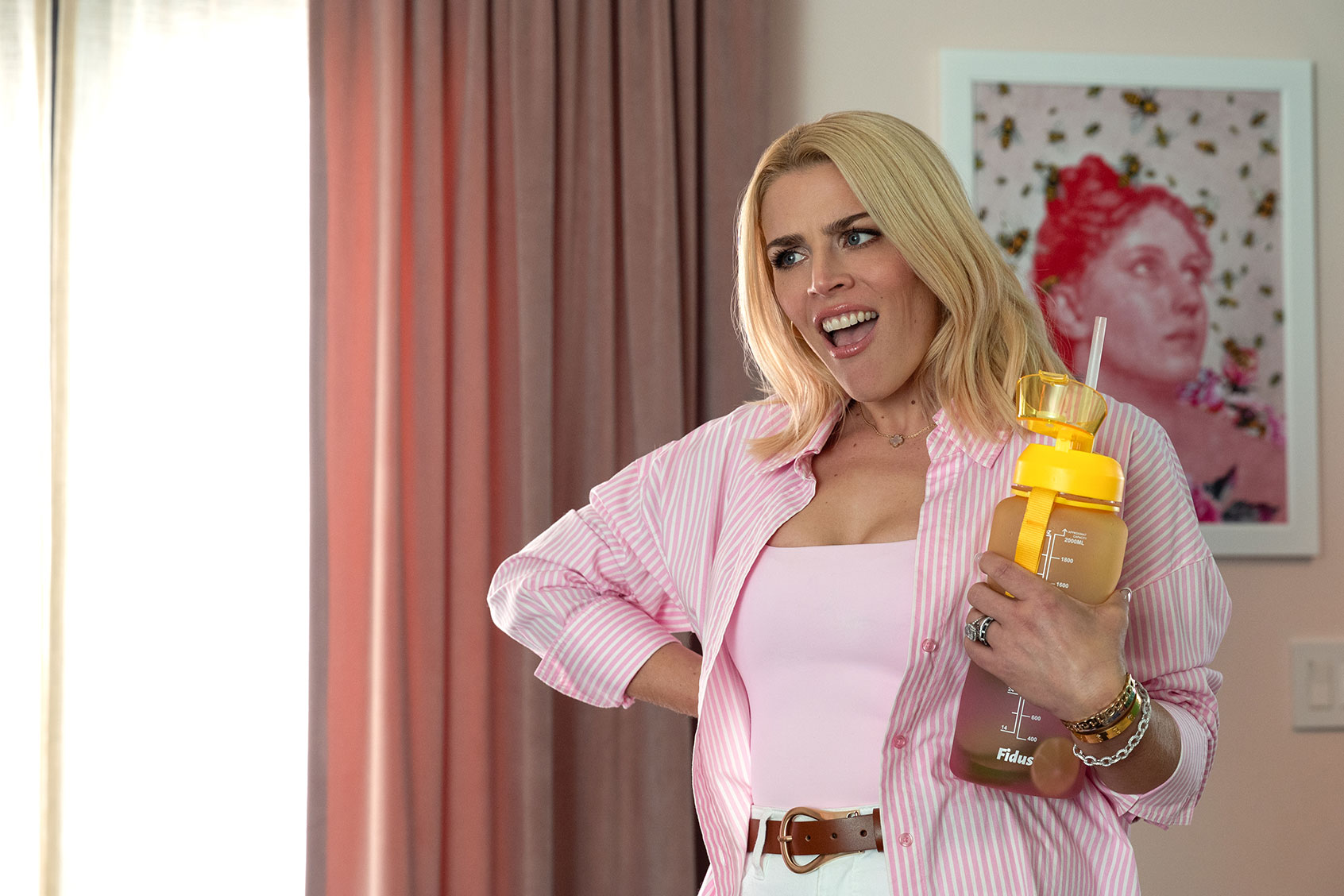
Supersized water bottles like Hydroflasks and Hydro Jugs have been around for some time now. Even in the “Mean Girls” reboot, Regina’s aspiring cool mom, the wealthy Mrs. George (Busy Philipps), is seen sporting a bottle bigger than her head. But Stanley tumblers have emerged as the trend’s breakout star. What inspires so many white girls to dish out so much and brave the mobs at Target for a water bottle? It’s not the bottle’s rather simple design, but rather its ability to signal status without broadcasting certain privileges.

Mean GirlsBusy Philipps plays Mrs. George in "Mean Girls" (Jojo Whilden/Paramount Pictures)Stanley tumblers rose to prominence in white girl culture in 2023. Many attribute this rise to a viral TikTok posted in November from @daniemarielettering, showing that after her car caught on fire her Stanley cup was the only thing to emerge unscathed. These reports overlook, however, that the Gen Z white girl, influencer Emma Chamberlain, posted twice about the cup. Chamberlain, who started her career as a YouTuber and has since gone to be named one of the most influential people by Time and most important person on the platform by The Atlantic, wrote, “Everyday [sic] I have to convince myself not to buy this cup” via Instagram stories in the spring. Then, she posted again, writing, “Update: loving the cup.” It’s no surprise that her 15.5 million Instagram followers took notice and likely contributed to the uptick in sales. Whether or not she was given the cup in order to market it to her following, it clearly worked. “If it’s good enough for Emma, it’s good enough for me,” said one fan on TikToker as she purchased it.
We need your help to stay independent

Marketing is not about selling a product so much as it’s about selling a type of personhood about the people that buy it.

Perhaps it’s no coincidence then that Chamberlain embodies so many of the things that makes the cup popular. The YouTuber got her start by making videos of doing mundane or “relatable” things: buying iced coffee, driving around in her car doing nothing and thrifting. Her normal, girl-next-door persona made her vlogs comedic and enjoyable, the bread and butter that launched arguably one of the most successful YouTube-to-mainstream careers. 

The cup encapsulates much the same idea. It’s quotidian and relatable. (Everyone needs to drink water.) And yet, there’s still a level of exclusivity. Not everyone can afford the higher price point, especially when much cheaper insulating bottles are right there. That is likely the whole point. Marketing is not about selling a product so much as it’s about selling a type of personhood about the people that buy it. Stanley cups signal a certain sense of class. People who buy it are rich enough to afford an unnecessarily bougie water bottle, but it’s not so expensive that they can be accused of trying to flex too hard. Instead, it’s a humble brag masked under the guise of a quasi-wellness lifestyle of hydrating and going to yoga. At the end of the day, a water bottle is just an everyday, mundane staple. Thus, the bottle sells the idea that its buyer is a reasonable, well-off person, rich enough to be perhaps in the upper middle class echelon — but not a part of the controversial one percent. The Stanley cup is a way to flex on the peasants without looking gauche. 

Why is this performed humility so appealing? It’s much less impressive to signal that “you’ve made it” when you were born into it or had a helping hand as many privileged white Americans do. Think of it as similar to the growing list of celebrities who pretend they’re from working-class backgrounds. When the spoon-fed upbringing is disguised, or when a Stanley cup is used to codify a well-off person that hasn’t lost their humble sensibilities, it creates an ethical, grand sense of accomplishment, a sense that this person pulled themselves up by their bootstraps and achieved the ol’ American dream. Afterall, the biggest flex is not having to flex at all.

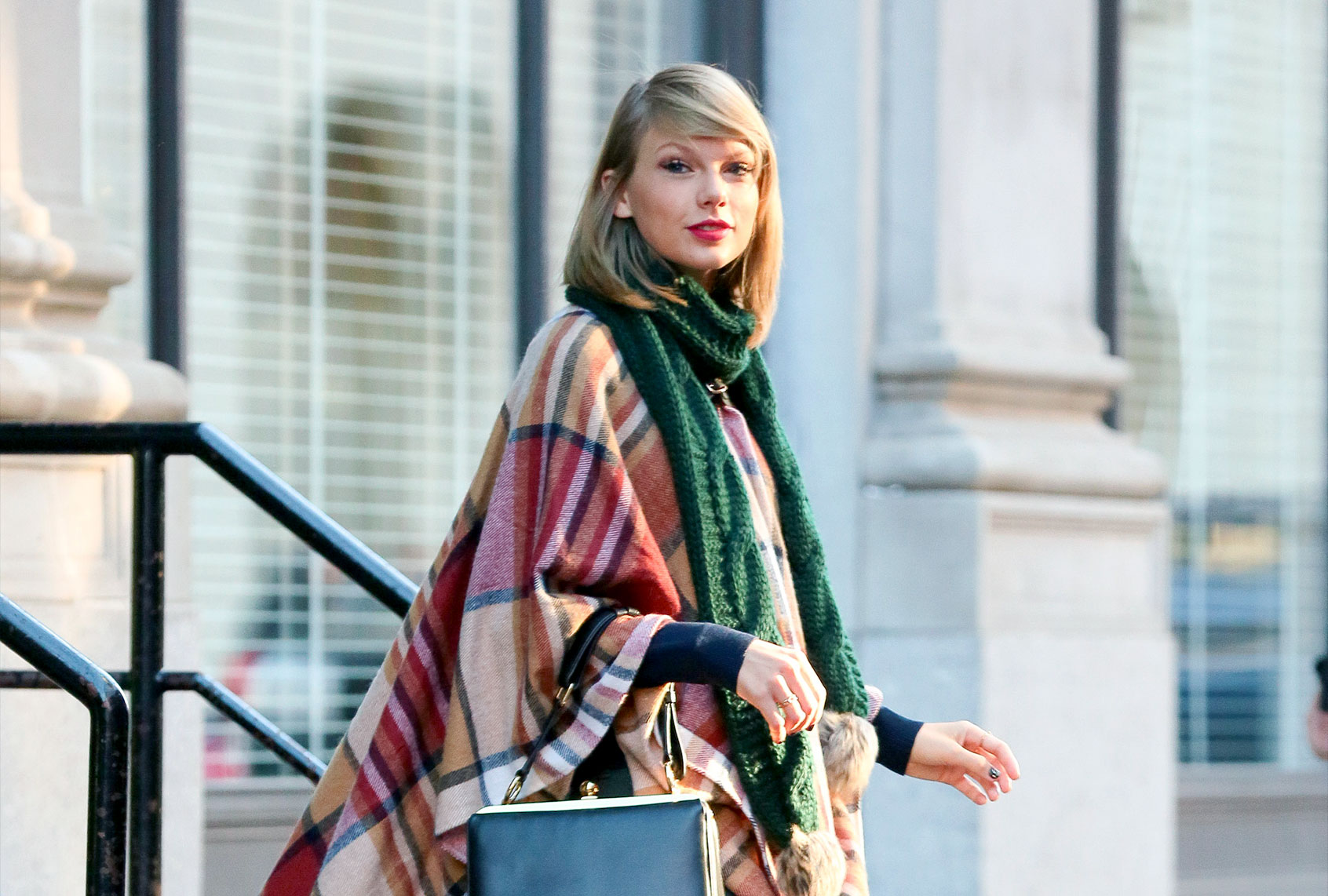
Taylor SwiftTaylor Swift (Ignat/Bauer-Griffin/GC Images/Getty Images)Queen of white women Taylor Swift is the perfect example. No matter how many eras into her fame she is, she continues to be described as the girl next door and down to earth as if she could’ve been any other small town girl who worked hard and dreamed her way into being a pop star — except this isn’t really the case. She’s the daughter of wealthy plutocrats. Her dad, Scott Swift, even bought a piece of Big Machine, the same label that signed her first record deal. Still, Swift, her team, and the media have successfully branded the singer as a self-starter.

The improbability of the American dream likely drives desire towards it. A defining aspiration for the country, the dream peddles the concept of upward mobility so that anyone might achieve success if they just work hard enough. This has been, of course, proven false. The system is highly rigged against people of color, immigrants, migrants, disabled and other marginalized groups. But even for white Americans who supposedly are expected to be insulated from such issues, the American dream is still unobtainable. It’s getting harder and harder to reach the same success the generation previous had, like owning a house or a car. While politicians may drum up anger or use people of color as scapegoats for this difficulty, most find it easier to rejigger the dream into something more accessible. The Quencher may not be a house with a white picket fence, but it still offers a level of status for those struggling to achieve it.


Want a daily wrap-up of all the news and commentary Salon has to offer? Subscribe to our morning newsletter, Crash Course.


Stanley cups offer a fleeting, rare chance at succeeding at this revered myth. With tumbler in hand, they can feel as though they’re living the it girl influencer lifestyle of slow mornings, fitness classes and an ironic sense of self congratulations.

“Very weak”: Ex-prosecutors spot “fatal flaw” in Trump’s immunity claim

Former President Donald Trump in a 2 am all-caps Truth Social post on Thursday argued that the president of the United States “must have full immunity” even for things that “cross the line.”  The post came as the U.S. Court of Appeals for the District of Columbia Circuit is expected to rule on his claim that he is immune from prosecution in special counsel Jack Smith’s D.C. election interference case — a ruling expected to be appealed to the Supreme Court regardless of how the appellate court rules.

“I think this is a very weak claim and I can't imagine even this court will accept this challenge by Donald Trump,” former U.S. Attorney Barb McQuade told MSNBC Thursday night. McQuade noted that Trump attorney Alina Habba in a Fox News interview appeared to lean on Supreme Court Justice Brett Kavanaugh to “step up” because Trump “fought for” him during his confirmation battle. "I think that kind of extortion is going to fall on deaf ears; if anything, I think it's likely to backfire,” McQuade predicted.

Fellow former U.S. Attorney Joyce Vance noted that Trump’s “argument that presidents will always have to look over their shoulder has a fatal flaw which is that he's the only president to ever face indictment.”

"So when the court of appeals evaluates these arguments, they'll appreciate those real world aspects to the decision that they're making, and the legal doctrine very simply is not that presidents are above the law,” she told MSNBC.

"In terms of Donald Trump's strategy of saying something that outlandish, it really does not help in terms of the court looking and realizing what they're being asked to do is going to be acted on by this man, so, strategically, it is a terrible idea,” former federal prosecutor Andrew Weissmann said in an appearance on the network. “I think there's no way on God's green earth that this panel is going to find that he is immune from criminal prosecution. That has never been the law, and it is not going to be the law."

Fulton DA: Special prosecutor’s wife “conspired” to interfere with Trump election case

Fulton County, Ga. District Attorney Fani Willis rejected accusations that she engaged in an "improper" romantic relationship with her team's special prosecutor, instead alleging that his estranged wife has conspired with other parties to interfere in her criminal case against former President Donald Trump and his allies.

Willis was subpoenaed to provide a pretrial deposition in Nathan and Joycelyn Wade's divorce case on Jan. 23, according to The Atlanta Journal-Constitution. But Willis' attorney vehemently argued against the subpoena in a scathing Thursday filing. 

Joycelyn Wade “has conspired with interested parties in the criminal election interference case to use the civil discovery process to annoy, embarrass and oppress District Attorney Willis,” the filing said. 

The allegations against Willis and special prosecutor Nathan Wade first cropped up last week when Trump codefendant Mike Roman's attorney, Ashleigh Merchant, accused the two of engaging in a romantic relationship.

The lawyer further claimed that Willis enjoyed "lavish" vacations that Wade paid for with the money he made from working in her office, but did not include evidence, the Journal-Constitution notes. She also did not provide proof to back up claims of Willis and Wade's alleged impropriety, but she suggested it would be in Wade's pending divorce case, in which documents are sealed.

A hearing on whether to unseal the documents is slated for Jan. 31. Merchant moved to unseal the divorce case, which has been private since 2022, on Jan. 8. The Journal-Constitution and 14 other outlets filed a motion requesting the public release of the divorce records.

Willis was served with the subpoena the same day Merchant filed the motion and Roman's filing was unsealed, Clinque Axam, Willis' lawyer, noted in the filing.

“Defendant Joycelyn Wade has not objected to Michael Roman’s motion to unseal the proceedings despite having previously sought it and having benefited from its protection for more than two years,” Axam argued.

An attorney for Joycelyn Wade told the Journal-Constitution that her goal is to assist her client in resolving her divorce "fairly and privately," adding that she would address Willis' allegations in writing through the court.

“Ms. Willis alleges that her deposition is being sought in an attempt to harass and damage her reputation," Merchant told the outlet Thursday. "Why would her truthful testimony risk damaging her reputation?”

“We believe her filing in Cobb County is just another attempt to avoid having to directly answer the important questions Mr. Roman has raised," she added. "She appears to be doing everything she can to avoid having to account for inconvenient and difficult facts.”

We need your help to stay independent

Willis argued that Joycelyn Wade failed to include a relevant reason for requesting her deposition in “in an uncontested no-fault divorce where the parties have been separated for over two years.”

The move “suggests that Defendant Joycelyn Wade is using the legal process to harass and embarrass District Attorney Willis, and in doing so, is obstructing and interfering with an ongoing criminal prosecutions [sic],” Willis argued in the filing, also saying that the Wades' marriage had fallen apart after Joycelyn Wade admitted to cheating with an old friend of Nathan Wade. 

“If, however, media reports are any indication, [Joycelyn Wade] may intend to ask questions regarding the nature of any relationship with [Nathan Wade],” the filing reads. “Because the parties agree that the marriage is irretrievably broken and the concept of fault is not at issue, there is no information that District Attorney Willis could provide that might prove relevant to granting or denying the divorce.”


Want a daily wrap-up of all the news and commentary Salon has to offer? Subscribe to our morning newsletter, Crash Course.


Willis' attorney also said in the filing that the subpoena was improperly served to her through a staff member, the Journal-Constitution notes.

While Willis did not address the kind of relationship she has with the special prosecutor in the filing, she vehemently defended Wade and herself in a speech at the Big Bethel AME Church in Atlanta. She bemoaned critics' claims against the interference case's only Black special prosecutor and argued they were "playing the race card."

On the same day the allegations surfaced, Fulton Superior Court Judge Scott McAfee, who is presiding over the election interference case, scheduled an evidentiary hearing for Feb. 15 to examine them. The order also directed Willis to submit a written response to the court by Feb. 2.

Attorneys for at least two of the case's defendants have signaled an interest in signing onto Roman's motion, saying they're looking into the accusations.

“War on women”: Legal experts say Trump lawyer’s cross-examination of E. Jean Carroll “fell flat”

Former President Donald Trump’s strategy in the E. Jean Carroll trial is not likely to garner him any sympathy from the jury set to decide how much he owes the defamed writer he was found liable for sexually abusing in the 1990s, legal experts say.

Trump lawyer Alina Habba’s second day of cross-examination on Thursday focused on whether Carroll had actually benefited from the attention of her rape allegation against the former president and his subsequent attacks — which Carroll said prompted a torrent of hateful messages and threats. Habba questioned Carroll about how much money she subsequently earned, praise she received from celebrities and even the number of Substack followers she had.

“Yes, I’m more well-known, and I’m hated by a lot more people,” Carroll told the jury.

Habba asked if Carroll’s social status had been elevated by the allegation.

“No, my status was lowered. I’m partaking in this trial to bring my old reputation and status back,” Carroll said.

“So you sued Donald Trump to bring your old reputation back?” Habba asked.

“Yeah,” Carroll said.

New York University law professor Andrew Weissmann, a former federal prosecutor who served on special counsel Bob Mueller’s team, tweeted after attending the trial that Trump’s defense in the case amounts to a “war on women.”

“The Trump defense appears to be Carroll is to blame, since by going public with the sexual assault claim, Trump had to defame her and her reputation suffered only because of her decision to report the assault,” he tweeted.

MSNBC legal analyst Lisa Rubin, who also attended the trial, acknowledged that Carroll’s income is now higher than it was in 2019 and she is “celebrated” in some circles but “the attempt to prove the backlash to Carroll’s account predated Trump’s attack fell flat, in large part because the tweets Habba showed were qualitatively different than the violent threats & accusations of paid political work that began with Trump’s 6/21/19 attack.”

“And those threats, as Carroll powerfully testified yesterday and today, have never stopped, ending her world as she knew it. Even beyond the threats, she maintained, more people know her today, but she is also reviled as a liar, a wack job, and a partisan operative,” Rubin wrote on X/Twitter. “What’s more, Habba wanted the jury to doubt Carroll’s credibility because she has (gasp!) written about sex openly and with humor. She’s even written about ‘dominat[ing] men’ and jokingly asked what women should do about the problem of their partner’s penises.

“That a then-septuagenarian advice columnist could say the word penis without blushing and discuss the importance of communication in sexual relationships doesn’t mean she was or is nutty or slutty,” Rubin added. “It means she’s human—and capable of having her considerable reputation sullied.”

MSNBC host Mika Brzezinski called the cross-examination of Carroll “sick.”

"Through this trial, you really are reminded what a vile, disgusting person Donald Trump is," she said Friday. "You watch the deposition with E. Jean Carroll's attorney and how vile and disgusting he is in that deposition – what he thinks about women, how he views them as sort of objects, sex toys, literally so unbelievably misogynistic and rude, that you wouldn't have this person at your dinner table. You would not let your kids act this way, you would not want anybody in your life to act this way.”

MSNBC legal analyst Katie Phang wrote that allowing Habba and Trump to “grandstand and waste time is a disservice to the jurors” and “denigrates the entire proceeding.”

“Habba’s trial skills incompetence is also causing unnecessary disruptions,” Phang argued in an op-ed. “As she appears not to know how to defend her client or attack Carroll’s case, Habba creates the need for objections by opposing counsel, as well as even the judge, to protect the record for purposes of appeal. She also creates several delays as issues that are usually handled with aplomb and skill by more experienced trial lawyers have to be addressed either at sidebar or outside the presence of the jury. All of this results in a prolonged and wholly unnecessary trial experience for jurors who have been instructed to remain anonymous out of concerns for their physical safety.”

We need your help to stay independent

CNN legal analyst Norm Eisen predicted that E. Jean Carroll’s “powerful” testimony combined with Trump’s “rude demeanor & asides” suggest that a “big damages award” is likely coming.

After Carroll’s testimony, expert witness Ashlee Humphreys, a professor of marketing and communications at Northwestern University, testified that the cost to repair Carroll’s reputation after Trump’s attacks would be between $7.3 million and $12.1 million.

Carroll is seeking at least $10 million in compensatory damages and an unspecified amount in punitive damages.


Want a daily wrap-up of all the news and commentary Salon has to offer? Subscribe to our morning newsletter, Crash Course.


Humphreys testified that the “damage was severe to [Carroll’s] reputation as a journalist, and the costs to repair it were considerable.”

Trump has continued to fire off attacks on Carroll on Truth Social throughout the trial. Carroll attorney Shawn Crowley on Tuesday pleaded for the jury to hit Trump with a high penalty for his ongoing attacks.

"How much money will it take to make him stop?" she told jurors. "Because he hasn't stopped. Ms. Carroll had taken on the most powerful man on Earth, and she won. And even that didn't stop him.

"It's time to make him pay dearly for what he's done," Crowley added. "Make him pay enough to finally stop him."

Netflix’s “American Nightmare”: The true story of police failure in the so-called “Gone Girl” case

The real-life case of one couple's horrifying experiences and the damaging speculation surrounding those events is depicted in Netflix's new docuseries "American Nightmare."

In March 2015, Denise Huskins and her boyfriend, Aaron Quinn, were awakened in the dead of night by armed home intruders before Huskins was kidnapped and sexually assaulted on camera by her captor. The harrowing tale garnered widespread media scrutiny, with many comparing Huskins’ disappearance to David Fincher’s 2014 adaptation of “Gone Girl,” Gillian Flynn's novel in which a woman fakes her own murder and frames her husband as an act of revenge. Both the police and the media bought into doubts about the case they felt did not add up.

However, nothing about Huskins' abduction was an “orchestrated event,” as police initially regarded the case, which is explored in Netflix’s “American Nightmare,” the latest docuseries from “The Tinder Swindler” filmmakers Felicity Morris and Bernadette Higgins. The three-part series features interrogation footage and interviews with Huskins and Quinn to chronicle the disturbing saga of a sexual assault victim further victimized by law enforcement.

Here's everything you need to know about the so-called “Gone Girl” case:

Huskins’ March 2015 abduction

Huskins and Quinn met in 2014, in the Bay Area city of Vallejo, Calif., while working as physical therapists. On March 23, 2015, the pair was awakened from sleep around 3 in the morning by a bright white light, three laser dots and a group of intruders wearing wetsuits. The intruders, armed with tasers, instructed Huskins to restrain Quinn with zip ties. They then put swim goggles over his eyes and placed foam headphones over his ears. Quinn’s blood pressure was also taken before he was drugged with NyQuil and Diazepam.

In the docuseries, Quinn revealed that one of the intruders approached him after taking Huskins to a separate room: “We have a problem,” the intruder said. “This was intended for Andrea.” Andrea Roberts was Quinn’s ex-fiancée. The couple had broken up months before the kidnapping, per Quinn.

The intruder then told Quinn that they would still kidnap Huskins because Quinn “could pay him enough money to make it worth their while.” The ransom would be $15,000 in total. The intruder would also install a camera that would monitor Quinn at all times. Quinn was told that if he went outside the view of the camera, Huskins would get hurt.

The intruder put Huskins in the trunk of Quinn’s car before fleeing. She was taken to a property in South Lake Tahoe, where she was sexually assaulted twice on camera. Huskins reappeared two days after her abduction, 400 miles away in Huntington Beach, Calif., near her family’s house. 

The police have doubts

During Huskins’ disappearance, Quinn was being interrogated by Vallejo detectives and FBI agents. Quinn was also being threatened by the kidnapper, who demanded a ransom for Huskins' return and warned him to not speak to authorities.

Vallejo police were initially skeptical of Huskins’ kidnapping because Quinn's ex-fiancée had told authorities that she and Quinn had discussed getting back together while he was still dating Huskins. Police accused Huskins of staging her abduction and likened the events of the case to Gillian Flynn's 2012 crime thriller, "Gone Girl," which was adapted into a 2014 film by David Fincher. Flynn’s bestselling novel centers on a resentful, small-town wife who stages her own murder to get back at her husband for having an affair.

Vallejo police publicly declared Huskins' abduction an “orchestrated event,” even though a San Francisco Chronicle journalist received messages from an individual admitting to kidnapping Huskins.

The truth finally comes out

Sergeant Misty Carausu brought information that exposed the real perpetrator. She linked Huskins’ case to a separate kidnapping attempt in in Dublin, Calif., The culprit in the kidnapping attempt was ex-Marine Matthew Muller, who had left his phone behind at the crime scene in Dublin. An investigation into Muller’s South Lake Tahoe cabin, where he was living at the time, revealed several unsettling items, including a toy gun with an attached laser pointer and duct-taped goggles. Authorities also found Quinn's stolen computer and a long strand of blonde hair, which was hanging from one of the pairs of goggles. Additionally, the Huntington Beach address where Huskins was dropped off was still in Muller's GPS history. 

On March 16, 2017, Muller was sentenced to 40 years in prison for kidnapping, robbery and rape in connection with the Vallejo invasion. Muller’s plea agreement reveals he told a KPIX reporter while detained in the Alameda County Jail that the abduction of Huskins hadn't been random. Muller, however, never disclosed why Huskins and Quinn were targeted. Muller also said he sent emails to the San Francisco Chronicle reporter after he learned that the kidnapping had been labeled a hoax by police. He initially claimed that he was part of a group of kidnappers, but later admitted that he’d acted alone.

The Vallejo police department’s overdue apology

Then-Vallejo Police Chief Andrew Bidou wrote a letter apologizing to Huskins and Quinn after the case was solved. In it, Bidou simply said the department’s “conclusions were incorrect.” The Vallejo police department, however, failed to provide an immediate apology and only issued one when contacted for a television news story six years later. Huskins and Quinn sued the city of Vallejo for defamation and received $2.5 million in an out-of-court settlement.

"American Nightmare" is currently available for streaming on Netflix. Watch the trailer for it below, via YouTube:


Colostrum craze: Why the “liquid gold” of cow milk is stirring up wellness TikTok

Hours after giving birth, I sat in my hospital bed holding my newborn as a nurse massaged my breasts. Squeezing each one from top to bottom, she was searching for any hint of the “good stuff” or so-called “liquid gold.” At last, the tiniest drop of yellow-tinted liquid fell like a raindrop. “That’s it!” the nurse exclaimed, as another nurse hurried my newborn up to my nipple.

As a first-time mother, I wasn’t sure what to expect, but it wasn’t a teaspoon of liquid that could have easily been mistaken as yellow sweat. Sometimes called “first milk,” colostrum is the first form of milk produced by the mammary glands of all mammals immediately after the delivery of a newborn. For human newborns, it’s essentially a customized, nutrient-packed shot filled with white blood cells that produces antibodies to strengthen the baby’s immune system. It also creates a coating on the newborn’s stomach to prevent germs from leading to illness and infections.

Colostrum further helps prevent low blood sugar, jaundice and even gives the baby’s brain the right nourishment to grow. Only one to four teaspoons of colostrum per day are produced by a mother for two to five days before transitional milk takes over, then breast milk. As many scientists would say, it’s “magic.” 

At last, the tiniest drop of yellow-tinted liquid fell like a raindrop.

“Colostrum from any animal mammal is what experts in the field of lactation and milk science referred to as 'liquid gold,'” Jennifer Smilowitz, an associate professor in the Department of Nutrition at the University of California-Davis told Salon, adding that it offers offspring specific nutrients and developmental demands. “It helps protect and develop different systems of the vulnerable neonates.”

Colostrum is the kind of detail about human health you don’t really learn about until you have a baby, so you can imagine my interest peaked when I heard a wellness entrepreneur promoting ads for colostrum supplements on her podcast that she swears by to “build her immune system.” A quick search on TikTok revealed that this is indeed taking over the wellness space this year. As one dietician said on TikTok, it’s the “one supplement” people should consider taking in 2024.

To be clear, these aren’t supplements of human colostrum, but instead cow colostrum. Also called bovine colostrum, researchers have been intrigued by its potential benefits for decades. It’s been popular among high-performing athletes, but only recently has it hit mainstream GOOP-like wellness circles. Google searches for “colostrum supplements” peaked over the last five years at the beginning of this month, and those for “bovine colostrum” reached an all-time high in December. But despite all the hype around the benefits of colostrum for mammalian newborns, could adults in the human species benefit from powdered bovine colostrum supplements, too? 


Want more health and science stories in your inbox? Subscribe to Salon's weekly newsletter Lab Notes.


For human newborns, researchers know that colostrum is important for a newborn’s gut health. Smilowitz said that’s because colostrum includes complex carbohydrates that can have a specific suite of microbes in the newborn’s intestines. It’s critical for that to be established early in life because the gut “educates the nearby immune system,” she said, adding that an estimated 70 to 80 percent of immune cells are present in the human gut. The two are inextricably linked.

"If the dairy farmer collects colostrum on day six, is that the same as day three?”

Certainly, this is part of the draw to bovine colostrum, Smilowitz elaborated. Indeed, as what often happens in the world of wellness supplements, there is a jump in logic that leads to a neatly, easily-marketable promise. The story goes that similar benefits in human colostrum are also present in bovine colostrum, hence ingestion of cow colostrum in supplement form is the next best way to reap them. Smilowitz said it’s true that bovine colostrum is similar to human colostrum in the way that a mother cow’s colostrum delivers very specific molecules and nutrients to protect her calf. 

“But the types and amounts are different from what's found in human milk,” she said. “Bovine colostrum contains antibodies that are specific to pathogens that the female cow is exposed to, and the main antibody in bovine colostrum is IgG [immunoglobulin G], while the main antibody in human colostrum is IGA [immunoglobulin A.]”

Bovine colostrum also has a lot of protein compared to human colostrum, she added. None of these differences, like IgG which is also in human breast milk, is necessarily harmful to humans. But the research doesn’t necessarily point to there being many benefits either. According to systematic reviews of people taking bovine colostrum for a variety of reasons, the data is mixed “at best,” she said.

“Some studies show some benefit and others show no effect,” she said, saying that some of the studies look at intestinal permeability, also known as “leaky gut,” or stool frequency, exercise performance or respiratory tract infections. One systematic study on bovine colostrum found that evidence on its impact on immunity was “nonconclusive.” Smilowitz said one reason for the mixed results could be that mixed quality in bovine colostrum. For one, the quality of the supplement depends on the health of the dam, or animal mother.

“It also depends on the timing of collecting the colostrum,” Smilowitz said. “Colostrum only lasts for so many days, so if the dairy farmer collects colostrum on day six, is that the same as day three?”

Most importantly, the FDA doesn’t regulate supplements which means there is no way for the quality to be ensured or for consumers to know what else the supplements contain. Usually after a dairy farmer sells colostrum to a supplier, the process is that the manufacturer proceeds to remove the fat, pasteurize it and dries it down into a powder.

“And what many consumers don't know is that the process in which you dry liquid, it can affect the quality of the molecules,” Smilowitz said, adding that heating the molecules too much or for too long can negate the function of the molecules. In other words, it could affect the quality. Freeze drying is the preferred method, but it’s also the more expensive one. 

A company called ARMRA sells bovine colostrum, which range in price from $40 stick packs to $120 bulk jars. The company claims to be “clinically-backed” and sells a product that yields gut-related results like less bloating, less frequent heartburn and improvement in IBS symptoms, in addition to weight loss, thicker hair and fewer wrinkles.

As interest in bovine colostrum rises, there is also a concern that profits will be prioritized over the health of calves.

Derek Beres, co-host of the Conspirituality Podcast, told Salon he sees threads of purity rhetoric in the promotion of bovine colostrum supplements. For this reason, he’s concerned that the wellness world’s focus on “gut health” right now could be leading to eating disorders. When supplements come to market claiming to promote the “good bacteria” in a person’s intestines, this mimics similar rhetoric that promotes and supports orthorexia, or the obsession with eating healthy food usually featuring dangerous overfixation on the quality of food and not the quantity. 

“They're selling these things all under the guise of good gut health,” Beres said. “But there’s this whole premise that you need to balance all of your pH and it needs to be as good as possible.” He added that purity-focused discourse in wellness is “a big part of body fascism,” which is the discrimination of someone based on their appearance or weight.

Beres took a closer look at ARMRA and some of the studies they list on their website. In the studies cited, clinical efficacy for bovine colostrum is between 20 to 60 grams in powdered form. Notably, there is only one gram per serving in small ARMRA packets. The $120 bulk option has about 2 grams per serving. ARMRA did not respond to Salon's request for comment prior to publication. 

As interest in bovine colostrum rises, there is also a concern that profits will be prioritized over the health of calves, as noted in one paper published last May in the Journal of Dairy Science. Co-author of the paper Angela Costa, a senior assistant professor in the department of veterinary medical sciences at the University of Bologna, told Salon via email there are some noted benefits to taking bovine colostrum for human adults. 

We need your help to stay independent

“The inclusion of animal colostrum has been shown to increase athletic performance, muscle mass and bone health, resistance to fatigue, lean mass and immune system,” she said. But like anything that is rising in popularity, there is a downside and a tension between business and the health of the newborn calves. In her opinion, she thinks first milking of colostrum should always be reserved for the newborn calves themselves, as nature seemingly intended. But subsequent ones — particularly where there is a constant excess — can be used as a byproduct and be sold.

“Colostrum of the second and third milking, which is less rich in antibodies compared to the first colostrum, should be intended for this business,” she said. Smilowitz added that ultimately bovine supplements might be able to help people improve symptoms that result from conditions related to the immune system, but she’d suggest people talk to their healthcare providers first. 

“But I would just caution that people should know they're not FDA regulated and the quality could vary,” she said. 

How to build renewables without threatening biodiversity? Carefully

A big challenge for anyone trying to take on climate change is finding solutions that don’t create new problems. Climate scientists, for instance, agree that the world needs more solar panels, wind turbines, and transmission lines. But building all that infrastructure takes up a lot of land, and that land could be a critical habitat for endangered animals, teeming with wildflowers and birds and insects, or a great place for Indigenous peoples to forage for traditional foods. 

According to a recent study in the journal Nature Communications, areas around the world that are well suited for wind, solar, and other forms of clean energy overlap with some 10 percent of the land that’s important for biodiversity and other human needs like clean water and wood for fuel. The United States alone would need tens of millions of acres of sunny plateaus for solar arrays and windy ridges for wind mills to stop burning oil, gas, and coal. The potential for conflict between conservation and developing renewables is even higher than it is between conservation and farming, mining, or drilling for fossil fuels, the study found. 

That finding was the “biggest surprise” for Rachel Neugarten, a researcher at Cornell University and one of the paper’s authors. “Renewable energy is absolutely critical for climate goals,” she said. “However, if it’s located in the wrong places it could have negative impacts.” 

Neugarten’s team mapped the entire world for biodiversity, pressure from farming, mining, and other forms of development, and 10 of “nature’s contributions to people” — from crop pollination to recreation. The researchers found that only 18 percent of the land that humans need is currently protected from urban expansion and resource extraction, more than one-third of which is highly suitable for agriculture, mining, oil and gas drilling, or clean energy projects. In Ireland, for example, 60 percent of the land is well suited for renewables, agriculture, or mining while also important for grazing, storing nutrients like nitrogen, and recreation, the authors wrote.  

“One of the key takeaways from this study is that it is possible to achieve conservation, climate, and development goals, but that this will require careful planning,” Neugarten said. “We need to think carefully about how decisions in one sector, such as renewable energy development, might undermine goals in other sectors, such as habitat for pollinators or biodiversity conservation.” 

"It is possible to achieve conservation, climate, and development goals, but that this will require careful planning."

The authors suggest that a way around this problem would be to build wind or solar farms on land that’s already been cleared or degraded. That could mean installing solar panels on abandoned industrial sites or above parking lots, Neugarten said. But she also recommended coupling renewables with agriculture. As two examples, she pointed to an 18-acre solar array in Minnesota that’s nestled among pollinator-friendly flowers and bee hives, which can power more than 100,000 homes, as well as a wind farm on a cattle ranch in Arizona. 

The paper doesn’t address whether there’s actually enough land to fit all the solar and wind farms that the world needs without threatening biodiversity and causing other ecological damage. That’s still an open question, Neugarten said. The United States would need a swath of earth about the size of five South Dakotas to generate enough clean power to run a carbon-free economy by 2050, according to an analysis by Bloomberg News and Princeton University. And you can’t just stick wind turbines and solar panels anywhere: A solar farm needs to be on flat, sunny terrain, close enough to the electrical grid to keep transmission costs from skyrocketing. 

Still, some research indicates that there doesn’t have to be a dramatic tradeoff between conservation and clean energy. The Nature Conservancy, which helped fund Neugarten’s study, released a report last year showing that the U.S. could deploy a lot of wind and solar without significant damage to the environment. The report outlined three courses of action: combining solar and wind on the same land, installing solar panels on farmland, and using solar panels that tilt to absorb more sunlight and produce more energy. 

Where and how renewable energy projects get built affects biodiversity more than the amount of clean energy produced globally does, according to Ryan McManamay, an ecologist at Baylor University who wasn’t involved in Neugarten’s study. “It’s quite possible to meet more needs of the population and have a lower biodiversity impact based on thoughtful considerations of how things are developed,” he said.

Scientists also say the environmental consequences of building a lot of wind turbines and solar panels likely won’t be as dire as continuing to burn gargantuan amounts of fossil fuels. Climate change itself poses a major risk to biodiversity. 

“There has been some rhetoric about green versus green, which is setting up renewable energy in conflict with biodiversity conservation,” Neugarten said. “I really do think it’s feasible to do both if we put our minds to it.” 

This article originally appeared in Grist at https://grist.org/equity/developing-renewables-wind-solar-biodiversity-nature/.

Grist is a nonprofit, independent media organization dedicated to telling stories of climate solutions and a just future. Learn more at Grist.org

Nikki Haley pandered to MAGA’s bigotries for years — now Trump’s turned that firehose of hate on her

There is little the Beltway media loves more than a gaffe. When a politician lets slip some statement, judged as insulting or offensive to voters by the pundits, it's generally treated as an all-hands-on-deck coverage moment. Gaffes far surpass any attention given to policy positions or governing philosophy. Some crafty campaigners weaponize the press's gaffe obsession, by "accidentally" articulating views that will offend the pundits, but will thrill the voters they're trying to reach. It's why so many candidates "forget" their microphones are turned on.

Haley is trying to reassure the sensitive snowflakes who vote in the GOP primary that she doesn't hold their racism against them, or even, apparently, acknowledge the reality of it. 

All of which is a long-winded way of arguing that it's not a mistake, the way former Gov. Nikki Haley, R-S.C., keeps saying ugly things about race. It's unlikely she actually "forgot," as many outlets suggested, to mention slavery when asked by a New Hampshire voter what caused the Civil War. She was just placating the presidential primary voters of the GOP who tend to get fussy whenever suggests there's a downside to white supremacy. Rather than discouraging her from pandering to racists, the media attention Haley got for this so-called gaffe only emboldened her. She coughed up the "I had Black friends" cliché, which garnered another round of liberal condemnation, which just makes someone more popular with the MAGA base. 

Tuesday, Haley removed all doubt that this is anything but deliberate, by telling Fox News, "We've never been a racist country." 


Want more Amanda Marcotte on politics? Subscribe to her newsletter Standing Room Only.


Even if Haley wasn't trying to catch press with her initial Civil War comments, she no longer deserves the benefit of the doubt. She's doing this on purpose. On CNN Thursday night, she even recommended lying to children about it, saying, "for every brown and Black child out there, if you tell them they live or are born in a racist country, you’re immediately telling them they don’t have a chance." Which is countered by literally every successful person of color, most of whom grew up well aware of the country's racist history. 

She's centering this extremely silly — and evil — lie in her campaign. 

Liberal outrage is the drug of choice for the MAGA base Haley wants to win over. Note that Haley was responding to a viral clip from Joy Reid, in which the MSNBC host said Haley is "still a Brown lady that’s got to try to win in a party that is deeply anti-immigrant." That context makes it clear that Haley is trying to reassure the sensitive snowflakes who vote in the GOP primary that she doesn't hold their racism against them, or even, apparently, acknowledge the reality of it. 

She spent all this time validating such attacks against other people, and now there's no one around to defend her. 

Reid was proven right in record time, as Donald Trump has launched a campaign against Haley that's incredibly racist, even by his own basement-level standards. He floated one of his "birther" conspiracies, falsely claiming her immigrant parents render her ineligible to hold office. (He has made the same claim of every presidential candidate he perceives as non-white, going back, of course, to President Barack Obama.) He and his allies have been mocking her birth name, Nimarata Randhawa, trying to draw attention to her Sikh Indian background. (She goes by her middle name and married name. Trump, however, does know something about changing names to hide an ethnic background, as that's what his own family did in the early 20th century.) He falsely claims she wants "OPEN BORDERS" and accused her of trying to "infiltrate your Republican primary," playing on his usual tropes of portraying people of color as secret invaders out to steal stuff from white people. 

Much of the press is treating Trump's onslaught as a response to Haley's supposed "momentum," which is allegedly making her a campaign threat. It's true that Trump's brain is addled by over-consumption of cable news, so there is a thin possibility that he's caught up in the hype falsely implying she has a snowball's chance of winning the primary. But that's unlikely, both because he's so far ahead in the polls and because his campaign's strategy has been to treat the primary as a coronation, not a contest. 

No, the primary is merely a pretext. Trump's going full-birther on Haley for two reasons. One, nothing gives him pleasure like being a racist bully. Two, it helps reinforce his main campaign message: The United States is meant to be a white Christian ethnostate, and anyone who doesn't belong to the MAGA tribe is not a "real" American. 

Trump hasn't been subtle about how this fascist messaging is central not just to his barely-there primary strategy but is the core of his general election campaign. He gives speeches arguing that non-white immigrants are "poisoning the blood of our country," directly echoing similar rhetoric used by Hitler in the 1930s. He's campaigning as a Christian nationalist. He openly characterizes secular and inclusive policies as "persecution" of Christians, who are meant to be seen as the only "true" Americans. 

As Sarah Posner of MSNBC aptly put it, "Trump is now the leader of the Christian right." This is despite the fact that Trump, even after 8 years of pretending to believe in Jesus and the Bible, hasn't learned basic facts about the faith he pretends to hold. Such as that you pray to God, not for God. 


Want more Amanda Marcotte on politics? Subscribe to her newsletter Standing Room Only.


This must gall Haley, who converted to Christianity and got baptized in the 90s. It seems that, for much of her career, that sufficed to make her a "real" Christian in the eyes of Republican voters. But, as I've written about before, the identity of "Christian" and especially of "evangelical" has shifted in recent years within the world of Republicans. It's less about believing in Jesus Christ or belonging to a church these days, at least for the MAGA base. Now it's a marker of tribal identity, tied closely to whiteness. Haley may know prayer and the Bible, unlike Trump, but he's more "Christian" to them than she is because he's white. That's why 64% of Republicans say Trump is a "person of faith" but only 44% say the same of Haley. 

Not that anyone should feel an ounce of pity for Haley. As her recent rash of race-baiting comments shows, she is only too happy to suck up to racists, if she thinks it will get their votes. When Trump is out there shoveling out his bigoted provocations, Haley has been right behind him, reassuring everyone that there's nothing wrong with his behavior. It's the same song and dance Republican women do with regard to gender, imagining that complicity with a sexist system will protect them. In a sense, it has helped Haley, who snagged some plum jobs over the years by downplaying racism. But now the same ugly bigotries are coming for her. She spent all this time validating such attacks against other people, and now there's no one around to defend her. 

A compact with Christian America: What Donald Trump owes the religious right after Iowa

Donald Trump promises to be a dictator on “day one” of his presidency if he wins the 2024 election. On Monday, Trump demolished his rivals in the Iowa Republican caucus. He is now one step closer to being the Republican Party’s nominee (which is virtually a fait accompli at this point) and then challenging President Joe Biden for the White House.

As I previously warned in an essay here at Salon, Trump will not just be a regular and common political thug dictator. So what type of dictator god king will Donald Trump be if he takes power in 2025? He will be like one of the Old Gods from ancient times: vengeful, destructive, and a force for pain, punishing and smiting “non-believers” and others who have “transgressed” against him and his most faithful followers. Dictator God King Trump will also, like the god(s) of old, force his “enemies” into exile.

The Christian right supports Donald Trump and the MAGA movement because he has promised them great and special power and authority over American society.

After his victory In Iowa, Trump (who has previously called Black and brown people “poison” in the blood of the nation and said that Democrats are “vermin”) continued to make such threats, telling his followers, “And we’re gonna have to deport. We’re going to have to have a deportation level that we haven’t seen in this country for a long time, since Dwight Eisenhower, actually.” It is estimated that a million Hispanics and Latinos were deported during the infamous “Operation Wetback." Trump and his agents are promising to deport many more “illegal aliens” and “criminals,” meaning Black and brown people.

Invoking the Alien Enemies Act, declaring martial law, ending birthright citizenship, using the military to occupy majority Black and brown cities, and banning the First Amendment and Constitution, Trump has also threatened to exile and imprison and do even worse things (i.e. death) to leading Democrats including President Biden, special counsel Jack Smith, Attorney General Merrick Garland, and the judges and other law enforcement officials attempting to hold him accountable for his obvious crimes.

In keeping with his belief that he is a type of Chosen One and messiah, Trump continues to test the faith of his MAGA followers. Like many other parts of the United States, Iowa was experiencing dangerously cold weather on Monday. Instead of showing care and concern for his MAGA flock, Trump told them to vote for him even if it means they get sick and die.

Last week, Trump boasted that his followers would walk on glass for him. Trump is, again, correct. Never to be forgotten is how Donald Trump and his first regime engaged in acts of democide and other forms of mass death through a willfully negligent response to the COVID pandemic, which killed at least 1 million people in the United States. Instead of punishing Trump and his Republican Party, the MAGA people and other right-wing voters rewarded the ex-president and his party for inflicting such suffering and death upon the country.

But like any other cult leader and/or fake populist who is claiming divine status, Trump also professes his very special and sacred love for his followers. In a recent fundraising email, Trump literally said:

I’ll never stop loving you.

Why? Because you’ve always loved me!

You stuck by me every single time the Radical Left tried to KICK ME DOWN.

Even when they took my mugshot at the Fulton County Jail.

I felt your love even when they RAIDED MY HOME.

Through all the HOAXES, WITCH HUNTS, and FAKE INDICTMENTS, you never left my side!

True MAGA Patriots like you are the only reason I’m still standing.

Trump’s MAGA people love him in return.

How have evangelicals and other members of the Christian right responded to Trump’s claims of being the Chosen One, a man on Earth who is anointed by “god” and “Jesus Christ”? A few leaders among the Christian right have correctly declared that Trump is, by definition, committing sacrilege and blasphemy. These critical voices are in the extreme minority among the Christian right both in Iowa and across the country, however. To that point, Trump won an overwhelming majority of White evangelical voters in Iowa. Nationally, Trump’s support among the Christian right has only grown during his presidency and beyond.

We need your help to stay independent

Right-wing evangelicals and other members of the Christian right were not forced, tricked, or manipulated into supporting Donald Trump and his neofascist MAGA movement. Theirs is a strategic alliance based on an alignment of interests, goals, and a craven desire for unlimited power.

As sociologist Samuel Perry summarized in a post on X, formerly known as Twitter, in response to the 55 percent of self-described white evangelicals and white born-again Christians who supported Trump in Iowa:

Once again, the whole “Well, it’s a binary choice, either Trump or a Democrat” excuse has always been BS. Every chance evangelicals have had to pick someone else they choose Trump. They love Trump; he is the leader they want. And that is more damning than any book or documentary.

Perry’s observation echoes Robert P. Jones, founder and president of the Public Religion Research Institute (PRRI), who in a recent conversation, explained the relationship between Trump, MAGA, and the Christian right in the following way:

What does Trump mean by MAGA, "Make America Great Again"? It is nostalgia for some a mythical past "golden age." They want a return to 1950s America when White Christians were the unquestioned dominant force in the country. Conservative white Christians want that America back. There is also this incorrect narrative that evangelicals held their nose and voted for Trump. But there is really no evidence for that. White evangelicals support Trump's anti-immigrant rhetoric and his anti-black rhetoric and all those related racial grievance issues. They were breathing comfortably and freely when they pulled the lever for Trump in both 2016 and 2020….

As I document in The Hidden Roots of White Supremacy, most white evangelicals sincerely believe that God designated America to be a promised land for white European Christians. That is not a joke to them. If a person sincerely believes such a thing and the country is changing and is not in agreement with that vision, it opens the door to political extremism and violence to secure that outcome. Many conservative White Christians truly believe that they have a divine mandate and entitlement to the country.

The historical record clearly shows that white evangelicals have long had an instrumental, rather than principled, relationship to democracy. 

Ultimately, the Christian right supports Donald Trump and the MAGA movement because he has promised them great and special power and authority over American society and life. As demonstrated by his Supreme Court appointments and other policies during his first regime, Trump has mostly delivered on these promises and bargains.

With his escalating threats to become America’s first dictator and God King, Trump is now promising the Christian right even more power in exchange for their continued allegiance. Trump, as detailed in Agenda 47 and Project 2025, will make right-wing Christianity America’s de facto state religion. These Christian authoritarians will also stand empowered by Trump and his regime to impose and enforce their beliefs across society as a de facto type of American Taliban or morality police as seen in Islamic countries such as Iran.

In a series of bold essays at MSNBC, journalist Sarah Posner detailed these plans for an American Christofascist Theocracy:

Trump has promoted the theme of Christian persecution in the past, but is elevating it again as these legal issues mount…

Ramping up his authoritarian rhetoric, Trump pledged in the Iowa speech to institutionalize an authoritarian crackdown of the same sort he falsely accuses the Biden administration of implementing. “Upon taking office, I will create a new federal task force on fighting anti-Christian bias to be led by a fully reformed Department of Justice that’s fair and equitable,” he promised. “Its mission will be to investigate all forms of illegal discrimination, harassment and persecution against Christians in America.”

In another speech, in Reno, Nevada, he pledged to go after colleges and universities for running afoul of his “religious freedom” edicts. “If colleges and universities discriminate against conservatives, Christians, Jews, anybody,” he said, “we are going to take away their tax advantages, grants and endowment.”

Lies about the persecution of Christians are very familiar to Trump’s base….

One needs to look no further than Trump’s efforts during his first term, combined with his 2024 pledges to govern like a dictator, to see the authoritarian steps he is taking when it comes to “protecting” his base’s religious freedom. He is leaving little doubt that he will do whatever it takes to retain the loyalty of the base that has stood by him through an insurrection, two impeachments and now multiple criminal indictments. He is saying loudly and clearly that as part of his broader disparagement of the rule of law, he would shred everyone else’s rights in the name of his loyalists’ “freedom.”

Public opinion polls show that these so-called right-wing Christian “values voters” are so dedicated to Trump, their savior and prophet, a man who has repeatedly shown himself to be demonstrably evil, that they now believe that a president’s morality and behavior do not matter. Thus, in many ways, Trumpism is the new religion of today’s Christian right and Donald Trump is their godhead and savior.


Want a daily wrap-up of all the news and commentary Salon has to offer? Subscribe to our morning newsletter, Crash Course.


In a new essay at the New York Times, Michelle Goldberg explains:

Trump’s rise has been accompanied by a collapse in trust in many American institutions once valued by the right, including the F.B.I. and the military, and that loss of faith extends to many religious authorities. As [Tim] Alberta, the son of a conservative evangelical pastor, documented, preachers who’ve balked at parts of the MAGA agenda have been abandoned by many of their congregants.

From this wreckage has emerged a version of evangelicalism that sometimes seems like a brand-new religion, with Trump at the center of it. As Ruth Graham and Charles Homans reported in The New York Times this week, in Iowa, the percentage of people tied to a congregation fell by almost 13 percent from 2010 to 2020, one of the sharpest declines in the country. “As ties to church communities have weakened, the church leaders who once rallied the faithful behind causes and candidates have lost influence,” they wrote. “A new class of thought leaders has filled the gap: social media personalities and podcasters, once-fringe prophetic preachers and politicians.” Trump captured the spirit of this movement when he shared a video on his Truth Social site titled, “God Made Trump.”

The American mainstream news media is largely responding to Trump’s crushing win over his rivals in Iowa as somehow an example of shocking behavior by those good hardworking, common sense white Christians in the “heartland” of “real America." But none of this should be surprising to serious observers of American history and politics.

As author and legal scholar Elie Mystal has so sharply and accurately described, “the white media” views the world through a lens and collective set of biases and commitment to protecting White privilege, generally, and white racial innocence and the many other small and big lies of Whiteness, specifically. In the case of Trump and the Christian right, this means a willful ignorance and denial of the role that race, the color line, and white supremacy play in American (and global) Christianity.

As the 2024 election approaches and Trump’s criminal trials bear down on him, he will escalate his hate sermons and claims of divinity and unlimited power. Trump’s MAGA followers and the other neofascists are listening very closely to what he is preaching and commanding as shown by the growing number of politically motivated acts of violence, thuggery, and intimidation against Democrats, liberals, and others deemed to be “enemies” of the movement to end America’s multiracial pluralistic democracy.

In a new column at the Atlantic, Tom Nichols tells this truth about the real motivations driving Trump’s MAGA people and other supporters:

Such hopes were always the thinnest of reeds: The Republican base actively embraces Trump’s grievances; it emulates his pettiness; it supports his childlike inability to accept responsibility. These voters are not sighing in resignation and voting for the lesser of two or three or four evils. They are getting what they want—because they, too, are set on revenge.

These voters are not settling a political score. Rather, they want to get even with other Americans, their own neighbors, for a simmering (and likely unexpected) humiliation that many of them seem to have felt ever since swearing loyalty to Trump.

A lot of people, especially in the media, have a hard time accepting this simple truth. Millions of Americans, stung by the electoral rebukes of their fellow citizens, have become so resentful and detached from reality that they have plunged into a moral void, a vortex that disintegrates questions of politics or policies and replaces them with heroic fantasies of redeeming a supposedly fallen nation.

No one should have that much power in America — but Donald Trump does.

There are less than ten months left to stop Trump and his plans to be America’s first dictator. The American people and their responsible leaders are rapidly running out of time to save their democracy and nation – and they are most certainly not acting with the speed, dedication, earnestness, and levels of commitment necessary to stop this impending disaster. The “urgency of now” in this time of democracy crisis is in many ways “the urgency of yesterday” (and last month and last year…and decades prior) and those Americans who believe in real “we the people” democracy must increase their efforts accordingly because if they lose to Trump and his forces there will be no “do-overs” or “resets” like in a videogame. This is real life.

Why we’re not seeing the real Gaza war in the media

Zen wisdom tells us that the finger pointing at the moon is not the moon. Yet it’s easy to fall into the illusion that when we see news about the Gaza war, we’re really seeing the war.

We are not.

What we do routinely see is reporting that’s as different from the actual war as a pointed finger is from the moon.

The media words and images reach us light years away from what it’s actually like to be in a war zone. The experience of consuming news from afar could hardly be more different. And if we hold beliefs or unconscious notions that media outlets are conveying war’s realities, that only ends up obscuring those realities all the more.

Inherent limitations on what journalism can convey are compounded by media biases. In-depth content analysis by the Intercept found that coverage of the Gaza war by the New York Times, Washington Post and Los Angeles Times “showed a consistent bias against Palestinians.” Those highly influential papers “disproportionately emphasized Israeli deaths in the conflict” and “used emotive language to describe the killings of Israelis, but not Palestinians.”

What is most profoundly important about war in Gaza — what actually happens to people being terrorized, massacred, maimed and traumatized — has remained almost invisible for the U.S. public. There is extensive coverage, most of it superficial and repetitious, as rising death numbers come to seem normal and Gaza becomes a routine topic in news media. And yet, what’s going on now in Gaza is “the most transparent genocide in human history,” in the words of Richard Falk, former U.N. special rapporteur on human rights in Palestine.

With enormous help from U.S. media and political power structures, the ongoing mass murder — by any other name — has become normalized, mainly reduced to standard buzz phrases, weaselly diplomat-speak and euphemistic rhetoric about the Gaza war. Which is exactly what the top leadership of Israel’s government wants.

Israeli authorities' extraordinary determination to keep killing civilians and destroying what little is left of Palestinian infrastructure in Gaza has caused extremes of hungerdisplacementdestruction of medical facilities, and expanding outbreaks of lethal diseases. All of this has obviously been calculated and sought by Israeli leaders. While the calamity facing 2.2 million Palestinian people in Gaza is thinly reported by U.S. media outlets, as well as cravenly dodged by President Biden and the overwhelming majority of Congress, it worsens by the day. 

“Gazans now make up 80 per cent of all people facing famine or catastrophic hunger worldwide, marking an unparalleled humanitarian crisis in the Gaza Strip amid Israel’s continued bombardment and siege,” the U.N. declared this week. The statement quoted experts who said: “Currently every single person in Gaza is hungry, a quarter of the population are starving and struggling to find food and drinkable water, and famine is imminent.”

We need your help to stay independent

Israel is waging a war toward extermination. But for the vast majority of Americans, no matter how much mainstream media they consume, the war that actually exists — in contrast to the war reporting by news outlets — remains virtually invisible.

Of course the murderous attack on civilians by Hamas on Oct. 7, and the group's taking of hostages, should be unequivocally condemned as crimes against humanity. Such condemnation is fully appropriate, and easy in the United States.

“Deploring the crimes of others often gives us a nice warm feeling: we are good people, so different from those bad people,” Noam Chomsky has observed. “That is particularly true when there is nothing much we can do about the crimes of others, so that we can strike impressive poses without cost to ourselves. Looking at our own crimes is much harder, and for those willing to do it, often carries costs.”


Want a daily wrap-up of all the news and commentary Salon has to offer? Subscribe to our morning newsletter, Crash Course.


With the U.S.-backed war on Gaza now in its fourth month, “looking at our own crimes” can lead to clearly depicting and challenging the role of the U.S. government in the ongoing crimes against humanity in Gaza. But such depictions and challenges are distinctly unpopular, if not entirely taboo, in the halls of government power — even though, or because, the U.S. role in arming and supporting Israel is pivotal for the war.

“For the narcissist, everything that happens to them is a huge deal, while nothing that happens to you matters,” scholar Sophia McClennen wrote last week in Salon. “When that logic translates to geopolitics, the disproportionate damage only magnifies. This is why Israel is not held to any standards, while those who question that logic are told to shut up. And if they don’t shut up, they are punished or threatened.”

Further normalizing the slaughter are the actions and inaction of Congress. On Tuesday evening, only 11 senators voted to support a resolution that would have required the Biden administration to report on Israel’s human rights record in the Gaza war. The failure of that measure reflects just how shameless the executive and legislative branches are as enablers of Israel. 

The horrors in Gaza are being propelled by the U.S. war machine. But you wouldn’t know that from standard U.S. media coverage, which points at the moon without hinting at the utter coldness of its dark side.

LA Innocence Project takes on Scott Peterson case

In 2004, Scott Peterson was convicted in the deaths of his wife, Laci Peterson, and their unborn child, facing a death sentence that later became life in prison without parole in a reversal by the California Supreme Court "after finding that jurors were erroneously dismissed, partly because they expressed objections to the death penalty on a questionnaire," per CNN's reporting.

Currently serving his sentence at the Mule Creek State Prison in Ione, California, his case is being taken on by The Los Angeles Innocence Project, which provides pro bono investigatory services and legal representation to people who were convicted of crimes they did not commit, in an effort to examine the possibility of a wrongful conviction.

On Wednesday, a motion was filed to the court for an order directing the testing of evidence from the original trial for DNA, according to NBC Los Angeles, and Pat Harris, Peterson's attorney, told the network, "I will confirm that we are thrilled to have the incredibly skilled attorneys at the LA Innocence Project and their expertise becoming involved in the efforts to prove Scott’s innocence."

Since being charged with first-degree murder of his wife, who was 27-years-old and eight months pregnant with their child at the time, Peterson has maintained his innocence, and attorneys with LAIP claim that "numerous specific items of post-conviction discovery" supports that. 

Joy Behar says that if Trump has a sense of humor, he’ll pick Marjorie Taylor Greene for VP

From the moment there was a glimmer of possibility that Donald Trump would campaign for a nonconsecutive second term in office, there has been theorizing and speculation as to who he will pick as his running mate this time around; with this one, that one, Tucker Carlson and whoever the hell else thrown in as possibilities. But one name is a floater, Marjorie Taylor Greene.

In a segment of "The View" on Thursday morning, host Joy Behar made a case for why MTG would lend herself perfectly to the position as Trump's VP, if for no other reason than the comedy of it all; which is a dangerous thing to hope for, even if just in jest, as it's likely how Trump himself got elected in the first place.

“If he has a sense of humor, he’ll pick Marjorie Taylor Greene,” Behar said after co-host Whoopi Goldberg dropped Elise Stefanik's name as a contender. “That’ll keep comedians in business for four years.”

In August 2023, Greene spoke to The Guardian about this possibility, saying, "It’s talked about frequently and I know my name is on a list," adding that she'd be honored and would "consider it." 

Watch a clip from "The View" here:


Prison food is a national crisis. Sustainable sourcing could be a solution

During the pandemic, many incarcerated individuals faced a harsh reality. They endured meager meals, consisting frequently of two bologna sandwiches for breakfast and supper, for months on end while prisons were on lockdown and staff sizes reduced. Small portions of poorly prepared oatmeal, sliced bread and, if fortunate, canned fruit comprised the offerings when regular food services resumed.

During my period of incarceration, I subsisted on a diet consisting mostly of unsanitary and poorly cooked trays of starches like grits and rice, dehydrated collard greens and canned meat. I never once in that time saw a fresh and nutritious meal. At one point, perhaps six or seven years ago, there seemed to be some effort to provide at least a decent portion size, and food not quite so terrible as is presently served. Over the past few years, however, the trays that slide through the chow hall window have hit the point of being unfit for human consumption.

These declines in size and quality of prison meals are not limited to Georgia: A 2020 report from the organization Impact Justice, titled “Eating Behind Bars,” identified food as “another form of daily punishment” in prison, noting that 94% of those surveyed “reported that they did not have enough food to feel full.”


A broken system

Much about food in prisons, as with institutions like hospitals and universities, has been centralized and industrialized: The system currently contracts with large private companies to provide bulk amounts of ultra-processed foods, mostly starches and dehydrated veggies. (In a 2018 survey, nearly 40% of respondents were served fresh fruit or vegetables “once in a while” or “never.”) Where there are ongoing movements for better sourcing and scratch cooking within other institutions — notably public schools — the issue has been more intractable in prisons, for reasons ranging from budget constraints to resistance to change from those who think incarcerated people don’t deserve better food.

During my period of incarceration, all of the ingredients for meals served to Georgia prisoners came either from the prison system’s state farms, which are poorly managed and poorly tended, or from companies which exist for the sole purpose of selling low-quality food goods to the prison system. The few produce items that are grown on the state’s prison farm program are usually from the worst and oldest pickings, while the best are sold on the market. And of course, prison laborers are in no way fairly compensated. One of the primary reasons for this scheme is that it’s an option equally as inexpensive as it is unnourishing, allowing the state to direct a larger swath of its budget towards other (less worthy, I would say) ends.

On top of all of this, prison dining halls create significant amounts of food waste. Data from California shows the state’s prisons generate between 0.5 and 1.2 pounds of food waste each day for every incarcerated person, not only a misuse of resources but also a contributor to methane emissions that exacerbate climate change.


Intertwining impacts

In 2021, the U.S. Department of Justice launched an investigation into the Georgia Department of Corrections (DOC), unearthing a significant increase in brutality, sexual assault and suicide rates — a situation that has only gotten worse. In fact, prisons are becoming increasingly dangerous nationwide. In 2022, New York prisons saw the highest rates of assault in the history of its DOC. Last year, Texas ordered a statewide prison lockdown due to drug-related violence. These deteriorating conditions are at the center of the current movement for prison reform.

The issues of nutrition and violence aren’t totally unrelated. The “Eating Behind Bars” report found that “nutrient deficiencies contribute to a wide range of mental health and behavioral issues, including depression, aggression, and antisocial behavior.” On the other hand, studies have shown that rates of violent incidents can fall by up to 30% when nutrition is improved. In this context, some prison reform advocates see nutritional interventions as an opportunity not only to improve wellbeing but also to combat the alarming levels of violence within correctional facilities.

Advocating for better practices in procurement and food service presents an avenue to address these many interconnected issues. Emily Shelton, cofounder of Ignite Justice, an organization that advocates for humane treatment of incarcerated individuals, spent time documenting and advocating for solutions to the dire dietary problems within the Georgia DOC. She emphasizes the significance of providing nutrient-rich diets in correctional facilities and its impact on the reintegration prospects of incarcerated individuals. She also highlights the intertwining of agricultural sustainability, prisoner rehabilitation, reduced recidivism rates and their collective impact on communities and the environment.

A new approach to food could have impacts that “extend beyond the confines of the institution,” she says.


What does change look like?

In recent years, the Maine DOC has been described as an example of what a better system could be — a definite step in the right direction. Maine DOC’s sustainable food programs are designed to address the systemic issues plaguing the prison system by partnering with local farms and sustainable agriculture initiatives to source fresh, nutrient-rich produce, reducing their environmental footprint while simultaneously promoting the principles of food justice. Inmates are provided meals that not only sustain their bodies but also serve as a foundation for rehabilitation, and some believe the program is “on track to become a national model.” Collaboration with organizations such as Impact Justice has been crucial to this success.

There are many other organizations focusing on improving procurement practices, including the Maryland Food & Prison Abolition Project, which works to bring more fresh produce into the state’s carceral facilities by facilitating sourcing connections with small-scale and urban farms as the first step toward its ultimate goal of prison abolition. The Good Food Purchasing Program, a national initiative initially developed by the Los Angeles Food Policy Council, provides a blueprint for institutions like prisons to move toward sourcing practices that center sustainability, nutrition and local economies; it was adopted by the correctional facilities in Alameda County, California, in 2021.

“In the journey of correctional reform, nourishing incarcerated individuals…isn’t just about filling their stomachs,” says Susan Burns, founder of the Georgia-based group They Have No Voice. “It’s about mending the broken paths of their past, nurturing their potential and providing them with the sustenance they need to rebuild their lives.”

Local sourcing, reduced food waste and a focus on nutrient-rich produce are not only sustainable practices, but also demonstrate the interdependence of individual, community and ecological health. As we consider the future of prison reform, we must keep in mind the potential of food to effect positive change in the lives of those incarcerated — and the communities many of them will one day rejoin. When we invest in sustainability and the health of those incarcerated, Burns told me, everybody benefits: “This holistic approach to correctional food systems is a two-way street.”

LeVar Burton discovers Confederate soldier ancestor on “Finding Your Roots”

Finding out who you are and what your ancestry looks like can be a complicated journey for African Americans in the United States, especially for actor LeVar Burton.

On the latest episode of the popular PBS series "Finding Your Roots," Burton discovered a hidden family secret: one of his ancestors was a white Confederate soldier, NBC News reported.

The actor rose to fame in his most notable work as a child actor in the television adaption of Alex Haley’s “Roots," Henry Louis Gates Jr. said was an inspiration for "Finding Your Roots," his PBS show that aids celebrities and public figures in figuring out their family lineage and history.

In previous episodes of the show, actor Joe Manganiello was told that he had a Black family member, activist Angela Davis learned she was descended from someone on the Mayflower, and even Sen. Bernie Sanders and Larry Davis found out they were distantly related

For Burton, the show unearthed the secret that his great-great-grandmother on his mother’s side, Mary Sills, was actually the biological daughter of a white farmer named James Henry Dixon. At the time of Sills' birth, Dixon had a wife and family. The Messenger reported that Dixon had nine children and over 40 grandchildren.

Dumbfounded, Burton said, “And she was the other family on the other side."

“Were you expecting that? Did you have any idea you had a white ancestor?” Gates asked.

The “Star Trek: Next Generation” actor shook his head and laughed. He said, “So Granny was half-white. Wow.” 

But Gates had more to reveal about Dixon. He told Burton that Dixon served in the Confederate army as a teenager.

“Are you kidding me? Oh, my God. Oh, my God. I did not see this coming,” Burton said.

However, Gates told Burton that Dixon was a part of the junior reserves which was used for guard duty and it was very unlikely that he saw battle. But he still served in an army whose primary objective was to uphold slavery in the South and confusingly enough, he had a child with a Black woman born into slavery.

But the context of how Sills was conceived is unknown, and Burton questioned it while processing the unveiled family secret, the Los Angeles Times reported.

“I often wonder about white men of the period and how they justify to themselves their relations with Black women, especially those in an unbalanced power dynamic," he said. "There has to be a powerful disconnect created emotionally and mentally.

“So it’s possible in my mind that he could’ve contemplated it and was conflicted at worst, maybe repentant at best. And then there’s the possibility that he didn’t think about it at all,” he continued.

Still shocked at the news Burton said “Now, I’d have fought you five minutes ago if you’d told me that I had a white great-great-grandfather."

“You can fight me, but it’s the truth, and ain’t nothing you can do about it,” Gates joked.

Then Burton referenced Kunta Kinte, the iconic character he played on “Roots.” “What? Kunta got white ancestry? What? Come on now, Skip,” he said to Gates.

After all was revealed about his family lineage, Burton said he felt conflict "roiling inside of me right now, but also oddly enough I feel a pathway opening up. . ."

"In this now moment, I believe that as Americans, we need to have this conversation about who we are and how we got here. But yet I see that we are so polarized politically and racially,” he said.

Burton's extensive network of distantly related white relatives gives him "an entry point to talk to white America,” Burton said.

“Finding Your Roots” airs Tuesdays at 8 p.m. ET on PBS.

Fani Willis faces hearing regarding allegations of misconduct in Trump’s Georgia case

Fulton County District Attorney Fani Willis (D) faces a hearing scheduled for February 15 to address allegations that she is in a romantic relationship with one of the lead prosecutors in Donald Trump's Georgia election interference case which, if found to be valid, would be a violation of ethics rules.

The hearing, which was ordered by Superior Court Judge Scott McAfee, will require Willis to answer to claims that she and the prosecutor, Nathan Wade, "traveled on expensive vacations financed by the income Wade earned from his work on the case," after being brought on by Willis on a contract basis, according to Politico

A spokesman for Willis has issued only one statement on the allegations thus far — “we will respond in court” — but The Washington Post reports that Willis opened up about the matter indirectly while speaking to the congregation of Big Bethel AME Church in Atlanta on Sunday.

“God, why would you send this imperfect and very flawed person up to that position?” Willis said in church. “God, you did not tell me my home would be swept multiple times for bombs or that most days and nights that I would spend them in isolation because that was the safest place to be. You forgot to mention, Lord, that I would have to abandon my home. You forgot to mention the loneliness of this position. And you certainly didn’t tell me about the stress.”

Suggesting that race plays a role in all of this, as the prosecutor in question is a Black man, Willis furthered, “I appointed three special counsel, which is my right to do. Paid them all the same hourly rate. They only attack one.”

The allegations against Willis came to light last week in a filing from one of Trump’s co-defendants, former campaign aide Mike Roman, who is asking for the DA and Wade to be removed from the case, and for the charges to be dismissed against Trump and 14 co-remaining defendants.

Texas Democrat Jasmine Crockett is going viral – just the way she wants it

Sign up for The Brief, The Texas Tribune’s daily newsletter that keeps readers up to speed on the most essential Texas news.


WASHINGTON — In summer 2021, about 50 Democrats from the Texas House arrived at the nation’s capital — absconding from Austin in a plot to block Republicans from passing a bill that would impose tighter restrictions on voting access.

Buzzing with excitement, the lawmakers took their places in front of reporters, with senior members and leadership moving toward the center to field questions. But Jasmine Crockett — a freshman from Dallas — stepped away from the group to take a call. She held up her phone to film her own live interview with a TV station, the dome of the Capitol building peeking out behind her.

That interview would be one of many that Crockett would take while camped out in Washington to discuss the Democrats’ quorum break, in a move that would raise the little-known lawmaker’s profile as she became an unofficial spokesperson for the dramatic political spectacle.

“There were people in leadership from my understanding that were not a fan of a freshman being a bit of a face of some of this,” Crockett said in an interview with The Texas Tribune.

Nonetheless, she accepted as many interviews as she could fit into her schedule, carrying two phones and a laptop to handle the crush of inquiries she received.

“I did not expect the world to pay attention,” Crockett said.

But she wanted them to.

Crockett, 42, didn’t get into politics to wait her turn. While she says she may have ruffled some feathers among her caucus peers at the time, her decision to grab the spotlight catapulted her career and provided the foundation for her to run for Congress the following year.

Rep. Jasmine Crockett uses a mobile device in her office on the second day the 118th Congress on Wednesday, Jan. 4, 2023 in Washington, D.C. The House adjourned without a speaker voted in.

Crockett, who was elected to Congress in 2022 after serving one term in the Texas House, is shown in her Washington office Jan. 4, 2023. Credit: Michael A. McCoy for The Texas Tribune

Now a freshman in the U.S. House representing the Dallas-based 30th Congressional District, Crockett is once again finding her voice, seeking out moments to go viral and trying to make a name for herself in a deeper pool filled with bigger fish.

Her unfiltered musings and barbs while in Congress have helped her amass one of the largest social media followings in the Texas delegation, with an online audience of nearly a quarter of a million people on both X and Instagram. Her online reach is bigger than every other Texas Democrat, with the exception of Rep. Joaquin Castro of San Antonio, who has served a decade longer than Crockett has. And she's been crowdsourcing the name for a new podcast, she's considering.

Crockett got her first taste of going viral during a September hearing of the House Oversight Committee, which garnered media attention because of the Republican impeachment inquiry into President Joe Biden. Crockett took aim at former President Donald Trump’s mishandling of classified documents, holding up printed photos from his indictment showing boxes of classified documents in the Mar-a-Lago bathroom.

“These are our national secrets, looks like, in the shitter to me,” Crockett said in a clip that was shared on Reddit and Tiktok. One fan edit of the moment set to music, created by a 16-year-old fan, raked in over 8 million views on TikTok.

Crockett spoke about the virality of the moment on CNN, saying younger Democrats are looking for their elected leaders to “push back” against GOP talking points. Actor Mark Hamill, of Luke Skywalker fame, reposted the video on X, supporting Crockett: “Omg is an understatement!”

U.S. Rep. Greg Casar of Austin, another freshman Democrat who sits beside Crockett in the Oversight Committee, said he often struggles to keep a straight face during Crockett’s speeches.

“She can speak so directly to people and bring humor to the table in a way that makes folks want to listen. And that's what we need right now,” Casar said.

For her online followers, Crockett provides gleeful narration about the unfolding drama within the majority party, such as her updates on X about “SPEAKERGATE,” the fallout from the ousting of former Speaker Kevin McCarthy.

Recently, she’s chronicled on X the expulsion of New York Republican George Santos, who was booted from the House following a searing ethics report detailing misuses of campaign funds. “Maybe a cat fight if Santos spills tea during debate, today,” Crockett posted before the expulsion vote.

Her posts — often interspersed with popcorn or eyeball emojis — are told as though she’s recapping an episode of reality television to a friend: “Welcome to preschool … I mean our prestigious congress (darn autocorrect).”

Rep. Jamie Raskin, D-Maryland, the ranking member on the House Oversight Committee, said that Crockett’s unique voice has proved to be an effective communication tool and that her expertise as an attorney is often on display.

He described her style as a combination of a lawyer’s “sharp analysis and lucid exposition” and a “Texan’s folksy and intimate manner.”

“Always a fighter”

Gwen Crockett said her daughter was a sharp-witted speaker from a young age.

In high school, Crockett participated in speech competitions. While in a production of “Little Shop of Horrors” at Rhodes College, a professor took notice of Crockett’s talent for public speaking and invited her to participate in a mock trial organization, where she first found her legal voice.

“I think that's when it hit her that she wanted to become a lawyer,” Gwen Crockett said.

While at Rhodes College, Crockett was one of only 18 Black students and received threatening, anonymous racist mail.

“That was the first time that I felt helpless and felt targeted as a Black person,” she said. Crockett was paired with a Black female lawyer to help investigate who was sending the threats in the mail. Crockett now calls that lawyer her “saving grace” and another factor in her decision to pursue a legal career.

Jasmine Crockett studied at the Texas Southern University Thurgood Marshall School of Law and the University of Houston Law Center. After law school, she moved to Texarkana to be a public defender and later opened her own civil rights and criminal defense law firm.

She said her time representing thousands of Texans in court has given her firsthand experience with inequities in the justice system. Adam Bazaldua, a Dallas City Council member, said Crockett is “always a fighter for the most vulnerable.”

Crockett represented thousands of Texans’ cases and handled high-profile lawsuits involving police brutality and other cases involving racial injustice. In 2020, as she campaigned for a seat in the state House, she took on the cases of protesters arrested in the aftermath of the murder of George Floyd in Minneapolis.

Then-state Rep. Jasmine Crockett, D-Dallas, holds a bag that reads, “Protect Black People” at a joint press conference with the Texas Legislative Black Caucus, the Virginia Legislative Black Caucus, the Legislative Black Caucus of Maryland and the Texas Legislature Democrats in Alexandria, Va. on July 16, 2021. Credit: Eric Lee

Activist Rachel Gonzales wrote Crockett’s phone number on her stomach when she protested an incident of police brutality in Texas outside the state Capitol in Austin.

“I knew that she would be the first person to show up and fight if needed,” Gonzales said.

During those protests, Crockett consistently posted information for constituents on social media, according to her former chief of staff, Karrol Rimal. Receiving hundreds of calls, Crockett organized other attorneys to help advocate for protesters.

“She never loses sight of the people,” Rimal said.

Crockett was elected to the Texas House in 2020, quickly becoming an outspoken figure in the Legislature. During her first legislative session, she filed 75 solo bills and co-authored another 110, three of which became law.

“Many freshmen, they just kind of sit there. They don't say a whole lot because they're trying to learn,” said former Texas Rep. Joe Deshotel, D-Beaumont. “But for her, the learning curve was very short. I mean, she jumped right in.”

State Rep. Jasmine Felicia Crockett, D-Dallas, speaks at a Texas House Progressive Caucus at the Capitol on Sept. 20, 2021.

Then-state Rep. Jasmine Crockett, D-Dallas, speaks at a Texas House Progressive Caucus at the Capitol on Sept. 20, 2021. Credit: Eddie Gaspar/The Texas Tribune

Those who worked with Crockett pointed to the quorum break trip as her breakout moment.

“I think there was maybe some jealousy. She got a lot of national attention. She really was a lightning rod,” said state Rep. Ron Reynolds, D-Missouri City, who sat next to Crockett in the state House.

Although the Democrats were ultimately unable to stop the Republican elections bill from becoming law, they boosted the national conversation around voter disenfranchisement.

Crockett touted her leadership in the quorum break when she campaigned for the U.S. House in 2022.

She now represents the seat that recently deceased Democrat Eddie Bernice Johnson had held since 1993. After announcing her retirement, Johnson quickly encouraged Crockett to run.

Crockett said she hoped to carry forward Johnson's legacy.

"Around 9 am, my predecessor, who hand picked me to succeed her, passed away and all of a sudden, like many of my plans this year, my plan to end on a high note, came crashing down," Crockett said in a post last Sunday on X where she also said she had just done a media hit on MSNBC. "I appreciate the calls and texts and just pray that she’s resting easy. When I’m feeling a lil lost, I’ll always lean in and see if I can hear your voice, Congresswoman."

Congresswoman Eddie Bernice Johnson talks to District 30 Democratic candidate Jasmine Crockett at Crockett's election night watch party in Dallas, TX on May 24, 2022.

U.S. Rep. Eddie Bernice Johnson, D-Dallas, talks to Jasmine Crockett at Crockett’s election night watch party for a congressional seat in Dallas on May 24, 2022. Credit: Shelby Tauber for The Texas Tribune

“Pragmatic progressive”

Being outspoken and online naturally makes way for comparisons to Rep. Alexandria Ocasio-Cortez, a third-term representative who has attained near-celebrity status as the face of the progressive movement.

But Crockett, unlike Casar of Austin, is not a member of the “Squad,” a well-known group of congressional progressives who regularly garner national media attention and GOP condemnation.

Crockett draws a strong line between herself and those progressives. She says her “pragmatic progressive” policy goals make her more willing to work with the business community, in situations where members of the Squad may be less willing to compromise.

But Crockett said she and Ocasio-Cortez have a common goal of using social media to meet constituents “where they are.”

“I think some of us younger members are trying to better educate voters,” Crockett said.

Though she routinely tussles with the GOP — she called them “assholes” in a September interview and again in December — Crockett also says she knows the importance of finding common ground with colleagues across the aisle.

Rep. Jasmine Crockett walks through the U.S. Capitol on the second day the 118th Congress on Wednesday, Jan. 4, 2023 in Washington, D.C. The House adjourned without a speaker voted in.

U.S. Rep. Jasmine Crockett, D-Dallas, walks through the U.S. Capitol on the second day the 118th Congress on Wednesday, Jan. 4, 2023 in Washington, D.C. Credit: Michael A. McCoy for The Texas Tribune

She’s found an unlikely ally in Republican Sen. John Cornyn, who Crockett calls her “best partner” in the Senate. The senior senator has promoted the STRIP Act, a bicameral and bipartisan bill that decriminalizes fentanyl testing strips. The bill is still awaiting committee action.

Cornyn said it was a “no-brainer” to collaborate with Crockett on legislation he said would benefit Texans.

“I think she's been very approachable,” Cornyn said. “It's not easy to get things done or bills passed in either of the two houses, especially if you don't have a dance partner. So I offered to be her dance partner.”

Crockett introduced the companion legislation in the House with Rep. Lance Gooden of Terrell, who Crockett said is a trusted colleague and a dear friend.

“We argue and fight each time we are together, but we also hug and laugh equally as often,” Gooden said in a statement.

Crockett is running for reelection, and has drawn two primary challengers, Jarred Davis and Jrmar “JJ” Jefferson. But she said she has no intentions to stay in Congress long term.

She’ll spend the coming months campaigning both for herself and working to clinch a Democratic majority in the House due to her role as the caucus leadership representative from the freshman class, a fundraising position and an honor bestowed onto her by her freshman colleagues. She’s the first Black woman in that position, which she said adds even more pressure.

U.S. Representative Jasmine Crockett (D-Dallas) casts her first vote on the House floor on the first day of the 118th Congress on Tuesday, Jan. 3, 2023 in Washington, D.C. The House adjourned without a speaker voted in.

U.S. Rep. Jasmine Crockett, D-Dallas, casts her first vote on the House floor on the first day of the 118th Congress on Tuesday, Jan. 3, 2023 in Washington, D.C. Credit: Michael A. McCoy for The Texas Tribune

“I have to make sure this opportunity and door stays open for those that come behind me. Leadership in the Democratic caucus is about money. It's a money game,” Crockett said.

Olivia Julianna, a 21-year-old Texan with over a million followers on social media, said Crockett’s rhetoric appeals to young people on social media, in contrast with other politicians’ “jargony” or “unattainable” speech.

The Gen Z political activist said Crockett regularly “steals the show” in Congress.

“That's why people respect her so much, because she says what a lot of people are thinking, but they don't have the platform to say,” Julianna said.


Disclosure: The University of Houston has been a financial supporter of The Texas Tribune, a nonprofit, nonpartisan news organization that is funded in part by donations from members, foundations and corporate sponsors. Financial supporters play no role in the Tribune's journalism. Find a complete list of them here.

This article originally appeared in The Texas Tribune at https://www.texastribune.org/2024/01/15/jasmine-crockett-dallas-congress/.

The Texas Tribune is a member-supported, nonpartisan newsroom informing and engaging Texans on state politics and policy. Learn more at texastribune.org.

A rye renaissance is coming

While wheat is by far the most widely grown grain in the United States, some would argue that the country was built on rye. Beginning in the 1620s, when the Dutch brought it to the colonies, this flavorful, hardy grain was a consequential crop.

Flourishing in the poor soil, rye fed people in colonial America, replenished land denigrated by tobacco growing and provided straw for animal bedding and for the manufacture of paper. But as the United States expanded west, wheat became king. It grew well and people liked the taste — and the advances of the Industrial Revolution, including the mechanization of agriculture and the introduction of the railroad, propelled it to the fore. Gone, too, was the once-ubiquitous rye whiskey, as Prohibition nearly put an end to rye’s last vestiges.

In 2023, it’s estimated that only 10.4 million bushels of rye were produced in the U.S., compared to wheat’s 1.8 billion — most of it winter rye, also called cereal rye, grown for food and forage but also, mostly, as cover crop to nurture and protect soil during the off-season. (Less common is spring rye, which does not require vernalization and generally produces lower yields, and neither are to be confused with annual ryegrass, also a cover crop, or perennial ryegrass, a lawn grass.) Still, despite its relegation to the status of minor grain, the diversity rye provides in cropping, culinary uses and soil health — the same reasons that it was so crucial in colonial times — is making it increasingly appealing today.

“It’s not a new crop by any means,” says Dr. Heather Darby, agronomist and soils specialist at the University of Vermont. In fact, cultivated rye entered the archeological record about 13,000 years ago, a wild grass originating in Western Asia that went on to become a staple crop in Northern Europe after it was brought inadvertently, some contend, by Roman soldiers. “But these days,” Darby says, we’re “definitely seeing a revival.” A wave of farmers, bakers, distillers and brewers are embracing this small ancient grain — both for its unique flavor and culinary applications, she explains, “but also all of its regenerative ag[riculture] properties that make it a great crop for farmers during climate change.”


Why grow rye?

When Claire Marin, founder and CEO of Pollinator Spirits, first started her distillery in 2013, her goal was to support local farmers and sustainable agriculture in upstate New York. She likes rye for its agronomic benefits and “its spiciness, complexity [and] fiery nature to the palate.” A beekeeper, she also wanted to make a spirit that she could add a drop of honey to — something that would marry well with the sweetness while maintaining its own flavor. Pollinator’s first product was a honey rye whiskey. “How could you not look at rye?” she says. “It’s compelling.”

Rye is remarkably climate-resilient: It is the most drought-resistant cereal crop, is relatively disease resistant and thrives in cold weather. It can grow in marginal soil and across a whole range of soil types.

Rye can also build soil health and resilience in many ways. In addition to helping prevent soil erosion and runoff with its extensive deep root system, it produces biomass, sequesters carbon and is known as a “nitrogen scavenger” — absorbing excess nitrates from any previous harvests, not only lowering the need for inputs but also preventing nitrogen from leaching into waterways. Generally, it requires minimal to no tillage, with allelopathic properties that suppress weeds.

Rye can be planted later than other crops — in fact, it is the only grain that can be planted after corn and reliably produce a crop the following year — and be harvested earlier. That’s significant because, as Wisconsin farmer Sandy Syburg explains, the timing allows farmers to spread out their labor, diversify rotations and develop a plan, such as growing the grain with legume clover, that will fix the scavenged nitrogen and help reduce purchased soil inputs. “That’s where rye really shines,” he says. This cycle can’t be conducted with wheat, for example, which needs to be planted earlier to survive the winter.

Syburg is a member of Rye Revival, a nascent group seeking to expand enjoyment of and education about the grain. Growing rye also saves on larger external costs, he says, citing as an example the environmental damage to groundwater and rivers like the Mississippi when conventional fertilizer runs off corn and soybean farms. Rye can help reduce and eliminate the dead zones created by the pesticides, a personal goal of Syburg’s.

Thor Oechsner of Farmer Ground Flour, in New York’s Finger Lakes region, was another early adopter. He began growing the grain as cover crop seed in 1994, partially because his property is considered “highly erodible land.” Oechsner sensed the potential for food-grade rye around 2010, shortly after the mill opened, when he attended an event hosted by the Rye Bread Project at the now-defunct New Amsterdam Market. He tracked down a Polish variety called Danko, known for its deep, nutty flavor and plump kernels, from Canada, and became one of a handful of farmers in the Northeast supplying rye to bakers, maltsters, and distillers like Marin. After starting out with 15 acres, he now grows 175.


Reigniting interest

Darby has spent 20 years working with Vermont farmers to grow cover crop rye. But during that time, she also noticed a confluence of factors that would lead to her current work with rye as a grain — farmers’ desire to meet the needs of the state’s growing organic dairy market, increasingly in demand of feed, and culinary trends such as the locavore movement, spurring requests for local flour and baked goods, and the emergence of craft distilling.

Three years ago, with winter rye finally being grown all over the state, a lightbulb went off. “We’re growing thirty thousand acres of a grain that farmers feel comfortable growing now,” says Darby, but no human or animal ever ends up eating it. “It’s a shame that a crop that is so widely available and so widely known and grows so well under most weather doesn’t have a bigger market share. We need to make its benefits more known.”

To further increase rye’s value to farmers, Darby partnered with June Russell, director of food programs at Glynwood Center for Regional Food & Farming and also a member of Rye Revival, on a four-year USDA grant to learn how to grow high-quality rye for food and beverage markets and develop a better understanding of varieties and their properties.

Rye is an “achievable” crop, says Russell, making it an easier entry into grain farming. In the case of flour, rye doesn’t have to meet the same specifications as bread wheat, requiring a lower “falling number” (an indicator of pre-harvest sprouting, which impacts enzymatic activity) to produce a quality bake. There is also room for error when it comes to mycotoxins, produced by certain naturally occurring molds, which can be an issue in wet climates like the Northeast: If mycotoxin levels are too high for the food-grade market, rye can sometimes still be sold to the distilling market, Russell says, because they do not survive the distilling process.

Russell and Darby’s work encompasses education and outreach, market analysis and applied research — “really basic work that shockingly doesn’t really exist specific to grain production,” Darby says, from planning dates to seed depth to varieties and which work best for different end uses.

Approximately 18 farmers in Vermont and New York have trialed 15 to 25 rye varieties per year since the project began. The second year of data collection was recently completed; five varieties have so far been identified as being potentially useful — including spicy Hazlet and mellow Serafino, which the team showed off at a “variety showcase” hosted by Glynwood and the Culinary Breeding Network in fall 2023.


Cultivating tastes

Many eaters are familiar with rye as an ingredient in bread. Still, consumers are sometimes confused as to what rye bread actually is — the popular association with caraway can get in the way of the grain’s actual flavor.

“The varieties can be really different, and can taste really different,” Darby explains, but the flavor profiles largely seen in rye are “kind of peppery spicy and brown spice notes, a kind of cinnamon, clove-y taste.” Still, because most grain breeding investment in the U.S. has been in wheat, the range of varieties available is currently limited. It can be tricky for consumers and even food professionals to describe what they’re looking for or to identify the varieties that can accomplish their goals. Sometimes, bakers and distillers may love a variety with poor yields — which doesn’t make economic sense to grow — and they’ll instead have to use what they can get. 

Anne Mayhew of LMNOP Bakery in Katonah, New York, has conducted baking tests for Russell, examining functionality and timing in processes like hydration and mixing. “I’ve always loved the flavor of it,” she says. “It’s different. It’s dark. And it’s a beautiful blue-green grain.” Mayhew, who incorporates rye flour into a variety of her baked goods, uses an unconventional 100% rye starter because “it added the flavor and ferment-y qualities of rye that I liked, and didn’t affect the structure,” she says, and it gives her flexibility in her fermentation schedule. She also notes that rye’s low gluten content makes it more easily digestible than wheat.

Along with conducting sensory baking evaluations to study texture, flavor and other elements of the final product, Russell sees potential in the distilling market and hopes to spearhead a longer-term study to see how different rye varieties express their spicy character (which she fondly calls “really opinionated”) in spirit form. 

In 2015, six New York state distilleries founded the Empire Rye Whiskey Association and created Empire Rye, a distinctive New York state style of whiskey that uses a mashbill containing 75% state-grown rye. Russell plans to work with the group to coordinate their efforts and eventually establish an Empire Rye whiskey trail.

Marin points out that the craft distilling movement is based on supporting local agriculture. Everyone should understand, she says, that farmers must be able to sustain themselves without resorting to questionable or irresponsible practices — like growing GMO seeds for better short-term yield, even though long-term use imperils seed, soil and food system diversity. If farmers, worried they could lose their farms, don’t feel pressured to make those kinds of decisions, she says, “they’re going to make better choices and be able to stay true to their calling, which is to keep our state, earth and climate healthy.”


Building the rye business

For Syburg, the way forward for farmers looks like a three-legged stool of a business plan: seed, animal feed and food. Having a feed market is essential, he says, for times when the rye crop does not meet food-grade specifications, perhaps due to a poor growing season, but is still saleable. It is primarily hybrid rye that is grown for feed — offering a higher yield than open pollinated rye, which is more common for food-grade grains. Rye overall compares well to other grain feed because it contains phytonutrient compounds that help animals (like humans) with immune and digestive health. In fact, the European Union has mostly banned antibiotic usage in pigs after studies showed the practice wasn’t required after using rye in their feed.

There is a market for rye here, Syburg notes, with the U.S. importing up to 13 million bushels yearly, mostly from Canada. Importantly, however, rye is not an insurable crop in most of the country — a risk many farmers can’t afford to take. Syburg is hopeful that will change. He’s discussed the topic at a meeting arranged by agricultural community colleagues with Under Secretary of Agriculture Jennifer Moffitt, who is helping facilitate further conversations with the USDA. But it might take more development to get more people growing rye: Before a farmer even thinks about crop insurance, for example, they need to be confident in the infrastructure and logistics like handling, processing and storage, currently much more robust for corn and soybeans.

Syburg is taking a bird’s-eye view on what he likens to a game of dominoes, admittedly unsure of what the sequence should be to see rye develop the place on the agricultural landscape that he believes it deserves. But he’s been heartened to see that fellow Wisconsin operation Meadowlark Organics, a small, family-run farm and mill, have tripled their rye milling from 1,000 to 3,000 bushels a year since Rye Revival was founded in 2020, a significant increase for a small outfit. With rye awareness growing and access to high-quality flour developing, those dominoes may be falling into place.

“He’s making a mistake”: Legal experts warn Trump’s attacks could cost him “higher punitive damages”

U.S. District Judge Lewis Kaplan threatened to remove Donald Trump from the courtroom during writer E. Jean Carroll‘s emotional testimony as she recounted how the former president had damaged her reputation and subjected her to repeated attacks by some of his most extreme supporters.

Trump, who sat in the Manhattan courtroom, uttered phrases like “con job” and “witch hunt” as Carroll testified about the events that unfolded when Trump dismissed her as a liar following her 2019 accusation of rape against him.

Carroll's legal team informed the judge that if they could hear Trump's comments, it was likely that the jury could as well. This prompted Kaplan to tell Trump to “take special care to keep his voice down when he’s conferring with counsel so that the jury does not overhear it.” 

But Trump continued to comment on Carroll's testimony disregarding Kaplan's warnings to remain quiet.

“Mr. Trump has the right to be present here, but that right can be forfeited and it can be forfeited if he is disruptive and if he disregards court orders,” Kaplan said. “I understand you are very eager for me to do that, I know you would because you just can’t control yourself in this circumstance.”

“I would love it,” Trump said.

“I know you would,” the judge shot back. “You just can’t control yourself in these circumstances, apparently.”

The clash happened on the second day of the defamation trial, where a jury is responsible for determining whether Trump will have to pay Carroll additional damages for defaming her in 2019 after she accused him of sexually assaulting her in a department store in the 1990s. 

Kaplan has already found that Trump's comments in 2019, branding her a liar and suggesting that Carroll was motivated by money, were defamatory. A jury previously awarded her $5 million in damages after finding Trump liable for sexually assaulting her and defaming her on another occasion.

The ongoing trial is now centered on determining the extent of damages Carroll should be granted. Damages can include anything ranging from reputational harm to emotional and mental distress as well as any lost opportunities and expenses that Carroll incurred as a result of the defamatory statements, Los Angeles entertainment and libel law attorney Tre Lovell told Salon. 

“Also, punitive damages will be considered which are meant to punish Trump and deter future conduct,” Lovell said.

Some legal experts have suggested that if Trump continues to make comments calling Carroll a liar, as he has on social media since the trial started, the court “could enjoin” Trump from repeating these defamatory remarks. This would turn Trump into “a walking slot machine” for Carroll, with each defamatory statement becoming a potential “jackpot.”

The “rants” by the former president in the trial are “perfectly consistent” with the kind of “reckless and toxic” rhetoric he always spews out,” Bennett Gershman, a former New York prosecutor and law professor at Pace University, told Salon.

“It’s not clear who his audience is,” Gershman said. “If it’s the jury, he’s making a mistake. His reckless and unhinged remarks will only persuade the jury to award a higher punitive damage award to punish him and silence him.”

However, if it’s the judge, Trump has “successfully provoked” Kaplan to threaten “to banish” him from the courtroom and depending on how Trump responds, the judge can even hold him in contempt for his “disgraceful behavior.” 

“If it’s his herd of MAGA extremists, they’ll follow him no matter what he says,” Gershman said.

We need your help to stay independent

The former president has attacked Carroll since she first accused him of rape in a book excerpt five years ago. He pushed the narrative that Carroll fabricated a story to sell her book and claimed he had never met her in his life. 

Carroll during her testimony talked about the effect his denials have had on her personal life, telling the jury Trump “shattered” her reputation.

“Previously, I was known simply as a journalist,” she said, according to The New York Times, “and now I’m known as the liar, the fraud and the ‘wack job.’”

“Carroll’s testimony was compelling,” Gershman said. “She appeared to be composed and gave an articulate and emotional presentation.”

Comments that “inject skepticism, disbelief, disparagement of the proof, or character attacks,” can have a “significant impact” on the trial, particularly if the remarks are heard by the jury, he added. 


Want a daily wrap-up of all the news and commentary Salon has to offer? Subscribe to our morning newsletter, Crash Course.


Trump’s lawyer Alina Habba, who had previously implied that Carroll chose a strategic moment to publicly share her story to get media coverage, also cross-examined the writer. 

Habba mentioned messages of support that Carroll said she had received in the wake of her accusations and questioned whether she was suffering emotional harm after Trump’s response.

“That’s not fair to say,” Carroll said, explaining that she had experienced both “great support” and a “horrible, menacing, terrible flood of slime.”

At one point, Habba said she intended to question Carroll about a topic previously deemed off-limits, leading Kaplan to scold her and tell her to once again sit down, Politico reported

"Trump and Habba are responsible for a shameful display of courtroom decorum, but Judge Kaplan has himself to blame,” former federal prosecutor Neama Rahmani told Salon. “His empty threats of removing Trump from the courtroom are meaningless because he won't follow through. Any other person would have been held in contempt by now."

Trump and his lawyers are not only speaking to the jurors in the courtroom, but the court of public opinion, he added. Trump can't put up much of a legal defense because the judge ruled that he sexually assaulted Carroll as a result of the verdict in the first trial.

“It's just a question of what Carroll's damages are, so Trump is attacking her and the judge hoping it will resonate with voters," Rahmani said.

If the amount of damages that Carroll obtains is “relatively low” and if Trump's running commentary is a potential factor, then Carroll’s lawyers could possibly appeal. “But they would have to create a record by objecting and asking for a mistrial," he said.

Biden admits air strikes on Yemen aren’t working — but vows to keep bombing anyway

After U.S. forces bombed Yemen without congressional authorization for the fourth time in a week, President Joe Biden admitted Thursday that the airstrikes aren't stopping Houthi attacks in the Red Sea—but said the bombing would continue regardless.

"Well, when you say 'working'—are they stopping the Houthis? No," Biden said in response to a reporter's question. "Are they gonna continue? Yes."

Watch:

The U.S. president's remarks came as he faced heightening criticism from members of Congress and outside advocates over the ongoing strikes on Yemen, all launched amid fears of an all-out regional war in the Middle East.

The flurry of U.S. strikes against Yemen's Houthis does not seem to have diminished the group's capacity to attack commercial vessels in the Red Sea, a key global trade route. The Houthis say they are working to prevent genocide in the Gaza Strip by targeting Israel-bound ships.

As Responsible Statecraft's Kelley Beaucar Vlahos noted Thursday, the Houthis struck "a U.S.-owned commercial vessel in the Red Sea with a one-way attack drone" just hours before the Biden administration's fourth round of bombing, which the U.S. Central Command said was aimed at "14 Iran-backed Houthi missiles that were loaded to be fired in Houthi-controlled areas in Yemen."

Both Democratic and Republican lawmakers have rebuked the Biden administration for launching airstrikes in Yemen without approval from Congress, which they argue is required under Article I of the Constitution and the War Powers Resolution of 1973. U.S. President Joe Biden didn't formally notify Congress of the initial strikes on Yemen last week until a day after the munitions were dropped, killing at least five people.

"I directed this military action consistent with my responsibility to protect United States citizens both at home and abroad and in furtherance of United States national security and foreign policy interests, pursuant to my constitutional authority as commander in chief and chief executive and to conduct United States foreign relations," Biden wrote in a letter to congressional leaders last Friday.

But lawmakers and anti-war campaigners say the Biden administration's self-defense rationale for striking Yemen without congressional backing doesn't stand up to scrutiny.

"The excuse that the president can ignore Congress because it's an 'emergency' under the War Powers Resolution has worn thin," Jon Rainwater, executive director of Peace Action, wrote late Wednesday. "The U.S. is not under attack. This isn't a short-term crisis. Biden must go to Congress."

Even supporters of Biden's military actions in Yemen, such as Sen. Chris Murphy (D-Conn.), have said the president is required by law to obtain lawmakers' approval.

"I expect to be briefed by the White House in the coming days on the scope of these strikes and the plan ahead," said Murphy, who chairs the Senate Foreign Relations Committee's Subcommittee on Near East, South Asia, Central Asia, and Counterterrorism. "The administration is legally required to seek congressional authorization for sustained hostilities against Houthi forces under the War Powers Resolution."

U.S. forces have been engaged in hostilities with the Houthis in the Red Sea since October, shooting down the group's missiles and drones.

Trita Parsi, executive vice president of the Quincy Institute for Responsible Statecraft, argued in an op-ed for TIME magazine earlier this week that continued strikes in Yemen will only lead to "escalating tensions that strengthen the de facto Houthi blockade and elevate the potential for the conflict to expand into a full-fledged regional war."

Noting that confirmed Houthi attacks fell during November's week-long pause in Gaza, Parsi argued that the best way to stop the attacks in the Red Sea and the targeting of U.S. forces in Iraq and Syria is to secure a cease-fire in the Palestinian enclave.

"A cease-fire is far more likely to curb Houthi and Iraqi militia attacks; reduce tensions on the Israeli-Lebanese border, where regular exchanges of fire have been taking place; secure the release of Israeli hostages held by Hamas; and, most important of all, stop further civilian casualties in Gaza," Parsi wrote. "If, in the worst-case scenario, Biden's escalation against the Houthis sparks a regional war, there should be little doubt that this is another war of choice—and one without congressional authorization. Not because Biden desired it, but because he refused to pursue the most obvious and peaceful path to prevent it."

“From the river to the sea”: Netanyahu says he rejected Biden’s call for Palestinian state after war

Israeli Prime Minister Benjamin Netanyahu on Thursday vowed to oppose a Palestinian state in any post-war scenario. Netanyahu’s comments underscored the growing rift between the Israeli and U.S. governments. The Biden administration has supported Israel’s offensive in Gaza, which has killed more than 24,000 people, according to Palestinian authorities, but has called on Israel to scale back its attacks and said the establishment of a Palestinian state should be part of the “day after” the war.

Netanyahu, who has long opposed the formation of a Palestinian state, rejected any such notion on Thursday.

“This conflict is not about the lack of a state of Palestinians but the existence of a Jewish state,” he said, according to a translation from i24News. “Every area we evacuate, we receive terrible terror… and therefore I clarify that in any arrangement, in the future the state of Israel has to control the from the river to the sea,” he continued, repeating a phrase that Israeli supporters have claimed is a call for genocide when used by pro-Palestinian supporters.

“This is what happens when you have sovereignty,” Netanyahu said. “I say to my American friends, stop trying to impose on us a reality that will jeopardize us. A prime minister of Israel has to be able to say ‘no’ even to the best of friends.”

State Department spokesman Matthew Miller on Thursday reaffirmed that “there is no way to solve [Israel’s] long-term challenges to provide lasting security and there is no way to solve the short-term challenges of rebuilding Gaza and establishing governance in Gaza and providing security for Gaza without the establishment of a Palestinian state.”

Take it from me: You should be re-pickling your store-bought pickles

My dad’s mother — my grandmother, Grammy — made pickles starting from cucumbers grown in her garden for years and years until she found a wonderful shortcut. She discovered Mt. Olive (brand) Whole Sours and began using them as her base. Unlike many sweet pickles, these stay crisp. They are the first pickle I ever tasted and still my favorite.

******

When I visit my dad and step-mother, Carolyn, in Hattiesburg, Miss, I can count on two things: One, there will be a bowl of her Thousand Island ready to set out for snacking, and, two, there will be a covered glass dish on the kitchen island filled with Grammy’s pickles.

From her first taste, Carolyn fell in love with Grammy’s pickles just like the rest of us, and lucky for us, Carolyn has continued to carry on the tradition of making them. In fact, a testament to just how good these pickles are is that Carolyn began using them in her famous Thousand Island dressing. Until then, her recipe had gone unchanged for decades. 

I call Carolyn’s Thousand Island “famous” because it was the featured dressing at the restaurant, Jimmy Faughn’s, Hattiesburg’s first fine dining establishment and a regional favorite. It was in business throughout the mid-1960’s, 70’s and into the 80’s  and Carolyn’s dressing was a highlight.

But back to the recipe at hand . . .the only difficult part can be procuring the pickles. They must be “Sours,” not dill, and cannot be found at just any market. We have had the best luck at Winn-Dixie or Piggly Wiggly, but hopefully someone at your local grocery can order them for you if they are not stocked. 

Another shortcut Grammy used over the years was pre-packaged pickling spice. There was a time when her recipe called for a little of this and a little of that, but she found a ready-made she liked. She never specified a brand but did instruct us to “get the one with the most seeds and the least amount of leaves.”  So that is what we do.

These pickles are fun to make and a good excuse to get together. The last time our group was small, just my sister, my niece and myself — each with our own huge jar of sour pickles, bag of sugar, cinnamon sticks and picking spice. We turned up the music and enjoyed being together while following what is now muscle memory as we strained and cut the pickles then layered them back into their jars, packing them down with sugar and spices.


Want more great food writing and recipes? Subscribe to Salon Food's newsletter, The Bite.


I am partial to these pickles. I think they are the very best, hands down, bar none. I could feel that way because they actually are, but I could also love them for no other reason than because they are Grammy’s and one of the many tastes I associate with being at her house. The only evidence I can provide for the former is that many people are enamored with these pickles who have no connection to Grammy, so I am left believing that it is not me being merely nostalgic. These really are fantastic pickles. And how great that you do not have to start with raw cucumbers!! 

At this point I associate these as much with Carolyn as I do with my grandmother, so I am doubly lucky in that regard. Once you see how easy these are to make, I predict they will become a passed down, family favorite like they are in my own family.    

Also, if that mention of the famous Thousand Island dressing piqued your interest . . . stay tuned.

We need your help to stay independent

Grammy’s Sweet Pickles
Yields
2 1/2 quarts
Prep Time
20 minutes
Wait Time
A few weeks  (although you can ty them anytime after all the sugar melts)

Ingredients

1 2.5 quart jar of Mt Olive Sour Wholes

1 bottle pickling spice

3 cinnamon sticks

1 small bag of sugar


Directions

  1. Empty whole sour pickles into a colander.

  2. Slice each pickle into the thickness you prefer. Make sure you slice them all the same thickness. As you slice them, place them on a stack of 3-4 paper towels to drain. They do not have to be dry, just allow them to drain while you slice them all.
  3. Once all pickles are sliced, pour an inch or two of sugar and some pickling spice in bottom of the jar. Then layer about 1/5 or 1/6 of sliced pickles.
  4. Repeat this layering: Sugar, spice and pickles, ending with sugar at the top.
  5. You may need to take your fist and gently press down to make room for all the pickles. 
  6. Place each of the cinnamon sticks into three of your layers. It does not matter where.
  7. When you have finished layering, secure the lid. Place jar on its side and roll back and forth for a few minutes. 
  8. As the sugar melts, you may need to add more to cover all the slices.  This can be done anytime.
  9. Place jar in a dark place in your pantry. The pickles are done as soon as all the sugar melts but get better after a few weeks.   

Sophie Turner drops custody lawsuit against Joe Jonas

Sophie Turner has dropped the "wrongful retention" claim against Joe Jonas on Wednesday when a judge in New York dismissed the lawsuit via a consent order, per The New York Times.  The "Game of Thrones" actress in the September suit had alleged that, after she and Jonas — a member of boy band, "The Jonas Brothers," — announced their plans to divorce, Jonas refused to give their two children to Turner after a previously agreed upon plan that she would pick them up from him in America in September to return to England. Turner also claimed that Jonas refused to give her the children's passports, inhibiting them from returning to the U.K. altogether.

The children, who were born in the U.S., are American and British citizens, The Times noted. A representative for Jonas at the time that Turner sued him stated that giving Turner access to the passports would have been in violation of a court order in Florida, where divorce proceedings had began, that barred Turner and Jonas from moving the kids elsewhere. 

In the Wednesday order, Judge Katherine Polk Failla observed that the couple had inked a document acknowledging mutual understanding and a "parenting plan." Pailla also noted that Turner and Jonas filed a similar consent order with a court in Britain.