Spring Sale: Get 1 Year, Save 58%

“Affront to all of our constitutional rights”: Detained Tufts student asks court for her freedom

Attorneys for a Tufts University doctoral student grabbed off the street by plainclothes ICE officers earlier this week are accusing the federal government of violating her rights to “free speech and due process” in an updated legal petition filed on Friday. Her case drew attention after a chilling video of her arrest circulated on social media.

Rumeysa Ozturk’s visa was canceled apparently over an op-ed she co-wrote criticizing her university for refusing to recognize student government resolutions condemning Israel's war in Gaza, her attorneys say, published almost one year to the day before she was arrested on Tuesday. The arrest came as the Trump administration wages war on pro-Palestinian speech at college campuses around the country.

In the new complaint filed in the District Court for Massachusetts, attorneys say Ozturk’s arrest was “designed to punish her speech and chill the speech of others.” Secretary of State Marco Rubio suggested Ozturk’s visa was revoked for pro-Palestinian activism in a Thursday presser, adding that students “creating a ruckus” could face deportation.

“Like the revocation of her visa, her arrest and detention are designed to silence her, punish her for her speech, and ensure that other students will be chilled from expressing pro-Palestinian viewpoints,” the complaint read. “Her continued detention is therefore unlawful.”

Now represented by a coalition of attorneys including the Massachusetts and national ACLU, Ozturk is being held in Louisiana — a state in the highly conservative Fifth Circuit Court, where authorities also took Columbia University student Mahmoud Khalil —after a judge ordered the government to keep her in Massachusetts.

Mahsa Khanbabai, who has represented Ozturk since the day of her arrest, said that transport was illegal. Additionally, Khanbabai said the Trump administration kept Ozturk’s whereabouts hidden for nearly 24 hours before revealing it “shipped her to Louisiana.” Her experience was “shocking, cruel, and unconstitutional,” Khanbabai said in a statement Friday.

“Criticizing U.S. foreign policy and human rights violations is neither illegal nor grounds for detention. The government must immediately release Rümeysa to continue her studies and rejoin her community,” Khanbabai added.

Jessie Rossman, legal director at the ACLU of Massachusetts, called Ozturk’s visa cancellation on the basis of political speech an “affront to all of our constitutional rights.” 

“We will not stop fighting until Ms. Ozturk is free to return to her loved ones and until we know the government will not abuse immigration law to punish those who speak up for what they believe,” Rossman said in the statement.

Ozturk is one of at least 300 students whose visas have been taken by Rubio, and a handful of students who have been arrested and detained. Columbia University student activist Mahmoud Khalil was detained in his university-owned apartment building two weeks ago and has been in ICE custody since.

Alabama doctoral student Alireza Doroudi was also seized Tuesday, though federal authorities haven’t explained why or produced evidence that he was tied to pro-Palestinian activism or any other cause.

Tori Amos’ muses always brought mystical spark to her music, but now they’ve become realists

It's been 33 years since her breakthrough album, "Little Earthquakes," catapulted Tori Amos to stardom. Back then, Amos was unlike anyone else on MTV — beautiful, yes, delicate, clearly, but unquestionably defiant as well. Now, at 61, she’s still one of a kind, but with new challenges. 

Amos is frank about maturing in the music industry, specifically when it comes to the rigors and shrinking opportunities for women that come with age. When we met, Amos recalled a recent conversation she had with a music executive about touring that sums it up well. He said to her, “If we're not getting demand for postmenopausal women, but we are for men, we meet the demand and supply it.” She paused and looked at me straight on. “I just thought, OK, this is a battle worth fighting.” 

The eight-time Grammy Award nominee doesn’t take the opinions of record executives as the last word. When she needs counsel, after all, she’s got the muses – a collective of feminine voices who’ve been talking to her and guiding her since before she can remember. And the muses are eternal. 

Watch the video version of this story here:

The muses are also pragmatic, Amos pointed out. “I'm a realist. Who says realists can’t have an entourage of fairies?” They’re with Amos as she plans for her future tours — “designing the show, designing the ranges.” And, Amos added, “maybe bringing in background singers to give that support.”

On her last tour, Amos broke a toe and a leg and cracked a rib. “It's not necessarily the playing that does it,” she explained. “It's the walking in heels, and something unravels and I trip and smash an ankle. I play pretty full-on.” 

Tori Amos performs in Italy, 2023Tori Amos performs at Teatro Arcimboldi on April 13, 2023 in Milan, Italy. (Sergione Infuso/Corbis via Getty Images)

"I don't want to just play the same show every night."

That’s an understatement to anyone who’s ever watched Amos live. She toggles adeptly between her Bösendorfer grand piano — which she lovingly refers to as "Bosey" — and other keyboard instruments like the harpsichord, clavichord, Hammond organ and Fender Rhodes, singing intense vocals in her unmistakable mezzo-soprano voice, and all while mystically connecting with the emotional energy of the crowd. So when she considered what touring and playing live will look like going forward, Amos drew in a thoughtful breath. 

"This is the big question,” she said. “The big one.”

She’s an artist now grappling with the challenges of playing "full on" in a way that accommodates the vicissitudes of aging and the demands of critics and fans who seem to take offense when a female artist is no longer 25, the ones complaining on Reddit fan forums that she’s “changed” from who she was 30 years ago.

Despite her recent history of broken bones, Amos was nevertheless gamely sporting bright yellow stilettos in the Salon studio the day we chatted, as she navigated our obstacle course of cords and rugs. She was on a different — and one hopes less strenuous — kind of tour. Amos, who lives with her husband in Cornwall, was in New York to kick off a series of readings stateside for her first children's book. 

"Tori and the Muses” is a tale of a piano-playing little girl named Tori who finds inspiration and magic from her spirit world friends. It’s a tender narrative that feels particularly apt during these grim days. She also recently released a surprise album inspired by it. "It’s one of the most beautiful books I've ever been a part of,” her editor Francesco Sedita told me. 

"Tori and the Muses" book interior art. (Tori Amos/Pengiun Workshop)

Like the Tori of the book, Amos has been listening to her muses her whole life. "They've been there for me since before I can remember," she said, "guiding with inspiration." The muses helped lead her to the prestigious Peabody Institute in Baltimore, where she became its youngest pupil at the age of five. Then, with the help of her Methodist minister father, the muses steered her to playing in nightclubs by the time she was a young teenager. 

But the path to success wasn’t straightforward. 

Her 1988 studio debut "Y Kant Tori Read," featuring an unrecognizably dolled-up and big-haired Amos, was a critical and commercial flop. "I stopped listening to the muses," she said, reflecting back. "I kind of ditched them. I started listening to what A&R or the record labels felt they had slots for. I was called a third-rate Pat Benatar. I was probably a fifth-rate Pat Benatar." 

So she went back to the muses. “The failure became a gift,” Amos said. She washed the Aqua Net from her crimson locks, took off the bustier and returned to her piano. “I began to realize, it's OK to look in the mirror and say, 'I want my self-respect as a musician more than anything else, and I will be true to the music,’" she said. Four years later, Amos unleashed “Little Earthquakes," a masterwork crammed with some of her most arresting songs, including “Crucify” and “Winter.”

Tori Amos, 1988Singer and composer Tori Amos shot in Los Angeles, California for her "Y Kant Tori Read" album in 1988. (Aaron Rapoport/Corbis via Getty Images)That revamped Tori was entirely unbothered about catering to the male gaze. I can't tell you how radical that was at the time. "You look at her and know immediately, oh, this girl is different," music journalist and author Rob Tannenbaum told me. "She lets her freak flag fly. She's not like most people, and she hasn't tried to fit in. In the 18th century, she would have been burned at the stake," he observed.

Here was a woman talking about self-doubt, about suffering, about the thoughts running through her head during her rape, a woman covering Nirvana’s "Smells Like Teen Spirit" and turning a grunge anthem into a chills-inducing feminine power ballad. She was an artist not just adept at expressing her own vulnerabilities, but attuning to those of her listeners. She makes the prettiest music about the hardest things. 

It’s not that her music and shows aren’t fun now and weren’t then, but they’ve always been heavy. 

"It's OK to be in the unknown as a creator."

As Sedita put it, “Her complex and beautiful career has lifted so many people through really hard times.” Even now, to declare yourself an Amos fan is to efficiently telegraph a great deal about the person you are and the things you’ve experienced.

And while Amos' musicianship and persona have always been distinctive, she also stands within a powerhouse collective of female artists of her generation. Along with her stunning trio of "Little Earthquakes," "Under the Pink" and "Boys for Pele," the brief, extraordinary period between 1992 and 1996 featured a collection of brilliant female artists.

These include Björk's "Debut" and "Post," PJ Harvey's "Rid of Me" and "To Bring You My Love," L7's "Bricks Are Heavy," Alanis Morisette's "Jagged Little Pill," The Breeders' "The Last Splash," Hole's "Live Through This," Liz Phair’s “Exile in Guyville,” Bikini Kill’s "Pussy Whipped," Sleater-Kinney's "Sleater-Kinney" and Fiona Apple's "Tidal." If your thing ever happened to be strong, slightly weird singer-songwriters to howl along with, the mid-1990s offered an embarrassment of riches. 

It was an era unlike any before or until, well, now, with artists like Chappell Roan, Olivia Rodrigo, Billie Eilish and Charli XCX forming a fresh deluge of women dominating the charts while letting their own freak flags fly. Like Amos, they all tread the artistic lines of sweet, complicated and pissed off. If they happen to make you fall in love with them, it’s going to be on their terms. It stands to reason that Rodrigo is an Amos fan, as is Taylor Swift. And that new crop of distinctive female artists is helping build a younger generation of Amos fans.

For Amos to still be out there, releasing new music and selling concert tickets, is a testament not just to her persistence but that of her fans. That unique relationship is nowhere more evident than in her famously improvisational live shows. Giving the people what they like, Amos recently released her sixth live album, "Diving Deep Live." 

Tori AmosTori Amos at Salon's New York studio (Salon)"I don't want to just play the same show every night," she said. To that end, she prepares for her concerts by reading messages from fans intending to see that night’s performance; “they have input and collaboration” on how the evening will evolve. Several years ago, for example, Amos received a note not to play “Winter” in a country recovering from  “a terrible tragedy [where] children had died horrendously” (possibly the 2011 Norway school shooting) and she revamped the entire show to accommodate the audience’s grief.

For Amos, it’s an essential part of the process. “That's just what this community's about. To not read those letters and to not apply some of these suggestions," she said, “is a missed opportunity.”

Speaking to me from his home on Cape Cod, Amos' longtime bass player Jon Evans concurred. "Improvisation and spontaneous creation has been a part of what she's done ever since she was a little kid," he said. "It's brave to step out in a pop context and hold space for these instantaneous creations. She has such an intense connection with people through her songs and it can, for a lot of fans, be like a religious experience." 

"It's almost as if it's more difficult for women to get justice. That's really worrying."

That connection Amos has with her audience seems particularly and at times painfully felt of late, at a moment of catastrophic setbacks for women and for sexual assault survivors like her. The evening prior to our conversation, Amos did a reading at Barnes and Noble in Union Square, where she says the audience had a lot to say about the political climate and how it’s affecting them personally. "It's big,” she said.

"It seems as if we're hurtling back in time," she told me. "Any strides we've made of holding men accountable and women accountable, there seems to be a pushback on that right now. It's almost as if it's more difficult for women to get justice. That's really worrying."

The question of holding men accountable has hit Amos especially close to home over the past several months in the wake of explosive allegations of sexual abuse against her longtime close friend, writer Neil Gaiman. In December, she told The Guardian,  “I’ve never received a letter – of the thousands of letters I’ve gotten in 33 years – that was about Neil, except praise for his work and how much his work meant to people. That’s all I ever knew.” She added, “That’s not the friend that I knew, nor a friend that I ever want to know.” It’s difficult of late to know who to trust, even among our loved ones, a reality that is as exhausting as it is, as Amos says, “heartbreaking.”

But though the anxiety and fatigue from the current era are real, Amos said, “Those of us by the fire who have been here for decades and decades, this is not a time to run away from the tough questions and the brutality that's going on, the scary things out there.” She insisted that “we can't disappear, whatever's going on. We have to hold on with both hands to our sanity.” 

Meanwhile, Amos keeps holding on, too. She endures in the company of her lifelong companions, the muses. And though she doesn’t know exactly what they have in store for her next, she noted, "I'm choosing to stay open to them.” 

“It's OK to be in the unknown as a creator. I have faith in them. They always come through – except when I desert them." For Amos, the muses have served her long and wisely, from her days as a feisty child prodigy through her latest incarnation of “postmenopausal” pop stardom. Her whole career is proof of their power. 

"The mystical world doesn't have to be woo-woo," she told me. "It can be very present. Even though I have fairies and muses in my life, don't think that they can't be pragmatic with me," she said firmly. "They can."

Trump claims the right to ban 700k federal workers from having union representation

President Donald Trump eliminated legal rights to collective bargaining from hundreds of thousands of federal workers in a late Thursday night edict, marking the greatest setback for unionized federal workers so far in his second term.

The White House says the executive order comes as “certain federal unions have declared war on President Trump’s agenda,” singling out labor organizations’ legal fights against the Department of Government Efficiency’s potentially illegal mass firings. It relies on a “national security” exemption in the 1978 Civil Service Reform Act, a law meant to protect workers’ rights to organize.

The president fired members of the National Labor Relations Board to deny a quorum and prevent any nationwide labor enforcement earlier this year, ended the TSA’s collective bargaining power and said he would break a strike by firing union workers on the campaign trail. But the Thursday decree is the single biggest union-busting order in American history.

“Roughly 700,000 union workers” at the Departments of Defense, Energy, Health and Human Services, State, Treasury, Veterans Affairs, and more are targetted by the order, Eric Blanc, a professor of labor studies at Rutgers University, said in a post on Bluesky.

The American Federation of Government Employees, the largest federal government labor union, condemned the move and promised to fight the administration’s “threat to unions and working people” in a Thursday statement.

“These threats will not work. Americans will not be intimidated or silenced. AFGE isn't going anywhere,” AFGE President Everett Kelley said. “AFGE is preparing immediate legal action and will fight relentlessly to protect our rights, our members, and all working Americans from these unprecedented attacks.”

The American Federation of State, County and Municipal Employees, another massive labor union representing federal workers, called the attempt illegal in its own statement.

“This attack is meant to silence [federal workers’] voices, so Elon Musk and his minions can shred the services that working people depend on the federal government to do,” AFSCME President Lee Saunders said in the statement. “The billionaires running this administration have proven that they are willing to bulldoze anything that stands in their way to enact their anti-worker, extremist agenda.”

America has hit the MAGA tipping point

When Donald Trump won the election last November, I think those of us who are mercifully immune to the lure of the MAGA cult knew that this second term was going to be bad. If you were following the campaign closely — many people were not — you knew about Project 2025, and you knew that Trump was inexplicably attached at the hip to the weird multi-billionaire Elon Musk. You also knew that he was fixated on starting a tariff war with America's biggest trading partners and was irrevocably hostile to our long-standing allies around the world. But I don't think any of us could have predicted the exact confluence of atrocities being committed at warp speed from every direction. Shock and awe doesn't adequately describe it. It is a cataclysmic political earthquake.

The full list of outrages is too long to list here, and I assume that most informed readers know about most of them. But the general outline includes such abominations as masked government thugs abducting people off the street and disappearing them into a secret detention system, people being deported to a foreign gulag with no due process, curtailing cancer and Alzheimer's research for no reason, shutting down dozens of vital government services, threatening social security and health care for millions of vulnerable citizens, targeting veterans, destroying foreign aid in ways that will literally result in the deaths of millions of people, using the Department of Justice to wreak revenge on the president's enemies and much, much more. It is overwhelming, which is exactly how they planned it in Project 2025. The reality is much worse than the abstract planning document foretold.

Through it all life went on, even under the Nazis, until it didn't.

And yet, most of us are still living our lives in more or less normal fashion. Yes, many immigrants, even those in the country legally, are now living in a state of abject terror. And vast numbers of workers have abruptly lost their jobs, with many more to come. But the vast majority of Americans are still going to work, taking the kids to school, hanging out with their friends, pursuing their hobbies. Life is just going on in the midst of the most serious political crisis of any of our lifetimes and the cognitive dissonance of that is making us feel a little bit crazy.

During the pandemic I binged watched a wonderful series called "A French Village" which chronicled the lives of the people in a small town during the Nazi occupation. It's not a story about the terror of the Holocaust or even the brave Britons who lived through the blitz in England. This is about living day to day and adapting to fascist oppression as it becomes more and more dangerous and violent. The villagers still had to do business, shop (and later find food), the kids had to go to school, people made love and had babies, and they all had to confront at some point how they were going to deal with the occupiers. Some collaborated, some left, some resisted, some subverted and some just tried to get by. Through it all life went on, even under the Nazis, until it didn't.

Obviously, we're not in that situation. It's only been 68 days since Trump took office and we still have a way to go before it's clear that the system has completely broken down one way or another. But I think we can all sense that it's much shakier than we anticipated.

It's been evident for years now that the Republican Party as we once knew it has ceased to exist as anything but the political arm of Donald Trump's MAGA movement. It no longer has a distinct ideology and exists purely to serve his wishes. And yes, the Democrats in Washington seem to be in a state of suspended animation. But I confess that I didn't expect to see so many of our major institutions, from corporations to universities to elite law firms, follow their lead. They are, for the most part, capitulating to the administration's threats.

We might have expected corporations to resist being told how to run their businesses, but dozens of them have eagerly complied with the crusade to ban DEI and abandon all attempts to fulfill the promise of the Civil Rights Act. Men at Wall St. firms tell reporters they are thrilled to be able to talk about "p**sy" in the workplace again. Law firms, meanwhile, having been told they will lose their access to the federal government, including necessary security clearances due to their previous willingness to defend some of Donald Trump's personal enemies, have bowed down and agreed to do whatever the president orders them to do. Universities, meanwhile, are now allowing the federal government to dictate their policies under threat of losing federal funding. This was unexpected. These giant, wealthy institutions all have the ability to stand up to Trump and choose not to.

I am a little bit surprised that we haven't seen more of an exodus from the big law firms. I suppose they all figure if the big bosses are terrified, they probably should be too. And I confess that I would have expected some energy from the college campuses but virtually none has materialized. According to this NBC report from Columbia University, the top target of Trump's strong-arm tactics, the students say they are tired after the demonstrations last spring and are terrified of what the government might do to them if they protest against it. Considering that students are being kidnapped, you can't exactly blame them. Columbia mathematics professor Michael Thaddeus described the campus this way:

“Classes are continuing, athletic competition is continuing, the libraries are open. I was watching a campus tour go by outside. It’s just a weird combination of normal and very abnormal.”

Normal and abnormal. Life goes on.

We need your help to stay independent

I would be remiss if I didn't point out that for all the capitulation of the institutions, the paralysis of the official political opposition and the fear and trepidation of employees and students who fear for their futures if they speak out, there is quite a bit of resistance building up out in the country.

Senator Bernie Sanders and Rep. Alexandria Ocasio-Cortez have been on a "Fighting Oligarchy" tour that's garnering unprecedentedly huge crowds, even for them. Democrats are hosting town halls in red districts all over the country. And voters are turning up at events in huge numbers and registering their unhappiness with what Trump and his cronies are doing. Small protests have been breaking out all over the country, including at Tesla showrooms, while some big demonstrations are planned, starting this April 5th with a national mobilization sponsored by Indivisible. Grassroots resistance to Trump is ramping up.

Most of us are still watching the unfolding crisis from afar. But before too long, what Trump and his accomplices are doing will start to impact us personally, and we won't be able to avoid it any longer. We'll all have to make a conscious decision as to whether we will resist, collaborate, leave or just try to keep our heads down until it's over. Whatever we choose, we should be very clear in our own minds that while life does go on in the midst of a political crisis, the country is being changed in some fundamental ways that are not going to be easy to reverse. This nightmare is real — and it isn't going away. 

The media learned all the wrong lessons from 2024

There are annual conferences where medical professionals and other experts discuss the deaths and illnesses of historic figures through the lens of modern medicine. At some point in the future, historians, political scientists, journalists and other experts will convene to discuss and debate the Age of Trump and how the “world’s greatest democracy” succumbed to autocracy and authoritarianism. The role of the mainstream news media is sure to be prominently featured in any political autopsy.

During the 2024 election, the American mainstream news media continued to practice its obsolete norms of “fairness,” “balance,” “objectivity,” and “neutrality.” Coverage remained steadfastly focused on “bothsidesism,” an obsession with the polls and the “horserace,” and inside the Beltway gossip rather than critical coverage of Trump’s campaign and his MAGA authoritarian populist movement. As an institution, the news media did not treat Donald Trump’s chances of victory over the Democrats in the 2024 election with the seriousness and alarm it merited. The result was to normalize and minimize the existential harm that Trump’s return to power would cause the nation.

In this future political autopsy, media scholar Jay Rosen’s advice and warning to the American news media to emphasize “Not the odds, but the stakes” in its coverage of the Age of Trump will be written in bold or repeatedly underlined.

At The Guardian, Rebecca Solnit indicted the American news media for its failures during the 2024 election:

The first thing to say about the hate and scorn currently directed at the mainstream US media is that they worked hard to earn it. They’ve done so by failing, repeatedly, determinedly, spectacularly to do their job, which is to maintain their independence, inform the electorate, and speak truth to power. 

Ultimately, as an institution, the American mainstream news media did not adopt the prime directive that, in a time of such extreme peril, it should be emphatically and explicitly pro-democracy, rather than just a referee, bystander, or stenographer of current events. This is a failure of principle, self-interest and survival.

Donald Trump has now been president for two months. He is ruling as an autocrat and aspiring dictator who appears to have no intention of leaving office. The news media has, with some exceptions, not risen to the challenge. In his January essay “Why is Trump coverage so feeble?” journalist and media watchdog Dan Froomkin summarizes the news media’s choice to fail:  

In some cases they have been explicitly muzzled — told by their bosses to “be forward-thinking and to avoid pre-judging Trump,” as CNN chief Mark Thompson told his staff, according to Oliver Darcy.

In some cases, it’s all internalized; they’re so into being “above the fray” that they’re unwilling to render judgments that might alienate Trump and his voters and subject them to accusations of having “taken sides.”

But for whatever reason, by failing to properly situate Trump’s individual acts, they effectively play down the significance of what he is doing. They normalize it.

Let’s Be Clear

Most of what Trump is doing is coming right out of the authoritarian playbook….

Here’s the thing: I believe our top political journalists know full well what is going on, and would actually like to explain it properly to their readers and viewers. They just haven’t figured out a way to do it yet….[O]ur political. journalists need to find a way to get over the view that putting what Trump is doing in its full context is somehow “taking sides” in a partisan political battle. Yes, it’s “taking sides” – but it’s taking sides for the truth. It’s taking side for an informed electorate. It’s taking sides for journalism

As Robert Kuttner asks at The American Prospect, “where are the firebreaks?” that should be slowing down and stopping the Trump administration and its forces as they rampage against American democracy and society. The firebreak that is the American news media (the Fourth Estate) against Trump’s assaults on democracy, the rule of law and the Constitution has not been effective.

Leading media outlets such as the Washington Post and LA Times are engaging in anticipatory obedience where they are self-censoring or otherwise modifying their coverage and tone to please Donald Trump, his MAGA movement and the larger right-wing. For example, as directed by ownership, the editorial board of the Times did not issue its customary endorsement of a presidential candidate in the 2024 election (Kamala Harris would have been endorsed). To great controversy, the Washington Post also made a similar move. The Post has now gone even further, with its billionaire owner Jeff Bezos issuing a guideline that the opinion section of the paper will focus on amplifying “personal liberties and free markets." Opposing views will not be given a platform in the newspaper.

We need your help to stay independent

In his newsletter, historian Timothy Snyder offered the following critique of the logic of “free market” orthodoxy and how Bezos’ decision is doing the work of authoritarianism and plutocracy:

The assumption that "free markets" and "personal liberties" work together as "pillars" is mistaken. These two concepts are not the same, and very often point in opposing directions. A "free market," for example, would mean that companies can pollute as much as they like. But if the atmosphere poisons me and I die of cancer, I am not enjoying "personal liberties" of any sort…

Snyder continues:

The language of "free markets" is authoritarian. Freedom belongs only to people. It does not belong to institutions or abstractions — and least of all to non-existent institutions or abstractions. The moment that we yield the word "free" to something besides a person, we are yielding our freedom. And we should be aware that others who abuse the word by taking it from us intend to oppress us. When we endorse the fiction of "free markets," we are entering a story told by others than ourselves, in which we are the objects, the tools, the non-player characters. We are accepting that we people owe duties to those markets. By way of an unreal concept we pass into real submission. We are accepting that we have the duty to oppose "government intervention," which is to say that we must oppose political actions that would help us to be more free: safety for workers, protection for consumers, insurance for banks, funding for schools, legality for unions, leave for parents, and all the rest. We must accept whatever the market brings us, to go wherever the billionaires take us, to surrender our words, our minds, ourselves.

CNN and other television and media outlets are also adjusting their coverage to feature more “conservative” voices and perspectives in what appears to be an attempt to conform with the Trump administration’s desires (and also to avoid retribution). These decisions are justified as responses to a changing market and declining ratings.

The acts of anticipatory obedience by the Washington Post and other leading news outlets will have a cooling effect across the entire news media. The many failures of the news media in the Age of Trump (and in the years and decades prior that birthed this era) to, for example, accurately and effectively describe America’s political and social reality and the country’s deep troubles and what to do about them have contributed to its lack of trust and respect among the American people.   

Last December, Semafor asked dozens of leading news and media figures what they were wrong about in 2024. The survey should have received much more attention when it was published. It was a rare moment of critical self-reflection and potential soul-searching for a news media that rarely admits its errors and failings because to do so would be a threat to its legitimacy and authority. Some of these failings, errors and oversights included downplaying Trump’s popularity, mistaking Kamala Harris’ “brat energy” and the enthusiasm of her base as compelling evidence that she would win the election and turning a blind eye to Biden’s apparent inabilities, due to age and energy, to effectively campaign against Trump. I have reread Semafor’s survey several times during the last three months. Trump’s shock and awe campaign against American democracy is escalating and the news media as an institution appears to be continuing with many of the same errors (or worse) it made in 2024 during one of the most critical elections in American history.


Want a daily wrap-up of all the news and commentary Salon has to offer? Subscribe to our morning newsletter, Crash Course.


I asked Brian Karem, who is Salon’s White House columnist, for his thoughts about the media’s failures in 2024 and what he would have done differently:

We fail in the press because more than 90 percent of what you see, read or hear is owned by six companies who are part of the billionaire ruling class.

We are owned by entertainment companies and are treated as cheap entertainment. We produce pap with snap for various news-information silos. More intent on going viral than informing, we are no longer capable, at least most of the time, to produce vetted factual information for the masses. We hire cheap, uninformed and under-experienced editors to bow to the owners, and hire uninspired and under-experienced reporters to produce stories. We neither grasp nor search for anything other than reactions to press releases and official pronouncements. We fail to understand and are proud to be along the ride to doom.

What we got wrong in 2024?

Rather than point to individual stories we got wrong, I will simply say we got all of it wrong by not providing vetted factual information, for failure to communicate, for failure to investigate, understand or search for answers using the scientific method to communication and producing news we can all use.

I also asked Matthew Sheffield, who is a progressive writer, commentator, and media critic for his reflections and insights:

I think the biggest lesson that progressives should take from the 2024 election is that the mainstream news media will never adequately promote our ideas. This is a mistake that should have been realized a long time ago. Paradoxically, even though the mainstream media as always refused to comprehensively document and expose Republican politicians' fanaticism, Republicans still believed they needed to create their own media environment to promote their ideas to the public. And so they did. Democrats actually have more money at their disposal, but they need to start spending it on advocacy media, instead of worthless TV ads that are despised by voters as much as they hate email spam.

It's easy to blame voters for staying home or making a bad choice, and they do deserve moral accountability. But unless you have a plan to stop it, raging against the machine only gets you crushed by it.

The two things I got the most wrong in 2024 were 1) that I trusted that the Joe Biden White House was telling the truth when they said he was capable of running a full-scale presidential campaign. He very obviously was not, even before his disastrous debate performance against Donald Trump—who actually performed worse, but his aberrant behavior has been, regrettably, normalized for many people; and 2) I underestimated just how little engagement that the Kamala Harris campaign was attempting with younger voters. Trump won the election because of people who had never voted before. And he did it by appearing on countless podcasts, which Republican donors have spent millions creating while Democratic donors pleasured themselves to anti-Trump video ads.

The Democratic establishment has failed now twice against Donald Trump, a man who thinks that windmills cause cancer. We can point and laugh at Trump all we want, but since he's won twice now, which politicians are actually the fools?

Nathan J. Robinson, the co-founder and editor-in-chief of Current Affairs magazine, offered this call to action:

We need to build an alternative media infrastructure that is sharply critical of both Trump and the anemic Democratic opposition. That is what we have been trying to do for eight years at Current Affairs, despite having no corporate backing and working entirely off reader support. The people quoted in that Semafor article are right that they were wrong. They do not, however, realize that their wrongness discredits them and shows why people should stop listening to them. Some of us had much better records in 2024. If you go through the archives of our magazine, I think the commentary holds up pretty well. In fact we warned in 2020 that Biden’s presidency would be a failure and Trump would be back. I would encourage consumers of media to switch and follow independent publications that have a good track record of analysis (not just my publication but The Intercept, Lever, Jacobin) and stop paying attention to blowhard pundits who are confidently wrong about everything.

As an institution, the news media developed extremely poor habits during the Age of Trump. This was preceded by years and decades of bad habits that collectively have now brought the United States to such a low place. Moreover, these are now more than bad habits; they are the dominant culture of the American mainstream news media.

Donald Trump and his MAGA movement are quickly consolidating their power. The American news media is almost out of time to learn new habits and norms by being brave defenders of democracy and freedom. The American news media is now facing an existential collective action problem, where to paraphrase Benjamin Franklin, they need to work together or be defeated alone. The future of America’s news media is clear: If they continue with their bad culture and acts of anticipatory obedience, they will become de facto ministries of state propaganda that are owned by the autocrat and his friends and allies, like in Orban’s Hungary or Putin’s Russia.

Elon Musk’s DOGE “revolution” is a return to tyranny

From arbitrary layoffs to intimidation tactics to targeted harassment, Elon Musk has brought the tyrannical practices of corporate America to the federal government.

"This is a revolution,” Musk told Fox News’ Bret Baier in his first interview with members of his cost-cutting team. “I think it might be the biggest revolution in the government since the original revolution."

Musk has led his legally ambiguous “Department of Government Efficiency" (DOGE) on a rampage across federal services—an attack that resembles the ruthless cost-cutting of private equity acquisitions or, rather, Musk’s own disastrous takeover of Twitter. 

With Trump’s fawning approval, Musk is dismantling the American constitutional system, flouting federal law to purge perceived ideological enemies from the civil service and circumventing congressional authority by cutting off appropriated federal funding, and doing so in open defiance of the courts. 

Musk doesn't just bring Silicon Valley's 'disruptor' mindset to DC — he embodies the idea that the executive, whether a CEO or a president, should be the unbridled sovereign of his domain. A boss can hire and fire at will, cancel contracts, and direct funding without any checks to his power. Now, Musk threatens to remake the federal government into a business, with the president as an all-powerful boss. 

Musk and Trump don’t just want the government to run like a business, they want to rule it like one. 

Welcome to the tyranny of the bosses.

Musk’s unrestrained, all-access scourge through the government has led pundits like Nate Silver to compare him to a ‘great man’ of history — that mythic personage whose unhindered agency pushes history forward. 

But Musk’s behavior resembles that of any corporate hatchet man. The now-infamous memo Musk sent to all federal employees demanding that they justify their job’s existence in five bullet points or face termination surely reminds most working Americans of a current or past boss: arrogant and incompetent, domineering and obstructive. A person whose authority convinces them of their right to abuse it. 

From Amazon forcing workers to urinate in bottles to Walmart penalizing employees for taking sick days, employers everywhere use and abuse their authority in the workplace to humiliate, demean, and harass workers. Like Big Tech companies use performance improvement plans to set unattainable goals to justify layoffs, Musk’s insulting memo demand is meant to force employees out—or into submission.  

Tax cuts for the rich and deregulation for corporations made Musk’s avaricious ascent possible. But the Musk mindset was borne from the executive incubator. Who else is the Silicon Valley motto, “move fast and break things,” for other than CEOs who view people as expendable and companies as their playthings?

America’s extreme wealth inequality has led to the concentration of so much power in the hands of a few grotesquely wealthy individuals that someone like Musk can buy their way into the White House, extort legislators, and persecute government employees—and their families — without consequence. But while rich assholes in government are nothing new, the attempt to override democratic safeguards in the name of corporate efficiency represents an assault on the principles of democracy itself. 

We need your help to stay independent

It's not efficiency that Musk pursues, but authority. Musk is reshaping the executive branch into the Chief Executive Office. 

Executive Monarchy

The emphasis on executive authority pervades MAGA’s ideology because it celebrates the unadulterated expression of ego, and MAGA is driven above all by its charismatic leader, the unrivalled narcissist, Donald Trump.

While Trump’s explicit proclamation ‘Long Live the King’ (tweeted in response to his administration’s move to shut down New York City’s congestion pricing) garnered shock from mainstream media, such regal aspirations should hardly be surprising given Trump’s businessman persona. 

The business executive occupies the top of the corporate hierarchy — or, in the case of Trump, the dynastic hierarchy — dispensing judgment as he sees fit. Trump’s signature line, ‘You’re fired!’, embodies this arrogance. The executive’s ability to hire and fire at will forms the basis of his power. Trump, Musk, MAGA heads and, even old-school conservatives all share this belief in the inviolability of the businessman’s power. Whereas the citizen is constrained by the desires, beliefs, and choices of their fellow citizens, the businessman wields unilateral power within his domain.

Like a military regiment, a business is a top-down command hierarchy reinforced through discipline. Karl Marx explains that “an industrial army of workers under the command of a capitalist requires, like a real army, officers (managers) and N.C.O.s (foremen, overseers).” Authority is absolute.

Firms exist as pockets of sovereignty for would-be kings to exercise their authority with no accountability to anyone but the market. Philosopher Elizabeth Anderson argues that the workplace operates as an “arbitrary and unaccountable” dictatorship, in which employers exercise control of workers inside and outside of the workplace:  

[T]he default constitution of workplace governance … is a form of authoritarian, private government, in which, under employment-at-will, workers cede all their rights to their employers, except those specifically reserved for them by law.

Even with collective bargaining, workers face their bosses on an uneven playing field. Any attempt to rebalance the weight of authority within the workplace carries existential risk — the majority of Americans are only a paycheck away from disaster. Now, Musk is destroying what’s left of America’s meager social safety net, exposing working-class Americans to the full brunt of the market. Without social security, Medicaid, Medicare, labor protections, or workplace safety regulations, employers gain leverage over workers who face little choice but to accept dangerous, degrading work. 

This discrepancy in power between employer and employee allows the boss to be almost entirely unaccountable for their decisions — decisions that have a direct impact on the livelihoods of everyone employed in an enterprise. Though each individual within a firm contributes to the collective effort of the workforce, whether that be in manufacturing a car or providing customer service, the planning and direction of the firm rests in the hands of a small, unelected, and unaccountable minority.

While (most) Americans believe government should be organized along democratic principles, they don’t question why the workplace is ruled by the tyranny of the boss. Liberals who take pride in their country’s democratic heritage assume that the right of representation stops at the factory gates. 

Now, Musk is leading the charge to bring the authoritarianism of the workplace to the executive branch. Openly flouting constitutional checks, threatening recalcitrant federal judges, seizing the fiscal chokepoints of government, and impounding congressionally appropriated funds, Musk is finally turning the conservative dream of running the government like a business into a reality.

But Musk doesn’t even see the American people as customers. He sees them as employees. Subjects meant to obey and praise their leader but never to challenge them. And certainly, never tell them what to do. 

Big Business is Government Business

This is for all practical purposes, a coup against the US government and the American people. As Judge Tanya Chutkan observed in a lawsuit filed by 19 state attorneys general against DOGE’s constitutionality, Musk appears to operate with “the unchecked authority of an unelected individual,” presiding over “an entity [DOGE] that was not created by Congress and over which it has no oversight.” And yet, this unelected billionaire oligarch continues to wreak havoc on as he reshapes the American constitutional order in the image of the CEO. 

This is not a MAGA coup, it’s a business coup. The coterie of billionaires lined up behind Trump at his inauguration weren't only paying tribute to the self-declared “king,” they were staking their claim in the new order. Just like Musk’s Twitter layoffs gave the tech industry cover to purge their own workforces, so too has Trump’s re-ascendence emboldened them to reassert their authority over their ‘activist’ employees. And why wouldn’t they? Trump’s actions are nakedly in their interests. Some elite Democratic donors have already abandoned the party to take part in the spoils of government looting. 

Chuck Schumer’s capitulation to the GOP’s poison-pilled budget despite the Democrats’ filibuster-proof minority in the Senate shows that working-class Americans will have to look beyond the Democratic Party to protect themselves from Trump and Musk. 

And like the workplace, the best place to start is collective organizing. Only in solidarity with others can we resist the encroachment of corporate authoritarianism. Grassroots backlash like the Tesla Takedown protests has sent Musk’s Tesla stocks plummeting and his wealth with it. Public sector employees have rallied together to resist DOGE cuts. And thousands have taken to the streets to protest the unlawful kidnapping of student activist Mahmoud Khalil by America's Gestapo, ICE. 

To resist the tyranny of the bosses, solidarity remains the answer. If Musk wants to make Trump America's boss, then the American people need a union.

Trump has the stock market confused — but investors don’t have to be

To some, the stock market seems like a casino. Put some money in, and take a gamble to see if your investments moon or go to zero. But that's not the reality for a large part of the investment world: For those who primarily engage in buy-and-hold, diversified investing — such as pension funds and mutual funds — the market is generally seen as a reliable way to grow long-term wealth. 

Sure, there may be some bumps along the way, such as when unexpected events like geopolitical conflicts or natural disasters cause investors to rush for the exits. There can even be prolonged downturns, like when the economy shrinks. But in general, these are detours, not roadblocks. On average, the S&P 500 has returned roughly 10% per year over the long term, even accounting for events like the Great Recession. That's not to say that each particular year is likely to see 10% stock market gains, nor will past returns necessarily continue in the future, but in general, most experts agree that the stock market can reasonably be expected to trend upward in the long run

So what happens when a variable like Donald Trump enters the equation? Markets crave consistency, while Trump thrives on impulse — a recipe for a roller-coaster investment ride. And his policies on everything from tariffs and immigrants to tax cuts and cryptocurrency may or may not affect how bumpy the ride will be. 

"The markets don't like to be surprised," said Mark Malek, chief investment officer at Siebert.NXT, a registered investment adviser. However, Trump "seems like he's a fan of generating uncertainty, which I guess he uses as a position of power, for negotiation, etc."

Should that change investors' outlooks and actions? The answer depends somewhat on your situation and risk tolerance, but in general, experts advise investors to be aware of potential ups and downs but not act too rashly.

Ultimately, Trump's embrace of uncertainty could spell more market volatility in the coming years, but investors don't necessarily have to respond to the uncertainty. Professional investors might react more, as their job may be to try to outperform market indexes, for example, but the average individual might be best served by continuing to buy and hold, rather than overtrading.

Signal in the noise

Rapid executive orders and the president's willingness to announce his policies on social media or in off-the-cuff remarks have already shown the ability to move markets. Trump's on-and-off tariffs have caused markets to whipsaw this year. Those who sold assets due to tariff fears and didn't quickly buy back in may have missed significant gains when the S&P 500 hit all-time highs later.

We need your help to stay independent

In other words, if you made investments based on those initial tariffs on imports from Mexico and Canada that Trump later reversed, "you most likely are regretting it," said Malek.

To avoid this, investors might consider being more patient regarding what information they act on.

"There's an old Wall Street adage of finding the signal in the noise, but never has it been more important than right now," said Malek. "Whether you're an institutional investor, or you're a retail investor, right now you're trying to understand what is signal and what is noise. And there has been a lot of noise."

Given Trump's impulsive approach, it could pay to wait for the signals to be more definitive, not speculative.

"I think the name of the game is that you're better off in this case to react rather than be proactive, and wait to see what those policies are actually going to be," said Malek.

While some investors might decide to take steps like moving into different asset classes or sectors if certain policies are enacted, it can still be very hard to predict what will happen and how markets will respond. 

So, another adage of focusing on "time in the market" rather than "timing the market" could also be key in this environment. Whatever investment strategy you've set for yourself might be best left untouched, even if volatility swirls around you.

"Whether you're an institutional investor, or you're a retail investor, right now you're trying to understand what is signal and what is noise. And there has been a lot of noise"

"I think staying the course is typically a good response. I would be hesitant to swing one’s asset allocation much on such news or to fundamentally reduce volatility, as I would recognize that it would be difficult to predict the changing nature of fundamentals," said Chester Spatt, professor of finance at Carnegie Mellon University's Tepper School of Business.

How policy changes could affect investments

While staying the course could make sense for many, that's not to say that it always makes sense to do so. Those with a higher risk tolerance and who engage in active trading, for example, might be willing to adjust their portfolios to try to take advantage of policy changes that could help or hinder some sectors or particular companies.

For one, financials could perform well over the next couple quarters, suggested Malek, due to factors such as a potentially higher volume of investment banking transactions and trading that generates fees for these companies. Plus, financials are relatively insulated from tariffs, he said.

However, some other sectors like consumer discretionary and consumer staples could face some challenges from tariffs, although within these sectors there are particular companies that will still do well, said Malek. 

"You have to look at every company individually these days," he said. 

Moreover, the way Malek's company analyzes individual stocks has changed recently. For example, "we have more heavily weighted supply chain factors," due to the impact that policies like tariffs against China could have.

Some policy changes, while significant on a political level, could be less disruptive to markets, such as if Congress extends tax cuts set to expire this year.

"Many of the tax changes would not necessarily be very stimulative now, since they already have prevailed since 2017," said Spatt.

However, Trump's approach to other policies, such as antitrust enforcement or digital assets, could potentially impact markets, he said.

The challenge, as in any environment, is jumping on these trends before these changes get fully priced in due to other investors responding. Yet investors want to be careful about acting on policy noise that does not come to fruition, so it's hard to get in at a good time. That ties back to the value of staying the course, rather than taking the risk of trying to figure out what will happen next.

“We’re going after them”: Musk promises Trump admin will target Tesla critics

Tesla CEO and Trump advisor Elon Musk gave Fox News’s Bret Baier a rare look inside his Department of Government Efficiency on Thursday. While the conversation centered around supposed cost-cutting, talk of enemies of MAGA and Musk was never far off.

The X owner doubled down on promises from Attorney General Pam Bondi and President Donald Trump that those caught vandalizing Tesla dealerships would face harsh legal penalties. However, Musk took it a step further, promising punishment for Tesla’s critics.

“People are committing violence. They are firebombing Tesla dealerships. They are shooting guns into stores. They’re threatening people,” Musk said. “Why? What’s happening, it seems to me, is they’re being fed propaganda by the far left, and they believe it.”

“The ones pushing the lies and propaganda, we’re going after them,” Musk continued. “I think there’s some real evil out there. We have to overcome it.”

Musk wasn’t clear about what types of anti-Tesla speech could be subject to prosecution. When it comes to anti-Musk speech, the unelected meddler certainly has his pick. Asked by Baier how he feels when he’s “called a Nazi, a white supremacist, a fascist,” Musk said he and Trump both faced comparisons to far-right authoritarian leaders like Hitler and Mussolini – and said those responsible needed to be stopped. 

“They’re pushing these lies. And why do they push these lies? And I think need to hold people responsible for pushing these lies,” Musk said. “Because those lies almost got the president killed.”

Watch the full interview here:

“We made a mistake”: GOP Rep. Bacon suggests limiting Trump’s presidential tariff powers

President Donald Trump’s metastasizing tariffs are forcing some Republicans to fall out of line.

With broad tariffs on Canada and Mexico set to kick in next week and a recently announced duty on most imported vehicles, Republicans in Congress worry massive price increases on everyday goods may trigger a backlash against the party. 

Some GOP lawmakers are even ready to rein in the president's power to implement tariffs, citing the economic uncertainty that spooked investors earlier this month. Nebraska Rep. Don Bacon told CNN’s Wolf Blitzer on Thursday that the “power of the purse” had to return to the legislative branch amid tariff proposals that could sour voters.

"Tariffs should be a Congressional-initiated action," Bacon said. “I think we made a mistake. In the past, we passed legislation that gave the president some temporary tariff authority. And I think we should look back and maybe restore the power back to Congress."

GOP Rep. Bacon: "We made a mistake. We passed legislation that gave the president some temporary tariff authorities. I think we should look back and maybe restore the power back from Congress and take away the authorizations."

[image or embed]

— Aaron Rupar (@atrupar.com) March 27, 2025 at 11:50 AM

Another GOP Rep., Ralph Norman of North Carolina, said the auto tariffs would be “painful” for Americans but kept hope that Trump’s plan would work, per CNN. Norman told the network he would “leave that up to [Trump]” when asked if the president should reconsider the 25% tax on all foreign-made cars.

Phill Swagel, the Republican chief of the Congressional Budget Office, also said the tariff plan would hurt American consumers in the short term.

“It reduces the efficiency of the economy. It boosts the price level. We don't think it leads to sustained inflation, but there's a period of inflation that has a negative effect on families and on businesses, and on business investment,” he said on CNBC Thursday.

Still, not all GOPers are doom-and-gloom over the White House’s tax-raising scheme. Rep. Marlin Stutzman, R-Ind., says the leverage gained from the tariffs will help American consumers in the long run.

“There’s some uncertainty,” Stutzman said in an interview with NewsNation. “But my hope is that these other countries will realize that they need us as a partner… We knew it was going to be a little rocky.”

“I take these lunatics’ visas”: Rubio admits to revoking 300 student visas over campus activism

Marco Rubio said the federal government is ramping up its efforts to deport college and university students who engage in pro-Palestinian activism.

In a press conference on Thursday, Rubio claimed his office has torn up more than 300 student visas on his watch. The secretary of state called student activists "lunatics" and claimed that his department will continue to revoke visas "every day."

“Every time I find one of these lunatics, I take away their visa,” Rubio told reporters in Guyana. "Go back and do it in your country."

Rubio's comments came in response to the abduction of Tufts University student Rumeysa Ozturk by plainclothes immigration officers of Immigration and Customs Enforcement. Video of the encounter went viral on Wednesday. Ozturk, a Turkish national, helped author an op-ed denouncing Israel's actions in Gaza. That act seemed to be enough to trigger Rubio's regime. Though he failed to provide specifics, Rubio said Ozturk's actions went beyond sternly worded articles. 

"If you apply for a visa to enter the United States and be a student, and you tell us that the reason why you’re coming to the United States is not just because you want to write op-eds, but because you want to participate in movements that are involved in doing things like vandalizing universities, harassing students, taking over buildings, creating a ruckus, we’re not going to give you a visa,” Rubio shared.

Tricia McLaughlin, a spokesperson for Rubio’s State Department, alleged on X that Ozturk was “engaged in activities in support of Hamas.”

Ozturk is one of several high-profile student deportation cases across the country. Like Columbia University activist and legal permanent resident Khalil Mahmoud, Ozturk was quickly sent to a detention center in Louisiana. The PhD candidate was moved from Massachusetts to the southern state despite a judge's order forbidding her rendition.

“If you come into the US as a visitor and create a ruckus for us, we don't want it," Rubio said, by way of explanation.

The crackdown comes as other Trump administration officials turn up the temperature on their own mass deportation efforts. DHS Secretary Kristi Noem shared a social media video earlier this week from inside an El Salvador detention camp where hundreds of Venezuelans living inside the U.S. were sent on her office's allegations of gang affiliation.

“Incredibly sloppy”: GOP voters, lawmakers think Yemen leaks are a “serious problem”

Signalgate is turning off even the most loyal of President Donald Trump’s supporters. 

A YouGov poll found that a whopping six in ten Republicans find the leaks of American war plans to be a serious issue. That's below the three-quarters of voters overall who take issue with the leaks, but it still marks a rare break with Trumpism for GOP voters.

The count was taken a day after The Atlantic’s top editor, Jeffrey Goldberg, revealed that he’d been added to a group chat of Trump officials by National Security Advisor Michael Waltz.

The polling company noted that Americans’ concern over the Signal scandal was larger than polled concern at any point over former Secretary of State Hillary Clinton’s private email server use. 48 percent of Americans told pollsters they believe the administration broke the law by discussing the military plans on Signal.

And it’s not just voters who want Trump to own its mistake. Congressional Republicans have strengthened their rebukes after an initial collective shrug.

Texas Sen. John Cornyn called it a “huge screwup” earlier this week and Senate Armed Services Committee Chair Roger Wicker, R-Miss., said the chamber must investigate the leaks.

“This is what happens when you don’t really have your act together,” Republican Sen. Lisa Murkowski of Alaska told The Hill, decrying the administration's lax attitude toward state secrets.

Even MAGA diehard Marjorie Taylor Greene, R-Ga., said the administration should’ve been more careful.

“I think it was incredibly sloppy. But that being said, I think it was a mistake,” Greene told reporters on Tuesday, sidestepping a question on whether Waltz should be forced out and adding that she feels “confident” that the White House would correct the error.

Secretary of State Marco Rubio, himself a party to the Signal chat, said on Wednesday that “someone made a big mistake” when adding Goldberg without mentioning Waltz by name. Waltz contends that Goldberg’s contact information was “sucked into [the] group.”

The Trump administration has repeatedly defended officials who took part in the group chat, with White House Press Secretary Karoline Leavitt calling the story a “hoax” in a Wednesday briefing.

The future of Gaza’s recovery may rely on solar power

The first time Majd Mashharawi left her native Gaza was in 2017, to visit Tokyo. Her flight landed late at night, and she was struck by the airport’s many glittering lights. Then when she got to the urban core, she was astonished. “This is the life people have outside Gaza?” she thought. “Why don’t we have this life?”

Growing up, Mashharawi had been accustomed to life with inconsistent power — as little as three hours a day. “It’s not easy to describe unless you live it,” she said. “Your life is completely messed up. Everything is controlled by others. Your life is controlled by when power is on and off.”

Last week, Israel cut off all electricity to the Gaza Strip in an effort to strengthen its hand against Hamas in ceasefire talks. But in fact, the two parties’ dysfunctional relationship around energy has a long history. In 2007, after Hamas took control of the Gaza Strip, Israel established a land and sea blockade. This included electricity: Israel came to control 10 power lines running into Gaza, as well as the diesel fuel needed to run its one power plant. The blockade also gave Israel gatekeeping power over any materials — cement, steel, batteries — needed for domestic infrastructure, if Israeli authorities judged they could help militants.

Israel’s security establishment thought this hammerlock over Gazan energy meant leverage over Hamas, said Elai Rettig, a lecturer in energy politics at Bar-Ilan University. As for Hamas, many Gazans felt the group was more interested in its crusade against Israel than addressing public works.

For the people of Gaza, the conflict meant energy poverty. The Strip’s combined power resources could at best meet a quarter to a third of demand. This translated to daily power outages averaging 12 to 16 hours a day. Even worse, Mashharawi said, the outages were unpredictable — whenever the power flicked on, you had to scramble. This maddening unreliability landed especially hard on women, who had to jam all their chores into these fleeting windows of opportunity.

But over the last decade, as solar prices tumbled worldwide, more Israeli leaders started thinking that getting solar into Gaza had a strategic benefit. Gaza’s energy dependence wasn’t cheap. Years of Palestinian counterparties failing to pay Gaza’s power bill — for financial and political reasons — had by 2023 racked up a debt to Israel of 2 billion shekels, about $500 million.

Energy access is minimal in Gaza today. But solar has become one of the few ways to get it.

In 2016 and 2017, Israel approved about 100,000 solar panels to enter Gaza, according to researchers at the Hebrew University of Jerusalem. Satellite imagery soon showed solar arrays sprouting on thousands of buildings across the Gaza Strip, especially in crowded areas like refugee camps. 

Around the time of Mashhawawi’s trip to Tokyo, she’d been working to start a company that manufactured Gaza’s war rubble into bricks. But her production lines were being constantly kneecapped by the start-stop of the grid. It occurred to her that unreliable power was not just a burden in households, like the one she grew up in. Thousands of businesses across Gaza — restaurants, workshops, bakeries — yearned for a source of energy more reliable than what they had. Mashharawi decided to get into the energy business.

She started Sunbox, a social enterprise promoting solar power, in 2017, working doggedly with Israeli authorities to get the equipment approved. She started by selling small arrays — 1 kilowatt and up, about enough to power a home with a small fridge — to families. She soon helped supply bigger projects. Sunbox equipped 20 small desalination plants, the engines of Gazan water production, with solar. It set up solar-charged streetlights so girls could feel more confident walking to school in the wee hours.

Large international organizations like the World Bank and U.N. were also getting in the game, decking hospitals and schools in solar. A 7-megawatt system, partly financed by the International Finance Corporation, or IFC, got bolted onto the Gaza Industrial Estate, a manufacturing complex. The IFC said the smoother power supply made it possible to expand output and hire workers.

It was a renewable revolution born of political dysfunction. The total number of solar arrays in the Gaza Strip vaulted from about a dozen in 2012 to 8,760 in 2019, mostly in the form of small rooftop systems. The extraordinary growth made the Occupied Palestinian Territories one of the fastest-growing renewable energy markets in the world. By 2023, solar represented 25-40 percent of daytime power generation on the ragged Gazan grid, Rettig, of Bar-Ilan University, estimated.

Then came October 7, 2023. Mashharawi was abroad at the time on business travel. She spent the first two months of the war calling in favors and trying to get her family to Egypt. Meanwhile, Sunbox’s offices and warehouses were destroyed. Mashharawi is mourning the loss of a dear coworker, Mahmoud Abushawish, who she said was venturing north to help a school set up solar — and find some candy for the kids.

Israel’s military assault on Gaza has taken at least 48,000 lives and left its infrastructure in tatters. In February an interim assessment, led by the World Bank, estimated $53 billion in reconstruction needs. It said that 80 percent of Gaza’s power infrastructure is wrecked and that Gazans have experienced a “near-total blackout” since the start of the war. Because Gaza’s water supplies depend on energy to pump and purify it, availability has fallen to sub-critical levels. “There is no water and no electricity. It is stunning just how much damage occurred there,” Steve Witkoff, President Donald Trump’s Middle East envoy, told Axios after visiting the territory in January.

A ceasefire signed in January, which has been roughly observed even as its first phase expired March 1, has paused the bombing for now. But talks to end the war haven’t gained traction, and many sense that Israel’s ultra-right-wing government, emboldened by Trump’s return, wants to resume fighting. Meanwhile, today most of Gaza’s 2.1 million people live in desperate conditions in displacement camps and other makeshift shelters, often exposed to the elements and possessing minimal access to basic services. Humanitarian groups are begging Israel and the international community to preserve the ceasefire and rush aid to improve conditions at these camps — hopefully, as a precursor to reconstruction.

With Hamas weakened, world powers are deciding the future of Gaza. In February, Trump whimsically proposed to empty Gaza of Palestinians and redevelop it as a luxury riviera. The idea won plaudits from Israeli Prime Minister Benjamin Netanyahu — and categorical rejection by America’s Arab and Western allies. Trump’s vision is out of step with the majority of governments and experts who think that the reconstruction of Gaza can, and should, be done in a way that empowers Palestinians to live better lives on their land, without posing a threat to Israel.

Energy access is minimal in Gaza today. But solar has become one of the few ways to get it. About half of the electrons Gazans are using today come from solar power, according to a December estimate by the Shelter Cluster, a group that coordinates among aid organizations working in Gaza. The other half is coming from diesel, the customary fuel for post-disaster scenarios, but aid groups say Israel is withholding the necessary supplies.

With virtually no new hardware getting in, Gazans have created an internal economy for used cleantech. Solar units and their peripherals are being ripped from roofs, salvaged from rubble, and sold on Facebook. In the many camps of internally displaced people now dotting the strip, you’ll see solar panels leaning against walls and chairs — facing the sun. Some serve commercial ends. “You can find a guy with one panel, and a table, and his business is actually to charge cell phones and to charge batteries,” said one 55-year-old Gazan whose family has been displaced several times during the war.

The aid groups serving these encampments are hoping the most violent stage of the war is past and that they can switch to establishing basic services: food, water, shelter and critical health care. With diesel supplies scant, some are trying to import solar-powered gear instead. The U.N. Development Programme wants to deploy 1,100 prefab housing units, each equipped with a kilowatt of solar and rudimentary plumbing, as part of a $27 million program. The U.N. Food and Agriculture Organization said in a statement that setting up off-grid photovoltaic systems is crucial to restoring agricultural activities like irrigation and cold storage.

Jumpstarting Hope in Gaza, a coalition of Palestinian, Israeli, and international NGOs, is supporting Palestinian-run IDP camps with 12,000 people in the south of Gaza with goods and equipment. The group aspires to set up a suite of solar-powered services — electricity, wastewater treatment, even units that produce drinking water from the air — to make them self-sufficient, dignified places to live during reconstruction, whenever that should begin. But in actuality, only a bit of traditional equipment got in before the ceasefire, and all equipment entries have stopped since then, said David Lehrer, a co-leader of the initiative.

Though the war isn’t formally over, many Gazans are returning to their homes, or the places their homes once stood. Some are beginning the early work of clearing rubble and laying to rest the bodies they find — a glimpse of the immense mourning that lies ahead. 

As for the longer term, powerful parties are already competing to advance their respective visions of reconstruction. This month, Egypt, along with the 21 other members of the Arab League, issued a plan meant to counter Trump’s “riviera” concept. It proposes building 2,500 megawatts of power generation — about 20 times what Gaza had before the war — including solar, wind, and fossil-fuel generation. They’re not alone in envisioning Gaza as a renewable-energy powerhouse. The Palestinian Authority, which hopes to replace Hamas as Gaza’s ruling body, is developing a master plan of infrastructural priorities to be finalized with the World Bank, European Union, U.N., and Arab States. Wael Zakout, the Authority’s Minister of Planning and International Cooperation, has said solar and wind farms across Gaza could make it “the first region in the world to reach zero carbon emissions.”

Another idea that’s been mooted — one that Trump endorsed in his first term — is to build a solar farm in the sun-blasted deserts of the Sinai, just across Gaza’s southern border. Proponents say this has twin benefits: It frees up land in Gaza for other uses, and because it’s in Egypt, Israel’s not likely to target it.

But renewable energy won’t be the only resource considered for the repowering of Gaza. A modestly sized natural gas field was discovered offshore of Gaza in 2000. Political and economic conditions kept it from being developed, but the U.S., Egypt, and Israel have described it as an untapped energy reserve for Gaza. In November 2023, Amos Hochstein, a Middle East envoy for President Joe Biden and a former energy executive, said “as soon as we get to the day after and this horrible war ends, there are companies willing to develop those fields.” Supporters say gas-fired electricity would bolster Gaza’s overall energy supply and enable major new industrial infrastructure, like desalination plants and wastewater treatment, that would improve everyday life.

Josef Abramowitz, an Israeli-American solar developer who’s worked with Palestinian partners before, thinks the emphasis on large projects loses the decentralized character that has proven the most successful in Gaza. “The story of Gaza is: big projects that don’t get done,” he said.

Abramowitz’s favored model is minigrids: localized networks of solar panels and battery storage, which he said can supply round-the-clock energy at a fraction the cost of gas-fired generation. They’re flexible, sustainable, and — important in the Gazan context of blockade, frequent war, and poor governance — feasible with or without a grand resolution to the Israel-Palestine conflict.

As for Mashharawi, she said her vision for reconstruction involves something a lot more basic than energy: peace and quiet.

“One to two years from now, where are we going?” she said. “We don’t want to keep building and rebuilding things that are destroyed.”

This article originally appeared in Grist at https://grist.org/energy/the-future-of-gazas-recovery-may-rely-on-solar-power/.

Grist is a nonprofit, independent media organization dedicated to telling stories of climate solutions and a just future. Learn more at Grist.org

“Others can do a good job”: Trump pulls Stefanik’s UN ambassador nomination

President Donald Trump is sweating his party's white-knuckle grip on the House of Representatives, and he's pulled yet another Cabinet nomination to avoid making the GOP's legislative troubles any worse.

Trump revealed he was benching Rep. Elise Stefanik, R-N.Y., on Thursday, rescinding her nomination to serve as the U.S. ambassador to the United Nations.

In a post to Truth Social, Trump called Stefanik "one of my biggest allies" before sharing that he asked her "to remain in Congress.” The GOP holds a narrow majority in the lower chamber, and that slim margin already made problems for Republican leadership in the early months of Trump's second term.

“it is essential that we maintain EVERY Republican Seat in Congress,” Trump said. “With a very tight Majority, I don’t want to take a chance on anyone else running for Elise’s seat. The people love Elise and, with her, we have nothing to worry about come Election Day. There are others that can do a good job at the United Nations.”

The upstate New York seat held by Stefanik went for Trump and Stefanik by a margin of roughly 20 points in their most recent elections. Stefanik has held the seat since 2014, flipping the seat after two decades of Democratic representation in Congress.

It's not the first time that the Trump administration has expressed concerns over Stefanik vacating her seat. Tesla CEO and Trump adviser Elon Musk suggested last year that Stefanik should take a step back to keep narrow House margins intact.

Stefanik made a national name for herself thanks to attacks on university leadership during House hearings on campus antisemitism in 2023. Announcing her nomination last year, Trump said the “America First fighter” was his top choice to bring his isolationist agenda to the global body. 

Stefanik joins prospective CDC head David Weldon and attorney general nominee Matt Gaetz on the list of picks pulled by Trump this term. Trump suggested he supported Stefanik retaking a House GOP leadership position, an idea Speaker Johnson cosigned shortly after the announcement.

“Holland” could’ve been the Nicole Kidman freak show, but her weirdness is merely a sideshow

Very few moments in Mimi Cave’s new Nicole Kidman-starring thriller “Holland” could be deemed “brilliant.” The film has a hard enough time as it is just trying to scrape past decent, barely ever producing the thrills that the movie’s subgenre promises, despite its fervent attempts to create suspense out of thin air. Even with a performer as adept as Kidman in the lead role, the film's slapdash script only lets her do so much. Most of the time, she’s left to idly chew the scenery falling to bits around her.

But for a single shining moment, a solitary spark in the darkness, “Holland” transcends its feeble state and becomes a delight — with some key assistance from a delicious Danish pastry

“Holland” should be a coup. Instead, the film wastes the story’s bizarre bones and settles for being frustratingly predictable, forgetting the best thing about Kidman’s presence: She’s great at playing a total freakin’ weirdo.

Just before this brief moment of confectionery radiance, Kidman’s character, Nancy Vandergroot, a turn-of-the-millennium Midwestern mom, is preoccupied by the fear that her husband Fred (Matthew Macfadyen) is cheating on her while he’s away on business trips. Nancy wants to get to the bottom of it, so after work one day, she meets her friend Dave (Gael García Bernal) — a fellow teacher at the local high school in Holland, Michigan — to draw up a scheme at their favorite diner. They decide that Dave will schedule an appointment at Fred’s optometry practice and leave the bathroom window unlatched for Nancy to crawl through under the cover of night. Once she’s in, she’ll snoop for hard evidence of Fred’s infidelity, something he wouldn’t dare bring home with him in case Nancy gets eyes on it.

It’s a sweet plan, but not as sweet as the crullers that the diner waitress brings out for the plotting pair: a glazed cruller for Dave and a chocolate one for Nancy. Before the waitress can even tell them to enjoy their food, Nancy takes a hard look at the deep-fried dough in front of her and exclaims, “Nice!” It’s as if Nancy completely forgot that she ordered anything at all, and the arrival of her pastry was a complete surprise. It’s such a strange, outwardly hilarious delivery on Kidman’s part, heaved from the back of her mouth and coated in a wonky Midwestern accent, that it got the biggest laugh out of me of any line in the movie, which never manages to recreate this peculiar magic. 

That “Holland” doesn’t lean harder into Nancy’s eccentricities is its biggest flaw. In Kidman, a cleverly freaky performer whose finest films have been the product of a close working relationship with her directors, Cave has putty in her hands to mold her movie into the best possible version of itself. But instead of plying, pulling and pushing, Cave seems distracted by trying to make her colorful directorial vision align with Andrew Sodroski’s pallid script, with Kidman left to pull out inspired bits of pastry-driven character work where she can. For a film that recalls Kidman’s past roles and meets her in this present artistic moment — where she’s been deftly juggling prestige with frothier mainstream projects — “Holland” should be a coup. Instead, the film wastes the story’s bizarre bones and settles for being frustratingly predictable, forgetting the best thing about Kidman’s presence: She’s great at playing a total freakin’ weirdo.

Nicole Kidman in "Holland" (Courtesy of Prime Video)Granted, “Holland” does a decent job of initially convincing the viewer it’s headed toward Kidman’s distinct brand of wackiness. The film opens with a montage of Nancy and her son Harry (Jude Hill) having their photos taken wearing traditional Dutch garb, which is not uncommon in the real-life Michigan town, where Dutch customs and architectural iconography are points of pride. Kidman leans to the side and contorts her face into funny half-smiles, lending Nancy an immediate sense of silliness as her narration tells us that when she moved to Holland with Fred, she was “afraid, confused and couldn’t trust anyone.” Right away, Cave is positioning Nancy as a potentially unreliable narrator instead of letting the audience figure that out for themselves, a realization that wouldn’t be difficult, given how quickly Nancy unravels. Great thrillers trust their audience to put the pieces together without being fed a major clue on a platter, and “Holland” breaks that cardinal rule right out the gate. 


Want a daily wrap-up of all the news and commentary Salon has to offer? Subscribe to our morning newsletter, Crash Course.


But what makes that introduction to the world of “Holland” particularly irksome is not just that it’s mistrusting of its audience, but that it’s also mistrusting of the film itself. This opening bit of narration is a dead giveaway that “Holland” is not confident enough in its very game cast or Cave’s capable direction, and this uncertainty bleeds into the rest of the film’s narrative. The mystery that Cave carves out of Fred’s apparent adultery is so thin that it’s transparent. And though the viewer can see a reveal dangling miles in the distance, Cave insists on toying with their minds anyway. There are stylish but completely unnecessary dream sequences — just one would already be verging on superfluous — and frenzied endeavors to create intrigue where there is none. How many times can Nancy burrow through a box of Fred’s belongings as he draws closer before we just wish she’d be caught so they could get on with the story already?

Gael García Bernal in "Holland" (Courtesy of Prime Video)Kidman, however, is an able foil for her director’s insecurities. In an interview with Variety ahead of the film’s SXSW premiere earlier this month, Cave told the trade, “[Nicole’s] very interested in what the director wants, so the moment we start shooting, she … really allows herself to be caught up in the actual role.” Those sequences, like the one set in the diner, are “lightning in a bottle,” to borrow Cave’s description from the interview. The best scenes in the film can be unmistakably attributed to Kidman, who calls on singular parts of her dramatic career to make Nancy into an amalgamation of more notable, fully realized characters to keep “Holland” from sinking entirely. 

As Nancy’s torn between being the picture-perfect housewife and the rebellious free thinker, Kidman recalls the sharp-tongued Joanna Eberhart from “The Stepford Wives,” who fought against her community’s robotic femininity until it consumed her. Elsewhere, she dips into Suzanne Stone’s relentless striving in “To Die For,” effectively hitting the few comedic beats in “Holland” with the same coldness Kidman displayed in her breakthrough role. There are even flashes of Grace, the lonely shut-in mother of two in “The Others,” whose belief that her house is haunted causes her slow descent into madness. When Kidman gets to play with Nancy and press into her idiosyncrasies like she’s done in other madcap roles, “Holland” briefly comes alive. But because the film is too burdened trying to keep its clumsy mystery moving in a straight line, it never settles into any one flavor of weirdness long enough for the viewer to enjoy.

Letting Kidman retrofit this puzzle with her own handcrafted parts would only make “Holland” more interesting. There’s more beauty and fascination in an imperfect film that surrenders to its flaws, urging its artists to build around them.

The irregularity is almost undoubtedly a result of Sodroski’s script, which is, in no uncertain terms, a mess. After it topped the Black List of industry-favorite unproduced screenplays over a decade ago, the film entered production in 2013 before falling apart and sitting in purgatory for years after. Cave told Variety that she intentionally set her vision of the film in 2000. This decision is one of the best things about “Holland,” which brims with recently retro production design in Windows desktop computers, early cell phones and pagers, tapes rented from video stores and high-rise dad jeans. It also makes Nancy’s suspicions more difficult to disprove, hence the crawl-through-the-window plan instead of, say, unlocking an iPhone — ugh

But even this imaginative choice isn’t enough to enhance Sodroski’s maladroit script, though Kidman does try. In one scene, while Fred’s away on one of his “trips” and Harry is at a sleepover, Nancy sits in her kitchen alone, eating meatloaf and guffawing at a copy of “Mrs. Doubtfire” she picked up at Blockbuster. It’s the middle of the movie, the scene where Robin Williams’ character is caught peeing standing up, revealing to his kids that he’s in old lady drag. Somehow, Nancy finds out at the same time as them. “She’s a ‘he’!” Nancy says through her laughter. This woman is so naive that she genuinely believes Mrs. Doubtfire is real. Given that this scene is so period-specific, it’s safe to say it probably wasn’t in the original script, and that it’s a small but critical choice on both Cave and Kidman’s part.

Nancy’s adorable gullibility sets her apart from a trite thriller wife. This is the character in the actor’s hands, and it’s the film’s biggest argument for letting “Holland” be the Nicole Kidman showcase it never turns out to be.

Nicole Kidman in "Holland" (Courtesy of Prime Video). For as famous and revered as she’s become, Kidman is a lead actor with a character actor's sensibilities, and filmmakers should be keen not to forget that. She does so much with even the smallest parts, elevating tertiary wives and best friends to people of genuine substance. Perhaps that’s why she’s become the go-to actor for fixing otherwise tepid projects. Netflix’s “A Family Affair” would’ve flown entirely under the radar if not for Kidman’s scene-stealing prowess. And the streamer’s limited series “The Perfect Couple” would’ve buckled under its intersecting plotlines if Kidman hadn’t been there to carry the weight. It's also hard to imagine anyone wanting to endure two hours of Will Ferrell yelling in “Bewitched” if Kidman weren’t onscreen to bring the decibel level down with her uniquely peculiar charms. Don’t even get me started on “Aquaman.”

Even for its few merits, “Holland” is exasperating because it comes so close to taking advantage of Kidman’s penchant for weirdness but never runs away with it in the way that something like the character-focused “Babygirl” does. Cave’s film would unquestionably be more successful if it encouraged Kidman to use her full array of quirks. This puzzle is already missing so many pieces that letting Kidman come in and retrofit it with her own handcrafted parts would only make it a more interesting finished work. There’s more beauty and fascination in an imperfect film that surrenders to its flaws — and urges its artists to build around them — than there is in a film that spends time trying to outrun those shortcomings. If all of “Holland” were as kooky as Nancy’s impassioned reaction to her chocolate cruller, audiences would be in for a far more delicious treat.

“A vicious dagger”: College Democrats condemn ICE arrest of University of Alabama doctoral student

Mahmoud Khalil, the first notable case of the Trump administration using forced disappearances to crack down criticism of Israel, took a leading role in last year's campus protests; Runeysa Ozturk, detained Wednesday, once co-authored an op-ed advocating for "the equal dignity and humanity" of Palestinians. But it's not known if Alireza Doroudi, an Iranian-born doctoral student at the University of Alabama who was seized by ICE agents Tuesday morning, had anything to do with pro-Palestine activism at all.

Nevertheless, his arrest and detention follows a familiar pattern of the federal government targeting noncitizens in higher education, particularly those of Middle Eastern descent.

Doroudi was identified by The Crimson White, a student newspaper, which said that he was studying mechanical engineering. He was arrested at his home at 5 a.m. Tuesday, according to the article posted Wednesday.

The university released a statement Wednesday confirming that Doroudi was "detained off campus by federal immigration authorities." Due to federal privacy laws, the college couldn't reveal any more details, but it said that international students are "valued members of the campus community."

According ICE's website, Doroudi is currently being held in a “detention facility.” It's unknown whether he has been transferred to a location outside of the state. Both Khalil and Ozturk were whisked away to Louisiana shortly after their arrests, despite protestations from their lawyers.

The University of Alabama College Democrats released a statement on Wednesday that accused President Donald Trump and his administration of striking a "cold, vicious dagger through the heart of UA's international community."

"As far as we know right now," the statement continued, "ICE is yet to provide any justification for their actions, so we are not sure if this persecution is politically motivated, as has been seen in other universities around the country."

We’re living in the golden age of mayonnaise

Going to the grocery store these days can feel like a minor existential crisis. The price tags are higher than they should be, the inescapable muzak drones on and at my local supermarket, it seems as though a quiet conspiracy is afoot. Nearly every checkout lane once manned by a cashier is now closed, leaving a vast, eerie expanse of empty aisles where humans used to stand. Instead, we’re all left with the self-checkout, a quietly menacing reminder of a world where automation reigns.

And yet, amidst this corporate disillusionment, there’s the mayonnaise aisle. If you look closely, it’s almost beautiful.

Now, before you think I’m losing my grip entirely, hear me out. Mayonnaise, with its thick, creamy opacity, has long been the subject of ridicule. The very name conjures images of sweltering summer picnics, soggy sandwiches and a kind of lowbrow indulgence we don’t like to admit we enjoy. For many, it’s the condiment equivalent of an unfashionable uncle at a wedding — always present, but never the center of attention.

But what if I told you that mayonnaise, in its full, unapologetic glory, is having a renaissance? Yes, we are living in the golden age of mayonnaise and those of us with discerning taste are lucky to bear witness to it.

I know, I know — this may sound like the ramblings of a condiment devotee. And perhaps, in part, it is. My fridge, a constantly evolving experiment in emulsification, is home to a rotating selection of mustards, hot sauces and sandwich spreads (full disclosure: I once had a column devoted entirely to this obsessive passion called “Saucy”). But the thing is, this isn’t just about my personal affinity for creamy, acidic spreads.

It’s about the cultural moment we’re in: mayonnaise is not only everywhere — it’s better than it’s ever been.

We need your help to stay independent

Once a rare find in specialty stores or Asian markets, Kewpie mayonnaise has now taken its rightful place on the shelves of every major supermarket chain, right beside Heinz. The Japanese brand — with its thick, velvety texture and hint of umami — was once something you’d hunt for like a rare treasure. Now, it’s as ubiquitous as any other pantry staple. And it’s not alone. Regional brands, like Duke’s — so long a Southern secret — are now creeping into the mainstream, appearing on shelves nationwide. You don’t have to be from Charleston to appreciate its rich, tangy kick.

Then there’s the whole other wave: the artisan mayonnaise makers, those alchemists who’ve transformed a simple spread into an expressive canvas. I’ve recently found jars of mayo infused with giardiniera, yuzu kosho, chili crisp and even truffle oil. These are not your average store-bought condiments. They’re an invitation to rediscover a humble classic and elevate it into something remarkable.

Even chefs are getting in on the act. Molly Baz—who, with her signature casual style, has made an entire brand out of the stuff—has cast mayonnaise as a cult favorite with her Ayoh, featuring four flavors: original, hot giardinayo, dill pickle mayo and dijonnayo  . She’s a kind of mayonnaise evangelist, spreading the gospel of creamy richness in dishes that range from roasted vegetables to a simple grilled cheese. It’s no longer a condiment of the past; it’s one of the future.

Mayonnaise, in its purest form, is a shortcut to flavor. At its base, it’s a harmonious blend of salt, fat and acid, three of the very elements that Samin Nosrat identifies as the pillars of great cooking. The richness of the egg yolk and oil provides the fat, while vinegar or lemon adds the acidity and just a touch of salt rounds everything out. From there, it’s a playground for flavor — add some citrus for brightness, a dash of heat for complexity or a handful of herbs for freshness. Suddenly, you’ve got not just a condiment, but the foundation for an endless array of possibilities: a tangy sauce, a creamy sandwich spread, an unexpected marinade (yes, really) or the essential dressing for a vibrant chicken salad.

Which brings me to my favorite current mayo (other than the fennel mayo from the pizza joint down the road): giardiniera-infused mayo. Now, I’ve lived in Chicago three times and while the reasons for coming back have varied, one constant remains: giardiniera. If you’ve never had it, giardiniera is a spicy, pickled vegetable mix, and it’s an essential part of the Chicago food landscape. But when paired with mayonnaise? It's a condiment dream team. The creamy richness of the mayo complements the sharp tang and spice of the giardiniera, transforming any dish it touches. Local brands like Giardonnaise and chefs like Molly Baz know the power of this combo. It’s no wonder—it’s a flavor punch that works every time.

Perhaps this is what it takes to make us notice — what’s old becoming new again, but this time with an extra kick. Mayonnaise is the antidote to some of the stripped-down, minimalist food trends of the past decade. In an era obsessed with purity and restraint, mayonnaise is unashamedly rich, indulgent, and yes, fun.

Giardiniera Chicken Salad on Toasted Sourdough
Yields
2-3 servings
Prep Time
15 minutes

Ingredients

Note: If you're short on time or prefer a shortcut, store-bought giardiniera mayo works perfectly in place of the homemade version. Simply swap in the pre-made mayo for a super easy, flavorful option.

For the Giardiniera Mayo:

  • 1 cup mayonnaise (store-bought or homemade)

  • 1/4 cup giardiniera (pickled vegetables), finely chopped

  • 1 tablespoon brine from giardiniera jar

For the Salad:

  • 2 cups shredded rotisserie chicken

  • 1/4 cup chopped green onion

  • 2 tablespoons chopped dill pickle

  • 1/2 cup shredded red cabbage or a few leaves of lettuce

  • Salt-and-vinegar potato chips (for garnish)

  • Sourdough bread, toasted


Directions

  1. Make the Giardiniera Mayo: In a small bowl, mix together the mayonnaise, chopped giardiniera, and the brine. Stir until combined and creamy. Taste for seasoning, adding more giardiniera or brine if you want an extra tang.

  2. Prepare the Salad: In a large bowl, combine the shredded rotisserie chicken, chopped green onion, and dill pickle. Add in the giardiniera mayo and mix until everything is well coated. If you like it extra creamy, add more mayo to taste.

  3. Assemble the Sandwich: On a toasted slice of sourdough, pile the giardiniera chicken salad. Top with a few leaves of shredded red cabbage or a couple of layers of lettuce. Crumble some salt-and-vinegar potato chips on top for that satisfying crunch.

  4. Serve: Place the second slice of toasted sourdough on top, slice, and serve immediately. Enjoy the punch of flavors with each bite!


“There are reasons for them to be afraid”: Immigrants are starting to feel that nowhere is safe

Since President Donald Trump signed executive orders targeting immigration earlier this year, in-person attendance at the weekly meetings hosted by Venezuelans and Immigrants Aid has dwindled. Once having to cap sessions at 100 people, the New York City-based organization forced to find ways to squeeze in a few more and ask others to come back the next week, co-founder and director Hector Arguinzones said attendance has dropped by more than half: now he never has more than 40 or 50 people show up. 

Many of the participants in the VIA's programs are Latin American immigrants with pending asylum claims or a temporary legal status, as well as some who entered using the now-defunct CBP One app and are awaiting an immigration interview. Though they've followed the rules to gain entry to the country, the escalation in enforcement actions under Trump has made them worried that their future in the United States is far more at risk than before, Arguinzones told Salon. 

"Nowadays, they're more afraid. They express that they were worried about leaving their houses. Some of them told us that they were not sending their children to school," he said. "We see that less and less people are [attending] in-person to the activities because they are afraid to be around."

"If you read the news every day — all the changes — there are reasons for them to be to be afraid now, [or] at least to take care," added Arguinzones, whose nonprofit, founded in 2016, guides largely Spanish-speaking immigrants through the asylum process, offers English classes and provides peer mental health support for new arrivals. 

As Trump carries out his campaign promise to curb immigration, he's plunged the nation's immigrant communities into turmoil. An early Department of Homeland Security directive removed restrictions on U.S. Immigration Customs and Enforcement raids at courts, schools and churches, leaving more immigrants susceptible to arrest and detention in places that once felt safe. The administration's indiscriminate hand in attempting to exact mass deportations has also led to the arrest and detention of tourists, protesters and green card holders. Meanwhile, DHS revocations of Temporary Protected Status extensions force thousands of Venezuelan and Haitian recipients into impending legal limbo.

Trump's most recent move will end humanitarian parole for more than 500,000 people from Venezuela, Cuba, Haiti and Nicaragua, eliminating the protections of a temporary legal status provided to immigrants from designated countries in crisis. That notice came as his administration defended sending more than 250 Venezuelan ICE detainees to a maximum-security prison in El Salvador over mere suspicion of gang affiliation, despite a federal order blocking such removals. 

The result is that immigrants — whether documented or not — are scared. In light of recent events, many Venezuelans are also upset. The treatment of the detainees, in part, even motivated the Venezuelan government to resume accepting deportees over the weekend, receiving a flight of nearly 200 people on Sunday, according to The New York Times

"We don't agree with Venezuelans being deported to [another] country because of the politics that the government is implementing, because there are not diplomatic relations between Venezuela and the U.S.," Arguinzones said. "Only one person being sent to another country or being deported that [has] not committed a crime … can demonstrate that what the U.S. government is doing now is wrong."

Vanessa Dojaquez-Torres, the practice and policy counsel for the American Immigration Lawyers Association, argued that the Trump administration's treatment of the Venezuelan detainees, as well as other moves comprising his immigration policy, indicate that the president's "overall goal" is to deport a "huge number of people." Coupled with what seems like its desire to bypass immigration court and due process, the administration, she said, doesn't appear to care much about whether the people on the chopping block have asylum claims or other avenues for relief in the country's immigration system. 

"The focus is not on providing a fair process but the end goal of deportation," Dojaquez-Torres told Salon. "And we're just watching all of the pieces settle into place to make that happen."

While Trump's crackdown has threatened a swath of U.S. residents — immigrants on TPS, asylum seekers and green card holders — Venezuelans have been "particularly caught in the crosshairs." Dojaquez-Torres argued that attention stems from the increase in Venezuelans attempting to immigrate to the U.S. in recent years as its political environment worsens under President Nicolás Maduro's authoritarian rule. 

Under the Biden administration, the number of immigrant encounters with law enforcement at the southern border skyrocketed. U.S. Customs and Border Protection counted just over 977,500 encounters in fiscal year 2019, but by fiscal year 2021, that number jumped to nearly 1,735,000 encounters and reached a peak of more than 2,475,000 in fiscal year 2023, according to CBP data. Venezuelan migrants made up just 49,000 of those encounters in fiscal year 2021, but more than 188,000 in fiscal year 2022 and 266,000 in fiscal year 2023. 

But that uptick in total encounters during the onset of the pandemic doesn't reflect the number of individuals CBP encountered, which is a smaller number, according to the Pew Research Center. COVID-era policies like Title 42, which allowed CBP to expel people from the border without formally deporting them, led to a steep rise in repeat crossers. Those migrants accounted for around a quarter of all encounters during the pandemic compared to just 7% of all encounters in the preceding fiscal year. 

During a campaign speech in September, Trump peddled unfounded claims that members of the Venezuelan Tren de Aragua gang were taking control of an apartment complex in Aurora, Colorado. A February ICE action in Denver and Aurora targeting more than 100 alleged TdA members resulted in the arrests of about 30 people — only one of whom was a member of the gang, according to Fox News, which was embedded with the operation. 

Trump's and his administration's focus on eradicating the gang has since brought additional, hostile attention to an immigrant population wracked with political turbulence.  

"That was very easy rhetoric for the Trump campaign to cling onto, and especially [now] when used with the Alien Enemies Act, which uses that predatory incursion and invasion language," Dojaquez-Torres said, referencing the 1798 wartime power allowing the president to deport natives and citizens of an enemy state that Trump used to remove Venezuelan detainees last week.

In addition to revoking the extension on documented residents' temporary protected status and access to humanitarian parole, the Trump administration is also looking to dismiss Venezuelan migrants' pending immigration cases to reprocess them through expedited removal, which allows the government to deport someone without going before a judge, Dojaquez-Torres said. 

Taken together, the assault on Venezuelan immigrants' due process rights and Trump's push for mass deportations should alarm every American, she added.

"This should be a huge concern because if we are denying the basic rights and due process of one group of people, it is not too far to say that it could be denied to another group of people," Dojaquez-Torres said.

Amid the crackdown, members of the community Arguinzones serves are strapped for options, with some insisting that they will remain in the country even if they lose access to legal status because they have done nothing wrong. Others, he said, are mulling whether to leave. 

One TPS recipient his organization has connected with legal counsel told him she was so afraid of being deported in the future that she considered self-deportation. Lawyers, however, convinced her to wait for a federal judge's determination of whether the DHS rescission was lawful.

Arguinzones said that immediately after Trump's election in November, he and others were willing to wait for the then-president-elect's policy to take hold and develop because they had "always trusted the independence of U.S. institutions" to defend their rights. But watching the Trump administration appear to flout those institutions now has caught him off guard and made him fearful about doing his job, he said. The current circumstances almost remind him of the political upheaval that has wrought havoc in his home country.

"Venezuelans, we are in the middle in [what] we perceive as a situation similar in our country, where people are divided, divided because of their their beliefs …, divided because of their political views, and divided also because [of] what is happening now in every aspect," Arguinzones said. 

MTG pitting Elon’s DOGE against NPR and PBS is a literal hot mess

It was a question so simple that a child could answer, posed by Rep. Ro Khanna, D-Calif., to Mike Gonzalez, a Heritage Foundation senior fellow. “What does ‘ugga mugga’ mean to you?” Khanna asked.

“Nothing,” Gonzalez replied.

Fair enough. Maybe it doesn’t mean anything to you, either. If you didn’t know this exchange took place in the middle of a House Subcommittee on Delivering Government Efficiency hearing, you might wonder why it matters that Gonzalez was clueless about this or any other aspect of “Daniel Tiger’s Neighborhood.”  

Khanna was asking about things any of the millions of parents with children who watch one of the Public Broadcasting Service’s most popular children’s programs would know.

“Is Elmo now, or has he ever been, a member of the Communist Party of the United States? Yes or no?”

But Gonzalez, who was brought before the DOGE subcommittee to advocate for defunding the Corporation for Public Broadcasting, which provides funding for National Public Radio and PBS, hadn't a clue. He didn’t know that “Daniel Tiger’s Neighborhood” is not affiliated with “Sesame Street.” He couldn’t even tell Khanna the name of the iconic public television show from which it was spun off. That would be “Mister Rogers’ Neighborhood.”

As for the meaning of "ugga mugga," we'll let Daniel Tiger explain it. 

Wednesday’s two-hour and 26-minute hearing was punctuated by many infuriating, embarrassing and downright ignorant lines of questioning, the bulk of which was directed toward NPR president and CEO Katherine Maher and PBS president and CEO Paula Kerger.

But Khanna’s bit was not without purpose, nor was it the most theatrical. His fellow Democrats called attention to the ridiculousness of the hearing, including Khanna’s fellow California Rep., Robert Garcia, who used his time to ask Kerger, among other things he purported that the American people want to know, “Is Elmo now, or has he ever been, a member of the Communist Party of the United States? Yes or no?”

“No,” the PBS head responded dryly.

“Now, are you sure, Ms. Kerger?” Garcia continued, gesturing toward a large picture of Larry David's nemesis. “He’s obviously red.”

For a moment, she played along, “Well, he is a puppet,” she said, “but no.”
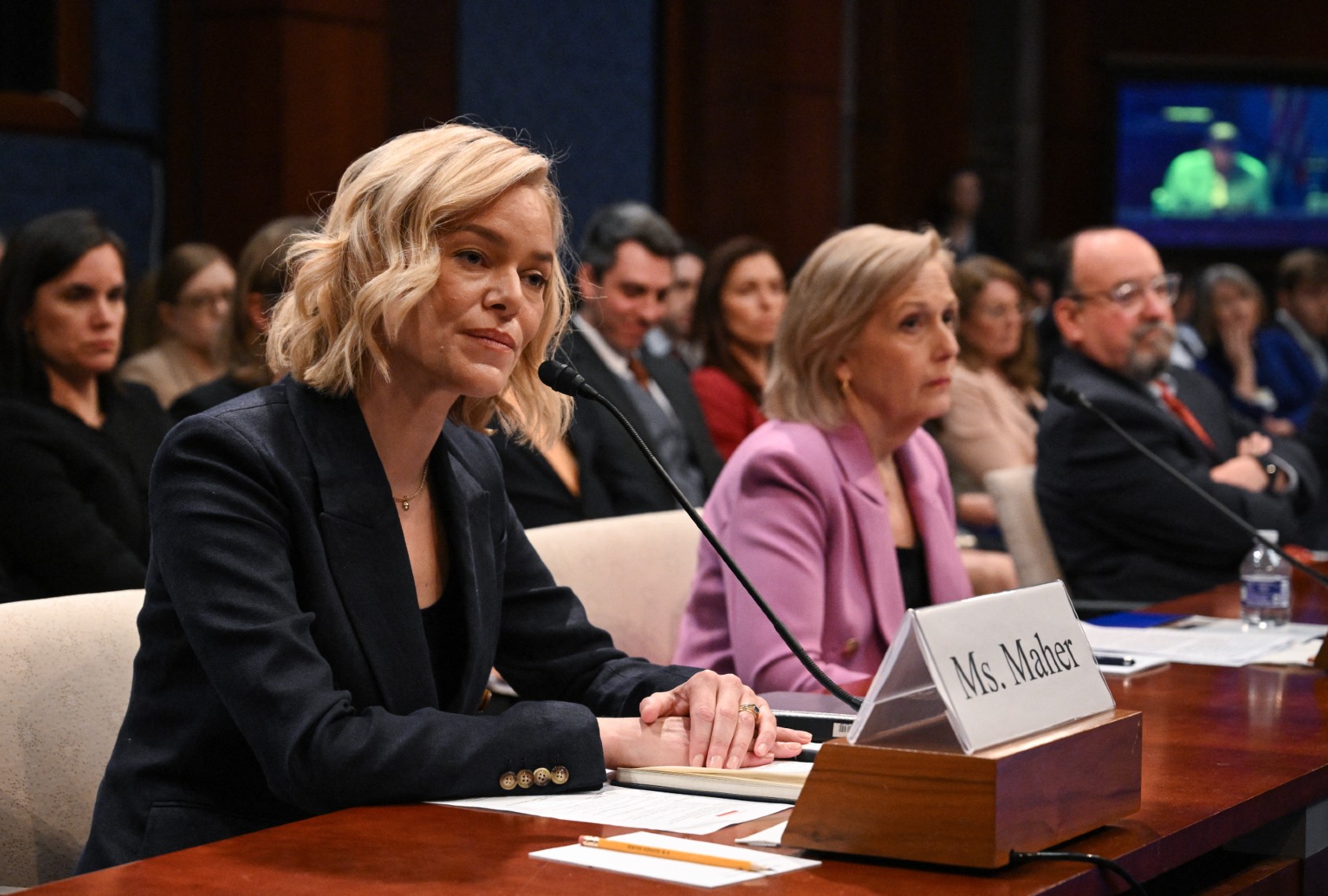
(L-R) President/CEO of National Public Radio (NPR) Katherine Maher and President/CEO of Public Broadcasting Service (PBS) Paula Kerger testify during a House Oversight and Government Reform Committee hearing on Capitol Hill on March 26, 2025 in Washington, DC. (DREW ANGERER/AFP via Getty Images)Committee member Greg Casar, D-Texas, piled onto this bit, peppering Gonzalez with questions like, “To your knowledge, has Miss Piggy ever been caught trying to funnel billions of dollars in government contracts to herself and to her companies? The answer is no. How about Arthur the Aardvark? Has he ever fired independent government watchdogs who are investigating his companies? The answer is no.”

This was meant to call attention to the shamefulness of this hearing, "if shame was still a thing," as the committee's ranking member Stephen Lynch, D-Mass. put it. A beat or two after his set-up, Casar mentioned that it’s DOGE’s leader Elon Musk, not the Muppets, rewarding himself with billions in government contracts – potentially $11.8 billion over the next few years, according to The Washington Post’s analysis. He’s also previously called for NPR and PBS to be defunded, apropos of nothing.

In asking Gonzalez about “Daniel Tiger’s Neighborhood,” though, Khanna’s aim was more pointed: He was showing that the people who are most insistent on cutting public broadcasting funding don’t watch or listen to much of it, if any at all.

Gonzalez, who wrote the blueprint for defunding the CPB for Project 2025, derides the content that NPR and PBS present – lineups that include public television's massive historical docuseries by Ken Burns, “NOVA” science documentaries and “Nature” features —  as “noneducational.”

But it’s been quite some time since the absence of knowledge about public media or input from the people it serves has stopped right-wing figures from forming policy-shaping opinions.

In any case, the Democrats’ showmanship, such as it was, fit well enough within a hearing that subcommittee chair Rep. Marjorie Taylor Greene, R-Ga., subtly titled “Anti-American Airwaves: Holding the heads of NPR and PBS Accountable.” 

Republicans wanted PBS and NPR to answer for, among other alleged sins, inadequately covering their fixation on Hunter Biden’s laptop; NPR’s unflattering coverage of Trump when he was a candidate; left-wing bias enumerated in an opinion piece by former senior business editor Uri Berliner, who resigned from NPR last year; and Maher’s incendiary tweets calling Donald Trump “a deranged racist sociopath” from 2020, when she ran the Wikimedia Foundation. (She apologized profusely for exercising that First Amendment right during the hearing.)


Want a daily wrap-up of all the news and commentary Salon has to offer? Subscribe to our morning newsletter, Crash Course.


Once she and Kerger were called to testify before what Axios described as “[t]he most chaotic new committee in Congress,” it was a foregone conclusion that Wednesday’s hearing was not going to land in the win column for PBS or NPR.

Maher has been in her position for a year. Kerger, on the other hand, is PBS’ longest-serving president, having taken up her watch in 2006. Both she and I have been doing our respective jobs long enough to have witnessed previous right-leaning Congresses target public media.

But this battle feels different. In the short time since Donald Trump began his second presidential term, GOP officials have signed on to unpopular and damaging policies despite the harm they might inflict on their constituents.

The ideologues shaping this discussion seemed more concerned with producing potentially viral exchanges to gin up outrage on social media and support Fox News talking points.

Federal Communications Commission Chairman Brendan Carr, a Trump appointee, has ordered an investigation into PBS and NPR regarding whether member stations violated government rules by identifying their programming underwriters on the air.

Meanwhile, the ideologues shaping this discussion seemed more concerned with producing potentially viral exchanges to gin up outrage on social media and support Fox News talking points.  

The situation isn’t entirely hopeless. On Wednesday, Pew Research released a report indicating 43% of its poll respondents – Democrats, Republicans and Independents — believe NPR and PBS should continue to receive funding from the federal government. It consistently ranks as one of the most trusted news sources and American institutions, according to YouGov.

Saving PBS and NPR in the past required viewers of all political stripes to come together and pressure their representatives to support it. If their bipartisan boosters rally to save it this time, it isn’t guaranteed that Congress will follow their wishes.

We need your help to stay independent

According to its own report, NPR receives around 36% of its  $300 million annual operating budget from corporate underwriting spots and 30% from station programming fees (about 30%). About 1% comes directly from federal sources, it says, while PBS receives roughly 16% of its funds from the CPB.

Kerger was a good sport in playing along with Democratic subcommittee members’ Muppet jokes. Nevertheless, you could tell from the serious expression on her face that these proceedings were nothing to laugh about.

PBS has always been and will always be a soft target in the culture wars, demonstrated by Greene opening the hearing by describing NPR and PBS as “radical left-wing echo chambers for a narrow audience of mostly wealthy white urban liberals and progressives who generally look down on and judge rural America.” 
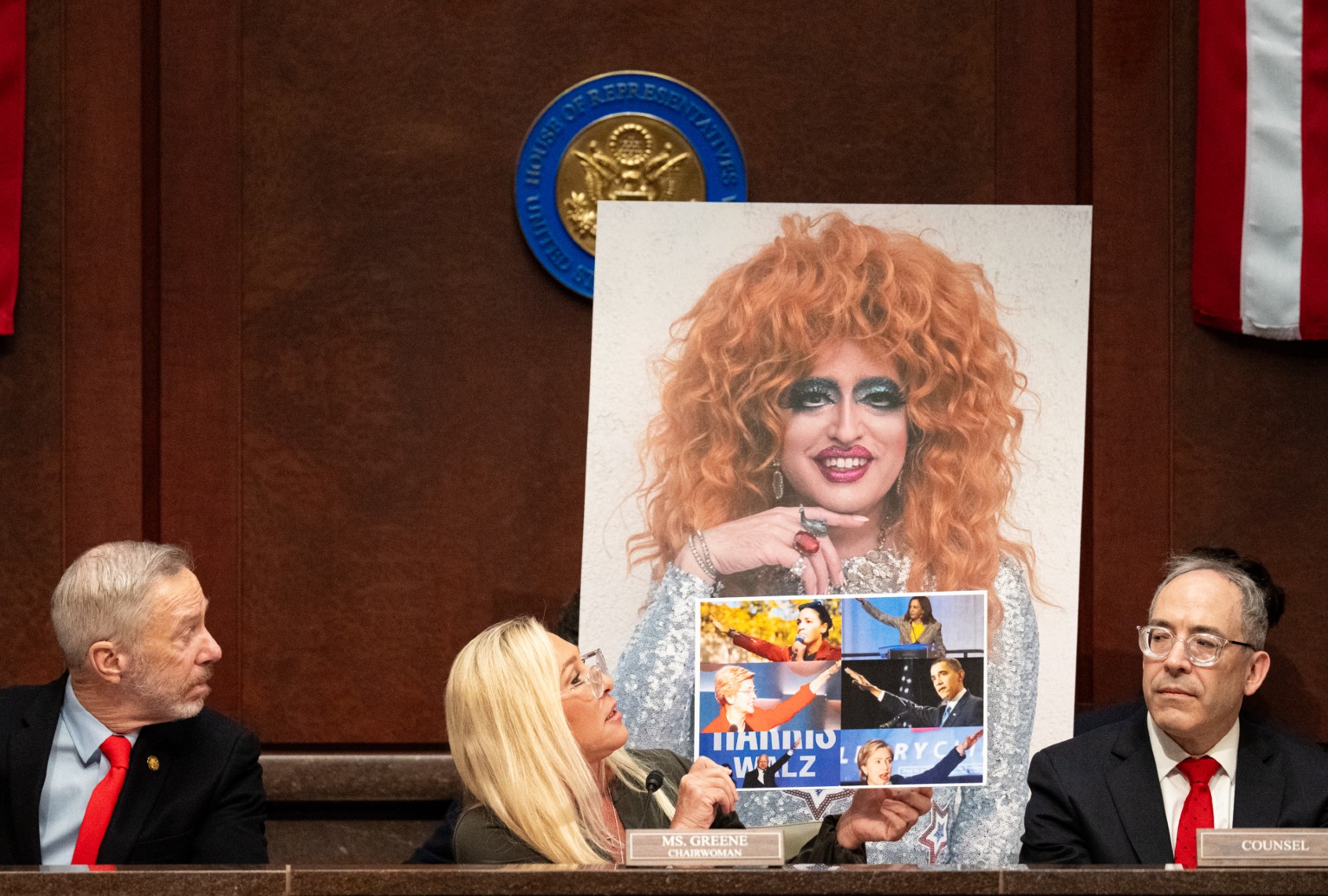
Chairman Rep. Marjorie Taylor Greene, R-Ga. speaks as Rep. Stephen Lynch, D-Mass. looks on during the House Oversight and Government Reform Subcommittee. (Bill Clark/CQ-Roll Call, Inc via Getty Images)That was the warm-up. One of her aides produced a giant, fabulous picture of drag performer and author Lil Miss Hot Mess, who Greene described as a “child predator” and “monster.” The queen's crime? Reading to children in an April 2021 segment for “Let’s Learn,” an educational show produced by the WNET group and the New York City Department of Education.

A YouTube video that has since been set to private opens with a statement dated May 24, 2021, clarifying that the series was not funded or distributed by PBS. Kerger repeated this, further adding that New York’s member station mistakenly placed it on the PBS website, but it was neither intended for national distribution nor aired on PBS itself. 

In a statement shared with Salon and posted to social media, Lil Miss Hot Mess responded that she wasn’t surprised that Greene called her hateful names. “But the unfortunate irony of Greene’s political bullying is that while she claims to promote liberty, in reality, she just wants to tell us all what to think and do,” the performer said.

“Greene’s attempts to defund PBS and NPR are the worst form of censorship," she continued, "reflecting both her own ignorance and the Republican party’s authoritarian impulses.”

In her opener, Greene also cited a 2015 “Frontline” documentary that followed transgender kids and their families, making the vile suggestion of it being evidence of public television allegedly “sexualizing and grooming children.”

Ah, yes. Young children are secretly wild about “Frontline” and “Independent Lens,” another long-running series featuring independently produced films that also caught some flak during the hearing. 

Anyway, both shows air in primetime, amply removed from PBS’ children’s programming block. “Independent Lens” typically runs at 10 p.m., long after the typical toddler’s bedtime.  

Some committee questions didn’t change much from what past officials have asked. Republican members questioned whether Americans still need PBS at a time when many people get their news and information from the oh-so-reliable Internet and podcasts. They also questioned the utility of its award-winning children’s programming since cable channels like Disney and National Geographic have children’s, nature and science shows covered.

As in the past, Kerger and Maher explained the obvious: PBS and NPR are free, reach 99% of the country and are primarily supported by private underwriting and listener donations. Yet again, the public TV and radio heads had to explain how the Corporation for Public Broadcasting works and how much (or little) federal funding is allocated to public media.

The CPB is not a government organization but a private, nonprofit corporation created by Congress in the Public Broadcasting Act of 1967. Its mission statement reads, in part, "CPB does not produce programming and does not own, operate or control any public broadcasting stations. Additionally, CPB, PBS, and NPR are independent of each other and of local public television and radio stations."

The entire display was a sham. But not a complete waste.

This is to ensure NPR’s and PBS’s editorial independence from CPB. Contrary to the way several GOP subcommittee members erroneously characterized NPR and PBS, they are not “state media.”

These and other claims resulted in the hearing resembling a light version of a Maoist struggle session. Ironic, since it was Greene and other Trump-aligned representatives muttering asides like, “Sounds like communism,” as they listed the supposed evils of NPR and PBS.

Putting aside the emptiness of GOP committee members’ concern over youngsters being more harmed by anything on PBS than the vast frontier of the notoriously family-friendly Internet, the entire display was a sham. But not a complete waste.

The hearing's fourth witness, president and chief executive of Alaska Public Media Ed Ulman, testified that public media is essential to rural communities, “especially in remote and rural places where broadcast cannot succeed," he said. "We provide potentially life-saving warnings and alerts that are crucial for Alaskans who face threats ranging from extreme weather to earthquakes, landslides and even volcanoes.”

The lion’s share of the CPB funding Republicans are eager to cut funnels directly to more than 1500 public media stations to support their programming, including local news. The most significant beneficiaries are rural stations.

“Reducing or eliminating federal funding would be devastating and could cause the closure of many stations, especially the most rural and remote,” Ulman told the committee, making it clear that calls to defund the CPB aren't merely attacking mainstream journalism. They threaten services that benefit the underprivileged and vulnerable.

As directed by the Public Broadcasting Act of 1967, 6% of funds appropriation goes toward system support, defined as “projects and activities that will enhance public broadcasting." This includes fostering collaboration across the system “to help ensure effective and efficient programs and services” and helping to offset infrastructure costs. 

As for the rest, CPB president and CEO Patricia Harrison said in a recent press statement, “For every public dollar provided, stations raise nearly seven dollars from donors, underscoring their value to the communities they serve.”

There’s good news about the status of the CPB’s funding — for the time being, anyway. On March 14, Congress approved a Continuing Resolution for Fiscal Year 2025 that President Donald Trump signed into law, which includes $535 million for the organization. Since the CPB is forward-funded by two years, the current allocation is set through 2027.

Of course, DOGE’s directive is to eliminate “wasteful” spending. That $535 million represents less than 1/100th of a percent out of the total federal budget, a recent report on PBS NewsHour cites. Breaking that down further, each American pays $1.50 a year to support the CPB, NPR and PBS. Compared to monthly costs for cable and streaming services, that’s a bargain.

“There’s nothing more American than PBS,” Kerger said, and the millions of people who watch the service’s programming would likely agree with her, even if they don’t agree with everything PBS airs. Supposedly, that is also American. Yet to be seen is whether Congress will continue to honor that principle when the Corporation for Public Broadcasting submits its next appropriations request.

Signalgate is Team Trump’s first big screw-up — and now they’re stuck

Alina Habba strolled up to the sticks outside of the White House on Wednesday with the swagger of a pirate and the credibility of a felon on the run. In other words, her usual M.O. If we’re keeping track, Habba is currently serving as acting U.S. Attorney for the District of New Jersey — as well as a counselor to the president in the second Trump administration. She’s Donald Trump’s former personal legal spokesperson and also a former senior advisor to MAGA, Inc., Trump’s super PAC. She changes her title, but never her job: fealty to Trump. 

She took a few questions about the ongoing Signal scandal that found high-level members of the new Trump administration acting like they were the Master Chief in a Halo cosplay bro’ chat room. The funny part? The government bros also invited the editor-in-chief of The Atlantic, Jeff Goldberg, into the text chain. Soon we’re reading the type of news that not only survives the daily news cycle, but shows continued life because of self-inflicted wounds by the administration. “I would love if the press, for once, would focus on the actual facts and actions of the administration. This is just – this is frankly just noise,” Habba bemoaned.

The only noise being generated are the answers from the White House: an endless parade of equivocations, lies, innuendo, anger, humor, drama and pathos worthy of a Broadway musical. Actually the press, for once, is focused on the facts and actions of the administration. It’s just the administration desperately wants our attention anywhere else because of “Signalgate” 

The administration’s version of the story is so convoluted as to be ridiculous.

Furthering Trump’s woes, The Atlantic on Wednesday published a follow-up story that builds upon the first. The Atlantic published a transcript of text messages showing that Secretary of Defense Pete Hegseth detailed U.S. military attack plans in Yemen – and on a Signal text chain. “Secrets? What Secrets?” had been the standard reply from the administration prior to the Atlantic’s recent revelation. The publication of those facts on Wednesday calls out Trump’s lies, but more importantly for MAGA purists, their military “Brain Trust” consists of tattooed, well-coiffed, wanna-be sixth-grade bullies.  Trump and his team will predictably deny, deflect, deny, denounce and may soon detain journalists for reporting about the crap the Trump administration eagerly spreads. 

You have to wonder if Trump would like to jail those at the  Atlantic who published a text from the VP which said; “I fully share your loathing of European free-loading. It’s PATHETIC.”

I wonder if anyone figured out the international dynamics on that statement? Can’t be good. 

Shortly before 6 p.m. Eastern on Wednesday, Trump emerged in the Oval Office after another day of embarrassment due to his laughable defense department team. He said Signalgate is just the latest witch hunt, while also claiming “there might be something defective with Signal.” Just what you want to hear about a civilian app used by the top brass in the Trump regime. 

The administration’s version of the story is so convoluted as to be ridiculous. At every entertainment-related business in Hollywood, there are eager, young and ultimately more talented writers who could concoct a more cogent narrative than the White House staff has produced. Maybe Trump should buy a few of them – though it’s doubtful he’d pay them.

The truth is, there absolutely is no script. This administration acts like they’re sightseers at Disneyland. They love pulling levers and causing stuff to crash, while at the same time they’re in awe of doing so. That’s it. No daily script. Just the Project 2025 bible to cover the wider themes – and those are malleable. Corruption for its own sake.

The details do matter, however. The president is certainly “allowed” to use Signal. Not really an issue. It was how Signal was used. Both erasing the data at a future point while allowing the text to be captured for at least a week is just stupid, as well as potentially illegal.

While Signal is encrypted from end to end, all you have to do is take screenshots of the conversations to bypass the encryption protocols. Mind you, Signal has been used for some limited conversations in the military, but it is not cleared for receiving or transmitting classified data. To do that, you need to be in a SCIF (sensitive compartmentalized Information facility).

By using unapproved devices to communicate secret information, you find yourself in possible violation of 18 U.S. Code 798 – disclosure of classified information. Yes. A felony. This is part of the Espionage Act. It is the “knowing and willful disclosure of classified information,” including communication, publication, or use in a way prejudicial to the U.S. or beneficial to a foreign government. It is punishable by fine and/or imprisonment of up to 10 years.

Now hold that thought. 

While Trump finds himself enmeshed in an electronic data squabble, so do a wide variety of incoming immigrants, green card holders and other foreigners. In that case, foreign travelers find themselves at the mercy of the Border Patrol, whose agents have apparently become more adventurous in taking casual and extended looks at your private cell phone data upon entry to the U.S. Time-consuming searches could ensue.

Thanks to Elon Trump or Donald Musk (does it matter which?) DOGE budget cuts ensure that few people will actually have to go through these searches, but the threat remains a viable one and American citizens are becoming increasingly concerned that their private data might be inspected upon return from a foreign trip. Beyond this place, there be dragons. 

In both cases, the inability to understand the reach of advanced electronics has led to dire consequences. The president’s people are pretending like they’re playing video games — with real lives in the balance. They potentially face felony charges.

In the other case, there are certain to be innocent human beings detained unnecessarily. Few terrorists would likely be caught by searching cell phones, but lots of private data could be taken without need, only by desire. Meanwhile, people who texted their relatives “Can you believe this idiot?” are being detained and/or denied entry. Just ask your average French scientist.

Meanwhile, Pete Hegseth, when confronted by a reporter about Signalgate, claimed Goldberg was a no-good, low-down down mean old snake who’d do anything for fame. Hegseth’s rant apparently got mixed reviews at the White House.

That could mean everything — or nothing.

We need your help to stay independent

Hegseth should resign. It would be the honorable thing to do (if he has any honor).

Trump may fire him. It’s looking increasingly likely that the longer Trump waits to come up with a viable scapegoat the more he risks getting some of the mess on his own clothes. Trump has a healthy survival instinct, or he used to before he joined the world of the “aging and fading quickly,” of which former President Biden may well be the president — if he’d only remember.

Then again, it would also be entirely in Trump’s wheelhouse to do absolutely nothing about this problem and see how it plays out. While that could be a horrible mistake, remember this is Trump. He’s made plenty of horrible mistakes. They are actually fodder for late-night talk shows and comedy routines.

The conspiracy theorists also find this to be fertile ground. Tune in for the alien angle, or the chemtrail pitch after the weather.

Meanwhile, consider The Atlantic. No one could have prepared for the story they found dropped in their lap, but they — so far — have handled it very well. The actions of Goldberg and his staff are certainly worthy of study in journalism classrooms. They stuck with the basics and so far their vetting of the facts seems overwhelmingly and demonstrably accurate.  Verify, assess, relay the facts and do so succinctly. The reporting had immediate consequences. Toss a match on a charcoal grill doused in gasoline. You’ll understand.

The Atlantic’s fact gathering and vetting have thus enabled millions to laugh and cry when The Presidential Pep Secretary, Karoline Leavitt, insists that no operational data was shared. When some suggested National Security Advisor Mike Waltz was “purposely” behind the release of information, we all could howl. When some of Trump’s team tried to shift blame to Joe Biden, we all could just shake and scratch our heads.


Want a daily wrap-up of all the news and commentary Salon has to offer? Subscribe to our morning newsletter, Crash Course.


Biden is Trump’s catchall. When you've got nothing else, blame that guy. It’s probably scrawled into the desks of certain Trump staffers. Bad weather? Biden’s fault. Tux didn’t come home from the cleaners? Get a flat tire? Run out of gas? Your trailer got blown away in the windstorm? It’s Biden’s fault. 

Hunter Thompson’s quote regarding a shallow money pit down a long plastic hallway where pimps run free and good men die like dogs, certainly describes Trump’s politics, though what Thompson said in “Fear and Loathing In Las Vegas” surely describes Trump’s closest advisers more accurately; “In a closed society where everybody's guilty, the only crime is getting caught. In a world of thieves, the only final sin is stupidity.”

Stupidity runs rampant in the Trump regime. But Hegseth and maybe Waltz are more likely than anyone to face the music for the cacophony they caused — if anyone does. But that’s America. 

George Carlin told us that when you are born in America, you get a front row seat to the freak show and Thompson told us you bought the ticket and so you should enjoy the ride. But you are free to get off of carnival rides and walk out of freak shows. Today, the average American isn’t free to leave. Somehow we’ve got to make it work.

The Signalgate debacle is just another reminder that Trump can’t get it done. But, there have been so many reminders before. What makes this one different — if anything?

Trump himself wasn’t primarily involved in the Signalgate scandal. That could make all the difference. Trump can rant and scream “victim” and say how the Deep State did this — and call Hegseth a patriotic victim even as he fires him. Again, this is just one of the many possibilities that Trump and his team will confront. Did anyone check to see what Putin favors? He might just have the deciding vote in this.

Sadopolitics: Why MAGA clings tighter to Trump the more his policies hurt them

Donald Trump’s budget cuts and the larger war on federal employees and government are not laser-targeted on Democrats, liberals, progressives or the other people and communities that he has deemed to be “the vermin” and “poison in the blood” of the nation who should be purged. Trump’s approach is broad, the political equivalent of carpet-bombing, and the casualties include Trump’s own MAGA people and red state parts of the country.  

Unable to resist the compelling human-interest aspects of Donald Trump’s gutting of the federal workforce and government, the mainstream news media profiles Trump voters who have lost their jobs because of the president’s chainsaw-like approach to gutting the federal government. There are also many news stories about how Trump’s budget cuts and other policies targeting such programs as Social Security, Medicare, Medicaid, education, support for veterans and their families, and assistance for the poor and other vulnerable individuals will hurt Trump’s voters.

Black MAGA supporters who feel betrayed by Trump’s whitewashing of American history and other regressive policies have been prominently featured by the news media. I am acquainted with one such Black MAGA member. He was very enthusiastic about Trump’s second presidency. He took on the role of being a Trump evangelist and minister of outreach to the Black people who live in our neighborhood. Last week, my acquaintance was told his job is being eliminated because of Trump’s budget cuts. He is distraught.

And in a classic example of “chickens who support Colonel Sanders,” there are reports of Latino Trump supporters (and their families) targeted by ICE because they were assumed to be “illegal aliens.”

Much of this news coverage and commentary, and the reactions to these stories online and elsewhere, is colored by liberal schadenfreude. The Trump supporters are mocked as getting their just rewards because they voted for a president who then fires them or otherwise causes them great harm. There is often shock and surprise that these same voters do not immediately turn against Trump, the MAGA movement or the Republican Party, even after they have been hurt by their Dear Leader.

Meanwhile, the Democrats are being trounced by Trump and his MAGA shock and awe campaign. In their desperation, the Democratic Party’s leaders are holding on to the hope that Trump and the Republican Party will overreach and that the administration's popularity and power will plummet and implode once their policies begin to hurt wide swaths of the American public. In the case of the federal employees and other people who support Donald Trump and have lost their jobs and/or have otherwise been harmed by his administration’s policies, it is wishful thinking to believe that they will have some type of epiphany where they abandon Trump and MAGA and embrace the Democratic Party.

The Democratic Party’s leaders, the Resistance and other pro-democracy Americans need to accept the unpleasant truth that Donald Trump’s MAGA movement is not going away anytime soon.

Why is this? Here are a few explanations.

Donald Trump is an autocrat and the leader of a political personality cult. Trump’s base of support is very strong and seemingly immune to controversy or other events and happenings that would be the end of a more traditional mainstream politician. In all, Trump’s MAGA followers and other supporters are manifesting a type of “psychological adhesion” to him and the MAGA movement. In the most extreme examples, Trump’s followers literally see him as some superhuman, a god and/or prophet who can do no wrong.

Donald Trump and other right-wing leaders and influentials command a vast propaganda and experience machine that consists of traditional news media such as TV, radio and print, websites, social media, podcasts, publishers, movies, sports, film, television, comedy, right-wing Christian churches, schools and “education,” interest groups, think tanks and other civil society organizations. For at least the last nine years (and decades before with the rise of Fox News and the right-wing echo chamber) this propaganda and experience machine has created an alternate reality that has emotionally trained and conditioned its public to be loyal to Trump, MAGA, and the larger right-wing “conservative” movement and to reject any outside information or influences (their much-hated “reality-based community”).

We need your help to stay independent

The American public is highly polarized politically (and socially). Politics is not “just” limited to voting and elections and other explicitly political matters such as support for a given public policy, law, candidate or party. Politics now encompasses many, if not most, aspects of American culture, from food to entertainment, dating, marriage, friendship networks, where one lives, religion and church attendance, and other aspects of day-to-day life. What political scientists describe as affective/negative polarization describes how political disagreements are increasingly existential value judgments where “the other side” is not just wrong but evil. In such an environment, changing one’s mind, by, for example, deciding to no longer support Trump’s policies, becomes less likely

 “Conservatives,” authoritarians, and other members (though not all) of the right wing are also more likely to engage in “systems justification” as compared to liberals and progressives. In practice, systems justification encourages a lack of critical thinking about society and power and instead emphasizes an acceptance of unjust outcomes and inequality through deference to the status quo and support for authority figures.

Donald Trump is an expert at sadopolitics. In a 2018 conversation with historian Timothy Snyder here at Salon, he elaborated on the meaning of sadopolitics (what he terms as “sadopopulism”) and its implications for the Age of Trump and the larger democracy crisis:

"Sadopopulism" is the notion that you're doing half of populism. You promise people things, but then when you get power you have no intention of even trying to implement any policy on behalf of the people. Instead, you deliberately make the suffering worse for your critical constituency. The people who got Trump into office, for example, are traditional Republican voters plus people in counties who are doing badly in terms of health care and other measures, and who need help.

Under Trump, of course, things will just get worse in terms of both the opioid addictions and in terms of wealth inequality. But that's OK, because the logic of sadopopulism is that pain is a resource. Sadopopulist leaders like Trump use that pain to create a story about who's actually at fault. The way politics works in that model is that government doesn't solve your problems, it blames your problems on other people — and it creates the cycle that goes around over and over and over again. I started talking about sadopopulism because I got tired of people talking about populism.

In such a toxic relationship between the leader, the followers and the larger public, the abuse and misery actually bond them all closer together. The most loyal followers see their leader as simultaneously a source of protection and safety, even as he or she hurts them. To that point, the more Trump’s policies hurt his followers, the more likely they are to cling to him. Trump’s followers are also going to misdirect their rage, anger, blame, and other negative emotions and behavior at some “enemy.” In the Age of Trump, that enemy is Black and brown people and other nonwhites, “Woke” and “DEI, “illegal immigrants” and migrant “invaders,” the LGBTQ community and specifically transgender people, social “parasites” and “takers,” government employees, those not deemed sufficiently “patriotic” and therefore disloyal to MAGA and Trump (which here is synonymous with “Real America”), Muslims and other non-“Christians,” the Democrats, “liberals,” the news media (“fake news” and “lugenpresse”) and other targeted groups and individuals.

Donald Trump’s MAGA people and other supporters will resolve their apparent cognitive dissonance. Donald Trump’s economic and other policies and actions (and those of the Republican Party more broadly) cause demonstrable harm to his supporters who are not rich, white, and “Christian” men — this is especially true for the (white) “working class” Trumpists. Yet, these people continue to support Trump and the Republican Party’s policies and leaders. The cognitive dissonance created by a choice that seemed good at the time and the resulting harm is resolved by reasoning backward and discounting, eliminating, or otherwise rationalizing the negative outcomes as unavoidable, minimizing them, or through some other reasoning that resolves the contradiction. There is also the sunk cost dimension to supporting Donald Trump, where a person has invested so much energy and resources that they are averse to changing their behavior and/or admitting they were wrong.

Democrats, liberals, progressives and “small c” traditional conservatives (and other members of the mainstream political and media class in America) generally believe in some version of “normal politics” and therefore possess a model of political decision-making and “rationality” that is in many ways imprecise, if not wholly wrong and inaccurate. They imagine the American voter as some type of human calculator who makes political decisions to maximize their material, economic, or otherwise “rational” goal and output. Decades of research has repeatedly shown that the average American voter is not ideological, has a recency bias, is imagistic and in total lacks a sophisticated understanding of politics. Even more damning, the average American reads at below a sixth-grade level and cannot accurately explain the argument and evidence presented in an editorial or op-ed. The average American voter gropes and searches their way through political questions, seeks direction from sources they trust and is guided by emotion and intuition.

In this context, Donald Trump’s MAGA people and other followers will, based on their ongoing pattern of behavior, continue to support him. Donald Trump is also a high-dominance leader who is masterful in his ability to manipulate the media and dominate the information space. This amplifies his appeal to his followers. Moreover, Trump’s followers will likely view their suffering and other hardships they are experiencing as a result of his policies as an acceptable form of sacrifice and an act of loyalty for the greater MAGA cause of “Making America Great Again.” In essence, Trump’s followers imagine themselves as patriots who are playing a key role in an existential battle between good (Donald Trump, MAGA, “Real America,” and “Patriots”) and evil (the Democrats, liberals, progressives, “political correctness” and “Woke” and “DEI”). Trump’s followers are willing to suffer greatly to achieve what they see as victory. Contrary to what many people who exist outside of TrumpWorld and the MAGAverse would like to believe, Trump's voters are not "irrational," they are prioritizing different values and goals in their decision-making as compared to other Americans. 

****

The Democrats and the so-called Resistance cannot rely on the hope that Trump’s policies will hurt his followers and that they will then “rationally” turn on him. The Democrats should also be very weary of James Carville’s advice to “roll over and play dead. Allow the Republicans to crumble beneath their own weight and make the American people miss us. Only until the Trump administration has spiraled into the low 40s or high 30s in public approval polling percentages should we make like a pack of hyenas and go for the jugular. Until then, I’m calling for a strategic political retreat.”

These are passive responses that cede the initiative — and the future of American democracy and freedom — to Donald Trump, the MAGAfied Republicans and the larger antidemocracy movement. The Democrats need to rebrand, refine their communications and overall strategy and give the many millions of Americans who chose not to vote for the Democratic Party (or to vote at all) a reason to support them on the local, state and national level. Chasing down Trump’s much-obsessed about (white) “working class” MAGA voters is a fight the Democrats, as presently oriented, will not likely win on a national level.

The 2024 election may have been a realigning election where the political future of the country has been directed towards authoritarian populism and based on the first two months of Trump’s administration and how rapidly the country’s democracy is collapsing, something much worse. The Democratic Party’s leaders, the Resistance and other pro-democracy Americans need to accept the unpleasant truth that Donald Trump’s MAGA movement is not going away anytime soon. This is the new normal that must be navigated. Wish-casting or otherwise holding on to obsolete ideas, fantasies and fictions will not accomplish the extremely difficult work of trying to win elections (assuming there are even “free and fair” midterm and presidential elections in 2026 and 2028, respectively) in a country where democratic “backsliding” is quickly becoming democratic collapse.

Trump’s executive order on voting is MAGA’s trojan horse

President Trump’s latest executive order is unconstitutional but it’s also redundant.

As the New York Times reports, President Trump “signed an executive order on Tuesday that will require proof of U.S. citizenship on election forms.” Of course, non-citizens have never been allowed to vote, and the president has no authority over elections. The Constitution assigns that responsibility to the states. The order is the latest example of what the Times describes as Trump’s “strikingly aggressive approach to power, moving swiftly to claim more authority and barrel through norms…”

But it is something more. It is another sign that the president is trying to change what it means to be an American. That is why the president’s order targets “foreign nationals.” It, and the president’s obsession with illegal immigration, are designed to change the way people in this country think of themselves.

Trump's order is just a trojan horse to help him carry on with his strategy of stoking fear of anyone who is not “white, Christian, native-born, and English-speaking” and rejecting the values and teachings of our “civic religion.”

Throughout our history, the meaning of being American has been tied to a particular understanding of our founding documents, especially the Constitution. Americans are bound together by what some have called a ”civil religion.” That is what the president’s words and deeds, like the executive order he signed earlier this week, threaten to destroy.

As NPR notes, “America, unlike some countries, is not defined by a common ancestry, nor is it tied to an official faith tradition. But it does have a distinct identity and a quasi-religious foundation.”

“The ‘self-evident’ truths listed in the Declaration of Independence and the key provisions of the U.S. Constitution and the Bill of Rights have acquired the status of scripture in the U.S. consciousness. Acceptance of this uniquely American creed is seen as the key to one's identity as an American.”

Or, as law professors Amy Chua and Jeb Rubenfeld argue, “Americans were to be united through a new kind of patriotism—constitutional patriotism—based on ideals enshrined in their founding document.”

This is not to say that this country has lived up to its creed or always put those ideals into practice. All too often, it has deviated from that creed’s most significant commitments. Our history is marked by many instances in which people’s inalienable rights have been  violated or when they were targeted in spite of their adherence to and belief in our “civil religion.” But many of them have seen through and beyond those injustices. They had faith in this country and believed in its better angels.

The distinguished African-American historian Nicole Hannah Jones captures this in a story about her father. “My dad,” she says, “always flew an American flag in our front yard. The blue paint on our two-story house was perennially chipping; the fence, or the rail by the stairs, or the front door existed in a perpetual state of disrepair, but that flag always flew pristine.” 

“So,” she continues, “when I was young, that flag outside our home never made sense to me. How could this black man, having seen firsthand the way his country abused black Americans, how it refused to treat us as full citizens, proudly fly its banner? I didn’t understand his patriotism. It deeply embarrassed me.”

What she only came to understand was that her father never lost hope for our “civil religion.” That hope and an awareness of the indispensable contributions of Black Americans to the realization of its promise, sustained him even as he suffered through failures of that promise.

“My father,” Hannah Jones writes, “knew exactly what he was doing when he raised that flag. He knew that our people’s contributions to building the richest and most powerful nation in the world were indelible, that the United States simply would not exist without us.”

I’m not sure the president understands the vision of America held by Hannah-Jones’ father. And if he does, Tuesday’s executive order shows his disdain for it.

President Trump treats the Constitution as a malleable instrument of his will while inviting us to accept a version of the American story that would push people like her father to the margins. That is because the president is uncomfortable with our “civil religion.”

We need your help to stay independent

His idea of what it means to be an American taps into an “’ethnic-nationalist’ tradition of American identity.” That tradition “is based on a set of criteria (including being white, Christian, native-born, and English-speaking) to define who is a ‘real’ American, and who is not.”   

But, as Professors Eric Taylor Woods and Robert Schertzer report, “[E]ven though ethno-nationalism..(was) central to Trump’s campaign rhetoric, he tends to avoid explicitly referring to it.” Instead, they suggest, “Trump tends to heavily rely upon thinly veiled speech codes known as ’dog whistles’ to implicitly refer to them. This is what he is doing when he says he is standing up for the ‘silent majority’  and ‘forgotten men and women,’ or when he claims he will protect ‘suburban housewives’ from the threat of illegal migrants.”

That is why the first executive order of his new term was entitled, “PROTECTING THE MEANING AND VALUE OF AMERICAN CITIZENSHIP.”  It focused on birthright citizenship and defined it in ways that would not be recognizable to those who included it in the Constitution’s 14th Amendment.

And, as the ACLU points out, “it would strip certain babies born in the United States of their U.S. citizenship.” The legality of the president’s Executive Order is being challenged, and several judges have issued preliminary injunctions blocking it from going into effect

As Chua and Rubenfeld rightly argue, “The core constitutional aspiration—in the 1780s, the 1860s, the 1960s, and the present—has been to create a tribe-transcending national identity…” and in that endeavor, “The significance of birthright citizenship cannot be overstated.”

If we are to resist the president’s effort to redefine what it means to be an American, we must not be taken in by pretexts that the nation is afflicted by fraudulent voting by foreign nationals. Tuesday’s order is just a trojan horse to help him carry on with his strategy of stoking fear of anyone who is not “white, Christian, native-born, and English-speaking” and rejecting the values and teachings of our “civil religion.”

“We were meant to be outdoor creatures”: Experts say screens are only part of poor vision epidemic

It has long been thought that digging your nose in a book and spending too much time reading things up close could cause near-sightedness. When books were replaced with smartphones, it was easy to blame the screens instead. But as near-sightedness rates continued to rise across the world, researchers began to understand that it wasn’t just technology that was changing the way we see the world.

Near-sightedness, formally known as myopia, occurs when the eye elongates, causing light to focus in front of the retina instead of directly on it, producing blurry vision. Rates of myopia are increasing globally, with the World Health Organization estimating that half of the world’s population could have myopia by 2050 in what is already being called an epidemic. As of 2010, just 27% of the global population has myopia.

In addition to needing glasses or corrective lenses, people with myopia are at a higher risk of experiencing a detached retina if the retina has to stretch too far to accommodate the elongating eye. It also carries an increased risk for glaucoma, cataracts and myopic maculopathy, in which the center of the retina deteriorates. Poor vision can also have downstream effects on language, memory, and attention as we age.

Although genetics play an important role in determining whether someone will develop myopia, the increasing prevalence is happening too quickly for genetics to be the sole cause — meaning the rise of near-sightedness must also be caused by something in the environment, said Dr. Katherine Weise, a pediatric optometrist at the University of Alabama at Birmingham.

“There are environmental factors that seem to be contributing to this,” Weise told Salon in a phone interview. “So if we can figure out those environmental factors, we can mitigate the growth of myopia by reducing them.”

In the U.S., 25% of the population was near-sighted in the 1970s, and that rose to 41% in the early 2000s, according to data from the National Health and Nutrition Examination Survey. Although there is not more recent comprehensive federal data in the U.S. to compare trends, studies from around the world indicate that those rates have continued to rise, with China reporting a steady increase in myopia over the past decade. In Taiwan, up to 90% of young people have myopia.

"Time outdoors, before a child becomes myopic, helps either prevent or delay the onset of their myopia."

Because electronic devices were not widespread when myopia started to increase, it is thought that the myopia epidemic could be caused by children spending less time outside, where a wide range of wavelengths of light can interact with their eyes and promote healthy growth, said Dr. Safal Khanal, an optometrist and researcher at the University of Alabama at Birmingham.

“It seems like the mechanism that is controlling the growth of the eye requires feedback from a very broad range of wavelengths,” Khanal told Salon in a phone interview. “If somehow that feedback is broken, for example, if kids are exposed to only a certain kind of wavelength, then that can mess up your refractive development.”

In one 2021 study published in JAMA Ophthalmology, children’s vision significantly declined toward myopia during school closures in 2020 — when children were at home and on screens more — compared to the rate at which their vision was changing in prior years. 

But time indoors and spending time on devices have been difficult to tease apart in research, and it could also be that technology is playing a role in the increased rates of myopia. In one recent animal study, tree shrews were made to look at a digital device. Through manipulating the red, green and blue color wavelengths on the screen, the researchers were able to control the growth of the eye.


Want more health and science stories in your inbox? Subscribe to Salon's weekly newsletter Lab Notes.


“There is some indication that chromatic composition of light, whether it is outdoors or from digital devices, is an important factor in this whole mechanism,” Khanal said.

In one 2010 study that followed a group of children through adulthood, children had a 60% of becoming myopic by eighth grade if they had low levels of outdoor activity. If they played outside for more than 14 hours, their risk of near-sightedness dropped to 20%.

However, reading and doing other close-up activities in what is referred to as “near-work,” was not associated with near-sightedness, said study author Dr. Donald Mutti, an optometrist and researcher at the Ohio State University College of Optometry.

We need your help to stay independent

“This has been replicated around the world: time outdoors, before a child becomes myopic, helps either prevent or delay the onset of their myopia,” Mutti told Salon in a phone interview. “In my mind, the biggest change that's been detrimental has been that kids don't spend as much time outdoors as they used to.”

However, Mutti said more research is needed to study the impacts of screen time in very young children and myopia risk. When infants are born, their eyes are not developed to focus on close-up objects well, and this naturally improves as the eye grows. The idea is that such early exposure to screens could potentially push that corrective adaptation too far into near-sightedness territory and influence the risk of myopia.

“Toddlers were meant to use their focusing power to get over their far-sightedness and then be toddlers … not read books or stare into screens,” Mutti said. “Then they learn to read and the ordinary near-work starts, but the eye is, for the vast majority, already grown to its adult size.”

As near-sightedness continues to increase around the world, efforts are being made to recognize it as a disease, which could improve surveillance and treatment. As it stands, insurance companies do not cover the medical aspects of myopia, Weise said. Last year, the WHO launched an initiative aiming to increase the proportion of people with access to glasses by 40% across the world. The National Eye Institute also hosted a meeting last year to better understand the epidemic and get it under control.

“The great thing about it being environmental factors contributing to the eye condition is, once we figure out what the factors are, we can use the factors to undo it as well,” Weise said.

Still, it seems that technology and urbanization are rapidly outpacing efforts to curb the myopia epidemic, with people spending more and more time inside on their devices. For now, perhaps we can take a page from countries like Australia, which has a relatively low rate of myopia — and where inhabitants also spend lots of time outdoors.

“We weren’t supposed to spend our days in a cave — we were meant to roam and be hunters and gatherers and be under the sun,” Mutti said. “We were meant to be outdoor creatures.”

“This is a direct attack”: Canadian PM mulls retaliation over Trump’s 25% auto tariffs

President Donald Trump announced steep tariffs on all automobiles manufactured outside the United States on Wednesday, in a move that Canadian leaders called a "direct attack."

While Prime Minister Mark Carney has yet to announce any retaliatory measures, the newly sworn-in Canadian leader promised to hold firm in the face of Trump's desire for a trade war.

"This is a very direct attack," Carney said, per the Associated Press. "We will defend our workers. We will defend our companies. We will defend our country."

Trump told reporters that the duties will "spur growth" in domestic manufacturing. However, the sudden announcement of a 25% tariff on imported vehicles and key automobile parts is likely to throw a wrench in the production of domestic vehicles, as the manufacturing process of American cars is deeply intertwined with factories in Mexico and Canada. As U.S. car companies navigate a new normal and the costs of imported parts and vehicles continue to rise, American consumers will likely see an increase in the sticker price of new cars.

Ontario Premier Doug Ford said the tariffs "will do nothing more than increase costs for hard-working American families" in a post to X.

"U.S. markets are already on the decline as the president causes more chaos and uncertainty," he wrote. "He’s putting American jobs at risk."

Trump has been dancing around imposing tariffs on Mexico and Canada since he took office in January. His push to punish the United States' biggest trading partners has thrown projections of the performance of the U.S. economy into chaos, as economists predict pain in the short term.

"I think it would be extremely difficult to find, if not impossible, frankly, to find a car that is entirely made in Canada or entirely made in the U.S. — or entirely made in Mexico, for that matter," economist Tu Nguyen told the CBC earlier this year, in response to Trump's threats.

The response to Trump's tariffs was not entirely negative. United Auto Workers President Shawn Fain praised the president for ending "the free trade disaster that has devastated working-class communities for decades."

"Ending the race to the bottom in the auto industry starts with fixing our broken trade deals, and the Trump administration has made history with today’s actions,” he shared in a statement.

“Mainstream media propagandists”: MAGA movement freaks out as Signalgate texts are released

The reveal that top advisers to President Donald Trump had accidentally leaked war plans to the press sent the Trump administration into denial. Now that The Atlantic has published the leaked plans in question, MAGA is charging ahead into the next stage of grief: anger.

In a series of contentious interviews on Wednesday, Trump allies and associates haughtily blew off questions from concerned reporters. White House Press Secretary Karoline Leavitt, Secretary of State Marco Rubio and Georgia GOP Rep. Marjorie Taylor Greene attacked the media for giving air to a scandal they viewed as ridiculously overblown.

"We are not going to bend in the face of this insincere outrage," Leavitt told reporters at the White House. “If this story proves anything, it proves that Democrats and their propagandists in the mainstream media know how to fabricate, orchestrate, and disseminate a misinformation campaign quite well."

Leavitt's statement served as a preamble to a heated question-and-answer session. CNN's Kaitlan Collins asked if President Trump felt "misled" by his Cabinet, who assured him that no classified information had been shared in the compromised Signal chat. 

"I have now been asked and answered this question three times," she said. "I've given you my answer. The president feels the same as he did yesterday."

When Collins attempted to ask a follow-up question, Leavitt rushed to the next reporter and refused to respond. 

Fox News' Jacqui Heinrich pressed Leavitt on what counts as classified information, asking her directly why "launch times on a mission" were not considered classified by the White House.

"Do you trust the secretary of defense…or do you trust Jeffrey Goldberg, who is a registered Democrat and an anti-Trump sensationalist reporter?"

Defense Secretary Pete Hegseth has maintained that he did not share war plans in the Signal chat, even as screenshots of messages revealing the timing of planned missile strikes have been released. In a post to social media, he said the texts he sent would have made "really s**tty war plans."

"Those 'plans' include: No names. No targets. No locations. No units. No routes. No sources. No methods. And no classified information. Those are some really sh**ty war plans," he wrote.

Later in the day, Hegseth reiterated that point to reporters in Hawaii, quickly leaving before they could ask him any questions.

The rage at reporters isn't limited to active members of the Trump administration. Marjorie Taylor Greene attacked a reporter from UK outlet Sky News when she raised questions about the group chat. 

Greene told the reporter to "go back to [her] country" and worry about the UK's "major migrant problem.

"We don’t give a crap about your opinion and your reporting," Greene said. "You should care about your own borders."