Spring Sale: Get 1 Year, Save 58%

“It Lives Inside” director on his psychological monster and “counterintuitive” approach to suspense

Director Bishal Dutta makes an auspicious feature film debut with his effective folk horror shocker, “It Lives Inside.” After an eerie prologue, the film introduces Samidha, Americanized as “Sam” (“Never Have I Ever” actress Megan Suri), a teenager who is uninterested in helping her mother, Poorna (Neeru Bajwa) prepare for an upcoming Puja ceremony to celebrate the mythological god Durga defeating a demon. 

“I did not grow up superstitious, but I grew up loving horror films.”

Sam is a good student, and her teacher Joyce (Betty Gabriel) asks her about Tamira (Mohana Krishnan), her classmate who has become withdrawn of late, clutching a glass jar and acting strangely. When Tamira explains to Sam that the jar contains a monster — later explained to be the Pishach, “a flesh-eating devourer of souls” — Sam causes the vessel to break, and the demon is unleashed.

Then Tamira disappears, uncanny things happen to Sam’s boyfriend, Russ (Gage Marsh), as well as Joyce and Sam’s dad, Inesh (Vik Sahay). Sam realizes that she has to contain the Pishach to restore order — and she cannot do it alone. 

Dutta portrays this battle of good versus evil well, with several disturbing scenes, while also commenting on cultural assimilation. The filmmaker spoke with Salon about his new film during the Black Star Film Festival in Philadelphia last month.

What inspired “It Lives Inside”? Have you had to battle demons trapped in jars that feed on raw meat? 

Not exactly. [Laughs]. My grandfather, when he was a young man in India, said he dealt with a supernatural entity. I grew up hearing that ghost story, so I started to wonder: what could that have been? I knew I wanted to do a horror story for my first film, I love the genre, I thought: what can I do that is unique? I thought of that story, and the idea of the creature, the Pishach. The other piece of it was that I really wanted to do a film about assimilating into American culture as an Indian American teenager. 

I was struck by an early scene where Poorna admonishes Sam for whistling, claiming that it signals evil spirits. Can you talk about some of the folk horror elements in your film? 

I did not grow up superstitious, but I grew up loving horror films. But if you love horror, you think, how real is this stuff? The best is when it feels real, and the audience can engage with it as if it was not fantasy, but something we are going to deal with walking home at night. The superstitions in the film come from family members, and the older generation, and things I grew up rejecting in favor of modernity. But in putting this film together, I thought, we have this well of superstitions, let me draw from that; they have such a wide cultural reach. 

Can you talk about creating the cultural tension in the film? Sam and her mother have different emotions about tradition and modernity, and Sam and Tamira have grown apart as friends. The film generates themes of guilt, shame and loneliness that feed the characters’ fears. You talk about horror being grounded in reality. It is really powerful.

A lot of this came from a certain tension where it feels to be an American as an immigrant. You have to perform American-ness to a degree that [non-immigrant] Americans don’t. There is the good immigrant/bad immigrant fallacy. What does it mean to be the right kind of immigrant in this country, and what does it mean to be the wrong kind and these internalized ideas? I started with Sam as this character who is trapped between both worlds. She has a very relatable and universal desire to fit in, but high school conflicts with that. That is the central tension; there is a line in the film where she says, “Everything I want outside of me is inside me and I can’t get it out.” There are a lot of things Sam can change, but there are a lot of things that, when people look at her, she can’t change, no matter how much makeup she puts on, or the clothes she puts on or the music she listens to. 

We need your help to stay independent

What made you decide to make the film about a teenager? They feel the most and are so self-aware. Sam’s anxiety is fear-based, and not focused on dating or fitting in.

I wanted to privilege and respect the high school point of view, because so often, that point of view is undercut, and treated as “little” and lacking in substance. I did not want to devalue her by making her boy crazy, or about her clothes or the phone. She’s a complex human struggling with things. 
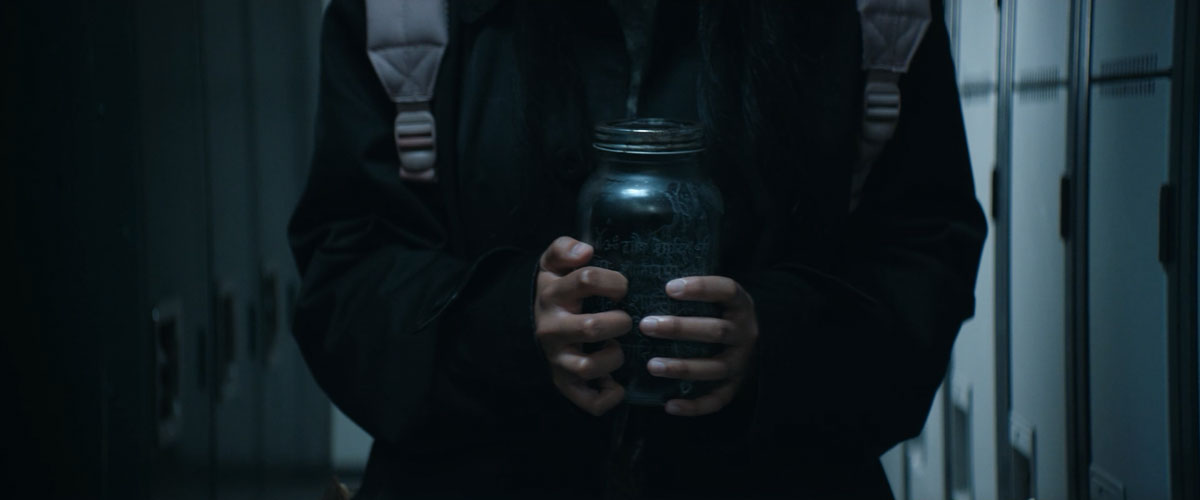
It Lives InsideIt Lives Inside (Neon)

Can you talk about your visual approach to the material? There are many scenes that are disorienting, where you move the camera, or use shadows, lighting or spaces (like a locker). The tone and feel of the film is both modern and traditional, realistic and fantastical. We experience it as the characters do in this space.

“Horror films felt dangerous. Can you stomach it?”

I have to credit that to my cinematographer, Matt Lynn. We talked about how to translate the themes of claustrophobia and loneliness into visuals. There are a lot of close-ups in the film, which is very much by design. The horror of it, before the demon enters the picture, is that Sam is living under a gaze. Matt and I wanted to put the camera so close to the characters that the audience understands the camera is an oppressive force. 

The balance of real and fantastical — I find myself drawn to both sides. I can never pick, because part of me wants to make documentaries and just capture people in an unobtrusive way and pull at the interiority of the characters. But I also want to bring comic books to life, not in the superhero sense, but the graphic nature of panels. Stylistically that was interesting to Matt and I, and we tried to create the balance to keep the audience between these two worlds. 

What about presenting the horror elements in “It Lives Inside”? The suspense comes because many of the intense moments come unexpectedly. It is as if you are building the tension but strike while viewers are preparing for the shock. Can you talk about these scenes as well as how much violence to show? 

For me, suspense is a conversation with the audience. Imagining a full theater and what are they thinking and feeling? When do they expect the scare to come? They know the genre. The way we engage with film — you can call it suspension of disbelief, but it is something deeper. Audiences who go to horror films for these moments. It’s what Steven Soderbergh said about “Trojan Horse” cinema. You bring the audience in with something, you deliver on that, and then you can give them something more. When I design the horror pieces, I think how long can I prolong this? The audience knows the scares are coming. It is gratifying when people start laughing. It seems counterintuitive, but we are withholding and then delivering that scare when viewers least expect it. 

That’s what made Hitchcock’s “Psycho” so terrifying, because a character is killed before you expect it. He’s coming up the stairs and you anticipate him going into the room, but he’s murdered before he even gets there. 

Did you ever hear the story that that scene was shot when Hitchcock was sick and the crew shot it for him, and Hitchcock said, “You did a great job, but you shot the scene as if he’s the killer, not the victim.” And that sticks with me. Hitchcock had the greatest understanding of point of view in cinema. He uses the camera for point of view, and I think of point of view more than anything. That meld between audience and protagonist when you have a well-written character. It becomes so much more intuitive to manipulate the audience and deliver what they are here for.

But I never felt manipulated watching “It Lives Inside.” It didn’t feel derivative.

“There is a magic trick to getting the audience to buy into a horror film.”

I really appreciate the element of homage and reference in this film. I grew up loving horror films. It meant so much to me to get to do a horror film as my first feature. I didn’t want to do it as parody or pastiche or deconstruction. That wasn’t interesting. I was affected by the big screen experiences when I was 13 and 14. The film that set me off was the first “Conjuring.” It was a brilliant gateway movie. Horror films felt dangerous. Can you stomach it? The recent “Talk to Me” is phenomenal. I’m stuck on how well it manipulates its audience. In terms of raw effect, the sound design is great, but it is the screenplay that subverts expectations and makes you feel like you are having fun then it punches you in the face. 

There is a scene where Sam and Russ enter an abandoned house and decide not to go into the basement (because of a crime that occurred there). If you come across a murder house, would you go in and investigate? Why or why not?

Absolutely not. I definitely was a curious teenager, and I wrote that scene because my friends and I used to do those things. We did find an abandoned community center with a bunch of needles and crazy writing on the wall. That was so formative for me. I had stories in my mind of what went on there. It was so eerie to be there. But the curiosity pulled me there.

By why wouldn’t you go in the basement, then?

I wouldn’t now. I’m too afraid of scary things happening. But in the film, it was returning to the mind of a teenager. They would go in the house, but they are smart enough not to go into the basement. There is a magic trick to getting the audience to buy into a horror film. The biggest part is that you convince the audience that “I would have done the same thing, and I would have died.” They hunt for moments where they can disengage when characters act stupid. We thought let’s not lose the audience. It’s scarier if you feel you would make those same decisions.

What can you say about creating the food for the film? The food and traditions serve a real purpose but may be unfamiliar to American audiences and by that, I mean, white people. Can you discuss that?

When we were putting together the aesthetic of the food in the film, one of my goals would that Indian restaurant sales would shoot up. It’s a part of our culture that is so important and rich. I wanted to make it a narrative point and part of the narrative. In high school, I rejected my mom’s food to eat at Chipotle. There is a fear of the smell [of Indian food]. I had anxiety, that people would smell it on me. I realized how special it was for my mom and I to cook together. The food in the film is the ultimate symbol of cultural unity. Making the food together and presenting it and having this widespread feast. That comes back to this idea of connecting. 


Want a daily wrap-up of all the news and commentary Salon has to offer? Subscribe to our morning newsletter, Crash Course.


Lastly, can you talk about showing the Pishach? You do present this monster after hinting at it through most of the film. What informed the decision to show the Pishach?

I grew up loving movies like “Jaws” and “Alien.” That’s the stock answer, I guess. But there is something psychological about it. At the end of the day, I don’t want audiences engaging with this film as spectacle; it’s suspense. The more that I can pull the monster to the back section of the film, the more they are wondering what is that? It’s hiding in the dark. It’s invisible. It’s hiding behind a shower curtain at one point. The audience can project their deepest fears into it when they don’t know what it is. When you show it, it is that monster, but until you show it, it’s your monster. 

“It Lives Inside” opens theatrically nationwide Sept. 22.  

Tucker Carlson denies knowledge of new Russian state TV show: “That’s absurd”

Russia's flagship state news channel appears to have been promoting the launch of a new program hosted by rightwing commentator Tucker Carlson without the former top Fox News host's knowledge or express permission. According to BBC Monitoring, Russian TV news channel Rossiya 24 first aired the trailer advertising the show earlier this month and ran the clip again Friday with the words "at the weekend," appearing to indicate its debut, but no other details.

In the video, Carlson is seen repeatedly saying "Russia" — in what BBC said seemed to be clips spliced together from his previous broadcasts — alongside footage of him saying "24." On-screen text in the ad also read, "The high-profile American presenter is moving to another level. Here," before it cuts to a screen with the logo "TUCKER ROSSIYA 24."

When asked about the show, Carlson told the Financial Times that he was not aware of the planned program. "I have no idea what you're talking about. I've never heard of this, or the channel. Of course I'm not hosting a show on Russian television. That's absurd. Please," Carlson told the outlet via text message. "I've never seen this. I have no clue what it's about. More Russia-related b—shit. There's so much I can't keep up," he added.

It is unclear if the channel planned to rebroadcast a Carlson's new show on X, the platform formerly known as Twitter, sans consent or air different content of his. A spokesperson for the channel told the Financial Times to contact the ultra-conservative host and did not respond to its further requests for comment.

AOC slams Fox News for having “nothing to say” about Boebert’s “Beetlejuice” antics

In a video posted to TikTok on Thursday, New York Rep. Alexandria Ocasio-Cortez, D-N.Y., weighed-in on Lauren Boebert‘s wild night at the “Beetlejuice” musical in Denver a couple weeks back — which was widely covered by most outlets, with but a peep from Fox News.

Speaking her truth on what she rightfully views as a disparity here, AOC drew a comparison between how Fox seems to hound her every move, while Boebert was shown leniency after surveillance footage from the night in question captured her vaping, being generally unruly, and engaging in heavy petting with her male companion in a crowded theater.

“All I gotta say is, I can’t go out to lunch in Florida in my free time — not doing anything, just eating outside — and it’s wall-to-wall Fox News coverage. And then you have a member of Congress engaging in sexually lewd acts in a public theater and they got nothing to say,” Ocasio-Cortez commented. “I danced to Phoenix once in college and it was like all over the place. But putting on a whole show of their own at ‘Beetlejuice’ and there’s nothing? I’m just saying, be consistent. That’s all I’m asking for. Equal treatment. I don’t expect it, but come on.”

While Fox did cover the fact that Boebert and her date were ejected from the musical for their behavior, and later covered her apology for the way she behaved that night, the whole groping part seemed to be swept under the rug. 

“What are we going to find out next?”: Clarence Thomas’ shocking ethics scandal “sickens” experts

Legal and political experts have erupted with disgust online Thursday after a report revealed Supreme Court Justice Clarence Thomas has participated in two Koch donor summits and ultimately aided the political network, which has appeared before the high court in multiple cases — including one of the most highly anticipated of the upcoming term — in its efforts to raise funding.

According to ProPublica, who conducted interviews with three former network employees and one major donor, Thomas has attended Koch donor events at least twice over the years with the justice, staffers said, being flown in to speak in hopes that it would encourage attendees to continue donating. Thomas did not report the 2018 flight he took to Palm Springs for the Koch organization’s annual summit on his disclosure form, and a spokesperson for the network told ProPublica it did not pay for the jet. 

As the outlet notes, Thomas’ participation in the events is part of a yearslong, personal relationship he has with the networks founders — libertarian billionaires David and Charles Koch — that has largely remained out of the public eye and sprouted from years of trips to the Bohemian Grove, a secretive, all-men’s retreat in Northern California Thomas has attended for two decades.

The revelation comes after ProPublica’s previous reports have also shed light on the conservative justice’s ties to GOP megadonor and billionaire Harlan Crow, who financed a number of luxury trips for Thomas across decades, paid private-school tuition for two years for the child Thomas raised and purchased property from Thomas — including his mother’s home — in 2014. 

We need your help to stay independent

Thomas neglected to report these dealings with Crow in his annual financial disclosures but acknowledged in his most recent financial report that he took three trips aboard the billionaire’s private plane last year and included amendments to reports filed between 2017 and 2021 to address matters he “inadvertently omitted.”

Thomas’ ties to billionaires whose political interests have been brought — if not also seen success — before the Supreme Court has sparked calls for the imposition of an ethics code on the justices and instilled doubt in the public’s trust of the high court. The latest revelation has only bolstered those concerns with some experts and officials on Friday renewing calls for his resignation. 

“Justice Clarence Thomas continues to bring shame upon himself and the United States Supreme Court,” Rep. Ted Lieu, D-Calif., wrote on X, formerly known as Twitter. “He should resign. What are we going to find out next? A fundraiser for Trump headlined by Clarence Thomas? Ridiculous.”

“Personally, I’d go right to resign. It’s long overdue. And I’d revisit the cases he’s decided—including Citizens United and Shelby v Holder, which together handed our democracy to the rich—while we’re at it. Corruption of the highest order,” said Boston College professor of 19th-century U.S. history Heather Cox Richardson, whose research focuses on American political history and ideology. 


Want a daily wrap-up of all the news and commentary Salon has to offer? Subscribe to our morning newsletter, Crash Course.


Other experts have expressed outrage and further critiqued Thomas over his acceptance of gifts and failure to disclose them or recuse himself from relevant cases.

“The whole point of disclosing conflicts & recusing is to maintain public confidence in key democratic institutions, like the Court,” former U.S. Attorney Joyce Vance tweeted. “It’s clear that the integrity of the branch of gov’t he serves in is not important to Justice Thomas.”

“Clarence Thomas might not be the finest Justice money can buy, but he’s definitely bought,” attorney and retired U.S. Air Force Colonel Moe Davis, said on X. “Imagine if Supreme Court justices were held to the same ethical standards we demand of a 21-year-old Army lieutenant.”

“As a public servant who sacrifices donor $ (I don’t take donations from elected officials, PBAs, or attorneys with cases before my office), b/c I believe the justice system should be free from even the appearance of political influence, this sickens me,” added Mimi Rocah, a former federal prosecutor and current district attorney for Westchester County, New York.

Clarence Thomas secretly participated in Koch network donor events

Supreme Court Justice Clarence Thomas’ decadeslong friendship with real estate tycoon Harlan Crow and Samuel Alito’s luxury travel with billionaire Paul Singer have raised questions about influence and ethics at the nation’s highest court.

On Jan. 25, 2018, dozens of private jets descended on Palm Springs International Airport. Some of the richest people in the country were arriving for the annual winter donor summit of the Koch network, the political organization founded by libertarian billionaires Charles and David Koch. A long weekend of strategizing, relaxation in the California sun and high-dollar fundraising lay ahead.

Just after 6 p.m., a Gulfstream G200 jet touched down on the tarmac. One of the Koch network’s most powerful allies was on board: Supreme Court Justice Clarence Thomas.

During the summit, the justice went to a private dinner for the network’s donors. Thomas has attended Koch donor events at least twice over the years, according to interviews with three former network employees and one major donor. The justice was brought in to speak, staffers said, in the hopes that such access would encourage donors to continue giving.

That puts Thomas in the extraordinary position of having served as a fundraising draw for a network that has brought cases before the Supreme Court, including one of the most closely watched of the upcoming term.

Thomas never reported the 2018 flight to Palm Springs on his annual financial disclosure form, an apparent violation of federal law requiring justices to report most gifts. A Koch network spokesperson said the network did not pay for the private jet. Since Thomas didn’t disclose it, it’s not clear who did pay.

Thomas’ involvement in the events is part of a yearslong, personal relationship with the Koch brothers that has remained almost entirely out of public view. It developed over years of trips to the Bohemian Grove, a secretive all-men’s retreat in Northern California. Thomas has been a regular at the Grove for two decades, where he stayed in a small camp with real estate billionaire Harlan Crow and the Kochs, according to records and people who’ve spent time with him there.

A spokesperson for the Koch network, formally known as Stand Together, did not answer detailed questions about his role at the Palm Springs events but said, “Thomas wasn’t present for fundraising conversations.”

“The idea that attending a couple events to promote a book or give dinner remarks, as all the justices do, could somehow be undue influence just doesn’t hold water,” the spokesperson said in a statement.

“All of the sitting Justices and many who came before them have contributed to the national dialogue in speeches, book tours, and social gatherings,” the statement added. “Our events are no different. To claim otherwise is false.”

In a series of stories this year, ProPublica reported that Thomas has accepted undisclosed luxury travel from Crow and a coterie of other ultrawealthy men. Crow also purchased Thomas’ mother’s home and paid private school tuition for the child Thomas was raising as his son. Thomas has said little in response. In a statement earlier this year, he said that Crow is a close friend whom he has joined on “family trips.” He has also argued that he was not required to disclose the free vacations. Thomas did not respond to questions for this story.

The code of conduct for the federal judiciary lays out rules designed to preserve judges’ impartiality and independence, which it calls “indispensable to justice in our society.” The code specifically prohibits both political activity and participation in fundraising. Judges are advised, for instance, not to “associate themselves” with any group “publicly identified with controversial legal, social, or political positions.”

But the code of conduct only applies to the lower courts. At the Supreme Court, justices decide what’s appropriate for themselves.

“I can’t imagine — it takes my breath away, frankly — that he would go to a Koch network event for donors,” said John E. Jones III, a retired federal judge appointed by President George W. Bush. Jones said that if he had gone to a Koch summit as a district court judge, “I’d have gotten a letter that would’ve commenced a disciplinary proceeding.”

“What you’re seeing is a slow creep toward unethical behavior. Do it if you can get away with it,” Jones said.

The Koch network is among the largest and most influential political organizations of the last half century, and it’s underwritten a far-reaching campaign to influence the course of American law. In a case the Supreme Court will hear this coming term, the justices could give the network a historic victory: limiting federal agencies’ power to issue regulations in areas ranging from the environment to labor rights to consumer protection. After shepherding the case to the court, Koch network staff attorneys are now asking the justices to overturn a decades-old precedent. (Thomas used to support the precedent but flipped his position in recent years.)

Two years ago, one of the network’s groups was the plaintiff in another Supreme Court case, which was about nonprofits’ ability to keep their donors secret. In that case, Thomas sided with the 6-3 conservative majority in the Koch group’s favor.

Charles Koch did not respond to detailed questions for this story. David Koch died in 2019.

The Koch network is an overlapping set of nonprofits perhaps best known for its work helping cultivate the Tea Party movement in the Obama years. Recently rebranded as Stand Together, the network includes the powerful Americans for Prosperity Action, which spent over $65 million supporting Republican candidates in the last election cycle.

Though Charles Koch is one of the 25 richest people in the world, worth an estimated $64 billion, he raises money from other wealthy people to amplify the network’s reach. The network brought in at least $700 million in 2021, the most recent year for which data is available. It has more than 1,000 employees who, on paper, work for different groups.

But for all its complexity, the network is a centralized operation, staffers said. Many of the groups occupy the same buildings in Arlington, Virginia, and share leadership and often staff. Many of the donations go into a central pot, from which hundreds of millions of dollars are disbursed to the smaller groups focused on various political and social concerns, according to tax filings and former employees.

For decades, the Kochs have held deep antipathy to government regulation. When Charles Koch’s brother David ran for vice president on the Libertarian Party ticket in 1980, the party platform called for abolishing the Environmental Protection Agency, the Department of Energy and the Food and Drug Administration.

Every winter, the network holds its marquee fundraising event in the Coachella Valley in Southern California. Hundreds of donors fly in to learn how their money is being spent and plan for the coming year. Former staffers describe an emphasis on preventing leaks that bordered on obsession. The network often rents out an entire hotel for the event, keeping out eavesdroppers. Documents left behind are methodically shredded. One recent attendee recalled Koch security staff in a golf cart escorting their Uber driver out of the hotel to make sure he left. The former staffers spoke on the condition of anonymity because they feared retaliation.

To score an invite to the summit, donors typically have to give at least $100,000 a year. Those who give in the millions receive special treatment, including dinners with Charles Koch and high-profile guests. Doling out access to powerful public officials was seen as a potent fundraising strategy, former staffers said. The dinners’ purpose was “giving donors access and giving them a reason to come or to continue to come in the future,” a former Koch network executive told ProPublica.

Thomas has attended at least one of the dinners for top-tier donors, according to a donor who attended and a former high-level network staffer.

“These donors found it fascinating,” said another former senior employee, recounting a Thomas appearance at one summit where the justice discussed his judicial philosophy. “Donors want to feel special. They want to feel on the inside.”

A former fundraising staffer for the Koch network said the organization’s relationship with Thomas was considered a valuable asset: “Offering a high-level donor the experience of meeting with someone like that — that’s huge.”

Many details about Thomas’ role at the summits, including the specifics of his remarks, remain unclear. The network spokesperson declined to answer if Thomas’ appearances were ever tied to a specific initiative or program.

Thomas’ appearances were arranged with the help of Leonard Leo, the Federalist Society leader, according to the former senior network employee. “Leonard was the conduit who would get him,” the former employee said. During one summit, Thomas gave a talk with Leo in an interview format, the donor recalled.

“Justice Thomas attends events all over the country, as do all the Justices, and I was privileged to join him,” Leo said in a statement in response to questions about the Koch donor events. “All the necessary due diligence was performed to ensure the Justice’s attendance at the events was compliant with all ethics requirements.”

While attending the donor events would likely violate the lower courts’ prohibition on fundraising, experts said, the Supreme Court has a narrow internal definition of a fundraiser: an event that raises more money than it costs or where attendees are explicitly asked for money while the event’s happening.

On the Thursday before the January 2018 summit in Palm Springs, Thomas flew there on a chartered private jet, according to records reviewed by ProPublica. Four days later, the plane flew to an airport outside Denver, where Thomas appeared at a ceremony honoring his former clerk, federal Judge Allison Eid. The next day, it flew back to northern Virginia where Thomas lives.

Thomas’ financial disclosure for that year contains two speaking engagements: one in New York City and another at a Federalist Society conference in Texas. His trip to the Koch event in California is not on the form.

For the event that year, the Koch network rented out the Renaissance Esmeralda Resort and Spa. On the main stage, donors heard from Hall of Fame NFL cornerback Deion Sanders, who was working with the Kochs on anti-poverty programs in Dallas. Another speaker delivered a report card on the group’s political wins large and small: “repealed voter-approved donor disclosure initiative”; “retraction of mining & environmental overreach”; “stopped Albuquerque paid sick leave mandate.”

During the event, the group announced a new initiative focused on getting conservatives on the Supreme Court and the federal bench. The network, which had already given millions of dollars to Leo’s Federalist Society, planned to mobilize its activists and buy advertisements to push senators to vote for President Donald Trump’s judicial nominees. They appointed a former employee of Ginni Thomas, the justice’s wife, to lead the effort.

The first glimpse of Thomas’ connection to the network came more than a decade ago. In 2010, reporters obtained an invitation sent to potential Koch donors that mentioned Thomas had been “featured” at one of the network’s previous summits.

After critics called for more information about Thomas’ attendance, the Supreme Court press office downplayed the episode. A court spokesperson acknowledged Thomas had been in the Palm Springs area during the Kochs’ January 2008 summit. However, she said he was there to talk about his memoir at a Federalist Society dinner that was separate from the donor summit but was also sponsored by Charles Koch. She added that Thomas made a “brief drop-by” at the network summit that year but said he “was not a participant.” (Thomas disclosed the 2008 Palm Springs trip as a Federalist Society speech.)

In the 15 years since, the Koch network has left a deep imprint on American society. Its advocacy is credited with helping stamp out Republican Party support for combating climate change, once an issue that drew bipartisan concern. The “full weight of the network” was thrown behind passing the 2017 Trump tax cut, securing a windfall for the Kochs and their donors. And the upcoming Supreme Court term could bring the network a victory it has pursued for years: overturning a major legal precedent known as Chevron.

While most Americans aren’t familiar with the 1984 case Chevron v. NRDC, it’s one of the Supreme Court’s most-cited decisions. Legal scholars sometimes mention it in the same breath as Brown v. Board of Education and Roe v. Wade. In essence, Chevron is about government agencies’ ability to issue regulations. After a law is enacted, it’s generally up to agencies across the government to make detailed rules putting it into effect. The Chevron decision said courts should be hesitant to second-guess the agencies’ determinations. In the years that followed, judges cited Chevron in upholding rules that protect endangered species, speed up the approval process for new cellphone towers and grant benefits to coal miners suffering from black lung.

The Koch network has challenged Chevron in the courts and its lobbyists have pushed Congress to pass a law nullifying the decision. It has also provided millions of dollars in grants to law professors making the case to overturn it.

The network’s position has become increasingly popular in recent years. Once broadly supported by academics and judges on the right, Chevron is now anathema to many in the conservative legal movement. And there’s no more prominent convert than Thomas.

In 2005, Thomas wrote the majority opinion in a case that expanded Chevron’s protections for government agencies. Ten years later, he was openly questioning the doctrine. Then in 2020, Thomas renounced his own earlier decision, writing that he’d determined the doctrine is unconstitutional after all — a rare reversal for a justice with a reputation for being unmovable in his views.

By last year, Koch network strategists sensed that victory could be at hand. During an internal briefing for network staff, Jorge Lima, a senior vice president at Americans for Prosperity, said the Supreme Court seemed primed to radically change its approach to the issue. The network was trying to find cases that could bring about major changes in the law, according to a video of the meeting obtained by the watchdog group Documented. “We’re doubling down on this strategy,” Lima told the crowd.

Several months later, the Supreme Court announced it would take up a case, Loper Bright Enterprises v. Raimondo, in which Koch network staff attorneys represent the plaintiffs. If Thomas and his colleagues side with them this coming term, Chevron will be overturned once and for all.

Without Chevron, “any place you would need regulation to address a pressing social problem, it’s going to be more costly to get it, harder to implement it and it’s not going to go as far,” said Noah Rosenblum, a professor at New York University School of Law.

“​​Loper Bright is a case seeking to restore one of the core tenets of our democracy: that Congress, not the administrative agency, makes the laws,” the Koch network spokesperson said.

Ethics experts said Thomas’ undisclosed ties to the Koch network could call his impartiality in the case into doubt. This sort of potential conflict is why the judiciary has rules against both political activity and fundraising, they said. “Parties litigating in the court before Justice Thomas don’t know the extent of Thomas’ relationship with the parties on the other side,” said James Sample, a Hofstra University law professor who studies judicial ethics. “You have to be pretty cynical to not think that’s a problem.”

The Supreme Court itself said in a recent statement to The Associated Press that “justices exercise caution in attending events that might be described as political in nature.” But unlike with lower court judges, there is no formal oversight of the justices.

Two decades ago, Justice Ruth Bader Ginsburg delivered the opening remarks at a lecture cosponsored by the NOW Legal Defense and Education Fund, a women’s rights group that filed friend-of-the-court briefs at the Supreme Court. It was a public event co-sponsored by the New York City Bar Association. But some judicial ethics experts criticized the justice for affiliating herself with an advocacy group.

Thirteen Republican lawmakers, including Mike Pence and Marsha Blackburn, who now sits on the Senate Judiciary Committee, went further, calling on Ginsburg to recuse herself from any future cases related to abortion. The justice brushed off the criticism: “I think and thought and still think it’s a lovely thing,” she said of the lecture series. (Ginsburg died in 2020.)

Charles and David Koch’s access to Thomas has gone well beyond his participation in their donor events. For years, the brothers had opportunities to meet privately with Thomas thanks to the justice’s regular trips to the Bohemian Grove, an all-male retreat that attracts some of the nation’s most influential corporate and political figures. Thomas has been a regular at the Grove for 25 years as Harlan Crow’s guest, according to internal documents and interviews with dozens of members, other guests and workers at the retreat.

“What we’re seeing emerge is someone who is living his professional life in a way that’s seeing these extrajudicial opportunities as a perk of the office,” said Charles Geyh, a judicial ethics expert at Indiana University law school. Judges can have social lives, he said, and there are no clear lines for when a social gathering could pose a problem. But the confluence of powerful political actors and undisclosed gifts puts Thomas’ trips far outside the norm for judges’ conduct, Geyh said: “There’s a culture of impartiality that’s really at risk here.”

The Grove is an exclusive, two-week party held in the Sonoma County redwoods every July. A member or his guest can wander from the Grove’s shooting range to a lecture by Blackwater founder Erik Prince, or from a mint julep party to a performance by the Grove’s symphony orchestra. Wine, sometimes at $500 a bottle, flows freely, and late at night, members consume clam chowder and chili by the gallon. More than one attendee recalled walking outside in the morning to find a former cabinet secretary who fell asleep drunk in the grass.

There’s a saying among the Bohemians, as the club’s members call themselves: The only place you should be publicly associated with the Grove is in your obituary. That privacy is paramount, members said, in part to allow the powerful to speak freely — and party — without worrying about showing up in the press. Only designated photographers are allowed to take pictures. Cellphones are strictly forbidden.

Members typically must pay thousands of dollars to bring a guest. Several people ProPublica spoke to said that before the pandemic, they saw Thomas there just about every year. ProPublica was able to confirm six trips Thomas took to the retreat that he didn’t disclose. Flight records suggest Crow has repeatedly dispatched his private jet to Virginia to pick up Thomas and ferry him to the Sonoma County airport and back, usually for a long weekend in the middle of the Grove festival.

“I was taken with how comfortable he was in that environment and how popular,” a person who stayed in the same lodge as Thomas one year said. “He holds court there.”

In response to questions about his travel to the Grove with Thomas, Crow said Thomas is “a man of incredible integrity” and that he’s never heard the justice “discuss pending legal matters with anyone.” Neither Crow nor Thomas responded to questions about whether the justice reimbursed him for the trips.

(Other justices have Grove connections too. The mid-20th-century Chief Justice Earl Warren was a member. Among modern justices, Thomas appears to have been the most frequent guest. Justice Antonin Scalia, who died in 2016, attended many years ago. Justice Stephen Breyer went in 2006; he told ProPublica he was the guest of his brother and that to the best of his memory, he paid his own way. Justice Anthony Kennedy went at least twice before he retired. Kennedy, who did not respond to a request for comment, did not disclose the trips. It’s unclear if he needed to because his son is a member and gifts from family don’t need to be reported.)

The Grove is broken up into more than 100 “camps,” essentially adult fraternity houses where the same group of men stay together year after year. Hill Billies was George H. W. Bush’s camp. Nancy Pelosi’s husband has been a longtime member of Stowaway. Thomas stays with Crow at a camp called Midway.

One of the ritzier camps, Midway employs a staff of cooks and personal valets and boasts an extensive wine cellar. The men sleep in private cabins that zigzag up a hillside. Known for its Republican leanings, Midway has a string of superrich political donors as members, including an heir to the Coors beer empire and the owner of the New York Jets. Charles Koch is an active member, as was his brother David. It’s not clear if Thomas has ever been the guest of a member other than Crow.

During the annual retreats, the Kochs often discussed political strategy with fellow guests, according to multiple people who’ve spent time with them at Midway. A few years ago, Brian Hooks, one of the leaders of their political network, was a guest at the camp the same weekend Thomas was there. A former Midway employee recalled the brothers discussing super PAC spending during the Obama years and complaining about government regulation.

“Chevron was one of the big things the Koch brothers were interested in,” the former employee said. He did not remember if Thomas was present for any of the discussions of the doctrine.

But Thomas and the Kochs developed a bond over their years at the retreat, according to five people who spent time with them there. They discussed politics, business and their families. They often sat together at meals and sat up talking at night at the lodge. A photo obtained by ProPublica captures Thomas and David Koch smiling on Midway’s deck. David’s windbreaker features an owl insignia, the symbol of the club.

One tradition at Midway is a lecture series, often held beneath the redwoods on the camp’s deck. The weekend Thomas was there in July 2016, the Midway schedule featured a talk from Henry Kissinger and another by Michael Bloomberg and Arthur Brooks, then president of the conservative think tank the American Enterprise Institute. Over breakfast Friday morning, the author Bjorn Lomborg delivered a lecture on climate change. Lomborg has for years argued the threat of global warming is overstated, saying that rising temperatures will actually save lives.

Thomas spoke that year as well. He talked about his friend Justice Scalia, who had recently died, according to a person who attended. Scalia, a conservative luminary, had been a prominent advocate for the Chevron doctrine, but Thomas said he believed his colleague was coming around to Thomas’ revised view on it before his death.

Thomas didn’t explain what he meant by that. “It was an aside,” the person said, “like he assumed most of the people in the room knew his position.”

Hundreds of mink set loose in Pennsylvania, posing a potential public health threat

Hundreds of farmed mink are wandering through central Pennsylvania after escaping from a nearby fur farm, according to Pennsylvania State Police. Ever since, the escaped mink have been spotted everywhere in the region of Rockefeller Township: In the woods, on the road and under buildings. Local authorities originally claimed that between 6,000 and 8,000 mink escaped, but later revised their estimate. Although there are thousands of mink at the Richard H. Stahl Sons mink farm, less than 1,000 fled after holes were cut in the fences.

“What we are trying to tell the public is if you see a mink to give it space, do not approach or try to pick it up because of the potential of a bite or scratch or exchange of saliva,” said Pennsylvania Game Commission Lt. Aaron Morrow in a statement.

Mink are potentially dangerous because they are prone to carrying dangerous diseases, from COVID-19 to the H5N1 influenza strain. Farmed mink also have weakened immune systems because of the stress involved in living on fur farms. While fur farms are widely regarded as cruel, liberating the mink into the wild causes many other problems, as mink expert Joseph Carter told Salon after a similar incident in Ohio in December.

“When nature is totally turned on its head by thousands of mink suddenly flooding an area, then it causes all kinds of chaos,” Carter explained. “The mink end up killing and eating each other, in addition to every unfortunate animal they can catch for miles around.”

Joe Manchin ramps up the Republican-led outrage, pushes petition to reverse dress code change

Centrist Sen. Joe Manchin, D-W.Va., is circulating a proposal to reinstitute the Senate's previous dress code, which Senate Majority Leader Chuck Schumer, D-N.Y., relaxed over the weekend to let senators wear whatever they wish to on the floor. And following a week of ire over the rule change being directed at one of Manchin's Democratic colleagues, the senator plans to introduce a resolution next week seeking a reversal in the change. 

 "Next week, Senator Manchin intends to file a bipartisan resolution to ensure the Senate dress code remains consistent with previous expectations," a spokesperson for Manchin's office told Fox News on Friday.

Machin's resolution would, in essence, revert the upper chamber's dress code back to requiring senators to wear business attire in the chamber.

"I've signed it," one GOP senator told The Hill, explaining it would "define what the dress code is."

Schumer's decision to loosen the dress code appeared to accommodate freshman Sen. John Fetterman, D-Pa., who frequently donned a hoodie during his campaign and wore a dark short-sleeved collared shirt with matching shorts to work Thursday. 46 GOP senators circulated a letter earlier this week calling on Schumer to restore the dress code. And Manchin is not the only Democrat joining the GOP-led pushback.

"The senator in question from Pennsylvania is a personal friend, but I think we need to have standards when it comes to what we're wearing on the floor of the Senate, and we're in the process of discussing that right now as to what those standards will be," Senate Democratic Whip Dick Durbin of Illinois said on Thursday's edition of "The Briefing with Steve Scully" on SiriusXM's POTUS channel. "I think the Senate needs to act on this," he added. 

Sen. John Cornyn, R-Texas, called the bipartisan group of senators wanting to restore the previous dress code "the coalition of the rational," adding that a Senate resolution would allow "other senators to speak" in favor of a dress code and that he believes it will come to the floor. "It's just ridiculous that we should have to conform the dress code to the lowest common denominator." 

Rupert Murdoch’s retirement won’t break Fox News — yet

If you didn't know that media mogul Rupert Murdoch merely retired from the boards of Fox Corp. and News Corp., you might have assumed that he died. His announcement sent shockwaves across the information sphere, with a few outlets, including the Murdoch-owned Wall Street Journal, styling its coverage as if it were a eulogy.

Also making headlines is Michael Wolff's soon-to-be-released book, "The Fall: The End of Fox News and the Murdoch Dynasty," which has been described in terms that make it sound like the autopsy of a body bathed in gossip-steeped dishwater. It opens with a mock obituary.

Media Matters for America president Angelo Carusone swiftly provided Salon with a statement summarizing Murdoch's legacy as "one of deceit, destruction, and death."

"In Fox News, Murdoch created a uniquely destructive force in American democracy and public life, one that ushered in an era of division where racist and post-truth politics thrive."

"Wherever his media properties exist across the globe, they disregard basic journalistic practices and pump venomous misinformation into the public discourse," the statement read. "In Fox News, Murdoch created a uniquely destructive force in American democracy and public life, one that ushered in an era of division where racist and post-truth politics thrive."

In the same way that many celebrity death notices tend to be greatly exaggerated, Murdoch let his employees know in an internal letter that went public early Thursday that "our companies are in robust health, and so am I."

Murdoch also assured them that he wasn't truly going anywhere. "In my new role, I can guarantee you that I will be involved every day in the contest of ideas," he stated. "I will be watching our broadcasts with a critical eye, reading our newspapers and websites and books with much interest, and reaching out to you with thoughts, ideas, and advice."

Son and Fox Corp. CEO Lachlan Murdoch dutifully echoed his father in a congratulatory statement applauding "his remarkable 70-year career."

"We thank him for his vision, his pioneering spirit, his steadfast determination, and the enduring legacy he leaves to the companies he founded and countless people he has impacted," Lachlan said. "We are grateful that he will serve as Chairman Emeritus and know he will continue to provide valued counsel to both companies."

Rupert is 92 years old, and if you're fond of reading the fictional tea leaves that "Succession," the HBO drama inspired by his family, left on the table, you may remember that patriarch Logan Roy strode through his newsroom and mightily roared at his reporters days before shuffling off this mortal coil. Add to this reports that Rupert may not be as healthy as he (more likely, his publicist) claims, and the funerary vibe makes sense.

If you're fond of reading the fictional tea leaves that HBO's "Succession" left on the table, you may remember this about patriarch Logan Roy.

The main difference between the "Succession" scenario and this one — other than the Murdochs and Fox being real — is that Rupert already placed control in the hands of Lachlan in 2019, making the eldest Murdoch son the sole chairman of Fox Corp. and News Corp. as dad transitions into semi-retirement in November.

Ergo, announcement notwithstanding, it's business as usual at Fox News. Until Rupert actually dies. (To be clear, in no way is this to be taken as a death wish upon the man.)

As we tumble toward the primaries, Fox News' propaganda hose will continue to pummel any constituency or legislation that doesn't fit its definition of conservatism in an attempt to falsely brand them as fascists or products of fascism. This is doubly the case under Lachlan's watch; with regard to sociocultural matters, he's considered to be even more conservative than his father. The Washington Post's coverage of a 2022 speech Lachlan gave in Sydney for the Institute of Public Affairs refers to him taking swipes at The 1619 Project, making a reference to Hunter Biden's laptop and decrying elites who purportedly reject "traditional values."

Rupert's outgoing note took a few jabs at so-called elites, as well, accusing them of having "open contempt for those who are not members of their rarefied class. Most of the media is in cahoots with those elites, peddling political narratives rather than pursuing the truth."

The Murdochs' media portfolio shrank in 2018 when Rupert sold his company's entertainment portfolio to Disney in a deal that netted the family $71 billion. What wasn't sold, including Fox News and his newspapers, came under the News Corp. umbrella. Fox's broadcasting channel was rolled into Fox Corp.

Fox News is extremely profitable for the Murdochs. For more than 20 years, it has been the top-rated channel in cable news. Rupert has a net worth of $8.3 billion, according to Bloomberg, and amassed enough power and influence through his media holdings over the last 50 years to make a game show host president in 2016.

If you're wondering whether his retirement means Fox News' opinion hosts and pundits will ease up on their extreme right-wing rhetoric, don't hold your breath. Only false claims concerning voting fraud related to the 2020 election are out of bounds — and only because Fox News' $787.5 million settlement with Dominion Voting Systems put a larger dent in its coffers than expected.

We need your help to stay independent

The senior Murdoch's demise, however, might change that (and that's a very cautious use of the word "might").

Rupert may be stepping down from leading his two corporations, but he remains in control of the trust that governs the voting stake the family has in each of these companies. That amounts to just shy of 44% in Fox Corp. and around 40% in News Corp., according to information in annual reports filed with the U.S. Securities and Exchange Commission.

Upon his death, Rupert's four votes will pass to his four oldest children from his first two marriages. This gives each an equal vote on what happens to the trust, and therefore, their part in these companies. In addition to Lachlan, this includes Prudence, James and Elisabeth Murdoch.

From there, common theories on how things shake out place Lachlan on the losing side.

Politically speaking, there's no love lost between Lachlan and James, whose liberal leanings reportedly led to his resignation from the News Corp. board in 2020.

"I reached the conclusion that you can venerate a contest of ideas, if you will, and we all do and that's important," James told New York Times columnist Maureen Dowd at the time. "But it shouldn't be in a way that hides agendas. A contest of ideas shouldn't be used to legitimize disinformation. And I think it's often taken advantage of. And I think at great news organizations, the mission really should be to introduce fact to disperse doubt — not to sow doubt, to obscure fact, if you will."

"I think at great news organizations, the mission really should be to introduce fact to disperse doubt — not to sow doubt, to obscure fact, if you will," Lachlan Murdoch once said.

There's also some question as to whether Lachlan truly wants the job. Gabriel Sherman, who wrote "The Loudest Voice in the Room: How the Brilliant, Bombastic Roger Ailes Built Fox News – and Divided a Country," shared his analysis in Vanity Fair that Rupert's business heir "is seen by many to be less engaged than his father." Lachlan lives in Sydney, Sherman points out, and let Fox Corp.'s chief legal officer Viet Dinh run the business in his stead. With Dinh stepping down at the end of the year, the new chairman will have some decisions to make.

Elisabeth, meanwhile, is thought to provide some of the pattern from which "Succession" creator Jesse Armstrong assembled Shiv Roy, though her record of deals in the media world reveals she has a higher IQ. (Her company, Sister Pictures, has a production credit on HBO's limited series "Chernobyl," for example.) And, like James, she's reportedly no fan of Fox News.

As for where Prudence's preference lies, who knows?

Wolff, whose 2008 book "The Man Who Owns the News: Inside the Secret World of Rupert Murdoch" afforded him a level of access to Rupert and his family that few, if any other journalists have gotten since, believes that James intends to take over Fox News and reshape it into a right-of-center response to CNN and MSNBC.

Given how profitable Fox News is in its current form, such a move would either be an absolute folly or the type of suicide mission that only someone with a healthy personal net worth would dare to take up.


Want a daily wrap-up of all the news and commentary Salon has to offer? Subscribe to our morning newsletter, Crash Course.


But if, like their father, the color all the siblings agree on is green, the more likely solution is that the network will be sold off so they can exit the ailing cable business, which is in freefall as streaming assumes dominance.

All this is guesswork, some of it informed by insights from sources like Wolff and Brian Stelter, who have covered Fox extensively, and some spun from pure speculation.

Wolff's new volume, like the recent Elon Musk tome by Walter Isaacson, is already being greeted with the warning that he may not be the most reliable narrator. But unless Lachlan is hiding something up his sleeve, which is entirely possible, its title may not be prescient as much as it is a matter of common sense.

None of this matters as long as Rupert remains in the background — semi-retired, not expired. Only when the latter occurs will this be a family drama worth watching closely. And that finale may change the face of news as we know it.

Internet sleuths bite back after NYT columnist David Brooks complains about $78 airport meal

New York Times columnist David Brooks is no stranger to dropping controversial food takes that manage to take the internet by storm, though not necessarily by garnering the reaction he was likely hoping to receive. In 2017, Vanity Fair crowned him with “the worst take of the week” after he wrote a “sanctimonious, moralizing and off-key” op-ed about taking a friend with “only a high school degree” to a fancy sandwich shop. Now he’s back — this time lamenting the price of airport meals. 

“This meal just cost me $78 at Newark Airport,” Brooks posted on X, formerly Twitter, alongside a picture of a burger meal. “This is why Americans think the economy is terrible.” 

However, after using the background of the photo to identify the restaurant as 1911 Smokehouse Barbeque in the airport’s A Terminal, online sleuths quickly poked holes in Brooks’ story, pointing out that a burger and fries costs only $17 per the menu. The glass of Scotch accompanying the meal? That’s a different story. “I’m guessing it’s the $30 double-barreled whiskey to blame,” one commenter observed. 

The restaurant confirmed that theory when they weighed in on Facebook on Thursday. “Looks like someone was knocking back some serious drinks,” the restaurant’s social media post read. “Bar tab was almost 80% and he’s complaining about the cost of his meal. Keep drinking buddy — we get paid off everything.”

Don’t check into Peacock’s John Wick prequel “The Continental,” not even to check out Mel Gibson

John Wick‘s legend boils down to simple premise encapsulated in a favorite four-letter acronym: FAFO. For those who require a slightly wordier summary, a low-level thug invades a grieving widower’s home and murders his adorable beagle puppy – i.e., the “effing around” part.

Then came the finding out. Said widower is a stone-cold retired hitman, the monster other monsters fear, Baba Yaga. This grievous insult un-retires him. The widower creatively murders his way through dozens of henchmen and ends his assailant’s life with a bullet to the head. Shortly afterward he adopts a very sweet pit bull. 

That’s pretty much all you need to know about John Wick.

“John Wick” was supposed to be a one-off about bloody vengeance designed to showcase combat stunts with the order and efficiency of a first-person shooter. But Keanu Reeves’ performance teased audiences into wanting more, yielding three sequels and complexifying the underworld surrounding the title character.

Nevertheless, John Wick doesn’t change much between movies. The Continental Hotel is another matter. Elegant, enticingly dark in the middle of the brightest day, the Continental hides secrets and excludes outsiders. To the overall narrative, it is the loom that weaves the “John Wick” universe’s fabric, the doorway to a mysterious underworld roamed by assassins and crime bosses and bound by laws designed to maintain civility. It is an institution that serves and can be of service in many imaginative ways . . . in the right hands.

So when I say “The Continental: From the World of John Wick” fails to live up to the most basic possibility this device offers, know that there are many reasons why that have nothing to do with Mel Gibson’s top billing.

The Continental, like John Wick, is an institution.

The three-part spinoff prequel rewinds to the 1970s, a time when New York was a massive hairball, apparently. Its prodigal son Winston Scott (Colin Woodell) abandoned to find his fortune as a London grifter, landing a huge whale in time to be dragged back to America’s big rotten apple. His estranged brother Frankie (Ben Robson), a Vietnam vet, stole a coin press from the Continental that is a vital relic to the High Table, the ruling class of this world. (What? Who? Don’t worry your pretty head about it.) If Winston can’t find Frankie, the people looking for him will find and kill them both.

The ContinentalColin Woodell as Winston Scott in “The Continental” (Katalin Vermes/Starz Entertainment)Thus we have this first error: the Continental, like John Wick, is an institution. Winston is merely some eloquent jerk in a suit. Make no mistake, Ian McShane makes Winston a saucy little devil because that’s what Ian McShane does. But that doesn’t mean we need to know Winston better than we already do, which is the precise amount of not much at all.
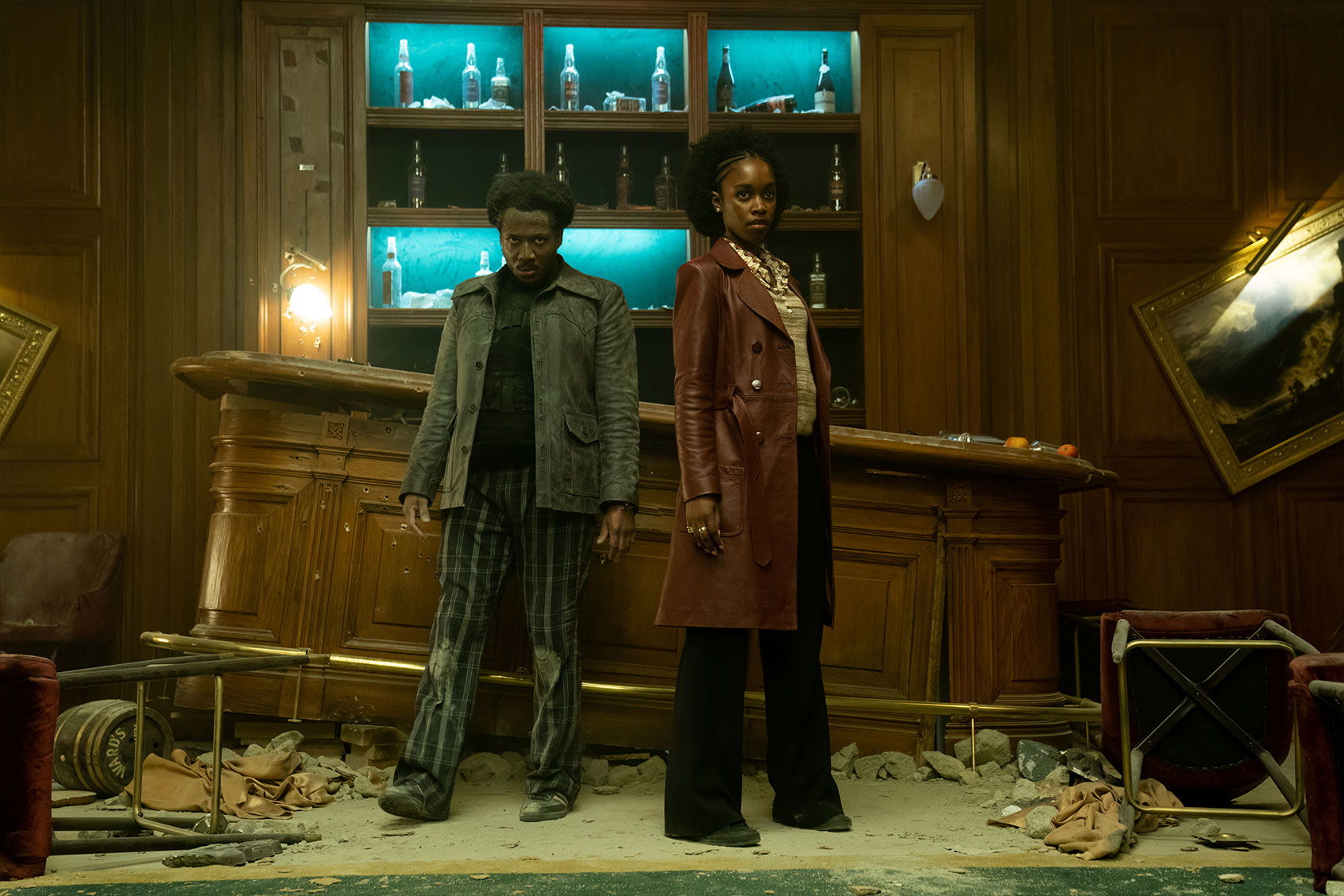
Escapades with which “The Continental” supplements the character’s memoir aren’t worth your lost time. What the show does to the legend of the hotel itself is worse, making it a multicar garage for cartoon assassins ripped off from other flicks, including a skeevy brother and sister team named, I wish I were joking, Hansel and Gretel.

Speaking to the manager brings us to the Mel Gibson of it all and, yikes. NBC’s announcement of the spinoff may have created cautious excitement, but I’ll wager most of that evaporated when his attachment to the project hit the trades. At the time the prevailing question wasn’t why but, why not anyone else? What, was Russell Brand unavailable?

We need your help to stay independent

Bleak wisecracks aside, having seen everything “The Continental” has to offer I now understand why they tapped Gibson; his villain Cormac is a fume-huffing berserker as sloppy as the den in which he’s holed up. He’s also not entirely dissimilar from the version of Gibson captured in recorded rants, which comes across as both lazy from an acting perspective and disturbing in its capacity to unnecessarily irritate the audience.

Gibson’s incorporation into this universe also defeats whatever chance the show had to replicate some of the movies’ success. “John Wick” endures in no small part because of Reeves’ popularity and the impression that its soulful hero is an extension of the actor. “The Continental” opens up a corrupt world that is defined by its standards, a notion undercut by having its hotel represented by an objectively awful human of limited acting ability.

One would expect “The Continental” to augment the overall “John Wick” story in some way. Nope.

Regardless of one’s personal feelings about Gibson and the on-the-record accounts of his explosive rage (not to mention his antisemitism, misogyny, and other bigotry) there’s little to no defense for his crimes against the Brooklyn accent. One might bristle at Cormac jauntily yelling that he’s a “hobo-phone” – never claim the casting producers didn’t know what they were doing! – but that line is even worse swathed in an accent cribbed from the linguistic school of “Hey! I’m walkin’ heah!”

No “John Wick” stan watches to bask in the dialogue’s poetry. However, if you’re signing on to take in the balletic violence, I’m sorry to inform you that most of those sequences are unviewable – as in, good luck with seeing them.

Albert Hughes, who directs the first and third episodes, marshals a crisply paced sequence in the first episode but never quite masters the trick of lighting that Chad Stahelski achieves in the films, leaving subsequent face-offs to be swallowed by gloom. Never has a sound editor been more appreciated than here; the slap of skin on skin and chorus of grunting provides some clue of what’s transpiring.


Want a daily wrap-up of all the news and commentary Salon has to offer? Subscribe to our morning newsletter, Crash Course.


A pity, since Winston’s backup team of Frankie’s friends could have been loads of fun, problematic tropes aside — I mean, it’s all relative right? Again, look at who’s listed as the star.

Anyway, all of them are top brawlers inspired by ’70s exploitation-flick archetypes. There’s Miles (Hubert Point-Du Jour) and Lou (Jessica Allain), Black karate experts whose father ran a martial arts studio in the middle of Chinatown. Miles’ pal Lemmy (Adam Shapiro) knows his way around bombmaking. Frankie’s wife Yen (Nhung Kate) is a killing machine who returned with him from Vietnam. All told, the Asian representation here is . . . really something. Eventually, they enlist a gun played by Ray McKinnon, who is too good for this vestigial limb of a TV disaster, but work is work.

The ContinentalHubert Point-Du Jour as Miles and Jessica Allain as Lou in “The Continental” (Katalin Vermes/Starz Entertainment)For all this effort and a combined runtime of three movies, one would expect “The Continental” to augment the overall “John Wick” story in some way, flaws and all. Nope. By its end, we’re no clearer on how Winston came to rule the New York Continental that we are at the start. You’ll get a better education regarding how this world works in the fourth “John Wick” film, which was also a mess — but a fun one that gave us Keanu in Paris.

“The Continental”  leaves us with the impression of opportunity wasted, along with a sinking feeling of having been hoodwinked into spending time with a celebrity upon whom Hollywood refuses to render a verdict of excommunicado. Fortunately, it’s easy enough for this franchise’s supporters to do that and not feel like they’re missing a thing.

“The Continental: From the World of John Wick” streams on Fridays starting Sept. 22 on Peacock.


Starbucks is making a big change to its iconic cups

Starbucks is planning a change to its iconic cups. As reported by Danielle Harling at Delish, Starbucks is reportedly “working to get rid of its disposable cups by 2030.” Some locations are already testing out reusable cups in-stores. The question of how Starbucks would handle to-go or delivery orders is still up the air. This is part of an multi-decade initiative to reduce “our carbon, our water and our waste footprints by half by 2030.” Although the material of the cup will ostensibly change, the signature logo and color scheme will remain consistent.

How potentially successful is this endeavor? That remains to be seen. As Peter Prengaman writes in Fortune, though, Starbucks announced in 2008 that all of their cups would be “recyclable or reusable” by 2015 — and that has clearly not happened. Pregaman also notes that a mere 1.2% of Starbucks’ sales in 2022 were in reusable cups or mugs. “Our vision for the cup of the future — and our Holy Grail, if you will — is that the cup still has the iconic symbol on it,” said Michael Kobori, head of sustainability at Starbucks. “It’s just as a reusable cup.”

Ensuring this change across the board, of course, will be a real challenge. As Prengaman writes, “For all the talk of sustainability and increasing consciousness about climate change, it’s fair to assume that a significant number of Starbucks’ disposables end up in landfills”


“He’s not here, we are”: House Republicans ice out Trump, look to make a deal with Democrats

Some House Republicans are rejecting Donald Trump’s criticism of a plan the group developed to avoid a government shutdown that now appears to be at risk of failure.

The former president took to social media Wednesday night shortly after news broke of the strategy, calling on Republicans to prioritize defunding the Biden administration’ “weaponized government” and the “political prosecutions” he’s facing. 

“A very important deadline is approaching at the end of the month. Republicans in Congress can and must defund all aspects of Crooked Joe Biden’s weaponized Government that refuses to close the Border, and treats half the Country as Enemies of the State,” Trump said in a Truth Social post.

“This is also the last chance to defund these political prosecutions against me and other Patriots,” he continued. “They failed on the debt limit, but they must not fail now. Use the power of the purse and defend the Country!” 

We need your help to stay independent

According to The Hill, some House GOP members have committed to trying to use the appropriations process to cut funding for federal agencies like the Department of Justice and the FBI, accusing the government of weaponizing the departments against Trump and conservatives at-large in the wake of his four criminal indictments.

While many Republicans in the House share Trump’s stance and have extended support to him throughout his legal battles, they’re also continuing to back the framework deal.

“He would’ve made the same call,” conservative Rep. Ralph Norman, R-S.C., said Thursday, adding “this will put us in a position to use leverage that he’s talking about.”

Other representatives, however, have cast aside Trump’s opinion as the GOP infighting in the House intensifies ahead of the Sept. 30 shutdown deadline.

“He’s not here, we are. We need to deal with our business in this house,” moderate Rep. Dave Joyce, R-Ohio, said Thursday. “And the mechanics of it are such that the only way we can continue on is to do a [continuing resolution] because we’re not going to be able to get all the appropriations bills passed by the end of the month.”

“This conference has focused on trying to get our appropriations bills done that we have crafted in the appropriations process,” Rep. Drew Ferguson, R-Ga., added, asserting when asked about the former president’s influence amid spending talks that “House Republicans are focused on the business of House Republicans.”

Republicans appeared to reach a turning point in the talks late Wednesday as members expressed optimism about the conference moving toward a deal, but by Thursday enough of them had banded together against the proposal to defeat it.

The partisan plan, considered dead upon arrival in the Senate, included spending cuts and changes to border policy, and would have pushed the shutdown deadline through the next month to give negotiators more time to eke out a larger deal for government funding in the 2024 fiscal year.

As the GOP continues to battle over the proposals, two freshman Republicans in the House have leveled the possibility of circumventing party leadership and collaborating with Democrats to fund the government, NBC News reports

Reps. Marc Molinaro and Mike Lawler, New York Republicans representing the Hudson Valley-area districts, said they’re willing to consider a “discharge petition” to force votes on a short-term funding bill in the event their party fails to reach a compromise.

“It is absolutely an option,” Molinaro told reporters outside the Capitol. “Working to ensure the government remains functional and that Congress is making the legitimate choices as it relates to funding … is an important principle.”

Lawler said that if Republicans can’t come together to pass a continuing resolution to approve short-term funding, he “will move forward with a discharge petition.”

It’s unclear what the underlying bill would be and whether enough members of the GOP would be willing to leave behind Speaker Kevin McCarthy, R-Calif., to work with Democrats to force legislation to a vote.

After the House failed on Thursday to pass a rule to begin debate on a military funding bill for the second time this week, Lawler told reporters that as a long as Democrats have control of the Senate and the White House, “any final bill is going to be bipartisan. And if somebody doesn’t realize that, they’re truly clueless.”

The discharge petition the representatives are floating is a rarely utilized tool giving legislators the power to force a vote on legislation even if the House speaker doesn’t want to. It requires signatures from a majority of the chamber and is time-consuming: a bill must first sit in committee for at least 30 legislative days. Though it’s not a viable option for preventing a shutdown at the end of September, it could, however, be a last-resort to reopen the government if the GOP stalemate continues.

While he’s still open to teaming up with the Democrats, Molinaro also used Thursday afternoon to work with one of the Speaker’s main opponents, Rep. Matt Gaetz, R-Fla., to rekindle negotiations about determining a path forward on the spending bills.

“I was asked to try to help find a way to a framework that allows us to move appropriations bills. I presented something that made sense to both ends of the ideological spectrum. And that allows us to remain committed to the belief that we spend too much of taxpayers’ money and ultimately have to focus effectively on national defense,” Molinaro said.


Want a daily wrap-up of all the news and commentary Salon has to offer? Subscribe to our morning newsletter, Crash Course.


The House is split 221-212 with Republicans taking the majority and two vacancies. With those numbers, at least five Republicans would have to divest for a discharge petition to succeed, and potentially more could if not all Democrats sign it. So far, GOP centrists have not shown a willingness to break from their leaders, while right-wingers are urging colleagues against doing so.

“I don’t think it’s healthy, obviously, for Republicans to say they’ll go work literally with Democrats,” Rep. Bob Good, R-Va., said. “To try to prevent Republicans from pursuing Republican policies — yeah, I think that would be an unhealthy thing.”

Other hardliners say Republicans who level the idea are making empty threats.

“That’s been said for weeks. That’s old news,” said Rep. Lauren Boebert, R-Colo. “We’re making tremendous progress forward to pass 12 appropriations bills. That’s what I fought for in January, and that’s what we’re going to continue to fight for right now.”

Democratic leaders have minimized the possibility of a discharge petition to resolve the turmoil and noted one hasn’t been filed.

One potential option for a discharge petition is a new proposal raised late Wednesday by the bipartisan Problem Solvers Caucus that would seek to fund the government through Jan. 11 at levels agreed to in the recent two-year budget deal in addition to unspecified border enforcement policies, aid for Ukraine and disaster relief.

Rep. Pramila Jayapal, D-Wash., said that if the GOP border provisions look anything like “Title 42” measures to turn away asylum-seekers, a significant crop of Democrats won’t sign on.

“That’s a non-starter. It will not happen,” Jayapal said. “They would lose too many of us on the discharge petition.”

The GOP fissure over spending legislation puts Democrats in a unique position to leverage power it wouldn’t typically have as the minority party in the House, according to Politico.

While McCarthy continues pushing new CRs in an effort to appease hardliners until he finally secures a majority — similar to his January strategy to secure the speakership — and the Problem Solvers Caucus floats a potential discharge petition, Democrats are mulling over what role they could play if GOP holdouts make good on their threats to vote to oust McCarthy from his role. 

On one hand, they could all vote against the California Republican and aid the hardliners in triggering a new speaker election — though no one is really sure which Republican would ascend to the position in the process. On the other, Democrats could also lend their votes to McCarthy and save him from removal, a route that would come with a very high price.

In the meantime, per NBC News, Jayapal said that Republicans should agree to a simple stopgap bill at current funding levels with supplemental requests if Republicans want help from their Democratic colleagues.

“We’re not inclined to save them,” she added.

Childhood’s end: Sweet, innocent Kevin McCarthy faces the flames

By all appearances, House Speaker Kevin McCarthy is not personally corrupt, or at least not in the most familiar sense of that word. Given existing political reality — meaning the profound cynicism, nihilism and tribal bitterness of the institution he supposedly governs — that may not be a net positive. When Salon did some reporting on McCarthy’s personal circumstances a few years ago, it emerged that he and his wife owned a modest home in Bakersfield, California, a distinctly unglamorous inland city at the heart of one of the Golden State’s few remaining solidly Republican congressional districts. Kevin and Judy McCarthy met as students at Bakersfield High School and have been together ever since. Judy McCarthy has a full-time job as a fundraiser for the California Republican Party, another institution with a remarkable downward trajectory. (Which, in fairness, is probably not her fault.)

But friends and fam, lend me your ears — I come not to praise Kev, although I hardly need to bury him. He’s doing a terrific job of that all by himself, and keeps on eagerly handing shovels to his enemies. How else can we account for the dewy-eyed innocence of McCarthy’s response this week, after two failed procedural votes to bring a defense appropriations bill to the floor of the House? It’s perfectly true, as Salon’s Tatyana Tandanpolie reported on Thursday, that under normal circumstances such votes on House rules are predictable partisan affairs: Members of the majority party all vote in favor, even on occasions when debate and disagreement about the actual bill in question are likely to follow.

But please note the weasel words “under normal circumstances” in the above sentence, which should perhaps come underlined, in bold italic type and outlined with neon strips: In case the House speaker and the rest of the world haven’t noticed, the Land of Normal Circumstances is a dim and distant memory, left far behind us as our creaky ship of state takes on water in a sea of storms and monsters. The sailors have lashed Captain Kev to the mast, so only he can hear Lauren Boebert and the Sirens sing sweet selections from a third-rate touring musical on their vape-clouded island.

Considering the unprecedented humiliation McCarthy endured to become speaker in the first place, granting virtual veto power over his decisions to a handful of renegade members on his far right flank, it’s difficult to fathom his surprise that he can’t get anything done. It was “frustrating” to suffer two defeats on supposedly routine procedural votes, McCarthy told the posse of Capitol-corridor reporters outside the House chamber on Thursday. “I don’t understand why anybody votes against bringing the idea and having the debate. This is a whole new concept of individuals that just want to burn the whole place down. It doesn’t work.”

We need your help to stay independent

Ex-squeeze me? A “whole new concept”? Dear sweet child of this just-concluded planet-broiling summer, under what cabbage leaf were you newly born? Have you Stockholm-syndromed yourself so thoroughly to Matt Gaetz and Marjorie Taylor Greene (not to mention He Who Shall Not Be Named and Did Not Actually Lose the Last Election) as to believe there is any appetite among your congressional caucus to pass any actual legislation about anything, ever? Yes, there are still fake-credulous Beltway political reporters who will try to stuff this situation into a familiar frame, and we too can play that game if we must: McCarthy faces a new challenge to his embattled speakership! He must try to hold his fractious coalition of discontented moderates and fire-breathing conservatives together somehow! While working with Democrats in the Senate and White House to avoid a government shutdown!

It’s startling to encounter evidence that McCarthy still believes in that narrative frame, or at least wishes he did badly enough that he can feign surprise about “individuals” who “just want to burn the whole place down,” which is — as he is well aware on some other level of consciousness — a reasonable description of the dominant current of opinion among voters and elected officials of the Republican Party, circa 2023. It’s easy to make fun of McCarthy’s current predicament, as well as abundantly justifiable, but there is considerable pathos there as well. 


Want a daily wrap-up of all the news and commentary Salon has to offer? Subscribe to our morning newsletter, Crash Course.


There may be another Republican speaker of the House — indeed, there may be one very soon — but there will never be another from the party’s so-called mainstream, or at least not for many years to come. McCarthy this week came clearly into focus for the first time as a dumbed-down version of Joe Biden, another career politician from a modest middle-American background with little in the way of bedrock ideological principles. Biden came into office promising bipartisan progress and healing, and still tries to draw a taxonomical distinction between “MAGA Republicans” and some other increasingly rare white-rhino variety whose preservation is crucial to our future. Biden’s political innocence or willful blindness or whatever it is has been at least partly burned away by the fires of circumstance. In his sheer cravenness and stupidity and Bakersfieldian eagerness to please, Kevin McCarthy has been untouched by the flames until now.

Sen. Bob Menendez and his wife indicted on federal corruption charges

After more than a year of investigations, it appears that Sen. Bob Menendez, D-N.J., has been indicted on federal charges, for the second time while in office.

The Department of Justice (DOJ) announced on Friday that the U.S. Attorney’s Office in Manhattan has scheduled a press conference for 11 a.m. ET to discuss the indictment.

 “A press event will be held today at 11:00 a.m. to announce the unsealing of an indictment charging Robert Menendez, U.S. Senator from New Jersey, and his wife, Nadine Menendez, with bribery offenses in connection with their corrupt relationship with three New Jersey businessmen,” the DOJ said in a statement.

Prosecutors are looking into whether New Jersey developer Fred Daibes gave or arranged for Menendez and his wife, Nadine, to receive gold bars in exchange for a promise of help in Daibes’ criminal case. Menendez “promised to and did use his influence and power and breach his official duty to recommend that the President nominate an individual for U.S. Attorney for the District of New Jersey who Menendez believed could be influenced by Menendez with respect to the federal prosecution of Fred Daibes,” the indictment said.

Menendez, a Democrat, is the chairman of the Senate Foreign Relations Committee. Senate Democratic Caucus rules will force Menendez to step aside as chairman of the Foreign Relations Committee, but he can still serve on the panel. His last federal trial ended in a mistrial in 2017 and the DOJ dropped its probe in 2018. He is up for re-election next year. 

For the House Freedom Caucus, tormenting Kevin McCarthy is the point

Squawking about the nation’s debt after your party spent like drunk sailors on leave is like eating a ribeye at Ruth’s Chris, then planting a fly under the bone to get a free meal. You ordered and ate the steak, sir. Yes, but I didn’t order the fly that came with it, and don’t you think your prices are obscene?  

This same exchange keeps repeating in Washington, where members of the ultra-MAGA Freedom Caucus in the House of Representatives are, once again, criticizing an expensive steak they already ate and denying they ordered it in the first place. 

Republicans spent a staggering and unprecedented $8 trillion during the Trump administration and now blame Democrats for the debt. Yesterday, only four months after House Speaker McCarthy, R-Calif, angered the right by reaching a debt ceiling agreement, the same thirsty clowns blocked the GOP’s own Pentagon spending bill, one of twelve annual spending bills, from even coming up for debate. 

Preening for a budget showdown- the fiscal year begins on October 1– they also rejected McCarthy’s continuing resolution to extend the budget for a month, declaring that they were “not interested in a continuing resolution that continues the policies and spendings of the Biden, Schumer, Pelosi era… We’re here to put our foot down.”  

It’s hard to decide what’s worse, the drama or the hypocrisy. They are not mutually exclusive. 

We need your help to stay independent

We’ll shut down the government if we don’t get what we want

The Freedom Caucus says it will “fight with everything that we have.” Calling their budget demands the “No Security, No Funding” plan, the caucus isn’t worried about a government shutdown. It’s all about MAGA messaging on a nation they fervently wish was in decline. According to Clay Higgins, R-La., a government shutdown would be “small compared to the principle battle that we’re in. We are not going to casually fund the decline of our country.”

Too bad McCarthy and the Freedom Caucus didn’t feel that way when Trump was in office.

To address their manufactured national ‘decline,’ their plan prescribes dramatic spending cuts, including cuts in aid to Ukraine; constructing more southern border walls and restricting asylum seekers; an end to “woke” policies in the military like abortion leave; and eliminating the “unprecedented weaponization of the Justice Department and FBI” through reduced DOJ funding. Caucus members are unbothered by the lack of evidence tying Biden to Trump’s many state and federal criminal indictments, or the fact that Trump tried to use the DOJ as his personal law firm, or his latest promise that if he is re-elected, he will “appoint a real special prosecutor to go after the most corrupt president in the history of America, Joe Biden, and go after the Biden crime family.”

McCarthy, who made the mistake of bargaining with the hijackers to get his speakership in the first place, parrots their interest in reducing the nation’s spending, which, he says, is like a family earning $24,000 a year, but spending $35,000.  “The greatest threat to our nation’s future,” McCarthy says, is “our national debt.”  Too bad McCarthy and the Freedom Caucus didn’t feel that way when Trump was in office.


Want a daily wrap-up of all the news and commentary Salon has to offer? Subscribe to our morning newsletter, Crash Course.


Reckless spendthrift says what?

Despite full hibernation during the Trump years, the GOP’s fiscal restraint was only triggered when a Democrat entered the White House.  Although the federal deficit has grown through evenly divided democratic and republican presidencies since 2001, former Republican congressman David Jolly observed that a quarter of the nation’s total current debt —around $7.5 trillion —occurred under Trump alone: “Roughly 25% of our total national debt incurred over the last 230 years actually occurred during the 4 years of the Trump administration.” As Trump so sagaciously observed, “This is the United States government… you never have to default because you print the money.” 

McCarthy and the Freedom Caucus won’t admit that the national debt is driven by tax policy as much as spending.  Following the Trump administration’s colossal $2.3 trillion tax giveaway to corporations and the nation’s wealthy, Trump reminded his rich donor friends, ‘You all just got a lot richer.’  Did they ever? The nonpartisan Congressional Budget Office calculated that, over the next 11 years, Republicans’ tax cuts will continue to increase the national debt by another $1.9 trillion.

The national debt now sits at $33 trillion, and for all their bluster about cutting entitlements, Republicans can’t seem to stop gushing money for their donors.

Republicans reduced the top corporate tax rate from 35% to 21%, gifting corporations with a 40% reduction in their tax burden in 2017, which will affect the budget for years to come.  This largesse did not trickle down to anyone except superyacht makers and corporate investors who, instead of raising employee salaries or expanding production lines, used the windfall to fatten themselves through re-purchase of their own stock.  It’s a largess we still continue to pay for, but the No Security, No Funding plan makes no mention of clawing it back.

With time running out, Congress will have to pass a short-term extension on government funding, to buy more time for lawmakers to work out a spending package. Here’s hoping McCarthy takes a cue from the Senate, works out a bi-partisan budget no one really likes, and calls his tormentors’ bluff. If they vote to shut down the government anyway, at least everyone will know who to blame. 

How to vaccinate raccoons for rabies? From the sky

This August, government airplanes and helicopters have been dropping tiny parcels from the sky for raccoons to find. Each one is about the size of a ketchup packet and contains an oral rabies vaccine that coats the mouth of the animal that bites into it. The vaccine is the United States’ best bet at limiting the spread of rabies — one of the world’s deadliest diseases.

The bait-drops along the Eastern U.S. are part of a massive effort to stamp out rabies, which originally infected domesticated dogs brought to North America by European settlers in the 1700s. Until 1960, dogs accounted for a majority of the rabid animals in the U.S. Today, raccoons, bats, skunks, and foxes are the most common carriers.


This story was originally published by WIRED and is reproduced here as part of the Climate Desk collaboration.


In the U.S., human cases are rare — typically, only a few are reported every year. But the viral infection, which is spread through the bite of an infected animal, remains a threat because it’s nearly always fatal once symptoms appear. The virus is transmitted through saliva and causes inflammation of the brain and spinal cord. “The rabies virus does something very unusual. It seeks out the nerves, and the virus moves up the nerves toward the central nervous system,” said William Schaffner, a professor of infectious diseases at Vanderbilt University Medical Center. “It’s a very feared infection.” Very few people have survived rabies without treatment, and worldwide it causes about 59,000 deaths annually.

Its high fatality rate is why, every year, the U.S. Department of Agriculture blankets the Eastern Seaboard with more than 9 million vaccine-laden baits. Between the end of July and October, the baits are scattered by low-flying planes over rural areas and by helicopters over suburban neighborhoods. The packets move across a conveyor belt inside the aircraft to ensure they’re evenly dispersed, then fall out of a tube. In cities, teams drive around and toss the baits into bushes, culverts under roads, and dumpsters behind restaurants — common dwellings for urban raccoons.

“Any area that looks like a raccoon habitat, we stop there,” said Kathy Nelson, a wildlife biologist at the USDA, which oversees the National Rabies Management Program.

USDA Oral Rabies Vaccine baitsUSDA wildlife specialist Brandon Hofer monitors the amount of ONRAB Oral Rabies Vaccine baits on a conveyor belt for air drop in West Virginia on August 26, 2023. (Christophe Paul/United States Department of Agriculture)

About 75 baits are distributed per square kilometer in rural environments and 150 per square kilometer in urban areas. In places where there are likely to be few raccoons, such as spruce forests in northeastern Vermont, only about 37 baits per square kilometer are dropped. Nelson said vaccinating about 30 percent of raccoons in an area is enough to stop the spread, and 60 percent is enough to eliminate rabies from an area.

The vaccines come in two flavors that are particularly tasty to raccoons: fishmeal and vanilla. Skunks and foxes are also meant to be tempted by the bait because they can carry rabies, albeit at lower rates than raccoons. Sometimes, animals that aren’t meant to eat the baits end up snatching them. Opossums and gray squirrels, for instance, are frequent thieves, said Rich Chipman, the program’s coordinator. It’s a waste of bait if the packets end up in the mouths of non-target animals, so government researchers are studying ways to make the vaccines less attractive to them.

The vaccines come in two flavors that are particularly tasty to raccoons: fishmeal and vanilla.

It takes eight to nine months of planning to determine where the baits should be dropped and to draw up flight plans, according to Chipman. The calculus is based on where cases of human and animal rabies occurred in previous years and the threshold of rabies immunity among animals in a certain area. “In order to refine where we’re dropping our baits, we need to be very strategic about making sure we know exactly where that front is,” Chipman said, referring to the line between an area with rabies and one without it.

Five to six weeks after the bait drops, government biologists determine whether immunity has been established in an area by going out into the field to trap live raccoons, skunks, and foxes and sample their blood. The animals are released and the samples are tested for antibodies against rabies, which are generated in response to the vaccine and signal a protection against the disease.

The vaccines come in two flavors that are particularly tasty to raccoons: fishmeal and vanilla.

The first U.S. case of raccoon rabies was detected in Florida in 1947. From there, it spread to Georgia, Alabama, South Carolina, and North Carolina. It reached northern states by the late 1980s and early 1990s, when rates shot up after raccoon hunters unwittingly relocated rabid animals from southern states to Virginia and West Virginia to restock depleted populations of local raccoons. “It was by far the largest-scale explosion of a rabies variant in the world,” Nelson said. Today, rabid raccoons can be found from Florida to Maine.

State laws forbid transporting and relocating raccoons because of the rabies risk, but Chipman said it still happens all the time. Just this month, raccoons that were trapped and ear-tagged in Ontario, Canada, showed up in a nuisance wildlife control operator’s trap in Rhode Island. “How that raccoon got there, we don’t know,” he said.

The National Rabies Management Program was established in 1997 to prevent the further spread of wildlife rabies. In 2007, canine rabies was eliminated in the U.S. thanks to mandatory vaccination and licensing for dogs, but the risk from wild animals remains.

The baits have effectively stopped the westward march of rabies in raccoons, and the number of raccoon infections has declined since the large-scale rollout of the oral vaccine. But rabies is rising in another wild animal: bats. In 2021, the last year for which national surveillance data is available, bats were the most frequently reported rabid wildlife species, making up 34 percent of all animal cases, followed by raccoons, which accounted for about 28 percent.

For people, the risk of getting rabies from bats is also rising. In September and October 2021, the Centers for Disease Control and Prevention, which tracks human cases, reported that three people in the U.S. died of rabies after exposure to bats. Before that trio of cases, there had been just three bat-associated human rabies deaths in the previous four years.

None of the three received treatment, which includes a dose of antibodies against rabies, plus the rabies vaccine. (People at high risk of acquiring rabies, such as laboratory workers and veterinarians, get the vaccine as a preventive measure.) Because the virus takes time to travel to the brain, these treatments can thwart it if given soon enough. “If you can stop the virus from moving on, then you prevent rabies,” Schaffner said. Known as post-exposure prophylaxis, it is almost always effective.

If you are bitten by a bat, raccoon, or other animal that may have rabies, Shaffner advises washing the bite area with soap and water and going to the nearest emergency room as soon as possible for treatment. But not everyone realizes that they’ve been bitten. “If a bat does choose to bite you, their incisors are so small and so sharp you may never feel it,” Schaffner said.

In January 2021, an 84-year-old man in Minnesota died six months after waking up in the middle of the night with a bat in his room. He had no visible wounds, but when the bat was later tested for rabies, it was positive. He died even after receiving treatment, the first documented such instance in the western hemisphere. Public health officials suspect the man was immunocompromised; his case was detailed earlier this year in the journal Clinical Infectious Diseases.

Chipman said the government’s goal is to eliminate raccoon rabies by 2063.

“The one species that is really emerging and causing more cases of rabies is bats,” said Jorge Osorio, director of the Global Health Institute at the University of Wisconsin–Madison. “As you can imagine, it’s difficult to find a vaccine that actually can be applied to them.” After all, bats eat insects and fly, so they don’t pick up the baits meant for terrestrial animals.

One solution that Osorio and others are working on is a topical vaccine in the form of a paste or gel that could be applied to a bat that’s caught and rereleased into the wild. Because bats groom and feed one another, researchers think this could be a way to spread a vaccine throughout a population. Another idea is to spray a vaccine into caves or other bat habitats. But these approaches are still in the early stages and haven’t been thoroughly tested.

Charles Rupprecht, former chief of the CDC’s rabies program, said a bat vaccine would not only be expensive to develop, but testing could pose ecological and ethical questions since many bat species in the U.S. are in severe decline or endangered.

He thinks eradication in raccoons is possible but would likely require more resources. “We’ve been able to prevent raccoon rabies from moving westward,” he said. “What we haven’t been able to do is eliminate it from any state where raccoon rabies currently exists.”

Chipman said the government’s goal is to eliminate raccoon rabies by 2063. That’ll take a lot more bait.

Allegations against Rudy Giuliani and Russell Brand show sexual abuse is a selling point for MAGA

“Sometimes, it’s who you most suspect.” That’s what a friend of mine texted to a group chat after the Sunday Times, the Times and Channel 4 Dispatches released a disturbing investigative report documenting rape and other sexual allegations against British comedian Russell Brand. The actor denies the allegations, but unsurprisingly, most of the public does not seem to believe his denials. In part, it’s because the evidence against Brand is overwhelming: five separate accusers, digital documentation, and a litany of witnesses ready to corroborate how Brand’s behavior was an “open secret in radio and TV production.” In part, it’s because being a skeeze was always central to Brand’s persona. And in part, it’s because there have been comments over the years, from celebrities like Katy Perry and Kristen Bell, about Brand’s predatory behavior. 

The Onion, as they often do, said it best, with the headline, “Nation Could Have Sworn Russell Brand Was Already Convicted Sex Offender.”

And yet, like clockwork, the MAGA masses are rallying to Brand’s side, treating these allegations like they are evidence that the “deep state” is trying to take Brand out for some vague reason.


Want more Amanda Marcotte on politics? Subscribe to her newsletter Standing Room Only.


As Joy Saha documented at Salon, the usual suspects — Tucker Carlson, Ben Shapiro, and Jordan Peterson — defended Brand this week and floated conspiracy theories to distract from the serious allegations. Elon Musk, of course, got involved, writing on the platform he rebranded X, “They don’t like competition.” Greg Gutfeld elevated the conspiracy theory to Fox News.

History shows the quickest way to be a hero to the MAGA crowd is to be credibly accused of rape, ideally by a large number of women. 

Do any of these conspiracy theorists believe their own B.S.? I’m skeptical that any of these men actually mean a single word they say. They are, after all, arguing that Brand is such an all-powerful threat to the mysterious “They” that “They” organized a conspiracy of dozens of people — reporters, editors, fact-checkers, witnesses, and accusers — for the purpose of smearing an innocent man with allegations such as he “forced his penis down her throat” so hard she had to punch him to escape. That’s a lot of work for the mighty “They” to take out one dude. Keeping that many conspirators quiet is nearly impossible. You’d think “They” would have simpler methods of dealing with people “They” want to get rid of. 

Nah, the more likely explanation is that Brand’s defenders believe he did it. They’re just angry that anyone would deny a man his patriarchy-given right to rape as many high school girls as he pleases. After all, this is the same crowd that supports Donald Trump, a man whose history of sexual assault has been put beyond dispute both in a court of law and by his own infamous tape bragging about how he likes to “grab them by the pussy.” History shows the quickest way to be a hero to the MAGA crowd is to be credibly accused of rape, ideally by a large number of women. 

We see this in the same rally-round-the-pig response MAGA had to Andrew Tate, a man whose total worthlessness as a human being was evident long before he was arrested for rape and human trafficking in Romania. Tate, an “influencer” who preyed on school kids too young to know better, wasn’t exactly coy about his misogyny or violent impulses before his arrest. He openly bragged about hitting women and trapping them in the house and even offered to teach his followers how to get into sex trafficking. 

Despite — or really because — of all this, the MAGA reaction to Tate’s arrest was to treat the guy like a hero. Tucker Carlson interviewed him for Twitter and Elon Musk heavily hyped the video. Needless to say, it wasn’t a hard-hitting interview exploring the evils of sexual violence. It was a softball meant to portray Tate, who is accused of choking women so hard he broke blood vessels in their faces, as the real victim. 

One could argue, I suppose, that this stampede of support for the worst possible men isn’t meant as a celebration of rape per se. There’s always the “just trolling” defense. In this case, the argument would be that it’s just that MAGA types just really love to “trigger” the feminists. Throwing a pity party for an accused rapist is a virtual form of ponytail-pulling, in this rendering. But even if that were true, it’s ultimately a distinction without difference. Once you’re throwing ticker tape parades for sexual predators, it really stops mattering if it’s just out of anti-feminist spite. 

We need your help to stay independent

The new allegations against Rudy Giuliani are a grotesque reminder that, for much of MAGA, Trump’s appeal was due in large part to the perception that he created an atmosphere where open predation towards women was acceptable. Cassidy Hutchinson, a former White House aide who has since spoken out about the coup plotting she witnessed under Trump, has a new book out. In it, she accuses Giuliani of groping her on January 6, 2021, seemingly because he was excited by the unspooling Capitol insurrection. To add insult to injury, she describes John Eastman, another coup plotter, as flashing a “leering grin” while Giuliani manhandled her. 

Giuliani, for his part, is denying the allegations, and his denials are being greeted with a great deal of scoffing. After all, he’s currently tied up in litigation with a former aide accusing him of bullying her into unwanted sexual intercourse. His accuser, Noelle Dunphy, has produced grotesque receipts, including a tape of Giuliani declaring, “Come here, big tits. Your tits belong to me.”

Even without the Dunphy lawsuit, Hutchinson’s claims were believable simply because she was working under Donald Trump. We’ve all heard the “Access Hollywood” tape in which Trump brags, at length, about how he enjoys sexually assaulting women. It makes perfect sense that he would attract compatriots who craved an environment where men can just grope whatever woman they wished. The least surprising thing in the world is if these men saw young and pretty aides like Hutchinson as party favors Trump was offering up to these co-conspirators. 

There’s a tendency in the mainstream press to talk about rape and sexual abuse as something “everybody” disapproves of. When a credibly accused assailant gets a surge of support, the assumption is these folks believe the accused is innocent. When it’s impossible to imagine they believe that — no one can think Trump is innocent — then the assumption is that the sexual predation is a flaw that supporters are reluctantly accepting because they like other traits of the accused. 

But there is a third possibility, one that this evidence shows is the likeliest one: sexual abuse as a vice signal. 

Being seen as a sexual abuser makes a person more popular with some on the right, especially the extremely online MAGA set. It’s a subculture of people who valorize bullying and hate women, especially women who they think are uppity. Sexual violence has been a primary outlet for that urge to humiliate women and put them “in their place.” This isn’t about a sincere belief that every accused rapist is a victim of a “deep state” conspiracy. It’s just that MAGA’s knee-jerk urge when they hear these allegations of sexual violence is to side with the perpetrator. 

Rhinos are a story of survival and hope, but we are driving then perilously close to extinction

Step into a world where the earth’s pulse echoes through the untamed wilderness. A world where towering giants, with their iconic horns, guard an epic narrative of survival against all odds. Welcome to the mesmerizing world of rhinoceros, where creatures so magnificent seem to freely roam straight out of a prehistoric dream. Join us on a journey like no other as we unveil the extraordinary secrets of these majestic beings and the awe-inspiring efforts to ensure their legacy endures in the wild.

Rhinos are indeed the titans of the animal kingdom, characterized by their massive size and remarkable physical attributes. These creatures are equipped with robust bodies covered in thick, armor-like skin. Their most distinctive feature, the horn, is composed of keratin, the same substance found in human hair and nails. Contrary to popular belief, the horn is not ivory but is often poached for its perceived medicinal and ornamental value, driving these animals perilously close to extinction.

Rhinos come in a trio of fascinating flavors, each with its own unique traits and tales to tell. Currently, five species exist, each with unique characteristics but all share a common threat: humans.

African White Rhino, Lake Nakuru, KenyaAfrican White Rhino, Lake Nakuru, Kenya (Getty Images/Arsenie Banciu/500px)

First up, we have the white rhinoceros (Ceratotherium simum), whose misleading name has nothing to do with color; it stems from the Afrikaans word “wijde,” which aptly describes their wide mouths. This heavyweight comes in two subspecies: the southern white rhino, a conservation success story, and the northern white rhino, which stands precariously on the brink of extinction.

Black rhinocerosBlack rhinoceros, Masia Mara National Reserve, Kenya (Getty Images/Mike Hill)

Next is the black rhinoceros (Diceros bicornis), famous for its solitary and occasionally cantankerous disposition. Sporting two distinctive horns, these enigmatic creatures roam various regions across Africa. However, poaching has relentlessly decimated their numbers, leading to a concerning decline.

Great Indian one-horned rhinoceros at Jaldapara Wildlife Sanctuary in IndiaGreat Indian one-horned rhinoceros at Jaldapara Wildlife Sanctuary in India (Getty Images/neelsky)

Only about 27,000 rhinos remain in the wild, with very few surviving outside national parks and reserves.

Lastly, our journey takes us to Southeast Asia and the Indian subcontinent, where we encounter the Javan, Indian, and Sumatran Rhinoceros. These elusive species, native to Indonesia and the Indian subcontinent, are among the rarest of the rhino clan and find themselves on the precipice of extinction. The Javan rhino (Rhinoceros sondaicus), a true wilderness gem, and the shaggy Sumatran rhino (Dicerorhinus sumatrensis), carry the weight of critical endangerment, making their conservation a pressing race against time. Not to be forgotten is the Indian rhino (Rhinoceros unicornis), a formidable member of this rhino trio, also facing the challenges of a rapidly changing world, underscoring the urgency of our conservation efforts.

The Present Population

At the start of the 20th century, Africa and Asia were home to about 500,000 rhinos. However, due to persistent poaching and habitat loss over several decades, the number of rhinos dropped to 70,000 by 1970. Only about 27,000 rhinos remain in the wild, with very few surviving outside national parks and reserves. Unfortunately, three species of rhino — black, Javan and Sumatran — are critically endangered.

While the greater one-horned rhino is one of Asia’s biggest success stories and has moved from endangered to vulnerable status, it remains threatened by poaching for its horn and habitat loss.

The Javan rhino population is now found in just one national park on the northern tip of the Indonesian island of Java, while a subspecies of the Javan rhino was declared extinct in Vietnam in 2011. On a positive note, greater one-horned (or Indian) rhinos have seen significant population increases from around 200 at the turn of the 20th century to around 3,700 today due to successful conservation efforts. While the greater one-horned rhino is one of Asia’s biggest success stories and has moved from endangered to vulnerable status, it remains threatened by poaching for its horn and habitat loss.

Sumatran RhinocerosSumatran Rhinoceros (Getty Images/slowmotiongli)

Want more health and science stories in your inbox? Subscribe to Salon’s weekly newsletter Lab Notes.


Protected sanctuaries in Africa have been successful in reviving the population of southern white rhinos, which were once believed to be extinct. Despite this success, the western black and northern white rhinos have recently gone extinct in the wild. The only remaining northern white rhinos are kept under 24-hour surveillance at Ol Pejeta Conservancy in Kenya.

Black rhinos have witnessed a doubling in their numbers over the last two decades, increasing from less than 2,500 individuals. However, the total number of black rhinos is still a small fraction of what it used to be in the early 20th century, estimated to be around 100,000.

The western black and northern white rhinos have recently gone extinct in the wild. The only remaining northern white rhinos are kept under 24-hour surveillance at Ol Pejeta Conservancy in Kenya.

A tragic interplay of human activities and environmental factors has primarily driven the decline in the overall rhino population. Foremost among these is rampant poaching for their horns, which are falsely believed to possess medicinal properties and are highly valued in illegal markets. This relentless demand for rhino horn has led to a devastating surge in illegal hunting, killing these majestic creatures. Additionally, habitat loss and fragmentation due to agriculture, urbanization and infrastructure development have encroached upon rhino habitats, leaving them with limited space to roam and find food.

Climate change and associated factors like prolonged droughts and altered vegetation patterns have also impacted their habitat and access to water sources. Combating these multifaceted challenges is paramount to ensuring the survival of rhino populations worldwide.

We need your help to stay independent

The plight of rhinos serves as a poignant reminder of the urgent need for collective action in conservation. Their decline, fueled by the dual threats of poaching and habitat loss, is a stark warning of the consequences of human disregard for our natural world.

However, as renowned conservationist Jane Goodall aptly said, “What you do makes a difference, and you have to decide what kind of difference you want to make.” We all have a role to play in the preservation of these iconic creatures. By supporting reputable conservation organizations, raising awareness, reporting wildlife crime, advocating for stronger protection measures, reducing our carbon footprint and educating others, we can actively contribute to the survival of rhino populations. In doing so, we ensure the future of these majestic beings and protect the intricate ecosystems they inhabit, leaving a lasting legacy of compassion and stewardship for generations to come.

“The media’s George Costanza problem”: Trump’s too “intellectually incurious” to seriously interview

Donald Trump is a known commodity; There is nothing mysterious about him and his horribleness. Both because of and despite his perfidy and dangerousness, Trump is the leading 2024 Republican Party presidential candidate. He is also tied with or leading President Biden in early 2024 presidential polls. This means that many tens of millions of Americans know exactly who and what Donald Trump is, and they still want him to return to the White House where he will become, as he is publicly promising and threatening to do, the country’s first de facto dictator.

Instead of embracing real pro-democracy journalism and consistently warning the American people about the proven dangers of Donald Trump and the larger neofascist movement, the country’s news media continues to normalize him. The most recent prominent example of this type of media malpractice is NBC’s decision to give the ex-president a platform on last Sunday’s edition of the venerable TV news program “Meet the Press.”

Writing at the Los Angeles Times, Lorraine Ali described that spectacle as:

But the television event also highlighted a problem that traditional news outlets have faced since Trump emerged as a potent figure on the political scene in 2016. Treating the former reality TV star like any other presidential candidate or victor before him assumes that he’s playing by the same set of rules as his predecessors. News flash: He’s not….

The sit-down may prove to be a ratings boon for the network, and perhaps even further boost Welker’s career, but it failed to cut through the usual low-information bluster of past interviews with the former president. Trump was Trump. Legacy media was legacy media.

But somewhere in between is the high-stakes story of ratings versus journalistic responsibility and the dangers that dance presents to our democracy.

In an attempt to make better sense of Trump’s “Meet the Press” interview, how it represents the news media’s much larger failures, the ex-president’s behavior and increasing dangerousness to the public, and the ongoing democracy crisis, I recently asked a range of experts for their thoughts and insights.

The interviews have been lightly edited for clarity and length

Gregg Barak is an emeritus professor of criminology and criminal justice at Eastern Michigan University and author of “Media, Process, and the Social Construction of Crime” and “Criminology on Trump“.

This was either a big “win” or a “standoff” which is also the same as a win for Trump in that he was provided with a major news platform in which he could perpetuate his ongoing lying narrative that he did “nothing wrong,” there were no “crimes,” and this is nothing more than the Democrats being out to destroy him since before he was elected president in 2016. 

All of this nonsense has culminated presently with Trump and Trumpers’ projections of Biden’s so-called political and weaponized indictments of the former president by the lunatic special prosecutor Jack Smith and so on and so forth.

The interview also allowed Trump to spew the same old lies, falsehoods, and disinformation not only about his criminal indictments, but about abortion, NATO, Putin, China, the War in Ukraine as well as his imaginary fantasies for brokering a deal to end the Russian-Ukrainian War within 24 hours because he “gets along with everybody” – and “that’s not a bad thing.”  

We need your help to stay independent

At the same time, this forum, unlike his daily posts at Truth Social that are instantly picked up and consumed by social and mass media alike, does not reveal his sociopathic and mobster-like behavior not to mention his wannabe authoritarian tendencies. But instead, we see and hear from the rather toned down and relatively reserved narcissist destroyer of the rule of law and American Democracy.    

As for the mainstream media, they are damned if they give Trump an interview and damned if they don’t provide a forum for Trump in which someone like Kristen Welker can push back and fact check. Perhaps she and her team could have edited out some of his crazier accounts before the Sunday show actually aired. Who knows?

Of course, in terms of newsworthiness there was nothing there. At the same time, legal analysts were celebrating the different ways Trump was further incriminating himself, but there was really no new news. We had heard it all before even if we weren’t paying attention. 

Finally, did the interview have an impact of any kind with respect to the 2024 election, the criminal indictments, the alleged Biden crime family, or anything else for that matter? Absolutely not. In fact, the whole thing was a waste of time and here’s why: the liberal Democratic and older demographic audience that tunes in to “Meet the Press” regularly already are all voting for Biden and believe that Trump should be held accountable for the events on January 6 and his other crimes, if not locked up in prison too.

As for the MAGA people, and most of the GOP and Independents too, they are not tuning in to “Meet the Press.” So, nothing has changed across the political board.

Trump is like a bull in a China shop who barely gives an interviewer any space to step in and seriously engage him.

As for Trump’s rhetoric and body language it’s pure Trump—the authentic bullsh**ter only periodically constraining himself when he is interrupting Welker. Unlike a court of law where Trump’s attorneys would never allow the liar-in-chief to take the stand, a prime-time interview on Sunday AM television is just what the “very stable genius” dreams of where he can bulls**t to his heart’s delight. A place where the gaslighter, conman, hustler, and huckster can combine all his deceptive talents and do his thing as only the Donald can. Babbling and blabbing all along with only about 1/3 of his content having any meaning in reality. The rest is nothing more than a verbal food salad of incoherence and your run-of-the-mill and routine double-speak poppycock from the graphic comic book anti-hero the Joker come to life in the Orange villain come to life in the struggle to destroy American democracy,  

While this may have been Kristen Welker’s debut episode as host of “Meet the Press,” it was certainly not her first political rodeo or dealing with the ex-president. After all, she was the moderator in one of the 2020 presidential debates between Biden and Trump. Until her new post as host of the Sunday morning news program, she had since 2011 been the White House Correspondent for NBC. Welker, the 47-year-old Philly native and Harvard-educated journalist, has a wonderful resume and certainly has paid her dues over the past two decades to arrive where she presently finds herself.

As for pushing back on Trump, Welker pushed back as much as she realistically could, given that Trump is like a bull in a China shop who barely gives an interviewer any space to step in and seriously engage him. For if they do, Trump usually exit stage left as they say. Trump also rarely responds to most questions with direct answers if he answers the questions truthfully at all. Typically, he is moving the conversation away from wherever the interviewer would like to go. Like Trump’s modus operandi when it comes to trials is delay, delay, delay; his modus operandi when it comes to interviews with the media other than with Fox friendly News et al, is a matter of diversion, diversion, diversion.

Existentially, one has to ask whether we are talking about Welker, or more interestingly Rachel Maddow for that matter, what if any benefits are there for pushing back and calling Trump out for the same old lies that he has already been called out for — to no avail —at least one-thousand times before? It simply makes no difference, does it?

At this point in history, to interview Trump is nothing more than to engage in the political theatre of the absurd. There really is nothing to gain or lose or, more importantly, to learn about Trump that anyone with half a brain has not already known for as many years now as people have been making excuses for him, which is as far back as anyone can remember.   

Dr. Lance Dodes is a retired assistant clinical professor of psychiatry at Harvard Medical School and a training and supervising analyst emeritus at the Boston Psychoanalytic Society and Institute.

The clips from Trump’s interview on NBC show him to be his usual self, projecting exactly what he does, and who he is, outside of himself. He says the President and members of the American legal system who indicted him are “thugs”, a term that fits his own inciting a riot; he says his opponents are “fascists” which exactly describes his own stated goal for a tyrannical government with imprisonment of opposition; he repeats his delusional beliefs about his personal ability to perform grandiose feats such as immediately ending the war in Ukraine, and so on.

His endlessly repeating these views, the Big Lie technique used by Hitler, makes naïve citizens think he must be telling the truth since they keep hearing it from both him and his Republican supporters. To see the awful fact that virtually everything he says is a lie is difficult and painful for many people to accept, particularly if they are unfamiliar with the history of demagogues and cannot believe that a prominent person could have such severe mental depravity. When coupled with a longing for a Strong Man who can miraculously solve all problems, it becomes more comfortable to be sheep led to the slaughter of a dictatorship than to recognize what is happening to them and their country.

“Welker took the easy path that makes for an interview that flows better and feeds the media’s need to treat Republican and Democratic statements as equal.”

It must be added that the media in our country has massively failed to prevent this catastrophe over the past 8 years, by allowing Trump’s outrageous anti-democracy statements to stand without insisting that he be held accountable, indeed often seizing upon his attacks on the nation as legitimate news. Even in this current interview there is no confrontation with his denials of reality and paranoid attacks on others. The inappropriate respect given to this man seriously damages the ability of the public to see the psychopath that he is and has eroded the standards we used to routinely expect from American leaders.

Brynn Tannehill is a journalist and author of “American Fascism: How the GOP is Subverting Democracy”.

This is just Trump being Trump: lying, exaggerating, telling his audience things they want to believe, no matter how wrong they are. And Welker, like media since 2015, failed to challenge him on anything, because there has been this consistent drive to treat everything as “just two sides” or “differing opinions that are equally valid.” NBC only challenged these falsehoods in a supplemental analysis available only online which people will never see, much less read.

There’s a reason for this: Trump engages in the “gish gallop” rhetorical technique where a person lies so relentlessly that there simply isn’t enough time to deal with them all. This is because debunking them takes longer than telling them. An interview where the host challenged him on his lies is likely to devolve into pointless bickering over basic facts, with Trump relentlessly insisting he’s right no matter what facts are presented. This doesn’t make for good TV, and the networks know it. So, we get whatever the hell it was that Welker gave us, though she’s hardly the first to do so: indeed she’s the norm, not the exception.

Welker took the easy path that makes for an interview that flows better and feeds the media’s need to treat Republican and Democratic statements as equal. Unfortunately, this lives up to Okrent’s law. Daniel Okrent, journalist and inventor of fantasy baseball, summarized this concept as: “The pursuit of balance can create imbalance because sometimes something is true.” Thus, as outright falsehoods are treated as valid, it diminishes the value of truth and opens the Overton Window even further.


Want a daily wrap-up of all the news and commentary Salon has to offer? Subscribe to our morning newsletter, Crash Course.


There’s also the media’s “George Costanza” problem. For something to be a lie there must be intent, and as the character George Costanza on the 1990’s TV comedy “Seinfeld” observed, “It’s not a lie if you believe it.” Trump repeatedly demonstrated that he was both ignorant of facts, intellectually incurious and existed in his own weird little universe (and it’s not a happy place). The media isn’t willing to call out his lies, because Trump is plausibly ignorant enough to believe them.

To quote from my book “American Fascism”: “They are used to journalistic objectivity, which treats both sides with equal respect, as if each set of arguments is equally true and presented in good faith. However, this faith in journalistic objectivity is misplaced when the government weaponizes lies and misinformation against its citizens. As journalist Norman Ornstein observes, “a balanced treatment of an unbalanced phenomenon distorts reality.” American journalism is still stuck pretending that both sides are acting in good faith. In fact, what we are witnessing is a deliberate war on reality, which we are losing inch by inch. The stakes couldn’t be higher. To quote Voltaire, “Those who can make you believe absurdities, can make you commit atrocities.”

Dr. Marc Goulston is a prominent psychiatrist, former FBI hostage-negotiation trainer and author of the bestsellers “Just Listen” and “Talking to ‘Crazy’.

As a businessman, it’s all about winning, not losing and the art of the deal and not about service or public service. Trump doesn’t practice the art, because he is not an artist. He has instead become a thug and a master manipulator and only thinks and reacts to what’s happening now vs. being able to think strategically.

With that in mind if you watch Trump’s body language, when Kristen Welker was speaking, he leaned forward and kept his hand pressed together between his knees as if he was resisting the impulse to immediately lash out at her and it was all he could to restrain himself to let her get a full sentence or question out, which she rarely did.

That was because any question by the host had the threat of pushing him back to being wrong which was as traumatizing as being an anybody/nobody.

Furthermore, Trump will frequently look to his right either up or down. That often means connecting to his left/calculating/non-emotional brain in which he grabs onto random thoughts at will, the same thoughts that fuel his being an incessant counterpuncher.

The role of a reporter is to stay focused, calm, and firm but to not take any of the bait that someone like Trump throws at you. That is difficult with Trump because he is a master baiter. If I were Kristen and he was interrupting or baiting me, I would pause after he interrupted and calmly say, “Would you be okay with letting me finish my question and if not please explain why not because I am asking questions that are on many Americans including Republicans’ minds? And if you can’t do that, please repeat what you just said in a calmer voice, because the tone you used made it difficult to listen to you and I think what you just said was important.” Being a counter puncher, Trump might have difficulty with that.

David L. Altheide is the Regents’ Professor Emeritus on the faculty of Justice and Social Inquiry in the School of Social Transformation at Arizona State University and author of the new book “Gonzo Governance: The Media Logic of Donald Trump”.

The interview with Kristen Welker and Donald Trump was a political stunt by NBC to promote “Meet the Press” and capture some ratings. It was a non-interview, but mainly a forum for Donald Trump to rattle off numerous lies to self-promote as part of his attention-based politics.

Perhaps NBC was exploiting Mr. Trump’s ineptitude as a spectacle. In true Gonzo fashion, he rejected institutional rules and logic, restating numerous lies that had been debunked. He played the truth-teller for his followers of media that are instantaneous, visual, and personal.

He performed like he did with CNN’s Kaitlin Collins interview in May, dominating, interrupting, not focusing on questions, rehashing old lies and telling new ones. This behavior may be symptomatic of a serious disorder.

The interview format does not work with Trump because he rejects civility and the basic rules of conversation, turn-taking, and reciprocity. His inability to consider evidence, process information, and logically follow a discussion may indicate an underlying condition. Because he lacks the skill to engage in a conventional discussion and debate, Mr. Trump’s verbally aggressive performance was aimed to dominate journalists, authority, and accountability. He interrupted Ms. Welker more than a dozen times, intimidatingly ignoring her questions, disavowing her right to direct the conversation, and shamelessly repeating lies and untruths.

Not only does he not play by the basic rules of conversation, but he also bullies. Just as he stalked Hillary Clinton on stage during their Presidential Debates, he personified intimidation of Ms. Welker and journalism.

Here’s the thing. Donald Trump uses this approach with most people, but especially women: Donald Trump does not respect women and it shows in his speech and body language.

His numerous escapades illustrate this. While few people will ever be successful at having a legitimate interview with Donald Trump, women have even less chance. Consider: She calls him Mr. President, he calls her Kristen. This is dominant and subordinate address. (While some analysts argue that Jonathan Swan (Axios, Aug. 3, 2020) conducted one of the best interviews with Donald Trump, even this one was greatly compromised, with Trump talking over follow-up questions, ignoring corrections, and belittling.)

One scenario for the best chance of approximating a real interview with an individual with these symptoms would be to have a large athletic male with a M.D. or Ph.D., who would insist on mutual address with titles. A humorous—but perhaps effective addition—would be to insert a laugh track every time he told a lie. It would be entertaining, but this would not resolve what may be a clinical condition.

Trump was “ultimately responsible”: Fake electors look to blame the boss, says expert

Lawyers for three Georgia Republicans who face charges for their involvement in the “fake electors” scheme to overturn the 2020 presidential election argued at a Wednesday hearing that their cases should be moved from state to federal court. 

David Shafer, Shawn Still and Cathy Latham all say their charges should be moved out of state court because they were acting as “contingent presidential electors,” under Trump’s direction and pursuant to the U.S. Constitution and federal law, CNN reported

The three defendants were a part of a group of 16 Georgians who submitted to the U.S. Senate and the National Archives a false certification attesting that Trump had won Georgia in the 2020 election. 

They “unlawfully falsely [held] themselves out as the duly elected and qualified presidential electors from the State of Georgia, public officers, with intent to mislead” officials, according to the indictment. 

“The concept of ‘contingent electors’ or ‘contingent federal electors’ is not contained in federal laws or the U.S. Constitution as it pertains to the Electoral College,” V. James DeSimone, a California civil rights attorney, told Salon. “Since no such role exists, they can call themselves whatever Trump wanted them to be called but, legally, their argument is dead on arrival.”

Shafer, Still and Latham are charged with impersonating a public officer and forgery, among other crimes. Their lawyers are now arguing that since the three defendants were acting as federal officials, they should be treated as such. 

Should the court find that they were functioning as federal officials, the three would presumably have their trials moved from Fulton County Superior Court to federal district court, which would also allow them to qualify for specific immunity protections, their attorneys argue.

Legal experts who discussed the matter with Salon suggested that these motions for removal will likely be dismissed, saying they are factually unsupported and disconnected from the law.

“Among other crimes, these individuals are charged with impersonating actual legal electors,” said Temidayo Aganga-Williams, a white-collar partner at Selendy Gay Elsberg and former senior investigative counsel for the House Jan. 6 committee. “Their effort to remove their cases to federal court — a protection given to federal officials doing their jobs — is like someone charged with impersonating a police officer asking for legal protections given to actual police officers.” 

He pointed to U.S. District Judge Steve Jones rejection of a request from Mark Meadows, Trump’s final White House chief of staff, to move his case from state to federal court and ​​former Justice Department official Jeffrey Clark’s “weak attempt” to defend his pending motion.

Those instances suggest “that this attempt by these fake electors is an uphill battle with little chance of success,” Aganga-Williams said.

We need your help to stay independent

Both Meadows and Clark have attempted to transfer their cases to federal court by invoking a federal law that calls for the removal of criminal proceedings brought in state court to the federal court system when a federal official is acting “under color of their federal positions.”

“I expect Judge Jones will find these fake electors’ actions were taken on behalf of the Trump campaign in an attempt to impact state election procedures, not on behalf of the federal government,” Aganga-Williams added.

DeSimone agreed, saying he does not believe “these folks have a leg to stand on,” especially since Meadows also failed in his attempt to transfer his case to federal court.

“These folks are yet again wishing for something they want to happen, and will be disappointed,” he added. “The arrogance of these individuals [who believed] they could circumvent democracy because Trump told them they could is unprecedented.”

During the hearing, attorneys for the defendants objected to the use of “fake” or “sham” to characterize their clients’ roles as supposed presidential electors, arguing that their clients had appointed by the state’s Republican party as contingent electors and simply “did their duty.” 

Prosecutor Anna Cross challenged the defense attorneys’ arguments, stating that their stance lacked factual and legal basis. 

She disagreed with the claim that the defendants qualified as “federal officials” in any sense, saying that there was no supporting evidence to indicate that the defendants were acting on behalf of anyone, and emphasizing that there was “not a federal official in the bunch.”


Want a daily wrap-up of all the news and commentary Salon has to offer? Subscribe to our morning newsletter, Crash Course.


“There’s no chance a judge will give them what they want. They are asking the judge to grant them relief based on a false premise,” DeSimone said. “There is a protocol for electors to be appointed by the states based on the results of an election. These pseudo-electors knew they were chosen because of their allegiance to the loser of the election.”

Courtroom tensions briefly escalated when Craig Gillen, one of Shafer’s attorneys, alleged that the prosecutors were singling out the electors due to their support for Trump, which he described as a “sad state of affairs in this country.”

Americans who support the former president in any way should “buckle up,” Gillen said, because “you’re in the danger zone, you’re going to get indicted by this crowd,” according to CNN. 

“That’s an accusation that, 100 percent, the state rejects,” Cross said, adding that the racketeering case “doesn’t have anything to do with an R or a D … sitting next to someone’s name.”

Shafer, Still and Latham were among the 18 co-defendants indicted with former President Donald Trump on felony charges in connection with efforts to subvert the results of the 2020 election in Georgia. Fulton County District Attorney Fani Willis charged all 19 defendants with violations of Georgia’s Racketeer Influenced and Corrupt Organization Act. 

The three now argue that their cases qualify for removal because they were acting as federal officials while casting their so-called electoral votes (which were unofficial and not counted by Congress) for Trump on Dec. 14, 2020.

“The fake GOP electors are doing something that I expect we will see more and more in the criminal cases against Trump,” said Aganga-Williams. “They are pointing to the former president as the person in charge and, in effect, the person ultimately responsible.”

The 12 biggest bombshells from Apple’s “The Super Models” docuseries

Arguably the biggest names in modeling history, Naomi Campbell, Linda Evangelista, Cindy Crawford and Christy Turlington gave definition to the modern-day “supermodel.” They were, after all, the “it girls” of the late-’80s and ’90s. And although their profession and fame were deemed glamorous, they also came with plenty of sacrifices and hardships.

That’s what’s explored in Apple TV+’s latest docuseries “The Super Models,” which shines the spotlight on Campbell, Evangelista, Crawford and Turlington’s journey from their career beginnings to peak stardom. Told in four parts, “The Look,” “The Fame,” “The Power” and “The Legacy,” the series features personal interviews and old footage of its four stars alongside interviews with several fashion experts.

Today, Campbell, Evangelista, Crawford and Turlington remain household names in the cultural sphere. They serve as role models for this generation’s hottest models on the runway — and aspiring models. They are prominent figures within activism, philanthropy and business. And, they’ve taken on new roles in recent years — entrepreneurs, humanitarians and mothers — amid life changes.

Here are the 12 biggest bombshells from the series:

01
Naomi Campbell said she was called the N-word when she was just five years old
Naomi CampbellNaomi Campbell attends as Victoria’s Secret Celebrates The Tour ’23 at The Manhattan Center on September 06, 2023 in New York City. (Dimitrios Kambouris/Getty Images for Victoria’s Secret)
While recalling her childhood, Campbell said she was called the racial slur for the first time when she was just five years of age. Despite the constant bullying she endured while attending private school in London, Campbell said she didn’t let it get to her.


“I wasn’t going to accept being bullied at school for the color of my skin,” she said. “My mother was paying my school fees just like everybody else. I had every right to be there, so take your bullying somewhere else, is how I felt.”


Campbell also spoke about the racism she faced in New York while working as a young model:


“I put out my hands many times on New York City streets, and the taxis would pass by — and then Christy [Turlington] would put out their hands and they would stop,” she said. “The guy would be like, ‘I don’t want to go to Brooklyn,’ and I’m like, ‘I don’t want to go to Brooklyn, why is he saying that?’ It didn’t strike me until Christy would have to stand out in front of me and get me a taxi to get to work.”

02
Cindy Crawford claimed Oprah treated her “like chattel” during talk show appearance
Cindy CrawfordCindy Crawford attends the Clooney Foundation For Justice Inaugural Albie Awards at New York Public Library on September 29, 2022 in New York City. (Dimitrios Kambouris/Getty Images for Albie Awards)
Crawford reflected on her 1986 appearance on “The Oprah Winfrey Show,” saying Oprah’s treatment of her was “not okay.” In an old clip shown in the documentary, Winfrey is heard asking Crawford, “Did she always have this body? This is unbelievable. Stand up just a moment, now this is what I call a BODY.”


In retrospect, Crawford realized, “I was like the chattel or a child, be seen and not heard.”


“When you look at it through today’s eyes, Oprah’s like, ‘Stand up and show me your body. Show us why you’re worthy of being here,'” she said.


Crawford continued, “In the moment I didn’t recognize it and watching it back I was like, ‘Oh my gosh, that was so not okay really.’ Especially from Oprah.”

03
Linda Evangelista addressed her infamous “less than $10,000 a day” quote
Linda EvangelistaLinda Evangelista attends Kering’s 2nd Annual Caring For Women Dinner – Arrivals at The Pool on September 12, 2023 in New York. (Paul Bruinooge/Patrick McMullan via Getty Images)
Evangelista’s quote — “I will not get out of bed for less than $10,000 a day” — became one of the most notorious quotes in modeling history after it was published in an interview with Vogue. Today, Evangelista said she doesn’t “want to be known” for the quote.


“I’m not the same person I was 30 years ago. But I just don’t want to be known for that, I don’t want to be known as the model that said that quote,” she said in the documentary. Evangelista apologized, saying, “I shouldn’t have said that. That quote, that quote makes me crazy. I don’t even know how to address it any more.”


Evangelista also claimed the situation would have been different if a man had said it instead: “If a man said it, it’s acceptable. To be proud of what you command.”

04
Christy Turlington said she was coaxed into posing topless at the age of 17
The Super ModelsChristy Turlington in “The Super Models” (Photo courtesy of Apple TV+)
Turlington recalled taking nude photos for the late fashion photographer Patrick Demarchelier during a cover shoot for British Vogue:


“After we finished the shoot we took a portrait. I had these extensions in my hair, so it was this very long hair,” Turlington said. “We did a portrait where I was, like, covering [her hands over her breasts]. The classic covering yourself.”


She continued, saying Demarchelier then asked her, “Can you put your arms down a little bit lower, a little bit lower.” 


“I remember being self-conscious, but I didn’t feel necessarily bad. I felt good from that shoot, I felt pretty in that moment,” Turlington added. “Patrick didn’t give me the creeps, per se, but I do remember being like, ‘Oh my gosh, I shouldn’t be doing this.'”


Much to Turlington’s shock, the photo was published on the cover of PHOTO magazine.


“Eventually, that image came out on the cover of PHOTO magazine… it was still like, ‘Oh gosh.’ I don’t know what I thought it was for, but I definitely didn’t think it was for a cover of a magazine,” she said. “I don’t think there was any age that you were supposed to be in order to have a nude picture. I don’t think there was anyone monitoring or regulating any of that.”


In 2018, Demarchelier was accused of sexual harassment by seven models who worked with him. Vogue publisher Condé Nast subsequently announced that they would “not be working with [Demarchelier] for the foreseeable future.” 


Demarchelier died on March 31, 2022, at the age of 78.

05
Campbell said her addiction worsened while coping with the death of a close friend
Claudia Schiffer; Gianni Versace; Naomi Campbell; Helena ChristensenClaudia Schiffer, fashion designer Gianni Versace, Naomi Campbell and Helena Christensen walk the runway during the Versace ready to Wear Fall/Winter 1996-1997 fashion show as part of the Milan Fashion Week on February 26, 1996 in Milan, Italy. (Victor VIRGILE/Gamma-Rapho via Getty Images)
Campbell opened up the death of her close friend Gianni Versace and how that immense loss took a toll on her physically, mentally and emotionally:


“When [Gianni Versace] died, my grief became very bad. Grief has been a very strange thing in my life,” Campbell said. “I go into a shock and freak out when it actually happens, and then later is when I break. But I kept the sadness inside, I just dealt with it.”


She continued, “When I started using, that was one of the things I tried to cover up. Grief. Addiction is such a bullshit thing. It really is. You think it’s going to heal that wound. It doesn’t — it can cause such huge fear and anxiety. So I got really angry.


“I was killing myself,” she said. “For my mistakes, I’ve always owned up to them. I chose to go to rehab, it was one of the best and only things I could have done for myself at that time.”


Campbell added that although she’s worked on quitting her addiction for years, “it does still come up sometimes.”


“I just have the tools to deal with it now, when it comes up.”

06
Campbell also said she was called “crazy,” “a nightmare” and “difficult” numerous times
Naomi CampbellBritish fashion model Naomi Campbell attends the 5th Annual Race To Erase MS Gala, held at the Century Plaza Hotel in Los Angeles, California, 14th November 1997. (Vinnie Zuffante/Michael Ochs Archives/Getty Images)
Campbell opened up about the time John Casablancas — the modeling agent, scout and founder of Elite Model Management — called her “difficult” because she refused to sign a year-long contract with Revlon due to an insufficient salary.


“John got very embarrassed and then decided to call me difficult,” she said. “And he then decided he was going to go to the press and say I was difficult and that he fired me.”


Campbell continued, “I’ve heard crazy, I’ve heard nightmare, I’ve heard difficult. I was called difficult because I opened my mouth, period.”


Elsewhere in the documentary, Campbell said, “It was hard to be an outspoken Black woman and I definitely got the cane for it, many times.”

07
Crawford said her father thought modeling “was another form of prostitution”
Cindy CrawfordCindy Crawford during Cindy Crawford Promotes Her Fragrance “Halston” at Bloomingdale’s in New York City – February 26, 1990 at Bloomingdale’s in New York City, New York, United States. (Rose Hartman/WireImage/Getty Images)
“My dad really didn’t understand that modeling was a real career. He thought modeling was like another name for prostitution,” Crawford said. “So [my parents] came with me to my very first modeling appointment.


“I never even thought about modeling. I didn’t even know it was a real job. I didn’t know how I would get from DeKalb, Illinois, to a magazine.”

08
Turlington said she “can’t believe [she’s] ok” after close encounter with Epstein associate
Christy Turlington; Naomi Campbell; Steven MeiselAmerica fashion model Christy Turlington, British fashion model Naomi Campbell, and America photographer Steven Meisel attend the party to celebrate Herb Ritts’ birthday, in Los Angeles, California, 18th November 1990. (Vinnie Zuffante/Michael Ochs Archives/Getty Images)
“I met Jean-Luc Brunel, who was the infamous French agent who was running Karin’s [modeling] agency in Paris at that time,” Turlington said. “And they were like partners, Ford’s and Karin’s. I would go to Paris, and the Fords would have it set up so that I would stay at Jean-Luc’s apartment.”


Brunel, was accused of rape, grooming and partaking in the alleged sex-trafficking ring run by convicted sex offender Jeffrey Epstein. In 2022, Brunel was found dead in his jail cell prior to the start of his trial.


“Nothing happened, most of the time he wasn’t even really there. I got angry just looking back, and thinking like survival skills, like guilt, I can’t believe I’m ok,” Turlington continued. “Nothing really surprises me about anybody. I feel like even people you know, you just don’t know what they’re capable of.”

09
Campbell recalled being sexually assaulted by an art director
Naomi CampbellBritish model Naomi Campbell exhibits a silver thread mesh dress adorned with Swarovski crystals on July 18, 1998 during the Donatella Versace fall/winter 1998/99 haute couture collection in Paris. (THOMAS COEX/AFP via Getty Images)
Campbell said that while working as a young model, she attended a photoshoot where an art director touched her breasts without her consent.


“Once an art director felt the need to tell me my breasts were perfect. But he felt the need to have to touch them,” she said.


Campbell continued, saying she confided in her mentor, the late fashion designer Azzedine Alaïa, after she was assaulted. Alaïa, who Campbell endearingly refers to as “Papa” throughout the documentary, “protected” her when she was breaking into the fashion industry.


“I called Papa immediately,” she said. “I called him right away and Papa called [the art director] up straight away.”


“[The art director] never came near me again. It served that I opened my mouth and spoke my truth because I believe that protected me, as well as everyone that I was surrounded by.”

10
Evangelista revealed that she was in an “abusive” relationship with ex-husband Gérald Marie
Steven Meisel; Linda EvangelistaSteven Meisel and Linda Evangelista attend a Fashion Party during Paris Fashion Week in the 1990s in Paris, France. (Foc Kan/WireImage/Getty Images)
Evangelista and Marie, the head of Elite Model Management, wed in 1987 when she was just 22 years old. 


“I learned that maybe I was in the wrong relationship,” she said while reflecting on her marriage. The couple were together for six years before they divorced in 1993.


Evangelista continued, ​​”It’s easier said than done to leave an abusive relationship. I understand that concept, because I lived it. If it was just a matter of saying, ‘I want a divorce, see ya’… it doesn’t work that way.” She added that Marie “knew not to touch my face, not to touch the money-maker.”


Marie was accused of rape and sexual assault by several women during the 1980s and 1990s. He denied the allegations and eventually prosecutors closed the investigation earlier this year due to the statute of limitations.


“I would love for justice to be served. I would love for assholes like that to think twice and be afraid. I would love women to know they are not alone,” Evangelista said.

11
Crawford said she molded herself around Richard Gere during their marriage
Cindy Crawford; Richard GereCindy Crawford and Richard Gere during 65th Annual Academy Awards at Shrine Auditorium in Los Angeles, California, United States, 29th March 1993. (Vinnie Zuffante/Michael Ochs/Archives/Getty Images)

“I think I was 22 when we met,” Crawford said of her early beginnings with Gere. “In the beginning of a relationship, when you’re a young woman, you’re like, ‘You like baseball? I like baseball. Oh, you’re really into Tibetan Buddhism? I might be into that. I’ll try that.'” 


“You’re willing to kind of mold yourself around whoever you are in love with.”


Crawford was 25 when she tied the knot with the then-42-year-old Gere in 1991. They were together for four years before they parted ways in 1995. She added that her relationship with Gere took place during a “time in my career when I veered away from the high fashion elite and took more control.” In 1992, Crawford starred in the iconic Pepsi Super Bowl commercial, which catapulted her into stardom.


In the documentary, Crawford also looked back on the couple’s 1991 Oscars appearance. Crawford wore a red Versace gown with a low neck and high leg slit.


“I got invited to go to the Oscars with Richard. I’m like, ‘Well, what do models do well? We wear clothes well,” she said. “I mean, I better look good.”  


“That was kind of what my thinking was, like, ‘I’m gonna go to the Oscars, I better be a freakin’ supermodel,'” she said.

12
Evangelista thought she “deserved” to be left “disfigured” after CoolSculpting “nightmare”
Linda EvangelistaLinda Evangelista is seen outside the Proenza Schouler show on September 11, 2013 in New York City. (Daniel Zuchnik/Getty Images)

Evangelista said she sought out the cosmetic treatment CoolSculpting, which removes fat by freezing it in a non-invasive manner, to help maintain her looks. The procedure, however, left her with a rare complication called paradoxical adipose hyperplasia, or overgrowth of fatty tissue.


“The commercials said I would like myself better. But what happened to my body after CoolSculpting became my nightmare,” Evangelista said. “I can’t like myself with these hard masses and protrusions sticking out of my body. I just can’t.


“That is what has thrown me into this deep depression that I’m in,” she continued. “It’s like a trap. It’s been years since I worked and years of hiding. I never went out the door unless it was maybe a doctor’s appointment that I had to go to.”


Evangelista also opened up about being diagnosed with breast cancer and undergoing a double mastectomy, only to be diagnosed with cancer a second time.


“I can celebrate a scar — but to be disfigured is not a trophy. I can’t see how anyone would want to dress me,” she said tearfully. “I can’t. I can’t. Now, to lose my job that I loved so much and lose my livelihood. My heart is broken. I loved my job.”

“The Super Models” is currently available for streaming on Apple TV+. Watch a trailer for it below, via YouTube:


We’re long overdue to rethink pink: It’s time to move away from gendered baby clothes

Whether you like it or not — the color pink is everywhere. It was plastered all over the “Barbie” marketing campaigns all summer long. It’s in the everyday summer sunsets that slowly become less frequent as we ring in the fall. While the color may not be your favorite (it was never mine until recently) — it has societal importance. It’s a gendered color — think anything feminine, it’s pink right? 

Without even trying, fashion and music celebrity couples like Rihanna and ASAP Rocky are trying to change that perception though. In recent family photos with their young, infant children and their newest son — aptly named Riot Rose — was dripping in pink, much to everyone’s surprise and even posed some confusion about their son’s gender. Some comments bordered on homophobic and transphobic, with certain people unable to fully comprehend that a boy dressed in pink was inside the realm of possibility.

If I’m being honest — as a woman who has recently reclaimed the gendered, feminine associations with the color pink — my preconceived notions automatically made me question the baby’s gender, too, but not in a way that perpetuates harmful associations to gender and sexuality.

So I figure is it important to further explore the implications of a seemingly cisgender, high-profile couple’s impact in starting a conversation about how we should strip gender from baby clothes — and our adult clothes, too. 

Even as cis people, the couple has been long known for challenging the gender binary in fashion. The pop singer was quoted in Vogue that she liked “to dress [her first son RZA] in things that don’t look like baby clothes. I like to push it. I put him in floral stuff. I put him in hot pink. I love that. I think that fluidity in fashion is best. I always shop in the men’s department, you know.”

Rihanna’s comments are actually more in line with the history of the color pink. As we have changed the ideas of what pink means due to misogyny and feminism, it has evolved to a gendered color but previous Salon coverage has noted that. “Prior to the second half of the 20th century, babies were dressed in all sorts of light colors. . .” In America, “the generally accepted rule is pink for the boy and blue for the girl.”

We need your help to stay independent

So why have we become so outraged when we see that boys are dressed in pink when the originally socially accepted color for boys was that very color? More than 50 years ago, in more repressive times, children dressed in more gender-neutral colors until it was no longer marketable for retail companies in the 1950s. It doesn’t get more capitalistic than that, I fear.

One in four children and youth identify as LGBTQ+, and as tides have shifted in 21st-century America, our ideas about gender and sexuality — most importantly gender expression and how that manifests itself — have been evolving for the better. It’s why we have celebrity couples dressing their children in pink regardless of the potential gendered impact or giving space for their nonbinary or trans children to dress in whatever they feel is right for them in their growing adolescent bodies.

Femininity can be equally as toxic as masculinity — in a more subtle way that isn’t as cunning as the overt patriarchal dominance in this society.

Our culture has slowly but surely begun to adapt to the changing societal norms in our fourth wave of feminism. As we have grasped the social constructs attached to the color pink, it will require us to change our habits, too, not just in fasion. While the girlhood reclamations of this year have allowed girls, women and people in general to detach from the shame and guilt attached to girlhood, I think it is equally as important now that we are at peace with our girlhood to assess how much importance we put on expected feminine beauty standards.

Femininity can be equally as toxic as masculinity — in a more subtle way that isn’t as cunning as the overt patriarchal dominance in this society but it still exists, for better or worse. For that reason, I may think we overcorrected when it came to the resurgence of a girl-core summer. It became just another marketing ploy to turn us into hyper-consumers of pink-drenched content (clothes, makeup, media) tailored to healing our girlhood impulses. Fashion is based on trends, so of course this one too will die, and it already feels like it’s overkill.

But if I could look into the near future, I can visualize a more gender-neutral lens where people cease to comment on the gendered associations with the color pink and well, all colors. That would create a safer, more colorful, fashionable world untethered to unattainable, toxic ideals of the binary that is femininity and masculinity. 

“Not even in the ballpark”: Judge dismisses three “obviously unqualified” Kari Lake witnesses

A Maricopa County, Arizona judge on Thursday rejected three of Kari Lake's witnesses and their testimonies at the Republican's third trial related to her 2022 defeat in Arizona's gubernatorial race.

As RawStory reports, Lake's latest lawsuit's trial kicked off with a Thursday hearing, for which her attorney, Brian Blehm, sought to have the state release ballot envelopes signed by about 1.3 million early voters.

Superior Court Judge John Hannah, however, shook up those plans when he deemed two of Lake's witnesses — Erich Speckin, a forensic document analyst, and Chris Handsel, a software consultant — irrelevant to the trial. He then homed in on witness Shelby Busch, a participant in the Cyber Ninjas computer security firm's voting audit, whom Hannah singled out as an especially irrelevant witness. 

"On this one, I'm inclined to go a step further because she's so obviously — she's a medical office manager," Hannah said. "I mean, she's so obviously unqualified that I kind of find a need to make a finding about that, as well as that her testimony is irrelevant. I mean, she's not even in the ballpark." Though Blehm countered that Busch had a lot of experience "under her belt as someone who does investigations into elections," including her work with the now-defunct Cyber Ninjas, Hannah was not impressed. He swiftly granted the motion to exclude Busch from the batch. 

Watch below, via Raw Story:

Sophie Turner alleges Joe Jonas won’t return kids’ passports as she sues for their return to England

Sophie Turner and Joe Jonas’ divorce just got a lot messier.

The former “Game of Thrones” star has sued the Jonas Brothers singer, seeking the return of their two children to the U.K. after Jonas filed for divorce earlier this month, NBC News reported. In a Thursday court petition, Turner alleged that Jonas would not relinquish the passports belonging to their young kids, who have been prevented from returning to “their habitual residence” in England.

The former couple made England their permanent home in April after deciding that their children would attend school there, the filing said. Presently, the kids are in New York with Turner, it added.

Over the summer, as Turner filmed a new television show in the U.K. and Jonas embarked on his Jonas Brothers world tour, their relationship unraveled. According to Turner’s petition, the former couple planned for their children to stay with Jonas in the U.S. until Turner finished filming. Turner would then travel to New York in September and return home to the U.K. with the kids, but that plan allegedly never came to fruition.

Turner further claims that Jonas’ refusal to allow their children to return to England is a breach of her custody rights as their mother. Her petition was filed through a child abduction clause stipulated in the Hague Convention, which seeks for children to be returned to their country of residence if taken by a parent. According to NBC News, it’s “mostly enforced against mothers, rather than fathers, making Turner’s petition against Jonas notable.”

A representative for Jonas has since shared his “wish” that Turner “reconsider her harsh legal position and move forward in a more constructive and private manner” in a statement to NBC.