Spring Sale: Get 1 Year, Save 58%

How schools and families can take climate action by learning about food systems

News about the climate crisis alerts us to the urgent need for drastic global changes. Given this, it’s not surprising that one study surveying thousands of young people found most respondents were worried about climate change and over 45% said worries about climate change affected them daily.

Young people are experiencing high levels of climate anxiety which is characterized by feelings of fear, worry, despair and guilt and can negatively affect psychosocial health and well-being.

Taking climate action is one proposed way to reduce climate anxiety by turning negative emotions in response to the reality of urgent challenges into positive action.

Engaging with food systems presents a major opportunity to act on the climate crisis, as they contribute 21 to 37% of global greenhouse gas emissions. Both home-based discussions with parents or caregivers and school curriculums have a place in helping young people connect relationships with food to advocating for change to food systems or making more sustainable choices to benefit our shared planetary health.  


What is a food system?

A food system includes everything that happens to food from farm to fork. The food system also includes all the people involved in each of those steps, including us.  

Every time we eat, we participate in the food system. Yet, due in part to the increased number of steps between farm to fork and the fact that in our dominant global economy food is positioned as a product to consume, there is a growing disconnect between people and the food system.

This disconnect has both contributed to current issues caused by food systems and continues to perpetuate them. These issues include biodiversity loss, ecosystem degradation and global inequalities related to both labor practices and resource extraction.


Impact of daily choices

Many of us rarely consider the impact our daily food choices have on the environment. Those that do seldom see our own potential in engaging with and transforming the food system beyond eating on the basis of conscience.

Recognizing our role in the food system can be empowering, as it presents opportunities to act on the climate crisis.

Primary and secondary schools are a logical place to engage students in these issues as they are locations where young people spend most of their day and institutions that have goals of promoting an educated and engaged citizenry.

Despite the potential of educational institutions to engage young people in issues related to food systems, many school curriculums around the world, including throughout Canada, fail to do this.


Beyond nutrition, cooking

For example, research about primary school curriculums in 11 countries including Australia, England, Japan, Norway and Sweden finds that curriculums tend to focus on nutrition education or cooking skills with little to no mention of the ways current food systems are destroying our environment or perpetuating gross social injustices. Research about Canadian curriculums has similarly found curriculum policies tend to focus on eating in healthy ways as a matter of individual choice.

Although much curriculum does not take a holistic approach to food systems education, there are many third-party organizations that have created resources for educators examining food systems in a more comprehensive way.

Nutrition and cooking are important for individual health. But this limited focus can be disempowering for young people as it does not consider the positive impact people can have on transforming food systems to be more just and environmentally sustainable.

By showing the next generation ways to change our food systems for the better, we can not only reduce climate anxiety, but also ensure the next generation is equipped with the knowledge and skills to create a more just and sustainable future.


Taking action locally

So how do we support these important issues in our schools? If you are a concerned parent, you could join the parent advisory committee at your child’s school or write to your school district to find out if there are any positive local initiatives and to express concern.

You could also write to your provincial or territorial legislative representative to advocate for the inclusion of these issues in the curriculum.  

Outside of school, parents or caregivers could find ways to engage children in discussions around food systems that go beyond nutrition. For school projects where a child has a choice about the topic or as a home project, encourage your child to research different organizations in your area that are involved in sustainable food systems work. Together, visit a local farm or starting a small indoor or outdoor garden.


How a meal arrives on a plate

Another activity to start thinking about the global impact of food systems is to explore how a meal comes to be on your plate. You could ask questions like:

  • What are the ingredients?
  • Where in the world did all those ingredients originate?
  • Who was involved in growing the ingredients, in transporting them and in creating the food being consumed?
  • Were all those people treated fairly?
  • Was the environment harmed in the production of the food?

Analyzing even a simple meal can lead to complex thoughts and discussions around food systems and reveal stark social and environmental issues.

By looking beyond nutrition, food can become a powerful tool to empower young people to take climate action which, in turn, can lead to reduced climate anxiety and increased feelings of hope for the future.

Gabrielle Edwards, PhD Candidate in Curriculum Studies, University of British Columbia

This article is republished from The Conversation under a Creative Commons license. Read the original article.

Critics say Trump “afraid” after he refuses to participate in GOP debates: “Nobody got my approval”

Former President Donald Trump suggested that he is planning to boycott the Republican primary debates because no one consulted him.

“I see that everybody is talking about the Republican Debates, but nobody got my approval, or the approval of the Trump Campaign, before announcing them,” Trump wrote in a Tuesday TruthSocial post. 

“When you’re leading by seemingly insurmountable numbers, and you have hostile Networks with angry, TRUMP & MAGA hating anchors asking the ‘questions,’ why subject yourself to being libeled and abused?” he continued. “Also, the Second Debate is being held at the Reagan Library, the Chairman of which is, amazingly, Fred Ryan, Publisher of The Washington Post. NO!”

USA Today reported that Trump’s potential boycott of the GOP debates could be a “diversionary tactic,” given that he posted about it on the opening day of the trial in columnist E. Jean Caroll’s rape and defamation lawsuit against him.

Former White House chief strategist Steve Bannon, speaking on the Charlie Kirk Show, stated on Tuesday that any planned Republican debates for the 2024 presidential election are “an insult to the president (Trump) and an insult to MAGA – full stop, no debates.”

Some critics have characterized the ex-president’s post as evidence that he is worried about facing off against other potential GOP nominees, like Florida Gov. Ron DeSantis. 

“Is Trump implying he’s going to pull a Biden and avoid debates?” tweeted right-wing pundit John Cardillo. “Is he seriously that afraid of DeSantis?”

“Trump is afraid to debate now,” claimed Ron Filipkowski, a former federal prosecutor and frequent critic of the former president.


Want a daily wrap-up of all the news and commentary Salon has to offer? Subscribe to our morning newsletter, Crash Course.


The Republican National Committee announced plans for two debates thus far, including an August debate in Milwaukee, Wisconsin, and a later one at the Ronald Reagan Library in Simi Valley, California. 

The GOP has already bristled at the idea of working with The Commission on Presidential Debates, with RNC Chairwoman Ronna McDaniel arguing that the commission is “biased and has refused to enact simple and commonsense reforms to help ensure fair debates.”

USA Today reported that McDaniel’s remark, indicative of widespread ideology in the Republican Party, “underscores how former President Donald Trump reshaped and continues to reshape the GOP, with his complaints about debates in 2016 and 2020 laying the groundwork for the possible withdrawal of Republican candidates in the future.”

“A song of rebellion”: How Harry Belafonte’s dance with fame fed a life of activism

Four hours into the marathon recording session that yielded the 1985 hit “We Are the World,” its nearly 50 participating recording artists were on the verge of taking a break. It was almost 2 a.m., and the assembled stars had many hours to go before the session wrapped.

None were expecting Al Jarreau to spontaneously burst into the universally recognizable run from Harry Belafonte’s “Day-O (The Banana Boat Song).” In that moment, captured in “We Are the World: The Story Behind the Song,” Jarreau’s “Daaaay-O!” pierces the din and perks up the choir.

A tight shot of Bruce Springsteen’s face captures his boyish surprise. Jane Fonda, who narrates the documentary, describes the serenade as a “spontaneous tribute to Harry Belafonte.” Belafonte, standing in the back row, doesn’t accept the salute with ease. He sheepishly smiles, eyes downcast as Smokey Robinson, Ray Charles, and others harmonize with Jarreau on the signature line: “Daylight come and we want go home.

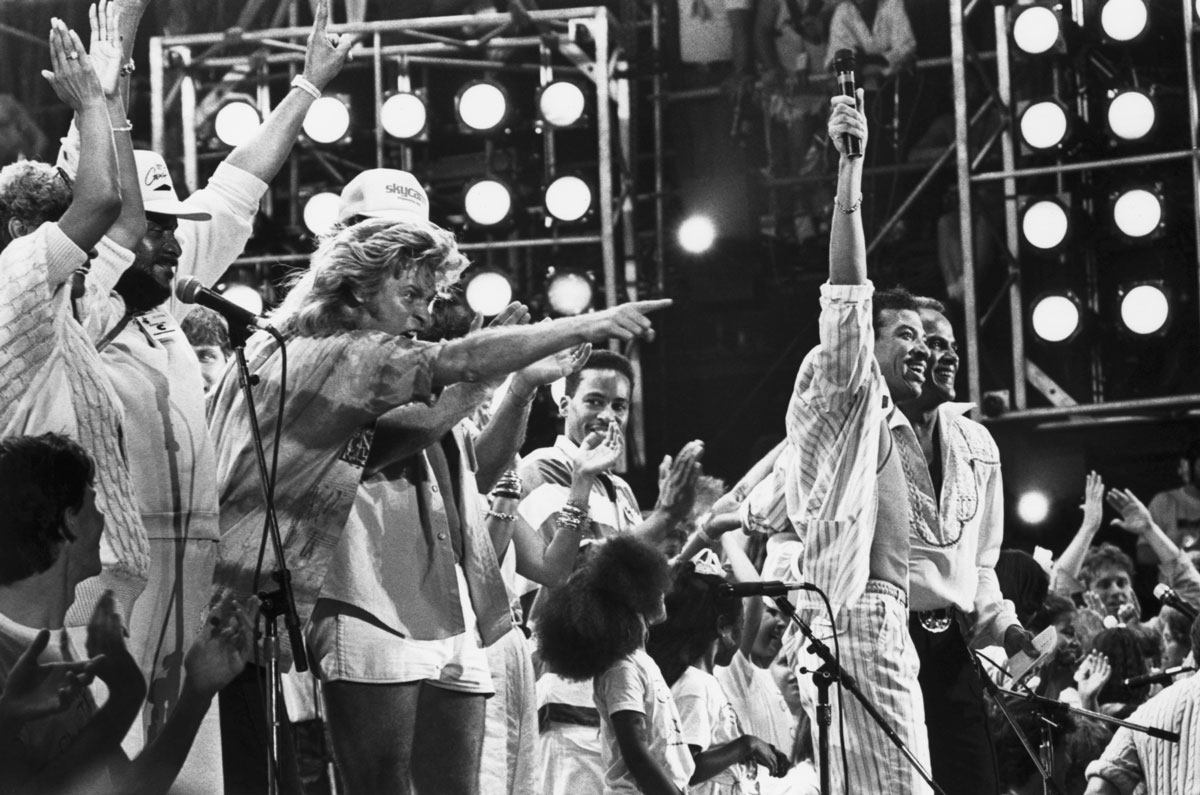
Lionel Richie and Harry BelafonteLionel Richie and Harry Belafonte are joined by other performers at the Live Aid concert in Philadelphia as they all sing the concert-ending song of “We Are The World.” (Getty Images/Bettmann)

Jarreau continues and Belafonte remains slightly abashed until his smile broadens, as if he’s accepting his signature tune’s supernaturally unifying power. As the cheering increases and the number of voices contributing to the chorus grows Belafonte joins them, like he’s content to be part of a higher cause without being the shiniest star in the room.

By that point in his career Belafonte, who died Tuesday at the age of 96, was past the urge to stand out in a crowd of celebrities. Besides, as the reason that “We Are the World” came to be, there was no need. Inspired by Bob Geldof’s formation of the U.K. supergroup Band-Aid to record “Do They Know It’s Christmas?” Belafonte convened some of the biggest stars of the 1980s to record the charity single written by Lionel Richie and Michael Jackson and produced by Quincy Jones and Michael Omartian. The session began at 10:30 p.m. and didn’t end until around 8 the next morning.

The payoff remains historic: the single sold more than 20 million copies and, along with sales of associated merchandise, generated $75 million for famine relief in Ethiopia and recovery and development programs in Africa through the charity United Support of Artists for Africa.

Looking back, that improvised insertion of “The Banana Boat Song” into this excerpt is fitting. Popular culture would eventually obscure the humanitarian urgency of “We Are the World” in the same way that “Day-O” came to epitomize Belafonte’s reign as the King of Calypso instead of the manual labor anthem it once was.

Belafonte’s entertainment career and his activism weren’t often overtly entwined, but his stardom was central to marshaling celebrities to civil rights causes.

“Day-O” is the most famous track from 1956’s “Calypso,” one of the 30 studio albums Belafonte would release during his lifetime. It topped the Billboard charts for 31 weeks and made him the first platinum-selling recording artist in the industry’s history, with the LP’s sales exceeding a million copies. This career high was one of many that led to the singer, producer and actor’s induction into the Rock and Roll Hall of Fame in 2022.

It also fed Belafonte’s life’s work as an activist who bridged the entertainment industry and the world of social justice. Belafonte’s stage and screen career and his activism weren’t often overtly entwined, but his stardom was central to marshaling other celebrities to civil rights causes. He is responsible for drawing Marlon Brando, Charlton Heston, director Joseph L. Mankiewicz and other famous performers to participate in 1963’s March on Washington for Jobs and Freedom.

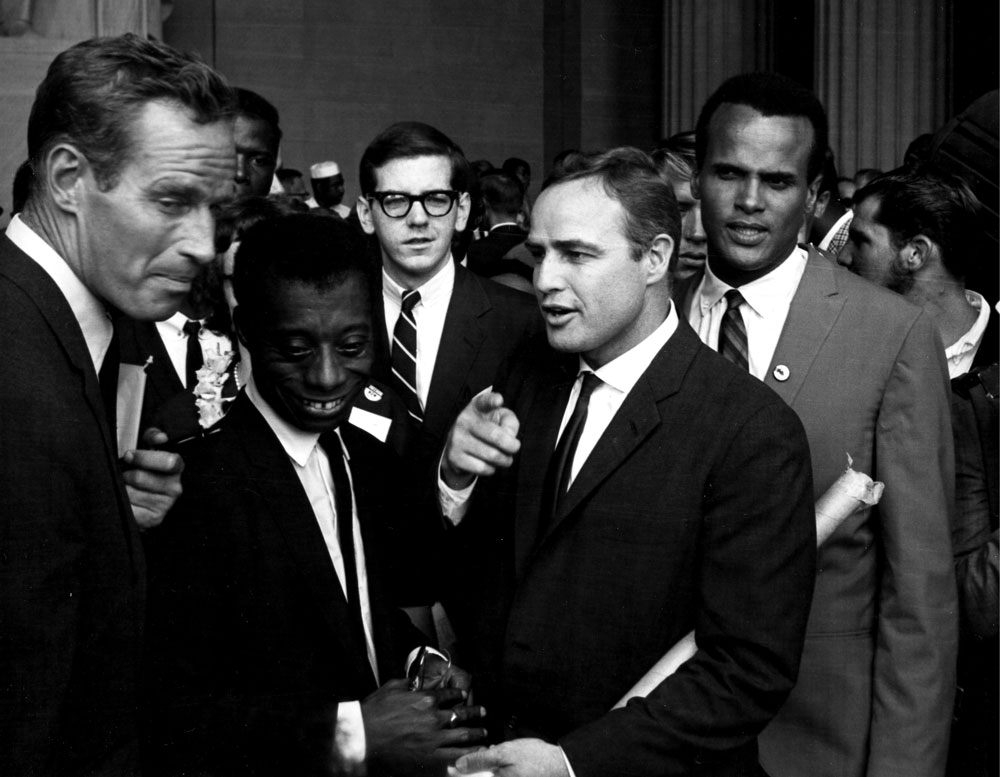
Charleton Heston; Harry BelafonteFramed by American actor Charleton Heston (1923 – 2008) (left) and singer Harry Belafonte (right), writer James Baldwin (1924 – 1987) (center left) talks with actor Marlon Brando (1924 – 2004) in the Lincoln Memorial during the March on Washington for Jobs and Freedom, Washington DC, August 28, 1963. (PhotoQuest/Getty Images)

Those white actors, along the James Baldwin, appeared with him as part of a CBS News roundtable discussion moderated by David Schoenbrun that aired on the same day. “It was indeed a very powerful moment to see 200,000 people, mostly Black people, but also white people, and to know that a nation such as America, and the reason that I struggle with it so hard and I grapple with it so hard is because I really believe in the potential of this country,” Belafonte tells Schoenbrun in the interview. “And this country has not realized its potential and has not even begun to scratch its surface in the humanities.”

In 1965 he organized a performance in support of the demonstrators who marched from Selma to Montgomery, Alabama with a roster that included Mahalia Jackson, Nina Simone, Odetta, Joan Baez, Sammy Davis Jr. and Tony Bennett.

In addition to all of this, Belafonte used his wealth and fundraising abilities to support ground efforts. Famously in 1964, Belafonte and his lifelong best friend Sidney Poitier were chased by the Ku Klux Klan as they delivered $70,000 in cash to Mississippi to support voter registration during Freedom Summer.

But he also put up the bail money to have Martin Luther King, Jr. released from the Birmingham jail as well as bailing out many student activists, all part of his support for the Student Nonviolent Coordinating Committee, for which he put up a share of the founding funds.

King and Belafonte were already friends by the late 1950s, according to a New Yorker profile Henry Louis Gates Jr. wrote in 1996:

King was a frequent guest of Belafonte’s in New York, and Belafonte was one of the few who could serve as trusted conduits between King and the Southern Christian Leadership Conference, on the one hand, and the Washington establishment, on the other.

. . . [A]nd, though he’s obviously proud of the role he played in the civil-rights era, he speaks of these matters with some hesitancy. King’s widow, Coretta Scott King, is more forthcoming. She recalls a day in the early sixties when Belafonte told King, laughing, “Martin, one of these days some of these crackers are going to kill you, and I’m going to end up having to take care of your family.” Both things came to pass, Belafonte having insured King’s life heavily for his family’s sake.”

The success of “Calypso” marked the first major surge in Belafonte’s career after years of struggling in the New York City theater scene alongside Poitier. The two men met when they were both members of Manhattan’s American Negro Theater. While Poitier’s stage and screen career took off from here, Belafonte was steered toward live music performance.

It was in this capacity that he found the fame he’d been pursuing, standing out as a stage performer before landing a co-starring role in Otto Preminger’s 1954 classic “Carmen Jones” which paired him with Dorothy Dandridge. A post-“Calypso” role in 1957’s “Island in the Sun” garnered controversy due to his character’s flirtation with a white woman played by Joan Fontaine. A member of the South Carolina Legislature introduced a bill seeking to fine theaters showing the film.

“I was long an activist before I became an artist,” Belafonte said.

But then, those politicians may not have seen the need to propose such measures if Belafonte didn’t have such crossover appeal. Hollywood capitalized further on this in 1959 when he starred in a TV special called “Revlon Hour: Tonight with Belafonte” with an integrated roster of musicians and other performers. It won Belafonte an Emmy in 1960, making him the first Black performer to achieve this accolade. By Belafonte’s report, it also earned a proposed million-dollar five-episode offer that he turned down when the sponsor, Charles Revson, required Belafonte to make the cast entirely Black.

“‘Mr. Revson, let me tell you something,'” Belafonte related in the 1996 New Yorker interview, “‘If you’d asked me to put on a flowery shirt and sing more calypso tunes, and dance more, because that’s what white people would like, I would consider it. But what you’ve asked me to do — there’s no way to square it. I cannot become resegregated.'”

He recalled the executive handed him a check for $800,000 and told him he was off the air. 

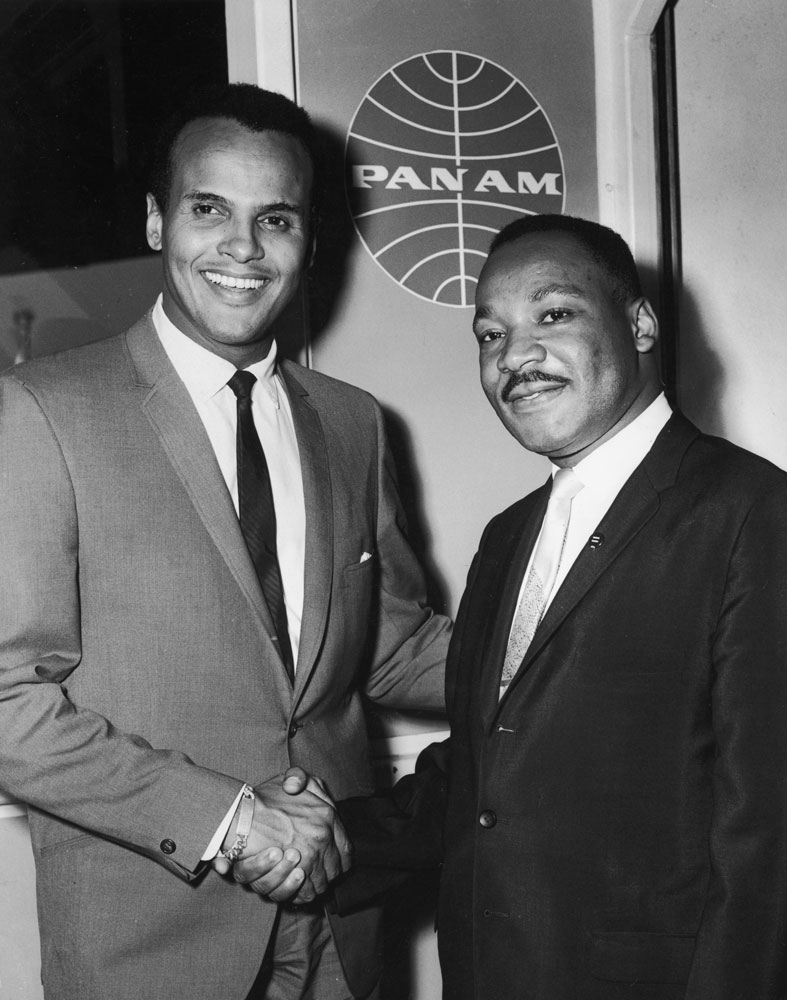
Harry Belafonte; Martin Luther King JrAmerican singer and actor Harry Belafonte Jr. (left) shakes hands with American civil rights leader Rev. Martin Luther King Jr. (1929 – 1968) at Kennedy International Airport before he and his family board a Pan American jet bound for Conakry, Guinea, New York City. (Hulton Archive/Getty Images)

Years later Belafonte made headlines again when, in a duet with Petula Clark during her 1968 TV special, the “Downtown” singer placed her hand on  his arm, scandalizing a Chrysler Corporation executive to such an extent that the touching “incident” somehow became public before the special aired . . . to overwhelmingly positive reviews. That same year America would witness an interracial kiss on “Star Trek,” see the premiere of “Julia,” the first family sitcom to star a Black woman and watch Belafonte guest host NBC’s “Tonight Show,” where he had King on as a guest.

These are some of the many ways Belafonte put the fame for which he harbored mixed emotions to its highest use over the years, among them: working as an ambassador for multiple charitable organizations, leading a cultural boycott against South Africa’s apartheid government in the 1980s, and serving as an adviser to the Women’s March on Washington in 2017.  (Of his role with the Women’s March, he told the AP, “I’m just the plumber. I come in to fix the pipes.”)


Want a daily wrap-up of all the news and commentary Salon has to offer? Subscribe to our morning newsletter, Crash Course.


Although the mainstream success of “Day-O” and other popular singles in Belafonte’s catalog remains something of a sore spot among Trinidadian calypso experts, Belafonte explained in a 2011 NPR interview that was also an anthem of activism.

“Almost all Black music is deeply rooted in metaphor,” Belafonte explains. “The only way that we could speak to the pain and the anguish of our experiences was often through how we codified our stories in the songs that we sang.”

Three years after “We Are the World” became a massive hit, “Day-O” saw a resurgence thanks to its prominence in Tim Burton’s 1988 movie “Beetlejuice,” a Generation X favorite with an all-white cast.

In that movie, Geena Davis and Alec Baldwin play a pair of ghosts who, when they were alive, were enthusiastic Harry Belafonte fans. His song features prominently in a dinner party scene where the couple pulls off their first haunting. To this day people can still mimic Catherine O’Hara’s showstopping lip-synch without metabolizing the song’s meaning.

“It’s about men who sweat all day long, and they are underpaid, and they’re begging the tallyman to come and give them an honest count — counting the bananas that I’ve picked, so I can be paid. And sometimes, when they couldn’t get money, they’ll give them a drink of rum,” he said. “. . . People sing and delight and dance and love it . . . they don’t really understand unless they study the song that they’re singing a work song that’s a song of rebellion.”

Later in the same interview he adds, “A lot of people say to me, ‘When as an artist did you decide to become an activist?’ I say to them, ‘I was long an activist before I became an artist.'” He leaves behind a legacy of being respected and beloved for both.

Montana GOP may “expel” transgender lawmaker

Montana state Rep. Zooey Zephyr, a transgender Democrat from Missoula, said Tuesday that she will face a disciplinary vote on Wednesday over “conduct” that “violated the rules, collective rights, safety, dignity, integrity, or decorum of the House.”

Zephyr, the first openly transgender woman elected to Montana’s legislature, has faced off with House Republicans since April 18, when she made a speech on the House floor opposing a ban on gender-affirming healthcare.

“There will be blood on your hands,” she told her fellow lawmakers.

Zephyr’s comments were not received well by conservative members of the House, who accused her of using “hateful rhetoric.” House Speaker Matt Reiger told her she would not be allowed to speak again until she apologized, leading to impassioned protests and several subsequent arrests on Monday.

On Tuesday night, Zephyr posted a letter she had received from GOP House leaders, which states she will face a motion on Wednesday to determine whether her “actions” during Monday’s events warrant “disciplinary consequences.”

“I have been informed that during tomorrow’s floor session there will be a motion to either censure or expel me,” she wrote. “I’ve also been told I’ll get a chance to speak. I will do as I have always done—rise on behalf of my constituents, in defense of my community, & for democracy itself.”


Want a daily wrap-up of all the news and commentary Salon has to offer? Subscribe to our morning newsletter, Crash Course.


The letter stipulates that the “proceedings” can be viewed online via the legislative branch website, as the House galleries will be closed to the public to “maintain decorum and ensure safety.”

The situation at Montana’s state House comes just weeks after Republicans in Tennessee’s House expelled two Black Democratic lawmakers, Justin Jones and Justin Pearson, for leading demonstrations fighting for gun control on the chamber floor in the wake of the Nashville mass shooting. A third white Democratic state representative, Gloria Johnson, was ultimately not expelled. Jones and Pearson have since been reappointed to their seats on an interim basis by local boards.

In an interview with CBS News earlier on Tuesday evening, Zephyr said that there are “no doubt connections” between how she has been silenced and the case of the “Tennessee Three.”

“I think what we’re seeing is that when marginalized communities, communities who are impacted the most by legislation, rise up and speak to the harm, whether it’s me speaking on trans issues, whether it’s young Black men speaking on gun violence,” she said. “Those folks in power, particularly on the far right, do not want to be held accountable for the real harm that these bills bring.”

“He admits it”: Ted Cruz describes “step two” of Jan. 6 plot in new leaked recording

Sen. Ted Cruz, R-Texas, privately described a plot to create an electoral commission to assess the false claims of voter fraud in the 2020 election in a newly released Jan. 2, 2021 recording of a conversation between him, former Fox News producer Abby Grossberg and Fox Business host Maria Bartiromo. 

Though the tape, recorded just four days before the insurrection at the Capitol, echoes the Texas senator’s public statements related to the plot to block the certification of President Joe Biden’s win, it reveals the depth of his plot to support former President Donald Trump, The Washington Post reports

In the audio, Cruz, who was also the first senator to object to the Electoral College results, details his scheme to establish the commission, explaining that he gathered 11 senators to object to the electoral certification, which would prompt a 10-day audit.

“I think that the country deserves to have a credible assessment of these claims and what the evidence shows and the mechanism to try to force that is denying certification on the sixth,” Cruz said in the tape, first aired by MSNBC’s Ari Melber.

Bartiromo also asked Cruz who would decide which candidate would be inaugurated. Cruz said that if the commission “found credible evidence of fraud that undermines confidence in the electoral results in any given state they would report on that.”

To support his plan, Cruz also cited the electoral commission created in 1876 to investigate potential voter fraud in the Hayes-Tilden election.

“You need an adjudicatory body with fact-finding and investigative authority to consider the facts to examine the record and to make determinations — that’s how they did it in 1877,” Cruz told Grossberg and Bartiromo.

Cruz repeated these sentiments on the Senate floor shortly before the mob attacked the Capitol on Jan. 6, both times neglecting to mention the Compromise of 1877. The agreement allowed Republican candidate Hayes to become president and prevented another civil war but required Republicans to pull federal troops from the South, bringing an end to the Reconstruction Era and subjecting Black Americans to the deluge of white supremacist violence that followed.


Want a daily wrap-up of all the news and commentary Salon has to offer? Subscribe to our morning newsletter, Crash Course.


During his segment on Tuesday, Melber claimed that the senator’s calls for a reassessment of the election results “was for Cruz one step in a larger coup plot.”

“He admits it,” Melber continued after playing the audio. “You heard the question — who decides who gets inaugurated that’s what this is all about. You have a certified winner. You have the courts having passed up any potential challenge. So, at that point, it was President-elect Biden, and Cruz answers this fake, made-up commission he and his Trump buddy were planning to create to bureaucratize a coup. That’s what they were trying to do. That was his answer. That’s how they were trying to steal the race. The references to fraud, we know, one, he didn’t believe in those we have that on tape. B. more importantly, the judges and fact-finding we have in the country didn’t find there was that kind of fraud and then 3. that’s all just talk anyway because they’re literally trying to steal it for Trump, so all the words in the middle are just the words to get there.”

Cruz tweeted his response to Melber and the tape Tuesday evening:

“This @msnbc [clown] is breathlessly reporting that I ‘secretly’ said in a phone call…the EXACT same thing I said on national television the next morning! And then said again on the Senate floor four days later.”

“Total blunder”: Legal experts say “Trump already made a big mistake” in E. Jean Carroll trial

Former President Donald Trump did not appear in court for the start of his New York rape and defamation trial and experts think it could hurt his case.

The trial in longtime columnist E. Jean Carroll’s rape and defamation lawsuit against the former president kicked off on Tuesday. Trump’s attorneys have refused to say whether Trump would testify or even appear in court — at one point asking the judge in the case to tell jurors that Trump was “excused” from appearing due to “logistical burdens,” which the judge rejected.

Judge Lewis Kaplan pressed Trump attorney Joe Tacopina on Tuesday on whether the former president would testify at the trial.

“The answer is: I’m not sure, your honor,” Tacopina said.

“You’re going to have to tell me — this week,” Kaplan shot back, urging Trump’s attorney to “fish or cut bait.”

Former U.S. Attorney Harry Litman called Tacopina’s response to the judge a “total blunder.”

While Trump is not obligated to attend the trial, his absence “is a mistake” and “unlikely to go over well with the jury,” warned former federal prosecutor Shan Wu.

Wu, a former sex crimes prosecutor, suggested in a Daily Beast op-ed that Trump likely made a “strategic choice” to show that the “claims are not serious enough to even warrant his attendance” but that could backfire.

Jurors on Tuesday saw Carroll’s gaze “fixed on Tacopina” and her presence was a signal that she stands behind her allegations, Wu wrote, but the jury “had no view of Trump to compete with the sexual predator that Carroll’s lawyer portrayed him to be.”

Tacopina in court on Tuesday argued that the lawsuit was politically motivated and focused on the fact that the alleged rape occurred nearly 30 years ago and that other customers or staff would have noticed it.

“But it is now fairly commonly accepted that sexual assault survivors suppress the experience so Tacopina’s argument that silence equals lying is likely not going to get much traction,” Wu explained, adding that Tacopina’s “dog-whistle” to the idea that rape victims cannot be believed unless they “fight back” is a “misogynistic viewpoint that will seem exactly that to a jury.”

The trial is expected to include testimony from writer Natasha Stoynoff, who accused Trump of forcibly kissing her in 2005, and businesswoman Jessica Leeds, who accused Trump of sexually assaulting her on a flight in the 1980s.

“This type of evidence in trials is enormously damaging to defendants in sexual assault cases,” Wu wrote, adding that it puts Trump in a position to have to “discredit not one victim but three.”


Want a daily wrap-up of all the news and commentary Salon has to offer? Subscribe to our morning newsletter, Crash Course.


Carroll’s attorneys argued on Tuesday that the testimony of the other women will show “one clear pattern.”

“Start with a friendly encounter in a semi-public place,” attorney Shawn Crowley said, according to CNN. “All of a sudden pounce, kiss, grab, grope. Don’t wait. When you are a star, you can do anything you want. And when they speak up about what happened, attack. Humiliate them. Call them liars. Call them too ugly to assault.”

The jury will also hear the infamous “Access Hollywood” tape in which Trump bragged about groping women.

“You’ll hear him bragging about doing almost the same thing he did to Ms. Carroll to other women,” Crowley said, adding, “this is not locker room talk, it’s exactly what he did to Ms. Carroll and other women.”

Carroll is also expected to take the stand while Trump’s legal team is likely to rely on his video deposition from last October.

“There’s absolutely nothing more for him to add,” Tacopina said Tuesday. “I don’t want to distract from the focus of her story.”

Tacopina claimed that Carroll and the other accusers “schemed to hurt Donald Trump politically” and told the jury that they are not there to consider the accounts of the other women.

“That’s not for you to decide here,” Tacopina said. “Those people have never made a claim. No one has ever told the police, including Ms. Carroll. No one. Because that would require a real investigation. No one has ever done that. But they want you to focus on anything but the E. Jean Carroll story because it is so incredible and so unbelievable.”

Tacopina also argued that Carroll “did not produce any objective evidence to back up her claim because it didn’t happen.”

“She is abusing the system by advancing a false claim of rape for money, for political reasons and for status and in doing so she’s really minimizing the true rape victims,” Tacopina said. “She’s exploiting their pain and their suffering.”

MSNBC legal analyst Lisa Rubin noted on Twitter that Tacopina was flanked by other attorneys who were all white men while fellow Trump attorney Alina Habba was “nowhere to be seen.”

“The absence of even a single woman at the defense table,” Rubin wrote, “was not a great look in a case all about an alleged sexual assault.”

Joe Biden’s re-election BFD: The threat of Donald Trump

What with all the hoopla over the firing of Tucker Carlson this week you may not have heard the big news: Joe Biden is old.

Yes, he’s also running for president again but the announcement was overshadowed by the fact that every single news channel reporting on it accompanied it with reports of polls and man-on-the-street interviews in which Americans all agree that Joe Biden is just too old. And he is. 80 is ancient to be president, much older than the frontrunner for the Republican nomination, Donald Trump, who will only be a sprightly 78 when he takes office. 

I think many Democrats assumed that Biden would simply be an elderly caretaker president who would not do much but would steady the ship after the chaotic Trump years. Then he would pass the baton to one of the leaders from the next generation and step aside graciously. But Biden ended up surprising everyone by accomplishing a whole lot and under very difficult circumstances. Battling a once in a century pandemic, Biden managed to pass some of the most substantial legislation since the New Deal with a very narrow majority in the House, a couple of obstructionist Senate divas from his own party and an opposition that’s gone batshit crazy. It’s far more than anyone expected.

Yet to say people are unenthusiastic about a second term is an understatement. A recent NBC poll found that 70% of Americans don’t want Biden to run again — and that includes 45% of Democrats. But as JV Last at the Bulwark points out, that’s actually par for the course:

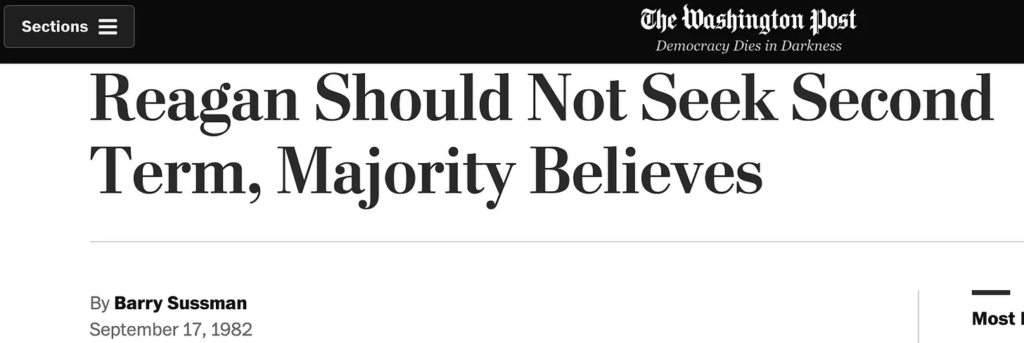
 Every president has a percentage of people who don’t want him to run for reelection, even in his own party. This was true of Trump, Obama, Bush, Clinton, Bush, Reagan, Carter, and Ford. Really. Check out this Washington Post headline from September of 1982:


As it happens, the rap on Reagan was also that he was too old, a criticism he defused in the debate with rival Walter Mondale when he said, “I will not make age an issue of this campaign. I am not going to exploit, for political purposes, my opponent’s youth and inexperience” and everyone howled. He went on to win one of the biggest landslides in American history. That’s not a line Biden can use on Trump, of course, since Trump is also as old as Methuselah, but it shows that while you can’t avoid the issue, it can be dealt with with humor and self-deprecation.

Biden ended up surprising everyone by accomplishing a whole lot and under very difficult circumstances.

In his speech on Tuesday, Biden made his pitch: he wants to finish the job. As this article in Vox lays out, he has made a surprisingly good start. Coming into office and having to fix the carnage from the pandemic was no easy task. The economy was in crisis and he managed to quickly pass the American Rescue Plan which paved the way for it to recover quickly. Unemployment is now the lowest it’s been since 1969 and inflation is falling after a steep rise due to the global emergency. Wages are rising quickly, especially in service and manual labor jobs.

He then helped negotiate the largest investment in clean energy in U.S. history and secured billions in badly needed new science spending. And unlike Trump, he actually signed the promised massive infrastructure legislation.

Despite all that, the country is still in a funk with most people believing the economy still sucks and having a grim view of the nation’s direction. It’s entirely predictable that Republicans and right-leaning independents would feel that way. That’s partisanship. But I think Democrats are still suffering from the collective PTSD Trump has inflicted on the nation. Studies and surveys show that partisan hostility is at record highs and with the country so closely divided that doesn’t make for a very stable and optimistic environment. Biden’s tepid poll numbers bear this out.

Nonetheless, while Democrats may wish for a younger candidate and are sour on the direction of the nation, most polls also show that they will vote for Biden in a general election anyway. And that’s because of their views of the opposition.

The Republicans, meanwhile, are at each other’s throats.

Republicans have become so extreme and are still so enamored of Donald Trump, a man who incited an insurrection and convinced a majority of his own party that the election was stolen despite absolutely no evidence, that Democrats are motivated to vote regardless of who the nominee might be. They are as determined to keep Trump out of the White House and deny the Republicans a congressional majority as they were in 2020. Negative partisanship is driving them and it’s a potent force.

Still, it’s foolish to underestimate the positive power Biden, as president, actually has.


Want a daily wrap-up of all the news and commentary Salon has to offer? Subscribe to our morning newsletter, Crash Course.


Incumbency is always a huge advantage and it’s particularly important under these circumstances. As Last noted, “any other Democrat you could substitute for Biden asks voters to take a chance—and in so doing would turn Trump into the incumbent, since he is a known quantity.” Meanwhile, the party remains united and it appears that Biden isn’t going to have a serious primary challenge. (Bernie Sanders endorsed him immediately after his announcement.) The Democrats are in a good position to beat the GOP. Again.

The Republicans, meanwhile, are at each other’s throats.

Trump is already facing what is shaping up to be a monumentally ugly primary with several rivals already lining up and possibly more to come. They may hate the Democrats, and Biden especially, but they hate each other just as much. And it’s only going to get worse as the race goes on. The contrast couldn’t be clearer.

Joe Biden has not been anyone’s dream candidate. Nobody is writing songs about how they have a crush on him or lining up for hours to be in his presence. He’s not that kind of politician. But he’s managed to do a pretty good job under difficult circumstances while keeping his usually fractious coalition together. And he has a record of beating Donald Trump.

The Democrats could do a whole lot worse and it appears they know it.

Scientists once thought they understood how domestication worked. Now, they’re not so sure

Though dogs are so close genetically to wolves that many taxonomists consider them to be a subspecies, most people wouldn’t let a wolf lick their hand as readily as a Shih Tzu. When animals are domesticated, as the dog was, their traits change; an artificial selection occurs over many generations, which, in the case of the dog, probably happened through unconscious selection bias among ancient humans and their canid hangers-on.

Other animals, too, saw similar phenotype changes through the process of domestication. When wild boars were first domesticated in areas of both modern Turkey and China, the farmers who bred them preferred animals with less fur, more meat and a tamer disposition. Similarly, a famous 2020 study on wild foxes in urban areas found that the city-dwelling creatures had distinctly different physical traits, such as “a noticeably shortened wider snout with a reduced maxillary [jaw] region” and with “a braincase appeared to be smaller in the urban habitat” — which suggested they were becoming semi-domesticated.

Indeed, there are so many physical traits that humans observe as distinguishing domesticated animals from wild ones that the process is sometimes called “domestication syndrome.” As famously laid out by Russian zoologist Dmitry Belyayev in the 1960s and 1970s during his “silver fox experiments,” domestication syndrome posits that there are certain common physical traits that emerge among most species as they get domesticated by humans.

“If there isn’t a single trait that is common to all these different definitions [of domesticated], what is there?” Larson told Salon.

Yet what if there is no pattern between which traits correspond with domestication? What if those alterations are in fact species-specific, and arguments to the contrary are simply scientists succumbing to apophenia (a tendency to wrongly discern patterns in unrelated things)?

Some researchers believe this may be the case — which, in turn, means we have been thinking about domestication all wrong.

* * *

According to Dr. Greger Larson — an archaeology professor at the University of Oxford — advocates of domestication syndrome simply have not provided enough evidence to support their theory. In 2020, he and several other scientists wrote a paper for the journal Trends in Ecology & Evolution called “The History of Farm Foxes Undermines the Animal Domestication Syndrome” that made precisely this point. It started by deconstructing Belyayev’s famous experiment with farm foxes, the one that seemed to prove domestication theory. Belyayev found that after multiple generations of controlled breeding silver foxes on Prince Edward Island, the animals began to develop traits associated with domesticity: Docility, floppy ears, spotted coats and curled tails.

Yet there are two problems with concluding that this proves domestication theory, as the 2020 paper pointed out: First, it ignores how Belyayev used foxes bought from a fur farm, and who therefore may have already had preselected traits. Additionally, an analysis of the different domesticated animals does not show any consistent patterns in terms of evolutionary traits.

“These are the general categories of things that people have used to distinguish a domesticated animal from a wild animal,” Larson told Salon. He had pulled out a chart with a list of nine domesticated animals: Dogs, cats, goats, pigs, rabbits, rats, mice, foxes, and the original Russian farm-foxes. These were then cross-referenced with traits associated with domestication such as changes in their skeletons, coats, ears, tails, brain sizes and seasonalities. When placed on a grid, it became patently obvious that no patterns existed. For example, on some occasions both types of foxes along with dogs, cats and goats experienced increased variation in their coat coloring due to domestication — but that did not happen all the time, and it was by far the most prevalent “yes” category for showing supposed signs of “domestication syndrome.” Quite often there was simply not enough data, and when it came to traits like skeletal changes and tail evolution, no meaningful trends or patterns existed at all.

“If there isn’t a single trait that is common to all these different definitions, what is there?” Larson told Salon. “If you don’t have a single characteristic amongst what, 30 separate characteristics here, that is the same across 10 different, separate definitions of it, what the hell is it? Everybody assumes they know what it is, but as soon as you start looking at it, it just vanishes before your fingertips.”

Kathryn Lord, a postdoctoral associate in the Karlsson Lab who works at the Broad Institute of MIT and Harvard (and whom Larson described as “brilliant”), was instrumental in co-authoring the 2020 paper. She argued that their research undermined Belyayev’s thesis, even though his experiment is still impressive.

“While [Belyayev]’s did indeed successfully select for increased tameability in his foxes, all of the traits that supposedly came along with that selection previously existed in the population from Prince Edwards Island decades before the experiment,” Lord told Salon by email. “Therefore, [Belyayev]’s experiment, while still fantastically interesting for changes in tameability, does not provide support for the idea of the domestication syndrome.”


Want more health and science stories in your inbox? Subscribe to Salon’s weekly newsletter The Vulgar Scientist.


After all, Lord pointed out, there is no getting around the facts from their own paper: “We found that none of the traits show up across the 7 very common domestic mammals we looked into,” Lord wrote to Salon. “In most cases where domestication syndrome traits were reported they were appearing in specific modern breeds. The problem with this is that modern animal breeds only came into existence in the 19th century and are the result of selection on already domestic animals.”

* * *

So can science definitively determine whether domestication syndrome is a real thing?

Larson explained that the community must first come to a more concrete understanding of what it would actually look like. For now, it is more difficult to study domestication because the benchmarks can move around. Larson compared this to his experience working in a very different industry — music.

“There is increasing evidence to suggest that many domestic animals simply adapted to an environment we created and that we may have rarely, if ever, had a direct hand in the process.”

“I was kind of a consultant on the Pearl Jam film ‘Pearl Jam Twenty’ that came out in 2011,” Larson recalled. “There was a group of us then who were meeting, and one of the guys suggested that maybe what we should do is try and figure out how many live shows they’d actually played because it appeared to all of us said they might be getting close to a thousand live shows.” That seemed like a cool idea — until the experts realized that “live show” had a rather fluid definition.

“Very much like the domestication syndrome, you’ve got to define it,” Larson recalled. “Well, what constitutes a live show? Did the three songs on “Saturday Night Live” count? What about when they only played in front of small audiences? If they appeared on a radio with only two members of the band, did that count?

“It’s the same thing with how you define domestication syndrome,” Larson told Salon. “It definitely depends on what you’re looking for and what you’re counting. So all we are saying in that paper is that everybody has just assumed that it’s a real thing, but nobody’s actually gone through and tried to define it. If everybody had first said, ‘Look, it’s a thing, now we require an explanation to describe the thing,’ that can work, but nobody ever actually tested whether or not this thing exists. So if the thing doesn’t exist, why would you ever expect a single unifying cause for it?”

Even the one trait that seemed to be most prevalent among all different types of domesticated animals — their tameability — becomes murkier when places in a scientific context.

“Increased tameabillity may be a common theme across domestic animals,” Lord wrote, but “the definition of domestication often includes increased tameability so it is a bit of a circularity problem. We will only know if increased tameability is really a thing across domestic animals if we agree upon a definition of domestication that doesn’t require it.” Similarly, when trying to determine how animals are changed by humans, “many definitions require human control precluding our ability to study how much humans were actively involved in the process. There is increasing evidence to suggest that many domestic animals simply adapted to an environment we created and that we may have rarely if ever had a direct (let alone intentional) hand in the process.”

Indigenous Maasai ask the United Nations to intervene on human rights abuses

This story is published as part of the Global Indigenous Affairs Desk, an Indigenous-led collaboration between Grist, High Country News, ICT, Mongabay, and Native News Online.

In Tanzania, the Indigenous Maasai face an ongoing, violent campaign to evict them from their lands and make way for protected conservation areas and hunting reserves. This week, the Maasai are in New York to ask the U.N. Permanent Forum on Indigenous Issues, or UNPFII, to tell Tanzania to stop taking their cattle, remove its security forces, establish a commission to investigate disputed lands and displaced people, and allow international human rights monitors to visit without restrictions. 

“We, the Maasai people of Loliondo and Ngorongoro in Tanzania, are fighting against the Tanzanian government and wildlife trophy hunters who are threatening our livelihood, culture, ancestral wisdom, legacy, and basic human rights,” Edward Porokwa, executive director of the Pastoralists Indigenous Non Governmental Organization’s Forum, said. “There is no justification for this crisis created by the government.”

The Maasai land conflict in Tanzania is focused on two main areas: the Ngorongoro Conservation Area and Loliondo. The Ngorongoro Conservation Area is a UNESCO World Heritage Site that attracts over half a million visitors every year for safaris to see the park’s “Big 5” game — elephants, lions, leopards, buffalo, and rhinoceros. Around 80,000 Indigenous Maasai call the park home, but have faced decades of government efforts to push them off their land.

In a statement delivered at the Permanent Forum, Porokwa said that, since June 2022, the government has closed four nursery schools, nine water sources, and six mobile health clinics. The government says that Maasai are voluntarily leaving the area for resettlement sites, but the Maasai say that they are essentially being forced out. “It is a forceful relocation by ensuring that people don’t get the basics,” Porokwa said. “They are there to die.” 

And in Loliondo, which is legally demarcated Maasai village land, state security forces shot at Maasai in a violent campaign to drive them from their lands last June. In the attack, dozens of Maasai were injured and many fled across the nearby border to Kenya for medical attention. At least two dozen others were arrested, while some were not permitted to leave their homes. 

Last June, nine United Nations experts raised concern about forced evictions and resettlement plans, but the Maasai representatives at the United Nations say that the government has not changed its approach. 

The Maasai say that since June 2022, Tanzania has taken or killed over 600,000 of their cows and demanded over $2.5 million in fines for grazing. This is all part of what Maasai say is a massive campaign to destroy their pastoralist way of life. 

At the Permanent Forum, a representative from the Tanzanian government pushed back on the Maasai’s claims, pointing to the East African Court of Justice’s 2022 dismissal of an eviction case brought by the Maasai, stating that the Maasai could not prove their claims about violent evictions. The Oakland Institute, a US-based nonprofit that advocates for Indigenous rights, called the ruling a “shocking blow to Indigenous land rights.” Tanzanian representatives at UNPFII declined to comment on the matter.

In January, the African Commission on Human and Peoples’ Rights conducted a monitoring visit to investigate the situation. But Maasai community organizations say that at every step, the visit was controlled by the government. Commission representatives were shepherded around by state security forces who intimidated Maasai and excluded them from some meetings. Some Maasai waited for hours to speak with the Commission, only for them to never show up. While the Commission’s final report on the visit did express concern about the situation, it also commended Tanzania’s commitment to protecting human rights. The Commission also recommended starting new consultations with the Maasai, as well as addressing their concerns about the resettlement program. 

In December, José Francisco Calí Tzay, the United Nations Special Rapporteur on the rights of indigenous peoples was scheduled for a week-long visit to Tanzania, but the visit was indefinitely postponed. Maasai leaders believe that the visit was scuttled out of concern that the Special Rapporteur would not be given full access to investigate. At the Permanent Forum, Calí Tzay called for a halt to the evictions and for the government to consult with the Maasai, but did not address the postponed visit. 

With few options remaining, the Maasai have turned to the Permanent Forum to raise their concerns. Briane Keane is the director of Land is Life, an international organization that works with Indigenous peoples, including providing travel funding, medical assistance, and security assessments to the Maasai. Keane says that the United Nations is an important platform for the Maasai. “It’s a place where they can be heard. The government of Tanzania is not listening,” he said. 

The Maasai hope that international pressure may convince the government to finally listen to their concerns. But speaking out on the international level also comes with risks for the Maasai. Several leaders who spoke out against government abuses were forced to flee the country for their safety

“Indigenous peoples are the most among the most criminalized peoples of the world,” said Keane. “There’s people being thrown in jail. There are threats. So it’s very dangerous work sticking up for your rights when you’re as marginalized as the Maasai are in Tanzania.”


This article originally appeared in Grist at https://grist.org/indigenous/indigenous-maasai-ask-the-united-nations-to-intervene-on-human-rights-abuses/.

Grist is a nonprofit, independent media organization dedicated to telling stories of climate solutions and a just future. Learn more at Grist.org

Tucker Carlson is gone — his Fox News replacement might be worse

When you write and think publicly about the news and politics there is a great amount of pressure to always be certain and to be fast – or ideally both. This is also a type of public performance: one is expected to act as though they are 100 percent certain and correct even when they are full of inner doubt and anxiety. Moreover, to be a member of the Church of the Savvy and “the punditry” means to almost never apologize or course correct if one is wrong.

The capacity to throw one’s errors in analysis and prediction down the memory well and to continue forward confidently is almost a requirement to be a successful member of that media and political class. Of course, some members of that class have more latitude for having their errors forgiven and forgotten. White men and white women of a certain social pedigree have that privilege. Black and brown people and others who are not from “traditional” backgrounds in the news media most certainly do not.

As psychologist Phillip Tetlock argues there are two different approaches to problem solving and making predictions and plans. One can choose to be a “hedgehog”, which is a person who has some type of grand or unifying theory that they use to reconcile the facts and their understanding of the world. Alternatively, one can choose to be a “fox” who searches out different information and is more pragmatic and comfortable with contradictions and nuance as they try to make sense of present events and the future. Tetlock also highlights the merit of being a fox by how they are more inclined to change their minds as the facts when given new information. Foxes are also more comfortable challenging the consensus of settled facts and opinions.

The Fox News universe is far bigger than any one person.

In my public writing and thinking, I pivot between being a fox and a hedgehog depending on the question and problem at hand. But my natural inclination is to be a fox.

In terms of the public performance of punditry and expertise, the media machine and our political moment, and culture more generally, rewards charisma and compelling personalities (most of whom are generalists) who can tell a great story in 30 seconds on TV or offer provocative “hot takes” as opposed to the more meditative and measured real expert who may be less entertaining. Such an approach has done no small amount of harm to America’s political culture. One can trace a direct line from those changes in the country’s news media and popular culture in the 1970s and 1980s to the rise of neofascism, the country’s larger democracy crisis, and the Age of Trump today.

What we, the Americans, need in this moment of crisis and fascist fever dream and nightmare is to learn to think clearly, to ponder, and to breathe while with orient ourselves to escape “the Trumpocene”. Unfortunately, our culture is sick with what political theorists and philosophers are describing as “hyper-politics,” where late capitalism, digital media, overlapping crises, and what feels like an endless torrent of events – and the feelings of dread and disorientation such forces are causing – means everything is so sped up that there is little time for contemplation or critical thinking. In short, we as individuals and as a culture need to slow down, but we are not being allowed to do so. The neofascists, gangster capitalists, and other anti-democratic and anti-human actors want it that way.

On Monday, Fox “News” personality Tucker Carlson was suddenly fired by the network. He is the most popular host in the most-watched time slot. His influence across the right-wing echo chamber and the neo-fascist MAGAverse is immense. Although such language is overused, it does apply here: Tucker Carlson’s being forced out of Fox “News” is indeed shocking.

I was asked by a good number of people, What do you think? How did this happen? What does it all mean? I told them “I don’t know”. Those are perhaps the three worst and most dirty words for those who are members of the commentariat or punditry.

Here is where we are in the Tucker Carlson-Fox “News” story.

There is no definitive answer for why Tucker Carlson was suddenly fired from Fox “News”. It has been reported and rumored that the Dominion lawsuit and what was revealed about Tucker’s hostility towards Trump, his attorneys, and other members of the MAGAverse would be too detrimental to Fox “News” going forward. Others have suggested that Tucker is out from Fox “News” because he is named in a sexual harassment lawsuit which claims that Fox “News” nurtured a workplace culture and environment that encouraged hostile sexism, racism, and harassment. Some observers have applied Occam’s razor that Fox “News” is a business and the powers that be made a basic cost-benefit calculation that Carlson, given his outsized personality, a growing amount of negative attention, and other actual and potential conflicts was simply no longer worth the trouble to keep around. There have even been suggestions that Carlson’s public and private connections to malign actors in Russia and Hungary and the larger global right could be the reason he was so quickly dumped like three-day-old fish heads and guts. For all we know, the real reason for Carlson’s sudden exit may be something even worse. As of the time of this writing, there is no definite answer.

Tucker Carlson is not really going anywhere; he may actually (re)emerge in an even worse and more dangerous form somewhere else – perhaps even as a presidential candidate.

Contrary to the expected public performance and public expectation, I do not really care about why Tucker Carlson was fired by Fox “News.” The reasons are largely irrelevant to me. What we do know about Tucker Carlson and what the poison and pain he has caused to American politics and society during his time at Fox “News” both through his direct actions, what he represents and symbolizes, and has given tacit and active permission for are more than horrific enough to have merited his removal from the public airwaves years ago.


Want a daily wrap-up of all the news and commentary Salon has to offer? Subscribe to our morning newsletter, Crash Course.


Carlson was a central figure in Donald Trump and the Republican-fascists Big Lie and coup attempt on Jan. 6. In his role as a lead provocateur and propagandist, Carlson has continued to valorize and lionize Trump’s MAGA terrorists who launched a lethal assault on the Capitol as part of the coup attempt.

Carlson is a malign actor who routinely uses stochastic terrorism to encourage violence against Black and brown people, the LGBTQ community, refugees and migrants, antifascists, supporters of the Black Lives Matter movement, people who believe in and support women’s reproductive rights and freedoms, Muslims, Democrats, liberals, progressives, and others he deems to be some the enemy of “real America.” Carlson, through the policies he advocates for, speech, guests on his various shows, and other actions has shown himself to be a white supremacist, an antisemite, and a racial authoritarian.

Media watchdogs and other experts have routinely highlighted how Carlson is one of the right-wing media personalities most responsible for mainstreaming what were once fringe white supremacist beliefs and conspiracy theories — like “white people” are being “replaced” or at risk of “extinction” from Black and brown people.

In a post on Twitter, political strategist Steve Schmidt said this about Carlson: “Tucker Carlson wasn’t a zealot who held extreme beliefs. He was a con man who held no beliefs. He was singularly, besides Donald Trump, the most cynical performer on all of television.”

Schmidt’s choice of language here is important: Carlson is a fascist political performance artist and Fox “News” is the mainstage. To highlight that fascism and the Age of Trump and this ongoing disaster are the result of a merging of politics, emotions, storytelling, symbolism, collective psychopathology and identity, and the Irrational – and yes theater – is to properly understand the deeper nature of the threat to democracy and why such illiberal and fake populist politics are so compelling to some many people. Too many members of the mainstream news media and political class – especially professional “centrists” – refuse to acknowledge that reality while they cling to obsolescent frameworks of “normal politics” and “real politics” with its emphasis on elections, voting, public opinion, public policy, and the horserace.

In the Age of Trump and its fascist imaginary, Tucker Carlson is one of the main villains. In that role, he is a reliable source of daily controversy and attention. Carlson, along with Donald Trump, Marjorie Taylor Greene, Lauren Boebert, Ron DeSantis, Steve Bannon, and a few other central members of the neofascist rogues’ gallery, figures that many among the American public, especially Democrats, liberals, and progressives love to hate and otherwise pay attention to.

In the attention economy of the 21st century with its obsessive focus on “eyes”, “downloads”, “shares”, “likes”, “clicks”, “circulation”, “engagement”, “time on page” and other metrics, Carlson et al are almost guaranteed box office. Thus, while many members of the American news media are celebrating Tucker Carlson’s departure from Fox “News”, there will be, if it has not already happened, a moment of panic and terror about what comes next. What will “we” do without Tucker Carlson and his daily Fox “News” hate broadsides?

I would suggest that such worry is much exaggerated and very premature.

Tucker Carlson is not really going anywhere; he may actually (re)emerge in an even worse and more dangerous form somewhere else – perhaps even as a presidential candidate.

On Twitter, historian Ruth Ben-Ghiat warned:

Carlson is a Fascist demagogue w/huge power over Americans & far-right partners in Brasilia, Budapest, Moscow. He will never squander this capital; plus never underestimate Fox’s cynicism. He leaves in return for Fox backing if he runs for office is one outcome.

Also on Twitter, the Lincoln Project cautioned that:

Let’s not all forget that @FoxNews is going to replace him with someone even worse for democracy. This is just their attempt to “be normal” for a while. Our fight against #FoxLies continues.

Pollster Rachel Bitecofer also warned on Twitter that:

No one will want to hear this, but if Carlson runs for the GOP nomination, he’s likely to win. 100% name ID, celebrity, and indie wealth are the best assets a nomination hopeful can possess, and no one but Trump and Carlson have it.

Ultimately, just as Fox “News” quickly moved on from Bill O’Reilly (something once considered unimaginable) it will find a replacement for Tucker Carlson.

As reported by Rolling Stone, “‘It was a good move to part ways with Tucker,’ added a producer. ‘He knowingly spread lies throughout his time at Fox, but I fear management will replace him with someone who is just like him … so there probably won’t be any real change.'”

The Fox “News” universe is far bigger than any one person. The infernal machine will continue largely unstopped because there is a huge market for its poison.

Elon Musk’s exploding rocket offers a superb symbol of MAGA’s current fortunes

It’s fitting that Tucker Carlson’s last big-time interview was with Tesla CEO-turned-alt-right-troll Elon Musk. Fox News heavily hyped the dialogue, which was broadcast over two nights, as if were a historical summit between two towering figures. The MAGA viewership was whipped into a frenzy of celebration, made to believe this was a big moment for their movement on its inevitable conquest of the United States. 

Things did not turn out as planned.

Oh, Musk and Carlson tried their best to trigger the liberals. They made a play for the Jordan Peterson fanboy crowd with faux intellectual discourse about how birth control means “civilization’s going to crumble.” (Not that Salon readers doubt it, but the overwhelming evidence shows the opposite is true.) The trolling, however, was underwhelming. Worse, it was quickly overshadowed by Musk suffering two massive failures in highly public ways. 


Want more Amanda Marcotte on politics? Subscribe to her newsletter Standing Room Only.


Right after the limp Fox News interview, Musk quite literally blew up a rocket ship. His much-touted company SpaceX had its first scheduled rocket launch on Thursday, but rather than take flight, the supposedly “most powerful rocket ever built” blew up before achieving stage separation, covering the area in brown grime, threatening wildlife, and crushing at least one car. The Federal Aviation Administration soon stepped in and grounded SpaceX while it investigates, which will last months at a minimum.

Two massive flops make Musk the face of the MAGA movement’s mood at this point in time.

This was swiftly followed by another, less literal implosion at Twitter, which Musk way overpaid for when he purchased it in a fit of pique last year. Musk’s “brilliant” plan to make money at the social media behemoth was to start charging for the blue checkmarks that had previously only been available, for free, for people who could meet strict verification standards. But while Musk fanboys and right-wing dorks signed up to get the badges, most prominent people and celebrities took to Twitter to declare how much they weren’t going to pay for it. “Elon Musk Turned the Blue Check Mark Into a Scarlet Letter,” proclaimed the headline at Slate

Musk has spent the past year or so trying to make himself into a recognizable avatar of the MAGA movement, mostly through half-baked provocations and restoring the Twitter accounts of repugnant fascists. In a monkey’s paw moment, he’s finally gotten his wish: Two massive flops make him the face of the MAGA movement’s mood at this point in time. The redhats keep thinking they’re going to have a big comeback, but instead, it’s just one faceplant after another. 

One has to wonder if Carlson feels like he cursed himself for aligning himself with Musk in such a showy manner. His ouster from Fox was so sudden that he was reportedly only told minutes before it was publicly announced. The ease with which he was tossed out suggests that, despite Carlson’s top ratings at the network, Fox executives see nothing special about Carlson’s bad faith diatribes ripped directly off whatever the neo-Nazis talk about in the darkest corners of the web. 

There was much rending of garments in far-right circles about Carlson’s firing. This is likely not because they actually think that Carlson is “a once-in-a-generation-type talent,” as Donald Trump Jr. laughably argued. It’s because the dispensing of Carlson likely reads to them as a larger portend for their movement. Carlson was supposed to be this great recruiting force for the far-right. If he’s so easy for Fox to throw away, however, he can’t be that great at getting new people into the MAGA fold. 

As Greg Sargent at the Washington Post wrote, Carlson’s firing is “the latest chapter in the tale of the Incredible Shrinking MAGA.” He points out that Carlson’s repeated efforts to rewrite the history of the January 6 insurrection never had traction outside of his already existing audience of conspiracy theorists. Instead, polling and election outcomes show that most Americans have a firm grasp on how terrible MAGA is, and are determined to keep voting against them until they’re gone. 


Want more Amanda Marcotte on politics? Subscribe to her newsletter Standing Room Only.


On MSNBC Monday night, Rachel Maddow put this into a larger context, noting that Carlson’s predecessors, from the fascist Father Charles Coughlin of the 1930s to Rush Limbaugh in the 90s, may build large audiences among people who already agree with them, but struggle to do much beyond that. “Dominance inside far-right media doesn’t turn into dominance anywhere else,” she notes. Carlson and figures like him have been successful at pushing the Republican Party further right, she argued, but that has only served to make the GOP less popular. 

DeSantis is just an extreme version of the same problem facing Carlson, Musk and even Trump: They have niche appeal to fascists and authoritarians, but most people find them repugnant.

No doubt reports that Donald Trump was rattled by Carlson’s firing are accurate enough, but not because Trump cares about the Fox host who called him a “demonic force” in private. It’s that Carlson’s canning doesn’t bode well for Trump’s future. Like Carlson, Trump is quite popular within the MAGA world, but they are a minority of voters, and a shrinking one at that. That means Trump may be a cinch for the GOP nomination, but faces fairly steep odds against a general electorate that does not like the far-right extremism. Our electoral college system is so tilted it’s possible Trump could win, of course, so complacency is not the answer. But when more voters think you belong in prison than in the White House, that’s not a great foundation for a successful presidential run. 

Things are looking so bleak for Republicans on that front that the excuse-making for a lost 2024 election has already begun. Ingrid Jacques, a conservative columnist for USA Today, wrote a cranky op-ed Tuesday morning complaining about Trump’s steep chances in 2024 and trying to blame Democrats because he’s almost certain to be the GOP nominee. 

The Democratic Party “will do everything in its power to make sure” Trump is the nominee, she warns. The problem with her argument is that the amount of power Democrats wield in a Republican primary lands somewhere between “nil” and “nothing.” But so desperate is Jacques to deflect blame that she fantasizes that Democrats will fund some massive advertising blitz that will somehow cinch the nomination for Trump. This is delusional to the point of election denialism.

There’s no reason to think Democrats have such a plan, and even less to think it matters. The reason Trump is a shoo-in for the Republican nomination is that he’s the first pick of GOP voters. Trump’s closest challenger, Florida Gov. Ron DeSantis, did okay in the polls for a while. But now that voters finally have a chance to hear his whiny voice and see videos showing he’s got a weird affect, he’s losing steam. So much so that he pretended to reporters that it was preposterous to believe he even intended to run in the first place. 

Watching that video, it’s hard not to see why his numbers are tumbling. DeSantis is just an extreme version of the same problem facing Carlson, Musk and even Trump: They have niche appeal to fascists and authoritarians, but most people find them repugnant. Indeed, the more people see of any of these men, the more grossed out they become. Like Musk’s rocket, MAGA makes a lot of noise and sends up a lot of smoke, but when it tries to get off the ground, it discovers gravity still matters. 

“Can’t win, so they cheat”: GOP tries to keep abortion rights off ballot after big losses

Last year, after the U.S. Supreme Court ended the federal right to abortion, voters in Kansas, California, Michigan, Vermont, Kentucky, and Montana used the ballot initiative process to show their support for reproductive freedom, both by defeating GOP-backed anti-abortion measures and approving constitutional amendments aimed at preserving abortion access.

Those losses for anti-abortion Republicans and their wealthy backers have led the party to ramp up its attacks on the ballot initiative process itself in several states.

As The New York Times reported Sunday, “The biggest and most immediate fight is in Ohio, where a coalition of abortion rights groups is collecting signatures to place a constitutional amendment on the ballot in November that would prohibit the state from banning abortion before a fetus becomes viable outside the womb, at about 24 weeks of pregnancy.”

“Organizers were confident that the measure would reach the simple majority needed for passage, given polls showing that most Ohioans—like most Americans—support legalized abortion and disapprove of overturning Roe,” the newspaper continued. “But Republicans in the state legislature are advancing a ballot amendment of their own that would raise the percentage of votes required to pass future such measures to a 60% supermajority. The measure has passed the Ohio Senate and is expected to pass the House this week.”

The Republican initiative—which is backed by right-wing special interest groups such as the Buckeye Firearm Association, Ohio Right to Life, the Center for Christian Virtue, and the American Center for Law & Justice—would require just a simple-majority vote to pass, and it is expected to appear on the ballot in August.

The special election will mark a dizzying reversal for Ohio Republicans, who moved to effectively eliminate August elections last year due to their high costs and extremely low turnout.

“The side that wins is often the one that has a vested interest in the passage of the issue up for consideration,” Frank LaRose, Ohio’s Republican secretary of state and a supporter of the GOP attack on the ballot initiative process, wrote in testimony on August elections last year. “This isn’t how democracy is supposed to work.”

The GOP attack on direct democracy in Ohio, where abortion is heavily restricted, resembles efforts underway across the country. In January alone, Missouri Republicans introduced a dozen bills aimed at undercutting the ballot initiative process and weakening citizen lawmaking.

Democracy Docket noted that two of the Republican-authored resolutions in Missouri would, like the proposed amendment in Ohio, “raise the threshold to approve constitutional amendments to 60%.”

According to the Ballot Initiative Strategy Center (BISC), at least 139 bills that would impact the ballot initiative process have been introduced in state legislatures this year.

“Efforts to undermine and weaken ballot measures have been increasing since the 2016 election in response to progressive wins and people-powered democracy at the ballot box,” BISC said. “In many states, some politicians and wealthy special interests are trying to make it harder for voters to propose and pass ballot initiatives under the cover of so-called ‘reforms.’ These attacks have escalated and have become more nuanced, sophisticated, and would have deeper impacts on the initiative process.”

While efforts to limit the ballot initiative process succeeded in some states last year, they failed elsewhere. As Common Dreams reported, South Dakota voters overwhelmingly rejected a proposed constitutional amendment that would have raised the threshold for passage of most ballot measures from a simple majority to 60%.

In Michigan, Republican lawmakers attempted to have an abortion rights ballot initiative tossed even though organizers collected a record-shattering number of signatures from state residents. The GOP sabotage effort was blocked in court, and Michigan voters ultimately approved the proposition in November by a decisive margin.

But Republicans elsewhere are plowing ahead. The Times reported Sunday that “the North Dakota legislature this month approved a bill boosting the signature requirement for proposed constitutional amendments and requiring them to win approval in both primary and general elections.”

“And in Arkansas, after voters last fall soundly rejected a constitutional amendment proposed by the legislature stiffening the requirements to get a measure on the ballot, the legislature simply passed new requirements as state law. Gov. Sarah Huckabee Sanders signed the law last month.”

The Arkansas law more than tripled the number of counties where signatures must be collected for a citizen initiative to qualify for the ballot.

Randi Weingarten, president of the American Federation of Teachers, tweeted Sunday that Republicans are attacking the ballot initiative process because “they know that the American people will vote to ensure access to reproductive care.”

As the Times reported, “Republicans in Ohio have said openly that their efforts to make ballot amendments harder to pass are aimed at blocking abortion rights. They are putting their measure on the ballot in August, typically a time of low turnout. It will not include the word ‘abortion,’ which abortion rights supporters say will make it hard to engage their voters.”

The ACLU of Ohio warned that the Republican amendment would “enact minority rule” in the state.

“Republican lawmakers pushing these efforts want 41% of voters to block ballot initiatives that 59% of voters support,” the group said. “This is not democracy.”

War, what is it good for? Remarkably little if you’re a “great” power in the twenty-first century

I was born on July 20, 1944, amid a vast global conflict already known as World War II.  Though it ended with the atomic bombings of Hiroshima and Nagasaki in August 1945 before I could say much more than “Mama” or “Dada,” in some strange fashion, I grew up at war. 

Living in New York City, I was near no conflict in those years or in any since. My dad, however, had volunteered for the Army Air Corps at age 35 on December 8, 1941, the day after the Japanese attack on Pearl Harbor. He fought in Burma, was painfully silent about his wartime experiences, and died on Pearl Harbor Day in 1983. He was the operations officer for the 1st Air Commandos and his war, in some strange sense, came home with him. 

Like so many vets, then and now, he was never willing to talk to his son about what he had experienced, though in my early years he still liked his friends to call him “Major,” his rank on leaving the military.  When his war did come up in our house, it was usually in the form of anger — because my mother had shopped at a nearby grocery store whose owners, he claimed, had been “war profiteers” while he was overseas, or because my first car, shared with a friend, was a used Volkswagen (German!), or my mom was curious to go — god save us! — to a Japanese restaurant! 

The strange thing, though, was that, in those same years, for reasons we never discussed, he allowed me briefly to have a Japanese pen pal and, though my dad and I never talked about the letters that boy and I exchanged, we did soak the stamps off the envelopes he sent and paste them into our latest Scott stamp album. 

As for evidence of my father’s wartime experience, I had two sources.  In the guest room closet in our apartment, he had an old green duffle bag, which he’d go through now and then. It was filled to the brim with everything from Army Air Corps documents to his portable mess kit and even — though I didn’t know it then — his pistol and bullets from the war. (I would turn them over to the police upon his death a quarter-century later.) 

Though he wouldn’t talk with me about his wartime experience, I lived it in a very specific way (or at least so it felt to me then). After all, he regularly took me to the movies where I saw seemingly endless versions of war, American-style, from the Indian wars through World War II.  And when we watched movies of his own conflict (or, in my early years, replays of Victory at Sea on our TV at home) and he said nothing, that only seemed to confirm that I was seeing his experience in all its glory, as the Marines inevitably advanced at film’s end and the “Japs” died in a spectacle of slaughter without a comment from him. 

From those Indian wars on, as I wrote long ago in my book The End of Victory Culture, war was always a tale of their savagery and our goodness, one in which, in the end, there would be an expectable “spectacle of slaughter” as we advanced and “they” went down.  From the placement of the camera flowed the pleasure of watching the killing of tens or hundreds of nonwhites in a scene that normally preceded the positive resolution of relationships among the whites.  It was a way of ordering a wilderness of human horrors into a celebratory tale of progress through devastation, a victory culture that, sooner or later, became more complicated to portray because World War II ended with the atomic devastation of those two Japanese cities and, in the 1950s and 1960s, the growing possibility of a future global Armageddon.

If war was hell, in my childhood at the movies, killing them wasn’t, whether it was the Indians of the American West or the Japanese in World War II.

So, yes, I grew up in a culture of victory, one I played out again and again on the floor of my room.  In the 1950s, boys (and some girls) spent hours acting out tales of American battle triumph with generic fighting figures: a crew of cowboys to defeat the Indians and win the West, a bag or two of olive-green Marines to storm the beaches of Iwo Jima.

If ours was a sanguinary tale of warfare against savages in which pleasure came out of the barrel of a gun, on floors nationwide we kids were left alone, without apparent instruction, to reinvent American history. Who was good and who bad, who could be killed and under what conditions were an accepted part of a collective culture of childhood that drew strength from post-World War II Hollywood.

What Would My Dad Think?

Today, 60-odd years later, having never been to war but having focused on it and written about it for so long, here’s what I find eerily strange: since 1945, the country with the greatest military on the planet that, in budgetary terms, now leaves the next nine countries combined in the dust, has never — and let me repeat that: never! — won a war that mattered (despite engaging in all too many spectacles of slaughter).  Stranger yet, in terms of lessons learned in the world of adult culture, every lost war has, in the end, only led this country to invest more taxpayer dollars in building up that very military.  If you needed a long-term formula for disaster in a country threatening to come apart at the seams, it would be hard to imagine a more striking one. So long after his death, I must admit that sometimes I wonder what my dad would think of it all.

Here’s the thing: the American experience of war since 1945 should have offered an all-too-obvious lesson for us, as well as for the planet’s other great powers, when it comes to the value of giant military establishments and the conflicts that go with them.

Just think about it a moment, historically speaking.  That global victory of 1945, ending all too ominously with the dropping of those two atomic bombs and the slaughter of possibly 200,000 people, would be followed in 1950 by the start of the Korean War.  The statistics of death and destruction in that conflict were, to say the least, staggering.  It was a spectacle of slaughter, involving the armies of North Korea and its ally the newly communist China versus South Korea and its ally, the United States.  Now, consider the figures: out of a Korean population of 30 million, as many as three million may have died, along with an estimated 180,000 Chinese and about 36,000 Americans.  The North’s cities, bombed and battered, were left in utter ruin, while the devastation on that peninsula was almost beyond imagining. It was all too literally a spectacle of slaughter and yet, despite ours being the best-armed, best-funded military on the planet, that war ended in an all-too-literal draw, a 1953 armistice that has never — not to this day! — turned into an actual peace settlement. 

After that, another decade-plus passed before this country’s true disaster of the twentieth century, the war in Vietnam — the first American war I opposed — in which, once again, the U.S. Air Force and our military more generally proved destructive almost beyond imagining, while at least a couple of million Vietnamese civilians and more than a million fighters died, along with 58,000 Americans.

And yet, in 1975, with U.S. troops withdrawn, the southern regime we had supported collapsed and the North Vietnamese military and its rebel allies in the South took over the country.  There was no tie as there had been in Korea, just utter defeat for the greatest military power on the planet.

The Rise of the Pentagon on a Fallen Planet

Meanwhile, that other superpower of the Cold War era, the Soviet Union, had — and this should sound familiar to any American in 2023 — sent its massive military, the Red Army, into… yes, Afghanistan in 1979. There, for almost a decade, it battled Afghan guerrilla forces backed and significantly financed by the CIA and Saudi Arabia (as well as by a specific Saudi named Osama bin Laden and the tiny group he set up late in the war called — yes, again! — al-Qaeda). In 1989, the Red Army limped out of that country, leaving behind perhaps two million dead Afghans and 15,000 of its own dead. Not so long after, the Soviet Union itself imploded and the U.S. became the only “great power” on planet Earth. 

Washington’s response would be anything but a promised “peace dividend.” Pentagon funding barely dipped in those years. The U.S. military did manage to invade and occupy the tiny island of Grenada in the Caribbean in 1983 and, in 1991, in a highly publicized but relatively low-level and one-sided encounter, drove Iraqi ruler Saddam Hussein’s Iraqi troops out of Kuwait in what would later come to be known as the First Gulf War. It would be but a preview of a hell on Earth to come in this century.

Meanwhile, of course, the U.S. became a singular military power on this planet, having established at least 750 military bases on every continent but Antarctica.  Then, in the new century, in the immediate wake of the 9/11 terror attacks, President George W. Bush and his top officials, incapable of imagining a comparison between the long-gone Soviet Union and the United States, sent the American military into — right! — Afghanistan to overthrow the Taliban government there. A disastrous occupation and war followed, a prolonged spectacle of slaughter that would only end after 20 years of blood, gore, and massive expense, when President Biden pulled the last U.S. forces out amid chaotic destruction and disorder, leaving — yes, the Taliban! — to run that devastated country. 

In 2003, with the Bush administration’s invasion of Iraq (on the false grounds that Saddam Hussein was developing or had weapons of mass destruction and was somehow linked to Osama bin Laden), the Second Gulf War began. It would, of course, be a disaster, leaving several hundred thousand dead Iraqis in its wake and (as in Afghanistan) thousands of dead Americans as well.  Another spectacle of slaughter, it would last for endless years and, once again, Americans would draw remarkably few lessons from it.

Oh, and then there’s the war on terror more generally, which essentially helped spread terror around significant parts of the planet. Nick Turse recently caught this reality with a single statistic: in the years since the U.S. first began its counter-terror efforts in West Africa early in this century, terror incidents there have soared by 30,000%.

And the response to this? You know it all too well. Year after year, the Pentagon’s budget has only grown and is now heading for the trillion-dollar mark.  In the end, the U.S. military may have achieved just one success of any significance since 1945 by becoming the most valued and best-funded institution in this country. Unfortunately, in those same years, in a genuinely strange fashion, America’s wars came home (as they had in the Soviet Union once upon a time), thanks in part to the spread of military-style assault rifles, now owned by one in 20 Americans, and other weaponry (and the barrage of mass killings that went with them). And there remains the distinctly unsettling possibility of some version of a new civil war with all its Trumpian implications developing in this country.

I doubt, in fact, that Donald Trump would ever have become president without the disastrous American wars of this century. Think of him, in his own terrorizing fashion, as “fallout” from the war on terror.

There may never, in fact, have been a more striking story of a great power, seemingly uncontested on Planet Earth, bringing itself down in quite such a fashion. 

Last Words

Today, in Ukraine, we see but the latest grim example of how a vaunted military, strikingly funded in the wake of the collapse of the Soviet Union — and I’m talking, of course, about Russia’s army — has once again been sent into battle against lesser forces with remarkably disastrous results.  Mind you, Vladimir Putin and crew, like their American counterparts, should have learned a lesson from the Red Army’s disastrous experience in Afghanistan in the previous century.  But no such luck.

There should, of course, be a larger lesson here — not just that there’s no glory in war in the twenty-first century but that, unlike in some past eras, great powers are no longer likely to experience success, no matter what happens on the battlefield.

Let’s hope that the rising power on this planet, China, takes note, even as it regularly organizes threatening military exercises around the island of Taiwan, while the Biden administration continues to ominously heighten the U.S. military presence in the region.  If China’s leaders truly want to be successful in this century, they should avoid either the American or Russian versions of war-making of our recent past. (And it would be nice if the Cold Warriors in Washington did the same before we end up in a conflict from hell between two nuclear powers.)

It’s decades too late for me to ask my father what his war truly meant to him, but at least when it comes to “great” powers and war these days, one lesson seems clear enough: there simply is nothing great about them, except their power to destroy not just the enemy, but themselves as well.

I can’t help wondering what my dad might think if he could look at this increasingly disturbed world of ours.  I wonder if he wouldn’t finally have something to say to me about war.

White power movements in US often rely on veterans – and not on lone wolves

For decades, the white power movement has gained steady momentum in the U.S. Kathleen Belew is an expert on the history of the white power movement and its current impact on American society and politics. Her book “Bring the War Home: The White Power Movement and Paramilitary America” examines how the aftermath of the Vietnam War led to the birth of the white power movement.

In March 2023, Belew spoke at the Imagine Solutions Conference in Naples, Florida, about how the narrative of the “lone wolf” actor distracts from the broader threat of the white power movement in America. The Conversation asked Belew about her work. Her edited answers are below.

Kathleen Belew speaks at the 2023 Imagine Solutions Conference.

What is the white power movement?

The white power movement is an array of activists that is, in all ways but race, remarkably diverse. Since the late 1970s, it has convened people of a wide variety of belief systems, including Klansmen, neo-Nazis, white separatists, proponents of white supremacist religious theologies, and, starting in the late 1980s, racist skinheads and militia movement members. These activists represent a wide range of class positions. The movement has long included men, women and children; felons and religious leaders; high school dropouts and holders of advanced degrees; civilians and veterans and active-duty military personnel. They have lived in all regions of the country, including suburbs, cities and rural areas.

How has the legacy of US warfare fueled white power groups?

After every major American war, the historical record shows a surge in membership and activity among extremist groups like the Ku Klux Klan. In each example, these groups also adopt elements of military activity, like uniforms, weapons and the latest military tactics. But this doesn’t mean that these surges are entirely composed of veterans. All measures of violence rise after warfare, including acts carried out by women, children and older people. Groups like the Ku Klux Klan have been able to use this postwar opportunity for their own purposes: recruitment and radicalization.

When and why did the white power movement emerge in the US?

The white power movement came together in the late 1970s around a shared narrative of the Vietnam War. In this narrative, the war exemplifies the failure of government, the betrayal of the American people by the government and the betrayal of American men by the state.

Disillusioned veterans and civilians alike mobilized around a number of other social grievances, such as dissatisfaction with changes caused by feminism, the Civil Rights Movement and other movements at home, as well as frustrations with economic changes like the farms crisis and the general move to financialization in the 1970s that made it harder to find and keep a working-class job.

This disaffection allowed for the white power movement to recruit in two different ways: narrative force – the story that was used to hold these activists together; and contextual force – the social grievances many of them had in common.

What role do women play in the white supremacist movement?

People often think of the white power and militia movements as men’s movements. It’s true that the majority of media reports heavily feature men; that’s because those who participate in public demonstrations and those who get arrested because of underground activity tend to be men. But this is a movement that has relied in extraordinarily heavy ways on women.

Women have been tasked with normalizing and legitimating violence, orchestrating recruitment and maintaining the relationships that allow this movement to operate as a social network. Take, for instance, the Aryan Nations World Congress, a 1983 meeting in which the white power movement declared war on the United States. This meeting featured men’s speeches and ideological activities, a cross burning and a swastika burning. But it also featured matchmaking and a big spaghetti dinner, which socially bound activists together to enable the organization of violence. Women were indispensable for arranging these kinds of activities and for maintaining strong relationships between groups.

Where do US veterans fit in?

Veterans are specifically targeted for recruitment into white power groups because they and active-duty service members have a set of experiences and expertise that is very much in demand by these groups. Veterans have tactical training, munitions expertise and weapons training that the white power movement wants because it is trying to wage war on the American government – in fact, this movement has directed recruitment specifically aimed at veterans and active-duty troops.

While very few veterans returning from war join white power groups, the groups still feature an enormous percentage of people who are veterans or active duty – or falsely claim to be. This is because those military roles are in high demand among these groups – and their command structure within the movement mirrors military organization.

How can the US address its lack of care toward veterans?

The white power movement is one example of a broader social failure to support veterans and to reckon with the cost of warfare. This movement is able to opportunistically mobilize disaffected people in the aftermath of war because our society lacks robust social structures to reintegrate people after warfare and to have a real public discourse about the price of war.

Before the fall of Kabul in Afghanistan, my undergraduate students at Northwestern and the University of Chicago had been at war for their entire living memory. These are kids who don’t remember 9/11. And yet that war has not featured prominently even in the list of the top five or 10 crises facing our nation. In the recent past, war has not been at the center of our political conversation. We don’t reckon with the massive impact the people who serve in our armed forces shoulder for the nation.

In all of these ways, the global war on terror has continued the cycle of generating a recruitment opportunity for extremist groups. We are now in the middle of a massive groundswell of white power and militant right activity, both underground and in public-facing actions.

What are you working on now that people might not be aware of?

My next project departs from the white power movement to examine gun violence in America, specifically the Columbine shooting – which happened when I was in high school, not far from where I was in high school – as a fulcrum point between the 20th century and the 21st. There were mass shootings at schools and elsewhere before Columbine. But Columbine really marks the moment when mass shootings became normalized. I think the event signals major fissures in the social fabric and reflects other massive changes in how society thinks about place, politics and violence – not only in Colorado but in the nation as a whole.


Kathleen Belew, Associate Professor of History, Northwestern University

This article is republished from The Conversation under a Creative Commons license. Read the original article.

Let Netflix’s “A Tourist’s Guide to Love” soundtrack take you on vacation to Vietnam

Netflix’s newest rom-com, “A Tourist’s Guide to Love,” was only released last Friday, but has already claimed a spot on Netflix’s Top 10 Movies in the U.S. 

While the movie has a Hallmark-esque feel to it, “A Tourist’s Guide to Love” is distinguished by the fact that it is the first Hollywood film to be shot predominantly in Vietnam. And, refreshingly, by the fact that its plot isn’t centered around Americans’ perspective of the Vietnam War

Written by Vietnamese American screenwriter Eirene Tran Donohue, “A Tourist’s Guide to Love” is loosely based on her own experience. Like the main character, Donahue broke up with her boyfriend shortly before a trip to Vietnam that ended up introducing her to the man she was actually supposed to end up with. 

But unlike Donahue’s story, “A Tourist’s Guide to Love” features Rachael Leigh Cook — star of classic ’90s rom-com “She’s All That” — as Amanda Riley, an executive for a travel agency. After her boyfriend John, played by “Superstore” star Ben Feldman, breaks up with her, Amanda embarks on a trip through Vietnam to learn more about a local tour business that her company is looking to acquire. 

Sinh Thach (Scott Ly), whose uncle owns the business, and his cousin Anh (Quinn Trúc Trần) are tasked with guiding Amanda and the rest of the tour group through the country and teaching them everything from how to haggle with vendors at the market (tip: be ready to walk away) to how to safely cross bike-filled streets. And as Sinh and Amanda grow closer, and Amanda loosens her itinerary, they end up making a trip to Sinh’s hometown to meet his grandmother, played by Nsưt Lê Thiện.

While the gorgeous scenery and bustling city scenes are the big draw for the film, a further standout is the soundtrack, which is packed with Vietnamese and Vietnamese American artists. 

Bouncy Viet pop songs “GPS” by Pixel Neko and “Cho Không” by Suboi set the tone as the tour group first arrive in Ho Chi Minh City. And later, Mai Lệ Huyền’s 1974 track “Anh Sẽ Đưa Em,” that feels reminiscent of Motown and provides the same kind of warmth, plays as Amanda and Sinh ride a motorbike into his hometown. 

Donohue’s recommendation for the soundtrack, “Changes,” by rising Vietnamese American pop singer Emily Vu, provides a suitably wistful soundtrack for Amanda to come to an epiphany about her life.

In a post on her Instagram, Donohue said the song “feels like it was written exactly for the movie,” alongside a photo of her and Vu. “So excited that I got to meet her and that I could be a part of introducing the world to her spectacular talent,” Donohue wrote. 

Check out the soundtrack below:


GOP bills enabling child labor can be traced to this one conservative lobbying group

Republicans have been waging a push in recent months to pass bills weakening child labor protections. But even though these bills are being pushed across several states, a new investigation finds that a right-wing, Florida-based think tank is behind a large number of them — and that the think tank, in some cases, outright wrote the bills.

According to The Washington Post, the Foundation for Government Accountability and its lobbying arm, the Opportunity Solutions Project, are behind pushes for child labor bills introduced by Republicans in Arkansas, Iowa and Missouri.

The Republican sponsor of an Arkansas bill, now signed into law by Republican Gov. Sarah Huckabee Sanders, said that the legislation “came to me from the Foundation [for] Government Accountability.” The law eliminates the requirement for children under 16 to show documentation of their age before being able to work, making it easier for employers to violate child labor laws and illegally employ and exploit immigrant children.

The Foundation for Government Accountability is also backing the passage of an Iowa bill that Senate Republicans worked overnight to push through the legislature last week. The bill would allow children to serve alcohol at restaurants and expand the number of hours they’re allowed to work in a day. And, in Missouri, emails obtained by the Post show that Republicans’ bill to eliminate work permits for child laborers was in part written and revised by the group.

These bills come at a time when child labor violations are increasing — since 2018, the Labor Department has noted a nearly 70 percent increase in cases of illegal child labor. Instead of cracking down on violators, as the Biden administration has pledged to do, Republicans’ strategy appears to be enacting legislation to ensure that the violations in question aren’t against the law to begin with.

The think tank has been laying the groundwork for the new wave of child labor bills for at least over a year. In January 2022, the group published a paper entitled “How States Can Streamline the Hiring Process for Teenage Workers and Restore Decision-Making to Parents”— a purposefully misleading framing about supposed parental choice to distract from the fact that child labor is uniquely dangerous, especially when children are forced to work in industrial workplaces, as the Iowa bill would allow.

The paper lays out legal avenues for Republicans to maneuver within to pass child labor expansion bills, pointing out that there are no federal laws requiring permits for child labor. The paper also discusses ways that social safety nets can be slashed in order to force more children into work and says that teenagers are a “critical source of labor.” Just months after the paper was published, an Opportunity Solutions project lobbyist sent two drafts of child labor bills to the chief of staff of the chair of the Missouri Senate’s committee on education and workforce development.

In Arkansas’s case, the group didn’t attempt to hide its ties to the bill; in March, the group’s vice president of communications, Nick Stehle, wrote an op-ed for Fox News infused with a litany of disinformation about the effects of loosening child labor laws and praising Sanders for signing the bill.

Child labor is just one of the initiatives that the Foundation for Government Accountability champions. The ground was founded in 2011 by a former Maine legislator, Tarren Bragdon, with money from the State Policy Network, an expansive group with ties to the Koch and DeVos families.

The group has backed a recent bill in the Iowa legislature to increase means testing for the Supplemental Nutrition Assistance Program (SNAP), commonly known as food stamps — kicking thousands off the program and spending an estimated $18 million to do so. The group has also worked for years to stop states from expanding Medicaid under provisions put forth by the Affordable Care Act.

Tucker Carlson departure and Fox News’ pricey legal woes show the problem with faking “authenticity”

For decades, Fox News thrived because the people behind it understood what their audience wanted and were more than willing to deliver: television news – or what Fox called news – from a populist perspective.

Fox is consistently the most-watched cable news channel, far ahead of competitors like MSNBC and CNN. That’s in large part due to people like Tucker Carlson, whose show “Tucker Carlson Tonight” has been one of the highest-rated in cable news. But on April 24, Fox announced that Carlson is leaving the network, and while no explanation was provided, it’s safe to say it wasn’t a lack of viewers.

Carlson’s departure came on the heels of Fox News’ US$787.5 million settlement of the lawsuit lodged by Dominion Voting Systems over the network’s promotion of misinformation about the 2020 election. Dominion had cited claims made on Carlson’s program as well as on other shows as evidence of defamation, and Carlson was expected to testify if the case had gone to trial. The settlement reveals Fox’s biggest strength and weakness: the network’s incredible understanding of what its audience wants and its unrelenting willingness to deliver exactly that.

More real than elites

I’m a journalism scholar who studies the relationship between the news industry and the public, and I’ve long been interested in understanding Fox’s appeal. As media scholar Reece Peck observes in his book about the network, Fox’s success is less about politics than it is about style. Fox’s star broadcasters like Carlson found enormous success by embracing an authenticity-as-a-form-of-populism approach.

They presented themselves as more “real” than the “out-of-touch elites” at other news organizations. Journalists have traditionally attempted to earn audience trust and loyalty by emphasizing their professionalism and objectivity, while people like Carlson earn it by emphasizing an us-against-them anti-elitism where expertise is more often a criticism than a compliment.

As Peck notes, Fox broadcasters present themselves as “ordinary Americans … challenging the cultural elitism of the news industry.” So the allure of Fox is not just in its political slant, but in its just-like-you presentation that establishes anchors like Carlson as allies in the fight against the buttoned-up establishment figures they regularly disparage.

In short, NPR plays smooth jazz between segments, while Fox plays country.

‘Authenticity’ became a trap

This anti-establishment, working-class persona embraced by many of Fox’s broadcasters has always been a performance.

Back in 2000, Bill O’Reilly, whom the network would eventually pay tens of millions of dollars a year, called his show the “only show from a working-class point of view.”

More recently, Sean Hannity, who is a friend of former President Donald Trump’s and makes about $30 million a year, slammed “overpaid” media elites. Peck observes that this posturing is purposeful: It emphasizes “Fox’s moral purity, a purity that is established in terms of a distance from the corrupting force of political and media power centers.”

However, the Dominion lawsuit revealed that, after decades of using this distinctly populist – and often misleading – brand of performative authenticity to earn the loyalty of millions of people, Fox became trapped by it.

Internal communications between Fox broadcasters that were revealed in the months leading up to the trial’s scheduled start date showed the network’s marquee acts trying to reconcile their audience’s sense that the 2020 election had been rigged with their own skepticism about that lie.

Messages made public as part of the Dominion suit show Carlson, for example, said that he believed that Sidney Powell, Trump’s lawyer, was lying about election fraud claims. But, he added “our viewers are good people and they believe it.” Fox wasn’t telling its audience what to believe. Instead, it was following its audience’s lead and presenting a false narrative that aligned with what its viewers wanted to be true.

Once Fox’s broadcasters and the Fox audience became bonded by the network’s outsider status, those broadcasters felt compelled to follow the audience off a cliff of election misinformation and right into a defamation lawsuit. The alternative would run the risk of sullying its populist persona and, ironically, its credibility with its audience.

As New York Times TV critic James Poniewozik observed, “The customer is always right. In fact, the customer is boss.”

A trendsetter and a cautionary tale

The Dominion lawsuit was more than a rare opportunity to see firsthand just how dishonestly Fox’s talent acted when the cameras were rolling.

It’s also a cautionary tale for those who see so-called authenticity as a marker of trustworthiness in journalism, and in the media more generally.

“As a society, we … love the idea of people ‘being themselves,'” says scholar Emily Hund, a researcher at the University of Pennsylvania’s Center on Digital Culture and Society and the author of “The Influencer Industry: The Quest for Authenticity on Social Media.”

The question that many seem to implicitly ask themselves when deciding whether to trust journalists and others within the media world seems to be shifting from “Does this person know what they are talking about?” to “Is this person genuine?”

Media workers have noticed: Journalists, celebrities and marketers routinely share seemingly personal information about themselves on social media in an effort to present themselves as people first and foremost. These efforts are not always necessarily dishonest; however, they are always a performance.

For decades, Fox’s prolonged popularity has made it clear that authenticity is truly valuable when it comes to building credibility and audience loyalty. Now, the network’s settlement with Dominion has revealed just how manipulative and insincere that authenticity can be.


Jacob L. Nelson, Assistant Professor of Communication, University of Utah

This article is republished from The Conversation under a Creative Commons license. Read the original article.

“The View” hosts slam Tucker Carlson’s “dark heart” but defend Don Lemon: “He loves women”

After leading an audience wave and sing-along to celebrate Fox News’ recent ouster of controversial conservative commentator Tucker Carlson, “The View” hosts doubled down on their criticisms of Carlson, while showing their support for Don Lemon. Like Carlson, the CNN anchor was also fired on Monday, after 17 years on the network.

During Tuesday’s episode, the panel discussed Lemon’s firing, with co-host Sunny Hostin saying she was “stunned” by the news because Lemon is her friend of 20 years.

“I will say that I don’t believe, in my experience with him, that he’s a misogynist,” Hostin said of Lemon, who was fired over his history of sexist and misogynistic comments about women’s appearances. “I think he loves women. I think he loves his mother. He loved his sister. He loves me. He loves Joy.”

She continued, “And I hate that people are comparing Tucker’s firing with Don’s firing. That’s a false equivalency. False equivalency. And just to put a button on it, Don said some things, yes, that were sexist and I think ageist. He apologized for them and received formal training.”

Fellow co-host Joy Behar then interjected, stating that although she knows Lemon personally, she doesn’t know how he behaved with his coworkers.

“Well I do because I was his co-worker,” Hostin replied sternly.

Co-host Alyssa Farah Griffin then jumped into the discussion, saying, “I think the timing is so unfortunate because it’s lumping it in with Tucker because Don’s been at CNN for 17 years. He’s been given huge platforms there. And Don has the ability that he could have a big future somewhere else at another network or move somewhere else.”

“I hope so,” Hostin added.

Earlier in the episode, the hosts spoke on Carlson’s abrupt departure, which came less than a week after Fox settled a defamation lawsuit by Dominion Voting Systems, an election technology company, for more than $787 million. 

“I also think this is Fox News’ way of saying, ‘We are kingmakers. We can give you the throne but we can take it back…’ This company keeps coming out OK without these one-time personalities,” co-host Sara Haines said, citing Roger Ailes, who was forced to resign in 2016 after facing a slew of sexual harassment accusations from female Fox News staffers, and Bill O’Reilly.

Haines added that she’s “relieved” Carlson is out and no longer has a major platform, considering that he spewed misinformation, admittedly lied and pushed for incredibly harmful beliefs, including ardent misogyny and the white nationalist far-right conspiracy theory called the “Great Replacement” theory.

“So, this is my thing: either he believes all that he says and he has a very dark and ugly heart — it’s not a difference of philosophy, it’s a difference of humanity I have with him — or he’s pretending to be this person at the expense of character and integrity, which also makes him have a dark heart,” she said. “So today, I feel better knowing those watchers are not sitting there glued to whatever he has to say.”


Want a daily wrap-up of all the news and commentary Salon has to offer? Subscribe to our morning newsletter, Crash Course.


“I think that he’ll land on his feet because if he learns to cha-cha he can go to ‘Dancing With the Stars,’Behar quipped, earning a few laughs from the audience. “Maybe he can get some lessons and go over there. He can’t even do the cha-cha; that’s the point.”

Farah Griffin also underscored just how powerful Carlson was amongst Republicans — namely Donald Trump, who allegedly contacted Carlson for favorable news coverage, and Kevin McCarthy, who gave Carlson security footage from the Jan. 6 Capitol attack to help secure his win in the House speaker election. 

“This is a huge deplatforming of a very central figure in right-wing politics,” she said.

Watch the full discussion below, via YouTube:

Tools of the trade: 14 chef-approved essentials for making the best homemade pizza and pasta

When Thomas McNaughton and Ryan Pollnow, co-chefs of San Francisco’s Flour+Water Hospitality Group, met, they immediately clicked. “We very much speak the same language around food,” Thomas says. “From the general philosophy to the ethos towards sourcing, all the way down to management style.”

Thomas was two years into Flour+Water — a restaurant focused on Neopolitan-style pizza and fresh, handmade pasta — when Ryan joined the team in 2011. More than a decade later, the Flour+Water team has not only made a name for themselves in the Bay Area as a stand-alone restaurant, but they’ve also expanded into a full-on hospitality group that includes Flour+Water, Penny RomaFlour+Water Pasta Shop and a partnership with cocktail bar, Trick Dog. Soon, they will add Flour+Water Pizzeria to the restaurant family.

The pair describes themselves as coming from different directions of similar culinary backgrounds. “We were both kind of chasing fine dining and wanting that Michelin Star-exclusive experience, so we [individually] went to Europe for different stage opportunities,” Ryan explains. They shared the same goal of wanting to prioritize specific facets of the fine-dining experience — sourcing, cooking techniques, honoring ingredients and showing them in their best light —without the exclusivity and stuffy environment that the highbrow dining scene often breeds. “Having a broad audience is something that the fine-dining world doesn’t get,” Ryan continues. “It’s a very narrow, almost elitist audience that you’re cooking for. So, being able to source the same ingredients as those restaurants that do 40 to 60 [seats] a night, but in an environment like Flour+Water or Penny Roma, where we’re feeding a couple hundred people, that was really inspiring. It kind of changed my mentality of why I cook. It’s to feed people.”

Each establishment within the restaurant group has its own focus, but is propelled by a shared mission: creating culinary experiences that reflect a commitment to quality, community impact and transparency. “Really at the center of [everything we do], our cause and purpose is around regenerative agriculture,” Thomas explains.

Regenerative agriculture, also known as carbon farming, works to restore soil biology by naturally pulling literal tons of carbon out of the atmosphere, bringing the soil back to life and replenishing nutrients. Zero Foodprint, which won the 2020 Humanitarian of the Year James Beard Foundation Award, is an organization that allows businesses to get involved in carbon farming by adding a 1% charge to each purchase. The proceeds from that 1% are then used to work towards “turning bad carbon into good carbon.” Not only does each of the Flour+Water Group’s restaurants apply this 1% Zero-Foodprint charge to its orders, but the brand’s dried pasta is also one of the first consumer packaged goods (CPG) to do the same. (You can read more about just how Zero Foodprint makes change happen here.)

Thomas and Ryan’s focus on the environment exists on a macro, climate-based level, as well as a micro, restaurant-focused level. “I want people to be inspired [when they come to work],” Ryan says. “Happy cooks make happy food. It tastes better, right?” They work to support their employees, something that isn’t always a given in the restaurant industry. Some ways they do this are via competitive compensation, medical benefits, a 401k option and a DE&I task force. “[It is important to us that we’re] making sure that the environments we’re all in are ones that people truly enjoy being in, whether they’re working or dining with us. Anyone that enters our restaurants is looked at as a human being, as an equal.”

If you’re into the Flour+Water ethos or you’ve been wanting to try your hand at making a version of their pizza and pasta at home, Thomas and Ryan can help. Below you’ll find the 14 items they always have on hand and recommend, for anyone wanting to recreate Flour+Water’s favorites in their own home.

For both pizza and pasta

1. OXO Digital Scale (For Dough Production and Pizza Dough Portioning), $56

“Consistency is one of the most important parts of the professional kitchen,” says Thomas and Ryan. “When measuring ingredients in volume, the true amount can differ depending on who is measuring and what they’re using to measure. By using a scale (especially when set in grams), we can remove variance, and therefore the opportunity for inconsistency. We use a kitchen scale to weigh out pizza and pasta dough ingredients along with a number of other kitchen tasks.”

Shop on OXO, $56


2. Frieling Food Mill (For Preparing Tomatoes For Pizza and Pasta Sauce), $100

“For traditional Neapolitan pizza, the tomato sauce [we make] is simply canned tomatoes run through a food mill to create the right consistency before topping the dough,” says the duo. “We also use a food mill for tomatoes used in pasta sauce and for processing cooked potatoes into gnocchi.”

Shop on Food52, $100


PHOTO BY ROCKY LUTEN

3. GIR Ladle Set (For Saving Pasta Water and Applying Pizza Sauce), $24

Thomas and Ryan’s top pasta-making tip? “Save your pasta water!” They explain that a better plate of pasta almost always comes from “using a ladle of the pasta cooking water in your sauce to help season and add body.” The Flour+Water team also uses a small ladle to add sauce to pizza dough before spreading it over the surface to coat.

Shop on Food52, $24

4. Large Walnut Cutting Board (For Forming Pasta and Assembling Pizza), $194+

“Great pasta is all about texture,” they say. “By using a large wood cutting board as your work surface for forming pasta, you’re adding a small imprint of texture on each noodle. We also use the large surface for preparing pizza toppings and stretching out portioned pizza dough.”

Shop on John BOOS, $194+

For pasta

PHOTO BY JULIA GARTLAND

5. An Electric Pasta Roller, $220

For Thomas and Ryan, “a pasta roller is key to speeding up your fresh pasta production.” The pair “loves the craftsmanship of the Imperia La Rame 150 machine,” but since they’re hard to find in the U.S., they suggest opting for KitchenAid’s electric version because it “helps the beginner pasta maker thanks to its consistent rolling speed.”

Shop on Food52, $220


6. A Manual Pasta Cutter$81 $77

“These durable and stylish pasta cutters help make you look like a pro,” the pair agrees. “Whether cutting straight lines for short noodles or adding a fluted edge to your filled pasta, these hand-held cutter wheels allow you to cut your pasta with confidence and precision.”

Shop on La Gondola, $77


7. A Cavarola Board, $42

If you’re looking to level up your fresh pasta game, they recommend adding cavarola board to your kitchen. “Try making some hand-formed noodles like cavatelli pressed over these artisanal cavarola boards,” Ryan and Thomas say. “The pattern not only looks great but also adds to the exterior texture of your pasta.”

Want something a little more budget-friendly? Try this Italian-made gnocchi stripper.

Shop on Bernal Cutlery, $42


PHOTO BY JULIA GARTLAND

8. A Stainless Steel Stockpot, $280

“A big mistake that most people make when cooking pasta is not having enough water volume to keep the product at a rolling boil,” they say. “We suggest four quarts of water in a 6-quart stock pot to make sure your pound of pasta stays moving during the entire cook time.”

Shop on Food52, $280


9. Flour + Water Foods Dried Pasta Four Pack, $24

After years of perfecting the process of bronze-die-extruded pasta in their restaurants, the co-chefs launched a dried pasta line that applies the techniques they love and obsess over. “Bronze-die pasta is essential for making a better bowl of spaghetti at home,” the pair explains. “Dried pasta is formed by pressing the dough through an extruder that molds it into various shapes, and bronze dies impart an unbeatable texture to each noodle. The result is a textured pasta perfect for soaking up sauce.”

Shop on Flour + Water Foods, $24

For pizza

PHOTO BY JAMES RANSOM

10. Boska Ceramic Pizza Stone, $30+

This stone is Ryan and Thomas’s choice for “turning any oven or grill into a pizza oven.” How exactly does that work? “The stone holds heat and therefore sets the bottom of your pizza crust, giving you more structure and an even bake,” they explain.

Shop on Food52, $30+


PHOTO BY MJ KROEGER

11. Ooni Pizza Cutter, $25

“We prefer a wheel-style pizza cutter for at-home use,” says Thomas and Ryan. “These wheels are great for almost any pizza style you’re trying to create in the home kitchen.”

Shop on Food52, $25


PHOTO BY ROCKY LUTEN

12. Bushwick Kitchen Spicy Honey Duo, $28

It’s all in the details. “Want to really impress your dinner guests?,” the duo asks. “A little drizzle of spicy honey is the perfect finishing touch to a sausage or pepperoni pizza, but also works great with a four-cheese blend. Spicy, salty, sweet.”

Shop on Food52, $28


13. The Smart Oven® Pizzaiolo, $1000

If you’re wanting to go all-in on an appliance, Thomas and Ryan suggest this electric pizza oven by Breville. “[It] does an amazing job of recreating the environment of a restaurant’s wood-burning oven. The high heat mimics our 900-degree wood-fired oven at Flour+Water.”

Shop on Breville, $1000


PHOTO BY ROCKY LUTEN

14. Nordic Ware Stackable Cooling Rack, $34

Unless you want to burn your mouth, you’ll want to let your pizzas cool before digging in. “When we pull a pizza out of the oven at the restaurants, we always let it set for a moment on a wire rack, which allows some of the moisture from the crust to escape before it has a chance to sog out the bottom crust,” they say. “We love the Nordic Ware Stackable Cooling Rack because it allows us to cook multiple pies at a time.”

This article is part of an interview series called Tools of the Trade, a column featuring expert-approved tips, tricks, and product recommendations. Food52 earns an affiliate commission on qualifying purchases of the products we link to.

How do you tackle microplastics? Start with your washing machine.

As environmental challenges go, microfiber pollution has come from practically out of nowhere. It was only a decade or so ago that scientists first suspected our clothing, increasingly made of synthetic materials like polyester and nylon, might be major contributors to the global plastic problem.

Today a growing body of science suggests the tiny strands that slough off clothes are everywhere and in everything. By one estimate, they account for as much as one-third of all microplastics released to the ocean. They’ve been found on Mount Everest and in the Mariana Trench, along with tap water, plankton, shrimp guts, and our poo.

Research has yet to establish just what this means for human and planetary health. But the emerging science has left some governments, particularly in the Global North, scrambling to respond. Their first target: the humble washing machine, which environmentalists say represents a major way microfiber pollution reaches the environment.

Late last month a California State Assembly committee held a hearing on Assembly Bill 1628, which would require new washing machines to include devices that trap particles down to 100 micrometers — roughly the width of human hair — by 2029. The Golden State isn’t alone here, or even first. France already approved such a requirement, effective 2025. Lawmakers in Oregon and Ontario, Canada have considered similar bills. The European Commission says it’ll do the same in 2025.

Environmental groups, earth scientists and some outdoor apparel companies cheer the policies as an important first response to a massive problem. But quietly, some sustainability experts feel perplexed by all the focus on washers. They doubt filters will achieve much, and say what’s really needed is a comprehensive shift in how we make, clean and dispose of clothes.

The wash is “only one shedding point in the lifecycle of the garment. To focus on that tiny, tiny moment of laundry is completely nuts,” said Richard Blackburn, a professor of sustainable materials at the University of Leeds. “It would be much better to focus on the whole life cycle of the garment, of which the manufacturing stage is much more significant in terms of loss than laundering, but all points should be considered.”

Today, some 60 percent of all textiles incorporate synthetic material. Anyone who’s worn yoga pants, workout gear or stretchy jeans knows the benefits: These materials add softness, wicking and flexibility. Under a microscope, though, they look a lot like plain old plastic. From the moment they’re made, synthetic clothes — like all clothes — release tiny shreds of themselves. Once liberated these fibers are no easier to retrieve than glitter tossed into the wind. But their size, shape, and tendency to absorb chemicals leaves scientists concerned about their impacts on habitats and the food chain.

Anja Brandon is an associate director for U.S. plastics policy at the Ocean Conservancy who has supported the California and Oregon bills. She concedes that filters won’t fix the problem, but believes they offer a way to get started. She also supports clothing innovations but said they could be years away. “I for one don’t want to wait until it’s a five-alarm fire,” she said.

Studies suggest a typical load of laundry can release thousands or even millions of fibers. Commercially available filters, like the PlanetCare, Lint LUV-R and Filtrol, strain the gray water through ultra-fine mesh before flushing it into the world. It’s the owner’s job, of course, to periodically empty that filter — ideally into a trash bag, which Brandon said will secure microfibers better than the status quo of letting them loose into nature.

Washing machine manufacturers in the U.S. and Europe have pushed back, saying the devices pose technical risks, like flooding and increased energy consumption, that must be addressed  first. University experiments with these filters, including an oft-cited 2019 study by the University of Toronto and the Ocean Conservancy, haven’t found these issues, but it’s not a closed case yet: Last year a federal report on microfibers, led by the Environmental Protection Agency and National Oceanic and Atmospheric Administration, called for more research in this vein.

Manufacturers also argue that microfibers originate in a lot of places, but washers are a relatively modest one. As self-serving as that sounds, people who study the issue agree there’s a huge hole in the available science: While we know clothes shed microfibers throughout their lives, we know surprisingly little about when most of it happens.

Some evidence suggests that the friction of simply wearing clothes might release about as many microfibers as washing them. Then there are dryers, which some suspect are a major source of microfiber litter but have been barely studied, according to the federal report. There is also limited knowledge about how much microfiber pollution comes from the developing world, where most people wash by hand. (A recent study led by Hangzhou Dianzi University in Hangzhou, China pointed to this knowledge gap – and found that hand-washing two synthetic fabrics released on average 80 to 90 percent fewer microfiber pollution than machine-washing.)

To Blackburn, it’s obvious that most releases occur in textile mills, where it’s been known for centuries that spinning, weaving, dyeing and finishing fabric spritzes lots of fiber. “Where do you think it goes when we get it out of the factory?” he said. “It goes into the open air.”

He calls filter policies “totally reactionary,” arguing that they would at best shave a few percentage points off the total microfiber problem. But there is one area where Blackburn is in broad agreement with environmentalists: In the long run, tackling the issue will take a lot of new technology. No silver-bullet solution has appeared yet, but a slew of recent announcements reveals a vibrant scene of research and development attacking the problem from many angles.

Some best practices already are known within the industry. For example, more tightly woven clothes, and clothes made of long fibers rather than short ones, fray less. But for years, popular brands like Patagonia and REI have said what they really need is a way to experiment with many different materials and compare their shedding head to head. This has been tricky: Microfibers are, well, micro, and there’s no industry standard on how to measure them.

That might be changing. In separate announcements in February, Hohenstein, a company that develops international standards for textiles, and activewear brand Under Armour revealed new methods in this vein. Under Armour is targeting 75 percent “low-shed” fabrics in its products by 2030.

These approaches would at best reduce microfiber emissions, not eliminate them. So another field of research is what Blackburn calls “biocompatibility”: making microfibers less harmful to nature. California-based companyIntrinsic Advanced Materials sells a pre-treatment, added to fabrics during manufacturing, that it claims helps polyester and nylon biodegrade in seawater within years rather than decades. Blackburn’s own startup, Keracol, develops natural dyes, pulled from things like fruit waste, that break down more easily in nature than synthetic ones.

New ideas to dispose of clothes are also emerging, though some will cause arched eyebrows among environmentalists. This year U.S. chemical giant Eastman will start building a facility in Normandy, France that it claims “unzips” hard-to-recycle plastics, like polyester clothes, into molecular precursors that can be fashioned into new products like clothes and insulation. Critics charge that such “chemical recycling” techniques are not only of dubious benefit to the environment, they’re really just a smokescreen for fossil-fuel corporations trying to keep their product in demand.

Lest anyone forget about washing machines, there’s R&D going after them, too. In January Patagonia and appliance giant Samsung announced a model that they claim cuts micro plastic emissions up to 54%. It’s already rolled out in Europe and Korea. At around the same time, University of Toronto researchers published research on a coating that, they claim, makes nylon fabric more slippery in the wash, reducing friction and thus microfiber emissions by 90 percent after nine washes. In a press release the researchers tut-tutted governments for their focus on washing-machine filters, which they called a “Band-Aid” for the issue.

One continuous thread through all these efforts, of course, is that everyone is working with imperfect information. The emerging science on microfibers – and microplastics in general – suggests they’re a gritty fact of modern life, but doesn’t yet show the magnitude of their harm to humans and other species. For the moment environmentalists, policymakers and manufacturers aren’t just debating whether to put filters on washing machines, but whether we know enough to act. In 20 years, when scientists know a lot more, it’ll be easier to judge whether today’s policies represented proactive leadership on an emerging environmental problem — or a soggy Band-Aid.

Editor’s note: Patagonia is an advertiser with Grist. Advertisers have no role in Grist’s editorial decisions.


This article originally appeared in Grist at https://grist.org/technology/how-do-you-tackle-microplastics-start-with-your-washing-machine/.

Grist is a nonprofit, independent media organization dedicated to telling stories of climate solutions and a just future. Learn more at Grist.org

New research suggests that French fries may be more detrimental to our health than we thought

Though they’re tasty and quite satisfying, French fries may actually be more harmful to our health than we thought, according to a new research paper published Monday in the journal PNAS.

Fried foods, which are high in saturated fat and trans fat, have long been linked to obesity, diabetes and heart disease. But recently, a research team in Hangzhou, China found that increased consumption of fried foods, particularly French fries, was also linked with a 12% higher risk of anxiety and a 7% higher risk of depression than in people who didn’t eat fried foods, per CNN.

The study evaluated over 140,00 people over the course of 11 years.

“After excluding participants diagnosed with depression within the first two years, a total of 8,294 cases of anxiety and 12,735 cases of depression were found in those that consumed fried food, while specifically fried potatoes were found to have a 2% increase in risk of depression over fried white meat,” CNN wrote.

Researchers suggested that acrylamide — a chemical compound that’s formed when certain foods, like potatoes, are fried, roasted or baked — is what’s behind a higher risk of anxiety and depression. This was determined in a separate paper referenced in the new study, in which researchers exposed zebrafish to acrylamide, causing them to experience higher anxiety levels and a reduced ability to socialize and swim closely with other zebrafish.

Although zebrafish were believed to be chosen due to their vulnerability to acrylamide toxicity — Dr. David Katz, a lifestyle medicine specialist who was not involved in the study told CNN via email — researchers noted that the findings are preliminary, considering that zebrafish behavior is not synonymous with human behavior.


Want more great food writing and recipes? Subscribe to Salon Food’s newsletter, The Bite.


The study did find that those who consumed more than one serving of fried food regularly were most likely to be young men and younger consumers overall, hence why the risks were also higher within these two groups. Researchers added that those with anxiety or depression consuming more fried foods for comfort could also explain the link between French fries and negative mental health effects. A 2020 study, which was cited in the new study, specified that “poor nutrition may be a causal factor in the experience of low mood, and improving diet may help to protect not only the physical health but also the mental health of the population.”

This isn’t the first time French fries are the subject of a new health study. In 2018, the famed food sparked a heated online debate after the New York Times published an article quoting Dr. Eric Rimm, a Harvard University professor, who recommended eating just six French fries with your meal.

“Am I really a monster?” Rimm wrote in an e-mail to Vanity Fair. “A lot of tweeters in the U.K. and the U.S. act like I just caused a third world war!”

1 in 3 Americans breathe unhealthy air, new report says

A new report by the American Lung Association found that more than one in three Americans were exposed to unhealthy levels of air pollution between 2019 to 2021. Released on Wednesday, the 24th annual State of the Air report grades Americans’ exposure to two of the nation’s most pervasive air pollutants: ground-level ozone, an air pollutant that forms smog, and particle pollution, also known as soot. 

The report found that while overall smog and soot pollution continues to decrease across the U.S., racial and geographic disparities are rising. As climate-fueled wildfires and drought increase and intensify, more people living in the West face potentially deadly particle and ozone pollution compared to their Eastern counterparts.

People of color were found to be 64 percent more likely than white people to breathe unhealthy air, compared to 61 percent in last year’s report. They are also 3.7 times more likely than white people to live in a county that received the American Lung Association’s lowest rating for all three pollution metrics that the group examined: ozone pollution, annual particle pollution, and short-term particle pollution. The report’s ratings were informed by national air quality standards set by the U.S. Environmental Protection Agency. Last year, people of color were 3.6 times more likely to live in a county that received a failing grade on all three measures.

Paul Billings, national senior vice president of public policy for the American Lung Association, said that those findings reflect the continued impact of systemic racism. Pollution sources ranging from refineries to highways are disproportionately sited in communities of color — a persistent legacy of racist housing policies such as redlining. “The benefits of clean air have not been equally shared, and in fact, we’re seeing in this report an even wider disparity than we saw last year,” he said. 

Ozone causes what experts describe as a “sunburn of the lungs,” causing shortness of breath and wheezing and increasing the risk for asthma and respiratory infections. And particulate matter pollution bypasses the human body’s natural defenses to enter the deepest part of the lungs. Even short-term exposure to fine particles — those smaller than 2.5 microns across, also known as PM 2.5 — can lead to a host of health harms, including asthma attacks and heart attacks. 

The number of people experiencing 24-hour spikes in particle pollution rose to the highest levels reported in the last decade. Close to 64 million people lived in counties with failing grades for those daily spikes, according to the report. “That’s nearly a half a million more than we saw in last year’s report,” said Billings.

One major contributor is more frequent and intense wildfires linked to climate change, which spew smoke and fine particles.

Billings said that when the American Lung Association started issuing its State of the Air reports 24 years ago, the organization noticed a much broader spread of communities across the U.S. experiencing high levels of pollution. Now, because of wildfires and increasingly hotter and drier weather, Western states are dominating the lists of top 25 cities most impacted by pollution. 

California cities make up four out of the top five in the lists of cities most impacted by annual particle pollution and ozone pollution. 

“We really see this marked shift, and a lot of that we think is due to climate change, not only for the wildfires but also the hot conditions that create the opportunity for ozone formation,” said Billings. 

Ozone forms when nitrogen oxides and other pollutants “cook” in the sun through a series of chemical reactions. According to the EPA, ozone is more likely to form “on warm, sunny days when the air is stagnant.” 

Those hotter days have become more frequent as a result of climate change, leading to “the number of unhealthy ozone days being higher than it would otherwise be,” the report says. “Simply, climate change is undercutting the progress we would have made.”

In response to these challenges, the American Lung Association and other public health groups are calling on the EPA to further limit ozone and particle pollution by significantly strengthening national ambient air quality standards under the federal Clean Air Act passed in 1970. The agency is currently reviewing both the particulate matter and ozone standards. 

Billings said tightening those limits would fulfill the central promise of the Clean Air Act to provide everyone with clean, healthy air. “While we’ve made progress — no question about it — here we are more than 50 years later looking in the rearview mirror, and we still have more than 1 in 3 living in this country, living in a county that has unhealthy air,” Billings said. “No child born in 2023 should have to breathe air pollution that can make them sick.” 


This article originally appeared in Grist at https://grist.org/health/pollution-smog-wildfires-1-in-3-americans-breathe-unhealthy-air-new-report-says-strong/.

Grist is a nonprofit, independent media organization dedicated to telling stories of climate solutions and a just future. Learn more at Grist.org

Clarence Thomas defense falls apart: SCOTUS did review case involving billionaire pal Harlan Crow

Supreme Court Justice Clarence Thomas’s close friend Harlan Crow, who funded luxury vacations and private jet flights for the justice and his wife, had business before the Supreme Court, according to documents reviewed by Bloomberg.

In January 2005, the architecture firm Womack+Hampton Architects LLC filed a petition seeking over $25 million from Trammell Crow Residential Co., which was co-owned by Crow Holdings, for allegedly violating copyrighted building designs. But the court refused to review the appeal and Thomas was not noted to have recused himself or dissented in the one-sentence order issued, according to Bloomberg.

“Given his vast wealth and business interests, it would be supremely naive to think that Harlan Crow would not at some point have a financial interest in the outcome of a case that could come before the Supreme Court,” Virginia Canter, chief ethics counsel for the D.C.-based watchdog group Citizens for Responsibility and Ethics in Washington, told Salon. “The fact that such a case apparently did come before the Court in January 2005 is hardly surprising.” 

A ProPublica investigation published earlier this month revealed that Thomas accepted luxury vacations around the globe for more than two decades from the Republican megadonor. Crow offered gifts and travel worth tens of thousands of dollars, including a private jet trip and a stay on a private island.

While Thomas has faced scrutiny for failing to disclose that such trips were financed by his billionaire friend, he has defended himself, saying he was advised “by colleagues and others in the judiciary” against doing so since Crow “did not have business before the court.”

“What is surprising is that unlike the executive and legislative branches, the Supreme Court has no Code of Conduct and no $20 or $50 cap or other restriction that bars Members of the Court from accepting more expensive gifts from persons who first befriend them after their Court appointment,” Canter said. “If they had, it surely would have prevented this type of potential conflict of interest from arising in the first place.”

Although the Crow name is not explicitly mentioned in the case caption, a disclosure statement attached to the filing reveals that the corporate parent of Metric Holdings is linked to Trammell Crow Residential Company. Crow’s office told Bloomberg that the Crow family held a non-controlling interest in Trammell Crow Residential Company during that period.

When the architecture firm submitted its appeal to the Supreme Court, Crow served as the CEO and chairman of the board at Crow Holdings, a position that he still holds. But in 2017, he stepped down as CEO, according to Bloomberg.

“At the time of this case, Trammell Crow Residential operated completely independently of Crow Holdings with a separate management team and its own independent operations,” Crow’s office told Bloomberg in a statement.

Crow Holdings only had a minority interest in the parties involved in the case and had no control over any of these entities, the statement said, adding that Harlan Crow and Crow Holdings were not involved in the case.


Want a daily wrap-up of all the news and commentary Salon has to offer? Subscribe to our morning newsletter, Crash Course.


There has been growing pressure on justices to increase transparency regarding their financial disclosures and activities. This is not the first time that Thomas has faced allegations of ethical misconduct, including conflicts of interest and failure to disclose his wife’s sources of income as required by law. 

Following ProPublica’s investigation, CREW filed a complaint calling for both civil and criminal investigations into Thomas’ alleged violations of federal law for failing to disclose hundreds of thousands of dollars in gifts from and property sales to Crow.

“Justice Thomas’s acceptance of and failure to disclose these repeated, lavish gifts and shocking real estate sales not only undermines public trust in his ability to serve impartially on the Court, it undermines confidence in the Supreme Court as an institution,” CREW President Noah Bookbinder said in the complaint.

Thomas’ lack of disclosure about these trips is a clear violation of government ethics law, legal experts say.

But his approach to ethics has long been criticized, especially after he didn’t recuse himself from cases that included the involvement of his wife, Ginni Thomas, in efforts to overturn the 2020 presidential election. 

Senate Finance Committee Chairman Ron Wyden earlier this week asked Crow to provide a full account of gifts he has made to Thomas over the years, NBC News reported.

Wyden requested a detailed list of all of Thomas’ free flights on Crow’s private jets and superyacht, an accounting of federal gift tax returns for gifts made to Thomas or his family and information about three Georgia properties Crow bought from Thomas and his relatives, according to the report.

While there are exemptions from the gift tax for certain payments, Wyden noted, “none of these exemptions appear to apply to any gifts you made to Justice Thomas.”

The Supreme Court last month tightened its rules for what judges and justices need to include in annual financial disclosure statements. The change took place just weeks before the ProPublica article was published. 

“Justice Thomas and conservative billionaire Harlan Crow have carried out a decades-long improper financial relationship at the highest levels,” Accountable.US president Kyle Herrig said. “Their cozy relationship has undermined the integrity of our nation’s highest court — and they must be held accountable.”

“Struggle Meals” star Frankie Celenza: “The struggle is that we live in the future”

The person who has done the most to popularize the term “struggle meals” is also easily the person who’s done the most to demystify and destigmatize it.  As a recipe creator and the host of the Emmy-winning Tastemade series of the same name, Frankie Celenza is on a mission to make you feel good about eating on a budget. 


“At the beginning, we thought, okay, it’s going to be jazzing up ramen noodle packages,” Celenza, who recently launched the eighth season of “Struggle Meals,” said during a recent conversation via Zoom. But soon, his audience was making the case that the struggle isn’t about dorm food — it’s about the challenges we all face trying to cook and eat well within the limits of our time, money and skill.  “The struggle is relative. That’s what I would say,” he says now.

With his familiar cheer and high energy, Celenza talked to us about what we can expect from this season of “Struggle Meals,” his favorite tip to avoid sticker shock at the supermarket and how to avoid the budget busting perils of food waste.

This conversation has been edited and condensed for clarity.


Want more great food writing and recipes? Subscribe to Salon Food’s newsletter, The Bite.


I feel like the phrase “struggle meals” meant something different a couple of years ago. What does it mean now for all of us, especially after going through the pandemic?

I was shooting all kinds of shows at Tastemade and trying a bunch of things. Someone came in from the office one day and said, “Hashtag struggle meals” is trending. We looked at it up and we were encouraged to build a show around it, which we did. 

At the beginning, we thought, “Okay, it’s going to be jazzing up ramen noodle packages with some fresh ingredients and putting an egg on it,” just like the really great Japanese ramen places. The beautiful thing about making a TV show in today’s era is that it’s interactive almost immediately, because of the internet and social media. We had an idea of what our audience would be going in and then we quickly found out it was a lot of people, because the struggle is relative. That’s what I would say.

We try to do affordable food, which is what one assumes when you look at the title, but at the same time, the struggle could be to put multiple meals on the table; or to reduce food waste so that you reduce how much money you’re spending; or the struggle could be that you just can’t seem to get it right ever and you always burn X, Y and Z. I’m there for that. I teach you how to clean. I teach you how to save how to grow your own herbs, how to think of ingredients broadly, in categories.

“What does the struggle mean? I think the struggle is just life.”

If something calls for lemon, a super novice cook would be like, “I don’t have lemon … I can’t do this.” But anyone who’s watched my show and anyone who’s cooked anything, realizes there’s a bunch of other acids you could slot in for that. The same goes for starches and legumes. I just want people to feel like they can improvise in the kitchen. It does come through some practice. Practice makes that happen. 

So what does the struggle mean? I think the struggle is just life. Whether you’re right out of school or leaving home for the first time or you’ve got a family and a bunch of kids to feed, everyone’s struggle is different. We’re trying to appeal to as many people as possible. Now with inflation, the show makes even more sense.

I go to buy eggs and get sticker shock. Things that I used to think were my cheap options are now exorbitant. How is the struggle meal changing? When you’re looking at what inflation is doing to a lot of us right now, what are some creative ways that we as home cooks can get around that? 

The struggle is that we live in the future. This economy is designed for convenience in every single way. So you walk into a supermarket if you live in a big city like New York or Boston or San Antonio or anywhere that isn’t a food desert, where there’s a lot of people, you walk into any supermarket and they have everything all the time.

You can get winter vegetables right now. If you don’t realize that things grow in season, because everything’s available all the time, which is now how we’re becoming accustomed, because we live in the age of convenience, you end up buying out-of-season things and wondering why they’re expensive.

The price of eggs, for example, right now everybody’s experiencing it. There is no seasonality for eggs. Chickens lay eggs all the time, but we had a little bird flu thing, we lost 25% of the eggs. Demand is still there, supply is down, cost goes up. Very simple.

The same thing applies to in-season and out-of-season vegetables. Right now we’ve got all the skinny asparagus because they’re just sprouting where we are in the Northeast. They’re all growing at the same time. These guys have fields and fields and fields of it, it’s finally in season. Guess what, they don’t cost a lot of money, because they have way too much supply and there isn’t a whole lot of demand. Now is when you want to get the asparagus. They’re also going to have more vitality and it’s more green for the planet, because you’re not shipping it long distance. When you get asparagus in November, it’s coming from South America. It got on a plane or a boat. It’s ten days old by the time you get it and the supply is low and it costs more. You have all of mankind’s knowledge at your fingertips with this computer or the phone or whatever you have. You can see what’s in season in the area near you. Eat seasonally, you’ll start saving money right away and you’ll get more nutrition.

What are some other things we can be thinking about seasonally right now that feel good for us home cooks and give it a lighter lift?

With Season Eight, I asked the question rhetorically and jokingly all the time, “What is cooking? Does it specifically mean applying heat to things?” I don’t know because sometimes something is so easy to make you ask yourself, was that cooking? I don’t even think the answer needs to be yes anymore. If it gives you joy and it’s filling you up, that’s wonderful.

We have one specific episode called “It’s Too Hot to Cook.” They’re all dishes that don’t require any heat at all that are extremely tasty. Inspired by the Spanish gazpacho, we went with chilled cucumber avocado soup. Is that cooking? I don’t know, but it’s a lovely meal and a hot day.

By the way, if you’re turning on your oven and stove and cooking out of season by adding a ton of heat to your house; if you’re fortunate enough to have AC, you’re now rising your AC bill by counteracting it with the oven or stove. If you can avoid that, that’s great.

We did a Green Goddess chopped salad. I love those. You put yogurt in it and the dressing becomes extremely filling with good fats. It’s crisp with acidity and green vitality. There’s a watermelon lime granita, which is the most primitive form of ice cream and you don’t need any special equipment. You just freeze ice and as it’s semi-freezing, you take a knife and scrape it and break it up to get Italian ice. 

I want to ask about reducing food waste, because it is one of the best ways to fight the struggle. It’s also I think it’s one of the hardest for a lot of us. I also don’t want to be that person who’s scared to throw food away. There are real concerns that we have about safety and foodborne illnesses. How do we balance all of that so that we’re buying, preparing and eating in a way that is mindful and useful?

You kind of have to plan beforehand. If you’re doing it willy-nilly in the moment and cooking is not something you’ve practiced, you’re not going to do well. And food safety and all these things do become a problem. 

In some earlier seasons, we had this great idea where, if someone buys a sweet potato and we just show them one recipe with a sweet potato and then they don’t eat all the sweet potato and they get sick of it, they’re going to throw it out. So we did a whole season where we had a focal ingredient and I gave three completely different dishes for that ingredient.

The idea is twofold. One, cook it this way, make X dish and then get subsequent dishes from the way that you cooked it. The other one is, here’s three different ways to cook this thing, because sometimes you get sick of eating the same thing. It’s not that you’re being lazy and throwing it out. It’s that you’re sick of the same thing. How can we spice that up? Again, it’s practice, it’s planning. Imagine you don’t know how to walk and we just talk about the first step like, what can I do to make sure that I don’t fall? I can describe it to you, but you’re going to have to fall before you realize that walking actually is controlled falling.

“Thirty-plus percent of groceries go in the garbage.”

I feel like it’s the same thing with food waste. We try really hard with “Struggle Meals” to give people a whole bunch of options. You could do this and you could do that and oh, you know what, this would be really great for this. We have the scrap bucket that we’ve had for multiple seasons now. Every time a broth comes along, I’m always putting scraps in it because I think everyone should be saving the scraps. Should it be on a bucket on your countertop? No, it should be frozen in the freezer so it’s ready for you when you’re ready. But that’s a great way to do it. Thirty-plus percent of groceries go in the garbage. So if you’re spending a thousand dollars in any given time period, you’re throwing $300 out. That’s the number one way to save money, use everything you buy.

One of the things I really appreciate about your struggle meals is that they don’t look like struggle meals. They are meals that you would actually want to serve to other people that you would want to eat for yourself. What are some of the things that we can do so that our meals look as good as they taste?

“The beautiful thing is we eat multiple meals a day.”

Different colors helps a lot. The number one thing you can do to up the way your food looks is just go buy some herbal plants and keep them alive in your window, because putting some fresh herbs on the end look fantastic. It is silly to put fresh herbs on if you’re buying them at $2.99 a bundle and then you only use a third of it and throw away the rest. Now that little sprinkle costs you three bucks. Not good. But if you buy plants and grow them, that’s a great way to do it. Plating is its own art form, for sure. The beautiful thing is we eat multiple meals a day. If we’re in a big city, there are a lot of chefs all over the country that are really passionate about the stuff they’re making and they are trying to share a story with you through food. Every single day, it can be like going to an art gallery, even if it’s a $5 dish. Look at everyone else’s plating. If something looks appetizing to you, because we’re all taking pictures of our food, try to copy it. Go for it.