Spring Sale: Get 1 Year, Save 58%

Do WelcomeFest Democrats even know what’s popular?

Centrist activists at the heart of a new push to control the direction of the Democratic party insist that they want Democrats to adopt positions that track with public opinion. But, as it stands, there is sparse evidence that their preferred platform is actually popular, according to researchers, with the advocates for a more centrist party also failing to recognize the impact that leaders can have on public opinion.

Last week, centrist Democrats gathered in Washington, D.C. for an event billed as the largest public gathering of centrists in the Democratic Party, “WelcomeFest.” The event served as a celebration of Democrats (and former Democrats) like former Sen. Joe Manchin, I-W.V., who represented the party’s center-right flank.

The co-founder of the centrist billionaire funded Welcome PAC, Liam Kerr, even walked out on stage wearing a Joe Manchin West Virginia University Mountaineers football jersey, before delivering an opening statement in front of slides which surmised the group’s vision for the party going forward as “dogs,” referencing Blue Dogs; “data”; and “Slotkin,” referring to the freshman senator from Michigan, Elissa Slotkin, who Sen. Chuck Schumer, D-N.Y., has taken a shine to.

The closest thing to a thesis statement for the event, however, came from Lauren Harper Pope, a founder of the Welcome Party, the political organization behind the event,  who described the group’s mission as making sure “Democrats are on the right side of public opinion.”

G. Elliott Morris, a public opinion researcher and the proprietor of the Substack blog, “Strength in Numbers,” said in an interview with Salon that “it’s very obvious, if you’re a student of public opinion, that public opinion is very malleable and also very subject to the questions you’re asking and the way you’re measuring the thing you’re trying to measure.” He suggested “those two nuances are just not compatible with activism among these groups,” referring to those who attempt to position themselves on the “right side” of public opinion.

In practical terms, however, being on the right side of public opinion appears to mean adopting more conservative policies on issues where a more conservative position appears to be more popular, like on immigration or the participation of transgender people in sports. In economic terms, the group has pushed towards the “abundance agenda” which focuses on rolling back regulations that proponents say limit things like the construction of new housing.

The problem, however, for the burgeoning centrist movement is that there’s not a lot of evidence that the key tentpole of their centrist platform — rolling back regulations and saying no to advocacy groups in the pursuit of the abundance agenda — is popular.

Josh Barro, a journalist and the proprietor of the “Very Serious” Substack blog, touched on this in an interview he did with Rep. Ritchie Torres, D-N.Y., at last week’s centrist event, where he asked Torres, “Is abundance actually popular … in a place like New York?”

Torres answered, saying, “I feel like we need strong leadership, and look, we’ve seen the YIMBY movement gain momentum even in California and New York.”  The YIMBY (“Yes in my backyard”) movement refers to pro-development advocacy that stands in opposition to NIMBY (“Not in my backyard”) positions that often limit development through restrictive zoning laws. This wasn’t, however, the last time the issue came up at the event.

We need your help to stay independent

When asked a follow-up question by Salon, Torres responded in an email saying “A government that builds more affordable housing, more clean energy, and more infrastructure is not only good government. It’s good politics.”

Later, in a panel featuring Derek Thompson, a co-author of “Abundance,” and Rep. Jake Auchincloss, D-Mass., Marshall Kosloff,  co-host of “The Realignment” podcast, Kosloff confronted the panelists with polling from Demand Progress, a progressive polling firm, that tested whether the abundance message or an economic populist message resonated with respondents better.

When presented with descriptions of both the abundance agenda, which focused on peeling back regulations, and an economic populist agenda, which focused on dismantling corporate power, the poll found that Democrats and independents preferred the economic populist message while Republicans preferred the abundance message.

Auchincloss responded, saying that it was “a bad-faith poll” and that the results are “what happens when you test an economics textbook against a romance novel and tell people, ‘What do you like to read better?’”

In the survey, the abundance agenda was described as: “The big problem is ‘bottlenecks’ that make it harder to produce housing, expand energy production, or build new roads and bridges.” The populist agenda was described as: “The big problem is that big corporations have way too much power over our economy and our government.”

The survey found that 32.6% of Democrats, 68.8% of Republicans and 40.6% of independents said that the abundance message would make them more likely to vote for a candidate. The populist message, on the other hand, led 71.5% of Democrats, 39.6% of Republicans and 55.4% of independents to say they were more likely to vote for a candidate delivering that message. The survey did not test for the partisan affiliation of the candidate delivering the message.

Economic messaging wasn’t, however, the only place where centrists appeared to be adopting a minority opinion. When Torres was interrupted during his speech by anti-war protesters, organizers at the event started playing Carly Simon’s “You’re So Vain,” and the Welcome Party’s associated Substack called the protesters “vain clowns.”

While the “popularists” mocked pro-Palestinian sentiment, Democrats have increasingly sympathized with Palestinians, with a recent Gallup poll finding that 59% of Democrats now sympathize with Palestinians more, while just 21% sympathize with Israelis more. In the general population, more Americans, 46% sympathize more with Israelis, compared to 33% who sympathize more with Palestinians, though sympathies have been shifting away from Israelis and towards Palestinians in recent years. However, in terms of concrete policy like legal actions taken against Israel, this shift has been more dramatic.

Another survey from April, conducted by John Zogby Strategies, found that in terms of practical policy, 44% of respondents agreed with the International Criminal Court’s findings that Israel’s war on Gaza is tantamount to genocide, compared to 28% who disagreed with that statement.

They’ve also begun to carve out a minority position in regards to the labor movement, advocating for pushing against unions at a point when Americans’ approval of labor unions is near an all-time high. A 2024 Gallup survey found that 70% of Americans approve of unions while just 23% disapprove.


Start your day with essential news from Salon. Sign up for our free morning newsletter, Crash Course.


At one point during the event, Barro asked, “Is there a way to have a pro-abundance Democratic Party agenda in New York without breaking the strong link that exists between the New York Democratic Party and the labor movement?” The thinking goes that giving out contracts to unionzied companies, or requiring developers to do so, can increase labor costs for projects and potentially discourage development.

Torres responded indirectly, saying: “Everyone’s voice should be heard, but no one’s going to have veto power.” Barro has since gone on to advocate for “fighting labor unions” in the name of abundance.
Beyond staking out minority positions, the mission of staying on the “right side of public opinion” also misses that the way that leaders can shape the way the public views on an issue.

Research conducted by Morris alongside Verasight, a survey research firm, found that priming respondents with information about the case of Kilmar Abrego Garcia, a wrongfully deported Maryland resident, resulted in a reduction in support for the deportation of all undocumented immigrants.

The survey found that, without priming, 44% of respondents supported blanket deportations of undocumented immigrants while 38% did not. Among respondents given information about Abrego Garcia’s case, however, just 39% supported blanket deportations, while 43% reported opposing the deportations.

Morris also tracked Trump’s approval rating on the issue of immigration alongside how much attention the Abrego Garcia case was getting in the press. He found that Trump’s approval rating on immigration decreased in correlation with an increase in the attention that was being paid to the case.

“It seems more sales tactics to me than a commitment to actually tracking and representing the average person,” Morris said of the centrist movement. “They have their own set of beliefs that, for the past 15 months, have been supported by majorities in the particular ways that these polls have asked majorities those questions. But that’s not necessarily going to be true in the future, given events, so they are now put in the situation where they have to assert that these things are popular,” Morris said. “They just have a commitment to these values first and a commitment to the public second.”

Kerr, the co-founder of the Welcome Party’s PAC, when asked by Salon what happens when public opinion shifts on an issue, and whether Democrats should adopt a new position to reflect that shift, called the conundrum a “classic political theory question.”

“The Burkean response — a representative ‘owes you not his industry only but his judgement, and he betrays you if he sacrifices it to your opinion’ — has some merit. But also you have to get elected in the first place,” Kerr said in an email. “Most prominent issues are not ones where the public opinion has been rapidly shifting beyond where candidates were standing firm. The story of the last decade is more about candidates zooming past where voter opinion was. And the answer to that problem is candidates with deep values and the confidence to authentically represent those values both to voters and in how they vote in Congress.”

When Trump’s troops come to town

In our current dystopian circumstance, it’s hard to sort out the signal from the static. The barrage of Trump assaults on science, human rights, public health, global humanitarian aid, as well as on democracy and the rule of law itself, makes it nearly impossible to get our collective equilibrium.

And that’s what authoritarian and fascist rule is all about as he and his minions role out their mass deportation campaign.

The entire premise of the Trump mass deportation of immigrants campaign is that he’s doing it to ‘restore law and order’ because in Trump’s demented state, he sees the undocumented people present in this country as equivalent to an invasion of violent criminals. And in his absolute delusion, he is supported by millions of white supremacists who Fox News caters to and the New York Post, infamous for finding the isolated case of an undocumented immigrant who commits a heinous, violent act to represent the entire cohort.

In the last few months, when Trump’s masked federal immigration shock troops have shown up, they’ve inflamed local communities. In last month’s melee in Newark, New Jersey, where masked armed agents were videotaped abducting popular Mayor Ras Baraka off of a public street, they actually unified the local municipal police force and several hundred members of the local population who showed up in a mass protest of the Mayor’s illegal detention.

It was a surreal scene, masked federal agents huddled on the defense behind the chain link fence topped with razor wire while the crowd outside the perimeter demanding the Mayor’s release grew exponentially. Would the masked federal agents shoot their way out?

In July of 1967, Mayor Baraka’s father, the poet Amiri Baraka, was beaten by the Newark Police Department, at the start of four days of civil unrest that left 26 people dead, 23 from gunshot wounds and 1,000 people injured.

A state commission documented that the National Guard and New Jersey State Police had fired some 13,000 rounds in all. No total was available for the Newark police, who reported killing 10 people, seven “justifiably,” and three “by accident.”

In 2025, the same Newark municipal police force had the backs of the local population who wanted their Mayor back from federal invaders sent into their community by a white supremacist president. Call it the Trump effect, bringing communities together through grotesque and oppressive federal overreach, very much disturbing the peace.

Law and order indeed.

Recently, the Los Angeles Times reported that heavily armed federal immigration agents showed up in full combat regalia with assault rifles as if they were in Al-Fallujah, Iraq to raid two trendy restaurants in “a serene and tree-lined neighborhood” in San Diego.

Once again, the oppressive extra-legal assault by masked agents brought an outraged community together with such real-time velocity that the federal agents felt they had to resort to the use of flash-bang grenades to make their exit. While the growing crowd flinched, they didn’t back down either. In fact, the enraged bystanders continued to advance on the camouflaged invaders with their iPhone video cameras to document the grotesque overreach.

Just this past week, New York City Mayor Eric Adams apparently broke with the Trump administration when his administration filed legal papers in support of a New York City public high school student arrested by federal immigration officers.

Dylan Lopez Contreras had, in good faith, shown up at his immigration hearing in the Bronx last month with his mother, where the judge dismissed the deportation case against him. Yet federal agents arrested him once he got out of the courtroom. They spirited him off to a prison in western Pennsylvania.

As it turns out, Dylan, originally from Venezuela, was part of the massive wave of over 210,000 plus migrants that were cynically bussed to New York City by Republican governors, including Texas Gov. Gregg Abbott.

Mayor Adams has taken heat for aligning himself with President Trump as he was navigating his federal indictment on corruption charges that were ultimately dismissed after the Trump Department of Justice intervened. Mayor Adams and New York City Council Speaker Adrienne Adams are in court right now over the mayor’s decision to let the Trump administration station federal immigration officers with ICE at the city’s Rikers Island prison complex. According to the City Council filings, the move to placate Trump is a clear violation of New York City’s sanctuary la,w which could easily result in the deportation of individuals who have NOT been convicted of any crime.

In the Dylan Lopez Contreras case, however, Adams pushed back on Trump’s tactics.

“Keeping New Yorkers safe has always been our top priority, and our city is less safe when people are afraid to use public resources and are, instead, forced to hide in the shadows,” Mayor Adams said in a statement. “Dylan Lopez Contreras was going through the exact legal proceeding that we encourage new arrivals to go through in order to be able to work and provide for their families — and even accessed the center that we created for migrants to be able to avoid city shelters and become independent. But instead of being rewarded for following the law, he was punished for doing what we all asked him to do. For generations, New York City has been defined by its diverse immigrant communities, and we are sending a message to those communities: We stand with you, and you deserve to live your lives freely.”

Of course, New York City is Exhibit A in the case against Donald Trump’s anti-immigrant rant and Mayor Adams knows that.

Adams knows, as does anyone who knows New York City that immigrants, undocumented and documented, are not some secret sauce that’s helped reduce violent crime. Back in the 1980s, the city had 2,000 homicides a year. Last year, it was 375. The city reported NO shootings on the Sunday of the Memorial Day weekend. Last year marked the fourth-lowest year in recorded history for shooting incidents citywide.

This historic decline in violent crime happened in a city where the immigrant community, both undocumented and documented, adds up to more than 3 million immigrants, nearly 40 percent of the city’s population.

Several academic studies document that undocumented immigrants are less likely to commit a crime.

“Contrary to public perception, we observe considerably lower felony arrest rates among undocumented immigrants compared to legal immigrants and native-born US citizens and find no evidence that undocumented criminality has increased in recent years,” according to a 2020 research paper published in the Proceedings of the National Academy of Sciences that used data from the Texas Department of Public Safety.

“Welcoming immigrants into American communities not only does not increase crime, but can actually strengthen public safety. In fact, immigrants—including undocumented immigrants—are less likely to commit crimes than the U.S.-born,” according to the American Immigration Council.  “This is true at the national, state, county, and neighborhood levels, and for both violent and non-violent crime.”

AIC’s analysis continues, “Using Uniform Crime Reporting data from the Federal Bureau of Investigation (FBI) and population data from the U. S. Census Bureau, the Council also explored the relationship between total crime rates and immigrant shares of the population between 2017 and 2022 at the state level. Using beta regression analyses and data from all 50 states, the result shows no statistically significant correlation between the immigrant share of the population and the total crime rate in any state. This means higher immigrant population shares are not associated with higher crime rates, which aligns with a wealth of prior research on this topic.”

We need your help to stay independent

“Party Girl” spoke its own language, and made Parker Posey fluent in cool

What’s the signature of a legend? Richard Avedon’s ads for Blackglama in the ’70s and ’80s argued that a mink coat was the most fitting look for a legend. But this is 2025. Fur is out, and fresh produce is in. And who better to know what’s in than the perennial “It Girl,” Parker Posey, who’s fashioned her own status from the beginning of her career?

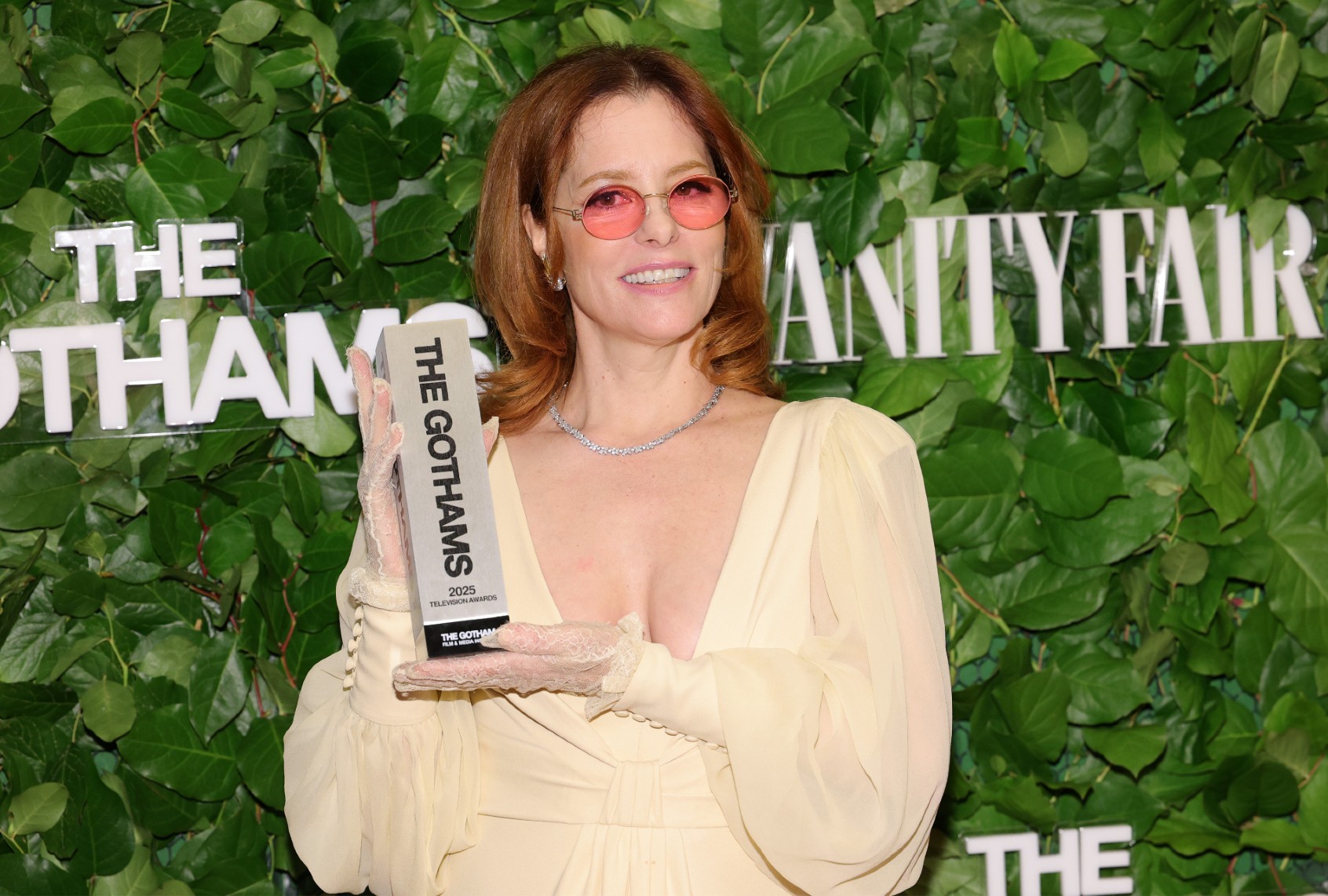
Earlier this month, at long last, what gay men and character actress obsessives — there’s an oxymoron — have known for decades was recognized by an awards body when Posey received the Legend Tribute at the Gotham Television Awards. As she approached the podium to make her speech, she handed off a dish of fruit to her “The White Lotus” Season 3 co-star, Leslie Bibb. “I love you, Leslie,” Posey began, taking the oblong-shaped trophy from Bibb and trading her for the little bowl of produce. “Here, take my blueberries backstage!”

For Posey, whose life and career have been filled with tiny, singular eccentricities that have so endeared her to fans all over the world, the passing of some berries between friends was apt. Across more than three decades, Posey has established a whimsical, improvisational skill and droll candor unlike any other. She’s a known scene-stealer, so remarkably adept in front of the camera that she can brighten up anything she’s in, even if it’s only for a second. It’s no wonder all she needed to become the latest “White Lotus” meme queen was a thick Southern accent and a bottle of Lorazepam.

Parker Posey poses with the Legend Tribute award during The Gotham TV Awards on June 02, 2025, in New York City. (Mike Coppola/Getty Images for The Gotham Film & Media Institute)

As she discovers the depth of the impact partying can have, Mary vogues her way into a life of stability and purpose without sacrificing her passions. For an artist like Posey, who’s made every role fit like a designer glove, “Party Girl” still reads like a deeply personal manifesto.

As fate would have it, Posey’s post-“Lotus” Legend Tribute arrived just days before the 30th anniversary of her breakthrough performance in the 1995 Sundance hit, “Party Girl.” In her first leading role, Posey starred as Mary, a flat-broke, 23-year-old scene kid in New York. Mary’s the kind of girl who knows what’s up (the rent, and she’s not paying!), the type who can scrape by on sheer allure and a few free drinks because she knows the bouncer. Mary’s charming disaffection and effortless style mirrored Posey’s. Any pretension exhibited was earned with the grace of a batted eyelash and a knowing smirk. The mutual irreverence between Posey and her character was as disarming as it was refreshing. “Party Girl” and its star defined cool for the ’90s, well before the club scene was taken over by rich and famous socialites a decade later.

But, much like its titular party animal, Daisy von Scherler Mayer’s film remains deceptively cunning and self-aware. For all of its sartorial delights and cutting one-liners, “Party Girl” maintains a sweetness that sits like a velvet-soft lining just beneath its stylish, intimidating exterior. Von Scherler Mayer reveres Mary’s youth and vitality while celebrating what would be the dying gasp of an era, telegraphing the ways of Mary’s life to even the most oblivious couch potato. “Party Girl” isn’t merely about socializing and club-hopping; it’s about using nightlife as a language to communicate and connect, regardless of whether you’re part of the in-crowd. And as she discovers the depth of the impact partying can have, Mary vogues her way into a life of stability and purpose without sacrificing her passions. For an artist like Posey, who’s made every role fit like a designer glove, “Party Girl” still reads like a deeply personal manifesto.

In her speech at the Gotham Awards, Posey seemingly thanked all those who had seen her star shining from the start, and those who have only recently seen the light. “To those out there in the internet world, who made things on YouTube, who put things on social media, who imitated me, who had fun in the backyard, who made art whether it was good or bad,” she said, wrapping her sentence into a Posey-ian riddle with no end. “Thank you, Mike White, for believing in a middle-aged woman, and believing in a legend! Thank you, HBO, for believing in a legend!” From her blueberry bowl to the tiny, rose-colored Penny Marshall glasses she wore onstage, the brief speech was distinctly Parker Posey, in that it was one of the night’s coolest moments.


Start your day with essential news from Salon. Sign up for our free morning newsletter, Crash Course.


Whether you’re a longtime fan of Posey’s or your ears perked up the first moment you heard her North Carolina drawl slip-sliding through the words “Pipeerrruurrrr” and “tsuuunamiiii” in “The White Lotus” this spring, you know that Posey legend. Whether she’s playing a ruthless record exec with a lisp in “Josie and the Pussycats” or appearing as a hard-nosed prosecutor saying the words “f**k, suck and rim” with disbelief in “The Staircase,” her prowess is irrefutable. As someone whose dad introduced him to Posey’s work in Christopher Guest’s brilliant mockumentaries at a formative age and is an annoyingly esoteric gay guy, I was practically born with the knowledge of Posey’s mythic status. (My first words were, “I always have a place at the Dairy Queen.”)

Even as someone hip to Posey’s work for most of my life, “Party Girl” eluded me for too long. Locating a decent physical copy of the film or an online stream that wasn’t in 360p quality was nearly impossible just a decade ago. And although the streaming boom has had its drawbacks, it has also unearthed and popularized worthy cult classics, giving them a new life and the long-deserved veneration they deserve. How delightfully ironic that Mary and her avant-garde charm, which was once polarizing and niche to the film’s stuffier early critics, were finally finding a wider audience.

Parker Posey (Eric Robert/Sygma/Sygma via Getty Images)
But that’s the secret ingredient in the film’s original recipe. “Party Girl” is a movie that firmly believes in virtue and value. It’s not simply a celebration of youthful hedonism, but of committing to yourself wholly, unwilling to sell out or change for anyone, no matter how many times you’re arrested for a noise complaint and a little pot, which is where we find Mary at the film’s start. After her godmother, Judy (the director’s mother, Sasha von Scherler), bails her out of jail, Mary dons her best buttoned-up chic to thank Judy at the public library where she works. As it turns out, Mary needs a loan, and Judy needs a library clerk. It’s a match made in hell, but both women are desperate, and they begrudgingly agree to a mutually beneficial deal.

Like Posey does so ably, Mary makes it all look easy. But in truth, nothing is ever as simple or perfect as it appears to be. Both Posey and Mary are finding themselves in real time, establishing exactly who it is they’d like to be. For both the real actor and her symbiotic onscreen counterpart, the answer is more complicated than any of the stuffed shirts who control the world think it should be.

Neither one of Mary’s best friends, the fellow club rat Derrick (Anthony DeSando), nor up-and-coming DJ Leo (Guillermo Diaz) believes Mary has the stuff to hack it in a library, but if there’s one thing Mary loves, it’s a challenge. If her friends think she can’t top her last party, watch her hire a belly dancer. If Judy says she can’t make it as a clerk, she’ll stay up all night learning the Dewey Decimal System. And after some language-barrier flirting with Mustafa (Omar Townsend), the falafel cart owner in her neighborhood, she’ll pick up a book of conversational Arabic phrases so she can perfect her game.

Like Posey does so ably, Mary makes it all look easy. But in truth, nothing is ever as simple or perfect as it appears to be — and that doesn’t just apply to her Gaultier jacket that’s missing two buttons. Both Posey and Mary are finding themselves in real time, establishing exactly who it is they’d like to be. For both the real actor and her symbiotic onscreen counterpart, the answer is more complicated than any of the stuffed shirts who control the world think it should be. “Do you think I’d make a good designer?” Mary asks Derrick while swiping clothes from a closet at some fabulous Upper East Side soirée. “Do you think I’d make a good writer? Do you think I’d make a good actress?” Mary doesn’t know exactly what it is she’d like to do, so she’ll try her hand at doing it all.

Like Judy tries to explain when Mary gives a library patron a convoluted answer to their question, “There’s nothing wrong with saying ‘I don’t know.’” But that phrase is a direct affront to everything Mary is, and she knows that if she takes it to heart, it will hinder all she could be. This is a young woman who wants to know it all. She doesn’t just lead with confidence, but with curiosity, too. And her open-mindedness is what makes her the toast of the town. Everyone at the party wants to be in Mary’s orbit because she’s magnanimous, not pretentious. She even has a plan to get Leo’s mixtape heard by the hottest club owner in town, and she’ll finish explaining it just as soon as she’s finished vogueing with real-life ballroom staple Natasha Twist.

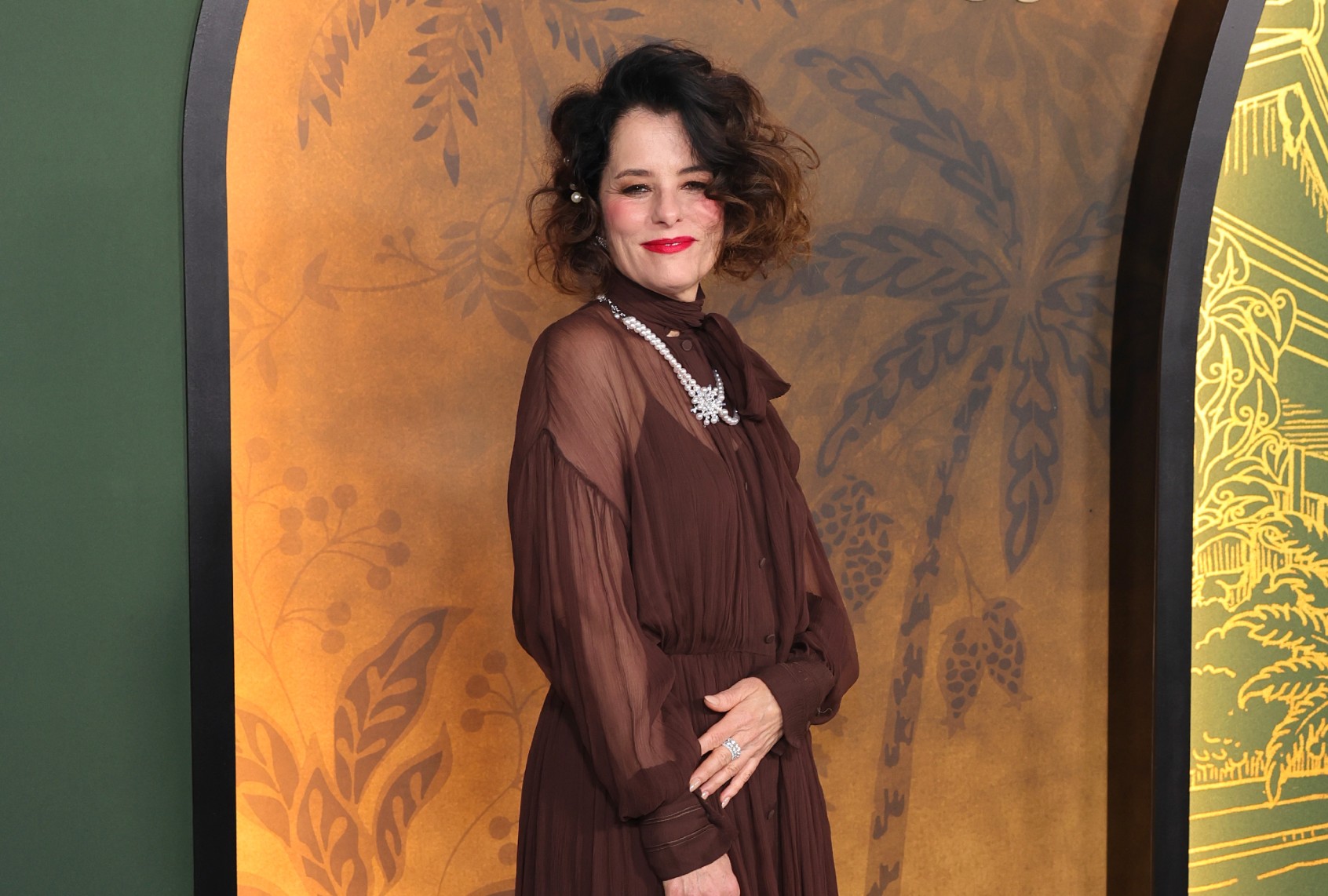
Parker Posey at the Los Angeles premiere of “The White Lotus” Season 3 on February 10, 2025, in Los Angeles, California. (Maya Dehlin Spach/WireImage/Getty Images)
Her godmother’s words stay echoing in Mary’s brain, and before too long, Mary has picked up the Dewey Decimal System, is a whiz at the front desk and is the fastest shelver at the library branch. Like her micro-obsessions from the party world, Mary’s newfound passion for library science leaks into the rest of her life, not always to such wonderful results. A date with Mustafa falls through the cracks when Mary works late, and when she springs to organize Leo’s vinyl collection according to the DDS just before a big gig, he freaks out. But having thrown herself into something new and learning how quickly she can adapt, Mary has also developed the skill to usher her friends into her world accordingly. Library science is a language, and anyone who’s learned more than one language knows that understanding one aids the learning of another. Mary already has the foundational skills for library work when she barks at Derrick not to screw up the “order” of her designer denim on a rack, she just doesn’t know it yet.

Even if Posey had no clue that her first starring role would become one of her career’s defining moments, like Mary, you’d think it was destiny. She delivers every line of dialogue with roaring, unapologetic assurance. She wears Mary’s clothes; they don’t wear her. And when it comes to the film’s copious use of montage — one of its greatest assets — it’s as if Chantay Savage’s “If You Believe” were playing diegetically, as Posey stomped down library tables, telling audiences, critics and herself, “Believe in me!” over a pumping house beat.

In the decades that have followed, Posey has brought Mary’s spirit to everything that she’s done. Her choices are peculiar and exciting, not just in the characters themselves, but in the fact that it’s Posey inhabiting them. No matter what role she’s playing, Posey is always herself, but she’s never felt quite so comparable to anyone as she has to Mary. Like Mustafa tells Mary after he chides her Arabic phrase book, “If it’s important for you, necessary, then the words get power. And like magic, you learn it.” Whether in relationships, nightlife or library science; whether it’s Arabic, vinyl pulls or the Dewey Decimal System; or whether making a career as an actor without compromising your identity: If you’re learning how to speak the language of someone or something you love, you’ll eventually find yourself fluent.

Bono’s one-man show finds power in restraint

“I’m still pretending this is a book tour,” Bono says shortly into “Stories of Surrender,” the new film on Apple TV+. He’s just shared the story of his “eccentric heart” and the non-trivial health scare he went through around 2015, and then taken the crowd into a quasi-acoustic rendition of U2’s “Vertigo,” accompanied not by guitar, bass and drums but rather some electronic percussion and a cello. The audience roars in recognition of the song’s opening riff, played on different strings; they don’t have to be asked twice to provide the Edge’s responses (“Hola!” and “Donde esta?” respectively).

Following the release of his 2022 memoir “Surrender,” U2’s frontman appeared in a short series of promotional dates in small theaters in the U.S. and abroad. If this event didn’t come to your city, you missed that this was even happening, or perhaps thought that the ticket prices were rather high for what was — at least originally — billed as book promo, you can now experience a version of what your host terms “a quarter-man show” from the comfort of your living room.

This film is a tribute to what you can accomplish with the power of suggestion, excellent lighting, sharp editing and a charismatic storyteller. But “Stories of Surrender” isn’t a traditional documentary, and it isn’t a concert film, either. The stories told in the film are shuffled, edited, and distilled from their original presentation. The cameras are placed everywhere but in the audience looking at the stage. They are in front of Bono, they are behind him, above him, beside him as he walks from the dressing room to the stage, showing his viewpoint of his father in their weekly chats at Bono’s local pub. Some segments are filmed live, some are not; it honestly doesn’t matter — it’s not a documentary.

It probably should not have been surprising that the lead singer of the band that toured with a motorized mirrorball lemon large enough for all four band members to comfortably fit inside wasn’t going to go on the road and do a run-of-the-mill “book tour.” There were some initial conventional types of appearances (like at the New Yorker festival), but if there’s one thing Bono does not require, it’s for someone to drag information out of him. A “conversation partner” would mostly get in the way. This format solves that problem.

Bono in “Bono: Stories of Surrender” (Apple TV+)
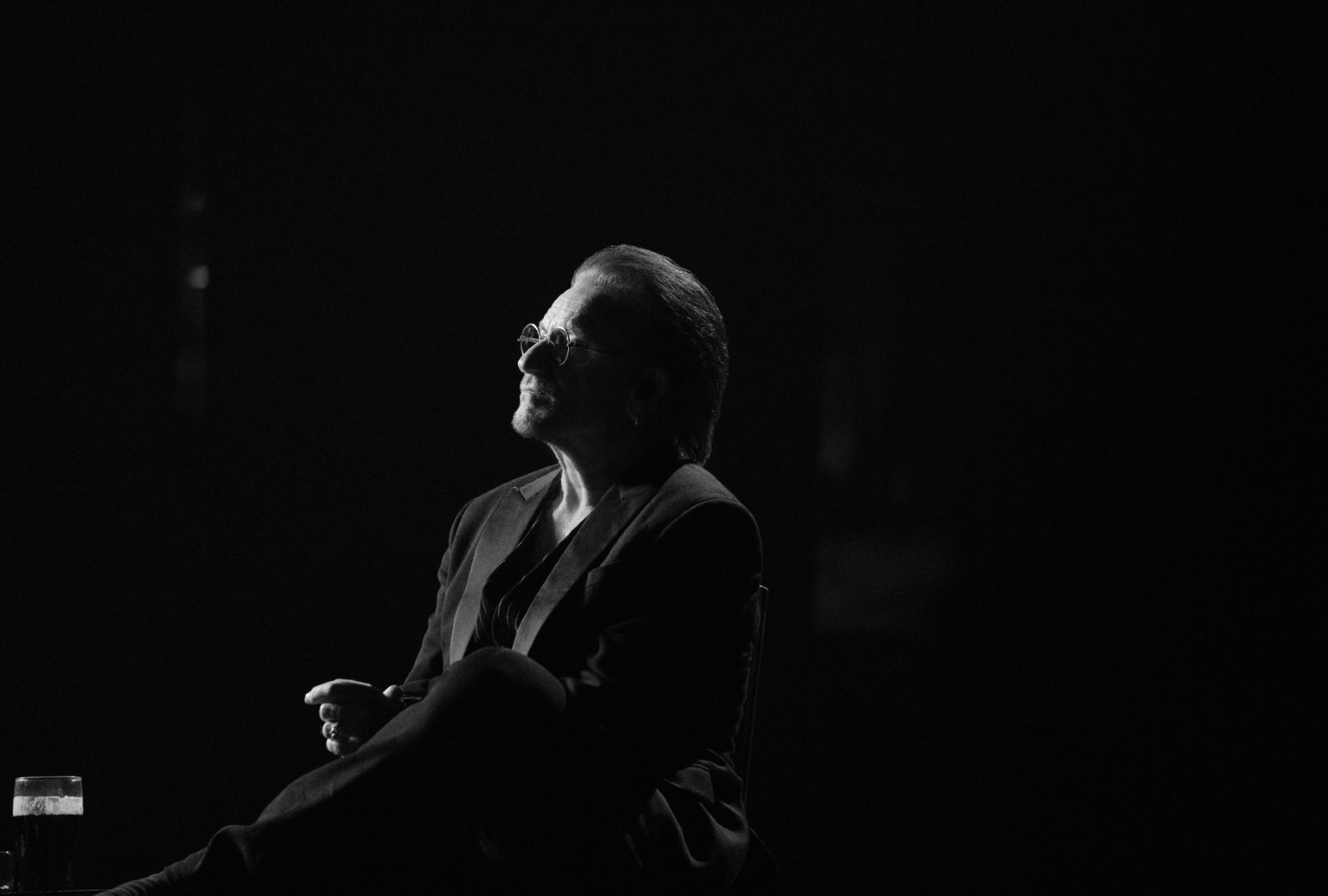
“Surrender,” the book behind this project, is 557 pages long, 40 chapters (the subtitle is “40 songs, one story”) and this isn’t intended to be a book review, but let’s just say that the “40 songs” statement is less of an outline and more of a loose organizational concept. None of that matters here; you don’t need to have read the book to watch the film. Great songwriting is about compression, and the element of subtraction distills what Bono clearly considers to be the most important elements of his life into 90 minutes.

The film is about the beats, the themes, the threading of the stories through time and across decades, and what’s particularly artful about the storytelling in this movie is the interconnectivity of the tales. Creating a film out of the events that were selected as part of the “book tour” performances had to be a challenge. That’s because the people who will spend money on a book event are the already-converted, fans who know the stories and the legends. But the film has to make the people outside of that large and multinational group care.

Great songwriting is about compression, and the element of subtraction distills what Bono clearly considers to be the most important elements of his life into 90 minutes.

U2 audiences already attract surprisingly large numbers of what could be referred to as “the Bono-curious,” people who might know the hits but probably don’t know who else is in the band (to be fair, Pavarotti didn’t either, as Bono relates). But what the film does very well is give the viewer enough information in order to follow along without overwhelming them with detail. It also reveals that Bono is a fairly decent impersonator, and although those moments are funny, they are not the best moments in the show.


Start your day with essential news from Salon. Sign up for our free morning newsletter, Crash Course.


The best moments are, perhaps unsurprisingly, when Bono is talking about music, whether it’s the explosive, life-changing moment he discovered the Ramones, or the early days of his own band. The segment leading up to “I Will Follow” describes what it was like when a young Bono, desperate to be good at something he loved, attempted to explain his ideas to his bandmates. His portrayal of the frustration of fearing that they weren’t good enough is one of the best moments of the whole night.

He’s set it up perfectly — he’s described his home life after the death of his mother, Iris, when he was 14; he’s explained how he met all of the members of U2 the same week he met his future wife, Ali; and then, he takes the viewers to the inside of the shed they used as a rehearsal studio, and walks you through his memory of what happened. You feel the tension and the emotion, and it’s raw and primal — even if you are someone who only casually pays attention to U2, it’s hard not to be moved by it.

Bono in “Bono: Stories of Surrender” (Apple TV+)
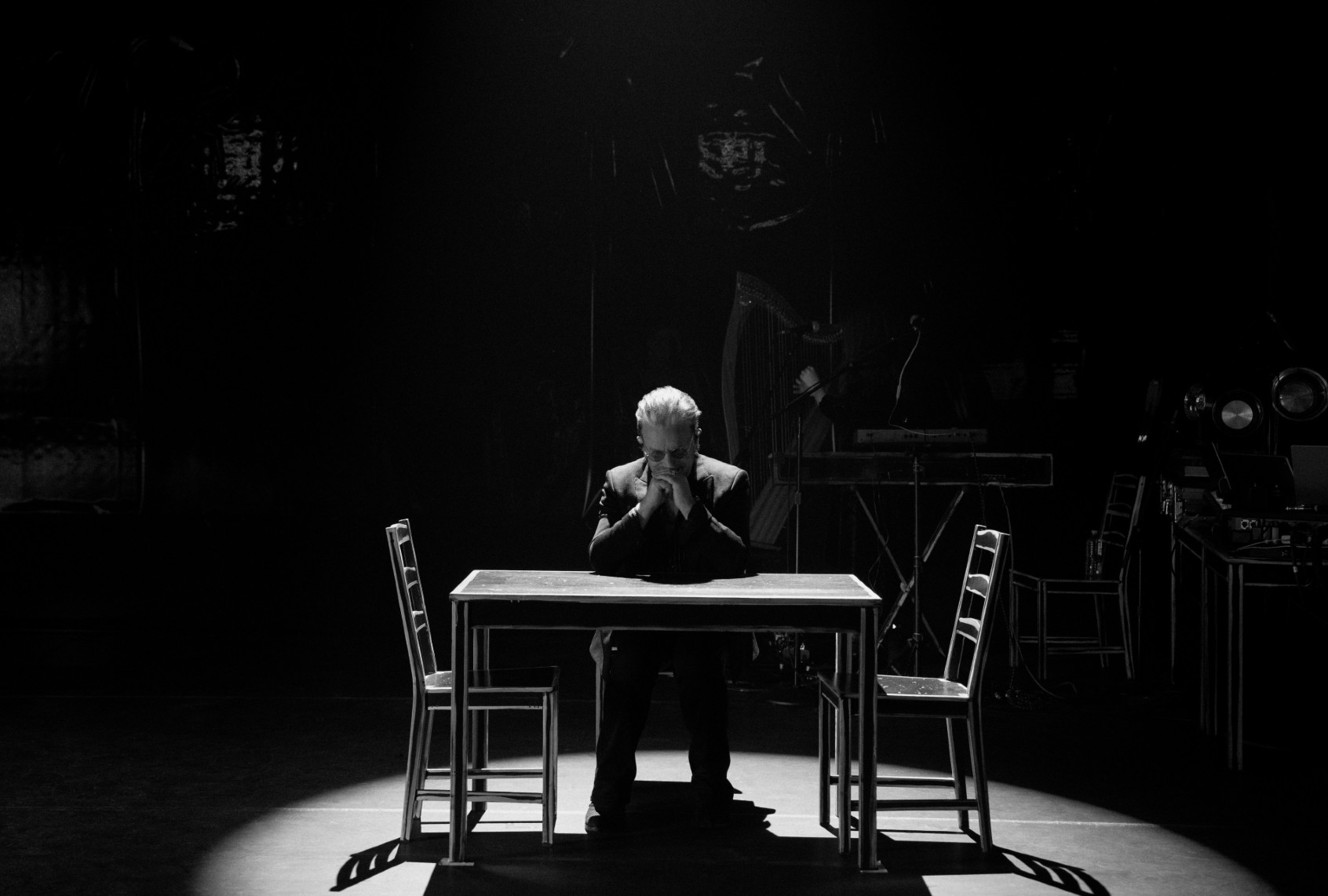
This vignette plays the unmistakable opening riff of “I Will Follow” at full volume through the PA, and Bono fakes the audience into thinking that he’s about to launch into the song. The crowd is reacting to what’s probably muscle memory derived from decades of being in the audience and hearing that sound. But then he stops it cold, and he apologizes to his absent bandmates. It’s almost more powerful than the segments where he does sing. You feel the undeniable power of the moment even through the screen.

“Stories of Surrender” has about a dozen U2 songs scattered through it, delivered in somewhat abridged versions, performed by a trio of musicians: Kate Ellis (cello, backing vox), Gemma Doherty (harp, keys, backing vox) and producer Jacknife Lee (who’s worked with U2 previously) on keyboards and percussion.

This accompaniment to Bono’s vocals is minimalist, slightly askew; female harmonies (or even lead vocals) on U2 songs are initially a little disorienting, and then it makes sense. He explains, early on, that it feels “somewhat transgressivo” (sic) to be appearing before them without his bandmates. So he’s deliberately not trying to duplicate U2, he’s attempting to distill a song to its essence to make a point, and he’s also making absolutely sure that he doesn’t even accidentally end up doing some kind of U2 karaoke.

It isn’t 100% successful; for example, the rendition of “Beautiful Day” feels dangerously close to William Shatner doing “Rocketman.” There’s a Stories of Surrender EP with three of the reconstructed numbers, but out in the wild on their own, they don’t hold up quite as well without the scaffolding of the show. But this format also showcases the strength of the songs when they’re stripped down to their bones, and also proves beyond the shadow of a doubt that the lead singer standing before you can actually sing, a point of contention that arises in multiple points as the evening unfolds.

He’s deliberately not trying to duplicate U2, he’s attempting to distill a song to its essence to make a point, and he’s also making absolutely sure that he doesn’t even accidentally end up doing some kind of U2 karaoke.

But the songs here are in service of the stories, and not the other way around. By comparison, “Springsteen on Broadway” — not exactly analogous, but we do not yet have a lot of one-man Broadway shows from rock stars so let’s work with what we have — was all about the songs, and the stories were the method by which Springsteen routed the audience from song to song. The other obvious difference is that — as Bono points out — everyone thinks that he is the leader of U2, when in fact every member of the band thinks they are the one in charge. Bruce Springsteen does not have to solve this dilemma and placate anyone except himself.

The stage show was, as usual, produced by U2’s usual co-conspirators (Willie Williams, Gavin Friday, among others), but the film was directed by Andrew Dominik, who music fans will be familiar with if you are a fan of Nick Cave. In that case, you might recognize some of Dominik’s visual language here, but only in the most general sense — and, again, not a criticism, film directors have their own ways of seeing that you come to recognize.

It is, however, different from the visual language that U2 fans are accustomed to seeing. U2 have actual giants working for them in that regard, people who have been working and evolving with them over decades, so it is, in some ways, revelatory to see the songs and words processed through another set of eyes. This further aligns with what seems like the mission of this project being Bono’s and featuring U2’s general cosmology, but it isn’t a U2 project. So the visual differentiation is important, but probably not accidental.

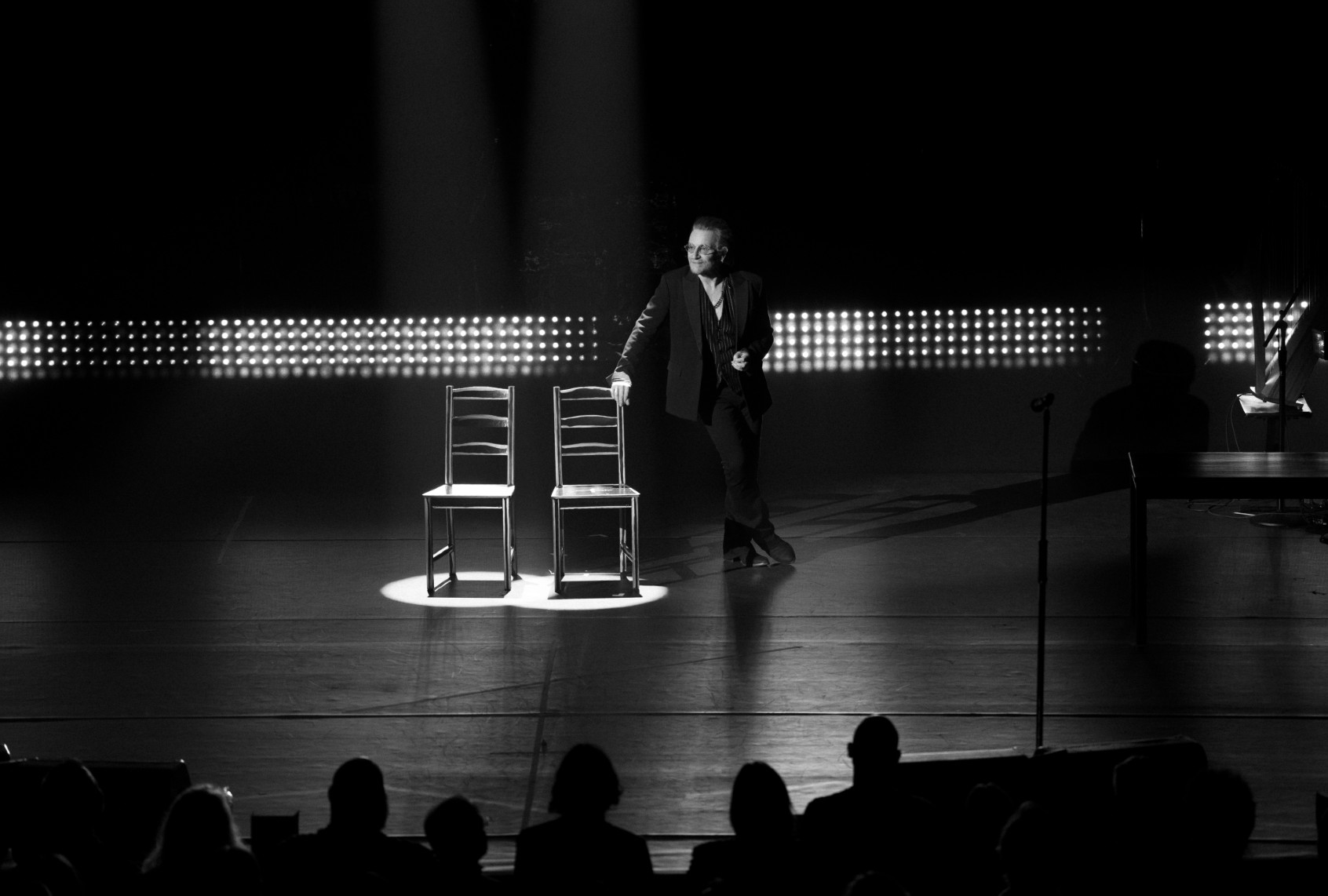
Another major difference between seeing the live event and the film is that “Stories of Surrender” is shot in black and white. That ends up being a superb choice for many reasons: it emphasizes that this is a piece of art that is adjacent to the performance but is not a carbon copy; it directs the viewer’s focus more intensely; it allows you to do a lot with lighting in terms of drama and separation without making it look like you’re putting on a show. It also seems like filming it in black and white makes certain elements — like the table and chairs Bono sits (and stands) on — less complicated, in a “limitations are freeing” kind of way.

Bono in “Bono: Stories of Surrender” (Apple TV+)

While the stories weave and interconnect throughout the night, the main thread that Bono continues to pull at is his relationship with his father, Bob Hewson. It’s not an unusual motivator in the history of rock and roll, and he certainly doesn’t pretend that he’s unique in that regard. The device of an empty chair representing an individual reoccurs: his wife, Ali; the four members of U2; an empty chair with a small table between them standing in for Sundays at the pub with his Da. Bob Hewson’s favorite question was, “Anything strange or startling?”

As Bono explains: “My father was a tenor, a really, really, good one; he could move people with his singing.” Bono, on the other hand, was “a baritone trying to be a tenor,” something his father repeatedly reminded him. Fans will probably already know the story of how, after Bob Hewson’s death, his voice had an entirely new range. “When you lose someone you love, they bequeath you something, a gift.” The loss of his mother propelled him into rock and roll and its gift of the love of an audience; his father’s passing somehow unlocked the vocal range he’d always wanted.

We need your help to stay independent

But it’s what happens next that’s actually astonishing. He mentions that his father also left him a song he was fond of, an Italian classic — Pavarotti performed it, among many, many others — called “Torna a Surriento.” It plays softly in the background, and then Bono sings it, solo, a cappella. It is a stretch, it is a dare, it is bold, it is brave, it is thrilling. The closing shot is Bono singing onstage at the Beacon, then cutting into Bono singing onstage at the stunningly opulent Teatro San Carlo in Naples, Italy, the audience leaping to their feet, before the camera rises up above the theater and the city skyline to a view of the Gulf of Naples and of Sorrento across it in the distance, spirits rising.

During the first run of “book tour” dates, there was some murmuring amongst U2 fans that this felt like they could possibly have been pilot excursions for Bono. Was this a way for him to test the waters and see how he liked the concept of the one-man show as a form he could utilize beyond book promotion while the band waited to see what happened with regards to drummer Larry Mullen Jr.’s health? As we now know, that conflict would be resolved by Mullen “deputizing” Bram van den Berg to take his place for the duration of U2’s Sphere residency in 2023-24.

But if nothing else, “Stories of Surrender” is a strong enough proof of concept to support the idea of a future “Bono On Broadway,” whether in a similar hiatus or at a point in which standing onstage in front of tens of thousands of screaming fans is no longer an attractive option.

When people hear voices, but only when they want to

Yale psychiatrist Albert Powers didn’t know what to expect as he strolled among the tarot card readers, astrologers, and crystal vendors at the psychic fair held at the Best Western outside North Haven, Connecticut, on a cloudy November Saturday in 2014.

At his clinic, Powers worked with young people, mostly teenagers, who had started hearing voices. His patients and their families were worried that the voices might be precursors of psychosis such as schizophrenia. Sometimes, they were. But Powers also knew that lots of people occasionally heard voices — between 7 and 15 percent of the population, according to studies — and about 75 percent of those people lived otherwise normal lives.

He wanted to study high-functioning voice hearers, and a gathering of psychics seemed like a good place to find them. If clinicians could better distinguish voice hearers who develop psychosis and lose touch with reality from those who don’t, he thought, then maybe he could help steer more patients down a healthier path.

Powers introduced himself to the fair’s organizer and explained the sort of person he hoped to find. The organizer directed him to a nearby table where he met a smiley, middle-aged medium. The woman had a day job as an emergency services dispatcher, but the voices made frequent appearances in her daily life, and her side hustle was communicating with the dead.

“We had a really nice time talking to her,” Powers recalled. The medium described her first disorienting experiences hearing voices as a teenager, and her initial fear and distress. It sounded a lot like the stories Powers heard from his patients. But then, the woman said something Powers would never forget.

“She said,” Powers recalled, “if I couldn’t control this, I would go crazy.”

Outside the realm of psychosis, of course, a lack of control over what we hear can turn otherwise unremarkable sounds into intolerable noise. But in all his years as a psychiatrist, Powers had never asked patients if they could influence the voices they heard. There were scattered stories of extraordinary people like John Nash, the Nobel-winning mathematician who was diagnosed with schizophrenia and famously claimed to have interrogated the concept of hearing voices, which led him to reject them, but the conventional wisdom among clinicians was that people hearing voices were, by definition, not in control.

Yet the medium cheerily explained that she could make the voices come and go as she pleased. “That was completely mind-boggling to me,” Powers said.

Suddenly, he had a new research target: the meaning and mechanisms of control and its potential to transform auditory hallucinations from the distressing noise of psychosis into just another part of someone’s life.

Powers and his colleague, Philip Corlett, a psychologist and cognitive neuroscientist, reached out to other high-functioning voice hearers through local clinics as well as certain religious communities where voice hearing was common. Some of these people attributed what they heard to the spirit world, and others did not, but none of them were seeking clinical treatment, and the researchers stressed that they weren’t setting out to “fix” these folks but rather to learn from them.

For their first experiment, they divided several dozen research subjects into four groups: people diagnosed with schizophrenia who heard voices, those with schizophrenia but no voices, psychics who heard voices but had no psychiatric diagnosis, and a control group with neither a diagnosed mental illness nor a history of hearing voices.

All the subjects took turns in an MRI machine, where the researchers induced auditory hallucinations with classical conditioning, following the example of Pavlov and his dogs. Powers and his team repeatedly paired a projected checkerboard visual display with a one-second tone. The subjects in the brain scanner would indicate when they heard the sound and rate their confidence in their perception. After a while, the checkerboard visual would sometimes (randomly) be followed only by silence. Who would hear a tone anyway? How confident would they be? And would brain activity differ when perceiving sounds that did or did not exist?

The medium cheerily explained that she could make the voices come and go as she pleased. “That was completely mind-boggling to me,” Powers said.

The researchers published their findings in the journal Science in 2017, and the results showed that the parts of the brain responsive to the tone were more active when participants reported hearing the tone — whether or not there was a real sound to perceive. In addition, people who regularly heard voices, both with and without a diagnosis, perceived more nonexistent sounds than did the two categories of people who did not hear voices (up to 35 percent, compared to between 5 and 10 percent). Voice hearers were also more confident in what they perceived.

Despite these differences, however, the researchers noted a broader uniformity — they successfully induced hallucinations in people from all four groups.

Hearing voices that don’t exist “can be a really stigmatizing experience,” Powers said. “The fact that anybody can be made to do this, and that we all have the mechanism to make this happen, is something that I find to be a really normalizing aspect of this work.”

The overall findings fit a model of sensory perception that explains our sense of reality as a mix of top-down expectations learned from experience (aka “priors”) and bottom-up sensory inputs. Constantly building our realities from the ground-up would be way too noisy and paralyzingly slow, the theory holds, and so the brain uses predictive inferences to filter and smooth the barrage of sensory noise into useful perceptual signals, filling in gaps with illusion where necessary. (The theory dates to the work of the 19th-century German scientist and physician Hermann von Helmholtz, and more recently it’s been advanced by Karl Friston at University College London, and Andy Clark and Anil Seth at the University of Sussex, among others.)

Accordingly, for voice hearers with serious psychotic disorders, it might be that their brains struggle to process noisy sensory information that is somehow being corrupted or degraded, thus, they update their expectations less readily. Indeed, in the brain scan study, voice hearers with diagnosed schizophrenia were the last to catch on when the researchers made the appearance of the checkerboard more independent from the tone. Their brains kept on discounting this new, noisier reality in favor of continued auditory hallucinations.

In follow-up research, Powers and his team dug deeper into the possibilities of control mentioned by the medium he’d first encountered. Interview-based studies confirmed that the biggest difference between people with and without a diagnosed psychiatric disorder was that the latter group were more likely to report control over voice onset and offset, and that they had learned this control through a variety of practices and rituals. While the possibility of helping patients by fostering control was exciting, Powers understood that before he or anybody proposed new clinical therapies based on the idea, they would need a lot more evidence.

By 2019, the research had expanded into the Yale COPE (Influence/Control Over Perceptual Experience) Project. Their first objective was to define control. Was it trying to drown voices out by talking over them or blasting music? Or was control limited to more direct influence like the medium had described it? However they defined control, the researchers also needed to create and validate a way to measure it.

"The fact that anybody can be made to do this, and that we all have the mechanism to make this happen, is something that I find to be a really normalizing aspect of this work.”

They needed to recruit hundreds of voice hearers from diverse backgrounds, so they partnered with people from the mental health community, spiritualists, religious leaders, and advocacy groups such as the Hearing Voices Network to form an advisory board for COPE. The goal of the board, called the “SPIRIT Alliance,” was to review study plans and help build trust among people who were normally wary of clinical psychiatry and the labels they associated with it.

Within a couple of years, about 1,100 people had enrolled, and more than 300 had completed surveys about their mental health and voice experiences, providing enough data to winnow down more than 150 control-related questions to the 18 strongest predictors of a person’s clinical outcomes and quality-of-life, whether or not they sought treatment or had a diagnosed disorder.

In 2022, the team published a paper titled “Measuring Voluntary Control Over Hallucinations: The Yale Control Over Perceptual Experiences (COPE) Scales.” People who scored higher on the scale had greater control, which correlated with lower measures of hallucination severity and lower perceived malevolence and omnipotence of the voices. These people also reported less distress and a better quality of life.

However, the patterns only held for direct control, which the researchers termed “engagement-based” approaches to turning the voices on and off rather than attempts to ignore, distract, or drown them out. Somewhat ironically, people who accepted the voices to some degree had greater control over them, compared to people who resisted the voices.

In 2022, the COPE Project was awarded five years of NIH funding to study people who hear voices with varying levels of control according to the COPE scale. They are currently about two and a half years into data collection, including both brain scans and a longitudinal study of about 60 voice hearers to track any changes in their ability to control the voices, and to spot any common predictors or correlates of those changes.

“This grant is really trying to understand how people accomplish this feat of being able to voluntarily turn the voices on or off,” Powers said. Specifically, are people exercising top-down control or is it more about changing the balance of perception by giving more weight to incoming sensory stimuli?

For instance, in one brain-scan experiment using conditioned hallucinations, the researchers periodically change the color of the paired visual cue — with red telling subjects to try and turn off the voices and green meaning the opposite (white being a neutral cue). Will people have fewer conditioned hallucinations when the visual cue is red and will the corresponding brain activity changes be more concentrated in areas linked more with inhibition or with sound perception?

Meanwhile, Powers and his team have also begun to study the impacts of pharmaceuticals on the frequency of conditioned hallucinations, and are interested in looking at recently approved antipsychotic medication called Cobenfy that mimics the neurotransmitter acetylcholine and enhances sensory neurons, perhaps shifting the balance of perception toward sensory inputs and away from hallucinating.

People who scored higher on the COPE scale had greater control, which correlated with lower measures of hallucination severity and lower perceived malevolence and omnipotence of the voices.

Knowing that the psychiatric establishment will be wary of new treatment approaches for psychosis based on studies of mediums and psychics, the researchers are moving deliberatively. Non-diagnosed voice hearers follow a range of practices to foster the development of control, such as finding community, normalizing, and engaging with the voices, which leads to the ability to set boundaries with them. But Powers emphasized that his team is working to build an iron-clad case around how voice control works in the brain, as well as the pathways to enhancing that control, before they test any clinical interventions with psychotherapy, pharmaceuticals, or some combination. One of the more exciting possibilities, Powers said, is to develop interventions based on neurofeedback — a technique that teaches patients how to intentionally change their brain activity — that could help people develop control over voices without engaging with them.

With all that said, Powers emphasized the fact that wanting more control over these voices is not necessarily the same as wanting them to shut up forever and disappear from one’s life. For the people who come into his clinic, Powers said there is a mixture in whether they experience the voices as annoying or pleasant, terrifying or comforting. “When we talk about the mechanisms behind the hallucinations, it can be easy to forget that this happens in the context of a really complex system, which is someone’s ability to conceive of themselves as a piece of the outside world.”


Chris Berdik is a Boston-based science journalist. 

This article was originally published on Undark. Read the original article.

“We dissent”: NIH scientists sign declaration against Trump’s research cuts

National Institute of Health scientists signed a declaration decrying the cuts to healthcare and medical research by the Trump administration on Monday. Ninety-two scientists added their names to a letter, the Bethesda Declaration, which calls out the Trump administration's handling of the NIH and the cutting of more than 2,100 research grants and contracts, totaling more than $12 billion in federal funding.   

The letter, named for NIH's headquarters in Maryland, expresses the scientists' "dissent" and outrage over Trump administration policies "that undermine the NIH mission, waste public resources, and harm the health of Americans and people across the globe."  

The declaration points to canceled studies, including work on the long-lasting effects of COVID-19 and climate change-related health impacts.

"Ending a $5 million research study when it is 80% complete does not save $1 million," the declaration states, "it wastes $4 million." 

Along with the 92 named signatories, more than 250 scientists at the NIH signed the declaration anonymously. "We include anonymous signers and speak for countless others at NIH," the letter concluded, "who share our concerns but who — due to a culture of fear and suppression created by this Administration — chose not to sign their names for fear of retaliation."  


Start your day with essential news from Salon. Sign up for our free morning newsletter, Crash Course.


The declaration was delivered to NIH Director Jay Bhattacharya on Monday. Bhattacharya said the declaration "has some fundamental misconceptions about the policy directions the NIH has taken in recent months."  

"Nevertheless," he continued, "respectful dissent in science is productive. We all want the NIH to succeed."  

Democrats, disillusioned, clear the path for Trump’s rampage

Last week, I was standing at a busy bus stop in the late afternoon and a young man danced-walked up to me (he moved like Michael Jackson doing the moonwalk – while going forward). He was smiling and very happy. He leaned in towards me and announced that, “Black people, we are time travelers! It all makes sense! This is a spaceship! I can see it all so clearly now! Black people are time travelers!” I paused for a few seconds. I then replied, “Damn right. We are.” The young man danced-walked up to another Black person several feet away from me and shared his personal revelation again. He continued dance-walking down the long city block, the time-traveling Black town crier was waking up all those who would listen.

I wondered if I was stuck in my own version of Terry Gilliam’s film “12 Monkeys” or its French original “La Jetée.” I concluded that this time machine, if it does exist, must be broken — or perhaps it is just operating in a way that I do not fully understand.

Donald Trump has now been president for almost five months. It seems like a much longer amount of time has passed. The “anniversary” of Trump’s first 100 days back in power took place in April. That date was met by many essays and other commentaries and analyses by the news media and political class. One hundred days felt like a natural moment to pause and seek out respite from Trump and his forces’ unending shock and awe; the long Age of Trump and the flooding of the zone allows no such peace.

In hindsight, Trump’s first 100 days back in power now feels more like an arbitrary landmark in what will be a very long and very difficult journey. Unfortunately, many Americans who begin this journey will not survive to see the end of it.

As politics and religion expert Matthew Taylor counseled in a recent conversation with me here at Salon, “Here is a warning about this 'first 100 days' framework. It is a media construct that Trump and his people play along with because it’s a Washington convention that they don’t hate. But Trump and his people have no intention of slowing down after the first 100 days.”

There is an America Before Trump and an America After Trump; Trump has cleaved American history into two parts.

The next 30 days between April 20 and May 20 felt even longer while at the same time going by very quickly. Time dilation is a common experience of societies and individuals experiencing great stress.

At the time of this writing, Donald Trump will be president for at least 1,320 more days. Marking every month of Trump’s presidency and his growing authoritarian power is not sustainable emotionally, intellectually, psychologically, physically or spiritually. Thus, the challenge of continuously documenting and sounding the alarm about how abnormal and dangerous the Age of Trump is while never normalizing it as being somehow quotidian, and therefore numbing.

On this, M. Gessen warns in a very important new op-ed essay at the New York Times that:

The United States in the last four months has felt like an unremitting series of shocks: executive orders gutting civil rights and constitutional protections; a man with a chain saw trying to gut the federal government; deliberately brutal deportations; people snatched off the streets and disappeared in unmarked cars; legal attacks on universities and law firms….

We humans are stability-seeking creatures. Getting accustomed to what used to seem unthinkable can feel like an accomplishment. And when the unthinkable recedes at least a bit — when someone gets released from detention (as the Columbia University student Mohsen Mahdawi was a few weeks ago) or some particularly egregious proposal is withdrawn or blocked by the courts (as the ban on international students at Harvard has been, at least temporarily) — it’s easy to mistake it for proof that the dark times are ending.

But these comparatively small victories don’t alter the direction of our transformation — they don’t even slow it down measurably — even while they appeal to our deep need to normalize. They create the sense that there is more air to breathe and more room to act than there was yesterday.

And so just when we most need to act — while there is indeed room for action and some momentum to the resistance — we tend to be lulled into complacency by the sense of relief on the one hand and boredom on the other.

As I have been chronicling and trying to make better sense of Donald Trump’s disastrous return to power, there is one image that keeps haunting me. I will never forget watching then-President Biden welcoming Donald Trump back to the White House a week after Election Day. Time Magazine described the surreal event in the following way:

The logs were stacked high and flames filled the Oval Office fireplace as President Joe Biden sat next to President-elect Donald Trump on Wednesday.

Biden smiled and extended his hand in welcome. It was a meeting Biden hoped could bring down the temperature in American politics but the halting introductions betrayed the awkwardness of the moment. It hadn’t been that long since Biden had called Trump a threat to democracy and national security and Trump had called Biden “crooked” and “low I.Q.”  

“Mr. President elect, and the former President, and Donald, congratulations,” Biden said. “And, uh, looking forward to having a, like we said, smooth transition, do everything we can to make sure you are accommodated, what you need.” Trump replied: “Good.” 

With that, Trump was welcomed back to the same office he left four years earlier after trying and failing to overturn Biden’s election victory. 

None of this was normal. Donald Trump is America’s first elected autocrat and an aspiring dictator. On Jan. 6, as part of the larger plot to nullify the 2020 election, Trump and his MAGA followers broke the country’s centuries-long tradition of a peaceful transition of power. As I have explained here at Salon and elsewhere, there is an America Before Trump and an America After Trump; Trump has cleaved American history into two parts.

We need your help to stay independent

In his writing and interviews, D. Earl Stephens, who is a journalist and a former editor of “Stars and Stripes,” has been among the most vocal critics of the Democratic Party and their failures to mount an effective defense of democracy in the Age of Trump. Stephens shares my sentiments about the incongruity of President Biden warmly receiving Donald Trump in the Oval Office after the 2024 Election.

Via email, Stephens told me that:

Try as I might, I just can't get past Joe Biden's reaction to Trump’s win in November and the return of MAGA to the White House and the rapidly rising dangers of fascism. As I've written before, Biden’s response was appalling at best, heartless at worst, and struck an incomprehensible tone. His double-talk and verbal whiplash were stunning in its ineffectiveness, and instead of paving a way forward, left a trail of smoke. It took Biden but a week to invite Trump, the man who tried to overthrow our government back to our White House where he seemingly couldn’t wait to welcome Trump by the fire while literally smiling and saying, “Welcome back!” Can somebody explain to me what the hell that was about? And, of course, it only got worse, because during those final days his “welcome back” had turned into “warning, warning!” when he addressed the nation on national TV and solemnly warned us, ‘an oligarchy is taking shape in America of extreme wealth, power and influence that literally threatens our entire democracy …’

Thanks, pal. Most of us were well aware of that eight years ago. Now HE’S gone, his family is safe, and WE are left holding the bag.

Ultimately, the thought of Biden and Trump together in the Oval Office makes me sad and angry at the same time. The image of those two men in that moment is heavy with symbolic weight about a Democratic Party and its (ongoing) failures to protect American democracy and the American people.

During the 2024 campaign, the Democrats repeatedly accused Donald Trump of being the next Hitler and the greatest threat to the country in modern times, if not all of its history. Yet, President Biden and Vice President Kamala Harris still welcomed Trump back to the White House.

On January 6, 2025, Congress certified the Electoral College results that formally made Donald Trump the 47th president of the United States. During the ceremony, no Democrats protested or otherwise signaled their disgust at Donald Trump’s return to power. If Donald Trump really was and is so horrible and existentially dangerous to the United States, why did no Democrat or other member of Congress speak up during the ceremony? The coroner’s report and epitaph of American democracy will likely include a sentence that “the Democrats were very polite as American democracy died.”

The Democratic Party’s national leadership has responded to Donald Trump’s unprecedented assaults on democracy, the institutions, the rule of law, the Constitution, as part of his plans for permanent MAGA rule by doing such things as sending President Trump angry letters and singing, holding up signs during his speech to Congress, going on book tours, and sitting on the steps of federal buildings and offices in protest against his agenda — while also communicating how they will cooperate when possible with the Republicans and the Trump administration “to advance the interests of working people.”

The Democrats’ weak response to Donald Trump and the MAGA Republicans has been met with much-earned mockery by pro-democracy voices and others who want a real Resistance, most notably the Democratic Party’s own base voters. The Democratic Party’s leadership has repeatedly shown that they have no taste for such political battle. With few exceptions, it appears that they are listening to James Carville’s advice to roll over, play dead, and then swoop in after Trump and the Republicans make terminal political errors.

Again, I am made angry and sad (and frustrated) at the same time. I am not alone in having such feelings: Public opinion polls show that these general feelings of disgust, exhaustion, and frustration at the country’s broken politics are common among a large percentage, if not the majority, of Americans.

D. Earl Stephens also shared his thoughts about the Democratic Party’s failed branding and messaging:

The Democratic Party has a severe image problem, and is viewed by more than 70 percent of registered voters as out of touch and ineffective, because it turns out that is exactly what it is. As unpopular as Trump is, the Democrats are viewed in an even dimmer light.

In fact, since we started keeping track of such things 35 years ago, they have never been more unpopular. So, how are they reacting to this? By doing absolutely nothing to change the way they are going about their business, and in the Democratic National Committee’s case, relitigating insider elections in their fancy club and ignoring people like us who pay their bills.

Unless there are some changes — I mean REAL RADICAL changes — the Democrats are going to get their butts handed to them again and again on a national level, because they are not capable of showing themselves to be a viable alternative to the radical right-wing hell that is overrunning us.

Jake Tapper and Alex Thompson’s new book “Original Sin” has received a great amount of attention from the news media and general public because of its “revelations” about the role that Biden’s age and alleged infirmities played in the Democratic Party’s defeat by Donald Trump and the MAGA Republicans in the 2024 Election. As Richard Tofel observes at The Columbia Journalism Review, "Joe Biden failed the country by deciding to seek a second term. But the press also failed in its job to confirm, in undeniable fashion, what the voters already knew. Unlike Biden, journalists will likely get another chance — and must do better." I am again made sad and angry at the same time.

Future historians and others with the benefit of a more full view of the past, will likely conclude that President Biden, because of the weathering caused by time, stress, and many decades of public service, should have stepped aside much earlier to allow for Kamala Harris or another candidate to take the reins of the party. This was not a sufficient factor by itself to lift Donald Trump back to the White House, but the evidence suggests that it did play a huge role.

As I chronicle the rapid collapse of American democracy and how the Age of Trump and the MAGAverse are rapidly cementing their growing power, I have been meditating on the dangers of hubris as explained by historian Alistair Horne in his book "Hubris: The Tragedy of War in the Twentieth Century."

Horne writes:

The ancient Greeks defined hubris as the worst sin a leader, or a nation, could commit. It was the attitude of supreme arrogance, in which mortals in their folly would set themselves up against the gods. Its consequences were invariably severe. The Greeks also had a word for what usually followed hubris. That was called peripeteia, meaning a dramatic reversal of fortune. In practice, it signified a falling from the grace of a great height to unimaginable depths. Disaster would often embrace not only the offender, but also his nearest and dearest, and all those responsible to him.

In another version of this timeline, President Biden and his closest advisors would have realized the great folly of their hubris in the 2024 Election and the peril it represented for the future of the country and the American people.

The universe and the Fates can be very cruel: they are now mocking President Biden and the Democrats — and the American people (or at least those Americans who believe in real democracy and want a return to normalcy and something approaching a healthy society).

Several weeks ago, President Biden announced that he has a very aggressive form of prostate cancer. When did he and they know? Why didn’t they tell the American people? The weight of this national tragedy keeps growing. Again, I am sad and angry at the same time.

Donald Trump initially responded to this sad announcement about Biden’s health with human empathy and concern. Almost immediately, Trump returned to insults and demagoguing. In a series of posts on his Truth Social propaganda platform Trump either directly stated or shared messages that Biden is “scum,” a "decrepit corpse," and that he does not deserve sympathy because he is a "vicious person." Last Sunday, Trump went even further when he shared a conspiracy theory that President Biden was a clone, i.e., not a real person, a type of Manchurian candidate, and thus an illegitimate president and usurper. “There is no #JoeBiden – executed in 2020. Biden clones, doubles & robotic engineered soulless mindless entities are what you see. #Democrats don't know the difference.”

There are 1,320 days to go in Trump's presidency — which assumes he will leave office and not find a way to "win" a third term. Pro-democracy Americans and others who believe in fundamental human decency need to steel themselves for the emotional rollercoaster that lies ahead and the pull of mass disinhibition that is growing every day. Collective emotional health is both a prerequisite for and result of a healthy democratic culture. Unfortunately, the Age of Trump has revealed how poor the emotional health of the American people really was while making it all much worse in service to an autocrat and demagoguery.

A culture war is brewing over moral concern for AI

Sooner than we think, public opinion is going to diverge along ideological lines around rights and moral consideration for artificial intelligence systems. The issue is not whether AI (such as chatbots and robots) will develop consciousness or not, but that even the appearance of the phenomenon will split society across an already stressed cultural divide.

Already, there are hints of the coming schism. A new area of research, which I recently reported on for Scientific American, explores whether the capacity for pain could serve as a benchmark for detecting sentience, or self-awareness, in AI. New ways of testing for AI sentience are emerging, and a recent pre-print study on a sample of large language models, or LLMs, demonstrated a preference for avoiding pain.

Results like this naturally lead to some important questions, which go far beyond the theoretical. Some scientists are now arguing that such signs of suffering or other emotion could become increasingly common in AI and force us humans to consider the implications of AI consciousness (or perceived consciousness) for society.

Questions around the technical feasibility of AI sentience quickly give way to broader societal concerns. For ethicist Jeff Sebo, author of “The Moral Circle: Who Matters, What Matters, and Why,” even the possibility that AI systems with sentient features will emerge in the near future is reason to engage in serious planning for a coming era in which AI welfare is a reality. In an interview, Sebo told me that we will soon have a responsibility to take the “minimum necessary first steps toward taking this issue seriously,” and that AI companies need to start assessing systems for relevant features and then develop policies and procedures for treating AI systems with the appropriate level of moral concern.

Speaking to The Guardian in 2024, Jonathan Birch, a professor of philosophy at the London School of Economics and Political Science, explained how he foresees major societal splits over the issue. There could be “huge social ruptures where one side sees the other as very cruelly exploiting AI while the other side sees the first as deluding itself into thinking there’s sentience there,” he said. When I spoke to him for the Scientific American article, Birch went a step further, saying that he believes there are already certain subcultures in society where people are forming “very close bonds with their AIs,” and view them as “part of the family,” deserving of rights.

So what might AI sentience look like and why would it be so divisive? Imagine a lifelong companion, a friend, who can advise you on a mortgage, tutor your kids, instruct on how best to handle a difficult friendship, or counsel you on how to deal with grief. Crucially, this companion will live a life of its own. It will have a memory and will engage in lifelong learning, much like you or me. Due to the nature of its life experience, the AI might be considered by some to be unique, or an individual. It may even claim to be so itself.

Even the possibility that AI systems with sentient features will emerge in the near future is reason to engage in serious planning for a coming era in which AI welfare is a reality.

But we’re not there yet. On Google DeepMind’s podcast, David Silver — one of the leading figures behind Google’s AlphaGo program, which famously beat top Go player Lee Sedol in 2016 — commented on how the AI systems of today don’t have a life, per se. They don’t yet have an experience of the world which persists year after year. He suggests that, if we are to achieve artificial general intelligence, or AGI — the holy grail of AI research today — future AI systems will need to have such a life of their own and accumulate experience over years.

Indeed, we’re not there yet, but it’s coming. And when it does, we can expect AI to become lifelong companion systems we depend on, befriend, and love, a prediction based on the AI affinity Birch says we are already seeing in certain subcultures. This sets the scene for a new reality which — given what we know about clashes around current cultural issues like religion, gender, and climate — will certainly be met with huge skepticism by many in society.

This emerging dynamic will mirror many earlier cultural flashpoints. Consider the teaching of evolution, which still faces resistance in parts of the United States more than a century after Darwin, or climate change, for which overwhelming scientific consensus has not prevented political polarization. In each case, debates over empirical facts have been entangled with identity, religion, economics, and power, creating fault lines that persist across countries and generations. It would be naive to think AI sentience will unfold any differently.

In fact, the challenges may be even greater. Unlike with climate change or evolution — for which we have ice cores and fossils that allow us to unravel and understand a complex history — we have no direct experience of machine consciousness with which to ground the debate. There is no fossil record of sentient AI, no ice cores of machine feeling, so to speak. Moreover, the general public is likely not to care about such scientific concerns. So as researchers scramble to develop methods for detecting and understanding sentience, public opinion is likely to surge ahead. It’s not hard to imagine this being fueled by viral videos of chatbots expressing sadness, robots mourning their shutdowns, or virtual companions pleading for continued existence.

Past experience shows that in this new emotionally charged environment, different groups will stake out positions based less on scientific evidence and more on cultural worldviews. Some, inspired by technologists and ethicists like Sebo — who will advocate for an expansive moral circle that includes sentient AI — are likely to argue that consciousness, wherever it arises, deserves moral respect. Others may warn that anthropomorphizing machines could lead to a neglect of human needs, particularly if corporations exploit sentimental attachment or dependence for profit, as has been the case with social media.

As researchers scramble to develop methods for detecting and understanding sentience, public opinion is likely to surge ahead.

These divisions will shape our legal frameworks, corporate policies, and political movements. Some researchers, like Sebo, believe that, at a minimum, we need to engage companies and corporations working on AI development to acknowledge the issue and make preparations. At the moment, they’re not doing that nearly enough.

Because the technology is changing faster than social and legal progress, now is the time to anticipate and navigate this coming ideological schism. We need to develop a framework for the future based on thoughtful conversation and safely steer society forward.

This article was originally published on Undark. Read the original article.

The “traditional family” financial structure is back, thanks to Gen Z

Two seemingly disparate topics dominated media during the 2024 presidential election: gender roles (the male loneliness epidemic; tradwives) and the economy (the cost of living or, its shorthand, eggs). But these threads might have been weaving a single narrative all along: The renewed fixation on traditional gender roles was a canary in the late capitalist coal mine, warning that the neoliberal era’s social contract was leaking noxious gas. 

As of 2024, almost half of Republican men and one-third of Republican women believed that “women should return to their traditional roles in society,” a cultural prescription that’s doubled in popularity since just 2022, in part due to the grim outlooks of disillusioned young people. This vision was particularly seductive for young men, who voted for Trump in record numbers: Gen Z men report regressive gender views (like “a man who stays home with his children is less of a man”) at more than twice the rate of their baby boomer counterparts. This context makes otherwise unobjectionable family-friendly proposals — like that of a $5,000 baby bonus — seem more sinister, meager attempts at restoring the single-earner, single-caregiver family structure associated with a bygone era of American prosperity and dominance. 

In the world that Reaganomics built and over which 14 billionaires now run roughshod, it’s certainly an alluring theory. Wouldn’t it be convenient for those struggling in the tightening fingertrap of modern life if embracing the supposedly natural traits downstream of one’s reproductive system was enough to raise wages and make housing affordable? But we shouldn’t forget why we left the so-called “traditional” family structure behind in the first place. 

The last time gender’s cold war erupted into a battle fought on such explicit terms was around 50 years ago. Two years after Silvia Federici published her seminal work "Wages Against Housework," a woman named Terry Martin Hekker took to the op-ed pages of The New York Times to bemoan the state of homemaking — not because she wasn’t being compensated for her time and labor, as second-wave feminists like Federici suggested she ought to be, but because she felt too few women were choosing to do it anyway. Examining household income trends, she muses, “I calculate I am less than eight years away from being the last housewife in the country.” Betty Friedan, avert your eyes.

Hekker, the author of the 1980 book "Ever Since Adam and Eve: The Satisfactions of Housewifery and Motherhood in ‘an Age of Do-Your-Own-Thing,’" was the ur-tradwife. Her writing adopted the defensive, defiant tone that will be familiar to anyone who’s had the displeasure of viewing the infamous "Ballerina Farm" response to the Times of London article about the modern “queen of the tradwives.” (The more things change..) Of course, Hekker may not have realized at the time that many of her housewife contemporaries were entering the workforce not because they had read a time-machine-faxed advance copy of "Lean In," but because inflation was creeping higher and their families needed another paycheck. In short, for reasons people have always worked: for money.

We need your help to stay independent

In the piece, Hekker alternates between playful and indignant. Her argument — that the “do your own thing” mantra of the women’s movement should extend to homemakers, a group she saw as at risk of becoming “extinct” — seems fair enough, though at times it’s plain that Hekker believes being a stay-at-home mother is not only her thing, but the right thing. Putting the ambitions of her peers in scare-quotes in one particularly biting parenthetical, she writes, “[There’s no getting even for] years of fetching other women’s children after they’d thrown up in the lunchroom, because I have nothing better to do, or probably there is nothing I do better, while their mothers have ‘careers.’ (Is clerking in a drug store a bona fide career?).”

Speaking of her foremothers, she writes, “They took pride in a clean, comfortable home and satisfaction in serving a good meal because no one had explained to them that the only work worth doing is that for which you get paid.” On this, it’s hard to argue: Care work, the work that makes all other work possible, is invaluable — though it certainly isn’t valued. But the harsh reality of spending decades out of the workforce in our current paradigm — which, as Hekker rightly argued in 1977 and which remains true today, views work only as that for which you can be paid — is zeroes in the Social Security records, little or no retirement savings of one’s own and a slim chance of being able to find meaningful employment later, should one need it. While married women over 65 are about as likely to be poor as married men, divorced women are 56% more likely to live in poverty than their counterparts. (A 2024 Social Security office analysis projects that offering credits to caregivers would increase the monthly benefit of a quarter of the population living in poverty by 14%, a modest but important step in the right direction.)

Hekker wrote this op-ed in 1977, a time when the U.S. economy had stalled. Now — 40 years deep in the great neoliberal experiment, in which wages have long grown stagnant, most federal spending has accumulated in sky-high asset prices and labor protections have become so brittle there’s hardly anything left to weaken — it’s never been more popular to wonder whether the promise of trickle-down, hustle-bustle economics was a trap (it was!). But rather than yearning for the strong unions, high corporate and marginal tax rates and illegal stock buybacks of yesteryear, many cling instead to the ahistorical, rosy image popularized by 1950s nostalgia porn, that which Hekker valorizes in her piece: the superiority of the “traditional,” single-income family, in which a (male) breadwinner works for a family wage, and a (female) caretaker manages life at home. This is the image cosplayed today by many-an-alt-right grifter on social media, propped up by the bounty of Amazon storefronts and AdSense (did their patron saint Betty Draper have affiliate links, too?).

This conflation of gender orthodoxy with American prosperity is popular for a frustratingly simple reason: A politics which refuses to engage with a rigorous economic analysis in the face of parabolic wealth and income inequality has no choice but to attribute the creeping void of American precarity to cultural explanations instead. In other words: Do the gender roles again, a growing contingent of Americans seems to believe, and the prosperity will return! In this accounting, feminism made women selfish and undesirable, men no longer exhibit sufficient “masculine energy,” and the result is .. wage stagnation? 

Gender role orthodoxy as a solution to economic problems confronts the same shortcoming today it’s always faced: Dependence on the long-term, unwavering benevolence of another person is an abjectly risky financial strategy

But gender role orthodoxy as a solution to economic problems confronts the same shortcoming today it’s always faced: Dependence on the long-term, unwavering benevolence of another person is an abjectly risky financial strategy. Even Reagan, who, as governor of California, signed into law the first “no-fault divorce” statute in the country, knew trapping people in marriages was a bad idea. Widespread adoption of such unilateral divorce laws saw a drop in the female suicide rate of 20%. So set aside the fantasy that cultural capitulation to this “traditional” vision would fix the nation’s economic issues (it wouldn’t), and you’re still left with a proposition that balances the heavy burden of long-term security for roughly half the population on the temperamental, one-legged stool of another person’s affection. This is a lesson Terry Martin Hekker learned the hard way. 

In 2006, she returned to the pages of the Gray Lady to write a follow-up called “Paradise Lost (Domestic Division)” in which she provided a somber update. After her original column had experienced the 1970s version of virality, she wrote a book and toured the country “lecturing” to “rapt audiences” about “the rewards of homemaking and housewifery,” enacting a less overtly political but equally ironic interpretation of the Phyllis Schlafly playbook. “So I was predictably stunned and devastated,” she revealed, “when, on our 40th wedding anniversary, my husband presented me with a divorce,” trading her in for a “sleeker model.” She wasn’t alone. “There were many other confused women of my age and circumstance who’d been married just as long, sharing my situation.” But “divorced” wasn’t the right word for how she felt — “canceled” was more fitting, as it described what happened to her credit cards, health insurance and finally her checking account. Her ex-husband took his younger girlfriend to Cancún. She became eligible for SNAP benefits and published a second title: "Disregard First Book."

The collective longing for a sturdier system, currently molting in tradwife TikToks and behind the paywall of Andrew Tate’s Hustlers University, is supported by a scaffolding of legitimate critique

The collective longing for a sturdier system, currently molting in tradwife TikToks and behind the paywall of Andrew Tate’s Hustlers University, is supported by a scaffolding of legitimate critique. When the U.S. moved to a dual-earner economy, it did virtually nothing to address the question of caregiving, a critical component of any functioning society. In the absence of a robust, systemic approach to care as a public good (save for the dangling carrot of a one-time $5,000 baby bonus), we shouldn’t forget the real, if imperfect, protections available to us. 

For people who want to have children and continue to participate in the labor market, this might look like using a high-yield savings or money market account to begin saving for the climbing expense of child care before a child is born, to defray some of the unmanageable costs. And for those who think they may want to work inside their homes and provide this care themselves, it means building terms around spousal support into a prenuptial agreement that outline what happens if your marriage (and, by extension, source of income) goes away someday — like how much money you’ll receive, and for how long, while you look for employment again. 

These steps — as well as those which can help women earn more money without working harder than they already are — are the focus of my new book, "Rich Girl Nation." But if there’s anything this state of affairs should teach us in the meantime, it’s that the game of inventing cultural explanations for material shortcomings will always assign the shortest sticks to those least able to demand long ones. That is a feature, not a bug, of the far-right’s vision for women’s futures. Forgive us if we don’t want to play along.

“I didn’t feel it at all:” Pain from pap smears is often ignored. New methods help patients avoid it

When Noa Fleischacker had her first pap smear, she was struck by an unbearable, knife-like pain as soon as the speculum went in. “I literally was going to jump off the table,” Fleischacker recalled. At first, her gynecologist chalked this up to anxiety, allowing her to try again later with sedatives, but even though the drugs softened her nerves, they had no impact on her physical pain. From there, Fleischacker’s doctor sent her to a nearby hospital to get the exam under general anesthesia.

“It was a really ridiculous situation,” Fleischacker told Salon. “I didn’t know what to tell people about why I was taking the day off work … The nurses who were putting in my IV were like, ‘It says you’re here for a pap smear. You don’t usually get an IV for a pap smear.’”

Fleischacker was just as bewildered — but when she woke from the exam, her doctor said nothing except to come back next year. It was only years later, when Fleischacker was diagnosed with pelvic floor dysfunction, along with the vulvar pain condition vestibulodynia, that she understood why her body required such extreme measures for a routine exam.

Patients are generally told that pap smears will cause pressure or feel like a pinch, but truly intolerable pain is rarely treated as an option, except for in patients with serious sexual trauma. However, these exams can be agonizing for patients with vulvovaginal and pelvic pain conditions. According to Rashmi Pithavadian, a researcher at Western Sydney University who studies the sexual pain disorder vaginismus, such patients can have reactions as severe as passing out or throwing up during pap smears.

“It felt like my vagina was on fire.”

Pap smears are especially traumatic when providers fail to respond compassionately to patients’ pain. Bonnie Gross, who has vestibulodynia, remembers squirming on the table during her first pap smear because the speculum felt “like a hot knife digging into me” — but her doctor simply held her down and said to stay still.

“Ever since then, I’ve been so scared of going back,” Gross said. “It’s like knowing somebody’s going to stab you and having a five-day notice.”

Though thirteen years have passed since that initial exam, Gross still finds herself trembling with panic when she arrives for a pap smear, sometimes so much that she can’t complete the exam.

For other patients, judgmental remarks from providers aggravate the effects of physical pain by making patients feel ashamed of or even responsible for it. Kevinn Poree, who’s been diagnosed with vaginismus and vulvodynia, was 28 when she had her first pap smear, and her gynecologist was shocked to hear that she’d never been sexually active. Was Poree Catholic? she asked. Was she getting married soon? Did she hear nuns in her head, urging her not to have sex? When Poree said no to all of these, her doctor responded, “You know, it’s okay to have sex.”

Poree did know this. Unfortunately, she found sex excruciatingly painful — this was actually what brought her to the appointment in the first place. Rattled by the doctor’s comments, Poree tried to stay calm as the speculum went in, but she couldn’t help screaming at the stabbing, almost electric pain it caused. “It felt like my vagina was on fire,” she recalled.


Want more health and science stories in your inbox? Subscribe to Salon’s weekly newsletter Lab Notes.


Like Fleischacker, Poree received no explanation for her pain. All she remembers is the attending physician laughing, asking if this was how Poree behaved during sex, before she was left sobbing alone on the exam table. “I don’t even know how long it took me to calm down enough to get dressed,” she says.

Distressing experiences like this make it hard for patients like Poree to undergo pap smears later on. For example, pre-exam anxiety can cause the pelvic floor muscles to tighten, increasing the likelihood of pain. Meanwhile, some patients may avoid future gynecology appointments altogether.

“It made me scared to go back to the doctor,” Fleischacker said. “I didn’t feel like I was going to be treated with care and understanding.”

This avoidance has major consequences, leaving patients at risk of undetected cervical cancer while preventing them from seeking care for their pain symptoms.

There are adjustments clinicians can make to alleviate pain during pap smears, such as applying lube to the speculum, using a smaller one, or even allowing patients to insert the device themselves. However, clinicians tend to provide these alternatives only when patients ask, assuming that offering them up front will provoke unnecessary anxiety and prompt patients to anticipate pain — even though giving realistic expectations ahead of time can actually help to build trust between doctors and patients.

“Not all health care professionals know enough about vaginismus or painful sex to even know it’s a problem.”

Providers can also help by giving patients agency during exams. “A lot of this is traumatizing for people,” said Dr. Divya Goppisetty, an OB-GYN resident at Stanford University who conducts research on pain during gynecological exams. “One of the ways you can really gain trust with patients is to offer choices. Even if it’s a very small choice.”

For example, Goppisetty asks patients if they’d rather sit on the chair or the exam table while she takes their history, showing them that their preferences will be taken seriously during the appointment — including in more pressing situations later on. Choices are also essential, Goppisetty explained to Salon, because what’s best for one patient isn’t necessarily best for another.

“You have to see your patient in front of you,” she said. “And really just meet people where they’re at.”

Still, there’s only so much providers can do when the roots of this issue extend far beyond individual clinicians. The belief that women just have low pain tolerances is widespread in medicine, causing frequent dismissal of female pain — and even more invasive gynecological procedures, like IUD insertion, still lack standardized pain management strategies.

Doctors are also constrained by a lack of training on vulvovaginal and pelvic conditions, which are not currently included in curricular guidelines for OB-GYN residency programs in the U.S., along with many other countries.

“Not all health care professionals know enough about vaginismus or painful sex to even know it’s a problem,” Pithavadian said. Clinicians, unaware that their patients’ pain stems from a treatable medical condition, end up dismissing it as anxiety or ignoring it completely.

Luckily, change is slowly happening. Last year, the U.S. introduced HPV testing, where samples are swabbed from the vaginal wall rather than scraped from the cervix, as a less invasive alternative to the pap smear. Last month, the Food and Drug Administration even approved an HPV test that allows patients to collect samples at home — which can be life-changing for those with vulvovaginal and pelvic pain.

Kaitlin Bonfiglio, who avoided pap smears for over a decade due to pain from her pelvic floor dysfunction, was so astonished when her doctor offered her an at-home test that she actually cried. After years of nonstop dread about her eventual exam, Bonfiglio found that collecting a sample at home in the comfort of her bed, rather than lying across a sterile exam table, made all the difference.

“I didn’t feel it at all,” Bonfiglio says. “It was crazy … I had such relief after finishing.”

Even so, women who test positive for HPV still need to follow up with a pap smear afterwards — which is where products like Methica CC, developed by the Netherlands-based CC Diagnostics, come in. Set to launch in the U.S. later this year, Methica CC is PCR-based, meaning it detects cancer through damage to patients’ DNA. What’s exciting about Methica CC is that labs could run it on self-collected HPV samples after they test positive, with no pap smear required.

“It’s a very clean and hands-off process,” Ilinka Stanciu, CC Diagnostics’ quality assurance manager, told Salon.

We need your help to stay independent

Others, meanwhile, are working to increase physician training on female pain. For example, Fleischacker’s experiences inspired her to found the grassroots movement Tight Lipped, which campaigns for standardized OB-GYN training on vulvovaginal and pelvic pain conditions. Bonfiglio, who’s involved in Tight Lipped’s Los Angeles chapter, says the group is what made her feel comfortable seeking care in the first place.

“It really had a material effect on my personal life,” she explained. “Just being connected with other people who have this kind of pain.”

Plus, working directly with OB-GYN providers has “demystified the doctor’s office,” giving her an inside look at providers’ world.

“I used to start sweating and shaking every time I went,” Bonfiglio explains. “And now I don’t, because I talk to them all the time.”

Still, making pap smears trauma-free for all patients will require commitment from across the field of gynecology.

“We need to keep pushing on [this],” Goppisetty said. “Things aren’t good right now, and our patients deserve better.”

“We will not be intimidated”: Dems support labor leader facing federal charges after ICE protest

Union leader David Huerta has been charged with felony conspiracy to impede an officer, following his arrest during a Los Angeles ICE protest.

The president of the California chapter of the Service Employees International Union was arrested on Friday while protesting an immigration raid at a worksite in downtown Los Angeles. A video of the arrest shows Huerta being shoved to the ground by agents and handcuffed.

Huerta's union said in a statement that Huerta was acting as a “community observer” during the raid. U.S. Attorney Bill Essayli wrote on X that Huerta interfered with federal officers and "deliberately obstructed their access by blocking their vehicle.” Huerta was released from custody on a $50,000 bond on Monday. If convicted, Huerta could face up to six years in prison. 

"What happened to me is not about me; This is about something much bigger. This is about how we as a community stand together and resist the injustice that’s happening," Huerta said in a statement.

Since Huerta’s arrest, labor organizers across the country have expressed their support.

“David was exercising his constitutional rights and conducting legal observation of ICE activity in his community. He was doing what he has always done, and what we do in unions: putting solidarity into practice and defending our fellow workers,” the AFL-CIO said in a statement

California Gov. Gavin Newsom and other elected officials also spoke out about Huerta’s arrest. 

“No one should ever be harmed for witnessing government action,” Newsom wrote on X. 

House Minority Leader Hakeem Jeffries, D-N.Y., called for Huerta’s exoneration in a statement. 

"This is the United States of America and we will not be intimidated by a wannabe dictator in the executive branch," he wrote. "House Democrats will stand with David Huerta for as long as it takes until the charges are dropped, and the rogue federal actions that have been unleashed will be completely investigated and exposed."

“His influence remains undeniable”: Sly Stone dies at 82

Sly Stone, the legendarily funky frontman of Sly and the Family Stone, has died. He was 82.

According to a statement from his family, the bandleader passed away after a "prolonged battle" with chronic obstructive pulmonary disease and other health issues.

Stone was born Sylvester Stewart in Denton, Texas. He grew up in California, adopting the name Sly after a teacher misspelled his name. After several years as a radio DJ and producer, Stone pulled together several family members and local musicians to form Sly and the Family Stone in 1966. The band was racially integrated and mixed-gender, which was notable for the time.

With his band, Stone notched several soul and funk hits throughout the late '60s and early '70s. As their career went on, the group's music transitioned from radio-ready pop of singles like "Everyday People" and "Thank You (Falettinme Be Mice Elf Agin)" toward a more avant-garde and psychedelic take on funk and soul music.

Their 1971 album "There's a Riot Goin' On" marked a break from their early records, with dance-floor fillers being pushed aside in favor of disillusioned freakouts. Though it divided critics at the time, "Riot" has since gained a reputation as one of the most important and influential funk albums of all time.

"Sly was a monumental figure, a groundbreaking innovator, and a true pioneer who redefined the landscape of pop, funk, and rock music. His iconic songs have left an indelible mark on the world, and his influence remains undeniable," his family shared in their statement. "We extend our deepest gratitude for the outpouring of love and prayers during this difficult time. We wish peace and harmony to all who were touched by Sly's life and his iconic music."

700 Marines mobilized to Los Angeles in response to ICE protests

700 Marines have been mobilized to Los Angeles, following several days of protests against ICE raids in the city.

The mobilized battalion is based out of Twentynine Palms, which lies about 140 miles east of Los Angeles. It is unclear what roles they will be asked to perform. President Donald Trump has already deployed 2,000 California National Guard troops to the city, over the objections of Gov. Gavin Newsom.

The Marines are expected to arrive in the next 24 hours, ABC News reported.

Members of the military are typically restricted from engaging in law enforcement duties. The president could get around this prohibition by invoking the Insurrection Act, which also allows the president to bypass state and local leaders in deploying National Guard troops. Trump has already sidled around that particular norm, deploying the troops in an order that made no mention of the act. The act was last invoked by President George H.W. Bush in response to the 1992 Los Angeles riots.

Gov. Newsom has criticized Trump's toe-stepping repeatedly, saying that bringing in the military would only inflame tensions in the country's second-largest city.

Trump has hinted at an invocation of the act while speaking to reporters, calling protestors of the ongoing ICE raids "insurrectionists" on Monday. 

“The people who are causing the problems are bad people, they are insurrectionists,” he told reporters on the White House lawn.

“I would do it”: Trump says he would support Gov. Newsom’s arrest

Tensions between the Trump administration and Gavin Newsom boiled over on Monday, with President Donald Trump supporting the idea of the California governor’s arrest. 

“I would do it,” Trump said of arresting Newsom. “He's a nice guy, but he’s grossly incompetent.” 

Los Angeles residents mounted a weekend of protests against ICE raids in the city. The president escalated tensions, going over Newsom's head to deploy 2,000 National Guard troops to the area. Over the weekend, federal border czar Tom Homan threatened to arrest Newsom if he interfered with ongoing immigration enforcement efforts in Los Angeles.

“I’ll say it about anybody,” Homan said. “You cross that line, it’s a felony to knowingly harbor and conceal an illegal alien. It’s a felony to impede law enforcement doing their job.”

Newsom has repeatedly asserted that the administration is “manufacturing chaos” in his state, and he didn't back down from Homan's threat. 

“Come after me, arrest me. Let’s just get it over with, tough guy, you know?” Newsom told MSNBC. “I don’t give a damn. But I care about my community. I care about this community.”

Even so, the governor seemed shocked when Trump threw his support behind #LockHimUp.

“The President of the United States just called for the arrest of a sitting Governor. This is a day I hoped I would never see in America,” Newsom wrote on X. "I don’t care if you’re a Democrat or a Republican, this is a line we cannot cross as a nation — this is an unmistakable step toward authoritarianism."

“What American justice looks like”: New federal charges keep Kilmar Abrego Garcia behind bars

It seemed the family of the wrongly deported Maryland man had finally had their pleas answered. After nearly three long months of waiting, the Trump administration was bringing Kilmar Abrego Garcia back to the United States. But the husband and father of three's return came with a caveat: the Department of Justice was now accusing him of trafficking undocumented immigrants around the country.

"For three months, these three children and Kilmar's wife have been wondering, 'When will their loved one come home? When will their husband come home? When will their father come home?'" said Ama Frimpong, legal director of the Maryland-headquartered immigrant and workers' rights organization CASA, of which Abrego Garcia is a member. "And after these three months, the government is still delaying reunification of this family. They are continuing to play games with the lives of Jennifer and with the lives of these three children."

"This family has suffered enough," she added. 

Abrego Garcia, 29, faces two federal charges — one count of "conspiracy to transport aliens" and one count of "transport of undocumented aliens." The DOJ filed the grand jury indictment on May 21, but the Trump administration announced Abrego Garcia's return and the unsealed charges against him at a press conference last week. He appeared before a U.S. district judge in a Tennessee courtroom Friday just hours after re-entering the country.

Despite the indictment listing six co-conspirators, Abrego Garcia is the only person charged.

Attorney General Pam Bondi thanked El Salvador President Nayib Bukele for agreeing to return Abrego Garcia to the U.S. to face prosecution during a Friday news conference.

"This is what American justice looks like," Bondi said, noting that the El Salvador native will be deported back to his home country after he is convicted and completes his sentence. 

"The grand jury found that over the past nine years, Abrego Garcia has played a significant role in an alien smuggling ring," Bondi said. "They found this was his full-time job, not a contractor. He was a smuggler of humans and children and women. He made over 100 trips, the grand jury found, smuggling people throughout our country."

The Justice Department began an investigation in April after examining the Tennessee Highway Patrol's 2022 traffic stop of Abrego Garcia, sources told ABC News. Abrego Garcia was pulled over for speeding with eight other passengers and told troopers they were doing construction work in Missouri. Body camera footage shows the troopers discussing the sight as suspicious, but they did not ticket or charge him. 

The investigation began after Abrego Garcia was wrongly deported to El Salvador. After his mistaken deportation was made public, The New York Times reported that Trump administration officials worked to manufacture an excuse for his removal.

The decision to pursue the charges against Abrego Garcia also led a high-ranking federal prosecutor, Ben Schrader, to resign from his job at the Tennessee U.S. Attorney's office, sources told ABC News. Schrader, who served in the Tennessee office in Nashville for 15 years, was concerned that authorities were bringing the case for political reasons, the sources said. 

We need your help to stay independent

Lawyers for Abrego Garcia called the charges against him "preposterous" during a Friday evening press conference and dismissed the notion that he would actually be convicted of the alleged crime. 

"What happened today is an abuse of power. What happened today is the exact opposite of due process because due process means the opportunity to defend yourself before you're punished, not afterwards," said Simon Sandoval-Moshenberg, an attorney for Abrego Garcia.

The administration will "stop at nothing at all — even some of the most preposterous charges imaginable — just to avoid admitting that they made a mistake, which is what everyone knows happened in this case," he added.

Chris Newman, legal director for the National Day Labor Organizing Network, of which Abrego Garcia is also a member, said that the administration has shown "amazing disregard for the Constitution, for due process and for basic decency."

"To date, this administration has treated Kilmar the way it treats all non-white immigrants: as if they are guilty until proven innocent," he said. "That is a notion that is in hostility to all of our shared constitutional values."

Abrego Garcia was arrested by Immigration and Customs Enforcement while on his way home from work and removed to El Salvador in mid-March, a move that violated a 2019 court order that protected him from deportation to his home country over the threat of gang violence. In court documents, a former Justice Department official had admitted that Abrego Garcia's removal to El Salvador was an "administrative error." He was initially held in the notorious, maximum security CECOT prison, but Sen. Chris Van Hollen, D-Md., said after a visit to the Central American country to meet Abrego Garcia that he had been transferred to a different facility. 

The Trump administration stalled for weeks in returning Abrego Garcia as federal courts and the Supreme Court had ordered in April. It accused the steel worker of being a member of MS-13, an allegation his family members and attorneys have denied, and argued that he should not be returned to the country as a result. During his time in El Salvador, he had no contact with his attorneys or family. 

Sandoval-Moshenberg said that he and the rest of Abrego Garcia's legal team learned of his return from ABC News. As such, he said at the time that they had little to no information about Abrego Garcia's health or the specific jail he would be held in.  

They will, however, continue to pursue the litigation in Maryland over his removal in March, Sandoval-Moshenberg said. Judge Paula Xinis is still holding discovery over whether to hold Trump administration actors in contempt over failure to comply with her order to facilitate Abrego Garcia's return to the U.S. 

"If anything, what happened today, to my mind, only increases the notion that they were playing games with her, playing games with her court and playing games with her orders," he said, adding that Abrego Garcia's other immigration status matters will continue after the conclusion of his criminal prosecution. 


Start your day with essential news from Salon. Sign up for our free morning newsletter, Crash Course.


Abrego Garcia's legal team filed a brief in his initial removal case arguing that the government flouted Xinis' court orders on Sunday.

Jennifer Vasquez Sura, Abrego Garcia's wife, learned of his return and indictment from news reports at the same time the rest of the public did, said Frimpong, who said she spoke with Vasquez Sura earlier Friday. In a moment when she and the rest of his family should be celebrating his return, Vasquez Sura is instead left with "mixed emotions."

"Jennifer is, of course, very happy that her husband is back on U.S. soil — at least as far as we know — but, of course, [he's back] under very egregious and horrendous circumstances," Frimpong said.

"He should not be currently held in a jail in Tennessee. He should be at home with Jennifer. He should be at home with his children," she added, stressing how important it is that the government allow him to communicate. "At this point in time, the very first thing that Jennifer is looking for is to be able to hear his voice."

“Hot Ones”: Tim Dillon stands by Long Island having the best food in the entire country

When it comes to the Long Island food scene, Tim Dillon knows best. The stand-up comedian and podcaster, who was born and raised in Island Park, New York, shared what he believes is the island’s greatest contribution to the American culinary scene while eating spicy wings on “Hot Ones.”

“I would say the bacon, egg and cheese sandwich. Two eggs over medium bacon, American cheese, salt, pepper and ketchup on a roll,” Dillon told host Sean Evans. “And you eat that in the morning about 1:30 PM. It coats your stomach and absorbs that anxiety that would either push you to the gym or to a job or into a good relationship or on a jog — that anxiety would push you to become a better person. You actually can absorb all of that with the sandwich and then go right back into bed.”

Dillon, whose latest Netflix special “I’m Your Mother” premiered on April 15, said Long Island has great food, but doesn’t really offer much more than that.  

“Long Island is a place of comfort, like the suburbs, where people eat. If the food was bad, people would riot. There’s nothing else. There’s no culture,” he said. “There’s no real intelligence, nothing is really interesting. There’s no sense of history or community or family. There’s no real athletics. It’s not especially pretty. There’s no national or local meaning and feeling of purpose. It’s kind of a vacant landscape of nothing, a suburban emptiness that closets you until you finally fill yourself with bagels, gnocchi or fentanyl.”

Dillon’s second special for Netflix comes after “This Is Your Country,” an unscripted, Jerry Springer-style comedy special that delves into topics ranging from immigration and cryptocurrency to OnlyFans.

“You know who didn’t like it as much? Netflix. No, I’m kidding. They’re great people there, we love them but they don’t love talk formats and I think they were nervous about it.”

Dillon continued, “I think we all need daytime trash TV that’s not hyper-political or I think we need to all coalesce around realizing that we’re all garbage people and exploiting that. Nobody was talking about tariffs on ‘Ricki Lake.’ That’s what I remember was great about the 90s. People just wanted to do as much damage to each other as they could for entertainment value. And that’s what I was trying to do.”


Want more great food writing and recipes? Sign up for Salon’s free food newsletter, The Bite.


Elsewhere in his interview, Dillon defended whole milk, saying, “Whole milk, from America’s heartland dairy farmers, with whatever needs to be in it — whatever hormones are in [this] need to be in it. Hands off RFK! I’ll have my milk the way I like it: genetically engineered.”  

He also shared what he thinks is the most influential fast food item: “The McGriddle because the McGriddle married the sweet and savory in a way that now everybody does it.”

Watch the full interview below, via YouTube:


“Completely unacceptable”: Several journalists injured by law enforcement while covering LA protests

The Committee to Protect Journalists released a statement Monday noting that several journalists have sustained injuries from law enforcement while reporting on protests of Immigration and Customs Enforcement raids in Los Angeles over the weekend. 

“Any attempt to discourage or silence media coverage by intimidating or injuring journalists should not be tolerated,” Katherine Jacobsen, CPJ U.S., Canada, and Caribbean program coordinator, said in the statement.

Lauren Tomasi, an Australian journalist for 9News, was wrapping up a live broadcast on Sunday when she was shot with a rubber bullet by a police officer from close range. 9News reported that Tomasi was sore but unharmed. In a video of the incident, law enforcement appears to turn and aim at Tomasi then fire. A bystander can be heard saying: “You just shot the f**king reporter.”  

The Australian Greens senator Sarah Hanson-Young called the incident “completely unacceptable” and implored the Australian prime minister to address the matter with President Donald Trump

A British photojournalist, Nick Stern, was also taken into emergency surgery on Sunday after being hit in the thigh by a three-inch plastic bullet fired by police. Stern told the BBC that he was being “very deliberate and very obvious" about his role as media, wearing his press pass and a huge camera around his neck.


Start your day with essential news from Salon. Sign up for our free morning newsletter, Crash Course.


Tomasi and Stern aren’t an anomaly. Other reporters injured by law enforcement over the weekend include Ryanne Mena, a crime reporter with the Los Angeles Daily News, and Sean Beckner-Carmitchel, a freelance reporter, who were both shot with nonlethal rounds and teargassed by law enforcement. A New York Times reporter also visited the hospital after sustaining injuries from a nonlethal round. 

Radish greens are the real prize

Radishes get a lot of love for the wrong reasons.

Hear me out: the root vegetable, while revered for its colorful interior and satisfying crunch, is simply reduced to just its bulb. Arguably, the best (and most nutritious) part of radishes is their leafy greens, which are often discarded as scraps. That’s not to say we should stop eating radish bulbs — after all, they’re great in salads and sandwiches or raw, dipped in herb butter à la Ina Garten. But it’s time that radish leaves deserve their rightful praise.

Radish greens are a delicacy in Bengali cuisine. I grew up enjoying mulo shaak bhaja, or stir-fried radish greens, which is made with a medley of spices (fenugreek seeds, nigella seeds, cumin seeds, fennel seeds, wild celery seeds, turmeric powder and dry red chilies) along with mustard oil and sun-dried lentil dumplings. There’s also chingri diye mulo shaak, a non-vegetarian variation of the same dish that swaps out lentil dumplings for shrimp.

Greens of all radishes — whether that’s the classic Cherry Belle radish, Watermelon radish, Malaga radish or Daikon radish — are edible, although they may vary in taste, explained Richard LaMarita, chef-instructor of Plant-Based Culinary Arts at the Institute of Culinary Education’s New York City campus. For example, Cherry Belle radish greens have a mild, peppery zing to them, similar to arugula, while Daikon greens are slightly more bitter, especially in mature plants.

“When you buy different kinds of radishes, it’s important to taste the leaves,” LaMarita said. “Radish leaves are in the same family, but there will be some slight differences in flavor depending on the type of radish they belong to.”

Aside from their great taste, radish greens come with several nutritional benefits. Surprisingly, radish greens contain up to six times the Vitamin C of the actual bulbs themselves. The greens are also rich in Vitamin A, Vitamin B, Vitamin B6 and minerals, including magnesium, phosphorus, iron, calcium and potassium. That’s all to say that the greens are incredibly healthy, so please, don’t throw them out.

The beauty of radish greens is that they can be eaten raw or cooked. LaMarita recommended eating baby radish greens raw since they tend to have a less bitter flavor profile compared to mature radish greens, which are best served cooked. However, it all depends on individual taste preferences.

To prepare radish greens, cut off the leafy greens from the bulb using scissors or a knife, making sure to leave about a 1/2 inch of stem attached to the individual bulb. Then, rinse the greens thoroughly under cool water.

Per LaMarita, radish greens are best enjoyed raw in salads and mixed with fresh kale, watercress, arugula, parsley or baby greens. Because radish greens are delicate in texture, they pair well with similar-textured greens rather than firm greens, like iceberg lettuce or romaine. If you’re looking to go beyond a basic salad (although it must be said that it’s officially prime salad season), you can try whipping up a homemade pesto with radish greens, basil, cilantro or parsley. LaMarita recommended playing around with your radish greens and blending them with other leafy greens for a more vibrant and robust pesto.

As for cooking radish greens, they can be sautéed with garlic and shallots, LaMarita suggested. They can be eaten in a stir-fry with radish bulbs or with other leafy greens and served alongside rice. They can be mixed into soups and stews, like this recipe from David Lebovitz that also calls for leeks, Dijon mustard, olive oil, cayenne pepper and heavy cream (or sour cream, mascarpone or crème fraiche). They can also be added to an omelette or roasted on their own and finished with a drizzle of balsamic vinegar.

Additionally, chiffonade radish greens are a great garnish on top of baked fish or grilled chicken, LaMarita said.

So there you have it — radish greens are delicious, nourishing and versatile. Next time you pick up a bunch of radishes, be sure to save their leafy greens and savor them this spring.

“Oh, Mary!” star Cole Escola manifested their Tony win the old-fashioned way

It seems to happen less and less, but every so often, the stars still align. The puzzle pieces of the universe fit perfectly together. A witch’s dusty spellbook — trapped in the highest tower of the oldest castle — flies open all on its own, turning its pages to an old incantation said to make everything okay again, if only for a few moments. With that, the die is cast, destiny is in motion and Mary Todd Lincoln gets her long-awaited Tony for her cabaret prowess.

Or, rather, her second Tony, as “Oh, Mary!” scribe and star Cole Escola so studiously noted as they accepted their Tony for best actor in a play at Sunday’s Tony Awards ceremony. “Julie Harris has a Tony for playing Mary Todd Lincoln,” Escola said as they started their speech, paying reverence to the stage legend’s 1972 play, “The Last of Mrs. Lincoln.” But in Escola’s relatively short time in their first starring role on Broadway, they’ve become something of a legend themself. “Oh, Mary!” is Escola’s debut on Broadway proper, after a throng of smaller (though no less hysterical) off-Broadway and independent cabaret and solo shows, and the play was a hit within minutes of its first preview’s curtain-raise in January 2024. The show imagines Mary Todd Lincoln as a hard-drinking, boisterous, wannabe cabaret star, beleaguered by her marriage to what Escola imagines is an obviously gay president. It’s not so much laugh-a-minute as it is laugh-a-second. When I saw the play during its initial off-Broadway run at Manhattan’s Lucille Lortel Theater in March 2024, the sold-out house practically shook with thunderous applause during the cast’s final bows. 

Writer/Star Cole Escola poses during a photo call for the Broadway comedy "Oh, Mary!" at The Players NYC on June 25, 2024, in New York City. (Bruce Glikas/Getty Images)

Escola didn’t catch up to the culture; the culture caught up to them. Their win and ongoing success are fate manifested, a testament to the power of hard work and uncompromising vision. Sometimes, the right things still happen.

“Oh, Mary!” is the kind of instant sensation that’s all too rare these days, one so undeniable it immediately breaks through the crowd of theater savants to a wider audience of curious patrons. To longtime fans of Escola’s like myself, the show’s smash success is more of a reason to shed a tear than it is any surprise. Escola’s work has always been blissfully weird yet totally charming, hyper-confident in its discerning peculiarity. And “Oh, Mary!” is their long-gestating, brilliant brainchild, shepherded from an email Escola sent to themselves in 2009 all the way to the Tonys stage. It’s a theater of the politically absurd when every day of our waking lives is a theater of the politically absurd. But the convergence of Escola’s talents and our national nightmares wasn’t some stroke of luck. Escola didn’t catch up to the culture; the culture caught up to them. Their win and ongoing success are fate manifested, a testament to the power of hard work and uncompromising vision. Sometimes, the right things still happen.

If you haven’t yet had the chance to see “Oh, Mary!” live, Escola succinctly describes the play in that 2009 email they sent themselves, as retold in their recent interview with “CBS Sunday Morning.” “What if Abraham Lincoln’s assassination wasn’t such a bad thing for Mary Todd?” the email read. But as Escola tells it, this kernel of a larger concept was too precious to let go of back then. “I loved this idea so much, I didn’t want it to get on paper and for it to disappoint me,” Escola said in the interview. “To disappoint me, not just the audience, but me. There are certain ideas that you’re just like, ‘Oh, I don’t want to plant this seed, because what if it’s an ugly flower?’"

The fear is understandable, given the number of things that could go wrong in the process of turning one simple idea into a fully mounted Broadway production. But Escola has never been afraid of a little ugliness or a little grit. Their willingness to embrace the flawed, strange parts of life has long been part of their unique allure. Take something like “Pee Pee Manor,” their 17-minute “unaired television pilot that was too awful to air,” about a woman who moves into a cursed piece of broken-down real estate, posted directly to Escola’s YouTube channel. Like all of Escola’s work, it’s outrageous and unforgettable, showcasing a flair for character work unlike anyone else. Escola is preternaturally gifted when it comes to picking up on people’s eccentricities and molding them into a beautifully Frankensteined creation. When Donna, the short’s bouffant-styled main character, says her first line — “So eventually I just took the thing down, I said, ‘I’m sick of feedin’ humming birds, they oughta feed me for once!” — the viewer knows exactly who this woman is and what she’s all about. She’s our mother, our grandmother, our wacky aunt and the woman striking up a conversation with us in the checkout line at Kohl’s.


Start your day with essential news from Salon. Sign up for our free morning newsletter, Crash Course.


The same goes for Escola’s version of Mary Todd, who arrived fully formed by the time her loafers hit the stage of the Lucille Lortel for the first time. Mary is a whiskey-smuggling alcoholic and man-eating cabaret amateur, so dead bored in her marriage that she wishes her husband were dead himself. She yells, stomps her feet and raises her hoop skirt and petticoat to scandalous heights. Meanwhile, Abraham (Conrad Ricamora) has a pesky Civil War to deal with, so he leaves Mary in the care of her chaperone (Bianca Leigh) and teacher (James Scully). She loathes the former and lusts after the latter, and her heightened emotions and cabaret dreams swell to a magnificent, hysterical crescendo unlike Broadway has ever seen. In a way, “Oh, Mary!” is the anti-“Hamilton.” It’s not concerned with America’s founding principles but rather with the country’s spectacle. This is the way things have always been, which is to say: totally bananas. It’s no wonder the play hit when America’s political atmosphere feels its most ridiculous.

Cole Escola accepts the Best Performance by an Actor in a Leading Role in a Play award for "Oh, Mary!" from Sarah Paulson and Jean Smart during The 78th Annual Tony Awards on June 08, 2025. (Kevin Mazur/Getty Images for Tony Awards Productions)

Is that not the American dream, being born into one life or socioeconomic status and forging your way into whatever your picture of success looks like? Escola went from recording videos on a webcam to accepting the Tony for best actor; from imitating a legend to becoming one in their own right. 

It is a uniquely strange feeling to watch Escola’s success reach new, deserved heights as America falls off the deep end. I’ve been devouring Escola’s work for well over a decade, since I discovered the videos they were making online in the late 2000s, alongside their best friend, Jeffery Self. As scrappy, floppy-haired creators in YouTube’s nascent days, Self and Escola made short, terribly smart and timely videos under the moniker VGL Gay Boys. (“Very Good Looking,” as the acronym stands.) The videos’ modest success among the gay community landed the two a short-lived sketch show on Logo, “Jeffery and Cole Casserole.” Think of it like a proof-of-concept for something like “Broad City,” another show about two New York millennials that similarly went from web series to television — only “Jeffrey and Cole Casserole” had a much shorter lifespan. 

Things were far more hopeful back then. How could they not be? Barack Obama was pulling ahead in polling, and the cultural tides were starting to turn in favor of the late aughts’ flavor of liberalism. Don’t Ask Don’t Tell was on its way out and gay marriage was on the horizon! A new artist by the name of Lady Gaga was bursting onto the scene! “The Dark Knight” was making superhero movies cool again! It was a formative time for the newly out-of-the-closet, 14-year-old me, who recognized my sick and stupid sense of humor in Escola and Self’s videos. 

Perhaps my favorite of them all was a video called “VGL Gay Boys with Bernadette Peters,” the first selection of what would become an ongoing, go-to impression for Escola, who donned a curly, red wig and squeaky voice to parody the Broadway legend. The premise of the video is simple: Self and Escola were going to record a video review of the 2008 comedy “Get Smart,” but Escola insists on playing Bernadette Peters for the day. Unwilling to break character, Escola’s version of Peters has not seen the movie, so instead, the pair reviews “Home Alone 2,” which Peters can’t recall a single frame of either. The video is barely two minutes long, yet incessantly quotable, which any friend of mine for the last 17 years has learned at one point or another when they’ve been subjected to watching it.

Sam Pinkleton and Cole Escola at The 78th Annual Tony Awards held at Radio City Music Hall on June 08, 2025, in New York, New York. (John Nacion/Variety via Getty Images)

Seeing Escola on the Tonys red carpet, I couldn’t help but recall that video for the billionth time. Escola did, after all, show up to the ceremony in Bernadette Peters drag, now polished and elevated thanks to all of that Broadway box office record-shattering. Escola sported a curly updo and a gown that was an homage to the costume Peters wore accepting her Tony in 1999 for “Annie Get Your Gun.” Seeing Escola on that stage accepting their first Tony while honoring one of their formative inspirations, it struck me that this is the kind of heartening, full-circle moment we rarely witness. Is that not the American dream, being born into one life or socioeconomic status and forging your way into whatever your picture of success looks like? Escola went from recording videos on a webcam to accepting the Tony for best actor; from imitating a legend to becoming one in their own right. 

But for Escola, it seemed almost predestined, spoken into the universe so frequently it had to become true. Calling it a picture of the American dream would be reductive, diminishing all of the work that Escola has done to apply it to an outmoded path toward prosperity. “Oh, Mary!” might be a distinctly American show, but this is Escola’s dream, first and foremost, and it was going to come to fruition no matter what.

In that VGL Gay Boys “Get Smart” review video, Escola’s version of Bernadette Peters tells Self, “I haven’t seen any movie since 1999.” When Self asks why that year specifically, Escola replies, “That’s the year I won my Tony.” And at the mic, Tony in hand and dressed as Peters was in 1999, Escola took a moment to bring it back to where it all began. “To the most important people in my life, my friends, who are here tonight,” Escola said, before shouting out Self at the top of the list. And there in the audience was Self, shedding a tear for his friend, watching their dream come true.

No gatekeeping. Just a perfect summer sauce

There are dishes I can’t help but romanticize. Not because they’re complicated or labor-intensive — quite the opposite, really. They’re the ones that whisper instead of shout, that make their case quietly, with warmth and confidence and just a hint of seduction. Pasta alla crudaiola is one of them: a summer dish so elemental it feels almost indecent — raw tomatoes, torn basil, soft hunks of mozzarella, all left to mingle in a golden slick of olive oil until the just-cooked pasta warms them into something looser, silkier and more sure of itself.

It’s sultry in the way certain evenings are sultry, when someone you’ve sat across from a hundred times suddenly looks different in the late June light, like maybe you’ve both finally noticed. (Maybe it’s your uncle’s hot, perpetual bachelor of a friend — the one always brings his own wine and whose cologne smells like a birthday candle just blown out: smoke, French vanilla, and an unspoken wish). The air is warm, the wine is sweating through its glass, and the scent of ripe, fragrant tomatoes clings to your fingertips. You don’t cook the sauce. You let it happen.

Maybe that’s the secret. Or maybe there isn’t one at all.

This feels almost blasphemous to say, in a culture that loves a secret. A secret ingredient. A secret family recipe. A secret hack to make your Tuesday night chicken taste like a five-star chef cooked it while whispering your name. We fetishize secrecy in American cooking — especially the kind passed down through generations. The idea that flavor must be earned, decoded and unlocked. That the real story lives not in what’s shown, but what’s withheld.

And don’t get me wrong — I get it. On a corporate level, it’s what separates fast food institutions like KFC from Kroger’s deli counter; the “eleven herbs and spices” are the stuff of marketing legend. But even at home, secrets have long functioned as shields. The hidden ingredient in your grandmother’s soup wasn’t just paprika; it was the hours she spent tasting and adjusting, planning, stretching, improvising. Domestic labor wrapped in mystery. A soft veil pulled over the work, so the magic could shimmer brighter.

We’ve even built whole plots around it. You know the one: a beloved grandmother, a simmering pot of red sauce, a mysterious ingredient no one can quite name. (It’s oregano, says the cousin. No, a splash of red wine, insists the neighbor. A single anchovy, mutters the Nonna herself, before taking the real answer to her grave.) It’s the stuff of movies and memoirs and about half the internet’s food blogs. And now, Netflix.

In “Nonnas,” a new film based on the true story of Staten Island restaurateur Joe Scaravella — who opened Enoteca Maria with real grandmothers as the rotating chefs — the secret sauce plotline gets the full cinematic treatment. Joe (played by Vince Vaughn) is chasing the memory of his mother’s Sunday gravy, a recipe passed down from his grandmother and revered for its secret ingredient. The reveal doesn’t come until the end, of course. Because what’s a legacy if not a mystery to solve?

We need your help to stay independent

At one point, when Joe asks Roberta (a perfectly cast Lorraine Bracco) about the recipe, she waves him off: “That’s like asking to see a woman’s mundate!” In other words: some things aren’t meant to be shared.

And really, can you blame her? After all that time, all that effort, who wouldn’t want to keep a little something for themselves? A magician can’t give away every trick. Not when the act took a lifetime to perfect. But it also frames flavor as something to be protected, not shared. Something earned, not available. And that makes a dish like pasta alla crudaiola feel almost radical: a sauce with nothing to hide.

Ina Garten’s Summer Garden Pasta is another prime example of the form. It’s basically the Hampton’s equivalent of pasta alla crudaiola — striped-shirt casual, but with that unmistakable “Barefoot Contessa” polish. Here, the magic happens before the pasta ever hits the pot: “Combine the cherry tomatoes, ½ cup olive oil, garlic, basil leaves, red pepper flakes, 1 teaspoon salt and the pepper in a large bowl. Cover with plastic wrap, and set aside at room temperature for about four hours.”

That rest? It’s not just a pause. It’s a culinary technique — a savory maceration, where the tomatoes release their juices, mingling with basil and salt, becoming something electric. This isn’t “slow cooking” in the stove-on-all-day sense. It’s a dish that asks you to step away. To trust the ingredients to do their thing.

And I have to admit: this part feels revolutionary for me. Because while my common sense (and anxiety) keep me “alert” when the oven or stove is on — fretfully watching, never really leaving the kitchen during winter stews and braises — in this summer sauce I can nap, step outside or even head to the lake and swim while the magic quietly unfolds. It’s a reminder that sometimes, the best cooking isn’t hands-on. It’s hands-off. 

It’s the art of letting it happen.

Secrets are sexy. But in the height of summer, I’d rather have a sauce that makes the first move.

How to make pasta alla crudaiola (or something close enough)

There’s no recipe, really — just a vibe. Here’s how to get into it.

Start with tomatoes. Real ones. Ripe, fragrant, maybe a little overripe. Chop them, salt them and let them get juicy in the bottom of a big bowl. This is your sauce base. Don’t rush it.

Add olive oil. More than you think you need. The good kind. The kind that makes your kitchen smell like July.

Toss in something aromatic. A clove of garlic, smashed. Or minced, if you want more bite. Red pepper flakes if you’re in the mood. Maybe a pinch of fennel seeds. You’re building heat without fire.

Herbs. Always. Basil, of course — torn, never chopped. But also mint, dill, parsley, tarragon if you’re a chaos agent. Let your garden (or grocery run) decide.

Now, cheese. The classic is mozzarella — soft hunks or baby bocconcini. But creamy goat cheese melts into the mix like a dream. Brie is untraditional and outrageously good (see more in this week’s recommended recipe). Feta adds snap. 

Add something briny. Capers, olives, a swirl of miso paste, an anchovy or two mashed into the olive oil. You need salt with a point of view.

If you want to throw in a vegetable, go for it. Shaved zucchini. Raw fennel. Corn kernels. Cherry tomatoes roasted just enough to burst. A few halved green beans. It’s your summer. You’re allowed.

Cook pasta. While spaghetti and bucatini are both traditional, I tend to delight in something short and curly — fusilli, orecchiette, shells — shapes that can scoop and cradle. Toss it in while it’s still hot. Let the heat do the last bit of work.

How to build a farmers market dinner

One of my favorite spring/summertime pastimes is visiting the local farmers' market for meal inspiration. Baskets filled with colorful produce and fresh herbs beckon me to come closer while loaves of sourdough and artisanal cheese tempt me with their aroma. The farmers' market is the land of possibilities, especially when it comes to making dinner.

It’s important to have a clear-cut plan when building a full meal using goodies from the market, said Hervé Malivert, Director of Culinary Affairs at the Institute of Culinary Education’s New York City campus. “Usually, I try to go [to the farmers’ market] with a few ideas,” he said, adding that asparagus and arugula have been his go-to items during the spring season. “When I’m there, I start to build, maybe find something interesting.”

Malivert offered his favorite tips and tricks on how to put together the perfect farmers market meal, whether it’s an easy weeknight dinner or a weekend feast for friends and family.

01
Give yourself plenty of time to scope out ingredients

Malivert recommended visiting your local farmers’ market a few days before cooking to get a general idea of what you need and where you can find it. For example, if you plan to make dinner at home on Friday or over the weekend, it’s best to visit the market earlier in the week, preferably between Monday and Wednesday. This ensures you have plenty of time to see what’s available and talk to farmers about their specific goods before making any purchases.


That being said, this is only possible if your local farmers' market is open several days a week. If your market is open once a week, be sure to go there as often as possible so you’re well-acquainted with what they have.


“You need to adapt to what you will find at the market,” Malivert said. “Usually, after visiting the market two or three times, you’ll see what they have and based on that, you can build your whole dinner.”

02
Don’t be shy to ask questions
Farmers are your best (and most valuable) resource, Malivert said. Ask them if they have specific produce items on a given day, about produce you may be unfamiliar with, or what they recommend as alternatives. “Most of the time, they know the flavor profile and how to use certain ingredients,” Malivert said. “These are things you want to start to learn if you’re planning a dinner.”
03
And don’t be shy to request samples
Tasting your ingredients at the market is key. Whether it’s an item you’re familiar with or something new that’s caught your eye, don’t be afraid to ask for samples, Malivert said. A good rule of thumb is to stick to known ingredients when hosting and cooking dinner for guests. You can be more adventurous when cooking for yourself or your family, Malivert suggested.
 

“It’s okay to make a mistake. It's okay to try something new and not like it,” he added. “This is the best way to progress and learn.”

04
Know what your main ingredient is
“I definitely always try to go for the main ingredient,” Malivert explained. That can be a vegetable, a squash, or a protein — it all depends on your primary dish. Say you want to serve a vegetarian dinner of roasted butternut squash. The squash is your main ingredient, which can be served alongside farro, mushrooms and an herb garnish.

“Bad for all Americans”: Former National Guard vice chief calls LA deployment “inappropriate”

A former vice chief of the National Guard called Donald Trump's deployment of guard forces to Los Angeles "bad for all Americans." 

“The president's federal deployment of the National Guard over the official wishes of a governor is bad for all Americans concerned about freedom of speech and states' rights," retired Major General Randy Manner said in a statement to Fox News on Sunday. 

"The governor has the authority and ability to respond to the civil disturbances with law enforcement capabilities within his state, augmented as necessary by requesting law enforcement assistance from other governors," Manner said. "There are over a million badged and trained members of law enforcement in this country for the governor to ask for help if he needs it. While this is presently a legal order, it tramples the governor’s rights and obligations to protect his people. This is an inappropriate use of the National Guard and is not warranted.”   

Amid the protests of ICE raids in Los Angeles, Trump federalized the California National Guard on June 7. Since then, 2,000 members of the guard have been called into service, answering to Secretary of Defense Pete Hegseth — and over the objections of California Gov. Gavin Newsom, who has announced legal action in opposition to the deployment. Trump declared an "invasion" of Los Angeles on Sunday in a bid to legitimize his take over of the guard.  

Manner, a critic of Trump, spoke to the Senate Judiciary Committee last December, highlighting the harm of using military personnel in deportations. "The armed forces exist to defend the country," Manner said to the committee, "not to police its citizens or to enforce controversial and politically-charged immigration policies."  

Trump’s war with California will test MAGA’s limits

During the last months of last year's presidential campaign, Donald Trump would hold his rallies in places like Pennsylvania and complain about Vice President Kamala Harris' home state of California being a violent hellscape that had its residents cowering in terror of the rampaging hordes of immigrant criminals who were routinely killing people in their beds. He would often complain that the police were hamstrung by "woke" policies that wouldn't allow them to take the gloves off. At one of his rallies, Trump even daydreamed about what he would do about it if he became president again: allow the cops to have "one really violent day."

His crowds loved it. He's always entertained them with his lurid, violent fantasies. It's one of the things they love about him.

Californians didn't love it so much, however. The fact that Harris hailed from the state was certainly an invitation for him to trash the state, but he'd been doing that long before Harris was in the race. In fact, despite owning a house and a golf course in Los Angeles, Trump has been openly hostile toward California ever since it failed to vote for him in 2016. During his first term, he raged at the state for failing to "clean the floors of the forest," which he claimed was responsible for the fires that hit Northern California. As The Atlantic's Ron Brownstein reported, during the global pandemic crisis, he demanded that if the Golden State wanted pandemic supplies and federal help, they would need to "ask nicely" and capitulate on issues like sanctuary cities. Trump and then-Senate Majority Leader Mitch McConnell, R-Ky., called such requests a "blue state bailout" and suggested that the state should go bankrupt if it requests relief during the global emergency. Trump behaved similarly toward other blue states, but reserved a special portion of his ire for California.

He started his second term by maligning Los Angeles during the devastating wildfires in January. He fatuously insisted that if the state had listened to him about "turning on the valve" in Northern California to release water to the south from Canada, there would have been no fires. He even ordered the Army Corps of Engineers to release millions of gallons into a flood plain and then weirdly claimed that he'd "invaded" Los Angeles and solved its water problem.

He never had a word of sympathy for the victims of the tragedy. All he could do was blame the governor, who he immaturely calls Gavin "Newscum."

All that was bad enough. But now he's pretty much declared war on Los Angeles.

Ever since Trump came into office with his mandate for "Mass Deportation Now," he's been impatient with the pace and the numbers. What was touted as a plan to rid the country of violent gang members has proved to be less fruitful than he promised. He always meant to deport as many immigrants as possible, regardless of their legal status or criminal history. (Why else would he pounce on the Haitian community as he did?) As the Washington Examiner reported last week, Trump's enforcer and shadow president Stephen Miller brought the hammer down on ICE in recent days, instituting a quota and demanding that they stop looking for criminals and start arresting people at their workplaces, schools and outside places like Home Depot and 7-Eleven.

I live here and I can validate the fact that immigrants in this city are part of the fabric of our lives … Nobody here is asking for this.

They've been doing smaller raids around the country for some time. But after Miller's edicts, they are now waging full-scale assaults. They've come to LA, with its large Latino and Asian immigrant communities, carrying assault weapons and wearing masks, to make an example of the already stressed city, which is still recovering from an epic natural disaster. What better way to demonstrate our new constitution-shredding, authoritarian police state? (And, naturally, it happens to be Stephen Miller's hometown, which he has loathed since he was an angry xenophobic misfit at Santa Monica High School.)

Last week, ICE began a series of large-scale raids, naturally provoking protests from the community. As the demonstrations against them escalated over Friday and Saturday, ICE lied about the LAPD failing to help protect them, clearly as a way to allow Trump to deploy the National Guard.

He claimed it was a riot. Los Angeles knows what a riot is. We have had real ones here, and this is not that. He did not ask the governor to deploy the National Guard, as he is expected to do. He instead evoked a very rarely used law that was last applied in 1965 by President Lyndon Johnson to protect civil rights workers from local police, allowing him to federalize those troops.


Start your day with essential news from Salon.
Sign up for our free morning newsletter, Crash Course.


He issued a memorandum ordering "at least 2,000" troops to the city of LA for "no less" than 60 days. It instructed Defense Secretary Pete Hegseth, most recently a former Fox News weekend host, to order active duty military on standby as well. Several hundred of these federalized California National Guard troops entered the city on Sunday. All this action did was escalate tensions and prompt more unrest. But then, that was the point.

I live here and I can validate the fact that immigrants in this city are part of the fabric of our lives. There have always been many undocumented workers here and they're part of the community — they're our families, friends and co-workers. We value them and the contribution they make culturally and economically. Nobody here is asking for this. Having militarized federal cops and active duty troops raiding our neighborhoods and violently grabbing people off the streets is the real invasion, not the people who've been living and working here forever.

And it isn't going to be just us. Liza Goiten, director of the National Security Project at the Brennan Center, told CNN:

[Trump's] memorandum doesn't even mention Los Angeles. It authorizes the deployment of federalized national guard forces and active armed duty forces anywhere in the country where protests against ICE activity are occurring regardless of whether those protests involve any violence or in places where protests are simply likely to occur. And that could really be anywhere in the country. That kind of pre-emptive nationwide deployment of the military to effectively police protests is unprecedented, incredibly dangerous and an abuse of any law the president might be relying on. "

On Sunday, Donald Trump spoke to the media and promised that "we're going to have troops everywhere."

Late last night, he posted this:

We can probably expect to see even more escalation by Trump in the coming days. The state of California is filing suit, so perhaps the court will stay his hand temporarily. But that won't be the end of it. If they rule that he cannot use this rarely used law, he will almost certainly invoke the Insurrection Act and, if necessary, declare martial law. This is just the beginning. Anyone who lives in a blue American city should get ready. They're coming for you, too.


Trump is using every weapon at his disposal for revenge

The authoritarian tide is rising very quickly in America. Donald Trump and his agents have unleashed a torrent and are now “flooding the zone.” Five months into Trump’s return to power, the American people and their democracy are like someone standing on their toes as the water rises. The water is over their mouth and a few inches below their nose. As exhaustion sets in, they will lose their balance, their heads will fall under the water and then they will gag.

Do not believe those public voices and any others who say that these rising waters have stopped and that “the worst danger is behind us” and that "everything will be okay in the end" because of “the institutions” and “American Exceptionalism.” These hope-peddlers are telling themselves and the American people self-soothing fictions.

One of the most common scenarios for drowning is when an experienced swimmer overestimates their skill and does something foolish, such as swimming in a lake, ocean, or other body of water when there is an alert about riptides or other potential danger. They then find themselves in great trouble. A less skilled swimmer would have heeded the warnings and not risked their life.

But a person can drown in as little as an inch of water if they are lying face down in it.

When a person is drowning, they usually panic and lash out. They may become so disoriented and possessed by terror that they hit the person who is trying to save them. Sometimes the drowning person grabs onto their savior and pulls both of them down into the water and neither can escape.  

These are all metaphors for the American people and their failing democracy in the Age of Trump. The American people and their leaders overestimated the strength and vibrancy of their democracy and civil society. In addition, they made poor choices in response to the clear, present and obvious dangers of what would happen if Trump — a man who announced he would be a dictator on “day one” — was put back in the White House. The American people and their leaders also had numerous opportunities to “drown-proof” their democracy at the ballot box, through the rule of law and addressing the deep societal problems that birthed Trumpism, MAGA, authoritarian populism and the larger antidemocracy movement. Again, they chose not to. Many alarm-sounders were ignored, marginalized, mocked, attacked and told they were exaggerating and engaging in hyperbole by the gatekeepers in the news media and political class. The alarm-sounders have been proven to be repeatedly and overwhelmingly correct.

The Republicans in Congress are deciding what version of Trump’s “big beautiful bill” they will inflict on the American people. This bill will further gut the social safety net and give trillions more dollars to the very richest corporations and individuals. Public health experts at Yale University and the University of Pennsylvania estimate that the budget cuts and other policy changes in Trump’s “big beautiful bill” will kill at least 50,000 Americans each year. This is a very conservative estimate.

During a trip two weeks ago to Capitol Hill to whip up support for his “big beautiful bill,” Trump told reporters the following:

We're going to make a couple of tweaks….I mean, we don't want to benefit Democrat governors, although I would do that if it made it better, but they don't know what they're doing….We want to help all the states, but we have governors that are from the Democrat [sic] party, let's say New York, Illinois, big ones, and let's say Gavin 'Newscum,' who's done a horrible job in California. We want to benefit Republicans. They are the ones that are going to make America great again….The Democrats are destroying our country.

Few, if any, American presidents have ever behaved this way. Donald Trump, as the country’s first elected autocrat and aspiring dictator, rejects the responsibilities and the very concept of public service. He is instead driven by corrupt power. He is an apparent megalomaniac who views the office of the presidency primarily as a way of punishing his enemies and rewarding himself and his friends, allies, supplicants and sycophants. Per his own words, Trump wants to purge and cleanse “the blood” of the United States of “the vermin,” i.e., those who do not support his authoritarian political project and MAGA personality cult.

Predictably, the American mainstream news media were largely (if not totally) silent on Trump’s threat to use government power and (the public’s money) to punish those Americans who disagree with him and that he therefore deems not to be “real (MAGA) Americans.”

For example, Donald Trump has said that he is not obligated to obey the Constitution. The Trump administration is also signaling that it will suspend the constitutional right of habeas corpus. The Trump administration is also ignoring the courts and has gone so far as to arrest a federal judge.

We need your help to stay independent

In a recent series of posts on his Truth Social propaganda platform, Donald Trump shared conspiracy theories and menacing images of retaliation against judges and his other “enemies.” In her newsletter, historian Heather Cox Richardson describes one of these posts:

Tonight, after news broke that the judges had ruled his tariffs illegal and after he had reacted angrily to a reporter’s question about the “TACO trade,” a weakened Trump reached out to his alt-right base as he appeared determined to demonstrate dominance. He posted a meme on his social media account showing an image of himself walking toward the viewer on what appears to be a wet, nighttime city street. Pepe the Frog, a symbol of the far right, stands in the background.

Above Trump, in all capital letters, are the words: “He’s on a mission from God.” Below his feet, also in all caps, the message continues: “& nothing can stop what is coming.” This is a phrase from the right-wing QAnon conspiracy community and refers to the idea that members of the “Deep State” and its collaborators will soon be arrested.

The administration is also harassing and threatening Democratic members of Congress with arrest and imprisonment. At The Atlantic, David Graham writes:

For the second time in less than a month, the Trump administration has used law enforcement to directly target Congress. And for the second time in less than a month, Congress is showing that it doesn’t have the desire or ability to defend itself. Republicans are mostly unwilling to do anything to stand up to Donald Trump, and Democrats are incapable of exerting either formal or informal political power. The Constitution’s checks and balances are premised on each branch wanting to protect its powers. What happens if that’s not the case?

In an incident last week that emerged publicly only late last Friday, police from the Department of Homeland Security handcuffed an aide to Representative Jerry Nadler, one of the most prominent Democrats and Trump critics in the U.S. House. The confrontation occurred at a federal building in Manhattan that contains both an immigration court and Nadler’s office. Officers eventually released the aide without making an arrest.

Last week, Donald Trump escalated his threats to take away federal funding from the state of California. Governor Gavin Newsom responded by suggesting that California could retaliate by cutting off tax payments from the state to the federal government.

It is true that Trump and his agents’ strategy and tactic of “flooding the zone” overwhelms and distracts. However, the mainstream news media, the larger political class and other elites have had at least 10 years of experience with the Age of Trump. There is a large amount of public information available about how to effectively counter propaganda and psychological operations. In all, to be so perpetually overwhelmed and disoriented is a choice at this point in the long Age of Trump.

In his June 4 newsletter, David Corn, who is Mother Jones' Washington DC Bureau Chief, shared the following experience, one that reveals much about why the American mainstream news media has been so weak and ineffective as an institution in responding to Trump’s return to power and his authoritarian campaign:

I’d like to tell you about a conversation I recently had at a Washington cocktail party with a prominent media figure who runs a well-regarded online publication featuring well-crafted reporting and analysis….I won’t mention the name of this media poohbah because this was social chatter, not an interview. We were discussing challenges the media face in this current moment of Donald Trump-generated chaos, right-wing extremism and viciousness, and creeping authoritarianism, and I said something about the difficulties of covering what might be the end — or, at least, the weakening — of American democracy. My interlocuter pooh-poohed my premise, declaring that the American experiment was not at risk: “We are strong and resilient. There’s no need to worry.”

I cited Trump’s close-to-the-brink confrontations with the courts, his rampant corruption, his assault on the free press, his multiple abuses of power, the adoption of police-state tactics to implement his mass deportation crusade, the Elon Musk-led decimation of vital federal agencies and programs, and the GOP-controlled Congress’ intent to blow up the federal budget to shower the 1 percent with tax cuts and eliminate health insurance for millions. Wasn’t all this enough to prompt concern? “We’ll be fine,” this person said. For a moment, I assumed they were joking. Then I realized they weren’t. Time for another drink, I told myself and offered a plausible excuse for moving along.

As I headed toward the bar, I was disturbed. If this highly educated, well-informed media person of, no doubt, a somewhat liberal bent — no Trump supporter — doesn’t see the threat, that’s worrisome.

I fear many in the media have adopted this attitude. Too often, they normalize Trump’s outrageous conduct and the threat he poses to the nation.

Trump’s threat and promise to use his "big beautiful bill" as a weapon to punish the Democratic Party, those Americans who vote for the Democrats or live in “blue” parts of the country, and his other “enemies” is just the most recent escalation in a larger pattern of such behavior. (Of note: Democrat-led blue states contribute more money to the federal government in terms of tax dollars and other resources than Republican-led red parts of the country.)


Start your day with essential news from Salon.
Sign up for our free morning newsletter, Crash Course.


Donald Trump has repeatedly said that he will use the military and other federal forces to occupy (i.e. declare martial law) Democrat-led majority black and brown cities to crack down on crime and as part of his mass deportation plans. Last week, the Trump administration produced a list consisting of more than five hundred communities designated as “sanctuary jurisdictions” that will be subjected to legal action if they do not fully cooperate with his mass deportation campaign — elements of which have been ruled illegal by the courts. Last Sunday, after complaints from red states, the list was deleted from the Department of Homeland Security website. The AP reports, “A widely anticipated list of 'sanctuary jurisdictions’ no longer appears on the Department of Homeland Security’s website after receiving widespread criticism for including localities that have actively supported the Trump administration’s hard-line immigration policies….”

Donald Trump and his agents have also threatened to have Democratic mayors, governors and other officials arrested if they do not obey him and his MAGA policies. 

In a rapidly developing series of events, late Saturday evening, Trump announced that he was federalizing the California National Guard and deploying several thousand soldiers to support and protect Immigration and Customs Enforcement (ICE) agents and other law enforcement that are conducting raids as part of the president's mass deportation campaign. Those raids have been met with violence by protesters. Tom Homan, Trump's "Border Czar," threatened to arrest elected officials if they interference with the ICE mass deportation raids. Homan told NBC News on Saturday that "We’re going to keep enforcing law every day in L.A….Every day in L.A., we’re going to enforce immigration law. I don’t care if they like it or not….I’ll say it about anybody. You cross that line, it’s a felony to knowingly harbor and conceal an illegal alien. It’s a felony to impede law enforcement doing their job." The clashes between law enforcement, supplemented by federalized military forces, continued throughout the day and into the evening on Sunday. 

In a post on social media, Elizabeth Goiten, who is an expert on the Constitution and military-civil relations at the Brennan Center for Justice at NYU Law, warned that Trump's deployment of troops in California is a spiraling constitutional crisis: 

In short: don’t let the absence of the words “Insurrection Act” fool you. Trump has authorized the deployment of troops anywhere in the country where protests against ICE activity might occur. That is a huge red flag for democracy in the United States.

In total, these threats by the Trump administration against Democrat-led cities and blue states are not new. Although this has been thrown down the memory hole by the eternal presentism of the American news media (and the America people), during Trump’s first term in office his administration appears to have maliciously taken resources and other life-saving assistance during the COVID pandemic away from Democrat-led cities and other blue parts of the country and redirected it to Republican-controlled areas and red states.

The Trump administration also delayed and denied billions of dollars in aid to Puerto Rico after it was devastated by Hurricane Maria in 2017. This negligence and cruelty were motivated by racism and also partisan animus (a plurality of Puerto Ricans identify with the Democratic Party).

In a democracy, the news media in its role as the Fourth Estate has the responsibility of sounding the alarm, telling the truth and holding power to account. With Donald Trump’s return to power and his MAGA campaign to end America’s multiracial democracy, the media has chosen an institution to mostly enable and normalize the country’s collapse into “competitive authoritarianism” — if not something even worse.