Spring Sale: Get 1 Year, Save 58%

It’s not just QAnon. Democrats and Independents also want to recall California’s governor

SACRAMENTO — California Gov. Gavin Newsom is framing the burgeoning effort to remove him from office as a fringe Republican movement backed by right-wing extremists, Trump supporters and QAnon conspiracy theorists.

But Newsom isn’t telling the whole story about who supports his recall.

Democrats and independent voters — who together dominate the state’s electorate — have also signed the recall petition, motivated by frustration with Newsom’s response to the covid-19 pandemic. Even Californians who helped elect Newsom to his first term in 2018 are angry over prolonged school closures, the whipsaw of business closings and openings and closings, vaccination chaos and turmoil at the state’s unemployment agency — which has been plagued with fraud, website failures and devastating backlogs that have left legions of residents without benefits.

“I’m not anti-mask, I’m not anti-science,” said Hastin Zylstra, 34, a Santa Ana Democrat who owns a laundromat and voted for Newsom in 2018. He signed the recall petition earlier this year, in part because he feels Newsom hasn’t done enough to help struggling small businesses.

“It sucks to be lumped into a group of white supremacists and anti-mask Republicans when a few months ago I was text-banking for Joe Biden and helping in the Georgia runoffs,” he added. “It feels a little bit like a knife in the back.”

Zylstra and other Newsom voters are chafing at the governor’s escalating attempts, in campaign advertising and on national television, to cast the recall drive as a partisan power grab. He told CNN on March 16 that his leadership during the covid-19 pandemic “saved thousands and thousands of lives,” and the same day on “The View,” Newsom dismissed recall supporters as extremists who don’t believe in science.

“It’s the anti-maskers and anti-vaxxers, not just the mega Trump donors,” Newsom said on the ABC daytime talk show. It’s also “the conspiracy theorists and militia members that are behind this recall.”

It’s true that the leaders of the recall petition are connected to Republican donors, right-wing extremists and QAnon, and that many conservatives have signed the recall petitions. But Democratic and independent voters say they’ve lost trust in the once-rising star of the Democratic Party.

A recent Emerson College poll found that 58% of Democrats and 55% of independent voters — those registered under no-party preference — would be open to dumping Newsom in favor of another Democratic candidate. And back-to-back polls this year by the University of California-Berkeley Institute of Governmental Studies and the Public Policy Institute of California showed Newsom’s poll numbers dropping, although they are higher than those of former Gov. Gray Davis before his recall in 2003.

“I would vote for another Democrat over Gavin, of course I would,” said Mara Kolesas, 51, a Berkeley mother of two who also voted for Newsom but believes he has failed students. “He had an opportunity to lead, but he’s putting politics and labor unions above kids.”

The Republican recall organizers have seized on unpopular decisions Newsom has made since last March, when he issued the nation’s first statewide stay-at-home order, shuttering businesses, churches and schools across California. His mask mandate further fired up recall backers, but Newsom’s attendance at a birthday dinner with lobbyists last November at the high-end French Laundry restaurant in Napa Valley marked a turning point that gave recall supporters momentum.

More than 2.1 million Californians have signed the petition to recall Newsom, according to campaign organizers. They need 1.5 million to place the question before voters, and the secretary of state’s office has so far validated nearly 1.2 million. Local election officials have until April 29 to certify the remaining signatures.

“The governor’s pandemic response is clearly driving voter attitudes, and concerns about his performance are not limited to Republicans,” said Darry Sragow, a Democratic strategist and publisher of the nonpartisan California Target Book, which predicts the recall will take place in November. “And people who never signed a recall petition are going to be asked to pass judgment on how the governor has been doing.”

Nathan Click, Newsom’s campaign spokesperson, argues that controversy surrounding the governor’s pandemic decisions will not result in his ouster, with powerful Democrats still backing Newsom. Newsom’s allies have characterized the movement as a waste of money and a distraction from ending the pandemic.

“Gov. Newsom followed science and moved aggressively to keep Californians safe during the pandemic. His actions saved countless lives,” Click said. “What we are seeing up and down the state is Democrats uniting around the governor to stand up against this Republican recall.”

He always has the right things to say, but I feel he will do things that are expedient for him and not necessarily the public he’s serving.

Debbie Blake

Now, as California’s massive economy begins to reopen quickly — the state is allowing restaurants, gyms and theaters to open for indoor patrons — some public health experts warn that the state is once again prematurely loosening restrictions. While cases and deaths have declined since the winter peak, they say, the drop is leveling off and case rates nationwide are beginning to rise, presenting worrisome signs for California. Most concerning is the spread of new, more infectious and deadly variants.

“I’m afraid we’re doing the same thing we did in May and June and October — opening too soon,” said Dr. John Swartzberg, a UC-Berkeley expert on infectious diseases. “Nobody can predict the future, but I think it’s likely we’re heading for a swell in new cases.”

The quick pace of reopening is angering some Democrats.

Butte County resident Debbie Blake strongly supported Newsom’s decision last March to order a statewide lockdown but said now she’s disappointed with his quick pace of reopening, vaccination chaos and inadequate testing early on. She said she wants to vote for another Democrat should a viable candidate emerge.

“He had us. Then he lost us,” said Blake, 64, a lifelong Democrat and retired school administrator who voted for Newsom in 2018.

“I felt like by opening up so fast, he succumbed to business pressures. And once you open up, it’s really hard to shut back down,” she added. “He always has the right things to say, but I feel he will do things that are expedient for him and not necessarily the public he’s serving.”

And as schools in the rest of the country have begun to reopen, the frustration among many California parents has boiled over.

Parents accuse Newsom of caving to the powerful California Teachers Association union — one of his largest political contributors — which rebuffed his calls for educators to return to campuses without strict health and safety measures in place, rather than requiring them to come back sooner to teach in person.

Jen Tarbox, a Folsom mom of two high schoolers, said Newsom went too far and didn’t consider the social-emotional impact on kids left at home, sitting in front of screens, disconnected from their friends, teachers and coaches.

“He messed with our children,” said Tarbox, 40, who led a protest at the state Capitol in February. “Any parent — Republican, Democrat, I don’t care what political belief — is going to fight for their child.”

And when Newsom lamented earlier this month in his State of the State speech about his four children’s experience with distance learning and “Zoom school,” Tarbox said he was not being honest. His kids attend private school and started to return in person in October.

“He called himself a Zoom parent,” said Tarbox, who signed the recall petition. “Absolutely laughable.”

This story was produced by KHN, which publishes California Healthline, an editorially independent service of the California Health Care Foundation.
GOP Gov. Kristi Noem reverses following pressure from the right, signs anti-trans executive order

South Dakota Gov. Kristi Noem, a Republican, signed two executive orders on Monday restricting trans girls from being able to participate in women’s and girl’s school sports teams after failing to convince the GOP-led state legislature to amend a similarly aimed bill. 

The orders follow a days-long back-and-forth between state lawmakers weighing the legal implications of House Bill 1217––passed earlier this month––which restricted transgender athletes from participating in sports that correspond to their gender identity. Noem, who originally backed the bill, ultimately vetoed it over fears it might be met with enough legal pushback to kill it. 

Noem attempted to revise elements of the bill’s original language, recommending changing to its “style and form” to exempt collegiate sports from the bill’s provisions. However, lawmakers rebutted that Noem’s revisions were too substantial and would render the bill ineffectual. “For me to support this style and form veto would be an egregious violation of my oath to the constitution,” Republican Rep. Jon Hansen said, “and so I will not do it, and I would suggest that you also vote no on these style and form changes, thank you.”

https://twitter.com/FredDeutsch/status/1376569831663747078

On Monday, House lawmakers came to an acrimonious legislative standstill, prompting Noem to officially rubber-stamp her own versions of the bill without House support. “Only girls should play girls’ sports,” Noem tweeted Monday evening. “Given the legislature’s failure to accept my proposed revisions to HB 1217, I am immediately signing two executive orders to address this issue: one to protect fairness in K-12 athletics, and another to do so in college athletics.”

Neither order makes explicit mention of transgender athletes, a clear indication of Noem’s wariness to alienate the state from the organizations like the National Collegiate Athletic Association, which threatened to pull its events from states that pass discriminatory laws surrounding LGBTQ+ rights. The governor’s general counsel, Mark Miller, however, noted that the governor’s orders are a temporary solution to the gridlock. “I think the executive orders speak for themselves,” Miller added. “What they do is set out that DOE and BOR should take steps to ensure that girls play girls’ sports.”

Although Miller said that the bill establishes South Dakota’s general stance on the issues, Noem said that she intends to schedule a special legislative session during the summer to adjudicate the law more clearly. 

Noem’s moves have sounded alarms for LGBTQ+ advocates, many of whom have noted the Republican push for similar restrictions throughout the nation. According to the Human Rights Campaign, 192 anti-LGBTQ+ bills have made their way to state legislatures, many of which specifically address trans kids’ access to school sports teams and healthcare. 

“Transgender kids are kids,” said Human Rights Campaign President Alphonso David. “They deserve the chance to play. Governor Noem should know that calling a special session to continue this legislative fight would be a waste of valuable legislative time and energy that should be used to address the real and serious problems the state of South Dakota faces in the midst of challenging times like these.”

Last week, Arkansas signed into law a ban on transgender women and girls’ ability to compete in school sports, Salon reported. Mississippi and North Dakota passed similar laws in February.

Earlier this month ACLU advocacy manager, Jett Jonelis, testified against the South Carolina bill. “In an attempt to ‘level the playing field,’ House Bill 1217 excludes an entire group of women and girls from meaningful participation in sports,” Jonelis said to lawmakers. “House Bill 1217 isn’t about protecting fairness in women’s sports. It’s about erasing and excluding trans people from participation in all aspects of public life.”

The absolute best way to brown mushrooms, according to so many tests

In Absolute Best TestsElla Quittner destroys the sanctity of her home kitchen in the name of the truth. She’s boiled dozens of eggs, mashed a concerning number of potatoes, and roasted more broccoli than she cares to recall. Today, she tackles mushrooms.

* * *

On Sep. 19, 1991, Helmut and Erika Simon — two German tourists traversing the eastern ridge of the Fineilspitze peak in the Ötztal Alps — stumbled upon something unexpected: a dead man.

He was roughly five feet and three inches tall, and he had been completely frozen to the ground. The Simons assumed they’d discovered a fellow hiker who had met a tragic fate. It wasn’t until Professor Konrad Spindler and a team of colleagues from Innsbruck University in Austria arrived by helicopter that the body could be aged: Ötzi, as the frozen man was dubbed, had been lying in the icy snow for some 5,300 years.

Alongside Ötzi, researchers found a copper ax, two baskets, a quiver of arrows, a longbow, several berries, and two mushrooms — making Ötzi’s spoils one of the earliest documented incidences of edible mushrooms.

Other especially early accounts include a 13,000-year-old archaeological site in Chile, throughout which species of mushrooms were found among other comestibles, and records of mushrooms in China that date back to at least 200 to 300 BCE.

All of which is to say: Fungi have been making the rounds for a long time, both as medicine and as food. Today, we know of some 10,000 types of edible mushrooms, and at least that many ways to prepare them; a Google search for “how to cook mushrooms” returns a daunting 286 million results. (And that doesn’t even include Ötzi’s method, which was “raw, threaded through with a leather string.”)

Enter browning, one subset of mushroom cookery narrow enough for head-to-head analysis. For this Absolute Best Tests shroom spotlight, I have tackled the best way to produce crisp, mahogany-colored mushrooms swathed in butter. Which, incidentally, is a phrase I whisper to myself each night as I’m falling asleep. Moving along . . .

* * *

Controls and Fine Print

For each trial, I used:

  • 1/2 pound cremini (aka baby bella) mushrooms, washed, dried, and sliced about 1/3-inch thick
  • 3 tablespoons unsalted butter
  • 1/2 teaspoon kosher salt

In the Stovetop (Butter + Oil) method and Oven Fry method, I also used 1 tablespoon of extra-virgin olive oil.

A note on salt timing: I pored over lots of conflicting advice online before deciding to season afterthe mushrooms were cooked, to avoid a liquidy pileup at the beginning that could inhibit browning. (The only exception was the Oven Fry method, wherein salt was included in the breading.)

* * *

Tests and Findings

Stovetop (Hot Pan)

Adapted from Josh Cohen’s Mushrooms with Caramelized Shallots and Fresh Thyme.

  1. Set a skillet or wok over high heat.
  2. Add 3 tablespoons of unsalted butter. When the foam has subsided, add enough sliced cremini mushrooms to fill the pan in a single even layer, with some room in between. (It’s critical not to overcrowd, which will steam the mushrooms and inhibit crisping.)
  3. Sear until the bottoms of the mushrooms begin to turn caramel-brown and develop a crust. Stir and continue to sear until the mushrooms are browned all over, with crispy bits around their edges.
  4. Transfer the cooked mushrooms to a plate, then repeat with the rest of the mushrooms (using 1/2 pound total) until all have been cooked.
  5. Season with 1/2 teaspoon of kosher salt, plus more to taste if needed.

Call me a crayon novice, but I didn’t know burnt orange until I met these seared boys. They were easily the most beautiful, and the most flavorful — in fact, a few days after testing, my boyfriend lost most of his sense of taste (mild COVID!), and these shrooms were literally the only food in our home from which he could discern flavor. (Yes, we spent many hours testing other items! No, it did not make the time pass more quickly!)

The Stovetop (Hot Pan) mushrooms didn’t lose a ton of volume while cooking, and the resulting texture read to the palate almost like bites of steak. The flavor was more woodsy than earthy, closer to cedar than it was to soil.

Stovetop (Butter + Oil)

Adapted from Julia Child’s Sautéed Mushrooms.

  1. Set a skillet or wok over high heat.
  2. Add 3 tablespoons of butter and 1 tablespoon of extra-virgin olive oil. When the foam has subsided, add enough sliced cremini mushrooms to fill the pan in a single even layer, with some room in between. (It’s critical not to overcrowd, which will steam the mushrooms and inhibit crisping.)
  3. Sauté for 6 to 8 minutes, until they’re golden brown. Transfer the cooked mushrooms to a plate, then repeat with the rest of the mushrooms (using 1/2 pound total) until all have been cooked.
  4. Season with 1/2 teaspoon of salt, plus more to taste if needed.

The Stovetop (Butter + Oil) mushrooms had a bit more depth than the Stovetop (Hot Pan) batch, since they were cooked with oil in addition to butter. But I actually preferred the Stovetop (Hot Pan) mushrooms cooked only in butter, because there was no competition of flavors to overshadow the inherent earthiness of the shrooms. That said, Stovetop (Butter + Oil) mushrooms were slightly crispier than Stovetop (Hot Pan) mushrooms, so if you’re after acutely seared edges, you might consider doubling up on types of fat.

Stovetop (No Fat)

Adapted from The Kitchn.

  1. Set a skillet or wok over high heat for about 3 minutes, until it’s nice and hot. Add enough sliced cremini mushrooms to fill the pan in a single even layer, with some room in between. (It’s critical not to overcrowd, which would steam the mushrooms and inhibit crisping.)
  2. Sear for about 3 minutes without moving them. Flip and sear another 3-ish minutes on the other side. Continue to sear, stirring occasionally, until the mushrooms are browned and have shrunk to about half their size.
  3. Reduce the heat to medium. Continue to cook about 6 to 10 more minutes, until the mushrooms are browned to a mahogany, with crispy edges. Transfer the cooked mushrooms to a plate, then repeat with the rest of the mushrooms (using 1/2 pound total) until all have been cooked.
  4. Cut the heat and toss with 3 tablespoons of melted unsalted butter and 1/2 teaspoon kosher salt, or more to taste.

These Stovetop (No Fat) mushrooms do get tossed with butter, eventually — but The Kitchn swears by a dry-pan method of searing, claiming that “the high heat browns the mushrooms while instantly driving off excess moisture.” These mushrooms did initially get far crispier than some of the other batches, but with two main faults. One: They later became limp when doused in melted butter. (Note: I used more than called for in the recipe to be consistent with my trials, so this is on me.) And two: Any crispiness gains were at the expense of flavor. Cooking with no fat then tossing with melted butter at the end meant the fat’s flavor was less developed than it could have been. Also, the mushrooms absorbed less of the butter since it was added off the heat, which meant the final product was a bit greasy. If I were trying this method again, I would brown the butter first to boost flavor development, and I would use less butter — a sentiment I truly never thought I would express.

Broiler

Adapted from Marian Burros’ Broiled Portobello Mushrooms.

  1. Heat the broiler.
  2. Toss 1/2 pound of sliced cremini mushrooms with 3 tablespoons of melted unsalted butter on a sheet pan.
  3. Broil until golden and crisp, flipping midway through, 5 to 8 minutes total.
  4. Season with 1/2 teaspoon of kosher salt, plus more to taste if needed.

These shrooms had the least shrinkage of all the shrooms, which is a new tongue twister I’m actively promoting. But also, good for them, retaining volume! The downside, of course, was an underdeveloped, less concentrated flavor. Another knock was that these Broiler mushrooms required continuous monitoring to catch them before they went from beautifully browed to blackened. But they were tender and had spots of char, so they’d be a good stand-in for grilled mushrooms during cold months.

Oven Roast

Adapted from Food Network.

  1. Heat the oven to 450°F.
  2. Toss 1/2 pound of sliced cremini mushrooms with 3 tablespoons of melted unsalted butter on a sheet pan.
  3. Roast until golden and crisp, 12 to 18 minutes.
  4. Season with 1/2 teaspoon kosher salt, plus more to taste if needed.

I’ve been really trying to avoid using the word “mushroomy,” but here’s where I’ll throw in the towel. These mushrooms were the most mushroomy of all the batches, with a strong, meaty flavor, and a middle-of-the-pack crispness. These had a more intense flavor than the Stovetop (Hot Pan)mushrooms, though they lacked some of the butteriness, as though the fat weren’t quite as well absorbed. They also shrunk by only about a third.

Air Fryer

  1. Heat the air fryer to 375°F.
  2. Toss 1/2 pound of sliced cremini mushrooms with 3 tablespoons of melted unsalted butter.
  3. Air fry until browned and crisp, about 15 minutes, shaking halfway through.
  4. Season with 1/2 teaspoon of kosher salt, plus more to taste if needed.

I would love to say this method is incredibly easy, but that would omit the part of the narrative where I had to lug a borrowed air fryer 20 blocks. If you already own an air fryer, this method is incredibly easy! The resulting mushrooms shrunk by about half (shocking to behold!!!), and got a slight crisp going on their exteriors, with more internal chew than any other method. Notably, they had a super-concentrated flavor with the tiniest notes of sweetness.

Oven Fry

Adapted from Judy Hesser’s Oven-Fried Chicken.

  1. Heat the oven to 450°F.
  2. Put 3 tablespoons of unsalted butter in a large cast-iron skillet and immediately place in the oven while it heats.
  3. Toss 1/2 pound of sliced cremini mushrooms with 1 tablespoon of extra-virgin olive oil, then shake in a zip-top bag with 1/2 cup of all-purpose flour and 1/2 teaspoon of kosher salt.
  4. Carefully remove the skillet from the oven. Shake off any excess flour as you remove the mushroom pieces from the bag. Place in a single, uncrowded layer in the skillet. Fry for 5 to 7 minutes, until the bottoms are crisp and browned, then flip and fry another 4 to 6 minutes until browned on the other side.

I would eat an oven-fried shoe. I love this technique, which requires a few extra steps, but produces crusty, crunchy specimens that are halfway to a full meal (they’d make excellent taco subjects or salad toppers). I suspect that a similar breading and deep-frying would have worked wonders, too.

The Oven Fry mushrooms were actually not as visibly browned as some other batches, but because of their flour coating, they were quite crisp. Given the constraints of these trials, I seasoned the breading only with salt, but it’s easy to see how the Oven Fry mushrooms could really shine with spices, grated cheese, panko, or almost any other flavorful or crispy addition to their shells.

* * *

TL;DR

  • All-Around Best: Stovetop (Hot Pan) and Oven Roast
  • Crispiest: Stovetop (Butter + Oil)
  • Most Concentrated Flavor: Air Fryer
  • Delicious Wild Card: Oven Fry

Related recipes:

Scientists seek COVID treatment answers in cheap, older drugs

Could a decades-old antidepressant be a secret weapon against covid? A few scientists think so, after two small studies showed that fluvoxamine, typically prescribed for obsessive-compulsive disorder, prevented serious illness in all participants who took the pills soon after developing symptoms.

It’s an exciting notion: A $10, two-week course of this drug could reduce death and hospitalizations. The drug could be used to fight ongoing outbreaks in the United States and would be a particular godsend for lower-income countries that may have to wait years for vaccines against the virus. But fluvoxamine, as well as other old drugs showing potential against covid, face hurdles to full evaluations.

Drug companies have no incentive to spend millions to test new uses for cheap, off-patent drugs. Chances are slim that any drug, even one showing promise in early trials, would provide a major benefit. And early enthusiasm for covid treatments that later flopped has “made people gun-shy,” said Dr. Jeffrey Klausner, a professor of preventive medicine at the University of Southern California.

In particular, former President Donald Trump’s premature promotion of hydroxychloroquine likely stymied efforts to find other generic cures. The Food and Drug Administration granted emergency use of the malaria drug in March, then revoked the authorization less than three months later after evidence showed it was more likely to harm than help patients.

“We doctors who want to use evidence-based medicine feel somewhat burned by the hydroxychloroquine experience and really want to see good studies before we actually jump on the bandwagon,” said Dr. Paul Sax, clinical director of the division of infectious diseases at Brigham and Women’s Hospital in Boston.

And that poses a Catch-22. Until recently, the National Institutes of Health, the world’s largest public funder of biomedical research, has shown little interest in studies of repurposed drugs. Without big money, it’s hard to do the research needed to show whether existing treatments could work against covid.

As a result, efforts to repurpose drugs have fallen to philanthropists, some in the Bay Area. “We’re missing out on public health benefits of the drugs we already have because we’re relying almost entirely on capitalism and private industry to make advances,” said Elaine Lissner, founder of the San Francisco-based Parsemus Foundation, which is supporting covid research on fluvoxamine and other low-cost oral drugs.

Repurposing is a long shot, yet compared to creating drugs and vaccines, the approach has clear advantages during a fast-moving pandemic. “If it works and it’s on the shelf, you don’t have any development time,” said Dr. Lisa Danzig, a specialist in infectious diseases who consults with companies, investors, government and philanthropies. One of the best treatments in the covid arsenal — the common steroid dexamethasone — is a repurposed drug. But it is recommended only for hospitalized patients who are seriously ill.

Danzig was “very excited” last April by news that a team led by University of California-San Francisco researchers had identified 69 possible drugs that, when used early on, could counteract infections with SARS-CoV-2, the virus that causes covid. “I’m thinking, if we can rapidly test some of these in clinical trials, we can have answers by October.”

Yet these studies struggled to get off the ground. Solid covid trials of early treatments are particularly hard to pull off. Patients often must enroll within days of noticing symptoms. And without a national research infrastructure, “it’s hard to get anyone’s attention to participate in a trial or refer to it,” said Dr. Eric Lenze, a psychiatrist at Washington University in St. Louis who teamed with his colleague Dr. Angela Reiersen last year to conduct a trial of fluvoxamine in newly infected covid patients with mild symptoms.

Participants in that early study logged symptoms on a website while taking fluvoxamine or placebo tablets that were mailed to their homes. Fluvoxamine, sold under the brand name Luvox, is one of the oldest drugs in the selective serotonin reuptake inhibitor (SSRI) class. It is prescribed for major depression in many countries and was approved by the FDA in 1994 to treat OCD.

The results of the trial, published in November in the Journal of the American Medical Association, showed that none of the 80 fluvoxamine-treated patients became seriously ill, while six of 72 patients who took placebo pills worsened and required hospitalization.

Last month, another journal published results of a real-world study that echoed the JAMA results: Among 113 horse racetrack workers who were offered fluvoxamine after contracting covid during a Bay Area outbreak, none of the 65 patients who chose to take the drug got sicker, whereas six of 48 people who declined the drug wound up hospitalized, and one died.

The evidence for fluvoxamine — which includes cell and animal data showing that the drug blocks harmful inflammation through a molecular pathway different from the way it treats depression or OCD — puts it “among the more promising non-proven therapies,” Sax said. He is waiting for more definitive results from an ongoing national trial being conducted by the Washington University team. “Based on years of watching therapeutic trials in infectious disease,” Sax said, “a lot of these things turn out to be busts.”

Smaller studies are more likely to overestimate a drug’s effects, said Elizabeth Ogburn, a biostatistician at Johns Hopkins Bloomberg School of Public Health.

Experiences with several experimental treatments illustrate this word of caution. Earlier in the pandemic, some doctors jumped on early lab data and started treating people with convalescent plasma — blood donated by recovered patients. Enthusiasm for plasma, however, has waned somewhat as the pandemic eased and larger studies suggested it did not improve survival in hospitalized patients.

Research on the gout drug colchicine caused similar whiplash. A news release in January claimed the drug reduced covid deaths by 44%, but once the full data was released, enthusiasm cooled, said Dr. David Boulware, a physician-scientist at the University of Minnesota Medical School who led several hydroxychloroquine trials that helped disprove that drug’s value in fighting covid.

“It’s tough to weed through what’s real and what’s not,” he said.

With NIH showing little interest in generics, private funders have seized an opportunity. Silicon Valley tech entrepreneur Steve Kirsch launched the COVID-19 Early Treatment Fund last spring to support research on promising outpatient drugs.

Kirsch’s fund helped finance the published fluvoxamine trial and coordinated fundraising for most of the $2 million needed for the current nationwide study. But his zeal gave some the impression that Kirsch was hyping the drug. Newspapers have rejected his op-eds, Facebook took down his posts, and Medium removed Kirsch’s story titled “The Fast, Easy, Safe, Simple, Low-Cost Solution to COVID That Works 100% of the Time That Nobody Wants to Talk About,” and closed his account.

Claims about a drug’s efficacy and safety can be made only after authorization of the product by the FDA for its intended use, said Danzig, who serves as a volunteer medical adviser for Kirsch’s fund. These rules “are not widely known to people in the tech world.”

Agency-level guidelines are slow to change, and for good reason, Boulware said. “If something’s a guideline, and you’re not doing it, that starts to become medical malpractice.”

In the case of fluvoxamine, though, Boulware finds the data promising and hopes the larger trial can be completed quickly. “If this was the first drug that came along and there wasn’t the hydroxychloroquine experience, people would view it very differently,” he said.

Earlier this month, CityHealth Urgent Care, which has two Bay Area clinics and a national telehealth program, began making fluvoxamine available to high-risk covid patients.

Besides the fluvoxamine study, other drug repurposing trials are enrolling U.S. patients, including an NIH trial comparing monoclonal antibodies, inhalable beta interferon and camostat, and separate trials evaluating the diabetes drug metformin or vitamin D for covid treatment or prevention. Plans are underway for additional trials supported by a public-private partnership. And a multi-site, placebo-controlled trial coordinated by McMaster University in Ontario, Canada, is comparing fluvoxamine, metformin and an antiparasitic agent, ivermectin, in patients with mild covid.

“I think we’re going to get some answers,” said Dr. Vikas Sukhatme, dean of the Emory School of Medicine. “It just would have been nice to get them sooner.”

This story was produced by KHN, which publishes California Healthline, an editorially independent service of the California Health Care Foundation.

KHN (Kaiser Health News) is a national newsroom that produces in-depth journalism about health issues. Together with Policy Analysis and Polling, KHN is one of the three major operating programs at KFF (Kaiser Family Foundation). KFF is an endowed nonprofit organization providing information on health issues to the nation.

Cookie butter should be slathered on pretty much everything, including cookies

I don’t do well with doing without. Any recipe or menu description that starts off with what it doesn’t contain is usually something I don’t want to eat. I try to maintain a relatively healthy lifestyle, limiting the number of animal products I consume and leaning in the direction of fruits and vegetables. But I always make sure there’s room for wine and chocolate in there, too. Life is too short for anything less than delicious.

That’s why I appreciate people like Lauren Toyota. On her YouTube channel and hot for food blog, she creates “comfort classics,” vegan dishes that are indulgent, filling and adaptable. Naturally, that’s the terrain in her newest cookbook, “hot for food all day,” a collection full of indulgent riffs on favorites like nachos, mac and cheese and donut holes. (It also helpfully offers “level up” suggestions for stretching leftovers into brand new dishes.)

When I spoke with Toyota recently, I was also grateful to have a conversation that was as warm and friendly as her food. Vegans and meat eaters don’t always find comfortable common ground, and Toyota’s reach across the aisle approach makes her dishes accessible to vegans, the vegan-curious and omnivores alike.

“I do understand that the main audience I’m trying to grab is an audience that’s maybe just starting to embrace this a little bit,” she says, “so I think ‘hot for food’ is a good entry point for a lot of people so that it feels like they aren’t going to be sacrificing anything. A lot of the time when you talk about a plant-based diet or a vegan diet, everyone likes to focus on what we’re taking away and not what we’re actually adding to our plate: the variety, the flavor, all the new ingredients. I want people to be able to eat that stuff all day long and feel like it is approachable and can be accomplished in the home kitchen all day, every day.”

And Toyota busts the absurd myth that plant-based means somehow dining exclusively on kale leaves.

“If anyone knows me, they might think I live on French fries or tots. I’m a big fan of convenience foods and junk food at the grocery store. My whole philosophy is as long as it’s vegan, I’m eating it. I don’t have any restrictions, so that freedom and having those options did make it easy for me to transition into a diet like this,”  she says. “I always just try to tell people, ‘Yes, you can go to Trader Joe’s.’ I follow a lot of accounts online, too, that are big box vegan, which showcase products in the grocery stores of vegan-friendly things. It’s called ‘accidentally vegan’ — things that are not necessarily labeled vegan, but they don’t have any of the ingredients that we need to worry about.”

Things like Oreos. So perfect. So delicious. So casually, just happens to be, accidentally, vegan.

“I love Oreos,” says Toyota. “They are the classic vegan junk food that everyone freaks out about when they realize, ‘Oh, my God! I can still eat this if I go plant-based?!'”

If you’re a certified cookie monster like me, you can, in fact, eat a lot of your favorite cookies, from Nutter Butters to Vienna Fingers, while steering clear of eggs and dairy. And while straight out of the box is a classic for a reason, sometimes you want to mix things up just a little, and spread some love around.

Cookie butter is a brilliant way to do this, because it takes cookies and asks the important questions. Like, what if we put this on bread? And, how can I get Oreos and pretzels in my mouth at the same time? On her site, Toyota makes her cookie butter with her homemade gingerbread cookies sweetened with maple syrup. You may find commercial cookies sweet enough as is, but if you’re feeling adventurous, you can add some to your own butter. It only takes about a minute to whip up, and once you make it, you’ll find yourself slathering it on pretty much everything.

***

Recipe: Accidentally Vegan Cookie Butter

Inspired by Lauren Toyota’s hot for food

Yield: About 1 cup

Ingredients:

  • 1 cup (8 ounces) of your favorite accidentally vegan cookies*
  • 2 to 4 Tbps of warm tap water
  • 2 to 4 Tbps of room temperature coconut oil or neutral vegetable oil
  • A healthy pinch of flaky salt (optional)
  • Vegan spinkles (optional)

*Oreos, Trader Joe’s Speculoos Cookies, Nutter Butters, Girl Scout Thin Mints, Barnum Animal Crackers, etc.

Instructions:

  1. In a food processor or blender, crush your cookies into fine crumbs. (If you have neither, you can put your cookies in a ziplock bag and crumble them with a rolling pin, then stir your ingredients in a bowl.)
  2. With your machine going, dribble in your water, starting with 2 just tablespoons, to just soften your crumbs. Creme-filled cookies won’t need much water; drier cookies will need more. Scrape down the sides of your machine.
  3. Add in your oil. Again, start with a small amount, and add slowly. You don’t want your butter to get sludgy; when it’s smooth and spreadable, spoon into a small container.
  4. Add sprinkles and/or a little flaky sea salt, if you like.

Pro-tip: Cookie butter goes well with everything you’d spread your Nutella or Speculoos spread on. You can’t beat a cookie dipped in cookie butter combo!


More Quick & Dirty: 

Salon Food writes about stuff we think you’ll like. Salon has affiliate partnerships, so we may get a share of the revenue from your purchase.

Anxious about life after the pandemic? Therapists have a prescription: Volunteering

The world is slowly opening up again.

In the United States, Americans are on the precipice of the point where all adults will be eligible to be vaccinated. This means social gatherings — without the fear of catching a deadly virus nor a long-winded list of government mandated restrictions — are nearly possible.

Yet while the idea of a return to a so-called normal is exciting for some people, it is paralyzing for others. Not everyone is ready for such a rumspringa, even the extroverts among us, as Salon’s Mary Elizabeth Williams recently wrote. Indeed, even if you are naturally a social person, it is normal to feel that one’s social skills have decayed over the past year. When is the last time you gave someone a hug who wasn’t in your immediately family? 

Coming out of a long stretch in which social rules are totally different, therapists say it’s normal to fear re-entry. And they have an interesting prescription for easing oneself back into socializing: volunteering. 

“It’s a wonderful way to connect, especially if volunteering is something that’s new to the person,” Dr. Ken Yeager, the clinical director of the Stress, Trauma and Resilience Program at The Ohio State University Wexner Medical Center, told Salon. “Going out and doing new things, new activities, meeting new people, are things to keep people from going into a state of depression,” he added. 

Even before the pandemic, volunteering was often a salve for loneliness — which, for years, has constituted an epidemic in the United States, and comes with its own host of health issues. Indeed, loneliness is a real concern for many therapists, as it can sometimes turn into depression.

“If the loneliness transfers into depression, then it becomes a bigger problem because the individual has difficulty mustering the energy to move forward,” Yeager said. “There are people I worry about — people who are more than the introverts, but those who have difficulties interacting with others, those who may find themselves in a very isolated space. I worry about folks not being able to reconnect.”

This is why Yeager, and a handful of other therapists, suggested volunteering as a way to re-enter society, a means to learn how to socialize again, and ease the loneliness that might linger after the pandemic. Fortunately, there is no shortage of volunteer opportunities: from food banks struggling with a surge in demand across the country to mass vaccination sites looking for volunteers to help with administrative tasks, the country needs help emerging from this once-in-a-century disaster.

Volunteering is a boon to both the helped and the helpers, Yeager noted, adding that doing a volunteer activity that involves learning something new can help build resilience.

“Those who are the healthiest, those who are the most mentally fit, are those who exercise their brain, and that comes from learning new activities,” Yeager said. “Begin something new, take up something new, because that is going to keep your brain sharp — it’s going to introduce you to new people, it’s going to infuse energy into your life.”

California-based therapist Nick Bognar said he often recommends volunteering to his clients who are lonely and/or anxious. Even during the pandemic, he’s recommended it as long as it can be done safely. Bognar said one reason he does this is because volunteering is a good way to meet new people when they’re at their best selves. Considering the pandemic has brought out the best and worst in people, it’s likely a better option to meet someone new than, say, going to a bar, where a person’s actions could be influenced by alcohol. If a person is already feel anxious and a lack of confidence about socializing, volunteering is a way to set that person up for success and build self-esteem.

“If you’re volunteering, you’re going to meet somebody who is doing their best work and being their best self, and that’s a great way to meet people,” Bognar said. Bognar noted that it can be difficult to make friends outside of school. “When you’re a kid in a classroom with other kids you’re likely to find a friend, but once you’re in adulthood the only people you hang out with and make friends are at work or through family. If there’s any disruption to any of those that can be terribly lonely.” If, for instance, there’s a pandemic.

As Bognar alluded to, we all might feel a little awkward inside social spaces once restaurants and offices re-open. Bognar said that volunteering could shift the focus from the inevitable awkwardness, as volunteers are engaged in meaningful tasks. 

“It’s a really good way to be connected to the world around you,” Bognar said. “And a lot of times we really can lose our connection to the world around us and perspective on how other people’s lives are.”

Laurel Steinberg, PhD, a clinical psychotherapist who regularly “prescribes” volunteering to her clients, agreed. 

“Connecting with others while also helping them or an important cause is a great combination to help someone feel connected and part of a team,” Steinberg said. “Whatever gets people to become comfortable spending time with others works — and hopefully the idea of contributing in a meaningful way will help them cast their fears aside and prioritize doing good in the world.”

The Biden administration is hatching a plan for a centralized “vaccine passport”

The Biden Administration is expected to make an announcement regarding the implementation of a nationwide vaccine passport, according to a Washington Post report. The so-called passport would serve as proof of one’s vaccination status.

Five officials, speaking on the condition of anonymity, told The Washington Post that the White House is pushing efforts to be led by both federal agencies and private companies to develop the program.

The Washington Post obtained slides detailing the plan in more detail. According to the slides from a meeting held on March 2, 2021, the Biden Administration believes that proof of vaccine credentials will be key to the country’s recovery process. The slideshow highlighted the importance of having a “unified policy.” 

“A chaotic and ineffective vaccine credential approach could hamper our pandemic response by undercutting health safety measures, slowing economic recovery, and undermining public trust and confidence,” one slide read.

Indeed, a decentralized approach to a vaccine passport has the potential to sow confusion among the public and open up risk for fraud. According to the Biden administration’s slides, at least 17 separate initiatives, some private and some public, are currently underway. These include a tech company coalition called the Vaccination Credential Initiative (VCI), as well as efforts from the World Health Organization and the International Air Transport Association. New York state is using a digital pass developed by IBM that will allow people to show their vaccination status before entering venues like Madison Square Garden for sporting events and concerts.

The United States government isn’t alone in proposing such a certification. Earlier this year, Denmark shared its plans to develop its own digital vaccine passport that would identify those who have received the COVID-19 vaccine. Sweden, Estonia, Greece and Israel have also made announcements that they are considering variations of vaccine passports. The World Health Organization (WHO) is creating something similar which they call a Smart Vaccination Certificate.

As experts have previously told Salon, it is probable that we are approaching a future in which one’s vaccination status will allow some to bypass quarantine restrictions and other bureaucratic barriers while traveling and attending large events. Requiring a vaccine to enter some countries is not a new concept: for instance, proof of a yellow fever vaccine is required to travel to many countries in Africa. However, requiring everyone around the world to get the COVID-19 vaccine in order to reconnect the planet would be a much larger undertaking.

“I think they are going to be pretty broadly adopted for certain activities, and it looks like air travel will be one of the first,” Dr. David Studdert, a professor of medicine at Stanford University, told Salon in February. “I think there’s a certain inevitability to them, but the question that I think many of us are wondering about is whether the government will get involved here, and offer some sort of public program.”

Now, it looks like the government will get involved.

There are ongoing concerns around how mass distribution of a digital vaccine passport can be accomplished in a way that would protect privacy and remain accessible to people regardless of their socioeconomic status. There are also concerns about the legality of this.

“I do see risks, but I don’t think it’s inevitable that this would unfold as discriminatory or a regressive program,” Studdert said. “If it were done in the right way, in fact, it could be the opposite.”


Want more science stories in your inbox? Subscribe to Salon’s weekly newsletter The Vulgar Scientist.


Mitt Romney indicates he won’t support attempts to reform gun laws after new mass shootings: report

Democrats were again reminded on Monday that Republicans will continue to obstruct legislation until the filibuster is reformed.

“Sen. Mitt Romney on Monday indicated he will not support attempts to tighten federal gun laws in the wake of recent back-to-back mass shootings, although he’s open to working with his colleagues on improving background check technology,” The Salt Lake Tribune reported after the Republican met with the newspaper’s editorial board.

“I made that commitment when I ran for office, and I intend to honor that commitment. So I will not be voting for new federal legislation related to guns and leave to the Legislature of Utah, closest to our people, any decisions they have in that regard,” Romney said.

“Some senators have said they see a potential open door for legislation expanding background checks in the aftermath of a pair of mass shootings, one killing eight people at several Georgia massage parlors and the other killing 10 at a Colorado supermarket. The two shootings occurred less than a week apart,” the newspaper reported. “But the Democratic lawmakers who are pushing for broader background checks need help from at least a few Republican senators to move the proposal forward. And despite his willingness to work across the aisle on certain issues, Romney has made clear he’s not behind federal gun control efforts advanced by Democrats.”

Read the full report.

Behind the dark-money web that put Barrett (and Kavanaugh and Gorsuch) on the Supreme Court

When future Supreme Court Justice Amy Coney Barrett was nominated to a federal appeals court in 2017, Sen. Dianne Feinstein, D-Calif., at the time ranking member of the Senate Judiciary Committee, expressed concern over Barrett’s religious affiliation as a pious Roman Catholic identified with her church’s most conservative elements. “I think whatever a religion is, it has its own dogma,” Feinstein said, addressing Barrett directly. “In your case, professor, when you read your speeches, the conclusion one draws is that the dogma lives loudly within you.”

Feinstein was widely criticized for those remarks, which may not have been artfully phrased. Barrett was of course confirmed to that appellate court, and then confirmed — if just barely — to the Supreme Court three years later, solidifying a 6-3 conservative majority. She also became at least the sixth Catholic among the nine justices currently sitting on the court. Like Justices Brett Kavanaugh and Neil Gorsuch, former President Trump’s previous nominees, Barrett is visibly someone who understands the law through a religious and specifically Christian lens. (Gorsuch’s religious affiliation is not entirely clear: He was raised Catholic but has attended Episcopal churches for most of his adult life. But even without counting him, the court is disproportionately Catholic: Barrett, Kavanaugh, Sonia Sotomayor, Samuel Alito, Clarence Thomas and Chief Justice John Roberts.) 

The three new justices of the Trump era have been accused of blatant disregard for the separation of church and state. But the fact that they arrived at such positions of power is perhaps less concerning than exactly how they did. As with so much in conservative politics, their ascension was facilitated by a byzantine web of right-wing dark money, operating with little to no accountability.   

Meet Neil and Ann Corkery, a pair of veteran Republican operatives who have cultivated a robust network of conservative and Catholic-affiliated nonprofits, charities and funds notable for their near-total opacity. For more than a decade, the Corkerys have leveraged this network to prop up conservative judicial nominees, most of whom have been devout Catholics. Robert Maguire, research director at Citizens for Responsibility and Ethics in Washington (CREW), told Salon that “while most Americans wouldn’t recognize their names,” the Corkerys “have been the overseers of massive amounts of money that have gone into federal judicial races.” 

“They have the discipline to not talk,” Maguire explained, acknowledging the dearth of reporting on the duo. “They don’t have social media accounts. They don’t give public speeches. They’ve done a really good job of limiting the amount of public information on them.”

We do, however, know bits and pieces. It’s likely that the Corkery empire started around 2008, when Ann Corkery, a partner at the Washington law firm Stein Mitchell Cipollone Beato & Missner, established the now defunct Wellspring Committee, a 501(c)(4) organization that took in tens of millions of dollars, if not hundreds, of millions, from undisclosed donors for upwards of a decade. Wellspring was founded with the help of Charles and David Koch, and raised its first $10 million seedling donation from attendees at a Koch donor seminar. 

In a 2013 NPR interview, Wellspring’s lawyer promoted the notion that the organization had an innocuous-sounding goal, of assisting “other like-minded organizations in promoting free market policies and principles.” She maintained that Wellspring was a “social welfare organization” that shepherded donors’ money into other social welfare groups, much like an investment fund. 

Wellspring could pass itself off in those terms thanks to U.S. tax law, which a decade ago mandated that organizations of that type could devote no more than 49 percent of their expenditures to political activity. What distinguished “political activity” from “social welfare” was (and continues to be) an open question, however. This loophole potentially gave Wellspring free rein to donate unlimited amounts of money to other social welfare groups, even if those groups had explicit political goals.

The Corkerys’ political influence, as Maguire pointed out, has a highly specific orientation rooted in religious faith. “When you look at the way money has flowed through the groups [Wellspring] is affiliated with,” he explained, “you see a long history of supporting groups that fought against marriage equality and anti-abortion.”

In 1990, the Corkerys gave an interview to the South Florida Sun Sentinel describing themselves as members of Opus Dei, an enigmatic and highly secretive society within the Catholic Church. According to a 2013 investigative report from the liberal group Catholics for Choice, members of Opus Dei “vehemently oppose legislation that allows divorce or civil marriages, as well as homosexuality and contraception.” Critics have also alleged that the group has internally supported various authoritarian world leaders. 

In 2008 alone, Wellspring gave the National Right to Life Committee and Susan B. Anthony List (also an anti-abortion advocacy organization) $542,000 and $753,000, respectively. It has also made donations to Americans for Prosperity, the American Action Network and Americans for Job Security, all of which have been big spenders on conservative political ads. AJS, for instance, spent some $8 million worth of ads opposing the re-election of Barack Obama in 2012, when the debate around marriage equality was at fever pitch. AFP spent $122 million on television ads in the same vein. 

Other beneficiaries of Wellspring include People for United Privacy, a foundation that fights against calls for campaign finance disclosure; the Catholic Association Foundation, a nonprofit that promotes Catholic causes; and the Federalist Society, the well-known “constitutional conservative” group run by Leonard Leo, a fellow devout Catholic who reportedly belongs to the Knights of Malta, a secretive Catholic order dating to the Middle Ages that operates as a “quasi-independent sovereign nation.”

According to the Center for Responsive Politics, in every year since Wellspring’s inception, it has given millions of dollars to the Judicial Crisis Network, a 501(c)(4) nonprofit established in 2005. JCN, which has in the past been interchangeably overseen by Ann and Neil Corkery, is known for promoting judicial appointments on a state and federal level. JCN did not respond to a request to clarify its financial activity, but a 2019 report from Open Secrets shows that Wellspring accounted for over 90 percent of the group’s funding. 

In 2016, Wellspring reported donating about $23.5 million to JCN, and tacked on another $15 million in 2017. It’s unclear exactly when in those years these donations occurred, but they do correlate closely with two events in which the group had a clear interest. Merrick Garland (then a federal judge, and now President Biden’s attorney general) was nominated to the Supreme Court by President Obama in March of 2016. His nomination was never considered by the Senate, and of course Justice Gorsuch was nominated by Trump less than a year later, in January 2017. JCN reportedly spent $7 million on ad campaigns attacking Garland, and $10 million on campaigns aimed at promoting Gorsuch.

The JCN is now run by Carrie Severino, who once served as a law clerk for Justice Clarence Thomas, perhaps the Suprem Court’s most conservative member (and a devout Catholic). She forms half of what the New York Times has described as “Washington’s conservative power couple” with her husband, Roger Severino, who led the Office of Civil Rights at the Department of Health and Human Services under Trump. Roger has described the couple as “serious Catholics” driven by their “proudly pro-life” beliefs. Carrie is more careful, telling the Times she did not want to categorize her religious beliefs: “I don’t think it is relevant.” Roger Severino has spent much of his political career working on a range of causes dear to the religious right: opposing marriage equality, reproductive rights and equality of health care access for the LGBTQ+ community. 

In 2016, Media Matters found that JCN consisted of just two employees, despite the enormous amounts of money that flow through the organization on a regular basis. A recent glance at the nonprofit’s website suggests that Carrie Severino is now the sole employee. She did not respond to Salon’s request for comment. 

JCN’s website lays out an artfully worded mission statement: “We support legislative and legal efforts which oppose attempts to undermine the rule of law … or bias the legal system on behalf of politically favored groups or individuals.” Arguably, the group’s enthusiastic deployment of money from undisclosed donors to promote the nominations of overtly religious and partisan nominees suggests a degree of bias toward “politically favored” groups and individuals.

In 2016, JCN launched a smear campaign against Merrick Garland, depicting a judge almost universally depicted as a moderate as a “liberal extremist” on gun policy. These ads alleged that Garland had upheld an “illegal Clinton-era regulation” that would compel lawmakers to create a federal registry of all gun owners. In fact, Garland had no clear history on gun policy at the time and even Charles J. Cooper, an outside attorney for the NRA, argued that Garland “possesse[d] the qualities of a fine judge” and “would comport himself on the bench with dignity and fairness.” When Garland was considered for an earlier Supreme Court vacancy in 2010 (which ultimately went to Justice Elena Kagan), Carrie Severino told the Washington Post piece that of the candidates Obama might choose, Garland was the “best scenario we could hope for.” 

Unsurprisingly, JCN went to bat for Brett Kavanaugh in a big way after his 2018 nomination. While public support for Kavanaugh gradually declined as multiple women from his past came forward to accuse the judge of sexual misconduct or assault, anonymous donors pumped $30 million into JCN, which pledged at least a $10 million ad campaign designed to convince the public of Kavanaugh’s “impeccable character, extraordinary qualifications, independence, and fairness.” Kavanaugh’s uneven and highly emotional performance at his confirmation hearings sowed doubt in many people’s minds about those qualities, but JCN left the financial spigot on until he was finally confirmed in October. 

Barrett’s nomination was bankrolled by the Corkerys as well. Barrett, a devout Catholic and a former member of a Catholic community called People of Praise — which has been accused of subjecting female members to “intense subjugation … by community leaders” — was the subject of a $10 million JNC ad campaign launched in October of 2020. JCN’s first ad argued that confirming Barrett would be “following precedent,” since Justices Ruth Bader Ginsburg and Sandra Day O’Connor were confirmed expeditiously and with unanimous Senate support. In fact, Barrett wound up as the first justice in 151 years confirmed with zero votes from the minority party in the Senate. 

Many of JCN’s ad campaigns present themselves as being “grassroots” or driven by “popular demand.” For example, JCN launched a $2.2 million ad blitz just three days after Justice Ginsburg’s death, framing it as a “grassroots mobilization campaign.” 

Maguire told Salon that this branding is blatantly false. “Insofar as the groups have tried to portray themselves as grassroots or speaking for the American people,” he said, “the donations show just what a farce that this is. These are entities that are dependent entirely on a small handful of wealthy, anonymous donors. That’s not what nonprofits were intended to be.”

Having secured both a conservative and Catholic majority on the Supreme Court, Ann and Neil Corkery may be looking elsewhere. Most recently, they have taken aim at Vanita Gupta, Biden’s nominee for associate attorney general, whose confirmation vote in the Senate is likely to be extremely close. Until now, the Corkerys haven’t evinced much interest in executive branch nominees. Clearly there is room for growth.

CORRECTION: An earlier version of this story incorrectly reported that Sen. Dianne Feinstein’s comments about Amy Coney Barrett’s religious faith occurred during Barrett’s Supreme Court confirmation hearings. In fact they occurred in 2017, when Barrett was seeking confirmation to a federal appeals court. The story has been updated. 

Like father, like son? Andrew Cuomo, Mario Cuomo and the Supreme Court seat that never was

Andrew Cuomo figured ambiguously but, as it has turned out, fatefully, in a remembrance of his father Mario Cuomo, written in 2015 by The New Yorker’s Hendrik Hertzberg on the occasion of the elder Cuomo’s passing. Hertzberg reprised Mario Cuomo’s maddeningly contradictory responses in 1993 to President Clinton’s offer to nominate him for the Supreme Court to replace retiring Justice Byron White. Clinton rightly saw Cuomo as a brilliant, eloquent, principled, politically savvy choice for the court, where he’d have been a powerfully effective justice. That Cuomo had decided not to run against Clinton and other Democrats in the 1992 presidential primaries can only have boosted his stock.

Andrew Cuomo, who was then 36, was central in shaping and conveying his father’s communications with the White House as his confidant and go-between, but also as an interested political prospect in his own right: He had married Robert F. Kennedy’s daughter, Kerry Kennedy, in 1990 and was about to become a deputy secretary of Clinton’s Department of Housing and Urban Development.  

Yet in a series of bizarre, increasingly bathetic, then pathetic and ultimately tragic back-and-forths between Andrew and Clinton’s communications director George Stephanopoulos, Mario Cuomo signaled that he would accept the nomination (and almost-certain Senate confirmation); then, that he would have to decline the nomination because of his gubernatorial obligations to New York; then, that he would accept the offer only if the president really told him to. 

Hertzberg’s account of what ensued is worth quoting at length:  

As Stephanopoulos writes in “All Too Human,” his White House memoir, “various versions of [the Clinton/Cuomo] pas de deux started to leak; the clock was running out. On April 7, I called Andrew. ‘We have to pull the trigger one way or another,’ I told him. ‘It can’t go on like this. It’s not fair to the president. We need an answer.'”

Andrew called his father, and he told me later that they spoke for two and a half hours. The White House needed a decision by day’s end, and Mario finally told Andrew, “If you want me to, I’ll call Clinton and take it.” But an hour later, the governor faxed the president a letter saying that his duty to New York outweighed his desire to be on the Supreme Court. …

The saga didn’t end there, though. Clinton didn’t have a second choice, and it took him two months to settle on one. … Eventually he decided on Ruth Bader Ginsburg. But, before he could offer her the post, Andrew Cuomo called Stephanopoulos. Was it still unfilled? If it was, Andrew said, and if the President offered it, this time the governor would accept. “Mario will do it because the President wants him to,” Andrew said. ‘But the President … needs to use strong language, has to tell Mario that he has to do it.”

Late on the night of June 13, Andrew called again to reassure Stephanopoulos that Mario was still “on board.” A personal telephone call from Clinton to Cuomo was set for 6 P.M. the next day. At 5:45, Stephanopoulos was called to the phone. The governor was on the line. Yet again, he had changed his mind. “I surrender so many opportunities of service if I take the Court. I feel that I would abandon what I have to do. I don’t want the President to think that I might say yes.”

Stephanopoulos was stunned. Recovering himself, he said, “I have to see the President. Let me be clear: If he calls you, you will not accept. Will you turn the President down?” “Yes.”

The aide took this as the governor’s last word. “The game was over,” Stephanopoulos writes in his memoir. “Cuomo would never be on the Court.”

Hertzberg underscores the irony in “the governor’s last word” by linking and quoting something Cuomo told me in 1982, when he was lieutenant governor and I was following him around the state, profiling him for the Village Voice during his first (and successful) run for governor:

If somebody could convince me I’d make a greater contribution to mankind as a judge in the court of appeals [New York State’s highest court], boy, I’d be happy as a clam, because that’d be a much easier life for me. I’d love to be on the court of appeals, personally to be able never to have to go to a cocktail party, never to have to do anything you don’t want to do, just show up, listen to arguments, study, read, tell the truth. Can you imagine that? Never really have to compromise. You listen, you write your view, you can be Oliver Wendell Holmes, always in the dissent.

Reconciling Mario Cuomo’s philosophical and poetical dreams with his political maneuvering as a candidate and then as an executive poses a characterological puzzle that seems to be playing out even now, years later, in the life of his son, the second Gov. Cuomo: It’s as if the father’s inner tug of war between his dream of enlightening and uplifting the people from a high bench and his messier obligation to lead them through snake pits and sloughs of despond continues, with reverse emphases, in the son’s unending struggle to temper his own strong inclination to dominate and control others with his weaker efforts to emulate his father’s poetic and philosophical graces.

*   *   *

In 2015 I assessed Mario Cuomo’s legacy in the Washington Monthly, as Hertzberg was doing it in the New Yorker. Recalling his struggle to reconcile his attraction to a high court as a deliverance from the increasingly demagogic demands of electoral politics, with his determination to face those demands head-on, I’m still puzzled, even stunned, by his decision to stay in seedy, tawdry Albany, chatting up the local NPR station’s director on their weekly “Me and Mario” show, instead of sparring for the good of the country with Antonin Scalia, who, as Hertzberg reminds us, was “Cuomo’s fellow Italian-American Catholic” and “the Court’s foremost intellectual.”

“Justice Cuomo would have made short work of him,” Hertzberg adds, noting that “By the time Bush v. Gore reached the docket, Justice Cuomo would have had seven years to build relationships with his colleagues. His practical experience of elections and election law would have magnified the customary effects of his persuasiveness, intellectual suppleness, wit, and personal magnetism.”

Might Gov. Mario Cuomo’s internal paralysis shed some light on Gov. Andrew Cuomo’s current public travails?

Think back to April 7, 1993, when the White House was pressing the father, through the son, for a firm answer by day’s end, prompting the two to grapple “for two and a half hours.” What on earth can have been left to discuss by then? What might Andrew have urged his father to do when he heard him say, “If you want me to, I’ll call Clinton and take it.”? 

That Andrew may have urged his father to “take it” is suggested by Michael Shnayerson in “The Contender,” his biography of Andrew, published in 2015, when he was in his second term as governor. Anticipating that he would run for president the following year, Shnayerson recycled the 1993 court-nomination drama, reporting that one of Andrew’s advisers had told him that some people “‘believe that Andrew very much wanted his father elevated to the Supreme Court because that would put him out of the way.’ In or out of elected office, the presence of Mario Cuomo in New York would be disruptive to the son hoping to run for governor or senator himself. But immured instead in the U.S. Supreme Court Building? Perfect, for both father and son.”

As noted above, Andrew’s national profile had indeed risen by 1993. But although he became an energetic, iron-fisted administrator at HUD and in subsequent offices, I’ve characterized his public and administrative styles as “thug lite,” and that style didn’t thrive on the national stage. Cuomo lost a race for governor in New York in 2002 but won election as the state’s attorney general in 2006, and he has terrified and overpowered civil servants and legislators in Albany ever since, stoking their resentments as governor since 2011.

Although Andrew isn’t his father’s equal in intellectual or moral leadership, those thuggish undertones have served him well enough in a time of crisis against another bully from New York’s Borough of Queens: Donald J. Trump. Cuomo won re-election as governor in 2018 while denouncing Trump. He asserted that leaders of the National Rifle Association “control the president … but they don’t control me,” and, summoning his trademark “thug lite,” Cuomo added, “You try to bully us in New York, we put our finger in your chest, and we push you back, and that’s what we’re going to do with the NRA.” There was no mistaking his real target.

Cuomo also recycled some of his father’s “family of New York” poetry in his nationally praised COVID briefings a year ago this month and in his speech to the 2020 Democratic National Convention. So many Americans swooned over him then that a writer for the feminist website Jezebel satirized progressive women falling in love with him. But his own dearest attachments remained elsewhere: At one of his COVID briefings, New York Times columnist Maureen Dowd noted, “he displayed a picture of Mario Cuomo … ‘He’s not here anymore for you,’ he said, but ‘He’s still here for me.'”

I can’t help wondering if oedipal preoccupations drove Andrew to urge his father, during their “two and a half hour” conversation about Clinton’s offer, to decline it and remain in Albany to solidify the only legacy and dynasty the son could hope to inherit and sustain — his only realistic chance to equal and outdo his dazzling dad.

I won’t reprise here the widely reported scandals and allegations (nine women have accused him of harassing them sexually; others have accused him of fudging the numbers of nursing-home COVID deaths to hide hid policy blunders) that are now engulfing Andrew Cuomo. Some of these accusations are surely driven by bitter resentments that his all-purpose bullying has stoked among Albany’s Lilliputians and among wholly innocent victims of sexual harassment and administrative intimidation. In a recent New York Times column, Michelle Cottle cites studies suggesting that “[P]oliticians may be affected by the winner effect, in which … success changes people’s brain chemistry in ways that cause them to behave more selfishly or aggressively … with ‘an inflated sense of their own value as a sexual prospect.'”

I don’t know about that, but I’ve seen oedipal rage produce similar effects in other men, and I’ve seen people who are stressed and dispossessed succumb to a “winner effect” similar to what Cuomo has sometimes displayed and what some witless members of the news media have all-but worshipped in him.

More temperately, a few Italian-Americans I’ve known in Brooklyn and Queens have resisted their city’s cosmopolitan challenges by saying, “Grow where you were planted.” It’s well known that Mario Cuomo didn’t like to travel or even to spend more than a night or two away from home. The same has been said of his son.

And there’s the matter of feeling unworthy. For all his prodigious, big-hearted strengths, the Mario Cuomo whom I admired and profiled in 1982 didn’t feel fully worthy of the opportunities and challenges his tremendous talents had brought him. His self-doubt seemed even more unsparingly Calvinist than Catholic — dependent on deep introspection as well as on a directive from Above, a call to Duty that he didn’t quite sense in Clinton’s offer. Years after he’d retired from public life, Hertzberg asked him why he hadn’t taken that offer.

He gave me the familiar answers: he’d owed it to the people of New York to finish the job they’d put him in; there were plenty of available people capable of being superb Justices. … And so on.

Here is what I then said to him, in pretty close to these exact words: “All right, let me ask you this. What if Clinton had called you? And what if he had said, ‘Governor, this is the President of the United States. Please don’t interrupt me. This is a courtesy call. I want to let you know that in five minutes I am going to the White House press room to announce your nomination as an Associate Justice of the Supreme Court. This is your duty to your country. I repeat: This is the President of the United States. This is your duty. Have a nice day”? Click.

“Ah,” Cuomo said, and paused for a few seconds. “Well, of course, then I would have had to do it.”

I believe that Andrew sensed early on that no one would ever say to him what Clinton almost said to his father, and that Andrew would have no choice but to dominate the smaller stage his father could have transcended.

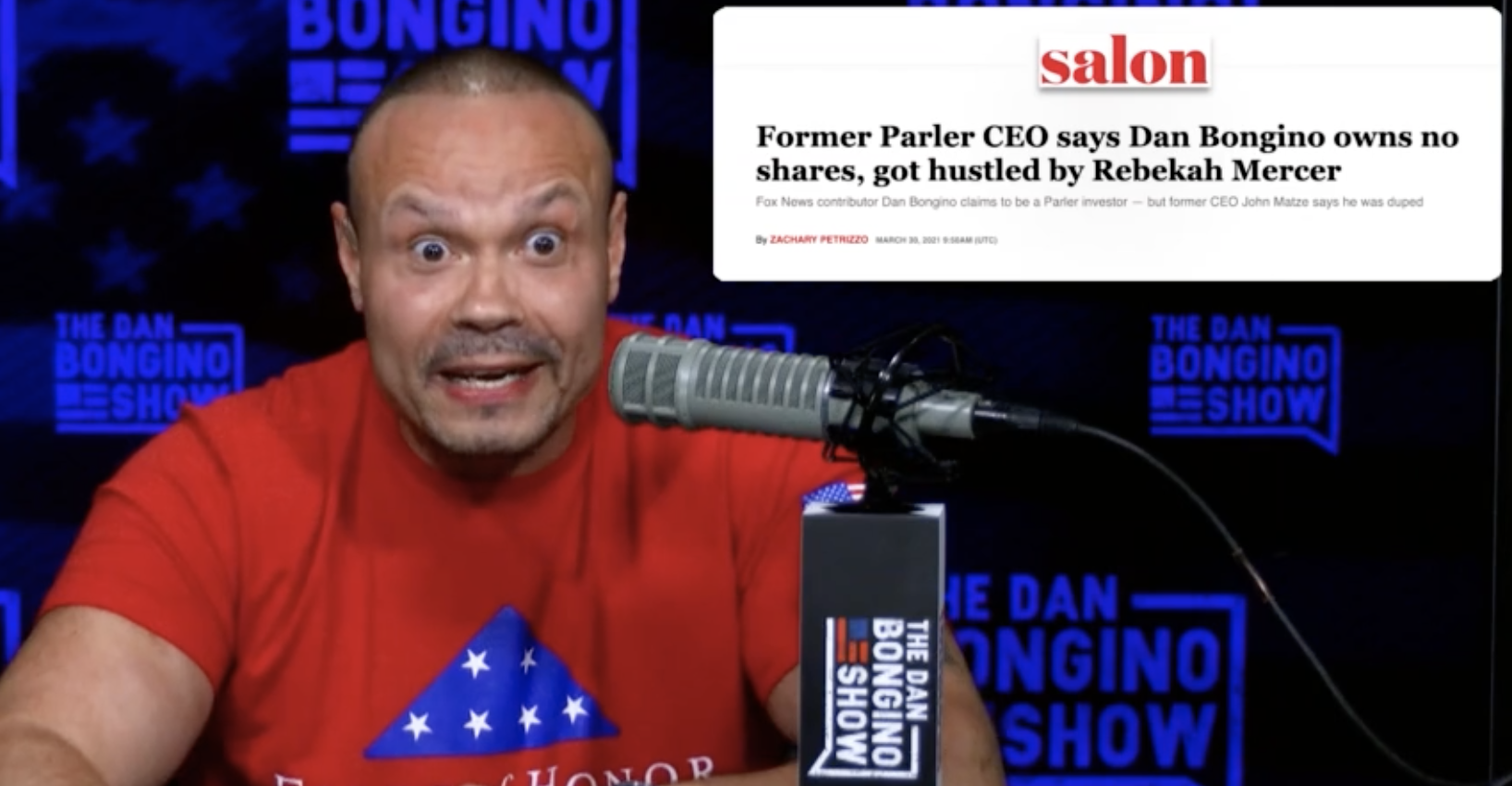
Former Parler CEO says Dan Bongino owns no shares, got hustled by Rebekah Mercer

Pro-Trump pundit, conservative media tycoon and self-proclaimed Parler investor Dan Bongino was apparently tricked into being promised shares of Parler by investor and conservative mega-donor Rebekah Mercer, according to former Parler CEO John Matze. This allegation is within a new lawsuit claiming that Bongino and Mercer used bullying and intimidation to take away Matze’s shares in Parler when they ousted him.

The nearly 20-page lawsuit from Matze, filed in the Eighth Judicial District Court of Nevada, says that Bongino “purports” to be a shareholder in Parler, before elaborating that the former CEO believes that “Mercer avoided executing any of the ownership documents to allow her to later dispute that Bongino has any such interest.” 

Bongino and a Parler spokesperson didn’t respond to multiple Salon requests for comment as to whether Bongino actually owns shares in Parler. Bongino, a Fox News contributor and frequent guest on Sean Hannity’s show, has for many months billed himself on the network as an investor in Parler, or as he put it on Jan. 18, “an investor in both Parler and Rumble, alternative platforms.” Matze appears to suggest that shares on the company may have never been signed over to Bongino at all.

As for how Bongino got involved in the company, Matze’s suit claims that Parler investor Jeffrey Wernick wanted to bring the Trump-friendly pundit more into the fold while leveraging Bongino’s clout in right-wing media to help bolster support for the site. According to the legal document, Wernick argued that “Bongino could use his media presence and various media platforms and appearances in order to promote Parler, and that it was worth providing Bongino a stake in Parler for all of the promotion that Bongino would be able to accomplish.”

Early in the lawsuit, Matze’s lawyers write that “Defendant Dan Bongino … holds himself out as an owner in Parler. As set forth, Bongino was a party to, and an active participant in, the conspiracy to oust Matze from Parler, to defame him, and to steal his property.”

Following the Jan. 6 Capitol attack, Parler was booted from Amazon Web Services and the Apple App Store, which later left the site offline, over perceptions that the company had taken no action to remove extreme content from its platform, allowing insurrectionists to organize ahead of the Capitol siege. Salon has discovered that on Feb. 24, Bongino silently attempted to withdraw himself from the “day-to-day” operations at the by-then-controversial social media site. 

“I am still an investor in Parler and remain such for as long as I want my money and assets tied up in there,” Bongino said on his podcast that day. “I still think that it is a great alternative to the tech tyrants at Twitter, Facebook and elsewhere. Having said that, as of today, I believe, am no longer with the day-to-day. I’m sorry. It’s nothing personal; it’s just, I just can’t, folks. I’ve got a lot going on in my life. It’s really that simple. I’ve got too many things to do.” At around that time, Bongino was nearing the end of his treatment for Hodgkin’s lymphoma and was about to step into the three-hour time slot on conservative talk radio previously occupied by the late Rush Limbaugh.

Following initial publication of this story, Bongino responded to the report on his daily podcast. “You’re like, a guy who claims to be a journalist really wrote this story? Like this story on its face is so laughable, you would think someone with an IQ above 25 would figure it out,” Bongino said on Tuesday afternoon. After reading the headline aloud and calling this Salon staff writer a “buffoon” and a “dope,” he continued: “the story is so dumb only a moron like Zork Petrizzo would write it because you would think common sense would kick in.” Bongino then said that he is no longer much involved with Parler, before claiming that he still holds an equity stake in the company. The pro-Trump pundit then took a few potshots at former Parler CEO John Matze, who is suing Bongino and the company. 

“There are a ton of suckers and losers in the media, but few as gullible and dopey as Zork Petrizzo. He walked right into one of the dopiest traps I’ve ever seen set. Only a dope would walk into this trap, and he didn’t disappoint,” Bongino later wrote on Parler, without providing any evidence to support his claims that the story is baseless. Bongino has not responded to multiple requests for comment on the claims made by Matze.

The dirty dozen: A tiny group of anti-vaxxers are flooding the internet with misinformation

Despite the public health awareness–raising effect of the pandemic, anti-vaccine and vaccine-hesitant sentiments still run rampant in the United States. A recent PBS NewsHour/NPR/Marist poll found that 30 percent of those surveyed in March 2021 told pollsters that, if offered the COVID-19 vaccine, they would not take it.

The huge number of vaccine-hesitant Americans might give the impression that anti-vaccination propaganda is rampant. Yet it turns out that a select few very loud voices are responsible for a great deal of online misinformation regarding vaccines. Their disproportionate ability to spread disinformation should give social media platforms pause.

Indeed, according to the nonprofit Center for Countering Digital Hate (CCDH), a mere dozen individuals and their organizations are responsible for up to 65% of the anti-vaccine misinformation that is spreading on social media platforms.

In their recent report, the CCDH revealed that these twelve people and their groups have disseminated nearly two-thirds of the anti-vaccine misinformation they have been tracing on Facebook and Twitter between Feb. 1 and March 16 of this year. Overall the CCDH found that the information they had been tracing was shared or posted on one of those platforms roughly 812,000 times, even though their inaccurate statements about vaccines violate those companies’ terms of service. The most famous of the so-called “Disinformation Dozen” is Robert F. Kennedy, Jr., nephew of President John F. Kennedy. The CCDH also found a number of prominent anti-vaccine advocates and proponents of alternative medicine.

One of them, Rizza Islam, has argued that Bill Gates is behind the COVID-19 pandemic, claimed he “beat” the disease through a special diet, and repeated the debunked claim that vaccines cause autism. (Although his Facebook account has been removed, he remains active on Twitter and the Facebook-owned Instagram.) Anti-vaccine entrepreneurs Ty and Charlene Bollinger have used their Facebook, Twitter and Instagram accounts (all of which remain active) to denounce the “fake pandemic” and spread an inaccurate story claiming that a COVID-19 vaccine had killed seven children in Senegal. They have also established ties with the far right, repeating the disproved talking point that Joe Biden stole the 2020 election from Donald Trump. Another anti-vaccine entrepreneur, Joseph Mercola, has referred to the pandemic as a “scam” and argued that “hydrogen peroxide treatment” can successfully treat most viral respiratory illnesses, including the coronavirus.


Want more science stories in your inbox? Subscribe to Salon’s weekly newsletter The Vulgar Scientist.


“The Disinformation Dozen — including Robert F. Kennedy Jr., Joseph Mercola, and Ty and Charlene Bollinger, among others — continually violate the terms of service agreements on Facebook and Twitter,” the CCDH explains in the summary of their report. “While some anti-vaxxers identified by CCDH have been removed from a single platform, comprehensive action has yet to be taken, and most remain active on Facebook, Instagram and Twitter.”

In addition to political and cultural motives, anti-vaxxers are often driven by a mistrust of statistics and experts who they do not personally know, especially if they come from institutions that they have been trained to distrust. Instead they are more inclined to believe the opinions of people they personally know and stories that they have heard, regardless of whether those sources are reliable, according to a recent book by Jonathan Berman, a professor at the New York Institute of Technology’s College of Osteopathic Medicine.

Mitch McConnell once acknowledged the filibuster’s racist history — now he denies it exists at all

On Monday, writing for The Washington Post, political science professor Saladin Ambar highlighted Senate Minority Leader Mitch McConnell’s past acknowledgment of the racist history of the Senate filibuster — a history he now denies exists at all.

“Last week, Senate Minority Leader Mitch McConnell said of the filibuster that it ‘has no racial history at all. None. There’s no dispute among historians about that,'” wrote Ambar. “The simple truth is that the filibuster — a Senate rule that allows for extended debate — was the most prominent tool employed to thwart the civil rights of African Americans during the period when McConnell came of age.”

“We know from McConnell’s own writings that he actually knows this history and has described how ‘exhilarated’ he was when a previous senator from Kentucky opposed the racist use of the filibuster,” wrote Ambar. “When historians called out his claims, he clarified that the ‘filibuster predates the debates over civil rights,’ and his spokesperson has said that he was just talking about the origins of the filibuster rather than its later history. So why is McConnell downplaying the filibuster’s racial history?”

Specifically, noted Ambar, McConnell wrote in his 2019 book “The U.S. Senate and the Commonwealth,” about how former Kentucky Sen. John Sherman Cooper helped break a Southern Democratic filibuster against the Civil Rights Act.

“I saw that those who wrote to Senator Cooper were overwhelmingly opposed to the pending civil rights legislation. But Senator Cooper was undeterred,” wrote McConnell. “He actively lobbied his colleagues to oppose the Southern Democratic filibuster being carried out against the civil rights legislation. I was exhilarated as I watched him take this courageous stance.”

“Willful ignorance of the dark moments in America’s past leaves us confronting our present challenges in a state of amnesia,” concluded Ambar. “There is no dispute among historians about the filibuster’s racist past. However, McConnell appears to have strategically forgotten his own powerful admiration for Cooper, who opposed filibusters intended to hold up racial progress, back when McConnell first learned the rules of the Senate.”

You can read more here.

Fox News host Sean Hannity calls for voter suppression in more states: “Nothing to do with race!”

Following the passage of voter suppression bills by Republicans in Iowa and Georgia, Fox News personality Sean Hannity is now calling for his viewers to demand similar measures in five additional states.

“Now we turn to an important story on election integrity, and it matters. People ask me, ‘Hannity, what can I do?’ Well, first, if you live in Georgia, if you live in Wisconsin, Michigan, Pennsylvania, Arizona, Nevada, you want to work with your state legislatures,” he argued.

Four of the five states Hannity listed have Republican legislatures, with only Nevada controlled by Democrats.

“Over the weekend, in Georgia — that’s right, their governor, Brian Kemp, finally did one thing worthwhile and signed a new bill into law,” he explained.

But Hannity denied that the voter suppression efforts were driven by racism.

“This has nothing to do with race, it has everything to do with integrity and the confidence in our elections,” he said.

After Fox News spent months pushing Donald Trump’s “Big Lie” about election fraud, Republicans are now saying that the lack of confidence that resulted from such lies is why they need to make it more difficult for Americans to vote.

You can watch the video below via MediaMatters:

Many QAnon followers report having mental health diagnoses

QAnon is often viewed as a group associated with conspiracy, terrorism and radical action, such as the Jan. 6 Capitol insurrection. But radical extremism and terror may not be the real concern from this group.

QAnon followers, who may number in the millions, appear to believe a baseless and debunked conspiracy theory claiming that a satanic cabal of pedophiles and cannibals controls world governments and the media. They also subscribe to many other outlandish and improbable ideas, such as that the Earth is flat, that the coronavirus is a biological weapon used to gain control over the world’s population, that Bill Gates is somehow trying to use coronavirus vaccinations to implant microchips into people and more.

As a social psychologist, I normally study terrorists. During research for “Pastels and Pedophiles: Inside the Mind of QAnon,” a forthcoming book I co-authored with security scholar Mia Bloom, I noticed that QAnon followers are different from the radicals I usually study in one key way: They are far more likely to have serious mental illnesses.

Significant conditions

I found that many QAnon followers revealed – in their own words on social media or in interviews – a wide range of mental health diagnoses, including bipolar disorder, depression, anxiety and addiction.

In court records of QAnon followers arrested in the wake of the Capitol insurrection, 68% reported they had received mental health diagnoses. The conditions they revealed included post-traumatic stress disorder, bipolar disorder, paranoid schizophrenia and Munchausen syndrome by proxy – a psychological disorder that causes one to invent or inflict health problems on a loved one, usually a child, in order to gain attention for themselves. By contrast, 19% of all Americans have a mental health diagnosis.

Among QAnon insurrectionists with criminal records, 44% experienced a serious psychological trauma that preceded their radicalization, such as physical or sexual abuse of them or of their children.

The psychology of conspiracy

Research has long revealed connections between psychological problems and beliefs in conspiracy theories. For example, anxiety increases conspiratorial thinking, as do social isolation and loneliness.

Depressed, narcissistic and emotionally detached people are also prone to have a conspiratorial mindset. Likewise, people who exhibit odd, eccentric, suspicious and paranoid behavior – and who are manipulative, irresponsible and low on empathy – are more likely to believe conspiracy theories.

QAnon’s rise has coincided with an unfolding mental health crisis in the United States. Even before the COVID-19 pandemic, the number of diagnoses of mental illness was growing, with 1.5 million more people diagnosed in 2019 than in 2018.

The isolation of the lockdowns, compounded by the anxiety related to COVID and the economic uncertainty, made a bad situation worse. Self-reported anxiety and depression quadrupled during the quarantine and now affects as much as 40% of the U.S. population.

A more serious problem

It’s possible that people who embrace QAnon ideas may be inadvertently or indirectly expressing deeper psychological problems. This could be similar to when people exhibit self-harming behavior or psychosomatic complaints that are in fact signals of serious psychological issues.

It could be that QAnon is less a problem of terrorism and extremism than it is one of poor mental health.

Only a few dozen QAnon followers are accused of having done anything illegal or violent – which means that for millions of QAnon believers, their radicalization may be of their opinions, but not their actions.

In my view, the solution to this aspect of the QAnon problem is to address the mental health needs of all Americans – including those whose problems manifest as QAnon beliefs. Many of them – and many others who are not QAnon followers – could clearly benefit from counseling and therapy.

Sophia Moskalenko, Research Fellow in Social Psychology, Georgia State University

This article is republished from The Conversation under a Creative Commons license.

Nike files lawsuit following right-wing outrage over Lil Nas X’s satan shoes

The artist behind the inescapable 2019 earworm “Old Town Road,” Lil Nas X, has successfully landed himself at the center of this week’s predictable conservative outrage for the music video and promotional show accompanying his new single “Montero,” even causing the corporate giant Nike to file suit. 

The music video, which serves as an anthem of queer acceptance, portrays a heavenly Lil Nas X in what appears to be some version of the garden of Eden. As he sings about coming to terms with the fact that he has become infatuated with someone that is not deemed socially acceptable, he is seduced by a snake (also played by Lil Nas X) and ultimately chooses between heaven and hell by descending to the underworld via stripper pole.

The video has accrued over 37 million views since it initially premiered only days ago on March 26th.

“I know we promised to die with this secret, but this will open doors for many other queer people to simply exist. You see this is very scary for me, people will be angry, they will say i’m pushing an agenda. But the truth is, I am. The agenda to make people stay the fuck out of other people’s lives and stop dictating who they should be.”

As expected, conservative talking heads, whose entire careers are based on creating identity politics hysteria, have found the video to be outrageous, completely missing the point about what the church and modern-day Christianity have said about the acceptance of queer people. Grifter extraordinaires like Candace Owens expressed their distress over the music video on Twitter

Lil Nas X, who is possibly the greatest celebrity poster to have ever taken to Twitter, responded with a swift clapback:

Many on social media have praised the song and questioned criticism for the video that subverts the notion that the supposed ‘eternal damnation’ associated with queerness is something that queer people cannot reclaim for themselves.

Nike filed a lawsuit against MSCHF for misleading customers and tarnishing the Nike brand on Monday. The corporate giant alleged that MSCHF’s “unauthorized Satan Shoes are likely to cause confusion and dilution and create an erroneous association between MSCHF’s products and Nike.”

“Decisions about what products to put the ‘swoosh’ on belong to Nike, not to third parties like MSCHF,” Nike said in its lawsuit, referring to its “swoosh” logo. “Nike requests that the court immediately and permanently stop MSCHF from fulfilling all orders for its unauthorized Satan Shoes.”


Others who have expressed their outrage include South Dakota Governor Kristi Noem, a Republican, who responded to a tweet promoting the shoes by saying, “We are in a fight for the soul of our nation. We need to fight hard. And we need to fight smart. We have to win.”

Most interestingly, Noem is dedicating her platform as a government official to Satanic Panic surrounding sneakers and the value of people’s “god-given eternal souls” rather than addressing the fact that her lack of a response to the Coronavirus pandemic, one that included the peddling of conspiracy theories and Trump’s hydroxychloroquine lies resulted in one of the worst transmission and death rates in the country at the tail-end of 2020.

Others incensed by the music video they did not have to watch included right-wing character Kaitlin Bennett, who at first shared her thankfulness for being blocked by the rapper. When he responded with an oft-cited (yet unproven) allegation of Bennett soiling herself at a college party, this was her response:

Bennett, who has gained a reputation as a provocateur for filming videos of herself harassing pedestrians in public settings received this prompt reply:

Ultimately the arguments that Lil Nas X is making a mockery of religion or the church fail to realize that as a queer man, he is embracing the narrative he has been fed about the implications of his mere existence. It’s almost as if everyone that is digitally clutching their pearls about a music video and a sneaker design are more intently focused on generating empty outrage rather than focusing on issues that actually impact people’s quality of life.

COVID-19 cases rise as states ease restrictions; CDC director warns of “impending doom”

News of the vaccination roll-out might have misled Americans into believing that it was okay to relax. 

Indeed, as states begin to roll back COVID-19 restrictions, infections are going up rapidly in the United States — prompting one high ranking official to warn of “impending doom.”

“I’m going to pause here, I’m going to lose the script and I’m going to reflect on the recurring feeling I have of impending doom,” Dr. Rochelle Walensky, director of the Centers for Disease Control and Prevention (CDC), told reporters at a press conference on Monday. “We have so much to look forward to. So much promise and potential of where we are and so much reason for hope. But right now I’m scared.”

Walensky was responding to the latest COVID-19 data, in which more than 63,000 new cases are being reported every day in the United States according to a seven-day average of statistics from Johns Hopkins University. This constitutes an increase of 16% since last week; as President Joe Biden’s chief medical advisor Dr. Anthony Fauci told CBS on Sunday, the rise is partially due to the easing of business restrictions and increased travel. (The increase is also being exacerbated by the rise of mutant strains like B.1.1.7, which is more transmissible and may also be deadlier.)

The news about rising COVID-19 cases comes even as American officials have been able to accelerate the vaccination process. Biden announced on Monday that he expects 90% of American adults will be eligible for vaccines within the next three weeks. Earlier this month the administration passed a $1.9 trillion stimulus plan which invested nearly $20 billion in vaccinations and ordering states to open vaccinations to all adults by May 1. The bill also included a number of policies to expand access to health care so that more people overall will be able to receive medical treatment if they get sick.


Want more science stories in your inbox? Subscribe to Salon’s weekly newsletter The Vulgar Scientist.


At the same time, Republican governors in states from Texas and Mississippi to Alabama and West Virginia have been loosening or eliminating COVID-19 restrictions in response to declining COVID-19 numbers. Earlier this month Walensky urged policymakers to be mindful that Americans would not be truly safe until as many people are vaccinated as possible, adding that the rise of variants could “complete lose” the gains made so far in defeating the pandemic.

“I am really worried about reports that more states are rolling back the exact public health measures we have recommended to protect people from COVID-19,” Walensky told reporters at the time. She emphasized the importance of public health measures like wearing masks.

“The decision to reduce mask wearing and reopen business anywhere in the US in extremely unwise and in fact dangerous,” Dr. William Haseltine, a biologist and chair of Access Health International, told Salon by email earlier this month regarding Republican governors’ policies. “Twice we reopened prematurely and have suffered grievously in terms of numbers of dead and of those who are suffering from long-term COVID-related disease.”

COVID-19 restrictions, and the potential health consequences of limiting or avoiding them, have been a political flashpoint since the pandemic broke out last year. President Donald Trump infamously made a number of premature attempts to reopen the economy, discouraged wearing masks, spread pseudoscience about how to treat the coronavirus and ignored health experts’ advice in the early weeks of 2020, when the virus was just entering the country. Dr. Deborah Birx, who led Trump’s coronavirus task force, told CNN on Sunday that she believed his refusal to mount an aggressive response against the pandemic may have cost as many as 400,000 lives.

Everything you need to know about cascatelli, the new “perfect” pasta shape that’s a viral hit

Several years ago, Dan Pashman, the host of the James Beard and Webby Award-winning “Sporkful” podcast, decided to make a new pasta shape. And not just any pasta shape. Pashman wanted to make the ideal pasta shape. It needed to have the perfect bite, an appealing texture and hold the right amount of sauce. Sounds simple enough, right?  

Well, Pashman’s new series of five “Sporkful” episodes, titled “Mission: ImPASTAble” tells a different, very funny and very informative story. Through the series, Pashman takes a trip to the Pasta Lab at North Dakota State University; has a number of heated debates with food professionals, including “The Splendid Table’s” Francis Lam, about existing pasta shapes; and has a conversation with Giovanni Cannata, the only pasta die maker working in America today. 

“There were so many emotional ups and downs,” he told Salon in a recent interview. “You will hear my wife running out of patience with this whole mission. My kids are part of it. I’m literally brought to tears on more than one occasion. You will learn a ton about how pasta is made, why this project took nearly three years and you will laugh hysterically, because a lot of things go wrong in very, very funny ways.” 

In the end, it seems like the journey was worth it. Pashman’s new shape is called “cascatelli,” which means “waterfalls” in Italian, and it made a big splash in the food world since its release earlier this month. Distributed for $4.99 per pound by cult-favorite American pasta maker Sfoglini, it’s currently sold out. 

“We’re so grateful for the incredible response to our new pasta shape!” Sfoglini’s website said. “Due to overwhelming demand, orders placed now for Cascatelli will ship in approximately 10 weeks. We really appreciate your patience. We promise it’ll be worth the wait!” 

In the meantime, Pashman spoke with Salon about the process of making a better pasta shape, the three qualities by which he judges existing noodles and his trip to the Pasta Lab. 

This interview has been lightly edited for clarity and length. 

I guess we should start from the beginning. When did you wake up and decide, “OK, we need a better pasta shape?”

Well, I listened to some of the seminal podcast series of the mid-2010s, in particular the “Planet Money” T-shirt series and Alex Blumberg’s “StartUp” series. These kinds of multi-episode things that were so seminal at that time like “Serial.” And I thought, “Someday I want to do my version of this.” 

You know, as a creative person, you hear other people do cool things in your field, and you know you want to try to do that someday. The obvious thought was, “I should create a food,” but then what should the food be? I had a couple of criteria: I wanted it to be a simple, basic food that everyone knows, loves and has opinions about. I didn’t want to do something that was like a fancy specialty ingredient. The next thing: I wanted it to be a food that was inexpensive and shelf-stable that could be shipped all over the country, if not the world, because I wanted as many “Sporkful” listeners as possible to participate in the end product and be part of it. 

So, pasta — even a somewhat expensive pasta — is an affordable luxury for a good number of people, and it met those criteria. And pasta shapes just felt like a thing that just not that many people think about and I felt like it was ripe for innovation. And one of my favorite parts of hosting the “Sporkful” podcast is that when I sort of nerd out in ridiculous detail about the finer points of a specific food, one of the reactions I felt that I love is someone will say, “I never knew I had such strong opinions about that.” 

I love that reaction, because it’s like, you had a realization about yourself and a realization about food. Like, “Oh, this food that I’ve been eating all this time, I actually care a lot about it.” And I felt like pasta shapes would be that kind of thing. 

I think a big part of that, too, is developing a language to talk about what we like or don’t like about something. For example, there are three qualities that you use to talk about pasta shapes. Could you talk a little bit about them? 

Yes. So, there’s “forkability,” which is how easy it is to get a pasta shape on your fork and keep it there. There’s “sauceability,” which is how well a sauce adheres to it. And then there is “toothsinkability,” which is how satisfying it is to sink your teeth into. I mean, I basically made up these pseudoscientific words, but I think they capture a lot of what makes some pasta shapes better than others. 

I think there are a lot of shapes that are really good at some of these things, but very few nail all three. I think one of the hilarious parts of this series — if you listen to all five of the podcast episodes, you have these recurring characters who start using these words more and more without me having to tell them. It’s entering the vocabulary of the people around me, and it’s very hilarious to me. 

Could you tell us about your trip to the Pasta Lab at North Dakota State University? 

I mean, it was a ton of fun. I knew early on that I wanted to go there. I loved the idea of starting the journey in North Dakota, because it does not feel like the most obvious place to start a pasta story. But that place is a trip. I mean, they know all about durum wheat. They could talk about durum wheat for years before running out of things to say. 

So, North Dakota is where most of the durum wheat that ends up in pasta is grown. And they said they’re always developing new varieties of durum wheat at the Pasta Lab at North Dakota State University. So, I got to meet the whole research team that works there and see what they’re cooking up in the lab. 

They’re literally cooking pasta in beakers — you know, there’s test tubes, and they’re wearing lab coats. If you were to write a sketch called “Pasta Lab,” this is what it would look like, but it’s actually real. The most incredible thing they have is something called a texture analyzer, which measures bite force, or the exact amount of pressure required to bite through, say, five strands of spaghetti and whatever pasta you put into it. 

I was just super excited to see it in person. And I was like, “Oh, my God, will you test my pasta in this machine when I have some?” And they were very happy to — they’re like pasta nerds. 

So, this is a two-part question. Going back to those three qualities — ‘forkability,’ ‘sauceability’ and ‘toothsinkability’ — what was an existing pasta shape that you thought got close to being ideal when it came to those? And what was the process of building upon that? 

So, early on, I just set out to eat every pasta shape to get my teeth on. I went all around the New York metro area to specialty stores, and I got as many obscure shapes as I could. I was eating and eating and eating all different shapes. Some of them I had before, but I wanted to get them all in a kind of rapid succession and really catalog the attributes. Do I like ruffles? Do I like straight edges? Do I like ridges? Tubes? Long? Short? Curls? Twirls? All these different things. 

Through all the shapes, one that I landed on that I really, really loved was one called mafaldine. If you picture a fettuccine noodle with ruffles down the edges, or like a lasagna but narrow enough to wrap around a fork. So, we liked that as a base canvas. Then another shape that I like was bucatini — and I used to be kind of anti-bucatini, but people go crazy for it. Then I had the realization that it’s actually really great, so my initial idea was to combine the best of mafaldine with bucatini and a couple more flourishes — so ruffles and a tube component and a few other things. So that was how I went forward. 

Right, so the resulting pasta — what is it like? 

The shape is called cascatelli, which means waterfalls. I do want to acknowledge to the Italian speakers out there that I know the correct plural would be “cascatelle,” ending with an “e,” but I decided to take a little bit of poetic license, because the “I” sounded more like a classic pasta shape name. 

I would describe the shape overall as a curved comma or half a heart. On one side there’s ruffles, and in the space between you’ve got a dugout, kind of a half-tube that just traps sauce in there. It’s amazing. 

So, a potentially controversial question, but what pasta shape do you think is overrated? 

Well, as I say in the podcast, spaghetti right off the bat. I know it’s iconic. I know that it’s historically important, and it’s the original pasta shape. But that also means that it’s kind of primitive. It’s just a tube that doesn’t do anything, so it doesn’t hold sauce especially well. It has a very low surface area in relation to volume. It’s not very tactile, and you can’t really sink your teeth into it. You can twirl it on your fork, and that’s fine. But you’ll get danglers splattering, and it’s just not that great. I feel kind of the same way about linguini. 

Like, if I’m going to have long shapes, fettuccine is so much better than spaghetti or linguine. The best-known shapes are often the ones that have been around the longest and have been mass-produced the longest. So, I think that there is room for new ideas to come along and new perspectives. That being said, I’m not here to destroy the classic pasta shapes. I love pasta. I’ll eat any pasta you give me, and there’s room in the world for many pasta shapes to coexist. 

If folks are curious about the full story behind “Mission: ImPASTAble” and want to dig deeper into this process, where can they find that? 

Wherever you get your podcasts! The series from “Sporkful” is up now, and I really hope people will check it out. Because while it’s obviously exciting to see this huge response to our shape, the story behind the creation of the shape is even more incredible. There were so many emotional ups and downs. You will hear my wife running out of patience with this whole mission. My kids are part of it. I’m literally brought to tears on more than one occasion. You will learn a ton about how pasta is made, why this project took nearly three years and you will laugh hysterically because a lot of things go wrong in very, very funny ways. 

You can listen to all five episodes of “Mission: ImPASTAble” here.

MyPillow CEO Mike Lindell’s latest rant is too bonkers for even Steve Bannon to handle

MyPillow CEO and fervent President Donald Trump supporter Mike Lindell declared on Friday that Trump will be re-installed as president come August during a podcast appearance on Steve Bannon’s “WarRoom Pandemic” program. The far-fetched remark caught wind and was quickly mocked on Twitter midday on Monday. 

“What I’m talking about, Steve [Bannon], is what I’ve been doing since Jan. 9th,” the pillow maven said with authority. “All the evidence I have – everything is going to go before the Supreme Court, and the election of 2020 is going bye-bye. It was an attack by other countries, communism coming in,” he continued. “I don’t know what they’re going to do with that after they pull it down.”

“Hold on a sec, hold on,” Bannon tried to interrupt before Lindell shouted out: “Donald Trump will be back in office in August!” 

Reacting to the clip of Lindell stating Trump will return to the White House come August, Mother Jones’ David Corn wrote: “This guy needs more rest.” “If some constitutional law scholar is bored today, I would read 1000 words on what Lindell is talking about. (I think the short answer is: No, one Congress certifies the electoral count you can’t un-do it.),” Washington Post reporter Dave Weigel further remarked

During that same segment on Bannon’s podcast, Lindell announced he would be releasing a new documentary (using the term “documentary” lightly here) entitled “Absolute Interference,” which, according to the CEO, has the evidence and proof that his first film, “Absolute Proof,” was notably lacking. Lindell didn’t immediately return a request for comment from Salon on Monday afternoon about if his second film will truly have “absolute proof” of widespread election fraud. Salon executive editor Andrew O’Hehir reviewing the original two hour “Absolute Proof” film, gave a blistering critique, writing, “It resists all structural and narrative conventions, makes no effort to tell a clear story, contradicts itself and leaps from subject to subject, and could fairly be described as a meditation on what has gone awry in our society.” The release of the second film, “Absolute Interference,” is slated to occur in “a few weeks,” alongside Lindell’s new right-wing alternative social media platform “FRANK,” which stands for “Free, Forthright, and Sincere Expression of Speech.” Lindell has billed the new social media platform as being indestructible, claiming it was built with “reverse engineering,” but as of now the information page is being powered by a rather standard WordPress backend

“Absolute Interference,” the upcoming and second Lindell “documentary” on “election fraud,” according to the pillow chief, will feature “whistleblowers” in disguises due to the alleged threats they have been receiving. Asked by Bannon during the Friday podcast appearance if the “whistleblowers” were Dominion Voting Systems employees, Lindell awkwardly agreed and said he has been in touch with numerous former and current Dominion employees. 

Last week, Lindell, one of Fox News’ largest advertisers, railed against Fox News, declaring on a small right-wing YouTube channel that the cable news heavyweight might be “in on” the $1.3 billion Dominion lawsuit filed against him.“Why can’t people go on there [Fox News] and say their free speech, then?” Lindell asked aloud. “You’re already sued, Fox. What do you have — are you going to get double sued? What’s the matter with you? What are they in on it? I don’t get it. Is it a fake lawsuit?” Lindell stated

Lindell, a steadfast supporter of Trump, maintains that Trump won the 2020 election and has since turned his focus to Arizona, where he believes enough votes and fraud could turn up, to have Trump re-installed as president ultimately. Facing a $1.3 billion lawsuit and shelling out lots of cash to right-wing groups, the shot-clock is on for Lindell to turn up evidence of widespread election fraud, which he has yet to accomplish. Oh, and what happens if the second documentary catches on? Will the “end of time” come for the world?

GOP Leader Kevin McCarthy tried to play his partisan cards — and just folded

There was another skirmish on the floors of Congress this week that made no sense other than the endless outpouring of partisanship.

This time it was a vote forced by Republican Minority Leader Kevin McCarthy (R-Calif.), to drop Rep. Eric Swalwell, a Democrat from California, from the House Intelligence Committee. The conflict was about allegations that a Chinese spy had raised funds for Swalwell’s congressional campaign  in 2015. The measure lost, with all Democrats and Republicans voting on party lines.

It’s not a vote that would change anything. Speaker Nancy Pelosi would appoint a potential replacement.

Apart from the idea that it was a futile effort if you are the minority party, it was simply a partisan slap that follows the pattern of knocking the other guy.

But in this case, the underlying thought – that a foreign power is trying to have an influence on choosing our leadership – struck as particularly galling. Remember we just had that declassified national security assessment that Russia, and to a lesser degree, Iran, had a huge campaign under way to use our legislators and members of the Donald Trump campaign team to funnel disinformation to the American public.

Those figures include Sen. Ron Johnson (R-Wis.), who openly talked loudly about information fed him by an identified Russian agent Andrei Derkach, a Ukrainian lawmaker, and Rep. Devin Nunes (R-Calif.), the ranking minority Intelligence Committee member, for work to spread disinformation about then-candidate Joe Biden and family. Both Johnson, who also has repeatedly offered his racist defense of the Jan. 6 attack on the U.S. Capitol, and Nunes, who has opposed Biden’s certification as president, remain active in their public damnations on behalf of Trump.

These people have drawn no response from McCarthy.

I’m not big on “whataboutism” as tit-for-tat partisanship is termed, but the coincidental timing here seems unusually gross.

The Swalwell Case

McCarthy sponsored his resolution to oust Swalwell over the fact that he has not denied “public reporting that a suspected Chinese intelligence operative helped raise money” for his campaign and helped interns seek potential positions in his congressional office. Since the fall, McCarthy has targeted Swalwell, one of the Trump impeachment managers, after Axios published information about Swalwell’s relationship six years ago with a suspected Chinese operative known as Fang Fang or Christine Fang.

According to the story, Swalwell was among several California politicians reportedly pursued by Fang, who did fund-raising work for his campaign and was photographed alongside Swalwell at a political function and reports that they had dated. When the FBI reported its suspicions in 2015, Swalwell cut off contact.

House leaders were  told in 2015, and Swalwell was allowed to serve on the Intelligence Committee. There was another review with McCarthy and Pelosi last year, with opposing views from the two.

McCarthy charged that based on what has been publicly reported, Swalwell “cannot get a security clearance in the private sector” — and thus had no business being on the intelligence panel.

“Only in Congress could he get appointed to learn all the secrets of America — that’s wrong,” McCarthy told reporters. “If you can’t meet that bar, you shouldn’t be able to meet a bar to serve on the intel committee.” McCarthy tweeted out a picture of the form upon which individuals are required to disclose relationships with foreign nationals.

Hmm. Then what are we to make of Johnson and Nunes, their staff members and non-congressional figures.

Figures include:

  • Michael Flynn, who served as national security adviser despite foreign entanglements
  • Paul Manafort, Trump campaign chair despite his foreign contacts
  • Trump son-in-law Jared Kushner who did not always report contacts with foreigners

Republican Outliers

Naturally, Swalwell and Democratic defenders noted that McCarthy failed to mention that Swalwell changed his behavior after the FBI alert to him. The same cannot be said of Johnson, Nunes and the others.

Of course, all this may be in response to the vote by Democrats and 11 Republicans last month to remove Rep. Marjorie Taylor Greene (R-Ga.) from two committees for her extremist QAnon ideologies and threats to other members of Congress. A new effort was introduced yesterday to oust her altogether.

McCarthy wrote on Twitter that “Every Democrat is now on the record. They chose politics over national security.”

Well, yeah, as Republicans have been doing as well. These guys seem to do so on every question, real or not.

A dozen Republicans voted this week to oppose honoring police from the Capitol and the city for defending the Capitol on Jan. 6 because the resolution contained the work “insurrection.”

Then, yesterday, 172 Republicans voted against renewing the so-called defense against violence to women act. They found the bill unneeded even in the week following the shooting of two men and six women massage parlor workers in Georgia. The act did have an anti-gun ownership clause for boyfriends found guilty of domestic violence.

Just what passes as Republican ideology other than saying “No” has become massively unclear.

Even on a straight partisan basis, how does knocking Swalwell off this committee make anyone more likely to vote Republican than Democratic?

What has been gained here? If anything, shouldn’t we thank Swalwell for heeding an FBI alert and ask why Johnson and Nunes  continued to carry water for identified Russian agents despite intelligence warnings? How does anything in all this help with coronavirus, economy, the border, education, environment or anything that we actually care about?

Piers Morgan calls Markle a “delusional Duchess,” lashes out at the “woke brigade” in lengthy rant

Former ITV commentator Piers Morgan — who walked off the set of “Good Morning Britain” earlier this month after being called out for incendiary comments about Meghan Markle — has doubled down on his assertions that Markle is lying about the racism she experienced as a member of the British Royal Family. 

In a lengthy opinion piece for The Mail on Sunday Morgan chronicles his feelings, day by day, since the “Good Morning Britain” fallout on March 9. The rant ranges from detailing threats that his sons have received and weighing in on the Teen Vogue editor debacle, to defending Sharon Osbourne and of course dismantling everything in that bombshell interview with Oprah Winfrey

The longer Markle and Prince Harry went on, the less he believed. The most sensational implication, Morgan alleges, is that their son, Archie, was barred from being a prince because of his skin color. 

“It sounded complete nonsense when she said it, and it is; he’s not a Prince because, technically, the great grandchildren of the Monarch are not bestowed with titles ‘Prince’ or ‘Princess’ unless they’re in the direct line to the throne,” Morgan wrote. 

“This rule applies regardless of the child’s mother’s ethnicity. So, the most serious assertion, one that has already sent racially charged America into a tailspin of outrage, was a falsehood presumably designed to cause maximum harm to the Royals.” 

He also disagreed with Markle’s claims that the British tabloids targeted her specifically because of systemic racism. 

“Meghan’s had no worse media treatment than other Royal brides such as Diana, Fergie, Kate, Camilla or even that other Monarchy-rattling American divorcee, Wallis Simpson,” he wrote. “But she’s the first to claim negative press has been motivated by racism, and it’s a very dangerous charge to make with so little to back it up.” 

Morgan also said that he quit his position at ITV because he refused to issue an apology for statements he made on-air about disbelieving Markle’s assertion that, after having persistent suicidal thoughts while pregnant, she sought help from a senior royal but was rebuffed because “it wouldn’t be good for the institution.” 

“I was ashamed to have to admit it to Harry,” Meghan said in the interview with Winfrey. “I knew that if I didn’t say it, I would do it. I just didn’t want to be alive anymore.”

Morgan latched onto this story on “Good Morning Britain,” saying, “Who did you go to? What did they say to you? I’m sorry, I don’t believe a word she said, Meghan Markle. I wouldn’t believe it if she read me a weather report.” 

In response, more than 41,000 viewers wrote in to Ofcom, the United Kingdom’s media regulator to complain. However, Morgan said he wasn’t going to issue an apology just to satisfy the “woke brigade.” 

“I reached a moment of total gut clarity,” Morgan wrote in his column. “[F]**k it, I wasn’t going to apologise for disbelieving Meghan Markle, because the truth is that I don’t believe Meghan Markle. And in a free, democratic society, I should be allowed not to believe someone, and to say that I don’t believe them.” 

Morgan also wrote about the repercussions of “The Talk” co-host Sharon Osbourne supporting him. Osbourne, who exited the show as of last Friday, came under fire initially when she tweeted  “@piersmorgan I am with you. I stand by you. People forget that you’re paid for your opinion and that you’re just speaking your truth.” 

Twitter users began responding that Osbourne herself was racist for aligning herself with Morgan. This led to Osbourne engaging in a fiery argument with her co-host Sheryl Underwood, who is Black, about why people were calling her racist or why Morgan’s statements were racist. 

“I will ask you again, Sheryl,” Osbourne raged. “I’ve been asking you during the break. I am asking you again — and don’t try and cry because if anyone should be crying, it should be me — this is the situation. You tell me where you have heard him say — educate me, tell me – when you have heard him say racist things. Educate me! Tell me!”

Osbourne eventually apologized for her behavior, then backtracked, even as reports about her allegedly using racist slurs with her former co-hosts resurfaced.

Morgan said that what happened to Osbourne and him was “outrageous,” but it isn’t really about Markle. 

“She’s just one of many whiny, privileged, hypocritical celebrities who now cynically exploit victimhood to suppress free speech, value their own version of the truth above the actual truth, and seek to cancel anyone that deviates from their woke worldview or who dares to challenge the veracity of their inflammatory statements,” Morgan wrote. 

“No, it’s about a far bigger issue than one delusional Duchess . . . As Winston Churchill said: ‘Some people’s idea of it [free speech] is that they are free to say what they like but if anyone else says anything back, that is an outrage.'”

Speaking of prime ministers — Morgan also used his lengthy diatribe as an opportunity to tease that a political run may be on his mind. He recounted an encounter with a flower seller who allegedly stopped him on the street to say, “Piers, mate, you should be Prime Minister. We’d all vote for you. You stand up for what you believe in.”

Morgan replied, “I mean, who on earth would vote for a polarising, scandalous journalist with a posh name who refuses to apologise for anything . . .” This isn’t the first time Morgan has hinted at his political aspirations. In January, he told The Sun, “Listen, if it’s my turn to serve, and the people want me, who am I to ignore the will of the people?” Subtle.

According to Variety, Associated Newspapers, which is the publisher of The Mail on Sunday, lost a court battle with Markle recently over a copyright dispute, although the group is appealing the judgment.

How this community-driven olive oil company is changing the status quo

Skyler Mapes is obsessed with her trees. A Bay Area native, she and her third-generation Calabrian husband, Giuseppe Morisani, own 10 acres of olive trees in La Castella, Italy — and they tend to them like they’re their children. “Can you imagine what a 500-year-old olive tree would have to say if it could talk? It would have so many things to say. I would listen to that podcast,” Mapes tells me through her big, toothy grin beaming across our Zoom screens.

For EXAU, the trees are just where their business starts. Mapes and Morisani oversee everything from the tending of those trees to the pressing of the olives to the bottling of oil and final distribution of their product. In short, they’re involved in every aspect possible.

In a market as giant —and rapidly growing — as olive oil, this isn’t always the case. As The New Yorker reports, “In the past decade, olive-oil consumption has risen 35% in southern Europe, its traditional market, and more than 100% in North America. Much of the growth is due to the increasing prestige of the highest-quality olive oil, extra-virgin.” Production has followed suit. When you go to the grocery store, dozens of brands line the wall, and the choices are overwhelming. You might even find yourself whipping out your phone to do a quick Google search for “the best extra-virgin olive oil brands” — because, like me, you’re struggling to interpret and trust the labels.

The long and short of it is that the quality of extra-virgin olive oil depends on various factors, including type of soil, climate conditions, farming techniques, and methods of extraction. To make matters more confusing, it is no secret that this industry has been racked by fraud, with millions of consumers around the world regularly paying for “extra-virgin” olive oil that is cut with inferior olive oil, mixed with cheaper oils like canola and sunflower, or colored with beta-carotene or chlorophyll.

In response to decades of fraudulent activity, The International Olive Council, established in 1959, was the first organization to set industry standards and rules. E.U. law states that for olive oil to be considered high quality, the oil must be made exclusively by physical means (press or centrifuge) and meet 32 chemical requirements, including having “free acidity” of no more than 0.8%. At any moment, these council members can form panels and call products in for testing.

For Mapes and Morisani, these measures address only part of the problem. In the U.S., the FDA requires brands to reveal their country of origin on the label, but not the traceability of their olive oil. This means larger brands can purchase oil from any region throughout Italy, and take it back to be bottled and labeled in their own facilities. And while the Italian Ministry of Agriculture, Food and Forestry has introduced tracciabilità — a tracing method in which olives and olive oil are linked to the facility where they are stored and the mill where they are pressed — it is not a requirement.

What does this mean for southern farmers like Mapes and Morisani? Despite the region being home to 82% of the country’s olive oil production, the couple feels it consistently doesn’t get its due acclaim — within the industry itself, and in turn from the media. This dynamic is reinforced by an ever-changing price per liter of oil set by the industry itself, which values northern oil above southern. “It’s like gold. It’s always moving,” Mapes explains. Two major regions (Puglia and Calabria) have lower oil prices because the production is high. In the north, where production is lower, the price starts to go up. Buyers seeking the lowest price per liter thus end up shortchanging southern farmers.

In addition to this flux of oil prices, Mapes and Morisani face their own unique set of challenges with labeling and distribution. Mapes recalled a time early on in EXAU’s history, when Morisani reached out to a label company in northern Italy. “You remember the label company, when she paused after she heard your accent?” Morisani laughs. “The moment they hear us, they’re like, ‘Oh, you’re from Calabria.’ ” Mapes ended up taking that call.

In the States, the couple found the opposite to be true. “I called a buyer one day and they just didn’t even give me the time of day. They ignored me. Giuseppe calls, he got a meeting with them two days later.” Mapes, who is one of only a few Black womxn in olive oil production, faces many market, economic, and sociocultural barriers to success in business, which is not an uncommon experience among Black women entrepreneurs.

In spite of these odds, Mapes and Morisani have two aims: to raise the profile of the robust southern Italian olive-growing region and to pave the way for the success of a small Black-owned business in the U.S. Here, they share more about their journey navigating the slippery olive oil industry and their plans to continue supporting their local community — not to mention how they came to produce an olive oil that has since gained a cult following (it has a literal waiting list!).

This interview has been edited and condensed for clarity.

Can you tell me about what your days are like as an olive oil producer?

Mapes: Step one starts with the trees. As an olive oil producer, your main job is a year’s work of tending to your trees — trimming and spraying to disinfect. The product and oil is the last part.

Morisani: Right now, we’re putting the manure on the soil, taking care of the drainage, and making sure the leaves are treated well. It’s the little parts that make the difference.

Mapes: When we have to put manure on the property, I always put on dirty clothes. Black jeans and a dirty tank top with a dirty sweater and my hair in a bun, because it’s super windy. And I wear my all-weather boots so I can tromp around in mud. Funny story. Earlier in the week, Giuseppe had thousands of pounds of manure dropped off: 2.2 tons in bags in the garage. He opens the door, and I’m like, “What the hell is this, what did you do?” And he goes, “OK, so we have to load the car.” And I’m like, “What!”

Each bag weighs 25 kilos, so a little over 50 pounds! We had to carry 30 of these big bags of manure and drive to our property. Then we had to drop off each bag at each of our trees because we don’t have our own tractor. Not to mention, it rained the day before. So we had to carry each bag of manure through the mud and drop it in front of each tree. Giuseppe had cut a bleach bottle in half because we didn’t have a scooper. So here I am with this half a bleach bottle with the handle side down. [laughs] I used it to scoop the poop and put it onto the tree, and that is what I had to do. Worse was that the manure dried in the garage, so my body was covered in pulverized manure. Powdered poop. It’s so nasty. I had to drive home with the windows down.

Morisani: [laughing in the background] So stinky!

What is one big misconception you think people have about being an olive oil producer?

Mapes: People think harvest is a couple hours of your time. We harvest for about six to seven hours a day, but then after that is the milling, and then after that is the moving of the oils. So it’s actually like a 14-hour day. Once filtered, the oil is bottled, labeled, palletized and shipped to the U.S. You’re not done when the olives come off the tree.

What’s one of the biggest obstacles you’ve faced running EXAU?

Mapes: I’ve had more issues in the U.S. with getting our product in the stores and calling buyers than I have had issues in Italy. This happened regularly. It got to the point where I wanted to give up on wholesale. It’s one of the reasons that we went direct to consumer. We started posting more and more on social media and focusing on in-person events. Sales online started to pick up. This shift in energy felt good. We respond to our customers and our trees. That’s who runs EXAU.

Are there any challenges you’ve come up against as a southern Italian business in particular?

Morisani: In the south, we have so much oil. Calabria and Puglia account for 63 to 67% of Italy’s production of olive oil, so it’s a lot.

Mapes: And when you combine that with the rest of the southern regions, the south of Italy is responsible for about 82% of all of Italy’s olive oil production. So, in light of this fact, you would think southern olive oils would be given more prestige — but they’re not. Because they’re from the south. That is my perception.

If Tuscany produces relatively little olive oil on its own, how is the region keeping up with global demand?

Morisani: For me, it’s logical to believe that they bulk up with product from other regions in Italy, because it’s impossible that this olive oil that accounts for only 2% in Italy can have a shelf in the world.

Mapes: Northern companies need a lot of oil to keep up with their demand — and want to make a profit margin. To do this, they approach southern farmers with the mindset to get the best price per liter. From there, they take this oil back to be bottled and distributed, which explains why it is difficult to find where big name brands get their oil from.

How does this process work? Can you break down what happens?

Morisani: There are some people that are influential in the oil market. They set the price of oil every single year. It gets super competitive and the prices get very low. An intermediary or buyer comes to try and make a deal with you to purchase your oil, and then the next one will come to you trying to make a margin on the price that the previous guy made.

Mapes: It’s like bidding almost. Farmers are competing to give the best price, the lowest price provided they can still make a profit. And that’s when it turns into a bidding war. And these farmers are like, “I just want to get rid of this product. It’s better for me to just offload this now and still make a couple bucks instead of me being stuck at the end of season and stuck the next year with a whole bunch of products.”

How has this system impacted you and the folks around you?

Mapes: We have a really good friend in the business who has been approached several times by big brands. He is like, “I will not sell my integrity.”

We’re like, “Good for you. F*** those guys.” He’ll sell smaller amounts of it, so he’ll still move the product, but it’s more desirable to move everything at one time so you can just cash out. It’s just not fair because they’re shrinking the profit margin down for small brands and farmers, and it’s not right.

I feel like this system is so messed up, and it makes me really sad. Even for us, we are not a huge brand, and we are grateful to be able to purchase some oil from a local farmer. Also, the smaller brands down here are starting to bottle and distribute! I’m like, “Hell yes, bottle your product!”

Morisani: There’s so many people here that want to be able to export their products. But they don’t even have access to the resources to be able to do that because they don’t even know who to talk to. If you don’t even have that base, there’s no opportunity for you to even be able to succeed because you’re continuously just going and doing the same thing. It’s like they’re stuck on this hamster wheel that someone else is cranking.

Mapes: I get so angry about the way that things are set up here because it’s so unfair to people. These farmers that work their asses off and then they literally get no credit. Nobody knows. It’s like their legacy and their products disappear. They just disappear.

This is a really broken system — how were you able to escape the hamster wheel?

Morisani: Before we started the company, a long time ago, someone let me down. This guy used to come on our property to test our olive oil. Every time, he acted like an expert. Every single year, he was like, “Oh, your oil is no good. It’s too spicy. It’s too bitter.”

I said, “Dad, next time he comes, give him an older oil and a new oil and then let’s see what he says.” So he came back to our house. He tests the old one. He tests the new one. He likes the older one. So I said, “No, this guy doesn’t understand nothing.”

Mapes: [laughs] It’s like a placebo. You gave him a placebo olive oil. That inspired us a bit!

Morisani: Since that day, I started to dig into more about this industry. I wanted to do something different. I became interested in my mom and dad’s cultivars — which I found really interesting and so different than any other oils. I kept this thought with me for a long time, until I started the company with Skyler.

What’s next for EXAU?

Mapes: Our customers have been asking us for food under oil, and that’s what’s next! Olives, tuna, anchovies, artichokes. We found a local guy who makes food sott’olio, “under oil.” We’re excited to work with the local community.

Morisani: Because we don’t rush into anything, we’re going to test it out, the proportions. We’ll have him cure the products so we get the blend correct. This way, we’re able to continue to support another local business and give our customers something they’ve been asking for.

Mapes: We want to support as many people locally as we can with every aspect of our business. That means getting as many things made here as we possibly can. Our mill and bottling facility are about a six- to eight-minute drive from our house. And our trees are a two-minute drive from our house! The labels are made by a local family about 40 minutes away in another direction from our house. We’ve worked with them for the past three years. They do an amazing job, and we’re really happy with them.

Where do you feel the olive oil industry is headed?

Morisani: Lately, here, I’m seeing more small businesses, like us, bottling and exporting. I hope a lot of people can make their own oil. With quality though, not quantity. People are obsessed with this big quantity, and try to make more and more in order to make more money. But at the end of the day, for me, it’s about what you bring on your table. It has to be quality. Just that. It’s simple.

Related recipes:

Why I want to be like Ramona Quimby, Beverly Cleary’s patron saint of messy girls

I’ve never purchased a new tube of toothpaste without thinking about Ramona Quimby. After removing the tube from its flimsy cardboard box, I hold it heavy in my hand. It’s smooth and taut and I always have at least a fleeting desire to squeeze it — really squeeze it — from its center. 

That’s because of Beverly Cleary‘s 1979 book, “Ramona and Her Mother.” In it, Ramona is seven and a half years old and, as Cleary wrote, “People should not think being seven and a half years old was easy, because it wasn’t.” Her older sister, Beezus, has taken on the role of “mother’s little helper” while Ramona is seemingly forever getting into scrapes. 

She lets her annoying neighbor Willa-Jean rip through an entire box of tissues at her parents’ brunch, making an awful mess. She wears her bunny-soft pajamas under her school clothes, pretending to be a fireman, and gets overheated. She attempts to make some slacks for her stuffed elephant, Ella Funt and it . . . doesn’t go well. 

No matter how much she tugs the scraps of fabric or squishes Ella’s stomach, the pants won’t fit over the elephant’s “hips.” Mrs. Quimby considers the situation. “Well,” she said after a moment. “Slacks for an elephant are very hard to make. I’m sure I couldn’t do it.”

Ramona, Cleary wrote, could not scowl any harder. “I like to do hard things.”

The quiet, mature afternoon Ramona envisioned sewing with her mother feels ruined and she seeks refuge in the family bathroom. That’s when she spots the brand new tube of toothpaste and is overcome by desire when she notices how “smooth and shiny it looked with only one little dent where someone had squeezed it once.” She gives into temptation. 

“All her life she had wanted to squeeze the toothpaste, really squeeze it, not just one little squirt,” Cleary wrote. “The paste coiled and swirled and mounded in the washbasin. Ramona decorated the mound with toothpaste roses as if it was a toothpaste birthday cake.”

Perhaps it’s easy to read that section and think, like Ramona’s mother did, what an impetuous and wasteful thing that was for Ramona to do. But I was always struck by Ramona because she pursued visceral joy in a way that many women do not. 

She’s the kind of person who takes a single bite out of every apple in the house because the first bite always tastes the best; the kind who dances to music at the Whopperburger, regardless of who is around, simply because she’s enjoying the evening. Librarian Kathleen Odean once described her as “irrepressible,” saying, “She represents the kind of girl who has not been subdued by adults or the world in general.” 

As an adult, I aspire to be more like her. 

I think, especially as women, the world is out to subdue us. Often, it’s not just one incident that catalyzes our quietness. 

It’s being told by your pastor that women should be seen and not heard in church, and having strange men on the street tell you that you’d be prettier if you smiled. It’s being interrupted in morning meetings only to have someone reiterate the same point you just made, only louder. It’s watching women in positions of power be relentlessly shredded for how they speak, dress and look. 

Despite being told to girlboss up and lean in, we’re trained to take up less physical and metaphorical space. Ramona, however, would never. She’s a force who pushes ahead in life, eager to see what mystery lies ahead. “She was not a slowpoke grownup,” Cleary wrote. “She was a girl who could not wait. Life was so interesting that she had to find out what happened next.” 

Her insatiable curiosity and penchant for mischief — though rarely malice — lands her a spot among the other Patron Saints of Messy Girls: Jo March, Anne Shirley, Harriet the Spy, Junie B. Jones, Ms. Frizzle. While some of the aforementioned characters grow older and must, in some ways, reconcile their youthful enthusiasm with the challenges of adulthood, Ramona never aged past ten (or “zero teen,” as she puts it). 

In some ways, I want to mentally preserve her there. There, she’s never going to be jaded by the way society tries to hush girls like her, nor will she be put in a position for some man to treat her like a manic pixie dream girl whose zest for life exists to cure his doldrums. But when I’ve returned to the “Ramona” series, several times, as an adult myself, I would occasionally wonder what Ramona would have been like as an adult, especially in college as I was trying to find my own voice after growing up in a conservative religious community. 

I had a sense of who Beezus would become as she grew older. Maybe she would have a very slight rebellious phase — we see hints of this in the book as she secretly gets her ears pierced — but I think she’d grow up to appreciate order and calm just as much as she did as a pre-teen. Think of a softer version of Claire (Sian Clifford) from “Fleabag.” 

Envisioning Ramona as an adult is a little tougher. I have fleeting visions: She hops on the back of a motorcycle just to see what it feels like to zip across town. She walks miles out of her way to stop by the only bakery in town that has good strawberry cupcakes, simply because she wants one. She dumps a glass of wine on a skeevy board member who tries to come onto her at a holiday work party. 

All I truly know is that she wouldn’t be afraid to be seen and make a scene if she needed. 

It feels trite to say that I’ve considered in real-life situations, “What would Ramona do?” but I have and I think it’s made my life better. For that, I’m eternally grateful to Beverly Cleary, who died last week at the age of 104. Cleary created the character who inspires me to this day to grab life by the toothpaste tube, and really squeeze it for all its worth.

Trump supporters, including Proud Boys, clash with antifascist demonstrators in Oregon

On Sunday, Trump supporters, reportedly including members of the far-right militia the Proud Boys, exchanged blows with approximately 150 antifascist demonstrators in Salem, Oregon. The two rival groups clashed near the State Capitol building as the day came to a close, with one Trump supporter being detained after drawing a firearm on black-clad demonstrators who had allegedly damaged his vehicle.

During the afternoon hours, anti-fascist demonstrations could be seen blocking access to a street nearing the Capitol building where Trump supporters were parading with pickup trucks bearing pro-Trump flags. The apparent objective of the antifascist demonstrations on Sunday was to derail a planned right-wing event called “Freedom” in Salem’s central town square.

“The ‘Freedom’ rally was advertised starting in February on social media as an event to honor those who ‘fought for our freedoms,'” The Statesman Journal reported. As the afternoon progressed and tensions flared, an additional video emerged of a blue truck barreling through the demonstration’s roadblock and nearly crashing straight into one demonstrator in the middle of the street. 

According to Oregon Public Broadcasting (OPB) reporter Sergio Olmos, some vehicles apparently belonging to Trump supporters were pelted with various objects or “splattered” with paint. “Several other vehicles also drove in and near the crowd over the course of the afternoon. Anti-fascist protesters threw objects and splattered some of the vehicles with paint,” OPB reported. 

Late in the afternoon, one Trump supporter was detained by Salem police after he pulled a gun on antifascist demonstrators, apparently after one of his windows was smashed and paint was flung on his silver pickup, which was festooned with American flags and bore red, white and blue striping. As seen in news images, the man was wearing a hoodie that read, “I Stand for the Flag/ I Kneel for the Cross,” a popular right-wing slogan. The man appeared to pull a handgun from his waistband, but no shots were fired. 

Police quickly moved in to detain the man, who tossed the firearm into the bed of his pickup truck before complying with law enforcement. 

Oregon has been the site of numerous confrontations between right-wing and left-wing protesters over the past few years, but this was the first notable such encounter since the Jan. 6 insurrection at the U.S. Capitol. “Violent protests between the sides were common during the Trump administration, as anti-liberal groups would often travel to cities like Portland and Salem to engage in the conflicts,” as Oregon Public Broadcasting noted in its report. 

Following the Salem clash, One America News (OAN) correspondent Jack Posobiec — who has frequently collaborated with neo-Nazis and white supremacists — attempted to frame the incident in quite different terms, writing that “armed Antifa insurrections attempted to overthrow the Oregon state capitol today.” That does not appear to be the case.