Spring Sale: Get 1 Year, Save 58%

Trump administration rejects expert advice on nutrition, maintaining guidelines for sugar & alcohol

Public health experts expressed shock Tuesday as the Trump administration released dietary guidelines that included no updates to advice regarding alcohol and sugar consumption, despite recommendations by a committee of scientists who urged specific changes to the guidance.

The failure of the U.S. Department of Agriculture (USDA) and the Health and Human Services Department (HHS) to take into account the advisory panel’s recommendations “will impact eating habits, school lunch menus, and food stamp policies,” and will lead to “poor health” for Americans, Dr. Liron Sinvani, a geriatrician, said on social media. 

Over the summer, the committee had called on the agencies to reduce the recommended consumption of sugars to 6% of daily calorie intake, down from the current recommendation of 10%, when devising the Dietary Guidelines for Americans, which are updated every five years. On average, Americans consume slightly more than the suggested amount, with sugars making up about 13% of daily calories, according to the New York Times

When releasing their suggested guidelines, the panel of scientists noted that excessive sugar consumption can lead to chronic health conditions like heart disease and diabetes, which make severe Covid-19 symptoms more likely if a person contracts the disease.

The guidance was released as huge surges in coronavirus cases were reported in states including California, Florida, Alabama, and Tennessee. More than 336,000 Americans have died of Covid-19 this year. 

The pandemic has also been linked to a rise in alcohol consumption; according to Nielsen, sales in stores were up 54% in late March, as states and cities instituted stay-at-home orders, and online sales shot up nearly 500% a month later. 

But the USDA and HHS declined to take the committee’s advice to recommend that men limit their consumption to one drink per day, instead retaining guidelines saying men should stick to two drinks per day and women should have no more than one alcoholic beverage daily. 

“The Trump agencies ignored the recommendation of the scientific committee they had appointed, and instead reverted to the recommendation of the previous guidelines,” Marion Nestle, a professor emerita of nutrition at New York University, told the Times. “They ignored the scientific committee which they appointed, which I thought was astounding.”

The guidelines are used to determine what meals are served to students who get school lunches, as well as what Americans facing food insecurity can purchase with Supplemental Nutritional Assistance Program (SNAP) benefits.

In its report last summer, the committee called on HHS and USDA to take into consideration the public comments it gathered while devising recommendations, including many that urged the federal government to evaluate the “sustainability of recommended dietary patterns, [and address] the social and economic aspects of access to foods that are components of healthy dietary patterns.”

But as the Times reported, the agencies did not take into account the need to reduce fossil fuel emissions from food industries or the “scientific consensus about the need to adopt dietary patterns that reduce food insecurity and chronic diseases.”

Critics on social media noted that the guidelines represent the Trump administration’s latest side-lining of scientific experts. President Donald Trump has flouted guidance from scientists and doctors regarding the coronavirus pandemic as well as disbanding an expert panel on air pollution at the Environmental Protection Agency.

“Again going against scientific advice, again failing the people they serve,” tweeted Reuters journalist Rodrigo Campos.  

“Last responders” brace for surge in COVID deaths across U.S.

Funeral director Kevin Spitzer has been overwhelmed with covid-related deaths in the small city of Aberdeen, South Dakota.

He and his two colleagues at the Spitzer-Miller Funeral Home have been working 12-15 hours a day, seven days a week, to keep up with the demand in the community of 26,000. The funerals are sparsely attended, which would have been unthinkable before the pandemic.

“We had a funeral for a younger man one recent Saturday, and not 20 people came, because most everyone was just afraid,” he said.

As covid-19 has spread from big cities to rural communities, it has stressed not only hospitals, but also what some euphemistically call “last responders.” The crush has overwhelmed morgues, funeral homes and religious leaders, required ingenuity and even changed the rituals of honoring the dead.

Officials in many smaller cities and towns learned from seeing the overflow of bodies during last spring’s first wave of covid deaths in places such as Detroit, where nurses at Detroit Medical Center Sinai-Grace Hospital alerted the media to bodies accumulating in hospital storage rooms. They watched as New York hospitals and funeral homes marshaled refrigerated trucks to store bodies. More than 600 bodies of people who died in the spring covid surge remain in freezer trucks on the Brooklyn waterfront because officials can’t find next of kin, or relatives are also sick or unable to pay for burial.

People like Dr. Robert Kurtzman, Montana’s chief medical examiner, took heed. Last spring, he worked with funeral directors and others to study the state’s morgue capacity. After looking at covid projections, the state arranged with the Montana National Guard to have 13 refrigerated semitrucks ready to dispatch anywhere in the state.

“We are already in a precarious position, and the projections present a scary proposition,” he said. “We need to be ready for worst-case scenarios.”

Chad Towner, CEO of St. Joseph Health System, which has two hospitals in northern Indiana, ordered two refrigerated semitrailers in April. For a time, things were relatively quiet. But the pandemic has hit.

“I told a friend who was a covid doubter that if my wife needed a bed today, I could not arrange one. That’s the dire situation we face here,” Towner said. “All our competitors in the area are in the same boat, and we’re working together instead of competing.”

Although the freezer trucks have not yet been needed, he worries that the sharp increase in cases, and those anticipated from holiday gatherings, will make last-resort measures necessary.

“We recently had four deaths in one afternoon,” said Towner. “A priest approached me to say he’d been asked to provide last rites to three patients in one hour.”

Moving bodies from the hospital morgue is a slower process than usual, he said. “Morticians and funeral homes are overflowing as well. Families that are sick or quarantined at the time of the loved one’s death often can’t work with us on a transfer, meaning bodies are here longer. The entire system is stressed to the tipping point,” said Towner.

Private enterprise has created a solution for smaller communities. In Bozeman, Montana, a specialty truck company has retrofitted trailers that can be pulled by an SUV or a pickup.

Acela Truck Co. has already sold hundreds of the pull-behind refrigerated units created in response to the covid pandemic. They range from 9 to 53 feet and have racks that each hold four body trays. “We’re very busy and have orders in all of the lower 48 states,” said CEO David Ronsen. Acela has partnered with Mopec, a Michigan autopsy supply company, to help sell and deliver the new product.

Billings Clinic in Montana also anticipated a flood of deaths last spring by reserving a semitrailer for delivery, if needed. The clinic, which has just two morgue spaces, has dealt with 80 covid deaths, including seven on the weekend after Thanksgiving.

Chief Nursing Officer Laurie Smith said the hospital is at capacity, despite adding beds by converting office space and building an addition. The hospital, which currently has 335 beds, so far has handled the additional deaths through what she calls a “sad partnership” with funeral homes, which have been quickly picking up bodies the hospital cannot store.

The hospital does its best to allow relatives to say goodbye, but that often involves family members standing at an interior window outside the patient’s room, using a computer tablet to communicate their last words.

That is just one way in which the rituals of grieving have changed during the covid pandemic.

Typical congregational hymns are pretty much gone, as are choirs.

“We are using mostly recordings, sometimes a soloist,” said Spitzer.

Funeral home directors who pride themselves on spending time comforting grieving families say they are so busy that some days they have to rush out from one funeral to begin the next one.

“Families are being robbed of the whole funeral rite experience and losing the support of having friends and family around them,” said Shauna Kjos-Miotke of Fiksdal Funeral Home in Webster, South Dakota.

Native communities have not only been among the hardest hit with covid illnesses and deaths, but their grieving rituals have been among the most seriously disrupted.

“Normally a funeral is a two- or three-day process with hundreds of people,” said Josiah Hugs, a Crow tribal member who is the outreach coordinator for Billings Urban Indian Health and Wellness Center. “Now there is no time to tell stories about the person, not a lot of singing and praying. I’ve been to three recent covid funerals, and everything was at the burial site, with maybe 30 people sitting in their cars and not getting out.”

Covid has even affected body disposal. A survey by the National Funeral Directors Association found that more than half of their members reported increased cremation rates due to covid. The NFDA also found that half its members have clients who have postponed services to hold a memorial later.

In the largely impoverished Hidalgo County, a Texas border area, county officials began using covid funds to help cover the burial costs for struggling families. Then they begin hearing of the emotional costs, including the anguish of videoconferenced funerals, such as for a family that had lost a husband, a mother and an aunt in one month. They wondered if there would be interest in an alternative way to honor the dead.

“We sent out a social media post asking if anyone wanted to post a photograph of a relative who died of covid if we created a county memorial page,” said county spokesperson Carlos Sanchez, who himself barely survived a bout with covid in July. “Within minutes, we got more than 20 emails. Several sent photos of multiple relatives. They want them to be remembered.”

Kelly Loeffler’s new Facebook ad darkens skin of Raphael Warnock, her Black opponent

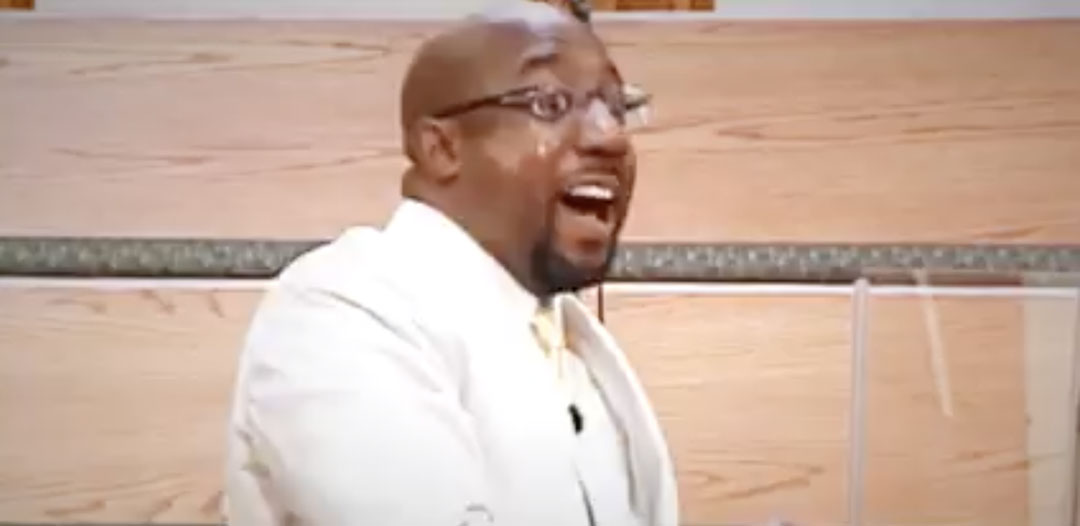
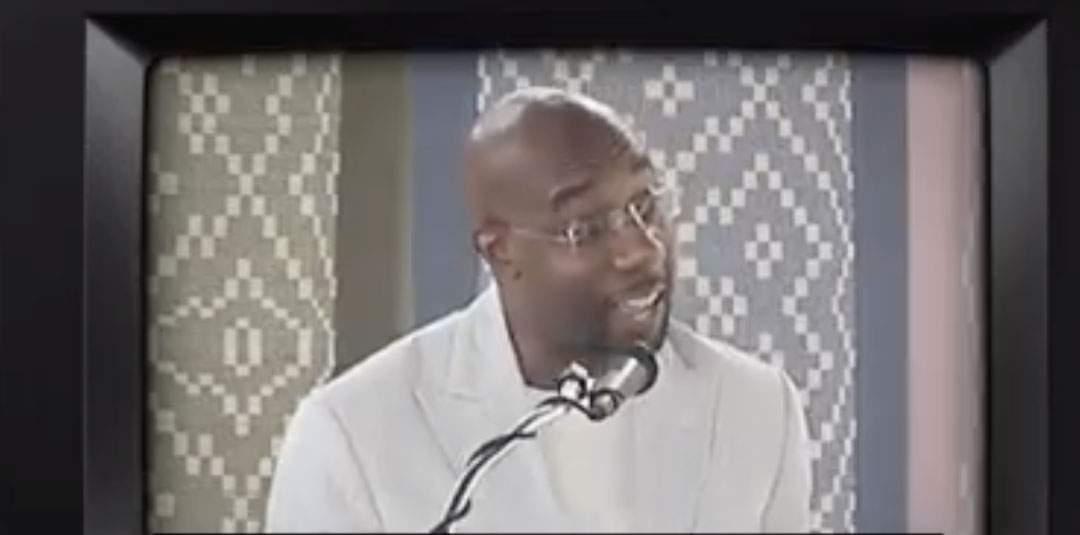
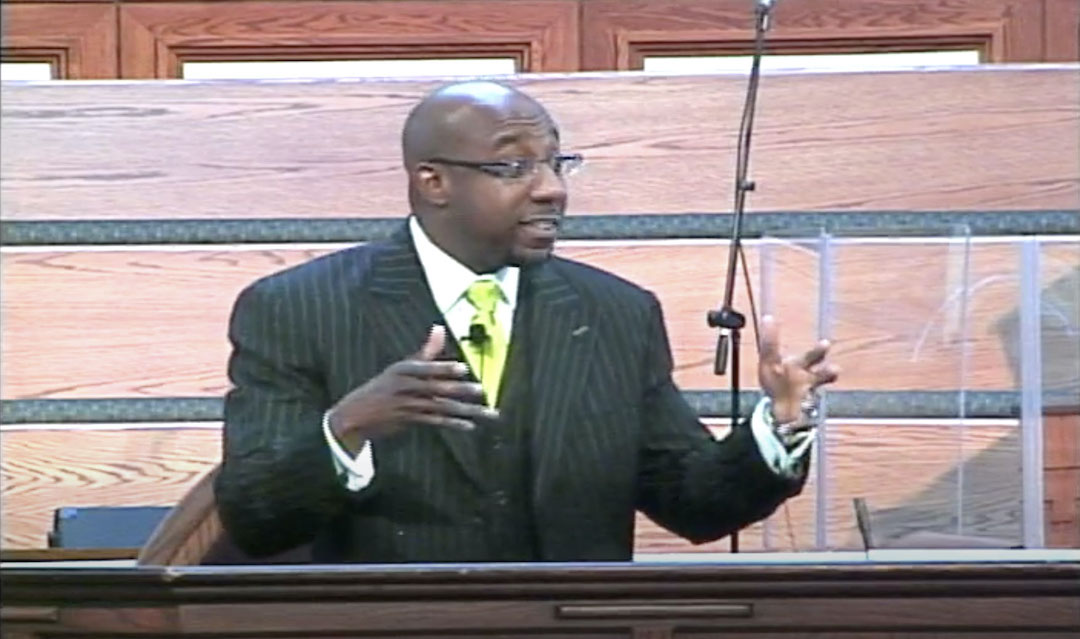
Sen. Kelly Loeffler, R-Ga., ran a paid Facebook ad last week that artificially darkened the skin color of her Democratic opponent, the Rev. Raphael Warnock, who is Black. In fact, the campaign used two of the same clips in their original form for another Facebook ad that ran the same day, but spent 10 times as much money boosting the version in which Warnock appeared darker.

According to the Facebook Ad Library, on Dec. 29 the Loeffler campaign spent between $3,000 and $3,500 on an ad called “Too Radical. Too Corrupt,” and dropped between $40,000 and $45,000 on a second, more aggressive counterpart titled “Beyond Radical Raphael,” which uses some of the same footage, but with Warnock’s skin noticeably darkened. Here are screenshots taken from the two ads:

The second ad darkens Warnock’s skin throughout, including in a video clip pulled from a sermon he gave in 2011 at Atlanta’s historic Ebenezer Baptist Church, the former pulpit of the Rev. Martin Luther King Jr., where Warnock is now senior pastor.

Additionally, the second ad’s title card is a version of an Associated Press photo from November that has been colorized, featuring Warnock with darker skin.

The two ads deploy similar copy, but the second spot — which as of Monday evening had racked up around 1 million impressions — is more aggressive. The first ad’s caption claims that “Raphael Warnock is a Radical Liberal” who “was educated by Marxists.” The caption for the darkened ad says that Warnock is “beyond Radical,” and was “trained by Marxists.” It ends: “Warnock isn’t just radical — he’s dangerous.”

“Given that Kelly Loeffler has run the single most negative campaign in Georgia history, there is no level she could stoop to that would surprise us,” Warnock campaign spokesperson Terrence Clark told Salon.

Loeffler, a former financial executive whose rapidly expanding wealth made her a billionaire last week, recently came under fire for appearing in a photo with Chester Doles, a white supremacist and former Ku Klux Klan imperial wizard who maintains extensive ties to the neo-Nazi movement.

“Kelly had no idea who that was, and if she had she would have kicked him out immediately because we condemn in the most vociferous terms everything that he stands for,” Stephen Lawson, a Loeffler campaign spokesperson, explained to the Atlanta Journal-Constitution.

Doles, however, had already been thrown out of a Loeffler campaign event in September — not by Loeffler’s campaign, but by Rep. Marjorie Taylor Greene, R-Ga. (then a congressional candidate), who had herself felt backlash when Doles attended one of her campaign events earlier that year.

In a debate earlier this month, Loeffler called Warnock a “radical liberal” more than a dozen times, while declaring “There is not a racist bone in my body.” In response, a coalition of more than 100 Black pastors in Georgia blasted the unelected Republican in an open letter, arguing that her attacks amounted to an affront on the Black church. Loeffler had been “demonstrating disdain for Black elected officials and Black Lives Matter marches,” they wrote, while “remaining silent on the antics of the Proud Boys and Wolverine Watchmen,” a reference to the militia group that had allegedly plotted to kidnap and kill Michigan Gov. Gretchen Whitmer, a Democrat. The letter called for Loeffler to “cease and desist” in her criticism of Warnock’s ministry.

In the 2020 campaign, Sen. Lindsey Graham, R-S.C., ran a Facebook ad that featured his Democratic challenger, Jaime Harrison with darkened skin, and Sen. David Perdue, R-Ga., the incumbent in Georgia’s other Senate runoff election, was dragged for mocking Vice President-elect Kamala Harris’ name.

The Perdue campaign said he had “simply mispronounced Senator Harris’ name, and he didn’t mean anything by it.”

In July, the Perdue campaign removed an ad that appeared to enlarge the nose of his Democratic opponent, Jon Ossoff, who is Jewish, amid criticism that it was anti-Semitic.

Multiple officials with the Loeffler campaign failed to reply to Salon’s requests for comment.

Astronomers home in on a precise date for the universe’s birthday

How old is the universe? Astronomers have been homing in on an increasingly precise estimate for its age for decades. Now, a new research paper based on observational data gives of the most precise estimations yet: 13.77 billion years old, give or take some chronological chump change of 40 million years.

The research, which was published in the Journal of Cosmology and Astroparticle Physics, analyzed the oldest light sources in the universe based on data from the Chilean National Science Foundation’s Atacama Cosmology Telescope (ACT). Researchers looked at data from the same light sources that came from the European Space Agency’s space-based Planck satellite, which gathered its own information about remnants from the Big Bang between 2009 and 2013. The authors pledged to publicly release all of the data that they used to form the basis for their conclusions.

This study comes amidst a fierce debate among scientists about the age of the universe, much of which remains unresolved. For one thing, there is the so-called “Methuselah star” that seemed to be roughly 16 billion years old, which presented a problem for scientists who at that time believed the Big Bang had occurred between 12 billion and 14 billion years ago. By 2013 scientists had revised its age to 14.5 billion years, based on new data, which could peg the star at roughly the same age as the universe itself.

In July, scientists published an article in the Astronomical Journal suggesting that the universe could actually be as young as 12.6 billion years old.

Now, this new study seems to coincide with the results from the Planck satellite, which is good news in terms of trying to reach a scientific consensus.

“Now we’ve come up with an answer where Planck and ACT agree,” Simone Aiola, a researcher at the Flatiron Institute’s Center for Computational Astrophysics and first author of one of two papers, told Cornell University. “It speaks to the fact that these difficult measurements are reliable.”

The Big Bang model, which was first proposed by Belgian physicist and astronomer Georges Lemaître in 1927, proposes that the universe existed as an extremely dense and hot single point in space before expanding at the speed of light (and initially, faster). There is ample evidence pointing to this theory, including the observation that all gravitationally unbound objects in space are moving away from all other objects as they would in an expanding universe; likewise, more distant objects are moving away faster. 

Our solar system is believed to have been created roughly 4.6 billion years ago, meaning that even by the most generous estimations it is far still less than half the age of the universe itself.

Although the use of the word “bang” may imply an explosion, scientists believe that the universe has really been in a state of ongoing expansion. The “bang” is believed to have been a sudden burst of expansion, or inflation, doubling in size at least 90 times as it continued to grow exponentially. As these things happened, the universe emitted considerable amounts of light and microwave radiation, much of which continues to exist in the universe today. This cosmic microwave background is visible to microwave detectors, and as such allows scientists to learn more about the early periods in the history of our universe.

Income inequality is out of control. Economists fear Biden won’t do enough to fix it

The coronavirus pandemic has not only taken over 340,000 lives in the United States, but led to a major economic downturn, the recovery from the which has primarily benefited the wealthy. The widening rift between rich and poor, stoked by Trump’s policies, has stirred social unrest in the United States and created an opening for the next president to win political points by redistributing wealth in this country. 

But will President-elect Joe Biden be that kind of president?

Many economists and political pundits are doubtful. And while it is difficult to predict entirely what a sitting president will do prior to their inauguration, there are hints in Biden’s appointments and statements thus far that may foreshadow his economic agenda.

First, Biden’s past positions speak to his political alignment. Though a Democrat, Biden has held pretty conservative positions in the past. As a senator he supported freezing Social Security spending, deregulating Wall Street, reducing the top income tax rate from 70 percent to 50 percent and opposing antitrust legislation. During the 2020 campaign, Biden ran by embracing President Barack Obama’s legacy as his own — and emphasizing that this made him more moderate than opponents like Sen. Bernie Sanders of Vermont, a democratic socialist and his chief rival in the primaries.

Yet the events of 2020 seem to have pushed Biden to the left. After the COVID-19 pandemic caused an economic crash, Biden reportedly told his advisers that he wanted to plan a presidency as bold as that of Franklin Roosevelt, who is widely regarded as the most influential left-winger to ever hold that office. When he began announcing picks to his team of economic advisers — Janet Yellen as Treasury Secretary, Jared Bernstein as Chief Economist and Economic Policy Adviser, Cecilia Rouse as head of Council of Economic Advisers (CEA), Heather Boushey as a CEA member — some prominent Democrats publicly praised him on Twitter.

“An economic dream team,” observed Harvard professor Jason Furman, who chaired Obama’s CEA. “Excellent. All committed to full employment, boosting wages, reducing inequality,” wrote former Labor Secretary Robert Reich. “I’m very happy with every name I’m hearing. The contrast with the Trump creatures is, of course, overwhelming. But pretty strong contrast even with Obama,” tweeted economist and New York Times columnist Paul Krugman.

So which Biden should progressives expect — the Biden who pushed for centrism as a senator for 36 years and as vice president for eight, or the one who now seems to want progressives to believe he is in their corner?

“He’s a transactional politician,” Dean Baker, economist and co-founder of the progressive think tank the Center for Economic Policy Research, told Salon. “That’s what he’s been his whole life. So he’s not Bernie Sanders who has strong convictions that I’m going to do X, Y, and Z. I think he’s basically a decent guy, but he’s going to go where the pressure takes him. And in that sense, I think that’s not bad because there will be pressure from the left.”

At the same time, Biden’s choices for economic advisers are not necessarily groundbreaking, and that means progressive activists will have their work cut out for them.

“We need to consider what we mean by economic team — like [former South Bend Mayor and Secretary of Transportation nominee Pete] Buttigieg — providing a great ‘return on investment’ for Silicon Valley in ensuring that US government transportation policy is more based around accelerating profits of Big Tech firms and their investors rather than providing the public with adequate systems,” Sam Husseini, communications director for the Institute for Public Accuracy, a progressive nonprofit group that challenges mainstream media narratives on major public issues, told Salon by email. He also expressed concerns about the fact that Biden’s pick for Agriculture Secretary, Tom Vilsack, has ties to agricultural behemoth Monsanto and that Tanden has numerous Wall Street and other corporate connections.

Richard Wolff, professor emeritus of economics at the University of Massachusetts Amherst, expressed to Salon that  Biden’s advisers are “out of the left end of the conventional. It remains very much within conventional. It is a kind of acceptance of the boundaries of what can be spoken in those circles.”

To illustrate his point, Wolff explained that past Democratic economic advisers might “get lost in games about whether the cutoff for poverty is $18,000 or $20,000 for a family of four” or use other methods to do “whatever the moving the goalposts might have to be.” The underlying problem is that, instead of thinking of solutions that redistribute economic power in a substantive way, “what they have consistently done under the label of realism is rule out the kinds of policies that come from radicals.”

“Most of his advisors are really very moderate Democrats, very moderate policymakers,” Gar Alperovitz, an American historian and political economist, explained to Salon. “We’re not likely to see anything particularly interesting beyond very cautious and Obama-style economics.”

When it came to names like Rouse, Bernstein and Tanden, Alperovitz characterized them as “a pretty standard, moderate, slightly left” group, the kind of “cautious” people who are somewhat sympathetic to the working class but would hardly be expected to shake up the fundamental structures of American capitalism itself through major redistributions of wealth and power.

As Wolff pointed out, the Democratic president whom Biden has specifically said he wishes to emulate, Franklin Roosevelt, famously proposed an economic bill of rights that would have guaranteed every American a “useful and remunerative job,” housing, food, clothing, recreation, education and health care. Wolff said that based on his picks, it is doubtful that the Biden administration is going to pursue any truly sweeping changes like that, instead preferring the moderate approach of “the 8 million things that have been done puttering around at the edges of capitalism.”

While Baker shared this broad consensus that Biden is going to take a more moderate approach — “he made no bones about that” — he said there was also reason for some hopefulness when it comes to issues like housing and urban development, where Biden has chosen the progressive Rep. Marcia Fudge of Ohio as his point person, and on issues like labor rights, telling Salon that “he’s been very pro union really throughout his career and throughout the campaign. And there’s a lot he could try to do in the White House and, I expect, with the National Labor Relations Board.” Traditionally unions have been very effective at reducing income inequality, with the wealth gap between the top and bottom brackets widening in eras with weaker unions and shrinking in eras with stronger ones.

Another contributor to income inequality — and, in particular, the black-white wealth gap — is the trillions that Americans owe in student debt. There have already been reports that Biden is thinking about taking bold steps to deal with the student debt crisis. He has suggested, among other things, forgiving undergraduate tuition-related federal student debt from two- and four-year institutions for individuals who earn less than $125,000, canceling a minimum of $10,000 of student debt per person and making it so that after two decades, the federal student loans individuals may have left over will be forgiven without any tax burden.

Will this be enough? Nomi Prins, economist and author of “Collusion: How Central Bankers Rigged the World,” talked to Salon about this issue.

“One of the things that Biden did during his campaign was give a little bit more positivity towards the notion of potentially canceling more of student debt in terms of just verbiage,” Prins told Salon. “That was useful for the campaign. It was useful for getting the younger voters in, Salon readers, and just generally people who’ve been carrying a year to two years to a decade to two decades worth of student debt.”

Prins’ concern is that the programs Biden will actually choose to implement may not be sufficiently comprehensive.

“At the average student loan rate — let’s call it, 4%, 5%, 6%, 7% — the amount of interest that someone would have paid already after 20 years, it would have gone to the banks most likely because the higher interest go with private funded student loans would have ultimately either potentially overshadowed the student debt to begin with, or certainly been a large chunk of it,” Prins explained “And so it’s useful to cancel the rest of it, but as the gift on student loan debt, that doesn’t do it — that does not cut into the $1.5 trillion or $1.6 trillion in growing student loan debt that continues to accumulate.”

Overall, the question of whether Biden will be sufficiently left-wing depends on more than the character of Biden himself. It depends on the specific pressures exerted upon him by the political conditions of his time. To understand this, it is useful to compare Biden to the president that he has often compared himself to — Roosevelt.

“It’s helpful to think in terms of the era as much or more than about the individual,” Norman Solomon, a Sanders delegate in 2016 and 2020 and a national director of rootsaction.org, told Salon. Although “Roosevelt ran as something of a deficit hawk in 1932,” outside progressive groups exerted pressure on him that allowed him to push the party to the left. (Wolff made a similar point to Salon.) “That’s why Roots Action has been organizing the ‘No Honeymoon for Biden’ campaign. And there are a lot of progressive forces, I believe, arrayed to insist that there be no honeymoon with Biden, so that the mistakes of greeting [President Bill] Clinton and Obama by kissing their boots instead of pushing them will not be replicated.”

Will Biden be receptive to that? Baker shared a revealing Biden story with Salon, back when the then–vice president met him in a group setting.

“He met with a group of economists, there were probably about eight of us, and he just was picking our brain on different issues,” Baker recalled. “And I was impressed with him, I gotta say, because he actually wanted to hear the issues. He had some of us debating back and forth on different issues and he seemed to be following. I’ve had many occasions to deal with different politicians and usually they’re looking for a soundbite.” By contrast Biden “actually seemed interested in hearing a serious discussion. So that impressed me.”

Trump awards Medal of Freedom to top congressional supporter Rep. Devin Nunes in shadowy ceremony

With just two weeks left of his term, President Donald Trump endowed one of his biggest boosters on Capitol Hill with the Presidential Medal of Freedom. Rep. Devin Nunes, R-CA, the former chair of the House Intelligence Committee and member of the Trump transition team, led a vociferous campaign to exonerate Trump in Special Counsel Robert Mueller’s investigation into Russian interference in the 2016 election and then provided the president an unwavering defense during his impeachment inquiry. On Monday, Nunes was awarded the highest civilian accolade by Trump at a ceremony closed to the press.

In 2018, Trump erroneously expressed his intent to award Nunes the Medal of Honor, an award that is only given to those for acts of military bravery, for his handling of the Russia probe. Established in 1963 by President John F. Kennedy, the Presidential Medal of Freedom has decorated exemplary American citizens for their “exceptional contributions to the security or national interests of America, to world peace, or to cultural or other significant public or private endeavors.” Some of its past recipients include Neil Armstrong, Rosa Parks, Muhammad Ali, and Jesse Owens. Trump is next expected to reward Rep. Jim Jordan, R-OH, ranking member of the House Judiciary Committee and founder of the right-wing House Freedom Caucus.  

Both Nunes and Jordan have been stalwart allies of the president in his endless improprieties. During the impeachment inquiries, for example, Jordan was called Trump’s personal “attack dog.” Jordan met with several senators to discuss Trump’s fruitless effort to overturn the results of the recent election, cementing him as one of Trump’s most faithfully deluded loyalists.

Nunes and Jordan, who have promoted a litany of conspiracy theories and exploited their positions of authority to enrich themselves, are a far cry from “security” or “world peace.” But with right-wing shock jock Rush Limbaugh declared a recipient of the award back in February of last year –– Trump thanked Limbaugh for for his “decades of tireless devotion to our country” –– the President has done well to unmoor the American public’s previous conceptions of who might be deserving of such an accolade.

Other recipients of the award under the Trump administration include longest-serving U.S. Republican Orrin Hatch, the late Supreme Court Justice Antonin Scalia, Reagan-era economist Aruthur Laffer, and founder of Penske Automotive Group Roger Penske.

According to CNN, Jordan and Nunes are just two of many who have put their name on the list to be nominated, or asked their supporters to do so. The congressmen’s nominations also come amid a tidal wave of perks and benefits that Trump has conferred to those who have served on his federal advisory boards –– all in the final days of his presidency.

“Jeopardy!” champ Ken Jennings stumbles into more controversy after defending “Bean Dad” on Twitter

Ken Jennings,  who holds the all-time record for most consecutive “Jeopardy!” games won, has stumbled from one Twitter controversy into another after coming to the defense of a man that the internet dubbed “Bean Dad.” 

Jennings was recently announced as the first guest host of “Jeopardy!” following longtime host Alex Trebek’s death, but following that announcement in November,  insensitive tweets by Jennings resurfaced. 

One tweet from 2014 read, “Nothing sadder than a hot person in a wheelchair,” while another in 2015 included a joke about a terminally ill “Star Wars” fan who got to watch “The Force Awakens” before he died. Jennings had previously refused to delete these tweets, saying that they “could lead to smart replies and even advocacy. Deleting them felt like whitewashing a mistake.”

But this time, ostensibly in preparation for his hosting gig beginning Jan. 11, Jennings issued a full apology on Twitter, writing: “Sometimes I said dumb things in a dumb way and I want to apologize to people who were (rightfully!) offended. It wasn’t my intention to hurt anyone, but that doesn’t matter: I screwed up, and I’m truly sorry.” 

Fast-forward to this past New Year’s weekend, and Jennings is under fire again for tweeting in support of his “Omnibus” podcast co-host John Roderick, amid a viral Twitter scandal. It’s a wild, unwieldy story, so here’s what you need to know: 

Who is “Bean Dad”? 

John Roderick is the lead singer and guitarist of the band The Long Winters and was formerly a touring member of the band Harvey Danger. He also hosts or co-hosts several podcasts, including “Roderick On The Line,” “Road Work” and Jennings’ “Omnibus.” 

On Sunday, Roderick tweeted in a thread that his 9-year-old daughter came to him and said she was hungry. He told her to make some beans and when she asked how, he said, “Open a can and put it in a pot.” Then, he realized that she had never had to use a can opener before. 

Roderick tells her to “study the parts, study the can, figure out what the can opener inventor was thinking when they tried to solve this problem.” Time passes and his daughter grows increasingly frustrated because, as Roderick put it, “spatial orientation, process visualization and order of operation are not things she . . . intuits.” 

He then told her, “Sweetheart, neither of us will eat another bite today until we get into this can of beans,” before returning to a jigsaw puzzle he’d been poking at all day. Finally, after “six hours on and off,” and Roderick’s daughter eventually telling her father she hates him, she successfully removes the lid. They feast on beans, and Roderick takes to Twitter to breathlessly recount what he obviously viewed as his greatest teaching moment as an “Apocalypse Dad.” 

The story went viral, as did the phrases “Bean Dad,” “she is nine” and “SIX HOURS.” While some parents did view Roderick’s tale as a triumph for instilling perseverance or innovation, much of the internet . . . did not agree. Film critic and author Lindsay Ellis succinctly summarized it like this

“Only because I can’t stop thinking about Bean Dad even tho I hope to forget about him tomorrow,” Ellis said. “But it’s pretty obvious to me that he kind of deep down knew he was being s**tty to his daughter, and that’s why he took it to Twitter to reframe his s**ttiness as a Teachable Moment.”

While Twitter users went back and forth regarding whether Roderick was emotionally abusive, his self-aggrandizing thread definitely paints him as a sort of Wes Anderson-style “Bad Dad.” I could easily envision a deleted scene from “The Royal Tenenbaums” where Richie and Chas recall in hushed tones the time that Royal locked them in the kitchen with a can opener and a can of baked beans and wouldn’t let the family eat until they figured out how to use it. Not necessarily abusive, but definitely intended to belittle in effort to make a point or put on a show.

Roderick even seemed to briefly cop to this. “I know I’m infuriating,” he wrote on Twitter. “I know this is parenting theatre in some ways.” But then he began to lash out at people who questioned him on Twitter  — though not before some of his old racist, anti-semitic and ableist tweets were resurfaced. 

“Every time I use a word like ‘gay’ or ‘retarded’ some gay retard reminds me those words are hurtful,” he wrote in 2011. He also wrote things like,”Jews ruin everybody’s fun,” joked openly about rape and said, “The founders intended USA as white homeland.”

Roderick quickly deleted his account and, as journalist Helen Kennedy put it, “Bean Dad’s daughter toughed out his can opener experiment longer than he withstood Twitter criticism. One assumes he has learned much from being tested this way.” 

His account was reactivated Monday afternoon, though many of the tweets in question have since been deleted. 

Where does Ken Jennings come in? 

Alright, so remember how Jennings and Roderick co-host a podcast together? Jennings decided to come to the aid of Roderick amid the online kerfuffle, initially just commenting on his parenting style; this was just as Roderick’s problematic tweets were making the rounds. 

“If this reassures anyone, I personally know John to be (a) a loving and attentive dad who (b) tells heightened-for-effect stories about his own irascibility on like ten podcasts a week,” Jennings tweeted. “This site is so dumb.”

But then several Twitter users asked Jennings how he felt about his co-hosts racist and anti-semitic views. He responded, “If we’re word-searching through old tweets now, it’s pretty easy to find what he actually thinks about anti-Semitism. On our show he’s always the pro-Israel one!” 

As many commenters pointed out, being “pro-Israel” doesn’t necessarily mean that someone is free from anti-Semitism. Regardless, Jennings doubled-down, writing, “There’s no axis where any anti-Semitic screenshot represents any actual opinion I’ve ever heard from him.” 

Keep in mind, this is fresh off of Jenning’s own recent Twitter scandal involving insensitive comments, and many “Jeopardy!” fans responded in disappointment, one stating, “Alex Trebek would have had a stronger stance on racism and bigotry.” 

This reignited interest in the Change.org petition endorsing LeVar Burton as the next host of the game show, which was, as Salon’s Melanie McFarland reported, created to “show Sony Pictures Entertainment Inc. and producers Mike Richards and Harry Friedman just how much love the public has for Burton.” It has almost 112,000 signatures as of this article’s writing.

Wait, then why are people also talking about “My Brother, My Brother and Me”? 

One of the other branches of this story is that Roderick’s song, “(It’s a) Departure” by John Roderick and The Long Winters, served as the theme music for the popular podcast “My Brother, My Brother and Me,” a weekly comedic advice podcast by brothers Justin, Travis, and Griffin McElroy.

Running parallel to the Jennings drama was a call from the podcast’s fans for the hosts to change the theme song. Unlike Jennings, however, the brothers didn’t hesitate. 

“For reasons we’re sure you’re all aware of, we’re getting started finding new music for MBMBaM. You’ll probably hear a filler theme song on this week’s episode,” the hosts wrote on Twitter. “We’re not sure what’ll come after that, honestly, but we hope you’ll stick around to find out.” 

They continued: “We appreciate John letting us use one of his songs as the theme for MBMBaM for nearly a decade, but his response to today’s situation is emblematic of a pattern of behavior that is antithetical to the energy we try to bring to the things we do, and so it’s time for us to move on.” 

On Jan. 4, the McElroy brothers released their first podcast since the transition. The new theme song? A remixed version of the “Rugrats” theme song with lyrics sung by Griffin McElroy. 

“Here come the McElroys, we’ve got jokes and bits,” he sings. “We’re gonna give advice and do funny skits. Laughter, it is in store, come inside and see. It’s time to start, it’s ‘My Brother, My Brother and Me.'” 

As of Monday afternoon, Roderick is back on Twitter. His bio briefly read “Bean Dad 2021” before being deleted and his first tweet now reads, “Somebody had to start the year off with a bang!” 

Update: On Tuesday morning, Roderick posted a lengthy public apology on his website. He said that the story about his daughter was “poorly told,” saying that he framed the story with him playing the character of “a**hole dad because that’s my comedic persona and my fans and friends know it’s ‘a bit.'” 

“My story about my daughter and the can of beans was poorly told,” Roderick wrote. “I didn’t share how much laughing we were doing, how we had a bowl of pistachios between us all day as we worked on the problem, or that we’d both had a full breakfast together a few hours before.” 

He continued: “What I didn’t understand when posting that story, was that a lot of the language I used reminded people very viscerally of abuse they’d experienced at the hand of a parent. The idea that I would withhold food from her, or force her to solve a puzzle while she cried, or bind her to the task for hours without a break all were images of child abuse that affected many people very deeply.” 

Roderick also apologized for his use of racist, homophobic, bigoted and anti-Semitic slurs on Twitter, saying that he ironically “repurposed” the terms, “flipping them to mock racism, sexism, homophobia, and bigotry.” He says that in the early part of the decade, friends helped him realize that was wrong. 

“Yesterday those old tweets resurfaced and hurt a lot of people anew,” Roderick wrote. “People who are close to me, people in my community who couldn’t square those words with the person they know me to be. And people who don’t know me, going about their business yesterday, had to see those awful slurs and feel the hurt those words inspire. They had to suffer this asshole #BeanDad casually demeaning them and their friends. I deeply regret having ever used those words.” 

Roderick wrote that he plans on taking a hiatus from his public life to let some of the lessons he’s learned sink in. 


We asked health care experts why the coronavirus vaccine roll-out has been so slow

When the U.S. the Food and Drug Administration (FDA) approved emergency use of the Pfizer/BioNTech vaccine in mid-December, officials touted a goal-oriented roll-out. By the end of December, 25 million doses of the vaccine would supposedly be available in America— just enough to cover the estimated 21 million health care personnel, and 3 million long-term care residents across the country, cohorts part prioritized to receive the vaccine first. A few days later, the FDA approved the Moderna vaccine, which was expected to increase the number of vaccine doses available to frontline workers in healthcare settings.

But according to the Centers for Disease Control and Prevention, as of January 4, 2021, only a little over 4.5 million Americans have received either the Moderna and Pfizer BioNTech COVID-19 vaccines, and only 15.4 million doses have been distributed across the country. Both the supply and vaccination goals are falling behind. Why?

“Healthcare settings have to deal with the fact that they’re taking care of coronavirus patients at the same time that they’re running vaccination clinics,” said Amesh Adalja, a senior scholar at Johns Hopkins Center for Health Security, in an interview. “People who are vaccinating have other positions and they’re being pulled, there’s no such thing as a full-time COVID-19 vaccinator.”

Hospitals have already been under a significant amount of pressure with dwindling staff and resources as coronavirus cases surge across the country. Asking them to orchestrate the task of vaccinating all of the staff, while taking care of patients during a coronavirus surge and the holidays, is no easy feat. Then there are the complicated logistics of administering the vaccine itself.

As Salon previously reported, many hospitals are only alerting healthcare workers that they can receive the vaccine a day or two before they schedule the inoculation. That short timeline relates to how the vaccine is stored. For example, the Pfizer vaccine has a short shelf life of just five days after being transferred from ultracold storage to a refrigerator, because of its mRNa (synthetic messenger RNA) content. The Moderna vaccine is more hardy; it can be kept at -20°C and can remain stable for up to one month at consumer refrigerator temperatures. The Pfizer vaccine needs to be kept in a freezer at -70°C. Once a person is vaccinated, they have to be monitored for 15 minutes in the rare case of an allergic reaction. The COVID-19 vaccines currently aren’t administered as quickly as a flu vaccine.

Adalja told Salon the pace of the vaccine roll-out doesn’t come as a surprise.

“Many of us knew that to accomplish a task of rolling out a vaccine, in the middle of a pandemic to basically the entire country, was going to be something that was going to have hiccups and unanticipated lags. That’s why it was so important to make sure that there was a plan in place with federal support of states to actually turn vaccines into vaccinations,” Adalja said. “So much of this is not surprising to me, and the fact that it’s getting attention hopefully we’ll start to remedy this issue.”

But it is “concerning.”

“The only way that we end this pandemic is through vaccination, and the fact that states are having difficulty turning vaccines into vaccination speaks to the need for more resources to be able to support this vaccination program,” Adaljda said. “And the longer it takes us to get to the herd immunity threshold, the longer it takes us to vaccinate vulnerable populations, the more this public health emergency will fester.”

The various reports of hospitals vaccination plans going awry are alarming— and the challenges aren’t only a result of lack of staffing and resources. According to a report in The Texas Tribune, so many healthcare workers at a hospital declined the vaccine that doses were offered to nearby medical workers outside. A separate report in the New York Times surfaced stories of doses being thrown out because of poor planning or how prioritization in some hospitals embodied an “every man for himself” attitude. According to the Los Angeles Times, a Disney worker received the Pfizer vaccine because she was reportedly a relative of a hospital worker.

In a CNN op-ed, Kent Sepkowitz argued that the vaccine roll-out isn’t a “disaster,” and that Americans can expect it to get better under a President-elect Joe Biden’s administration.

“Given both the intrinsic difficulties of choreographing a national program ASAP and the clear lack of urgency from the White House, it is safe to assume that a better program simply won’t happen during President Trump’s leadership,” Sepkowitz wrote.  “But there is every reason to think that the Biden administration will increase the pace and address all the contingencies efficiently and without politics.”

Some states and cities are taking matters into their own hands. On Monday, New York Governor Andrew Cuomo said hospitals could face fines up to $100,000 if they don’t use their current supplies of vaccines by the end of the week.

“We want those vaccines in peoples’ arms,” Cuomo said.

Adalja told Salon he believes there needs to be “more resources and more staffing being dedicated to hospitals,” in order for the vaccine roll-out to ramp up, which will be needed when the country moves to the next phase of vaccinations, extending to non-healthcare and long-term care facility workers and residents.

“Phase One is the easiest part of vaccination, because these are all people that are kind of captive audiences, they either work in hospitals or live or work nursing homes, it’s going to get much harder when we move into the community,” Adalja said. “And if we can’t do this very well, it doesn’t speak well for what we’re going to do when we have to vaccinate people in the community.”

Rep. Matt Gaetz praises Trump’s possibly criminal phone call as “clear and visceral”

A few major Republican officials have spoken out against President Trump’s threats made to Georgia election officials in leaked audio from a phone call over the weekend. Democrats have already described the call as an “impeachable offense” and the state’s top GOP election official — Trump’s principal target — said it might result in an investigation by the district attorney of Fulton County, which includes Atlanta. But Rep. Matt Gaetz, a Florida Republican and one of Trump’s most stalwart congressional supporters, instead praised the outgoing president for his honesty.

“Stream-of-consciousness Trump is my favorite President Trump, because he is so clear and so visceral,” Gaetz said in a phone interview with Fox News on Sunday. “If someone has followed President Trump’s tweets, they’re pretty well in line with the comments that he made to the secretary of state.”

Democrats have not been shy in their outrage about the threats, which echoed the pressure Trump put on Ukrainian President Volodymyr Zelensky in a 2019 phone call that led to the president’s impeachment for abuse of power. With a few exceptions, however, Republicans have largely stayed on sidelines — despite the pushback on the call from Georgia Secretary of State Brad Raffensperger, a Republican elected official and Trump supporter, who repeatedly shot down the president’s efforts to convince him to “recalculate” the election results, in the face of political and criminal threats.

“The people of Georgia are angry, the people in the country are angry,” Trump said on the hour-long phone call. “And there’s nothing wrong with saying, you know, um, that you’ve recalculated.”

“Well, Mr. President, the challenge that you have is, the data you have is wrong,” Raffensperger replied.

Trump said: “So look. All I want to do is this. I just want to find 11,780 votes, which is one more than we have. Because we won the state.”

Trump later suggested that Raffensperger’s choice could endanger Georgia Republican Sens. David Perdue and Kelly Loeffler, who face runoff elections on Tuesday that will determine which party controls the Senate.

“You would be respected, really respected, if this thing could be straightened out before the election,” the president said. He added that Raffensperger’s inaction was “more illegal” than the alleged election fraud itself: “But the ballots are corrupt. And you are going to find that they are — which is totally illegal, it is more illegal for you than it is for them because you know what they did and you’re not reporting it,” Trump said. “That’s a criminal, that’s a criminal offense. And you can’t let that happen. That’s a big risk to you and to Ryan [Germany], your lawyer. And that’s a big risk.”

A number of legal scholars have indicated, however, that it’s entirely possible Trump himself violated criminal statutes governing election fraud.

“His best defense would be insanity,” former Justice Department Inspector General Michael Bromwich tweeted on Sunday. “The entire call is astonishing. The bullying, the threats, the insults, the credulous embrace of discredited conspiracy theories,” Bromwich added. “Like a crime boss, Trump occasionally says that all he wants is the truth. But he doesn’t — he wants the win.”

Raffensperger, when asked Monday on ABC’s “Good Morning America” whether he planned to open an investigation, said that it would pose a conflict of interest for him, but added that “the Fulton County district attorney wants to look at it. Maybe that’s the appropriate venue for it to go.”

Newly-elected Fulton County D.A. Fani Willis said in a statement provided to Salon that the call was “disturbing,” and indicated that she would pursue an investigation if the board of elections refers one to her office.

“Like many Americans, I have found the news reports about the President’s telephone call with the Georgia Secretary of State disturbing,” Willis said. “It is my understanding from news reports that a member of the State Election Board has requested that the Secretary’s Elections Division investigate the call, after which the Board can refer the case to my office and the state Attorney General.”

Gaetz is among only a handful of Republicans who have openly come to Trump’s defense. Sen. Marsha Blackburn, R-Tenn., a strong ally of the president, told the hosts of “Fox & Friends” on Monday morning that Trump’s conversation with Raffensperger was “not a helpful call.” In a CNN interview that morning, Georgia Lt. Gov. Geoff Duncan, a Republican, said that the call was “inappropriate” and “certainly did not help the situation.” Rep. Adam Kinzinger, R-Ill., a frequent critic of the president, was harsher, tweeting on Sunday that the phone call was “absolutely appalling.”

“To every member of Congress considering objecting to the election results, you cannot — in light of this — do so with a clean conscience,” Kinzinger added, speaking directly to a group of more than 100 representatives and a dozen senators who plan to challenge the official certification of the Electoral College results on Wednesday. That group includes both Blackburn and Gaetz.

“I’m not going back to yesterday’s Republican Party, I’m not going back to losing politely, with Mitt Romney. I’m not going back to the Bushes or the Cheneys,” Gaetz told a group of young conservatives on Dec. 20. “This is Donald Trump’s party, and I am a Donald Trump Republican.”

Salon first reported in October that the campaign to re-elect Gaetz, a reliable Trump ally, appears to have received a deep discount on lodging at the Trump International Hotel in Washington during the Republican National Convention last August. Such a discount would violate federal election law prohibiting corporations from making direct contributions to campaigns.

GOP Rep. Louie Gohmert’s law license could be at risk following election stunt: report

Rep. Louie Gohmert has had a long legal career since graduating from Baylor Law School in 1977, but is now facing legal sanctions for his attempt to overturn the result of the 2020 presidential election.

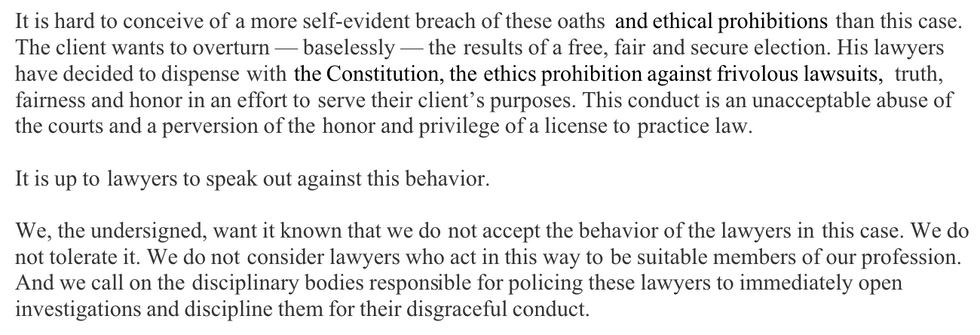
“A national lawyers group on Monday called for professional licensing bodies to investigate East Texas congressman Louie Gohmert and his attorneys for what it called a ‘self-evident breach’ of ethics rules for lawyers when they sued unsuccessfully last week to try to force Vice President Mike Pence to overturn the results of the Nov. 3 presidential election,” The Dallas Morning News reported Monday. “Lawyers Defending American Democracy, a nonpartisan group that says it has the support of 5,000 lawyers across the country, said in a statement that Gohmert, Dallas lawyer William L. ‘Lewis’ Sessions and unnamed other lawyers should be sanctioned for egregious conduct.”

“They and other plaintiffs and lawyers involved in the suit invoked the 12th Amendment: ‘The President of the Senate shall, in the presence of the Senate and House of Representatives, open all the certificates and the votes shall then be counted.’ Lawyers Defending American Democracy said the amendment doesn’t allow a vice president to pick which electoral votes to count for a given state,” the newspaper reported. “They and other plaintiffs and lawyers involved in the suit invoked the 12th Amendment: ‘The President of the Senate shall, in the presence of the Senate and House of Representatives, open all the certificates and the votes shall then be counted.’ Lawyers Defending American Democracy said the amendment doesn’t allow a vice president to pick which electoral votes to count for a given state.”

U.S. District Judge Jeremy Kernodle threw out the lawsuit on Friday. Judge Kernodle was appointed by Trump. The ruling was upheld by a federal appeals court on Saturday.

Gohmert served in the Judge Advocate Generals corps in the U.S. Army, attaining the rank of captain. He was subsequently elected a state district judge in Texas before then-Gov. Rick Perry appointed him as chief justice on Texas’s 12th Court of Appeals.

Lawyers Defending American Democracy letter.

How to soften cream cheese (and bake your heart out with it)

Ah, cream cheese. We know it, we love it, it’s our old standby bagel topping. But this tangy spread is so much more than a schmear. Cream cheese is a rich dairy product that makes an amazing addition to pastries, pastas, and more, adding a smooth, rich quality to everything it touches. But it can be tricky to work with when cold: it sticks to itself, clumping together, and nobody wants lumpy frosting, am I right? For this reason, when it comes to working the stuff into recipes, especially desserts, most recipes call for softened cream cheese. Once it comes to room temperature, cream cheese can properly incorporate into a batter or emulsify a frosting.

How to soften cream cheese in the microwave

Since cream cheese has such a high fat content, it doesn’t take long to come to room temperature if the room is relatively warm. It takes about thirty minutes on the counter to soften significantly, and about an hour to fully come to room temperature (again, depending on the temperature outside and in your kitchen). But if you’re strapped for time, or have a sudden craving for cheesecake, you can cut that time down to seconds. Remove any packaging (especially foil!) and place the block of cream cheese on a microwave-safe plate. Microwave on high for 15 seconds, then poke the center of the cream cheese block to test the texture. If it’s still not your desired softness, continue microwaving in 10-second intervals, but err on the side of caution. A little firmer is better than melted, which will be hard to salvage and potentially unusable in a recipe. The cream cheese should feel soft and hold a fingerprint when pressed.

How to soften cream cheese at room temperature

My all-time favorite way to soften cream cheese (and butter, for that matter) faster than a block sitting on the counter, and without a microwave, is the method I learned from My Baking Addiction. It’s called “the cube method”: unwrap the cream cheese, cut it into smaller pieces or cubes, and leave them on a plate or in a bowl to soften. With more surface area exposed to the room’s temperature, and less mass to thaw, small pieces soften faster than a solid block. Plus, when it comes time to incorporate them into your batter, these smaller cubes of cream cheese are easier to distribute evenly throughout your mix. I call that a win-win.

On whipped cream cheese

While whipped cream cheese might seem like a natural substitute for softened cream cheese since it’s spreadable, I don’t recommend it as a substitute in most recipes. While undetectable in its whipped state, it’s actually grainier in texture (while block cream cheese is made by adding cheese culture to milk and cream, whipped cream cheese is set with lactic acid, a quicker alternative). It may be less noticeable in something like frosting, but it can affect the texture of cakes batter or cookie dough, and ultimately yields a less smooth final product. For that reason, I always recommend sticking to the block. Plus, who wants to pay for air?

Now that your cream cheese is soft, let’s cook

Beautiful Bakes

No-Bake Lime Cheesecake

This no-bake cheesecake whips up in just a few minutes and tastes like a cross between key lime pie and cheesecake.

Meyer Lemon Cheesecake with Biscoff Crust

Take advantage of winter citrus and make this Meyer Lemon Cheesecake. It’s zingy, fresh, and has an outrageously irresistible crust made with Biscoff biscuits (also known as the reason you can’t stop eating cookie butter out of the jar with a spoon).

Chocolate-Walnut Rugelach

More of a cookie person? Enter: rugelach, a rolled cookie made with a sweet, soft dough surrounding a filling of nuts, jam, cinnamon, chocolate, or some combination therein. What’s not to love?

Don’t forget the frosting

Naturally-Dyed Red Velvet Cake with Cream Cheese Frosting

Cinnamon Rolls with Cream Cheese Frosting

Carrot Cake

Susan Miglore’s Fudgy Cream Cheese Chocolate Cake

In my book, “CC frosting,” as we called it at the bakery where I used to work, qualifies as an IPTSOE (I Put This Stuff on Everything). To me, anything buttercream can do, cream cheese frosting can do better. Enter: Cinnamon rollscarrot cakechocolate cake, and of course red velvet cake. Cream cheese provides a slightly acidic tang that counters powdered sugar-based frosting’s cloying tendency in a way that butter simply can’t. I challenge you to swap cream cheese frosting for buttercream on your next birthday cake, and watch as the compliments come rolling in.

If you’re “not a dessert person”

Chrissy Teigen’s Everything Bagel Cream Cheese Breakfast Bake

Creamy, Cheesy Artichoke & Chicken Pasta Bake

Lemony Cream Cheese Pancakes with Blueberries

The next time Sunday morning rolls around and you’re preheating the griddle, add some cream cheese to your pancakes, like these ethereal lemony ones. If you opt for savory brunch, take it from Tiegen (Chrissy, that is) and bake up this everything bagel casserole. Or ditch your brunch plans altogether and save the cream cheese for dinner, where it can make any creamy, cheesy pasta even more silky and rich.

However you choose to cook with it, cream cheese brings zing and undeniable richness to savory dishes and desserts alike. And if you have some left over from your bake, when in doubt, there’s no better reason to make homemade bagels.

The garlickiest, butteriest, simplest pasta sauce

Big Little Recipe has the smallest-possible ingredient list and big everything else: flavor, creativity, wow factor. That means five ingredients or fewer — not including water, salt, black pepper, and certain fats (like oil and butter), since we’re guessing you have those covered. This week, we’re going from garlicky to garlickiest.

* * *

When my kitchen is out of milk and eggs and greens and, most concerningly, coffee, I can still count on these staples, sturdy as they come: pasta, garlic, and butter. This weeknight dinner needs nothing more.

The littlest of Big Little Recipes — the lowest of the low-maintenance, the chillest of the chill — share their ingredients via their titles. Think: Chicken Noodle Soup with just chicken and noodles. Chocolate – Peanut Butter Mousse with just chocolate and peanut butter. Broccoli-Cheddar Sauce with just broccoli and cheddar. Cream of Mushroom Soup with just cream and mushrooms.

You know where this is going, right? The garlickiest, butteriest, best garlic butter sauce for pasta comes together with just garlic and butter.

But the amount of garlic is key. For half a pound of pasta (aka two servings in our pasta-adoring household), we’re using a whole head of garlic (aka a dozen cloves, give or take). I know. I know! Stay with me.

When raw, a couple of cloves is more than enough to carry a crowd’s worth of Caesar dressing. But when cooked, garlic undergoes a metamorphosis — from stingy-sharp to nutty-sweet — not unlike a caterpillar turning into a butterfly, or Hilary Duff’s iconic 2003 album.

“When onions and their relatives are heated, the various sulfur compounds react with each other and with other substances to produce a range of characteristic flavor molecules,” Harold McGee writes in “On Food & Cooking.” “Cooking at high temperatures in fat produces more volatiles and a stronger flavor than do other techniques.”

Think about how you only need a sliver of onion on a sandwich, yet could eat a basketful of fried onion rings with ranch. When minced into bits and butter-sizzled until golden, garlic goes from a less-is-more ingredient to a more-is-more showstopper.

This sauce gets along with any pasta shape, from something short and chunky to long and twirly, whatever you have around. And while the world is your oyster with the accessories — chopped parsley, grated Parm, red pepper flakes, you name it — I hope you’ll take at least one bite without any of the distractions. Simply, confidently, blissfully unadorned.

***

Recipe: Pasta With Garlic Butter

Prep time: 10 minutes

Cook time: 10 minutes

Serves: 2

Ingredients:

  • 1 head garlic
  • Kosher salt
  • 1/2 pound your favorite pasta
  • 1/4 cup unsalted butter
  • Optional bonuses: roughly chopped parsley, red pepper flakes or freshly ground black pepper, or grated Parm

Directions:

  1. Set a pot of water over high heat to come to a boil. While that’s in the works, peel and mince the garlic cloves. 
  2. When the water is boiling, generously season with salt and add the pasta. Cook according to the package instructions, until al dente. 
  3. Meanwhile, melt the butter in a small saucepan over medium to medium-low heat, then add the garlic. Sizzle, stirring or swirling occasionally, for 3 to 7 minutes, just until the garlic turns golden. Immediately dump into a serving bowl (the garlic quickly turns from golden and sweet to brown and bitter). 
  4. Use a spider or tongs (depending on the shape) to transfer the pasta to the garlic butter. Toss and add pasta water as needed to create a silky sauce. Mix in or top with any bonuses if you’re using them and serve immediately.


Trump’s Georgia shakedown call is the same scheme that led to his impeachment — only worse

One of the most soul-taxing aspects of the Donald Trump era is how much it’s like living in a political version of “Groundhog Day.” We endure variations of the same handful of scandals over and over again until we’re numb and unable to tell what happened one day from the next. The result is a weird time dilation, where the past year feels like a dozen as if everything is happening both quickly and slowly all at once. 

So it’s probably no surprise that few pundits seem to have noticed how Trump’s call to Georgia’s Secretary of State Brad Raffensperger demanding that he steal Georgia’s election by falsifying votes is a direct sequel to the scheme that got Trump impeached. And like most sequels, this one attempted to be bigger and bolder — but only ended up being sloppier and more confusing.

Impeachment was a year ago, which is many eons in Trump Standard Time, so a quick recap of what Trump did to get impeached: He called the newly elected president of Ukraine, Volodymyr Zelensky, and demanded that Zelensky abuse his powers to help Trump cheat in the American election. Trump wanted Zelensky to announce an “investigation” into Joe Biden, hoping to bolster a disproved conspiracy theory about Biden, and threatened to withdraw military aid to Ukraine if Zelensky didn’t give in to his demands. 


Want more Amanda Marcotte on politics? Subscribe to her newsletter Standing Room Only.


Further investigation by various House committees turned up evidence of an expansive conspiracy, run by Trump and his lawyer, Rudy Giuliani, aimed at manufacturing evidence for these lies about Biden. But it was the leaked phone call to Zelensky that broke open the whole thing. Here was the president of the United States using threats to blackmail a foreign leader into abusing his power, all to cheat in the 2020 election. 

It’s almost eerie how identical this latest extortion scheme aimed at Raffensperger is: A leaked phone call, the president demanding that a government official abuse his power or even commit crimes to help Trump stay in office and threatening that the leader does as he’s told or else. Trump then unloads a series of preposterous conspiracy theories on the exasperated official, laying out his disingenuous excuses for why cheating and criming is justified. 

In this case, the situation is even worse than Trump’s plot against Zelensky. What Trump was asking of Zelensky was help in falsifying evidence for lies Trump thought would help him demonize Biden in the press. What he’s asking of Raffensperger is an outright crime: To “find” (read: falsify) 11,000 votes for Trump. Not only is this illegal, it’s almost certainly undoable — there’s no mechanism for Raffensperger to generate such “votes,” and especially not one that would shield Raffensperger from getting caught. 

That Trump is resorting to the same trick — using threats to pressure government officials to abuse their power and/or commit crimes for him — should be no surprise. Trump portrays himself as a master negotiator, but in reality, extortion is the only strategy he has. Just last month, Trump was using the same extortion tactic against Senate Majority Leader Mitch McConnell, threatening to tank the coronavirus relief bill if McConnell didn’t find some way to steal the election for Trump. In October, Trump was pulling the same trick on his FBI director, Christopher Wray, threatening to fire Wray unless Wray manufactured evidence for an anti-Biden conspiracy theory. This pattern goes all the way back to Trump’s first days in office, when he extorted then-FBI director James Comey, demanding Comey disappear an investigation into the Trump campaign’s collusion with a Russian conspiracy. 

Trump is a one-trick pony, and he’s not even good at that trick.

Most of these extortion schemes fail spectacularly. Comey got fired, but he did not break the law to shut down the Russia investigation. Wray did not give into Trump’s demands and continues to hold his job. McConnell did not — could not, really — steal the election for Trump. And, of course, Zelensky did not announce phony investigations into Biden, if only because Trump’s scheme was exposed before Zelensky had to give in to the threats. 


Want more Amanda Marcotte on politics? Subscribe to her newsletter Standing Room Only.


Trump’s extortion conspiracies are bad at getting him what he wants, but they are still incredibly dangerous. As Heather “Digby” Parton argued at Salon, “Trump is fomenting tremendous anger among his followers that may very well boil over.” Plus, Trump’s coup effort is now being backed by up to 140 House Republicans and 12 in the Senate.

Despite the claim from Maine’s Republican Sen. Susan Collins that Trump “learned” a “pretty big lesson” from impeachment, what Trump clearly learned is that he can commit bigger crimes and make even more overt efforts to steal an election. Worse, he learned that Republicans will support his efforts. He’s going to keep it up once he’s out of office, seeking ways to abuse power to cheat in the 2024 election that he clearly intends to run in. And Republicans will continue to be empowered by Trump’s blatant criminality, backing increasingly aggressive efforts to destroy American democracy. 

The whole situation is a reminder that Trump not only intends to continue committing crimes in his endless quest for power but that he’s escalating and Republicans will never step in. The only thing that can stop him is a full-throated federal prosecution for his many crimes, committed both in office and during his cheating-centric 2016 presidential run. Just as Democrats were forced, reluctantly in many cases, to impeach Trump for running an extortion scheme to cheat in the 2020 election, Biden’s Department of Justice must do everything they can to hold Trump accountable, including prosecuting crimes committed during this latest attempt to steal the 2020 election. 

Prosecuting Trump is the only way to stop this. It goes against Biden’s every instinct, of course. Biden wants to make nice with Republicans and views unleashing the Department of Justice to deal with Trump’s many crimes as unpleasantly political. But there simply is no choice if democracy is to be saved. Trump has shown he will keep going unless stopped.  

Trump supporters turn on Lindsey Graham, Tom Cotton for breaking with GOP election challenge

Two of President Donald Trump’s closest Senate allies pushed back on their colleagues’ futile plans to challenge the Electoral College results on Wednesday, quickly drawing attacks from the president’s supporters.

Sen. Josh Hawley, R-Mo., Sen. Ted Cruz, R-Texas, and nearly a dozen other Senate Republicans have announced over the past week that they will join a growing number of House Republicans in challenging the results in certain contested states, even though Trump and his allies have found no evidence of widespread voter fraud or irregularities. The effort has no realistic chance of overturning President-elect Joe Biden’s win in any state since the process is largely a formality and such objections will merely delay the certification of the votes for several hours. The scheme has drawn widespread condemnation as an “attempted coup” aimed at disenfranchising millions of legal voters.

In a statement, Cruz demanded the appointment of a commission to audit the election results in certain states and said that he and other Republicans would “reject the electors from disputed states as not ‘regularly given’ and ‘lawfully certified’ … unless and until that emergency 10-day audit is completed.”

Sen. Lindsey Graham, R-S.C., a staunch Trump ally who has echoed the president’s baseless fraud claims in numerous interviews, dismissed the effort as a stunt.

“Proposing a commission at this late date — which has zero chance of becoming reality — is not effectively fighting for President Trump. It appears to be more of a political dodge than an effective remedy,” Graham said on Twitter.

Graham said the group of Republican objectors would have to clear a “high bar” and “need to provide proof of the charges they are making” along with “clear and convincing evidence” that the “failure to take corrective action in addressing election fraud changed the outcome of these states’ votes and ultimately the outcome of the election.”

Former Attorney General Bill Barr, who left his post just before Christmas, has already said that the Justice Department has found no evidence of widespread fraud or irregularities that could have affected the election result. Trump and his allies have not offered anything approaching such any evidence in dozens of legal challenges. But Graham’s tweets quickly drew scorn from Trump supporters uninterested in anything but blind loyalty.

“So you used MAGA to get re-elected and now do this? Disgusting,” said Errol Webber, a former Republican candidate who refused to concede his California congressional race, making baseless fraud allegations. He lost by more than 72 points to Rep. Karen Bass, D-Calif.

Sen. Tom Cotton, R-Ark., another close Trump ally who has baselessly questioned the election outcome, said he would not join Wednesday’s effort and warned that it “would essentially end presidential elections and place that power in the hands of whichever party controls Congress.”

“The Founders entrusted our elections chiefly to the states — not Congress,” Cotton said in a statement on Sunday. “They entrusted the election of our president to the people, acting through the Electoral College — not Congress. And they entrusted the adjudication of election disputes to the courts — not Congress.”

Though Cotton will not join the effort, he echoed Trump’s unfounded fraud allegations and said he supported creating a commission to “study” the election results.

“Objecting to certified electoral votes won’t give him a second term,” he said. “It will only embolden those Democrats who want to erode further our system of constitutional government.”

Despite explaining, correctly, that the Wednesday stunt would do nothing to affect the outcome of the election, Cotton was widely criticized by Trump’s ardent backers for what they described as a “betrayal.” Conservative pundits like former Fox News contributors Todd Starnes and Michelle Malkin demanded a primary challenge to Cotton in response to his decision.

Cotton, like Hawley, has long been rumored as a potential candidate for the 2024 Republican presidential nomination, although Trump appears to have his eye set on running again in four years. Cotton’s decision surprised many on the right, though his comments were far less critical of the effort than those from more moderate Republican senators like Mitt Romney of Utah, Pat Toomey of Pennsylvania, Ben Sasse of Nebraska and Lisa Murkowski of Alaska.

Romney called the effort an “egregious ploy” that “dangerously threatens our Democratic Republic.” Toomey said that the objectors “fail to acknowledge” that their fraud claims have been discredited in “courtrooms across America.” Murkowski agreed that courts “have found nothing to warrant overturning the results.”

“Let’s be clear what is happening here: We have a bunch of ambitious politicians who think there’s a quick way to tap into the president’s populist base without doing any real, long-term damage,” Sasse said in a statement. “But they’re wrong — and this issue is bigger than anyone’s personal ambitions. Adults don’t point a loaded gun at the heart of legitimate self-government.”

Cruz’s effort is expected to be joined by Sens. Ron Johnson, R-Wis., Marsha Blackburn, R-Tenn., James Lankford, R-Okla., Cynthia Lummis, R-Wyo., John Kennedy, R-La., Steve Daines, R-Mont., Tommy Tuberville, R-Ala., Mike Braun, R-Ind., Bill Hagerty, R-Tenn., and Roger Marshall, R-Kan. (Lummis, Tuberville and Marshall are all newly-elected senators sworn in on Sunday.) Sen. Kelly Loeffler of Georgia, who faces a key runoff election on Tuesday, left open the possibility that she would join the challenge even as Senate Majority Leader Mitch McConnell has reportedly urged his caucus members against the objection. Sen. John Thune, R-S.D., the GOP deputy leader, has predicted the effort will go down like a “shot dog.”

Former House Speaker Paul Ryan said over the weekend that  this effort to overturn the 2020 election would “strike at the foundation of our republic.” Rep. Liz Cheney, R-Wyo., the No. 3 Republican in the House, wrote in a memo to her GOP colleagues that the challenge would “set an exceptionally dangerous precedent.”

Some conservatives have pushed back as well. Reps. Thomas Massie, R-Ky., Chip Roy, R-Texas, Ken Buck, R-Colo., and four others said in a statement that the “narrow” role of Congress is only to “count the electors submitted by the states, not to determine which electors the states should have sent.”

Ultimately, this effort has less to do with changing the outcome of the election than serving as a loyalty test for MAGA world, a chance to position potential 2024 Republican candidates, and a chance to raise large sums of money after the election.

“All that is being done is certain members of Congress, the president, and ‘thought leaders’ on Twitter are getting retweets, getting followers, and raising money on this scam,” Rep. Adam Kinzinger, R-Ill., said last week. “It is a scam and it is going to disappoint the people that believe this election was stolen, that think this is an opportunity to change it.”

Trump’s Georgia call was no idle threat: He is trying to overturn the election

President Donald Trump, like Richard Nixon before him, has gotten himself into the biggest trouble of his presidency because of his big mouth. Nixon was ultimately driven from office because he was caught on tape ordering his henchmen to commit crimes. Trump was impeached — less than a year ago — over a phone call he made to Ukrainian President Volodymyr Zelensky in which he tried to convince him to publicly announce a bogus corruption investigation into political rival Joe Biden and threatened to hold up vital military aid unless Zelensky did his bidding.

Trump himself released the transcript of that call, for reasons I don’t think has ever been clearly understood, but it revealed that he wields his power like a gangster. On Sunday, we obtained more proof of that approach when the Washington Post published a taped conversation from over the weekend between Georgia Secretary of State Brad Raffensperger and the president in which Trump cajoled, wheedled, prodded and threatened Raffensperger, trying to get him to overturn the election results in the state.

The tape is disturbing, to say the least. Trump rambles on about conspiracy theories that NBC’s Ben Collins, whose beat is right-wing extremist movements, explained derived from “the QAnon social media pipeline”:

Raffensperger apparently released the tape after Trump took to Twitter to announce that they’d spoken and complain that the Georgia Republican “has no clue!” about the various election fraud fantasies Trump was pushing. The tape shows that Raffensperger and his lawyer, Ryan Germany, knew all about them and said they had already investigated to find that none of them are true.

Whether Trump actually believes any of this unknown and irrelevant. What is relevant is that he made it very clear what he wants from Raffensperger and he threatened him:

… it is more illegal for you than it is for them because, you know, what they did and you’re not reporting it. That’s a criminal, that’s a criminal offense. And you can’t let that happen. That’s a big risk to you and to Ryan, your lawyer. And that’s a big risk. But they are shredding ballots, in my opinion, based on what I’ve heard. And they are removing machinery, and they’re moving it as fast as they can, both of which are criminal finds. And you can’t let it happen, and you are letting it happen. You know, I mean, I’m notifying you that you’re letting it happen.

So look. All I want to do is this. I just want to find 11,780 votes, which is one more than we have because we won the state.

Trump brings up the 11,000 votes over and over again during the conversation, finally ending with this:

So what are we going to do here, folks? I only need 11,000 votes. Fellas, I need 11,000 votes. Give me a break. You know, we have that in spades already.

This is the way a movie mob boss issues a threat.

It’s unclear exactly how Trump thinks this is going to result in the election being overturned but we have to assume that he is seriously trying to do that. After all, it’s so late in the game that if he were simply trying to craft a narrative that he can use for his ongoing grift, there would be no need to have private calls with Georgia politicians. He could just rant on Twitter and give interviews and send out fundraising emails whining about how they stole the election. Why even bother talking to Raffensperger if he doesn’t really believe he can coerce him to deliver those 11,000 votes?

As Collins reported, the conspiracy theories are just tumbling out one after the other without any real sense of how this grand conspiracy is supposed to have worked. But since even Trump knows that if Raffensperger was willing and able to do his bidding (and the electors hadn’t already voted) it still wouldn’t be enough to change the electoral college results in his favor, one has to assume he’s having similar talks with Republicans in other states as well.

He’s certainly been talking to members of the House and Senate and he’s got a number of them ready to object to certifying the electoral college results on Wednesday. But, why not? Trump has told his followers to descend on D.C. that day promising that it will be “wild.” As many as 140 GOP Representatives are said to planning to object, along with around a dozen Republican Senators, which means that they plan to turn this pro-forma congressional ritual into a circus sideshow. Senator Josh Hawley, R-Mo, was the first to jump in and offer to object in the Senate based upon the idea that because so many people have been convinced the election was stolen, they need to actually steal it in order to restore people’s faith in democracy. Unfortunately for Hawley, he was quickly shoved aside by Ted Cruz, R-Tx, who gathered a handful of servile accomplices to join in the fun and came up with a truly odious plan:


FYI: this election is nothing like the “dispute” of 1876, thank goodness, which was predicated on terrorist violence against Black people and ended up sanctioning Jim Crow. It’s outrageous that Cruz would even bring this up but considering that Trump’s main conspiracy theory seems to be based upon the idea that the election was supposedly stolen from him in cities with large Black populations — but maybe it isn’t all that surprising.

And if that doesn’t work, it sounds as if Trump may think he has a fallback:

Oddly enough, White House advisor Peter Navarro is wrong and Judge Jeanine Pirro is right. The inauguration date is in the Constitution and if Biden is somehow not sworn in, Nancy Pelosi would simply become the acting president. Of course, Trump is the man who insisted publicly many times that he should be able to serve more than two terms and suggested that we delay the election until conditions were more favorable for him. Adherence to the Constitution isn’t something he and his collaborators have ever been particularly concerned with.

Luckily, there are enough congressional representatives and senators on record saying they will vote to certify the results on Wednesday so unless Trump really does refuse to vacate the White House, it’s going to be over on that day. But Trump is fomenting tremendous anger among his followers that may very well boil over. What happens then is anybody’s guess. But you can be sure that if Trump is as steeped in right-wing conspiracy theories as deeply as it appears he is, he’s well aware of the danger. One can’t help but suspect he sees that as a feature, not a bug. 

Secular “values voters” are becoming an electoral force — just look closely at 2020’s results

The voting patterns of religious groups in the U.S. have been scrutinized since the presidential election for evidence of shifting allegiances among the faithful. Many have wondered if a boost in Catholic support was behind Biden’s win or if a dip in support among evangelicals helped doom Trump.

But much less attention has been paid to one of the largest growing demographics among the U.S. electorate, one that has increased from around 5% of Americans to over 23% in the last 50 years: “Nones” — that is, the nonreligious.

I am a scholar of secularism in the U.S., and my focus is on the social and cultural presence of secular people — nonreligious people such as atheists, agnostics, humanists, freethinkers and those who simply don’t identify with any religion. They are an increasingly significant presence in American society, one which inevitably spills into the political arena.

In this last election, the emerging influence of secular voters was felt not only at the presidential level, but also on many down-ballot issues.

The new “values voters”

For years, both scholars and pundits have referred to the political impact of “values voters” in America. What that designation generally refers to are religious men and women whose scripturally based values coagulate around issues such as opposing marriage equality and women’s reproductive autonomy.

But dubbing such religious voters as “values voters” is a real semantic bamboozle. While it is true that many religious Americans maintain certain values that motivate their voting behavior, it is also very much the case that secular Americans also maintain their own strongly held values. My research suggests they vote on these values with just as much motivation as the religious.

Sex education

This played out in November in a number of ballot initiatives that have flown under the national media radar.

Voters in Washington state, for example, passed Referendum 90, which requires that students receive sex education in all public schools. This was the first time that such a measure was ever on a state ballot, and it passed with ease — thanks, in part, to the significant number of nonreligious voters in the Pacific Northwest.

The fact is, Washington is one of the least religious states in the union. Well over a third of all Washingtonians do not affiliate with any religion, more than a third never pray and almost 40% never attend religious services.

The referendum’s passing was helped by the fact that nonreligious adults tend to value comprehensive sex education. Numerous studies have found that secular Americans are significantly more likely to support comprehensive sex education in school. In his research, sociologist Mark Regnerus found that secular parents were generally much more comfortable — and more likely — to have open and frank conversations with their children about safe sex than religious parents.

Drugs policy

Meanwhile, voters in Oregon — another Pacific Northwestern state that contains one of the most secular populations in the country — passed Measure 110, the first ever statewide law to decriminalize the possession and personal use of drugs.

This aligns with research showing that nonreligious Americans are much more likely to support the decriminalization of drugs than their religious peers. For instance, a 2016 study from Christian polling firm Barna found that 66% of evangelicals believe that all drugs should be illegal as did 43% of other Christians, but only 17% of Americans with no religious faith held such a view.

Science at the ballot box

Secular people are generally more trusting of scientific empiricism, and various studies have shown that the nonreligious are more likely to accept the evidence behind human-generated climate change. This translates to support for politicians and policies that take climate change seriously.

It may also have factored in to the success of a November ballot measure in Denver, Colorado, to fund programs that eliminate greenhouse gases, fight air pollution and actively adapt to climate change. The ballot passed with over 62% of the vote — and it is of note that Denver is one of the most secular cities in the nation.

Meanwhile voters in California — another area of relative secularity — passed Proposition 14 supporting the funding of stem cell research, the state being one of only a handful that has a publicly funded program. Pew studies have repeatedly found that secular Americans are far more likely than religious Americans to support stem cell research.

Values versus values

On issues that the religious right has held some sway in recent years, there is evidence of a counterbalance among secular “value voters.”

For example, while the religious have been more likely to oppose same-sex marriage, secular Americans are more likely to support it, and by significant margins. A recent Pew study found that 79% of secular Americans are supportive, compared to 66% of white mainline Protestants, 61% of Catholics, 44% of Black Protestants and 29% of white evangelicals.

There are many additional values that are prominent among secular Americans. For example, the U.S. Secular Survey of 2020 — the largest survey of nonreligious Americans ever conducted, with nearly 34,000 participants — found strong support for safeguarding the separation of church and state.

Other studies have found that secular Americans strongly support women’s reproductive rights, women working in the paid labor force, the DACA program, death with dignity and opposition to the death penalty.

Secular surge

According to Eastern Illinois University professor Ryan Burge‘s data analysis, around 80% of atheists and agnostics and 70% of those who described their religion as “nothing in particular” voted for Biden.

This may have been decisive. As Professor Burge argues, “it’s completely fair to say that these shifts generated a two percentage-point swing for Biden nationwide. There were five states where the gap between the candidates was less than two percentage points (Georgia, Arizona, Wisconsin, Pennsylvania and North Carolina). Four of those five went for the Biden — and the nones were between 28% and 37% of the population in those key states.”

As this past election has shown, secular values are not only alive and well, but they are more pronounced than ever. It is also noteworthy that more openly nonreligious candidates were elected to public office than ever before. According to an analysis by the atheist author and activist Hemant Mehta, not only did every member of the secular Congressional Freethought Caucus win reelection, but 10 state senators who are openly secular — that is, they have made it publicly known that they are nonreligious — were voted into office, up from seven two years ago. There is now an all-time high of 45 openly secular state representatives nationwide, according to Mehta’s analysis. Every one of them is a Democrat.

Religious voters will certainly continue to vote their values — and for politicians that express similar views. But so, I argue, will secular voters.

Phil Zuckerman, Professor of Sociology and Secular Studies, Pitzer College

This article is republished from The Conversation under a Creative Commons license. Read the original article.

Another pro-Trump senator announces plan to challenge presidential election results in Congress

Acknowledging Joe Biden as president-elect, Senate Majority Leader Mitch McConnell has been urging Senate Republicans not to voice objections when a joint session of Congress meets on Jan. 6 to certify the Electoral College results. But Sen. Josh Hawley, a far-right Trump loyalist, has announced that he will contest the certification.

With Biden’s inauguration only three weeks away, President Donald Trump continues to make debunked claims that he was the victim of widespread voter fraud. The Electoral College certified the election results when it met on Dec. 14, but Hawley, in his statement, said, “At the very least, Congress should investigate allegations of voter fraud and adopt measures to secure the integrity of our elections. But Congress has so far failed to act.”

Any member of the U.S. House of Representatives can contest the Electoral College results if joined by a member of the U.S. Senate, and Rep. Mo Brooks of Alabama has announced that he plans to contest Biden’s certification on Jan. 6. If Brooks in the House and Hawley in the Senate both object to Biden’s certification, a floor debate would take place followed by a vote in the House and the Senate.

The Washington Post’s John Wagner explains, “Trump will inevitably lose that vote, given that Democrats control the House and a number of Senate Republicans have publicly recognized Biden’s victory, including Sen. Mitt Romney (Utah), who has called Trump’s refusal to accept the election dangerous. Even in the unlikely event that Trump were to prevail in the Senate, where Vice President Pence would be in position to cast a tie-breaking vote if needed, the challenge still would fail given the House vote.”

Alabama Sen.-elect Tommy Tuberville, who defeated incumbent Sen. Doug Jones in November, has said that he is considering objecting to Biden’s certification on Jan. 6.

Virginia GOP state senator dies of COVID-19

Virginia Sen. Ben Chafin’s (R) office recently announced his death due to complications of coronavirus.

On Friday, Jan. 1, Chafin’s office released a statement confirming his death. The 60-year-old lawmaker, who represented the 38th district of the Virginia Senate over the last six years, passed just two weeks after he was hospitalized at Virginia Commonwealth University Medical Center in Richmond Virginia, according to the statement obtained by WTVR-TV.

“The family of Senator Chafin thank the VCU Medical Center in Richmond for its vigorous care and heartfelt support during his two weeks of medical services there,” the statement read.

Other lawmakers have also reacted to Chafin’s death. Gov. Ralph Northam (D) and the Virginia Senate Republican Caucus also released statements acknowledging Chafin’s passing.

Northam mourned Chafin’s death saying that “Southwest Virginia has lost a strong advocate — and we have all lost a good man.”

“I knew Ben as a lawmaker, an attorney, a banker, and a farmer raising beef cattle in Moccasin Valley, working the land just as generations of his family had done before him,” the governor said. “He pushed hard to bring jobs and investment to his district, and I will always be grateful for his courageous vote to expand health care for people who need it.”

Senate Republican Leader Thomas K. Norment Jr. also offered his condolences in the wake of Chafin’s death. According to the publication, he said, “Ben Chafin has left us a legacy of the best in public service.”

“He served to ensure that his region and community, and the people he loved, would never be forgotten,” Norment continued. “May we cherish his memory by emulating his dedication and commitment.”

Chafin’s death comes just days after the death of Louisiana Congressman-elect Luke Letlow (R) who suffered a heart attack due to complications of COVID-19. Gov. Northam has also ordered for the Virginia state flag to be flown at half-staff until sunset on the day of Chafin’s burial.

Trump’s latest crime “shocks” the media: His niece, Mary Trump, is not surprised

When it comes to Donald Trump, too many people in the mainstream media and elsewhere have tried to impose complexity onto simplicity. For many such observers there must always be some other explanation for Trump and his movement’s anti-democratic behavior and overall evil. Therefore, we must ride the hamster wheel of shock and surprise at each new example of Trump’s ignominious behavior.

Why does this happen? It comes from applying old frameworks for understanding politics and presidents onto a man and a movement that have shattered them. Moreover, to admit basic if unpleasant truths about Trump and his movement would be to force an act of critical self-reflection on a mainstream media ecosystem that has largely failed in its responsibilities to hold the powerful accountable during the Age of Trump.

We learned on Sunday that Donald Trump has apparently committed yet another “shocking” crime against democracy and the American people. According to audio recordings acquired by CNN and reported by the Washington Post, Trump spent an hour on the phone with Georgia Secretary of State Brad Raffensperger on Saturday, urging Raffensperger “to ‘find’ votes to overturn the election results,” and attacking him “for refusing to falsely say that [Trump] won the election in Georgia.”

CNN reports:

“The people of Georgia are angry, the people in the country are angry. And there’s nothing wrong with saying that, you know, um, that you’ve recalculated,” Trump said in one part of the call. Raffensperger responded, “Well, Mr. President, the challenge that you have is, the data you have is wrong.”

In another part, Trump said, “So look. All I want to do is this. I just want to find 11,780 votes, which is one more than we have. Because we won the state.”

“You should want to have an accurate election. And you’re a Republican,” Trump said at one point. …

The call represents the latest extraordinary effort by Trump to change the results of the race he lost following weeks of legal and political efforts by the President, his legal team and Republican allies to overturn the free and fair election.

No one should act so surprised: This is only Trump’s most recent effort to steal a presidential election. In 2016, he made it clear that if lost the election to Hillary Clinton he would not accept the result. Repeated investigations have revealed that Trump and his inner circle eagerly attempted to collude with Russian agents to interfere with the election.

In 2020, Trump continued with the same threats, now amplified by his power as president. He was impeached almost a year ago because he attempted to extort the Ukrainian president into smearing Joe Biden during the 2020 election. A few weeks ago, Donald Trump hosted a meeting in the Oval Office of the White House where a military coup was reportedly discussed as a means of keeping him in power indefinitely. Trump continues to encourage his followers to engage in sedition and treason on his behalf in a last-ditch effort to overturn Joe Biden’s election victory.

As Jason Stanley, a Yale professor and the author of “How Fascism Works,” summarized on Twitter, “Trump is clearly not just a performative authoritarian. He’s the real thing.

Trump, his Republican supporters and other members of the anti-democracy cabal members are correct about one thing regarding the 2020 presidential election: There was in fact voting fraud, but it was and is being committed by them.

Dr. Mary Trump, who is Donald Trump’s niece and also a clinical psychologist, has publicly predicted Donald Trump’s increasingly dangerous, aberrant and delusional behavior. Her bestselling book “Too Much and Never Enough” chronicles how her uncle came to be the man he is today, and the dire, almost existential threat that he represents to the United States and the world. In this new conversation with Salon, Mary Trump warns that Donald Trump will only become more dangerous as Inauguration Day approaches and he faces the last days of his presidency.

She also suggests that Donald Trump is experiencing a severe psychological crisis because of his deeply pathological fear of “losing,” and discusses why he seems so indifferent to the death and suffering caused by the coronavirus pandemic, and how he has a deep contempt for his own followers.

In conclusion, Mary Trump issues a warning: There is no limit to the havoc and destruction her uncle is willing to cause in these final weeks before he is forced from office.

This conversation has been edited for clarity and length.

I had the honor of speaking with the late Dr. Jerrold Post some months ago, before he passed away. He described Donald Trump as being very dangerous and possessing what he termed “dark charisma.” In your experience with your uncle, how has this dark charisma manifested itself? Is he that powerful?

I refer to it as “superficial charisma.” But Dr. Post and I ultimately mean the same thing. If you are with Donald for more than three minutes, you understand that it is a scam. He is somebody who is superficially charming. There is no substance there.

However, here is the problem: Donald’s the weakest person I’ve ever met in my life. But there are, as it turns out, people who are a great deal weaker than he is. He is a magnet for them. They also see that in their view he has been incredibly successful. He speaks to their grievances in a way I believe no one else ever has in this country. We saw that during his recent rally in Georgia. He said, “We’re all victims here.” All the thousands of us, including himself! Trump’s a victim, too, despite having every privilege possible. He’s a “victim.” I’ve never met anybody who felt so sorry for himself, who so felt that he was owed something. But the truth of the matter is that his followers, such as the people at the recent Georgia rally, are his victims. That is what is so maddening.

Does Donald Trump the human being really exist? Or is he just a performer who is lost in the role? Are his followers responding to the human being or to the image and performance?

You’re exactly right. Donald does not know who he is because he doesn’t have an identity. Donald does not have a core. He is a completely false self. He is somebody — and to me this is a sign of serious psychopathy — who is exactly the same whether he is in front of a crowd of 50,000 people or in a room with his wife or his children, whether he’s in a Cabinet meeting or hanging out on the golf course. He is the same person across every circumstance. That is deeply disturbing. Donald is entirely a construct. The question is, what happens when there’s nobody watching anymore? He ceases to exist, essentially.

Insiders and others close to Trump have been warning that he is delusional and acting like some type of mad king since his loss to Joe Biden. Given your clinical expertise, what happens to a person like him after suffering such a great defeat? How dangerous will he become?

That is the danger, because he cannot process it. He is not decompensating. People have asked me that since the beginning: “Don’t you see that he’s deteriorated?” No, he’s exactly the same person. I do not need to have seen him in 20 years. Donald is exactly the same person as he was when I was five, when I was 12, when I was writing his book for him, when I saw him in the White House in 2017. The only thing that’s changed are the circumstances. Donald’s under a level of scrutiny — not enough scrutiny, of course — but at least some scrutiny that he has never experienced before. He’s under levels of stress he’s never experienced. He’s under levels of expectation he’s never experienced. The distance between his competencies, such as they are, and what’s required for the job are light years apart.

Nobody is going to be able to function at the same level under those changing circumstances. But Donald is the same. Now he is in a uniquely terrifying situation. This is a person who grew up with a father who considered losing the absolute worst thing a person can do. Of course, Donald’s never won anything legitimately in his life. However, he’s not an ethical person. Winning was more important than anything else, so therefore you did whatever you had to do to win. It didn’t matter if it was legitimate or luck. It didn’t matter if you lied, cheated, stole, used performance-enhancing drugs, whatever one needs to do to win. You won. That is all that matters.

Donald can’t do that now. He is trapped in being a loser for all time. Daddy’s money can’t buy him out of a loss. My grandfather is not going to drive up to the White House with a briefcase full of electoral college votes. Hard as he might try, this election is not getting overturned because, although sadly it wasn’t a landslide, it was a decisive win for Joe Biden. You cannot make up for a 7 million-vote discrepancy. It doesn’t mean he’s not going to keep trying, though. The more Donald has to acknowledge that he is not going to be able to get the win, the more dangerous he is going to get.

Thousands of people are dying every day now from the pandemic. What is Donald doing? He’s giving rallies with people crammed in together, not wearing masks. It’s almost like Donald is saying, “See. Fuck you. You rejected me. Fine, I’m going to kill all of you.” What is weird is that he is killing his own supporters. It is almost a type of performative omnipotence.

What does Donald Trump really think about his followers?

Donald has nothing but contempt for them. Yet they are all he’s got left.

Are there any limits on Donald Trump’s behavior and what he is capable of doing during these last few weeks of his presidency?

There are none. What makes it even worse is that it did not have to be this way. But as long as the Republican leadership remains silent and does not call him out and acknowledge the legitimacy of Joe Biden’s election win, the more options Donald has.

If the Republicans had come out right away and said, “OK, Biden won. It doesn’t matter if Donald concedes or not,” that’s not to say that Donald would not have done whatever he could to smash everything on the way out. He still would potentially have been selling state secrets or just enriching himself and his family in whatever illicit ways he could figure out, or what have you.

But Donald would not have been destroying our democracy. He needs help to do that. And Donald is only going to get more desperate because it is not just that he lost — which is a narcissistic injury the likes of which I do not think anybody on the planet has ever suffered — it is also what he’s staring down the barrel of, with the indictments, lawsuits, bankruptcies and other consequences.

Language is so important here. We have got to stop using the language of “democracy” to talk about Donald, because right now this is not a transition, it is a coup. Who cares if it is failing or incompetent? It is still a coup.

America needs to undergo a real reckoning with itself about the Age of Trump and how this disaster came to be. What would a reckoning and healing look like to you?

We cannot have a reckoning if the government refuses to hold people accountable. The idea that there may not be a truth and reconciliation committee or a crimes commission is unspeakable. How is that possible? There is no one in the United States government for whom that is more necessary than for Donald. It would be good if there was accountability at the federal level. We may have to settle for accountability at the state level.

What advice would you give the American people about these next few weeks so they are not surprised by what Donald Trump may do?

Be on your guard. Be vigilant. Do not take anything for granted. We barely won this battle. We are nowhere near the end of this war. Donald is capable of anything. Don’t laugh it off. He’s not just some incompetent clown, although he may be, but Donald is not just that. He is somebody who has an extraordinary amount of power. He has an extraordinary amount of latitude. Mock Donald at your peril.

Georgia Republican chairman rages at GOP secretary of state for recording call with Trump

(Correction: A previous version of this story incorrectly claimed that President Donald Trump had sued Georgia’s secretary of state for recording and releasing their phone conversation. Raw Story regrets the error.)

President Donald Trump’s call with Georgia Secretary of State Brad Raffensperger was a “confidential settlement discussion” regarding ongoing election litigation, according to the Republican Party of Georgia chairman.

In the secretly taped conversation with fellow Republican Brad Raffensperger, Trump claims that Georgia officials could face “a big risk” if they failed to pursue his request to find him votes.

“The people of Georgia are angry, the people in the country are angry,” Trump says during the call.

Republican Party of Georgia chairman David Shafer said Sunday that the call was “confidential under federal and state law.”

Shafer also complained that the call had been released, saying that his own open records requests had been ignored.

Trump accused of “criminal extortion” after asking Georgia official to “find” votes

Days before the U.S. Congress is set to certify President-elect Joe Biden’s victory in the Nov. 3 election, political observers on Sunday demanded to know how much effort President Donald Trump has put into pressuring state officials into naming him as the winner, after the Washington Post released audio of Trump pleading with Georgia Secretary of State Brad Raffensperger to “find” more than 11,000 votes for him.

As the Post reported, Trump spoke with Raffensperger and Ryan Germany, general counsel to the secretary of state, warning that by certifying Georgia’s election results — which showed Biden winning 49.5% of the vote to Trump’s 49.3%, and taking the state’s 16 electoral votes — the two are taking “a big risk” and potentially breaking the law. 

Trump urged Raffensperger to simply tell the public that he had “recalculated” the results and determined that the president had actually won the state, to which the secretary of state, also a Republican, told Trump, “The data you have is wrong.”

The president soon thereafter took a more direct approach.

“So look,” Trump said. “All I want to do is this. I just want to find 11,780 votes, which is one more than we have. Because we won the state.”

At one point the president asked Germany to substantiate baseless rumors that votes for Trump in Fulton County had been “shredded” by poll workers and that Dominion, which supplied voting machines for the election, removed the machinery from polling places to unfairly swing the results in Biden’s favor.

“No, Dominion has not moved any machinery out of Fulton County,” Germany told Trump, adding, “I’m sure. I’m sure, Mr. President.”

The president suggested at one point that as a Republican, Raffensperger should want to have an “accurate election” — apparently meaning one that Trump won. 

“We believe that we do have an accurate election,” the secretary of state replied. 

In a separate audio clip, Raffensperger reiterated, “We have to stand by our numbers. We believe our numbers are right.”

Critics condemned the latest evidence that Trump, two months after the election, is actively attempting to undermine the will of American voters.

The phone call came several weeks after Raffensperger told the Post that Sen. Lindsey Graham, R-S.C., was among several Republicans both in and outside Georgia who pressured the secretary of state to invalidate legally-cast ballots. 

In fact, even if Trump and other Republicans’ attempts to swing Georgia’s numbers in the president’s favor were to succeed, Trump would gain only 16 electoral votes — far fewer than he would need to meet the 270 threshold to be declared the winner of the election. 

That suggests, some said on social media, that the president and his allies have likely made or plan to make similar phone calls to other election officials in states where they’ve contested the results, including Pennsylvania and Michigan. 

“Everyone who has a tape of Trump abusing his power should release it now,” tweeted former U.S. Attorney Preet Bharara.

The Sunburst hack was massive and devastating — 5 observations from a cybersecurity expert

So much remains unknown about what is now being called the Sunburst hack, the cyberattack against U.S. government agencies and corporations. U.S. officials widely believe that Russian state-sponsored hackers are responsible.

The attack gave the perpetrators access to numerous key American business and government organizations. The immediate effects will be difficult to judge, and a complete accounting of the damage is unlikely. However, the nature of the affected organizations alone makes it clear that this is perhaps the most consequential cyberattack against the U.S. to date.

An act of cyberwar is usually not like a bomb, which causes immediate, well-understood damage. Rather, it is more like a cancer — it’s slow to detect, difficult to eradicate, and it causes ongoing and significant damage over a long period of time. Here are five points that cybersecurity experts — the oncologists in the cancer analogy — can make with what’s known so far.

1. The victims were tough nuts to crack

From top-tier cybersecurity firm FireEye to the U.S. Treasury, Microsoft, Intel and many other organizations, the victims of the attack are for the most part firms with comprehensive cybersecurity practices. The list of organizations that use the compromised software includes firms like MasterCard, Lockheed Martin and PricewaterhouseCoopers. SolarWinds estimates about 18,000 firms were affected.

As CEO of cybersecurity firm Cyber Reconnaissance Inc. and an associate professor of computer science at Arizona State University, I have met security professionals from many of the targeted organizations. Many of the organizations have world-class cybersecurity teams. These are some of the hardest targets to hit in corporate America. The victims of Sunburst were specifically targeted, likely with a primary focus on intelligence gathering.

2. This was almost certainly the work of a nation — not criminals

Criminal hackers focus on near-term financial gain. They use techniques like ransomware to extort money from their victims, steal financial information, and harvest computing resources for activities like sending spam emails or mining for cryptocurrency.

Criminal hackers exploit well-known security vulnerabilities that, had the victims been more thorough in their security, could have been prevented. The hackers typically target organizations with weaker security, like health care systems, universities and municipal governments. University networks are notoriously decentralized, difficult to secure, and often underfund cybersecurity. Medical systems tend to use specialty medical devices that run older, vulnerable software that is difficult to upgrade.

Hackers associated with national governments, on the other hand, have entirely different motives. They look for long-term access to critical infrastructure, gather intelligence and develop the means to disable certain industries. They also steal intellectual property — especially intellectual property that is expensive to develop in fields like high technology, medicine, defense and agriculture.

The sheer amount of effort to infiltrate one of the Sunburst victim firms is also a telling sign that this was not a mere criminal hack. For example, a firm like FireEye is an inherently bad target for a criminal attacker. It has fewer than 4,000 employees yet has computer security on par with the world’s top defense and financial businesses.

3. The attack exploited trusted third-party software

The hackers gained access by slipping their malware into software updates of SolarWinds’ Orion software, which is widely used to manage large organizational networks. The Sunburst attack relied on a trusted relationship between the targeted organization and SolarWinds. When users of Orion updated their systems in the spring of 2020, they unwittingly invited a Trojan horse into their computer networks.

Aside from a report about lax security at SolarWinds, very little is known about how the hackers gained initial access to SolarWinds. However, the Russians have used the tactic of compromising a third-party software update process before, in 2017. This was during the infamous NotPetya attack, which was considered the most financially damaging cyberattack in history.

4. The extent of the damage is unknown

It will take time to uncover the extent of the damage. The investigation is complicated because the attackers gained access to most of the victims in the spring of 2020, which gave the hackers time to expand and hide their access and control of the victims’ systems. For example, some experts believe that a vulnerability in VMWare, software that is widely used in corporate networks, was also used to gain access to the victims’ systems, though the company denies it.

I expect the damage to be spread unevenly among the victims. This will depend on various factors such as how extensively the organization used the SolarWinds software, how segmented its networks are, and the nature of their software maintenance cycle. For example, Microsoft reportedly had limited deployments of Orion, so the attack had limited impact on their systems.

In contrast, the bounty the hackers stole from FireEye included penetration testing tools, which were used to test the defenses of high-end FireEye clients. The theft of these tools was likely prized by hackers to both increase their capabilities in future attacks as well as gain insights into what FireEye clients are protecting against.

5. The fallout could include real-world harm

There is a very thin, often nonexistent line between gathering information and causing real-world harm. What may start as spying or espionage can easily escalate into warfare.

The presence of malware on a computer system that gives the attacker greater user privileges is dangerous. Hackers can use control of a computer system to destroy computer systems, as was the case in the Iranian cyberattacks against Saudi Aramco in 2012, and harm physical infrastructure, as was the case Stuxnet attack against Iranian nuclear facilities in 2010.

Further, real harm can be done to individuals with information alone. For example, the Chinese breach of Equifax in 2017 has put detailed financial and personal information about millions of Americans in the hands of one of the U.S.’s greatest strategic competitors.

No one knows the full extent of the Sunburst attack, but the scope is large and the victims represent important pillars of the U.S. government, economy and critical infrastructure. Information stolen from those systems and malware the hackers have likely left on them can be used for follow-on attacks. I believe it is likely that the Sunburst attack will result in harm to Americans.

Paulo Shakarian, Associate Professor of Computer Science, Arizona State University

This article is republished from The Conversation under a Creative Commons license. Read the original article.

Ecosystem destruction fueled the pandemic. Pollution has made it worse.

On December 30, 2019, an urgent email circulated on the internet, in which the Wuhan Municipal Health Committee noted the treatment of multiple patients with “pneumonia of unknown cause.” Since then, researchers have identified antibodies to SARS-CoV-2, the virus that causes COVID-19, in blood and spit samples in the United States, France and Italy, suggesting human exposure to the virus may have occurred well before that first cluster in Wuhan, China. Scientists have a long road ahead in pinpointing the exact conditions under which COVID-19 originated. But the job is underway.

The World Health Organization and a Lancet COVID-19 Commission are in the midst of attempting to trace COVID’s origin story to determine how public health officials might prevent pandemics of similar proportions in the future. In the meantime, epidemiologists agree that humans most likely got the virus from bats, through a transfer linked to the same changes in land use that contribute to the climate crisis.

Carlos Zambrana-Torrelio is the associate vice president for conservation at the EcoHealth Alliance. As he explained during a talk on biodiversity loss and COVID-19 in April, over 400 diseases have jumped from other animals to humans in the past 60 years, an estimated 65 percent of which have been linked to ecosystem loss through processes like deforestation and an increase in agricultural practices. “We are getting more encounters with animals and therefore we get more viruses coming from these animals to us,” Zambrana-Torrelio said. Other zoonotic viruses, including MERS, H1N1 and HIV, followed a similar course.

“Bat viruses spill into humans; they don’t climb into us,” the author of Spillover: Animal Infections and the Next Human Pandemic, David Quammen wrote in December for The New York Times. As the public grows familiar with COVID’s original hosts, people shouldn’t harbor animosity toward bats or other animals, he wrote, explaining how extractive processes like hunting bats for meat or collecting bat excrement for fertilizer is what tends to initiate the “spillage” of viruses. In his piece, Quammen emphasizes that the viral transfer did not occur because a bat simply “flew into Wuhan and bit a poor man on the toe.”

Neither should individual people tied into extractive livelihoods that sustain them necessarily be held to blame for the ecosystem changes they’re caught in. “Disease happens because of natural and unnatural selection,” University of Minnesota professor of veterinary population medicine Dominic Travis said during a panel in May. With each degree of latitude moving toward the equator, the diversity of microorganisms, flora and fauna increases, which means human encroachment on these ecosystems provides increased opportunities for viral transmission. Concerns about hunting and poaching are valid, Travis said, but cracking down on specific locations where the probability of disease transfer is heightened masks the larger driving forces of global capitalism. “Locally, you have markets based on food security,” Travis said. “But then we’ve got this scalability issue as well. We’ve got these global trade routes where these products are transferred.”

Such was the case with the 1998 Nipah virus outbreak in Malaysia, spurred in part by an increased demand for pork. As rainforests were burned and cleared to make way for new agricultural land, fruit bats that lived among the canopies were left without fruit to feed on, forcing them into orchards elsewhere. Somewhere in that process, on account of the sudden close proximity, pigs living around the orchards picked up Nipah, possibly by consuming fallen fruit that bats had nibbled on. Once it was known that livestock were getting sick, pig farmers prepared their animals even more rapidly for markets to minimize potential economic loss in case the animals got sick and died. Of the 265 people who contracted Nipah during the outbreak, 105 died as a result of the virus. Other Nipah virus outbreaks have since been detected in Singapore and the Philippines, as well as repeated outbreaks in Bangladesh and India, where the mean fatality rate is 75 percent.

With the COVID-19 vaccination rollout underway, the question of how to prevent future pandemics looms large. Some scholars focus on the benefits of international aid, such as USAID’s Biodiversity Conservation and Forestry Program. “At an annual cost of $9.6 billion, direct forest-protection payments to outcompete deforestation economically could achieve a 40 percent reduction in areas at highest risk for virus spillover,” 17 international scholars co-wrote in a July article in the journal Science. The scholars also point to strengthening wildlife enforcement networks and minimizing disease spillover by testing wildlife, humans and livestock for known pathogens in rural areas more frequently.

Other scholars have emphasized that mitigating the current pandemic and preventing future ones must entail a shift in political philosophy — refocusing policy to bring about degrowth, debt cancellation and the precarious conditions in which agricultural laborers work. Iowa State University professor of ecology and evolutionary biology, Rob Wallace, for instance, has written for Truthout that investing in healthy soil and clean water could minimize the rift between economy and ecology that leads pathogens to spring up in unexpected pastures. “On the world stage, we must end the unequal ecological exchange between the Global North and South,” Wallace wrote.

Whereas a virus like SARS-CoV-2 may have once “burned out” relatively quickly in a healthy forest ecosystem, Wallace suggested in Monthly Review, “Ecosystems in which such ‘wild’ viruses were in part controlled by the complexities of the tropical forest are being drastically streamlined by capital-led deforestation and, at the other end of the peri urban development, by deficits in public health and environmental sanitation.” When left to live in an environment undisturbed by humans, pathogens have fewer opportunities to encounter their ideal host species, Wallace explained, so they often die out on their own.

As of this writing, over 82 million people have active COVID cases across the globe, and over 1.7 million people have died from the disease, according to Johns Hopkins University’s COVID-19 dashboard. The results of public health research suggest the staggering COVID numbers — particularly the fatalities — could have been prevented by policies and regulations that prioritize the health of human ecosystems.

A Harvard analysis of data from 3,080 U.S. counties shows that a small increase in long-term exposure to polluted air leads to a large increase in COVID-19 death rates, such that if Manhattan had taken measures to lower its level of particulate matter by a single microgram per cubic meter over the past 20 years, 248 fewer people may have died from COVID-19 in that borough. Ongoing wildfires in the Western U.S., linked to rising average temperatures as a result of climate change, may also increase the risk of COVID. The Centers for Disease Control and Prevention (CDC) states that wildfire smoke can irritate lungs, cause inflammation, affect the immune system and “make you more prone to lung infections, including SARS-CoV-2.”

Meanwhile, on December 7, the Trump administration rejected Environmental Protection Agency (EPA) scientists’ recommendations to lower the soot standard, The Washington Post reported. According to EPA scientists, lowering the standard to between eight and 10 micrograms per cubic meter could save up to 34,600 lives each year — a disproportionate number of which would likely be people of color. White people breathe 17 percent less air pollution than what is caused by their own consumption, in comparison with Black and Latinx people, who consume 56 and 63 percent more, respectively, than what they themselves are responsible for emitting. The disparity is due, in part, to drastically different concentrations of air pollution at places of residence, but the causes behind the findings are a subject of ongoing analysis. “This flies in the face of good science and good public health. It is outrageous,” Dominique Browning, co-founder and the head of Moms Clean Air Force told The Washington Post.

Much remains to be researched regarding the impact of pollution and other environmental malaise on COVID outcomes. A Danish study now under peer review suggests exposure to the “forever chemical” PFAS may increase the likelihood of developing severe COVID-19 symptoms twofold. The CDC recently issued a statement that high PFAS levels in the blood may also lessen COVID-19 vaccine efficacy, noting however that “more research is needed.” Ostensibly, the dozens of Trump-era environmental rollbacks— including loosened restrictions on the transport and discharge of genetically modified organisms (GMOs) and the release of wastewaterfrom coal-burning power plants — could be further worsening COVID’s wrath through dynamics upon which researchers have yet to design studies.

As is the case with the climate crisis, all countries are not created equal in their culpability in and failure to respond to the COVID crisis, nor now, in their access to the vaccine. As Georgetown Professor of Global Health Emily Mendenhall has written in The Lancet, “Recognising failures of wealthy countries is imperative as we think about where global knowledge and power sit within fields like global health.”

Copyright © Truthout. Reprinted with permission.

Instagram’s redesign shifts toward shopping — here’s how that can be harmful

Recently, when I opened Instagram, I noticed that the usual spot for checking notifications is now a Shop tab. The Instagram blog post announcing the redesign said that the change will support small businesses and connect people with their favorite brands and creators.

This made me pause. As a researcher who studies social media, people and society, I’m concerned about the effects of surveillance capitalism. This includes social media companies profiting from collecting user data, making algorithmic inferences about people’s preferences and using this information to target people with advertising.

Features like Instagram’s Shop tab facilitate surveillance capitalism, so it’s important to look at their consequences. Many people use Instagram to share their lives with other people, but the redesign is shifting the nature of the social media platform toward online commerce. This shift opens people to highly targeted advertising and makes them vulnerable to advertising that exploits their emotional experiences.

Shift to shopping

Research, including my own, shows that people use Instagram to record their big and mundane moments, find community, exchange social support, express identities and keep in touch with friends.

In 2017, colleagues and I showed how ad hoc communities form around the tag #depression on the platform, and how much of the discourse is to make sense of the experience of depression, record it, share it with others and exchange support with other people dealing with depression. I argued that it is important for the platform to recognize the value users find in these communities and support them, rather than ban or nudge them to go elsewhere, when they come to the platform to express themselves and build solidarity.

The notification button, represented as a heart icon, brings up a screen that indicates the interactions people have had with your Instagram presence – for example, who has liked your posts and comments. It’s likely that the notification button was the most frequently clicked tab. When people interact with technology, they form habits. I am probably not the only one clicking the new Shop tab when I mean to click the notification button. It’s possible that the company did this simply to ensure that Instagram users encounter the new feature, but there are other ways to accomplish that.

By choosing to make the Shop tab central to its platform, Instagram is sending its users a message: This platform is a business, and interactions on this platform are going to be commodified.

Though some people may come to Instagram to find things to buy, many don’t. App designers can provide an unneeded feature and create a need for it over time. This is not without precedence in the context of social media and shopping. For example, when Facebook, which owns Instagram, relaunched Facebook Marketplace in 2016, the Marketplace product manager, Bowen Pan, said: “We show you the most relevant items for you, even if you don’t know what you want.”

Potential harms

People share all kinds of personal information on Instagram, such as mental health, physical health, traumatic events, pregnancy, loss, infertility, becoming new parents and getting married. Social media companies’ access to such sensitive information is a concern, for how the companies could exploit the information and the risk of third-party access to the data.

Instagram can use computational techniques to infer people’s affective states – their emotions and moods – based on many signals available to the platform. These include what content users view and post. There is substantial evidence that emotions and affective states play a key role in advertising. While capitalizing on emotions and emotional personal experiences for profit is not unique to social media or algorithms, the data-driven, opaque and hyperpersonalized approaches boost the scale of potential harm.

Presumably, what people see in Instagram’s Shop is personalized based on what the platform’s recommendation algorithm determines they would like and be inclined to purchase. How does the inferred socioeconomic, gender, age, race and other attributes shape what the platform recommends to users in the Shop tab? What shops get to be recommended and visible? Instagram users can be as young as 13, the age required to open an account. How does personalization work for children? How does this feature affect the experience of individuals with low socioeconomic status? What principles and values is the platform adhering to in designing these recommendation algorithms, Staff Picks and other means of presenting products?

A major consideration is when people get recommendations to purchase items during vulnerable moments. Sharing or seeking information about a difficult, personal experience on a social media platform and then having the platform capitalize on an algorithmic understanding of the experience – which might or might not be accurate – is problematic.

What are the implications for impulsive buyers who may turn to Instagram as a space for community and peer support to resist impulsive purchasing, but who are instead confronted with things to purchase and have no way of opting out? How about for someone who is on the platform to find support while coping with a substance use disorder, but instead encounters recommendations to purchase items related to drinking? What happens if a person posting about experiences with pregnancy loss begins seeing ads for baby clothes? This last scenario has happened.

In recent and upcoming studies, I observed that, to varying degrees, people find social media platforms capitalizing on their personal, intimate experiences – especially those associated with negative emotions – manipulative and harmful. Social media platform designers and decision-makers should consider ways to address potential harms preemptively rather than retroactively.

The Instagram blog post announcing the Shop feature states that there are marketers and influencers on the platform and young people who want to purchase the same products their favorite creators use. This might be a need for some Instagram users, but not all. If Instagram is determined to emphasize shopping, and if opting in is not possible, I believe the company should allow users to opt out of the Shop feature.

Losing personal connections

Recent research has shown that people share less and less personal information on Facebook, which has had its Marketplace feature since 2016, and use platforms like Instagram to engage in more personal, intimate discourse. This is due in part to site features and whom people are connected to on each platform. By moving away from a focus on people and their connections, and by commodifying and potentially manipulating users to purchase items on the platform, Instagram could go down the road that Facebook did – fewer personal connections and less personal, meaningful content.

Instagram’s website states that it is “bringing you closer to the people and things you love.” But people and things are different phenomena, and the ways people feel closer to each other are different from the ways they are drawn to things, businesses and brands. By wanting to do both, or perhaps by using the former to benefit the latter, the company may be missing the mark on how to bring people closer together.

Nazanin Andalibi, Assistant Professor, School of Information, University of Michigan

This article is republished from The Conversation under a Creative Commons license. Read the original article.