Spring Sale: Get 1 Year, Save 58%

How the iconic “Ferris Bueller’s” parade and “Dirty Dancing” number inspired Netflix’s new musical

John Hughes’ 1986 comedy “Ferris Bueller’s Day Off” culminates with the high school hero (Matthew Broderick) hijacking a parade float and setting the city dancing to a lip-synched “Twist and Shout.” A year later in the drama “Dirty Dancing,” lovers Baby and Johnny (Jennifer Grey, Patrick Swayze) have the time of their lives performing a romantic number with an epic final lift. 

Both iconic moments owe their choreography to Broadway and screen director Kenny Ortega, who is still going strong in Hollywood at 70 and has kept the musical genre thriving. In fact, both scenes have inspired dance sequences in his latest project, the Netflix musical series “Julie and the Phantoms.”

Early in his career, Ortega already had success on Broadway as an actor, director and choreographer, which he then segued into tours with musicians like Cher, KISS,  Michael Jackson. It wasn’t until he was hired as one of the choreographers on “Xanadu” with dance legend and eventual mentor Gene Kelly, however, that he began to dip his toes into the film world.

“It was hard for many years to find an audience as a choreographer,” Ortega told Salon. Eventually he began directing films such as “Newsies” and “Hocus Pocus,” but it wasn’t until 2006 that Ortega embarked on his revival of the movie musical –  for TV. He directed “High School Musical,” a modern-day Romeo & Juliet starring Zac Efron and Vanessa Hudgens that became a runaway hit and launched its leads’ careers. The movie’s influence on Gen-Z and millennials (and some reluctant Gen-Xers) cannot be understated.

“At Disney Channel, they did the work. They uncovered an audience that was global and sort of woke them up – and they’ve stayed with me,” said Ortega.

That audience followed him through two sequels (although he was not involved with the Disney+ spin-off series) and another series Disney Channel original musicals, the “Descendants” trilogy. Now he’s left cable to test out the streaming waters at Netflix, which is banking on his touch to usher in another youth franchise with “Julie and the Phantoms.”

The “Ferris” and “Dirty Dancing” influence

Created by Dan Cross and David Hoge, “Julie and the Phantoms” is based on a Brazilian series of the same name in which 15-year-old Julie (Madison Reyes) is still mourning the death of her mother a year before. In her mom’s old music studio, Julie befriends the spirits of three members of a ’90s band called Sunset Curve who met their demise before they could hit the big time. They reawaken Julie’s love of music that she shared with her mother, and she helps them fulfill their postmortem music careers.

Julie’s re-embrace of music manifests as a joyous fantasy sequence for the number “I Got the Music,” in which she envisions herself singing and dancing through her school, joined by other students, teachers, and even a tap-dancing janitor (James Hibbard, who worked with Gene Kelly on “Hello Dolly!”). While the thematic connection to “High School Musical” is clear – the mascot for Julie’s school is the bobcats, similar to the HSM wildcats – those watching closely will recognize the influence of the “Ferris Bueller” parade scene.

“Dan and Dave wanted her – from the moment that she stepped into the school – to be vibrating and for us to see a reborn Julie,” said Ortega. “I just thought, ‘Let her bring the music throughout the entire school. Let it infect everyone around her.'”

This is not unlike how Ferris infects the city of Chicago to celebrate with him on the parade float. As he rocks out, on the city steps a group of people dance in unison, breakdancers flip through the air, and the rest of the crowd gyrates their hips. Here’s that iconic “Ferris Bueller’s” clip:

Julie’s “I Got the Music” fantasy borrows many of those same elements: the marching band getting into the groove, line dancing and breakdancing, butt-level camera shots, and even a trust fall.

The series makes a similar tribute to “Dirty Dancing.” As Julie and Sunset Curve lead singer Luke (Charlie Gillespie) begin to write songs together, her attraction to him grows, and she imagines engaging in a swirling pas de deux with him.

“It’s where she’s starting to fall for Luke and can’t get him out of her mind. We felt it was a wonderful opportunity for us to go into a musical dance fantasy,” said Ortega. “Both the actors Madison and Charlie came to Dan and Dave and I and asked if they could please have a moment like [‘High School Musical’ couple] Troy and Gabriella or like Baby and Johnny. We took the challenge to take it all the way.” 

Here’s the “Dirty Dancing” scene:

While the “Dirty Dancing” finale number oozes sexuality that reflects Baby and Johnny’s more intimate relationship, the Luke and Julie “Perfect Harmony” dance, co-choreographed by Paul Becker, is far more age-appropriate for its youth audience. 

Both dances, however, have a similar look and share certain maneuvers: a swooning dip, spins, arm-tracing moves, and even small lifts. Luke’s hair is even styled  to mimic Patrick Swayze’s bouffant swoop. And even though Luke and Julie don’t execute the climactic angel lift at the end, his bandmates perform this move as a cheeky tribute in the final episode of “Julie and the Phantoms.”

Ortega’s inclusive influence

Youth TV programming has been consistently delivering inclusive casting and storylines, whether it’s centering characters of color, those with disabilities, or LGBTQ characters. “High School Musical” and “Julie and the Phantoms” are both great examples of this, featuring a romantic lead of color and prominent gay characters. Ortega, who is openly gay himself, said that he’s always made inclusive casting a priority.

“I remember being the person that always had to bring it up in the world of dance. I was accused by networks that my chorus lines were too dark. And I’d say, ‘Well then turn on more light! There’s hardly any light even turned on,'” said Ortega.

“With ‘Julie and the Phantoms’ I think we’ve done a really good job. I was thrilled we found a Latinx leading girl. All young girls will identify with her; she’s so ‘Julie from the Block.'”

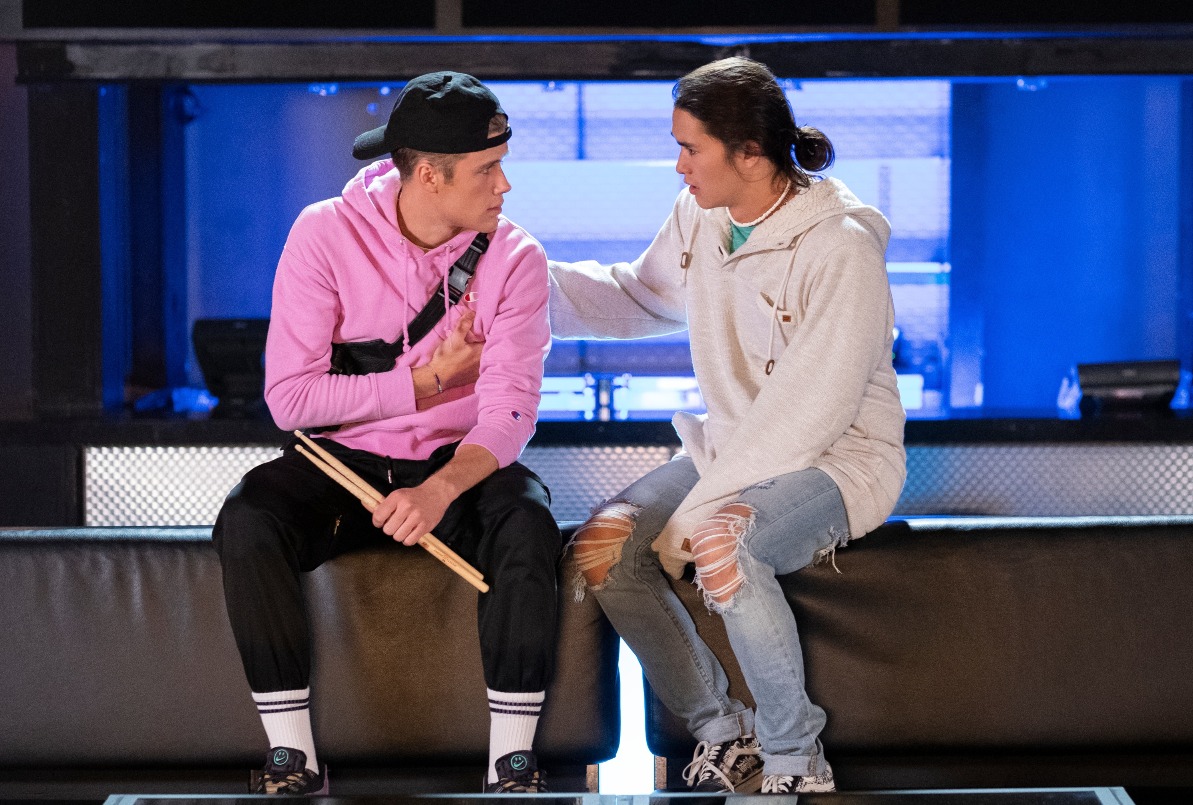
The production saw 700 auditions before settling on Reyes – which also meant putting a Latinx family at the center of the story – but Ortega didn’t have to look too far for some other casting. He dipped back into his “Descendants” cast for several other roles, including reuniting with Cheyenne Jackson, Jadah Marie, and Booboo Stewart. The last actor – who has part Native American and Asian ancestry – plays fellow ghost Willie, the love interest for Sunset Curve band member Alex (Owen Patrick Joyner), whom he also helps navigate the ghost lifestyle. 

“The pairing of Owen Patrick Joyner and Booboo Stewart, I think their chemistry is really terrific,” said Ortega. “There were probably about 10 other guys that we brought in to meet up the person after seeing many, many tapes. When Booboo and Owen were introduced to each other, they walked off and talked for a couple of minutes and then they did the scenes together, and you could tell they were enjoying it, that there was a comfort and something there that felt real. Everyone in the room saw it.”

The future for “Julie and the Phantoms”

The brisk, nine-episode first season ends on a cliffhanger, which could indicate optimism for completing Julie and Sunset Curve’s story sometime in the future. No word has come from Netflix yet, however, and going back into production has already been proven to have its risks until better precautions are taken. That said, Ortega is more than ready to be part of another popular youth franchise like “High School Musical.”

“We would all love nothing more. Netflix, the writers or cast or crew, everybody’s on pins and needles,” he said. “The pandemic really set us back. We delayed our premiere just because of the world situation. We had to do a lot of stuff in post[-production] on Zoom. 

“But we’re hoping if an audience shows up and they embrace it, we’re ready. We have ideas. We’ve already started working on some new music. And I know the kids would love nothing more than to be able to take them out on tour to play this music in a live situation when it’s healthy and safe enough to do a concert again.”

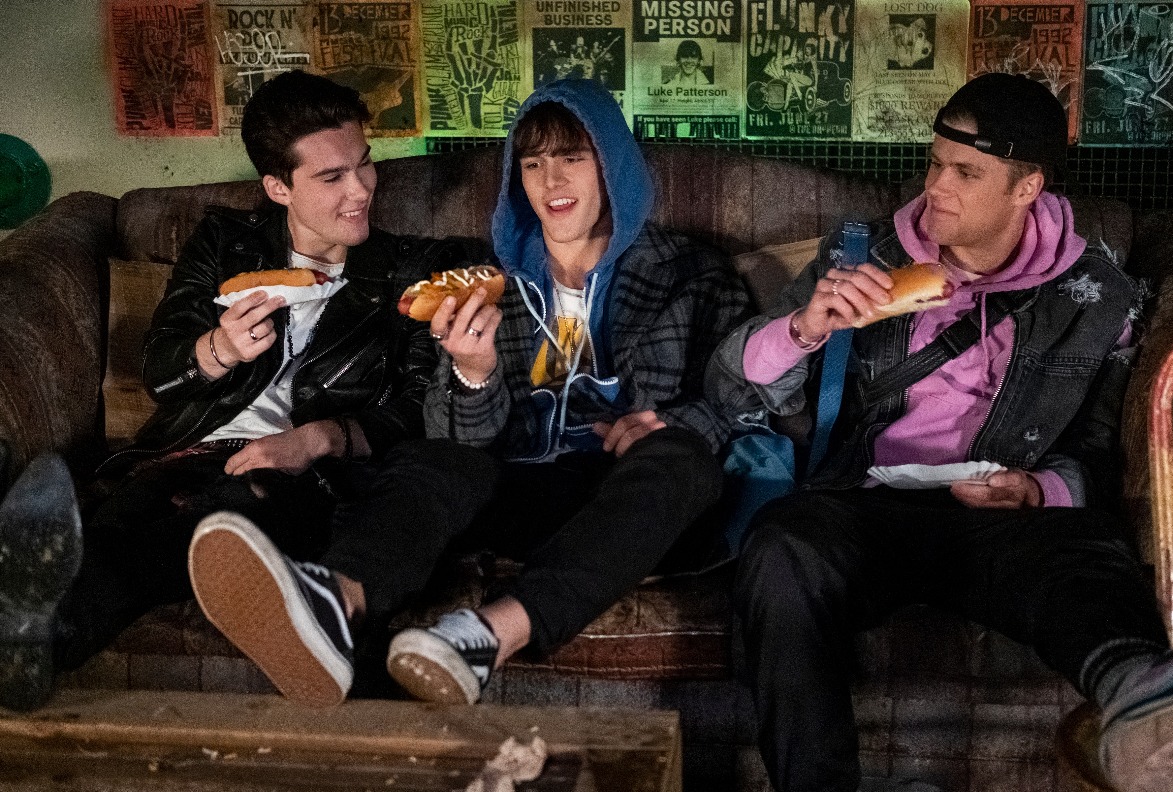
If a concert were to happen, it’s a safe bet that the cast won’t make the same mistake as the Sunset Curve members. A flashback to 1995 shows bandmates Luke, Alex, and Reggie (Jeremy Shada) finishing their sound check before their big debut at the Orpheum. They take a break to eat what ends up killing them: street vendor hot dogs served out of a guy’s car.

“Dan and Dave wrote that and nobody ever questioned it. We all just thought it was so legit,” Ortega said with a laugh. “I mean, where do you go after your sound check at a club off of Sunset Boulevard in the 1990s? You go out and grab some delicious street dogs from the nearest vendor and get back to get ready for the show. It was a charming way to sort of say goodbye to them in the ’90s before meeting them again, rather than something more tragic, don’t you think?”

“Julie and the Phantoms” is currently streaming on Netflix.

Student debt and the end of the liberal arts dream

Most people know that student debt is a problem, and most people agree that “something should be done about it.” The consensus opinion appears to be that something should be done because it’s “not fair” to young people. According to a recent poll conducted by the Pew Charitable Trust, 80% of Americans believe that “the government should make it easier to repay student loans.”

Even so, there is very little understanding of why student debt has become so burdensome in recent decades. It’s as if we thought student debt were an unhappy fact of nature, like a weather front that has passed through leaving us with no option but to put on a warmer coat if we can find one, and if we can’t find one, it’s welcome to the Brave New World of Cold and Indifference.

And yet, it was not so long ago that things were very different. I was born in a working class suburb of San Francisco in 1951. At that time, public education was good, teachers still had some social prestige, universities were affordable (cheap actually), and few students graduated with debt. It was possible for me to sally forth without the threat of young adult bankruptcy.

In other words, at that time students were freer to choose what they wanted to study and freer to explore careers. As for me, I was free to be a student of literature and philosophy at the University of San Francisco. I learned to play the classical guitar up the hill at Lone Mountain College. I was also a longhair war resistor and draft counselor in the chaplain’s office. And I was mostly sure that I wouldn’t be punished for these decisions, or not punished any time soon.

Unhappily, the university as I knew it no longer exists. Through the decades of Reaganomics and neo-liberal austerity, an elite determination was made that the state should no longer pay for public higher education; henceforth, universities would be funded through personal debt. Tuition to public colleges and universities became a bloated “user fee” for access to a government-affiliated service, like gaining access to a parking lot. Novel arguments gained force: students were just another type of consumer, and “student demand” should determine the content of the curriculum. What was lost in such market logic was the fact that programs in the arts and humanities—not just in universities but at all levels of education—had become the primary way in which we were allowed to think about who we are, where we are, how we got here, and what, if anything, we’d like to see changed. In the place of that worthy process, we were left with what David Harvey described succinctly: “The traditional university culture, with its odd sense of community, has been penetrated, disrupted, and reconfigured by raw money power.”

In both the public and private sectors, the corporate university has been slowly growing for many years, but it has now become more brazen in its destructive tendencies. For an example that is close to me personally, the Board of Trustees at Illinois Wesleyan University (IWU) in Bloomington, Illinois, announced in May of 2020 that it was considering the elimination of many long established programs all of which were in the liberal arts and social sciences. I say this is personal because my wife, Georganne Rundblad, taught sociology at Wesleyan for twenty-five years, and many of the faculty there were among our friends.

Without the consent of the faculty, the Board of Trustees sent pre-termination letters to twenty-five faculty members and instructional staff in philosophy, anthropology, music, foreign languages, sociology, art, and religion — in total, about a quarter of IWU’s faculty. A liberal arts university without philosophers is a contradiction in terms, but a Wesleyan university without a department of religion is an exercise in self-mockery. No doubt, IWU will continue to claim that its “primary focus” is in “opening students’ minds,” but the college of business will have to do most of the opening.

That, too, is already happening. Those departments that were not eliminated were said to be in need of “transformation.” Provost Mark Brodl told faculty member Scott Sheridan that “philosophy will support business and accounting, computer science and data science.” In another example of what Harold Bloom called the trahison des clerks, university president Georgia Nugent (a classicist by training) said that the department of art will “move more in the direction of art and design,” including graphic design and product design. In other words, before the arts can transform students, commerce will first transform the arts. Andy Warhol saw it coming: art is a can of soup.

Of course, there’s no reason to think that this is the end of these transformations, these latest shudders of what Bill Readings called “the university in ruins.” (Readings: “The contemporary University is busily transforming itself from an ideological arm of the state into a bureaucratically organized and relatively autonomous consumer-oriented corporation.”) Remaining faculty and programs can’t sleep comfortably, wondering who and what will be cut next, a year from now, five years or ten. University boards can wait — they’ve been waiting patiently for fifty years. For fifty years American universities have moved toward a sense of mission that a businessman can recognize, respect, and, most importantly, donate money to.

But from the perspective of the liberal arts itself, a liberal arts university that doesn’t recognize the value of the liberal arts shouldn’t transform anything. It should shut its doors, fold it all up. Better that than becoming what Illinois Wesleyan has become: a watery version of the Wharton School of Business.

Wesleyan trustees felt no need to provide a rationale for their actions beyond the crude idea that the affected programs were not cost efficient and that financial exigency threatened them in the near future, somehow — never mind the university’s $200 million endowment. They offered no educational reasons for the changes, and no argument for how the changes were consistent with the values of the institution. Like the bandits in John Huston’s “The Treasure of the Sierra Madre,” they said, “Reasons? We don’t need no stinking reasons.”

The feelings of faculty and alums are raw now because they feel, rightfully, betrayed. One member of the IWU Alumni for the Liberal Arts, Molly McLay, wrote to me:

I am infuriated by the lack of humanity and empathy in this process. Most of my professional work revolves around understanding, responding to, and preventing trauma. I truly think this experience at IWU has been a collective trauma.

Affirming McLay’s thought, Scott Sheridan, a professor of French and Italian at Wesleyan, commented to me:

I feel like I’m just caught in the middle of an administration that has lost its bearings, that is changing the rules on me late in my career. I’ve bought into the ivory tower model, I’ve done everything asked of me, and now when the economy has tanked, Covid is blazing, higher ed is collapsing, and the University has damaged my professional reputation, I find myself completely cast aside, looking at the necessity not only to retool my professional objectives but to rethink my life.

Professor Sheridan has lawyered up.

Finally, and elegiacally, Professor of English Michael Theune commented to the Chicago Tribune, “It is a bad day. The faculty’s control of the curriculum has been taken away.”

The motto over Wesleyan’s portal should no longer be “Scientia et Sapientia,” knowledge and wisdom. I propose that it should read like the legend over Dante’s Inferno: “No Admittance Except on Business.”

After the second world war, there was an enormous investment in public education. For the first time, the children of the working class had an opportunity to study subjects, like literature, that were formerly a privilege for the children of the affluent. We studied the humanities and the social sciences and in so doing found ways to critique and resist corporate culture and all of its murderous inequalities. In the 1960s, universities became best known for their “student protests.” The protests may now be in the streets and not on campus, but many of the protestors of the present—marching with Black Lives Matter, or against gender bigotry, or against the world as organized for the benefit of oil companies—got their intellectual chops in universities taking courses like Professor Rundblad’s “Sex and Gender in Society” or “Race and Ethnic Relations.”

But all this time our masters have been paying attention, and they have seen clearly and correctly: for many, many students, going to college was and remains a liberalizing experience (thus Biden’s enormous lead over Trump among college-educated voters). Our plutocrat masters concluded, “So this is what happens when you let the working class and minorities go to college. They study things of no value to us, and they learn to hate us.”

As a consequence, slowly, decade after decade, universities were starved and students were put in debt. Meanwhile, the wealthy came to the rescue and became university trustees. In these fallen days, the ideal trustee is someone who has money or knows people with money, ideally both. (The chair of Wesleyan’s Board of Trustees is Timothy Szerlong, former president of worldwide field operations at CNA Financial Corporation.)

The ultimate benefit of all this for our oligarchs, the 1%, is a new but very powerful form of social regimentation. Their message to students: “If you want a job, you will study what we want you to study, or else you will live in debt.” We could call this naked coercion, but for students it is their first adult taste of American Un-freedom.

In 1969, the year before I entered the University of San Francisco, I was working at a McDonalds in the East Bay. The franchise owner liked me and offered me a scholarship to McDonald’s Hamburger University. I laughed. I shouldn’t have. 

Armed with AR-15, QAnon-believing GOP candidate threatens “offense” against progressive squad

The Democratic congressional candidate running in Georgia’s 14th district against Marjorie Taylor Greene, a far-right proponent of the QAnon conspiracy theory, raised alarm Thursday after Greene suggested Republicans “go on the offense” against progressives in Congress.

In an image posted to her official Facebook page, Greene was shown brandishing an AR-15—the same semi-automatic weapon Kyle Rittenhouse used late last month to shoot three protesters in Kenosha, Wisconsin, killing two. 

The post also included images of Reps. Alexandria Ocasio-Cortez (D-N.Y.), Ilhan Omar (D-Minn.), and Rashida Tlaib (D-Mich.)—progressive members of what’s been called “The Squad.”

Greene suggested in her caption that progressives who back Medicare for All, a Green New Deal, and far-reaching economic reforms to end sky-rocketing wealth inequality, are “‘Hate America’ leftists” who “want to take this country down.”

“We need strong conservative Christians to go on the offense against these socialists who want to rip our country apart,” wrote Greene. “Americans must take our country back.”

The post appeared to be a “threatening message” to the congresswomen and the left, Washington Post reporter Rachael Bade tweeted. 

“Anyone not realizing that Marjorie Greene really thinks it is justified and patriotic to talk about violently taking out Democrats isn’t actually listening to Marjorie Greene,”tweeted Kevin Van Ausdal, the Democrat running against Greene in November.

Earlier this week, Greene announced on Twitter that she is raffling off her AR-15 to a supporter.

Greene easily won the Republican primary in the district last month, and is widely expected to win the general election.

President Donald Trump called Greene a “future Republican star” last month after her victory, days before giving his tacit endorsement to the QAnon conspiracy theory for which Greene has also expressed support. In June, Politico uncovered footage of Greene espousing Islamophobic views, saying that Muslims such as Omar and Tlaib shouldn’t serve in the U.S. government, and expressing other racist and anti-Semitic beliefs.  

In late 2017, Greene recorded a video in which she promoted the QAnon theory, which bizarrely holds—among other things—that Trump was hand-picked by military commanders to take down a global child sex-trafficking ring run by public figures including Hillary Clinton, Oprah Winfrey, and the Dalai Lama.

“There’s a once-in-a-lifetime opportunity to take this global cabal of Satan-worshipping pedophiles out, and I think we have the president to do it,” Greene said in the video. 

Greene is one of 15 candidates for public office who have verified Twitter accounts and have promoted QAnon, which has been linked to several violent crimes and has been classified as a domestic terror threat by the FBI.

Faith and politics mix to drive evangelical Christians’ climate change denial

U.S. Christians, especially evangelical Christians, identify as environmentalists at very low rates compared to the general population. According to a Pew Research Center poll from May 2020, while 62% of religiously unaffiliated U.S. adults agree that the Earth is warming primarily due to human action, only 35% of U.S. Protestants do – including just 24% of white evangelical Protestants.

Politically powerful Christian interest groups publicly dispute the climate science consensus. A coalition of major evangelical groups, including Focus on the Family and the Family Research Council, launched a movement opposing what they describe as “the false worldview” of environmentalism, which supposedly is “striving to put America, and the world, under its destructive control.”

Studies show that belief in miracles and an afterlife is associated with lower estimates of the risks posed by climate change. This raises the question: Does religion itself predispose people against climate science?

Surveys of people around the world, as well as social science research on denial, suggest the answer to this question is more nuanced than a simple yes or no.

Where religion and science can’t be reconciled

An automatic resistance to science would seem to make sense for some religious believers.

There are several ways that core aspects of modern scientific knowledge tend to undermine literalist or fundamentalist readings of religious texts. In particular, evolution by natural selection, the central concept underlying the biological sciences, is utterly incompatible with most creationist faith traditions.

Religion offers the comforts of a measure of control and reassurance via an omnipotent deity that can be placated by ritual. In contrast, the scientist’s naturalistic universe offers neither an intrinsic moral order nor a final reward, which can be unsettling for the devout and in conflict with their faith.

Because of these mismatches, one might expect those with a strong religious affiliation to be reflexively suspicious of scientific findings. Indeed, in a large international survey, 64% of those who described religion as an “important part” of their life said they would side with their religious teachings in a disagreement between science and their religion. Other studies find that, for the faithful, religion and science are at odds as ultimate explanations for natural phenomena.

Climate science denial may stem more from politics than religion

Social scientist Dan Kahan rejects the idea of an automatic link between religiosity and any anti-science bias. He argues that religiosity only incidentally tracks science denial because some scientific findings have become “culturally antagonistic” to some identity groups.

According to Kahan’s data, identification as a political conservative, and as white, is much more predictive of rejecting the climate consensus than overall religiosity. He argues that anti-science bias has to do with threats to values that define one’s cultural identity. There are all kinds of topic areas wherein people judge expert qualifications based on whether the “expert” confirms or contradicts the subject’s cherished view.

Social scientist Donald Braman agrees that science denial is context dependent. He points out that while conservative white males are more likely to be skeptics on global warming, different demographic groups disagree with experts on other particular topics.

For example, where a conservative person invested in the social and economic status quo might feel threatened by evidence for global warming, liberal egalitarians might be threatened by evidence, say, that nuclear waste could be safely stored underground.

As I explain in my book, “The Truth About Denial“, there’s ample evidence for a universal human tendency toward motivated reasoning when faced with facts that threaten one’s ideological worldview. The motivated reasoner begins with a conclusion to which he or she is committed, and assesses evidence or expertise according to whether it supports that conclusion.

White American evangelicals trend very strongly toward political conservatism. They also exhibit the strongest correlation, among any faith group, between religiosity and either climate science denial or a general anti-science bias.

Meanwhile, African-American Protestants, who are theologically aligned with evangelical Protestants but politically aligned with progressives, show some of the highest levels of climate concern.

North America is the only high-income region where people who follow a religion are substantially more likely to say they favor their religious teachings over science when disagreements arise. This finding is driven mainly by politically conservative U.S. religious denominations – including conservative Catholics.

A major new study looking at data from 60 countries showed that, while religiosity in the U.S. is correlated with more negative attitudes about science, you don’t see this kind of association in many other countries. Elsewhere, religiosity is sometimes even correlated with disproportionately positive attitudes about science.

And the U.S. is generally an outlier in terms of attitudes toward human-caused global warming: Fewer Americans accept the climate science consensus than residents of most other countries.

All this would suggest that climate science resistance has more to do with cultural identity politics than religiosity.

Which comes first?

But the available evidence cuts both ways. A landmark study from the 1980s suggested that fundamentalist religious traditions are associated with a commitment to human dominion over nature, and that this attitude may explain anti-environmentalist positions.

Even after controlling for political ideology, those committed to an “end-times theology” – like U.S. evangelicals – still show a greater tendency to oppose the scientific consensus on environmental issues.

Perhaps some specific theologies bias the believer against the idea that human beings could be responsible for the end of humanity. This bias could show up as an automatic rejection of environmental science.

We are left with something of a “chicken and egg” problem: Do certain religious communities adopt politically conservative positions on climate change because of their religious tradition? Or do people adopt a religious tradition that stresses human dominion over nature because they were raised in a politically conservative community? The direction of causation here may be difficult to resolve.

It wouldn’t be surprising to find either religious dogmatism or political conservatism linked with anti-science attitudes – each tends to favor the status quo. Fundamentalist religious traditions are defined by their fixed doctrines. Political conservatives by definition favor the preservation of the traditional social and economic order.

Consider that perhaps the single essential aspect of the scientific method is that it has no respect for cultural traditions or received views. (Think of Galileo’s findings on the motion of the Earth, or Darwin on evolution.) Some would argue that scientific inquiry’s “constant onslaught on old orthodoxies” is the reason both conservatives and frequent churchgoers report a decreasing overall trust in science which continues to this day.

Even if politics and culture rather than religion itself may be driving climate science denial, religious communities – as some religious leaders, including the Roman Catholic Pope, have recognized – bear a responsibility to exercise some self-awareness and concern for well-being rather than blindly denying the overwhelming consensus on a civilization-ending threat like human-caused global warming.

Adrian Bardon, Professor of Philosophy, Wake Forest University

This article is republished from The Conversation under a Creative Commons license.

Cities and states look to crack down on “less-lethal” weapons used by police

Following nationwide protests against police brutality in which law enforcement officers wounded or blinded protesters, state and local lawmakers and an international police association are taking steps to restrict the use of “less-lethal” weapons that caused the injuries.

At least seven major U.S. cities and a few states have enacted or proposed tight limits on the use of rubber bullets and other projectiles, though some efforts for similar actions have stalled in the face of opposition from police agencies or other critics.

Additionally, clashes between law enforcement officers and protesters in Portland, Oregon, and Washington, D.C., have triggered investigations by federal inspectors general.

After the George Floyd protests, “there was this new appetite from legislators at all levels of government to look at how to better protect protesters,” said Nick Robinson, legal adviser at the International Center for Not-for-Profit Law.

Amid calls for restrictions, the International Association of Chiefs of Police, based in Virginia with 31,000 members in dozens of countries, plans to review its recommended policies on pepper spray and less-lethal “impact projectiles” as well as other aspects of crowd control, said Terrence Cunningham, the organization’s deputy executive director.

“It became very clear to us that we need to revise those policies” in the wake of the Black Lives Matter protests, he said. Some law enforcement agencies “have done a great job managing the crowds and the protests,” he said. “Others could have done a better job.”

The legislation and studies come after USA TODAY and KHN documented dozens of injuries sustained after the killings of George Floyd in Minneapolis and Breonna Taylor in Louisville. Weapons used by local police or other law enforcement agencies included sponge and bean bag projectiles as well as “pepper balls” — essentially paintballs filled with chemical irritants.

At least 30 people suffered eye injuries, and approximately one-third of the cases resulted in complete loss of vision in one eye, during protests in late spring, according to a study by the American Academy of Ophthalmology and the University of California-San Francisco’s ophthalmology department.

That’s what happened to Shantania Love in California.

“Peaceful protests shouldn’t end in people being blinded or shot in the head,” said Love, who permanently lost sight in her left eye in May after being shot with a less-lethal projectile in Sacramento.

Doctors at Dell Seton Medical Center at the University of Texas were so shocked by “rubber bullet” wounds in Austin that they documented them in a letter to the New England Journal of Medicine.

“All the injuries were bad. They made a hole in somebody. They broke bones,” said Dr. Jayson Aydelotte, the hospital’s chief of trauma surgery. “We wrote this to raise awareness so communities can make their own decisions about what to do with this information.”

The Austin police chief said his department would no longer use bean bag rounds on crowds after the projectiles — encased birdshot fired from a shotgun — caused many of the injuries seen at the hospital.

But many other U.S. law enforcement departments have continued using less-lethal weapons during protests across the nation.

Police in Rochester, New York, have repeatedly used pepper balls on crowds this summer, as recently as Wednesday. Officers from the Metropolitan Police Department of the District of Columbia fired sting balls and tear gas after protesters threw bricks, glass and smoke grenades at them during clashes over the weekend, The Washington Post reported.

There are no national standards for police use of less-lethal projectiles and no comprehensive data on their use, said Brian Higgins, a former New Jersey police chief who’s now an adjunct professor at the John Jay College of Criminal Justice in New York City.

Police department rules vary widely. In some incidents this year, police appear to have violated their own rules, which allow projectiles to be fired only at dangerous individuals.

In July, the International Association of Chiefs of Police held a webinar on lessons for law enforcement from this year’s protests and other recent demonstrations. It drew 800 participants, Cunningham said.

“It raised more questions than we had answers to,” he said. “For some of these practices, the policies that we have are pretty old, to be honest with you, and this is a great opportunity to rethink it.”

The association’s guidelines for sponge and bean bag rounds and other impact projectiles haven’t been revised since 2002. Meanwhile, the technology and tactics of less-lethal weapons have substantially changed.

Its review could eventually lead to another congress of police executives and union leaders, who produced a consensus policy on the use of force three years ago, Cunningham said.

One message in particular needs to be repeated and made clearer, he said. Less-lethal projectiles should be used only to subdue dangerous individuals and not fired indiscriminately into crowds, as happened in several instances that USA Today and KHN documented.

Crowd-control policies should be updated not just because of the injuries but to adapt to new tactics used by peaceful protesters and troublemakers, law enforcement officials said. Social media has transformed mass demonstrations, enabling marchers to assemble more quickly and in greater numbers, they said, and police need to respond.

“Some crowds have gone from a peaceful protest of 30 or 40 people to 1,000 strong within an hour,” said Larry Cosme, national president of the Federal Law Enforcement Officers Association.

Few if any of the initiatives will generate instant change, independent experts cautioned. Law-enforcement agencies oppose some restrictions on less-lethal projectiles, saying the weapons are a critical tool to control uncooperative people that stops short of deadly force.

The IACP makes recommendations on police use of force but law enforcement agencies set their own policies. Even the best policies — including those set in law — are just slogans unless departments have the resources to carry them out, experts said.

“I’d be very curious to know what they’re basing any changes on, other than placating people,” Charlie Mesloh, a certified instructor on the use of police projectiles and a professor at Northern Michigan University, said about the association’s initiative.

“Unless someone’s willing to pay for training that would make things better, this is just another piece of paper,” he said. “There are no magic solutions.”

Reform advocates took a setback this week when the California legislature failed to pass a bill that would have allowed police to use tear gas and riot projectiles only against dangerous individuals and only after warning the crowd they’re part of. It would have required police agencies to report their use of less-lethal force annually to the U.S. Justice Department.

Police groups opposed the bill, especially its limits on tear gas, which the Los Angeles County Sheriff’s Department told legislators can “prevent the escalation of physical force” by dispersing a crowd without the use of projectiles.

Assembly member Lorena Gonzalez, who sponsored the bill, said she’ll reintroduce it next year. Robinson, of the International Center for Not-for-Profit Law, said he expects many new measures to be proposed across the country in January, when state legislatures convene.

Another stalled effort is in Minnesota, where lawmakers did not approve a proposal that would have prohibited law enforcement agencies and peace officers from using chemical weapons and kinetic energy munitions such as plastic wax, wood or rubber-coated projectiles on civilian populations.

At the federal government level, a preliminary version of a proposed amendment to the National Defense Authorization Act included restrictions on less-lethal munitions. But the restrictions were cut from the proposal before it was voted on and turned down.

Washington, D.C., officials in July enacted a sweeping police reform measure that bans the use of rubber bullets or tear gas against nonviolent protesters. Less-lethal munitions and chemical spray were used to disperse a crowd in June before President Donald Trump walked through Lafayette Square to display a Bible in front of a historic church.

San Jose’s City Council is considering new controls on such weapons. In June, the Seattle City Council banned the weapons outright, but a federal judge blocked the law after the Justice Department argued it would take away law enforcement’s options to “modulate” the use of force.

As part of a larger police reform measure, Colorado banned law enforcement officers from firing less-lethal projectiles indiscriminately into a crowd or aiming them at someone’s head or pelvis. Language in a Virginia bill would ban their use by all law enforcement.

In addition, inspectors general at the Justice Department and the Department of Homeland Security are investigating the actions of federal law enforcement officers in Portland after lawmakers raised concerns. DOJ is also investigating federal officials’ role during protests in Washington, D.C.

Amnesty International USA recently released a wide-ranging report on the protests, chronicling what it said were 125 instances of police violence against protesters, journalists, medics and legal observers in 40 states and Washington, D.C., in May and June. The group accused police of mishandling a litany of less-lethal devices, including sting-ball grenades, rubber pellets and sponge rounds.

Amnesty called for the development of national guidelines for less-lethal projectiles. The group said they should be independently tested for accuracy and safety, and they should be used only in situations of “violent disorder” in which “no less extreme measures are sufficient” to stop the violence.

Cosme said he’s open to starting discussions about updating the national consensus policy to include more detailed standards for less-lethal munitions. He also supports requiring testing of devices to ensure accuracy and safety.

But he said less-lethal munitions are critical tools for crowd control because officers can target individuals from a distance.

Chuck Wexler, executive director of the Police Executive Research Forum, a think tank for police leadership, said the protests in recent months could offer lessons for how police handle demonstrations.

“We’ll be looking at this,” he said. But Wexler said he does not have a concrete plan or timetable for convening reviews of what happened, given the pandemic.

“The real key question is, What kind of strategies can we develop that are the most humane for cops and for the community alike?” he said.

“What did we learn? What are some of the cautionary tales?” Wexler said. “What strategies were effective? Where were injuries the least for demonstrators and cops alike?”

Kaiser Health News (KHN) is a national health policy news service. It is an editorially independent program of the Henry J. Kaiser Family Foundation which is not affiliated with Kaiser Permanente.

“Look at that piece of ass”: Trump hit on Michael Cohen’s daughter — when she was just 15-years-old

Speaking to Vanity Fair in an interview published this Friday, the daughter of former Trump fixer Michael Cohen spoke about the price her father paid for his years of loyalty to Donald Trump. In the outset of the piece, an incident detailed in Cohen’s new memoir is described where Trump sexually ogled her — with Cohen standing right there in Trump’s presence.

The incident involving Samantha Cohen took place in the summer of 2016.

“That summer day felt like all the others before it, standing alongside Trump outside the pool area, discussing what Cohen writes was ‘some pressing business matter, like the size of the breasts of a woman sunbathing on a lounge chair.’ Somehow Trump’s attention was diverted to another skirt walking off a tennis court. ‘Look at that piece of ass,’ Cohen recalls Trump saying, as he whistled and pointed. ‘I would love some of that.’ It so happened that Trump was referring to Cohen’s then 15-year-old daughter, Samantha,” Vanity Fair’s Emily Jane Fox writes.

When Cohen informed Trump that he was speaking about his daughter, Trump responded, “When did she get so hot?”

“When Samantha reached her dad, Trump asked her for a kiss on the cheek, before inquiring, ‘When did you get such a beautiful figure?’ and warning her that in a few years, he would be dating one of her friends.”

Read the full piece over at Vanity Fair.

Trump supporters are freaking out and “baffled” as his campaign shows signs of weakness: report

While former Vice President Joe Biden’s campaign has been inundated with donations in recent months, reports indicate that President Donald Trump’s campaign is fearing a shortage of funds as November 3 draws closer. And these comparative fortunes are already having an effect, it seems — at least on the peace of mind of Trump supporters.

The Washington Post reported Friday Trump’s  campaign has been pulling television advertising in recent weeks, and it’s making supporters nervous:

Post reporters Michael Scherer and Josh Dawsey explain:

Republican officials have been inundated with calls from worried activists and donors who complain about constant Biden ads in their local media markets, with very few paid Trump responses, according to people familiar with the conversations. Some Republicans close to Trump have been baffled at the decision to sharply curb advertising and have told the president he should change course.

By reducing its television advertising, Scherer and Dawsey note, Trump’s campaign is “ceding to Democratic nominee Joe Biden a huge advantage in key states and sparking disagreements over strategy within the president’s senior team.”

The Post journalists point out that Biden’s campaign has gone from being “lean” earlier this year to being “flush with cash” — and more cash means more to spend on ads. One of the Republicans who is worried about Biden’s cash advantage, according to Scherer and Dawsey, is Republican National Committee Chair Ronna Romney McDaniel — whose uncle is Sen. Mitt Romney of Utah. McDaniel, they report, “recently told the president she was concerned his ads were not on television in states such as Michigan and Florida, where Biden was blanketing the airwaves.”

The Trump campaign’s decision to buy less television advertising, the Post reporters note, was made by Bill Stepien —  who replaced Brad Parscale as Trump’s campaign manager in July. Stepien, Scherer and Dawsey report, “has described facing difficult choices, as he tries to save considerable money for the final 30 days before the November 3 election. The moves have resulted in an enormous short-term advertising benefit for Biden, who maintains a polling lead in most of the battleground states. Between August 10 and September 7, Biden’s campaign spent about $90 million on television ads — more than four times the $18 million spent by the Trump campaign, according to tracking by a Democratic firm.”

A GOP strategist, interviewed on condition of anonymity, told the Post, “There is actually a lot of frustration out there with the Trump campaign being dark, especially in places like Arizona and North Carolina. Those two places have big Senate races.”

Why Amazon tried to thwart Portland’s historic facial recognition ban

On Wednesday, the city council of Portland, Ore. unanimously voted to ban city and private use of facial recognition technology — a measure that Amazon, which manufactures that technology, worked vigorously behind the scenes to thwart.

The ban on private uses of the technology will go into effect on New Year’s Day 2021, while the city ban goes into effect immediately, according to The Oregonian. Although the ban will not extend to individuals who privately use facial recognition technology — such as, for instance, someone using their FaceID feature on their iPhone — business will no longer be allowed to collect, use or store facial recognition information gathered in areas open to the general public. Other cities have implemented less restrictive bans by prohibiting use of the technology by police departments and local government agencies.

Civil liberties advocates celebrated the news. “The ban prevents government use of face surveillance technology and corporate use of face surveillance technology in places of public accommodation,” Abdullah Hasan, Communications Strategist for the American Civil Liberties Union (ACLU), told Salon by email. “More than a dozen cities across America have already banned government use of the technology, but this is the first city to block corporations from tracking people using this technology.”

He added, “While that makes this the strictest ban to date, there are still some glaring holes. For instance, the school district board has yet to ban the use of face surveillance technology in public schools.”

The office of Portland Mayor Ted Wheeler told Salon that “though Mayor Wheeler is against the biometric data of under-aged children being collected without consent, the City of Portland has no jurisdiction in Portland Public Schools. He is hopeful that regulations on facial recognition technology will be discussed at the state and federal levels in the near future.”

The ACLU is not alone in expressing civil liberties concerns regarding the technology.

“In tracking our faces, a unique marker that we can not change, government use of face surveillance invades our privacy and safety,” Nathan ‘nash’ Sheard, associate director of community organizing at the Electronic Frontier Foundation, told Salon by email. “In his majority opinion in the watershed Carpenter v. United States, Supreme Court Chief Justice John Roberts wrote: ‘A person does not surrender all Fourth Amendment protection by venturing in the public sphere.’ Yet, government use of face surveillance threatens to do just that.'”

He added, “This dangerous technology threatens not only Fourth Amendment freedoms of privacy, but also First Amendment freedoms of speech and association.”

Portland Mayor Ted Wheeler made a similar point in a statement to CNN, saying that “technology exists to make our lives easier, not for public and private entities to use as a weapon against the very citizens they serve and accommodate.”

In addition to being a civil liberties issue, the ubiquitous presence of facial recognition technology also perpetuates racial injustices in the United States. Speaking to Salon in June, Kade Crockford — the director of the Technology for Liberty Program at the Massachusetts branch of the American Civil Liberties Union — explained that the surveillance state can be traced back to the time of slavery, “when the US passed the lantern laws requiring that black people moving around at night had to carry a lantern to light up their face so that white people could see where they were and what they were doing at all times.”

Nash echoed that analysis to Salon. “Face recognition software is notoriously bad at recognizing women, young people, older people, African Americans, and other ethnic minorities, often misidentifying them,” Nash wrote. “This disparity threatens to exacerbate well-documented racially-biased police practices. Law enforcement databases—including mugshot databases—unjustifiably include a disproportionate number of African Americans, Latinos, migrants and trans women. We have already seen multiple reports of Black men being arrested for crimes they did not commit as a result of failures in the technology’s design and implementation.”

Amazon acknowledged that its facial recognition technology was problematic by implementing a one-year moratorium on selling its own technology, Rekognition, starting in June. At the time the company explicitly linked their decision to the issue of law enforcement misconduct and racism, explaining in a statement that “we’ve advocated that governments should put in place stronger regulations to govern the ethical use of facial recognition technology, and in recent days, Congress appears ready to take on this challenge.”

Despite the tech giant’s public posturing, however, Vice and other outlets report that Amazon spent $24,000 silently lobbying commissioners on Portland’s city council to weaken their facial recognition ban. The company was allegedly concerned that Portland’s policy could set a precedent that would be followed by other local governments, eventually hurting their bottom line.

“Despite this, Portland’s private sector, including Amazon, are insistent that there are benefits to facial recognition technology,” Vice writes. “In a letter from the Portland Business Alliance—greater Portland’s Chamber of Commerce—the group wrote that ‘technology is not inherently good or bad’ and it is only specific uses which need to be regulated, lest innovation be hurt and Portland’s technology industry suffer a negative impact.”

Mayor Wheeler’s office told Salon that “it’s not surprising that a major corporation like Amazon, which develops and sells facial recognition technology, would lobby against a measure regulating its use, especially by a large city like Portland. Mayor Wheeler and his colleagues unanimously passed the strictest facial recognition ban in the world, so it’s difficult to speak to the effectiveness of the lobbying efforts.”

Salon reached out to Amazon for comment on this story and has not heard back.

Militarizing the police: A long legacy of state violence is what brought us here

Jacob Blake was doing what any responsive dad and neighbor does: stepping in to break up a fight before leaving with his children. But police in Kenosha, Wisconsin, shot Blake in the back seven times, with his three young sons watching from the car. Yet again, instead of meeting this moment with any empathy or understanding, Donald Trump sent federal law enforcement into Wisconsin in an effort to silence a community in mourning. Throughout this summer, our communities have risen up in defense of Black lives, only to be met with state violence from a militarized police force that has no interest in helping us.

The patterns are there if we look for them.

It goes like this: People around the country rise up to protest police brutality and injustice. Instead of listening and focusing on solutions aimed at the root causes of violence, the government consistently responds with additional violence and federal force. It’s as if to say: You may be strong, you may be loud, you may be a movement of the people, but we have more weapons.

This is a time to keep our memory sharp. 

Remember: Following the heartbreaking 2014 murder of Mike Brown in Ferguson, Missouri, families and community members living in the area came out in the streets to protest police brutality. What ensued was the deployment of a police force resembling an occupying army. Sniper rifles, armored vehicles and tear gas were turned on Ferguson protesters, onlookers and the media. Journalists reporting on the protests were arrested.

Remember: Following the assassination of Dr. Martin Luther King Jr. in 1968, thousands of National Guard troops were deployed in the city of Baltimore for two weeks. Six people were killed and dozens more injured in this outbreak of state-sanctioned violence. In fact, that fall the U.S. Army published a then-classified plan called the “Garden Plot,” a detailed blueprint to deploy troops simultaneously to 25 American cities to quell protests against the Vietnam War and the military draft.

The patterns are there.

The oddest turn of phrase in American public discourse is probably “keep the peace,” when used to describe people who have access to lethal force, which is almost always used with impunity against those with access to none. But this has been normalized in the United States. In fact, this normalization is the result of several decades of policy that creates avenues for U.S. police to become further enmeshed with U.S. military forces.

After Sept. 11, 2001, in the name of safety and “homeland security,” billions and billions of tax dollars have been poured into an effort to militarize law enforcement in the U.S. The effect: We have built domestic police force that can turn on a dime to invade and occupy our towns and cities like an army, rather than to “protect and serve” our communities around the country. 

This summer, the Trump administration deployed a variety of federal agents to Portland, including U.S. marshals and Customs and Border Protection officers, adding their names to this ignoble legacy of leaders who have used occupying military force against their own people. The violent exercise of using excessive force against peaceful demonstrators, alongside seemingly arbitrary detentions and arrests, is clearly intended to intimidate and silence. We know, because this playbook is not new and our memory is long. 

If we don’t propose a clearly defined vision of what safety looks like, our demands run the risk of being co-opted in ways that don’t serve us. We can’t afford to let others define what we mean. In July, the Movement for Black Lives (M4BL) announced the development of the next phase of their work, the BREATHE Act, a new vision for community safety that invests proactively in protecting Black life. It calls for a divestment of federal dollars that have contributed to the militarization, surveillance, incarceration and impoverishment of Black communities. 

A federal judge issued a temporary restraining order against the federal agents deployed in Portland. The order prohibits the federal agents from arresting, dispersing or using force against journalists and legal observers who are attending protests. This did not stop Attorney General Bill Barr from doubling down and announcing the launch of Operation Legend, an initiative that clearly echoes historical efforts to quell popular uprisings against state-sanctioned violence, and to obfuscate who is perpetrating violence and who is rising up to challenge it. 

With troops having been called into Wisconsin to overpower rightful protest in the wake of Jacob Blake’s death, a similar cycle begins. But we know the patterns.

Ultimately, this is a moment to remind ourselves of what safe communities look like and feel like. Do you imagine that your community will feel safe if, at any point, federal officers can descend onto your streets, grab you up and claim it was all in the name of “keeping the peace?” For most of us, the answer is of course not. So, when the Trump administration and its allies appear on national television to assert that their actions are about safety, let’s reject that anemic and warped idea of safety and offer our own. 

It’s time to create new patterns, new policies and new ways of keeping us safe, of keeping real peace.

Kanye West blocked from Wisconsin ballot for missing deadline by 14 seconds

Rapper Kanye West missed the deadline to appear on the Wisconsin presidential ballot by 14 seconds, and a judge has upheld the decision to keep him off the ballot.

Judge John Zakowski ruled in favor of the Wisconsin Elections Commission on Friday night, effectively keeping West off the ballot in the state. He had filed a lawsuit against the WEC over the previous decision to bar him from the ballot because his nomination papers were submitted 14 seconds after the 5 p.m. deadline on Aug. 4, according to the Green Bay Press Gazette.

Read more from Variety: Legendary reggae singer Toots Hibbert, frontman of the Maytals, dies at 77

Zakowski agreed that West was late in filing his paperwork, writing in the decision, “The court believes at the time a grandfather clock rings out five times is the moment it is 5 p.m. Any time after that is precisely that: after 5 p.m. The court used the analogy of midnight. There is significant difference between 11:59:59 p.m. and one second after midnight. The passage of a second after midnight confers an entirely new day.”

West’s campaign argued that they had until 5:01 p.m. to file and that WEC staff interfered in their delivery by locking the doors before 5 p.m. However, according to state law and Wisconsin Administrative Code, 5 p.m. was the deadline for the papers to be in “physical possession” and anything turned in thereafter was ineligible.

Read more from Variety: Chloe Zhao’s “Nomadland” takes Golden Lion at Venice Film Festival

“The unfortunate fact is this dispute could have been avoided had the West representatives simply arrived earlier,” Zakowski concluded the ruling. “The court is aware the signatures were gathered in roughly two days, but it has also been told [West campaign representative] Ms. Ruhland knew of the statutory requirement… and had been in contact with the Commission that day.”

Read more from Variety: “Doom Patrol” renewed for Season 3 at HBO Max

West, who announced his candidacy in July, has been denied from the presidential ballot in multiple states due to lack of signatures on nominating petitions and failure to meet filing deadlines. He has been a vocal supporter of President Trump in recent years, causing many Democrats to believe his surprising attempt to run is an attempt to take votes away from democratic nominee Joe Biden.

“Cancel Netflix” backlash grows over “Cuties” film’s sexualization of young girls

[UPDATE: Netflix issued a statement saying “Cuties” is “a social commentary against the sexualization of young children” and encouraged critics to watch it.]

Controversial French film “Cuties” — about a young Senegalese girl in Paris who joins a “free-spirited dance clique” to escape family dysfunction — has spawned a new backlash against Netflix by critics who allege it goes over the line in portraying children in a sexualized manner.

The hashtag “#CancelNetflix” was the No. 1 trending topic on Twitter in the U.S. Thursday, after “Cuties” premiered Sept. 9 on Netflix.

Read more from Variety: Legendary reggae singer Toots Hibbert, frontman of the Maytals, dies at 77

petition on Change.org calling on Netflix customers to cancel their subscriptions over “Cuties” and other content on the streaming service “that exploits children and creates a disturbing vibe,” currently has nearly 600,000 signers.

Criticism erupted in August over a promotional poster for “Cuties” depicting its young cast members in provocative poses and revealing costumes. Netflix at the time apologized for the image. “We’re deeply sorry for the inappropriate artwork that we used for ‘Mignonnes’/’Cuties,'” a Netflix rep said in a statement to Variety. “It was not OK, nor was it representative of this French film which premiered at Sundance. We’ve now updated the pictures and description.”

“Cuties,” from French filmmaker Maïmouna Doucouré, premiered at the 2019 Sundance Film Festival, where it won the world cinema dramatic directing award. The film is based on Doucouré’s short film “Maman(s),” about an 8-year-old child furious when her polygamous dad invites his new bride into their Parisian apartment, which won the short film international fiction jury award at Sundance in 2016.

Read more from Variety: Chloe Zhao’s “Nomadland” takes Golden Lion at Venice Film Festival

Per the Sundance description of “Cuties,” the film “nimbly depicts the tweens’ youthful energy and vulnerabilities while exploring their fumbling eagerness to be identified as sexualized. Fathia Youssouf captivates as Amy, shifting like a chameleon between the different identities her character is juggling and deftly anchoring the film’s immensely watchable, vivacious young cast.”

Mary Margaret Olohan, a reporter for conservative publication the Daily Caller, early Thursday tweeted a video clip of the girls in the film dancing suggestively and twerking, commenting, “Netflix is comfortable with this. Plenty of people will defend it. This is where our culture is at.” She added, “I understand this video is upsetting and depicts little girls in a gruesome light. I tweeted it for those who will say that ‘Cuties’ is innocent.”

Conservative advocacy group Parents Television Council said in a statement Thursday that after reviewing the film, it “stands by its earlier criticism that the TV-MA-rated film sexualizes children.”

According to PTC, the young female actors were trained in highly sexualized dance routines; were given lines with “foul, vulgar language” including f—; and were made to wear revealing clothing. In addition, in one scene, Amy is shown pulling down her underwear to photograph her genitals to post online, after she tries to seduce a man (who is a family member) to get out of trouble for stealing his cell phone.

“By removing the offensive poster and replacing it with a more innocuous one, Netflix might actually have made the situation worse by suggesting that ‘Cuties’ is nothing more than a cute, coming-of-age movie,” Melissa Henson, program director for the PTC, said in a statement. “Although the film tackles an important topic — one that under different circumstances we might even applaud — it’s the way the film goes about it that’s problematic. This film could have been a powerful rebuke of popular culture that sexualizes children and robs them of their innocence.”

Read more from Variety: “Doom Patrol” renewed for Season 3 at HBO Max

The “Cuties” description on Netflix currently reads, “Eleven-year-old Amy starts to rebel against her conservative family’s traditions when she becomes fascinated with a free-spirited dance crew.” Previously, the description read, “Amy, 11, becomes fascinated with a twerking dance crew. Hoping to join them, she starts to explore her femininity, defying her family’s traditions.”

Netflix acquired worldwide rights (excluding France) to “Cuties” prior to its Sundance premiere. The film was produced by Bien ou Bien Productions and co-produced with France 3 Cinéma.

In Variety’s review of the film, Amy Nicholson writes that Doucouré’s “coming-of-age drama starts with Amy doodling stick figures and climaxes with the kid booty-shaking in hot pants. The choice is also false, but Doucouré believes that today’s girls see their options in black and white. ‘Cuties” job is to coil the contrasting messages and spin them until her lead falls down dizzy, which can make the film feel as subtle as a headache.”

They arrested me for playing basketball: A personal argument in favor of defunding the police

My tidy bedroom at 1784 Devonshire Road, on the northside of Columbus, Ohio, is where I learned the craft of creating Magic through my imagination. My bedroom was my ark, a planet within a universe of physical, verbal and emotional abuse that lodged inside my home. Upholding my imagination were a couple of books, and the stacks of King, XXL, Slam, and The Source magazines that were neatly stacked inside of my closet or sprawled across my bed. 

I studied bylines just as much as I poured over the feature stories. When creating Magic inside my ark, I attached faces to the bylines. Inside my mind’s eye, me and my imaginary writer friends would bond over, and debate hip-hop and basketball. We traded cards and looked through Becketts together. I imagined flying to California to interview Nas, Jay Z, Scarface Denzel Washington, Wesley Snipes and Omar Epps. 

But despite this Magic inside my mind, real life awaited me outside of my bedroom. 

* * *

I was unwinding inside of my magical ark after a long day as an 8th grader. Before I could get comfortable and munch on an after-school snack, I saw two police officers walking toward the front door. This can’t be good. I knew I hadn’t committed a crime, but I was recently released from the Franklin County Juvenile Detention Center. My mom had developed a habit of involving the state of Ohio in our business, so I was sure that the police came to the house for me.  

This situation started with me throwing a brick through the window of a childhood friend-turned-foe.  At the conclusion of this fiasco, I served a few days in jail, and my mom had to pay $70 to the kid’s mother. But the judge played on my mother’s ignorance by suggesting that she put me on house arrest, and If I were to go outside, she should call the police and have me arrested. It must be noted that I was not required to wear an ankle monitor or report to a probation officer. Basically, the judge told my mom to put me on punishment. My mom, an uneducated general laborer, was probably too intimidated to question the judge’s agenda. As one who follows a general train of thought, my mom, as well as many others parents, fell for the false narrative that jails solve problems created by trauma, poverty, and lack of education.  

After a couple of days on house arrest, I decided to go play basketball at the local rec center, something that I did regularly. I didn’t think my mom would actually call the police on me, but unbeknownst to me, she did. A tall, Black police officer, followed by his white partner entered my bedroom. Seeing the magazines, “Night” by Eli Weisel and Asha Bandele’s “Daughter” laying around my room, the Black officer told me that I seemed like a smart kid, but I needed to follow rules If I wanted to be successful.

“Your mother told us to come get you, because you went outside when you weren’t supposed to,” he said. “She doesn’t hate you, she’s only called us because she cared. She cares about you.” With this, I was placed in handcuffs and taken to Franklin County Juvenile Detention Center. 

As a radical dreamer, I see a world where police officers provide resources that will assist parents and children in unearthing the traumas associated with unhealthy behaviors. I envision a world where when a police officer sees stacks of magazines and books inside the room of a 12-year-old kid’s room, the officer will usher the kid to a community program that will help hone his interest in hip-hop, journalism, and Black history. 

Since the killings of George Floyd and Breonna Taylor, activists have been asking city council members to redirect money from police departments to community programs. One of the theories with #DefundThePolice is that more education will reduce crime. In recent weeks, some districts have defunded police departments. Baltimore City Council voted to reallocate $22 million from its police department to recreation centers, trauma centers, and forgivable loans to Black-owned businesses. Los Angeles is reallocating $100 million dollars of police department budgeted funds to marginalized communities. Defunding police departments, I believe, is a step toward ending the culture of punishment. 

* * *

Franklin County Juvenile Detention Center sits above Interstate 71 in downtown Columbus. 

We were in our morning art class. My fellow inmates were either pretending to be, or seriously engaged in the day’s lesson. Near the front of the class, a group of baby faced inmates created art with popsicle sticks. Not me, though. Firstly, I wasn’t interested in playing with popsicle sticks. Secondly, the activity did not relate to anything that I was experiencing at home. I was less than 24 hours removed from seeing my mom tell the judge that she didn’t want me. Being creative with popsicle sticks wasn’t going to help heal me. With tears on the cliff of my eyelids, I stayed aloof, sat next to a window looking down at the cars speeding through I-71. 

Days turned into weeks in jail. We wasted time by debating who’s the best MCs and NBA players, riffing on each other, and lying about our sexual exploits. There were fist fights, too. But overall, we laughed more than we fought. We were still babies, and very much concerned with being kids. Our frolic behavior was a combination of holding on to loose threads of childhood joy, immaturity, and us being ignorant of the trap we were in. Unhealthy relationships, drug addiction, prison, rehab facilities and death awaited us. The correctional officers knew this, too.  But they weren’t community activists dedicated to appeasing underlying issues that led to juvenile delinquency. Also, many of our parents lacked the language, education, or in some cases mental faculties to understand what was going on. So, there we were. Little kids, 12-13 years old, stretching out useless hope on a road that was already predetermined with convictions and addictions.  

Mr. Wrench, a freshly dressed Black correctional officer assigned to the pod I was housed at in Franklin County Juvenile Detention Center, told us that some students from Wilberforce University were coming to the jail to engage with us. Mr. Wrench explained that Wilberforce was the first private HBCU. I’d never heard of Wilberforce or HBCUs, but I was interested. Spending time with Black college students seemed interesting. Much more interesting than that wack art class. 

The enthusiastic student-teachers regaled me with seeds of hope. Their presence was comforting, and they acted as if they’d known us for years. On the first day of class, they played a scene from the movie “Roots,” which was new to me. In the clip, Kunta Kinte, played by actor LeVar Burton, is chained and whipped until he accepts his new name, Toby. We then had a discussion about identity, how we saw ourselves, how our friends saw us, how the world sees, versus how we wanted to be seen. 

The following week, we read and discussed passages from Chinua Achebe’s “Things Fall Apart,” which was new to me, too. And once again, I was taken aback by the simple profundity, and inventiveness of a Black creator that I never heard of. Reminiscent of “Of the Meaning of Progress,” one of the student-teachers expressed special interest in me. She spent much of the class sitting next to me, helping me pore over sentences that I jotted down. I believe she understood that I was aware of my ignorance, or maybe I reminded her of a loved-one with unlimited potential that slipped through the cracks. After the readings of “Things Fall Apart,” we only saw the Wilberforce student-teachers twice. It was a four-week class, broken down to once-a-week intervals. On their last day at the jail, I cried.

For a few weeks, through books, writing and a show of concern from some college students, I experienced the magic that I used to create in my bedroom. But budgets stripped me of meaningful education given to me by Wilberforce student-teachers. I was eventually released from juvenile jail into a life of drug dealing, adoption, violence, a cocaine addiction, and a prison sentence at Parchman, Mississippi State Penitentiary. It was in Parchman where I had to unearth the power of magic as a way to cope with the calendars that I served in prison.  

As America continues to fight with moral issues, the college board has launched a national curriculum on race. The curriculum will allow students to study Black life through the slave trade and other movements led by minorities. The new curriculum is supposedly more than a traditional African American history course. As an example, a student might trace the roots of hip-hop to Jamaica, redlining, and gentrification, or conduct independent research on Black power educational institutions.  

Had I had this curriculum, or one similar been available to me as a child, it’s safe to say that I would’ve dodged prison, as well as drug addiction. Police officers are not concerned with reaching hearts and minds the way that Wilberforce student-teachers touched my heart. These college students introduced me to content that directly related to my experiences. They also brought out in me an eagerness to learn. This is why defunding police departments is important — real change comes from shifting thought patterns, but people have to be put in place to help impressionable minds wrap their minds around unhealthy thought patterns. 

In Afghanistan, a drug sparks hope — and charges of quackery

Alam Gul Alam’s symptoms had been steadily worsening for weeks when he decided to visit an herbalist named Haji Mohammad Alkozai. The 30-year-old civil servant from Kabul had intently watched a video clip making the rounds on Afghan social media, in which Alkozai claims to have discovered a cure for Covid-19 and describes dramatic recoveries of previously ill patients. Whatever this man was offering, Alam knew he wanted to try it.

“I feared for my life,” said Alam, who was diagnosed with Covid-19 in May. For weeks, he had struggled with severe chest and throat pain, along with shortness of breath. Doctors had prescribed medications, but nothing seemed to work. Alam was desperate.

On the evening of May 29, he traveled by car to Alkozai’s clinic in the northern part of the Afghan capital. Upon arrival, Alam joined a line of hundreds of patients that stretched down the road. Once inside, he had an additional wait in an overcrowded basement. After nearly four hours, he finally received three drops of the herbalist’s purported miracle concoction.

By the time of Alam’s visit, hundreds of Afghans were praising the wonders of Alkozai’s treatment, though the herbalist steadfastly refused to disclose the active ingredients. The clamor caught the attention of the Afghan Ministry of Public Health, which tested the compound and found that it contained several highly addictive ingredients, including opioids such as morphine and codeine. Afghanistan is the world’s leading grower of opium, used to produce heroin and other illegal drugs, much of which is traded globally. An estimated 2 million Afghans use opiates according to a 2015 survey.

During a press conference on June 9, Wahid Majrooh, deputy minister of public health, released the findings. He explained the substance’s addictive potential — and its lack of effectiveness as a remedy for Covid-19. Because narcotics are regulated under Afghan law, their distribution as an herbal remedy is considered criminal. The Ministry issued an order to shut down the Kabul clinic and then forwarded the findings to security agencies to take action.

In Afghanistan’s deeply conservative society, many viewed these moves to protect public health as an affront to Afghan culture and religious values. When government forces tried to shut down the clinic, some Afghans took to the streets. “Afghanistan is a very religious and cultural country and it is not uncommon here for traditional doctors to prescribe herbal medicines,” said Maryam Shamal Ghalib, a general surgeon at Wazir Akbar Khan Hospital in Kabul. Local medicine men like Alkozai, she explained, are seen as doing holy work.

On the frontlines of the pandemic in a country riven by decades of war, Ghalib wishes the government had taken a different tack. “Instead of confrontation, they should have created more awareness among the people,” she suggested. Government officials are now working to do just that, implementing a campaign to educate the public about the drawbacks of untested herbal treatments. But they also acknowledge that some of their early messaging may have stoked fear, inadvertently creating a desire for unproven treatments.

* * *

Herbalists are not regulated in Afghanistan, and there is no official tally of their numbers. They are, however, quite common, particularly in rural areas that lack medical infrastructure. Many clinics are family-owned and operated, with recipes handed down from father to son. Historically, during times of war, herbalists have cared for their local communities in the absence of medical doctors. This history — along with corruption in the Afghan medical system — means that herbalists are widely popular, said Ghalib.

Alkozai, who has received international media coverage over the past months, has been mixing herbs in the southern province of Kandahar for over 25 years, said his assistant, Sadar Mohammad Hamdard, in an interview with Undark. Alkozai, who declined to be interviewed directly, specializes in Unani medicine, a traditional medical system that originated in ancient Greece and is now primarily practiced in and around India.

According to Hamdard, when SARS-CoV-2, the virus that causes Covid-19, hit Afghanistan, Alkozai got to work. The result: a compound with 11 organic ingredients. Without sharing those closely guarded elements, Hamdard claimed that one component boosts the immune system, while another helps with symptoms such as fever, cough, and shortness of breath. “This medicine can overcome coronavirus in one to two hours,” he claimed.

Alkozai tested the treatment on his family first, said Hamdard, and then started to distribute it free of cost to the people in his province. “I work with him in the clinic without any masks and deal with hundreds of patients daily,” Hamdard said. To date, Hamdard says he has not shown symptoms of Covid-19, an achievement he attributes to having taken Alkozai’s medication preventively.

Of course, many people who carry the virus will not show symptoms, and officials like Akmal Samsor, an adviser and spokesperson for the Afghan Ministry of Public Health, say Alkozai’s treatment is sheer quackery, offered up by an individual seeking to profit from the crisis.

But as Covid-19 spread across Afghanistan, Alkozai’s popularity grew. And those like Alam risked spending hours in crowded rooms for the hope of a cure. As of August 7, more than 37,000 people have been diagnosed with Covid-19, in a country of 37 million, according to figures provided by the Ministry of Public Health.

* * *

In a short video posted online, Alkozai can be seen invoking God as the source of Covid-19 and as the inspiration for the herbalist’s newfound cure. “All past diseases,” he proclaimed, have appeared “by the order of Allah to torment people.” Alkozai claims that God revealed the special cure to him and a handful of others.

The religious allusions resonated with many Afghans. Alam said that seeking the herbalist’s help was a deeply spiritual pursuit, one that revived his faith in religion. The whole world is struggling with Covid-19, he explained, so when Alkozai said, “‘With the grace of God, I have a cure for this,'” that gave people hope.

Samsor agreed that Alkozai’s words carry an emotional appeal. And he pointed out that many who sought treatment were motivated by a sense of pride in thinking that a person from their homeland could develop a cure for a disease that has overwhelmed communities across the globe.

Within a few hours of taking the herbalist’s drug, Alam says his health began to improve. He says he coughed less, the irritation in his throat subsided, and his pain vanished. The apparently quick recovery made him a devoted fan of Alkozai. Alam is now considering leaving his government job.

“I have become more spiritual since my recovery. I read the Quran every day, and the translations and meanings of those verses just come to my heart. My aim is to now spend my life serving the religion,” he said.

Afghan medical authorities and experts are not convinced by such stories, and they’re quick to point out that even small amounts of the substance can cause harm. Ghalib says that some Afghans are under the impression that because the dose is only three drops, it must be safe even if it does contain narcotics.

“Those three drops can only provide relief for a few hours, at the most 24 hours,” she says. “But the effect won’t stay for long.” Some patients take additional doses, which can be addictive, she warned.

Patients can also develop a tolerance. “If you give someone three drops once, the next time they will need more” to achieve the same effect, Ghalib said.

Ghalib believes that Afghan public health officials should have made a more robust effort to educate the public about these risks and to interview people who did not improve with treatment. (“There were many of them,” she noted.) Instead, the government swiftly shut down the herbalist’s clinic.

Samsor acknowledged that the government’s initial communication strategy may have missed its mark. “There was a lot of fear,” he said. This may have inadvertently helped people like Alkozai. Even apparently healthy people waited in long lines so they’d have a treatment on hand in the event they became ill, Samsor recalled. But the government has since changed course, he said, targeting misinformation and urging Afghans to see a medical doctor if they need help with symptoms of Covid-19.

“In our country everyone can be convinced that herbal medicines and [herbalists] work miracles,” Ghalib explained. In her mind, the backlash was inevitable and worrisome from a public health perspective. “Those crowds [of protesters] could have caused the virus to spread further.”

Meanwhile, Alkozai continues to distribute his concoction through underground networks in Kabul. And despite government orders for closure, he still runs clinics in Kandahar and in Herat Province, the epicenter of the nation’s outbreak.

For Afghans, the burden of a pandemic is more than many can tolerate in a country already inundated with violence and poverty. And without access to a vaccine or widely effective treatment for Covid-19, any hope — however obscure — might seem worth fighting for, particularly when it resonates with one’s spiritual beliefs.

“There is no cure and our hospitals are not equipped to handle this crisis,” Alam explained. “If in such a life and death situation, someone can offer you hope, of course you will take it.”

This article was originally published on Undark. Read the original article.

Burned Out: How to grocery shop when you’re sick of cooking

I used to only experience what I would classify as “culinary burnout” every couple of months. You probably know the feeling — you stare into your pantry or refrigerator, assessing the contents, and even just the thought of pulling out items and trying to assemble them into something that resembles a meal is exhausting. I know myself, and this typically happens after I’ve poured a lot of concerted energy into meal-planning without a break, likely punctuated by a multistep project recipe (like trying my hand at —poorly — folding soup dumplings or finally getting a handle on babka). 

It’s a cycle of sorts that kind of reminds me of being on a roller coaster. The climb is testing out new recipes, you reach a peak, and then things suddenly tip and you descend (i.e. throw your hands up and call for delivery). Reaching the ground is typically kind of a relief; it’s natural to need the kind of reprieve that only a large sausage, onion and pepper pizza can provide. No one wants to stay at the top of the rollercoaster, after all, and I knew I’d bounce back. 

But these past few months, I haven’t — or at least not as quickly. Weighed down by anxiety surrounding the global pandemic, and restricted by restaurant closures and infrequent grocery trips, time and meals began to blur together into what essentially amounted to an endless, flavorless bowl of noodles.

I spent some time and effort easing out of that cooking rut, and wrote down what worked along the way. The result is “Burned Out,” a series for people who love food, but are tired of cooking. For the next four weeks, we’ll talk about how to make the most of meals when you’re feeling fatigued — starting this week with some tips for grocery shopping: 

Clean out your fridge before you shop

Listen, it’s hard to get excited about spending time in your kitchen if your refrigerator has become a graveyard for wilted vegetables and Tupperwares of who knows what. This isn’t the most fun piece of advice, but seriously — take a half hour to assess what’s actually in your fridge, toss whatever needs to go and wipe down the shelves and drawers. You want to actually be able to see the new food you bring into your home without having to move a mountain of styrofoam takeout containers!

Buy with snack plates in mind

Several times over the past few weeks, I’ve joked with friends that if I were to write a cookbook based on what I’ve made most during the pandemic, it’d have to be called “The Snack Plate Gospel.” When I’m in a place where just looking at my stove feels like too much work, I’m keen on dishes that are more about assembly than actual cooking. One of the easiest, but most versatile, is the snack plate. 

However, despite the name, you want whatever you put together on your plate to feel like — in the words of Lizzo — a whole damn meal. So when you’re shopping, you’re going to want to pick up an item or two from each of these categories

  • Easy protein: Raid the deli counter for some mortadella, prosciutto or thick-sliced turkey. Grab a rotisserie chicken, good tinned fish or some smoked tofu — and don’t forget about vegetarian-friendly options like canned chickpeas, hard-boiled eggs or edamame. All of these options are just a step or two away from being ready to add to your meal.
  • Vegetables that don’t require too much prep: When I’m tired of cooking, prepping vegetables can feel like one of the biggest time- and energy-sucks (and thus barriers to getting some green stuff on my plate). Don’t let that be the case here. Choose some options that require just a quick slice or blanch. Cucumbers, radishes, bell peppers, carrots, fennel wedges, snap peas, endive leaves and asparagus are all great options. Don’t forget to season your vegetables — a little salt, drizzle of olive oil and splash of citrus or apple cider vinegar go a long way.
  • Add a starch: Crusty bread, tortillas, pita, corn chips, roti, crostini or Ritz crackers— whether you prefer something soft or a little crunch, you want to add a starchy carb to your plate that you can use to pile toppings on or swish through dips (more on those in a minute). Pro tip: While I try to stay away from using my oven when I’m experiencing culinary fatigue, I’ll make an exception to toast up bread or warm tortillas. 
  • Take a trip to Flavortown: Make Guy Fieri proud and steer your cart towards items that can add some oomph to your snack plate: cheeses, mixed nuts, dried or fresh fruit, sliced avocado, olives, pickle spears, roasted red peppers or marinated mushrooms.
  • Think outside the box: Putting together this snack plate isn’t about creating a bespoke mezze platter to impress friends or Instagram (but please do share your creations with us at #BurnedOutWithSalon). It’s an exercise in playing around with what flavors and foods excite you. Want to sub in mozzarella sticks for the cheese portion typically found on charcuterie boards? Do it — I have and recommend it. Have you been craving scallion pancakes? Great, make that the starch portion of the plate and add a steamed dumpling or two while you’re at it. 

Don’t forget ingredients for dips and toasts 

Also in the realm of assembly “cooking,” I’ve been leaning heavily on dips and toasts as a way to break out of my culinary rut. They’re the best kinds of dishes, in the sense that they are always greater than the sum of their parts (plus, they make ideal additions to the aforementioned snack plates). 

For dips, you don’t have to get fancy. Just throw a few ingredients together for a quick pulse in the blender, and you’re set. The best dips are the ones that hit a few different notes, though. Try picking an item from each category below and blend them together: 

  • Creamy: Whole-fat yogurt, labneh, sour cream, cream cheese, ricotta, pulsed chickpeas or cannellini beans, avocado, mayonnaise, nut butter, or tahini
  • Bright: Lemon zest, lime juice, apple cider vinegar, red wine vinegar, or hot sauce 
  • Briny: Minced olives, an anchovy, soy sauce, white miso paste, roasted red peppers, or sprinkle of salt.
  • Herby: Anchovies, caramelized shallots, dill, scallions, cilantro, roasted garlic, or parsley. 

Some flavor combinations are pretty natural fits, like:

  • Satay-inspired dip with peanut butter, lime juice, soy sauce and roasted garlic
  • Citrusy herb dip with labneh, lemon zest, salt and dill
  • Creamy roasted red pepper dip with ricotta, a splash of red wine vinegar, roasted red peppers, roasted garlic
  • Caramelized shallot dip with sour cream, apple cider vinegar, caramelized shallots and parsley.

But feel free to experiment. 

And while dips are an obvious cornerstone of the snack plate, they also make fantastic spread for toasts. This is an opportunity to go above just straight avocado toast (though there’s nothing wrong with it). Mix and match from some of the categories in the snack plate how-to section, and start piling toppings on slices of hearty bread. 

I’ve been loving toasted sourdough with a thin spread of miso butter, topped with thin-sliced radishes and hard boiled eggs; rye spread with dill and yogurt dip, and topped with cucumbers and smoked salmon; and whole grain toast piled high with hummus, avocado slices, fennel and shredded rotisserie chicken. 

Purchase with shortcut cooking in mind

Once you decide on what new recipe or two you’re going to try this week, there are still some other meal slots to fill. This is where I’d encourage you to embrace shortcut cooking. We’ll talk more next week about making the most of the frozen section (and your freezer) when you’re burned out on cooking, but a good rule of thumb is to try for dishes that feel “complete” with five ingredients or less. Pre-made building blocks can make this a lot easier. Some examples:

  • Start with Annie’s Shells and White Cheddar and stir in some spinach, bacon, caramelized onion and parmesan cheese. 
  • Start with frozen pork dumplings and make a filling soup by cooking them in broth with sugar snap peas and mushrooms
  • Make a decadent breakfast sandwich using frozen waffles as the “bread.” Pile them high with scrambled eggs, sharp cheddar cheese, sausage and a smear of fruit jam. 
  • Follow the lead of Salon’s Mary Elizabeth Williams and use your favorite breakfast cereal to add some pep to her easy-to-make meringues. 

Add an impulse buy or two 

Food is typically something that brings me a lot of joy; I wake up thinking about it, I write about it, at least a portion of my disposable income each month typically goes towards random ingredients and cookbooks. Pre-pandemic (and when I’m not in the midst of culinary fatigue), I could happily spend an entire afternoon going from market to market on the hunt for perfect building blocks for a project recipe, while also allowing myself to discover new things on the shelf. 

Things are obviously different now. Going to the grocery store is an anxiety-inducing chore — the kind of thing where you just pull up your mask and power through. There’s not really time for that same level of leisurely discovery that can really reignite your excitement for cooking. 

But I’ve found that making space for it in spurts has helped. 

Pick a type of food or two — crunchy snacks, bread, cheese, produce, condiments, whatever — and give yourself a little time, just a moment or two, to scan the aisle for something that catches your attention and that you can incorporate into your weekly meals. I know this sounds like kind of trite “Eat, Pray, Love”-esque advice. Go find yourself in the aisles of the supermarket. But trust me, it works. 

Is that ripe dragon fruit calling your name? Great! Slice it thin and toss it on your snack plate. Is there a really beautiful loaf of rye hanging out in the baked goods section? Make it the basis of your toasts for the week. That round of smoked gouda from a local creamery? Shred it and sprinkle into some boxed macaroni and cheese to zhuzh it up. 

The point of this exercise, and the “Burned Out” series at large, is to get you back to a place where you’re excited about (or at least not totally dreading) being in your kitchen again. This requires a little intentionality, a whole lot of space to give yourself a break — and perhaps taking a chapter or two from “The Snack Plate Gospel.” 

Will the real “whole grain” please stand up?

Labels are key to navigating today’s grocery aisles. And yet, when it comes to finding whole grain foods, the current labels are failing us. In fact, there are no words, symbols, signs, or labels that can guarantee the food on the shelf is 100 percent whole grain, even if it says it is.

Most of us bring a healthy amount of skepticism to our consumer decisions these days. When it comes to whole wheat, Dr. David Killilea of the Children’s Hospital Oakland Research Institute—along with a committee of farmers, scientists, journalists, bakers, and millers lead by Community Grains—wanted to bring hard science to the conversation.

So, he developed a new biochemical analysis to determine precisely how much whole grain flour is contained in a given food and then applied it to a handful of name-brand products. The results, published in The Journal of Food Science, showed that national brand “whole grain” pastas can contain as little as 9 percent whole grain and national brand flours labeled “whole grain” can contain as little as 60 percent.

Even the Nutrition Facts Panel, the place on the package where most consumers go to ascertain actual ingredients, won’t help you validate whole grain content in wheat products. The Harvard School of Public Health had used a fiber-to-carbohydrate ratio to approximate whether a product is whole grain, but that actually indicates the content of bran, which can be added separately from the germ. And the added fiber may be something other than wheat fiber.

This problem all started with the invention of the industrial roller mill in the 1850s. It made flour better—well, at least cheaper—and very, very white. It prolonged shelf life, allowing for the industrialization of wheat—our principal source of nutrition. But, unlike stone flour mills, which crushed the wheat but kept all the parts of the grain together, the roller mill removed the germ, bran, and pretty much all of the nutrients.

Read more Civil Eats: USDA Seeks to Permanently Speed up Poultry Plant Line Speeds

In the 1850s, there was a web of 22,000 stone flour mills providing the entire country with quality wheat flour. Today, there are 166 industrial roller mills. Along with the loss of nutrition came the loss of connection to agrarian ethics and knowledge. Those local flour mills didn’t need to advertise; they served their communities. But the products made in today’s massive flour mills rely heavily on marketing. That marketing may not be intending to obfuscate and disinform, but that is what it has done. And this shift was the first major breakdown in a now fully broken industrial food system.

Today, nearly all the flour Americans eat comes from these large roller mills, and most “whole wheat” flour is essentially white flour with some germ and bran mixed back in. And just how much germ and bran gets added back in by each company is an open question. But many companies sell it separately as a nutritional supplement or animal feed, adding a secondary revenue stream.

And no, you can’t trust the words “stone ground” on the package either. Within the industry, there are stories of “drive-by stone milling” where a stone hangs above the industrial roller mill as milled flour flows by. In 2003, the U.S. Food & Drug Administration (FDA) re-rejected the petition from Hodgson Mill of Effington, Illinois, requesting that the agency establish a standard of identity for stone ground. FDA’s reason for the rejection: There was “no evidence that it would promote honesty and fair dealing in the interest of consumers.”

Why does this matter? Scientists have shown that the greatest health synergy comes from the thousands of micronutrients found in whole grain, not just the fiber. Scores of studies say true whole grain consumption will help prevent heart disease, cancers, dementia, and diabetes. Not only do many people seek out whole grains at the advice of doctors and nutritionists, but they often do so at moments when diet is more than a lifestyle choice—it’s an essential part of staying healthy or fighting illness.

How did we get to a point where wheat—one of the most important, most nutrient rich food in the history of civilization—has essentially been trashed?

The lack of transparency and mass of misinformation isn’t new. And the food companies are far from solely at fault. Media outlets that don’t properly vet stories, opportunistic authors that go unchallenged, regulators that have long allowed for huge loopholes, and our own woefully short attention spans are all complicit. We can’t begin to fix the problem without laying a foundation of trust, and trust begins with transparency.

Read more Civil Eats: Isolated in Crowded Conditions, Guest Farmworkers Face High Coronavirus Toll

The pandemic—and the direct line that has been drawn between COVID-19 and diet-related diseases such as diabetes—has also shone a light on the need for radical change in the food system. As it becomes clear that eating better generally, and eating true whole grains specifically, really matters, I see an opportunity to demand transparency.

It’s simple, if a product label won’t tell you everything reliably, walk away. Food corporations like to talk about of “the importance of trade secrets,” but consumers have shown that they value the opposite: the kind of openness and clarity of information that has seen a comeback over the last decade with a focus on local food.

The problem will only be fixed when the market demands full information and a system of packaging and labeling that is clear, transparent, and complete. Let’s assume food companies are good guys, and that they just want to know what we want. We need to tell them.

One-ingredient apple cider syrup: Add this easy, affordable taste of autumn to almost anything

In the holy quartet of “Salt Acid Fat Heat,” I have to give first place to heat. It’s not an easy choice; I love salt so much I’m pretty sure my blood is brine. But it’s heat that’s responsible for my favorite flavor — burned — and heat that’s behind the transformative power of reductions.

I like my flavors concentrated as hell, so naturally, it was love at first taste when I discovered apple cider syrup. Imagine, if you will, your favorite fall beverage, zapped down into something you can pour on your morning waffles, drizzle over ice cream, or stir into a cocktail. What else? Glaze a salmon. Zhush up a pie. Mix into a vinaigrette. You get the picture. I am having very excited thoughts about replacing the molasses in my next batch of gingerbread with this magical substance and seeing how it goes.

But a bottle of the commercial stuff generally goes for $10–$15, and given my penchant for a heavy pour, I don’t want to go broke on my extravagant syrup budget. Meanwhile, a half gallon of cider goes for three bucks at my local supermarket. The math seems pretty clear.

All it takes to make a heavenly boiled cider syrup is some apple cider, a heavy pot, and a few hours of largely undisturbed time. I add a pinch of cayenne and a little salt to mine for a pleasing, savory kick; you can play around with adding cinnamon or a little bit of brown sugar to go in a sweeter direction.

This syrup also makes a lovely homemade gift, especially for your friends who are ready to scream if anybody tries to fob off another jar of sourdough starter on them.

And while it may not yet feel like fall where you are, one spoonful of this and I promise you’ll be transported to the sweater weather of your autumn dreams.

* * *

Recipe: One-Ingredient Boiled Cider Syrup

Adapted from Serious Eats and Foodie with Family

Ingredients:

  • 1 half-gallon of apple cider (makes approximately two cups of syrup)

Direction:

  1. Pour the cider into a heavy bottomed pan and boil over medium low heat.
  2. Stir occasionally with a wooden spoon, until it is reduced to a thick and glossy syrup. This will probably take about two hours. (Just keep an eye on it; you’ll know it’s done when about a third of it has boiled away and it looks like syrup.)
  3. Let cool a bit before pouring into a clean jar.
  4. Store in the refrigerator or other cool dark place for up to three months.

“Coastal Elites” is a noble attempt to clap back at Trump’s America in the time of quarantine

Is the Volvo-driving liberal a thing anymore? That label used to be a favorite insult among right-wing talk radio junkies in the late ’90s and the early aughts, before Fox News perfected its brand of hypnotism and added a few more dismissive broad strokes to put progressives in their place: NPR listening, latte sipping, chardonnay swilling. Eventually the list of bleeding heart luxury habits grew too long to efficiently spit in a snowflake’s face, so someone handily boiled it down to a simple, two-word catch-all description of lefty snobbery: coastal elites.

The new HBO special “Coastal Elites” is playwright Paul Rudnick thumbing his nose at Trump and anyone else unwilling to consider Rudnick’s form of liberalism – which, at last poll check, would be around 43% of the country. The title announces that Rudnick’s playing to one side of the partisan divide here without apology or compromise, distilling his emotional unrest into the five characters we meet across the nearly 90-minute piece.

Originally Rudnick intended “Coastal Elites” to debut at the Public Theater in New York, a piece of trivia that may be useful to keep in mind while watching Bette Midler, Dan Levy, Issa Rae, Sarah Paulson, and Kaitlyn Dever seamlessly perform their monologues. Each does as much as they possibly can to approximate human-to-human connection through the camera’s lens, with each segment transforming the viewer into a silent witness of some variety.

To Midler’s Miriam Nessler, a lifelong New Yorker and acolyte at the altar of culture, we are a cop hearing her confession. To Levy’s Mark Hesterman, an aspiring actor living in West Hollywood, we are a therapist; for Rae’s Callie Josephson, we are a sympathetic bestie. Paulson’s meditation-focused YouTube personality Clarissa Montgomery makes us her audience.

Dever’s burned-out ER nurse Sharynn Tarrows takes it home with a report from the frontline battle against COVID-19’s ravages that manages to be the most affecting of all the monologues owing to the actor’s emotionally wrung out presentation of a story that that ends one version of a tragedy that’s played out nearly 200,000 times since January, when the pandemic began to break out. Her character is a Wyoming nurse who flies to New York to assist the overwhelming hospital workers in April, and to her the viewer becomes anyone, everyone. Americans.

“Coastal Elites” doesn’t pretend to be for everyone, and it’s about as direct in its play to the anti-Trump crowd as it can possibly be. Nevertheless, I can’t help but wonder who actually has the stomach for Rudnick’s Trump-enraged quarantine view into the left-leaning electorate psyche.

Our shared trepidation is acknowledged in the opening credits introducing “Coastal Elites” at first as “Five heart-tugging monologues,” before crossing that out, and doing the same with its revised summary of “Five unhinged rants.” At last, as the signature theme of Edvard Grieg’s “In the Hall of the Mountain King” impishly prances in the background, we arrive at what this special is meant to be: Five desperate confessions from people coping with the new abnormal. Then the graphic qualifies even that, adding “barely” before “coping,” tinging the word a furious flush of pink that seethes into red.

Concise and smooth as Jay Roach’s direction is here, and as engaging as the performances are (with Levy’s variously shaded passions stealing the show, which is saying something in a special that co-stars Bette Midler), this is still a Trump-bash-a-thon debuting at a point of massive fatigue and fraying anxiety at the possibility that we might be in for four more years of this madness.

It’s hard to say whether Midler’s Miriam Nessler would be charming in say, 2016, but every drop of New Yorker fury that Midler wrings out of her soul and pours into Miriam’s tale of antagonizing a Trump worshipper feels increasingly stressful. Part of that strain to the nervous system is a credit to Midler’s surefooted delivery, but part of it is the stomach sickness that is the product of being doused in smugness. Only here it comes at us from both sides – the MAGA-hat villain and from Miriam’s insistent righteousness.

“We want our country back,” she declares. “And we are going to march and sign petitions and register people to vote, and we are going to watch Norwegian detective shows on HBO because that’s what we do!”

Oh lordy.

Midler’s opening slice, titled “Lock Her Up,” is about a concentrated a dose of this as we get, fortunately. Levy’s “Supergay,” time-pegged to March – a leap ahead from Miriam’s January confession – is at once infuriating, comical and bracing. It is meant as a rejoinder to the dangerous homophobic bigotry espoused by Vice President Mike Pence in the same way that Rae’s segment “The Blonde Cloud” and its June timestamp is an indictment of the opportunistic fakery Ivanka represents in the midst of the Black Lives Matter protests.

Each of these segments ends on a note of triumph. Each also arrives at a point at which “Coastal Elites” begs for a live audience’s energy. Midler’s line quoted above is a one of those easily imagined as coaxing out peals of laughter and applause from a sympathetic crowd ready to own its preciousness and nod in agreement when she declares of live theater’s importance, “Every ticket is a weapon fighting that guy, fighting that bastard and fighting all the bastards!”

The same is true of Paulson’s “Because I Have to Tell Someone” (from May, according to the title card), a true rant about reaching the end of empathy with family members spewing Fox News propaganda as if it were gospel.

The aesthetics capture the virtual quarantine vibe, introducing us to “Mindful Meditations with Clarissa” with the host sitting in front of a green screen upon a which the image of a field carpeted with pink cosmos is projected, rolling out behind her like those sleep-inducing poppies in “The Wizard of Oz.” But when her aura of calm shatters and Paulson launches into her diatribe, one almost aches for the call-and-response energy of a live crowds to temper the bitterness.

Rudnick’s efforts to evolve “Coastal Elites” from a live stage production a montage of quarantine solo performances for HBO are apparent even so, and the actors’ handle that pivot as expertly as one can. But in making this necessary transition the casualty is the sense of commiseration a “Coastal Elites” audience might have gotten from being in the company of likeminded souls indulging in an evening of theater.

But this version of the production has the unintentional side effect of highlighting our separation at a time when so many of us crave togetherness. In moments like these, absorbing a dramatized reminder of why they hate us regardless of what we drive, drink or wear maybe the last experience any of us needs. It might as well be a front row ticket to more exhaustion, the loneliest show in all the world.

“Coastal Elites” premieres on Saturday, Sept. 12 at 9 p.m. on HBO & HBO Max.

Altered mindsets: Marijuana is making its mark on ballots in red states

When Tamarack Dispensary opened in the northwestern Montana city of Kalispell in 2009, medical marijuana was legal but still operating on the fringes of the conservative community.

Times have changed. Owner Erin Bolster no longer receives surprised or puzzled looks when she tells people what she does. Now, her business sponsors community events and was recently nominated as a top marijuana provider by a local newspaper.

“We’ve become a normal part of the community, and it feels good that the community has finally accepted us,” Bolster said.

How far that acceptance goes will be tested when voters in Montana and a handful of other states this fall decide whether to legalize recreational or medical marijuana. Five of the six states with ballot questions lean conservative and are largely rural, and the results may signal how far America’s heartland has come toward accepting the use of a substance that federal law still considers an illegal and dangerous drug.

Since Colorado first allowed recreational use of marijuana in 2014, 10 other states have done the same. Most are coastal, left-leaning states, with exceptions like Nevada, Alaska and Maine. An additional 21 states allow medical marijuana, which must be prescribed by a physician.

This year, marijuana advocates are using the November elections to bypass Republican-led legislatures that have opposed legalization efforts, taking the question straight to voters.

Advocates point to a high number of petition signatures and their own internal polling as indicators that the odds of at least some of the measures passing are good.

One unknown is what role the pandemic will play in the marijuana measures’ fate. Demand for marijuana appears to be rising with people feeling stressed and isolated by COVID-19 lockdown measures, according to a United Nations report on the implications of COVID policies on drug manufacturing, distribution and use. That increased use could work in advocates’ favor.

Mississippi and Nebraska voters will decide on medical marijuana measures.

South Dakota will be the first state to vote on legalizing both recreational and medical marijuana in the same election.

Montana, Arizona and New Jersey, all medical marijuana states, will consider ballot measures in November to allow recreational sales, a move opponents consider evidence of a slippery slope.

“This is how all these states have gotten recreational marijuana. They start with medical,” said Ed Langton, a member of the Mississippi Board of Health, who opposes his state’s legalization efforts.

If all or most of the ballot questions pass, that will leave only a handful of states that have not legalized marijuana in some way, potentially putting pressure on federal lawmakers to change national policy. For now, growers and sellers can’t use banks or credit cards or export their products.

The Marijuana Policy Project is helping to coordinate the Montana legalization effort. Its deputy director, Matthew Schweich, said the organization does so only when polling suggests at least half of voters would support the measure.

“It’s becoming normalized for people,” Schweich said. “People know that other states are legalizing it and the sky has not fallen.”

An effort to legalize marijuana in rural, conservative states would have been an uphill battle even a few years ago. But several factors have worked toward changing attitudes there, Schweich said.

They include a gradually increasing acceptance in red states of neighbors that have legalized recreational pot — and seeing the tax revenue that legal marijuana brings. But perhaps the biggest catalyst toward normalizing pot use is having an established medical marijuana program, Schweich said.

After 15 years, Montana’s medical cannabis program is firmly rooted and has survived several legislative attempts to restrict it or shut it down. According to the Montana Department of Public Health and Human Services, more than 500 marijuana providers were serving 38,385 people as of July, which represents nearly 4% of the state’s population.

A survey conducted by the University of Montana earlier this year found that 54% of respondents thought marijuana should be legalized for recreational use, up from 51% the year before. Six years earlier, a Montana State University-Billings poll found that 60% of residents were against legalization.

Changing attitudes could also stem from states’ changing demographics. An analysis of census data by the Montana Free Press in 2019 found that 53% of Montanans 25 and older were born outside the state.

Among them is Brandon Powers, who moved to Montana from Missouri last year. Powers supports legalization and believes its passage will depend largely on who turns out.

“If people like me dominate the polls, then it will pass. But if people like my neighbor who thinks ‘the [marijuana] they have today is just too powerful’ dominate the polls, then it will fail,” he said.

In Mississippi, 20 medical marijuana bills have failed over the years in the Statehouse. This year, 228,000 state residents signed petitions in support of a medical marijuana initiative to allow possession of up to 2.5 ounces of marijuana to treat more than 20 qualifying medical conditions.

In response, lawmakers put a competing measure on the ballot that would restrict marijuana use to terminally ill patients and require them to use only pharmaceutical-grade marijuana products.

Jamie Grantham, spokesperson for Mississippians for Compassionate Care, called the measure an effort by the state to split the vote and derail legalization efforts.

“I’m passionate about this because it’s a plant that God made and it can provide relief for those who are suffering,” said Grantham, who described herself as a conservative Republican. “If this is something that can be used to help relieve someone’s pain, then they should be able to use it.”

But opposition is starting to build. Langton, the Mississippi Board of Health member, is working with Mississippi Horizon, a group fighting legalization. Langton said he opposes the original initiative because he believes it’s “overly broad” and would allow dispensaries within 500 feet of schools and churches. It could also put Mississippi on a path toward legalized recreational use, he said.

He added: “They say that marijuana is a natural plant, but poison ivy is natural, too. Just because something is natural doesn’t mean it is good for you.”

A guide to the most promising coronavirus vaccine candidates around the world

Since the start of the novel coronavirus pandemic, a number of pharmaceutical companies and government agencies have rushed to create a vaccine on a timeline greatly accelerated compared to what is normal for the industry. Suffice to say, none of the many vaccine attempts have been widely distributed yet, and there is no clear front-runner; even the ones that have been rushed to production, like the Russian vaccine, come with caveats. 

President Donald Trump — who once stated his belief that vaccines could be linked to autism — is determined to rush a vaccine to production, so much so that 62 percent of Americans are concerned he will push one out to the public before it is confirmed to be safe and effective. A group of pharmaceutical companies released a joint statement earlier this week vowing to not rush the vaccine development process at the expense of safety, citing the need “to uphold the integrity of the scientific process.”

Vaccines take time to develop, whether politicians find that convenient or otherwise. The reason has to do with immunology and logistics: vaccines need to tested in small groups to make sure they’re safe and that they work; then in bigger groups, where some patients get a placebo; then, those groups have to be observed over time, as Dr. Eugene Shapiro, professor of pediatrics and epidemiology at Yale University, explained to Salon. 

If done wrong, or if steps are skipped, all kinds of problems can emerge. An untested, rush-job vaccine could cause “inflammatory reactions in the body when the body rushes to try to generate antibodies and T-cells against the ‘antigens’ or proteins in the vaccine formulation,” as Dr. Monica Gandhi, infectious disease doctor and professor of medicine at the University of California–San Francisco, told Salon. This explains the case of spinal inflammation in one patient who received AstraZeneca’s coronavirus vaccine (more on that in a moment).

“Vaccine development is a high risk undertaking, especially for a new disease,” Dr. Albert Ko, department chair and professor of epidemiology and of medicine at Yale University, told Salon by email. “The development and evaluation of multiple types of vaccine candidates mitigates the risk of failure and increases the hope that we will have successful safe and effective vaccines.”

What, exactly, are those multiple vaccine candidates? To list just the most prominent ones, in the United States and Europe you have AstraZeneca (which is working in partnership with Oxford University), Moderna (which has partnered with the National Institutes of Health), Pfizer (which is working with its German partner BioNTech and the Chinese drug maker Fosun Pharma), Merck, Inovio, Johnson & Johnson, Novavax and Sanofi (which is working with GlaxoSmithKline). You also have Russia’s vaccine and the Chinese company CanSino, both of which have made claims of progress. 

Here is where each one stands currently.

Oxford University/AstraZeneca Vaccine

The latest news from AstraZeneca has not been promising, as the company recently had to address a safety signal (a negative event possibly caused by a medicine that requires further investigation) during Phase Three trials of its vaccine testing. Phase Three trials are, according to the U.S. Department of Health and Human Services, “conducted to confirm and expand on safety and effectiveness results from Phase One and Two trials, to compare the drug to standard therapies for the disease or condition being studied, and to evaluate the overall risks and benefits of the drug.”

During its Phase Three trial, a patient in the United Kingdom experienced a suspected adverse reaction serious enough to prompt AstraZeneca to put a hold on its study. The company explained that a female volunteer experienced spinal inflammation and other symptoms consistent with a neurological disorder called transverse myelitis. Another patient also experienced neurological symptoms after receiving the vaccine candidate in July, although because the participant was later diagnosed with multiple sclerosis, scientists ruled that the reaction was unrelated to their potential vaccine. The company temporarily halted its clinical trial after that event as well.

Salon reached out to Oxford University by email, where a spokesperson referred this journalist to a website that provides updates on its COVID-19 vaccine testing as well as a link where the public can find more general information.

“This particular candidate from the AstraZeneca company had a serious adverse event, which means you put the rest of the enrollment of individual volunteers on hold until you can work out precisely what went on,” Dr. Anthony Fauci, the director of the National Institute of Allergy and Infectious Diseases (NIAID), told CBS News on Wednesday. “It’s really one of the safety valves that you have on clinical trials such as this, so it’s unfortunate that it happened. Hopefully, they’ll work it out and be able to proceed along with the remainder of the trial but you don’t know. They need to investigate it further.”

AstraZeneca CEO Pascal Soriot expressed confidence on Thursday, saying that, if the safety committee says they can restart trials, they could still know whether their vaccine protects people from COVID-19 before the end of 2020. [Update: On Saturday, AstraZeneca and Oxford announced that they will resume clinical trials for their potential COVID-19 vaccine. “Globally some 18,000 individuals have received study vaccines as part of the trial,” reads the release. “In large trials such as this, it is expected that some participants will become unwell and every case must be carefully evaluated to ensure careful assessment of safety.”]

Ko pointed to the AstraZeneca trial as an example of the risks innate to vaccine research.

“It is too early to know if these vaccine candidates will in fact be safe and effective,” Ko wrote to Salon. “We will only understand whether this will be the case, once Phase III clinical trials are completed and produce evidence. The temporary halting of the AstraZeneca trial for an adverse event, for which we don’t know if its related to the vaccine, underlies the importance of performing these rigorous trials in large numbers of people.”

Moderna and other U.S. and European pharmaceutical companies

Moderna has gained particular attention because the Department of Health and Human Services last month announced that the Trump administration is investing $1.5 billion to produce 100 million doses of a vaccine, with an option to purchase an additional 400 million doses. Trump himself has played up Moderna’s supposed speed in developing a vaccine, bragging in July that Moderna entered Phase Three clinical trials in “record time.”

Indeed, Moderna, announced last week that it was slowing trial enrollment because it wants more individuals from minority groups to participate in the study. “We want to ensure we have data for all the people who could benefit and be protected,” CEO Stephane Bancel explained in an interview with CNBC. The pharmaceutical company started its Phrase Three trial on July 27, the same day that pharmaceutical giant Pfizer announced it was entering Phase Two and Three trials. Pfizer is also participating in Operation Warp Speed (a federal public-private partnership program to find a vaccine for the coronavirus), and in July received an initial order from the US government of 100 million doses for $1.95 billion, with the option to later purchase an additional 500 million additional doses.

“We continuously monitor and evaluate the safety profile of the Pfizer vaccine candidate, including review by an external, independent Data Monitoring Committee (DMC) composed of vaccine safety experts,” a spokesperson for Pfizer told Salon by email. “To date, no safety signal has been identified, and the DMC has recently recommended continuing the trial as planned.” The spokesperson also said that the company has enrolled more than 25,000 participants and shared a link where it provides updates to the public.

Things have been less dramatic with other American and European companies that are working on a vaccine. According to MarketWatch, Inovio announced this week that it will launch Phases Two and Three of its vaccine trials if given approval by the FDA. The drug companies GlaxoSmithKline and Sanofi announced last week that they are starting clinical trials. Merck announced last week that it is starting human trials on one of its vaccine candidates “fairly soon.” Novavax is expected to begin Phase Three trials in October. A representative from Johnson & Johnson told Salon by email that “we anticipate that our Phase Three trial will initiate later in September pending discussions with regulators, and possible first vaccine batches for potential emergency use available in early 2021, pending results from ongoing and upcoming clinical studies.”

The Russian government’s vaccine

By contrast, the vaccine being developed by the Russian government has come under harsh scrutiny. The Russian government’s claim last month of having developed a successful vaccine was immediately met with skepticism from experts, who pointed out that it was tested on a very small number of volunteers (76) and that researchers had published only a sliver of its underlying data. More recently a letter from 26 scientists, most of them working at Italian universities, drew attention to how the Russian data on its Phase One/Two trials claimed a number of participants had the same antibody levels. The probability of this happening is very low, the scientists argued, although they added that it is difficult to truly scrutinize this data because they only have access to summaries published in the medical journal The Lancet rather than the original data itself.

The Gamaleya Institute, which is behind Russia’s vaccine and falls under the purview of Russia’s Ministry of Health, claimed that their organization had submitted all of the raw data to the medical journal The Lancet and insists that they are “authentic and accurate and were examined by five reviewers at The Lancet.” Naor Bar-Zeev, deputy director at John Hopkins Bloomberg School of Public Health, defended his peer review of the Russian data, arguing that “the results are plausible, and not very different to those seen with other AdV vectored products.”

CanSino’s vaccine (China)

When it comes to the Chinese company CanSino Biologics, outside scientists have claimed that its vaccine may not be effective. The vaccine candidate, Ad5-nCoV, was developed based on a common cold virus that many people have already been exposed to, and critics are concerned that existing antibodies against that virus might undermine the vaccine’s effectiveness. During an investor conference, chief scientific officer Zhu Tao responded to these criticisms by saying that “vaccine development is a practice-based science, and we should not blindly follow experts.” He claimed that experts have been wrong in the past. The CanSino vaccine is still in final stage trials, although it has been approved for use for members of the Chinese military.

The future of coronavirus vaccine research

Dr. Alfred Sommer, dean emeritus and professor of epidemiology at Johns Hopkins Bloomberg School of Public Health, explained to Salon how one can balance cautious optimism about a future vaccine with a healthy dose of realism.

“It is encouraging to see so many players in the field, many using very different platforms (forms of vaccines),” Sommer wrote to Salon. “This clearly increases the likelihood that at least one if not more of these vaccine candidates will prove safe and effective. Some are likely to prove more effective than others at reducing the risk of subsequent infection, and provide such protection for longer periods of time. The lessons we learn from each approach might well increase the likelihood, and the speed, at which even more effective vaccines are developed.”

Sommer added that “there is no guarantee any of the present candidates will prove sufficiently effective and free of side-effects for use in mass immunization campaigns; particularly among the elderly, whose immune systems are generally weaker and therefore less likely to produce a protective response, and whose risk of serious disease from infection is much higher than among younger individuals.” He expressed hope on a personal level that “one or more of these vaccines” will be “available early in 2021” and “will provide adequate levels of protection to justify mass immunization, even if better vaccines are subsequently produced and an additional vaccination is needed to gain highly protective, lasting immunity.”

Dr. Georges Benjamin, executive director of the American Public Health Association (APHA) and former secretary of health in Maryland, expressed a similar point.

“The current progress on a COVID is on track as a phase three trial,” Benjamin wrote. “So far the complications that have been reported publicly are minor with the one exception of the one from the Oxford group that was reported yesterday. We don’t know yet what this complication of real means. I think we are on track to have meaningful answers by the end of the year about safety and efficacy. That does not mean we will have all of the answers by then for sure, but we will at least have a reasonable handle on which vaccines have a high degree of promise.”

He added, “If the studies show that any are safe and effective by the end of the year then we could see vaccination of priority populations by January 2021. Broad-based vaccinations would be available by early summer 2021.”

Nuclear power’s big new idea is really … small

Nuclear power, as a rule, is big. Big structures. Big budgets. Producing a big stream of electrons. In the past, it required big government to pull it off. Nuclear has been most successful when it’s had a patron like the U.S. Navy, France’s strong centralized government, or China to clear away any resistance, reach into deep pockets for those big budgets, and find a big market for all those electrons.

But small nuclear power might be better. The Nuclear Regulatory Commission recently gave NuScale Power the go-ahead for its small modular nuclear reactor — the first of its kind. Unlike giant power plants, NuScale’s reactors will be small enough to move down the highway on a big rig. Instead of requiring piles of money for a bespoke mega-project, NuScale thinks it can churn out reactors in a factory cheaply enough to compete with plants fired by natural gas. And rather than working with a massive government customer, NuScale’s first client is a bunch of small Western cities, organized by the Utah Associated Municipal Power Systems.

NuScale says the reactors could ramp up and down as needed (which plays well with wind and solar) and produce carbon-free electricity at something like $55 per megawatt hour. That’s less than half the cost of energy from big new nuclear plants.

Oh, and the plants are supposed to be meltdown-proof. So is small beautiful when it comes to nuclear energy? Or is this all too good to be true?

While it’s true that renewable energy is cheap now, most energy wonks think it will get expensive when renewables are powering the entire grid, which will require building lots of batteries to deal with fluctuations in the sun and wind. Sure, there are studies suggesting it wouldn’t be prohibitively expensive to power the country purely on renewables, but the most accurate ones — which model the nitty-gritty details of how electrical systems work — tend to show that the best way to keep renewable power cheap is by having a source of clean energy that can be turned up when wind dies and the sun is hiding behind the clouds, said Matt Bowen, a research scholar at the Center on Global Energy Policy, at Columbia University.

“In the energy world, there are really two camps: The all-renewables camp and everyone else,” he said. “I’m with everyone else.”

Bowen pointed to a recent report published this January by the environmental consulting group Energy & Environmental Economics, known as E3. The study found that, for electrical power systems in the Pacific Northwest, small modular nuclear reactors would be a significantly cheaper partner for renewables than batteries.


E3 graph showing that

According to E3’s analysis, small modular reactors were the cheapest option for completing the journey all the way to 100 percent clean energy. E3

Small modular reactors still only exist in theory. And there are many people working to make sure they stay that way. After NuScale received the government’s greenlight, Physicians for Social Responsibility, a nonprofit that opposes nuclear power, organized a press conference last week with two critics of NuScale, M.V. Ramana, a physicist at the University of British Columbia, and Edwin Lyman, director of nuclear power safety at the Union of Concerned Scientists. Ramana said that city councils should be skeptical of the promised budget. Back in 2017, NuScale said that it would take about $3 billion to build 12 plants on a generic spot somewhere in the southeastern U.S. Now it’s saying the 12 plants would cost some $6 billion.

“A few years ago they were talking about $65 per megawatt hour,” Ramana said. “Since then the costs have nearly doubled, yet they claim that they can produce electricity for under $55 per megawatt hour. I don’t understand how that is possible.”

Recent history suggests there’s good reason to be concerned about spiraling costs: Nuclear projects have gone spectacularly over budget. An anti-tax group, the Utah Taxpayers Association, is asking towns to back out of the coalition, warning that it’s fiscally risky. Two cities have already peeled off.

During the press conference, Lyman said this project could also pose health risks. He said NuScale’s claim that its reactors can cool themselves in an emergency is no more than “a public relations campaign.” One member of the Nuclear Regulatory Commission recently suggested that NuScale’s safety design might not stop nuclear reaction in all circumstances. Though that wouldn’t lead to a disaster like Chernobyl, or Fukushima, it’s still a serious problem that should be resolved so they don’t cause delays or cost increases later, Lyman said.

All this might make it sound as if this experiment in mini reactors is doomed. But there’s more to the story. The Nuclear Regulatory Commission spent thousands of hours scrutinizing the safety system, and ultimately the regulators and the bureaucrats agreed that it worked, clearing the way for the commission to approve NuScale’s design, said Diane Hughes, vice president of marketing and communications at NuScale.

And Hughes said costs hadn’t actually increased: The higher estimate of $6 billion just includes more equipment that their customers want. The Utah towns had asked NuScale to add a steam-capturing tower to the reactors, so they wouldn’t burn off scarce desert water. NuScale also struck an agreement with the Utah Association of Municipal Power Systems that gives the towns a chance to scrutinize the project cost estimates. If the Power Association determines that electricity will be higher than $55 per megawatt hour, the towns can quit the project and get a refund from NuScale for any money they’d paid. Getting electrical costs down to that level depends on the Department of Energy kicking in $1.4 billion dollars.

Bowen said NuScale’s deal with the Utah towns isn’t the make-or-break test for the next generation of nuclear reactors. There’s a wave of advanced nuclear companies proposing new designs. “Someone else could build them first, but there has to be a first one to that there can be a second, third, fourth to bring down the learning cost curve.”

There’s no shortage of potential customers for small reactors. Thirteen states and 14 big utilities have committed to squeezing 100 percent of the greenhouse gas emissions out of their systems, which means they are going to have to shut down the gas plants that have, up until now, ramped up and down to match renewables. “It’s not a matter of if, but when, these utilities will need to supply reliable carbon-free baseload power,” NuScale’s Hughes said.

Top prosecutor on DOJ’s investigation of the Russia probe just resigned out of fear of Bill Barr

Federal prosecutor Nora Dannehy has been an important figure in the U.S. Department of Justice, serving as an aide to John Durham in his Russia investigation. But Dannehy, the Hartford Courant reported Friday, has resigned from that probe.

The Courant’s Edmund H. Mahony reports that Dannehy, according to her colleagues, is stepping down “at least partly out of concern that the investigative team is being pressed for political reasons to produce a report before its work is done.”

Mahony explain “Dannehy, a highly regarded prosecutor who has worked with or for Durham for decades, informed colleagues in the U.S. Attorney’s office in New Haven of her resignation from the Department of Justice by e-mail Thursday evening. The short e-mail was a brief farewell message and said nothing about political pressure, her work for Durham or what the Durham team has produced, according to people who received it.”

In 2019, Attorney General William Barr hired Durham to investigate the FBI’s probe of Russian interference in the 2016 presidential election — an investigation of an investigation — and Durham picked Dannehy for his team.

According to Mahony, “Colleagues said Dannehy is not a supporter of President Donald J. Trump and has been concerned, in recent weeks, by what she believed was pressure from Barr — who appointed Durham — to produce results before the election. They said she has been considering resignation for weeks, conflicted by loyalty to Durham and concern about politics.”

So far, the most important development in Durham’s investigation has been the arrest, in August, of former FBI lawyer Kevin Clinesmith — who was accused of altering an e-mail from the Central Intelligence Agency that concerned a former Trump campaign adviser, Carter Page, who was placed under surveillance.


How America continues to fail the health care workers battling the pandemic

American Red Cross workers travel from one community to another conducting the blood drives that save countless lives in emergency departments and operating rooms.

But they struggle to perform that vital work while keeping themselves safe during the COVID-19 pandemic. Like many health care employers, the Red Cross fails to consistently follow social distancing and other coronavirus safety guidelines.

“Safety shouldn’t be only if it’s feasible,” observed United Steelworkers (USW) Local 254 President Darryl Ford, who represents hundreds of Red Cross workers in Georgia and Alabama. “It should be all the time.”

Eight months after COVID-19 hit America, the nation continues to fail the thousands of health care workers who put their lives on the line each day to help others survive the pandemic.

They still face chronic shortages of personal protective equipment (PPE) because the U.S. never fixed the broken supply chains that resulted in highly publicized scarcities of face masks, respirators and other crucial equipment last winter. Some employers refuse to take even common-sense measures to keep workers safe.

The Red Cross failed to provide face shields to protect Ford and his colleagues from blood spatter. And when a company that made the devices offered them for free, the Red Cross declined because of what it deemed the low quality.

“If it’s snowing outside and you don’t have a coat to give me, but you do have a sweater, give me the damn sweater,” fumed Ford, noting his members prefer some protection to none.

Employers’ shortsighted practices not only pose lethal risks to health care workers but ultimately will endanger the patients they serve, especially if a second wave of the virus strikes this winter.

Hospitals, nursing homes and other employers, for example, regularly work health care professionals to the bone despite the danger that understaffing poses both to workers and patients.

Across the country, tens of thousands of patients and workers died after contracting COVID-19 in nursing homes. And although employers had months to fill vacancies and resolve other problems affecting care during the pandemic, workers in these virus hotspots still face severe staffing shortages, lack of PPE or both.

“It’s challenging and it’s stressful,” explained Lynair Gardner, unit griever for USW Local 7898, which represents certified nursing assistants (CNAs), dietary and environmental services workers and other staff members at Prince George Healthcare Center in Georgetown, South Carolina. “But you’re there for people who can’t help themselves. Sometimes, you have to put that compassion first.”

CNAs at the facility took on extra responsibilities when the pandemic hit, such as distributing linens and cleaning up after meals to reduce residents’ contact with environmental services and dietary staff members.

Sometimes, Gardner said, she and her colleagues maintain such a grueling pace that they work through their scheduled breaks without even realizing it.

Instead of recognizing their sacrifices, however, the nursing home insists they work longer hours because of understaffing and give up the flexibility with shift scheduling they long had.

Gardner’s colleagues need to be protected from burnout. But they just as desperately want to be valued by a corporate employer that takes them for granted.

“Just show some respect,” Gardner said, “and treat the employees like you’re really thankful for us.”

Rather than fortify workers for the long fight against COVID-19 that remains ahead, employers flout coronavirus guidelines and retaliate against those who challenge safety lapses. And instead of using its power to safeguard the heroes on the front lines, the federal government helps facilities silence their voices.

Forced to share disposable gowns during the pandemic, three workers at a New York senior-living facility discussed the danger among themselves before one wrote a letter to management citing the infection risk that the requirement posed. The facility responded by firing them.

Donald Trump’s anti-worker National Labor Relations Board (NLRB)—acting through its general counsel, Peter Robb, who has pursued an agenda of undoing generations of cases favorable to workers—sided with the nursing home.

The NLRB dismissed the workers’ unfair labor practice charge after determining their efforts to safeguard their health failed to qualify as protected, concerted activity under federal labor law. The board strained to conclude there was no evidence of “group concern” in the workers’ actions. As a result of that case, health care workers across the country will be less likely to challenge safety risks even as the number of COVID-19 deaths continues to climb.

Since the pandemic began, the USW and other unions representing health care workers successfully forced many employers to adopt more stringent infection-control practices that protected staff and patients alike.

USW Local 9899 President Jackie Anklam pushed Ascension St. Mary’s Hospital in Saginaw, Michigan, to provide more respirators and gowns to workers caring for patients.

She also demanded better supplies for those cleaning the facility. When hospital managers tried to scale back the procedures for sanitizing rooms occupied by patients with infectious diseases, Anklam told them, “Then you go in there.”

Now, another NLRB case threatens that life-saving advocacy.

The agency dismissed another unfair labor practice charge after the general counsel’s office determined that a concrete company could refuse to bargain with union members over sick leave and hazard pay because the parties were in the middle of a contract.

To the NLRB, it didn’t matter that the pandemic had drastically changed working conditions, exposed workers to new risks requiring contract adjustments or created the need for their union to bargain about rights and benefits that couldn’t have been imagined months earlier. The decision potentially means employers in many industries, including health care, will refuse to bargain with workers on critical issues, such as COVID-19 safety practices, while contracts remain in place.

Anklam fears hospitals and nursing homes now will say, “It’s our way or no way,” when unions demand changes to protect staff and patients.

Already, far too many health care employers ignore workers’ concerns while exploiting their professionalism and compassion to keep them on the job.

Ford and his co-workers, for example, take great pride in collecting the blood that not only makes life-saving transfusions available virtually everywhere but also helps to advance research into public health dangers, like COVID-19.

He just wishes the wave of support Americans showed for health care workers at the beginning of the pandemic lasted as long as the health crisis itself and forced employers to make real, permanent changes in worksite safety.

Instead, health care workers perform ever more difficult jobs than they usually do—all without the proper equipment, support or attention they need to keep themselves and their patients safe. For too many Americans, health care workers are out of sight, out of mind.

“It’s back to business as usual,” Ford said.

Amid a global pandemic, designers aim to reimagine PPE

In March, as Covid-19 cases spiked and supplies of N95 protective masks dwindled at the Bay Area hospital where her brother-in-law works, Megan Duong launched a local search for N95s. Along with her sister-in-law, Sabrina Paseman, Duong enlisted volunteers and tracked down 7,000 masks — barely enough to cover the needs of two hospitals for one day. “We just knew that it was not a scalable solution,” Duong said.

So, Duong and Paseman, both former Apple employees, set out to invent a new tool that, they hoped, would make available mask technologies more effective and accessible.

They weren’t the only inventors attempting to meet sudden, massive demand for personal protective equipment, or PPE. Experts say that PPE like masks is critical for slowing the spread of Covid-19. But for much of the pandemic, high-quality PPE has been in short supply for medical workers. Meanwhile, PPE available to the public has been of variable quality, with users complaining that cheap cloth masks, although widely available and recommended by public health agencies, are uncomfortable, hamper social interactions, and have limited effectiveness.

Those issues have spurred new innovation, as inventors strive to make PPE cheaper, safer, more comfortable, and more accessible – and, in many cases, may see opportunities to turn a profit while doing so. Already, some new designs have earned praise from experts. Many others have not yet demonstrated that they’re any more effective than a standard cloth mask.

“My concern is people are going to be spending a lot of money based on hype, which is not going to give them or anybody else any additional protection,” said Gary Garber, an infectious disease physician who also works with Public Health Ontario in Canada.

On crowdfunding sites like Kickstarter and IndieGoGo, inventors have raised millions of dollars for new designs of face masks, gloves, and other PPE. University engineering labs have turned their attention to making masks and face shields. The results run the gamut from clever to outlandish. It’s now possible to find startups crowdfunding for or selling a silver-plated antimicrobial glove, a facemask hidden in the brim of a hat, and a protective bubble that covers the user from head to chest. (All three designs have raised thousands of dollars on crowdfunding sites).

Other inventions include a 3D-printed mask that’s tailored to each individual’s face using artificial intelligence, and a plastic device that lets people get gas without touching the pump. Attempts to create transparent masks, which facilitate communication for people who read lips, predate the pandemic, but have experienced a surge of interest and investment.

Some designs come out of long experience. Before Covid-19 arrived, James Byrne, a radiation oncologist at Brigham and Women’s Hospital and a postdoctoral researcher at MIT, was accustomed to using an N95 to see a patient and then, he says, “chucking it in the trash.” Byrne and several colleagues have now turned their attention to designing a mask that, like the N95 respirator, can filter out 95 percent of airborne particles — but that is easier and more cost-effective to reuse.

Their Injection Molded Autoclavable, Scalable, Conformable (iMASC) system prototype is made of clear silicone rubber and has two circular filters located near the mouth. In a recent test, following government safety standards, researchers sprayed 20 iMASC-wearing participants with aerosolized saccharin, a sweet-tasting chemical. If participants could taste the saccharin at any point, the fit test was failed. All of them passed, and 95 percent of participants rated the breathability of the iMASC as either excellent or good.

The team is still in the process of performing more in-depth testing on the filtration efficiency and breathability of different filter materials. And they still need to determine how the masks perform during extended wear.

The iMASC is intended for health care workers, and the Centers for Disease Control and Prevention (CDC) does not currently recommend that the general public wear N95 masks. But there’s still demand for higher-quality protection — or at least masks that claim to be higher-quality protection — as well as masks that solve basic issues of comfort and fit.

Some masks claiming to solve those problems have been blockbusters. Since June 25, the UVMask from Colorado-based UM Systems, an optical and biotechnology company and subsidiary of Measure Inc., has raised over $3 million on crowdfunding platforms. Air coming into the mask passes through an N95-equivalent replaceable filter and then enters a “sterile vortex” where it is treated with UV-C light, which can inactivate viruses by damaging their genetic material. Without current campaign discounts, the product will cost $249. (The mask includes batteries, a charger, and 10 filters; additional disposable filters have to be purchased separately).

According to a testing facility in China accredited by the European Testing Inspection Certification System, the sterile vortex is able to kill more than 99.99 percent of bacteria over the span of three seconds. Boz Zou, co-founder and CEO of UM Systems, says that the company plans to test the device on virus inactivation as well. The mask, he says, will “absolutely” be better than an N95.

However, the mask has not yet undergone testing from the National Institute for Occupational Safety and Health (NIOSH), a federal agency in the U.S., to confirm that claim. The UVMask IndieGoGo page does not claim that the mask will protect users from Covid-19 specifically, or even mention Covid-19 at all.

Other crowdfunding campaigns are focused on improving existing technology. Almost immediately after Duong and Paseman’s futile search for N95s, Paseman, an engineer, started developing the Essential Mask Brace prototype. The mask brace is designed to make standard surgical masks more effective by improving their fit against the face. At a cost of $15 per brace, according to the Kickstarter campaign, it is more affordable than most other emerging mask technologies. The campaign has raised more than $110,000 so far from 1,820 donors.

“If you look at the data, the people who are most affected [by] the pandemic are low-income communities,” said Duong. “They can’t afford a $100 mask. And so if you want to find a solution to really, like what we’re saying, flatten the curve, you need to find something that is accessible, scalable, and affordable.”

After testing a few different versions of the brace (including some crowdsourced testing) and refining the design on 3D-printed models of faces from NIOSH, the team says they are expanding human testing on the latest iteration of the brace. But Paseman said that it’s difficult to get the actual masks tested for filtration, as government labs are overwhelmed with requests.

Mark Rupp, chief of the Division of Infectious Diseases at the University of Nebraska Medical Center, said that a device to improve mask fit is a great idea. “Multi-ply masks do work, and they work best if they fit tightly to the face.”

Other designers — including inventor Alice Min Soo Chun, founder and CEO of the startup SEEUS95 Inc. — are concerned about the amount of waste generated by current masks and respirators. The SEEUS95 mask is marketed as a “radical alternative to traditional N95” and has raised more than $211,000 from 2,152 donors on Kickstarter. The SEEUS95 is made of clear silicone, uses “proprietary N95 biofilters,” and attaches to the face with a sticky “skin therapy layer” that supposedly produces an airtight seal.

The biofilters are composed of bamboo fibers, silk, silver, and carbon. Although the Kickstarter page has a stamp claiming an “MIT lab + AFFOA tested filter,” Chun said that testing is still in progress, and there is no data available yet. The filtration efficacy graphs on the Kickstarter page come from a paper that tested the filtration efficacy of common fabrics like cotton, silk, and chiffon, not from tests on the biofilters themselves.

The company’s vision, according to its Kickstarter page, is to “use sustainable materials and help the planet.” But, Chun said, the biofilters are not recyclable or compostable, although she noted that they are biodegradable, and when “they go into a landfill, they’ll just go back to the earth.” Asked how long it would take the filters to break down, Chun said “they’re already part of Mother Nature.”

The team has not yet performed any tests to ensure a snug face fit. Instead, they demonstrate that the sticky layer that adheres to the face keeps “skin protected, hydrated, healthy, and smooth” by showing the material being applied to a banana.

Rupp said that, while clear masks will be beneficial for people who read lips, he is skeptical about the feasibility of the SEEUS95. “If they really have mostly clear plastic and a very small area that you breathe through, it just seems to me that that’s going to be associated with some difficulty breathing,” he said. (The SEEUS95 is made of clear silicone, not plastic.)

Not all medical professionals are convinced that the general public needs better mask technology, rather than just better education about how to use existing masks. Garber said improper usage is still a problem. For PPE to be most effective, he said, it is crucial that people wash their hands before taking the mask on and off and avoid adjusting the mask or touching their faces with potentially contaminated hands.

Still, Nicole Greeson, director of Occupational Hygiene and Safety at Duke University, said that, alongside effective social distancing measures and hand hygiene, improved mask technology could have benefits. Would masks that provide more personal protection and better prevent infected people from spreading the virus help manage the pandemic? “Absolutely,” she said.

UPDATE: A quote in this article from Mark Rupp, chief of the Division of Infectious Diseases at the University of Nebraska Medical Center, erroneously describes the SEEUS95 mask as being made of “plastic.” It is made of silicone. A clarification making the distinction has been added.

* * *

Hannah Thomasy is a freelance science writer splitting time between Toronto and Seattle. Her work has appeared in Hakai Magazine, OneZero, and NPR.

This article was originally published on Undark. Read the original article.

How democracy beat back lies, fear-mongering and conspiracy theories — in 19th-century Connecticut

With both parties’ conventions behind us as we head into a quasi-apocalyptic election, there’s more need than ever for a sense of balance. Not the kind of false balance that equates truth with lies, or soothing psychological balance that lulls us with a false sense of security, but rather a balanced sense of history and political possibility that helps us understand where we’re going, and why. Understanding America’s real history is particularly important, as shown in Nathan Kalmoe’s new book, “With Ballots and Bullets: Partisanship and Violence in the American Civil War,” as discussed in our recent interview

But there was another time, long before the Civil War, when America threatened to come apart — and believe it or not, it was New England, not the South, that threatened to secede. That largely forgotten episode was entwined with a longer forgotten history: How religious freedom, once it was established in the U.S. Constitution, finally triumphed over theocracy in the intransigent state of Connecticut (as implausible as that may sound today). That story is told in a new book by author and researcher Chris Rodda, “From Theocracy to Religious Liberty,” which uses contemporary sources to trace the narrative that led from Thomas Jefferson’s famous 1802 letter to the Baptists of Danbury, Connecticut, to a state constitution that enshrined religious liberty. 

What a story it is! It’s a tale of two clashing partisan identities that’s strikingly similar to our world today, especially as Rodda describes the “Party of God,” circa 1800: 

The Federalists, like today’s Republicans, were the conservatives, the party that believed the rich should rule, feared that more people being able to vote would put them out of power, regarded immigrants with contempt, and hypocritically boasted of having “all the religion.” The Federalist clergy, like the right-wing clergy of today, were outspokenly political, preaching that it was a religious duty to vote for Federalists.

The Federalists may not have had social media in the contemporary sense, but they definitely had viral memes, vicious rumors and conspiracy theories, often ruthlessly spread by the men in the pulpits of the largest and most powerful churches. Of course, they had voter suppression laws too. Arguably they had far more in common with us than contemporary Americans have with our own recent history — at least back when we still had the FCC’s “fairness doctrine” ensuring some degree of balance in major media. 

So the story of how Connecticut moved from a colonial-era theocracy to a modern pluralistic democracy is more than a historical curiosity. It’s a source of inspiration and instruction for all of us in the midst of our own very dark time. There is light ahead, if we make it so. It’s been done before. For a sense of its whole sweep, Salon interviewed Rodda by email. Our exchange has been lightly edited.

Thomas Jefferson’s letter to the Danbury Baptists is famous for the phrase “wall of separation between church and state,” but while that wall existed at the national level, it didn’t exist at the state level in Connecticut, which was a theocracy ruled by the Federalist Party. What did this look like at the local level? How did religion and politics intermix?  

Religion and politics were completely intertwined. As the Danbury Baptists wrote to Jefferson, “religion is considered as the first object of legislation.” The ruling Federalist party and the established clergy operated as one big machine. The clergy were financially supported by the Federalist government, and in return the clergy preached that it was a religious duty to keep the Federalists in power, and also attended their towns’ elections to deter anyone from voting against this “standing order” of Congregational Federalists.

The established religion was a combination of Congregationalism and Presbyterianism called the Saybrook Platform, named for the town of Saybrook where, acting on an order from the legislature in 1708, the colony’s Congregationalists and Presbyterians held a synod to form one church system for the colony. Everyone in the state was assumed to be a member of this established religion, and taxed to support it, unless they filed a certificate with the clerk of their town’s established church to be able to join a dissenting church. In their letter to Jefferson the Danbury Baptists described this as degrading. It marked the dissenters as second-class citizens.

To give you an idea of the effect of this certificate law, when Connecticut finally held a constitutional convention in 1818, one of the delegates recalled that as a boy it was the cause of many bloody noses, with kids from the established church teasing the kids whose families had “certificated off,” as it was called. 

How did the Federalists describe themselves, and how did the Republicans criticize them?

The Federalists sounded a lot like today’s Republicans. They boasted of having all the religion, and were the party of law and order. The Democratic-Republicans, who I’ll just call Democrats since that’s what the Federalists called them, constantly called out the Federalists as hypocrites, liars and conspiracy theorists, which were all well-founded charges.

What argument did the Federalists make to attempt to maintain their power? 

The Federalists, again not unlike today’s Republicans, used a combination of fear-mongering and history. Their theocratic form of government was how things had always been, and to change anything instituted by their wise and pious forefathers would lead to all manner of vice and chaos. If, God forbid, the Democrats ever got into power, all religion would be abolished, and even the institution of marriage would be abandoned. It would be just like the French Revolution’s reign of terror. There would be blood in the streets, Bibles would be burned, churches leveled to the ground, and the clergy driven from their pulpits or even killed. Just think of Trump talking about Democratic mobs destroying America’s history and you’ll have an idea of the tone of it. 

In fact, a Republican senator, Tom Cotton, recently said of today’s Democrats on the Senate floor, “They’ve adopted the spirit of a Jacobin mob in the French Revolution. A reign of terror, trying to completely erase our culture and our history. Unfortunately many Democrats are vying to be the Robespierre for this Jacobin mob. Are we going to rename the Washington National Cathedral the Temple of Reason, as the Jacobins did to Notre Dame during the French Revolution?” Those words could have come straight out of a Federalist newspaper in early 1800s Connecticut.

Power was even more concentrated at the state level, where there was no separation of powers. How did that work?

Unlike the other states, with the exception of Rhode Island, Connecticut had not written a state constitution at the time of the Revolutionary War. Instead it retained its 1662 charter from King Charles II, and the laws made under the charter, as its form of government. As things were, a 12-member council was both the state senate and its highest court, and also appointed judges. So there was no separation of powers between the legislative and judicial powers. The governor had no veto power, so there was no check on the legislature by the executive. And the governor also presided over the high court, leaving no separation of powers between the executive and judicial branches. The council, in effect, held all the power. With a majority of seven council members having the sole power to approve or disapprove any act passed by the lower house, and election laws making it impossible for any non-Federalist to get elected to the council, seven Federalist lawyers perpetually ruled the state.

The election law was quite restrictive, and was made more restrictive after Thomas Jefferson won the presidential election of 1800, with what was known as the “Stand Up Law.” How did that work, and what was its purpose?

The election of Jefferson, and the organization of a Democratic-Republican party in Connecticut, threatened the Federalists’ power in the state. So in 1801 the Federalist-controlled legislature passed a law to intimidate Democratic-Republican voters. It was known as the Stand Up Law, which was exactly what it sounds like. Voters literally had to stand up and be counted when the names of the candidates they wanted to vote for were called. Anyone who was brave enough to stand up for a Democratic-Republican candidate would be publicly known to their neighbors, and the ever-present clergy, as a disorganizer, and faced being shunned by their community.

Prior to the 1800 election, the Federalists had warned that if Jefferson won, religion would be destroyed. Once he was elected, that didn’t happen, but Federalists never stopped making that argument. How did they keep it alive?

They were always on the lookout for new “evidence” that there was a plot to destroy religion. The Federalists were very fond of plots. Sometimes an event would happen that they would spin as proof of this plot against religion. 

For example, in 1804, when Jefferson was running for re-election, a meeting house in Lebanon, Connecticut, was torn down by a mob. There it was — proof that their prediction of churches being torn down if Jefferson were president had been true. As it turned out, the tearing down of this meeting house had nothing to do with Jefferson’s Democrats. It was a dispute among the members of the church’s congregation over whether or not their rundown old meeting house should be repaired or torn down and replaced, and one faction of the congregation went ahead and tore it down. But the facts of the story didn’t stand in the way of the Federalists using it as evidence of the plot against religion. 

They’d also discover new evidence of Jefferson’s irreligious nature from time to time, such as reports of his traveling on the Sabbath. Anything, or sometimes nothing, was enough to revive their cry that religion was in danger.

Like Republicans today, Federalists repeatedly relied on fake news, unverified rumors and conspiracy theories, many tied to France.  One early example you discuss was the rumored rebellion in Kentucky in 1803. What was that about?

That rumor was started in the Federalist papers in New York, one of them the paper founded by Alexander Hamilton in the wake of Jefferson’s election, and spread throughout the country. The basic story was that Kentucky had raised a militia force of 15,000 — or 20,000, depending on which paper you were reading — and was in rebellion against the government of the United States and preparing to march on New Orleans. The reason for this alleged rebellion was that France had taken access to the port of New Orleans away from the Americans, and the federal government hadn’t done anything about it. 

What political purposes did that serve?

The Federalists had wanted to go to war with France for years, and ate this story up because they saw it as a reason for war with France. Although Spain had ceded Louisiana back to France in 1801, France was slow to take control of the territory, and it was actually Spain that had revoked America’s rights, but the Federalists didn’t know this. There were also Federalists who wanted New England to separate from the Democratic western and southern states, so they liked this story for that reason. Kentucky being in rebellion against the United States was a fine reason for a civil war.

How was that resolved?

The restoration of America’s access to New Orleans was obtained diplomatically by the Jefferson administration, and not long after this the Louisiana Purchase took place, which was the last thing the Federalists wanted. 

In 1804, the Democratic-Republicans focused attention on the need for a state constitution in Connecticut, which became the principal issue in that year’s election. How did the Federalists respond and what was the result?

The Democratic-Republicans had been calling for a constitution since 1801, when they held the first of what would be a number of large annual festivals. In 1804, they called a convention with delegates from 97 towns to prepare for a constitutional convention. The convention issued an address to the people of Connecticut detailing all the reasons that the state needed a constitution. There were quite a few reasons, but the biggest ones were the separation of powers, expanding suffrage, and of course religious freedom.

In response, Federalist council member David Daggett anonymously published and widely distributed a pamphlet titled “Count the Cost.” Daggett started off this pamphlet by lying, saying he didn’t hold any office and was just an interested citizen. Daggett argued that the charter of Charles II was a constitution, and that to say Connecticut had no constitution was “a gross absurdity.” 

Much of the fear-mongering pamphlet was spent equating the Democrats to the revolutionaries in France, claiming that the call for a constitution was “entirely in a spirit of Jacobinism,” that the goal of the Democrats was to abolish all religion, and that they would follow the course of France, which also started with holding a convention. As ridiculous as his arguments were, Daggett’s pamphlet worked, and the Democrats did worse than usual in the election that took place shortly after the pamphlet came out.

In 1805, Democratic-Republican state manager Alexander Wolcott sent a circular letter to the party’s county managers about voter mobilization — essentially what we would now describe as voter registration and “get out the vote.” How did the Federalists respond, and what does this tell us about them?

Here we have yet another parallel to today’s Republicans. The Federalists accused the Democratic-Republicans of trying to rig the election. They were afraid that more men voting might put them out of power. That’s also why they opposed expanded suffrage. They wanted to keep voting restricted to those who met property qualifications — their people, not the riffraff who would vote them out of power.

In 1806, you note the impact of an Federalist pamphlet titled “The Sixth of August,” which compared the Democratic-Republicans to the French Jacobins. In the same year, you note that a theme emerged in Democratic-Republican papers questioning what principles the Federalists actually stood for, “other than religion and being against anything Republican.” How were the state’s politics changing? 

The “Sixth of August” pamphlet was named for the festival the Democratic-Republicans held that year in the heavily Federalist town of Litchfield. They picked that town because the editor of a Democratic-Republican paper was in jail there at the time for libel against a Federalist county magistrate after printing that this magistrate had attempted to intimidate a voter at the last election. This pamphlet equated the Democrats to the French by listing all the festivals the Democrats had held — because you know who else had festivals? The French! 

And yes, the Democrats started to question exactly what the political principles were. While the Democrats had a clear stated platform, the Federalists agenda was just to stay in power by attacking the Democrats and making people afraid of them. And there’s yet another parallel to today’s Republicans: The Republican National Convention this year put out no platform, and their entire strategy seems to consist of attacking the Democrats and making people afraid of them. Like today’s Republicans, the Federalists constantly told the people how great and prosperous things had been under their rule, and of course boasted of how religious they were and claimed that the Democrats were against religion. Watching the RNC was really like watching history repeat itself.

In 1811, Episcopalians in Connecticut voted Democratic-Republican for the first time. Why was that so significant and how did it come about?

The Episcopalians, although technically religious dissenters, had always largely voted Federalist. They were considered more respectable than the other dissenters, and were treated somewhat better by the Federalists than the Baptists and Methodists were. But the Federalists wouldn’t give them everything they wanted: In particular, the Federalist legislature wouldn’t let them incorporate a college despite repeated requests. As far as the Federalists were concerned, the Congregationalist Yale College was going to be the only college in the state. In spite of this, Episcopalians continued to vote Federalist. But in 1811, the Democratic-Republicans chose an Episcopalian as their candidate for lieutenant governor. So, for this one year, the Episcopalians voted with them. If it hadn’t been for the War of 1812, this change might have continued, but in 1812 the Episcopalians went back to voting Federalist. But the 1811 election did show the Democrats that with the right candidates they could bring this significant minority over to their side.

The War of 1812 overshadowed everything else in Connecticut for the next several years, with the Federalists so strongly opposed to the war that they threatened secession. How did they justify that?

As weird as it might seem, only 30 years after the Revolutionary War, the Federalists had become very pro-British. They opposed the War of 1812, and declared it unconstitutional. Some even wanted New England to secede from the United States and form a separate peace with England.

So what did they do?

The Federalist clergy played a big role at this time. What needs to be understood here is the reach the New England Federalist clergy had. They didn’t just preach sermons to their congregations that went no further than that. There were some who were nationally known, like a Pat Robertson or other televangelist might be today. Their sermons were published and widely read.

They had always preached against the Democrats and spread lies and conspiracy theories, but they totally outdid themselves with their pro-British sermons during the War of 1812. Words like “treason” and “sedition” were often seen in the Democratic papers to describe these sermons. In fact, there was one that was so pro-British that it was reprinted in Canada and recommended to ministers there to imitate as an “unparalleled” example of British patriotism.

But the biggest and most outrageous thing the Federalists did was to hold the infamous Hartford Convention. In 1814, the legislature of Massachusetts called for the New England states to hold a convention in Hartford that December to confer about their grievances and discuss measures to possibly call a convention of all the states to amend the U.S. Constitution. The legislatures of Massachusetts, Connecticut and Rhode Island officially sent delegates to this convention, and while the legislatures of Vermont and New Hampshire didn’t officially send delegates, a few Federalist towns in those states sent their own delegates. 

The convention was considered an act of treason and rebellion by the Democrats, and with a good number of the delegates being known to want a separation of the states, there was speculation that the convention could spark a civil war. The convention rose in January 1815. It did not call for a separation of the states, but resolved to propose a number of constitutional amendments, and that if the federal government didn’t concede to their demands, they would reconvene in June in Boston to discuss further measures. Commissioners were sent to Washington from Connecticut and Massachusetts, but by the time they got there the news that the Treaty of Ghent had been negotiated had reached America, and the war was over. So that was that.

What were the consequences of this flirtation with secession?

The stain of the Hartford Convention on the Federalist party, not just in New England but throughout the country, was really the end for the Federalists, although they hung on for a bit longer in New England. The last time they ran a candidate for president was in 1816 and they lost by a landslide, with Federalist Rufus King getting only 34 electoral votes to James Monroe’s 183.

After the war, the dynamic that had begun in 1811 — with Episcopalians shifting their support to the Democratic-Republicans — returned full force, electing a non-Congregationalist to statewide office in Connecticut for the first time.  What went into this victory?

A few things happened in 1815 and 1816 that turned the Episcopalians away from the Federalists. The first was the Phoenix bank. In 1814, a group made up largely of Episcopalian backers petitioned the legislature to charter a new bank in Hartford, and as was the practice at the time, the bank’s backers would pay for the privilege of being granted a charter. For the Phoenix Bank the amount of this “bonus,” as it was called, was $50,000. This money would then be appropriated by the legislature, and it was understood by the Episcopalians that $20,000 of it would be appropriated to their Bishop’s Fund. But in 1815, the legislature voted against this, although giving Yale College’s medical school got its share.

In 1816, Connecticut’s Democratic-Republicans rebranded themselves as the Toleration Party. The Democrats met with the Episcopalians, and out of that meeting came a highly unusual ticket for governor and lieutenant governor, consisting of an ex-Federalist for governor, and an Episcopalian Federalist who was a friend to religious freedom for lieutenant governor. Their lieutenant governor candidate won, becoming the first non-Congregationalist to be elected to one of the state’s two highest offices.

Also in 1816, the legislature passed what was known as the Appropriation Act. At the end of the War of 1812, the federal government owed the state governments money for their military expenditures during the war. Connecticut claimed it was owed $145,000, and appropriated it to be divided among all the religious denominations. This was seen by the dissenting denominations, including the Episcopalians, as nothing more than an attempt by the Federalists to buy their votes, and just strengthened support for the Toleration Party, which now consisted of the Democratic-Republicans, religious dissenters of all stripes, and many disaffected Federalists.

In 1817, the Democratic-Republicans’ candidates for both governor and lieutenant governor won, and the Democrats also won a majority in the House of Representatives for the first time. It was at this point that Thomas Jefferson wrote to John Adams, “I join you therefore in sincere congratulations that this den of the priesthood is at length broken up, and that a protestant popedom is no longer to disgrace the American history and character.”

So how did this finally bring about religious freedom and equality?

The Democrats still had to get control of the state’s governing council, which they did in the next election. In 1818, with the entire government in Democratic-Republican hands, the legislature proposed a constitutional convention, which convened in August. In October the people of Connecticut voted on their constitution, and although the vote was close, it was ratified, and the state finally had religious liberty. 

What lessons for our own time can we learn from this prolonged and almost entirely forgotten struggle?

Well, you can see from the newspapers of the time how divided the people were, and how vicious the attacks were, and there are just so many parallels to what’s happening right now. The party in power would do anything to hold on to that power, using fear-mongering, conspiracy theories, outright lies and, of course, religion to hang onto their base. But eventually part of that base defected — the Episcopalians and the disaffected Federalists had had enough. 

I think we’re seeing something like that now, with so many Republicans coming out against Trump. I don’t know if there’s really a lesson to be taken from it, but it is a hopeful story, and I think the book — especially all the great poetry and satire in it — will provide a pleasant diversion while waiting to see what happens in November.