Spring Sale: Get 1 Year, Save 58%

Fed study: Wage growth an “illusion” that’s “almost entirely attributable” to low-wage job losses

The spike in wage growth amid the coronavirus pandemic is an “illusion” driven by disproportionate job losses amid low-wage workers, according to a study by the Federal Reserve Bank of San Francisco.

Earnings have steadily risen amid the pandemic despite, or rather because of, an economic crisis that has led to tens of millions of job losses and business closings. But the increase is a “false signal” that is “almost entirely attributable to job losses among low-wage workers,” Mary Daly, the head of the San Francisco Fed, and her team said in an letter on Monday.

Data shows that the average weekly earnings for full-time employees has grown by 10.4% over between spring of 2019 and spring of 2020, the fastest rate in nearly 40 years. Wages have grown 6.4% faster over that stretch than during the final three months of 2019.

“The median usual weekly earnings measure that we focus on here is not an exception. Other measures of wage growth — like average hourly earnings and compensation per hour — show similar spikes,” Daly said, but in this case the growth “primarily reflects the departure of low-wage workers who have been laid off due to coronavirus… and are no longer counted in the aggregate wage series.”

Low-wage workers have been disproportionately affected by pandemic job losses. The number of full-time job losses since March are nearly twice as high as the number during the Great Recession, according to the study, with 17% of the full-time labor force losing their jobs since the pandemic began. Roughly half of these workers are not classified as unemployed because they are not actively searching for a new job.

Workers in the bottom 25% of earners made up about half of the job losses, the researchers found, while the top half of earners accounted for about a third of the layoffs.

Looking at the earnings of workers that have been continuously employed throughout the pandemic, the economists found that the 10.4% wage growth rate is nearly 8% higher than the growth rate for employees who have kept their jobs. Wage growth among continuously employed workers has slowed by 2.4% since the end of 2019.

“Therefore, the recent spike in aggregate nominal wage growth does not reflect the benefits of pay raises and a strong labor market for workers,” Daly and her team said. “Instead, it is the result of the high levels of job loss among low-income workers since the start of the pandemic.”

These job losses, they said, “have distorted measures of aggregate wage growth,” which means the measure “should not be seen as indicative of a recovering labor market.” In fact, the trend will likely result in standard growth measures underestimating “the reduction in labor market slack when the economy recovers.”

“In the wake of the virus, evaluations of the labor market must rely on a dashboard of indicators, rather than any single measure, to paint a complete picture of the losses and the recovery,” Daly and her team said.

The analysis dovetails with previous studies since the pandemic hit. A study by researchers at the University of Chicago’s Becker Friedman Institute in July found that just 9% of highest earners were laid off amid the business closings while the brunt of job losses fell on the lowest-earning workers.

That study’s authors similarly argued that the increase in wage growth was “entirely” the result of job losses among low-paid workers. The study also found that nearly 7 million workers who remained on the job experienced wage cuts while many others did not get their scheduled wage increases.

The researchers noted that low-wage workers were more exposed to the effects of the lockdowns because many work in hard-hit industries like food services, retail, and entertainment. Workers at small businesses were also disproportionately affected.

Another recent study found that low-wage workers have also increasingly faced wage theft amid the pandemic. A paper released this week by the left-leaning think tank Washington Center for Equitable Growth found that minimum wage violations have roughly doubled compared to the period before the pandemic.

Workers who were targeted by these violations lost about 20% of their owed hourly wages, according to the paper. These violations disproportionately affected Black, Latinx, and female workers. Noncitizens were more than twice as likely to experience minimum wage violations and Latinx workers were 84% more likely to experience minimum wage violations. Black workers and women were nearly 50% more likely to experience minimum wage violations than white people and men. Noncitizen Latinx women and noncitizen Black women were nearly 400% more likely to experience a minimum wage violation than white male citizens.

One of the key drivers behind the trend is the lack of job options available to low-paid workers in hard-hit industries.

“In slack labor markets with high unemployment, we know that workers are just going to be less likely to come forward because they’re more afraid of losing their jobs,” lead researcher Janice Fine, a researcher at the Center for Innovation in Worker Organization at Rutgers University’s School of Management and Labor Relations, told The New York Times.

States and local governments also have fewer resources to devote to enforcement of minimum wage laws, the researchers said.

“We anticipate the coronavirus recession will result in increased violations. But as high unemployment adds to workers’ desperation to maintain any job, the likelihood that low-wage workers will complain to an enforcement agency will decrease,” the researchers said. “Because the predominant U.S. labor market enforcement model relies on complaints to trigger an investigation, workers most impacted by the coronavirus recession are at risk of being largely overlooked by regulators unless agencies embrace a different enforcement framework.”

While the lowest-paid and most vulenrable workers have faced untold challenges during the health and economic crisis, many companies have tried to shield their top executives from paycuts even though CEO pay rose 14% last year, according to a study by the Economic Policy Institute. The average CEO now earns 320 times as much as a typical worker, according to the analysis.

Though many companies did reduce CEO salaries, a survey of about 3,000 companies in July found that “only a small percentage of the companies cut salaries for the senior executives at all” while two-thirds of CEOs that did take paycuts only had their salaries reduced by an average of 10% of less, according to the Times. Even among those, many of the companies in the survey also simply deferred salaries for their top executives.

Yet CEO salaries are only a partial measurement of their pay, since executives compensation packages are typically much larger than annual salaries. When accounting for bonuses and stock awards, many CEOs saw little reduction to their compensation, if at any.

“These executive pay cuts, I think, are largely symbolic,” David Lewin, professor emeritus of management and organizations at the University of California, Los Angeles, told Marketplace. “So if your compensation is heavily based on the stock shares you own in your company, you might cut your pay in half, but your stock shares might rise five times that much.”

When a tax cut isn’t a cut at all

A passing news item about taxes caught my attention as an example of why people can find government so annoying at times.

Perhaps it’s even more so with this particular White House that promises, but then falters on delivery, spreading distrust for the role of government more generally.

About 1.3 million federal workers, about 60% of the total, are about to see an increase in pay as the result of that promised payroll tax deferral – but they will have to repay that tax next year since the deferral is temporary. Only those earning less than $100,000 are affected.

Donald Trump signed an executive order for this deferral and said he had plans to eliminate the tax altogether. But then, he and Congress are not talking. And, so, any deferred taxes now will have to be repaid later.

Meanwhile, businesses across the country are basically ignoring this order since they don’t want to spend extra money to retool payrolls for deductions that will have to be repaid later.

In other words, this particular proposal – apparently offered both as part of economic stimulus of a seriously weakened economy and election ploy – will do nothing except annoy federal workers.

Now, having looked at it, I’m not a fan of cutting the payroll tax. But if you’re going to do it, Mr. President, shouldn’t we expect that it will be done completely and not be half-baked?

Forget politics

With all the political division in the country, this one seems pretty simple. This is not pro-Democrat or anti-Trump – or the opposite. It’s a simple plea that we do what we say.

The basics here: The payroll tax is a big support for Social Security and Medicare. It takes 12.4% contribution from tiered portions of salary split evenly between employer and employee to a cap. The deferral applies only to people who earn up to $4,000 on a biweekly basis, and less than $104,000 annually.

When Trump announced that we should have a deferral from September to December payrolls, he said he would seek permanent elimination of this particular tax upon his reelection, which, of course, is not assured. Further, he said he was both for and against cutting funds for Social Security and Medicare/Medicaid.

Unions, business, retirees and a wide bipartisan crowd voiced collective unhappiness with his executive order, and few companies have said they would actually do so for such a temporary situation. What it means is that any gain now will result in lower paychecks in 2021.

Moreover, the payroll tax obviously only affects a tax cut for working employees and does nothing to put people back to work. And, it is a back-handed way to undercut Social Security and health services for seniors and low-income people. If Trump wants to do that, he needs to act more broadly and as a major policy debate, all sides agree.

A statement from the Office of Management and Budget said “The president put forward this action to give relief to all Americans during this pandemic,” adding that the executive branch as an employer is “implementing the deferral to give our employees relief as quickly as possible, in line with the presidential memo.”

Now comes politics

At base, the move on payroll taxes seems aimed at snubbing Congress, with which the administration is at an impasse over coronavirus aid, and coming up with something that might appeal to voters who just hear the words “tax cut,” and start clapping and voting.

So far, this tax cut is not a tax cut. It is a deferral. Trump’s insistence on using executive orders rather than legislation to accomplish his goals too often ends up with policies that fall short of whatever he wanted in the first place.

Does he mean to short Social Security? Is he accounting for employees who leave the job before repaying the tax? Can he make the cut permanent?

The Treasury Department and the Internal Revenue Service apparently only issued how-to information four days before the order is to take effect, meaning even businesses wanting to comply won’t possibly know exactly how to change their payment systems. One federal employee union said its members might not be able to support paying a double tax next year.

It does make you wonder whether Trump the politician actually knows Trump the president.

I can understand that Trump wants to act, but not that he does not follow through. Even the smaller government that conservatives want should be effective in what it does.

Cadet Bone-Spurs reports for duty: He thinks America’s war dead are “losers”

Donald Trump is surrounded by suckers and losers. Every night when he goes to bed in the White House, they’re all around him. There is a hillside full of “losers” a couple of miles away across the Potomac River, buried at Arlington National Cemetery. The names of 58,000 “losers” are engraved into the black marble wall of the Vietnam Veterans Memorial only a mile away down Constitution Avenue. 

There are memorials to more suckers and losers on the Mall. The Korean War Memorial is just across the reflecting pool near the Lincoln Memorial. It pays homage to the 36,000 “losers” and “suckers” who died and the tens of thousands more who served in that conflict. The World War II Memorial is a short distance away, just off 17th Street, not far from the South Lawn of the White House where Trump spoke on the last night of his convention last week. The World War II memorial commemorates the 405,000 “losers” who gave their lives in the fight against Nazism and the millions more who served that cause. 

The Vietnam Women’s Memorial on the Mall depicts three uniformed women with a wounded soldier, another of Trump’s “losers,” the kind of disabled soldier Trump has said he doesn’t want to participate in any of his parades because seeing such a “loser” might make people uncomfortable. 

Jeffrey Goldberg of The Atlantic did us the favor this week of reminding us what Donald Trump really thinks of the active duty men and women currently serving in our armed forces, and of the veterans who served before them. “Why should I go to that cemetery? It’s filled with losers,” he quotes Trump as saying in 2018 when he refused to visit the Aisne-Marne American Cemetery near Paris. Trump blamed rain that day for the cancellation of his visit, claiming that his “helicopter couldn’t fly.” He claimed that the Secret Service agents who protect him wouldn’t drive him to the ceremony at the cemetery. “Neither claim was true,” Goldberg reminds us in The Atlantic. “In a separate conversation on the same trip, Trump referred to the more than 1,800 marines who lost their lives at Belleau Wood as ‘suckers’ for getting killed,” Goldberg reports.

“Losers” and “suckers.” That’s what Trump calls the men and women who have given their lives in war defending this country and fighting against the forces which would destroy us. He’s done it before. 

“We’re not going to support that loser’s funeral,” Trump told aides when Sen. John McCain died in August of 2018. “He became furious,” Goldberg reports, “when he saw flags lowered to half-staff. ‘What the fuck are we doing that for? Guy was a fucking loser,’ the president told aides.” McCain served as a pilot in Vietnam and was shot down by enemy fire. He spent five and a half years as a prisoner of war in North Vietnam before being released along with 108 other prisoners in 1973. McCain is “not a war hero,” Trump said in 2015 during his campaign for the Republican nomination for president. “I like people who weren’t captured.”

According to Goldberg’s report, Trump has referred at least twice to former President George H.W. Bush as a “loser” for being shot down when he was a Navy pilot in World War II. In 2017 while on a Memorial Day visit to Arlington National Cemetery with John Kelly, who was then secretary of homeland security, Trump turned to Kelly — at the grave of Kelly’s son, Lt. Robert Kelly, who was killed in Afghanistan in 2010 — and said, “I don’t get it. What was in it for them?”

“He can’t fathom the idea of doing something for someone other than himself,” a retired general and friend of Kelly told Goldberg. “He just thinks that anyone who does anything when there’s no direct personal gain to be had is a sucker. There’s no money in serving the nation.” 

Donald Trump is, shall we say, less than impressed by the soldiers and sailors and Marines and airmen and women who have served their country in the United States military. But he gave us an idea of who he is impressed by: Kyle Rittenhouse, the 17-year-old Illinois resident who shot and killed two protesters and wounded one at a Black Lives Matter demonstration last week in Kenosha, Wisconsin. Rittenhouse was captured on cell phone video doing all three shootings and has been charged with multiple felonies, including intentional homicide and attempted homicide.

Asked at a White House press conference on Monday if he would “condemn the actions of vigilantes like Kyle Rittenhouse,” Trump instead slammed “left-wing violence” as “out of control” and “terrible.” 

“You saw the same tape as I saw,” Trump said, referring to the cell phone video that has appeared all over the internet. Referring to Rittenhouse in the videos, Trump claimed, “He was trying to get away from them, I guess; it looks like. And he fell, and then they very violently attacked him. And it was something that we’re looking at right now and it’s under investigation. But I guess he was in very big trouble. He would have been — I — he probably would have been killed.” The “violent” protesters Trump is referring to were unarmed.  

Rittenhouse was part of a group of self-proclaimed armed militia that claimed to be protecting businesses during the protests which had previously burned and damaged some buildings in downtown Kenosha. Trump has previously praised armed militias that occupied the Michigan State Capitol during protests in favor of reopening the economy after shutdown orders had closed businesses and schools during the early days of the coronavirus outbreak in the spring. Trump tweeted “LIBERATE MICHIGAN!” “LIBERATE MINNESOTA!” and “LIBERATE VIRGINIA!” in support of demonstrations in three states whose governors had issued shutdown orders. 

So while Trump cheers on ragtag groups of heavily armed civilians garbed in make-believe camo uniforms and Kevlar helmets and other surplus gear like bulletproof vests and pretend “tactical” gloves, the real soldiers wearing government-issued uniforms, carrying government-issued rifles, serving in harm’s way overseas, risking their lives for their country — they are Trump’s “losers” and “suckers.”

Unfortunately for Cadet Bone-Spurs, he’s losing the suckers and losers. A poll released this week by Military Times found that 50 percent of active duty military members have an unfavorable view of Trump, with only 38 percent approving of him. The military supports Joe Biden for president over Trump by four percentage points. Hillary Clinton, by comparison, lost to Trump in 2016 among service members by nearly two to one. 

If the suckers and losers who surround the White House could vote, I think I know which way they would go.

Veterans groups condemn Trump over reports he called fallen soldiers “losers” and “suckers”

Advocacy organizations representing millions of veterans across the United States voiced disgust and outrage late Thursday in response to reports from multiple news outlets detailing how President Donald Trump has repeatedly disparaged American soldiers killed or wounded in war as “suckers” and “losers” in private while publicly presenting himself as the unrivaled champion of the nation’s service members.

The Atlantic, citing anonymous sources with direct knowledge of the president’s comments, reported that Trump in 2018 canceled a scheduled visit to the Aisne-Marne American Cemetery near Paris “because he feared his hair would become disheveled in the rain, and because he did not believe it important to honor American war dead.”

“In a conversation with senior staff members on the morning of the scheduled visit, Trump said, ‘Why should I go to that cemetery? It’s filled with losers,” according to The Atlantic. “In a separate conversation on the same trip, Trump referred to the more than 1,800 marines who lost their lives at Belleau Wood as ‘suckers’ for getting killed.”

The Atlantic additionally reported that during a 2017 visit to Arlington National Cemetery with then-Homeland Security Secretary John Kelly, whose son Robert is buried there, Trump turned to Kelly and said, “I don’t get it. What was in it for them?”

“Kelly (who declined to comment for this story) initially believed, people close to him said, that Trump was making a ham-handed reference to the selflessness of America’s all-volunteer force,” the magazine reported. “But later he came to realize that Trump simply does not understand non-transactional life choices.”

The president’s reported comments, confirmed by the Associated Press and the Washington Post, were immediately condemned by advocacy groups, lawmakers, and individual veterans as further confirmation that Trump has nothing but contempt for former service members whose lives were taken or severely impacted by overseas wars.

“This is not surprising, nor is it the first time President Trump has attacked veterans, but it is a new low, even for Trump,” Will Goodwin, an Army veteran and director of government relations for advocacy group VoteVets, said in a statement. “There is no rhyme or reason for Trump to cruelly attack our nation’s fallen heroes. And it is especially egregious given that he’s the commander in chief of our Armed Forces.”

“Donald Trump does not respect our men and women in uniform,” Goodwin continued. “He does not respect their families. He does not respect veterans. And worse, he has matched his vile language with action. He has abused our military, has made our country less safe, and has put our men and women in uniform in harm’s way for his own political gain.”

The Union Veterans Council, a national labor organization, called Trump “a national disgrace” in the wake of The Atlantic’s reporting. Alexander McCoy, political director of Common Defense, which represents millions of veterans across the U.S., also weighed in on Twitter:

In a series of tweets late Thursday, Trump denied the comments attributed to him in The Atlantic, writing—falsely—that he never called late Republican Sen. John McCain a “loser.”

Trump went on to write that he swears “on whatever, or whoever, I was asked to swear on, that I never called our great fallen soldiers anything other than HEROES,” a denial that critics found thoroughly unconvincing.

“This is more made up Fake News given by disgusting and jealous failures in a disgraceful attempt to influence the 2020 Election!” the president added.

In a statement, Democratic presidential nominee Joe Biden, whose late son Beau was an Iraq War veteran, said that “if the revelations in today’s Atlantic article are true, then they are yet another marker of how deeply President Trump and I disagree about the role of the president of the United States.”

“I have long said that, as a nation, we have many obligations, but we only have one truly sacred obligation—to prepare and equip those we send into harm’s way, and to care for them and their families, both while they are deployed and after they return home,” Biden added.

The Turkey hustle: How a pro-Trump Black group became unofficial lobbyists for Erdogan

In the first article in this series, Salon explored how officials with a controversial pro-Trump nonprofit called the Urban Revitalization Coalition (URC) — which recently lost its tax-exempt charity status and made headlines early in 2020 with suspicious cash giveaways to Black voters — facilitated an off-the-books 2018 foreign influence campaign on behalf of powerful interests in Turkey.

The principal figures in this strange tale are Darrell Scott and Kareem Lanier, both prominent Trump surrogates in the Black community, who apparently used URC as a vehicle to, among other things, “solicit donations” from wealthy Turkish nationals. Some of these came by way of former MAGA-world star Rabia Kazan, a Turkish National and writer living in the U.S. who was brought on board strictly for that purpose.

This foreign influence campaign was apparently aimed at shaping U.S. policy in anticipation of an overarching trade deal with Turkey and also, perhaps, to be a lucrative endeavor in itself. 

This enterprise intersected with Turkey’s widely publicized release of Andrew Brunson, an American evangelical pastor whom the government of President Recep Tayyip Erdogan had been holding as a political prisoner. President Trump has repeatedly taken credit for Brunson’s release, most recently in an awkward video segment aired during the Republican National Convention in which the president, speaking in person directly to Brunson, praised Erdogan — the autocratic leader who had held Brunson in captivity.

Imaginary “opportunity zones”

The URC’s tax status as a 501(c)(3) charitable organization allowed it to accept money without disclosing the source, including from foreign nationals. As a charity, however, no interested party or relative was legally allowed to benefit personally from its activities, and the URC was barred from conducting significant lobbying activity.

Multiple people familiar with the workings of the URC told Salon that it was clear that Scott and Lanier established the organization to do what they had frequently told Rabia Kazan they were prevented from doing within Michael Cohen’s politically-focused predecessor organization, the National Diversity Coalition, which was effectively an arm of the Trump campaign. That is, to take in money. 

There’s documentary evidence that the URC sought and received large sums of money in at least one instance. It received a $238,000 grant from America First Policies, a pro-Trump dark money organization affiliated with the super PAC America First Action. The URC received the grant in 2018, a few months after directing Kazan to seek financial contributions.

Because the URC never filed a tax return, however, it is impossible to know much money the group took in or how that money was spent.

The URC claims to advocate for attracting investment and human capital in disadvantaged American communities, most specifically in “Opportunity Zones,” a term of art that the Trump administration has touted as a way to kick-start economic growth in predominantly Black neighborhoods and communities.

Opportunity Zones offer capital gains tax incentives to investors, primarily for real estate. At first, those incentives were seen as available to foreign nationals, until the IRS ruled otherwise in December of 2019.

Ali Akat, the Turkish envoy who met several times with Scott and Lanier, was supposedly discussing a comprehensive, multi-billion-dollar investment plan that would open opportunities for Turkish companies to gain manufacturing and packaging footholds by investing and building factories in Opportunity Zones.

The plan would have taken advantage of a loophole in U.S. tariffs. Akat told Turkish media that Turkish business owners could evade high duties if they exported unfinished products to the U.S., where those products would be assembled and packaged, ideally by Turkish companies in Opportunity Zones.

In an interview with the Daily Sabah — a pro-government Turkish newspaper — in March 2018, a month before his first U.S. visit, Akat said that he planned to meet with U.S. government officials in hopes of establishing a “Turkish organized industrial zone,” distributed among various American states.

“After paying about 20 percent tax, a growth plan in the U.S. can be targeted with the remaining profit. More money is brought to Turkey,” Akat said. “If you invest well in the U.S., you can find funding for your investment.”

In a December interview with the Daily Sabah, Akat pointed to Godiva Chocolatier, a largely Turkish-owned company, as particularly promising. Americans wouldn’t perceive Godiva as a foreign brand, he said, and it was therefore likely to be welcomed as an employer without “prejudice.”

(Plastmore, Rabia Kazan’s sister’s company, counts Godiva and UNILEVER among its clients.)

The goal, Akat told the outlet, was to gather a number of Turkish companies who would promise to invest $1 million or more up front. These companies would then get first crack at manufacturing bids in U.S. markets, according to Akat’s account of his meetings in Washington.

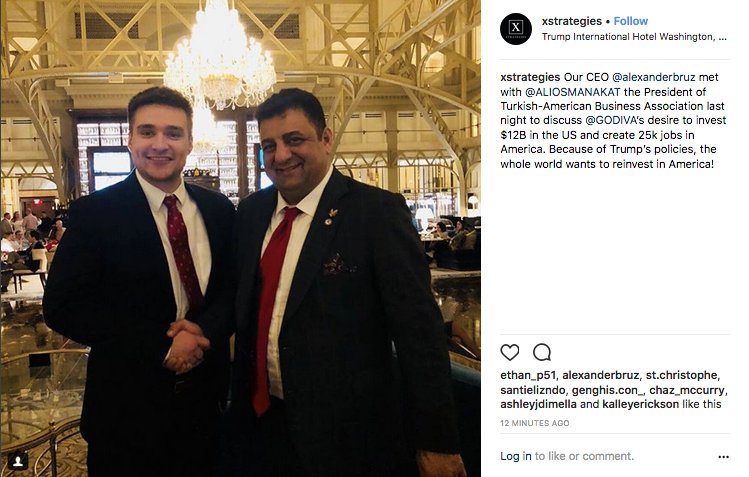
In a since-deleted Facebook post during Akat’s U.S. trip in the spring of 2018, Republican strategist and XStrategies CEO Alexander Bruesewitz said that he discussed Godiva with Akat at the Trump International Hotel in Washington, mentioning Turkey’s “desire to invest $12B in the US” and create 25,000 jobs.

According to Akat, who spoke with Turkish media on his return from the U.S., he also met with Carlos Gutierrez, former secretary of commerce under George W. Bush. Akat was also photographed in the U.S. Capitol with three Republican congressmen, Rep. Joe Wilson of South Carolina, Rep. Pete Sessions of Texas and Rep. Scott Perry of Pennsylvania, and in the Trump International Hotel with billionaire Tom Barrack, a close friend of the president, and Lara Trump, the president’s daughter-in-law and a campaign adviser.

(Salon was able to access and translate the lengthy article about Akat’s U.S. trip and gathered screenshots of some passages, but the original page itself is currently inaccessible, as is the parent site, Online Eksen. Salon has made available a rough translation.)

In reference to Tom Barrack, Akat told Turkish press, “I said that we are in the US in relation to the project. He stated that he would support us at the White House, Donald J. Trump and financial institutions in the USA. We will start official contacts with him.”

Akat told the Turkish outlet that Scott took him to Republican National Committee headquarters, where he was photographed giving an address, and the White House. Here is a rough translation of the relevant passage:

During the meetings with Darrell Scott, he supported the project warmly. He forwarded our project to Donald J. Trump, his colleagues and family. He took me to the Republican headquarters first. I had the opportunity to explain the project there, and it was liked by everyone. Then he took me to the White House, based on the seriousness of the matter. We had contacts in the White House. We had meetings with Donald J. Trump’s special assistants and assistants (Andrew Giuliani, Clayon T. Henson, Ronny L. Jackson, Jennifer S. Korn and Alexandra E. Veletsis). We would like the White House to support us seriously about our project, because it will provide employment to the United States and this direction is very valuable to them, and both investors and Turkey have expressed that they see benefits this project will provide the United States.

Akat also says he discussed the policy proposal with a number of lobbyists in the U.S., such as Sean Mulvaney, at the time a lobbyist for Procter & Gamble. He also praised Reps. Wilson and Sessions and their support for a trade deal.

White House spokesperson Sarah Matthews told Salon, “This story is completely false. No meeting or policy discussions ever took place.”

The Turkish article included a photograph of Akat and Darrell Scott reviewing a thick binder together in a conference room at the Eisenhower Executive Office Building next door to the White House, according to people familiar with the building. The building hosts most of the White House staff.

But these talks with Turkey stalled during the summer of 2018, while the Trump administration was negotiating the release of Andrew Brunson, the American evangelical pastor who had been held in a Turkish prison for almost two years. Tensions between the two nations escalated throughout that year, but Turkey finally released Brunson on Oct. 13, 2018, not long after the murder of Washington Post journalist Jamal Khashoggi in the Saudi embassy in Istanbul.

Vice President Mike Pence and Interior Secretary Ryan Zinke led the negotiations for Brunson that summer. At one point, Turkish President Erdogan reportedly proposed trading Brunson for Fethullah Gülen, a Turkish dissident scholar and cleric who now lives in Pennsylvania. (Two years earlier, Michael Flynn, Trump’s first national security adviser, had reportedly been implicated in a scheme to kidnap Gülen and return him to Turkey; Kazan appears in a photograph with Flynn, viewable here, but denies having any connections to the Gülenist movement.) Vice President Pence, however, has received political donations from Gülen-linked citizens in the U.S., one of whom has lobbied Pence on Gülen’s behalf.

In a WhatsApp message obtained by Salon, an Erdogan aide who has traveled with him to the United States described Brunson’s release as a mutual “gift” from Turkey.

On the day of Brunson’s release from captivity, Trump tweeted, “There was NO DEAL made with Turkey for the release and return of Pastor Andrew Brunson. I don’t make deals for hostages. There was, however, great appreciation on behalf of the United States, which will lead to good, perhaps great, relations between the United States & Turkey!”

One day later, Akat told a Turkish-American outlet that 15 Turkish companies were ready to push ahead with business in the U.S. Around this time, Darrell Scott publicized his trips aboard Air Force One and White House visits in his URC capacity, as he and URC co-chair Kareem Lanier worked directly with Trump and advisers including Jared Kushner (whom Scott calls “J-Rock,”) on what would become the White House Opportunity and Revitalization Council, effected in an executive order that December. Scott’s visits included his evening watching the midterm election returns with Trump in the White House.

The day before Scott and Trump watched the election, Trump exempted Turkey from energy sanctions that his administration had slapped on Iran in November. This was sharply criticized by some U.S. officials, who saw the move as capitulation to Erdogan’s strong-arm tactics — especially as negotiations related to Halkbank, a Turkish financial institution that is now under federal investigation for evading Iranian sanctions.

As the Gülen scenario and Khashoggi murder suggests, this situation had become incredibly complex, and the deep and often contradictory geopolitical mechanics at work would not have been easy for someone in Scott’s position to navigate.

For instance, Trump’s personal attorney Rudy Giuliani had at one point represented a Turkish gold trader named Reza Zarrab, who worked out of Trump Tower in Istanbul and led the alleged Halkbank conspiracy. Zarrab, and perhaps related pressure from Erdogan, was reportedly a principal reason for President Trump’s abrupt 2017 firing of Preet Bharara, then the U.S. attorney for the Southern District of New York.

That incident hit hard in Turkey, as well. “The Zarrab scandal was the bombshell that destroyed Turkish democracy,” as Turkish expatriate journalist and editor Abdulhamit Bilici described it to Salon.

Up to that point, Erdogan had been defiant about those energy sanctions — as one of Iran’s top energy buyers, Turkey imported half its oil and one-fifth of its gas from Iran.

Less than two years later, Turkey now imports far more energy from the U.S., and appears to be pivoting away from its previous dependence on Iran. Around the same time, however, the U.S. cut major military contracts with Turkey, and Turkey to Russia instead — although, more recently, the Turkish government and U.S. seem to be turning back to one another on those military contracts, in a way Akat himself had suggested in 2018:

If you think that if a Turkish manufacturer builds a similar part of its own production facility in America, if it produces an aircraft part, and if it makes its product certified to American standards, it may become able to sell billions of dollars of its own army to the American military market. So this is a great market.

On the same day Trump gave Turkey a pass on sanctions, Ferhan Ademhan — a wealthy Turkish industrialist and investor who also has ties to Akat, as well as to Kazan and, through her, Trump campaign surrogate and Pence ally Martha Boneta — posted on Facebook: “America has released 8 countries [from the sanctions] it applied to Iran. Our country has been released as well. We have been rid of this burden on behalf of our country [thumbs-up emoji]”

A few weeks later, Akat was back at the president’s Washington hotel, posting photos of Trump and Giuliani as well as gifts from the White House.

Then, on Dec. 12, Trump signed an executive order establishing the White House Urban Revitalization and Opportunity Council. The order appends “opportunity zone” development to nearly every paragraph. Darrell Scott was present at the signing, and Trump singled him out for praise.

That day, the National Diversity Council — a group founded by former Trump lawyer Michael Cohen, where Scott and Lanier served as senior officials and Kazan sat on the advisory board — posted the news on Twitter, pointing out the irony that Cohen had been sentenced to prison the same day: “URGENT President Trump IMPORTANT Speech Signs Exec Order amid Cohen Sentenced 3 Years in Prison https://youtu.be/LRZviaXbHOI

As outlined in Part One of this Salon investigation, the NDC turned on Cohen after the FBI raided his homes and offices, confiscating phones and hard drives.

A few weeks after the raids, NDC director Bruce Levell, who Kazan says had shaken her down for $1,000, expressed concern to Kazan in a text message, obtained by Salon: “Trust me. Don’t talk to anybody about NDCTrump. Delete. Cohen under fire. Thanks.”

On Dec. 23, after the Opportunity and Revitalization Council had been officially created, Trump tweeted about “discussing heavily expanded Trade” with Erdogan, in the context of troop levels. Two days later, the Daily Sabah — which is owned by Erdogan’s son-in-law — published another interview with Akat, indicating that the trade talks had advanced. He pegged the prospective economic package at $1 billion. The article, published on Christmas Day, was headlined, “Turkish-American bilateral trade expected to soar next year.”

The following month Trump tweeted about trade policy with Turkey again, in the context of troop levels: “Also spoke about economic development between the U.S. & Turkey — great potential to substantially expand!”

There was no more discussion of a major trade deal with Turkey in the president’s Twitter feed, and a comprehensive proposal never seems to have gained traction since. Trump did not tweet about Turkey again for a full nine months, and the next mention came when he acceded to Erdogan’s demand to withdraw U.S. troops from northern Syria, effectively abandoning Kurdish forces who had fought alongside Americans for years. 

Was all this illegal? Maybe

Though Turkish businesses don’t appear to have made any investment in the Trump administration’s “opportunity zones,” Akat repeatedly alluded to the prospect, which would have given Turkish companies a manufacturing foothold in the U.S. while evading tariffs on fully-produced goods.

This effort — backed by Scott and Lanier at the URC, among others — would have entailed changes in U.S. trade policy to give Turkish manufacturing companies priorities in the United States, seemingly contradicting Trump’s “America First” agenda.

Experts from CREW, the Campaign Legal Center and OpenSecrets told Salon that on its face this initiative would raise concerns about possible violations of the Foreign Agents Registration Act (FARA), which requires Americans who lobby on behalf of foreign interests to register with the government.

While FARA has a carve-out for commercial representation, Brett Kappel, a top authority on campaign finance, lobbying and government ethics law, told Salon that it’s not clear the exemption would have applied to Scott, Lanier and the URC, who appeared to be lobbying the White House, and possibly Congress — successfully or otherwise — to influence changes in U.S. policy.

“This really could be a FARA problem,” Kappel said. “If they were engaging in lobbying activities to change government policy on behalf on foreign principals, that requires registration.”

Kappel, and others, pointed out that the law has a loophole for certain commercial activity, that loophole would likely not apply here. From the National Law Review:

Not covered by the Commercial Exemption are activities “directed by a foreign government or political party” or that aim to “directly promote the public or political interests of the foreign government.” In determining whether the Commercial Exemption applies, due diligence into whether the foreign principal is closely affiliated with a foreign government, or where the commercial interests are intertwined with sovereign government interests is necessary.

“In this case, it seems the goal was to change U.S. policy, and that activity would be something that FARA agents would be skeptical about,” Kappel said.

Kappel points out that before Robert Mueller’s investigation and numerous related reports during the Trump era revealed rampant abuse, FARA hadn’t been strictly enforced. Mueller’s work changed that, as is evident in the placement of former Mueller prosecutor Brandon Van Grack at the helm of the Justice Department’s FARA division.

In a recent case, lawyers for a foreign government attended “regular meetings between Embassy officials and [that country]’s U.S. lobbyists where proposed legislation and legislative strategy are discussed,” among other things. Van Grack advised the firm that it couldn’t take advantage of FARA’s exemption for legal work and needed to register.

In issuing that opinion, FARA attorney Matt Sanderson told Politico, the DOJ “took an exceedingly broad view of FARA’s scope.”

“This could cause more law firms, particularly in Washington, to reexamine whether their work could trigger FARA registration,” Sanderson said.

“Almost every single FARA statistic has risen exponentially since 2016,” Van Grack told Politico in September 2019, amid what was by then already a record year for FARA enforcement. He said that more foreign agents have registered and the DOJ has issued more advisory opinions to lawyers about when they need to register.

“The goal is not numeric,” he said. “The goal, again, is compliance.”

Noting this, Kappel concluded that the URC’s activity would raise legal flags today whereas it might not have in a pre-Mueller world.

The URC might also face tax law liabilities. At one point the group was a tax-exempt 501c(3) nonprofit, which can accept donations, including from foreign nationals, without having to disclose sources. But because the URC apparently never filed a tax return, the IRS automatically revoked its tax-exempt status this May.

Scott told CNN that he hadn’t known that the URC had lost its tax-exempt status until CNN contacted him. Kappel described this as “extremely strange,” given that Scott hadn’t filed any returns from the group in three years and the IRS had almost certainly sent him multiple notifications over that time.

Scott told CNN that he hadn’t received any such notices because the URC had shut down during the pandemic, and he had shifted his focus to the Trump campaign.

That seems implausible, Kappel said, but it’s unlikely the IRS will come after Scott. “Chances are next to zero,” he said. “The IRS has extremely limited enforcement resources, and when they use them it’s usually reserved for significant tax evasion or fraud.”

During his time away from the URC, Scott has written and published a book about his experience in Trump’s political world, “Nothing to Lose” — a reference to Trump’s widely mocked 2016 campaign pitch to Black voters.

“He wanted to be Martin Luther King,” Kazan said.

Cohen also has a book coming out, “Disloyal,” which he says will delve into issues of race and reveal new details of the president’s bigoted behavior, as witnessed by Cohen.

After federal investigators confiscated Cohen’s devices, he began releasing tapes. One of them was a recorded conversation with Trump during the 2016 campaign, in which the two discussed hush money for a former Playboy model.

In that conversation, Cohen brought up Scott, who at the time was a campaign adviser. Trump apparently confused him with another Black pastor on his campaign, Mark Burns.

About a minute into the recording, Trump tells Cohen, “Your guy is a good guy.”

“Who, Pastor Scott?” Cohen asks.

Trump then asks Cohen if the campaign can still “use” him, but doesn’t specify who he means. Cohen, realizing that Trump might have been referring to Burns instead, suggests his name.

However, the two still seem confused — Trump mentions Scott’s name again, and asks the question: “What’s, what’s happening? Can we use him anymore?”

“No, no,” says Cohen.

Two years later, Trump and Scott were together in the White House for the signing of the executive order that Scott had worked so hard for over that last year, creating the Opportunity and Revitalization Council.

At the signing ceremony, Trump called on Scott by name. Here is the official White House transcript:

TRUMP: Pastor Darrell Scott, a friend of mine for a long time. Where’s Darrell?

PASTOR SCOTT: Right here. (Laughter.)

THE PRESIDENT: Hi, Darrell. Darrell. Bishop Harry Jackson — Harry, that’s great. And local officials from Baltimore, Maryland; Norfolk, Virginia; and Allegheny County, Pennsylvania.

Trump then launched into his prepared remarks.

Darrell Scott and Bruce Levell did not reply to Salon’s specific questions. (In response to the first article in this series, Scott posted and then deleted a tweet reading, “Lie from the pit of hell!!!”) Michael Cohen was not available for comment. TABA-AmCham did not reply to questions. Ali Akat did not respond to Salon’s questions in the course of writing this article.

Heavily armed Trump supporters plotted trip to Kenosha to “pick people off”: FBI

Two heavily armed supporters of President Donald Trump were arrested this week when the FBI received a tip that they were planning to drive to Kenosha, Wisconsin, where they hoped to “pick people off.”

Local news station WISN reports that Missouri residents Michael Karmo and Cody Smith were arrested by federal agents in a hotel parking lot this week after the FBI learned on Tuesday that they were driving to Kenosha armed with a large cache of weapons.

According to WISN, agents searched the men’s vehicle and hotel room and found “an Armory AR-15 assault rifle, a Mossberg 500 AB 12-Gauge shotgun, two handguns, a silencer, ammunition, body armor, a drone and other materials.”

Officials also say that the two men were planning to travel to Portland, Oregon after their Kenosha stop, where they had pledged to “take action” if the city moved forward with defunding its police department.

According to a criminal complaint filed against them, both Karmo and Smith “are part of the 417 2nd Amendment Militia of Missouri” and that they “went to Kenosha to attend President Donald Trump’s rally.”

GOP congressional candidate posts threatening picture targeting Democratic congresswomen

One of the summer’s biggest political shockers came when QAnon extremist Marjorie Taylor Greene won a GOP congressional primary in Georgia. Considering how overwhelmingly Republican her district is, she is likely to win the general election and be sworn into the U.S. House of Representatives in January — and Greene, who has a history of racist, anti-Semitic and Islamophobic remarks, now appears to be directing threatening congresswomen of color she is likely to be colleagues with next year.

On her Facebook page, Greene posted an image of herself holding a gun alongside images of three Democratic progressives —  Rep. Alexandria Ocasio-Cortez of New York City, Rep. Rashida Tlaib of Michigan and Rep. Ilhan Omar of Minnesota — and wrote: “We need strong conservative Christians to go on the offense against these socialists who want to rip our country apart.”

Facebook removed Greene’s post, describing it as a terms of service violation. And Omar is speaking out about the post, accusing her of inciting violence.

Omar tweeted, “Posting a photo with an assault rifle next to the faces of three women of color is not advertising. It’s incitement. There are already death threats in response to this post. Facebook should remove this violent provocation.”


In a different Facebook post attacking those congresswomen, Greene wrote, “Hate America leftists want to take this country down. Politicians have failed this country. I’m tired of seeing weak, establishment Republicans play defense. Our country is on the line. America needs fighters who speak the truth.”

Given Greene’s willingness to promote the unhinged QAnon conspiracy cult, Omar is right to be concerned. QAnon believes that an international ring of pedophiles and Satanists has infiltrated the United States’ federal government and that President Donald Trump was chosen to combat the ring. The “Q” is a reference to an anonymous figure who supporters of the cult believe is giving them updates on Trump’s battle. And the FBI has linked QAnon to acts of violence.”

Ocasio-Cortez, Tlaib and Omar, along with Rep. Ayanna Pressley of Massachusetts, comprise the four congresswomen of color who are known as The Squad in the House. All of them were elected during the huge blue wave in the 2018 midterms that gave Democrats control of the House.

Fox News confirms report on Trump’s troop bashing on Twitter — but on-air claims story is debunked

Fox News on Friday became the latest publication to confirm President Donald Trump’s contempt for Americans who serve in our armed forces.

The network joined the Associated Press and The Washington Post in confirming the reporting, which originally appeared in The Atlantic.

But soon after Fox News confirmed the report on Twitter, the reporting was referred to as “debunked” and a “hoax” on the Fox News show “The Five.”

Here is the original Fox News thread on their reporting:

What’s coming to Disney Plus in September 2020

At long last, Disney’s live-action remake of “Mulan” will premiere on Disney Plus on Sept. 4. Unlike the rest of the content available on the platform, American audiences have to pay $29.99 to rent the movie, on top of the monthly subscription fee of $6.99.

Read more from VarietyHollywood sees surge of film, TV production as Hollywood goes back to work

The 2015 reboot of “Cinderella” is also set to make its debut on Sept. 1. The remake stars Lily James as Cinderella, Richard Madden as Prince Charming and Cate Blanchett as Lady Tremaine.

Read more from VarietyPrince Harry and Meghan Markle sign Netflix deal

The Wolverine,” starring Hugh Jackman, will be available on Sept 4. The film joins the streaming platform’s growing library of Marvel blockbusters, including “Iron Man” and “Avengers: End Game.”

Other family-friendly films coming to the streaming site include “Christopher Robin,” “Ever After: A Cinderella Story” and “Trick or Treat.” National Geographic shows will also air throughout September, with content including “Ancient China From Above” and “Magic of Disney’s Animal Kingdom.”

Read more from VarietyCarole Baskin, Nelly and more join “Dancing With the Stars” cast

See the full list of titles below:

Sept. 1

“Cinderella” (2015)

Sept. 4

“Earth to Ned”
“Mulan”
“The Wolverine”
“Weird But True” (Episode 304) – “Germs”
“Pixar In Real Life” (Episode 111) – “Coco: Abuelita Says No Music”
“Muppets Now” (Episode 6) – “Socialized”
“Ancient China from Above” (Season 1)
“D2: The Mighty Ducks”
“D3: The Mighty Ducks”
“Never Been Kissed”
“Strange Magic”
“Trick or Treat”
“One Day At Disney” (Episode 140) – “Alice Taylor: Studiolab”

Sept. 11

“Christopher Robin”
“Weird But True” (Episode 305) – “Photography”
“One Day At Disney” (Episode 141) – “Amanda Lauder: Chef Chocolatier”

Sept. 18

“Becoming”
“Weird But True” (Episode 306) – “Trains”
“Bend It Like Beckham”
“One Day At Disney” (Episode 142) – “Dr. Natalie Mylniczenko: Veterinarian”
“Oil Spill of the Century”
“India From Above”
“Coop & Cami Ask the World” (Season 2)
“Europe From Above” (Season 1)
“Ever After: A Cinderella Story”
“Kingdom of the Mummies” (Season 1)
“Marvel Super Hero Adventures” (Season 4)
“Notre Dame: Race Against the Inferno”
“Once Upon a Time” (Seasons 1-7)
“Soy Luna” (Seasons 2-3)
“Violetta” (Season 3)
“Wicked Tuna” (Season 9)

Sept. 25

“Secret Society of Second-Born Royals”
“Magic of Disney’s Animal Kingdom”
“Weird But True” (Episode 307) “Venomous Animals”
“DisneyNature Oceans”
“Fancy Nancy: Fancy it Yourself” (Season 2)
“The Giant Robber Crab”
“Gordon Ramsay: Uncharted” (Season 2)
“Muppet Babies” (Season 2)
“Port Protection: Alaska” (Season 3)
“Sydney to the Max” (Season 2)
“Wild Central America” (Season 1)
“X-Ray Earth” (Season 1)
“One Day At Disney” (Episode 143) – “Ashley Girdich: R&D Imagineer Manager”


New York’s plastic bag ban has survived the pandemic

It’s a great time for New Yorkers to start investing in reusable grocery bags. Late last month, a state supreme court judge in Albany upheld a statewide ban on plastic carryout bags after considering a lawsuit led by a longtime plastic bag manufacturing company. The court also rejected a loophole in the new regulations that would have allowed the distribution of thicker plastic bags, which advocates say do not comply with the spirit of the ban.

The New York state legislature passed a law back in 2019 largely prohibiting vendors in the state from distributing single-use plastic carryout bags to customers. The New York State Department of Environmental Conservation (DEC) then drafted regulations to govern the law’s implementation in February of this year. The regulations stated that stores could hand out plastic bags only if the bags are washable, have an attached strap that does not stretch or wear with use, can be used at least 125 times, and can carry 22 pounds. They also said that reusable plastic bags should be at least one-hundredth of an inch thick. Environmental groups like Earthjustice worried that the language of the regulations could undermine the plastic bag ban by exempting thicker plastic bags.

Just after the regulations were issued, a lawsuit led by the plastic bag maker Poly-Pak Industries was filed against the state of New York and the DEC in hopes of stopping the ban. The suit was filed right before the ban was supposed to go into effect in early March.

In May, Earthjustice submitted an amicus brief on behalf of three leading environmental groups: WE ACT for Environmental Justice, Beyond Plastics, and Clean and Healthy New York. The three organizations argued on behalf of the ban and asked for the loophole to be closed. The state court ultimately endorsed the substance of the brief by upholding the ban and striking down the exemption for thicker plastic bags.

“We see the use of plastic bags as a climate change and community health problem,” said Victoria Bogdan Tejeda, an associate attorney at Earthjustice. “[Thicker plastic bags were] not what the legislature intended…. It wanted to end the use of plastic bags, full stop.”

Environmental advocates point out that plastics are derived from fossil fuels and that plastic manufacturing often produces substantial air pollution in industrial areas around the country. They hope that other states follow New York’s lead.

“New York is a bellwether state, and as such, if this loophole was adopted, other states would likely have followed suit. This sets an important legal precedent that will help protect frontline communities,” said Kathleen A. Curtis, executive director of Clean and Healthy New York, an Albany-based organization that aims to get rid of toxic chemicals in everyday products.

Judith Enck, the president of Beyond Plastics, worried earlier this year that single-use plastic would see a resurgence due to fears surrounding the COVID-19 pandemic. Plastic companies have indeed used the pandemic to push single-use personal protective equipment.

However, more than 100 health experts from 18 different countries released a statement this June confirming that reusable items are safe to use during the pandemic if cleaned regularly. Enck also referenced a study from the New England Journal of Medicine that discussed how the novel coronavirus is transmitted via aerosols that actually tend to live longer on plastic than on some other materials.

“In New York state, 23 billion plastic bags are used every year, which is a staggering number,” Enck said. “This is one of those laws that New Yorkers will see the benefits of almost immediately, once the DEC starts enforcing it. We will see fewer plastic bags in neighborhoods, in parks, up in trees, and in streams and rivers.”

54 million people in the U.S. may go hungry during the pandemic — can urban farms help?

When I call Chef Q. Ibraheem to discuss urban farming in her own cooking career, she’s in the middle of placing an order for microgreens from a small farm in Lake Forest, a ritzy suburb just north of downtown Chicago. Now’s a great time for her to chat, actually, because the Chicago-based chef is immersed in what she loves, sourcing ingredients as locally as possible.

“It’s really important we know where our food is coming from,” she says. “I know my farmers by name. I can go to the farms, see how they are growing everything, see it in the soil. It’s always nice to have something within reach and know your produce.” Chef Q runs supper clubs and chef camps throughout Chicagoland, sustaining the local economy by purchasing ingredients from urban gardens and farms within miles of her pop-up experiences.

“As a chef, you realize you have a responsibility to your guests,” she says, and for her, that responsibility means being transparent about ingredients, and even educating diners about what’s on their plates. Growing up spending summers on a farm in Georgia, Chef Q has an innate curiosity about where and how her food is grown, and she recognizes the importance of farms in both urban and rural areas.

Commercial urban agriculture is on the rise, with small-scale farms in New York City like Gotham Greens, which reduces the amount of energy, land use and food waste in tight, underutilized spaces to produce herbs and roughage for the masses. In Austin, Texas, backyard farms and urban gardens sell ingredients to restaurants and markets throughout the region, as do similar projects in Los Angeles. In fact, innovations allowing farmers to grow without soil or natural light expand the potential for food sourcing in urban areas. Urban farming has increased by over 30 percent in the past 30 years, with no indication of slowing down. Urban land could grow fruit and vegetables for 15 percent of the population, research shows.

While the COVID-19 lockdowns have inspired a burst of urban farming as people have been starting to grow their own fruits and vegetables at home, a renewed interest in culinary arts, plus a nostalgia for simpler times in many fast-paced big cities—just look at all the mid-century era diners popping up in Manhattan right before the pandemic—may be accountable for the steady rise in urban farms. More consciousness about the environment, too, may lead small growers to want to reduce transportation emissions and take charge of the use of pesticides and fertilizers in their foods, but there’s another great reason for urban farms to continue growing: Feeding the masses. And with 68 percent of the world’s population expected to live in urban areas by 2050, it’s time to take urban farming seriously as a viable, primary food source.

Despite being the wealthiest nation in the world, the United States had more than 37 million people struggling with hunger in 2018. Since the pandemic, that number is expected to rise to up to 54 million people. And while systemic changes may one day be able to greatly reduce this number, a planting cycle is quicker than an election cycle. Bureaucracy may not immediately solve fair wages, but vegetable seeds may help communities when times are tough.

Urban farming as a social practice

In her work, Chef Q has helped turn empty lots and abandoned buildings into urban farms, which allows neighbors to “take ownership in their communities” and also become educated consumers. In neighborhoods where the fancy grocery store is referred to as “Whole Paycheck,” Chef Q has seen seed exchanges help folks start growing new produce, and regain agency over their food budgets and eating habits. Programs like the Chicago Food Policy Summit, a free annual event on Chicago’s South Side, help popularize urban farming and education and help provide Chicagoans with grants to start growing their own food. Though gentrification may bring relief to previously dubbed food deserts—neighborhoods without a nearby source of fresh food—the slew of problems attached to gentrification, including higher costs of living, can easily make these new, more nutritious food options completely unaffordable to residents of the neighborhood.

As seen in smaller cities, urban farming may be the key for cities to be less reliant on rural areas, and also help achieve food security. As Dr. Miguel Altieri, professor of agroecology at the University of California, Berkeley, has shown, diversified gardens in urban areas can yield a large range of produce and efficiently feed nearby residents.

Of course, land in cities is often at a premium, with many people living in little space. Shifting public land use to incorporate food growth and getting creative with rooftops, basements and unused buildings can seriously change the way cities consume fresh ingredients.

In fact, renewed efforts by the conservation organization World Wildlife Fund to boost indoor farming may revolutionize some sources of produce, particularly in cities. Repurposing unused indoor space, such as warehouses, can create direct sources of ingredients for restaurants or community supported agriculture for neighbors. Indoor farming, while potentially more expensive, also allows urbanites from all walks of life to connect to the food system, repurpose food waste into compost and expand knowledge on growing food. Greenhouses like Gotham Greens‘ rooftop spaces can supplement indoor and outdoor spaces, adding even more potential healthy food to local ecosystems.

Urban Gardening With Neighbors in Mind

When she’s not hosting pop-up dinners with culinarily curious Chicagoans, Chef Q volunteers with Foster Street Urban Agriculture, a nonprofit garden that aims to help end food insecurity in Evanston, the Chicago suburb home to Northwestern University. In the garden, Chef Q teaches kids how to water, plant, weed and grow produce. She’ll notice a multigenerational interest: “Once kids taste zucchini, it’s over,” she jokes, of little ones bringing in parents and grandparents to learn to cook with more fresh produce. “They’ll start [the program] eating hot Cheetos, and they’re eating something green and leafy and won’t go back.”

Kids also just love being able to eat something that comes out of the ground and will take their passion back home, growing tomatoes in their windowsills or trying other small gardening projects in spaces available to them near home. Harvests from Foster Street are donated to food pantries and also sold at a local farmers market, where kids learn community-based entrepreneurial skills.

“Everyone eats, it’s a common denominator,” she says. “When food is on the table, people will have conversations.”

Now, in the wake of COVID-19, urban farms have become more essential than ever. Chef Q has partnered with farms that would otherwise throw away produce without their major restaurant and hotel clients, to redistribute food to Chicagoans in need. She’s noticed a spike in the price of fresh food, thanks in part to the expensive early May crops—peas, leeks and spinach. “It’s been imperative,” she says, of feeding the community with a local bounty of eggplant, microgreens, cheese and more farm-to-fork provisions.

Chef Q emphasizes that urban gardens still have to grow food to feed communities. Across the nation, we’ve seen victory gardens pop up in yards of homebound upper-middle-class Americans, planted with hope, thriftiness and a creative outlet in mind. But for those who don’t have yards or ample space, shared urban gardens can still serve a local population. When people don’t have money, growing food is a solution to provide nutrition, and perhaps even income. And it starts with advocacy, volunteers and outreach. “Plant something in the windowsill,” Chef Q suggests, as an entryway into small-scale gardening. “It’s essential. We can’t stop.”

“If you get Pauly Shore, you get all of Pauly Shore”: The joyful return of The Weasel

Cher Horowitz once advised that it’s useless to go searching for meaning in a Pauly Shore movie. And if you watch the trailer for “Guest House,” the 52-year-old comic’s first starring film role in over a decade, you will likely not confuse it with “Tenet.” But that doesn’t mean  Pauly Shore can’t surprise you.

Directed and co-written by Sam Macaroni — who comes with a background in action films like “John Wick 3” — the movie feels like “Neighbors” in reverse. A well-behaved young couple (Mike Castle and Aimee Teegarden) movie into the home of their dreams, only to discover the guest house is occupied by a very hard partying, one-man mayhem machine named Randy. Pandemonium  ensues — the kind that comes with drug use, profanity and boobs. It’s the kind of role Shore could have played 25 years ago, except that having the character be a rough-edged, middle-aged man instead gives the whole thing an unexpectedly tragicomic note.

If you are too young to remember the ’90s, you likely can’t fathom exactly how huge Pauly Shore was. The son of legendary Comedy Store owner Mitzi Shore and comic Sammy Shore, he started doing stand-up in his teens. He became a breakout celebrity as an MTV personality, where he defined his persona as the embodiment of the chill Southern California dude.  He went on to star in a string of slapstick-heavy hits like “Encino Man” and “Son-In-Law.” Then, much like Hammer pants, he fell out of fashion.

Shore never stopped hustling, making his own films, doing stand-up and hosting a podcast. But  the past few years have changed him — there was an ugly public dispute with his brother regarding their mother and her club, and then, in rapid succession, the deaths of his parents, his sister and his best friend. He is unguarded in his grief and unambiguous about his quest for light in the darkness.  Speaking with Salon recently, he was not the chaotic character Genx-ers know as The Weasel. He was soft spoken, reflective and self-effacing. “I want to be joyful in my life,” he says. And when you ask him about the new “Bill & Ted” movie, he won’t hesitate to crack, “We’ve got to do ‘Encino Man 2.'”

The following interview has been lightly edited for length and clarity.

This is one of your biggest roles in a while.

Yeah, they dusted me off. It’s hilarious.

It feels like a very Pauly Shore movie. It’s wild. It’s raunchy. It’s dirty. Tell me how you got hooked up with this story.

It was Sam Macaroni, the director and the writer of the film, with these two guys. They wrote this film about a guy living in a guest house that won’t leave. And they connected with Barry [Brooker] over at Grindstone and my friend, Jared [Goetz] over at Lionsgate. I think Barry said to Jared, “Hey, we want Pauly to be a police officer in this film. Do you know Pauly Shore?” And Jared was like, “Well, yeah, he’s one of my best friends.” It was just a weird timing thing.

Then I guess the director had seen me on Joe Rogan’s podcast. From there, the director was like, “Screw the police officer. We want Pauly to be the lead.” That’s when they offered me the lead. I read the script and then that’s when I thought [about] the concept. It always starts with the concept and the story. From there you’ve got to go in and do your surgery on the script and work with the team and soften the character, and kind of that’s what I did. They gave me free rein to kind of clean it up and make it a little bit more relatable and softer.

So this all came about because of that interview on Joe Rogan, where you were talking about your career and where your place is on the call sheet on any day.

I just think that he and a lot of other people are kind of frustrated going, “Why the hell isn’t Pauly Shore doing movies? This guy starred in several movies. People like to laugh and he seems like the guy that makes people laugh, why is it?” You ask me why, I don’t have the answer. You can’t beg Hollywood to put you in movies.

That’s not the way to go about it. After my run in films, I always kept working. It’s just, if they’re not offering you movies, they’re not offering you movies. That’s just, that’s life, you know?

And you shift and you do your own movies. That’s what I did. The last twenty years I’ve been producing and directing and starring in my own stuff. If you look at the stuff that I’ve done in the last 20 years, I’ve done tons and tons of stuff, but I just haven’t starred in a studio-type film like this in awhile.

Tell me about the character Randy. He has a backstory. He doesn’t just spring fully formed in this house. You find out more about where he’s coming from and why he does the things he does. How do you describe him and how did you change him?  

Yeah, he’s a little Zach Galifianakis meets The Dude, you know, Jeff Bridges.  

He’s a guy who doesn’t want to leave his house. I don’t want to give the story away, but that’s what I liked about the thing. There’s a reason. There’s always got to be a reason and the reason why he was acting crazy and doing stuff. Yeah, that’s kind of who he is, but he doesn’t want to leave the house. He’s got the roots in that house, and so that was his way of acting out.

You said that you worked with Sam on the character. Were you a collaborator in what this character eventually becomes?

Well, yeah. I have been a collaborator not just in this, in all my films. Every movie I’ve ever done, I’ve gotten in there with the writers. If you get Pauly Shore, you get all of Pauly Shore. I’m not just showing up, especially if it’s starring me and it’s got my name on it. I’ve got to direct these guys on how to make this guy likable and more relatable. That’s kind of where I come in with what I do. So yes, I worked with him in developing and also help casting. All the comedians are my friends. Erik Griffin and Bobby Lee to Punkie Johnson, and then Sam brought in his crew Steve-O and Billy Zane.

It was very much a collaborative effort. Everyone respected one another and everyone let each other bring what they brought to the table.

I want to talk about the stunts, because the director has a background in that world. Probably my favorite moment was when you do this beautiful balletic, fight sequence. That seems like something I hadn’t seen from you before.

It’s interesting, because it’s hard to look at things from a different perspective, but you have to. I realized this script, the stunts, I had never done stunts like that. Thinking back on my career, “In The Army Now,” we did a lot of stunts, but this was a real physical kind of game here.

They obviously brought in a stuntman. I worked with the stuntman, and Sam was a great director, very meticulous and focused. And the fact that it was R-rated, I don’t even know if I ever did an R-rated film, where I starred in an R-rated film either. I was thinking back on that. Have I done smaller parts in R-rated movies? Yeah. But I don’t think any of my roles, I don’t remember starring in an R-rated film. [His mockumentaries “Adopted” and “Pauly Shore Is Dead” are rated R, mostly for language.] So you’ve got stunts, you’ve got R-rated, and it’s a lot like my comedy. My comedy is definitely PG-13, leaning into R.

You’re a little more family friendly than maybe people give you credit for, Pauly.

Yeah.

Thinking about this movie, and the “Bill & Ted” movie, it’s hard for me not to, as a member of Gen X, think maybe there’s an appetite for a certain kind of comedy that many of us haven’t seen in a long time. There’s almost an innocence to it, even though this is an R-rated movie. What are you finding now as a comic? What’s the feedback you’re getting from audiences about what they like, what they want, what they need right now?

I think you nailed it. It’s exactly what you just said. I mean, it’s so obvious. The world is such in a weird spot. We’re in this big transition, and it’s dark and everyone is trying to make the best of it. Obviously, you want to look at what you have, not what you don’t have, but it’s really hard to do that.

This has been a curve ball that we’ve all been thrown and no one’s ever expected it. For “Bill & Ted” and my movie, you know, maybe these movies coming out at a time where it wasn’t so dark, wouldn’t be getting as much attention. I think the fact that we are in a doom and gloom place makes the timing even stronger for both of these films to just kind of step away from what the hell is going on.

There are so many dramatic movies and documentaries now; it’s like they just don’t stop putting out just sad content. So that’s why the timing, I think, is good for the world to see something that is silly and goofy and raunchy.

You have been improvising so much the last several years in your career; you have been a self-starter. You’ve got your podcast, you just started something new. I want to hear about the whole journey, Pauly, from L.A. to Maui, to Vegas, that you’ve been on in just the last couple of months. Can you tell me how that happened?

Well, it’s kind of like my life was a movie. It was like I just ended the second act and now I’m going into the happy stuff at the end. It’s kind of a weird analog. I don’t want to say the dark part of my life is in the past, but it feels that way.

I’ve had a lot of personal stuff happen to me, whether it was through my family or my parents passing, my sister passing, my best friend passing, all within two, three years of my life. I just wanted to go back to the happy Pauly. The Pauly that America fell in love with years ago and not the guy that’s burnt out from the personal stuff. Because I’m very emotional with my family.

My mom, I was her baby. Everyone was like, “Oh, Mitzi Shore.” I don’t really care about that part of her. I care about, she was my mom. I lost my mom and just that alone, being the baby of the family, losing your mom and your dad right after it? It’s hard.

I just didn’t want to be in L.A. anymore. I wasn’t happy there. I’d been there my whole life. You know, I’m 52. I’ve never lived anywhere else. And Vegas, to me, seemed like a really fun place that had opportunity. There are a lot of stages here. There’s other celebrities out here. Nicolas Cage is out here. Carrot Top’s out here. Louie Anderson’s out here. You know, these are all my friends.

I wanted to get a big house. My whole life I’ve lived in a big house. Growing up, I lived in the house. When I became known, I lived in a big house. The last seven years, I lived in the apartment in Silver Lake, which was charming and I loved it, but everything changed and I didn’t want to be there anymore.

I just wanted to be in a place that surrounds with joy and I want to be joyful in my life. That’s why I decided to move here. I walked in this house that I live, it’s an old school Vegas area. It’s called Rancho Circle, really beautiful. It’s very private and it’s quiet. When I walked in the house, I felt my parents. They said, “You’re home now.” That’s what I felt when I walked in here, I feel like my parents are here. So I feel safe. It was a good move. Now I’m here and I’m enrolling lots of young cameramen and editors into comedy, into the comedy world. Because it doesn’t really exist in Vegas, comedy production, and it’s something I’m interested in developing out here.

It sounds  like your life is in some ways running on a parallel track to that of the character that you play in the movie. That you’re a guy who has been through loss and is looking for a home.

Yeah. I guess. Yeah, it is. Yeah, it is similar.

You just started the new iteration of your YouTube channel with “Pauly-okie.” How are you reaching out to your audience now in this time when you can’t get on a stage?

Through the stuff that I’ve learned in the last 20 years, I’m able to kind of enroll people around me with my vision of, “Let’s do this Pauly-okie thing.” That was a big deal. Now we recorded all the songs that are going to air. Every Friday, there’s going to be a new song.

And then every Thursday I have my podcasts. And then every Monday I have a new show that I’m putting together called “Sweatin’ with the Wiez.” Everyone thinks I look like Richard Simmons, so I’m going to do these workout videos with a dance partner and we’re going to do them in my backyard. It’ll be fun, silly, silly stuff.

“Guest House” is available on digital and demand Sept. 4.

The upper class has trouble reading other people’s emotional states, study says

A new study reveals that people from higher income backgrounds struggle with certain aspects of empathy when compared to individuals who have lower incomes, who are better at reading people’s emotions.

The research paper, which was published in the “Personality and Social Psychology Bulletin,” asked individuals from different class backgrounds to infer others’ emotional states by looking at images of their eyes and to attempt to assume the visual perspective of other people.

The findings suggest that our socioeconomic status may affect the way we see and interact with other people. 

Researchers know that there are many things can make it difficult for one person to effectively empathize with another, including neurological conditions like autism and psychological illnesses like schizophrenia. In their study, researchers Pia Dietze of the University of California, Irvine and Eric D. Knowles of New York University attempted to better understand how social class specifically influences Theory of Mind.

“[Theory of Mind] encompasses a range of competencies that together enable people to solve problems in a world full of other minds,” the authors explain. “Examples of ToM include our ability to infer people’s emotions, understand others’ visual perspectives, trace behavior to actors’ underlying intentions and desires, and grasp the fact that others’ beliefs might misportray reality.  We focus on two facets of [Theory of Mind] in this work: emotion perception and visual perspective taking.”

The authors concluded, both from their research and by analyzing previous research (some of which they felt was unreliable), that “higher social class is associated with attenuated [theory of mind] performance,” with individuals from higher income backgrounds struggling more to ascertain the emotions and empathize with the visual points of view of other people. One possible explanation for this is that “lower-class individuals—owing to their greater levels of cultural interdependence—may appraise other human beings as more relevant to their goals and well-being than do higher-class individuals.” This would also help people from lower classes to “spontaneously calculate other people’s perspectives.”

Dietze and Knowles also point out that their conclusion “stands in clear contrast to the common discourse concerning neurocognitive deficits among the lower classes.” They also note that “decades of research documents that lower-class individuals are more likely to exhibit attentional deficits and display impaired working-memory performance. The evidence provided here suggests that these deficits may be domain-specific. Indeed, we show that lower-class performance outcomes are reversed in the social realm.” The term “domain-specific” refers to the theory of learning which holds that there are multiple forms of intelligence rather than a single way to assess where one has cognitive strengths and/or weaknesses.

This is not the only new research which sheds light on how being wealthy can lead to harmful psychological behaviors and personal habits. In July a different study in the Journal of Personality and Social Psychology found that individuals from affluent backgrounds would often deny their class privilege by “increasing their claims of personal hardships and hard work, to cover [their] privilege in a veneer of meritocracy.” 

“Flying in the face of meritocratic prescriptions, evidence of privilege threatens recipients’ self-regard by calling into question whether they deserve their successes,” the authors wrote in their study. “Evidence of class privilege demonstrates that many life outcomes are determined by factors not attributable to individuals’ efforts alone, but are caused in part by systemic inequities that privilege some over others.”

Another study, this one published in June in the journal Nature Communications, argued that the consumption patterns of the affluent are so egregiously unsustainable from an ecological standpoint that only a concerted effort by the wealthy to consume less can prevent catastrophes like global warming, pollution and biodiversity loss.

“The affluent citizens of the world are responsible for most environmental impacts and are central to any future prospect of retreating to safer environmental conditions,” the authors wrote, adding that “existing societies, economies and cultures incite consumption expansion and the structural imperative for growth in competitive market economies inhibits necessary societal change.” They advocated “a global and rapid decoupling of detrimental impacts from economic activity,” pointing out that “the world’s top 10% of income earners are responsible for between 25 and 43% of environmental impact” while “the world’s bottom 10% income earners exert only around 3–5% of environmental impact.”

Rose McGowan responds to Payne’s denial of statutory rape allegations: “F*** him and his lies”

Rose McGowan has responded to director Alexander Payne‘s denial of sexual misconduct allegations leveled against him by the actor. McGowan recently accused Payne of statutory rape and showing her soft-core porn when she was 15.

In a guest column for Deadline, Payne said he had “cordial interactions” with McGowan and commended her activism in the #MeToo movement, but denied her timeline of events. Based on McGowan’s age, the incident she described would have occurred in the late ’80s, a time when Payne says he was studying at UCLA.

Read more from VarietyHollywood sees surge of film, TV production as Hollywood goes back to work

“What she has said about me in recent social media posts is simply untrue,” wrote Payne, the director of films like “Sideways,” “Nebraska” and “The Descendants.” “Rose is mistaken in saying we met when she was fifteen, in the late 1980s. I was a full-time film student at UCLA from 1984 until 1990, and I know that our paths never crossed.”

When asked for comment about Payne’s op-ed, McGowan responded to Variety, saying, “F— him and his lies is my comment.”

Read more from VarietyPrince Harry and Meghan Markle sign Netflix deal

She continued, “I told Payne to acknowledge and apologize, he has not. I said I didn’t want to destroy, now I do. Why do these men always lie? I will now make it a mission to expose him. I am not the only one.”

McGowan argued that Payne’s power as a director gives him influence over the public.

“I want people that have watched his films to know his morals are in your mind, his thoughts have become yours,” McGowan told Variety. “Like in his ‘comedy’ ‘Election,’ where the middle-aged teacher that fantasizes having sex with his young student, Reese Witherspoon. I want people to know Hollywood perpetrators show you who they are, their skewed view normalized. Men like Predator Payne, who profited from working Weinstein, must be stopped from not only assaulting, but must also be prevented from infecting the masses with their propaganda.”

Payne, through a spokesperson, said he had “no further comment regarding Rose McGowan’s false allegations.”

Read more from VarietyCarole Baskin, Nelly and more join “Dancing With the Stars” cast

Last month, McGowan accused Payne of inappropriate behavior, saying, “You sat me down & played a soft-core porn movie you directed for Showtime under a different name. I still remember your apartment in Silverlake. You are very well-endowed. You left me on a street corner afterwards. I was 15.”

Prior to naming Payne earlier in August, McGowan alluded to an encounter with a “very famous” man that occurred when she was 15 and said she would come forward with his name when she felt ready.

Payne specifically denied showing her a “soft-core porn movie” because he said he had never directed anything professionally, lurid or otherwise, at the time. “I have also never worked for Showtime or directed under any name other than my own,” he said.

He said they didn’t meet until years later in 1991, during his first directing gig, for which McGowan auditioned.

“Although she did not get the part, she left a note for me at the casting desk asking that I call her. I had no reason to question how old she was, since the role she read for required an actor who was of age. We later went out on a couple of dates and remained on friendly terms for years,” he said.

Payne concluded, “While I cannot allow false statements about events twenty-nine years ago to go uncorrected, I will continue to wish only the best for Rose.”

How a disastrous attempt to pee inspired Netflix’s mission to Mars drama “Away”

In space, taking a pee could potentially kill you.

That’s what astronaut Scott Kelly discovered on one mission when he went to relieve himself but found a hose leaking the chemical called pretreat instead. It’s needed to recycle urine into drinkable water, and a knee-jerk reaction on his part turned the sphere of “floating” chemical into a fireball. 

Author Chris Jones wrote about this strange-but-true incident in the Esquire article “Away,” which inspired the Netflix series of the same name starring Hilary Swank as the leader of Earth’s first manned mission to Mars. The fireball faux pas is the first major challenge for Commander Emma Green (Swank) and serves to undermine her authority with the crew. Not a good omen.

Andrew Hinderaker spoke to Salon about creating the space drama and what the pretreat incident reveals about Emma’s fitness as a leader.

“It illustrated what was heroic and also a little broken about her, that she is somebody who, when there is danger, she will run into the fire before she allows her crewmates to be put into harm’s way, which is a quality you want in a the commander,” he said. “At the same time there are moments where maybe a chemical leak should be handled by the chemist.”

That chemist would be Dr. Lu Wang (Vivian Wu), who, along with botanist Kwesi Weisberg-Abban (Ato Essandoh), medical officer Ram Arya (Ray Panthaki), and mechanical engineer Misha Popov (Mark Ivanir) make up the rest of the Mars Joint Initiative crew on the spacecraft Atlas. Throughout the three-year journey – which requires stops at the International Space Station and the moon first — the tight five-person crew will be tested by both the technical challenges of longterm space travel as well as its effects on mental health.

The fire establishes the life-or-death stakes from the beginning of the 10-episode series. “Fire is the sum of all fears in space,” Emma says, and her family is reminded that the astronauts are looking at a 50-50 chance of survival on the mission. This is not about fixing a flat or riding out some turbulence; every trial the crew will face is potentially fatal. The writers had no shortage of grim yet believable challenges — and solutions — to throw at the astronauts, thanks to plenty of research and resources.

“I was certainly incredibly lucky when I was brought this article and pitch [for] the show. Chris Jones who wrote it became just an invaluable resource. Chris has written a number of really celebrated articles about space,” said Hinderaker. “And then I also immediately went to NASA and got to meet a lot of astronauts and their families, and talked to a lot of folks at Mission Control, a lot of engineers. That’s something that Jessica Goldberg, the showrunner, and I continued at JPL.”

One astronaut told Hinderaker that he wouldn’t want to go to Mars, based on a problem he encountered while orbiting Earth on the International Space Station. 

“He said, ‘Well, in the International Space Station, the water system would break down all the time. We had a backup system and we could generally repair the primary [system]. But if that backup system failed, you’re on an international Space Station. You can get in the Soyuz and jettison back to Earth. Worst case scenario, you’re 300 miles away. That ain’t happening on Mars.”

Naturally, the “Away” writers couldn’t resist breaking the Atlas water system and then trying to figure out how the crew could fix it. Not only are resources limited, but the trip to Mars takes approximately eight months one way, and the further out Atlas goes, the harder it is to communicate with and receive troubleshooting suggestions from Mission Control.

Similarly, communication with friends and family will be more difficult the closer Emma and the gang get to Mars. As the coronavirus pandemic has shown, technology is crucial to staying in touch with loved ones, but no amount of waving from screens can take the place of actually spending time together.

“For the International Space Station, they’re sending video files, they’re having live phone calls, they’re having FaceTime calls. They’re watching television programs. It just occurred to me that — this is very indulgent — but they could potentially watch this show on the International Space Station,” said Hinderaker.

“But then the farther out you go, the more compromised a signal can get and the longer the delay is. If we were to play that literally on the moon, I believe it’s roughly a one-second delay on the phone calls, and then you get out farther and it grows. It would have become unwatchable pretty quickly if we did that literally. But what we tried to then dramatize is [how] the farther out they go, those calls start to freeze, they start to get compromised, until finally they they cut out.”

In fact, one character becomes somewhat broken by not being able to hear from their family in a timely fashion, and it requires the support and intervention of the rest of the crew to shore them back up.

“We really responded to the idea of what would it be like to not be able to phone call,” said Hinderaker. “It’s strange in this moment, as much as many of us are coming to have a love-hate relationship with Zoom, we are still coming to appreciate the importance of that in new ways. So the idea of that going to be taken away — and in the best case scenario [for a trip to Mars], if everything goes right, it’s gone for two years.”

One of the ways that the astronauts stay entertained and tethered to Earth is to celebrate Christmas for what turns out to be a Very Special Holiday Episode of “Away,” written by series executive producer Jason Katims of “Friday Night Lights” and “Parenthood” fame. Misha puts on a puppet show with marionettes, which take on a new life in zero-G, and the crew gets their first taste of spinach, which Kwesi has successfully grown on board.

“What I really love about that, their holiday celebration at the end of the episode, is it is at once miraculous because it is so familiar in its trappings and then also so special because it’s its own thing entirely,” said Hinderaker. “Nobody has been where they are when this holiday comes around . . . the greens they eat are so much more special. Astronauts will talk about that, to eat fresh food in space, it almost makes them burst into tears immediately.”

Risking one’s life, being parted from one’s family, missing out on basic things like food and water — is it all worth it? Mankind has always explored, but a manned mission to Mars is still the stuff of science fiction — still too challenging, still impossible. 

No matter how many astronauts Hinderaker spoke to, he couldn’t land on any one answer to the question, “Why Mars?” One told him that once she experienced zero gravity, she understood that “gravity was only one way in which humans were meant to live,” and by extension, making it to Mars would expand humanity’s perspective about living.

Astronaut Don Pettit gave him a couple of answers. One points to the theory that a piece of Mars broke off and struck Earth, starting life on this planet. Going to Mars would therefore be a coming home. Pettit also said, “Once the moon felt it was impossibly far away, and now it’s in our backyard. We went there. If we go to Mars, it will become in our backyard, and imagine what’s possible then.”

In the first episode, viewed during a pre-launch press conference, Emma says, “Reaching Mars might be our greatest achievement, not only for science but for the future of our planet.”

The achievement itself, one that is so very difficult and requires the cooperation of many nations and people, is Hinderaker’s focus.

“I think the argument is not so much as some might say, that we’re destroying our planet and we might need another place to live,” he said. “We shouldn’t go there to save humanity. We should go there to remind us why humanity’s worth saving.” 

“Away” is available to stream beginning Friday, Sept. 4 on Netflix.

Alexander Reid Ross on what the media got wrong about the Portland protests: Everything

In the Age of Trump, Portland, Oregon, is no longer just another city. Now it is a symbol and almost a Rorschach test for the country’s deep and explosive political divides.

For Trumpists, Republicans and members of the far right, Portland is all that is wrong with “the Left” and “Liberals,” a chaotic nightmare zone where Black Lives Matter, antifa and other “enemies” are running amok while they attack “patriotism” and “real American values.”

To TrumpWorld, Portland and other Democratic-led big cities (which of course is virtually all of them) are hives of scum and villainy, overrun by criminals and “rioters,” which must be conquered by Trump’s enforcers and armed vigilante supporters.  

Trump’s “law and order” politics, and its inherent racism and violence, are believed by many to be his path back to the White House. In this view, Portland and other “Democrat cities” and communities are targets of opportunity for the Trump regime.

Writing at Washington Monthly, David Atkins explains Trump’s mindset:

He sees the violence as politically beneficial, a useful cudgel against Democratic nominee Joe Biden — even though the violence is happening while Trump himself is president, not Biden.

Trump’s election theme is that Americans won’t be safe in a Biden presidency. The opposite is true. Americans won’t be safe as long as a white supremacist president is leading a movement of bigots to incite a civil war, and attempting to ensure that the majority of Americans with cosmopolitan, egalitarian values remain politically disenfranchised and under the thumb of those who fear and despise them.

Trump’s campaign of racial authoritarianism and stochastic terrorism, as well as overt threats of “law and order,” resulted in a group of his supporters driving into Portland last weekend, armed with mace and paintball guns, to seek out confrontations with Black Lives Matter and anti-fascist protesters. During one such encounter, a member of the right-wing militia group Patriot Prayer, Aaron Danielson, was shot and killed. On Thursday night, the apparent shooter, Michael Reinoehl, was himself shot and killed by U.S. marshals in Olympia, Washington. 

Despite this lamentable violence — for which Trump and the right must bear ultimate responsibility — for progressives and other people of conscience Portland is a symbol of resistance and hope. As part of the nationwide people’s uprising sparked by the police killing of George Floyd in Minneapolis, protesters have been outside the Portland federal courthouse for more than 100 days.

The protests were largely peaceful until Trump and acting DHS Secretary Chad Wolf deployed federal police forces to the city in July. Their presence, as designed, escalated the tension and led to increasing levels of property damage and incidents of violence.

Previewing Trump’s plan for other parts of the nation, these federal shock troops made journalists and reporters a special focus of their violence. They also kidnapped protesters and other “enemies” of Donald Trump’s regime off the street as though they were operating in a banana republic.

Much of the mainstream American news media’s coverage of the recent events in Portland lacks meaningful context. Writing at Medium, a Portland press collective describes one such example of this “parachute journalism”:

One night last week, during one of the smaller demonstrations, a tall white man in a clean ballistic helmet and brand-new plate carrier emblazoned with “PRESS” strolled through the crowd in front of the Hatfield Federal Courthouse in Portland, Oregon. He stopped by a gaggle of other journalists, most out-of-towners. “I’ve only been around for the last week,” he said, “but the protests in Portland feel a lot more performative than the ones I’ve seen in other cities. Less genuine.” A local journalist mentioned having been present for over 50 nights of the protests, starting in early June. “Yeah, I can only speak for what I’ve seen this week,” said Clean Helmet. “I’m flying back to DC tomorrow.” … Clean Helmet was on the ground in Portland, by his own description, for less than a week. This means that he was present for approximately 1/10th of Portland’s BLM protests, thus far. I’m sure he got some great footage.

The Parachutes (as we have come to know them) come with money, and zero community connections. Their goal is the clip that can make the nightly news. They want a story that will dominate the news cycle. They do not know what is happening in Portland, and they do not care. They are coming to a city with a vibrant, scrappy community of street-level journalists. By and large, they do not want the context that those journalists can provide. And soon they will come to a city near you. When the Feds and the Parachutes come to your town, you’ll want everyone to understand the context there, too. And they are coming. Clean Helmet is already back in DC, and on to the next assignment.

The important context which “the Parachutes” usually omit includes the way Portland is depicted as a liberal oasis in America’s popular imagination. In reality, Portland is a very race and class-segregated city. As historian and activist Walidah Imarisha and others have richly documented, the Oregon territory passed laws in 1844 explicitly excluding Black people from the region under punishment of whippings and other violence. The state of Oregon formally included white supremacy in its constitution, explicitly banning nonwhites.

To this day, Oregon remains a redoubt of white supremacy, where white supremacists and other right-wing extremists have a large presence in the state and surrounding region. Portland itself has a long and ongoing history of right-wing violence.

Alexander Reid Ross is a doctoral fellow at the Center for Analysis of the Radical Right. His most recent book is “Against the Fascist Creep.” Ross has also completed new research which documents more than 500 incidents in which white vigilantes and other right-wing extremists have confronted Black Lives Matter protests. This includes hundreds of acts of intimidation and other threats as well as dozens of examples in which right-wing extremists have assaulted or attacked Black Lives Matter protesters.

In this conversation Ross shares his firsthand experiences with the recent George Floyd protests in Portland. He also provides some context for those events and the police and federal response. Ross also details the long history of right-wing paramilitaries and political street gangs in Portland and their relationship with local police and other law enforcement.

Reid warns that Portland, the right-wing vigilante killings in Kenosha, Wisconsin, and the hundreds of other attacks by right-wing extremists on Black Lives Matter protesters is just a preview of the massive violence that Donald Trump and his movement may unleash before and after Election Day — perhaps including the arrest or imprisonment of prominent Democrats, journalists, and others deemed to be enemies of the state.

After almost four years of Trump and his regime’s authoritarian, neofascist behavior, some voices in the mainstream American news media now use that correct and appropriate language to describe the reality of the situation. Why was there so much fear and denial about the obvious? Even when they use the correct terminology, the coverage is largely superficial and avoids serious discussion of the dire implications. 

You must also take into account that many so-called left-leaning voices have also been interfering with bringing that truth to light. There were writers at the Guardian, for example, who were trying to sound the alarm about the dangers of right-wing extremism and fascism in America, but they were derided by their peers across the political spectrum.

I also believe that publications such as the Washington Post and the New York Times saw themselves as being aloof from questions of the mob and political violence in America. There is a tendency among elite voices to want to say that, “We’re above political violence here in America and we resolve our differences through conversation. Therefore, let’s give everyone a hearing and let’s debate these issues, regardless of how extreme they may be. That is what a democratic country should act like.”

In a sense, they put their faith completely in some abstract idea of “democracy” instead of taking the temperature of what is really happening on the ground.

You live in Portland. How is your experience different from the narrative being offered by the mainstream American news media and other outside observers?

We in Portland have been dealing with right-wing extremists and police abuse for a long time. Portland has experience with the likes of right-wing extremist groups such as Patriot Prayer and the Proud Boys. This is not new to us.

I would go out to protests and see how the political violence is not a result of the breakdown in the monopoly of violence held by the police. The political violence was a result of the Proud Boys and the police effectively acting as two different elements of the same side. It wasn’t that the police had lost the monopoly of violence. It was the police were shooting us in order to allow the Proud Boys to march through the city without proper permits.

Most mainstream news media coverage of the protests which have taken place here in Portland, recently and before, totally fail to acknowledge or even fathom the police involvement in the rise of the far right in this community. That failure has cascaded to the point that we are now at a point where the press is painting the current crisis as some type of grudge match between the feds and the anarchists. In fact, the protest movement is a very diverse group of people — especially by Portland standards — who are coming out night after night and making extraordinarily clear demands and being absolutely brutalized in the streets every night.

What too many reporters in many cases are trying to do is figure out how to resolve the situation, rather than understanding it and properly explaining to the public what is really happening and the context for it.  By doing so, too many reporters are creating false equivalencies regarding the various forces at play here in Portland.

What does Portland exemplify, in terms of the protests and the Trump’s regime’s reaction?

It is an example of Donald Trump attempting to rise to the level of a right-wing political strongman. Donald Trump is using classic authoritarian tactics that one does not often see in a healthy democracy. Donald Trump is deliberately undermining the Constitution by using federal law to circumvent local governments’ control over their police forces.

Trump and William Barr’s de facto secret police are literally disappearing people off the streets of Portland and in other parts of the country where the Democratic Party is in power. How do you explain what is happening to people who do not live in those communities? Who are not being targeted by Trump and his henchmen?

The specific federal forces involved are BORTAC — the Border Patrol Tactical Unit — and the U.S. Marshals Special Operations Group and others, under the coordination of the Department of Homeland Security. BORTAC have been in Portland shooting at people and launching tear gas. BORTAC is not trained for crowd or riot control. They are trained to engage in raids against migrants and to separate children from their mothers. That is what BORTAC does. They pride themselves on being the most militarized branch and group of the U.S. law enforcement community. BORTAC members are extreme Trump supporters. What is happening in Portland and other parts of the country is the border closing in on the citizens of the United States.

BORTAC is loyal to Donald Trump and that’s why he is using them. He’s not using them because they’re the most skilled and adept at riot and crowd control management. That also explains why there are so many incidents of people being shot in the face and otherwise abused here in Portland and other places where BORTAC and other such forces are being deployed by the Trump administration.They don’t know what they’re doing at all.

BORTAC is being used because Trump feels that they are his most loyal forces. That is fully in keeping with the tactics of authoritarian leaders who cultivate secret police whose main function is to serve as the government leader’s private force, one that operates outside of any restraints such as internal review.

The [former] Chilean dictatorship is explicitly supported by Trump’s own supporters, who wear T-shirts that say, “Right-wing death squad” and “Pinochet did nothing wrong.” The American mainstream news media is far too charitable with its narrative that “Trump is playing to his base.”  

During the recent protests in Portland, were there moments where you feared that the federal forces were going to start shooting the crowd with lethal rounds?

The fear is very real and it’s constant. The federal forces have assault rifles. They are loaded with live rounds. There are protesters who were throwing fireworks and things of that sort at the courthouse. What if one of the feds has an itchy trigger finger? What if a firework explodes and they then open fire on an entire group of unarmed people?

Trump and their defenders and other apologists will just say, “Well, these poor agents have been overworked for 60 days and look at all the things that have been thrown at them” and so on and so forth. We know what the narrative will be. All a person can do when protesting is to act accordingly and stay focused.

You have been documenting what are now almost 500 attacks, acts of intimidation, vehicular assaults, shootings and other threats by Trump supporters and other members of the right against Black Lives Matter protests. What do we know?

I have never seen this amount of anti-left vigilantism from the right. During the first year of Barack Obama’s administration, the Tea Party was huge, and they mobilized with events all over the country. There were also armed protests in opposition to Obamacare. But those right-wing protesters were not coming out to confront and intimidate a much smaller group of anti-racists. Of course, those anti-Obama Tea Party and anti-health-care type protesters were extremely racist and a breath away from being fascists, but there was not that same energy and menace that we are seeing today.

The idea of these right-wing protesters and militia types being “anti-government” — again, a narrative circulated by the mainstream American news media — is very uncritical, a total misnomer. They are really pro-government. They are entirely in favor of the United States government as controlled by Donald Trump. Their claim to be “libertarians” is a joke.

Those right-wing militias and others sympathetic to them are arming in opposition to Democrats, liberals and progressives.  

Right-wing extremists and other terrorists, including white supremacists and neo-Nazis, are also coordinating at times with the police.  

They actually say that they are at the protests to “protect the police.” Think about that claim: They are “anti-government” vigilantes who promise that they are trying to protect the police. In essence, these right-wing militias and the like are American citizens who believe it is their role not to become police, but to guard the police. Such a claim is ludicrous. It is a paramilitary force. These right-wing forces are coordinating and positioning themselves to be able to launch a coup against American democracy and the Democratic Party, if the latter gains control of the presidency and government.

The closest parallel with what we are seeing with Trump’s movement would be the “massive resistance” by white people against racial integration in the South during the civil rights movement. I am of the opinion that the United States has not seen such a mobilization of violent, far-right forces to this extent since the 1960s.

Recently, a Trumpist and right-wing militia supporter traveled to Kenosha, Wisconsin and involved himself in the protests there. He apparently shot three people, killing two of them. He crossed state lines illegally with a weapon he was not allowed to own. He was only a teenager, and was radicalized online into right-wing extremism. He is now being valorized by the right-wing media machine. Trump has defended this young man as a hero who was fighting against “criminals” and “looters.” This apparent killer now has hundreds of thousands of dollars pledged to his defense.

Trump has defended Kyle Rittenhouse with the claim he was firing in “self-defense.” In essence, Donald Trump supports the right-wing vigilante movement, which represents the disintegration of the rule of law.   

We are witnessing an erosion of democratic norms in this country by Republicans. They accept breaking the law as being viable if it supports “traditional values” — meaning racism. As a practical matter, Donald Trump is spearheading the movement of the Republican Party into a full-on violent racist organization that encourages vigilantism. 

In terms of engaging in the worst type of “both-sides-ism” and false equivalencies that helped Trump win and now keep power, the American mainstream news media is now advancing a “mutual combat” narrative in its coverage of Trump’s supporters and the violence in Portland last weekend. How does that narrative contradict what really happened in Portland?

The “mutual combat” framing is inane, legally a non-starter, and obviously supportive of the aggressive party, which is typically the Trump supporters. Their strategy is to provoke fights and then call for “law and order” intervention from a corrupt president.

Patriot Prayer leader Joey Gibson has not been leading protests in Portland for a long time. He is a marginal figure, but the American news media has suddenly selected him and lifted him up for no apparent reason other than that he participated in an aggressive and bellicose Trump “caravan” last week during which right-wing vigilantes tried to run people over with their trucks, shot protesters and bystanders with paintball guns, and used pepper spray to attack people.

Should Black Lives Matter, antifascist and other human rights and social justice supporters stop protesting in order to deny Trump’s supporters and other right-wing hooligans a narrative that could hurt Joe Biden nd the the Democrats? In essence, should they make a tactical withdrawal to deny Trump a strategic victory, because of how events will likely be distorted by the media to his advantage?

I will not say what protesters should or shouldn’t do. I do not think what they choose to do or not do will matter much. What is significant is that the far right will deepen its insurgency against the left the more that Donald Trump falters and as he continues demanding “law and order.”

The left would be remiss to engage them on this level. The left is not in the streets to spark a civil war or escalate violent encounters to the point of breaking civil society into protracted sectarian warfare. The left is in the streets to make life better for ordinary people, and to present a version of the future that would be better and more prosperous for everyone. The more the left maintains its sanity against overwhelming odds, the more the right’s paranoia and hysteria will marginalize it in American society. This will create new spaces for progressive causes and movements.

What do you want to warn the American people about? What do you think happens next?

I am worried about crackdowns by Donald Trump and his forces against their direct enemies. This would involve dragging Democrats in front of kangaroo courts and starting to criminalize dissent such that the average American who has a bumper sticker or other affiliation with the Democratic Party or liberal or progressive causes becomes a target for Trump’s zealots. I worry that Trump will find some way to round up the leaders of the Democratic Party and put them in jail or execute them.

That is the future that right-wing conspiracists such as the QAnon people want. They are the crowd that Donald Trump is signaling to. I do not believe that there is much stopping Donald Trump from following through on his extreme impulses. At this point Donald Trump is desperate. If Trump wins again it will just be more fuel on the fire for his followers. The right wing will follow through on his cues and start attacking regular people, not just protesters, who they believe are Democrats.

WATCH: Biden slams Trump for “disgusting” smear of American military heroes

Democratic presidential nominee Joe Biden launched into a major attack on Donald Trump Friday afternoon over reports that he demeaned and disparaged American military service people who have dies in service to their country by saying they were “stupid” and “suckers.”

In a nationally broadcast speech from his home state of Delaware, the former vice president seemed genuinely angry when talking about the president.

“Before I begin, I want to speak a little bit to what they talked about and the revelations about President Trump’s disregard for our military and our veterans,” he started. “Quite frankly if what is written in The Atlantic is true, it’s disgusting. It affirms what most of us believe to be true: Donald Trump is not fit to be president and be the commander in chief.”

“The president reportedly said, and I emphasize reportedly said, that those that sign up to serve instead of doing something more lucrative are suckers,” he continued. “Let me be real clear, when my son was an Assistant U.S. Attorney and he volunteered to go to Kosovo while the war was going on as a civilian, he wasn’t a sucker. When my son volunteered and joined the United States military as the Attorney General and went to Iraq for a year, won the Bronze Star and other commendations, he wasn’t a sucker.”

“The servicemen and women he served with, particularly those who did not come home, were not losers,” he added. “If these statements are true, the president should humbly apologize to every Gold Star mother and father and every Blue Star family that he’s denigrated and insulted. Who the heck does he think he is?”

“I’m always cautioned not to lose my temper. This may be as close as I’ve come in this campaign. Just a marker of how deeply President Trump and I disagree about the role of the president of the United States,” he concluded.

Watch below:

USPS official warns some voters may not “have their vote counted” over “supply chain” issues: report

A top U.S. Postal Service official warned the agency’s leaders on Thursday that “supply chain” issues may prevent voters from getting their ballots on time, according to a recording to a meeting obtained by The Daily Beast.

A senior USPS official told agency leaders, including Postmaster General Louis DeJoy, printing services used by states may not be able to meet the demands ahead of an expected surge in mail-in voting amid the coronavirus pandemic.

“With the dramatic increase of ballots compared to previous elections, in some cases a tenfold increase in the number of ballots in some states, there are some issues in the supply chain,” the official said, according to the report. “Some of these printers… just don’t have the capacity they were used to in prior elections.”

“Despite the heroic efforts I know you guys will pursue to get that ballot in the hands of voters,” the official told colleagues, “the reality is, that’s going to be a difficult situation for that voter to have their vote counted.”

At least one official present at the meeting dismissed the warning about the supply chain to the Daily Beast as a “cover for leadership’s failures.”

Policy changes implemented under DeJoy, a top Trump and Republican Party donor who took over the agency in June, have been blamed for a nationwide mail slowdown that threatens to impact the unprecedented number of expected mail-in ballots this fall. The USPS recently warned 46 states that it may not be able to process ballots in time to ensure they are counted.

USPS spokesman David Partenheimer told the Daily Beast that issues with the supply chain are the responsibility of state officials but said that the agency “does work to assist and educate ballot producers in their mail piece design.”

“The Postal Service will continue with these efforts, but it is unrelated to the Postal Service’s complete readiness to deliver any Election Mail that is presented to us, and we will do so in a timely and secure manner consistent with our longstanding processes and procedures that we have utilized for years,” he said.

DeJoy and other officials cast blame on state officials during the meeting for “complicating” mail voting efforts, according to the report.

The officials also acknowledged that the controversial recent moves under DeJoy had left the agency open to allegations of politicization. Democrats have alleged that DeJoy is trying to tip the scales for Trump, who has repeatedly railed against mail voting over debunked conspiracy theories about the security of mail ballots. There is extensive evidence showing that mail voting is safe and secure.

DeJoy complained about the “political rhetoric” aimed at the agency and urged officials at the meeting to “be strong on our message,” according to the report.

“We were very assiduously trying to avoid becoming a political football,” another official said. “As you can tell, we were not wildly successful in that regard.”

One official said the group, which is a newly created task force, needed to meet more frequently to discuss these pressing matters.

“There’s no reason we shouldn’t be meeting once a week on something of this importance,” the official said. “Hopefully [we’re] talking on a daily basis [to] make sure everything runs smoothly.”

“Generally, the feeling is that DeJoy doesn’t know what he’s doing, and his senior staff is not managing him,” a USPS official told the Daily Beast.

Officials at the meeting also discussed a mailer that would be sent to all homes to urge voters to cast their ballots as early as possible.

“The Postmaster General has made it clear that we are ready to deliver for the November election and are committed to fulfilling our role in the electoral process when public policy makers choose to utilize us as part of their election system,” Partenheimer told the outlet.

DeJoy has faced growing scrutiny on Capitol Hill after he testified to lawmakers last month that he would not roll back changes that have upended mail delivery despite vowing to pause further changes until after the election.

House Democrats issued a subpoena to DeJoy earlier this week after saying he “has not produced a single additional document” requested by lawmakers during the hearings.

“Hundreds of Members of Congress have requested information and documents from DeJoy regarding widespread delays in mail, medications, and other critical supplies, potential delays for election mail in November, previously undisclosed communications between DeJoy and the Trump campaign, anomalies in the process used to select DeJoy, and other matters,” the House Oversight Committee said in a news release. “Although DeJoy and his aides initially downplayed the extent and gravity of these delays, headlines from states across the nation—and internal Postal Service documents obtained by the Committee—have made clear that these delays are far worse than previously disclosed.”

Trump calls dead U.S. troops “suckers” and “losers”: Why don’t his voters even care?

Donald Trump is likely lying, of course, in denying a new report by Jeffrey Goldberg of The Atlantic that accuses the president of calling the fallen American soldiers of World War I “suckers” and “losers.”

We know this because of Trump’s pathological pattern of telling lies, first of all. But also because in his tweeted denials, Trump now claims he never called the Sen. John McCain a “loser” for being captured during the Vietnam War, even though there’s a recording of him doing so, in the same rant during which he declared, “I like people who weren’t captured.” Trump was so proud of this smear of the late Arizona Republican that he tweeted it out at the time

Beyond his implausible but vehement denials, Trump’s other tell is that he falsely accuses others of doing what he himself has done. In this case, Trump has spent years bashing athletes who kneel during the national anthem, falsely accusing them of dishonoring veterans and war dead. In truth, the tradition — started by former San Francisco 49ers quarterback Colin Kaepernick — was formed with input from a former Green Beret as a way to speak out against racism and police brutality while still honoring the troops. 

This is the same guy who found out that Russians were offering bounties to Afghan fighters who killed American soldiers and shrugged it off. He told a grieving widow of a U.S. Army sergeant that “he knew what he signed up for”, and then accused her of lying when she spoke out about it. He smeared the family of Army Capt. Humayun Khan, who was killed in action in Iraq, when Khan’s parents spoke at the Democratic National Convention. In between Trump’s badly acted efforts at pretending to care about the troops, his actual contempt has often shown itself. 

All of this is why it would be unwise to hold your breath waiting for this story to put a dent in that stubborn 41 to 43% approval rating, below which Trump has rarely dipped throughout his entire presidency. Nor will Trump’s voters be fussed about the Washington Post adding to Goldberg’s reporting with a story sourced to a “former senior administration official” that Trump had “told senior advisers that he didn’t understand why the U.S. government placed such value on finding soldiers missing in action because they had performed poorly and gotten caught and deserved what they got.”

The Trump base, which is stable enough to keep Trump within stealing range of the 2020 election, loves to talk about how patriotic they are and to make a big show out of how much they supposedly love the troops. As this unquestioning loyalty to Trump makes clear, it’s all nonsense. Given a choice between white supremacy and support for the men and women of the military, Trump voters will pick racism every single time. 

As with Trump, much of the flag-hugging and declarations of love for “our troops” is just an act for the conservative base. As with the showy piety of the Christian right and the outrage over imaginary pedophilia play-acted by QAnon adherents, the ostentatious “honoring” of troops is just another performance meant to put a moralistic gloss on the deeply immoral ideology of the right. 

This was blatant in the way Trump and his supporters weaponized their phony love of the troops to bash Black Lives Matter protesters in pro sports.

The real reason conservatives are angry at Kaepernick, or other athletes who kneel during the national anthem — who are predominantly but not exclusively Black — is plain old racism. Conservatives are loath to admit out loud that it bugs them to see athletes show support for racial equality, since admitting that comes uncomfortably close to admitting to racist beliefs. Instead, they pretend to be outraged about the supposed insult to “the troops,” even though there has never been an insult to the troops embedded in this somber and respectful form of protest. 

The very notion that there’s anything disrespectful to the troops about demanding racial equality also overlooks the long history of how people of color have served with honor in the military, while continuing to face discrimination and abuse at home. A number of civil rights activists in the 50s and 60s were World War II veterans motivated by anger over how much they had sacrificed for America, only to return home to be treated, as activist Hosea Williams once said, “like a common dog.” The Tuskegee Airmen, a predominantly Black group of fighter and bomber pilots in World War II, were as famous for the work they did to desegregate the military and fight for civil rights in civilian life as they were for their feats of bravery during the war. 

Currently, 43% of active duty military are people of color. There is no conflict between the fight for racial equality and supporting the troops. Indeed, doing the latter requires the former. 

Right-wing pieties about flag, troops and country have often been a bunch of hot air meant to disguise what is really forceful opposition to what are supposed to be shared American values of freedom, justice and equality. Consider how many people on the right love the Confederate battle flag, valorizing an act of rebellion in the name of racism and chattel slavery that led to the bloodiest conflict in American history. In his typical ham-fisted fashion, Donald Trump simply lays bare how much of right-wing patriotism is pageantry designed to wrap racist impulses in the flag. 

As I wrote on Thursday, polling data shows that the majority of Republicans have turned their backs on American values, the ones our troops take an oath to protect, such as freedom, equality and the rule of law. If protecting white supremacy requires abandoning bedrock American values, such as the universal right to vote, so-called conservatives seem distressingly eager to do so.  

There’s literally nothing Trump can say or do to insult the troops, even those who have died in service to the nation, that would cause his supporters to turn away him. What’s become clear is that they never really believed that stuff in the first place. This is and always was about their commitment to racism, a commitment they believe — reasonably enough — that Trump shares. As long as he keeps delivering on that toxic current in American history and American life, his supporters will forgive him for everything else. 

7 Rochester police officers suspended after video shows how Black man suffocated in custody

Seven police officers in Rochester, N.Y., involved in the death of a Black man who died after being suffocated by officers in March were suspended on Thursday.

Rochester Mayor Lovely Warren announced the suspensions in a news conference and apologized to the family of Daniel Prude, who she said was failed “by our police department, our mental health care system, our society. And he was failed by me.”

Warren said she made the decision against the advice of attorneys.

“I understand that the union may sue the city for this. They shall feel free to do so,” she said.

Prude, 41, died on March 30, a week after officers put a hood over his head and pressed his face into the pavement for two minutes, according to body camera footage released on Wednesday.

The death received little attention at the time until his family held a news conference this week. Prude’s brother, Joe Prude, told reporters that he had called police for help because his brother was having a mental health episode.

“I placed a phone call for my brother to get help. Not for my brother to get lynched,” Joe Prude said. “How did you see him and not directly say, ‘The man is defenseless, buck naked on the ground. He’s cuffed up already. Come on.’ How many more brothers gotta die for society to understand that this needs to stop?”

The video shows Prude, who had removed his clothes, seemingly complying with police commands while shouting at officers.

Officers put a white “spit hood” over his head, which is used to protect officers from a detainee’s saliva, and handcuffed him.

Prude demands the officers remove the hood before they slam his head into the ground.

“Trying to kill me!” Prude is heard saying while officers insist he “calm down.”

Officers grew concerned when Prude became silent.

“He feels pretty cold,” one officer said.

Prude was held down for about two minutes, according to the video, and had to be revived at the scene. He died a week later after he was taken off life support.

A medical examiner ruled his death a homicide caused by “complications of asphyxia in the setting of physical restraint.” The report also said that excited delirium and acute intoxication by phencyclidine, or PCP, were contributing factors.

Warren did not say why it took five months to take action in response to the death but seemed to blame Police Chief La’Ron Singletary for misleading her about the incident.

“Experiencing and ultimately dying from the drug overdose in police custody, as I was told by the chief, is entirely different than what I ultimately witnessed, on the video,” she said.

Singletary insisted that it was “not a cover-up,” according to The New York Times.

“Our job is to try to get some sort of medical intervention, and that’s exactly what happened that night,” he said, adding that he stood by his officers’ actions.

Attorney General Letitia James vowed a “fair and independent investigation” on Wednesday. James’ office took over the probe in April.

“We will work tirelessly to provide the transparency and accountability that all our communities deserve,” she said in a statement.

New York Gov. Andrew Cuomo called the video “deeply disturbing” and called for the “case to be concluded as expeditiously as possible.”

Prude, a Chicago resident, was in town to visit his brother but began acting erratically and making paranoid and suicidal statements, according to his brother.

“He jumped 21 stairs down to my basement, head first,” Joe Prude told the police, according to the Times.

He said he had his brother admitted to a hospital for evaluation but he was released hours later. Shortly after returning to the home, Daniel Prude fled out the back door.

Body camera footage shows an officer pointing a Taser at Prude after tracking him down and Prude appears to comply with all commands. Officers can be heard chuckling at his erratic statements.

“Give me your gun. I need it,” Prude said at one point in the video.

“Sir, you don’t got AIDS, do you?” one of the officers asked.

Prude spit on the ground several times, though not at the officers, prompting one of the officers to put a white hood on him. After pushing his face into the ground for two minutes, one officer asks, “you good, man?”

A paramedic later performed CPR on Prude while he remained handcuffed before taking him in an ambulance.

The video prompted protests in Rochester and a brief clash between demonstrators and police.

“My father should have been met with a mental health specialist. He should not have been killed in the street,” his 18-year-old daughter, Tashyra Prude, told The Associated Press. “He did not deserve that. He was treated like an animal. And I want this to be a step toward justice for not only my father, but justice for people like Breonna Taylor, who were killed by the police.”

Police kill suspect in Portland Trump rally shooting after he comes forward to claim self-defense

An Oregon anti-fascist sought in the shooting of a protester killed at a pro-Trump rally in Portland was fatally shot by law enforcement officers who tried to arrest him on Thursday, authorities said.

Officers from several agencies shot 48-year-old Michael Reinoehl after police reports said he “produced a firearm, threatening the lives of law enforcement officers,” the U.S. Marshals Service said in a statement. 

Officers were attempting to serve an arrest warrant for Reinoehl, a self-described anti-fascist, on a murder charge in the killing of Aaron “Jay” Danielson, who was killed at a pro-Trump protest last week.

Reinoehl was identified as a potential suspect on social media hours after the shooting. Members of a U.S. Mashals task force tracked him down to an apartment complex in Lacey before Reinoehl tried to flee in a station wagon, Thurston County Sheriff’s Lt. Ray Brady told The Oregonian. Officers opened fire in an attempt to stop him.

Reinoehl then tried to flee on foot and produced a gun, Brady said, prompting officers to shoot him. He died at the scene.

Witnesses told The Olympian that Reinoehl began to fire his gun when he got out of the car. The witnesses reported hearing 40 to 50 gun shots.

The U.S. Marshals Service said Reinoehl was “threatening the lives of law enforcement” but it’s unclear if he fired his weapon.

Four officers from the Pierce County Sheriff’s Office, Lakewood Police Department and the Washington Department of Corrections, who were all part of the task force, fired their weapons, according to Brady.

The Thurston County Sheriff’s office, which was not involved in the incident, will investigate the shooting.

Reinoehl, who was charged with bringing a loaded gun to a previous protest, admitted to shooting Danielson in an interview with Vice News posted hours before his death. He claimed he shot the man in self-defense because he believed he or his friend would be stabbed.

“Had I stepped forward, he would have maced or stabbed me,” he told the outlet. “I am confident that my friend and I’m sure I would have been killed because I wasn’t going to stand there and let something happen.”

“I realized what had happened. I was confident that I did not hit anyone innocent. And I made my exit,” he said.

Reinoehl ran into Danielson and a friend after a pro-Trump car caravan rolled through Portland. Danielson was wearing a Patriot Prayer hat, a far-right group that has been involved in numerous violent clashes with Black Lives Matter protesters in the city. Videos of the pro-Trump caravan showed members firing paintballs and tear gas and clashing with counterprotesters.

Justin Dunlap, who recorded a video of the shooting, told The Oregonian that he saw Danielson produce an object that may have been mace.

“I saw the victim pull something up from his hip with his right hand and a big cloud of mace goes in the air,” he said. “And then half a second later, there were two pops.”

Dunlap’s video shows a second man running away after the gunshots.

Many protesters told the New York Times that Reinoehl, a frequent presence at the protests, often deescalated conflicts during the demonstrations. Reinoehl, who said he provided security for Black Lives Matter events in the city, told Vice that he wanted to tell his story against the advice of his attorneys.

“You know, lots of lawyers suggest that I shouldn’t even be saying anything, but I feel it’s important that the world at least gets a little bit of what’s really going on,” he said. “I had no choice. I mean, I, I had a choice. I could have sat there and watched them kill a friend of mine of color. But I wasn’t going to do that.”

Chandler Pappas, another Patriot Prayer supporter who was with Danielson at the time, told the Oregonian that he and Danielson did not encounter the shooter until moments before the shots.

Pappas said he and Danielson split from the other caravan participants. He said Danielson raised a can of mace when several men yelled at them but did not know whether Danielson sprayed the mace before he was shot.

Reinoehl described himself on social media as “100% ANTIFA.” He told Vice that he was anti-fascist but not a member of any antifa group.

Reinoehl previously tried to wrestle a gun away from a man involved in a scuffle during a protest in July, according to the Oregonian. He was shot in the arm in the incident.

Last week’s shooting came days after 17-year-old Kyle Rittenhouse, a Trump supporter who frequently posted pro-police social media messages, was charged with killing two people and wounding one other at a protest in Kenosha, Wisconsin. His attorney also claims he acted in self-defense.

Around the same time that media outlets reported Reinoehl’s death, President Donald Trump demanded his arrest.

“Why aren’t the Portland Police ARRESTING the cold blooded killer of Aaron ‘Jay’ Danielson,” he wrote. “Do your job, and do it fast. Everybody knows who this thug is. No wonder Portland is going to hell! @TheJusticeDept @FBI”

After the shooting, several hundred protesters marched to a Portland police station, The New York Times reported.

“There’s blood on your hands. You murdered Michael Reinoehl,” one protester wrote outside the station. Another protester said, “Michael was murdered.”

The most dangerous man in America: Bill Barr will do anything to help Trump win

Many of us have long warned that this fall would see a dirty campaign without precedent, that Donald Trump would stop at nothing to foment chaos, and so forth. But up till now there has been a certain abstractness about it. Who knew exactly what form it would take and whether it would have any real effect?

It’s here, and it’s not abstract any longer. What was assumed to be just more of the usual Trump lunacy is starting to feel terrifying. He and his campaign really are pulling out all the stops and they are doing it in the middle of a deadly pandemic that has ravaged the people and destroyed the economy. Creating even more disorder and turmoil in middle of this crisis, in an effort to concoct or create an electoral victory he will not have earned legitimately, is over-the-top even for him.

This week the president gave a number of interviews and rallies in which he sounded more unhinged than usual. In fact, they were so bad that if his plans only depended upon him, we could probably feel a bit reassured. Unfortunately, his henchmen all seem to be on board and none more so than Attorney General Bill Barr, who appeared on CNN Wednesday and signaled that he’s prepared to enlist the Department of Justice and federal law enforcement in Trump’s election chaos strategy.

Barr always has an arrogant, supercilious attitude, whether he’s facing Congress or members of the media. But he was downright angry with anchor Wolf Blitzer and it took him off his usual game. More than any other interview I can remember, this one revealed that Barr’s insolence is actually cover for the fact that he really doesn’t know what he’s talking about. The man who once told the New York Times that investigating the silly, manufactured Clinton-related Uranium One “scandal” was more justified than any probe into Russian interference in the 2016 election still sees the world from the perspective of a Fox News viewer, rather than as the leader of the federal government’s most powerful law enforcement agency. And like his boss, Barr is much too egotistical to have a clue how ignorant that makes him.

He showed how little he knows or cares about the ethics of his position by saying that he wouldn’t talk about the case of Jacob Blake case (the Black man in Kenosha, Wisconsin, who was shot seven times in the back by a police officer) and then proceeded to share his conclusion that Blake was armed and in the process of committing a felony. When Blitzer pointed out that this was not established fact, Barr came back with “I’ve stated what I believe …” In other words, he was prejudging the facts of the case on television, which totally taints the Justice Department’s investigation.

He couldn’t simply say, “I won’t comment on the case because the department is investigating,” as any other attorney general would have done. That was because Barr clearly has a political agenda, which became more explicit as he went on to deny the existence of systemic racism. He said that “the narrative that the police are on some, you know, epidemic of shooting unarmed Black men is simply a false narrative and also the narrative that that’s based on race.” He elaborated on this by saying that Black men are stopped more often by police is not the result of racism but rather of “stereotypes” about Black people being criminals. In other words, he doesn’t even know what racism is, nor does he have the self-awareness to know that his own antediluvian attitudes are racist — another thing he has in common with President Trump. (I really shouldn’t have to say this, but Barr is wrong about all of this.)

Barr blatantly lied when he said that Russia hasn’t been interfering in the election up until now and that China is a greater threat to the integrity of the process, despite the fact that the U.S. intelligence community and the FBI have said the opposite. Indeed, the very next day the Department of Homeland Security issued a bulletin saying it has high confidence that “Russian malign influence actors” have targeted the absentee voting process “by spreading disinformation” since at least March:

Russian state media and proxy websites in mid-August 2020 criticized the integrity of expanded and universal vote-by-mail, claiming ineligible voters could receive ballots due to out-of-date voter rolls, leaving a vast amount of ballots unaccounted for and vulnerable to tampering. These websites also alleged that vote-by-mail processes would overburden the U.S. Postal Service and local boards of election delaying vote tabulation and creating more opportunities for fraud and error.

The attorney general must be on their mailing list because these were exactly the arguments he set forth in the CNN interview, at one point getting very testy with Blitzer on the subject. He insisted that the nation is “playing with fire” by changing the method of voting in this election, fatuously insisting that it will cause people to lose faith in the process — which of course is exactly what he is doing in spreading this hysterical propaganda.

When Blitzer asked him about Trump’s recent exhortation to his voters to vote by mail and then go to the polls to try to vote again, the attorney general said he couldn’t comment because he didn’t know the laws in individual states, as if any of them allowed voting twice in the same election. When quizzed about how many cases of voter fraud the Justice Department is pursuing, he said he didn’t know, although he did mention one case that purportedly had 1,700 cases of mail-in voter fraud. That story was totally wrong and the DOJ had to issue a correction saying Barr had been given incorrect information.

Barr’s most ludicrous contention was that foreign countries are going to counterfeit ballots and mail them in. He has no evidence other than what he calls “logic” to back up this ridiculous claim, which proves how divorced from reality the attorney general of the United States actually is. The Washington Post’s Philip Bump explains:

For one thing, any number of those ballots would conflict with existing submitted ballots and be rejected. For another, ballots meet particular design and production standards that would need to be matched. But most important, ballots submitted by mail are validated upon receipt, usually by matching the ballot’s signature to the recorded signature for the voter. As a forgery expert with whom we spoke in June made clear, this would be nearly impossible to fake.

Barr is essentially spreading a ludicrous conspiracy theory about foreign interference with mail-in ballots, while also helping a foreign adversary interfere in the election by spreading several different conspiracy theories. It’s insane.

We’ve long known that Barr was happily performing the role of Trump’s “Roy Cohn,” seeing his primary role as leader of the Justice Department as leading a war against Trump’s political enemies. But Barr is also a true believer, not just a cynical fraud. His willingness to distort the rule of law to benefit his patron, while at the same time falling down the rabbit hole of one right-wing conspiracy theory after another, is the very definition of Trumpism in action. And he’s not even trying to hide it.

Bill Barr “is playing with fire”

When CNN’s Wolf Blitzer challenged Bill Barr’s fearmongering about mail-in ballots in an interview on Wednesday, the attorney general had no credible counterargument. So instead of responding with a coherent explanation, he had an emotional outburst.

“This is playing with fire!” Barr spat back at Blitzer, who remained calm throughout the exchange. “We’re a very closely divided country here. And if people have to have confidence in the results of the election and the legitimacy of the government, and people trying to change the rules to this methodology, which, as a matter of logic, is very open to fraud and coercion, is reckless and dangerous.”

Barr’s appeal to “logic,” here, like his emotional outburst, was another sign that his complaints weren’t on the level. He appealed to “logic” because he had little evidence. At one point, though, he did try to cite some evidence indicating mail-in voting was susceptible to fraud.

“For example, we indicted someone in Texas, 1,700 ballots collected, he — from people who could vote, he made them out and voted for the person he wanted to,” Barr said. “OK?”

No, it’s not OK — because this didn’t happen. As the Washington Post reported on Thursday, Barr had his facts entirely wrong:

Federal prosecutors brought no such indictment. And while a Justice Department spokeswoman said Barr was referring to a local prosecution involving suspected mail-in voting fraud in a city council election, the assistant district attorney on that case said Barr’s description doesn’t match the facts.

“That’s not what happened at all,” said Andy Chatham, who is now in private practice.

There were indeed suspicions that 1,700 ballots may be fraudulent — but after an investigation, there was little evidence of misconduct. The report continued:

“We didn’t find any evidence of widespread voter fraud, and instead the ballots that were returned were consistent with the voter’s choice,” Chatham said.

A 28-year-old man named Miguel Hernandez ultimately pleaded guilty in the case to improperly returning a marked ballot. According to local news reports at the time, a woman identified Hernandez as the man to whom she had given a blank ballot she placed in a white envelope but had not signed. Bruce Anton, Hernandez’s defense attorney at the time, said that as best he could remember, Hernandez was hired by others to canvass neighborhoods for mail-in ballots, which he would then turn over to those who hired him for possible alteration. He said that, on a good day, Hernandez might collect 12 ballots. “1,700? Not a prayer in the world,” Anton said.

Mike Snipes, the No. 2 prosecutor in the office then, said investigators initially suspected there were “potentially 1,700 fraudulent ballots, but we did not uncover that, at all.”

“We actually thought there was voter fraud initially, and we couldn’t find it except that little tiny case,” he said.

A Justice Department spokesperson admitted to the Post that Barr had the facts wrong: “Prior to his interview, the Attorney General was provided a memo prepared within the Department that contained an inaccurate summary about the case which he relied upon when using the case as an example.” This isn’t the first time Barr has wildly botched the facts in support of his preferred narrative. He recently claimed that a DOJ program had led the FBI to arrest 200 people in Kansas City — the real number of arrests was one.

Will the attorney general adjust his beliefs — or his attitude — on voter fraud, given the paucity of evidence for his claims? Don’t count on it.

But what’s really notable is that he’s doing exactly what he claims his critic of doing. He warns that changing the rules around mail-in voting — which already vary widely state to state and are understandably being revised in light of the pandemic — is somehow a threat to voter trust in the election. Yet despite his claims, mail-in votes have an extremely reliable track record and are resilient against fraud. The biggest concern with mail-in ballots is actually that too many legitimate votes may be rejected in an attempt to root out fraud, rather than that illegitimate votes might be accepted. But this concern can be ameliorated by public education, and it’s certainly not solved by limiting mail-in voting from people who might otherwise not vote at all. The attorney general and other administration officials should be focused on providing enough information and options to people so they can easily exercise their right to vote.

Instead, the president is relentlessly fomenting fears that the election is going to be rigged, while sending clear signals that he will fight an election loss with every tool he has. This is the biggest threat to the integrity of and public faith in the election result. And Bill Barr is helping Trump with this aim by spreading false information about non-existent cases of voter fraud. He should, at the very least, apologize — but he won’t.

Trump and Barr’s rhetoric also plays into the hand of Russia, which ABC News reported on Thursday is likewise pushing dubious claims about voter fraud in the U.S. This fact is particularly striking because Barr, in the same CNN interview, claimed that China is a much more serious threat to the election than any other country, and he downplayed the significance of the Russian threat.

“I’ve seen the intelligence, too, and have been briefed by the intel community’s top China and Russia experts,” said New Jersey Democratic Rep. Tom Malinowksi in response to Barr’s claims. “Barr is lying here. And there is no good reason why more of the information we’ve both seen can’t be released publicly so the American people can judge for themselves.”

Politico’s Natasha Bertrand reported similar findings:

But the intelligence community has said no such thing, according to public statements by the country’s top counterintelligence official Bill Evanina and multiple sources who have seen the underlying intelligence. And national security officials and others briefed on the latest election threat intelligence are now expressing concern that the Trump administration is trying to draw attention away from the more acute threat posed by Moscow, which is again trying to boost Trump’s reelection, they said.

“China is the bigger and longer term threat to U.S. national security,” said an official who has seen the underlying intelligence. “But it does not pose the most acute threat to this election. Russia does.”


So on multiple fronts, Barr appears to be lying to and misleading the American people about the 2020 election. In doing so, he’s playing into Russia’s hands. And while he accuses his opponents of undermining the integrity of the election, he’s truly the one who is “playing with fire.”

Pentagon brass “have a duty to go on the record” after Trump denies shocking new military scandal

On Thursday, The Atlantic published a bombshell report — based on “four people with firsthand knowledge” of President Donald Trump’s comments.

The reporting was confirmed by the Associated Press.

Late on Thursday, Trump denied the report in a thread posted on Twitter:

Conservative Washington Post columnist Max Boot says Trump’s denial means that those quoted have an obligation to come forward publicly.

Trump also blasted the reporting in comments to reporters: