Spring Offer: Get 1 Year, Save 58%

Sara Ramirez’s Che Diaz might be axed from “And Just Like That”

A new report from The Daily Mail indicated that Sara Ramirez, the non-binary singer and actor who portrayed the character Che Diaz on "Sex and the City" reboot, "And Just Like That," may have been officially dropped from the show. Ramirez's character was known for their divisiveness amongst views, and this tension may have contributed to why they were ultimately let go, per insiders who told the outlet that Diaz was "a waste of airtime." Ramirez on Tuesday took to their Instagram account with a post that seemed to claim that their support of Palestine in its war with Israel was the root cause of their departure from "And Just Like That."

"Our industry is so duplicitous," Ramirez wrote. "While they give awards away, casting directors and agents are making blacklists of actors and workers who post anything in support of Palestinians in Gaza to ensure they will not work again. While they lift up some of their own clients who have spoken up against this genocide, they are firing and letting others who have smaller platforms go . . . we are beyond the 100 day mark on this 'war' that has been acknowledged by many, including the ICC, as a genocide. It’s wild how performative so many in Hollywood are. Even more performative than the last character I played. P.s. Don’t let the tabloids distract you from what’s happening in Gaza. Really nice try, though."

However, sources speaking to The Daily Mail disputed Ramirez's allegations. "Sara was not fired because they support Palestine and the cease-fire," they reportedly told the publication. "Sara was fired because Che brought nothing to the show anymore . . . After Che split with Miranda, the character really held no value anymore and fans found them annoying. The storyline as a struggling comedian was a waste of airtime and Sara knew it."

While original Sex and the City cast member Cynthia Nixon has also been vocal about being pro-Palestine, The AV Club noted that Nixon, unlike Ramirez, is an integral piece of the new series. 

Salon reached out to Warner Bros. Discovery and was told there was no comment. 


“Cascading failures”: DOJ blasts law enforcement’s botched response to Uvalde school shooting

Sign up for The Brief, The Texas Tribune’s daily newsletter that keeps readers up to speed on the most essential Texas news.


UVALDE — U.S. Attorney General Merrick Garland said some victims of the 2022 Uvalde school shooting would have survived if Texas law enforcement officers — who waited more than an hour to confront the gunman — had followed "generally accepted practices."

Those assertions came Thursday after the U.S. Justice Department released a withering report into the hundreds of Texas law enforcement officers’ fumbled response to the 2022 Robb Elementary School shooting, finding “cascading failures of leadership, decision-making, tactics, policy and training.”

The long-anticipated 575-page report detailed the many catastrophic errors of the May 24, 2022 response, but concluded the most significant was that officers should have immediately recognized that it was an active shooter situation and confronted the gunman, who was with victims in two adjoining classrooms.

Garland called the response “a failure that should not have happened” and said he apologized to the relatives of the 21 killed and the 17 injured in the deadliest school shooting in Texas history.

“Their loved ones deserved better,” Garland said.

The report noted that since the 1999 Columbine High School shooting, American law enforcement officers have been trained to prioritize stopping the shooter while everything else, including officer safety, is secondary.

“These efforts must be undertaken regardless of the equipment and personnel available,” the report found. “This did not occur during the Robb Elementary shooting response.”

[“I’m so scared”: 911 recordings reveal fear and urgency of those trapped in Uvalde elementary school]

Instead, officers wrongly treated the situation as a barricaded suspect, even as children and teachers pleaded for help with 911 operators. The report noted “multiple stimuli indicating that there was an active threat,” including that an Uvalde school police officer early on told other law enforcement that his wife, a teacher in Room 112, was shot. It took 77 minutes for officers to confront the shooter. Nineteen students and two teachers died that day and 17 others were injured in one of the country’s worst school shootings.

The report also found failures in leadership, command and coordination, noting that as more officers, including supervisors from other agencies, descended on the school, no one set up an incident command structure or took charge of the scene.

Associate Attorney General Vanita Gupta condemned the medical response, saying that after police breached the classroom and killed the gunman, dead victims were placed on ambulances and children with bullet wounds were put on school buses.

Gupta also criticized misinformation and conflicting accounts that officials disseminated to Uvalde residents and reporters after the shooting.

Supervisors from the Uvalde Consolidated Independent School District, the Uvalde Police Department, the Uvalde County Sheriff’s Office, and the Texas Department of Public Safety “demonstrated no urgency” in taking control of the incident, which exacerbated the communication problems and overall confusion.

Some failures may have been partly a result of policy and training deficiencies, the report found, noting that the school district police department suggested wrongly in prior training that active shooter situations can transition into hostage or barricaded incidents. DPS lacked an active shooter policy, as did the county sheriff’s office and U.S. Customs and Border Protection, the parent agency of the 149 Border Patrol agents who responded.

The report also found that key officers, including Uvalde Police Department Acting Chief Mariano Pargas who arrived within minutes of the shooting, had no active shooter or incident command training.

[Twenty months after deadly Uvalde school shooting, multiple investigations have yet to be released]

The vast majority of 380 officers from more than a dozen local, state and federal agencies who responded to the school had never trained together, “contributing to difficulties in coordination and communication.” The report said the “lack of pre-planning hampered even well-prepared agencies from functioning at their best.”

Among its recommendations, the report said that officers should “never” treat an active shooter with access to victims as a barricaded suspect. Law enforcement training academies must ensure active shooter training instructs how officers should distinguish between active threats and barricaded or hostage situations. And officers should be prepared to approach the threat using just the tools they have with them, which is often a standard firearm, the report noted.

The federal review by the Office of Community Oriented Policing Services was announced just five days after the shooting. It was led by Orange County Sheriff John Mina, the incident commander during the 2016 Pulse Nightclub massacre in Orlando. In that incident, officers waited three hours to take down the shooter who had barricaded himself with victims in a bathroom.

A Justice Department and National Policing Institute review of that Florida law enforcement response was far less critical than the Uvalde report. It found that Florida officers mostly followed best practices, although it stated the law enforcement agencies in Orlando should update their training and policies.

In the Uvalde review, the federal team reviewed more than 14,100 pieces of data and documentation, including policies, training logs, body camera footage, audio recordings, interview transcripts and photographs. The team visited Uvalde nine times, spending 54 days there, and conducted more than 260 interviews with people from more than 30 organizations and agencies, including law enforcement officers, school staff, medical personnel, survivors and victims’ families.

The Uvalde report’s release comes two months after ProPublica, the Texas Tribune and PBS’ Frontline published an investigation into the response after gaining access to a trove of investigative materials, including more than 150 interviews with officers and dozens of body cameras. The material showed that the children at Robb Elementary followed active shooter protocols, while many of the officers did not. It detailed how officers treated the situation as a barricaded suspect rather than an active threat even as evidence mounted quickly that children and teachers were injured and with the shooter.

[“Someone tell me what to do”]

The investigation also analyzed the active shooter training of the local and state police officers who responded prior to the gunman being stopped, finding some had not taken any active shooter training based on their state records. Of those who had, they most commonly only received the training once during their careers and hadn’t taken it in four years or longer.

The Tribune also revealed that some officers were afraid to confront the gunman because he had a deadly AR-15 rifle. With the Washington Post, ProPublica and the Tribune found that the medical response also was flawed and that two children and a teacher were still alive when they were rescued more than an hour later, but then died.

This is a developing story and will continue to be updated.

This article originally appeared in The Texas Tribune at https://www.texastribune.org/2024/01/18/uvalde-school-shooting-federal-investigation-police-response/.

The Texas Tribune is a member-supported, nonpartisan newsroom informing and engaging Texans on state politics and policy. Learn more at texastribune.org.

“Drag Race” icon Bianca del Rio on performing in an age of drag bans: “Don’t take our brunch”

Bianca Del Rio's new tour may be called Dead Inside, but on the outside, she's plenty lively. In the near-decade since her win on "RuPaul's Drag Race," the former costume designer has become one of the most unstoppable drag queens in the business, with the acerbic wit of Joan Rivers and the glamor of Barbara Stanwyck

On the day she joined me for our “Salon Talks” interview, she was channeling Lucille Ball by way of Rosie the Riveter, "sitting here in a wig," but, as the performer known offstage as Roy Haylock put it, "being myself." During our conversation, she opened up about drag bans, why she's not ready to write a memoir and why she says that even in the darkest times, she’s telling jokes. "I'm laughing at a funeral," she said. 

You can watch my full interview with Del Rio here, or read the transcript of our conversation below. 

The following interview has been lightly edited for length and clarity.

What is Dead Inside? What is this going to be?

Dead Inside is my sixth world tour. We just announced that it's a world tour, and everyone's saying, “America and Canada are not the world.” I agree, but we've just announced the first leg of the tour. It's our first 60 cities, which start on Feb. 12 in San Diego, and we'll go through all of America and Canada. 

It's my opportunity to get back on the road. I don't know if you knew this, but this past year, some acts by the name of Beyoncé, Taylor Swift — you might've heard of them — were on the road, and I thought, "I'm not going to tour." I thought, "Let's give these girls an opportunity to go out and make a couple of dollars." So I took time off. I took time off so that they could do it. This other one, you might know, Madonna, she's doing something too, so I'm waiting a little bit until she's halfway through, and then I'll start mine in February because I am considerate like that.

What is the structure of it? What are you thinking about? You prepare, and then you also like to freestyle.

You have to, especially because the world moves so quickly. All of this is in motion for me to do a tour maybe six months ago. So we're plotting and planning and heading up to the event and there's lots of material that you write, especially since I had about a year off, which was a great year to be off to do television and film work

"When you take away a mimosa from a gay person at a drag brunch, this is some serious s**t."

My process is, you have nuggets and moments and notebooks of pages of stuff that you write and create throughout the year. Then as you get to February, so much happens, so much changes, so you have to be on the pulse of all of it. Also, when you're in different countries, different things matter to them. If you're making a joke about the American government, they don't care over there in the U.K. You have to find your balance. Always go in with more material than you think you will need, and then you see how it flows and you adapt each night.

One thing that has changed a lot in just the past year, 18 months, is the state of LGBTQ rights in our country.

Crazy.

Don't say gay laws, drag bans.

I'm old enough to have lived through quite a bit. When I was younger, we were concerned with AIDS when it was a major ordeal, and everyone was saying at the time, "You're going to die. This is the way it goes." Then it was all about protecting yourself and different elements have come and gone. 

I've always thought being gay, I was fortunate, because many of my friends that were older had experienced much worse than I did. We had our places, we had our bars, we had our drag brunches. Now it's getting serious because when you take away a mimosa from a gay person at a drag brunch, this is some serious s**t. This is fighting words. Don't take our brunch; it's all we have. Let our drag queens perform and let us have a good time. 

I'm just mystified that this is a topic or that this is even a discussion at this point. I pay taxes. I live my life. I pay taxes for a lot of things that are not my life, schools and children and things in my neighborhood that I have to contribute to, yet I don't get into the middle of their lives and say, "This is what it should be and this is what it shouldn't be." It blows my mind that that's even a topic, but of course, we're in a political year, so it just becomes this crazy, world and tries to provoke so many of us to say, "This is important," where it's really not important. If it doesn't work for you, fine, go live your life. Don't go to brunch.

 Then it does become political when you're out there going and playing in these states.

Oh yeah.

How does that change for you as a performer, knowing that you are going into states where you're welcome in the community, you're welcome in the venue, people are excited to see you, and yet maybe there's a governor who is trying to actively shut down the kind of work you do?

It's a tricky situation, and so you have to create that space. I'm fortunate enough that I'm not participating in a brunch on the street where a lot of the laws are problematic or not well-defined when it's dealing with a restaurant or a space. Because I'm in a theater, I think I gravitate to the people that are there. The fact that the people are there to show up, that's who I'm there to entertain. You can't change a governor's mind, and if they don't like you, they don't like you. The job I have is to entertain the masses that are there and maybe think outside the box so that we can actually vote these people out. That's where it begins. I think comedy is a big source of, not only inspiration, but basically just voicing what's going on in the world and I try to do that as I travel.

I want to ask you about the comedy. You've been called the Joan Rivers of Drag.

That's a huge compliment.

Which you've earned. You've described yourself as old-school Hollywood meets Don Rickles. You have that insult-comedian lane. It's a very delicate needle to thread because you have to be able to be sassy and funny and read people for filth while also keeping them on your side. How do you do that?

Well, I'm the biggest joke there is. The choices I've made in my life, I never would've thought I would've ended up like this. For me, I'm a joke, and that's how I present it. It's almost as though, "Let's laugh at the world together because this is insane." 

"Let's laugh at the world together because this is insane."

For many years I performed in gay bars and theater, so the platform that “Drag Race” gave me was putting me into a different world. You're like, "Oh, wait a minute. I can go on the road and I can create a show and people can come and see it. I don't know if they're going to like it. I don't know what their opinions are." But the platform was a television show because TV's a very powerful thing, so it gave me this chance to go out.

What's interesting is that I tried so many different other ways of presenting myself because I thought, "Well, now I am on the main stage, so I need to do this to need to do that." And what you end up scaling it down to, and it's really funny because I'm sitting here in a wig, but it's ended up being myself, and that's what people gravitate to. That's kind of the balance for me, is knowing that I'm the joke and that we're there to laugh in this moment at that time. But I have to find humor in everything. I mean, I'm laughing at a funeral. I don't know if that happens to you. Do you do that?

Of course. If you loved the person and you're with the people you love, then I hope you're sharing laughs.

Always. I'm always complaining to the person I'm with going, "This bitch died and she owes me $20. That is rude, just dropping dead, owing me money. That's some shady s**t.”

But you also have people who take it seriously. You have dealt with hecklers. I want to know how you manage it, because we all have haters in our lives. What can we learn about how to deal with the haters in our lives in a way that lightens it up, brings the humor, but also gets in that last word?

I think it's important to let them talk, because when you realize that buffoons really don't really have a point. They'll say something trivial like, "Well, you're a man." This is just, let's say the comment section on Instagram. You post a photo and someone will come in who doesn't follow you, who has six followers themselves. I'm not saying that matters, I'm just saying this is just to give you context. So a person that's probably not even a real account, the profile photo is a little anime picture, they'll say, "But you're a man." And you think, "Now, do I take the energy to explain to this person, yeah, I'm aware, or do I just allow them to go and allow everyone else online to go after them?" That's what I've learned, is to not entertain them on that level.

When it comes to the real world people, I was in Palm Springs because it's where I live, and I was literally at a stop sign and a guy on a golf cart — because this is what happens in my neighborhood — a gentleman over 70 in a golf cart just zooms on by. I made my right turn to go into my driveway, and he zipped back and wanted to inform me that that was a stop sign. I'm thinking, "Yeah, you son of a b***h. I saw you." "You almost killed me!" "No, no, that's diabetes." I'm thinking to myself, "What is the point of this? Let him rant, let him yell." And he did. I just thought, "There's nothing as cruel as I could say, as what God's going to do to him soon." He's going to drop dead. So let him have his moment, let him unleash his demons. But in the end I'm thinking, "Who does that? Who drives and then drives back to say, 'That was a stop sign'?" That's a lot of f**king energy.

In those instances, I don't entertain them. Now at a show, I love it because they usually give you so much information. When I was touring the last time, it was right after COVID, so one of my big questions was, "What did you do during the pandemic? How did you make your money? Obviously you couldn't have been a hooker because you're not that attractive." Those types of things happen, and they're usually in on it with me. Now that people are paying to come see me, the hecklers are a little more tame, and I just try not to entertain the ones online because it's endless. Instead of me getting angry, I go, "Oh, that's a story I can use." It all becomes part of the act.

You mentioned, of course, “Drag Race.” It changed your life. It also changed the culture. You were one of the early winners. You've talked about what that show did in terms of showing drag to the world and showing the drag culture, but also who the drag queens are, the person standing behind those eyelashes and underneath that wig. How has it changed how we understand, not just drag, but identity?

I was around at a time where gay men only performed drag in gay bars or in theater. We were very limited in terms of spaces. To see this huge platform that has changed my life, that puts drag in people's living rooms, there's amazing perks to it all. I'm sitting here with you because of this scenario. But in the end, there's also the downside. We have social media. We have everybody with an opinion. We've got people telling you that you're right and wrong. People are saying that now drag is homogenized. So I think it is a tricky scale that we deal with, but overall, in the end, it's kind of amazing. 

I didn't expect it to be as exposed and well-liked, but also I didn't expect it to be banned in Florida. Overall, I think it's important to hear our stories, and for me in particular, when I did the show, I think I had done drag at that point for 18 years. No one ever asked or cared what I looked like out of drag or what I did out of drag. No one cared about the behind the scenes. That was my first initiation into the world of, "Oh, this is me as a person and this is what I do." It totally drastically changed my life. I was fascinated by the people that were fascinated with me in general, which had never really happened before. Most of my drag friends don't even really do interviews. The older queens that are friends of mine, don't really do interviews out of drag. I think ["Drag Race"] definitely unmasked that side of drag that many people hadn't witnessed before.

I want to ask you about that because I found an interview with you from 13 years ago. You said that doing drag is like being Batman, because you have your day life and you have your night life, and you get to have these two identities. But we know Bianca, and we also know Roy. Do you still feel like Batman, or are the lines between Bianca and Roy more fluid now?

I think it's more fluid, and I think that because of the exposure, it does change things. You can be at the airport minding your own business, ready to get on a flight, and a TSA agent's like, "Hey, Bianca." And you're like, "Oh, hey." I'm just myself at the airport. So it is kind of funny that the identity is out there as what it is, so you have to accept that, you can't be mad about it. You can't complain and go, "It's so dreadful that someone stopped me to say hello or to take a selfie." No, it's kind of amazing that someone even gives a s**t. 

"For many years I performed in gay bars and theater, so the platform that "Drag Race" gave me was putting me into a different world."

I think the lines get blurred, but I also know that when I'm in the clown suit and I'm there to perform, I have a job to do. The packaging always, enhances it, I should say. I still do that when I'm doing a show, for instance, Dead Inside. I'll be on the road, you're doing a meet and greet before the show, which is like 200 people. You take photos with them and you get to interact with everyone and schmooze for a minute, and then you have the actual show, which works out great for me because usually the meet and greets are the first 20 rows of the audience, so if all else goes to s**t, I've got those 20 people that I know who had on the stinky perfume, who's got the husband she hates, who didn't sleep last night, all of that then can get worked into the act. So, my interactions with people are kind of blurred at the moment, but I'm not mad at that. I would've been scared of it had I been much younger, but as an adult, I go, "Yeah, well, this is my life."

You also managed to keep the line between your private self and your public self. Your last book was not a memoir. It was very, very conspicuously advice. RuPaul has another memoir coming out in the spring that is going to be much more intimate about the early years. Have you thought about telling that story?

No! No one cares. Listen, RuPaul can write a book like that. RuPaul has lived a life. Maybe in 20 years, I say, maybe I'd have a different tune. But right now I go, "I haven't done s**t." I did a reality show, woo-hoo. I mean, I've done other stuff, but nothing that I could write that many pages about, that many words. 

It's a commitment to write a book. A publishing company came to me and said, "Would you like to do it?" And I said, "Absolutely not about my life." I have friends that have written books about their lives. Kudos. Good for you. Mine wouldn't be that interesting. So I thought, "Let me give advice." If we've got Dr. Phil in the world who is giving advice, this bloated walrus who's got an opinion on everything, well, why can't I? So that's where I came into it and I thought, "This is what I will do. If you're asking me for advice, let me give you the worst advice possible, or sometimes the best advice." 

But I just don't think that my personal life really matters. I don't want anyone to say, "Well, let's go buy a ticket to her show because so-and-so was an alcoholic." I'm like, "What does that have to do with anything?" And also, I think it's only fair that I leave all the dirt for my assistant to write after I'm dead.

That is extremely generous.

Yeah, while you're laughing at the funeral, then just know that book is coming.

You're not a hater, but you have said you don't like Taylor Swift. What have you got against Taylor Swift?

I can say this publicly. I don't hate the girl at all. I like her a lot. I think she's very, very talented, very smart, got her s**t together, taking over the world. What I don't like is the people that like her. Does that make sense? It's the fanatical people. They make you hate the person because you're like, "Shut up, I know the song exists. Shut up, I know you're going to the concert." But that's with anybody. So I guess I hate fanatical people because it happens a lot with a Taylor Swift or with a Beyoncé or with a Madonna or anybody who's fabulous and touring at this point in their lives, is that people make you hate them because of their behavior towards that person.

I can look at it and go, "I like Taylor Swift, I like this song, but I don't like that song." And people lose their s**t, "How dare you?" That's the part that I have an issue with. We all can get a little criticism every now and then. And, everything's not my favorite. But I don't hate her. I don't hate her. She seems lovely.

I send a Not Today, Satan meme at least once a week. As a meme yourself, what was the last meme you sent?

Oh, it was a really bad one. It was really a really bad one because you know there's certain friends you can send them to. It was two photos of Mitch McConnell, it was really funny because I hate Mitch McConnell, and this is not a political thing, this is a human thing. I hate Mitch McConnell. There was the situation where it was him at the podium at two different times when he had those freezing moments, and it said, “Different strokes.” The reason why I laughed, people are going to say that's rude because it's an elderly person with health issues. Listen, I pay taxes and this son of a b***h has got the best healthcare in the world, and none of us do in this country, so therefore I can make fun of him. No matter what happens to him, he'll be taken care of, the rest of us, not so much.

Not today, Satan.

Not today, Satan. Not today.

“Did you not hear me?”: Judge calls out Trump lawyer for flunking “Evidence 101” at trial

Trump lawyer Alina Habba questioned E. Jean Carroll's income during Thursday's proceedings in the writer's defamation suit against the former president, and the judge wasn't pleased with her approach. When Habba asked Carroll if she "makes a good amount of money" from her Substack posts, U.S. District Judge Lewis Kaplan interjected, according to Politico's Erica Orden. "What's 'a good amount of money?'" Kaplan asked before saying, "Evidence 101."

Habba's attention to Carroll's income before and after the ex-advice columnist published her 2019 book, in which she outlines sexual assault claims against Trump, hinges on the notion that Carroll decided to write the book after her once-lucrative career began to die down, CNN reports. Carroll told Habba that she makes around $100,000 from her Substack and book royalties, prompting the Trump attorney to ask her to confirm whether that value exceeded what she made at Elle in 2018 for her column. Carroll has testified that her income at Elle prior to her 2019 departure was $60,000 but has said she earned as much as $400,000 in one year at the peak of her career in the 90s.

Habba also asked Carroll about messages she received in the period between the release of her 2019 story in "The Cut," which contained her claims, and Trump posting his statement denying the accusations on social media. The Trump lawyer has drawn harsh rebuke from the federal judge throughout the proceedings, which began Tuesday, with one tense, Wednesday exchange ending with Kaplan scolding her and instructing her to "sit down."

Habba's cross-examination of Carroll on Thursday saw 10 consecutive sustained objections from Carroll's attorneys, according to journalist Matthew Russell Lee. 

"Did you not hear me?" the judge asked Habba as she continued on. 

“They’re showing contempt for the jury”: Experts warn Trump courtroom antics could badly backfire

Donald Trump's courtroom antics, especially those poking at the presiding federal judge, during his second E. Jean Carroll defamation trial could backfire on the former president, legal experts say.

U.S. District Court Judge Lewis Kaplan directed the former president to muzzle his commentary or face being removed the from courtroom, a move that Trump responded to by throwing up his hands and exclaiming he would "love" that. That behavior, according to MSNBC legal analyst Lisa Rubin, appears to serve a specific goal. 

"He is absolutely doing it intentionally," Rubin said during an appearance on "Morning Joe" Thursday. "One of the things that wasn't picked up in some of the reporting was when Kaplan said to him before the recess, 'You just can't help yourself under the circumstances, can you?' Trump walked out – and there was a lot of cross-talk, it was difficult to hear – but apparently, according to the Associated Press and others, he shot back, 'Nor can you' or 'You can't either.'"

Rubin argued that Trump and his lawyer Alina Habba believe themselves to be "in a battle of wills" with the judge, citing the latter's complaint to Kaplan that she doesn't "like to be spoken to that way" after being reprimanded for pressing the judge on a request he had already denied. 

But the "most threatening" thing to the former president is the uncertainty around how much Kaplan is willing to punish him for his courtroom behavior, Rubin added. 

"Kaplan hasn't made a specific threat. He said, 'I can eject you from the courtroom.' But Trump doesn't know whether Kaplan will fine him or hold him in contempt, bar him from testifying," she explained. "There are any number of measures Kaplan can take, and the fact that he hasn't been clear about which one he will choose is what is keeping Trump as much in line as he has been, even though his conduct is unbecoming of any person in the courtroom."

Altogether, Trump and his legal team's behavior Wednesday definitely didn't help his case in the eyes of the jury or the judge, Palm Beach County State Attorney Dave Aronberg explained on MSNBC's "Way Too Early," comparing Trump's potential for success in the trial to the Titanic sinking.

"Yesterday was a disaster for Trump as a defendant," Aronberg said Thursday morning in a clip flagged by Raw Story. "I would liken him to the Titanic but at least the Titanic had a band. Even though he's playing to his rabid MAGA base — that's the intent here — he's losing in the actual court because they're antagonizing the judge. They're showing contempt for the jury, and of course to E. Jean Carroll."

Aronberg went on to predict that Trump will encounter more damages in the ongoing defamation trial than the $5 million he was ordered to pay after jurors found him liable for sexual abuse and defamation in the previous trial last year. He noted the "collateral estoppel" doctrine in the case that disallows Trump and Habba from attempting to "relitigate the first trial."

We need your help to stay independent

"But instead of trying to reduce the damages here by showing, look, it was her own words — E. Jean Carroll's own words — that prompted the abuse and not Trump's words, they're just stoking the fire," Aronberg added. "And Trump didn't even stand up when the jury was leaving today. He walked out of the courtroom. That's the kind of stuff that will get you bit at the end of the day. I expect a very large verdict here in punitive damages."

Other legal experts echoed Aronberg and Rubin's assertions that Trump's courtroom conduct is meant to rouse his supporters and divert attention from the facts of the law.

"Trump *wants* to create a circus during the trial to make the judge’s reaction to his conduct the story," wrote former federal prosecutor Renato Mariotti on X, formerly Twitter. "He wants the story to be the circus, not the facts or the law."

"This trial will only last a few days. The goal is to get through it," former U.S. Attorney Joyce Vance added. "But if Trump keeps pushing he leaves the judge was [sic] no choice. Even in criminal cases a disruptive defendant can be excluded from the courtroom & given an opportunity to view but not disrupt the jury."

Experts alarmed after Trump demands immunity to do “infinite crimes” in 2 am Truth Social rant

Former President Donald Trump took his case for presidential immunity to Truth Social, arguing that a president “must have full immunity, without which it would be impossible for him/her to properly function.”

Trump, whose presidential immunity claims have been repeatedly shot down and are now being reviewed by a D.C. appeals court, argued that without immunity, “any mistake, even if well intended, would be met with almost certain indictment by the opposing party,” in a 2 am all-caps post.

“EVEN EVENTS THAT ‘CROSS THE LINE’ MUST FALL UNDER TOTAL IMMUNITY, OR IT WILL BE YEARS OF TRAUMA TRYING TO DETERMINE GOOD FROM BAD,” Trump wrote. “THERE MUST BE CERTAINTY. EXAMPLE: YOU CAN’T STOP POLICE FROM DOING THE JOB OF STRONG & EFFECTIVE CRIME PREVENTION BECAUSE YOU WANT TO GUARD AGAINST THE OCCASIONAL ‘ROGUE COP’ OR ‘BAD APPLE.’ SOMETIMES YOU JUST HAVE TO LIVE WITH ‘GREAT BUT SLIGHTLY IMPERFECT.’ ALL PRESIDENTS MUST HAVE COMPLETE & TOTAL PRESIDENTIAL IMMUNITY, OR THE AUTHORITY & DECISIVENESS OF A PRESIDENT OF THE UNITED STATES WILL BE STRIPPED & GONE FOREVER. HOPEFULLY THIS WILL BE AN EASY DECISION. GOD BLESS THE SUPREME COURT!”

Former U.S. Attorney Joyce Vance noted that “one of the obvious problems with this (just one of them), is that no former president has ever been indicted. Just Trump.”

“People do these elaborate takes about Trump’s authoritarian aspirations and then he just comes out and says the president should be allowed to do infinite crimes,” tweeted columnist Matt Yglesias.

“A President with ‘full immunity’ is a King, is a dictator,” wrote former Rep. Joe Walsh, R-Ill. “He’s telling us what he wants. Is this what you want?”

Trump has extended Truth Social meltdown after “unfair” judge threatens to boot him out of court

Former President Donald Trump fired off a series of posts complaining about the judge overseeing his defamation case after he was nearly kicked out of court on Wednesday.

U.S. District Judge Lewis Kaplan, who is overseeing writer E. Jean Carroll’s lawsuit against Trump, warned the former president that he could be excluded from the trial after he grumbled so loudly the jury could hear. “I would love it,” Trump replied.

“I feel an obligation to be at every moment of this ridiculous trial because we have a seething and hostile Clinton-appointed Judge, Lewis Kaplan, who suffers from a major case of Trump Derangement Syndrome,” Trump wrote on Truth Social following the exchange, calling the judge “abusive” and “rude” among other things. “In the first trial, with the same Judge, where I was asked not to go by my lawyers because it was ‘beneath me as a former President of the United States,’ he was reported to have been extraordinarily hostile to our side. But I should have gone, if for no other reason than to witness and speak up against the abuse carried out by this Judge.“

“The Judge in the Trial that I am attending today is a totally biased and hostile person,” Trump later wrote in another series of posts, arguing that Kaplan “should have recused himself” in both trials because of his “hatred of me.”

“The Judge suffers from Trump Derangement Syndrome as anyone can see from his last outburst against me in the Court. I did nothing wrong, except defend myself from false, malicious, and defamatory accusations,” Trump claimed, repeating his claims discrediting Carroll’s sexual assault allegation that a previous jury already found credible. “She was not damaged, I am the one who was damaged. It is impossible for me to get a fair trial in front of this Judge,” Trump fumed, demanding Kaplan “be sanctioned for his abuse of power.”

A jury last year found Trump liable of sexually assaulting Carroll and defaming her. Kaplan has already ruled that Trump defamed Carroll and the current trial is to determine the amount of damages he should pay the writer.

Are disruptive climate protests working? Activists explain the motivation behind flashy dissent

"Off fossil fuels, Manchin! Off fossil fuels!"

There is a rhythm to the chant that makes it stick in a person's mind, even after they've stopped hearing it in the clip. On Friday, climate change activists from the organization Climate Defiance confronted Sen. Joe Manchin at a diner in New Hampshire. The West Virginia Democrat — who in November announced that he is "traveling the country and speaking out to see if there is an interest in creating a movement to mobilize the middle and bring Americans together" — can be seen in the footage calmly suggesting to the protesters, "Let's go ahead and talk."

His voice is drowned out by the chanting, which seemed to begin after Manchin said securing the border was one of his policy priorities. Although the protesters were ultimately shepherded out of the building by law enforcement officers, that did not end the protest. The activists continued chanting and holding up signs outside of the diner, concluding by chasing Manchin's car as he and his group drove away.

"Activists can play a real role in moving candidates to bolder action, when they're candidates, and then holding them accountable once they are elected."

As Climate Defiance later told Salon, the event at the diner was one of three recent occasions when the protesters confronted the senator, who supported the Inflation Reduction Act's historic advances in fighting climate change, but is unpopular among activist groups for his significant role in killing an even larger legislative package — the Build Back Better Plan. When asked if their protests against Manchin go against democratic ideals — particularly those involving having civil dialogue about important issues — Climate Defiance founder Michael Greenberg told Salon, "I believe it is important to be disruptive and confrontational, while of course remaining nonviolent."

As Greenberg later explained, "Our aim is not to move Manchin but to shake society awake and shift the terms of debate."

Each person must decide individually whether the protesters' activity leaves a positive or negative impression in their minds; the pros and cons of protesting, in terms of its function and persuasiveness, are matters of opinion. By contrast, there is nothing subjective about climate change itself. The scientific community overwhelmingly agrees that burning fossil fuels is overheating the planet, and the negative effects of climate change are presently being felt on every continent.

If humans do not significantly reduce our greenhouse gas emissions, Earth will face a future with even more intense heat, rising sea levels and more frequent extreme weather events like storms, floods and wildfires. Yet simply knowing these things does not solve the problem. Instead of abandoning people to feelings of helplessness, activism offers ordinary citizens ways to take a stand on the issues that matter the most to them.

Some climate scientists have insisted that they need the ability to prescribe policies to curtail climate disaster. But until then, it seems critical to get the public's attention on the issue. Yet some forms of protest — such as blocking traffic or Just Stop Oil's stunts in 2022 where they "damaged" famous artworks by throwing soup on them — don't always garner the intended empathy, according to some polls on the subject.

The deeper question to be asked about climate change activism is three-fold: First, what methods of protesting are both ethical and effective in achieving the results desired by the concerned citizens? Once that is figured out, how can ordinary citizens get involved? Finally, what specific policies should activists support?


Want more health and science stories in your inbox? Subscribe to Salon's weekly newsletter Lab Notes.


Sunrise Movement, a non-profit political action organization, made headlines last week when their protesters interrupted a campaign stop for Florida Gov. Ron DeSantis in his doomed bid to win the Iowa Republican presidential caucuses. Despite leading a state that is particularly vulnerable to climate change, DeSantis has infamously referred to all manner of climate change legislation as "left-wing stuff" and dismissed increased concerns about climate change as "driven by ideology."

The three protesters were quickly escorted out of the event, but not before one got on stage next to DeSantis and unfurled a flag saying "DeSantis is a climate criminal." The dramatic moment was enough to prompt DeSantis to denounce the stage rusher as "numb nuts." But are such theatrical and disruptive strategies effective? Sunrise Movement Communications Director Stevie O'Hanlon told Salon that there is a need for "both" approaches to activism.

"We need people on the outside raising their voices, protesting, putting the pressure on elected officials — and we also need people on the inside, politicians who are ready to fight for action on climate change and for communities that are facing the impacts of the climate crisis every day," O'Hanlon explained. "Oftentimes there isn't enough of either of those things."

As a result, the Sunrise Movement "is focused on building a movement of young people that can protest and shift the political conditions from the outside, and is also focused on electing politicians who stand with us and our generation into office, up and down the ballot," O'Hanlon said.

"We also need people on the inside, politicians who are ready to fight for action on climate change and for communities that are facing the impacts of the climate crisis every day."

"It’s not so much about climate protests as it is about climate activism, which takes many forms," Dr. Peter Kalmus, a NASA climate scientist, wrote to Salon. (Kalmus made clear he was speaking for himself, not for NASA or the federal government.) "It’s not easy to tell someone exactly how to do it, because it takes creativity and it’s context-critical."

At the same time, Kalmus said there are three guidelines that any aspiring activist should follow. First, Kalmus encouraged concerned citizens to start at the local level. "Find out who your local activists are, and join up with them," Kalmus advised. "It’s networking and there’s no shortcut." In addition, he argued that one should not "be afraid of your climate grief. It’s actually a powerful form of connection." From there he included a third piece of advice: "Take risks."

When it comes to how ordinary people can get involved, Greenberg also recommends "finding something local, a group locally that is doing disruptions, confronting politicians." Like O'Hanlon, he also argued that "getting political is so important. The time has come and gone for just recycling or whatever. Find a group near you that's doing direct action and holding people's feet to the fire."

In short, climate change activists agree that it is important to work with local groups and promote the cause in ways that garner attention, while at the same time also working within the existing political system. Rabbi Jennie Rosenn, founder and CEO of an American Jewish climate change activist group Dayenu, explained that activists can feel satisfied about achieving important results when they "ensure that candidates are running that have very clear and bold positions on climate change policies." As one example, she pointed to how President Biden initially had a less robust climate change platform and moved to more progressive positions in response to pressure from activist groups.

"Find a group near you that's doing direct action and holding people's feet to the fire."

"This is something that we actually saw activists play a real role in," Rosenn explained. "When Biden was a candidate early on, he did not have such a bold position on climate. And we saw climate activists really over time move such that by the time he became president, he had really moved to much bolder positions" through his Build Back Better Plan and Inflation Reduction Act. She concluded that "activists can play a real role in moving candidates to bolder action, when they're candidates, and then holding them accountable once they are elected."

O'Hanlon also suggested that climate change activists acquaint themselves with the specific ways in which smart climate change policies can help people improve their lives. 

"Tackling climate change is an opportunity to create millions of good jobs for people of all ages, especially young people who are struggling with this economy," O'Hanlon said. He added that activists can think of ways to "make life better for all of us: by making our utility system more reliable and affordable so energy prices go down, by making sure that we have a better transportation system, by making sure we have safer, cleaner, more effective schools."

When people better understand the specific human activities that emit greenhouse gases into the atmosphere, they can craft policies that intelligently solve those problems — and create a more just and equitable society in the process.

Rosenn made a similar point, arguing that climate change protesters should remember the importance of advocating things like the need to "stop drilling and producing fossil fuels, period, full stop" as well as "building a new green energy economy" and "ensuring that all communities, and especially the communities most impacted, have the resources to make the transition away from fossil fuel and to clean energy."

We need your help to stay independent

Many climate activists share this vision. Coming together to protest does more than just bring attention to this looming existential crisis. It provides ordinary people with an opportunity to connect people with their environment and their community, whether it's protesting pipeline construction at Standing Rock or a local protest at city hall. In so doing, climate change activists can not only bring about larger social reforms, but learn how to change minds on an individual level.

"Some people just don't actually understand that the issue and haven't taken time to really dig into the facts," O'Hanlon explained. "Other people are really entrenched in what they believe and think, but that is really important for us to do — for both people who are denying climate change, but also people who maybe are just a little in denial about how bad it is — is to just talk about the impacts and to talk about the examples of how the climate is warming right before our eyes."

Legal experts: Trump lawyer’s “embarrassing” performance “making the jury dislike her intensely”

Trump lawyer Alina Habba struggled through her cross-examination of E. Jean Carroll on Wednesday.

U.S. District Judge Lewis Kaplan, who is overseeing the defamation case against the former president, repeatedly admonished the attorney for running afoul of his court rules and general procedures.

Prior to Carroll’s testimony, Habba requested an adjournment so that Trump could attend his mother-in-law’s funeral.

“The application is denied. I will hear no further argument on it. None. Do you understand that word? None. Please sit down,” Kaplan, a Bill Clinton appointee, told Habba about the motion that he already denied.

Kaplan repeatedly interrupted Habba’s questions, including when she began to read from a document that had not been formally entered into evidence, sending the trial to a recess.

“During which you should refresh your memory about how it is you get a document into evidence," Kaplan told the lawyer.

Habba later questioned Carroll about whether or not she deleted any emailed threats after receiving a subpoena and requested a mistrial citing “deleted evidence” while the jury was still in the room.

“Denied,” Kaplan said “The jury will disregard everything Ms. Habba just said.”

Kaplan tangled with Habba about 14 times, according to an analysis by Business Insider.

"The last I heard, Ms. Habba, I do not need announcements from counsel on what they intend to do," Kaplan told Habba when she interrupted Carroll’s direct testimony. “And I make the rulings here, not the lawyers.”

“Has Alina Habba ever tried a case in her life?” questioned former federal prosecutor Renato Mariotti.

“Can you imagine showing up to a trial and asking the trial court judge, ‘How do you suggest I proceed?’ because you don't know the rules of evidence?” tweeted Georgia State University law professor Anthony Michael Kreis.

“Lawyers can bring a variety of different skills to a legal team. Trial technique, oral arguments, subject expertise, negotiations, media relations, or witness work,” he added. “Unfortunately, here, the wrong skill set has been matched up with the wrong setting.”

Former federal prosecutor Elizabeth de le Vega warned that Habba’s performance would not help her sway the jury.

“Habba might think she's doing a great job by performing for Trump, but she's already succeeded in making the jury dislike her intensely. (I am 100% certain of that.)” she tweeted. “Since the jury will be deciding the amount of damages, it would be a lot smarter to be as  charming as hell.”

We need your help to stay independent

Former Trump White House lawyer Ty Cobb called Habba’s performance a “minor league job.”

“The judge was very patient with her,” he told CNN. “He gave her sort of two recesses or two opportunities to try to guide her through it himself, called a halt, and took a break with the hope that one of her colleagues could help her figure out how to do what it was that she intended. It was really sort of, you know, embarrassing.”

Former federal prosecutor Andrew Weissmann noted that Habba stepped into the role of Trump’s lead lawyer in the case after attorney Joe Tacopina withdrew ahead of the trial.

"So she has had to step in, presumably, with a larger role than she anticipated," he told MSNBC. "Mr. Tacopina is a trial lawyer. Alina Habba may be a very skilled lawyer outside of the courtroom, and maybe inside the courtroom — it doesn't bear the rules of evidence. So, it is an odd choice…. because basic evidentiary issues are the kinds of things that… [are] not something that's part of her toolkit."


Want a daily wrap-up of all the news and commentary Salon has to offer? Subscribe to our morning newsletter, Crash Course.


“Alina Habba, she's doing a few things. One, she's doing the spectacle for her client, but two, she's also doing it because she doesn't know what the hell she's doing,” MSNBC legal analyst Katie Phang said Wednesday. “I am comfortable in saying that the lack of competence on the part of Alina Habba is glaringly obvious now."

Phang stressed that Habba has shown she “does not know how to enter evidence” or “how to impeach a witness.”

“She does not have the requisite trial skills to be defending the former president of the United States in a multimillion dollar defamation trial. And yet, you get what you pay for, and that is exactly what's happening to Donald Trump right now,” she said.

“There are no cameras, there is no audio in the courtroom so the only thing coming out of that courtroom is gonna be Trump doing his pressers after court and Habba doing her pressers after court saying what they say, which is always wrong,” Phang added. “It is not an accurate relay of what happened in court, and that's the frustrating thing about what happens when there's this perversion of the judicial system."

Trump’s house of cards is starting to crumble

When you believe in things
You don't understand
Then you suffer
Superstition ain't the way, yeah

— Stevie Wonder

Donald Trump, fresh from his “overwhelming victory in Iowa” (his campaign’s words) had to suffer Wednesday from the reality of a New York courtroom where E. Jean Carroll is taking him to task for defamation. This, of course, after a jury previously found Trump sexually assaulted Carroll and defamed her. So the current trial isn’t about guilt or innocence – that’s already been determined. Trump’s sojourn back into civil court is all about the money – and that doesn’t make him happy. 

So, he lashed out Wednesday in court.

That’s a harsh reality for Don the Con. Almost as harsh as the Iowa Winter which gave Trump a landslide victory in the caucuses at the beginning of the week and lead to headlines like “The party has decided – on Donald Trump,” as was reported by ABC News.

Depending on what you’ve read, seen or heard, Trump’s victory was either a landslide that is a foreshadowing of his ultimate victory over President Joe Biden in the November general election, or a “hollow and meaningless victory from a minority of white voters in a state lacking diversity,” as one pundit put it. 

The facts show the victory in Iowa is a bit of both. True, the foul weather kept many voters away. True, it was the MAGA ferrets who showed up in large numbers to give Trump the appearance of a landslide. It made him giddy as a coke whore with a free eight-ball.  And the Iowa victory could help push more people in the GOP, mostly those of questionable character and limited intelligence, into Trump’s circle if they’re not already there. But as Trump’sniece Mary pointed out on various social media platforms in the last few days, the facts show that a small number of voters are giving the impression of a landslide. Classic appearance vs. reality. 

"Despite the fact that high turnout was predicted for the 2024 Iowa caucus, turnout was very low, with only 110,000 voters participating – one of the lowest turnouts in 24 years," Mary Trump wrote Tuesday. "In comparison, nearly 187,000 GOP voters participated in 2016."

Mary further claimed that it was "significant" that "49 percent of caucusing Republicans did NOT choose Donald."

The struggle to defeat Trump this fall therefore revolves around the ability to hold his feet to the fire every single day – whether it is on the campaign trail, in a courtroom or in the court of public opinion.

Meanwhile some members of the GOP, when interviewed by television reporters, say they will vote for Biden in the fall if Trump is on the ticket.  A look at the numbers shows a softness in support of Trump – even/and especially with the endorsement of Ted Cruz – a man who is so spineless as to defy effective description, though many descriptions include the phrase, “steaming pile” in them. 

So, yes, Trump is technically correct – those who actually voted in Iowa overwhelmingly supported him. But the numbers were small. Imagine if you had a classroom full of kids and three of them voted for class president and that carried the day. The facts also show that Trump, as always, is guilty of building a house of cards. NO. Not a television show for those who want to see a dictator give the country a “paddling,” rather, it is a con job built to make the case that Don and only Don, a messianic figure to many of his supporters, will be the answer to all of their prayers.

To make it easy for you, let’s go to “My Cousin Vinny,” and the immortal words as spoken by Vincent Gambini (Joe Pesci for those who understand that the movie was a work of fiction brought to life by an actor playing a role). Here Pesci is talking about a court case, but he could just as easily be talking about Trump trying to make his case before the American voter; “The D.A.'s got to build a case. Building a case is like building a house. Each piece of evidence is just another building block. He wants to make a brick bunker of a building. He wants to use serious, solid-looking bricks. . .He's going to show you the bricks. He'll show you they got straight sides. He'll show you how they got the right shape. He'll show them to you in a very special way, so that they appear to have everything a brick should have. But there's one thing he's not gonna show you. . . .When you look at the bricks from the right angle, they're as thin as this playing card. His whole case is an illusion, a magic trick.”

Trump supporters? Here’s the thing. They call Trump a messiah. They ignore his sins because “God can use the common clay of any many to shape our destiny,” I’ve been told by some supporters. Others who love Trump scream,  “This country needs a dictator.” 

We need your help to stay independent

At this point, his supporters are definitely in on the con. It doesn’t matter if they believe him or don’t. They like him for one important reason – he makes them feel like they have control in a world that increasingly appears to be out of control. Whether or not Trump has any influence on the chaos is irrelevant to those who embrace his brand of chaos. At this point, they will help him burn the country to the ground to defend him. They want to convince you they are the majority and that they are inevitable. They are not. They are suffering from the intoxication of having even a whiff of control and, more importantly power. That’s all that matters when your life has been controlled by others. Power and control are aphrodisiacs, stimulants and a hallucinogen all rolled into one.

Trump knows well how to pull the strings on his supporters to get more money and how to instill fear into those who find him the boorish wannabe dictator that he admits he truly is.

Wednesday in court Trump was admonished on more than one occasion for disruptive behavior. Judge Lewis Kaplan said, “Mr. Trump has the right to be present here. That right can be forfeited and it can be forfeited if he is disruptive. And if he disregards court orders, Mr. Trump, I hope I don’t have to consider excluding you from the trial.”

Trump threw his hands up in response.

“I understand you’re probably eager for me to do that,” Kaplan said.

Reporters in the courtroom heard Trump say, “I would love it.”

“I know you would,” Kaplan said. “You just can’t control yourself in this circumstance apparently.”

For those who love Trump, it’s just another example of his “brash and bold” behavior – admonishing those in power, defying rules and laws. Trump would love to be thrown in that briar patch. But his former confidant Michael Cohen had a better idea: fine him until he shuts up. “That’s what Donald is all about,” Cohen has told me on several occasions. “Money."

That is Trump’s reality. It’s all about the money, control, revenge and keeping his fat, flaccid hindquarters out of prison. And to achieve those ends, he’s going to try and bully his way out. 

The rest of us have to arrive at that point where we understand what we’re actually seeing when it comes to Trump and call it out for what it is. Many of my colleagues in the press corps have been slow to recognize and even slower to react to this folly. We have become so engrossed in the culture of political propaganda that we have, in many cases, become blind to it. 


Want a daily wrap-up of all the news and commentary Salon has to offer? Subscribe to our morning newsletter, Crash Course.


Or as H.L. Mencken pointed out years ago about many reporters, “He prints balderdash because he doesn’t know how to get anything better – perhaps in many cases, because he doesn’t know that anything better exists. Drenched with propaganda at home, he is quite content to take more propaganda from Washington. It is not that he is dishonest, but that he is stupid – and, being stupid a coward.”

American journalists are a weak and cowardly bunch, for the most part, and thus miss the central point of what occurred this week in Iowa.  As Mary Trump pointed out In a post on “X”; “Donald is weak.”

She is, in the immortal words of Vincent Gambini and Mona Lisa Vito, “dead on balls accurate.”

The struggle to defeat Trump this fall therefore revolves around the ability to hold his feet to the fire every single day – whether it is on the campaign trail, in a courtroom or in the court of public opinion. Reporters have to step up to the plate and call out his vile villainy for what it is. 

The major players remaining in the GOP primaries, former South Carolina governor Nikki Haley and Florida Governor Ron DeSantis should do the same. But, they are ill-equipped for such a battle because they have tried to walk a tightrope between embracing the lunatic wing of the Republican Party while trying to set themselves up as viable alternatives to Trump. The only GOP candidate who had that ability to speak to the facts about Trump was former New Jersey Governor Chris Christie and he’s gone from the race – though his exit was a drama worthy of a screenplay.

Who is left is President Biden – and he has his own problems with communication; he’s not good at it. 

So, again, it boils down to us in the press to communicate what is possible and what is at stake.  As the numbers show and as  Salon’s Heather Digby Parton reminds us: “[T]here are some very big cracks in his coalition and they are becoming more and more pronounced. Remember, if the election is close, as it may very well be, it would only take a small number of GOP and Independent defections in the right states to put the country out of this misery at long last.”

If that doesn’t trip your trigger consider Hunter S. Thompson in his “eulogy” for Richard Nixon. “As long as Nixon was politically alive — and he was, all the way to the end — we could always be sure of finding the enemy on the Low Road. There was no need to look anywhere else for the evil bastard. He had the fighting instincts of a badger trapped by hounds. The badger will roll over on its back and emit a smell of death, which confuses the dogs and lures them in for the traditional ripping and tearing action. But it is usually the badger who does the ripping and tearing. It is a beast that fights best on its back: rolling under the throat of the enemy and seizing it by the head with all four claws.”

Facts are facts. The fact is, Donald Trump is weak and I still am unsure he’ll be on the ballot this fall. But we cannot ignore him, he’s a New York sewer rat fighting for survival and we can’t feed into his frenzy. We too have to walk a tightrope. We have to report facts without feeding Trump. So, Trump’s story cannot be told by feckless reporters who have no idea of context or factual information.

Very superstitious
Nothing more to say
Very superstitious
The devil's on his way

Advances in mind-decoding technologies raise hopes (and worries)

One afternoon in May 2020, Jerry Tang, a Ph.D. student in computer science at the University of Texas at Austin, sat staring at a cryptic string of words scrawled across his computer screen:

“I am not finished yet to start my career at twenty without having gotten my license I never have to pull out and run back to my parents to take me home.”

The sentence was jumbled and agrammatical. But to Tang, it represented a remarkable feat: A computer pulling a thought, however disjointed, from a person’s mind.

For weeks, ever since the pandemic had shuttered his university and forced his lab work online, Tang had been at home tweaking a semantic decoder — a brain-computer interface, or BCI, that generates text from brain scans. Prior to the university’s closure, study participants had been providing data to train the decoder for months, listening to hours of storytelling podcasts while a functional magnetic resonance imaging (fMRI) machine logged their brain responses. Then, the participants had listened to a new story — one that had not been used to train the algorithm — and those fMRI scans were fed into the decoder, which used GPT1, a predecessor to the ubiquitous AI chatbot ChatGPT, to spit out a text prediction of what it thought the participant had heard. For this snippet, Tang compared it to the original story:

“Although I’m twenty-three years old I don’t have my driver’s license yet and I just jumped out right when I needed to and she says well why don’t you come back to my house and I’ll give you a ride.”

The decoder was not only capturing the gist of the original, but also producing exact matches of specific words — twenty, license. When Tang shared the results with his adviser, a UT Austin neuroscientist named Alexander Huth who had been working towards building such a decoder for nearly a decade, Huth was floored. “Holy shit,” Huth recalled saying. “This is actually working.” By the fall of 2021, the scientists were testing the device with no external stimuli at all — participants simply imagined a story and the decoder spat out a recognizable, albeit somewhat hazy, description of it. “What both of those experiments kind of point to,” said Huth, “is the fact that what we’re able to read out here was really like the thoughts, like the idea.”

The scientists brimmed with excitement over the potentially life-altering medical applications of such a device — restoring communication to people with locked-in syndrome, for instance, whose near full-body paralysis made talking impossible. But just as the potential benefits of the decoder snapped into focus, so too did the thorny ethical questions posed by its use. Huth himself had been one of the three primary test subjects in the experiments, and the privacy implications of the device now seemed visceral: “Oh my god,” he recalled thinking. “We can look inside my brain.”

Huth’s reaction mirrored a longstanding concern in neuroscience and beyond: that machines might someday read people’s minds. And as BCI technology advances at a dizzying clip, that possibility and others like it — that computers of the future could alter human identities, for example, or hinder free will — have begun to seem less remote. “The loss of mental privacy, this is a fight we have to fight today,” said Rafael Yuste, a Columbia University neuroscientist. “That could be irreversible. If we lose our mental privacy, what else is there to lose? That’s it, we lose the essence of who we are.”

Spurred by these concerns, Yuste and several colleagues have launched an international movement advocating for “neurorights” — a set of five principles Yuste argues should be enshrined in law as a bulwark against potential misuse and abuse of neurotechnology. But he may be running out of time.

In the last 10 years, the field of neurotechnology has proliferated at an astonishing pace. According to a report by NeuroTech Analytics, an industry research firm, annual investment in the sector increased more than 20-fold between 2010 and 2020, rising to more than $7 billion per year. Over 1,200 companies have crowded into the space, while large-scale government efforts, such as former president Barack Obama’s BRAIN Initiative, have unlocked billions in public funding. Advances in the field have proved life-changing for individuals living with conditions like Parkinson’s, spinal cord injury, and stroke. People who cannot speak or type due to paralysis have regained the ability to communicate with loved ones, people with severe epilepsy have significantly improved their quality of life, and people with blindness have been able to perceive partial vision.

"If we lose our mental privacy, what else is there to lose? That’s it, we lose the essence of who we are.”

But in opening the door to the brain, scientists have also unleashed a torrent of novel ethical concerns, raising fundamental questions about humanity and, crucially, where it may be heading. How society chooses to address the ethical implications of neurotechnology today, scientists like Yuste argue, will have profound impacts on the world of tomorrow. “There’s a new technology that’s emerging that could be transformational,” he said. “In fact, it could lead to the change of the human species.”

For Huth — a self-confessed “science fiction nerd” — the expanding frontiers of BCI technology are a source of great optimism. Still, in the weeks and months following the decoder experiments, the unsettling implications of the device began to nag at him. “What does this mean?” he recalled thinking at the time. “How are we going to tell people about this? What are people going to think about this? Are we going to be seen as creating something terrible here?”


Yuste knows well the feeling of being unsettled by one’s own research. In 2011, more than a decade before Huth and Tang built their decoder, he had begun experimenting on mice using a technique called optogenetics, which allowed him to turn specific circuits in the animal’s brains on and off like a light switch. By doing so, Yuste and his team found that they could implant an artificial image into the mouse brains simply by activating brain cells involved in visual perception. A few years later, researchers at MIT showed that a similar technique could be used to implant false memories. By controlling specific brain circuits, Yuste realized, scientists could manipulate nearly every dimension of a mouse’s experience — behavior, emotions, awareness, perception, memories.

The animals could be controlled, in essence, like marionettes. “That gave me pause,” recalled Yuste, later adding, “The brain works the same in the mouse and the human, and whatever we can do to the mouse today, we can do to the human tomorrow.”

Yuste’s mouse experiments came on the heels of a remarkable decade for neurotechnology. In 2004, a quadriplegic man named Matthew Nagle became the first person to use a BCI system to restore partial functionality; with a small grid of microelectrodes implanted in the motor cortex of his brain, which, among other things, is responsible for voluntary muscle movements, Nagle was able to control his computer cursor, play pong, and open and close a robotic hand — all with his mind. In 2011, researchers at Duke University shared that they had developed a bidirectional BCI that allowed monkeys to both control a virtual arm and receive artificial sensations from it, all through stimulation of the somatosensory cortex, which processes senses including touch. This paved the way for prosthetics that could feel. The types of movements possible with BCI-controlled robotic arms also improved, and by 2012 they could manipulate objects in three dimensions, allowing one woman with paralysis to sip coffee simply by thinking about it.

Meanwhile, other researchers were beginning to investigate the possibilities of using BCIs to probe a wider range of cognitive processes. In 2008, a team led by Jack Gallant, a neuroscientist at the University of California, Berkeley, and Huth’s former adviser, made a first step toward decoding a person’s visual experience. Using data from fMRI scans (which measure brain activity by assessing changes in blood flow to different regions), the researchers were able to predict which specific image, out of a large set, a study participant had seen. In a paper published in the journal Nature, the team wrote: “Our results suggest that it may soon be possible to reconstruct a picture of a person’s visual experience from measurements of brain activity alone.”

Three years later, a postdoctoral researcher in Gallant’s lab, Shinji Nishimoto, went beyond Gallant’s prediction when he led a team that successfully reconstructed movie clips from recordings of participant’s fMRI scans. “This is a major leap toward reconstructing internal imagery,” Gallant said in a UC-Berkeley press release at the time. “We are opening a window into the movies in our minds.” Just a year later, a Japanese team led by Yukiyasu Kamitani threw that window open fully when they successfully decoded the broad subject matter of participant’s dreams.

But as these and other advances propelled the field forward, and as his own research revealed the discomfiting vulnerability of the brain to external manipulation, Yuste found himself increasingly concerned by the scarce attention being paid to the ethics of these technologies. Even Obama’s multi-billion-dollar BRAIN Initiative, a government program designed to advance brain research, which Yuste had helped launch in 2013 and supported heartily, seemed to mostly ignore the ethical and societal consequences of the research it funded. “There was zero effort on the ethical side,” Yuste recalled.

“The brain works the same in the mouse and the human, and whatever we can do to the mouse today, we can do to the human tomorrow.”

Yuste was appointed to the rotating advisory group of the BRAIN Initiative in 2015, where he began to voice his concerns. That fall, he joined an informal working group to consider the issue. “We started to meet, and it became very evident to me that the situation was a complete disaster,” Yuste said. “There was no guidelines, no work done.” Yuste said he tried to get the group to generate a set of ethical guidelines for novel BCI technologies, but the effort soon became bogged down in bureaucracy. Frustrated, he stepped down from the committee and, together with a University of Washington bioethicist named Sara Goering, decided to independently pursue the issue. “Our aim here is not to contribute to or feed fear for doomsday scenarios,” the pair wrote in a 2016 article in Cell, “but to ensure that we are reflective and intentional as we prepare ourselves for the neurotechnological future.”

In the fall of 2017, Yuste and Goering called a meeting at the Morningside Campus of Columbia, inviting nearly 30 experts from all over the world in such fields as neurotechnology, artificial intelligence, medical ethics, and the law. By then, several other countries had launched their own versions of the BRAIN Initiative, and representatives from Australia, Canada, China, Europe, Israel, South Korea, and Japan joined the Morningside gathering, along with veteran neuroethicists and prominent researchers. “We holed ourselves up for three days to study the ethical and societal consequences of neurotechnology,” Yuste said. “And we came to the conclusion that this is a human rights issue. These methods are going to be so powerful, that enable to access and manipulate mental activity, and they have to be regulated from the angle of human rights. That’s when we coined the term ‘neurorights.’”

The Morningside group, as it became known, identified four principal ethical priorities, which were later expanded by Yuste into five clearly defined neurorights: The right to mental privacy, which would ensure that brain data would be kept private and its use, sale, and commercial transfer would be strictly regulated; the right to personal identity, which would set boundaries on technologies that could disrupt one’s sense of self; the right to fair access to mental augmentation, which would ensure equality of access to mental enhancement neurotechnologies; the right of protection from bias in the development of neurotechnology algorithms; and the right to free will, which would protect an individual’s agency from manipulation by external neurotechnologies. The group published their findings in an often-cited paper in Nature.

But while Yuste and the others were focused on the ethical implications of these emerging technologies, the technologies themselves continued to barrel ahead at a feverish speed. In 2014, the first kick of the World Cup was made by a paraplegic man using a mind-controlled robotic exoskeleton. In 2016, a man fist bumped Obama using a robotic arm that allowed him to “feel” the gesture. The following year, scientists showed that electrical stimulation of the hippocampus could improve memory, paving the way for cognitive augmentation technologies. The military, long interested in BCI technologies, built a system that allowed operators to pilot three drones simultaneously, partially with their minds. Meanwhile, a confusing maelstrom of science, science-fiction, hype, innovation, and speculation swept the private sector. By 2020, over $33 billion had been invested in hundreds of neurotech companies — about seven times what the NIH had envisioned for the 12-year span of the BRAIN Initiative itself.

Yuste and the others had made progress in developing an ethical framework for these emerging technologies. But in the clamor of innovation, the question became: Would anyone pay attention?


When Huth and Tang’s semantic decoder began to yield results in the University of Texas experiments, Huth had two conflicting reactions. On the one hand he was gleeful that it worked and that it held promise as a communication aid. But it also stirred deep apprehensions about the misuse of such technology. His mind leapt to dystopian scenarios: thought police, forced interrogations, unwilling victims strapped to machines. “That was the first thing we were kind of scared of,” he said.

Like Yuste before them, Huth and Tang began a period of deep introspection about the ethics of their work. They read widely on the topic, including the Morningside Group’s 2017 article in Nature and a 2020 paper by a team led by Stephen Rainey, a philosopher at Oxford University. Although future uses of such technologies would perhaps be beyond their control, it nevertheless became clear to them that certain practices should be completely off limits — decoding from a resting state, when a subject is not actively performing a task, for example, or decoding without the participant’s knowledge. Brain decoding should not be used in the legal system, they determined, or any other scenario where fallibility in the process could have real-world consequences; in fact, it should only be used in situations where decoded information could be verified by the user. (People with locked-in syndrome, for example, should be asked yes or no questions to verify the decoded information is correct.) Furthermore, Huth and Tang concluded that employers should be prohibited from using brain data from their employees without consent, and that it was essential for companies to be transparent about how they intend to use brain data collected through consumer devices.

Central to the ethical questions Huth and Tang grappled with was the fact that their decoder, unlike other language decoders developed around the same time, was non-invasive — it didn't require its users to undergo surgery. Because of that, their technology was free from the strict regulatory oversight that governs the medical domain. (Yuste, for his part, said he believes non-invasive BCIs pose a far greater ethical challenge than invasive systems: “The non-invasive, the commercial, that’s where the battle is going to get fought.”) Huth and Tang’s decoder faced other hurdles to widespread use — namely that fMRI machines are enormous, expensive, and stationary. But perhaps, the researchers thought, there was a way to overcome that hurdle too.

The information measured by fMRI machines — blood oxygenation levels, which indicate where blood is flowing in the brain — can also be measured with another technology, functional Near-Infrared Spectroscopy, or fNIRS. Although lower resolution than fMRI, several expensive, research-grade, wearable fNIRS headsets do approach the resolution required to work with Huth and Tang’s decoder. In fact, the scientists were able to test whether their decoder would work with such devices by simply blurring their fMRI data to simulate the resolution of research-grade fNIRS. The decoded result “doesn’t get that much worse,” Huth said.

And while such research-grade devices are currently cost-prohibitive for the average consumer, more rudimentary fNIRS headsets have already hit the market. Although these devices provide far lower resolution than would be required for Huth and Tang’s decoder to work effectively, the technology is continually improving, and Huth believes it is likely that an affordable, wearable fNIRS device will someday provide high enough resolution to be used with the decoder. In fact, he is currently teaming up with scientists at Washington University to research the development of such a device.

Even comparatively primitive BCI headsets can raise pointed ethical questions when released to the public. Devices that rely on electroencephalography, or EEG, a commonplace method of measuring brain activity by detecting electrical signals, have now become widely available — and in some cases have raised alarm. In 2019, a school in Jinhua, China, drew criticism after trialing EEG headbands that monitored the concentration levels of its pupils. (The students were encouraged to compete to see who concentrated most effectively, and reports were sent to their parents.) Similarly, in 2018 the South China Morning Post reported that dozens of factories and businesses had begun using “brain surveillance devices” to monitor workers’ emotions, in the hopes of increasing productivity and improving safety. The devices “caused some discomfort and resistance in the beginning,” Jin Jia, then a brain scientist at Ningbo University, told the reporter. “After a while, they got used to the device.”

Central to the ethical questions Huth and Tang grappled with was the fact that their decoder, unlike other language decoders developed around the same time, was non-invasive.

But the primary problem with even low-resolution devices is that scientists are only just beginning to understand how information is actually encoded in brain data. In the future, powerful new decoding algorithms could discover that even raw, low-resolution EEG data contains a wealth of information about a person’s mental state at the time of collection. Consequently, nobody can definitively know what they are giving away when they allow companies to collect information from their brains.

Huth and Tang concluded that brain data, therefore, should be closely guarded, especially in the realm of consumer products. In an article on Medium from last April, Tang wrote that “decoding technology is continually improving, and the information that could be decoded from a brain scan a year from now may be very different from what can be decoded today. It is crucial that companies are transparent about what they intend to do with brain data and take measures to ensure that brain data is carefully protected.” (Yuste said the Neurorights Foundation recently surveyed the user agreements of 30 neurotech companies and found that all of them claim ownership of users’ brain data — and most assert the right to sell that data to third parties.) Despite these concerns, however, Huth and Tang maintained that the potential benefits of these technologies outweighed their risks, provided the proper guardrails were put in place.

But while Huth and Tang were grappling with the ethical consequences of their work, Yuste, halfway across the country, had already gained clarity about one thing: These conversations had to move out of the theoretical, the philosophical, the academic, the hypothetical — they needed to move into the realm of the law.


On a hot summer night in 2019, Yuste sat in the courtyard of an adobe hotel in the north of Chile with his close friend, the prominent Chilean doctor and then-senator Guido Girardi, observing the vast, luminous skies of the Atacama Desert and discussing, as they often did, the world of tomorrow. Girardi, who every year organizes the Congreso Futuro, Latin America’s preeminent science and technology event, had long been intrigued by the accelerating advance of technology and its paradigm-shifting impact on society — “living in the world at the speed of light,” as he called it. Yuste had been a frequent speaker at the conference, and the two men shared a conviction that scientists were birthing technologies powerful enough to disrupt the very notion of what it meant to be human.

Around midnight, as Yuste finished his pisco sour, Girardi made an intriguing proposal: What if they worked together to pass an amendment to Chile’s constitution, one that would enshrine protections for mental privacy as an inviolable right of every Chilean? It was an ambitious idea, but Girardi had experience moving bold pieces of legislation through the senate; years earlier he had spearheaded Chile’s famous Food Labeling and Advertising Law, which required companies to affix health warning labels on junk food. (The law has since inspired dozens of countries to pursue similar legislation.) With BCI, here was another chance to be a trailblazer. “I said to Rafael, ‘Well, why don’t we create the first neuro data protection law?’” Girardi recalled. Yuste readily agreed.

Nobody can definitively know what they are giving away when they allow companies to collect information from their brains.

Over the next several years, Yuste traveled to Chile repeatedly, serving as a technical adviser to Girardi’s political efforts. Much of his time was spent simply trying to raise awareness of the issue — he spoke at universities, participated in debates, gave press conferences, and met with key people, including, Yuste said, one three-hour sit down with Chile’s then-president, Sebastián Piñera. His main role, however, was to provide guidance to the lawyers crafting the legislation. “They knew nothing about neuroscience or about medicine, and I knew nothing about the law,” Yuste recalled. “It was a wonderful collaboration.”

Meanwhile, Girardi led the political push, promoting a piece of legislation that would amend Chile’s constitution to protect mental privacy. The effort found surprising purchase across the political spectrum, a remarkable feat in a country famous for its political polarization. In 2021, Chile’s congress unanimously passed the constitutional amendment, which Piñera swiftly signed into law. (A second piece of legislation, which would establish a regulatory framework for neurotechnology, is currently under consideration by Chile’s congress.) “There was no divide between the left or right,” recalled Girardi. “This was maybe the only law in Chile that was approved by unanimous vote.” Chile, then, had become the first country in the world to enshrine “neurorights” in its legal code.

The resounding legislative victory in Chile was an encouraging first step for the incipient neurorights movement. But Yuste and Girardi also realized the limitations of legal protections at the national level. Future technologies, Girardi explained, would easily traverse borders — or exist outside of physical space entirely — and would develop too rapidly for democratic institutions to keep apace. “Democracies are slow,” he said. It takes years to pass a law and “we’re seeing the rate at which the world is changing. It’s exponential.” National regulations could provide some useful legal guardrails, Yuste and Girardi realized, but they would not be sufficient on their own.

Even before the passage of the Chilean constitutional amendment, Yuste had begun meeting regularly with Jared Genser, an international human rights lawyer who had represented such high-profile clients as Desmond Tutu, Liu Xiaobo, and Aung San Suu Kyi. (The New York Times Magazine once referred to Genser as “the extractor” for his work with political prisoners.) Yuste was seeking guidance on how to develop an international legal framework to protect neurorights, and Genser, though he had just a cursory knowledge of neurotechnology, was immediately captivated by the topic. “It’s fair to say he blew my mind in the first hour of discussion,” recalled Genser. Soon thereafter, Yuste, Genser, and a private-sector entrepreneur named Jamie Daves launched the Neurorights Foundation, a nonprofit whose first goal, according to its website, is “to protect the human rights of all people from the potential misuse or abuse of neurotechnology.”

To accomplish this, the organization has sought to engage all levels of society, from the United Nations and regional governing bodies like the Organization of American States, down to national governments, the tech industry, scientists, and the public at large. Such a wide-ranging approach, said Genser, “is perhaps insanity on our part, or grandiosity. But nonetheless, you know, it’s definitely the Wild West as it comes to talking about these issues globally, because so few people know about where things are, where they’re heading, and what is necessary.”

This general lack of knowledge about neurotech, in all strata of society, has largely placed Yuste in the role of global educator — he has met several times with U.N. Secretary-General António Guterres, for example, to discuss the potential dangers of emerging neurotech. And these efforts are starting to yield results. Guterres’s 2021 report, “Our Common Agenda,” which sets forth goals for future international cooperation, urges “updating or clarifying our application of human rights frameworks and standards to address frontier issues,” such as “neuro-technology.” Genser attributes the inclusion of this language in the report to Yuste’s advocacy efforts.

But updating international human rights law is difficult, and even within the Neurorights Foundation there are differences of opinion regarding the most effective approach. For Yuste, the ideal solution would be the creation of a new international agency, akin to the International Atomic Energy Agency — but for neurorights. “My dream would be to have an international convention about neurotechnology, just like we had one about atomic energy and about certain things, with its own treaty,” he said. “And maybe an agency that would essentially supervise the world’s efforts in neurotechnology.”

Genser, however, believes that a new treaty is unnecessary, and that neurorights can be codified most effectively by extending interpretation of existing international human rights law to include them. The International Covenant of Civil and Political Rights, for example, already ensures the general right to privacy, and an updated interpretation of the law could conceivably clarify that that clause extends to mental privacy as well.

The advantage of extending interpretation of existing laws, Genser explained, is that signatories to those treaties would be obligated to immediately bring their domestic laws into compliance with the new interpretations — a way to stimulate action on neurorights at the international and national levels simultaneously. In the case of the ICCPR, Genser said, “there would be a clear implication for all states — 170-plus states party to that treaty — that they now need to provide a domestic right of mental privacy in order to comply with their obligations under the treaty.”

But even though Genser believes this avenue would provide the most expedited path towards enshrining neurorights in international law, the process would nevertheless take years — first for the various treaty bodies to update their interpretations, and then for national governments to wrestle their domestic laws into compliance. Legal guardrails always lag behind technological progress, but this could become especially problematic with the accelerating pace of neurotech development.

This lag is deeply problematic for people like Girardi, who question whether institutions are capable of withstanding the changes to come. How, after all, can the law keep up when humans are living in the world at the speed of light?


But while Yuste and the others continue to grapple with the complexities of international and national law, Huth and Tang have found that, for their decoder at least, the greatest privacy guardrails come not from external institutions but rather from something much closer to home — the human mind itself. Following the initial success of their decoder, as the pair read widely about the ethical implications of such a technology, they began to think of ways to assess the boundaries of the decoder’s capabilities. “We wanted to test a couple kind of principles of mental privacy,” said Huth. Simply put, they wanted to know if the decoder could be resisted.

In late 2021, the scientists began to run new experiments. First, they were curious if an algorithm trained on one person could be used on another. They found that it could not — the decoder’s efficacy depended on many hours of individualized training. Next, they tested whether the decoder could be thrown off simply by refusing to cooperate with it. Instead of focusing on the story that was playing through their headphones while inside the fMRI machine, participants were asked to complete other mental tasks, such as naming random animals, or telling a different story in their head. “Both of those rendered it completely unusable,” Huth said. “We didn’t decode the story they were listening to, and we couldn’t decode anything about what they were thinking either.”

The results suggest that for now, at least, nightmarish scenarios of nonconsensual mind-reading remain remote. With these ethical concerns attenuated, the scientists have shifted their focus to the positive dimensions of their invention — its potential, for example, as a tool to restore communication. They have begun collaborating with a team from Washington University to research the possibility of a wearable fNIRS system that is compatible with their decoder, perhaps opening the door to concrete medical applications in the near future. Still, Huth readily admits the value of dystopian prognosticating, and hopes it will continue. “I do appreciate that people keep coming up with new bad scenarios,” he said. “This is a thing we need to keep doing, right? Thinking of ‘how could these things go wrong? How could they go right, but also how could they go wrong?’ This is important to know.”

For Yuste, however, technologies like Huth and Tang’s decoder may only mark the beginning of a mind-boggling new chapter in human history, one in which the line between human brains and computers will be radically redrawn — or erased completely. A future is conceivable, he said, where humans and computers fuse permanently, leading to the emergence of technologically augmented cyborgs. “When this tsunami hits us I would say it's not likely it’s for sure that humans will end up transforming themselves — ourselves — into maybe a hybrid species,” Yuste said. He is now focused on preparing for this future.

"Even if it’s rudimentary right now, where is that going to be in five years? What was possible five years ago? What’s possible now? Where’s it gonna be in five years? Where’s it gonna be in 10 years?"

In the last several years, Yuste has traveled to multiple countries, meeting with a wide assortment of politicians, supreme court justices, U.N. committee members, and heads of state. And his advocacy is beginning to yield results. In August, Mexico began considering a constitutional reform that would establish the right to mental privacy. Brazil is currently considering a similar proposal, while Spain, Argentina, and Uruguay have also expressed interest, as has the European Union. In September, neurorights were officially incorporated into Mexico’s digital rights charter, while in Chile, a landmark Supreme Court ruling found that Emotiv Inc, a company that makes a wearable EEG headset, violated Chile’s newly minted mental privacy law. That suit was brought by Yuste’s friend and collaborator, Guido Girardi.

The energetic pace of Yuste’s advocacy work is perhaps motivated by a conviction that the window to act is rapidly closing, that the world of tomorrow no longer looms on some faraway horizon. “They used to ask me, ‘When do you think we should get worried about mental privacy?’” he recalled. “I’d say ‘Five years.’ ‘And how about worrying about our free will?’ I said ‘10 years from now.’ Well guess what? I was wrong.”

Huth agrees that now is the time for action. These technologies may still be in their infancy, he explained, but it is far better to be proactive in establishing mental protections than to wait for something terrible to happen.

“This is something that we should take seriously,” he said. “Because even if it’s rudimentary right now, where is that going to be in five years? What was possible five years ago? What’s possible now? Where’s it gonna be in five years? Where’s it gonna be in 10 years? I think the range of reasonable possibilities includes things that are — I don’t want to say like scary enough — but like dystopian enough that I think it’s certainly a time for us to think about this.”

This article was originally published on Undark. Read the original article.

Trump’s obsession with E. Jean Carroll helps prove her case against him

Most defendants, when trying to deny a accusation against them, do their best to behave in ways that differ from the crime they've been charged with. Defendants in murder cases try to present as humble people who have never acted in anger. People charged with theft will act like hard-working citizens who have only ever earned an honest dollar. Most men indicted for sexual abuse or assault will surround themselves with female supporters while claiming to be too tender-hearted to hurt a woman. The goal of defense attorneys is generally to make their client seem incapable of the vicious crime they're accused of. 

Not Donald Trump, however. In what is now the second trial regarding his sexual assault and repeated defamation of journalist E. Jean Carroll, Trump has embraced the novel strategy of acting exactly like a cartoonishly evil villain on an episode of "Law & Order: Special Victims Unit." Despite repeatedly whining about how much time he has to spend in court, Trump has shown up in court, even though he doesn't have to, just to intimidate not just Carroll but the jury members.

MSNBC legal analyst Lisa Rubin spent the first day of this new trial in court, and reports that Trump has spent the entire time glowering and glaring at Carroll, her attorney, and any jury member who says anything he doesn't like. He sits right behind Carroll, doing everything he can to intimidate a woman he sexually assaulted in the 90s, as the jury found to be true in the last case

We need your help to stay independent


As Rubin described on Twitter, Carroll's body language is exactly as you'd imagine a trauma victim would respond: "[N]ot comfortably settled in her chair, but perched on its edge, her back ruler straight, willing herself as far away from her assaulter, who was sitting two rows behind her, as she could."

It's a sign that there's something even more important to him: continuing to torture Carroll.

Rubin described it as "wrenching" and "the seated embodiment of a fight-or-flight response." Trump reportedly acted similarly towards potential jurors, making exaggerated facial expressions and noises to their responses, radiating menace as much as a 77-year-old man who smells like a butt can. The only way he could seem any more like a sexual predator is if he wore a raincoat to court and periodically flashed any woman who came into view. 

Odd behavior from anyone trying to win a jury over, one would think, but especially in light of what his supposed "defense" is going to be: Feigned umbrage at the accusation that he would ever do something like attack someone half his size in a department store dressing room. 

Trump's lawyer, to be clear, has already been warned that denying the accusation of rape is not allowed. The previous jury found Trump liable for sexual assault and for defaming Carroll after the fact. As the judge has already explained, "The fact that Mr. Trump sexually abused — indeed, raped — Ms. Carroll has been conclusively established."

This current case is only about Trump's continued defamations of Carroll, including repeated false accusations that she is a crazy liar. During her opening statement on Tuesday, Alina Habba immediately violated the judge's order against denying the sexual assault by claiming, "President Trump defended himself when publicly accused," before being cut off by the judge. 

Habba went on to argue that Carroll loves being a sexual assault victim, because she's "fully enjoying the attention" that comes from telling her story. This, of course, runs contrast to evidence presented in the last case showing Carroll's decades of trauma — including the fact that she never had sex again — her loss of employment, and her fear of being murdered by one of Trump's unhinged supporters. 

Trump himself is right there, showing how ridiculous it is to claim Carroll is "enjoying" this. By mimicking a predator stalking his prey, he is a moment-to-moment example of what feminists have argued for decades: Sexual assailants act not out of mere lust, but because they are vicious sadists who enjoy watching their victims suffer. Not only is Trump proving the point with his behavior to Carroll, he's proving it by acting menancingly towards the jury. He's also proving it outside of court, by unleashing a torrent of further defamation on Truth Social. The only word for his behavior is "obsession.


Want more Amanda Marcotte on politics? Subscribe to her newsletter Standing Room Only.


During Carroll's testimony, Trump made a point of acting exactly how everyone imagines a criminal engaging in witness intimidation would act. 

As Politico reporter Erica Orden noted, Carroll's attorney complained "that Trump is muttering loud enough that the plaintiff's table can hear him." Trump's attempts to look tough only seem more pathetic because all he can do is whine, constrained by his own fear of jail from acting out more physically. 

Earlier this week, the New York Times reported that Joe Tacopina, who defended Trump during the first rape and defamation case, suddenly dropped this case right before trial. Tacopino wouldn't respond to questions why, but as Maggie Haberman of the Times notes, Tacopino had advised Trump against testifying in the first trial, "a decision the former president said he regretted." Indeed, Tacopino's strategy throughout appeared to be keeping Trump as far away from the jury as possible, so they wouldn't be knocked over by the guilt radiating off the former president who has bragged he likes to "grab 'em by the pussy." 

Tacopino was right to believe his client is the strongest character witness against himself. That much was demonstrated by the taped deposition with Trump that Carroll's lawyers played for the jury. Even though Trump clearly understands he's supposed to deny raping Carroll, his desire to brag caused him to slip up. He was asked about the "hot mic" tape of him bragging backstage on "Access Hollywood" about how "when you're a star, they let you do it." Trump got defensive, arguing that men have been allowed to rape for "the last million years," adding, "unfortunately or fortunately." The obvious implication is he's the victim here, having his right to attack women impugned like this. 


Want more Amanda Marcotte on politics? Subscribe to her newsletter Standing Room Only.


This comports with the extensive research done by psychologist David Lisak in profiling men who sexually assault women. "They're eager to talk about their experiences," he told NPR of his interviews with rapists. "They're quite narcissistic as a group – the offenders – and they view this as an opportunity, essentially, to brag."

In the blinkered, egotistical worldview of the rapist, attacking women is somehow an indicator of his power and might. That may impress the insecure man-children that make up the MAGA movement, but to normal people, it's a sign of cowardice. It's the behavior of a man who wants to feel dominant, but is afraid to pick on someone his own size. That's why a unanimous jury found Trump liable for sexual assault the first time. He's not doing himself any favors now by leaning even more into type. 

Trump's obsession with Carroll is also leading him and Habba to play games to draw out this trial longer than necessary. Habba tried yet again Wednesday to slow down the trial, exploiting the death of Melania Trump's mother as an excuse. Of course, Trump does not need to be at the trial, so if he wants to go to the funeral, he can just go. But it's also true that Trump scheduled a campaign event that day, demonstrating that he's just lying. The judge denied the request. 

One would think that Trump would want this trial over with, if only to end the news cycle dominated with reminders he sexually assaults women. But it's a sign that there's something even more important to him: Continuing to torture Carroll. He cannot stand that she stood up to him and won. The narcissistic injury is too great. So he'll continue to act like the guiltiest man alive. 

“You just can’t control yourself," the judge told Trump Wednesday, in response to Trump's continued acting out in court. True enough! Just not the look you want when trying to convince a jury you're not a sex offender. 

The suppressed history of the civil rights movement that could help defeat Donald Trump

Across the United States, members of the “conservative” movement are engaging in an Orwellian assault on freedom of thought and the truth. Their tactics and strategies include banning books, targeting librarians and other educators for harassment and violence, and forcing both private and public schools (including universities and colleges) to change their curriculum to conform with “patriotic education," meaning a literal white-washing of American history in service to a right-wing and neofascist agenda.

Central to this Orwellian propaganda-indoctrination program is distorting if not outright lying about and erasing the real history of black and brown Americans, women, the LGBTQ community, and other marginalized people. This is not an abstract debate about public policy and education: it is a matter of power, life, death and the future of the United States. As political scientist Derefe Kimarley Chevannes warns in a new commentary essay at The Chicago Tribune, “Banning Black literature is not an abstraction. Its costs are counted in Black graves.”

The neofascists’ weaponization of public education is part of a global campaign to end pluralistic democracy as seen in countries such as Hungary, Poland, Argentina, and Putin’s Russia.

This movement is neither “grassroots” nor new. Right-wing forces have been working to end high-quality education in America as part of a much larger plan to end social democracy since at least the New Deal (attempts to suppress the real history of Black people have their origins decades and centuries earlier in chattel slavery and Jim Crow). As many journalists have documented, this supposedly grassroots movement for “parents rights” and “school choice” actually consists of a very well-funded network of interest groups, donors, ideologues and other malign right-wing elite actors.

Why are the Republican fascists, MAGA people, and other “conservatives” and members of the white right so obsessively focused on destroying and suppressing the real history of Black Americans?

White-on-black slavery and then Jim and Jane Crow apartheid were America’s native forms of fascism and racial authoritarianism. Over several centuries, reaching a crescendo in the 1950s and 1960s, the African-American civil rights movement and long Black freedom struggle tore down those systems of oppression in America (and then inspired similar movements by other marginalized peoples both here and around the world). In all, the African American civil rights movement is among history’s greatest examples of how everyday people can organize against overwhelming odds to resist tyranny and oppression and create a more democratic and humane society. Ultimately, the American neofascists and their allies want to deprive the American people of this knowledge as a way of creating a complaint public that will succumb to learned helplessness and a belief that resistance is futile.

Journalist Thomas Ricks is the author of multiple bestselling books, including Fiasco, which was a finalist for the Pulitzer Prize. Ricks was also a member of two Pulitzer Prize–winning teams at The Washington Post and The Wall Street Journal. His most recent book is “Waging a Good War: How the Civil Rights Movement Won Its Battles, 1954-1968.” Ricks’ first thriller, “Everyone Knows But You” will be published in June.

We need your help to stay independent

In this conversation, Ricks highlights the lessons to be learned from the African-American civil rights movement for how to defeat Trumpism, the Republican fascists, and the larger project by the white right to end the country’s multiracial pluralistic democracy.

Ricks explains how contrary to the widely believed myths about passive “non-violence”, the civil rights movement actually used military tactics and strategy in a highly sophisticated way (what he describes as “aggressive non-violence”) to defeat Jim and Jane Crow and force the country to better live up to its professed democratic ideals.

"A lot of people on the American right have given up on democracy, especially if it means that minorities hold some power."

Towards the end of this conversation, Ricks reiterates how successful pro-democracy movements such as the civil rights movement require a great deal of personal sacrifice and hard work – lessons that participants in what will be a decades-long struggle to defeat American neofascism and the MAGA movement need to learn imminently.

This interview has been lightly edited for clarity and length

How are you feeling given we are less than one year away from the election and all of the other challenges we are experiencing? 

I feel kind of sick to my stomach. I actually have withdrawn from the news a bit—which is a big step for someone who was a reporter for more than two decades. 

Jan. 6 was an attempt to end multiracial democracy. It was a repudiation and attack on the long Black freedom struggle and the great successes of the civil rights movement. Why do you believe that framing and context is not the dominant one for understanding Jan. 6?   

Basically, a lot of people on the American right have given up on democracy, especially if it means that minorities hold some power. 

The bigger the issue, the longer it takes for media and public discourse to be able to discuss it. We lack the vocabulary to help us talk about it. A war? They understand that. Global warming? Not so much. The long-term effects of the loss of caste privilege for white Americans? Even more difficult. 

If the history of the Black freedom struggle were taught accurately to Americans, white and Black, it could be revolutionary. It would teach people how social change is really achieved: through impatient, persistent, aggressive work by disciplined, thoughtful people. Which may be why instead we are given a flat narrow story. 

What are some lessons about struggle and resistance that apply today from the civil rights movement and Black Freedom Struggle both here in the U.S. and perhaps even globally in this fight against neofascism?  

If there is one major point to take away from “Waging a Good War” is that achieving social progress requires disciplined, persistent, thoughtful organization. That means a lot of hard work. 

The nonviolence of the civil rights movement had nothing to do with “passive resistance.” That term is simply inaccurate. It should not appear in any discussion of the Black freedom struggle. The civil rights movement used aggressive non-violence that sought to impose costs on the foe. Indeed, the city of Birmingham, Alabama, is still paying those costs. After World War II, it and Atlanta were about the same size. Now Atlanta is the capital of the Southeast, and Birmingham is far behind it in population and economy. A big part of the reason for this is how Birmingham responded to the civil rights campaign there in 1963. 

Moreover, I don’t even think that “non-violence,” while emphasized, is taught accurately in schools. It was confrontational and aggressive. It was a physical struggle. It was important because it spoke a language the dominant caste did not and could not understand. The power structure knew violence and indeed was fluent in it. But it constantly was flummoxed by how to handle non-violent confrontation. 

What are some of the military-strategic aspects of the civil rights movement as explained in the new book? 

The civil rights movement began with strategy. Its members held long, almost endless discussions, especially SNCC. They spent time on it because it was important. If you get your strategy right, then tactics and training will follow. 

The first question in making strategy should be: Who are we, and what are we trying to do? Diane Nash’s answer in Nashville before the student sit-ins there was brilliantly simple: We are people who will no longer tolerate segregation. 

The next question is, OK, how do we put that thought into action? That is, what tactics will we use? 

The answer was, We will not live with the dictates of segregation. We will go to segregated lunch counters and request service. We will get on segregated buses and not sit in the back. 

The answer came back, They will fight you, they will even kill you. 

Nash’s response was: We understand that. But that’s their problem, not ours. We’re not living that way anymore. And before we allow volunteers to get on a Freedom Ride bus, each one has to write a will and a last letter to parents, to ensure they understand what they are getting into. 

That leads to the next step: Recruiting. That is, another military step. What kind of people do you need? The answer: You look for serious people who understand the risks and are willing to be trained. 

Then you train them. Training is of course another military step. Before the sit-ins, Nash and others spent months in church basements preparing. They discussed the theory and practice of non-violence. Then they role-played, with one group playing sit-in students at a lunch counter, and another group pushing, shoving, spitting on them, even pouring coffee on them. Then the groups switched. So when they actually went to sit in, they were pretty ready for the white mobs that attacked them. When one student was spat on, he asked his attacker for a handkerchief, and the man actually began to reach for it. 

Each sit-in group had leaders, who gave the signals and kept an eye on members who might be wavering. They also had white people as observers, taking notes on things like what time attacks occurred, when the police arrived, and what they did. This was useful especially in subsequent court testimony. 


Want a daily wrap-up of all the news and commentary Salon has to offer? Subscribe to our morning newsletter, Crash Course.


When they were jailed, they stayed organized, working as a group. They sang, they gave each other lectures, they held religious services, and they worked out. When they were freed in Nashville, the warden shook their hands and said they were the best prisoners he’d ever had. 

Finally, they reviewed the campaign for lessons learned. What worked? What didn’t? How can we do better next time? 

As a result of this disciplined approach, they were constantly ahead of their opposition, the white power structure of the South. 

How did the leaders (and foot soldiers) of the civil rights movement measure success? 

James Lawson, one of the important trainers in the Movement, emphasized that the important thing about a demonstration isn’t its size, it is its persistence. Can you do it again tomorrow? 

When combined with non-violence, this meant, “I am not being passive. If you hit me on the head today, I won’t hit back. But I will be back tomorrow, with a friend. And the day after that, three of us will be there. We can take more than you can hand out.” 

If your demonstration is big but doesn’t repeat itself, and doesn’t impose genuine costs on the foe, what has it done? Like good military leaders, they reviewed their operations and studied what worked and what didn’t. 

Dr. King was a master strategist with a keen understanding of optics management and psychological operations. The popular myth making machine around King has so deradicalized his real message and literally whitewashed that aspect of his genius and courage. 

I think King’s greatest move as a strategist was recognizing the strategic brilliance of James Bevel and Diane Nash. When those two were involved in his campaigns, he was more successful—Birmingham, Selma, the March to Montgomery. When they were absent, the campaigns didn’t go as well, as in Albany and St. Augustine. Then came Chicago. Bevel was involved, but that campaign flopped, for a variety of reasons. I think King and Bevel were exhausted and failed to recognize how different the situation was, both in terms of problems and scope, than Birmingham had been. 

We are talking about a mass movement, but a mass movement is comprised of people. Who are some of the everyday people, perhaps lost to history, whose experiences moved you the most? There are so many in the book. 

I really tried to focus on that level of the movement—the key thinkers, organizers and trainers who should be better known. James Bevel and Diane Nash, of course. But also, Amzie Moore, Medgar Evers—those guys were like members of the French Resistance, but their war lasted far, far longer. Bob Moses, Dave Dennis, the guys who led Freedom Summer. C.T. Vivian, and a score more. The moral insight of Septima Clark, who was fired as a schoolteacher in South Carolina for belonging to the NAACP, and went on to become a great trainer. The persistent tough courage of Fred Shuttlesworth. Fannie Lou Hamer deserves a movie of her own—what a presence. To me, these people are the equivalent of the great Civil War generals like Sherman. 

What of the role of “white allies” in the civil rights movement? 

They weren’t just allies, they were participants. On the front lines, a major role was that White America had shown, repeatedly, that it would not react to violence against Black Americans in the same way that it would to violence against whites, especially when those whites were privileged children of powerful bankers, lawyers, politicians and TV network executives. This was part of the strategy especially of the Freedom Rides and Freedom Summer.

A second major role of white allies was funding. Harry Belafonte brought in a lot of money from white members of the film industry in Hollywood. And predominantly white labor unions also provided cash at key moments. 

The leaders and soldiers of the movement suffered emotional, psychological, and literal physical scars and long-term negative health consequences. That is a lesson about the blood, sweat, and tears and overall human cost of fighting for democracy against oppressive forces such as the MAGA movement and the larger right-wing both here in the US and around the world. Black folks, First Nations, Jewish brothers and sisters because of the Holocaust and antisemitism more broadly, and members of other communities with that historical and lived experience, know this cost. For many members of white America, especially the privileged and “middle class” – those “good white liberals” I mention often, what this struggle is going to cost and demand of them is something they are still in denial about — and I would suggest are not willing to pay. 

A lot of people died young. Or burned out and disappeared. Combat has costs, both physical and mental. 

One story I keep thinking about is something Dave Dennis encountered. He was one of the leaders of Freedom Summer. Later he went to law school in Michigan. He was checking out a book and recognized the clerk at the desk. He remembered she was a woman who had been detained by police officers in Vicksburg, Mississippi, who played Russian roulette with her head and a pistol. He asked someone about how this woman came to be a clerk in the law library and was told she was on a work-release program from a nearby mental hospital. 

Your book will likely be banned in many parts of this country as part of the Republican fascists and MAGA movement’s Orwellian thought crime regime. I can’t imagine this book being taught in Florida or Texas – and that includes at public and perhaps even private colleges and universities. How does that feel?

I am not aware of it being banned anywhere. But if MAGA-world understood the book, they would hate it.

That said, what pains me most is people who actually sympathize with the civil rights movement and think they understand how it worked. Often, they really don’t. That’s why, with the paperback edition, we gave it a new subtitle, to make the point more explicit. People generally don’t understand how the civil rights movement worked and why it succeeded. 

As the 2024 election approaches, what gives you the most hope and fear?

I get the most hope from the slow but steady decline of white supremacism in the United States. My guess is that at the beginning of the 20th century, it was supported by the vast majority of whites. By the mid-1960s, I would say it was perhaps 50 percent. Now it appears to me to be perhaps 20 to 25 percent.

My fear is that the Republican Party has given up on democracy. 

Tucker Carlson calls Kamala Harris “a member of the new master race”

After being positioned as an example by Meghan McCain just last week as to why, in her opinion, women aren't a good pick for second in command, Vice President Kamala Harris is at the center of yet another interesting theory slung her way, this time from former Fox News host Tucker Carlson.

In an election-themed rant shared to X (formerly Twitter) on Tuesday, Carlson started out by blasting Republican presidential candidate Nikki Haley for having “the same views as Joe Biden and Kamala Harris,” and then pivoted to focus on Harris, offering his take on why the Democratic Party would never drop her from its national ticket.

"Joe Biden is going to have a very hard time getting re-elected, much less serving another term. It’s impossible to imagine. Yet the party cannot replace him, because that would leave Kamala Harris, who is even more unpopular than he is," Carlson said, revving up to the really nutty part. "Harris is a member of the new master race, she cannot be booted off a presidential ticket. She must be shown maximum respect at all times, no matter what she says or does. And so that means the Democratic Party is stuck with two fatally unpopular candidates. It’s their doing, of course, but it’s a massive problem. They can’t get out of it."

Watch here:

Richard Simmons isn’t thrilled about Pauly Shore playing him in a newly announced biopic

On Wednesday, news of an upcoming biopic on the life of fitness guru Richard Simmons began to circulate, along with casting details as to who will take on the film's lead role, Pauly Shore, who's already all set in the curls and endless energy department.

Speaking to People in September 2023, Shore detailed how a meme showing how he and Simmons look similar to one another jumpstarted the idea for the biopic, but went on to say that his attempts to get approval from the man who, at that time, had not been seen in public for ten years were shot down. And although nothing has changed Simmons' mind between then and now, Shore is moving ahead with the project anyway.

"The Court Jester," a short film premiering this week at the Sundance Film Festival ahead of a feature-length film which is currently in development at Warner Bros. subsidiary The Wolper Organization, released its first teaser trailer and, shortly after, statements were made by Simmons and his team making it clear that they're still not on board with the idea.

Simmons' rep told ET in a statement on Wednesday, "Richard and I are not endorsing this project. It is unauthorized. I spoke to Pauly last year and told him [Richard] is not ready to tell his story." And a post to Simmons' verified Facebook account made that further clear with word from Richard himself, writing, "Hi Everybody! You may have heard they may be doing a movie about me with Pauly Shore. I have never given my permission for this movie. So don’t believe everything you read. I no longer have a manager, and I no longer have a publicist. I just try to live a quiet life and be peaceful. Thank you for all your love and support."

Watch the teaser trailer for "The Court Jester" here:


“Mean Girls” cast guide: Where you may have seen each North Shore High student before

"Mean Girls" became a camp classic in 2004, and its new musical adaptation proves that our love for its unapologetically cunning characters still holds up, regardless of how it has been updated.

In Tina Fey's reboot, Cady (Angourie Rice) is an awkward, homeschooled girl who spent most of her formative childhood years living in Kenya and convinces her mom to finally move back to the United States so she can have a normal life. However, when she enters North Shore High School and befriends the artistic and musically inclined Janis 'Imi'ike (Auliʻi Cravalho) and Damian Hubbard (Jaquel Spivey), they begin to educate Cady about the school's strict social hierarchy. Regina George (Renée Rapp) is the queen bee, who calls all the shots along with the villainous, pink-wearing friends, Gretchen Weiners (Bebe Woods) and Karen Shetty (Avantika), collectively known as the Plastics.

When Cady's crush on Regina's ex-boyfriend Aaron Samuels (Christopher Briney) is exploited by Regina to win him back, Janis and Damian convince Cady to plan her revenge. The movie follows the major plot points of the original but amplifies them with the talented, fresh new cast ready to reinvent "Mean Girls" for a younger audience and fans of the Broadway musical.

The reboot has been received well, opening with a $28 million box office its first weekend. It is also estimated to gross a worldwide box office of $34.5 million, from a budget of $36 million, Entertainment Weekly reported. 

Here's where you can check out the cast in roles before to "Mean Girls":

01
Angourie Rice
Mare of EasttownAngourie Rice as Siobhan in "Mare of Easttown" (Michele K. Short/HBO)
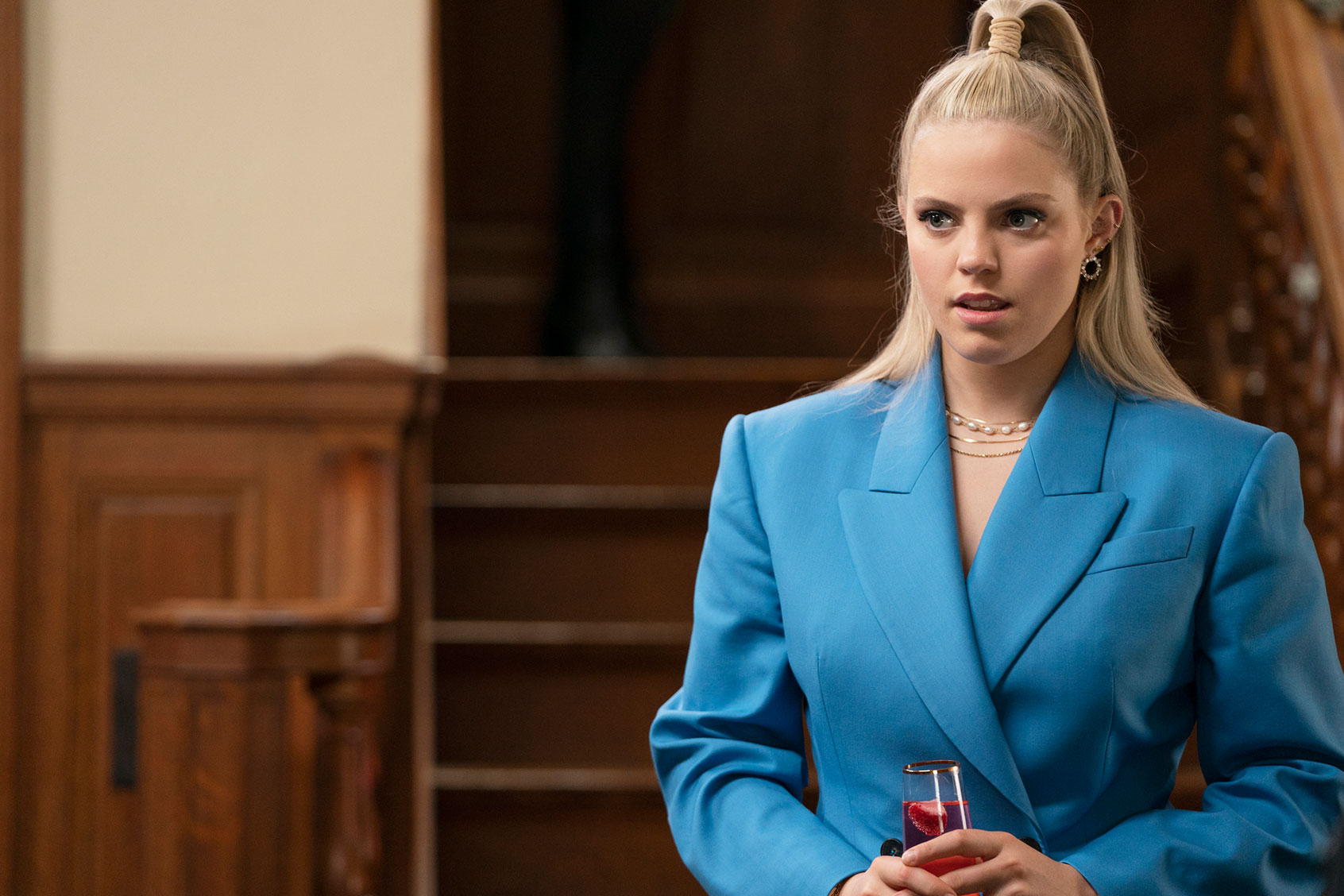
Before Angourie Rice played the new version of Lindsay Lohan's homeschooled teenager Cady Heron, the Aussie actor has appeared in a range of projects. The 23-year-old has played opposite A-listers Ryan Gosling and Russell Crowe in "The Nice Guys" and in Marvel's Tom Holland blockbuster "Spider-man" series.  Most recently, Rice starred in HBO's critically acclaimed series "Mare of Easttown," playing Siobhan Sheehan, the daughter of Kate Winslet's detective sergeant character.
02
Reneé Rapp
The Sex Lives of College GirlsReneé Rapp in "The Sex Lives of College Girls" (Photo courtesy of HBO Max)
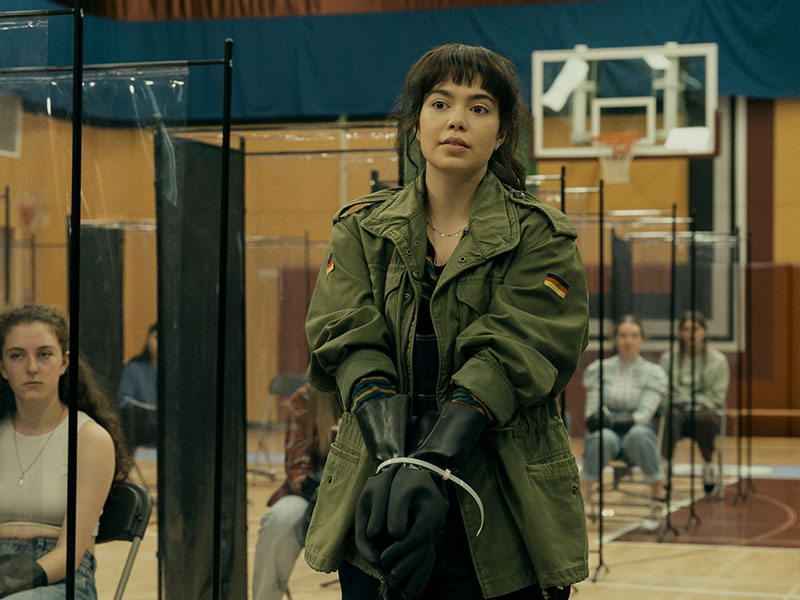
For the film, Reneé Rapp reprises the role of Regina George, whom she played on Broadway. Fans may also recognize her wealthy legacy student Leighton on "The Sex Lives of College Girls," who is trying to live up to her mother's expectations while also embracing coming out as lesbian. Rapp is also killing the music game as a recording artist. She released her debut album "Snow Angel" last year and plans to play Coachella this spring. 
03
Auli'i Cravalho
The PowerAuli'i Cravalho as Joss Cleary-Lopez in "The Power" (Katie Yu/Prime Video)Donald Trump and E. Jean Carroll (Photo illustration by Salon/Getty Images)Auli'i Cravalho as Joss Clearly-Lopez in "The Power" (Katie Yu/Prime Video)
Auli'i Cravalho's Janis 'Imi'ike is an angry scene-stealing, singing queen. Her voice may be familiar to those after she played the lead in Disney's "Moana." Cravalho has voiced other animated roles in "Ralph Breaks the Internet" and "Hailey's On It!" She's also shown off her singing chops on NBC's short-lived "Rise" and has starred in Netflix's "All Together Now" and 'Hulu's "Darby and the Dead." But most recently, the star also has broken into the teen rom-com genre with an endearing queer love story "Crush" starring opposite of Rowan Blanchard, another Disney actor. She also starred in Prime Video's sci-fi series "The Power," as one of the world's many teenage girls who suddenly develop the power to electrocute people.
04
Jaquel Spivey
Mean GirlsJaquel Spivey in "Mean Girls" (Paramount Pictures)

Damian Hubbard's iconic one-liners like "She doesn't even go here," are delivered by upcoming Broadway talent Jaquel Spivey. Before he inhabited the kind, comedic character, Spivey was a part of the critically acclaimed Broadway musical "A Strange Loop." While Spivey didn't win best actor at the 2022 Tonys, "A Strange Loop" won best musical. But Spivey didn't go without recognition from the theatre world. He won a Drama Desk Award for outstanding actor in a musical.
05
Avantika
SpinIn "Spin," teenager Rhea (Avantika) discovers a passion for creating DJ mixes (Disney/John Medland)

The perpetually lost and stereotypical air-headed Plastic Karen Shetty is played by Avantika. Before that, the actor has starred in many Indian films in Telugu and Tami languages. But the star's first American film was a Disney Channel original called "Spin" in which she plays an aspiring high school DJ. She also starred opposite co-star Angourie Rice in the Rebel Wilson-starring raunchy teen comedy "Senior Year." Avantika is currently producing and starring in a popular dystopian YA series "A Crown of Wishes."
06
Bebe Wood
Love VictorBebe Wood as Lake in "Love Victor" (Kelsey McNeal/Hulu)
The film's sympathetic and high-strung Gretchen Weiners is portrayed by Bebe Wood, who was able to give a nod to her Cuban background in the film. The singer and actor has been working since her childhood in small roles in the Tina Fey sitcom "30 Rock" and even "Veep." She's also appeared in Ryan Murphy's comedy "The New Normal." the ABC sitcom "The Real O'Neals" and is probably most recognized as Lake, one of the friends Hulu's heartwarming queer teen drama "Love, Victor" for three seasons.
07
Christopher Briney
The Summer I Turned PrettyChristopher Briney as Conrad in "The Summer I Turned Pretty" (Erika Doss/Prime Video)
Christopher Briney, also known as Aaron Samuels, is Gen Z's newest teen drama heartthrob. Outside of Aaron, Briney stars as the broody Conrad Fisher in the Prime Video's wildly popular adaptation of author Jenny Han's "The Summer I Turned Pretty." As one leg of a love triangle, Briney's Conrad helped propel the series to massive online popularity hitting billions of views on TikTok and becoming the No. 1 show on the streaming platform after its summer release. Briney was also in the movie "Dalíland" in 2022. 

"Mean Girls" is currently in theaters.

Trump counsel asks for mistrial and recusal in defamation case — both denied

Capping the first day of the defamation damages trial that will determine what amount Donald Trump will owe E. Jean Carroll for statements regarding her sexual assault allegations made in 2019, Trump's legal team came away with a victory, if their goal was to irritate Judge Lewis Kaplan.

After hours of contentious back and forth that included Kaplan threatening to kick Trump out if he didn't stop adding a running commentary from his seat in the court room, the judge also bobbed and weaved a request for recusal from Trump's attorney Michael Madaio on the basis of “general hostility,” and one for a mistrial from Trump lawyer Alina Habba, who argued that Carroll admitted to deleting threatening messages, which would be part of her claim of damages, per reporting from CNN. In an epic rundown of the mistrial shoot and miss via @innercitypress on X (formerly Twitter), Kaplan not only denies Habba's request, but asks the jury to disregard everything she said ramping up to it.

"This was an amazing Day of Trial," Trump wrote on Truth Social shortly after today's session came to an end, weighing in on the above. "We learned that E. Jean Carroll is no 'baby.' She admitted on the stand to deleting massive amounts of evidence, under subpoena, which is a crime. Based on that alone, both this trial and the first trial should be immediately dismissed! Additionally, she first admitted to having a gun without a license, but then admitted to buying bullets for a rifle, not a handgun, which perhaps makes no sense. Her lawyers went crazy—and so did the Judge trying to protect her and this Complete and Total Election Interfering Witch Hunt!"


Legal experts: Trump lawyer Alina Habba’s attacks on E. Jean Carroll won’t fly with the judge

Former President Donald Trump’s attorney Alina Habba may have jeopardized his defense by violating the judge's rules during her opening statements on Tuesday. 

Judge Lewis Kaplan previously issued an order barring Trump and his legal team from discussing specific aspects, including E. Jean Carroll's past romantic relationships, evidence or arguments suggesting that the former president did not sexually assault her and that the writer fabricated her account of the assault.

However, Habba began her opening line by doing exactly the opposite. 

“President Trump defended himself when publicly accused—” she said before Carroll’s lawyer cut her off with an objection.

“Don’t go much farther,” Kaplan warned. 

The judge clarified to the lawyers and the jury that they weren’t there to reexamine the case or delve into the reasons behind Trump's actions. The primary focus of the case is to determine the amount that Carroll will be awarded from Trump.

Last spring, a jury ruled in favor of Carroll, finding Trump liable for sexually abusing her in a Bergdorf Goodman dressing room nearly 30 years ago and defaming her in 2019 when he denied her allegations of sexual abuse and suggested she was motivated by money. The jury awarded her $5 million in damages.

This week, Trump is facing trial again to determine whether he will have to pay the former Elle magazine columnist additional damages for defaming her five years ago. 

Trump has denied all wrongdoing and has maintained he was “wrongfully accused by a woman he never met, saw, or touched.” The ex-president has suggested that Carroll fabricated a story to sell her book and make money – a similar narrative his lawyer argued in court Tuesday.

Habba implied that Carroll chose a strategic moment — when Trump became president — to publicly share her story, aiming to maximize media coverage.

“She has gained more fame, more notoriety than she could have ever dreamed of,” Habba said. "She wanted status. We will show you that she wanted the attention, and it was planned."

Habba is “stretching for any argument she can make,” especially now that the court has already found that Trump's comments were defamatory, Laurie Levenson, a law professor at Loyola Marymount University, told Salon.

“In this day and age, I don't think most people believe that women come forward with this type of experience for fame and gain,” Levenson said. “The process is just too traumatic.”

Habba’s argument can be “flipped on its head,” which is to say that Carroll went out of her way not to harm Trump, but when he started making himself such a public figure, she couldn't stay quiet anymore, Levenson added.

“Habba is defending Trump because she has decided to be his lawyer,” she continued. “Many other lawyers have moved away from him, but she is his loyalist.”

We need your help to stay independent

These arguments “seem designed” to be part of Trump‘s political campaign, and will not be admissible at trial, former U.S. Attorney Barb McQuade, a University of Michigan law professor, told Salon. This “strategy” is about defending Trump‘s reputation among his supporters.

Carroll didn't accuse Trump of sexual assault until 2019 and filed a defamation suit against him for making derogatory comments and calling her a liar. She filed a second defamation suit in 2022 as Trump continued to deny her claims.

Her legal team also added a claim of rape under New York's Adult Survivors Act, which gave adult sexual assault victims, those 18 or older at the time of the alleged abuse, the opportunity to file civil lawsuits, even if the statutes of limitations have long expired.

One of the things that changed in Carroll’s favor was the move by the New York state legislature to change the statute of limitations for victims of sexual assault, trial attorney Bernard Alexander told Salon.

“Carroll for many years had no incentive to speak out against Trump,” Alexander said. “To speak without an objective would only prompt a Trump attack or perhaps litigation initiated by him.”


Want a daily wrap-up of all the news and commentary Salon has to offer? Subscribe to our morning newsletter, Crash Course.


Given Trump’s public statements, she may have been prompted to respond and set the record straight, he added.

In this case, where liability for defamation has already been found, Trump’s lawyers’ objective is to “minimize” the damages, Alexander continued. Habba is trying to attack Carroll’s motive in an effort to attack her credibility. 

“Defamation cases do not have an inherent, intrinsic value,” he said. “The value of the case is based on the credibility of the plaintiff, the extent to which the jury is angry at the defendant, and arguments made by plaintiff’s counsel as to how the jury should value the harm."

If Habba can cause the jury “to question or dislike” the motive of the plaintiff, an argument can be made for the jury to devalue the damages, Alexander explained. She has “some cover” in taking such a challenging case because she can blame someone else for losing on the liability aspect and has the luxury of just seeking to minimize the damages.

Chef Bill Granger’s inadvertent legacy – the avocado toast meme

On Christmas Day 2023, world-renowned Australian chef and restaurateur Bill Granger died at 54.

Granger owned and operated 19 restaurants across Australia, the U.K., Japan and South Korea. He authored 14 cookbooks, produced several TV shows and was awarded the Medal of the Order of Australia.

But his lasting legacy may be his role in making avocado toast a Western culinary staple – and, inadvertently, the viral meme that transformed the open sandwich into a symbol of generational tension.

The practice of spreading avocado on bread has existed for centuries, particularly in Central and South America. Some speculate it dates as far back as the 1500s, when the Spanish settlers brought Western breads to Mexico. But a 2016 Washington Post article pointed to Granger as the first person to put avocado toast on a menu, when he did so at his Sydney café, Bills, in 1993.

I love ordering the occasional avocado toast. But as a sociologist of the internet and social media, I'm most interested in the meme – its origins, how it became a point of contention and how it has ultimately muddied the waters of inequality.


Avocado toast and the American dream

On May 15, 2017, Australian real estate tycoon Tim Gurner said in an interview, "When I was trying to buy my first home, I wasn't buying smashed avocado for $19 and four coffees at $4 each."

Gurner's comments implied that young people were not buying homes at the same rate as older generations due to their poor money management skills – unlike Gurner and his cohort, who understood the value of a buck and the importance of an honest day's work.

No matter that minimal research revealed that Gurner's nearly billion-dollar empire began with financial assistance from his wealthy family. The backlash on the internet was swift and searing, as Gurner became a stand-in for an entire out-of-touch generation who didn't know how easy they had it.

Memes emphasized the fact that baby boomers, in general, had an easier time becoming homeowners compared to millennials, who largely came of age during the post-2008 economic downturn, which forced them to reckon with the crumbling remains of the American dream.


Generational tensions or class tensions?

In their article "A Sociological Analysis of 'OK Boomer,'" sociologists Jason Mueller and John McCollum describe how we're in a period rife with confusions exacerbated by the internet.

They conclude that meme trends like "OK Boomer" – a phrase that Gen Z popularized as an online retort to politicians and reporters who dismissed young people – reflect a world in which generational wars online coexist with class wars offline. The avocado toast meme works in a similar way.

In offline reality, there is some correlation between generations and wealth. But generations are not what ultimately explain class inequality.

Instead, economic sociologists largely agree that a political emphasis on market "freedoms" and the concurrent paring back of programs that distribute resources have led to soaring economic inequality. These include laws that deregulated markets and privatized public spaces, as well as those that scaled back funding for health care, welfare, education and other government services. The policies first emerged under the umbrella of "The Washington Consensus" in the late 20th century.

For example, the Telecommunications Act of 1996, rather than treating emerging internet technology as a public good, ensured the privatization of the internet, paving the way for an online economy that profits off the attention and data of users.

Deregulation has created the conditions for today's economic reality, in which many millennials and Gen Zers must work precarious jobs in the gig economy. They continue to struggle to buy homes and afford rent.

But importantly, many baby boomers face the same economic reality. Millions of them have been forced to delay retirement, particularly if they're from marginalized races and genders.

In other words, the adverse impacts of class inequality leave no generation untouched.


Illusions of separation

So why does it feel like most baby boomers have it so easy?

Cultural theorist Mark Fisher, in his 2009 book "Capitalist Realism," describes this moment in history as one in which "hyperreality" prevails.

The term, coined by French post-modernist Jean Baudrillard in 1981, essentially describes a state in which simulations of reality appear more "real" than reality.

In his book "Simulacra and Simulation," Baudrillard uses the example of Disneyland to describe hyperreality. Many people would rather pay to go to Disneyland – a park built to mimic imaginary places – than travel to national parks, where they can experience nature for free or on the cheap.

The virtual world of the internet – with its own sets of cultural norms, language and memes – is the epitome of hyperreality.

And in the hyperreal world of the internet, as Mueller and McCollum discuss in their article about the "OK Boomer" meme, generational tensions take form.

Memes like avocado toast construct a state of generational conflict in the online world that is real, quite simply, because it feels real.

Algorithms have every incentive to stoke this conflict.

That's because online generational conflicts, along with most social media battles, are immensely profitable. In "Virality: Contagion Theory in the Age of Networks," sociologist Tony Sampson concludes that viral content usually elicits strong emotional reactions.

When users, old and young, are angry with one another, and express that anger in the language of memes, social media platforms like X, formerly known as Twitter, get more engagement and make more money.


Reframing avocado toast

What Sampson finds, though, is that positive feelings also lead to virality.

So perhaps one way to honor Granger is to reclaim the avocado toast meme as an in-joke that nonmillionaires and nonbillionaires of all generations can relate to.

It's about one billionaire's absurd proposition that millennials eating a fleshy fruit on a piece of toast is preventing them from buying homes. It's the billionaire divorced from the struggles of everyday people who's out of touch – not an entire generation of boomers.

The avocado toast meme serves as a reminder that the hyperreal space of the internet distorts an offline reality in which generations share struggles, whether through housing insecurity or delayed retirements – a reality perpetuated by billionaires like Tim Gurner and the economic systems that serve their interests.

Aarushi Bhandari, Assistant Professor of Sociology, Davidson College

This article is republished from The Conversation under a Creative Commons license. Read the original article.

Washington state aims to block $25 billion merger between supermarket giants Kroger and Albertsons

Washington state Attorney General Bob Ferguson has sued to block the proposed $25 billion merger between supermarket giants Kroger and Albertsons, alleging that it would harm consumers and hike up prices. In the suit filed Monday in King County Superior Court, Ferguson argued that the merger would “severely limit” grocery store options for Washington residents and “eliminate vital competition” between the two chains, CNN reported.

“This merger is bad for Washington shoppers and workers,” Ferguson said. “Shoppers will have fewer choices and less competition, and, without a competitive marketplace, they will pay higher prices at the grocery store.”

Kroger and Albertsons have more than 300 locations in Washington and are responsible for more than half of the state’s grocery sales, the lawsuit specified. Kroger, which owns QFC and Fred Meyer, announced in 2022 that it would acquire Albertsons, which owns both Safeway and Haggen. The megamerger was initially set to take place early 2024 but has been pushed back by both companies. Kroger and Albertsons said in a statement to Axios that their revised timeline is “in the first half of Kroger's fiscal 2024,” which ends on Aug. 12. 

“The merging parties will vigorously defend this in court because we care deeply about our customers and the communities we serve, and this merger will result in the best outcomes for Washington consumers,” a spokesperson for Kroger and Albertsons told CNN. The Seattle Times reported that Ferguson’s lawsuit was endorsed by United Food & Commercial Workers, Local 3000, which represents Kroger and Albertsons employees in Washington, northeast Oregon and northern Idaho.

Burger King’s parent company slated to buy out chain’s largest U.S. franchisee for $1 billion

Burger King’s parent company, Restaurant Brands International Inc., is buying out the chain’s biggest franchisee in the U.S. for about $1 billion, ABC News reported. Restaurant Brands International Inc. will acquire “all of the issued and outstanding shares” of Carrols Restaurant Group Inc. for $9.55 per share. Carrols currently operates more than 1,000 Burger King restaurants and 60 Popeyes locations. The deal is slated to be completed by the second quarter of 2024.

“We are going to rapidly remodel these restaurants over the next five years or so and put them back into the hands of motivated, local franchisees to create amazing experiences for our guests,” said Tom Curtis, president of Burger King U.S. and Canada, in a statement to ABC News Tuesday.

The recent acquisition is anticipated to help Burger King improve sales growth and drive profits. It comes over a year after Restaurant Brands unveiled a $400 million plan to revive Burger King’s U.S. business. Restaurant Brands plans to remodel about 600 of the acquired Carrols restaurants over the next five to seven years, and then sell them back to franchisees. The total investment will be approximately $500 million, funded by Carrols’ operating cash flow.

“You just can’t control yourself”: Judge threatens to kick “disruptive” Trump out of court

A federal judge threatened to eject Donald Trump from a Manhattan courtroom on Wednesday for mouthing off during writer E. Jean Carroll's defamation trial testimony, per CNN. 

Carroll brought the case against Trump, who has already been found liable of sexually abusing and defaming her, after he continued to tout falsehoods about her and claimed that she lied about him assaulting her in a New York department store dressing room in the 90s. One of Carroll's lawyers, Shawn Crowley, had already called out the former president earlier during the trial on Wednesday for muttering so "loudly" that the plaintiff table could hear, alleging that Trump was shaking his head as if refuting Carroll's testimony and saying she "suddenly gotten her memory back," according to Politico's Erica Orden.

"I’m just going to ask that Mr. Trump take special care to keep his voice down when he’s conferring with counsel so that the jury does not overhear it," Kaplan told Trump's team.

Crowley then complained for a second time to Judge Lewis Kaplan after Trump allegedly did not let up in the afternoon. According to CNN, Crowley also heard Trump call the trial a "witch-hunt" and a "con job." ABC reported that Crowley also noted that when a video of Trump disparaging E. Jean Carroll was played for the court to view, Trump said "It's true."

“Mr. Trump has the right to be present here," Kaplan said. "That right can be forfeited and it can be forfeited if he is disruptive, which what has been reported to me consists of. And if he disregards court orders, Mr. Trump, I hope I don’t have to consider excluding you from the trial.”

“I understand you’re probably eager for me to do that,” Kaplan said after the ex-president threw his hands in the air.

"I would love it, I would love it," Trump replied.

“I know you would,” the judge said. “You just can’t control yourself in this circumstance apparently.”


Buckingham Palace announces King Charles’ hospitalization – shortly after Kate Middleton’s

King Charles is heading to the hospital.

“In common with thousands of men each year, The King has sought treatment for an enlarged prostate,” Buckingham Palace announced in a statement Wednesday. “His Majesty's condition is benign, and he will attend hospital next week for a corrective procedure. The King's public engagements will be postponed for a short period of recuperation.”

It is understood that the king wanted to share his diagnosis to encourage men who may be experiencing similar symptoms to seek medical guidance, according to The Independent.

Charles’ medical announcement came only a few hours after Kensington Palace announced that Kate Middleton, the Princess of Wales, was hospitalized after she underwent a “planned abdominal surgery” on Tuesday.

“The surgery was successful, and it is expected that she will remain in hospital for 10 to 14 days, before returning home to continue her recovery,” the statement said. “Based on the current medical advice, she is unlikely to return to public duties until after Easter.

“The Princess of Wales appreciates the interest this statement will generate. She hopes that the public will understand her desire to maintain as much normality for her children as possible; and her wish that her personal medical information remains private,” the statement continued. “Kensington Palace will, therefore, only provide updates on Her Royal Highness’ progress when there is significant new information to share.”

Middleton’s health issue was non-cancerous, per People. She is expected to recover at home in Windsor after being discharged from the hospital.

Prince William is also expected to postpone some of his royal duties and engagement to help support his wife during her recovery, Vanity Fair reported. He will not take on official duties while Middleton is in the hospital or during the early days of her recovery.

FBI probes ex-Abercrombie & Fitch boss Mike Jeffries following sex abuse and trafficking claims

The FBI has launched an investigation into Mike Jeffries after the disgraced ex-CEO of Abercrombie & Fitch was accused of sexual exploitation and abuse, the BBC reported. Federal agents are currently interviewing and issuing subpoenas to potential witnesses. Several sources confirmed that the investigation is being led by agents specializing in sex crimes and federal prosecutors from the Eastern District of New York.

The recent probe comes after the BBC published an extensive report last October that accused Jeffries along with his partner Matthew Smith of operating a sex-trafficking ring between 2009 and 2015. The BBC spoke to a dozen men who said they were recruited for possible modeling gigs, only to be exploited for sex at events that Jeffries and Smith hosted in their New York residences and hotels worldwide. 

Documents obtained by the BBC — including flight tickets and event itineraries — revealed that so-called "recruiters” and a middleman named James (Jim) Jacobson were also involved. The men alleged that Jacobson, who was hired by Jeffries, sexually "auditioned" them by requesting or offering to perform oral sex on them, before the men were introduced to Jeffries and Smith. Half of the men said they had been misled about the recruitment process or told sex wasn't involved. The other half said they knew that sex would be involved, but were unsure what was actually expected of them. All the men involved were paid, the BBC reported.

Abercrombie & Fitch announced Jeffries’ retirement from his position in 2014. He's repeatedly declined to comment on the allegations via statements through his lawyer. 

Abercrombie & Fitch said they were “appalled and disgusted by the behavior described in the allegations” in a statement to CNN. In the wake of the BBC report, the retailer announced that they’ve engaged an outside law firm to conduct an independent investigation into Jeffries.