Spring Sale: Get 1 Year, Save 58%

What can you make with half a million pounds of Kernza? Try beer

The frustration in Luke Peterson’s voice is palpable as he talks about how far he’s come — and how far there is to go — in getting Kernza into the marketplace. “We’ve been working at building this rotation that’s regenerating the soil,” says the Minnesota farmer of diversified regenerative organic grains and grassfed beef. “If farmers don’t grow it, it’s never going to get anywhere. But we’ve had our fair share of struggles in marketing it.”

Back in 2018, 10 years after it was made available to farmers, Peterson added Kernza, the trademark name for a cultivar of intermediate wheatgrass (Thinopyrum intermedium), to his already extensive crop rotation, which includes redeemer wheat and streaker oats, buckwheat and flax, two-row barley and einkorn. The draw: the promise of this perennial grain’s 12-foot taproot to enhance carbon storage, water infiltration and soil organic matter. And perhaps, one day — the dream of the team at The Land Institute, the agricultural research nonprofit that started developing Kernza 20 years ago — to introduce a crop longer-lived than the usual roster of annual grains to the landscape. According to Tessa Peters, The Land Institute’s director of crop stewardship, about 60 farmers are currently growing about 4,000 acres of Kernza across the U.S. The yield is almost half a million pounds per year.

But Kernza has a low yield that decreases over the three years it stays in the ground, says Peterson, resulting in prices much higher than other grains (not to mention making valuable farmland less and less productive and profitable for farmers, already contending with slim margins). Kernza also has high protein content and a small kernel size, both of which create challenges for processing and recipe development that have made commercializing it an uphill battle. An added sting  — one still being felt by farmers  — was a 2017 commitment from General Mills to incorporate Kernza into products like breakfast cereal, which evaporated after a couple of limited-edition releases. These days, says Peterson, “Nobody’s buying.”

Not quite nobody: The beer industry, with Patagonia Provisions in the lead, is a notable exception. “Recipe development on the brewing side is very flexible, which means breweries can go from R&D to having a product on the market within three to six months,” says Peters.

The ups and downs of brewing

You actually can find Kernza turning up in breads, crackers, cereals and flours produced by some small companies, like Breadtopia and Columbia County Bread and Granola. But beer is where the grain may be hitting its stride. The first commercially available canned Kernza beer was produced by Hopworks Urban Brewery, which partnered with Patagonia Provisions to launch a pale ale in 2016. Patagonia Provisions has since partnered with 11 more craft brewers to produce a series of lagers made with 15 to 40 percent Kernza, all of it from farmers who are growing it under the Regenerative Organic Certified label; the first beers in that collaboration were released simultaneously this past June. The hope from growers is that this activity will pique the interest of larger brewers and get more grain moving out the door.

“We’re trying to figure out, is there a market for it? Are there people interested in it? Can we malt it?” says Todd Olander, a farmer in Colorado who grows 2,000 acres of grain — including 10 acres of Kernza — for the brewing and distilling industries. (He also owns a malting facility.) As challenging as Kernza to grow, so, too, is the processing. Similar to an oat, a Kernza kernel has a hull, which requires “quite a bit of cleaning” to be removed, Olander explains. Additionally, its small size means it falls through the perforations at the bottoms of malting kettles designed to accommodate larger barley kernels. Malting Kernza “could be as simple as swapping out some screens and [experimenting] with some very small batches,” Olander says. But at the moment, most brewers are using it raw.

The challenges of scale

Sandy Boss Febbo, co-owner of Patagonia beer partner Bang Brewing in Saint Paul, Minnesota, defines the flavor of raw Kernza as “a little bit nutty and it has some layers of spice to it.” Before this year’s lager release, she experimented with adding Kernza to 14 beer styles, including a blonde ale, a farmhouse ale and an India pale ale. Regulars to Bang Brewing’s taproom, she says, “have been with us for this whole journey and are really interested” in the story of Kernza — just as she’s committed to brewing with organic ingredients that “help in this situation of climate change that we’re in.”

The second batch of her current lager contains 17 percent Kernza — enough to allow customers to taste its “deliciousness” — and going forward, Febbo will include at least 1 percent Kernza in all the company’s beers. Customers “may not be able to discern that the grain is present” at the lowest percentage, she admits. “But we can model recipe development for large regional macro-breweries, allowing us an opportunity to say, ‘You can tuck this into any beer.'” Further, she notes, if the big guys “added one percent Kernza to their beers, it would have a massive impact to support this grain.”

Even after six years, Febbo still finds that working with Kernza presents challenges. For starters, “We have to take extra steps and extra time” to roll the grain, in order to release its starches and make them soluble. To crush Kernza, a roller mill designed for wheat and barley must be cranked all the way down to its tightest setting. “It’s a very slow move and not the most efficient thing,” Febbo says. “We’re just specifically stubborn and it’s worth it to us, but not every brewer is going to be willing to do it.” Distilling, she thinks, offers another promising avenue for Kernza — Tatersall Distilling recently released a Kernza whiskey, for example. But Peters points out that aged spirits like whiskey won’t do much to move the grain along more immediately.

Building markets

Alex Heilman is director of Mad Markets at Mad Agriculture, a nonprofit that boosts regenerative agriculture from multiple angles, including helping would-be Kernza farmers access financing through its sister organization Mad Capital. Mad Agriculture also handles marketing for the Perennial Promise Growers Cooperative, through which Peterson and other farmer-members sell their regenerative organic certified Kernza to Patagonia partner brewers and several others (as well as anyone else who wants to make products with the grain).

Heilman is trying to better commercialize Kernza and connect various dots along the supply chain. “We need to work to get this grain in a usable format so it’s not just, here’s a group of farmers over here, here’s a bunch of brewers that want to work with this grain,” he says. “There have to be food safety steps and processing and audit trails in between. We manage that whole process.”

When General Mills walked away from Kernza, Heilman says, “that had a devastating effect on market development and access.” And while there’s still a need for a similarly big player to volumize Kernza sales, smaller companies can keep farmers growing the crop while consumer packaged goods companies dawdle on the sidelines. Mad Agriculture’s role here, says Heilman, is to sell Kernza “in other formats that make it more accessible” to companies.

To that end, Mad Agriculture has begun to develop “true old-school partnership-style relationships” with mills in Minnesota and North Dakota. The nonprofit is also working out ways to educate customers, including basics like why hammer mills work better for turning Kernza into flour than stone mills; how toasting the grain first can help it grind faster; or how a higher protein content, Heilman explains, “could look fantastic on your nutrition panel.” When it comes to scaling up beer, he says, “We’re trying to unlock the ability to sell Kernza as a cracked grain so brewers don’t have to further process it themselves.”

Cost is still a prohibitive factor. Kernza sells for anywhere from $2.50 to $4.50 a pound. “When they’re used to buying grain for 30 to 50 cents a pound . . . That can be an immediate deal breaker,” Heilman says. “I don’t necessarily see the Coors of the world picking this up and being like, ‘Yeah, this is exactly what we want.'”

Nevertheless, 35 craft brewers have worked with Kernza to date and with another 9,500 of them out there, Heilman says the future of Kernza beer has great potential. “Brewers are starting to understand that grains have terroir, that different taste notes can come out of unique grains grown in very specific regions.”

Bang Brewing’s Febbo says creating a bigger market for Kernza beer is just a matter of time. “I’ve never been involved in bringing a new grain to market before and it’s taught me to take a breath and have patience with it,” she says. “It’s not like no one’s working to make it happen. People’s life’s work is making this dream come true.”
“Giving their lies too much oxygen:” Pa. governor slams CNN for pushing Stephen Miller’s criticism

Pennsylvania Gov. Josh Shapiro,  smacked down criticisms of the new automatic voter registration policy he enacted in the state on Tuesday, dismissing concerns that its method of implementation would give the 2020 voter fraud conspiracy theory believers a new in to discredit the upcoming election.

This week, Shapiro announced a new policy that allows all eligible Pennsylvania residents to be automatically registered to vote when they obtain a new driver's license or state-issued ID card. On Wednesday, Shapiro joined "CNN This Morning" to discuss the move. He was met with questions about why, as some Republican lawmakers complain, his action did not go through a formal legislative process. 

Shapiro responded, in part, by stating that he was "well within my legal authority" in enacting the policy and his team had ensured the registration process is "secure and safe," adding that the move is good for bolstering voter participation and democracy.

Co-anchor Poppy Harlow then asked Shapiro to respond to a tweet from former Donald Trump aide Stephen Miller, who expressed doubt that the automatic registration process would go through any citizenship verification. But Shapiro declined, dubbing Miller a "dope who can't tell the truth."

When Harlow interjected, further pressing the Democratic governor about the substance of Miller's post, Shapiro hit the network for pushing GOP talking points. 

"Well, he doesn't raise any substance," Shapiro shot back, explaining that the Department of Motor Vehicles' process for license renewal has built-in safeguards to confirm citizenship in the documents it requires. After Shapiro elaborated, co-anchor Phil Mattingly brought attention to the potential concern that the lack of legislative procedure for this new measure gives individuals who dismissed the election results in 2020 more grounds to question them in 2024. 

"Phil, respectfully, I think you're just giving their lies too much oxygen," Shapiro replied, recalling how he worked post-2020 election to disprove the false claims about widespread voter fraud.

"This builds on that work we've done. Voter participation is central to our democracy, and those who are standing up trying to make it harder for people to vote? That's anti-democratic, that's anti-freedom, and that is not how we do things here in the Commonwealth of Pennsylvania." 

Biden is once again providing Americans with free COVID-19 tests. Here’s how to get yours

As the COVID-19 pandemic continues to drag on, with cases rising or plateauing, President Joe Biden announced that his administration will provide all Americans with a means of monitoring their infection status: On Wednesday the president declared that his administration is setting aside $600 million for the manufacturing and distribution of new at-home COVID-19 tests. On September 25th, the Biden administration will also restart a website, COVIDtests.org, that allows Americans to order up to four tests for free for each household, delivered by the U.S. Postal Service.

“Whether or not people are done with it, we know the virus is there, we know that it’s circulating. We know, if past is prologue, it’ll circulate to a higher degree and spread, and cases will go up in the fall and winter seasons,” Dawn O’Connell, assistant secretary for preparedness and response at HHS, said in a statement. “Anticipating that that would be true again, or something similar, we want to make sure the American people have these tools.”

“Guess all doubts are gone whether the White House takes the new #COVID threat seriously or not,” Dr. Eric Feigl-Ding, an epidemiologist and health economist at the Harvard Chan School of Public Health and a senior fellow at the Federation of American Scientists, posted on X (formerly Twitter). “Biden WH basically admits that #CovidIsNotOver.” Given that COVID is still the fourth leading cause of death in the United States, it definitely seems like the risk of death and illness, including long COVID, is here to stay, at least for the near future. Luckily, medications like Paxlovid still help and testing can inform folks if they have COVID or just allergies.

“Stop Making Sense,” the best concert film ever, converted me into a Talking Heads fan

In 1985, I was spending the summer in Boston. One night, when deciding about what movie to go see, my twin Henry insisted on “Stop Making Sense.” Absurdly, I was not a fan of Talking Heads at the time. Their “Burning Down the House” video on MTV, featuring David Byrne “eating” the white roadway divider lines just irritated me. What is more, I found the song boring. 

I wanted to see Albert Brooks‘ “Lost in America.” So, we struck a deal: If Hank came with me to see “Lost in America,” at 10 p.m., I would (grudgingly) sit through the midnight show of “Stop Making Sense.” I rationalized that since Jonathan Demme directed it — and I liked his films “Citizens Band” and “Melvin and Howard” — I might appreciate this concert film. Demme also was a huge musichead, and always had the best film soundtracks.

Hank agreed, and “Lost in America” delivered; I think it remains Brooks’ funniest film, and I can still quote lines from it. 

I had to admit, I had been to church and was converted. Amen!

But then the midnight show of “Stop Making Sense” started, and three songs in, I knew Hank won the night. Byrne comes out and performs an acoustic version of “Psycho Killer,” which piqued my interest. “Heaven,” with bassist Tina Weymouth, followed, and it was a nice, albeit slow song. But then, as the band grew stronger — with Chris Franz coming in on drums for “Thank You for Sending Me and Angel,” followed by Jerry Harrison on guitar for “Found a Job” — I was up and dancing in the aisles. I could not sit still for the rest of the film, and Hank certainly smiled when I leaned over admitting that I loved this film. I never stopped smiling.

When the Talking Heads performed “Burning Down the House,” in “Stop Making Sense” it had an energy that the seemingly boring music video didn’t capture. That energy was prominent in their other hits in heavy rotation at the time, “Life During Wartime,” and “Once in a Lifetime.” The big suit had yet to make an appearance, and I was already overwhelmed and overjoyed. 

“Girlfriend Is Better” became my new favorite song after I heard it for the first time in the film, and the closing number, “Crosseyed and Painless” was simply infectious. All of the music was irresistible. Even “Swamp,” my least favorite Heads song, came to life in “Stop Making Sense” because of how Demme filmed it. I had to admit, I had been to church and was converted. Amen!

Staggering out of the theater at 1:30 in the morning, I knew I needed to spread the gospel. And I did. I went back at least six times to the midnight shows that summer, bringing friends, my mom, anyone I could find to see the film over and over and just bliss out on the fabulous, rhythmic music.

By the end of the summer, my favorite Talking Heads song was “This Must Be the Place (Naïve Melody). It took me a few listens to fully appreciate that tune above all others, but to this day, it remains among my Top 5 songs of all time. (Fun Fact: When I interviewed Raine Allen-Miller, the director of “Rye Lane,” we I bonded over the song, which is her karaoke pick. She said, “One day I’m going to make a film with that song in it. I sing it, I dance to it. It makes me happy. It makes me sad. It’s just the best.”)

Back home in Philadelphia, I caught the film a few more times in the theater, because I had to take friends who had not seen it. It was an experience I needed to have over and over and over again and one I wanted to share. 

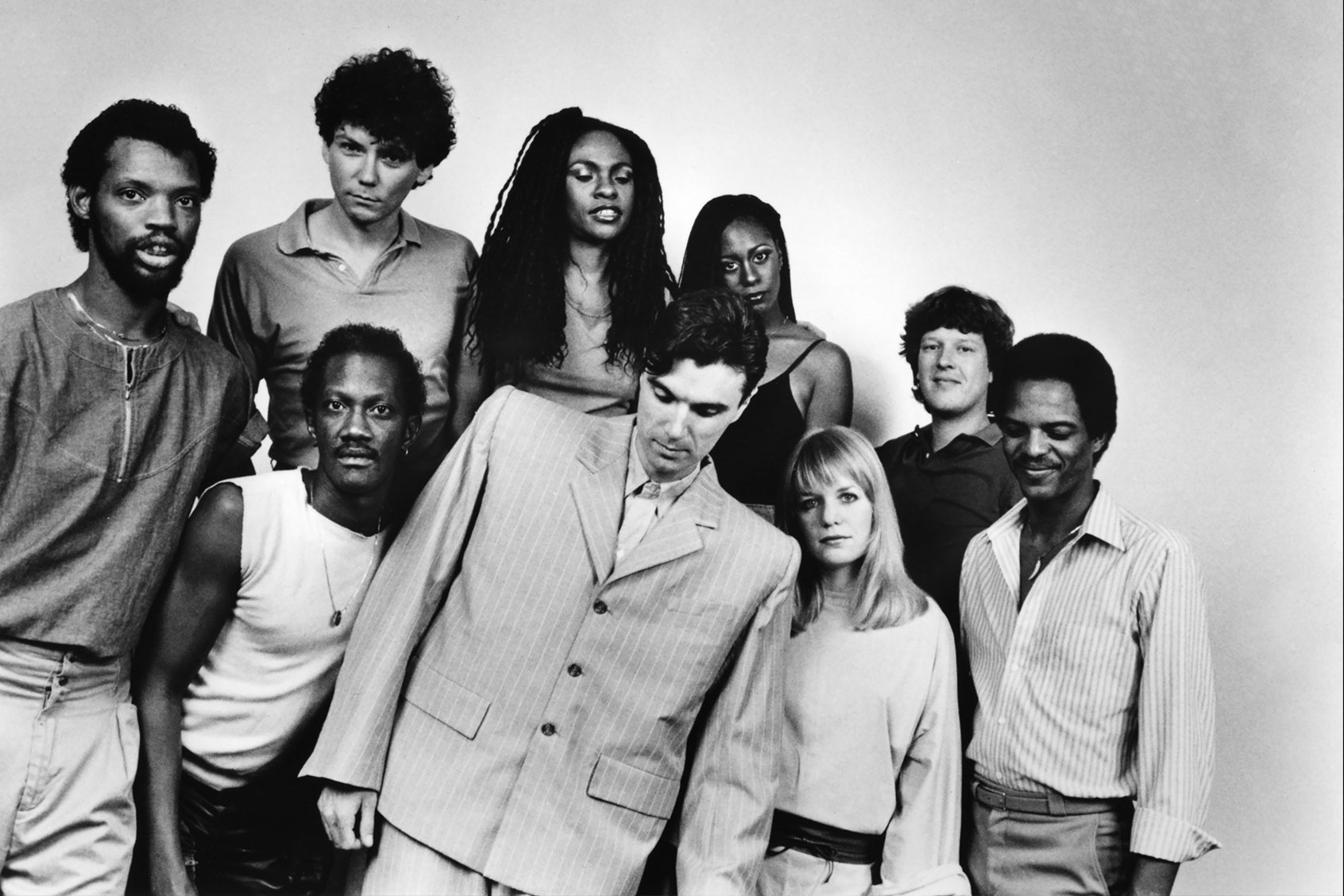
Stop Making SenseJerry Harrison, Ednah Holt, Lynn Mabry, Chris Frantz, Steve Scales, Bernie Worrell, David Byrne, Tina Weymouth and Alex Weir. Stop Making Sense. (Courtesy of Sire + Warner Music Group)

The big suit had yet to make an appearance, and I was already overwhelmed and overjoyed. 

In the ensuing years, I’ve been able to see “Stop Making Sense” in theaters a few more times. Once, during the film’s 10th anniversary re-release, I saw it in an almost empty theater, which was both great and depressing. I was so happy to see the film again on the big screen but discouraged that so few people were in attendance. But now, with its 40th anniversary re-release, in a remixed and remastered print, watching “Stop Making Sense” in an IMAX theater with a crowd of fans was an experience that made me appreciate what is arguably the greatest concert film all over again. The full house applauded after almost every song. We all sang along and danced in and out of our seats.

Seeing David Byrne’s Big Suit on the Big Screen was also joyful. Watching him come out on a bare stage with a boom box and say, “I’ve got a tape I want to play,” or ask, “Does anybody have any questions?” is charming. Knowing every song and lyric is to be mesmerized all over again.

What I appreciated most during this recent viewing is what I have appreciated since my initiation — how Demme gives the musicians the room to move while also focusing on their performance. They are all working together, like a well-oiled machine. Byrne, in particular, is a perpetual motion machine, running in place, and around the stage, dancing and moving in sync with his bandmates or the fabulous backup singers, Lynn Mabry and Ednah Holt.  

Demme films Byrne in ways that highlight what he is singing, letting viewers focus on and absorb the lyrics, undistracted by the audience, which would break the magic of the musical performance. (The film wisely withholds any audience reaction shots until the final few moments, and the woman who gyrates her neck always makes me smile.) 

“Stop Making Sense” is incredibly well made and to me, the best concert film ever. Demme closes in on Weymouth playing two notes in a song before cutting away to a guitar solo. He shoots “Once in a Lifetime” in an almost single take, and when he cuts to Jerry Harrison and Bernie Worrell on keyboards above Byrne, Ednah Holt and Lyn Mabry, it is breathtaking. (I audibly gasped this last time.) This shot transfixes me because I have been so spellbound by Byrne that I am literally entranced and pulled into the music. 

The film is better than being at the live concert because viewers are literally on stage with the talent. We can see their expressions, we feel Byrne sweating in his big suit, and we hear that vibrant wall of sound as it builds and builds and builds — from the catchy guitar licks to the rhythmic percussion. The music works because everyone is delivering their best performance and the band is having such fun that viewers do, too. 

Stop Making SenseTina Weymouth, Ednah Holt, Lynn Mabry, David Byrne and Alex Weir. Stop Making Sense. (Jordan Cronenweth / A24)The film was shot over three nights at the Pantages Theater in Los Angeles, and the editing by Lisa Day is seamless and flawless. The film captures Byrne doing his “lamp dance” during “This Must Be the Place,” and I can’t help but marvel at his sense of wonder as he performs. I am also tickled by the slide show with body parts — hands, a bellybutton, a back, buttocks — that flash in the background. Other moments that amuse include Steve Scales sticking his tongue out a few times for the camera. And when Chris Franz throws his drumsticks at the end of the film, I swear I try to catch them every time in my movie theater seat. 

I can’t help but sing at “Stop Making Sense.” And I did it involuntarily at the recent Sept. 11 screening I attended. (Forget those “Sound of Music” and “Grease” sing-alongs theaters held pre-pandemic. There should be a “Stop Making Sense” sing-along, because it’s impossible not to perform during this film!)

The new restored and remixed print looks sharp, and it is truly stunning to see it in IMAX. The film feels as timeless as the music. 


Want a daily wrap-up of all the news and commentary Salon has to offer? Subscribe to our morning newsletter, Crash Course.


Four decades later, I am still grateful to Hank for making me see “Stop Making Sense.” And I was so pleased to have him sit next to me as we watched this film for the umpteenth time. I am going to see it again and again while it plays in theaters. 

“Stop Making Sense” is being re-released Sept. 22 in IMAX theaters for a week before it plays in traditional theaters starting Sept. 29.


Study: Book bans jumped 33% last school year

A new report released Thursday by the free expression group PEN America warns that the Republican-led book banning movement is intensifying nationwide, with U.S. classrooms and libraries prohibiting more than 1,500 unique titles during the 2022-23 school year.

PEN recorded 3,362 total instances of book bans across the U.S., a 33% increase compared to the previous school year. More than 40% of all book bans in the U.S. in 2022-23 took place in Florida, where Republican Gov. Ron DeSantis—a GOP presidential candidate—has launched a massive assault on public education.

“Florida isn’t an anomaly—it’s providing a playbook for other states to follow suit,” said Kasey Meehan, director of PEN America’s Freedom to Read program and lead author of the new report. “Students have been using their voices for months in resisting coordinated efforts to suppress teaching and learning about certain stories, identities, and histories; it’s time we follow their lead.”

PEN noted that officials and outside groups pushing for book bans often deployed “hyperbolic and misleading rhetoric about ‘porn in schools’ and ‘sexually explicit,’ ‘harmful,’ and ‘age inappropriate’ materials led to the removal of thousands of books covering a range of topics and themes for young audiences.”

“Overwhelmingly, book bans target books on race or racism or featuring characters of color, as well as books with LGBTQ+ characters,” the group found. “This year, banned books also include books on physical abuse, health and well-being, and themes of grief and death. Notably, most instances of book bans affect young adult books, middle-grade books, chapter books, or picture books—books specifically written and selected for younger audiences.”

Suzanne Nossel, PEN America’s chief executive officer, said in a statement that “the toll of the book banning movement is getting worse.”

“More kids are losing access to books, more libraries are taking authors off the shelves, and opponents of free expression are pushing harder than ever to exert their power over students as a whole,” said Nossel. “Those who are bent on the suppression of stories and ideas are turning our schools into battlegrounds, compounding post-pandemic learning loss, driving teachers out of the classroom, and denying the joy of reading to our kids. By depriving a rising generation of the freedom to read, these bans are eating away at the foundations of our democracy.”


PEN’s report comes days after the American Library Association said that a record number of library books—1,915—have been challenged during the first eight months of this year.

As The Associated Pressreported earlier this week, “The most sweeping challenges often originate with such conservative organizations as Moms for Liberty, which has organized banning efforts nationwide and called for more parental control over books available to children.”

PEN noted that 80% of the U.S. school districts that banned at least one book during the 2022-23 school year “have a chapter or local affiliate nearby of one or more of the three most prominent national groups pushing for book bans—Moms for Liberty, Citizens Defending Freedom, and Parents’ Rights in Education.”

“These districts are where 86% (2,902) of book bans have occurred,” PEN found.

But the group stressed that book bans aren’t just happening in traditionally conservative areas, noting that 42% of the states with book bans during the 2022-23 school year voted Democratic in the 2020 presidential election.

“However, Republican-leaning states had more districts banning books than Democratic-leaning states; 50 districts out of 153 (33 percent) are in states that voted Democratic in the 2020 presidential election, while 103 districts are in states that voted Republican,” the group added. “These 103 districts account for 88 percent of all book ban cases in the 2022–23 school year.”


Author John Green—whose bestselling book “Looking for Alaska” was the third-most banned book in U.S. schools during the 2022-23 school year—said in a statement that “it’s disappointing to see such a steep rise in the banning and restriction of books.”

“We should trust our teachers and librarians to do their jobs,” said Green. “If you have a worldview that can be undone by a book, I would submit that the problem is not with the book.”

Hundreds of other authors, artists, celebrities, and activists signed an open letter earlier this week echoing that sentiment and urging “everyone to join us in pushing back against these book bans.”

“We cannot stress enough how these censorious efforts will not end with book bans,” the open letter states. “It’s only a matter of time before regressive, suppressive ideologues will shift their focus toward other forms of art and entertainment, to further their attacks and efforts to scapegoat marginalized communities, particularly BIPOC and LGBTQ+ folks.”

“We refuse to remain silent as one creative field is subjected to oppressive bans,” the letter continues. “As artists, we must band together, because a threat to one form of art is a threat to us all.”

Savory, homemade bread — both regular and in gluten-free variations — has never been easier

Even before the pandemic, psychologists, cookbook authors and self-help gurus like Dr. Nicole Beurkens, Jack Hazan, Julia Ponsonby and Pauline Beaumont suggested that we carve out time to stay home and bake — specifically bake bread — for our mental health and as a part of our self care routines.

Espousing home bread baking as a sort of moving meditation, like yoga or tai chi, therapists posited that this kind of time spent in the kitchen is good for us on many different levels: Baking bread forces us to slow down and following a multi-step recipe takes our full attention (creating mindfulness). They talk of how the repetitive movement of kneading bread eases frustration, calms the nervous system and releases tension and the waiting on and the watching of dough rise is somehow extremely calming.

They also mention the dopamine hit and serotonin release we get from eating it (comfort), smelling it (nostalgia/triggering fond memories) and having successfully made it (accomplishment) in our very own kitchen! 

For decades, I have had an on-again off-again relationship with bread making and never once have I thought of it as a form of self-care, but I like that is has gained that kind of status. The act of baking has always been calming and fulfilling for me, especially when my intention is to gift what I’m making, which is generally the case.

Other than a few loaves baked with my mother as a child, I began my foray into bread making in the 90s once I discovered that I felt better when I eliminated gluten from my diet and desperately craved a slice of bread after going many months without. At that time, where I lived in Alabama anyway, there were no gluten-free breads in the freezer case at my local grocery store, like there are now and there were no gluten-free baked goods to be purchased someplace locally. If I wanted it, I was going to have to learn to make it myself. So I did. 

I had some help along the way, but I figured it out mostly through failure. So much of what I baked early on should have gone straight into the trash, but I was so desperate I inevitably managed to salvage whatever I made into something edible.

We need your help to stay independent

This bread I am sharing with you today is savory and moist and truly foolproof. Don’t be scared of the the two unlikely bread ingredients: Onions and cottage cheese!

It’s strange, really . . . you can’t pick out either in the finished product, but the flavor they each impart, although subtle, is essential. You won’t want to change a thing once you try it. 

I prefer to make mini-loaves from this recipe rather than one regular sized loaf. That way I gift more than I keep. It’s best I do because I can’t stay out of it once I make it. I have friends who claim to hate both onions and cottage cheese but are nuts for this bread. The cottage cheese provides moistness and a little bit of a tang similar to a sourdough and the onions give it a sharpness, making this bread perfect for a cheese toast, a tomato sandwich or for simply dipping into good olive oil or toasting and drizzling with honey. It also goes perfectly on a charcuterie board.

Baking ticks a lot of boxes on the list of what is missing from our incessant busy-ness. Most of us rush around in a great panic, multi-tasking and chasing our own tails, scarfing down “food” at the kitchen counter or, heaven forbid, eating in our cars. Baking bread makes us feel good by connecting us to our food and to ourselves through our senses — taste, touch, smell, sight — four out of five anyway!  

There are few things as comforting as fresh baked bread, so carve out the time and don’t be scared. Even if it doesn’t turn out perfectly the first time, it will almost certainly be edible. (Actually, it will almost certainly be delicious.) Sure, baking bread takes time and a little focus, but once you jump in and give it a go, you’ll see how satisfying the entire process is.          

Onion Cheese Bread — original 
Yields
1 loaf
Prep Time
30 minutes (plus 1 1/2 to 2 hours rising time) 
Cook Time
45 minutes

Ingredients

1 tablespoon dry yeast granules, typically one packet

1/4 cup water water between 105 and 115 degrees

2 tablespoons honey

1 tablespoon olive oil

1 cup cottage cheese

1/2 cup finely chopped onion

1 tablespoon dill

1 teaspoon salt

1 egg, beaten

3 1/2 cups whole wheat or whole spelt flour, plus more for kneading surface 


Directions

  1. Sprinkle yeast granules in warm water and allow to sit about 15 minutes or until bubbly.

  2. Once bubbly, add everything but the flour and stir well.

  3. Then add 2 cups flour to bowl and beat with electric mixer 4-5 minutes.

  4. Stir in 1 1/2 cups more flour by hand. Dough should be stiff.

  5. Turn onto a well floured surface and knead 10 minutes or until smooth and elastic.

  6. Put dough into an oiled bowl, cover with a tea towel, place in a warm spot (around 85 degrees) and allow to rise about an hour or until doubled in size.

  7. Once doubled, punch down and flatten out to a little longer than the length of your loaf pan. Fold edges and roll up jellyroll style.

  8. Place in buttered (not oiled, it will stick) loaf pan. Cover and allow to rise a second time to the top of pan. 

  9. Once risen, bake at 350 for 45-50 minutes. Remove from pan and allow to cook on rack.

    *This recipe can be doubled but you may not want to double the dill.


Cook’s Notes

-Why roll the dough up jellyroll style? Well, I don’t know. I have actually tried to find out but have never been given an explanation other than that was the way they were taught once upon a time. Some swear rolling it this way gives it a better “crumb,” which refers to the interior texture or size of the holes inside the loaf, which equates to the airiness of the bread.


Want more great food writing and recipes? Subscribe to Salon Food’s newsletter, The Bite.


Gluten-free variation of onion cheese bread
Yields
00 servings
Prep Time
30 minutes (plus 45 minutes rising time) 
Cook Time
55 minutes

Ingredients

1 package yeast

1/4 cup warm water between 105-115 degrees

1  3/4 cups GF “Measure-for-Measure” flour blend (I like King Arthur brand)

1/2 sorghum flour (or whole, GF flour of choice)

2 Tbsp psyllium husk powder or flax meal (ground flax seeds)

1 tsp baking powder

3/4 tsp salt

2 Tbsp sugar (I prefer coconut sugar)

1/3 cup olive oil

1 tsp vinegar (I prefer apple cider vinegar)

2 eggs, beaten

1 cup cottage cheese

1/2 cup finely diced onion

1 Tbsp dill


Directions

  1. In a small dish dissolve yeast granules in warm water and allow to sit until bubbly, about 15 minutes.

  2. While waiting on yeast, whisk to mix all dry ingredients together and set aside. Include onions as well.

  3. In a larger, separate bowl, combine all wet ingredients, including eggs and cottage cheese, except yeast mixture.

  4. Combine wet and dry ingredients, plus 1/2 cup of water and yeast mixture  and beat with an electric mixer for about 2 minutes until well combined. 

  5. The dough should be like thick cake batter, so add more water if necessary, but don’t add too much.

  6. Butter your loaf pan. I was instructed to use a metal pan not glass. Then spoon batter into it. Cover with a tea towel, place in a warm spot (about 85 degrees) and allow to rise 35-40 minutes, until doubled in size.

  7. Once doubled, bake on middle rack: 45 to 50 minutes if using multiple mini-loaf pans or 55 to 60 minutes for a full sized loaf pan. 

  8. It is done when it is golden on top and sounds hollow when tapped.

  9. Remove and allow to cool thoroughly on a rack before slicing.


Cook’s Notes

-This recipe does not work with bean flours like garbanzo. It is too dense for a good rise.

-Despite using some “measure-for-measure” flour, you still need to add additional binding agents. You can use xanthin gum, but I prefer psyllium husk powder or flax meal as they are nutrition powerhouses (unlike xanthin gum).

-If you accidentally add too much water while mixing, don’t fret. Bake the loaf as directed and if it not cooked all the way through once the top is browned, simply remove it from the pan and turn it upside down to bake some additional minutes.

McCarthy expresses frustration at House Republicans who “just want to burn the whole place down”

House Speaker Kevin McCarthy, R-Calif., appears to have had enough of his hardline Republican colleagues after they defeated a procedural vote on a Pentagon funding bill for the second time this week.

On Thursday, six Republicans — Reps. Dan Bishop, N.C., Marjorie Taylor Greene, Ga., Matt Rosendale, Mont., Andy Biggs, Ariz., Eli Crane, Ariz., and Tom Cole, Okla. — joined Democrats in voting against the rule for the Pentagon appropriations bill 212-216, preventing the legislation from moving forward in the chamber. As The Hill reports, votes on rules, which dictate debate for legislation, are partisan and predictable matters as, usually, the majority votes in its favor and the minority votes against it. The rule's failure to pass in votes on both Tuesday and Thursday of this week is rare, marking an embarrassing jab at the Speaker.

With the Sept. 30 government funding deadline looming, McCarthy voiced his frustrations with his colleagues' blockages after Thursday's failure. The rule's defeat is "frustrating in the sense that I don't understand why anybody votes against bringing the idea and having the debate," McCarthy told reporters in the hallway outside the House chamber, adding, "This is a whole new concept of individuals that just want to burn the whole place down. It doesn't work."

McCarthy scheduled Thursday's vote after two conservatives who opposed Tuesday's attempt — which was defeated 212-214 — changed their stances, which made him believe he had the votes to pass the bill. The vote's second failure also represents another phase of the House GOP's rising tensions, much of which has been directed at the Speaker amid recent calls from the far-right flank to oust him from the speakership.

Can your body “remember” pregnancy? A new study in mice suggests so

It has long perplexed scientists how during pregnancy, mothers don’t reject the fetus. When a foreign organism enters the body, the immune system’s standard response is to send fighter cells to attack the invader. In some ways, a fetus growing inside the uterus is also a foreign being, sapping the mother’s energy and nutrients. Yet evolutionarily, our entire species depends on something breaking that cycle to create a symbiotic relationship between mother and child. 

“Pregnancy is really an immunological marvel.”

A new study published today in the journal Science deepens our understanding of the maternal-fetal bond and chips away at this question, building on decades of research designed to uncover these mysteries. Although the research was conducted in mice, the findings could inform treatments that reduce maternal and infant mortality, preterm birth and other pregnancy complications in humans, said study author Dr. Sing Sing Way, Ph.D., an infectious disease pediatrician at Cincinnati Children’s.

“Pregnancy is really an immunological marvel because it’s the most physiologically relevant context where you have genetically and antigenetically different cells and tissues in close approximation with each other that live not only without fighting but in harmony, promoting the growth and development of the fetus,” Way told Salon in a phone interview. “We actually don’t understand that very well, and we’re trying to probe it with these types of experiments that we conducted.”

In 2012, Way and his team published a study in which they found pregnant people produce specialized immune cells called tolerogenic cells that are partly responsible for preventing the immune system from attacking the fetus. These immune cells are smart enough to recognize whether subsequent siblings come from the same biological father, using a “memory” they have of prior pregnancies. 

These immune cells are smart enough to recognize whether subsequent siblings come from the same biological father.

A few years later, the same team discovered that it’s not only a mother’s cells remembering their offspring but that an offspring’s cells can also remember their mother. In rodent models, the team found that extremely rare cells travel during pregnancy from mother to fetus and vice versa. These cells persist in both individuals long after birth, which helps explain why, if someone needs an organ transplant, better outcomes occur when the organ comes from the mother rather than the father. It seems this is because people’s bodies hold on to these cells that allow them to recognize a mother’s tissue more easily.


Want more health and science stories in your inbox? Subscribe to Salon’s weekly newsletter Lab Notes.


“We found that how that tolerance works in the babies to their mothers is from these things called microchimeric cells, which are basically extremely rare cells — about one in a million — that travel during pregnancy from mother to baby and from baby to mother, and persist in both individuals after birth in what seems like forever,” Way said. “That’s how babies are ‘remembering’ their mothers is through those cells, or even children or adult children are remembering their mothers, is through that those cells.”

The study published today by the same research group suggests that the fetal-mother connection runs even deeper than once thought. The researchers found that only one set of these microchimeric cells can be held at a time, meaning that when a mother has subsequent children, a new set of cells specific to that child replaces the first group of cells. Fascinatingly, when daughters go on to become pregnant, they also lose these original cells connecting them with their mothers to make room for ones that connect them to their own children.

When daughters go on to become pregnant, they also lose these original cells connecting them with their mothers to make room for ones that connect them to their own children.

But while a daughter would “forget” this biological connection upon becoming pregnant, the mother retains a “memory” of the child regardless of whether she has subsequent children. That’s because the mother retains a set of tolerogenic cells that maintain this mother-child connection. 

“Each time there’s a pregnancy, there’s a displacement or a loss of the prior microchimeric cells and that’s why daughters forget their mothers when they have new pregnancy imprinted memories,” Way said. “But what’s interesting is that mothers never forget any of their children because the way that they remember is not exclusively due to the fetal microchimeric cells. They have another failsafe way of remembering that doesn’t require those cells.”

Scientists are still uncovering all of the ways in which a mother’s immune system reacts in pregnancy. Mothers can also produce “super antibodies,” for example, that protect the fetus from viruses. Leveraging how the immune system changes in pregnancy could provide insights into how to treat other immunological conditions, Way said.

We need your help to stay independent

One in 10 mothers will experience preterm births, but there are not many treatment options when a baby is born early. Similarly, understanding this mother-child connection, something that’s still largely a black box, could help us reduce pregnancy complications.

“We need to understand how we reproduce and how we survive as a species,” Way said. “If we could understand how it worked in animals, then, despite the differences between humans and animals, we can apply that knowledge from animals to improving human pregnancy outcomes.”

Ken Paxton vows revenge after impeachment aquital: “I’m highly motivated”

Newly reinstated Attorney General Ken Paxton went on a tour of conservative talk radio Thursday morning, revealing new details about his impeachment trial and political ambitions. 

Among other things, Paxton discussed how much the trial cost him — over $4 million — and vowed to get involved in primary challenges to House Republicans who voted to impeach him.

The Senate voted Saturday to acquit Paxton on all 16 articles of impeachment for which he had been tried that accused him of abuse of office and bribery. The decision has ratched up a GOP civil war in Texas, especially between the Senate and House, which overwhelmingly voted to impeach Paxton in May.

The radio interviews came the morning after Paxton gave his first post-acquittal interview to Tucker Carlson, telling the former Fox News host he was “re-energized” after the acquittal. 

Here are highlights from the radio interviews: 

Trial cost

Paxton revealed how much his impeachment defense cost him as he railed against the House for being able to use taxpayer dollars for their lawyers.

“The whole thing cost me over $4 million,” Paxton told radio host Chris Salcedo, noting he still had legal bills that totaled over $1 million.

But as he’s done before, he stressed “not a single taxpayer dollar” went toward it. 

Paxton made clear that he spent considerable time raising money for his defense, telling Dallas radio host Mark Davis it was a reason he did not attend most days of the trial. He told Davis that the total cost was more “like $4.5 million total” and he “raised almost $3 million” over the summer, a personal record.

Primary involvement

Davis asked Paxton if he would be “actively supporting and funding primary challenges to some of your tormentors” — and Paxton replied “absolutely.” 

“I’m highly motivated,” Paxton said. “I’ll be spending a lot of time in Beaumont. I’ll be spending a lot of time … in Kerrville. I’ll be spending a lot of time in Collin County.”

Beaumont is the hometown of House Speaker Dade Phelan, while Kerrville is a city in the district of Rep. Andrew Murr, who chaired the House impeachment managers. Collin County is Paxton’s home county where all the Republican state representatives voted to impeach him.

One of those local representatives was Jeff Leach, who was an impeachment manager and gave one of their closing arguments.

“Jeff Leach, get ready,” Paxton told Davis.

Leach appeared to respond to Paxton on X, formerly known as Twitter, posting a well-known clip of high school football players chanting “we ready.”

The actual allegations

None of the radio interviewers seemed particularly interested in revisiting the actual allegations in the trial – that Paxton abused his office to help a friend and donor, Nate Paul. Seven former top deputies reported their concerns about the relationship to the FBI in 2020.

But Davis asked a question that prompted Paxton to tell his side of the story, or at least part of it.

Paxton traced the controversy back to his hiring of Jeff Mateer as his top deputy. Paxton said he had never met Mateer before he quickly hired him after a falling out with his previous first assistant attorney general, now-U.S. Rep. Chip Roy, R-Austin. Paxton said Mateer’s “whole life fell apart” after his nomination to the federal bench failed in 2017 and Mateer began elevating people to be deputies who were being influenced by “outside sources” who did not like Paxton.

“I should’ve paid more attention,” Paxton said of Mateer’s hires. “It’s on me because I should’ve figured this out.”

As for Paul, Paxton said he was genuinely interested in the real estate investor’s claims that he was the target of a sprawling law enforcement conspiracy involving the FBI and Justice Department — who, Paxton added, “I do not trust.” Paxton said he “felt an obligation to find out the truth” and it never happened because the deputies-turned-whistleblowers stood in the way. 

However, forensic investigators with the attorney general’s office did look into — and refute — Paul’s claim that search warrant records had been altered after 2019 raids on his home and businesses, according to impeachment exhibits filed by prosecutors.

A possible Cornyn challenge

Paxton has long been seen as a potential primary challenger to U.S. Sen. John Cornyn, R-Texas, in 2026, and he told Carlson that “everything is on the table.” 

Speaking with Davis, Paxton gave a little more detail on his thinking. 

“Whether it’s me or somebody else, his time is done,” Paxton said. “I don’t necessarily have a plan to [run against Cornyn] right now.”

Paxton added that he is currently focused on being attorney general but “not ruling out anything.” 

Cornyn has been lonely among top Texas Republicans by consistently expressing concern about the whistleblower claims since they came out. He said last year he was “embarrassed” by Paxton’s scandals. 

Angela Paxton’s recusal

Paxton stressed that he disagreed with a Senate trial rule that rescued his wife, Sen. Angela Paxton. She was allowed to attend the trial but could not vote or participate in deliberations. 

“I couldn’t believe that they did it, and I think it was wrong,” Paxton told Davis.

Paxton told Salcedo that his wife “had a constitutional right to represent her constituents” by participating in the trial. 

Angela Paxton nonetheless attended every day of the trial. She sat through testimony that included one witness who extensively described how she learned about an alleged extramarital affair that Paxton had. 

Ken Paxton told Salcedo that his wife’s involvement in the trial was “heroic … even though she was robbed of her right” to vote. 

Angela Paxton, who voted against the rule package, said after the trial she would have voted to acquit her husband.

US general says Trump was angered by invite to wounded soldier: “Nobody wants to see that”

General Mark Milley, the chairman of the Joint Chiefs of Staff under Donald Trump, is set to end his 43-year career as an Army officer at the end of the month. In a new interview out Thursday, Milley recalls how the former president had several “disturbing” moments while in office, including questioning and criticizing the choice to have a disabled Army captain sing at a 2019 event.

A report from The Atlantic revealed Thursday that Milley had chosen Army captain Luis Avila, who is severely wounded after serving in five combat tours, to sing “God Bless America” at the 2019 Armed Forces Welcome Ceremony at Joint Base Myer-Henderson Hall because, to him and several other Army generals, Avila represented the dignity, strength and sacrifice of wounded soldiers. Avila had lost a leg in an IED attack while serving in Afghanistan in 2011 and suffered two strokes, two heart attacks and brain damage as a result of his injuries. 

After Trump went over to congratulate the captain for his performance, the then-president asked Milley, who as JCS chairman served as Trump’s principal military adviser, within earshot of others, “Why do you bring people like that here? No one wants to see that, the wounded.” He also told Milley to never let Avila make a public appearance again. 

We need your help to stay independent

“These sorts of moments, which would grow in intensity and velocity, were disturbing to Milley. As a veteran of multiple combat tours in Iraq and Afghanistan, he had buried 242 soldiers who’d served under his command,” The Atlantic’s Jeffery Goldberg writes. “Milley’s family venerated the military, and Trump’s attitude toward the uniformed services seemed superficial, callous, and, at the deepest human level, repugnant.”

Former White House Chief of Staff John Kelly, in addition to other former Trump administration officials, has also argued that the former president has such a contempt for the military that it made it challenging to explain concepts of honor, sacrifice and duty. That sour view of the armed forces, alongside Trump being unfit to serve as president among other points of contention, made Milley’s first 16 months as chairman far more difficult than he anticipated.

“For more than 200 years, the assumption in this country was that we would have a stable person as president,” retired three-star general James Dubik, one of the general’s mentors, told the Atlantic, adding that that assumption not holding water during the Trump administration presented Milley with a “unique challenge.”


Want a daily wrap-up of all the news and commentary Salon has to offer? Subscribe to our morning newsletter, Crash Course.


Despite that difficulty, Milley — who Trump himself has accused of committing treason for his defense of the Constitution before and after the 2020 election and aversion of Trump’s urgings to ignore or commit war crimes — refrained from commenting publicly on the former president’s “cognitive unfitness and moral derangement” during his presidency, according to the outlet. He would instead dodge the question in interviews, noting that he believes it’s not appropriate for the nation’s flag officers to discuss the performance of its civilian leaders.

Milley’s true views on the then-president did make their way into a range of books, written by authors who had spoken with him and other civilian and military officials on background, after Trump left office. In “The Divider,” authors Peter Baker and Susan Glasser note that Milley considered Trump to be “shameful” and “complicit” in the Jan. 6 Capitol attack. They also reported that the JCS chairman feared that the former president’s “‘Hitler-like’ embrace of the big lie about the election would prompt the president to seek out a ‘Reichstag moment.'”

Those perspectives mirrored that of several administration officials who spoke out against Trump, including Kelly, who called him the “most flawed person” he has ever met. Trump’s first secretary of state, Rex Tillerson, considered the former president a “f—cking moron,” while James Mattis, a retired Marine general and the first secretary of defense for the Trump administration, has told friends and peers that he was “more dangerous than anyone could ever imagine.” It is also widely known that Trump’s second secretary of defense, Mark Esper, found that the former president not only didn’t understand his own duties, but didn’t comprehend the oath that officers swear to the Constitution, U.S. history or military ethics.

“Mark Milley had to contain the impulses of people who wanted to use the United States military in very dangerous ways,” Kelly told the Atlantic. “Mark had a very, very difficult reality to deal with in his first two years as chairman, and he served honorably and well. The president couldn’t fathom people who served their nation honorably.” 

PFAS disclosures from the Department of Defense cause fear and uncertainty for farmers

In late 2021, farmers Adam Nordell and Johanna Davis heard that their farm had appeared on what would turn out to be a very consequential map. Maine’s Department of Environmental Protection had plotted sites around the state where sewage sludge — potentially bearing toxic PFAS chemicals — had once been spread as fertilizer. Nordell and Davis faced a difficult decision: They could either ignore the potential problem and risk the health of their family and customers, or test for the chemicals and risk losing the farm if they were found. 

Between April 2022 and March 2023, more than 300 farmers across 17 states received similar news. This time, it was the Department of Defense letting them know that their land or water might be contaminated with PFAS — the possible result of activities on nearby airbases and military installations. It’s a notice that thousands of farms have received since the DOD started releasing the information in 2021, but much like Nordell and Davis in Maine, the farmers near affected DOD sites have received no further government help and have been left to decide for themselves whether or not to test their soils or crops.

Disclosures are an important first step in uncovering the full extent of PFAS contamination in the food system, but as advocates have noted, these notices have not historically come with the additional support farmers need to manage the risks for their farms. This makes the disclosures an unfortunate microcosm of how the PFAS contamination crisis has played out so far: Individuals are forced to bear the responsibility for (and consequences of) a problem that should lie solely on the shoulders of the chemical industry and the government agencies that have failed to regulate it.

PFAS, nicknamed “forever chemicals” because they never naturally degrade, have been linked to a number of health problems, including endocrine disruption, birth defects and cancer. But despite evidence that the chemicals could cause harm, their many uses — granting non-stick, greaseproof, stainproof and waterproof properties to materials — have led to their inclusion in all kinds of products, especially food packaging, cookware, clothing and upholstery. PFAS are also a key ingredient in firefighting foams, which are a common safety measure anywhere high-temperature fires pose a hazard. That includes DOD airbases.

But using those foams, or even storing them incorrectly, leaches PFAS into the surrounding groundwater and soil. As PFAS have come under increasing scrutiny, the DOD has been mandated to provide some more transparency about confirmed or suspected PFAS releases into the environment, including, since 2021, by disclosing that risk to farms near its facilities. As of July 2023, the DOD reports that the total of potentially affected farms is up to 3,911. So far, these disclosures have been connected to military installations across the country, with farms in 29 states receiving notices.

Notably, the government has not determined whether affected farms are actually contaminated with PFAS — only their proximity to an area where foams have been used or their connection to a water supply that has been contaminated with PFAS.

So what happens to farmers who get these notices? Sadly, notifying people is where the DOD’s legal obligations end: There is no formal guidance or financial support for these farmers, and no requirement that their water, land or crops be tested, either. Instead, farmers are left with the choice to either ignore the potential dangers of PFAS contamination or take on the cost of testing themselves, with the grim understanding that the results could mean losing everything. Even before the official disclosures began, PFAS contamination from DOD facilities caused one farm in Colorado to lose contracts with suppliers, and another in New Mexico to cease operations entirely.

Disclosing potential contamination and then failing to provide follow-up support isn’t just unfair — it’s unsafe. Without more stringent followup to test land and farm goods, these disclosures do nothing substantial to protect consumers from PFAS in the food supply. The benefit for farmers is not much greater: Without concrete measures like federally funded water-filtration systems, people can’t live on contaminated farms, and even when they do, there’s little information on what crops they can grow without risk of contamination or how to work their land without exposing themselves to PFAS-laden dust.

This doesn’t need to be the case. Though the first impacted Maine farmers received little support after receiving notice of potential sludge-related PFAS contamination, the more recent response to the crisis in the state illustrates how to locate and isolate contaminated land without leaving farmers behind. The first relief came from farm organizations, with The Maine Farmland Trust and the Maine Organic Farmers and Gardeners Association administering a relief fund that provides testing, income replacement and infrastructure (like water filtration) for affected farms — provisions that state agencies like the Department of Agriculture, Conservation and Forestry have also begun to provide. Still, while this assistance helped some farmers avoid bankruptcy while they investigate potential PFAS contamination, it is ultimately a stopgap until a federal response materializes.

The framework for that response has already been proposed in the Relief for Farmers Hit With PFAS Act, introduced by Maine’s congressional delegation earlier this spring. In addition to providing material support for farmers, the bipartisan bill would also designate research funding to address some of the glaring holes in our knowledge of PFAS, especially the risks they pose for farmers, workers and eaters, as well as how to remediate contaminated soil and water.

As state and federal governments finally begin to take the PFAS crisis more seriously, disclosures like those issued by the DOD will only become more common. But it’s critical they come alongside policies designed to help keep farmers, workers and consumers safe. What’s even more critical is turning off the tap of new PFAS flowing into the environment and food supply — given the capacity of these chemicals to circulate indefinitely in the environment, as long as they are in production, any other efforts can only go so far.

Overdoses are soaring, but medications can reduce death by 50 percent. So why aren’t we using them?

Four years ago, when Daniel Patrick Garrett was prescribed buprenorphine, a medication used to treat opioid use disorder, in 2019, he drove to 10 pharmacies before he found one that filled his prescription.

One told him his ID wasn’t clear enough for them to confirm his identity, another wanted to put him on a pain management contract and a third pharmacy didn’t accept the discount card he needed to use in order to afford the medication, Garrett said. The pharmacy he finally found to fill the prescription was a 100-mile round trip from his home in Martin, Tennessee. Once Garrett and his partner separated the next year and he lost access to a car, getting to the clinic became even more challenging.

That’s when Garrett went to his first detox program, through which he was able to get the cost of his medication covered. In Garrett’s first round of medication-assisted treatment or MAT in 2019, he was so stressed by the process of obtaining the medication that he wasn’t really seeing its effects. Once the financial and physical barriers were removed in his treatment program, things got a lot better, he said.

“The main issue surrounding MAT access is not the drug itself,” Garrett told Salon in a phone interview. “It’s the systems in which they are prescribed, dispensed and provided.”

“The main issue surrounding MAT access is not the drug itself. It’s the systems in which they are prescribed, dispensed and provided.”

Patients with substance use disorder and their providers have to jump through various hoops to access MAT, which includes buprenorphine, methadone and naltrexone. All of these drugs are opioids, but are markedly different in how they function compared to heroin and morphine. In December 2022, President Biden signed the Mainstreaming MAT Act of 2023, removing one barrier to treatment by no longer requiring so-called “X-waivers,” which doctors were previously required to fill out to authorize the outpatient use of buprenorphine.

But the bill was quietly passed at the end of the year, many doctors are still hesitant to prescribe these medicines and access hasn’t improved as much as some had hoped.

“I am happy that it’s gone,” said Dr. Ryan Marino, an emergency medicine physician at Case Western Reserve University School of Medicine, referring to the X-waiver. “I am still skeptical that this will expand accessibility and access.”

More than 46 million people in the U.S. met the criteria for substance use disorder in 2021, but 94% of them went untreated. Nationwide, over half of rural counties do not have a buprenorphine provider and roughly one-third of Americans living in rural counties do not have access to buprenorphine. Meanwhile, overdose deaths are an all-time high, reaching over 111,000 deaths in the 12 months ending in April 2022. These deaths are driven in large part by opioids like illicit fentanyl, but often combinations of drugs like stimulants, which are driving a “fourth wave” of the crisis.

The FDA approved buprenorphine to treat opioid use disorder in 2002 along with a boxed warning, stating its potential for misuse and abuse, as well as extra requirements for prescribing. Buprenorphine and methadone work to reduce cravings associated with substance use. Studies consistently show MAT is effective in reducing overdose deaths and relapses — decreasing death by as much as 50 percent or more — and it is the standard of care for patients with substance use disorder. (Buprenorphine and methadone are also used to treat pain because they activate opioid receptors, partially and fully, respectively.)

Buprenorphine is “actually safer than a lot of things people feel maybe too comfortable prescribing every day.”

As overdose deaths continued to climb year after year, doctors and legislators called on the federal government to remove the extra hoops embedded in buprenorphine prescribing to save lives. Some championed the removal of the X-waiver and saw it as a necessary step in clearing the way for providers, especially in rural areas, to be able to prescribe MAT, while also eliminating a layer of stigma that additional restrictions created for patients.

“The fact that there was this whole system, this separate license requirement and training, created this false idea for prescribers and for everyone in general that it was somehow dangerous, more difficult to start and a more complicated drug that had a lot more risk,” Marino told Salon in a phone interview. “It’s actually safer than a lot of things people feel maybe too comfortable prescribing every day.”

In the past couple of decades, buprenorphine prescribing has increased, with the number of psychiatrists and addiction medicine doctors able to prescribe buprenorphine increasing from about 9 to 12 per 10,000 specialists between 2010 and 2018. Some argue it is essential to widen the prescriber base to include family medicine doctors and general practitioners, and the number of registered primary care doctors did increase from about 13 to 27 doctors per 10,000 across the same time period. Between 2006 and 2019, the number of buprenorphine doses in national supply also increased from 42 million to 577 million, according to a Washington Post analysis published last week. 

However, just because providers have a waiver and the nation has a greater supply doesn’t mean clinicians are actually prescribing more buprenorphine. One 2020 study found only half of clinicians with waivers were writing buprenorphine prescriptions. In a survey published in July of this year, a majority of providers who had newly gotten access to prescribing buprenorphine said they hadn’t made the effort to prescribe it before because of the waiver and educational requirements. Yet the same group also reported a lack of patient demand as the most common reason that they hadn’t prescribed the drug since obtaining prescribing privileges. 

That suggests additional barriers remain. Ten states have their own regulations for prescribing MAT, including urine screening for providers that prescribe buprenorphine, or counseling to be used with treatment. A 2019 survey of family medicine providers found only one in five were interested in treating opioid use disorder, suggesting stigma still largely influences whether patients are getting treatment.


Want more health and science stories in your inbox? Subscribe to Salon’s weekly newsletter Lab Notes.


There are still regulations on the amount of buprenorphine that can be prescribed and the number of patients for which doctors with prescribing authority can write scripts. For the treatment of substance use, the recommended dose of buprenorphine is usually 16 milligrams, but recent data suggests that a higher dose of 24 milligrams may be more effective, especially as fentanyl has entered the drug supply and increased drug tolerances with its high potency. Nevertheless, even if providers prescribe buprenorphine, pharmacies do not always dispense it.

For this reason, some doctors have argued that buprenorphine should be allowed for sale without prescription, making the drug behind-the-counter, but far easier to obtain. “The incidence of any risks related to buprenorphine is likely low for individuals and the population; however, the magnitude of risk is high (overdose death) when it does occur,” Drs. Payel Jhoom Roy and Michael Stein wrote in JAMA in 2019. “On balance, this risk-benefit calculation favors making buprenorphine available under select regulation without a prescription.”

Meanwhile, methadone arguably has even stricter stipulations, making it one of the most heavily restricted drugs on the market, requiring patients to take treatment at federally-accredited facilities nationwide.

“There’s a weird double standard where you can use methadone for the treatment of pain and there’s no restrictions on it at all,” Marino said. “But when it comes to withdrawal and addiction treatment, it is not allowed to be prescribed by anyone at all as an outpatient and you have to instead go to a federally-accredited opioid treatment facility.”

Efforts are being made to reduce barriers that remain in prescribing MAT, with some medical schools embedding buprenorphine training into their curriculum. The Mainstreaming MAT Act was passed with the additional requirement that the Secretary of Health & Human Services will “conduct a national campaign to educate practitioners about the change in law and encouraging providers to integrate substance use treatment into their practices.”

Dr. Daniel Ciccarone, a substance use researcher at the University of California, San Francisco who worked to get the X-waiver removed, said he is hopeful the next generation of practitioners will be more willing to incorporate addiction treatment into their practice regardless of specialty, but that these changes might be slow-moving.

“It’s going to take time,” Ciccarone told Salon in a phone interview. “Just because the policy changed doesn’t mean that there isn’t some cultural resistance to it.”

In recent years, many efforts have been made to abate the opioid overdose crisis, including changes in policy like the removal of the X-waiver, lawsuit payouts from pharmaceutical companies sued for their role in the overdose crisis and increased access to naloxone and other harm reduction policies. But these strategies are still ramping up to meet the massive need, Ciccarone said.

“We haven’t gotten there yet,” Ciccarone said. “Meanwhile, people are dying.”

We need your help to stay independent

In Tennessee, Garrett, who is uninsured, said he wishes there was more information about which if any, family medicine providers in his area prescribe MAT so he doesn’t have to shop around through multiple providers as he did with the pharmacies.

“I was excited that whenever I get out, I wouldn’t have to go to a Suboxone doctor, specifically, the costs would be lower and maybe I would only have to go once every month to see the doctor right off the jump,” Garrett said. “I figured I’d see some advertisements or see this in the news or hear about this from somebody … I haven’t seen any of that.”

Rupert Murdoch steps down as chair of Fox Corp. but vows to watch “broadcasts with a critical eye”

Rupert Murdoch, the 92-year-old Chairman of Fox and News Corporation, announced on Thursday that he will be stepping down after nearly 28 years. 

“For my entire professional life, I have been engaged daily with news and ideas, and that will not change,” Murdoch promised in a note to staff. 

The Australian native purchased Twentieth Century Fox in 1986 and then launched Fox News in 1996 as a competitor to CNN. His son Lachlan Murdoch, who is currently the CEO of Fox Corp, will take over both major international media companies. But, as the elder Murdoch made clear in his resignation note, he does not exactly intend to step aside. 

“In my new role, I can guarantee you that I will be involved every day in the contest of ideas,” he wrote. “I will be watching our broadcasts with a critical eye, reading our newspapers and websites and books with much interest, and reaching out to you with thoughts, ideas, and advice.”

Murdoch’s announcement also comes on the heels of Fox News’ unprecedented legal defeat to Dominion Voting Systems, the largest defamation settlement in U.S. history. The voting machine company successfully sued Fox News over its endorsement of Donald Trump’s lies about the 2020 election.

RIP Twitter: You were once cool

Dear Twitter, or X I think, you had a heck of a run but now I know it’s really about to end. 

The bird app begin rapidly approaching death when Elon Musk, who is currently the richest guy in the world purchased in in October of 2022. His first order of business of was to strip verified users and news outlets of their blue checks in effort to get everyone to subscribe to Twitter Blue, a relatively worthless $7.99 per month service the app offers. I don’t mean worthless in regards to the functions it offers; it is worthless because it is not cool. Social media should be cool. Being selected to have a blue check meant that you accomplished something at some point that made you notable­­ – a person with a certain amount of influence that people should be able to trust. Not trust in what you tweeted about, but the ability for people to trust that those tweets actually came from you, not a bot – and this was cool. Working hard enough to have your account be selected for verification was cool. You know what’s not cool? Paying for it. 

Paying for a blue check is the corniest thing you can do. It is almost as bad as the guy who paid for a million followers, and to have 10 to 30,000 likes on every picture in addition to 150 fake comments that often have nothing to do with the picture posted. I once saw guy with a bunch of fake followers, post a picture of his grandmother’s obituary with a caption that read, “See you on the other side grandma.” As I clicked on the picture and began typing my condolences, I saw his fake comments flooding in, with bots saying things like “That place has the best pizza!” and “Your icy watch is fire bro!”

Not cool. 

Last week the 52-year-old mogul announced that he is considering making everyone pay for Twitter or X during a livestreamed event on X with Israeli Prime Minister Benjamin Netanyahu

The big elephant in the room, that no one wants to address, is that Twitter or X is just not cool. It’s not cool for free, so why would anyone pay for it?

“The single-most important reason we’re moving to having a small monthly payment for use of the X system is it’s the only way I can think of to combat vast armies of bots,” Musk said before explaining that a subscription would make it much more difficult for bots to create accounts. The strange thing is that he unverified notable people . . . which gave bots extra strength. 

I don’t understand how a person can create spaceships that we’re supposed to trust in outer space, but can’t get ahold of some lousy bots. That’s another conversation for another time, because I don’t think bots are the issue here. The big elephant in the room, that no one wants to address, is that Twitter or X its just not cool. It’s not cool for free, so why would anyone pay for it? 

Twitter used to be cool, mainly because it was like a maze. A complex puzzle that you had to hang in, read, retweet and learn to maneuver in the effort to find your community. I created my first account back in 2009, and it took me a few weeks to find my community. Actually, my friend Nikki, a bartender at the restaurant I used to frequent helped me find my way through that maze by snatching my phone and following everyone around the city, mostly mutual friends of ours that had accounts. The outcome was beautiful. 

Mainly because Facebook didn’t provide a space for the quick reaction; at the time the app was more like party pictures, vacation pictures and moms commenting on every single picture like “I love my son!” But Twitter was a place to have those sharp arguments, to post articles that supported your claims, to have your opinion flipped and most importantly allow you to gain unexpected perspective from close friends, friends of friends and eventually strangers. By 2010 I was hooked on the app, and when I discovered Black Twitter, a niche group inside of the app where you could be hilarious, petty and brilliant every day, I fell in love, and couldn’t imagine a life without the app. 

Black Twitter would go on to teach me about historical figures like Henry “Box” Brown, who was a slave that convinced his friends to tape him up in a box and mail him to freedom. The app also provided a space for me to virtually meet one of my literary idols dream hampton, laugh with historically up and coming comedians who ended up on network television like Issa Rae, and debate the works of bell hooks and Tony Morrison with other people who were new to their work at that time. I learned from everyone and even launched my career as a writer. 

“At one point that community was at its peak, and Twitter was so good there maybe Elon could have charged a fee. That time has passed.”

My first Salon essay Too Poor for Pop Culture did numbers on Twitter, basically sparking my career. This phenomenon wasn’t just a Black thing. Some of my white friends from the MFA writing program I attended have found their communities on Twitter as well. Maybe they were preppy, maybe their community was queer or maybe they were white and had just loved the jokes on Black Twitter even though they didn’t really participate. They logged on, they had fun, they had community. At one point that community was at its peak, and Twitter was so good there maybe Elon could have charged a fee then. That time has passed. 

I believe that community started dwindling around 2015, when social media takedowns became a thing. That’s when tweeting excessively about an individual you didn’t like or agree with, no matter how mean and stalker-like it is was the best way to pick up followers. At some point having followers became more important than humanity. Now I’m all for holding a**holes accountable but, I saw great people, whom I once had relationships within real life turn in to harassing monsters on Twitter ,and that mentality damaged the community that used to exist.   

And I hate to say this to Elon, because I don’t think anyone else is going to tell him, but that community is gone. Sure some of us still have our Twitter or X accounts, but we just use it to promote and nothing else. And honestly the promo isn’t even that good anymore because so many great people won’t touch the app. I honestly get better engagement for my events on Facebook and Instagram, so there’s that.

Paying for Twitter or X, means leaving Twitter and honestly there’s nothing there for me. So Elon should charge away. There’s a good chance, he’ll be there by himself. 


Trump lashes out at Megyn Kelly following interview blowback: “She was pretty nasty”

Trump called Hillary Clinton a nasty woman in the 2016 presidential race — and now he’s hurling the insult at conservative commentator Megyn Kelly. 

Kelly interviewed Trump last week — for the first time since shortly after Trump lashed out at her the first time during a 2015 GOP presidential debate. Trump said Kelly was nasty then, too.

“I did ‘Meet the Press’ this weekend, they got fantastic ratings. I call it Meet the Fake Press,” began Trump at a campaign stop in Iowa on Wednesday. “And it was one question after another after another after another and went through this whole hour. You had Kristen Welker, and she was you know, nice, although she kept interrupting me cause she wasn’t loving all of the answers I was giving.”

He continued: “Then I did a Megyn Kelly one and she just, you know, boy, she became nastier all of a sudden. She was pretty nasty, didn’t ya think? Anybody that watched it?” 

During the interview with Kelly, which was released last week, the pundit pressed the former president over his handling of classified documents after leaving the White House. She noted that his lawyers had signed off saying they turned over everything asked for in the subpoena, only for federal agents to find more classified materials.

For her part, Kelly recently insisted when asked about Trump, “You know, all that nonsense between us is under the bridge, and he could not have been more magnanimous.”

With shutdown looming, GOP’s comic-book villains push America to the abyss

Every two weeks or so, some scientific journal publishes a new article that implies our reality might just be a computer simulation or a game on some galactic laptop.

Increasingly, those articles coincide with the latest news of some politician getting caught performing soft porn during a theater production of “Beetlejuice,” or an article about the nuclear threat from Russia, now bolstered by an alliance with North Korea. Meanwhile, humans seem to be “mutilating” the tree of life, according to some scientists, while climate change is threatening extinction.

Our villains, and our narrative, seem taken straight from comic books, and our politicians out of Mad magazine. If we live in a computer simulation, it needs better writers. This is definitely beginning to look like a “Chuck” situation straight from “Supernatural.”

In the latest edition of the human comic book, Congress appears ready to shut down the federal government as the GOP has splintered into at least three factions: the moderates, the Freedom Caucus crazies and the Matt Gaetz lunatics. I think uniforms and T-shirts would be a nice touch — just so we can readily identify them before they open their mouth and spew excrement. I hear some of them love brown shirts.

Meanwhile, the inoperative GOP House majority has been called a “clown show” and dysfunctional by some of its own members. Not only have Speaker Kevin McCarthy and his anarchic harassers turned the House into a dustbin of despair, they are also helping to destroy the military, the economy and our democracy. 

On Tuesday, Republican conservatives sank a procedural vote on Pentagon funding that wasn’t just a setback for McCarthy but also, combined with Sen. Tommy Tuberville’s wooden-eared refusal to authorize military appointments, a direct threat to national security.

The conservatives don’t care. Their cartoon villainy is about getting what they want and getting retribution against those who stand in their way. Some want to oust speaker McCarthy. He challenged them to try. The Democrats — who aren’t nearly as fractured and could theoretically help out McCarthy on a floor vote — are in no mood to aid the speaker after he backed an inquiry into a presidential impeachment. Watching the GOP crash and burn is not only hilarious for some Democrats, but a small measure of justice for the way Republicans have run the House.

The upshot is that Congress has less than two weeks to extend government funding past Sept. 30 or risk a shutdown. And it all rests on the slender shoulders and in the soft, frail hands of the Republican Party.

A shutdown would mean furloughs for federal workers who provide basic services, unpaid troops and potential severe damage to the economy. Of course, while the Republicans stand on their soapbox in a child’s sandbox, looking like toddlers who’ve soiled their pull-ups, they also risk annoying and angering voters heading into the 2024 general election.

To the typically self-serving Republicans, it should be obvious their latest move is tantamount to political suicide. The bigger question is how these morons get into office — and why we keep them there. George Carlin famously mused that perhaps our government sucks because we do: Garbage in and garbage out. 

For some who love to bite their nails and wail continuously, things have never been worse and we’ve reached a low point unparalleled in the cartoon annals of American history.

Let’s stop right there. This isn’t unprecedented, nor is it unparalleled. The House of Representatives and the Senate, historically speaking, have always been shitshows. Long before Jim Jordan made an ass of himself on a daily basis, before Matt Gaetz, Marjorie Taylor Greene, James Comer or a host of other mentally deficient reprobates dragged their knuckles or oozed through the halls of Congress, there were so many lunatics that calm, rational thinking appears to be the exception rather than the rule. Mitch McConnell staring blankly into space is an improvement on some of the things that have happened in Congress.

It should be obvious, even to Republicans, that their latest move is tantamount to political suicide. How did these morons ever get into public office?

In the beginning: On Feb. 15, 1798, Rep. Matthew Lyon of Vermont (a member of the Democratic-Republican Party), who two weeks earlier had spit tobacco juice in the face of Rep. Roger Griswold of Connecticut, earning the name “Spitting Lyon” for that, was assaulted by Griswold with a wooden cane. Lyon grabbed a pair of fireplace tongs and the two went at it until other members of Congress dragged Griswold out by his legs. That’s an image straight out of “Carnage” or “Venom.” 

During debates on the Compromise of 1850 concerning the expansion of slavery,  Sen. Thomas Hart Benton of Missouri charged Sen. Henry S. Foote of Mississippi on the Senate floor. Foote drew his pistol and pointed it at Benton, who reportedly shouted, “Let him fire! Let the assassin fire!” Other senators wrestled Foote to the floor, took the pistol and locked it away in a desk drawer. It’s almost like Bruce Wayne’s Batman origin story.

On May 19, 1856, Massachusetts Sen. Charles Sumner, a Republican who was passionately anti-slavery, rose to speak against Kansas joining the Union as a slave state. He called slavery a “harlot,” accusing Sen. Andrew Butler, a South Carolina Democrat, of taking it as a mistress. On May 22, minutes after the Senate adjourned, Rep. Preston Brooks, another South Carolinian, assaulted Sumner, beating him unconscious and bloody with a metal-tipped cane. Maybe that was an inspiration for “The Avengers,” or a Tarantino movie?

One of the most comical events occurred on Feb. 5, 1858, when Democrat Laurence M. Keitt attacked Republican Galusha Grow after an insult-laden verbal exchange about slavery in the House chambers. Keitt grabbed Grow’s throat and a brawl involving nearly 50 members erupted. It only ended when one House member missed a punch and upended the hairpiece of Rep. William Barksdale. He was embarrassed and replaced the wig backward, causing both sides to erupt in laughter. It’s like “Loki,” “Joker” or a scene from Marjorie Taylor Greene’s Christmas party.

Then, on Dec. 29, 1859, North Carolina Rep. Lawrence O’Bryan Branch challenged Grow to a duel after the two exchanged insults on the House floor. Both men and their seconds were arrested by Washington police before the duel could take place. Maybe that’s a storyline for the Justice League?

Think racist actions are something new and unusual? In 1939, Sen. Theodore Bilbo of Mississippi asked for $250 million to deport all African Americans in the United States to Liberia. His inspiration was the “new” Nazi regime in Germany. “Germans appreciate the importance of race values. They understand that racial improvement is the greatest asset that any country can have,” Bilbo said. He also filibustered an anti-lynching bill. There’s a “Captain America” storyline for you — or one of Magneto’s schemes.

As House Republican conference chair, Rep. John Boehner of Ohio literally handed out campaign checks from tobacco PACs on the House floor. Writing in the New York Times in October 2010, Bob Herbert said Boehner was “one of the especially sleazy figures in a capital seething with sleaze.” He later became House speaker. Maybe the tobacco money helped. That is a villain scene from just about every comic book ever written .


Want a daily wrap-up of all the news and commentary Salon has to offer? Subscribe to our morning newsletter, Crash Course.


To finally deal with Tuberville’s nonsense in holding up military appointments, Senate Majority Leader Chuck Schumer called on Wednesday for a vote that would supersede Tuberville’s blockage of such major appointments as the chairman of the Joint Chiefs of Staff, the Marine Corps commandant and the Army chief of staff. 

“This move is good in the interim,” a National Security Council spokesman said Wednesday. “But it ain’t good enough for national security and doesn’t solve the larger problem.” Current estimates suggest that if a vote had to be held on every individual appointment, it would take several hundred hours to push them all through. OK, that’s not a comic book twist. Suddenly I’m thinking of “Veep.”

The cartoon villains in the GOP are still intent on delaying military appointments or, as Jim Jordan showed in a committee hearing Wednesday, eager to deflect from the GOP’s inaction by attacking Attorney General Merrick Garland over the federal investigations into Donald Trump and Hunter Biden.

These cartoon antics in Congress have caused so much disillusionment that generations of children are born thinking government is useless — and you can’t blame them.

That prompted an unusually quick response from the Biden White House, which said in a press release that Republicans “want to distract from the reality that their own chaos and inability to govern is going to shut down the government in a matter of days, hurting our economy and national security and jeopardizing everything from troop pay to fighting fentanyl. … House Republicans should drop these silly political Washington games and actually do their job to prevent a government shutdown.” 

At the end of the day the cartoon antics in Congress — not just now, but over the last two centuries and more — have caused so much disillusionment among generations of Americans that children are born  thinking that government is useless. You can’t entirely blame them: It all seems like badly written fiction, acted by Z-listers who dress poorly, act pathetically and perform like drunken zombies. 

Maybe this is the best we can do. When you take away education and create a society where not only do both parents have to work, both have to have side hustles just to afford to live from paycheck to paycheck, you end up with this: a dysfunctional, delusional, disillusioned, divided and defiant electorate.

That’s America. 

Carlin was right: Garbage in and garbage out. 

Speaking of the potential shutdown, the NSC spokesman said, “It’s just not the way a power like the United States should be behaving. There should be no reason for a shutdown. It’s being driven by extremists on the right.”

If we really are in a computer simulation, we can still take some responsibility for our ludicrous actions.  If we’re not, the answer is no different: We need to do better, and we can. That remains Joe Biden’s central theme in most of his stump speeches, which few people listen to.

Either way, our fate is still our own, and if we manage to take responsibility for it and banish the cartoon characters back to our imaginations where they belong, we might actually get something done.

Otherwise Republicans will continue crafting their farcical script. And it’s obvious it won’t get any better. Republicans can’t write.  

Fireflies are disappearing, but we may not know enough about these insects to save them

It’s not easy counting fireflies. Across North America, there are an estimated 170 fireflies species, which are technically beetles in the order Coleoptera, but inventorying them is a challenge. While there have been some efforts to conduct a firefly census from nonprofit organizations like the Xerces Society for Invertebrate Conservation and various academic research centers, still proving how rapidly the firefly population has declined in recent decades has been a challenge.

While fireflies, or lightning bugs as they are commonly known, are considered to be a staple in the Northeast, it’s also the region where many firefly species are most vulnerable to going extinct. Currently, there are no firefly species that are officially protected under the Endangered Species Act, though, assuming they need saving, there is a tiny glimmer of hope that might change and threats to fireflies would be recognized.

Some firefly species like the Bethany Beach firefly (Photuris bethaniensis) have gained recent awareness through a proposed emergency petition to allow this firefly species to be covered under the federal Endangered Species Act. 

“We are all enamored with fireflies. But we know so very little about them.”

In recent decades, the Bethany Beach fireflies, known for their rapid, successive green flashes, started disappearing alongside the threatened freshwater wetlands area of Delaware and Maryland. As conservationists realized fireflies were under threat, public awareness grew for these firefly species that live in the habitat as well.

“It’s essential for all of us to work to conserve fireflies,” said Dr. Casey Sclar, Ph.D., the H.O. Smith endowed director at the Arboretum at Pennsylvania State University and adjunct professor of entomology at Penn State University.

“We are all enamored with fireflies,” Sclar said, “But we know so very little about them.”

Signal from the noise

Of course, their flashing is their most familiar aspect, which can vary significantly between firefly species. But generally, fireflies blink and flash to attract mates. These kinds of fireflies are traditionally nocturnal maters. In the dusk or evening hours when you see a firefly flashing it’s typically an airborne male in search of a female mate who can be found seated on a leaf or close to the ground where they hide or camouflage themselves. 

Female fireflies will observe the males’ flashing patterns until the two start a courtship dance. Females, who are capable of flying but don’t typically fly as much compared with the male during the mating season, may respond by flashing back in a distinctive female flashing pattern. 

It may be hard for the untrained eye to easily visually distinguish between the majority of male and female fireflies (although there are always species-specific exceptions.) Depending on the firefly species, some females may exhibit unique, distinctive flashing patterns. For other female fireflies, they may flash in a specific area of its abdomen that differs from males.

In a single night, both male and female fireflies may mate with many partners. Yes, you can think of every firefly display as a kind of beetle orgy. A female firefly has the ability to lay up to 500 eggs, but without more research, we’re unsure how many eggs survive the journey from egg to larvae. 

Anything can go wrong even under the best conditions during the firefly reproductive cycle.

Within the genus of flashing or blinking fireflies (since there are also fireflies that do not flash during mating), there are clear species-specific variations to firefly blinking or flashing whether its differences in color, hue, timing of the flash or another difference. Fireflies pull off this light show using bioluminescence, a specially-evolved chemical reaction that occurs inside their “lanterns” (yes, that’s the technical term) using a molecule called luciferase. They can also excrete toxins called lucibufagins, that makes them taste unappealing to other animals like toads and other firefly predators. 

There has been limited research on bioluminescence and luciferase, which is sometimes extracted for medical science. While it is generally not possible or sustainable to have huge firefly lab populations (scientists would need access to thousands of lab fireflies in order to extract only a small amount of the chemical), at the same time there are still some specific lessons related to human health we can learn from fireflies.

Bioluminescence imaging, that mimics the fireflies glow, is frequently used in scientific research for mapping diseases, such as cancer or other health conditions. According to a 2022 study in the journal Angewandte Chemie International Edition, this breakthrough could potentially increase use of a bioluminescent reaction, thus reducing the costs of light bioluminescence imaging in a research setting. The study’s authors believe this research finding is significant because the next step would be to monitor human diseases that lead to altered oxygen metabolism, including cancer, cardiovascular disease, diabetes and more. Ultimately, more bioluminescence research is needed — and we could be driving the creatures that could help us with such medical breakthroughs to extinction.

CHINA-ANIMAL-FIREFLY (STR/AFP Photo/China OUT/Getty Images)Yet, there are still many fundamental open questions about fireflies. Sclar notes scientists don’t really know what happens during optimal breeding periods and firefly larval development. Female fireflies lay their eggs in the ground, favoring moist soil and areas near bodies of water. During this time period, larvae and juvenile fireflies alike rely on ground habitat where they can develop and grow undisturbed. While developing, these young fireflies are dedicated carnivores, consuming a range of small bugs and insects, plus the occasional snails, slugs and worms. They are known to scavenge carcasses as well.


Though fireflies can spend approximately 10 months growing and developing in the soil, “We don’t really know when to reliably expect them each year.” Sclar said.”Clearly there are basic effects like land development and type of vegetation choice and the effect on their development [and] the amount of seasonal rainfall and the effect on their development [are among the range of factors]” he added.

In short, anything can go wrong even under the best conditions during the firefly reproductive cycle. But over the past three decades, Sclar said, when looking at the striking changes in land distribution maps, it’s not just speculation that habitat loss has had an impact on the firefly population in states like Pennsylvania and elsewhere throughout the Northeast corridor. 

“It is an easy correlation to look at the amount of growth and firefly population decline.”

“It’s difficult to say we counted X number of firefly adults in the 1980s or 1950s, but when you look at the land use development patterns and it’s just a timelapse series that you can watch how quickly things have changed,” Sclar noted, referring to not only Pennsylvania, but other cities and states that have gone through similar transformations. 

“It is stunning to see how that land use pattern has changed from being forest or an agricultural habitat to being edge habitat to housing,” he said. “Now we have urban areas with concrete and the increase of the impervious surfaces. It is an easy correlation to look at the amount of growth and firefly population decline.”

Clearly, fireflies have not only seen significant decline not only throughout Pennsylvania, but many Northeast states, and elsewhere in the country.  


Want more health and science stories in your inbox? Subscribe to Salon’s weekly newsletter Lab Notes.


The Texan firefly in danger of dying out

According to Firefly Conservation & Research, a Texas-based nonprofit organization, the Texan firefly season could extend from as early as April all the way through October, something that is unique to warm weather states. In contrast in the Northeast, firefly season typically extends from the summer months of June or July through August. 

Knowing when and how to look for fireflies is essential, said Ben Pfeiffer, a recognized firefly researcher and Texas-certified master naturalist. “There are dozens of under-researched firefly species,” he said, noting that he believes there is a significant undercount of Texan fireflies due to data deficiency. 

“There are dozens of under-researched firefly species.”

One of the most vulnerable firefly species in the state is the sky island firefly (Photuris flavicollis). Like its other vulnerable firefly cousins throughout the state, the sky island firefly has been disappearing due to oil and gas development in the West Texas area, light pollution, drought and other factors. Scientists report that information about fireflies is oftentimes “data deficient” which is why so many local, state and nationwide data collection initiatives, including Firefly Atlas or Firefly Watch are invaluable to collectively report firefly sightings and develop other helpful data points.

Fireflies bred in the lab

In other geographical regions of the United States, already low firefly populations have disappeared even more dramatically. Out in Colorado — hardly a place known for a significant firefly population to begin with — Butterfly Pavilion recently announced they had successfully bred three Colorado firefly species in their lab through their Firefly Life Cycle Project that started in 2017. 

Butterfly Pavilion’s goal is to bolster firefly wildlife populations by rearing vulnerable firefly larvae in a lab

According to Lorna McCallister, the target species manager at Butterfly Pavilion, while the actual number of lab-bred fireflies in this initiative may seem miniscule, it’s a feat that is surprisingly uncommon in labs. The organization’s goal is to grow its lab firefly population to a much higher number. Starting from scratch meant there was a lot of trial and error when it came to the firefly egg and larvae stages, she said.  

Ultimately, McCallister noted that the nonprofit organization’s goal is to bolster firefly wildlife populations by rearing vulnerable firefly larvae in a lab and getting them to adulthood. Releasing these fireflies could potentially create or restore new Colorado firefly populations out in the wild, she said.

The organization has several other firefly-specific initiatives, including educational community events and data collection events, McAllister said. While many native Coloradans might be surprised to know that there is a small but established wild native firefly population, the fact is dozens of Colorado fireflies (both glowing and non-glowing species) are present throughout the state, McAllister said. 

The impact of light pollution

Light pollution from artificial lights is one major reason fireflies seem to be experiencing such a drastic population decline, as clearly flashing is essential to fireflight mating success and reproduction. Fireflies seem to gravitate to artificial white LED lights, but the overwhelming brightness can discourage males from flashing, leading to diminished mating opportunities. 

Homeowners can make simple fixes in their backyards, farms and businesses. According to Sclar, it’s best to avoid using standard broadscale white lights in one’s backyard — consider red-lights or green lights instead. Non-white colors are thought to be less attractive to fireflies, not to mention other insects who are confused by the light.

Sclar says light pollution is definitely a factor when academics look to firefly population decline. “If there is anything that we can do or to stop doing, as it relates to having a negative impact on the firefly population, I am interested in knowing what those things are,” he said.

Firefly tourism: Too much of a good thing? 

Citizen firefly enthusiasts are a key component for knowing when fireflies are scarce or abundant, Sclar said. Luckily, many great community initiatives and data collection collectives exist, according to Sclar and others, that help improve public and academic knowledge of fireflies. Enthusiastic citizen firefly advocates have helped scientists and academics access information relating to changing firefly mating seasons and local firefly population estimates.

“Eco-tourism events dedicated to fireflies are great,” Sclar said. “Particularly when community or citizen scientist events emphasize minimal interventions when it comes to firefly populations.” 

In fact, that’s one of the principles, nonprofit organizations like Butterfly Pavilion are all about. The organization aims to educate and connect regular people to the fireflies in the community. Citizen firefly enthusiasts who are encouraged to fill out detailed data sheets to share with Butterfly Pavilion and other partner organizations.

We need your help to stay independent

While firefly tourism and citizen firefly advocacy is generally positive, it can sometimes come at the expense of the fireflies themselves. These insects tend to want to left alone and large scale night walking tours that emphasize handling fireflies or disturbing their breeding grounds, intentionally or not, may have a negative impact on their population.

Some experts disagree whether you should you catch fireflies and put them in a glass jar. Some organizations like Firefly Conservation & Research believe that with some well-established parameters, catching and releasing fireflies shouldn’t be a big issue. Others disagree and say that adults and or adults and children should avoid any catch and release community activities when it comes to fireflies. Standard best practices are to observe fireflies from a distance and to be mindful of fireflies when walking in firefly-rich forest or wetlands areas — try not to disturb potential firefly breeding grounds whenever possible. 

Fetterman’s hoodie vs. Boebert’s handsy night: Why Republicans can’t see their own hypocrisy

Let’s just get this out of the way, since it will be tweeted at me a million times: Wilhoit’s Law comes from a 2018 comment posted on the Crooked Timber blog. With devastating — and viral — precision, Frank Wilhoit wrote, “Conservatism consists of exactly one proposition, to wit: There must be in-groups whom the law protects but does not bind, alongside out-groups whom the law binds but does not protect.”

The searing truth of Wilhoit’s Law has been on full display this week in the disparate reaction Republican reactions to two alleged breaches of propriety: Sen. John Fetterman, D-Penn. wearing a hoodie to his office vs. Rep. Lauren Boebert, R-Colo., getting to third base in the very public audience at “Beetlejuice: The Musical.” Well, the latter is not “alleged” at all, as Boebert getting handsy with her date before getting kicked out of the play was caught on a widely spread security tape. But, measured by volume in weight and decibel level, Republicans clearly believe that Fetterman being comfy while doing the people’s business is by far the greater offense against basic decency. 

Senate Majority Leader Chuck Schumer, D-N.Y., loosened up the Senate’s dress code, saying, “Senators are able to choose what they wear on the Senate floor.” Republican levels of outrage quickly surpassed their anger at Donald Trump for unleashing a mob on the Capitol that broke the windows and smeared feces on the walls.


Want more Amanda Marcotte on politics? Subscribe to her newsletter Standing Room Only.


“Allowing casual clothing on the Senate floor disrespects the institution we serve,” Sen. Rick Scott, R-Fla., wrote in a letter signed by 45 other Republican senators. Scott also called efforts to investigate the January 6 insurrection “political theater” and voted to overturn the 2020 election. On Fox News, the same network that repeatedly minimized January 6 a minor kerfuffle, the new dress code was described as “an abomination.” Sen. Susan Collins, R-Maine, unwittingly insulted herself by threatening to wear a bikini

Republicans are living their own values when they back these ridiculous double standards.

This is all aimed directly at Fetterman, who is hated by Republicans for winning the 2022 swing state election, and who has taken on almost demonic proportions in the GOP imagination. This is doubly comical in light of their corresponding lack of outrage over Boebert vaping, acting like an ass, and groping her date’s crotch in an audience where children were present. 

Rep. Dan Crenshaw, R-Tex. ranted at length on Twitter about “the lowest common denominator” and how “Senator John Fetterman is emblematic of the downfall of society.” 

On the subject of his fellow Republican’s enjoyment of public sex acts, however, Crenshaw was notably silent:

Rep. Marjorie Taylor Greene, R-Ga., used Twitter to call Fetterman’s hoodies “disgraceful.” But even though she privately has no love for Boebert, she also has no interest in being seen disapproving publicly of Boebert’s behavior. 

“Double standard” doesn’t adequately describe what’s going on here, since Fetterman’s sartorial choices harm no one, whereas disrupting a play with public sex acts is possibly criminal behavior. The word “hypocrisy” gets thrown around a lot by Republican critics. But that word fails to capture the situation, especially the lack of shame Republicans display when denouncing hoodies on Democrats while shrugging it off when members of their own party engage in public indecency, rape, and seditious conspiracy. 

We need your help to stay independent

The hypocrite is someone who doesn’t live by their own values. But, as Wilhoit’s Law suggests, Republicans are living their own values when they back these ridiculous double standards. They really and truly believe rules are for other people, namely Democrats, and not for them.

It really comes down to a Republican belief that they are the only legitimate Americans and that Democrats are trespassers.

Wilhoit’s Law is funny, but digging deeper suggests there’s an ideology and worldview that guides it that is far more disturbing than mere hypocrisy. It really comes down to a Republican belief that they are the only legitimate Americans and that Democrats are trespassers. The pretext may change — today it’s Fetterman’s hoodie while in the past it was “Clinton’s emails” or “Obama’s birth certificate” — but the underlying impulse remains the same. There are all different ways for Republicans to express the fundamental belief that Democrats are illegitimate. 

Trump’s Big Lie was the most blatant manifestation of this GOP viewpoint. He never needed actual evidence of “voter fraud,” because to Trump and his followers, it was self-evident that any vote cast for a Democrat was inherently fraudulent. On January 6, Trump famously told the crowd, “If you don’t fight like hell, you’re not going to have a country anymore.” That is the rhetoric of people who believe this country belongs to them alone, and who simply do not accept that people have a right to vote for anyone but a Republican. 

This viewpoint is also seen in the recent enthusiasm Republicans display for impeaching public officials for the “high crime” of being Democrats. House Republicans can barely be bothered to erect a fake excuse for their upcoming impeachment of President Joe Biden, as it’s obvious that his only transgression is being a Democrat. Same story with efforts to impeach the recently elected Judge Janet Protasiewicz in Wisconsin or Judge Anita Earls of North Carolina. No one has actually accused either woman of a crime, or even of wearing a hoodie to work. It’s just that they are Democrats. We also see this in the ouster of elected officials from state houses in Tennessee and Montana. Feigned umbrage over “propriety” is a paper-thin cover for the real GOP motivation: a belief that no one Democrats vote for is legitimately elected. 

The hoodies vs. hand jobs debate only touches the surface of what is really a debate over who deserves to have a voice in American politics and who does not.

The special loathing that Republicans have for Fetterman has nothing to do with his hoodies. It’s because he won in Pennsylvania. Republicans have a special anger over states where racially diverse urban centers help push Democratic candidates over the finish line in close elections because they don’t think those voters should have a voice in the first place. (This is also why you hear so much Republican vitriol over Chicago, because Illinois wouldn’t be a blue state without it.) For people who quietly think the only “real” voters in Pennsylvania live outside the cities, Fetterman’s continued presence in the Senate is a special irritation. 

“Propriety” is an ambiguous and ever-shifting concept, which makes it perfect for Republicans looking for a pretext to deny the legitmacy of Democrats. They’re desperate to say that Fetterman doesn’t belong, and will grab onto any excuse, even something as dumb as an oversized hoodie. But, of course, the real reason Republicans don’t want Fetterman around is because they don’t think his voters had a right to choose him in the first place. 

Fetterman has reacted to all the abuse with the casual wit that’s made him such a beloved figure in Pennsylvania politics. “I figure if I take up vaping and grabbing the hog during a live musical, they’ll make me a folk hero,” he tweeted on Tuesday. In response to Greene, he quipped, “she runs on more and more ding-a-ling pics,” a reference to how Greene tried to garner attention during a House hearing, by showing naked videos of Hunter Biden obtained off a shadily sourced laptop. 

This flavor of Republican bullshit is funny, of course. But it’s also deeply dangerous. Their belief that they’re the only “real” Americans is what fueled the January 6 insurrection and is why most Republican voters are eager to vote for Trump again, despite his attempted coup. The hoodies vs. hand jobs debate only touches the surface of what is really a debate over who deserves to have a voice in American politics and who does not. As long as Republicans and their voters cling to their foul notions of what constitutes “legitimate” citizenship, they remain a dangerous threat to democracy. 

Spending time in space can harm the human body

When 17 people were in orbit around the Earth all at the same time on May 30, 2023, it set a record. With NASA and other federal space agencies planning more manned missions and commercial companies bringing people to space, opportunities for human space travel are rapidly expanding.

However, traveling to space poses risks to the human body. Since NASA wants to send a manned mission to Mars in the 2030s, scientists need to find solutions for these hazards sooner rather than later.

As a kinesiologist who works with astronauts, I’ve spent years studying the effects space can have on the body and brain. I’m also involved in a NASA project that aims to mitigate the health hazards that participants of a future mission to Mars might face.

Space radiation

The Earth has a protective shield called a magnetosphere, which is the area of space around a planet that is controlled by its magnetic field. This shield filters out cosmic radiation. However, astronauts traveling farther than the International Space Station will face continuous exposure to this radiation – equivalent to between 150 and 6,000 chest X-rays.

This radiation can harm the nervous and cardiovascular systems including heart and arteries, leading to cardiovascular disease. In addition, it can make the blood-brain barrier leak. This can expose the brain to chemicals and proteins that are harmful to it – compounds that are safe in the blood but toxic to the brain.

The blood-brain barrier keeps compounds flowing through your circulatory system out of your brain.

NASA is developing technology that can shield travelers on a Mars mission from radiation by building deflecting materials such as Kevlar and polyethylene into space vehicles and spacesuits. Certain diets and supplements such as enterade may also minimize the effects of radiation. Supplements like this, also used in cancer patients on Earth during radiation therapy, can alleviate gastrointestinal side effects of radiation exposure.

Gravitational changes

Astronauts have to exercise in space to minimize the muscle loss they’ll face after a long mission. Missions that go as far as Mars will have to make sure astronauts have supplements such as bisphosphonate, which is used to prevent bone breakdown in osteoporosis. These supplements should keep their muscles and bones in good condition over long periods of time spent without the effects of Earth’s gravity.

Microgravity also affects the nervous and circulatory systems. On Earth, your heart pumps blood upward, and specialized valves in your circulatory system keep bodily fluids from pooling at your feet. In the absence of gravity, fluids shift toward the head.

My work and that of others has shown that this results in an expansion of fluid-filled spaces in the middle of the brain. Having extra fluid in the skull and no gravity to “hold the brain down” causes the brain to sit higher in the skull, compressing the top of the brain against the inside of the skull.

A man wearing a white headset and a suit which has many wires coming out of it and a plastic panel connected to a laptop.

NASA astronaut Scott Kelly, pictured here, is wearing the Chibis lower body negative pressure suit, which may help counteract the negative effects of gravity-caused fluid shifts in the body. NASA

These fluid shifts may contribute to spaceflight associated neuro-ocular syndrome, a condition experienced by many astronauts that affects the structure and function of the eyes. The back of the eye can become flattened, and the nerves that carry visual information from the eye to the brain swell and bend. Astronauts can still see, though visual function may worsen for some. Though it hasn’t been well studied yet, case studies suggest this condition may persist even a few years after returning to Earth.

Scientists may be able to shift the fluids back toward the lower body using specialized “pants” that pull fluids back down toward the lower body like a vacuum. These pants could be used to redistribute the body’s fluids in a way that is more similar to what occurs on Earth.

Mental health and isolation

While space travel can damage the body, the isolating nature of space travel can also have profound effects on the mind.

Imagine having to live and work with the same small group of people, without being able to see your family or friends for months on end. To learn to manage extreme environments and maintain communication and leadership dynamics, astronauts first undergo team training on Earth.

They spend weeks in either NASA’s Extreme Environment Mission Operations at the Aquarius Research Station, found underwater off the Florida Keys, or mapping and exploring caves with the European Space Agency’s CAVES program. These programs help astronauts build camaraderie with their teammates and learn how to manage stress and loneliness in a hostile, faraway environment.

Researchers are studying how to best monitor and support behavioral mental health under these extreme and isolating conditions.

While space travel comes with stressors and the potential for loneliness, astronauts describe experiencing an overview effect: a sense of awe and connectedness with all humankind. This often happens when viewing Earth from the International Space Station.

The Earth, half-obscured by shadow, as seen hanging in darkness, from the Moon.

Earthrise, a famous image taken during an Apollo mission, shows the Earth from space. While seeing the Earth from afar, many astronauts report feeling an awed ‘overview effect.’ NASA

Learning how to support human health and physiology in space also has numerous benefits for life on Earth. For example, products that shield astronauts from space radiation and counter its harmful effects on our body can also treat cancer patients receiving radiation treatments.

Understanding how to protect our bones and muscles in microgravity could improve how doctors treat the frailty that often accompanies aging. And space exploration has led to many technological achievements advancing water purification and satellite systems.

Researchers like me who study ways to preserve astronaut health expect our work will benefit people both in space and here at home.

“A classic God complex”: Dr. Justin Frank on Donald Trump’s increasing “persecutory delusion”

Donald Trump’s “interview” last Sunday on NBC’s “Meet the Press” was a spectacle, one that embodied many of the failings that the mainstream news media has willfully made throughout the Trumpocene and America’s continuing democracy crisis. Trump was allowed a platform to lie, circulate disinformation, amplify his disproved conspiracy theories about how the 2020 Election was “stolen” from him and the MAGA movement, and to act like he is leading a righteous struggle to retake the White House from a usurper. What is perhaps most concerning is how Trump was allowed a platform by NBC and “Meet the Press” where he in his role as a political cult leader could recruit new members for his neofascist MAGA movement.

Intentionally (or not), Donald Trump is also a type of teacher. As seen during his “Meet the Press” interview Trump’s lessons are cruel and sadistic: his apparent pathological if not sociopathic behavior is a way of traumatizing and abusing the American people.

As I and others have argued here and elsewhere, Trump’s use of political sadism is one of the main reasons why so many among the news media, the country’s political elites, and general public are still stuck in a state of denial about the dire and existential threat the ex-president and the Republican fascists and larger white right represent to the country and its democracy.

We need your help to stay independent

For many people, to see and accept the full horror is too frightening. Unfortunately, denial, wish-casting, liberal schadenfreude, mockery and learned helplessness offers no protection against such malignant leaders and the people who follow them. Moreover, for those Americans who have had direct interpersonal relationships with aberrant and malignant personalities such as Donald Trump, his public behavior is all too familiar and potentially triggering.

In an attempt to make better sense of Trump’s “Meet the Press” interview, how it represents the news media’s much larger failures, the ex-president’s behavior and increasing dangerousness to the public, and the ongoing democracy crisis, I recently asked a range of experts for their thoughts and insights.

The interviews have been lightly edited for clarity and length

Jennifer Mercieca, professor of communication at Texas A&M, and author of “Demagogue for President: The Rhetorical Genius of Donald Trump.”

Donald Trump did not “meet” the press, he used propaganda strategies to overrun the press. He portrayed the world in fascist terms: everything is dark and corrupted, the nation is weak and humiliated and only he can fix it. None of that is true, but Trump offered hundreds of different lies and distortions of reality to make it appear to be true.

Anyone who interviews Trump faces the same problem: you try to get Trump to specifically answer a question, but he tells 20 lies in the process and you can’t stop each of those 20 lies—especially if you focus on the one question you’re trying to get him to answer. Old time propaganda analysts called what Trump does a “gish gallop.” He also used ad hominem, tu quoque, conspiracy, lies, false accusations of corruption, attacking the interviewer, frame warfare—among others. Every response he gives is an evasion.

Consuming fascist propaganda like this makes you even more vulnerable to fascist propaganda. It is engineered and designed to create the conditions under which fascism flourishes. You cannot put Trump on tv without normalizing fascism in America.

Michael D’Antonio is the author of the biography, “Never Enough: Donald Trump and the Pursuit of Success”. His other books include “High Crimes: The Corruption, Impunity, and Impeachment of Donald Trump” and The Shadow President: The Truth About Mike Pence”.

Donald Trump does not change. For forty years he has brushed aside the substance of every question designed to get at an uncomfortable truth or hold him accountable for his action of past statements. Instead, he uses the network airtime — worth how many dollars? – for his own purposes. In this “deal” he wins, no matter how many extra viewers tuned in.


Want a daily wrap-up of all the news and commentary Salon has to offer? Subscribe to our morning newsletter, Crash Course.


Trump has mastered the Mussolini pose. Chin jutted out, his eyes rather dead, which closes the so-called window to the soul. Other body language cues — leaning in to dominate the space, using the classic “salesman” hand gestures, and occasionally leaning back, or looking to the side, as if he were receiving wisdom from some unseen source. The micropauses and poses suggested authority in a setting where he was alone.

When asked if he is worried about going to jail, he lies and says, “I don’t even think about it.” This bald-faced deception is something he began as a small child who could either lie or face harsh punishment from his temperamental father. He discovered that the lies worked.

His words? Here it can be noted that he’s still leaning on tropes like “people said,” and flipping terms to describe those defending democracy as “fascists” and talking in sentence fragments so that he can reference talking points without bothering to think of sentences. He knows that slogans — “Biden indictments” – work far better than coherent statements, especially when stated in rapid fire sequence that makes it impossible to focus long enough on one to detect the deception. No one could keep up with him.

He also signaled his supposed revelations with phrases like “Are you ready?” and “I’m going to tell you something I never told anyone else.” Thus, he draws attention to the point he wants to make and deprives his interviewer of the chance to note what’s important and what’s not. 

Marcel Danesi is Professor Emeritus of linguistic anthropology and semiotics at the University of Toronto. His new book is Politics, Lies and Conspiracy Theories: A Cognitive Linguistic Perspective.

The interview was another Trump performance of defiance and implied potency. As in other interviews he leaned forward as if to listen closer, but he was actually “performing intimidation.” Breaching the perceived safe space between oneself and one’s interlocutor is intended to induce uncomfortableness and even distress, thus blocking fluid interaction. Another aspect of the performance was his unswerving stare. When asked about the situation in Ukraine, Trump kept his eyes fixated on the interviewer, and then, responding to the question of the inhumanity of Putin’s actions, his stare become even more intense, as he opened his hands and moved them apart—a mixed signal that was meant to say “I am open, trust me.” In response to the interviewer’s question of the possibility that he was going to jail, he answered “I don’t even think about it,” as the stare on his face became increasingly intense and virtually identical to his mug shot—an expression of anger and defiance that seems to have become his public persona.

Dr. Justin Frank is a former clinical professor of psychiatry at the George Washington University Medical Center and the author of “Trump on the Couch: Inside the Mind of the President.” 

It is hard to watch Donald Trump without wondering how he was elected president in the first place. When he’s pressed with questions (and doesn’t have the assistance of a speechwriter’s words delivered via teleprompter) he perseverates, constantly repeating himself without being able to vary his response. 

“In my opinion, Trump’s incessant, word-salad repetition reflects chronic substance abuse or impending dementia, which is consistent with the blank eyes.”

He used a set of vague stock phrases in response to Welker’s questions, such as, “Something’s going to happen” when talking about Roe v Wade. He was unable to respond directly to the interviewer’s question about whether he supported a federal ban on all abortions. He regularly called his multiple criminal indictments “Biden indictments” as if to deflect blame and distance himself.

But most telling was when he often repeated the phrase, “Just so you understand” or “just so you know.” It was like he was imparting information, but really wanted her to understand that “I know everything.” That means that anything Welker has read or heard about him was wrong because only he knows the truth. This is again a classic God complex driven by a persecutory delusion. His sense of omniscience is compensatory and more disturbing than ever.

The fact that Welker so rarely confronted him on camera about his outright falsehoods may have been a clever way to get him to inadvertently babble into some hard truths, as he did when he admitted that he alone declared that the 2020 election was invalid and single-handedly led staff and supporters into go along with the idea and committing a myriad of crimes in the process.

Rather than call out the rambling wreck of Fulton County, Welker paused the recorded interview to give herself sidebars (not unlike the “confessionals” we see on reality TV) in order to fact-check his responses and set the record straight on his lies and fantasies.

When most people feel angry or defiant, they become more focused. Such is not the case with Donald Trump. He was wearing his mug-shot face, but the eyes were uncomprehending. When talking to a reporter who’s not on his payroll, he often looks like he’s struggling to listen – especially when he anticipates that he won’t like what hears. But in this interview, he was unable to muster even the semblance of a conversation.

In my opinion, Trump’s incessant, word-salad repetition reflects chronic substance abuse or impending dementia, which is consistent with the blank eyes. His blotchy red and puffy face (and constant sniffling) are not new but underscore a clinician’s natural suspicion that he is not cognitively healthy. His cartoon character menacing and bellicose posture is second nature to him.

“Almost preposterous”: Expert blasts Kenneth Chesebro’s defense on “fake elector” plot

Former Trump lawyer and adviser Kenneth Chesebro filed a motion Monday to defend his actions in the “fake elector” scheme, arguing that the supposed Republican electors he helped convene in Georgia after the 2020 election were in fact “duly elected and certified” to vote for Donald Trump.

Chesebro, who was allegedly a central figure in the plan to send fake electors to Congress from states Trump had lost, filed a “motion to quash” just a few weeks before his case goes to trial. He argued that the court should dismiss two charges against him, including conspiring to commit false statements and writings as part of the fake elector scheme.

“What he has filed is not particularly unusual,” said Atlanta defense attorney Andrew Fleischman in an interview with Salon. “In Georgia you can file a ‘special demurrer’ where you say that a charging instrument is not specific enough, and ask the state to refile with more specifics.” But the claim that the Georgia Trump electors “were duly certified is kind of irrelevant to that argument,” he continued. “Almost every ‘demurrer’ or motion to quash is supposed to be solely about the wording of the indictment, with no external facts.”

The indictment filed by Fulton County District Attorney Fani Willis alleges that Chesebro, along with other defendants, helped file an alternative slate of Republican electors despite knowing they were making false claims, describing their slate as “duly elected and qualified Electors for President and Vice President of the United States of America from the State of Georgia” who “do hereby certify” that Trump won Georgia.

In his motion, Chesebro argued that those statements were not false because the “Republican presidential electors were qualified and elected by the Republican Party.” Legal experts contacted by Salon said that argument was unlikely to persuade a judge. 

“The argument is far-fetched, almost preposterous,” Bennett Gershman, a former New York prosecutor and law professor at Pace University, told Salon. “The so-called Republican electors fraudulently claimed they were the official electors from Georgia chosen by the voters when in fact they were not, and they knew that. Chesebro knew that, but concocted this devious scheme to displace the properly chosen electors with imposters.”

Chesbro’s argument, which Gershman described as saying that he “didn’t intend to do anything bad” is one his defense attorneys might present to a jury, rather than to a judge in a pretrial motion, Gershman added.

We need your help to stay independent

Caren Myers Morrison, a former federal prosecutor in New York who is now a law professor at Georgia State University, agreed, saying that Chesebro is making the kind of factual argument that is best put in front of a jury.

“If you want to quash a piece of an indictment, you basically have to show that no reasonable jury could ever find that you are guilty,” Morrison said.

That’s a stretch, she suggested, given that these false GOP electors sent their certifications to courts, statehouses, Congress, and the National Archives, according to Fulton County prosecutors. Those documents did not say they were intended to preserve the Trump campaign’s rights if it prevailed in future litigation, Morrison said, but instead made the factual claim that the fake electors were the state’s “duly elected and qualified” electors.

“He can give as much background as he wants, but there’s nothing conditional about the documents that they sent out,” Morrison said, offering a hypothetical example to illustrate the point:

“Let’s say I write a fraudulent check for $100,000, and while I’m writing it, I say to you, ‘You know, this is just a joke. I don’t really mean it,'” Morrison said. “But then I take it to the bank and try to deposit it. What does it matter to you that I said it was a joke if I’m actually trying to cash the check? If the check is fraudulent, the check is fraudulent.”


Want a daily wrap-up of all the news and commentary Salon has to offer? Subscribe to our morning newsletter, Crash Course.


Chesbro and 18 co-defendants were charged last month over their efforts to reverse Trump’s defeat in the 2020 election in Georgia. Willis used Georgia’s Racketeer Influenced and Corrupt Organizations Act to construct a sweeping indictment of all 19 individuals, including the former president.

Judge Scott McAfee, who is overseeing the case, approved an expedited trial for Chesebro and attorney Sidney Powell which is set to begin Oct. 23, severing their case from those of the other 17 defendants. 

There is significant risk for Willis’ larger prosecution in this first trial, according to Fleischman. If a jury acquits Chesebro “because they think he meant for the jurors to be contingent,” he said, that will likely help Trump “because it potentially knocks down some of the RICO claims against him. It’s going to be very hard to keep future jurors from learning about that acquittal.”

UAW’s high-stakes gambit: This strike is a “potential paradigm shift”

The United Auto Workers strike against America’s big three automakers is a high-stakes gambit that comes at a time when an increasing number of Americans support the union movement — but the percentage of workers who are actually union members is at an all-time low.

John Samuelsen is international president of the Transportation Workers Union, which represents 155,000 workers at airlines, railroads, transit agencies, universities, utilities and other service-sector employees. It’s the largest airline workers union in the country.

Samuelsen said in a phone interview that he saw the Teamsters’ recent UPS contract gains and the UAW strike as signs of a “potential paradigm shift, in a way that could represent a kind of great leap forward that could resonate across the trade union movement and for all working people.”

Just as Ronald Reagan “turned back the clock for the labor movement” more than 40 years ago “by firing all of the air traffic controllers,” Samuelsen said, “these two events can turn the clock forward.”

It was in August of 1981 that Reagan, himself the former president of the Screen Actors Guild, announced the mass firing of 11,345 striking union air traffic controllers and banned them for life from federal employment, after declaring that there would be “no negotiations and no amnesty.”

It’s hard to overstate what a kick in the teeth Reagan’s actions were for the labor movement, which was already suffering. Paradoxically, in the process of undermining unions the Great Communicator also captured a huge chunk of rank-and-file union households, a voting bloc Donald Trump capitalized on in 2016.

The American union movement had already declined from its zenith in 1945, when more than one-third of the nation’s workforce, buttressed by military production, was organized. By the early 1980s, that was down to one in five. Despite a major spike in strike and organizing activity, that proportion declined last year from 10.3 percent in 2021 to 10.1 percent, the lowest on record.

In the private sector, where the UAW is making its stand against the auto industry, just 6 percent of workers are in unions today, compared to the 33.1 percent organized in the public sector.

Despite a major spike in strike and organizing activity, the proportion of the nation’s workforce in unions declined last year to 10.1 percent, the lowest on record.

Reagan’s destruction of PATCO, the air traffic controllers’ union, was rewarded in opinion polls that showed the public, perhaps inconvenienced by the cancellation of 7,000 flights, sided with the president. One poll suggested that only 28 percent of the public thought the air traffic controllers should even have the right to strike.

That’s a universe away from polling today, which shows that 71 percent of Americans support labor unions, the highest approval level since 1965. All it took was decades of flat or declining wages, accompanied by a dramatic concentration of wealth at the top that created vast wealth inequality. That great upward shift came along with U.S. multinational corporations shifting their production offshore and, thanks to the U.S. tax code, shifting their tax burden onto American households.

Ironically, the issues that caused the PATCO strike almost a half-century ago have only gotten worse. Like today’s UAW under the leadership of Shawn Fain, the stressed-out controllers were looking for a four-day work week. They wanted a $10,000 raise, a better retirement package and an upgrade of the antiquated equipment that put the flying public at risk. At the time, annual salaries for those sensitive and crucial jobs were in the $20,000 to $50,000 range.

The New York Times recently found that the “nation’s air traffic control facilities are chronically understaffed” and that current “shortages are more severe and are leading to more dangerous situations than previously known.”

“As of May, only three of the 313 air traffic facilities nationwide had enough controllers to meet targets set by the F.A.A. and the union representing controllers,” the newspaper reported. “Many controllers are required to work six-day weeks and a schedule so fatiguing that multiple federal agencies have warned that it can impede controllers’ abilities to do their jobs properly.”

We need your help to stay independent

Decades ago the air traffic controllers were trying to do something about it and were punished.

“PATCO was also concerned about on-the-job stress for its members, as it reported 89 percent of those who left air traffic controller jobs in 1981 were either retiring early and seeking medical benefits or leaving the profession entirely,” according to Michael Barera, labor archivist at the University of Texas at Arlington.

Ironically enough, PATCO had endorsed Reagan in his 1980 presidential campaign. Less than a year later it became the first federal workforce union to be decertified by the Federal Labor Relations Authority.

As the role of organized labor declined, the power of capital and corporations ran the table in city halls, state capitals and on Capitol Hill, as both political parties fell into line with business interests that filled their campaign war chests. It was in the 1970s that the historic linkage between increased productivity and workers’ wages was severed, ensuring that only the owner class would see the wealth generated by technological advances.

“Starting in the late 1970s policy makers began dismantling all the policy bulwarks helping to ensure that typical workers’ wages grew with productivity,” wrote Josh Bivens and Ben Zipperer for the Economic Policy Institute in 2018. “Excess unemployment was tolerated to keep any chance of inflation in check. Raises in the federal minimum wage became smaller and rarer. Labor law failed to keep pace with growing employer hostility toward unions. Tax rates on top incomes were lowered. And anti-worker deregulatory pushes — from the deregulation of the trucking and airline industries to the retreat of anti-trust policy to the dismantling of financial regulations and more — succeeded again and again.”

From 1973 until 2016, the Economic Policy Institute reports, productivity increased by over 73 percent but actual hourly pay for workers only went up by 11 percent — that is, productivity grew more than six times faster than the wages earned by workers.

During COVID, a mass death event that killed 1.1 million Americans, including thousands upon thousands of essential workers, wealth concentration continued to accelerate here and around the world. In response to union organizing drives, major employers like Amazon and Starbucks dug in, regularly running afoul of U.S. labor law.

“The pandemic’s most significant outcome will be a worsening of inequality, both within the U.S. and between developed and developing countries,” wrote economist Joseph Stiglitz in Scientific American. “Global billionaire wealth grew by $4.4 trillion between 2020 and 2021, and at the same time more than 100 million people fell below the poverty line.”


Want a daily wrap-up of all the news and commentary Salon has to offer? Subscribe to our morning newsletter, Crash Course.


During that same period there was a profound, almost existential re-evaluation of work by Americans. In 2021, according to the Bureau of Labor Statistics, 47.4 million Americans left their current jobs. To get a sense of the scale of this upheaval, consider the AFL-CIO, with its 57 constituent unions has a current enrollment of 12.5 million members.

Republicans in Washington, joined by Sen. Joe Manchin, D-W.Va., felt Washington had extended the safety net too widely during COVID and they blocked the extension of the Expanded Child Tax Credit, which in just six months had lifted millions of children out of poverty. Their agenda was transparent: Give capital more leverage against the working poor. It was time to crack the whip.

Their lash hit the mark: Childhood poverty skyrocketed from 5.2 percent in 2021, a record low, to 12.4 percent — almost a 140 percent increase in a single year.

And while Americans were increasingly coming back to full-time work, they were financially worse off for doing so, for two years running. “Real median household income fell by 2.3 percent from $76,330 in 2021 to $74,580 in 2022,” the Census Bureau reported. “Between 2021 and 2022, inflation rose 7.8 percent; this is the largest annual increase in the cost-of-living adjustment since 1981.”

The annual Federal Reserve analysis of what proportion of Americans could cover a $400 emergency expense “with cash or its equivalent” dropped from 68 percent in 2021 to 63 percent last year. For Black Americans, that number fell from 48 percent in 2021 to 43 percent. For Latinos, it was an even steeper drop off, going from 54 percent in 2021 to 47 percent.”

The saddest part of the American labor movement’s decline has been the role played by internal corruption. Just a few years ago, at least 15 UAW officials were convicted in a massive corruption scandal.

Perhaps the saddest part of the American labor movement’s decline has been the role that its internal corruption has played, to varying degrees. It’s impossible to grasp the full historical significance of the current UAW strike unless you know that just a few years ago a massive criminal corruption prosecution resulted in at least 15 felony convictions of national and regional union officials.

As it turned out, UAW union officials had actually sold their members out to Fiat Chrysler, as the No. 3 U.S. automaker was then known. (After a subsequent corporate merger, it is now called Stellantis.) It was cheap enough: The company spread $3.5 million around to get the UAW leadership to betray the membership from 2009 through 2016.

Fiat Chrysler “conspired to make improper labor payments to high-ranking UAW officials, which were used for personal mortgage expenses, lavish parties, and entertainment expenses,” said Irene Lindow, a special agent with the Department of Labor Office of Inspector General, in March 2021, when the company was hit with a $30 million fine. “Instead of negotiating in good faith, [the company] corrupted the collective bargaining process and the UAW members’ rights to fair representation.”

Thanks to a court-appointed special master and a referendum, all of the UAW’s active and retired workers got to vote for a new president. Shawn Fain, an electrician who formerly worked at the Chrysler transmission plant in Kokomo, Indiana, won in a runoff election, beating incumbent Ray Curry by less than 500 votes out of almost 140,000 cast.

In an online candidates’ forum, Fain blasted the UAW’s incumbent leaders. “I am running because I am sick of the complacency of our top leaders,” who he claimed had viewed the auto companies “as our partners rather than our adversaries” and had feathered their own nests with “wage increases, early retirement bonuses and pensions,” even as rank-and-file members were never made whole after making major concessions during the Great Recession of the late 2000s.

Fain has described the current labor action against the big three as much larger than one union and the auto industry. “If they’ve got money for Wall Street, they sure as hell have money for the workers making the product,” he said. “We fight for the good of the entire working class and the poor.”

The missed opportunity of an all-Black women “American Horror Story” season

Ryan Murphy‘s long-running “American Horror Story” kind of runs the TV horror genre. For 11 seasons and 11 years on TV, the show has held a special cultural significance for its dedicated fanbase. Year after year, it consistently surprised audiences that every season they’d get a fresh new take on the horror genre with their favorite actors like Sarah Paulson, Angela Bassett, Evan Peters, Vera Farmiga and Emma Roberts. 

In the show’s 11-season-long tenure, it has never had a Black lead. It has had Black series regulars in past seasons — one of whom is actress Angelica Ross. Notably, Ross played the beloved, Candy in the groundbreaking Murphy-produced “Pose.” She has also been in two seasons of the horror show: “American Horror Story: 1984” (Season 9) and “American Horror Story: Double Feature” (Season 10).

After her years of working on Murphy productions, Ross seems to have finally revealed the performative inclusiveness but lack of protection for minorities, specifically Black people on his shows.

Ross also accused AHS veteran Emma Roberts of misgendering her behind the scenes during AHS filming. She isn’t the only Black cast member who has felt uncomfortable on a Murphy production. In 2020, Lea Michele was accused of creating a hostile, racist working environment for her Black co-star Samantha Marie Ware on “Glee.”

Ross took to her social media to share screenshotted emails between Murphy and herself. In the screenshot dated July 2020, Murphy seemingly shows interest in Ross’ idea about an “AHS” season starring Black women. He said, “Well I’m doing it. Not sure of the story yet, but we will start a writers room in the fall.” He mentioned that he would feature actresses he’s worked with before like Keke Palmer and Gabourey Sidibe. Ross replied to Murphy with excitement for the development of her idea and added a list of Black actresses in Hollywood that she would love to work with like Viola Davis, Angela Bassett, Lynn Whitfield, Alfre Woodard and plenty more. 

After not hearing any developments from Murphy since she last sent a follow-up email in February 2022, Ross said she missed an opportunity from Marvel Studios because she was contractually bound to FX and Murphy’s productions first before going elsewhere. There has been no response from Murphy himself and his team after Ross’ claims that he ghosted her.

We need your help to stay independent

Needless to say, Murphy was using the idea of an all-Black horror season as a way to do his part as an ally, a role he had actually embraced in the past. He is a TV magnate who has been quoted saying, “If you’re not writing about women or gender or race, you’re not writing.” He had also started the Half Initiative to increase the presence of women and other marginalized groups behind the camera, and this yielded significant results. And while television shows get stuck in development all the time, it’s funny how this one show centering on Black women is the one show that isn’t currently being made. It’s even funnier that he revisited the idea from Ross during the height of the George Floyd protests. If that doesn’t sound hilariously performative to you . . .

Besides the point that Murphy seemingly has ignored an important Black voice as he continues to claim he is an ally, he’s also ignored the missed opportunity of an all-Black foray into horror through the female lens. The way we understand and consume horror has changed since Jordan Peele stunned the general audience with his knockout horror is the everyday racism Black people face film in the Oscar-nominated “Get Out.”

But Peele isn’t the only one delivering in the horror genre for Black people in 2023. Black people have made fascinating horror films or have even starred in the films themselves. In the last few years, films like “Ma” starring the hilariously camp Octavia Spencer, “Talk to Me” starring breakout actress Sophie Wilde, Nia DaCosta’s “Candy Man,” Tim Story’s “The Blackening,” “Barbarian” starring the entrancing Georgina Campbell and the Hulu workplace horror “The Other Black Girl,” have all dominated the genre.

This is a massive misstep from Murphy, who is usually on top of cultural trends in his shows. I mean he literally has Kim Kardashian in the newest season of “AHS.” An all-Black women-led starring some of Hollywood’s strongest and most versatile Black actresses with an all-Black writers’ room and production behind the scenes would fill the hunger people have for Black people at the helm of the ever-evolving genre. To me, it so evidently shows that even people who say they are champions of representation have their limitations. Limitations that continue to box in Black performers to supporting characters to white protagonists. 

“The world didn’t spin off its axis”: Fetterman mocks “jagoffs in the House” outraged by his outfits

Sen. John Fetterman, D-Pa., on Wednesday said he would "save democracy by wearing a suit on the Senate floor next week" if House Republicans "stop trying to shut our government down." Fetterman made the comments poking fun at his Republican colleagues, whom he referred to as "those jagoffs in the House," while presiding over the Senate in shorts and a short-sleeve button-down sans tie, NBC News reports.

"If those jagoffs in the House stop trying to shut our government down, and fully support Ukraine, then I will save democracy by wearing a suit on the Senate floor next week," Fetterman, a first-term senator whose often seen at the Capitol in casual attire, wrote in full on X, the platform formerly known as Twitter.

His casual attire on the floor and challenge to his conservative peers comes after Senate Majority Leader Chuck Schumer, D-N.Y. redefined the chamber's informal dress code to allow members to wear whatever they wish to, a guideline that went into effect Monday. The dress code previously required lawmakers to dress in business attire, though it was often disregarded.

"The world didn't spin off its axis," he told reporters on Wednesday.

The relaxed dress code drew criticism from Republicans, who have been unable to reach a compromise to pass a funding bill by Congress' Sept. 30 deadline, including Georgia Rep. Marjorie Taylor Greene, who called the change "disgraceful" and called out Fetterman by name. "Well her platform, really— she runs on more and more ding-a-ling, pics, you know in the meetings over in the Congress," Fetterman told MSNBC's Chris Hayes in responses to Greene's comments on Monday. "So, again, I'm not really sure why she cares how I dress, but you know, she really takes it a different way."