Spring Sale: Get 1 Year, Save 58%

On the groove-heavy “Mayhem,” Lady Gaga balances two selves to become the perfect celebrity

It’s telling that the first lyric of “Mayhem,” the highly anticipated seventh studio album by global pop superstar Lady Gaga, signals a shift in thinking. “There are no more tears to cry,” Gaga sings on “Disease,” the headbanging, electroclash mammoth of an album opener. She hurls the words forward from the back of her throat, letting every note ascribed to the song’s off-kilter double harmonic scale pierce the flesh. It’s impossible not to believe her when she sings with such conviction, yet it sounds as if Gaga is snarling in defiance, looking at someone who questions her serenity dead in the eye before spitting in their face.

And like “Disease” so boldly indicates as the album’s first single, the joy coexists with the suffering, marking “Mayhem” as Gaga’s first album in over a decade born from love and not pain.

A second before Gaga sings this line in the song’s music video, where she battles against doppelgangers trying to kill her, she seizes her body as if someone put two defibrillator paddles to her chest and yelled, “Clear!” This is Gaga revived, somehow still alive despite lying battered on the hood of a car driven by a leather-clad lookalike she’s since dubbed the Mistress of Mayhem. When she released the video in October of last year, Gaga attached a statement, saying: “I am the conductor of my own symphony. I am every actor in the plays that are my art and my life. No matter how scary the question, the answers are inside of me. Essential, inextricable parts of what makes me me. I save myself by keeping going. I am the whole me, I am strong, and I am up for the challenge.”

For the Little Monsters, Gaga’s dedicated (and often hyper-critical) fanbase, releasing “Disease” as the first single from “Mayhem” signaled a return to the “dark pop” sound Gaga cut her teeth on, with her experimental, boundary-pushing work on albums like “Born This Way” and “The Fame Monster.” But another part of the statement accompanying the video should’ve been paid more attention. “‘I can try and run from [my inner demons], but they are still a part of me,” Gaga said. “Eventually, I’ll meet that part of myself again, if only for a moment.”

As it turns out, the dark, industrial sound fans expected from “Mayhem” was only part of the truth. Listeners would’ve been more keen to heed her words rather than the sonic landscape surrounding them. On “Mayhem,” Gaga presents an almost reactionary response to what her fans have demanded of her versus what she wants for herself. The album flits between genres she’s honed in throughout her 20-year career, swerving between all of Gaga’s past works so dextrously that it creates a sound different for the superstar altogether. Her voice sounds different, too. It’s confident, brimming with affection and excitement; experimental but still Gaga. Perhaps that’s because, for the first time, Gaga has made an album that’s formally about being in love, and all of the internal work one must do to craft a successful, healthy partnership. “Mayhem” presents a crisp picture of a woman who has been pushed and pulled for two decades — both by her own hand and the whims of the world — learning to balance her two selves. It navigates the persona and the person, finding thrilling points of overlap. And like “Disease” so boldly indicates as the album’s first single, the joy coexists with the suffering, marking Gaga’s first album in over a decade born from love and not pain.


Want a daily wrap-up of all the news and commentary Salon has to offer? Subscribe to our morning newsletter, Crash Course.


Since 2013’s “Artpop,” Gaga’s music has been consumed by her anguish. At the time, she called “Artpop” an album about her “pain exploding through electronic music.” In earlier songs like “Brown Eyes,” “Bad Romance,” “Dance in the Dark” and “Monster,” Gaga sang of heartbreak and the feeling of being diminished by egomaniacal male presences. But Gaga’s songwriting on “Artpop” felt like a brick in comparison. After championing equal rights, immigration reform and free love on “Born This Way,” Gaga stopped her crusade and retreated inward. On “Artpop,” she sang about submission, substance abuse, being addicted to her own fame, loneliness and, in one of her most chilling yet cathartic songs to this day, sexual assault. 
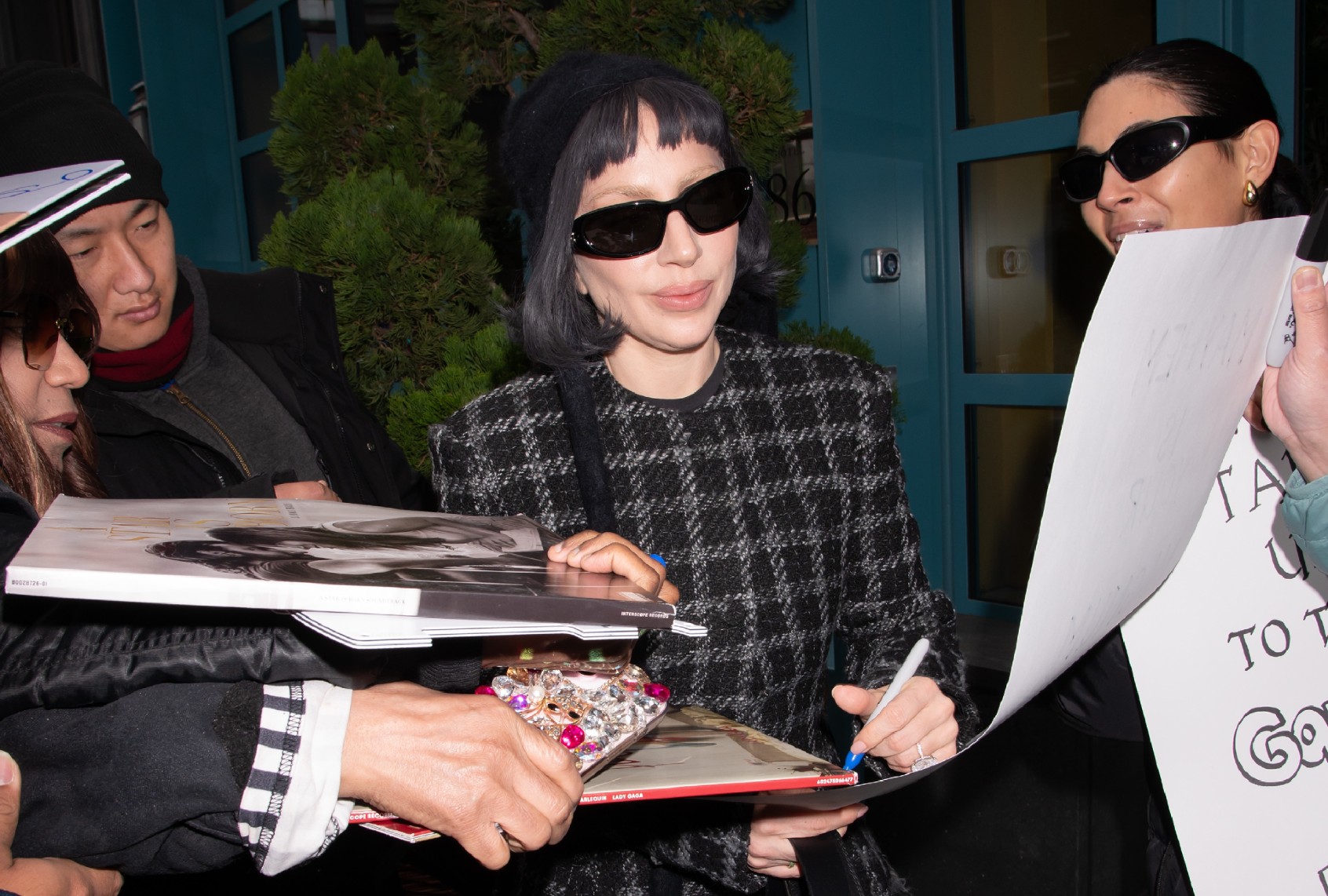
Lady Gaga is seen signing autographs on March 5, 2025, in New York, New York. ( MEGA/GC Images/Getty Images)In a recent in-depth interview with Apple Music’s Zane Lowe, Gaga said that “Artpop” was a response to living up to her own image, a work of intentional defiance that sought to shatter the public’s perception of her. If you know anything about the response to that album, saying that Gaga was successful in that mission is an understatement. The record probed Gaga’s pain, but ultimately brought her more misery — not to mention even more difficulty with a hip injury she experienced the year before, which resulted in chronic pain and fibromyalgia. In the years that followed, she spoke candidly about how her PTSD from sexual assault would cause her physical pain to flare up and her body to spasm. She sang about that torment on her 2016 album “Joanne,” the production of which was chronicled in a Netflix documentary, “Gaga: Five Foot Two,” the following year. It was a film about survival and strength disguised as a pop star documentary, themes she’d later dive deeper into on 2020’s “Chromatica.” 

Though “Chromatica” was a record that sounded bright and colorful, filled with upbeat house and electronic pop music, its lyrics were deceptively gloomy, with songs about antipsychotics and relentless trauma loops. It had moments of hope, too, but by and large, “Chromatica” was about learning to accept and live with life’s agony. Shortly before the album was released, Gaga met Michael Polansky, a tech entrepreneur whom she fell head over heels for. The two have been together since, and Gaga partly credits Polansky, who proposed to her last year, for pulling her out of the doldrums. During the “Mayhem” rollout, Gaga has spoken about him with utter reverence, saying he’s been a pivotal part of her creative resurgence and newfound mindset. Gaga gushed in a “Vogue” cover story late last year, “The missing piece was having real love.”

We need your help to stay independent

From its title alone, “Mayhem” may not have seemed like a record about finding your soulmate. But true to its name, “Mayhem” is chaotic, like rapturous love so often is. The album zigs just when you think it will zag. As soon as you think you’ve figured it out, Gaga heads in another direction entirely. It’s her first album since “Artpop” to move so freely, relieved of the palatable polish of “Joanne” and “Chromatica.” Here, Gaga sways between all of her artistic selves, excitedly dipping into the club kid funk of her early demos like “Retro Physical” and “Dirty Ice Cream.” On “Garden of Eden,” she reworks one of these unreleased songs to make a throwback sound modern, with a hook as instantly catchy and tempting as the poison apple its title evokes. It’s a pivot from the thrashing “Disease” or the quintessentially Gaga second single “Abracadabra” that precede it on the album, portending a record that asks fans to shed their preconceived notions and follow Gaga down the road to love she sang about 14 years ago.

Perfect Celebrity” further smashes expectations, going full-tilt Hole and Nine Inch Nails for one of the most electrifying commentaries on her own fame she’s ever released (and there are many). She’s growling and screaming, telling the listener, “Tap on my veins and suck on my diamond blood / Choke on the fame and hope it gets you high.” In the next line, she includes a bit of fan service. “Sit in the front row, watch the princess die,” she commands, referencing a monster-favorite unreleased song of the same name. 

But the through-line of “Mayhem” is love. Even on those abrasive cuts like “Disease” and “Perfect Celebrity,” Gaga contends with herself, analyzing and intellectualizing where Gaga ends and Stefani Germanotta begins. “I’ve become a notorious being / Find my clone, she’s asleep on the ceiling,” she sings in the latter cut. She conjures a clear image of a phantom self that Gaga can switch between at will. But ultimately, she’s wondering whether there’s a point in making that switch these days. She’s always been Stefani and Gaga, moving between each person as the music progresses. They are two parts of one mind, no less her at any moment, despite what some critics might see as inauthenticity. These are lipstick-strewn, bloodstained, gnashing middle fingers to anyone — including herself — who thinks the coexistence of her dual personas is impossible.

Artists often become so fascinated by their own torment that it becomes hard to accept that you can make great art without suffering. But with “Mayhem,” Gaga has successfully done just that.

Once she’s worked through some existentialism, Gaga allows her heart to open. Centerpiece tracks “Vanish Into You,” “Killah” and “Zombieboy” are three major highlights, each with their own flavor of intense desire. “Vanish Into You” is a sweet, soaring song about the heartache of loving someone so much you wish you could become part of them, even when they’re no longer around. “Killah” and “Zombieboy,” however, throb with funk grooves so nasty and pulsating that they wouldn’t be out of place on a Prince record. This isn’t lovelorn yearning, this is pure, unfettered horniness — and it’s infectious. “Zombieboy” is an instant Gaga all-timer; think of it like the woman who made “Monster” doing a disco-tinged Halloween novelty song about closing down the bar with the person you love most in this world. In simple terms: It’s brilliant, classic Gaga for a new age. 

The latter half of the album slows things down for a handful of tracks more expressly about love and all the confusion it causes, not always to such satisfying results. “How Bad Do U Want Me” sounds like it would be popular in the alternate universe where Gaga’s fictional “A Star is Born” pop star Ally Maine exists. Far brighter is “LoveDrug,” a top-down-on-the-desert-highway '80s firecracker where Gaga uses her vocal prowess to an appropriately intoxicating effect. “Shadow of a Man” is a sensational, high-energy track about making your own way in a male-dominated industry, elbowing through chauvinism with a hook stronger than anything any male pop singer has put out since Justin Timberlake’s “FutureSex/LoveSounds.” 

But even at her most indignant, Gaga finds stable footing in the softness of her romance. The penultimate track, a love ballad called “Blade of Grass,” is expressly dedicated to Polansky. It sounds very little like “Disease,” yet it exists in the same universe. Like “Disease,” it’s a song about feeling certain that you have all you need, even if everything else were to fall away. Whereas the Gaga of recent years might’ve sang “Blade of Grass” from a fearful perspective, cautious of losing the most important person in her life, the reinvigorated Gaga — the one who bolted back to life on the hood of the car in the “Disease” video — has no such worries.

On “Mayhem,” Gaga writes from a place of confidence she hadn’t previously tapped. Her assurance, restored through love, allows her to escape the fear and the pain that tortured her last few works. Shortly after the “Disease” video was released, I wrote that Gaga was forging her most interesting work in years by examining the fire instead of plunging into it, which holds for the rest of the album. Artists often become so fascinated by their own torment that it becomes hard to accept that you can make great art without suffering. But with “Mayhem,” Gaga has successfully done just that.

In an interview with Entertainment Weekly ahead of the album’s release, Gaga said that she hoped her fans would see her happiness. “I know I’m not a role model for everyone,” she began. “But I hope to be an example that you can be a deeply artistic person and we don’t have to romanticize torture.” On “Mayhem,” Gaga has produced her best album in over a decade by distancing herself from those years of misery while accepting that they are very real. Now, she’s an observer, able to see all of her past selves and the ones who might exist in the future, from a higher, more enlightened ground. At that altitude, Gaga has finally found a place where there are no more tears to cry.

Indigenous groups demand coca leaves be legalized. Will the world listen?

A short drive north of Bolivia’s capital La Paz, deep in the lush green valleys of the Yungas, Alicia Calle, a middle-aged Indigenous cocalero (coca farmer), plucked the leaves off the shrubs on her immaculately clean patch, letting them fall in the pouch of the apron tied around her waist. When she’s not tending to her plot, Alicia lends a hand to the other farms in her community; they, in turn, help her when it's harvest season. 

Now that I was here, she asked the gringo to assist.

“If you look after the land well and take care of it, it lasts,” she explained, pointing to one of the shrubs. “We planted this bush specifically in 1999. I remember it very well because my mother was between 40 and 50-years-old at the time. My father was a cocalero, and I’ve been a cocalero since I was ten-years-old. We’ve been doing this for centuries.”

After being collected, the leaves are laid out to dry. If it rains, the harvested leaves must be dried very quickly — within a day — otherwise they turn yellow and no one wants them. 

“This coca, it’s the only thing that sustains us,” said Alicia. “Our food, clothing, education. We tried growing citrus and oranges, but the price is too low — ten bolivianos [$1.45] for a hundred oranges. There’s only one harvest a year, and it’s eaten by bugs. Even though we don't earn much, but thanks to this [coca] leaf, we eat every day. For example, now I'm going to harvest this, tomorrow it's going to dry, and in the afternoon I can sell it. Otherwise, I just have nothing, [but with this] I can buy food for my children.”

I got to gathering, stuffing a couple of the fresh leaves in my mouth along with a pinch of baking soda. My hunger faded, replaced with a mildly uplifting feeling. The Yungas is one of two chief coca-growing regions in Bolivia, along with the Chapare, and the leaves here are considered the best quality.

"This coca, it’s the only thing that sustains us."

This relatively innocuous little leaf enjoys a stature in native Bolivian culture not unlike wine in France, but in the last century its reputation became toxic by association with ruthless cocaine cartels. Now, after a decades-long struggle by Indigenous movements, boxes of coca tea may finally appear on supermarket shelves near you.

Coca fields in the Yungas region, Bolivia (Niko Vorobyov)

Coca grows in semitropical areas at heights of between 200 and 1,500 metres over sea level, and unlike oranges, can be harvested three to six times per year. The plant is rich in vitamins, minerals, calcium, iron, fiber, protein and calories; helps stimulate breathing and allows the lungs to absorb more oxygen, which is useful in the highlands of Bolivia. It also contains a tiny, teensy-weensy, amount of cocaine. Because of this, cocaleros such as Alicia spent decades in the crosshairs of the global war on drugs.

Bolivia has since reclaimed the coca leaf as a powerful national symbol, and is now pushing for its recognition worldwide. This year, the World Health Organization is due to complete its reassessment of coca at Bolivia’s request: if it’s decided that coca’s bodily perils have been overexaggerated, this could clear the way for global reform.


Want more health and science stories in your inbox? Subscribe to Salon's weekly newsletter Lab Notes.


Coca leaves have been part of the indigenous culture for millennia. Besides Bolivia, coca-chewing is also practiced to a lesser extent by the native populations of Ecuador, Peru, Colombia, Chile, Argentina and the Brazilian Amazon, where it’s known as ipadu. The leaves were used as currency in the Inca Empire, which ruled the Andes mountains spanning the length of South America, and fed to the victims of human sacrifices before their untimely departures.

There are a number of legends of how coca was discovered. According to the Aymara peoples of Bolivia and Peru, a group of settlers trekking through the mountains had made camp, but their campfire spiraled out of control, angering the gods, who washed them away with a stormy flood. The survivors found a coca bush, which nourished them back to health.

In Bolivia, bundles of coca leaves are gifted at weddings, negotiations and as offerings to the Earth goddess Pachamama. In a ritual known as Q’owa, herbs and coca leaves are wrapped together in old newspaper along with a symbol of something desired – a job, or a house – on top of a pile of burning charcoal while alcohol is poured around. On certain occasions, a llama fetus is added to the mix. If the symbol melts, your wish has been acknowledged by Pachamama. 

Most commonly, though, coca-chewing is a social activity, like hanging out with your friends over a cup of coffee.

When the Spanish conquistadors arrived they were suspicious at first, and the Catholic Church declared coca to be the work of the devil. But then the Spaniards saw how it “motivated” their native workforce at the silver mines in Potosí, which was paid in coca. The church was perhaps genuinely concerned for the welfare of the overworked miners, who were being kept (in the eyes of the clergy) “addicted” to coca, but eventually a 10% cut shut the church up. Tens of thousands perished in the shafts of Potosí alone. 

"It is unthinkable that the WHO today will maintain the indefensible arguments they used in the past."

In 1949, a flawed U.N. study described coca-chewing as a gross habit that “degenerated” the Indigenous people, leaving them impoverished and unproductive (which would have been news to the Spaniards.) And since 1961, coca has been listed among the most dangerous substances by the U.N. This on its own wouldn’t have attracted the attention of the U.S. Drug Enforcement Administration, were it not for the fact that coca is the primary raw material for cocaine. 

In secret locations, a mixture of gasoline, baking soda and sulfuric acid is poured on top of shredded coca leaves and processed either in a cement mixer or by stomping on them. From there, couriers — usually out-of-work locals — are paid to drive the finished product overland, onboard a canoe or trek through the jungle to big-city hubs for export or distribution. During the 1970s and ‘80s, coke barons such as Roberto Suárez Gómez, who served as the real-life inspiration for the character of Sosa in “Scarface,” grew rich and powerful enough to finance military coups.

In 1988, under pressure from Washington, Bolivia passed Law 1008, which criminalized all coca cultivation outside a designated zone in the Yungas. That year, soldiers overseen by the DEA and the CIA gunned down a dozen protestors against the new law on a bridge crossing the Chapare river in Villa Tunari. For the next sixteen years, security forces committed summary executions and sexually assaulted peasant girls with impunity, while angry mobs rioted, lynching cops and burning down police stations. 

Confrontations between police and cocaleros resulted in scores of deaths, almost to the point of a low-level insurgency. Soldiers on patrol were met with peasant militias and booby traps. While the war on drugs may have reduced Bolivia’s cocaine output, it destroyed the livelihoods of rural communities while, paradoxically, the increased scarcity of coca left it a more profitable (and tempting) career path.

The cocaleros pushed back. Leading the fiery demonstrations was Evo Morales, a native Aymara cocalero from the Chapare and the president of a powerful coca-growers’ union, raging against neoliberal economics and the war on coca — both seen as stand-ins for gringo imperialism. The coca farmers, along with miners and other allies, shut down La Paz, erecting roadblocks on all major highways and byways in and out of the capital and choking the economy.

Between this and the unrest in Chapare, the situation was nearing crisis point, and in 2004 president Carlos Mesa struck a compromise with the cocaleros, legalizing cultivation in the Chapare. 

Morales was elected Bolivia’s first Indigenous president in 2006. Two years later, he expelled both the DEA and the American ambassador, accusing them of spying and undermining Bolivian sovereignty. U.S.-Bolivia relations would remain frozen for the next three years. And in 2009, the new constitution even recognized “ancestral coca as cultural patrimony, a renewable natural resource of Bolivia’s biodiversity, and as a factor of social cohesion.” By 2017, the land authorized to grow coca was more than doubled to 22,000 hectares.

Cocalero households are entitled to a cato (1,600 square meters) of coca after being cleared by the authorities, which is watched over closely by their local union. If you’re caught growing over your limit, you can lose your coca-growing privileges, and if they fail to keep check, the entire union can be barred. This is known as “community control”. The authorities still carry out inspections and rip out excess plants, but their arrival is announced beforehand so it doesn’t create tension like in the old days. Still, many farmers are unhappy that a single cato isn’t enough to earn money, and the nationwide cap means it’s hard for newcomers to enter the business.

Bolivia is now home to a thriving domestic coca industry. There’s coca-infused tea, candy and beer, while leaves for chewing can be bought in markets or stalls anywhere in the country. But while global prohibition remains in place, Bolivia is unable to share its “cultural patrimony” with the rest of the world. Therefore, it’s taking the fight to the world stage.

“It is time to decolonize the [U.N.’s] current regulations and [end] the six decades of the colonization of the coca leaf,” Bolivian Vice President David Chochquehuanca told a conference in Peru in February.

Coca is currently listed as a Schedule I narcotic by the United Nations, in the same category as opioids like fentanyl. However, cannabis was once filed under the even stricter Schedule IV until a reassessment from the WHO, together with lobbying from India, Nepal, Morocco, South Africa, Thailand, Mexico, Jamaica and Colombia — all heartlands of the herb — removed it from the blacklist in 2020. Now countries are free to reform their marijuana laws without breaking U.N. treaties (although other agreements, e.g. European Union rules, may still apply.)

It's hoped that the same will happen to coca. In July 2023, the WHO received a formal request from Bolivia to look into the matter.

Coca leaves drying after harvest in the Yungas region, Bolivia (Niko Vorobyov)
“Ending the U.N. treaty ban on coca and the condemnation of millennia-old Andean-Amazonian cultural practices, has been a long-standing demand from Indigenous peoples and cocalero movements,” said Martin Jelsma, a drug policy specialist at the Amsterdam-based Transnational Institute. “This struggle has now culminated in the formal review procedure triggered by Bolivia, with active support from Colombia. Civil society in the region and worldwide sees it as a historic opportunity to decolonize the frozen U.N. drug control regime and to resolve systemic inconsistencies and the obvious tensions with Indigenous rights. The review process has also received support from OHCHR and the Special Rapporteur on the rights of Indigenous People.”

Other Andean nations are watching intently. In Peru, limited coca cultivation is allowed and controlled by a government monopoly, which then sells the decocainized leaves to Coca-Cola for flavoring. The extracted cocaine is sold to the pharmaceutical market, which is used as a topical anesthetic for nasal surgery. While traditional Peruvian farmers protest, unlike in Bolivia they are not a powerful political force. Lawmakers show little interest in Indigenous communities, and instead coca is tainted by associations with cocaine and terrorism. Specifically, the ultra-radical, cult-like, incredibly brutal Shining Path — once feared for its reign of terror in the ‘80s and ‘90s, hanging dead dogs from lampposts — collects “revolutionary taxes” from cocaleros and facilitates onward shipments to global traffickers, for example through the port of Callao.

Coca in Colombia has historically been more heavily criminalized than either Peru or Bolivia given how there’s less cultural tradition and the plant is almost exclusively grown for the narco-business, violent paramilitaries and guerrillas. The struggle to dominate the cocaine trade has claimed hundreds of thousands of lives.

However, Colombia’s progressive president Gustavo Petro now wants to go further and end the war on drugs altogether by legalizing cocaine, which he claims is no worse than whiskey.

We need your help to stay independent

“It is unthinkable that the WHO today will maintain the indefensible arguments they used in the past,” Jelsma continued. “The WHO, however, is very aware of the political controversy that would arise if they would recommend to delete coca from the treaty schedules altogether, and will therefore be tempted and under considerable pressure to use the argument of cocaine extraction to justify keeping it on Schedule I, or to only recommend a transfer to the slightly lighter-controlled Schedule II. All the available evidence about the coca leaf and consistency of the scheduling criteria as applied to other plants and alkaloids across the treaty system, however, will make it very difficult for the Expert Committee to recommend anything else than withdrawing coca leaf from the treaty schedules.” 

“Under the terms of the treaty, using coca leaf for the extraction of cocaine would remain as illegal as it is now, also if coca itself is no longer scheduled as a narcotic drug itself,” Jelsma added.

These concerns are not wholly unfounded. It’s clear that a portion of Bolivia’s coca is diverted to narcotraffickers. How much, exactly, is uncertain, but a year ago Bolivian cops celebrated their second-biggest drug bust of all time: 7.2 tons of blow discovered onboard two trucks transporting scrap metal through the desert near the Chilean border, from where it would be shipped overseas toward Belgium.

There are other concerns as well, such as legal coca would fall prey to corporate capitalism like cannabis. We can already see that in Peru, where Coca-Cola is allowed to sell their product worldwide while native farmers are not.

But back in the valleys of the Yungas, Alicia welcomed the world finally recognizing her Indigenous customs and livelihood.

“It would be beautiful,” she said, plucking more leaves into her pouch.

Additional reporting by William Wroblewski.

“I hate to predict things like that”: Trump dances around recession talk on Fox News

Donald Trump has heard the seers at the Federal Reserve Bank of Atlanta, and he's not buying their predictions of a looming recession. 

The president dodged any talk of an economic downturn during a surprisingly testy interview on Fox News' "Sunday Morning Futures."  

"There are rising worries about a slowdown," host Maria Bartiromo said plainly. "Look, I know that you've inherited a mess…but are you expecting a recession this year?"

"I hate to predict things like that," Trump said. "There is a period of transition because what we're doing is very big. We're bringing wealth back to America. That's a big thing. There are always periods of…it takes a little time, but I think it should be great for us."

The hardball question came after the Atlanta Fed predicted a contraction of the American economy in the first quarter of 2025. Their prediction of a nearly 3% dip in the United States' GDP came as Trump's on-again, off-again tariffs have injected uncertainty into trade between the U.S., Canada, Mexico and China.

To that end, Bartiromo pressed Trump for a straight answer on his long-threatened tariffs on Mexican and Canadian goods. Trump said that the tariffs "may go up" before adding a conditional and disheartening "it depends."

"We may go up with some tariffs, it depends. I don't think we'll go down, but we may go up," Trump said. "Our country's been ripped off for many decades, for many, many decades, and we're not going to be ripped off anymore." 

Homeownership might cost too much to make sense

Homeownership has always been at the crux of the American dream. But with housing’s rising unaffordability, that dream is looking more like a moonshot for most everyday Americans — and the juice might not be worth the squeeze

For most apartment dwellers, saving for a down payment on a home can take years. For residents of Hawaii, it could take as long as 16 years and seven months. That’s according to a new study, published by Cinch Home Services, which pulled together federal income data, state-by-state apartment rent rates and home sale data to determine how long it would take the average renter to save for a down payment. 

In Hawaii, the median home sale price is $846,000, making a 10% down payment roughly $84,600. An apartment renter earning the state’s average monthly income — roughly $4,800 — would have around $425 to save at the end of the month, after rent and other expenses. Assuming they saved $425 each month, and did so without fail, the renter would spend 199 months saving for a home. 

Hawaii is an outlier, in many ways, partly because the state has both historically high home prices and a lower-than-average earnings among its population. But renters in other U.S. states aren’t faring much better. In California, where monthly median earnings approach $6,000, it would still take the average renter — and a quite diligent saver, I’ll add — more than eight years to save up for a down payment. In Utah, it would take six years. In Florida, five. 

We need your help to stay independent

In more than half of U.S. states, an apartment dweller would expect to spend three or more  years saving for a down payment, according to the report. But let’s also acknowledge the unrealistic expectations of a renter spending no money, outside of their basic necessities, for several years — no new clothing, restaurant dinners or trip to the movies, not a single plane ticket or unexpected car repair — in order to save for a down payment. 

Given the gargantuan lift required of today’s renters to become homeowners, it’s worth asking: Does it actually make sense to buy a home? 

That depends on who you ask. Ramit Sethi, a personal finance expert and bestselling author of “I Will Teach You To Be Rich,” told Salon earlier this year that he’s made more money as a renter than a homeowner, in large part by investing in the stock market with the cash he would’ve otherwise spent on home repairs or maintenance in a given year. 

“This is like telling people the sky is green — they simply cannot compute it, and they use the same argument,” Sethi told Salon. “What about equity? Well, I have equity, too. It just happens to be in the top 500 companies in America.”

Homeownership, in its simplest form, is a form of forced savings. Each month, whoever took out the mortgage is forced to set aside many hundreds, if not thousands, of dollars toward acquiring a piece of property that, if all shakes out, will be worth far more than its appraised value at the time the homeowner first bought it. For a handful of generations, that proposition mostly bore out: Over the last 20 years, the average home price in the U.S. has risen from $140,000 to roughly $420,000, according to Zillow — a nearly 200% increase in value. 

A Bankrate study published last year found that it’s actually cheaper to rent than buy in all 50 major U.S. metros

But on a year-to-year basis, stock market gains typically exceed home value hikes over a 12-month period. Annual returns from the S&P 500 stock index typically hover between 6.5% and 7%, compared to average home value gains of 4.7% since the year 2000. 

In this way, it’s fairly simple to figure out a savings routine that mimics the housing market — on paper, at least. During a given year, homeowners can expect to spend between 1% and 4% of their home’s value on maintenance and repairs. For a $420,000 home, those costs could range between $4,200 and $16,800 a year, or between $350 and $1,400 per month. 

Saving more than $1,000 a month may not be feasible right now, if ever. But even setting aside $350, $100 or even $50 a month is better than nothing. Investing $50 a month in the S&P 500, and assuming yearly gains of 6.5%, would yield around $23,000 after a 20-year period — not enough for a down payment, but a decent savings cushion. And there are other investment options aside from the S&P 500, of course, like socially responsible index funds and ESG funds, composed of companies that consider environmental, social, and governance issues. These funds tend to generate lower returns than traditional stock market investment, though. 

In the meantime, a Bankrate study published last year found that it’s actually cheaper to rent than buy in all 50 major U.S. metros, with average rents being around 37% less than monthly mortgage payments. The median monthly mortgage payment was $2,703, compared to the average national rent of $1,979.

For once, renters may be finding themselves with more money in their pockets at the end of the month compared to homeowners. But whether everyday costs allow those renters enough wiggle room to build up alternative streams of equity is another question. 

“His least unsettling trait”: Trump mediates Rubio, Musk tiff as DOGE head becomes Dr. Evil on “SNL”

The cold open of "Saturday Night Live" brought out one of the long-running series' former megastars to rehash a recent Cabinet fight between Elon Musk and Marco Rubio

In the opening sketch, James Austin Johnson's Donald Trump attempts to make peace with Marcello Hernández's Rubio. He addresses Rubio's concerns about Musk's widespread power to run roughshod over the federal government and even gives his one-time opponent a chance to shine. 

"I am very close to a deal with the Panamanian government to retake the Panama Canal," Hernández as Rubio says. 

"Eh, I don't want it anymore, you know?" the faux-Trump replies. "Seems like a hassle."

At that point, Mike Myers bursts into the Oval Office as a ball of weird tics meant to represent Musk. After Myers' Musk repeatedly does an off-putting dance, Trump calls the move the billionaire's "least unsettling trait" before extending the olive branch in the form of mutual roasts. 

"Elon, how do you have 20 kids, but I've never seen you with a chick?" Johnson's Trump says. "Marco? Short and gay, classic."

In a voice-over of Musk's thoughts, he worries that his "personal net worth just dropped by $100 billion," hitting the last part of the line in the familiar voice of his character Dr. Evil and drawing applause from the audience."

The real-life meeting that "SNL" was sending up had no pat resolution.

In the Thursday clash between Rubio and Musk, the Tesla head accused the secretary of state of not doing his part to reduce government spending. Per the New York Times, Musk said Rubio was "good on TV," implying that Rubio was only useful as a talking head. Rubio countered that over a thousand State Department employees had taken the so-called "fork in the road" buyouts. Per the outlet, Rubio asked if Musk would like to hire back the resigning employees so that he could properly fire them. 

The argument came to a close after Trump backed Rubio, saying he was doing a "great job" in the early days of the president's second term. 

Justice Alito’s USAID dissent is a map for Trump

In a 5-4 decision, the Supreme Court disparaged Trump’s claim that presidents can do whatever they want, by ordering the administration to disburse $2 billion in USAID grants in compliance with lower court rulings. Although the narrow ruling has been widely applauded as at least a temporary victory for the rule of law, the victory is overshadowed by ominous signaling in the dissent. 

In response to a one-paragraph ruling, Justices Alito, Thomas, Kavanaugh and Gorsuch wrote lengthy and strident dissents. Of the four justices, at least two are ethically compromised by their refusals to recuse from cases involving their own billionaire benefactors. Justices Alito and Thomas have also faced credible impeachment demands following their partisan embrace of Trump’s MAGA ethos

They did not just dissent in the USAID ruling, they dissembled. They lied about both the court record and the district judge, and they drew a map to show Trump how to frustrate the case going forward.

The majority protected the legislature’s role 

The Court's 5-4 majority opinion, in which Justices John Roberts and Amy Coney Barrett joined the three liberal justices to narrowly protect Congress’ power of the purse, holding that under Article I, Section 8 of the U.S. Constitution, since Congress had already appropriated the USAID and it was already signed into law, Trump could not legally freeze it. In other words, a president does not have the power to break, disregard or rewrite laws just because he disagrees with them. 

Article I gives Congress, not the president, the explicit power of the purse, but more than that, congressional authority to pass legislation and control the nation’s money is, by design, a Constitutional check on the power of the presidency. 

The legislature’s role is key to the carefully calibrated separation of powers, which has held a deeply divided nation together through nearly 250 years. Perhaps more ominous than misrepresenting the court record, the dissenting justices conveyed their willingness to scrap the centuries-honed balance of powers by allowing Trump to usurp the legislative role through the stroke of their own pen.

Alito didn’t just dissent

In a dissent that reads like a partisan diatribe from a Trump social media post, Alito wrote an eight-page rant that blatantly misrepresents the court record. He claimed that the district judge issued a “second order” because he was “frustrated” with the pace of aid disbursement under his previous order.  This was patently false. US District Judge Amir Ali, in fact, issued repeated orders against relentless pushback from the Trump administration. A quick scan of the docket sheet easily reveals that Ali issued at least five orders that Trump disregarded, not “two” as Alito claims.

The administration’s refusal to pay, in continued defiance of Judge Ali’s orders, is what prompted Ali to issue his final order including a payment deadline. But instead of reminding Trump that presidents must even obey court orders they disagree with, Alito misrepresented the orders and lied about what led to them, just as he lied about common law history in the Dobbs decision.

We need your help to stay independent

In a functioning democracy governed by the rule of law, this decision would have been 9 to 0. Simply put, Congress awarded the aid and passed the law; the president has to follow it. Instead, Alito inveighed misleadingly:

Does a single district-court judge … have the unchecked power to compel the Government of the United States to pay out (and probably lose forever) 2 billion taxpayer dollars?

The answer to that question should be an emphatic “No,” but a majority of this Court apparently thinks otherwise. I am stunned.

Today, the court makes a most unfortunate misstep that rewards an act of judicial hubris and imposes a $2 billion penalty on American taxpayers.

Objecting that the government will “probably lose forever” the $2 billion ordered to be disbursed, Alito appears not to understand how federal aid works. The legislature, not Judge Ali, decided how much aid to grant, to whom, and for what. Such aid appropriations are never expected to be reimbursed, so Alito calling them a “$2b penalty on American taxpayers” was pure, results-driven propaganda. 

The dissent also suggested that Trump could seek a full merits review by filing a petition for a writ of certiorari, indicating that they will grant the writ of cert and delay the aid for months.

There’s stunning hubris here all right. But it emanates from Alito, for assuming that Trump can disregard federal law simply because he and the dissenting justices don’t approve of Congress feeding the poor or treating the sick, notwithstanding their own self-professed Catholicism. That four Supreme Court justices support Trump's power grab, and are willing to lie about it, suggests Trump’s coup may well succeed.

Democrats stage a shameful retreat on trans rights: Do they think that will stop Trump?

Most Democratic elected officials are behaving with stunning timidity, at the exact moment that the crisis facing American democracy demands strength and aggression. Combining the neuroses of insecure teenagers and the poll-monitoring reticence of politicians fit for parody, they appear both weak and bashful. They are acting like losers, but their constituents will suffer the gravest losses.

Chief among those endangered constituents are transgender and nonbinary people. The first targets in President Trump's autocratic assault on civil rights, minority protection under the law and democratic representation, trans Americans face a state of emergency: They find their liberties under attack, their economic and educational opportunities under threat and their very humanity under question. The increasingly rabid Trump White House is leading a nationwide charge of Republicans in Congress, state legislatures, and governor’s mansions to declare war on trans citizens. 

Running on the noxious fumes of Christian nationalism, they are following the script of authoritarian regimes by beginning their fight against pluralism and elementary freedom by attacking what they perceive as an easy target. At less than one percent of the country’s population, and already the victims of relentless right-wing slander, trans people simply don’t have sufficient power, influence or visibility on their own to defeat the campaign against their basic civil rights. 

Less than three years ago, things were very different. Democratic leaders understood an imperative to defend their transgender constituents and, in doing so, to promote the bedrock principle of universal human rights. 

In 2022, Joe Biden hosted an LGBTQ Pride event on the White House South Lawn. Reacting to the passage of 78 state-level bills that year diminishing LGBTQ rights, along with book bans targeting stories about LGBTQ youth (along with other marginalized groups), Biden said, "I want to send a message to the entire community, especially to transgender children: You are loved. You are heard. You’re understood. And you belong." 

That simple but powerful message of respect and solidarity has faded into silence. After losing the 2024 presidential election by razor-thin margins in the swing states, Democrats have staged a wholesale retreat, apparently concluding that cowardice and complicity are better political tactics than persuasion and protest. Trans Americans, including the children that Biden mentioned, have almost literally been pushed overboard. be damned. Several Democrats have even joined the Republicans in attacking trans rights, blaming the issue for their November defeat. 

Rep. Tom Suozzi of New York excoriated Democrats for "pandering to the far left" on issues related to transgender people. Rep. Seth Moulton of Massachusetts offered a similar admonition, expressing fear that a "formerly male athlete would run over" one of his daughters on an athletic field. 

Gilberto Hinojosa, the former chair of the Texas Democratic Party, presented a binary choice between supporting transgender rights and winning elections, saying, “You can support transgender rights up and down … or you can understand that there’s certain things that we just go too far on.”

After losing the 2024 presidential election by razor-thin margins, Democrats have staged a wholesale retreat, apparently concluding that cowardice and complicity are better political tactics than persuasion and protest.

Rahm Emanuel, the former Chicago mayor who left office in disgrace after covering up video evidence of a Black teenager being shot by police, recently said while discussing education policy, "I don't want to hear another word about the bathroom. I don’t want to hear another word about the locker room. You better start focusing on the classroom." The craven implication is that civil rights for a minority of students is somehow a distraction from improving educational outcomes. 

California Gov. Gavin Newsom, a likely presidential contender in 2028, recently invited Charlie Kirk of Turning Point USA on his podcast. Kirk, who organized youth voters for Donald Trump, has said that women over 30 "aren’t attractive in the dating pool" and that he'd feel nervous on a plane with a Black pilot. He's an old hand at anti-trans hatred, even implying that the social acceptance of trans people is a threat to civilization. Laughing it up with Newsom, Kirk asked him, "Would you say no to men in female sports?"

“Well, I think it’s an issue of fairness,” Newsom said without hesitation, “I completely agree with you on that. It is an issue of fairness, it’s deeply unfair.” He then seemed to give credit to Kirk and his far-right pals, remarking, “And I saw that — the last couple years, boy did I [see] how you guys were able to weaponize that issue at another level.”

The trans teenagers whom Democratic heavyweights are so willing to discard are showing greater courage by showing up at school every day school than the likes of Newsom can display from seats of political power.

We need your help to stay independent

Democrats’ mass retreat on transgender rights follows a sickly pattern of self-defeat. More than 20 years of surrender on immigration  have helped to create the political conditions for mass deportation and efforts to end birthright citizenship. The refusal to defend "big government" has rendered Democrats helpless as Elon Musk takes a chainsaw to essential public agencies and services. 

There are notable exceptions, although they are distressingly few. In response to her party’s obsequiousness, Rep. Summer Lee of Pennsylvania said recently, “There is no poll result that could make me turn on marginalized people. What I challenge us to do is find maybe better or different ways to protect folks, and better and different ways to lift up the messaging that…resonates with the people.”

In response to her party's obsequiousness, Rep. Summer Lee of Pennsylvania said recently, "There is no poll result that could make me turn on marginalized people."

Lee is one of the most progressive members of Congress, but evidently she is also one of the most old-fashioned. She actually believes that the purpose of politics is to convince voters of important ideas through debate, rhetoric and advocacy. Those looking to follow Lee’s counsel might want to consider beginning with a description of the cruelty that Trump, Republicans in Congress and many state governments are inflicting on their fellow Americans.

Kim Reynolds, the governor of Iowa, recently signed a bill stripping trans men and women of civil rights and employment protections, Indiana has enacted harsh restrictions against gender-affirming care, and in deeper red states such as Texas, there is a large scale agenda to “restrict trans lives,” in the words of a Texas Tribune headline.

Meanwhile, there is an attempt to erase awareness of trans existence. According to PEN America, 25 percent of the books banned from libraries and schools in 2024 featured LGBTQ characters. 


Want a daily wrap-up of all the news and commentary Salon has to offer? Subscribe to our morning newsletter, Crash Course.


Since taking office, the Trump administration has denied trans people the ability to self-select their gender on passports, issued an executive order banning trans women from college sports, and in their most cruel and ignorant move, discharged all trans people from military service. 

As if these policies were not sufficiently destructive, the Trump White House is also seeking to erase transgender people from American history. The National Park Service has eliminated the 'T' from its page explaining the importance of the 1969 Stonewall uprising in New York. It now refers only to the “LGB” movement. 

That effacement tries to create a counterfactual absurdity. Masha P. Johnson and Sylvia Rivera, two transgender women, are widely recognized as participants in the revolt against police brutality during the Stonewall raid. Even more significant, this erasure places the Trump administration in a grim tradition, that of authoritarian regimes eager to control knowledge and rewrite history. 

There is good reason why George Orwell coined the phrase "memory hole" in "1984." He writes in that classic novel, "When one knew that any document was due for destruction, or even when one saw a scrap of waste paper lying about, it was an automatic action to lift the flap of the nearest memory hole and drop it in, whereupon it would be whirled away on a current of warm air to the enormous furnaces which were hidden somewhere in the recesses of the building."

The Stonewall erasure places the Trump administration in a grim tradition of authoritarian regimes that seek to control knowledge and rewrite history. 

Trump and his acolytes, driven by the dark forces of Christian nationalism, is now trying to throw all evidence of transgender history and humanity down the memory hole. Tragically, it seems to be working, largely because Democrats refuse to express outrage, or even speak up, in reaction to a vicious reversal of civil rights policy. 

If they could summon minimal imagination and self-confidence, Democrats might understand that even when it comes to the favorite talking point of transphobic prejudice and paranoia — participation in school sports — the issue is not as simple as uninformed or instinctive reactions would suggest. 

The NCAA estimates that there are fewer than 10 transgender athletes out of 510,000 participants in college sports. While it’s more difficult to track the immense universe of high school sports, the numbers at that level are likely just as small. For example, of the 170,000 high school athletes in Michigan, only two are trans girls. The typical response to such statistics is to assert that trans women and girls dominate athletic competitions, ruining the sport for everyone else involved. Here, again, empirical evidence contradicts so-called common sense. 

An International Olympic Committee study conducted at the University of Brighton in England and published in the British Journal of Sports Medicine found that trans women consistently performed worse than cisgender women in tests measuring lower body strength, lung function and handgrip strength. Furthermore, the differences in bone density were negligible. 

The anti-trans brigade often focuses on Lia Thomas, a transgender woman who became a dominant competitor in NCAA Division I swimming. Her specific case presents a moral dilemma with no easy solution, but the important point is that examples like Thomas are exceedingly rare. Relying on what we might call the traditional conservative policy — allowing local officials and independent organizations to make their own rules — is likely the best approach. Surely that’s better than allowing exceptional cases to dictate national policy, not to mention turning one individual into a weapon against an already endangered minority. 

To say “endangered” is hardly hyperbolic: Since 2022, GLAAD has recorded more than 1,850 incidents of anti-LGBTQ violence, including assault, arson attacks on LGBTQ bars, and bomb threats against children’s hospitals providing gender-affirming care. The FBI reports that 2023 was the highest year on record for anti-LGBTQ hate crimes, with more than 2,800 targeted attacks.

Democrats could, at the most basic level, at least display empathy for the increasing numbers of trans Americans who are victims of hate crime. They could stand in solidarity with the first trans member of Congress, Rep. Sarah McBride of Delaware, who has endured a series of hateful attacks from transphobic Republicans, including Reps. Marjorie Taylor Greene of Georgia and Nancy Mace of South Carolina.

The overwhelming majority of trans people simply want the freedom to live their lives as they choose. They aren’t attacking police officers, destroying federal property or attempting to overturn the results of an election. Republicans, of course, have turned the Jan. 6  insurrectionists into political prisoners and heroes. Trump has pardoned effectively all of them, including the most violent offenders. His new FBI director, Kash Patel, produced and promoted a record of the “January 6th Choir” singing the national anthem. If Republicans can celebrate criminals, vandals and members of hate groups, shouldn’t Democrats have the courage to support law-abiding transgender Americans, especially as they come under virulent and violent attack? 

Bigotry is not only menacing, it is also ravenous and contagious. Anyone who believes that theocratic Republicans will stop at trans people is delusional. Lawmakers in nine states have already introduced bills calling on the Supreme Court to revisit Obergefell v. Hodges, the decision that made same-sex marriage legal. Justice Clarence Thomas has said that the Supreme Court should overturn the decision. 

When the ‘T’ is erased from LGBTQ, the other letters are likely to follow. Who will be next?

“Hope is an action”: In red states, activists refuse to surrender on reproductive rights

Reproductive rights advocates in southern states are embroiled in a fight against severe restrictions on abortion access and a flurry of state-level GOP efforts to create more of them. They say President Donald Trump's second term threatens to make those obstacles worse — and they're calling on the rest of the country to back them up.

In a handful of states across the country, many of which are in the south, abortion is almost completely illegal with few exceptions, the most common being when necessary to protect the pregnant person's health. In other southern states, abortion access is extremely limited with restrictions imposed before most people know they are pregnant. Republican state lawmakers in Arkansas, South CarolinaWest Virginia and others have introduced legislation this session seeking to further curtail residents' reproductive rights, including bills criminalizing education on abortion options, striking down exceptions to existing abortion bans and requiring anti-abortion views in sex education.

But as state GOP lawmakers level these proposals — fueled, in part, by the Trump administration's uncertain yet hostile approach to national abortion rights — grassroots activists have supercharged their fight against this latest push, stepping up work to ensure their communities have the access to healthcare and comprehensive education they feel they deserve. 

"We will not stop trying. We will not give up. We will continue our efforts," said Brittaney Stockton, the policy and growth strategist for the Arkansas Abortion Support Network. "This go around, somehow — even though it feels harder; it feels way worse than it was last time — I am finding hope in the community, within the communities who are constantly fighting everything that they throw at us. We believe that hope is an action, and we're not going to stop."

Arkansas law bans abortion at all stages of pregnancy except when necessary to "save the life of a pregnant woman in a medical emergency." The state also makes performing or attempting to perform an abortion punishable by a fine of up to $100,000 or a maximum of ten years in prison. 

Powered by donations from community members, the Arkansas Abortion Support Network challenges that restrictive policy by helping Arkansas travel out of state to access abortion care, disseminating information about safe ways to obtain an abortion and providing products like Plan B and Opill to help people who want to prevent pregnancies. The group also partners with other grassroots organizations to mobilize around restrictive bills in the Arkansas Legislature and shares educational materials about their potential harms on social media.   

In that way, the organization fights back "by just existing," argued AASN executive director Karen Musick. "The fact we're here, the fact we continue to help people every day — that's how we are helping."

The AASN has most recently been monitoring the progression of the Baby Olivia Act through the state legislature. That bill would require public schools to fold a "human fetal growth and development discussion" into their health classes starting in sixth grade and show students a video created by anti-abortion group Live Action depicting "the process of fertilization and every stage of human development inside the uterus."

The video, Stockton argued, fails to include a sex education component and instead offers "misleading" context in an effort to teach pubescent children that a fetus is a human life. Its passage would also place the responsibility of a pregnancy on children in a state with abstinence- and shame-based sex education, the nation's highest population-adjusted rate of reported child sexual abuse cases and third highest rate of registered sex offenders, she said.

"It's problematic because you're further shaming kids that might end up in a situation where they were assaulted and become pregnant and they don't even understand how they got from point A to point B," Stockton told Salon.

Stockton said that being a mother of three girls made her want to voice opposition before the Senate in a committee hearing on Feb. 26. In her remarks, she argued that truly protecting the state's children would be equipping them with the tools they need to recognize and resist predatory behavior through a comprehensive sex education program. 

"Those children that you speak of that become pregnant, they did not choose to become pregnant as children," Stockton testified, raising her gaze from her prepared remarks to the lawmakers before her. "They do not deserve that, and we need to teach them how to remain safe."

The bill, which has passed in other states, failed in committee for the second time in the state Senate on Feb. 28. But Stockton and Musick said the organization expects the lead sponsor, Republican state Rep. Mary Bentley, to reintroduce the bill for a third and final time before the legislative session ends. Still, Musick said, they're confident they can defeat the legislation again.

"Republicans have a super majority again in the state of Arkansas. The fact that opposition was there to disrupt that felt powerful, and it felt powerful to a lot of people," Musick said. "We think it's a huge victory that we're able to talk about it enough and get people there to talk about these bills."

In South Carolina, abortion rights advocates are also working to stave off a spate of bills progressing in their state legislature aimed at further restricting access to abortion and criminalizing providers, educators and patients over the care.

The Women's Rights Empowerment Network is monitoring three such bills, including HB 3457, which seeks to upend the state's current six-week ban by prohibiting all abortions in the state except in medical emergencies and striking exceptions for rape, incest and fetal anomaly. Also on the group's radar is that proposal's related bill in the state Senate, SB 323, which would also prohibit medication abortions and criminalize the act of providing information on how to obtain an abortion by phone, web or another mode of communication to a pregnant person. Another bill, HB 3537, seeks to classify abortion as a homicide and open abortion patients up to murder charges. 

"All of these bills are cruel and do nothing to protect the people of South Carolina, [and] only to seek to control their bodies and their extremely personal decisions about their lives and well-being," argued Amalia Luxardo, WREN's CEO. SB 323 is especially alarming, she said, because it would criminalize her organization and others' work to educate people on their options for reproductive care.

To fight back against these proposals, Luxardo said that WREN creates materials informing South Carolinians on the legislation their lawmakers are proposing and provides call and email templates they can use to directly voice their opposition. The organization also lobbies at the statehouse weekly, sharing stories with elected officials about how their policies affect constituents' everyday lives. Ahead of a Tuesday hearing for HB 3457, the group mobilized more than 750 people to email or call legislators with opposition to the bill and confirmed some 40 volunteers to testify before the legislature. 

"We are fighting like hell in South Carolina for reproductive rights," Luxardo said. "Our people deserve access to essential healthcare and the ability to make their own decisions about their lives and their futures. We refuse to be silent, and we will continue to defend abortion access in the state."

That determination, she added, has become even more pronounced in the wake of Trump reassuming the presidency. 

We need your help to stay independent

While Trump repeatedly said during the 2024 election cycle that restricting abortion access at the federal level would not be a priority, activists are skeptical that he will keep his word now that he's in office. Trump's campaign-trail ambivalence on the issue followed his long-held anti-abortion stance, characterized by his first-term efforts to defund Planned Parenthood, flirting with a national ban and later taking credit for the Supreme Court's 2022 overturning of Roe v. Wade. 

His first-week blast of executive orders didn't include the national abortion ban that advocates feared they might see, but the president has still made efforts to restrict access or bolster anti-abortion sentiment since returning to the Oval Office in January. One executive order aimed to end "forced use of Federal taxpayer dollars to fund or promote elective abortion" domestically, while another anti-trans action he signed included language implicating fetal personhood. The president also pardoned nearly two dozen anti-abortion activists on his fourth day in office.  

Margaret Chapman Pomponio, executive director of the reproductive health and justice organization WV Free, told Salon that Trump's presidency and "authoritarian approach to governing" has also placed activists and residents of West Virginia, another state with a near-total abortion ban, on high alert. 

"All are scared, angry, embarrassed — just like so many across the country," she told Salon. "We may be considered a deep-red state, but that didn’t fully happen until 2014. A little over 10 years ago. So there are still lots of pockets of progressivism, and plenty of people ready to fight the rollback of our rights."

In West Virginia, abortion is prohibited through all stages of pregnancy except in the case of a medical emergency, an ectopic pregnancy or a fetus that's not medically viable. More exceptions exist for survivors of rape and incest, who can obtain abortion care up to eight weeks into their pregnancies but only if they first report to law enforcement. For minors who have survived sexual assault or incest and reported to authorities or got medical treatment, they have until 14 weeks to obtain an abortion.

Pomponio said WV Free's team is currently organizing to combat more than a dozen bills in the state legislature seeking to further restrict the state's ban. One such bill, HB 2712, would strike the state's exemptions for survivors of rape and incest, including exemptions for minors. 

The group has also ramped up abortion trainings to teach West Virginians they can safely manage abortion at home with pills, shared information on abortion funds that offer practical and financial support to those seeking assistance, partnered with nurses to offer education on its birth control program and connected people with reproductive health, rights, and justice resources at public presentations across the state. Last summer, the organization led a public education campaign on their options should they have an unintended pregnancy complete with a billboard.

While Pomponio said the campaign was widely successful — more than doubling traffic to WV Free's website with easily accessible resources — lawmakers responded this session by introducing a bill prohibiting billboards that "display messages about the availability of abortion in bordering states" or name healthcare providers that perform them. 

"Since Dobbs and the subsequent abortion ban, WV FREE became laser focused on the needs of our communities in the new landscape. And frankly, the political situation and health care deserts have only gotten worse," Pomponio said. "We know we cannot go about business as usual because we are in extraordinary times."

Though West Virginia overwhelmingly elected Trump with 70% of the vote in the 2024 presidential contest, its political landscape — and attitude toward abortion — is much more complex than it seems, she said. The state was, until 2018, one of just 17 in the country to allocate state funding for abortion care under Medicaid and was, in 2005, one of the first to enact a law ensuring health insurance plans cover contraceptives. Residents of the state are also divided on the state's abortion policy, with 45% of respondents to a September 2024 poll saying they support the ban compared to 44% who oppose it.   

State lawmakers' push to further restrict abortion access in the state doesn't holistically represent the will of West Virginians, Pomponio said, also pointing to the "Trump effect" among West Virginian voters, which shows their overwhelming support for the president's policies doesn't align with the issues that most concern them: education, child care, communities with clean drinking water, good paying jobs. 

Because of that, she said, she urges the rest of the country to keep faith in red states like West Virginia.

"We are worth investment and compassion and respect," she said. "If given the resources, we could be the learning lesson for other tough places — when we show people how we reconnect with the ideals of fairness, shared prosperity, and healthy and safe communities for our families."

Musick echoed that sentiment. She added that she wished the rest of the country understood that Arkansans are and feel like the Americans that they are, deserving of the same healthcare that residents of blue states receive.

"They deserve access to all the best," she said, offering a warning to the rest of the nation. "We are all citizens of the United States — when they start taking away the rights of some, understand they're coming for the rights of all."

Still, Musick said, hope is currently guiding her organization in its fight to protect and expand abortion access in Arkansas — and elsewhere. In fact, she said, it's become AASN's new mantra. 

"We're trying to lean into 'Hope is an action,' because that's been the piece that so many of our supporters have been missing," she said. "We feel hope when we're surrounded by each other, so we're working very hard to make the community feel strong because that's where we're going to find hope."

How to make a perfect burger in your air fryer

The air fryer is quite a device. It can transform soggy, limp leftovers into crisp, crunchy delights, cook excellent wings, salmon, steaks and chicken breasts, and even make "hard-boiled" eggs. So, of course, why wouldn't you also turn to the air fryer for your homemade burger needs?

I love a good burger (I also love the movie franchise "Good Burger," but that’s a conversation for another day). There's something inherently crave-worthy about a classic cheeseburger — complete with slightly melted yellow cheese, crisp lettuce, thick slices of ruby-red tomato, and a few sharp rings of red onion.

Also worth noting: I won my grade-wide spelling bee in first grade by correctly spelling "hamburger." Clearly, I’ve had a fondness for the word (and the food, let’s be honest) ever since.

Cheeseburgers were one of my dad's absolute favorites. Whenever we were out as a family — or even ordering in — if he wasn’t excited about the restaurant or unsure what to order, he’d almost always land on a good ol’ cheeseburger. In the summertime, he was known for manning the grill poolside, at least until I graduated from culinary school and decided I needed to take over all household cooking duties.

Burgers contain multitudes. From the thin, boxy White Castle sliders to the quesadilla burger from Applebee’s that I adored in high school, to backyard barbecue burgers grilled hot and fresh in the summer sun, a "burger" can mean so many things. Some people are Big Mac devotees (can you believe I’ve never had one?), while others swear by turkey burgers with provolone and avocado or are devoted to veggie burgers.

One of my favorite burger experiences involves an ultra-thin beef patty topped with chili sauce and white American cheese on a plush bun. I’d devour these at The Hot Grill, a truly iconic local spot where I often went with my dad and brother growing up. The Hot Grill was so beloved that we’d take visiting family members there—it was a family tradition.


Want more great food writing and recipes? Subscribe to Salon Food's newsletter, The Bite.


About a decade ago, I became obsessed with April Bloomfield’s short-lived NYC eatery, Salvation Burger. I went back again and again with whoever I could convince to join me, eager to devour their superb burgers, sides, desserts and milkshakes. The namesake burger was the pinnacle of my burger experience at that time: two thin, perfectly charred beef patties, housemade American cheese, a special sauce, crisp pickles and a beef tallow-toasted sesame bun. It was burger perfection. I loved the crisp edges, the way the sauce and cheese melded together, and — importantly — the structural integrity that kept it from falling apart (a pet peeve of mine). Sadly, Salvation Burger closed in 2017, but it lives on fondly in my memories.

But what about making burgers at home — especially when grilling isn’t an option? Are you forming patties from scratch or using frozen ones? Cooking a burger in the oven feels odd, and pan-searing on high heat risks setting off the smoke detector.

The solution? You guessed it: the air fryer.

The patty

Do you season your meat thoroughly or just form it into a puck, sprinkle some salt and pepper and cook? I’ve never been a fan of the latter. If you season meatballs or meatloaf, why not burgers? Sometimes I’ve experimented with finely minced, sautéed garlic and onion mixed into the ground meat, but that can be distracting — most people prefer onions on top of a burger, not inside it. So, for this recipe, I’m keeping things minimalist.

Balance is key. Even a perfectly seasoned patty can get lost among the toppings, garnishes, and condiments.

Choosing your protein

Classic beef is always a solid choice, but pork or a beef-pork-veal blend works too. If you’re using turkey, chicken, or a plant-based alternative, you’ll need to compensate for the lack of fat and moisture by adding flavor or extra toppings. Ground turkey and chicken have a way of neutralizing seasoning, no matter how aggressively you flavor them.

Beef also offers flexibility — you can cook it to your preferred temperature, adding another layer of nuance to the final burger. With poultry or plant-based patties, you need to ensure they don’t turn out dry or bland.

Cooking in the air fryer

For air-fried burgers, flatten your patties as much as possible and press an indentation in the center to prevent them from puffing up. If your air fryer has a slotted basket, use it for beef or pork to allow excess fat to drain away. Give the basket a spritz of cooking spray and a final sprinkle of salt before cooking.

Set the air fryer to 350°F or higher and cook the patties for about 12 minutes, flipping them halfway through.

Oh, and I have to confess: I’m not really a French fry guy. I know, I know — controversial opinion. But I think the burger deserves the spotlight. If you’re craving fries, feel free to grab some McDonald’s fries on the way home or pair your burger with a simple salad. It’s your meal, after all.

I hope this burger recipe helps you find your way to burger nirvana — at least until grilling season returns.

We need your help to stay independent

A really good burger, in the air fryer
Yields
3 to 4 servings
Prep Time
10 minutes
Cook Time
18 minutes 

Ingredients

1 to 1 1/2 pounds of ground protein of your choosing (beef, pork, veal, chicken, turkey, plant-based or a mixture)

Kosher salt

Freshly ground black pepper

Garlic powder

Onion powder

Additional spices (cumin, coriander, sumac, dried herbs, cayenne, paprika, chili powder, etc.)

Condiment of your choosing (fish sauce, soy sauce, balsamic vinegar, stock or broth, a touch of cream or half-and-half, vinegars, Worcestershire, etc.)

Beef tallow, cooking spray or unsalted butter

Toppings of your choosing (crispy leeks, fried shallots, pickled onions, raw fennel, raw onions, iceberg lettuce, tomato slices, pickles, avocado slices, grilled onions, etc.)

Cheese (American, provolone, mozzarella, manchego, gruyere, gouda, Cheddar, etc.)

Spreads (mayonnaise or aioli, mustard, ketchup, turkey bacon marmalade, relish, romesco, etc.) 

Seeded, split bun


Directions

  1. In a bowl, mix together ground protein with the spices and seasonings you're opting for. I'll be doing ground chicken with salt, garlic and onion powders, a touch of cumin and a hit each of Worcestershire and sherry vinegar. Mix until just combined (don't over-work it) and then portion into burgers. I opted for 4 but you can also aim for sliders or even gigantic Mondo burgers circa Good Burger. 
  2. Be sure to shape and round your burgers well, remembering to include a divot in the middle, pressing down a bit so that the very center of the patty is thinner than the meat around it. I'm also a sucker for crispy edges, so to achieve that, you can also go around and flatten the very edges all the way around the patty.
  3. Season your burgers well with salt before transferring to your air fryer basket. At this point, either brush your burgers with beef tallow, spritz with cooking spray or add a pat of butter to the tops of each. You can also brush with melted butter, if you prefer.
  4. Slide into air fryer and begin cooking. I opted for 375 degrees for 14 minutes, flipping once in between and adding another pat of butter to the other side of the burger.
  5. Cook to whatever temperature you like, but of course, make sure you're cooking any poultry protein until it's fully cooked through. 
  6. Depending on if you'd like cheese or not, add your cheese in the last 2 to 3 minutes of cooking. I opted for manchego.
  7. Remove from air fryer. I then added mine to a toasted bun with a touch of mayonnaise on the top half and some romesco on the bottom half. I then topped my cheeseburger with crispy leeks. 
  8. Serve immediately. I am a dipper, so I always serve ketchup alongside instead of on the burger itself. 

As the media landscape shrinks, the right-wing bullhorn only gets louder

In hindsight, I should have seen the writing on the wall for Joy Reid. CNN pushed out Jim Acosta, after all. Then NBC’s Chuck Todd decided he was leaving the network — which, to be clear, is not as significant of a loss.

But you’ve probably heard of the “rule of three.” Culture writers once used it as the lowest threshold in the trendspotting game. This so-called rule has little to do with the supernatural but it's a reminder to pay close attention to certain corners of our world. It’s not so much a law as a wake-up call: open your eyes, something is happening

But who’s going by the old rules anymore? America's mainstream newsrooms have been trying to and failing for nigh on a quarter century, steadily ceding attention to an ascendant right-wing media led by Fox News, websites and podcasters.

Since Donald Trump was re-elected, the news industry’s scythe-swinging hasn’t paused. It feels like the whole field is getting mowed to the dirt, with the latest layoffs hitting ABC’s news department. Disney abruptly shut down FiveThirtyEight.com and laid off its staff, Status reported on Wednesday, as part of a slew of cuts in its news division.

That bloodletting isn’t as high profile as MSNBC firing Reid and canceling “The ReidOut” on Feb. 23, along with shuttering Jonathan Capehart’s, José Díaz-Balart’s, Ayman Mohyeldin’s and Katie Phang’s shows.  

MSNBC’s president Rebecca Kutler also yanked Alex Wagner from her weeknight slot, to which she was supposed to return once Rachel Maddow resumes her weekly cadence in April. Jen Psaki has been tapped to replace Wagner in the 9 p.m. slot instead.

That’s six cancellations, for those keeping count, although Reid’s ouster continues the “progressive” cable news outlet's trend of firing Black women who use their platforms to dig into race and class in politics. “The Cross Connection” host Tiffany Cross was fired in 2022. The network also sidelined Melissa Harris-Perry from covering the 2016 election before driving her out. There’s your three. I guess.

However, Reid’s loss has implications distinct from these demotions and from CNN setting Acosta adrift in late January, although anyone with eyes can reasonably deduce that both moves are appeasement gestures to a thin-skinned authoritarian driven to destroy legitimate news organizations. Reid did not pull punches or mince words when it came to explaining what this administration’s anti-diversity push means and its attack on civil rights.

Reid’s ouster continues the “progressive” cable news outlet's trend of firing Black women who use their platforms to dig into race and class in politics.

Acosta was a consistent pain for Trump during his first presidency, so even though CNN’s chiefs insisted his out-of-left-field shuffling off to midnight was simply a matter of restructuring, media analysts could see what was happening. Something similar may be afoot at MSNBC, although Status also reported Kutler told "ReidOut" staffers that the Trump administration did not play a role the network's decision to cancel their show.

In mid-February, Federal Communications Commission chairman Brendan Carr informed Brian Roberts, the CEO of NBC and MSNBC’s parent company Comcast, that his enforcement bureau would investigate whether NBC Universal was “promoting invidious forms of DEI in a manner that does not comply with FCC regulations.” The letter is dated Feb. 11; “The ReidOut” aired its final episode on Feb. 24.

NBC isn’t alone in being subjected to the scrutiny of Carr’s FCC. The agency is investigating PBS’ and NPR’s broadcast underwriting announcements as well as looking into complaints against ABC and CBS.

As a cable entity, MSNBC isn’t subject to FCC regulation, but it and other Comcast-owned cable channels are on the verge of being split from NBC News to become a new company called SpinCo.

With that in the works under a president bent on diminishing legacy news organizations and supplanting true journalism with propaganda that portrays him favorably, it certainly appears that MSNBC is getting rid of the anchor Trump would most like gone.

MSNBC is elevating “The Weekend” hosts Symone Sanders-Townsend, Alicia Menendez and Michael Steele to the 7 p.m. slot, perhaps to develop its answer to “The Five,” Fox News’ dominant roundtable show.

But that trio isn’t likely to focus on race or class with Reid’s sharpness, or to open the door to contributors who aren’t already Beltway-approved. As an enraged former MSNBC host Keith Olbermann pointed out on his podcast shortly after the news broke, Reid’s ratings may have been up and down, like the rest of her primetime peers. But she brought a unique value to MSNBC that can’t be replicated.  

We need your help to stay independent

“It's important that she's there for the people who want to identify with somebody who looks like Joy Reid and say, ‘That woman is out here trying to argue my point and is talking to me, and is bringing people who look like me and look like her on the television for the first time, some of them who are going to become superstars,’” he said.

“And if we ever get out of this . . . mess caused by lack of courage, often on places like MSNBC, often in places in the public discourse,” Olbermann continued, “if we're ever going to get out of this mess and restore this democracy, it's going to be because of people like Joy Reid, even you don’t agree with a . . . word she said.”

As for the other part, Maddow put it succinctly on Reid’s last day, saying, “I will tell you, it is also unnerving to see that on a network where we've got two, count ‘em, two, nonwhite hosts in primetime, both of our nonwhite hosts in primetime are losing their shows, as is Katie Phang on the weekend. And that feels worse than bad. That feels indefensible, and I do not defend it.”

MSNBC personnel shifts differ from the voluntary departures of CBS’ Norah O’Donnell and NBC’s Lester Holt from their network anchor chairs and Todd’s exit from NBC altogether, but it fits a general pattern of shrinkage in the information space. Budgets are being slashed, and salaries with them. (O’Donnell remains a senior correspondent at CBS while Holt, whose tenure as the anchor of NBC Nightly News ends this summer, plans to remain with “Dateline.”)

Newspapers have felt it for decades, part of a system whose fractures have yawned into complete breaks. The Washington Post, that one-time bastion of peerless journalism, has been shedding talent and the public’s trust at an alarming clip since Jeff Bezos blocked a Kamala Harris endorsement in the 2024 presidential election and gave $1 million to Trump’s inauguration fund.

His latest feat came on Feb. 26 when he announced on Elon Musk’s X that the Post’s opinion pages would henceforth be devoted to supporting "personal liberties and free markets."

“Viewpoints opposing those pillars will be left to be published by others,” Bezos said. But his next observation is chilling. “There was a time when a newspaper, especially one that was a local monopoly, might have seen it as a service to bring to the reader’s doorstep every morning a broad-based opinion section that sought to cover all views. Today, the internet does that job.”

It really does. And Bezos’ Silicon Valley peers control the algorithms that determine which opinions gain the most extensive reach. Should you have one of them meddling in your operating systems, as Social Security employees discovered this week, you may be blocked from accessing “General News,” as Wired reported Thursday.

Musk’s Department of Government Efficiency (DOGE) blocked the browsing of sites such as The Washington Post, The New York Times and MSNBC from “government-furnished equipment.” One employee told Wired they couldn’t access local news sites either. But they could read news on Politico and Axios. Go figure.

Viewers have been tuning out the news since Trump’s re-election and consuming far less of it beforehand.

Meanwhile, the administration continues to bar the AP from entering the Oval Office and traveling on Air Force One with the press pool, the makeup of which has traditionally been determined by the White House Correspondents' Association. Favored access in the new regime has instead been granted to conservative influencers such as conspiracy theorist Jack Posobiec and Collin Rugg. 

Part of the job the Internet is doing coincides with and is contributing to hastening the decline of linear TV. Advertisers are following audiences to digital and streaming. And viewers have been tuning out the news since Trump’s re-election and consuming far less of it beforehand.

That will continue for the foreseeable future, either because the frenetic chaos of the news cycle has burned them out, or they’ve been conditioned by right-wing media to distrust any news outlet that isn’t part of their ecosystem.

As for the major broadcast figures who spent years cultivating the trust of millions, meaning O’Donnell and Holt, their departures won’t help their respective networks’ newsrooms.

I do not doubt that Tom Llamas, the NBC News Now evening anchor set to take over for Holt, will do a fine job. But he’s also an unfamiliar face to a broadcast audience that came to know Holt over decades. Broadcast news is a specific, middle-of-the-road animal whose viewers connect with the headline readers as opposed to the depth of the coverage itself.

Witness CBS News’ ratings drop-off following O’Donnell’s final broadcast in January for a preview of what Llamas is likely in for.

It’s also telling that he’s adding to his anchor duties instead of leaving his streaming show behind. Once he signs off from “Nightly News,” he’ll segue directly into helming “Top Story,” the online show he’s hosted since 2021.

This is where the news business has been heading, and where all those defenestrated newscasters I’ve mentioned already are. Acosta signed off his final CNN show and immediately launched his Substack video channel. Reid is also producing Substack content.

This trend is extending across the mediascape as top journalists with name recognition are striking out as solo operators who are subscriber-supported and not beholden to corporate interests (yet). There are many skilled and dedicated reporters tracking the list of this administration’s illegal actions, explaining how each mass firing, tariff threat and slashed budget affects the average American. They simply don’t have the wide reach of a broadcast media apparatus. They are outgunned.


Want a daily wrap-up of all the news and commentary Salon has to offer? Subscribe to our morning newsletter, Crash Course.


Right-wing media holds the loudest bullhorn and it has been setting the news agenda across the board for years. News consumers of all ages are turning to podcasts and YouTube for their information updates instead of network and cable. Those other hosts have name-brand recognition, but they aren’t buoyed by an ecosystem that gives weight and relevance to Megyn Kelly or Joe Rogan.

And if the Internet was already a basement, it is now one flooded with influencers devoted to delegitimizing reporting on unflattering truths by transforming Trump loyalists into heroes via memes. That’s been true for well over a decade, only now the belittling strategies that were once the province of 4chan trolls are sunnily marketing the executive branch’s overreach.  

Right-wing media holds the loudest bullhorn and it has been setting the news agenda across the board for years.

On Thursday, the Washington Post published an article about the White House’s “rapid-response influencer operation, disseminating messages directly to Americans through the memes, TikToks and podcasts where millions now get their news.”

It continues, “After years of working to undermine mainstream outlets and neutralize critical reporting, Trump’s allies are now pushing a parallel information universe of social media feeds and right-wing firebrands to sell the country on his expansionist approach to presidential power.”

Optimists may tell you that this tumult amounts to the birthing agony that precedes a new age of journalism, and they’re probably correct to some degree. But what will the next generation look like, and how long will it take to recover from this age of expanding disinformation and propaganda?

A free press that deals in facts and promotes diverse viewpoints is the water that nourishes a healthy democracy. But for it to function, citizens have to seek out those wells and insist on them. And that feels harder to do as the public is conditioned to consume the fertilizer that's piling up.

“This is what happens when someone appeases barbarians”: Putin defies Trump, escalates attacks

Hours after President Donald Trump told reporters in the Oval Office where he publicly berated Ukrainian President Volodymyr Zelenskyy the week before that his administration is "doing very well with Russia" and "it may be easier dealing with" Russian President Vladimir Putin than Ukraine, the Russian military launched a series of deadly missile and drone attacks, killing dozens of civilians. 

"This is what happens when someone appeases barbarians," Polish Prime Minister Donald Tusk wrote on X. "More bombs, more aggression, more victims."

According to the BBC, at least 25 people died as a result of the missile attacks. 

"After our emergency services arrived at the scene" of the first wave of missiles, Zeleneskyy wrote on X, Russia "launched another strike, deliberately targeting the rescuers."

“I actually think [Putin is] doing what anybody else would do,” Trump told reporters at the White House Friday afternoon. “He wants to get it ended.”

This week, the Trump administration suspended weapons shipments to Ukraine and stopped sharing satellite intelligence with the nation.

In a Truth Social post earlier Friday, Trump attempted to pressure Putin with sanctions.

“Based on the fact that Russia is absolutely ‘pounding’ Ukraine on the battlefield right now, I am strongly considering large scale Banking Sanctions, Sanctions, and Tariffs on Russia until a Cease Fire and FINAL SETTLEMENT AGREEMENT ON PEACE IS REACHED. To Russia and Ukraine, get to the table right now, before it is too late. Thank you!!!” Trump wrote. Russia attacked Ukraine hours later. 

Trump can’t criticize Putin’s invasion. He’s threatening his own

Following Vladimir Putin’s 2022 invasion of Ukraine, Donald Trump, still reeling at his failed January 6 coup, marveled at the Russian dictator’s audacity. As he himself described it, Trump watched the events unfold with a certain awe: “‘This is genius,’” he recalled thinking, “Putin declares a big portion of the Ukraine… Putin declares it as independent. Oh, that’s wonderful.” He added that the move was “very savvy.” Only later, facing criticism from his own party, did he admit that Russia’s violation of Ukraine’s sovereignty was “appalling.”

Yet, since taking office, Trump hasn’t even been willing to offer that level of mild rebuke. Of late, the president has been rather sympathetic toward Putin in ways that seem to go well beyond establishing a working negotiating relationship. During his Oval Office ambush of Volodymyr Zelenskyy last week, Trump expressed the strange notion that “Putin went through a hell of a lot with me,” including “a phony witch hunt” – as if Putin in some way had suffered from the American investigation into obvious – and well-documented – Russian efforts to interfere in the 2016 election. Even after calling Zelenskyy a “dictator,” Trump refused to use the term for Putin. And while he’s had no problem referring to the influx of undocumented immigrants as an “invasion,” his administration has backed off using such language to describe Russia’s actions in Ukraine, as if the war was some sort of misunderstanding rather than an act of territorial aggression. When asked directly about the war’s beginning and if Russia had invaded, Secretary of Defense Pete Hegseth equivocated, telling a Fox News host that it was “a very complicated situation.”

It’s not. Nor has it ever been. Russia attacked Ukraine because Putin has territorial ambitions and nothing more. Putin proved way back in 2008, during the brief Russo-Georgian War, that he’s willing to invade other nations on false pretenses. When he attacked Georgia and quickly took over some of that nation’s lands, the world collectively shrugged, giving the (real) dictator the green light to do it again in Crimea in 2014. Interestingly enough, when he was asked about Crimea shortly before that invasion – in 2013 – Putin claimed that the situation there was completely different than in Georgia because there had been no declaration of an independent nation – right before he orchestrated one in order to invade. Then, in 2022, using lies about Nazi leaders and yellow journalism to accuse Ukraine of atrocities, he justified yet another invasion. Last year, in his State of the Nation address, Putin rewrote history to justify that act, blaming the West for provoking the war. Yet the Trump administration is bending over backwards not to blame Putin.

We have to ask ourselves: Why is the Trump administration so unwilling to acknowledge basic truths in order to accommodate the world’s most lethal villain?

Well, part of the answer may be found in Trump’s address to Congress on Tuesday. The two key lines that seemed to go largely unnoticed were:

“We didn’t give [the Panama Canal] to China; we gave it to Panama, and we’re taking it back.”

“And I think we’re going to get [Greenland] — one way or the other, we’re going to get it.”

The first line seems right out of Putin’s playbook, laying the foundation that the United States was somehow cheated and may have no choice but to take land and resources away from a foreign nation. Putin argued that Crimea had to be taken back because he too understands how to tap into people’s anger. The notion of “taking back” is a strong one – think, for instance, how slogans about taking back the UK caused it to leave the EU.

Like Trump’s arguments about Greenland, Putin has also claimed that annexing certain territories – including Ukraine – is necessary for Russian security and world security, declaring that “enduring international order is possible without a strong and sovereign Russia.”

Trump is using the same logic: Whatever makes the United States stronger is better for the world, and if we have to invade certain places to make that happen, we may just do that. If we turn Gaza into an American Riviera, it’s all for the better, Trump argues, even if it comes at the cost of thousands of Palestinian lives and the utter destruction of Palestinian culture.

We need your help to stay independent

It’s difficult, then, for Trump to criticize Putin’s rationales for invasion when he’s using similar rationales himself. Trump is building a monument of grievance so that he can use it to justify any actions he may take.

The US has done such things before, of course. We provoked the Mexican War, but found an excuse to say it was the Mexicans – then took about a third of their country away. (Now Trump is provoking a trade war on the same grounds, blaming for Mexico somehow starting it.) We found similar justifications for taking Hawaii, Guam, the Philippines, and Puerto Rico. We also justified, in one way or another, all of our violations against Native American tribes.

Everyone in their right mind should be questioning Trump’s motives, yet questioning is also something Trump is trying to get rid of, once again emulating Putin. The Russian dictator has cracked down on dissidents, removed all in the government he deems disloyal, and has infiltrated universities to make sure they’re teaching an ideology that suits his needs. Sound familiar? In her takeover of the GOP leadership, Lara Trump insisted that all members of the GOP refuse to recognize the legitimacy of the 2020 election; Trump and Musk have sent their DOGE minions to weed out any potential dissent within the government; Trump took over programming at the Kennedy Center, to stop it from being too “woke”; and Trump has been threatening to withhold funding from universities that do things he doesn’t like, such as DEI initiatives, and has now started sending in task forces to ensure that the speech of students is thoroughly regulated. Recently, Barnard College expelled students it said had taken their free speech too far because they had committed crimes – however nonviolent – in the process of exercising it. Once again, justifications that meet a predetermined end.

Insist that territorial expansions are about security, demand loyalty, crush dissent, and make up the facts as you go. Of course Trump won’t criticize Putin: they’re both reading from the same script.

Why America owes Ukraine a thank-you card — not the other way around

I'm still fuming over what went down in the Oval Office last Friday, Feb. 28 — and everything that followed, right down to "It's easier dealing with Russia, which is surprising, because they have all the cards, and they're bombing the hell out of them right now."

"Them" — the people Russia is bombing the hell out of—are people I know and love. Many of them once looked up to America, believed in it, trusted it. Now the U.S. president acts openly thrilled about how “tough” Russia is dealing with them. It's disgusting.

But I won't rely here on emotion, outrage or hysteria — just cold, hard facts.

Let’s see how JD Vance’s “say thank you” game plays out: If there’s one country America should send a massive thank-you card to, it’s Ukraine. Because while Ukrainians are bleeding and dying, a hell of a lot of people in the U.S. are doing very well out of this war.

Let’s not forget that Ukraine helped Donald Trump get back into the White House as well. So really, everyone’s cashing in.

Think I’m going too far? Well, let’s rewind to December 2021. Vladimir Putin didn’t issue an ultimatum to Kyiv — he sent it to Washington. He told the U.S. to back off, roll back NATO and basically let him do whatever he wanted in Eastern and Central Europe. The U.S. didn’t comply, under that guy who was president before, and Moscow promised "military-technical measures" — which, translated from Kremlin-speak, means war. But of course Putin didn’t attack America. He invaded Ukraine.

You have to understand that in those early days Russia repeatedly claimed it was really fighting the U.S. and NATO. Russian state TV was practically foaming at the mouth, screaming about striking Washington, drowning London, and turning America into "nuclear ash." Yet somehow not one American soldier has died. Not one American city has been bombed. Ukraine took the hit on behalf of the U.S. and the rest of the Western world. And not only did the Ukrainians  hold the line, they’ve been systematically wrecking the Russian military.

If you look at it this way, the U.S. effectively won a heavyweight title fight without stepping into the ring. Someone else took all the punches, bruises, fractures and concussions — America just held the towel and cashed the prize money.

While Ukrainian soldiers were turning Russian tanks into scrap metal, who’s been profiting back in the U.S.? Oh, where to start…

A long list of winners

The military-industrial complex (obviously): Lockheed Martin, Raytheon, Northrop Grumman — those guys have been having an absolute field day. Stock prices soaring, production lines running overtime, new contracts rolling in. The Pentagon’s "let’s clear out old stockpiles" strategy? Genius. Ship a bunch of 1980s weapons to Ukraine, then demand billions to "replenish" them with shiny new models.

The oil and gas giants: Europe finally realized that buying gas from a lunatic might not be the best long-term strategy. Enter the U.S., which suddenly became the world’s top supplier of liquefied natural gas. American energy companies made record-breaking profits, while politicians patted themselves on the back for "helping allies" (by selling them gas at quadruple the price).

Wall Street and the hedge funds: Market volatility? Perfect for investors. Surging oil prices? Huge payouts. Skyrocketing defense stocks? Ka-ching. The war has been a financial rollercoaster, and guess what? Wall Street loves a bit of chaos — as long as it’s holding the right kinds of bets. Investors betting on defense, energy and commodities have made enormous profits. U.S. banks have benefited from a wave of European companies moving assets out of risky markets.

Wall Street loves a bit of war and chaos — as long as it's holding the right kinds of bets. Investors betting on defense, energy and commodities have made enormous profits.

Big Ag and the food industry: Ukraine and Russia are both among the world’s major grain suppliers. War disrupted that, prices soared, and who stepped in? U.S. agribusiness giants, for the most part. American farmers got higher global demand for wheat, corn and soybeans, while companies like Cargill and ADM counted the profits.

The cybersecurity sector: Ukraine has been a testing ground for cyber warfare, and guess who’s been raking in government contracts? U.S. cybersecurity firms. Every government agency and corporation is now throwing money at cyber defense because "we don’t want to be the next Ukraine.”

U.S. manufacturing and heavy industry: Factories making artillery shells, missiles and armored vehicles are back in business. Jobs created, production lines expanded — war is inefficient in many ways, but it’s great for the economy, as long as you’re building the right things. The war highlighted the need for on-shoring production of critical materials, leading to more U.S.-based supply chain investments.

Media and think tanks: Nonstop war coverage means ratings. For the first year of the war, at least, militarly analysts, pundits and retired generals were all getting airtime and building their brands. U.S. news consumers are a lot less interested after three years of bloody stalemate, but the initial bonanza was real.

Defense think tanks have been flooded with funding, and staffed up to pump out reports that, conveniently enough, tend to align with the interests of the arms industry.

Politicians: For lawmakers in defense-heavy states, this war has been a gift. Billions flowing into their districts, thousands of new jobs — it’s perfect for re-election campaigns. Even as the debate over Ukraine aid has become more fractious, it’s still politically is useful. One side gets to look tough on Russia, the other gets to rail against "wasteful spending" while secretly knowing that much of that money stays in the U.S.

Starlink’s free ad campaign: While traditional defense contractors made billions, tech companies like Peter Thiel’s Palantir (which develops AI-driven battlefield analytics) and Elon Musk’s SpaceX gained major government contracts. The war accelerated demand for military AI, autonomous drones and satellite technology, benefiting firms specializing in these fields.

Moscow's attempts to jam, hack and complain about Starlink only proved how crucial it was. Ukraine got the tech, Elon got the headlines and Starlink became a household name.

One tech company didn’t just make a difference but also got the best PR boost imaginable: Starlink, which is owned by … well, you know this already. Before the war, Starlink was a niche product for tech nerds, rural internet users and Tesla fanboys. Then came Ukraine, and suddenly, Starlink wasn’t just a fancy satellite system — it was the backbone of battlefield communication.

Ukrainian soldiers, drone operators and commanders have relied on Starlink to coordinate strikes, navigate the battlefield and keep the war effort running. And let’s be real: No Madison Avenue agency could create better advertising than real-time footage of soldiers in a trench, dodging Russian artillery and using Starlink to call in reinforcements.

The best part? The U.S. didn’t even have to run the ad campaign — Russia did it for them. Moscow’s repeated attempts to jam, hack and complain about Starlink only proved how crucial it was. In short: Ukraine got the tech, Elon got the headlines and Starlink became a household name.

Frontline gratitude: Here’s something that factories, tech nerds, consultants and media talking heads can’t manufacture: the sheer, raw gratitude Ukrainians have for America. Not so much for the government or the competing politicians — for the American people.

We need your help to stay independent

You can’t fake what’s happening on the frontlines. Ukrainian soldiers, civilians, medics — they all know who’s keeping them in the fight. I’ve seen it myself: U.S.-supplied weapons are saving lives, American volunteers are risking everything alongside Ukrainian soldiers. And you know what? Any owner of a U.S. passport — whether they’re a combat medic, a journalist or just a random person passing through — gets cheered in Ukraine and greeted like a best friend. There’s no side-eye, no resentment, no “Yankee go home” — just genuine, wholehearted gratitude.

In a world where “America the bad guy” has been a dominant narrative for decades, Ukraine flipped the script. For once, the U.S. isn’t the invading empire that’s enforcing an ill-fated regime change or botching an intervention — it’s the good guy. Nobody’s burning American flags in Kyiv. They’re waving them.

America's PR bonanza

Ukrainians — who, let’s be clear, are the ones actually dying in this war — still came up with better marketing for American weapons than the Pentagon ever could have. And not in some soulless, focus-grouped, “defending democracy” kind of way — they did it with humor, grit and the kind of battlefield sarcasm that comes from knowing your country’s survival is hanging by a thread.

Take “Saint Javelin,” for example. The U.S. sent over some Javelin missile  launchers, and what did Ukrainians do? Turned them into an icon. A Madonna holding an anti-tank weapon, like a Slavic Joan of Arc ready to baptize Russian invaders in holy fire. American defense contractors spend millions on branding, but it was Ukrainians sitting in trenches and dodging artillery fire who turned a missile launcher into a saint.

Then there’s “HIMARS O’Clock.” After the U.S. finally sent Ukraine the long-range rocket systems known as HIMARS, nightly fireworks started in Russian ammunition depots, on a regular schedule. Night after night, like clockwork: Boom, entire stockpiles gone. Russian generals were waking up to the sound of their supplies going up in smoke. Ukrainians treated it like the best prime-time TV show of the year.

Winning a war without spilling a drop of American blood? Washington should be shouting this from the rooftops. Instead, we get whining: "Oh, but the cost? Oh, shouldn't we focus on America first?"

This war should have been America’s PR dream. The U.S. is sending the weapons at considerable expense, yes. But Ukrainians are doing all the fighting. Winning a war without spilling a drop of American blood? Washington should be shouting this from the rooftops. Instead, we get whining: “Oh, but the cost? Oh, shouldn’t we focus on America first?”

It’s incredible, from the outside, to see America debating whether it should keep supporting the one country that’s actively working to demolish its biggest geopolitical rival.

The war that forced America to grow up 

Let’s be honest: Before this war started, the U.S. was not exactly in peak global leadership form. The ugly withdrawal from Afghanistan had made Washington look weak. China was openly considering a confrontation over Taiwan. The Russians, not unreasonably, thought they could waltz into Kyiv without consequences.

Then came 2022. Suddenly America had to step up, and it did. The Biden administration, for all its faults, managed to pull off something remarkable: uniting NATO, corralling a group of uncertain allies, weaponizing the dollar against Russia and proving that the U.S. still sets the rules.

This war reminded everyone — Europe, China and even the skeptics at home — who exactly is the world’s leading power. Not just because the U.S. is the richest country and the greatest military power in history, but because it’s the one nation that can rally others, supply the weapons and dictate the terms.


Want a daily wrap-up of all the news and commentary Salon has to offer? Subscribe to our morning newsletter, Crash Course.


America went from a whole bunch of “declining empire” rhetoric to a demonstration of what global leadership actually looks like. The result is tough to argue with: For a while there, NATO looked stronger than ever, China was second-guessing its Taiwan ambitions and Russia’s imperial delusions were shattered on Ukrainian soil.

Ukraine has paid a high price for this, no doubt — very nearly an intolerable price. The soldiers, the civilians, the many families who have buried loved ones. But in terms of the geopolitical chess game, America is getting a hell of a deal.

Russia is bleeding out. China is watching nervously. Europe is more dependent on the U.S. than ever. Back in Washington, the defense industry, Wall Street, tech moguls, and most of the media and political classes all have their reasons to nod along.

The war in Ukraine has done more for American power, influence and global reputation than anything in decades. Maybe it’s time Washington stopped debating whether the investment is “worth it” and started realizing that Ukraine has been America’s biggest geopolitical win of the 21st century. (If not the only one.)

This war reminded the world, and America itself, of the enormous importance of U.S. soft power as well as hard power. America can still outmaneuver a nuclear-armed dictatorship without sending a single U.S. soldier into combat. It can project strength without some hypocritical and destructive occupation or invasion, or a half-baked “nation-building” disaster.

In short, America got dragged back to the top. It was forced to act like a real leader again. And now, just as the U.S. is actually winning — not just militarily, but diplomatically, strategically and economically — Trump and his fan club want to throw it all away.

The same people who scream about “making America great again” want to roll back the biggest strategic win the U.S. has had in decades.

This is more than stupidity: It’s self-sabotage.

Trumpism: Revived by war 

Oh, and let’s not forget the other deeply ironic unexpected beneficiary of this war: Trumpism. As I see it, before Russia invaded, MAGA world was floundering. Jan. 6 was still fresh in public memory, Trump was drowning in lawsuits and indictments, and the pathetic lies about the “stolen” 2020 election were getting stale. 

Then along came Ukraine, and suddenly Trumpism found a new narrative: America First, stop funding endless wars, NATO freeloaders and — wait for it — maybe Putin has a point?

They pulled the entire controversial heritage of the America First Society out of some dusty old trunk deep in history's closet, glazed it with John Birch paranoia and sprinkled it with Pat Buchanan’s isolationist “stay out of Europe” takes. What if NATO is the real problem? What if Putin is just protecting his interests and, just maybe, is one of us? They gave that reactionary sludge a fresh coat of populist paint and found that it resonated with a large chunk of the American public.

They pulled the entire controversial heritage of the America First Society out of some dusty old trunk, glazed it with John Birch paranoia and sprinkled it with Pat Buchanan's isolationist "stay out of Europe" takes.

It was a godsend: A war far away, a complex global crisis and a simple, populist message tailor-made for Trump rallies: “Why are we helping Ukraine when we have problems here?” Never mind that Ukraine was actually fighting America’s biggest enemy on America’s behalf — Trump’s team spun the war into an endless trove of talking points.

According to upside-down MAGA-world logic, this war has dubious benefits for the U.S. But one group that has definitely profited from it is Trump and his inner circle, who owe Ukraine a huge thanks for reviving their political brand.

Without the Ukraine issue, would Trump even have won the last election? We can’t know that — but now he’s back, louder and dumber than before, and claiming that support for a democracy invaded by a tyrant is somehow controversial or wrong.

So now what?

But if Trumpism got a new lease on life from this war — new talking points, new enemies, new ways to rile up the base — we have to ask what the endgame is. To sow chaos, wreck alliances, and break things for the sake of breaking themt? How is it putting “America First” to take the biggest geopolitical win the U.S. has had in decades and set it on fire?

America managed to gut Russia’s military, strengthen NATO, cripple Putin’s economy, and reassert itself as the undisputed leader of the free world, all without firing a single shot. That’s the kind of victory presidents dream of.

But as we know, Trump wants to pull the plug on the whole thing, abandon Ukraine and let Putin stick the broken pieces of the Soviet empire back together. Why? To prove a point? To own the libs? To shake things up for the sake of it?

This isn’t strategy. It’s self-sabotage. It’s wrecking something that actually worked just because you don’t like who gets the credit. The worst part is,

it won’t only be America that pays the price. Pull the plug on Ukraine, and the message to every dictator, every authoritarian, every would-be invader around the world is clear: America can’t be trusted. Stick it out long enough, and they’ll turn on their own allies, start fighting among themselves, turn tail and run away.

That’s not making America great again. That’s making America irrelevant.

Can Democrats finally quit the “consultant class”?

As the scope of the Democratic Party's 2024 election loss sunk in and the inevitable recriminations began, the so-called "consultant class" emerged as the most unifying target of blame for a party otherwise divided on ideology, policy and personal quarrels. In a forum sanctioned by the Democratic National Committee for the national chair race in January, nearly every candidate pledged to scrutinize the DNC's contracts with consultants, with the stated goal of pruning the organization of those who have for decades helped guide the party's leaders and candidates in an era marked by embarrassing defeats and narrow victories that fell short of expectations.

The winner of that race, Minnesota Democratic-Farmer-Labor Party chair Ken Martin, said at the time that “D.C. consultants” will “be gone when I’m there.” The DNC's contracts typically expire after each two-year election cycle, but many of them are then renewed as a matter of course; some consultants have even been on the DNC payroll since former President Barack Obama's first term. Now that he's been elected chair, Martin gets to decide whether to follow or break with that precedent. According to a DNC spokesperson, he intends to stand by his pledge, pending a close review of who on the payroll is worthy of staying or being thrown out.

“As DNC Chair, Ken Martin and his team will be going through every contract, line by line," Abhi Rahman, the DNC's national deputy communications director, told Salon. "There’s one criteria — are they helping us win elections and rebuild our credibility with working families?" 

James Skoufis, a fierce critic of the Democratic Party's cozy relationship with those consultants, also ran for chair before dropping out and endorsing Martin. In an interview with Salon, he argued that Martin should be able to find plenty of waste and fraud, as winning elections and building credibility was not the criteria that has been used in the past.

"Many of these contracts, which can be seven or eight figures large, were not earned through honesty and value they bring to campaigns," Skoufis said. "They were instead earned via relationships within the DNC, for knowing a friend of a friend of a congressman, or another consultant, or the right people within the organization."

The use of the "D.C." label by Martin to characterize disfavored consultants evokes the image of a political swamp that can be found anywhere in the U.S., though its brackish waters are most thick where the federal government and swarms of lobbyists reside. Skoufis, who sometimes refers to those consultants as being part of the "cocktail circuit," defined them more specifically as mercenaries who earn lucrative contracts by "drifting from campaign to campaign, administration to administration, cable contract to cable contract, and advise the party’s political hub and candidates, and are often rewarded with more contracts and campaigns," even when the party loses.

For her 2024 campaign, former Vice President Kamala Harris spent hundreds of millions of dollars on consulting and media firms run by Democratic Party insiders, including those who worked for former Secretary of State Hillary Clinton's failed 2016 campaign. It all amounts to a giant waste of money, Skoufis said, because their advice, encapsulated by the Biden administration trying to persuade Americans that their perception of a difficult economy was not rooted in reality, is "totally removed from the desires, needs, and motivations of working class and middle-class voters." 

In this criticism, Skoufis appears to share common ground with a number of consultants and staffers largely from the progressive wing of the Democratic Party. Those people, many of whom supported the insurgent campaigns of Sen. Bernie Sanders, I-Vt., and Rep. Alexandria Ocasio-Cortez, D-N.Y., and were once blacklisted by the Democratic Congressional Campaign Committee, are quick to distinguish themselves from the much-derided "consultant class."

"They exist largely to protect their own power and keep making money," Usamah Andrabi, communications director for Justice Democrats, a group that supports progressive candidates, told Salon. "The party needs to pivot away from consultants who have conflicts of interest, who go around the revolving door to also work with corporations like Uber or McDonald's or Exxon Mobil or Goldman Sachs and represent their interests in the political world."

One Democratic Party-aligned polling firm that has consistently appeared on the DNC payroll, Global Strategy Group, was paid by Amazon in 2022 to help the company suppress a union election at a Staten Island warehouse. A GSG spokesperson says that the firm has since added language in its contracts "making it clear we would not do any work that opposes organizing efforts." Although the DNC publicly floated a proposal to ban party consultants from engaging in union-busting in response to backlash, they never clarified if the proposal was actually put into effect. Such a proposal would have, in theory, barred the DNC from paying $12 million to Wilmer Cutter Pickering Hale and Dorr LLP, a law firm that advertises "union avoidance strategies," during the 2023-2024 cycle, according to Federal Election Commission filings.

It's not just those firms' corporate ties that have raised eyebrows. SKDK, another popular Democratic Party firm and a co-creation of former Biden senior adviser Anita Dunn, recently registered as foreign agents for the Israeli Ministry of Foreign Affairs, even as the party is already facing widespread censure over its support for a country that has been accused of committing genocide.

The dominance of those consultants has become even more pronounced after the Supreme Court allowed unlimited outside spending on federal elections, Gabe Tobias, a veteran campaign strategist who worked on Ocasio-Cortez's 2018 campaign, told Salon.

"Political campaigns have become a really big industry, and like any other industry, you've got people and firms with a lot of power, and some who have less and want more. It doesn't look any different on the inside than working in the pharmaceutical industry or working in tech or something like that," Tobias said, adding that politicians "only need these kinds of consultants because you can spend hundreds of millions of dollars on television ads, on mail or whatever other kinds of things that have only become a concept because we've allowed the unfettered influence of money in our political system."

We need your help to stay independent

The most recent failed presidential campaign provides an ideal case study for critics of business as usual. While Harris entered the campaign with some tentative appeals to economic populism and acknowledged that the cost of living was "still too high," she and her surrogates increasingly relied on well-worn arguments about Trump's authoritarian tendencies and bumbled over how tightly to embrace the Biden-era economy in the face of widespread discontent. By the fall, earlier proposals or promises to crack down on price gouging, expand the child tax credit and impose more taxes on the wealthy had been watered down, while rhetoric against moneyed elites gave way to more neutral appeals like "job creation" and "opportunities for the middle class" — much of this, apparently, at the direction of Harris advisers with corporate ties, according to reporting by the New York Times

One of those advisers, Karen Dunn, was serving as lead trial counsel for Google in a Department of Justice antitrust lawsuit at the same time she helped Harris prep for her debate against Trump; two others, Obama campaign alum David Plouffe and Harris' brother-in-law, Tony West, have seats on Uber's senior management team. West reportedly played a key role in convincing Harris to tailor her economic message to be more business-friendly and campaign more with surrogates who could ostensibly provide cross-party appeal, like billionaire Mark Cuban and former Republican congresswoman Liz Cheney.

In the end, Harris continued the Democratic Party's trend of leaking low-income voters and failed to convert meaningful numbers of registered Republicans, earning less than 6% of the latter

"People in the Harris campaign decided that maybe we're going to hit some people that we don't want to hit right now, we don't want to look so anti-corporate. That was clearly a dumb decision," Tobias said. "David Plouffe, Tony West, Jen O'Malley Dillon and the rest have been on podcasts giving 1,000 data points about why the decisions they made with the right ones, so you can't prove that they're secretly trying to help themselves get rich off other corporate clients. But they do have those clients too, right? It really belabors trust with voters who already don't trust Washington in general when these people are the ones with the most influence over the party."

Mike Nellis, a Democratic strategist and former Harris senior adviser, pushed back on the notion that Harris didn't focus enough on economic issues, citing her proposals to expand Medicare and housing. But, in an interview with Salon, he also acknowledged that Democrats in general struggled with "talking like regular people" and moving beyond an excessively curated, focus group-verified approach to politics in large part because of a lack of class and geographical diversity among consultants.

"We have a ton of people who are highly educated in the Democratic Party that talk and think a particular way, and then we build campaigns that are over-reliant on that group," he said. "We won highly-educated people in this country and people who make over $100,000, but we're getting killed with working class people. And I don't think we're elevating enough working class people in the party, people who didn't go to college, people who have a different way of thinking about the world because they have a different lived experience."

The Democratic Party should be a big tent organization, Nellis said, and include both labor and corporate voices because "there aren't enough votes" if one goes too far in either direction. While that might represent a shift in the direction progressives want to see, many of them argue that it's not enough, since moneyed interests are in their essence opposed to any expansion of labor or consumer rights that might threaten their profits. The party's preference for consultants from well-heeled firms over union organizers or community activists, they say, is a symptom of a Democratic Party unwilling to break ties with the corporate world or eschew fundraising with billionaires, and the symptom will not go away until they cure the deeper sickness. 

If the party rebuilt itself around "a mass base, labor and/or civil rights," as Tobias put it, there would be a stronger push within the DNC and other campaign committees to become something more than a "giant fundraising machine.


Want a daily wrap-up of all the news and commentary Salon has to offer? Subscribe to our morning newsletter, Crash Course.


While commentators argue over how easily Democrats in general could have performed better with a different strategy and set of policies, Senate and House candidates across the country slightly outran the presidential ticket. Julie Merz, the DCCC's executive director, credited House Democrats' almost-enough performance with their expanded request-for-proposal process designed to "hire the best talent available" and bring "diverse voices to the decision-making table" who better understand or live in culturally diverse districts, where Democrats were stung in the last few election cycles by a shift in the Latino and Asian vote towards the GOP.

"The result was effective and authentic paid communication with voters, which will continue to be a key part of our strategy to win back the House in 2026," she told Salon.

Many Democrats viewed as establishment-friendly have insisted that individual candidates, their advisers and the party as a whole should not be blamed for the 2024 election results, pointing to governments around the world struggling to maintain their popularity in the post-COVID economy. While Germany's center-left coalition lost power this week, Canada's Liberals appeared to be on course for an electoral drubbing before recovering in the polls amid their response to U.S. tariffs. Other incumbent parties like Mexico's left-wing National Regeneration Movement didn't require an assist from Trump to successfully defy political headwinds.

Despite the success of progressive ballot measures in states that voted for Trump, some Democrats interpreted the 2024 election in the U.S. primarily as a call to move rightward on certain human rights issues or risk being tarred as "woke" by the right. That approach, Andrabi argues, is a grave mistake and yet another example of out-of-touch consultants either dramatically missing the point or doing anything to avoid offending their corporate connections.

"In election after election where Democrats lose, the establishment's first instinct is to punch down on not only just marginalized groups, but marginalized groups that it counts as its own base, or did at one point, and then wonder why those people don't want to vote for Democrats anymore," he said. "Throwing immigrants and trans kids under the bus and turning into a diet Republican Party is not the solution. You'll always be out-righted by them."

Andrabi, noting polls that showed a shift towards Trump over the economy rather than on identity and human rights, said that the objective for the Democratic Party should be to "unite these marginalized communities, be it immigrants, be it trans people and their families, be it working class people of all races, against the same handful of billionaires and corporations that are picking all of their pockets."

Martin, the newly-elected DNC chair, has signaled, if unevenly at times, that he too recognizes the need for a Democratic Party less beholden to its wealthiest donors and the consultants close to them. Even if Martin attempts to follow through, he does not control other key party committees like the DCCC and DSCC, which manage House and Senate races respectively, nor does he have direct say over what consultants individual candidates put on their payroll.

But his promise to review consultant contracts that have been normally regarded as a fait accompli is a good start, some observers say.

"The DNC is going to get the most attention even if it doesn't solve the problem on its own," Nellis said. "For better or for worse, Ken is the face of the Democratic Party, and I'm glad that he's stepping up for it. But it needs to happen at every level. It needs to happen at every party committee. It needs to happen on every campaign. We can't be playing running the same damn playbook that we've been running for the last 20 years at least." 

Experts raise “serious doubt” about COVID vaccine study claiming mRNA harms

The COVID-19 pandemic is in the rearview mirror for many people, despite the fact that the virus still kills hundreds every week and could surge again if another mutated strain comes along, as witnessed multiple times in the last five years. Still, infections are at relative lows lately thanks in part to acquired immunity from infections and vaccines. Indeed, record-breaking vaccine development played a big role in keeping the SARS-CoV-2 virus at bay.

Vaccine skeptics have long-since leveraged the rapid roll out of mRNA vaccines to add fuel to heated arguments surrounding vaccine safety. As a result, a growing share of the public is wary of getting vaccinated with both mRNA and other kinds of vaccines. Yet, despite the fact that their developmental process has been unfolding over decades and these vaccines were subject to the same safety standards as others, political figures continue to push forward unvalidated research to take aim at mRNA vaccines, with serious health consequences.

Those sentiments are being reflected at the state level, too. Earlier this week, Iowa lawmakers advanced a bill that would prohibit the administration of mRNA vaccines, and Florida Gov. Ron DeSantis also called for a permanent ban on mRNA vaccine mandates. Last month, Kentucky lawmakers introduced a bill that would make it illegal to give mRNA vaccines to children and would remove vaccine mandates by schools, hospitals and employers while an Idaho regional health department banned COVID vaccines in October.

Last month, researchers from Yale University published a study, which has yet to be peer-reviewed, on the preprint server medRx, which rapidly circulated online among vaccine skeptics. The study said a small group of patients reported lingering symptoms similar to long COVID — including brain fog, fatigue, tinnitus and sleep issues — after receiving the Pfizer or Moderna mRNA COVID vaccine. (Four patients also received the Johnson & Johnson COVID vaccine which does not use mRNA.) It was quickly circulated online and used to support anti-vaccine conspiracies and misinformation. 

But experts urged caution when interpreting these results before the study can be verified and peer-reviewed. For one, the study used a small sample size, with only 42 people (and 22 healthy control subjects) self-identifying their symptoms, explained Dr. E. John Wherry, the director of the Institute for Immunology and Immune Health at the University of Pennsylvania, who was not involved in the research.

"It is unclear what exactly that means."

“When you do studies where you are comparing one cohort to another, there needs to be some rigorous criteria for who is included in a cohort,” Wherry told Salon in a phone interview. “From what I can tell, this is self-identified and it is unclear what exactly that means.”

Because it is a preprint study that has not been peer-reviewed, the authors acknowledged in a press release that their findings needed to be validated. One author told STAT News that the data is not “ready to be used in clinical decision-making.” The corresponding authors of the paper did not respond to Salon's requests for comment.

“This study is early-stage and requires replication and validation,” they wrote in the paper. “We emphasize the critical task of discerning between meaningful results and random fluctuations in the data.”

Sometimes, reported side effects from medical interventions do turn out to be statistical noise. During the 2009 H1N1 pandemic, for example, early research showed the risk of miscarriage seemed to be elevated among pregnant women who got the vaccine two consecutive years in a row. This was captured in safety surveillance data and further examined by other research from the Centers for Disease Control and Prevention (CDC), which found the signal in the earlier studies to be a false alarm.

On the other hand, other safety signals that appear have led to the removal of certain vaccines from markets. For example, the first rotavirus vaccine was withdrawn in 1999 when researchers detected an increased risk of intussusception, a rare type of bowel obstruction, for children who received the vaccine.


Want more health and science stories in your inbox? Subscribe to Salon's weekly newsletter Lab Notes.


Any medical intervention carries the risk of side effects and vaccines, just like common medications like acetaminophen or aspirin, can sometimes harm people, said Dr. John Moore, a microbiology and immunology professor at Cornell University, who was not involved in the study. Some side effects from the COVID vaccine, like menstrual cycle changes and cardiac issues like myocarditis, have been reported in a small proportion of the population receiving shots. But it is important to weigh these risks with the protective benefits the vaccine provides as well — after all, viruses cause harm too.

“There is a generally acknowledged myocarditis side effect to the mRNA vaccines, predominantly in young men, and it's invariably in the States been non-fatal,” Moore told Salon in a phone interview. “No one disputes that, but COVID-19 infections cause far more significant and far more prevalent cases of myocarditis and pericarditis.”

Sources emphasized how important it is for doctors and researchers to be guided by patient experience and to explore any potential symptoms that patients report after a COVID-19 vaccine. After all, many patients with long COVID, Lyme disease, and myalgic encephalomyelitis/chronic fatigue syndrome (ME/CFS), among other chronic disease conditions, have fought for recognition within a medical system notorious for dismissing or ignoring their experience.

Yet as it stands, “post-vaccination syndrome” — which the authors use to describe the symptoms reported by patients in this preprint study — is not an official diagnosis that has been recognized by medical authorities. Overall, COVID vaccines, including those that employ mRNA, are considered extremely safe.

“When you start analyzing tens of millions of vaccinations for COVID-19, you start to see side effects that pop up at the level of one in a million,” Moore said. “You have to balance that against, per some estimates, between hundreds of thousands and millions of people whose lives were saved in the United States alone by COVID-19 vaccination.”

Still, studies like this fall into precarious circumstances, where researchers often find themselves stuck between a rock and a hard place of trying to follow the data and not fuel a growing mistrust in the medical system. It is a task increasingly difficult to accomplish with political leaders like the secretary of the Department of Health & Human Services Robert F. Kennedy Jr., a known vaccine critic, encouraging vaccine skepticism.

We need your help to stay independent

This preprint study recently exploded on social media, where it was shared by Joe Rogan, Alex Berenson and Elon Musk. Two of the authors, described as independent researchers in this paper, are involved with a vaccine injury advocacy nonprofit called React19. One co-author is also suing AstraZeneca over symptoms she experienced after being vaccinated.

As Dr. Adam Gaffney, an assistant professor at Harvard Medical School and a pulmonary and critical care physician at the Cambridge Health Alliance wrote in a STAT News editorial, some of the co-authors seem to be motivated by a genuine desire to “give a voice to a community of patients who are experiencing real suffering.” Yet there are still too many unanswered questions to draw any conclusions about the study.

“[A] closer look at the basic approach and assumptions undergirding this research, the inclusion of vaccine critics among the co-authors, and the ‘patient-led’ paradigm from which it emerged all shed serious doubt on the study’s conclusions,” Gaffney wrote. “In this age of surging anti-vaccine and anti-science sentiment, harm will likely follow.”

Trump wants to extend citizenship to “any farmer” from South Africa, but experts say he likely can’t

President Donald Trump announced a proposal to extend citizenship to white South African farmers on Friday, citing what he claims is mistreatment at the hands of their government.

“Any Farmer (with family!) from South Africa, seeking to flee that country for reasons of safety, will be invited into the United States of America with a rapid pathway to Citizenship. This process will begin immediately!” Trump wrote in a post to Truth Social.

But legal experts say Trump alone has no ability to extend citizenship to favored groups.

“This administration has become fixated on using executive orders to try to replace the function of Congress,” Rosanna Berardi, managing partner of an immigration law firm, said in an interview. “To create any type of visa classification… that falls squarely on the shoulders of Congress.”

Berardi said the announcement is just another example of the Trump administration relying on executive orders that surpass the power of the president.

“He does not have the authority to do this. 
Executive orders can change policies, they cannot change law,” she said, adding that the plan would very likely face immediate legal challenges.

That view was echoed by Aaron Reichlin-Melnick, a senior fellow at the American Immigration Council. "One important thing to understand is that there is no such thing as a 'rapid pathway to citizenship," he wrote on Bluesky. "The quickest one is through marriage to a US citizen, where you only have to have a green card for 3 years (rather than 5) before you can apply. Trump can't create a new pathway without Congress."

The South Africa proposal is but one of several Trump has made that appear to run afoul of the law.

Last month, immigration attorneys sounded the alarm over Trump's plan to sell “Gold Card” pathways to citizenship to ultrawealthy foreign investors, seemingly without congressional backing. Berardi said that, too, was an overstep, claiming that only Congress holds the power to create new visa programs.

“There's there's a lot of case law that backs up the facts he doesn't have the authority to do that,” Berardi told Salon. 

On top of that, the proposal also makes it clear that the Trump campaign’s promise to broadly shut down immigration won’t be so clean-cut.

“For example, they want to terminate Temporary Protected Status for Venezuelans. 
They're talking about terminating it for Ukrainians, but then at the same time they're saying, well, now we want South Africans in and now we want high-worth individuals, the ‘gold cards,’ which I think is a really dangerous precedent for any country,” she said.

We need your help to stay independent

Berardi added that TPS also appears to be a stretch with regard to white South Africans.

“Typically TPS is reserved for countries where it's just egregious and obvious that it's not safe to be there. My understanding of the South African quote-unquote ‘crisis’ is it only applies to a certain population, if you will,” she told Salon.

Farmers who Trump suggests are having their “LAND and FARMS” confiscated by the state, are generally land owners who amassed control over the agricultural sector during apartheid and have found a new ally in the second Trump administration. Many prominent Trump backers like billionaires Elon Musk and Peter Thiel, as well as David Sacks, have deep roots in apartheid South Africa.

The president went so far as to sign an executive order condemning the “egregious” actions to counteract racial inequity and defend “ethnic minority Afrikaners” last month. That order directed his administration to start a refugee program for “Afrikaners in South Africa who are victims of unjust racial discrimination.”

In “Mickey 17,” Bong Joon-ho rips into Trump with a rousing, space-set satire

Only 34 days after Bong Joon-ho’s dark comedy “Parasite” made history at the Academy Awards by becoming the first non-English film to ever win the Oscar for best picture, the world as he so searingly satirized it in his class conflict thriller shut down. As quickly as that win seemed primed to open countless doors for international cinema, the rapid spread of COVID-19 slammed those doors shut again. Days later, Donald Trump began to refer to COVID as “the Chinese virus,” a xenophobic and racist term that critics warned would contribute to the already rising numbers of hate crimes and racism against Asian American residents stateside and those of Asian descent globally. The number of Asian American hate crimes rose by 145% over the next year, while Trump’s foot-dragging response to the pandemic and xenophobic terminology had lethal ripples around the world that we’re still contending with today.

With his target in sight, Bong spends two hours taking swipes at Trump, ethnic cleansing, the elite’s response to airborne pathogens, human commodification and white people’s disgusting obsession with putrid sauces. 

In Bong’s highly anticipated follow-up to his groundbreaking 2019 hit, the sensational Robert Pattinson vehicle “Mickey 17,” the South Korean writer-director is determined to keep all that horror at the front of your mind. Not that subtlety was ever one of Bong’s strong suits. “Mickey 17” is Bong’s first English-language film since 2017’s “Okja.” Like that movie about a girl who befriends a super pig being hunted by meat industry overlords — along with almost all of his other work — Bong is completely uninterested in the concept of subtext. 

With “Mickey 17,” Bong uses his well-earned status as an industry titan and newfound status as a best picture-winning filmmaker to rip whatever scraps of thin veil were left hanging over his satire to reveal the repugnant face of authoritarianism to his largest audience yet. With his target in sight, Bong spends two hours taking swipes at Trump, ethnic cleansing, the elite’s response to airborne pathogens, human commodification and white people’s disgusting obsession with putrid sauces. 

Yet, despite its overt themes, “Mickey 17” remarkably never feels cloying thanks to Bong’s inimitable knack for character writing. His lead, Pattinson’s Mickey Barnes, is a dopey, instantly lovable voluntary “Expendable,” jettisoned into space to be a human guinea pig who will be pivotal in colonizing a faraway planet. Mickey’s rubbery nature presents Bong with several opportunities for capricious humor. And though the film is occasionally too impish to make all of its social mockeries stick, Pattinson’s malleable performances as two warring Mickeys gracefully complement Bong’s playful sensibilities to make “Mickey 17” one of the most galvanizing cinematic experiences this year.


Want a daily wrap-up of all the news and commentary Salon has to offer? Subscribe to our morning newsletter, Crash Course.


Though it’s based on Edward Ashton’s 2022 novel “Mickey7,” Bong’s film is an affectionate reimagining of Ashton’s source material, shredded and reassembled to fit the auteur’s favored tone. In 2054, the 17th version of Mickey lands on the planet Niflheim alongside a group of hundreds of other colonial space explorers, led by commander Kenneth Marshall (Mark Ruffalo) and his doting but similarly morally bankrupt wife, Ylfa (Toni Collette). Mickey is the sole Expendable on the mission, simply because he’s the only one who signed up for the role. Despite increasingly unlivable conditions on Earth, the chance to suffer a variety of excruciating deaths over and over again is not something that most humans are jumping at.

Mickey, unfortunately, doesn’t have that privilege. He’s defaulted on a business loan with lethal interest, thanks to his buddy Timo (Steven Yeun) convincing him that “macarons would sell better than burgers.” Inevitably, the sweet but naive Mickey’s French cookie shop goes under, and his murderous loan sharks intend to follow him to the ends of the earth to collect payment in the form of severed body parts. Mickey is left with an impossible choice: spend his one life running from death, or spend eternity dying and being reborn as an Expendable, hopefully getting to enjoy some of his existence along the way.

Mickey 17Mickey 17 (Courtesy of Warner Bros. Pictures)
Mickey opts for the latter, donating his live body to science for a mission deemed too controversial for our planet. Coming off of a failed career in politics, Kenneth weaponizes his proprietary combination of charm and smarm to use what power he has left in the government to become the commander of a colonization mission, in which Mickey will be pivotal. Need someone to fix a part on the spacecraft and expose himself to lethal radiation? Call Mickey. Need someone to test out a new synthetic painkiller with monstrous side effects? Mickeys 11 and 12 are your guys. Need someone to take the first steps on Niflheim to inhale the planet’s toxic air so the lab can concoct a vaccine? You get the idea.  

After each death, Mickey’s consciousness is implanted back into his corporeal form — with the occasional personality variance. This reads like a bit of winking irony on Bong’s part, given that “Mickey 17” could be considered an echo of “Okja,” “Snowpiercer,” “Parasite” and “The Host,” all amalgamated into one film that’s the closest he’s ever come to a cinematic blockbuster. While the director cherry-picks his favorite themes for a wide audience, anyone heading into a Bong Joon-ho film hoping for ambiguity is looking in the wrong place. What’s special about Bong as both a writer and director is that, without being didactic, he understands how to prod his viewer by bringing into focus the grim realities of everyday life most of us are all too good at ignoring. His films are tactful contemporary explorations of the disparities humans have been grappling with ever since the development of the modern world. And he finds gripping ways to keep those centuries-old resentments bubbling at the surface until they reach a sweltering boil.

Often, I look at the news and wonder, “What the hell are we supposed to do?” Here, Bong argues that to make our way through, we must first accept how absurd the situation has become.

In “Mickey 17,” his foremost adversary is Trump, who criticized “Parasite” as an anti-American win. Bong strips Trump of whatever dignity the sitting president has left to reduce him to a caricature in Ruffalo’s big-toothed, image-obsessed Kenneth. (Think the gender-swapped version of Tilda Swinton’s veneer-forward villain in “Okja.”) Kenneth can't disguise how excited he is to get away from Earth to the ice planet of Niflheim, calling the soon-to-be-colonized atmosphere “a pure, white planet full of superior people” in a particularly scathing bit of screenwriting syntax. 

Whether this Trumpian parody would’ve had even more bite a year ago when “Mickey 17” was originally supposed to be released, before it was pushed back as a result of the SAG and WGA strikes — is really no matter. Bong’s shrewd portrait of a wannabe dictator is even more chilling when you consider that Kenneth’s violent narcissism is relevant regardless of whether or not Trump is in office. There have always been politicians like Kenneth, and there always will be. Though the character may be dimwitted, his power comes from fortifying that stupidity with political policy. Bong walks a delicate line between being facetious and pulling his punches, and the script does sometimes fall to the latter side with some of its more trite resistance messaging. Nonetheless, the familiar images of malevolence in “Mickey 17” are rousing enough to make the film feel like a comfort in increasingly dire times. Often, I look at the news and wonder, “What the hell are we supposed to do?” Here, Bong argues that to make our way through, we must first accept how absurd the situation has become.

Equally preposterous is Collette’s Ylfa, who is hellbent on perfecting sauces and dressings, which she sees as the highest sensory experience one can have. Ylfa’s cockamamie hobby is ridiculous, but she’s no less dangerous than her husband, and Collette is the perfect extension of Ruffalo’s hyper-committed, hilarious performance. Bong brings the same grit out of Naomi Ackie, who plays Mickey’s girlfriend Nasha, one of Kenneth’s few dissenters on the mission besides Mickey. Ackie’s glowing screen presence and innate watchability are second only to Pattinson’s, whose Mickey gives Nasha a thrill when, during a routine reconnaissance mission that ends in assumed death, he’s reprinted as the gruff Mickey 18. 

Mickey 17Mickey 17 (Courtesy of Warner Bros. Pictures)

Except, Mickey 17 is still alive, and now there are two Expendables, a phenomenon known as Multiples that’s forbidden by law. The punishment for Multiples is to have each body incinerated and the original consciousness erased, thereby exterminating the person altogether. Though Mickey’s gotten used to dying, permanent demise is out of the question, and Bong gets the chance to bring in some late-period humor between the two Multiples as they figure out how to avoid being caught. Pattinson’s dual performances, each with its own unique quirks, are a joy to watch, and his voice work as Mickey 17 cements him as one of the most interesting performers working today — a perfect match for a filmmaker like Bong, whose films demand an equally eccentric artist at the helm. 

Together, Bong and Pattinson have created the director’s most widely accessible feature yet, and certainly his most engaging English-language film so far. The worldbuilding of “Mickey 17” is economical and the design of Niflheim’s native alien species — whose tails might just add the perfect umami to a brand new sauce — is a sight to behold. While the film isn’t as blistering as Bong’s best picture-winning antecedent, “Mickey 17” aims for introspection over a comprehensive picture of the world today, suggesting that, as we move forward, remaining in touch with our humanity will be critical. With “Mickey 17,” Bong Joon-ho isn’t sacrificing his integrity to make a big studio crowd-pleaser. Rather, he’s using a freshly minted global platform to posit that nothing is more important than keeping your soul close to you in everything you do, no matter how powerful the person trying to take it from you.

“Mickey 17” is in theaters nationwide March 7.

Judge rules Musk’s DOGE operatives can access sensitive Treasury data, at least for now

A federal judge declined to block DOGE from accessing swaths of Treasury Department data on Friday morning, denying plaintiffs an injunction.

Billionaire Elon Musk's austerity operation will once again have access to some of the nation’s most sensitive personal data on federal paychecks, Social Security, and tax refunds, along with other payments.

In the Friday morning opinion, D.C. District Court Judge Colleen Kollar-Kotelly overturned her February 6 temporary order limiting access to the system. That order allowed only existing Treasury employees, plus Department of Government Efficiency staffers Tom Krause and Marko Elez, to access Treasury data.

Kollar-Kotelly admitted the plaintiff’s fears on unfettered DOGE data access were “understandable and no doubt widely shared,” but said she couldn’t issue a restraining order.

“If Plaintiffs could show that Defendants imminently planned to make their private information public or to share that information with individuals outside the federal government with no obligation to maintain its confidentiality, the Court would not hesitate to find a likelihood of irreparable harm,” the appointee of former President Bill Clinton wrote. “But on the present record, Plaintiffs have not shown that Defendants have such a plan.”

Though DOGE is reportedly training a massive AI model using data from various federal agencies, there isn’t yet word from the agency about whether that includes sensitive Treasury data. 

If that changes, Kollar-Kotelly wrote, plaintiffs are “free to return to federal court to seek any proper emergency remedy.”

The ruling is a boost to Musk and comes days after President Donald Trump somewhat scaled back his authority to make firing decisions for cabinet leaders amid GOP pressure.

DOGE previously won in court in fighting off a bid led by Democratic states to restrain the group from making changes at various federal agencies, with Barack Obama appointee Tanya Chutkan denying to issue “prophylactic restraining orders.”

Trump’s executive orders: How CEOs should respond

CEOs are navigating unprecedented change, with executive mandates reshaping policies overnight.

How do executives stay true to their values, keep employees engaged and make strategic decisions in uncertain times? Here are six key dilemmas they face and ways to address them.

We need to adapt to survive while being true to our values. Most companies link profitability to fostering a sense of belonging in a diverse workforce. To attract and retain the best people, they have formal, written policies for DEI, inclusive hiring and management practices — while also relying on federal funding.

But company actions are proven through actions, not just policies. Many firms had equity policies they never practiced. Externally mandated changes allow organizations an opportunity to reevaluate and jettison initiatives that were merely check-the-box items but didn’t produce true impact. What matters more than the initiative name is ensuring that how we treat employees strengthens, rather than undermines, business outcomes.

One of my clients, the CEO of an organization reliant on federal funding, has created a framework to respond to executive order mandates. He and his executive team are aligned on their firm’s values and are identifying:

  • Items they will change
  • Items where they will assess the risk of changing or not changing
  • Items they won’t change

It’s easy to get overwhelmed and let new circumstances lead us. Instead, we can consciously choose how to lead in an evolving environment. Adding assessment and highlighting the nuance of decisions through frameworks like these encourages compliance, minimizes disruption and helps maintain key values.

We need your help to stay independent

A polarized employee base means we will lose people. In a time of sharp political divides, CEOs must take a stand. As they adopt specific mandates and reject others, they are also, in effect, discounting the opinions of a portion of their workforce. People may not quit outright, but “quiet quitting” can be even more damaging and costly than losing valued talent.

Despite the rifts, this is a critical time to find mutual purpose and shared values. For example, you might say, “We value treating everyone with dignity, staying connected with our customers, and sharing profits so you can continue to support yourselves and your families.” Regardless of personal beliefs, companies should expect and model respectful discourse, courteous customer engagement and prudent choices that support company success through tumult.

Hot issues seem untouchable; everyone just wants me to make the call. Being lonely at the top has intensified. Who wants to turn off half their team members, lose paying customers and be criticized by the (social) media? When controversial decisions arise, all eyes turn to the CEO. 

Recently, I ran a workshop for senior executives at a Fortune 500 company. Each attendee was responsible for billions of dollars of revenue. Yet when topics such as DEI came up, they said they were waiting for the CEO’s decision. Executives were reticent not because they had no opinions but precisely because they held strong, divisive views. And CEOs often get seduced into providing answers.

"Navigating polarization requires a nuanced, participative approach"

Navigating polarization requires a nuanced, participative approach. Building strong leadership teams at all levels who operate with a “both/and” versus “either/or” mindset is critical. One executive director of a large nonprofit initiated a series of conversations with stakeholders. She highlighted the clash between current ways of working and continued survival. By deliberately compelling opposing viewpoints to engage each other, she’s forcing teams to clarify what’s truly negotiable.

Employee identities and personal opinions are clashing. At one organization, an employee read Facebook posts from two peers expressing disdain for their identity. It made him question whether he could ever bring his whole self to work. 

In a leadership workshop, one participant confided that he held hard-right political views and worried that colleagues would shun him, impacting his career.

What if employees could talk through what they have discovered about their co-workers’ opinions outside of work? CEOs must set clear policies on acceptable behavior regardless of the forum. Then, create sessions for connecting across divides as humans. Once we understand what a co-worker values, what they’re excited by, what they’re afraid of and what they dream about, it’s harder to judge them based solely on a single identity or bias.

To prevent misinformation, hold regular “ask me anything” or listening sessions

There are conspiracy theories around every corner. Organizations, like nature, abhor a vacuum. While CEOs confer with their heads of HR, legal and communications, rumors seep into every crevice. To prevent misinformation, hold regular “ask me anything” or listening sessions. Address circulating rumors directly. Rumors become fantastical creations that executives can de-fang by shining a light on them, communicating a willingness to tackle tough topics head-on, and sharing vital information. Recently, when a company’s diversity head resigned, employees assumed he was fired. The CEO swiftly clarified in an all-hands meeting, even sharing the job posting to dispel concerns.

Employee mental health and well-being are at risk.  Employees are anxious — worried about job security, family safety and looming changes. Stress is rising; well-being is declining. Remind them of available support resources. During COVID, companies ran special sessions with empathy skills training, meditation, yoga and other wellness practices or held team cooking sessions via video. Now may be the time to reprise these and other practices to keep people healthy and connected.

Unprecedented change brings us to the edge of survival. We can’t control the flow of executive orders, but we can proactively prepare to lead our organization’s response to them. The path to success in challenging circumstances is still ours to determine. This means choosing when to adapt and when to stand firm. By leading with clarity, values and open dialogue, CEOs can bridge the chasm opened by polarized opinions and steer their organizations through uncertainty. That’s what leadership is all about.

Trump may want to close the Department of Education, but for now he’s exploiting its power

As President Donald Trump and administration officials are preparing to tear down swaths of the Department of Education, they’re also ramping up the department’s efforts to exert control over schools to an unprecedented level in pursuit of their right-wing vision for education.

On Thursday, The Washington Post reported that Trump is preparing to sign an executive order directing his new education secretary, Linda McMahon, to “take all necessary steps” to close her department “to the maximum extent appropriate and permitted by law.”

While the department was created by Congress and can only be closed by Congress, the aim of the order appears to be to cut many of the programs administered by the department under the guise of returning “authority over education to the states and local communities.”

There are, however, some programs the department is required to maintain by law, namely the Office of Elementary and Secondary Education and the Office of Civil Rights. The Office of Civil Rights was created in order to ensure compliance with civil rights laws in federally funded schools, most prominently Title VI and Title IX of the Civil Rights Act of 1964, which prohibits racial and sex discrimination respectively.

In order to ensure compliance, the office conducts investigations and reviews into areas like grading, financial aid, admission and recruitment. However, the Trump administration had paused investigations conducted by the office up until Thursday, when they lifted the pause for disability investigations. The pause remains in place when it comes to investigations concerning sex and racial discrimination.

Rachel Perera, a fellow at the Brookings Institute, told Salon that while the department is neglecting its duty to enforce civil rights laws, it's also twisting the meaning of those laws in pursuit of its own ideological ends.

“They’ve put a pause on all typical civil rights work like responding to civil rights complaints from parents and advocates,” Perera said. “All of that work has been put on pause and instead they’re suing civil rights law to try to further their right wing agenda.”

We need your help to stay independent

Specifically, the Trump administration is using the department’s power to go after diversity, equity and inclusion programs as well as transgender students. Perera notes that they’ve been using Title VI of the Civil Rights Act of 1964, which prohibits racial discrimination, to attack inclusion programs, while claiming that they amount to “anti-white discrimination.” 

As it stands, it’s somewhat unclear as to what exactly qualifies as a diversity program according to the Trump administration. Recent directives from the department have neglected to define what qualifies as DEI, which has created confusion as to whether things like clubs surrounding a specific ethnicity or a Black history course might violate the administration’s new edict. They’ve also stated that race-based programs “would not in and of themselves violate Title VI.” The new policies have already drawn lawsuits claiming that the policies are problematically vague. 

Despite the vagueness of the order, some schools are moving to preemptively comply with the untested order, scrubbing their websites of mentions of diversity and changing programming.

Perera added that the administration has been leveraging Title IX of the act, which prohibits sex-based discrimination in schools, to attack transgender Americans over issues like their participation in sports, while “At the same time, they won’t be using Title IX to address issues of sexual discrimination or sexual assault on college campuses.” She said she expects this to continue after Trump's anticipated executive order.

For example, the Trump administration has claimed that Maine is violating federal law by allowing transgender athletes to participate in sports and has used the Office of Civil Rights to initiate a review of the Maine Department of Education. Indeed, a letter sent to state officials charged that the state was violating Title IX "by denying female student athletes in the State of Maine an equal opportunity to participate in, and obtain the benefits of participation, ‘in any interscholastic, intercollegiate, club or intramural athletics’ offered by the state by allowing male athletes to compete against female athletes in current and future athletic events."

Janet Mills, the governor of Maine, responded, saying: "I imagine that the outcome of this politically directed investigation is all but predetermined.”

All of this amounts to “a dramatic expansion” of the federal government’s role in education, in Perera’s words.

“A point I want to make here is that this use of the Office for Civil Rights to promote their right-wing agenda contradicts their stated intention of sending education back to the states,” Perera said. In the process, she added, they are “upending the meaning of these civil rights laws.”

King Charles collaborates with Apple Music for radio show, revealing his love of reggae and pop

While it's unknown if King Charles III stayed up late to listen to Lady Gaga's new album the second it dropped on Friday, anyone curious as to what the monarch may enjoy hearing while taking a bath or getting in his daily steps can get an earful by tuning in to his new Apple Music radio show. 

Premiering on Apple Music 1 on March 10 to celebrate Commonwealth Day, "The King’s Music Room," recorded at Buckingham Palace, is described in a press release as, "an exclusive insight into His Majesty King Charles III’s relationship with music from around the Commonwealth — including artists stretching from 1930s crooners to Afrobeats stars, as well as disco divas and reggae icons." 

In his introductory remarks for the broadcast, Charles maps out what's to be expected from the "musical journey that reflects his majesty’s personal taste," saying, “Throughout my life, music has meant a great deal to me. I know that is also the case for so many others. It has that remarkable ability to bring happy memories flooding back from the deepest recesses of our memory, to comfort us in times of sadness, and to take us to distant places. But perhaps, above all, it can lift our spirits to such a degree, and all the more so when it brings us together in celebration. In other words, it brings us joy.”

Charles' playlist is said to include an eclectic mix of artists, such as; Bob Marley, Kylie Minogue, Grace Jones, Davido and RAYE. Bets are out as to whether or not Elton John's "Candle in the Wind," an adapted version of which was performed at Princess Diana's funeral on September 6, 1997, will be included.

Maine Social Security snafu a “mistake,” Trump administration says

Update: Acting Social Security Administration Commissioner Lee Dudek announced the reversal of a decision terminating Enumeration at Birth in Maine in a Friday statement, calling it a "mistake" and directing the programs be reinstated.

An ostensible crackdown on “waste, fraud and abuse” inside the Social Security Administration is making giving birth even more complicated for some Americans.

New parents in Maine must now go into a Social Security office to register their newborn children for a Social Security number, ending a decades-old rule that allowed parents to apply at a hospital shortly after birth. The Maine Department of Health and Human Services notified hospitals via email on Wednesday that “effective immediately, the option for parents to participate in the enumeration at birth process will be suspended,” per the Portland Press Herald. 

“Parents will need to visit their local Social Security Office to apply for their child’s Social Security number,” the notice states, clarifying that the process for applying at birth for a Social Security number, the most common method by far, is going the way of the dodo. The changes force Mainers to bring their babies into one of just eight offices across the state, with swaths of the state an hour or more away.

Existing SSA guidance noted that applying “when you provide information for your baby’s birth certificate in the hospital” was the “easiest way to get a Social Security number.” The department has been hard at work revising long-standing practices since DOGE head Elon Musk made claims of fraud inside the Social Security system.

The Maine DHHS, in a statement to the Press Herald, attributed the development to a change in federal policy. It’s unclear if Maine is the only state to be impacted by the change or just the first to experience it.

The abrupt end to a decades-long policy comes after Maine's governor publicly clashed with President Donald Trump over her commitment to upholding the legal rights of transgender athletes. At the time, Trump threatened to withhold federal funding from the state.

“See you in court,” Mills told the president at a National Governors Association gathering, promising to defend the legal rights of transgender athletes.

Trump’s attempt to clean up after Elon Musk backfires

Elon Musk's dream of going to Mars failed when his second Starship rocket in two months blew up over the Caribbean on Thursday. The SpaceX explosion diverted airplanes throughout the area and produced spectacular fireworks as debris fell into the ocean. You have to wonder if Musk was minding the store instead of blowing up the federal government; he'd have better luck.

Musk's philosophy behind building these starships, which he has on an accelerated schedule in order to meet his deadline of sending a manned mission to Mars by 2030, is something he calls “rapid iterative development" the goal being to build prototypes quickly and put them on the launchpad with a willingness to blow them up. Sound familiar?

Unfortunately for us, a willingness to blow up government doesn't just destroy a hunk of metal, it destroys tens of thousands of lives. Not that Elon Musk cares about that. As he told podcaster Joe Rogan last week, "the fundamental weakness of Western civilization is empathy, the empathy exploit … [T]hey’re exploiting a bug in Western civilization, which is the empathy response.”

As it happens, Musk had already had what one would usually describe as a bit of a humiliation on Thursday when President Trump called him in before the Cabinet and issued an edict that the agency heads were to do the "cutting" of the federal workforce, not Musk and his DOGE team. This almost certainly came at the behest of lawyers who are dealing with several lawsuits which argue Musk has no legal authority to order mass firings and directives, as he has clearly been doing.

I suspect they took this action on Thursday due to Trump's loose lips in his speech to Congress on Tuesday, when he introduced Musk as the "head of DOGE" on national television. This was an attempt at a clean up. Unfortunately, Trump just did it again, telling the Cabinet that he expects them to cut and if they don't "Elon's going to do it for them." So they're right back where they started.

It's unlikely many of Trump's Cabinet stooges will buck the DOGE "advice" but there will probably be a slowdown now since Trump has clearly gotten the word that this project's gone completely off the rails. Whether anyone can stop this speeding train, however, is anyone's guess.

But what if Musk has already gotten what he wanted out of all this? Yes, it's likely true that he's been radicalized by the online right into thinking that "the left" and immigrants are destroying the world. I don't doubt that he truly believes all that. But it's of pretty recent vintage and his long term interests are of a completely different character.

We need your help to stay independent

According to this very intriguing NY Times article by a whole passel of top reporters, Musk's political philosophy, such as it is, was gelling in the fall of 2023 when he attended a $50,000 a head dinner party in Silicon Valley for entrepreneur Vivek Ramaswamy who was running for president. He "held forth on the patio on a variety of topics, according to four people with knowledge of the conversation: his visit that week to the U.S.-Mexico border; the war in Ukraine; his frustrations with government regulations hindering his rocket company, SpaceX; and Mr. Ramaswamy’s highest priority, the dismantling of the federal bureaucracy.." They write:

Mr. Musk made clear that he saw the gutting of that bureaucracy as primarily a technology challenge. He told the party of around 20 that when he overhauled Twitter, the social media company that he bought in 2022 and later renamed X, the key was gaining access to the company’s servers.

Wouldn’t it be great, Mr. Musk offered, if he could have access to the computers of the federal government?

According to the article, he subsequently became obsessed with this idea. So after helping Trump win with a massive $288 million campaign contribution, he immediately looked around the government and discovered the "little-known unit with reach across the government: the U.S. Digital Service, which President Barack Obama created in 2014 after the botched rollout of healthcare.gov" which would give them "direct, insider access to government systems."

They got it. As we know, Musk's crew has infiltrated all the government computer systems from Treasury to Social Security to the Pentagon. He has obtained access to vast reams of data about every American, business competitors, foreign intelligence, all of it. And all we know is that his DOGE kids have been harassing and laying off people willy nilly and making so many mistakes they would have been fired immediately in any other job.


Want a daily wrap-up of all the news and commentary Salon has to offer? Subscribe to our morning newsletter, Crash Course.


But maybe that isn't really their primary job. Tech reporter Kara Swisher recently appeared on The Focus Group podcast and had a very interesting theory about what's actually going on. We all know that AI is where all the action has been for the last few years with the "Magnificent 7" Big Tech companies leading the impressive growth in the stock market. Swisher claimed that Musk has been behind on the AI boom, having had his partnership with Sam Altman of Open AI blow up over his desire to monetize the free service, and was almost certainly on a hunt for data to use for his own AI purposes:

What Elon is after, from what I can guess, if I had to guess, is… He is behind. One of the big debates going on right now in AI is we're running out of data. All the LLMs have sucked in all the data. Now they need more to have an advantage.

And so that means that all the LLMs have become a commodity because they're all parsing the same information, right? That they've scraped everything they can. Government is the biggest trove of information on the planet. U.S. government is at this point, would be my guess, or China would be.

The only other country that has it all consolidated is China, because it's a surveillance economy and it's a communist country, and so they want great control over their citizens. Our government data is siloed all over the place. What if someone could bring it all together and then load it into an LLM? What if…

Swisher isn't the only one asking these questions. According to Politico, even some Republicans who are savvy about the technology are wondering. The White House press secretary Karoline Levitt assured them that Musk isn't using government data to train its AI models and I'm sure she would know. Interestingly, when the Politico reporters put the question to Musk's Grok AI, it didn't exactly deny it:

Asked whether it was trained on data from the federal government obtained by DOGE, Grok 3 responded that “it’s plausible that data DOGE accessed could have flowed to xAI projects like Grok 3.” Its “best guess” is that “Grok 3 probably wasn’t primarily trained on DOGE-obtained federal data.” (It’s worth noting AI is capable of deception.)

I have no idea if this is one of the ideas that was percolating in Musk's mind that night back in 2023 when he was smoking cigars and shooting the breeze with his fellow tech billionaires but it would hardly be surprising. As Swisher said, "why do you rob banks? Because that's where the money is. Why do you rob government agencies? Because that's where the data is." In the DOGE eat DOGE world of AI, anything is possible.

Trump quietly props up the strictest abortion ban in the country

Donald Trump pretended to be a "moderate" on abortion during the presidential campaign. He denied he would back a national abortion ban and shamelessly lied about his relationship to Project 2025, which details multiple ways to restrict abortion access nationally. He falsely promised his administration "will be great for women and their reproductive rights," even as he kept bragging — in one of his few honest moments — that his Supreme Court appointees were the ones who overturned Roe v. Wade. "I fully support the three exceptions for rape, incest, and the life of the mother," he insisted.

This week, he proved beyond all doubt that he was lying about the "exceptions," at least when it comes to saving the lives of pregnant women.

On Wednesday, Trump's Department of Justice filed a motion to dismiss a case that began during President Joe Biden's term, which would protect doctors and hospitals who perform emergency abortions. The case was against Idaho, whose draconian abortion ban effectively forces hospitals to airlift pregnant patients to neighboring states because doctors are under threat of arrest if they offer standard medical care. There is no "pro-life" justification for these draconian bans. Most of the pregnancies that need emergency termination are failing anyway, meaning there is no chance of producing a live baby. The only question is whether the woman should be left to die along with her fetus. The Biden administration sued Idaho, arguing that their ban on emergency care violated the Emergency Medical Treatment and Labor Act (EMTALA), which requires hospitals to provide "stabilizing" care for people who present at an emergency room in a condition that could maim or kill them. The Supreme Court ruled once in favor of the Biden administration. Still, the lawsuits have continued, as states like Idaho and Texas insist that it's a violation of "state's rights" if they can't force pregnant women to bleed out in hospital parking lots. Recognizing that the Trump administration was switching to the "let them die" side, an Idaho hospital sued the state, demanding the right to provide basic medical care to miscarrying women who show up at emergency rooms. 


Want more Amanda Marcotte on politics? Subscribe to her newsletter Standing Room Only.


Anti-abortion activists and legislators deny that abortion bans kill women, and have engaged in what looks very much like shameless cover-ups to hide the deaths that are already happening in states with these bans. After ProPublica published exhaustively documented reports showing that women started dying in Texas and Georgia within weeks of the abortion bans being passed, both states moved to censor the data used to make these determinations. Of course, if they don't like all this bad press, there is an easy fix: Stop fighting the federal requirements to offer emergency care to pregnant patients, and let doctors do their jobs. Yet Republicans are fighting tooth and nail to keep these laws in place, showing they will spend a lot of time, money, and energy ensuring women die for no good reason. 

The women most likely to be affected are those who are doing what Republicans say they "should" be doing: trying to have babies.

"The President of the United States has determined who deserves care and who does not, essentially ordering people to suffer, for families and communities to lose their parents, siblings, children, loved ones, and friends," Dr. Jamila Perritt, an ob-gyn who heads Physicians for Reproductive Health, said in a statement. 

The only consistent "principle" held by Trump and his religious right backers is a belief that women are disposable. As I've written about before, the Christian nationalist view is that women exist "for" making babies and providing service to men. A woman whose pregnancy is failing is expected to welcome death as the ultimate expression of female self-sacrifice. Women who demand life-saving health care, especially after they "failed" at pregnancy, are seen as insubordinate. After two women in Georgia died due to the state's abortion ban, anti-abortion activists took to X to blame the women for seeking abortions in the first place. They have also attacked Kate Cox, a Texas woman who traveled out of state for a medically necessary abortion, claiming she should have risked dying to have a baby that had no chance of survival. 

Because Trump obviously doesn't care about abortion as a moral matter and because of his long history of sexual immorality, a lot of voters got suckered into believing he really would be a moderating force on abortion. But his view that women are disposable made this move inevitable. Tellingly, the women most likely to be affected are those who are doing what Republicans say they "should" be doing: trying to have babies. While there are some cases of women needing aftercare from taking abortion pills, most women who show up at emergency rooms with failing pregnancies wanted to have that baby. It's those childless cat ladies that Vice President JD Vance kept railing against who are at lower risk, because they aren't trying to get pregnant in the first place. 

Indeed, one of the most telling features of Trump's second term is how much the focus is on tightening the grip on women who are already adhering to MAGA's strict gender rules. As I wrote about last week, Republicans are increasingly looking to pass laws restricting the right to divorce and even contemplating a bill that would make it much harder for married women to register to vote. Despite all the vitriol aimed at single, childless, liberal women during the campaign, the Republican policy agenda is targeted more at stripping the rights away from women who live in red states, get married, and have kids. Trump's EMTALA decision underscores how all women are viewed as disposable by Republicans, including and perhaps especially their own wives, mothers, and daughters.