Spring Sale: Get 1 Year, Save 58%

Watch “Standing Room Only with Amanda Marcotte,” Salon’s new YouTube show and podcast

Between the daily political chaos from MAGA and the Trump administration and the culture-war battles that make your head want to explode, it’s exhausting trying to stay informed while keeping your sanity intact.

That’s why we’re so excited to introduce “Standing Room Only with Amanda Marcotte,” Salon’s new YouTube show and podcast. If you’ve ever found yourself yelling at the TV during political analysis or rolling your eyes at “both sides” journalism, this show is for you.

With her signature sharp perspective, Amanda Marcotte has been calling out political BS and cultural hypocrisy for years here at Salon. “Standing Room Only” was — and still is! — Amanda’s politics newsletter. Now she’s bringing that same fearless energy (and killer music recommendations) to your screens and headphones every week. New episodes drop on YouTube on Thursdays at 5 p.m. Eastern. (Follow SalonTV and get notified of new episodes.) You can also listen to “Standing Room Only” on your favorite podcast apps, including on Apple Podcasts and Spotify.

Amanda digs into the stories that matter, from the MAGA movement’s latest power grabs to the cultural trends that shape our political reality, examining these moments with the critical eye they deserve. Take her recent “Mar-a-Lago Face” episode, where she unpacks the new aesthetics of power among MAGA women and men — exactly the kind of incisive cultural analysis that makes her voice so distinctive.

By combining keen political insights with cultural commentary, and adding just enough dark humor to keep you from completely losing hope, “Standing Room Only” Amanda connects the dots in ways that make sense of our chaotic world. Her guests on the “Pass the Mic” booth bring additional expertise and valuable perspective to these necessary conversations.

How to Watch and Listen

You can catch “Standing Room Only” on YouTube or wherever you get your podcasts. Perfect for your morning coffee, evening wind-down, or whenever you need a dose of clear-eyed commentary that doesn’t insult your intelligence.

How to contribute

Have thoughts on what Amanda should cover next? Want to share your own take on the topics she’s discussing? The show thrives on community engagement, so don’t be shy about joining the conversation in the comments under every video on YouTube, or in the newsletter’s new comments feature (for subscribers only).

Want to help support Amanda’s work? Salon Premium members can read all of Amanda’s articles — and everything else Salon has to offer — without the distraction of ads. Support our bold journalism today!

* * *

MAGA won’t stop calling President Donald Trump “Daddy.” Beyond the weird sexual connotations, having a president “daddy” is just another way to conjure MAGA’s fantasies of fascism: Trump is “Daddy” because he unleashes ICE and the National Guard on immigrants and homeless people. But most right-wingers don’t want to think of themselves as total monsters, which is where Melania Trump comes in, playing the “Mommy” figure who is submissive, loyal, and reassures everyone that Daddy has a good heart underneath all that violence. Even if she plays the part poorly, it’s enough for MAGA to launder cruelty and injustice through these blunt gender stereotypes. Our guest this week is journalist and author Lux Alptraum, who helps unpack this strange, sexist dynamic. Her book, “Faking It,” is available now.

* * *

Divorce him already, Usha

Vice President JD Vance and his wife Usha seem very unhappy together in their public appearances. Usha looks miserable and talks about wanting to return to her career and home, while JD runs her down, uses her as a prop and discusses marriage and parenthood like they’re requirements that must be endured. But what disturbs Amanda the most is that his policy positions suggest that he wants Usha to subsume her South Asian identity to his family’s whiteness. Joining us this week to discuss the politics of divorce, the Vice President’s interracial marriage and what Usha should do next is Scaachi Koul, a senior writer for Slate and the author of “Sucker Punch,” available now. 

* * *

Charlie Kirk is using religion to trick young conservatives

Media personality Charlie Kirk is turning to religion to level up his racism. The Turning Point USA founder used to call himself “secular,” but now he’s a radical right-wing Christian arguing against the First Amendment. His videos and speeches speak directly to young adults, and that’s what angers Amanda the most. Our guest this week is Dartmouth historian Randall Balmer, author of “America’s Best Idea: The Separation of Church and State.” He explains what Kirk gets wrong about America and religion.

* * *

Gavin Newsom got this one thing right

California Governor Gavin Newsom is a proven political brawler, willing to go toe-to-toe with President Trump, VP JD Vance and even the creepiest figures of the MAGA movement. His social media strategy and theatrics on camera are undeniably effective. Is he setting himself up to run for president in 2028? Is this the best path forward for Democrats? Salon senior writer Sophia Tesfaye joins Amanda this week to discuss.

* * *

Why are conservative pundits so mad about James Gunn’s “Superman” movie? They’ve called the blockbuster “Superwoke” for emphasizing Superman’s immigrant roots and complained about Gunn’s directorial message of kindness and morality. Amanda explains what their anger really reveals about their deep anxieties around masculinity and race — and how they completely miss the point of what Superman has stood for forever. Our guest this week is Salon’s film critic, Coleman Spilde.

* * *

Is Kristi Noem really this bad? Amanda responds to your smartest comments

In celebration of Standing Room Only’s 10th Episode, Amanda gives her take on your best comments from YouTube and Bluesky.

* * *

Brett Cooper: Hypocritical MAGA Girlboss

At the right-wing media company The Daily Wire, the ladies’ auxiliary keeps outdoing the dudes. Brett Cooper, the 23-year-old host of “The Brett Cooper Show” who says it’s cool to be Republican, broke away from the network to make her own show geared at Gen Z and become a Fox News contributor. In this episode, Amanda explains why Brett is an example of how Ben Shapiro, the Daily Wire’s founding editor-in-chief, never really believed the “go woke, go broke” nonsense he shamelessly promotes. Turns out hiring women is popular and profitable … until they want control. Our guest this week is journalist Kat Tenbarge from Spitfire News, who shares her experience attending Brett’s live stand-up show.

* * *

Why Trump is so terrified of AOC

Will Rep. Alexandria Ocasio-Cortez run for president in 2028? She has not even hinted at that, but from listening to Donald Trump and his MAGA friends talk about her nonstop, they are certainly scared of facing her. In this episode, Amanda talks about what precisely bothers Republicans about AOC and what they actually like about her. We also discuss why Trump cannot separate AOC from Zohran Mamdani, who recently defeated former Gov. Andrew Cuomo in New York City’s Democratic primary. Our guest this week is New York Times contributing opinion writer Elizabeth Spiers.

* * *

Why is Karoline Leavitt so annoying?

From trolling the media to gaslighting the public, it’s no surprise Donald Trump chose 27-year-old Karoline Leavitt as his new press secretary. In this episode, Amanda unpacks her combative style with reporters, including scolding the press and calling their questions “stupid.” We also look into her curious rise from White House intern to MAGA mouthpiece and examine why her tactics may backfire. There’s also the lie that she’s an empowering role model and her questionable style. Our guest this week is communications specialist Kate Bernyk.

* * *

Trump thinks ego is his strength — it’s actually his weakness

Donald Trump’s obsession with himself isn’t just a personality trait; it’s a real danger for the rest of us. From a military parade that turned into an authoritarian spectacle, to Trump’s lagging approval ratings and growing tension on the world’s stage between Iran and Israel, the president is restless. In this episode, Amanda explains why understanding Trump’s narcissism is key to fighting back. Her guest this week is Salon executive editor Andrew O’Hehir.

* * *

Why misogyny is winning right now—From Blake Lively to Trump

When a woman accuses a man of abuse, her reputation can be destroyed, while the man is recast as the victim. It happened to Amber Heard after Johnny Depp won a defamation case against her. Now it’s happening to Blake Lively, following her lawsuit against “It Ends With Us” director Justin Baldoni.

But this isn’t just about Hollywood. Misogyny is becoming more normalized across our culture, especially among young men, and it’s one of the key forces that helped Donald Trump win the 2024 election.

In this episode, Amanda explains how the system is still rigged to tear women down. Journalist Kat Tenbarge joins the conversation to discuss how online influencers fuel smear campaigns and how their videos serve as a gateway to conspiracy thinking and right-wing ideology.

* * *

Mar-a-Lago Face… What is it? The look that took over Trumpworld

Pumped-up lips, spray tans, hollowed-out cheeks and false lashes are just some of the characteristics of the “Mar-a-Lago face” that Donald Trump adores in his women.

In this episode, Amanda talks about why the look is so popular, what it stands for and how it relates to an emerging social media trend called feminine energy. Journalist Laura Bassett joins the booth to talk about some of the notable Mar-a-Lago faces, including Kristi Noem, Kimberly Guilfoyle, Lara Trump and more.

* * *

Now they want to ban dress-up in Texas schools

What’s wrong with a kid wearing cat ears or roaring like a lion at playtime? Texas Republicans and Gov. Greg Abbott don’t like it and they have a plan to ban dress-up and other “non-human behavior” in schools.

In this episode, Amanda details how a logic-defying culture war about litter boxes turned into a real bill aimed at forbidding kids from playing pretend at school. Imara Jones, journalist and CEO of TransLash Media, joins to give more context on why it’s happening.

* * *

Wellness influencers are getting more conservative

RFK Jr. and Dr. Casey Means are gaining big traction in both wellness and conservative circles. What’s behind the crossover between health influencers and Christian right politics? We break down why it’s happening and the dangers of Means, an unlicensed functional medicine doctor who talks to trees, advocates against sunscreen and is an aspiring poet, being nominated for Surgeon General. What does it mean for the future of health and politics?

In this episode, Amanda reads Casey Means’ poetry and explains why Robert F. Kennedy Jr. is lining up with Christian right views, anti-science MAHA moms and tradwives by choosing Means. Journalist Lindsay Beyerstein, who writes about fringe health schemes, joins this week.

* * *

I tried MAGA’s favorite prayer app — It was weirder than I expected

Hallow, a Christian prayer app, is trending in MAGA circles. As someone who is not religious, Amanda wanted to understand what it’s all about. And wow — it’s weird. Here’s what she found as she took courses on the app, such as “The Feminine Genius,” and listened to “Fasting Fridays,” featuring actors Chris Pratt and Mark Wahlberg.

In this episode, Salon journalists Coleman Spilde and Russell Root join Amanda on her “Pass the Mic” segment to break down the signs of MAGA-coded celebrities. Plus, the debut of the Encore section, with Amanda’s music recommendations from Latchkey Records in Philadelphia.

Sabrina Carpenter’s sexpot pop star act is good for women

Sabrina Carpenter is camp for straight women. For folks only vaguely aware of the pop star through last year's mega-hit "Espresso," that might not be immediately obvious, but there's a drag queen-esque aspect to the way young fans relate to the petite blonde. This Teen Vogue pictorial offers a glimpse of the audience at Carpenter's concerts: teen girls and young women wearing over-the-top girl gear, all pink bows and lace lingerie, with tongues firmly planted in cheek. They're simultaneously relishing femininity while sending it up. 

Carpenter's horny songs and over-the-top sexualized outfits may seem to be for the male gaze, but judging by her audiences, they're not.

To be clear, Carpenter also has plenty of LGBTQ fans, but it's striking how Carpenter's ironic sexiness is resonating with straight women, many of whom have a better sense of humor about themselves than is commonly understood. Carpenter's horny songs and over-the-top sexualized outfits may seem to be for the male gaze, but judging by her audiences, they're not. Her cuteness is always paired with an undercurrent of snark that alienates straight men, at least the ones who take themselves too seriously. Think of the swipe at an ex-boyfriend in "Taste": "He's funny now, all his jokes hit different/Guess who he learned that from." It's a lyric meant to make the Jordan Peterson fan club cry, but young women eat it up. 

This context is crucial for grasping the shock value Carpenter is going for with the cover of her upcoming album, "Man's Best Friend." 

Yes, it's a comparison of women to dogs. But it's also worth remembering that the word for a female dog is "bitch" — not exactly a word associated with the submissiveness we usually ascribe to this beloved house pet. Carpenter's history, combined with the hyperbolic nature of the album art, should be the first clue that she might be playing with audiences.


Want more Amanda Marcotte on politics? Sign up for her free newsletter, Standing Room Only.


The second clue is the first single, a song literally called "Manchild," where the narrator laments about being plagued by men, saying, "half your brain just ain't there." The video layers on camp with a '70s B-movie aesthetic while she describes men in her life using words like "useless," "stupid" and "slow." You guys, I don't think she's being entirely sincere with album art implying submission to the patriarchy. 

The online response to the art was painfully scolding and prudish.

But, the internet being what it is, plenty of people had opinions out before their brains could register concepts like "humor" or "irony." The online response to the art was painfully scolding and prudish. One Instagram commenter got 24,000 likes by complaining it's "not a very empowering image for women." "[W]hy are we proudly comparing ourselves to dogs," decried another, drawing 9,000 likes. Even on Reddit, where people tend to be a little smarter, humorless and sexphobic responses dominated. "How is she gonna be on her knees for a man when the lead single is about how useless certain men are," one person posted. "[L]adies, I have one thing to say: STAND UP," wrote another, unaware that it's nearly impossible to perform the sex act implied whilst on one's feet. 

Sabrina Carpenter performs on stage during the Short N' Sweet Tour held at Madison Square Garden on September 29, 2024 in New York City. (Christopher Polk/Rolling Stone via Getty Images)
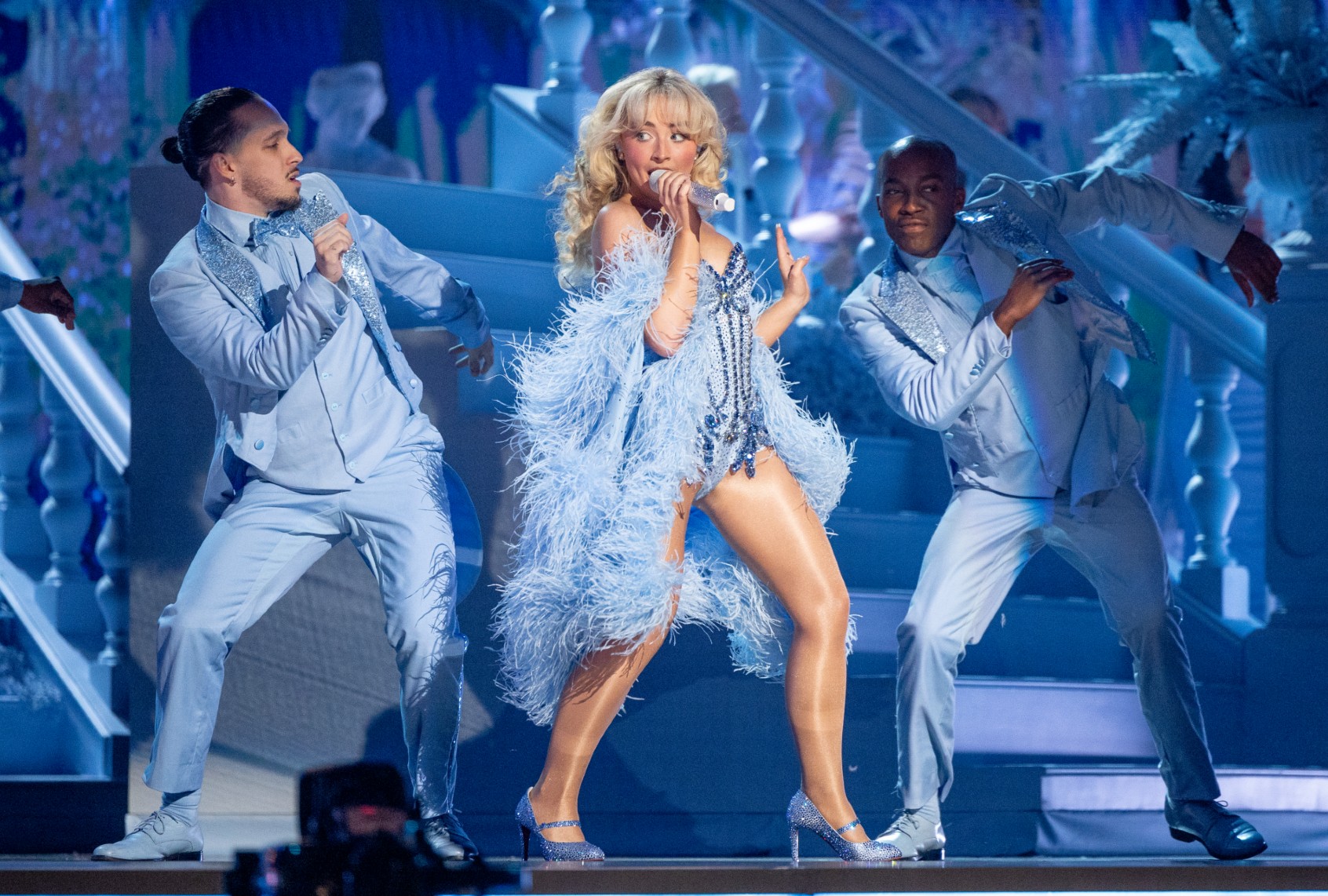
This response was frustrating. Assuming a woman is too stupid to know what she's doing, which they are doing to Carpenter, is not feminism. It's just old-fashioned sexism, disguised as progressivism. It's also joyless. Not to make everything about politics, but Donald Trump won an election recently in no small part because podcast bros — every single one of them less funny than Sabrina Carpenter — were working a "liberals are no-fun scolds" message. I would like to think that's not true, but one can see why that message resonated. People online can't even enjoy a sexy, silly album cover without going into a diatribe that implies both jokes and oral sex are unfeminist. There have been many theories out there about why younger people are having less sex than their elders, but I think we have the answer with the reaction to this album. 

Okay, okay, that last sentence was a joke. Simmer down. In truth, I think a lot of Carpenter's fans get what she's doing, because it's not much of a departure from what she was doing before. This reaction is an unfortunate relic of the internet, where people too dim to know better feel free to opine, whereas many people with more going on upstairs have the sense to shut up. Most of the hosts on "The View" seemed to get that Carpenter is being provocative, not sexist, and they aren't all that familiar with her work. I imagine there are a lot of Carpenter fans out there picking up exactly what she's putting down. 

And what is that exactly? Well, despite the irony, Carpenter is not anti-sex. On the contrary, she's a breath of fresh air, part of a larger group of young artists — including Charli XCX, Chappell Roan and Troye Sivan — who are putting lust back at the center of pop music, where it belongs. This is more true than ever, in an era where any junior high schooler with access to a phone can see hardcore pornography. Those materials can be misogynist, even violently so. But even when they're not, brief clips of people having sex decouple the act from the complex human context that defines most sex in real life. It's gynecological almost, not emotional. 

Sabrina Carpenter performs onstage at the 67th annual GRAMMY Awards on February 02, 2025 in Los Angeles, California. (Emma McIntyre/Getty Images for The Recording Academy)

That's where we need our pop stars to fill in the gaps for kids figuring this stuff out. It's not like kids are going to listen to parents or teachers. Pop stars singing about longing, love, frustration and old-fashioned lust are providing important information about what sex is for. But it's even better when they bring humor, irony and ambiguity to it, which Carpenter is especially good at. No sex ed class can teach that a blow job can feel empowering, humbling, sexy and ridiculous, all at once. But Carpenter gets it. By bringing the range of emotions and reactions people have to sex in real life — including humor and ambivalence — she's re-humanizing an act that online pornography too often flattens out. 

Making fun of the way a sexist culture imagines oral sex as "degrading" can create the release valve that lets people enjoy it in a more empowering way. Knowing other people think sex is funny, too, can be freeing. Laughing at the lyrics of "Manchild" gives female audiences a little more room to forgive themselves for all the bad boys they've dated. This is what art gives us that didactic political proclamations on Bluesky cannot: freedom to play, experiment and marinate in the gray spaces where most of life happens. 

What does Israel’s strike mean for US policy on Iran and prospects for a nuclear deal?

Israel’s strike on Iranian nuclear and military facilities has pushed the Middle East one step closer to a far wider, more dangerous regional war. It also has implications for recent U.S. diplomatic efforts toward a deal with Tehran over its nuclear program.

Iran’s immediate response – the firing of about 100 drones into Israel, many of which were shot down – appears an opening gambit; meanwhile, Israeli Prime Minister Benjamin Netanyahu has said his country’s airstrikes would continue “for as many days as it takes.”

The Conversation turned to Javed Ali, an expert on Middle East affairs at the University of Michigan and a former senior official at the National Security Council during the first Trump administration, to talk through why Israel chose now to strike and what the implications are for U.S. policy on Iran.

Why did Israel strike now?

There was a combination of factors that led up to this moment.

One of the more immediate reasons was that an International Atomic Energy Agency report found that Iran was making progress toward enriching uranium to a degree that, in theory at least, would allow Tehran to very quickly upgrade to a weapons-grade level. That is the thrust of what Netanyahu has said by way of reason for the attack now – that intelligence shows that Iran was getting closer to a possible breakout status for a nuclear weapon.

But there is a confluence of other factors that have built up over the last year and a half, ever since the Oct. 7, 2023, attack by Hamas in Israel.

Iran’s proxy Axis of Resistance – that is, regional groups aligned with Iran and supported militarily by Tehran, including Hamas and Hezbollah – doesn’t present the same level of threat to Israel as it did in the pre-Oct. 7 landscape.

In the past, an Israeli attack of the sort we are seeing now would have invited a multidirectional response from all corners of the resistance – and we saw this in the early days after the Oct. 7 attack.

As of now, none of Iran’s resistance partners have done anything in response to the latest strike – and that is, in large part, due to the fact that Israel has successfully degraded these group’s capabilities through a series of campaigns and operations. The United States has also contributed to this effort to a degree with sustained operations against the Houthis in Yemen from March to May this year, including hundreds of airstrikes.

Further, Israel’s previous attacks on Iran in April and October 2024 managed to degrade Iran’s ballistic and surface-to-air missiles and air defense radar systems. This likely played into Israel’s calculations, too.

Lastly, Israel knows that it has a strong supporter in the White House with President Donald Trump and Republicans in Congress. Washington may not be 100% aligned with Tel Aviv on every issue, but at the moment there is no criticism from the the White House or Republican members of Congress on Israel’s attacks.

But why attack before the planned US-Iran talks?

The sixth round of talks was due to take place on June 15, led by White House envoy Steve Witkoff and Iranian Foreign Minister Abbas Araghchi. Iran has signaled that the talks won’t take place now.

There may have been some dialogue between Netanyahu and the Trump administration over the timing of the Israeli strike preceding yesterday’s attacks, during which Israel would have made the case that the time is right now to launch a very different type of campaign to really set back Iran’s nuclear program. In recorded remarks about Israel’s operations, Netanyahu stated he directed his national security team to begin planning for a large-scale campaign against Iran’s nuclear program last November.

Perhaps the White House did push back, saying that it wanted to see if any progress could be made in the talks. Certainly, it has been reported that Trump told Netanyahu in a phone call on June 10 that he believed a deal with Tehran could be negotiated.

Regardless, Netanyahu still went ahead with the strike.

Indeed some observers have posited that collapsing the negotiations between the U.S. and Iran may have been one of the intentions of Netanyahu, who has long opposed any deal with Tehran and has reportedly been irked by Trump’s reversal on the issue. During his first administration, Trump unilaterally pulled the U.S. out of a previous nuclear deal.

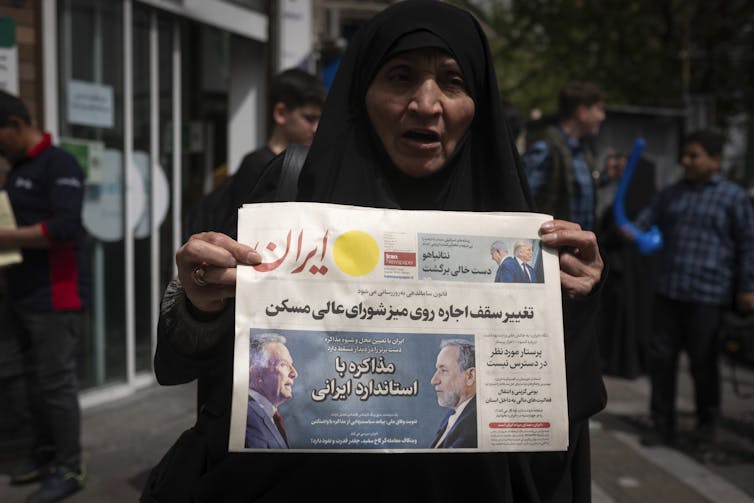
A woman holds a newspaper with Iranian writing and a photo of two men.

A newspaper shows the portraits of Iranian Foreign Minister Abbas Araghchi and White House special envoy Steve Witkoff, who were due to meet in Oman. Morteza Nikoubazl/NurPhoto via Getty Images

What should we make of the US response to the strike?

The White House hasn’t criticized Israel in its response to the strike, merely stating that it wasn’t involved.

In my assessment, the White House appears to be sincere in the substance of what it is saying: that there was no overt and direct U.S. involvement with Israel during the actual strike. As for U.S. involvement in any planning or intelligence sharing ahead of the strike, we may never know.

But this is largely messaging for Iran: “We didn’t attack you. Israel attacked you.”

The U.S. is clearly worried that any response in Tehran may involve U.S. assets in the region. In the past, parts of Iran’s proxy network have hit American bases in Jordan and Iraq. Backing up this being a real concern in Washington is the fact that in advance of Israel’s strike, it already made moves to protect some of its assets in the region and remove personnel.

Has Iran said whether US targets will be included in its response?

On June 11, Iranian Defense Minister Aziz Nasrizadeh warned that if Israel were to attack, Tehran would respond against U.S. personnel and bases in the region – but that hasn’t happened yet.

Iranian Supreme Leader Ali Khamenei and military officials must know that attacking U.S. targets would be very risky and would lead to a significant response that would likely be even more damaging than Israel’s latest attacks – including putting a potential deal over its nuclear program at risk. And the U.S. has the capability to hit Iran even harder than Israel, both militarily and through the extension of sanctions that have already been very punishing to the Iranian economy.

A man ina suit poiints at a cartoon bomb.

Benjamin Netanyahu, prime minister of Israel, points to a red line he drew on a graphic of a bomb while addressing the United Nations on Sept. 27, 2012. Mario Tama/Getty Images

Ultimately, it will be Khamenei who decides Iran’s response – and he remains firmly in control of Iran’s national security apparatus despite his advanced age. He knows he will have to walk a fine line to avoid drawing the U.S. into a military campaign.

So how might Iran respond in coming weeks?

Despite the challenges facing Iran at the moment, Iran will, I believe, have to respond in a way that goes beyond its previous attacks on Israel.

Reports of drone attacks against Israel on June 13 fit within the framework of the attack Iran launched against Israel in April 2024 that included a combined salvo of almost 300 ballistic missiles, cruise missiles and drones over several hours. Despite the damage Israel has inflicted against Iran through its series of operations, Iran probably still possesses thousands or tens of thousands of these types of weapons that it can use against various targets in the region.

Iran could look at targets outside Israel, without necessarily hitting the U.S. directly – for example, by attacking maritime targets in the Persian Gulf and in effect closing the Strait of Hormuz. U.S. military planners have long been concerned about Iranian naval attacks using small boats for ramming or small arms attacks against shipping in the Persian Gulf.

Another option would be for Iran to increase its involvement in terrorism activities in the region. Tehran’s proxy groups may be diminished, but Iran still has its Quds Force, through which the Islamic Revolutionary Guard Corps conducts nonstate and unconventional warfare. Will the Quds Force look toward targeted assassinations, bombings, or kidnappings as part of Iran’s retaliatory options? It has employed such tactics in the past.

And beyond conventional weapons, Iran also has pretty significant cyber capabilities that it has used against Israel, the United States and Saudi Arabia, among others.

Where does this leave US-Iran talks?

It would appear Trump is still holding open the possibility of some kind of deal with Iran. In his statement following the Israel attack, he warned Tehran that if it didn’t come back to the table and cut a deal, the next Israeli attack would be “even more brutal.”

The attack could push Iran into reengaging in talks that were seemingly stalling in recent weeks. Certainly that seems to be the thrust of Trump’s messaging.

But the killing of Iranian nuclear scientists in the attack, and the apparent wounding of one of the negotiators, may convince Tehran to double down on a path toward a nuclear weapon as the only means of a deterrence against Israel, especially if it suspects U.S. involvement.

Javed Ali, Associate Professor of Practice of Public Policy, University of Michigan

This article is republished from The Conversation under a Creative Commons license. Read the original article.

Expert: Forcible removal of Sen. Alex Padilla signals a dangerous shift in American democracy

Democratic leaders and a lone Republican senator, Alaska’s Lisa Murkowski, quickly decried the treatment of U.S. Sen. Alex Padilla of California and called for an investigation after he was removed from a press conference with Department of Homeland Security Secretary Kristi Noem on June 12, 2025, in Los Angeles, handcuffed and forced to the ground.

“Sir! Sir! Hands off!” Padilla, 52, shouted as several federal agents surrounded and moved him out of the room where Noem was speaking about the Los Angeles protests against immigration enforcement. “I am Senator Alex Padilla. I have a question for the secretary.”

Padilla, who unexpectedly appeared at the press conference and interrupted Noem as she was speaking during her prepared remarks, was released soon after and met with Noem. Tricia McLaughlin, the assistant secretary at the Department of Homeland Security, shared a video of the incident with Padilla on X, and wrote, “Incredibly aggressive behavior from a sitting US Senator. No one knew who he was.”

Amy Lieberman, a politics and society editor at The Conversation, spoke with Boise State University political scientist Charlie Hunt, an expert on Congress, to understand how political polarization and a shift in American political decorum may have contributed to the shocking moment of an American senator being forcibly removed from a press conference.

What is striking to you about what happened to Sen. Padilla?

What stood out to me was the aggressiveness with which Noem’s security officers detained Sen. Padilla and took him out of the room. We do not ever see something like this happen to members of Congress and particularly members of the Senate. Sen. Padilla represents 39 million people – he is not some back-bencher member of the House of Representatives. I think it’s safe to say that no other modern presidential administration has come close to treating an individual member of Congress in this way.

This is also a real turn in terms of the completely autocratic way in which Department of Homeland Security staff responded to the incident. They claimed in a social media post that Padilla didn’t identify himself at the briefing, even though, “I’m Senator Alex Padilla” were the first words out of his mouth in the video that they themselves shared.

What safeguards, if any, do members of Congress have that might protect their ability to speak freely, and publicly oppose the executive branch?

Members of Congress enjoy the same basic free speech rights that all Americans do, but they do also have an additional set of protections that are relevant to this incident.

Members of Congress have significant oversight power, which involves doing due diligence on what actions the executive branch is taking and making sure they’re complying with laws that Congress has passed.

As a Senate member from California, it’s perfectly legitimate for Padilla to want clarity on immigration enforcement actions that are taking place in Los Angeles. Padilla even clarified after the incident that he was at the press conference to get answers from the Department of Homeland Security that he and other Senate members have been seeking for weeks about deportations.

This is completely in line with Congress’ oversight power. Senators often question officials in committee hearings like we typically see, but they also conduct fact-finding missions to learn how executive actions are affecting their constituents.

Congress members also have protections stemming from the Constitution’s speech and debate clause. Essentially, they cannot be arrested or indicted for things they say in their official capacity, which – because of Congress’ oversight responsibility – Padilla was clearly within the bounds of here.

Yes, of course, Padilla was also trying to draw attention to himself and the issues he’s focused on. But it’s not against the law to be a little bit disruptive or to engage in political theater, especially thanks to these additional protections members of Congress typically enjoy.

What other factors led to this moment?

Something I’ve written about previously is a phenomenon called negative partisanship. This means that voters and Congress members alike are driven not so much by loyalty to their own party but instead a sort of seething hatred for the other political party. What gets the most clicks and views, and what drives voters more and more, is the idea that “we don’t just want to see voting along the party line – we want to see our team beating the other side into submission.” This incident with Sen. Padilla was a very literal embodiment of this principle.

More broadly, this helps explain why political violence is becoming a more accepted form of political speech, particularly on the far right.

We have seen violence during Trump’s campaigns, where hecklers would be roughed up by participants at rallies, at Trump’s encouragement. Certainly, we saw it at the Capitol attack on Jan. 6, 2021, and Trump’s subsequent pardons of those rioters.

Does Padilla’s removal have anything to do with Donald Trump specifically?

We can’t ignore the singular role Trump has played here. This is a uniquely authoritarian presidency, even much more so than the first Trump administration. By authoritarian, I mean a leader who tries to rule on his own and suppress all dissent. Trump didn’t create partisanship, political violence or negative partisanship. But there’s no getting around the fact that his past behavior and openness to violence have lowered the bar for decorum in American politics.

For example, if you have convinced your supporters that the people on the other side of the political aisle are “sick” or “nasty,” that they are going to ruin the country, then those supporters will become more willing to accept some of the actions Trump has taken, such as calling in the Marines on protesters in Los Angeles, or pardoning the Capitol attackers – even if they wouldn’t have been willing to accept that kind of response 20 years ago.

All of these things combined – negative partisanship, plus having a leader on one side that is willing to lower the decorum bar beyond where we thought was possible – is a recipe for things unfolding like we saw with Padilla.

A man speaks in front of a group of microphones, surrounded by other people.

U.S. Sen. Alex Padilla, a Democrat from California, speaks to news reporters outside the Wilshire Federal Building after he was forcibly removed from a press conference on June 12, 2025. Patrick T. Fallon/AFP via Getty Images

What will you be watching for as this situation plays out?

My concern is the balance of powers between the executive and legislative branches of government. We expect competition between the branches, for “ambition to counteract ambition,” as James Madison put it, to ensure one branch doesn’t get too powerful. This incident was a huge step in the wrong direction.

As Congress has been steadily torn apart by partisanship, it’s given up lots of its power over the past half-century and no longer seems to see itself as a coequal branch of government with the executive.

As a result, authoritarian presidents and administrations see an opening to treat them this way without consequences. What Congress does in the next several days about this episode will speak volumes – or not – about whether it intends to ever reassert itself as an equal branch of government.

Democrats held the floor in the Senate all afternoon to demand answers about Padilla’s treatment. It will be revealing how Senate Majority Leader John Thune and others respond. Lisa Murkowski has said she’s pretty appalled by what happened. Meanwhile, Lindsey Graham seemed to imply that Padilla deserved what he got. Which route will Republicans, who control Congress, take?

Charlie Hunt, Associate Professor of Political Science, Boise State University

This article is republished from The Conversation under a Creative Commons license. Read the original article.

“We will kill you graveyard dead”: Florida sheriff issues ominous warning to violent protesters

A sheriff in Florida issued an ominous warning to people planning protests opposing Immigration and Customs Enforcement raids in his county this weekend. 

“If you throw a brick, a firebomb, or point a gun at one of our deputies, we will be notifying your family where to collect your remains at,” Brevard County Sheriff Wayne Ivey said during a Friday press conference. “Because we will kill you graveyard dead.” 

“We’re not going to play,” he added. 

Demonstrations have been taking place nationwide after ICE raids and days of tension in Los Angeles in recent weeks. President Donald Trump has already authorized the deployment of 700 Marines and 2,000 National Guard troops to California. The Los Angeles Police Department said earlier this week that it had started making “mass arrests."

Roughly 1,800 nationwide rallies in opposition to ICE and the Trump administration more broadly are planned for this weekend. The demonstrations on Saturday will coincide with a military parade in Washington, D.C., celebrating the Army’s 250th birthday and Trump’s 79th. 

Ivey, the Florida sheriff, also threatened protesters who turn “violent” in other ways — including by resisting orders, blocking intersections, fleeing arrest or gathering around cars to stop traffic — with jail time and hospitalization. 

Speaking earlier this week, Trump pledged to crack down on any protesters in the nation’s capital during his planned parade, saying that they would be met with “very heavy force.”

The DOGE 100: Musk is out, but more than 100 of his followers remain to implement Trump’s blueprint

ProPublica is a Pulitzer Prize-winning investigative newsroom. Sign up for The Big Story newsletter to receive stories like this one in your inbox.

In an effort launched shortly after DOGE’s creation, ProPublica has now identified more than 100 private-sector executives, engineers and investors from Silicon Valley, big American banks and tech startups enlisted to help President Donald Trump dramatically downsize the U.S. government.

While Elon Musk has departed the Department of Government Efficiency, the world’s richest man is leaving a network of acolytes embedded inside nearly every federal agency.

At least 38 DOGE members currently work or have worked for businesses run by Musk, ProPublica found in an examination of their resumes and other records. At least nine have invested in Musk companies or own stock in them, a review of available financial disclosure forms shows.

ProPublica found that at least 23 DOGE officials are making cuts at federal agencies that regulate the industries that employed them, potentially posing significant conflicts of interest. One DOGE member tasked with overseeing mass layoffs at the Consumer Financial Protection Bureau, for instance, did so while owning stock in companies the agency regulated.

At least 12 remain, on paper, employees or advisers of the companies they worked at before DOGE, a review of financial disclosure forms shows. And at least nine continue to receive corporate benefits from their private-sector employers, including health insurance, stock vesting plans or retirement savings programs. These employment agreements could create a situation in which a DOGE staffer would be shaping federal policies that affect their employer.

The people behind DOGE are largely men in their 20s and 30s, most of whom bring no government experience to the task. Many of them previously worked in finance.

ProPublica’s list — the largest of its kind by any news organization — allows readers to gain a comprehensive understanding of the backgrounds of the people assigned to one of the Trump administration’s signature efforts. It comes at a crucial moment, as some of the first-generation DOGE members are leaving the government and a new crop is joining.

“Even though Elon Musk and some of his top officials are shifting their attention to other issues, I see no indication that the DOGE team members who remain will slow down their work to test the legal and ethical boundaries of using technology in the name of improving government services,” said Elizabeth Laird, a director at the nonprofit Center for Democracy & Technology.

While the Trump administration asserts it is the most transparent in history, DOGE operates shrouded by the shadows of bureaucracy.

Many of its staffers have deleted their public profiles, have wiped the internet of their professional backgrounds or were encouraged by leadership not to discuss their work with friends. At the behest of the Trump administration, the Supreme Court halted a court order Friday that would have required DOGE to turn over information to a government watchdog — challenging whether the group will ever be subject to public records requests. The Trump administration has banned DOGE staffers from speaking publicly without approval.

To cast a light on this secretive group, ProPublica began reporting in February on Musk’s influence inside the Trump administration, cataloging who was part of DOGE and how associates of the billionaire tech mogul were taking up senior posts across agencies. Our DOGE tracker, the first such list published by media outlets, is the culmination of hundreds of conversations with sources across government.

Today, we are adding 23 staffers to our tracker, taking the total to 109. They are spread throughout the government, from the Department of Defense to the General Services Administration to the Securities and Exchange Commission.

And we are revealing the makeup of the DOGE team at the Defense Department, a group made up primarily of tech startup founders. They are led by former Special Forces soldier turned tech entrepreneur Yinon Weiss, according to a former senior Pentagon official familiar with the matter, who spoke on condition of anonymity for fear of retribution. Weiss has repeatedly appeared on Fox News pushing the U.S. to do more to support Israeli military operations in Gaza. He did not respond to a request for comment.

A White House official praised DOGE in an interview, saying that “bringing people in from the outside is precisely what this federal government needed after decades of stagnant bureaucrats who allowed the status quo to continue while the American people got screwed.”

The White House official said there is “no need” for the public to know who’s in DOGE and asserted that there have been no conflict-of-interest violations.

“For decades, we’ve been able to operate without these people's names,” the official said. “There’s no need to know the palace intrigue of who’s working in the building.”

Musk has defended DOGE’s work as “common sense” and “not draconian or radical.” He did not respond to requests for comment.

Musk’s retreat from Washington comes after his electric vehicle company Tesla sputtered amid economic turmoil — caused by a mixture of his own declining favorability and some shareholders reportedly losing confidence in his leadership. His relationship with Trump has fractured, with the billionaire blasting the president’s budget, Trump threatening to cancel Musk’s government deals and Musk then calling for the president’s impeachment.

How that fissure affects DOGE is yet to be seen, but the White House has already requested $45 million in funding for the group’s operations next year, an Office of Management and Budget document shows.

One of Musk’s top DOGE lieutenants, Steve Davis, who ProPublica reported has operated as the group’s de facto leader, is also departing government. Davis ran DOGE from the commissioner’s suite on the sixth floor of the GSA. Some believe Trump loyalist and OMB Director Russell Vought, a Project 2025 architect who once said he wanted to put federal workers “in trauma,” will take the DOGE reins.

Questioned Results

Whether DOGE has accomplished its mission — to downsize the federal bureaucracy into a more streamlined and effective workforce — is far from clear.

Musk initially said the initiative would save taxpayers $2 trillion. He later amended that figure, suggesting in April that DOGE would cut $150 billion from the national debt this year. The $180 billion in savings that DOGE claims on its website has come under scrutiny by media fact-checkers who have cast doubt on its accuracy after finding errors in DOGE’s accounting of canceled contracts.

Still, DOGE has fired tens of thousands of federal workers and gutted humanitarian aid programs domestically and abroad. This includes pushing out some critical government employees in health, science and safety offices.

To compile our list, ProPublica tracked the industries where DOGE employees previously worked. We looked at the professional experience they brought to government and whether their assignments in DOGE could pose conflicts of interest. ProPublica pored through archived resumes, federal financial disclosures forms, online databases and other documents. We interviewed more than two dozen federal workers, some of whom shared internal agency emails, calendar invites and other material mapping DOGE’s activities. We sought comment from everyone listed in our tracker. Most declined our requests.

With DOGE entering a post-Musk chapter, here are our core findings:

Potential conflicts of interest are increasing.

One 25-year-old software engineer helped DOGE shrink the agency’s staff even after he was warned by ethics attorneys not to do anything that could boost the value of as much as $715,000 in stocks he owned in companies regulated by the agency. The White House has said the aide, who has since left the CFPB, “did not even manage” the layoffs and called the allegations “another attempt to diminish DOGE’s critical mission.” Another DOGE staffer, a political adviser to Musk, was paid between $100,001 and $1 million by one of his billionaire boss’ companies while simultaneously overseeing staff cuts at the CFPB. Neither staffer responded to requests for comment.

These and other instances of DOGE staffers overseeing government operations that could benefit their financial interests have prompted three Democratic lawmakers to ask the Department of Justice, government ethics officials and inspectors general to investigate.

The administration has made assessing such financial arrangements difficult. So far, federal agencies have released only 22 financial disclosure forms for the more than 100 DOGE members requested by ProPublica.

DOGE’s image as a group of computer engineers isn’t quite right.

The DOGE 100-plus come from a variety of professions: 29 were executive managers, 28 were engineers, 16 were investors and 12 came from legal backgrounds. A scattered few others previously worked in cybersecurity, design and science.

More staffers come from finance backgrounds than any other area. Private equity investor Michael Cole, the founder of Shareholder Capital LLC, has worked at the Department of Agriculture, for example. Cole did not respond to a request for comment.

DOGE staffers are mostly young men with limited government experience.

Under Trump and Musk, DOGE has become a largely male entity. Of the 109 staff members ProPublica has identified, 90 are men and 19 are women, making the group 83% male. That’s a far higher percentage of men than work in the executive branch as a whole, where 54% of staffers are male, according to 2024 data from the Office of Personnel Management.

Many are young and inexperienced. More than 60% of the DOGE staffers are in their 20s or 30s. One was 19 when he joined. As a percentage, the number of staffers under 30 in DOGE is about three times as high as in the executive branch as a whole.

Of staffers for whom ProPublica has identified ages, 28 are 29 or younger, 35 are 30 to 39, and 36 are 40 or older. The oldest is 67.

Few had experience working in state or federal government. ProPublica identified 21 DOGE staffers with previous government roles, including stints at the DOJ and NASA. That means more than 80% joined the government dismantling effort without previously working in government.

Those staffers continue to fire longtime federal employees, cut budgets and choke off government programs while protected by an administration that has pushed to keep their maneuverings out of the public spotlight.

DOGE’s secrecy has been part of its overall strategy, some experts believe, allowing it to obscure its work from government watchdogs and the courts.

“It’s harder to stop what they’re doing if you don’t know what they’re doing or who’s doing it,” said Faith Williams, director of the Effective and Accountable Government Program at the nonpartisan, nonprofit Project on Government Oversight. “It’s not inherently a bad thing these people come from outside the government. It’s that they lack any experience in the methods used to uncover waste and inefficiency.”

“Excellent”: Trump praises “very successful” Israeli attack on Iran

President Donald Trump told the Wall Street Journal on Friday that he knew in advance of Israel’s plans to strike Iran.

Responding to a question about what kind of heads-up he had gotten before the attacks, Trump said, “Heads up? It wasn’t a heads-up. It was, we know what’s going on.” 

In separate media calls on Friday morning, Trump called the strikes “excellent” and “a very successful attack,” stressing that his administration supported Israel “like nobody has ever supported it.” 

Speaking to CNN’s Dana Bash, Trump pushed Tehran to reach a deal with him.

“Iran should have listened to me when I said — you know, I gave them, I don’t know if you know, but I gave them a 60-day warning and today is day 61,” he said.


Start your day with essential news from Salon. Sign up for our free morning newsletter, Crash Course.


In a phone call with ABC News’ Jonathan Karl, Trump warned that there was “a lot more” to come from Israel’s military attacks.  He later elaborated on social media, urging Tehran to agree to a new nuclear deal, and warning the country of further bloodshed it not.

In the immediate aftermath of the attacks, Secretary of State Marco Rubio tried to distance the U.S. from Israel’s actions, calling them “unilateral.”

“We are not involved in strikes against Iran and our top priority is protecting American forces in the region,” Rubio said in a statement. Reports say that the strikes killed at least four top Iranian officials, as well as nuclear scientists. Iranian state media says that at least 78 people were killed and 329 injured during the attacks.  

Ending manhood in the hall of shame

Thanks to our current misbegotten model of manhood, we are once again arguing about this moral question: Should former Cincinnati Reds player and manager Pete Rose be inducted into Baseball’s Hall of Fame?

In a sane time, the proper answer would be: Are you kidding?

Maybe many of you reading this couldn’t care less.

Unfortunately, you probably should care because the real question in these chaotic times of ours is: What does the Hall of Fame stand for? In the same way, you might now wonder what America stands for and whether, in our moment, Pete Rose — bully, liar, cheat, sexual predator and fan-favorite superstar athlete — has, in fact, become a sports surrogate for Donald Trump.

Back in my sports-writing days for the New York Times, I must admit that I liked Rose for some of the same reasons I liked that other shady character I covered — Trump. They were accessible, friendly and could always be depended on for a quick, good-enough story.

That kind of careerism should, of course, be considered shameful in the journalism trade and might, in its own strange way, also be considered one of the reasons we find ourselves in our current crisis.

Though one of them is dead and the other is still all too with us, Rose and Trump are indeed of the same era, so who can be sure which of them gave permission for the deformed growth of the other, or whether both of them are parallel products of the same toxic all-American climate that has changed far too little over all these years? Of course, they both grew up in a time when, for men, bad behavior, especially toward women, was often excused, if not encouraged, as part of a winner’s attitude.

And here we are in the second presidency of Donald J. Trump facing revived interest in forgiving Rose, now falsely glorified as yet another white man trapped in a fantasy conspiracy against white men.

And here we are in the second presidency of Donald J. Trump facing revived interest in forgiving Rose, now falsely glorified as yet another white man trapped in a fantasy conspiracy against white men. Under the circumstances, who could be surprised that Trump has promised to pardon Rose?

Rose was infamously guilty of compromising the integrity of baseball by betting on games he managed. Recently, after meeting with Trump, Baseball Commissioner Rob Manfred erased a previous commissioner’s 1989 ruling that banned Rose from baseball for life. And like all too many other American institutions, baseball has good reason to listen to Trump. For one thing, its clubs can’t afford to lose access to international talent any more than Harvard University and other institutions of higher education can. At the moment, in fact, two of its most exciting performers are the Los Angeles Dodgers’ Shohei Ohtani of Japan and the New York Mets’ Juan Soto of the Dominican Republic. And there are plenty of other foreign nationals in the pipeline. Another vulnerability for baseball would be possible government restrictions on sports gambling.

As Dave Zirin, who writes the Edge of Sports column, points out: “[Commissioner] Manfred may allow Trump to bask in the smell of his own influence, but this decision is rooted in something bigger: the sport’s surrender to the gambling-addiction economy, which could, in theory, be subject to federal or legal intervention… This has been a year when ethical guidelines once held as eternal have been shredded. MLB’s embrace of online betting signals the demise of another principle in a time of abject moral carnage.”

Trump Cleared the Bases

Banning Pete Rose presumably denied his possible election to the Hall of Fame with its bonanza of personal and financial rewards. Rose died last year at 83, thus completing his life sentence. With Trump’s apparent urging, however, the bases have now been cleared for his resurrection.

Betting on sporting events is clearly not in the same league with shredding the safety net, hamstringing higher education or subverting the rule of law, but it’s still part of the same game: aggrandizing illegal control, flexing power and making yet more money. Think of it this way: Rose and Trump competed in exactly the same style.

Washington Post sports columnist Sally Jenkins best summed up the case against Rose, writing that he “was a habitual degenerate who never showed remorse for a thing — not for gambling on his own games or malicious cheap shots such as fracturing Ray Fosse’s shoulder in the 1970 All-Star Game. He even showed zero contrition after he was accused in a sworn statement of having sex with a girl who said she was no more than 14 or 15 years old at the time, excusing himself by claiming he thought she was 16 and ‘who cares what happened 50 years ago?‘ “

Like the presidential vote for Trump in 2024, the polls for or against Rose’s induction (should he make it to a Hall vote) will be close. People are passionate about the subject, especially Rose supporters who point out how gambling on sports, once forbidden except in Las Vegas, is now a welcome partner of the American major leagues, both a fresh revenue stream and a lure for the younger audience that has drifted off to the Internet follies. What was once seen as an existential threat to the sport is now embraced as a savior.

Remarkably, as recently as the 1980s, two Hall of Fame icons, Mickey Mantle and Willie Mays, were banned from baseball for taking part-time jobs as gambling-casino greeters. Ironically, it was Mantle and his Yankee teammate Whitey Ford who gave the young Pete Rose the snarky nickname “Charlie Hustle” for how hard he played the game.

Give Rose credit, however. He was a gamer who made the most of less-than-elite skills with hard work and intensive play. As with Trumpers, there is indeed something cultish about his boosters. To them, he represents more than record-breaking statistics — his lifetime count of 4,256 hits has never been matched — and passionate competition (he slid hard, careless of an opponent’s bones). He was a blue-collar digger, distinctly a symbol of merit in its latest Trumpian definition.

In fact, it’s not hard to imagine Pete on that flying clubhouse the Qataris recently gave our president. He was always full of vulgar stories and bro cheer.

In his off-field life, he was also a symbol of manhood, again as Trump would understand the term. In fact, it’s not hard to imagine Pete on that flying clubhouse the Qataris recently gave our president. He was always full of vulgar stories and bro cheer. His style of life and play had the vicious exuberance now so politically recognizable.

Admittedly, covering Rose in the 1960s and 1970s was always fun, though tinged with that cringey touch of guilty-pleasure-discomfort that’s so recognizable today. Sportswriters are conditioned to excuse that very feeling as part of a boys-will-be-boys creed. At his core, Rose was distinctly a bad boy and stories about, say, his awarding an extracurricular paramour an expensive ankle bracelet that spelled out “my rookie of the year,” trapped sportswriters into being his accomplices.

I remember with retrospective shame my own early cluelessness about Rose. One time, a teenage girl, writing for her high school newspaper, was roughly shunted aside by the sportswriter pack before a Cincinnati Reds game. Rose noted what was going on, took the girl aside and gave her an exclusive interview. Sometime after, I used that incident as an example of his decency. I got the side-eye from a seasoned sportswriter who then explained that Rose was simply practicing what, years later, would be called “grooming.”

Giamatti and Rose

Like Trump, Pete was canny without appearing particularly intelligent. (Of course, of the two of them, only Rose has been in prison so far — five months for tax evasion.) But he was also stubborn in ways that would prove self-destructive. In 1989, newly elected Baseball Commissioner A. Bart Giamatti, a retired Yale University president and English Renaissance literature scholar, banned Rose for life after an investigation that proved painful for both men. Then managing the Reds, Rose refused to tell the truth about his gambling, though he finally confessed to it in his 2004 autobiography and began — yes! — selling autographed baseballs with “Sorry I bet on Baseball” on them. Giamatti, who loved baseball, found it hard to put the sport through such an ordeal. He eventually brokered a settlement, allowing Rose to voluntarily accept banishment for life in return for no further punishment.

Eight days after announcing the decision, Giamatti died of a heart attack at 51. Over the years, despite his record as a fair-minded humanist, that story has been spun into a symbolic tale of class warfare — elite Ivy Leaguer versus popular working-class model player — that only helped solidify the continuing pro/con split on reinstating Rose.

Recently, sportswriter Michael Bamberger brought the essence of the story right up to our own time with this anecdote:

Anything populist is smack-dab in Trump’s wheelhouse. Years ago, during an interview, he turned the tables and asked me how I felt about the 50-game suspension that the prodigious home-run hitter Manny Ramirez had received for violating baseball’s rules on performance-enhancing drugs. I gave a high-minded, bag-of-wind answer of support. Trump smirked and said pleasantly, "I do not care. I just want to see them hit the long ball.”

Not that Rose ever hit many home runs, but Trump’s allusion to the 1999 Nike commercial, “Chicks dig the long ball,” captured the sentiments of both men. The power and cash that came with it were shamelessly recognized as the reigning currency of sports and politics. Manhood was what you could get away with. Standing up for fairness, decency and equality was weak and silly. As Trump would remind us, it was for suckers.

We need your help to stay independent

The Hall of Famers Weigh In

Current members of the Hall of Fame on a “veteran’s committee” will be able to vote on Rose’s membership in 2027 and, based on what’s currently known about the opinions of such players, it looks as if he’ll stand a good chance of making it. The players just can’t seem to understand their fans’ sense of betrayal at Rose tipping the balance of games. They tend to focus on him instead through the lens of their own careers.

Rose’s teammate on the Phillies toward the end of his playing career, all-star third baseman Mike Schmidt, typically said: “I see both sides. I see that he squandered so many opportunities to change his life and go forward… There wasn’t remorse there. He didn’t show any atonement for his admission to betting on baseball. But at the same time, Pete Rose is one of the greatest players in the history of baseball, without question. Statistically and for what he did in his career, he would be a unanimous Hall of Famer.”

Jim Palmer, an upstanding and righteous pitcher and broadcaster, may understand the hypocrisy of baseball’s new embrace of gambling, but it’s still a narrow issue for him. He said: “Every time I do my broadcast and our opening is sponsored by [gambling site] Draft Kings, I go, ‘And Pete’s not in the Hall of Fame.’”

Even pitcher Jim Kaat, among the smartest of major leaguers, sees it through a boys-eye view of other boys who could be the collateral damage of a Rose reinstatement. “If I were on that committee,” he said, “the first question would be, ‘Do we just look at Pete for what he did on the baseball field?’ And if that’s the case, that’s a no-brainer. [But] you can only vote for three, so what do you do about Tommy John and Dale Murphy and guys like this who have never been [accused of] anything like that off the field. Then it’s going to hurt their cases.”

And what about the rest of us? You know, the ones conditioned to believe that honesty, fairness and yes, the rule of law pertain to everyone and that sports should be the crucible of good character that defines us forever? When did those precepts of manhood become rules for losers? When did Pete Rose get a pass because he was so good at hitting a baseball and Donald Trump because he was so good at — what was that? — entertaining some of us? And what should a Hall of Fame, a shrine, or for that matter a presidency stand for? Forget about his criminality and his alleged sexual misconduct — as if that shouldn’t be enough to cancel your admission to a shrine (or the White House) — his betting on his own baseball games with its obvious at least minimally subliminal effect on their outcomes should be considered a treacherous act by one of the game’s faithful. It may not have been felonious enough to demand civil punishment, but it certainly required banishment from the game and from any of its rewards.

So here we are and, of course, I can’t help wondering why I’m even discussing something as seemingly trivial and, yes, even soft, at a time when our lives are threatened. In response, let me offer this possibility: Maybe it’s because Pete Rose was another of the thugs who mugged us on the dark road to dishonor and — yes, in Donald Trump’s case — even possibly tyranny. So stopping his beatification is just the sort of thing we need to do if we hope to put his version of manhood into the Hall of Shame and transform ourselves into the patriotic beast that will strike Donald Trump out.

Worse than Orbán: Trump is trying to bring his opposition to heel

In March 2024, Donald Trump hosted Hungarian Prime Minister Viktor Orbán at Mar-a-Lago. After years of receiving praise and pilgrimages from the American right, the autocrat had begun appearing at conservative events in the U.S. Instead of visiting the White House to see then-President Joe Biden, Orbán spoke at the Heritage Foundation — the conservative think tank behind Project 2025 — before heading to Florida. “He’s a non-controversial figure," Trump told a crowd at Mar-a-Lago upon Orbán's arrival, "because he says, ‘This is the way it’s going to be,’ and that’s the end of it. Right? He’s the boss.”

Trump loves that.

Orbán's Hungarian regime has often been characterized as modern authoritarianism or a "hybrid regime of electoral autocracy," one in which power is accumulated by the ruling party over time through creative quasi-legal means. He focused on transforming institutions by changing election laws, allowing him to create legislative supermajorities while winning a mere plurality of the vote. He packed the courts with loyalists, found friendly oligarchs to buy up independent media and took over universities — or forced them to close down. He hammered on culture war issues of immigration, nationalism and family values.

Observers have seen these methods as the way to perpetuate a soft-authoritarianism, enacted smoothly without the violence that authoritarian governments have traditionally employed to quell opposition and consolidate power. The right-wing intelligentsia has seemed to see this as a kind of respectable fascism — without all the 20th century unpleasantness with which the term is associated.

But people around Trump have certainly scrutinized Orbán's methods, and they seem to have convinced Trump to import the Hungarian model to the U.S.

I doubt that Donald Trump has studied Orbán's strategy. He doesn't study anything. Since his temperament is dictatorial by nature, much of his agenda is naturally autocratic. But people around Trump have certainly scrutinized Orbán's methods, and they seem to have convinced Trump to import the Hungarian model to the U.S.

Over the past five months, the Trump administration has moved quickly, using "shock and awe" to stun the opposition and enact as much of their agenda as they can, as fast as they can. As Hungarian political scientist Peter Kreko told NPR, "I think Trump went further in two months than Orbán could in 15 years. In the United States, it reminds me of a constitutional coup, where everything happens very rapidly."

The American right knows that Trump hasn't got that kind of time, and it's entirely possible that, once he's gone, the MAGA coalition will break apart. It is, after all, as much a cult of personality as it is a political movement. 

For his part, it appears Trump has no interest in "soft authoritarianism" or merely marginalizing his opposition. We have heard testimony from people in his first term who had to talk him down from shooting protesters and deploying the military in the streets of American cities. This time around, Stephen Miller, the architect of the administration's draconian deportation plan, has found a way to let Trump be Trump — to use the massive police power at, and sometimes beyond, his disposal to force his opposition to its knees.

Trump has effectively turned the Immigration and Customs Enforcement (ICE) agency into a secret police force that abducts people off the streets and transports them to unknown locales, including at least one foreign black site prison. These kidnappings have been targeted in areas run by the president's political opponents and rely on openly confrontational tactics designed to produce a backlash in order to justify militarizing American cities. And if that's not enough to make his point, this weekend Trump is staging a military parade through the streets of Washington.

This week, his hand-picked U.S. Attorney (and former personal lawyer and assistant) in New Jersey indicted a sitting congresswoman for allegedly "impeding law enforcement" when she was attempting to conduct oversight at an immigration detention center. Yesterday, California's senior senator, Alex Padilla, was tackled, pushed face-first to the ground and handcuffed for attempting to ask Homeland Security Secretary Kristi Noem a question during a press conference following her chilling declaration that the federal government would not be removing the National Guard and the Marines from Los Angeles.

"We are not going away," Noem said. "We are staying here to liberate the city from the socialists and the burdensome leadership that this governor and that this mayor have placed on the country and what they have tried to insert into the city."

Noem's explanation for the crackdown defied logic. Despite Padilla announcing who he was, and despite the fact that Noem has testified before his Senate committee, she claimed nobody knew who he was and that she thought she was being threatened. Republican members of Congress, as well as right-wing media personalities and members of the administration, quickly took to parroting Noem. 

We need your help to stay independent

Speaker of the House Mike Johnson actually called for Padilla's censure while Republican Senate Majority leader John Thune said he's "gathering information." Maine Sen. Susan Collins found it "disturbing" and Alaska's Lisa Murkowski said it was "shocking on every level." Padilla told MSNBC that a couple of other Republican colleagues had texted him personally but haven't spoken out publicly. A few other GOP colleagues are condemning him for being inappropriate.

“If this is how this administration responds to a senator with a question," Padilla said afterwards, "you can only imagine what they’re doing to farmworkers, to cooks, to day laborers.” 

What's happening in Los Angeles — and now, in the rest of the country — is clearly not about protests. It's not even simply about immigration and mass deportations. That would be horrible enough. Now, members of the opposition — duly elected Democratic politicians — are being brought to heel, arrested and roughed up. The administration has been so effective at flooding the zone, and we are becoming so anesthetized to its threats and violence, that we have seemingly moved on from this fact: The President of the United States publicly called for the arrest of Gov. Gavin Newsom. 

This isn't Viktor Orbán's modern autocracy, all clean and shiny. It's something worse: good old-fashioned 20th-century fascism, as dirty and ugly as it ever was. 

Gavin Newsom rediscovers fighting MAGA is popular

Gov. Gavin Newsom wanted to play nice with the MAGA movement after Donald Trump's 2024 election win. Before Trump's demoralizing victory in November, the California Democrat had been building up his reputation as a political brawler, willing to go toe-to-toe with even the creepiest figures of the MAGA movement. In 2023, he even had a faux-presidential debate with Republican Gov. (and soon-to-be-also-ran) Ron DeSantis of Florida. Even as Newsom's theatrics annoyed some folks, I can't deny it was effective. When people outside of the politics-and-journalism professions talked to me about a Democrat they found intriguing, it was almost always either Newsom or Rep. Alexandria Ocasio-Cortez of New York. 

Then Trump won, and a whole bunch of Democrats panicked. Although it was a squeaker of an election — it's easy to forget that, despite sweeping all seven swing states, Trump barely won —his false claims of a "landslide" got into many Democratic heads. Incorrect conclusions were drawn, among them that the country had dramatically shifted to the right and, therefore, Democrats must as well. Newsom became the face of this error, because he can't help but screw up with the same drama he brings to everything else. In an ill-fated effort to make nice with MAGA, Newsom started a podcast promising "honest discussions with people that agree AND disagree with us," all "without demeaning or dehumanizing one other." But that goal was undermined when he offered lightweight, normalizing interviews to MAGA leaders like Charlie Kirk and Steve Bannon, ignoring how they built their careers by demeaning people.

This quisling attitude has been endemic with Democrats in the face of Trump's white nationalism-fueled efforts to deport millions of immigrants, the vast majority of whom are innocent of any real crime. Earlier this week, 75 House Democrats disgraced themselves by voting for a Republican resolution expressing "gratitude" to Immigration and Customs Enforcement (ICE) as they reign terror on health care workers and farmers the president continues to demonize as "criminals." (The majority of House Democrats, 113, including Minority Leader Hakeem Jeffries, opposed the resolution.)


Want more Amanda Marcotte on politics? Sign up for her free newsletter, Standing Room Only.


Newsom, however, doesn't have the luxury to focus group-test an "immigrants are human: yes or no?" message. His state is under siege right now from a lawless president whose only goal is to stoke violence. But while Newsom has no other choice to fight back, these past few days, he has risen to the occasion in a way that even the most cynical can't deny. After Trump lobbed threats of arrests his way, the governor called his bluff. He dared Trump to arrest him, forcing the president to back down in the manner of all cowardly bullies. Newsom sued the White House to stop the illegal deployment of the National Guard against mostly peaceful protesters. And, crucially, he's been speaking about this whole disaster with a refreshing honesty that is all too rare among consultant-addicted Democrats.

In a Tuesday night televised speech, Newsom rejected Trump's claim that he deployed the National Guard to keep the peace. Instead, Newsom explained, Trump is "fanning the flames" and, crucially, "he did it on purpose." He went on to explain the situation accurately in plain, unmistakable language: "That’s just weakness, weakness masquerading as strength. Donald Trump’s government isn’t protecting our communities. They are traumatizing our communities. And that seems to be the entire point."

All week, Newsom has been talking like a normal person who is understandably outraged over watching his state become a punching bag for Trump's anti-immigrant tantrum. In an interview with progressive YouTuber Brian Tyler Cohen, Newsom was crystal clear in explaining that Trump's actions caused the violence. He also spoke the blunt truth about the president and the people around him. Trump, he said, is a "stone cold liar." Defense Secretary Pete Hegseth is "a joke" and "everyone knows it." Republican Speaker of the House Mike Johnson is also "a joke." Newsom seemed exhausted, but still fired up and done playing games. It's a good look.

Even progressives who have a dim view of Newsom's motives or authenticity are here for it:

honestly one of the most encouraging recent developments is the naked opportunism of Governor Gavin Newsom, and I pray that there are copycats www.washingtonpost.com/technology/2…

[image or embed]

— Olúfẹ́mi O. Táíwò (@olufemiotaiwo.bsky.social) June 11, 2025 at 12:38 PM

But of course, being a progressive, I am expected to set aside my instincts and assume the average American is too stupid or bigoted or poisoned by right-wing propaganda to see what I see. This is the point where I am required to overcome my audience's skepticism by checking my reactions against the all-seeing data. On that front, I have good news for readers: the polls show the public is on Newsom's side. 

A new poll from Quinnipiac finds that Trump's approval ratings on immigration, which had previously been strong, have fallen. Among the sample of registered voters, only 43% approve of how he is handling immigration issues, while 54% disapprove. These numbers are the inverse of where he typically stands on the issue, one of the few where Trump has traditionally retained the public's trust. It appears that some number of Trump voters really did believe the lie that he only wanted to go after "criminals," and they are now upset that his administration is targeting school children, pregnant women and construction workers — all people who are easier to scoop up than actual criminals. Meanwhile, YouGov polling shows only 38% of Americans approve of Trump usurping Newsom's authority to mobilize the National Guard — and that's in a climate where the mainstream press continues to credulously repeat Trump's claim that it was done to "protect" Los Angeles, instead of being an effort to provoke violence. 

Other Democrats should pay attention to both Newsom and these polls — and get out of their defensive crouch over immigration or the protests. Ocasio-Cortez, who has reliably talked like a real person for her entire time in public office, said it well on Bluesky:

It is 100% carrying water for the opposition to participate in this collective delusion that Dems for some reason need to answer for every teen who throws a rock rather than hold the Trump admin accountable for intentionally creating chaos and breaking the law to stoke violence. They are in charge.

— Alexandria Ocasio-Cortez (@aoc.bsky.social) June 10, 2025 at 8:44 PM

As Jamelle Bouie of the New York Times wrote Wednesday with regard to the White House, "The immediate recourse to repressive force; the inability to handle even modest opposition to its plans; the threats, bullying and overheated rhetoric — it betrays a sense of brittleness and insecurity."

The smart move for Democrats is to stand up to Trump, because it's the only way to expose how the president has no other cards to play. Polls already show people are cluing into the fact that Trump is the problem here, not the solution. Newsom is using this moment wisely to repeat the truth: That this is Trump's fault.

A new Barbara Walters documentary delves into the sometimes unflattering truth of her life

Barbara Walters is arguably as fascinating as the politicians, dictators and celebrities she interviewed over her long and storied career. Hired in 1961 to write “women’s features” for NBC’s “Today Show,” she was eager to expand beyond the “soft, fluffy” stories and to be taken seriously as a journalist. In 1974, she became the first woman co-host on "The Today Show," before taking a $1 million salary to move to ABC to co-anchor “The Evening News with Harry Reasoner.” 

At ABC, Walters faced alienation and sexism, but she also scooped her rivals (Walter Cronkite among them) by securing major interviews, such as one with Menachem Begin and Anwar Sadat. It was also at ABC where Walters became the go-to for special interview programs where she talked candidly with newsmakers — from former presidents to famous celebrities. Her approach, which often involved probing questions, intended to humanize her subjects, including Monica Lewinsky to Moammar Gadhafi. In her third act, she co-hosted and produced the wildly successful talk show, “The View.”

"I wanted the film to be real and true, and there are some not necessarily flattering things, but they are revealing of who she was."

The illuminating documentary, “Barbara Walters Tell Me Everything,” recounts the TV journalist’s remarkable career, which paved the way for so many women journalists, including mentees Oprah Winfrey and Katie Couric, who are interviewed for the film, which additionally touches upon Walters' rivalry with Diane Sawyer

Director Jackie Jesko also delves into Walter’s personal life — her complicated relationship with her parents as well as the daughter she adopted, her failed marriages and her awkward relationships with Senator Edward Brook and Roy Cohn

Jesko emphasizes the difficulties Walters faced feeling as an outsider in a male-dominated environment, her personal and professional ambitions and setbacks, as well as her triumphs. But the film also shows how TV journalism changed and grew over the decades. There will never be another Barbara Walters; she was a role model to so many. 

Jesko spoke with Salon about making “Barbara Walters: Tell Me Everything” at the Tribeca Film Festival. 

The following interview has been lightly edited for length and clarity. 

Barbara Walters means so much to so many people. What was your first impression of her?

My cultural memory of Barbara Walters was her on “The View” as a much older woman. I remember the Monica Lewinsky interviews — everyone remembers those — but it was her on “The View” as the “Grande Dame” of the show. I honestly didn’t know all that much about her life outside of her appearances on “The View.” I obviously knew about her career, but not her life. 

Is there an interview she did that most impressed you? 

For me, it was the Fidel Castro interview she did in 1976. I wish we were able to use it all. There were hours and hours of raw footage. The two of them went back and forth for an entire day, 24 hours of filming, and she was able to wrap him around her finger in a lot of ways and push him out of his comfort zone. It was amazing to watch.

Barbara Walters interviewing Katharine Hepburn as shown in "Barbara Walters Tell Me Everything" (ABC News Studios)
What decisions did you make about how to approach Barbara Walters, who had such a big and rich life? You create a tone that is celebratory, but also candid and sometimes critical. 

It was important to me not to make a hagiography. I don’t find those kinds of films interesting. Everybody knows she was a complicated woman. It was hard in the beginning to look at her career and decide what stories to go with. Her own autobiography, “Audition,” became my guide, and the things she talked about in that were important and became the map. It’s a great book. She really went for it. I wish she had done an audiobook. It would have made our lives a lot easier. [Laughs]

There are fantastic clips of Walters at work on camera and off. How many hours of footage did you comb through, and what was your criteria in terms of what to include and how to include it?  

It was hard to make decisions, because you don’t want to tell the same story over and over again. You have to decide what each of these interviews you delve into represents or shows. Castro and Gadhafi are very similar, so we only went with one of them. To answer your question, I should find out how many terabytes of footage it was, but it was extremely intimidating to walk into the archives. ABC opened up a vault that I don’t think they had opened up before, that was just kind of everything Barbara had ever done for ABC, and that was the vast majority of her career. It was hard to decide what to focus on, but I started out as a news producer — my first job was at ABC — and I knew we’d find the most hidden footage, off-the-cuff stuff in shoots where she had to travel somewhere physically, rather than in-studio, because you shoot more on a trip. We started with Egyptian President Anwar Sadat and Israeli Prime Minister Menachem Begin, to see what we could find in the cutting room floor footage. We found some great stuff, but also in the regular sitting interviews. 

Likewise, you feature an impressive lineup of talking heads for the film, including Oprah, Bette Midler, Katie Couric, Cynthia McFadden and Joy Behar, among others. How did you determine who to interview and what stories to recount? 

Barbara had so many seasons to her life and so many things she was interested in, so we wanted to make sure there wasn’t too much overlap in the talking heads interviews as well. I knew she had a special relationship with Oprah — they had a true relationship; it was not that she was talking about Barbara because she was famous. They knew each other. I knew Cynthia McFadden from my time at "Nightline," and she was an incredible interview. We wanted to pull from both sides of the camera. Bette and Monica were people who sat across from Barbara. Joy was part of “The View,” and I think that was Barbara’s proudest chapter.

Barbara Walters interviewing Moammar Gadhafi as seen in "Barbara Walters Tell Me Everything" (ABC News Studios )
Walters was a trailblazing journalist. She faced tremendous sexism but figured out ways to succeed. She was very shrewd in her coverage of politics, celebrities and “tabloid” stories. Walters was also pitted against Diane Sawyer professionally. There is a comment that her work was transactional. What were your thoughts about her career?

"She certainly understood where the eyeballs were going, and she wanted to be watched."

I wanted the film to be real and true, and there are some not necessarily flattering things, but they are revealing of who she was. That is the point of the film. I hope people walk away understanding what kind of person she was, what drove her. Everybody knows her work. It was not like we were going to blow anyone’s mind with that. It was public work. Everyone has seen it. People know some things about her life, depending on how much of a fan they are. [Laughs] But I felt that we had to do everything, which includes her controversial friendships, the whole thing with Diane Sawyer, and how she changed what was defined as news. And that has been subject to a lot of criticism. Was it fair? Some of it I am neutral on. But she certainly understood where the eyeballs were going, and she wanted to be watched.

In contrast, “romance never worked in her life,” as one interviewee in the film says. Her marriages were unsatisfying. Her affair with Senator Brooke had to be kept secret (since he was married), and she had that weird relationship with Roy Cohn. What observations do you have about her personal life? 

I think that she led an incredibly big life, and maybe these different partnerships were good for her when they were good, but I don’t think she needed that to be happy. I understand that.


Start your day with essential news from Salon. Sign up for our free morning newsletter, Crash Course.


What do you think of how the playing field for women journalists has changed? 

Women are now dominating television news. I don’t think there is a position they haven’t held. They have been presidents of networks, worked in front of the cameras and behind the cameras. In terms of a gender equality industry, they have pretty much arrived. 

Why can there not be a Barbara Walters today?

"I think the reason there can’t be another Barbara Walters is because there is no way to get an audience of 70 million people to watch anything."

The industry itself has been in decline. I think the reason there can’t be another Barbara Walters is because there is no way to get an audience of 70 million people to watch anything. I think some of the podcasters might be taking over that space a bit, but the idea that you can capture an entire country is just gone. Social media has changed everything, and the way we get information is so different now. I think there are pros and cons to that. It is not a value judgment, but it would be impossible for a television journalist to get the audiences that Barbara got, and therefore, they could never be as powerful in shaping public opinion as she was.

Walters was famous for asking tough questions. What would you have asked Barbara Walters if you could have spoken to her for this film?

That’s a good question, and not one I’ve given a lot of thought to. I actually would like to know if there is a love of her life. I don’t know that there was. 

“Barbara Walters: Tell Me Everything” had its world premiere at the Tribeca Festival on June 12, before launching on Hulu and Hulu on Disney+ June 23rd.

“Protests fall far short of rebellion”: Judge blocks Trump from deploying National Guard in L.A.

A federal judge barred Donald Trump from deploying the California National Guard in response to protests in Los Angeles.

U.S. District Court Judge Charles Breyer ruled on Thursday that the president's takeover of the troops in California was unlawful and ordered Trump to return control of the state-level force to Gov. Gavin Newsom.

Breyer wrote that "the founders" intended control of the National Guard to remain with states.

"It is not the federal government’s place in our constitutional system to take over a state’s police power whenever it is dissatisfied with how vigorously or quickly the state is enforcing its own laws," he wrote.

While the president does have the power to mobilize the National Guard under the Insurrection Act, Breyer felt the protests against Immigration and Customs Enforcement raids in Southern California failed to qualify as an insurrection.

"Individuals’ right to protest the government is one of the fundamental rights protected by the First Amendment, and just because some stray bad actors go too far does not wipe out that right for everyone," he wrote. "The protests in Los Angeles fall far short of ’rebellion.'”

Breyer's ruling goes well beyond the request for a restraining order filed by Newsom. The governor had asked for an order that barred Marines and National Guard members deployed in Los Angeles from being used in law enforcement actions. The ruling, in effect, cancels the deployment of thousands of National Guard troops to the area. The ruling orderes Trump to return control to Newsom by midday Friday.

The ruling did not order any action with regard to the several hundred Marines deployed in the state. Defense Secretary Pete Hegseth refused to answer questions from members of Congress on Thursday about how he would respond to court orders. 

“What I can say is we should not have local judges determining foreign policy or national security policy for the country,” Hegseth said during a hearing.

Israel launches “preemptive strike” against Iran

After days of escalating tensions, Israel has launched an attack on Iran.

Israeli government officials called the move a "preemptive strike" in an emergency message to citizens. While declaring a state of emergency throughout the entire country, Defense Minister Israel Katz warned that retaliatory strikes were expected.

"Following the State of Israel's preemptive strike against Iran, a missile and drone attack against the State of Israel and its civilian population is expected in the immediate future," a message from Katz read.

The Associated Press shared that explosions were reported in Tehran. The outlet added that the explosions had been acknowledged by state television in Iran. An unnamed Israeli official who spoke to the AP said that the wave of attacks targeted nuclear sites and military outposts.

It is not the first missile exchange between the two countries since Hamas militants attacked Israel on October 7. In late 2024, Iran launched an air attack on several sites in Israel, with many of the missiles being intercepted. Israel attacked key parts of Iran's air defense system that same month.

The strike comes after days of President Donald Trump hoping that cooler heads would prevail. The U.S. and Iran are in the middle of talks around a potential nuclear deal, and Trump administration insiders told Axios that the president has no desire to follow Israel into a wider war in the region. Trump had reportedly urged Israeli President Benjamin Netanyahu not to carry out such a strike.

The White House has yet to respond to news of the airstrikes publicly.

“Impossible to replace”: Trump admits his immigration policy is hurting farmers, hotel owners

President Donald Trump has to face the truth: his deportation-led immigration policy is hurting many American industries.

In a post to Truth Social, the president admitted that Immigration and Customs Enforcement raids across the country have diminished the workforce in the hospitality and farm sector.

“Our great Farmers and people in the Hotel and Leisure business have been stating that our very aggressive policy on immigration is taking very good, long time workers away from them, with those jobs being almost impossible to replace,” Trump wrote.

According to the U.S. Department of Agriculture, 42% of crop farmworkers are undocumented. He promised "changes" that would help these industries, without getting into specifics.

At the White House on Thursday, Trump continued the conversation on the economic impact of deportations.

"Our farmers are being hurt badly. They have very good workers. They've worked for them for 20 years,” Trump said. “They're not citizens, but they've turned out to be great, and we're going to have to do something about that."

https://x.com/BulwarkOnline/status/1933205206755340390 

When asked what changes the president expects, Department of Homeland Security spokesperson Tricia McLaughlin told Axios nothing new.

"We will follow the President's direction and continue to work to get the worst of the worst criminal illegal aliens off of America's streets," she said.

It’s unclear how Trump's statements fit into the administration’s current immigration policy. Trump’s border czar, Tom Homan, has made targeting work sites a priority.

“You’re going to see more work site enforcement than you’ve ever seen in the history of this nation,” he told reporters recently. “We’re going to flood the zone.”

Trump adviser Stephen Miller has set a goal of 3,000 deportations a day, intending to carry out one million deportations in Trump's first year.

“You’re an embarrassment”: Carbajal demands Hegseth’s resignation over dodged questions

Sparks flew in Pete Hegseth's third straight day of congressional hearings, as a House member demanded the defense secretary's resignation.

The heated exchange between Rep. Salud Carbajal, D-Calif., and Hegseth came after the head of the Pentagon dodged a number of questions from members of the House Armed Services Committee on Thursday. 

Hegseth had already evaded inquiries about the deployment of troops to Los Angeles and the possibility of plans on invading Greenland and Panama. When Carbajal asked Hegseth if serving in the Trump admin required a loyalty test, Hegseth pushed the representative over the edge when he avoided a direct answer and called the question “silly.” 

“I’m not going to waste my time anymore,” Carbajal said. “You’re not worthy of my attention or my questions. You’re an embarrassment to this country. You’re unfit to lead, and there’s been bipartisan members of Congress that have called for your resignation. You should just get the hell out and let somebody competently lead this department.”

On Thursday, Hegseth was grilled by lawmakers about the Trump administration's decision to deploy the California National Guard and several hundred Marines to Los Angeles. That deployment has been challenged in court by California Gov. Gavin Newsom.  Rep. Ro Khanna, D-Calif., asked Hegseth if he would abide by a court's ruling in that suit.

"Can you assure the American people of two things: you will respect any Supreme Court decision on this matter about whether the Marines are constitutional, and you will respect the district courts when they rule before the Supreme Court rules?” she asked.

Hegseth balked.

“What I can say is we should not have local judges determining foreign policy or national security policy for the country,” he said. 

Also on Thursday, Hegseth puzzled Democrats and Republicans when he failed to definitively answer questions about whether the administration intends to invade Greenland and Panama. Instead of offering a clear answer, Hegseth repeatedly said the Pentagon has “plans” for various scenarios. 

“Any contingency you need, we’ve got it. We’ve got a building full of planners, and we’re prepared to give recommendations whenever needed,” Hegseth said. 

“Hands off!”: Sen. Padilla dragged from Noem news conference and handcuffed

Sen. Alex Padilla was dragged out of a news conference in Los Angeles on Thursday afternoon, after attempting to ask questions of the Department of Homeland Security head Kristi Noem.

The Democrat from California was handcuffed while Noem spoke about the ongoing protests of ICE raids in Southern California.

"We are staying here to liberate this city from the socialist and the burdensome leadership that this governor and this mayor have placed on this country," Noem said.

Padilla spoke up to say that Noem was "exaggerating and embellishing" before being confronted by security. Padilla then identified himself as a senator.

"I have questions for the secretary," Padilla said as he was removed from the room.

Padilla yelled "hands off" before being led away by police and forced to the ground. As he was being handcuffed, an unknown man told Padilla's staffer to stop filming.

"There's no recording allowed out here per FBI rights," the man said. 

Padilla released a statement about the altercation, saying that he'd hoped to get "some answers" about "the deployment of military forces and the needless escalation in Los Angeles." 

"If that’s what they do to a United States Senator with a question, imagine what they can do to any American that dares to speak up," he said.

The Department of Homeland Security also released a statement on the encounter, saying that Noem met with Padilla after the event for a private conversation. 

"Senator Padilla chose disrespectful political theatre and interrupted a live press conference without identifying himself or having his Senate security pin on as he lunged toward Secretary Noem," they said. "Mr. Padilla was told repeatedly to back away and did not comply with officers’ repeated commands. Secret Service thought he was an attacker and officers acted appropriately."

California Gov. Gavin Newsom defended Padilla in a post to BlueSky, calling him "one of the most decent people I know." Newsom said the arrest was "outrageous, dictatorial, and shameful."

"Trump and his shock troops are out of control," he wrote. 

Padilla's fellow Democratic senators also rushed to defend him. Senate Minority Leader Chuck Schumer took his anger to the Senate floor, demanding "immediate answers" for "what the hell went on." 

"I just saw something that sickened my stomach," Schumer said, "the manhandling of a United States Senator."

In the lower chamber, House Speaker Mike Johnson, R-La., called for Padilla's censure.

“I think that that behavior at a minimum rises to the level of a censure,” Johnson said. “I think there needs to be a message sent by the body as a whole that that is not what we’re going to do, that’s not what we’re going to act.”

“Incredibly demonic”: Candace Cameron Bure says scary movies open a portal

Candace Cameron Bure said that she doesn’t want anyone watching scary movies in her house because they could be “a portal” to something “demonic.” 

On a recent episode of her eponymous podcast, Bure explained that she’s wary of horror films and video games because of what they might invite into their home.

"Like if you’re watching this, or you’re playing this video game, or whatever, that’s a portal that could let stuff inside our home,” Bure said. “I don’t even want someone watching a scary movie in our house on the TV, because to me, that’s just a portal."

Bure has had a long career in Hollywood. She famously played D.J. Tanner in“Full House” and has starred in a number of TV movies. Despite her decades of work in front of the camera, she's still disquieted by horror films. 

“Listen, I’m in the film industry,” Bure said. “I know that movie has a crew of 200 people, and they’re lighting it, and they’re adding the sound effects, and it’s makeup, and the camera, people, and actors. However, there’s still something that can be incredibly demonic while they’ve made it.”

Bure is an outspoken, conservative Christian and is the chief creative officer for Great American Family, which describes itself as “America’s premier TV destination for quality family-friendly programming.” 

In spite of her expertise in media, Bure admitted that her family doesn't take her portal talk seriously. She said her children and husband make fun of her when she talks about some “spiritual thing” in their home.

"They make fun of me all the time — but particularly when I’m serious about a spiritual thing happening, and then they’re rolling their eyes at me,” she said.

“This is not over”: Weinstein rape case ends in mistrial after jury foreman quits

A New York judge has declared a mistrial in the rape case brought against Harvey Weinstein.

Weinstein was facing his second trial on charges of criminal sexual acts and rape. The Miramax co-founder's 2020 conviction was overturned last year.  A mistrial was declared on a single count of third-degree rape when the jury foreman refused to return to deliberations on Thursday. 

The jury foreman informed Judge Curtis Forber early Wednesday that he would not return to jury chambers. The foreman claimed his fellow jurors were "attacking" one another while discussing Weinstein's rape count, telling Farber that he "cannot go back inside with those people."  

The foreman also claimed that some jurors were threatening him. When asked by Farber if he would return on Thursday, the foreman refused. Facing this, Farber declared a mistrial on Weinstein's rape count.  

Before dismissing the remaining jurors, Farber spoke with them. 

"I will say they were extremely disappointed that deliberations ended before they reached a verdict," Farber said. "They all thought they were involved in a normal discourse, and they don't understand why the foreperson bowed out."   

The same volatile jury found Weinstein guilty of a first-degree criminal sexual act involving film producer Miriam Haley on Wednesday, while acquitting him of an additional similar count involving model Kaja Sokola. The third count, which ended in a mistrial, involved actress Jessica Mann.   

Arthur Aidala, an attorney for Weinstein, said the defense plans to appeal the guilty count. 

"We have very powerful evidence that there was gross juror misconduct at this trial," Aidala told reporters at the courthouse. "This is not over." 

“Egregious conduct”: Kilmar Abrego Garcia’s attorneys seek sanctions against Trump administration

Kilmar Abrego Garcia’s attorneys have asked a Maryland judge to put severe sanctions on the Trump Administration over its defiance of earlier court orders to facilitate his return to the United States.

Abrego Garcia, a Maryland father who was wrongfully deported to El Salvador in March, despite an immigration court order saying he couldn’t be deported there, was returned to the U.S. last week. He’s now in federal custody and facing federal criminal charges in Tennessee that allege he trafficked undocumented immigrants across state lines. He has a court hearing set for Friday where he will enter a plea.

Even before Abrego Garcia’s return to the country, his attorneys have been vocal about the Trump administration’s continued defiance of court orders. But Wednesday night’s request for sanctions might be the most damning yet, with Abrego Garcia’s attorneys arguing that the government’s defiance of court orders constitutes “egregious” conduct.

“The lengths the Government has gone to resist discovery relating to these core questions raises a strong inference that the Government is trying to hide its conduct from the scrutiny of this Court, the Plaintiffs, and the public,” his attorneys wrote. “What the Government improperly seeks to hide must be exposed for all to see.”


Start your day with essential news from Salon. Sign up for our free morning newsletter, Crash Course.


Since Abrego Garcia’s deportation, Maryland Federal District Court Judge Paula Xinis has expressed her own frustration with the administration.

Abrego Garcia’s attorneys say the Trump administration’s defiance has “not been subtle” and requested that Xinis sanction the administration with fines, the appointment of a “special master” to investigate the government’s noncompliance, civil contempt of court, and fines.

The attorneys suggest that the Department of Homeland Security’s acting general counsel, Joseph Mazzara, may have given untruthful testimony.

“It’s shameful”: CBO finds lowest-income families will take big hit under GOP’s “beautiful” bill

The “One Big Beautiful Bill Act” will cost the lowest-income households in the country roughly $1,600 per year, according to an analysis by the Congressional Budget Office (CBO) released on Thursday.

That total amounts to a nearly 4% reduction in federal resources for households in the bottom 10% of the income distribution. The loss is primarily due to cuts in Medicaid and SNAP benefits, according to the nonpartisan CBO’s analysis. 

Conversely, resources for households in the top 10% would increase by an average of $12,000, which represents an estimated 2.3% growth. Households in the middle of the income distribution are expected to see a modest increase in federal resources. The increases for these groups come largely from tax cuts. 

“CBO already confirmed that House Republicans are planning to strip health care from 16 million people — just to help pay for tax breaks for billionaires,” House Budget Committee Ranking Member Brendan Boyle, D-Pa, shared in a statement. “Now the nonpartisan referee’s latest analysis shows this would be one of the largest transfers of wealth from working families to the ultra-rich in American history. It’s shameful.”

Boyle was one of the two Democratic lawmakers to request the report from the budget office. In an accompanying post on X, he wrote that “Trump is literally stealing from the poor to give to the ultra-rich.”

The legislation passed the House by a 215-214 vote in May, but has not yet been voted on in the Senate. 

Ban Trump? Top genocide scholar issues dire warning

He is deploying troops to occupy opposition-held cities, openly soliciting bribes from the world’s dictators and threatening to annex his democratic neighbors, all while sending people guilty of literally nothing to foreign prisons where they are expected to remain until the day they die. That’s it: that’s the case for treating President Donald Trump, the authoritarian head of an increasingly belligerent nation, like an international pariah.

“Normally, I would agree that diplomacy is better than isolating an adversary,” Dr. Gregory H. Stanton, founding president of Genocide Watch, a group that aims to predict and punish targeted mass murder, told Salon.

A former State Department official, Stanton watched from afar the genocide in Rwanda and the world’s failure to do anything about it, later authoring a 10-stage guide to knowing how and when such killings are set in motion (one early sign: those in power likening members of an ostracized class to “animals, vermin, insects or disease”). He is careful with his words, using the term “genocide,” for example, only when it meets the narrow definition of international law; he is a sober scholar who, like others who have studied history, has been forced by events to sound increasingly alarmist.

Stanton insists that diplomacy with Trump is worse than a lost cause. The American president is no “ordinary adversary” who can be wined, dined and reasoned with, he said, but someone who “stands far outside the bounds of diplomacy and the rule of law between civilized nations.”

“He is a Nazi,” Stanton insisted. “Negotiating with Nazis didn’t prove useful in 1939. It won’t now either.”

When world leaders gather for the G7 Summit in Canada, among them will be a man who has repeatedly argued that the host country should not exist as a free and sovereign nation—that its very foundation was a historical accident, and one that demands correction via annexation. Genocide Watch is among those urging Prime Minister Mark Carney to reconsider the invite. (Global Affairs Canada, which manages the country's diplomatic relations, declined to comment.)

We need your help to stay independent

The White House itself says Trump's threats are no joke, with Press Secretary Karoline Leavitt describing Canada as the “soon-to-be 51st state.” Carney’s predecessor also insisted that his American counterpart was deadly serious.

“Mr. Trump has it in mind that the easiest way to do it is absorbing our country,” former Canadian Prime Minister Justin Trudeau told business leaders earlier this year, saying he’s after the country’s mineral wealth and that his threats to annex the country are “a real thing.”

Why, then, would you invite someone like that — someone who has insulted you and threatened to take all you hold dear — into your home? Does that project strength, to a bully? Will it be interpreted as such?

In 2014, after Russia illegally annexed Crimea, the world’s leading economies decided that it was no longer worth inviting Vladimir Putin to have tea and scones at the now-defunct G8; diplomacy in the decade before, clung to as the only means of preventing another armed conflict on European soil, had through the mirage of steady engagement blinded Western leaders to the possibility of an imminent war and soothed consciences as they deepened their dependence on Russian fossil fuels.


Start your day with essential news from Salon. Sign up for our free morning newsletter, Crash Course.


Trump is today lobbying for Russia’s return to the G7/G8 because, perhaps, he recognizes something that America’s erstwhile allies do not: that there is no difference, morally speaking, between the White House and the Kremlin, both of which desire a world where lip service to universal truths (and rights and wrongs) is dropped in favor of vulgar, thuggish self-interest, pursued without apology.

It is not easy to accept that “it” is actually happening here — that the descent into right-wing authoritarianism could be so rapid, the institutions of democracy so weak, the orchestrator of it all such an obvious and venal perversion of the American ideal — and harder still to quit one’s economic dependence on a superpower, however much it may be imploding. But, a decade from now, it might also be hard to believe that countries didn’t pursue their own rational self-interest and isolate a man who befriended their enemies, threatened their homes and sent their citizens to Guantánamo Bay.

“We will not allow people to enter our country who wish to do us harm,” Trump said when issuing his latest, sweeping travel ban, barring people from a dozen countries from ever setting foot in the former land of the free. The rest of the world, recognizing that fascism entails projection, might now wish to consider their own security.

“Democracy is not guaranteed”: J6 police sue over House GOP’s failure to recognize insurrection

Two officers present at the January 6 insurrection filed a lawsuit Thursday after Speaker of the House Mike Johnson, R-La., and congressional Republicans refused to install a memorial plaque marking the 2021 insurrection.

The lawsuit names Thomas Austin, architect of the Capitol, as the defendant. The real target, though, appears to be Johnson, who has failed to instruct the Capitol archictect to install the plaque; he plaintiffs hope the lawsuit will compel him to do so.

The plaque currently sits in a basement on Capitol Hill. It reads: “On behalf of a grateful Congress, this plaque honors the extraordinary individuals who bravely protected and defended this symbol of democracy on January 6, 2021. Their heroism will never be forgotten.”

At a press conference, Rep. Jamie Raskin, D-Md., was joined by former Capitol Police Officer Harry Dunn and D.C. Metropolitan Police Officer Daniel Hodges, both present at the Capitol on Jan. 6. Hodges was badly injured during the attack.

“And yet,” Raskin said, “their heroism has already been forgotten and submerged and suppressed by Speaker Johnson and Donald Trump and the others who refused to put the plaque up and are doing everything they can to rewrite the history of what actually happened on January 6.”

“We haven’t asked for much,” Dunn said. “We’ve asked for accountability, and we’ve asked for the plaque to be put up.” Dunn said officers wanted acknowledgment for those members of law enforcement who were present at the insurrection, as well as accountability from those who rioted.

We need your help to stay independent

A law passed in the March 2022 government spending bill declared, “the Architect of the Capitol shall obtain an honorific plaque,” and “shall place the plaque at a permanent location on the western front of the United States Capitol.” It was supposed to be completed by March 2023. In January 2024, Johnson was “determining a path forward” for the plaque, according to a spokesperson speaking with Roll Call.

“It didn’t work. So, now we’re working with the courts to compel Congress to follow their own law,” said Dunn.

A spokesperson for Johnson did not immediately respond to a request for comment.


Start your day with essential news from Salon. Sign up for our free morning newsletter, Crash Course.


“I just want to see the law followed and the plaque put up where it belongs,” said Hodges. He went on to argue that the plaque should stand as a reminder of the insurrection and for “the sacrifices that were made.”

“You know, democracy is not guaranteed,” Hodges continued. “Our republic is only as strong as the people who participate in it.”

Over 140 officers were injured and wounded in the attack on the Capitol. One officer died of a stroke, and four others died by suicide in the following months.

Poll: 60% of Americans says Trump’s military parade is a waste of money

A majority of Americans believe President Donald Trump’s upcoming military parade in Washington, D.C., is not a good use of government funds, according to an AP-NORC poll published on Thursday. 

Sixty percent of survey respondents, including 80% of Democrats and 72% of independents, said that the parade was not money well spent. The event, which will celebrate the U.S. Army’s 250th anniversary and coincide with the president’s 79th birthday, is estimated to cost taxpayers up to $45 million. It will feature nearly 7,000 troops, 50 aircraft and 28 tanks. 

The poll, which surveyed 1,158 U.S. adults between June 5 and June 9, also found that a 40% plurality of respondents "strongly” or “somewhat” approved of Trump’s decision to hold the parade. The survey showed that 31% neither approved nor disapproved, and 29% said they “strongly” or “somewhat” disapproved. Nearly 80% of people who said they neither approved nor disapproved of the parade agreed that it was not a good use of government funds.

A separate recent poll, conducted by Data for Progress and Common Dreams, found that a majority of veterans opposed a military parade “in honor of President Trump's birthday.” Some critics have noted the hypocrisy of holding this event as the Trump administration proposes significant funding cuts to veterans’ benefits. 

Grassroots groups are planning protests against Trump on the same day as the parade. Earlier this week, the president pledged that any protesters who disrupt the celebration will be met with “very big force.” 

Brian Wilson’s obsession with perfection lit a fire under The Beatles

As we memorialize Brian Wilson’s death on Wednesday at age 82, it is difficult to comprehend the vast extent of his musical legacy. Indeed, the scope of his creative imprint is all but incalculable. As the leader of The Beach Boys, he elevated American music and the notion of recording artistry in one fell swoop in the mid-1960s. In so doing, he stoked the aspirations of no less than The Beatles, establishing a loose rivalry that would reshape the face of popular music in the bargain. That legacy continues to resound into the present day.

Much has been written about Wilson’s well-known struggles with mental health-related issues and drug abuse. But perhaps his greatest peril—and simultaneously, his most formidable strength—involved artistic ambition. In the early '60s, he contented himself as the pop songsmith behind a succession of Beach Boys hits in “Surfin’ USA,” “Surfer Girl,” “Fun, Fun, Fun,” “I Get Around” and “Help Me, Rhonda,” among a host of others. But by 1964, Wilson had come to realize that his ambitions for popular music were much grander than The Beach Boys’ sun-kissed brand could ever hope to accommodate. 

Things began to come to a head with “Don’t Worry Baby,” Wilson’s thinly veiled rewrite of The Ronettes’ “Be My Baby,” which he considered to be pop’s finest moment. After The Ronettes and producer Phil Spector declined to record the composition, The Beach Boys landed a Top 40 hit with the song. But Wilson nevertheless felt the sting of rejection, as well as the notion that he could be—nay, should be—producing more profound music than The Beach Boys’ fanciful image seemed to imply.

"The Beach Boys" during a recording session, 1966. (Michael Ochs Archives/Getty Images)

Wilson’s aspirations for a more lasting legacy began to flower more fully by 1965. Freed from the tyrannical control that his father Murry had exerted over The Beach Boys’ direction as their manager, Wilson made a self-conscious stab at greatness. With the hit single “California Girls,” Wilson began shifting his approach to the group’s music precipitously, devoting inordinate effort to constructing the song’s introduction. His ambitions were buoyed even further by The Beatles’ breakthrough LP "Rubber Soul." For Wilson, the album was a revelation, challenging him to rethink the possibility of a record album as an artistic statement.


Start your day with essential news from Salon. Sign up for our free morning newsletter, Crash Course.


In 1966, Wilson led The Beach Boys in the production of "Pet Sounds," the magnum opus that elevated the group’s stature for all time. With standout tracks like “Wouldn’t It Be Nice” and “God Only Knows,” "Pet Sounds" found Wilson pushing the boundaries of experimentation and instrumentation in the studio, foisting his name among the likes of Beatles producer George Martin in terms of redefining the bounds of recording artistry. 

That same year, with his painstaking production of The Beach Boys’ blockbuster single “Good Vibrations,” Wilson seemed poised to explore even greater musical ramparts. Unchecked drug abuse and his deteriorating mental condition stalled Wilson’s efforts on The Beach Boys’ next album, "Smile," which he billed as a “teenage symphony to God.” Meanwhile, The Beatles, with their own ambitions having been stoked by Wilson and The Beach Boys’ attainments with "Pet Sounds" and “Good Vibrations,” produced generation-eclipsing artistic statements of their own with "Revolver" and "Sgt. Pepper’s Lonely Hearts Club Band."

While the balance of his creative life would be overshadowed by "Pet Sounds" and “Good Vibrations,” Wilson’s visionary approach to the recording studio has echoed across the decades, demonstrating that popular music held the power both for stimulating mass entertainment, as well as elevating the senses. Paul McCartney has famously remarked that "Pet Sounds" “blew me out of the water,” adding that “no one is educated musically till they’ve heard that album.”