Spring Sale: Get 1 Year, Save 58%

Billionaire Harlan Crow bought property from Clarence Thomas. The justice didn’t disclose the deal

ProPublica is a Pulitzer Prize-winning investigative newsroom. Sign up for The Big Story newsletter to receive stories like this one in your inbox.

In 2014, one of Texas billionaire Harlan Crow’s companies purchased a string of properties on a quiet residential street in Savannah, Georgia. It wasn’t a marquee acquisition for the real estate magnate, just an old single-story home and two vacant lots down the road. What made it noteworthy were the people on the other side of the deal: Supreme Court Justice Clarence Thomas and his relatives.

The transaction marks the first known instance of money flowing from the Republican megadonor to the Supreme Court justice. The Crow company bought the properties for $133,363 from three co-owners — Thomas, his mother and the family of Thomas’ late brother, according to a state tax document and a deed dated Oct. 15, 2014, filed at the Chatham County courthouse.

The purchase put Crow in an unusual position: He now owned the house where the justice’s elderly mother was living. Soon after the sale was completed, contractors began work on tens of thousands of dollars of improvements on the two-bedroom, one-bathroom home, which looks out onto a patch of orange trees. The renovations included a carport, a repaired roof and a new fence and gates, according to city permit records and blueprints.

A federal disclosure law passed after Watergate requires justices and other officials to disclose the details of most real estate sales over $1,000. Thomas never disclosed his sale of the Savannah properties. That appears to be a violation of the law, four ethics law experts told ProPublica.

The disclosure form Thomas filed for that year also had a space to report the identity of the buyer in any private transaction, such as a real estate deal. That space is blank.

“He needed to report his interest in the sale,” said Virginia Canter, a former government ethics lawyer now at the watchdog group CREW. “Given the role Crow has played in subsidizing the lifestyle of Thomas and his wife, you have to wonder if this was an effort to put cash in their pockets.”

Thomas did not respond to detailed questions for this story.

In a statement, Crow said he purchased Thomas’ mother’s house, where Thomas spent part of his childhood, to preserve it for posterity. “My intention is to one day create a public museum at the Thomas home dedicated to telling the story of our nation’s second black Supreme Court Justice,” he said. “I approached the Thomas family about my desire to maintain this historic site so future generations could learn about the inspiring life of one of our greatest Americans.”

Crow’s statement did not directly address why he also bought two vacant lots from Thomas down the street. But he wrote that “the other lots were later sold to a vetted builder who was committed to improving the quality of the neighborhood and preserving its historical integrity.”

ProPublica also asked Crow about the additions on Thomas’ mother’s house, like the new carport. “Improvements were also made to the Thomas property to preserve its long-term viability and accessibility to the public,” Crow said.

Ethics law experts said Crow’s intentions had no bearing on Thomas’ legal obligation to disclose the sale.

The justice’s failure to report the transaction suggests “Thomas was hiding a financial relationship with Crow,” said Kathleen Clark, a legal ethics expert at Washington University in St. Louis who reviewed years of Thomas’ disclosure filings.

There are a handful of carve-outs in the disclosure law. For example, if someone sells “property used solely as a personal residence of the reporting individual or the individual’s spouse,” they don’t need to report it. Experts said the exemptions clearly did not apply to Thomas’ sale.

The revelation of a direct financial transaction between Thomas and Crow casts their relationship in a new light. ProPublica reported last week that Thomas has accepted luxury travel from Crow virtually every year for decades, including private jet flights, international cruises on the businessman’s superyacht and regular stays at his private resort in the Adirondacks. Crow has long been influential in conservative politics and has spent millions on efforts to shape the law and the judiciary. The story prompted outcry and calls for investigations from Democratic lawmakers.

In response to that reporting, both Thomas and Crow released statements downplaying the significance of the gifts. Thomas also maintained that he wasn’t required to disclose the trips.

“Harlan and Kathy Crow are among our dearest friends,” Thomas wrote. “As friends do, we have joined them on a number of family trips.” Crow told ProPublica that his gifts to Thomas were “no different from the hospitality we have extended to our many other dear friends.”

It’s unclear if Crow paid fair market value for the Thomas properties. Crow also bought several other properties on the street and paid significantly less than his deal with the Thomases. One example: In 2013, he bought a pair of properties on the same block — a vacant lot and a small house — for a total of $40,000.

In his statement, Crow said his company purchased the properties “at market rate based on many factors including the size, quality, and livability of the dwellings.”

He did not respond to requests to provide documentation or details of how he arrived at the price.

Thomas was born in the coastal hamlet of Pin Point, outside Savannah. He later moved to the city, where he spent part of his childhood in his grandfather’s home on East 32nd Street.

“It had hardwood floors, handsome furniture, and an indoor bathroom, and we knew better than to touch anything,” Thomas wrote of the house in his memoir, “My Grandfather’s Son.”

He inherited his stake in that house and two other properties on the block following the death of his grandfather in 1983, according to records on file at the Chatham County courthouse. He shared ownership with his brother and his mother, Leola Williams. In the late 1980s, when Thomas was an official in the George H.W. Bush administration, he listed the addresses of the three properties in a disclosure filing. He reported that he had a one-third interest in them.

Thomas was confirmed to the Supreme Court in 1991. By the early 2000s, he had stopped listing specific addresses of property he owned in his disclosures. But he continued to report holding a one-third interest in what he described as “rental property at ## 1, 2, & 3” in Savannah. He valued his stake in the properties at $15,000 or less.

Two of the houses were torn down around 2010, according to property records and a footnote in Thomas’ annual disclosure archived by Free Law Project.

In 2014, the Thomas family sold the vacant lots and the remaining East 32nd Street house to one of Crow’s companies. The justice signed the paperwork personally. His signature was notarized by an administrator at the Supreme Court, ​​Perry Thompson, who did not respond to a request for comment. (The deed was signed on the 23rd anniversary of Thomas’ Oct. 15 confirmation to the Supreme Court. Crow has a Senate roll call sheet from the confirmation vote in his private library.)

Thomas’ financial disclosure for that year is detailed, listing everything from a “stained glass medallion” he received from Yale to a life insurance policy. But he failed to report his sale to Crow.

Crow purchased the properties through a recently formed Texas company called Savannah Historic Developments LLC. The company shares an address in Dallas with Crow Holdings, the centerpiece of his real estate empire. Its formation documents were signed by Crow Holdings’ general counsel. Business records filed with the Texas secretary of state say Savannah Historic Developments is managed by a Delaware LLC, HRC Family Branch GP, an umbrella company that also covers other Crow assets like his private jet. The Delaware company’s CEO is Harlan Crow.

A Crow Holdings company soon began paying the roughly $1,500 in annual property taxes on Thomas’ mother’s house, according to county tax records. The taxes had previously been paid by Clarence and Ginni Thomas.

Crow still owns Thomas’ mother’s home, which the now-94-year-old continued to live in through at least 2020, according to public records and social media. Two neighbors told ProPublica she still lives there. Crow did not respond to questions about whether he has charged her rent. Soon after Crow purchased the house, an award-winning local architecture firm received permits to begin $36,000 of improvements.

Crow’s purchases seem to have played a role in transforming the block. The billionaire eventually sold most of the other properties he bought to new owners who built upscale modern homes, including the two vacant lots he purchased from Thomas.

Crow also bought the house immediately next door to Thomas’ mother, which was owned by somebody else and had been known for parties and noise, according to property records and W. John Mitchell, former president of a nearby neighborhood association. Soon the house was torn down. “It was an eyesore,” Mitchell said. “One day miraculously all of them were put out of there and they scraped it off the earth.”

“The surrounding properties had fallen into disrepair and needed to be demolished for health and safety reasons,” Crow said in his statement. He added that his company built one new house on the block “and made it available to a local police officer.”

Today, the block is composed of a dwindling number of longtime elderly homeowners and a growing population of young newcomers. The vacant lots that the Thomas family once owned have been replaced by pristine two-story homes. An artisanal coffee shop and a Mediterranean bistro are within walking distance. Down the street, a multicolored pride flag blows in the wind.

“He can’t risk discovery”: Experts say Trump’s lawsuit against Michael Cohen could badly backfire

Legal experts say former President Donald Trump’s $500 million lawsuit accusing former attorney Michael Cohen of both revealing his confidences and “spreading falsehoods” about him “makes no sense.”

Trump on Wednesday filed a lawsuit against his former longtime fixer in federal court in Florida, days after the former president pleaded not guilty to 34 felony counts of falsification of business records stemming from Cohen’s hush-money payment to porn star Stormy Daniels during the 2016 campaign. Cohen, who pleaded guilty to federal charges in connection to the payments and testified that Trump reimbursed him, is expected to be a key witness in the trial.

The lawsuit accused Cohen of breaching his contractual obligations to Trump and spreading false information in public statements, books and media appearances, according to CNN.  

Cohen “chose to capitalize on his confidential relationship with (Trump) to pursue financial gain and repair a reputation shattered by his repeated misrepresentations and deceptive acts, fueled by his animus toward the Plaintiff and his family members,” the lawsuit claims.

Trump’s legal team claimed in the suit that the former president has “no alternative but to seek legal redress” to stop Cohen from making public statements.

“Mr. Trump is once again using and abusing the judicial system as a form of harassment and intimidation against Michael Cohen,” Cohen’s attorney Lanny Davis said in a statement to CNN. “Mr. Cohen will not be deterred and is confident that the suit will fail based on the facts and the law.”

Trump’s legal team previously worried that such a lawsuit could backfire, according to The New York Times. Trump previously withdrew a dubious lawsuit against New York Attorney General Letitia James and was fined nearly $1 million for filing a frivolous lawsuit against Hillary Clinton and other political enemies. The Times also added that the discovery process in the lawsuit could be potentially damaging to Trump as he faces multiple criminal investigations in New York, Georgia and D.C.

Cohen already threatened to counter-sue Trump on his podcast on Thursday.

“I can’t believe how stupid he was to have actually filed it. He should have listened to the lawyers that told him ‘it’s a mistake’. He’s now opened himself up to everything that he refuses,” Cohen said, according to The Independent.

“The documents are stupid. They don’t make any sense,” Cohen said. “He’s gonna get countersued, there’s no doubt about that one, for what he’s doing.”


Want a daily wrap-up of all the news and commentary Salon has to offer? Subscribe to our morning newsletter, Crash Course.


Former Manhattan prosecutor Karen Friedman Agnifilo told CNN that Trump appeared to accidentally admit that at least some of Cohen’s claims are true in the lawsuit.

“It’s an interesting case here because, on the one hand, he’s saying everything is false, right?” she said. “So if he was breaching attorney-client privilege, you’re doing that by telling things that were said to you in confidence. But so, is he saying things that Michael Cohen is saying are true because I told him in confidence, and now he’s breached that privilege? Or is he saying that the things are false? Because if they’re false, why didn’t he bring a defamation claim? So it kind of makes no sense.”

Attorney Bradley Moss dismissed Trump’s complaint.

“This is a PR stunt, arguably one as retaliation because Michael Cohen is now the star witness in the Manhattan criminal case,” he told Axios.

“There may have been legitimate issues that Trump could have raised years ago,” Moss added. “He could have sued to stop publication of the book, all kinds of things, but at this stage, he can’t risk discovery on any of this stuff.”

Loyola Law Prof. Jessica Levinson called the lawsuit a “classic Trumpian move.”

“Trump uses lawsuits like stump speeches,” she explained in an MSNBC op-ed. “Despite his claims that others weaponize the legal system against him for political purposes, that is precisely what Trump has done, and appears to be doing here. Filing a lawsuit, even one that may later be tossed out as frivolous, allows Trump to claim that what Cohen allegedly did to him is so egregious that he had to resort to using the legal system.”

Levinson wrote that it was ironic that “it appears Trump is trying to hush up the person previously in charge of making his hush money payments,” adding that the lawsuit primarily shows “how nervous Trump is about the criminal case pending against him.”

Republicans, facing devastating fallout from “Dobbs effect,” refuse to quit abortion bans

If you are following the issue of abortion right now you almost surely have a headache. There is just so much happening all over the country that it’s very hard to wrap your head around what’s going on and how to fight it. This was the predictable outcome of overruling Roe v. Wade to “send it back to the states” because it was always part of the anti-abortion movement strategy. Instead of fighting on one front at the national level, pro-choice advocates would be forced to fight on many different fronts in many different ways while at the same time battling back one attempt after another in the federal courts to degrade the right in the states where it is legal. The final goal remains a national ban even if they have to get it done incrementally.

This was always obvious by the fact that while they always piously proclaimed that abortion is murder while at the same time insisting that they merely wanted to return the issue to the states, as if it was fine with them if some states decided to keep it legal. What they really wanted to do was disperse the resources and energy and wear down the opposition.

So far, it isn’t working.

If anything, they have galvanized the pro-choice majority and it’s wreaking havoc on Republican politics. In red states they have managed to enact all the draconian policies they dreamed of post-Roe — and that effort is ongoing. Just last night, Florida Governor Ron DeSantis signed into law a ban on abortion after six weeks. But he did it in a closed door ceremony and didn’t announce it until 11 pm, illustrating how dicey abortion politics have become for politicians with national ambitions.

Here’s South Carolina Senator Tim Scott, who announced a exploratory committee for president this week, trying to answer the most obvious question anyone can ask in this election cycle. He sounds like he’s speaking in tongues:

Even Donald Trump is having trouble negotiating the issue with his most devoted followers. According to Rolling Stone, he’s been meeting with evangelical leaders and trying to convince them that abortion is a loser and they need to change their approach. He tells them they must stop talking about bans and start emphasizing “exceptions” instead because otherwise Democrats will paint him as an “extremist.” And when he’s asked about how he plans to advocate for their cause in the future, he resorts to bragging about his past accomplishments (which basically consists of signing the three Supreme Court nomination papers that were pressed into his hands by Mitch McConnell and the Federalist Society’s Leonard Leo.)

His supporters were not amused. One wondered if Trump was “going to try to make us swallow getting next to nothing in return for our support?”

The final goal remains a national ban even if they have to get it done incrementally.

Apparently, Trump’s telling anyone who will listen that the Republicans are “getting killed” on abortion, which is true, and Republicans in Washington are freaking out, as Rolling Stone reports:

In recent weeks, numerous emergency meetings — focused on abortion-related messaging and the potential for compromises — have been held by conservatives in nonprofit organizations, on Capitol Hill, and in elite Republican and evangelical circles, multiple sources familiar with the situation attest. “The ‘Dobbs effect’ is real and maybe devastating,” says one Republican member of Congress, referencing the Dobbs v. Jackson case the Supreme Court used to overturn Roe v. Wade, who requested anonymity to speak freely. “And there isn’t a solution that everyone can rally around yet.” 

Trump seems to think that if the anti-abortion zealots will just agree to allow some exceptions for rape and incest (and maybe the health of the mother) that the whole thing will calm down and everyone can go back to the way it was. Sure, Don.


Want a daily wrap-up of all the news and commentary Salon has to offer? Subscribe to our morning newsletter, Crash Course.


First of all, even if the anti-abortion zealots were to agree, the genie is out of the bottle. Roe was overturned and the battle for women’s autonomy isn’t going to magically disappear because they agree to allow for an exception for rape and incest, which until fairly recently was supported by most pro-lifers. The right to abortion is supported by a large majority of Americans and that majority is growing. Gallup polls from last May show support for abortion in all or most cases at 85%, higher than when polling began in 1975 (76%). With those numbers it’s not surprising that a recent PRRI poll found that in only seven states is there a majority against abortion rights: South Dakota (42% say it should be legal), Utah (42%), Arkansas (43%), Oklahoma (45%), Idaho (49%), Mississippi (49%) and Tennessee (49%). Not one state in the country had more than 14% saying it should be illegal in all circumstances.

Unfortunately, those numbers are not going to deter the anti-choice movement and the institutions that support it, including the churches that wield massive influence on the Republican Party. 

And there are activist right wing members of the judiciary ready to step in, as we’ve seen with the Texas judge who banned one of the medical abortion drugs and an appeals court which upheld one of the worst aspects of his ruling by calling up the archaic Comstock Act banning the use of the mail to transport it. In doing so, they’ve also put the FDA’s ability to regulate all drugs at the mercy of a full variety of zealots who seek to interfere in all Americans’ private medical decisions. (Just wait for the vaccine cases to hit the courts.) The Supreme Court will now have to sort it all out. What could go wrong?

And then there are the activists:

“If you’re ignoring abortion [as a 2024 Republican candidate], you do so at your own peril,” says Kristan Hawkins, president of Students For Life of America. Lila Rose, the founder of the like-minded group Live Action, argues: “What the GOP needs to be doing is doubling down on what makes them even have any kind of competitive advantage over the opposing party: that they defend families, they defend the vulnerable…”

Lila Rose believes the GOP’s national policy should be a total ban with no exceptions and she holds Trump responsible for going wobbly on the issue.

Meanwhile, the pragmatists in the party seem to be drifting toward some kind of 15 week “compromise” but they need look no further than Ron DeSantis who had already signed one into law yet felt compelled to push for the more draconian 6 week ban under pressure from the right as he tries to gain traction in the GOP primary. There is no reason to believe that he will be able to finesse this any better than Trump will.

They brought this on themselves. For decades they encouraged and enabled a religious right extremist faction in their party to seize power (even tacitly encouraging anti-abortion terrorism) secure in the knowledge that they would be thwarted in their goals by Roe v. WadeThey allowed them to demagogue the issue as murder, genocide and even a holocaust apparently thinking that it was all just politics. Now this has become inconvenient and these people are being asked to stand down. Apparently, they didn’t know that “sending it to the states” was just the anti-abortion movement’s strategy and they never meant a word of it. The GOP is stuck with a political albatross around its neck and it’s choking on it. 

Don’t celebrate the latest abortion pill decision — it’s an assault on all reproductive rights

If one were to simply peruse the headlines Thursday morning, it would be reasonable to conclude that the Fifth Circuit Court of Appeals had thrown out last week’s ruling by a district court judge in Texas that would effectively ban Mifepristone, one of the two drugs used to induce medication abortions. The original decision was made by Donald Trump appointee Matthew Kacsmaryk, who was widely criticized across the legal landscape for flouting very basic legal principles in order to advance his far-right ideology. Kacsmaryk’s opinion was so poorly argued, in fact, that there was hope that even the very anti-abortion Fifth Circuit and Supreme Court would be forced to overturn it. 

Initially, it seemed that was the case when, late Wednesday, the Fifth Circuit issued a stay to part of Kacsmaryk’s ruling that would have blocked doctors from prescribing Mifepristone altogether. “Appeals court temporarily keeps abortion pill available but limits access,” read the headline at the Washington Post. “Appeals court declines to block key abortion pill, bars access by mail,” read the headline at NBC News. It was less than an ideal decision for abortion providers, the coverage suggested, but perhaps mostly a win insofar as the pill was still available. 

But once legal experts started to dig into the Fifth Circuit ruling, well, the picture started to get a lot dimmer for patients seeking an abortion.


Want more Amanda Marcotte on politics? Subscribe to her newsletter Standing Room Only.


As University of Michigan law professor Leah Litman explained on Twitter, the decision validates the idea that just about anyone who simply dislikes abortion has “standing” to challenge its legality in court. 

Furthermore, the Fifth Circuit ruled against more recent FDA rules allowing Mifepristone to be prescribed through telemedicine, even though that change was based on two decades of evidence showing the drug is incredibly safe. 

Once legal experts started to dig into the Fifth Circuit ruling, well, the picture started to get a lot dimmer for patients seeking an abortion.

But perhaps the most alarming part of the decision is that the Fifth Circuit seems to approve of Kacsmaryk’s invocation of the Comstock Act, a 19th-century “anti-vice” law that was used for decades to terrorize not just abortion providers but anyone accused of educating people about contraception. Its expansive definition of “obscenity” was also used to prosecute not just pornographers but booksellers and art dealers who sold classical paintings that featured nudity. 

As Vox’s legal expert, Ian Millhiser, explained this week, the law is named after a man who “became the scourge of artists, authors, birth control activists, abortion providers, and pornographers” starting in 1873, when the law was passed, until his death in 1915:

Nearly every word of this law, which is named after the Gilded Age anti-sex crusader Anthony Comstock, is unconstitutional — at least under the understanding of the Constitution that prevailed for nearly all of the past 60 years. The Comstock Act purports to make it a crime to mail “every obscene, lewd, lascivious, indecent, filthy or vile article, matter, thing, device, or substance,” or to mail any “thing” for “any indecent or immoral purpose” — vague words that inspired a century of litigation just to determine what concepts like “obscenity” actually mean.

For instance, Comstock successfully prosecuted an art gallery owner for selling a replica of “The Birth of Venus” by 19th-century painter Alexandre Cabanel.


Want more Amanda Marcotte on politics? Subscribe to her newsletter Standing Room Only.


Comstock also persecuted contraception and abortion providers with murderous zeal. He literally bragged about how many people he drove to suicide, including the famous Madame Restell of New York City, who took her own life in 1878 rather than be sent to prison for providing abortion pills. Even after his death, the law named after him was used to throw Planned Parenthood founder Margaret Sanger in prison for teaching people about birth control. 

There’s a very real risk that the religious right starts angling to use the Comstock Act to prosecute medical providers for offering contraception

As Michelle Goldberg of the New York Times wrote last week, “the act had been dormant for decades,” unenforced due to the legalization of contraception and various court rulings finding that the First Amendment prohibits the expansive censorship that Comstock championed. It was never fully repealed, however, mostly because Congress never saw a need to formally end a law that no one was enforcing. But, as Goldberg writes, “almost as soon as the Supreme Court tossed out Roe, social conservatives started clamoring for the Comstock Act to be enforced against medication abortion.” In his decision to dismantle the FDA approval of Mifepristone last week, Kacsmaryk validated the claims that this 1873 law prohibits the mailing of abortion pills. 

On Wednesday, as University of Texas law professor Elizabeth Sepper explained, the Fifth Circuit also validated this idea that the Comstock Act is still live legislation. 

The GOP’s interest in reviving the Comstock Act is unlikely to stay limited to restricting abortion. Right now, there’s a Republican movement to roll back decades of First Amendment litigation, with efforts to censor books available in schools and libraries. Multiple Republican-controlled state legislatures are also looking at bills that would ban drag performances or even anything conservatives consider “cross-dressing.” 

“As if inspired by Comstock’s horror of ‘literary poison’ and ‘evil reading,’ states are outdoing one another in draconian censorship,” Goldberg writes. 


Want more Amanda Marcotte on politics? Subscribe to her newsletter Standing Room Only.


There’s also a very real risk that the religious right starts angling to use the Comstock Act to prosecute medical providers for offering contraception, or even anyone suspected of educating people on how to prevent pregnancy. The anti-choice movement may be a little quieter about it, but they have long been almost as hostile to birth control as they are to abortion. For decades, the movement has resisted any effort to expand access or understanding of pregnancy prevention, even going so far as to mount successful legal challenges to the Affordable Care Act’s classification of contraception as preventive health care that insurance companies must offer to patients free of charge. 

Kacsmaryk doesn’t just object to legal abortion. In 2015, he wrote a lengthy column in the National Catholic Register in which he condemned “no-fault divorce statutes,” the repeal of “legal penalties for fornication and adultery,” the legalization of same-sex marriage, and the 1965 Supreme Court decision, Griswold v. Connecticut that ended “nearly all restrictions on contraceptives.” According to Kacsmaryk, legalizing contraception and non-marital sex was a scheme by “sexual revolutionaries” to undermine marriage. 

So it’s quite possible that, if anti-choice activists bring a challenge to legal contraception to Kacsmaryk, he will find his way to validate their claims there, just as he did with this challenge to abortion. Suppose the Fifth Circuit follows through with these hints and rules that the Comstock Act is living law. In that case, there’s a real chance the religious right will start filing lawsuits to reverse decades of decisions protecting the free speech rights and basic sexual freedoms Americans have long enjoyed. That was an unimaginable idea a few years ago, but not in an era where Republicans have embraced a censorship campaign that’s so expansive that it’s banned books about both Rosa Parks and farting leprechauns. In addition, Justice Clarence Thomas openly invited anti-choice activists to file challenges to legal contraception, indicating that he thinks they would find a welcome audience with the Republican-dominated Supreme Court. 

In their dissent to the 2022 Supreme Court decision ending nearly 5 decades of abortion rights, Justices Elena Kagan, Stephen Breyer, and Sonia Sotomayor warned that the repeal of rights would not stop with Roe. “[N]o one should be confident that this majority is done with its work,” they write, explaining that Roe v. Wade rose out of “other settled freedoms involving bodily integrity, familial relationships, and procreation.” The decision in Dobbs v. Jackson Women’s Health Clinic means, they write, “additional constitutional rights are under threat.”

The revival of the Comstock Act suggests this prediction is already coming true. In the Dobbs decision, Justice Samuel Alito invoked the writings of Matthew Hale, a 17th-century jurist who condemned accused “witches” to death, to justify banning abortion. So it’s not a stretch if he wants to use a 19th-century American like Anthony Comstock to legitimize the modern GOP’s attacks on free speech and contraception. 

A fascist Jesus Christ: MAGA turns Donald Trump into a martyr

Last Sunday, millions of Christians around the world celebrated Easter. Beyond the mythological elements, the story of the resurrection of Jesus Christ is one of death, life, and renewal. At its core, Easter is a time to reflect upon and mark the change of seasons from Winter to Spring and the need to plant and nurture new life.

Donald Trump embodies, both as a human being and through his behavior, the literal opposite of the self-sacrifice, humility, dignity, generosity, sacrifice, and courage represented by Jesus Christ and his teachings. Trump is also the antithesis of the forces of health, life, and regeneration represented by the Easter holiday. Trump is plotting his return to the White House and has publicly promised an apocalyptic reign, a Hitler-like “final battle” and “End Times” where he and his MAGA movement’s “enemies” will be severely punished if he wins the 2024 Election.

These facts have not stopped Trump, his propagandists, and cultists (most notably Rep. Marjorie Taylor Greene) from elevating him to the level of Jesus Christ, as if Trump is a martyr who is being “persecuted” for doing the work of “God.” When Trump was recently arrested and arraigned in New York for crimes connected to hush money payments he made to his mistresses during the 2016 presidential campaign, he reportedly wanted to have a public perp walk and be photographed for a mug shot because he believed that it would make him look like “Jesus Christ” to his followers.

In an “interview” on Tuesday with Fox News, Donald Trump told host Tucker Carlson that the police and other court officials were crying, extremely upset and apologizing to him for being “forced” to arrest and arraign him. Of course, that is not true: Trump is a compulsive liar and a malignant narcissist. But the story and imagery of Trump the martyr, being taken off to be executed like Christ or some other divine figure, is powerful and compelling for his cultists and other followers.

Trump’s anointment as some type of new Jesus Christ exists in the much larger context of how white right-wing Christian fundamentalists view Trump as a tool for their anti-democracy theocratic project.

Donald Trump would go on to “celebrate” Easter by using his Truth Social disinformation platform to amplify death threats against President Biden, maniacal rants about World War 3 and other massive violence, and white supremacist, conspiracist, antisemitic, and other threats of stochastic terrorism and violence by him and his followers against “enemies” such as Manhattan District Attorney Bragg and the Department of Justice.

In a series of conversations with me here at Salon, psychiatrist Dr. Justin Frank responded to Trump’s Easter Day threats:

To anyone paying attention, Trump’s outbursts are transparent.

He gives permission to unstable people to carry out their grievances at a murderous level. This is not just because violent people love Trump, but because they are following Trump’s stated practice of striking back “ten times as hard” with any means available when he feels wronged.

I’m beginning to think a warning, or even a gag order is not sufficient. He needs to be secured where nobody can hear his genuinely dangerous outpourings. And it needs to be now.

Donald Trump’s anointment as some type of new Jesus Christ exists in the much larger context of how white right-wing Christian fundamentalists view Trump as a tool for their anti-democracy theocratic project. Likewise, Trump has no respect or sincere interest in “Christianity” and the Christian right: They are just a means for him to get and keep unlimited power.

Calling Trump’s martyrdom “a symptom of a much larger—and much more dangerous—problem,” Candace McDuffie writes at the Root: “Nothing is beneath the right to cling to power and propping up Trump as a political sacrifice was perhaps a predictable move. Even though it’s obviously outrageous and ridiculously tone-deaf, it’s how conservatives have always moved—and it’s proven alarmingly effective.”

She continues: “The irreparable damage conservatives have done to Americans in the name of religion continues to harm marginalized and vulnerable groups. Whether its laws that attempt to eradicate trans people, abolish women’s rights, employ deadly police forces or emphatically uphold the right to bear arms, Christianity has become the go-to excuse for Republicans to act however they like.” 

In a recent op-ed at Time Magazine, Rev. Nathan Empsall, who is a priest in the Episcopal Church and the executive director of Faithful America, offers the following warnings about Trump as “Jesus Christ”:

Any comparison between Trump and Christ is clearly heretical and inappropriate. However, these extremist voices are right about one thing: There is, indeed, a parallel between Donald Trump’s arrest and Holy Week. But it’s not between Trump and Jesus—it’s between MAGA leaders and Pontius Pilate, the brutal Roman governor who ordered Christ’s crucifixion.

Not only would Jesus never pay anyone hush money to change the outcome of an election, he wasn’t even a politician. When the devil tempted Christ with earthly authority, he flatly refused to take it. Neither did Jesus support political violence the way Trump delights in playing Jan. 6 footage at his rallies. In fact, when the disciples drew weapons to prevent Jesus’s arrest, he told them, “All who take the sword will die by the sword.”

Pontius Pilate, on the other hand, was a regional Roman dictator known not only for his cruelty, but also for his alliance with local religious leaders. The high priests were eager to collude with the governor, including to crucify Jesus, because it allowed them to keep their status and personal freedom. In turn, Pilate benefited by having allies who could keep his subjects in line and thus keep him in power. It was a great deal for everyone—everyone but the people.

Two millennia later, a nearly identical bond has been forged between conservative American Christians and MAGA Republican politicians like Trump, Greene, and Florida Gov. Ron DeSantis. Under the blessing of conspiracy-theory preachers like Franklin Graham, Mike Huckabee, and Paula White-Cain, these politicians use and abuse religious imagery to create a culture where disagreeing with them is no longer seen as civic discourse, but as an act of blasphemy. To them, indicting a corrupt Republican politician like Trump isn’t an example of a healthy democracy, but a demonic attack on a holy figure anointed by God.

The idea of Trump as some type of Jesus Christ figure extends beyond White Christianity to the secular neofascist and “conservative” movement and the larger white right. The latter are first and foremost engaged in a political-cultural project that works through a religious devotion to its cause. The assumptions, “logic”, and revolutionary goals of the global neofascist and right-wing project exist outside of rationality, empirical reality and real facts. This is a politics of faith. 

In all, Trumpism, and other fascisms are a force that gives its members meaning. They are sacred in that way, something rapturous, charismatic, a way to find salvation and fulfillment. The leader – Trump in this case – is a type of secular mystical cult leader and godhead.

We see this of course at Trump’s rallies and across the vast right-wing echo chamber and propaganda machine that has created an alternate lifeworld where Trump is a superhero, a god, savior, a great man of history, a conquering force, and represented as a type of masculine ideal, supremely virile and a Hollywood action hero like Rambo or Rocky. In this imagination, Trump rides Abrams tanks that are protected by bald eagles; he is a king or emperor; he is the ideal leader and man; every woman wants to be with Trump and every man dreams of being Trump.

In that world, Donald Trump is the MAGA Fascist Jesus Christ.

Immigration reformers quietly rack up series of wins at state level

Last month, Minnesota Governor Tim Walz signed a bill into law to allow undocumented immigrants to obtain state-issued drivers’ licenses. When the legislation goes into effect on October 1st, Minnesota will be the 19th state to enact this policy, along with Washington D.C. and Puerto Rico. With a driver’s license, age-eligible immigrants in Minnesota — no matter their immigration status — will have the freedom to drive their children to school, pick up groceries, commute to work and visit a doctor’s office without the fear of losing their car, getting detained or paying heavy fines. Like all drivers in Minnesota, recipients will be required to obtain insurance and pass a written test and a road test.

Advocates and elected officials in other states, including Idaho, Wisconsin and Texas, have indicated interest in organizing around similar legislation to provide state-issued licenses. Regardless of the political calculus, they remain energized, creative and steadfast in pursuing potential opportunities for immigrants to thrive at the state and local level. For many, including the advocates in Minnesota who waited more than twenty years for the passage of legislation like the “Driver’s Licenses for All” bill, securing basic freedoms for all community members is worth the fight.

The freedom to thrive in America — something we all aspire to — is about more than federal legal status. It’s also about each of us having access to health care and paid sick leave. It’s about access to quality education. It’s a roof over your head and food on the table. It’s feeling safe and secure at work, in our communities, and at home. 

So, while federal immigration legislation may seem unlikely in the short term, significant victories at the state and local levels continue to be won. As our recent report looking back at the past ten years illustrates, there is energy, momentum and support in the states that can be leveraged and turned into meaningful change.

In November’s midterms, voters not only flipped Arizona blue, but also passed Proposition 308, which will provide in-state tuition to students regardless of immigration status. This in a state that in 2010 passed the notoriously discriminatory, anti-immigrant S.B. 1070, and which was home to anti-immigrant Sheriff Joe Arpaio, who was convicted of criminal contempt for his targeting of immigrants. Local activists and immigrants’ rights groups who spent years organizing and turning out the vote led to these victories and provide hope for us all.

In Massachusetts, voters also turned out in support of providing driver’s licenses to immigrants regardless of status.

Each of these victories was won in the wake of a moment a lot like this one — when Congress was divided and prospects for progress in Washington had dimmed. 

This hope didn’t only come from places you might expect. Advocates have made real progress for immigrant communities in many deep red pockets of America too. In Tennessee, advocates successfully fought to stop the county sheriff in Nashville from renting jail beds to Immigration and Customs Enforcement. Students in Utah who have long been waiting for a path to citizenship can now apply for the state’s college scholarship programs. So can their counterparts in Kansas, Nebraska, Oklahoma, and Texas. DACA recipients and other work-authorized immigrants can obtain any professional or occupational license in Arkansas, one of 17 states to do so. 

Elsewhere, bold new policies are pushing the envelope on what’s possible for immigrant justice. In eight states and the District of Columbia, immigrant taxpayers can now receive a state-based version of the Earned Income Tax Credit. And three-quarters of America’s foreign-born population lives in a state that has extended access to health coverage to at least some children, pregnant people, and older adults—regardless of immigration status.

These state and local achievements don’t always make the national headlines. But they are proof of the growing, collective strength of the immigrants who call America home. And they matter. 

They matter to the father in Minnesota who will soon be able to drive to work without fear of being racially profiled and torn from his family over a traffic violation. They matter to the grandmother in Illinois who can now go to the doctor when she gets sick. They matter to young people in Colorado and Florida, ready to start their careers and give back to the communities they love. 

To be clear: A path to citizenship remains essential to the freedom to thrive, and we’re never going to stop fighting for it. But the folks who achieved all these victories have proven time and again that progress is possible when we work for change in our own backyards.

So, even as Congress once again drops the ball, immigrants and organizers stand ready to pick it back up, as we always have, and always will. 

Your water may be full of “forever chemicals” — and the EPA isn’t even testing for many of them

The term “forever chemical” might sound ominous, but there is a good reason for that. Formally known as per- and polyfluoroalkyl substances (PFAS), so-called forever chemicals are used in hundreds of common products for water-proofing and stain-resistance. They’re also linked to a tremendous number of health problems, including liver and fertility issues.

Now, a new study published in the journal Science of the Total Environment revealed that dozens of PFAS are quietly lurking in many municipal drinking water — and residents many not even be aware, as the Environmental Protection Agency (EPA) is failing to monitor almost half of them.

“We will be running on a toxic treadmill, trying to regulate 14,000 or more PFAS and never finishing the job.”

In the study of PFAS in the water supply, researchers for the Natural Resources Defense Council (NRDC) tested water samples from communities in 16 states. More than two-thirds of the samples (30 out of 44) contained PFAS, and every single one of those contaminated samples had at least one PFAS compound that would not be captured by the EPA’s existing monitoring standards. Overall, there were 26 PFAS found within the contaminated samples, 12 of which are not covered by the current testing methods utilized by the EPA. The most common PFAS discovered was perfluoropropionic acid (PFPrA), which like most other perfluoroalkyl acids is commonly found in water-and-stain-resistant coatings for furniture, leather, carpets and various fabrics.

“The majority of unmonitored PFAS found in this study are newer generation PFAS that are being used as replacements for legacy PFAS like PFOA and PFOS,” study co-authors Dr. Katie Pelch, a scientist at NRDC and Dr. Anna Reade, a senior scientist at NRDC, told Salon by email. “Scientists, policymakers, and regulators struggle to keep pace with the rate of industry’s unchecked production and use of new PFAS. The detection of a significant number of PFAS not monitored by EPA is part a reflection of this reality.”

It is not unusual for chemical companies to avoid environmental regulations by replacing one banned chemical with a slightly different alternative that is nevertheless essentially the same. This practice is known as regrettable substitution; as Dr. Sara Brosché, Science Advisor with IPEN, told Salon last month, “every time one of these PFAS molecules are getting regulated, the industry just comes up with a new one that is slightly shorter or slightly different, but it still has basically the same function and the same health impacts.” This is why environmentalists like those at NRDC and IPEN have called for the EPA to ban the entire class of these dangerous chemicals instead of just individual chemicals.


Want more health and science stories in your inbox? Subscribe to Salon’s weekly newsletter The Vulgar Scientist.


The most common PFAS discovered was perfluoropropionic acid (PFPrA)… commonly found in water-and-stain-resistant coatings for furniture, leather, carpets and various fabrics.

Indeed, as Pelch and Reade told Salon, scientists cannot say for sure whether the new PFAS are linked to health issues because they are new. That said, PFAS as a class are linked to health problems including lowered sperm count in male fetuses, difficulties with pregnancies, high blood pressure, liver disease and testicular and kidney cancer, among other ailments.

“Less is known about the health harms linked to these newer PFAS, but they share chemical similarities with well established toxic PFAS, leading health experts to be concerned about their potential to cause health harms,” Pelch and Reade explained. “With increasing levels of any PFAS exposure there is an increasing risk to public health.”

The EPA told Salon by email that it had not reviewed the study and could not comment on its findings. In response to criticisms of its policies for monitoring PFAS, the EPA defended its record in protecting the public from PFAS. “As new science becomes available, EPA will continue to consider and update its findings through its regulatory processes in order to improve public health protection,” they wrote. The agency also described their move to regulate six individual dangerous PFAS as “a key step to protect public health by proposing to establish legally enforceable levels for six PFAS known to occur in drinking water, fulfilling a foundational commitment in the Agency’s PFAS Strategic Roadmap.”

Pelch and Reade agreed that the EPA “took a historic step by proposing strong standards for 6 individual PFAS. When finalized, these will be the first new standards issued using EPA’s unregulated contaminant regulatory authority since 1996, when the Safe Drinking Water Act was substantially weakened.” At the same time, they insisted that the agency “needs to regulate the full class of PFAS under the Safe Drinking Water Act by adopting a total PFAS drinking water standard. Otherwise, we will be running on a toxic treadmill, trying to regulate 14,000 or more PFAS and never finishing the job.”
 
They added, “We are pleased to hear that EPA is open to updating their findings and methods — the science is always evolving and moving forward and our study demonstrates an update in EPA’s monitoring methods and approach is needed.”

Liz Costello MPH, a PhD student at the University of Southern California who was not involved in the recent study but has studied PFAS, praised the new report.

“This is an important study that really highlights the difficulties in monitoring water sources for PFAS, as well as the need for much stricter regulation than we have currently,” Costello told Salon by email. “It’s especially striking that this study found so many different kinds of PFAS in these samples, and that many of these are not included in the EPA’s monitoring requirements. The problem of PFAS contamination in our water is probably much larger than we previously thought.”

DeSantis to sign ban on most abortions over 6-weeks

Republicans beat out Democrat opposition on a new abortion ban that will take effect in Florida, limiting the terminating of most pregnancies to under 6-weeks, with the only exceptions being early pregnancies (up until 15 weeks) caused by rape or incest.

According to NBC News, “final passage came after a marathon floor hearing in the state House, which passed the proposal largely along party lines in a 70-40 vote after the Senate passed it on April 3.” The bill will now be handed off to Gov. Ron DeSantis, who is prepared to sign it through.

“. . . We’re for constitutional carry, we’re for pro-life,” DeSantis said back in February. “I’ve urged the legislature to work, to produce good stuff, and we will sign.”

As NBC points out in their coverage, there’s a risk of such a strict ban proving to be unpopular in DeSantis’ possible run for presidency in 2024, but that did little to sway his leanings in the matter.

During Thursday’s hearing, protestors gathered in the Florida Capitol building, as evidenced in the clip below, and the public viewing galleries to the House floor were closed off after angered advocates threw paper inside.


Want a daily wrap-up of all the news and commentary Salon has to offer? Subscribe to our morning newsletter, Crash Course.


“Florida Republicans just passed the most extreme abortion ban in Florida history,” Tweeted Rep. Anna V. Eskamani, along with a lengthy statement. “This is an incredibly sad and painful day for our state but we will not stop, or be deterred in the fight for reproductive justice and personal freedom.”

In response to the near-total abortion ban, screenwriter Randi Mayem Singer shared an image to Twitter giving an example of what a 6-week pregnancy looks like, roughly the tip of a finger.

“Defund NPR”: As PBS and NPR exit Twitter, which has more value to taxpayers? Hint: not the bird app

Ever notice how the loudest voices calling for the defunding of PBS and NPR usually belong to people who could have most benefited from public broadcasting’s myriad contributions to early education, literacy and the promotion of critical thinking?

This is not expressly a dig at Rep. Lauren Boebert, R-Colo. who, among her many great achievements, is famous for opining “If you vote for gun control, you are not on the side of Ameirca [sic]” and “Im[p]each Biden.” The GOP lawmaker is merely one conservative voice reacting to the Public Broadcasting Service’s and National Public Radio’s announced intention to abandon Twitter.

NPR announced its decision to stop posting to its 52 official Twitter feeds on Wednesday, becoming the first major news organization to do so. PBS’ final tweet from its main account was posted Saturday, April 8. Each organization suspended activity on the platform following Twitter CEO Elon Musk’s decision to apply an inaccurate “government-funded media” label to their main accounts. The @NPR Twitter account has 8.8 million followers. @PBS has 2.2 million.

Twitter also slapped that tag on the BBC but changed its description to “publicly funded media” after the British broadcaster pointed out that it has always been independent and funded by the British public through a license fee.

Musk also told the BBC in an email that he’s a big fan: “I follow BBC news on Twitter, because I think it is among the least biased,” the Guardian quotes him as saying.

To give you a sense of how haphazardly this standard has been applied, the label doesn’t appear on the main Twitter accounts for PBS NewsHour, NPR Politics, the NPR science desk, or any other affiliated accounts one would think would be most ripe for accusations of bias.

On Wednesday when NPR’s tech reporter Bobby Allyn emailed Twitter for a response to its decision to quit Twitter, Musk chose not to reply to the email but to post his response on the platform he owns: “Defund @NPR,” he tweeted.

PBS’ decision to join NPR’s departure prompted Boebert to dutifully chirp, “PBS and NPR both have quit Twitter because they were labeled as government-funded media. I’ve got a solution – let’s defund both of them so they won’t have the label and can continue using Twitter happily!”

Very few media organizations and the people who work for them use Twitter happily anymore. As Allyn pointed out, the ROI may not be worth the headache. “NPR’s analytics show that less than 2% of our traffic comes from Twitter,” he posted on Wednesday. “It’s not a surprise to people who work in media, but even before the labeling saga, there was a pretty strong business case that the game wasn’t worth the candle.”

In polls, both organizations are consistently ranked as trustworthy among Democrats and Republicans. (That said, a recent Pew Research Center survey found that NPR and New York Times have a much higher appeal to Americans under the age of 50.)

Of course, none of this is a response to journalistic bias or misused taxpayer funds. It’s entirely related to Musk’s need to feed his ego and his troll army.

The controversy began last week when Twitter initially (and again, erroneously) labeled PBS and NPR as “U.S. state-affiliated media” on Tuesday, April 4, applying to them the same tag it associates with actual state-run propaganda outlets such as China’s Xinhua News and Russia’s RT. It did this without warning or consulting NPR, blindsiding its leadership.

On April 5, NPR president John Lansing posted a statement on Twitter, which reads in part, “Member stations are supported by millions of listeners who depend on us for the independent, fact-based journalism we provide. NPR stands for freedom of speech and holding the powerful accountable. It is unacceptable for Twitter to label us this way. A vigorous, vibrant free press is essential to the health of our democracy.” 

The “government-funded media” designation replaced the tag on Saturday, representing what Twitter might characterize as a conciliatory walk-back but, as leadership from both outlets point out, remains inaccurate.

“Twitter’s simplistic label leaves the inaccurate impression that PBS is wholly funded by the federal government,” PBS said in a statement provided to Salon. “PBS is primarily funded by the public and philanthropic organizations, with only a small portion of our funding coming from entities affiliated with government.”

NPR media correspondent David Folkenflik echoes this in his coverage of the decision, “NPR is a private, nonprofit company with editorial independence. It receives less than 1 percent of its $300 million annual budget from the federally funded Corporation for Public Broadcasting.”

Fortunately, for the moment, this social media posturing hasn’t resulted in any official proposals being introduced in Congress. But as Salon has written previously, whenever Republicans take power in Congress or the White House, public broadcasters have reason to worry.

PBS president and CEO Paula Kerger reiterated this in January during a Television Critics Association press conference. In 2017 the Trump administration put forth a federal budget that would have eliminated the majority of funding for the Corporation for Public Broadcasting, which contributes funding to both PBS and public radio as well as local stations. 

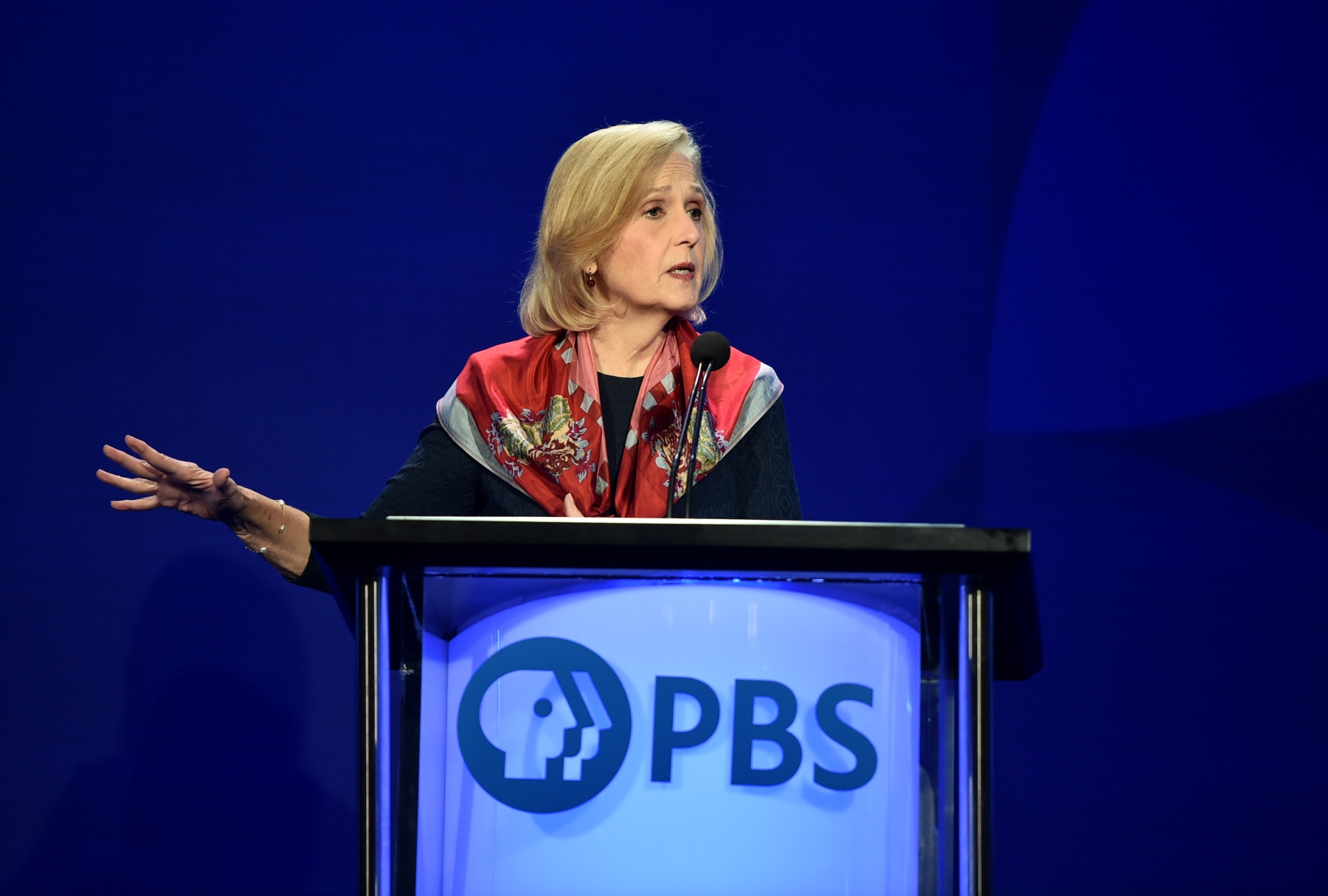
PBS president and CEO Paula Kerger attends the PBS 2023 TCA Winter Press Tour at The Langham Huntington, Pasadena on January 16, 2023 (Alberto E. Rodriguez/Getty Images)

Contrary to the way conservatives paint the CPB in their efforts to politicize it, the CPB is not a government organization but a private, nonprofit corporation created by Congress in the Public Broadcasting Act of 1967.

Among the many declarations spelled out in this act are that it is in the public’s interest to “[develop] programming that involves creative risks and that addresses the needs of unserved and underserved audiences, particularly children and minorities,” and “It is in the public interest for the Federal Government to ensure that all citizens of the United States have access to public telecommunications services through all appropriate available telecommunications distribution technologies.”

Most pertinent to Twitter’s flawed argument, however, is that the act explained the creation of the CPB “to facilitate the development of public telecommunications and” – emphasis ours – “to afford maximum protection from extraneous interference and control.”

A shorter way of putting this is that the organizations benefitting from CPB funding are editorially independent.

In its mission statement, the CPB also adds: “CPB does not produce programming and does not own, operate or control any public broadcasting stations. Additionally, CPB, PBS, and NPR are independent of each other and of local public television and radio stations.”

Most of the funding public broadcasting receives from Congress goes directly to PBS and NPR member stations in hundreds of markets across the country. In many cities, these stations represent the last bastions of independent regional media dedicated to covering local issues.

The greatest beneficiaries from federal funding are stations serving rural areas – places that tend to vote Republican – where access to broadband, satellite and cable is still inadequate and many residents are lower income.

In 2017 Kerger cited a member station in Alaska as an example. Federal funding makes up around 50 percent of their budget, she said. Pulling its federal funds would have thrown such a station into crisis and eliminated an important news and information source in that community.

That threat didn’t bother five far right-wing North Dakota state senators who, in February of this year, voted to eliminate $2.9 million from Gov. Doug Burgum’s budget that was earmarked for Prairie Public Broadcasting. According to a column in The Forum of Fargo-Moorhead, $1.7 million of that total was requested to fund a nefarious liberal plot to repair transmitters in North Dakota. Burgum, we should mention, is also a Republican.

It is important to spell this out not simply for the conservatives who enjoy targeting public media but for others who may support it but can’t adequately defend it with hard statistics. All the data cited here is gleaned from reports that are readily available to the public.

When a major social media platform like Twitter falsely describes such organizations as “state-run” or “government-funded,” that doesn’t merely erode the public’s trust in their reporting. As the Committee to Protect Journalists’ program director Carlos Martínez de la Serna pointed out, it “could pose risks for journalists reporting from areas where suggestions of government affiliation have negative connotations.”

And yet, an attempt to grapple with the ramifications of NPR and PBS leaving Twitter in the all-too-typical debate between a libertarian and a liberal that ran on The Hill’s YouTube channel nearly made me headbutt my office wall. Not because of the libertarian’s views, which have been parroted by many others before him, but because the lefty offered little information as to how public media works and who reaps the greatest benefit.

To be clear, that would be people who can’t afford monthly subscriptions to Max and Disney+ and don’t have adequate broadband access. PBS and NPR are free and available to anyone who has a radio or a TV with an antenna.


Want a daily wrap-up of all the news and commentary Salon has to offer? Subscribe to our morning newsletter, Crash Course.


Of course, America could adopt the BBC model, in which U.K. households pay a fee set by the government, which currently sit at £159 per year (or around $199 U.S.) to fund the corporation’s output.

In contrast, the Public Broadcasting Service’s annual cost to the American taxpayer is $1.40 per citizen. That’s one dollar and 40 cents – not per day, week, or month. For the whole year.

PBS is forward-funded, with a $475 million allocation from the CPB for 2023 already in place, and another $525 million pending for 2024.

Meanwhile, a 2015 Los Angeles Times report found Musk’s companies, including Tesla Motors Inc., SolarCity Corp. and SpaceX, had by that time received $4.9 billion in government subsidies. Remember, that number is nearly 10 years old. More recently, in 2022, the Federal Communications Commission blocked an $885.5 million broadband funding grant to SpaceX’s Starlink satellite internet service.

The public has consistently stood up to defend PBS whenever it is threatened, not defund it. One doubts many will do the same for Musk if NPR’s and PBS’ Twitter exit marks the start of a broader trend.


“Beef” controversy explained: Costar David Choe’s past claims of “rapey” behavior resurface

A week after its April 6 release, Netflix’s limited series “Beef” continues to dominate the Top 10 List as the No. 1 show on the platform. But the buzz isn’t all good now that all that attention has resurfaced an ugly history for one of its co-stars.

The series follows Amy Lau (Ali Wong) and Danny Cho (Steven Yeun), two strangers who cross paths in a road rage incident that slowly begins to consume their lives as they retaliate agaisnt each other. What follows is pure and utter chaos, which includes catfishing, a kidnapping and far more.

Painter David Choe, who plays Danny’s fun yet felonious cousin Isaac on the show, first became famous for making a fortune by painting murals at Facebook, for which he was paid in Facebook stock. Choe’s own artwork is also featured in the title cards for each episode. IndieWire wrote, “Choe’s work is an excellent match for the series, frenetic and brimming over with messy emotion — whether that emotion is desire, longing, or something uglier.”

In an interview with IndieWire, creator Lee Sung Jin said, “David Choe, who plays Isaac, suggested I use his paintings. He stopped showing his work publicly over a decade ago, so he had hundreds of paintings no one had ever seen. He graciously allowed me to pick the ones I felt fit the episodes the best.” 

Amid Choe’s newfound attention, however, his prior sexual assault allegations have resurfaced, causing many to question his involvement in the show. 

Here’s a closer look at Choe’s infamous comments bragging about “rapey” behavior and the aftermath of it all:

March 2014: Choe brags about a disturbing sexual encounter

In a March 10 episode of “DVDASA,” a podcast Choe co-hosted with porn actor Asa Akira, Choe recounted getting a massage from a masseuse he calls “Rose.” He said he got an erection during his massage and began masturbating, despite Rose being visibly uncomfortable:

It’s dangerous and it’s super self-destructive. I’m at a place and there’s potential for a lawsuit . . . and she has given me no signs that she’s into me or that this is appropriate behavior. In my head I go, Do you care if I jerk off right now? and it sounds so creepy in my head that I go, I can’t say that out loud . . . So I go back to the chill method of you never ask first, you just do it, get in trouble and then pay the price later.

. . . So I just start jerking off. So then her hands get off my leg and she just stops . . .  I go “Look I’m sorry I can’t help myself — can you just pretend like I’m not doing this and you continue with the massage?'”And she’s like “All right” and she does . . .  I’m like “Can I touch your butt?” and I reach out and touch her butt and she pulls away. She doesn’t want me to touch her butt.

Choe then asked Rose for oil. When she poured it on him, he said he grabbed her hand and placed it on his penis. He asked her to spit on and kiss it, and she said no — twice.

She’s definitely not into it, but she’s not stopping it either. I say, “Kiss it a little,” she says, “No, all the massage oil is on it,” and I take the back of her head and I push it down on my dick and she doesn’t do it. And I say, “Open your mouth, open your mouth,'” and she does it and I start facef**king her.

Choe said he continued until he finished in Rose’s mouth. Rose refused to have sex with him and asked him to lie back down so she could finish the massage. 

In response to Choe’s story, Akira said, “You raped . . . allegedly,” to which he replied, “Well . . . encouraged.” 

“I just want to make it clear that I admit that that’s rapey behavior,” Choe continued. “But I am not a rapist. With the rape stuff. . . I mean, I would have been in a lot of trouble right now if I put her hand on my d**k and she’s like, ‘F**king stop I’m gonna go call security.’ That would have been a much different story. But the thrill of possibly going to jail, that’s what achieved the erection quest.”

A shocked Akira then said, “You’re basically telling us that you’re a rapist right now, and the only way to get your d**k hard is rape.” Choe responded with a simple “Yeah,” before describing Rose’s appearance. 

“Who cares what she looks like, Dave is telling us he’s a rapist,” Akira exclaimed. Choe then clarified, “a successful rapist.”

April 2014: Choe claims his story was not “fact”

A little over a month after the episode aired, Choe addressed the allegations in a statement posted on the show’s now-defunct website. Choe reiterated that he’s not a rapist and asserted that his prior claims were not “fact.” Instead, they were the product of “misinterpretation” and “bad storytelling in the style of douche.” Choe wrote:  

I never thought I’d wake up one late afternoon and hear myself called a rapist. It sucks. Especially because I am not one. I am not a rapist. I hate rapists, I think rapists should be raped and murdered.

I am an artist and a storyteller and I view my show [“DVDASA”] as a complete extension of my art.

If I am guilty of anything, it’s bad storytelling in the style of douche. Just like many of my paintings are often misinterpreted, the same goes with my show. The main objective of all of my podcasts is to challenge and provoke my friends and the co-stars on the show. We f**k with each other, entertain ourselves and laugh at each other. It’s a dark, tasteless, completely irreverent show where we f**k with everyone listening, but mostly ourselves. We create stories and tell tales. It’s not a news show. It’s not a representation of my reality. It’s not the place to come for reliable information about me or my life. It’s my version of reality, it’s art that sometimes offends people. I’m sorry if anyone believed that the stories were fact. They were not!

In a world full of horrible people, thank god for us.

Following Choe’s comments, Vice said they “were looking into it” when asked by Buzzfeed if they would continue working with Choe in the future.

June 2017: Choe’s controversial Bowery Mural is targeted in protests 

On June 12, nationwide and international graffiti gang Big Time Mafia sprayed their signature letters “BTM” on the mural Choe had painted on Bowery Mural, an expansive outdoor wall located in Manhattan’s Lower East Side neighborhood.

Per Hyperallergic, it’s unclear whether BTM’s display was “an expression of solidarity with those protesting against what they as a normalization of rape culture . . .” The outlet also noted, “The massive, black letters may be unrelated, standing as an expression of general resentment toward Choe. (The Bowery wall has long been a popular target for vandals and graffiti writers.)”

Several other BTM members returned to Bowery Mural to splash more paint on Choe’s mural.

On June 18, Choe’s mural was the site of an anti-rape protest and performance art piece titled “NO MEANS NO.” A Facebook invite to the event read, “This piece is intended to examine examples of violent and predatory misogyny. Our aim is to provoke widespread rejection of the continued normalization of rape culture by bringing visibility to the topic.”

June 17, 2017: Choe issues a formal apology 

In a lengthy Instagram caption, Choe apologized for his comments and maintained that even though he spoke about rape, he did not commit it: 

How does one apologize for a lifetime of doing wrong? Through my past three years of recovery and rehabilitation, I’ve attempted to answer that question through action and understanding. In my life I’ve struggled deeply with an unnatural amount of hatred I’ve had towards myself. Most of my life I’ve been a scared hurt shame filled person, trying to mask my insecurities with false confidence and an outwardly negative behavior to validate myself as worthy. 

In a 2014 episode of [“DVDASA,”] I relayed a story simply for shock value that made it seem as if I had sexually violated a woman. Though I said those words, I did not commit those actions. It did not happen. I have ZERO history of sexual assault. I am deeply sorry for any hurt I’ve brought to anyone through my past words. Non-consensual sex is rape and it is never funny or appropriate to joke about. I was a sick person at the height of my mental illness, and have spent the last 3 years in mental health facilities healing myself and dedicating my life to helping and healing others through love and action. I do not believe in the things I have said although I take full ownership of saying them. 

Additionally, I do not condemn anyone or have any ill will towards those who spread hate and speak out negatively against me, no one will ever hate me more than I hated myself back then. Today I’ve learned to love and forgive others just as much as myself. It’s been a rough journey but i am grateful to be alive and to dedicate myself to shining the light I have found within myself and live in service and gratitude. I am truly sorry for the negative words and dark messages I had put out into the world.”

June 2021: Choe’s TV spotlight

In 2021, Choe debuted his FX series “The Choe Show,” in which he’d interview guests – including his former “DVDASA” co-host – and then reveal a portrait he painted of the person at the end. The series acted as an extension of the therapy he’d undergone, and in the years since, he’s continued to appear onscreen, whether it’s with Anthony Bourdain or a bit part in “The Mandalorian” to his supporting role in “Beef.” 

In a New York Times interview at the time “Choe Show” premiered, he told reporter Edmund Lee,  reflecting on the “DVDASA” fallout. 

“At that time in my life, I was done with life and chasing a bottom. I wanted out. . . . I never raped anyone,” he said, later adding, “It was strangely comforting to be so despised. It matched how I felt about myself for the first time.”

The article also detailed his struggles with addiction and self-loathing and how he had been sexually abused as a child when he had been sent back to South Korea when his parents couldn’t afford to raise him. 

About the public’s opinion he said, “I just assume any time I do anything, the haters come out. If you want to come and try to cancel me, that’s OK.”

Today

Recently, a clip of Choe’s infamous podcast episode was recently shared on Twitter by writer Aura Bogado. In a quote tweet, Chicago Tribune TV and film critic Nina Metz wrote, “This is extremely gross and upsetting and dispiriting. He currently co-stars in the extraordinary ‘Beef’ and it is notable that telling this story years ago didn’t cut him off from the kind of connections that enabled him to be part of the show.”

Similarly, Los Angeles-based food, drinks and culture writer Esther Tseng tweeted, “I . . . just can’t believe they hadn’t thought this would resurface the whole time i was watching. . .”

Collapsing roofs, broken toilets, flooded classrooms: Inside the worst-funded schools in the nation

ProPublica is a Pulitzer Prize-winning investigative newsroom. Sign up for The Big Story newsletter to receive stories like this one in your inbox.

Jan Bayer sank into the couch in the family room of her Bonners Ferry, Idaho, home and stared at her phone, nervously awaiting a call. Her twin teenage daughters were nearby, equally anxious.

It was election night in March 2022, and Bayer, the superintendent of the Boundary County School District in a remote part of Idaho on the Canadian border, had spent months educating voters about a bond that would raise property taxes to replace one of her district’s oldest and most dangerous buildings: Valley View Elementary School. Built just after World War II, the school was falling apart.

The walls were cracked. The pipes were disintegrating. The ceilings were water-stained. The electrical system was maxed out and the insulation was nearly nonexistent. Classrooms froze in the winter and baked in the summer. The roof, part of which had already collapsed once, was nearing the end of its lifespan. Outside, potholes pocked the parking lot and deep splits formed in warped sidewalks. The kindergarten playground, weathered from decades of brutal winters, had turned hazardous; at times, sharp screws protruded from some of the equipment, and kids routinely got splinters from the wooden crossbeams.

Most worrisome to Bayer and her staff: Kindergarten students had to cross a street multiple times a day just to navigate the sprawling six-building campus, a piecemeal attempt to add much-needed classroom space.

The bond promised to fix all that — if voters approved it.

“You’re just honestly praying for a miracle,” Bayer said. “I said a lot of prayers all day long, saying, ‘OK, we can do this. We can do this.'”

At about 8:30 p.m., a call came in from the county clerk. More than 2,000 people voted, and about 54% of them supported the bond, the clerk said. Bayer’s heart sank and she broke into tears. In Idaho, a majority wasn’t enough. The state is one of just two in the nation that require support from two-thirds of voters to pass a bond.

Bayer shared the results with the school board, school staff and the facilities committee. Over the next several hours, she received calls and messages from community members. They told her to keep fighting. So she did. The district put another bond on the ballot in August, and students rallied to support it. On Election Day, the high school football team even stood on the bridge over the Kootenai River and held yellow signs that read “Vote Yes for Kids,” hoping to persuade voters as they drove to the Boundary County Fairgrounds to cast their votes. But the second bond fared worse. Just over 40% of voters backed the new measure, which hit the ballot as residents received a notice that their property assessments were going to rise and voters were worried about tax increases. “It went down in a ball of flames,” Bayer wrote to the school board.

No other state spends less on education per student than Idaho, according to a recent report from the U.S. Census Bureau, which surveys and ranks school finance systems. It also ranks last in the nation in terms of school infrastructure spending per pupil, a state report shows. So over the past several decades, rural districts across the state have faced the same challenge as Bayer: To improve or replace aging — and sometimes dangerous — facilities, they must appeal to local taxpayers and clear some of the nation’s most restrictive thresholds for school funding. Despite urgent needs, most of these efforts fail, an investigation by the Idaho Statesman and ProPublica has found. As a result, students across the state must learn amid dire conditions.

In one Idaho school, the foundation is crumbling. In another, so few bathrooms serve hundreds of kids that students have soiled themselves, according to school officials and local media. And in yet another, a portion of a roof recently failed during off-hours, sending water flooding into a classroom and bathrooms, destroying books and temporarily limiting learning space.

Since 2006, districts have mounted 217 bond attempts to remedy these types of problems and accommodate growing student populations. Had Idaho required only a majority of voters to support the measures — the threshold in most states — 83% of them would have passed. Instead, just 44% were approved, according to an analysis of bond measures and election data by the news organizations.

Like Boundary County, more than two dozen districts have tried to pass bonds and failed at least twice since 2006. Nine of those districts never succeeded during that time.

All of this matters not only for the safety and comfort of students but for their academic success. Research has shown that young people who learn in deteriorating or substandard facilities have worse educational outcomes than peers who learn in newer and functional buildings.

Superintendents say they have little choice but to patch up the issues they can see and hope it’s enough for now. But others fear that by trying to maintain buildings that need to be replaced, at best they’re wasting taxpayer dollars and at worst they’re risking an accident. “Do we keep putting a Band-Aid on something that’s broken?” said Troy Easterday, superintendent of the Salmon School District, which has tried and failed to pass a bond nearly a dozen times since 2005 in an effort to secure funding to build a new school. The district’s elementary school building, which is plagued by aging plumbing, uneven floors and a cracked foundation, is around 70 years old.

Education advocates and some lawmakers argue that the bond threshold should be lower.

By requiring support from two-thirds of voters, “you essentially allow the government to be operated through the tyranny of the minority,” said Mat Erpelding, a Democrat and former House minority leader who unsuccessfully tried to pass legislation in 2017 to start the process of lowering the threshold for passing bonds to 60%. Under that metric, about 62% of all bonds placed on the ballot since 2006 would have passed, compared to the actual passage rate of 44%, according to the Statesman-ProPublica analysis.

Some current legislative leaders, however, disagree with Erpelding’s assessment. “I think it needs to remain in place,” said state House Speaker Mike Moyle, a Republican who pointed out that the provision has been in the state’s constitution since its earliest days. “I think it’s a protection for the taxpayer.” And practically speaking, lowering the threshold would be difficult, requiring a constitutional amendment that would have to be approved by two-thirds of legislators and a majority of voters.

Gov. Brad Little has said he wants to invest more in education, and last year he signed a bill to allot $330 million to public education across Idaho. But much of that money will go toward increasing teacher pay and benefits as opposed to upgrading and replacing school facilities.

As a result, under the current system, rural districts like Boundary County continue to face a heavy fundraising burden; their communities are often poorer, smaller and less able to support tax increases than urban centers. At Valley View Elementary, for example, most students are from low-income families and about 10% are homeless, according to the State Department of Education. About three-quarters of the state’s districts are rural.

“If local taxpayers can’t afford to pay for those facilities, then those students have to do without and that does not meet the obligations put forward in the Idaho Constitution,” said Mike Journee, spokesperson for the state teachers union.

Connie Perez, who has taught at Valley View for more than three decades, said she does her best to adjust to the circumstances. But on some days, her mind drifts to the crack in the wall outside her fourth grade classroom. “That’s what scares me,” she said, “the big things that are going to happen.”

Decades of Legislative Neglect

As far back as 30 years ago, Idaho legislators were confronted with the state’s deteriorating schools. A statewide assessment funded by the Legislature found that districts needed nearly $700 million in repairs, expansions and upgrades. Seventy-one buildings were either deemed dangerous or had serious problems that needed immediate attention. In 1993, a member of the state facilities committee presented the findings to lawmakers. The Legislature, however, did little to address the issues.

Valley View Elementary in Boundary County was one of those schools that were labeled as needing immediate attention. And without an influx of funds, things got worse.

Three years after the state assessment, the school’s gym roof collapsed during winter break, when students were home. The region had gotten slammed with a major snowstorm, and the building couldn’t handle the additional weight. No one was injured, but the staff was shaken. “It’s something you don’t want to ever see again, especially when you have kids,” said Bob Overman, the former maintenance director for the district, who had just walked out of the gym when the roof caved in. “It used to worry me all the time.”

Meanwhile, elsewhere in Boundary County, administrators struggled with overcrowded schools. Voters had previously rejected three bond measures for new facilities, so students temporarily had to go to school in shifts: high school in the mornings and middle school in the afternoons and evenings. It was a strain on parents, especially those who had kids in different grade levels.

In 1999, six years after the statewide facilities assessment, then-Gov. Dirk Kempthorne took another look at the schools. Of the 71 buildings in the worst shape, 18 had been shuttered and 53 remained in service. At the facilities still in use, the “average building condition score” had declined, meaning they still had problems that needed immediate attention, according to an update to the facilities report. Even some buildings that underwent renovations, like Valley View, which had to replace the portion of the building that collapsed, did not see changes in their overall scores.

Although the Legislature made some funding changes in the 1990s, in 2001 a judge presiding over a school funding case took issue with the state’s reliance on bonds, finding that a “system based upon loans alone is not adequate to meet the constitutional mandate to establish and maintain a general, uniform, and thorough system of public, free common schools.” Citing prior rulings, the court said that mandate includes providing a “safe environment conducive to learning.”

The following year, Kempthorne advocated improving school building safety and lowering the threshold for passing bonds, according to Idaho Statesman reporting. “It’s time to solve this problem,” he said.

In 2005, the state Supreme Court weighed in, agreeing with the lower court’s finding that the state’s funding system for school facilities was unconstitutional. It noted the struggles of several districts that had failed to clear the two-thirds bar to pass a bond, despite making multiple attempts.

While the court did not prescribe specific remedies, it told the Legislature that it was lawmakers’ responsibility to ensure that school facilities are properly funded.

Over the next two decades, the cycle would repeat itself: State leaders would recommend major changes to address school facilities — including lowering the bond threshold to 60% — and the Legislature would push back, offering instead modest investments. At least two bills to make it easier for districts to pass bonds went nowhere.

As recently as last year, a state report estimated that school facilities’ needs now stand at more than $800 million, a figure that researchers acknowledged was likely on the low end of the actual need.

“The Legislature never did fulfill its responsibility,” said Jim Jones, a former state Supreme Court justice who concurred, in part, on its 2005 decision. “They nipped around the edges here and there. But they never set up a system whereby the state took responsibility, or the primary responsibility, for funding, construction and maintenance. And that’s where we are now.”

Republican state Rep. Jason Monks disagreed, saying the Legislature had fulfilled its constitutional obligation but was still working to improve public education. “Are we doing the minimum? Yes,” said Monks, the former assistant House majority leader. “Can we do better? Yes. And should we do better? Yes. But I think we are providing at least a minimum that we’re required to.”

This year, in a nod to the struggles of school districts, lawmakers passed a property tax bill that allocated funds for districts to pay off bonds and levies. Districts will receive $65 million this fiscal year and about $79 million in the next fiscal year, according to estimates from the governor’s office. But, critics note, the legislation also eliminated an election day in March, one of the four dates on which districts could hold bond votes — and the one where districts have historically seen the most success.

State Rep. Julie Yamamoto, a Republican and the chair of the House Education Committee, said that the bill was a start but that lawmakers needed to do more to live up to their constitutional obligation to adequately fund school facilities. “We recognize that you can’t pass a bond to build, nor can you pass one to keep your buildings up,” she said in an interview. “We need to act.”

Meanwhile, in Boundary County, after two failed bonds, teachers and administrators are forced to deal with the conditions at Valley View Elementary, worrying about whether they can keep students safe in a building they can’t afford to change.

Conditions Affect Learning

Every September, at the beginning of the school year, Drea Leach gets to her fifth grade Valley View classroom by 6 a.m. Hoping to beat the heat, the teacher opens the windows and lets in the outside air. But with Idaho increasingly facing record-high temperatures, it’s rarely enough to keep the room bearable for the day ahead.

By 10 a.m., the classroom can reach 85 degrees, she said. Students start to sweat, fan themselves and shut down. “To try to get kids to sit in here and learn and focus when it’s 85 degrees is almost impossible,” said Leach, who used her own money to provide a water cooler for students.

Boundary County teachers and administrators say there is little they can do with scant resources. Unlike schools in wealthier, urban communities like Boise, Valley View has no air conditioning, and bringing in AC units for the classrooms — like schools in the city of Nampa did last fall when its old units failed — isn’t an option. It would overload the electrical system, which is at capacity.

Winters present similar challenges. Aging cinder block walls provide little buffer against the cold, and the heating is inefficient and expensive to run. Leach has tripped the breaker by plugging in a space heater, so students are often forced to bundle up for instruction. Indeed, on a 36-degree January day, the Statesman and ProPublica observed students wearing their jackets and snow pants during class. The classroom can get so cold, Leach said, that she simply places her lunch on the floor near the outside wall to keep it cool. “It actually refrigerates itself,” she said.

Teachers often turn to Steve Bortz, Valley View’s head of maintenance. For the past seven years, he’s spent his days fielding calls from staff members about leaking ceilings, clogged drains and cracked walls. When the area gets big snowstorms, he spends hours blowing snow off the roof to prevent collapse. On a recent tour, he removed a hallway ceiling tile to reveal how he deals with leaks: buckets attached with tape to catch water. When he sees new cracks in the walls, he fills them, hoping to block drafts. “All I’m able to do is just try to take care of the situation as best as we can,” he said in an interview. “Most of the stuff I end up doing now is cosmetic.”

These kinds of conditions can impact learning. In 2017, researchers from the Harvard T.H. Chan School of Public Health, after reviewing more than 200 scientific studies, reported that temperatures can affect test scores and that poor ventilation is linked to fatigue and shorter attention spans. In interviews with the news organizations, seven teachers and staff members at Valley View complained about losing teaching time each month due to the school’s age and layout.

Notably, in addition to the climate challenges, students must travel between six buildings throughout the day — an unusual design implemented decades ago to deal with overcrowding. The distance between buildings is particularly hard on kindergarten students, who cross a street at least four times a day to get to lunch, to gym class and to the library.

Traveling back and forth during winters when the ground is covered with snow and ice can be dangerous. Administrators say a boy who uses a walker has tripped on the broken sidewalk and was injured.

Administrators say it’s only a matter of time before the school will experience another crisis. Valley View’s plumbing system, for instance, is made up of clay and galvanized pipes, which are collapsing after more than seven decades of use. A “catastrophic failure” could render the bathrooms inoperable, Bayer said. If that happens, the main school building would have to shut down. To many teachers, the solution is clear: a new building.

“All we would have to worry about are the students. That would be our sole job,” said Teresa Smith, a second grade teacher. “We wouldn’t have to worry about the cracks or the ceilings or the bathrooms or them going in and out without supervision. We wouldn’t have to worry about any of that, just their education.”

A Call for State Intervention

On a cold night in January, Bayer faced the Boundary County school board. On the agenda was Valley View Elementary.

The district had done what it could by pitching bonds to voters, Bayer said. But twice, too many taxpayers said no. “I don’t know what else to do to convince the public that we need a new school,” Bayer told the board.

She then summarized the findings of the district’s facilities committee, which considered four potential courses of action, all of them grim: Do nothing while the conditions at Valley View deteriorate more; start making repairs, knowing they would be throwing money at a crumbling building; put another bond on the ballot; or ask voters to approve funds through a different kind of measure, known as a plant facilities levy. But even that levy would present challenges — while it could pass with less overall support than a bond, it could also result in much higher taxes for property owners right away and fewer funds for the school up front, meaning the district would need to attempt to build a new school in phases.

The group chose none of them. Instead, it recommended that the school board bring in the state.

As Bayer relayed this information to the room that night, board members shook their heads and covered their faces with their hands. Since 2006, Idaho has stepped in only twice to help school districts repair their schools. That help came at a price: a state loan, which was paid back by local residents through tax increases they didn’t agree to. Even then, in one case, the state covered only certain repairs and wouldn’t fund a new school, leaving the district with many of its problems still unresolved, The Associated Press reported.

That night, seeing no other choice, the Boundary County school board approved a plan to ask the state to intervene.

A state inspector will now determine the severity of Valley View’s issues, Teresa Rae, the board’s vice chair, told the Statesman and ProPublica. If the school is deemed unsafe, the district could ultimately apply for a state loan. Local leaders, however, are asking for more guidance from the state.

“Just tell us what to do. You created this mess,” Rae said at the board meeting. “You make it so difficult that you can’t pass a bond, yet you don’t fund facilities. … You tell us what to do.”

Had they just needed a simple majority to pass a bond, she said, “we’d already be building.”

“Unsafe for people”: Immigrant and LGBTQ+ rights groups issue travel warnings for Florida

Faced with persistent attacks from Florida Republicans, including presumed 2024 presidential candidate Gov. Ron DeSantis, immigrant and LGBTQ+ rights groups on Wednesday issued advisories for traveling to the southeastern U.S. state.

The moves by the Florida Immigrant Coalition (FLIC) and Equality Florida follow the NAACP Florida State Conference voting unanimously last month to ask the national group’s board of directors to issue a travel advisory for the Black community.

FLIC’s advisory—issued as a website—comes as DeSantis pressures the GOP-controlled state Legislature to pass measures that would threaten Florida residents with felony charges if they provide undocumented immigrants with shelter, transportation, or work while also requiring publicly funded schools and hospitals to participate in the crackdown.

“Travel to all areas of Florida should be done with extreme caution as it can be unsafe for people of color, individuals who speak with an accent, and international travelers,” the website warns. “Due to unconstitutional legislation supported by Gov. Ron DeSantis and introduced by legislative leadership, every county in Florida poses a heightened risk of harassment, possible detainment, and potential family separation based on racial profiling.”

The coalition’s site also notes that “naturalized and U.S. citizens of African, Latin American, Central American, Native American, Asian, and Pacific Islander descent are not immune from racial profiling, heightened scrutiny, and false arrest.”

Additionally, as the site explains:

Florida is poised to pass laws creating criminal penalties for medical providers who provide medically necessary care for transgender youth, weaponizing the courts to shred existing child custody agreements and reassign transgender youth to an unsupportive parent, and severely restricting access to prescribed medical care for transgender adults.

Florida has passed or is poised to pass bills that restrict access to reproductive healthcare, including a near-total abortion ban, which threatens to force people to travel out of state or seek unsafe, illegal abortions.

Equality Florida similarly pointed to the “passage of laws that are hostile to the LGBTQ+ community, restrict access to reproductive healthcare, repeal gun safety laws and allow untrained, unpermitted carry, and foment racial prejudice” when warning that the Sunshine State “may not be a safe place to visit or take up residence.”

Equality Florida executive Director Nadine Smith said in a statement that “as an organization that has spent decades working to improve Florida’s reputation as a welcoming and inclusive place to live, work, and visit, it is with great sadness that we must respond to those asking if it is safe to travel to Florida or remain in the state as the laws strip away basic rights and freedoms.”

“While losing conferences and top students who have written off Florida threatens lasting damage to our state, it is most heartbreaking to hear from parents who are selling their homes and moving because school censorship, book bans, and healthcare restrictions have made their home state less safe for their children,” Smith continued.

“We understand everyone must weigh the risks and decide what is best for their safety, but whether you stay away, leave, or remain we ask that you join us in countering these relentless attacks,” she added. “Help reimagine and build a Florida that is truly safe for and open to all, and where freedom is a reality, not a hollow campaign slogan.”

Bryan Griffin, a spokesperson for DeSantis, told The Florida Times-Union that the new advisories were a “political stunt” and “we aren’t going to waste time worrying about political stunts but will continue doing what is right for Floridians.”

DeSantis had responded similarly to the NAACP’s move last month, saying, “what a joke” and “I’m not wasting my time on your stunts.”

The NAACP request came not only amid battles over various laws but also after DeSantis rejected the new Advanced Placement African-American Studies course for high school students.

“Our question to Gov. DeSantis is, ‘What sort of future are you fostering for Black Americans throughout Florida while eradicating our historical contributions to this nation?'” said NAACP Florida State Conference chair Adora Obi Nweze. “There is no ‘feel-good’ version of the horrors and inequalities that Black Americans have faced or continue to face.”

“Slavery, Jim Crow, and lynchings followed by ongoing school segregation, mass incarceration, police brutality, housing discrimination, healthcare disparities, and [the] wage gap are all tough truths to face,” she argued. “Misrepresenting the reality of our history promotes ignorance and apathy.”

Although the request for an NAACP travel advisory was submitted as a resolution to the national board last month, review and approval of resolutions won’t begin until May and are expected to go through July. However, board chairman Leon W. Russell has already weighed in, saying that “the recommendation from our Florida State Conference is a clear indication of just how egregious Gov. DeSantis’ actions are.”

“Any attempt to intentionally erase or misrepresent Black history is a direct attack on the foundation of comprehensive education. Be clear—Black history is American history,” Russell declared. “We are proud of our Florida State Conference for meeting this moment with the equal aggression and intention that is a necessary response to these attacks. Any location in America where our history has been erased does not offer us, or our children, a bright future.”

Is love really blind? I asked therapists to analyze the show’s relationship drama with me

Can two people really fall in love, sight unseen? Testing the truism that love is blind is the premise of the eponymous Netflix original show, which has entered its fourth season — and which my husband, who is a licensed therapist, and I have been watching eagerly. Reality TV is, at its worst, lurid; at its best, it teaches us something about human nature and psychology

For the unfamiliar, the show “Love is Blind” is a so-called “social experiment” where single men and women meet, date, and get engaged — all before meeting in person. Their dates take place in small rooms known as “pods,” which have a sparkling blue wall that is shared with another pod. After 10 days of “pod dating,” within which contestants can hear but not see each other, the contestants are expected to propose to each other. Only then do they get to see each other in person for the very first time. It doesn’t stop there: Once they meet in person, the new couples go on a romantic getaway together to see if there’s a physical connection. If there is, they live together, and then plan their wedding, all within the span of weeks.

This season turned out to be just as addictive and gossip-generating as the previous. As I watched, I paused to chat about the drama. Will it be Micah and Kwame, or Micah and Paul? Will Zack choose Bliss or Irina? Tiffany and Brett are clearly connected from the start, a solid match — but as we’ve seen before, all’s not fair in “Love is Blind.”

To me, the most bewildering part of the show is that moment when contestants get down on one knee and proposes to a person they’ve never before seen in real life. It’s not the concept itself that is particularly novel, but rather the emotions — the hyperventilating and tears shared between two people, neither of whom have seen each other yet, still visually separated by the glowing wall. I think back to when my own husband proposed to me, after three years of dating; I was elated, but didn’t shed a tear. And if he’d proposed after a mere 20 days, I certainly wouldn’t have said yes — nor would I have had the same reaction as these contestants.

Are these people really so moved by these proposals? As the show’s hosts, Nick and Vanessa Lachey, say multiple times throughout the show, “Is love really blind? Can you fall in love sight unseen?”

“I think so,” says my husband, Ken Stamper, a couples therapist who often sits next to me on the couch as I think these thoughts out loud. “But it can only work if you’re securely attached.”

Jackie on “Love Is Blind” (Netflix)Attachment theory suggests that a secure attachment style enables individuals to have healthy, loving relationships without fear of intimacy or panic when their partner needs space. However, an anxious attachment style can lead to a deep fear of abandonment — while an avoidant attachment style can lead to a deep fear of intimacy and a pattern of distancing from a partner when the relationship becomes too close.
“Avoidantly attached people frequently come from traumatic family backgrounds,” he says.

“Not promoting it, but plenty of people have fallen in love with someone incarcerated, without photos, and writing them the entire time they are imprisoned.”

Take season four contestant Jackie Bonds, who initially seemed to have a good relationship with her boo Marshall Glaze. Sure, red flags started to pop up in Mexico when she had a breakdown one night, but she then shared on Instagram that it was because she felt guilty for enjoying herself when her family needed her back home.

“I come home every weekend to make sure I pay his bills, clean the house, and make sure my father and mother are good,” Bonds said in an Instagram post. “I felt guilty being happy and enjoying my time in Mexico because my family deserves time away.” My husband the therapist, who clarified that he would never diagnose someone without seeing them in his office, said it sounds like Jackie could be a “parentified child.”

“She may not have been allowed to have personal space in her own world, which would make it difficult to tolerate closeness and intimacy with her own partners,” Stamper says.

Clearly, we see that with Marshall, who has been vulnerable and honest with her from the start. My husband-therapist added that Jackie is likely avoidantly attached.

Then what about Kwame Appiah? It seems like sometimes he is totally into Chelsea Griffin, who has been the Marshall in their relationship. But his initial flirting with Micah Lussier, whom he seriously considered proposing to in the pods, has made viewers like myself second-guess his intentions.

Micah and Kwame chat at a party on “Love Is Blind” (Netflix)Kwame has shared a bit about his background. He immigrated to the U.S. from Ghana, and lives in Portland. He’s repeatedly shared that he’s hesitant to make a move from Portland to Seattle and merge his life with Chelsea’s, and that he feels he’s making more of a sacrifice than she is in this “experiment.”

My husband says he’ll be surprised if Kwame says “I do” at the altar.


Want more health and science stories in your inbox? Subscribe to Salon’s weekly newsletter The Vulgar Scientist.


“He’s successful and driven but seems like kind of a Peter Pan,” my husband says, implying he is resistant to growing up. “He seems to have trouble with Chelsea being so enthusiastic with closeness, and is treating their relationship like an obstacle to be conquered.”

Plus, Kwame’s mom does not approve of him marrying someone he barely knows.

“There’s likely a cultural aspect to this that I’m not privy to,” my (white) husband says. “And it’s tough going against your mom under any circumstances.”

While Zack Goytowski and Bliss Poureetezadi seem solid now, my husband called it from the beginning when he said that Zack initially chose Irina for the wrong reasons, and Irina ended up not being physically attracted to her now ex-fiancé — whom she described as feeling “ick” for.

From the get-go, my husband also could tell that Brett Brown and Tiffany Pennywell were likely to succeed in their coupling. “They clearly enjoy being with each other. They have similar values. They are older and maybe a little more mature than their podmates,” he opined.

Perhaps, then, there is some truth to the axiom in the show’s title. Can this “experiment” in blind love work, at least with certain couples? I decided to reach out to another expert beyond the one sitting on my own couch.

“Absolutely,” Carla Marie Manly, a clinical psychologist and author of “Joy From Fear,” told me. “You fall in love with somebody by the way they treat you, by the way they talk to you, by their interest in you — all of those parts that are a natural part of the dating process.”

However, Manly said, love is contingent on what a person values — and if a person values physical attraction and sexual chemistry, then physical attraction might matter more to some than others.

“You fall in love with somebody by the way they treat you, by the way they talk to you.”

Manly added that the show is designed to uniquely bond the contestants, hence their ability to seemingly fall in love so quickly. On the show, Bliss’ father — who essentially pinned the couple as future members of the divorcee club — pointed out that it’s a bit absurd to marry someone after 20 days.

“Any time people go through a deep emotional experience — whether it’s through trauma, whether it’s through something like filming a television show, whether it’s through an intense hospitalization experience — those situations can really be deeply bonding,” Manly said.

Zack proposes to Bliss on “Love Is Blind” (Netflix)Therapist and sexologist Joy Berkheimer, LMFT, pointed out to me that the concept of falling in love “sight unseen” is nothing new.
“We had an entire time period of AOL chatting — where there were no profile pictures — yet talking continued and many found themselves connecting with their future spouses,” Berkheimer said. “Not promoting it, but plenty of people have fallen in love with someone incarcerated, without photos, and writing them the entire time they are imprisoned.”

This is because Berkheimer says we fall in love with how people make us feel. My husband cautions that with love, there is always an element of “projection,” in that, which means a person is projecting feelings or emotions onto someone else and creating a fantasy of that person.

“I think it’s really easy to project on someone that you can’t see,” he says. “Like all the things that you want, but then when you face the messiness of the real world, those projections disappear — and you have to consider whether you really want to move from Portland to Seattle for someone.”

But does that mean seemingly healthily attached contestants like Brett and Tiffany are ready for marriage after three weeks? Both my husband and Manly said no.

“I’m very curious to see how these couples fight,” my husband says. “As a couples therapist I sometimes teach them how to fight constructively.”

Tiffany and Brett on “Love Is Blind” (Netflix)Manly agreed that 20 days isn’t enough time for a couple to experience enough true ups and downs that might allow them to know whether their marriage will stand the test of life.

“We really need to know someone through all seasons of the year,” Manly said. “We do want to have a longer period of getting to know someone so that we understand how they behave in a wide variety of situations, how they respond to life, what their values are — and you simply can’t can’t find that out in a matter of months.”

Berkheimer said it’s also important to note that if contestants don’t end up being physically attracted to each other, that doesn’t mean their relationships are doomed.

“Physical attraction is just one piece of love and attraction.”

“Physical attraction is just one piece of love and attraction,” Berkheimer said. “Oftentimes, there are people who will connect with someone who they thought was ‘hot’ — and, after discussions, realize they had nothing in common and the spark is gone.”

Intimacy, Berkheimer said, “builds from feeling seen and safe with a person who shares your core values.”

I often ponder: would my husband and I have chosen each other in the pods? I don’t love small talk, and typically our dinner conversations are dissimilar from the flirting that happens in the pods. We’ve been through our fair share of trials and tribulations in the six years since we met, including the birth of our child. “I think so,” he always responds, reassuringly. But perhaps the truth is that it doesn’t actually matter whether we would have hit it off in the pods or not. Ultimately, it’s not about the fairy tale beginnings, but rather how we respond to messiness that takes flight once the cameras stop rolling.

Ethics watchdog calls for Justice Department investigation into Clarence Thomas’ luxury trips

ProPublica is a Pulitzer Prize-winning investigative newsroom. Sign up for The Big Story newsletter to receive stories like this one in your inbox.

A Washington ethics watchdog is calling for the Department of Justice to investigate Supreme Court Justice Clarence Thomas for failing to disclose luxury trips he received from a billionaire GOP megadonor.

“This high-profile ethics matter has historic implications far beyond one Supreme Court justice,” attorneys for the nonpartisan Campaign Legal Center wrote in a detailed letter on Tuesday to the Judicial Conference, the principal policymaking body for federal courts. The Judicial Conference could trigger an investigation by referring the case to the Justice Department.

The financial disclosure law that covers justices and other federal officials states that “knowingly and willfully” failing to make required disclosures can result in fines. If someone intentionally falsifies their disclosure reports, they can face criminal penalties — a warning printed below the signature line of the reports themselves. But such prosecutions are rare.

ProPublica’s investigation last week revealed that Thomas has taken international cruises on conservative donor Harlan Crow’s superyacht, flown on Crow’s private jet and regularly vacationed at Crow’s private resort in the Adirondacks.

If the Judicial Conference were to refer the case to the Justice Department, it could lead to a remarkable historical moment. One of the few instances of a federal investigation into a sitting Supreme Court justice occurred in 1969, when Justice Department officials signaled an inquiry into outside payments that Justice Abe Fortas had been accepting. Fortas eventually resigned.

Lawyers for the Campaign Legal Center, which was founded by a former Republican chairman of the Federal Election Commission and pushes for tighter ethics enforcement in Washington, wrote that there’s ample “reasonable cause to believe that” Thomas knew the trips had to be disclosed.

“If the Judicial Conference fails to publicly address the substantial evidence of blatant violations of a disclosure law that other federal judges understand and regularly follow,” the attorneys wrote, “it creates an exception for Justice Thomas that swallows the rule.”

The Judicial Conference and Thomas did not immediately respond to requests for comment. The Justice Department declined to comment.

The letter is the latest in what have been days of mounting pressure to address the revelations. Last week, Democratic lawmakers called on Chief Justice John Roberts to investigate. This Monday, Democrats on the Senate Judiciary Committee announced plans to hold a hearing “regarding the need to restore confidence in the Supreme Court’s ethical standards.” They also announced an effort to reform ethics rules for federal judges.

In response to our story last week, Thomas issued a statement acknowledging the “family trips,” which he said he was told that he didn’t need to report.

“Early in my tenure at the Court, I sought guidance from my colleagues and others in the judiciary, and was advised that this sort of personal hospitality from close personal friends, who did not have business before the Court, was not reportable,” Thomas wrote. “I have endeavored to follow that counsel throughout my tenure, and have always sought to comply with the disclosure guidelines.”

Seven experts consulted by ProPublica, including former ethics lawyers for Congress and the White House, said the law clearly requires the disclosure of gifts of transportation, such as private jet flights. If Thomas is arguing otherwise, the experts said, he is incorrect. Among the experts was a top official at the Campaign Legal Center.

Crow acknowledged that he’d extended “hospitality” to the Thomases “over the years.” He said that Thomas never asked for any of it and it was “no different from the hospitality we have extended to our many other dear friends.”

Attorneys with the center said that the federal Ethics in Government Act and judiciary regulations have always required the disclosure of free travel — even before the regulations were updated last month. They argued that Thomas himself implicitly acknowledged as much when he disclosed similar flights in the late 1990s, including one on Crow’s jet.

The attorneys pushed for the Judicial Conference to make good on its recent promises to “ensure timely action is taken on credible allegations of misconduct” and refer Thomas’ case to the Justice Department before the next judicial ethics disclosure deadline in May.

“Potential for criminal penalties”: Experts warn judge could punish Fox for “engaging in misconduct”

The judge overseeing Dominion Voting Systems’ defamation lawsuit against Fox News on Wednesday sanctioned the network for withholding evidence during discovery and said he’s considering launching an investigation into Fox’s legal team for not being “straightforward” with him, The New York Times reported

Dominion is suing the right-wing outlet for $1.6 billion for repeatedly airing false statements after the 2020 presidential election suggesting the election software company changed or deleted votes to help President Joe Biden get elected.

Abby Grossberg, a former Fox producer who is suing the network, recently revealed that the network has recordings of Trump campaign lawyers Rudy Giuliani and Sidney Powell admitting they had no evidence to support their Dominion election fraud lies. The recordings hadn’t been turned over to Dominion’s lawyers until a week ago, according to The Times.

“Engaging in misconduct in the discovery process can result in discipline for the lawyers and sanctions for the company,” former U.S. Attorney Barb McQuade, a law professor at the University of Michigan and MSNBC contributor, told Salon. “Sanctions could include monetary fines, or even adverse decisions about the case, such as allowing the jury to draw an inference in favor of Dominion as to particular issues.”

The network has claimed that it complied with all of its obligations in discovery.

“As counsel explained to the Court, FOX produced the supplemental information from Ms. Grossberg when we first learned it,” a Fox spokesperson said in a statement. 

Delaware Superior Court Judge Eric Davis ruled that if Dominion had to redo any depositions, then Fox would have to “do everything they can to make the person available, and it will be at a cost to Fox.”

He added that he would likely appoint a special master to investigate Fox’s legal team’s actions and look into whether Fox had inappropriately withheld details about the scope of Fox Corp. Chairman Rupert Murdoch’s officer role at Fox News.

“This is a problem,” Davis said, according to a court transcript. “I need to feel comfortable when you represent something to me that is the truth.”

Since Dominion filed its suit in 2021, Fox had argued that Murdoch and Fox Corporation should be excluded from the case because Murdoch and other senior executives had nothing to do with running Fox News. But in the past few days, Fox disclosed to Dominion that Murdoch was a corporate officer at Fox News, The New York Times reported. 

“The revelation that Murdoch is an officer of Fox News should eliminate any argument that his testimony is not relevant in this case,” McQuade said. 

“Rupert Murdoch has been listed as executive chairman of FOX News in our SEC filings for several years and this filing was referenced by Dominion’s own attorney during his deposition,” a Fox spokesperson said in a statement.

The recordings as well as Judge Davis’ sanctions on Fox come days before the trial is scheduled to begin in the most significant defamation case in recent years.

The imposition of sanctions on Fox could lead to “potential consequences of monetary penalties, ethics issues for the lawyers and even has the potential for criminal consequences if there were knowing and deliberate falsehoods made to the court,” John Kaley, former assistant U.S. attorney in the Southern District of New York, told Salon.


Want a daily wrap-up of all the news and commentary Salon has to offer? Subscribe to our morning newsletter, Crash Course.


Whether Murdoch made decisions as a corporate officer of Fox News or not is a key detail in Dominion’s case. The voting technology company has tried to prove that Rupert and Lachlan Murdoch, the chief executive of Fox Corporation, were involved in making decisions about what Fox broadcast as part of its coverage of the 2020 election.

Dominion argues that their decisions pushed Fox News hosts to broadcast a series of lies in support of Trump’s stolen election conspiracy theory as part of a plan to keep viewers from turning to other networks. 

Fox has denied any wrongdoing, arguing that they were reporting on notable allegations protected by the First Amendment. But some legal experts argue that Fox can no longer rely on the First Amendment as a defense since they have “satisfied the actual malice standard” for holding a news organization to account for falsehoods

Jury selection for the case starts on Thursday with the trial scheduled to begin on Monday.

Sport gels and protein powders can be convenient boosts for athletes, but be sure to read the label

Personal bests, competition wins, new challenges — athletes and particularly endurance athletes, tend to want to push themselves hard to perform. So it makes sense that there is a big interest in sports supplements, like running gels and protein powders.

We all need macronutrients: carbohydrates, proteins and fats that give us energy and build structures like muscles and other cells in our bodies.

When we are very physically active, like long-distance runners, cyclists or triathletes, our need for both energy and building blocks for muscles and other cells increases because of the extra work our bodies are doing.

So supplements — such as sports gels or protein powders — that contain these macronutrients might make sense. But can they do anything that food can’t?

What is in sports gels?

Sports gels (also known as energy gels) are essentially carbohydrate supplements. They contain simple sugars like maltodextrin, fructose and glucose. These sugars don’t need much digestion to be absorbed and used as energy. Sugars are the easiest form of energy for our bodies to use.

During long periods of exercise our stored sources of energy get depleted. Our blood sugar drops and we use the glycogen stored in our muscles. So during long bouts of exercise, athletes like long-distance cyclists and runners as well as players in extended length “stop and start” type sports, such as soccer need to replace these stores.

The research into the benefit of carbohydrate supplementation during exercise isn’t new. It dates back as far back as the 1924 Boston Marathon.

The gel forms are a bit more modern, taking off in the 1980s and 1990s. For some people and sports, they have replaced the sweet drinks used previously. Gels have the advantage of being a more concentrated form than a drink, which means less to carry and less to ingest for the same carbohydrate kick.

What about protein powders?

Protein powders are exactly what the name suggests. They are typically casein or whey (proteins found in milk) but can come in plant-based forms too.

Protein won’t give you the quick energy boost that sugars do, even though protein and carbohydrates have the same energy value (meaning gram for gram they have the same amount of calories).

This is because proteins are more complicated for the body to break down and use. But protein is not just important for energy. It provides important building blocks for most of our body’s structures, including our muscles. This is why protein powders are popular with weight lifters and other power-based athletes.

But can food do the same thing?

Plenty of foods are rich in carbohydrates and proteins. Honey, dried fruits, bananas and even those half-time orange wedges are all potential carbohydrate sources for athletes.

Consuming carbohydrates in these forms has been shown to have the same benefits as gels during exercise.

For protein, milk, eggs and meats are all great sources.

Food sources also have the added benefit of being complex, which means they have other good things in them in addition to the macros, including vitamins and minerals and bioactive compounds which promote good health.

Foods that are whole (unprocessed) or minimally processed are the most cost-effective means to obtain a mix of nutrients needed for rest and recovery after exercise, as well as during. They might taste a bit better too.

Why supplement then?

But, the supplements do have some benefits. They are highly concentrated, meaning you can get a lot in quickly, with less to carry and less chance of feeling overly full.

So they are but are generally considered by athletes as more convenient and are also linked to less gut discomfort (like cramps and diarrhoea).

The processed and packaged nature also means you know exactly what and how much you are getting, which might be important for some athletes to keep track of.

Any downsides of macro supplements?

Macro supplements can be expensive and they can use a lot of packaging. The huge variety of products on the market also means products could contain lots of other ingredients (for better and for worse). Some sports gels contain stimulants like caffeine or preservatives like salts. Some protein powders contain added sugar.

And like all supplements, they are not without their risks.

Highly concentrated sports gels can cause stomach upsets and excessive protein supplementation can damage other organs, such as the kidneys.

Macro supplements can also make dehydration worse because the body will need to shift water to deal with these concentrated products.

Blocks and chews and bars can be even more concentrated, but have a more complex composition.

The science is also a bit sexist

The vast majority of studies on sports gels have used males and the same benefits may not be seen in females. This is due to sex differences between males and females in how readily carbohydrates are used as energy, with females oxidising more fat and less carbohydrate, compared to males, during endurance exercise.

Ultimately, whether or not supplements or foods are the right choice for you during sports and exercise is going to come down to your preferences, budget, needs and the length and intensity of your exercise or sport.

For casual, short or low intensity sporting pursuits, supplements might be overkill, but for activities of high intensity or long duration, they can have benefits.

Emma Beckett, Senior Lecturer (Food Science and Human Nutrition), School of Environmental and Life Sciences, University of Newcastle and Patrice Jones, Post doctoral research fellow, Institute for Health & Sport, Victoria University

This article is republished from The Conversation under a Creative Commons license. Read the original article.

Turns out our stereotypes of hunting are really about our own fear of death

I’ll never forget the day my vegan friend Polly explained to me that she loved animals too much to ever eat one. “Unless,” she added, “I killed it myself.”

Polly was a tofu-baking Californian, a woman I could no more easily picture holding a rifle than wearing a MAGA hat. When I thought about her words a little more, however, I understood that the dissonance was mine.

Why was my reflexive image of a hunter one of some hostile guy poaching endangered species in between posting Tucker Carlson clips on Facebook? Why had I — a city dweller whose meat often comes cut up and sandwiched between a layer of styrofoam and plastic wrap — not considered that it might take a lot more love and thought to kill an animal than it does to just go to the store and buy one?

I thought of Polly’s words again recently, after talking to author and actor Dan Adhoot about his own experiences as a hunter.

“It is very unfortunate to me that hunting does have a kind of politics,” he said. “Everyone thinks that [hunters] go out and kill and just dance on the carcass of a dead elk.”

Instead, he explained, each one of them “really sees it as a responsibility to care for the animal, to make sure every part of it is used.”

I know that I don’t live in any kind of real dialogue with the natural world that sustains me  — but hunters do, both individually and collectively. Since the 1930s, a series of acts known as the American System of Conservation Funding has channeled the excise taxes from hunting and fishing licenses and equipment back to state fish and wildlife agencies. In fact, as the Association of Fish & Wildlife Agencies notes, this money is the “primary source of support” for these groups, which means hunting helps pay not only for wildlife management but also wildlife refuges, endangered species management and other forms of conservation.

“When we think about hunting, we think about conservation.”

“When we think about hunting, we think about conservation,” explained Elizabeth Metcalf, Joel Meier Distinguished Professor of Wildland Management at the University of Montana. “It’s literally one of the primary tools with which we control populations across the United States. When we have a bunch of development — like we do on the East Coast, the West Coast and places in between — it’s natural for animals to gravitate to those areas. For example, Connecticut’s dealing with a massive black bear issue, so the first thing I often like to say is our hunters are part of our wildlife management program.”

And when I pull my lens back from whatever stereotype I may have once had in my head of a bloodthirsty guy in camouflage, I can acknowledge that overdeveloped urban areas exactly like the one I live in are creating a much bigger problem for the stressed-out, encroached upon animals I share this land with than a weekend duck hunter ever could.

But people don’t hunt simply because they like where the taxes on their licenses go.

“I often like to look at why people are actually engaging in the activity,” Metcalf said. “You see things that you would expect: They’re there to develop some skills, they want to connect with nature, they want to challenge themselves. We also know that there’s a big piece of hunting that’s about spending time with family, harvesting local meat and connecting to the natural landscape. Those are the pieces of hunting that don’t get as much traction in a lot of places.”

“The way hunting has you move across the landscape, it’s so much different than going on a hike,” she continued. “You’re not on trails when you’re hunting; you’re exploring these places, you’re going up and down these big mountains, down into these ravines and back up again. You’re getting into a terrain that, frankly, most people in the United States would never have exposure to — it’s really this kind of powerful experience of exploration.”

For women, hunting can be downright transformational.

Perhaps the discomfort some of us reflexively feel about hunting speaks directly to our more profound and pervasive cultural denial of death itself.

“What I like about hunting, in particular, is that there’s a real tie to self-confidence with women in hunting,” Metcalf said. “We did a study to look at female hunters and found that female hunters are more motivated by food and family reasons than their male counterparts. Women can hunt with their families; they can go out with their children and do it as a family activity. It’s a way to have this opportunity to get outdoors, build self-confidence, have support and do something really good for harvesting meat for their own tables.”

This last part is a key element that my vegan friend appreciates: Hunting means bringing home something to eat. Perhaps the discomfort some of us reflexively feel about hunting speaks directly to our more profound and pervasive cultural denial of death itself.

Meredith Leigh, educator and author of “The Ethical Meat Handbook,” explained that much of the work she does surrounds “helping people rearrange their consciousness that the modern food system has been part of the big illusion that we’re separate from nature and that we aren’t animals ourselves.”

“I think that’s a huge block that people have around eating animals in general — not just hunting — but eating animals from the food system, farmed animals,” Leigh said, adding that our ancestors “understood that they were participants in natural systems — not just in beautiful ways, where we get to watch the sunrise every morning, but also in uncomfortable ways, where we take other lives in order to feed ourselves.”

“There is a way to participate in nature that isn’t always sunshine and rainbows.”

“For 99.9% of history, eating has been the thing that puts us in touch with our role in the ecosystem of the earth,” she continued. “Fast forward to now, it is one of the most removed things we do from nature. It’s important to remember that hunters — specifically people involved in mindful or ethical hunting where the whole animal is used — are in touch with this. We’re not separate from nature; being good doesn’t mean doing no harm. There is a way to participate in nature that isn’t always sunshine and rainbows, but it is kind of our place. Getting past this block is really, really tricky because pretty much every mainstream message that people are getting is reinforcing this separateness from nature.”

As with most activities, there are ethical and moral ways to participate in hunting, from which Leigh draws a distinction. “Not all hunting is honorable hunting,” she told me, “or in line with indigenous wisdom.”

For example, I’ve yet to hear a compelling argument for trophy hunting — and I can’t imagine I ever will.

“There’s the way our ancestors hunted in the indigenous wisdom infused in the ethical harvest and reciprocity with nature,” Leigh said. “And then there’s what colonization taught us, which specifically here in America was go out and take all the buffalo hide and then disrupt that entire ecosystem and the original people of that ecosystem.”

“Can we think of modern, anti-participation in nature as being a form of colonized thinking?” she asked.


Want more great food writing and recipes? Subscribe to Salon Food’s newsletter, The Bite.


In the U.S., hunting participation is declining, with states like Pennsylvania and North Dakota reporting dips in hunting and fishing license applications. Meanwhile, “non-consumptive” recreational activities such as hiking and photography — ones that aren’t taxed — are on the uptick. This not only means an ironic decline in funding for wildlife conservation but also a potentially serious disruption to it.

A global review of 274 articles on “the effects of non-consumptive recreation on animals” published in PLOS One in 2016 found that “over 93% of reviewed articles documenting at least one effect of recreation on animals, the majority of which (59%) were classified as negative,” including “increased flight and vigilance . . . declines in abundance, occupation and density . . . physiological stress and reduced reproductive success.”

In other words, hikers create their own ecological disruptions that hunters do not.

There are plenty of persuasive and compelling health, environmental and ethical reasons not to consume animals. However, our relationship with the natural world is complex, and buying plastic-wrapped artificial cheese does automatically confer virtue. In my park this morning, I came across a message scrawled on the path that read, “If you are not vegan you are paying for unwatchable horrors.”

That scolding may be at least partially true if your diet consists of factory-farmed animals, and you happen to have the resources to make other choices. But I truly believe that the people who do the serious work of hunting don’t need lectures from sanctimonious urban chalk-wielders. I think that we omnivores do need to understand and acknowledge that however tidily they are packaged at the supermarket, animals die to make our dinner.

But there’s a deep difference between death and horror, between thoughtfully taking our place within the rhythms of nature and selfishly participating in the suffering of its creatures. And if you don’t see the distinction, maybe you, too, could ask a hunter to explain it sometime.

Schumer and Warnock lead call for DOJ investigation into expulsion of Tennessee Democrats

U.S. Senate Democrats on Wednesday sent a letter urging the U.S. Department of Justice to investigate the recent expulsion of two Tennessee Democratic lawmakers to determine whether the widely condemned move was unconstitutional or otherwise unlawful.

Tennessee House Republicans have been roundly denounced since voting last Thursday to expel state Reps. Justin Jones (D-52) and Justin Pearson (D-86), with critics arguing that the removal of the Black progressive lawmakers—the state’s first partisan expulsion since 1866—exemplifies the GOP’s growing antagonism toward democracy.

A week before they were ousted and their combined 150,000 constituents were deprived of elected representation, Jones and Pearson had joined protesters in disrupting a floor session to demand gun control in the wake of last month’s deadly school shooting in Nashville. State Rep. Gloria Johnson (D-13), who is white, also participated in the demonstration but was spared the same fate by one vote.

Wednesday’s letter, the first formal effort by U.S. senators to respond to the expulsions, asks U.S. Attorney General Merrick Garland to “use all available legal authorities” to determine whether the U.S. Constitution or federal civil rights laws were violated and “take all steps necessary to uphold the democratic integrity of our nation’s legislative bodies.”

The letter, led by Senate Majority Leader Chuck Schumer, D-N.Y., and Sen. Raphael Warnock, D-Ga., was co-signed by Democratic Sens. Chris Murphy, Conn., Alex Padilla, Calif., and Brian Schatz, Hawaii.

As The Washington Post reported:

The senators argue that the removals may have violated Jones’ and Pearson’s First Amendment rights to free speech and assembly, the rights of citizens of Memphis and Nashville to be represented by the legislators of their choice, and rights the pair have under the 14th Amendment or civil rights statutes prohibiting discrimination on the basis of race.

[…]

The letter cites the Supreme Court’s unanimous 1966 ruling in Bond v. Floyd as a potential precedent to draw from in arguing that the expulsions in Tennessee were unlawful. In that case, the high court found that the Georgia House of Representatives’ refusal to seat a Black lawmaker, Julian Bond, over his stance on the Vietnam War was unconstitutional.

In their letter, Senate Democrats praised Jones and Pearson for “courageously participating in nonviolent demonstrations” that “challenged procedural rules.”

“We do not believe that breaking decorum is alone sufficient cause for employing the most draconian of consequences to duly elected lawmakers,” the senators wrote. “This is undemocratic, un-American, and unacceptable, and the U.S. Department of Justice should investigate whether it was also unlawful or unconstitutional.”

Laurence Tribe, a professor emeritus of law at Harvard University, told the Post that “there are some who would try to distinguish Georgia’s exclusion of Bond for his speeches about the war outside the legislative chamber from Tennessee’s repressive and vindictive expulsion of two duly elected members for their robust expressions of views in the well of the chamber in alleged violation of its rules of decorum.”

“But to me, that is a distinction without a difference,” added Tribe. The legal scholar is far from alone in opposing Tennesee Republicans’ retaliatory act.

USA Today/Ipsos survey conducted Friday through Sunday found that three-fourths of U.S. adults—including 62% of Republicans—believe Americans, including lawmakers, have the right to peacefully protest in state houses.

Reporting on the poll Tuesday, USA Today noted that “a 51% majority call the expulsions an anti-democratic abuse of power, compared with 42% who view them as an appropriate way to discipline lawmakers.”

Moreover, “in the wake of school shootings, two-thirds say state legislatures should enact stricter controls on gun purchases,” the newspaper pointed out.

Stronger gun laws, after all, are precisely what Jones, Pearson, and Johnson, along with hundreds of concerned citizens, were calling for during the March 30 protest in the Tennessee State Capitol.

Alluding to the March 27 shooting at Nashville Covenant School that left three adults and three children dead, the Senate Democrats wrote Wednesday that this “tragedy shattered hearts across our country and galvanized Americans—particularly young Americans in Tennessee—to peacefully demand their legislators act.”

“These deeply moving expressions of democratic participation follow America’s long tradition of peaceful, nonviolent protest, perfected during the struggles and triumphs of the civil rights movement,” the letter says.

“Silencing legislators on the basis of their views or their participation in protected speech or protest is antithetical to American democracy and values,” the letter continues. “We cannot allow states to cite minor procedural violations as pretextual excuses to remove democratically elected representatives, especially when these expulsions may have been at least partially on the basis of race. Allowing such behavior sets a dangerous—and undemocratic—precedent.”

“We are deeply concerned that without immediate action by the U.S. Department of Justice, anti-democratic actors will only be emboldened, and we will see more troubling and more frequent incidents meant to unravel our democratic fabric,” the senators concluded. “Thank you for your work to protect our democracy.”

Jones and Pearson were reappointed to the Tennessee Legislature by the Nashville Metropolitan Council and the Shelby County Board of Commissioners on Monday and Wednesday, respectively.

There are lingering fears, however, that the Tennessee GOP, which has defended and fundraised off the expulsions, could engage in further retaliation against Jones and Pearson. Attorneys for both men have warned the state’s Republican lawmakers against doing so.

Abortions in U.S. fell by more than 32,000 in six months after Dobbs decision

One of the most comprehensive data sets on abortions yet released after the fall of Roe v. Wade, released Tuesday, has revealed that legal abortions fell by over 6 percent in the six months following the ruling as thousands of people have been forced to resort to illegal means or else put their bodies on the line as states across the country banned abortion.

The research, released by the Society of Family Planning, compared rates of abortions in the months before and after the Dobbs v. Jackson Women's Health Organization decision in June 2022. In the six months after the decision, researchers found, the number of legal abortions fell by an average of 5,377 per month, totalling 32,260 fewer abortions.

Predictably, the decrease in the number of people receiving the crucial health service was most concentrated in states where abortion bans were active for most of the six-month period in question – about 13 states by the end of the study period. In those states, there was a cumulative decrease of 43,410 abortions, compared to the months before the Dobbs decision, with an average of 7,235 fewer abortions per month across the states.

The data suggests that there were tens of thousands of people who weren't able to overcome hurdles like traveling to another state to access an abortion. "[T]he barriers that were in place were not surmountable," Ohio State epidemiology professor and report author Alison Norris told The New York Times. Even as some clinics expanded their capacity to accommodate an increase in the number of patients as many other clinics shut down, it was ultimately "insufficient to manage the losses," Norris continued.

While there was an overall decrease in abortions, the researchers found that there was an increase in the proportion of abortions obtained via telehealth services, perhaps underlining the importance of telehealth in protecting abortion access.

Even states where abortion bans were only in effect for a short period of time saw a large decrease, underlining the vast chilling effect that even the suggestion of a ban can have on abortion access.

In Indiana, abortion was only technically banned for seven days, last September, when a court shot down Republicans' near-total abortion ban. But the researchers found that that ban had lasting effects: While people only had 940 abortions in the state in April, there were only 550 abortions in December.

Other states where abortion bans were in place on and off throughout the study period saw a similar decrease in abortions compared with places where the ban was in place the whole time. Georgia's near-total six week abortion ban didn't go into effect immediately after Dobbs and was temporarily suspended last November when it was challenged in court — and yet, the state saw one of the largest decreases in abortions at 10,930, only second to Texas's 15,540.

And states like Arizona with putatively lenient bans that allow abortions up to the 15th week — a period still extremely early in a pregnancy — similarly saw their abortion rates fall far below pre-Dobbs levels.

States adjacent to others with abortion bans, meanwhile, saw an increase in abortions, showing the continued need for access. The states with the highest increases were abortion "islands" like Michigan, Florida and North Carolina, which are each adjacent to several states that have passed near-total abortion bans. However, states like Florida and North Carolina, which both ban the procedure past 15 weeks, are also likely to soon pass more restrictive bans.

Perhaps one of the reasons that there was such a sweeping decrease in abortions even where it wasn't fully illegal during the study period is that many abortion bans were written specifically to scare and confuse people. Lawmakers, legal experts and health care centers have reported having trouble parsing what is and isn't legal under current bans, while some providers are refraining from providing abortion care altogether over fear of losing their licenses or being prosecuted.

CORRECTION: This article has been edited since its original publication to note that abortion bans in several states are “near-total,” rather than “total,” due to exceptions contained in the laws. Reporting has found, however, that such exceptions are rarely granted in practice.

Dianne Feinstein asks to be replaced on Judiciary Committee amid Democratic calls to resign

After two fellow Democratic lawmakers urged her to resign, Sen. Dianne Feinstein said Wednesday that she has asked Senate Majority Leader Chuck Schumer to move to temporarily replace her on the chamber’s judiciary committee, alluding to the impact her absence has had on the panel’s ability to advance President Joe Biden’s judicial nominees.

“When I was first diagnosed with shingles, I expected to return by the end of the March work period. Unfortunately, my return to Washington has been delayed due to continued complications related to my diagnosis,” Feinstein, D-Calif., said in a statement, without offering a specific timeline for her return.

But Feinstein, who is 89, signaled that she has no intention of giving up her Senate seat entirely, saying she intends to “return as soon as possible once my medical team advises that it’s safe for me to travel.”

Feinstein announced earlier this year that she is not running for reelection in 2024. She’s set to leave office in January 2025.

“In the meantime, I remain committed to the job and will continue to work from home in San Francisco,” the senator said Wednesday. “I understand that my absence could delay the important work of the Judiciary Committee, so I’ve asked Leader Schumer to ask the Senate to allow another Democratic senator to temporarily serve until I’m able to resume my committee work.”

Any effort to replace Feinstein on the judiciary panel, which is currently split 10-10 between Democrats and Republicans, could be run into issues if the GOP—which has worked to obstruct Biden’s judicial nominations—refuses to grant unanimous consent.

If Senate Republicans object to a unanimous consent request, 60 votes will be needed to replace Feinstein on the committee.

A spokesperson for Schumer said late Wednesday that he “will ask the Senate next week to allow another Democratic senator to temporarily serve on the Judiciary Committee.”

Feinstein’s statement came after a pair of Democratic lawmakers—Reps. Ro Khanna, D-Calif., and Dean Phillips, D-Minn.—said the California senator should resign, with Phillips calling it “a dereliction of duty” for her to remain in the Senate.

In a statement to The San Francisco Standard, Khanna said that “the ruling by an extremist judge in Texas has made it clear that Democrats must act with speed and urgency to confirm judicial nominees who will protect the right to an abortion.”

“Senator Feinstein is unable to fulfill her duties,” said Khanna, “and for the good of the people, she should resign.”

Maggie Smith on her memoir’s unanswerable questions and feeling ambivalent about “Good Bones”

Maggie Smith’s poem “Good Bones” became a viral sensation when it was published in 2016 the same week as the Pulse Nightclub mass shooting in Orlando. The exposure — rare for a living poet, let alone one who was only just approaching mid-career — sparked waves of media attention and unlocked professional opportunities like speaking and teaching engagements. Smith went from “a stay-at home (or, rather, work-from-home) mom who traveled occasionally” to an in-demand literary star, following her third collection of poems (also titled “Good Bones“) with “Keep Moving,” a collection of essays and quotes on rebuilding a life and dealing with grief after divorce. 

Smith dives deeper into that personal journey in her new memoir, “You Could Make This Place Beautiful” — the title references the last line of “Good Bones” — in which she writes, “my marriage was never the same after that poem.”

There is more to the story, of course — you can read some of it in an adapted excerpt in The Cut — but Smith sets expectations from the beginning: This is not going to be a tell-all divorce memoir. “There’s no such thing as a tell-all, only a tell-some — a tell-most, maybe,” she writes. “This is a tell-mine, and the mine keeps changing, because I keep changing.” 

A poet’s memoir through and through, “You Could Make This Place Beautiful” is both intimate and tightly controlled, as concerned with the meaning of the language we use to describe our lives and the permeable membrane between the private self and its public presentation as it is with its narrative of grief, transformation and rediscovery. 

I spoke with Smith via Zoom recently about using poetry craft elements in memoir writing, the challenges of writing stories that also involve other people, and how her work sustains her. (I should note: Smith and I both teach in the same MFA program.) Our conversation has been edited for length and clarity.

Let’s talk about the title of this book. It’s the last line from “Good Bones.” In the poem, the line refers to selling the potential of the world to your kids. But it feels different as the title of this book. Who is the “you” in this version of “You Could Make This Place Beautiful”?

Well, I suppose it’s me. Which is to say, I think I kept talking myself. It’s a call to action, so it’s also the reader, right? And [my previous book] “Keep Moving” was like that, too. All of those notes to self were in second person. But I was really just talking to myself through that whole book. You know, there’s no dedication to this memoir. Who was I supposed to dedicate it to, myself?

Yes!

Honestly, they asked for a dedication. And this book isn’t for my kids. This book isn’t for my mother. I’m thinking of all the people I’ve thanked before, and it’s not for any of those people. The only people that I thought, actually, this book could be for were my female friends. I was very tempted to be like, This is for my friends. Because they got me through the time period in which this book takes place. But mostly, it’s for me.

I love to hear that, especially given the themes of this book. How often do we see, “This book is for me, I dedicate my memoir to myself”? It’s a position of strength. I think it’s good.

If I had to write a dedication like that, I wouldn’t do it, because I think it would be hard for it not to be seen as cheesy. But it’s for the me who didn’t think that better things were possible. It’s for the smaller, folded-up version of me who accepted things and who made not-wise choices for herself, and who didn’t think that there was another way to do it. So it’s like past-self dedication. But there’s not really any elegant way to do that. 

One of the many things I admire is how tenderly you write about Violet and Rhett, your two kids. They’re fully-realized characters in this book. And in some ways — at least in my reading — they are also the love story. I imagine there are complicated considerations that go into writing about your children, on top of all the other complicated considerations that we’ll get into about writing nonfiction. How did you approach that?

I worked on early drafts of this book with [author] Megan Stielstra. I said, “Can I hire you to work on this book with me? I’m a poet. I’m supposed to have so many words and so many pages. I’m not sure exactly how to do this. And I know I’m going to do it as a poet. I need someone to help me with the shaping and considering how to make this work.” And when she read the first insanely messy draft, she said, “This book is a love letter to your kids.”

I love that because of course I tried to keep most of their inner lives out of this book, because those are their stories to tell, if and when they ever choose to — or never do — tell it all.

And I think it is, in some ways, a love letter to them. And it’s a story of one love story ending, but not all love stories.

They’re the loves of my life, period. No matter what else happens in my life, they’re my people — and also my friends and my family and my community and my village. And so writing this book, my main focus was not writing a book about anybody else. I can’t put words into anybody else’s mouth. I can’t try to think what they might have been thinking or feeling at any given time. Because it’s not really for me to say this is what it was like for them. That felt like overstepping to me. And so honestly, the greatest editing work I did in this book, up to the very last final draft where I was supposed to only be proofreading, I was still reading it [the intention of] how can I protect them and their inner lives as much as possible, so that whatever they want to say about this, or not, is still left up to them. When in doubt, take it out.

In the book, you write, “It’s a mistake to think of my life as a plot.” But a narrative memoir demands a certain amount of sculpting or shaping of our experience. Poems give us so many tools for that sculpting, like form. Can you talk about the form of this book, and how being a poet influenced how you shaped it?

“There’s a whole lot of cultural baggage to what it requires, I think, for a person to claim the artistic part of themselves, even if it’s not paying their mortgage.”

It’s definitely a poet’s memoir. I realized that can be used as a compliment or a backhanded sort of insult, like, it’s a poet’s memoir. And I think if you say something is a poet’s memoir, what expectation does that bring to your mind? I’m thinking it’s going to be lyrical, probably piece-y, there are probably going to be metaphors or motifs that repeat. And probably at the sentence level, it’s going to be pretty tight, and probably more concerned with tone and being evocative about a time and place and experience than necessarily straight narrative storytelling.

And I think all those things are true about this book. And they’re true because I don’t know how to write like anyone other than myself.

So when I thought about writing this book, I [thought], Well, I can either do it as me, which is going to mean it’s going to be a poet’s memoir. Or I can try to sort of ventriloquize through what I think a prose writer would do. And I don’t know how to do that. I don’t know how to talk about my experience in a way that feels handed to me.

When you sit down to write a poem, you’re thinking, OK, what’s the best form to embody this experience … or emotion? How do I distill this as much as I can? It’s going to get smaller and smaller, the better it gets. That’s how it works. And how do I make the form reflect something in the content?

My experience through the time I’m talking about in this book was a sort of circular ruminating. It was much more like a spiral moving forward in time, but kind of turning back on itself, constantly, because I think that’s what memory is, in a way? You know, it’s associative. And so when you think or hear something, you don’t think, next on a timeline … it shoots you off, it pinballs you back to this time. And this song reminds me of this [and] oh, remember that one time with so and so, and remember those shoes they wore, and remember that store where they got the shoes. And so those little constellations that burst out, that happen when you’re remembering things, I didn’t know how to get at that except for by doing it in a sort of vignette style so that I really could shuffle things around in a way that felt psychologically true.

Also, I write small, so the idea of having to write, like, 20 unbroken pages — wait, I don’t get white space in which to let the reader sit with something or consider something? Wait, I can’t just give them a nugget and then walk away? And so I wanted to bring my poetry sensibility and those tools to this book.

That reminds me of Jane Alison’s “Meander, Spiral, Explode,” where she shows how the traditional pyramid structure plot is not the only way to tell a story.

Because grief is waves, right? It’s like this ebb and flow, and then rumination as that anxiety is circling.  And so none of it looked like a straight line, none of it. It’s going to have to have some sort of forward narrative that is a spine, because I don’t want the reader to be confused — it’s not going to be that experimental. But I also wanted to be able to keep all of these other threads juggling in the air. It involved colored markers and a lot of printing and moving things around.

I really love how you use this piece of repetition — which is, of course, another poet’s craft element: “A friend says every book begins with an unanswerable question.” That’s a repeating title of many vignettes, but then every time the question is different. Did you ever land on one question that you think drove this book, above all others?

You know, in some ways, some of those questions are really asking the same thing in different language, like how to heal and how to set it down are kind of similar in a way, but also how to heal and how to remain yourself, in a way, are kind of related.

The first draft of this book had one chapter called that and a list of questions, all together in one fell swoop. And Megan, in one of our late-night Zoom chats about the book, [said] what would happen if you split these out and let the reader really live with each question, and consider it without quickly having to move on to the next one.

I liked it, because this is a poem thing, too, right? Exploding them out and sort of spreading them out.

Narrating the audiobook, when I got to that question, I was thinking about what just came before in the book. And it was kind of pinging in that way. And then when I got to the next page, that question was sort of lingering. There was a residue of that question in my mind as I went to the next bit of the story. I think that hinge relationship between what came before and what came after each question would have gotten lost with them all being in one list.

Absolutely. So let’s talk about the poem. “The Poem.” It’s like The Stew or The Cookies. 

People come up to me all the time [and say], “I read your poem.” 

We’re on first-name terms with The Poem now. One of the running themes through the book is how hard you have to work to have the work of being a working writer and a working poet taken seriously. I don’t know if people who aren’t poets understand how rare it is for our discipline to see this huge explosion of viral attention being put on a really good poem. To see poetry as a form validated on such a large scale was really exciting to me as a poet and as a fan of poetry. Then also, I think one of the many devastating lines in this book was, “My marriage was never the same after that poem.” How did that play out, and did you have expectations that it would maybe be something different?

“For years, people have asked, ‘How did you feel about that poem going viral?’ I’m really ambivalent about that poem.”

You know, I had no expectations for what it would be like because it was so unexpected. I think by the time when, when “Good Bones” went viral, I had published two books of poems, both with small independent presses. People knew I was a poet, I gave readings, I went to AWP [a major annual writers conference], pre-“Good Bones.” So it wasn’t like I was toiling in complete obscurity before that poem. But the BBC wasn’t calling me, right? And there was really, until then, no money in it whatsoever, unless you count an NEA grant, which I do count.  And so [the success of “Good Bones”] sort of … gave me the opportunity to professionalize my creative life in a way that I hadn’t before. I didn’t have a speaker’s agent before that poem went viral, because I didn’t need one. I still didn’t have a literary agent until years later, because I didn’t need one. I was a poet and what agent wants to represent a genre where there is no royalty money, really, for them to get a percentage of? A percentage of “not much” is even less?

I wouldn’t say that I treated it like a hobby. But I definitely also didn’t treat it like my work. And I think there are lots of reasons why. It wasn’t how I made money. When someone asks you, “What do you do?” If you paint, but you don’t make money as a painter, you’re not as likely to say “I’m a painter.” There’s a whole lot of cultural baggage to what it requires, I think, for a person to claim the artistic part of themselves, even if it’s not paying their mortgage.

When that poem went viral, I was a freelance editor, working in educational publishing, and a mostly full-time parent. So when people asked what I did at the elementary school pickup, if anybody ever wanted to know, I might say “I’m a writer,” because I did write, because I was writing educational textbooks. Or I might say, “I’m a writer and an editor.” I don’t think I said “I’m a poet” until after “Good Bones.” It really did kind of give me the — I don’t even know what the word is. I felt like I’d earned it somehow at that point.

So I actually didn’t have any expectations for what it would be like to professionalize as a writer. I didn’t know what the impact on my marriage would be, certainly, to professionalize as a writer or, or even … just to become more well known in that way. Maybe it was naive of me, but it didn’t actually occur to me.

But for years, people have asked, “How did you feel about that poem going viral?” I’m really ambivalent about that poem. And mostly because it’s kind of a disaster barometer. But now, thanks to this book, people are seeing some of the other complicated aspects of having your work become well known, and how sometimes that doesn’t gel well in your home.

We were talking earlier about writing about your kids. Now let’s talk about writing about an ex-partner.  I just saw it again, someone posted it on Facebook, that Anne Lamott quote about how you own everything that has happened to you and if people wanted you to write warmly about them, they should have behaved better. People love that quote. But the realities of writing with that energy and publishing with it are very different. What was that process like for you, having to step into that space of negotiation between the things that happened to you that you own, according to that rally cry, versus the reality of publishing?

Yeah, I remember that Anne Lamott quote, and I think I found power in it, too, at a certain point in my life, but it’s not now. Melissa Febos, wrote about this in “Body Work.” She puts it in the terms of the writer wins. Early in her career, she says, with her first memoir, she was like, you know what, the writer wins. If it’s part of the story, and it’s real, and it’s true, and it’s compelling, then the daughter, the friend, the whatever, doesn’t win. The writer wins. The writer gets to use that material. And she talks about in “Body Work” maturing into — I don’t know if compassionate is the word, but a sort of more considered space, where it’s not enough that it happened to you, that you actually need to think about the ethics of what you’re saying and how you’re saying it and how you’re framing it.

And so of course, it’s terrifying. It didn’t go well for me in small bits. And so I obviously proceeded with a lot of caution going into this project. You could pick up on that in the way that the story is told … there’s a lot of stuff I’m not saying. And that is as much to protect me as to protect anybody else.

And for me, it really came down to how do I stay focused on my own experience? How do I not point fingers? How do I take responsibility for myself? And my own behavior? I knew I didn’t really want to write a book where I was the good guy. And I don’t really want to read a book where somebody’s the good guy. It’s not a commercial for me. Right?

So I had to be real about like, oh yeah, and I did that too. I’m not perfect. It’s not an indictment of anyone else.

“There’s a lot of stuff I’m not saying. And that is as much to protect me as to protect anybody else.”

I’m just trying to figure out, à la David Byrne, how did I get here? What choices did I make along the way? What things did I allow or not allow? What things that I accept or turn down? What did I put energy into, what did I not put energy into, that led me to be in this space in my 40s? And it’s never just simply someone else’s fault.

Coming to this book really wanting to be at peace by the time I was done writing it changed the way I wrote the book. I really didn’t want to write this book from an angry place. I didn’t want to write this book from a place of feeling wronged and needing people to hear my side of the story. That’s what happy hours are for. My friends have heard tons of stuff. That’s fine, but that’s not a book.

Getting straight with myself and getting real with myself in my head and knowing that my motivations were the right motivations … if you’re not clear on the why, and if it’s not a why that you can feel deeply with integrity, then that’s probably your first tip that maybe this is not the time to be embarking on a project like this.

There’s a moment right around the end of the book where you write that your previous book, “Keep Moving,” kept you and your kids in the house that you love. You write, “My work was the solution, not the problem.” Did you experience an epiphany moment or was that a gradual understanding?

I was literally waking up sweating, my heart racing, for months thinking, how am I going to keep us in this house? And not until I sold that book did I have any inkling how I was going to do it. I was literally like, can one make a GoFundMe to not make their kids live with their grandparents while you live in the basement? I honestly didn’t know how I was going to do it. And so it was immediate: Oh my gosh, this just sort of saved us. It was the solution.

In a wider sense?

Of course, I mean, because it’s who I am. I think that kind of goes back to the moment I had where I realized I’m doing all of this work to try to maintain this family structure, for myself but also for my kids. And really, what is that doing to me? What does my life look like inside this system? Not good. It doesn’t look good in the future, either. There’s not room for me in this, not really. There’s room for a diminished version of me. But there’s not really room for me to be myself — my whole self — in this relationship, therefore, in this family. My work is part of the solution. Because ultimately, it was the big crux — I could either keep doing it at the level I wanted to be doing it or I could stop.

It actually seemed viable, very briefly, to not do it anymore. Or to not do it at a level that would require travel or much attention. To sort of try to turn back the clock and do it like I had done it 20 years ago — just for myself. And then the more I thought about that … who wants that for their partner? Who wants to turn back the clock on their professional or artistic achievements for comfort or convenience? What is that? Thinking about my work in a really clear way helped me see that anyone who’s in a relationship with you should want the best for you, period. They should want the best for your health. They should want the best for your work. They should just want you to be the best you can be and if you’re being asked to sort of snip away pieces, that’s not a good deal.

Final question: What were some of the books that helped you see the shape of this book?

Oh, well, Carmen Maria Machado — if she can do “In the Dream House,” certainly, I can get away with this. And this is less piece-y, but I would say Lidia Yuknavitch’s “The Chronology of Water,” not only the form, but the vulnerability and the telling. Gina Frangello’s “Blow Your House Down,” holy s**t. It’s contentious. It’s hard. And I remember thinking, I’m not sure I can do this, and then I read that book. And I was like, if she can say that, I can say this. And I think I can do it in a way that formally provides cover.

“Thinking about my work in a really clear way helped me see that anyone who’s in a relationship with you should want the best for you, period.”

You’re talking about the cover of poems … I was making tea the other day and all of a sudden, a phrase … I actually wrote it down in the Notes function on my phone … “form as deflection.” Part of me was like, if I write this book the way that I want to write it, I’ll also have the opportunity to talk about craft, and maybe I won’t have to talk so much about content. I mean, I do not want to talk about my ex-husband, I don’t love talking about my kids. I prefer to talk about the writing of the thing. So if you build a thing in a way that invites readers to ask, “Why did you make it like this?” It’s like, don’t look over here. Look over here. And that is also poems, right? Let’s talk about this as a sonnet. We don’t need to talk about the fact that they’re having sex in it. It’s a sonnet. So how is it a sonnet? How is it not? Where’s the volta? 

Right. “The speaker of the poem” — not me, the speaker.

Not me — the speaker, and the speaker’s beloved. So yeah. Form came naturally to me. But I also think it’s been wonderful, the amount that I’ve gotten to talk about craft [while] talking about this book, which I don’t think would be the case if I had written a straight narrative and included the same stories, because there’d be nothing else to talk about except the content. 

Research reveals a 3,500-year history of dairy consumption on the Tibetan Plateau

It’s not called the Third Pole for nothing. The Tibetan Plateau forms the major portion of a vast upland area of ice and glaciers that covers some 100,000 square kilometers of Earth’s surface.

It is a cold, arid and unforgiving landscape that couldn’t be more different from the warm plains and valleys that gave rise to our species.

Yet, for thousands of years the Tibetan Plateau has been occupied by Homo sapiens. It has seen the establishment of agricultural societies and the growth of religions, kingdoms and even empire.

How humans managed not just to subsist but to thrive in this high-altitude landscape is a question that has challenged researchers for decades — and one that has captivated us too.

We know part of the answer lies in Tibetan genes and a unique adaptation that enables people living in the region to use oxygen more efficiently, avoiding the potentially lethal effects of hypoxia (the condition that arises from a lack of oxygen).

But just as important as avoiding hypoxia was finding enough food in the plateau’s unpredictable, freezing and hyper-arid environment.

Our research, published today in Science Advances, set out to look more closely at early Tibetan diets. To do this, we examined ancient dental plaque, a rich source of dietary information.

Our results show one food in particular may have been crucial to sustained human occupation and expansion across the Tibetan Plateau: milk.

           
Modern pastures on the highland Tibetan Plateau. Li Tang, Author provided
           

The benefits of not brushing

Without dentists, ancient people often accumulated thick layers of plaque — also known as calculus — on their teeth. Using a new method called palaeoproteomics, scientists can investigate the food proteins that became trapped and preserved in ancient people’s dental plaque.

Palaeoproteomics allows us to look at types of food, such as milk, that aren’t visible through traditional archeological approaches and to identify specific individuals who were consuming them.

Our study analyzed all available human skeletal remains on the plateau: a total of 40 individuals, dating to between 3500 and 1200 years ago, from 15 widely dispersed sites.

           
 One of the individuals we studied was a woman, aged 40-55, buried at the Ounie site. Hers were the highest altitude (4654 masl) remains studied, dated to around 601-758 CE. Li Tang and Zujun Chen, Author provided
          

Our work yielded fascinating results. Preserved in the teeth of many of these people were fragments of proteins derived from milk products. The protein sequences showed the milk originated from domestic herd animals: sheep, goat and probably yak.

We could see dairy foods were consumed by a wide swath of Tibetan Plateau society, including adults and children, elites and everyday people. Dairy was even present in the earliest Tibetan Plateau skeletons we looked at.

In fact, we found dairy was being consumed as far back as 3,500 years ago — pushing evidence for dairying on the plateau back 2,000 years earlier than records in historical sources, such as the 8th- and 9th-century Tongdian encyclopedia.

Evidence for dairying now corresponds with the earliest evidence for domesticated herd animals on the Tibetan Plateau, which suggests dairying and pastoralism spread together in this region.


Pushing beyond the cultivation boundary

Our results showed another interesting pattern: All the milk peptides we identified came from ancient individuals in the highest altitude parts of the plateau. These were the most inhospitable areas, where growing crops was difficult.

In the southern-central and southeastern valleys, where farmable land was available, we did not recover any dairy proteins from people’s calculus.

Dairy, it seems, was vital to human occupation of the parts of the plateau that lay beyond the reach of even frost-tolerant crops. This is a vast area, as less than 1% of the Tibetan Plateau supports crop cultivation.

In the lower-lying areas, long-term habitation has been sustained by cultivating plant foods. But across most of the plateau, the primary mode of subsistence has been pastoralism.


Dairy-free? Not an option

While dairy would eventually become central to Tibetan cuisine and culture, our results suggest it was initially adopted out of necessity. It allowed people in the Tibetan Plateau’s most extreme environments to turn the energy locked inside alpine meadow grasses into a protein-rich, nutritional food that was endlessly renewable — because animals weren’t killed to acquire it.

           
 Today, dairy is an important part of modern Tibetan food and culture. Li Tang, Author provided
           

Dairying opened up the Tibetan Plateau to the spread and sustained growth of human populations, which ultimately enabled the emergence of substantial cultural complexity.

In one of Earth’s most inhospitable environments, then, it would appear dairy-free was not an option.

Future work on the plateau will be vital to understanding how the human adoption of pastoralism and dairying reshaped Tibet’s landscapes. And just as critically, it will shed light on what human-induced climate change means for the future of the ecosystems present-day herders rely on.

           
Modern Tibetan pastoralists make butter from yak milk. Li Tang, Author provided
           

Nicole Boivin, Professor, Max Planck Institute for the Science of Human History; Li Tang, Doctoral researcher, Max Planck Institute for the Science of Human History; Michael Petraglia, Director, Australian Research Centre for Human Evolution, Griffith University, and Shevan Wilkin, Researcher at the Institute for Evolutionary Medicine, University of Zurich

This article is republished from The Conversation under a Creative Commons license. Read the original article.

How do free societies fall? This season of “The Mandalorian” explores several ways

Whether referring to it as the Old Republic or the New within the “Star Wars” universe the Galactic Republic is understood to be a beacon of democracy and cooperation. A governing body formed by allied planets devoted to comity, the Republic represents the will of the people. In the movies, they’re the good guys.

“The Mandalorian” and other “Star Wars”-related TV titles remind us that view is a matter of perspective. Time and again the adventures of Din Djarin (Pedro Pascal) remind us that being aligned with the Jedi and the Republic brings privileges that the average nobody cannot count on. The New Republic is still better than the Empire, in that it values freedom.

Independence is a different matter, as the citizens of planet Nevarro discovered when pirates rained terror down on its capital city in “The Mandalorian” episode titled “Chapter 21: The Pirate.” Nevarro was once an outpost lorded over by bounty hunters. But once they cleared the place of rogue Imperials, the guild’s leader Greef Karga (Carl Weathers) led the planet’s transformation into a trade hub and assumed the title of High Magistrate. He did not petition for New Republic membership.

The MandalorianA design droid, Civic Engineer (Maya Ramsey), Greef Karga (Carl Weathers) and Civic Engineer (London Kim) in “The Mandalorian” (Lucasfilm Ltd./Disney+)

A nearby garrison of the New Republic Starfighter Corps could have assisted Nevarro but was denied permission by a Coruscant bureaucrat, Colonel Tuttle (Tim Meadows). He points out that the government is buried in aid requests from affiliated planets. Allowing a tiny independent rock to jump to the front of the line would be a bad look.

That jibes with scenes in earlier episodes where droids deliver files to office workers whose desks are already overloaded with assignments. This is not the shimmering side of the planet we’re accustomed to seeing from the skyways above the surface or the opulent halls where leaders contemplate heavy political matters. They’re dreary, overwhelmed places like the government buildings we know.

But then, this isn’t what’s supposed to thrill us in this third season of “The Mandalorian.” Din Djarin’s quest to wash away his apostate status is, at first. Then the season refocused as a redemption story for Bo-Katan Kryze (Katee Sackhoff), heir to Mandalore’s royal throne, who proves her worth by earnng the respect of the Mandalorian’s tribe and the allies who abandoned her.

Bo-Katan’s relationship with Din Djarin and the Children of the Watch began as a contentious one, but after finding refuge and acceptance with the covert’s leader, the Armorer (Emily Swallow), orders Bo-Katan to reunite their scattered people, Creed-adherents and civilians alike, to retake their abandoned homeworld. She quickly finds that walking in two worlds is no easy thing.

This discontinuous third season demonstrates that too. Maybe that was always destined to be the case with “The Mandalorian.” As the show develops its mythology, it has become a jump point for spinoffs, including “The Book of Boba Fett” and the upcoming “Ahsoka.”

If the movies establish that the Dark Side returns in greater strength than before … specifying how that happens is reasonable.

This third season also firmly establishes the “Star Wars” TV flagship as a firmer bridge between “Episode VI: Return of the Jedi” and “Episode VII: The Force Awakens,” albeit a touch more bravely than past seasons’ explorations of the differences between the Jedi and Mandalorian faiths. Diving into spirituality and belief systems that don’t exist is fundamentally safe.

Critically digging into the flaws of governance and bureaucratic blindness can be trickier, particularly in these sensitive times. There are “Star Wars” fans who crave autocracy and would love to vote a strongman into office. They also believe the Force is actually with them.

That said, Disney’s top executives have insisted the franchise’s aim is simply to tell entertaining stories everyone can enjoy. But if the movies establish that the Dark Side returns in greater strength than before Luke Skywalker, Han Solo, Princess Leia and Lando Calrissian knocked it out in “Return of the Jedi,” specifying how that happens is reasonable.

The MandalorianThe Armorer (Emily Swallow), Bo-Katan Kryze (Katee Sackhoff) and Paz Vizsla (Tait Fletcher) in “The Mandalorian” (Lucasfilm Ltd./Disney+)

Series creator Jon Favreau and his co-writers Dave Filoni and Noah Kloor could have answered those questions with fanciful scenarios. Instead, the subplots point to reasons Earth-dwellers, Americans in particular, can understand: bureaucratic excess. Needlessly dehumanizing rules and protocols. Willful blindness to a malevolence that’s organized, regrouping, and gaining strength.

Viewed in separate episodes they play like contextualizing background information, the “meanwhile” percolating behind Mando’s gunslinging action. Placed together they show the morally upright New Republic to be a profoundly flawed house of cards that believes itself to be a shining fortress on a hill.

The show starts down this road in “Chapter 19: The Convert,” which spends less time with Mandalorian concerns than it does on a separate and seemingly unrelated visit to Coruscant. There, we find that Imperial scientist Penn Pershing (Omid Abtahi) has been pardoned and newly integrated into a New Republic amnesty program for recovering goose-stepping Dark Side stans, including Elia Kane (Katy O’Brian), the right hand to Moff Gideon (Giancarlo Esposito).

Kane appears to have fully embraced the light side of the Force, which sets off the first set of alarm bells. The second ring upon seeing the New Republic’s deficient method of integrating former Imperials into society. Besides placing them in spartan dormitories, they’re buried in work that’s beneath their competencies. Pershing, a genetics genius, is relegated to endless file-sorting in an anonymous department.

The MandalorianElia Kane / Amnesty Officer G68 (Katy O’Brian) in “The Mandalorian” (Lucasfilm Ltd./Disney+)

Their identities are scrubbed and replaced by numbers which, to anyone familiar with 20th-century history, should be chilling. Pershing introduces himself to his recovering Imperial compatriots as Amnesty Scientist L52. Elia goes by G68, and quickly gets Pershing to drop his guard.

During his daytime drudgery, Pershing discovers that the New Republic is destroying perfectly useful, salvageable equipment and technology simply because it used to be Imperial property. Proof that the government is wasting good resources in the same way that it wastes his talent is a double insult. So of course, when Elia offers to help him illegally secure Imperial lab equipment sent to be decommissioned – to serve the New Republic, naturally! – he agrees, sealing his downfall.

In “The Mandalorian,” the New Republic’s officers and executives have a naïve faith in overburdened systems and demonstrate benevolent arrogance. When Pershing’s “betrayal” is discovered, for example, New Republic doctors “treat” him with an Imperial torture device known as a Mind Flayer. But since they’re not bad people, they’re not being injurious by using it.

The New Republic’s assurance that they’re in the right leaves them open to being infiltrated by Imperial loyalists like Kane, proven by the seventh and penultimate episode of this season: “Chapter 23: The Spies.”

The New Republic’s officers and executives have a naïve faith in overburdened systems and demonstrate benevolent arrogance.

But the previous, “Chapter 22: Guns For Hire,” shows another exploitable vulnerability in the form of wealthy planets like Plazir-15 that can afford to hire protection – in this case, Bo-Katan’s former forces – and leave the rest of the rabble to their own devices.

Plazir-15 is a verdant, domed paradise (ruled by a Duchess and Captain played by Lizzo and Jack Black, what else could you possibly want?) that brags it is “the outer rim’s only remaining direct democracy.” They enlist Bo-Katan and Din Djarin’s help in neutralizing a few repurposed Imperial and Separatist droids that have shrugged off their programming and pose a danger to its citizens.

The department that oversees the droids’ functioning could turn them all off but, as Christopher Lloyd’s commissioner explains, the citizens voted against any interruption in droid services.

They can’t live without them, he explained, because the droids provide the labor that allows Plazir-15’s citizens to no longer work and “spend their days engaging in recreation, the arts, and participating in our direct democracy.” Go ahead and ponder what that implies.

The MandalorianCommissioner Helgait (Christopher Lloyd) in “The Mandalorian” (Lucasfilm Ltd./Disney+)

Plazir-15 is a pleasurable pitstop on the way to “The Spies,” which ultimately establishes where the Mandalorians sit in the eternal conflict between the Republic and the Empire – or, rather, the entity set to rise from the wreckage of Emperor Palpatine’s defeat, the First Order.

Delineating the differences between the fascist, murderous governments in the “Star Wars” universe and George Lucas’ vision of a parliamentary constitutional republic should be simple. For the most part, it is. The New Republic defends its affiliated governments, respects their sovereignty and doesn’t vaporize planets on a whim.

But its refusal to aid weaker neighbors demonstrates the foolishness of assuming that everything is fine and will continue to be fine as long as the “right” people are in charge. America made that mistake in 2016 and is still struggling to prevent it from worsening seven years later.


Want a daily wrap-up of all the news and commentary Salon has to offer? Subscribe to our morning newsletter, Crash Course.


Elia’s appearance heralded the return of Moff Gideon, who reappears this week to ambush Bo-Katan’s troops, kidnap a major character and kill another. But she’s also a harbinger of the way The New Republic will come undone from the inside. Her placement in an even higher position of authority than she was before shows how easily she insinuates her way into influential positions by committing evil acts masked as serving the greater good.

“Perhaps the leaders of Nevarro need to understand why becoming a New Republic signatory is valuable,” Kane says in support of Colonel’s decision to greenlight a rescue mission which, as the pilot making the request points out, sounds a lot like Imperial thinking.

As the season nears its conclusion, the situation for Mandalore’s descendants looks grim. The seventh, eighth and ninth movies prove life for citizens in these star systems is about to get a lot worse.

But if there is a larger message Favreau is telegraphing through this story, it isn’t a pessimistic vision of representative government. Rather, “The Mandalorian” writers return to the principle that binds all of “Star Wars” together. It’s not the Force. It’s the principle that the line standing between freedom and fascism is only as strong as the individuals deciding to unite against the darkness.

New episodes of “The Mandalorian” stream Wednesdays on Disney+.

“I can’t tell you”: MSNBC airs secret Rudy Giuliani tape that could be “devastating” for Fox News

A former Fox News producer on Tuesday claimed to have secret recordings of Rudy Giuliani and other Trump allies admitting they had no evidence to back up their false claims about Dominion Voting Systems. MSNBC aired the tapes on Tuesday night after receiving the audio from the producer’s attorney.

Former Fox News producer Abby Grossberg, who worked for Tucker Carlson and Maria Bartiromo, sued the company for harassment and discrimination, accusing the network of coercing her to falsely testify in Dominion’s $1.6 billion defamation lawsuit. Grossberg in a Tuesday filing claimed that Fox News failed to disclose evidence to Dominion, including recordings she made of Giuliani, former Trump lawyer Sidney Powell and Trump campaign officials admitting they had no proof of their claims.

The judge overseeing the case on Wednesday scolded Fox News for withholding evidence in discovery after Dominion lawyers played some of the recordings in court. Judge Eric Davis said he would likely appoint a “special master” to investigate the matter.

“As counsel explained to the Court, Fox produced the supplemental information from Ms. Grossberg when we first learned it,” a Fox News spokesperson said in a statement.

MSNBC’s Alex Wagner aired the tapes on Tuesday night after receiving them from Grossberg’s attorney.

The first tape includes Giuliani admitting to host Maria Bartiromo ahead of an interview days after the election that he didn’t have evidence of the false TrumpWorld claim that Dominion rigged the election.

Giuliani claimed he could tell Bartiromo “exactly” what evidence the campaign had but the Dominion evidence was a “little harder.”

“It’s being analyzed right now. I mean, there are a couple of races that have been reversed because the Democrat was triple-counted, two already in Michigan. Now, whether that applies for the whole state or not, I can’t tell you yet,” Giuliani said.

“This Dominion software, does Nancy Pelosi have an interest in it?” Bartiromo asked.

“I’ve read that. I can’t prove that,” Giuliani acknowledged.


Want a daily wrap-up of all the news and commentary Salon has to offer? Subscribe to our morning newsletter, Crash Course.


Wagner also played another recording of a Trump campaign official asking to go off the record to admit there did not appear to be anything wrong with the voting machines in Georgia.

“I think they have looked at the machines. When the secretary of state did its audit, there was a lot, I think a fair bit of looking at the machines,” the campaign official said. “The audit came in pretty darn close to what the machine count was with the receipts. So, I don’t know the outcome of those, but our understanding—again, this is from the secretary of state’s office—was that there weren’t any physical issues with machines on those inspections.”

The official later noted that January 6 would be an important date.

“That’s the whole reason why I wanted to chat with you two just to understand where the real backstops are here,” he said. “And if both sets of electors are set up, that would be the moment when the vice president—who’s the president of the Senate—would have to decide which slate of electors to go with.”

A spokesperson for Fox said that Fox has “complied with its discovery obligations in the Dominion case.”

But former federal prosecutor John Kaley on Wednesday warned that the tapes “could have a devastating impact on Fox’s defense.”

Kaley told Salon the records could “potentially undermine it entirely and subject Fox and others with knowledge to sanctions and even potential criminal exposure if false statements and representations were made knowingly under oath or in court.”