Spring Sale: Get 1 Year, Save 58%

Donald Trump in Waco: It’s a signal to the darkest elements of the far right

In August of 1980, Ronald Reagan decided to campaign for president at the Neshoba County fair in rural Mississippi, where he gave a speech announcing his support for “states’ rights”, the rallying cry of segregationists for decades. The choice of location was hardly a coincidence. It was right outside the town of Philadelphia, site of the horrific murder of civil rights workers James Chaney, Mickey Schwerner and Andrew Goodman, who were abducted and killed by the Ku Klux Klan in 1964. Oh, the Republicans swore they didn’t mean anything by this, but everyone understood what they were signaling. It wasn’t exactly subtle. This was a dog whistle to rural Southerners, part of the GOP’s years-long effort to convert the racists among them to the Republican party. And it worked.

Donald Trump adopted the GOP’s cultivation of racists but parted ways with the party on many other issues. Aside from stealing Reagan’s slogan “Make America Great,” Trump has never said much about him either. He seems to be taking a page from that 1980 playbook, however, with his plans for the first big Trump campaign rally of 2023. On Saturday, he will appear in Waco, Texas, the site of a 51-day standoff between an apocalyptic religious sect called the Branch Davidians and federal law enforcement exactly 30 years ago this month. Considering that Trump is under investigation for inciting an insurrection that resulted in violent clashes between police and extremists, this is too on the nose to be a coincidence.

The Waco siege wasn’t as explicitly political as was Jan. 6, although in subsequent years the right wing has characterized it as such. It started with a local newspaper article suggesting that David Koresh, leader of the Branch Davidians — technically an small offshoot of the Seventh-day Adventists — was molesting underage girls in their remote compound near Waco, the Mount Carmel Center. This brought suspicion upon Koresh’s secretive movement and when it was revealed that his followers were apparently stockpiling weapons, the Bureau of Alcohol, Tobacco, and Firearms began to investigate, ultimately leading to the confrontation at Mount Carmel that began on Feb. 28, 1993. It’s still unclear how that began, but shots were fired on both sides and when the smoke cleared four ATF agents and five Branch Davidians were dead. At that point everyone retreated to their corners and the infamous 51-day standoff commenced.

It was later revealed that the ATF had readied itself for a major show of force but one agent wound up asking Koresh’s brother-in-law for directions to the compound. He warned the Branch Davidians that an assault force was on the way. The whole raid was ill thought-out as well as poorly executed. Federal agents clearly overreached in arrogant style, seemingly eager to play soldier, and the whole thing went very wrong. There were many innocent people within that armed compound, including a number of children so the ATF’s aggression was dangerously provocative to say the least. But once four law enforcement officers had been killed, there was no going back. The FBI was called in, military advisers were consulted and we had the nearly three-month spectacle of the U.S. government besieging a small, apocalyptic cult movement that was armed to the teeth.

The country watched the siege on television for weeks, and for the most part the public considered the Branch Davidians, and Koresh in particular, to be nuts. Roughly 70% of the public believed the Branch Davidians were entirely to blame for the whole situation, and didn’t change their minds, even after the FBI fired tear gas canisters into the compound in preparation for a raid and the whole place went up in a massive conflagration. It was a horrific spectacle, shown live on TV to the whole world


Want a daily wrap-up of all the news and commentary Salon has to offer? Subscribe to our morning newsletter, Crash Course.


There is still no consensus on what started the fire, although it was later proven that some of the canisters the FBI fired were flammable. Several of the group’s members, including Koresh were shot to death in what may have been a mutual suicide pact. A few years later, after investigations into the ATF and FBI’s handling of the situation, the public was more mixed in its assessment.

For one particular group of people, however, this was a watershed event. Far-right anti-government extremists were particularly active in the early ’90s, and for them the Waco siege demonstrated that the U.S. government would use its power to disarm its citizens. It was a perfect storm, in a particularly bad sense: The despised ATF, a nonconformist Christian religious sect, saturation coverage by a media which at first swallowed government propaganda and then what many on the far right perceived as the outright murder of citizens who were simply exercising their constitutional rights.

For far-right anti-government extremists, the Waco siege demonstrated that the U.S. government would use its power to disarm its citizens.

It galvanized at least one far-right believer into action. Timothy McVeigh, who orchestrated the Oklahoma City bombing of 1995 that killed at least 168 people, saw his terrorist act as a direct response to the Waco siege, which he had personally witnessed. Waco remains a touchstone for right-wing “patriot” groups and anti-government militias to this day. As the New York Times reported years later:

For right-wing militias and so-called Patriot groups, Waco amounts to evidence of a tyrannical, illegitimate government unblinkingly prepared to kill its own people … the specter of Waco has not faded. Right-wing extremists regularly invoke it as a defining moment, proof of Washington’s perfidy. “Waco can happen at any given time,” Mike Vanderboegh, a prominent figure in the Patriot movement, told Retro Report. He added ominously: “But the outcome will be different this time. Of that I can assure you.”

I think we know that right-wing extremists love Donald Trump, and he has shown that he loves them too. We watched him play footsie with groups like the Proud Boys and the Oath Keepers throughout his presidency. Today, he’s participating in recordings with the jailed Jan. 6 defendants who have been deemed too dangerous to allow out on bail and has promised to pardon them all if he is elected president again. He considers them his people.

Trump has been portraying himself as a martyr on his Truth Social platform in post after post, decrying his alleged persecution. He posted this on Thursday, referring to his possible impending indictment in New York:

Isn’t it terrible that D.A. [Alvin] Bragg refuses to do the right thing and “call it a day?” He would rather indict an innocent man and create years of hatred, chaos, and turmoil, than give him his well deserved “freedom.” The whole Country sees what is going on, and they’re not going to take it anymore. They’ve had enough! There was no Error made, No Misdemeanor, No Crime and, above all, NO CASE. They spied on my campaign, Rigged the Election, falsely Impeached, cheated and lied. They are HUMAN SCUM!

We don’t know what Trump will say at his huge rally this weekend at the scene of a seminal event in the radicalization of the far right, but I feel sure he won’t hold back. But in fact, he doesn’t have to say a word about the history of that place. The far-right extremists who support him understand exactly why he chose to Waco for this moment, and for what purpose. The only question is if, or when, they decide to take action on his behalf. They know they have his blessing.

“Threatening a prosecutor is a crime”: Experts say Trump’s Truth Social post could badly backfire

Former President Donald Trump’s fury at Manhattan District Attorney Alvin Bragg could land him in hot water, legal experts warned on Thursday.

Trump has repeatedly attacked Bragg, who is reportedly nearing a potential indictment in his investigation of the 2016 hush-money payment to adult film star Stormy Daniels, calling him an “animal” and calling for his supporters to “protest” his widely anticipated arrest. The former president early Friday morning warned of “potential death & destruction” if he is charged in the case, and pushed back on calls for his supporters to remain “peaceful.”

Amid his relentless all-caps attacks on Bragg, Trump shared an article from the far-right outlet National File that included an image of Trump holding a baseball bat next to an image of Bragg’s head.

Norm Eisen, a former Democratic special counsel during Trump’s first impeachment, called the post a “sickening threat” and a “call for violence.”

“Threatening a prosecutor is a crime in NY. In fact MULTIPLE crimes,” he tweeted, listing several statutes that he thinks Trump may have violated.

Former federal prosecutor Andrew Weissmann, who served on special counsel Bob Mueller’s team, compared the post to a photo longtime Trump adviser Roger Stone posted of a judge overseeing his Mueller probe trial in crosshairs while he was on bail. Weissman tweeted that a judge may need to impose a similar gag order on Trump as the judge did in Stone’s case after the post.

“Disgraceful,” Weissmann wrote of Trump’s post. “And meant to invite and incite violence. As on 1/6 and before.”

Former conservative attorney George Conway, a frequent Trump critic, predicted that the post “could get his bail revoked” if he is charged in the Manhattan case.

“He lashes out because he feels he’s being attacked. He feels he’s being humiliated,” Conway said on MSNBC. “But at the same time, he’s going to put on a show to basically gin up his followers. That’s what the danger is here — is that he will be doing this over a period of several months. A period over the next year and a half. I have to think he’s going to get the Republican nomination, and he is going to try to foment violence, as he did on Jan. 6th. He’s done a very good job of it this week. But if he keeps pounding on something for months, which he’s going to be unless the judges put gag orders on him, you will see people starting to try to do things like they did two years ago, sadly.”


Want a daily wrap-up of all the news and commentary Salon has to offer? Subscribe to our morning newsletter, Crash Course.


The Manhattan grand jury investigating the hush-money payment had its Wednesday meeting abruptly scrapped and pivoted to a different case on Thursday, meaning a vote on whether to indict Trump will not come until Monday at the earliest.

Karen Friedman Agnifilo, the former Manhattan chief assistant district attorney, suggested that security issues will play a big role in when Bragg might announce a potential indictment.

 “For security reasons and law enforcement reasons, you don’t want too much time between an indictment and surrender because that information will leak largely from Donald Trump, and he will try to gin up his supporters into violence because that’s what he does,” she told MSNBC.

“That’s what he did Jan. 6, that’s what he will do here, that’s why he said, ‘I’m being arrested Tuesday,’ even though he knew he wasn’t,” she added. “He was trying to get people to protest and put pressure on the DA’s office not to indict him. And I think he was also baiting the DA’s office, frankly, to tell him when it was going to happen by saying it’s going to be Tuesday. So, that’s what I think is happening this weekend, and I think for security reasons, they are waiting until a closer time to when he would surrender.”

“Yellowjackets” goes full on Norman Bates in its primal, elemental return

I graduated high school in 1995, just a year prior to when the girls of the Wiskayok High School Yellowjackets soccer team would have likewise been preparing to celebrate their own diplomas and blow off steam before heading into “the real world.” That fact would be nothing more than a minor similarity to draw between myself and the characters we reunite with in this second season premiere — were it just a show about normal teens doing normal things — but because it’s one that challenges me to consider the primal, elemental version of myself that I’ve equally kept in check between then and now, it’s impossible to forget. I’ve certainly never eaten the ear of my dead best friend but, presented with the opportunity as a teen in the 90s, I would have considered it. And I don’t think starvation would have factored in much either way. 

Teenage girls are wild, and I guess you’d have had to have been one in order to truly understand the degree to which that’s true. 

Last week, I was talking about everything that went down last season with an acquaintance and we exchanged theories over what we expect to see over the upcoming episodes which, according to co-creator Ashley Lyle, will be “9 main eps,” leaving an opening for a bonus 10th? TBD. This acquaintance was a guy, which I only reference here because he seemed so shocked when I gave an example of how wild teenage girls left on their own can be by saying my friends and I, after a Boone’s Farm or two, would immediately dive into spooky mode, breaking out Ouija Boards if they were on hand, or cramming into the bathroom of our parent’s homes to play Bloody Mary. I summarized my theories for Season 2 as being more shocking than that which, if that alone was shocking, will be more than he could ever imagine. Teenage girls are wild, and I guess you’d have had to have been one in order to truly understand the degree to which that’s true. If you weren’t — and want an idea — this season, in the first episode alone, paints a not too unrealistic portrayal. My first girlfriend as a freshman in high school was a redhead just like Van Palmer (Liv Hewson). We had our first kiss in an abandoned building and got so frothed up about it that we cut the backs of each other’s hands and drank the blood. She still has a scar. Mine healed. I’m kind of jealous.

We were goths, and while this level of carried away isn’t anything to brag about, I’m not embarrassed of it either. I’m proud that I could go wild. But lucky that I went wild and came back. Some don’t.

“Yellowjackets” is, at face value, a show about a group of young athletes struggling to stay alive after a plane crash finds them stranded in remote Canadian wilderness, but I see it more as a dark depiction of what it’s like to be a teenage girl on the brink of a lifetime of possibilities, where any choice, on any given day, can lead you closer to or further away from your “true self,” while also pushing you to question if that self is who you really want to be in, you know, polite society.

Resuming its previously established pattern of jumping back and forth between the ’90s timeline and roughly present day, Season 2 picks up in 2021 with adult Shauna (Melanie Lynskey) getting her story straight just days after stabbing and dismembering her boyfriend Adam (Peter Gadiot) and with teen Shauna (Sophie Nélisse) having spent two months mourning the death of her best friend Jackie (Ella Purnell) in close proximity that is a little less than healthy. 

Quickly killing a theory I had that we would not get Jackie flashbacks this season, based on the fact that Purnell had not been sharing any Season 2 promo to her socials ramping up to the premiere, we see the frozen corpse/apparition that Mari (Alexa Barajas) refers to as “Dead Ass Jackie” propped up in their makeshift meat shed, having heart to hearts from beyond the grave with the friend who slept with her boyfriend and ultimately led to her death. 

Animated in Shauna’s mind during pleasant conversation, and turning back into a corpse again when things get heated, Jackie grills Shauna on how things started between her and Jeff. Reluctant to talk about it at first, she admits that they broke off together on a post-party walk one night and that she kissed him. In a tiff over this, Jackie goes stiff and her ear falls off. Shauna picks it up, puts it in her pocket, and in a pivotal scene at the end of the episode, pops it

“This is not really/This, this, this is not really happening/You bet your life it is.”

in her mouth to the tune of Tori Amos’ 1994 hit, “Cornflake Girl.” As this moment ends the episode, we’re left to question if we’ll see her spit the ear back out in Episode 2, or if she chews it up, beginning the foreshadowed descent into cannibalism this show has been teasing. As the lyrics go, in perfect thematic harmony with what we’re shown, “This is not really/This, this, this is not really happening/You bet your life it is.”


Want a daily wrap-up of all the news and commentary Salon has to offer? Subscribe to our morning newsletter, Crash Course.


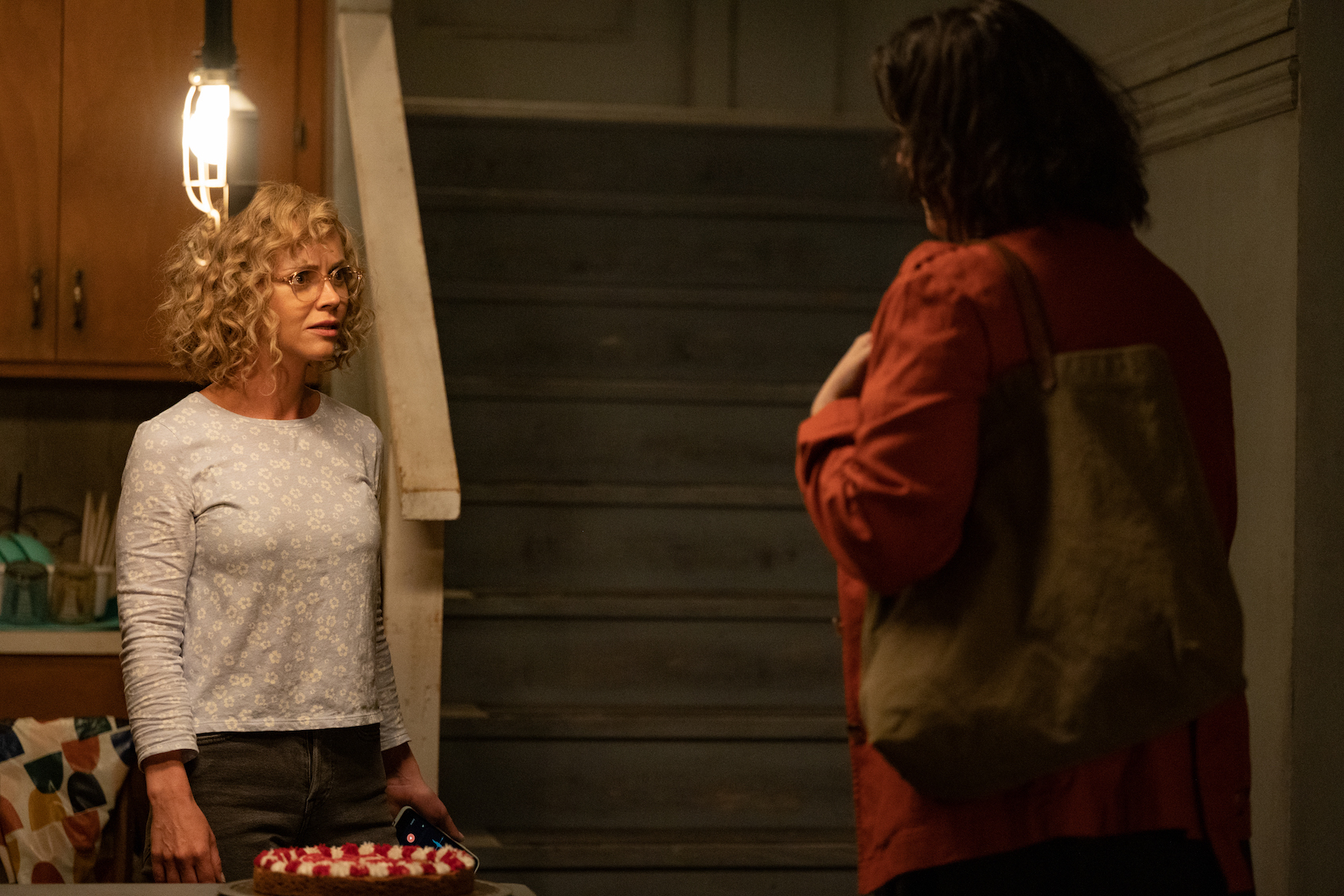
In present day, this moment — along with everything else we’ll see her experience during the 19-months trapped in the wilderness as pieced out during the run of this series — haunts Shauna in every aspect of her life. Mother to her teenage daughter Callie (Sarah Desjardins) and wife to her husband Jeff (Warren Kole) — the very Jeff she stole from Jackie — she practices looming interrogation strategy in Misty’s (Christina Ricci) basement, knowing that it won’t be long before Adam’s death gets traced back to her.

Using a voice modulator, Misty takes on the role of a cop grilling her about the “missing” Hoboken artist, diverting into jokes on his sexual prowess. When Shauna breaks from the scenario, she’s admonished for being “a disaster,” and reminded that the only thing she should ever say to the police is “I want my lawyer.”

“That’s why I put it on the cookie,” Misty says, pointing to a huge cookie on the table decorated with those very words in sugary icing.

Having exceeded her tolerance for Quigley time, Shauna heads out to cover her tracks further, but before she can get out the door, Misty pushes a Hawaiian Five-O Punch kit on her, because of course she prepared concessions for this. Clear of The Caligula Inn, Shauna gets to work gathering and burning Adam’s belongings and removing

After struggling with their sex life in Season 1, Jeff and Shauna seem painfully but, again, hotly ignited by the aftermath of her infidelity and cold-blooded murder.

evidence from his art studio. While in the process, she pauses to have hot sex with her husband, an accomplice, while staring at a portrait her dead lover painted of her. 

After struggling with their sex life in Season 1, Jeff and Shauna seem painfully but, again, hotly ignited by the aftermath of her infidelity and cold-blooded murder.

“The thought of you with someone else always scared me,” Shauna tells her husband, just prior to being bent over Adam’s studio table. “But it also turned me on.”

Going along with this Sadecki family version of foreplay, Jeff responds to her saying this used to make her feel like some kind of pervert by asking how it makes her feel now, and she says she likes the way she is. Problematic, sure. But better than furniture store roleplaying.   

Christina Ricci as Misty (Kimberley French/SHOWTIME)
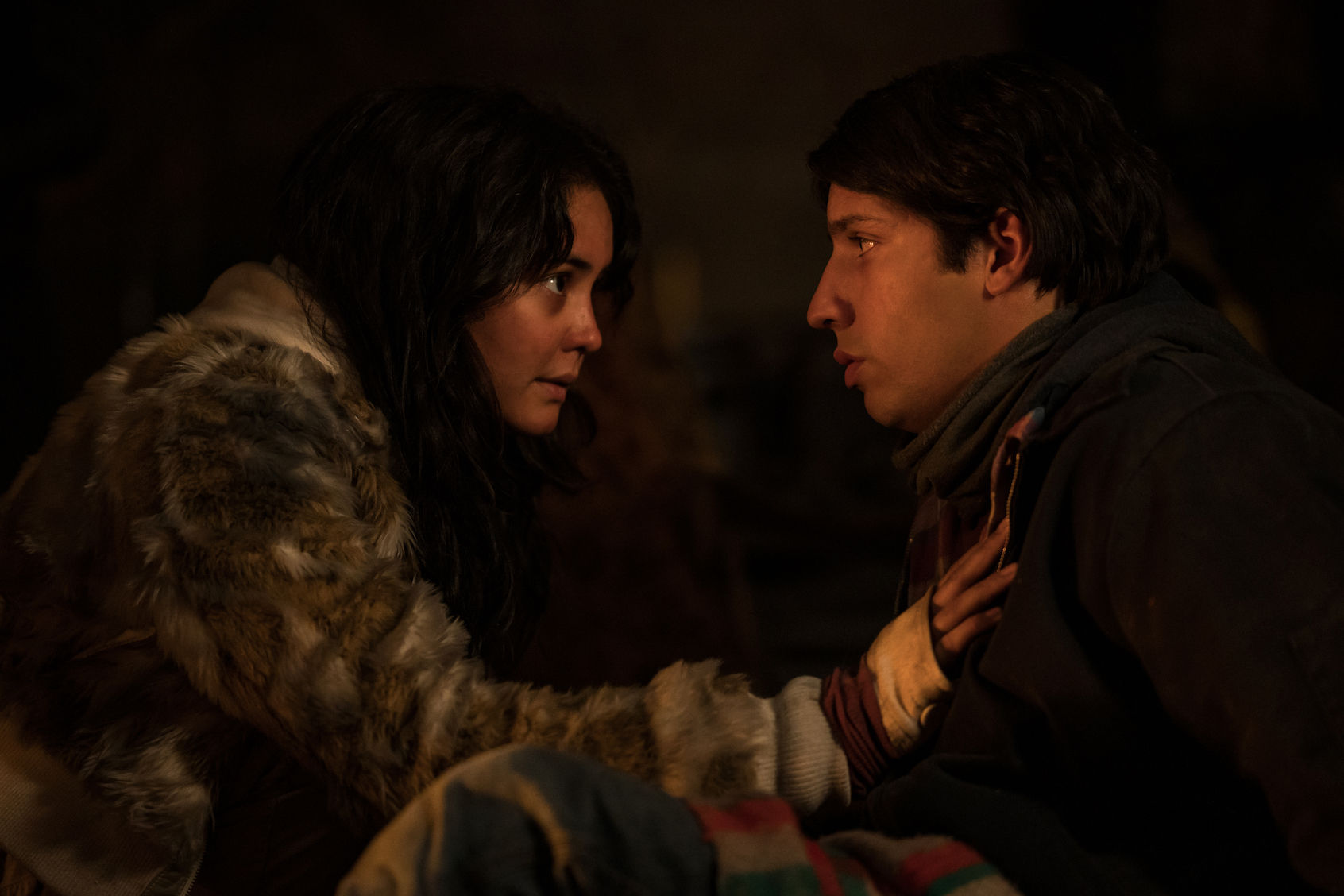
Even after making herself useful by providing her first aid skills to everyone in the wilderness for 19-months, Misty is still isolated from the group. Charming as I think she is, they have good reason for keeping a safe distance as she’s likely a serial killer, having killed Taissa’s (Tawny Cypress) “fixer,” the fake reporter Jessica Roberts (Rekha Sharma) in Season 1, and being the mastermind (or so it seems) of a lot of the show’s up in the air mysteries. Is she somehow involved in Lottie’s (Simone Kessell) cult? Did she have something to do with Travis’ (Kevin Alves) death? Did she organize Natalie’s kidnapping just so she could be the one to save her? All probable. But here, alone in the basement of her home, we see her pull out her phone to access a call history showing only a number of outgoings to Natalie, one to Tai, and one to a place called Hello Birdie Pets. For all her efforts, she’s still alone, but at least she’s got the hunt for Natalie to keep her busy.

Shackled to a bed within Lottie’s wooded cult/wellness clinic, or whatever this ends up being, Natalie should presently feel in danger, but she doesn’t seem too worried about it. Quickly overcoming cult-helper Lisa, played by new cast member Nicole Maines, she bolts across the property — dodging roaming chickens as she makes her way — in a short pursuit by members of the compound until she comes face to face with the adult Antler Queen herself, who avoids getting bashed in the head with the stick that Natalie is wielding by telling her she has a message from Travis, who died by apparent suicide in Season 1. 

In Natalie’s ’90s timeline, she’s helping Travis come to terms with the fact that Javi (Luciano Leroux) is likely dead. Leroux has been posting a ton of promo to his socials, which would lead one to believe we’ll see his character this season, but it could also be that Leroux/Purnell’s social strategies were intentional to throw us off here. This show has proven to be masterful with their informational forthcomings and withholdings in that way. But as they hunt for sustenance, they keep an eye out for Javi, dead or alive, and are gifted with blessings from Lottie to see them back safely.

Rubbing a pinch of ashes (OMG, whose ashes are these??) into their palms, waving around a stick of sage, and giving them sips of tea containing her own blood, Lottie is high on her own supply. 

“It’s not like this Wicca bulls**t is doing us any good,” Natalie says, one of the only remaining out of the survivors to not have gone full cabin woo-woo or boo-hoo.

“You keep coming back alive, don’t you?” Lottie shoots back.

In flashbacks, including one that flashes into a third timeline in 1998 — post rescue from the wilderness — we learn more about Lottie and the powers she has, or leads people to believe she has. After a scene showing the girls being bombarded by press, boarding another flight that, this time, takes them safely to their final destinations —home — we jump even a bit further. Lottie’s parents tell a doctor that she hasn’t spoken since she’s gotten home and asks them to “fix her.” Shock therapy is administered and, while convulsing from it, she has a vision we’d previously seen in Season 1 of her dressed all in white in a room filled with candles. Flashing further yet, she’s dressed in a purple cardigan, seeming to have been somewhat “fixed.” Comforting the woman who’s sharing her room by telling her “they” can make her better, the same way they helped her, her bounce-back feels like an origin story within an origin story.

The members of Lottie’s cult, as we meet them in the present day timeline as Natalie’s trying to escape, all wear purple, the same as young Lottie wears in the scene I just described. Is the cult she ends up leading affiliated with the same facility that healed her post rescue? Seems like it.

Courtney Eaton as Teen Lottie and Kevin Alves as Teen Travis (Kailey Schwerman/SHOWTIME)

One of the Yellowjackets survivors badly in need of healing who is no where near receiving it in the present timeline is Taissa. Newly elected as New Jersey Senator, she’s completely detached from the darkness within her, and unaware of how it manifests when she goes into these sleepwalking fugue states like the one she was in when she decapitated her family dog, Biscuit, in Season 1. 

Checked out and pre-occupied on her phone, she picks a random dog named Steve (poor Steve) from a shelter and drives it over to her kid’s elementary school as a surprise. Seeing him walk from the school, she maniacally holds it up in the air, and then drives back home with it, rejected, when her terrified wife Simone (Rukiya Bernard) runs up to pull Sammy away from the car.

Later, Steve will get a glimpse of his fate (or likely fate) when he runs up on Tai crying in front of Biscuit’s head, still squishy on the at-home altar she seems to have had no knowledge of making.

“This was a mistake,” she says to Steve, as he’s held over her shoulder, staring at RIP Biscuit. “I’m gonna do better with you.”

Click here for what Shauna would have to say to that.

QUICK BITES:

  • “Friends, Romans, Countrymen, lend me your . . . ears.” Took me awhile to get that one.
  • The director of this episode is Daisy von Scherler Mayer, whose directing debut was the 1995 film “Party Girl” starring Parker Posey. The scene where Natalie kicks at the chickens as she’s trying to escape Lottie’s compound is very reminiscent of this hilarious ’90s classic which, if you haven’t seen it, is a must watch.
  • In the flash to 1998 when the girls are headed home, an agent is heard saying “The investigation into the cause of the accident remains preliminary. The crash site was over 600 miles north of their designated flight pattern.” I felt like this was important to write down.
  • The intro for Season 2 is similar to the first season, with key re-vampings. One bit I took notice of is a flash of a piece of paper over a deck of cards that reads “I am grateful for my friends.” Shudder.
  • “We are the ones making ourselves sick,” adult Lottie tells her followers at the compound. “The rest of it doesn’t matter because it isn’t real.” Let’s put a pin in this.
  • After Shauna flees her house, Misty avoids phoning Natalie again by logging into her Citizen Detective message board. Here we get, not a glimpse, but a sound bite from Walter (Elijah Wood) as his voice is heard in Misty’s mind while she reads a post from him pertaining to Adam. Walter’s screen name in the message board is PuttingTheSickInForensics. Love that.

“The View” gets it wrong: Marjorie Taylor Greene must be covered — not ignored — by the media

I am not the target audience for the television show “The View.” The format, style, and what the show represents in terms of “soft news” and the long decline in the quality of America’s public discourse does not appeal to me. However, many millions of other people feel differently. The show is beloved by its viewers who find the personalities and their banter comforting and informative. Alternatively, many of the show’s viewers likely watch it because they love to get angry and upset at the hosts. In that role, “The View” is channeling large swaths of the public’s thoughts, intuitions and moods – however vague and ill-formed those thoughts and feelings may be.

During a recent episode, the hosts debated how much attention the news media — and by extension the public as a whole — should pay to “extreme”,” partisan” and “divisive” politicians and other public figures such as Marjorie Taylor Greene. Should they be ignored? Do they actually merit the large amount of news media attention they receive?

In discussing Greene, the Republican Party, and this “polarized” political environment host Whoopi Goldberg observed:

The people really want the truth, for a long time they thought that the media was very biased — they thought that….So when somebody comes along and says the media is very biased, doesn’t tell you the truth and then you sit with that person and you hear what they say and they are not telling the truth, you go wait a minute. People started going what is wrong here? I just think, you know, as a nation, we have an ability to make decisions and make the right people — put the right people where they’re supposed to be.”

“Ratings are king,” co-host Joy Behar explained. “That’s the problem.”

Alyssa Farah Griffin, the show’s token conservative, shared how Greene is discussed during the show’s planning meetings:

By the way, we talk a lot in our ‘hot topics’ meeting when we get the craziest thing Marjorie Taylor Greene said. We debate, “is there an actual value to talk about this?’ The ‘national divorce,'” we agreed it was dangerous and we need to take it on. We don’t take it on if she’s just being crazy.

The struggle against neofascism and illiberalism is fundamentally a moral one; to retreat from using moral language is to surrender to such civic evil.

In their discussion of Greene and how to cover such “extreme” and “controversial” figures, “The View” hosts cited a new study about news media coverage and political polarization that found “[h]yper-partisan politicians received more than 4x the coverage their bipartisan colleagues did around the 2022 midterm elections across the most-viewed online news sites and cable news programs as well as the nation’s four morning shows.” 

I would add the following concerns about the role of the news media and Fourth Estate in the Age of Trump and beyond.

The American mainstream news media is limited in their capacity for sustained and effective pro-democracy work. Blinded by a commitment to obsolete norms such as “bothsidesism” “fairness” and “neutrality,” the media often opts for horserace coverage that focuses in on the contest, personalities, and “winners and losers.” 

The news media and pundit class continue to avoid using moral language to describe the Republican fascists, Trumpists, and the larger “conservative” movement and the empirically documented harm they’ve caused to American society and the American people. The struggle against neofascism and illiberalism is fundamentally a moral one; to retreat from using moral language is to surrender to such civic evil. But as an institution, the American news media continues to be driven by profits, access and careerism. In total, the media is doing the work of elites in terms of agenda setting and policing the norms of “acceptable” public discourse instead of being committed to speaking truth to power.

The news media is a supply and demand business: the public has much more power than they realize to shape it.

Leading media outlets continue to give a platform to former Trump regime members and other neofascists, which in turn does the work of mainstreaming and normalizing such illiberal voices and perspectives.

Beyond improving the mainstream news media, what is ultimately needed is a commitment to renewing American’s democratic culture. Citizens have a central role to play in that project. They need to become active and not passive, and to view democracy as a verb and not just a noun. Part of this project of democratic renewal involves understanding politics as something meaningful that is happening all the time and not just during a high-profile election or crisis. In addition, rank and file Americans need to learn the skills of democracy by participating in local civil society groups and other organizations and associations. The relationships and skills formed and learned in those spaces will make successful collective action in service to social democracy and other positive social change much more likely.

The American people also have an important role to play in being watchdogs and advocates in how they monitor and pressure the country’s news media to go beyond 24/7 cycle of controversy and “hot takes” and conflict-driven stories and to instead focus on in-depth and sustained coverage that empowers and educates the public. The news media is a supply and demand business: the public has much more power than they realize to shape it.

But in this time of democracy crisis and need for democratic renewal and reckoning, it is imperative that the news media, the pundits, the political class, and everyday people all resist the siren calls and temptations of normalcy bias and other forms of wish-casting that are amplified by false equivalence and the uncritical use of language such as “hyper-partisan” and “polarization”.

To wit, in explaining their new research on the news media and polarization, even the researchers cited by “The View” signal to this perilous dynamic with how they do “not make value judgments of the politicians nor does it evaluate positions, ideology, or other policy conditions.” But alas, the defenders of American and global democracy must in fact do exactly the opposite in what will be a very long struggle to defeat the Republican fascists and their allies.

These are not normal times where such technical language as “partisanship” and “polarization” assumed that the country’s mainstream political parties, the Democrats and the Republicans, liberals and conservatives, simply occupied different positions along a political continuum where there was mostly agreement and consensus about the inherent value of the country’s democratic norms, values, and institutions. By comparison, today’s Republican Party have full-on embraced neofascism, authoritarianism, racism, white supremacy, misogyny, bigotry, anti-intellectualism, anti-rationality and political cultism.

Contrary to what “The View” would suggest, now is the time to be hyper vigilant and hyper focused on the likes of Greene, Boebert, Trump and the like. They win through exhaustion and normalization, which is facilitated by how the public and the news media and other opinion-leaders too often decide it is better to ignore such loud and obnoxious and threatening voices instead of treating them as the existential dangers they truly are.

The GOP is becoming more unhinged about LGBTQ people — which will only make them more unpopular

“A harmless drag show? Not possible.”

That was the response of Walter Wendler, the president of West Texas A&M University, in defense of his unilateral decision to cancel a drag show students had scheduled as a fundraiser for the anti-suicide group the Trevor Project. Wendler claimed his purpose was to stop speech that would “denigrate and demean women,” comparing drag to “blackface.” Students, however, argued, “Drag is not an insult,” but instead “a celebration of queerness, of gender, of femininity.”

In 2019, Wendler provoked a similar controversy by arguing that sex should only occur between married heterosexuals who do not use contraception. He was let go from his previous position as chancellor of Southern Illinois University Carbondale after he resisted allowing employees in same-sex relationships to have equal access to health care benefits. Student groups argue that Wendler broke a university policy barring the university from taking action against students “on the basis of a political, religious, philosophical, ideological, or academic viewpoint.” 

The GOP is turning up the anti-queer rhetoric right when most Americans are more supportive of LGBTQ rights than ever. 

Wendler’s actions come in the middle of a growing crescendo of bombastic conservative attacks against LGBTQ people. Across the country, there’s a mounting series of legislative and rhetorical efforts by Republicans to curtail the rights of LGBTQ to get medical care, enjoy equal access to public spaces, and to express themselves freely. Many Republicans have turned to the anti-LGBTQ movement as a way to rally support in the post-Donald Trump era.

On Tuesday, there was an on-campus protest that drew a healthy crowd for a tiny, conservative school in Canyon, TX, a small town near Amarillo. The robust response isn’t too surprising, however. GOP attacks on LGBTQ people are widely perceived as using hate to gain power. New data shows it’s also likely to backfire for Republicans. The GOP is turning up the anti-queer rhetoric right when most Americans are more supportive of LGBTQ rights than ever. 


Want more Amanda Marcotte on politics? Subscribe to her newsletter Standing Room Only.


Initially, the post-Trump era of anti-LGBTQ activism began under the pretext of “protecting children.” Groups like the Proud Boys would organize protests of family-friendly drag events, baselessly arguing that people in silly costumes chastely reading children’s books somehow “sexualizes” children. In Florida, Republican Gov. Ron DeSantis and his allies defended the “don’t say gay” bill censoring discussion of LGBTQ identities in school, by claiming it only impacted lower grades, even as legal experts said it had a chilling effect across schools. Attacks on gender-affirming health care for trans people were packaged as efforts to “protect” minors from “rushing” into transition. 

This fig leaf of concern for “children” has been collapsing recently, however. DeSantis is now trying to expand his “don’t say gay” law into high schools. He’s also trying to get liquor licenses stripped from bars that host drag shows. At the most recent Conservative Political Action Conference, a speaker demanded: “transgenderism must be eradicated from public life entirely.” As the New York Times reported in January, Republicans in state legislatures are introducing bills banning trans health care for adults and even banning trans people from public places. Trump, as part of his 2024 campaign, has promised to block all federal programs that affirm trans identities for adults. Tennessee’s recent drag ban is so broad, critics suspect it will be used to criminalize previously uncontroversial behaviors like drag queens marching in Pride parades. 

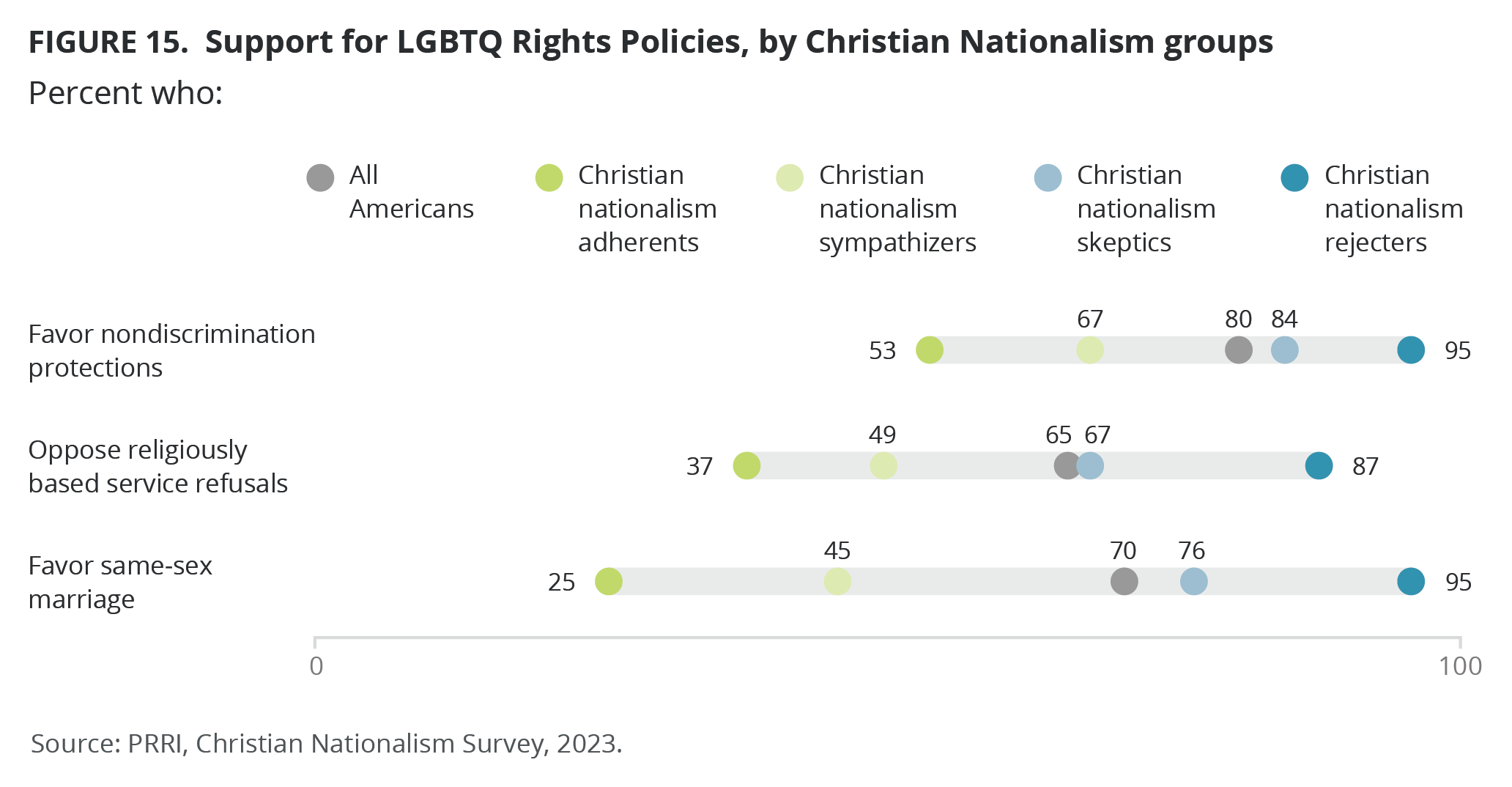
Republicans may think this is a way to regain public support after underperforming in every election since Trump’s first midterm. A new study from the Public Religion Research Institute (PRRI) shows they are sorely mistaken, however. The group found that “Americans are growing more supportive of LGBTQ rights than ever before.” And while support for LGBTQ rights was higher among Democrats and independents, even a majority of Republican voters believe the law should protect LGBTQ people from discrimination.

“The data tell us that there is a mismatch between public opinion broadly on support for LGBT nondiscrimination protections and legislative activity in many states that seek to restrict the rights of transgender Americans,” PRRI CEO Melissa Deckman told Salon. “We find that 80 percent of Americans support such protections, even in red states where such legislative activity is occuring. In Tennessee, for instance, which is the first state to ban public drag performances, 71 percent of residents support nondiscrimination protections.”


Want more Amanda Marcotte on politics? Subscribe to her newsletter Standing Room Only.


Digging even further into the data, there’s even more indication that opposition to LGBTQ rights will only serve to alienate the GOP from the American mainstream. Antipathy to queer people was concentrated mainly with the minority of Americans PRRI classifies as either adherents of or sympathetic to Christian nationalism, a right-wing ideology that rejects the constitutional tradition of freedom of religion. 

Christian nationalism isn’t just a threat to longstanding religious freedom protections, as previous PRRI research has found. The belief system is heavily linked to white supremacist views and anti-Black racism, anti-semitism, opposition to immigration, and a belief in male dominance over women. (Which cuts against the claims that anti-drag protesters wish to “protect” women.) They also take a dim view of democracy and are more likely to turn to violence against those who disagree with their political views. As Kathryn Joyce documented for Salon, Christian nationalism was a major motivating factor for the insurrection at the Capitol on January 6, 2021. 

While the mainstream media tends to focus heavily on Trump’s cult of personality, there are strong indications that it’s not just Trump, but the unpopularity of the larger Christian nationalist movement that is turning voters against the GOP. This was shown in the 2022 midterm elections, where polls showed that Democrats over-performed expectations due to voter anger over the overturn of Roe v. Wade. Abortion bans provoked a larger outpouring of concern from the majority of Americans about how Republicans are allowing Christian nationalism to threaten health care access, religious freedom, the right to vote, and the ability of Americans to live free from terrorist attacks like the January 6 insurrection. 

Last week, “RuPaul’s Drag Race,” which is in its 15th season of drag queens competing to show off talents and fashion sense, addressed the mushrooming efforts to harass drag performers out of existence. They did it, unsurprisingly, with the campy humor that defines their art form: A comic musical called “Wigloose,” based on the 80s film “Footloose,” except with fundamentalists banning drag instead of dancing. The tribute drew praise from Kevin Bacon, the star of the original “Footloose,” who wrote, “Drag is an art and drag is a right.” He also shared a video from the host, RuPaul, saying, “Register to vote so we can get these stunt queens out of office and put some smart people with real solutions into government.”

No doubt these reactions increase anger from Republicans, who will view it as evidence they’re oppressed by “woke” culture. But it underscores how politically unwise it is for the GOP to put so much of its energies into attacks on LGBTQ people. Voters are punishing Republicans at the polls for bans on abortion, and there’s good reason to think voters will take a similarly dim view of attacks on LGBTQ rights. It’s difficult for Republicans to claim they are “pro-freedom” when they are passing laws restricting what people can read, wear, or say. The Christian right are the villains in “Footloose” and American attitudes towards the prudery caucus haven’t grown any warmer since then. 

Webb telescope finds an exoplanet with atmospheric sandstorms and numerous ingredients for life

Using the James Webb Space Telescope, scientists have made a remarkable discovery about a unique planet located about 40 light years from Earth.

Unlike Earth, the exoplanet — named VHS 1256 b — takes approximately 10,000 years to orbit around its two host stars, and is located four times farther from its host stars than Pluto is from our Sun. An exoplanet is a planet that orbits a star that is not our sun. Until 1992, no exoplanets had ever been detected, as telescope technology was not powerful enough to resolve planets in other solar systems.

Despite orbiting at such a vast distance from its host stars, the James Webb Space Telescope was able to study VHS 1256 b’s atmosphere and found evidence of several intriguing compounds — including water. Moreover, with just a few hours of observation time, the telescope was able to identify the largest number of molecules ever discovered on a planet outside our very own solar system. The observations indicated direct signatures of water, methane, and carbon monoxide, as well as evidence for carbon dioxide, all of which are chemical components that can be biosignatures indicative of life or the potential for life to form.

“There’s a huge return on a very modest amount of telescope time,” said co-author Beth Biller of the University of Edinburgh in the United Kingdom in a media statement. “With only a few hours of observations, we have what feels like unending potential for additional discoveries.”

Using Webb’s Near-Infrared Spectrograph and Mid-Infrared Instrument, scientists determined that this exoplanet has low gravity compared to other massive brown dwarfs. Scientists also found that the exoplanet has silicate clouds — meaning they are made out of sand — that were spotted higher in the exoplanet’s atmosphere, where temperatures were as high as 1,526 degrees Fahrenheit (830 degrees Celsius).

“The atmosphere of VHS 1256 b is constantly rising, mixing, and moving during its 22-hour day, bringing hotter material up and pushing colder material down,” Loeb said.

“The finer silicate grains in its atmosphere may be more like tiny particles in smoke,” Biller said. “The larger grains might be more like very hot, very small sand particles.”

It is believed that smoke and dust particles hover above the exoplanet, as Biller mentioned. During its 22-hour day, the hotter material on top pushes colder material down, resulting in the most variable brightness changes known to occur on a planetary-mass object known to date.

“That means the planet’s light is not mixed with light from its stars,” science team lead Brittany Miles of the University of Arizona said.

Scientists have long anticipated that the powerful Webb Space Telescope would have an unparalleled ability to observe distant solar systems and their exoplanets. That includes its ability to probe for possible signs of life, such as water, oxygen or methane. The findings from this observation provide a potent example of the telescope’s capabilities in this realm.


Want more health and science stories in your inbox? Subscribe to Salon’s weekly newsletter The Vulgar Scientist.


“No other telescope has identified so many features at once for a single target,” said co-author Andrew Skemer of the University of California, Santa Cruz. “We’re seeing a lot of molecules in a single spectrum from Webb that detail the planet’s dynamic cloud and weather systems.”

Even though the exoplanet has so many compounds that could hint it could support life, like water, astronomers like Avi Loeb say it’s unlikely.

“Webb’s observations of VHS 1256 b show clear signatures of water, methane and carbon monoxide, and provide evidence for carbon dioxide,” Loeb, an astronomy professor at Harvard University, told Salon. “These chemical components would be compelling bio-signatures of life if molecular oxygen was also detected, but on their own they are not biosignatures.”

Loeb pointed to the data showing that the exoplanet has silicate clouds.

“The atmosphere of VHS 1256 b is constantly rising, mixing, and moving during its 22-hour day, bringing hotter material up and pushing colder material down,” Loeb said. “The Webb Telescope proved that the clouds of VHS 1256 b are made up of silicate particles.”

Still, scientists believe they’ve barely scratched the surface in regards to studying this unique exoplanet. 

“We’ve identified silicates, but a better understanding of which grain sizes and shapes match specific types of clouds is going to take a lot of additional work,” Miles said. “This is not the final word on this planet — it is the beginning of a large-scale modeling effort to fit Webb’s complex data.”

On Thursdays, we wear orange: SEC sues Lindsay Lohan and others over crypto money laundering scam

Lindsay Lohan, Jake Paul, Lil Yachty and adult film star Michele Mason (Kendra Lust) are among eight celebrities hit with charges this week from the Securities Exchange Commission. The group were caught up in the SEC’s investigation into Justin Sun, the owner of BitTorrent and the Tron blockchain platform, and their respective crypto assets BTT and TRX.

The SEC claims the celebs were being paid to promote BTT and TRX, which are considered a security, but failed to properly disclose that to investors (i.e. their audiences and followers). Six of the stars have agreed to pay out more than $400,000 to settle the claims: Paul, Lohan, Yachty, Mason, rapper Akon and R&B artist Ne-Yo. None of the six admitted or denied the claims. 

The SEC said the other two celebrities in the complaint, pop singer Austin Mahone and rapper Soulja Boy, didn’t reach a settlement. Sun’s whereabout are currently unknown, according to the complaint, but he and his companies continue to face charges that he orchestrated the whole thing. And that he engaged in market fraud and wash trading — a market manipulation tactic in the same wheelhouse as pump-and-dump schemes, where a security is made to look popular through a series of rapid-fire sales and purchases without that security ever substantially changing ownership.

In fact, a crypto pump-and-dump scheme is exactly what he’s been accused of in other countries before making a timely escape, as reported earlier this month by the Verge.  


Want a daily wrap-up of all the news and commentary Salon has to offer? Subscribe to our morning newsletter, Crash Course.


“This case demonstrates again the high risk investors face when crypto asset securities are offered and sold without proper disclosure,” said SEC Chair Gary Gensler in the commission’s Wednesday release.

“As alleged, Sun and his companies not only targeted U.S. investors in their unregistered offers and sales, generating millions in illegal proceeds at the expense of investors, but they also coordinated wash trading on an unregistered trading platform to create the misleading appearance of active trading in TRX. Sun further induced investors to purchase TRX and BTT by orchestrating a promotional campaign in which he and his celebrity promoters hid the fact that the celebrities were paid for their tweets,” Gensler said.

The SEC alleges that while paying the celebrities to hype his product from at least April 2018 through February 2019, Sun had his other employee engage in more than 600,000 wash trades of TRX — amounting to 4.5 million and 7.4 million TRX wash traded daily — which generated $31 million from the illegal sales.

“While we’re neutral about the technologies at issue, we’re anything but neutral when it comes to investor protection,” said Gurbir S. Grewal, Director of the SEC’s Division of Enforcement in the statement. “Sun and others used an age-old playbook to mislead and harm investors by first offering securities without complying with registration and disclosure requirements and then manipulating the market for those very securities.”

Lohan’s publicist told USA Today that the actress was unaware of the disclosure requirement when she was originally contacted in March and agreed to pay the fine. Lohan, who announced last week that she is pregnant, handed over the $10,000 she was paid for the posts along with a $30,000 fine.  

Celebrity involvement in crypto endorsement scams isn’t unheard of, though. Lohan and the other celebs now join the ranks of Kim Kardashian, who paid the SEC a whopping $1.3 million in fines when she was paid to promote cryptocurrency EMAX on Instagram but didn’t tell her audience she was paid to do so. 

Michigan is set to become first state in 58 years to overturn right-to-work law

After Michigan Democrats scored their first trifecta of controlling the House, Senate and governor’s office in decades this past election, the state is now set to become the first state in six decades to overturn its anti-worker “right-to-work” law.

Democrats in the Michigan House voted on Tuesday to approve a bill repealing right to work in the state, sending the bill to Gov. Gretchen Whitmer, who has pledged to sign the bill into law. The bill passed the Michigan Senate last week in a party line vote.

The bill’s passage is a major victory for labor unions, which have long denounced right-to-work laws as stifling workers, hamstringing unions and worsening working conditions. For decades, the tide has been in favor of right-to-work laws — the last time a state repealed a right-to-work law was Indiana, in 1965, only for it to be reinstated in 2012.

“It’s huge,” Michigan AFL-CIO President Ron Bieber told Michigan Radio. “It’s huge for the entire labor movement nationally to have a victory for working people and make progress for a change.”

Michigan unions say that the repeal will set the state up to be one of the best states for workers’ rights after over a decade of right to work. There are currently 26 other states with right-to-work laws.

For many years, Michigan had the highest rate of unionization in the U.S.; as the Economic Policy Institute (EPI) found in a recent report, in 2005, the state’s unionization rate was 1.7 times the national rate, while the median wage was 6 percent higher than the average median wage. Since Republicans passed right to work in 2012, according to Bureau of Labor statistics data, the state has lost 40,000, or 2.6 percent, of its union members.

Right-to-work laws work against unionization by exempting workers from paying dues for unions, while still drawing benefits from union membership. These laws are backed by corporations and conservative lobbyists because they work to weaken unions and their power to organize workers; a study by the National Bureau of Economic Research found that, among Michigan and four other states that implemented right-to-work laws between 2011 and 2017, unionization rates dropped by 4 percent on average.

Conservatives often argue that right-to-work laws are supposedly about worker freedom, while businesses will be attracted to right-to-work states, where they can conduct business cheaper. These are contradictory ideas, labor advocates have pointed out.

“We really have to think about, why exactly is that? It’s not because [businesses are] coming to Michigan thinking that workers are being treated better,” Atulya Dora-Laskey, an organizer behind the first-ever unionized Chipotle in Lansing, Michigantold Michigan Advance. “It’s because they think that the workers here will be easier to exploit with right-to-work, because they don’t have the same amount of solidarity as they would otherwise.”

Or, as the bill’s lead sponsor, state Rep. Regina Weiss, D, said in a speech on the House floor earlier this month: “Right-to-work was never about freedom — it was simply about control.”

Right-to-work laws, dominating over half of the states in the U.S., have been blamed for the overall decline in unionization across the country. The rate of unionization hit a record low last year, according to data from the Bureau of Labor statistics, with only 10.1 percent of the workforce in a union. At the same time, however, the sheer number of workers belonging to a union increased by 273,000 people in 2022, giving hope to labor advocates that there is currently momentum behind the labor movement but that people are being shackled by anti-union and anti-worker laws.

The Michigan right-to-work repeal is another indication of the current energy behind the labor movement, advocates say.

“I think it’s a sign of the times,”Jennifer Sherer, senior state policy coordinator for EPI, told Michigan Advance. “It’s a sign of the growing interest in reviving unions, and an acknowledgement of their really important role that they play in leveling the playing field and rebalancing that power.”

“Even more financial chaos”: Latest hike by Fed “risks throwing millions of Americans out of work”

Progressive economists and other experts blasted Federal Reserve leadership on Wednesday for raising interest rates yet again despite concerns about recent bank failures and how the quarter-point increase will impact the U.S. and global economies.

“Once again, interest rate hikes are going to fall hardest on low-wage workers and the poor—the same people who have already been hurt the most by rising prices,” tweeted University of California, Berkeley professor and former Labor Secretary Robert Reich. “Higher rates could also imperil more banks, and risk even more financial chaos. The Fed is playing with fire.”

Fed Chair Jerome Powell told reporters Wednesday that although the Federal Open Market Committee “did consider” a pause on rate increases following the Silicon Valley Bank (SVB) and Signature Bank failures, officials ultimately decided to raise the federal funds rate to a range of 4.75-5%, the highest level since 2007.

“The Fed under Chair Powell made a mistake not pausing its extreme interest rate hikes,” declared Sen. Elizabeth Warren, D-Mass., a fierce critic of nine consecutive rate hikes since last March as well as the Fed’s regulatory rollbacks that proceeded the bank collapses.

“I’ve warned for months that the Fed’s current path risks throwing millions of Americans out of work. We have many tools to fight inflation without pushing the economy off a cliff,” added Warren, who has repeatedly called for ousting Powell.

Patriotic Millionaires chair Morris Pearl—a bank bailout expert and former managing director at BlackRock—similarly contended that “the Fed’s decision to keep pushing forward with rate hikes no matter the circumstances is a dangerous mistake.”

Describing such hikes as “a blunt instrument,” he stressed that high interest rates “are not well suited to the economic realities the country now faces—and will inevitably end up doing more harm than good.”

Pearl continued:

In our modern economy, high interest rates are simply not an effective way to fight inflation. Rate hikes have disproportionately hurt just a few sectors, like housing, automobiles, and some banks and investors, while leaving many of the nation’s largest employers relatively unscathed.

Rising interest rates do nothing to address a major cause of inflation, corporate price gouging, and actually make another long-term cause, lack of investment in new housing, worse. Instead, the Fed is betting that lowering employment and cooling wage growth is the best solution to inflation.

Higher interest rates may be a cure for inflation, but if they end up causing another banking crisis, or pushing the economy into a recession, the cure may be worse than the disease.

An analysis released Wednesday by Accountable.US explained that “SVB’s failure was partly due partly to a ‘plunge’ in bond value and $1.8 billion in ‘paper losses’ amid the Fed’s rate hikes. By the end of 2022, the Federal Deposit Insurance Corporation (FDIC) had warned that U.S. banks were ‘sitting on $620 billion in unrealized losses’ that may make their balance sheets appear healthier than they really are.”

The watchdog group found that “at the end of 2022, the five biggest U.S. banks—JPMorgan Chase, Bank Of America, Citigroup, Wells Fargo, and U.S. Bank—reported a total of $233 billion in unrealized losses on held-to-maturity securities, including $54 billion in unrealized losses on Treasury securities. These same banks reported a combined $39.4 billion in unrealized losses on available-for-sale securities, including $12.7 billion in losses on available-for-sale U.S. Treasuries.”

Liz Zelnick, director of economic security and corporate power at Accountable.US, warned Wednesday that “hiking interest rates, even if more slowly, will devastate Main Street and Wall Street alike by wiping out millions of jobs while sending Treasury securities into a downward spiral,” acknowledging that the recent bank turmoil prevented an even bigger increase than 25 basis points.

“A recession and broken financial system are not worth the price of higher interest rates that have failed miserably to curb the corporate greed epidemic helping to drive up costs,” Zelnick added. “To date, the Federal Reserve and Chairman Jerome Powell have been more than willing to let average American families bear the brunt of their job-killing strategy—but are they also willing to let their banker friends on Wall Street go down with the ship?”

The Hill highlighted that ahead of Wednesday’s announcement, influential figures such as economist Paul Krugman and analysts for Goldman Sachs—in a Monday letter to investors—had advocated for pausing rate hikes.

“Bank stress calls for a pause,” wrote Goldman Sachs analysts. “Banking is not just another sector of the economy because financial intermediation is vital to every sector. As a result, addressing stress in the banking system is the most immediate concern and must take priority over other less urgent goals for the moment. We expect that policymakers and staff economists at the Fed will have the same view.”

During his Wednesday press conference, Powell insisted that “our banking system is sound and resilient with strong capital and liquidity. We will continue to closely monitor conditions in the banking system and are prepared to use all of our tools as needed to keep it safe and sound.”

While Powell also emphasized the Fed’s commitment to learning from the recent SVB and Signature failures to prevent repeat events, both the bank collapses and a year of rate hikes have fueled calls for his ouster.

Asked by CNN’s Jake Tapper on Wednesday whether she had ever directly told President Joe Biden that he should fire Powell, Warren said she wouldn’t talk about private conversations “but what I will say is I’ve made it very clear as publicly as humanly possible that I didn’t think that he should be reconfirmed as chair of the Fed. And I think he’s doing a really terrible job.”

“And he’s doing a terrible job on both fronts,” she said, referring to the Fed’s dual mandate. In terms of oversight, Powell “has spent five years weakening regulations over these multibillion-dollar banks,” and on monetary policy, he is “risking pushing our economy into a recession.”

“What he’s trying to do is get two million people laid off, and one of the things that we need to understand: He wants to raise the unemployment rate by more than a point within a single 12-month period. We have done that before in this country. In fact, we have done it 12 times before. And out of all 12 times, how many times has it resulted in a recession?” she said. “The answer is 12.”

NRA tried to stop financial bleeding by cutting gun training and education. Now members are fleeing

The National Rifle Association’s financial firepower, which arose in part due to its large and loyal membership base, has long been one of the gun group’s main sources of strength.

But the NRA has in recent years faced a financial tsunami, one that came to light after the 2016 election. A swirl of disagreements with longtime business partners, accusations of waste and misspending, ballooning debt and lawsuits from the New York and Washington, D.C. attorneys general have triggered one embarrassment after another. The NRA tried to declare bankruptcy to cushion some of these blows, with no luck.

At this point, the threat of being forced by the authorities to shut down due to alleged improprieties is minimal. But has the NRA managed to weather its financial storm?

As an accounting researcher who focuses on the financial performance of nonprofits, I have been closely studying NRA finances throughout its crisis. I can say the NRA financial picture is, as of early 2023, a mixed bag. The gun group has shored up its financial position over the last few years. However, the way in which that financial recovery came about risks hemorrhaging the NRA’s core supporters.

Digging out of a financial hole

The NRA’s financial troubles arose at the same time that scandalous aspects of the organization’s woes – such as longtime NRA leader Wayne LaPierre’s free yacht getaways and luxury suit purchases billed to an NRA contractor – were drawing public attention.

Perhaps the best measure of a nonprofit’s financial health is its unrestricted net assets – the money at the organization’s disposal after leaving out amounts it has to spend on activities promised to donors and what it owes to others. A multimillion-dollar unrestricted net asset reserve for an organization the size of the NRA can provide financial security. On the other hand, a negative reserve is typically a sign of serious trouble.

The NRA’s reserve was negative at the end of 2017, with a deficit of more than $30 million – a sure sign of the troubles already underway. Such a negative balance indicates that after satisfying donor promises, the organization owes more money to others than the value of its assets.

Things only got worse in the following two years, with the NRA approaching an unrestricted net asset deficit of nearly $50 million in 2019. This degree of weakness even led the organization to suggest that it risked imminent failure. However, there was time for a turnaround.

And that’s what happened. In 2020, the NRA slashed its unrestricted net asset deficit by over $38 million. Ironically, it was shortly after pulling off this marked improvement that it filed – unsuccessfully – for bankruptcy.

This financial resurgence continued in 2021, with the organization reporting it had eliminated its unrestricted net asset deficit, building up a surplus of over $10 million. When also including the money set aside for specific uses stipulated by donors – the group’s net assets – the NRA’s total available funds reached over $75 million.

These developments may seemingly bode well for the organization’s ability to withstand its continuing financial troubles. Below the surface, however, there’s an ominous trend.

Selective cost cutting

How did the NRA get on a steadier financial footing?

It wasn’t through growth. NRA revenue declined in 2020 by 4% from $296 million to $284 million, even without taking inflation into account. Revenue fell another 18% to under $234 million in 2021.

Instead, it cut many core programs, including education and training, field services, law enforcement initiatives and recreational shooting.

Cost cutting can help stabilize faltering companies or nonprofits, depending on which costs they cut. The NRA’s over 4 million dues-paying members may tolerate lean spending only on certain things and only for so long. What the NRA spent on programs fell by $45 million – more than a 35% decline – in 2020. The organization was quick to attribute the change to the nation’s response to the COVID-19 pandemic.

However, program spending declined even further in 2021, when life had begun to return to normal, especially for gun enthusiasts. The NRA spent just $75 million on its programs in 2021, nearly $53 million less than it had two years earlier.

It didn’t cut all costs during these lean years.

Administrative spending in the “legal, audit and taxes” category skyrocketed, from just over $4 million in 2017 to almost $47 million in 2021. Much of this reflects the money NRA paid for its various legal entanglements, largely in fees to its new legal team.

What once was a member-focused organization has quickly become an organization whose primary growth area is legal fees.

Was 2022 a turning point?

Though the NRA apparently shored up its bottom line, its financial neglect of programs like firearms training, competitions and field services could ultimately disappoint its members and donors.

The organization has seen membership dues decline in the past several years, with a loss of more than 1 million members since the start of the crisis. I see a risk of a downward spiral: lower revenue, leading to less spending on programs, which leads to further declines in member dues, donations and so on.

The full NRA financial filing for 2022 is not yet available, but there are early signs that it may have been a turning point.

Journalist Stephen Gutowski has reported at The Reload that NRA membership declines meant that even with its more lean spending profile, the organization was poised to end 2022 at a loss.

I believe that with fewer members and fewer items left to cut, the NRA may take more drastic steps in the years ahead. And, with 2022 having been an election year – prime time for the NRA to take center stage – declining funds prevented an all-out political spending blitz.

Though it may once have seemed like the NRA would suddenly implode due to its weak finances, its decline today is more of a slow burn that’s diminishing its scale and threatens its future. The growth of other pro-gun groups, such as Gun Owners of America and the Second Amendment Foundation, poses further risks for a shrinking NRA.

In my view, the NRA’s risky strategy of cutting program costs while spending more on legal battles could portend a further and continued weakening of the organization in the years ahead.


Brian Mittendorf, Fisher Designated Professor of Accounting, The Ohio State University

This article is republished from The Conversation under a Creative Commons license. Read the original article.

“What color are you talking about?”: Why Jo Koy stopped caring about appealing to Middle America

This year marks comedian Jo Koy’s 33rd year as a stand-up. He’s currently on his “Funny is Funny” world tour, but Koy admits that his success has been a long journey from starting out in Las Vegas coffee shops to now selling out arenas. During his set, he talks about his come up story as a Filipino-American comedian and letting Gen Z know that “it’s just not as easy as you think.”

Beyond his four Netflix stand-up specials, Koy starred in the comedy film “Easter Sunday” and was a regular roundtable guest on E!’s “Chelsea Lately.” When I saw him perform in Washington a few weeks ago at Capital One Arena, the crowd was packed with people representing every racial and ethnic group imaginable. (Picture a rally for Barack Obama’s first presidential campaign in 2008.) Reaching a wide audience isn’t easy or even achievable for every comic.

Koy credits his ability to draw in fans from all walks of life to his early days watching Black comics like Eddie Murphy and Bernie Mac. The way they used their talents to tell stories and poke fun was not only hilarious, but related to his own personal Filipino story. Family drama is one of those great unifiers that we all share and Koy has mastered the art of twisting those dynamics into tales that make us feel more connected.

You can watch my “Salon Talks” episode with Jo Koy here or read a Q&A of our conversation below to learn more about his take on Asian representation in comedy, the power that friendship plays in co-parenting after his divorce and how Steven Spielberg changed his life.

The following conversation has been lightly edited for clarity and length.

You’re in Pennsylvania this week, but you’re performing as far as Australia. How does your act change when you go into these different spaces? Do people in Australia laugh at what the people in Pennsylvania laugh at?

“Now you can’t fall on that excuse of ‘Middle America won’t get it.'”

They laugh big, man. It’s so funny, you don’t really have to change anything. I think now, with Netflix getting [my specials] out as far as Australia, all the way to Singapore, and to the Philippines, you get this core audience that falls in love with you. Then when you go, it’s that built-in fan base. They’re already familiar with your work.

The only thing that I always stress the most is seeing the town, and seeing how they live, and pick up on their cultures and their little quirks that they do, and talk about that on stage just to make it feel more personal.

I have this joke I tell at my book readings about Whole Foods cereal and how it gets soggy the second that the milk hits it. It worked really well in Boston and New York. But I tried it in Jonesboro, Ark., and the people in the audience were like, “What the f**k is a Whole Foods?”

I did the same thing with the Safeway one time. People were like, “What’s Safeway?” You got to know your grocery stores when you go to different cities for sure. It’s so funny. It’s like Carl’s Jr. on the West Coast, and it’s Hardee’s in the East.

In your comedy, you talk a lot about Filipino identity and your family. What kind of themes are you going to be talking about on this tour?

This one, it’s more personal. [It’s about] what I’ve gone through so far in this business. This is my 33rd year in stand-up. I started in 1989, so it’s like I want to start talking about that and more personal stuff and what it took to get where I’m at now and let this generation know that it’s just not as easy as you think. The tools that they have now are something that I wish I would’ve had back when I was first starting. But also remind them that we opened the doors for them, and the grind that we had to go through makes it a lot easier for the generation now.

People don’t understand that overnight success stories take 10 years, sometimes 20.

Yeah, sometimes 30.

Sometimes 30. Everybody wants it so fast. Can we get past that?

Man, the one thing I try and let people know is if you’re not passionate about it and if you’re not in love with it, then get out of it. Because if you’re in it for the money and the fame, then it’s never going to be real. You might as well just quit and find something else to do. I love stand-up. I’m good at a coffee house tomorrow night. I’m good. It doesn’t need to be the United Center in April. I can be at the Laugh Factory on Sunset on a Wednesday night with 15 people. I’m extremely happy because this is my passion. This is what I love to do.

Now, you’re filling up arenas, but why don’t you take us back to when you opened up at Def Jam back in ’96.

Oh man, yo, they don’t even know that. That’s the crazy thing. These up and coming comics, they don’t even know the grind. There’s some that don’t even know about Def Jam — and that’s a disgrace. Learn your history. Learn about this movement that took place before you. You know what I mean? Find out what Bernie Mac and Steve Harvey had to do before you guys get to do what you get to do. Learn about the Chitlin’ Circuit. Learn about these theme nights that these comedy clubs would put you on, because you weren’t good enough for the weekend shows. A Fat Tuesdays, or an Asian Invasion Thursdays or a Refried Fridays for the Latinos. And that show starts at midnight when everyone goes home. So, they don’t know about those shows.

The way I got Def Jam is I was friends with a comic named Honest John, who was on BET’s “ComicView.” I did BET’s “ComicView” when Gary Owen was the host. I met Honest John, and he took me on the road. He was like, “Man, you got to do Def Jam, man. I can do Def Jam gigs. And man, you would kill it.” And he goes, “Next time in Las Vegas on Def Jam, I’m going to bring you on.”

So, Def Jam came, and he’s a man of his word. Honest John took me backstage, and he introduced me to Bob Sumner, who is the creator and owner of Def Comedy Jam. It’s not Russell Simmons. Russell had the brand, but Bob Sumner created the show. I remember standing backstage, and Honest John brought Bob Sumner up to me. And Bob Sumner, I think he was eating like a doughnut or something. I forgot what he was eating. He was just talking to me and eating at the same time. He was like, “So, Honest John says you’re funny, huh?” I’m like, “Yeah.”

He goes, “All right, well I’m going to put you up, but we’re going to do it with the lights on. And when you walk out, we’re not going to open the curtain. You’re going to crawl through the curtain. And don’t say, ‘Welcome to Def Jam,’ and when you say goodnight, just say, ‘Goodnight. I’m Jo Koy.’ Don’t say, ‘Enjoy the show.’ Don’t even be affiliated with Def Jam. Just crawl right back underneath the curtain.” My sister was there, and her fiancé was there. I just remember looking at him like, “This guy just wants me to fail.” This is all failure right here. There’s no way I’m going to be able to crush tonight.

When he left, the stage manager walked up to me, and he was like, “Look man, the house is at like 80%. We’re going to turn the house lights down for you, but that’s all I could do.” He goes, “I can’t open up the curtains or nothing.” And I go, “That’s all I need, man.” And they literally opened up the curtain. I had to crawl through. You remember the Carol Burnett show when they opened it up a little, and she crawled underneath? That was me. I crawled underneath. There were 2,000 people. I couldn’t say, “Welcome to Def Jam.” I just had to go, “Hi, I’m Jo Koy.” And then, I had to do my act, and I got a standing ovation that night.

“I just remember looking at him like, ‘This guy just wants me to fail.'”

I said goodnight. I crawled back through the curtain, and Bob Sumner was standing there with Rudy Rush. Rudy Rush used to host a show called “Showtime at the Apollo,” and he was hosting Def Jam that night. He looked at Bob and goes, “Who the f**k is this guy?” And Bob Sumner goes, “Oh, that’s Honest John’s friend, Jo Koy.” He was like, “Well, why the f**k you put him up first?” He goes, “Shoot, put him in the middle of the show, man. Now I got to follow that sh*t.” Bob goes, “I didn’t know he was going to be funny.”

Then Rudy Rush goes, “I’m going to put you on the Apollo.” He goes, “You ever watched the Apollo?” I go, “Man, I love the Apollo.” And he put me on the Apollo. Two weeks later, I was on the Apollo. I win the Apollo, and not only that. Bob Sumner puts me on Def Comedy Jam, and I start doing spot dates on Def Comedy Jam. So, that’s how I got that. It was just walking on cold.

Was that the first time you felt like you kind of made it, that you knew you were going to be doing this for the rest of your life? 

“I would gravitate towards Black comedy because I always felt like when they talked about their families, it was closer to my family.”

There was another show called BET’s “ComicView,” and I got that. The way I got that was crazy, too, because they were on the road, and I was working as a tour guide at the dolphin habitat. My friend was like, “Yo, ‘ComicView’ is here.” I literally had to beg my manager to let me off. I’m a tour guide in Vegas, so I’m all sweaty. I drive home, grab my suit and a fake resume. I go all the way to this venue. It was called the Country Star. It was a nightclub, but “ComicView” was there.

I went all the way to the front of the line. I went up to the security guard, and I was like, “Hey man, I’m a local comic. A lot of people know who I am. Is there any way I could talk to the promoter? I’d like to see if I can do five minutes.” And the security guard goes and gets the promoter. I’ve never ever had a security guard do anything for me since.

Security guards are normally terrible people.

They’re horrible people. They ain’t leaving that stool in front of the door. This guy left. The gods were in my favor that day. He was like, “I’ll be right back,” and he went and got her. He brought her back. To this day, she’s still my friend — 30 years later. Her name’s Yvette Anderson. She walked up, and I handed over my fake resume. I was just like, “Hey, I’m a local comic. I’d love to just warm up the crowd. Can I go up first, please? Just let me warm them up.” She’s like, “Oh, the show already started. But you know what? Next time we come back to Vegas, I’ll keep this resume, and I’ll keep you in mind. But do you want to watch the show?” And I go, “Oh, my God, I’d love to.” And she let me into the show.

She sat me right next to the stage, and there was this big giant camera. This was before I knew what production was, so when I saw that big camera, I was like, “Oh, they’re shooting this for TV.” So, I’m just sitting by this camera. I kept looking at the camera, and then everyone was late on the show. Every single comic was late. So, now the crowd’s going crazy. They’re booing and like, “Start the show.” She walks up to me, and she’s like, “You want to go up?” I was like, “Can you record it with that camera?” She goes, “I’ll give you five minutes.” She set up the camera. She brought me up on stage. Once again, no one introduced me. I just walked on stage, did like five, 10 minutes, said goodnight, standing ovation. I know it sounds like I’m making it up, but I got it on video by the way. I got a standing O.

This is a real news site, so we’ll verify everything. We’re going to do a deep dive.

Oh, dig deep, dig deep. I’ll get you the footage. I walk off stage, and there was a comic named Bo P. He was a huge comic back in the day on “ComicView.” He looked at me, and he was like, “Yo, you haven’t been on ‘ComicView’?” I go, “No.” And he goes, “We putting you on ‘ComicView.'” And literally two weeks later, I was on “ComicView” with Gary Owen. That’s how me and Gary Owen became friends. But literally I was working at a dolphin habitat just two weeks before that.

That was the beginning. Now, you’re right there with your idols — Whoopi Goldberg, Chris Rock, Eddie Murphy — selling out theaters. 

Arenas, baby.

Arenas. What does success mean to you at this point? 

“I just want to be able to open the door more.”

Success, to me, is living my dream. My boy, Chase, a fellow comic of mine, always said, “Everything else is a bonus. Comedy is the DVD, and everything else is the bonus features.” That’s literally all this is — everything else that’s happening right now is just bonus features. It’s like the extras that I had no idea that came with the DVD. Right now, I’m living my DVD. I just wanted to be a stand-up comic since the day I saw “Delirious,” and now I’m living it.

Those on-stage outfits came a long way since “Delirious.”

Yeah, man, a long way. Thank God I’m not wearing three shades of red.

Yeah. They would be like, “This guy’s a high-ranking Blood.”

When I saw an interview with Eddie Murphy, and he said that he had three different shades of red, I never even noticed. Then when I watched the interview, I was like, “Oh my God, that is three shades of red.” ‘Cause he bought all three of them mismatched. It was so funny.

I loved your film “Easter Sunday.” It’s about a dysfunctional Filipino family. You play Jo, a struggling actor. Can you take us to the story behind that role?

This is a cool story, too. We literally get a call from Amblin, which is Steven Spielberg‘s company, and they call us in for a general meeting. You go in, you tell them about you and they tell us about them. And then you shake hands and laugh, and then you leave and then nothing happens. That’s what goes on in Hollywood.

That’s how we’re mentally prepared for this meeting. We walk in, and the minute we walk in, the front desk lady is like, “Oh, Steven can’t stop talking about you. Steven loves you.” And I’m like, “Oh, OK. Tell Steven I said hi.” Then the next person comes and gets us and is like, “Yo, Steven loves you.” And I’m like OK. Now me and my manager are looking at each other like “what?”

Then we go to the meeting, and immediately, the execs are like, “Steven can’t stop talking about you.” And I’m like, “Yo, are we talking about the same Steven? Is this Steven from accounting? There’s no way in hell it’s Steven Spielberg.” And they’re like, “No, it’s Steven Spielberg, and he loves your work. And he loves your stories, and he wants to know if you have an idea of a movie.” I pitched that movie “Easter Sunday” because it was something I’ve always thought about. I pitched that movie in the room, and they bought it right there in the room. Literally, it’s like a fairytale story. It went from him watching my Netflix special, making a phone call, meeting. Next thing you know, about six months or eight months later, we’re in Vancouver shooting a movie.

Everything worked out for Jo in the movie, as well. 

“It doesn’t need to be the United Center. I can be at the Laugh Factory on Sunset on a Wednesday night with 15 people. I’m extremely happy because this is my passion.”

I love that movie, man. I love it. It’s a passion project. It was a love letter to my family and my mom. You’re talking about immigrants that moved to this country years ago, and they worked their asses off and they’re nurses. They worked in these hospitals for the past 50 years here in America. They work 14-hour shifts, and they go home, turn on the TV and watch a TV show about a hospital. And not one Filipino nurse is represented. That’s how they’ve lived their life here in America for the past 50 years. To them, how do they feel? They feel invisible. They feel like they’re just visitors, and that’s what that movie’s all about. It’s for them to feel like, “Yeah, we’re here, and you see us. And this is ours.”

There’s not much Filipino representation in Hollywood — and definitely not in comedy. You’re the guy. Do you ever feel pressure that you have to represent your whole community?

I want to tell my story personally, so if I’m talking about Filipinos, it’s about my mom. I’m in love with the storytellers. That’s why I loved Eddie Murphy so much. That’s why I related to Eddie so much when he talked about Aunt Bunny and Uncle Gus. I’m thinking about my Uncle Ray and my Auntie Lynn. I was identifying with them. Though I didn’t have any inspiration on TV for me to look up to, I would gravitate toward Black comedy. Because I always felt like when they talked about their families, it was closer to my family and that’s why I gravitated to it so much. That’s why I love storytellers so much, and that’s why I tell my story. It’s like, as long as I can tell my story about my culture and my family to let people know about my culture, then that makes me feel good. Because then I see other Filipinos gravitating toward it, and go, “Yeah, my mom’s just like your mom.” But what I love the most is getting white people, and Black people, and Latinos, and other Asians that go, “My mom does the same s**t.” And then, that makes me even happier.

I just want to be able to open the door more. After I got my first special, I wanted to go to the Philippines so bad, and shoot my third special there, which was called “In His Elements.” I just wanted to showcase nothing but Filipinos, and have a cameraman that was Filipino, and just the audience is full of Filipinos, and show the world that, “Hey, you come to the Philippines, they speak English, and they understand this type of humor, and they understand this type of entertainment. It’s not so foreign.” It was kind of my way of giving back to the Filipino community. And that’s all that was. I just want to continue that without shoving it down your throat.

I don’t know if you ever make it to Baltimore, but it’s a big Filipino community here. All of our teachers — when I was just a kid coming up — all of the math teachers were from the Philippines.

Oh, that’s so dope. What I love the most though is I’m doing arenas now and it’s insane. During the playoffs in San Francisco, the Golden State Warriors are playing on Thursday. I’m playing on Friday. They’re playing on Saturday. I’m playing on Sunday, and it’s all sold out. And it’s not all Filipinos there. It’s every color. I’ll be in DC this Friday or this Saturday. And it’s 12,000 people. And that’s not 12,000 Filipinos. At the most, we’re going to get about 2,000 Filipinos in there. It’s 10,000 other people in there. Every demo is in there, and that’s the beauty of what’s happening right now. Funny is funny. It doesn’t matter what ethnicity you are. It doesn’t matter what you are. As long as you’re funny and it’s relatable, it’s blind. It doesn’t matter.

I feel like comedy used to be segregated like church. But now — and you’re right — it’s starting to mix. Do you think it’s the specials? Do you think it’s social media?

I think that’s exactly what it is. I’m glad that these platforms like Netflix have shown us that we can’t fall on that old excuse anymore. Back in the day when you used to live in Hollywood, they used to fall on this excuse all the time. “I don’t think Middle America will get it.” Well who the f**k lives in Middle America? What color are you talking about? Without telling us, what are you telling us? “They’re not going to get it in Middle America, and those are the ones that watch this a lot.” It was just some racist s**t.

With the platforms like Netflix and Amazon that go across the world, now you can’t fall on that excuse of, “Middle America won’t get it.” Because now, they’re showing you that the world gets it. I’m sold out in Sydney, Australia. There’s a reason why I’m sold out at Madison Square Garden. There’s a reason why I sold out Manila, and I’m sold out in Singapore, ’cause they f**king get it.

We just named your next special. It’s “F**k Middle America.”

But I’ll shoot it in Ohio.

How does your mom feel about playing such a big role in your comedy?

The attention is beautiful. She’s huge. People love her, and rightfully so. So, I’m glad. And f**k, man, it’s just a beautiful thing to be recognized. I can only sympathize for all those immigrants that come here. And I’m not just talking about Filipinos. I’m talking about every immigrant from Latinos, to Asians, to Africans. When they turn on the TV, they’re like, “Well, where am I? Because I live here. I work at the post office, but when I see a TV show about a post office, they ain’t got a guy from Africa.” 

“It was kind of my way of giving back to the Filipino community. I want to continue that without shoving it down your throat.”

It’s always the same cosmetic makeup on all these shows. I don’t get it. We’re starting to get more shows that have more colors on the palette. But when I was growing up, it was like The Cosby’s or “Growing Pains.” And it was just like, okay, well is it the white family tonight or the black family tonight? 

And we could be real, and we should be looking for that to be real. Because, in all fairness, I’m waiting for some shoes right now. A Nigerian FedEx guy fucked my package up.

There we go.

That’s some comedy.

Get his a*s on the show and let’s destroy his a*s on a sitcom.

You mentioned your son. I have a three-year-old daughter. I’m trying to raise her with some of the influences of my upbringing, but not all of them. Do you go through that, those identity questions, when you’re trying to make sure you’re pointing your son in the right direction?

Yeah, but it’s hard. I never thought I was going to fall in the old dad section. And damn it, I fell in the old dad section. It’s hard. ‘Cause now, unfortunately, the technology’s moving so fast, and [my son] grew up with it. So, he speaks that language. I don’t speak it. Still, I have to go to my son to help me download apps. It’s kind of like when my dad was like, “I ain’t buying bottled water.” That’s a real thing. I remember my dad saying, “I will never buy bottled water.” It’s like we all have to adjust with the times and that’s how it is.

One of the things I respect about you a lot is your ability to forgive. You’ve been vocal about being friends with ex-lovers and not having toxic relationships. 

Yeah, don’t get me wrong here though. I’m not friends with my exes. But when I break up with them, it’s just a cool breakup. I ain’t mad at you. Let’s move on. I’m going to definitely move on. I’m good. So, it’s easy for me to break up. It’s just like, “Okay, we can’t be a couple. That’s fine.” I don’t need to sit here, and be like, “I hate you so much.” That’s wasted energy. 

Now my son’s mommy. I love my son’s mommy. She gave me my son. Literally, I bought her a house right here. She lives right here next to this house that’s being built. So, there’s a house in front of that, and that’s where my son’s mommy lives, and I love it. I f****n’ love it. And if you get a divorce or whatever it is, maintain that beautiful relationship with the baby’s mama. You’re going to be together for the rest of your lives. You’re connected through a child, man. And what good is it when you guys fight all the time? That’s dumb. The only person that suffers is the kid.

“The baby’s mama, that one you talk to for the rest of your life.”

I’m speaking on behalf of my mom and dad going through a divorce, and not talking for years. It affected my relationship with my father, and I don’t want that to ever happen with my son. So, I always remember how I felt when my dad wasn’t present. So, it takes a lot of work, but s**t man, that’s my best friend. She’s right there.

So, don’t tell my wife that Jo Koy told me to go reach out to my last six exes?

No, no, don’t do that. Just the baby’s mama. The baby’s mama, that one you talk to for the rest of your life.

Are you filming another special while you on the road right now?

This power that I got right now, oof, oof, it’s good. This one feels really good. No, it doesn’t feel really good, it’s good. I love what I’m saying. I love the message that I’m saying, and it’s me in a comfortable place now. 

I have a beautiful relationship with Netflix. I love everyone over there, but it was work. It was a lot of work. But the first special, “Live From Seattle,” they said no to it. I literally had to go, and shoot it myself, and pay it with my money, and edit it myself, and then hand it to them after they already said no to me. Not only was it like that, but I put the cameras in the theater to shoot it. Two days before we shot it, Netflix calls my manager, and goes, “Hey, we found out Jo’s shooting that special. We really want you to know we don’t want it.” It was that kind of pressure. It was that kind of pressure. All my money in, all of it. And the only place I want to sell it is to Netflix, and they reconfirmed, “We don’t want it.” And so, we still shot it, and they ended up buying it.

With “Tori and Lokita,” the Dardennes deliver their bleak Belgian take on refugees in Europe

Jean-Pierre and Luc Dardenne‘s latest foray into Belgian bleakness, “Tori and Lokita,” is a heart-wrenching drama about the title characters, two African refugees in Europe. Shot in the filmmakers’ patented, documentary-like style — to give the drama its urgency — this is yet another exacting portrait of the precarity oppressed people experience trying to get ahead in life. 

Teenage Lokita (Joely Mbundu) is first seen being interviewed for what is later revealed to be an effort to get her papers. She hopes that getting citizenship, so she can find work as a home helper and get an apartment for her and her brother, Tori (Pablo Schils). This dream keeps Lokita going, even during her moments of greatest despair. 

Throughout “Tori and Lokita,” there is a sense that the characters will suffer a devastating loss.

Of course, viewers know this is a longshot, but it is impossible not to root for her. Joely Mbundu’s flinty performance is a mix of cunning and quiet seething as she sizes up each situation she faces in pursuit of her end game. She calculates her lack of options when Betim (Alban Ukaj) — whom she and Tori deal drugs for — offers her an additional 50 Euros for oral sex.

Lokita is street smart, but she engenders pity as she is exploited and demeaned by almost everyone. Watch her register multiple emotions as she blinks in shock after Luckas (Tijmen Govaerts) slaps her for using the words, “I want” when she hopes to call her brother.

“Tori and Lokita” immerses viewers in the lives of its title characters, and the effect is practically suffocating. The camera follows Lokita and Tori as they run drugs for Betim. Lokita shrewdly counts the cash as she sells to Betim’s clients — she won’t let them pay less because she knows she will be punished if they do. And while the siblings are paid meagerly for their work, they are given some focaccia to eat.

Lokita sends the little money she makes home to Benin so her mother can enroll her siblings in school. The Dardennes show her hustling and her sacrifice, but Lokita’s mother assumes Lokita is spending her earnings on herself. She most certainly is not; Firmin (Marc Zinga), the trafficker who helped Lokita and Tori, continues to ask for payment for smuggling them into Europe. 

Tori is not Lokita’s brother. They met on the boat to Europe, but they pretend they are related. It is precisely the bond between these two youths that makes the film so powerful. They often sing a song they learned on the boat to Europe that comforts them at night, and it is used in haunting ways throughout the film. Tori has his papers, and he wants Lokita to get hers, helping her prepare for the interview, providing details, such as the color of the door on the church, should she be asked. 

Joely Mbundu’s flinty performance is a mix of cunning and quiet seething as she sizes up each situation she faces in pursuit of her end game.

However, Lokita is denied papers. Betim arranges to get her false papers if she spends three months doing caretaking at a facility where he grows weed. Locked into a room the size of a closet, the teenager must tend to the plants and guard against fires and break-ins. 

All of this happens in the first third of “Tori and Lokita,” effectively setting up the characters, the relationships, and the drama to come. Lokita suffers a panic attack when she cannot call Tori. Meanwhile, Tori cleverly devises a way to visit Lokita by hiding in Betim’s car. A sequence where Tori breaks into the growing facility is full of suspense because something bad could happen at any moment.

“Tori and Lokita” (Sideshow and Janus Films)

The Dardennes never milk their stories for melodrama, which is why their films are so powerful. They emphasize the dignity and resilience of people like Lokita and Tori, and provide a real understanding of the economic, social and racial forces that constrict their lives. When the youths are stopped by the cops on the street in one scene, it is a tense moment.

Throughout “Tori and Lokita,” there is a sense that the characters will suffer a devastating loss, and because this is a Dardennes’ film, it is hardly a spoiler to indicate that this does, eventually happen. In the meantime, audiences fear for Tori as he races through the city streets because Lokita warned him about traffic. In addition, while these young kids may be scrappy, they are at a disadvantage if and when someone attacks them physically.


Want a daily wrap-up of all the news and commentary Salon has to offer? Subscribe to our morning newsletter, Crash Course.


As the film develops, Tori is shown in an extended sequence dealing drugs, avoiding Firmin and trying to reunite with Lokita. He is resourceful, and Pablo Schils is remarkably adept as Tori codeswitches to convince a client to buy drugs from him; placates Betim and Firmin; and even get assistance from people on his journey to see Lokita. But he feels guilty lying to Nadia (Emma Cohen-Hadria), who runs the home where he sleeps, and regrets that he can only do so much to help Lokita.

“Tori and Lokita” may not shed new light on the plight of African refugees in Europe, but the Dardennes’ unflinching examination of its characters’ lives remains poignant and affecting. 

“Tori and Lokita” opens in select cities on March 24.


Ex-prosecutor warns Trump to get a new lawyer over potential “conflict of interest” in Stormy case

Stormy Daniels, whose hush-money payment is at the center of the ongoing Manhattan investigation into former President Donald Trump, handed over communications between her and Trump’s lawyer to District Attorney Alvin Bragg’s office on Wednesday, according to CNN

The communications between her and Joe Tacopina are said to date back to 2018, when Daniels was seeking legal representation. Her lawyer, Clark Brewster, said Daniels had disclosed confidential information to Tacopina about her situation involving the former president.

This has raised questions as to whether the attorney could be sidelined from his defense of Trump in the hush money case.

“[The messages] could reveal a conflict of interest for the attorney, but the remedy would be to replace the attorney on the case,” former U.S. Attorney Barb McQuade told Salon.

She added that the court would need to determine whether Daniels was a client or prospective client and shared information with Tacopina for the purpose of obtaining legal advice.

Tacopina appeared on CNN in 2018 and suggested he had been in communication with Daniels about representing her in the hush money probe.

“I can’t really talk about my impressions or any conversations we’d had because there is an attorney-client privilege that attaches even to a consultation,” he said.

He has since denied that there is a conflict or that confidential information was shared with his office. 

Tacopina told The Independent on Wednesday that there “was no attorney-client relationship” and that he had never met or spoken with Daniels.

“There is no conflict, and there was no attorney-client relationship,” he said. “I neither met Stormy Daniels nor reviewed her documents. Instead, someone inquired on her behalf if I would represent her, and of course I refused the request.” 

He continued to defend himself on CNN earlier this week, saying his comments from the previous interview “lacked clarity”.

“However, those circumstances do not give rise to an attorney-client relationship in any form,” Tacopina told CNN

Manhattan prosecutors have been investigating whether Trump falsified the Trump Organization’s business records when his then-personal attorney Michael Cohen made  $130,000 payments to Daniels in the final days of the 2016 presidential campaign in exchange for her silence over an alleged affair she had with the former president,


Want a daily wrap-up of all the news and commentary Salon has to offer? Subscribe to our morning newsletter, Crash Course.


While Trump has long denied any wrongdoing, Cohen was convicted of tax evasion, lying to Congress and campaign finance violations related to the payments to Daniels. He was sentenced to three years in prison.

“Although the Stormy Daniels scandal has already broken, fresh allegations will chip away at the former President’s popularity and credibility,” said Brandon Rottinghaus, a political science professor at the University of Houston. “Anything that keeps it in the news has the potential to damage the former President politically and legally.”

A Twitter user on Wednesday asked Daniels if she was “still laughing,” referring to the ongoing investigation into the former president. 

“You seem to have stopped tweeting obsessively about Trump but I’m sure you’re having the last laugh,” the user wrote. 

Daniels replied: “I’m sure I will. I’ve been handing over phone records to my attorney today (they’re gonna hurt!) and planning spring break activities with my kid. It was a wonderful day.”

Magnolia Bakery turned their world-famous banana pudding into a cookie

It’s a good thing there isn’t a Magnolia Bakery in my neighborhood — only because I simply cannot pass one without stopping in and picking up at least one container of their classic banana pudding.

Even if you’ve never tried their banana pudding (hint, hint: They ship nationwide), you’re probably familiar with the bakery; the original West Village location was made even more famous after a Sex and the City cameo (it should be noted that Carrie and Miranda had cupcakes) and often features a line snaked around the block.

Given Magnolia Bakery’s popularity, it was only a matter of time before they entered the consumer packaged goods game. And today, it’s official: Magnolia Bakery is launching Banana Pudding Cookies inspired by their iconic dessert. Available in three flavors — Classic Vanilla With White Chocolate Chips, Chocolate Chunk and Confetti With White Chocolate Chips — you’ll be able to stock up on these cookies at retailers throughout the United States (like Fresh Market and Harris Teeter), as well as on Amazon.

So how do they taste? The cookies have a soft, chewy texture and are made with real butter, bananas and chocolate, which gives them a rich sweetness (that’s not too overpowering) and all the banana-y flavor you’d expect.

The Classic Vanilla, to no one’s surprise, is most reminiscent of Magnolia Bakery’s original banana pudding and is complemented by the caramelized, milky notes of the white chocolate; it was Social Media Content Creator Dominique Evans’ favorite of the bunch and mine, too. The Chocolate Chunk cookies were the most banana-forward, according to taste testers around the Food52 office, while the Confetti had the most subtle flavor of banana. Although they’re certainly not a one-to-one swap for the real thing, they’re cookies I’d be happy to snack on any day, any time — and, should be noted, quickly disappeared once we put them out on the table for everyone to try.


Want a better fruit salad? Soak it in orange liqueur

Growing up, chilled canned Fruit Cocktail presented in a pretty bowl — my mom ever careful to make sure both my sister and I each got the same number of the few and much-desired cherries — or a canned pear half served with a dollop of mayonnaise and a sprinkling of shredded cheddar were both common endings to our weekday evening family meals. (Though, my sister and I respectfully asked for our pears sans mayo and cheese.) 

If you grew up in the 70s and 80s as I did, you remember the fruit salads of that time. Whether made into elaborate Jell-O molds or adorned with mini-marshmallow, or slathered with some white concoction that generally included mayonnaise, canned fruit was the starting point for any respectable fruit salad. In fact, the fancier the fruit salad, the farther away from simple, plain, natural fruit you were.   

In the 70s and 80s, we weren’t really concerned about sugar or artificial colors and flavors; in fact, we weren’t concerned about much at all when it came to food. We didn’t “stick to the perimeter” at the grocery store to avoid all the packaged and processed stuff in the middle. My mom, my sister and I perused every aisle, and if something looked good or if we had seen an advertisement for something new and exciting, we tried it. If we liked it, it was good and then bought on repeat until we tired of it. From Pink Panther cereal (pink-frosted corn flakes), to Mug-o-Lunch (the precursor to Cup O’Noodles of which were three varieties: mac ‘n cheese, spaghetti, and beef noodles and gravy), to Freshen-up gum, we were reeled right in.   

Convenience foods and processed foods were at their height of popularity in the 70s and 80s and fruit salads reflected that. With more and more women working outside the home, foods that had a longer shelf life, or those that were quick and easy to prepare, were good things, plain and simple. I can remember when “spray-cheese” became a pantry staple. No one was bothered at all by Snack-Mate, a “pasteurized processed cheese spread,” similar in taste to Velveeta, that you squirted out of a can. The advertisement pictured a woman artfully swirling this spray-cheese onto Ritz crackers, but it was pretty common for us kids to just aim the nozzle right into our mouths. Snack-Mate had the sing-song ad: Real tasty cheese with push-button ease…from Nabisco.   We loved it.

I still love many of the fruit salads from my childhood made from a can of this and a container of that, but these two I am sharing with you are grand departures from any of those. Fresh, simple and delicious, they’re equally perfect packed in mason jars for a picnic, or dressed up and presented pretty as a picture in your mother’s favorite Easter china for an elegant supper or brunch. These salads taste like spring. 

Maybe the evolution of the fruit salad is a lens through which we can see how our culture and tastes have changed over the last decades. In the 70s fruit salads didn’t look much like fruit at all. 

Maybe the evolution of the fruit salad is a lens through which we can see how our culture and tastes have changed over the last decades. In the 70s fruit salads didn’t look much like fruit at all. Oftentimes, the color didn’t even exist in nature thanks to the mixture of colored Jell-O or some combination of sour cream, Cool-Whip or, heaven-forbid, mayonnaise. The fruit in a fruit salad was pretty disguised; though, I don’t think the idea was to disguise it as much as to dress it up. Put some lipstick on it. Serving plain, cut up fruit was something you might give a toddler, but that was about it.

By the mid- to late-80s, poppy seed dressing was the dressing for fruit salads and that trend has remained. Jell-O and gelatin molds were out, and fresh fruit with a heavy pour of  this sweet and savory combination of poppy seeds, vinegar and oil, sugar, Dijon and onion powder was in. I’m told that poppy seeds have a nutty flavor, but I would swear they have no flavor. I never enjoyed them on my fruit salad because they inevitably wound up stuck in my teeth, and I know countless other people who feel the same way. I think the poppy seed fruit salad days hit at just the wrong time for me. I was not ready for onion powder to be in my fruit salad. Just seeing that in the list of ingredients for the dressing was enough to turn me off.  

When I grew up, the most exotic fruit in the grocery store that I can remember was a fresh pineapple, and I never bought one or cut one up until I was grown. When I was little, there were no kiwis, papayas or fresh blueberries or raspberries readily available, certainly not year-round like stores have today. In the summer when we picked fresh strawberries, my mother sliced and sugared them, creating a gorgeous ruby-colored syrup, which we spooned over ice cream or yogurt. Other than an apple or a banana as a snack, fruit just wasn’t served in a simple, uncomplicated way until I was older.


Want more great food writing and recipes? Subscribe to Salon Food’s newsletter, The Bite.


These fruit salad recipes are 2023-fancy — no cans or containers, no need for anything from the dairy case, no gelatin or anything artificial, and definitely no poppy seeds or onion powder. Just clip some of the fresh mint and lemon balm you’ve been growing in your window box, grab that local honey you paid top dollar for at your farmer’s market and juice a few lemons. The sky’s the limit on what fresh fruit to include because everything you can dream of is waiting for you right now at the market.  

These fruit salads are exactly what your winter-weary taste buds have been craving. They’re fresh and delicately dressed—no lipstick, just some gloss. I was introduced to both of these in the mid-90s, just as I was beginning to host dinners and brunches in my first home. They’ve never lost their magic for me, or ever felt dated, and are still my favorite spring fruit salads.  

Grown-up fruit salads 

Ingredients

Orange liqueured fruit salad 

  • Assorted fruit. Include  anything you like and that is fresh: melons, berries, apples, pears, pineapple, kiwis, there is no wrong fruit. 
  • The juice of one lemon 
  • 1/2 cup of Grand Marnier 

Minted fruit salad 

  • Assorted fruit
  • The juice of one lemon
  • Honey, to taste
  • Torn mint and lemon balm, to taste 


Directions

  1. For the orange liqueured fruit salad, place your assorted fruit into a serving bowl. Dress it with the juice of one lemon (about 3 tablespoons) and the Grand Marnier. Gently stir to coat the fruit, then allow it to marinate for an hour before serving. 
  2. For the minted fruit salad, add your assorted fruit to a serving bowl. In a small bowl, mix the juice of one lemon (about 3 tablespoons) and honey to taste. Coat the fruit in the lemon juice mixture and garnish with mint and lemon balm. Allow the fruit salad to marinate for an hour before serving. 

Salon Food writes about stuff we think you’ll like. While our editorial team independently selected these products, Salon has affiliate partnerships, so making a purchase through our links may earn us a commission. 

“Is this an insurrection?”: Republican freaks out after Parkland parents interrupt gun hearing

Rep. Pat Fallon, R-Texas, on Thursday called a hearing on the Second Amendment into recess after two protesters interrupted him. He then compared their protest at the Judiciary and Oversight Committees’ gun hearing to the Jan. 6 riot at the U.S. Capitol. 

Fallon asked Capitol Police to “arrest that woman” after the gun control protesters started to disrupt a meeting about gun control rules in Mexico. The committees were holding a joint hearing called “ATF’s Assault of the Second Amendment: When is Enough Enough?” with a focus on the rights of gun owners.

Those inside the hearing room told the Washington Examiner that the woman accused Republicans of taking her son away, and that the man yelled out to the lawmakers, “all of you are full of s***.”

The Recount identified the two protesters as Parkland parents Patricia and Manuel Oliver, who lost their son, Joaquin “Guac” Oliver, in a 2018 Florida school shooting.

“Please remove that woman, please,” Fallon told the Capitol Police. “You’re removed.”

As officers escorted the woman out, Fallon told those in attendance that anyone engaging in disorderly conduct can be removed from the proceedings, asking Capitol Police to hold them to the same standard as those arrested during the Jan. 6 insurrection. 

“See, this is exactly what we have to avoid, which is some minority of folks trying to silence dissent,” he complained. “There’s a decorum that should be adhered to.”


Want a daily wrap-up of all the news and commentary Salon has to offer? Subscribe to our morning newsletter, Crash Course.


“Is this an insurrection?” Fallon asked a visibly uncomfortable room of people. “I don’t want another Jan. 6, do we?”

A few moments later, Fallon abruptly called a recess in the hearing.

“Does the Capitol Police not do their jobs?” he exclaimed. “What in the hell’s going on?”

A subsequent clip shows the Capitol Police handcuffing the man on the ground outside of the meeting room. 

“Old dudes eating Jell-O”: Sinema caught trashing Dems to GOP and flipping off the White House

Sen. Kyrsten Sinema, I-Ariz., has been trashing her Democratic colleagues to Republicans since becoming an independent, according to Politico

During several Republican receptions and retreats this year, Sinema publicly belittled her Democratic colleagues and praised her GOP allies, even flipping off President Joe Biden’s White House in one instance, according to the report.

In private conversations with Republican senators, Sinema has been even more critical and outspoken, especially towards Senate Majority Leader Chuck Schumer, D-N.Y., Republican officials familiar with her comments told the outlet. 

Republican lawmakers and lobbyists seem to be thrilled by the circus Sinema is putting on and hope that she can be convinced to join the GOP in this Congress or if she is reelected as an Independent. 

The report about her conversations with the GOP — both public and private — may make it difficult for Sinema to be part of the Democratic caucus at all moving forward. 

“Those lunches were ridiculous,” Sinema said to a group of Republican lobbyists in Washington this year about the Democratic caucus’ weekly luncheons in the Capitol, an attendee told Politico.

“I’m not caucusing with the Democrats, I’m formally aligned with the Democrats for committee purposes,” Sinema said. “But apart from that I am not a part of the caucus.”

She didn’t stop there. 

“Old dudes are eating Jell-O, everyone is talking about how great they are,” she said to the group, which responded with laughter. “I don’t really need to be there for that. That’s an hour and a half twice a week that I can get back.”

With the encouragement of Republicans in the group, Sinema kept going.

“The Northerners and the Westerners put cool whip on their Jell-O,” she mocked, “and the Southerners put cottage cheese.”

The conversation then moved to a more serious direction but she continued to brag that she had better uses of her time than “those dumb lunches.”

“I spend my days doing productive work, which is why I’ve been able to lead every bipartisan vote that’s happened the last two years,” she boasted.

Her comments are evidence of what one of her Democratic colleagues, a confirmed moderate, told Politico privately earlier this year, that Sinema is “the biggest egomaniac in the Senate.”


Want a daily wrap-up of all the news and commentary Salon has to offer? Subscribe to our morning newsletter, Crash Course.


Earlier this year, Sinema also pleased Republican lobbyists by telling the story of how she was able to get a federal judge from Arizona easily confirmed in the divided Senate.

According to Sinema, a White House aide called her to make sure that all 50 Senate Democrats at the time would be present for the vote to confirm Roopali Desai to the 9th Circuit Court of Appeals. She said that there was no need to worry because the vote would be bipartisan.

She then told the crowd who the aide was, saying “that was Klain,” quickly flashing her middle finger to show what she thinks of Biden’s former White House chief of staff. 

When the laughter died down, Sinema bragged about getting 67 votes for the confirmation, and got one last insult in. 

“I did not call Ron [Klain] back,” she said.

At yet another Republican fundraiser in Washington this year, Sinema shifted her focus towards Schumer. 

During a question and answer session, a lobbyist said he was looking forward to working with Schumer to find a compromise over energy permitting. Sinema simply looked at the lobbyist and responded “Oh, good luck,” an attendee told Politico.

Sinema has also mocked Sen. Joe Manchin, D-W.Va., for his naming of the climate bill, the Inflation Reduction Act, comparing it to “Obamacare” for the Affordable Care Act. 

A Republican donor then told Sinema that she, not Manchin, “carried the water for us in this last Congress,” to which she responded: “You’re hired.”

The donor continued to praise the Arizona lawmaker, saying “Without you our taxes would’ve gone through the roof.”

“They would have,” Sinema happily agreed. 

Sinema then complained about how people regularly compare her to Manchin. “People often assume that we’re the same person” but stated to the conservative crowd, twice, that she has “better tax policy ideas” than Manchin, who believes in taxing the wealthy.

These comments don’t come as a surprise to many given Sinema’s longstanding close ties to private equity. According to Politico, Sinema spent part of her 2020 summer recess interning at a Sonoma winery (she is going back to Sonoma in May for a $5,000 per-person “Weekend of Wine and Food,” according to an invitation obtained by the outlet). She also ensured that a tax on the carried interest on private equity earnings was kept out of the IRA legislation. One senior administration official even told the outlet that the only way to win Sinema’s vote on a crucial agency nominee is to let private equity executives weigh in with her.

Sinema also said in a smaller conference earlier this year that House liberals were “crazy people,” and claimed that “most of my colleagues just aren’t familiar” with tax policy. She questioned why other senators didn’t believe a 50-50 Senate to be a “pain in the ass” like her.

Sinema is no stranger to Republican donors: after raising large amounts of money from the finance industry in New York and corporate lobbyists in Washington, her Republican donors took her to a resort in Sea Island, Georgia, earlier this month for the American Enterprise Institute’s annual forum there.

Sinema sat with Sen. Susan Collins, R-Maine, during the conservative think tank’s conference, and spent her time on stage praising her relationships with Collins and two other Republicans, Sen. Thom Tillis, R-N.C., and former Ohio Sen. Rob Portman.

Multiple attendees told Politico that Sinema’s comments were received warmly by major Republican donors in the room, who skew old, rich, white and male, don’t like Trump and wish more Democrats were like Sinema.

The top 4 facets of Stanley Tucci’s aspirational pantry

Update: Food 52, the original publisher of this story, has removed the original article from its website.

“Unlawful”: DA Alvin Bragg goes off on Jim Jordan and GOP investigators for taking Trump’s bait

Manhattan District Attorney Alvin Bragg’s office on Thursday pushed back on demands from three House GOP committee chairs who requested he turn over sensitive information about his investigation into former President Donald Trump, calling their effort “unlawful.”

Bragg’s general counsel, Leslie Dubeck, responded to Judiciary, Oversight and Administration Committee Chairs Jim Jordan, R-Ohio, James Comer, R-Ky., and Bryan Steil, R-Wis., after they requested an interview with Bragg as well as documents regarding the case. 

Dubeck said that the probe from the GOP is “an unprecedented inquiry into a pending local prosecution,” adding that “the Letter only came after Donald Trump created a false expectation that he would be arrested the next day and his lawyers reportedly urged you to intervene.” 

“Neither fact is a legitimate basis for congressional inquiry,” she wrote in the letter obtained by Politico.

Dubeck’s letter comes after Trump personally asked House Republicans to support him. She explained in the message to the lawmakers that Bragg’s office was following the Justice Department’s longstanding position to refuse to provide Congress with details of ongoing criminal investigations.

However, she did add that the office would “meet and confer” with the aides of the three Republicans to determine if they could share anything.

“The District Attorney is obliged by the federal and state constitutions to protect the independence of state law enforcement functions from federal interference,” Dubeck wrote. “The DA’s Office therefore requests an opportunity to meet and confer with committee staff to better understand what information the DA’s Office can provide that relates to a legitimate legislative interest and can be shared consistent with the District Attorney’s constitutional obligations.”

The requests from the GOP lawmakers, including two additional letters from Jordan, have raised concerns about Congress’ jurisdiction in state and local criminal matters. Democrats have fought the idea that Congress has any role to play in non-federal investigations. 


Want a daily wrap-up of all the news and commentary Salon has to offer? Subscribe to our morning newsletter, Crash Course.


Dubeck said that the DA’s office would submit a letter describing their use of federal funds, which House Speaker Kevin McCarthy, R-Calif., implied could face revocation. But she also added that questions revolving around Bragg’s use of federal funds still don’t justify a congressional attempt to reveal nonpublic information about the ongoing investigation. 

Her letter rejected the idea that the Trump probe is political and added that the forum for any allegations would be court proceedings in New York, not in Congress. 

None of the House Republicans involved immediately responded to Politico’s request for comment on Thursday, but the House Judiciary Republicans tweeted shortly after the letter that “Alvin Bragg should focus on prosecuting actual criminals in New York City rather than harassing a political opponent in another state.”

There are no clear next steps from the trio about what will happen if Bragg does not comply with their requests. Jordan has hinted towards using a “compulsory” process, which would mean a subpoena. However, he did not directly answer any questions on Wednesday about whether issuing a subpoena is his next move. 

N.Y. Times offers grotesque whitewash of Rep. James Comer, GOP’s new attack dog

Maybe we’ll never know for sure whether Jamie Comer — whom the rest of the world knows as Rep. James Comer, Republican of Kentucky, now chair of the House Oversight Committee — really beat up former girlfriend Marilyn Thomas, called her parents in the middle of the night threatening to kill her, and then took her to have an abortion back in 1991. 

But we know for sure that in 2015, Thomas took an enormous professional and personal risk to come forward with those allegations during a dead-heat Kentucky GOP gubernatorial primary. Comer ultimately lost that primary, due to his own political incompetence, with his failed smear campaign against a woman who never wanted to speak out against him in the first place. 

During the waning weeks of that 2015 race, Comer broke into a computer server from the law firm of his opponent’s spouse and stole emails that had been exchanged between Thomas and a local blogger about the alleged abuse. As others have noted, the allegations would otherwise likely have stayed contained to the realm of local politics if Comer hadn’t attempted to intimidate Thomas — while accusing his GOP opponent of “gutter politics” — by leaking the emails to reporter Sam Youngman at the Lexington Herald-Leader.

All of this blew up in his face, of course. To Comer’s seeming surprise, the public was less appalled by his political opponent’s receipt of unsolicited oppo research about him — and more appalled by credible allegations that Comer had violently abused a traumatized young woman. When Thomas refused to take the smear job lying down and released her own statement, Comer was cooked. 

Now, thanks to a star-struck profile of Comer by New York Times reporters Jonathan Swan and Luke Broadwater — which hand-waves away the allegations and skips over most of those facts — we know that Comer has finally admitted to the server break-in and email theft. 

“I’ve had two servers in my lifetime,” Comer told the Times when asked about those emails. “Hunter Biden’s is one, and you can — I’m not going to say who the other one was, but you can use your imagination. It ended up in my lap. I’ll put it like that.”

Just as Kentucky Roll Call‘s late Lowell Reese knew in 2015 that Comer leaked the emails, state Republican Party officials knew Thomas’ story years before Comer spread it wide. 

Thomas was a known figure in Kentucky political circles; her character was vouched for by a then-sitting Republican state senator and Comer family ally, as well as by the chief of staff for a former Republican governor. Thomas’ two former roommates also said they had witnessed some of the abuse, prompting one to threaten to call the cops when Comer allegedly flew off the handle in the women’s shared apartment. And Thomas’ 83-year-old mother, a former nun, corroborated Thomas’ story about the late-night phone threats. 

None of those details appear in the Times’ folksy account, largely a series of vignettes about Kentucky political hucksterism. 

A more colorful portrait might have included the fact that after Comer denied the allegations and provided conflicting statements, Thomas challenged him to a lie detector test — which Comer declined to take. A more accurate rendering might also have noted that Comer threatened to sue not only the blogger briefly alluded to in the article (on whom he sicced a campaign ally and prosecutor), but also the Pulitzer-winning Louisville Courier-Journal — a threat he soon dropped.

Although Swan and Broadwater of the Times report that they spoke to “more than 30 people close to [Comer] throughout his life,” a cursory glance across local reporting would have revealed the congressman’s public history of throwing verbal hissy fits full of vulgar, but ultimately impotent, rage.


Want a daily wrap-up of all the news and commentary Salon has to offer? Subscribe to our morning newsletter, Crash Course.


It’s not exactly surprising to see a pair of parachute journalists get rolled by the wink-slap charm of a few motley Cumberland characters. But this wasn’t an Appalachian travel-and-dining feature. This was a profile of the GOP’s newly-minted congressional attack dog, which glossed over the long history of local corruption from which Comer sprang and the credible accusations against him — despite “six hours of interviews.”

One of those interviews was with County Judge-Executive Mitchell Page, who discusses the history of “local politicians visiting cemeteries to convert names on tombstones into voters.” The Times notes that three cases of vote-buying have happened in Monroe County during Comer’s lifetime, but does not observe that the best-known of those involved Comer’s friend and former roommate Billy Proffitt, who pled guilty to a vote-buying scheme in 2011, and went on to defend Comer against the abuse allegations in 2015.

This wasn’t a case of parachute journalists getting rolled for a travel-and-dining feature. The Times completely missed the long history of local corruption from which Jamie Comer sprang.

As Comer’s longtime friend and mentor, Page could certainly offer readers a keener sense of Comer’s political education. After all, Page was sentenced to 18 months in prison in 1996 when he joined Comer’s other “lifelong friend”, former Monroe County Clerk Larry Pitcock, in committing county-wide tax fraud and tampering with public records. Both received gubernatorial pardons. That came after Pitcock had already been busted by the state auditor in 1993 for stealing public funds to spend on himself.

Comer returned home to Monroe County in 1993 to inherit the county GOP chairmanship from his late grandfather, legendary power player Harlin Vivian Comer. That same year, he started Comer and Polston Insurance, his business with then-Rep. Billy Dale Polston.

In at least three public appearances in 2010 and 2011, Comer made false claims about his first election, claiming he beat then-incumbent Polston in the 2000 Republican primary with 81% of the vote. In fact, Comer did not run against Polston, who was dying at the time. In common Kentucky tradition, Billy asked his wife Donnie Mayfield Polston to carry on in his stead. She did so, and that was who Comer faced in the Republican primary — a retired public school teacher making a largely ceremonial campaign on her dying husband’s behalf.

According to a Herald-Leader report in 2000, Billy Dale Polston said that Comer’s father assaulted him at a campaign event for Polston’s wife. That’s admittedly not as entertaining an anecdote as the one Comer shared with the Times about a local “Trump Country” cop letting Comer out of a speeding ticket in exchange for a bit of MAGA song and dance. 

To close this response to the Times whitewash job, let’s hear from Marilyn Thomas, in the form of her 2015 letter to the Courier-Journal’s Joe Gerth. 

I have kept Jamie’s skeletons in a closet for him for more than two decades. I am a private person. I moved away from the people and place that I love dearly to keep it that way. I have missed a lot of important moments because of the distance. … In spite of the Comers repeatedly telling me that I was poor farm trash from a nothing town, I have always loved Western Kentucky and the people there. It hasn’t been fair, but it has made my life easier to just go away.

“Incitement of violence”: Trump trashes GOP calls for MAGA mob to remain “peaceful” on Truth Social

Former President Donald Trump on Thursday pushed back on calls from his own allies for his supporters to remain “peaceful” if they protest his possible indictment in Manhattan. 

Trump on Saturday declared that he expected to be arrested by Manhattan District Attorney Alvin Bragg on Tuesday in connection to the 2016 hush-money payment to porn star Stormy Daniels. There was no arrest nor large protest on Tuesday and the grand jury hearing the case has delayed a potential vote on a possible indictment in the case until next week.

Trump on Truth Social lashed out at Bragg in an all-caps tweet, calling the prosecutor an “animal.”

“WHY WON’T BRAGG DROP THIS CASE? EVERYBODY SAYS THERE IS NO CRIME HERE. I DID NOTHING WRONG! IT WAS ALL MADE UP BY A CONVICTED NUT JOB WITH ZERO CREDIBILITY, WHO HAS BEEN DISPUTED BY HIGHLY RESPECTED PROFESSIONALS AT EVERY TURN. BRAGG REFUSES TO STOP DESPITE OVERWHELMING EVIDENCE TO THE CONTRARY,” he wrote.

“HE IS A SOROS BACKED ANIMAL WHO JUST DOESN’T CARE ABOUT RIGHT OR WRONG NO MATTER HOW MANY PEOPLE ARE HURT,” the post continued. “THIS IS NO LEGAL SYSTEM, THIS IS THE GESTAPO, THIS IS RUSSIA AND CHINA, BUT WORSE. DISGRACEFUL!”

About 16 minutes later, Trump published another post pushing back on calls for his supporters to remain peaceful. 

“EVERYBODY KNOWS I’M 100% INNOCENT, INCLUDING BRAGG, BUT HE DOESN’T CARE. HE IS JUST CARRYING OUT THE PLANS OF THE RADICAL LEFT LUNATICS. OUR COUNTRY IS BEING DESTROYED, AS THEY TELL US TO BE PEACEFUL!” he wrote.


Want a daily wrap-up of all the news and commentary Salon has to offer? Subscribe to our morning newsletter, Crash Course.


Trump’s comment appears to be a rebuke of allies who called for his supporters to remain peaceful in the wake of the deadly Jan. 6 Capitol riot, including from former attorney Rudy Giuliani, Rep. Marjorie Taylor Greene, R-Ga., and even conspiracy theorist Alex Jones.

“It sure looks like Donald Trump is calling for violence if he gets indicted,” the watchdog group Citizens for Responsibility and Ethics in Washington warned on Twitter.

“Trump is now explicitly rejecting the idea that his supporters should be ‘peaceful’ as he prepares to be indicted,” Democratic strategist Sawyer Hackett tweeted, tagging the Justice Department’s account.  “Another incitement of violence.”

Broken furnace? In the Bay Area, soon you’ll have to replace it with a heat pump

San Francisco Bay Area regulators have banned the future sale of gas-powered heating appliances, such as furnaces and water heaters, to protect the region’s air quality. 

Starting in 2027, The Bay Area Air Quality Management District will require homeowners to replace any broken gas-powered heating units with heat pumps, devices that use an advanced form of technology similar to refrigerators and air conditioners to cool and heat a home at the same time. Regulators will also work with local governments in the area to ensure that permits for houses require the installation of electric heating appliances.

District officials estimated that this move could prevent smog-forming air pollutants and avert 15,000 asthma attacks and 85 premature deaths in the region due to better air quality. The measure will also contribute to cutting the state’s climate emissions, as home heating currently comprises 11% of the state’s fossil fuel emissions. 

In homes that are heated by fossil fuel furnaces and water heaters, numerous air pollutants from those appliances can seep out in the air inside and outside of the home. Many times, these gases don’t even have to be present in high volumes to do long-term damage to people’s health. Low levels of nitrogen oxides –– one of the air pollutants targeted in the rule –– can irritate asthma, chronic obstructive pulmonary disease and lead to respiratory infections in children, according to the Environmental Protection Agency. 

A Bay Area Clean Air Coalition analysis of national data showed that in California, people of color are exposed to 32% more indoor air pollution from appliances than their white counterparts. The review demonstrates that phasing out fossil fuels in the home can have positive impacts that go beyond reducing carbon emissions. The standard could also help bring cooling to households, almost half of which don’t have air conditioning – while temperatures in the state are rising.  

California is also helping to make heat pumps financially feasible for homeowners. While the upfront costs of installing a heat pump can top $10,000, subsidies available from the state of California, the federal government, and the Bay Area can help offset these costs to help people who might not otherwise be able to afford upgrading their gas appliances. 

Additionally, different types of subsidies can be combined to cover the costs of heat pumps. Heat pumps also have long-term financial benefits which outweigh those of other traditional heating systems, such as the combined heating and cooling impact as well as the comparative cost of electricity versus gas which can result in savings. 

It is still unclear if the standard will be implemented in a way that hurts or helps low-income residents since high utility bills are already impacting Bay Area residents. Regulators will need to create specific guidelines on the program to ensure that this program does not burden low-income residents.  

“Bay Area policymakers must ensure that the transition away from fossil fuel appliances is part of the solution for more affordable, climate-resilient housing, and not part of the problem,” said Megan Leary, community engagement and policy manager at Emerald Cities San Francisco Bay Area.


This article originally appeared in Grist at https://grist.org/buildings/bay-area-ban-sales-gas-powered-furnaces-heaters/.

Grist is a nonprofit, independent media organization dedicated to telling stories of climate solutions and a just future. Learn more at Grist.org

“Very strange development”: NY grand jury pivots to unrelated case, delaying potential Trump arrest

The Manhattan grand jury tasked with investigating former President Donald Trump’s role in hush money payments to porn star Stormy Daniels is not expected to take action Thursday, multiple outlets reported. 

The grand jury meeting was abruptly scrapped on Wednesday and while grand jurors are scheduled to meet on Thursday, they are expected to hear about another matter unrelated to Trump. This means there will be no grand jury testimony, deliberation, or vote on a potential indictment in the hush-money case for the remainder of this week, a source confirmed to Insider early Thursday. 

This is not uncommon: grand juries in New York often hear multiple cases at a time. Former prosecutors told the Wall Street Journal that grand jury schedules can be unpredictable as the panel has to juggle cases with competing demands and deadlines. 

Grand jurors were already informed by Manhattan District Attorney Alvin Bragg on Wednesday that they would not be meeting, and would reconvene on Thursday instead. Since they are not expected to make a decision regarding this specific case on Thursday, and the grand jury does not typically meet on Fridays, there will likely be no action until Monday at the earliest. 

Trump is currently being investigated for allegedly falsifying business records to hide payments to Daniels. Prosecutors say the payment was made before the 2016 election in an attempt to keep her from divulging details of the affair. Trump has denied the affair and has maintained that he did not engage in criminal activity. 

Most of the evidence and testimony in the case has already been presented to the grand jury, but as WSJ notes, it is possible that Bragg has an additional witness to dispute the testimony given by Robert Costello, a lawyer who spoke at the request of Trump’s legal team.


Want a daily wrap-up of all the news and commentary Salon has to offer? Subscribe to our morning newsletter, Crash Course.


Costello claimed that the grand jury should not trust former Trump lawyer Michael Cohen, who testified that he made a $130,000 payment to Daniels and was reimbursed by Trump, because he is an unreliable witness who has given conflicting testimony about the hush-money agreement. 

The grand jury is expected to reconvene on Monday to consider Trump’s case, where at least one additional witness may be called to testify, sources told CNN and ABC News. 

Former U.S. Attorney Harry Litman wrote on Twitter that the shift suggests “some last minute jitters on Bragg’s part.”

“I don’t think that would be about the possibility the [grand jury] would not return an indictment but rather that the case as indicted wouldn’t be strong enough,” he wrote. “Very strange development.”

Tucker Carlson begs Biden to block Manhattan DA from issuing Trump indictments

On Tuesday, Fox News primetime host Tucker Carlson seemed to beg President Joe Biden to stop the Manhattan District Attorney’s inquiry into former President Donald Trump.

Trump claimed over the weekend that he would be arrested this week because of that investigation, which is reportedly examining whether he illegally falsified business records to make hush money payments to an adult film actress he allegedly had an affair with. The former president called for his followers to protest on Tuesday against him being arrested, which few actually did.

On Tuesday night, Carlson made a direct call to Biden to stop the Manhattan-based inquiry, an action that the president of the United States doesn’t actually have the power to do.

Carlson falsely claimed that the grand jury examining Manhattan District Attorney Alvin Bragg’s evidence against Trump would “certainly be overwhelmingly liberal,” a claim that is entirely baseless because no one outside the local judiciary knows who is sitting on the panel. He also suggested that a charge against Trump would be detrimental to the country, despite knowing nothing about the exact details of the evidence or the potential charges.

“Unless something unexpected happens, Democrats will have taken the unprecedented step of using a corrupt justice system to take out the front runner in the Republican presidential field in a presidential race,” Carlson said, referring to Trump’s announced run for president in 2024. “If that happens, America will never be the same.”

Carlson then suggested that Biden and Attorney General Merrick Garland needed to take action to prevent a charge against Trump, stating:

You’ve got to hope that for the sake of the country, the Biden White House, which will be running against Trump, will put the country above partisanship and stop this. And that Merrick Garland at the DOJ will issue a very public statement saying that this is wrong — which it is — and therefore preserve for our grandchildren our justice system.

Notably, the president of the United States cannot micromanage local investigations at the state level, meaning that Biden has no official say over whether or not Bragg issues an indictment.

Biden can issue a forceful statement against the inquiry or eventual charges against Trump, if he wanted to. Doing so, however, would improperly influence and politicize the outcome of a criminal investigation, something that Carlson and Republicans claim they are against.

Notably, Trump and Fox News personalities promoted chants of “lock her up” regarding then-Democratic candidate for president Hillary Clinton, prominently featuring such chants in campaign rallies for Trump during his 2016 presidential run. In recent days, as Trump and his allies level accusations that inquiries into his actions are “politically motivated,” some hosts have dubiously claimed that chants directed at Clinton were just “jokes.”

In truth, Trump was reportedly very interested in using his political powers to go after his opponents, including Clinton. According to reporting from The New York Times in 2018, for instance, Trump wanted the DOJ to arrest Clinton over allegations that she had used a private email server to hide classified material. (Clinton has been exonerated of any purposeful wrongdoing). His White House legal counsel told him that he couldn’t do so, the reporting indicated.