Spring Sale: Get 1 Year, Save 58%

How to fix the Netflix fantasy “Shadow and Bone” as Season 2 crashes to Earth

As far as debuts go, “Shadow and Bone” made a smashing one. In 2021, the Netflix adaptation of Leigh Bardugo’s novels earned hearty cheers from fans of the books, with new fans jumping on board and ratings high enough for the show to be labeled the streaming site’s “flagship fantasy.” But the sophomore season, which premiered March 16, has some issues. As highly anticipated as any new project from Bardugo, a bestselling and beloved fantasy author known for Young Adult fiction, this furthering of the adaptation shot to the top of Netflix and there it rests, albeit unsteadily. 

Collider says Season 2 “squanders its potential” while Paste brings up “The rushed pacing [which] makes almost every character’s decisions feel as though they’re happening because the story says they should happen.”

“There’s a distinct sense of laziness,” The Beat says in their review, “and the season feels low-effort and uninspired, with a bloated and bumbling plot. By the final episode, it was hard not to laugh at the mess that was left behind in the wake of this season.”

What happened? How did a story so imaginative, sweeping and beloved fall? A third season of the show depends on this current one’s (presently uncertain) success. A “Six of Crows” spin-off also hangs in the balance, according to Forbes. The spin-off “isn’t close to getting a green light,” as EW writes in an interview with showrunner Eric Heisserer. If the “Shadow and Bone” story is to continue, it needs to find its sea legs again. Here are some ideas to help the meandering show find its way.

01
More heists!
Image_placeholderShadow and BoneLewis Tan as Tolya, Archie Renaux as Malyen Oretsev, and Amita Suman as Inej Ghafa in “Shadow and Bone.” (Courtesy of Netflix)

“Shadow and Bone” highlights the story of a young soldier who uncovered an extraordinary magical power in the first season, a power which makes her a living saint – the Sun Summoner– and which may heal her magically fractured world. That character (the luminous Jessie Mei Li as Alina) is at the shining heart of the story, but as heroes can be a little earnestly too perfect, some other characters often steal the light. That would be the thieves: their leader Kaz (Freddy Carter) the “Bastard of the Barrel,” kind assassin Inej (Amita Suman) and sharpshooter Jesper (Kit Young).


Let’s see more of them. Carter is doing a YA “Peaky Blinders” level performance here in his portrayal of a tortured young crime boss, delivering lines like “If you die, we don’t get paid,” and he deserves more screen time, as do the lovable Jesper and empathetic Inej. 


In the first season, the trio – with assistance, including an emotional support goat – pulled off a dashing heist. It was thrilling, funny and fun. That kind of criminal mastery is largely missing from the second season. So is the adventure. We get some thrills with a convertible airship and a search for powerful, magical beasts, known as amplifiers, but breaking the law? It doesn’t happen nearly enough. Give us more sneaky, smart, illegal stuff in a big way.

02
Fewer subplots and confusing new characters
Image_placeholderShadow and BoneAnna Leong Brophy as Tamar, Jessie Mei Li as Alina Starkov, and Tumi Fani-Kayode as Miradi in “Shadow and Bone.” (Dávid Lukács/Netflix)

We need some thinking big in the next season and we need some scaling down too, particularly when it comes to the characters. There are too many. There are so many new characters in Season 2, it’s difficult to keep them straight. If only the season came with player cards, like baseball. But there are more faces here than a baseball team. As Decider put it, “Even said superfans might find themselves a bit befuddled!” 


Who is everybody and why do they matter? Part of the problem may lie in the fact that Season 2 of the show tries to cram major elements of a whopping six books into eight episodes. Odd that we’re missing so much action, but we’re certainly also missing much character development, especially for the many new faces. Rash privateer Nikolai is a standout, due to a stellar performance by Patrick Gibson, but probably also due to the fact that he has a lot more time than Tolya Yul-Bataar (Lewis Tan), Tamar Kir-Bataar (Anna Leong Brophy), Adrik (Alistair Nwachukwu), Vladim (Shobhit Piasa) … the list goes on. And on and on.

03
More yearning!
Image_placeholderShadow and BoneJack Wolfe as Wylan in “Shadow and Bone.” (Dávid Lukács/Netflix)

Back to the more category. A newer character who does make an impression is the likable Wylan (Jack Wolfe), a plucky and soft-spoken demolitions expert who has a history with Jesper, even though the thief tries to deny it at first. Their relationship is a wonderful example of a queer couple on TV and we’re definitely shipping them. But where the show veers from the books is that Wylan and Jesper are already established in the Netflix version. We miss the lead-up to their love. We miss the slow burn, the long knowing looks, the crush.


“Shadow and Bone” needs more yearning in general. Alina and her childhood friend / love Mal (Archie Renaux) have gotten together, and the in-person relationship became a little humdrum this season. We need more lovers apart. Weirdly, a couple severed by prison have little chemistry. Heartrender Nina (Danielle Galligan) calls Matthias (Callahan Skogman) the love of her life (wow, that came out of nowhere), but then just seems to forget about him while he languishes in a cell?

04
Shadow Monsters don’t scare and we don’t care
Image_placeholderShadow and BoneJessie Mei Li as Alina Starkov and Archie Renaux as Malyen Oretsev in “Shadow and Bone.” (Courtesy of Netflix)
Along with a ship-full of new characters, we have new monsters which really emerge this season. The Shadow Monsters, also known as Nichevo’ya, were created by big bad The Darkling (Ben Barnes, gamely hamming it up with cool scars). They can’t be shot or burned by fire, and that should be scary right? They sound pretty scary, a squeal-y combo of “The Last of Us” clicks and low guttural moans, but their appearance is more in line with a Dementor, wispy and cloudy and vague. Not inspiring terror and not really inspiring at all.
 

The Fold, a thick strip of darkness separating the country of Ravka – and full of flesh-eating monsters that swoop out of the black – was terrifying in Season 1, a real jolt of newness in a genre that can sometimes feel stale. But Season 2 doesn’t live up to the potential of the Fold, and neither do the new episodes’ creatures. They’re unkillable but they also kind of look like smoky Stay-Puft Marshmallow Men.


Want a daily wrap-up of all the news and commentary Salon has to offer? Subscribe to our morning newsletter, Crash Course.


Bigger bads, bigger loves, bigger criminal adventures and a focus on fewer characters and their storylines would go a long way toward giving “Shadow and Bone” a backbone again. Let’s hold out hope for a third season and a spin-off deserving of its source material. 

“Shadow and Bone” Season 2 is now streaming on Netflix. Watch a trailer via YouTube below:

“Evidence could be huge”: Experts stunned how fast court denied Trump bid to block lawyer testimony

A federal appeals court wasted no time in rejecting former President Donald Trump’s appeal of an order forcing his lawyer to testify and turn over evidence over which he had asserted attorney-client privilege.

Judge Beryl Howell, the chief judge of the D.C. district court, last week ordered Trump attorney Evan Corcoran to testify about topics he previously refused to discuss before a federal grand jury investigating classified documents found at Mar-a-Lago and to turn over evidence, including  “handwritten notes, invoices and transcriptions of personal audio recordings.” Howell’s order came after special counsel Jack Smith’s team found evidence that Trump may have intentionally misled Corcoran to use his services in furtherance of a crime, invoking the crime-fraud exception that allows prosecutors to pierce attorney-client privilege.

Trump’s team appealed the order and a three-judge panel on the D.C. Circuit Court of Appeals set unusually tight deadlines in the case, ordering Trump’s team to submit their argument by midnight on Wednesday and the Justice Department to submit their response by 6 am that morning. The court shot down Trump’s bid by Wednesday afternoon, according to Politico, though the secret court proceedings remain under seal.

Corcoran is now set to testify before the grand jury on Friday and Trump’s team is not expected to appeal to the Supreme Court, according to CBS News.

“A major ruling, made with astonishing speed,” tweeted CNN legal analyst Elie Honig, a former federal prosecutor.

“DC Circuit making unbelievably quick work rejecting Trump’s challenge to the district court order requiring Evan Corcoran to testify AND to turn over docs,” agreed former U.S. Attorney Harry Litman, adding that the transcriptions and other “evidence could be huge.”

Some experts questioned if there was unreported information that prompted the court to act so fast.

“The remarkable speed” makes “little sense,” tweeted former FBI counterintelligence official Pete Strzok, before citing a thread by Scott Anderson, a senior fellow with the National Security Law Program at Columbia University suggesting that one theory is that “Trump still has classified documents – posing an ongoing risk to national security.”

“I don’t feel like people are grasping how strange it is for the D.C. Circuit to have moved at lightning speed on this. Or what I think it might mean: that DOJ thinks there is still classified information in the wild and Corcoran can lead them to it,” Anderson wrote on Twitter.


Want a daily wrap-up of all the news and commentary Salon has to offer? Subscribe to our morning newsletter, Crash Course.


Former federal prosecutor Andrew Weissmann, who served on special counsel  Bob Mueller’s team, agreed that one plausible explanation for the tight schedule is that the court is “really concerned” about recovering potential national security information.

Weissmann in an appearance on MSNBC on Thursday added that it is “very unusual” for prosecutors to try to pierce attorney-client privilege but Howell issued a similar order when he was prosecuting former Trump campaign chief Paul Manafort in the Mueller probe.

“In order to make this ruling, the judge has to find that it is likely that Donald Trump committed a crime. It’s not necessary that the lawyer did, but at least the client did. The standard is likely. That’s exactly what she wrote in the [Paul] Manafort case that I handled,” he explained.

“So this is a huge deal,” he added. “In terms of the case, this really could be the key evidence of obstruction.”

Litman in an appearance on MSNBC predicted that the evidence produced by Corcoran could be the “final nail” in Jack Smith’s case.

“We have tantalizing personal audio recordings,” Litman explained. “Clearly, it is almost — the least it could be is very strong evidence of Trump participating in a clear violation with that subpoena and the false declaration. It could be the centerpiece of this Mar-a-Lago case.”

Masters of disinformation: How Republicans and Putin warp our perception of reality

This country has a problem and it can be summed up in one word: perception.

Rep. Jim Jordan perceives that it’s OK to try to intimidate the district attorney in Manhattan, who is investigating Donald Trump. According to a Tuesday tweet from Jordan, “Americans want affordable groceries. Not a Donald Trump prosecution.”

Manhattan D.A. Alvin Bragg says Jordan won’t intimidate him. Meanwhile, many legal observers perceive that Jordan may have unlawfully interfered in the proceedings of a grand jury. Me? I just want to know why Jordan has the perception that Bragg has anything to do with the price of groceries?

Rep. Ted Lieu‘s perception is that Jordan has lost his marbles. Here’s what he said:

The former president has yet to be charged with a crime, yet Republicans are making serious accusations about a criminal investigation without seeing evidence, without seeing charging documents, and without any proof of prosecutorial wrongdoing. Time and again Speaker McCarthy, Chairman Jim Jordan, and other Republican leaders have sided with the most extreme wing of the GOP and chosen chaos over governing. Clearly, the Speaker of the House is so busy interfering in a criminal investigation that he doesn’t have time to present a budget.

As for the perception that the Republican Party is being held hostage by Trump and would like to kick him to the curb, Kurt Bardella of the Los Angeles Times reminds us that it’s time to give up that nonsense. “Anyone who thinks Republicans really have any desire to ‘move on’ from Trump should abandon this fantasy. At this point, Republicans such as McCarthy aren’t hostages to the former president; they’re his volunteers and aspiring accomplices.”

Not to be outdone, Rep. Matt Gaetz, the crown prince of crazy clowns, chastised Florida Gov. Ron DeSantis for not “jumping into the breach” to keep Trump from being extradited to New York to face charges that have not yet been filed.  It is also Gaetz’s perception that while he too has not seen any evidence in the New York case (which hasn’t been filed) any legal action taken against dandy Don is unwarranted.

I guess we should also mention these are the very same people who had the perception that Hillary Clinton should be locked up, although they had no evidence she had done anything wrong — even after numerous congressional hearings. 

Meanwhile, Donald Trump doesn’t care about any of that. It is his perception that whatever happens to him can be used to raise more money. Over the weekend he leaked a story that he would be arrested on Tuesday — which didn’t happen. The following day, he demanded that whoever leaked the information be held accountable, and then by the end of the day he was asking his supporters for money to fight the bogus charges that hadn’t been filed and, again, had been leaked by him. Some perceive that Donald Duck set it all up just to make money.


Want a daily wrap-up of all the news and commentary Salon has to offer? Subscribe to our morning newsletter, Crash Course.


Speaking of perceptions, there is a general perception that covering the White House is glamorous. For example, this week the cast of “Ted Lasso” showed up in the White House briefing room to talk about mental health. And then the following day the press corps got to watch President Biden present 24 awards celebrating the arts and humanities. Bruce Springsteen, Gladys Knight and Julia-Louis Dreyfus were among those honored.

The press never really got to ask questions of the “Lasso” cast, though as Jason Sudeikis exited the stage, I managed to ask him if his fictional team would fare better than 20th place. (After all, there is no 21st place in the English Premier League.) He looked askance until he got the joke — the night before, that question was a central part of a “Ted Lasso” episode that involved a press conference — and then he smiled and said “Yes.” He refrained, however, from doing his Joe Biden impression when NBC’s Kelly O’Donnell asked. I guess he didn’t want to give the perception that he was being rude. “You’ve got the real one here,” he told O’Donnell with a smile.

I used my best football-coach voice on the gadfly reporter who disrupted the White House press breifing: “The rest of us are here too, pal.”

That day was marred by a gadfly reporter who started off the briefing by griping that he never gets called on — even before press secretary Karine Jean-Pierre asked for questions. That reporter never actually asked a question; he just whined on for 15 minutes. O’Donnell asked for decorum several times and former WHCA president Jeff Mason of Reuters quietly tried to reprimand this person, who just prattled on, trying to bully the press, the guests and the press secretary. I’m all for a good question, but I’ll save a good wine for dinner. In my perception he was acting like a spoiled child. After all, he could always go upstairs to the press office and ask his question like the rest of us. The perception of the rest of the press is that he just wanted some “me” time on camera, so in my finest football-coach voice I reminded him that “the rest of us are here too, pal,” and then admonished him for “impinging on everyone else who is in here only trying to do their job.” He got quiet.

So much for glamour.

The next day during the arts and humanities awards I got to stand in the very back of the East Room. Our White House escort took the press through the Home Depot section of the White House, filled with freezers, food, a kitchen entrance, rakes, shovels and other implements of destruction before walking up the stairs into the East Room. We conspicuously avoided the guests. Most of the time the White House treats the press like feral cats. We’re good to have around to chase the mice, but the staff doesn’t want us meeting guests.

We watched the ceremony and then were quietly escorted back through the steerage section before being deposited unceremoniously outside the briefing room. Some of us had the additional perk of standing next to a reporter (who shall remain nameless) who either hadn’t bathed in three weeks, or (more likely) had consumed several cloves of garlic for lunch that day. I’m not complaining. Being in the front row of history is great. It’s just not as glamorous as the perception.

The ripples of our perceptions make their way across everything in our lives. In Florida, DeSantis  perceives that talking about menstrual cycles is harmful. He also has the perception that banning drag shows and not saying the word “gay” will solve his perceived closeted self-loathing.

For others, the perception is that we are safely navigating our way through the uncharted waters of the war in Ukraine — even as the tension increases. The U.S. continues to analyze the contents of a Chinese spy balloon brought down in American territorial waters after it traversed the heart of the country. “We’ll never publicly acknowledge what we found,” a national security expert told me on background. “But we got everything valuable from the payload.” 

Then the U.S. lost a drone over the Black Sea when it was head-butted by a Russian fighter jet. “They got nothing. We wiped it clean before it went down,” the same expert explained. And we watched President Xi Jinping of China pal around with Vladimir Putin in Russia. “That only shows how desperate Russia is and how concerned China is with our influence around the world,” I was told. That’s an interesting perception.

Putin wanted to look as brave as Biden. So he took a stroll through Mariupol, far from the front lines, to brag that Russia was rebuilding it — after bombing it into rubble.

Putin, meanwhile, wanted to promote the perception that he was as brave as Biden. So he recently visited Mariupol in the portion of Ukraine held by Russian forces. Sure, it’s far from the fighting — unlike Kyiv, which is under siege and frequently bombed. Biden went to Kyiv. Putin took a leisurely stroll in Mariupol and apparently bragged about how Russia is already rebuilding there, as if that were a good thing. “They wouldn’t have to rebuild there,” John Kirby reminded us from the podium in the press briefing room on Tuesday, “if Russia hadn’t bombed it.” Turns out Kirby and the rest of the world have a different perception than Putin about Russia’s magnanimous humanitarian efforts in occupied Ukraine. Putin has shown no signs of quitting the war he started. Nor has he shied away from the perception that the war is somehow our fault.

Meanwhile, there are members of the GOP who have the perception that giving up on our friends in Ukraine is somehow good for democracy. The perception of their critics is that those in the Republican Party who argue that point are addicted to either Adderall or crack.

As it turns out, perception is a tricky thing, mostly made of misperceptions that often spring from disinformation, fiction, greed and narcissism.

In nearly every speech Biden has made since he hit the campaign trail in the 2020 general election, he has said “Let’s remember who we are. We are the United States of America. There is nothing we can’t do if we put our minds to it.”

His emphasis is always on “United.” And he often says in these speeches that we’re “at an inflection point” in America’s history.

It is clearly Biden’s perception that we labor under misperceptions because of disinformation which continues to stoke our division and keeps us from solving some serious problems. Hence, the media circus around Donald Trump continues to warp our perceptions.

There are many who agree with him. Darick Robertson, one of the creators of “The Boys” comic book, offered his perception on Twitter; “What we’re witnessing in real time is mainstream media treating the law and politics like entertainment, while the law moves at its normal iceberg pace, and a candidate born of TV entertainment happy to exploit it all, consequences be damned.”

In my perception, the man has a valid point.

Stray pollutants in fast food and microwave popcorn could be affecting pregnancies

Infertility is every hopeful parent’s worst nightmare. Defined as the inability of an individual to conceive within 12 months of engaging in regular unprotected intercourse, infertility impacts at least 186 million people in the world today. It is also on the rise — a fact that, as a recent study demonstrates, may be linked to the increasing prevalence of a class of chemicals so common, they are definitely in your body right now.

Women with higher blood concentrations of seven specific and ubiquitous PFAS were 30 percent to 40 percent less likely to be able to attain a clinical pregnancy and deliver a live birth.

These so-called “forever chemicals” (so named because they never break down on their own) are known as PFAS, or per- and polyfluoroalkyl substances. PFAS are among the most common commercially used chemicals in the world, appearing in everything from food packaging, popcorn bags, paper wrapping and umbrellas to cooking equipment, waterproof clothing, furniture and carpets. PFAS have also been linked to a number of health ailments, albeit through correlation (more on that in a moment): Scientists have found connections between PFAS and high blood pressure, liver disease and low sperm count. Now you can add problems with conceiving to that list.

Indeed, according to a new paper in the journal Science of the Total Environment, women with higher blood concentrations of seven specific and ubiquitous PFAS were 30 percent to 40 percent less likely to be able to attain a clinical pregnancy and deliver a live birth. This was based on an analysis of 382 women in Singapore of reproductive age who were trying to conceive. The study monitored their progress over a 12-month span.

At least one of these PFAS, perfluorodecanoic acid (PFDA), has already been individually linked to infertility. PFDA is an extremely common breakdown product of stain-and grease-proof coatings on food packaging, including popcorn bags as well as some fast food wrappers and containers. Yet the scientists behind this study, who spoke to Salon, were very clear about one thing: Women trying to conceive of a child should stay away from all of these PFAS to the greatest extent that they can.

Women who are trying to conceive “should definitely be sure to avoid foods that have been associated with increased PFAS concentrations in previous studies,” Dr. Nathan Cohen, lead author of the study and a researcher at the Icahn School of Medicine at Mount Sinai, told Salon by email. “These include foods that are often packaged in materials that contain PFAS, such as fast food, popcorn, and pizza. Fried foods, such as fried fish, should also be avoided.”

Co-author Dr. Damaskini Valvi, who is also from the Icahn School of Medicine, suggested that concerned would-be parents should use certified water filters to remove PFAS that leech into the water supply. They can also avoid foods from containers that contain a lot of PFAS (such as pizza boxes or soda cups), as well as prepare their meals with stainless pans instead of non-stick cookware. The latter are covered in substances like PTFE, better known as teflon.

“Avoid in general stain-resistant and water-resistant products, because studies have shown that these products contain multiple PFAS,” Valvi added. At the same time, the scientist ruefully pointed out that “because there are thousands of PFAS and we now [face] a global contamination problem, we cannot avoid PFAS exposure completely on our own. It is also critical to advocate for strict regulations that ban the use of PFAS.”


Want more health and science stories in your inbox? Subscribe to Salon’s weekly newsletter The Vulgar Scientist.


“Regulating each chemical individually means we will constantly be playing catch up.”

When asked what other kinds of policies could be effective, Valvi called for stopping the production of all new PFAS and regulating those that still exist. She noted that there are more than 10,000 PFAS extant in the environment today, but in the United States only a few PFAS are regulated, “not enough to protect public health.”

Liz Costello — a PhD student at the University of Southern California who was involved in a recent study linking PFAS to liver disease, but was not involved in the latest paper — echoed Valvi’s point. Costello noted that “regulating each chemical individually means we will constantly be playing catch up; as this study shows, PFAS mixtures as well as newer ‘replacements’ are also associated with adverse health effects, and PFAS should ideally be regulated as a class.” Costello also called for strict standards on acceptable PFAS levels in drinking water, soil and other natural sources where people might be exposed to them.

The individual PFAS in this study have faced controversy before. In addition to PDFA, the study isolated as unsafe chemicals like perfluorooctanesulfonic acid (PFOS), linear perfluorooctanoic acid (PFOA), perfluoroheptanoic acid (PFHpA), perfluorohexanesulfonic acid (PFHxS), perfluorononanoic acid (PFNA), and perfluoroheptanesulfonic acid (PFHpS). Many of these PFAS (specifically PFOS, PFOA, and PFHxS) had been previously identified as potentially hazardous in a June study, which linked them to hypertension. Studies like the latest one on pregnancy build on the circumstantial case which exists about the risk posed by this class of chemicals. Yet inconveniently for those who have been likely harmed by exposure, it is practically impossible to definitively prove that PFAS are the cause of these medical maladies.

“The more studies that point in the same direction, the more sure we are.”

“Since we for ethical reasons cannot study the health effects of PFAS in randomized clinical trials, well-executed epidemiological studies like this one are important for our understanding of the substance group,” writes Dr. Sandra Søgaard Tøttenborg of the University of Copenhagen. Tøttenborg led a study published in October that linked prenatal PFAS exposure to lower sperm counts; like Costello, Tøttenborg was also not involved in the latest study. “And the more studies that point in the same direction, the more sure we are,” Tøttenborg continued. She also praised the study for focusing on mixtures of PFAS rather than individual chemicals, “as humans are exposed to hundreds of chemicals simultaneously on an everyday basis. This is a more realistic scenario than examining them one by one.”

PFAS are not the only common industrial contaminant in the food chain that may cause infertility. As Valvi observed, there is also research linking plasticizers like phthalates and bisphenols to drops in sperm count. Indeed, as Mount Sinai environmental health expert Dr. Shanna Swan told Salon in 2021, if sperm counts continue to decline at their current rate — which, given their likely link to plastic pollution, will almost certainly happen unless drastic steps are taken — humanity could face an infertility crisis in mere decades.

“We continuously see that other chemicals can also affect fertility,” including PFAS, Valvi explained. “It’s a problem that we need to address, since infertility rates are on [the] rise globally and every day more couples require fertility treatments.”

The ground beneath their feet

This story, a partnership between the Center for Public Integrity and Grist, is the third in a soil lead-contamination series that began at Grist (read parts one and two). Reporter Yvette Cabrera has investigated lead’s impacts for eight years.

The news came as a shock: Lead, lurking somewhere in Nalleli Garrido’s home, was poisoning her 1-year-old son. 

His pediatrician instructed her to clean all the toys of her toddler, Ruben, keep the home dust-free, and prevent him from playing in the bare soil outside her rented bungalow in Santa Ana, California’s Logan neighborhood. She did all she could. But the dust kept sneaking in.

No one offered an alternative. The only solution she and her husband could find was to get out. In 2019, after two years of constant worry, they moved north to the city of Buena Park, buying a home with a grassy yard — not an exposed patch of soil like her Santa Ana front yard, where the toxic metal could be found in concentrations as high as 148 parts of lead per million parts of soil. California’s Office of Environmental Health Hazard Assessment considers 80 parts per million and above dangerous for children. 

“I was terrified to take my son out,” said Garrido, a psychiatric nurse. “Even walking through the yard, I would tell my kids to hold their breath. ‘Don’t breathe that in, don’t breathe in the dust.'”

Across the country, the main advice given to families threatened by lead exposure in soil — keep your home clean — doesn’t work, studies show. And federal guidelines about such exposure have thresholds too high to protect children from irreversible harm. But from coast to coast, community leaders, health advocates, and academics are pressing for true solutions — and an end to poisoning children with lead, generation after generation after generation.

A barbed-wire barrier separates an industrial business and a residential home
A barbed-wire barrier hangs over a wall separating an industrial business and the residential yard of the home where Nalleli Garrido and her family lived in Santa Ana’s Logan neighborhood. Daniel A. Anderson / Center for Public Integrity

Scientists are partnering with residents to gather soil lead samples for a national map showing hot spots. Some cities offer clean soil for covering lead-contaminated dirt in yards, protecting children and adults from further exposure. And in Santa Ana, a coalition convinced city officials to start treating the environmental hazard as a priority. 

“I think we should recognize these violent and dangerous and toxic legacies that we inherit, and then do things that really make sense to keep ourselves safe,” said New York City soil expert Sara Perl Egendorf, who helped create a network called Legacy Lead to tackle contamination there. 

Decades of research have shown the lasting harm for children exposed to lead, from brain development impacts — the capacity to learn, focus, and control impulses — to later health risks like coronary heart disease. No amount, scientists say, is safe. Yet parents such as Garrido, many living in urban areas across the country, are caught in a seemingly unwinnable battle to protect their children from this invisible neurotoxin.

Lead poisoning is often considered a problem of the past. But its legacy lingers today, the result of corporate decisions and lagging government action. The lead pumped out of exhaust pipes and industrial smokestacks decades ago can still be found in soil, and lead paint used extensively throughout the first half of the 20th century remains on the walls of many homes, degrading to chips and dust. The U.S. began phasing out lead in automobile gasoline and consumer paint in the 1970s, but new lead pollution continues to be dumped on communities every year from industrial sites and the aviation gas used by small aircraft

One in every two American children under the age of 6 who were tested between late 2018 and early 2020 had detectable levels of lead in their blood, and studies show soil exposure is a major reason. Because lead contamination is more common in low-income neighborhoods, the people living there, disproportionately Black and Latino, face higher risks of the consequences.

“This is a chemical shackle on generations of children that are going to be born into these communities if you don’t clean up this lead.”

— Jane Williams, executive director of California Communities Against Toxics

That’s what motivates the people calling for and taking action. There’s no time to waste.

“This is a chemical shackle on generations of children that are going to be born into these communities if you don’t clean up this lead,” said Jane Williams, executive director of the environmental justice nonprofit California Communities Against Toxics.

The solution she wants to see: officials getting ahead of the problem by using data they already have to identify and clean soil hot spots, instead of reacting after the fact to individual cases of poisoned children.

“You know where the problem is,” Williams said. “You know what the problem is doing. You know what it’s impacting. You know what the social cost is. You know all these things — and you do nothing as either state government, local government, or federal government.”

A truss bridge where trains used to cross over the Santa Ana River channel
Trains, including the Pacific Electric Santa Ana line, once crossed this truss bridge over the Santa Ana River channel and entered Santa Ana’s downtown civic center, shown in the background, during the 20th century. Daniel A. Anderson / Center for Public Integrity

Playground of poison

Lead doesn’t break down into something safer as it sits in soil, which is why it’s so critical to remove it or cover it with clean soil to stop exposure. When lead settles into the top layer of dirt, scientists have found, it can remain there for decades, if not longer. 

Because it binds to the soil particles, wind that kicks dirt and dust into the air can reintroduce the lead into the atmosphere and spread the contamination, soil lead expert Howard Mielke of Tulane University’s School of Medicine wrote in a 2021 article he co-authored in the scientific journal Elementa. 

His research in New Orleans has shown that lead levels in exposed people’s blood increase rapidly when the soil lead levels range between nearly zero and 100 parts per million, well below the U.S. Environmental Protection Agency’s 400 parts-per-million threshold. Blood lead levels flatten out with higher exposure.

Garrido’s yard in Santa Ana, where lead levels ranged from 33 parts per million to as high as 148, was a source of continual struggle after her son’s pediatrician told Garrido that lead was in his blood. The levels weren’t high enough for him to qualify for intervention services from the local public health agency, but were still concerning. He was later diagnosed with speech delays and began speech therapy.

A young boy gazes at a front yard he rarely plays in due to lead soil contamination
Nalleli Garrido’s son Ruben, 2, stands on the porch of his home gazing at the front yard where he rarely played in Santa Ana’s Logan Barrio in 2018. Yvette Cabrera / Center for Public Integrity

When Garrido’s family first moved into the rental, the front yard had some grass, but drought conditions that followed had left it barren: a playground of poison where she refused to let Ruben go. 

“I don’t let him out at all, but no matter what I do, even when we keep the door closed all the time, so much dirt gets in. It’s right there. It’s maybe two feet away from my doorstep,” Garrido said before she moved. 

She cleaned her kitchen counters daily. A thick layer of dust would soon reappear. 

She vacuumed the small rug in her home three times a day, and it still wasn’t enough.

Between the barren soil in the yard and the dust and pollution kicked up by construction industries along the major boulevard behind her home, she faced a losing battle. Calls to code enforcement, even the police, to report shops working past regular business operating hours didn’t resolve the problem. 

Neither did reporting the soil lead levels to the owner of her rental. Garrido said he didn’t offer to remediate the soil and seemed upset that she had allowed this reporter to test it in 2018 as part of a Grist investigation. When asked for comment through the property-management company, the landlord did not respond. 

“I think everybody has the right to health,” Garrido said, “but not everybody thinks that.”

From inaction to activism

In Garrido’s former community, organized residents are intent on getting the lead out.

Parents, environmental justice advocates, and academic scholars have spent the past five years working together to raise awareness about the dangers of exposure in Santa Ana. Their coalition — called ¡Plo-NO! Santa Ana! Lead-Free Santa Ana! — also conducted soil lead testing throughout the city and pressed city officials and the Orange County Health Care Agency to more aggressively address the problem.

The coalition’s soil lead testing, organized after a 2017 ThinkProgress investigation, confirmed that children in Santa Ana’s poorest areas are at higher risk of exposure. The 2020 study, led by a team of researchers at the University of California, Irvine, analyzed more than 1,500 soil samples collected throughout the city. 

The coalition’s work paid off: In April 2022, the City Council approved an update to Santa Ana’s general plan that commits for the first time to comprehensively address lead-contamination hazards. The previous fall, the council took the unusual step of adopting a cutting-edge resolution declaring a climate emergency while simultaneously pledging to limit or prevent exposure to lead and other environmental toxins. 

Even just acknowledging the widespread lead contamination in the city’s soils is a new step for the council, said Councilmember and Mayor Pro Tem Jessie Lopez, who introduced the resolution.

She first learned of the problem through her work with the public advocacy organization Orange County Environmental Justice, or OCEJ, part of the ¡Plo-NO! coalition. Lopez, elected to the City Council in 2020, said she was initially shocked to learn a few years earlier that Santa Ana’s soils were contaminated. Frustration followed as the city was slow to act.

Now, as an elected official herself, her goal is to ensure that the city addresses the land-use inequalities that create unequal exposure to pollution.

“We’re very much aware of bad decisions that have been made in the past,” Lopez said. “We are working really hard to change them, to make sure that moving forward we don’t do those things again.”

Coalition members have spent several years discussing lead policies with officials from the local planning department and the Orange County Health Care Agency, and have pressed to ensure that residents are included in that work. OCEJ, for instance, advocated for policies to protect renters from eviction while lead remediation occurs or from having their rent increased as a result.

As any activist working on a difficult problem could guess, the Santa Ana results are still a work in progress. But many of the changes that the coalition advocated for in the general plan update are concrete: The city now requires developers to provide information about a property’s prior use and history of hazardous materials so soil contamination can be remediated. It mandates buffers between heavy industry and residential areas. The city has also pledged to identify baseline soil and air contamination levels, secure grant funding to test soil and air, and create a public health plan to address environmental hazards in disproportionately affected neighborhoods.

“We’re really happy with the result,” said OCEJ Project Director Patricia J. Flores Yrarrázaval. “We pushed really hard over the last year. It was an uphill battle, and we were told at some points that our demands were unreasonable. To have them all met is a huge victory.”

The key to their success, she said, was creating a community movement that combined scientific evidence with powerful testimonials from residents. With impassioned call-ins during City Council meetings, residents pressed the city to act. Failing to do so would have allowed children to continue to be poisoned, Flores Yrarrázaval told councilmembers during one meeting. 
Now, she said, “We’re in a lot better position as a community than we were before.”

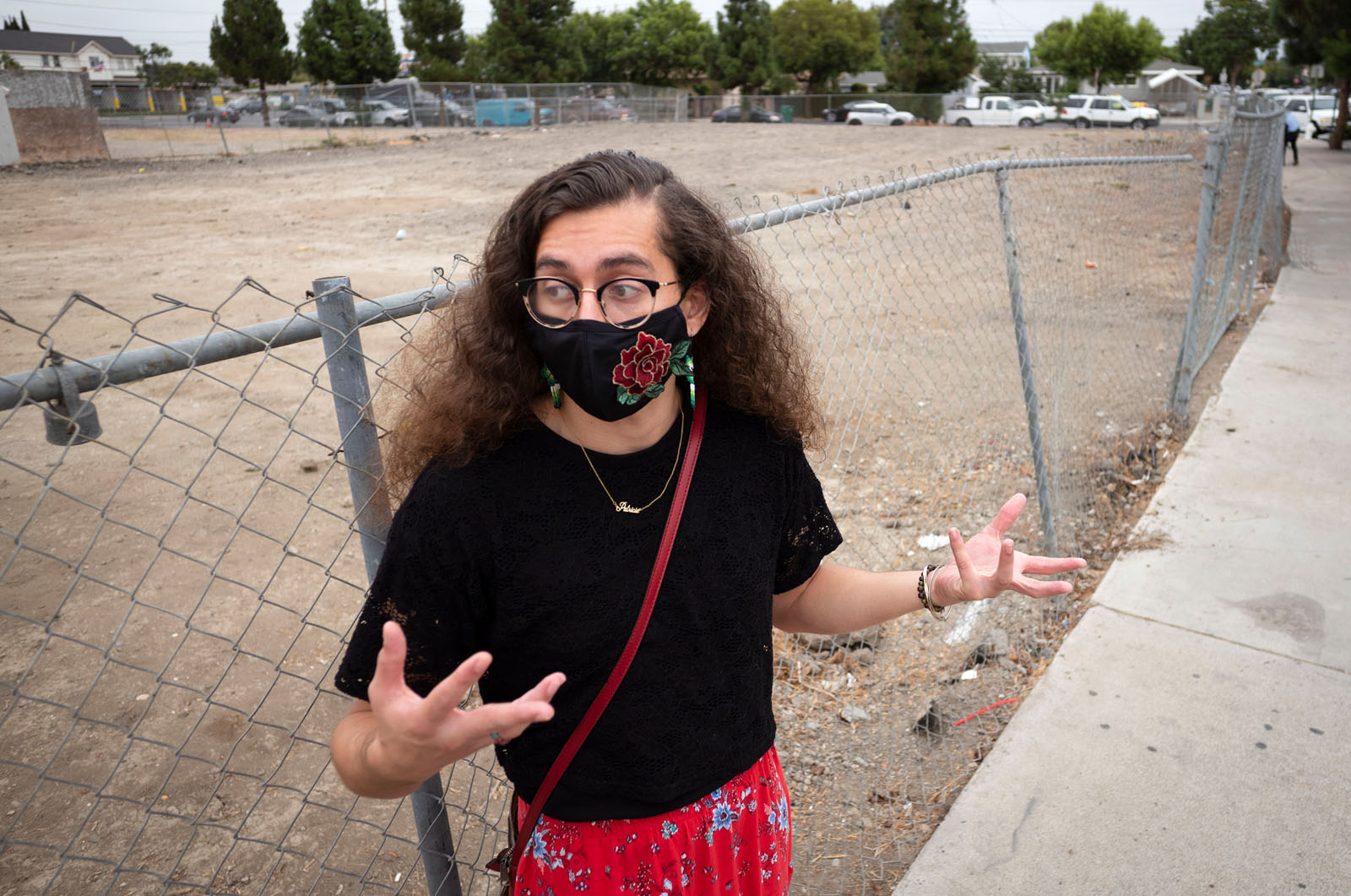
Photo of Patricia J. Flores Yrarrázaval, project director of Orange County Environmental Justice
Patricia J. Flores Yrarrázaval, project director of Orange County Environmental Justice, discusses plans to address lead contamination on the Santa Ana city-owned dirt lot behind her. Daniel A. Anderson / Center for Public Integrity

In addition to its policy advocacy work, OCEJ has multiple projects underway to collect data that illuminates how widespread lead exposure is in Santa Ana, particularly among youth. The organization hopes to carry out blood lead testing and to conduct a study to measure tooth lead levels to understand cumulative exposure over a Santa Ana resident’s lifetime. 

It still concerns coalition members that county health officials have been relying almost exclusively on existing blood lead level data to guide the Orange County Health Care Agency’s response to childhood lead exposure, said Alana M. W. LeBrón, an assistant professor of public health and Chicano/Latino studies at the University of California, Irvine, who has overseen the school’s soil lead research in Santa Ana. Studies have shown that many states fail to adequately test children’s blood for lead exposure, leaving vast numbers of children undiagnosed. 

“If you’re only exploring cases where there is a diagnosis of ‘lead poisoning,’ then you’re missing this whole swath of people,” said LeBrón, referring to people who aren’t tested and cases that don’t trigger public health intervention because repeated exposures to lower levels of lead aren’t treated as the dangers they are. 

Throughout, it’s been Santa Ana residents leading the charge for the community’s health, said Flores Yrarrázaval, and the battle isn’t over.

“We want to engage this fight on multiple fronts,” she said.  

The power of community

The community-wide approach to eliminating lead poisoning that Santa Ana advocates want is the most effective way to protect children, soil lead experts say. It means pinpointing lead hot spots and focusing remediation neighborhood by neighborhood, instead of a scattershot approach after kids test positive for lead in their blood. 

At the local level, municipalities can either make aggressive efforts to address lead contamination or take a lax approach, and the differences emerge in irreversible health impacts.

Photo of a Santa Ana parent walking her son to school near a vacant dirt lot
Santa Ana parent and neighborhood activist Idalia Rios walks her son, Andrew, 10, to school through Santa Ana’s Lacy neighborhood in 2018. The vacant dirt lot behind them, a worrisome sight in an area with lead contamination, was later converted by the city into a park after activists pushed for more open space. Yvette Cabrera / Center for Public Integrity

Harvard University sociologist Robert Sampson extensively researched lead exposure in Chicago neighborhoods and the inequalities created by unequal exposure to polluted environments. He points to the Chicago Department of Public Health as a role model because the agency didn’t wait for the federal or state governments to intervene. 

“I consider the health department there to be kind of a hero in an important way in the lead story, because starting roughly in the ’90s, they vigorously tested and attempted to regulate the sources of lead exposure in the city,” Sampson said. 

The agency collected tens of thousands of blood tests, monitored this data to focus on neighborhoods most impacted by lead poisoning, offered case management to lead-exposed children, conducted home inspections, and addressed lead hazards.

While Chicago’s public health agency has focused on lead paint, its partners at state and local agencies zero in on soil lead contamination. For example, Chicago requires those who buy city-owned property to look for soil hazards and remediate high levels of lead. That’s the type of all-hands-on-deck approach that needs to happen across the country, with multiple agencies collaborating, Sampson said.

It’s made a big difference in Chicago.

Lead exposure rates, which were extremely high and concentrated in the city’s poor Black and Latino neighborhoods, declined dramatically. One of every four children tested in 1997 had levels of lead in their blood of at least 10 micrograms per deciliter — a sign of high exposure. By 2021, that had dropped to one in 200 children.

“The rates are still higher in poor Black neighborhoods, but a poor Black neighborhood now is much less at risk than a poor Black neighborhood in 1995,” Sampson said. “That is an important victory.”

A national plan takes shape

Today, across the country, most county public health agencies approach lead exposure by testing children’s blood lead levels, not the environment, said Mielke, the Tulane University soil lead expert. Focusing on individual lead poisoning cases may appear to be more manageable. But this approach — which avoids investing in wide-scale remediation — uses children as canaries in the coal mine. It allows thousands to be exposed daily to contaminated soil in their backyards. And many are never even diagnosed.

Municipalities now have the scientific tools to measure lead in the environment and map hot spots so public health agencies can focus on preventing exposure before it occurs. Requiring proof of a lead-poisoned child before action can be taken to investigate and address the contamination is a flawed approach, Mielke said.

“We’re trying to cure the disease instead of preventing the disease,” said Mielke. And in the case of lead poisoning, there is no cure.

He uses Norway as an example of what can be accomplished in the war against lead when political will and scientific knowledge come together. Norway decided to ban lead from paint half a century before the U.S., in the 1920s, the same period when U.S. public health officials were debating whether to allow General Motors to use tetraethyl lead in gasoline as an additive. U.S. public health officials at the time knew the potential health hazards and understood that the toxic additive was a “serious menace to the public health” but still made the consequential decision to support its use in gasoline. 

Norway used lower amounts of leaded gasoline, had less traffic, and built fewer highways. Faced with lead poisoning regardless, the country decided to focus its testing efforts on the environment, not children’s blood. 

Almost 15 years ago, Norway’s environmental protection agency decided to systematically sample, analyze, and map surface soils in areas where children were most likely to be exposed to contaminated soil: childcare centers, school yards, and playgrounds in the country’s 10 largest cities, using Mielke’s research in New Orleans as the basis for this work. 

Once soil tests confirm lead, Norway cleans it up. Norway also doesn’t require proof that a child has been lead-poisoned for the government to offer assistance, Mielke said. Having a lead-contaminated environment is enough to trigger government intervention and action to address the problem.

The U.S. could do this, too, Mielke said.

It simply hasn’t.

In theory, the agency best positioned to stop a nationwide epidemic of lead poisoning in this country is the EPA.

In 1992, Congress directed officials there to set standards for soil lead levels. It wasn’t until 2001 that the agency carried out the order. And the rules have not been updated since their release 22 years ago.

Repeated studies have shown that no amount of lead exposure is safe — and at the very least should be dramatically lower than the EPA’s threshold of 400 parts of lead per million parts of soil. But public health agencies around the country use the EPA’s standards to decide whether to remediate a lead-contaminated yard after a child is exposed. 

EPA Deputy Assistant Administrator Carlton Waterhouse oversees the agency’s work on solid waste and remediation. He said it’s challenging to tackle a problem that originates at a local level but is pervasive across the country. The response to lead contamination by local and state agencies varies substantially, he said, and the lack of a federal clean-soil law — something like the Clean Air and Clean Water acts — means the EPA has no authority to sample and clean up all soils in the country. 

“We don’t have any legislation or direction or funding that gives us a kind of comprehensive approach to say, ‘Let’s deal with the problem of lead,'” Waterhouse said.

Now, the EPA says it plans to finally “revisit” its outdated soil lead hazard standards. That reconsideration is part of a new strategy the agency announced in October to reduce lead exposures across the country and the racial and income disparities in who gets exposed. 

The agency intends to tackle the problem in a way advocates have long called for: by using data to predict lead hot spots, including locations where children might get exposed, and then testing those soils. If that pollution meets the threshold of a Superfund site, then the EPA will remediate, Waterhouse said. 

The agency is attempting to do what it can with the authority it has, he said, “recognizing that we don’t have the kind of footprint that allows us to do the testing of all the children by the time they start school, or to go into every home and test for lead-based paint.” 

This means the agency is focusing its work in places where the EPA knows there are lead exposures through air, water, or soil. Funds to replace lead service lines, the pipes connecting a home to a water main, for example, were included in the $1 trillion infrastructure legislation that passed last year. But the new system doesn’t account for the untold number of sites overlooked by spotty data.

Critics also note the goals don’t commit the EPA to updating the outdated lead hazard standards, despite a federal court order in 2021 that requires it. The agency has not yet disclosed a timeline.

“Communities around the country are suffering lead exposure from soil because EPA has dropped the ball for decades,” said Eve Gartner, managing attorney for the Toxic Exposure and Health Program at Earthjustice, which represented more than half a dozen organizations whose lawsuit prompted the 2021 decision.

In March 2022, groups underwhelmed by the EPA’s then-draft strategy called on the agency to make a broader commitment to eliminate lead exposure in all communities and for people of all ages, because the dangers of lead are not limited to children. The coalition also pressed the EPA to address lead exposure from continuing pollution sources.

View of industrial businesses as seen from a local resident's window
Ongoing noise and pollution from industrial businesses like this one, seen from Logan resident Frances Orozco’s second-floor window, have burdened residents for decades in this Santa Ana neighborhood. Daniel A. Anderson / Center for Public Integrity

“EPA will not prevent exposure to lead if it continues to view lead as a problem of a purely ‘legacy’ nature,” the coalition wrote in public comments submitted to the agency.

At Simon Fraser University in Canada, Professor Bruce Lanphear, an epidemiologist and leading expert on early childhood exposure to lead as well as the long-term effects on adults, is cautiously optimistic about the plan. But his hope is tempered by the agency’s history of lagging action. 

“It’s long overdue, and we can’t blame one [political] party or another. They both failed miserably for so long,” Lanphear said. “And yet at the same time, are we at a turning point where we’ll really address not only the legacy of lead poisoning, but maybe the disparities as well?” 

Lanphear has found that a headline-grabbing lead crisis, such as the water contamination in Flint, Michigan, prompts attention and funding. But the attention soon dissipates. The funding never reaches a level that would comprehensively address the widespread nature of the problem. And the insufficient lead hazard standards don’t help.

That concerns Lanphear, who has spent the better part of two decades researching and tracking the resulting health impacts. Very few toxic chemicals have been as consistently shown to harm children as lead, he said, and its effects are far-reaching. 

Lanphear’s research has shown that lead might cause at least a quarter of a million early deaths a year from cardiovascular disease in the United States alone. 

Ruth Ann Norton, president and CEO of the nonprofit Green & Healthy Homes Initiative in Baltimore, has spearheaded efforts to aggressively reduce childhood lead poisoning across the nation. What the country needs — and the EPA strategy is missing — are opportunities to tackle multiple problems at once, she said. 

For example, the federal weatherization-assistance program could be coupled with a program to remediate lead in paint and soil, problems that typically get deferred because of cost. But the cost of inaction is high. 

“Every community can do this. It is just simply making the decision to do something that they know is so fundamental to their future.”

— Ruth Ann Norton, president and CEO of Green & Healthy Homes Initiative

Communities can take creative actions now, Norton added. Her nonprofit manages a program in Pennsylvania with Lancaster General Hospital, which is paying $50 million to provide lead-hazard-control intervention in 2,800 homes. 

“Every community can do this,” she said. “It is just simply making the decision to do something that they know is so fundamental to their future.”

Fighting soil with soil

Scientists are also trying to fill gaps created by insufficient government action. Knowing that most U.S. cities and towns lack a centralized database for soil lead tests, Gabriel Filippelli, a biogeochemist who has studied lead contamination for more than two decades, helped create an online platform where everyone, from scientists to residents, can share lead samples and test results. 

Launched in 2018, the online portal Map My Environment visualizes this data, includes lead levels for soil, dust, and water pollution in cities around the world, and offers recommendations on how to remediate lead. “We just wanted a way to get this out of a static journal and into communities,” said Filippelli, an Indiana University–Purdue University Indianapolis professor who serves as executive director of the Environmental Resilience Institute

Someone collecting dust samples can have them tested free by the initiative. Map My Environment also launched a school Bookworm Initiative, where students collect earthworms and soil for lead-contamination analysis, receiving a book voucher in return. 

At a time when Americans are more aware of the dangers of lead due to Flint’s water crisis, most are unaware that lead too often contaminates soil in urban centers, Filippelli said. 

“Water is actually a really rare thing to get affected by,” he said. “It’s really that soil and dust which is ever-present, which I think is the biggest thing. That’s the message we try to put out all the time, along with the fact that it’s really easy to solve.” 

Change the soil surface in communities with high levels of lead, research by Mielke and others show, and you protect people’s health. In New Orleans, the city health department worked with Mielke to focus soil remediation in childcare centers, parks, and playgrounds by capping contaminated soil with clean soil. The city’s playground soils improved remarkably, Mielke said. 

But because backyards weren’t included, they “remain very hazardous,” he said, and that is where “kids are likely to be when they are very, very young.”

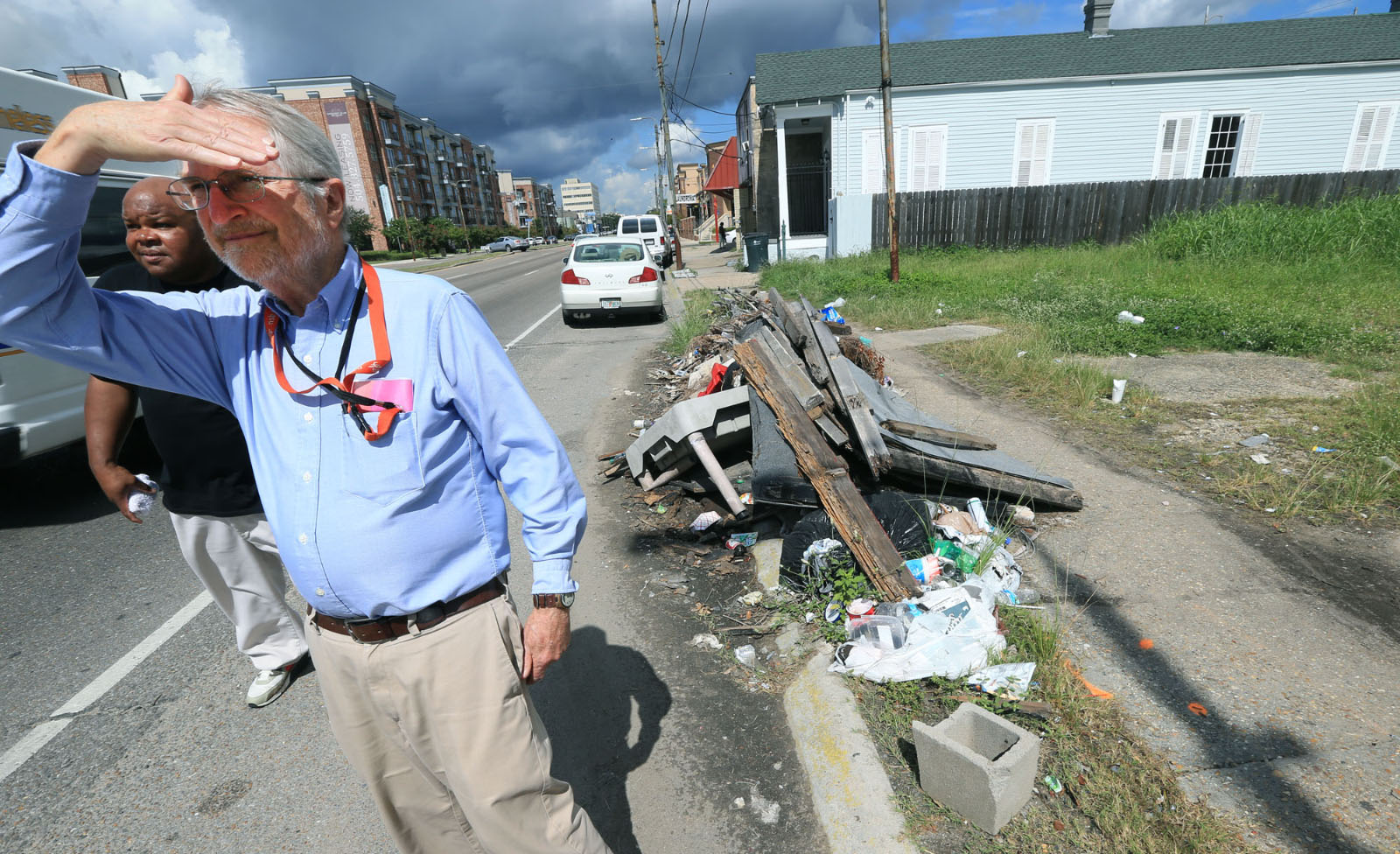
Lead expert Howard Mielke in New Orleans
Professor Howard Mielke of Tulane University’s School of Medicine (foreground) is one of the nation’s top experts on soil lead contamination and has worked for decades to protect children from lead exposure. Here, Mielke pauses after visiting a local childcare center in New Orleans with his research associate, Eric Powell, in 2015. Daniel A. Anderson / Center for Public Integrity

To truly protect children’s health, studies have shown, soil lead concentrations across a community would need to fall below 80 parts per million, perhaps half that level, Mielke said. A 2017 study by geologist and environmental scientist Mark Laidlaw, Filippelli, Mielke, and their colleagues examined approaches to address urban soil lead contamination and concluded that collecting soil lead levels would not be necessary if soil with little or no lead were spread across entire neighborhoods. 

In other words: Cover what’s there with better soil.

In New Orleans, Mielke has tapped the Bonnet Carré Spillway for lead-safe alluvial soil, sourced from the sediments of the Mississippi River, to cover hazardous areas. Most cities can access soil like that on the outskirts of urban centers, the study found. To pay for it, the researchers suggest levying taxes on gas and paint products, given that a large portion of lead in soils and home interior paints originated from these industries.

In New York City, where recent studies have confirmed local soil lead contamination, the NYC Clean Soil Bank offers residents free clean soil that’s been tested after excavation from New York City construction sites. Creating that system “has surprisingly been more feasible than trying to mandate testing or remediation,” said Egendorf, a researcher with the NYC Compost Project. “I would love for more people to know about it and for this to keep expanding because other cities can do it, too.” 

What all these solutions show is that lead poisoning is preventable. The hardships from its health impacts don’t need to touch yet more generations.

It just takes action.

In Santa Ana, the environmental justice advocates pushing for exactly that say they are committed to reforming how soil lead contamination is addressed nationwide. LeBrón, the public health professor from the University of California, Irvine, said the coalition hopes to form an exchange so people across the country can learn from each other. 

For Garrido, the solutions didn’t come soon enough. She would have gladly raised her son in Santa Ana if there were fewer risks to his health and safety. 

Now 7 and in first grade, Ruben still has significant speech delays and is being assessed because he may have a learning disability, Garrido said, but he’s otherwise healthy. 

And he can run freely on her Buena Park property without the risk of breathing or ingesting lead-contaminated soil. 

“The neighborhood is safe enough. The sidewalks are decent where we can walk, so we take the dogs out for a walk and I take my son with me,” Garrido said. “It’s like a whole new world for him.” 


This story was produced in partnership with the McGraw Center for Business Journalism at the Craig Newmark Graduate School of Journalism at the City University of New York. This report was also made possible in part by the Fund for Environmental Journalism of the Society of Environmental Journalists, and by the Kozik Challenge Grants funded by the National Press Foundation and the National Press Club Journalism Institute.

This article originally appeared in Grist at https://grist.org/solutions/soil-lead-contamination-poison-children/.

Grist is a nonprofit, independent media organization dedicated to telling stories of climate solutions and a just future. Learn more at Grist.org


Donald Trump knows a perp walk is good TV

While the world waits with bated breath for a Donald Trump indictment, reporters on the Mar-a-Lago palace intrigue beat say that no one claims more anticipation than Trump himself.

“[T]he former president has told friends and associates that he welcomes the idea of being paraded by the authorities before a throng of reporters and news cameras,” New York Times reporters Maggie Haberman and Michael Bender write. “He has even mused openly about whether he should smile for the assembled media, and he has pondered how the public would react and is said to have described the potential spectacle as a fun experience.”

On one level, this is definitely what the internet slangsters call “cope” or cable news pundits dismiss as “bravado,” i.e. delusional nonsense people spew in order to avoid dealing with troubling realities. Certainly, self-soothing fairy tales are rife in the MAGA world these days, as Trump and his fans try to tell themselves that a man most Americans hate will get more popular if he’s put on trial for various crimes.

Still, Trump’s impulse here makes a certain amount of sense.

For one thing, one of Trump’s few talents is knowing what makes for good TV. His perp walk would absolutely qualify. For a terminal narcissist, being at the center of one of the biggest TV events of the year is intoxicating, even if it is his own arraignment. But this impulse of Trump’s also fits every other indicator that his campaign strategy for 2024, however ill-advised, is to focus on pleasing the MAGA base, even at the expense of winning over any other voters.


Want more Amanda Marcotte on politics? Subscribe to her newsletter Standing Room Only.


Trump’s not wrong to think that getting arrested will make MAGA love him more. He gets what still too many pundits fail to understand: The MAGA movement wants its leaders to be villains. Getting arrested in as showy a way as possible will only cement his brand as the top dog in the increasingly robust field of MAGA scoundrels, each vying to win over the GOP base by showing they are the biggest baddie of them all. 

For a terminal narcissist, being at the center of one of the biggest TV events of the year is intoxicating, even if it is his own arraignment.

Let’s get one thing very clear, however: Popular with the MAGA base is not the same thing as being popular overall.

Trump and his supporters try mightily to confuse people on this point, often to great effect. Both liberals on social media and cable news pundits have fallen into the habit of worrying that indictment might “help” Trump, a fear that Trump has gone out of his way to amplify. There was, for instance, a great deal of consternation this week over new polling showing that Trump is pulling ahead of his biggest primary rival, Gov. Ron DeSantis of Florida. 

No doubt, being a flamboyantly evil person is how to become a star with the GOP base these days. Rep. Marjorie Taylor Greene of Georgia has turned herself into one of their biggest celebrities by being the biggest villain. DeSantis understands this, which is why he’s making a name for himself by banning books and shipping migrants around like they’re cargo. It’s why Rep. James Comer of Kentucky gloats about his dishonesty to New York Times reporters. Republican are even starting to dress the part now, styling themselves more like Batman villains than the staid politicians of old. 

Trump’s not wrong to think that getting arrested will make MAGA love him more.

But while MAGA voters love a mustache-twirling villain, the majority of voters don’t. It’s why Republicans have been underperforming in the polls since Trump stepped on the scene and convinced the rest of the party that a proud heel turn is good politics. As Alexander Burns of Politico gently reminded the overthinkers this week, “Trump needs to grow his support, not merely rev up people who already care deeply about his every utterance and obsession.” Most people find it off-putting when Trump whine because he wants to write illegal hush money checks to porn stars without consequences. Even his own supporters are having trouble getting motivated to defend Trump for such petty B.S. This isn’t the campaign slam dunk Trump is pretending it is. 


Want more Amanda Marcotte on politics? Subscribe to her newsletter Standing Room Only.


But sure, turning his own arraignment into a reality TV spectacle would likely help Trump bolster his brand within the MAGA community, which has thoroughly embraced an anti-social ideology and aesthetic. We’re talking about people whose main political impulse is “owning the liberals.” They’re people who use “woke” as an insult, even though it means “believing in social justice.” They’re still throwing fits because of now-past mandatory mask policies, solely because participating in an effort to slow down a pandemic offended them to their core. They treat imbecilic jerks like Elon Musk like heroes. As a political movement, MAGA really is little more than a bunch of bullies who just long to shove someone’s head in a toilet. 

Punching down is MAGA’s turn-on.

What’s funny is that DeSantis himself seems to be losing his grip on this basic understanding. He used to understand implicitly that MAGA is attracted to the biggest asshole, which is why he always tries to be seen abusing the most vulnerable people he can find, from queer kids just trying to survive school to refugees shivering in the cold. Punching down is MAGA’s turn-on. But now he’s going on Piers Morgan’s show and taking potshots about Trump lacking “character.”

Look Ron, Trump voters know lacks character. That’s why the MAGA base loves Trump! And it’s what they loved about you, Ron. But turning yourself into one of those Mike Pence types who tries to put some moral gloss over what is actually a very dark soul is how to lose them. They want people who are proud of being evil. 

No doubt, most MAGA types will deny, if confronted, that they love evil for its own sake. Like a good number of Batman villains, they instead frame their quest as one of vengeance for perceived wrongs against them. Trump himself has been ranting about how he is their “retribution,” in Stephen Miller-penned speeches that are indistinguishable from the manifestos of mass shooters. Of course, like the complaints of mass shooters, the “injustices” that MAGA decries are utterly baseless. Mostly they’re just mad that it’s easier than it used to be to question the unearned privileges of white men. 

Whatever the excuse, however, the situation as it stands is this: Within the ranks of GOP voters, being a bad guy is a plus. Trump absolutely could excite them more by leaning into his criminal identity. (If any prosecutor could actually stop being a chicken and indict the guy already, that is.) Outside of that shrinking MAGA demographic, however, electing a man who thinks he’s the Joker — but is actually just a bad-at-sex aging grifter — is less appealing. Not that anyone should be complacent about the 2024 election, as complacency is what cost Democrats the White House in 2016. But it’s okay to enjoy Trump’s indictment — if anyone ever has the guts to make it happen. He may be smiling through it, but exciting a bunch of jerks who already like you is not the victory Trump pretends it is. 

How the Stormy Daniels case could backfire in Donald Trump’s favor

“The walls are finally closing in on Donald Trump!”

“Donald Trump is in big trouble!”

“Justice has finally come for Donald Trump and there is no way he can possibly escape THIS TIME!!!!”

During the last seven years, the American people and the world have heard some version of this sentiment many times. This week those voices are screaming even louder as Trump is supposedly set to be indicted by a grand jury in New York for alleged crimes connected to hush money payments he paid to his mistress Stormy Daniels in 2016. Alas, the interminable wait for Trump to finally be held accountable for his many crimes continues as the grand jury in Manhattan did not convene on Wednesday.

Contrary to the excitement, premature celebrations and sense of anticipation for Trump’s “imminent” indictment in New York, I find the whole matter to be very anticlimactic and deflating. To paraphrase the legendary professional wrestling commentator Jim Ross: There is not much sizzle here and the steak is rather boring.

If justice is indeed chasing Donald Trump in an earnest and serious way, it needs to hurry up. Otherwise, a trial for hush money payments and violating campaign finance laws may ultimately backfire, leaving Trump and his movement stronger and not weaker.

Trump has committed a litany of serious crimes, most notably the Jan. 6 coup attempt and attempting to blackmail the country and leaders of Ukraine into illegally supporting his attempt to subvert the 2020 election. Never to be overlooked or forgotten, however, Trump and his regime also committed acts of democide against the American people which resulted in at least 1 million deaths from the coronavirus pandemic.

To paraphrase the legendary professional wrestling commentator Jim Ross: There is not much sizzle here and the steak is rather boring.

That Trump has escaped justice for his presidential crime spree – and the decades of crimes he committed beforehand – is an indictment of American democracy and the country’s legal system and other institutions. Justice in America is not “blind.” There is one justice system for rich white people and another one for everyone else. The “justice” system that awaits poor Black and brown people is a special and distinct type of monster. “The system,” Elie Mystal writes in a recent essay at the Nation, “has never been able to sufficiently protect us from Trump, and I don’t think it’s about to start now.” 

As a practical matter, what is the actual likelihood of convicting Trump for the crimes he allegedly committed in the Stormy Daniel’s case? In a new essay at New York magazine, Ankush Khardori explains:

The prospective prosecution is being described among liberal observers as “the least significant and the weakest one facing Trump,” “the hardest to prove” among “all the legal cases Trump faces,” one with “manifold” legal and evidentiary problems. There are concerns that the indictment might even boost Trump’s reelection prospects. During an appearance last week on MSNBC, a former U.S. Attorney in Georgia during the Obama administration lamented the fact that Manhattan district attorney Alvin Bragg may be the first to charge Trump rather than Justice Department special counsel Jack Smith or Fulton County district attorney Fani Willis in Georgia. “I wish these prosecutors would get somewhere in a room together and talk about who has the strongest case and who’s got the most evidence and who can actually do something as opposed to worrying about who’s gonna get to be the first one at the watering trough,” he said, adding, like others have argued, that he did not “find the case very compelling.”

It is hard to venture a definitive view on any of this at the moment, particularly since we will not know for certain what charges Bragg’s office is bringing unless and until there is an actual indictment. …

If this is indeed the theory that Bragg’s office is contemplating, the hand-wringers have fair reasons to worry. In New York, a defendant can be convicted of falsifying business records at the misdemeanor level if he makes “or causes a false entry in the business records of an enterprise” and does so “with intent to defraud.” The charge can be escalated to a low-level felony with a four-year maximum term of imprisonment if the defendant intended “to commit another crime or to aid or conceal the commission thereof.”… The New York Times has described the prospective case as one that “hinges on an untested and therefore risky legal theory involving a complex interplay of laws, all amounting to a low-level felony.”

Khardori continues:

For the time being, we find ourselves preparing for a literally unprecedented and deeply strange situation — one that owes its existence, first and foremost, to Trump and his endless creativity in generating new legal problems, as well as the Republican party’s seemingly endless appetite for indulging his excesses, but also to a Democratic legal establishment that has struggled for years to manage those concerns on behalf of the public in a responsible, fulsome, and orderly manner. Whether Bragg and his team of prosecutors can break that pattern remains to be seen.

In a new essay here at Salon, criminologist Gregg Barak is a bit more optimistic about Donald Trump finally facing true justice and accountability. “At the peak of his power, and even after orchestrating a failed coup, the ‘Houdini of organized crime’ has this far managed to escape his smorgasbord of transgressions with all but a few scratches. Now with the impending and unprecedented criminal indictment of both a former president and a candidate for president, apparently to be brought forth by Manhattan District Attorney Alvin Bragg, we will all become witnesses to the ways in which Trump’s standard legal tactics as a civil defendant — deny, deflect and delay — will be limited in his new role as a criminal defendant.”


Want a daily wrap-up of all the news and commentary Salon has to offer? Subscribe to our morning newsletter, Crash Course.


For a variety of reasons including fear of setting a precedent where a former president is indicted for his crimes in an act of “retaliation”, factional infighting with the Department of Justice, Biden’s insistence on not being consumed by the Trump investigations, concerns that there will be massive violence by Trump’s MAGA movement and other neofascists, and a need to be meticulous and perfect given the potentially existential stakes involved for the country and its democracy, the many legal investigations into former president Trump have taken several years – which is a near eternity in politics and a country that is collectively sick with organized forgetting.  

Unfortunately, the decision by the Department of Justice and other law enforcement agencies to be so ponderous and slow in advancing the many criminal cases against Trump has made the following nightmare scenario much more likely:

Trump leverages the multiple criminal indictments against him as a way of rallying his supporters. Trump’s criminal trials are also a way for him to make even more money and to further cement his control over the Republican Party and the “conservative” movement. Trump beats DeSantis in the presidential primaries. Because of voter nullification, gerrymandering, voter suppression, voter intimidation, and other illegal and quasi-legal means, Trump defeats Biden by a small margin and becomes president again even though he is facing or has been convicted of multiple serious crimes against democracy. Trump ignores the criminal verdicts against him. If the criminal trials have not ended, he simply refuses to participate in them, declaring them null and void and a witch hunt. As promised, Trump begins his retribution and revenge campaign against his “enemies” and becomes a de facto King or Caesar who is truly above the law. The United States will then face a constitutional crisis that is far worse than Trump’s first regime and the coup attempt on Jan. 6.

Some observers have compared Trump’s potential indictment in the Stormy Daniels case for hush money payments and campaign finance law violations to how legendary Mafia kingpin Al Capone was finally brought down not for murder but for tax evasion. When I think of Capone and Trump, the connections I summon are quite different and much more cautionary. When I was a child, Geraldo Rivera, who was then still a somewhat respectable journalist, announced to the world that he and his investigators would reveal Al Capone’s secret vault on live TV. At the time “The Mystery of Al Capone’s Vaults” was a very big deal and a national spectacle: it is estimated that 30 million people watched the broadcast.

My father was obsessed with Al Capone and decided that this was the perfect moment to buy our first VCR, which was a very expensive purchase at the time for anyone (500 dollars), never mind a Black working-class family. My father had a way around this challenge. He reached out to one of his “friends” at the local electronics store. His connection brought the VCR over to the house a few days before Geraldo’s special. My father handed his friend some money in an envelope and off he went to drop off some other special deliveries to his customers.

I studied the manual and figured out how to set the VCR to record the big show. We even had pizza from one of the good places downtown near Yale University. My father and I excitedly waited for the Al Capone special to start. My mother said we were gullible and stupid – but she still kept walking by the den and looking at the TV with curiosity and anticipation.

Geraldo finally forced his way into the vault. What did he find? Junk.

My mother let out a big mocking guffaw.

My father was very angry and started to curse Geraldo Rivera, not because there was nothing in the vault but because Rivera made a mistake by finding the wrong vault! I felt dejected. But I was also very happy that we finally had a VCR and I could record Robotech, G.I. Joe, The Transformers, and professional wrestling. I had to save my allowance to buy a copy of Star Wars, which at the time was almost 100 dollars at the local video store. I never did have the self-control to save all that money. My parents got me several Star Wars tapes for Christmas; I was very happy.

When (and if) the Manhattan grand jury finally decides to indict Donald Trump for his alleged crimes, the prosecutors had better get it right or the whole thing will be a humongous embarrassment and Trump will crow about his innocence and being “unfairly persecuted” as he grows in power.

Labor and delivery centers are closing in red states. What happens to pregnant women next?

The only hospital in a Northern Idaho town of 9,000 people, Bonner General Health, announced last week that it was closing its labor and delivery clinic. The hospital — situated in Sandpoint, a remote town about an hour’s drive north of Coeur d’Alene — implied in its press release that the overturning of Roe v. Wade, and the concomitant laws passed afterwards, were partially responsible. 

Indeed, in the news release, the hospital cited a variety of reasons for the closure, including the state of Idaho’s “legal and political climate.” “Highly respected, talented physicians are leaving; recruiting replacements will be extraordinarily difficult,” the hospital wrote. “In addition, the Idaho Legislature continues to introduce and pass bills that criminalize physicians for medical care nationally recognized as the standard of care.

The news encapsulates how the overturning of Roe v. Wade exacerbated the slow unraveling of America’s labor and delivery clinics — which have been slowly closing over the past decade, leaving millions of women in what researchers call maternity care deserts.

In 2022, March of Dimes published a report that found 6.9 million women of childbearing age lived in counties with no access or limited access to maternity care, which could negatively affect about half a million births each year. From 2020 to 2022, 1,119 counties across the country became maternity deserts — meaning there were no hospitals providing obstetric care, no birth centers, no OB/GYN and no certified nurse midwives, which affected an estimated 15,933 women. Looking at a map of areas affected, these maternity care deserts are typically in middle America and in rural counties — but the coasts and urban centers aren’t immune to closings.

Julia Interrante, a research fellow at the Rural Health Research Center, told Salon in an interview that prior to the U.S. Supreme Court overturning Roe v. Wade last year, many rural hospitals were already closing their labor and delivery clinics due to financial and staffing issues.

“There are high fixed costs for operating maternity services, [and] obviously they have to be available 24/7 because babies come when they want to come in, so having the staff on hand and the clinical training and all of the necessary staff and equipment that is required for any kind of emergency situation has a high fixed cost,” Interrante said. “When you have low birth volume, then you don’t have a good balance of payments coming in for that.”

“When we reduce the services that save people’s lives, it is very reasonable to expect that healthcare outcomes will get worse.”

Bonner General Health in North Idaho mentioned that the hospital only delivered 265 babies in 2022. Interrante said while this low birth volume is usually a reason for rural hospital closures, it’s “definitely not the whole story.”

Interrante cited issues with “recruiting and maintaining staff” as an obstacle, in particular family physicians and nursing staff. She noted that it is a misconception that obstetrician shortages are exclusively driving the maternity care crisis. Obstetricians are “not actually the most common providers of childcare services in rural communities,” she noted; rather, family physicians are.

Interrante said doctors in rural areas are under tremendous pressure to work without enough support staff. Often, she said, there are “only one or two doctors like doctors who provide the services in a rural community,” and those doctors often lack a “stable staff” in the obstetric unit. That puts a lot of pressure on doctors and “can be really hard,” Interrante noted. “Sometimes they leave because of that as well.”

These issues predated the existence of laws that criminalize physicians for providing standard care in obstetric units, and which appear to be worsening the maternity care crisis.

Dr. Melissa Simon, an obstetrician gynecologist at Northwestern Medicine, told Salon she was “not surprised” to hear that an Idaho hospital cited “political climate” as one of the reasons it is closing a labor and delivery unit. Simon emphasized that these units must make decisions to save a pregnant mother’s life if such a patient is facing a life-threatening situation.


Want more health and science stories in your inbox? Subscribe to Salon’s weekly newsletter The Vulgar Scientist.


Simon gave an example of a patient coming in 16 to 18 weeks pregnant with a ruptured bag of water — a point in one’s pregnancy in which the baby is still far from “viability,” meaning it could not survive outside of the uterus. If state laws “mandate that a pregnancy termination cannot be offered,” that leaves doctors and hospitals in an ethical bind, Simon said. If doctors do not end the pregnancy, the mother “could become septic and die” from the lack of intervention.

When a maternity clinic closes, Dr. Simon said many pregnant women could suffer pregnancy complications in the process of being forced to travel 50 to 100 miles for maternity care — a reality for some women in this country.

“As more clinics and labor and delivery units close in hospitals because of political climate, laws, and other factors such as cost, there becomes an ensuing increase in poor maternal and fetal outcomes and ultimately a rise in poor childbirth outcomes for both the mom and baby — and a rise in maternal morbidity and mortality,” Dr. Simon said.

Interrante said when labor and delivery units close in rural areas, researchers also see higher rates of out-of-hospital births, which can come with their own complications.

“The rate at which people die because of being pregnant is dramatically higher here than in other rich countries.”

“Sometimes it’s home birth, and if it’s planned and it’s a low risk pregnancy, that can be fine, and sometimes it’s more that people end up having to go to the emergency room and they’re not prepared to handle an emergency birth situation,” Interrante said. “Even worse, that can happen, is birth on the side of the road as people are trying to get to their nearest hospital, we also see higher scheduling of cesarean sections.”

According to new data from the Centers for Disease Control and Prevention (CDC), the rate of maternal mortality — defined as deaths during pregnancy or within 42 days of giving birth — increased by 40 percent in 2021. Amanda Jean Stevenson, an assistant professor of sociology at the University of Colorado Boulder, told Salon that pregnancy is “uniquely deadly” and “uniquely disabling” in the United States.

“That means that the rate at which people die because of being pregnant is dramatically higher here than in other rich countries, and it’s also been increasing here for over a decade while it’s been decreasing in other rich countries,” Stevenson said. “So we’re not only worse than everybody else in terms of the outcomes and health outcomes associated with pregnancy, but we’ve been getting worse while everyone else is getting better; it’s almost impossible to overstate how much of a crisis this is.”

Stevenson added: “When we reduce the services that save people’s lives, it is very reasonable to expect that healthcare outcomes will get worse.”

In a 2022 study, Stevenson and her colleagues estimated that in the first year following a nationwide abortion ban, the number of maternal deaths would increase by 13 percent.

Dr. Simon said she expects more labor and delivery units to close around the country as more physicians will be forced with these impossible decisions, putting pregnant people in America in an even more precarious situation — and the problem won’t be unique to red, rural states. 

“We see this now in urban centers, there are several hospitals even in Chicago who are closing down labor and delivery units because of a variety of factors including cost,” Dr. Simon said. “The reality of closing birthing centers and L and D units across the country is going to continue until we start valuing all of our humans in this country; when there are maternity deserts, our women, our babies and our society suffers.”

Antisemitism on Twitter has more than doubled since Elon Musk took over the platform: new research

In the days after Elon Musk took over Twitter in October 2022, the social media platform saw a “surge in hateful conduct,” which its then safety chief put down to a “focused, short-term trolling campaign.” New research suggests that when it comes to antisemitism, it was anything but.

Rather, antisemitic tweets have more than doubled over the months since Musk took charge, according to research that I and colleagues at tech firm CASM Technology and the Institute for Strategic Dialogue think tank conducted. Between June and Oct. 26, 2022, the day before Twitter’s acquisition by Musk, there was a weekly average of 6,204 tweets deemed “plausibly antisemitic” – that is, where at least one reasonable interpretation of the tweet falls within the International Holocaust Remembrance Alliance’s definition of the term as “a certain perception of Jews, which may be expressed as hatred towards Jews.”

But from Oct. 27 until Feb 9, 2023, the average was 12,762 – an increase of 105%. In all, a total of 325,739 tweets from 146,516 accounts were labeled as “plausibly antisemitic” over the course of our study, stretching from June 1, 2022 to Feb. 9, 2023.

Finding antisemitism with AI

To identify plausibly antisemitic tweets, my co-authors and I combined 22 published hate speech-identifying algorithms into a single mechanism and used even more machine learning to see which combinations of decisions led to the correct result. We then passed through all tweets – over a million in total – that contained any one of 119 words, phrases, slurs and epithets related to antisemitism.

No such process is perfect. We estimate our model to make a correct decision about 75% of the time. We also no doubt missed some antisemitic tweets not containing any of those 119 key words, as well as those taken down before early December when we collected the data.

We then used an algorithm to draw out 10 different themes of antisemitism seen in the tweets. Some centered around the use of specific antisemitic derogatory epithets. Others alluded to conspiracy theories concerning hidden Jewish influence and control.

Antisemitic tweets directed at Jewish investor and philanthropist George Soros warranted its own category. He was mentioned more than any other person in our data, over 19,000 times, with tweets claiming he was a member of a hidden globalist, Jewish or “Nazi” world order.

Another theme were tweets defending the rapper Ye, formerly Kanye West, who had made a number of antisemitic remarks after he had his account briefly reinstated by Musk.

Our research, which has not yet been peer-reviewed, also found around 4,000 of the antisemitic tweets were focused on the Russian invasion of Ukraine. These variously claimed that the conflict was caused by Jews, or that Jews secretly caused the U.S. to support Ukraine. They also contained direct antisemitism directed against the Ukrainian president, Volodymyr Zelenskyy, who is Jewish.

Musk rolls back content moderation

Musk’s acquisition of Twitter came on the back of what I have observed as a decadelong trend among tech giants to take more responsibility for hate speech, harassment, incitement, disinformation and other harms lurking in the information flowing through their platforms. Over that period, companies such as Facebook and Twitter gradually enacted policies to respond to extremism, hate speech and harassment, or increase “civility,” as Twitter itself described it in 2018, and built out the teams and tools to enforce them.

Musk, a self-professed “free speech absolutist,” pointed the platform in a different direction after taking control. In short order, Twitter’s independent Trust and Safety Council was dissolved, previously banned accounts were reinstated and over half of Twitter’s staff was laid off or simply left – including many of those responsible for enforcing the company’s hate speech policies.

As someone who has tracked hate speech on places like Twitter for around 10 years, I believe the changes to Twitter’s moderation practices are only partly to blame for the jump in antisemitism on the platform.

The media spectacle surrounding Musk’s takeover, along with his very vocal views on free speech, likely also encouraged exactly those people to join or rejoin the platform who had fallen foul of its previous attempts to confront hate. Our research gives some backing to this theory. Some 3,855 accounts we identified as posting at least one plausibly antisemitic tweet joined Twitter in the 10 days after Musk took over. This is, however, only a small proportion of the 146,516 accounts that sent at least one antisemitic tweet over the course of the entire study.

Little effect on curbing hate speech

A surge in hate speech on Twitter was flagged by researchers in the weeks after Musk took over, concerns the billionaire dismissed as “utterly false,” having earlier vowed to “max deboosted & demonetized” hateful tweets.

If Twitter has been de-amplifying antisemitism, our research shows almost no evidence of it. Before Oct. 27, antisemitic tweets received an average of 6.4 “favorites” and 1.2 retweets. Since then, they have averaged 6 “favorites” and 1 retweet. Although such engagement isn’t a perfect measure for visibility, tweets made much less visible to users would generally receive less engagement.

We also attempted to measure takedowns of antisemitic tweets. On Feb. 15, 45 days after we initially collected the data, we tried to re-collect all the tweets we identified as antisemitic. Tweets can be unavailable for lots of reasons, and Twitter’s enforcement is only one of them. Imperfect though this is, it does give us a tentative glimpse of what might be happening in regard to the removal of antisemitic posts. And across those dates, 17,589 antisemitic tweets were taken down – 8.5% of the total.

Rising tide of antisemitism

Our findings come at a time when many fear growing threats to Jewish communities. In 2021, the Anti-Defamation League tracked the highest number of antisemitic incidents – including harassment, vandalism and assaults – in the U.S. since they started tracking numbers in 1979. And this is not just a U.S. phenomenon; in the U.K., the Community Security Trust has recorded a similar spike in anti-Jewish activity, while in Germany, anti-Jewish crimes surged by 29% over the pandemic.

Studying social media has shown me again and again just how powerfully it helps to form the cultures and ideas that underlie its users’ behavior. Ultimately, the proliferation of tweets that hold Jews responsible for all the world’s ills, that circulate dark conspiracies of control and cover-up, or that fire derogatory attacks directed toward Jews, can only support antisemitism online – and in the real world.

Carl Miller, Research Fellow, King’s College London

This article is republished from The Conversation under a Creative Commons license. Read the original article.

Banks promote climate pledges — but keep increasing their financing of fossil fuel production

Banks around the world have been busy laying out plans to reduce financing of the energy sectors most responsible for greenhouse gases. Earlier this month, Citi and Deutsche Bank both tightened their policies on the financing of fossil fuel production. 

Yet at the same time, oil and gas projects that require backing from banks keep getting approved even as a new report from the United Nations Intergovernmental Panel on Climate Change shows that the world is on track to fall short of its most ambitious goal — drastically slowing global warming — and that more aggressive steps must be taken to avert a climate catastrophe. Last week the Biden administration approved ConocoPhillips’ plans for drilling in the Arctic — despite the opposition of environmentalists and a pressure campaign that led many banks, including Barclays and Goldman Sachs, ​​to rule out the financing of drilling projects anywhere in the environmentally fragile region.

The financing of fossil fuel production grew from $723 billion in 2016 to $742 billion in 2021, with the world’s 60 largest banks financing $4.6 trillion in total in the six years following the 2015 Paris accords. Whether through lending or the underwriting of debt and equity issuances, banks are at the heart of this funding — which is dominated by American banks. 

The disconnect between words and actions has outraged climate activists, who are gathering for a day of action on Tuesday, March 21. The protest will focus on the four largest financiers of fossil fuel projects in the world: JPMorgan Chase, Citigroup, Bank of America and Wells Fargo. Advocates will gather at over 100 events in half the states in the country — cutting up their credit cards in New York City, organizing flash mobs in Sacramento and taking part in a rocking-chair vigil in Washington, D.C., with speeches from such figures as veteran environmentalist author Bill McKibben. 

As part of the campaign, more than 17,000 bank customers have signed the Banking On Our Future pledge to close their accounts and cut up their credit cards if the banks continue to fund fossil fuels — sending them to bank CEOs and delivering them at branches around the country.

“The banks are at the heart of the climate fight right now,” said McKibben in announcing the pledge. “Despite every warning from scientists they keep forking over cash to keep Big Oil expanding — for many people, the money they store in the bank produces more carbon than everything else they do in their daily lives. So we’re standing up: if banks won’t cut carbon, we’ll cut our credit cards.”

The activities of the biggest banks in the world — including JPMorgan Chase, Citigroup, Bank of America and Wells Fargo — were highlighted in a recent report by commodities research provider BloombergNEF. The group developed Energy Supply Banking Ratios for each firm — showing the ratio of clean-energy lending and underwriting relative to those for fossil fuels. That ratio needs to hit 4 to 1 by 2030 if the planet is to avoid the worst consequences of climate change as laid out in the Paris accords, according to BloombergNEF. 

Yet at the end of 2021, that ratio stood at 0.8 to 1 — meaning that clean energy financing still lags behind fossil fuel financing at those banks. JPMorgan’s ratio was 0.7 in 2021 while Wells Fargo’s ratio that year was even lower, at 0.4.

And when it comes to their stated commitments to tackling climate change, banks have not followed through on their pledges. For example, JPMorgan Chase is a key member of the Net-Zero Banking Alliance, a consortium of the largest banks in the world that have committed to reduce emissions from their lending and investment portfolios to net zero by 2050. On its site, the bank states that it is committed to “supporting our clients and financing opportunities that accelerate the transition to a low-carbon economy.” Yet JPMorgan remains by far the biggest financier of fossil fuel projects in the world, is a major investor in ConocoPhillips and has vigorously opposed the SEC’s new climate disclosure requirements. 

Among the lending institutions with ambitious climate change goals is Canada’s Toronto-Dominion Bank, which has set a target to mobilize $363 billion for environmental, decarbonization and social projects by 2030. Yet it’s also been a major lender to ConocoPhillips, which is set to start drilling soon along the Kokolik River in northern Alaska. Over 30 years the $8 billion Willow project would produce carbon emissions approximately equal to what 1.7 million gas-powered cars would generate over the same period, according to the Associated Press.

TD Bank’s was the loan arranger for $1.6 billion in loans from banks such as JPMorgan and Bank of America to ConocoPhillips. The loans reflect a recent trend in bank financing of such activities — from direct lending to oil and gas projects, which brings lots of public attention and criticism of the banks behind such financing, to general corporate lending. Along with more complex financing activity like bond and equity underwriting, such lending tends to evade scrutiny since it’s not explicitly tied to a particular controversial project. 

Researchers from groups like BloombergNEF and 350.org, however, are starting to expose the financing of those companies that keep fossil fuel projects operating. This involves a wide range of activities — from trading and transport to coal-fired power plant operations to equipment manufacturing — each of which is financed separately by banks and financial institutions. 

Beyond the March 21 protests, McKibben hopes to “cement the link between cash and carbon in people’s minds,” he told Capital & Main. “Among many other things, we will be looking for backup from progressive state and city treasurers going forward.”

Third Act, the primary organizer of the protests, is planning several steps to follow up, including voter registration efforts in Wisconsin, supporting legislation like SB 252 in California to divest the state’s pension funds from oil and gas companies, pressuring state pension funds to push climate resolutions at the banks’ annual shareholder meetings and launching a street art action during the People’s Earth Week event (April 15 to 25), according to the group’s president, Vanessa Arcara.

“It’s a critical moment to push the banks to stop the flow of money to new fossil fuel expansion, to stop greenwashing their emissions targets and to end the burden of dirty energy on frontline communities,” says Ben Cushing, campaign director of the Sierra Club’s Fossil-Free Finance campaign.

Disney World to host Out & Equal event in support of LGBTQ+ rights in the workplace

In September, The Walt Disney World Resort will host a summit promoting LGBTQ+ rights in the workplace in partnership with Out & Equal, an organization that The Walt Disney Company is currently listed as being a “titanium” level supporter of. 

As highlighted by The Miami Herald, “Disney’s decision to host the conference this fall comes amid a yearlong dispute between the company and [Florida Gov. Ron DeSantis], who signed a law that ended decades of autonomy at the Disney resort.”

The very pro-“Say Gay” event is expected to gather over 5,000 people with big name companies such as Apple, McDonald’s, Uber, Walmart, Hilton, Amazon, Boeing, Cracker Barrel and John Deere signed on as sponsors, which would seem to be a sure-fire way to bend the mouse ears of DeSantis’ newly appointed Disney oversight board committee, but they’re playing it cool so far.

In a quote to The Miami Herald, Rep. Randy Fine, a Palm Bay Republican who sponsored the bill to dissolve the Reedy Creek Improvement District in 2022, said, “I’m not willing to interpret it as some grand conspiracy to stick it in the eye of the state of Florida. Disney is part of the fabric of the Florida economy . . . If they weren’t holding any conferences at Disney World, that would be news because that would be a big problem.”


Want a daily wrap-up of all the news and commentary Salon has to offer? Subscribe to our morning newsletter, Crash Course.


Those who take offense to DeSantis’ pointed moves to squeeze LGBTQ rights in Florida have reacted favorably to news of the upcoming summit, which has been confirmed to take place at The Walt Disney World Resort both this year and the next, bumping up against his 2024 campaign for president.

“I love that Disney is not backing down on LGBTQ rights, and instead, putting more resources than ever into education and advocacy. Well done, Disney,” Tweeted writer Charlotte Clymer

“It shows the limits on DeSantis’ ability to influence the content, scope of events at Disney,” says Ana Ceballos, State Government Reporter for The Miami Herald

Climate change could spur severe economic losses, Biden administration says

Climate change is generating major economic problems in the United States, the Biden administration said in an annual report published this week. The assumptions that higher-income countries like the U.S. would safely weather the risks associated with global warming, and that those risks would be clear cut, have proven to be false, administration economists wrote. A “wide array of risks” are currently impacting the “well-being of American communities,” the White House Council of Economic Advisers wrote in its report, particularly low-income and minority neighborhoods. 

Heat, flooding, wildfires, and diseases that spread from animals to humans threaten public health and health care systems, the report warns. Trillions of dollars’ worth of infrastructure like bridges, roads, and, crucially, homes, are susceptible to flooding, posing massive problems for America’s insurance industry and federal mortgage lenders. And the cost of responding to disasters such as hurricanes and drought, which have totalled hundreds of billions of dollars in some recent years, are putting a strain on local and state governments, as well as the federal government. 

Those economic risks, and their unequal toll, require the government to reassess how it spends public money, from the federal to the local level. 

The Economic Report of the President isn’t a binding plan, nor does it contain concrete policy proposals. Rather, it points at how the president and his cadre of economists are thinking about the biggest issues of the day. But the report is a significant document nonetheless — it offers clues about the flavor of legislation President Joe Biden is likely to try to push his party toward writing and passing over the course of 2023 and the executive actions the president may take. And it offers yet another stark warning about the dangerous direction in which climate change is taking the nation. The economic report was published on the same day as a major United Nations report that said the world is at risk of seriously overshooting its climate targets and condemning future generations to irreparable harm. 

The report “paints a clear-eyed picture of the challenges we face and the actions that the federal government can take if we are to grapple with the impacts of climate change that are already unavoidable,” Rob Moore, a senior policy analyst at the Natural Resources Defense Council, told Grist. 

Without intervention, some of the programs that make America’s economy tick run the risk of going bankrupt. For example, the report recommends that the government continue to reform the National Flood Insurance Program, the flood insurance system administered by the Federal Emergency Management Agency that for far too long subsidized new development in flood zones and obscured the full risks to homeowners who chose to live in those areas. The program, the report said, is “at risk of financial insolvency.” Better flood disclosure laws would help discourage these risky investments, but many states allow sellers to keep buyers in the dark. The report recommends that the federal government push states to increase transparency and climate resilience more generally, particularly as it relates to flooding. Hundreds of billions of dollars have begun flowing to states via the Bipartisan Infrastructure Law that Congress passed in 2021. The report suggests making some of that funding, and future federal funds, contingent on states adopting climate resiliency measures and passing flood risk disclosure laws. 

Moore, from NRDC, heralded this recommendation as a necessary step in adapting the nation to the worsening effects of climate change, but noted that actually setting the report’s suggestions in motion would require the government to work with a greater sense of urgency. “Now the problem is getting the Federal Emergency Management Administration — and the administration — to fast-track these changes,” he said. 

The report also takes aim at rampant inequity in the U.S., illuminated and exacerbated by climate change. Low-income, minority, and tribal populations live on some of the most vulnerable real estate in the country due to racism, redlining, and the forced migration of Native Americans. Changing state and federal laws to account for climate risks and the impacts of climate change on real estate, agriculture, and other sectors will necessarily lead to price hikes across the economy. “This could present challenges for low-income communities, for whom higher prices are particularly burdensome,” the authors write. The report suggests alleviating that burden by creating policies that boost income growth and “increase access to wealth-building opportunities” for those communities, and by sending America’s most vulnerable “lump sum transfers” — cash. 

Moore said the window of opportunity for Biden to make these changes is coming to a close. “We’re just past the halfway point of the President’s first term and there’s a real risk of the administration running out of time to complete the changes that everyone knows are needed,” he said. 


Editor’s note: Natural Resources Defense Council is an advertiser with Grist. Advertisers have no role in Grist’s editorial decisions.

This article originally appeared in Grist at https://grist.org/economics/climate-change-could-spur-severe-economic-losses-biden-administration-says/.

Grist is a nonprofit, independent media organization dedicated to telling stories of climate solutions and a just future. Learn more at Grist.org

“Y’all tryna take our community”: Parents outraged over Texas’ takeover of Houston schools

Sign up for The Brief, The Texas Tribune’s daily newsletter that keeps readers up to speed on the most essential Texas news.


HOUSTON — Community members were irate Tuesday night as state education officials tried to explain the process of taking over the Houston Independent School District. State officials did not take questions about the effects such a move could have on the district, which is the largest in Texas, but did try to recruit community members to replace the existing school board.

About seven minutes into the Texas Education Agency’s PowerPoint presentation on the impending HISD takeover, parents and community members erupted in shouts directed at TEA deputy commissioner Alejandro Delgado.

“We got questions,” attendees repeatedly yelled. “Y’all tryna take our community.”

It was the first meeting that the state agency held in Houston since it announced on March 15 that it would replace the district’s current superintendent, Millard House II, and its democratically elected school board with its own “board of managers” in response to years of underperforming schools, mainly Phillis Wheatley High School.

The high school received a failing accountability grade from the agency for five years in a row. It reached that threshold in 2019, but a court injunction had delayed any action from the TEA until this year. TEA Commissioner Mike Morath has said a Texas law passed in 2015 mandates that he either close the failing campus or appoint a new board of managers, effectively taking over the whole district.

The TEA commissioner decides how long the board will be in place. Usually, this sort of takeover lasts two to six years. TEA is seeking nine board managers that live within the district to take over starting June 1.

Houston ISD, with 276 schools and an enrollment of nearly 200,000 students, will be the largest district the agency has taken over.

The TEA official attempted to finish his presentation without interruption, but community members would not stand down. They were upset that they had to write their questions down on index cards and then TEA officials would choose which questions to answer.

“This meeting was rodeo-grade BS,” said Houston ISD parent Travis McGee. “The community should have been able to speak.”

McGee and other community members were also upset that the TEA commissioner himself didn’t show up to the meeting.

U.S. Rep. Sheila Jackson Lee, D-Houston, took the podium once the TEA could not take control of the meeting. She said she believes Morath has the ability to not take over the district and instead continue monitoring improvement within the schools.

“The board of managers will not be responsive to teachers, parents or children. I do want the school board to be responsive to you,” she told the audience.

The TEA, which grades schools and districts each year based on their academic achievement, gave Wheatley a grade of F in 2019. Last year, Wheatley got a C, and Houston ISD as a whole received a B. In the last 19 months, HISD has made positive strides reducing the number of its campuses with a D or F rating from 50 to 10. Ninety-four percent of HISD schools now earn a grade of A, B or C.

While the accountability grade improved, Morath said that doesn’t change the fact that the school received failing grades in its accountability rating for five consecutive years — enough to mandate that the agency intervene.

“There are still systemic challenges in Houston,” he previously told the Tribune. “We are still required to act and so we are acting.”

McGee, whose children attend an HISD high school, said the meeting was “very disrespectful” to community members. People wanted to express their concerns and frustrations directly to TEA officials through a microphone on a podium regarding the board of managers change, rather than hear about the application process, he said.

“The board of managers is going to be a bunch of puppets,” McGee said. “Our school district ain’t perfect, but I doubt the state of Texas gonna do any better.”

Arnetta Murray, a Houston ISD teacher, said the TEA has not listened to the community about more pressing concerns. If they did, they would know the district has a bus driver shortage and teachers are stressed over standardized testing.

“I don’t care about no board of managers,” she said. “I care about our students and I care about the teachers.”

The agency will host three more community meetings this month.


We can’t wait to welcome you Sept. 21-23 to the 2023 Texas Tribune Festival, our multiday celebration of big, bold ideas about politics, public policy and the day’s news — all taking place just steps away from the Texas Capitol. When tickets go on sale in May, Tribune members will save big. Donate to join or renew today.

This article originally appeared in The Texas Tribune at https://www.texastribune.org/2023/03/21/houston-isd-tea-takeover-meeting/.

The Texas Tribune is a member-supported, nonpartisan newsroom informing and engaging Texans on state politics and policy. Learn more at texastribune.org.

Does your community have lead in its soil? Here’s what to do.

This story by the Center for Public Integrity was published in partnership with Grist and is part of a series on soil lead contamination

Is lead lurking in the soil around you?

Dangerous lead contamination continues to plague the soil of urban centers, particularly in high-traffic, older neighborhoods where particles and airborne dust from leaded gasoline and lead paint accumulated during the 20th century. Industrial areas where both historic and current lead emissions have settled in the soil are also high-risk.     

Decades of research have shown the lasting harm for children exposed to lead, which triggers a cascade of problems for brain development, impacting the capacity to learn, focus, and control impulses and other behaviors critical to navigating life. A growing body of evidence shows it also increases the risk of coronary heart disease, stroke, and chronic kidney disease. 

But there are actions you can take to make your community safer.

1. Find out if you have a problem 

Local experts might know where soil lead hotspots are located in your region. But if you can’t find information, try the online portal Map My Environment, a database showing lead pollution in soil, dust, and water across the U.S. and the world. The initiative originally launched at the Center for Urban Health at Indiana University–Purdue University Indianapolis, and now university scientists from around the globe participate. 

You can explore lead levels on the interactive map and send in test samples to be analyzed for free. You’ll also see recommendations on lead interventions.

This map shows how common elevated blood lead levels are in children by census tract or ZIP code in 34 states. States fail to adequately test children’s blood for lead exposure, research shows, but existing data can point to potential trouble areas for soil, paint or water exposure.   

2. Press for federal action 

The U.S. Environmental Protection Agency says it plans to address its outdated soil-lead hazard standards, which don’t protect people from harm because the thresholds are set too high. This reconsideration is part of a new strategy the agency announced in October to reduce lead exposures across the country, along with the higher risks borne by people of color and lower-income residents. 

But the agency has not disclosed a timeline for revisiting the standards. And the current rules were set more than 20 years ago.

EPA Administrator Michael S. Regan has pledged that the agency will hold itself accountable by reporting its progress on the EPA website. In the meantime, you can get in touch with the agency and watch for opportunities to weigh in with a public comment. (Keep an eye out at Regulations.gov.)

In addition, the U.S. lacks a systematic approach to mapping urban soil contamination. That’s often left to academic researchers, but they say that funding for comprehensive testing to identify and monitor hotspots is difficult to get. Public pressure on agencies to support more urban soil testing could produce data that not only prevents childhood lead exposure before it occurs, but also leads to stronger environmental rules. 

3. Team up

Research has shown that addressing pervasive, widespread soil lead contamination requires collaborative approaches that empower the people it’s hurting. This means recruiting leaders from neighborhoods with lead exposure risks, raising awareness about the health hazards, sharing ways that community members can protect their families, and finding solutions that work for their circumstances. 

In Santa Ana, California, people did just that. Environmental justice advocates, concerned parents and scientists formed a coalition — ¡Plo-NO! Santa Ana! Lead-Free Santa Ana! — that conducted soil lead testing throughout the city and pressed local officials to act. Last year, the Santa Ana City Council updated the city general plan to commit to comprehensively addressing lead contamination hazards. 

Halfway across the country, University of Illinois researchers partnered with Chicago residents to produce what they say is the first citywide map of soil lead contamination in that city. They found widespread pollution. With feedback from those same residents, the scientists designed follow-up studies and approaches to treat the soil to protect people.  

4. Fight lead in soil with more soil

Soil lead expert Howard Mielke of Tulane University’s School of Medicine has found that if you change the surface of the soil in communities with high levels of lead, you protect people’s health. 

In New Orleans, the city health department worked with Mielke to focus soil remediation in childcare centers, parks, and playgrounds by covering contaminated soil with clean soil. The city’s playground soils improved remarkably, Mielke said. Most cities can access lead-safe soil on the outskirts of urban centers, his research has found. 

In New York City, meanwhile, soil expert Sara Perl Egendorf saw that residents weren’t sure how best to protect against soil lead contamination in urban gardens. So Egendorf helped create a network called Legacy Lead to tackle soil contamination throughout the city. One result: the NYC Clean Soil Bank. It offers residents free clean soil to cover potentially unsafe areas. 

5. Keep an eye on research for new solutions 

We know more now than we did a generation ago about how to contain lead. And new research keeps coming. 

University of Illinois scientists, for instance, plan to do more research into slowing the spread of lead particles and protecting people from inhaling or ingesting the contaminated soil and dust. 

Andrew Margenot, a soil expert at the University of Illinois Urbana-Champaign, said there’s no silver bullet when it comes to remediating lead in soil. He envisions solutions that put nature to work. Adding trees as windbreaks could help trap wind-blown lead particles. Planting fruit trees can be a good idea because they transfer only minimal lead to their fruits. Covering the surrounding soil with mulch adds a protective layer. 

6. Look for healthcare partners

The nonprofit Green & Healthy Homes Initiative in Baltimore is managing a program in Pennsylvania with Lancaster General Hospital, which is paying to provide lead-hazard-control intervention in 2,800 homes. They see the value in addressing a health threat — and hospitals in your area might, too.

“Every community can do this,” said Ruth Ann Norton, president and CEO of the Green & Healthy Homes Initiative. “It is just simply making the decision to do something that they know is so fundamental to their future.”   

7. Engage younger generations 

Kids are most affected by lead, but they probably don’t know much about it, especially the soil connection. You can work with local schools to get the word out.

Some scientists are taking their soil lead findings into the classroom in partnership with environmental justice activists, academics at three universities wrote in a 2021 study. Actions include teaching about the dangers of lead in soil; having students participate in soil-testing programs; and working to connect what they learn in school, such as chemistry, with examples of how scientific processes play out in their lives. 

8. Run for office 

You can get a lot done as an advocate for your community. But some actions, only elected officials can take.

Jessie Lopez first learned about Santa Ana’s lead-contamination problem through her work with the public advocacy organization Orange County Environmental Justice, which is part of the ¡Plo-NO! coalition. Then she ran for office.

Now, as a city councilmember and mayor pro tem, she can help chart Santa Ana’s path on lead. Among her actions: In 2021, she introduced a cutting-edge resolution adopted by the city council that declared a climate emergency while simultaneously pledging to limit or prevent exposure to lead and other environmental toxins in Santa Ana. 


This story was produced in partnership with the McGraw Center for Business Journalism at the Craig Newmark Graduate School of Journalism at the City University of New York. This report was also made possible in part by the Fund for Environmental Journalism of the Society of Environmental Journalists, and by the Kozik Challenge Grants funded by the National Press Foundation and the National Press Club Journalism Institute.

This article originally appeared in Grist at https://grist.org/solutions/community-soil-lead-lurking-what-to-do/.

Grist is a nonprofit, independent media organization dedicated to telling stories of climate solutions and a just future. Learn more at Grist.org

The top 10 breakfast cereals ranked, according to Reddit

For years, milk and cereal has remained the quintessential American breakfast food — and it’s no surprise why. Cereal, after all, is sweet, simple and satisfying, making it the perfect food to kickstart your early mornings.

Breakfast cereals first gained popularity in 1863, when James Caleb Jackson — a nutritionist and revered “health reformer” — released a dry whole grain cereal called Granula. Unlike most modern-day cereals, Granula was devoid of sugar and instead, made from just graham flour and bran. Because it was both hard and dry, Granula had to be soaked in milk for at least 20 minutes before it could be eaten.

At the time, cereals were commonly touted as an alternative medicine to treat illness. But that changed in the early 20th century, when cereals became more akin to dessert, primarily thanks to enticing additives. Today, there’s a plethora of tasty cereals to choose from, including sweetened corn flakes, sweetened rice puffs and, yes, even mini chocolate chip cookies.


Want more great food writing and recipes? Subscribe to Salon Food’s newsletter, The Bite.


To help round up the top 10 breakfast cereals, Salon Food consulted the trusty folks at Reddit, who have very strong opinions about which cereal(s) reign supreme.

From Honey Nut Cheerios to Fruity Pebbles, here are the top 10 cereals ranked from least to most favorite:

10
Post Fruity Pebbles

An overwhelming majority of cereal enthusiasts agreed that the fruity, crispy rice cereal is too sugary (although we don’t think that’s really an issue!). Others, however, begged to differ, saying that the cereal is not only tasty, but also incredibly nostalgic.  


I know it’s total junk, but I have a soft spot for Fruity Pebbles,” wrote user u/dapamico. “Mostly because that’s what my grandma always had for us grandkids when we spent the night. It still reminds me of her house.”


Fruity Pebbles sold 54.1 million boxes in 2021, per an infographic from Kulick’s French Toast Recipes. The cereal also made $172.3 million in sales on an annual basis.

09
Quaker Life

The plain-flavored whole grain Quaker Oats cereal is not a popular choice, but that’s not the case for its cinnamon version, called Quaker Life Cinnamon!


“I’ll eat a whole box of Cinnamon Life if no one stopped me,” wrote user u/misskellylynn. “Especially without milk.” Similarly, user u/Celexxia shared that Cinnamon Life is their go-to cereal to munch on as a snack.


58.1 million boxes of Quaker Life were sold in 2021. The cereal sold for $177.5 million in sales on an annual basis.

08
Kellogg’s Frosted Mini-Wheats

Following Quaker Life is Kellogg’s Frosted Mini-Wheats, which sold 71.3 million boxes in 2021 and made $241.9 million in annual sales. The frosted mini-wheats are also well-loved by Redditors, who recommended mixing the cereal with other name-brand cereals.  


“For breakfast though, my favorite bowl is half mini wheats and half raisin bran,” wrote user u/icoulduseadrink_or5. “That combo is really filling and texturally diverse so it’s tasty and interesting and I only need one bowl.”

07
Kellogg’s Froot Loops

Toucan Sam’s colorful fruit-flavored cereal tastes great on its own or in homemade desserts, like ice cream squares, ‘fried’ ice cream bars and fiesta cookies. A few Redditors raved about the cereal’s taste and its distinct smell, which makes it all the more appealing.


“They have such a unique smell,” wrote user u/SendMeApplePie. “You can say something smells like Froot Loops and nearly everyone can identify with it.”


Froot Loops sold 91.7 million boxes in 2021 and made $269.1 million in annual sales.

06
Lucky Charms

Another colorful cereal, Lucky Charms is greatly loved for its mini melt-in-your-mouth marshmallows. The cereal sold 86.4 million boxes in 2021 and made $283.4 million in annual sales.


On Reddit, Lucky Charms is a fan-favorite cereal to enjoy for breakfast and as a snack. Some Redditors also claimed the original Lucky Charms, which made its debut in 1964, is better than the new and flavored Lucky Charms cereals.  


“Lucky charms but when it only had orange stars, yellow moons, pink hearts and green clovers,” wrote user u/Cluefuljewel. “They should go back to basics.”

05
Cinnamon Toast Crunch

This cinnamon-flavored whole grain cereal sold 105.2 million boxes in 2021 and made $344.3 million in annual sales. The cereal is incredibly versatile and can also be enjoyed in trail mix alongside nuts, chocolate and popcorn!


“Cinnamon toast crunch it got the taste that you can see,” wrote user u/spacesoulboi. Others shared that the cereal tastes great with non-dairy milk, namely almond milk.

04
Honey Bunches of Oats

This deliciously sweet corn flakes and granola cereal is what I grew up eating as a child, so it deserves to take home the top award. And although Redditors also love the cereal, they didn’t love it enough to grant it a spot in the top three. 


The best way to enjoy Honey Bunches of Oats is with almonds and blueberries, per a suggestion from user u/LeoThyroxine.


Honey Bunches of Oats sold 111.3 million boxes in 2021 and made $375.2 million in annual sales.

03
Kellogg’s Frosted Flakes

Frosted Flakes sold 132.3 million boxes in 2021 and made $412.6 million in annual sales. In addition to the original flavor, the cereal also comes in chocolate, marshmallow and strawberry milkshake varieties.  


“Frosted Flakes [have] been my favorite since I was a little girl,” wrote user u/road_runners_usa. “Nowadays, I only have it every once in a while. But, when I do, I still enjoy it very much.”

02
Honey Nut Cheerios

The cereal sold 129.3 million boxes in 2021 and made $421.7 million in annual sales. Honey Nut Cheerios is a popular choice amongst Redditors, who suggested eating the cereal with sliced fruit, like bananas or strawberries.     


“Honey Nut Cheerios BUT with sliced bananas in it,” wrote user u/CityOfSins2. “Soooooooo good. Thanks to my mama for teaching me it lol.”

01
Cheerios

The top spot goes to Cheerios — the tasty and heart healthy cereal. Cheerios sold 139.1 million boxes in 2021 and made $435.9 million in annual sales. 


“Cheerios, but not for the Os,” user u/twopacktuesday. “Rather, the leftover sugar at the bottom of the bowl after you’re done eating is some unicorn heaven sludge.” Similarly, user u/GewdandBaked said, “I am also a fan of cheerios! It’s the subtle hint of sweetness that gets me. Not a huge sugar enthusiast when it comes to the mornings haha.”

Expert: Trump lawyer’s call transcripts in judge’s new order may be “enough to send him to prison”

A federal judge ordered Donald Trump’s lawyer to testify before a grand jury investigating Trump’s handling of classified documents after prosecutors found compelling evidence that the former president knowingly and deliberately misled his own attorneys about his retention of classified materials, according to ABC News

Chief D.C. District Judge Beryl Howell wrote last week that prosecutors in special counsel Jack Smith’s office had made a “prima facie showing that the former president had committed criminal violations,” allowing attorney-client privileges asserted by two of his lawyers to be pierced, sources told ABC News. Trump’s team appealed the order but their bid was quickly shot down.

The crime-fraud exception allows for claims of attorney-client privilege to be pierced in cases where it is suspected that legal advice or legal services have been used in furthering a crime. 

“If Chief Judge Howell decided that the crime-fraud exception applied to DOJ questioning former Trump lawyer Evan Corcoran about his communications with Trump, we can assume that she found it was likely that Trump communicated with Corcoran in relation to commission of a crime, and that those communications were related to and in furtherance of the crime,” Clark Cunningham, professor of law at Georgia State University, told Salon.

Howell’s secret order allows the “crime-fraud exception” to be applied to Corcoran’s testimony on a specific set of questions, sources told ABC News. He was ordered to comply with a grand jury subpoena for testimony on six separate lines of inquiry over which he had previously asserted attorney-client privilege.

The crime-fraud exception can be applied “even if the attorney is unaware that they’re being used for the implementation of a crime,” Cunningham said. “But the client knows. That’s the whole point. The attorney-client privilege does not exist to allow people to use lawyers to commit their crimes.”

The judge also ordered Corcoran to hand over a number of records in what she described as Trump’s alleged “criminal scheme”, including handwritten notes, invoices and transcriptions of personal audio recordings, according to ABC News.

Corcoran led Trump’s negotiations with the Justice Department last summer and drafted an affidavit affirming that all known sensitive documents had been turned over from Mar-a-Lago in response to a grand jury subpoena. But the FBI found 100 more classified documents in an August search.


Want a daily wrap-up of all the news and commentary Salon has to offer? Subscribe to our morning newsletter, Crash Course.


Prosecutors have said they have reason to believe efforts were made to “obstruct” their investigation. 

They want to ask Corcoran about an alleged call he had with Trump on June 24, 2022, around the time investigators were seeking to secure documents at Trump’s home and video surveillance tapes of Mar-a-Lago, CBS News reported.

“Those could be very incriminating phone calls by themselves,” Cunningham said. “If that material is handed over, that could be by itself enough to indict [Trump], quite possibly enough to send him to prison.”

Trump’s campaign issued a statement on Tuesday in response to the judge’s ruling claiming that prosecutors “only attack lawyers when they have no case whatsoever.”

“These leaks are happening because there is no factual or legal basis or substance to any case against President Trump,” the statement said.

However, Cunningham disagrees and said that it’s “the opposite of a weak case,” when a judge has found that the crime-fraud exception has been met.

The former president is facing a number of investigations and lawsuits, including a separate yearslong investigation into his alleged role in making hush money payments to adult film actress Stormy Daniels in Manhattan and an investigation in Fulton County, Ga., into his efforts to overturn his election loss in the state.

Why the ethics of octopus farming are so troubling

Octopus is a popular ingredient in many cuisines, with some 420,000 tons of this mollusk being caught worldwide each year. The rising global popularity of octopus has been attributed to the increasingly adventurous tastes of younger consumers, its nutritional benefits and the decline of traditional fish stocks such as cod. This helps explain why the food processing corporation, Nueva Pescanova, aims to build the world’s first indoor octopus farm in Gran Canaria: a thousand-tank facility for producing 3,000 tonnes of octopus a year.

Octopuses can pile on a staggering 5% of their body weight in a day which makes them an appealing prospect for aquaculture, though they are notoriously difficult to breed in captivity. Nueva Pescanova claims to have made an important scientific breakthrough, however, which will allow them to raise successive generations of Octopus vulgaris, otherwise known as the Atlantic common octopus. The firm argues that farming octopus will reduce fishing methods such as sea-bed trawling, for example and ensure a supply of “marine-based food” while also “relieving pressure on wild fishing grounds”.

But it is no simple matter for consumers to weigh up the costs and benefits of eating farmed fish and marine animals. It is tempting to believe that organized systems reduce the risk of overfishing, but it is also well established that fish farms and other forms of aquaculture pollute coastal waters with pharmaceuticals and faeces. Added to this is the serious moral issue of confining sentient creatures to industrial food systems.

Researchers have suggested that, as particularly intelligent and playful creatures, octopuses are unsuited to a life in captivity and mass-production. Animal rights activists argue that farming octopuses will, based on this evidence, induce needless suffering on an unprecedented scale.


Sentient beings trapped on industrial farms

Scientists at Dartmouth College in the US have studied how octopuses experience reality in a specialist lab. Their research raises concerns about methods of slaughter proposed by Nueva Pescanova: placing octopuses into an ice slurry to reduce their temperature to the point of death. They question the appropriateness of this for a species that has sophisticated capacity for processing information, rudimentary tool use, complex visual pathways and, not least, the capacity for pain.

While land mammals are usually killed using gas chambers or electrical stunning, there have been similar criticisms in relation to large-brained and sentient species, including cows and pigs. This is a contentious area that was debated in the UK parliament, resulting in formal recognition of the sentience of many species including crabs, lobsters and octopuses within the 2022 Animal Welfare (Sentience) Act.

Some research findings suggest that octopuses have an equivalent intelligence to cats — a species few choose to consume and most treat as lovable companions. Why, then, do we eat octopus but not cats? One possibility is our difficulty in relating to octopuses: Their personalities are hard to read and their water-dwelling bodies resemble miniature sea monsters with multiple tentacular limbs and bulging eyes. As with so many sea animals, the charisma of the octopus lies in its other-worldliness, with centuries of myth and legends about these mysterious others in the songs and stories of fishermen.

We don’t generally perceive mollusks as cute and it is difficult to consider them companionable or friendly, despite the overwhelming scientific evidence of the richness of their behavioural repertoires. Does this make octopus — and other aquatic creatures, like squid and crustaceans — easier to eat? I think so. It is something that researchers have called speciesism: The thinking that, somewhat arbitrarily, justifies how some animals are perceived as pets or valued co-workers and others simply as food-in-waiting. Our trouble in relating to these mysterious others may well be the ethical justification required to make eating them acceptable: something I have researched in the context of farmed mammals.

As with other food and farming debates, there are no simple solutions or compromises. The tensions between consumer demands and the market’s capacity to satisfy them rumble on. With so many sources of protein, it is not assured that anyone needs to eat octopus at all. Yet food is also bound up with cultural values, sociability and ideas of good taste. At least science can better inform us about the implications of what and how we eat.

Food production is one of the great moral challenges that humanity faces in the 21st century. While companies like Nueva Pescanova promise solutions to problems like overfishing, there will always be a price paid by the countless sentient beings ensnared in complicated industrial food systems.


  Imagine weekly climate newsletter
Don’t have time to read about climate change as much as you’d like?

Get a weekly roundup in your inbox instead. Every Wednesday, The Conversation’s environment editor writes Imagine, a short email that goes a little deeper into just one climate issue. Join the 10,000+ readers who’ve subscribed so far.


Lindsay Hamilton, Professor of Animal Organization Studies, University of York

This article is republished from The Conversation under a Creative Commons license. Read the original article.

Brunch is overrated: On reclaiming the practical joy of a sensible breakfast

I don’t get asked to go to brunch very often. I prefer it this way. If someone were to ask me, I’d probably respond with some buzzkill comment anyway, like, “No, I’d rather meet you for a sensible breakfast, say around 8:30 am? We’ll have a sturdy meal of eggs, toast and bacon then each go about our days.”

I realize this is not a popular take, especially on the weekends, which were invented for laziness and self-indulgence. The thing is, I really like eating breakfast — and, more gobsmackingly, three square meals a day. But brunch doesn’t stop at screwing up the poor, Type A person’s eating schedule; it is really only satisfied when it has hijacked the entire day. 

As you might’ve already guessed, I am one of those dreaded early risers besotted by hunger within minutes of waking up, unless I’m hungover or otherwise unwell. Brunch by definition bridges breakfast and lunch, meaning no sane person would ever meet for brunch at 9 or 10 am, before it scientifically starts existing. (Let’s face it; even 10:30 feels optimistic.) Thus, I find myself starving on a Saturday or Sunday morning, playing breakfast roulette while on a text chain with my slow-moving friends who swear we’re meeting at 10 this time. Should I sneak in a bowl of cereal in case one of these loafers doesn’t make the reservation? 

“Running behind! (Laughing emoji),” one inevitably texts at 9:45. “Is 11:30 OK?” — by which point the acceptable window for pre-brunch cereal has closed (red-faced swearing emoji). 

I must also take issue with brunch food, which I find as unnecessarily over-adorned as a Real Housewife attending a parent-teacher conference. 

While we’re on the subject of sustenance, I must also take issue with brunch food, which I find as unnecessarily over-adorned as a Real Housewife attending a parent-teacher conference. Occasionally, spots will offer something blessedly simple, like vegetable hash with a runny egg. But on the whole brunch menus teem with garish brutes like loaded French toast with candied bacon, nuts, fruit, whipped cream and syrup; breakfast pizzas and burgers; pig’s head terrines; and egg sandwiches smeared with fancy paste and piled high with chichi toppings on a chewy bagel or baguette, meaning the fillings all squish out of the sides on first bite. 

“Should we get the truffle fries and a nutella cinnamon roll the size of our heads for the table?” one of my companions asks. Why not? I’ve already ordered the kind of entree that portends nothing other than an afternoon nap in a La-Z-boy. 

Give me a no-frills, diner-style breakfast at a reasonable hour to set me right: A sturdy mug of coffee with cream alongside a well-contained breakfast burrito, eggs with toast and bacon, oatmeal with berries, or a simple, impeccably ratioed egg sandwich on soft bread. 

Then again, brunch is not about square meals or fueling up for a productive Saturday. It’s about unabashed hedonism, the kind that is most likely carrying over from the night before — meaning you’re almost unavoidably having cocktails. Indeed, when brunch was catching on in the U.S. in the 1930s, it did so in tandem with hair-of-the-dog cocktails like the Prairie Oyster, with an egg yolk, Lea & Perrins and brandy, and the tomato- and vodka-based Bloody Mary. People would joke that the food-like components and garnishes were like life-saving bits of sustenance (unknowingly goading future generations of bartenders who would go on to garnish the Bloody Mary with beef sliders and whole fried chickens). 


Want more great food writing and recipes? Subscribe to Salon Food’s newsletter, The Bite.


I’m all for the occasional, well-calibrated Bloody Mary, Irish Coffee or Bellini. (But who on earth invented the Mimosa? Someone under 35, that’s for sure. They might as well have named it the Heartburn.) I’m also certainly not against day drinking. Nothing beats the elegance of ordering a glass of white wine at lunch, or the delight of meeting a friend for an impromptu drink in the afternoon. 

But boozing while it’s still morning confuses me, given its slippery-slope nature. There’s always that one friend at the brunch table with a twinkle in their eye who innocuously asks, “Anyone want to go for one more?” while we’re awaiting the check. And just like that, I find myself in bed at 7 pm, sloshed and dinnerless, after spending most of the afternoon ordering “one more” round of rosé and quietly eating most of the charcuterie platter while the others weren’t looking.    

By now you must be thinking, “Wow, she sounds like no fun at all!” 

Good. That makes one less person who’ll invite me to brunch.

From “The Wire” to “John Wick,” we trusted Lance Reddick as a voice of authority, empathy and comedy

Lance Reddick is the type of actor whose work is impossible to ignore, but easy to take for granted. A performer best known for playing law enforcement officials and other authority figures, Reddick is instantly recognizable in the many films and TV shows in which he appeared. His onscreen contributions were always memorable, if not the reason to watch a scene.

This is why his sudden death on Friday, March 17 was met with such an outpouring of appreciation from co-stars and fans accustomed to seeing him show up in just about any story, anywhere, and make it sing. Salon culture writer Alison Stine and TV critic Melanie McFarland share an admiration for Reddick’s versatility and flexibility, and his way of, as Stine explains, taking imposing figures and infusing them with unexpected empathy and a feeling that he was on everyone’s side. 

To commemorate Reddick, they engaged in a conversation about what they appreciated most about him and his generously varied body of work.  

Melanie McFarland: When the news of Lance Reddick’s death broke last Friday, it took me a minute to believe it. His loss was not simply unexpected, it was gutting. He was only 60, for one thing – active, vibrant, and enjoying a thriving career. It didn’t make sense.

I wasn’t alone in that feeling of shock, and the fact that the public had such a reaction is indicative of how profound a mark Reddick made on popular culture.

In addition to his knockout work in the ensemble of “The Wire,” a giant among TV touchstones, and his grounding performance in “Fringe,” Reddick was beloved across the film, TV, and gaming worlds as a distinguished character actor.

He’s also one of the rare performers who is greater than that simple designation. There is no reason for “Resident Evil” to have been made into a serious series except to showcase Reddick’s anchoring performance — rather, performances, actually, since he played clones versions of himself.

Alison, as a fellow avid genre fan, how did you react to hearing that Reddick was gone?

Resident EvilLance Reddick as Albert in “Resident Evil” (Netflix)

“Losing a performer like Reddick feels like losing a beloved teacher,” says Alison Stine.

Alison Stine: I immediately thought of his eyes looking over glasses, peering at someone—maybe from behind a desk. In so many roles, he had this look that was both disapproving and bemused, like a librarian who was secretly glad you enjoyed the library so much even though you were being too loud. Losing a performer like Reddick feels like losing a beloved teacher. I mean, who is going to balk at official procedures not being followed while inwardly supporting official procedures not being followed now? 

Do you have roles that you automatically associate with him?

MM: My top two are probably the same ones most people would name, the first being Cedric Daniels, his principled commanding officer on “The Wire.” Reddick wore Daniels’ honor on the outside and energized every line with determination and integrity. That Daniels appears in more episodes than any other character requires little explanation. He’s the face of the Baltimore Police Department’s best intentions and a mirror to its flaws.

Neither does the fact that this role became one of many where he played law enforcement figures, including on Amazon’s “Bosch” and, of course, in guest star turns on broadcast procedurals like “Law & Order,” “CSI: Miami” and “Numb3rs.” That voice of his vibrated with authority, didn’t it? 

But he put it to more empathetic use in his turn as Charon in the “John Wick” franchise, which may be my second favorite role of his. Reddick is the salty sweetener in that franchise, an oasis of pure humanity and empathy in a series of flicks that mainly revolve around the title character’s unstoppable drive and his creativity in dealing pain and death to his adversaries.

As Charon, the hotel manager of the supposedly neutral (but not so much!) New York branch of The Continental, Reddick speaks plainly but not softly, and he infuses the simplest statements with significance and care. When John left his new dog with Charon we could all breathe a little easier for that pooch. 

And when Charon defended The Continental with nothing but a shotgun against bulletproof super-soldiers in “John Wick: Chapter 3 — Parabellum” … well, that was nerve-racking and hilarious, but Charon did just fine!

I suspect that you and I share a few favorites on the sci-fi side of his filmography, including his unsettling appearances as Matthew Abaddon on “Lost.” Am I right?

AS: Definitely. Nobody could inhabit a character described as “mysterious” like Reddick. I remember how much weight he brought to one of his first “Lost” lines, the simple sentence: “Are you fine?”

In my favorite roles, he comes to mind in a suit and badge. Often he was behind a desk. Glowering behind it, of course, examining some paperwork, someone squirming in the hot seat before him. His role as Homeland Security Special Agent-in-Charge Broyles, head of the Fringe division in “Fringe,” is a standout for me. This is who you want leading the resistance, someone who won’t crack under pressure but his character had that secret kennel of obsession too, never as straight-laced as he first appeared. His character’s marriage broke up because of it. Driven and passionate characters like Olivia (Anna Torv), Peter (Joshua Jackson), and Walter (John Noble) needed a foil like Broyles. But a foil who turned out to be friendly.

Lance Reddick; FringeActor Lance Reddick as ‘Agent Phillip Broyles’ on Season Five of FRINGE. (FOX Image Collection via Getty Images)

Did you know he did absurdist comedy? I didn’t, until reading about it, after his death, but it actually makes a lot of sense. 

“Some of the best comedy comes from actors whose intensity is their signature, and Reddick proved that time and again,” says Melanie McFarland.

MM: Oh absolutely! Some of the best comedy comes from actors whose intensity is their signature, and Reddick proved that time and again. My favorite may be his performances on “The Eric Andre Show” on Adult Swim where he defines going all in on a scene by punching a hole in the host’s very flimsy desk, stalking offstage, then returning shirtless, wearing a “Star Trek: The Next Generation”–era Geordi La Forge visor and shackles, and rhythmically rattles while growling, “I wish I were LeVar Burton. I wish I were LeVar Burton!” before careening into a loony rant.

My second favorite is his guest-starring turn in the seventh season of “It’s Always Sunny in Philadelphia” episode “Frank’s Brother,” which may be the worst half hour of the entire series. 

I suspect Reddick may have had an inkling of how bad it was, and if that’s the case, that only makes his performance shine brighter because he chewed moist crumb of his role. He plays a jazz club named Reggie who leaps into every scary Black man trope with each passing decade to prove a point about the utter backwardness of Danny DeVito’s Frank. Reddick’s genius is the only reason to watch “Frank’s Brother,” honestly.

However, one of his most singular aspects was his voice, which announced itself with as much gravitas as his physical presence, which is a rare combo for most character actors. It permeates the video game characters he voices, especially Commander Zavala in the “Destiny” series. Salon Deputy Food Editor Ashlie D. Stevens gave a shout out to his work in the “Horizon Zero Dawn” franchise. “He really, really elevated the narrative,” she said.

For me, it was hearing his voice as an ancient red dragon in “The Legend of Vox Machina” that made me love that cult favorite even more, because of course he’d play a dragon. Reddick could make his voice roil with all the heat and fury of the Earth’s core without even blinking.


Want a daily wrap-up of all the news and commentary Salon has to offer? Subscribe to our morning newsletter, Crash Course.


Can you think of any other actor who elevates every single role, regardless of the medium, as Reddick did? I know there are a few, but not many.

AS: It’s like he was a character actor and a leading man combined. Gary Oldman comes to mind, as someone who can just transform. Or maybe the late, great David Warner, who again had the leading man visage and presence but used it to subvert roles and our expectations. 

Physically, Reddick was imposing. He was so tall, towering over desks—and his voice was instantly recognizable. As we discussed, I can hear his voice in my head even now. It was sonorous, rich, and distinctive.

But then there’s the episode in “Fringe” where Reddick’s Agent Broyles took LSD. Not many actors could pull that off, or pull it off without making a mockery of the character or not staying true to who the character was. He played intense, intimating characters so often, but I think the trick is finding the levity inside the intensity. You can’t be turned up to eleven all the time. There has to be a heart to every character and there has to be a funny bone. 

I thought I knew a lot of his roles, but I was truly blown away looking at them—and the scope and variety of them over the years—now. Was there any work or show that you were surprised to learn he was a part of?

MM: Nope. That’s the amazing part about Reddick. No role was beyond him, there were truly no small parts in his repertoire. He was deserving of leading roles on par with those Oldman has played. He also glowed as a co-star. For viewers, the tragedy is in knowing we won’t get to enjoy more of him beyond his posthumous releases. 

Still, it warms me to know that his final television role has him playing Zeus, head of the Greek pantheon, in the upcoming Disney+ adaptation of “Percy Jackson and the Olympians.” His artistic divinity is understood. I only wish we’d have had the privilege to experience more of it. 

Florida GOP author of “Don’t Say Gay” law pleads guilty to COVID fraud — faces up to 35 years

Former Florida state Rep. Joseph Harding, who sponsored the so-called “Don’t Say Gay” law banning the discussion of sexual orientation and gender identity in the state’s primary school classrooms, pleaded guilty on Tuesday to fraudulently obtaining tens of thousands of dollars from a federal COVID relief program.

Harding at his hearing in the U.S. District Court for Northern Florida submitted a guilty plea for a single count each of wire fraud, money laundering and making false statements stemming from a six-count indictment in December, NBC News reported. 

Harding, who resigned from his state House seat after his indictment, admitted to the crimes, reversing his earlier “not guilty” plea. A new court filing obtained by NBC found that the former lawmaker acknowledged that he made false statements when submitting an application for an economic injury disaster loan in December 2020. The company he listed had no business activity and was dormant at the time.

Harding fraudulently obtained $150,000 in COVID relief funds from the Small Business Administration, and then made three transfers, each more than $10,000, to his joint bank account in order to pay off his credit card and into a bank account for a business entity, the court documents showed. 

He was first elected in 2020 and previously stated on Facebook that he repaid “every penny” of the fraudulent loan and that he would one day tell his side of the story. 

“Mr. Harding made the best decision available to him under the circumstances to protect his family and his future,” Harding’s lawyer, Peg O’Connor, said in a statement to NBC on Tuesday. “We look forward to presenting information at sentencing that will provide a fuller picture and give some insight into who Mr. Harding is as a person.”


Want a daily wrap-up of all the news and commentary Salon has to offer? Subscribe to our morning newsletter, Crash Course.


The disgraced lawmaker faces up to 35 years in prison if he receives the maximum sentence of 20 years for the wire fraud charge, 10 years for money laundering and five years for making false statements. His sentencing has been scheduled for July 25 in Gainesville, Florida.

Harding sponsored a measure in the Florida House prohibiting “classroom discussion about sexual orientation or gender identity” in the state’s primary schools. The legislation, known to its critics as the “Don’t Say Gay” bill, was signed into law by Republican Gov. Ron DeSantis.

“This bill is about protecting our kids,” Harding said when DeSantis signed the bill into law last year, “empowering parents and ensuring they have the information they need to do their God-given job of raising their child.” 

The legislation created a ripple effect, spawning similar bills in more than a dozen other conservative states. 

Trump grand jury meeting abruptly scrapped — and legal experts don’t know what to make of it

The Manhattan grand jury tasked with hearing evidence regarding former President Donald Trump’s alleged hush-money payment of $130,000 to porn star Stormy Daniels will not meet on Wednesday, two law enforcement officers with knowledge of the matter told Insider.

While criminal charges against Trump are widely expected, the news suggests that any indictment of the former president will not come on Thursday at the earliest. 

The grand jury — which meets in secret on Monday, Wednesday, and Thursday afternoons to look at evidence that prosecutors say point to illegal campaign expenditures — heard from a witness on Monday until 5 pm, which left them little time to discuss anything else. 

Jurors may hear from at least one more witness before being asked to vote, people familiar with the matter told The New York Times

It’s not clear why the grand jury did not meet on Wednesday, but scheduling conflicts and other interruptions are a normal cause for delay. However, as Insider notes, it is possible prosecutors are considering a different strategy.

An indictment of Trump is not guaranteed, but prosecutors working for Manhattan District Attorney Alvin Bragg have signaled that charges will be coming. 

It’s unclear when the grand jury may vote on whether to indict the former president but a majority of the 23 grand jurors must vote in favor to bring charges against Trump. Prosecutors must explain any potential charges to the jury before a vote can take place, and since they did not convene on Wednesday, the earliest this can happen is Thursday afternoon. 


Want a daily wrap-up of all the news and commentary Salon has to offer? Subscribe to our morning newsletter, Crash Course.


The pause will likely delay the process into next week, Insider reports. Prosecutors are not allowed to discuss grand jury details and Bragg’s office did not immediately respond to Insider’s request for comment. 

Prosecutors are barred from divulging grand jury details; Bragg’s office did not immediately respond to a request for comment.

As CNN reported earlier today, sources close to the matter say that prosecutors are waiting for a witness to potentially come back before proceeding to hold the vote.

Former federal prosecutor Renato Mariotti said that there is not “enough information in the public record to know what to make of the apparent delay in the Manhattan case.”

“Based on what we know publicly, there are plenty of loose ends that prosecutors may need to tie up, so delay is not all that surprising,” he added on Twitter.

Attorney Brad Moss explained that there “could be any number of issues that led to a delay.”

Bankers applaud as GOP senator dismisses calls for regulations after SVB collapse

Republican Sen. Steve Daines of Montana garnered applause from a room full of bankers on Tuesday after he dismissed calls for tougher regulations following the collapse of Silicon Valley Bank and Signature Bank.

“There are a lot of talking heads out there who are saying that the solution is more regulation, and I strongly disagree,” Daines said in remarks to the American Bankers Association’s Washington Summit, an annual gathering of bank CEOs and other top executives.

The Montana Republican went on to defend a 2018 law that progressive lawmakers and experts have said is at least partly responsible for the recent bank failures. That measure, known as S.2155, weakened post-financial crisis regulations for banks with between $50 billion and $250 billion in assets, subjecting firms such as SVB—which lobbied for the changes—to less stringent oversight and paving the way for more risk-taking and industry consolidation.

Daines, a member of the Senate Banking Committee and a major recipient of securities industry donations, called the stricter liquidity requirements and other rules gutted by the 2018 law “overreaching regulations” and claimed that efforts to revive the safeguards are creating “more worry” in the banking sector.

“This was not the cause of this failure,” Daines said of S.2155, which former President Donald Trump signed into law after it passed with bipartisan support.

Watch the senator’s remarks, which begin at the 1:32:04 mark:

It’s unsurprising that Daines’ defense of S.2155 was received favorably by a gathering of the American Bankers Association, which was one of many industry groups that lobbied aggressively for the measure.

“The lobbyists were everywhere. You couldn’t throw an elbow without running into one,” Sen. Elizabeth Warren, D-Mass., who vocally opposed S.2155, told reporters last week.

Warren and Rep. Katie Porter, D-Calif., have introduced legislation that would repeal a critical section of the 2018 law.

The Associated Press reported Tuesday that in the hours before Congress approved the measure, Sen. Jon Tester, D-Mont.—one of the legislation’s top Democratic supporters—”huddled with executives from Bank of America, Citigroup, Discover, and Wells Fargo, who were there on behalf of the American Bankers Association.”

“The American Bankers Association, which helped lead the push, later paid $125,000 for an ad campaign thanking Tester for his role in the bill’s passage,” the Associated Press noted.

The banking group’s PAC spent more than $2.6 million on campaign contributions during the 2018 election cycle, with more than 76% of the donations going to Republicans, according to OpenSecrets.

Daines, who won reelection in 2020, received $10,000 from the American Bankers Association PAC during that year’s campaign.

Frozen and canned foods can be just as nutritious as fresh produce

The ongoing cost of living crisis and fruit and vegetable shortages have left many people worrying about how they’re going to get these important foods in their diet. Yet in spite of this, many people may still avoid frozen and tinned produce in the belief that fresh produce from the supermarket is better.

However, not only can frozen and tinned produce be just as nutritious as fresh fruits and vegetables, in some cases they may actually be more nutritious.

Some people shy away from frozen and tinned foods because they’re technically classified as “processed foods”. While these foods may include preservatives, these ingredients are tightly regulated and have no adverse effect on health. Not to mention that the preservation processes used to prevent these foods from spoiling are actually the reason they’re able to maintain so many important nutrients.

Nutrient quality

Fruits and vegetables begin to lose nutrients as soon as they’re picked. They can lose up to half of some nutrients within a couple of days of being harvested.

Vitamins such as vitamin C are especially susceptible to being lost after being picked. Green peas lose about half of their vitamin C within the first two days after harvest. Similar losses are observed in broccoli and beans.

There are many reasons why these nutrients are lost after harvest. First, exposure to light and air can initiate a chemical process called photo-oxidation, which causes nutrients to break down. In addition, natural enzymes present in foods can also break down the nutrients. Microorganisms from soil, air and water can also find their way into foods and feed on the nutrients.

But the methods used to freeze and can foods both prevent spoilage and lower the amount of nutrients lost from the product, as they stop these processes in their tracks.

Canning involves adding heat into foods — typically using temperatures between 120-140℃ to preserve them. Even though foods are only subjected to these temperatures for a few minutes at a time, this inactivates certain enzymes and destroys most microorganisms, preventing the food from spoiling while ensuring many important nutrients aren’t lost.

Freezing, on the other hand, removes heat from the food. By lowering its temperature enough that the water in the food freezes (around -20℃), this slows down the chemical reactions that occur in food — again, preventing important nutrients from being lost. It’s also common practice to blanch foods prior to freezing. This also inactivates the natural enzymes in the foods, preventing further nutrient loss.

Thermal processes (such as canning and blanching) can themselves lead to some inevitable nutrient loss. But the extent of this loss depends on the foods and the nutrients they contain.

Canning generally leads to a much higher loss of some nutrients than blanching and freezing. This is because it employs higher temperatures and harsher processing conditions, with most fruits and vegetables needing to be boiled in water before being sealed.

Carrots, for example, lose very little vitamin C during freezing. But they can lose a significant proportion of their vitamin C during canning because it’s a water-soluble vitamin — meaning that it’s easily broken down in water, especially after being degraded by heat.

In contrast, vitamin A loss is much lower during canning since it’s more stable against heat. In fact, more vitamin A is lost during the freezing process.

Important nutrients

Though some nutrients can be lost during the blanching, freezing and canning processes, in many cases the foods still retain more important nutrients than they would if picked just before peak ripeness and shipped to their destination supermarket. For example, research shows that the vitamin content of frozen blueberries is comparable — and sometimes even higher — than that of fresh blueberries.

And while tinned peaches may lose some nutrients during the canning process, there’s then virtually no change in their nutrient levels even after three months in storage. The same is true of many other canned and frozen produce, such as peas, sweetcorn and broccoli, which keep many of their nutrients even after a year in storage.

The same applies to other compounds present in foods. For example, polyphenols — natural compounds found in most fruits and vegetables, some of which have been linked to better heart health — can be preserved for longer through freezing.

Ultimately, while there may be some differences in the nutrients available in fresh versus frozen or tinned produce, no one type of food is significantly better than the other. Well, in most cases.

The exceptions include lycopene in tomatoes, the compound that gives tomatoes their red color, which is actually higher in canned tomatoes than fresh tomatoes. There are several reasons for this — such as the high temperatures used during canning helping release more lycopene. And since it is linked with a lower risk of cardiovascular disease, you may want to consider buying canned tomatoes instead — or canning fresh tomatoes yourself.

Frozen and canned fruits and vegetables are a great way of getting the nutritional benefits of fresh produce without breaking the bank. And in the midst of our current food shortages, they can be a more accessible and longer-lasting option.

Gunter Kuhnle, Professor of Nutrition and Food Science, University of Reading and Keshavan Niranjan, Professor of Food Bioprocessing, University of Reading

This article is republished from The Conversation under a Creative Commons license. Read the original article.

Trump loyalists outnumbered by anti-Trump protesters at Manhattan DA’s office

Few people turned out to protest a potential indictment against former President Donald Trump on Tuesday, despite Trump ordering his followers to do so in a social media post over the weekend.

Politico reports that the majority of the protesters gathered outside the Manhattan District Attorney’s office on Tuesday were in favor of a Trump indictment, rather than opposed. Though Trump predicted that he would be arrested on Tuesday, an indictment has yet to come to fruition.

“No one is above the law,” a group of pro-indictment protesters chanted outside the district attorney’s office.

Trump loyalists who had gathered outside the building in New York City were disappointed by the lackluster turnout, according to Politico. A small number of pro-Trump demonstrators had also gathered in support of the former president the day before.

Trump loyalists acknowledged the low turnout, claiming that it was “by design.”

Although the exact charges Bragg may potentially levy against Trump are currently unknown, it’s believed that he will indict the former president over hush money payments to adult film star Stormy Daniels, which were made to secure her silence about an affair that allegedly took place between the two prior to the 2016 presidential election.

It’s possible that Trump illegally falsified business records in order to make the payments, instructing his former lawyer Michael Cohen to pay off Daniels, then using Trump Organization accounts to reimburse Cohen, improperly labeling the payments as legal expenses.

Trump called for protests in a Truth Social post on Saturday in which he predicted that he would be indicted by Manhattan District Attorney Alvin Bragg (D) on Tuesday. Trump told his followers to “PROTEST” against the charges, instructing them to “TAKE OUR NATION BACK”— incendiary rhetoric that echoes his comments on January 6, 2021, the day a mob of his loyalists violently breached the U.S. Capitol building as the 2020 election was being certified.

On Tuesday, a bomb threat was called into a civil court building directly across the street from Bragg’s offices. The threat interrupted proceedings for a separate Trump case, in which state Attorney General Letitia James (D) is suing Trump for $250 million, alleging that he and the Trump Organization engaged in fraud. The threat was assessed and determined to be noncredible.

It is unclear who called in the bomb threat, or if it was related to the Manhattan District Attorney’s investigation of Trump.

As tensions heighten surrounding a potential Trump indictment this week, Trump loyalists are ramping up violent rhetoric surrounding the looming charges. In an interview on Monday with Kimberly Guilfoyle, a right-wing activist who is engaged to Trump’s eldest son Don Trump Jr., Trump lawyer Joe Tacopina said there would be an “all-out war” if the former president was indicted.

An indictment against Trump could come as soon as Wednesday. At least one final witness is reportedly scheduled to appear before the grand jury, sources have told Trump-friendly Fox News, after which the panel may vote on whether to recommend charges against him.