Spring Sale: Get 1 Year, Save 58%

UN reaches historic agreement to protect the world’s oceans

The 193 countries of the United Nations have agreed on a first-of-its-kind treaty to protect the biodiversity of the world’s oceans — a massive step toward a goal decades in the making. The agreement, which was reached at U.N. headquarters in New York over the weekend, still needs to be formally adopted by the intergovernmental organization and ratified by its individual member countries. 

For more than a century, oceans have served as a de facto dumping ground for industrializing nations. Wealthy countries like the United States, which cast their plastic and other trash into the sea, rely on the ocean to suck up vast quantities of carbon emissions while plumbing its depths for seafood and offshore fossil fuels. As a result, oceans have grown progressively warmer, more acidic, and more polluted, which has jeopardized the extensive marine ecosystems that used to thrive below the surface. The U.N. began talks to adopt a legal framework to protect the ocean in 2004, but disagreements over which parts of the ocean should be protected, how wealthy and developing nations share marine resources, and how fossil fuel companies should navigate more stringent marine environmental regulations delayed agreement until now. 

“Our ocean has been under pressure for decades,” U.N. Secretary-General António Guterres said on Wednesday, urging members to come to an agreement. “We can no longer ignore the ocean emergency.”

The “high seas” — a classification that begins 200 nautical miles off of the coast of most nations — are not controlled by any one country. A patchwork of laws and agreements govern those waters, and they are aimed at regulating shipping, fishing, and other human activities. The treaty, if ratified, will establish a new set of rules on the high seas aimed at protecting marine species and the balance of its ecosystems.

The agreement would instate a new group within the U.N. in charge of managing ocean conservation and require detailed environmental impact assessments for all new activities on the high seas, including tourism. The treaty would also create areas within the ocean that are protected from human activity. Establishing marine sanctuaries where ocean species, some of which haven’t even been discovered by humans yet, can flourish undisturbed is key to the U.N.’s pledge last year to conserve 30 percent of the planet’s land and water by 2030. 

“The high seas are especially vulnerable to climate change,” Doug McCauley, a marine biologist at the University of California, Santa Barbara, told Grist last March. “They’re impacted by changes in ocean temperature, ocean warming, and ocean acidification. These protected areas could at least create a little bit of breathing room for species in the face of this climate threat.”

The health of the high seas is intrinsically linked to human health and well-being. Roughly half of the oxygen we breathe is made by microscopic plants that live in the ocean. Billions of people around the world rely on the ocean for food. And, more long term, marine species could supply scientists with genetic material that could help treat diseases. (Which countries get to benefit from these yet-undiscovered scientific advancements was one of the issues that held up negotiations in prior efforts to achieve an international agreement on oceans.) The agreement on Saturday marks a historic step toward shielding the ocean, and humans, from climate change, pollution, and other 21st-century threats.

“There’s a load of evidence on how we can restore ocean health,” Will McCallum, head of oceans at the environmental nonprofit Greenpeace U.K., told Grist last year. “The ocean has a remarkable capacity to rebound.” 


Joseph Winters contributed reporting to this story. 

Editor’s note: Greenpeace is an advertiser with Grist. Advertisers have no role in Grist’s editorial decisions.

This article originally appeared in Grist at https://grist.org/international/un-reaches-historic-agreement-to-protect-the-worlds-oceans/.

Grist is a nonprofit, independent media organization dedicated to telling stories of climate solutions and a just future. Learn more at Grist.org

An Alabama clean water fund discriminated against Black communities, complaint alleges

A civil rights complaint filed with the Environmental Protection Agency on Monday accuses the state of Alabama of mismanaging funds that should have gone to fix long-standing sewage issues for predominantly Black communities in both urban and rural pockets of the state. 

The Center of Rural Enterprise and Environmental Justice, Natural Resources Defense Council, and Southern Poverty Law Center, accuse the Alabama government of withholding federal funds distributed though a state program intended to address clean water issues for Black residents. 

The complaint alleges the Alabama Department of Environmental Management purposefully set up rules that stopped any applicant trying to get funds from Alabama’s Clean Water State Revolving Fund. Historically, Black Alabamans have comprised the majority of people who are forced to live with raw sewage and without proper plumbing. 

The rules that blocked access included: a cumbersome points system, a refusal to consider financial need, a limited amount of loan forgiveness, and a lack of alternative financing options. In contrast, neighboring states like Florida and Georgia offer low interest loan options and Virginia has a fund which offers grants to residents to replace their septic systems. 

One of the factors in the lack of viable sewage systems is the soil, which is composed of clay and drains water very slowly, which makes it difficult to build and maintain sewage systems. In poorer communities, septic systems are expensive to obtain and many homeowners have “straight pipes,” pipes that flush waste directly from the home through a PVC pipe to an area nearby, sometimes just a few yards from the home. In an area of the country where conditions are already difficult to achieve basic sanitary conditions, climate change will almost certainly make it worse

Catherine Coleman Flowers knows this issue deeply after 20 years of advocating for her community. She founded the Center for Rural Enterprise and Environmental Justice and wrote a book called Waste: One Woman’s Fight Against America’s Dirty Secret. (She was also named to the 2020 Grist 50 list of emerging climate leaders.) 

Septic systems in this part of the country must contend with many factors, including the soil and the high water table, which makes them prone to damage. “[Septic systems] are failing as well and people just can’t afford to fix them,” said Flowers. 

Residents are also dealing with the threats to their health due to sewage exposure, like hookworm, which one 2017 study found was present in one-third of residents in Lowndes County in Alabama’s Black Belt. Fixing the issue would address issues of disparities in health and sanitation, as well as eliminate a problem that has plagued Alabamans for decades.  

“People that are on the lower end of the economic spectrum tend to be people of color and if we could get this resolved I think that it will not only solve the problem for communities of color but it will also solve the problems for all homeowners that are living with onsite septic systems,” said Flowers.


This article originally appeared in Grist at https://grist.org/accountability/alabama-civil-rights-violation-wastewater/.

Grist is a nonprofit, independent media organization dedicated to telling stories of climate solutions and a just future. Learn more at Grist.org

Republicans try — but can’t — distance themselves from Tucker Carlson’s lies

Everyone knows that Tucker Carlson is a liar. Democrats know it. Republicans know it. His audience definitely knows it. Watching him get away with telling big ol’ whoppers every night is part of the thrill they get in watching him. Carlson’s lawyers know it. In a 2020 lawsuit, the Fox News legal team argued in court that Carlson cannot be held liable for slander, because his audience doesn’t actually believe the stuff he says. Instead, they argued, it’s “non-literal commentary.” (Up there with Kellyanne Conway’s “alternative facts” in the pantheon of Republican euphemisms for “lies.”) If there was a person left in America under the mistaken impression that Carlson is anything but a proud liar, they were disabused of that notion by leaked texts showing Carlson demanding a reporter be fired for correctly stating that President Joe Biden won the 2020 election. 

“We’re all pretending we’ve got a lot to show for it, because admitting what a disaster it’s been is too tough to digest,” Carlson wrote in a text message sent just two days before the Capitol riot. In the recently released text, part of an ongoing document dump as part of the Dominion lawsuit against Fox News, Carlson went on to make this damming admission: “There isn’t really an upside to Trump.”

“I hate him passionately,” Carlson said of the former president. 

So when Speaker of the House Kevin McCarthy, R-Calif., gave Carlson exclusive access to footage from the January 6 insurrection, everyone knew exactly what would happen: Carlson, as he always does, would subject it to misleading edits in order to lie about the Capitol riot. “The Fox host’s history of deceptively editing and recontextualizing video to serve his false narratives is so robust,” Matthew Gertz of Media Matters writes, that McCarthy’s only possible purpose in doing this was to generate propaganda celebrating the insurrection. 

For two years now, Carlson’s been spinning out a contradictory narrative, claiming both that a violent insurrection was warranted, but also denying that it was a violent insurrection. The inconsistency doesn’t bother his audience because they share his commitment to lying about the Capitol riot. Carlson is offering them a salad bar of deflections, a different excuse for every taste and occasion that they need to lie about January 6. In reality, however, as the just-released text messages from Carlson reveal, the Fox News host worried immediately after the insurrection that Trump “could easily destroy” the network, calling him a “demonic force.”


Want more Amanda Marcotte on politics? Subscribe to her newsletter Standing Room Only.


With the release of the footage McCarthy gave him access to, McCarthy defended the attempt to overthrow the government by repeating the Big Lie that “the 2020 election was a grave betrayal of American democracy.” But he also insisted that “these were not insurrectionists.” Again with the old contradictor lies: The insurrection was justified, but also it didn’t happen.


McCarthy is officially giving the GOP establishment’s blessing to the Trump narrative.

Everything about this felt rote and predictable: Carlson lies and his audience pretends to believe his lies. Trump released a diatribe on Truth Social — before news of Carlson’s scornful texts broke — pretending that the footage is “one of the biggest ‘scoops’ as a reporter in U.S. history,” and demanding the release of people still serving time for participating. Even the deliberate grammatical mistakes Trump puts in his posts, so that they get spread further by liberals mocking his illiteracy, felt tired. 

The whole thing is both gross and boring, the political equivalent of roadkill on a country road. One’s heart goes out to those journalists who bothered to go through the motions of carefully debunking Carlson’s lies, knowing that not even his followers believe him. But Carlson’s Monday show still matters, though not due to what’s in the footage, or even really how Carlson spins it. What matters is the symbolism of using footage that McCarthy very showily granted him. That gesture must be understood for what it is. McCarthy is officially giving the GOP establishment’s blessing to the Trump narrative.

Two years ago, the Republican party’s stance was the January 6 was a bad thing. Now the GOP elite has, reluctantly or not, embraced the MAGA view: January 6 is a sacred day in their glorious war on democracy. For over a year now, Trump and his acolytes have portrayed January 6 as the MAGA Alamo and the insurrectionists as consecrated martyrs. By working hand-in-glove with Carlson to create more propaganda, McCarthy is signaling that the Republican establishment backs this effort at fascist myth-making. 

Certainly, there was a slow ramp-up to this moment, especially as a number of Republican leaders were genuinely rattled by the insurrection and Trump’s willingness to get them killed in his bid to retain power illegally. But there was also a certain inevitability to the GOP embrace of January 6. Trump, after all, feels everything he does is magnificence defined, and so of course he’s proud of inciting an insurrection. Plus, as witnesses like former White House aide Cassidy Hutchinson told the January 6 committee, Trump’s ego was bolstered by seeing thousands of people willing to risk imprisonment or injury on his behalf. Republicans always fall in line with Trump, so coming around, however reluctantly, to his vainglorious view of the insurrection was inevitable. 

The message their voters will get is that the new party line is tacit support of the insurrection. 

Carlson’s narrative, as David Graham of the Atlantic writes, is that “the insurgents did nothing wrong” and that “the riot was a good thing.” At this year’s Conservative Political Action Conference (CPAC), the view that January 6 was a great day was dramatically reinforced. A CPAC vigil was held in honor of the people imprisoned for their crimes that day, with conference-goers chanting “hero” as their names were read aloud. The mother of Ashli Babbitt, who was shot during the riot to stop a mob from running down fleeing members of Congress, received a hero’s welcome. 


Want more Amanda Marcotte on politics? Subscribe to her newsletter Standing Room Only.


Trump, always ready to escalate in the most shameless way possible, lent his voice to a group of insurrectionists who recorded a song portraying themselves as patriots and martyrs. 

As David Siders and Meridith McGraw at Politico reported Monday, “Republican presidential candidates may feel pressure from corners of the base to talk about Jan. 6 in positive terms.” Republicans are also keenly aware that most Americans still view the attack, correctly, as an act of domestic terrorism. So they try to square that circle by avoiding the topic altogether. This gives Trump a sharp advantage in the primary because he’s not afraid of the topic. In fact, he’s eager to talk up the supposed injustice of holding seditionists accountable for their behavior. 

To be certain, not everyone in the GOP elite is as happy as McCarthy to play along with the Trumpian story about the great-and-glorious insurrection. As Manu Raju of CNN reported, two Republican senators — Thom Tillis of North Carolina and Mitt Romney of Utah — were willing to criticize Carlson openly. Notably, one is from a swing state and the other has been the one Republican willing to stand up to Trump throughout his tenure. Most other Republican senators Raju spoke with, however, tried to have it both ways, by sidestepping the question of whether Carlson’s lies are wrong while congratulating themselves for stating the obvious, which is that the insurrection was bad. 

Senators have to win statewide office, which tends to push politicians in a more moderate direction. The heavy MAGA field in the 2022 midterms cost Republicans a number of Senate seats they otherwise could have won, which no doubt is shaping these responses. Still, what’s most remarkable is not that they’ll disagree with Carlson, but how mealy-mouthed most of them are about it, especially since they were all there and in very real danger that day. The reaction, so far, has been far from a “GOP backlash,” as the Washington Post described it. 

Senate Minority Leader Mitch McConnell, R-Ky., has previously been one of the most outspoken Republicans resisting Trump’s adulation of the insurrection. But even he has grown soft, unable to muster more condemnatory language than “mistake” to describe Carlson’s lies. 

McConnell knows this is no “mistake,” but a very deliberate act of blatant propaganda. He has always sensed which way the wind is blowing in his party. 

As the Politico piece shows, most Republicans who are trying to appeal to a broader audience want January 6 to disappear down the memory hole. But it shouldn’t be a surprise that Trump and Carlson would like to relitigate it and rewrite it as MAGA’s Alamo. Both subsist on chaos and division, drawing their popularity and power from lifting up the grievances of Republican voters who think they should win every election, even those they lose.

What is a little surprising is that McCarthy has so firmly sided with the forces who want to keep talking about — and frankly revering — the insurrection. He may be paying off a debt to the MAGA forces that finally allowed him to be Speaker. He may agree with Trump’s increasingly bold embrace of fascism and the violence that will likely be necessary to enforce it. He may just be an idiot. But regardless of McCarthy’s reasons, his move should be understood for what it is: A blessing of January 6 from the GOP establishment. There’s likely no going back now for the rest of the party. They’ll either be completely on board with this view or get even quieter about their disagreements. Either way, the message their voters will get is that the new party line is tacit support of the insurrection. 

What Marjorie Taylor Greene’s “safe space” for conservatives would look like

Two weeks ago, Republican Rep. Marjorie Taylor Greene, who is a conspiracist, antisemite, white supremacist, and insurrectionist, said that America needs a “national divorce.” Such language is right-wing newspeak for a second Civil War.

The mainstream news media, the pundits and Church of the Savvy, and some responsible members of the political class issued obligatory condemnations, but for the most part, they just mocked and laughed at Greene. Once again, they reasoned that Greene is “crazy” and “unhinged,” but not really that dangerous. Laughing at, mocking, or otherwise dismissing Greene and others of her fascist ilk, however, gives them power. Such behavior is a type of trojan horse and camouflages their war on democracy.

In all, Greene’s threats of a second Civil War – especially in such a combustible political environment – are a danger to national security and therefore should be taken very seriously.

Writing at the New York Times, David French, who is far from being a radical voice or an alarmist, issued this warning about Greene’s threats:

About two weeks ago, Representative Marjorie Taylor Greene of Georgia kicked off a conversation about a “national divorce,” and it hasn’t really stopped. Greene says she doesn’t mean a true national division, but rather an extreme form of federalism, in which red and blue states essentially lived under completely different economic and constitutional structures while maintaining a nominal national union.

The very idea is absurd. It’s incompatible with the Constitution. It’s dangerous. It’s unworkable. It would destroy the economy, dislocate millions of Americans and destabilize the globe. Even in the absence of a civil war — it’s beyond unlikely that vast American armies would clash the way they did from 1861 to 1865 — national separation would almost certainly be a violent mess. There is only one way to describe an actual American divorce: an unmitigated disaster, for America and the world.

It could also happen. It’s not likely, but it’s possible, and we should take that possibility seriously….

And where are we now? Has the fever passed? Not by a long shot. America is in the grips of a simply staggering amount of partisan animosity. As I wrote in my newsletter last week, overwhelming majorities of Republicans and Democrats believe that their opponents are “hateful,” “racist,” “brainwashed” and “arrogant.” Half of the respondents to a 2022 University of California Davis survey agreed that “in the next several years, there will be civil war in the United States,” and roughly 20 percent agreed that political violence was “at least sometimes justifiable.” A recent Rasmussen Reports poll found that 34 percent of likely voters (including a plurality of Republicans) think red and blue states need a national divorce.

In response to the criticism, Greene quickly pivoted, telling Fox “News” personality Sean Hannity that she is a victim and all she wants is a “safe space” for “conservatives” and “real Americans” like her. The usual suspects enjoyed belly laughs and loud guffaws once again, now directed at Greene’s invoking of a “safe space” and claims of “victimhood.” Instead of laughing at Greene, however, the mainstream news media, pundits, and responsible political leaders should have done the public service of critically engaging Greene’s fascist comments and larger anti-democracy worldview.

Why is Marjorie Taylor Greene threatening a second Civil War? Why are these threats and others like them important and to be taken seriously? What are these threats telling us about the larger democracy crisis here in America? How should the American people respond, especially after Jan. 6? Even more specifically, when Greene said that she wants to create a “safe space” for Americans like her what does really mean? What would a right-wing neofascist “safe space” in America really look like?

Greene’s threats of civil war are a textbook example of stochastic terrorism, where a malign actor or group encourages political violence through repetition, humor, the use of metaphors and analogies, by “just asking questions” and “hypotheticals” or other rhetorical moves. When confronted about their incitements to violence, they often respond with predictable talking points such as “they were misunderstood” and/or were “just kidding”; “people are too sensitive” and are trying to stifle “free speech” and “challenging ideas”.

When the violence occurs, the stochastic terror agent(s) then claims plausible deniability. “We had nothing to do with it!” The claim that the terrorists were “lone wolves” is another tactic used by malign actors and others who radicalize the public into violent extremism.

Greene’s claim that “conservatives” and “real Americans” need a “safe space” is an example of how the American right-wing has, for decades, and with great skill, co-opted the language used by liberals and progressives.

Here are two of many such examples.

Conservatives and the larger white right have distorted the real meaning of “racism” – which in American society and the West means institutional and systemic prejudice, bias, and other forms of discrimination against non-white people — into the nonsense false equivalence of “reverse racism” where “white” people are supposedly the “real victims” of discrimination and systemic disadvantage.

The right-wing, and especially the neofascists, are committed to a version of “free speech” that in practice does not mean dialogue or allowing others to speak. For them, “free speech” means the “freedom” to intimidate, use violence against, and otherwise silence those they disagree with.

Beyond its therapeutic origins, the concept of a “safe space” as used by liberals and progressives is one where black and brown people, women, the LGBTQ community, disabled people, and members of other historically marginalized and stigmatized groups can come together and speak freely among themselves without fear of retaliation, marginalization, discrimination or otherwise being silenced by having their experiences rejected by dominant society as not being valid or real.

Marjorie Taylor Greene’s safe space would be the opposite. 

Multiracial pluralistic democracy would end through violence; the country would be turned into a new apartheid, a wild space for white supremacy and neofascism.

Taking away women’s reproductive rights and freedoms through forced birth laws and other threats of personal violence and other violations of their human and civil rights. Women in America would be the de facto property of their husbands, fathers, and other (white) men.

There would be even more mass shootings because guns would be sacrosanct and have more rights than human beings – especially women and black and brown people.

There would be no environmental protections, social safety net, child labor laws, public health care or any other attempts to create a more humane and equitable society.

There would be no First Amendment protections or other free speech except that which is approved by the state in keeping with its totalitarian vision. There would be thought crime laws including widespread censorship, book burnings, and violence against teachers, librarians, and other educators. Real public education designed to create more informed citizens and critical thinkers would be replaced by neofascist “patriotic education” where the result would be compliant drones and submissive citizens. There would no longer be a college or university system unless its curriculum was approved by the state.

There would be no separation of church and state. Greene’s safe space would be a White Christofascist regime where other religions would likely be declared illegal. Atheists, agnostics, and other non-believers would, in all probability, be imprisoned, exiled or worse.

The plutocrats would rule without any checks on their power.

LGBTQ people would literally be erased from society. Taken to its logical conclusion, Marjorie Taylor Greene’s neofascist safe space will involve eliminationism and the equivalent of pogroms and purges targeting the LGBTQ community.

In the end, Greene’s neofascist safe space will be an American nightmare. The only people who will be safe there will be the Republican fascists, the white right, and those judged by them to be “real Americans”. All other people will be targeted as enemies to be terrorized.

When Marjorie Taylor Greene and other Republicans dream of a second Civil War or “safe space” or whatever other label they use to describe their fantasy vision, it is not funny, a joke, or something ridiculous. They are making an existential threat that all people who claim to believe in American democracy should take very seriously.

One of history’s greatest villains launched a genocidal project by claiming that Germany needed “breathing room” and “protection” from “enemies” both internal and external. It is no coincidence that in Marjorie Taylor Greene’s demands for a “safe space” we hear the echoes, decades later, of those same evil words and apocalyptic vision.

Birds are eating way too much plastic

Humans produce mountains of plastic every year, upwards of 400 million metric tons annually, with much of it clogging our oceans, where unwitting animals gobble it up. New research illuminates just how damaging this can be to seabirds, including scarring, inflammation and organ failure. In some cases, it seems to be fatal. Researchers have dubbed this new plastic-induced disease “plasticosis.”

“While these birds can look healthy on the outside, they’re not doing well on the inside.”

In a new, first of its kind study in the Journal of Hazardous Materials, a team of conservation biologists analyzed the digestive tracts of 30 freshly dead seabirds called flesh-footed shearwaters (Ardenna carneipes). These waterfowl are among the world’s most plastic-contaminated species, according to a previous study by some of the same authors reporting that 90 percent of autopsied flesh-footed shearwaters had ingested plastic.

“While these birds can look healthy on the outside, they’re not doing well on the inside,” Dr. Alex Bond, who co-authored the study and is principal curator of birds at the Natural History Museum in London, said in a statement. “This study is the first time that stomach tissue has been investigated in this way and shows that plastic consumption can cause serious damage to these birds’ digestive system.”

In the recent study, Bond and colleagues collected 30 recently deceased shearwaters from Lord Howe Island, Australia. They dissected a glandular organ in the birds called a proventriculus, which functions essentially like the first part of the stomach of other animals. Before anything enters a bird’s gizzard, an organ for grinding up food, the proventriculus secretes digestive enzymes and hydrochloric acid to break down meals.

The researchers collected tissue samples and scrutinized the level of abnormalities. They also counted the amount of plastic in the birds digestive system, weighing it and organizing it by size. They found that the level of plastic was correlated with greater scarring and inflammation, which is likely to severely impact the health and longevity of the any animal that eats it, including humans.

To a bird, fish or other creature, plastic may resemble food and they may swallow it, not knowing any better. But depending on their size and shape, plastic chunks can shred the insides of animal digestive tracts. Over time, the resulting scarring adds up, causing a disease called fibrosis, which is named because it results from excessive collagen fibers. It can choke organs, obstructing blood flow and causing them to break down. This damage is seemingly irreversible.

“It is likely that plastic induces a swathe of sub-lethal effects which we were not able to capture in this study, such as introducing toxic chemical pollutants, changing gene expression, disrupting metabolism, or causing tissue dysfunction.”

While large shards of plastic can lacerate organ walls, the smaller particles, known as microplastics, can be just as deleterious. Measuring somewhere between 1 and 5 millimeters small, or about 10 to 50 times the width of a human hair, microplastics can more easily enter the bloodstream and accumulate in tissues and organs. They can also break down even further into nanoplastics, which can slip across the membranes of cells, wreaking havoc on their internal functions.

“We identified significant evidence for widespread plastic-related scar tissue formation in the proventriculus of wild seabirds,” the authors wrote in what is likely the first study to thoroughly document plastic-induced fibrosis in wild organisms. They call this disease plasticosis, which is comparable to asbestosis and silicosis, two diseases also caused by inhaling foreign particles (asbestos and crystalline silica dust respectively.)


Want more health and science stories in your inbox? Subscribe to Salon’s weekly newsletter The Vulgar Scientist.


“It is likely that plastic induces a swathe of sub-lethal effects which we were not able to capture in this study, such as introducing toxic chemical pollutants, changing gene expression, disrupting metabolism, or causing tissue dysfunction,” the authors added.

Flesh-footed shearwaters naturally swallow pumice, a lightweight and porous volcanic rock, that helps the birds digest their food. But the level of pumice in the shearwaters’ digestive tracts was not correlated with more scarring. This makes sense — the birds evolved to swallow rocks, not plastic, so if pumice was causing damage, it would have affected the birds’ health long ago.

“This highlights the unique pathological properties of plastics and raises concerns for other species impacted by plastic ingestion,” the authors wrote. It is yet another indicator that we are in the Anthropocene, a proposed geological epoch bounded by human activities which have had a significant impact on the Earth’s ecosystems. Plastic, with its massive global footprint, seems to fit the bill and animals (and us) are paying the price.

While shearwaters are the only animals currently known to have plasticosis, given the ubiquity of humanity’s favorite polymers, it’s very likely that other creatures have developed similar diseases. Humans may not be immune, either. While most people (generally) don’t eat plastic on purpose, microplastics have been detected in everything from table salt to beer and even human breast milk and blood.

There’s not a lot of research describing how damaging, exactly, all this plastic exposure can be. For at least a decade, some experts have called to define plastic as a hazardous waste, due to its widespread health effects and toxic byproducts. But part of the reason we don’t have good data on this is because laboratory studies usually incorporate unused, “virgin” plastics such as spherical polystyrene, which is used to make Styrofoam.

“This does not accurately reflect weathered plastics found in the environment, which are conversely a heterogeneous mix of polymers of different shapes, sizes, and stages of fragmentation,” the authors wrote, emphasizing how their research eschews this limitation. We clearly need better studies using wild animals and the direct effects plastic can have on them, as plasticosis may not be the only negative impact plastic is having on living organisms.

“There is no constitutional right to housing”: Mass eviction lays bare America’s foundational flaws

The words “housing is a human right” used to appear in bright colors on a painted placard at the gateway to Wood Street Commons, which until recently was the largest unhoused encampment in northern California. But this February, the California Department of Transportation (Caltrans) demonstrated how vehemently it disagrees with the placard’s assertion.

Caltrans, which owns the land under an enormous freeway interchange called the MacArthur Maze, has evicted more than 300 people who had lived there for years. The U.S. Constitution does not recognize a right to housing, Caltrans asserts.

In the end, Federal Judge William Orrick came down on the side of the state. For months, an order he issued in July 2022 had prevented Caltrans from evicting the camp dwellers. Orrick even endured criticism from California Gov. Gavin Newsom, who said the order would “delay Caltrans’ critical work and endanger the public.” But last August, the judge finally accepted the agency’s argument. “I don’t have the authority — because there is no constitutional right to housing — to allow Wood Street to stay on the property of somebody who doesn’t want it,” he admitted.

Early this February the last residents were forced to leave the Caltrans area under the freeway. The strip of land occupied by RVs, tents and informal homes, extending for 25 city blocks, was reduced to a barren expanse of bare dirt and concrete.

The evicted occupiers are part of Oakland’s homeless population, which has increased 24 percent over the last three years. As of early 2022, more than 5,000 people were sleeping on the streets, but the city only has 598 year-around shelter beds, 313 housing structures and 147 RV parking spaces. All are filled.

Nevertheless, Judge Orrick stated in his final removal order, “Though the eviction will inevitably cause hardship for the plaintiffs, that hardship is mitigated by the available shelter beds and the improved weather conditions.” The atmospheric rivers that have dumped flood-level torrents of rain on northern California all winter returned within days of the order.

The now-empty camp had a long and storied history. It lined Oakland’s abandoned Wood Street, where houses were cleared in the 1950s to build the freeway maze leading to the Bay Bridge. Seven years ago, as gentrification and the city’s housing crisis grew increasingly acute, displaced people began setting up what became Oakland’s oldest settlement of the unhoused.

Some folks drove RVs and trailers into the huge space next to an old railroad trestle that was used decades ago to move boxcars between the port and the main rail yard. Other home seekers set up tents or other informal housing as the settlement spread. One individual even built a room high up under the trestle beams, 20 feet off the ground. The camp provided safety and peace during the night.

In one small section, residents and supporters erected several small homes and a common area for meetings, entertainment, and other collective activities. They built the structures of cob — a mixture of straw, clay and sand — and Cob on Wood became one of the camp’s nicknames. Other residents called the encampment Wood Street Commons, which is still used as the name for a camp on a separate piece of city-owned land.

In recent years, however, fires on Wood Street became frequent — over 90 in 2021. Last April one man lost his life when a blaze filled his converted bus with smoke and he couldn’t get out. The worst conflagration broke out in July 2022. Propane cylinders used for cooking and heating exploded in flames so hot that vehicles parked under or near the trestle were incinerated. Residents fled.

Benjamin Choyce died from smoke inhalation in a fire in the converted bus where he lived.

Benjamin Choyce died from smoke inhalation in a fire in the converted bus where he lived. This photo from July 20, 2022, shows the remains of the bus.

DAVID BACON

Jason, a resident, looks over the remains of homes and belongings after the big fire.

Jason, a resident, looks over the remains of homes and belongings on July 20, 2022, after the big fire.

DAVID BACON

A car burned in the last big fire. When cars were burning CalTrans had to close the freeway above.

A car burned in the last big fire. When cars were burning Caltrans had to close the freeway above. (Photo from July 20, 2022.)

DAVID BACON

Firefighters responded to the fires, but there is no hydrant near Wood Street. To reach the informal homes, the bomberos had to stretch hoses over hundreds of feet. Yet Wood Street wasn’t the only camp to suffer blazes. A city audit documented 988 fires in 140 encampments over the two years between 2020 and 2021.

After the July fire Caltrans announced it would evict the residents. Lawyers for the unhoused people convinced Judge Orrick to bar the action, and last summer he seemed sympathetic. When he asked authorities to detail their intentions for providing replacement housing, no agency could come up with a plan.

In 2022 the state gave Oakland a $4.7 million grant to house 50 of the 300 people living on Wood Street, yet the city didn’t use the funds to create permanent alternative housing. Instead, as evictions proceeded, Oakland administrators announced that if the land was not cleared the city would lose funding to subsidize nonprofit developers it claimed were planning to build 170 units of housing on the site — 85 for sale and 85 rentals. While Oakland needs housing desperately, virtually none of the evictees would ever have been able to buy or rent one of the units.

John Janosko, a leader of the effort by residents to block the eviction, pointed to empty land just across the railroad tracks. “We want our community to stay intact,” he explained. “And it wouldn’t be hard for us to move there, especially if the city helped us build small houses and a center and community kitchen where we could have services and meetings to keep ourselves organized.”

The last 60 residents still hang on to a small patch of land between a park and the now-empty Caltrans. According to Jon Sullivan, an unhoused student and housing activist at Oakland’s Laney College, “they continue to resist, and are hoping that they can negotiate some solution with the city.”

When City Council member Carroll Fife proposed that solution in October, however, the city bureaucracy condemned the idea. Moving people would cost too much, and the land might have toxic contaminants, city administrator Ed Reiskin claimed, but refused to apply to the State Department of Toxic Substances for a waiver allowing the site to be used. Fife, a rent strike activist and organizer of Moms for Housing before she was elected, said she was “disgusted.”

So Caltrans created a huge, windswept emptiness where Dustin Denega had built a tipi next to his trailer under the freeway. Not far away, Jake had created a room without a roof between two trestle pilings, complete with sofa, table and work space for an artist. That was gone too.

Denega, an unemployed musician, said that in the four years he had lived on Wood Street, he felt safe and protected from violence that often affects people sleeping on sidewalks. Even in the “tuff shed” cubicles the city provided for the camp dwellers, calling them alternative housing, a man was shot and killed last winter. “That city housing is surrounded by a fence. You can’t have visitors, and it feels like a prison. And it’s not safe,” he said.

A living room or artist studio Jake built under the trestle.

Furniture sits in the living room or artist studio that Jake built under the trestle at Wood Street. (Photo from July 20, 2022.)

DAVID BACON

Jake, who built a comfortable space under the railroad trestle, says he gets angry when people steal belongings, but it's still safer there than living on the streets.

Jake, who built a comfortable space under the railroad trestle, says he gets angry when people steal belongings, but it is still safer there than living on the streets. (Photo from July 20, 2022.)

DAVID BACON

A resident prepared to leave the Wood Street encampment, packing his belongings into his old truck.

A resident prepares to leave the Wood Street encampment on September 7, 2022, packing his belongings into his old truck.

Some residents and volunteers built small homes with straw and clay, called cob, in a section of the camp they called Cob on Wood.

Some residents and volunteers built small homes with straw and mud, called cob, in a section of the camp they called Cob on Wood. (Photo from September 7, 2022.)

DAVID BACON
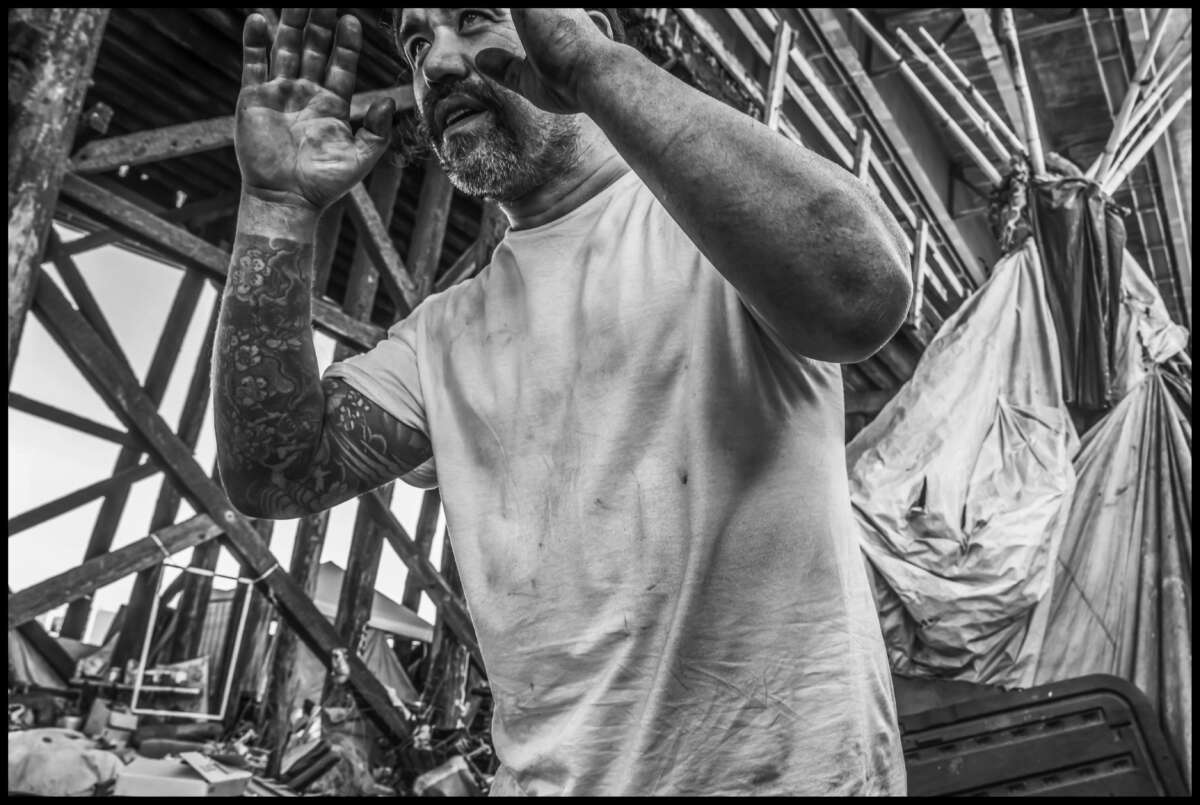
Dustin Denega built a tipi for shelter in warmer weather, and in colder weather he slept in a trailer in the camp.

Dustin Denega built a tipi for shelter in warmer weather, and in colder weather he slept in a trailer in the camp. (Photo from September 7, 2022.)

DAVID BACON

In 2018, United Nations Special Rapporteur on Adequate Housing Leilani Farha visited Oakland. She told reporter Darwin BondGraham, “I find there to be a real cruelty in how people are being dealt with here.” In Manila, Jakarta and Mexico City, she observed, homelessness is basically tolerated, while in the U.S., a far wealthier country, being unhoused is criminalized.

Judge Orrick’s finding that there were shelter beds available was not a statement of a real fact, but a requirement for eviction given earlier legal precedents. In 2019, Judge Marsha Lee Berzon on the Ninth Circuit Court of Appeals held in Martin v. City of Boise that “criminal penalties for sitting, sleeping, or lying outside on public property for homeless individuals who cannot obtain shelter” were unconstitutional. The Eighth Amendment bars cities from punishing anyone “for lacking the means to live out the ‘universal and unavoidable consequences of being human.'”

The court’s decision was no real protection for Wood Street, as the eviction proved, but it did at least acknowledge that being unhoused with no money was a consequence of social conditions, not a crime or personal choice or deficiency.

The eviction pulled the bones of capitalism into plain sight. The right to property is enshrined in law, and the legal structure of the state will enforce it, even if it leaves people on the street with no place to sleep or live. Land is a commodity, to be bought and sold. If the right to live on it comes first, the property of any landowner is in danger. A clean empty space under a freeway, while people sleep in tents on sidewalks, is deemed a preferable alternative to land occupations.

In February the last of the camp residents had been removed. removed from the huge Caltrans area under the freeway. During one eviction, a group of day laborers appeared, taking away belongings and discarding the trash left behind. They were some of Oakland’s lowest-paid workers — Mexican and Central American jornaleros who daily look for work on city sidewalks and parking lots. While they hauled out debris, the unhoused people who would soon be joining them on those sidewalks watched.

In this last twist, according to a foreman on the site, a city contractor had hired a labor broker, who in turn went out to day labor sites to find workers to clean out the camp for the lowest wages possible. To keep those labor costs low, the distasteful work of eviction had been contracted out — one more aspect of municipal neoliberalism, in this liberal city in this progressive state.

After BNSF Railroad and CalTrans announced they would force people to leave notices were put on vehicles warning of the impending eviction.

After BNSF Railroad and Caltrans announced they would force people to leave, notices were put on vehicles warning of the impending eviction. (Photo from September 7, 2022.)

DAVID BACON
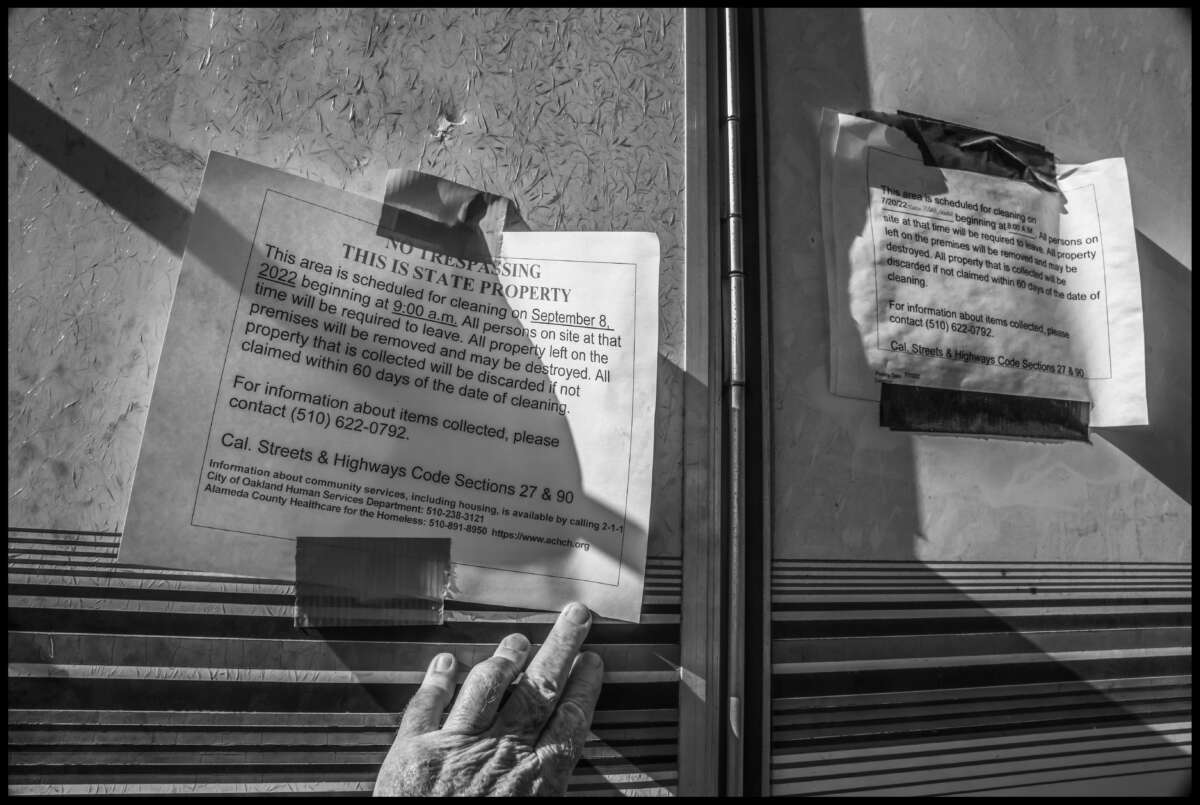
According to the CalTrans notice, Wood Street residents were trespassing on state property, and any possessions left behind after the eviction would be removed and destroyed.

According to the Caltrans notice, Wood Street residents were trespassing on state property, and any possessions left behind after the eviction would be removed and destroyed. (Photo from September 7, 2022.)

DAVID BACON

Adam Davis lived in this trailer for several years before the CalTrans eviction notice appeared by his door.

Adam Davis lived in this trailer for several years before the Caltrans eviction notice appeared by his door. (Photo from September 7, 2022.)

DAVID BACON
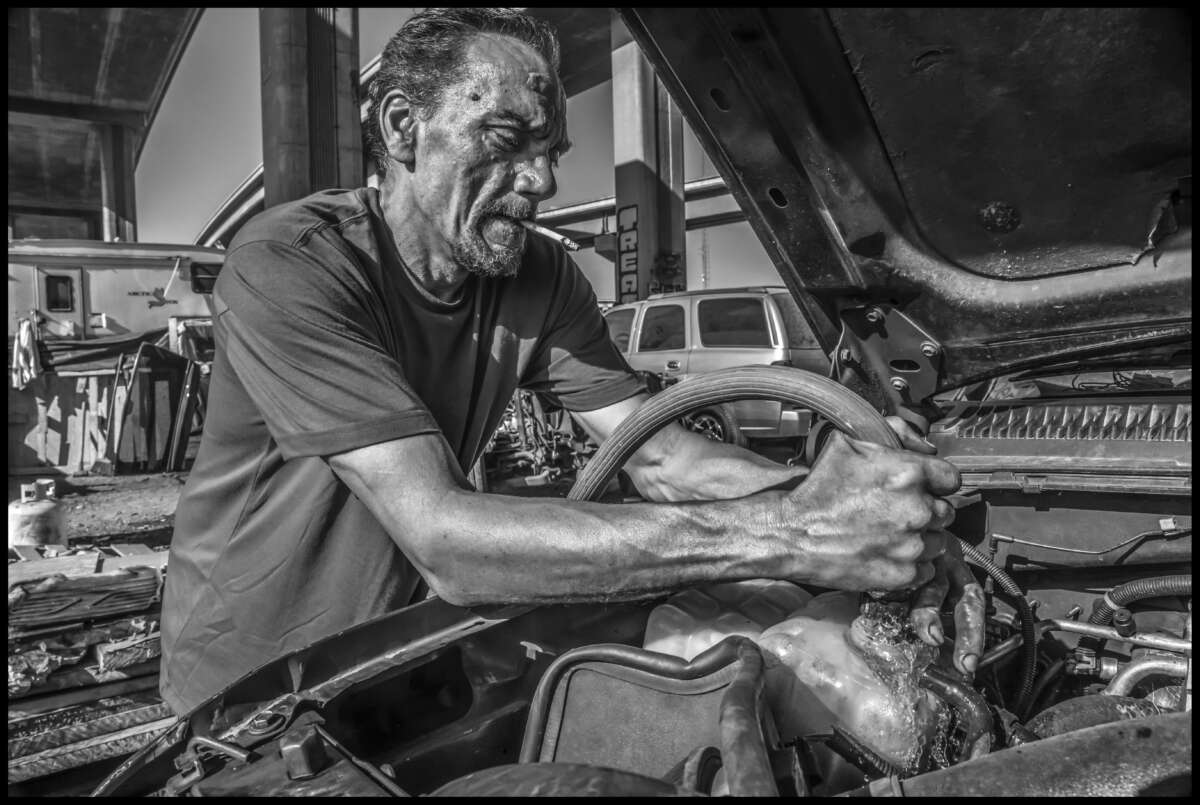
Adam Davis poured water into a tank in his car to get it ready to move to another location after he was evicted.

Adam Davis pours water into a tank in his car on September 7, 2022, to get it ready to move to another location after he was evicted. “I think I have a place where I can park for a while,” he said, “but it’s pretty temporary. Basically, I’ll be back living on the street.”

DAVID BACON
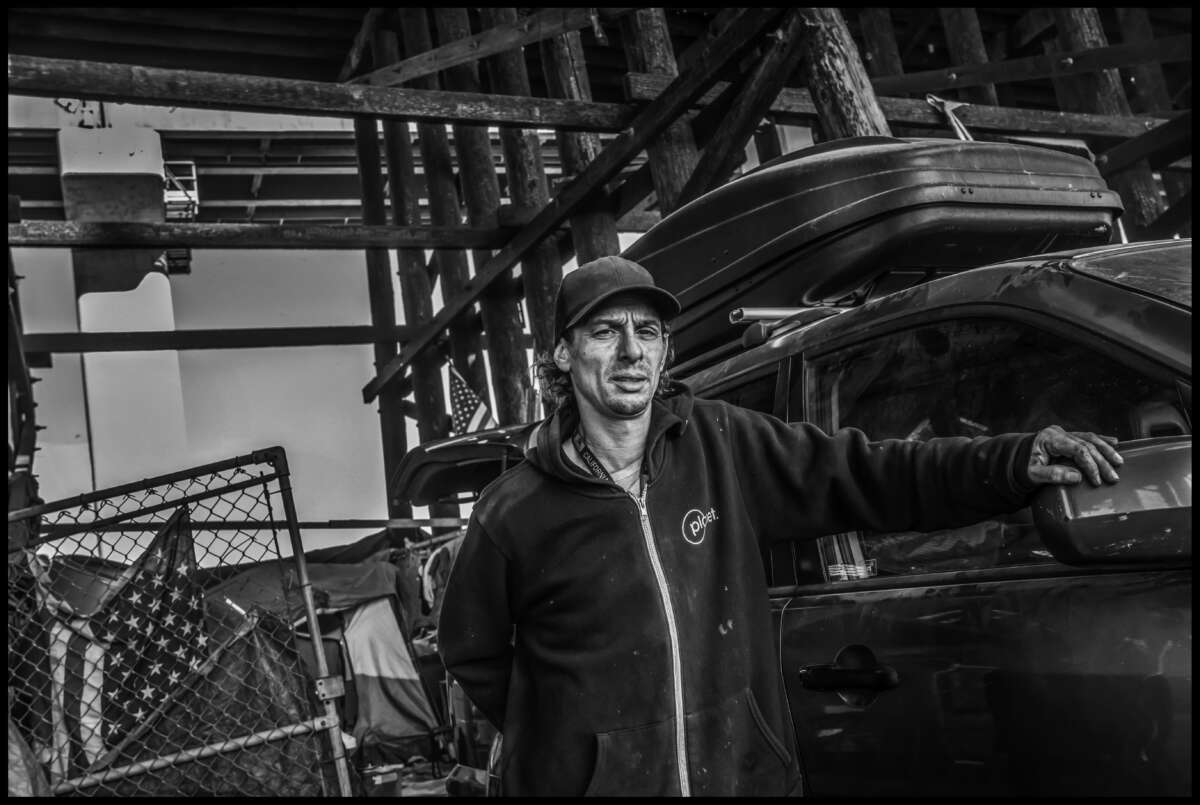
Jeremy packed up his American flag with his other possessions as he got ready for the eviction.

Jeremy packs up his American flag with his other possessions on September 7, 2022, as he gets ready for the eviction.

DAVID BACON

Heavy equipment is brought into the Wood Street encampment to frighten residents into leaving without more protest.

Heavy equipment is brought into the Wood Street encampment on July 20, 2022, to frighten residents into leaving without more protest.

DAVID BACON

The Highway Patrol escorted in workers to clear part of the encampment.

The Highway Patrol escorts in workers on July 20, 2022, to clear part of the encampment.

DAVID BACON

As a resident watches, a forklift hoists a resident's SUV and takes it out of the camp under the freeway.

As a resident watches, a forklift hoists a resident’s SUV and takes it out of the camp under the freeway on September 26, 2022.

DAVID BACON
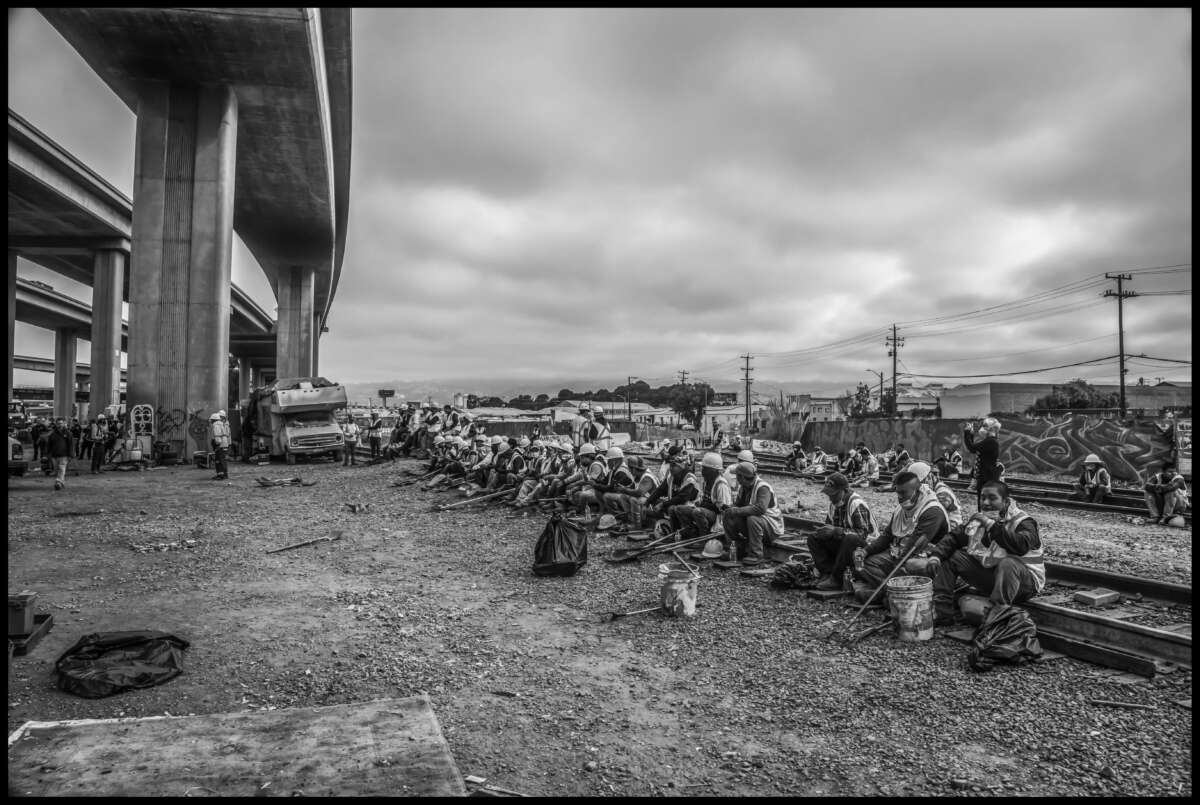
Day laborers are brought to clear the encampment.

Day laborers are brought to clear the encampment on September 26, 2022.

DAVID BACON

The day laborers brought to clear the encampment are Mexican and Central American workers, who find temporary jobs waiting on Oakland sidewalks to get hired.

The day laborers brought to clear the encampment in September, 2022, are Mexican and Central American workers, who find temporary jobs waiting on Oakland sidewalks to get hired.

DAVID BACON
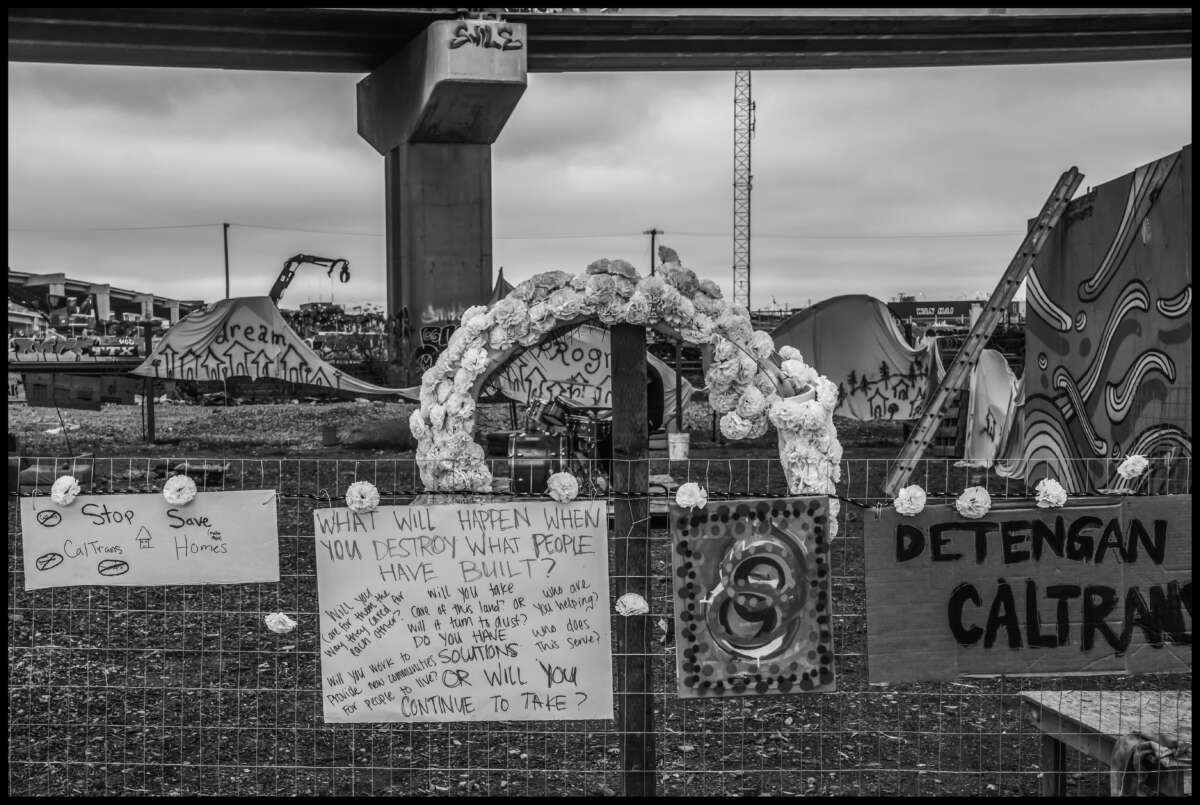
Residents and supporters write their last appeals and post them on a fence they built to protect their meeting area.

Residents and supporters write their last appeals and post them on a fence they built to protect their meeting area on September 26, 2022.

DAVID BACON
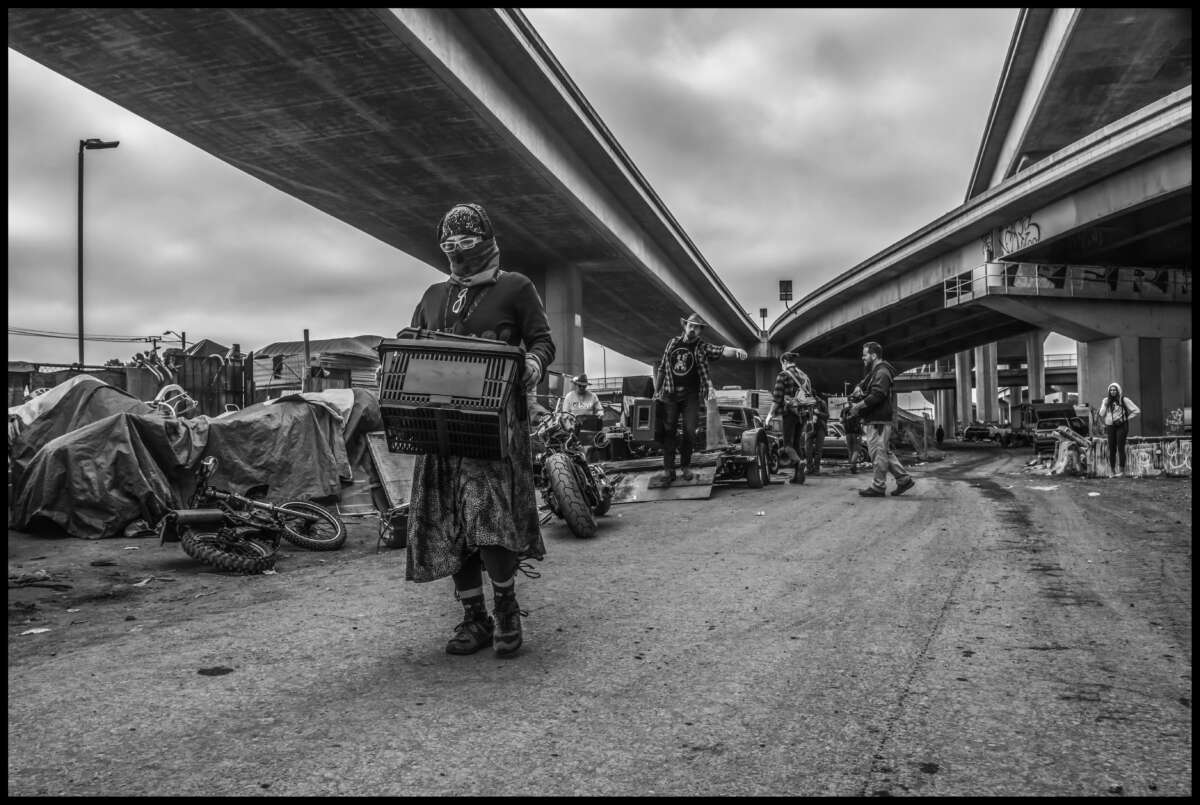
A volunteer brings in sound equipment for one last jam before the eviction.

A volunteer brings in sound equipment for one last jam before the eviction on September 26, 2022.

DAVID BACON

Day laborers in long lines bring items to the dumpster to be trashed.

Day laborers in long lines bring items to the dumpster to be trashed on September 26, 2022.

DAVID BACON

Day laborers hoist a sofa left behind into a dumpster to get trashed. On the freeway overpass above trucks leave the huge port of Oakland.

Day laborers hoist a sofa left behind into a dumpster to get trashed on September 26, 2022. On the freeway overpass above, trucks leave the huge port of Oakland.

DAVID BACON

Dolls and a flag are ironic comments left on a vehicle under the freeway, about to be towed away.

Dolls and a flag are ironic comments left on a vehicle under the freeway, about to be towed away on September 26, 2022.

DAVID BACON

Note: This article was updated post-publication to include a quotation from unhoused activist Jon Sullivan, and clarifications were added to distinguish between the encampment on city-owned land and the camp under the freeway on Caltrans land. A correction was also made to clarify that the judge “finally accepted the agency’s argument” in August rather than October.

“Appalling” attacks and “outright lies”: Biden’s FCC nominee backs out after Joe Manchin says no

After enduring a vitriolic and homophobic smear campaign from right-wing media outlets during a 16-month lobbying battle — with little public defense from Democratic leadership — career-long consumer rights advocate and veteran telecom lawyer Gigi Sohn withdrew her nomination to the Federal Communications Commission on Tuesday. That news came almost immediately after reports that Sen. Joe Manchin, D-W.Va., planned to vote against Sohn’s confirmation, likely torpedoing the nomination. 

“When I accepted his nomination over sixteen months ago, I could not have imagined that legions of cable and media industry lobbyists, their bought-and-paid-for surrogates, and dark money political groups with bottomless pockets would distort my over 30-year history as a consumer advocate into an absurd caricature of blatant lies,” Sohn said in a statement Tuesday. 

“The unrelenting, dishonest and cruel attacks on my character and my career as an advocate for the public interest have taken an enormous toll on me and my family.”

Manchin, who has been widely criticized for his relationship with telecom industry lobbyists, released a statement Tuesday explaining why he would oppose Sohn’s confirmation. 

“The FCC must focus on issues of critical importance to West Virginian [sic] and Americans, such as updating broadband coverage maps,” said Manchin, “and ensuring every American has access to affordable Internet services.” 

The senator’s objections are somewhat unclear in nature, perhaps deliberately so, since Sohn by all accounts has spent decades doing exactly those things.

“As someone who has advocated for my entire career for affordable, accessible broadband for every American, it is ironic that the 2-2 FCC will remain sidelined at the most consequential opportunity for broadband in our lifetimes,” Sohn said in her statement. “This means that your broadband will be more expensive for lack of competition.

“It is a sad day for our country and our democracy when dominant industries, with assistance from unlimited dark money, get to choose their regulators. And with the help of their friends in the Senate, the powerful cable and media companies have done just that.”


Want a daily wrap-up of all the news and commentary Salon has to offer? Subscribe to our morning newsletter, Crash Course.


Responses from advocacy groups, experts and veteran journalists flooded the internet. 

“A way to read Manchin’s statement here is that the only path to become an FCC commissioner is to come from the industry it’s supposed to regulate. If you come from the nonprofit/consumer advocacy world, you can’t serve,” said NBC News’ Kevin Collier

When Donald Trump nominated Nathan Simington to the FCC, he was seated in less than 28 days despite having little experience in the telecom industry, a fact pointed out Tuesday by veteran reporter Karl Bode. 

Democrats were not “faultless” with regard to Sohn’s nomination, Bode observed, delaying her confirmation hearings, failing to whip votes, yielding “to GOP demands for additional unnecessary show hearings and delays,” and failing repeatedly to offer public support as Sohn “faced down a homophobic smear campaign, alone.”

In a statement responding to Sohn’s withdrawal, Evan Greer, director of the digital rights advocacy group Fight for the Future, also called out Democrats failing her. 

“​​Meanwhile,” Greer said, “lack of FCC oversight has enabled collection and sale of cell phone location data that puts vulnerable communities at risk of stalking, harassment, and surveillance. A fully staffed FCC could address these issues. Biden’s deadlocked FCC is utterly impotent. And marginalized communities will pay the price for Democrats’ incompetence and cowardice.”

Chris Lewis, CEO of open-internet advocacy group Public Knowledge, said the American public “should be outraged.”

“The hard work of the Commission to prevent digital discrimination, to curb media consolidation, and to reinstate the FCC as the agency with authority over broadband is lost by this failure,” Lewis said in a Tuesday statement

“The incessant and appalling personal attacks against Ms. Sohn, the outright lies about her character, and the deceptive tactics used to bully her will have ripple effects for both the public and any other nominees the Biden administration may want to serve in their government.”

“I don’t support”: DeSantis distances himself from GOP bill to register bloggers after backlash

In a Tuesday news conference Florida Republican Gov. Ron DeSantis said that he did not support a controversial state legislature bill that would have required bloggers to register with the government.

“I see these people filing bills and there are these articles with my face on the article saying that bloggers are going to have to register with the state and they’re attributing it to me,” DeSantis said. “That’s not anything I’ve ever supported, I don’t support.”

The legislation, introduced by State Sen. Jason Brodeur (R-District 9), said that people paid to write about Florida officials would be required to register with the state or face a fine of up to $2500 per blog post.

In an email to TYT, Jeremy T. Redfern, DeSantis’s deputy press secretary, said that the governor and his staff “were not aware of this legislation until it was filed.” He did not answer as to whether DeSantis, a possible Republican presidential candidate, had discussed the topic of media regulation with Brodeur beforehand.

The bill was widely condemned as a threat to freedom of the press, with some critics comparing it to a 2014 law passed in Russia that also forced bloggers to submit to a government registry

Even former U.S. House Speaker Newt Gingrich, a far-right Republican, condemned Brodeur’s bill.

“The idea that bloggers criticizing a politician should register with the government is insane,” Gingrich wrote in a Twitter post. “It is an embarrassment that it is a Republican state legislator in Florida who introduced a bill to that effect. He should withdraw it immediately.”

Sunshine State Democrats also blasted the bill, entitled “Information Dissemination.”

“This bill is another example of how weak and fragile Florida Republican egos are. Every day I am attacked by random blogs on the internet and I have never once even thought of filing a bill to prohibit it,” State Rep. Anna Eskamani (D-District 42) told TYT.

“Unfortunately with the rise of fascism in Florida comes the attempts to censor freedom of speech, and it’s been great to see at least some of the GOP backlash from other parts of the country,” she said.

This is not the first time that Brodeur has attracted controversy in Florida. He is one of several state Republicans at the center of a “ghost candidate” scandal in which Republican operatives allegedly paid to set up fake progressive independent candidates to siphon votes away from Democrats during 2020 elections.

In 2019, the Orlando Sentinel reported that Brodeur paid at least $30,000 to a Jacob Engels who described himself as a writer for Infowars, the website of conspiracy theorist Alex Jones. Brodeur has claimed to have no connection to Jestine Iannotti, who ran as an independent candidate in his district against Democrat Patricia Sigman.

Both Iannotti and a Florida Republican consultant named Eric Foglesong have been charged by state prosecutors with felony campaign finance violations. Fogelson has sought to compel several current and former Orlando Sentinel journalists to provide records and testimony in his criminal trial.

“Playgrounds for cops”: Beyond protests, clergy, environmentalist unite against Atlanta’s ‘Cop City’

More than 20 people are now facing domestic terrorism charges after dozens of protesters dressed in black — including one from France and one from Canada — were arrested at a planned police training center in a wooded area outside of Atlanta.

The ongoing conflict between authorities and protesters who oppose the so-called “Cop City,” a $90 million project set to be built in a forest near Atlanta to offer training for the city’s Police and Fire Departments, including classrooms, a shooting range and a “mock city for real-world training,” has heated up in recent weeks. Since 2021, the proposed site of the Atlanta Public Safety Training Center has drawn protesters who worry the project will damage the environment and contribute to the militarization of police. 

“We have a problem in the United States with how deeply unimaginative our leaders are in addressing crime,” said Kyle Bibby, the senior campaign director at Color Of Change, a civil rights organization. “All we do is just increasingly militarize our police. We increase funding to the police, but that doesn’t actually address real systemic issues that lead to crime. People in the community would like to see that money going towards housing, education programs, violence prevention, mental healthcare – other inputs that actually raise crime.”

At issue is 3,500 acres of land in Dekalb County called the South River Forest – one of the largest unspoiled forested areas in the Atlanta metro area, according to the Atlanta Regional Commission. The area includes Intrenchment Creek Park, the Atlanta Prison Farm, Constitution Lakes Park and Gresham Park – a predominantly Black neighborhood.

In January, a 26-year-old environmental activist Manuel Esteban Paez Terán, or “Tortuguita,” was shot and killed by officers during a raid at a protest camp. Police have said that Tortuguita attacked them and injured a state trooper, but activists have questioned their claims and called on law enforcement to release any body-camera video of the incident. Tortuguita’s killing sparked demonstrations to spread across downtown Atlanta, leading Georgia Gov. Brian Kemp to declare a state of emergency on Jan. 26 and order the state’s defense department to mobilize up to 1,000 state National Guard troops to be called up to active duty “as necessary.” Since then, local organizations have criticized the Mayor and City Council for choosing to engage in violence by relying on police to harass and arrest those protecting the forest as the movement against the Cop City project has built momentum.

Some groups are even calling out corporations for funding Cop City and supporting a police facility that would be surrounded by poor neighborhoods in a city with one of the nation’s highest degrees of wealth inequality. “The Atlanta Police Foundation takes in millions of dollars every year and with that money and almost no oversight from the community, they can buy equipment and do other services,” Bibby said. “This prevents the community from oftentimes having a say in how the dollars are being appropriated for their own local police.”

Color of Change has called on corporations to stop funding APF, which they say “has a history of using corporate donations to fund the expansion of the police at the expense of the Black community in Atlanta.” Corporations, like Target and Wells Fargo have funded two-thirds of the donations for the police training site, Bibby added. One of the major donors is Coca-Cola, headquartered in Atlanta, which contributed $13 million. 

“You would not have the sort of unrest that we’ve seen and so much anger in the community if Coca-Cola and other companies like that had not given millions of dollars to the Atlanta Police Foundation… to build this cop city that no one wants,” Bibby said. 


Want a daily wrap-up of all the news and commentary Salon has to offer? Subscribe to our morning newsletter, Crash Course.


Law enforcement detained at least 35 demonstrators in Atlanta on Sunday for “coordinat[ing] attacks on construction equipment and police officers”, according to a statement released by the Atlanta Police Department. However, the Southern Poverty Law Center and National Lawyers Guild released a statement, contradicting the police’s account of events, saying that an NLG legal observer was among one of the 35 arrested.

“An employee at the SPLC was arrested while acting — and identifying — as a legal observer on behalf of the National Lawyers Guild (NLG). The employee is an experienced legal observer, and their arrest is not evidence of any crime, but of heavy-handed law enforcement intervention against protesters,” the statement said. 

A coalition of faith leaders in Atlanta has also joined the protest to stop the construction of Cop City. Clergy and religious leaders held a news conference on Monday before Atlanta City Hall to demand that the Weelaunee Forest be returned to the Muskogee people. 

“In this time, let us take this moment to remember the ancient ones who lived in this very area,” said Muskogee Chief and Methodist Minister Mekko Chebon Kernel. “Let us be mindful of the love, respect and humbleness they had for all people and for this land that gives us water and food. As we become more mindful of these first Native American people, may we live in the same manner.”

Additionally, several environmental organizations have also raised concerns about the police center impacting forest preservation efforts and wrote a letter to the city council in 2021 when they were originally considering the lease for this project.

“This particular forest is a wetland and riparian buffer for the South River, and destroying it would have severe implications for the health and vitality of the river,” the letter said. 

Another group called Defend The Atlanta Forest has echoed similar sentiments, saying that Atlanta has “the highest percentage of tree canopy of any major metropolitan area in America” and that “[t]he forest in Southeast Atlanta is home to wetlands that filter rainwater and prevent flooding.”

Atlanta Mayor Andre Dickens has said that the facilities will be built on a site that was cleared decades ago for a former state prison farm. He added that the tract is filled with rubble and overgrown with invasive species, not hardwood trees. While the facility will be built on an 85-acre site, about 300 other acres would be preserved as a public greenspace, Dickens said. 

But groups like Color of Change have emphasized that the South River is the fourth most endangered river in America. 

“The chemical runoff from weapons testing at the militarized police facility will further pollute the South River and the surrounding communities,” according to COC’s campaign statement. “Black Atlantans already bear the brunt of pollution in Georgia. ‘Cop city’ is yet another example of the state risking the health of Black communities.”

On top of this, Color of Change is also worried about similar facilities like Cop City forming in other places across the country offering “playgrounds for cops” to experiment with military equipment.

“It will still all come at the opportunity cost of real investments in the community that could address crime,” Bibby said.


Editor’s note: This article has been updated to remove a mention of Truist Bank. The company has not provided funding for the Atlanta Police Foundation Training Center but its predecessor, SunTrust, donated $3 million to the Atlanta Police Foundation, which it said was used to fund financial education programs for at-risk youth and the construction of the Truist Andrew & Walter Young Family At-Promise Center in Southwest Atlanta. 

Hope Hicks starts talking in Trump’s hush money case: report

Hope Hicks, a former spokesperson for Donald Trump, met with Manhattan prosecutors Monday as part of an ongoing investigation into hush money payments purportedly made by the ex-president to Stormy Daniels, an adult film actress.

Both Hick’s lawyer, Robert Trout, and the district attorney’s office declined to comment, per the Associated Press. But the New York Times reported that Hicks is the seventh in a line of witnesses to meet with prosecutors since district attorney Alvin Bragg heard evidence relevant to the case before a grand jury in January. The potential case mounting against Trump concerns his efforts in keeping payments to Daniels, whom he is alleged to have had an affair with in 2006, clandestine. Trump could face minor criminal charges for attempting to cover up the hush money.

Hicks previously served as press secretary to the former president during his 2016 campaign, a time during which she was in conversation with Trump as part of an attempt to quell news of his supposed affair. 


Want a daily wrap-up of all the news and commentary Salon has to offer? Subscribe to our morning newsletter, Crash Course.


In the final stretch of the 2016 campaign, Michael D. Cohen, Trump’s former personal lawyer and fixer, wired a $130,000 payment to Daniels, whose real name is Stephanie Clifford. Though Cohen affirmed in a 2018 statement to The New York Times that “Neither the Trump Organization nor the Trump campaign was a party to the transaction with Ms. Clifford,” it is assumed that the money was paid at Trump’s behest. 

“Neither reimbursed me for the payment, either directly or indirectly,” Mr. Cohen added. “The payment to Ms. Clifford was lawful, and was not a campaign contribution or a campaign expenditure by anyone.” The Times reported that Hicks spoke with Cohen on the day he sent Daniels the funds.

Cohen met with the Manhattan district attorney last month as part of the grand jury’s probe. “It’s now the 15th time that I’m heading in to discuss this and several matters with the DA’s team and I am looking forward to it,” Cohen said of the meeting on his podcast Political Beatdown. 

Kellyanne Conway, another trusted Trump campaign aid, also met with prosecutors last week. Cohen singled out Conway’s crucial role in the fund transferral in his 2020 memoir, writing that he phoned Conway after Trump didn’t take his call — “obviously a very bad sign, in hindsight” — and she “said she’d pass along the good news.”

Bragg’s inquiry runs in tandem with a separate criminal investigation being led by Fulton County District Attorney Fani Willis, who is scrutinizing Trump’s efforts to overturn the 2020 Presidential election in Georgia. 

AI can track bees on camera. Here’s how that will help farmers

Artificial intelligence (AI) offers a new way to track the insect pollinators essential to farming.

In a new study, we installed miniature digital cameras and computers inside a greenhouse at a strawberry farm in Victoria, Australia, to track bees and other insects as they flew from plant to plant pollinating flowers.

Using custom AI software, we analyzed several days’ video footage from our system to build a picture of pollination behavior over a wide area.

In the same way that monitoring roads can help traffic run smoothly, our system promises to make pollination more efficient. This will enable better use of resources and increased food production.

A fresh set of eyes

With a growing human population and limited natural resources, food production needs to become more efficient and sustainable. Precision agriculture powered by new technologies, like AI, can help secure future food production.

Efficient pollination is crucial to produce healthy fruits, vegetables, legumes and nuts.

Optimal pollination requires just the right number of insect pollinator visits to flowers. Too few or too many visits or visits by ineffective insect pollinators, can diminish the quality of food a flowering plant produces.

Typical techniques for monitoring insect pollination use direct visual observation or pan trapping, which are labor-intensive and take many days.

Additionally, without a very large number of trained observers it is impossible to collect simultaneous data across large farms. Yet such data are needed to provide time-critical evidence of the extent of crop pollination, before a season’s pollination window is closed.

With our digital system, however, a farm manager could obtain same-day data on crop pollination levels.

How fine-grained analysis of insect pollinator movement enables better food production

Tracking honeybees on strawberry plants.

Our pollination monitoring system was set up at Sunny Ridge farm in a strawberry greenhouse open to insects. The array of cameras monitored insect activity among the strawberries, recording honeybees, hover flies, moths, butterflies and some wasps.

Managing big (insect) data with advanced software

The volume of data our system collects requires custom software to reliably track individual insects flying among complex foliage.

A key issue our software overcomes is identifying insect movements within a video sequence, so an individual insect on a single path isn’t accidentally counted multiple times. This enables accurate assessment of the number of insects in a region during a day, an analysis of their type (e.g. species) and monitoring of their flower visits.

Our custom software uses a hybrid detection model to detect and track insects and flowers in videos. This model combines the AI-based object-detection capabilities of deep learning using a convolutional neural network, together with separate foreground detection algorithms to identify the precise positions of insects and the flowers they visit in the recorded videos.

The software includes features to make data processing more efficient and save on computer power.

The insect paths our software produces are computed using a method called the Hungarian algorithm. This examines the positions of insects in each video frame in a sequence and enables the identification of a match between the locations of the insects across a sequence of video frames.

By recording and visualizing these paths, we gain an understanding of insect behavior and the efficiency of pollination in a greenhouse.

Strawberries produce quality fruit after a minimum of four insect visits to an individual flower. Too many visits can actually damage flowers and reduce fruit quality.

Which insects drive pollination?

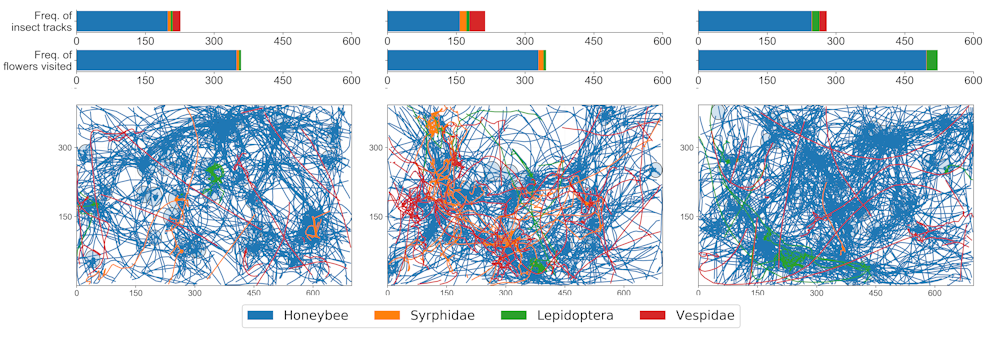
Insect counts, tracks and flower visits recorded across the farm.
Insect counts, tracks and flower visits reported at three sample locations at our field site. Bar charts above the plots indicate the number of tracks and total number of flower visits for each insect type. Track colours represent different insect varieties. Flower locations are indicated by blue circles. Ratnayake et al., 2022.

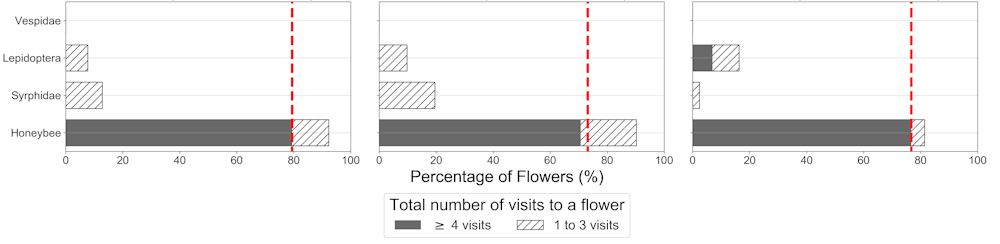
Honeybee flower visits were recorded more frequently in the monitored area than visits by other insects. Our analysis showed 68% of recorded flowers received the minimum number of four insect visits required for full fertilisation during the monitoring period.

While honeybees contributed the most to pollination, visits by other insects often resulted in individual flowers achieving the desired threshold of four visits, potentially improving the crop yield.

Contribution of different insect types towards strawberry pollination.Contribution of different insect types towards strawberry pollination. Bar chart shows percentage of flowers visited by each insect type at three sample locations at our field site. The dark grey portion shows the percentage of flowers with over four (number of visits required for strawberry flower fertilization) from each insect type. The red dashed line in the plots show the total percentage of flowers with more than four visits in a location. Ratnayake et al., 2022.

By detecting the numbers, types and timing of insects needed for optimal pollination, our monitoring system provides farmers the evidence they need to inform decision-making.

For example, knowing the extent to which a crop has been pollinated allows growers to alter hive locations and numbers to boost pollination shortfalls.

Farmers might also open or close greenhouse sidewalls to encourage or discourage insect visits from particular directions. They may decide to add attractant flowers to entice insects to explore crop regions that have been inadequately visited.

These simple interventions can ensure a higher rate of pollination success and a higher yield of market-quality fruit. Smart insect management like this promises to help meet the need to feed a growing population with healthy produce.

Malika Nisal Ratnayake, Postdoctoral Research Fellow, Faculty of Information Technology, Monash University; Adrian Dyer, Associate Professor, Monash University and Alan Dorin, Associate Professor, Faculty of Information Technology, Monash University

This article is republished from The Conversation under a Creative Commons license. Read the original article.

The 10 most popular recipes Food52 has shared on Instagram

For many of you, Instagram is where we first met. It’s where we share our best recipes on their prettiest days, at their very best angles. While we adore everything that ends up on our Instagram, we know you like some posts more than others. Every band has their hits and every smart band turns them into a “greatest of” album—and that’s what we’re doing here. So without further ado, here are the most popular recipes we’ve ever shared on Instagram

10. Baked Gruyère With Garlic and Herbs

With five minutes of prep and eight minutes cooking, you could be standing over a skillet of garlic and herb-infused baked Gruyère. Serve with crusty bread, your favorite crackers or sliced apples.

9. Olive Oil–Braised Chickpeas From Joy The Baker

This works great on its own or as a blueprint for other future chickpea meals. The balanced combination of braised chickpeas, briny olives, salty feta and bright lemon can be recreated with a number of different ingredients, depending on whatever you have in your fridge.

8. Vegan Tofu Wontons In Chile Oil

These wontons look good, taste better and are vegan—can you name a better trio? Also, making wontons is fun.

7. Éclair Cake

A dish that needs no introduction but will get one anyway: Permanently pinned to the top of our Instagram page, put your hands together for the beautiful, delicious and internet-famous Eclair Cake. To put it plainly, if you haven’t made this yet, you are missing out.

6. One-Bowl Blueberry Buckle

A dish that confirms one of the great dessert truths: Butter, warmed berries and ice cream will never lead you astray. It’s worth noting that this recipe calls for self-rising flour, but it’s fine if you don’t have any—simply add additional baking powder and teaspoon salt as the recipe prescribes.

5. Ina Garten’s Skillet-Roasted Lemon Chicken

You knew Ina was going to make the list. This lemon, garlic and herb chicken is so good that it will work for any day, season or occasion you may find yourself in. Serve with sautéed greens, roasted potatoes and your favorite bottle of dry white wine.

4. Potato-Leek Soup With Spiced Chickpeas

Recipe developer Chetna Makan put it best. “The simplicity of this soup is what makes it special: Leeks, garlic and shallot are cooked in butter, which complements creamy potatoes and chickpeas, all adding up to a hearty vegetarian soup.”

3. Breakfast Pasta

A pasta that is greater than the sum of its limited (five, to be exact) parts. This recipe works for any audience, at any time of day—that could mean making this for your toddler at 7:00 a.m. or for yourself after a night out with friends, at a time too late to want to remember.

2. Miso Butter Onions

The popularity of these brilliant (yet still simple) miso butter onions confirms that we are not alone in our passionate Ottolenghi fandom. Serve these as a side, on their own or however you’d like—it’ll work no matter what.

1. Miso Mushroom Pasta

Miso, mushrooms and pasta belong together. It just works. Even better, this winning combination of texture and flavor is amplified by garlic, sherry vinegar, scallion and black pepper. What’s not to love?

Filipino desserts get a bright, sweet remix in Abi Balingit’s tiny Brooklyn kitchen

It’s impossible not to want to pick up Abi Balingat’s debut cookbook based solely on the cover alone. Featuring a slice of the baker’s impossibly fluffy halo-halo baked Alaska — made by layering coconut sponge cake, an evaporated milk granita, ube ice cream and whimsical Swiss meringue — against an acid green backsplash, the book really exudes a sense of “hey, we could have a lot of fun together.”

Without a doubt, “Mayumu: Filipino American Desserts Remixed” is one of the most fun dessert cookbooks from which I’ve ever baked, packed with playful mashups like ube skillet cookies and confetti pianono that reflect Balingat’s identity and invite you to let go of what is possible in both Filipino and American desserts.

But “Mayumu” also has a soft center that really appealed to me coming in as a reader who initially picked it up while feeling a little burned out (in general, but also specifically in the kitchen). In the introduction, Balingat provides some of her best-practice tips for bakers who, like her, will be working from small kitchens. One point, in particular, caught my eye immediately. “Patience is underrated,” Balingat writes.

“Whether it’s your first time or seventeenth time making a dessert, be kind to yourself if something goes wrong,” she continues. “Don’t let one bad bake keep you from ever baking again! In a lot of ways, I treat baking as self-care. The act of it allows me to take deep breaths, slow down and focus on a recipe.”

With a little patience, Balingat believes that anyone can become a great baker. After reading “Mayumu,” I believe this, too.

During an appearance on “Salon Talks,” Balingit spoke with me about the development of “Mayumu,” how she managed to launch a successful baking business and blog out of her tiny New York apartment and how her unique sense of fashion informs the aesthetics of her desserts. Watch Abi Balingit on “Salon Talks” here or read our conversation below.

The following interview has been lightly edited for clarity and length.

I first came across your baking on your Instagram and blog, The Dusky Kitchen. Where did that name come from?

I live in Brooklyn right now, and originally when I was first starting the blog — I had plans for this before the pandemic — I was thinking of how I would commute from Manhattan, and every time I could bake was only after work, so it’d be dusk, as the sun was setting pretty much, that I only had that opportunity to go in the kitchen. I have one window in my kitchen, so it’s always dusky. I thought it’d be really cute and quirky, even though it is a problem when you’re doing a lot of food photography with limited light, but it’s like, make the best of the situation kind of a name.

You essentially launched a second career as a baker from your home kitchen. You had another job, and you weren’t working in a professional bakery. What was your kitchen like at that point?

I feel like everyone in 2020 was baking banana bread and sourdough. It was all over the place. But personally, at the time I was living with three other roommates, and so it was bustling because we were all working from home. I do work a nine-to-five job, but remotely. 

There were times when, to put on the stand mixer, I’d keep an ear out, because you can hear everyone’s Zoom meetings. The walls are thin. I felt really bad because KitchenAids, I love them, but they sound like a Mustang or something. They’re so, so loud that it doesn’t matter where you turn it on or try to muffle it, it’s just super loud. So, I think it was just always bustling in the kitchen, or at least I tried my best to be cognizant of everyone’s space and time. But it was truly the only escape that I felt, especially being really nostalgic for being home. My family’s in California.

How did having that experience of formulating desserts in an apartment kitchen play into how you wrote recipes for other people?

Everything I did was basically all tested from my apartment. I never went to another location to do anything. I was really mindful of some recipes. A lot of Filipino recipes that I tried growing up were always to feed families of very large sizes, which is typical of my family as well. But living in an apartment, and also feeding yourself and cooking and baking for one, I was really just like, “Well, there’s certain recipes.” I technically have one recipe that’s a mug of pudding for one.

It’s nice because I think that a big part of baking and being cognizant of waste, I really love trying new recipes, but I feel like I have to justify it with, we’re going to give this away to neighbors, we’re giving this away to roommates, we’re giving it away to roommates’ boyfriends, we’re giving it away to everybody.

“Sponge cakes can be a little unforgivable if it’s very naked, but luckily you can just cover it in frosting and sprinkles.”

Your cookbook is gorgeous. You write that you let your palette roam free, in terms of inspiration. Can you talk about what you meant by that?

With something being called Filipino-American, I’m always in awe of just what American actually does mean to everyone because everyone’s experiences are so different depending on where you grew up. Luckily for me, I grew up in the Bay Area, and also the Central Valley in California, so I’ve always been exposed to everyone of different ethnicities, cultures, and so many influences from just being friends with people or just going out to restaurants, especially living in New York.

I think it all sums to the fact that there’s just so much access to so many different types of ingredients, different types of just cuisines that I think this book is emblematic of. It is Filipino at its core, but being Filipino-American, I think a lot of those recipes are all a little bit of fusion from somewhere else, and I really like that about it. I think it’s really true to me. I never lived in the Philippines full-time, so it is definitely a different experience, especially what you have readily available in terms of ingredients. That adaptability is really present in the book.

One recipe that I specifically want to highlight — because I feel like it really beautifully encapsulates this idea of “Filipino American Desserts Remixed” — is your play on confetti cake. Can you talk a little bit about this recipe and how you developed it?

I’m a big fan of Pillsbury’s Funfetti anything. I’ll order that at any bakery if I can. But a Pianono, it’s like a Filipino sponge cake, and has Spanish roots, with all colonial origins of the history in the Philippines. It’s named after a Pope, I think. The actual sponge cake traditionally can be pretty simple. It’s just a simple vanilla sponge, or can be an ube sponge, which is light margarine kind of a filling. But for this, I definitely have a bit more of a sweet tooth. I would say the biggest compliment in Asian desserts, usually, is that it’s not too sweet, so I really try to get that middle balance.

Instead of just margarine and sugar, I go ahead and use a whipped cream filling, so it’s not as overwhelming. But the top and the covering of it all is an American traditional buttercream. I love it, because it’s so colorful. It’s just within the batter, it has sprinkles on the outside. I really am a believer in just putting sprinkles on everything to cover up anything. I’m not perfect. I remember a few iterations of it, I was like, “Oh, there are cracks.” Sponge cakes can be a little unforgivable if it’s very naked, but luckily you can just cover it in frosting and sprinkles. So, I think it’s really good for just anyone at any level to try it, even though it is intimidating doing a Swiss roll of any capacity.

Speaking of presentation, does your love of fashion play into inspiration for how you present your desserts?

I feel like traditionally I’m very much really into color and whatever I dress up as. Technically my hair is in process right now. I’m molting into a different color at this point. But I inherently and subconsciously, I feel like I’ve just incorporated that in a lot of the desserts in the book.

“Being Filipino-American, I think a lot of those recipes are all a little bit of fusion from somewhere else.”

There’s specifically one that’s a rainbow fruit polovoron. Polvoron is just a crumbly shortbread cookie made with toasted flour, and so I bump up colors sometimes with gel fruit coloring. With freeze dried fruit, some of it is super vivid, just the red, raspberry is just super, super red. So, there’s certain things that are naturally occurring that are really colorful. Ube is definitely the first thing that comes to mind. The ethos of my baking, too, is it may not be everyone’s cup of tea. If it is, that’d be nice, but at the same time you do you, and whatever that means to everyone. I really hope people take pride in whatever they’re making in their kitchen.

Did you feel pressure to make this book more traditional?

I’m really lucky because my editor, she’s also Asian American, and that really made a difference honestly, in being able to write what I wanted to write without judgment, or without any need to whitewash certain recipes. I think it’s really hard though sometimes when you’re making fusion things, you definitely want to give credit to whatever culture you’re taking from. So a Latinx-inspired dish with Filipino, I’ll definitely say that.

In terms of explanation, sometimes it can be a little hard to be like, “Where did this come from?” And I think the really good thing about my editor was also just give people more context, because they’re just going to be like, “Where did this come from? What’s happening in your head?” And I think sometimes you think that’s just automatic that people just, “Oh, yeah, this makes sense,” but certain things do take more explanation. I think finding the fine balance of being able to explain it well, but also not over-explain because you shouldn’t have to, was really something that was really a challenge, but also really great about the book.

As a baker, you actually talk about umami throughout the book. I feel like that’s an element of sweet baking — at least in America sometimes — that often gets overlooked.

I love sweet, salty, savory. And I think the thing about my cookbook, I feel like, not just from Filipino desserts, I love getting inspiration from Filipino savory dishes, and so there’s definitely a lot of cookie recipes. I jump off of that point, but it’s just exciting to use the whole gamut of Filipino ingredients and also ingredients that are not necessarily Filipino, but can be added to a Filipino dish. So I love it, it’s so much fun.

What are some pantry essentials that you would encourage other people to keep on hand if they’re looking to cook through your cookbook?

There’s certain non-negotiable ingredients that you have to definitely go to a specialty Asian grocery store to get. And for me it’s ube extract. Those kinds of things are super important. In terms of flavor, it’s hard to mimic any other way.

“My editor, she’s also Asian American, and that really made a difference in being able to write what I wanted to write without judgment, or without any need to whitewash certain recipes.”

A big part of Filipino cuisine is a factor of just there’s so many preserved things, and things in jars, and condiments. Especially in dessert recipes that are the chilled desserts that are obviously halo-halo, fruit salad, buko pandan. There are certain things that are like nata de coco, and this sugar plum fruit, these chewy yummy little jelly things and red bean are all preserved in syrup. So you definitely should get jars of that, because it’s just really what makes it different from any other kinds of desserts.

Coconut, coconut flakes, can be in some things that I definitely use in the book. But if you have flour, sugar, butter, eggs, those are also important because there’s definitely a lot of just traditional types of bases of cookies and cakes, and all the American fair of desserts.

Your cookbook is very approachable. Let’s say that somebody is a novice baker. What recipes would you point them to in the book?

There’s one that sticks out to me, because I just made it for a friend for a potluck, and it was a thing where I was tight on time. I have a fiesta fruit salad recipe that’s very common for any Filipino party. It’s just basically putting condensed milk and usually just some cream-based type of milky liquid, and also just all these canned cocktail fruit, just the jellies that we were talking about, nata de coco. You just put it all together in a bowl and you mix it, and you let it sit for a couple hours as long as it’s cold.

But I love those desserts that are not intimidating at all. You literally just put everything in a bowl together, and you serve it, and everyone is happy, and it’s refreshing. I think mine is a little different from traditional fruit salad, just because I think I handpick a bit more of the fruits that I add in it. I have this weird thing where I don’t love maraschino cherries, and I don’t love the texture of the canned pears in a fruit cocktail. It’s mushy. So for this, there’s lychee, there’s grapefruit slices. I think there’s a bit of peaches and everything. So, it is a bit more tailored to my taste. I definitely recommend that recipe if you’re really just short on time and want to impress the crowd.

The end of an era: How Rachael Ray is pivoting — again

In 2023, the food media landscape is a fascinating place. As appointment television has become scarcer and TikTok has created a platform that fosters viral “recipe/content creators,” the definition of a “celebrity chef” is more ambiguous than ever.

Rachael Ray is a perfect encapsulation of this phenomenon. She was an early addition to the network with her shows “30 Minute Meals” and “$40 a Day.” Then, in 2005, she signed a deal to host her namesake syndicated daytime TV talk show. This helped to widen her horizons beyond just food knowledge and cooking demos, allowing her to venture into the usual daytime TV fare, like celebrity interviews, to more personal undertakings, such as sharing her newly rebuilt home with the audience after a devastating 2020 fire leveled her home. 

But now, as daytime TV continues to shift and its boundaries blur much like food media’s — who would have thought that Kelly Clarkson and Drew Barrymore would be dominating the weekday talkshow space? — it looks like it’s time for Ray to redefine herself again. 

In a statement released by CBS on Friday, Ray announced that she would be ending her talk show, which has won two Outstanding Talk Show-Entertainment Emmy awards, after this season. 

“In my more than 20 plus years in television I have had 17 wonderful seasons working in daytime television with ‘Rachael.’ However I’ve made the decision that it’s time for me to move on to the next exciting chapter in my broadcast career,” she said. “My passions have evolved from the talk show format production and syndication model to a platform unencumbered by the traditional rules of distribution.” 

She continued: “I am truly excited to be able to introduce and develop new and upcoming epicurean talent on all platforms. That is why I am looking forward to putting all my energies into my recently announced production arm, Free Food Studios. Thank you to all of our ‘Rachael’ daytime show partners, crew and affiliates, and the wonderful years we all worked together.”

Free Food Studios is a collaboration between Ray and her longtime producing partners Brian Flanagan, Anthony Amoia and Sean Lee. Per the company’s website, the “self-contained production and distribution company produces and owns a library of original content in the food space for distribution both domestically and internationally across a variety of social, linear and streaming platforms.” 


Want more great food writing and recipes? Subscribe to Salon Food’s newsletter, The Bite.


So — what’s next for Ray?

Signs suggest that, in part, she may be going back to her “30 Minute Meal” roots – which, selfishly, makes me a very happy camper.

According to Denise Petski at Deadline, “to date, Ray has created 30 episodes of 30-minute instructional cooking videos with Free Free Studios.” 

Ray’s early Food Network programs helped distill real-life food questions into approachable, simple shows and lessons that offered legitimate, actionable tips and techniques. It’s how I learned so much from her back in the day. However, as stated, I know that sitting down to watch an afternoon, instructional cooking show is not something that most are looking to do in this day and age. 

While Ray’s informational content is proven and tried-and-true, 2023 poses new challenges in terms of distribution and medium. For some inexplicable reason, jumpy, edited videos that are typically visually and audibly over-stimulating seem to be all the rage, which has allowed even-keeled, real-time, slow-down-and-cook-with-me type programming to fall by the wayside, which was also outlined by Salon deputy food editor Ashlie  Stevens in 2016.

Since then, TikTok has furthered this chasm even more so, while platforms like Twitch are diversifying the content and framing of a cooking tutorial even more. 

Ray notes that she is looking forward to beginning a “platform unencumbered by the traditional rules of distribution.” If television isn’t on the horizon, I’m curious where Ray will focus her content: streaming? TikTok? YouTube

If food media is cyclical like fashion, will the notion of a half-hour cooking show soon be deemed “retro” and make a comeback? With the success of various YouTube shows and programs within the past few years, it certainly does look like the good ol’ instructional cooking video is prime to make its mark again. 

For some television chefs, the capricious food media landscape might limit their endeavors, but thus far, Ray has remained nimble enough to thrive. I don’t think it will be any different as she returns to a format she helped define.  

For the first time, women denied abortions file lawsuit against new ban

Five Texas women who say they were denied medically necessary abortions are suing the state, seeking to clarify when the procedure is permissible under state law, The New York Times reported Monday.

The lawsuit will be formally announced at a press conference Tuesday, where the women will share their experiences navigating life-threatening pregnancy complications in the largest state in the nation to ban abortion.

The plaintiffs are not asking the courts to overturn Texas’ abortion bans, but rather to affirm that doctors can provide abortions in cases where continuing the pregnancy would be unsafe, or if the fetus is unlikely to survive outside the womb, the Times reported.

Texas’ abortion laws allow doctors to terminate pregnancies only to save the life of the pregnant patient. There have been several bills filed to widen those exceptions to allow abortion in cases of rape or incest, or pregnancy anomalies that make the fetus incompatible with life, but they are not expected to advance in the Republican-dominated Legislature.

Lauren Hall, one of the plaintiffs named in the suit, was thrilled when she learned she was pregnant. But at her 20-week anatomy scan, she learned that her fetus was developing without a skull, a lethal fetal anomaly known as anencephaly.

Hall’s doctor said they couldn’t help her, she told The Texas Tribune in September. She would have to remain pregnant until she miscarried or delivered a baby that could not survive outside the womb.

Or, the doctor quietly suggested, Hall and her husband could leave the state.

“And she said, ‘If you do that, don’t tell anybody why you’re traveling, don’t tell your jobs, don’t tell anyone at the airport,'” Hall told the Tribune. “Which sounds extreme, but Roe had just been overturned. Everyone was so scared.”

This tragic, earth-shattering news, and the unimaginable choice she now faced, sparked a mental health crisis, Hall said. But she worried that telling a health care provider about her situation would invite more questions and, potentially, legal repercussions.

Hall and her husband eventually cobbled together the money to buy last-minute flights to Seattle, where she was able to get an abortion. Hall said many people in her life had no idea how narrow the exceptions in the law were until she experienced it firsthand.

“They were just all shocked, like, ‘Surely, there’s an exception for this,'” Hall said. “It just didn’t occur to them that a ban would include cases like this.”

One of the other plaintiffs, Amanda Zurawski, learned at 17 weeks of pregnancy that she was miscarrying and at a high risk for infection. But the fetus still had a heartbeat and her life wasn’t in danger, so she was sent home until she became septic.

Zurawski, who attended the State of the Union in February as First Lady Jill Biden’s guest, was left physically and emotionally scarred by the delay; one of her fallopian tubes is permanently closed, and, she told the Times, she’s terrified as she resumes in vitro fertilization treatment.

The lawsuit will be filed by the Center for Reproductive Rights, a New York legal group that has led many of the recent legal fights to protect abortion access. The Center for Reproductive Rights unsuccessfully challenged Texas’ Senate Bill 8, which in 2021 banned abortion after about six weeks of pregnancy, and argued on behalf of Jackson Women’s Health Organization in the case that overturned Roe v. Wade last summer.

The group says this new Texas suit is the first lawsuit brought by people who have had their pregnancy care directly impacted by new, post-Roe abortion laws.

“I don’t think we’ve ever seen anything like this in the nation, having people with pregnancy complications having to sue the state,” Nancy Northup, president of the Center for Reproductive Rights, told the Times. “It puts a face on the reality of what it means when you criminalize abortion care. It shows that abortion care is health care.”

Disclosure: The New York Times has been a financial supporter of The Texas Tribune, a nonprofit, nonpartisan news organization that is funded in part by donations from members, foundations and corporate sponsors. Financial supporters play no role in the Tribune’s journalism. Find a complete list of them here.

Chris Rock’s “Selective Outrage” best exemplifies that comedy isn’t black or white – it’s green

While processing Chris Rock’s “Selective Outrage,” do not overlook what’s really being sold here: the continuation of a fight between two very rich men.

One of them, Will Smith, has spent the last year apologizing to his fans and polishing his image both on social media and on television. The other, Rock, is profiting off extending the feud by way of this special, the second in his $40 million obligation to Netflix that he scored in 2016. Placing beef on a menu guarantees people will show up, knives out.

Right-wing pundits are seizing upon Rock’s jokes … as evidence that he’s one of them now, or some grand sign that a cultural reckoning is coming.

Netflix counted on that, using the debut to test out the viability of live event streaming on its platform. Without knowing any viewership numbers related to the live stream, the special has at the very least become a talking point. Regardless, it still boils down to two rich guys quarreling and profiting off the public’s interest in it a year after the incident that incited it.

That makes everything related to this special and all else generated by Rock’s conflict with Smith collateral, including the perceived damage and assumptions concerning the comedian’s political views.  

Accepting this makes the discourse in all its variants predictable. Of course, right-wing pundits are seizing upon Rock’s jokes about abortion, corporate virtue signaling and Meghan Markle, all preceded by his invocation of their beloved term “wokeness,” as evidence that he’s one of them now, or some grand sign that a cultural reckoning is coming.

“Chris Rock: Selective Outrage” backstage (Netflix)
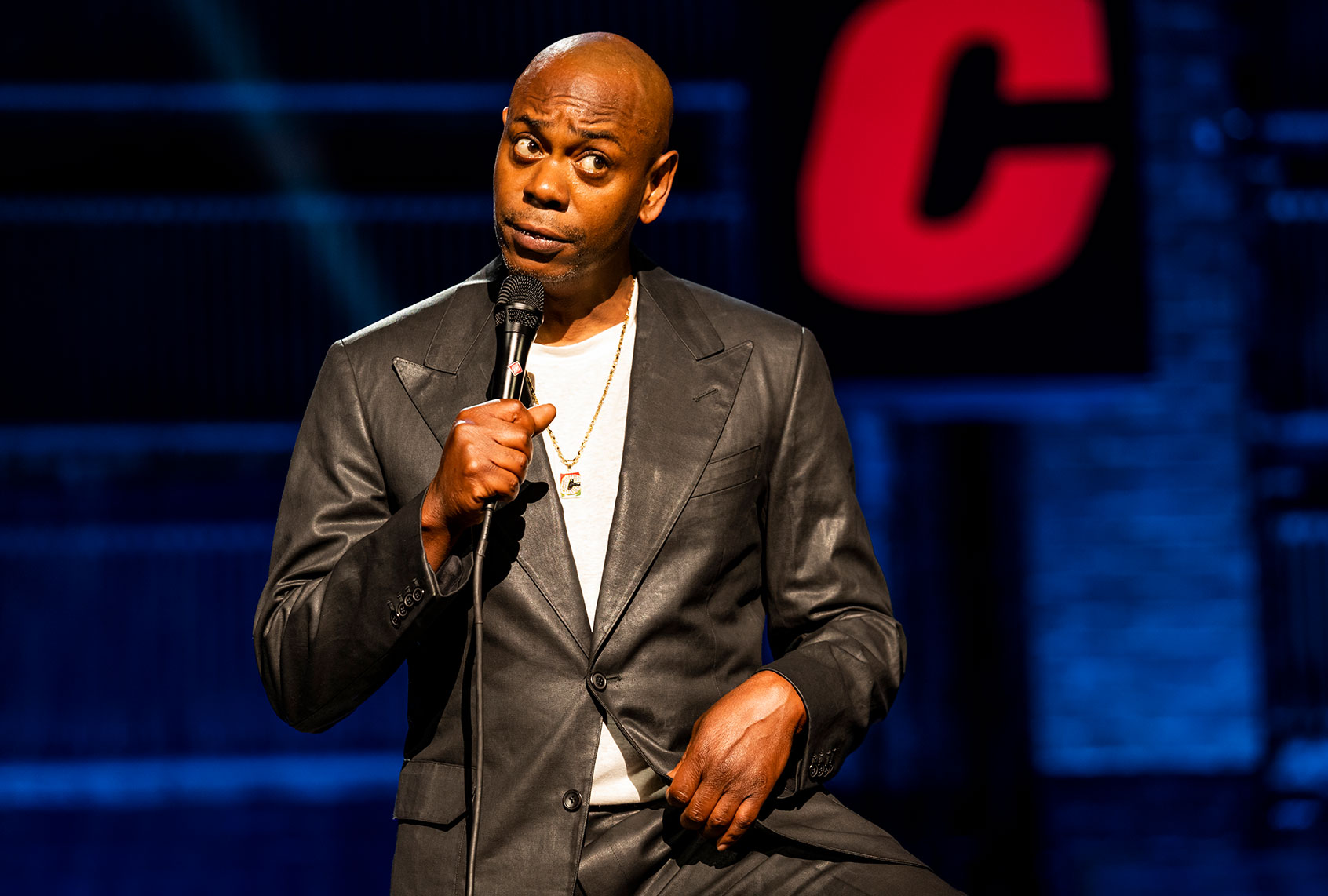
Others view the set as Rock entertaining white audiences at the expense of the Black community. Honestly, that’s been the case since 1996, when “Bring the Pain” broke Rock out of his post-“Saturday Night Live” stall-out. His bit about a so-called Civil War between Black people and “n****s” got huge laughs from Black audiences and coverage across the media spectrum, from puff pieces in magazines to serious consideration on NPR’s “Fresh Air.” White people’s shock at Rock’s airing of conversations long held in spaces they hadn’t acknowledged made him both a generation’s honest broker and middle America’s view into Black America.

Its success established him as a peer to Eddie Murphy and Bill Cosby and the talent for Black comics to look to for guidance and influence. And he’s been spinning off versions of that set’s style and content pretty much ever since. This is not to imply that takes pointing out the misogynoir in Rock’s latest shot are wrong, but rather to remind folks that he’s been this way for a long time.

Indeed, the only thing that’s fundamentally changed about that version of Chris Rock and the one who delivered the mid-level humor of “Selective Outrage” is that yesterday’s version cared about entertaining the folks who were shelling out $25 bucks (which, in 1996, was a lot!) to see him.

He has been a rich guy with rich guy problems for a long time, though.

“Selective Outrage” has already lined his pockets, handing Rock the total prerogative to make his material utterly personal. Every comic does that, of course. But only one of them was socked in the face by an Oscar-winning megastar.  

The event surrounding the set trumpeted Rock’s status as comedic royalty, placing him beyond the cares of average people and therefore separate from the material that once made him an effective, incisive comic.  

He has been a rich guy with rich guy problems for a long time, though, which means he sees the world not in Black and white terms but in green. He has that in common with Dave Chappelle and Ricky Gervais, men of a status that relieves them of the burden of finding other subjects to mine for laughs besides the ones being hacked to death in the culture wars. 

Dave Chappelle: The CloserDave Chappelle: The Closer (Netflix)

Comedy’s console has a broad array of switches but pounding on red is a reliable way of yielding green. For Chappelle, indulging transphobia in his jokes generates headlines and outrage, which sells live show tickets. Rock’s angle in “Selective Outrage” is to go after hypocrites with the full force of his words. In the Smiths, he has an obvious target with which few can disagree – a hip-hop artist turned world-renowned movie star who, along with his wife Jada Pinkett Smith, has alloyed a portion of their brand to the notion of transparency.  

Pinkett Smith did nothing to merit any involvement in this, by the way, regardless of what Rock says. She was pulled in by both Rock making an uninspired crack about her baldness and her husband’s explanation during his acceptance speech that what he did was in her defense and, by extension, in defense of Black women.

Following last year’s Oscars, the Smiths were strategic in their responses. Smith’s publicist fine-tuned a release in the direct aftermath of the debacle. In July he posted a video on YouTube, expressing his remorse. At the end of 2022 to promote his movie “Emancipation” he sat down with Trevor Noah for one of “The Daily Show” host’s final appearances, trusting in Noah’s empathy to confirm his contrition is genuine.

Meanwhile, Rock remained silent. In his first live show, which took place in Boston days after the telecast, he would only say that he was still processing what happened. “At some point I’ll talk about that s***, he told his audience, “And it’ll be serious and it’ll be funny, but right now I’m going to tell some jokes.”


Want a daily wrap-up of all the news and commentary Salon has to offer? Subscribe to our morning newsletter, Crash Course.


“Selective Outrage” has primarily been boiled down to its 10-minute closer when Rock lays into Smith and calls Pinkett Smith a “b***h” and a “predator” without ever using her name.

But it was plain to see that the 60 minutes that proceeded that tirade was informed by Rock’s enmity in the way that he used simplistic, well-trodden paths to connect his personal anger to cultural topics of conversation. They simply happened to be rich guy topics, which is the problem. The Lululemon bit exemplifies this.

Never mind that if he were to dig into the company’s history even slightly, he’d find plenty of established corporate bigotry on the part of its founder that would prove his point. The fact that he’s bringing up the company’s $100 yoga pants in the first place is, at best, odd for a guy like Rock.

Boutique athleisure wear is not exactly a wellspring of “I can’t believe he went there” material, save for people with money, privilege, and distance from everyday problems, or a comic who doesn’t want to go too far in one direction or another when it comes to taking a stance on social justice.

This is why an extended foray into his personal life, telling a story about how easy his daughters have it compared to his upbringing, fell flat. This segment was to humanize him as a regular father with kids who don’t know how good they have it. Except for the fact that jokes like the one with his daughter replying to her grade school teacher’s announcement that they would be learning about the four seasons with, “That’s my favorite hotel!” have limited relatability.

“Chris Rock: Selective Outrage” (Netflix)

Because of this, there was no fine line for Rock to walk as he did in his early comedy when he professes that he was merely saying aloud and before the world views expressed in barbershop banter. “These views have been out there forever,” he told Terry Gross back in 1997. “It’s just that nobody’s said it.”

Cut to Saturday, when he managed to pull off a callback to his antique O.J. Simpson joke by connecting it to the Kardashians. On some level that was clever since Rock couched the joke in a way that condemned Kanye West by association without ever actually saying his name. Then again, the Kardashians and O.J. are frequent flyer punchlines so common that they barely rate in late-night monologues.

Somehow it’s supposed to make a difference that Rock is the one making the joke, which is implied by his mic-dropping exit where he claims to be better than Smith by not fighting in front of white people on Oscars night. What is “Selective Outrage” if not expressly that?

Rock bragged that he had not and would never sit down with Oprah Winfrey or Gayle King to talk about that night as a matter of refusing to be a victim.

But that’s probably not the main reason he stayed mum. He knew that when one’s opponent tests the limits of Too Much Information, the most valuable commodity one can have is holding their silence until one can maximize the profitability of breaking it.

This is not fertile ground to foment original, provocative work. Essentially it guarantees that an artist like Rock, who in the past has delivered searing insights when it comes to race and class in America, will instead cook up a broadly agreeable product that displeases a few people and thrills those who equate fame with greatness.

Netflix sold the show as if it were steak when, at best, we were only ever going to get a McDonald’s hamburger. Now, is that an acceptable, solid substitution for the best version of his work? To some, sure. Many people even prefer fast food. Others may never be able to silence the voice in our heads reminding us that the kitchen is capable of better.

“Leave us the hell alone”: Family of fallen Capitol Police officer reacts to Tucker Carlson footage

Fox News host Tucker Carlson aired never before seen surveillance footage of the January 6 Capitol riots on his show Monday, using the tapes to mischaracterize the true nature of the violent insurrection and perpetuate a false narrative undermining the severity of the event.

Last month, Axios reported that House Speaker Kevin McCarthy, R-Calif., had shared a trove of more than 40,000 hours worth of Capitol security video from January 6 with Carlson, who has previously referred to the attacks as “a forgettably minor outbreak by recent standards.”  

“Taken as a whole, the video record does not support the claim that Jan. 6 was an insurrection,” Carlson said on Monday. “In fact, it demolishes that claim.” Carlson’s depicted the riots as a congregation of peaceful protestors wherein “the overwhelming majority” were not “hooligans.” Rather, “they were orderly and meek. These were not insurrectionists. These were sightseers.”

A far cry from Carlson’s erroneous recounting of the siege’s perpetrators, emboldened and encouraged by then-President Trump’s vitriolic speech, January 6 saw beaten and bloodied police officers, smashed windows and destroyed property, forced violent entry, trespassing, and theft in the seat of the United States Congress. In regard to the nearly $3 million dollars worth of damage done by more than 2,000 rioters, Carlson said, “They’re not destroying the Capitol. They obviously revere the Capitol.” 

Carlson also made a particularly cruel and insensitive jab at the death of Capitol Police officer Brian Sicknick, who succumbed to a series of strokes the day after being pepper sprayed in a physical altercation with the mob. The conservative media personality accused Democrats of turning Sicknick into a “prop” and a “martyr” for drawing connections between his death and the insurrection. Using the new video, Carlson showed Sicknick ostensibly ordering instructions to insurrectionists, claiming that the officer looked “healthy and vigorous” and that it is “hard to imagine” that his death could have been a result of the Capitol attacks. 

Sicnick’s family blasted Carlson for trying to downplay the relevance of the riots to his death, releasing a lengthy statement in response to “the lies started by Trump and spread by sleaze-slinging outlets like Fox.” “What will it take to silence the lies from people like Carlson?” the statement continued. “Every time the pain of that day seems to have ebbed a bit, organizations like Fox rip our wounds wide open again and we are frankly sick of it.  Leave us the hell alone and instead of spreading more lies like Supreme Leader Trump, why don’t you focus on real news?”

Trump, for his part, lauded Carlson for his “scoop” in a Truth Social post on Monday, while simultaneously demanding the release of rioters, now federally-convicted criminals, from prison. “Congratulations to Tucker Carlson on one of the biggest ‘scoops’ as a reporter in U.S. history. The New Surveillance Footage of the January 6th Events sheds an entirely different light on what actually happened,” Trump wrote. “The Unselect Committee was a giant SCAM, and has now unequivocally been stamped as CRIMINAL FABRICATORS OF THIS MOST IMPORTANT DAY. Pelosi & McConnell failed on security. The Police story is sad and difficult to watch. ‘Trump’ and most others are totally innocent, LET THEM GO FREE, NOW!


“Absolutely shameful”: Biden administration reportedly mulling return to migrant family detentions

Multiple news outlets reported late Monday that the Biden administration is considering restarting migrant family detentions that were used extensively by previous administrations in an attempt to crack down on border crossings.

While “no final decision has been made,” according toThe New York Times, “the move would be a stark reversal for President Biden, who came into office promising to adopt a more compassionate approach to the border after the harsh policies of his predecessor, former President Donald J. Trump.”

Immigrant rights advocates were quick to warn Biden against following through with any plan to revive migrant family detentions, which the administration had largely shut down.

“I’ve got one word for them: unacceptable,” wrote Aaron Reichlin-Melnick, policy director at the American Immigration Council.

“The thing about family detention is not only that it’s cruel and inhumane,” Reichlin-Melnick added, “but also that it was a money pit and absolutely useless as a ‘deterrent.'”

Bob Libal, an immigration justice advocate and consultant with Human Rights Watch, said it is “absolutely shameful that this is even being considered again.”

Both the Obama and Trump administrations made expansive use of family detention, with the latter attempting to rescind limits on how long children can be held in migrant detention facilities—an effort that was ultimately blocked in federal court.

On the campaign trail, Biden condemned the practice of family detention—as well as the separation of migrant families—as morally bankrupt, writing in a Twitter post: “Children should be released from ICE detention with their parents immediately. This is pretty simple, and I can’t believe I have to say it: Families belong together.”

But with the 2024 election looming, the Biden administration has moved to reinstate immigration policies that it previously denounced as cruel—including a Trump-era asylum ban—as it prepares for the May expiration of Title 42, another Trump administration policy that Biden has used to rapidly deport migrants.

Reutersreported Monday that in addition to restarting family detentions, the Biden administration is “weighing reviving immigration arrests of migrant families within the United States who have been ordered deported.”

“It’s all on the table,” an unnamed official told the outlet.

In the place of family detentions, the Biden administration has used ankle bracelets and other methods—decried as “digital prisons” by rights groups—to track migrant families as they move through the court system.

But as the Detention Watch Network has observed, the Biden administration did not end its contracts with facilities that were previously used to hold migrant families.

“Instead, following cues from the Obama administration, it converted the contract with Berks County to detain adult women and shifted its usage of the Dilley facility to detain single adults,” the organization noted.

Citing one unnamed official, CNNreported Monday that the Biden administration is “looking at multiple options for how to handle migrant families at the southern border, not all of them involving family detention.”

“Another source familiar with the deliberations added that among the options discussed are some that wouldn’t involve detaining families in ICE facilities,” CNN added. “This source said that family detentions would be limited to a small number of days—an attempt to set the policy apart from the Trump administration’s handling of family detentions.”

But it’s not likely that rights groups and advocates would accept such an alternative.

“I was part of a legal team that sued to get access to the first family detention center that President Obama opened (in Artesia, N.M.),” Karen Tumlin, a civil rights litigator, recounted Monday. “Talking to families and kids detained at Artesia was one of the lowest points of my legal career. I can see the cribs lining the hallway now, families and babies crammed into tiny rooms.”

“A family detention policy is a policy of adding trauma to trauma,” Tumlin added. “It is painful to see this as a rumored proposal from the Biden administration.”

Neo-Nazi cyberattacks on the rise: DHS “very concerned” about power grid

Right-wing domestic extremist groups — for the most part meaning neo-Nazis and white supremacists — now represent the most significant terrorist threat to the U.S., according to a leading Homeland Security official. That’s not headline news; law enforcement and national security officials have been saying that for years. But now those hate groups are allegedly engaging in both physical attacks and cyberattacks on critical infrastructure, such as the electrical power grid. 

In the past week, two white supremacists, one of them a neo-Nazi, were indicted by a grand jury for allegedly plotting attacks on five power stations in a bid to “lay waste” to the city of Baltimore. But those guys are just the tip of the iceberg. As noted by the Hill, there have been nine attacks on U.S. power stations since November. One resulted in days-long power outages, affecting thousands of people.

Kenneth Wainstein, undersecretary of the Office of Intelligence and Analysis at the Department of Homeland Security, told CBS News in February that domestic terrorist groups have become the department’s primary concern, rather than Islamic militant groups such as al-Qaida and ISIS. 

“The primary terrorism threat, the most lethal and persistent terrorism threat that we’re facing now, is not from the al-Qaidas and the al-Shababs and the ISISes, though they remain a serious threat,” he said. “But it’s from the lone actors and the small groups who are ideologically driven here within the United States and motivated out of ideology to foment, conspire to and engage in violence.”

That violence, according to both mounting research and criminal reports, increasingly takes the form of physical and cyberattacks on energy sector critical infrastructure. 

“We’ve seen attacks against the power grid for a number of years, and some of those attacks are simply people shooting into substations around the country for purely criminal reasons,” Wainstein said. “But some of these shootings are also being done by domestic violent extremists.” 

In September, a study from George Washington University found that 55 white supremacist attack planners faced federal charges between 2016 and August of 2022. Sixteen of those actually charged were planning critical infrastructure attacks, and 14 were known participants in online networks for neo-Nazi “accelerationism” — the attempt to speed up and amplify the spread of far-right political ideologies in order to create radical social change. 


Want a daily wrap-up of all the news and commentary Salon has to offer? Subscribe to our morning newsletter, Crash Course.


“The rise of accelerationist ideology and doctrine during the past decade likely fueled the increased risk of attack plots,” the authors report. 

“Between 2016 and 2022, white supremacist plots targeting energy systems dramatically increased in frequency,” the report continues. Thirteen individuals associated with white supremacist movements movement were charged with planning “attacks on the energy sector,” with 11 of these alleged “attack planners” charged after 2020.

Neo-Nazi cybercrime is not entirely new, despite its recent surges. The international right-wing extremist network known as Atomwaffen Division has engaged in cyberstalking, harassment, bomb threats and “swatting,” or falsely reporting a crime in progress at someone’s residence in hopes of triggering a SWAT team raid. Other online-facing neo-Nazi groups have hacked Holocaust memorial sites, tried to interfere in French elections, targeted Black student groups and hacked into remote printer networks to distribute Nazi propaganda. 

Even in Germany, where Nazi symbols and pro-Nazi political groups are illegal, authorities have struggled to control a growing neo-Nazi movement in recent years. 

Payment processors, cloud hosting, domain services and a variety of app makers have stepped up to denounce neo-Nazis and ban them from platforms. But the online neo-Nazi problem isn’t going away, and has spread well beyond unmoderated chat apps and marginal social media sites, their traditional zones of organizing DDoS attacks or real-world violence.

As cybersecurity experts have warned for years, energy technology in the U.S. is a patchwork system, about 80% in private ownership, that is highly vulnerable to attack. It appears that dangerous elements on the far-right fringe have noticed. 

Greenland’s marine ecosystem is experiencing a radical ‘regime change’

When marine biologist Mads Peter Heide-Jørgensen began studying the boreal waters that surround Greenland 40 years ago, an inflatable raft carried him through vast expanses of polar pack ice, with narwhals and walruses frequently passing by. The astounding blue sea ice seemed almost inviolable in its grandeur. 

But with Greenland reaching its highest temperatures in the past 1,000 years, the scene is changing. Arctic sea ice, which is responsible for maintaining cool polar temperatures, is dwindling rapidly. The oldest and thickest of it has declined by 95 percent during three decades of global warming.

“There’s a whole beautiful landscape that used to be there,” said Heide-Jørgensen, a researcher at Greenland Institute of Natural Resources. “Nowadays, we can see that all the ice is gone.”  

So too are a growing number of the creatures that lived among it. Inuit communities are seeing little to no evidence of endemic species like the narwhals and walruses that Heide-Jørgensen grew familiar with. Instead, they are finding animals native to more southerly waters, including mackerel, bluefin tuna, and many kinds of cetaceans, all of them drawn to the warming waters and abundant prey. 

Visual observation and remote sensing leave Heide-Jørgensen and fisheries biologist Brian Mackenzie with little doubt that a potentially irreversible regime shift – a change from one stable ecological condition to another – is occurring. Unprecedented numbers of dolphins and fin and humpback whales suggest a tipping point in the marine ecosystem off the east coast of the world’s largest island. This climate-driven shift means not only that meteorological and climatological phenomena thousands of miles away can affect local conditions in unexpected ways, but they create the potential for cascading effects throughout entire ecosystems. 

“It has a very specific driving force for the tipping element, which is the sea ice.” said Heide-Jørgensen, who attributes the regime shift primarily to a significant decrease in summer sea ice arriving from the Beaufort Sea. 

That body of water, located along the northernmost seaboard of Alaska, generates the pack ice found off the coast of eastern Greenland. It is carried there over the course of several years by winds and currents. For native marine species in Greenland, the ice regulates temperatures by reflecting sunlight and provides critical habitat and nursery grounds for animals, invertebrates, and algae. 

As the tern flies, the Beaufort Sea is about as far from these waters as Anchorage, Alaska, is from Portland, Oregon. “It’s a huge distance,” said Heide-Jørgensen. He noted that the scope of what’s happening in Greenland shows that the effects of climate change are certain and long-ranging, impacting ecosystems across thousands of miles. “It goes far beyond what we had originally thought. Local systems can be severely affected by something so far away, which is a lesson learned.”

While many studies have shown regime shifts in other marine ecosystems across the globe, there has been little revealed on such shifts in the Arctic until now. The researchers note that the process that spurred the radical change likely began 10 to 20 years ago when temperatures started to increase more dramatically. Thanks to 19th-century explorers, records of ice throughout Greenland date to 1820 and help reveal climatological patterns and effects.

“It contributes to the general evidence basis for how climate change is affecting life in the oceans,” said Mackenzie, a professor at Technical University of Denmark. “There’s now many studies showing changes in distributions, changes in food webs, and so on. Not many for the Arctic or in sort of remote places like this. And so it’s contributing to the pattern that we’ve been seeing in the scientific community.” 

Humpback whales, usually found off the coast of New England and Newfoundland and in the waters north of Scandinavia, are now migrating by the thousands along the east coast of Greenland. Fin whales, also usually seen offshore in the North Atlantic, are increasingly common as well. And while this shift isn’t necessarily bad for the opportunistic cetaceans, which can adapt to a certain threshold of oceanic shifts, it places immense stress on endemic species like narwhal. The researchers suspect the native creatures are moving north as the water warms and interlopers arrive.   

Newcomers like the whales, which require a lot of food to sustain themselves and migrate thousands of miles, are now consuming more than 1 million tons of food per year, outcompeting other animals. “There are big ecological implications for local biodiversity and the interactions among species,” said Mackenzie. “Particularly in predator to prey competition relationships.” 

Marine species aren’t the only ones who will experience these ramifications. Changes in species distributions, especially fish, could reshape commercial fisheries. 

Bluefin tuna had never been recorded off the eastern shore of Greenland prior to 2012, but have been recorded every year since. “We got some reports from Greenlandic fishing crews that they had caught some bluefin tuna as bycatch,” said Mackenzie. “And we could see that the temperature in the area had increased quite a bit compared to previous years. The thermal habitat expanded, and that’s one of the reasons why we think the tuna started to show up. Mackerel itself had not been seen in Greenland waters before 2011, and we think that the tuna more or less followed the mackerel. With changes like this, it’s likely that there’s multiple effects throughout the entire food web, especially at lower trophic levels.”

Unless ice export from the north increases and temperatures cool, it is very likely that this new regime will become permanent. “It would require the unlikely and substantial reversal of current warming, and several years to reverse the trend with little multiyear ice in the Arctic Ocean,” said Heide-Jørgensen. “No climate deals seem to cover that at the moment.”

Given the pace of global climate change, the Arctic Ocean could within our lifetimes record its first summer without ice. Some studies suggest that may happen within a few decades. “Forty or 50 years ago, that concept would be unthinkable,” Mackenzie said. “But it looks like it’s going to happen. And if that does happen, it would mean even more major changes on the food web and ecosystems up there.”


This article originally appeared in Grist at https://grist.org/science/greenland-arctic-marine-ecosystem-regime-change/.

Grist is a nonprofit, independent media organization dedicated to telling stories of climate solutions and a just future. Learn more at Grist.org

Sámi demonstrators end mass protests against illegal wind farm

On Friday, Indigenous Sámi youth were joined by nearly 2,000 demonstrators at Norway’s royal palace, bringing an end to a peaceful standoff over an illegal wind energy complex built in traditional Sámi lands, known as Sápmi, which stretch from Norway through northern Sweden into Finland and Russia. The nine-day protest in Norway’s capital city of Oslo saw the occupation of the Ministry of Petroleum and Energy, and the shut down of 10 ministries by human rights campaigners.

“It’s madness that our youth have to take these steps because the government is not doing its job,” said Beaska Niillas, a Sámi politician and member of the Sámi Parliament of Norway. “This is not just an issue for the Sámi. Human rights are important for all.”

In October of 2021, Sámi reindeer herders secured a legal victory when Norway’s Supreme Court voted unanimously that the $1.3 billion Fosen wind farm violated the protected cultural rights of the Sámi people by infringing on their reindeer grazing lands.

On February 23, exactly 500 days after the Supreme Court’s verdict, the Norwegian Sámi Association’s Youth Committee (NSR) began occupying the Ministry of Petroleum and Energy in protest of the Norwegian government’s inaction on the ruling. Demonstrators were eventually removed from the building by police, but were joined by Young Friends of the Earth Norway, a Norwegian youth environmental organization, Greenpeace, Greta Thunberg and other human rights defenders to shut down the nation’s ministries. During the week of actions, approximately 30 protestors were arrested and 90 people removed from ministry entrances. Police have yet to issue fines.

“It was painful to see our sisters and brothers being carried away by the police, it was painful to see how little the government would listen and how long the protests had to go on before there was a hint of a response,” said Anja Thonhuagen, a Sámi fashion designer who was removed by police after chaining herself to the Ministry of Climate and Environment. “It felt so unfair. We are being forced to move by the police, the long arm of the law, while the state of Norway is allowed to continue its crime and are not moving the windmills.”

“The unity and communication skills our youth demonstrated this week has impressed all of Sápmi,” said Sara Marielle Guap Beaska, an activist and Sámi culture bearer who attended the actions. “The people in Oslo responded to that, and their support impressed me a lot.”

On Thursday, the Minister of Petroleum and Energy delivered an official apology to Sámi reindeer herders from Fosen.

“The licensing decisions entail a violation of human rights, because they will have a significant negative effect on the opportunity for the Sámi people from Fosen to cultivate their culture,” said Minister Terje Aasland in an email. “The reindeer-herding Sámi at Fosen have been in a demanding and unclear situation for a long time. I’m sorry for that.”

However, Beaska Niillas says the situation is far from over. “A call from Petroleum and Energy Minister Terje Aasland offering a satisfactory solution that ends the ongoing human rights violation to the reindeer owners from Fosen would be a good place to start.”

Seventy-nine year-old Eirik Myrhaug also attended the demonstrations last week and said he found himself in a familiar situation. Myrhaug participated in demonstrations during the Álta Conflict – a four year action in opposition of a proposed hydroelectric dam on the Álttáeatnu River in Sámi homelands in northern Norway.

“Back then I could not have imagined that 43 years later, Sámi youth would still have to chain themselves to the Norwegian government in the name of preserving our right to land and water,” said Myrhaug. “They are questioning an economic system that does not include nature in the calculations.”

Last week, Statkraft, a co-owner of the Fosen project, reported record profits. “High energy prices and solid value creation from Statkraft’s market operations contributed to a very good 2022 result,” said CEO Christian Rynning-Tønnesen in E24, a Norwegian business outlet. When asked about the demonstrations in Oslo, Rynning-Tønnesen said he hoped the Fosen wind project could continue without interruption. 

Minister Aasland says the Ministry’s next steps will be to open dialogue with Sámi representatives and reindeer herders, gather experts, and conduct land study plans this month in order to take action. “The goal of the ministry’s process is to secure a solution where the operation of the wind turbines can be maintained while the reindeer herders’ rights are safeguarded,” said Aasland’s office in an email. “Whether this is possible will be clarified through the ongoing process.”

“It’s shameful for Norway,” said Beaska Niillas. “Governments still have a colonial mindset. They want more and more and literally walk over dead bodies to get what they want. This simply cannot go on.”


This article originally appeared in Grist at https://grist.org/global-indigenous-affairs-desk/sami-demonstrators-end-mass-protests-against-illegal-wind-farm/.

Grist is a nonprofit, independent media organization dedicated to telling stories of climate solutions and a just future. Learn more at Grist.org

MAGA sinks GOP trolling to genocidal lows

There are two intended audiences for the Conservative Political Action Conference (CPAC), the semi-annual right-wing conference that has made itself the center of the MAGA movement: the people in the crowd and the liberals watching from afar. Now more than ever, the latter audience is more important.

Sure, speakers at CPAC want to make the crowd cheer. But more crucially, they want the liberals watching from afar to get outraged because that’s where the real money is. Competition is heavy to garner attention by saying the vilest thing on stage. The winner of the Biggest Trigger of Liberals trophy gets awarded with a fawning reception — complete with clicks, donations and website purchases — from the MAGA crowd. Donald Trump tried, of course, to win the Biggest Troll award this year with his violently fascistic speech. But truth told, the s**tbag crown this year went to a D-list right-wing celebrity named Michael Knowles, a Daily Wire contributor whose car crash of a haircut seems designed to reassure the audience he never lets a queer person touch him. 

“For the good of society, transgenderism must be eradicated from public life entirely,” Knowles declared during his speech over the weekend, echoing language he’s long espoused on his platform.

The semantic squabbling was a huge success for Michael Knowles.

As many people were quick to point out, the rhetoric was clearly genocidal. But Knowles, seizing the CPAC limelight, threw a disingenuous tantrum, insisting that he never specifically mentioned killing people because his goal could theoretically be achieved by simply forcing everyone who identifies as trans to live as their birth-assigned gender.

“I don’t know how you could have a genocide of transgender people because genocide refers to genes,” Knowles went on to argue, which, as many noted, is a definition of genocide that would exclude the Holocaust. 


Want more Amanda Marcotte on politics? Subscribe to her newsletter Standing Room Only.


The semantic squabbling was a huge success for Knowles, and not just because it boosted his profile and online engagement. By making the fight over whether or not he was “really” calling for violence, Knowles pushed the idea that anything short of murder to stop people from being trans is acceptable.

But this rhetoric goes even further. Knowles is also, despite protestations to the contrary, normalizing violence. Under his proposed ban, trans people won’t just cease to be trans. There’s no other way to scrub them from “public life entirely” without violent force.  

In response to the Knowles speech, liberals on Twitter started circulating a photo of him hanging out with a MAGA-themed drag queen in 2019, which was before Republicans decided LGBTQ people were going to be the main villains in their fundraising/attention-gathering apparatus. 

At CPAC, for instance, the easiest applause line was going hard after the right of trans people to exist. Unsurprisingly, Rep. Marjorie Taylor Greene of Georgia made anti-trans hysterics the center of her speech. 

Drag shows have been mainstream for a long time — “RuPaul’s Drag Race” is in its 15th season! — but conservatives are acting like drag is a recent invention.

Greene, as usual, is lying.

Gender-affirming care for minors doesn’t involve genital surgeries. Instead, it’s a rigorous and slow-moving process that involves years of therapy and sometimes hormonal treatments to slow down puberty, giving a minor lots of time to know for sure before they make any permanent changes in adulthood. But, of course, as Terry Schilling, president of the American Principles Project, admitted in his CPAC talk, all this talk about “kids” is a pretext for the right’s long-term goal of ending rights and medical care for trans people entirely. In his nearly two-hour speech, Trump also promised a flat-out ban on gender-affirming care for all trans people, of any age. 


Want more Amanda Marcotte on politics? Subscribe to her newsletter Standing Room Only.


CPAC was once again a dark reminder of how much, for these right-wing pundits, fame and money are a driving motive for spewing such hateful rhetoric. As Will Sommer, author of “Trust the Plan: The Rise of Qanon and the Conspiracy That Unhinged America,” told Terry Gross on NPR last week, the “amount of money involved” in pandering to the MAGA movement is stunning. What matters to the right-wing figureheads is not what they think is true, so much as what they think best sells to the MAGA crowd. 

While Republicans love to play semantic games around this issue, the reality is “constraint” means violence.

Ultimately, what Knowles “really” thinks is not relevant. The bigger issue is that the ecosystem of right-wing trolling has created a competition of hate on the right, as they try to one-up each other with shocking bigotry. As the photo of Knowles shows, just a few years ago, MAGA Republicans didn’t talk much about trans people or drag at all. Now every day it’s a race to see who can top the last provocation. Slurring LGBTQ people as “groomers” used to get the MAGA juices flowing, but now they need the hit to be stronger. Openly eliminationist rhetoric was inevitable in this descent.  

As CNN reported last week, Gov. Ron DeSantis, R-Fla., appointed a man to his newly created Disney oversight board who has openly denied that gay people existed in the not-so-distant past. The board itself is part of DeSantis’s larger war on free speech, as it exists to intimidate Disney executives out of being supportive of LGBTQ rights. His appointee, Ron Peri, was recorded on a Zoom call last year calling gay people “evil” and asking, “Why are there homosexuals today?” He went on to theorize that homosexuality is caused by estrogen in drinking water from birth control pills, tacking an attack on women’s rights to his rant about gay people. 

Of course, gay people have always been around. The only reason for Peri to say otherwise is to imply that the goal of “no gay people” is achievable. In reality, of course, what Peri’s calling for is forcing gay people to live in the closet, which he tips his hat to by euphemistically talking about how the “removal of constraint” is what causes homosexuality.

While Republicans love to play semantic games around this issue, the reality is “constraint” means violence. That was true in 1969, when customers at the Stonewall Inn got fed up with being targeted for arrest for simply being themselves in public. It was true in Nazi Germany, when burning books about LGBTQ issues was a precursor to sending gay people to concentration camps. It’s true in countries around the world that still have “constraints” on gay people that can only be kept in place through arrest and physical violence against those who reject said constraints. You cannot tell people they can’t be gay or trans without enforcing that command through violence. 

This isn’t even a hypothetical discussion.

Just a few months ago, there was a mass shooting at Club Q, a gay club in Colorado Springs, Colorado, that was hosting a drag show. It was just the most shocking example of what has been an overall rise in murders of trans and gender non-conforming people in the wake of Republicans putting a target on the backs of LGBTQ people. Groups like the Proud Boys increasingly target drag shows and Pride parades for intimidating demonstrations, some of which have turned violent. They’re being encouraged in all this by Republican politicians, who respond to this escalating hysteria by introducing bills, such as a law just passed in Tennessee, which bans “male or female impersonators” and is clearly a pretext for legally harassing LGBTQ people. 


Want more Amanda Marcotte on politics? Subscribe to her newsletter Standing Room Only.


There’s a deep cynicism to the newfound Republican hyper-focus on LGBTQ people. Drag shows have been mainstream for a long time — “RuPaul’s Drag Race” is in its 15th season! — but conservatives are acting like drag is a recent invention. I have no doubt these Republicans are sincere in their bigotry. Still, the renewed interest in going after queer people, after chilling out for a few years after they lost the same-sex marriage debate, stems in large part from this desire to keep the MAGA base riled up and hooked in. The leaders want money and attention, and targeting LGBTQ people is currently the best way to get it. 

The opportunistic air to all this doesn’t change the fact that it’s real people who are the targets. This is all ultimately about stripping people of their rights and justifying violence against them. The attacks on LGBTQ people are happening in a larger context of Republicans getting more comfortable generally with political violence. As David Siders and Meridith McGraw at Politico reported Monday, Republicans have stopped seeing the events of January 6 as a political liability for Trump. Now, Republican leaders “feel pressure from corners of the base to talk about Jan. 6 in positive terms — and rally to the defense of people arrested following the riot.” Which is to say, being supportive of domestic terrorism is becoming the mainstream view of the GOP. 

January 6 was a targeted attempt to overthrow the U.S. government, but the form most domestic terrorism takes is hate crimes. That’s why these hair-splitting semantic debates over whether or not it’s genocidal to say “transgenderism must be eradicated” should be regarded as nothing more than gaslighting. It’s genocidal on its surface, as there’s no way to eradicate “transgenderism” without targeting actual trans people. But it’s true in an even broader sense: Even Republicans who avoid the word “eradicate” but still use words like “groomer” know what they’re doing. They’re speaking to an increasingly unhinged MAGA base that has embraced violence as a means to get their way.

Dehumanizing people always runs the risk of violence, but in this particular situation, it’s guaranteeing it. 

Too little, too late: Why the media goes missing when Republicans go on the offensive

The rise of Trumpism and American neofascism was decades in the making. Contrary to what the hope peddlers, wish casters and professional centrists in the political media would like to believe, the roots of this democracy (and larger cultural crisis) are very deep and the poison they have unleashed is not going away any time soon.

From the beginning of Obama’s presidency, with the apparent White backlash to the country’s first Black president, to when Trump announced that he would seek to capture the White House in 2016, loud warnings and alarms have been sounding about how neofascism and naked white supremacy are a clear, present and growing danger in this country. The mainstream news media, political class and other elites, however, responded with laughter and shrugs because they lied to themselves, whispering fables into each other’s and their own ears, that what Donald Trump and his movement represented could never win power here in America. Of course, they were wrong.

Now Trump is running for president again on a platform of retribution and revenge. Throughout the Age of Trump, the mainstream news media, except for on a few very noteworthy occasions, continued with a perpetual cycle of “shock” and “surprise” and “dismay” at the right’s perfidy and attacks on democracy. As I and a few others with a public platform and voice have consistently warned, the political elites and gatekeepers of the approved public discourse cannot and will not admit the true nature of an epistemic crisis because to do so would challenge the legitimacy of their own authority and implicate them in the crisis itself.

Now seven years later, Trump continues to stalk the nation while Ron DeSantis and the other Republican fascists are perfecting and expanding their campaign to kill the country’s multiracial pluralistic democracy and turn it into a version of Viktor Orban’s Hungary or Vladimir Putin’s Russia, what in effect will be an American Apartheid Christofascist plutocracy for the twenty-first century.

While the folksy saying suggests that it is “better to be late than never,” such words do not perfectly apply to a struggle against fascism and other anti-democracy forces. In these last seven years, America’s political elites and other mainstream voices have lost a great amount of time in the struggle to defend the country’s democracy and may not be able to recover.

To wit. The New York Times, which is one of the country’s leading journals of public record and elite opinion, featured the following two op-eds last weekend.

In his opinion essay “Take Threats of ‘National Divorce’ Seriously”, David French wrote:

About two weeks ago, Representative Marjorie Taylor Greene of Georgia kicked off a conversation about a “national divorce,” and it hasn’t really stopped. Greene says she doesn’t mean a true national division, but rather an extreme form of federalism, in which red and blue states essentially lived under completely different economic and constitutional structures while maintaining a nominal national union.

The very idea is absurd. It’s incompatible with the Constitution. It’s dangerous. It’s unworkable. It would destroy the economy, dislocate millions of Americans and destabilize the globe. Even in the absence of a civil war — it’s beyond unlikely that vast American armies would clash the way they did from 1861 to 1865 — national separation would almost certainly be a violent mess. There is only one way to describe an actual American divorce: an unmitigated disaster, for America and the world.

It could also happen. It’s not likely, but it’s possible, and we should take that possibility seriously….

And where are we now? Has the fever passed? Not by a long shot. America is in the grips of a simply staggering amount of partisan animosity. As I wrote in my newsletter last week, overwhelming majorities of Republicans and Democrats believe that their opponents are “hateful,” “racist,” “brainwashed” and “arrogant.” Half of the respondents to a 2022 University of California Davis survey agreed that “in the next several years, there will be civil war in the United States,” and roughly 20 percent agreed that political violence was “at least sometimes justifiable.” A recent Rasmussen Reports poll found that 34 percent of likely voters (including a plurality of Republicans) think red and blue states need a national divorce.

In their essay “Florida Is Trying to Take Away the American Right to Speak Freely”, the Times’ Editorial Board warned that:

A homeowner gets angry at a county commission over a zoning dispute and writes a Facebook post accusing a local buildings official of being in the pocket of developers.

A right-wing broadcaster criticizing border policies accuses the secretary of homeland security of being a traitor.

A parent upset about the removal of a gay-themed book from library shelves goes to a school board meeting and calls the board chair a bigot and a homophobe.

All three are examples of Americans engaging in clamorous but perfectly legal speech about public figures that is broadly protected by the Constitution. The Supreme Court, in a case that dates back nearly 60 years, ruled that even if that speech might be damaging or include errors, it should generally be protected against claims of libel and slander. All three would lose that protection — and be subject to ruinous defamation lawsuits — under a bill that is moving through the Florida House and is based on longstanding goals of Gov. Ron DeSantis.

The bill represents a dangerous threat to free expression in the United States, not only for the news media, but for all Americans, whatever their political beliefs. There’s still time for Florida lawmakers to reject this crude pandering and ensure that their constituents retain the right to free speech.

But as writer and author Jeff Sharlet, who has been one of the most consistent and stalwart voices sounding the alarm about the Age of Trump and ascendant American neofascism, noted on Twitter: 

Even now. The recognition of the moment’s peril has been slow moving. When some described Trump in Nov 20 as pursuing a “slow motion coup,” the “responsible” folk scoffed. Remember, too, even after J6 resistance to now widely accepted term “insurrection.”

Spring of 21, when I began planning reporting for my book The Undertow: Scenes from a Slow Civil War, I was almost embarrassed to speak of “civil war.” If I did, “responsible” acquaintances said “oh, come on.” Now, centrists fret; fascist congresswomen propose.

Sharlet and other alarm sounders (me included) were told that we had “Trump Derangement Syndrome” or were “hysterical” or “alarmists” or “paranoid” or “opportunists”. The latter assertion is especially laughable given the personal cost to one’s physical, emotional, and psychic health from doing the critical civic work of warning about Trumpism and neofascism and white supremacy when it is so much easier to write about other things that are comparatively trivial, less demanding and utterly disposable.

Moreover, doing the very hard work of consistently warning the American people about the dangers of Trumpism and neofascism and that larger family of threats – as opposed to writing clickbait “hot takes” — is largely a thankless job.

There are books and stories to be written (and perhaps I will have to write one of them) about the heart attacks, suicides, strokes, alcohol and drug abuse, depression, and other maladies and shortened lives more generally that those of us who have chosen to commit ourselves to resisting the rise of Trumpism and neofascism in America and around the world have experienced – and continue to. Trump and his movement may one day dissipate; Our injuries and losses will linger on. We are not the same people anymore.

In the end, the American news media as an industry will not consistently oppose Donald Trump or the larger “conservative” movement because it needs to have access to those voices and personalities to make money. The American news media is also preparing for Trump (or DeSantis or another successor) and the Republican fascists to return to the White House and take full control of Congress and the United States government.

During the last seven years, the New York Times and other leading newspapers and media outlets have had those occasional moments when they rise to the occasion and speak truth to power by warning the American people and the world about the dangers of Trumpism, neofascism and their forces. But those moments are undercut, if not nullified, by how those same news media outlets then give precious space to former Trump regime members, Republican fascists, “conservatives” and others who are enemies of multiracial pluralistic democracy and human progress. Even worse they continue to do reporting and feature other stories that normalize Trump, DeSantis, and the other Republican fascists and their followers.

Public opinion polls and other research shows that the American news media is experiencing a legitimacy crisis. This is both expected and warranted. Why should the American people trust the mainstream news media when one day they are sounding the alarm about Trumpism and neofascism and other illiberal threats to the country’s democracy and future and then on the same day (or soon after) are contradicting themselves by featuring — in the interest of “fairness and balance” — anti-democracy voices i.e. “conservatives” and neofascists, who they elevate as supposed truth-tellers and essential public voices?

Pro-democracy journalism is not a talking point. It should be a commitment and a vocation. The American news media needs to learn and follow through on that lesson if its warnings about fascism and other great troubles are to be believed. We, the Americans, are running out of time to save our country.

H5N1 is infecting millions of animals. If it crosses over to humans, it will be worse than COVID

Public health experts are continuing to raise the alarm about a highly contagious avian disease that has quickly spread across the globe. The virus — known as H5N1 or colloquially, bird flu — has been causing significant problems over the past year, spawning a “panzootic,” or a pandemic among animals. The evolving disaster is contributing to commercial egg shortages and killing large amounts of wild and factory farmed animals — and a few hundred humans.

There have 873 human H5N1 cases since 2003, but an estimated 53 percent have been fatal.

True to its name, avian flu symptoms are flu-like, which means high fever, cough, sore throat, muscle aches, diarrhea and pneumonia. The virus not only spreads easily, it can trigger severe illness and has a high mortality rate in humans — much higher than COVID-19.

There have 873 human H5N1 cases since 2003, but an estimated 53 percent have been fatal, which is comparable to some Ebola outbreaks. COVID has an estimated one percent fatality rate, while seasonal flu is 0.1 to 0.2 percent. These rates can change with context, so they aren’t always a good metric of risk, but they do tell us something about the severity of the disease. 

As more cases are reported in more countries, H5N1 has alarmed public health experts. Some have urged governments to stockpile flu vaccines for all strains and begin clinical trials testing new defenses against the pathogen. Dr. Sylvie Briand, the director of epidemic and pandemic preparedness and prevention at World Health Organization (WHO) described the situation as “worrying” on February 24, especially the increase of infections in mammals. “WHO takes the risk from this virus seriously and urges heightened vigilance from all countries,” Briand said.

In Peru, for example, health officials reported the deaths of 585 sea lions in mid-February. As of March 3, that number had risen to nearly 3,500, representing approximately 3.3% of the total sea lion population in the country, according to BNO News. The deaths of 63,000 birds, including pelicans, boobies and guanayes, were also reported.

Nearby countries have also been affected, including Argentina, which detected its first case on an industrial farm on March 1, responding by immediately suspending all poultry exports.

But other countries from Spain to Chile to Estonia to Scotland have all been disclosing their own cases. In the U.S. alone, 47 states have experienced outbreaks of bird flu throughout poultry operations in the past year, resulting in nearly 60 million birds being euthanized to prevent further spread.

The pathogen is not new. According to the Centers for Disease Control and Prevention, reports from northern Italy in 1878 describe a “fowl plague” that could have been H5N1. It wasn’t until 1955 that the virus was formally identified as a type A influenza virus. In 1996, the H5N1 sub-type was first identified in farmed geese in Southern China with an outbreak in humans occurring in Hong Kong the following year. Eighteen people were infected and six died. (The name H5N1 refers to the combination of two proteins called hemagglutinin and neuraminidase.)

Genetic analysis of an outbreak on a Spanish mink farm in October revealed that the virus had picked up at least one mutation that favors mammal-to-mammal spread.

Ever since, public health experts have been acutely aware that H5N1 could spell big trouble if it were to spread widely. Despite a handful of cases over the decades, that hasn’t been the case. While it is not out of the question that bird flu could start a pandemic in humans, experts say we are still a few steps away in the virus’ evolution for that to happen. Nonetheless, each infection is another opportunity for a mutation that might turn the tide.

This is not mere speculation; such a thing happened with SARS-CoV-2, the virus that causes COVID-19. As SARS-CoV-2 has infected more and more people, it has mutated further. Some of those mutations turned out to be beneficial, which made it more adept at infecting humans. That is what makes all these cases of infection in mammals all the more concerning, even more so than the hundreds of thousands of birds that have perished in the last year or so.


Want more health and science stories in your inbox? Subscribe to Salon’s weekly newsletter The Vulgar Scientist.


Because H5N1 is a virus specifically evolved to attack birds, it isn’t as good at infecting the cells of mammals — yet. But if you can count on one thing for viruses to do, it’s mutate. And some versions of H5N1 have been gaining genetic advantages that make it more adept at spreading among mammalian organisms.

For example, genetic analysis of an outbreak on a Spanish mink farm in October revealed that the virus had picked up at least one mutation that favors mammal-to-mammal spread. Nearly 52,000 mink at the facility had to be euthanized, which is another reminder that mink farming is a very misguided practice. Mink also have similar respiratory systems to humans, which does not bode well for us, because a flu virus that thrives in mink will likely do well in humans too.

“This is incredibly concerning,” Tom Peacock, a virologist at Imperial College London, told Science in January 2023. “This is a clear mechanism for an H5 pandemic to start.”

“As far as we can tell, the virus from the mink farm didn’t infect any workers, nor did it spread from the farm, so that particular farm outbreak is probably concluded,” Peacock told Salon in an email. “The bigger risk is probably mink farming as a practise during this H5N1 outbreak – a virus only needs to get lucky once, and we think a mink farm is an ideal way for a virus to learn to efficiently spread from human to human.”

Bird flu often kills its human hosts too fast for it to spread very far.

In a recent blog on Imperial College London’s website, Peacock questioned if a H5N1 pandemic was “inevitable,” concluding that many open questions remain and experts disagree whether it’s impossible or inescapable.

It really comes down to the level of human infections, which so far have remained low, and whether the virus can mutate to facilitate widespread human-to-human transmission. “One thing is for sure, the more the virus circulates in animals, the more interface there will be with humans, paving the way for that unlucky zoonotic event,” Peacock wrote.

Thankfully, so far zoonotic transmissions — that is, when a virus jumps from an animal to a human — remain rare. Though a handful of people catch H5N1 every year, cases tend to spiral out before becoming a major outbreak, let alone a pandemic. That’s partially because bird flu often kills its human hosts too fast for it to spread very far and because so far, there are very few examples of human-to-human transmission.

Meanwhile, cases of avian flu have been making headlines, such as an 11-year-old girl from Prey Veng province, in the south of Cambodia, who died on February 22. Her father was also infected, but didn’t have symptoms and another 11 people tested were negative for H5N1.

But genetic sequencing of the virus in these two cases revealed it was an older strain of H5N1, called 2.3.2.1c, while the variant causing the most concern is named 2.3.4.4b. This may just seem like a random jumble of numbers and letters to most people, but as we’ve learned with SARS-CoV-2, the virus that causes COVID, even small mutations can make big differences in how these pathogens attack.

In the Cambodian case, it’s a bit of a relief that the strain is older than the one sickening birds worldwide, because it doesn’t seem to have the mutations necessary to easily spread among humans. However, the WHO has reported a handful of infections with the 2.3.4.4b strain, with one case in China, two in Spain, one in the U.K, one in the U.S. and one in Vietnam. All of these cases have fizzled out and human-to-human transmission remains rare.

“We have a fairly good understanding of the minimum it would take for these viruses to go pandemic and it is quite a few mutations all at once, many of which are very rare in the field,” Peacock said, but noted that many human infections are likely missed, particularly those which are mild, asymptomatic, or from parts of the world where testing isn’t readily available. “Furthermore, reassortment — co-infection between an avian and human influenza virus — has the ability to allow an avian influenza virus to pick up several of these mutations all at once. In fact, several previous pandemics have probably started due to reassortment between avian and human influenza viruses.”

Peacock advised against touching or handling sick or dead birds, particularly poultry, waterfowl and seabirds. He also said to keep pets away from birds, as cats and dogs are susceptible to avian influenza. Report groups of dead birds or wild scavenger animals that are obviously sick or behaving strangely (such as seizures, paralysis, or shaking) to the local health authority.

Despite the relatively low level of risk right now, many countries are prepping flu vaccines and antiviral drugs, such as baloxavir and tamiflu, which are believed to be efficient against H5N1. The U.S. currently stockpiles vaccines for many influenza viruses, including H5N1. According to the New York Times, the CDC is sending flu virus samples to drug companies to help them develop vaccines while also exploring if commercial test manufacturers are interested in developing H5N1 tests not unlike those used to detect COVID.

But a pandemic doesn’t have to be extremely deadly to cause widespread destruction. Even a sharp uptick in hospitalizations and sick workers could distribute chaos. Though this panzootic is heating up, it still has a ways to go before unfolding into a human pandemic.

“It’s a really dangerous time to be a bird,” Andrew Pavia, chief of the division of pediatric infectious diseases at the University of Utah, told Scientific American. “But as of today, the risk to humans remains very low. Our concern is what’s going to happen as it circulates more and more.”