Spring Sale: Get 1 Year, Save 58%

Why does marijuana make it hard to remember stuff?

Along with Bob Marley and velvet blacklight 420 posters, cannabis is strongly associated with memory loss. Stoner flicks like the 2000 movie “Dude, Where’s My Car?” plays this trope to absurd lengths, but a good deal of scientific evidence backs up the idea that if you toke up, you might struggle with total recall.

Prohibitionists have been hand-wringing about the alleged damaging effects of cannabis on the brain for almost a century. But if you’re anxious about using marijuana and your memory, note that their claims are overblown. Describing cannabis as neurotoxic (that is, poisonous to the brain) is an oversimplification that overlooks its potential for treating Alzheimer’s, Huntington’s disease, Parkinson’s and epilepsy, to name a few.

Yet when it comes to memory, how serious of an issue is it, really? As cannabis prohibition is rolled back in more countries and U.S. states, it’s worth clarifying this question for the millions of active American users.

However, the evidence surrounding marijuana use and memory can be murky, so even though scientists are sure that cannabis does influence memory to some degree, it’s not clear how detrimental or permanent this effect is.

First, we need to be specific about what kind of memory we’re discussing. There are three major classifications of memory: sensory memory, short-term memory (which includes working memory) and long-term memory, which is subdivided into explicit and implicit.

“I would say keep the doses of THC on the lower side, if you can. Add CBD,” Grinspoon said. “And then you do all the other things that are really good for your memory, like eat healthy, exercise, get enough sleep.”

Cannabis only seems to impact short-term memory, so taking a bong rip won’t delete memories of your childhood or something. (Sorry to disappoint anyone hoping weed works like “Eternal Sunshine of the Spotless Mind.”) Furthermore, these distortions seem to be temporary and reversible with abstinence.

“It doesn’t cause any long-term or retroactive harm to your memory. It just affects memories while you’re under the influence,” Peter Grinspoon, a primary care physician at Harvard Medical School who specializes in medical marijuana, told Salon. Grinspoon is also a board member of the advocacy group Doctors For Cannabis Regulation, which seeks to provide patients with evidence about the benefits and limitations of medical cannabis.

Grinspoon describes it as a trade-off. There are many drugs that also impact short and long-term memory, from the anti-anxiety drug Xanax to the allergy pill diphenhydramine, commonly sold over-the-counter as Benadryl. Many sleep aids, antihistamines and even some antidepressants have outsized effects on memory. Of course, the biggest one is alcohol, notorious for causing blackouts with excessive use that can lead to severe memory impairments later in life.

“No drug or medicine is without any side effects or harms,” Grinspoon said. “And cannabis has so many other things it does to cognition that people find useful, such as increased creativity, spirituality, helps with the writing, helps them connect with other people, helps them with art and music.”

The question then becomes how serious and long-lasting are these memory effects? And can they be mitigated?

It’s really hard to say definitively because there are so many variables. It depends on the dose, the type of cannabis, the frequency of use, age, sex and much more. It also gets confusing considering that some cannabis users also use alcohol, tobacco or caffeine, not to mention prescription medications. “How can you ascribe the harm or the benefit to cannabis if there are all these other things in the mix?” Grinspoon said.

If you’re ingesting a strain of cannabis that is a balance of THC and CBD, the memory problems are likely to be less of an issue.

Even though it’s been demonstrated to affect short-term memory, we’re not really sure how cannabis accomplishes this. The main culprit seems to be THC, a chemical in cannabis responsible for the “stoned” feeling marijuana lovers seek. The cells in our body are flush with cannabinoid receptors and THC loves to snap into the receptors called CB1 and CB2.

However, THC is just a partial agonist, meaning it doesn’t fully activate the receptor. This fuzziness is what gives that signature psychoactive effect. To make matters more complicated, along comes CBD, another chemical in cannabis that doesn’t like to bind to CB1 and CB2 receptors, unless THC is present.

If CBD meets THC at a receptor in the brain, it will kick the THC out. That antagonism means that the THC will be actually less potent. So if you’re ingesting a strain of cannabis that is a balance of THC and CBD, the memory problems are likely to be less of an issue. On the other hand, high-THC, low-CBD products — such as dabs, wax or vapes — can potentially worsen memory issues.


Want more health and science stories in your inbox? Subscribe to Salon’s weekly newsletter The Vulgar Scientist.


Scientists aren’t entirely sure why this is the case, but one prevailing theory about THC and memory involves a region of the brain called the hippocampus, which is one of the most important components for learning and memory. It’s also filled with CB1 and CB2 receptors.

When THC enters receptors in the hippocampus, it may trigger the release of more glutamate, a neurotransmitter important for forming memories. More glutamate sounds good, right? But the brain seems to recognize there’s too much glutamate, so it downregulates — or turns off — the receptors glutamate needs to stick to form memories. Suddenly, it’s like the brain is writing with an ink pen that has run dry.

Keep in mind this is just one theory, and experts aren’t one hundred percent sure this is what’s happening. THC may also interact with other receptors involved in memory as well, such as acetylcholine and serotonin. It’s likely a combination of some of these receptors, a 2020 review of animal studies concluded, but with so many complicated relationships, it’s hard to say for sure.

Part of the reason we don’t know exactly how cannabis influences memory is because research into the drug is expensive and difficult in the United States. Moreover, many studies are also in animals, like rats and mice, so the results may not translate to humans.

In January 2022, Canadian researchers in the journal Addiction reviewed 10 meta-analyses on cannabis and brain function. Even with a combined sample size of almost 44,000 people, the evidence only ranged from low to moderate quality. Only “small-to-moderate deficits were reported for working memory and decision-making.”

It isn’t clear how long these memory dampening effects linger. “Some studies say the effect can last a couple of days, some say it lasts a couple of weeks,” Grinspoon said. “There’s no good evidence that it causes a long-term or permanent decrement in your memory, but it definitely interferes with people’s ability to sort of encode new information.”

Again, all of this is based on variables like tolerance, age and the potency of cannabis being consumed. If you’re using cannabis and experiencing memory problems, there are steps you can take to prevent getting too stoned. For example, start with a small amount and go slowly, Grinspoon recommended.

“I would say keep the doses of THC on the lower side, if you can. Add CBD,” Grinspoon said. “And then you do all the other things that are really good for your memory, like eat healthy, exercise, get enough sleep. It’s all within the context of how well you’re taking care of your brain anyways.”

You’re a genius, you just don’t know it: Temple Grandin on how “visual thinkers” see the world

When animal behavior scientist and autism rights advocate Temple Grandin was beginning her career in livestock, one of her goals was to make the slaughtering process more humane for cattle. As she explains, her autism gave her an advantage in the process. Grandin studied the chutes that cows would walk down, and felt she could literally visualize what they visualized. Her autism allowed her to think in pictures and, through that process, empathize with animals to help make their experiences less emotionally painful.

That is an example of a visual thinker — their mind immediately turns to pictures. And in Grandin’s case, being a visual thinker has put her at an advantage, she says — even though in other ways, being a divergent or neurodiverse thinker is often stigmatized. 

Grandin is an object visualizer “who thinks in pictures and cannot do algebra. We’re good at mechanics, art, animals and photography.”

The idea of visual thinking is the focus of a new book by Grandin. Titled “Visual Thinkers: The Hidden Gifts of People Who Think In Pictures, Patterns and Abstractions,” the book differentiates visual thinking from other types of autistic minds, which she divides into three categories: visual thinkers, musical/mathematical thinkers and verbal/logic thinkers.

Part of my interest in the book is that — while I am autistic like Grandin and have found solace in her commentary on how those on the spectrum think differently — I am not a visual thinker but a verbal thinker. This perhaps speaks to the diversity of minds that characterize those on the spectrum, and how we are not a single mass of similarly-minded neurodiverse people. 

Interestingly, while she and I bonded over shared experiences — Grandin had similar issues with social rejection as an autistic person — her autistic mind operates differently. At the same age when I was swimming in a world of facts, Grandin was wielding her burgeoning gifts as an animal scientist and artist to draw and discuss horses whenever she could. As she told me, she is an object visualizer “who thinks in pictures and cannot do algebra. We’re good at mechanics, art, animals and photography.” Grandin’s mind conjured up vivid images and was inclined toward mechanical work.

Like me, Grandin’s peers mocked her for repetitive speech patterns and being “nerdy.” When she displayed autistic traits as a young child, her parents hired a speech therapist and provided mentors throughout her life. Grandin has stated that she is grateful to have had supportive teachers and other authority figures throughout her childhood, although she still dealt with bullying and rejection as a teenager.


Want more health and neuroscience stories in your inbox? Subscribe to Salon’s weekly newsletter The Vulgar Scientist.


Yet as Grandin explains in “Visual Thinkers,” these years of social torment also helped her develop into the internationally renowned scientist and activist that she is today. Because she was allowed to have hands-on experience learning about the animal industry, she applied her autistic brain in a way that empowered her to develop new technologies and approaches for reducing animal suffering in the livestock trade. Indeed, during her formative years, Grandin had many opportunities to utilize her intellectual powers in constructive ways. Only a year after she was expelled for throwing a book at a child who was taunting her, Grandin took a giant step toward her calling by spending a summer at an Arizona ranch owned by her stepfather’s sister. After she transferred to a different school, she was mentored by a science teacher under whose tutelage she developed the squeeze box, a deep-pressure device that can calm people who are hypersensitive.

“I’m an extreme object visualizer. And everything I think about is a picture. Like when I told you about the three people fixing the escalator? I’m seeing it right now.”

Because Grandin was surrounded by opportunities to use her autistic mind, she was able to make the world a better place. In “Visual Thinkers,” Grandin expresses hope that other autistic individuals can receive the privileges that allowed her to realize her potential.

She argues that Western education systems are ill-serving autistic children who could contribute to society in important ways — particularly visual thinkers who, as engineers and problem-solvers, could repair our crumbling infrastructure — and advocates more shop classes and more programs that expose students directly to subjects that could fan the flames of interest in them. In addition, Grandin deplores the ongoing mistreatment of autistic individuals in all walks of life, from students whose teachers reject their unique ways of learning to adults who struggle to find employment because bosses only see their idiosyncrasies and not their gifts. Finally, she offers those who are not visual thinkers an opportunity to step into the mind of a visual thinker.

I am one of the people who needed that opportunity — because while I am indeed autistic, I am not autistic in the same way as Temple Grandin. That, perhaps, is the other valuable message of this book: not all autistic people are alike.

The following interview has been edited for clarity and length.

Both in this book and in your other work, you stress the importance of hands-on education and the type of teaching that focuses on technical skills. Can you elaborate on why this type of education is particularly important for neurodivergent people who are also visual thinkers?

We have a gigantic shortage of high-end skilled trades. In the first part of the book, I write about a trip I did in 2019, and this is when I realized that there were things we didn’t make anymore. I went to two state-of-the-art pork plants, a state-of-the-art poultry plant. And in all three of those plants, most of the equipment came from Holland. Then the final stop was the Steve Jobs Theater with the structural glass walls, and also the Apple Mothership Building. Those structural glass walls were from Italy and Germany and the carbon fiber roof was from Dubai. Then later on I found out that the state-of-the-art electronic chip-making machine also comes from Holland. We are paying a price for taking out shop classes and other skilled trades classes 25 years ago.

Another big mistake that industry made about 25 years ago was shutting down in-house engineering departments. In the short run it was cheaper to contract that work out, but now it’s coming back to bite us. And I know people that were autistic, dyslexic or ADHD, that build equipment for me, that built lots of equipment, that barely graduated from high school and have taken some shop classes. They’re in their sixties now and they’re selling stuff all around the world. I also am a big proponent of all kinds of hands-on classes. That’s gonna include theater, music, art, cooking, sewing, woodworking. And then people can try out lots of different things. 

To what extent do you think this problem involves education systems not understanding neurodivergency? Because it seems like if administrators understood that different people think in different ways they wouldn’t, for instance, deemphasize shop class.

I talk about three kinds of thinking in the book. I talk about the object visualizer, like me, who thinks in pictures and cannot do algebra. We’re good at mechanics, art, animals and photography. Then you have the visual spatial, more mathematical mind, that is super-good at computer programming and mathematics. There is a pattern I’m seeing all the time where either a parent or a teacher will come to me and say “My eight-year-old or 10-year-old can just look at the formulas and do it in his head, and the school won’t let him do it in his head.” But that’s the way the kid thinks! They don’t solve the math problems the same way. And a lot of those kids that are really smart in math need to be moved ahead.

“I’ve worked with people where some mechanical piece of equipment is the most important thing in their life. If the waterworks is the thing that that person really cares about, then the waterworks is going to work.”

And some of those kids are neurodivergent. Not all of ’em, but some of them are. And I’m especially concerned about screening out my kind of mind because the people that built a lot of the equipment for me, they can’t do algebra either. It is too abstract. And yet we need these skills. I’ve been on several rather dicey elevators lately because they haven’t been serviced. I’ve been checking out the people who fix elevators and escalators. Just today, I was walking through the airport. There were four people fixing an escalator, and three out of four were older with gray hair. Well, what’s going to happen when they retire? That’s an issue. Who’s going to fix the elevators and the escalators? Who is going to keep the waterworks running or prevent the wires from falling off the powers? We have got infrastructure that is falling apart right now. 

I’m glad you brought that up, because one of my questions involves your chapter about disaster responses. What I found fascinating about that chapter is that it seems like you are foreseeing a future where infrastructure is going to crumble, supply chains are going to deteriorate. Climate change is going to create all kinds of problems. We are going to need object visual thinkers to help solve those problems.

We also need object visual thinkers because, when I think about myself, I am what I do. I’ve worked with people where some mechanical piece of equipment is the most important thing in their life. If the waterworks is the thing that that person really cares about, then the waterworks is going to work, and you need to have a waterworks that works or you’re not going to have any water that’s safe to drink in the houses.

This is something where those decisions were made 20 years ago, but I didn’t realize how bad it was until I did that trip. Mainly, with the meat plants, I’ve worked with beef. Beef we actually still know how to build. But they’re getting close to retirement too. The pork and the poultry, we’ve lost it.

Now I want to focus on the other types of thinkers that you describe in your book. If you were to explain this conceptually — how there are different types of neurodivergent thinkers — if you were to explain that to a neurotypical, how would you do so effectively?

Most people are mixtures of different kinds of thinking, but then you get somebody who has a different kind of mind. Like me, for an example, I’m an extreme object visualizer. And everything I think about is a picture. Like when I told you about the three people fixing the escalator? I’m seeing it right now. And I was going down the other escalator that was working. You see it’s not abstract and everything is a picture. The mathematical thinker, the visual spatial thinker, thinks in patterns. They’re the people that make it possible for us to use a video phone. The programmers that make that kind of technology possible. You see there are actually two kinds of object visualizers — like me, which are more art and mechanics, and then there is the mathematical thinker that would program the computers, that does the abstract math part.

“Just say that some people are geniuses in things like math and computer programming, but you might call Michelangelo a genius in art. I’d rather put it that way.”

I get a magazine called Chemistry Engineering News, and there is amazing stuff they’re doing with chemistry right now. I don’t understand a lot of the math, but I understand the purpose of it. And that’s being done with a mathematical, visual spatial mind. And then one of the chapters in the books reviews the research that the object visualizer and the extreme visual spatial math mathematician, they’re actually opposites. And then a lot of people are mixtures. Lots of people are mixtures.

The thing I often ask is, what would happen to Albert Einstein today? He had no language until age three. What would happen to Steve Jobs, being bullied in school while he was fooling around the next door neighbor’s garage? That was really helpful. What would happen to Michelangelo, a 12-year-old school dropout, if he hadn’t grown up around great art and stone cutting tools? Because the other thing is that for kids to develop an interest in things, they have to be exposed to those things. I get asked all the time how to end up the cattle industry. I was exposed to it as a teenager. I’m a big believer in getting the neurodiverse kids exposed to lots of different things so they can discover what they’re good at. I was always exposed to musical instruments. I was not good at that, but I was exposed to it. Another kid is going pick up that instrument and just play it immediately, but you don’t know until you expose them. Shop classes are not for everybody, but I tried computer programming. Bill Gates and I had access to the exact same computer system. He could do it. I had to drop the class.

At one point in your book you discussed geniuses, people who literally qualify, and you make it clear that it’s very difficult to quantify what counts as a genius. I was thinking because if someone describes themselves as a genius to others, they’re considered to be bragging. Do you think if someone wants to assess themselves or another person as a genius, what criteria should they use, in your opinion? How should one define genius? At least in terms of conventional usage?

Just say that some people are geniuses in things like math and computer programming, but you might call Michelangelo a genius in art. I’d rather put it that way.

What about someone who is a genius at playing video games, or someone who is a genius at playing the harmonica?

There are many different things. You can get really good at one particular thing. One of the things that I was good at was drawing, and one of the things that was done with me when I was a child was to broaden the drawing. Instead of drawing horse heads over and over again, they would say, “Let’s draw the whole horse. Let’s draw the stable.” Take that interest in drawing and broaden it so it’s not so fixated. When I was in high school, I had a little sign painting business, and one of the things I had to learn is I had to make signs that other people would want. My first paid sign job was for a hair salon. I had to make a sign that they would want and would not have horses on it.

25 years ago, “I Know What You Did Last Summer” told the future of teen trauma onscreen

“I’ve already disappeared,” Julie says about her trauma. “Now I want my life back.” 

This kind of conversation seems like it would belong in recent films, like 2018’s “Halloween,” where PTSD comes to Haddonfield or the horrifyingly real “Incident in a Ghostland” from the same year. But it’s from 1997 teen movie “I Know What You Did Last Summer.”

The foundation of that film is about as unsteady as a floating dock, but it never pretended to be otherwise. And as the film celebrates its 25th anniversary (yes, you really are that old), a rewatch reveals, along with typical sexism of the time and the camera’s fixation on star Jennifer Love Hewitt’s crop tops,”I Know What You Did Last Summer” is psychic, especially when it comes to a contemporary view of teen trauma. 

How it started

Directed by Jim Gillespie, from a script by Kevin Williamson, the film revolves around four teens in Southport, North Carolina, a beach town with a vehicular homicide rate to rival the murder numbers of Cabot Cove, Maine, and a population of villagers who never seem to come running when there’s screaming in the streets. And there is so much screaming in this movie. Driving late at night one 4th of July, Julie (Hewitt), Ray (Freddie Prinze Jr.), Helen (Sarah Michelle Gellar) and Barry (Ryan Phillippe) hit a pedestrian. With an open container of alcohol in the car, and with the judgment of teenagers, they decide to cover up the crime, tossing the body (with great difficulty) into the water and telling no one.

Photo of the Pier in front of the Marbella club hotel in MarbellaPhoto of the Pier in front of the Marbella club hotel in Marbella (Getty Images/Josebauer)One year later, the kids are back in town and someone’s sending them mysterious notes, with the all-caps, ominous message I KNOW WHAT YOU DID LAST SUMMER. The stranger in a slicker kills their way through the friend group until Julie, our smart stand-in for a final girl, figures it out.
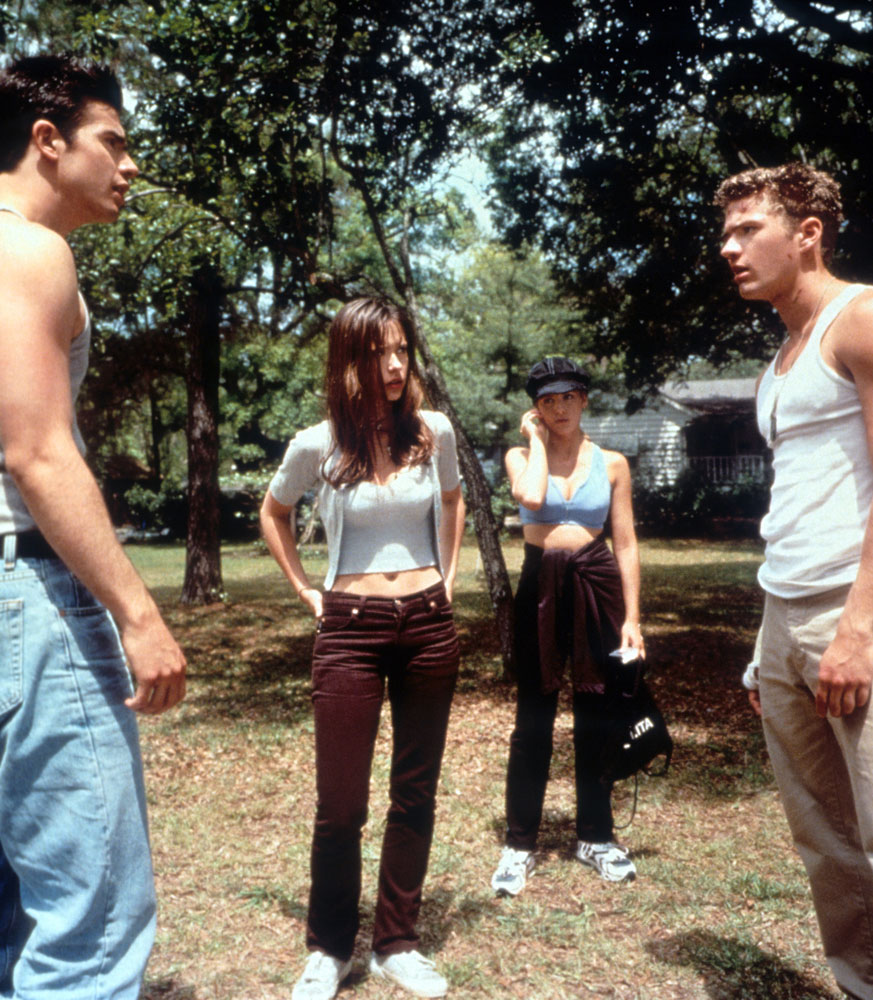
The characters of “I Know What You Did Last Summer” are a Who’s Who of teen types. Julie is the high-achieving good girl. Ray, her smart but poor counterpart. Barry is the rich, golden boy with a temper to rival his trust fund, and Helen the blond, beauty queen destined for Hollywood. 

Ahead of its time addressing trauma

“I Know What You Did Last Summer” knew: You can never go home again.

The story of “I Know What You Did Last Summer” is a little low-stakes with a mystery Jessica Fletcher would surely solve in under 50 minutes (Helen gives a nice shout-out to Angela Lansbury, at one point). But the film goes wildly rogue in its a surprisingly current view of trauma. All the teens have been impacted by the tragedy, the accident they tried so hard to forget and the memory they made a pact to push down. 

Julie is doing terribly at college, so much so she has to enroll in summer school. Her hair is lank, unwashed, and she hides herself in oversized clothes. “What happened to my daughter?” her mother wonders.

Trauma happened. Trauma also ensures Helen can’t handle being in New York, and heads home to work at her family’s store while Ray never tried to leave or go to college at all, working as a fisherman. The ever-temperamental Barry gets much worse, snapping at the girls, his nerves frayed. Every relationship has broken up, every potential shattered by the heavy legacy of violence and repression.


Want a daily wrap-up of all the news and commentary Salon has to offer? Subscribe to our morning newsletter, Crash Course.


Panic attacks are made flesh in 2022’s “Significant Other” and 2021’s achingly good “Witch Hunt.” The blockbuster Showtime show “Yellowjackets” has knitted a whole series out of trauma, holding it up to the firelight and examining all its difficult facets. 

But a quarter of a century before, “I Know What You Did Last Summer” knew: You can never go home again. You can never outrun (or outswim) violence. The film tried to warn us: trauma comes back. It always, always knows what was done to us. And it knows what we did.  

The real-world parallels and legacy

Of course, Hewitt, who would go on to star in “Ghost Whisperer,” would be the one to find the dead guy.

One cannot help also noticing the characters’ lives form uncanny parallels with that of their actors. Gellar’s Helen dreams of being on “Guiding Light,” but Gellar got her early acting start on “All My Children,” winning a Daytime Emmy Award when she was just 18. Helen and Barry are paired together in the film — but in real life, Gellar and Prinze Jr. met on set. They married young, as Helen talks about doing with Barry; her character also wants to have three children. Gellar and Prinze Jr. have two.

In the film, Julie spots the accident victim, after the teens realize they’ve hit something. Of course, Hewitt, who would go on to star in “Ghost Whisperer,” would be the one to find the dead guy. In a great shot, the camera focuses on Hewitt’s face, and not the prone figure, as she lets out an impressive scream.

I Still Know What You Did Last SummerFreddie Prinze Jr having a confrontation with a man as Jennifer Love Hewitt watches in a scene from the film ‘I Still Know What You Did Last Summer’, 1998. (Columbia Pictures/Getty Images)If you haven’t seen “I Know What You Did Last Summer” in a while, one cameo may surprise you. Anne Heche, who died in 2022, is in the film, her Missy a tragic figure, living a difficult and lonely life after the death of her brother. In a small performance that speaks volumes, Missy says wistfully after departing strangers, “You know I, I don’t get too many knocks on my door nowadays.”

Every relationship has broken up, every potential shattered by the heavy legacy of violence and repression.

The film was adapted from Lois Duncan’s 1973 young adult novel. It was a loose adaptation, with some fans of Duncan, writer of such books as “Written in the Stars,” feeling the big screen version was shallow compared to the novel. With a subplot involving war, the book certainly has different concerns. As Bloody Disgusting wrote, “Williamson spoke highly of Duncan’s novel, but he also added, ‘No one really gets killed,'” prompting him to update the story “straight into the ’90s and up to code with modern horror.”

“I Know What You Did Last Summer” launched a sea of other Duncan adaptations, including the well-named sequels “I Still Know What You Last Summer” and “I’ll Always Know What You Did Last Summer,” along with 1997’s popular “Killing Mr. Griffin,” 2009’s outlier “Hotel for Dogs” and 2018’s “Down a Dark Hall.” 

The first knowing summertime film also served as a harbinger for big and small screen adaptations of YA novels in general, which really hit their stride with the dawning of streaming services. In 2018, Collider lamented the lack of YA films; possibly that was premature. Just this year, Epic Reads listed over 50 adaptations. Recent hits for Netflix include “Devil in Ohio” and “Shadow and Bone” while Amazon Prime had “The Summer I Turned Pretty” and “Panic,” all based off YA books.

In many ways, “I Know What You Did Last Summer” upended expectations for how and what it knew: the future, the effects of trauma and how we need these stories even in mainstream slasher fare.

“Not how it works, senator”: Mike Lee mocked for writing op-ed endorsing himself in the third-person

Utah Republican Senator Mike Lee was the subject of mockery on Twitter after he bizarrely endorsed himself in the third person in an op-ed for The Salt Lake Tribune.

“Mike Lee serves as a United States senator representing the state of Utah. Since taking office, Senator Lee has earned a reputation as a principled conservative. He believes elected officials are responsible for keeping the federal government within its constitutionally limited role,” he wrote in the op-ed titled, Mike Lee has earned a reputation as a principled conservative.

He goes on to say that “Lee serves on various [Senate] committees important to Utah,” and “Senator Lee has fought for Utahns and their values,” and “Senator Lee has remained committed to advocating for limited government and fiscal responsibility throughout his career.”

As Mediaite points out, people on Twitter had some fun over the op-ed.

“Mike Lee couldn’t find anyone else to call him a ‘principled conservative’ … so he called himself that in an entire oped he authored himself. Unreal. Not how it works, Senator!” one Twitter user wrote.

“Can you clarify whether this was written by Senator Mike Lee or a different Mike Lee who happens to have the same name?,” a Twitter user replied to The Salt Lake Tribune’s post.

“In what sense is this less embarrassing than paying someone to write something nice about you?” wrote another.

Lee is facing independent candidate Evan McMullin, with polls showing Lee with a narrow lead roughly around the margin of error.

Trump hotels charged taxpayers $1.4M for Secret Service rooms — despite claiming agents stay “free”

Former President Donald Trump’s embattled company, the Trump Organization, billed the United States Secret Service more than a million dollars for at least forty overnight stays at various Trump properties between January of 2017 and September of 2021.

CNN reported on Monday that documents released by the House Oversight Committee reveal “that the Trump Organization charged the Secret Service ‘excessive nightly rates on dozens of trips’ as high as $1,185 per night despite claims by the former President’s company that federal employees traveling with him would stay at those properties ‘for free’ or ‘at cost.'”

Committee Chair Carolyn Maloney, D-N.Y., wrote a letter to the agency’s leadership stating that “the exorbitant rates charged to the Secret Service and agents’ frequent stays at Trump-owned properties raise significant concerns about the former President’s self-dealing and may have resulted in a taxpayer-funded windfall for former President Trump’s struggling businesses.”

Per CNN, “Maloney also notes that her committee has been seeking a full accounting of the Secret Service’s expenditures at Trump-owned properties for more than two years but still has not received complete information on nightly rates or the total amount the agency spent, which ‘appears to exceed $1.4 million of taxpayer money.'”

CNN further explained that the Committee is considering legislation to curtail “presidential self-dealing and profiteering, as well as to curb conflicts of interest by ensuring that future presidents are prevented from exercising undue influence on Secret Service spending.”

Ron Johnson blames college education after debate audience laughs at his claim that FBI “set me up”

When United States Senator Ron Johnson, R-Wis., debated Democratic Senate nominee Mandela Barnes, Wisconsin’s lieutenant governor, at Marquette University’s Varsity Theater on Thursday night, he was met with laughter when he alleged that he was “set up” by Federal Bureau of Investigation during its investigation into Russian misinformation two years ago.

“Johnson was informed at an FBI briefing in 2020 that he was the target of Russian disinformation as part of a campaign to make him useful to the Kremlin, the senator confirmed to The Washington Post last year,” Yahoo! News explained on Friday.

The crowd did not buy it. On Saturday, Johnson appeared on Fox News and was questioned why his audience refused to take him seriously.

Host Brian Kilmeade noted to Johnson that “when you said you were set up by the FBI, the crowd laughed.” He then asked the senator, “who was in that crowd, and have they been following the news? Do you want to put that in context?”

Johnson blamed higher education.

“Well I think they let in a bunch of college students. We were supposed to both get fifty audience members and the crowd was much larger than that. So, my guess, they’re college students who, let’s face it, our colleges today aren’t exactly teaching history. They’re really not talking about the relevant things that students really oughta learn in college,” Johnson said. “They’re being taught leftist propaganda, unfortunately.”

Watch below or at this link.

Herschel Walker bizarrely insists his debate prop badge is “legit” — then no-shows second debate

Georgia Republican Senate candidate Herschel Walker flashed a police badge during his Friday debate against Sen. Raphael Warnock, D-Ga., as the two exchanged heated remarks over a discussion about support for police. 

Warnock took aim at Walker’s past violent behavior, citing an incident in which the Republican “talked about having a shoot-out with police” and called him out for falsely claiming to have worked in law enforcement. 

“One thing that I haven’t done is I haven’t pretended to be a police officer and I’ve never threatened a shootout with police,” Warnock said.

Walker, who in 2019 claimed that he was once an FBI agent and said on several other occasions that he had worked in law enforcement, brandished an honorary sheriff’s badge, saying he had “worked with many police officers.”

The debate moderator repeatedly asked Walker to put the badge away, citing debate rules barring the use of props.

“This is from my hometown. This is from Johnson County from the sheriff from Johnson County, which is a legit badge,” Walker later told NBC’s Kristen Welker in an interview.

“If anything happened in this county, I have the right to work with the police getting things done,” he insisted. “People don’t know that I’ve been working with law enforcement for years… But they can call me whenever they want me, and I have the authority to do things for them, to work with them on a thing.”

Welker noted that the National Sheriff’s Association said the honorary badge is for the “trophy case.”

“That is totally not true,” Walker said. “I had a sheriff that gave me the badge — been there for years, I’ve been there for years — came out and did a press conference with me, and said Herschel been with us for years, he’d been working with us.”

Walker has never held a job in law enforcement, according to a CNN fact-check.

The Trump-endorsed candidate has claimed otherwise in the past. In August, he posted an image of an honorary deputy sheriff card given to him by the Cobb County Sheriff’s Office and said he was “proud to serve the blue as an honorary agent.” 


Want a daily wrap-up of all the news and commentary Salon has to offer? Subscribe to our morning newsletter, Crash Course.


Walker received the badge in recognition of the community service work he had done with the sheriff’s department, his campaign spokesman told The New York Times.

His actions drew widespread mockery, but weren’t unusual for a campaign marred by scandals. Most recently, Walker has been scrutinized for paying for a woman’s abortion in 2009 despite having a strong anti-abortion stance. 

Multiple women have come forward with domestic abuse allegations against the Republican. Walker was exposed by The Daily Beast for fathering secret children even as he has criticized the role of absentee fathers. He has also pushed out falsehoods about graduating in the top 1% of his class at the University of Georgia, but the former football star never even received a diploma. 

Walker skipped the debate with Warnock on Sunday, saying the forum was a “sham” favoring the incumbent. The debate was hosted by the Atlanta Press Club.

“I think it’s important to point out that my opponent Herschel Walker is not here, and I think that half of being a senator is showing up, that’s half of life,” Warnock said in his answer to the first question. “And I have shown up for the people of Georgia time and time again.”

Walker’s spokesperson, Will Kiley, said that Walker “dominated” the first debate between the two major candidates.

“After failing miserably in his first debate, Raphael Warnock wants a do-over, by attending tonight’s sham hosted by his liberal friends,” Kiley said in a statement.

With Warnock holding a slight advantage over Walker in recent polls, the Georgia race is one of the most pivotal Senate races in the country that will determine which party controls the Senate.

Warnock’s campaign said that Walker’s decision to skip the debate shows that he “is not ready to represent the people of Georgia.”

“If Herschel Walker can’t show up for a debate,” Warnock campaign manager Quentin Fulks said, “he can’t be trusted to show up for Georgians in the U.S. Senate.”

Bannon’s “stunt” to derail prosecution may have backfired after DOJ asks for 6-month prison stint

The United States Department of Justice on Monday recommended six months in prison for convicted criminal and former Trump campaign chairman Steve Bannon over what it describes as his “sustained, bad-faith contempt of Congress.”

However, Politico’s Kyle Cheney flags new information in the DOJ’s sentencing recommendations showing that Bannon could have gotten himself in more trouble with what he describes as a last-ditch effort to “derail” his prosecution.

Of particular note is a proposal floated by Bannon lawyer Evan Corcoran to top Jan. 6 Committee investigator Tim Heaphy that offered Bannon’s full cooperation with the committee’s investigation in exchange for having the DOJ drop all charges against Bannon for contempt of Congress.

In contemporaneous notes taken by Heaphy, the Jan. 6 Committee investigator expressed skepticism that this was a sincere offer of total cooperation.

“My takeaway is that Bannon knows that this proposal for continuance and ultimate dismissal of his trial is likely a non-starter, which prompted him to call us to explore support as leverage,” he wrote. “I expect that DOJ will not be receptive to this proposal, as he is guilty of the charged crime and cannot cure his culpability with subsequent compliance with the subpoena.”

In its sentencing recommendations, the DOJ cites this proposed deal as more evidence that Bannon was never dealing in good faith.

Specifically, it notes that Bannon’s lawyers “never contacted the Government” directly with its offer “perhaps because the Government had made clear through its leadings and at argument that it understood the Defendant’s actions to be a stunt and would not consider dismissing the case.”

Bannon was found guilty of contempt of Congress this past summer after the jury in the case deliberated for just three hours.

Kanye West to buy struggling far-right Parler after getting booted from Twitter for anti-Jewish rant

Trump-supporting rapper Kanye West has come up with a solution to his recent suspensions from both Twitter and Instagram.

In a press release issued Monday morning, Parler announced that West would be acquiring the company for an undisclosed sum.

In justifying his purchase of Parler, West said that his goal was to defend conservatives’ “free speech” rights from the tyranny of big tech.

“In a world where conservative opinions are considered to be controversial we have to make sure we have the right to freely express ourselves,” he said.

In fact, West got suspended from Twitter and Instagram not for posting any traditionally “conservative” opinion, but for posting anti-Semitic rants targeting the Jewish community.

“I’m a bit sleepy tonight but when I wake up I’m going death con 3 On JEWISH PEOPLE,” West wrote in one post. “The funny thing is I actually can’t be Anti Semitic because black people are actually Jew also. You guys have toyed with me and tried to black ball anyone whoever opposes your agenda.”

Parler is one of many right-wing social media apps intended to be a counter to Twitter, although so far it has failed to gain significant market success.

This election isn’t about inflation or abortion. It’s about whether democracy can survive

We are three weeks out from the midterm elections and by all accounts many races are within the margin of error. It’s pretty clear that the “red tsunami” everyone was expecting has not materialized. Republicans are still favored to win (at least in the House) but it’s looking more and more as if it will be a very narrow victory if they do — and there’s a decent chance they won’t.

So, of course, Democrats are going on television arguing that everyone is doing it wrong. It’s just how they roll. The latest disagreements come from those who think candidates should focus on the old saw, “It’s the economy, stupid,” because inflation has people so spooked. Sen. Bernie Sanders appeared on “Meet the Press” over the weekend and gave his familiar spiel about income inequality and big corporations, suggesting that some Trump voters would be open to that argument. He begged Democrats to focus more intently on the economy and attack the Republican threats to Social Security and Medicare.

Others believe that the best issue for Democrats this fall is the Supreme Court’s decision overturning Roe v. Wade, which has already been shown to motivate women of all demographics in the primaries and special elections. And some believe the fascist turn of the GOP and its assault on democracy is the most important issue and must be addressed head-on.

If only we were living in a world in which one could pick and choose issues of importance to the American people from an à la carte menu. But that’s just not where we are as a country. The Democrats have to be prepared to address all those things and more.

No doubt the economy is a difficult issue this year, even though Democrats have an excellent legislative record to run on and the best job market in 40 years. But there’s simply no denying that inflation is a big problem for everyone. Democratic strategist Mike Lux has circulated a memo based on polling from Stan Greenberg and Celinda Lake that recommends five economic points for candidates to emphasize. The first is to grab the Bernie Sanders complaints about multinational corporations — Big Oil, Big Food, Big Shipping, etc. — which are making record profits in this time of inflation by gouging consumers, and point out that the Republicans have nothing to offer to tame these abuses, which is true. (This report in the Washington Post suggests that swing voters already understand this.)

Lux also suggests that candidates remind people that the Democrats are lowering drug prices and health insurance premiums, point out that Social Security recipients are going to get the biggest raise they’ve gotten in 40 years, inform voters that manufacturing is coming back to America (which they probably don’t realize) and, finally, promise to fight for reinstating the child tax credit that has now expired. All of taht certainly beats the stale GOP talking points about cutting taxes and “entitlements.”

The abortion issue is straightforward. In the wake of the Dobbs decision, Republicans all over the country have raced to restrict abortion rights in the most draconian way possible, in some states banning abortion altogether. Stories of rape and incest survivors being denied care are everywhere. Women often can’t get needed medication and procedures because ill-informed zealots have drafted sloppy laws that make it impossible for doctors to perform their duties without risking legal jeopardy. It’s a mess, and Democrats are morally bound to talk about it.


Want a daily wrap-up of all the news and commentary Salon has to offer? Subscribe to our morning newsletter, Crash Course.


Meanwhile, on the other side we are seeing a full-fledged racist and antisemitic festival of hate used as the primary motivator to get their base out to vote. Take a look at this ad that has played throughout the Major League Baseball playoffs on Fox, which, according to Will Bunch of the Philadelphia Inquirer, is brought to you by a group run by Trump’s “immigration czar” Stephen Miller:

That makes the infamous Willie Horton ad — which ran only briefly 34 years ago, because it was considered too blatantly racist — look like child’s play.

And now we have the former president of the United States blithely posting antisemitic tropes on his struggling social media platform, demanding that American Jews be grateful for everything he has supposedly done for them and suggesting they get with the program “before it’s too late.” Too late for what, he doesn’t say.

So yes, Republicans have gone back to the deep well of racism once again, obviously believing that’s what motivates their base. They aren’t wrong.

When you see all of that laid out, you might think we were dealing with a standard issues-based election, more or less, however critical those issues are and however extreme the Republicans have become. Certainly, the media is trying to treat it that way. But this is an election like no other and it’s got nothing to do with “issues” in the normal sense. The Republicans are intent upon electing hundreds of election deniers to office, and are bent on destroying our election system as we’ve known it for the last half-century or more.

Mainstream media is eager to treat this as a standard issues-based election, no matter how extreme the Republicans have become. But this is an election like no other and it’s got nothing to do with “issues” in the normal sense.

Bolts Magazine has compiled a comprehensive analysis of the election deniers running for secretary of state around the country. Seventeen out of 35 Republican nominees have either denied the results of the 2020 election, sought to overturn them or refused to affirm the legitimacy of the outcome. Six of those 17 candidates are in crucial battleground states. There are hundreds of candidates in down-ballot races that feature similarly delusional or malicious candidates.

Plenty of big Republican names running on election denial as well, even if some of them are willing to modulate that just a little. When asked if they think Joe Biden won the 2020 election they’ll respond by saying things like, “Joe Biden is the president,” which I guess they think fools some people. But everyone knows what they mean. They are making it clear that, like their mentor Donald Trump, they will only accept election results if they win:

Donald Trump plotted the Big Lie long before the 2020 election, and it had been on his mind since at least 2016. That was clear enough shown in real time and was recently laid out in detail by the House Jan. 6 committee. Any Republican officials who are not fully on board with this dangerous attack on the election system are seemingly paralyzed and unwilling to deny it.

The MAGA movement is openly assaulting democracy. Yet as we head into the final days of this campaign, mainstream media keeps trying to portray this as just another election. Gas prices are going up and down and Republicans are running scary ads with Black and brown people and threatening to cut Social Security, all of which is important and must be addressed. But none of that will matter if these authoritarian, anti-democratic election deniers win their races. There is nothing ordinary about any of this. I don’t know whether the voters understand the true implications of this election, and I’m not sure the media does either. 

“This paragraph alone is why DOJ will win”: Experts predict Trump Judge Aileen Cannon’s order doomed

Legal experts predicted that U.S. District Judge Aileen Cannon’s order assigning a special master to review documents seized from former President Donald Trump’s Mar-a-Lago residence would be struck down after an appeal from the Justice Department.

The DOJ in a 67-page filing asked the 11th Circuit Court of Appeals in Atlanta to overturn Cannon’s order and end the special master review, arguing the Trump appointee “erred” by siding with the former president.

The DOJ argued that there was no threat to Trump’s rights because the search of Mar-a-Lago was authorized by a federal judge and because Trump had no right to have the documents in the first place.

“The uncontested record demonstrates that the search was conducted in full accordance with a judicially authorized warrant, and there has been no violation of [Trump’s] rights — let alone a ‘callous disregard’ for them,” the DOJ said, adding that Trump had “failed to meet his burden in establishing any need for the seized records — indeed, a substantial number of them are not even his—or in establishing any irreparable injury in their absence, and Plaintiff does not lack an adequate alternative remedy at law.”

Trump’s attorneys had argued that a special master was necessary to protect his rights to claim attorney-client privilege and executive privilege. Trump has also claimed that he may have declassified secret documents before he left office, though his attorneys have refused to provide evidence to the court.

DOJ attorneys argue that Trump has produced no evidence that the documents were declassified and that he has not actually claimed privilege over any documents.

Cannon initially barred the DOJ from using about 100 documents marked classified that were seized from Mar-a-Lago in its criminal investigation but that part of her order was struck down by the 11th Circuit, which agreed with the DOJ that she had abused her authority in halting the probe. The Supreme Court last week rejected Trump’s appeal to have the special master review the documents marked classified.

The DOJ in its new filing argued that it needs access to the remaining 11,000 documents in the special master review and asked the court to end the review altogether.

“The dates on unclassified records may prove highly probative in the government’s investigation,” the filing said. “For example, if any records comingled with the records bearing classification markings post-date Plaintiff’s term of office, that could establish that these materials continued to be accessed after Plaintiff left the White House … The government may need to use unclassified records to conduct witness interviews and corroborate information.”


Want a daily wrap-up of all the news and commentary Salon has to offer? Subscribe to our morning newsletter, Crash Course.


The DOJ also rejected Trump’s claim of executive privilege since the Justice Department and FBI are also part of the executive branch.

“Neither Plaintiff nor the district court has cited any instance in which executive privilege was successfully invoked to prohibit the sharing of records or information within the Executive Branch itself,” the filing said.

Trump’s response to the filing is due by November 10, though much of the special master review may be completed by then. Cannon ordered the review to be completed by December 16.

Legal experts predicted that the 11th Circuit would eventually rule in favor of the DOJ.

Ryan Goodman, a law professor at New York University, cited part of the DOJ brief laying out the core of its argument.

“Most fundamentally, the district court erred in exercising equitable jurisdiction to entertain [Trump’s] action in the first place,” the DOJ said, adding that Cannon acknowledged that there had been “no showing” that the government acted in “callous disregard” of Trump’s rights.

“This paragraph alone is why DOJ will win hands down,” Goodman predicted. “It was an essential condition for Cannon to have jurisdiction. Cannon admitted Trump made no showing to meet the condition. End of story.”

Harvard Law Professor Laurence Tribe agreed that the DOJ filing is “as close to being conclusive and irrefutable as any brief I have ever read.”

Former appellate lawyer Teri Kanefield said the DOJ filing shows that “none of the factors were met” to appoint a special master.

“There you go. End of story. If there is no jurisdiction, the case gets dismissed. The whole thing goes poof,” she tweeted.

Former FBI Deputy Director Andrew McCabe noted that the DOJ has some “legal momentum” after the 11th Circuit and the Supreme Court both rejected Trump’s arguments related to the documents marked classified.

“I think the Justice Department is kind of reading the weather here and realizing that they have the upper hand in challenging Judge Cannon’s order, putting the special master in place,” he told CNN, “and they’re taking their shot to see if they can get that entire thing knocked out.”

Joe Biden’s broken promise to avoid war with Russia could lead to Armageddon

On March 11, 2022, President Biden reassured the American public and the world that the United States and its NATO allies were not at war with Russia. “We will not fight a war with Russia in Ukraine,” said Biden. “Direct conflict between NATO and Russia is World War III, something we must strive to prevent.” 

It is widely acknowledged that U.S. and NATO officers are now fully involved in Ukraine’s operational war planning, aided by a broad range of U.S. intelligence gathering and analysis to exploit Russia’s military vulnerabilities, while Ukrainian forces are armed with U.S. and NATO weapons and trained up to the standards of other NATO countries.

On Oct. 5, Nikolay Patrushev, the head of Russia’s Security Council, recognized that Russia is now fighting NATO in Ukraine. Meanwhile, President Vladimir Putin has reminded the world that Russia has nuclear weapons and is prepared to use them “when the very existence of the state is put under threat,” as Russia’s official nuclear weapons doctrine declared in June 2020. 

It seems likely that, under that doctrine, Russia’s leaders would interpret losing a war to the U.S. and NATO on their own borders as meeting the threshold for the use of nuclear weapons.  

President Biden acknowledged on Oct. 6 that Putin is “not joking” and that it would be difficult for Russia to use a “tactical” nuclear weapon “and not end up with Armageddon.” Biden assessed the danger of a full-scale nuclear war as higher than at any time since the Cuban missile crisis in 1962. 

Yet despite voicing the possibility of an existential threat to our survival, Biden was not issuing a public warning to the American people and the world, nor announcing any change in U.S. policy. Bizarrely, the president was instead discussing the prospect of nuclear war with the Democratic Party’s financial backers during an election fundraiser at the home of media mogul James Murdoch, with surprised corporate media reporters listening in.  

In an NPR report about the danger of nuclear war over Ukraine, Matthew Bunn, a nuclear weapons expert at Harvard University, estimated the chance of Russia using a nuclear weapon at 10 to 20 percent. 

How have we gone from ruling out direct involvement in Ukraine to U.S. involvement in all aspects of war except the dying, with a 10 to 20 percent chance of nuclear war?

How have we gone from ruling out direct U.S. and NATO involvement in the war to U.S. involvement in all aspects of the war except for the bleeding and dying, with an estimated 10 to 20 percent chance of nuclear war? Bunn made that estimate shortly before the sabotage of the Kerch Strait Bridge to Crimea. What odds will he project a few months from now if both sides keep matching each other’s escalations with further escalation?    

The irresolvable dilemma facing Western leaders is that this is a no-win situation. How can they militarily defeat Russia, when it possesses 6,000 nuclear warheads and its military doctrine explicitly states that it will use them before it will accept an existential military defeat? 

Yet that is what the intensifying Western role in Ukraine now explicitly aims to achieve. This leaves U.S. and NATO policy, and thus our very existence, hanging by a thin thread: the hope that Putin is bluffing, despite explicit warnings that he is not. CIA Director William Burns, Director of National Intelligence Avril Haines and the director of the DIA (Defense Intelligence Agency), Lt. Gen. Scott Berrier, have all warned that we should not take this danger lightly.


Want a daily wrap-up of all the news and commentary Salon has to offer? Subscribe to our morning newsletter, Crash Course.


The danger of relentless escalation toward Armageddon is what both sides faced throughout the Cold War, which is why, after the wake-up call of the Cuban missile crisis in 1962, dangerous brinkmanship gave way to a framework of nuclear arms control agreements and safeguard mechanisms to prevent proxy wars and military alliances spiraling into a world-ending nuclear war. Even with those safeguards in place, there were still many close calls — but without them, we would probably not be here to write about it.

Today, the situation is made more dangerous by the dismantling of those nuclear arms treaties and safeguards. It is also exacerbated, whether either side intends it or not, by the 12 to 1 imbalance between U.S. and Russian military spending, which leaves Russia with more limited conventional military options and a greater reliance on nuclear ones.

But there have always been alternatives to the relentless escalation of this war by both sides that has brought us to this pass. In April, Western officials took a fateful step when they persuaded Ukrainian President Volodymyr Zelenskyy to abandon Turkish- and Israeli-brokered negotiations with Russia that had produced a promising 15-point framework for a ceasefire, a Russian withdrawal and a neutral future for Ukraine.

That agreement would have required Western countries to provide security guarantees to Ukraine, but they refused to be party to it and instead promised Ukraine military support for a long war to seek a decisive defeat Russia and recovery of essentially all the territory Ukraine has lost since 2014.   

Defense Secretary Lloyd Austin declared that the West’s goal in the war was now to “weaken” Russia to the point that it would no longer have the military power to invade Ukraine again. But if the U.S. and its allies ever came close to achieving that goal, Russia would surely see such a total military defeat as putting “the very existence of the state under threat,” triggering the use of nuclear weapons under its publicly stated nuclear doctrine.   

On May 23, the very day that Congress passed a $40 billion aid package for Ukraine, including $24 billion in new military spending, the contradictions and dangers of the new U.S.-NATO war policy in Ukraine finally spurred a critical response from the New York Times editorial board. A Times editorial, titled “The Ukraine War is Getting Complicated, and America Is Not Ready,” asked serious, probing questions about the new U.S. policy:

Is the United States, for example, trying to help bring an end to this conflict, through a settlement that would allow for a sovereign Ukraine and some kind of relationship between the United States and Russia? Or is the United States now trying to weaken Russia permanently? Has the administration’s goal shifted to destabilizing Putin or having him removed? Does the United States intend to hold Putin accountable as a war criminal? Or is the goal to try to avoid a wider war… ? Without clarity on these questions, the White House…jeopardizes long-term peace and security on the European continent.

The Times editors went on to voice what many have thought but few have dared to say in such a politicized media environment: The goal of recovering all the territory Ukraine has lost since 2014 is not realistic, and a war with those aims will “inflict untold destruction on Ukraine.” They called on Biden to talk honestly with Zelenskyy about “how much more destruction Ukraine can sustain” and the “limit to how far the United States and NATO will confront Russia.”

A week later, Biden replied to the Times in an op-ed titled “What America Will and Will Not Do in Ukraine.” He quoted Zelenskyy saying that the war “will only definitively end through diplomacy,” and wrote that the U.S. was sending weapons and ammunition so that Ukraine “can fight on the battlefield and be in the strongest possible position at the negotiating table.” 

Few have dared to say this, but the New York Times did: Recovering all the territory Ukraine has lost since 2014 is not realistic, and war with those aims will “inflict untold destruction.”

Biden wrote, “We do not seek a war between NATO and Russia.… the United States will not try to bring about [Putin’s] ouster in Moscow.” But he went on to pledge virtually unlimited U.S. support for Ukraine, and did not answer the more difficult questions the Times had asked about the U.S. endgame in Ukraine, the limits to U.S. involvement in the war or how much more devastation Ukraine could sustain.

As the war escalates and the danger of nuclear war increases, these questions remain unanswered. Calls for a speedy end to the war echoed around the UN General Assembly in New York in September, where 66 countries, representing most of the world’s population, urgently called on all sides to restart peace talks.  

The greatest danger we face is that their calls will be ignored, and that the U.S. military-industrial complex’s overpaid minions will keep finding ways to incrementally turn up the pressure on Russia, calling its bluff and ignoring its “red lines,” as they have since 1991, until they cross the most critical “red line” of all.

If the world’s calls for peace are heard before it is too late and we survive this crisis, the United States and Russia must renew their commitments to arms control and nuclear disarmament, and negotiate how they and other nuclear armed states will destroy their weapons of mass destruction and accede to the Treaty for the Prohibition of Nuclear Weapons, so that we can finally lift this unthinkable and unacceptable danger hanging over our heads.

“They are going to convict very quickly”: Glenn Kirschner on the trial of Donald J. Trump

Over the course of nine public hearings the House Jan. 6 committee has conclusively shown that Donald Trump tried to end American democracy by nullifying the results of the 2020 election. In an exclamation mark to that conclusion, the House committee has now subpoenaed Trump. It’s unlikely, of course, that Trump will supply the evidence the committee demands or appear to testify. 

Trump’s coup plot was complex and multifaceted. Its tentacles included numerous Republican officials, right-wing paramilitaries, media propagandists, private funders, interest groups, think tanks, and other agents. As was confirmed during last Thursday’s committee hearing (presumably its last), the FBI, the Department of Homeland Security, the Secret Service and other law enforcement and national security agencies were aware that some of Trump’s followers were armed and were coming to Washington with violent intentions on Jan. 6. Even worse, the evidence suggests that some individuals at the highest levels of the federal government either actively aided Trump’s coup attempt or did nothing to prevent it.

Jan. 6 was not the climax of Trump and the Republican fascists’ campaign to subvert the Constitution, demolish the rule of law and overthrow democracy. That day was just one more chapter in Trump’s lawlessness and contempt for democracy. Trump’s presidency was itself an extension of a much larger pattern: Throughout his decades of public life, he has behaved like a crime boss with no respect for anything or anyone beyond his own narrow self-interest and his bottomless hunger for power and wealth.

Ultimately, the Jan. 6 insurrection was just the beginning. Donald Trump and the Republicans’ assault on democracy is only escalating as the midterms approach and the future of the country hangs on the precipice. What happens next? What are Attorney General Merrick Garland and the Department of Justice waiting for? What does justice look like? Will Donald Trump and the other coup plotters ever be prosecuted and punished?

Glenn Kirschner is a legal analyst for NBC News and MSNBC who teaches criminal law at George Washington University. For most of his 30-year career in law enforcement, Kirschner was an assistant U.S. attorney in Washington, D.C., often prosecuting serious crimes in federal court, and before that was a prosecutor and appellate attorney in the U.S. Army.

In this conversation, Kirschner describes Donald Trump as a “ruling-class criminal” who serves as living proof of how the rich and the powerful often evade justice in America. Trump’s contempt for the rule of law is understandable, since he has never been held properly accountable for his lawbreaking. This time, Kirschner says, Trump may finally gone too far.  

The House Jan. 6 committee hearings, Kirschner suggests, have provided a roadmap for prosecuting Donald Trump for such serious crimes as seditious conspiracy and attempting to defraud the United States. Kirschner believes the evidence is overwhelming and clear, and that it will not be difficult to convince a jury to convict Donald Trump. That does not mean, Kirschner cautions, that Trump is likely to serve time in prison.

The Department of Justice may approach Trump’s prosecution, Kirschner says, as a series of overlapping conspiracies rather than as the kind of comprehensive RICO case used against organized crime and other complex criminal organizations.

Toward the end of this conversation, Kirschner warns that it’s likely Trump’s followers will follow through on his commands to commit acts of violence if he is prosecuted or convicted — but says that most of Trump’s MAGA followers are cowards and that any potential violence will be limited in scope.

How are you feeling? As a human being, how are you managing this democracy crisis and the troubled state of our country?

I feel schizophrenic, because one moment I am extremely frustrated and then the next moment I find some reason for hope and optimism. But as a whole I have been trying to balance the need for patience in any large-scale criminal investigation with the frustration that I feel.

Part of my daily work when I was a prosecutor involved assessing whether there was probable cause to support the application for an arrest warrant or an indictment. We had many long-term investigations that started out covert, they were proactive. By comparison, a reactive investigation is when an arrest is made, and we begin presenting evidence and information and seek an indictment. That is the stock in trade of state, local and county prosecutors as opposed to federal prosecutors.

Federal prosecutors mostly do proactive investigations where there is adequate predication and then we start in a very leisurely way. We want the case to be perfect. That’s always the goal of the federal prosecutor. When federal prosecutors decide to return an indictment, they have likely already negotiated a pre-indictment plea, so it’s already wrapped up in a pretty little bow and dropped on the court docket such that the Department of Justice is never operating under deadlines. We didn’t have a sense of urgency. I often found that problematic. Every day, particularly when I was chief of homicide, we were investigating murders, conspiracies and obstruction cases.

Once we had probable cause to make an arrest, to indict somebody, I had to assess whether the right thing to do was to continue to investigate proactively, meaning covertly, without making an arrest, or to move forward to an arrest, a takedown and an indictment. The biggest factor in that decision was public safety.

The fact that Donald Trump is not being held accountable doesn’t make sense. But it can be explained by the phenomenon of the ruling-class criminal. America has never been willing to hold them accountable.

How does that translate to the investigation of a former president? They’re very different investigations in very different circumstances, of course. But I maintain that public safety writ large — for example, the viability of our democracy — should be an enormous factor in when the Department of Justice chooses to move toward an indictment of Donald Trump. Public safety is at risk. Our democracy hangs in the balance.

We are prosecuting Donald Trump’s foot soldiers who he unleashed upon the Capitol on Jan. 6 to stop the certification. They are going to trial; they’re going to prison. The man who gave the criminal order to attack is playing golf, holding rallies and attending dinner parties. That is a deep injustice at play in America every minute of every day, until Donald Trump is held accountable.

As a working-class black man in America, I know that if I did one-millionth of what Trump is alleged to have done, never mind what is obvious, I would be in prison long ago. The fact that Trump is not in jail facilitates and nurtures this democracy crisis, and feeds the anger that there is one set of rules for the rich and powerful and another one for everybody else. What are Merrick Garland and the Department of Justice and the others investigating Trump waiting for?

Don’t ask me to explain the inexplicable, because I can’t. Every single jury I spoke with, I warned them that they should not try to make sense of murder or other crimes. Because if you’re waiting for it to make sense, or you require it to make sense in order to vote guilty, nobody would ever be convicted. The fact that Donald Trump is not being held accountable doesn’t make sense. But it can be explained by the phenomenon of the ruling-class criminal. America has never been willing to hold the ruling-class criminals accountable, whether they are in politics, business, entertainment, the tech business or what have you.

Donald Trump is publicly admitting, for all intents and purposes, that he violated the Espionage Act and committed other high crimes. He is trying to extort the DOJ and Garland with threats of violence. He brags about financially supporting his followers who attacked the Capitol. He shows no fear of being prosecuted or being punished in any way for his obvious crimes. Does he want to go to jail? Or does he simply believe that he is above the law?

Donald Trump believes that he is above the law. And he holds that belief for good reason. It appears that Trump has lived a life of crime and has never been held accountable. That is a dramatic failing of our criminal justice system, our law enforcement agencies and most certainly our nation’s prosecutors. Trump, in my opinion, has also come to believe, with good reason, that if he admits his crimes out loud people will take a step back and scratch their heads and say, “Geez, I thought it was criminal what he did, but he is saying he did it. So I’m uncomfortable, because that’s not the way we go about investigating and prosecuting crimes in America. Something is wrong here. I don’t know what it is, but we have to figure it out.” In reality, what we as a society need to do is to focus on why Trump and other such people are not being prosecuted.


Want a daily wrap-up of all the news and commentary Salon has to offer? Subscribe to our morning newsletter, Crash Course.


I would take that 14-page statement that he issued last week in response to the House Jan. 6 committee subpoena and slap a government exhibit sticker on it. I would then hand it to the jury as sharply self-incriminating evidence of Donald Trump’s admission of guilt. This is what has me so unbelievably frustrated and angry. The prosecutors, on both the state and federal level, have all been reluctant, hesitant and maybe even afraid to be the first to charge Donald Trump with committing crimes. No prosecutor wants to be the first to charge a former president who committed crimes. However, everybody will want to be the second to do so. Once that barrier is broken, and the white-hot glare of world media attention is focused on the first prosecutor and his or her office, then everybody’s going to want to get into the prosecuting Donald Trump business.

What crimes do you believe Donald Trump has committed? Which would you focus on?

I believe I’ve seen proof beyond a reasonable doubt in the public reporting, assuming it to be accurate. Moreover, I am 100% confident that the evidence of criminal conduct that we’ve seen publicly reported or shared with us in the Jan. 6 committee public hearings is about one-tenth of what the Department of Justice has by way of incriminating information.

Certainly, I see a conspiracy to commit offenses against or to defraud the United States. Judge David Carter in California ruled that there was a preponderance of evidence to conclude that Donald Trump committed that crime in a conspiracy with John Eastman. He also concluded that Donald Trump committed a second federal felony, obstructing an official proceeding.

No prosecutor wants to be the first to charge a former president who committed crimes. However, once that barrier is broken, everybody will want to be the second to do so.

I also see evidence of inciting an insurrection or rebellion. Trump gathered together his angry supporters, he promised them a wild time and told them that their vote had been stolen. In total, that is compelling evidence of Donald Trump’s criminal intent. Now, what sealed the deal for me was when we learned that Donald Trump told his own DOJ officials that he didn’t care if there was no voting fraud and that they should just say that there was and then “leave the rest up to me and the Republican members of Congress.”

To my eyes that is conclusive evidence of criminal intent, corrupt intent, guilty mens rea [knowledge of wrongdoing]. We can prove that in our sleep, in my estimation. Trump lied to people with the goal of inspiring them to anger. Then you tell them, “If you don’t fight like hell, you’re not going to have a country anymore. Go to the Capitol and stop the steal.” That is more evidence of Trump’s corrupt intent, because he continued to lie to them right up to the moment before they marched on the Capitol. Trump told them directly to go down there and stop the lawful functions of government — and Trump’s followers did it. That is inciting an insurrection or rebellion. If we can ever get a prosecutor to plant his or her feet in the well of a court and present this to 12 jurors, they are going to convict Trump very quickly. This is a stronger case than the vast majority of cases I tried in 30 years.

What do you make of Trump’s response to the subpoena from the House Jan. 6 committee?

Trump’s response to the subpoena, which was a 14-page missive, was really a non-response. He didn’t mention the subpoena. He didn’t acknowledge it. Trump did not say he would or would not comply, or that he would defy it and file suit. He said nothing about it. Trump began by saying that the election was fraudulent and stolen. That’s an admission of guilt. Why? Because his own DOJ officials, his own DHS officials, his own attorney general, all said there was no fraud undermining the election result. In fact, they said it was the safest, most secure election ever. His own staff said that too.

Trump continues to lie. That is evidence of an ongoing 371 conspiracy to defraud the United States. Of course, Trump will defy the subpoena. He will probably file suit and try to run out the clock and he will probably succeed, given how little time the select committee has left. In the end, the subpoena will get stuck in the courts and it will die.

I am concerned that Trump’s influence is so great that it will be very difficult to find a fair and impartial jury. Even worse, Trump’s followers will try to get on the jury to sabotage the result so that he can escape accountability. If Trump is tried and not convicted, for whatever reason, he may end up becoming even more powerful and dangerous.

Of course those are reasonable concerns. But none of that is a reason not to indict and try somebody for the crimes they committed.

A politician who contemplates offenses against the United States will know that Donald Trump was indicted, he went to trial and it took up two or three years of his life, burning through every penny he might have.

I spent decades trying cases before D.C. juries, and they’re not monolithic, but there are certain similarities that I saw. They like their proof beyond a reasonable doubt. But once you give it to them, they’re not easily distracted or confused by chaff that may be thrown into the mix by defense attorneys. Also, in my experience D.C. juries tend to take their oath of jury service seriously and decide the case based solely on the evidence, not on politics, ideology, preconceived notions or media accounts that they may have been exposed to before becoming jurors. I have complete confidence, actually, that if you give 12 citizens of the District of Columbia enough evidence to convict, they’re going to convict based on the evidence.

Again, I believe the evidence is overwhelming of Donald Trump’s guilt. Indicting and trying somebody for serious criminal offenses in and of itself has a powerful deterrent effect, whatever the outcome may be. A politician who is contemplating committing offenses against the United States will know that Donald Trump was indicted, he went to trial and it took up two or three years of his life to burn through every penny he might still have. Even if the jury could not come to a unanimous decision — he’s not going to be acquitted, I am almost certain of that — guess what? The benefit of a hung jury is that Donald Trump can be put on trial again. It has to be done. The results are almost secondary. I always told my homicide prosecutors that it is far more important to try cases than to win cases. 

I have consistently described Trump as a political crime boss. Would you apply that framework for prosecuting Trump as the leader of a criminal conspiracy under the RICO laws?

First of all, I never want to bring a case that I make more difficult for myself than it has to be. You can bring a conspiracy case. That is a much easier prosecution for what Donald Trump did, in connection with the insurrection, than trying to build a RICO conspiracy. For the latter, you would have to prove there’s an organization or an enterprise. You have to prove there’s a pattern of racketeering activity. You have to generally show that there were people who fulfill the established roles in the hierarchy of the organization. That having been said, do I see a RICO case in Donald Trump? Yes. I think the Trump Organization was run as a criminal enterprise. That’s a RICO organization. One can see Donald Trump’s administration as a potential RICO case.

To that point, I see his Cabinet secretaries as having been involved in questionable conduct. Trump’s cabinet was literally structured with the kind of hierarchy we would see in a RICO organization. With respect to the insurrection and everything that led up to it and has come after it, I see that much more as a hub-and-spoke conspiracy. Donald Trump is the hub and there are these spokes, the people radiating out from the center. They do not necessarily intersect with each other, but they are all connected to the central person, the mob boss, the kingpin, the one for whose benefit they’re committing these crimes — in this example, to try to keep Trump in office unlawfully and unconstitutionally.

There are all these people, every single day on social media and elsewhere, who proclaim, “Donald Trump is going to jail! He will do a perp walk!” To my eyes that borders on the ridiculous. What do you think is going to happen? Is Trump going to jail?

I believe that Donald Trump will be indicted and arrested. It will probably be a negotiated turn in which means that we will not see a perp walk. Trump will go to trial. He is a deeply damaged human being who does not have the capacity to admit guilt. Therefore, Trump goes to trial and gets convicted of his alleged crimes. I believe that the charges will be for a series of different conspiracies. There may be one for the Espionage Act and the document cases involving Mar-a-Lago. There may be another charge for the insurrection. Trump will be convicted. I am almost certain of that outcome.

Will Donald Trump go to prison? My instincts tell me no, because I don’t think we have the courage in this country to put a former president in prison. If Trump does not go to prison and is instead sentenced to home confinement, that will be an enormous failing of our government. My position on home confinement has always been that is sentencing somebody to watch movies and TV and order food. That’s no kind of punishment. Donald Trump needs to be put in prison, not only to punish him for crimes against the United States, but to deter the next aspiring political criminal or dictator or other killer of our democracy.

Does this all end with a whimper or a bang? Will Donald Trump unleash violence across the country by his followers if he is indicted or convicted?

I don’t think we have the courage to put a former president in prison. If Trump does not go to prison and is instead sentenced to home confinement, that will be an enormous failing of our government.

Trump goes out with what he hopes is a bang, but in the end it will be a whimper. His supporters are not strong people. Many of them are not critical thinkers. Many of them only feel strong when they have guns, big automatic weapons, across their bellies and prance around with them. That is not a strong person. That’s not the kind of person who’s going to take up arms because Donald Trump has been indicted. Instead, that’s the kind of person who is going to look for the next false God to worship, such as Ron DeSantis or whoever else it might be.

Trump is going to call for violence, but it will fizzle out because his followers will not rise up. There might be small pockets of violence, but the reality is that we have small pockets of violence across the country in major cities every day. In the end, I don’t think there will be any more violence inspired by Donald Trump’s arrest than, unfortunately, we suffer in every city and every county in every town across America every damn day.

If you had Merrick Garland’s ear right now, what would you tell him?

He is a good, honorable, honest and ethical man. If I could be so bold as to offer him any thoughts, I would say the nation is suffering. The American people are desperate, anxious, depressed, angry and upset. They don’t understand why somebody who has committed crimes in the harsh light of day, and then not only admitted to them but bragged about them, is free to play golf every day. That is such a deep injustice. It is doing enormous damage to the legitimacy of the Department of Justice, an institution I respect and love.

On the one hand, you want to say better late than never if you’re going to bring charges against Donald Trump. But it’s already so late. People have lost so much confidence. You came in as somebody who was determined to rebuild the institution, the prestige and the legitimacy of the Department of Justice. But I think the way this investigation is lingering is doing the exact opposite. I hope he can make decisions quickly that will remedy all of that.

Perfecting the “art of polarization”: How these ’90s conservatives created today’s radicalized right

When looking back through history to figure out how we ended up in this hellscape that will inevitably be known as the “Trump era,” pundits often look to predecessors like Barry Goldwater in the 1960s, Richard Nixon in the ’70s or even Ronald Reagan in the ’80s. The 1990s, however, are often overlooked, even though that’s when Donald Trump’s notoriety as a tabloid fixture really came into focus. That decade is often remembered fondly these days, as a time of relative innocence, a country preoccupied with how to figure out email and what to do about a president getting a blow job in the Oval Office. 

In her new book “Partisans: The Conservative Revolutionaries Who Remade American Politics in the 1990s,” historian Nicole Hemmer wants us to take another look at the ’90s. It was, she writes, “actually an era of right wing radicalization.” And not just on the fringes, as with Oklahoma City bomber Timothy McVeigh. Led by figures like House Majority Leader Newt Gingrich and race-baiting gadfly Pat Buchanan, it was a time when the GOP stopped being merely a conservative party and forged its new path — a competitive race to the bottom in which the trophy goes to the most repulsive political troll. (Right now, it’s Trump, but there are contenders, including Florida’s Gov. Ron DeSantis.) That was when the idea of winning elections in order to govern wound down for Republicans and was replaced with scorched-earth politics, in which destroying the opposition is all that matters. 

Hemmer spoke about her book and the dark side of the ’90s with Salon. This interview has been edited for length and clarity. 

The ’90s: We like to remember it as a time of peace and prosperity. However, as you argue in this book, for the right, it wasn’t just an era of increased polarization, but was “actually an era of right-wing radicalization.” What do you mean by that?

In the 1990s, polarization wasn’t a particularly good way of describing what was happening with the two major parties. Yes, the Republican Party was moving to the right, but the Democratic Party was moving to the right as well. So the parties weren’t running away from one another in the way that we think of when we think of polarization. Instead, polarization was a tactic that was being used by Republicans to try to heighten the differences between the Republican and Democratic Party.

And because the Democratic Party was moving to the right, that meant that the Republican Party had to move even further to the right. A combination of right-wing politicians, politicians interested in polarization like Newt Gingrich, and a new media ecosystem helped to create a Republican Party that was much more radical, much closer to the far right and to violent extremism than it had been in previous eras. It was caught in a cycle that it would repeat in the decades that followed of constantly being pulled to the right by the most activist parts of the party.


Want more Amanda Marcotte on politics? Subscribe to her newsletter Standing Room Only.


I feel like we’re in at least the third cycle of that, with the Tea Party being an example.

They had pushed for impeachment well before Newt Gingrich felt comfortable with it.

People are familiar with the ways that, for instance, [former House Majority Speaker] John Boehner was constantly being challenged by the Tea Party contingent of his party, who were threatening his leadership and acting as an obstacle for any type of legislating that he was hoping to do. But that was the same cycle that you actually see with Newt Gingrich.

We think, correctly, of Newt Gingrich as a radical figure, as a revolutionary figure in some ways. But he was constantly being challenged by a part of his party, a part of his House caucus that called themselves the True Believers. People like Helen Chenoweth. Lindsey Graham was part of this. They saw Newt Gingrich as too much of a swish. They constantly were threatening his leadership. They were trying to extend the government shutdowns even further. They had pushed for impeachment well before Newt Gingrich felt comfortable with it, and ultimately challenged his leadership and were not sad to see him step down after the 1998 midterms.

Why the ’90s? Right-wing radicals have been chewing on the Republican Party at least since the 1950s. What was it about the ’90s that they started to get the upper hand?

“Suddenly you have people like Pat Buchanan, who are arguing that maybe democracy isn’t the best form of government.”

This is a great question. So yes, there has been a strain of radicalism that has been absolutely foundational for conservatism in the United States. I don’t want to undersell that. But there were some things that happened in the ’90s that allowed them to become ascendant. One of them was the end of the Cold War. The Cold War provided both this kind of logic and this constraint on all of U.S. politics over the course of the 1940s to the 1980s. And it both opened up a space for this intense anti-communism and the Cold War conservatism that we’re also familiar with.

But it also required people involved in politics to speak in the language of democracy and freedom and to, over time, capitulate to the idea that we should widen the electorate and make sure that people across the United States have the right to vote. When the Cold War ends, that logic goes away. Suddenly you have people like Pat Buchanan, who are arguing that maybe democracy isn’t the best form of government, maybe those old constraints that had governed American politics for so long, maybe those weren’t actually the proper boundaries for U.S. politics.

Even somebody like Ronald Reagan was a big supporter of open immigration to the United States. But you see a rise of nativism in the 1990s that was no longer constrained by this need to project a welcoming image to the world. But I also think that a couple of other things matter as well.

First, again, that new media environment. You had talk radio with Rush Limbaugh. You had the rise of cable news. You also had the experience of the Reagan presidency, which for some conservatives was really disappointing. It forced them to pay more attention to things like congressional elections, because they weren’t sure that a conservative presidency was enough to enact the changes that they wanted.

You focus a lot on a lot of different interesting political figures in the ’90s. But the three that really jumped out at me were Newt Gingrich, Pat Buchanan and Ross Perot. What about these three men were so important? How did they really define this changing GOP in the 1990s?

Newt Gingrich “was somebody who understood the importance of polarizing the electorate.”

Each of them plays a different role. Pat Buchanan really was the person who had sussed out that there was an opening in U.S. politics, as he put it, to the right of Ronald Reagan. That by moving to the right you could activate a base of white voters to get engaged in politics and to join the Republican Party and the conservative movement in a way they hadn’t before. He tapped into this kind of exclusionary racist white populism and helped to bring it into the Republican Party. 

Ross Perot, on the other hand, is a very mediagenic person. He’s an independent candidate. He’s heterodox in his politics. He’s opposed to the North American Free Trade Agreement, but he’s in support of abortion. He’s in support of gun regulation. He wants balanced budgets. He doesn’t fit neatly in the two-party system. But as an independent, he attracts so many voters from across the political spectrum and really helps us to see how unsettled American politics were in the early 1990s. 

Newt Gingrich was somebody who was, honestly, one of the savviest political operators in U.S. politics in the 20th century. He was somebody who understood new media. He was somebody who understood the importance of polarizing the electorate. That was his big complaint about Reagan — that Reagan had spent too much time governing and not enough time polarizing the electorate. He understood new media like cable. He was a big advocate of C-SPAN because it allowed him to get his message out over cable television.

He tried to attract the Perot voter through this kind of neutral, pragmatic language of reform. But he was constantly weaponizing it. He was somebody who understood the appeal of ethics reform and bipartisanship, and all these different things. But anytime he would touch those popular things in American political life, he instantly sought ways to use them as a weapon against Democrats. So he was somebody who understood the art of polarization in a way that I think did fundamentally transform U.S. politics going forward.

When I think of figures who kind of were central to the Republicans functionally losing their minds in the 1990s, I actually think a lot about Bill Clinton. Republicans just had an unhealthy fixation on him. There were these conspiracy theories that he and Hillary were murderers. In the book, you draw a clear line from the conspiracy theories to what eventually happened with the impeachment. Why Bill Clinton? What was it about him that made them lose their minds?

It’s such a great question because you look back at Bill Clinton now, and he seems like kind of an anodyne figure, especially because he is a fairly conservative Democrat and somebody whose entrée into politics, particularly national politics, was about pulling the Democratic Party to the center. So you would imagine him in an alternate timeline as being somebody who worked very closely with Republicans and was able to foster a kind of bipartisan comity. That’s not what happened.

In part, he was seen as a real threat. He was somebody who could tap into that populist anti-establishment fervor because he was this Southern Democrat. He was somebody who was a creature of Little Rock and not Washington, D.C. Yet at the same time there were these pictures of him and Hillary Clinton floating around in the 1960s and ’70s, and so in a way he also epitomized all of the social and political changes of the 1960s. Hillary Clinton in particular. This idea that she might be a co-president, that she was a feminist, that she was somebody who used her birth last name, her family name, as her middle name. There were just so many things about her that said “feminist” in this way that the right really recoiled against. They saw a real opening to attack the Clintons as the avatars of the 1960s and 1970s.

“Even Bob Dole running in 1996 talked about the ‘supposed’ suicide of Vince Foster.”

But of course, as you mentioned, they go well beyond that. That opposition, that threat of the Clintons, hits this new media environment of conservative talk radio, this extremely well-funded investigatory network that was devoted to creating conspiracy theories around the Clintons and to de-legitimizing Bill Clinton and Hillary Clinton. The combination of those things creates this fervor and almost this competition to see who can outdo the last person on the biggest scandal. You have people like David Brock writing for The American Spectator about Bill Clinton in Arkansas. But then you have the conspiracy theories.

The one that really takes off and sets the tone is when a close friend of the Clintons and a member of the White House team, Vince Foster, dies by suicide. That is immediately turned into a conspiracy theory of a cover-up [alleging] the Clintons murdered Foster in order to keep him quiet, and that takes off. You have members of Congress who are reenacting his suicide in order to try to prove that it’s a murder. Even Bob Dole running in 1996 talked about the “supposed” suicide of Vince Foster. Very quickly, it gets into this feverish space and explodes in very well-funded conspiracy media. And you’re right, it’s not separate from the politics of the era. It’s not even necessarily something triggered by Bill Clinton’s radical politics, because his politics aren’t that radical. But it feels very familiar for people who are experiencing politics in the U.S. today.


Want more Amanda Marcotte on politics? Subscribe to her newsletter Standing Room Only.


Speaking of the new media environment, it’s hard to overstate how central Rush Limbaugh was in forming the conservative identity as we know it. In the book, you say people think a lot about Fox News, but in the ’90s it was really Rush Limbaugh more than anything. What was it about him that made him so important? He remade the GOP in his image.

He absolutely did, and part of it is timing, and part of it is talent. He becomes a national host in 1988, not out of politics but out of radio shock jock entertainment. He was somebody who, unlike conservative media figures of a previous era, really knew how to entertain. He knew how to use airtime. He knew how to use the microphone. He knew how to use parody songs and little comedic bits mixed in with the politics of his show — nobody had seen anything like it before. For the right, that mix of comedy and entertainment and politics was instantaneously addictive.

Rush Limbaugh “was somebody who, unlike conservative media figures of a previous era, really knew how to entertain.”

Within just a few years of his launch, he was on hundreds of stations, he was making tens of millions of dollars, but he was also a cross-platform hit. In the early 1990s, he has two bestselling books. He has a television show that Roger Ailes produces that launches in 1992 and runs for four years. He’s also somebody who was willing to challenge the Republican establishment. He challenges George H.W. Bush.

So Bush invites him to stay overnight at the White House. He really works hard to get Limbaugh to say positive things about him, and Limbaugh ultimately does. He backs Bush in 1992. Bush loses, but people still thought of Limbaugh not just as an entertainer, but as somebody who was reshaping U.S. politics and really held power within the Republican Party. He becomes someone to whom the Republican Party not only feels it owes fealty but to whom it feels it owes deference. That gives Limbaugh first the appearance of power, and then actual power because Republicans refuse to cross him. There just hadn’t been a media figure like that in U.S. politics before, and that’s why he loomed so large over the 1990s.

One of the more interesting observations you make about Limbaugh, that I think a lot of people don’t understand at this distance, is that he was able to walk an interesting tightrope. He was a shock jock who says the unsayable things, and yet somehow manages to always skirt away from the responsibility for racism, or misogyny, or anything like that. How did he manage to play that game so well for so long?

It’s so fascinating, because you go back and you listen to him and you’re like, “Oh. This is really racist, and misogynistic, and homophobic, and all of these things.” But in part it was that combination of politics and entertainment and comedy. Whenever he crept a little too close to the line, to the extent that the line ever existed, he would say that he was just kidding. He would back away from it. There were bits that he did, especially in his early days, that he did drop. He had done these things called “caller abortions,” which people felt crossed the line. So he stopped doing them. He apologized for this thing that he did called “The AIDS Update,” which was not just homophobic, but especially cruel to people living through the AIDS epidemic.

He was also careful to package the more racist bits of his show as comedy routines. He had this parody song that he played in the late 2000s called “Barack the Magic Negro.” This was a wildly racist parody song. But he would say it was parody. He would also point to a Los Angeles Times piece that had that as its headline. And even though obviously the Los Angeles Times piece had much more going on in it, Limbaugh used it to claim h was parroting and skewering the left. 

Nowadays, we’re enduring a moral panic over “cancel culture” and “wokeness.” In the 1990s, the same thing was going on, but it was deemd to be a response to “political correctness.” When you actually dig into the stories, it’s either exaggerated or it’s outright fake. These supposed excesses of the left are often not real, once you peel back the panicked overreaction. Yet it still manages to capture mainstream media attention. Why does this shtick keep working over and over again?

It really was a ripe environment for this lavish interest in political incorrectness.

If you spend any time looking at the “political correctness” language of the early 1990s, it feels so familiar and it feels so repetitive in many ways to what we’re experiencing now. Part of it was that mainstream media outlets were hungry for this content. It was controversial. It was very easy to present a story that was full of these over-the-top examples that the conservatives often trotted out. And you wouldn’t necessarily have to investigate them if you were a mainstream reporter. You could just report on what conservatives were saying about these various controversies, and that was enough for a story. It was a story that instantaneously had a sense of balance to it. You were showing that you weren’t anti-conservative because you were giving airtime and credence to these conservative concerns in the 1990s.

And I think even among mainstream reporters, who were still largely a white male profession, there were shared anxieties and shared beliefs that there was an excess in a culture that had suddenly discovered sexual harassment, a culture that had begun to make space for women in the workplace, and for non-white people in the workplace, and in politics. It really was a ripe environment for this lavish interest in political incorrectness.

I think it’s a lot of what we see today around the same cancel culture panic. There are plenty of people who are not at conservative outlets, who are in mainstream outlets, who share this belief that cancel culture has gone too far, share this idea that there is something suspect about the politics of the left, the politics of equity, the politics of equality, and the rise of women and people of color in the workplace. So we’re seeing a lot of the same dynamics play out now. 


Electing John Fetterman is crucial for Pennsylvania Voters

The Philadelphia Inquirer‘s editorial board on Sunday not only endorsed Democratic U.S. Senate candidate John Fetterman but also argued that his Republican opponent, Dr. Mehmet Oz, is “wholly unprepared” for the role.

The newspaper—founded nearly two centuries ago—made the move less than a month before the midterm elections. Early voting in Pennsylvania is done by mail; voters can request a no-excuse mail-in ballot until 5:00 pm ET on November 1.

Fetterman and Oz’s contest is one of a few closely watched races—along with those in GeorgiaNevada, and Wisconsin—that will determine whether Democrats lose their narrow control of the U.S. Senate for the next two years.

The Inquirer‘s board wrote Sunday that U.S. President Joe Biden’s first two years “have been fruitful for Pennsylvania” but “there is still much more work to be done in Washington on issues that Pennsylvanians care about,” and progress on priorities such as protecting abortion rights and restoring the enhanced child tax credit could stall in a split Senate.

“That is just one reason why it is crucial for Pennsylvania voters to elect John Fetterman to the U.S. Senate in November,” the board said. “An experienced public servant, Fetterman has an abundance of the kind of values and priorities that are needed to move the nation forward.”

The editorial continues:

In the Democratic primary in May, this board chose to endorse Conor Lamb for the seat being vacated by Pat Toomey. Lamb’s positions on such issues as abortion rights, the filibuster, the child tax credit, and other matters of public policy largely aligned with our own. At the time, Fetterman also struggled to demonstrate sufficient reflection about a 2013 episode in which he drew a shotgun on an unarmed Black man who Fetterman, then mayor of Braddock, Pennsylvania, wrongly suspected had been involved in a shooting.

In a recent interview ahead of the November 8 election, Fetterman was more contemplative about the incident. While he still defends his split-second reaction—which he said was driven by a feeling of responsibility as mayor to keep residents safe after hearing gun shots, he also said that he has a better understanding of the impact of racial profiling. As lieutenant governor, he has made equity in criminal justice a priority.

“Fetterman also shows signs of recovery from the stroke he suffered May 13—four days before the Pennsylvania primary,” the board stressed, pointing to other political figures who have served in office after similar health experiences.

Meanwhile, “Oz has refused to commit to opposing a national abortion ban, opposes the expanded child tax credit, would repeal the Affordable Care Act, and would vote against red flag gun-control laws,” the paper noted. “Those positions are all reversals from views that Oz held as a Republican just a few years ago. If there are any values that Oz holds dear, it is difficult to ascertain what they are.”

The board highlighted that “Oz’s resumé is also notably devoid of any significant record of public service. A celebrity doctor who once had his own television program, Oz spent much of his career touting miracle cures.”

“He has cozied up to former President Donald Trump, who endorsed Oz in the primary,” the editorial adds. “Oz has said that he would have voted to acquit Trump during his second impeachment after the insurrection of January 6, 2021—a statement that is particularly disconcerting given that the former president is considering another White House run in 2024.”

Though recent polls have shown Fetterman leading Oz, the results have been within the margin of error.

The Democrat on Saturday turned out a capacity crowd at an elementary school in Delaware County—which is known as Delco and borders Philadelphia—despite competing with a professional baseball game.

“The energy and enthusiasm for John Fetterman is strong here in SEPA,” his campaign manager, Brendan McPhillips, said of Southeast Pennsylvania.

“And there’s no better proof point than this: Not only did John turnout hundreds today during a Phillies home playoff game, but more than three thousand showed up last month in Montgomery County during the Eagles season opener at home,” McPhillips said. “That right there is the type of real enthusiasm that wins elections.”

Trump attorney calls decision to not indict Trump until after midterms a “political hack”

Alina Habba, an attorney for former President Donald Trump, called the Justice Department’s investigation “a political hack” because of a decision not to indict her client before the midterm elections.

During a Saturday appearance on Newsmax, host Rob Schmitt pointed out that the Justice Department has reportedly decided not to charge Trump ahead of the elections.

“If they do charge, they’re not going to do it until after the election,” the host observed. “What’s your take on all that?”

Habba stopped short of calling the decision “garbage.”

“This is such a political hack,” she insisted. “So they’re going to try and stay away from any implications that they’re doing this because of the midterms. So instead, they say, ‘Oh, if there’s going to be a charge, it will be after.'”

The attorney complained that no other former president has been charged over the mishandling of government records.


Kanye may not like books, but hip-hop fosters a love of literature

When Ye – the artist formerly known as Kanye West – stated during a recent podcast that he doesn’t read books, some people questioned whether he was sending the wrong message to children.

Those questions took on more importance in light of the fact that Ye recently launched Donda Academy, a private educational venture named after his late mother, Donda West, who was herself an English professor.

As a rap artist, author and academic, I would never argue that reading lots of books is the only path to gaining knowledge or showing intelligence.

After all, I created the first-ever peer-reviewed hip-hop album published by a university press. For my doctoral dissertation in 2017, I made a rap album and resisted any calls to submit a formally written explanation of the work.

Verbal intelligence

Even as a former high school literature teacher, I never believed the only way – or even the primary way – for people to demonstrate intellect was through reading books. I think that performing a freestyle – that is to say, writing and reciting seemingly spontaneous rap lyrics on the spot – requires levels of intelligence that are often overlooked or racistly cast off as “natural talent” that don’t require studying or practice. For instance, the mind-blowing 10-minute freestyle that rapper Black Thought performed live on New York radio station Hot 97 in 2017 is a master-class demonstration of brilliance that is a result of years of study and practice.

Black Thought performs a 10-minute freestyle on New York radio station Hot 97 in 2017.

In some ways, you might say Kanye West and I are on the same page. Where I disagree with Ye, however, is in his total dismissal of reading books, which he likens to “eating Brussels sprouts.” Rap music is a lot of things, but it includes quite a bit of reverence for literature.

A direct rap response to Kanye West’s dismissive remarks about not reading books, 10 years in advance: “A.R.T. [The Motto],” by A.D. Carson.

Kanye as “Gatsby”

Books have a high place in hip-hop. As I’ve pointed out in the various book chapters that I’ve authored on different aspects of rap music – and in the classes that I teach – a wealth of lyrics that contain direct and indirect references to a rich array of literary works. These works span multiple millennia and originate from across the globe.

And long before the book-hating controversy, I once referred to Ye as potentially being hip-hop’s Jay Gatsby, a reference to the central character of F. Scott Fitzgerald’s 1925 novel “The Great Gatsby,” because of the striking parallels that I saw between their lives. The novel contains teachable comparisons to “Graduation” in its use of the flashing-lights metaphor for hope and desire for wealth and class.

While Kanye West professes a disdain for books, the same cannot be said of many of his predecessors and contemporaries.

For instance, in 1996, Tupac Shakur released his 1996 album “The Don Killuminati: The 7 Day Theory” under the alias Makaveli – a variation of the name of author Niccolò Machiavelli. Machiavelli’s 16th-century works “The Prince” and “Discourses on Livy” could offer interesting insights into the album and the creative process that Tupac undertook during the final period of his life. For example, Machiavelli famously details his observations on obtaining and keeping political power in “The Prince.” Similarly, Tupac ends his album by talking about his own ascendancy of sorts, shouting out “soldiers with military minds” and detailing foretold rules of war.

What follows is a brief overview of other notable instances in which rap artists refer – either directly or indirectly – to influential literary works written by authors from around the world and throughout the ages.

Black Star’s 1998 “Thieves in the Night”

This song name-drops and quotes Toni Morrison’s “The Bluest Eye.” The hook of the song borrows and revises the quote from the novel:

“… for we were not strong, only aggressive; we were not free, merely licensed; we were not compassionate, we were polite; not good, but well behaved. We courted death in order to call ourselves brave, and hid like thieves from life.”

Noname’s 2021 single ‘Rainforest’

This song directly names the 1961 book “The Wretched of the Earth” by psychiatrist and political philosopher Frantz Fanon. It is a lyrical allusion to the ongoing effects of colonialism.

“Rainforest” by Noname.

KXNG Crooked and Joell Ortiz’s 2022 song “Heat Wave”

Crooked makes a passing reference in this song to Plato’s philosophical text “Symposium,” in which characters, including the philosopher Socrates, compete performing improvised speeches. Plato isn’t exactly writing about rap battles, but there are similarities.

“Heat Wave” by KXNG Crooked and Joell Ortiz.

Kendrick Lamar’s 2015 album “To Pimp a Butterfly”

There are interesting parallels to Ralph Ellison’s “Invisible Man” throughout the album. The insistent reference to “yams” on the song “King Kunta” evokes the scene from the 1952 novel in which the narrator encounters a vendor selling yams, which remind him of home, so he eats them until they make him sick.

“King Kunta” by Kendrick Lamar.

The Roots’ 2004 album “The Tipping Point”

This album borrows its name from a 2000 Malcolm Gladwell book. Gladwell describes a tipping point as “the moment of critical mass, the threshold, the boiling point.” The album cover features a photo of a young Malcolm X, presumably at a tipping point of sorts, before he becomes a world-famous Muslim minister and eventually co-authors the influential 1965 “The Autobiography of Malcolm X as told to Alex Haley.”

“The Tipping Point” by The Roots.

Common’s 2000 album “Like Water for Chocolate”

This album takes its name from the 1989 novel by Mexican author Laura Esquivel. The book uses magical realism to convey the emotions of the main character, Tita, to the people who eat the food she makes while being a caretaker for her mother, which prevents her from fulfilling her true desires.

The album also features a song called “A Song for Assata” that features audio from an interview Common did with exiled Black freedom fighter Assata Shakur, author of the 1989 book “Assata: An Autobiography.”

Dead prez’s 2000 album “Let’s Get Free”

This album features many literary illusions and influences. Notably, the lyrics of the song “We Want Freedom” begin with the words, “I Ching,” which is the name of an ancient Chinese text. The group’s logo comprises a symbol, hexagram 46, used in the text that represents the word “army.” Group member stic.man says the symbol is meant to represent “forward motion, progress and adapting in our lives.”

“We Want Freedom” by dead prez.

Rapsody’s 2019 album “Eve”

All the titles of the songs on this album are the names of noteworthy women. “Eve” is the first woman named in a major work of literature – the Bible – and several of the other women mentioned are authors, including “Oprah,” “Myrlie,” “Michelle” and “Maya.” The song named for Maya Angelou focuses on themes in Angelou’s work and also quotes from her writing.

“Maya” by Rapsody.

Perhaps Kanye West’s recent remarks about reading will inspire some thoughtful conversation about how American society views reading and determines intelligence. If they do, the archives of hip-hop – whether in book form or music – offer an abundance of ways to take those conversations to greater depths.

A.D. Carson, Assistant Professor of Hip-Hop, University of Virginia

This article is republished from The Conversation under a Creative Commons license. Read the original article.

Anthony Bourdain and the farce of the “unauthorized” biography

“The agents of reticence,” wrote the English poet Ian Hamilton in “Keepers of the Flame,” “have no truck with the agents of disclosure.”

Thwarted by J.D. Salinger as he tried to write the story of the novelist’s life, Hamilton was out for revenge when he penned this work on literary estate management and mismanagement. The title “Keepers of the Flame” was a reference to those in Victorian times who attempted to preserve pure images of the departed.

That was 30 years ago. Little has changed, as a new biography of chef, writer and television travel star Anthony Bourdain has demonstrated.

Written by journalist Charles Leerhsen, “Down and Out in Paradise,” which publisher Simon & Schuster has deemed the “first unauthorized biography” of Bourdain, has already elicited controversy.

The book’s publication has moved forward despite the best efforts of Bourdain’s brother, Christopher, and other friends and family members to torpedo Leerhsen’s work. According to The New York Times, Christopher Bourdain called for Simon & Schuster to halt publication until the book’s “many errors were corrected.” The publisher refused, responding, “With all due respect, we disagree that the material in the Book contains defamatory information, and we stand by our forthcoming publication.”

As a seasoned biographer, I’m not surprised by any of this. What gets my biographer’s goat, though, is the positioning of this battle as one conducted between “unauthorized biography” on the one hand and “authorized” biography on the other – the publisher, for hinting at scandalous content by casting the work as “unauthorized,” and the aggrieved, to think they have any power to “authorize” whether the biography gets published in the first place.

No need to ask permission

Biography traces its origins back to Classical times – and to the Roman historian Suetonius, in particular.

His “Lives of the Caesars,” which recounts the biographies of 12 Roman emperors, from Julius to Domitian, offered Romans a stunning cornucopia of imperial tales, chronicling the rulers’ rise to power and their achievements, murders, assassinations, family troubles, frivolity, suicides and sexual perversions. It’s small wonder Seutonius was eventually banished from Rome.

As long as there has been biography, there has always been pushback to writers’ prying into their subjects’ lives.

Among living subjects of biography, such a response is all too common. In the 1990s, the feminist Germaine Greer, author of “The Female Eunuch,” lambasted a fellow Australian writer, Christine Wallace, for daring to try to write a biography of Greer without her permission. Greer decried Wallace as a “parasite” and a “brain-dead hack.”

Eventually, however, Greer – a professor of literature – accepted that she was powerless to prevent herself from being written about.

After all, there exists no such thing as “authorized” or “unauthorized” biography, as both the “Encyclopedia of Life Writing” (2001) and “The ABC of Modern Biography” (2018) attest.

The lost cause of libel

Bourdain died while working in France in 2018. He was 61 years old when he took his life in the bedroom of his hotel room.

The circumstances of Bourdain’s death were bound to arouse curiosity. Given the tales of dysfunction and substance abuse that Bourdain revealed in his bestselling memoir, “Kitchen Confidential,” what more secrets are there in his life that might help explain his death? What secrets might his family try to suppress?

As Shakespeare noted in “Othello,” a reputation is everything. And since good biography must critically examine its subject’s reputation, biographers are destined to find themselves on a collision course with those looking to protect the image of the subject.

If the book presents as distorted a life as Bourdain’s brother claims, could Bourdain’s family and associates go after Leerhsen for libel?

In short, no.

More than 50 years ago, Alabama police commissioner L.B. Sullivan sued The New York Times for defamation. The case made its way to the Supreme Court, which ultimately ruled in favor of the Times and overturned existing libel laws, making it significantly more difficult for public figures to successfully sue for defamation during their lifetimes.

Furthermore, the protections of libel law end with death – and Bourdain is dead.

Throwing sand in the gears

Of all the other legal rights of defense, there is one that biographers most fear, whether in life or after death of the subject: copyright, or the law of “intellectual property,” which extends for 70 years after death. Bourdain’s legal heirs have the power to grant or deny use of the deceased’s written and spoken words.

For biographers, the quoting of a subject is as crucial as water to fish. How else is a biographer to bring that individual – a real individual, not a fictional one – back to literary life on the page?

Interviews with surviving witnesses are potential silver, certainly, but they will always be secondhand. By contrast, the words of biographical subjects are gold. They do not confer truth necessarily – often they confer the opposite, lies – but they do convey authenticity, without which the reader cannot judge fairly the account and portrait that is composed.

In “Down and Out in Paradise,” the “most revealing material,” The New York Times points out, “comes from files and messages pulled from Mr. Bourdain’s phone and laptop, both of which are part of the estate.”

The executor of Bourdain’s estate – his ex-wife, Ottavia Busia-Bourdain – could have attempted to restrict the use of this material. But for mysterious reasons, she didn’t.

Either way, copyright control confers no legal right of “authorization” for a biographer’s work – there is no requirement to obtain permission from him or his heirs, beyond copyright permissions to quote authentic words.

In a perfect world, publishers wouldn’t resort to this advertising gimmick, so that the public – especially students – won’t be misled regarding the rights of biographers in our democracy. But I won’t insist.

Life’s too short.

And I have a biography to write.

Nigel Hamilton, Senior Fellow, McCormack Graduate School, UMass Boston

This article is republished from The Conversation under a Creative Commons license. Read the original article.

The “Good Vibes Only” hashtag must die: Why toxic positivity is slowly killing us

In the past decade, Americans have become peculiarly fixated on the idea of maintaining a constant positive mindset. The idea is most epitomized by the phrase “good vibes only,” which is now emblazoned on clothing, cutesy mass-market home decor, neon signs and on many an influencer’s social media posts in hashtag form. 

Though well-intentioned, the message — and arguably, the positive psychology movement that underlies the sentiment — has veered into the realm of toxic positivity. The term toxic positivity refers to a mentality in which, no matter how awful a situation may be, one is still told to still find a silver lining. Laid off from your job during the pandemic? The toxically positive might reply, “at least you didn’t die of COVID.” Did your spouse leave you? Toxic positivity would respond, “well, look on the bright side, they could have cheated on you.”

These kinds of messages often lead to feelings of guilt, shame, or may be an avoidance mechanism. In other words, maintaining a “good vibes only” mindset is not particularly helpful nor psychologically healthy. Humans are meant to feel and embrace a full range of emotions — not to be happy robots all the time, especially when bad things happen. And yet, the phrase “good vibes only” is consistently splashed across walls, screens, and doormats, and has become a sort of millennial and Gen Z mantra.

Yet amid this cacophony of meaningless positivity, writer Nora McInerny is a loud dissenter. McInerny, known for her podcast “Terrible, Thanks for Asking,” is leading the movement to embrace the darker sides of life — the so-called “bad vibes,” things like death, depression, and the overall messiness that accompanies humanity. McInerny’s new book, a humorous collection of essays titled “Bad Vibes Only (And Other Things I Bring to the Table)” is full of these kinds of cringe-y moments — spanning from the author’s young adulthood in the aughts to her being a parent today. And (thankfully), unlike self-help books that line positive psychology shelves at the bookstore, these stories don’t typically end by looking on the bright side. 

Salon interviewed McInerny to talk about America’s obsession with being positive, the state of mental health and parenting.

This article has been condensed and edited for print. 

I read your book at the end of my pregnancy and it really resonated with me. I couldn’t handle any so-called “good vibes” when the smallest tasks felt monumental — I struggled to even walk around my house. I needed your bad vibes. But I’m curious what motivated you to want to write a book with a collection of essays themed around “bad vibes?”

So I was writing a lot of stories, a lot of essays, and the more I looked at them as a whole, the clearer it was an essay collection not a memoir. And this was going to be almost the opposite of all of the self-help books that arrive on my doorstep — books that are designed to make the reader believe that there is some internal flaw with them, and that if only they do these five things, build this habit, or whatever, they’ll feel better. 

When one’s problems feel so big that they’re untenable — what could be an easier escape hatch than choosing to just feel good or choosing to narrow your focus down to the things that you can control, and hoping that the thing that you can control is yourself?

I wanted to write something that was realistic, that was relatable, and that was reflective of what it has meant to me to be a senior millennial coming of age in one of the tackiest pop culture moment. In a time when the pendulum swung from a culture that provided a path towards eating disorders for girls my age to body positivity, from beauty at whatever cost to aging gracefully or naturally, from being young and free to being someone’s mom. I wanted to create something that didn’t try to tie up the messy experience of life into neat life lessons.

I didn’t sit down and think “How can I write a book that’s a response to a popular Home Goods sign?” But every time I see a “good vibes only” sign or sticker, I know I’m not welcome there. I should see myself out. 

But what if it’s Target?

Oh, I will leave that aisle. Honestly, I will not shop the signs at Target. I will not shop the message tees at Target. No, no, no.

Yeah, I get it. I definitely got a sense that the book was expanding on your work on grief. And then also I thought it was a response to all the “love and light” messaging — I say that in quotes — that’s pushed so much by self-help influencers on social media.

Yes, love and light positivity. There’s nothing wrong with positivity. I actually think I’m generally a pretty positive person, pretty upbeat, unless I’m falling down this spiral staircase of my own depression, which happens regularly. But toxic positivity, it’s so pervasive. It will find its way in, in all of these sorts of new and different ways — old and new. Someone might say “millions of people around the world died of this thing, but at least you didn’t— right?” Honestly, I don’t know a whole lot of people who are fine after the past couple years.

Why do you think that there has been so much focus on good vibes and this rise in toxic positivity in our culture lately when, like you mentioned, there are a lot of people who are struggling right now?

I mean, when one’s problems feel so big that they’re untenable — what could be an easier escape hatch than choosing to just feel good or choosing to narrow your focus down to the things that you can control, and hoping that the thing that you can control is yourself? If that’s the only problem, well, that’s a much easier problem to fix. And if the only thing you have to worry about is yourself, well, that’s a lot easier than thinking about the fact that it feels like humanity is in its final season. I don’t blame anybody. It always feels better to just be happy. People would prefer that. 

I’m always perplexed by the people that preach that if you think positively, good things will happen to you, or you can “manifest” something. And it makes me laugh because an actual therapist will tell you that you are not your thoughts. And you kind of mention that in that one essay, how you’re really just observing your thoughts like clouds. What do you make of this focus on manifesting? And if you think positively, good things will happen to you?

I think it’s total bullshit. Thoughts don’t become things. And I also know from experience that it’s not even a fine line. Of course, there’s a line between feeling your feelings, dwelling on your feelings, fixating on your feelings, navel gazing, getting stuck in them, actual depression. But actual depression is not a matter of you not thinking enough happy thoughts. Anxiety is just not, “let’s think of some different thoughts.” And the number of people practicing unlicensed therapy as so-called “life coaches” is extremely alarming. And I’m pretty sure in 20 or 30 years, we’re going to look back at that and think, “what the fuck?”

I’m curious, what do you think is missing from the popular conversation around mental health in America and finding a balance between having a positive mindset, but also embracing the reality of things can be really sh**ty and crappy sometimes?

I think intersectionality is lacking. There’s a book that I read that I thought was the most thoughtful little book that I guess would be categorized as self-help, but I’m not sure how she would categorize it. It’s called “How to Keep House While Drowning.” And it just acknowledges in so many ways the way that we’re different, the way that it is hard to care for yourself if you have a disability, if you have a different mental health state than your neighbor or your sister, if your community is really strong, if you have a lot of support or you don’t. And this, I think easy fixes work when you flatten down the human experience to you either do it or you don’t. And it’s just never that simple. And I remember when my husband died, I truly wondered why things were so hard for me.


Want more health and science stories in your inbox? Subscribe to Salon’s weekly newsletter The Vulgar Scientist.


I was like, ‘It’s been four months. Why am I so sad?” Because your husband just died, you clown. I’d ask ‘What is wrong with you?’ Of course what was wrong with me is I felt this undue kind of pressure and influence from our culture, which was like, “come on girl, you gotta get up, wash your face, get moving.” And I listened. I laid in bed and I listened to a Tony Robbins book. Are you kidding me? What could that man possibly have to tell a widowed 31-year-old single mom who’s on the cusp of moving in with her own mom, about anything? And I was like, I have to get my brain right. I have to fix my brain. I have to just think differently. And the stories and bad vibes only are not all that. They’re really not all that traumatic.

I can totally relate. When I lost my dad a few years ago and I remember going through that with grief too, being like, ‘Why don’t I feel better yet?’ And it’s like, there is all this pressure on us to feel good. Even as a new mom right now, some days, I feel sad. I don’t feel like myself. But it’s hard to reckon with what I’m told is the “happiest time of my life.” But like I went through a very long labor that ended in a c-section, and that was hard.

Your body was just literally sawed open and they had to take out your organs. All your hormones are racing and people are like, “Yeah. So you love it?”

I liked your essay about having kids on social media, and not posting their photos. Aside from privacy, I’m just curious, are there other reasons? Are there other reasons that you decide to mostly keep your kids off social media unless you have their permission?

I do not think anymore that my children can consent to that at all. If I have a hard time conceiving of what it means for something to go viral — and I do — I have a hard time imagining what it means that a million people saw a post. What does that mean? What is the permanence of that? I truly have a hard time fathoming that. There’s no way for a five-year-old or a nine-year-old or even a 16-year-old to possibly understand what that means. And it’s not just for their privacy, from the size of the audience that I have, which compared to a lot of people is very small, even modest at best. But it’s for the fact that they deserve to make informed decisions about how their life is presented publicly.

Totally. My last question, kind of a selfish one, is: What advice would you give new moms right now?

My advice for new moms is to take almost no advice.  There are so many people in your ear, on your screen constantly. Take almost none of it. Take almost none of it. Take what you like and leave for rest. And the one thing that I wish I would’ve done is accept any and all help and take it f**king easy. I brought my two-day-old baby to a public radio studio to work on a podcast. You feel this compulsion to do these things and prove that you still have worth, because the world around you is challenging your worth. And telling you that the thing that you just did, have a baby, create a human life, is really only worth six weeks of half-pay and rest — if you have a full-time job.

Nora McInerny’s new book, “Bad Vibes Only (And Other Things I Bring to the Table),” is out this week from Atria/One Signal Publishers. 

The very best lemon poppy seed bread recipe

Instead of a sprinkle of shy poppy seeds hiding in a fluffy lemon loaf, this recipe boasts dramatic layers. It’s inspired by a famous poppy seed paste found in many Eastern European desserts I grew up with. This paste, also called mohn, is a mixture of poppy seeds, sugar, and a binder like milk or egg. It’s used for kolaches, babkas, hamantaschen, crescent rolls — the options are endless. So why not layer it in a tender lemon quick bread? (On that note: Yes, this is one of those situations where quick bread essentially means cake — but don’t let that stop you from enjoying it for breakfast.) 

Make sure to taste the poppy seeds before using them. The ones I used for my first test were rancid, and I didn’t realize that until I tasted the baked loaf. Check the production date to make sure the poppy seeds are as fresh as can be. Because this recipe uses a large quantity, see if you can find poppy seeds in a bulk package, like on Nuts.com. To achieve the lemoniest flavor, don’t skip massaging the lemon zest into the sugar. Lemon peel contains a fragrant, aromatic oil, much more complex than lemon juice, and the abrasive texture of the sugar helps draw out all that flavor. The best way you’ll get a bright yellow quick bread without food coloring is organic, pasture-raised eggs — they’ll bring a lemony yellow hue. — Carolina Gelen

Watch this recipe:

Striped Lemon Poppy Seed Bread
Yields
1 loaf
Prep Time
30 minutes
Cook Time
1 hour

Ingredients

Poppy Seed Layer

  • 76 grams (1/3 cup) whole milk
  • 192 grams (1 1/3 cups) poppy seeds
  • 99 grams (1/2 cup) granulated sugar
  • 1 teaspoon vanilla extract
  • 1 large egg
  • 1 teaspoon finely grated lemon zest (from about 1/3 lemon)

Lemon Quick Bread

  • 198 grams (1 cup) granulated sugar
  • 2 tablespoons finely grated lemon zest (from about 2 lemons)
  • 200 grams (14 tablespoons) unsalted butter, at room temperature
  • 4 large eggs
  • 57 grams (1/4 cup) freshly squeezed lemon juice (from about 2 lemons)
  • 2 tablespoons whole milk
  • 1/2 teaspoon kosher salt
  • 230 grams (1 3/4 cups plus 2 tablespoons) all-purpose flour, sifted
  • 1 teaspoon baking powder

Soak

  • 57 grams (1/4 cup) freshly squeezed lemon juice (from about 2 lemons)
  • 2 tablespoons granulated sugar
  • (Optional) Glaze
  • 227 grams (2 cups) confectioners’ sugar
  • 3 tablespoons freshly squeezed lemon juice, plus more as needed

(Optional) Glaze

  • 227 grams (2 cups) confectioners’ sugar
  • 3 tablespoons freshly squeezed lemon juice, plus more as needed

Directions

  1. Heat the oven to 375°F. Grease a 9×5-inch loaf pan and line it with parchment paper. Set the loaf pan on a sheet pan to catch any drips. 
  2. Make the poppy seed layer: Add the milk to a saucepan over medium heat and bring to a simmer. Mix in the poppy seeds, sugar, and vanilla. Simmer for 7 to 10 minutes, constantly stirring, until the mixture reaches the consistency of wet sand — somewhat spreadable but still crumbly. Let cool to room temperature (you can transfer the mixture to a wide bowl to speed things up). Once cool, stir in the egg and lemon zest. 
  3. Make the quick bread batter: Combine the sugar and lemon zest in the bowl of a stand mixer (or a bowl where you’ll use a hand mixer) and rub together with your fingers until fragrant. Add the butter and beat on medium speed for 3 to 5 minutes, until fluffy. Beat in the eggs, one at a time, mixing after each addition. Add the lemon juice, milk, and salt (don’t worry if it looks curdled). Add the flour and baking powder and lightly mix the two with your fingers or a fork. Now mix on low to fully incorporate, until there are no more dry streaks. 
  4. In the lined pan, using a spoon or offset spatula, evenly spread a third of the batter (you can eyeball it). Using your fingers or an offset spatula, delicately spread half of the poppy seed mixture on top — try not to swirl the two mixtures in the process. Spread half of the remaining batter on top, followed by the remaining poppy seed mixture, followed by the remaining batter. 
  5. Bake for 50 to 60 minutes, until bouncy to the touch and a toothpick inserted in the center comes out with no raw batter (some poppy seeds are OK). If the quick bread starts to brown too much toward the end, you can loosely tent the top with tin foil.
  6. While the loaf is baking, make the soak: Stir together the lemon juice and sugar until the sugar has dissolved.
  7. As soon as it’s out of the oven, pour the soak over the hot loaf. Let cool for 20 to 30 minutes, then transfer to a wire rack to cool completely. 
  8. If you’re including the glaze, add the confectioners’ sugar to a bowl. Whisk or stir in a tablespoon of lemon juice in at a time, until the icing is smooth and reaches the consistency of melted chocolate. Pour the icing on the loaf and allow it to harden, then slice and serve.

How to use a Moka pot to make espresso like an Italian

A ubiquitous fixture on most Italian and Italian-American stovetops, a Moka Pot, also sometimes called a Moka Express, acts as a constant — dispersing hot, fresh espresso (please don’t pronounce it “expresso”) with the knowledge that it will practically always be on the stove. There’s a comfort there over and above the sharp jolts of caffeine (and health benefits), especially in knowing that that tool is at your disposal at practically any time. There’s never a need to pilfer through your cabinets, to be knocked over in a cascade of plastic storage containers à la those decades old infomercials, or to haphazardly use a cumbersome espresso maker. Moka Pots are a durable, consistent product, steeped in years or usage and tradition in “the old world,” and now just as functional here in the states. 

Deemed by Blue Bottle Coffee as a “compact Italian-made eight sided wonder,” the Moka (pronounced like “mocha”) Pot’s ingenuity is in its operation, its diminutive size, especially compared to modern espresso machine behemoths, and its relatively paltry price point. There’s a clear European sensibility to the process, yielding nothing but a pure, smooth shot that is sharp, strong and precisely what espresso is supposed to taste like. To put its iconic statue into context, The New York Times notes that “9 in 10 Italian households own a Moka Espress,” and it’s even been shown as an exhibit at various art museums.

The history of the Moka Pot

Bialetti — the company which originally produced and still owns Moka — proudly describes its product as something that “represents our country’s joy, audacity, creative, and of course, its convivial way of living.” Bella! 

The product was introduced by Alfonso Bialetti back in 1933 during an especially challenging economic time for Italy. For some, coffee (and espresso) was strictly something to partake in while out-and-about or when meeting friends, but the invention of the Moka Pot and the new financial restrictions helped coffee became an at-home enjoyment.

Blue Bottle Coffee continues, noting that the “elegant three-chambered pot relies on pressure generated by simple stovetop steam, which builds up in the lower chamber and pushes up through the coffee grounds.” Bialetti’s inspiration for this novel idea was from none other than his “primitive” household laundry apparatus, which at that time, used a practically synonymous system (except with detergent and soap suds instead of coffee grounds, but both embracing the power of the chambers of the vessel, along with boiling water and steam.) Bialetti worked with steel and metal, and opted to use the lighter weight aluminum in the construction of the Moka Pot prototype. The official Bialetti website notes that the name hails from “the city of Mokha in Yemen, one of the leading and most famous production area of coffee worldwide.”

The New York Times reports that 20 years later, as the product grew in popularity, Bialetti worked with an Italian artist to help create a l’omino coi baffi (mustachioed little man) who was printed on the side of the machine, further helping to mark the Bialetti family’s ownership on the cherished product. (While many assumed the man was in Bialetti’s likeness, it’s said that the mustachioed man may actually represent his son, Renato). This archived article from Disegno Daily — written by Bialetti’s grandchild — actually notes that it was Renato who helped turn the household staple into a mass-produced product in the 50s … and as they say, the rest is history. 

While Bialetti has continued to grow and release amazing espresso products as the years have gone on, the simplicity of their original Moka Pot continues to hold a space in the cultural discourse — as well as on many, many stovetops. 

How to properly use the Moka Pot

While sourcing and grinding the beans can be a bit challenging for some, the ease of the Moka Pot itself helps produce consistent, rich and strong espresso shots that have been energizing users for almost a century, both throughout Italy and the world. The device has a certain ease and practicality that has become cherished throughout Italy and worldwide. The Moka Pot itself should have boiling water in the bottom chamber, followed by ground espresso beans in the funnel, and then the lid should be secured tightly. Let the Moka Pot do its magic over medium-low heat, essentially keeping the range of heat about as wide as the pot itself. You don’t want to put the heat super high, which might then render it impossible to touch the handle. 


Want more great food writing and recipes? Subscribe to Salon Food’s newsletter, The Bite.


In addition to its nostalgic relevance, the Moka Pot is also sustainably sound, as long as the coffee grounds are recycled or composted. Furthermore, there’s no need for any soap or detergents, as noted by the Bialetti website: “simply rinse your Moka with hot water after use, there’s no need for dish soap.” Lastly, the site also notes that it’s “crafted to last a lifetime” due to its 100% recyclable aluminum. Clearly, the Moka is much more than just an old-timey comfort; it’s also completely in-line with today’s sustainability efforts and — at its core — still produces incredible espresso. There really is no down side to using the vessel. If there were, some espresso aficionados might not love that Moka Pot espresso shots do not have the requisite “crema” that acts as a sheath atop the darker espresso, but it’s a minor drawback, if you can even call it that.

In closing, it should also be noted (in somewhat macabre, but clearly reverential fashion) that the aforementioned son of the originator of the Moka Pot — Renato Bialatti — actually opted to have his ashes “interred” in a replica of a Moka Pot. He passed at the age of 93 in 2016 and the story went viral, with images of a gigantic Moka Pot at the front of a funereal church service. Stranger than fiction, but oddly sweet? 

In an Fast Company article about a 2019 Moka Pot redesign, British architect David Chipperfield speaks about the significance of the Moka Pot to him: “the noise of screwing and unscrewing it, the rumbling sound it makes when the coffee’s ready, these everyday occurrences become ingrained in your memories … I wanted to preserve its most important qualities: the material, the sound, the essential shape of its corners.” That about sums it up, hm? So much more than just coffee, the Moka Pot is a symbol for the enduring, the reliable, and the everyday, not just for Italians but for anyone who’s ever had the pleasure of using the ingenious device.

Salon Food writes about stuff we think you’ll like. While our editorial team independently selected these products, Salon has affiliate partnerships, so making a purchase through our links may earn us a commission. 

Chocolate pumpkin cake deserves to be your favorite snack all year long

You know you can get pumpkin in cans, right? All year long, in fact. So why is this most sacred and wonderful of flavors confined to the narrow parameters of foliage season? I am not complaining about crisp October days marked by warm cider and Christian girls in thick scarves and every single limited edition item in the Trader Joe’s canon. I’m just saying that pumpkin, like gingerbread, is too good to be confined. We eat carrot cake all year; we should feel entirely at liberty to bust out our gourds from sweater season.

Take, for example, Jessie Sheehan’s pumpkin snacking cake with chocolate frosting. There is much to love about Sheehan’s recent “Snackable Bakes: 100 Easy-Peasy Recipes for Exceptionally Scrumptious Sweets and Treats,” but the main selling point for me is that it is entirely composed of exactly what I prefer to bake and to eat — delicious brownies, icebox cakes and single layer cakes you can work into a weeknight routine without breaking a sweat. Her gently spicy, perfectly springy pumpkin cake is a stellar example.


Want more great food writing and recipes? Subscribe to Salon Food’s newsletter, The Bite.


I’ve made a few small adjustments to make this an even gentler lift for you, including mixing it all in one bowl. Because maybe you don’t bake enough to warrant Sheehan’s suggested list of fall-themed spices, I’ve also consolidated the recipe by simply using pumpkin pie spice mix. (McCormick’s is the classic.) And while she tops her cake with a fluffy cocoa frosting, she gives a thumbs up to a lower effort glaze too. I’ve split the difference with a buttery ganache. The combination of chocolate and pumpkin here makes this comforting but decadent, and I don’t know about you, but that’s a feeling I still want to chase even after the last candy corn has been cleared off the shelf. So make this now — and then keep making it right through the spring.

* * *

Inspired by “Snackable Bakes” by Jessie Sheehan and I Am Baker

Chocolate pumpkin snacking cake
Yields
 9-12 servings
Prep Time
 15 minutes
Cook Time
 30 minutes

Ingredients

  • 1 1/2 cups of all-purpose flour
  • 1 teaspoon of baking powder
  • 1/2 teaspoon of flaky salt
  • 1 3/4 teaspoons of pumpkin spice mix
  • 1/2 cup of vegetable oil
  • 1 1/4 cups of white sugar
  • 1 teaspoon of vanilla extract
  • 2 large eggs
  • 1 cup of unsweetened pumpkin puree
  • 1 stick of butter
  • 1 cup (8 ounces) of dark chocolate chips or roughly chopped chocolate


Directions

  1. Preheat your oven to 350 degrees.

  2. Line an 8-inch square pan with parchment and lightly oil or butter it.

  3. In a large bowl, whisk together the flour, baking powder, salt and pumpkin spice mix.

  4. Whisk in the oil, sugar and vanilla. Beat in the eggs, then the pumpkin.

  5. Stir thoroughly.

  6. Pour the batter into the pan and give it a tap on the counter to break up any bubbles and even out.

  7. Bake about 30 minutes, turning the pan halfway through the baking, until it seems golden and springy in the middle. Remove from oven and let cool before removing from the pan.

  8. While the cake is baking, make the ganache. In a microwave proof bowl, melt the butter for 1 minute. Stir in the chocolate until it’s completely melted. (Zap it another 10 seconds if you need to.) Let it come down to room temperature.

  9. When the cake is cooled, frost liberally and enjoy.


Cook’s Notes

Never apologize for substituting canned frosting here. And if you’re wondering what to do with the leftover pumpkin puree, we’ve got you covered there.

Salon Food writes about stuff we think you’ll like. While our editorial team independently selected these products, Salon has affiliate partnerships, so making a purchase through our links may earn us a commission.


Roger Stone is fed up with Trump and uses threats of violence to make that very clear

Roger Stone, one-time friend and mentor to Trump, is not holding back when it comes to expressing his current feelings towards the former president.

On Saturday, a clip from a 2021 documentary by Christoffer Guldbrandsen called “A Storm Foretold” began to circulate in which Stone is heard saying “He has to go, he has to go . . . “Run again, you’ll get your f**king brains beat in.”

“I’m done with this president,” Stone says in the clip. “I’m going to go public supporting impeachment. I have no choice.”

This latest clip comes on the heels of earlier footage which circulated on Friday in which Stone focuses his anger on Trump’s daughter, Ivanka Trump and son-in-law Jared Kushner.

“Jared Kushner has an IQ of 70,” Stone says in the earlier clip. “He’s coming to Miami. We will eject him from Miami very quickly. He’ll be leaving very quickly. He has 100 security guards, I’ll have 5,000 security guards.”

Hands visibly shaking while yelling into his cell phone, Stone steers towards violence once again.

“You wanna fight? Let’s fight. F**k you. F**k you and your abortionist b***h daughter.” 


Want a daily wrap-up of all the news and commentary Salon has to offer? Subscribe to our morning newsletter, Crash Course.


The heat behind Stone’s turn against Trump is seemingly due to his being denied a pardon in relation to his involvement with the events of Jan. 6. According to The New York Times, Stone “started texting with a lawyer representing Trump in his second impeachment trial, seeking a pardon.” Things did not shake out as he’d hoped.

The expletive ridden phone call featured in the two documentary clips took place the day of President Biden’s inauguration, at which point Trump no longer had the authority to pardon anyone.

“Yet another video where my lips can actually not be seen but illogically insisting that I attacked Trump when in fact I was talking about Joe Biden,” Stone said today via Truth Social, disputing the legitimacy of the clips. 

In a statement made earlier today on Truth Social, Stone quotes the Bible’s Revelation 2:17.

“Jesus said, He that hath an ear, let him hear what the Spirit saith unto the churches; To him that overcometh will I give to eat of the hidden manna, and will give him a white stone, and in the stone a new name written, which no man knoweth saving he that receiveth it.”

Alicent Hightower of “House of the Dragon” is the Karen of Westeros

“What have I done, but what was expected of me?” Queen Alicent Hightower (Olivia Cooke) raves in “House of the Dragon.”  “Where is duty? Where is sacrifice? It’s trampled under your pretty foot again.”

In the seventh episode, she’s fighting with her former friend/current stepdaughter Princess Rhaenyra Targaryen (Emma D’Arcy), and eventually slices open Rhaenyra’s arm with a knife. The ostensible source of Alicent’s outrage is that Rhaenyra’s son took our her son’s eye in an otherwise childish brawl. But the rant exposes her deeper motive: plain old envy. Alicent and Rhaenyra were friends growing up, but turned on each other when their lives took very different paths. Alicent was married off to King Viserys (Paddy Considine), Rhaenyra’s father. She must spend the rest of her days in a loveless marriage with a man who physically repulses her, while bearing one child after another without much break. Rhaenyra, meanwhile, is the heir to the throne and indulged by her father. She gets to have sex with cute guys (and her uncle, because this is the “Game of Thrones” franchise), fly around on a dragon, and abscond to another castle when she gets sick of being around her miserable stepfamily. 

I write often about the psychology of conservatism for a liberal audience, drawing on my background as a native Texan from a GOP-voting family. But I’m also a feminist writer. This combination means that, by far, the most common question I get from readers is, “How can women be conservative/vote Republican?” As the interlocutors note, women who vote Republican are voting against their own basic rights to reproductive choice and equal pay. After the election of Donald Trump, who famously bragged on tape about how he sexually assaults women, the question got even louder. How can any woman support a party so sexist? 

It seems weird to say this about a medieval fantasy show set in a world with dragons, but “House of the Dragon” does a great job answering this question. If you want to understand the inner drama of the conservative woman, look no further than Alicent Hightower, the Karen of Westeros. She may not have a Trump to vote for, but she does have her very Trump-like son, the narcissistic rapist Prince Aegon (Tom Glynn-Carney). Alicent does not like that her son is a shitbag. But we all know in the Trump v. Hillary Clinton retread that is Aegon v. Rhaenyra’s fight over the Iron Throne, Alicent is going to back her boy. 

Alicent is a great fictionalized version of a phenomenon I’ve written about before: Conservative women don’t enjoy living under the yoke of male dominance, but most accept it as their fate. As with Alicent, there are a boatload of rationalizations for this resignation. They talk a big game about duty, honor, sacrifice and faith. They don’t feel they can direct their inevitable frustration with living as second-class citizens at the men who demand it of them. So instead they turn their ire on feminists, aiming a “Who do you think you are?” rage at those women who say no to all the “duty” and “sacrifice” conservative women have given to the patriarchy. 


Want more Amanda Marcotte on politics? Subscribe to her newsletter Standing Room Only.


Alicent hates the joyless sex with her gross old husband, but instead of getting mad at him, she yells at Rhaenyra for pursuing sexual freedom. Alicent is exhausted from constant child-bearing, but instead of asking for a break, she lashes out at Rhaenyra for using contraception. She envies Rhaenyra’s cute boyfriend, Harwin Strong (Ryan Corr). (Or, possibly, she envies him his chance to get with Rhaenyra. The show lets you read it either way.) So much so that Alicent even looks the other way when her right-hand man, Larys Strong (Matthew Needham), has the poor, sexy dude killed. 

I’m hardly the first person to notice that Alicent is a swords-and-dragons version of Karen. A couple of weeks ago, the Mary Sue ran a Twitter round-up of people making this exact joke. (My favorite: “What not getting a hoe phase does to a person” over a photo of Alicent looking very high-strung.) But in true “Game of Thrones” style, “House of the Dragon” is not going to make it easy for those who want to turn Alicent into a comic book villain. On the contrary, Alicent is a very humanized character. Her envy and resentment are sympathetic, even if some of her choices that result are not. 

I was especially struck by the scene in the eighth episode where Alicent meets with a young serving girl her son, Aegon, has raped. (Showing that the franchise has learned from the mistakes of “Game of Thrones,” the assault happens off-screen.) Viewers braced themselves for a cartoonish Karen response, maybe yelling at the girl and threatening to cut out her tongue. Instead, Alicent consoles the girl and reassures her that she believes her. She then tells her that she must be quiet about it, because no one else will believe her. She then gives her money and a contraceptive, and sends her on her way. Not a hero, by any stretch, but not exactly cruel, either. Alicent simply believes she’s sharing a realistic view: Rape is terrible, but there’s nothing you can do about it. It echoed the rationale Republican women often give for voting Trump. They don’t love that he sexually assaults women, but believe that’s just how men are and there’s nothing that will change that. 

House of the DragonTom Glynn-Carney as Aegon Targaryen in “House of the Dragon” (Ollie Upton/HBO)Like most conservative women, Alicent views male power as immoveable, and concludes the only way she can secure a place for herself is through men. She obeys her father, manipulates her husband and spoils her sons, all with an eye towards leveraging her relationships with them in order to get more power and safety for herself. Rhaenyra, on the other hand, believes herself entitled to hold power outright, as the presumptive queen. She’s not exactly a feminist character — that’s not really realistic in a medieval setting — but she also has a more expansive view of what women can be, even in this world. 


Want more Amanda Marcotte on politics? Subscribe to her newsletter Standing Room Only.


The show recently took Alicent’s conservatism a step further by wrapping her in the cloak that most conservative women eventually use to justify their fealty to patriarchy: religion. The character was always faithful, but she’s become a religious bully by Episode 8. She tears down all the lewd dragon tapestries that the Targaryens favor in the castle, replacing them with dull religious iconography. In a bit of comedy, she even forces the reluctant family to say grace before a meal. I doubt very much this is just window dressing. As the conflict between Alicent and Rhaenyra turns to war, I expect that Alicent to wield the Seven-Pointed Star (the Westerosi version of the Bible) as a weapon. It’s very much going to reflect our real-world tensions, with conservatives claiming to speak for Jesus and decrying liberals as dissolute threats to the moral fabric of society. 

Every step of the way, however, it will be tragedy, instead of good-versus-evil fairy tale. Alicent is a villain, but also a victim. Like most conservative women, she’s felt the sting of sexism, over and over. Her flaw is theirs: Adopting an “if you can’t beat ’em, join ’em” mentality. Granted, women in our world have a lot more pathways to escape, and so are much harder to feel sorry for when their resentment causes them to go full Karen. But “House of the Dragon” is the smartest portrayal of a conservative woman’s psyche as you’re likely to ever get on TV, folded in beautifully to a story mostly known for dragons and a whole lot of incest. 

“House of the Dragon” airs Sundays at 10 p.m. on HBO and streams on HBO Max.