Spring Sale: Get 1 Year, Save 58%

New documents undercut Trump’s attempt to blame federal workers for moving docs to Mar-a-Lago

new report from Bloomberg News significantly undercuts an attempt by former President Donald Trump to blame the General Services Administration for having top-secret government documents stashed at his Mar-a-Lago resort.

During assorted public appearances, Trump has asserted that the GSA was responsible for packing and shipping boxes of White House records down to Mar-a-Lago.

But documents obtained by Bloomberg through a Freedom of Information Act request show that the boxes containing the top-secret documents were already packed when the GSA arrived to take them to Florida.

“More than 100 pages of emails and shipping lists between White House and transition staff and the US General Services Administration describe the minutiae of moving the Trump White House from Washington, DC, to Florida, down to how many rolls of bubble wrap and tape, all within a plan signed by then-Chief of Staff Mark Meadows,” the publication notes. “One thing is clear: The boxes were packed when the movers got there.”

Among other things, Bloomberg cites an email correspondence that “strongly suggests that GSA was only involved in facilitating the shipping of the items and may not have had a role in packing the boxes,” while also highlighting email exchanges in which GSA officials gave Trump aides instructions for how to pack and prepare the boxes for shipping.

Trump just two weeks ago tried to pin the blame on the GSA during an interview with Fox News’ Sean Hannity, and aide Kash Patel similarly pointed fingers at the GSA during an earlier radio interview.

“The GSA packed the boxes, moved them to the president’s home like they did for Obama and Clinton and Bush, and President Trump invited the DOJ in and said, whatever you guys need,” Patel said.

Joe Biden asks questions worthy of Thomas Paine: Who the hell are we, and what century is this?

Thomas Paine is sorely missed. We’ve abandoned the Age of Reason, are lacking in common sense and live in times that truly try men’s souls.

“Folks, what century are we in?” President Biden asked the press pool Tuesday afternoon.

His detractors will no doubt seize upon the question as further proof of the president’s mental decline, but the facts — and the context — once again won’t support it.

Biden was talking about the anachronistic stance of today’s Republican Party, a synthesis of evangelicals, crackpots, conspiracy theorists, authoritarians, misogynists, sadists, racists, masochists, flat-earthers and science deniers whose greatest shared characteristics are fear and ignorance.

His question to the press pool was a retort after being asked about contraception and comes on the heels of regressive actions by the Supreme Court toward women and reproductive health care in particular, while certain members of Congress try to throw the nation into a tailspin in order to embrace a time that never existed.

In other words, Biden asked a damn good question. If you’re Donald Trump, you might imagine that it’s the 16th century and that you are Henry VIII. He certainly yearns for the divine rights of kings and has declared as much. He’s counting on a majority of the Supreme Court — three members of which he considers his vassals — to delay any accountability in court for his actions. 

If you’re Amanda Jones, a middle school librarian in Louisiana, you might fear that it’s the late 17th century after Republicans came after her for opposing book banning. The Salem witch trials look all too familiar to folks in Louisiana, and in a bunch of other red states. If the right books are banned, however, then you won’t be able to read about that.

Many Trump supporters apparently think they’re somewhere toward the end of the 18th century, and that they’re the patriots trying to ward off the British Empire. They have parted company with facts and reason, however, and are more like the mistaken group of villagers who opposed the rule of law after the Boston Massacre — when John Adams defended British soldiers in the face of popular outrage.

Then there are the rest of the politicians and police officers who cannot stand people of color and miss the good old days of the Ku Klux Klan. They think it’s the middle of the 19th century and violent retribution against anyone of a different color is just keeping the peace.


Want a daily wrap-up of all the news and commentary Salon has to offer? Subscribe to our morning newsletter, Crash Course.


Finally, there are the more enlightened atavists who favor the first half of the 20th century, when Jim Crow laws were enforced, women were subservient to all men — at least if they were white men — voting rights were restricted to land-owning white heterosexual males and marijuana (along with liquor, in some places) was the stuff of the devil.

None of these people, it seems, actually lives in the current century where the vast majority of us dwell, nor do they understand the political terms they use to describe themselves and their solipsistic universe.

Rep. Jamie Raskin, a Maryland Democrat and a constitutional lawyer, said he was recently asked if he was a liberal. He answered yes, because he values liberty. He’s a Democrat, he said, because he values democracy. He calls himself a progressive because he values progress. “But I also call myself a conservative,” Raskin explained on the podcast “Just Ask the Question.” That was because, he said, “I want to conserve a woman’s right to choose, the U.S. Constitution, our natural resources, our climate, our health and many other things we cherish in this country that the Republicans wish to destroy.”

Michael Cohen would agree with that sentiment. Cohen, Donald Trump’s former fixer and the author of a new book, “Revenge: How Donald Trump Weaponized the U.S. Department of Justice Against His Critics,” said he believes the Republican minions are happy to follow Trump wherever and whenever he may take them, logic and common sense be damned. “Democracy is under siege from Moscow to Mar-a-Lago,” he explained. Raskin said we have reached an inflection point, and our decisions in the midterm elections will determine whether “reason can govern” America in this century.

It sure feels like the Age of Reason is behind us. Thomas Paine proclaimed: “Independence is my happiness, the world is my country and my religion is to do good.” None of that would fly today. “Government, even in its best state, is but a necessary evil; in its worst state, an intolerable one,” he also said. That, at least, seems to have some relevance in today’s world.

Thomas Paine once proclaimed: “Independence is my happiness, the world is my country and my religion is to do good.” Would any of that fly today?

So, it follows that Joe Biden’s question wasn’t merely rhetorical or sarcastic, but one that must be legitimately asked and answered if we are to follow those who dwell in reality rather than those who pine for things that do not exist (and never did). Further, we must use the knowledge obtained by asking such questions to build a sustainable future of liberty that can serve as an example to the rest of the world.

We live in a world of struggle. While Paine’s maxim that the harder the conflict, the more glorious the triumph, has never been more true, it is also true that the struggle appears more difficult than ever. In Russia, Vladimir Putin wants to go back to the mid-20th century and  reinvent the Soviet Union at the height of the Cold War. OPEC wants a more recent time, the last quarter of the 20th century, as it slashes oil production and jacks up prices. China wants to return to any point in its long imperial history when it ruled over Taiwan. 

In our own country, up is down and down is up: We have erased 50 years of progress for women, and now target civil rights. Decades of progress that followed the Stonewall riots are being eroded as right-wing politicians and activists target LGBTQ youth. Books are being banned — in America, in 2022. Instead of history, some school districts are choosing propaganda.

And then there’s North Korea, whose leadership has never advanced beyond the middle of the 20th century and desperately wants the world to pay attention. 

Yes, a lot of this sounds like the 1950s. Hopefully, poodle skirts and greasers won’t make a comeback. But pop music has gotten so bad (in my humble opinion) that Buddy Holly, Elvis, Chuck Berry, Little Richard, Fats Domino and Ray Charles would be a vast improvement. 

When I asked Donald Trump, six weeks before the 2020 election, whether  he’d accept a peaceful transfer of power, “win, lose or draw,” he made clear he wouldn’t. Biden asked at the time, “What country is this?”

So it is that Joe Biden, a couple of years apart, has asked the two most relevant questions facing us today. What country is this and what century is this? If we are to be the United States, claiming to lead the rest of the world toward liberty and justice in the 21st century, we must change course dramatically.

Joe Biden, of all people, has asked the two most relevant questions facing us today. Both of them boil down to: Who the hell are we, anyway?

“I may disagree with what you say, but will defend to death your right to say it” sounds completely old-fashioned in today’s world. It’s a necessary sentiment, because if I do not accept that others may think differently than me, then I’ve enslaved myself to my own opinion and have  taken away the potential that I might change my mind. The Marjorie Taylor Greenes, Lauren Boeberts and other ignorant, self-flagellating clowns on the right want to beat you into submission with their ignorance — and are outraged if anyone thinks differently than they do. Sometimes the far left is no better, wishing to silence anyone on the right who thinks differently than they do. Paine noted that if you are afraid to offend someone you cannot be honest. I honestly don’t care who I offend, at this point. Both extremes are convinced of their righteousness, and both are anything but.

Fear and loathing, as Hunter Thompson once reminded us, is a powerful motivator for both sides. The right wants you to fear “socialism” and the left. The left wants you to fear the right. At the end of the day, we’re still dealing with electing a bunch of politicians this fall who are flawed human beings like the rest of us. We all know where that can lead.

H.L. Mencken said it best. “If experience teaches us anything at all it teaches us this: that a good politician, under democracy, is quite as unthinkable as an honest burglar. His very existence, indeed, is a standing subversion of the public good in every rational sense. He is not one who serves the common weal; he is simply one who preys upon the commonwealth. It is to the interest of all the rest of us to hold his powers to an irreducible minimum, and to reduce his compensation to nothing.”

Many politicians today have rigged the system so they are accountable to nobody, and as Paine said, they should be trusted by nobody.

We the people have become “we the entitled,” “we the white,” “we the oppressed” or “we the exploited,” and have allowed our political leaders  to hoodwink us so badly that many of us have forgotten that we have far more in common with each other than with most of the people we have elected, supposedly to represent us. 

No one outside politics could get away with avoiding subpoenas, taking bribes from lobbyists, ignoring our work, exploiting workers, lying on every conceivable occasion, refusing to take consequences for their actions and not only profiting from obvious corruption but being revered in some circles for doing so. It isn’t the behavior we claim to value or want to teach our children. Greed, disharmony, fear, anger, hatred and lack of empathy are universally reviled by every rational person and in every social construct known to man, but those things are overwhelming us today. We find ourselves right on the edge of a cliff, and if we go over it, we may never recover.

Michael Cohen saw the handwriting on the wall. After being thrown under the Trump bus, he has dedicated himself to trying to right the wrongs he admittedly helped to create. Jamie Raskin is among the very few politicians with his head screwed on straight trying to steer the ship of state into a safe harbor.

And Joe Biden is asking the most important questions, even if his staff is muddling the message. Republicans only want power to force their minority views upon the majority, and millions of Americans have become angry and confused.

What country is this?

What century is this?

Thomas Paine saw the blessings of liberty, and saw an emerging nation called the United States as an asylum for mankind. We cannot return to his age, but we can use the sentiments upon which the country was founded, and our knowledge of our past, to better understand our lives today.

November’s election will let us know if that’s possible. Today we still live in a time that tries men’s souls. But we remain stuck in this political quagmire precisely because we haven’t learned the lessons of history.

“The more we learn, the worse things look”: Court error exposes judge’s “obvious” Trump sympathy

A court docketing error on Tuesday briefly exposed documents in the Mar-a-Lago probe that were supposed to be sealed — and revealed a stark difference between U.S. District Judge Aileen Cannon’s description of documents and the actual documents she described.

A court error briefly exposed a sealed Justice Department filing detailing lists of potentially privileged materials seized from Mar-a-Lago, which were published by Bloomberg’s Zoe Tillman. The Aug. 30 letter to Cannon, a Trump appointee who ordered a special master review of the documents at the former president’s request, detailed the DOJ’s efforts to set aside any potentially privileged material that was unrelated to the investigation.

Cannon in her initial order barred the DOJ from continuing its criminal investigation into classified documents, citing potential harm to Trump, but that part of her order was later overturned by an appeals court, which agreed with the DOJ that Cannon “abused” her authority. Legal experts on Wednesday also noted that the letter undercut Cannon’s description of the documents in the matter.

“It is interesting to see the difference between how Judge Cannon described documents and the underlying documents she purportedly described,” tweeted former federal prosecutor Renato Mariotti.

In one case, Cannon expressed concern that the documents included “medical records” that could leak and risk “irreparable injury” to Trump actually appears to be the infamous note from his former doctor, Harold Bornstein, that Trump already publicly released during his 2016 campaign.

“If elected, Mr. Trump, I can state unequivocally, will be the healthiest individual ever elected to the presidency,” the letter said.

The “correspondence related to taxes and accounting information” that Cannon cited as a reason to order a special master review also appears to be a one-page letter, an IRS form regarding a deadline extension and an accounting firm retention letter, The New York Times’ Charlie Savage reported.

Cannon appears to have “overstated the quantity of ‘personal records’ seized by the FBI that would justify a special master,” wrote Asha Rangappa, a former FBI special agent and CNN national security analyst.

“The more we learn, even by accident, the worse things look for Judge Aileen Cannon,” wrote Harvard Law Professor Laurence Tribe.

The letter further raised suspicions over “how far Cannon went to appease” the president who appointed her, reported The Daily Beast’s Jose Pagliery, noting that Trump’s lawyers have “gone judge-shopping for her in the past” and seemed to do it again to avoid the judge that authorized the Mar-a-Lago search warrant by marking the case as unrelated to other pending litigation and diverting the case to another judge who ended up being a Trump appointee.

“I just don’t think she ever had jurisdiction,” Carl Tobias, a law professor at the University of Richmond, told The Daily Beast. “She could have kicked this back to the magistrate. To the extent this case had any validity, it belonged there—rather than have this. They forum-shopped to get her. It raises all kinds of issues.”


Want a daily wrap-up of all the news and commentary Salon has to offer? Subscribe to our morning newsletter, Crash Course.


Peter Shane, a legal scholar at New York University’s law school, added that Cannon is giving Trump the “delay he asked for.”

 “She has obvious sympathy for Trump’s contention that, as a former president, he deserves super-consideration,” he told the outlet.

Cannon tried to block the DOJ’s investigation at Trump’s behest and agreed to his request to appoint a special master, picking longtime federal Judge Raymond Dearie from a list proposed by Trump’s lawyers. When Dearie pressed Trump’s lawyers to provide evidence of Trump’s dubious claim that he “declassified” the documents he took home, Cannon overruled his order.

“This is how a judge would behave… if her motivation was simply to be helpful to Trump,” Shane told The Daily Beast.

The DOJ successfully appealed to the 11th Circuit Court to get permission to review about 100 documents marked classified that were taken from Mar-a-Lago and the court on Wednesday again sided with the DOJ by agreeing to expedite an appeal that could shut down the entire “special master” process. Some legal experts have even wondered whether Dearie, who has been a federal judge for 38 years, would agree to comply with orders from Cannon, who was appointed to the federal bench in 2020.

“She seems to be cooperating quite well with the former president,” Tobias told The Daily Beast. Dearie “is a person who spent 38 years building his enormous reputation. If I were a judge for 38 years… I wouldn’t want to be ordered around by someone who’s a lackey to Trump.”

Private equity sees the billions in eye care as firms target high-profit procedures

Christina Green hoped cataract surgery would clear up her cloudy vision, which had worsened after she took a drug to fight her breast cancer.

But the former English professor said her 2019 surgery with Ophthalmology Consultants didn’t get her to 20/20 vision or fix her astigmatism — despite a $3,000 out-of-pocket charge for the astigmatism surgical upgrade. Green, 69, said she ended up feeling more like a dollar sign to the practice than a patient.

“You’re a cow among a herd as you just move from this station to this station to this station,” she said.

Ophthalmology Consultants is part of EyeCare Partners, one of the largest private equity-backed U.S. eye care groups. It is headquartered in St. Louis and counts some 300 ophthalmologists and 700 optometrists in its networks across 19 states. The group declined to comment.

Switzerland-based Partners Group bought EyeCare Partners in 2019 for $2.2 billion. Another eye care giant, Texas-based Retina Consultants of America, was formed in 2020 with a $350 million investment from Massachusetts-based Webster Equity Partners, a private equity firm, and now it says on its website it has 190 physicians across 18 states. Other private equity groups are building regional footprints with practices such as Midwest Vision Partners and EyeSouth Partners. Acquisitions have escalated so much that private equity firms now are routinely selling practices to one another.

In the past decade, private equity groups have gone from taking over a handful of practices to working with as many as 8% of the nation’s ophthalmologists, said Dr. Robert E. Wiggins Jr., president of the American Academy of Ophthalmology.

They are scooping up eye care physician practices nationwide as money-making opportunities grow in medical eye care with the aging of the U.S. population. Private equity groups, backed by wealthy investors, buy up these practices — or unify them under franchise-like agreements — with the hopes of raising profit margins by cutting administrative costs or changing business strategies. They often then resell the practices at a higher price to the next bidder.

The profit potential for private equity investors is clear: Much like paying to upgrade plane seats to first class, patients can choose expensive add-ons for many eye procedures, such as cataract surgery. For example, doctors can use lasers instead of cutting eye lenses manually, offer multifocal eye lenses that can eliminate the need for glasses, or recommend the astigmatism fix that Green said she was sold. Often, patients pay out-of-pocket for those extras — a health care payday unconstrained by insurance reimbursement negotiations. And such services can take place in outpatient and stand-alone surgery centers, both of which can be more profitable than in a hospital setting.

The investments that private equity groups provide can help doctors market and expand their practices, as well as negotiate better prices for drugs and supplies, Wiggins said. But he warned that private equity companies’ quest to maximize profitability runs the risk of compromising patient care.

“The problems are accumulating and driving up prices,” added Aditi Sen, director of research and policy at the nonprofit Health Care Cost Institute, which provides data and analysis about the economics of health care.

Yashaswini Singh, a health economist at Johns Hopkins University, and her colleagues analyzed private equity acquisitions in ophthalmology, gastroenterology, and dermatology and found that practices charged insurance an extra 20%, or an average of $71, more after the acquisition. Private equity-owned practices also saw a substantial rise in new patients and more frequent returns by old patients, according to their research, published Sept. 2 in the JAMA medical journal.

A KHN analysis also found that private equity firms are investing in the offices of doctors who prescribe at high rates two of the most common macular degeneration eye drugs, meaning the doctors are likely seeing high volumes of patients and thus are more profitable.

KHN analyzed the top 30 prescribers of the macular degeneration eye drugs Avastin and Lucentis in 2019 through a Centers for Medicare & Medicaid Services database. Private equity companies went on to invest in 23% of the top Avastin prescribers, and 43% of the top Lucentis prescribers — far higher than the 8% of ophthalmologists in which private equity currently holds a stake. Retina Consultants of America, for example, has invested in the practices of four of the top Avastin prescribers, and nine of the top Lucentis prescribers.

“The private equity model is a model that focuses on profitability, and we know they are not selecting practices randomly,” Sen said.

She noted that the volume of patients would be attractive to private equity, as well as the idea of investing in practices utilizing expensive Lucentis prescriptions, which cost roughly $1,300 an injection. Furthermore, she said, after being acquired by private equity, doctors could potentially change their prescription habits from the cheaper Avastin that costs about $40 to Lucentis — improving the bottom line.

Retina Consultants of America did not respond to requests for comment.

Last summer, Craig Johnson, then 74, decided it was finally time to have cataract surgery to fix his deteriorating eyes. He decided to go to CVP Physicians in Cincinnati, calling it “the cream of the crop locally for having eye surgery” as they do “100 a day.” The practice was already part of a private equity investment but has since been acquired by another investor, behemoth EyeCare Partners, for $600 million.

Johnson, while happy with the results of his surgery, did not know about the manual cutting version of the surgery — the cheaper but just as effective alternative to using a laser. Johnson was using private insurance because he was still working, and he said that resulted in over $2,000 out-of-pocket charges for each eye. Laser surgery typically costs more than manual and may not be covered by insurance plans, according to the American Academy of Ophthalmology.

Johnson explained that a salesperson, as well as a physician, walked him through options to improve his eyesight.

“Seniors are a vulnerable population because they’re on a fixed income, they’re a little older, they trust you … you’re wearing a white coat,” said Dr. Arvind Saini, an ophthalmologist who runs an independent practice in California’s San Diego County.

Many patients have no idea whether private equity investors have a stake in the practices they choose because they are often referred to them by another doctor or are having an eye emergency.

David Zielenziger, 70, felt lucky to get a quick appointment at one of Vitreoretinal Consultants of NY’s practices after his retina detached. Zielenziger, a former business journalist, didn’t know it was associated with Retina Consultants of America. He loved his doctor and had no complaints about the emergency care he received — and continued to go there for follow-ups. Medicare covered just about everything, he said.

“It’s a very busy practice,” he said, noting that it has expanded to more locations, which must be making the investors happy.

In 2018, Michael Kroin co-founded Physician Growth Partners, a group that helps doctors sell their practices to private equity firms, to capitalize on the explosion of interest. Eye care is one of the largest areas of investment, he said, because the specialty health care services apply to such a broad market of people.

Sixteen of the 25 private equity firms identified by industry tracker PitchBook as the biggest health care investors have bought stakes in optometry and ophthalmology practices, a KHN analysis found.

Kroin expects private equity investment in practices will only continue to accelerate because of competition from the “1,000-pound gorilla” of hospitals that also are acquiring practices and as the bureaucracy of insurance reimbursement forces more physicians to seek outside help. “If you’re not growing, it’s going to be tough to survive and make a similar level of income as you had historically,” he said.

Some health care experts worry that private equity companies could eventually be left holding an overly leveraged bag if other firms don’t want to buy the practices they’ve invested in, which could lead to the closures of those practices and ultimately even more consolidation.

“I’m not sure that most physician practices are so inefficient that you can get 20% more profit out of them,” said Dr. Lawrence Peter Casalino, chief of the division of health policy and economics at Weill Cornell Medicine’s Department of Population Health Sciences. And, he said, investors count on reselling to a buyer who will pay more than what they paid. “If that doesn’t work, the whole thing unravels.”


KHN investigative reporter Fred Schulte contributed to this article.

KHN (Kaiser Health News) is a national newsroom that produces in-depth journalism about health issues. Together with Policy Analysis and Polling, KHN is one of the three major operating programs at KFF (Kaiser Family Foundation). KFF is an endowed nonprofit organization providing information on health issues to the nation.

From “grooming” to “child abduction”: Right’s accusations against LGBTQ advocates get even worse

Last spring, as the right began using the word “grooming” as a slur against LGBTQ people and their allies, journalist Melissa Gira Grant noted at the New Republic that the word provided a way to “say both the quiet and the loud part.” Contorting a term long used to describe real instances of child sex abuse into a weapon to be deployed against LGBTQ people and commonplace policies — for example, that their existence can and should be acknowledged in schools — was the “loud” part. It was a shocking but pithy means of demonization; as Gira Grant wrote, the “right is using the reality of child abuse to raise unfounded fears and panic about criminal and predatory behavior hiding in plain sight.” The quiet part was the secondary implication: If one’s “enemies” really are “an ill-defined yet pervasive threat to children, what wouldn’t be justified in stopping them?” 

This week, that quiet part got noticeably louder, as right-wing activists escalated the already-dangerous rhetoric of “grooming” — language that multiple social media platforms have banned from use as an insult related to LGBTQ issues — and graduated into claims that LGBTQ people and liberals are literally kidnapping and trafficking children. 

There’s a backstory: Last week in Virginia, some 12,000 high school students at close to 100 schools walked out of their classes to protest new guidelines proposed by Republican Gov. Glenn Youngkin on how Virginia’s public schools should handle transgender students. In 2020, Virginia’s General Assembly passed legislation requiring school districts to adopt policies granting students access to bathrooms and facilities that correspond with their gender identity, using students’ requested names and pronouns, and protecting students’ privacy related to sensitive issues like gender or sexuality. But to Youngkin, who was swept into office last fall on a wave of anger around “parents’ rights,” those guidelines were “a big mistake” that “excluded parents” from vital decisions, as the governor told “Fox & Friends” last weekend. 

So last month, Youngkin proposed a new set of guidelines, which are currently under a 30-day public comment period that has already drawn close to 60,000 responses. Under the proposal, trans students would be compelled to use bathrooms and locker rooms that align with their biological sex at birth; parents must give written permission before teachers can use students’ preferred pronouns or names; students can’t talk to school counselors about their gender without parental permission; and, perhaps most important, schools can’t conceal any information they learn about students’ gender identity from their parents. 

That last measure was particularly concerning to many of the students who walked out of school last week, following a campaign by the student-led group Pride Liberation Project (PLP). 

“We are worried that trans students will not be safe in their schools and they will not be safe at home,” said Ranger Balleisen, a senior at McLean High School in Fairfax County who works with PLP. “One of the main provisions in the model transgender policy is that schools have the responsibility to out any LGBTQ students to their parents. It’s likely that doing so will harm some students, especially those who are not in safe situations.” 

Virginia’s existing guidelines on trans kids — which Youngkin wants to roll back — “quite frankly saved my life,” says 18-year-old Aaryan Rawal.

Aaryan Rawal, the 18-year-old director of PLP, agreed. The existing guidelines “quite frankly saved my life when I was in Virginia,” said Rawal, who graduated from high school in Fairfax County last spring and is now in his first semester at Harvard. “I’ve never come out to my parents, and I don’t think those conversations would go well if I was to have them,” he continued. “But when I was coming out of the closet in my junior and early senior year, those guidelines made sure I could be myself, and ask teachers for things as simple as proofreading my college essays.” 

Youngkin’s proposed guidelines, Rawal said, “essentially say that if a student expresses that they aren’t cisgender, a teacher has to forcibly out them. And it prohibits schools from passing guidelines that say you can’t out students who aren’t heterosexual.” That would have meant, Rawal said, “If I had shared my college essay with a teacher, I’d most likely have been outed.” 

But this week, Rawal, along with other youth organizers at PLP and their allies, have been targeted in a different way. In the days after the walkout and the tremendous media coverage it generated, PLP’s internal communications — including a private Zoom meeting and a message board created for students — were accessed by conservative activists who subsequently began sharing screenshots and other information from the group online and with right-wing media. 

On Tuesday, Luke Rosiak of the right-wing outlet The Daily Wire published a story charging that PLP activists on that message board were plotting to “rehome” LGBTQ youth who run away from home with “queer friendly” guardians, quoting from posts written by Rawal and others. In a section of the message board providing “Resources for Outed Students,” Rawal had written, “In the event of you needing to leave your home, we can provide you with emergency housing from a supportive, Queer friendly adult.” The resource page also noted that PLP could help provide money to cover such costs as an Uber ride for students who need to leave home in an emergency, or could help students set up online fundraisers if they found themselves on their own.


Want a daily wrap-up of all the news and commentary Salon has to offer? Subscribe to our morning newsletter, Crash Course.


It’s indisputable that LGBTQ youth face disproportionate rates of homelessness or housing instability, often related to mistreatment or the fear of mistreatment at home. Rawal says, however, that so far PLP has never actually helped any student make an emergency exit from their family. But the desire to provide such resources emerged from a real situation where the group found itself unable to help. Within weeks after PLP was founded, Rawal said, a freshman at his school had come out to his parents, who responded by threatening to put him in conversion therapy — a debunked pseudoscientific process meant to change someone’s sexuality or gender identity — even though such therapies have been banned for minors in Virginia. 

“That student left the house and had literally nowhere to go,” Rawal said. “He did not have access to a car. There was no public transportation he could use. He had no friends willing to take him in. He was completely alone and isolated.” Ultimately, the student was able to return home and was not sent into conversion therapy. “But it highlighted for us that when a student needs to leave their home immediately because it’s physically dangerous for them to be in that space, they sometimes need support, from money for an Uber so they can get to a police station or housing shelter, to making sure they have a place to sleep that night so they can recover and file a report with child protective services in the morning.” 

Rawal added that PLP has made “very clear” that its “mutual aid” resources for students in that type of crisis aren’t meant as a substitute for long-term social services. “It’s also not meant to be something to use just to escape an unsupportive household,” he added. “It’s something to use when your life is in danger.” 

Nonetheless, and unsurprisingly, news of PLP’s resource page almost immediately sparked a new narrative on the right: LGBTQ people and their allies are no longer just “grooming” children, but are “trafficking” them as well. 

Reports about the student group’s resource page sparked an immediate narrative on the right: LGBTQ advocates have moved from “grooming” children to “trafficking” them.

Before the Daily Wire’s story was even published, one conservative advocacy group was already promoting the narrative online: the Virginia Project, a now-defunct right-wing PAC based in South Carolina that played a significant role in advancing the panic around critical race theory that helped elect Youngkin 2021. Led by IT engineer David Gordon — who in 2021 referred to CRT activists as “terrorists” — the Virginia Project started tweeting about PLP on Monday, warning, “If the folks working [with] ‘Pride Liberation Project’ don’t want to spend the rest of their lives in prison, it’s time to high tail it out of Dodge right now. …We have hard evidence of your child smuggling network.” 

In subsequent tweets, the account called PLP a “kidnapping racket,” the “Virginia Democrat Child Abduction Project” and the “school to prostitution pipeline.” Gordon called for everyone involved with the group (“including Democrat officials who pushed this”) to be “arrested and kept in prison until trial,” declared that “Gender radicals are straight up kidnapping your kids now,” and boasted that this supposed scandal would become “THE story” of the midterm elections, “and nothing short of nuclear war is going to switch the subject.” 

That kind of inflammatory rhetoric might, in normal times, hamper efforts to jump-start a new political narrative. But Gordon and his PAC weren’t the only groups promoting the story. It was also shared by former Trump White House staffer Andrew Kloster, Virginia Republicans communication director Garren Shipley and Virginia state Del. Nick Freitas. It caught the attention of multiple right-wing news outlets as well, from Glenn Beck’s The Blaze to talk radio host Chris Plante (who tweeted, “Democrats are the party of child abductions and human trafficking”) to American Conservative columnist Rod Dreher (who warned, “These predatory fools are sooner or later going to mess with the wrong Dad”). Moms for Liberty retweeted it, as did Parents Defending Education — a Koch-related group founded in 2021 that played a decisive role in boosting Youngkin’s campaign — with founder Nicki Neily calling for PLP to be investigated by the police. The group’s former vice-president, Asra Nomani, now a fellow at the Independent Women’s Network, leaned into the story hard, declaring PLP’s offered resources amounted to “nothing less than trafficking.” 

On Wednesday afternoon, Rosiak published a follow-up Daily Wire story, noting that a leader of the National Association of School Psychologists, Amy Cannava, had participated in PLP’s student message board and was listed among the group’s “Resources for Outed Students” section as an adult who could provide confidential information. Rosiak observed that Cannava has also been an outspoken opponent of Youngkin’s new guidance — challenging school district officials to “defend staff who continue to act in the best interest of students,” even if that runs afoul of the new proposed guidelines — and has advocated defending LGBTQ students’ interests even if that means “break[ing] rules.” In an aside that became a focus of attention on right-wing Twitter, Rosiak also discussed Cannava’s sexuality. 

The Virginia House Republicans and Moms for Liberty of Loudoun County quickly shared the story on Twitter, adding to conservatives’ contention that last week’s student walkouts were “adult-driven” the charges that school staff are deliberately circumventing parents’ rights or targeting autistic students. The Virginia Project took it a step further still, tweeting, “at this point I would not be surprised if they were secretly using the removed body parts from the trans surgeries in Satanic rituals.”

All this is happening against the backdrop of a heated House race in Virginia’s 10th congressional district, which includes part of Fairfax County and all of Loudoun County — the center of last year’s bitter parental rights conflicts. In a recent debate between Democratic incumbent Rep. Jennifer Wexton and her Republican opponent, Hung Cao, an audience member asked the candidates about issues related to Youngkin’s proposed guidance, and what role parents should play. Their answers instantly became fodder for conservative social media: Wexton said that, as a guardian ad-litem, she had seen “plenty of instances where there are parents who abused their children, and heard from kids who came out as trans who were abused by their parents,” while Cao responded, “That right belongs to the parents, always, always, always.” 

On Twitter, Nomani shared the video with the hashtag #TerryMcAuliffeMoment — a reference to the Democratic former governor’s 2021 statement that parents shouldn’t be able to dictate what schools teach, which was widely credited with fueling the “parents’ rights” movement that got Youngkin elected. In a Tuesday appearance with the right-wing radio host Vince Coglianese, Nomani linked Wexton’s House race to the PLP controversy. 

“It’s really important that we heard what Congresswoman Wexton said, because what she did as a legislator set up this hostility between children and their parents,” said Nomani. “Now you have the state — Jennifer Wexton — saying, ‘What about all those abusive parents,’ and get that idea into the kids’ heads. And then you have this activist group parachuting in and saying, ‘Oh, not only that, we’re going to send you an Uber! We’re going to send you to the home of an adult!” That, Nomani concluded, was “nothing less than trafficking.” 

Nomani compared PLP’s offer of support to the systematic theft of Native American children from their families during the era of forced assimilation, residential homes and adoption projects, and said of liberals, “They have gone from having a war for the hearts and minds of our kids to now having a war for their bodies and for the children themselves.” Faced with that, she said, “we have to be the last person standing between that kind of abduction and children.” 

PLP director Rawal has repeatedly been described as an “adult political activist.” He graduated high school last spring and is 18 years old.

Inevitably, this intense backlash has led to a number of PLP students and their supporters becoming targets for violent threats. Attacks on one 10th grade PLP organizer who’d appeared in media coverage of the walkouts (including a right-wing Twitter account posting screenshots of animal photos they’d liked or shared) led them to make their social media accounts private. PLP director Aaryan Rawal has repeatedly been described as an adult political activist (because he graduated high school last spring and once had an internship in a Virginia politician’s office) who was manipulating younger students and proposing that they be trafficked. He also received numerous homophobic and racist slurs and threats, including a message hoping that he “die[s] and rot[s] in hell.” 

“I haven’t even been 18 for six months yet,” Rawal said. “I think the whole narrative comes down to the reality that these people believe queer people are predators. That’s evident by the way they’re describing me as an adult former Democratic staffer. The reality is I’m literally just a teenager whose life was saved because of the [existing] guidelines, not this seasoned political activist who can mind-wash students across Virginia.” 

“What’s really disturbing is the targeting of underage students,” said Christina McCormick, a Fairfax County parent of two LGBTQ students, including a current high school freshman who participated in last week’s walkout. “I’m so proud of him for that, but if he had been outed or doxxed like that on social media, I’d be incredibly upset.” 

“The walkout was really effective in its message, and it appears to me that some  conservative groups feel threatened by that success,” added McCormick. “One of the easiest things to do then is counter that with falsehoods.”

A retired Fairfax teacher, Robert Rigby, was also targeted, largely because the Daily Wire published his picture and described him in the PLP story as a vocal LGBTQ advocate in the county. He received a barrage of insults on Twitter after the story ran, and was called a “groomer” and a “sick POS.” Nomani also named both Rigby and Rawal in a series of tweets that tagged Virginia’s governor, lieutenant governor and attorney general as well, adding a screenshot of a Fairfax County Public School website that lists Rigby’s current role as a substitute teacher. 

“Dear @GovernorVA @WinsomeSears @JasonMiyaresVA, Isn’t it illegal for ADULTS to give $ to MINORS to whom they are NOT parents, then HOUSE those MINORS with NO parental consent?” Nomani tweeted Tuesday night. “@fcpsnews teacher @RobertRigbyJr1 does this. Isn’t that child trafficking? They use @actblue to raise $.” 

Nomani also tweeted directly at Rigby, “Have you housed children who are not your own kids without parent consent? How do you legally justify this?” (Rigby answered, “No.”) At Rawal, Nomani tweeted, “You are an adult. How many minor children have you arranged to house with adults without parent consent?”

After Fairfax County NAACP education chair Sujatha Hampton tweeted her disgust over the attacks — describing Rigby as “among the most lovely caring honest good men I’ve ever met” and saying that Fairfax students had “petitioned for a hallway to be named in his honor” — Nomani accused her of covering “for the activists pushing this program of moving minor children” into the homes of “adult strangers,” and complained that Rigby hadn’t answered her question about his role in PLP. 

The answer, Rigby told Salon, is that he has no formal role in PLP, but speaks with Rawal often and other students more occasionally — primarily, he said, to warn them not to “let adults co-opt [their] advocacy.” 

“I grew up with [anti-LGBTQ activist] Anita Bryant, school desegregation and the murder of Harvey Milk,” Rigby said. “It feels very much to me that we’ve time-warped back to 1978, with ‘Save Our Children‘ and ‘the gays are coming to recruit your children.’ And I know from personal experience how scarring this public attack rhetoric can be to LGBTQ children, and all marginalized children.” 

“It is clearly an effort to frighten people, a terror action to frighten adult leaders, to frighten children and to provoke school boards,” Rigby said. “It is basic demagoguery — a blood libel to get people out with pitchforks.”

When Rigby was a college student at Dartmouth in the 1980s, he recalled, one of his classmates, future Fox News firebrand Laura Ingraham, “sent a spy” into a meeting of the school’s Gay Student Alliance to record and then publish their discussions. “That’s what [the Daily Wire’s Luke] Rosiak has done,” Rigby said. Rosiak may not have infiltrated the PLP message boards himself, Rigby continued, but he’d used “private discussions among children, to which an adult got access by misrepresenting themselves.” 

All of this, Rigby says, is inextricable from this year’s political campaigns, as conservatives make an effort to replay the “parents’ rights” coup that got Youngkin elected in 2021. “Last fall, right before the governor’s election, there was a sudden interest in ‘pornography’ and ‘pedophilia,'” said Rigby. “And here we are again.” 

“This has been ramping up for weeks, with all these people talking about ‘grooming’ and ‘mutilated bodies,'” he continued. “What the students did has been taken as an opportunity to escalate the talk to people stealing your children. We’ve gone beyond ‘grooming’ to ‘human trafficking.’ It’s an electoral narrative by people without souls.” 

It was also something worse, he suggested: an incitement to violence. “It is clearly an effort to frighten people, a terror action to frighten adult leaders, to frighten children, and particularly to provoke school boards,” Rigby said. “It is basic demagoguery — a blood libel to get people out with pitchforks.” 

When conservative activists began talking about “pedophilia” before the 2021 gubernatorial election, Rigby recalled, he encountered hostility both at school and around Fairfax County. Now, after the Daily Wire published his picture, Rigby has moved out of his home, at least temporarily, out of “an abundance of caution,” he said. “But I really, really worry about the children’s safety. Our conservative talk radio station has spent the day talking about the Pride Liberation Project kidnapping your children and human trafficking. It’s extraordinarily dangerous to those children, and they can’t leave.” 

OPEC’s October Surprise: Higher gas prices a boon to Putin, the Saudis — and Republicans

The October Surprise of 2022 has arrived, from an unexpected source — as surprises tend to do.

Led by Russia and Saudi Arabia, the oil-producing cartel OPEC and its partners announced on Wednesday it will slash oil production by 2 million barrels a day, which will not merely reverse the steady decline in prices at the pump since early summer but, combined with the usual profiteering by Big Oil, likely cause those prices to soar and reignite inflation. That would be expected to hurt Democrats’ chances — and thereby American democracy’s chances  — in the midterm elections just over a month away.

The best strategy for Democrats is clear enough: Get in front of this immediately, and tell the truth.

The key question: Cui bono?

Who benefits from artificially jacking up gas prices right now? That’s also pretty clear: Vladimir Putin, the de facto Saudi ruler Mohammed bin Salman, the theocratic regime in Iran and Venezuelan strongman Nicolás Maduro, for starters —all of whom are eager to deflect attention from their numerous problems both at home and on the global stage. Oh, and let’s not forget, Charles Koch, the multinational oil companies, a bunch of lower-level autocratic leaders — and the Republican Party.

It’s no mystery. Putin gets an infusion of cash to prop up his possibly-collapsing regime and his disastrous war of aggression in Ukraine, and rising prices at the pump serve to further destabilize American democracy. That’s a win-win as far as he’s concerned. Furthermore, rising energy prices in Europe — which already faces a grim winter — might well weakens the Western alliance supporting Ukraine, which is already showing signs of strain.

Similarly, the regimes in Saudi Arabia, Iran and Venezuela get more money in the door, potentially improving their economies and weaken domestic opposition — an especially urgent issue in Iran, where demonstrations against the regime led by young women have swept across the country. 


Want a daily wrap-up of all the news and commentary Salon has to offer? Subscribe to our morning newsletter, Crash Course.


Koch’s company benefits directly from rising oil prices. More important still, the crusade he and like-minded billionaires have led against democracy and government regulation for more than four decades clearly benefits from defeating the only party in the United States that still (most of the time, and however imperfectly) stands for those things. 

Who is harmed by this? Well, pretty much everybody else, but certainly the American people, the world economy, the cause of democracy and the united front against Russia’s war in Ukraine.

Republicans may try not to look gleeful when they’re in public view, but make no mistake: They’re delighted. As Senate Republican campaign chair Rick Scott of Florida put it succinctly last fall, inflation “is a gold mine for us.” As Republicans see it, the more Americans suffer in October, the better things go for them in November.

No doubt there’s room for legitimate debate on the best ways to control inflation and improve the economy. But as usual, Republicans have nothing to offer beyond their one-size-fits-all solution for everything: more tax cuts for the rich. By any normal political standards, that’s a sure loser. But nothing about politics is normal or rational these days, and victory over the forces of unreason and destruction is not guaranteed.

Here’s how to win, Democrats: Vow to tax the rich!

As Democrats approach a November election that looks more winnable by the day, it will not be enough to run on what they’ve already accomplished. They must sell voters on bigger and better things to come if they hope to keep the House and expand their Senate majority.

Their case should start with the Inflation Reduction Act (IRA), particularly the tax provisions that proved to be the most popular pieces of the bill, but it can’t end there. Voters are eager to see lawmakers tax the rich, and while the IRA was the most substantial win for tax fairness the U.S. has seen in decades, it isn’t enough.

The IRA’s changes were significant, but if we want a truly fair tax code, it will take much more aggressive measures. Here’s where to start.

Any serious attempt at tax reform must include fixes to the ways our tax code gives preferential treatment to income from wealth over income from work. President Biden has proposed several reforms to sharply limit this disparity, at least for the very rich. Some have passed the House, but none have gotten through the closely-divided Senate.

First, under current rules asset appreciation is not taxed until someone sells an asset and realizes the profit on the sale as a capital gain. The Billionaires’ Minimum Income Tax, introduced this summer, would limit this break to those with more than $100 million of income and tax their assets annually, whether they sell them or not.

Second, if an individual dies and transfers an asset to heirs, the unrealized capital gain is forever exempt from taxes, which allows ultra-wealthy families to pass on billions of dollars of accumulated wealth tax-free. The president’s proposal would fix this by taxing unrealized gains as taxable income for the final year of a wealthy taxpayer’s life.

Third, even when such assets sold, capital gains are taxed at much lower rates than ordinary income. Biden has proposed to limit this break by taxing all income above $1 million at the top “ordinary” personal income tax rate, regardless of whether it results from capital gains, dividends or any other type of income.

Together, this package of reforms would raise about half a trillion dollars over a decade. On the corporate side of the tax code, while the IRA’s corporate minimum tax ensures that the very biggest companies pay at least 15 percent of their profits in taxes, corporations can still use accounting gimmicks to shift profits to offshore tax havens. Congress should pass a stricter minimum tax, in line with the international tax deal that Treasury Secretary Janet Yellen brokered with most of the world’s leading governments, which account for about 95 percent of global economic output.


Want a daily wrap-up of all the news and commentary Salon has to offer? Subscribe to our morning newsletter, Crash Course.


Under the terms of that deal, other governments could increase taxes on companies based in countries that are not complying with it — which, at the moment, means corporations in the U.S.. It is in everyone’s interest, including ultimately corporate America’s interest, for the U.S. to enact this minimum tax and crack down on the worst tax evaders.

While raising taxes on the rich should be a priority, so should cutting taxes for the neediest.

Lawmakers should reinstate the American Rescue Plan’s expanded Child Tax Credit, an incredibly effective anti-poverty policy that is estimated to have lowered the number of children living in poverty by 40 percent while it was in effect. It increased the credit per child, made the credit fully refundable to help families with low incomes, and provided the credit in monthly installments to match the monthly expenses of most families, rather than as an annual lump sum.

Democrats are also facing the expiration of one of the biggest tax cuts in Donald Trump’s 2017 tax law, a 20 percent deduction for profits from pass-through businesses, which means companies whose profits are not subject to the corporate tax but instead “pass through” to the owners’ personal income tax returns.

This was sold as a small-business tax cut, but most income of this type is actually generated by very large pass-through businesses, and most of the benefits of these tax breaks flow to the richest taxpayers. In fact, according to the Congressional Budget Office, in 2019, 88 percent of the benefits of this tax break went to the richest 20 percent of Americans — and half went to the richest 1 percent. Like many provisions in the 2017 law, this one expires at the end of 2025, but Republican lawmakers will try to extend it or make it permanent.

The IRA was certainly a significant step in the right direction for our tax code, but it was only one step on what must be a longer journey toward genuine tax fairness. There’s much more work to be done, and it can only start if Democrats in the Senate unite around a more progressive tax platform.

Secret Service allegedly covered up details of Vice President Kamala Harris’ motorcade accident

Vice President Kamala Harris’ motorcade was involved in a minor accident on Monday but the Secret Service obscured the details in its records of the incident, The Washington Post reported on Wednesday.

“The Secret Service agent driving Harris in a sport utility vehicle struck the curb of a downtown tunnel hard enough that the vehicle’s tire needed to be replaced, bringing the motorcade to a standstill near Foggy Bottom at about 10:20 a.m., said the people, who spoke on the condition of anonymity to share internal discussions,” investigative correspondent Carol Leonnig learned.

“Harris had to be transferred to another vehicle in the motorcade so agents could safely spirit her to the White House,” Leonnig explained. “The routine nature of the travel and the high level of training required for agents who drive the president and vice president led many in the Secret Service, as well as Harris, to question how such an accident could happen.”

According to Leonnig’s information, the Secret Service downplayed the crash as a “mechanical failure.” Secret Service Director Kim Cheatle was informed about what happened on Monday afternoon. Leonnig noted, however, that “many other Secret Service agents on Harris’s detail and at the White House, as well as Harris, knew her driver had actually hit the side pavement of a tunnel.”

Kirsten Allen, a special assistant to Harris, said in an email that Harris “sustained no injuries and appreciates the quick response by her USSS detail to get her to the White House safely.”

Secret Service spokesman Anthony Guglielmi stated that “a vehicle in a motorcade had a minor overcorrection and struck a curb” and that “the protectee was transferred to a secondary vehicle, and the motorcade continued to its destination. There were no injuries to anyone.”

Leonnig also pointed out that Monday’s skirmish was only the latest example of the Secret Service’s “troubled history of covering up its own mistakes and misconduct, with the most senior leaders and managers often relying on the shroud of secrecy covering presidential security to cover up agency foibles and failures.”

Putin has a hit list, according to Russian state media mouthpiece

Russian President Vladimir Putin has crafted a hit list, according to his Russian state media mouthpiece.

The Daily Beast cited the Russian show The Evening With Vladimir Solovyov made it clear that things aren’t going well with the Russian invasion of Ukraine and now the leader is plotting revenge.

Pro-Putin propagandist Yevgeny Satanovsky, who also works at Russia’s Institute of the Middle East, said during the show that the solution is a deadly one.

“How do we win? How should we react to the Americans? What should Russia do?” he said. “Russia is what it is, in terms of a nation. We’ll continue to be the way we are. Those who are with us will be fine and the rest we will kill… Acting against us is a relatively small group that is in charge of this camp—they are menacing and fear nothing. Since Gorbachev’s times, once we started to play by their rules, they stopped fearing us. This is the main factor.”

When asked if he meant all of the civilians living in NATO countries he claimed it wasn’t them, but the leaders were a different matter.

“There aren’t 1.5 billion people directing the process from the other side, but about one to two hundred. They should realize that if push comes to shove, that means the end of them, personally… You’re aware that I know these people. I know all of them. I’ve seen them all. Only the understanding that they’re personally facing the end… only that will have an effect on those people,” the Daily Beast quoted him.

He also said that he gets mad when people claim that peace is better than war.

“No, peace is not better. There will be no peace. The goal of these people is for our country not to exist, for the people who live here not to exist and even for the language we speak to be gone—or even a memory that any of that ever existed,” he said. “They want to make an entry in an encyclopedia: ‘There used to be Russians, there used to be Russia—but now it’s gone.'”

Moscow State University Dean Andrey Sidorov, who also appears on the show, said that the war is on land that is rightfully Russian.

“Now these are our defeats, we’re fighting on our land. Why should we show any mercy to those who are directing this war?” he asked.

Over the past several months, Putin has put together a list of people in the west who he has subjected to sanctions. It’s everyone from President Joe Biden, former Secretary Hillary Clinton and Canadian Prime Minister Justin Trudeau to actors like Sean Penn, who filmed a documentary in Ukraine and Ben Stiller, who visited Ukraine to lend support.

“Wear a condom, damn”: Herschel Walker’s son speaks out in light of father’s controversies

Christian Walker, son of Georgia Senate candidate Herschel Walker, took to Twitter on Wednesday to speak his views on his father’s recent controversies. 

“I stayed silent as the atrocities against my mom were downplayed,” says Walker. “I stayed silent when it came out that my father Herschel Walker had all these random kids across the country, none of whom he raised. And you know my favorite issue to talk about is father absence. Surprise! Cuz it affected me. That’s why I talk about it all the time. Cuz it affected me. Family values, people? He has four kids, four different women, Wasn’t in the house raising one of them. He was out having sex with other women.”

When news broke on Monday that the senior Walker had allegedly “asked for and paid for a girlfriend to get an abortion in 2009,” according to a report by The Daily Beast and then, on Wednesday, Daily Beast politics editor Matt Fuller tweeted “Hey, we have another Herschel Walker story coming. Any minute now,” those keeping tabs on the unfolding story braced for what could possibly be coming next. 

According to the story that Fuller gave a heads up about, the woman who Walker allegedly urged to have an abortion is the mother of one of his children. 

“After a woman revealed that Republican senatorial candidate Herschel Walker had urged her to have an abortion, Walker adamantly denied the story and claimed he had no idea who this woman could be.

But there’s a good reason the woman finds that defense highly doubtful: She’s the mother of one of his children.” – Roger Sollenberger, Daily Beast Political Reporter


Want a daily wrap-up of all the news and commentary Salon has to offer? Subscribe to our morning newsletter, Crash Course.


“Wear a condom, damn,” Walker’s son tweeted moments after the latest news broke regarding his father’s  transgressions.”

“Archetypes”: Meghan Markle would like to have a word, but the media circus won’t hear it

Meghan Markle, through no overt effort on her part, exists in the bizarre state of being too much for large swaths of the public and not enough. Britain’s monarchists never made life easy for Markle, but since she and her husband Prince Harry permanently stepped down from their duties as working royals, the royalist press and its true believers have been positively brutal. 

This was on fresh display during the funeral proceedings for Queen Elizabeth II, where Markle made headlines for momentarily setting her lips in a way that offended some people, and, can you believe it, crying. 

The problem is, horror of horrors, they’re famous and capitalizing on that fame to make a living. Markle was a known factor before she met Harry due to her co-starring role in the popular USA Network drama “Suits,” But her marrying into Britain’s royal family catapulted her to a stratospheric level of celebrity few enjoy. 

Markle can easily chat with tennis GOAT Serena Williams about the difficulties of being a woman, not to mention a woman of color, dominating arenas previously ruled by people who don’t look like them, and the inhuman standards to which they’re held compared to social and professional peers who are white and, in Williams’ case, male.

Markle and Williams break this down on the royal’s recently debuted Spotify podcast “Archetypes” in an episode about ambition and the ways that women are equally encouraged and discouraged from having it. The idea behind that episode and the other three in the podcast’s debut season thus far is simple and far from original. We’re presented with two household names discussing tribulations every woman faces.

Only the understanding behind this “Stars . . . they’re just like us” energy is that we know they’re not. Markle isn’t only a member of the British royal family — she and her husband, Prince Harry, retain their titles as the Duke and Duchess of Sussex — but she’s the first Black American woman to occupy that station. 

That has placed Markle in rooms and amid conversations that most of the public were never meant to be a part of, which is the reason monarchists resented her while she was part of the system and enjoy fomenting rage towards her now that she’s beyond its grasp. 

Listening to “Archetypes” is akin to sitting on the bespoke couch belonging to a friend of a friend that invited you to a brunch at her mansion.

Markle also took a few hits for marrying into this exemplar of white supremacy, with some criticizing her identification with Blackness and even asserting that her children should not be thought of as non-white.

“Archetypes” is designed to obliquely speak to these perverse obsessions, establishing its mission as diving “into the labels that try to hold women back.” In the way of many celebrity podcasts, the topics reflect her life experiences, be they the ones we know or others we may not consider. Helpfully, she doesn’t make herself the main focus of these episodes, calling instead on high-wattage talent such as Williams and Mariah Carey, the subject of the second episode, to tell their own stories to which Markle — and, as the theory goes, many women — can relate.

Listening to “Archetypes” is akin to sitting on the bespoke couch belonging to a friend of a friend who invited you to a brunch at her mansion, where the host is friendly and down to Earth and invested in making you comfortable with the fact that she too came from humble beginnings. 

Each episode opens with Markle sharing a personal story from her youth when she was not a duchess but merely a girl growing up in Los Angeles. The anecdotes relate to the week’s topic; for example, she leads into her conversation with Williams by recalling the time she reacted to a casually sexist dish soap commercial by sending a letter to the company urging them to change it. Months later, they did. 

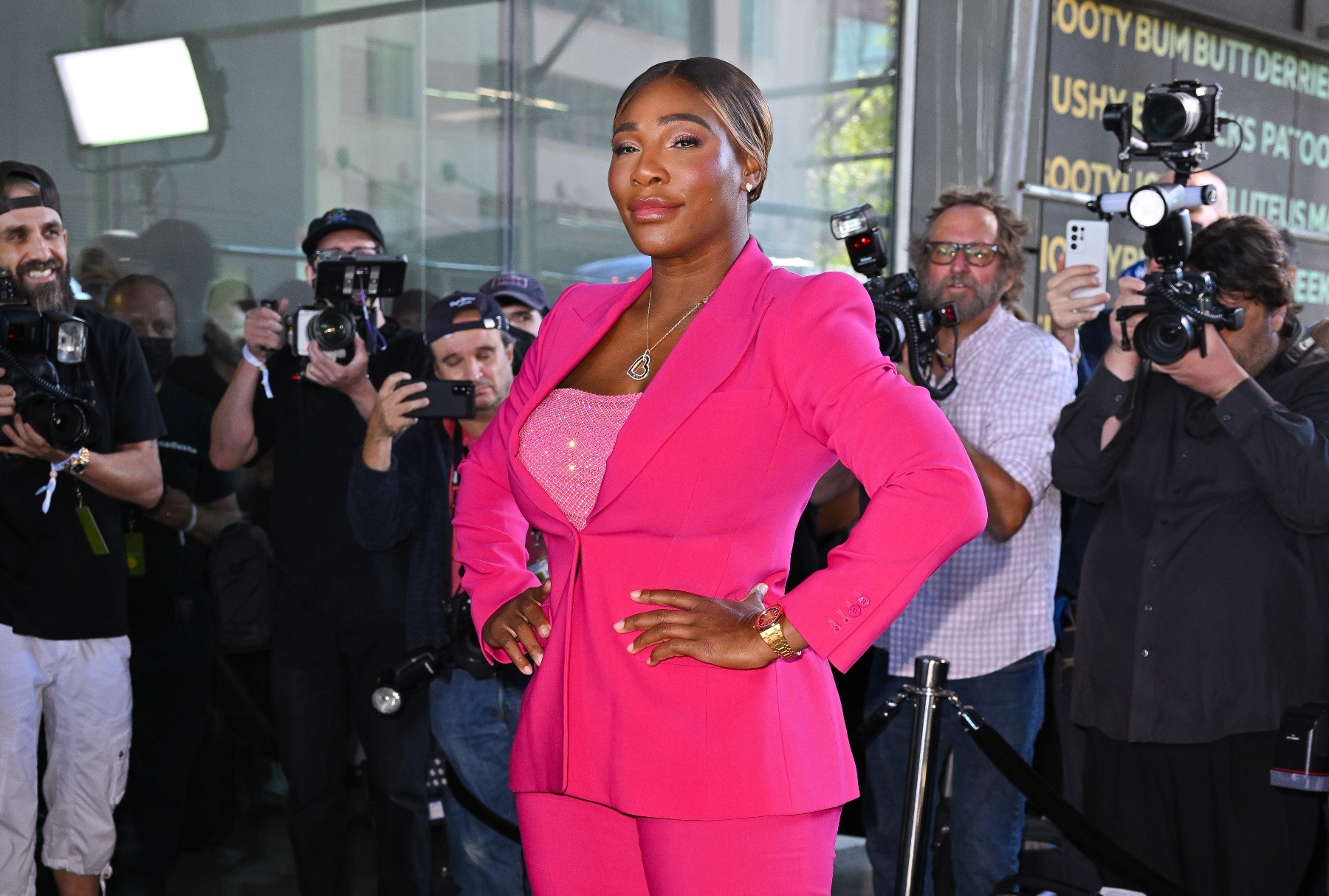
Serena Williams arrives at the Michael Kors fashion show at Highline Stages on September 14, 2022 in New York City (James Devaney/GC Images)
This told her that anything was possible, she said, then wondered why women are encouraged to curb the scope of their drive as they get older. 

The opening episode of “Archetypes” was extensively covered in the international media, but if you were to read about it, you wouldn’t have known that episode was about ambition. Instead, the clip most seized upon was a revelation that during an official royal tour in Africa, the couple was told about a fire in her son Archie’s nursery. They were forced to continue to their next scheduled destination instead of canceling to stay with their baby — which, to any empathetic human being, is an understandable impulse. 

Context, as always, is important. Markle’s comment came after Williams spoke about the ways society punishes a woman’s aspirational focus and the pressure placed on women to perform, especially after they become mothers. Williams shared what was happening behind the scenes of the French Open in the year she wore her famous catsuit. 

The night before a decisive match, her daughter fell out of her high chair and broke her wrist. She and her husband didn’t get home from the emergency room until 4 a.m. But she had to play and not only that, she knew she had to live up to expectations and win. Which she did.

That doesn’t generate clicks. To achieve that, it’s better to frame Markle’s candid offering in the way of The Daily Beast’s Royalist column: “After a summer of relative peace, Meghan Markle formally re-opened her war with the British royal family this week —and indicated that a fresh bombardment will take place, each and every Wednesday, for the next 11 weeks.”

But the weird part about it is how this supposed “battle” is playing out through products and branding instead of direct words. Markle’s conversation with Carey is nominally a discussion about the double-edged meaning of the “diva” label and the singer’s reclaiming of it while doubling as a conversation about biracial identity. 

And in that conversation, this became the main topic of interpretation. “It’s very different because we’re light-skinned,” Markle says to Carey. “You’re not treated as a Black woman. You’re not treated as a white woman. You sort of fit in between. I mean, if there’s any time in my life that it’s been more focused on my race, it’s only once I started dating my husband. Then I started to understand what it was like to be treated like a Black woman. Because up until then, I had been treated like a mixed woman. And things really shifted.”

Nobody knows whether Markle is enacting a vendetta against the royal family. Normal humans would assume she’d simply rather be done with them and live her life with Harry, who Williams casually refers to as “H.”

The weird part about it is how this supposed “battle” is playing out through products and branding instead of direct words.

That said, one can also glean satisfaction from watching royal “experts,” many of them white men, contort themselves to speculate that Markle’s average podcasting skills might somehow get in the way of maintaining the caliber of guests she’s drawn in these opening episodes.

This, of course, discounts the fact that as long there are celebrities of color invested in seeing a Black royal succeed — and, as she’s demonstrated, she has enough in her contacts to fill out a 12-episode season — she’ll be fine. Case in point: Mindy Kaling sat down with her for the third installment before the season took a break out of respect for the death of Queen Elizabeth. The podcast resumed this week with interviews with Margaret Cho and journalist Lisa Ling. Upcoming installments feature the duchess in conversation with Robin Thede, Issa Rae and Ziwe Fumudoh, among others.

Living well is the best revenge, and even if that isn’t the point, it’s worth noting that “Archetypes” became the No. 1 on Spotify’s global charts the week that it premiered, unseating Joe Rogan. That’s enough to renew a person’s impulse to cheer on the Sussexes.

Contractually speaking, they’re well on their way to achieving that financial independence they announced they wanted in exchange for being freed from their royal duties. Shortly after decamping from Buckingham Palace, the pair landed a multi-year contract to produce content for Netflix. This was followed by scoring that Spotify contract, conservatively estimated to have netted them around $25 million.

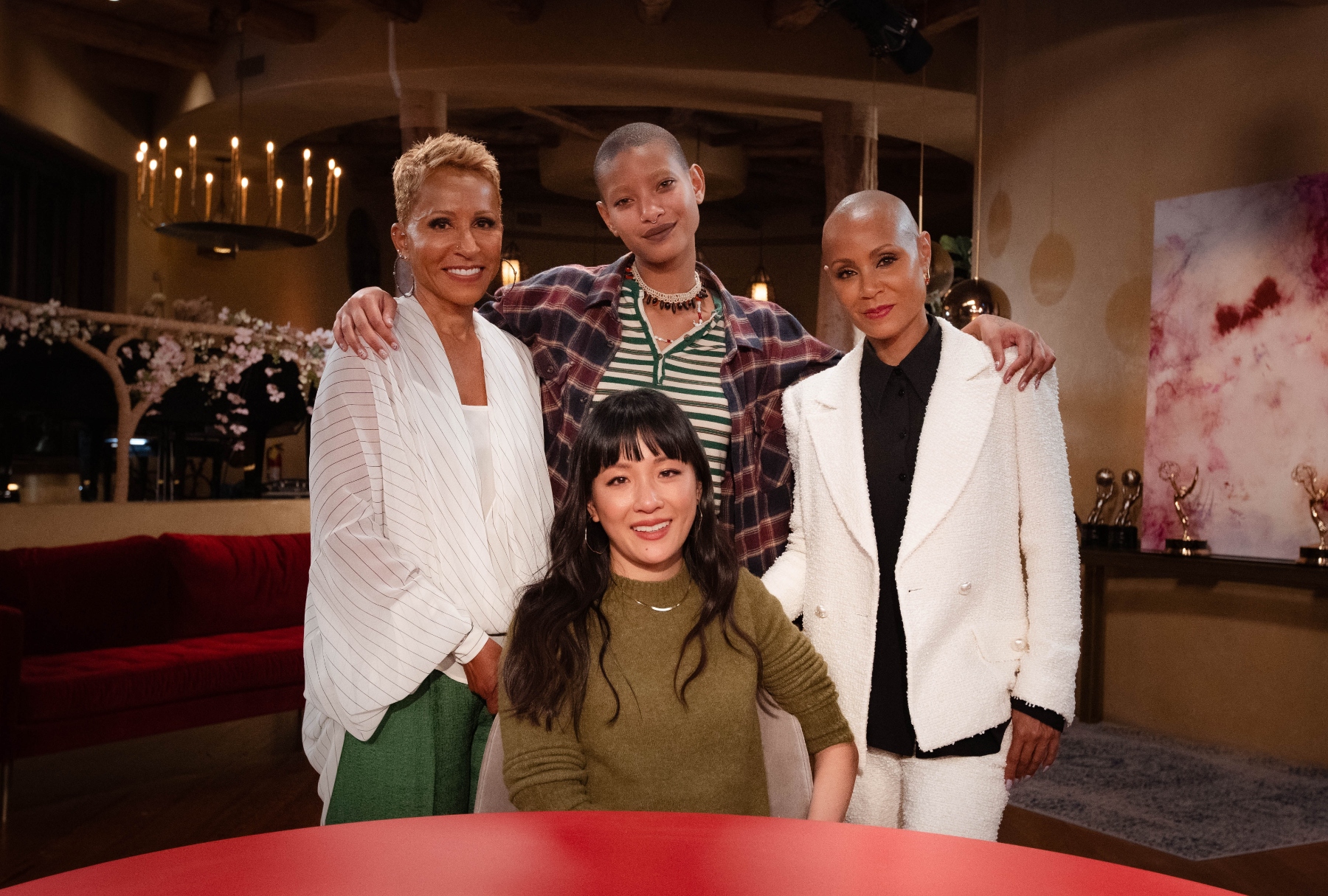
Adrienne “Gammy” Banfield Norris, Willow Smith, Jada Pinkett Smith and guest Constance Wu on “Red Table Talk” (Facebook Watch/Jordan Fisher)

A larger question “Archetypes” raises is what it will morph into in the long term. Markle has an affable podcasting presence, but her approach isn’t unique in this space. 

Jada Pinkett Smith, her daughter Willow, and mother Adrienne Banfield Norris already staked their claim in the “celebrities contemplating real-world concerns” field via Facebook’s “Red Table Talk.” This week it made headlines as the place Constance Wu chose to go public with claims that a producer on “Fresh Off the Boat” sexually harassed her while she worked there, in addition to the revelation that she is a rape survivor. (Wu is also listed among the upcoming guests on “Archetypes.”)

Pinkett Smith and her family have evolved “Red Table Talk” into a hybrid of celebrity healing circle and “Oprah”-style image rehabilitation destination, albeit one that replaces the studio audience with video calls from fans who can relate. It’s very much still a vehicle for the hosts to address the issues they live with by showing they’re simply the famous faces of a specific aspect of the human condition. Pinkett Smith demonstrated that by using the show to discuss living with alopecia after her husband’s Oscar night debacle.


Want a daily wrap-up of all the news and commentary Salon has to offer? Subscribe to our morning newsletter, Crash Course.


Ironically, in its current guise “Archetypes” shies away from that level of ambition, as Markle seems to prefer allowing her extraordinary friends and peers to provide evidence that the slanders she’s endured aren’t unique to her. It’s a highly strategic way to make the case that her humanity is as worthy of being honored as anyone else’s without specifically making it about her. 

Why bother? The press is happy to do that for her, as it did with this week’s episode in which Cho and Ling break down the “dragon lady” stereotype that pervades American popular culture and is seen as contributing to violence against Asian women. Among the examples illustrated with audio clips are outtakes from an “Austin Powers” movie and “Kill Bill: Vol. 1,” before Markle and her guests launch into a discussion about the weight of being one of few representatives of one’s culture in any pop culture forum. 

Cho, for example, became the first Asian American to headline a broadcast sitcom. There wouldn’t be another woman in her position until Wu co-starred in “Fresh Off the Boat.” Markle, for obvious reasons, can relate. 

For equally obvious reasons, The Daily Mail refuses to. “Now Meghan takes on Hollywood over ‘Asian stereotypes'” its headline blares. Much of the coverage is making her point by refusing to get it, which also benefits “Archetypes.” There may be no better free promotion than media coverage capitalizing on the fact that the Duke and Duchess of Sussex live rent free in the heads of millions of their haters, and are getting equally famous people to share that space.


This year’s physics Nobel Prize was for “spooky action at a distance.” Here’s what that means

The 2022 Nobel prize for physics has been awarded to a trio of scientists for pioneering experiments in quantum mechanics, the theory covering the micro-world of atoms and particles.

 A particle can actually be in several places at the same time, before “picking” one location at random when we measure it. 

Alain Aspect from Université Paris-Saclay in France, John Clauser from J.F. Clauser & Associates in the US, and Anton Zeilinger from University of Vienna in Austria, will share the prize sum of 10 million Swedish kronor (US$915,000) “for experiments with entangled photons, establishing the violation of Bell inequalities and pioneering quantum information science”.

The world of quantum mechanics appears very odd indeed. In school, we are taught that we can use equations in physics to predict exactly how things will behave in the future – where a ball will go if we roll it down a hill, for example.

Quantum mechanics is different from this. Rather than predicting individual outcomes, it tells us the probability of finding subatomic particles in particular places. A particle can actually be in several places at the same time, before “picking” one location at random when we measure it.

Even the great Albert Einstein himself was unsettled by this – to the point where he was convinced that it was wrong. Rather than outcomes being random, he thought there must be some “hidden variables” – forces or laws that we can’t see – which predictably influence the results of our measurements.

Some physicists, however, embraced the consequences of quantum mechanics. John Bell, a physicist from Northern Ireland, made an important breakthrough in 1964, devising a theoretical test to show that the hidden variables Einstein had in mind don’t exist.

According to quantum mechanics, particles can be “entangled”, spookily connected so that if you manipulate one then you automatically and immediately also manipulate the other. If this spookiness – particles far apart mysteriously influencing each other instantaneously – were to be explained by the particles communicating with each other through hidden variables, it would require faster-than-light communication between the two, which Einstein’s theories forbid.

Quantum entanglement is a challenging concept to understand, essentially linking the properties of particles no matter how far apart they are. Imagine a light bulb that emits two photons (light particles) that travel in opposite directions away from it.

If these photons are entangled, then they can share a property, such as their polarisation, no matter their distance. Bell imagined doing experiments on these two photons separately and comparing the results of them to prove that they were entangled (truly and mysteriously linked).

Clauser put Bell’s theory into practice at a time when doing experiments on single photons was almost unthinkable. In 1972, just eight years after Bell’s famous thought experiment, Clauser showed that light could indeed be entangled.

While Clauser’s results were groundbreaking, there were a few alternative, more exotic explanations for the results he obtained.

If light didn’t behave quite as the physicists thought, perhaps his results could be explained without entanglement. These explanations are known as loopholes in Bell’s test, and Aspect was the first to challenge this.

Aspect came up with an ingenious experiment to rule out one of the most important potential loopholes in Bell’s test. He showed that the entangled photons in the experiment aren’t actually communicating with each other through hidden variables to decide the outcome of Bell’s test. This means they really are spookily linked.

In science it is incredibly important to test the concepts that we believe to be correct. And few have played a more important role in doing this than Aspect. Quantum mechanics has been tested time and again over the past century and survived unscathed.

Quantum technology

At this point, you may be forgiven for wondering why it matters how the microscopic world behaves, or that photons can be entangled. This is where the vision of Zeilinger really shines.

We once harnessed our knowledge of classical mechanics to build machines, to make factories, leading to the industrial revolution. Knowledge of the behaviour of electronics and semiconductors has driven the digital revolution.

But understanding quantum mechanics allows us to exploit it, to build devices that are capable of doing new things. Indeed, many believe that it will drive the next revolution, of quantum technology.

Zeilinger’s work paved the way for the quantum technological revolution by showing how it is possible to link a series of entangled systems together, to build the quantum equivalent of a network.

Quantum entanglement can be harnessed in computing to process information in ways that were not possible before. Detecting small changes in entanglement can allow sensors to detect things with greater precision than ever before. Communicating with entangled light can also guarantee security, as measurements of quantum systems can reveal the presence of the eavesdropper.

Zeilinger’s work paved the way for the quantum technological revolution by showing how it is possible to link a series of entangled systems together, to build the quantum equivalent of a network.

In 2022, these applications of quantum mechanics are not science fiction. We have the first quantum computers. The Micius satellite uses entanglement to enable secure communications across the world. And quantum sensors are being used in applications from medical imaging to detecting submarines.

Ultimately, the 2022 Nobel panel have recognised the importance of the practical foundations producing, manipulating and testing quantum entanglement and the revolution it is helping to drive.

I am pleased to see this trio receiving the award. In 2002, I started a PhD at the University of Cambridge that was inspired by their work. The aim of my project was to make a simple semiconductor device to generate entangled light.

This was to greatly simplify the equipment needed to do quantum experiments and to allow practical devices for real-world applications to be built. Our work was successful and it amazes and excites me to see the leaps and bounds that have been made in the field since.


This article is republished from The Conversation under a Creative Commons license. Read the original article.

“To the right, to the right”: Peter Thiel invested $1.5m in right-wing dating app “The Right Stuff”

In 2022 it’s as easy to use an app for dating as it is to order up a cheeseburger; and just as specifications such as “extra ketchup” can be made for the latter, “extra conservative” can now be requested for the former.

The rise of apps catered towards lonely-hearts with specific tastes in bedfellows has brought about Raya — a private, membership-based network for celebrities and non-famous rich people, Christian Mingle — for those who’d prefer to pray and play, and now The Right Stuff — a dating app for right-wingers who would hear Beyoncé’s call to swipe “to the left, to the left” and shudder.

Developed by Ryann McEnany, the sister of former White House press secretary Kayleigh McEnany, The Right Stuff is backed by PayPal co-founder Peter Thiel, who invested $1.5m into the project, according to The Guardian. Although Thiel himself identifies as a gay man, The Right Stuff is marketed towards ultra-conservative heterosexuals only.

“I’ve gotta tell you about something I’m so excited to announce,” McEnany says in a promo video for The Right Stuff. “A dating app for all of us conservatives . . . What I love most about it is that it’s invite only, so not just anyone can join. First of all, it’s free to use, and for my ladies, you’ll never have to pay . . . Gentlemen, if you want access to premium, that’s on you. And by the way, those are the only two options: ladies and gentlemen.”

Shortly after launching on September 30, The Right Stuff was pummeled with bad reviews. According to Gizmodo, users complained “that the app is short on women, that the invite-only system makes it impossible to actually join, and that answering a profile prompt about January 6 led to contact from law enforcement.”

“I can’t f**king believe this. I looked at the reviews for “The Right Stuff” dating app and it asks you during registration if you attended jan 6th,” comments a person on Twitter. “If you say yes, the feds try to pin domestic terrorism charges on you. Outstanding.” 


Want a daily wrap-up of all the news and commentary Salon has to offer? Subscribe to our morning newsletter, Crash Course.


Leading up to the launch of The Right Stuff, co-founder Daniel Huff spoke to Glenn Beck to discuss the selling points of the app.

“For too long, conservatives have been playing catch-up with liberal tech” Huff said. “They have YouTube and we have Rumble. They have Twitter and we have Truth Social. What we need to do is to actually just get ahead. We wanna not just catch up, we wanna create a superior product, and we’re able to do that by actually adding features that no one else has.”

One of the features Huff mentions is called “post-date,” which allows people to go on and post that they have tickets to a ballgame, as an example, and ask if anyone would like to join them. Assuming that people express interest, the original poster in the “post-date” function can then choose who they’d like to bring.

“The failing MAGA dating app The Right Stuff is reportedly having trouble getting women to sign up. That’s no surprise after you watch one of their promos aimed at women,” Tweets Young Turks writer Matthew Sheffield.

“The Right Stuff is a great new dating app for conservatives hoping to match with that special…FBI agent monitoring the site,” joked Trevor Noah, former host of The Daily Show.

“Alcarràs” filmmaker on farming families losing “this way of life” in Catalonia

Although it is set in a small Catalonian village, the themes of “Alcarràs” are universal. This absorbing drama, screening Oct. 6, 7, and 12 at the New York Film Festival, immerses viewers in the lives of a farming family struggling to get by.  

Rogelio (Josep Abad) is the patriarch whose failure to sign a contract for the land he was given means the family will have to move at the end of the summer. This fact enrages his son, Quimet (Jordi Pujol Dolcet) who manages the peach farm with the help of his son, Roger (Albert Bosch), as well as members of his extended family and the occasional migrant worker.

Pinyol (Jacob Diarte), who owns the land, encourages Quimet to move to “farming” solar panels — to work less, earn more and stay on the land — but Quimet resists, digging in his heels and causing tensions within his own family. How the other family members react to Quimet’s stubbornness play out during the film.

Directed by Carla Simón, who cowrote the script with Arnau Vilaró, “Alcarràs” allows viewers to absorb each character and understand their lives, desires and frustrations. Roger is especially well drawn; he retaliates when Quimet discovers the secret crop of weed he is growing. But Quimet’s wife, Dolors (Anna Otin), and their daughter, Mariona (Xènia Roset), also get compelling storylines that help create a strong family portrait. 

“Alcarràs” also addresses issues of fair pricing for farmers as Quimet is part of a collective that is staging a protest for farmers being squeezed out by big business

Simón spoke with Salon about creating her new film.

“Alcarràs” presents a microcosmic look at a family, a farm, and a community by allowing viewers to eavesdrop on their lives. What inspired you to tell this particular story?

My two uncles cultivate peaches in Alcarràs, which is a small village in Catalonia. When my grandfather died, I thought, “What would happen to the trees that were there forever when they disappeared?” This is not happening in my family because my uncles are still cultivating peaches, but it is happening to other families; they have to abandon their farms. This way of life, cultivating agricultural in small family groups, is no longer as sustainable as it used to be. They have to leave their land and do something else. 

Can you discuss why you told this story in a leisurely, very unstructured, immersive way? It’s very effective.

The structure of the film was a challenge because it is an ensemble piece. We had to think about each character and their emotions, and how the emotions of one character can affect someone else, so we went with that domino effect. It was a difficult to show these different points of view, but it was freeing as well. 

Quimet is a toxic man, who fails to consider the impact of imposing his will on everyone. He seems to be stubbornly fighting an uphill battle, believing he is in the right but in denial about reality. It manifests itself in his back pain and his relationships with his family. He is a fascinating character and not unsympathetic, despite making some bad choices. What observations do you have about him? We are rooting for him, but he is toxic! 

Yes, he is. We wanted to do a portrait of this place, and right now we have all these narratives of empowered women who are feminists. But these [toxic men] still exist. In these rural places they still don’t know about feminism, and family structures are still quite old. We wanted to give some hope through the character of Mariona, the teenager who sees [Quimet] as the boss, as the one to start thinking of breaking the patriarchal cycle. Quimet’s masculinity is toxic, but it is important to portray a man who can be tender and feel emotion. 

AlcarrasAlcarras (MUBI)

I’m curious about how you created the narratives for the other family members. I loved the young troublemaker Iris (Ainet Jounou) and her co-conspirators, Pau (Isaac Rovira) and Pere (Joel Rovira), but also Mariona’s and Roger’s storylines, along with members of the extended family. Can you discuss your approach to the narrative that lets viewers sink into the rhythm of these lives? 

When I thought about the story, the most obvious choice was to tell the story from Quimet’s point of view. But I am not a 45-year-old man who is a farmer. That’s far from my experience. But I can talk about family relationships because I’m part of a big, big family. I like the idea of portraying what it is to be part of a big family in a cinematic way. I wanted to talk about family crisis, because you can’t choose your family, and when there is crisis, it affects you. This is the case with the younger generation. I care about how the children feel; the youngest ones have a mysterious view of everything because they don’t understand the whole picture. It was interesting to talk about generations and the relationship between the grandfather and grandchildren. It’s about a way of life. They are about to lose the land and this way of life is about to end. It has consequences; this way of living with different generations in same house is also disappearing. 

Can you talk about the different plotlines with the younger characters? 

With the children, the idea is that they play in the place they usually play, [an abandoned car], and someone takes this car from them. They are the first ones to lose something. Because they are children, they spend the whole film looking for another place to play. It’s a metaphor for what’s happening to the adults. 

Mariona is the character who is closest to myself. She is at this age where you start looking at the family. She is the observer, and we see a lot of things through her eyes. We understand the grandfather’s feelings though her. She has a will to leave this place, so she is in the family, but she has this outsider perspective

For Roger, it was interesting for me to have a character who is a teenager who wants to be a farmer, because of the lack of generational takeover. He wants to keep cultivating the land, but he won’t be able to do it. Young people are leaving this place, and Roger will have to leave, but against his will. It was interesting to show this, and the mixed feeling Quimet has with his own future and his son’s future. Quimet wants his son to stop cultivating the land, because it will be easier for him to study or do something else, but at the same time, it makes him proud to see that his son has the same love he has for the land. 

“Alcarràs” is very much a film about tradition versus modernization, but it is also about opportunity. Is progress a good thing for these people who have been farming for generations? 

We totally want solar panels. That is why I thought this is an interesting dilemma. I like when the bad person or side of a story is not so bad. The landowner [Pinyol] has his right to do this. Quimet’s sister and brother-in-law want to work in his solar panel business. It’s interesting to show a dilemma where both can be OK — even if you are on the family’s side. For me, the thing I don’t like about the green energy in Spain is that it’s not always applied well. They sometimes put solar panels in places where they can cultivate the land. That doesn’t make sense. They could pick other places. It’s complicated issue, but we want green energy, but we have to be careful how we do it. 

What observations do you have about the use of migrant workers, which is depicted in your film? The family can only afford to pay one man. 

A lot of people think that people hire migrant workers without papers. This is not true. There are huge controls. If you have an illegal worker, you have to pay 10,000 Euros if the police catch you. The farmers do things properly. People come to these villages every summer and it’s a problem. The workers live in bad conditions. Migrant workers could have a film, because they have interesting stories, but “Alcarràs” was about this family. The families don’t have much communication with the workers, even though they see each other every day. They don’t know much about each other. It was interesting to have the little girl curious about them, but the others don’t communicate too much with them. This is what happens. They need each other, and spend a lot of time together every day, but they live in separate worlds. 

Can you talk about the fair pricing issues for farmers, which is also featured in “Alcarràs?”

It’s a big issue. Farmers cultivate the fruit without knowing how much they are going to be paid for each kilo. Sometimes, they get paid less than what it costs to produce it. It depends on the year. This year, there was a lot of bad weather, so a lot of fruit was wasted. So, you could say it was a bad year. But at the same time, it was a good year for those who could sell their fruit because the price was higher. The folks whose fruit was wasted received money from insurance. The worst harvest is when everyone has fruit. It shouldn’t be so difficult to regulate a little bit. 

Your film can be seen as cynical, in that opportunities are limited, or it can be seen as hopeful, in that people are free to do what they want. How do you see your film? 

Both ways, somehow. It is interesting, because in the beginning of writing, I wanted a happy ending. My uncles still cultivate peaches, so, we need to end with some hope that they can still do that. But in making the film and talking to the farmers, we realize they have no hope and are pessimistic. We went to a demonstration for farmers, and we thought this way of life is really ending. Not the agricultural world, but this way of doing small family agriculture was ending. So, we cannot have a happy end. But it is not necessarily a sad ending. It was going to be difficult to keep doing this. So, it’s a chance to start over and do something else, and find another way of living, that might make them happy, even if they still don’t know it yet. You can see it both ways.

“Fellow adulterer” Newt Gingrich called out for defending “family man” Herschel Walker

Former House Speaker Newt Gingrich (R) is at the center of controversy for his recent attempt to defend Georgia Republican Senate candidate Herschel Walker amid his latest scandal.

During an appearance on Fox News, Gingrich lauded the former NFL star as “the most important Senate candidate in the country” because of his “deep commitment to Christ.”

The former house speaker made the remarks despite Walker’s extensive history of domestic violence, physical abuse, and the latest damning accusations about the “pro-life” candidate paying for his ex-girlfriend to have an abortion back in 2009.

In fact, Walker’s own son took to Twitter this week with a blistering rebuke of his father. “You’re not a ‘family man’ when you left us to bang a bunch of women, threatened to kill us, and had us move over 6 times in 6 months running from your violence,” Christian Walker wrote on Twitter.

Gingrich’s praise of Walker also ignores an obvious fact about the Republican candidate’s opponent. Sen. Raphael Warnock’s (D-Ga.) reputation speaks for itself as he serves as a senior pastor at Atlantic’s historic Ebenezer Baptist Church.

But despite the facts, Gingrich still described Walker as a “remarkable person.”

“He’s been through a long, tough period,” Gingrich said. “He had a lot of concussions coming out of football, he suffered PTSD.”

Gingrich’s remarks quickly drew critical reactions from social media users who took the time to dissect his claims.

“Newt Gingrich: Herschel Walker, whose brain was damaged a bunch by football, should be in the Senate because of his deep commitment to Christ — so he can replace an actual reverend,” one Twitter user tweeted.

“Pretty shameless of FOX to march out Newt to talk about a fellow adulterer’s ‘commitment to Christ,'” another user tweeted.

Mar-a-Lago documents inadvertently published online — and undercut Trump’s privilege claims

The Justice Department’s detailed lists of seized materials from former President Donald Trump’s Mar-a-Lago residence were inadvertently published online on Tuesday.

A judge ordered that the logs stay under seal, but they appeared to be inadvertently posted to the public court docket, according to Bloomberg, which first reported on the documents. The filing, which is no longer publicly visible, included a combination of government, business and personal documents. Some of these records included analysis of who should get a pardon, retainer agreements for lawyers and accountants as well as legal bills.

A “Privilege Review Team” followed specific “search procedures and filter protocols while executing the warrant” to search Mar-a-Lago and divided potentially privileged material into two categories, according to the filing. The filter team found 520 pages that needed a closer look but later determined few of those documents fell under any legal privileges.

The first set of 137 documents included government records, public documents and communications with outside parties. A 39-page document, in which a “majority of pages are titled ‘The President’s Calls’ and include the Presidential Seal” contain handwritten names, numbers and notes that appear to be messages and notes.  

The other list included documents that the team identified should be returned to Trump, including a “medical letter” from a doctor, legal complaints and information about legal fees to lawyers. 

The former president has repeatedly expressed his disapproval of the search of his Florida home, describing it as an “unwarranted, unjust, and illegal Raid and Break-In.” On Tuesday, Trump’s lawyers asked the Supreme Court to intervene in the fight over records and ensure that the more than 100 documents marked as classified are part of the special master’s review.

“The Eleventh Circuit lacked jurisdiction to review the Special Master Order, which authorized the review of all materials seized from President Trump’s residence, including documents bearing classification markings,” the application said


Want a daily wrap-up of all the news and commentary Salon has to offer? Subscribe to our morning newsletter, Crash Course.


This would allow Trump to pursue claims that the documents with restrictive classifications like “Top Secret” should not be reviewed by Justice Department investigators since they are subject to executive privilege. Trump has also dubiously claimed that he declassified them before leaving office. 

The Justice Department’s Aug. 30 report identified how the privilege review team divided documents covered by attorney-client privilege into a different batch that would remain separate from Justice Department attorneys and FBI agents managing the criminal probe. 

More than 300 pages were flagged to be returned to the former president, including IRS forms and other tax-related documents, a letter from Trump campaign legal advisor, an insurance benefits letter, a confidential settlement agreement between PGA and Trump Golf, a civil complaint and a nondisclosure agreement and contract agreement regarding Trump’s Save America political action committee.

Federal Judge Raymond Dearie will be conducting the review of the 520 pages of documents since the Justice Department was unable to convince a judge in Florida that their filter process didn’t need an outside special master to review the documents.

Oath Keepers trial highlights the right’s obsession with finding cheat codes for real life

Prior to the opening arguments in the Oath Keepers trial for seditious conspiracy, the media buzzed with speculation over the “novel” defense being offered by the leader of the militia, Stewart Rhodes, and the legal team. As the Associated Press reports, even though members of the group stormed the Capitol on January 6, 2021, lawyers were prepared to argue that the Oath Keepers charged with seditious conspiracy are innocent, despite mounting evidence of prior organizing. Rhodes, his team claims, believed the president would invoke the Insurrection Act to call up militias, which means the defendants thought they were acting under legal orders from the president. 

Rhodes graduated from Yale Law, though he was disbarred in 2015 for repeated ethics violations. He and his legal team have hyped his Ivy law credential to the media, implanting the idea that their defense theory, which otherwise might be regarded as grasping, must have real juice. But close observers have detected signs that lawyers for the Oath Keepers aren’t all that confident. As Vice reported last week, the Rhodes team is embroiled in in-fighting. They even tried for a delay, claiming they weren’t ready for trial even though their client had been indicted in January. During jury selection, a lawyer for co-defendant Thomas Caldwell “jokingly” complained about the number of lawyers in the jury pool, indicating a possible drop in confidence at the thought of selling this defense to jurors who actually know the law.

Now that the trial is underway, things are already starting to look shaky for the “we thought it was legal” defense. No doubt, as Assistant U.S. Attorney Jeffrey Nestler told the jury, “Rhodes, with a law degree, was careful with his own words,” and used “code” when outlining the plan. But Rhodes also appears in love with the sound of his own voice, and in his loquacious instructions to his followers, let slip a few thoughts that may prove helpful for the prosecution. 


Want more Amanda Marcotte on politics? Subscribe to her newsletter Standing Room Only.


On Monday, Nestler told the jury the chatter about the Insurrection Act is an attempt to give legal cover to what Rhodes and his followers knew full well was a crime. And he came with receipts. As Anna Bower at Lawfare reports, “a clip of Rhodes instructing Oath Keepers to refer to the Insurrection Act because it could provide ‘legal cover.'” 

Things are already starting to look shaky for the “we thought it was legal” defense.

Despite his training at Yale Law, the approach Rhodes takes to the law and politics doesn’t seem rooted in a deep understanding of U.S. law as it’s actually practiced, but rather in the conspiracy theories and legal fantasies of the far right. For decades now, white supremacist organizations, militias, and other far-right groups have honed a “cheat code” mentality about the law, obsessed with finding loopholes they believe will allow them to opt out of laws the rest of Americans have to follow. 

One of the best-known examples is the “sovereign citizens” movement. According to the Southern Poverty Law Center (SPLC), these are people who claim “they are not under the jurisdiction of the federal government and consider themselves exempt from U.S. law.” Using conspiracy theories and fake histories as justifications, they will often file a bunch of bogus legal paperwork “declaring themselves sovereign, signing it with red blood or ink thumbprints,” claiming it means they are no longer subject to the law. Many of them use this fake status to argue that they don’t have to pay taxes or even fines for traffic tickets.

Related is the “constitutional sheriffs” movement, which also tries to make itself sound more official by using the name “posse comitatus.” As the SPLC explains, this movement argues that “the county sheriff is the ultimate law enforcement authority in the U.S.” and “the county and not the state or federal governments should control all land within its borders.” Unsurprisingly, it’s a legal “theory” that is popular with white supremacists, who resent federal civil rights laws. The movement got a boost during the pandemic, the SPLC reports, by equating “government-enacted health guidelines regarding masks and vaccines with tyranny.” 

One of the main effects of Donald Trump’s rise is this fringe “cheat code” mentality going mainstream in the Republican Party.

These theories are goofy and baseless, but they have lingered for decades. People of all political inclinations can get sucked in by claims of access to secret methods to cheat a system, of course. It’s why bogus diet pills never stop selling and ads promising “one weird trick” are such reliable clickbait. But that human desire for shortcuts seems especially prevalent on the right. Conservative listservs and publications are awash in ads for fake cancer cures and scam investment opportunities. Cryptocurrency is becoming more associated with Republicans as public skepticism rightly rises. (Indeed, before the internet, “sovereign citizens” often would cough up “alternative” currency schemes of their own.) Wish-casting legal theories prey on the same predilections that lead some conservatives to embrace claims that horse paste works better against COVID-19 than vaccines, or that Barack Obama’s birth certificate contains some key to delegitimizing his presidency. 


Want more Amanda Marcotte on politics? Subscribe to her newsletter Standing Room Only.


One of the main effects of Donald Trump’s rise is this fringe “cheat code” mentality going mainstream in the Republican Party. Trump’s entire attempted coup was constructed around these ridiculous legal theories, with his lawyers repeatedly implying to his donors they were going to find some nifty legal trick to throw out the results of the 2020 election. Indeed, the Capitol insurrection was rooted in these fantastical arguments. Trump’s lawyers had pumped up this false notion that then-Vice President Mike Pence had the power to simply reject the results of the election on January 6, when the electoral votes were being counted in Congress. As the January 6 committee showed, the main proponent of this theory, John Eastman, didn’t believe his own nonsense. Still, it was the pretext Trump needed to inflame the mob that stormed the Capitol that day. 

Trump wasn’t successful in his coup effort. The Oath Keepers are facing an uphill battle to defend themselves at trial. That doesn’t necessarily mean these far-right legal hallucinations won’t continue to become more acceptable in the mainstream Republican Party. Right now, Republicans are trying to turn one of Trump’s imaginary “cheat codes” to steal an election into a reality where Republican-controlled state legislators can simply reject a Democratic presidential win and reassign their electoral votes to the Republican instead.

Under the auspices of a case about gerrymandered maps, Republicans in North Carolina are arguing before the Supreme Court that they should be able to write elections law so the voters in their state have no say in presidential elections. As Laurence Tribe and Dennis Aftergut noted in the Los Angeles Times, “Four justices — Neil Gorsuch, Clarence Thomas, Samuel Alito and Brett Kavanaugh — had previously signaled support for this idea.” All Republicans need is one more justice and state legislatures get “absolute control of electoral votes in presidential elections” — meaning they can throw out results they don’t like. Such a ruling would defy the plain letter reading of the constitution, but this Supreme Court increasingly seems indifferent to that objection

As for the Oath Keepers, they’re facing down a jury of their peers and not Federalist Society-trained justices who will entertain all sorts of outlandish right-wing legal theories. For the rest of the country, however, right-wing legal make-believe is still an active danger to democracy. 

Herschel Walker defender: I don’t care if he paid “some skank” — “I want control of the Senate”

Dana Loesch, a former spokeswoman for the National Rifle Association, completely blew off allegations about Georgia Senate GOP hopeful Herschel Walker paying for an abortion.

In a clip flagged by @PatriotTakes, Loesch told her followers that winning back control of the Senate is the only thing that matters and that other moral considerations can be cast aside.

“I don’t care if Herschel Walker paid to abort endangered baby eagles,” she said. “I want control of the Senate!”

Loesch went on to dismiss the significance of the Walker abortion claims in even starker terms.

“If the Daily Beast story is true, you’re telling me Walker used his money to reportedly pay some skank for an abortion, and [Sen. Raphael Warnock] wants to use all of our moneys to pay a whole bunch of skanks for abortions,” she said. “So, it doesn’t change anything for me!”

The allegations that Walker paid for an abortion are only part of the current scandal surrounding the GOP candidate, as one of his sons, Christian Walker, leveled disturbing allegations of familial abuse against him.

“You’re not a ‘family man’ when you left us to bang a bunch of women, threatened to kill us, and had us move over 6 times in 6 months running from your violence,” Walker wrote in one tweet.

Watch the video below.

“Possession is a crime”: MSNBC host says Trump lawyers “stepped in it” on page 30 of SCOTUS appeal

Donald Trump’s legal team “stepped in it” with its use of a key term in its appeal to the United States Supreme Court.

MSNBC anchor Lawrence O’Donnell on Tuesday evening directed his audience to a single word in the 37-page filing.

“In their appeal today, the Trump lawyers still offered absolutely no reason why Donald Trump would be entitled to these documents and they made the mistake of using a word that they have not used before,” O’Donnell said. “In describing Donald Trump’s relationship to these documents, after saying in their Supreme Court appeal tonight, once again, that this case is, ‘essentially a document storage dispute,’ the Trump lawyers, on page 30, went on to say the ‘government has sought to criminalize President Trump’s possession and management of his own personal and presidential records.'”

“Possession of those records is a crime,” O’Donnell noted.

“That is why Donald Trump’s lawyers have been avoiding that word, possession. But on page 30 of their filing to Clarence Thomas tonight, the Trump lawyers stepped in it,” O’Donnell said.

“In every filing the Trump lawyers have made in this case, they have been trying to suggest that possession of the documents by the former president is perfectly legal without ever using the word possession. But tonight, they did,” O’Donnell said.

Watch below or at this link:

Trump melts down on Truth Social over Mar-a-Lago probe: “I want my documents back!”

Former President Donald Trump is demanding that the National Archives and Records Administration give back the top-secret documents he improperly took from the White House and stashed at his Mar-a-Lago resort.

In a new rant posted on Truth Social, the former president cited past instances in which the National Archives had lost information from past White Houses as evidence that documents, which included secrets on another country’s nuclear program, were safer being stored at his luxury resort in Florida.

“NARA lost a whole hard drive full of HIGHLY SENSTITIVE information from the Clinton White House,” Trump fumed. “More than 100,000 Social Security numbers and addresses, Secret Service and White House operating procedures (EXTREMELY SENSITIVE!).”

The former president closed out his rant by demanding the government return the documents he pilfered on his way out of the White House in January 2021.

“There is no security at NARA,” he wrote. “I want my documents back!”

Trump is currently under investigation for improperly taking top-secret government documents and refusing to give them back even after the government issued a lawful subpoena for their return.

A search warrant released by the Department of Justice this past summer revealed that Trump could potentially face charges for violating the Espionage Act, as well as charges of obstruction of justice.

Democrats won the biggest policy battle of our time — why doesn’t it feel that way?

I’m so old I can remember a time before critical race theory, Mr. Potato Head and library books about gay teenagers were the greatest threats to America. I know it’s hard to believe that anything could ever be more dangerous to all we hold dear, but once upon a time millions of people were convinced that affordable health care spelled the end of the republic as we know it. They took to the streets, mobbed town hall meetings and screamed bloody murder when the government proposed a law that would ban insurance companies from refusing to cover sick people and offered government help to people who could not afford the sky-high premiums those companies charged.

It seems like ancient history now but just a few years ago the hottest, most contentious issue in America was the passage of the Affordable Care Act (also known, for better or worse, as Obamacare). The Republican Party organized itself for almost a decade solely around a promise to repeal it. In fact, they actually voted to do so 67 times over the course of seven years. As president at the time, Barack Obama would have vetoed any repeal, of course, but the act of voting against it was enough to keep the base in line, outraged and on the march from one election to the next.

In the 2016 election, all the Republican candidates had ACA repeal as a top priority. By that time the program was becoming part of people’s lives and broadly gaining in popularity, so the GOP had landed on “repeal and replace” as their slogan — a promise to enact something different but equivalent, the details of which they always failed to spell out. Inevitably, the best they could offer was some kind of vague, voluntary state-by-state insurance plan that would be more expensive and grossly inadequate. Nonetheless, it seemed to animate their voters like no other issue. The American right just hated Obamacare, even more than the ancient shibboleths of “welfare” and “affirmative action.”

Donald Trump, as usual, took the “replace” promise to new heights. Just days before the 2016 election, he made this vow:

My first day in office, I am going to ask Congress to put a bill on my desk getting rid of this disastrous law and replacing it with reforms that expand choice, freedom, affordability. You’re going to have such great health care at a tiny fraction of the cost. And it’s going to be so easy.

Well, it wasn’t so easy. The House passed a terrible replacement bill in 2017 but it failed in the Senate bill by one vote, after that legendary thumbs-down by Sen. John McCain, who was near the end of his life but wanted a final measure of revenge against Trump, perhaps over his spiteful comments about McCain’s record of military service. (I think he was the last Republican, before Liz Cheney, to land a truly damaging blow against Trump.)

Trump tried to move on to tax cuts but must have gotten some blowback from the base. In October of that year he tried to have it both ways, tweeting, “As usual the ObamaCare premiums will be up (the Dems own it) but we will Repeal & Replace and have great Healthcare soon — after Tax Cuts!”


Want a daily wrap-up of all the news and commentary Salon has to offer? Subscribe to our morning newsletter, Crash Course.


By that time, Republicans in Congress were counting on the Supreme Court to gut the Affordable Care Act for them, and kept a lower profile on the issue. Nonetheless, Republican candidates for office still ran on the promise and Trump kept saying the bill was almost ready, so the base was supposedly still excited at the prospect — dampened a bit, no doubt, by GOP losses in 2018. As the 2020 election cycle began, Trump started campaigning on repeal-and-replace again, claiming he would announce a new plan “in two months, maybe less.” That didn’t happen, and as usual he just started saying whatever he thought people wanted to hear: A plan would be “ready in two weeks” or “by the end of the month,” or he was just about to issue an executive order “requiring health insurance companies to cover all preexisting conditions for all customers,” something he claimed had “never been done before.” His crowds cheered deliriously, no doubt believing that just as he’d surely finish his wall he’d get that done in a second term as well.

Trump kept promising a new health care plan “in two months” and then “two weeks,” and then vowed to issue an executive order to force insurance companies to cover everything at no cost. Somehow we never got to see this fabulous plan.

Trump lost that election — in reality, if not in the collective imagination of his fans — so we never got to see that fabulous health care plan that would cost nothing and cover everything. Still, losing elections had never stopped the Republicans from running on the issue anyway. Repealing Obamacare was their holy grail for almost a decade, until they suddenly stopped talking about it. So what gives? Why haven’t we heard anything at all about it this election cycle?

Well, as NBC News reports, the Republican commitment to ensuring that millions of people suffer from unnecessary illness, death and bankruptcy just isn’t sexy anymore:

With slightly more than a month before the next election, Republicans in Congress and on the campaign trail aren’t making an issue of Obamacare. None of the Republican Senate nominees running in eight key battleground states have called for unwinding the ACA on their campaign websites, according to an NBC News review. The candidates scarcely mention the 2010 law or health insurance policy in general. And in interviews on Capitol Hill, key GOP lawmakers said the desire for repeal has faded.

House Minority Leader Kevin McCarthy’s recent “Commitment to America” made no mention of it either, although the chairman of the ultra-conservative Republican Study Committee did put out a plan that included an unspecified reversal of “the ACA’s Washington-centric approach.” When asked about it, however, he told NBC that it would be up to McCarthy, the presumptive incoming House speaker, to put it on the agenda.

Interestingly, while it’s true that Obamacare is popular, it’s not all that popular. A Kaiser Family Foundation tracking poll found that 55% of U.S. adults approved of the ACA while 42% disapproved. So it’s not liek the GOP base hasn’t come around. They’re just bored with being angry about it and have been distracted by all the more exciting new grievances of the moment.

Kevin McCarthy and Rick Scott don’t talk about Obamacare in 2022 — maybe because the GOP base likes their racism undiluted these days.

Repealing government-guaranteed health care has been a fundamental principles of the right wing for as long as I can remember. Medicare and Medicaid (aka “entitlements”) have perennially been on the chopping block. I assume Republicans still hate it for the same reason they’ve always hated it: The wrong people may benefit, and that makes it unacceptable. They’ve got no major problem with government social programs — as long as they’re targeted to “real” Americans, if you know what I mean. 

Over the past few years, however, the principles that have always been just below the surface of conservative hostility toward egalitarian government programs have evolved from implicit racial animosity to more explicit demands for racist policies and a full-blown assault on the democratic process. The impulses really haven’t changed but the right is now willing to experiment with extremist tactics to achieve their goals.

Still, I would never say they’ve entirely given up on repealing Obamacare. While Sen. Rick Scott of Florida, the Senate Republican campaign chairman, doesn’t specifically mention it in his audacious governing agenda, he still wants to “rein in” Medicare and Social Security (through unspecified cuts in benefits or services). Some things never change. I would imagine that Obamacare will soon be viewed as another “entitlement,” which must be cut for our own good. For the moment, however, let’s take a moment to recognize that Democrats managed to defeat Republicans in one of the biggest policy battles of this generation. The war, needless to say, continues on other fronts. 

“Doomed to fail”: Legal experts trash Trump’s appeal after he runs to SCOTUS over Mar-a-Lago docs

Former President Donald Trump on Tuesday asked the Supreme Court to intervene in his legal battle over classified documents seized from his Mar-a-Lago residence.

Trump-appointed U.S. District Judge Aileen Cannon last month ordered a special master review of the documents and blocked the Justice Department from continuing its criminal investigation into the matter. The 11th Circuit Court of Appeals in Atlanta overturned part of her order that blocked the DOJ’s investigation into the more than 100 documents marked classified. On Tuesday, Trump filed an emergency appeal to the Supreme Court arguing that the court was wrong to block the documents from the review and requesting that special master Raymond Dearie be granted authority to review the documents with classified markings.

“Any limit on the comprehensive and transparent review of materials seized in the extraordinary raid of a President’s home erodes public confidence in our system of justice,” Trump’s attorneys wrote in the 37-page filing.

The appeal does not appear to ask to restore Cannon’s order blocking the DOJ’s investigation from continuing. The move could make it easier for Trump to push claims that the documents are shielded by executive privilege or were declassified, according to Politico, though legal experts have expressed doubts about the former president’s public claims.

The DOJ argued to the 11th Circuit that Cannon “ordered disclosure of highly sensitive material to a special master and to Plaintiff’s counsel—potentially including witnesses to relevant events—in the midst of an investigation, where no charges have been brought.”

Trump’s appeal disputed the DOJ’s claim that including the documents with classified markings in the special master review poses a national security threat because the DOJ may want to present those same documents as evidence to a grand jury. “In sum, the Government has attempted to criminalize a document management dispute and now vehemently objects to a transparent process that provides much-needed oversight,” the appeal says.


Want a daily wrap-up of all the news and commentary Salon has to offer? Subscribe to our morning newsletter, Crash Course.


Supreme Court Justice Clarence Thomas, who oversees the 11th Circuit Court, issued an order giving the DOJ a week to respond to Trump’s application, though he may refer the matter to the full court, legal experts say.

“A week is the amount of time you give when it’s not really an emergency,” tweeted Steve Vladeck, a Supreme Court expert at the University of Texas School of Law. “This delay doesn’t help Trump. At all. It’s a pretty big sign from Thomas that even *he* isn’t in a hurry, which does not bode well for Trump’s chances of getting the full Court to side with him.”

Vladeck explained that Trump’s appeal is “not *entirely* laughable” but is still “doomed to fail” and “unlikely to accomplish much even if it succeeds.” Trump’s request is “very modest,” he wrote, meaning even if he wins the DOJ’s probe would not be affected.

“Yes, this filing goes to Justice Thomas as Circuit Justice,” he tweeted. “But for as cynical as I know many people have become, I don’t see a universe in which he grants it by himself rather than allowing the full Court to resolve it. And even if he does, the full Court can overrule him.”

Conservative attorney George Conway agreed.

“Bottom line is that what Trump’s arguing, for once, isn’t completely nutso,” he tweeted. “It’s merely pointless and stupid.”

Former federal prosecutor Elie Honig told CNN it will be a “close call” if the court takes up the case. “The Supreme Court typically likes to stay out of messy, political disputes,” he said.

Former FBI official Chuck Rosenberg told MSNBC that he doesn’t see the Supreme Court overturning the 11th Circuit ruling, adding that Trump’s appeal is very narrow and unlikely to affect the criminal probe.

“Probably in the end this isn’t going to work out for Mr. Trump,” he said.

Former federal prosecutor Joyce White Vance warned that the appeal could backfire on Trump.

“He could well find himself getting bench-slapped by the Supreme Court,” she told MSNBC. “One of the real issues working not too far below the surface is that Judge Cannon herself really should not have entertained jurisdiction to hear this matter at all. DOJ has argued from the get-go that she lacks equitable jurisdiction. She made a very shaky finding in this regard. Now that entire ball of wax is sitting in the Supreme Court, and I don’t think this will go well for Trump, even though this has been where he’s wanted to be all along thinking the court would be favorable towards him.”

Doctors rush to use Supreme Court ruling to escape opioid charges

Dr. Nelson Onaro conceded last summer that he’d written illegal prescriptions, although he said he was thinking only of his patients. From a tiny, brick clinic in Oklahoma, he doled out hundreds of opioid pills and dozens of fentanyl patches with no legitimate medical purpose.

“Those medications were prescribed to help my patients, from my own point of view,” Onaro said in court, as he reluctantly pleaded guilty to six counts of drug dealing. Because he confessed, the doctor was likely to get a reduced sentence of three years or less in prison.

But Onaro changed his mind in July. In the days before his sentencing, he asked a federal judge to throw out his plea deal, sending his case toward a trial. For a chance at exoneration, he’d face four times the charges and the possibility of a harsher sentence.

Why take the risk? A Supreme Court ruling has raised the bar to convict in a case like Onaro’s. In a June decision, the court said prosecutors must not only prove a prescription was not medically justified — possibly because it was too large or dangerous, or simply unnecessary ― but also that the prescriber knew as much.

Suddenly, Onaro’s state of mind carries more weight in court. Prosecutors have not opposed the doctor withdrawing his plea to most of his charges, conceding in a court filing that he faces “a different legal calculus” after the Supreme Court decision.

The court’s unanimous ruling complicates the Department of Justice’s ongoing efforts to hold irresponsible prescribers criminally liable for fueling the opioid crisis. Previously, lower courts had not considered a prescriber’s intention. Until now, doctors on trial largely could not defend themselves by arguing they were acting in good faith when they wrote bad prescriptions. Now they can, attorneys say, although it is not necessarily a get-out-of-jail-free card.

“Essentially, the doctors were handcuffed,” said Zach Enlow, Onaro’s attorney. “Now they can take off their handcuffs. But it doesn’t mean they are going to win the fight.”

The Supreme Court’s decision in Ruan v. United States, issued June 27, was overshadowed by the nation-shaking controversy ignited three days earlier, when the court erased federal abortion rights. But the lesser-known ruling is now quietly percolating through federal courthouses, where it has emboldened defendants in overprescribing cases and may have a chilling effect on future prosecutions of doctors under the Controlled Substances Act.

In the three months since it was issued, the Ruan decision has been invoked in at least 15 ongoing prosecutions across 10 states, according to a KHN review of federal court records. Doctors cited the decision in post-conviction appeals, motions for acquittals, new trials, plea reversals, and a failed attempt to exclude the testimony of a prescribing expert, arguing their opinion was now irrelevant. Other defendants have successfully petitioned to delay their cases so the Ruan decision could be folded into their arguments at upcoming trials or sentencing hearings.

David Rivera, a former Obama-era U.S. attorney who once led overprescribing prosecutions in Middle Tennessee, said he believes doctors have a “great chance” of overturning convictions if they were prohibited from arguing a good faith defense or a jury was instructed to ignore one.

Rivera said defendants who ran true pill mills would still be convicted, even if a second trial was ultimately required. But the Supreme Court has extended a “lifeline” to a narrow group of defendants who “dispensed with their heart, not their mind,” he said.

“What the Supreme Court is trying to do is divide between a bad doctor and a person who might have a license to practice medicine but is not acting as a doctor at all and is a drug dealer,” Rivera said. “A doctor who is acting under a sincerely held belief that he is doing the right thing, even if he may be horrible at his job and should not be trusted with human lives ― that’s still not criminal.”

The Ruan decision resulted from the appeals of two doctors, Xiulu Ruan and Shakeel Kahn, who were separately convicted of running pill mills in Alabama and Wyoming, respectively, then sentenced to 21 and 25 years in prison. In both cases, prosecutors relied on a common tactic to show the prescriptions were a crime: Expert witnesses reviewed the defendants’ prescriptions and testified that they were far out of line with what a reasonable doctor would do.

But in writing the opinion of the Supreme Court, then-Justice Stephen Breyer insisted the burden of proof should not be so simple to overcome, remanding both convictions back to the lower courts for reconsideration.

Because doctors are allowed and expected to distribute drugs, Breyer wrote, prosecutors must not only prove they wrote prescriptions with no medical purpose but also that they did so “knowingly or intentionally.” Otherwise, the courts risk punishing “conduct that lies close to, but on the permissible side of, the criminal line,” Breyer wrote.

To defense attorneys, the unanimous ruling sent an unambiguous message.

“This is a hyperpolarized time in America, and particularly on the court,” Enlow said. “And yet this was a 9-0 ruling saying that the mens rea ― or the mental state of the doctor ― it matters.”

Maybe nowhere was the Ruan decision more pressing than in the case of Dr. David Jankowski, a Michigan physician who was on trial when the burden of proof shifted beneath his feet.

Jankowski was convicted of federal drug and fraud crimes and faces 20 years in prison. In an announcement of the verdict, the DOJ said the doctor and his clinic supplied people with “no need for the drugs,” which were “sold on the streets to feed the addictions of opioid addicts.”

Defense attorney Anjali Prasad said the Ruan ruling dropped before jury deliberations in the case but after prosecutors spent weeks presenting the argument that Jankowski’s behavior was not that of a reasonable prescriber — a legal standard that on its own is no longer enough to convict.

Prasad cited the Ruan decision in a motion for a new trial, which was denied, and said she intends to use the decision as a basis for a forthcoming appeal. The attorney also said she is in discussion with two other clients about appealing their convictions with Ruan.

“My hope is that criminal defense attorneys like myself are more emboldened to take their cases to trial and that their clients are 100% ready to fight the feds, which is no easy task,” Prasad said. “We just duke it out in the courtroom. We can prevail that way.”

Some defendants are trying. So far, a few have scored small wins. And at least one suffered a crushing defeat.

In Tennessee, nurse practitioner Jeffrey Young, accused of trading opioids for sex and notoriety for a reality show pilot, successfully delayed his trial from May to November to account for the Ruan decision, arguing it would “drastically alter the landscape of the Government’s war on prescribers.”

Also in Tennessee, Samson Orusa, a doctor and pastor who last year was convicted of handing out opioid prescriptions without examining patients, filed a motion for a new trial based on the Ruan decision, then persuaded a reluctant judge to delay his sentencing for six months to consider it.

And in Ohio, Dr. Martin Escobar cited the Ruan ruling in an eleventh-hour effort to avoid prison.

Escobar in January pleaded guilty to 54 counts of distributing a controlled substance, including prescriptions that caused the deaths of two patients. After the Ruan decision, Escobar tried to withdraw his plea, saying he’d have gone to trial if he’d known prosecutors had to prove his intent.

One week later, on the day Escobar was set to be sentenced, a federal judge denied the motion.

His guilty plea remained.

Escobar got 25 years.


KHN (Kaiser Health News) is a national newsroom that produces in-depth journalism about health issues. Together with Policy Analysis and Polling, KHN is one of the three major operating programs at KFF (Kaiser Family Foundation). KFF is an endowed nonprofit organization providing information on health issues to the nation.

What does MAGA mean in 2022? An aging movement longs for an America that never was

Donald Trump formally became the leader of the Republican Party in 2016 — but this should not be considered a hostile takeover. If the courtship was reluctant at first, Trump and the Republicans both realized in due course that they needed each other, and indeed fulfilled each other.

Trump’s relationship to his followers is that of a god-king – fascist cult leader, based upon collective narcissism, fantasies of violence, cruelty and an entire set of shared delusions. When Trump began his presidential campaign In 2015, he attracted large crowds. Then he gave them a collective identity by embracing “Make America Great Again” as his slogan. The MAGA movement was born.

Seven or so years on, what does MAGA mean now? And what have Trump and his movement accomplished? By any humane, reasonable or moral standards, nothing worth doing, or in any way “great.” They pushed American democracy to the brink of chaos. They normalized right-wing political violence, culminating (for now) in the Jan 6 coup attempt and attack on the Capitol. They strove to reverse the civil rights and human rights progress of the 20th and 21st centuries in America. 

They elevated conspiracism, anti-intellectualism, a rejection of empirical reality and science, Christian nationalism, white supremacy, misogyny and hostile sexism, and a total disregard for the rule of law. America’s global reputation as an “indispensable nation” and the world’s greatest democracy (which was already damaged) was permanently stained by the Age of Trump. At least a million people died in America because of how the Trump regime and the Republican Party willfully sabotaged public health and relief efforts in response to the COVID pandemic.

Contrary to what the professional centrists of the mainstream news media and political class would like to believe, the MAGA movement and other illiberal forces are not going away. In many senses, they are only getting started.

America is not the same country and people it was six years ago in a myriad of other ways as well. Joe Biden’s administration has made great strides against the pandemic, and has shown leadership on a maddeningly difficult set of international challenges, including the Ukraine war. Biden and other leading Democrats are finally speaking in a bold and direct way about the danger to American democracy represented by the “MAGA Republicans,” to use the president’s term.

For the first time in his life, Donald Trump may face serious consequences for blatant defiance of the law regarding the Espionage Act and classified documents. Public opinion polls suggest that Trump is still the likely Republican presidential nominee in 2024, if he chooses to run. But his support is softening among more “mainstream” conservatives and independents.

Many more Americans are at last waking up to the existential danger of the fascist MAGA movement. It is now at least possible that Democrats will hold one or possibly both houses of Congress, something that seemed inconceivable a few months ago. 


Want a daily wrap-up of all the news and commentary Salon has to offer? Subscribe to our morning newsletter, Crash Course.


What does the MAGA movement actually mean in 2022? Who are its true believers? It is crucial for defenders of democracy to have answers to these fundamental questions. A new poll by Grinnell College and Selzer & Company offers a number of important findings:

Fewer than half of all Republicans (42%) describe themselves as “MAGA Republicans,” and that group is noticeably older than other Republican voters. A majority of MAGA supporters (55%) are age 55 or older, as compared to 37% of non-MAGA Republicans, and an even larger majority are male, almost 60%. MAGA followers are highly likely not to have college degrees (a super-majority of 76%) as compared to 61% of other Republicans. 

NBC News reports that MAGA followers are mostly Protestant (61%) and disproportionately Southern (46%). In an age of declining religious observance overall, 40% say they attend religious services at least once a week.

Trump followers are mostly not poor white people in rural areas. They’re older suburbanites with above-average incomes but no college degree — and a high degree of alienation.

This new data corroborates and reinforces other findings about Trump’s followers. They are not predominantly poor white people in rural areas, contrary to stereotype. In fact, they tend to live in suburban areas, and have median household incomes well above the national average. As political scientists and other experts have shown, poor and working-class Americans are more likely to support Democrats (or not to vote at all) than to support the Republicans.

Trump’s followers disproportionately work in skilled trades and other blue-collar professions. They tend to have average or above-average incomes but lack college degrees. That social cohort, according to social science research, feels a high degree of alienation and resentment toward “elites” and others in society perceived as passing them by, culturally or economically.

The much-cited 2016 Harvard Business Review article “What So Many People Don’t Get About the U.S. Working Class” addressed this issue in some detail, describing it as the “class culture gap”:

One little-known element of that gap is that the white working class (WWC) resents professionals but admires the rich. Class migrants (white-collar professionals born to blue-collar families) report that “professional people were generally suspect” and that managers are college kids “who don’t know shit about how to do anything but are full of ideas about how I have to do my job.” … 

Michèle Lamont, in The Dignity of Working Men, also found resentment of professionals — but not of the rich. “[I] can’t knock anyone for succeeding,” a laborer told her. “There’s a lot of people out there who are wealthy and I’m sure they worked darned hard for every cent they have,” chimed in a receiving clerk. Why the difference? For one thing, most blue-collar workers have little direct contact with the rich outside of Lifestyles of the Rich and Famous. But professionals order them around every day. The dream is not to become upper-middle-class, with its different food, family, and friendship patterns; the dream is to live in your own class milieu, where you feel comfortable — just with more money. …

Manly dignity is a big deal for working-class men, and they’re not feeling that they have it. Trump promises a world free of political correctness and a return to an earlier era, when men were men and women knew their place. It’s comfort food for high-school-educated guys who could have been my father-in-law if they’d been born 30 years earlier. Today they feel like losers — or did until they met Trump.

MAGA followers, as profiled in the new Grinnell College poll, are also the core audience for Fox News and other elements of the right-wing echo chamber. They are also highly likely to be affiliated with white right-wing Christian evangelical churches and therefore to hold Christian nationalist views. These findings generally support the view that Trumpism and American neofascism are based more in white identity politics, racial resentment and social dominance behavior (including hostile sexism) than exclusively in economic or material factors (to the degree that race and class can even be disentangled in America).

These findings support the view that Trumpism is based more in white identity politics, racial resentment and social dominance behavior (including hostile sexism) than in specific economic or material factors.

Of course this all comes with qualifiers. MAGA no doubt signifies different things to different people. Because of “social desirability effects” — a phenomenon that leads respondents not to tell the truth or to conceal certain information from pollsters out of shame, fear or uncertainty — there may in fact be many more MAGA supporters than the Grinnell College data suggests.

In an era when Trump’s movement has almost fully subsumed the Republican Party and all of “conservative” politics, to claim that there is a substantive difference between MAGA and overall Republican ideology is dubious. In a recent conversation with Nicole Hemmer, author of the new book “Partisans: The Conservative Revolutionaries Who Remade American Politics in the 1990s,” I asked what her definition of MAGA was:

It’s a kind of toxic nostalgia. Make America Great Again — calling back to the past is certainly a big part of the appeal of that slogan. It means rolling back the clock on everything from Roe v. Wade and the Voting Rights Act and the Civil Rights Act to [some time they imagine] when America was great. But it’s become so much more than that. MAGA is now a kind of expression of identity. It’s an expression of loyalty to Donald Trump and it’s a commitment to a particular political style, a kind of own-the-libs politics that has become so prevalent on the right. … Anything is possible, and then you can continue to push the envelope, particularly when it comes to rolling back democratic institutions and processes. If you’re MAGA, you believe that what happened at the Capitol wasn’t an insurrection, and in fact that the people who precipitated that attack are being held as political prisoners. There is a whole set of beliefs about politics about democracy, American history and Donald Trump that are loaded into MAGA as a label.

Ultimately, MAGA is an identity, a belief system, a lifestyle and a form of religious politics and cult behavior. It manifests a particular type of white racial logic based upon distortions, outright lies and fantasies of a perfect, nearly all-white and profoundly Christian America, virtually free of social and political discord. Of course no such America ever existed. Unfortunately for the present and future of American democracy, there are millions of white Americans — as well as others who aspire to honorary whiteness — who are willing to do anything, including acts of violence, to protect that fantasy and then try to make it real.