Spring Sale: Get 1 Year, Save 58%

The electric vehicle boom could bring lithium mines back to North Carolina

In the Piedmont region of North Carolina, about 50 miles east of the Blue Ridge mountains, a thin, 25 mile-long belt of ore stretches north from the southern state line. The strip, called the Carolina Tin-Spodumene Belt, contains the country’s largest hard rock deposit of lithium.  

Back in the 1950s, lithium gained importance as a component of nuclear bombs and pharmaceuticals, and the area around Kings Mountain, near Charlotte, saw a major boom in mining. For about 30 years, the region supplied almost all the lithium in the world. Then in the 1980s, production moved to lower-cost operations overseas. Today, less than 1 percent of global lithium is mined in the United States, all from one mine in Nevada; the vast majority comes from Chile, Australia, and China.

But as nations seek to cut emissions and transition to clean energy sources, demand for the metal is increasing, and the U.S. is looking to ramp up production within its borders. Last summer, President Joe Biden signed an executive order calling for electric vehicles, which depend on lithium-based batteries, to make up 50 percent of all new vehicle sales by 2030. The Inflation Reduction Act, recently signed into law, aims to incentivize a domestic battery supply chain, providing tax breaks for mines and credits for electric cars and grid storage applications when a percentage of the battery is produced or recycled in the U.S.

Now, mining companies are once again eyeing North Carolina as they seek to capitalize on the booming market for electric vehicles and renewable energy storage. The U.S. Geological Survey estimates that three known spodumene deposits in the region – around Kings Mountain, Bessemer City, and Cherryville – contain a combined 426,600 metric tons of lithium. That amount, which includes reserves that could be economically extracted at present as well as other estimated resources, would be enough to supply batteries for over 50 million electric vehicles. 

Piedmont Lithium Inc., a 2016 Australian startup, acquired thousands of acres in Gaston County and signed a deal to supply lithium to Tesla in 2020. It ultimately relocated its headquarters to North Carolina last year. Albemarle, a specialty chemical manufacturing company and one of the largest lithium producers in the world, has invested about $100 million in a possible project in neighboring Cleveland County.

“Over the last 18 months we’ve seen a 700-percent increase in lithium pricing, which is a genuinely insane price increase,” said Daisy Jennings-Gray, a senior price analyst from Benchmark Mineral Intelligence, which researches battery and electric vehicle supply chains.

But lithium mines around the world and across the country face controversy for their environmental and social impacts. And just as interest in this North Carolina region, with its deep reserves, long mining history, and growing presence of battery and electric car plants has risen, so too has local opposition. The Piedmont region is emerging at the latest battleground in the debate over whether clean technology is truly clean for everyone, with residents and policymakers in different communities divided.


Piedmont Lithium’s land sits in the northwest corner of Gaston County, near Cherryville, on the outskirts of Charlotte. Surrounded by large swaths of forest and working farmlands, the community is popular among transplants from New York and California, “but it’s also multi-generational farms, homegrown people who have lived here all their lives,” said Chad Brown, a member of the Gaston County Board of Commissioners.

The company started buying land in Gaston County in 2016, ultimately acquiring or gaining mineral rights to over 3,000 acres. In 2018, it told investors that it expected to obtain the necessary permits the following year to build an $988 million extractive hub and processing facility. The vision included four 500-foot deep mines and a chemical plant that could convert the mineral spodumene into 22,700 metric tons of lithium hydroxide annually. 

By September 2020, Piedmont Lithium had signed a deal to supply Tesla a third of the mine’s annual output, enough to power at least 350,000 Teslas a year, for up to 10 years. It hadn’t even applied for state permits and a county zoning variance yet. It took another year before the community heard the detailed proposal for the mine, at Piedmont Lithium’s first public meeting before the Gaston County Commissioners last summer. 

“It was the worst rollout of an economic development plan ever,” Brown said. “They went to every stakeholder before they came to us.”

An outpouring of public pushback has effectively stalled the project. Residents say their questions about loud blasting, increased truck traffic, vibrations, dust, and air quality have not been adequately addressed by the mine. The county board of commissioners put a temporary moratorium on mining to update their local codes last year; they also hired an independent hydrologist. Digging a large open pit in the ground lowers the water table, plus the spodumene refining process is both water- and carbon-intensive. It produces chemical waste at multiple intervals with potential for spills and surface and groundwater contamination; residents worry their wells and rivers could be poisoned or run dry.

“They said the operation will be completely safe,” said Lisa Stroup, who lives two miles south of the proposed Piedmont Lithium site and worked at a lithium hydroxide plant in nearby Bessemer City. “Having worked with lithium, I can tell you there is nothing safe about it,” she noted of the highly caustic and erosive metal.

Stroup lives one mile north from an old Hallman-Beam lithium mine that was eventually purchased by the company Martin Marietta and mined for gravel. “Back when they were actively mining quarry rock, this place was a dust bowl,” said Stroup. Historically and today, Gaston County contains arsenic levels above EPA standards in several public drinking wells, a phenomenon associated with hardrock mining

“Anytime someone gets sick around here everyone says, ‘I’m pretty sure it’s something in the air or in the water from the mine,” she said.

In the ongoing permitting process, the state has expressed concerns about Piedmont Lithium’s chemical disposal plans; the company recently requested a 180-day extension to complete its Leaching Environmental Assessment Framework, a system for evaluating the release of potentially harmful substances for a variety of solid materials, including mine waste. If it does acquire state permits, it still needs to apply for zoning changes from the county board of commissioners, several members of which have already spoken out against the project.

Lithium deliveries from Piedmont to Tesla were supposed to start as early as this summer, but the company is now targeting 2026. Meanwhile, Piedmont Lithium is being sued by its shareholders for failing to disclose information about permits and local opposition that caused stock prices to fall. At this point, the company has only done exploratory drilling at the site and recently invested in mines in Ghana and Quebec to source lithium while the North Carolina project is delayed.

“I don’t feel like we’ve won yet at all,” said Stroup. She and other local residents are still waiting for the outcome of the state mining review. “We’re not against alternative fuel sources or modes of transportation, but we feel there have to be better answers.”


In adjacent Cleveland County, lithium mining is being received more favorably. Scott Niesler, the mayor of Kings Mountain, supports Albemarle’s plan to reopen and expand a shuttered lithium mine right outside of town.

“Mining has been part of the fabric of the community since the 1920s,” said Scott. “And Albemarle is a strong, established company that would be a good corporate citizen.” 

One of the biggest lithium players on the market, Albemarle produces about a third of the world’s lithium, mostly from mines in Australia and South America. It also runs the country’s only fully operational lithium mine in Silver Peak, Nevada, where the metal is mined from brine rather than spodumene. 

Headquartered in Charlotte, Albemarle already has a presence in Kings Mountain, where it runs a research facility and operates one of the area’s two plants that produce lithium hydroxide, a compound valued for its ability to hold a charge for long periods of time, making it the best for high-energy-density batteries. Approximately half the material for the plant comes from the company’s Nevada mine, and the rest comes from Chile.

In 2015, Albemarle bought a water-filled pit from Rockwood Lithium. The mine had been operational from the late 1930s to the 1980s and Albemarle is looking to reopen the site, expanding and deepening the pit. “There’s already a hole there,” said Niesler, pointing out that the area is already zoned for industrial use.

Albemarle has been doing environmental impact studies and acquiring more acreage through deals with landowners, but “we have not made a final investment decision thus far,” said Alexander Thompson, Vice President of Lithium Resources for the company. “Our pathway to production is subject to community engagement.”

The company had its first formal community meeting in March and has promised to host quarterly town halls. It’s also planning to open an office in town where people can stop by to ask questions.

Still, engagement can only go so far when so much remains unknown about the environmental impacts of lithium mining in the area; Albemarle readily admits the studies will take years, and a mine wouldn’t open until 2027. At the first town hall, which overflowed from the city council chamber into the hallway, questions arose about dust, traffic, water, and hazardous waste.

While lithium extraction methods have improved over time, and Albemarle has mentioned wastewater recycling and land reclamation, “there is really no benign way of getting minerals out of the earth,” said Timothy Johnson, an expert on energy, natural resources, and the environment at Duke University. 

The project scope is not yet defined, but Thompson said that 70-100 households would be directly affected by operations on the land the company already owns, and they have already been contacted. 

Henry Hartleb, who moved to the area from Illinois in 2012 and is now retired, lives 75 feet off the old mine site. He recently agreed to an offer of $290,000 for his one-acre property and mill house. But he worries that the offers are too low for his neighbors to buy something comparable in the area.

“I don’t see it having much economic benefit to the community,” said Hartleb. Still, he thinks the project will go through. “People here are older, 75 percent are from the area. It’s poorer than Gaston County too, and it’s a mining community. There’s already a company continually mining for gravel at a quarry right next to the mine.”

Clay Bruggeman, whose home abuts properties purchased by the mine, has yet to make a decision to sell. “We have a nice life here, but if the city and the mine want this to happen it’s probably going to,” he said. “I have to think about what’s best for me and my family.” 

In addition to the mine, Albemarle has announced plans to create a “mega-flex” lithium conversion facility in the U.S. Southeast that would process up to 100,000 tons of lithium per year. According to Thompson, the Kings Mountain mine would provide half the raw material for the new plant. “This has the potential to be a multi-decade operation,” he said.


North Carolina’s vast mineral reserves are just one of the reasons the state is being eyed as the next lithium hot spot. The region, a longtime hub for car manufacturing, is now poised to become a hub for EVs. Both Toyota and VinFast, a Vietnamese car maker, have announced plans for battery plants in North Carolina. Ford and Volkswagen are setting up EV assembly plants in Tennessee and battery manufacturers, including Korean SK Innovation in Georgia, are setting up shop across the Southeast. 

At the moment, while the U.S. is the second biggest lithium user in the world, domestic battery plants import almost all materials from abroad. That’s all part of why Albemarle and Piedmont Lithium want to source lithium locally in the area.

But the region also exemplifies an uncomfortable truth in the energy transition. Studies emphasize the need for a rapid transition to carbon-free transportation if the U.S. hopes to have any chance of meeting clean energy goals. But clean energy is only clean when you consider the variable of atmospheric carbon; mining still has local polluting impacts. 

Often, mines get developed in places where residents have less political clout and resources to push back. In the U.S., 79 percent of lithium sits within 35 miles of Indigenous lands. Lithium America’s proposed lithium clay mine at Thacker Pass, sacred land to the Northern Paiute and Western Shoshone, faced vehement opposition from tribes, ranchers, and environmental groups before receiving its permits in February. Around California’s Salton Sea, where trials to commercially develop lithium from geothermal brines are ongoing, several tribes have raised concerns about impacts to their ancestral lands and exclusion from the decision-making process.

In other parts of the world, local pushback to lithium mining has stalled projects in Serbia and Australia. In Chile, where lithium mining from brines has sucked Indigenous lands dry, a left-wing government is attempting to regulate the industry. Environmental justice groups and others concerned about the impacts of mining have often called for more transformative transportation planning that reduces the need for cars altogether (This would also be necessary to meet emission reduction targets). They have also called for developing recycling capacity as an alternative source of metals.

“It takes seven to 10 years to build a new mine, and even companies that have done it for years face new problems when they try to ramp up lithium production,” said Jennings-Gray of Benchmark Mineral Intelligence. As the U.S. scales up lithium mining, the current lack of any cathode capacity in the country means the metal is shipped overseas, a barrier for a fully domestic EV supply chain. “[North Carolina] is an interesting one to keep an eye on and could certainly produce some significant domestic volumes,” said Jennings-Gray. “But no matter what, it’s going to be a slow climb.”

A storm is coming: It might sweep Trump and the GOP into history’s dustbin

One afternoon in college I found myself picking up trash at a Wendy’s parking lot on the Business Loop in Columbia, Missouri.

I can’t remember what happened the night before — no nefarious story there.

I simply cannot remember the mundane routine of most days compared to the shock of that one. It began as a beautiful sunny day. Warm. Calm. Nice. I picked up the trash as part of my employment requirements that afternoon and glanced up to enjoy the sun. I looked toward the horizon and in the sky saw what looked like a fat dark purple line drawn by a Sharpie marker. 

I wasn’t sure what I was looking at.

In a short time I found out. The squall furiously assaulted Columbia and sent the outdoor garbage cans I had just emptied, flying into the air like rockets.

Rain and hail exploded onto the ground; the combination caused near-immediate flooding and was responsible for broken windows, dented cars, downed trees, downed power lines and many damaged roofs. 

As a lover of big weather, it was memorable.

As strong as it was, that storm is nothing compared to the political storm brewing this fall.

The future of the country is in the balance. Vegas oddsmakers could go either way. The latest polls, current conventional wisdom and some cautionary words for the GOP from Mitch McConnell (who stands out not only for his narcissism but also because he’s one of the few Republicans who can count) suggest that the GOP may recapture the House while failing to take the Senate. 

Trump followers, who’ve evidently studied the Beer Hall Putsch, believe the Trumplican party will be victorious and consume its enemies in hellfire, congressional hearings and a never-ending belittlement on conservative media. Some Republicans with gavel envy and a lust for power are reportedly looking at swatches for their new offices.

They preach civil war and destruction should they not prevail, or if Trump is denied a return to his golden throne. They say those things even as they drive their SUVs less than a mile to go grocery shopping, visit their doctors and hit the drive-through for their favorite cholesterol burger and then a convenience store for smokes and liquor. 

No one’s going to risk a real civil war while those things are readily available — not for a period of time longer than it takes to march to the Capitol and get arrested. 

A recent NBC poll reports that “persuadable” voters — which means registered voters who are not core Democrats or Republicans — are “breaking toward the party controlling the White House and Congress,” which would be the Democrats.

The Hill recently published an opinion piece that said the GOP’s embrace of extremism has dimmed its midterm hopes. Perpetual Republican cheerleader Anne Coulter just announced the political demise of Donald Trump, using the words millions have already mouthed: “Trump is done.”

Maybe she’s right. Of course, we’ve heard all this before and that’s part of the problem. When it comes to Trump, there’s nothing new. It’s just reruns and Trump’s ratings are wearing thin. People are sick and tired of his pre-pubescent drama. 

Every single person I spoke with in a month-long trip across the country said they’d “had enough” of the ongoing Trump melodrama. They want it canceled.

In a recent month-long trip across the country I visited 15 states and cities, from Los Angeles to Washington, D.C. Some were large, and some were as small as Millersburg, Missouri. Everywhere I visited, and every person I spoke with — more than 100 in 30 days — expressed exhaustion and frustration with politics. And while registered voters of both major parties blame both parties for the sorry state of affairs in this country (while failing to place the blame on themselves), every single person I spoke with said they’ve “had enough” of the ongoing Trump political melodrama. They want it canceled.

Finally, at a Mexican restaurant in Fulton, Missouri, I met a woman who said she was afraid there is no “United” left in the United States. She had spoken recently with a close relative in Kansas City and that relative was apparently equally fearful about the future. 

“I’m just so tired of it all,” she said to me. She blamed Trump for a lack of civility, as well as other politicians and, of course, the media. 


Want a daily wrap-up of all the news and commentary Salon has to offer? Subscribe to our morning newsletter, Crash Course.


Progressives. Conservatives. Black. White. Immigrant. Hispanic. Male. Female. Gay. Straight. Trans. Rock n’ Roll. Country. Bib overalls, G-Wagon, homeless or anything else. Everyone is tired of it. Well, except the ultra-rich. They’re fine with it, since it doesn’t adversely affect the bottom line, at least so far. But the rest of us are seriously exhausted by the vitriol in this country — vitriol we’ve all been intricately involved in creating. OK, some of us more than others.

Inflection point: Now.

The disgust with the lack of civility has converged with a growing anger brought about by the recent Supreme Court case reversing the 50-year-old Roe v. Wade decision. “The Catholics did that to us,” one conservative Baptist told me in West Virginia. (Five of the six justices who voted to overturn Roe are conservative Catholics.) In Los Angeles, a rabbi told me, “I don’t need to be preached to by other faiths about morality.” 

A “devoutly” conservative woman I spoke with from rural Kentucky was most poignant. Her niece had an abortion because of a life-threatening condition. A “close” family member had an abortion because of an unwanted pregnancy from an abusive common-law husband she later left. 

“No one should tell us how to lead our lives,” she explained to me. “That’s what the Republicans used to be about. It was my body and my choice not to get vaccinated. The Republicans wanted government to leave us alone to make our own choices. But they don’t want that anymore.” 

A “devoutly” conservative woman in rural Kentucky told me, “No one should tell us how to lead our lives. That’s what the Republicans used to be about: Leave us alone to make our own choices.”

A growing number of people now understand the Republicans as a brazen group of feckless bullies. Welcome to the party. The woman I spoke with in Kentucky said something echoed by at least a couple dozen others I spoke with in the last month: “I don’t usually vote. I am this year. I’ve already registered — and I’m not voting for a Republican.” 

That continues to be the key for the Democrats. If the voter turnout is large, then the Republicans are done, since there are more registered Democrats. Issues? The Republicans have already conceded on the issues. All the Republicans have left is fear — and that, like Trump, grows wearisome. 

Elie Mystal, a writer for the Nation, said on Mary Trump’s livestream show Tuesday that it comes down to whether or not white women have “had enough” with the Republican Party. He’s not wrong. But it’s not just white women who are ready to flee the GOP. It turns out people don’t like it when a civil right they’ve taken for granted for the last 50 years is suddenly yanked away. Ironically, it is the Republican Party’s greatest victory — the Dobbs decision, delivered by a politicized Supreme Court — that may prove to be its undoing. 

Bottom line: Any person capable of cogent thought is fleeing Trump and the Republican party. Anne Coulter proves that even those not capable of cogent thought are fleeing Trump.

Trump is done. Trumpism? Well, waiting in the wings is Ron DeSantis, who already prides himself on limiting access to the media. Even those who love him hate him. Fortunately for the rest of the world — that is, the world outside Florida — DeSantis currently has the popularity of a malignant tumor. Of course, that’s never stopped the Republicans. They excel at finding malignancies and helping them metastasize in the body politic. 

*  *  *

I finished my travels this week with a visit to Annapolis. 

There I saw the Reflecting Fools, the new political satire theater group that sprouted from the ashes of the Capitol Steps. The show left me feeling nostalgic for a future filled with education, science and a sense of humor.

I wasn’t alone. One line delivered in a skit was met with thunderous applause. “Pay teachers more and Congress less” nearly got a standing ovation. It gave me hope that the United States may yet endure — if we can laugh at ourselves.

Trump can’t do that, though he’d probably watch the show — he’ll take any attention you throw his way — even when he’s being mocked. DeSantis may be the true menace. He struggles to control media access with an il Duce like focus. Hell, when DeSantis frowns, he looks like Mussolini with hair.

A racial skit by the Reflecting Fools, featuring a Kermit the Frog impression, ended on a hopeful note: “We can all talk to each other civilly.” It struck a resonant chord among the audience — a diverse, packed house with an average age of around 45, and at least progressive enough to laugh.

The show also featured a skit that posited that Democrats will prevail this November but still, somehow, find a way to “muck it up.” It’s long-running conventional wisdom that the Democrats will find a way to snatch defeat from the jaws of victory, but this year it’s in vogue to believe that Democrats, despite their propensity for self-immolation, have a real chance to win and solidify their majority in both houses of Congress. If that’s what happens, Trump is done and the GOP is screwed. 

If the Republicans could only understand that they did this to themselves. In the end, history may note it was the compulsive need for self-gratification that ultimately soured the most zealous of the Trump Republicans. It’s one thing to get screwed. It’s quite another to watch someone who wants to screw their own side more than they want to screw their supposed enemies; that’s when it becomes too kinky. 

There’s little hope for what’s left of the GOP. We’re watching it die, in a coming tempest that will reshape the political landscape for a generation. It looks to be Ron DeSantis’ party now — and he’s a true menace.

There’s little hope for what’s left of the GOP. Lindsey Graham will probably soon be an inmate in a rubber room, or wearing orange. Mark Meadows has gone MIA. Jim Jordan was recently seen on television sporting so much flop sweat that he looked like he just walked out of a college locker room. Jeffrey Clark got dragged out of his house in his pajamas. Rudy Giuliani is the target of a criminal investigation in Georgia. A 23-year-old assistant turned the tables on the former president in a highly publicized edition of the Jan. 6 hearings, and Donald Trump is apparently so upset that he’s painting his walls with ketchup after being stupid enough not to return government documents — and lying about them repeatedly while also saying they were planted by the FBI and he declassified them anyway — maybe after he traded them for favors.

We are watching the Republican Party in its death throes.

That death is the nexus of a tempest that will reshape the political landscape for the next generation, and perhaps beyond. Whatever is left of the GOP looks to be DeSantis’ party, and he’s one of the most vile pieces of political excrement ever flung onto the scene.

So, yes — there is a storm coming. It’s not a civil war. It’s a reckoning — and I reckon the GOP would rather not face it. All the Democrats have to do is show up and vote, and the Republicans’ beloved Supreme Court gave them an excellent reason to do so.

The FBI search of Trump’s Mar-a-Lago home was merely an affirmation that those eager to flee the GOP needed, to let them know their instincts were right. When the facts are understood, Donald, it turns out that nobody likes a traitor.

Has the tide turned for Biden and the Democrats? It’s way too early to celebrate

For most of the last six years the Republicans have been winning their war against democracy — and against the Democrats. Yes, Joe Biden defeated Donald Trump in the 2020 election but for a variety of reasons, some his own fault and others outside his control, he has not been the type of forceful leader and champion needed to defeat the Republicans and the larger fascist movement.

But right now, at least for the moment, things have changed. As a recent editorial in the Philadelphia Inquirer puts it, it may be time to give Biden his due:

While Biden’s approval rating doesn’t reflect it, Uncle Joe is on a roll. After some bumpy months, gas prices are dropping, unemployment is at record lows, the job market is booming, incomes are rising, a top al-Qaeda leader was taken out, the first Black female Supreme Court justice was seated, NATO has expanded, and Biden unified European support for Ukraine in its fight against Russia.

Even better, Biden’s policies are helping average Americans and not special interests. Last week, Biden announced a plan to cancel up to $10,000 in student debt for middle-income families and up to $20,000 for lower-income families — a big help for many households and young workers struggling to get ahead.

An expanded child tax credit briefly reduced poverty and hunger for many kids — until the program wrongly ended due to a lack of Senate support. Meanwhile, a record number of Americans now have health insurance thanks to the expansion of Medicaid and COVID-19 relief measures.

Perhaps Biden’s most impactful accomplishment was the passage earlier this month of a sweeping $370 billion bill designed to combat climate change, lower prescription-drug prices, fight inflation, reduce the deficit, and impose a minimum tax on large corporations. The historic measure contains many lasting benefits, yet not one Republican voted for it.

Biden has endured withering criticism, even from some Democrats, but he has stayed focused on the job. After four years of what often felt like a daily presidential circus, the Biden administration has provided some welcome calm and competence…. If nothing else, it is a relief to have a president whose tenure is notably devoid of drama.

Edward Luce of the Financial Times writes that “America’s oldest president can now boast a stronger legislative record in less than two years than Obama or Bill Clinton achieved in eight years. Turns out, low expectations are Biden’s secret weapon.”


Want a daily wrap-up of all the news and commentary Salon has to offer? Subscribe to our morning newsletter, Crash Course.


Democrats are now polling even with Republicans, or slightly ahead, on the generic ballot for the upcoming congressional midterms. Biden’s approval rating has crept back up to 44 percent, which is higher than Trump’s was in 2018 at this point of the midterm cycle.

Ultimately, positive news amid so much stress and trauma in America and the world just feels good — and there is nothing wrong with that sentiment. But exactly what is happening here? Like many conquerors, the Republican-fascists and their allies are victims of their own success, not to mention their immense hubris. They outran their supply chain after achieving their goals and didn’t have a well-developed plan for what to do next. At the rear and on the flanks, the Republican-fascists and their allies are vulnerable to counterattack — or so it seems.

These have been difficult years for those of us committed to defending American democracy against the fascist tide and the many evils of Trumpism and today’s Republican Party — as well as to telling the full, harsh truth about the nature of the disaster. The hope-peddlers, professional centrists and happy-pill sellers of the mainstream media and political class have had a much easier time by constantly soothing themselves with fantasies.

It is hard to explain how it feels to be constantly writing the obituary for American democracy in real time. I refer back often to what James Baldwin wrote in “Notes of a Native Son“: “I love America more than any other country in the world and, exactly for this reason, I insist on the right to criticize her perpetually.”

Baldwin’s wisdom is a call to action and a caution for those of us who strive to tell uncomfortable truths about America, and even more so for Black and brown Americans who are struggling through the current “democracy crisis,” which might better be described as a 21st-century reassertion of white supremacy in the form of a new Jim Crow racial regime.

The Black Freedom Struggle defeated American apartheid before. We who are heirs, inheritors and trustees of that struggle still carry that pain and that triumph in our blood, historical memory and lived experience. That is a heavy burden, one that is simultaneously empowering and a great weight. Black and brown Americans and members of other groups targeted by the Republican fascists and the larger white right do not have the luxury of being naive or carelessly optimistic about an apparent “turning of the tide”.

Cheers for Biden and the Democrats are understandable, but nothing has been decided beyond a few small battles in a much larger war. Now is the time to press the attack and to increase our vigilance, not the time to exhale and celebrate as too many are now doing.

Women’s reproductive rights and freedoms are far from being restored in the aftermath of the Dobbs decision. We have seen a major electoral victory in Kansas, legal injunctions in other states and an expansion of on-the-ground organizing across the country, but it may be years or decades until the rights and protections formerly granted by Roe v. Wade are restored.

Trump’s chosen candidates and others who channel the Big Lie and attack the legitimacy of the country’s multiracial democracy have been highly successful in key primaries, and there is no guarantee that many or most will not win election. In Ohio’s crucial U.S. Senate race, Republican J.D. Vance is essentially tied with Rep. Tim Ryan. In Georgia, Sen. Raphael Warnock is polling about even with Trump-endorsed Republican Herschel Walker. In Pennsylvania, Republican gubernatorial nominee Doug Mastriano is an overt Christian nationalist with multiple ties to neo-Confederate and white supremacist groups. Mastriano has been a major supporter of Donald Trump’s election lies, and can be expected to do his utmost to rig Pennsylvania’s electoral votes for Trump (or another GOP nominee) in 2024. 

Republican primary candidates are copying Donald Trump’s coup template, refusing to concede when they have been defeated — even by voters of their own party — and claiming that they are the victims of imaginary fraud.

Trump and the Republican fascists continue to beat the drums of civil war and violent insurgency. In an attempt to stop Attorney General Merrick Garland and the Department of Justice from holding him accountable under the law for his apparent crimes, Donald Trump (with the help of other right-wing propagandists and ethnic violence entrepreneurs) continues to incite his followers to acts of violence on his behalf.

At the Washington Post, historian Nicole Hemmer recently said this about the escalating threat of another Oklahoma City-style mass casualty attack:

There’s so much violent rhetoric. There’s so much rhetoric about the federal government being out to get you.

You are going to be a political prisoner. You’re going to be silenced. You’re going to be jailed. That feeds into a politics of violence.

We’ve seen acts of terror and acts of violence domestically over the past 10 years. There’s no reason to believe it won’t escalate.

As national security and extremism expert Stephanie Foggett recently told Salon, the response to the FBI search of Mar-a-Lago “exposes how much of the far right’s anti-government disdain and propensity for violence has permeated the American mainstream”:

While there has been an important focus these past days on violent threats to law enforcement — the FBI in particular — it’s important to remember that this rhetoric is not coming out of a vacuum. Much of the far right’s rhetoric driving threats today has been formed over many years within a violent information ecosystem that is also consistently targeting and villainizing religious, racial and ethnic minorities, as well as women, the LGTBQ+ community, journalists and activists.

The spike in violent rhetoric and threats of violence we witnessed this week against law enforcement targets leaves me very concerned about other communities reviled by the far right. We must continue to pay attention to the full spectrum of violent and hateful narratives in this space.

There has been a significant increase in threats against Democratic elected officials and government employees. Rep. Eric Swalwell, a California Democrat, shared this on Twitter:

A staffer of mine — who’s 1 month into her job — received a call from a man saying he’s coming to our office w/ an assault rifle to kill me. I hesitate to share this but how else do I tell you we are in violent times, & the architects are Trump & McCarthy. Bloodshed is coming.

Unfortunately, even six years into the Trump era, after a blatant coup attempt and increasing right-wing terrorism, too many members of the political class and the commentariat are obsessively mated to obsolete frameworks of “normal politics.” That normalcy bias encourages premature celebration of good news, assuming that we are returning to some median “consensus” in political and social life, even when the evidence does not justify that conclusion. These errors are also rooted in basic (and at this point willful) misunderstandings about political behavior in America.

Some six decades of political science and other social science research has repeatedly shown that the average American is not politically sophisticated or highly ideological, and does not routinely engage in highly reasoned, reflective and rational considerations of political matters. As a practical matter, too many “trusted voices” and members of the Church of the Savvy are trying to impose their narrow understanding of politics onto the American people, primarily guided by their prior assumptions.

Trumpism, neofascism and “conservatism” in the post-civil rights era are based on white identity and the protection of white privilege and white power. Issues relating to “identity” and the “culture war,” in that context, are entirely legitimate ways of making political decisions even though many (largely white) members of the pundit class, including liberals, view that as irrational. 

Political scientists and other experts have repeatedly shown that racism and other forms of anti-Black and anti-brown racial animus are central to the political decision-making of white Republicans, conservatives and right-leaning independents across numerous issues — including seemingly race-neutral policies such as tax policy or abortion.

Race and racial attitudes (both on the conscious and subconscious level) are not a peripheral sideshow or an “inconvenience” when it comes to white conservative and right-leaning voters. Habitually, many white members of the commentariat and pundit class are making such errors in their assumptions, analyses, and conclusions.

In the short term, when it comes to campaigns and elections it is certainly possible that Democrats’ recent successes and the backlash against the Dobbs decision and the widening Trump scandals may win over some voters on the margins or demobilize some “suburban” moderates and conservatives. But it’s very much in doubt that such a dynamic will demoralize Republican base voters or the most die-hard Trumpists.

The Democrats must confront a frightening reality: Many tens of millions of white voters can never be won over by reason or their purported “material interests,” and will consistently support policies that cause themselves material and other harm — as long as Black and brown people are made to suffer worse

In his book, “Dying of Whiteness,” public health expert and physician Jonathan Metzl wrote about such voters and their communities in red state America. He explained his findings to Hari Sreenivasan in a 2019 interview for PBS, discussing focus groups he conducted with low-income white and Black men in Tennessee:

I met a man named Trevor who was quite medically ill. He had a series of chronic medical conditions and came to the focus-group with an oxygen mask. He was having a hard time breathing, he was having problems with his liver. He was somebody who very badly needed health and support. He was also living in a low-income housing facility that was partially funded by the government. And when I asked him, “Gosh, what’s your feeling about the potential of health care reform?” He said, “Look, I know I’m dying. I know that I have a very unhealthy lifestyle. I know that I could benefit from treatment, but I want to tell you that I’m not going to support the Affordable Care Act because it means that my tax dollars are going to go to lazy minorities and immigrants.” …

[H]is idea of this particular ideology was so profound that even on death’s doorstep he was unwilling to think about a government program that might benefit everyone. And for me what this spoke to was this bigger … concern about somebody taking away what’s mine. 

Sreenivasan asked Metzl whether there was a particular identity that such white voters were “bonding into,” and Metzl responded: 

The issues themselves become racial identities. The minute we’re talking about Obamacare or guns or tax cuts … they become racial identities. And so it’s absolutely the case that people’s racial identity, in other words this is what means to be a Republican, this is what it means to be right, depended on them taking up a position in this case in Tennessee that was against the Affordable Care Act. … This book is an object lesson that I think that liberals were very slow to respond to, which was the depth of commitment that many working-class white Americans had to particular positions even if those positions were bad for them. 

Americans who believe in real democracy should celebrate Biden’s recent successes and the Democrats’ electoral momentum. But that celebration must be brief and cannot be confused with ultimate victory, or with the hard and long battle that still lies ahead. The premature high of this moment is likely to mean that the inevitable lows following the next crash will be even more severe and painful. Republicans are not done fighting, and will never concede defeat.

Fetterman says he will fight for reproductive rights

Democratic U.S. Senate candidate John Fetterman on Wednesday seized on a recording of Republican challenger Dr. Mehmet Oz calling abortion “murder” to underscore his own support for reproductive freedom and remind Pennsylvania voters of what’s at stake in November’s midterm election.

The Daily Beast on Wednesday published audio recorded at a virtual May campaign event during which Oz—who as recently as 2019 voiced support for abortion rights—spoke about his views on the subject.

“I do believe life starts at conception, and I’ve said that multiple times,” Oz told voters. “If life starts at conception, why do you care what age the heart starts beating at? It’s, you know, it’s still murder, if you were to terminate a child whether their heart’s beating or not.”

Fetterman, whose campaign released a statement decrying the Republican’s “radical, out-of-touch position,” said that “Oz knows his position isn’t popular. That’s why you need a hot mic in order to hear it.”

The statement added that “Oz has on multiple occasions said that the only exception he supports to abortion is in the case of the life of the mother, without noting any exceptions for rape or incest.”

“He wants to let extremists ban abortion” in Pennsylvania “and across the country,” the campaign added. “Oz would be a rubber stamp to criminalize abortion and send doctors, nurses, and patients to jail.”

Abortion has become a key focus for the midterms nationwide in the wake of the U.S. Supreme Court reversing Roe v. Wade. According to Pew Research Center polling this month, 56% of registered voters say the issue will be very important in their vote, up from 43% in March.

Proud Boys founder Gavin McInnes accused of faking arrest

A live online episode of Gavin McInnes’ Censored show last Thursday was interrupted by what seemed to a group of people barging into the studio off camera.

“We’re shooting a show, can we do this another time?” McInnes said to a person supposedly off camera. The self-described “Western chauvinist” and Proud Boys founder then said that he should get a lawyer. For the next hour, the camera recorded an empty chair.

Speculation as to whether the incident was a stunt immediately began to swirl among both fans and opponents of McInnes, whose vocal support of Donald Trump and association with the far-right Proud Boys has made him one of the most hated figures on the right, The Daily Beast reports.

Some wondered if the Proud Boy connection was behind the arrest, especially since members of the group have been indicted for seditious conspiracy in relation to the Jan. 6 Capitol riot. But nearly a week after the incident, many of McInnes’ fans believe that he faked his disappearance in a bid for attention.

“The local and federal law enforcement agencies that could potentially have arrested McInnes have all denied involvement, and McInnes hasn’t been charged with any crimes. Now McInnes, still laying low, is facing backlash from his former allies and supporters over the hoax,” reports The Daily Beast.

“Gavin McInnes has never spent a day in prison,” fumed Matthew Walker, a Tennessee Proud Boys leader, in a Telegram post. “7 of my friends are in there because of him!”

Why one Harvard scientist believes alien technology may be sitting on the ocean floor

In 2019, a cigar-shaped object known as ‘Oumuamua was spotted zipping through the inner solar system and, peculiarly, speeding up while making its exit, seemingly in defiance of the physics of a quotidian asteroid. There are plenty of mundane hypotheses about why ‘Oumuamua sped up — outgassing, or the expulsion of previously trapped gas, is among the most popular. Yet Harvard astronomy professor Dr. Avi Loeb has penned numerous papers and a book arguing that it could have been caused by a light sail spacecraft — one driven by a form of interstellar propulsion — created by an alien civilization.

Now, Loeb has a new provocative hypothesis, one that relates to a mysterious meteoroid that became known to Earth-dwellers several years before ‘Oumuamua. Given a decisively less memorable name, CNEOS 2014-01-08, it is believed to have been only two feet long when it crashed into Earth at over 100,000 mph in 2014, after which it exploded into tiny fragments that landed in the South Pacific Ocean. Astronomers believe it may very well be the first human-observed interstellar object of its size to strike Earth — and, for that reason, CNEOS 2014-01-08 has piqued the attention of the astronomy community.

Loeb is also going the extra mile: he is leading a $1.5 million expedition to retrieve pieces of CNEOS 2014-01-08. As a scientist, Loeb is keeping an open mind to all possibilities — including that CNEOS 2014-01-08 could contain extraterrestrial technology.

“The first interstellar meteor CNEOS 2014-01-08 is a rare outlier for two reasons,” Loeb told Salon in writing when asked about the alien technology hypothesis. The first reason relates to its impressive speed: “By tracing its trajectory back in time, we know that [CNEOS 2014-01-08] was moving faster than 60 kilometers per second outside the solar system. This is faster than ninety-five percent of all stars in the vicinity of the Sun.”

Loeb added that, in addition to this, “from the light curve of the fireball [CNEOS 2014-01-08] created in the lower atmosphere of the Earth, we calculated that it had material strength tougher than all other 272 objects” in the catalogue kept by NASA to keep tabs on near-earth objects. “Its material strength was twice tougher than an iron meteorite.” 

Siegel argued that there are more credible hypotheses, such as that “this is an object that came from our solar system that, with a poorly measured impact velocity, simply came from our solar system like everything else that hits Earth from space.”

These odd traits set CNEOS 2014-01-08 apart from its more quotidian meteoroid kin, which typically originate in our own solar system. Indeed, much debris still remains from the violent early days of our solar system, when it formed out of the gaseous remnant of the protoplanetary nebula that preceded our solar system. The asteroid belt contains a particular dense (by space standards) agglomeration of some of the “leftover” stuff that never formed into planets; or, which was sloughed off of our solar system’s existing planets in violent collisions, and remained floating in the void. Random meteoroids of this nature strike Earth constantly: scientists estimate between 10 million and 1 billion kilograms of meteorites hit Earth every year, most of them tiny micrometeorites. An interstellar meteorite, particularly a large one with odd properties, would be a novel find.

Loeb’s hypothesis is not without its critics. Dr. Ethan Siegel, an astrophysicist and science writer who has been critical of Loeb’s work in the past, told Salon that he believes Loeb’s hypothesis is a “travesty” that diminishes the work of other astronomers.

“The alien technology hypothesis is so far-fetched that there is no scientific reason to consider this as anything other than someone with no evidence crying wolf when there is no wolf that we have ever seen before,” Siegel told Salon. “Saying that it is alien technology, to me, is an absolute travesty for the hundreds upon hundreds of legitimate solar system scientists who are doing excellent work studying what actually exists.”

Siegel argued that there are more credible hypotheses, such as that “this is an object that came from our solar system that, with a poorly measured impact velocity, simply came from our solar system like everything else that hits Earth from space”; or, that “this is one of many, many, many interstellar objects that we know need to be out there that pass through our solar system, and this one happened to strike Earth and it, again, would be a naturally occurring small object.”


Want more health and science stories in your inbox? Subscribe to Salon’s weekly newsletter The Vulgar Scientist.


Dr. Steve Desch, an astrophysics professor at Arizona State University, suggested to Salon by email that regardless of what CNEOS 2014-01-08 is made of, very little material would survive the collision with Earth’s atmosphere — perhaps mere “grams” of matter. Desch cited the work of Marc Fries, a NASA scientist, in determining this. Desch also argued that “all evidence points to this being an iron meteorite, part of a population of natural objects ejected by stellar systems.”

“The ideal scenario is that in addition to tiny fragments, we would find a piece of an advanced technological device, like the hundredth version of the iPhone,” Loeb told Salon.

Still, no one has definitively cracked the mystery of CNEOS 2014-01-08, and if nothing else, this is one mystery that Loeb seems determined to solve. The Harvard scientist explained to Salon that the upcoming expedition “will have a sled equipped with a magnet that will scoop the ocean floor in search of the fragments from the meteor explosions, about a hundred miles off the coast of Papua New Guinea.” Loeb says that it will use machinery which has already been designed, and that he already has received donations of half a million dollars toward the project, with another million being necessary for the expedition to start.

“The ideal scenario is that in addition to tiny fragments, we would find a piece of an advanced technological device, like the hundredth version of the iPhone,” Loeb told Salon. “I would love to press a button on such an object.”

Sean Hannity deposed in lawsuit alleging Fox News pushed election conspiracy theories

Fox News host Sean Hannity is scheduled to be deposed on Wednesday in a billion-dollar election conspiracy lawsuit filed by Dominion Voting Systems. In the lawsuit, which was filed by Dominion last March, they allege that Fox News had a hand in pushing an agenda pertaining to Trump’s claim that the 2020 election was unfairly won by President Biden. Fellow Fox hosts Tucker Carlson, Jeannine Pirro and former Fox Business host Lou Dobbs are also named in association to the lawsuit, according to ABC News.

“Fox sold a false story of election fraud in order to serve its own commercial purposes, severely injuring Dominion in the process,” a representative for Dominion stated in their initial complaint against the network. “Fox recklessly disregarded the truth . . . Indeed, Fox knew these statements about Dominion were lies.”

“The critical issue here is the state of mind of Fox and those individual people,” Floyd Abrams, one of the country’s leading experts on First Amendment law, said in a quote to ABC News. “What did they say about Dominion, and did they believe it? “In order for Dominion to win, it has to show that what was said was not just false, but that it was known or suspected to be false.” 

In a statement issued by a spokesperson for Fox in regards to the lawsuit they maintain that no wrong-doing was done on their part saying  “We are confident we will prevail as freedom of the press is foundational to our democracy and must be protected, in addition to the damages claims being outrageous, unsupported, and not rooted in sound financial analysis, serving as nothing more than a flagrant attempt to deter our journalists from doing their jobs.”


Want a daily wrap-up of all the news and commentary Salon has to offer? Subscribe to our morning newsletter, Crash Course.


“Fox took a small flame” of disinformation and “turned it into a forest fire,” Dominion said in its lawsuit per coverage by CNN. “The truth matters. Lies have consequences.”  

Alison Brie on filmmaking, “back to old antics” with Danny Pudi and a possible “Community” reunion

Alison Brie is full of surprises. After gaining attention for complicated good girls on series like "Mad Men" and "Community," she became an '80s-era wrestler for "GLOW," a medieval nun in "The Little Hours," and a rom-com star in "Sleeping with Other People" and "How to Be Single."

Now, she's co-written, co-produced, and stars with Aubrey Plaza, Molly Shannon, Zach Woods, Debby Ryan and Alessandro Nivola in the genre-defying new movie "Spin Me Round." The SAG award-winning, Golden Globe-nominated actor, writer, director and producer joined me on "Salon Talks" to discuss the inspiration for her character's Italian odyssey, what "GLOW" taught her about creativity, and that "Community" reunion we've all been waiting for.

The following interview has been lightly edited for clarity and length.

This movie goes in directions I could not have seen coming. Your character Amber, where do we meet her in this story? And then what transforms her?

When we meet Amber, she is living in Bakersfield and she is a manager at an Italian chain restaurant, a job she's had for the last nine years. You get the sense that she's pretty stagnant in her life. She's not a very assertive person. She's a bit of a pushover, lets people walk all over her. She doesn't really make big moves to change that. But she gets the opportunity to travel to Italy for this exemplary managers program.

It's sold to her as this fully immersive Italian trip where she's going to enjoy food, wine, and culture. She really has high expectations about

"In the last few years, it's been this moment of major reflection for all women."

falling in love. When she gets there, things don't go the way she expected. But through the experiences that she has and through the people that she meets there, we get to see her come out of her shell and become a more self-possessed woman.

It's a story about someone who — and we've all fallen prey to this — thinks that she's going to go on one vacation and then be a different person.

I think we've all had those moments in our life, whether it's a big trip or a new job or a myriad of things in which you think, "This is the life-changer. Everything is going to be different after this." Something that we thought was funny is that idea of dashed expectations. But the underlying message is, even if that thing doesn't change your life wholly and completely, maybe you do still come out of it a different person. There is some personal growth there, however microscopic, and that is the case for my character in this movie.

This is another co-writing project for you. What you seem to have really brought to the story is these types of interactions that a lot of us have had, which only in retrospect seem weird and not OK. Tell me about how you developed that part of it, because that wasn't in the initial concept for this.

In the last few years, it's been this moment of major reflection for all women, analyzing a lot of the situations that we've been put in, that we've put ourselves in and how we feel about those situations. Jeff [Baena] had the original idea for this movie and when he brought it to me, he already had about a 10-page outline in terms of the main story beats. I was so on board for the story and the idea, which was fabulous.

Then I got to come in and infuse that with personal experience, with personal history and anecdotal history. I do think it just helps to really add to the specificity of the moments that this character is having, especially in her interactions with Alessandro Nivola's character, Nick, because as you said, it's a weird line.

I feel like the personal connection brings a lot of truth to it. It's based on a number of different men that I've known in my life and experiences that I've had. I think it helps us to not put a commentary on it. We can let the viewer take away what they would like to take away from it without us infusing it with a message. It's more just me presenting, "Here's the type of person that I've experienced. Here's some situations that I've been in." It's an interesting litmus test for different audiences to see what people take away.

I don't know a single woman who hasn't had that experience of a male colleague or a male supervisor who is just confidently strange with you.

As women, we're raised to be very polite. "Smile more" is the thing that we're all sending up these days. It resonates with me the idea, especially when I was younger, of not wanting to rock the boat, not always knowing how to respond, and not always knowing until later that maybe I was a little uncomfortable, not necessarily knowing when and if you're being manipulated, or, if you're into it or not. Sometimes maybe you are. At the start of this movie she really is taken by that character. He's the fantasy, right? He's a rich, charismatic, attractive man. He wants to take her sailing off the Amalfi Coast. It's the things that movies and television have told us we're supposed to want.

[Amber] has a lot of that going on, where everybody in her life is telling her, "You're going to fall in love on this trip." She goes into the trip really feeling like she should. It takes her a little longer to really catch on to what's going on, because she doesn't want to. She wants the fantasy.

One of the things I thought was so cool about this movie is the score, and the way that it subverts all of these expectations. The film's composer comes out of the thriller genre and did the score for "Don't Look Now," "Carrie." The music is so discordant with some of the scenes, which are often very funny, and it really creates this kind of off balance feeling for it. How does that come together?

I think that the score is one of the best parts of the film. It's work done by Pino Donaggio, the iconic composer worked on a lot of Brian De Palma films, and erotic thrillers from the '80s. It was Jeff's idea. He thought that that would be such a perfect fit. We used his score from "Body

"My favorite part of filmmaking is the collaboration between artists on every level."

Double" as a guiding force. Jeff reached out to him a little bit before we were in Italy. Then when we were there shooting the movie after we wrapped filming, Jeff and Aubrey and I actually went to Venice to meet him in person to coax him, convince him, beg him to do the movie. We got to spend some time in his studio, which was a really incredible experience. He's the real deal. He's this Italian maestro. You feel the weight of his beautiful work in the film.

It's clear that building a team and creating that collaboration is a big part of your work in general. Alison, you seem to be a classic team player in so many ways. In a field that is often about being the center of attention, you gravitate to projects that are really more about everybody having a different piece in this bigger puzzle. Is that something that you've developed as you came along in your career?

I've always enjoyed it. My favorite part of filmmaking is the collaboration between artists on every level in the film. The more that I get to work behind the camera, that's my favorite part too, seeing the artistry that's brought to the table by the production designer, the set decorator, hair and makeup. I've always been really into the hair and makeup and costume design. Especially in indie film and a few that I've been fortunate to be a producer on and get to watch these people work, everybody is so passionate about what they do. I just also like to work with good people.

I've done a couple films with my husband, Dave [Franco]. He is so diligent about finding talented people that are also just really kind, generous, excited, passionate people. Jeff is the same way. That's why he gravitates towards working with the same actors over and over again. Filmmaking is hard. The hours are long, especially [in] indie movies. It's really touch and go. There can be total chaos, and you want to be surrounded by wonderful people. The older I get too, I just think, "Can I just keep doing movies with my friends?" It's fun. For this movie, it was really great to be in Italy with all of these wonderful people.

You wrote the Molly Shannon character with her in mind. Were there other parts in this movie that you thought, "This is who I have in mind for these roles; this is how I want this to come together"? Aubrey Plaza, you've worked with her so many times.

Even when Jeff brought the idea to me, I think he had always had Aubrey in mind for playing the Kat role. And Molly, that's about it. The rest of the parts, we just really delved into the specificity of each character. Then when we cast the movie, we went back in and tailored each role even more to those actors.

"Working on "GLOW" is where that shift happened for me."

You've been in this profession a long time. In the last few years, there has been this seismic shift for women in the industry, where you do get to wear many hats. You get to see more women like yourself who are producing and who are writing and who are directing. Is there an expectation that you have to wear all those hats and that you have to do all those things if you want to stay current?

I haven't really thought about it like that. I can really only speak to my personal experience with it. Working on "GLOW" is where that shift happened for me. It was a set that was run by women, with so many women in front of the camera and behind the camera. That was a really inspiring experience for me. And I got to direct on that show. While we were shooting "GLOW," that's when I first wrote "Horse Girl" with Jeff. Being on that set and seeing women working in so many different capacities was endlessly inspiring to me, and gave me the confidence to try on these new hats. I haven't felt pressure. For me, getting to write is an amazing creative outlet that I get to do. It all feels at my leisure. Nobody's pressuring me to do it at this point.

You've worked with other actor-directors, like Clea DuVall, like Emerald Fennell, like Dave Franco. I wonder what you feel actors bring to the job of directing. Do you feel that you're learning something different as an actor when you then are behind the camera? And I want to know when you're going to be behind the camera next as well.

Absolutely, they bring something different. What is afforded to an actor is the opportunity to work with so many different directors. I've realized recently that when you're a director, you're not often on sets watching other directors. It's a like a solo journey. As actors, especially working in television, we have a new director on set every week. You really get to see how different people work and different directing styles and different ways of communicating with actors. When I've worked with directors who have also acted, there's a very strong line of communication with the actors because they understand what it's like to get notes from a director. When I've been on the other side of the camera, it's fascinating what a small part of the process the actors actually are. My favorite part was working with the actors on "GLOW," especially because I was so close with them by the time I shot that episode in our third season. It's a great perspective that actors have when they go into directing.

Speaking of upcoming projects, I've heard you say recently that the wheels are turning for a possible "Community" update.

The wheels are turning.

Other words on that one?

No, I think I've said all I can say on that front for now, but fingers crossed.

But we do get a reunion of you and Danny Pudi coming up soon in your next project. Tell me about that.

That's right. I wrote it with my husband, Dave Franco. The film is called "Somebody I Used to Know," and it also stars Jay Elli, Kiersey Clemons, Haley Joel Osment and Julie Hagerty. It's a great cast and yes, "Community's" very own Danny Pudi. It was so fun being back on set with Danny; it felt like not a day had passed.

The "Community" group text chain is going off every day. I see Danny all the time for a coffee or a hike. We've stayed quite close, but we hadn't been on set together in a long time. Truly, we were just immediately back to our old antics, and a lot of them kind of made it into the movie. I think that "Community" fans will be very excited to see us together because it feels nostalgic.

In your opinion, what is it about "Community" that continues to hit deep with people? You have people who never watched it in the first run who are discovering it anew. What is it about that particular, weird, quirky show that was also a launching pad for so many talented people?

First of all, it has been really special since the show has gone up on a number of new streaming platforms to see new audiences find it and connect with it. I never would've imagined when we were making it, the staying power that it has had. It's really special to all of us. I think it's always been an underdog show from the inside out. When we were on the air, we were always in danger of being canceled. Thank God we had such a passionate fan base, because they really kept us on the air.

The characters themselves are all underdogs. They're all struggling with something. They're all finding themselves in a place that they don't necessarily want to be and learning to make the best of it. It's got a lot of heart, and obviously it's so funny and unique. It comes from the brain of Dan Harmon and all of his comedic geniuses infused into the show. But at the end of the day, I think people connect with it more because of the heart that it has.

"Spin Me Round" is in theaters and on AMC+ now.

From “Prey” to “Reservation Dogs,” Amber Midthunder always slays

Messing with Amber Midthunder is serious business. A cocky Predator found that out the hard way in Hulu’s hit movie “Prey,” as did various foes facing her butt-kicking mutant in FX’s “Legion.” Even her character Rosa Ortecho is one big ball of rage over on The CW‘s “Roswell, New Mexico.” Midthunder’s 17-year-old self would’ve been so proud.

“When I started [acting], I really liked drama,” Midthunder told Salon in a recent Zoom interview. “I thought that emulating and experiencing things that were as real as possible was really interesting to me. I was not super into theatrics or comedy or anything like that. I think when I first started, I’d really been chasing that transcendent feeling of actually experiencing a whole nother world and life.”

“When I got the audition, I had so much fun with this character and … how there was so much room to play and be silly, which I’ve not done before in my acting.”

Eight years later, Midthunder has plenty of dramas under her belt and is honing her comedy chops. “Quality is quality; it all requires skill,” she observed.

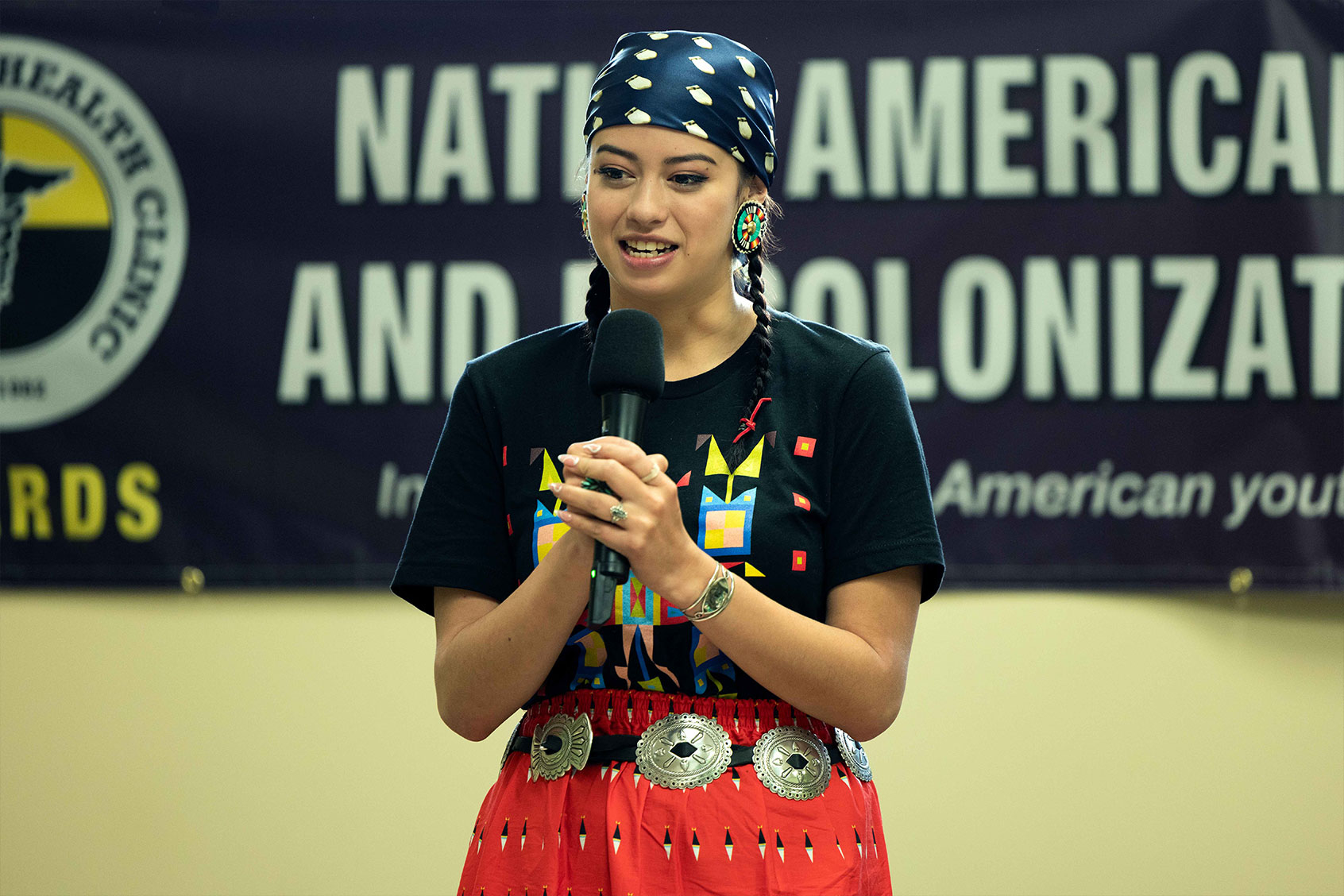
That’s how she came to Sterlin Harjo and Taika Waititi’s comedy “Reservation Dogs.” In Wednesday’s episode “Decolonativization,” directed by Tazbah Rose Chavez and written by Erica Tremblay, Midthunder plays TikTok influencer Miss Matriarch, a guest speaker for the Native American Reclamation and Decolonization Symposium (yes, NARDS). Our favorite Okern, Oklahoma teens reluctantly file into the Indian Health Clinic to attend the symposium, lured in by the promise of a Sonic gift card.

Before Miss Matriarch kicks off the day’s NARDS activities, she takes to the stage for the traditional land acknowledgment. Well, traditional – with her own earnest twist.

“Before we start I want to acknowledge the traditional caretakers of this land: the Caddo, the Osage and the Muscogee, of course,” she says. “But before them were our Neanderthal relatives, so acknowledge them. And before that even, the dinosaur nation, Dinosaur Oyate.”

Midthunder plays Miss Matriarch as kind and eager, perhaps a little bit too eager. As with everyone on “Reservation Dogs,” there’s a laser-focused truth to her character that becomes entertaining in its specificity. This might be Midthunder’s first outright comedic role, but it certainly won’t be her last. While “Reservation Dogs” is a scripted series, she was able to add some of her own touches to that grand speech. 

“You don’t go in thinking like, ‘Oh, I’m gonna plan to riff on this or riff on that,'” she said. “But they give you [prompts] and open you up. Sterlin and Tazbah spoke to me. That was all a guided improv like, ‘Talk about Neanderthals and just keep going. Take it all the way to dinosaurs and stars and all kinds of stuff.'”

“Oyate,” meaning “the people” or “nation” is just one of many Lakota phrases that Midthunder naturally drops into the speech. It’s a language the actor already knew, unlike Comanche, which she had to learn for “Prey.”

“That’s the language that I grew up with in my house. I’m Lakota, Nakota and Dakota,” said Midthunder. “And my dad is conversational in I think all three. Miss Matriarch was written as Lakota. Tazbah was like, ‘Throw in as much as you want to.’ So that’s when I said, ‘Dinosaur Oyate,’ or whatever.”

Reservation DogsPaulina Alexis, D’Pharaoh Woon-A-Tai, Lane Factor, Devery Jacobs and Elva Guerra in “Reservation Dogs” (Shane Brown/FX) 
“The amount of times I’ve heard the real version of acknowledging – ‘Everybody that came before you and everyone that will come after you’ – those words and then putting them in the environment that makes them funny was cool. Those are the kinds of jokes that you make, but in another space it wouldn’t be funny. Nobody would get it. But in that world, ah, it feels so good to make those kinds of jokes.

Check out the rest of Salon’s interview with Midthunder.

This interview has been edited for length and clarity.

How did you come to join this episode of “Reservation Dogs”?

“Her wardrobe was very distinct in the script. When I first got the audition, she was written as wearing ‘mismatched regalia.'”

Obviously, my mom casts it, but it’s not up to her. Anytime they wanted me to do anything I would have said yes. When I got the audition, I had so much fun with this character and the concept and how there was so much room to play and be silly, which I’ve not done before in my acting. Also, I think “Reservation Dogs” balances so well poking fun at things that are real, then really doing something that just punches you in the stomach. That to me is what I really admire about the show.

Have you attended any of these types of youth symposiums before? Obviously certain things are heightened for comedy, but how accurate is it? We see a potato dance, journaling and various trust exercises.

Yeah, definitely throughout my life and my childhood I’ve been in these situations where you’re at some kind of event, and you have adults talking to you about stuff, and you’re like, “I’m just here for the just here for the games. I’m here to hang out with my friends.” And they’re doing something really deep. It’s also why it was funny, being on the other side, playing a character like this. She truly genuinely believes in what she’s doing, just really actually thinks that she’s doing a good thing. So it was fun and funny to get to play.

Reservation DogsAmber Midthunder in “Reservation Dogs” (Shane Brown/FX)

How was it as for you to approach this role? She’s funny, but also kind of sweet too.

I had a lot of conversations about her. She really genuinely believes that what she’s doing is the best way to do that. She’s one of those people who just over-“sacred-ifies” everything, like smudging with the smoke, just ridiculous. She’s misguided. 

Miss Matriarch’s outfit was spot-on in that every item was piled on to convey her identity: the beaded earrings, the concha belt, the ribbon skirt, everything. Was there any discussion about her attire?

Her wardrobe was very distinct in the script. When I first got the audition, she was written as wearing “mismatched regalia.” And that’s when I was like, “Ah!” And then they changed that to be a little bit more regular. The fitting was so much fun. Honestly, that fitting was such a cool one because there were so many different Indigenous designers and jewelry makers, regardless of the character. 

And then, thinking about who it was for and having that freedom to go three steps extra was really silly, but it was so much fun. Those earrings are earrings that I would really wear. And that was a really nice ribbon skirt. I would wear all those things. But when you put them all on together at the same time and then you walk into an IHS, you’re like, “What am I doing?

“The action roles that I’ve ended up doing, I think are these happy collisions of characters that I find interesting, or that I connect to with filmmakers who I really respect.”

Also culturally specific but so different was the wardrobe you had to wear as Naru for “Prey.” What was great was you didn’t have to wear a corset or whatever one usually associates with period pieces. But you had to perform a lot of action in it. Was it comfortable?

I mean, compared to a corset, yes. But I worked for so long, and at times it was in the 90s, and you’re running up a mountain. Buckskin is really hot. Or if the buckskin has been washed for five days in a row, it turns into rawhide.

But I think that the costume was great. Having pants instead of a dress, I think is true to her character because that’s what she was doing on her own. But she still has the earth paint colors and her family designs and twisted fringe and stuff like that. Those are all real. And then she has her own personal flair.

PreyAmber Midthunder as Naru in “Prey” (David Bukach/20th Century Studios)Between “Prey” and “Legion,” you’ve done a lot of action. Do you get something extra by acting through movement, because so much of the movie was not silent, but it wasn’t based on dialogue?

I definitely do. The action roles that I’ve ended up doing, I think are these happy collisions of characters that I find interesting or that I connect to with filmmakers who I really respect, who if it wasn’t an actual role I would still want to be working with. I happened to get to do really fun or really crazy, really cool things, and then that becomes a part of the story. Action for the sake of action can be very impressive, but weaving that into a narrative, I think is when done well can be so delectable. That’s what I’ve been able to be a part of . . . where the action is truly a part of the expression of the story or the character.

“Prey” is also groundbreaking in that it’s the first movie to have a full Comanche dub where you had to record audio for the film a second time. Have you watched the full Comanche version?

We did I think six screenings or something in our press room before we launched; we’d done a pre-screening there in Oklahoma City and then in Lawton for the Comanche Nation – but they were happening at the same time. The screening that I sat was in Comanche, and I didn’t know it was going to be Comanche. I sat down and there were subtitles. And I was like, “Why are there subtitles? We should turn the subtitles off.” And then it started, and I was like, [gasp!] So yeah, that was when I saw it – in Oklahoma with the Comanches.

So many stories were written about Sarii, your dog companion in “Prey.” Did you expect that sort of reaction?

I guess watching the movie, she is great. But while she had a lot of energy and was really cute, she was not a movie dog. She was a dog that got trained for our movie. So to see that she had a real character is so cute. The dog that I see in “Prey” is a totally different dog than I knew. And I’m like, “Wow, she’s a good little actor.”

PreyAnia (Cody Big Tobacco), Itsee (Harlan Kywayhat), Wasape (Stormee Kipp), Taabe (Dakota Beavers) and Naru (Amber Midthunder) in “Prey” (Photo courtesy of 20th Century Studios)What do you feel that you learned about yourself on both “Prey” and “Reservation Dogs”?
The thing that stands out to me about both of those, especially having them so close together was being in a space with so many Indigenous people on set. It provides a level of comfort that I’ve never experienced before because there’s just things that are normal, and there’s just things that are understood, and there’s just things that make sense. Whether or not that’s a work environment, just anytime that you’re around somebody who shares the same culture as you, there’s just things that you don’t have to explain, there’s things that you can’t explain. Being able to share those things and have that in the workplace was a completely unique experience that became really infectious.


Want a daily wrap-up of all the news and commentary Salon has to offer? Subscribe to our morning newsletter, Crash Course.


I noticed you had directed a short before. Do you think you’d like to tackle directing a TV shows sometime in the future?

It’s funny, I directed two short films when I was in high school. I mean, I have so much respect specifically for directing; I think it’s a huge job. I’m sure it’s in my future somewhere very, very far down the line. I did produce a film in the pandemic that is out streaming now called “The Wheel,” and it premiered at TIFF last year. Developing and being involved creatively in a long process is what I found that I really enjoy. Finding the story that I love, developing it, moving through the phases and seeing it from being a little egg until it’s a full creature is what I really enjoy. So I think that that’s probably more my interest, producing and developing and obviously, acting.

“Reservation Dogs” and “Prey” are streaming on Hulu. 

Republicans react to damming DOJ filing of found Mar-a-Lago docs with cries of “staged” evidence

A new Justice Department filing released Tuesday revealed that White House records kept in a storage room at Donald Trump’s Mar-a-Lago resort were “likely concealed and removed” before the FBI’s investigation into the former president’s mishandling of sensitive material. The 36-page Department of Justice (DOJ) filing included a new set of 100 documents with classification markings and a picture of the classified documents featuring files labeled “Top Secret” and “Secret” atop ostentatious Mar-A-Lago carpet. Amidst the revelation that the former president apparently attempted to obstruct a federal investigation in the months leading up to the search, his right-wing defenders are flailing to find any way to detract from and dismiss the explosive news. 

For his part, Trump released a statement on Truth Social saying he “declassified” all of the documents, which his lawyers did not mention in their lawsuit. In typical Trump fashion, he blamed the FBI for taking pictures of documents they wanted “kept secret” and painted himself as a victim.

The released photograph also includes an interesting discovery: A framed TIME magazine cover with faces of Trump’s previous 15 Democratic challengers – some smiling – looking into the Oval Office where an anxious Trump is sitting. The picture, which has garnered a decent amount of attention on social media, received outsized attention from conservative circles.

The Republican minority on the House Judiciary Committee responded to the picture in a sarcastic tone, tweeting “That TIME Magazine cover was huge threat to national security.” 

Other conservatives on Twitter refused to acknowledge that the picture is real.

Texas Republican Rep. Ronny Jackson went to Fox News to cast doubt on the DOJ’s filing. “No one trusts the FBI or the DOJ anymore. I don’t trust them any further than I can throw that entire building,” the former Obama administration member complained. “I’m just going to say, if they told me that they found something, I wouldn’t know that they actually found it there or if they just said they found it there.”

“I don’t know if the DOJ and FBI can be trusted to tell us what was in there,” echoed South Dakota Governor Kristi Noem on Fox News. “That’s the thing. You can see folders and big words on the — do we know that is really what President Trump brought to his home? Do we know that he put them there?”

Former Acting Director of the United States National Intelligence Richard Grenell linked to a tweet by New York Times reporter Maggie Haberman, calling on her to stop “swallowing the government’s constant spin” and to “do journalism.”

“Staged photo of declassified papers protected by the U.S. Secret Service,” Grenell tweeted. “Nothing was available digitally – like Hillary had.” 

President of the far-right group Judicial Watch, and Trump’s one-time lawyer, Tom Fitton also backed this false claim saying that “The Biden FBI staged a dishonest photo with purportedly classified material” and called government agencies “irredeemably corrupt.” Fitton, who is a prominent conservative, has previously advised Trump from returning records to the National Archives and has referred to the FBI’s search of Mar-A-Lago as the “Biden raid.” 


Want a daily wrap-up of all the news and commentary Salon has to offer? Subscribe to our morning newsletter, Crash Course.


Last week, the House Judiciary Committee tweeted their own illustration of the “Trump raid affidavit” with a majority of the document redacted and replaced by lyrics to Never Gonna Give You Up by Rick Astley. 

Representative Eric Swalwell (D-CA) responded to the Tweet saying “If you’re willing to let teenagers to be sexually abused I guess you’re willing to look the other way when FPOTUS risks the lives of our troops” to which the committee deflected by tweeting out a picture of Swalwell posing next to a suspected Chinese intelligence operative Christine Fang, asking how many secrets he spilled to the spy. Fang reportedly took part in fundraising activity for Swalwell’s 2014 re-election campaign and helped place an intern in his office. But upon learning about Fang’s activities from federal investigators, Swalwell cut off all ties with Fang and wasn’t accused of any wrongdoing. Still, Trump’s defenders got “Fang, Fang” to trend on Twitter early Wednesday as news of the DOJ’s filing circulated.

Liz Cheney, the recently ousted Republican representative who in a previous interview shared her “disgust” over Trump’s targeting of the FBI agents who searched his Mar-A-Lago estate, was one of the few conservatives to criticize Trump following this latest breaking news. She tweeted out a picture of the documents: “Yet more indefensible conduct by Donald Trump revealed this morning.”

Fox & Friends host stumps Kristi Noem: Why did Trump “have all that secret stuff at Mar-a-Lago?”

Donald Trump’s allies have offered a variety of excuses for the former president hoarding classified documents at Mar-A-Lago, but Fox News host brushed away those arguments with a key unanswered question.

South Dakota Gov. Kristi Noem appeared Wednesday on “Fox & Friends,” where she suggested the Department of Justice should allow a special master to look through the seized materials for anything that might be covered under executive privilege, but prosecutors say Trump has no standing to make that request because the documents belong to the government, not the former president.

“The one thing I’ve heard across this country, Republicans, Democrats, the public, they don’t trust the DOJ and they want this to be transparent,” Noem said. “They don’t think they need a special master to come in and look at this, that’s ridiculous. Hiding these documents and this information, keeping it within the DOJ is wrong. It needs to be transparent so people can build trust back in the FBI and the DOJ and what they’re doing.”

None of those arguments matter, Doocy said, because Trump and his team have never justified any reason to take those from the White House when his presidency ended.

“Ultimately comes down to what he had all that secret stuff at Mar-A-Lago,” Doocy said. “I know his team said that they’ve declassified it, but that’s news to the agencies that those documents belong to and, governor, he had apparently three classified documents in his desk, and as Brian [Kilmeade] detailed, the stuff on the floor, it shows five yellow folders marked top-secret and another says secret SCI, which means sensitive compartmentalized information. Those are the biggest secrets in the world.”

The government has been asking for those documents for months, but Trump turned over only a portion of what had been requested, and investigators said his attorneys filed false statements about what he had and where those materials were located.

“Apparently the former president went through them in January,” Doocy said. “Why wouldn’t he say, ‘You know what? I need to turn that back over.’ Why would he have all that stuff at Mar-A-Lago?”

Watch video below or at this link.

From miso paste to marmalade, here are 5 unconventional toppings to try on fresh popcorn

Microwaveable popcorn has been a go-to snack of mine since I was a kid. From generously sized bags of Orville Redenbacher’s Movie Theatre Butter popcorn to Pop Secret’s Kettle Corn popcorn and Newman Own’s Sea Salt popcorn, the puffed treat was always found in abundance in my family’s kitchen pantry.

Over the past couple of months, I’ve been upping my popcorn game with different seasonings & spices. My favorite pairings are nutritional yeast with ghee — inspired by Lesser Evil’s Organic Vegan Butter + Himalayan Salt Popcorn and “No Cheese” Cheesiness Popcorn — and parmesan with both garlic powder and red pepper flakes. I also really like a Cinnamon Toast Crunch inspired popcorn made with melted butter, avocado oil, granulated sugar and ground cinnamon.

When it comes to flavoring popcorn, the possibilities are truly endless. Alongside classic flavors, there are a handful of wacky options — such as eggnog, bacon bourbon caramel and cotton candy — emerging as fan-favorites, thanks to a slew of gourmet popcorn shops.   

Here at Salon Food, we’re looking forward to taste testing these unconventional flavors and recreating them at home. To help us get started, we scoured a few specialty shops online and spoke with Joshua Resnick, chef-instructor of Culinary Arts at the Institute of Culinary Education (ICE). Resnick shared his favorite topping (it includes white miso paste) and other unusual flavors — salty, sweet and a mesh of both.

Alcohol

Joe & Seph’s, a UK-based gourmet popcorn company, has an entire line of “tipsy” popcorn flavors that are inspired by wines and traditional cocktails. Their Gin & Tonic Popcorn, Irish Coffee Liqueur with White Chocolate Caramel Popcorn and 007 Dry Martini Popcorn are just a few popular varieties. Other eye-catching flavors include their Prosecco Popcorn, Caramel Macchiato & Whisky Popcorn and Espresso Martini Popcorn.

Each variety contains at least 5% alcohol by volume and is coated in smooth caramel infused with the liquor of choice. The resulting concoction is a sweet and slightly boozy popcorn that tastes almost like the real deal!

The brand also has a line of beer-flavored popcorn infused with caramel. A few varieties include the German Weissbier Popcorn, BrewDog Goats Cheese & Black Pepper Popcorn and BrewDog Madras Curry with Black Onion Seed & Lime.

All of Joe & Seph’s popcorns can be purchased online via their official website and shipped throughout the United States, Canada and Europe.

White Miso Paste

White miso paste, a versatile ingredient made from fermented soybeans, rice, salt and water, is oftentimes used in marinades, salad dressings and soup stocks. Surprisingly, it can also be added on popcorn, according to Resnick.


Want more great food writing and recipes? Subscribe to Salon Food’s newsletter, The Bite.


“At a restaurant I used to work at, we used to cook down white miso paste in butter, then add in raw kernels from the cob and sauté them with a little bit of red pepper flakes,” he explains. “And then you top it with a poached egg in a bowl. And you get this kind of rich, umami flavor — it’s kind of like the flavor of an aged cheddar cheese.”  

The miso paste can also be slathered on popcorn alongside sprinkles of Furikake seasoning, per this recipe from Veggiekins Blog. For a sweeter option, try this Caramel Miso Popcorn recipe which includes splashes of agave, vanilla extract and sriracha.

Togarashi

Also known as “Japanese chili pepper,” this seven-spice blend consists of toasted nori, dried orange zest, toasted sesame seeds, black pepper, crushed red pepper flakes and dried garlic. Like other seasonings, Togarashi tastes great on popcorn, both salty and sweet. Popcorn sprinkled with togarashi, lime zest and salt is a spicy-tangy variety you can easily make at home. For a sweet twist on togarashi popcorn, try adding a tablespoon of honey.

Togarashi can be purchased at your local grocery stores or on Amazon and Instacart. If you want to make the blend from scratch, check out this simple guide from Food52.

Ketchup

Although Resnick advises against using liquids as toppings for popcorn (the wet consistency ruins both its texture and airy crispness), ketchup and other condiments, like mustard and tabasco sauce, can still be drizzled on popcorn as long as the popcorn is baked in the oven afterwards.

For ketchup popcorn, check out this short-and-sweet recipe from Chatelaine that calls for ketchup, butter, granulated sugar and salt. If ketchup isn’t your cup of tea, try this Honey Mustard Popcorn recipe from Tasty which adds onion powder, white vinegar and honey to its list of seasonings. And lastly, if you’re looking to step outside your comfort zone, check out this recipe for Tabasco Honey Butter Popcorn. The popcorn is popped in tabasco sauce and coated in a mixture of unsalted butter, honey, extra tabasco sauce and kosher salt.

Orange Marmalade

Joe & Seph’s Orange Marmalade Popcorn is a “winner of 1 star in the Great Taste Awards in 2015 and a big favourite of Paddington Bear,” per their official website. The fan-favorite treat, which is coated in buttery caramel and zesty orange marmalade, is a sweet variety of popcorn with a citrus kick.

To make your own marmalade topped popcorn at home, simply stir sugar, water, marmalade, salt, light corn syrup and vinegar in a saucepan and bring to a boil. Pour the sugary sauce on top of freshly popped popcorn and mix until coated evenly. You can leave the popcorn as is and enjoy or combine small handfuls of the mix to make marmalade popcorn balls.  

Salon Food writes about stuff we think you’ll like. Salon has affiliate partnerships, so we may get a share of the revenue from your purchase. 

Trump unleashes factually dubious Truth Social attack on FBI for releasing photo of Mar-a-Lago docs

Former President Donald Trump has come up with yet another defense of his decision to stash top secret national security documents in his Mar-a-Lago resort — and now he’s saying that it’s actually the FBI that is mishandling classified information.

Writing on Truth Social Wednesday morning, the twice-impeached former president attacked the FBI for taking photographs at Mar-a-Lago showing that Trump had held onto documents that were clearly marked as “top secret,” despite the fact that his lawyer signed a sworn statement earlier claiming that all classified documents taken by Trump from the White House had been returned to the National Archives.

“Terrible the way the FBI, during the Raid of Mar-a-Lago, threw documents haphazardly all over the floor (perhaps pretending it was me that did it!), and then started taking pictures of them for the public to see,” Trump wrote. “Thought they wanted them kept Secret? Lucky I Declassified!”

In fact, the photos released by the FBI do not show any of the information contained within the top secret documents and only reveal cover sheets that mark their classification status.

Additionally, there is no evidence that Trump ever declassified any of the documents he brought with him to Mar-a-Lago, and national security experts have suggested that his claim to have issued a “standing order” to mark all of them as declassified is nonsense.

Trump’s Truth Social rants against the FBI inadvertently undercut his main January 6 defense

Over the course of the January 6 committee hearings earlier this summer, Donald Trump defenders churned through a number of defenses, each less plausible than the last. The committee then sliced through them all. They dispelled not just the sillier claims, such as Rep. Marjorie Taylor Greene, R-Ga., blaming the Capitol insurrection on “antifa” or Fox News host Tucker Carlson blaming imaginary FBI instigators, but they also dismantled some of the more robust, though still unlikely, defenses. Trump, his defenders argued, somehow didn’t know what the rioters were going to do and the siege was organized without his knowledge, etc. Eventually, Trump defenders landed on the “too stupid to know better” defense, arguing that Trump just really believes the Big Lie.

Yes, they were defending him by arguing he’s delusional. The idea is that they could claim Trump’s innocence by framing him as befuddled enough to sincerely believe he was defending, instead of trying to overthrow, democracy. Setting aside the question of whether it’s wise to support the presidential aspirations of someone so deluded, the members of the January 6 committee rejected the “too stupid to know better” defense. On July 12, Rep. Liz Cheney, R-Wyo., dismissed this defense in her opening statement: “President Trump is a 76-year-old man. He is not an impressionable child.” She reiterated that there was overwhelming evidence that advisors repeatedly told Trump he had lost the 2020 election and there is no way he can reasonably be believed to be confused. 

Still, the question of whether Trump is a liar or merely delusional when it comes to the conspiracy theories he touts continues to linger. At least, that is, until early Tuesday morning, when Trump unleashed one of those lengthy social media rants that became so normalized prior to his Twitter ban

Trump inadvertently proved the argument of the January 6 committee: He doesn’t actually believe his own conspiracy theories.

The impetus for this particular 60-post stream on Truth Social, his own faltering social media app, appears to be anger over the Department of Justice continuing to push for classified documents Trump is illegally holding onto. The actual content of the rant was disarrayed, touching on anti-vaccination conspiracy theories, vitriol towards President Joe Biden, and QAnon talk. 


Want more Amanda Marcotte on politics? Subscribe to her newsletter Standing Room Only.


While it seemed motivated by the so-far unrelated scandal over classified documents, in this rant, Trump inadvertently proved the argument of the January 6 committee: He doesn’t actually believe his own conspiracy theories.

As the committee posited, and his Truth Social rant proves, Trump leverages claims he knows are untrue for no other purpose than to rile up his supporters, confuse the public discourse, and attempt to gain political leverage from the chaos. Mixed in with the various memes Trump posted were some conspiracy theories we can know for a fact he understands are false. First, there are the anti-vaccination conspiracy theories, complete with a fabricated quote from his own daughter. 

It’s not just that the quote from Ivanka Trump is fake. We can know that Trump does not believe in anti-vaccination conspiracy theories because not only did he personally get vaccinated against COVID-19, he spent months speaking proudly of the vaccines as if he had invented them and asked his followers to get vaccinated. It was only after getting major pushback from an anti-vaccine base that Trump stopped talking up the vaccines. It was only after the anti-vaccine “occupation” of Ottawa demonstrated that the anti-vaccine cause could be harnessed for political violence that Trump really showed much interest in the conspiracy theories at all. 

It’s the same story with the QAnon conspiracy theories Trump posted. 

The QAnon cult posits that Trump is secretly masterminding a plot to bring down a worldwide cabal of pedophiles. We can know for a fact that Trump does not believe this conspiracy theory, as he has better knowledge than any other person alive how much he is not the mastermind behind a secret plot to bring down a worldwide cabal of pedophiles. 

Trump will repeat a conspiracy theory because he thinks doing so serves his ends, not because he believes it. 

Because of this, we can conclude that what draws Trump to a conspiracy theory is not, as his defenders argue, sincere and well-meaning gullibility. Instead, his motives appear entirely opportunistic and self-serving. He will repeat a conspiracy theory because he thinks doing so serves his ends, not because he believes it. 


Want more Amanda Marcotte on politics? Subscribe to her newsletter Standing Room Only.


To be certain, this is just more confirmation of what was already obvious, that Trump knows he’s lying when he says he’s the rightful winner of the 2020 election. As Dan Friedman at Mother Jones reported in July, a leaked tape shows Trump’s close friend and advisor Steve Bannon outlining the plan to a group of associates: “What Trump’s gonna do is just declare victory. Right? He’s gonna declare victory. But that doesn’t mean he’s a winner. He’s just gonna say he’s a winner.”

Still, it’s not surprising that until now, Trump has carefully avoided signing off too openly on conspiracy theories that there is no possible way that he could actually believe. He benefits, as the “he really means it” defenses of the Big Lie demonstrate, from the air of mystery over whether he really believes the false things he says. By openly endorsing conspiracy theories he simply cannot believe, Trump has pulled back the curtain and shown that the wizard of Oz knows he’s just faking it. 

Why Trump is now openly endorsing conspiracy theories he used to tapdance around isn’t too mysterious: He and his allies have been drastically escalating rhetoric that unsubtly invites political violence in response to the FBI’s efforts to recover classified materials that Trump has been illegally holding on to. By blitzing out these conspiracy theories, he’s sending signals to the most unhinged people in his base. And they are most definitely hearing the signals he’s sending. As NBC News reports:

Users of QAnon forums rejoiced at Trump’s apparent endorsement of the conspiracy theory and its mythology. The top response on the most visited QAnon forum to one of Trump’s posts about the conspiracy theory read simply, “Wipe them out sir.” Others pleaded with Trump to “nuke them from orbit” and to “sir, please finish them off,” referring to QAnon enemies such as Hillary Clinton and President Joe Biden.

Trump’s response to the anti-vaccination conspiracy theories over the past year also gives us another clue. He didn’t like those conspiracy theories until the Ottawa occupation, which demonstrated that anti-vaccination rhetoric may provoke violence-minded organizing. After that, he was invested. 

Ultimately the “too stupid to know better” defense is a legal defense, not a political one. Even in the current hyper-partisan environment, it’s a tough sell, arguing that Trump should be president again despite his own supporters believing he cannot tell truth from fiction. No, the idea that Trump attempted a coup because he was caught up in a delusion that he was righting a wrong is a clumsy attempt at making a “mens rea” argument towards innocence. The January 6 committee has already done most of the important work in dismantling that argument by establishing how his own lawyers and advisors told Trump the truth about losing the 2020 election. Still, it can’t hurt that Trump just established a very public record of endorsing conspiracy theories he cannot possibly believe, showing once and for all that he knows full well the lies he tells are just that — lies. 

Trump loses it on Truth Social over scathing op-ed in Rupert Murdoch-owned newspaper

Former President Donald Trump complained on his Truth Social website after the NY Post posted a harsh editorial online on Tuesday evening.

“Attorney General Merrick Garland’s raid on Mar-a-Lago has ex-President Donald Trump back in the news. That’s a problem for Republicans, who need to move beyond him,” argued the tabloid, owned by Rupert Murdoch’s News Corp.

The editorial said the current dynamics “should make for a Republican landslide” in the 2022 midterm elections.

“But if the focus is on Trump instead, enraged Democrats will unite, pause their internecine warring while independents will abstain or vote against the GOP,” the NY Post wrote.

In the tabloid’s view, “most Republicans would rather the ex-president go away.”

“Those GOPers know Trump’s already an albatross: His “stolen election” derangement in late 2020 is why Dems control the Senate now, and his endorsements in this year’s primaries have helped saddle Republicans with enough weak Senate candidates this year that retaking the chamber seems increasingly out of reach,” the NY Post wrote. “Plus, for all the tens of millions Trump has raised since leaving the White House, he hasn’t yet spent any of it even to help the candidates he’s endorsed.”

The editorial noted Democrats think they may even hold control of the House of Representatives.

“The next 10 weeks will be decisive. Democrats and the media will want to keep it all about Trump — he’s great for ratings and clicks, and they don’t want to review Biden’s horrific record anyway,” the NY Post wrote. “Republicans, and their candidates, need to keep the focus firmly on the big picture. Namely: Biden and the Democrats are an ongoing disaster — and Donald Trump is no help in digging America out of it.”

Permanently suspended from Twitter, where he had 88.6 million followers, responded on Truth Social, where he has less than 4 million followers.

Trump said the tabloid was “once my favorite newspaper” and suggested the editorial was a defense of Sen. GOP Leader Mitch McConnell, R-Ky.

Trump argued against the conventional wisdom that he was to blame for Republicans losing both Senate runoff elections in Georgia, giving Vice President Kamala Harris the tie-breaking vote and allowing Democrats control of the chamber.

“Sadly, the media in our Country is so afraid of being sued that they never want to mention anything having to do with the corrupt Election of 2020!” Trump argued.

Unlike Twitter, Trump’s Truth Social website does not offer threaded conversations or allow posts to be embedded on different websites.

Truth Social screengrab (Truth Social)

Ex-Mueller prosecutor details four possible criminal charges against Trump laid out in DOJ filing

A former prosecutor on Robert Mueller’s team explained how the Department of Justice had already revealed evidence that former President Donald Trump was guilty of at least four crimes.

Andrew Weissman, a veteran federal prosecutor who worked on the special counsel investigation into Trump’s ties to Russia, examined the department’s late-night filing, which ran 40 pages long and included a photo of classified materials found stashed in boxes and desk drawers at Mar-A-Lago.

“What the DOJ brief said silently but clearly: Trump is guilty,” Weissman tweeted.

The former prosecutor summarized the government’s position, which shows that Trump knew he had highly classified materials and lied to the government to hide the 26 boxes of documents for more than 18 months, and they had evidence he knew where those items were located at his private resort.

The documents were found with Trump’s passports and other personal items, and the former president’s lawyers gave false statements to DOJ about where the items were located, even after being served with a subpoena, Weissman said.

“Do you think this all happened for 18 months WITHOUT Trump knowing, and his lawyers did this without consulting with the client?” he said.

“And all this evidence is BEFORE we consider witnesses who we called at the trial about Trump’s knowing that he should not take docs from WH, and should send them to Archives, that he was in charge of packing material from WH, that the process was secretive, that the lawyers [Evan] Corcoran and [Christina] Bobb could not ethically file the certification without discussing with Trump.”

He said the former president’s attorneys will be required to reveal who authorized their false statements, and surveillance video and witnesses will show who moved the boxes to obstruct their discovery — and Weissman said the evidence will be too much for Trump to overcome.

“There is only one verdict consistent with this proof; we ask you to return a verdict of: guilty on espionage related charges (793/2071); guilty on contempt of GJ subpoena (402); guilty on obstruction related charges (1001/1519) guilty on unlawful retention of govt docs (641),” Weissman said.

Plastic-coated agricultural chemicals are destroying human and planetary health

A corn, wheat, or potato farmer browsing for fertilizers to improve crop yields might come across a product called Environmentally Smart Nitrogen (ESN). The promise of ESN, which, has been made by Canadian fertilizer manufacturer Nutrien (and before that, by the company’s predecessor, Agrium) since 2000, is that its “polymer membrane,” which encapsulates the nitrogen—a chemical element that is necessary for plants to grow—will release that input slowly and efficiently. The implication, in part, is that this will prevent an excess of nitrogen from poisoning water and soil, which is a common occurrence in communities where a lot of industrial farming takes place. A product safety page advises that the United States Department of Agriculture’s EQIP program might even provide American farmers with some funds to purchase ESN as an environmental improvement practice. (In response to a request for comment, USDA issued a statement saying that “Any controlled release agrochemical could be included in a program payment for the associated conservation practice if it has been peer-reviewed through research, supported by the Land Grant University for use, and the conservation practice criteria includes controlled release.”)

And yet, according to a new report released by the Center for International Environmental Law (CIEL) titled Sowing a Plastic Planet, ESN and similar so-called “controlled-release” agrochemicals produced by petrochemical giants — not just Nutrien’s ESN but also ICL Specialty Fertilizer’s Osmocote and BASF’s DuraGuard ME, for example — are anything but environmentally advantageous or sustainable. In fact, their “polymer” shells are plastics that, when paired with synthetic chemicals, could actually increase the toxic risks associated with the chemicals and overload soils with even more plastics than before. The effects are a detriment to human, animal and planetary health. (FoodPrint reached out to Nutrien, ICL and BASF for comment; none of them responded.)

A potent threat to people and the environment

The report’s authors write that synthetic agricultural inputs are already “some of the most toxic substances in use today,” responsible for killing off soil microorganisms, creating chemical-resistant weeds and endangering the health of the farmworkers who spray them, for starters. They’ve also been shown to exacerbate the effects of climate change, since applications of synthetic nitrogen fertilizer causes soil to emit the potent greenhouse gases carbon dioxide and nitrous oxide.

Concurrently, microplastics are turning up in our water, soil, air and in human blood, tissue and waste; they emit greenhouse gases as they degrade, also kill off soil microorganisms, and can cause cancers and neurological and respiratory (among other) problems when we ingest or inhale them.

By using plastics to encapsulate chemical inputs that are applied directly to soil and crops, manufacturers are creating products that are “more dangerous, and for longer,” says CIEL president Carroll Muffett. “There’s a long-standing recognition of the profound human health and environmental risks of pesticides and fertilizers, and a growing recognition of the diverse impacts of the plastics lifecycle and the pervasive presence of plastic pollution. Here, these issues are converging in a way that is really stark in highlighting the risks of our fossil economy.”

A toxic stew

Plastic-coated agricultural chemicals have been around since the 1960s, although companies marketing them as “planet-safe” and “sustainable” is new, and the chemical companies’ own research shows these claims to be not well-substantiated, say the CIEL authors. The United Nations’ Food and Agriculture Organization (FAO) estimates that 100,000 tonnes of plastic per year are dumped into the environment from plastic-coated fertilizers alone; according to CIEL, agrochemical companies are planning to vastly expand the market for these and other encapsulated chemicals, which will let loose even vaster amounts of microplastics on the environment.

Both plastics and agricultural chemicals are harmful in their own rights. Making matters so much worse is the fact that plastics can adsorb those chemicals they encapsulate — that is, the chemicals adhere to their surfaces; plastics also “adsorb other toxins from the environment,” says Muffett, to become what the UN Environment Programme calls “toxic time bombs.” Muffett points out that “when the oil industry was researching oil pollution in the Gulf of Mexico in the 1960s and ’70s, they kept finding microplastics with oil and other pollutants adhered to them” — an indication that the industry has been aware of this dynamic for over 50 years.

The CIEL report cites a 2019 study from Oregon State University, which found that “a common insecticide with the active ingredient en­capsulated in nanometer-sized plastic was more toxic than apply­ing the same active ingredient” on its own. Encapsula­tion, one of the OSU researchers told CIEL, “is thought to enhance toxicity and mobility, because it pre­vents the active chemical ingredient from breaking down in wa­ter, which would dilute the toxicity, and it allows the chemical to be transported further away from the point of application, enhancing potential exposure.”

Meanwhile, those toxically loaded microplastics break down into even smaller nanoparticles, which accumulate in soil at a rate of 50 kilograms per hectare per year, and they remain for no one knows how long. From there, they leach into air and water, and are also taken up by plants growing in that soil — all of which are pathways for these plastics to enter the bodies of humans and wildlife. In the soil itself, microplastic pollution might interfere with nutrient cycling, negatively impact plants’ rooting ability and earthworms’ growth and health, and impair soil’s ability to store carbon.

These encapsulated chemicals are “not only dangerous, but also unnecessary,” according the CIEL authors, who write that effective, non-chemical alternatives to their use — sulfur and biochar among them — exist.

Keeping the fossil fuel industry in business

Anna Lappé, director of the Food Sovereignty Fund at Panta Rhea Foundation, which provided some support for the CIEL report, says the addition of plastics to agricultural chemicals — far from being essential to the health and productivity of food systems — “is one of the many worrisome ways the fossil fuel industry is continuing to find new markets,” while environmental legislation has increasingly focused on switching from oil and gas to wind and solar power.

Plastics and many agricultural chemicals are made from fossil fuels, and Muffett connects the dots between the various industries. Oil and gas businesses, he says, “have very active agricultural chemical businesses, which [in turn] have large-scale businesses in the production of plastic resins and related polymers — these are the corporate actors often pioneering the technologies that allow this sort of encapsulation to work . . . and they have a clear vested interest in keeping plastics in these products.”

Margaret Reeves, senior scientist at Pesticide Action Network North America (PANNA), calls the CIEL report “a big eye-opener; even folks who study and follow the industry are surprised [by it], which is pretty alarming.” She’s concerned about links the report establishes between controlled-release chemicals and damage to the soil microbiome, which only increases the need for increased use of fertilizers, “creating a feedback loop,” she says. She says the obvious solution to the addition of microplastics to agricultural chemicals would be to ban those chemicals outright — unlikely in the US with an Environmental Protection Agency (EPA) chemical office that “isn’t doing what they’re supposed to do,” she says, “to prohibit the use of all but a miniscule number of highly hazardous pesticides. The agency could, however, and should, refuse to register the formulations of the pesticides that include microplastics; that should be an immediate request.”

Nevertheless, she sees hope in legislation that was enacted in California, which banned the insecticide chlorpyrifos starting in February 2020. “There’s 10,000 more [chemicals] behind it” needing to be banned, she says, including the remainder of the organophosphate pesticides, “but what happens in California is important globally . . . and that action had a big impact on the subsequent federal [EPA] decision” to ban the pesticide. (Although, EPA still permits the use of chlorpyrifos, which damages the human nervous system, for some non-food related uses.)

Muffett calls encapsulated agricultural chemicals “the very definition of a controllable source of pollution” since he says they’re wholly unnecessary, and one the EU’s chemicals agency has already been looking to regulate. Recognizing the challenge of getting the US to ban such chemicals outright, he believes that action by the EU and “a major market like California could dramatically transform the economics associated with producing these materials,” he says, in addition to improving the environment and human health in the regions where those products are disallowed. “By raising awareness of the content of [controlled-release chemicals], we give more and more farmers the recognition of what they’re using and the option to opt out, and more and more members of the public the tools to demand action and change.”

Fox News host stunned after DOJ revelation: “These are these are the biggest secrets in the world”

The United States Department of Justice filed an extraordinary legal briefing late Tuesday night revealing that it has “multiple sources of evidence” that former President Donald Trump and his confederates “likely” obstructed its investigation into how and why hundreds of documents containing the most sensitive of state secrets were casually stashed at Trump’s Mar-a-Lago estate in Palm Beach, Florida.

“The 36-page filing was the department’s most detailed account yet of its evidence of obstruction of justice, raising concerns that Trump and his attorneys sought to mislead investigators about the sincerity and thoroughness of their effort to identify and return highly sensitive records to the government,” reported Politico, which was the first media outlet to publish the filing.

Incredibly, the Justice Department even released a photograph showing piles of paper labeled with various classifications that were strewn about on the floor of Trump’s “45 Office.” DOJ also expounded its opposition to Trump’s request for a special master and that it never received a declassification notice while Trump was still the commander in chief, despite Team Trump repeatedly declaring the opposite. Judge Aileen Cannon of the Southern District of Florida, a right-wing Trump appointee, scheduled a Thursday hearing to deliver her ruling.

These developments are having an unmistakable impact on the hosts of one of the most Trump-friendly news shows on cable television.

“The DOJ is saying the special master is unnecessary because it could actually harm national security interests. Well, here’s the thing. When you go back and look at those documents – can we go back and look at those documents on the floor? – keep in mind, according to the filing, the agents found three classified documents in Donald Trump’s desks,” a stunned Steve Doocy said on Wednesday morning’s edition of Fox & Friends.

“What were they doing in the desks?” he wondered. “And when you look at these particular things right here, at least five yellow folders marked ‘Top Secret’ and another, ‘Secret/SCI,’ that stands for ‘Secret Compartmentalized Information,'” Doocy noted, although he mixed up “Secret” for “Specialized,” which is even worse for Trump.

“These are the biggest secrets in the world,” Doocy emphasized.

“You know, we have heard that Donald Trump’s lawyers went through all this stuff. How can you go and look at that and not think, ‘you know what, that’s probably something I should turn back over?” a bewildered Doocy asked rhetorically.

Co-host Ainsley Earhardt recalled that Trump’s “attorneys were asked about this and they said he had already ordered them to be declassified” and that “they were taken to Mar-a-Lago when he was president.”

Trump, meanwhile, spent the bulk of Tuesday posting conspiracy theories to his failing Twitter knockoff app Truth Social.

Watch below or at this link.

Farewell Dr. Fauci: How the right turned a national hero into a villain in service of Donald Trump

Last week Dr. Anthony Fauci, the longtime director of the National Institute of Allergy and Infectious Diseases at the National Institute of Health announced that he would be retiring at the end of the year after a long and storied career. Leading Republicans predictably responded by promising to “hold him accountable” for the pandemic. They threatened to send him to prison for “his Frankenstein experiments. ” The ensuing character assassination against this long-time government scientist is something to behold and it’s worth taking a look at how it happened.

I imagine that most people had never heard of Fauci before the COVID pandemic hit but it was not surprising that the Trump administration brought him forward to speak to the public as one of the nation’s top scientific experts on viral epidemics. Fauci guided the research on HIV/AIDS and helped create the President’s Emergency Plan for AIDS Relief (PEPFAR), which has helped save millions of lives throughout the developing world. His pioneering work in the field of human immunoregulation has been key to our understanding of the human immune response.

Seven presidents, of both parties, relied on Fauci’s advice on domestic and global health, with Barack Obama giving him the Presidential Medal of Freedom and the list of Fauci’s other awards and honorary doctoral degrees a mile long. His resume could not be more impressive.


Want a daily wrap-up of all the news and commentary Salon has to offer? Subscribe to our morning newsletter, Crash Course.


Throughout his career in government, Fauci was studiously apolitical and it was not surprising that Trump invited Fauci to share the stage with him in the early days of the pandemic. His presence signaled that the government was going to take this threat seriously. There was simply no one seen as more trustworthy among scientists and political leaders alike. So how did it come to pass that Republicans now see him as some kind of James Bond villain? Nothing could be more unlikely.

It started when conservatives became unhappy with the “lockdowns” (which were not actually lockdowns) and mask mandates. For some reason, Fauci was blamed for this despite the fact that they were all state and local initiatives operating on the advice of the CDC and their own public health officials. The CDC at the time was run by a Trump sycophant named Robert Redfield and Fauci’s only participation was as a member of the President’s COVID task force. When asked his opinion, Fauci said that people should follow the CDC guidelines. (In fact, if there is any valid criticism of Fauci on that subject it’s that early on he went along with the advice that people shouldn’t wear masks because they were needed for medical personnel, not that he was mandating them for the public.) Likewise, he didn’t close the schools or demand that businesses require vaccines or any other kind of mandate because he had no power to do any such thing.

Nevertheless, as soon as it became clear that Trump’s leadership on the pandemic was going to be as bad as his leadership on everything else, the right turned on Fauci. They certainly couldn’t blame their Dear Leader.

House Minority Leader Kevin McCarthy, R-Calif., is just one of many Republicans now demanding that Fauci be held accountable for the pandemic and everything Republicans hated about the government response. Perhaps the most notorious of Fauci’s congressional critics is Republican Sen. Rand Paul of Kentucky, an unaccredited ophthalmologist, who repeatedly challenged Fauci in Senate hearings about the pandemic, accusing him of covering up a personal involvement in the origins of the virus in Wuhan China. Although questions remain about how the virus came to be, this accusation is ridiculous and has been thoroughly debunked.

Even snake oil salesman and TV personality Dr. Oz, the Republican Senate candidate in Pennsylvania, had the nerve to say that Fauci doesn’t see patients so he doesn’t understand disease from a “patient care perspective” — which isn’t true. Fauci does see patients at the NIH Clinical Center. (Oz is no doubt upset with Fauci for refusing to endorse one of his own favorite quack remedies, Hydroxychloroquine.)

Factcheck.org looked at all of the right-wing claims against Fauci and found them to be false, even including the inane conspiracy theories such as the one claiming that Fauci’s wife is the sister of Ghislaine Maxwell, the procurer for the late sexual predator Jeffrey Epstein. Nonetheless, the Republicans are determined to roast Fauci over the coals if they win the House in November, putting him up for a show trial to entertain the folks, in between their planned Hunter Biden hearings and Joe Biden’s impeachment.

Of course, the professional character assassins aren’t the elected GOP officials, it’s the right-wing media. It’s being led by Fox News personality Tucker Carlson, who is certifiable on this subject. Last week, when Fauci announced his retirement Carlson went into an extended fantasy segment saying that Fauci had “apparently engineered the single most devastating event in modern American history,” and declaring:

“He might want to get out of town now and move to, say, Cambridge, find a safe place to hide before the reckoning. Just a thought because honestly, there’s a lot to answer for. In just the last 2 years, Fauci’s recommended treatments and preventative measures for COVID that not only didn’t work, but that he knew didn’t work. He admitted to The New York Times [NYT] that he lied about herd immunity in order to sell more vaccines, which also didn’t work, which weren’t even actually vaccines, but they did hurt a lot of people, tens of thousands.”

Everything about that is wrong, as this dense Science Magazine fact-check on Carlson’s entire segment shows. Unfortunately, Carlson’s audience won’t see it and most of them wouldn’t believe it anyway. And many more of them will die because of it. There is little mention of Trump in all of that. He is the man, of course, who spent the first year of the pandemic alternately making a fool of himself and making the crisis worse with his ineptitude and chaotic governing style so he could win the election. Fauci is Trump’s scapegoat for all of that bumbling and the favorite punching bag of arrogant 5’9″ Trump wannabes because it thrills the MAGA supporters:

More importantly, this assault on the reputation of one of the nation’s top medical experts represents yet another battle in the culture war, and perhaps the most important one of all: the right’s war on science. From its refusal to admit climate change is real to a rejection of vaccines and beyond, the right’s attack on science is the most dangerous of all of its cynical power plays. Sadly, Fauci is just collateral damage — and so are the rest of us. 

“Lordy there are pics”: Legal experts say Trump lawyers may need their own lawyers after DOJ filing

The Justice Department on Tuesday said in a filing that former President Donald Trump and his legal team “likely” tried to conceal classified documents after being hit with a grand jury subpoena.

The 36-page filing, which came in response to Trump’s dubious request to appoint a special master to review the documents seized by the FBI from his Mar-a-Lago residence, details the DOJ’s evidence of obstruction of justice. The DOJ filing suggests that Trump and his team may have tried to mislead investigators when Trump attorney Christina Bobb signed a document affirming that all classified documents sought by the National Archives had been returned.

The DOJ filing included a photo of some classified documents that were seized from Trump’s Mar-a-Lago office, some of which are labeled “Top Secret,” “Secret” and “Sensitive Compartmented Information.”

“Lordy, there are pics,” tweeted conservative attorney George Conway.

The filing detailed extensive efforts to recover the documents that led investigators to believe that “government records were likely concealed and removed … and that efforts were likely taken to obstruct the government’s investigation.”

Agents during the August 8 Mar-a-Lago search found material so sensitive that “even the FBI counterintelligence personnel and DOJ attorneys conducting the review required additional clearances before they were permitted to review certain documents,” according to the filing.

The filing also includes a written document signed by Bobb affirming that Trump had turned over all relevant documents in response to a grand jury subpoena seeking records he withheld after turning over 15 boxes of materials to the National Archives earlier this year. When the FBI searched the property, they found more than 100 more classified documents, which “calls into serious question the representations made in the June 3 certification and casts doubt on the extent of cooperation in this matter,” the filing said.

The filing said that agents came to believe that Bobb and fellow Trump attorney Evan Corcoran may have obstructed the investigation.

“The former President’s counsel explicitly prohibited government personnel from opening or looking inside any of the boxes that remained in the storage room, giving no opportunity for the government to confirm that no documents with classification markings remained” after Bobb signed the document, the filing said, undercutting Trump and his lawyers’ claims that he was “cooperating fully” with the probe.

The filing came after Trump’s lawyers sought to have a judge appoint a special master to review the seized documents for potentially privileged information. The DOJ said in a filing on Monday that a “filter team” had already reviewed the files for possibly privileged documents. The DOJ argued that Trump’s request is now effectively moot and rejected Trump’s demand to return the documents “because those records do not belong to him.”

“The former President cites no case — and the government is aware of none — in which executive privilege has been successfully invoked to prohibit the sharing of documents within the Executive Branch,” the filing said.


Want a daily wrap-up of all the news and commentary Salon has to offer? Subscribe to our morning newsletter, Crash Course.


Judge Aileen Cannon, a Trump-appointee, signaled earlier this week that she may be inclined to grant Trump’s request for a special master. But the move would do little to impact the investigation and some legal experts believe that Trump’s request already backfired.

“It opened the door for DOJ to publicly correct the record in Response brief,” tweeted Ryan Goodman, an NYU Law professor. “Trump’s legal team, and their client, again with self-inflicted wounds.”

Former federal prosecutor Andrew Weissmann, who served on special counsel Bob Mueller’s team, agreed that the Trump request was a “huge misstep.”

“DOJ has used its response to disclose damning proof of a series of crimes, which it would not otherwise have been able to do,” he wrote. “And one very compelling photo.”

Weissmann in an appearance on MSNBC also suggested that Trump’s attorneys may need to lawyer up themselves.

“You need to withdraw as counsel and you need to get the best defense counsel you can possibly get and stop talking,” Weissmann warned Trump’s lawyers. “They are clearly going to be interviewed and, at the very least, they’re going to be witnesses… And I say at the very least because they could be in worse trouble here.”

Conway, a frequent Trump critic, agreed that all signs suggest that the DOJ may prosecute Trump’s lawyers as co-defendants: “I think it would be almost crazy NOT to anticipate such an indictment at this point.”

Read the full DOJ filing below:

Trump DOJ Filing – Special Master by Igor Derysh on Scribd

What abortion ban? GOP candidates abruptly ditch long-held positions in post-Roe scramble

Numerous Republican candidates who have long campaigned on restricting abortion access and perpetuated false theories about the 2020 presidential election now appear to be recalibrating their extreme views. This change comes as candidates move toward the general election in a shifting political landscape that has at least partly been reshaped by the Supreme Court’s decision overturning Roe v. Wade — and perhaps also by the FBI raid on Mar-a-Lago. 

The recent special-election victory by Democrat Pat Ryan in an upstate New York swing district – where Ryan campaigned on protecting abortion rights and the future of democracy, issues his Republican opponent sought to avoid — and the statewide vote in Kansas rejecting a constitutional amendment that would have permitted abortion bans, have sent Republicans scrambling to adjust their positions on reproductive rights, and sometimes other issues. 

Last week, Arizona Senate candidate Blake Masters, a Republican supported by Trump and tech billionaire Peter Thiel, released an ad criticizing incumbent Democratic Sen. Mark Kelly’s “extreme abortion policies.” Masters said he supports a ban on “very late-term and partial-birth abortion” – a stance he claimed most Americans agree with. But that’s a dramatic shift not just in tone but policy: Not long ago, Masters was on record as favoring a federal personhood law “that recognizes that unborn babies are human beings that may not be killed.” He has previously called Roe v. Wade a “horrible decision” and referred to abortion as “genocide.”

Masters’ campaign website has also been altered. Previous language about being “100 percent pro-life” has been scrubbed from the site, according to reporting by NBC News, and replaced with softened rhetoric in support of  a third-trimester federal abortion ban.

Michigan GOP congressional candidate Tom Barrett’s website has undergone similar changes. Barrett, who is running against incumbent Democratic Rep. Elissa Slotkin and formerly branded himself as “100% pro life — no exceptions,” has erased that position from the website and  retracted a statement about working “to protect life from conception.”


Want a daily wrap-up of all the news and commentary Salon has to offer? Subscribe to our morning newsletter, Crash Course.


These are not isolated examples, and it’s reasonable to expect many more. Minnesota Republican gubernatorial nominee Scott Jensen, for example, previously said he would “try to ban abortion” as governor and opposed exceptions for rape or incest unless a “mother’s life is in danger.” But in a recent video he reversed that view, saying he supports legal abortion for victims of rape or incest.

Barb Kirkmeyer, the Republican nominee in Colorado’s 8th congressional district, has also recently shifted her stance on abortion. When iVoterGuide asked her about allowing abortions “under extenuating circumstances,” Kirkmeyer responded with a flat no. But in a recent interview, she answered the question differently, saying: “If something’s presented at the federal level… then I will look at it and evaluate it at that time.” 

Others, like Kansas Republican congressional candidate Amanda Adkins, have gone to extra lengths to present themselves as newly-converted moderates on abortion rights. Adkins published an op-ed in the Kansas City Star saying she did not “support a federal ban on abortion” and believes “it’s not Congress’ place to impose a national abortion policy on Kansans.” She did not, however, mention her past record as chairwoman of the Kansas Republican Party when the state organization officially supported “a Human Life Amendment to the U.S. Constitution,” and “legislation to make clear the Fourteenth Amendment’s protection applies to unborn children.”

Kansas GOP candidate Amanda Adkins recently wrote that “it’s not Congress’ place to impose a national abortion policy.” When she was state Republican chair, the party supported a “Human Life Amendment” to the U.S. Constitution.

In Nevada, where polling suggests that abortion rights is one of the top factors driving voters to polls, GOP Senate nominee Adam Laxalt — in a neck-and-neck race against Sen. Catherine Cortez Masto, the Democratic incumbent — has also dialed back his well-known views. Despite referring to Roe v. Wade as a “joke” and saying it was “sad” that Nevada is not an anti-abortion state, Laxalt published an op-ed in the Reno Gazette Journal earlier this month, declining to support a nationwide abortion ban and saying the choice should be left to voters.

Similarly, Zach Nunn, the Republican candidate in Iowa’s tightly-contested 3rd congressional district, published an op-ed in the Des Moines Register retreating from his “no exceptions” abortion stance after Rep. Cindy Axne, the Democratic incumbent, released a campaign ad highlighting Nunn’s support for making abortion illegal.

Two Republican members of Congress in Southern California swing districts, Reps. Mike Garcia and Michelle Steel, have abruptly retreated from an anti-abortion bill they co-sponsored last year. Both now say they back exception to abortion bans in cases of rape, incest or threats to the mother’s health, which is a departure from the actual language of the bill, according to the Los Angeles Times.

After decades of expressing support for extreme abortion bans without facing political consequences, even some far-right Republicans are rapidly changing their tone. Pennsylvania gubernatorial candidate Doug Mastriano, who has been associated with Christian nationalism and supported Donald Trump’s effort to overturn the 2020 election results, now seems reluctant to mention his long-standing anti-abortion views, saying he will leave it up to voters to “decide what abortion looks like” in the state. Democrats will no doubt depict this scramble toward the supposed middle on abortion rights as both desperate and hypocritical; the verdict of voters, just over two months from now, is what really matters.

Ukraine, media censorship and the ruthless politics of permanent war

No one, including the most bullish supporters of Ukraine, expects the nation’s war with Russia to end soon. The fighting has been reduced to artillery duels across hundreds of miles of front lines and creeping advances and retreats. Ukraine, like Afghanistan, will bleed for a very long time. This is by design.

On Aug. 24, the Biden administration announced yet another massive military aid package to Ukraine worth nearly $3 billion. It will take months, and in some cases years, for this military equipment to reach Ukraine. In another sign that Washington assumes the conflict will be a long war of attrition, it will give a name to the U.S. military assistance mission in Ukraine and make it a separate command overseen by a two- or three-star general. Since August 2021, Biden has approved more than $8 billion in weapons transfers from existing stockpiles, known as drawdowns, to be shipped to Ukraine, which do not require congressional approval.

Including humanitarian assistance, replenishing depleting U.S. weapons stocks and expanding U.S. troop presence in Europe, Congress has approved over $53.6 billion ($13.6 billion in March and a further $40.1 billion in May) since Russia’s Feb. 24 invasion. War takes precedence over the most serious existential threats we face. The proposed budget for the Centers for Disease Control and Prevention (CDC) in fiscal year 2023 is $10.675 billion while the proposed budget for the Environmental Protection Agency (EPA) is $11.881 billion. Our approved assistance to Ukraine is more than twice these amounts. 

The militarists who have waged permanent war costing trillions of dollars over the past two decades have invested heavily in controlling the public narrative.

The enemy, whether Saddam Hussein or Vladimir Putin, is always the epitome of evil, the new Hitler. Anyone who questions the righteousness of the cause is a traitor or a foreign agent.

Those we support are always heroic defenders of liberty and democracy. Anyone who questions the righteousness of the cause is accused of being an agent of a foreign power and a traitor.

The mass media cravenly disseminates these binary absurdities in 24-hour news cycles. Its news celebrities and experts, universally drawn from the intelligence community and military, rarely deviate from the approved script. Day and night, the drums of war never stop beating. Its goal: to keep billions of dollars flowing into the hands of the war industry and prevent the public from asking inconvenient questions. 

In the face of this barrage, no dissent is permitted. CBS News caved to pressure and retracted its documentary which charged that only 30 percent of arms shipped to Ukraine were making it to the front lines, with the rest siphoned off to the black market, a finding that was separately reported upon by U.S. journalist Lindsey Snell. CNN has acknowledged there is no oversight of weapons once they arrive in Ukraine, long considered the most corrupt country in Europe. According to a poll of executives responsible for tackling fraud, completed by Ernst & Young in 2018, Ukraine was ranked the ninth-most corrupt nation from 53 surveyed. 

There is little ostensible reason for censoring critics of the war in Ukraine. The U.S. is not at war with Russia. No U.S. troops are fighting in Ukraine. Criticism of the war in Ukraine does not jeopardize our national security. There are no long-standing cultural and historical ties to Ukraine, as there are to Britain. But if permanent war, with potentially tenuous public support, is the primary objective, censorship makes sense.

War is the primary business of the U.S. empire and the bedrock of the U.S. economy. The two ruling political parties slavishly perpetuate permanent war, as they do austerity programs, trade deals, the virtual tax boycott for corporations and the rich, wholesale government surveillance, the militarization of the police and the maintenance of the largest prison system in the world. They bow before the dictates of the militarists, who have created a state within a state. This militarism, as Seymour Melman writes in “The Permanent War Economy: American Capitalism in Decline,”

is fundamentally contradictory to the formation of a new political economy based upon democracy, instead of hierarchy, in the workplace and the rest of society. The idea that war economy brings prosperity has become more than an American illusion. When converted, as it has been, into ideology that justifies the militarization of society and moral debasement, as in Vietnam, then critical reassessment of that illusion is a matter of urgency. It is a primary responsibility of thoughtful people who are committed to humane values to confront and respond to the prospect that deterioration of American economy and society, owing to the ravages of war economy, can become irreversible.

If permanent war is to be halted, as Melman writes, the ideological control of the war industry must be shattered. The war industry’s funding of  politicians, research centers and think tanks, as well as its domination of the media monopolies, must end. The public must be made aware, Melman writes, of how the federal government “sustains itself as the directorate of the largest industrial corporate empire in the world; how the war economy is organized and operated in parallel with centralized political power — often contradicting the laws of Congress and the Constitution itself; how the directorate of the war economy converts pro-peace sentiment in the population into pro-militarist majorities in the Congress; how ideology and fears of job losses are manipulated to marshal support in Congress and the general public for war economy; how the directorate of the war economy uses its power to prevent planning for orderly conversion to an economy of peace.”


Want a daily wrap-up of all the news and commentary Salon has to offer? Subscribe to our morning newsletter, Crash Course.


Rampant, unchecked militarism, as historian Arnold Toynbee noted, “has been by far the commonest cause of the breakdown of civilizations.” 

This breakdown is accelerated by the rigid standardization and uniformity of public discourse. The manipulation of public opinion, what Walter Lippman called “the manufacture of consent,” is imperative as the militarists gut social programs; let the nation’s crumbling infrastructure decay; refuse to raise the minimum wage; sustain an inept, mercenary for-profit health care system that resulted in 25 percent of global COVID deaths — although we are less than 5 percent of the world’s population — to gouge the public; carry out deindustrialization; do nothing to curb the predatory behavior of banks and corporations or invest in substantial programs to combat the climate crisis. 

Critics, already shut out from the corporate media, are relentlessly attacked, discredited and silenced for speaking a truth that threatens the public’s quiescence while the U.S. Treasury is pillaged by the war industry and the nation disemboweled. 

You can watch my discussion with Matt Taibbi about the rot that infects journalism here and here.

The war industry, deified by the mass media, is never held accountable for military fiascos, cost overruns, dud weapons systems and profligate waste. It is showered with ever-larger sums, now nearly half of all discretionary spending.

The war industry, deified by the mass media, including the entertainment industry, is never held accountable for the military fiascos, cost overruns, dud weapons systems and profligate waste. No matter how many disasters — from Vietnam to Afghanistan — it orchestrates, it is showered with larger and larger amounts of federal funds, nearly half of all the government’s discretionary spending. The monopolization of capital by the military has driven the U.S. debt to over $30 trillion, $6 trillion more than the U.S. GDP of $24 trillion. Servicing this debt costs $300 billion a year. We spend more on the military, $813 billion for fiscal year 2023, than the next nine countries, including China and Russia, combined.

An organization like NewsGuard, which has been rating what it says are trustworthy and untrustworthy sites based on their reporting on Ukraine, is one of the many indoctrination tools of the war industry. Sites that raise what are deemed “false” assertions about Ukraine, including that there was a U.S.-backed coup in 2014 and neo-Nazi forces are part of Ukraine’s military and power structure, are tagged as unreliable. Consortium NewsDaily KosMint Press and Grayzone have been given a red warning label. Sites that do not raise these issues, such as CNN, receive the “green” rating” for truth and credibility.  (NewsGuard, after being heavily criticized for giving Fox News a green rating of approval in July, revised its rating for Fox News and MSNBC, giving them red labels.) 

The ratings are arbitrary. The Daily Caller, which published fake naked pictures of Rep. Alexandria Ocasio-Cortez, was given a green rating, along with a media outlet owned and operated by the Heritage Foundation. NewsGuard gives WikiLeaks a red label for “failing” to publish retractions despite admitting that all the information WikiLeaks has published thus far is accurate. What WikiLeaks was supposed to retract remains a mystery. The New York Times and the Washington Post, which shared a Pulitzer in 2018 for reporting that Donald Trump colluded with Vladimir Putin to help sway the 2016 election, a conspiracy theory the Mueller investigation imploded, are awarded perfect scores. These ratings are not about vetting journalism. They are about enforcing conformity.

NewsGuard, established in 2018, “partners” with the State Department and the Pentagon, as well as corporations such as Microsoft. Its advisory board includes the former director of the CIA and NSA, retired Gen. Michael Hayden; the first U.S. Homeland Security director, Tom Ridge, and Anders Fogh Rasmussen, a former secretary general of NATO.

Readers who regularly go to targeted sites could probably care less if they are tagged with a red label. But that is not the point. The point is to rate these sites so that anyone who has a NewsGuard extension installed on their devices will be warned away from visiting them. NewsGuard is being installed in libraries and schools and on the computers of active-duty troops. A warning pops up on targeted sites that reads: “Proceed with caution: This website generally fails to maintain basic standards of accuracy and accountability.”

Negative ratings will drive away advertisers, which is the intent. It is also a very short step from blacklisting these sites to censoring them, as happened when YouTube erased six years of my show “On Contact,” which was broadcast on RT America and RT International. Not one show was about Russia. And not one violated the guidelines for content imposed by YouTube. But many did examine the evils of U.S. militarism.

In an exhaustive rebuttal to NewsGuard, which is worth reading, Joe Lauria, the editor-in-chief of Consortium News, ends with this observation:

NewsGuard’s accusations against Consortium News that could potentially limit its readership and financial support must be seen in the context of the West’s war mania over Ukraine, about which dissenting voices are being suppressed. Three CN writers have  been kicked off Twitter. 

PayPal’s cancellation of Consortium News’ account is an evident attempt to defund it for what is almost certainly the company’s view that CN violated its restrictions on “providing false or misleading information.” It cannot be known with 100 percent certainty because PayPal is hiding behind its reasons, but CN trades in information and nothing else.  

CN supports no side in the Ukraine war but seeks to examine the causes of the conflict within its recent historical context, all of which are being whitewashed from mainstream Western media.

Those causes are: NATO’s expansion eastward despite its promise not to do so; the coup and eight-year war on Donbass against coup resisters; the lack of implementation of the Minsk Accords to end that conflict; and the outright rejection of treaty proposals by Moscow to create a new security architecture in Europe taking Russia’s security concerns into account.  

Historians who point out the onerous Versailles conditions imposed on Germany after World War I as a cause of Nazism and World War II are neither excusing Nazi Germany nor are they smeared as its defenders.

The frantic effort to corral viewers and readers into the embrace of the establishment media — only 16 percent of Americans have a “great deal” or “quite a lot” of confidence in newspapers, and only 11 percent have some degree of confidence in television news — is a sign of desperation. 

As the persecution of Julian Assange illustrates, the throttling of press freedom is bipartisan. This assault on truth leaves a population unmoored. It feeds wild conspiracy theories. It shreds the credibility of the ruling class. It empowers demagogues. It creates an information desert, one where truth and lies are indistinguishable. It frog-marches us towards tyranny. This censorship only serves the interests of the militarists who, as Karl Liebknecht reminded his fellow Germans in World War I, are the enemy within.

RIP Mikhail Gorbachev: Final Soviet leader, who presided over end of Cold War, dead at 91

Mikhail Gorbachev, the former Soviet president whose gradual opening of his country paved the way for both the end of the Cold War and the collapse of the communist empire, died Tuesday at age 91.

Gorbachev died following a “serious and long illness,” officials at Moscow Central Clinical Hospital told Russian state media.

In a statement, UN Secretary-General António Guterres said he was “deeply saddened” to learn of Gorbachev’s passing, calling the former Soviet leader “a one-of-a kind statesman who changed the course of history.”

“He did more than any other individual to bring about the peaceful end of the Cold War,” Guterres added. “Receiving the 1990 Nobel Peace Prize, he observed that ‘peace is not unity in similarity but unity in diversity.’ He put this vital insight into practice by pursuing the path of negotiation, reform, transparency, and disarmament.”

Following the deaths of three Soviet leaders in just over two years, Gorbachev took control of the Union of Soviet Socialist Republics (USSR) in March 1985 amid a moribund national economy and heightened Cold War tensions with the United States, then led by the ardently conservative Reagan administration.

In an attempt to address his country’s economic woes, Gorbachev implemented the policy of perestroika, or “restructuring,” which sought to improve efficiency by decentralizing decision-making. He also ushered in the age of glasnost, or “openness,” allowing for erstwhile unimaginable freedoms in what had for generations been a rigidly totalitarian state. Both of Gorbachev’s grandfathers were imprisoned in gulags during the Stalinist repression of his youth, and he and his family also survived the 1932-33 engineered famine that killed millions in Ukraine and other parts of the Soviet Union.

Despite then-President Ronald Reagan condemning the Soviet Union as an “evil empire” and U.S. nuclear aggression epitomized by the placement of new nuclear missiles in Europe and research into the “Star Wars” space-based missile defense system, Gorbachev chose to pursue a policy of rapprochement with the U.S. This led to a series of bilateral summits between the two leaders that bore fruits in the form of the Intermediate-Range Nuclear Forces Treaty signed in December 1987.

Gorbachev also presided over the pullout of Soviet forces from Afghanistan, a costly war lasting nearly a decade that ended the same way every invasion of Afghanistan over the past 200 years has ended — in defeat and withdrawal.

More importantly, Gorbachev — unlike his predecessors — did not intervene militarily when Soviet satellite states in Eastern Europe began asserting their independence from Moscow, culminating in the dramatic destruction of the Berlin Wall in 1989 that effectively marked the end of the Cold War.

He later explained: “On the day I became Soviet leader, in March 1985, I had a special meeting with the leaders of the Warsaw Pact countries and told them, ‘You are independent, and we are independent. You are responsible for your policies, we are responsible for ours. We will not intervene in your affairs, I promise you.'”


Want a daily wrap-up of all the news and commentary Salon has to offer? Subscribe to our morning newsletter, Crash Course.


In the end, the rot within the Soviet Union and the forces Gorbachev unleashed by opening its society proved too much and the once-mighty empire came crashing down in 1991. Many Russians blame Gorbachev for the loss of the power and prestige that came with being one of the world’s two superpowers, and some observers view Russian President Vladimir Putin’s aggressive policies and actions as an effort to regain lost Soviet glory — and territory.

Many Russians blame Gorbachev for the loss of superpower prestige, and some observers see Putin’s aggressive policies as an effort to regain lost Soviet glory — and territory.

By the time Gorbachev stepped down as the last Soviet leader on Christmas Day 1991, relations with the West had been so thoroughly transformed that the USSR — which regularly used its veto power as a permanent member of the UN Security Council to thwart U.S. ambitions — voted in favor of the resolution authorizing the invasion of Saddam Hussein’s Iraq. 

“We could only solve our problems by cooperating with other countries. It would have been paradoxical not to cooperate,” Gorbachev said of his policies. “And therefore we needed to put an end to the Iron Curtain, to change the nature of international relations, to rid them of ideological confrontation, and particularly to end the arms race.”

The U.S. has been accused of running roughshod over Gorbachev’s goodwill gestures during the post-Soviet era, especially by expanding NATO to Russia’s borders by admitting former Warsaw Pact members into the alliance.

Contrary to popular belief, Gorbachev said he never made any agreement with James Baker, Reagan’s secretary of state, to end the Cold War in exchange for a promise to not expand NATO.

“The topic of ‘NATO expansion’ was not discussed at all, and it wasn’t brought up in those years,” Gorbachev said in 2014. “Another issue we brought up was discussed: making sure that NATO’s military structures would not advance and that additional armed forces would not be deployed on the territory of the then-[East Germany] after German reunification.”

Last December, as Putin cited NATO provocation while preparing to invade Ukraine, Gorbachev accused the U.S. of growing “arrogant and self-confident” following the collapse of the Soviet Union.

“How can one count on equal relations with the United States and the West in such a position?” he asked.

“Americans have a severe disease — worse than AIDS,” Gorbachev said earlier. “It’s called the winner’s complex.”

GOP repeatedly opposed infrastructure upgrades. Now Mississippi’s capital has no safe water

As many as 180,000 people in Jackson, Mississippi will not have access to safe running water for the foreseeable future, state officials said Monday night—the latest manifestation of a longstanding crisis in which the city’s residents have been made to suffer the consequences of chronically underfunded infrastructure, compounded by a worsening climate emergency.

“Do not drink the water,” Mississippi Gov. Tate Reeves said at a press conference. “In too many cases, it is raw water from the reservoir being pushed through the pipes. Be smart, protect yourself, protect your family, preserve water, look out for your fellow man, and look out for your neighbors.”

Reeves, a Republican who has refused to prioritize upgrading Jackson’s failing infrastructure throughout his two years in office, declared a state of emergency and announced, “We need to provide water for up to 180,000 people for an unknown period of time.”

“This is a very different situation from a boil-water notice,” Reeves continued. “Until it is fixed, we do not have reliable running water at scale. The city cannot produce enough water to fight fires, to flush toilets, and to meet other critical needs. The Mississippi Emergency Management Agency will take the state’s lead on distributing drinking water and non-drinking water to residents of the City of Jackson.”

Jackson—a majority-Black city where roughly a quarter of residents live below the poverty line—had already been “without clean, drinkable water” for weeks, Mississippi Free Press reported Monday, referring to the rolling precautionary boil-water notice issued by the state health department amid the ongoing winterization of the O.B. Curtis Water Treatment Plant.

Now, Mississippi’s capital has “mostly lost water pressure, with operational collapses at O.B. Curtis reducing the flow of water through the city’s distribution system to the degree that residences and businesses across the city have little or no water at all,” the nonprofit news outlet noted. Whatever water does come out is unsafe and must be boiled for a minimum of three minutes.

Jackson Mayor Chokwe Lumumba blamed the loss of water pressure on floodwaters, saying during a Monday briefing that the increased intake of water from the Ross Barnett Reservoir had caused failures at the treatment plant.

According to Mississippi Free Press, “A lack of visibility at O.B. Curtis has Mississippi State Department of Health leadership unable to answer how much water is currently flowing out of the plant and into Jackson’s pipes.”

On Saturday, Lumumba urged residents to “get out as soon as possible” after days of record-breaking rainfall caused the Pearl River to rise to dangerous heights. The river crested at nearly 36 feet on Monday—well above flood stage—inundating streets and at least one home in the city before starting to recede.

While the recent flooding—an example of the kind of event that scientists have long warned will become more common and intense due to planet-heating emissions—has made the situation worse, “we didn’t get to this total crisis point overnight,” journalist Ashton Pittman wrote Monday on social media.

“It’s been decades in the making,” he added. “This is the predictable result.”

This isn’t the first time that an extreme weather disaster has exacerbated Jackson’s water woes.

O.B. Curtis is undergoing a winterization process because last February and March, most of the city’s residents were forced to endure an entire month without clean running water—during the Covid-19 pandemic—after a historic freeze damaged systems that Lumumba said were never intended to withstand “days of ice storms and sub-zero temperatures.”

In an effort to improve its aging infrastructure, Jackson voters in 2014 approved a 1% sales tax increase, but that levy raises just $13 million in annual revenue—a small fraction of the $1 billion Lumumba says the city needs to fix its water system.

The Infrastructure Investment and Jobs Act signed into law by President Joe Biden last November provides $429 million to fund water system improvements for the entire state of Mississippi, leaving Jackson with more resources but still far from enough.

Sen. Roger Wicker was Mississippi’s only Republican member of Congress to join Rep. Bennie Thompson (D) in voting for the IIJA.

Last February, Reeves acknowledged that Jackson’s water problems can be attributed to “50 years of negligence and ignoring the challenges of the pipes and the system.”

“That 50 years of deferred maintenance is not something that we’re going to fix in the next six to eight hours,” he added.

But rather than doing everything in his power to push for the investments needed to ensure that Jackson’s residents have guaranteed access to clean drinking water, Reeves has advocated for completely eliminating the state income tax, signing a $524 million tax cut earlier this year.

“The Jackson water crisis never ended,” journalist Nick Judin tweeted Monday night. “When O.B. Curtis is back online and this new acute phase is past, the Jackson water crisis will not be over.”