Spring Sale: Get 1 Year, Save 58%

Jane Goodall’s work with chimps changed how we see humanity

Jane Goodall, an iconic figure in conservation whose work transformed human-animal relations, is perhaps best known for the trailblazing research she carried out with chimpanzees at Gombe Stream National Park, in what is now Tanzania. Almost everyone reading this will recognize the slender, ponytailed figure who became a close friend and protector of the simian species most closely related to ours. Goodall died on Wednesday at age 91, reportedly of natural causes, while on a speaking tour in California.

If Reddit is to be believed, a “Far Side” cartoon in 1987 that made impolite suggestions about Goodall’s relationships with chimps earned cartoonist Gary Larson an angry letter from the executive director of the Jane Goodall Institute. But Goodall herself, like many scientists, was a “Far Side” fan and responded with good humor: “Wow! Fantastic! Real fame at last! Fancy being in a Gary Larson cartoon!” She went on to write the introduction to the fifth “Far Side” compilation. The anecdote speaks both to Goodall’s truly iconic status and to her unfussy, unbureaucratic and highly adaptable personality, which made her so well-suited to the work she did at Gombe. Not to mention her keen sense of humor (demonstrated by the “chimp-slap” Goodall gave a different comics artist).

Perhaps these qualities also prepared her to weather the slings and arrows of international NGO leadership and public speaking. Once Goodall realized, in the 1980s, that deforestation was rapidly putting the habitat and lives of the chimpanzees of Gombe at risk, addressing that issue became her principal mission, and she left Tanzania to travel the world with the goal of protecting them.

Goodall was born in 1934 in London, as Valerie Jane Morris-Goodall. From early childhood she loved both reading and animals from early childhood, and had many living family pets as well as a beloved stuffed chimpanzee, a gift from her father. Her “first animal research program,” according to her mother, was a study of earthworms to determine how they were able to move without legs, a project she carried out in her bed.

In 1957, Goodall visited a school friend’s family farm in Kenya. She was then working as a waitress and secretary, but already had dreams of living among animals in Africa. She telephoned famous anthropologist Louis Leakey out of the blue just hoping for some advice. That turned into an offer of secretarial work, and then a far more adventurous gig as an observer. Leakey wanted Goodall to live among a group of chimpanzees and study them, in the same way that anthropologists study human groups by observing their daily lives, rituals and behavior.

It took two years for Leakey to secure funding for Goodall, but eventually she and her equally intrepid mother set up camp in what was then known as the Gombe Stream Chimpanzee Reserve, on the shores of Lake Tanganyika. It was Leakey’s insight that younger women who had not been indoctrinated in the male-dominated norms of anthropology would make the best possible observers, and Goodall became one of the great trinity of primatology research, along with Biruté Galdikas, who studied orangutans and is now a professor in Canada, and Dian Fossey, who studied mountain gorillas in Rwanda until she was murdered by poachers in 1985.

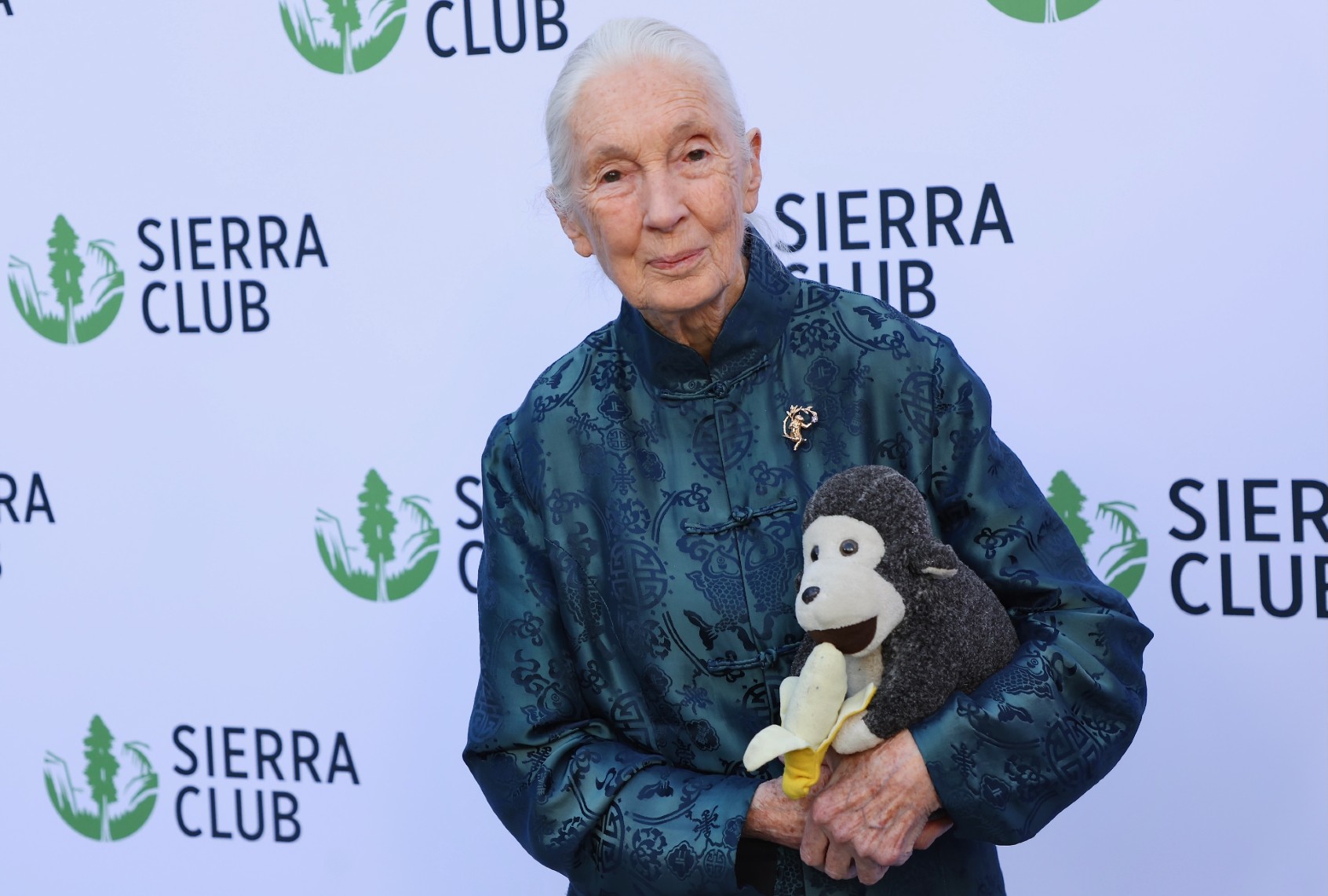
(Robin L Marshall/Getty Images) Dr. Jane Goodall at Sierra Club’s 2025 Trail Blazers Ball in Los Angeles, April 2, 2025.

Goodall founded the institute that bears her name to expand and carry on her work with chimps — a project that has been running for nearly 65 years — and, just as important, to educate humans. The Jane Goodall Institute points to six important findings its founder made that have transformed the human understanding of chimpanzees, our closest relatives in genetic terms, by demonstrating that behaviors previously thought to be uniquely human were, in fact, nothing of the kind.

Goodall’s findings have transformed the human understanding of chimpanzees, our closest relatives in genetic terms, by demonstrating that behaviors previously thought to be uniquely human were, in fact, nothing of the kind.

In 1960, during her first year at Gombe, Goodall observed a chimpanzee she called David Greybeard carefully strip a twig of leaves and use it to root out tasty termites from a mound. That might seem commonplace now, but it was a Eureka moment for Goodall: Like humans, chimpanzees not only use tools but actually make them. As Leakey memorably put it, “Now we must redefine ‘tool,’ redefine ‘man’ or accept chimpanzees as humans.”

Chimps, Goodall went on to discover, are omnivorous, just like us. They had previously been characterized as entirely herbivorous, like gorillas, Goodall observed them hunting, killing and eating small mammals such as bush pigs and colobus monkeys, by any standard a complicated collaborative enterprise. Indeed, the Jane Goodall Institute now runs a longstanding baboon research project based partly on the fact that baboons are important chimpanzee prey. Chimpanzees are like us in more troubling ways as well, Goodall found; they sometimes wage war on rival groups of chimps, occasionally killing each other. Goodall’s institute works on conservation of chimpanzee habitat and best conservation practices globally, and now has a youth outreach program called Roots & Shoots in 70 countries around the world.


Start your day with essential news from Salon.
Sign up for our free morning newsletter, Crash Course.


At Gombe, where she established a research center in 1965 and helped train generations of primate researchers and ecologists, Goodall made minutely detailed observations of daily interactions between chimps, many of them strongly reminiscent of human behavior. Female chimps form close bonds with their babies, but if a mother dies the babies are often adopted by other community members. Goodall also witnessed chimpanzees embracing and comforting each other after the death of a loved one.

”Jane Goodall’s trailblazing path for other women primatologists is arguably her greatest legacy,” Gilbert Grosvenor, chairman of the National Geographic Society, told the Jane Goodall Institute well before her death. “During the last third of the 20th century, Dian Fossey, Biruté Galdikas, Cheryl Knott, Penny Patterson and many more women have followed her. Indeed, women now dominate long-term primate behavioral studies worldwide.”

Goodall was not solely a chimpanzee expert and animal rights activist, even if those are the issues for which she will be most widely remembered. Just over a year ago she wrote, “And let us pray for the end of conflict, especially the genocide of the people of Gaza. And for those risking their lives to help the wounded and feed the hungry and care for the animals suffering as a result of human violence, cruelty and war.”

While working at Gombe, Goodall married the Dutch wildlife photographer Hugo van Lawick; they raised their son, Hugo, in the field. They divorced in 1974 and Goodall married Derek Bryceson, director of Tanzania’s parks, who died in 1980. Goodall earned her PhD, appropriately enough, at Darwin College, Cambridge University. She was a dame of the British Empire, a U.N. Messenger of Peace and the author of many books, including the now-classic “In the Shadow of Man” and “My Life With the Chimpanzees.”

Vaccines: Why they’re even more important than you think

Vaccines work, actually. But that’s not all. Depending on the specific vaccine we’re talking about, that jab might also prevent cancer, heal herpes lesions, help you keep most of your marbles, prevent your kids from dying in early childhood, improve your skin and so much more. These surprising bonuses that can come with vaccination, called beneficial non-specific effects, are common, but not widely understood. In fact, no one knew about them until relatively recently — and when researchers first discovered all this, no one believed them at first.

Before we look at that, let’s consider just how good these non-specific effects can get. Well, the Shingrix (or Zoster vaccine recombinant) vaccine, which is recommended for all adults in later middle age, prevents up to 95 percent of shingles cases. But that’s not all. It also reduces your risk of dementia, with a 20 percent relative risk reduction over seven years. (Shingles is the long-term result of a childhood chicken pox infection, which can hide inside you for decades before re-emerging in notoriously painful fashion.)

Emily Martin, a professor of epidemiology at the University of Michigan, told Salon in a video interview that certain viruses, like the herpes group — which includes the chicken pox virus and the one that causes cold sores, as well as genital herpes — “are notorious for these reactivation and latency patterns, and  changing your health status over the long term based on how much they’re around and active in your body.” It seems that the Shingrix vaccine’s remarkable effect on rates of dementia in older adults is the result of preventing some of those health status changes.

“What the shingles vaccine does is it dampens reactivations of latent viruses in a way that may be protecting other parts of your body,” Martin said. Including, it seems, the brain.

The measles, mumps and rubella or MMR vaccine protects children against those three diseases, of course. (Two doses are 97 percent effective against measles, for example). But that’s not all. It also reduces your child’s all-cause mortality — that is, their risk of dying of any cause, for years.

Oral polio vaccine prevents — surprise! — polio. But that’s not all. Vaccinating a newborn baby within its first two days reduces their risk of dying in their first year by 10 to 62 percent, while also reducing the risk of flu, COVID-19, bacterial diarrhea and otitis media, among other infections, studies have shown.

Vaccines currently in development for Staphylococcus aureus infections, including MRSA, might have the side effect of fighting atopic dermatitis, cellulitis and impetigo — maybe even acne.

We constantly hear from public health officials about how we should get vaccines because it’s good for us, like flossing our teeth. In the U.S., rather obviously, the public health message has gotten more confused of late. We constantly hear from pseudoscience grifters and bleach-drinking advocates that we shouldn’t get vaccines because, well, because of a bunch of hooey. So why isn’t anyone telling us about these remarkable side effects of vaccination? If you were trying to sell a product that not only keeps you healthy when other people are getting sick with, say, chicken pox, but also prevents you from getting a painful and potentially damaging disease many years later, wouldn’t you want to advertise that? Because that thing would sell like gangbusters.

We constantly hear from pseudoscience grifters and bleach-drinking advocates that we shouldn’t get vaccines because, well, because of a bunch of hooey. Why isn’t anyone telling us about the remarkable side effects of vaccination?

But the numbers don’t lie. Mind you, this is science we’re talking about, and there’s an important distinction between noticing an association and confirming a causal connection. So what’s the cause? By what mechanism do vaccines do so much unexpected good?

There are “basically two ways” of understanding these “off-target effects,” Martin said. “One way of looking at it is that the disease the vaccine is preventing is actually causing a wider range of illnesses and issues than we ever realized before we started vaccinating.” she explained. Influenza, which can cause falls and cognitive status issues in older people during acute infection and recovery, offers a classic example.

“But then, if you look at something like measles,” Martin continued, “those other effects are giant.” Measles is distinctive in that it essentially goes into a person’s system and wipes out the T-cells — a vital part of the immune response — gained during previous infections of other kinds. “Any of the lived experience that you’ve had to build up antibodies against infection then gets wiped out by the measles virus. When you recover from a live measles infection … you’ve just lost all your immunity. It’ll be like you’re a kid in day care for the first time. So you’re going to be encountering all of these diseases with very little prior immunity.”

Part of the beneficial non-specific effect of measles vaccination, then, derives from preventing a disease whose health impacts are more serious and long-term than scientists originally understood. But there’s a further effect, believed to relate to another phenomenon called trained immunity. That’s what happens when activating an organism’s innate or built-in immunity can result in a later revved-up response to a new immune challenge.

Studies of the effects of various vaccines, Martin said, suggest that the “mild, low-level replication” of a pathogen — which is how most vaccines work — can result in “training the immune system” to protect you against other diseases. Peter Aaby, a Danish anthropologist, discovered the beneficial non-specific effects of vaccines while working in the West African nation of Guinea-Bissau after it gained independence in the 1970s. As in many other poor countries, Guinea-Bissau’s extremely high child mortality, which meant more than half of all children died before age 5, was attributed by mostly Western scientists and policymakers to malnutrition. But when Aaby’s team conducted a survey of 1,200 children, they found that malnourishment was virtually nonexistent. Just after that survey was completed, a severe measles epidemic swept the area, killing one-fourth of all children.

So malnutrition no longer made sense as the “explanation of severe child mortality,” Aaby told Salon in a video interview. “The stunning thing was, there was no relationship. The nutritional status of the children who died of measles was not different from those who survived.”

But he had a hard time getting the Swedish research organization that had hired him, or other medical authorities who reviewed his work, to address the implications of the data. He eventually tested a new hypothesis: It wasn’t nutritional status that determined how bad a case of measles was, but rather how intensely a child had been exposed to the virus.

Those most likely to die, Aaby found, were “the children who are infected inside the home.” When many children lived under the same roof, he explained, they were likely to be exposed to far greater doses of the virus. “That turned out to be by far the strongest explanation of measles mortality,” he said. “I have also subsequently shown that the same pattern applies not just to measles, but [also] for chicken pox, RSV, polio and whooping cough.”

Aaby’s team then went door to door providing measles vaccinations, and a few years later he received a follow-up report, describing what happened to children who had been involved in the study and subsequent ones carried out in rural areas. “I got the idea that maybe measles vaccine had an impact on child survival,” he said. And sure enough, “nearly every time that someone had died [of any cause], they had not been vaccinated.”

Studies of the effects of various vaccines, Martin said, suggest that the “mild, low-level replication” of a pathogen — which is how most vaccines work — can result in “training the immune system” to protect you against other diseases.

Later studies from several countries with data on childhood mortality before and after introduction of the measles vaccine likewise showed a minimum 50% reduction in mortality among children under age 5 — “an unbelievable effect,” as Aaby put it. Children who had previously survived a measles infection had even lower risks of mortality: It’s fair to say that what didn’t kill them did indeed make them stronger, but at a terrible risk, since a quarter of measles-infected children did not survive.

Other vaccines were likewise shown to reduce childhood mortality, without the risks associated with infection, and to an astonishing degree: the BCG vaccine (against tuberculosis) did so by 45%, for example. Aaby’s findings  were initially dismissed, since he was an anthropologist with no medical credentials  (he now has a PhD in medicine), but no longer. In 2016 the WHO noted the otherwise inexplicable effects of BCG and measles vaccines on childhood mortality, while in 2020 the widely-respected journal Nature included non-specific effects in a list of “milestones in vaccines.”

“Child mortality under age 5 has declined by 86 percent, and there is no way you can explain it by controlling measles and whooping cough and tuberculosis,” Aaby emphasized to Salon. “It’s the immune stimulation that we have provided” through vaccination.

As with the protection vaccines provide against a specific pathogen — we need boosters for COVID-19 because the vaccine’s effects wane over time — this enhanced general immune protection may last for just a few months or endure for years, as with the effect of measles vaccination on overall health. Early findings show that existing COVID vaccines may also offer beneficial non-specific effects in similar fashion, as Aaby suggests in a PowerPoint presentation he shared with Salon, by revving up our immune systems against other pathogens.

None of this amounts to saying that vaccines have no risks, or even that their non-specific effects are always beneficial. Aaby found, for example, that what’s known as the high-titer measles vaccine, when given to very young children, was later associated with increased mortality for girls, a finding of sex differences in immune response that has been seen with other vaccines as well. (That specific vaccine is no longer in use.)

Further research revealed that it was the sequence in which vaccines were administered, not the vaccines themselves, that was responsible for higher mortality. Changing the sequence of vaccines, usually by giving live vaccines before non-live ones, maximizes the beneficial effect and removes that additional risk for girls, apparently by programming the innate immune system in a better way. Aaby is now testing whether combining live and non-live vaccines may reduce negative effects while maintaining beneficial effects, both the specific protection against a given infection and the non-specific strengthening of the immune system.


Start your day with essential news from Salon.
Sign up for our free morning newsletter, Crash Course.


It’s essential to evaluate the benefits and risks of any vaccine carefully, of course. But too often, public attention is fixated on rare and unlikely negative side effects when the overall protection offered by a vaccine far outweighs any statistical risk. Unless you are a person with known risk factors involving bad outcomes, you’re almost certainly at greater risk by not getting a given vaccine. Epidemiologists and public health researchers are supposed to crunch the numbers and figure these things out, and to adjust recommendations as new findings come in, especially recommendations about what vaccines children need, and when.

Like many experts in the field, Martin is concerned that HHS Secretary Robert F. Kennedy Jr.’s recent dismissal of the entire CDC panel of vaccine experts who do that, and their replacement with known vaccine “skeptics” or outright opponents, puts that at risk.

Too often, public attention is fixated on rare and unlikely negative side effects. Unless you are a person with known risk factors involving bad outcomes, you’re almost certainly at greater risk by not getting a given vaccine.

“I worry what data they are going to use,” Martin said. “if they are not acknowledging the data that’s there and being generated. It is ready for them to review right now. This is an ongoing process that we’re always iterating on, every year, putting out vaccine data” to guide policy recommendations.

High child mortality was taken for granted for centuries. So what happened? In a word, vaccines happened. Anyone who visits an older cemetery anywhere in North America is startled to see the large numbers of tombstones inscribed with the names of infants and young children. Such deaths are relatively rare on our continent today, but Aaby’s work suggests that this dramatic change is not purely due to the prevention of the specific diseases targeted by vaccines.

More recently, he contends, the “enormous reduction we’ve had in [child] mortality in low-income countries in the last 30 or 40 years” can only be explained by the non-specific effects he has documented.

Aaby and his colleagues have followed populations before and after the oral polio vaccine campaigns that began in 1995 and ended in roughly 2015 in various low-income countries such as Guinea-Bissau, Ghana, Bangladesh and Uganda. They determined that childhood mortality overall was roughly 25% lower after the campaign than before. Add to that similar effects from BCG and measles vaccination, and we have, Aaby says, an explanation for the dramatic decline in childhood mortality in many such countries.

One major reason why the U.S. and Western Europe have seen dramatic population increase over the last 200-plus years, Aaby says, is the introduction of the smallpox vaccine in 1800. That wasn’t just that vaccine prevented one specific and often deadly disease, he argues, but because of the vaccine’s overall effect on immune systems.

“There are a lot of things that we’ve forgotten to say” to vaccine-hesitant parents concerned about rare negative effects, said Martin, largely “because measles infection in the United States has been so incredibly rare for the last 30 years.” In other words, at a cultural level we have simply forgotten how common, and how serious, the long-term damage  from exposure to measles and other diseases used to be.

“I think people in other countries who have had endemic measles understand that more acutely than we do,” Martin said. In many such countries, people have high confidence in vaccination despite less reliable access to vaccines, and the reverse is also true, with people in higher-income countries expressing greater vaccine hesitancy.

Indeed, there’s evidence to suggest it may have been a mistake to stop administering the smallpox vaccine after the total elimination of smallpox, or to end the BCG vaccine as tuberculosis infection became rare.

A large Danish study compared children who received the BCG and smallpox vaccines to a cohort that did not. Over nearly 40 years, researchers have found that those who received either vaccine as children had significantly lower risks of dying of natural causes — not just in childhood but clear into their 40s, which was as far as the data followed them. Just because certain diseases are eliminated, Aaby argues, is not necessarily a good reason to remove the relevant vaccines.

Given these almost magical-seeming but real and meaningful effects of vaccines, Martin was dismayed to see experts like the highly qualified and vetted CDC vaccine panel members dismissed by Kennedy and accused, without evidence, of conflicts of interest. “This is work that people are doing because they think it’s important,” she said. “They’re not getting any financial benefit. It was jarring to see it swapped out so quickly like that.”

Despite “No Kings,” the Trump resistance is still “muscle-building”

The American people live in the same country, but they increasingly do not share the same reality. The last few weeks — in which we have witnessed mass deportation raids in Los Angeles and other cities, the federalization of the California National Guard and the deployment of the military to put down protesters, a military parade on Donald Trump’s birthday that was an authoritarian spectacle, 5 million Americans participating in “No Kings” protests in 2,000 locations across the country, the targeting and assassination of Democratic politicians in Minnesota and the bombing of Iran — have offered a stark depiction of a split-screen America and its dueling realities. 

Far from being a thing of beauty, the legislation will take trillions of dollars away from the American people and give it to the very richest individuals and corporations.

Meanwhile, in Washington, Trump’s abominable “One Big Beautiful Bill Act” is stumbling in the Senate, where Republicans have added more draconian measures and are hoping for passage this weekend. Far from being a thing of beauty, the legislation will take trillions of dollars away from the American people and give it to the very richest individuals and corporations. Some public health experts warn it could lead to the deaths of more than 51,000 Americans each year. Speaker of the House Mike Johnson (R-La.) has reportedly told his conference to “Keep your schedule flexible” in advance of a vote before July 4, and warned that the bill may have to go to conference if it includes provisions he won’t be able to pass in the House.

In more “normal” times, any one, or perhaps two, of these events would dominate the news cycle and political agenda for weeks. But the malignant Age of Trump depends on overwhelming and diverting the attention of our institutions and fellow citizens. With so much at stake, this moment depends on the American people understanding how these myriad events are connected,  how they reflect a much larger unifying danger: That democracy and liberty are imperiled. And, with each passing day, matters are getting worse.

To better understand this unprecedented time in American history, I recently spoke to four experts about the country’s rapidly spiraling democracy crisis and what could happen next. 

This is the third part of a three-part series.

Steven Beschloss is a journalist and author of several books, including “The Gunman and His Mother.” His website is America, America.

Donald Trump is a weak and desperate man who is determined to portray himself as strong and powerful. In all these months of degradations and desecrations of the rule of law, the Constitution and basic human decency, [these events have] felt like an inflection point for our country. 

But I was encouraged by the split screen…between Trump’s sparsely attended and listless military parade and the spirited, joyful and defiant outpouring of millions of Americans around the country [for the “No Kings” protests] expressing their First Amendment rights and rejecting Trump’s hostile regime. The hopeful energy in large cities and small towns was palpable and contagious — and I suspect this was “muscle-building” for many Americans who’ve never participated in such an event or haven’t in a long time.

That said, my sober expectation is that it will take more than double the 5 million Americans estimated by organizers attending “No Kings” protests to begin to create an impact that can drive change. And it must be sustained with a clear message and goal, not just an occasional event. We know that Trump is narcissistically incapable of grasping how despised he is in America, especially since he’s surrounded by sycophants who refuse to tell him the truth like Kristi Noem and Stephen Miller, who are determined to prove that the harsher the cruelty and criminality, the greater the success. But mass protest can succeed at proving the fallaciousness of this proposition — that Americans will not bow down, be silenced or broken by this malignant regime that despises democracy.

The authoritarian playbook only succeeds if the people fail to recognize that the government’s survival depends on the consent of the governed. Yes, it remains to be seen what it will take to produce a larger, more sustained effort that reaches the White House and strikes fear — at least among cabinet members and other officials who are capable of recognizing the country is rejecting them. Perhaps it’s the increasing prospects of a worsening economy, intensifying efforts to flout the law to round up and deport people who are not criminals and growing violent attacks on American citizens and elected officials. But it will require people to exit their comfort zones.

I often return to the wisdom of Frederick Douglass, a formerly enslaved person and one of this country’s greatest thinkers and orators. As Douglass told us back in 1857, “Power concedes nothing without a demand.” It never did, and it never will. Find out just what any people will quietly submit to and you have found out the exact measure of injustice and wrong which will be imposed upon them.”

Rev. Adam Russell Taylor is president of Sojourners and author of “A More Perfect Union: A New Vision for Building the Beloved Community.” Taylor previously led the Faith Initiative at the World Bank Group and served as the vice president in charge of advocacy at World Vision U.S.A.

I’m growing increasingly alarmed by the Trump administration’s escalating attacks on democracy, particularly the unnecessary and inflammatory deployment of the National Guard in Los Angeles to bolster immoral and aggressive mass raids by ICE [Immigration and Customs Enforcement]. I’m also deeply concerned about the administration’s escalated attack on Harvard University and constant peddling in lies, propaganda and disinformation, such as in the shameful meeting between President Trump and President Ramaphosa of South Africa, in which President Trump falsely alleged that white Afrikaners were victims of land grabbing and even of genocide. 

I’m concerned that the Trump administration will seek to conduct mass ICE raids in other major U.S. cities in order to spark further protests and confrontation. These efforts may also be used as the pretext to invoke the Insurrection Act, which would be an egregious and dangerous misuse of the [law] and of executive authority. I’m heartbroken by the murder of Minnesota Rep. Melissa Hortman and her spouse, which was a horrific act of political violence that must be denounced. I predict that this will be a hot summer filled with increasing resistance and protest to abuse and overreach of power by the Trump administration.   

Cheri Jacobus, a former Republican, is a political strategist, writer and host of the podcast “Politics with Cheri Jacobus.”

Like most thinking Americans, I have been in a state of shock and rage over [Trump’s] inciting violence, abuse of power, blatant apparent criminality and betrayal of the country. It’s not unexpected, but [it] still elicits a visceral response, as this has never happened in America. I am furious with the media and power players who allowed this to happen, especially former Attorney General Merrick Garland and his cheerleaders who bullied us into submission. 

But something is happening out there across this country — finally! “Regular” everyday Americans who’ve never been activists or even let others know their politics are literally taking to the streets! The masses have figured out that there is no cavalry coming to save us. We are the cavalry! The “No Kings” protests all across the United States were historic, and they do matter. [Million of attendees], compared to the paltry few thousand who showed up for Trump’s Kim Jong Un-style military parade, was a first step in putting Donald Trump in his place. Even Russian state TV mocked his pathetic attempt at emulating murderous dictator Vladimir Putin. 

I can’t predict if we will win this battle or not. It’s not a fight we chose. But it’s the fight we are in. Watching [it] dawn on the good people of this country and how they are stepping up fills me with hope. 

Eric Schnurer is a widely recognized expert on public policy and government effectiveness, efficiency and reinvention. His newsletter can be read at The Greater Good.

Donald Trump can’t succeed at building a strong, lasting authoritarian state because he’s more focused on tearing down the institutions of government, enriching himself and his allies, and punishing his enemies. These policies are so destructive that his regime will eventually collapse under the weight of its own dysfunction.

You don’t have to be psychic, because these folks published an entire book telling us what they planned to do in advance. It included deploying the National Guard to major cities around the country, and then placing them under martial law, as well as invoking the Insurrection Act to ban all protests against the regime and then militarizing the response. It’s not like this was or is a secret: It’s a promise. A reasonable expectation from here would be some sort of Kent State-type episode, but on a larger scale, as both a warning against future dissent and an excuse for further militarized rule.

What do we do about this? 

In the immediate term, of course, all of those who are not fine with the destruction Trump is wreaking need to prepare to contest the midterm elections. Unfortunately, this is likely to prove unavailable for any number of reasons; even in the best-case scenario, there [are] only a handful of House seats up for grabs and an almost-nil chance of Democrats retaking the Senate.

No matter the political outcomes of the next 18 months, we need to be prepared over the medium-term to use a variety of means to contest Trump’s realization of his promise in the last campaign that his supporters (and, presumably, the rest of us, as well) “will never have to vote again.”  

Not only is Trump doing everything he can, in a surprisingly short period of time, to destroy America’s economy, global dominance and national security — all of which will lead to irreparable decay in relatively short order — he also is, and always has been, bent on destroying the institutions of the state. This is the great irony of Trump’s place in history: He is viewed as a wanna-be dictator, but he is more bent on vengeance and destruction than interested in consolidating and building. Virtually every state asset that isn’t nailed down already is being sold or carried off by Trump or his henchmen and henchwomen.

Even [Max] Weber’s one essential element of the state — the monopoly of legitimate force — has always been on the auction block for Trump; expect the devolution of state power to the ready-made private militia Trump has already vested with implicit state immunity – as [happened] in places like Iran or Pinochet’s Chile – to expand dramatically in coming months.  

I have always thought that the ultimate result of Trump’s ascendance — as is the case with everything he’s ever touched – will be state collapse not state consolidation, anarchy not autocracy.

If that’s how we get rid of Trump, how do we hasten it? It’s hard to do better in that regard than Trump’s own policies. But it’s not enough just to wait.

We need similarly to be building resilient inner walls to survive and reframe the alternatives being offered to the coming onslaught while Trumpism spends down its strength.

A related area is to attack hypocrisy — both humorously and seriously. A $60 million military parade to puff up Trump’s ego at the same time that he and his supporters are cutting the military budget and support for veterans — let along everything else — is an easy enough target. So is virtually everything else about this man and his minions.

And that starts getting dangerously close to the regime’s real Achilles’ heel. The popular forces behind this storm are driven by hatred (and a not-wholly unjustified anger) at the intellectual elite, but, as I argued a year ago, that’s a fire that eventually will burn itself out, leaving MAGA supporters to wonder why Trump and his acolytes have not only failed to deliver on their promises but, actually, literally stolen their livelihoods and their country. The reaction to the realization of that betrayal won’t be pretty. The collapse will come and, given this regime’s actions, it will be total and swift. Just not swift enough.

We’ll never leave the present dystopia behind without a clear and more appealing vision of where we could be headed instead. This means using the time spent against the ropes to formulate an alternative. Democrats have demonstrated no such ability so far to think ahead and adapt.

“The Bear” gets it — we’re all burned out now

Carmy Berzatto’s self-sabotage is the featured dish on “The Bear,” but the show’s real star is time. Clocks and alarms are motivators or stressors. As the doors open each night, the chefs wage open war with every tick as they obsess over efficiency.

In the fourth season, time is a collapsing parachute, signaled by Uncle Jimmy (Oliver Platt) and his business partner, Nick “Computer” Marshall (Brian Koppelman), plugging in a clock counting down from 1440 hours. Two months. When the numbers hit zero, the money runs out and The Bear must close.

Time can also be enlightening, and the value each person assigns to it can vary significantly. To Cousin Richie (Ebon Moss-Bachrach), the clock sets a bar he must meet or exceed, but it’s also a reminder to slow down and make the smallest details count. The Bear’s head chefs, Carmy (Jeremy Allen White) and Sydney (Ayo Edebiri), view it as an unrelenting but fair disciplinarian. The motto ruling the kitchen is displayed for all to see: “Every second counts.”

These long-awaited 10 episodes present another spin as Carmy and Sydney take a hard look at time as it relates to life and experience. That’s always ticked away in the show’s foreground, with Carmy struggling to recover from his early-career peak and burnout and Sydney wondering how much time she needs to put in before he’ll value her good ideas.

Season 4 takes us to the other side of what Malcolm Gladwell romanticized in “Outliers,” where he boiled down mastery into a 10,000-hour rule that has since been disputed, although the gist of it holds true: Devoting enough time and practice to doing one thing correctly eventually yields expertise.

Of course, giving everything you have to a skill doesn’t take into account natural talent like Syd’s. Her dedication to culinary mastery blows past all previous standard-setters in Carmy’s experience, and that brings out his insecurities. Carmy tends to brush off nearly all of her concepts, making Syd question whether she can find the culinary success that’s long eluded her at the side of a colleague who overspends and overreaches. She can stay the course, or jump ship to join a new venture with another renowned restaurateur.

Chef Adam Shapiro, who shares a name with the actor playing him, offers solid financial backing and a sky’s worth of promises. He’s also volatile and abusive, like Carmy’s old mentor. The other side of the knife is that devoting all of one’s time and focus to one big swing robs us of minutes we don’t get with the people who matter. Pouring her heart and soul into her work means Syd misses a lot of phone calls from her father (Robert Townsend), similar to the way Carmy imploded his relationship with Claire (Molly Gordon).

Worse, as someone counsels an extremely frustrated Tina (Liza Colón-Zayas), who is pushing herself to cook and plate a dish in under three minutes, the pressure to beat the clock adds to the stress. Then you learn to live with it, eventually thriving on it. Then, he says, “The challenge becomes: Can you live without that pressure?”

Now that it looks like all their sweat and stress could amount to nothing, Carmy and Syd separately ruminate on the meaning of all those months of devotion and anxiety. That question reduces to one everyone asks of themselves sooner or later: Why do we do what we do?

This is as existential as the quest for life’s meaning gets. It’s the counterpoint to Syd’s earliest argument for sticking with this insoluble endeavor: “Why can’t we put everything that we have into everything that we can?” We ask such questions before whatever it is we build with effort and sacrifice slams against the iceberg of reality, which doesn’t care about anyone’s dreams.

That isn’t quite what happens to our team, but the Chicago Tribune’s review of the restaurant in the third season finale’s cliffhanger was neither stellar nor a disaster. Sometimes, a middling verdict can be more of an insult, and the Trib’s critic points to Carmy’s “chaos” menu as the problem.

With everything changing all the time, none of the dishes have the space to evolve or improve. The restaurant’s flaw, then, is inconsistency. The reviewer deems its one indisputable triumph to be the Original Beef’s signature sandwich, the product of a few guys doing the same thing over and over for years. That’s not madness. That’s practice resulting in perfection.

Series creator Christopher Storer (who wrote or co-wrote several of its 10 episodes and directed or co-directed all but one) and his writers practice what the plot preaches. I wouldn’t necessarily call “The Bear” review-proof, but four seasons in, it is admirably consistent.

That may not be enough for people who expect significant escalations or resent recurring indulgences, such as its gigantic guest star cameos. Season 4 has an episode that rivals “Fishes” in its star power convergence and runtime, although its mood is that strenuous hour’s opposite — it’s frantic for different reasons.

If you loved the show before, that shouldn’t change. Having said that, you may find that the best of its recurring all-stars aren’t returning celebrities like Jon Bernthal, Sarah Paulson or Jamie Lee Curtis, but characters who represent the best of their profession.

The return of Jessica (Sarah Ramos), the unerring kitchen expeditor from the recently closed restaurant Ever, made me grin and applaud. Jessica understands that time can and must become everyone’s friend. If five-star service is the result of an impeccably executed battle plan, she’s the general The Bear needs.

Every troubled business needs a Jessica, just like every inspired artist can use an ally to help them realize their genius. Later in the season, one of our deserving chefs gets exactly that. (That re-entry also earned another cheer from the couch.)

What people may appreciate more acutely than the fan service is the show’s evolving consideration of artistic philosophy. In the same way that we take for granted the way shows like “Top Chef” make the creative process accessible, “The Bear” confronts the fork waiting down the road after anyone’s 10,000-hour journey is complete, asking whether knowing you can do something well requires you to keep on doing it.


Start your day with essential news from Salon.
Sign up for our free morning newsletter, Crash Course.


Typically, our reasons for staying in a battle against crushing odds are soft, even banal, but universally defensible. Carmy’s sister Nat, aka Sugar (Abby Elliott), does it for the love of The Bear’s family. Gary (Corey Hendrix) understands he’s on the verge of achieving greatness as a sommelier. Cousin Richie, Tina, Marcus (Lionel Boyce) and Ebraheim (Edwin Lee Gibson) also keep showing up because they know they’re a part of something special; as Richie says, there’s really no place else he’d rather be.

They’ve gambled that putting in the time will yield great rewards — that is, if Carmy can fulfill his promise to win the Michelin star Syd has been chasing. But that could take hours, months, possibly years that aren’t guaranteed. As Uncle Jimmy remarks to Syd as the hourglass sand is running out, it is a shame that the businesses that give the most amount of joy, or try to anyway, happen to be ruthlessly tough. (He doesn’t use those precise words; Uncle Jimmy is a five-star vulgarian.)

With joy in short supply these days, whetting our focus on what matters counts. Luckily, “The Bear” still serves a purposeful story that earns our attention for a few precisely portioned hours that always run out before we’re ready to let go.

All episodes of “The Bear” are streaming on Hulu. 

Our divisions have created the potential for redemptive revolution

In a time when Donald Trump risks moving our country closer to war, the lessons from the “No Kings” rallies become more urgent. Along with thousands of others, I marched in Louisville, Ky., the city where Black protesters demanding justice for Breonna Taylor helped ignite a fire that led to the racial reckoning of 2020. I couldn’t help but think of those marches as I walked through the city a couple of weeks ago, and I marveled at how I have never witnessed anything quite like what I was now seeing: Downtown Louisville filled with white people seeking a redemptive revolution. And it was beautiful.

When it comes to the work of social change, there is power in division — particularly when it is white people who are divided. This month marks my 20th anniversary investing in the work of racial justice. During my first 10 years, I focused on frontline activism with issues ranging from education to health, housing, immigration reform and faith-based organizing. My second decade was largely spent researching and writing about the history and evolution of American ideas on race, religion and politics. Due to my time living and working in economically impoverished Black and brown communities, my perspective is often quite different from those of either my liberal or conservative white friends.

But what I saw in Louisville at No Kings testified to the fact that the white consensus that has held our nation in bondage is shattering — and every time white consensus shatters, it opens the door for revolutionary changes.

From politics to religion, I have often found that white liberal and conservative assumptions and convictions are more in keeping with each other than the Black and immigrant communities that took me under their wings, a phenomenon I refer to as white consensus. But what I saw in Louisville at No Kings testified to the fact that the white consensus that has held our nation in bondage is shattering — and every time white consensus shatters, it opens the door for revolutionary changes.

When our nation was founded, slavery was not an unavoidable evil. Nor was it as entrenched as it would be when cotton became king. It was an evil of choice. Those who supported slavery actively worked to entrench the institution ever deeper in both the American economy and psyche. With rare exception, even white leaders who opposed slavery felt it was a monster they were ready to do business with.

This truth is what underpinned the Constitutional Convention’s Three-Fifths Compromise, which provided enslaving states additional representation in Congress. And it was upon that compromise that white consensus was built into our institutions, making slavery ever more central in American life. As slavery reached the zenith of its power, abolitionists would destroy the white consensus upon which it depended. A Civil War erupted and doors to radical change opened.

During Reconstruction, a new battle raged for the hearts and minds of Americans. But this would be a war the South won. Not everyone celebrated Jim Crow but, like slavery, it was a monster the nation was ready to do business with —  and, yet again, the monster was allowed to dictate the terms.

The white consensus that segregation created stood for a century until it was shattered again, this time by civil rights advocates whose victories provided the nation with redemptive political possibilities such as the passage of the Civil and Voting Rights Acts, and establishing the War on Poverty. But hopes of radical change evaporated as the Vietnam War intensified and wars on drugs and welfare largely replaced the War on Poverty. These tragedies laid the groundwork for the election of Ronald Reagan in 1980. Twelve years later, Bill Clinton brought the “New Democrats” to power. But his administration only intensified the wars on drugs and dismemberment of welfare, testifying to how both parties operated under the same white consensus that proved as anti-Black as it was anti-poor. The new white consensus was hailed as colorblind progress. 

The beginning of the end of this era began when a Black man took the presidency and cell phone cameras began documenting America’s racial violence. Somewhere between the chants of “Black Lives Matter” and “Make America Great Again,” the white consensus was shattered once more. But unlike the Reagan Revolution, the MAGA movement proved unable to create white unity in Donald Trump’s first term—and an interracial, progressive coalition secured the election of Joe Biden in 2020.

When Trump announced his third run for president, I feared he might seek to create in a second term the white unity he had failed to generate in his first. In times past, the moral exhaustion and spiritual superficialness of white moderates and progressives led to waving the white flag of surrender and accepting white unity on toxic terms. And after Trump took office in January, businesses and billionaires bowed. The media mourned the absence of the resistance, leading many to believe the days of a committed anti-Trump movement were over.

But at No Kings in Louisville, instead of white flags of surrender, I saw a grizzled Army Ranger holding a sign that read “Veteran Supporting the Constitution.” Next to him was a man wearing  pink shorts and horn-rimmed glasses. His sign read “You know it’s bad when the introverts show up.” Their presence proclaimed that the depths of America’s divisions contain possibilities: The chance to forge new and revolutionary coalitions and alliances.

We need your help to stay independent

Times of pain and peril are also times of possibility. Times of division are times to dream. When billionaires bow to a would-be dictator, everyday Americans have the responsibility to take a stand on the shared convictions concerning freedom, liberty, and justice for all.

As the cost of resistance rises and Trump seeks to make democratic hopes seem impossible, we must remember, as historian Linda Gordon writes, that “social movements have changed our world as often and as profoundly as wars, natural disasters, and elections.

There is no way to make the social revolution America is experiencing painless, but it is still in our power to make it redemptive. While the truth is that I don’t know how long white Americans will stand upon democratic convictions and the hopes they create, all I can say for sure is that it was good to see so many in Louisville standing on the frontlines and burning the white flags of surrender. As woefully short as our nation has fallen in creating a land of liberty and justice for all, it has also proven to be a vision whose inspiration continues to survive the storm.

Be prepared for “further escalation” from Trump

Since Donald Trump was elected president in 2016, the American people have been standing at a crossroads: One road leads to the end of American democracy and its replacement with some form of authoritarianism — or what political theorist Sheldon Wolin described as “inverted totalitarianism” — while the other leads to continuing the American democratic experiment and doing the hard, necessary work to improve it.

For too long, the American people have delayed deciding which road to take. In the wake of recent events — including Trump’s mobilizing the National Guard and Marines to put down protests in Los Angeles, commanding the National Guard to intervene in other cities, threatening protesters with the use of “very heavy force,” admitting he had considered invoking the Insurrection Acttargeting blue parts of the country because they are full of “scum” — it’s becoming clear that if Americans do not make their decision imminently, it will be made for them. 

Now, these events are unfolding against the backdrop of military conflict in the Middle East.

Now these events are unfolding against the backdrop of military conflict in the Middle East. On Saturday, Trump ordered airstrikes against three of Iran’s nuclear facilities and immediately declared them a “spectacular military success.” Codename “Operation Midnight Hammer”, it remains unlikely the strikes dealt a death blow to Iran’s nuclear program. (Some experts have cautioned the country might have moved its most vital nuclear components before the attacks.) But the operation means that the U.S. has intervened in Israel’s war against Iran.

The Trump administration is claiming that Operation Midnight Hammer is not intended as the beginning of a larger, more sustained military operation against Iran. But on Sunday, Trump blatantly hinted at the prospect of regime change, posting on Truth Social that “It’s not politically correct to use the term, “Regime Change,” but if the current Iranian Regime is unable to MAKE IRAN GREAT AGAIN, why wouldn’t there be a Regime change??? MIGA!!!” In the wake of Iran’s retaliatory missile attack against a U.S. military base in Qatar yesterday, he turned more conciliatory, thanking Iran for giving the U.S. early notice of their counterstrikes and posting on Truth Social “IT’S TIME FOR PEACE.” He followed this by announcing an Israel-Iran cease-fire agreement that would “go forever.”

Authoritarian leaders have historically used international crises — be they real, manufactured or false altogether — as a way of expanding their domestic power. In an attempt to better navigate this dangerous time in American history, I recently spoke to several experts about Trump’s military parade, the “No Kings” protests and what could happen next in the country’s rapidly spiraling democracy crisis.

This is the second part of a three-part series.

Norman Ornstein is emeritus scholar at the American Enterprise Institute and co-author of the bestseller “One Nation After Trump: A Guide for the Perplexed, the Disillusioned, the Desperate, and the Not-Yet Deported.”

I am extremely uneasy. As soon as Stephen Miller used the word “insurrection,” I saw it as a deliberate prelude to Trump invoking the Insurrection Act, itself a prelude to declaring martial law.

We are in for a bad time ahead. Trump is destroying public safety, from food to transportation to health, and the world is more, not less, unstable and dangerous with him, Rubio, Hegseth, et al. in place.

The current culture of violence, reflected now by horrific assassinations of a beloved Minnesota legislator and her husband by a right-wing extremist with a hit list of 70, including legislators and abortion providers, is especially dangerous and unsettling.

Federico Finchelstein is a professor of history at the New School for Social Research and Eugene Lang College in New York. His new book is “The Wannabe Fascists: A Guide to Understanding the Greatest Threat to Democracy.”

My feeling is that Trump is increasing his tendency towards fascism. [We’ve seen] a further escalation of his conflation of politics and war via the classic fascist practice of the militarization of politics. We also saw an escalation in repression in California that was combined at the highest levels with the very open ideological glorification of violence towards the opposition. (Speaker of the House Mike Johnson expressed a desire for tarring and feathering Gov. Newsom). 

Trump’s parade…was a basic example of the authoritarian cult of the leader. In the context of polarization and extreme demonization of others, [we have also seen] the “solo” political assassinations that happened in Michigan. We need to know more about the motivations of the alleged killer, but the responses by the MAGA people and the Trumpists are very concerning. In a normal country, Trump’s military parade would have been cancelled in light of the gravity of these events. The parade was a failure in terms of attendance, but it was successful in the way that Trump amplified the association between his persona and the state, in this case with that of the military. An important effect was the massive response in the form of the “No Kings” peaceful protests that clearly made the case that Trump is acting against the democratic values of this country.

I think we will see further escalation on all fascist fronts: violence and militarization, more demonization and repression, propaganda and attacks on independent journalism and the interference with the judiciary and other state institutions, and democracy. Hopefully, we will also see more peaceful resistance against these attempts to destroy American democracy.

Katherine Stewart is the author of the new book “Money, Lies, and God: Inside the Movement to Destroy American Democracy.”

Creating an emergency to justify an authoritarian overreaction is one of the most frequently telegraphed stunts in the authoritarian canon. Trump basically told us over and over again before the election, that he wanted to use the U.S. military against U.S. citizens, and that’s what he’s doing. He chose to send ICE into downtown L.A. precisely because he knew these actions would yield the optics of chaos that right-wing media requires.

This follows the authoritarian playbook. When would-be autocrats wish to establish a government that is not bound by law or reason, they declare an emergency to justify the suspension of laws that constrain them. Trump and his people have shown they’ll declare anything they don’t like to be an emergency, including “wokeness,” “DEI,” et cetera. To them, the democratic values of equality and pluralism and justice are themselves the emergency. 

During and after the demonstrations, right-wing media and politicians responded predictably to small-scale disturbances taking place on the fringes of overwhelmingly peaceful demonstrations. Some declared that “Los Angeles is on fire.” “We are liberating the city from the socialists,” said Kristi Noem after police officers tackled and handcuffed U.S. Senator Alex Padilla, who attempted to ask some questions during [Noem’s] news conference.

This, paired with Trump’s rather sad military parade and his comment that protesters will be met with force, is a huge tell. The president and members of his cabinet show no awareness of the Constitution they are supposed to defend, a Constitution that asserts the right to peaceful assembly. 

The threat of political violence, however, is indeed a true emergency, as judges who rule against Trump, along with Democratic lawmakers, are barraged with threats and abuse.

The threat of political violence, however, is indeed a true emergency, as judges who rule against Trump, along with Democratic lawmakers, are barraged with threats and abuse. Though information will emerge in the coming days and weeks, we have some strong indicators about the waters prime suspect Vance Boelter was swimming in before the shootings of two Democratic lawmakers and their spouses. As a graduate of the Christ For The Nations Institute, he appears to have ties to the charismatic movement and the New Apostolic Reformation. Wired obtained video, presumably of Boelter, preaching near the Congo border in 2023: “God is going to raise up apostles and prophets in America, to correct His church.” 

There is still much to learn about Boelter’s biography. But he appears to be less representative of the charismatic movement’s top-level leadership than its followers and supporters, which is, in a way, the more frightening aspect of this story. 

The link between dehumanizing rhetoric and political violence is too well-known to belabor. When you call people “demons” or “baby-killers,” someone somewhere will start to believe they should be treated accordingly. You might try to take refuge in the claim that that someone suffers from a psychiatric condition. But if you’ve got tens of thousands of followers, what are the chances that there won’t be unstable people among them?

It is worth remembering, too, that political violence is not the preserve of one sect of any religion or political party. But the ideological movement or movements that appear to have contributed to the conditions for this crime happen to be an integral part of the ruling administration and have created the permission structure for political violence. They aren’t just another segment of Trump’s base of voters; they aggressively supported his attempted coup and now have direct representation in the White House.

We need your help to stay independent

Trump has denounced the assassinations in Minnesota. But can his administration understand that the criminal and the unstable will see some advantage in this kind of violence?

Consider that in the months preceding the event, DOGE [Department of Government Efficiency] eviscerated the nation’s capabilities in domestic counterterrorism.

Consider also what happened to those who committed hundreds of violent crimes on Jan. 6. This president has made it abundantly clear that certain types of political violence might be just fine. If you’re on his team, there may be a pardon in it for you. He made the point clear well before Jan. 6 and its aftermath. Has there ever been another president who celebrates when his supporters attack media and protestors at his own rallies? Has there ever been another president who would have said to groups like the Proud Boys: “Stand back and stand by?”

And then there is this executive order establishing a task force on “Anti-Christian Bias” in which Trump cited as evidence of such bias that that the FBI had dared to raise the prospect that some anti-abortion extremists might pose a terror threat. 

Many Republican lawmakers have condemned the attacks in Minnesota. But the right-wing disinformation operations that keep them in power have already started on the lying that can turn this violence to advantage for them. One of the sad realities of our time is that an electorally significant subset of the American population will believe this disgraceful narrative from here to eternity, no matter the evidence.

Low Cut Connie isn’t keeping quiet about finding it hard to be livin’ in the USA

You’re never too many songs into a Low Cut Connie show when bandleader Adam Weiner runs his hands across the piano keys and declares, “I love everybody in this room right now.” He’s also fond of declaring, “I love you so much, boys and girls.” He says it because he genuinely means it, it’s not a line, it’s not even shtick. Weiner says it repeatedly because it’s the vibe he wants to create in the room he’s working in. It’s corny, sure, but it’s also sincere and true.

You’re completely unable to have a passive reaction to what’s going on in front of you when a sweaty man from South Philadelphia wearing a white undershirt and some kind of gaudy gold necklace flings an arm around you and gently kisses the top of your head.

He’s trying to bring this room of people together, folks who may have nothing else in common other than the fact that they decided they wanted to spend their time and money going to see Low Cut Connie on this particular night as the band traverses the U.S. on their summer tour. He could just get up there and play 20 songs with his fantastic band, and most people would go home happy, but that would not be a Connie show.

First and foremost, a Low Cut Connie show is an insane amount of high-octane energy. The first sign to the uninitiated that this show is going to be different is when the road crew wheels out Weiner’s battle-scarred, road-worn upright piano onstage (named Nellie) and places it front and center. This is not a concert in which the lead singer will occasionally tinkle the ivories for effect. This is a rock and roll band whose main engine is the expansive sound of an actual piano, played with authority, command and a prodigious amount of energy. He will also use it as a prop: he (and other bandmates, like boisterous backing singer Amanda “Rocky” Bullwinkel) will stand on it, lean on it, balance on one foot on top of the piano bench while playing it. Nellie has definitely seen some things.

Low Cut Connie songs always feel like you already know them. “Dirty Water,” from 2017’s “Dirty Pictures (Part 1),” segues into T Rex, because that riff is absolutely a loving borrow from Marc Bolan. Other numbers that stood out on a Sunday night in Detroit included “Big Boy,” from the most recent album, 2023’s “Art Dealers,” which simultaneously shakes, rolls and shimmies, while the plaintive ballad “Help Me” hits you in the heart strings. “Boozophilia” once made Barack Obama’s summer playlist. There’s always some small familiar note or line or feeling that draws you into the song, and then once you’re there, they’re strong enough on their own accord that you’re singing along by the second chorus.

Other things that happen at a Low Cut Connie show: waiting for that first moment when Weiner decides that he’s leaving the stage and going out into the audience. This isn’t some kind of ceremonial, carefully choreographed crowd walk, either; he will do this multiple times over the course of the night. Weiner hugs the people he knows, greets the fans he recognizes with smiles and handshakes, goofs with the ever-present stoic dudes who stand there expressionless, arms folded, and he is going to do something that will make them drop their defenses and crack a smile. He is going to pose for selfies and high-five anyone who asks.

Adam Weiner of Low Cut Connie performs during the 52nd Annual New Orleans Jazz & Heritage Festival at Fair Grounds Race Course on May 07, 2023, in New Orleans, Louisiana. (Tim Mosenfelder/WireImage/Getty Images)Venturing out into the audience during the show is hardly a new innovation in rock and roll, but it is wielded by Weiner with purpose. The interaction accomplishes multiple goals: it’s a way of acknowledging the people who showed up early to get the best places down front, and it also brings in the outer edges of the audience into the show, shifting an observer into a participant. You’re completely unable to have a passive reaction to what’s going on in front of you when a sweaty man from South Philadelphia wearing a white undershirt and some kind of gaudy gold necklace flings an arm around you and gently kisses the top of your head. Weiner is not letting anyone get away with holding back, not if he can help it.


The other thing those sorties into the audience every night accomplish is that they bring people not just closer to the band, but also to each other. At that moment, you’re not in a crowd of 400 people staring at the stage at the end of the room, but as the crowd follows Weiner’s wanderings, they turn to face him and then, in the process, face each other.


Start your day with essential news from Salon. Sign up for our free morning newsletter, Crash Course.


Weiner’s songs have always celebrated the people on the edges, the weirdos and the freaks. He sees them — his band is named after one of them — and he celebrates them. Even if you don’t see yourself identically reflected in the specific story being told, there’s a sense that everyone is welcome here. That’s not a new quality to a Connie show, but if you’ve seen them before, there’s even more of an all-inclusive vibe than you may have experienced in the past. And that’s by design.

Weiner’s songs have always celebrated the people on the edges, the weirdos and the freaks.

“Detroit. So you got, like, Mohawk lesbians, you got gay and trans people in the front, you got an 80-year-old working-class dude, you got everything in between,” Weiner tells Salon a few days after a recent show in the Motor City. “And you have to put on a show that everybody can get into. When I was a little younger and the world was different, it was easier to do . . . I could just play ‘Sh*t, Shower, and Shave’ (from 2011’s “Get out the Lotion”) and everybody would enjoy it.”

Weiner continues: “But now the stakes are so high and people’s lives are affected so much. And I have stakes that are high for me, and my reputation is out there, and my name is out there, and people know me now. It’s a different show. And I have to speak to it. I guess I don’t have to, I want to. But I don’t feel like I can do a proper show anymore without saying something.”

Saying something is what happened when Weiner made the decision to cancel a March gig at Washington, DC’s Kennedy Center. Back in February, at the start of the tour, Weiner made the decision that he could no longer perform at the venue and issued a public statement. It read, in part:

“I was very excited to perform as part of this wonderful institution’s Social Impact series, which emphasizes community, joy, justice and equity through the arts. Upon learning that this institution that has run non-partisan for 54 years is now chaired by President Trump himself and his regime, I decided I will not perform there. Our Little rock and roll act stands for diversity, inclusion and truth-telling.

My extended Low Cut Connie community includes black, white, gay, straight, transgender, Jewish, Christian, Muslim, atheist and immigrant individuals — all of whom are wonderful upstanding Americans. Many of these folks will be directly negatively affected by this Administration’s policies and messaging.”

He ended the statement by saying, “Maybe my career will suffer from this decision, but my soul will be the better for it.”

Weiner explains, “I called my agent first and I said, ‘I just want you to know’ — we’ve only been together six months or seven months at this point — and I said, ‘I really don’t want to upset you but I’m probably gonna cancel this show that you guys booked and you really stuck your neck out to get the show at the Kennedy Center.’

“Apparently I wasn’t the only artist of theirs playing the Kennedy Center, but I was the only one calling them and saying, ‘I think I’m going to cancel.’ I don’t think that’s that interesting of a story. I don’t think that should be unique.

“When I put my statement out, I was the first,” Weiner continues. “That’s the part I think is maddening. I shouldn’t have been the first one. There should have been 50 other artists that canceled the same day.”

 “For me to get on stage in front of a group of people in 2025 in America, every single night, looking out at them, thinking about what’s going on, understanding that that’s what they’re thinking about, it’s crazy to just say nothing.”

Audiences have noticed. “The first two months, I’d say, six weeks or so after that, every single night I’d come on stage and people would be screaming ‘thank you.’ It was the biggest media reach thing associated with me, bigger than me with Obama,” Weiner explains. “It’s so strange, so weird. Sky News interviewed me, Germany, France, The New York Times, Washington Post, on and on and on. It’s been really strange, doing this thing that has nothing to do with my music whatsoever.”

He continues, “I find it maddening that I’m like, ‘Am I crazy?’ Like, I’m not doing something crazy here. This seems like the logical thing that you should do in this situation. So for me to get on stage in front of a group of people in 2025 in America, every single night, looking out at them, thinking about what’s going on, understanding that that’s what they’re thinking about, it’s crazy to just say nothing.”

Part of this is the matter-of-fact story Weiner tells halfway through the show, before a charming ditty called “The Fu*kin You Get for the Fu*kin You Got.” He explains that his first job was playing piano at a drag karaoke bar in New York City: “I learned about life. I learned about love. I learned how to tweeze my t-zone,” he says, as the crowd laughs. “Being around a bunch of drag queens performing is nothing but love. And anybody who says otherwise has never been to a real drag bar.” He then explains that the song was inspired by a conversation he overheard from two of his coworkers, and requests the crowd’s participation in the chorus. It goes over gangbusters.

Weiner explains, “This year, this tour, I put the story in front of it, about my first gig and the drag bar, and it actually raises the stakes. And I think what really works about it is that you think I’m about to sing this song that’s like a queer anthem, they think I’m about to play ‘Shake It, Little Tina,’ about the guy who used to dress up as Tina Turner, but I don’t do that. I set it up, stakes are high, people are, like, ‘Yes! Yes!’ and then I play ‘The Fu*kin’ You Get…’ and it has this nice slingshot effect. It opens people up and then all of a sudden they’re laughing, and it’s like you get them at their most open.”

“I know from experience that humor is the most powerful tool,” Weiner says. “It’s not always the right tool to reach for, but if you can, it’s the most disarming tool that you have . . . I don’t need to give a speech and say, ‘I stand with my LGBTQ+ community.’ And me talking about walking in a drag bar and saying, ‘Anybody who’s never been to a drag bar, you need to go.’ It does the job. It does the job better.”

But there’s also Low Cut Connie’s latest release, a protest song called “Livin’ in the USA.” It opens with Weiner on piano and a gorgeous string arrangement: “Livin’ in the USA, but it ain’t my home / My kinda people ain’t never gonna leave us alone.” It’s a gut punch, but it’s not supposed to be soothing.

Weiner doesn’t have an album coming out in 2025, but plans to keep dropping solo singles throughout the rest of the year. “The best thing you can ever do is to write a song and put out a song that touches a nerve. And I don’t mean that in terms of its success. I mean that in terms of how it resonates with people,” he says. “There have been a couple tiny moments where I put a song out that touched a little bit of a nerve. One of those times was ‘Private Lives.’ We had just started quarantining and I put this song out and people were like, ‘This is an anthem for how we are right now.’ Then I had this song, ‘Help Me,’ that came out right after it. People were struggling with mental health and all this kind of thing . . . Those were a couple moments where I got the experience of putting a song out that felt current. I have to get it out.”

Legal scholar: Sleeper Supreme Court decision could have profound impacts on Trump’s agenda

The American public’s trust in the Supreme Court has fallen precipitously over the past decade. Many across the political spectrum see the court as too political.

This view is only strengthened when Americans see most of the justices of the court dividing along ideological lines on decisions related to some of the most hot-button issues the court handles. Those include reproductive rights, voting rights, corporate power, environmental protection, student loan policy, worker rights and LGBTQ+ rights.

But there is one recent decision where the court was unanimous in its ruling, perhaps because its holding should not be controversial: National Rifle Association v. Vullo. In that 2024 case, the court said that it’s a clear violation of the First Amendment’s free speech provisions for government to force people to speak and act in ways that are aligned with its policies.

The second Trump administration has tried to wield executive branch power in ways that appear to punish or suppress speech and opposition to administration policy priorities. Many of those attempts have been legally challenged and will likely make their way to the Supreme Court.

The somewhat under-the-radar – yet incredibly important – decision in National Rifle Association v. Vullo is likely to figure prominently in Supreme Court rulings in a slew of those cases in the coming months and years, including those involving law firms, universities and the Public Broadcasting Service.

That’s because, in my view as a legal scholar, they are all First Amendment cases.

A very large white, columned building with a plaza in front and ominous clouds behind it.

Will the Supreme Court continue to protect free speech rights, as it did unanimously in 2024? Geoff Livingston/Getty Images

Why the NRA sued a New York state official

In May 2024, in an opinion written by reliably liberal Sonia Sotomayor, a unanimous court ruled that the efforts of New York state government officials to punish companies doing business with the NRA constituted clear violations of the First Amendment.

Following its own precedent from the 1960s, Bantam Books v. Sullivan, the court found that government officials “cannot attempt to coerce private parties in order to punish or suppress views that the government disfavors.”

Many of the current targets of the Trump administration’s actions have claimed similar suppression of their First Amendment rights by the government. They have fought back, filing lawsuits that often cite the National Rifle Association v. Vullo decision in their efforts.

To date, the most egregious examples of actions that violate the principles announced by the court – the executive orders against law firms – have largely been halted in the lower courts, with those decisions often citing what’s now known as the Vullo decision.

While these cases may still be working their way through the lower courts, it is likely that the Supreme Court will ultimately consider legal challenges to the Trump administration’s efforts in a range of areas.

These would include the executive orders against law firms, attempts to cut government grants and research funding from universities, potential moves to strip nonprofits of their tax-exempt status, and regulatory actions punishing media companies for what the White House believes to be unfavorable coverage.

The court could also hear disputes over the government terminating contracts with a family of companies that provides satellite and communications support to the U.S. government generally and the military in particular.

Despite the variety of organizations and government actions involved in these lawsuits, they all can be seen as struggles over free speech and expression, like Vullo.

Whether it is private law firms, multinational corporations, universities or members of the media, all have one thing in common: They have all been targeted by the Trump administration for the same reason – they are engaged in actions or speech that is disfavored by President Donald Trump.

Protecting speech, regardless of politics

A meeting with many people seated at long tables that are covered with papers.

U.S. Supreme Court Justice Robert Jackson, front, took leave to help prosecute war criminals at the Nuremberg trials at the end of World War II. Bettman/Getty Images

The NRA, an often-controversial gun-rights advocacy organization, was the plaintiff in the Vullo decision.

But just because the groups that have been targeted by the Trump administration are across the political divide from the NRA does not mean the outcome in decisions relying on the court’s opinion will be different. In fact, these groups can rely on the same arguments advanced by the NRA, and are, I believe, likely to win.

Vullo isn’t the only decision on which the court can rely when considering challenges to the Trump administration’s efforts targeting these groups.

In 1943, Supreme Court Justice Robert Jackson wrote the majority opinion in West Virginia State Board of Education v. Barnette, where the court found that students who refused to salute the American flag and recite the Pledge of Allegiance at school could not be expelled.

Jackson’s opinion is a forceful rejection of government attempts to control what people say: “If there is any fixed star in our constitutional constellation, it is that no official, high or petty, can prescribe what shall be orthodox in politics, nationalism, religion, or other matters of opinion or force citizens to confess by word or act their faith therein.”

In the wake of World War II,  Jackson took a leave from the court and served as a prosecutor in the Nuremberg trials of Nazi leaders. Prosecuting them for their atrocities, Jackson saw how the Nuremberg defendants wielded government authority to punish enemies who resisted their rise and later opposed their rule.

If some of the cases testing the state’s power to force fidelity to the executive branch reach the Supreme Court, the cases could offer the justices the opportunity to, once again, speak with one voice as they did in NRA v. Vullo, to demonstrate it can be evenhanded and will not play politics with the First Amendment.

Editor’s note: This article was updated on June 24, 2025 to correct the date of the decision in West Virginia State Board of Education v. Barnette.

Ray Brescia, Associate Dean for Research and Intellectual Life, Albany Law School

This article is republished from The Conversation under a Creative Commons license. Read the original article.

“The 12 Day War”: Trump says Israel, Iran have reached tentative ceasefire agreement

President Donald Trump shared on Monday night that Israel and Iran had reached a ceasefire agreement.

Trump said that the ceasefire would roll out in phases, starting around midnight Eastern Time. Neither Iran nor Israel have commented publicly on the supposed truce.

"CONGRATULATIONS TO EVERYONE!" he wrote on Truth Social. "It has been fully agreed by and between Israel and Iran that there will be a Complete and Total CEASEFIRE… for 12 hours, at which point the War will be considered, ENDED!"

Trump's announcement described a staggered ceasefire in which each country would halt attacks for 12 hours.

"During each CEASEFIRE, the other side will remain PEACEFUL and RESPECTFUL. On the assumption that everything works as it should, which it will, I would like to congratulate both Countries, Israel and Iran, on having the Stamina, Courage, and Intelligence to end, what should be called, 'THE 12 DAY WAR,'" Trump wrote. 

The announcement from Trump came hours after Iran attacked a U.S. military base in Qatar in response to an American bombing campaign on Iranian nuclear sites. Hours earlier, Trump had shared a post that read, "Congratulations, world, it's time for peace." Iran and Israel have exchanged missile barrages and airstrikes since June 13, when Israel launched a surprise assault on Iranian military installations.

"This is a War that could have gone on for years, and destroyed the entire Middle East, but it didn’t, and never will! God bless Israel, God bless Iran, God bless the Middle East, God bless the United States of America, and GOD BLESS THE WORLD!" Trump said in his announcement.

“Grab your rhinestones!”: Dolly Parton announces first Vegas residency in over three decades

Given Dolly Parton's custom, rhinestone-encrusted getups, it's somewhat shocking to learn that the country music legend hasn't had a Las Vegas residency for quite a while. That will change this December, with a six-show run at Caesars Palace in December. 

"To say I’m excited would be an understatement," Parton said in a statement announcing the micro-run of shows. "I haven’t worked Vegas in years, and I’ve always loved singing there. I’m looking so forward to the shows in The Colosseum at Caesars, and I hope you are as well. See you there!"

"Dolly: Live In Las Vegas" will run from December 4-13. The mini-residency ​​​will be Parton’s first run of shows in nearly a decade. She hasn't had a multiple-night stand in Vegas in 32 years. Parton previously played almost two dozen shows at the Riviera Hotel in the 1980s and four concerts at the Mirage Hotel in 1993. 

“Grab your rhinestones! Vegas is calling,” the Country Music Hall of Fame inductee wrote on X

Expect a setlist of shopworn classics from the 79-year-old singer. The residency announcement says fans can expect to hear Parton classics like "9 to 5," "Jolene," "I Will Always Love You," and "Coat Of Many Colors.” 

The announcement comes during a rollercoaster period for Parton. In March, her husband of 58 years passed away at the age of 82. That news came as a new musical about her life, "Dolly: An Original Musical," was working its way toward a premiere in Nashville this summer. Just last week, the Academy of Motion Picture Arts and Sciences announced that Parton would receive an honorary Oscar for her humanitarian work in November.

“Inexcusable”: SCOTUS allows Trump admin to deport migrants to countries that are not their home

The Supreme Court stayed a lower court's order requiring the Trump administration to provide due process to deportees who they planned to remove to "third-party countries."

In an unsigned order shared on Monday, the court paused the lower court's requirements in deportation cases where migrants are being removed to countries other than their own. Justice Sonia Sotomayor called the ruling "inexcusable" and said that the court was "rewarding lawlessness" from Trump's Department of Justice in a dissent joined by Justices Elena Kagan and Ketanji Brown Jackson.

“Apparently, the Court finds the idea that thousands will suffer violence in farflung locales more palatable than the remote possibility that a District Court exceeded its remedial powers when it ordered the Government to provide notice and process to which the plaintiffs are constitutionally and statutorily entitled,” Sotomayor wrote. “That use of discretion is as incomprehensible as it is inexcusable.”

In a statement to NBC News, Trina Realmuto of the National Immigration Litigation Alliance called the order "horrifying." 

"It strips away critical due process protections that have been protecting our class members from torture and death,” said Realmuto, whose group helped bring the initial case.

US District Judge Brian Murphy had found that the Trump administration's decision to deport migrants to countries like El Salvador and South Sudan without allowing them to argue against their removal "unquestionably" violated the Constitution. The Trump administration requested emergency relief from the order, saying it needed the authority to carry out deportations quickly.

"The United States is facing a crisis of illegal immigration, in no small part because many aliens most deserving of removal are often the hardest to remove," Solicitor General John Sauer told the high court in his appeal.

Sotomayor's dissent tore into her colleagues on the court for granting "emergency relief from an order [the government has repeatedly defied."

“Losers”: Trump attacked media, made “N-word” joke during Iran’s assault on Qatar base

While Iranian forces were shelling an American military base in Qatar, President Donald Trump was complaining about the people he sees on his television and making crude jokes about "the n-word."

In a series of posts that started shortly after employees at the American embassy in Qatar were warned of possible Iranian attacks, Trump got in a dig at former Russian President Dmitry Medvedev after the high-ranking official warned that countries were ready to "directly supply Iran" with nuclear warheads. Trump took the opportunity to repeatedly make a thudding and crass "n-word" joke.

"Did I hear Former President Medvedev, from Russia, casually throwing around the 'N word' (Nuclear!)," Trump wrote. "The 'N word' should not be treated so casually."

In a follow-up post, Trump criticized the "fake news" coverage of a U.S. bombing campaign on Iran's nuclear development facilities. Trump said the "sleazebags" who were critical of his decision to join the conflict between Israel and Iran had "zero credibility." 

"The sites that we hit in Iran were totally destroyed, and everyone knows it. Only the Fake News would say anything different," he wrote. "Working especially hard on this falsehood is Allison Cooper of Fake News CNN, Dumb Brian L. Roberts, Chairman of “Con”cast, Jonny Karl of ABC Fake News, and always, the Losers of, again, Concast’s NBC Fake News."

Medvedev responded to Trump's comments, stating he "condemns" the strike on Iran and claiming it "failed to achieve its objectives." The former president also stated that Russia has "no intention" of giving nukes to Iran. "Unlike Israel," he said, "we are parties to the Nuclear Non-Proliferation Treaty."

“No basis and no justification”: Putin criticizes US attack on Iran

Russian President Vladimir Putin slammed U.S. and Israeli strikes on Iran on Monday, calling the actions “absolutely unprovoked” in a meeting with Iranian Foreign Minister Abbas Araqchi.

"The absolutely unprovoked aggression against Iran has no basis and no justification. For our part, we are making efforts to assist the Iranian people,” Putin said, per Reuters. "For our part, we are making efforts to assist the Iranian people."

Prior to the meeting, Russian Presidential Spokesman Dmitry Peskov told reporters that Russia will offer support to Iran. Peskov called U.S. involvement a “dramatic escalation.” 

“We have offered our mediation efforts. This is concrete. We have stated our position, which is also a very important form of support for the Iranian side,” Peskov said. “Going forward, everything will depend on what Iran needs at this moment.” 

On Sunday, Dmitry Medvedev, the deputy chairman of Russia's Security Council, wrote in a thread on X that President Donald Trump, “once hailed as ‘president of peace,’ has now pushed the US into another war."

Putin agreed with that assessment on Monday, saying that U.S. involvement in the regional war is dangerous.

"Extra-regional powers are also being drawn into the conflict," Putin said in a meeting with military recruits. "All this brings the world to a very dangerous line."

“Reoccupying the Kennedy Center”: Democrats host LGBTQ+ Pride event to protest Trump takeover

Five Democratic lawmakers will be hosting a protest concert at the President Donald Trump-controlled Kennedy Center on Monday, in the form of a Pride Month, invite-only event.

Spearheaded by John Hickenlooper, D-Colo., it is meant as a symbolic protest of Trump's political takeover of the Kennedy Center. Joining Hickenlooper are Sens. Tammy Baldwin of Wisconsin, Jacky Rosen of Nevada, Brian Schatz of Hawaii and Elizabeth Warren of Massachusetts. 

“What’s happening in the world is deeply concerning, but even in our darkest hours, we must continue to seek out the light,” Hickenlooper said in a statement. “The L.G.B.T.Q. community has long embodied this resilience, maintaining joy and creativity in the face of adversity.”  

The concert is to take place in the center's Justice Forum. It is entitled "Love is Love," a nod to "Hamilton" creator Lin Manuel-Miranda's 2016 Tony Award speech. Jeffrey Seller, the producer of "Hamilton," has been tapped to put on the concert by the Democratic senators. 

Seller described the 90-minute concert as an act of "guerrilla theater" featuring "gay characters, gay culture, gay music and gay pride" in an interview with The New York Times. 

“This is our way of reoccupying the Kennedy Center,” Seller said, saying the show is "a protest and a political act.” The concert is scheduled for Monday evening

Since his reelection, Trump has moved quickly to recreate the Kennedy Center in his image, naming himself chairman in February and promising a "Golden Age" for American arts and culture. Trump axed the center's [board of trustees, citing "drag shows specifically targeting our youth."   

In response, artists have been cancelling shows and avoiding the venue. In March, actress and producer Issa Rae cancelled an appearance at the Kennedy Center, saying Trump's "regime" brought "corrosive political culture" to the venue. 

Iran launches retaliatory strike on US military base in Qatar

Iran launched an attack on a U.S. military base in Qatar on Monday in response to the American bombing of its nuclear sites on Saturday. A spokesperson for the Qatar Foreign Minister said that there were no casualties. 

Al Udeid Air Base, the largest U.S. base in the Middle East, had been on high alert for potential retaliatory attacks since the U.S. launched airstrikes on Iranian nuclear facilities on Saturday, joining up with the Israeli military campaign.

Axios reported that around 10 missiles were launched toward Qatar and at least one launched toward Iraq. Iran says the missile strikes on Qatar were the same number of bombs used in the U.S. military’s assault on Saturday. 

A video on X appears to show U.S. defense systems intercepting the missiles. 

"We neither began the war, nor did we ask for it; but we won't let the aggression against the great Iran go unanswered," Iranian President Masoud Pezeshkian wrote on X before the attack. 

Ahead of the strike, the U.S. embassy in Qatar issued a shelter in place to Americans citizens in the country on Monday out of an “abundance of caution.” Qatar also shut down its airspace “to ensure the safety of citizens, residents, and visitors” on Monday.

The guidance follows Sunday’s Worldwide Caution Security Alert from the U.S. State Department, which advised U.S. citizens overseas to exercise increased caution after the U.S. joined Israel in launching airstrikes on Iranian nuclear facilities.

“The Pitt” has a diagnosis for what’s wrong with America

Like a lot of people, I lost my primary care physician to the pandemic. He didn’t die, it’s nothing like that. From what I can tell he was done with it all, same as so many other healthcare professionals. Extreme burnout among medical professionals isn’t as rampant as it was when COVID-19 was tearing across the world unchecked, but it’s still a major concern. Have you tried to find a PCP lately? The next one I landed quit within the year. The doctor I’m currently looking at has a nine-month wait.

But these are champagne problems; at least I have health insurance. We all might have it by now if the concept of universal healthcare hadn’t been politicized into nuclear toxicity. Then again, most of us couldn’t have imagined that a lethal virus or vaccines or wearing masks would become partisan hot zones.

“The Pitt” is medical fiction that isn’t designed to make us feel better about how badly our excuse for a healthcare system is failing patients and healthcare professionals.

All of these and more converge in “The Pitt,” where creator and showrunner R. Scott Gemmill invites us to have a seat to witness one frantic 15-hour shift at the emergency room of the fictional Pittsburgh Trauma Medical Hospital.

“The Pitt” is medical fiction that isn’t designed to make us feel better about how badly our excuse for a healthcare system is failing patients and healthcare professionals. If the pandemic pushed many general practitioners to quit, imagine the toll it took on emergency medicine. In a 2023 survey conducted by Medscape, emergency medicine reported the highest rates of burnout, at 65%, followed by internists and pediatricians.

At the same time, Gemmill staffs his emergency unit with figures who keep showing up despite the grueling caseload and brutal psychological impact, which makes watching it a hopeful experience.

Since the drama stars Noah Wyle as Dr. Michael “Robby” Robinavitch, the attending physician on the day shift, associating it with NBC’s “ER” is understandable. Wyle, that classic’s longest-tenured cast member, is an executive producer alongside “ER” creator John Wells. It also minted a cinematic superstar in George Clooney, who, for better or worse, defined much of its legacy.

Robby, as his colleagues at The Pitt call him, is not John Carter. Neither is he the flinty survivor or gruff hero playing God that other medical dramas love to hold up. Years after the world has resumed some version of normal, the crushing wave of dying and dead that overwhelmed Robby’s emergency room during the pandemic has left him wracked with PTSD. As one of the most senior and skilled in the hospital’s emergency unit, he’s expected to be caring, nurturing and encouraging. Robby is not allowed to break, even when a nightmare drops into his midst.

Taylor Dearden, Noah Wyle and Shawn Hatosy in “The Pitt” (John Johnson/Max)

Robby is our guide through a too-long workday, where he and his fellow doctors and nurses are overworked and strung out. Flanking Robby are his trusted senior residents, Dr. Collins (Tracy Ifeachor) and Dr. Langdon (Patrick Bell). They may view him as their captain, but their charge nurse, Dana (Katherine LaNasa), is really who’s keeping the place afloat.

As for the technical parts, doctors who watched “The Pitt” each week between January and mid-April praise the producers for mostly getting the diagnostic and surgical details right. But the message hitting the rest of us squarely between the eyes is that our emergency rooms are where the nation’s broken policies wreak havoc.

“The high rates of physician burnout are being caused by a myriad of factors stemming from our broken health care system,” says a 2023 report by The Century Foundation. It goes on to list a few of the factors, including for-profit motives, politicization of healthcare decision-making, systemic inequities, and lack of physical and psychological safety.

This pretty much captures the gist of the show’s debut season.

We need your help to stay independent

By the end of the Pitt team’s marathon day, they have endured the worst of what people can do to each other. They’re also committed to healing all the open wounds around them, even at the expense of their own well-being.

When a dropped scalpel impales a surgeon’s foot during a procedure, she can only groan and keep cutting and sewing as the blade sticks out of her foot. Later, she sews herself up. When a green resident faints, her fellow physicians wait for her to revive before tossing her back into the fray. When the place floods with gunshot victims and a doctor crumbles under the despair of a loss, there isn’t time for that person to rest. They can only accept an extended hand that pulls them back to their feet.

Isa Briones, Katherine LaNasa and Gerran Howell in “The Pitt” (John Johnson/Max)
The Pitt is a teaching hospital where the residents learn lessons medical schools don’t teach. It’s also inadequately resourced, thanks to a management that refuses to pay nurses a decent wage and, instead, sends its top representative to pester Robby about raising satisfaction scores. The bean counters expect their doctors, who yank people back from the brink of death and care for ailing folks screaming epithets at them, to do it all with a smile.

Binging “The Pitt” allows us to remember that we’re watching one day, and one place, where a whole lot of short-sighted and greedy legislative decisions flock, leaving it to a group of dedicated people to patch up the victims — us — and keep going.

But it’s the fresh meat that makes spending one of the worst days in this ER riveting, even uplifting at times. Broadcast dramas lean into the classic lures of personal conflict and romance more than accuracy. “The Pitt” puts that to the side in favor of showing viewers who these people are in the face of the worst possible scenarios, either for one person, or family, or for a city. Residents Mel King (Taylor Dearden), Trinity Santos (Isa Briones), Dennis Whitaker (Gerran Howell) and Victoria Javadi (Shabana Azeez) receive a baptism by fire on their first day of the job — or, to us, the first season.


Start your day with essential news from Salon. Sign up for our free morning newsletter, Crash Course.


During a single shift, the doctors confront mental health crises, drug dependencies, unwanted pregnancies, and one unexpectedly early and swift delivery. They see and treat heart attacks and strokes, or don’t see them, learning that sometimes the people they think are fine to leave waiting on gurneys aren’t.

We learn the emergency room also doubles as an elder daycare or shelter for people who have been forgotten by their families or communities, while its waiting room is a repository for frustration, entitlement and anger. The world’s changed, as Dana exhaustedly observes. Tempers are shorter. People are angry. “And we’re still just trying to help,” she concludes.

The first season ended in April and dropped weekly, but waiting to gulp down episodes in a couple of sittings may be more rewarding than taking it in over a couple of months.

Binging “The Pitt” allows us to remember that we’re watching one day, and one place, where a whole lot of short-sighted and greedy legislative decisions flock, leaving it to a group of dedicated people to patch up the victims — us — and keep going. That also acknowledges that our collective sickness is one of broken hearts and spirits, leaving it up to us to either address that diagnosis or accept the risks of allowing it to run its course.

All episodes of “The Pitt” are streaming on HBO Max.

Panzanella, but make it Southern — and add bacon

Every summer has its own particular mood — a stretch of hot weeks that live in the body as much as the calendar. In mine, there’s always a tomato. Always a moment when the heat is heavy but not unwelcome, when the air feels syrupy and gold, and dinner is less a thing to be cooked than a thing to be assembled. Bread, tomatoes, something cold to drink, and the idea that if you time it just right, you can catch a breeze coming off the porch.

This salad came out of that feeling.

Traditionally, panzanella is a rustic Tuscan salad designed to rescue stale bread by tossing it with peak-season tomatoes, olive oil, and vinegar. It’s thrifty, smart, and impossibly good — a dish that proves you don’t need much more than salt, acid, and time to make something sing. But somewhere along the way, I realized it shared a kind of spiritual lineage with another summer icon: the Southern tomato sandwich. White bread. Juicy tomato slices. Mayo. A heavy hand with the salt. No substitutions, no apologies. Both dishes are humble, sticky, deeply seasonal and full of soul.

So I married them.

This version has toasted bread — crisp on the edges, soft in the middle — salted tomatoes slouching into their juices and a tangy, mayo-based dressing that nods to sandwich logic. There’s bacon, of course. And dill pickles, which might sound rogue, but trust me: they’re the vinegary little high note that brings the whole thing into focus. A few slivers of red onion. A scatter of chopped dill. The result is something that tastes like how a heat wave feels — languid, briny and deeply satisfying.

I think I started chasing this flavor the summer I was 22. I was living in Louisville, Kentucky, just across the river from Indiana, and one sticky evening in late June, my friends and I piled into someone’s pickup and crossed the bridge to the Falls of the Ohio. We brought flashlights to hunt for fossils in the limestone beds, though mostly we just wandered. You don’t swim in the Ohio — not if you’re from there — but being near the water felt like the right kind of relief.

We need your help to stay independent

At some point, someone cracked open a cooler in the truck bed and passed around tomato sandwiches: white bread gone a little soft, slices so ripe they bled through the napkins, a thick swipe of mayo and a sprinkle of salt. We ate them with one hand, holding beers in the other, laughing about something I’ve long forgotten.

But that sandwich — I remember that sandwich. I remember the heat on my shoulders, and the light turning blue around the edges, and the way everything felt deliciously cheap and unplanned. That’s the spirit I wanted to bottle in this recipe: the kind of summer meal that doesn’t ask for much and gives back even more.

Let it sit. Let it mingle. Serve it slightly warm or at room temp, preferably outside, with something cold and no reason to hurry.

Front Porch Panzanella
Yields
4-6 servings
Prep Time
30 minutes
Cook Time
10 minutes

Ingredients

  • 4 cups cubed day-old white bread or sourdough
  • 2 tablespoons olive oil
  • 2–3 large ripe tomatoes, chopped or cut into wedges
  • ½ small red onion, thinly sliced
  • ½ cup diced dill pickles (classic sandwich stackers or half-sours)
  • 4 strips bacon, cooked crisp and crumbled
  • Fresh dill, chopped, for garnish

Dressing

  • 2 tablespoons Duke’s mayo
  • 2 tablespoons olive oil
  • 1 tablespoon white wine vinegar or pickle brine
  • 1 tablespoon water (or more as needed to thin)
  • Salt and black pepper to taste
  • Optional: pinch of sugar or splash of hot sauce


Directions

  1. Toast the bread: Heat olive oil in a large skillet over medium-low heat. Add bread cubes and toss to coat. Toast, stirring occasionally, until golden and crisp on the edges but still a little chewy inside — about 8–10 minutes. Set aside to cool slightly.
  2. Salt the tomatoes: Place chopped tomatoes in a large bowl, sprinkle with a little salt, and let them sit for 10–15 minutes. This draws out their juices and builds the base of your dressing.
  3. Make the dressing: In a small bowl or jar, whisk together Duke’s, olive oil, vinegar or pickle brine, and water until smooth and pourable. Season with salt, pepper, and a pinch of sugar or hot sauce if you like. Taste and adjust until it sings.
  4. Assemble the salad: Add toasted bread cubes, red onion, diced pickles, and crumbled bacon to the bowl with tomatoes. Pour dressing over top and toss gently until everything is well coated.
  5. Let it mingle: Let the salad rest for at least 15 minutes at room temp so the bread soaks up all the good stuff. Before serving, give it a gentle stir and scatter with fresh dill.
  6. Serve and savor: Serve slightly warm or at room temp, ideally outside, with something cold to drink and nowhere to be.


“He ran because he was scared”: Video shows Border Patrol agents assaulting California landscaper

A landscaper and father of three U.S. Marines faces deportation after a violent arrest by Border Patrol agents in Santa Ana, California. The man, identified as Narciso Barranco, was detained as part of larger operations carried out by Customs and Border Protection in the Santa Ana area on Sunday.

In videos that have since gone viral, Barranco can be seen pinned to the ground by masked agents, who aggressively detain the landscaper. One video shows Barranco in handcuffs as a masked agent punches him in the face repeatedly. Other videos show Barranco running from agents with a weed whacker in hand.  

“They just started chasing him, and he ran because he was scared," Barranco's son, Alejandro Barranco, told The Santanero, a local news outlet, on Sunday. "He didn’t know who was after him.”  

“He has always worked hard to put food on the table for us and my mom,” the Marine and veteran of service in Afghanistan continued. “He was always careful and always did his taxes on time. He never caused any problems and he is known as a kind and helping person by everyone in our community.”   

In a statement to The Daily Beast, CBP confirmed that the arrest had been made by its agents. It claimed the videos were "one-sided," and the Barranco had been hostile toward agents. 

Barranco was doing yard work when the agents approached and began to question him, the CBP statement notes, claiming the "subject refused to answer questions … ran from the agents, and then began swinging a large string trimmer.” It claimed that the landscaper refused to comply and received minor injuries as a result. It goes on to state that Barranco is now facing deportation.   

Barranco's family has since started a GoFundMe for his legal defense, which has raised nearly $70,000 as of Monday morning.


War with Iran could activate Trump’s darkest impulses

In the run-up to the disastrous war in Iraq, a senior British official made a dry observation to a Newsweek reporter: “Everyone wants to go to Baghdad. Real men go to Tehran.” There’s no evidence that anyone whispered those words in Donald Trump‘s ears last week, but you can be sure he would have appreciated the sentiment. On Saturday night, Trump joined Israel’s war against Iran, hitting their nuclear facilities with massively powerful bunker-buster bombs and, with Iran declaring “all options” on the table for a response, sparking fears in the region — and here at home — about what could come next.

It’s more than a little ironic that the argument Trump used in the 2016 election to inoculate himself from George W. Bush’s Iraq war debacle — that Bush knowingly lied about Iraq having weapons of mass destruction — is the same one Trump is using now to justify his own military action. Like Bush and Vice President Dick Cheney 23 years ago, Trump has already moved beyond his original rationale for the bombings to muse about regime change in Tehran.

Despite Trump’s self-congratulatory declaration that Iran’s nuclear facilities were “obliterated,” in the aftermath of the airstrikes it’s become clear that’s not actually the case. According to reports, Iran had moved its most vital nuclear components before the airstrikes. Even the underground bunkers in which the materiel was stored may not have been totally destroyed. After the bombings, Trump declared “now is the time for peace” and demanded an end to “the war,” apparently believing Iran might “unconditionally surrender.”

That’s not going to happen. Instead, Iran has promised a military response to the attacks. Experts say it’s likely that could mean retaliatory strikes on U.S. military bases, embassies or some of the 40,000 American troops stationed in the region.

Trump believes that his people will follow him anywhere, and history shows he’s probably right.

There’s been a lot of talk about MAGA world being divided over Trump’s actions. But already, they appear to be falling in line. Trump believes that his people will follow him anywhere, and history shows he’s probably right. I suspect one of the ways he will keep them on side is by bringing the war home.

In fact, he already has. While both Republicans and Democrats have been complicit in the war in Gaza by supporting Netanyahu’s overreach in response to the Oct. 7 terrorist attack, Trump has turbo-charged the government’s reaction to it domestically. Most of the administration’s draconian immigration policy is focused on rounding up undocumented workers. But some of the most infamous cases have been those targeting foreign students who exercised their First Amendment rights by protesting American policy. People have been detained and deported, and there are  reports of travelers being denied entry into the country for their views on the conflict. Last week, the administration announced it was reopening the process allowing foreign students to apply for student visas, but that it would be adding a new requirement: Applicants will be required to unlock their social media accounts to allow for vetting by the government. Any posts that could be construed as anti-American would result in automatic rejection. Trump’s attacks on higher education have been largely predicated on a climate of antisemitism and indoctrination allegedly existing at colleges and universities in the wake of Oct. 7.

Trump has already assumed dictatorial powers in a myriad of ways — disregarding court ordersattacking the legal professionthreatening judicial impeachments, targeting journalists and suing media outlets to name but a few. He has already put armed troops on the streets of Los Angeles, and he has threatened to do the same for other cities that refuse to unquestioningly follow his orders.

He’s declared war on blue states. He declined to seek congressional approval for the airstrikes on Iran, leading some members of both parties — yes, even a handful of Republicans — to question their constitutionality. He failed to notify key Democrats, including members of the intelligence committees, before the attack. (Initial reports claimed he failed to notify both Senate Minority Leader Chuck Schumer and House Minority Leader Hakeem Jeffries prior to the strikes. But according to CNN, after pushback from White House press secretary Karoline Leavitt, a source admitted Schumer had been informed about impending military action against an unnamed country shortly before the airstrikes occurred.)

So we are already on the road to full autocracy, only awaiting the final verdicts of the courts and Trump’s decision as to whether he will abide by them. But his executive overreach and abuse of power so far are nothing to what he can do as a president at war.

Consider again Bush and Cheney’s actions — and they weren’t nearly as ambitious as Trump. The Bush administration authorized the National Security Agency to wiretap the phone conversations of American citizens without court orders. They placed people in black site prisons and used systematic torture against them. They built a detention camp in Guantanamo that’s still open today. And for the most part, the courts backed them up.

Even in the pre-Trump era, a wartime president and his deputy had a tremendous amount of power. Imagine what Trump could do with that.

We need your help to stay independent

Already we can see the outlines of one new strategy. After the attack, the administration revealed that Iran had sent a secret missive to Trump last week threatening to activate an unknown number of “sleeper cells” if he attacked Iran. On Saturday, Customs and Border Patrol Commissioner Rodney Scott sent a memo saying “thousands of Iranian nationals have been documented entering the United States illegally and countless more were likely in the known and unknown got-a-ways.” The threat, he said, has “never been higher.”

In this environment, it doesn’t take much imagination to see where that could be heading.

On its heels is likely to be a crackdown on dissent. The administration has already targeted protesters who spoke out against the Israeli-Palestinian conflict, and Trump has already used the National Guard and active duty military to quell unrest. Imagine what they might do to protesters railing against the United States “in a time of war.”

All of this is assuming there is no actual terrorist attack. If such a tragedy were to happen, it’s likely the courts will take the president off the leash for good and allow him do whatever he wants. And Trump’s Department of Justice will be happy to carry out his wishes.

That’s the war Trump seems to really want. And by entering one overseas, he is much more likely to get it.

Why Karoline Leavitt is so annoying

Few voices in the MAGA-sphere make me want to flip the channel more than Press Secretary Karoline Leavitt. Only the grating voice of Donald Trump himself can make me dive faster for the remote as I promise myself that I’ll read the transcript later, because it’s my job as a journalist to know today’s official White House lies. I love being on Greg Sargent’s New Republic podcast, but I often have to steel myself because I know what clip he’ll play for me: Leavitt scolding reporters like she’s the uber-Karen, dressing down a waitress for putting three ice cubes in her tea instead of the requested two.

Judging by social media, my irrepressible loathing of Leavitt’s smug visage and pompous voice makes me typical of my demographic: progressive, college-educated women between the ages of 25 and 65. Among this set on Instagram and TikTok, making fun of Leavitt is a popular sport. I would like to report that her critics take the high road of focusing on her job as spokesperson for a wannabe dictator, but mostly it’s just about how weird and annoying she is. She’s mocked for having one mode: perpetual tight-lipped outrage, as if she wants to call management on literally every person she meets.


Want more Amanda Marcotte on politics? Sign up for her free newsletter, Standing Room Only.


Women enjoy insulting Leavitt, who is only 27, for marrying a wealthy man who is more than twice her age and with whom, she admits, she has almost nothing in common. When she posted a picture with her husband and baby, she got flooded with sarcastic comments like “Look at the baby with his grandpa” and “gold digger.” She’s also frequently called stupid or clueless.

And women really, really love making fun of her clothes.

Not that anyone should feel sorry for Leavitt. The more women lash out at her like this online, the harder she leans into her bizarre act. It’s as if she’s been designed in a lab to irritate feminists. She’s young, talented and, before “Mar-a-Lago face” started to creep up on her, she was beautiful.  Leavitt could have done whatever she wanted, but instead she pretends to be a figure who only exists in right-wing male fantasies. There’s no doubt she is smart, but she plays dumb to parrot the gaslighting talking points of the day. If she released her own brand of perfume, it would be called “Complicity.”

All this is almost certainly by design. As journalist Moira Donegan noted on the “Daily Blast,” MAGA is a “political movement that has the ethos of internet trolls” dominated by “the desire to provoke and upset the imagined audience of liberals.” Leavitt’s official job is to speak for the president. Her actual job, however, is to keep the mostly male MAGA base invigorated by demonstrating the White House’s powers at annoying the women they resent. Trump may be jacking up inflation and joining Israel in a doomed war with Iran, but hey, at least she makes the feminists mad. If MAGA men squint hard enough, they can even pretend that all the online mockery of Leavitt is “just jealousy.”

Leavitt understands that her main assignment is trolling, and not just because she talks to professional journalists like they’re nothing but a bunch of hacks. One reason I can confidently assert that she’s not as dumb as she acts is she’s undeniably swift when barfing up bad faith retorts, usually to innocent questions she’s just pretending are “attacks.”

When asked if Trump would sign a proclamation celebrating Pride, for instance, she sneered, “There are no plans for a proclamation for the month of June, but I can tell you this president is very proud to be a president for all Americans, regardless of race, religion or creed.” Of course, no one believes this, unless “American” is defined solely as people who voted for Trump — but the obviousness of the lie is the point. She’s showing off her gaslighting skills, and her fans adore it.

When asked last week about the newest federal holiday, Juneteenth, Leavitt gloried in the opportunity to dismiss the celebration of the end of slavery. “I want to thank all of you for showing up to work. We are certainly here. We are working 24/7 right now,” she said with a mocking laugh, refusing to acknowledge that Trump had the time to sign a proclamation about the anniversary of the Battle of Bunker Hill. It certainly was a more elegant form of racist dog-whistling than what Trump coughed up as his fake reason for hating the holiday. “Too many non-working holidays in America,” the alleged champion of the working class bleated on Truth Social.

Leavitt’s not just a more clever troll than her boss, but she has more courage. Before Saturday’s airstrikes on Iran, Trump was caught between warring factions of MAGA on the question of joining Israel’s war. After days of conflicting statements and prevaricating, he sent Leavitt out to offer a message that was sure to make everyone mad: He will decide in “two weeks.”

We need your help to stay independent

beyond parody — Trump, through Karoline Leavitt, announces he’ll make his decision about whether to strike Iran “within the next two weeks”

[image or embed]

— Aaron Rupar (@atrupar.com) June 19, 2025 at 1:35 PM

It was a Leavitt classic: she spouted utter nonsense with total conviction. As many people immediately pointed out, “two weeks” is the standard Trump tactic to avoid offering opinions or making decisions that he worries could anger people he wants to impress. Asked about abortion or health care or any topic that might lose him support, he claims he’ll answer in “two weeks,” hoping — usually correctly — that the journalist won’t circle back around and ask again.

In the grand tradition of professional anti-feminists dating back to Phyllis Schlafly, Leavitt has found that the key to success is attacking the progressivism that allows her to have a career at all. Worse, she treats progressives as a well of outrage she can draw from, whenever the MAGA masses need evidence that Trump is triggering the liberals.

I don’t want to dissuade anyone from making fun of Leavitt. First, it’s fun, which needs no justification. More importantly, the mockery is working, especially as a long-term strategy. Yes, Trump voters get the sugar high of knowing they’ve angered some feminists. But in reading the comments sections of various social media posts where people were fighting about Leavitt, it became clear that conservative women find her embarrassing. Their defenses of her were weak and mealy-mouthed, mostly lame assertions that she’s a good Christian — which is hard to square with all the lying. These debates, especially if witnessed by younger women who haven’t fully made up their minds about their political identities, help to instill a sense that being a handmaiden of patriarchy is cringeworthy. No one wants to be like Karoline Leavitt, old before her time, and spending all her time around cranky, Fox News-addled senior citizens. She may make a certain kind of man happy, but to women, the ultimate message is clear: Being MAGA robs you of your youth, beauty and talent, and replaces them with a lifetime of service to the worst men.

Alison Bechdel faces her sellout fears

Alison Bechdel has been worried about selling out for decades. Not selling out of books — the award-winning graphic novelist has more than enough to go around — but selling out to capitalism for the sake of comfort. The specter of compromising artistic ideals, activist fervor and queer identity to the maw of the monoculture ran through Bechdel’s groundbreaking queer comic strip, “Dykes to Watch Out For,” as it built a loyal fanbase in the pages of now-defunct gay and lesbian newspapers. The layers of intellectual insulation that characterize graphic novels like “Fun Home” and “Are You My Mother?” serve to distance Bechdel from the family whose secrets she’s publicly exploring. Her newest book, “Spent: A Comic Novel,” has no choice but to admit that “selling out” is now just selling.

The consumer critique of “Spent” is one that punches primarily sideways, highlighting how readily Alison betrays her own high ethical and political standards and how reflexively she uses an intellectual gloss to rationalize the betrayals.

The 25-year run of “Dykes to Watch Out For” followed a group of Sapphic pals and partners whose relationship and interactions seemed to reflect an author in conversation with several possible selves, squabbling and brooding over whose worldview was the right one. Mo, the strip’s main character, was Bechdel’s closest avatar, a self-serious proto-doomer whose fealty to living correctly both as a human and a lesbian put her at perpetual odds with herself, her friends and the world. Like “Where’s Waldo?” by way of the Vermont Country Store, Mo railed and wailed and gnashed her teeth through the strips, turning every engagement with commerce or politics or popular culture (yep, that Bechdel) into a referendum on her own ethical rightness.

With “Spent,” Bechdel circles back to DTWOF with an officially autofictional twist: It follows a graphic novelist named Alison Bechdel whose bestselling autobiography about growing up with a taxidermist father, “Death and Taxidermy,” has been turned into an Emmy-winning TV show that goes alarmingly off-book with every new season. (“Fun Home,” Bechdel’s first graphic memoir, entwines her own coming-out story with the suicide of her closeted father, a funeral director.) From her home in Vermont, where she and her sunny, self-sufficient life partner, Holly, run a pygmy-goat sanctuary, Alison stews over what she knows is the highest-class of problems: She hates what’s happened to her emotionally nuanced and highly personal book, but she’s also grown used to a life of farmers-market fleur de sel and creme fraiche — and goat chow doesn’t buy itself.

Alison Bechdel’s “Spent” (HarperCollins ). Alison’s next book, about her own fraught relationship to money, isn’t even outlined but is already on the market. When Alison hears the amount media conglomerate Megalopub has proposed to pay for it, the guilt sends her into an agitated writer’s block shot through with guilt and self-righteousness, made worse by daily bouts of bingeing the news. Holly’s sudden social-media fame as a wood-splitting DIY farm fatale sends Alison into full freakout mode: Maybe she shouldn’t hole up in her studio and write the next book. Maybe she has a duty to use her financial privilege for good — say, in the form of an anticapitalist reality TV show in which she guides consumers away from the jam-packed marketplace of modern life and toward minimal, mindful consumption.


Start your day with essential news from Salon. Sign up for our free morning newsletter, Crash Course.


The consumer critique of “Spent” is one that punches primarily sideways, highlighting how readily Alison betrays her own high ethical and political standards and how reflexively she uses an intellectual gloss to rationalize the betrayals. A gag early in the book has Alison step outside to take in the fresh autumn air and promptly trip over a pile of newly delivered Amazon parcels; as she considers a single toilet brush, “Spent”’s narrator intones, “Where had [Alison’s] youthful idealism gone? Precisely when had her moral erosion begun?” The question brings to mind not only the idealistic young queers of DTWOF, but also the real-life young bookstore employee who, when told that the strip had been adapted as an Audible series with a cast of modern lesbian icons, said she wasn’t planning to listen because “Audible is owned by Amazon . . . I don’t really mess with Amazon. I think that a lot of queer people relate to that.”

Running queasily through the book is Alison’s realization that the more stuff you have, the more you must do to maintain that stuff — and the more that maintenance becomes the work of your life. Holly’s online fame, for instance, results in daily FedEx deliveries from companies seeking a shoutout in her videos, but also leads to a growing preoccupation with monitoring her engagement numbers. Bechdel contrasts the Alisons of present and past by bringing back some of the old DTWOF crew, still loyal to the work of social justice and still living communally — a challenge, thanks to remote work and a couple that’s becoming a throuple. Materially, the housemates’ lives lack the expansiveness and bougie decadence of Alison and Holly’s, but there’s a warmth to the visual depiction of their homey chaos that doesn’t extend to the static artist, pictured alone in a yawning studio space, doomscrolling under the taxidermied head of an enormous moose.

The struggle to decide just how much of one’s ideals and principles should be compromised in the name of money is up there with the marriage plot and man against nature in eternal literary and pop cultural themes.

This would all be meta enough, but “Spent’ throws yet another mirror into the mix with Alison’s resentful, Trump-pilled sister, Sheila. Also an artist — her medium is seeds — Sheila has written a counter-memoir that tells her own story of death and taxidermy and demands that Alison edit it. Sheila’s memories are so different from her own that Alison is certain the memoir is bogus; the idea that her sister’s story could simply be different than hers doesn’t seem to cross her mind. Arriving in Los Angeles to pitch the half-baked reality show, she takes the opportunity to lobby “Death and Taxidermy”’s showrunner, unsuccessfully, to rethink the cannibalism and dragons now written into it. (“Alison, it’s called magical realism! And you know as well as I do that when you signed that contract, you gave me the right to use, change, rearrange, adapt, translate, add to, subtract from, and interpolate into the book any elements whatsoever.”)

The struggle to decide just how much of one’s ideals and principles should be compromised in the name of money is up there with the marriage plot and man against nature in eternal literary and pop cultural themes. Both Bechdel and Alison know that they are ideological relics living in a future where selling out has taken on a sepia-toned sentimentality and dodging the tentacles of commerce is a losing game. They also know that the artist, musician, activist or politician who relinquishes their soul to the highest bidder has never been a villain; a righteous refusal to sell out is a stance only made possible by privilege.

By the end of the book, Alison has given up both her distracted attempts to read Marx’s “Capital” and her ego-driven belief that she can somehow stop the Earth from becoming a planet-sized shopping destination. “Spent”’s takeaway isn’t that she, and we, shouldn’t even try; the book’s ending instead suggests that Alison needed that journey to the belly of the showbiz beast to redirect her anxious mind — and that she needs her community so she can stay out of her own head and in the imperfect but joyous life she’s created.

The audiobook edition of Alison Bechdel’s “Spent” comes out on July 15.

What is CREC? The Christian nationalist group has a vision for America − and Pete Hegseth’s backing

Defense Secretary Pete Hegseth’s affiliation with the Communion of Reformed Evangelical Churches – commonly called the CREC – drew attention even before his confirmation hearings in January 2025. More recently, media reports highlighted a Pentagon prayer led by Hegseth and his pastor, Brooks Potteiger, in which they praised President Donald Trump, who they said was divinely appointed.

As a scholar of the Christian right, I have studied the CREC. Hegseth’s membership in a church that belongs to the CREC drew attention because prominent members of the church identify as Christian nationalists, and because of its positions on issues concerning gender, sexuality and the separation of church and state.

The CREC is most easily understood through three main parts: churches, schools and media.

What is the CREC?

The CREC church is a network of churches. It is associated with the congregation of Doug Wilson, the pastor who founded Christ Church in Moscow, Idaho. Wilson grew up in the town, where his father was an evangelical minister.

Wilson co-founded the CREC in 1993 and is the public figure most associated with the network of churches. Christ Church operates as the hub for Logos Schools, Canon Press and New Saint Andrews College, all located in Moscow. Logos is a set of private schools and homeschooling curriculum, Canon Press is a publishing house and media company, and New Saint Andrews College is a university, all of which were founded by Wilson and associated with Christ Church. All espouse the view that Christians are at odds with – or at war with – secular society.

While he is not Hegseth’s pastor, Wilson is the most influential voice in the CREC, and the two men have spoken approvingly of one another.

Several men and women, accompanied by children, appear to be singing, while raising their hands.

Pastor Douglas Wilson leads others at a protest in Moscow, Idaho. Geoff Crimmins/The Moscow-Pullman Daily News, CC BY-SA

As Wilson steadily grew Christ Church in Moscow, he and its members sought to spread their message by making Moscow a conservative town and establishing churches beyond it. Of his hometown, Wilson plainly states, “Our desire is to make Moscow a Christian town.”

The CREC doctrine is opposed to religious pluralism or political points of view that diverge from CREC theology. On its website, the CREC says that it is “committed to maintaining its Reformed faith, avoiding the pitfalls of cultural relevance and political compromise that destroys our doctrinal integrity.”

CREC churches adhere to a highly patriarchal and conservative interpretation of Scripture. Wilson has said that in a sexual relationship, “A woman receives, surrenders, accepts.”

In a broader political sense, CREC theology includes the belief that the establishment clause of the Constitution does not require a separation of church and state. The most common reading of the establishment clause is that freedom of religion precludes the installation of a state religion or religious tests to hold state office.

The CREC broadly asserts that the government and anyone serving in it should be Christian. For Wilson and members of CREC churches, this means Christians and only Christians are qualified to hold political office in the United States.

Researcher Matthew Taylor explained in an interview with the Nashville Tennessean, “They believe the church is supposed to be militant in the world, is supposed to be reforming the world, and in some ways conquering the world.”

While the CREC may not have the name recognition of some large evangelical denominations or the visibility of some megachurches, it boasts churches across the United States and internationally. The CREC website claims to have over 130 churches and parishes spread across North America, Europe, Asia and South America.

Like some other evangelical denominations, the CREC uses “church planting” to grow its network. Plant churches do not require a centralized governing body to ordain their founding. Instead, those interested in starting a CREC congregation contact the CREC. The CREC then provides materials and literature for people to use in their church.

CREC schools, home schools and colleges

The CREC’s expansion also owes a debt to Wilson’s entrepreneurship. As the church expanded, Wilson founded an associated K-12 school called “Logos” in September 1981, which since then has grown into a network of many schools.

In conjunction with its growth, Logos develops and sells “classical Christian” curriculum to private schools and home-school families through Logos Press. Classical Christian Schools aim to develop what they consider a biblical worldview. In addition to religious studies, they focus on classic texts from Greece and Rome. They have grown in popularity in recent years, especially among conservatives.

Logos’ classical Christian curriculum is designed to help parents “raise faithful, dangerous Christian kids who impact the world for Christ and leave craters in the world of secularism.” Logos press regularly asserts, “education is warfare.”

According to the website, Logos schools enroll more than 2,000 students across 16 countries. Logos also has its own press that supplies the curriculum to all of these schools. On the heels of Logos’ success, Wilson founded the Association of Classical Christian Schools in 1993 as an accrediting body for like-minded schools. The ACCS now boast 500 schools and more than 50,000 students across the United States and around the world.

Additionally, Wilson founded New Saint Andrews College in Moscow, Idaho. New Saint Andrews is a Christian university that takes the classical Christian approach to education championed by Wilson into higher education.

The New Saint Andrews College is consistent with other CREC institutions. It considers secularism a weakness of other universities and society more generally. Its website explains: “New Saint Andrews has long held a principled and clear voice, championing the truth of God’s word and ways, while so many other colleges veer into softness and secularism.” The school is governed by the elders of Christ Church and does not accept federal funding.

CREC media

In addition to the Logos Press, which produces the CREC school curriculum, Wilson founded Canon Press. Canon Press produces books, podcasts, a YouTube channel and assorted merchandise including apparel and weapons, such as a flamethrower. The YouTube channel has over 100,000 followers.

Books published by Canon include children’s picture books to manuals on masculinity. A number of books continue the theme of warfare.

The politics page of the press contains many books on Christian nationalism. Christian political theorist Stephen Wolfe’s book “The Case for Christian Nationalism” is one of the most popular among books on Christian nationalism. The website has dozens of books on Christian nationalism and media dedicated to the construction of a Christian government.

Author Joe Rigney, a fellow of theology at New Saint Andrews College and an associate pastor at Christ Church, warns of the “Sin of Empathy.” Rigney claims that empathizing with others is sinful because it requires compromise and makes one vulnerable in the fight against evil.

CREC controversies

As the church network has grown, it has drawn attention and scrutiny. Wilson’s 1996 publication of a book positively depicting slavery and claiming slavery cultivated “affection among the races” drew national attention.

Accusations of sexual abuse and the church’s handling of it have also brought national news coverage. Vice’s Sarah Stankorb interviewed many women who talked about a culture, especially in marriage, where sexual abuse and assault is common. The Vice reporting led to a podcast that details the accounts of survivors. In interviews, Wilson has denied any wrongdoing and said that claims of sexual abuse will be directed to the proper authorities.

Hegseth’s actions as secretary of defense concerning gender identity and banning trans people from serving in the military, in addition to stripping gay activist and politician Harvey Milk’s name from a Navy ship, have brought more attention to the CREC. I believe that given Hegseth’s role as secretary of defense, his affiliation with the CREC will likely remain a topic of conversation throughout the Trump presidency.


Samuel Perry, Associate Professor, Baylor University

This article is republished from The Conversation under a Creative Commons license. Read the original article.

“They would use it if they could”: Trump justifies attacks on Iran with nuclear hypotheticals

President Donald Trump continued to justify his surprise bombing of Iran over the weekend, even as many Republican lawmakers pushed back against the attack.

In a post to Truth Social badmouthing Kentucky Rep. Thomas Massie, Trump said that Iran would use a nuclear weapon if it were able to produce one. 

"[Massie is] a simple-minded 'grandstander' who thinks it’s good politics for Iran to have the highest level Nuclear weapon, while at the same time yelling 'DEATH TO AMERICA' at every chance they get," he wrote. "We had a spectacular military success yesterday, taking the 'bomb' right out of their hands (and they would use it if they could)."

Trump said in the post that he would be "campaigning really hard" to remove Massie, who called the strikes against Iran "unconstitutional." Axios reports that Trump has launched the Kentucky MAGA PAC to primary the representative.

"Massie should drop his fake act and start putting America First, but he doesn’t know how to get there — he doesn’t have a clue!" Trump wrote. "MAGA should drop this pathetic LOSER, Tom Massie, like the plague! … MAGA is not about lazy, grandstanding, nonproductive politicians, of which Thomas Massie is definitely one."

Massie joined Rep. Ro Khanna, D-Calif., on CBS's "Face the Nation" on Sunday, promoting bipartisan legislation to keep the U.S. out of the ongoing conflict between Iran and Israel.

“We are exhausted. We are tired from all of these wars, and we’re non-interventionists," he said. "What he promised us was, we would put America first.”

Food stamps, redefined by red states

The United States Department of Agriculture has approved waivers for Arkansas, Idaho, and Utah to restrict what foods can be purchased under the Supplemental Nutrition Assistance Program (SNAP). 

These waivers exclude foods such as candy, soda, and other high-sugar or low nutrition items from what SNAP recipients can buy. The USDA says the state-specific waivers are part of President Donald Trump’s larger initiative to “Make America Healthy Again.”

“America’s governors have proudly answered the call to innovate by improving nutrition programs, ensuring better choices while respecting the generosity of the American taxpayer,” said USDA secretary Brooke Rollins at a June 10 press conference

Arkansas’ SNAP waiver, the most restrictive, excludes candy, soda, low- and no-calorie soda, fruit and vegetable drinks containing less than 50% real juice, and other drinks considered unhealthy. Whoever is determining the “other drinks considered unhealthy” has yet to be announced. This goes into effect July 1, 2026. 

Idaho and Utah will both ban soda and soft drinks starting January 1, 2026. Idaho’s waiver will also ban candy. 

“This approval sends a clear message: President Trump and his administration are tackling America’s chronic disease epidemic, and Arkansas stands with him in that fight,” said Arkansas Governor Sarah Huckabee Sanders. “Arkansas leads the nation in getting unhealthy, ultra-processed foods off food stamps and helping our most vulnerable citizens lead healthier lives.”

We need your help to stay independent

Similar waivers have already been approved in Indiana, Iowa, and Nebraska. It has been reported that Colorado, Kansas, Louisiana, Montana, Tennessee, Texas and West Virginia are also considering or have already requested their own waivers. 

Some experts question whether policing shoppers’ grocery carts will actually lead to healthier purchases. In a 2016 study, USDA reported that 20% of SNAP spending went to unhealthy food and beverages. This is on par with non-SNAP families who spent 19.7% of their food budget on “junk food,” according to the same study. Researchers concluded that—no matter what way you split it—differences in SNAP and non-SNAP household purchases were fairly inconsequential. 

In a June 6 blog post, FMI-The Food Industry Association executives Elizabeth Tansing and Peter Matz indicated “differing state-by-state rules will require new compliance programs, staff training and monthly point-of-sale software updates as new food products coming into the marketplace will need to be evaluated for compliance.”

They continued: “These added burdens could lead to checkout delays, higher costs and customer confusion.” 

Retailers now face major logistical hurdles: determining what qualifies, how to flag new products and navigating multi-state compliance. 

You have to wonder: why are the majority of these SNAP waiver requests coming from Republican-led states? While both parties have championed public health initiatives in the past, critics point out that recent efforts to reshape SNAP have been largely partisan — and often advanced by leaders whose broader policy records don’t reflect strong support for low-income communities. If improving Americans’ health is truly a bipartisan priority, some argue, perhaps the issue isn’t what SNAP users are buying — but how the system supports them in the first place.