Spring Sale: Get 1 Year, Save 58%

The environmental justice fight to block the 2028 Olympics in Los Angeles

Every four years, thousands of Olympic athletes representing more than 200 countries push the limits of the human body. Close to 4 billion people — more than half the world’s population — have tuned in for each Olympic Games since 2004. 

But the Olympics can highlight or exacerbate social and environmental challenges plaguing their host countries. The combination of increased energy, travel, water, and food demands, coupled with the need for new construction, has provoked environmental disasters connected to recent tournaments, from deforestation in South Korea to air pollution in Beijing and illegal dumping in Russia

Now, however, Los Angeles Mayor Eric Garcetti believes that his city can sidestep these challenges entirely. He says that LA’s games, which are scheduled for summer 2028 and expected to cost $7 billion, will have “no impact” on the city, neither saddling it with burdensome debt nor harming its environment.

While city representatives said in September that many sustainability measures intended to achieve this are forthcoming, some have already been announced. The city’s Olympics committee has pledged $160 million to be disbursed before 2028 in hopes of improving access to sports and park space in underserved communities. Most substantially, they’ve touted a “radical” solution: making the games “no build.” 

This means the city will be repurposing existing structures — not building new stadiums — in attempts to save money, limit environmental impacts, and prevent long-time Angelenos from being displaced and outpriced by the increased cost of living that can accompany development. This pledge stands in stark contrast to the building sprees undertaken by most recent Olympics host cities. 

But this pledge is disingenuous, according to local activists. In the last five years, three major sports facilities costing upwards of $8.5 billion — all intended to be used during the Olympics — have been approved in the region, and construction has already been completed on two. The facilities have accelerated air and noise pollution in predominantly Black and brown communities and accompanied skyrocketing rents in one of the state’s last Black enclaves

LA officials can technically claim no-fault for two reasons: First, the bulk of this construction has taken place in Inglewood, a city within Los Angeles County nestled between two different LA city limits. Second, the stadiums are privately owned. While both of these things are true, the effects on local residents and the environment are much the same as they would be if the city had undertaken construction within its own boundaries.

The issues plaguing Inglewood and LA residents stem from three projects: the SoFi Stadium, Intuit Dome, and a rehauling of the city’s transportation system, all located in what is now known as the Inglewood Entertainment District. Garcetti, who in 2013 notified the Olympic Committee that LA intended to host an upcoming tournament, then publicly supported the building of a sports complex in Inglewood three years later, despite the “no build” pledge he would come to adopt. In 2017, Garcetti said the building of Inglewood’s sports facilities would better allow the world “to honor the shared history of the City of Angels,” while “simultaneously capitalizing on the world’s most technologically advanced stadium (SoFi Stadium) to deliver captivating in-stadium, city-wide and global television events.”

Given that this encouragement has been followed by massive stadium construction in the area, the city’s “no build” pledge rings hollow to local activists, who have mobilized to support Inglewood residents who are poised to feel the development’s effects most acutely.

“It’s like fraud,” Alexis Aceves told Grist. Aceves, raised in the unincorporated LA neighborhood of Lennox, which borders Inglewood, has seen the impact of LA’s expansion and Olympic aspirations firsthand. She is a member of the Lennox-Inglewood Tenants Union, or LITU, which has spent the last few years fighting evictions, supporting unhoused residents, and sounding the alarm on how the 2028 games will affect the natural and built environment in the Inglewood area. 

According to CalEnviroScreen, an environmental mapping tool maintained by the California Office of Environmental Health Hazard Assessment, the Inglewood community directly surrounding the new sports park faces more environmental burdens, particularly from hazardous waste and air and noise pollution, than 96 percent of the state. The community, which is majority Black and Latino, is sandwiched in between the fourth-busiest airport in the world, the second-largest oil field in LA County, and two of the busiest freeways in the country. 

“There is a deliberate effort to unravel and dismantle our community for economic profits because they don’t see the land and the people living here as worth anything,” Aceves said. “They’re trying to act like they just lucked upon already active construction, but there was no way this wasn’t planned.” (Garcetti’s office did not respond to Grist’s requests for comment.)

Work on the sports complex in Inglewood’s entertainment hub first began in late 2016 with the SoFi Stadium, which is set to host the Super Bowl in 2022, the College Football Championship game in 2023, and the opening and closing ceremonies of the Olympic Games in 2028. Last year, amidst the pandemic, the $6 billion stadium was finally completed. As the respiratory pandemic raged on, dust from construction caked neighboring homes and lined the streets. The construction of the facility, approved by California Governor Gavin Newsom as “essential work” during the pandemic’s business closures, led to adverse effects for at least some of the workers, too. 

“If our safety was the most important thing,” an anonymous construction worker told the Los Angeles Times in March 2020, “they wouldn’t have us out here.” Ultimately, between March and December of 2020, at least three people lost their lives during construction, including two workers and one homeless man who died due to a “sharp force injury.” 

Last month, the Intuit Dome, expected to cost upwards of $2 billion, had its groundbreaking ceremony just a few blocks south of SoFi. The arena, financed by billionaire Steve Ballmer (who has donated nearly half a million dollars to Inglewood Mayor James Butts), has met controversy for side-stepping accountability measures during its environmental impact review and its use of eminent domain — a power of the government to take private property and convert it into public use — to procure 11 properties, including a residential home and former church. 

In 2019, Governor Newsom fast-tracked the arena’s legally required environmental review period, offering less time for community input on the project, saying an exemption was justified because the developer arranged extensive carbon emissions reduction plans. The environmental measures included installing 1,350 electric vehicle charging stations, planting 1,000 trees, and buying carbon offset vouchers. 

Opponents of the arena have accused Ballmer and the city of “greenwashing” by offering an inflated impression of the sustainability features of the project. According to Ballmer, the Intuit Dome will be the first “carbon-free” sports arena in the world. The facility will reportedly be fully electric and allow fans the opportunity to ‘offset their own carbon impact’ when they buy a ticket to an event.

Critics point out that carbon offsets don’t reduce the actual carbon emissions of an undertaking; they just give money to projects that promise to reduce them elsewhere. They also have a poor recordof consistently offering meaningful reductions in emissions, because they often take credit for emissions mitigation that would have occurred regardless of the offset. Whether or not a significant number of customers will choose to purchase offsets with their tickets is another open question. 

Emissions from increased travel and traffic in the area are a big concern for residents. According to a 2018 UCLA study, 84 percent of Inglewood residents viewed “traffic-related air pollution from cars” as a major problem, and 75 percent of residents viewed “traffic-related air pollution from airplanes” as a major problem. In the years since, the opening of SoFi Stadium has brought an estimated half a million more cars through the neighborhood every month, and the neighboring Los Angeles International Airport was approved for a $1.7 billion expansion project to increase its operations by roughly 100 flights per day — in no small part due to the redevelopment of Inglewood as an “entertainment hub.” 

“This is what inequity feels like,” D’Artagnan Scorza, an Inglewood native who later became the executive director of racial equity in the Los Angeles County Chief Executive’s office, wrote in 2017 about the “economic resurgence” of Los Angeles County at the expense of Inglewood. “Certain areas receive far greater resources, while Inglewood has virtually no means of defense against environmental hazards that are a threat to our health.”

The city has tried to alleviate some of the congestion issues by breaking ground on two new local rail transit lines. One 8-mile line, which is nearing completion, carries a $2 billion price tagand is expected to connect the airport to Inglewood’s new sports facilities and the greater South LA area. The other line, which is expected to cost $1 billion, is currently being developed and will connect the 8-mile line directly to the entertainment hub. Inglewood officials, who support the transit lines, have acknowledged that the construction of the new transit system will cause “significant and unavoidable” impacts to the environment, including air quality during construction, but they expect the lines to drastically lower air pollution in the long run. 

Without a massive investment in housing that solves the region’s affordability crisis, however, piecemeal improvements to public transit are unlikely to provide substantial benefits to vulnerable residents — and may even hasten their displacement. With all of this in mind, Aceves is fearful that the new projects won’t bring positive changes to her community. She argues that the city’s planners did not have current residents in mind when considering the future. “The issue with all this is: who is it for?” she said. “All of these changes and investments are supposedly ‘revitalizing’ the city, but it has just ended up being worse for all of us here.”

As a result, LITU, the organization Aceves is a member of, has joined a dozen other LA-based organizations to form the NOlympicsLA coalition that is organizing to block the 2028 games. The group contends that the billions of dollars already committed to the event would be put to better use by investing in acts of economic and environmental justice across the county, particularly in housing for the roughly 60,000 homeless people in LA County who are exposed to the city’s worst environments.

“Clearly people in Inglewood are struggling,” Jonny Coleman, a member of NoOlympicsLA, told Grist. “But officials in LA and Inglewood are trying to pretend that these issues of environmental justice, budgeting, policing, housing, and displacement aren’t happening.”

The current development and transformation of Inglewood follows a pattern set by the city more than 30 years ago when it hosted the 1984 Olympics. While the 1984 games have long been deemed the “most successful” Olympic Games of all time, because they were the only to turn a profit for the host city. However, for many Angelenos — particularly Black, brown, and poor South LA residents — the city was irreversibly transformed. 

The games served as a flashpoint for the City of Angels’ growing environmental perils and vast social inequalities. In the years leading up to the games and the decades following, many of the city’s environmental justice problems, such as air pollution, dependence on heavy oil production, and unequal access to parks, clean water, and healthy food, were exacerbated. The games, sponsored by one of the country’s biggest oil companies, led to the city’s airport being expanded by tens of thousands of flights annually and increasing its already deadly volume of emissions.

As a result, historians have linked the 1984 Olympic Games with the 1992 LA Riots, LA’s deepening segregation, and its “bloated and militarized” police force.

Environmental hazards were also felt during the tournament. During the 1980 Olympic Games in Moscow, British athlete Steve Ovett ran the fastest mile and 1500-meter races in history. Four years later in LA, he could barely finish the 800-meter race before collapsing. Los Angeles’ air pollution was so bad that it caused the world-class athlete to experience an asthma attack, he claims. 

Despite all of this, on Mayor Garcetti’s first day in office in 2013, he signed a letter to the U.S. Olympic Committee certifying the city’s interest in hosting another tournament. “A lot of people ask me, ‘Why was that your immediate priority when you had so much to do as a mayor?'” he later recalled. “But as anyone who was here for those 1984 Games, those 16 days transformed our city, touched each one of us, that legacy still resounds here strongly every single day.”

Autonomous robots could be more destabilizing than nukes

Autonomous weapon systems – commonly known as killer robots – may have killed human beings for the first time ever last year, according to a recent United Nations Security Council report on the Libyan civil war. History could well identify this as the starting point of the next major arms race, one that has the potential to be humanity’s final one.

Autonomous weapon systems are robots with lethal weapons that can operate independently, selecting and attacking targets without a human weighing in on those decisions. Militaries around the world are investing heavily in autonomous weapons research and development. The U.S. alone budgeted US$18 billion for autonomous weapons between 2016 and 2020.

Meanwhile, human rights and humanitarian organizations are racing to establish regulations and prohibitions on such weapons development. Without such checks, foreign policy experts warn that disruptive autonomous weapons technologies will dangerously destabilize current nuclear strategies, both because they could radically change perceptions of strategic dominance, increasing the risk of preemptive attacks, and because they could become combined with chemical, biological, radiological and nuclear weapons themselves.

As a specialist in human rights with a focus on the weaponization of artificial intelligence, I find that autonomous weapons make the unsteady balances and fragmented safeguards of the nuclear world – for example, the U.S. president’s minimally constrained authority to launch a strike – more unsteady and more fragmented.

Lethal errors and black boxes

I see four primary dangers with autonomous weapons. The first is the problem of misidentification. When selecting a target, will autonomous weapons be able to distinguish between hostile soldiers and 12-year-olds playing with toy guns? Between civilians fleeing a conflict site and insurgents making a tactical retreat?

Killer robots, like the drones in the 2017 short film ‘Slaughterbots,’ have long been a major subgenre of science fiction. (Warning: graphic depictions of violence.)

The problem here is not that machines will make such errors and humans won’t. It’s that the difference between human error and algorithmic error is like the difference between mailing a letter and tweeting. The scale, scope and speed of killer robot systems – ruled by one targeting algorithm, deployed across an entire continent – could make misidentifications by individual humans like a recent U.S. drone strike in Afghanistan seem like mere rounding errors by comparison.

Autonomous weapons expert Paul Scharre uses the metaphor of the runaway gun to explain the difference. A runaway gun is a defective machine gun that continues to fire after a trigger is released. The gun continues to fire until ammunition is depleted because, so to speak, the gun does not know it is making an error. Runaway guns are extremely dangerous, but fortunately they have human operators who can break the ammunition link or try to point the weapon in a safe direction. Autonomous weapons, by definition, have no such safeguard.

Importantly, weaponized AI need not even be defective to produce the runaway gun effect. As multiple studies on algorithmic errors across industries have shown, the very best algorithms – operating as designed – can generate internally correct outcomes that nonetheless spread terrible errors rapidly across populations.

For example, a neural net designed for use in Pittsburgh hospitals identified asthma as a risk-reducer in pneumonia cases; image recognition software used by Google identified African Americans as gorillas; and a machine-learning tool used by Amazon to rank job candidates systematically assigned negative scores to women.

The problem is not just that when AI systems err, they err in bulk. It is that when they err, their makers often don’t know why they did and, therefore, how to correct them. The black box problem of AI makes it almost impossible to imagine morally responsible development of autonomous weapons systems.

The proliferation problems

The next two dangers are the problems of low-end and high-end proliferation. Let’s start with the low end. The militaries developing autonomous weapons now are proceeding on the assumption that they will be able to contain and control the use of autonomous weapons. But if the history of weapons technology has taught the world anything, it’s this: Weapons spread.

Market pressures could result in the creation and widespread sale of what can be thought of as the autonomous weapon equivalent of the Kalashnikov assault rifle: killer robots that are cheap, effective and almost impossible to contain as they circulate around the globe. “Kalashnikov” autonomous weapons could get into the hands of people outside of government control, including international and domestic terrorists.

High-end proliferation is just as bad, however. Nations could compete to develop increasingly devastating versions of autonomous weapons, including ones capable of mounting chemical, biological, radiological and nuclear arms. The moral dangers of escalating weapon lethality would be amplified by escalating weapon use.

High-end autonomous weapons are likely to lead to more frequent wars because they will decrease two of the primary forces that have historically prevented and shortened wars: concern for civilians abroad and concern for one’s own soldiers. The weapons are likely to be equipped with expensive ethical governors designed to minimize collateral damage, using what U.N. Special Rapporteur Agnes Callamard has called the “myth of a surgical strike” to quell moral protests. Autonomous weapons will also reduce both the need for and risk to one’s own soldiers, dramatically altering the cost-benefit analysis that nations undergo while launching and maintaining wars.

Asymmetric wars – that is, wars waged on the soil of nations that lack competing technology – are likely to become more common. Think about the global instability caused by Soviet and U.S. military interventions during the Cold War, from the first proxy war to the blowback experienced around the world today. Multiply that by every country currently aiming for high-end autonomous weapons.

Undermining the laws of war

Finally, autonomous weapons will undermine humanity’s final stopgap against war crimes and atrocities: the international laws of war. These laws, codified in treaties reaching as far back as the 1864 Geneva Convention, are the international thin blue line separating war with honor from massacre. They are premised on the idea that people can be held accountable for their actions even during wartime, that the right to kill other soldiers during combat does not give the right to murder civilians. A prominent example of someone held to account is Slobodan Milosevic, former president of the Federal Republic of Yugoslavia, who was indicted on charges against humanity and war crimes by the U.N.’s International Criminal Tribunal for the Former Yugoslavia.

But how can autonomous weapons be held accountable? Who is to blame for a robot that commits war crimes? Who would be put on trial? The weapon? The soldier? The soldier’s commanders? The corporation that made the weapon? Nongovernmental organizations and experts in international law worry that autonomous weapons will lead to a serious accountability gap.

To hold a soldier criminally responsible for deploying an autonomous weapon that commits war crimes, prosecutors would need to prove both actus reus and mens rea, Latin terms describing a guilty act and a guilty mind. This would be difficult as a matter of law, and possibly unjust as a matter of morality, given that autonomous weapons are inherently unpredictable. I believe the distance separating the soldier from the independent decisions made by autonomous weapons in rapidly evolving environments is simply too great.

The legal and moral challenge is not made easier by shifting the blame up the chain of command or back to the site of production. In a world without regulations that mandate meaningful human control of autonomous weapons, there will be war crimes with no war criminals to hold accountable. The structure of the laws of war, along with their deterrent value, will be significantly weakened.

A new global arms race

Imagine a world in which militaries, insurgent groups and international and domestic terrorists can deploy theoretically unlimited lethal force at theoretically zero risk at times and places of their choosing, with no resulting legal accountability. It is a world where the sort of unavoidable algorithmic errors that plague even tech giants like Amazon and Google can now lead to the elimination of whole cities.

In my view, the world should not repeat the catastrophic mistakes of the nuclear arms race. It should not sleepwalk into dystopia.

[Get our best science, health and technology stories. Sign up for The Conversation’s science newsletter.]

James Dawes, Professor of English, Macalester College

This article is republished from The Conversation under a Creative Commons license. Read the original article.

The corporate state came for human rights lawyer Steven Donziger — and we’re next

Judge Loretta Preska, an adviser to the conservative Federalist Society, to which Chevron is a major donor, sentenced human rights attorney and Chevron nemesis Steven Donziger to six months in prison last Friday for misdemeanor contempt of court after he had already spent 787 days under house arrest in New York. 

Preska’s caustic outbursts — she said at the sentencing, “It seems that only the proverbial two-by-four between the eyes will instill in him any respect for the law” — capped a judicial farce worthy of the antics of Vasiliy Vasilievich, the presiding judge at the major show trials of the Great Purges in the Soviet Union, or the Nazi judge Roland Freisler, who once shouted at a defendant,”You really are a lousy piece of trash!” 

Donziger, a graduate of Harvard Law School, has been fighting against polluting American oil companies for nearly three decades on behalf of indigenous communities and peasant farmers in Ecuador. His only “crime” was winning a $9.5 billion judgment in 2011 against Chevron for thousands of plaintiffs. The oil giant had bought Texaco oil company holdings in Ecuador, inheriting a lawsuit alleging it had deliberately discharged 16 billion gallons of toxic waste from its oil sites into rivers, groundwater and farmland. Since the verdict, Chevron has come after Donziger, weaponizing litigation to destroy him economically, professionally and personally. 

The sentencing came a day after Donziger petitioned the court to consider an opinion by the UN human rights council that found his house arrest a violation of international human rights law. The council said his house arrest counted as detention under international law and it was therefore illegal for Judge Preska to demand an additional six months in jail. Amnesty International also called for Donziger’s immediate release. 

Donziger and his lawyers have two weeks to appeal the judge’s order that Donziger be sent immediately to jail. Preska denied Donziger bail, claiming he is a flight risk. If the Federal Court of Appeals turns down Donziger’s appeal, he will go to jail for six months. The irony, not lost on Donziger and his lawyers, is that the higher court may overturn Preska’s ruling against him, but by the time that decision is made he will potentially have already spent six months in jail.

“What Judge Preska is trying to do is force me to serve the entirety of my sentence before the appellate court can rule,” Donziger told me by phone on Monday. “If the appellate court rules in my favor, I will still have served my sentence, although I am innocent in the eyes of the law.”

Donziger, his lawyers have pointed out, is the first person under U.S. law charged with a “B” misdemeanor to be placed on home confinement, prior to trial, with an ankle monitor. He is the first person charged with any misdemeanor to be held under home confinement for more than two years. He is the first attorney ever to be charged with criminal contempt over a discovery dispute in a civil case where the attorney went into voluntary contempt to pursue an appeal. He is the first person to be prosecuted under Rule 42 (criminal contempt) by a private prosecutor with financial ties to the entity and industry that was a litigant in the underlying civil dispute that gave rise to the orders. He is the first person tried by a private prosecutor who had ex parte communications with the charging judge while that judge remained (and remains) unrecused on the criminal case.

“No lawyer in New York for my level of offense ever has served more than 90 days, and that was in home confinement,” Donziger told the court. “I have now been in home confinement eight times that period of time. I have been disbarred without a hearing where I have been unable to present factual evidence; thus, I am unable to earn an income in my profession. I have no passport. I can’t travel; can’t do human rights work the normal way which I believe I am reasonably good at; can’t see my clients in Ecuador; can’t visit the affected communities to hear the latest news of cancer deaths or struggles to maintain life in face of constant exposure to oil pollution. In addition, and this is little known, Judge [Lewis A.] Kaplan has imposed millions and millions of dollars of fines and courts costs on me. [Kaplan is the judge for Chevron’s lawsuit against Donziger; Preska is his handpicked judge for the contempt charges.] He has ordered me to pay millions to Chevron to cover their legal fees in attacking me, and then he let Chevron go into my bank accounts and take all my life’s savings because I did not have the funds to cover these costs. Chevron still has a pending motion to order me to pay them an additional $32 [million] in legal fees. That’s where things stand today. I ask you humbly: Might that be enough punishment already for a Class B misdemeanor?” 

Judge Preska was unmoved.

“Mr. Donziger has spent the last seven years thumbing his nose at the U.S. judicial system,” Preska said at his sentencing hearing. “Now it’s time to pay the piper.” 

The six-month sentence was the maximum the judge was allowed to impose; she ruled that his house arrest cannot be counted as part of his detention. From start to finish, this has been a burlesque. It is emblematic of a court system that has been turned over to lackeys of corporate power, who use the veneer of jurisprudence, decorum and civility to make a mockery of the rule of law. 

When the law is neutered, judges become the enforcers of injustice. These corporate judges, who epitomize what Hannah Arendt called the banality of evil, now routinely make war on workers, civil liberties, unions and environmental regulations. 

Preska sent Jeremy Hammond to prison for a decade for hacking into the computers of a private security firm that works on behalf of the government, including the Department of Homeland Security, and corporations such as Dow Chemical. In 2011, Hammond released to the website WikiLeaks and Rolling Stone and other publications some three million emails from the Texas-based company Strategic Forecasting Inc., or Stratfor. The sentence was one of the longest in U.S. history for hacking and the maximum Preska could impose under a plea agreement in the case. I sat through the Hammond trial. I watched Preska spew her bile and contempt at Hammond from the bench with the same vitriol she used to attack Donziger. 

Preska is also infamous for her long judicial crusade to force New York public schools to provide tax-subsidized free space for evangelical churches, based on blatantly illogical readings of the Constitution.

The persecution of Donziger fits a pattern familiar to millions of poor Americans who are coerced into accepting plea deals, many for crimes they did not commit, and sent to prison for decades. It fits the pattern of the judicial lynching and prolonged psychological torture of Julian Assange and Chelsea Manning. It fits the pattern of those denied habeas corpus and due process at Guantánamo Bay or in CIA black sites. It fits the pattern of those charged under terrorism laws, many held at the federal Metropolitan Correctional Center in Lower Manhattan, who cannot see the evidence used to indict them. It fits the pattern of the widespread use of Special Administrative Measures, known as SAMs, imposed to prevent or severely restrict communication with other prisoners, attorneys, family, the media and people outside the jail. It fits the pattern of the extreme sensory deprivation and prolonged isolation used on those in our black sites and prisons, a form of psychological torture, the refinement of torture as science. By the time a “terrorist” is dragged into our secretive courts the bewildered suspect no longer has the mental and psychological capability to defend themselves. If they can do this legally to the demonized they can, and one day will, do it to the rest of us. The Donziger case is an ominous warning that the American legal system is broken. 

Ralph Nader, who graduated from Harvard Law School, has long decried the capture of the courts and law schools by corporate power, calling the nation’s attorneys and judges “lucrative cogs in the corporate wheel.” He notes that law school curriculums are “built around corporate law, and corporate power, and corporate perpetration, and corporate defense.” 

Victor Klemperer, who was dismissed from his post as a professor of Romance languages at the University of Dresden in 1935 because of his Jewish ancestry, astutely noted how at first the Nazis “changed the values, the frequency of words, [and] made them into common property, words that had previously been used by individuals or tiny troupes. They confiscated words for the party, saturated words and phrases and sentence forms with their poison. They made language serve their terrible system. They conquered words and made them into their strongest advertising tools [Werebemittle], at once the most public and most secret.” And, Klemperer noted, as the redefinition of old concepts took place the public was oblivious.

This redefinition of words and concepts has, as Klemperer witnessed during the rise of fascism, allowed the courts to twist the law into an instrument of injustice, revoking our rights by judicial fiat. It has seen the courts permit unlimited dark money into political campaigns under Citizens United, defending our money-saturated elections as the right to petition the government and a form of free speech. The courts have revoked our right to privacy and legalized wholesale government surveillance in the name of national security. The courts grant corporations the rights of individuals, while rarely holding the individuals who run the corporations accountable for corporate crimes.

Very few of the legal rulings that benefit corporate power have popular support. The corporate disemboweling of the country, therefore, is increasingly given cover by Christian fascists, who energize their base around abortion, prayer in schools, guns and breaking down the separation of church and state. These issues are rarely addressed in cases before federal courts. But they distract the base from the slew of pro-corporate rulings that dominate most court dockets.

Corporations such as Tyson Foods, Purdue, Walmart and Sam’s Warehouse have poured millions into institutions that indoctrinate these Christian fascists, including Liberty University and Patrick Henry Law School. They fund the Judicial Crisis Network and the U.S. Chamber of Commerce, which campaigned for Amy Coney Barrett’s appointment to the Supreme Court. Barrett opposes abortion and belongs to People of Praise, a far-right Catholic cult that practices “speaking in tongues.” She and the other far-right ideologues are hostile to LGBTQ rights. But this is not why she is so beloved by corporations, who are not interested in abortion, LGBTQ equality or gun rights. 

Barrett and the Christian fascists embrace an ideology that believes that God will take care of the righteous. Those who are poor, those who are sick, those who go to prison, those who are unemployed, those who cannot succeed in society do so because they have failed to please God. In this worldview there is no need for unions, universal health care, a social safety net or prison reform. Barrett has ruled consistently in favor of corporations to cheat gig workers out of overtime, greenlight fossil fuel extraction and pollution and strip consumers of protection from corporate fraud. The watchdog group Accountable.US found that as a circuit court judge, Barrett “faced at least 55 cases in which citizens took on corporate entities in front of her court and 76% of the time she sided with the corporations.” 

The Christian fascists, allied with organizations such as the Federalist Society, under the Trump administration gave lifetime appointments to nearly 200 judges, roughly 23 percent of all federal judgeships. That included 53 to the nation’s appellate courts, the court immediately under the Supreme Court. The American Bar Association, the country’s largest nonpartisan coalition of lawyers, has rated many of these appointments as unqualified. There are currently six Federalist Society Supreme Court justices, including Barrett, Neil Gorsuch, and Brett Kavanaugh, whom Nader calls “a corporation masquerading as a human being.” Two Federalist Society Supreme Court justices, Clarence Thomas and the late Antonin Scalia, who was an original faculty advisor to the organization founded by conservative law students in 1982, were supported in the nomination process by Joe Biden.

The stacking of the courts with corporate puppets, however, began long before Trump. It was carried out by both Republican and Democratic administrations. Preska was appointed by Republican President George W. Bush. However, the judge who preceded Preska in the Donziger case, Lewis A. Kaplan, a former lawyer for the tobacco industry who had undisclosed investments in funds with Chevron holdings, according to his public financial disclosure statement, was appointed by Bill Clinton. 

The targeting of the courts was one of the key goals of Lewis Powell, a corporate lawyer later elevated to the Supreme Court by Richard Nixon. In Powell’s 1971 memo to the Chamber of Commerce, a blueprint for the slow-motion corporate coup that has taken place, he called on business interests to pack the judiciary with corporate-friendly judges. 

The courts in all tyrannies are dominated by mediocrities and buffoons. They make up for their intellectual and moral vacuity with a zealous subservience to power. They turn courtroom trials into opera buffa, at least until the victim is shackled and pushed out the door to a prison cell. They fulminate in caustic tirades at the condemned, whose sentence is never in doubt and whose guilt is never in question. 

“It started when Texaco went into Ecuador in the Amazon in the 1960s and cut a sweetheart deal with the military government then ruling Ecuador,” Donziger told me for a column I wrote about his case a year ago. “Over the next 25 years, Texaco was the exclusive operator of a very large area of the Amazon that had several oil fields within this area, 1,500 square miles. They drilled hundreds of wells. They created thousands of open-air, unlined toxic waste pits where they dumped the heavy metals and toxins that came up from the ground when they drilled. They ran pipes from the pits into rivers and streams that local people relied on for their drinking water, their fishing and their sustenance. They poisoned this pristine ecosystem, in which lived five indigenous peoples, as well as a lot of other non-indigenous rural communities. There was a mass industrial poisoning.”

“The verdict came down, about $18 billion in favor of the affected communities, which is what it would take at a minimum to clean up the actual damage and compensate the people for some of their injuries,” Donziger told me. “That eventually got reduced on appeal in Ecuador to $9.5 billion, but it was affirmed by three appellate courts, including the highest court of Ecuador. It was affirmed by the Canadian Supreme Court, where the Ecuadorians went to enforce their judgment, in a unanimous opinion in 2015.”

Chevron promptly sold its assets and left Ecuador. It refused to pay the fees to clean up its environmental damage. It invested an estimated $2 million to destroy Danziger. Chevron sued him, using a civil courts portion of the federal law famous for breaking the New York mafia in the 1970s, the Racketeer Influenced and Corrupt Organizations, or RICO Act. Chevron, which has more than $260 billion in assets, hired an estimated 2,000 lawyers from 60 law firms to carry out its campaign, according to court documents. But the oil giant, which did not want a jury to hear the case, dropped its demand for financial damages, which would have allowed Donziger to request a jury trial. This allowed Judge Kaplan to decide the RICO case against Donziger alone. He found credible a witness named Alberto Guerra, an Ecuadorian judge, relocated to the U.S. by Chevron at a cost of some $2 million, who claimed the verdict in Ecuador was the product of a bribe. Kaplan used Guerra’s testimony as primary evidence for the racketeering charge, although Guerra, a former judge, later admitted to an international tribunal that he had falsified his testimony.

John Keker of San Francisco, one of Donziger’s lawyers on that case, said he was up against 160 lawyers for Chevron and during the trial he felt “like a goat tethered to a stake.” He called the court proceedings under Kaplan “a Dickensian farce” and a “show trial.”

In the end, Kaplan ruled that the judgment in the Ecuadorean court against Chevron was the result of fraud. He also ordered Donziger to turn over decades of all client communication to Chevron, in effect eradicating attorney-client privilege, a backbone of the Anglo-American legal system with roots dating to ancient Rome. Donziger appealed what was, according to legal experts following the case, an unprecedented and illegal order. While Donziger’s appeal was pending, Kaplan charged him with misdemeanor criminal contempt for this principled stance — carrying a maximum sentence of six months — as well as his refusal to turn over his passport, his personal electronics and to refrain from seeking the collection of the original award against Chevron. When the U.S. attorney’s office declined for five years to prosecute his criminal contempt charges against the environmental lawyer, Kaplan, using an exceedingly rare judicial maneuver, appointed the private law firm of Seward & Kissel, to act in the name of the government to prosecute Donziger. Neither the judge nor the law firm disclosed that Chevron had been a client of Seward & Kissel

Kaplan also violated the established random case assignment protocol to personally assign Preska, who had served on an advisory board of the Federalist Society, a group to which Chevron has been a lavish donor, to hear the case. Kaplan had Preska demand that Donziger post an $800,000 bond on the misdemeanor charge. Preska placed him under house arrest and confiscated his passport, which he has used to meet with attorneys around the world attempting to enforce the judgment against Chevron. Kaplan managed to have Donziger disbarred. He allowed Chevron to freeze Donziger’s bank accounts, slapped Donziger with millions in fines without allowing him a jury, forced him to wear an ankle monitor 24 hours a day and effectively shut down his ability to earn a living. Kaplan allowed Chevron to impose a lien on Donziger’s apartment in Manhattan, where he lives with his wife and teenage son.

None of this would surprise those targeted by the tyrannies of the past. What would be surprising, perhaps, to many Americans is how advanced our own corporate tyranny has become. Donziger never stood a chance. Neither does Julian Assange. These judges are not, in the end, focused on Donziger or Assange, but on us. The show trials they preside over are meant to be transparently biased. They are designed to send a message. All who defy corporate power and the national security state will be lynched. There will be no reprieve because there is no justice.

Republicans would “rather end democracy” than turn away from Trump, says Harvard professor

It can happen here. The “it” ought to be obvious by now: an authoritarian or even fascist regime in the United States. That was a big reason why Harvard professor Steven Levitsky, along with his colleague Daniel Ziblatt, published the 2018 book “How Democracies Die.” They wanted to warn Americans of the dangerous signs they saw in Donald Trump’s presidency that followed the authoritarian playbook.

So where are we now in terms of our democracy? I spoke with Levitsky recently for Salon Talks, and here’s one line that really stood out: Levitsky told me, “Five years ago I would have laughed you out of the room if you suggested our democracy could die.” But today, he added, we see the Republican Party apparently focused on breaking our democracy. In a nutshell, Levitsky believes the threat to our democracy is more acute today than when Trump was in the White House, since the GOP is desperate to retain its fading power in the face of hostile demographic change.

Levitsky describes today’s GOP as “clearly an authoritarian party.” Worse yet, it’s no longer all about Trump. He sees the GOP continuing on its anti-democratic path for years to come, saying that even the contested term “fascist” is becoming more defensible given the GOP’s defense or denial of the Jan. 6 Capitol attack.

You can watch my Salon Talks episode here, or read a transcript of our conversation below to hear Levitsky’s suggestions about how Democrats can strengthen our democracy while they still control the White House and Congress, and why that might involve progressive swallowing some of their policy goals.  

As always, the following interview has been lightly edited for clarity and length.

In 2018, when your book “How Democracies Die” came out, on a scale from zero to 10 — with 10 being the most dire concerns about our democracy and zero being, no, everything’s fine — where were we then in terms of your concern about our democracy?

I would say if 10 is most concerned, we were at five or six. We wrote the book because we were concerned. We wrote the book because we saw warning signs. But where I’m going is that I think we were too optimistic because we blamed the Republican Party for dropping the ball and allowing Donald Trump, a demagogue, an authoritarian demagogue, to be nominated. We thought they should have broken with Trump in defense of democracy. They obviously didn’t. But we believed at the time — not long ago, three years ago — that the bulk of the Republican Party was minimally committed to small-D democracy.

We believed there was a faction in the Republican Party, particularly in the Senate, that would be able and willing to draw a line that they wouldn’t let Trump cross. And we were wrong about that. The speed and the extent to which the Republican Party has been Trumpified is way beyond anything that we expected.

It’s enough to have an authoritarian president — that’s threatening. One of the two major parties has now basically given up on playing by democratic rules of the game. That’s a new level of threat. And so now I would say—  it’s hard to put a number, but I would say seven or eight.

I’m afraid to see what nine looks like, if this is seven or eight. You mention in your book the idea of using democratic methods to save our democracy, one being the election. The idea was that defeating Trump through the election might help preserve our democratic institutions. I imagine you could never have predicted what Trump would have done after losing the election, or what happened on Jan. 6. So even though we had a democratic election, are democratic institutions actually weaker now, after November 2020?

Let me answer that in two parts. First of all, we did have elections as an escape hatch, and we used them. And it’s a damn good thing we did. We would be much, much worse off had Trump managed to retain the presidency and stay in power for four years. The fact that we sent him to Mar-a-Lago is very important, and shouldn’t be understated. Now that said, I don’t predict things accurately very well. One thing I did predict, I knew would happen.

I knew that Donald Trump would not accept the results of the election. What I did not anticipate is that the vast bulk of the Republican Party would go along with it. And of course, I didn’t anticipate anything remotely like Jan. 6. So yes, things have gotten much worse, because not only has the Big Lie taken hold among the vast bulk of the Republican Party, to the point where you can’t be a member of the Republican Party in good standing if you don’t adhere to the Big Lie.

And they’re acting upon that, right? They are now taking steps in various important states — Texas, Arizona, Georgia — to make it easier to overturn an election. So I think there’s a good chance that the Republican Party, not just Donald Trump but the Republican Party, tries to overturn the results of the 2024 election. And that is, again, a worse place than we were a few years ago. But we would be even worse off had Trump remained in power.

If Trump ever got back in office, I don’t know if he would ever leave. If you look at the GOP now from an academic point of view, how would you describe it? People throw around terms: It’s autocratic, it’s fascist. But how do you look at it?

I think ideologically it has evolved into something fairly similar to European far-right parties. It’s primarily an ethno-nationalist nativist party. It is essentially preserving the identity of a white Christian America, and that is fairly similar to what we describe as far-right parties in Europe. The thing about far-right parties in Europe is they win 12, 15, 17, 18 percent of the vote and they’re at the margins of politics. At best, they’re a junior partner in a coalition government, but mostly they’re in opposition. So they’re kind of at the margins throwing rocks at the boat of the system, but they’re not in power. There’s no country, no established democracy in the world, with the exception of India, in which one major party is an extremist ethno-nationalist party.

That’s frightening. So they are sort of like the AFD in Germany, let’s say.

Yeah.

AFD didn’t do well in the last election in Germany, they are nowhere close to electing a prime minister or chancellor. But we have a party here that’s knocking on that same door that controls more of the governorships. When there’s no resistance within the GOP to Donald Trump, drawing on history, what alarm bells does that raise about what could happen in the future?

It means that the Republican Party, as has been the case since 2016, will be following and acting in service to an authoritarian leader. I mean, there are many, many leaders past and present in the Republican Party who I may disagree with on policy, but I know at the end of the day, they’re going to play by democratic rules. That’s not true of Donald Trump. And we know very well, more than we did three years ago, that the vast bulk of the Republican Party will line up behind him. They stuck with him even after he instigated Jan. 6. I mean, that’s worse than shooting somebody on Fifth Avenue. It’s now crystal clear that they will follow him to whatever authoritarian destination he takes them. And that’s more dangerous than just one guy. He has a party behind him.

In America, there’s this sense by some that it can’t happen here — whatever that could be, an autocracy, a dictatorship, a fascist regime. I think it is happening here. And I think a lot of people are not equipped, in the Democratic Party or in the media, to see what’s going on right now. Is Donald Trump how democracies die?

Potentially. I mean, interestingly, we may have an election in 2024 where the election is stolen by the opposition party. That doesn’t happen very often. But look, we wrote “How Democracies Die” precisely for the reasons you said. Americans take our democracy for granted, all of us. Me growing up until five years ago, I would have laughed you out of the room if you suggested that democracy might die. For 99 percent of Americans across the political spectrum, we took for granted that no matter how recklessly our politicians might behave, we couldn’t actually break our democracy.

We wrote the book because we started to see, yeah, well, we might break our democracy. And even though at the time we may have only seen the risk level as a five or a six, we thought it was worth trying to raise the level of awareness, which I think we’ve done. Americans are much more worried than they were five, six, seven years ago, but I think you’re right. We in the media, most Americans and most in the establishment and even the Democratic Party, even the Biden administration, doesn’t quite have the level of urgency that we need to have.

I’ve never heard an American president talk about the battle between autocracy and democracy the way President Biden does. A lot of times it’s talked about in the foreign context, but he brings it home domestically as well. There was a CBS poll in July in which 55 percent of Trump supporters — not Republicans, but Trump supporters — viewed Jan. 6 as an act in defense of freedom. How alarming is that for you? Are we getting to the point where if the GOP base is saying they’re OK with violence, then they can be called a fascist movement and it’s not hyperbolic?

I’ve always personally resisted the “fascist” label. I think it gets thrown about for right-wingers we don’t like way too much. I think the label is growing more defensible now than a couple of years ago. But I think it’s more straightforward and more defensible to say that this is now clearly an openly authoritarian party.

There are different kinds of measures you can use, but a couple of clear indicators that scholars of regimes all agree on is a party that embraces, condones, accepts and promotes political violence and a party that does not accept electoral defeat, that can’t accept defeat. On those two criteria, especially between November 2020 and January 2021, we saw the bulk of the Republican Party swing and miss on those two criteria: Always renounce violence, always accept defeat. They are no longer doing either of those things. So I wouldn’t have said this to you when we first published the book, but I think the Republican Party can be legitimately labeled an authoritarian party.

After Jan. 6, I was as surprised as you. I actually thought the GOP was going to jettison Donald Trump and go, “He’s gone. He lied for two months. He clearly incited this attack. It might be a criminal violation, it might not be, but it was clearly, it was him. He did it.” A week later on the floor of the House, Kevin McCarthy was denouncing Donald Trump. Then time went on, and now they celebrate the people who did that. Worse, they’re making martyrs of people like Ashli Babbitt, who was killed jumping into a secure area against the directions of an officer who knew there were elected officials behind him in the area. What does that mean to you? What concerns do you have when you hear Donald Trump defend the attackers, calling them persecuted, calling them political prisoners and defending Ashli Babbitt by name?

I mean, this is what authoritarian political movements do. I don’t want to go rushing to the comparison to Italian fascism or German Nazis, but this is the kind of stuff that fascist parties did. They glorified, defended, promoted violence. And violence is the path to power, so they became OK with it from top to bottom, from grassroots activists to voters to leaders. They became OK with violent seizures of power. How else do you read Jan. 6 and the reaction, and now the glorification of Jan. 6, other than these guys are going to be OK with a violent seizure of power?

I had the same reaction as you did in the days after Jan. 6. I really was hopeful, listening to Mitch McConnell on the floor of the Senate, listening to McCarthy, that finally this would be the turning point. But I think that the Republicans took a few days, put their finger to the wind and realized that the base was still with Trump. And because of the existence of primaries and because these guys are just too small to stand up for democracy over their own political careers, they went where their base was.

They were unwilling, for whatever reason — with the exception of Adam Kinzinger and Liz Cheney and a small handful of others, many of whose careers are over — they were unwilling to stand up to the base. Standing up the base means probably ending your political career and they just didn’t want to do it. They’d rather end democracy.

It’s their pursuit of power at all costs. It’s something that you read about in history books. I’m reading “The Rise and Fall of the Third Reich” and “The Gathering Storm” by Winston Churchill at the same time, which is scaring the crap out of me with what we’re going through. It’s actually cruel to look at Germany and the rise of the Nazis, where Churchill says, “We had numerous opportunities to stop this and we didn’t do that.” I’d love you to share what has worked in other countries, and maybe could be a model here, where even competing political parties join together to form essentially a pro-democracy coalition — not ideologically aligned, but at least pro-democracy.

First of all, let me say there is no magic solution. When you’re in a situation where one of the two political parties representing almost half the country is committed to an anti-democratic project, there is no easy out. And we’re going to be in this battle, I think, even in the best of cases, for 10, 15, 20 years. This is not something we’re going to put to rest in the next couple of years.

The good news is that we’re probably not on the brink of sort of long-term, single-party rule. The U.S. has a lot of things going for it as well. The small-d “democratic” opposition, mostly the Democratic Party, is strong. It’s well organized, it’s electorally viable, it’s well-financed. This is not an opposition that can be steamrolled like in Russia or Hungary or Venezuela. So even in the worst case, even if the Republicans steal the 2024 election, ending democracy momentarily — and that could happen — that’s not going to be the end of the story. We’re not going to slide into 30 years of authoritarianism. The Democrats are going to fight back. There will be protests in the streets. There will be another election. It may not be an entirely fair election, but the Democrats will continue to contest for power. It’s more likely that we reach a period of sliding in and out of crisis than sliding into outright long-term decay.

What do we do? I personally think that the key, and this is a lesson we’ve taken from other cases, particularly in Europe, is a  broad small-D democratic coalition that has to range from the progressive wing of the Democratic Party to include democratic conservatives. As many Republicans as want to join, have to be embraced. Now, that’s not an easy message for progressives. It means swallowing some policy goals and programmatic goals and getting into political alliance with people you really do not like, and you’ve really disagreed with in the past.

Liz Cheney is nothing compared to some of the people who might end up being in the democratic coalition. But it’s the only way that we ensure that we win, that we build a coalition that includes as many Republicans and as many conservatives as possible: evangelical Christians, business people. It’s got to be a broad coalition. If it’s a blue-state coalition, it’s not enough.

It’s almost surreal to be having this conversation in America in 2021. It’s like something out of a Philip Roth book. This is real, it’s happening right here. Are you optimistic? You mentioned certain things that give you hope. On a practical level, while Democrats control Congress, would it give you more hope if they passed a voting rights act, a “freedom to vote” act or something along those lines?

Oh yeah. I mean, I look back to the Lodge Act of 1890, right before the consolidation of Jim Crow. There was a law to establish much greater federal oversight of elections that passed the House, that had a majority in the Senate and was blocked by a filibuster. But that majority eventually cracked because the Republican Party, which at the time was the more pro-voting rights party, disagreed over trade and had other priorities. They gave up and didn’t pass the bill, and immediately the former Confederate states, Southern states, started enacting constitutional forums and electoral forums that disenfranchised African Americans, who were almost half the population in the South. It ushered in 80 years of authoritarianism in the South because we didn’t pass that democracy bill in 1890. I don’t think things would get quite as bad this time around, but it is consequential if we don’t take steps to combat voter suppression and election subversion.

What gives me hope? I mean, a couple of things. I think the raw materials for democratic survival exist in the United States. The kind of extraordinary imbalance of power between one side and the other that you see in Russia or in Venezuela or in Turkey or in Hungary doesn’t exist in the United States. It’s a pretty evenly matched fight. It could get ugly, it could slide into some pretty nasty crises, but the Democrats are going to continue to have a fighting chance for years to come.

What really gives me hope is I think that we’re actually on the brink of establishing an unprecedented multiracial democracy. That’s a really hard thing to pull off, and arguably no other society has really pulled it off. We have not, but we’re on the brink of it. We got there in a formal sense in 1965, and we’ve been inching in the direction of making that real for half a century. That’s what this war is about. That’s what this Republican reaction is about. But if we prevail — and it’s not going to be easy, or be quick — if we prevail, I think on the other side could be a remarkable democratic experiment that could be a model for the world. That’s what allows me to sleep at night and get up the next day and keep going.

A lot of people talk insist that Donald Trump should be prosecuted for Jan. 6. Does that actually end the threat or at this point does it transcend Donald Trump?

I think it definitely transcends Trump and pervades the GOP overall. Trump could go into exile to Iceland tomorrow, he could pass away tomorrow, and that’s not going to end this. This ideology is going to persist, whether it’s out of Tucker Carlson or someone else. There are many, many political entrepreneurs who, now that Trump has gone there, now that he’s crossed that line, now that he’s established that identity, I don’t think there’s any putting it back in the bottle.

Trump is a unique figure and certainly nobody will replicate him. I think there is a good argument to be made for prosecuting Trump. It’s double-edged, but I think a pretty good case can be made. But even if they did, it’s not over with that. The Republican Party will continue to be in essence, a Trumpist party, I think, for a while to go.

Recently Democratic members of Congress, Adam Schiff and others, introduced legislation to reform the system so when they looked at what Trump did in the White House. Not about the election so much as about how he exercised power. We had a lot of reforms after Watergate. Do you think the Democrats should make that a priority, as well as voting rights? Understanding that the next president might not be a Democrat — it might be Trump, or it might be another person like Trump — should they enact reforms now?

Absolutely. Obviously, enacting reforms is really difficult now because it’s difficult to peel away even a single Republican vote. It’s much easier said than done, but what Adam Schiff is saying makes a lot of sense to me. In our system, as we wrote in “How Democracies Die,” for years the rules were actually under-specified and we relied a lot on the restraint of politicians.

We trusted that politicians wouldn’t go there. They wouldn’t blatantly make millions of dollars out of being president. They wouldn’t pardon their friends or people who conspired with them. And now it’s clear, given the level of polarization given the example that some have set, that we’re going to have to formalize what used to be informal norms. We can’t rely on self-restraint anymore. We can’t rely on forbearance. We need to create hard guardrails, rather than soft.

So who’s bankrolling the National Prayer Breakfast? Evangelical superstar Franklin Graham

One of a series about the Fellowship Foundation, the secretive religious group that runs the National Prayer Breakfast and is popularly known as The Family. This series is based on Family documents obtained by TYT, including lists of breakfast guests and who invited them.

Although the National Prayer Breakfast bills itself as nonpartisan and ecumenical, its sole benefactor is anything but: Franklin Graham.

The son of breakfast co-founder Billy Graham, Franklin Graham is openly anti-LGBTQ, anti-Islamic and partisan. He is also, according to a source close to The Family, the only source of revenue for the NPB aside from ticket sales.

Graham singlehandedly enabled The Family to keep its breakfast operations intact this year. Because the 2021 breakfast was remote due to COVID, The Family had zero revenues from guest registration fees.

Although the source estimated the total at only $100,000 a year, they said that’s “serious money” for a nonprofit endeavor such as the NPB. Graham, the source said, “is providing an amount of support that, arguably without it, the breakfast has trouble making it work.”

The source said the funding doubled in 2016, and that Graham told the Family that it was due to a new presidential administration coming in. The source said they didn’t know whether Graham did this before or after Trump’s election.

Family documents obtained by TYT show that Graham and his nonprofit organizations have been allowed to invite guests to the annual breakfast, which is billed as a convening of global leaders. Graham’s guests range from his family members to an anti-LGBTQ cause célèbre to lobbyists and fundraisers from his charities.

None of the source’s claims about Graham and the breakfast were disputed by Graham, The Family or the three men who ran the breakfast in 2016, the year the donations doubled.

Publicly available IRS records are consistent with the source’s account. Graham runs two massive organizations that have disclosed funding The Family’s legal entity, the Fellowship Foundation, according to filings made available online by ProPublica.

Like Graham, both organizations have ample records of anti-LGBTQ discrimination. The breakfast, which purports to be run by Congress, also discriminates against LGBTQ people, as TYT has previously reported, largely excluding LGBTQ leaders and activists, and serving as a hub and spawning ground for global right-wing networks opposed to abortion and LGBTQ rights.

Forbidden Colours, an LGBTQ advocacy group, warned congressional Democrats last month in an intelligence brief that their participation in prayer breakfasts lends credibility to far-right movements. The European Parliamentary Forum on Sexual and Reproductive Rights reported this summer that right-wing activists are staging prayer breakfasts to help expand their networks.

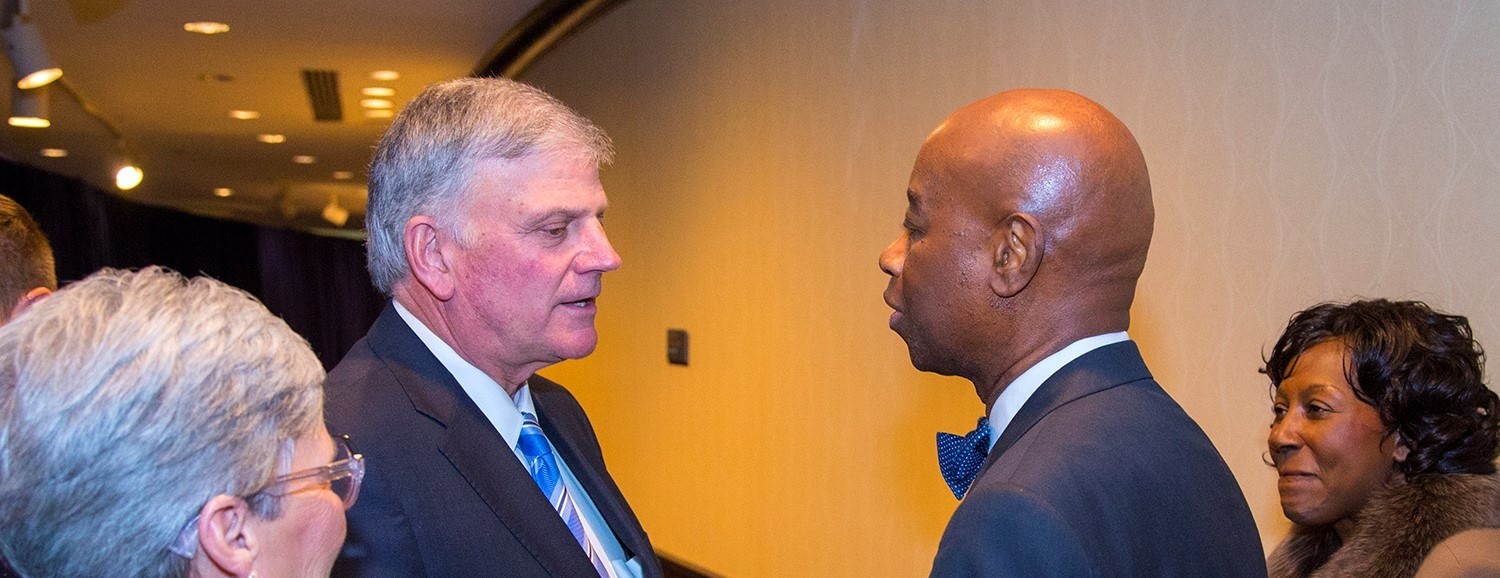
Franklin Graham and U.S. Senate Chaplain Barry Black at the 2017 National Prayer Breakfast. (Image: Screengrab of tweet by Franklin Graham.)

The two groups that Graham runs are Samaritan’s Purse, one of the world’s largest relief organizations, and the Billy Graham Evangelistic Association (BGEA).

The European parliamentary report called the BGEA one of the top 10 organizations responsible for “the lion’s share of US anti-gender activism in Europe,” spending tens of millions of dollars there from undisclosed donors, openDemocracy found. The BGEA website says the organization considers marriage to be exclusively between “one genetic male and one genetic female” and human life to begin at conception.

Unlike the BGEA, which focuses on evangelizing Graham’s brand of Protestantism, Samaritan’s Purse is a relief organization. However, its “primary mission” is to share the gospel of Jesus Christ. So it too weaves far-right views in with aid for the needy.

Samaritan’s Purse employees, for instance, must reject same-sex marriage. In 2012, Samaritan’s Purse spent more than $150,000 opposing a marriage-equality measure in North Carolina.

Samaritan’s Purse filings up through 2019 show repeated annual donations to The Family. The BGEA changed its legal status in 2014, calling itself a church, and so no longer has to disclose its filings, but previous records show that it, too, gave to The Family.

For years, the BGEA tax filings included $20,000 earmarked for the NPB, and reported that the organization attends the breakfast “on behalf of the ministry.” Samaritan’s Purse gave the same amount annually, bumping it up to $25,000 in 2015 and then, in 2016, doubling that amount to $50,000, which it has given every year since.

According to the source, the BGEA also doubled its donations in 2016. The source’s claim could not be verified since BGEA filings no longer being public, but the BGEA did not dispute it. (The Family, BGEA and Samaritan’s Purse all did not respond to TYT’s requests for comment.)

The Samaritan’s Purse tax filing says the charity’s purpose is to help “victims of war, poverty, natural disasters, disease and famine with the purpose of sharing God’s love through his son, Jesus Christ.” Its donations to The Family are labeled as “Christian education.”

The source, however, told TYT that both organizations sent their donations together, explicitly for the National Prayer Breakfast.

The Family’s congressional allies, including a handful of Democrats, say the purpose of the breakfast is to pray together and pursue reconciliation. Graham tells a different story.

“Everybody in that room has the same agenda,” Graham told The New Yorker in 2018. “They’re wanting to be able to rub elbows with somebody that they normally couldn’t rub elbows with.”

Graham’s money allows The Family to protect its relationships with some of those people. According to the source, Graham’s donations ensure that Family leaders don’t have to raise the cost of tickets or hit up rich donors for yet another expense.

The source said the breakfast had run short in previous years and people in the office said they didn’t want to go hat-in-hand to rich Family donors to keep the breakfast in the black. One of The Family’s biggest known donors is Ron Cameron, a well-known Republican megadonor. The source said Cameron would likely have been the first stop in such circumstances. And not just because of his wallet.

Cameron was a past board member of The Family’s legal entity, the Fellowship Foundation. On top of that, the chief financial officer at Cameron’s poultry company was also The Family’s chief budget overseer for the breakfast. Mountaire Poultry CFO W. Dabbs Cavin was also, at the time, board president of the Fellowship Foundation.

The other two Family insiders running the breakfast were former South Carolina governor David Beasley, a Trump supporter whom Trump later appointed to run the UN World Food Programme, and Brandon Cloud, previously a Maryland Democratic Party official. The source said they did not know Cloud’s current political stance, but his LinkedIn profile says he no longer works for The Family. Neither Cloud nor Cavin responded to requests for comment.

Graham’s money not only helps The Family avoid taxing Cameron’s financial patience, it keeps down registration fees for thousands of its breakfast guests. Although The Family likes to portray the breakfast as a congregation of diverse leaders, many attendees are not leaders at all, but loyal evangelical foot soldiers. For some, registration fees upward of $500 per person — plus travel and lodging — already prove prohibitive.

It’s not clear why Graham would keep his support for the breakfast secret, but much about The Family is purposely made fuzzy, as journalist Jeff Sharlet has reported, to facilitate the organization’s ability to build and maintain personal relationships with people in power. As TYT has reported, although the official letters to guests come from a congressional host committee, some members have no idea who’s being invited in their name.

That’s especially true of Democrats. As TYT previously reported, the Family insiders who invite the most guests are overwhelmingly Republican. Two Democratic members of the 2016 host committee said they didn’t know who had been invited. Even a Democratic Family insider, lobbyist and former Kansas congressman Jim Slattery, said he was unaware of who gets invited.

But creating a public impression of equal Democratic involvement helps The Family portray the breakfast as nonpartisan. That’s what Forbidden Colours warned Democrats about in its intelligence brief, which specifically claimed that 2016 breakfast co-chair Rep. Juan Vargas, D-Calif., had been “misled” about Ukraine’s prayer breakfast.

After the first National Prayer Breakfast of the Trump presidency, the BGEA cited Vargas’ attendance in a post claiming that politics take “a backseat” at the breakfast. The post went on to praise Trump’s breakfast remarks for his defense of religious liberty — a common right-wing rallying cry used to justify anti-LGBTQ speech and discrimination.

And while The Family and its congressional allies try to persuade people that the breakfast is ecumenical, Graham at times seems to forget his lines. Graham has cited Democratic congressional participation as proof that Christian politicians are better for America than non-Christian politicians. “If Christians in Congress can get together,” Graham said to Fox News about the National Prayer Breakfast in 2018, “it tells us we need more Christians in politics … and if there were more Christians, they would come together and work … for the American people.” Fox’s hosts agreed.

Even the breakfast’s origins are recounted differently, depending on the narrator and the audience they’re addressing. The Family’s website claims the breakfast was created by members of congressional prayer groups to help President Dwight Eisenhower. Billy Graham is not mentioned. The BGEA site more accurately discloses Billy Graham’s role — with no suggestion that the impetus for the breakfast came from congressional prayer groups.

As Sharlet has discussed, Eisenhower agreed only reluctantly to attend the first NPB — at least in part due to the political debt he owed the elder Graham.

Today, Franklin Graham’s nonprofit tax filings don’t do much to clarify the true nature of the present-day breakfast. The BGEA no longer releases theirs. Samaritan’s Purse filings say its donations to the International Foundation (another name used by the Fellowship Foundation) are for “Christian education.”

One obvious reason for Samaritan’s Purse and the BGEA to support the National Prayer Breakfast could simply be to sustain the legacy of Graham’s father.

Billy Graham had deep, longstanding ties to The Family. In addition to his work with Family founder Abraham Vereide — a right-wing, free-market, Norwegian immigrant and minister — the elder Graham had a long personal relationship with Vereide’s successor, Doug Coe. (Graham’s long-time spokesperson, A. Larry Ross, is also The Family’s spokesperson and board member, and was one of several Family insiders involved in radicalizing Big Lie promoter Mike Lindell.)

Unlike his father, Franklin Graham is more overtly political, and less invested in ministering to both parties. One source close to The Family suggested that Graham’s fire-and-brimstone approach is even out of step with The Family’s ostensible interest in reaching out beyond evangelical Protestantism.

But it’s conceivable that Graham hoped the breakfast would help knit frayed ties between Trump and evangelicals. The 2016 campaign brought one revelation after another about the millionaire TV star assaulting women, bragging about it, and betraying an utter lack of interest in genuine religiosity.

Nevertheless, Graham was an early supporter of Trump. In 2011, Graham said Trump might be his preferred Republican candidate in 2012, embracing Trump’s false claim that Barack Obama had not been born in the United States. The following year, Trump began giving money to both the BGEA and Samaritan’s Purse.

It was at some point after Trump locked down the Republican nomination that Graham doubled his breakfast donations. Breakfast leaders later told others that Graham had said it was to cover any additional expenses related to having a new president in office. The source, however, said they did not know whether Graham conveyed this to the breakfast leadership before or after the general election.

With Trump in the White House, Graham went on Fox to discuss the 2018 National Prayer Breakfast. He used the event to promote Trump and slam Obama.

Although Graham has little involvement with The Family, his organizations do engage with the National Prayer Breakfast. Graham gets to bring members of his family and nonprofit executives to the event.

Graham guests have included Kelvin Cochran, who attended the breakfast in 2016. Cochran had been fired as Atlanta’s fire chief the previous year, after writing and distributing to employees a book that opposed same-sex marriage and compared LGBTQ sex to pederasty and bestiality.

Some of the executives from Graham’s charities who get to attend hold leadership positions related to fundraising and government lobbying. One Graham guest in 2018 was a senior vice president of wealth management at Truist Bank who also sat on the board of Samaritan’s Purse.

Samaritan’s Purse employees have also been given speaking slots at the breakfast — which includes days of events that, unlike the presidential speech, never get aired on C-SPAN. One Samaritan’s Purse speaker, Dr. Kent Brantly, was a celebrity in his own right after contracting ebola while treating victims of the epidemic in Liberia. (Samaritan’s Purse later cited Brantly’s work as part of an amicus brief defending the right to discriminate against LGBTQ job applicants.)

Brantly’s boss at Samaritan’s Purse, Dr. Lance Plyler, spoke at the 2019 NPB. Later that year, Plyler returned to his previous employer, Liberty University, calling the two organizations “incredibly like-minded” and saying that “medicine is an incredible tool for the sake of the Gospel.”

And despite the BGEA’s claim that the National Prayer Breakfast is nonpolitical — a fiction abetted by congressional Democratic participation — the right wing uses the event every year like clockwork to attack any Democratic president who speaks there as insufficiently religious. Graham himself does it.

In 2015, even after Obama praised Graham’s employee who fell ill treating ebola patients, Graham hit back at Obama’s speech for daring to remind people of historic Christian violence. Graham used the remarks as grist for an attack on Islam, which then became grist for a Breitbart attack on Obama.

Earlier this year, President Biden delivered remarks at the breakfast remotely, via pre-recorded video, even though Family leaders helped bankroll the Big Lie. Despite the implied insult to America’s 30 million nonbelievers, Biden gave the breakfast what it wanted, saying the way for the country to unify was through “faith.”

Even that, however, wasn’t enough for the breakfast’s patron. Graham made headlines in religious circles, criticizing Biden for not saying “God.”

With additional research by TYT News Assistant Zoltan Lucas and TYT Investigates Intern Jamia Zarzuela.

Georgia school suspends Black students for planned protest against Confederate flag

Several Black students at the Coosa High School in Rome, Georgia say they’ve been suspended simply for planning a protest against the Confederate flag.

Local news station CBS 46 reports that many students at the school were upset last week when a group of white students came to school brandishing the Confederate flag while hurling racial slurs.

However, the school quickly jumped in to clamp down on a potential protest against the flag and suspended the students who organized it.

A recording obtained by CBS 46 reveals a high school administrator announced that the protest would not be allowed over the intercom system last week.

“The administration is aware of tomorrow’s planned protest,” the administrator said. “Police will be present here at school and if students insist on encouraging this kind of activity they will be disciplined for encouraging unrest.”

Student organizer Jaylynn Murray told CBS 46 that the school shouldn’t allow students to brandish the Confederate flag, especially since it doesn’t allow them to wear Black Lives Matter apparel.

“I feel the confederate flag should not be flown at all. It is a racist symbol and it makes me feel disrespected,” she said.

Watch CBS 46’s report on the student protests below.

FEMA ignores Puerto Rico’s once-in-a-lifetime chance to build a clean energy grid

The Biden Administration has a once-in-a-lifetime opportunity to help Puerto Rico transition to a greener and more resilient energy future, but it’s on the verge of making a multibillion-dollar mistake.

Since Hurricane Maria devastated Puerto Rico in 2017, many residents and environmental advocates have called for new clean energy sources for the island. Currently Puerto Rico gets more than 97% of its electricity from imported fossil fuel. Power is expensive and unreliable.

Puerto Rico adopted laws that called for generating 15% of its electricity from renewable sources by 2020, 40% by 2025, 60% by 2040 and 100% by 2050. But the Federal Emergency Management Agency, which controls relief funding for the island, appears ready to underwrite a rebuild of the old fossil fuel system.

As environmental lawyers and professors of law, we are surprised to see FEMA move forward on a path that runs directly counter to the White House’s energy and climate policy. President Joe Biden has called for a governmentwide approach that promotes clean energy, protects public health and the environment, and advances environmental justice.

In our view, FEMA’s actions don’t support those goals. They also ignore legal requirements for federal agencies to carefully weigh the environmental impacts of major actions.

Rebuild or replace with a more resilient green system?

In September 2017, Hurricane Maria struck Puerto Rico with sustained winds of 155 mph. It tore a diagonal 100-mile swath across the island, demolishing tens of thousands of homes and washing away roads and bridges.

The storm toppled transmission and cell towers, snapped concrete power poles, battered power plants and plunged the island into darkness. It killed an estimated 3,000 people and caused over US$90 billion in damages.

In response, Congress authorized some $23 billion in disaster aid, including at least $10 billion to restore or replace Puerto Rico’s electricity grid. It also passed the Disaster Recovery Reform Act to promote a more flexible energy system that could withstand and recover quickly from climate disruptions.

FEMA, which administers the funds, has allocated $9.4 billion for rebuilding Puerto Rico’s electricity system and will start approving projects after it receives more details explaining how the work will be performed. So far, none of this money has been earmarked for renewable power, except for a small sum to repair a hydroelectric dam that provides less than 1% of the island’s power.

The organizations making decisions in Puerto Rico are the Commonwealth’s Electric Power Authority, known as PREPA, and Luma Energy, a private company that received a 15-year contract in 2021 to manage power transmission and distribution on the island. PREPA and Luma have proposed hundreds of projects for the coming decade, but none include federal funding for rooftop solar, community solar, battery storage or microgrids. Advocates say that this kind of small-scale local generation would make the island’s electricity cheaper, cleaner and more reliable.

A 2015 study by the nonprofit Institute for Energy Economics and Financial Analysis found that investing in solar and wind power and energy efficiency could transform Puerto Rico’s electrical system into a resilient grid. And in 2020, the U.S. National Renewable Energy Laboratory estimated that rooftop solar power in Puerto Rico could generate roughly four times as much electricity as residents currently use.

Federal law requires weighing the options

Spending almost $10 billion to rewire an island with 3 million residents is clearly a major federal action with significant environmental impacts. Under the National Environmental Policy Act, agencies undertaking such actions must prepare an environmental impact statement that takes a hard look at alternatives and invites meaningful public input.

PREPA and Luma’s proposed plan includes reconstructing and hardening nearly all of Puerto Rico’s transmission lines and building at least two new natural gas-fired power plants. Burning more natural gas will affect air and water quality and contribute to climate change. Natural gas is shipped to Puerto Rico in liquid form, so using more of it also means expanding import facilities and pipelines.

Instead of producing a full-scale environmental impact statement, FEMA produced a superficial programmatic environmental assessment—a narrower study that did not weigh other options. It concluded that there would be “no significant impact” from rebuilding Puerto Rico’s fossil fuel-based energy system. The study did not mention climate change, which scientists widely agree is making hurricanes larger and more destructive.

Beyond a pro forma invitation for public comment, FEMA made no effort to engage with overburdened communities of color that have disproportionately suffered from pollution and climate change under Puerto Rico’s energy system. This directly contradicts Biden’s order to place environmental justice at the center of federal energy and climate policy.

The National Environmental Policy Act also requires agencies to “study, develop and describe appropriate alternatives to recommended courses of action.” FEMA’s environmental assessment only considers rebuilding and hardening the existing grid, and does not mention renewable energy. When some public commenters criticized this omission, FEMA responded that it was not responsible for considering alternative means of generating electricity.

Advancing the public interest

Both PREPA and Luma are proponents of an energy strategy that centers on importing natural gas. Federal law requires FEMA to take a broader approach and ensure that it spends federal money in ways that support U.S. environmental goals.

Courts have held that environmental justice is not simply a box to be checked. In our view, the law clearly requires FEMA to give Puerto Ricans—who have lived with a creaky power system for four years—a seat at the table before it starts writing checks for projects that affect their lives.

Patrick Parenteau, Professor of Law, Vermont Law School and Rachel Stevens, Professor of Law & Staff Attorney, Vermont Law School

This article is republished from The Conversation under a Creative Commons license. Read the original article.

Joe Manchin’s love of coal could derail Biden’s climate plan

President Joe Biden has a goal for all U.S. electricity to come from zero-carbon sources by 2035. To get there, he’s counting on Congress to approve an ambitious package of incentives and penalties designed to encourage utilities to clean up their power sources. That plan, part of the Democrats’ proposed budget package, may be in trouble.

Sen. Joe Manchin, a West Virginia Democrat who has close ties to the coal, oil and gas industries and concerns about the speed of Biden’s planned emissions cuts, will oversee that part of the budget as chair of the Senate Energy and Natural Resources Committee. Manchin has emphasized using “all energy sources” as “cleanly as possible” and described the idea of eliminating fossil fuels as “very, very disturbing.” He reportedly wants to lessen the proposed incentives and penalties for utilities, known as the Clean Electricity Payment Program, and reward companies for burning natural gas.

We asked Michael Oppenheimer, director of the Center for Policy Research on Energy and Environment at Princeton University, about the potential impact and alternatives the administration has for reaching its goals.

1. Natural gas was often described as a bridge fuel that could ease the transition from highly polluting coal-fired power plants to scaling up cleaner energy like solar and wind. Can it still play that role, as Sen. Manchin suggests?

My position on natural gas has changed over the years. For decades, I and a lot of other people thought natural gas would be a bridge fuel. It emitted about half as much carbon dioxide as coal, and it got much cheaper as hydraulic fracturing expanded to make the U.S. the leading gas producer. Utilities on their own started switching away from coal, and anticipation of the Obama administration’s greenhouse gas regulations pushed them faster.

But natural gas has a problem. Its drilling operations, transmission pipelines and distribution systems in cities — every part of that system — are considerably more leaky than the Environmental Protection Agency estimated. Natural gas is composed mainly of methane, a greenhouse gas many times more potent per molecule than carbon dioxide, though it doesn’t stay in the atmosphere as long.

We also now know that the world is very close to entering a climatic danger zone. The latest IPCC report lays out the scientific evidence in the strongest terms for how human activities, particularly those that burn oil, gas and coal, are unequivocally warming the planet in ways that are causing rapid changes in temperatures, precipitation, ice and sea level, and extreme weather.

One of the quickest things a country can do to slow its climate impact is to eliminate methane emissions. The gas stays in the atmosphere for only about 12 years, compared to centuries or longer for carbon dioxide. Yet even with minimal leakage, natural gas combustion still produces carbon dioxide. If you’re trying to plan a U.S. energy future, you don’t want to encourage a lot of new fossil fuel infrastructure and exploration. It can’t be a bridge for long enough to justify the investment — the climate can’t bear it.

2. Can the US slow down the pace of change and give the energy industry more time, like some utility CEOs and Sen. Manchin have suggested?

Unfortunately, no. We’re already headed for at least 1.5 degrees Celsius of warming, where the Paris Agreement’s danger zone starts, and we anticipate significantly more damage at 2 degrees. Every increment of warming brings more harm.

Climate models show that extreme events, like the heat waves and flooding the U.S. saw this summer, are already more common around 1.5 degrees, and they only worsen after that. It’s going to be harder to protect ourselves beyond 1.5 degrees, and much harder beyond 2 degrees. The costs are already getting prohibitive for many communities.

For example, sea level rise is accelerating fast enough that by 2050 in a world headed for 2 degrees of warming, many coastal locations around the world, including in the U.S., will face high-water levels every year equal to or greater than their historical 100-year flooding event. Eventually, in some areas, the daily high tide will bring flooding equivalent to that high-water mark.

I’ve been working on these issues since 1981, and it’s been the same story over and over again from many industry officials and politicians — what’s the hurry; let’s wait another year. There was always some argument for slowing action down or putting it off indefinitely. That’s why we’re currently facing one climate disaster after another.

The costs get higher the longer the world delays.

How global temperatures have shifted year by year since 1951.

3. The fossil fuel industry would benefit from billions of dollars in support through the infrastructure bill for carbon capture and storage, which could allow power plants, refineries and factories to continue generating greenhouse gases. Sen. Manchin supports that technology, but can it meet the U.S. goals?

The industry was talking about carbon capture and storage as a silver bullet 20 years ago, yet today there are still only about two dozen commercial-scale projects operating worldwide. In the U.S., most involve ethanol or fertilizer production or natural gas processing plants, and almost all of them send the captured carbon dioxide for use in enhanced oil recovery, a technique for forcing more oil out of wells. Two attempts to build large power plants with carbon capture, in Illinois and Mississippi, generated a lot of buzz in the early 2000s but ultimately failed, with billions of dollars in cost overruns.

The technology was too expensive then, and it hasn’t gotten cheaper. Our government never found a way to do carbon capture and storage demonstration projects on the scale needed to get out the bugs and reduce the price.

The next question is what are you going to do with all that captured carbon dioxide? There will be local and environmental justice concerns about pipelines and burial. While I recognize that power lines engender opposition, too, why not just spend the effort improving the electric transmission and storage system, to create a smart grid for renewable energy, reserving carbon sequestration for later in the century in case we need to resort to direct air capture of carbon dioxide?

4. If the budget bill is weakened, what does that mean for the Biden administration’s commitments to reach zero-emissions electricity by 2035 and net-zero emissions overall by 2050?

The federal budget isn’t the end game. It’s only one step. Because Democrats in Congress plan to use the reconciliation process to move this legislation, this bill has to be about financial incentives and penalties. Beyond that, there is still room for EPA to adopt new and stronger regulation of greenhouse gas emissions.

While those can be undone by future presidents, as we saw during the Trump administration, the public and Congress are now starting to understand the price of unrestrained climate change. It’s hard to ignore wildfires that force you from your home or storms that flood your street.

That means it will get harder for the next president to simply repeal all the regulations the way the Trump administration tried to do. I believe the value of having a stable regulatory system will become evident very quickly.

My colleagues at Princeton published a report last winter that laid out five pathways to get America to net zero emissions. They focused on a few pillars, emphasizing energy efficiency, electrification, renewable energy, biofuels, nuclear energy and carbon capture. In my view, the first three are promising, the last three problematic.

A rapid transition remains doable — but it’s bigger than the slice of the $3.5 trillion now proposed for dealing with climate change. It will require federal mandates, incentives and disincentives to move a lot of private investment away from fossil fuels and into renewables. Mostly, it will require political will and determination — commodities that seem to be the scarcest of all resources.

Michael Oppenheimer, Professor of Geosciences and International Affairs, Princeton University

This article is republished from The Conversation under a Creative Commons license. Read the original article.

How Ron DeSantis’ COVID bans could get Harry Styles tripped up

Pop singer Harry Styles is under investigation in Florida for holding a concert in violation of a state rule established by Florida Gov. Ron DeSantis that bars the use of COVID-19 “passports.”

The probe, first uncovered with a records request by The Orlando Sentinel, is being led by the Florida Department of Health, which is apparently scrutinizing roughly 120 venues, businesses, and government entities alleged to have flouted the state’s new law. The ban was first enacted back in April by DeSantis, who claimed that failing to do so would “create two classes of citizens based on vaccinations.” 

“Individual Covid-19 vaccination records are private health information and should not be shared by a mandate,” the governor said at the time. “It’s completely unacceptable for either the government or the private sector to impose upon you the requirement that you show proof of vaccine to just simply be able to participate in normal society.”

Last month, the Republican governor approved a law that slaps a $5,000 fine on businesses  that require customers to show proof of their vaccination. (The fine applies to every single Floridian that is turned away.) That policy, currently being challenged in court, directly contravenes President Biden’s recent federal vaccine mandate for corporations with 100 or more employees. 

Joining Styles on the state health department’s list is the government of Orange County, the Orange County Convention Center, AT&T, Starbucks, Equinox, the House of Blues, the Disney Cruise Line, and the Amway Center, which hosted Styles’ concert last month. At the event, Styles implemented a policy allowing attendees to show proof of vaccination or a negative test, according to The Orlando Weekly. Both options, however, apparently constitute violations of state law. 


Want a daily wrap-up of all the news and commentary Salon has to offer? Subscribe to our morning newsletter, Crash Course.


News of the probe comes amid Tuesday’s state fine of Leon County, which earlier this month sacked fourteen government employees for failing to receive the vaccine. The county was summarily fined over $3.5 million by the Florida Department of Health, which called Leon’s move a “blatant violation of the law relating to the ban of vaccine passports in our state.” Leon County Administrator Vincent Long said in a statement that “the governor’s position in this instance unfortunately appears to be less of a public health strategy and more about political strategy.”

Late last month, Florida saw a peak average fatality rate of 445, with hospitalizations reaching more than 17,000 in August, according to The New York Times. These figures have precipitously fallen in recent weeks.

Anita Hill’s seismic testimony and its reckoning 30 years later: “She was in no woman’s land”

Nearly three years ago, Christine Blasey Ford testified before the U.S. Senate that then-Supreme Court Justice nominee Brett Kavanaugh had sexually assaulted her decades ago. In many ways, her testimony, which became a watershed moment for survivors and women in politics, was able to happen because of the Black woman who had come before her: Anita Hill.

A new podcast called “Because of Anita” revisits how in 1991, Hill testified that then-Supreme Court Justice nominee Clarence Thomas had sexually harassed her while she worked for him. Not only did her testimony introduce the concept of workplace sexual harassment into the lexicon, but it had galvanized generations of women, and shined a light on the unique experiences of Black women who seek safety and justice. 

“There was an understanding [in 1991] — white women stood for gender, and Black men stood for race,” Cindi Leive, who co-hosts of the podcast along with New York Times cultural critic Dr. Salamishah Tillet, told Salon. “As a Black woman, she was in no woman’s land.  . . . And it was really important for us to foreground that in this podcast.”

At the time, it was precisely this limited conception of identity and its intersections that labeled Hill as a “race traitor,” a Black woman playing the part of a white woman for challenging Thomas, who was seen as representing all Black people as a Black man. 

That’s why 30 years later, Anita Hill’s story feels more relevant than ever. To examine its impact and gain new insights, the four-part podcast features a conversation between Hill and Dr. Ford, as well as numerous interviews. Legal scholar Kimberlé Crenshaw in particular recalls attending the hearing and discusses intersectionality, a term she coined, in relation to Hill’s story and our understanding of it today. Other guests include: journalist Jane Mayer; Kerry Washington, who portrays Hill in “Confirmation”; Carol Moseley Braun, the first Black woman U.S. Senator; Me Too founder Tarana Burke; and a wide range of other expert voices.

“We have to not just look at what happened and how we got it wrong, but also ask, ‘Now how are we going to ensure that doesn’t happen again?'” Leive said.

Check out Leive’s full interview with Salon below, in which she discusses the podcast’s star-studded slate of expert voices, the impacts of Hill’s story on the Supreme Court today, what it felt like to be in conversation with Hill and Dr. Ford and more.

The following interview has been lightly edited for length and clarity.

We’re coming up on the three-year anniversary of Brett Kavanaugh’s confirmation, and Anita Hill’s story seems to get more and more relevant as time passes. What was the impetus for making this podcast and revisiting her story, today?

We’re in the middle right now of this renewed reckoning around gender violence over the last few years, ranging from Me Too, to the Kavanaugh hearings, to even just in the course of making this podcast, Andrew Cuomo and R. Kelly. It’s really useful and crucial to look back at past “reckonings” and see what did and didn’t come out of them. Part of what we were really interested in with this podcast is to look at what happened after Anita Hill’s testimony, both to pay tribute to the seismic effects it had in our culture, but also, to look at what didn’t change and why that was.

I’m old enough to remember immediately after the Clarence Thomas hearings when there was this sense of rage not unlike 2017 and 2018. There was this momentum among women, this real banner-waving of, we’re going to change things, this galvanizing electricity. And yet, a lot of things didn’t change. Some things did, some things didn’t. It’s really important to ask, what happened then? Because that tells us how we make the most of the moment we’re in right now.

We know behind one individual woman, there are so many movements and communities holding them up, and Anita Hill definitely had and has so many supporters. How did you and your team choose the amazing women you interview on the podcast?

We had a lot of discussions about that. It was very much a group effort, and my co-host Salamishah and Jenna Weiss-Berman, our EP, went through that list. There are so many people who could talk about this. What we were looking for was a combination of people with real, on-the-ground experience of what it was like. So, in that first episode, Jane Mayer spent two years after the Thomas hearings really pounding the pavement and interviewing hundreds if not thousands of people for her book “Strange Justice,” which still has incredible, encyclopedic knowledge of who did what and why at the hearings. We wanted to talk to her, among other things, to help us understand why witnesses who could have been called weren’t called and why that was, which is something a lot of people still don’t know about. 

So, a combination of people who had that on-the-ground experience, and people who can correct the record about what happened. One of the people we talk to in the second episode is Barbara Ransby, who’s one of the women who took out the “African American Women in Defense of Ourselves” ad, and she points out the reason they did that about a month after the Clarence Thomas hearings is, 1,600 Black women signed and it ran in the New York Times. It was a very strong and historic statement in support on behalf of Black women for Anita Hill. One of the reasons they did it is they felt their voices and their support were not going to be reflected in the media and in history. Barbara wanted to enter that into the public record. 

So, it was really important to make sure the remembering of what actually happened is not just remembering what we heard at the time. The first guest voice you hear in episode 1 is Kimberlé Crenshaw’s, and many Americans today either know her as one of the founders of critical race theory, or as the woman who came up with the term intersectionality. This is a textbook example of what intersectionality is.


Want a daily wrap-up of all the news and commentary Salon has to offer? Subscribe to our morning newsletter, Crash Course.


It was very important for us to open with Professor Crenshaw, who was there at the hearing, and talks about the scene where she and her colleagues walk out of the Capitol, and come down the steps and see a group of Black women assembled. She initially thinks they’re there to support Anita Hill, then realizes they’re there singing and praying for Clarence Thomas. Then, she realizes the tide has really turned. It’s a pivotal moment in the hearings and her own life, and captured how devastating and seismic those hearings were for Black women in particular. It’s important for us to open the episode with that remembrance, and her brilliance just talking about the hearings overall.

The audio testimonies of Anita Hill and Clarence Thomas really transport you to that moment in time. There’s such a contrast in Thomas’ sense of male victimhood and Anita’s graciousness. What do you think it is about her testimony that’s been so resonant and unifying for women across generations?

Before doing this project, I thought I remembered the Thomas hearings and all of that questioning incredibly well. And when I went back and listened to it, I was struck with how there were just some moments that were so jaw-droppingly excruciating you can’t believe they happened, but of course they did, and not that long ago. Like, Senator Howell Heflin asking her, “Are you a scorned woman? Are you a zealot who’s doing this for your attachment to the civil rights cause?” as if that’s disqualifying. He was a Democrat, not even Thomas’ party, but he was going for her in a way that makes the hair on your neck stand up. 

Arlen Specter, Republican, moderate Senator, says at one point to her, “Well, that’s not too bad to discuss women’s breasts in the workplace, that’s something we do all the time.” And he’s kind of smirking, and Anita has written about this in her recent book as something that got under her skin, the derision. It’s just dripping with scorn.

So, there are parts that are really rough to listen to, and what blows you away is how calm and composed she is, how firm to her word she is. One of the most powerful moments in the hearings, which Kerry Washington talks about in the podcast, is in response to a question about why she kept in touch with Clarence Thomas, why she didn’t quit, didn’t report him — she says, with calmness, this is very common, she can’t explain it because she would need a psychologist to do that, but that she can tell you it happens, “because it happened to me.” That line brings me to my knees, because it’s that confidence and certainty that her experience is valid in the face of an entire committee of older white men who are essentially telling her her experience, even recounted by her, the person who lived it, is not valid. Her ability to have faith in her own experience is unbelievably moving, and indelibly inspiring over generations.

Kimberlé Crenshaw features in the first episode, and she makes the case for how Hill’s story is a textbook example of what intersectionality entails. How did it feel to talk to a pioneer of intersectional feminism? Drawing on your years of reporting on gender, have you ever felt that word is sometimes thrown around without substance?

It’s a great thing the word “intersection” and the concept of intersectional feminism has gotten popularized. Accessibility and mass relevance — it’s a good thing people are talking about it. But sometimes it can be thrown around in a way that makes it seem, like any word that’s frequently used or pops up on t-shirts, like it’s divorced from meaning. If you want to understand it, Anita Hill is the textbook case. Here is a Black woman appearing before the world to talk about her experience, and the second that a Black man, Clarence Thomas, positions himself through the use of his term “high-tech lynching,” he is, as Professor Crenshaw says on the podcast, hijacking history.

He is using the historical experience of Black men having been lynched in this country to position himself as a representative of all Black Americans, but of course, the experience of Black women and the sexual abuse of Black women and girls is also a feature of American history, as Kimberlé Crenshaw points out. It’s been a condition of their life in this country for 400 years. But because that was not widely understood, Clarence Thomas was seen as standing for his race, and Anita Hill was not. The suspicion was that she was playing the part of a white woman.

At first when she heard the term “high-tech lynching,” she thought, well no one’s going to believe that, because there’s never been an instance of Black men being lynched because of something a Black woman said or did. It was the false accusations of white women that led to lynching. But suddenly, Anita Hill was seen as inhabiting the role of a white woman, because there was an understanding — white women stood for gender, and Black men stood for race. As a Black woman, she was in no woman’s land. It’s an incredibly important story to look at through that lens.

It was interesting for me to revisit, where I was just out of college at the time, and I experienced the Clarence Thomas hearings as a horrifying, cautionary tale about the workplace and whether a woman’s word would be taken seriously. But the impact of her testimony on Black women goes beyond that, and it was really important for us to foreground that in this podcast.

Your conversations with Jane Mayer and Kerry Washington on the pod are also very revealing, and wade into how rejecting Clarence Thomas was positioned in that time period as an attack on all Black people. Do you think our modern approach to identity in politics has progressed since then with more diversity in government, or could you see something like this happening again?

There’s no question representation helps, that it was an all-white, all-male committee in 1991 that created an environment where the experiences of Black women weren’t understood or elevated, and no one was willing to poke holes in the stereotyping of Anita Hill, or how Clarence Thomas had not supported civil rights in his work before using this term high-tech lynching. As both Jane Mayer and Kimberlé Crenshaw point out, the white members of the committee, which is to say all the members of the committee, didn’t feel equipped to take that on in any way. They also were highly compromised on gender issues in general. There was an “SNL” skit after the hearings that joked about Senator Ted Kennedy with a paper bag on his head at the hearings, a riff on how he’d had so many accusations of sexual misconduct swirling around his family and his past, that he didn’t have a leg to stand on, standing up for Anita Hill.

All of this goes to the fact that when you have a governing body that isn’t representative, you’re not going to get representative outcomes. Are things better than 1991? Sure. But women are still vastly underrepresented in the Senate, House, state legislatures, virtually any other governing body. We’re not there yet. Even though a lot of women ran for office after the Anita Hill testimony, it was still largely a very white Congress. That’s started to change, but there are no Black women in the Senate right now. We’re going in the right direction, but this is a process, and we’re only at the beginning.

The episode featuring Anita Hill and Dr. Christine Blasey Ford in conversation hasn’t been released yet, but can you describe what it felt like to be a part of that? What are the biggest lessons you’ve learned from these women, on a personal level?

One of the things we as a culture sometimes misunderstand about that kind of testimony is, what we see is really the tip of the iceberg. When people think of the Anita Hill or Dr. Ford testimonies, they picture the women standing in the room with their hand up, taking a vow, answering questions, a frozen-in-amber moment. But there’s a whole before and a whole after. How do you decide where to go, how do you share your testimony? What happens to you afterward? You’ve just been through this incredibly traumatic moment, and now you have to go back and live your life. We were really interested in hearing from these two very thoughtful women, and not just about the “during,” which is what we all as a culture are usually obsessed with.

Have you been watching “Impeachment” on FX? Do you think revisiting relatively recent modern history shows us how little things have changed for women, or the opposite? 

As soon as I leave the podcast studio, which happens to be located in my closet, I’m going to get back on all my TV viewing, and “Impeachment” is first! I love Monica Lewinsky, and the idea of Monica and Ryan Murphy together is fantastic. As soon as the audio engineers let me out of my soundproof cave, that’s what I’m watching.

So, for how much has changed, usually both — there are certain parts of these stories that you like to think could never happen today, but on the other hand, it’s not that long ago. What you don’t want to do is watch those stories with a 2021 superiority, like, “Oh, we were all so clueless back in 1998 and 1991. We would never do that now,” when we’re doing “that” right now, to other women, in other cases. It’s incredibly important to revisit those stories, especially those that involve women who paid incredibly steep prices. We owe them, as a culture, to revisit them.

But then what? You don’t want to just watch those and pat yourself on the back for being so much more enlightened now. I guarantee every one of us who’s watching “Impeachment” is probably doing something we’re not going to feel great about in five or 10 years, so how do we identify those things, and get to a place where we have better perspective in the moment? It’s happening now, where narratives get corrected faster, and better representation in media and more diversity of storytellers makes a huge difference.

Even if you look at sexual harassment back in 1991 with Anita Hill’s case, there’s a handful of reporters who were really digging into that story. Most of them were women. Now there are a lot more reporters and a much more diverse media body digging into accusations of violence, which we get into the last episode of the podcast.

With Texas’ abortion ban, increasing lack of transparency at the Supreme Court, and just Trump’s legacy over the court, what insights can listeners of “Because of Anita” take away about the future ahead of us?

If you read Anita Hill’s new book, she’s very clear her work and her 1991 testimony were prompted by the belief that the court mattered. She was there both as a woman who had something to say, and as a lawyer who believed the court made a difference — it had made a difference in her own family’s life, in the life of the country. We’re in a moment right now where we can see Supreme Court Justices, not just Clarence Thomas, are eager to prove they’re not a political body, that they’re trustworthy and put the law before politics. But it goes without saying, if you want to understand why people think the court puts politics above the law, you’ve got to go back to 1991.

The first three episodes of “Because of Anita” are now streaming wherever you listen to podcasts. The fourth and last installment will release on Oct. 14.

Efficient, eatable, delicious: On building the ideal breakfast sandwich

What makes the perfect breakfast sandwich? As with every question, the answer depends on whom you ask. But if you’re talking in terms of broad likeability and scientifically engineered eatability, you have to at least mention McDonald’s Egg McMuffin

I pondered this as I dug into my current favorite breakfast sandwich, which lives at Kasama — a modern Filipino restaurant and bakery in Chicago’s Ukrainian Village neighborhood. This particular sandwich layers a custardy egg soufflé square, a caramelized longanisa sausage patty, an oozing slice of American cheese and a hash brown (if you’re going all out) between two squishy potato roll halves. It’s just cheffy enough, though it bears a few unmistakable similarities to the Sausage Egg McMuffin. And everyone seems to love it — on a good weekend morning, Kasama churns out roughly 200 of them between 9 a.m. and noon. 

The sandwich’s creators are Kasama’s married owners, chef Tim Flores and pastry chef Genie Kwon. They always planned to have a breakfast sandwich on the menu — it was only a matter of getting it right. 

“(McDonald’s) was our pinnacle, like how close can we get our breakfast sandwich to this?” Kwon recently recalled to me.

Interestingly, “pinnacle” here applies as much to efficiency as deliciousness and eatability, largely because this little indie eatery opened amid a pandemic (and subsequent staff and ingredient shortages that would prove similarly relentless). As fine-dining veterans (Flores of Oriole and Senza in Chicago; Kwon of Oriole, Eleven Madison Park in New York and Flour Bakery & Cafe in Boston), the pair had to dial back their stubborn impulse to make everything from scratch.

Instead, they took a page from the fast-food industry’s efficiency and consistency handbook. The main test for every prototype involved letting the sandwich sit in its foil jacket at least 30 minutes before digging in.

“When we started working on the breakfast sandwich, the biggest qualifications were — is it eatable? Like, can you have it on your lap in the car? And will it sit for a while?” Flores said. 

Some answers came easily. Prior to opening Kasama, Flores spent two years perfecting his longanisa recipe, a Spanish chorizo-esque sausage based on the slightly sweet version you’ll find in Pampanga, the Filipino province his dad hails from. Moreover, Flores and Kwon quickly realized that shredding, shaping, par-cooking and frying 500 hash brown patties to order every week with a skeleton kitchen staff made no sense when suppliers had already engineered a consistently tasty frozen version for far cheaper.

Kasama Egg SandwichKasama Egg Sandwich (Maggie Hennessy)

Ultimately, the bread proved to be the biggest obstacle. For weeks, Flores and Kwon tested everything from laminated brioche slices and buns to milk bread, but either the rich bread flaked everywhere or the sandwich’s insides squished out. They didn’t settle the matter until one afternoon when they dug into cheeseburgers on Martin’s Potato Rolls for staff meal.

“We were just like, this bread is the best. Let’s do the breakfast sandwiches on there,” Flores said. “It’s that chewy, I-don’t-want-to-say sh**ty white bread you liked growing up. It’s squishy and nostalgic — and it allows the textures of the hash brown, egg and sausage to each stand out.”

All in, they tinkered with the sandwich for about four months before adding meaty and vegetarian versions to the menu in late February. The rest, they say, is history. 

RELATED: Want creamier scrambled eggs? These are the best dairy products to add for texture and flavor

“There’s not a single item on the menu that’s gotten a bigger response than this,” Kwon said. “It really helped our morning sales and saved some of our days for sure.”

I wish I knew how long it took the late Herb Peterson to come up with what would eventually be dubbed the Egg McMuffin, the breakfast sandwich he engineered as a fast-food version of eggs benedict. When Peterson coaxed late McDonald’s founder Ray Kroc to his Santa Barbara, Calif., store in 1972 to taste it, he refused to divulge what he’d done, Kroc recalled in his 1977 autobiography, “Grinding It Out: The Making of McDonald’s.”

“He didn’t want me to reject it out of hand, which I might have done, because it was a crazy idea — a breakfast sandwich. It consisted of an egg that had been formed in a Teflon circle, with the yolk broken, and was dressed with a slice of cheese [to replace the hollandaise] and a slice of grilled Canadian bacon. This was served open-faced on a toasted and buttered English muffin. I boggled a bit at the presentation. But then I tasted it, and I was sold.”

Is it possible that we haven’t necessarily innovated beyond 1972 when it comes to breakfast sandwiches? Some might say the same about the cheeseburger. Sure, chefs go through bouts with wagyu patties and fancy toppings like truffle and foie gras, but we inevitably find ourselves right back at some variation on the Big Mac: two smashed patties, American cheese, pickles and some form of Dijonnaise or fry sauce. 


Want more great food writing and recipes? Subscribe to Salon Food’s newsletter.


Give the people what they want, right? “We just like making regular food,” Flores said. “We’re not trying to put some spicy mayo or avocado on it. I just want sausage, hash brown, egg and American cheese.”

Then again, McDonald’s Egg McMuffin doesn’t feature Kwon’s scratch-made savory egg custard, which she pours into hotel pans and steams ’til set and silky before she slices each rectangle with a tiny, flexible offset spatula. Nor does the McMuffin’s pale sausage patty hold a candle to Kasama’s fatty pork longanisa, stained red from annatto seed and imbued with garlic, smoked paprika, black pepper and a hint of brown sugar, which ingeniously replicates the effect you’d get from drizzling maple syrup over sausage.

Also unlike McDonald’s, Kasama won’t cave to demand — including a shameless plea from yours truly — to make it available all day. 

“I like the exclusivity,” Flores said. “There’s something about having to race into a place because you just have to have it. Plus, once it’s noon you want a chicken adobo sandwich instead.”

More by this author:

Right-wing fumes over NFL coach Jon Gruden’s resignation for racist, homophobic emails

Right-wingers are rushing to defend Raiders head coach John Gruden following his resignation amid a series of reports that Gruden spoke in racist, sexist, and homophobic terms spanning roughly a decade. 

Jesse Kelly, conservative talk radio host of “The Jesse Kelly Show,” suggested that the push for Gruden’s dismissal was led by “a bunch of lying, whiny pretenders in this country.”

“That’s the funniest/saddest thing about that whole business,” Kelly tweeted. “60% of America and 99% of the NFL not only think like Gruden does, they’ve all sent emails/texts like that.”

“Let’s see the emails & texts of [NFL Commissioner Roger] Goodell & every NFL owner/exec,” echoed Donald Trump Jr. “We must find out if they’ve ever said anything wrong, shared a controversial thought, or held an opinion that wasn’t PC. No statute of limitations. We can’t allow them to hide behind their white privilege.”

Other conservatives compared Gruden’s remarks to previous controversies surrounding former NFL players and even President Biden’s son, Hunter. 

“Ray Lewis was charged with a double murder, the suit he wore the night of the murder mysteriously disappeared, he pled guilty to obstruction of justice and settled with the victim’s families,” tweeted Newmax TV host John Cardillos. “He played a full NFL career. John Gruden sent some off-color emails 10 yrs ago.”

Josh Barnett, an Arizona congressional candidate, expressed a similar sentiment, writing that “Hunter Biden’s emails are 100x worse than Gruden’s.”


Want a daily wrap-up of all the news and commentary Salon has to offer? Subscribe to our morning newsletter, Crash Course.


Gruden’s emails first came under the league’s scrutiny this summer as part of a broader investigation into the Washington Football Team. In reviewing roughly 650,000 emails from 2011 to 2018, NFL executives unearthed a number of objectionable emails sent by Gruden to former Washington executive Bruce Allen and other executives, wherein Gruden – then an ESPN color analyst – used derogatory language when speaking of Goodell and the league’s players. 

In one 2011 instance first reported by The Wall Street Journal, Gruden described DeMaurice Smith, the executive director of the NFL Players Association, with an explicitly racist trope, saying that “Dumboriss Smith has lips the size of michellin tires.”

In a different exchange from 2014, Gruden called the NFL commissioner a “faggot” and a “clueless anti football pussy” for apparently expediting the drafting of Michael Sam, the league’s first openly gay player. 

Other emails reportedly showed Gruden circulating photos of bikini-clad women, including images of two Washington team cheerleaders, and mocked players for demonstrating in support of racial justice. 

On Monday, Gruden – who served a brief stint as head coach of the Raiders from 1998 to 2001 and rejoined the team in 2018 – resigned following immense pressure from both league players and officials. 

“I love the Raiders and do not want to be a distraction. Thank you to all the players, coaches, staff, and fans of Raider Nation. I’m sorry, I never meant to hurt anyone,” he said in a statement released by the team. 

Though calls for his Gruden’s resignation were swiftly met, the NFL has over the decades notoriously struggled to hold its players, coaches, and executives accountable for ethical lapses.

Over the years, the league has repeatedly failed to discipline its players for domestic and sexual abuse against women, even when it comes to incidents involving the NFL’s own cheerleaders, according to the Times. The league has also reportedly waged a decades-long effort to suppress a growing body of scientific evidence linking player concussions to degenerative brain disease. 

More recently, the league has been thrust into the political spotlight as players have taken increasingly public stances against issues of social justice. 

In 2016, Colin Kaepernick, then the quarterback of the San Francisco 49ers, abruptly became a free agent after kneeling during the national anthem in protest of the country’s U.S. police brutality and racial injustice. He remains unsigned by any team in the league. And this year, the NFL came under fire for its practice of “race-norming” – a statistical trick that yields lower concussion settlements for Black players by assuming that they have lower baseline level of intelligence than their White counterparts. 

This year, the NFL has shown a relatively pronounced intent to rebrand. In September, the league announced that it would be letting players emblazon social justice messages onto their helmets and has also pledged to commit $250 million to combat systemic racism.

The human neck is a mistake of evolution

Critics of evolution often argue that life, rather than gradually changing over the years through natural selection, was actually created by a so-called “intelligent designer.” Their position is that the biological machinery which makes up living bodies is so complex, and so perfectly calibrated to support our numerous needs, that it had to have been planned out by a deliberate and thoughtful force of some kind.

Yet if God actually did design human bodies according to a plan, they forgot to make sure that we can breathe while we sleep — a remarkably crucial detail to overlook. While not everyone suffers from the aforementioned anatomical glitch, known to doctors as obstructive sleep apnea, it affects 22 million Americans — and has become an even more hazardous condition amid the spread of a deadly virus that attacks the lungs.

To understand this fault in the human blueprint, imagine your upper airway as a tube that must remain open to do its job. (This is a simplistic reduction for the purpose of analogy.) When you’re awake and upright, the tube stays open easily. Yet once you recline — say, to sleep — one’s muscles around that tube start to relax. The apparatuses around the tube — including one’s tongue and soft palate — can press down and constrict it, interfering with the smooth passage of air, akin to a kink in a hose. When one’s breathing is reduced, this condition is known as a hypopnea; if one’s breathing stops altogether, it is called an apnea.

To the people in proximity to the sufferer, the result is snoring, choking and other highly unpleasant sounds during sleep. The sufferers themselves are usually deprived of restful sleep and adequate blood oxygen levels, and their consequent lot in life can be one of abject misery: Constant daytime fatigue, headaches and living in a mental fog are just three of the most common symptoms. Over the long term, sufferers are at a high risk of heart disease, Alzheimer’s disease, strokes, high blood pressure, diabetes and a number of mental health ailments. For a large percentage of the patient’s day, their body endures the stress of repeatedly coming close to suffocating, as well as the weariness of never being allowed recuperative sleep.

Why does this happen? In children, the culprit is frequently obstructions from the adenoids or tonsils, and the solution can be as simple as an operation. Obese people may be at a higher risk for sleep apnea, since excess fat deposits around one’s throat and chest can further restrict nighttime breathing. Aging is a factor, too, as aging causes one’s throat muscles to weaken. Those who make lifestyle choices that weaken the respiratory system, such as smokers, are at higher risk. Finally, some merely have genetic or anatomical predispositions that, for one reason or another, mess with the proper working of the structures in the upper airway.

COVID-19 has made being an apnea sufferer a more dire condition. In January, a study in the journal BMJ Open Respiratory Research found that obstructive sleep apnea is an independent risk factor for severe COVID-19. Patients with obstructive sleep apnea were at a 2.93 times higher risk of requiring hospitalization for COVID-19 — independent of other risk factors for either the disease or the sleep disorder. While this could simply mean that having obstructive sleep apnea gives a patient other risk factors that coincidentally make them more vulnerable to COVID-19 (such as a high BMI), it could also be that the sleep disorder exacerbates COVID-19 on its own, “especially during the night, when decreased oxygen saturation levels occur in” obstructive sleep apnea, the researchers say.

There are treatments for sleep apnea, the most notable of which is the CPAP, or continuous positive airway pressure, machine. CPAP machines work by keeping the upper respiratory tract open with a constant level of air pressure greater than atmospheric pressure. A patient attaches a nasal mask, a face mask or nasal prongs to their airway, and a machine uses water to lubricate a regular pressure stream that persists throughout the patient’s sleep. While the apparatus can be difficult to adjust to, those able to make the transition often report significant relief. Many patients say that using a CPAP completely changed their lives, restoring their physical and mental vitality literally overnight. (CPAPs have been in the news lately because a manufacturing issue in the CPAP machines made by Phillips Respironics has put certain customers at risk of cancer; the company has issued a recall.)


Want more health and science stories in your inbox? Subscribe to Salon’s weekly newsletter The Vulgar Scientist.


So how did nature bring us to a point where, for millions of people, the only effective way to breath while sleeping (aside from major surgery) is to literally force air down their throats? How did evolution let this happen?

The answer, as it turns out, has to do with evolutionary trade-offs. Humans evolved to be highly intelligent, walk upright and communicate through complex vocalizations. Those gifts came with a price.

As Allen J. Moses, Elizabeth T. Kalliath and Gloria Pacini wrote in the dental journal Dental Sleep Practice, lower animals are fortunate to have “evolved structures of nearly perfect design” for tasks like breathing, swallowing, smelling and chewing. Humans, by contrast, need to balance a large cranium (housing a large brain) on a spinal column that remains vertical to the ground to allow them to walk on two legs. They also need equipment in their necks that permit them to produce sounds for talking, and those organs take up more of the already-limited amount of real estate in the neck. The tongue, for instance, descends deeper into a human’s neck than it does for any other mammal. Even pioneering biologist Charles Darwin was aware of the absurdity of evolution in allowing food to potentially go down the wrong pipe in your throat; “every particle of food and drink we swallow has to pass over the orifice of the trachea with some risk of falling into the lungs,” he wrote. 

If the human body were a building, our neck would arguably be the most poorly conceived room in the house, overflowing with functionally mismatched organs stuffed there to accommodate other design priorities. “Significant evolutionary changes to the human head are flat face, smaller chin, shorter oral cavity, changes in jaw function, repositioning of ears behind jaws, ascent of the uvula and descent of the epiglottis, right angle bend in tongue, creation of compliant, combined, flexible airway-footway, and speech,” the researchers write in the aforementioned journal.

Perhaps in part because scientists assumed humans could not possibly have such an absurd inherent design flaw, the symptoms of these structural deficiencies — most conspicuously snoring — were for centuries perceived as innocuous or, at worst, merely annoying. It wasn’t until the mid-20th century that scientists began to figure out that those periods when sleeping people struggle to breathe actually pose a serious health problem. Even then, a common approach was to perform a tracheotomy, a drastic measure in which a hole is punched into the throat to facilitate breathing. The CPAP was invented after one patient refused to undergo the procedure but was willing to try his doctor’s new air-pressure machine. Chronically unable to sleep before using the world’s first CPAP, he reported feeling utterly refreshed the following morning. Humanity’s architectural flaw had been exposed.

Before long, Japanese scientists were learning how even minor alterations in the size and position of the pharynx drastically altered the likelihood of developing a sleep disorder. Scientists were even figuring out the precise role of obesity in contributing to the disorder. (Obesity enlarges tissues in the already cramped throat.) Within decades, obstructive sleep apnea has become a common diagnosis and a main condition that sleep health professionals look for in their patients.

These problems existed before the COVID-19 era and, despite being worsened by the pandemic, will almost certainly persist after it is over. After all, obstructive sleep apnea has been a literal and figurative pain in the neck for as long as humans have had necks as we currently know them. Aside from the immediate knowledge humans have acquired about our own anatomical deficiencies, the existence of obstructive sleep apnea is a reminder to embrace humility. Millennia after the ancient Greeks created modern medicine, we are still learning surprising new things about the bodies we inhabit every day. 

Trump, right-wingers praise anti-vax Southwest pilots — who turn out to be imaginary

Former President Trump and several right-wing Republican lawmakers claimed over the holiday weekend that hundreds of canceled and delayed Southwest Airlines flights resulted from pilots and other airline employees resisting vaccine mandates. But the airline, the pilots union and the FAA have all said that Southwest’s vaccine requirements had nothing to do with this weekend’s issues.

Southwest canceled more than 2,000 flights between Saturday and Monday and at least 1,400 other flights were delayed. The airline blamed severe weather, air traffic control staff shortages and a lack of hotel accommodations for employees for creating a cascading series of issues that led to inadequate staffing on more than one-fourth of Southwest’s weekend flights. The union representing Southwest pilots blamed the airline’s complicated technological system, which reassigns and reroutes pilots during disruptions, for causing a “domino effect” that forced the company to reassign more than 70% of its pilots over the weekend. Southwest saw a similar string of cancellations in June, which the airline later blamed on overly optimistic projections about how quickly it could scale up flights as passengers began to return over the summer.

This weekend’s cancellations came just two days after the Southwest pilots’ union asked a federal judge to block the company’s vaccine mandate. Republican lawmakers, without evidence, quickly seized on an imaginary link, tying the travel chaos to the company’s new policy and President Biden’s call for a federal vaccine mandate.

“Joe Biden’s illegal vaccine mandate at work. Suddenly, we’re short on pilots & air traffic controllers,” Sen. Ted Cruz, R-Texas, declared on Twitter — while actually linking to a CNBC article that quoted an airline spokeswoman refuting his claim as an “unfounded rumor” and “inaccurate.”

Rep. Lauren Boebert, R-Colo., claimed that Southwest employees were “standing up for their rights as Americans.”

“You will NEVER be able to comply your way out of tyranny,” she tweeted.

Rep. Andy Biggs, R-Ariz., said he stands with Southwest employees who are “fighting against these mandates.”

“This isn’t about a vaccine, this is about freedom,” he wrote.

“Shut them down,” wrote Rep. Chip Roy, R-Texas.


Want a daily wrap-up of all the news and commentary Salon has to offer? Subscribe to our morning newsletter, Crash Course.


Donald Trump also sought to link the issues to vaccine mandates, as well as his endlessly repeated false claims about the 2020 election.

“I think it has a lot to do with a lot of things. I think it has something to do with the election that was rigged,” he said in a radio interview this weekend. “I think these are big fans of your favorite president, I think that this has something to do with that. I think it has something to do with the … I think it has a lot to do with mandates.”

Donald Trump Jr., also amplified the baseless claim on Twitter, claiming that employees had gone on “strike” over the mandates.

Fox News host Tucker Carlson amplified these unfounded claims to his primetime audience, saying that the flight cancellations were the “direct consequence” of Biden’s vaccine mandate.

But there’s no evidence of a strike or sick-out by airline employees. The pilots’ union has said that pilots called in sick at a normal rate over the weekend.

Asked how much the company’s vaccine mandate contributed to the cancellations, Southwest CEO Gary Kelly told CNBC, “Zero.”

Kelly said that the rate of employee absences over the weekend was “very normal.”

“Understand how airlines work,” he said. “When you get behind, it just takes several days to catch up.”

The Southwest Airlines Pilots Association said on Saturday that “our pilots are not participating in any official or unofficial action.”

“There are false claims of job actions by Southwest Pilots currently gaining traction on social media and making their way into mainstream news. I can say with certainty that there are no work slowdowns or sickouts either related to the recent mandatory vaccine mandate or otherwise,” union president Casey Murray said in a statement on Sunday, pointing instead to severe weather in the southeast United States, staffing shortages and the company’s operating system, which he said has become “subject to massive failures under the slightest pressure.”

The union said last week that it does not oppose vaccines but filed a lawsuit to block the mandate because Southwest had not consulted employees before making the decision.

Murray told the Dallas Morning News that pilot sick rates over the weekend “were exactly in line with where they were all summer with the same kind of operational disasters.”

Incoming Southwest CEO Bob Jordan last month blamed the company’s months-long issues predating the vaccine mandates on staffing shortages stemming from the pandemic, when thousands of employees accepted buyouts, early retirements or long-term leave.

Southwest COO Mike Van de Ven said in a video to employees that despite “a very aggressive hiring plan … we are still not where we want to be with staffing,” especially pilots.

Industry experts blamed the company’s “point-to-point route network” for making the airline more susceptible to widespread issues than other airlines. Delays cause cascading issues at each flight’s additional stops and the airline had scheduled more flights than it could handle, Henry Harteveldt, president of the Atmosphere Research Group, told NBC News.

“You screw up Florida, you screw up their whole network a whole lot more because it’s connected to the rest of their system. Once it gets screwed up, airplanes are out of place, crews are out of place,” added Mike Boyd, an aviation consultant at Boyd Group International. “The crew gets stuck in Omaha and ran out of time, they should be in Orlando. Getting that squared away takes time.”

Cruz ignored all of the contradictory evidence and statements from the airline, the pilots and the FAA — which also said there is no evidence that “this weekend’s cancellations were related to vaccine mandates” — to accuse the media of Democratic propaganda when his baseless claim was widely fact-checked. He then claimed he had not meant Southwest employees but was referring to air traffic controllers in Jacksonville, where local aviation authorities reported staffing issues over the weekend.

But the statement he posted explicitly refuted the “rumor” that it was impacted by an “organized walkout late Friday by controllers in response to the FAA’s mandate that all employees get vaccinated.” Instead, it blamed staffing issues on “normal approved leave” and controllers who are required to stay at home for 48 hours after getting vaccinated.

“If you believe the pilots unions, MANY MORE FLIGHT CANCELLATIONS ARE COMING (and not just SWA) because of Biden’s illegal vaccine mandate,” Cruz wrote.

Nearly all major airlines have now required employees to be vaccinated without encountering the same problems as Southwest, where the issues have persisted for more than four years, according to the pilots’ union. While Republicans continue to attack Biden for urging vaccine requirements, most voters support such mandates and data shows that compliance rates have been exceptionally high.

United Airlines, the first airline to require vaccines for employees at a time when its overall vaccination rate was below 70% in August, says that all but about 300 of the company’s 67,000 employees have been vaccinated or granted exemptions, a rate of more than 99.5%.

“I did not appreciate the intensity of support for a vaccine mandate that existed, because you hear that loud anti-vax voice a lot more than you hear the people that want it,” United CEO Scott Kirby told The New York Times. “But there are more of them. And they’re just as intense.”

Republicans’ war on vaccines: GOP pushes strategy to prolong the pandemic

Gov. Greg Abbott of Texas, a Republican, has once again proven his stalwart commitment to aiding the virus that causes COVID-19 in its goal of spreading as far as possible. Late Monday, the Republican state leader issued an executive order banning all entities in the state — including private businesses — from requiring employees to be vaccinated against COVID-19. (All other vaccine requirements remain untouched, because the “principled opposition” to vaccine mandates is an inch deep.) 

As many folks who wish hypocrisy still mattered have pointed out, Abbott’s ban violates his party’s supposed commitment to a low regulatory environment for businesses by interfering with private businesses who wish to institute vaccine requirements. When it comes to the conflict between being pro-business and pro-virus, however, it was never any contest with Republicans. All other GOP principles fall before the newfound Republican commitment to making sure COVID-19 infects as many human bodies as it can. 

Abbott, of course, did not admit that he was preventing businesses from enacting basic health and safety standards. Instead, he presented the ban as a defense of business, accusing President Joe Biden of “bullying many private entities into imposing COVID-19 vaccine mandates, causing workforce disruptions that threaten Texas’s continued recovery.” That’s is just a small taste of the doublespeak that the entire executive order is written in. 

Abbott is not standing up for businesses or the economy.

Biden’s vaccine mandate was quietly welcomed by many businesses who want to have normalcy-returning mandates but want someone else to blame when Trumper employees whine about it. And their worry about worker shortages was unfounded, as most vaccine resistant workers will get the shot rather than lose their job. Abbott’s claims about economic recovery are also hot air. The sluggish recovery is due to the ongoing pandemic and will only bounce back if more people get vaccinated. 

No, it’s quite clear what’s going on and has been going on with Republicans fighting every effort to get the pandemic under control: The GOP wants to prolong the pandemic because they think doing so will help them in the 2022 midterms. 


Want more Amanda Marcotte on politics? Subscribe to her newsletter Standing Room Only.


Abbott himself is up for reelection in 2022, and, at first blush, it might seem a weird strategy to practically make the virus his running mate. (Though the coronavirus has tough competition in an “ew, gross” contest with Texas Lt. Gov. Dan Patrick.) But Abbott is making a smart, if deeply evil and downright murderous, bet. Voters, especially fairweather voters, tend to blame everything on the party that controls the White House, even if the blame for any problem actually falls on the opposition. If the pandemic is still a problem in November 2022, then there’s a very real chance that large numbers of Democratic voters, already demoralized by the lack of legislative progress on other fronts, simply won’t show up to vote. That will make it easier for Republicans to sweep the midterms. 

A new Axios-Ipsos poll demonstrates that the “prolong the pandemic” strategy is working for Republicans. Trust in Biden on the pandemic has fallen to 42%, down 10 points from where it was 6 months ago. Most of the trust has slipped with Democrats and independent voters. Americans are also getting depressed, with 30% saying it will be more than a year before life returns to normal, which is triple what the number from June. 

The COVID-19 culture war isn’t just demoralizing Democratic and potential Democratic voters. It appears GOP leadership sees this issue as a way to invigorate their own base, whose entire political reason for existing is increasingly just to “own the liberals.” 

Anti-vaccine and anti-mask protests, which are getting rowdy and even violent, started off as a classic right-wing Astroturfed phenomenon, but it’s since gained a lot of traction among ordinary conservatives who aren’t getting paid to throw tantrums at perplexed school board members. Culture war provocations over Dr. Seuss and Mr. Potato Head floated earlier this year by Fox News weren’t getting the job done — but freaking out over masks and shots really gets the juices going for the worst Americans, i.e. the people the GOP needs to turn out at the polls. 

Vaccine mandates are a threat to the “victory through infecting our own voters with COVID-19” strategy for Republicans, for one simple reason: They work. As a White House report released last week details, “organizations with vaccination requirements have seen their vaccination rates increase by more than 20 percentage points and have routinely seen their share of fully vaccinated workers rise above 90%.” Despite conservatives floating threats of mass walkouts, the paper-thin “principled” opposition to vaccines disappears the second that conservatives face an actual consequence for refusing to vaccinate. 


Want more Amanda Marcotte on politics? Subscribe to her newsletter Standing Room Only.


The Biden administration has fallen far short of where it should be in terms of vaccine mandates, both slow-walking the employer mandates and completely sidestepping the possibility of banning the unvaccinated from planes before the holidays. Still, even the threat of vaccine mandates is starting to have an impact. As the report notes, the rate of unvaccinated Americans has been cut by one-third since Biden first started issuing mandates. 

Republicans are in a race against time in their efforts to reduce vaccination rates to the point where the pandemic is still a live issue next November. COVID-19 rates are falling, down 24% in the past 14 days nationally and down 39% in Abbott’s home state, which continues to have one of the highest COVID death rates in the nation. This is mostly because of vaccination, but also because so many Americans have been infected that it’s adding to herd immunity. It’s still unclear if there will be another winter surge or if the virus is finally running out of the unimmunized bodies it needs to remain a serious threat. There is a strong possibility that the end of the pandemic is closer than many Americans think. 

So by making it as hard for Biden to get shots into arms faster, Republicans are keeping COVID-19 cases high to keep Biden’s approval ratings low.

If that doesn’t change — or if it gets worse with another surge — there’s a very real chance that this pandemic makes the already dim prospects for Democrats in 2022 even worse. And that, in turn, sets the stage for Donald Trump to cheat his way back into the White House in 2024. So it’s no wonder that power-hungry Republicans are betting big on their prolong the pandemic strategy, even if it comes at the cost of killing their own voters. Big risks lead to big rewards. For the Republicans, setting themselves up for permanent one-party minority rule is the biggest prize. 

Democrats don’t have to save themselves. Donald Trump is still here to help

Democrats find themselves, in the midst of an intense battle to pass President Biden’s domestic agenda while avoiding a debt limit showdown, once again asking the perennial post-election question: How can they win back white, non-college-educated voters?

This has been the Democrats’ big conundrum for over 30 years now and most of the time they end up with exactly the same possible strategies. Either appeal to the white working class’ economic self-interest, pander to their prejudices or triangulate against their own base. Sure there are other strategies for winning elections thrown out there, like find the apathetic voters who don’t bother with politics and get them to the polls or wait for demographic changes that will bring more voters into their coalition. Often there is a “one from column A and one from column B” quality about this discussion, but there really hasn’t been anything new added to the mix for several decades.

At this moment, the discussion is being waged around a couple of takes on these basic ideas. The New York Times’ Ezra Klein interviewed data specialist David Shor for his column to talk about a theory they are calling “popularism” which they defined this way:

Democrats should do a lot of polling to figure out which of their views are popular and which are not popular, and then they should talk about the popular stuff and shut up about the unpopular stuff. 

It may surprise you, as it did me, that this is considered some kind of breakthrough idea but apparently some people think it is.


Want a daily wrap-up of all the news and commentary Salon has to offer? Subscribe to our morning newsletter, Crash Course.


Of course, Democratic politicians don’t actually have that kind of control over the narrative. Politics are much more national than they used to be with the press out there contributing their takes and independent activists trying to advance their issues and causes. And needless to say, there are the Republicans who are very, very good at ruthlessly hijacking the political narrative. The idea that Democrats can just keep their less popular ideas on the down-low isn’t remotely realistic. 

The problem began with the Southern Strategy in 1968 and gained steam throughout the 80s as all the old Southern Democratic lions retired, switched parties or died, making the two parties polarized ideologically and demographically. In fact, 30 years ago this issue was considered a regional problem and the consultants and strategists all said that we needed presidential candidates from southern states so that they could relate to the “bubbas” as they called them. Essentially, the advice boiled down to finding (or creating) cultural affinity combined with an economic pitch to the working man, which always polls well.

Jimmy Carter was the first stab at this approach and it worked out in 1976. But when a movie star from California challenged him in 1980, all that affinity for authentic Southern identity went right out the window. Ronald Reagan appealed on a whole other level. His slogan was “Let’s Make America Great Again” and those white, working-class Democrats ate it up with a spoon. Those voters became known as Reagan Democrats. They’re all old or dead now but the Democratic Party is still trying to get them back.

Bill Clinton, a southern boy from Arkansas, was the first candidate after Carter to win the presidency, reactivating the argument that southern cultural affinity would signal to this elusive group of white voters that the Democrats weren’t snobby elites from the Big City trying to impose their deviant ways on Real Americans. He didn’t make a populist argument. He was a DLC Democrat, a group that had decided that old-fashioned new deal style government needed to go the way of the Dodo, so they adopted a technocratic “market” approach, thinking that would be a better way to deliver government to the masses. The populism was left to a billionaire named Ross Perot, who took one of the largest 3rd party shares in US history in 1992.

And at the same time, you had a Republican Party that was radicalizing rapidly under the leadership of a crude demagogue by the name of Newt Gingrich who was heating up the culture war and feeding red meat to these contested voters. Clinton was caught in that crossfire and never won a majority. He survived because the radicalized Republican Party had succumbed to hubris and tried to remove a popular president on trumped-up charges. Clinton was very lucky in his enemies. There’s an important lesson for the present day in that.

Shor obviously thinks that President Obama was able to win two terms by following what he prescribes, arguing that Obama downplayed the unpopular culture war issues that bother these voters and emphasized the issues that drew them in. Sure, that’s true, but Obama embodied racial progress and generational change which meant he didn’t have to say much about it in order to keep his base happy, at least in the beginning. Unfortunately, the backlash on the right was fierce and it dogs the party to this day. The first Black president may have won two campaigns but his election drove the Republican Party over a cliff.

These last few decades have been backlash followed by a backlash against the backlash, and we are still in the middle of that dynamic. Democrats have tried everything to offset the structural disadvantage they have as the party of multi-urban voters in a system that over-represents rural citizens. Better messaging isn’t going to solve that problem.

But that doesn’t mean the Democrats are doomed, at least not yet.


Want a daily wrap-up of all the news and commentary Salon has to offer? Subscribe to our morning newsletter, Crash Course.


If polarization and backlash are what drives the political dynamic, then the Republicans have given Democrats a gift that keeps on giving. His name is Donald Trump.

While Democrats dither over which “Kitchen Table Issue” will appeal to some rural voter in Iowa, the Republicans are becoming frantic that Trump is going to ruin 2022 and 2024 for them. Politico reports that the party wants to talk about inflation and Afghanistan and crime etc, while Trump is out there ginning up the MAGA faithful with non-stop talk about the Big Lie. Republicans are reportedly very nervous that “in focusing on that issue above all others, Trump effectively makes the 2022 election a referendum on him instead of Biden.

Republican Senators are also deeply concerned that Trump is going to mess up their chances of retaking the upper chamber, according to The Hill:

“I think we’re better off when he’s not part of any story,” said a Republican senator, who said his view is widely shared in the GOP conference.

That’s a shame for them because he’s not going anywhere. In fact, this past weekend the Senate’s elder statesman Chuck Grassley, R-IA, decided if you can’t beat them, join them and attended Trump’s rally to receive his blessing from the Dear Leader himself.

Trump’s meddling in the primaries is causing huge headaches as well.

The AP reported that there is no vetting of the candidates he’s choosing and a good number of them are very dicey characters accused of violent behavior and criminal financial activity. Their only qualification is their total loyalty to Donald Trump. They will no doubt be popular with the Trump base but they will have difficulty winning general elections.

Republicans have a very big, orange albatross around their necks right now and even though they know it could cripple their chances to regain the majority, they can’t get it off. We’ll have to see if the Democrats and their consultants can stop navel-gazing long enough to recognize it. 

Black flag: Understanding the Trumpists’ latest threatening symbol

It’s an old truism that the “real bad men” (and bad women) “move in silence and violence.” That’s certainly true for the most dangerous and most effective of Donald Trump’s allies, henchmen, henchwomen, and other followers. But for Donald Trump himself, and most of his political cult, that rule does not apply.

Trump and his followers were loud, exuberant and enthusiastic on Jan. 6. The lethal attack on the Capitol had been publicly announced weeks in advance, and should have come as no surprise. Trump’s rallies and gatherings continue to celebrate violence and the prospect of revenge — and specifically of “getting even” with Trump’s “enemies.”

Steve Bannon, Trump’s former campaign chairman and White House strategist, has now threatened to recruit Republican-fascist “shock troops” with the apparent goal of undermining the U.S. government, and by implication multiracial democracy, if and when Trump and the Republicans regain control of both Congress and the White House.

On a daily basis Fox News and other elements of the right-wing disinformation propaganda machine use stochastic terrorism and other techniques to radicalize their audience into committing acts of political violence. To this point, the Democratic Party and the political and news media class in general have remained in denial, and largely passive in response

In one troubling new development, Trump supporters have begun flying all-black American flags, in an implicit threat to harm or kill their opponents — meaning nonwhite people, “socialist liberals,” Muslims, vaccinated people and others deemed to be “enemies” of “real America.” As media critic Eric Boehlert recently noted, the liberal opinion site Living Blue in Texas is sounding the alarm about the specific meaning of the black flag and the Republican-fascists support for terrorism and other political violence. That post, “Are Your Republican Neighbors Planning on Killing You?”, merits lengthy quotation:

It didn’t take long to find hundreds of videos where these Trumpers and so-called patriots were hanging black American flags. …

Black American flags are the flags that mean “no quarter shall be given.” They are the opposite of the white flag of surrender.

According to the people on TikTok and the Sun (British tabloid), the black American flag originated in the civil war and was flown by the Confederates.

It means that they will not surrender, will not take prisoners, and are willing to die for their cause. It means they will execute their enemies.

Who are their enemies? Pretty much any non-Conservative. You know, Democrats, Liberals, LGBTQ, BIPOC, and the vaccinated. …

So, we’re the enemy, and they’re openly professing to want to execute us. … So, why are they doing this

Covid vaccinations, mostly. They believe that Joe Biden has declared a civil war on them by mandating that employers with over 100 employees and the military have vaccinations.

Yes, they say civil war, and they say it’s already started. But, unfortunately, many of them also live in states where masks and vaccines are required by state governments, healthcare, and law enforcement.

An alarming number of military members have been making Tik Toks talking about how they are being discharged because they refuse the vaccine. It’s alarming because there is probably an equal number of guys on there talking about the civil war plans and actively using Tik Tok to recruit these military and ex-military members.

The biggest message they have been sending out is, “it’s time” or “the time is now.” …

Although showing guns on Tik Tok is supposed to be against community guidelines, they show lots of videos of their guns, shooting them, wearing them, or sitting on their bed.

They primarily use Tik Tok as a recruiting tool and let others know their willingness to commit violence. Then they tell people to message them or where to find them on Telegram.

However you interpret these videos posted by Trump followers and other neofascists — which could be mainly performative — it is clearly true that the American right is increasingly willing to accept or condone violence as a means of expanding and protecting their social and political power. (Salon did not find licensed news photographs of these flags, and has made the editorial decision not to reproduce the images mentioned above, which are easy to find on social media.)

Public opinion polls and other research have repeatedly shown that millions of Republican voters and Trump followers would support the use of violence to remove Joe Biden from office because of the “Big Lie” and their belief that that he is not a legitimate president. Similarly, a large proportion of Republicans believe that the rioters who stormed the Capitol on Jan. 6 were “patriots” whose use of violence was justified.

And a new poll from the University of Virginia’s Center for Politics even suggests that more than 50 percent of Trump supporters want “red states” to secede from the Union. Republican elected officials and other right-wing opinion leaders have continued to escalate their threats of political violence against Democrats and other targeted groups.

In a recent speech to the North Carolina Faith and Freedom Coalition’s “Salt & Light” conference, Rep. Madison Cawthorn, R-N.C., issued what sounded like a declaration of war:

It is time for the American Christian church to come out of the shadows to say, “No longer are we going to allow our culture to be determined by people who hate the things that we believe in…. We are going to stand valiantly for God’s incredible inherent truths that predate any version of government. Because, my friends, if we lose this country today, if we bend the knee to the Democrats today, our country will be lost forever, our children will never know what freedom is. It’s our duty to stand up, Let us stand united as men and women of faith to fight for our country.

During an interview with MSNBC’s Joy Reid, terrorism and national security expert Malcolm Nance said that Cawthorn’s video “picks up on the themes that are not just coming from the Steve Bannon level and Donald Trump level, they are coming from the Republican street — and that Republican street is armed. They’re angry. They have been fed an entire line which makes them believe that America is no longer America and that they no longer want the America that the rest of us, the 60 percent of the country, live in. And they`re willing to take up arms for it.”

Nance also noted that Cawthorn’s propaganda video is thematically similar to the type of propaganda used by Islamic terrorist groups such as ISIS and al-Qaida to radicalize and recruit members.

During an interview with Scientific American magazine, Dr. Bandy Lee, the principal editor of the 2017 bestseller “The Dangerous Case of Donald Trump,” explained how a mentally pathological leader can “infect” his followers and perhaps even an entire nation:

I have outlined two major emotional drives: narcissistic symbiosis and shared psychosis. Narcissistic symbiosis refers to the developmental wounds that make the leader-follower relationship magnetically attractive. The leader, hungry for adulation to compensate for an inner lack of self-worth, projects grandiose omnipotence — while the followers, rendered needy by societal stress or developmental injury, yearn for a parental figure. When such wounded individuals are given positions of power, they arouse similar pathology in the population that creates a “lock and key” relationship….

“Shared psychosis” — which is also called “folie à millions” [“madness for millions”] when occurring at the national level or “induced delusions” — refers to the infectiousness of severe symptoms that goes beyond ordinary group psychology. When a highly symptomatic individual is placed in an influential position, the person’s symptoms can spread through the population through emotional bonds, heightening existing pathologies and inducing delusions, paranoia and propensity for violence — even in previously healthy individuals. The treatment is removal of exposure.

Trump and his regime gave permission and encouragement to his followers and other supporters to engage in antisocial and other anti-human behavior on a national scale. Once such a process has begun, and those forces are unleashed, it is not easy to stop. Fascism is not a simple machine with an on-and-off switch. In practice, fascism is given life and takes corporeal form through its followers, with each one being a potential carrier of the pathology.

As Hussein Ibish warned in a recent article in the Atlantic, “The cancer of political violence is not an endemic American disease. At the moment, it is a Republican disease. No one but Republicans themselves can cure it. Until they do, the violence of the right is only going to keep swelling and crashing. From a Middle Eastern perspective, this is all appallingly familiar.”

Fascism is a highly virulent social disease that usually destroys the host body – but not before spreading the disease to many other people. In fact, if the original host dies, he or she can be elevated to the status of martyr for “the cause,” serving to inspire existing followers and lure in new ones.

Ultimately, Donald Trump, like other fascist and authoritarian leaders, is the symptom of a sick society. Trumpism is not actually the core disease. For America to counteract the deep underlying illness that has made Trumpism possible will require a long-term cultural and moral reckoning. Anything less, and the disease of American fascism will only go dormant until it is resurrected again — perhaps in a more dangerous and virulent form.

Virginia GOP candidate backs away from Trump’s Big Lie — but wants an election “audit”

Virginia GOP gubernatorial candidate Glenn Youngkin is focusing the final weeks of his campaign on “election integrity,” a trope Republicans around the country have seized on to justify draconian new voting restrictions.

Youngkin is the former CEO of the private equity firm The Carlyle Group and has poured millions into his own campaign, and throughout the race has tried to walk a fine line to shore up support among the right-wing Republican base without alienating the more moderate independent and suburban voters he needs to win the increasingly blue state. Youngkin received former President Trump’s “complete and total endorsement” in the race but has tried to distance himself from the former president and his politics after Trump lost the state by over 10 points.

The millionaire has acknowledged that President Joe beat Trump “legitimately,” but only after months of ducking the question during the Republican primary. The political novice at first tried to move away from his focus on “election integrity” after his primary victory, but with his race against former Democratic governor Terry McAuliffe in a dead heat in its home stretch, Youngkin is now renewing his calls for a voting machine audit and poll watchers, in an evident signal to election conspiracy theorists.

“I think we need to make sure that people trust these voting machines. And I just think, I grew up in a world where you have an audit every year, in businesses you have an audit,” Youngkin said in a speech in Richmond on Monday. “So let’s just audit the voting machines, publish it so everybody can see it.”

Trump’s PAC soon blasted out an email to his supporters, touting Youngkin’s call amid the former president’s fear-mongering that Democrats may “cheat” in the Virginia election, a claim Youngkin himself went out of his way to refute.

Arizona state Sen. Wendy Rogers, one of that state’s most prominent election conspiracists, who is pushing to decertify the presidential results, touted Youngkin’s call for a voting machine audit while lamenting that Virginia lawmakers have not joined her effort to “Audit All 50 States.”

“Kudos to Governor Candidate Glenn Youngkin for calling for an audit of the machines,” she tweeted.


Want a daily wrap-up of all the news and commentary Salon has to offer? Subscribe to our morning newsletter, Crash Course.


Youngkin’s call came just weeks after he acknowledged in his first debate against McAuliffe that there was no “significant fraud in Virginia elections.” Youngkin allies, like Republican state Sen. Amanda Chase, have been pushing for a “forensic audit” of the Virginia election similar to the discredited audit in Arizona’s Maricopa County, which found slightly more votes for Biden than were recorded initially.

Youngkin has blamed McAuliffe for trying to “make a word, election integrity, some bad word.”

“As Glenn Youngkin said in February, he believes audits are a best practice when it comes to administering elections — just as audits are a routine best practice in the business world — and he will ensure Virginia continues to conduct audits going forward and that they are thorough, efficient, and accurate,” Youngkin spokesperson Matt Wolking said in a statement to Salon. “Glenn has been clear about his view of the 2020 election and nothing has changed. Obviously Terry McAuliffe opposes requiring a photo ID to vote, but if he does not support routine audits, updating the voter rolls regularly, verifying mail-in ballots and other election best practices identified by bipartisan experts, he should be clear with Virginians about where he stands.”

Virginia law already requires an annual audit of voting machines and McAuliffe himself approved the procedures for the process during his previous term as governor, and says he still supports them. The state’s routine audit of the 2020 election confirmed that its results were accurate.

Youngkin has also called for other measures backed by Trump’s allies. He attended an “election integrity” rally in August and has called for stricter voter ID laws and poll watchers, which voting rights groups have said is a tactic aimed at suppressing and intimidating voters of color.

And Youngkin has increasingly embraced conspiracy theorists like Chase, appearing with her at multiple rallies last week.

“The single most important thing we can do to protect election integrity in Virginia is to get Glenn Youngkin elected as our next governor,” Chase said at an Oct. 4 rally.

Chase, who was one of the candidates Youngkin defeated in the primary, has since become a surrogate for his campaign. She has traveled to Arizona to review that state’s GOP-sponsored audit and has dismissed the Virginia Board of Elections’ annual audit results.

“It’s important that we audit Virginia. It’s important we have a forensic audit, not the faux audit that the State Board of Elections did,” Chase said during a rally in August.

Chase, who infamously dubbed herself “Trump in heels,” has also defended the Jan. 6 Capitol rioters and praised them as “patriots,” earning a censure by the state Senate. She previously suggested after last November’s election that Trump “should declare martial law” and “go and seize these [voting] machines and voting equipment to find the voter fraud.”

Last Monday’s rally with Youngkin and Chase also featured Wren Williams, who said he “had a blast” with the Republican candidate. Williams served on Trump’s legal team that challenged election results in Wisconsin, where the campaign ultimately paid for a recount that only added votes to Biden’s lead. Williams has continued to claim that Biden’s win was illegitimate, although he has offered no evidence of widespread fraud. Williams won the Republican primary for a Virginia House of Delegates seat earlier this year, defeating 14-year incumbent Charles Poindexter earlier this year after saying that sitting Republicans weren’t doing anything — squat, diddly,” to contest the election results.

Asked about Youngkin’s association with election conspiracists, the Youngkin campaign cited McAuliffe’s ties to Hillary Clinton, who has repeatedly called Trump an “illegitimate president,” and former Georgia gubernatorial candidate Stacey Abrams, who refused to concede her 2018 defeat to Gov. Brian Kemp.

McAuliffe, meanwhile, has already rolled out new ads linking Youngkin’s call for an audit to Trump’s election lies.

“Glenn Youngkin is calling for audits of Virginia’s voting machines for the same reason he based his entire campaign on his ‘election integrity task force’ — this is who he is,” Manuel Bonder, a spokesman for the Virginia Democratic Party, said in a statement to Salon. “Youngkin thinks this is ‘the most important issue’ because his top priority is bringing Donald Trump’s agenda to Virginia.”

Behind the scenes of Donald Trump’s very strange White House meeting with Vietnam’s prime minister

In mid-May of 2017, Robert Lighthizer, the new U.S. trade representative, came to Vietnam for an APEC ministerial-level meeting. Lighthizer had a friendly and engaging manner, but his visit was a disaster in terms of substance. The Vietnamese, other APEC country representatives, and the U.S. business community were stunned by the arrogance of his remarks and his willingness to sabotage an international trade agenda in favor of an “America First” approach. By this time, a visit to the United States and a meeting with President Trump at the White House had been planned for Prime Minister Nguyễn Xuân Phúc.

When the prime minister arrived in New York City on May 30, U.S. investors in Vietnam — including the businessman Phil Falcone (my Harvard classmate and one of the biggest U.S. investors in Vietnam) and Kurt Campbell, one of his advisors — welcomed Phúc and his commercial delegation at a star-studded investor gathering at the InterContinental New York Barclay hotel. At the event, incentives and opportunities for doing more business with the United States were highlighted, and Phúc promised that by 2035, 30 percent of Vietnamese citizens would be members of the middle class. He touted Vietnam’s reforms and its upgraded credit ratings and pledged that the country would increase its purchases of U.S. exports. American investors were impressed. 

I accompanied the prime minister on his flight from New York to Washington. He ambled back to my seat on the plane to ask how he could best engage with President Trump. “Be yourself,” I urged him. “Use visual aids, but don’t rely too heavily on notes.” Maps would be good, too, I suggested.

In time for Phúc’s visit, U.S. companies had completed more than $8 billion worth of commercial deals, mostly for high-tech products — including almost $6 billion worth of sales for General Electric. In Washington, the prime minister was joined by Secretary of Commerce Wilbur Ross in a ceremonial signing of the biggest completed deals.

Our meeting with Ross before the signing was particularly unsettling, however. The eighty-one-year-old secretary seemed lost, unable to find his place in his briefing notes or to determine which trade challenges to emphasize. His translator was also hapless, and we had to rely on the prime minister’s. Ross focused on obscure agricultural disputes over shrimp, catfish, cheese, and drugs for veterinary medicine, all mentioned in an annex to his briefing paper. These issues were supposed to be the purview of Agriculture Secretary Sonny Perdue. The meeting with Perdue was far more productive, as both leaders enjoyed solving problems.

Phúc’s meeting with Lighthizer was also useful, especially because Lighthizer had so recently visited Vietnam. That evening, at a dinner hosted by the U.S. Chamber of Commerce, Lighthizer introduced the prime minister by noting that “our trade deficit presents new challenges and shows us that there is considerable potential to improve further our important trade relationship.”

Book cover for Nothing is Impossible: America's Reconciliation with Vietnam by Ted OsiusNothing is Impossible: America’s Reconciliation with Vietnam” by Ted Osius (Rutgers University Press/Photo courtesy of author)

Phúc stated that Vietnam was eager to increase trade with and investments by the United States. “In terms of trade,” he said, “it is absolutely realizable for us to increase our trade turnover, thus turning the U.S. into Vietnam’s largest trading partner and promoting fair and equal bilateral trade relations. It is Vietnam’s desire that the U.S. will facilitate the import of textiles and garments, footwear, seafood, fruits, and other products.”

When I was a foreign policy staffer for Vice President Al Gore, I visited the Oval Office a number of times. As ambassador, I accompanied Vietnam’s Communist Party leader to his meeting with President Barack Obama. Nothing could have prepared me for the strangeness of President Trump’s meeting with Vietnam’s prime minister on May 31, 2017.

The Oval Office looked the same. The wall-to-ceiling windows continued to overlook the South Lawn. The famous “Resolute” desk dominated the room. But it didn’t feel like the Oval Office I remembered. In President Obama’s time, rooms outside the Oval Office buzzed with activity, while the office itself was serene. Now the situation was reversed. The West Wing seemed eerily quiet. Inside the Oval Office, people scurried in and out. Deputy National Security Advisor Dina Powell and a cluster of other advisors huddled around the “Resolute” desk, where Presidents Rutherford Hayes, Franklin Roosevelt, and John Kennedy had governed. No one left to make room for the new arrivals, and the office seemed to get more crowded with each passing moment.


Want a daily wrap-up of all the news and commentary Salon has to offer? Subscribe to our morning newsletter, Crash Course.


Standing behind a cluster of aides and attempting to get the president’s attention, National Security Advisor General H.R. McMaster tried to introduce me to President Trump: “Mr. President, this is our ambassador to Vietnam.”

I stared at a stiff helmet of orange hair as the president looked up and said, “You’re lucky. That’s a good job.”

“Yes, sir, I’m very lucky,” I said. “I love my job and feel privileged to do it.”

“So, who are we meeting?” the president asked.

“The prime minister of Vietnam,” McMaster replied.

“What’s his name?”

“Nguyen Xuân Phúc,” a senior National Security Council official said. “Rhymes with ‘book.'”

“You mean like Fook You?” President Trump asked. “I knew a guy named Fook You. Really. I rented him a restaurant. When he picked up the phone, he answered ‘Fook You.’ His business went badly. People didn’t like that. He lost the restaurant.”

All those present laughed dutifully.

“Mr.President,” McMaster interrupted, “we only have five minutes for this briefing.”

More people slipped in and out. I wondered how anyone could concentrate in all the chaos. After hearing that Vietnam had a trade surplus with the United States and a trade deficit with China, the president interjected: “The Chinese always get great deals. Except with me. I did a great deal in China.”

President Trump then instructed Lighthizer to “bring the U.S. trade deficit with Vietnam to zero in four years.”

Lighthizer nodded, perhaps not knowing how to reply. It was an impossible task. He then tried to shift the president’s focus. “The ambassador [to Vietnam] is trying to finish a deal to build a new embassy,” he said. “We can have a groundbreaking ceremony when you visit.”

A member of Lighthizer’s staff had told me, earnestly, that President Trump liked groundbreaking ceremonies. He enjoyed holding a gold- plated shovel for the photographers.

“I’m visiting?” the president asked, apparently unaware that he had agreed to join an autumn summit of APEC in Vietnam. He then disappeared into another room.

Jared Kushner, the president’s son-in-law and a White House advisor, was paying attention to our conversation about building a new embassy in Hanoi. “How much will it cost?” Kushner asked. I replied that the U.S. embassy in Beijing cost more than $1 billion. A new embassy in Hanoi might be built for less— perhaps half as much, depending on the cost of the land.

“$500 million?” Kushner seemed surprised. “that’s a lot. Why are we spending so much? If we’re going to give them that, we should get something back.”

I wondered if he understood that we were trying to build a new embassy for the United States and not for Vietnam. “Our current leased space is dilapidated,” I told him. “It was supposed to be temporary twenty-two years ago. It’s not safe. A truck bomb could drive right up to it and blow us up in a moment. Like in Benghazi.”

Kushner had already formed an opinion. “If they’re going to get that [embassy],” he said, “We need something in return. Tell them we’ll build it if they bring our trade deficit to zero.”

I repeated my argument about security for American citizens, but Kushner’s dark eyes had shifted elsewhere. He was no longer listening.


Want a daily wrap-up of all the news and commentary Salon has to offer? Subscribe to our morning newsletter, Crash Course.


Ushered out of the Oval Office, I stood in the hallway and chatted with Vice President Mike Pence. He had just returned from Jakarta, Indonesia, where he had addressed the Association of Southeast Asian Nations. I told Pence that Vietnam had received his speech warmly. Smiling, his blue eyes focused on mine, the vice president demonstrated an uncanny ability to make me feel like I was the most important person in the world.

We waited while President Trump and Prime Minister Phúc met in the Oval Office “one-on-one”— with interpreters and about a hundred television and print journalists. President Trump noted that the United States has “a major trade deficit with Vietnam, which will hopefully balance out in a short period of time. We expect to be able to do that.”

The prime minister showed the president a map of the South China Sea as a reminder that China’s behavior concerned Vietnam most of all. The president and prime minister then moved to the Cabinet Room, where the vice president, cabinet members, and I joined them. President Trump again urged Prime Minister Phúc to reduce Vietnam’s trade deficit with the United States from $32 billion to zero in four years. He also encouraged Vietnam to ratchet up its pressure on North Korea, and he asked that Vietnam accelerate its acceptance of Vietnamese refugees subject to deportation orders. I knew the source of the third request: I had seen [Steven] Miller slip in and whisper into the president’s ear just as he was heading to the Cabinet Room. It was left to the prime minister of Communist Vietnam to extol the virtues of free and fair trade. He said that trade “leads to growth and jobs. Our two economies are more complementary than competitive.”

President Trump spoke again about trade deficits and said, “we must make more progress before the APEC summit.” The president told the prime minister that Saudi Arabia had placed orders worth $450 billion during the president’s recent visit there. “Jared [Kushner] and Rex [Tillerson] worked really hard,” he said. The message was clear: presidential visits came with a price tag.

When McMaster suggested that “an aircraft carrier visit would be historic and an important symbol,” the prime minister replied carefully that Vietnam “appreciated the initiative to bring an aircraft carrier. When we have the capability, we’ll receive it.” He added, “We are not yet in a position to do so.”

Vietnamese leaders needed first to gauge the Chinese reaction before committing to a date for an aircraft carrier visit. In a joint statement released following the prime minister’s White House visit, the Vietnamese said only that the two leaders had “looked into the possibility of a visit to a Vietnamese port by a United States aircraft carrier.”

As President Trump walked Prime Minister Phúc out of the West Wing, the group ran into Marc Kasowitz, one of the president’s lawyers. Kasowitz also represented Falcone. In December 2016, Kasowitz and Falcone had arranged for President-elect Trump to speak by phone with the Vietnamese prime minister.

Kasowitz grinned when he saw the prime minister. He appeared to have been waiting outside to show that he had access to the West Wing and therefore “juice” with the current president. Surprised to see him, the prime minister smiled, his head tilted to one side.

“You know him?” the president asked, and the prime minister acknowledged that he did. Kasowitz shook my hand vigorously. “You know him, too?” the president asked me. I nodded.

After the December 2016 phone call, I had written to my bosses in the Obama administration’s State Department, concerned that such a call, arranged by Falcone, showed Vietnam’s prime minister that access to the new U.S. president could be bought… I never received a reply.

After a January 12, 2017 meeting in Hanoi with Kasowitz, Falcone, and a gaggle of New York real estate lawyers associated with President Trump, an embassy colleague and I had compared notes. “I feel like I need to take a shower,” she said. I, too, wanted to scrub away the scent of corruption. Before meeting me, Kasowitz had asked a friend, “What leverage do we have over the ambassador? What do we need to give him to bring him onto our side?” My friend explained patiently that any U.S. ambassador has a responsibility to help American businesses succeed. No leverage or quid pro quo was needed for me to do my job.

Cop gets knocked out after going on racist rant at wedding, resigns from the force

A Tennessee police officer has resigned from the force while comments he made at a wedding in June are investigated, Business Insider reports.

Tanner Holt reportedly made drunken racist comments in the parking lot outside the venue, telling one attendee, “I didn’t know they let Black people in the reception hall.” Jonathan Toney then asked Holt to quiet down, to which Holt refused, and said “he was part of the Black community.”

That’s when Toney punched Holt in the face and knocked him out, saying he “couldn’t take it anymore.”

In a statement, Knoxville Police Department spokesperson Scott Erland said in the course of the investigation, “responding officers were made aware of numerous possible violations of the KPD’s Code of Conduct policy, including allegations that Holt had made racially motivated statements that precipitated the assault.” ‘

So far, Holt has not been charged with any crime. Toney was charged with “simple assault” for punching Holt in June.

Why Moderna still refuses to share COVID-19 vaccine recipe

With Moderna already under fire globally for prioritizing the vaccination demands of rich countries in the ongoing fight against Covid-19, the chairman and co-founder reiterated Monday that the American company will not share its vaccine recipe.

In an interview with The Associated Press, Moderna’s Noubar Afeyan claimed that appeals from the World Health Organization (WHO) and others to share the recipe assumed “that we couldn’t get enough capacity, but in fact we know we can.”

“Within the next six to nine months, the most reliable way to make high-quality vaccines and in an efficient way is going to be if we make them,” Afeyan said, noting that Moderna “went from having zero production to having one billion doses in less than a year” and “we think we will be able to go from one to three billion” next year.

“We think we are doing everything we can to help this pandemic,” added Afeyan, who is among the Moderna founders who were named to Forbes‘ list of the 400 richest people in the United States for the first time last week.

Afeyan also said Moderna—which has received billions of dollars from the U.S. government for development and doses of its messenger RNA (mRNA) vaccine—will continue to not enforce patent infringement during the pandemic, adding that “we didn’t have to do that.”

“We think that was the right, responsible thing to do,” he said of the decision to not legally go after others making Covid-19 vaccines during the crisis. “We want that to be helping the world.”

Critics of Moderna and other vaccine makers have argued that Big Pharma can help battle the pandemic by supporting patent waivers and widely sharing necessary information about vaccines and treatments to rapidly scale up production.

Last week, Moderna announced it “will build a state-of-the-art mRNA facility in Africa with the goal of producing up to 500 million doses of vaccines each year.”

As Common Dreams reported, critics warned the move could be nothing more than a “PR gimmick” designed to stall or totally derail discussions about a patent waiver for Covid-19 vaccines and “divert focus” from the WHO’s mRNA technology transfer initiative in South Africa.

Moderna also faced criticism after The New York Times reported Saturday that the company “has been supplying its shots almost exclusively to wealthy nations, keeping poorer countries waiting and earning billions in profit.”

After noting that “Moderna has shipped a greater share of its doses to wealthy countries than any other vaccine manufacturer, according to Airfinity, a data firm that tracks vaccine shipments,” the newspaper provided context about various companies:

About one million doses of Moderna’s vaccine have gone to countries that the World Bank classifies as low income. By contrast, 8.4 million Pfizer doses and about 25 million single-shot Johnson & Johnson doses have gone to those countries.

Of the handful of middle-income countries that have reached deals to buy Moderna’s shots, most have not yet received any doses, and at least three have had to pay more than the United States or European Union did, according to government officials in those countries…

Unlike Pfizer, Johnson & Johnson, and AstraZeneca, which have diverse rosters of drugs and other products, Moderna sells only the Covid vaccine. The Massachusetts company’s future hinges on the commercial success of its vaccine.

Afeyan, in his interview with the AP, pushed back, saying that Moderna supplied a “quite significant” output to poorer nations and is currently working with multiple governments “to help them secure supplies for the express purpose of supplying to low-income countries.”

Dr. Tom Frieden, a former head of the U.S. Centers for Disease Control and Prevention, told the Times Moderna is “behaving as if they have absolutely no responsibility beyond maximizing the return on investment.”

Marjorie Taylor Greene mocked for misspelling “Columbus Day”

Georgia Republican Congresswoman Marjorie Taylor Greene misspelled Christopher Columbus’ name in a tweet marking Columbus Day on Monday morning.

“Happy #ColombusDay!” Taylor Greene wrote.

Greene subsequently deleted the misspelled tweet — and replaced it with a corrected one — but here’s a screen shot:

Greene’s tweet appeared to be a botched attempt to stir the pot in response to calls for Columbus Day to be canceled over racism and violence on the part of its namesake.

CNN reported Monday that numerous states have ditched Columbus Day, a federal holiday, in favor of “Indigenous Peoples’ Day” in solidarity with Native Americans. Indigenous Peoples’ Day is intended to “recognize the native populations that were displaced and decimated after Christopher Columbus and other European explorers reached the continent,” the network reported.

Here’s how Twitter reacted.


Not even a pandemic can stop solar’s epic growth

The workers building the 200-megawatt Rambler Solar Project in Tom Green County, Texas, had hit their stride when the pandemic struck. Pile drivers smoothly sunk I-beams into the ground. A team attached rotating racks that followed the course of the sun across the sky. Next, a crew bolted in solar panels, followed by a group of electricians that wired everything together. All that halted when some of the project’s 300 workers tested positive for COVID-19 in the spring of 2020.

But just a week later, the workers were back, and by August 2020 that project was generating enough electricity to power more than 32,000 homes. “There were a few more hurdles and things to dodge along the way, but the team did such a great job,” said Matt Johnson, general manager of engineering for Duke Energy Sustainable Solutions.

Despite the pandemic, the United States built more utility-scale solar power plants in 2020 than any other year, with Texas leading the way. All those new solar plants added up to 9.6 gigawatts of renewable energy added to the U.S. power grid, bringing the nation’s total solar capacity to 48 gigawatts. That’s enough to allow further retirements in the nation’s coal fleet, which had 223 gigawatts of capacity in 2020.

The solar industry released its own numbers heralding the banner year back in March. Now, scientists at Lawrence Berkeley National Laboratory have confirmed the record and zeroed in on the details in a new report. If not for the global pandemic, the numbers would have been even higher, said Mark Bolinger, a research scientist at Berkeley Lab and one of the authors of the report. But the numbers are still impressive.

“It’s hard to know the counterfactual, perhaps without the pandemic it would have been a lot more extraordinary,” Bolinger said. “Some of those projects got bumped into 2021 or 2022. But it still ended up being a record year.”

In the thick of the outbreak, solar construction took a hit. “State-level quarantine orders have severely hampered sales, permitting, and construction of projects in the near-term,” Austin Perea, a Wood Mackenzie analyst, said back in June 2020. But these big solar projects take years to plan and build, and the slowdown only put a minor break on the momentum.

Developers had already lined up a packed slate of installations for 2020 to take advantage of a federal tax credit for solar energy that was due to end that December. Congress decided to extend the credit at a lower rate, ramping down through 2024, “but everyone already had a 2020 target date,” Bolinger said.

Before 2017, California was putting up the lion’s share of solar projects. But in recent years Texas has become the leader. In 2020, the state installed enough solar panels to generate 2.5 gigawatts of electricity under full sun, while Florida and California each built 1.6 gigawatts of utility-scale solar. Fewer projects are going up in California because panels are flooding the grid with electricity when the sun is shining. “There is so much solar generating during the day that it’s pushing prices down,” Bolinger said. That means it’s harder for each new solar plant in California to make a profit. There’s an opportunity now for people to build batteries with solar plants, and hold energy until the sun goes down and prices go up. And in just about every other part of the country, solar is still “very valuable,” Bolinger said.

The new Berkeley Lab report focuses exclusively on projects bigger than 5 megawatts. The U.S. Energy Information Administration estimates that enough solar panels to generate another 5.1 gigawatts of electricity went up on homes, businesses, and in smaller projects in 2020.

The sun still provides just 2.3 percent of electricity in the United States, but that number gets bigger each month. If solar growth rates continue, just about every year from here on out could be a record year.

The judge who jailed Black children for a crime that doesn’t exist

Chapter 1: “What in the World?”

Friday, April 15, 2016: Hobgood Elementary School, Murfreesboro, Tennessee

Three police officers were crowded into the assistant principal’s office at Hobgood Elementary School, and Tammy Garrett, the school’s principal, had no idea what to do. One officer, wearing a tactical vest, was telling her: Go get the kids. A second officer was telling her: Don’t go get the kids. The third officer wasn’t saying anything.

Garrett knew the police had been sent to arrest some children, although exactly which children, it would turn out, was unclear to everyone, even to these officers. The names police had given the principal included four girls, now sitting in classrooms throughout the school. All four girls were Black. There was a sixth grader, two fourth graders and a third grader. The youngest was 8. On this sunny Friday afternoon in spring, she wore her hair in pigtails.

A few weeks before, a video had appeared on YouTube. It showed two small boys, 5 and 6 years old, throwing feeble punches at a larger boy as he walked away, while other kids tagged along, some yelling. The scuffle took place off school grounds, after a game of pickup basketball. One kid insulted another kid’s mother, is what started it all.

The police were at Hobgood because of that video. But they hadn’t come for the boys who threw punches. They were here for the children who looked on. The police in Murfreesboro, a fast-growing city about 30 miles southeast of Nashville, had secured juvenile petitions for 10 children in all who were accused of failing to stop the fight. Officers were now rounding up kids, even though the department couldn’t identify a single one in the video, which was posted with a filter that made faces fuzzy. What was clear were the voices, including that of one girl trying to break up the fight, saying: “Stop, Tay-Tay. Stop, Tay-Tay. Stop, Tay-Tay.” She was a fourth grader at Hobgood. Her initials were E.J.

The confusion at Hobgood — one officer saying this, another saying that — could be traced in part to absence. A police officer regularly assigned to Hobgood, who knew the students and staff, had bailed that morning after learning about the planned arrests. The thought of arresting these children caused him such stress that he feared he might cry in front of them. Or have a heart attack. He wanted nothing to do with it, so he complained of chest pains and went home, with no warning to his fill-in about what was in store.

Also absent was the police officer who had investigated the video and instigated these arrests, Chrystal Templeton. She had assured the principal she would be there. She had also told Garrett there would be no handcuffs, that police would be discreet. But Templeton was a no-show. Garrett even texted her — “How’s timing?” — but got no answer.

Instead of going to Hobgood, Templeton had spent the afternoon gathering the petitions, then heading to the Rutherford County Juvenile Detention Center, a two-tiered jail for children with dozens of surveillance cameras, 48 cells and 64 beds. There, she waited for the kids to be brought to her.

In Rutherford County, a juvenile court judge had been directing police on what she called “our process” for arresting children, and she appointed the jailer, who employed a “filter system” to determine which children to hold.

The judge was proud of what she had helped build, despite some alarming numbers buried in state reports.

Among cases referred to juvenile court, the statewide average for how often children were locked up was 5%.

In Rutherford County, it was 48%.

In the assistant principal’s office at Hobgood, the officer telling Garrett not to get the kids was Chris Williams. Williams, who is Black, had been a Murfreesboro cop for five years. “What in the world?” he thought, when he learned what these arrests were about. At Hobgood, two-thirds of the students were Black or Latino. Williams wondered if such arrests would be made at a school that was mostly white. He had a daughter who was 9. He pictured her being arrested. This is going to blow up, he thought; I’m going to end up in federal court over this. He considered quitting, but instead tried to get someone to intervene. Tucked in an office corner, he called a sergeant, a lieutenant and a major, but couldn’t find anyone to call it off.

The officer not saying anything was Albert Miles III. Growing up, Miles, who is Black, had friends who hated the police. But Miles’ dad was a cop. Miles wanted to prove that police could be trusted. That afternoon, Miles had been pulled out of roll call along with another officer; a sergeant told the two to go arrest some kids at Hobgood. The sergeant didn’t say why, but at Hobgood, Miles started picking up details. Miles, too, wondered if these arrests would happen at a school full of white students.

The third officer at Hobgood was Jeff Carroll. He’d been pulled out of roll call with Miles. Carroll, who is white, was a patrol officer and SWAT team member. In evaluations, supervisors praised him as a leader, “cool under pressure.” Carroll also had no idea what these arrests were about. But his sergeant had ordered them, and he followed orders. Carroll was the officer telling the principal: Go get the kids.

Garrett asked if she could call their parents first. Carroll told her no. Garrett told the police that one girl had diabetes and got treatment when she arrived home after school. Please, the principal said. Let me call her parent. On this, the police ultimately compromised, saying the girl could get a shot in the nurse’s office before being taken to the jail.

Of the two officers telling Garrett what to do — get the kids, don’t get the kids — Carroll seemed the more aggressive, the principal would say later. She agreed to get the kids.

Having these arrests take place at Hobgood was not something school officials wanted. They wanted kids to feel safe at school. Garrett grew up poor. Nine-tenths of her students were poor. Years before, Hobgood had struggled academically. Now it was a celebrated success. Garrett and her staff had worked to build trust with parents, with students. “I don’t give up on kids,” Garrett says. But she knew that trust is fragile, and trauma endures.

As Garrett gathered the girls from their classrooms, she believed the police would at least avoid a spectacle. School let out at 2:30. That was minutes away. Garrett’s understanding was that the police would keep the girls in the office until school was dismissed and everyone else was gone.

Garrett rounded up the sixth grader, a tall girl with braids who had visions of becoming a police officer; one of the fourth graders, the girl with diabetes; and the 8-year-old third grader. In the hallway, the principal tried to prepare them, saying the police were there regarding a video of a fight. Hearing this, the sixth grader told Garrett that the two other girls hadn’t even been there.

After returning to the office with the three girls, Garrett relayed to police what the sixth grader had told her.

Her words were barely out when Carroll made it clear he’d had enough, Garrett said later when interviewed as part of an internal police investigation.

Carroll pulled out handcuffs and put them “right in my face,” Garrett recalled.

“And he said, ‘We’re going now, we’re going now, there’s no more talk, and we’re going now.’

“And I said, ‘But, but, but.'”

Carroll yelled at her, Garrett said. She felt intimidated. Bullied. She worried that if she said any more, she might be arrested herself. “And so I backed off.”

By now the girls were crying and screaming and reaching for the principal, who was also crying, as was the assistant principal. “And it was, it was, it was awful,” Garrett later said.

Carroll handcuffed the sixth grader. Later, asked why, he said because policy allowed him to. After being handcuffed, the sixth grader fell to her knees.

Miles handcuffed the 8-year-old with pigtails. “Just acting out of habit,” he said later. Walking to a patrol car, Miles stopped and thought, “Wait a minute,” and removed the cuffs. “I guess my brain finally caught up with what was going on.”

While Carroll drove those two girls to the jail, the fourth grader with diabetes stayed behind to see the nurse. She was sisters with the sixth grader; her initials were C.C.

In all this back and forth, Principal Garrett realized something. The other fourth grader. She had forgotten about her. And now, school was out. The girl had boarded her bus, and was waiting to go home.

The other fourth grader was E.J. Although she’d said “stop,” she was on the police’s list to be picked up for encouraging the fight.

Go get her, the police told Garrett.

Garrett was still crying. She didn’t want to go out to the line of buses and let all those kids see her like that. But she went, feeling she had little choice.

A teacher beckoned E.J. off the bus. Then Garrett escorted her inside, to the awaiting police. E.J., scared and confused, begged for her mother — and threw up on the floor.

The two fourth graders still at Hobgood, E.J. and C.C., were best friends. Williams and Miles walked the girls outside, not handcuffing either. With some parents joining in, the officers formed a prayer circle around the two girls. Miles prayed out loud for the kids to be protected and for God to bring peace and understanding. Then he buckled the fourth graders into a patrol car and drove off. On the way to jail the girls cried, “snot and all,” E.J. would say later. Garrett, meanwhile, pulled out her personal cellphone and began calling parents, no longer willing to do as the police commanded.

For the officers, the confusion didn’t end at the school. It continued once the children began arriving at the jail.

When Carroll walked in with the first two girls, Templeton, the investigating officer, pointed to the 8-year-old and asked what she was doing there. The police had no petition for her, Templeton said. The 8-year-old’s mother soon arrived and took her child home.

Miles brought in the last two girls, the two fourth graders. Then, walking out to his patrol car, he ran into an angry parent, Miles would recall later. It was a father demanding answers. Miles dropped his head, shaking it. The father asked why this was happening. I don’t know, Miles answered. We are good people, the father said. I can only imagine what you’re feeling, Miles answered. He explained, briefly, the juvenile court process. This is wrong, the father told Miles, over and over. After the third time, Miles, fighting back tears, said he understood, as a parent himself, the father’s anger and pain.

Fuck you, the father said.

I understand, Miles answered.

Only later, when he returned to the police station, did Miles allow himself to cry.

​​When the parent asked why this was happening, Miles had been unable to say. But the answer traces to individual missteps and institutional breakdowns — all on a grand scale.

What happened on that Friday and in the days after, when police rounded up even more kids, would expose an ugly and unsettling culture in Rutherford County, one spanning decades. In the wake of these mass arrests, lawyers would see inside a secretive legal system that’s supposed to protect kids, but in this county did the opposite. Officials flouted the law by wrongfully arresting and jailing children. One of their worst practices was stopped following the events at Hobgood, but the conditions that allowed the lawlessness remain. The adults in charge failed. Yet they’re still in charge. Tennessee’s systems for protecting children failed. Yet they haven’t been fixed.

Chapter 2: “The Mother of the County”

Eleven children in all were arrested over the video, including the 8-year-old taken in by mistake. Media picked up the story. Parents and community leaders condemned the actions of police. “Unimaginable, unfathomable,” a Nashville pastor said. “Unconscionable,” “inexcusable,” “insane,” three state legislators said. But Rutherford County’s juvenile court judge focused instead on the state of youth, telling a local TV station: “We are in a crisis with our children in Rutherford County. … I’ve never seen it this bad.”

Rutherford County established the position of elected juvenile court judge in 2000, and ever since, Donna Scott Davenport has been the job’s only holder. She sometimes calls herself the “mother of the county.”

Davenport runs the juvenile justice system, appointing magistrates, setting rules and presiding over cases that include everything from children accused of breaking the law to parents accused of neglecting their children. While the county’s mayor, sheriff and commissioners have turned over, she has stayed on, becoming a looming figure for thousands of families. “She’s been the judge ever since I was a kid,” said one mother whose own kids have cycled through Davenport’s courtroom. One man, now in his late 20s, said that when he was a kid in trouble, he would pray for a magistrate instead of Davenport: “If she’s having a bad day, most definitely, you’re going to have a bad day.”

While juvenile court is mostly private, Davenport keeps a highly public profile. For the past 10 years she’s had a monthly radio segment on WGNS, a local station where she talks about her work.

She sees a breakdown in morals. Children lack respect: “It’s worse now than I’ve ever seen it,” she said in 2012. Parents don’t parent: “It’s just the worst I’ve ever seen,” she said in 2017. On WGNS, Davenport reminisces with the show’s host about a time when families ate dinner together and parents always knew where their children were and what friends they were with because kids called home from a landline, not some could-be-anywhere cellphone. Video games, the internet, social media — it’s all poison for children, the judge says.

Davenport describes her work as a calling. “I’m here on a mission. It’s not a job. It’s God’s mission,” she told a local newspaper. The children in her courtroom aren’t hers, but she calls them hers. “I’m seeing a lot of aggression in my 9- and 10-year-olds,” she says in one radio segment.

She encourages parents troubled by their children’s behavior to use over-the-counter kits to test them for drugs. “Don’t buy them at the Dollar Tree,” she says on the radio. “The best ones are your reputable drugstores.”

Scrutinizing the inner workings of Tennessee’s juvenile courts can be difficult. Court files are mostly off-limits; proceedings can be closed at a judge’s discretion. But on the radio, Davenport provides listeners a glimpse of the court’s work. “I’ve locked up one 7-year-old in 13 years, and that was a heartbreak,” she said in 2012. “But 8- and 9-year-olds, and older, are very common now.”

Davenport has lots of favorite sayings. “God don’t make no junk,” she says to kids, to instill self-worth. To instill fear, she will say, “I’m going to let you be young and dumb — one time.” There’s no jury in juvenile court, so Davenport decides the facts as well as the law. “And that is why I should get 12 times the pay,” she likes to joke.

Davenport enforces a strict dress code in her courtroom, requiring people to “show deference.” There will be no untucked shirts. No sundresses, spaghetti straps or spandex. No body piercings, no uncovered tattoos. Pants shall be pulled up, and if a child shows up without a belt, the judge keeps a bag of them, and if she runs out, “you’ll just have to make do with a piece of rope,” one newspaper profile said.

Davenport says children need consequences. “Being detained in our facility is not a picnic at all,” she says on the radio. “It’s not supposed to be. It’s a consequence for an action.”

Davenport’s tough talk — and the county’s high detention rate — go against a reform movement that started about the same time she went on the bench. Beginning in the late 1990s, the number of kids in lockup began to decline, both nationally and in Tennessee.

Davenport, now 69, grew up in Mt. Juliet, a Nashville suburb. She attended Middle Tennessee State University, in Murfreesboro, majoring in criminal justice.

On the radio, Davenport says she has been “blessed” with an extensive history in law enforcement: “I was trained well in 17 years by different law enforcement agencies.” As a juvenile court judge, she says, she can spot “subtle signs” of gang activity, “wearing something to the right or to the left, or a color here or a color there.”

Her description of her job history doesn’t always match employment records.

Davenport, in a sworn deposition, said her law enforcement career began in 1977 at MTSU, where, as a student, she worked full time as a university police officer for two to three years. But her MTSU personnel file shows her being a part-time dispatcher, then a full-time clerk-typist, then a full-time secretary.

In 1980, Davenport started as a dispatcher for the Murfreesboro Police Department. Then she took another job — not in law enforcement, but in the law department for Nashville, investigating financial claims that might include anything from car accidents to slip-and-falls.

At night, Davenport went to law school. She graduated in 1986. That same year, she told lawyers in a deposition, “I started with the feds.” She told radio listeners that for eight years she was “with the U.S. Justice Department, where I analyzed and tracked and helped identify serial killers.” But this job wasn’t with the Justice Department. Her employer, Regional Information Sharing Systems, received federal funding but isn’t a federal agency.

She then became a private investigator, handling “mostly divorces,” she told lawyers.

In a deposition, Davenport said she first took the bar exam about a year after finishing law school. She failed, then kept trying.

“How — how many times have you taken the bar?” an attorney asked her.

“I passed on the fifth time,” she said.

She was admitted to practice law in 1995, nine years after getting her law degree.

In 1998, she became a juvenile court referee, akin to a judge. One of the county’s judges appointed her. (Asked why, he recently said, “I really can’t go back and tell you.”)

The following year, Rutherford County violated federal law 191 times by keeping kids locked up too long, according to a story later published by The Tennessean. By law, children held for such minor acts as truancy were to appear before a judge within 24 hours and be released no more than a day after that. The newspaper interviewed Davenport, who estimated half those violations occurred because a kid had cursed her or someone else. For cursing, she said, she typically sentenced kids to two to 10 days in jail. “Was I in violation?” she said. “Heck, yes. But am I going to allow a child to cuss anyone out? Heck, no.”

In August 2000 — less than three months after the story was published — Rutherford County elected Davenport to the newly created job of juvenile court judge. Her opponent, a major in the sheriff’s department, was later charged with sex crimes against minors and, in a plea deal, got probation. Davenport has not had another opponent since.

With juveniles, police in Tennessee typically avoid cuffs and custody, particularly in less serious cases. They instead serve summonses instructing kids and their parents to show up in court.

But that wasn’t the routine in Rutherford County. When the Murfreesboro officers arrested the kids at Hobgood, they were following Davenport’s “process”: arrest, transport to the detention center for screening, then file charging papers. “IT IS SO ORDERED,” Davenport wrote in a 2003 memo about her instructions. Four years later she declared that even kids accused of minor violations like truancy must be taken into custody and transported to jail.

Davenport once told Murfreesboro’s Daily News Journal: “I know I’m harsh, I’m very harsh. I like to think I’m fair, but I’m tough.”

In 2016, the Tennessee Board of Judicial Conduct publicly reprimanded Davenport. In a family law matter, a father’s lawyers had asked to move his case to another county. By law, they were allowed to. But Davenport called “the father and/or his attorneys” a “sneaky snake,” the reprimand said. What’s more, she ordered that a transcript of her words be forwarded, possibly tipping the next judge to her animosity. The reprimand found that Davenport’s “intemperate conduct” threatened the right to a fair hearing.

In some other cases, appeals courts have taken Davenport to task through unusually blunt language.

In one, Davenport was overturned twice. Davenport, finding that a mother had neglected her daughter, granted custody to another couple. Two higher courts disagreed and ordered Davenport to reunify the mother and child. Instead, Davenport terminated the mother’s parental rights. The other couple then adopted the girl, after being “exhorted” by Davenport to move quickly, according to a state Court of Appeals opinion.

The adoption went through while a challenge to Davenport’s parental termination ruling was still pending. In the second go-round, a state appeals court judge made clear his displeasure, saying, during oral argument, “Our little system works pretty simply”: If a higher court tells a lower court to do something, the lower court does it. “That didn’t happen in this case,” he said. Two months later, the appeals court overruled Davenport for a second time. Saying it was “troubled by the proceedings to this point,” the court ordered Davenport to reunite the mother and child — “expeditiously.”

Davenport, through a spokesperson, declined our interview request, to which we attached 13 pages of questions. Previously, when asked about the county’s arrest practices, Davenport told lawyers that she “can’t tell law enforcement what to do.” She told a local newspaper that her court produces “a lot of success stories.” She told radio listeners, “I want the children that come in front of me to leave better than they came in.”

Chapter 3: “Yeah, That’s the Charge”

Friday, April 15, 2016: Judicial Commissioners’ office, Murfreesboro, Tennessee

On the same Friday afternoon as three police officers jammed into the assistant principal’s office at Hobgood Elementary School, three other people huddled in another office a few miles away, to discuss what charge these kids could face.

Chrystal Templeton, the police officer investigating the video, wanted to arrest every kid who watched the fight and “get them all in front” of Davenport, she would say later during an internal police investigation. Charging them was helping them, Templeton believed, because “juvenile court is about rehabilitation.”

Templeton thought an appropriate charge might be conspiracy to commit assault. But then she met with Amy Anderson and Sherry Hamlett, two judicial commissioners authorized by Rutherford County to issue arrest warrants. Anderson told Templeton that she thought the only child who could be charged with conspiring was the kid who recorded video of the fight on a cellphone.

So they went in search of another charge, with Hamlett checking the state’s criminal code on a computer.

Templeton had joined the Murfreesboro Police Department in 1998, when she was 21. By the time of the arrests at Hobgood, she had been disciplined at least 37 times, including nine suspensions. She once left a loaded pistol on the seat of a patrol car, according to her personnel file. During a pursuit, she failed to turn on her dash cam. Another time she lost control of her patrol car and hit a Ford Explorer, which, in turn, hit a Nissan Pathfinder while Templeton’s patrol unit, spinning, smacked a Toyota Sequoia. In all, four cars were damaged and seven people injured, including Templeton.

In the lead-up to the Hobgood arrests, Garrett, the school’s principal, had heard grumbling about Templeton. Templeton was a school resource officer — not at Hobgood, but at two other schools in Murfreesboro. Both schools’ principals complained that Templeton was often absent. Meanwhile, one of Hobgood’s resource officers warned Garrett that Templeton’s handling of the case was going to cause a “shitstorm.” But that officer didn’t share her concerns with police higher-ups. She believed Templeton’s sergeant always made excuses for her, so what was the point?

Templeton had begun investigating on Wednesday, two days earlier. To try and identify all the kids, she asked around at schools and in the neighborhood where the fight took place. One parent she approached for help was E.J.’s mom. Templeton assured her no one was in trouble, that she just wanted to give the kids a talking-to, E.J.’s mom would say later. E.J., who was with her mom during this meeting, said she had been there. It was her on the video saying, “Stop, Tay-Tay.” On a piece of paper, on the hood of Templeton’s patrol car, E.J. and another girl who was with them listed the onlookers. And that was Templeton’s investigation. “My case is the video and the list,” she would say later, even though she couldn’t match any bystander to any image in the video.

The victim, the boy being punched, told Templeton the kids were all friends now. Templeton told him she understood. She then asked the child, “Do you think that there needs to be some consequences for what happened?” she would later recall. “And he said yes.”

Templeton wanted guidance. She believed the boys throwing punches were too young to be charged with a crime. An assistant district attorney agreed. The assistant DA also told Templeton she didn’t believe there was any single charge appropriate for all the kids gathered around. But Templeton still wanted to charge them all.

Inside the judicial commissioners’ office, Hamlett discovered an alternative to conspiracy to commit assault.

Her search turned up a Tennessee statute defining “criminal responsibility for conduct of another.” It says, in part: A person is “criminally responsible” for an offense committed by another if “the person causes or aids an innocent or irresponsible person to engage in” the offense, or directs another to commit the offense, or “fails to make a reasonable effort to prevent commission of the offense.”

Hamlett shared her find with Templeton. They went through the statute line by line, with Anderson joining in.

“I looked at the charge to the best of my ability, from my experience was like, ‘Yeah, that’s, that’s the charge,'” Templeton would later say. (When she subsequently apprised a higher-up in the police department, the higher-up wasn’t so sure. But he didn’t warn her off. “No one ever said no,” Templeton said later, adding, “If somebody told me, ‘No, stop,’ I would have stopped.”)

In the United States, it is typically the prosecutor’s job to review a police investigation and decide what charges, if any, to file. But Tennessee allows counties to hire judicial commissioners to fill this role. From issuing warrants to setting bail to conducting probable cause hearings, Rutherford County’s judicial commissioners can take on tasks that traditionally fall to judges or prosecutors — without needing the legal training of either.

County judges recommend people for the job. County commissioners appoint them.

Rutherford County opens the job to anyone with a Tennessee driver’s license and a high school diploma, supplemented by some college-level course work or vocational training and some office work.

Anderson, a county employee since 1998, was disciplined shortly before this case. According to investigative records, she had passed a note to a sheriff’s clerk. The clerk tore it up, then left with Anderson. Someone fished the note’s scraps from the trash and taped them together. The note read: “Could I get a few? If not, that’s fine. It’s my hip.”

In an internal sheriff’s investigation, the clerk admitted giving Anderson two prescription painkillers. That was illegal, a lieutenant wrote. He informed a county judge, who said they “would handle the situation administratively.” Anderson received a letter of warning, according to her personnel file.

Hamlett started as a judicial commissioner in 2008, making $8.50 an hour. Her application listed a high school diploma, and no college. Her previous job was in a small-town post office where her responsibilities included “computer work and general office duties.”

When Hamlett came up with “criminal responsibility for conduct of another” as a possible charge, there was a problem. It’s not an actual charge. There is no such crime. It is rather a basis upon which someone can be accused of a crime. For example, a person who caused someone else to commit robbery would be charged with robbery, not “criminal responsibility.”

But in the judicial commissioners’ office that Friday afternoon, 10 petitions were issued, each charging a child with “criminal responsibility.” The petitions didn’t distinguish the kids’ actions; the documents were cookie-cutter, saying each child “encouraged and caused” two other juveniles to commit an assault.

Templeton signed each petition. Anderson also signed at least some of them. Templeton then left the judicial commissioners’ office, the 10 petitions in hand.

After the four arrests at Hobgood, other children named in the petitions were brought in by their parents or rounded up by police.

(Templeton, through her lawyer, declined to comment. Anderson and Hamlett did not respond to interview requests. A supervisor in the judicial commissioners’ office told us the two had no comment, and neither did he.)

On Saturday, the day after the scene at Hobgood, police went to the home of a sister and brother who were 12-year-old twins. In court records they would be identified as J.B.#1 and J.B.#2. Officers arrested and handcuffed both children, even as the girl cried and begged to stay with her mother, and the mother pleaded with police not to use handcuffs. The mother recently said, “It hurt me to my heart … for them to take my kids.” Two of her other children watched the arrests, as did three of her nieces. Afterward, her other children had nightmares of being arrested, she said.

The officers put the twins in a patrol car and took them to the juvenile detention center to be processed.

Chapter 4: “We Will Hold the Juvenile”

When police took the 12-year-old twins to the Rutherford County Juvenile Detention Center on Saturday, April 16, 2016, the odds that either would be jailed were long, at least under Tennessee law.

Recognizing the harm that can come from incarcerating kids, Tennessee lawmakers have placed narrow limits on when a child accused of being delinquent can be held in a secure lockdown prior to receiving a court hearing. The child must fit one of six categories, precisely defined. They include being a jail escapee; being wanted elsewhere for a felony offense; or being accused, on substantial evidence, of a crime resulting in serious injury or death.

These two 12-year-olds were charged on negligible evidence with a crime that’s not an actual crime for something in which no one was seriously hurt.

Rutherford County, however, had its own system for deciding whether to keep a child under lock and key. Its written procedure, imprecise and broad, boiled down to whether a child was considered by jailers to be a “TRUE threat.” Jailers allowed the 12-year-old girl to go home. But they locked up her twin brother. Of the 10 children charged in this case, all Black, four were girls and six were boys. Every girl was released. Of the boys, four were jailed, according to court records.

Those four boys became a small part of a big group. In the fiscal year that encompassed April 2016, Rutherford County jailed 986 children for a total of 7,932 days.

J.B.#2, the 12-year-old boy, spent two nights in the detention center, court records show. While there, he was placed in solitary confinement as punishment for standing at his cell’s window, a lawsuit would later allege. We recently interviewed J.B.#2, whose name is Jacorious Brinkley. (He’s 18 now and is OK with us using his name.) A guard, Jacorious said, kept walking past his cell, “saying, like, ‘You can’t, you can’t be by the door. You got to sit down.'”​​

The person who runs the detention center is Lynn Duke. Davenport initially picked someone else, but her first appointee was arrested on a drug charge only hours after receiving the congratulations of county commissioners. Davenport quickly named Duke as replacement. Duke, a former youth services officer, became director on Jan. 1, 2001, and has remained in that role ever since.

Duke reports to Davenport, but does not consult her daily. In 2005, Duke emailed the judge to say she was feeling guilty for not checking in more. “If you need me to do anything … PLEASE TELL ME!” Duke wrote, to which Davenport replied: “GIRL, if I had any concerns or problems you would hear from me. YOU DO A GREAT JOB!!!!!”

When Duke first became director, the county detained kids in a deteriorated 19th-century jail separate from the court building. A local newspaper editorial bemoaned the sight this produced in the public square: kids, shackled together, in orange jumpsuits, “shuffling along the sidewalk and into the Judicial Building.” “Not that we’re afraid to see juveniles cuffed and heading toward justice, but it is a disturbing thing that could be avoided if juvenile court could be held at the detention center,” the editorial said.

In 2003, Rutherford County hired a consulting firm to help design a new detention center. The next year the firm produced a lengthy report, alerting Rutherford County that it was locking up kids at an exceptionally high rate. Jailing children should be “the last of a number of options,” the firm wrote. Less restrictive alternatives not only save money, they’re “more effective in reducing recidivism,” making them better for children and the community.

Scale down, the report recommended. Build a 35-bed juvenile detention center, with room to add on later. Also, build shelter care: 10 beds, in a residential setting, for runaways or other kids who pose no real threat to public safety.

In 2005, Rutherford County dropped the consulting firm and rejected its advice. The county opted for a 64-bed detention center, with no shelter care.

The center, attached to new courtrooms for Davenport and her magistrate, opened in 2008. The complex’s cost, coupled with that of a nearby correctional work center for adults, was $23.3 million.

Duke and Davenport have gushed about their new workplace. A “dream come true,” Davenport called it. They offer public tours. “You’ll see booking … bring your family … [have] a little piece of cake,” Davenport told radio listeners in a 2015 segment. They also lauded the jail staff. “We are a well-oiled machine, so there is not much to report,” Duke told county commissioners.

On occasion, news reports have revealed embarrassing staff breakdowns. Duke fired one officer who pepper-sprayed a kid in his cell, after which the kid chased the officer down and beat him up. (The officer, in a statement, said he was confident he followed procedure.)

In another case Duke promoted a corporal to sergeant despite a troubling disciplinary record; Duke then fired the sergeant after she entered a cell, removed her belt and struck a child with it, according to an internal investigation’s findings. The sergeant denied hitting the child, saying she had just removed her belt and made a popping sound with it. (When we pulled this officer’s personnel file, we discovered she had originally been recommended for hire by Davenport, who wrote a letter lauding her “professional demeanor” and “enthusiasm for the world of juvenile law.”)

When the new center opened in 2008, Duke incorporated a “filter system” into the jail’s written manual. When police arrest a child, they bring the child to jail. There, under the system, staff decide whether to hold the child before a detention hearing, which could take place days later. Say a child is hauled in for something minor, like skipping school. Under the filter system, the child would be locked up if deemed “unruly.” But the filter system defines “unruly” simply as “a TRUE threat,” while “TRUE threat” is not defined at all.

So any child, no matter the charge, who is considered a “TRUE threat,” however that’s interpreted, can end up being locked up.

Plus, the police can weigh in. In a 2013 email, Duke encouraged sheriff’s officers to let her staff know if they wanted a child detained. “If they say I really want this kid held, 9 times out of 10 we can make it happen,” she wrote. She went further in a memo to school resource officers, writing, “Even if we would normally release a juvenile … any time a local law enforcement officer requests a juvenile be detained and agrees to come to court to testify we will hold the juvenile.”

Detention center staff could be quizzed on the filter system when up for promotion, or disciplined for not applying it as written, according to personnel records. The staff member who made her way up to sergeant before being fired said in a deposition, “We were told when in doubt, hold them ’cause it’s better to hold a kid … that should have been released than release a child that should have been held.”

In 2016, Jacorious Brinkley joined in a lawsuit asking for the filter system to be stopped. When Duke was deposed in 2017, she called the system a guideline. Asked when it applied and what it dictated, Duke repeatedly said, “Depends on the situation.”

“Is it your policy or not?” a lawyer asked Duke.

“No. Yes. It — it’s a policy to use it when necessary,” Duke said.

Duke declined our request for an interview, writing in an email, “I appreciate your interest in Rutherford County and its youth, but decline to participate at this time.” Elsewhere she has consistently expressed pride in her operation, saying Rutherford County has the “best juvenile detention center in the state of Tennessee.”

Rutherford County doesn’t just jail its own kids. It also contracts with other counties to detain their children, charging $175 a day. “If we have empty beds, we will fill them with a paying customer,” Duke said at one public meeting.

Duke reports monthly to the county commission’s Public Safety Committee. At these meetings — we watched more than 100, going back 12 years — commissioners have asked regularly about the number of beds filled. “Just like a hotel,” one commissioner said of the jail. “With breakfast provided, and it’s not a continental,” added a second. At another meeting a commissioner said it would be “cool” if, instead of being a cost center, the jail could be a “profit center.”

When, at one meeting, Duke said “we get a lot of business” from a particular county, a commissioner chuckled at Duke’s word choice. “Business,” he said. This brought awkward laughter from other commissioners, leading the committee chair to say: “Hey, it’s a business. Generating revenue.”

Chapter 5: “They’re Not Coming Out Better Than They Went In”

Friday, April 15, 2016: Rutherford County Juvenile Detention Center

She had tried to stop the scuffle. The evidence was right there, in the video. Stop, Tay-Tay. Stop, Tay-Tay. Then, asked by police for help, she had helped. The police had responded by arresting her, as she vomited and cried, saying that she had “encouraged and caused” the fight.

When E.J. was taken to the detention center, she was processed along with C.C., her best friend. Jail staff recorded E.J.’s name and birthdate (she was 10 years old), conducted a 16-point search and confiscated her jewelry, all her small rings. Then they placed the two fourth graders in a holding area.

The air, the bench, everything was cold, E.J. remembers. She heard buzzing, and doors opening and shutting.

E.J. and C.C. sat and cried — E.J., who had tried to stop the fight, and C.C., who, as her sister had told Principal Garrett, was not even there. She had been at a pizza party, celebrating her basketball team’s championship.

E.J. remembers C.C. saying something to her sister, in a nearby holding cell, and she remembers the jail staff’s reaction. The grownups in charge told the children: Be quiet. “It was like a demanding,” E.J. recalls.

E.J. was released the day of her arrest. Come Monday, she was afraid to go back to school, worried the police might pick her up again.

After the outcry over these arrests, the charge against E.J. was dismissed, as were the charges against all the other kids. But E.J.’s mom could see signs of lasting trauma. E.J. had bad dreams about the arrest. She didn’t trust the police. For two or three months, E.J. received counseling.

In July 2016, 10-year-old E.J., through her mother, sued Officer Templeton in federal court. Her lawsuit was later expanded into a class action against Rutherford County.

Her lawyers wanted to know: How many kids were there who, like E.J., had been improperly arrested? How many kids had, like Jacorious Brinkley, been improperly jailed? The lawyers gathered large samples of arrest and detention records from an 11-year period, ending in December 2017. Then they extrapolated.

They would eventually estimate that kids had been wrongly arrested 500 times. And that was just for kids arrested by the sheriff’s office. This estimate didn’t account for other law enforcement agencies in the county that followed Davenport’s “process.” As for how many times the juvenile detention center had improperly locked up kids through its “filter system,” the lawyers estimated that number at 1,500.

Based on their access to the usually confidential records, the lawyers created a spreadsheet showing that more than 50 kids, identified by their initials, had been jailed for offenses that wouldn’t be crimes if they were adults. While most were 14 or older, exceptions abounded. C.V., D.L. and J.S., all age 13, were locked up for being “unruly”; J.B., age 12, for “truancy”; and A.W., age 11, for “runaway.”

The lawyers obtained the jail’s intake procedures, detailing how kids are required to shower while watched by a staff member of the same sex. “Constant visual shall be maintained,” the procedures say. All braids shall be removed, and every scar, mark and tattoo, unless “located in a private area,” photographed.

The lawyers cited research on how arresting and detaining kids hurts not only the children, but society. Kids who have been arrested and jailed are more likely to commit crimes in the future. They’re more likely to struggle in school, and to struggle with drugs and alcohol. “Detention makes mentally ill youth worse,” the lawyers wrote. Detention makes kids more likely to hurt themselves.

In the class-action lawsuit, one of the lead plaintiffs is Dylan Geerts. While E.J. alleged wrongful arrest, Dylan alleged he was illegally jailed.

When Dylan was 14, his uncle killed himself. The two had been close. Afterward, Dylan started talking of taking his own life. His dad took him to a hospital, where Dylan stayed for a week. Doctors diagnosed him as being bipolar and prescribed lithium.

Two months after Dylan turned 15, he spent a weekend night with a friend. “Me and him were like fuel to each other’s fire,” Dylan says. They went looking for unlocked cars, for things to steal. About 3:30 a.m. on Sunday, Sept. 15, 2013, a police officer spotted them. They ran, but he caught them. They had lifted a radio, a hat, a phone case and cologne. Dylan was charged with six crimes. The crimes weren’t violent. There were no weapons involved. Dylan had never been arrested before. But when police took him to the Rutherford County Juvenile Detention Center, the staff, using the filter system, locked him up.

At the detention center, he says, he didn’t get his lithium: “Not a dose.” He spent almost all his time alone in his cell. Going off medication affected “my moods, my suicidal thoughts and my manic depressive disorders,” he says. “Twenty or 21 hours a day are a lot of time to think and let your mind go wild, especially when you’re bipolar.” He felt jittery. “It’s like your stomach has dropped and your chest is real tight and you’re real nervous … it’s like having stage fright … all day, every day.” Classwork was superficial. He was in high school, but they had him doing simple multiplication: “11 times 11, 5 times 7 … I got an entire worksheet of that.”

Once, he used the intercom inside his cell to ask for toilet paper. “I was told I would be put on lockdown if I used the intercom system a second time.” Another time, outside his cell, he was told by a guard that he had a phone call from his father. “I stood up and then another guard jumped up and said, ‘You don’t stand unless you’re allowed permission to stand,’ and threatened to pepper-spray me.”

Three days after his arrest, he appeared before Judge Davenport. She seemed hostile, he says, the hearing perfunctory. Davenport released him, but placed him on house arrest. So for more than two months he was either at home or at school. “Or you’re following your dad like you’re on a leash.” He couldn’t see friends. He wasn’t even allowed to text them.

Dylan’s dad would say that to his mind, house arrest was “the worst thing you could ever do to a child, because he’s looking out a window.” Community service would have been better, something “to preoccupy his time, not un-occupy his time.”

After Dylan was released from detention, he found his lithium no longer worked. He started on a string of other medications. He fell behind in school. In the 16 months after, he tried three times to kill himself. To his dad, the change in Dylan was dramatic. Before detention, “He came to me and said, ‘I was having trouble with thoughts in my head.’ After detention it was acting on thoughts in his head.”

Dylan doesn’t like having his name attached to the class-action lawsuit. But “someone has to be representative,” he says. “If there’s no actual story to it, then no one cares.” We interviewed Dylan this year, in his new home outside Rutherford County. He said if he could, he’d tell Davenport, “They’re not coming out better than they went in.”

The lawyers representing E.J. and Dylan discovered that for children swept up in Rutherford County’s juvenile justice system, the harm could go beyond being arrested or jailed. Many children, once jailed, were placed in solitary confinement.

In April 2016, mere days after the Hobgood arrests, Duke’s staff received Davenport’s approval to isolate, indefinitely, a teen with developmental disabilities. Jailers confined Quinterrius Frazier, 15 years old, to his cell for 23 hours a day while denying him music, magazines or books, except for a Bible.

By that time, President Barack Obama had banned solitary confinement for kids in federal prison, citing the “devastating, lasting psychological consequences.” But Rutherford County allowed isolation in eight ascending levels, calling it “crucial” that kids “understand there are consequences for all behaviors.” Level 1 was for 12 hours. Level 8 was indefinite.

The lawyers for E.J. also represented Quinterrius, in what became a second class action. That federal lawsuit ended with Rutherford County being permanently banned from punishing kids with solitary. A federal judge called the practice inhumane. The county, in settling, did not admit any wrongdoing.

Quinterrius recounted his time in solitary in a court document. He wrote that with nothing to do and no bedsheets until nighttime, “I just do push up endtile I can’t anymore than sleep with my arm’s in my sleeves untile I can’t sleep anymore.” Although it was forbidden, he sometimes talked through vents or cracks to whoever was jailed above or beside him. The hardest part, he wrote, was when jailers would cover his cell’s window with a board. Then he couldn’t even see another kid’s face.

We interviewed Quinterrius this summer, with his mother. He’s 20 now, and is fine with us using his name. He told us that in solitary, he felt like an animal: “They open the flap, feed me and close it.” In his cell, he began talking to himself. And now, five years later, “I still talk to myself a little bit just because that’s what I did for so long.” When we talked with him, he tapped on his phone and pulled on his hair. His mother, Sharieka Frazier, said since his time in solitary, her son seems to need constant stimulation, from music, his phone, the television. “He’s probably struggling now,” she told us during the interview.

“Are you struggling?” she asked her son. “Are you OK?”

“OK, I’m just, I’m OK, mama,” he told her, dropping his head into his palm.

Chapter 6: “There Were No Concerns”

In the immediate aftermath of the arrests at Hobgood Elementary, the Murfreesboro police chief promised an internal investigation. By year’s end, the department had finished its report.

The officer who bailed before the arrests got a one-day suspension. So did the sergeant in charge of school resource officers. Three other supervisors also were disciplined: the sergeant, lieutenant and major who had not stepped in, even as Officer Williams called them from the assistant principal’s office, raising the alert. Each received a reprimand.

As for Templeton, who had initiated the arrests, the department made one finding: Her work had been “unsatisfactory.” She received a three-day suspension — her 10th suspension in 15 years — then kept working.

She retired in 2019 and, according to her LinkedIn profile, is now a life coach and member of Mary Kay, a multilevel marketing company that sells cosmetics.

Nashville police also participated in this investigation, to produce an external report with recommendations. Together, the two police departments delved into one of the case’s biggest missteps: the use of a charge that doesn’t exist.

The district attorney for Rutherford County confirmed to the police investigators that there’s no such crime as “criminal responsibility.” “You should never, ever see a charge that says defendant so-and-so is charged with criminal responsibility for the act of another. Period,” he said.

The investigators interviewed 13 police officers, four school officials, two prosecutors and a pastor. But two people refused to be interviewed: Amy Anderson and Sherry Hamlett, the two judicial commissioners.

They “failed to cooperate,” a Nashville sergeant wrote. “This is unfortunate. … Important information could have been obtained.” In his recommendations, the sergeant wrote that it’s “worth considering” whether police should give more weight to advice from prosecutors than judicial commissioners.

Hamlett was reappointed as a judicial commissioner in 2017, Anderson in 2019.

Their personnel files include no mention of this case.

All 11 children arrested over the fight captured on video sued in federal court. Defendants included the city of Murfreesboro, Rutherford County and various police officers.

At least six of the 11 children had been handcuffed. The four who were locked up spent twice as many days in jail, collectively, as Templeton did on suspension.

Starting in 2017, all 11 children received settlements, for a combined $397,500. For at least five children, some money was earmarked for counseling.

Rutherford County also faced the class action accusing it of illegally arresting and jailing children.

In January 2017, Davenport arrived at a law firm to be questioned by the lawyers for E.J. and so many other children.

Kyle Mothershead, a specialist in civil rights cases, deposed her. He knew about Davenport’s strict dress code — and he made sure to flout it. He wore blue jeans and a white button-down shirt, untucked. He later told us he was thinking, “I am going to fucking spit in her eye and come in all casual and take her off her little throne.”

Mothershead asked Davenport if she ever kept tabs on the number of kids detained.

“That’s not my job is to know statistics,” Davenport said.

Mothershead asked if she’d ever consulted with Duke about the filter system.

Not that she could recall, Davenport said, adding, “I don’t micromanage her.”

Mothershead asked about Davenport’s orders to law enforcement to take children to the detention center upon arrest.

“Because that’s our process,” Davenport said.

“OK. But I just want to make sure that we’re clear,” Mothershead said. “So — so that — that’s your process because you personally have ordered that process into existence?”

“From the orders, apparently so. Yes.”

In May 2017, a federal judge ordered the county to stop using its filter system, saying it “departs drastically” from ordinary standards. By being subjected to “illegal detention,” he wrote, “children in Rutherford County are suffering irreparable harm every day.”

This year, in June, Rutherford County settled the class action, agreeing to pay up to $11 million. Individual payouts figure to be around $1,000 for each claim of wrongful arrest and about $5,000 for each claim of unlawful detention. The county, as part of the settlement, “denies any wrongdoing in any of the lawsuits filed against it.”

With the end of the filter system, Rutherford County now jails fewer of its kids than before.

But that doesn’t mean its jail is ramping down. Quite the opposite. The jail keeps adding staff. Mark Downton, one of E.J.’s attorneys, says the county has “shifted gears.” Forced to stop jailing so many of its own children, Rutherford County ramped up its pitch to other places, to jail theirs.

The county has created a marketing video titled “What Can the Rutherford County Juvenile Detention Center Do For You?” Over saxophone music and b-roll of children in black-and-white striped uniforms, Davenport narrates. She touts the center’s size (43,094 square feet), employees (“great”), access to interstates (I-24, I-65, I-40) and number of cells, which she refers to as “single occupancy rooms.” “Let us be your partner for the safe custody and well-being of the detained youth of your community,” Davenport says.

Thirty-nine counties now contract with Rutherford, according to a report published this year. So does the U.S. Marshals Service.

​​How did Rutherford County get away with illegally jailing kids for so long?

The Tennessee Department of Children’s Services licenses juvenile detention centers. But its inspectors didn’t flag Rutherford County’s illegal filter system, which was right there, in black and white. We collected nine inspection reports from when Duke put the system in until a federal judge ordered it out. Not once did an inspector mention the jail’s process for deciding which kids to hold. “There was very little graffiti,” an inspector wrote in 2010. “Neat and clean,” the same inspector wrote in 2011, 2013 and 2014. Two inspection reports in 2016 said, “There were no concerns regarding the program or staff at the detention center.”

We requested an interview with the department’s longtime director of licensing, to ask how inspectors could miss this. The department refused to make him available.

The state’s failures don’t end there.

Tennessee’s Administrative Office of the Courts collects crucial data statewide. In 2004, the consultant hired by Rutherford County used that data to sound an alarm: Rutherford County was locking up kids at more than three times the state average.

But then, Rutherford County stopped reporting this data. From 2005 to 2009, the county had 11,797 cases of children being referred to juvenile court. How many were locked up? The county claimed to have no idea. “Unknown,” it reported, for 90% of the cases. The county’s data, now meaningless, couldn’t be used against it.

Later, when the county resumed reporting how many kids it detained, lawyers representing children sounded a second alarm. By 2014, the county was locking up children at nearly 10 times the state average. But then the state stopped publishing its annual statistical report, which had provided the statewide comparison points that allowed troubling outliers to be spotted.

In 2017, a state task force on juvenile justiceconcluded that Tennessee’s “data collection and information sharing is insufficient and inconsistent across the state.” This “impedes accountability,” it reported. The following year, a state review team reported that without good data, “the state cannot identify trends.” The team recommended creating a statewide case management system with real-time, comprehensive data. But that hasn’t happened.

We sent written questions to Tennessee’s Administrative Office of the Courts, asking why it stopped publishing the annual statistical report and about the data gaps. The office’s spokesperson didn’t answer.

While Rutherford County’s filter system was ultimately flagged (by lawyers, not through oversight), it is only one illegal system under one juvenile court judge. With Tennessee’s inadequate inspections and data, there could be trouble in any of the state’s other 97 juvenile courts, without any alarms being sounded.


In Rutherford County, Davenport still runs juvenile court, making $176,000 a year. (She’s up for reelection next year, and has previously said she’d like to run for another eight-year term.) Duke still runs the juvenile detention center, earning $98,000. And the system as a whole continues to grow.

In 2005, the budget for juvenile services, including court and detention center staff, was $962,444. By 2020 it had jumped to $3.69 million.

Earlier this year, Davenport went before the county commission’s public safety committee. “I come to you this year with a huge need,” she said. By now she had two full-time magistrates and another who worked part time. Davenport said she wanted an additional full-time magistrate. And another secretary. She wanted to increase her budget by 23%.

She also wanted to expand the system’s physical footprint. A small school in the same building was closing, so Davenport proposed converting classrooms into an intake room and a courtroom.

The commissioners gave Davenport’s budget request a favorable recommendation. Their vote was unanimous.

During the meeting, one commissioner, Michael Wrather, took a moment to express his admiration for the judge.

“I have said this for years and years,” Wrather told Davenport. “If we have a judge that has a box in the courtroom with belts in it, that requires young people to put a belt on and hold their pants up in a courtroom, I’m all for it.”

“Thank you, sir,” Davenport said.

“Good job.”