Spring Sale: Get 1 Year, Save 58%

“Most satanic year in history”: “SNL” revives Church Lady to roast Gaetz, Hunter Biden

Dana Carvey's teased return to "Saturday Night Live" required him to dig a little deeper into his well of characters. The former cast member — who has spent the election season playing a perennially bewildered Joe Biden — revived his Church Lady character to reflect on the "most satanic year in history."

The sanctimonious church-goer looked down on guests throughout Carvey's run, delivering the catchphrase "well, isn't that special?" through pursed lips. Carvey's guest list on Saturday included Former Rep. Matt Gaetz (played by Sarah Sherman) and Hunter Biden (a surprise cameo from David Spade). 

Carvey laid into the appearance of the pseudo-Gaetz, telling him it "looks like your forehead is trying to go to heaven without you" before criticizing his "little sexual peccadilloes." Carvey told Sherman's Gaetz that he had time to repent. 

"There’s only 17 days left in Christmas," he said.

"You had me at 17," the fake Gaetz replied. 

Carvey's next guest was Hunter Biden, who came in for a drubbing thanks to his recent pardons. Spade, as the president's son, attempted to flip the script on the nosy church elder. 

"I thought it was a good thing for the father to forgive the son," he said, when confronted about recent news.

"Last time I checked, Jesus wasn’t walking around in a robe with no underwear hanging out with prostitutes," Carvey replied.

"I think he was," the faux-Biden cracked.

Watch the full skit below:

“Too big to rig”: Trump maintains 2020 election denial in “Meet the Press” interview

Donald Trump's first televised interview since Election Day was meant to be a forward-looking chat, but the president-elect couldn't help but relitigate his favorite grievances

Speaking to NBC's "Meet the Press" in an interview that aired on Sunday, Trump maintained that the 2020 election was stolen from him and said that Democrats were unable to pull off another heist in 2024 because it was "too big."

Trump kicked off the election denial portion of the wide-ranging interview by saying he didn't want to talk about it, before asserting that he won in 2020.

"If I won that election, which you know how I feel about it. I won't get into it, because we don't need to start that argument," he said. "I think it's an easy argument, it was really proven even more conclusively by the win that I had on this one."

When interviewer Kristen Welker asserted that Trump did lose in 2020, Trump called it an "opinion" that he disagreed with. Welker called on Trump to concede he lost "for the sake of unifying this country." 

"No, no. Why would I do that?" Trump said. "When you say [the country is]  deeply divided I agree, but [Joe] Biden's the president. I'm not. And he has been a divider."

With that in mind, Welker asked Trump to justify his win in 2024, arguing that Democrats hold the levers of power. She pointed out that the Democratic Party would have been in a better position to steal an election on Election Day.

"I think it was too big to rig," he said.

Watch the entire interview via NBC News.

How social media has changed the way we spend

Social media isn’t just about catching up with family, old friends or that random person you met at a bar five years ago. Now it’s become one of the most powerful e-commerce platforms.

This year alone, consumers around the globe are projected to spend $1.23 trillion on social media commerce, according to an analysis by Capital One Shopping. The analysis also shows that about 4 in 10 online consumers in America make purchases on social media in 2024.

Social media has changed the game of marketing and how we spend alongside it. 

The rise of influencer culture 

It’s a marketer's world and we just live in it. Social media provides companies with lots of data to help them market directly to you. 

“I think social gives you an opportunity to do that really well…understand different types of audience segments and various different types of customer journeys in terms of how they correlate and interact with the brand,” said Ari Lightman, professor of digital media and marketing at Carnegie Mellon University. 

Additionally, marketers now have a new way to access everyday consumers through the rise of influencer culture. Influencers help make brands accessible and promote and sell items to their audience, thereby becoming the marketing vehicle itself. 

We need your help to stay independent

“As influencers become larger in terms of their following they become very much akin to celebrity endorsers,” said Lightman.

Influencers with an audience have what marketers want — people’s attention. Add in community and trust, those followers can turn into buyers. According to Capital One Shopping Research, 30% of digital consumers have purchased something because of an influencer or creator’s social media post. 

The Joneses are everywhere 

Behind our screens, inside the apps, our world opens up creating a new form of comparison that can drive consumerism. In the past, “keeping up with the Joneses” meant feeling like you needed to keep up with your neighbors and maintain a certain lifestyle or risk being considered a plebeian. 

However, the Joneses are no longer geographically bound to our neighborhood, community or workplace. The Joneses are everywhere. Every time you open Instagram or TikTok, you can see how people live across the globe — from lavish vacations to expensive dinners and exclusive events, other people’s luxurious lifestyles can be rubbed in your face without even trying.  

It’s easy to feel a twinge of envy or be overcome with the fear of missing out (FOMO). Those feelings can put a damper on your mood. To boost your mood, you seek refuge in a little retail therapy. You get a dopamine hit, but it doesn’t last. However, your credit card bill does. 

Aspirational purchases, status symbols 

Social media and influencer culture can revive a brand and catapult it to unknown heights. Consider the popularity of the Stanley Cup, which became a social media phenomenon with a rabid fan base. In 2023, Stanley Cup sales soared to a whopping $750 million.

"Aspiration is a huge emotional driver"

Items like the Stanley Cup can be an aspirational purchase or status symbol. “Aspiration is a huge emotional driver,” said Lightman. Some people buy a Stanley Cup with aspirations it’ll help motivate them to drink more water and reap the benefits. In essence, using a purchase as a form of commitment to help them with who they want to become. 

Others buy it as a status symbol as one might buy a Birkin bag. But not everyone feels good about the purchases they make on social media. 

Buyer’s remorse 

When scrolling through social media, something might catch your eye and you immediately think, “I want that!” Given how simple it is to buy these days, it’s easy to succumb to impulse buying and get stuff we don’t need. 

About three in four people have purchased unnecessary items on social media, according to WalletHub's Social Media Shopping Survey. Data from the survey also shows that 63% of people regret some of the purchases they’ve made from social media. 

Author and coach Jen Fort, 58, fell prey to impulse buying on social media. “My history with social media purchases ranges from low-cost items that caught my eye during a creative video, that I never used or did not meet expectations for quality or use. Then there is the big ticket item, a course for overworked, overstressed women to help reclaim their life. Big ticket… like the kind you don't tell your husband the real cost until much, much later,” she said.  

"The way I've changed my spending habits over time is that I now save social media posts and let them marinate for a bit"

Fort found a way to halt some of the impulse buying and keep social media spending in check. “The way I've changed my spending habits over time is that I now save social media posts and let them marinate for a bit… I'll go back to the saved items a few days or weeks later and see if the item still holds that desire to buy. I'd say I weed out 90% of items I was originally interested in,” said Fort. 

Social media is an illusion 

Social media has given us unfettered access to others — but in a highly curated, performative way. Though the Joneses appear every time you open one of the addicting apps designed to keep you scrolling, there’s so much we don’t see. 

We don’t know how people are actually paying for things. It could be racking up credit card debt or getting support from the bank of mom and dad. It could be an inheritance after an untimely death or a settlement payout from some awful accident or event. 

Even if others are independently wealthy, we don’t know what sort of things they had to do to amass that kind of wealth or the hours worked. 

Social media is a type of theater, and we are the audience. All we see is the illusion of success and luxury. We see the end product but not the details behind it. That would be far too #reallife. 

Bertolt Brecht, a theater practitioner who sought to confront the audience by shattering the illusion of reality and acknowledging it as a performance said, “When something seems ‘the most obvious thing in the world’ it means that any attempt to understand the world has been given up.”

“They should go to jail”: Trump says Cheney should be investigated by FBI over Jan. 6 committee

President-elect Donald Trump called for Liz Cheney to be thrown in jail in his first televised interview since winning a second term.

Trump's sit-down with Kristen Welker of NBC's "Meet the Press" did little to discourage the idea that he will use his office for score-settling. In one particularly troubling moment, he argued that former Rep. Liz Cheney should be thrown in jail for her work investigating Trump's actions on January 6.

"Cheney was behind it and so was Bennie Thompson and everybody on that committee…For what they did, honestly, they should go to jail," he said in the interview that aired on Sunday. 

The House's January 6th Committee ultimately found that Trump should be prosecuted for his actions leading up to and during the storming of the U.S. Capitol. An election interference case against Trump played out under the direction of Special Counsel Jack Smith, who has wound down his prosecutions of the president now that Trump is set to take office again. 

For her part, Welker tried to give Trump an out. She asked him directly if he really thinks Cheney, a vocal supporter of Vice President Kamala Harris in the weeks leading up to the election, should be imprisoned.

"For what they did…I think everybody on the [committee], anybody that voted in favor [should go to jail]," he said.

Welker asked if Trump would go so far as to direct his attorney general to send Cheney to jail, at which point he finally pulled back. 

"Not at all, I think they'll have to look at that," he said. "I'm going to focus on 'drill, baby, drill.'"

Watch the exchange below:

Assad regime falls in Syria as rebels take Damascus

Syrians were seen celebrating throughout the city of Damascus on Saturday as news spread that President Bashar al-Assad had fled the country. 

Rebel forces had captured Damascus on Saturday as the culmination of a rapid-fire campaign that wrested control from Assad throughout the country. Various groups have been fighting the Assad regime in a protracted civil war for more than a decade. 

The Assad family ruled Syria for more than 50 years. Hafez al-Assad took control of the country in 1971 after staging a coup within his Arab Socialist Ba'ath Party. Bashar al-Assad took the reins upon his father's death in 2000. His whereabouts are unknown, but Russia is a likely candidate. The Assad regime had strong ties with the country, and it was the Russian foreign ministry that announced that Bashar al-Assad had fled.

Videos from Damascus on social media appear to show Syrian military members putting up minimal resistance and discarding their uniforms as rebel forces approached the city. The rebels interrupted a state TV broadcast to declare “victory for the great Syrian revolution and the overthrow of the criminal Assad regime,” according to CNN.

The rebel forces were led by the Islamist group Hayʼat Tahrir al-Sham. While HTS is a Sunni movement, a commander in the rebel forces shared that other religious groups would be safe in Syria.

“We address all the sects of Syria: Syria is for everyone, without exception… Syria is for the Sunni, the Druze, the Alawite. We don’t deal with people like the Assad (regime) did,” he said on a state TV broadcast, per CNN.

Widely shared videos from Damascus showed the celebration of residents as well as the looting of al-Assad's residence. 

President-elect Donald Trump reacted to the news on his Truth Social platform, using the news as a platform for his ongoing push to end the war in Ukraine. 

"Assad is gone. He has fled his country. His protector, Russia, Russia, Russia, led by Vladimir Putin, was not interested in protecting him any longer… They lost all interest in Syria because of Ukraine, where close to 600,000 Russian soldiers lay wounded or dead, in a war that should never have started, and could go on forever," he wrote. "Too many lives are being so needlessly wasted, too many families destroyed, and if it keeps going, it can turn into something much bigger, and far worse." 

Why conditions like chronic fatigue syndrome and long COVID are still so mysterious

In modern-day culture, it’s common to complain about being tired. But for some people, being extremely tired is just one symptom of a disease that’s increased in awareness since the COVID-19 pandemic that can severely impact everyday activities: myalgic encephalomyelitis/chronic fatigue syndrome (ME/CFS). Though the condition has existed for a long time, it can often manifest after a COVID infection, especially as an aspect of long COVID, in which symptoms linger for months or even years.

As research has shown, many long COVID patients either have symptoms similar to chronic fatigue syndrome or have been diagnosed with the disease. But just as long COVID remains a complex mystery, so does it’s so-called sister disease, chronic fatigue syndrome. Similarly, it’s a disease that researchers feel hasn’t been taken seriously in the scientific community. Not because it’s new, but because part of its female bias, coupled with its association with extremely debilitating fatigue, which is only one aspect of the condition. Even the term CFS can be misleading.

“The name chronic fatigue syndrome does not reflect people's symptoms as chronic fatigue is not the main feature of this disease, and for anyone to think that it is would diminish people's experiences,” Chris Ponting, a professor at the University of Edinburgh to co-lead of the DecodeME study, which is the largest ME/CFS study in the world, told Salon. “It’s also female dominant, there are five times more people within ME who are female than are male, also more people are more likely to have ME if they're older.”

That means, Ponting elaborated, that the typical ME/CFS patient is an older woman. According to the Centers for Disease Control and Prevention (CDC), having ME/CFS makes both physical and mental exertion difficult. Symptoms can include extreme fatigue, but also trouble thinking, severe tiredness and an inability to do activities, like shower or cook themselves a meal. There is no cure or treatment, and no official diagnosis process. 

For ME/CFS patients, exercise is not usually recommended as a remedy — and can actually be harmful.

“Policymakers in this world are more often going to be younger males who have very little risk for this disease, and are perhaps completely unaware of the devastation that it has wrought across our population and still does through its sort of sister disease, long COVID,” Ponting said. “And without that understanding, without perhaps that personal knowledge, it flies under the radar despite affecting one in 200 people.”

One of the most peculiar aspects of chronic fatigue syndrome is its underlying biological mechanisms. In the world of health, people are frequently told that physical exercise is good. It’s an idea that has pervaded all of society around the world and for good reason. Scientific research has found that regular physical exercise reduces the risk of many types of cancer, heart disease, stroke and diabetes. But for ME/CFS patients, exercise is not usually recommended as a remedy — and can actually be harmful.

“We've been told from birth, if you're feeling out of sorts, go out outside and exercise, and we're told even in our last decades that exercise is good for us,” Ponting said. “But it is absolutely not true for this disease. It is actually reducing people's health, quality of life, and reduces their ability to move.” 


Want more health and science stories in your inbox? Subscribe to Salon's weekly newsletter Lab Notes.


As to why that’s the case, Ponting said the answer remains to be discovered, as the biological mechanisms of the disease are not entirely known. What is known, Ponting said, is that a majority of people come down with the disease after an infection. This could indicate that it’s the result of a problem with the immune system. There also appears to be a genetic component to the disease. In the DecodeME study, researchers are focused on studying the DNA of people with ME/CFS because they suspect some differences could reflect the biological causes of the disease.

Dr. Charles Shepherd, a medical advisor to the ME Association in the United Kingdom, was diagnosed with ME/CFS after he contracted chickenpox from a patient.

"It took me two years to get a diagnosis because I didn't know what was going wrong."

“I had a pretty nasty dose of chicken pox. All the sort of symptoms of chicken pox went away, but I just continued to feel unwell — not just a bit unwell, but quite unwell,” he told Salon. As a doctor, it was puzzling to him. He had debilitating fatigue that was exacerbated by physical and mental activity. Resting, he said, also didn’t help. He also had post-exertional malaise, which is a worsening of symptoms after minimal activity, which is a hallmark symptom of ME/CFS. 

“It took me two years to get a diagnosis because I didn't know what was going wrong,” he said. “I wasn't taught about this illness when I was at medical school, and so again, very common still today, and I did all the all the wrong things from the point of view of management.” 

Shepherd has been living with the disease for nearly 40 years. Yet he describes himself as one of the “lucky” ones who has found ways to manage his symptoms. 

“The output of the prognosis is not good,” Shepherd said. “Probably only around about five to 10 percent of people make a full and sustained total recovery.” 

We need your help to stay independent

Ponting said the fact that it occurs after an illness could mean that “the battery of the cell the mitochondrion has gone wrong in some way,” Ponting said. “But the shocking thing for me is that we don't know, and that's why we're doing the research.” 

Shepherd has been able to find relief through “pacing,” which is energy and activity management. Currently, treatment usually also includes cognitive behavioral therapy to manage peoples’ symptoms. Graded exercise therapy, Ponting said, used to be recommended as part of the UK’s guidance, but isn’t anymore. The therapy included increasing a person’s level of activity, but it proved to be too harmful to people. 

Through Ponting’s study, potential breakthroughs could be on the horizon. 

“We'll show or shine a light down onto what exactly should be studied next,” Ponting said. “But what we're not going to do, unfortunately, is discover a drug that will help people manage their disease over the next few years.”

Emmanuel Macron’s last act: France’s pretty-boy Napoleon faces his Waterloo

At this point, Americans shouldn’t need reminding that the institutions of so-called liberal democracy are in profound crisis, and that the crisis is getting worse rather than better. But if anybody out there still thinks the problem is just the Bad Orange Man, or that it’s confined to Kamala Harris’ campaign failures or the Democratic Party’s excessive wokeness, the collapse of “centrist” governments in Germany and France, within a month of the U.S. presidential election, offers plenty of evidence to the contrary.

Circumstances in those countries are different, to be sure — both from each other and from the U.S. — and in both cases the political, social and cultural problems have been brewing for years and can’t simply be chalked down to “oh no, rising authoritarianism.” (Which in any case is a symptom of dysfunction, not a cause.) Nor are those isolated instances, although when you’re talking about three of the largest Western-style democracies in the world, it should be obvious that the contagion is general. 

If the downfall of onetime liberal dreamboat Emmanuel Macron in France seems like a startling headline — he remains in office, but has effectively lost control of government — and the crumbling of German Chancellor Olaf Scholz’s coalition nothing more than a footnote, there’s plenty more chaos to contemplate. On opposite sides of the globe, Austria and Japan both lack functioning governments, a month or two (respectively) after elections that saw ruling parties lose and the hard right make significant gains. Four months into his term, British Prime Minister Keir Starmer is already weakened and massively unpopular, despite a huge parliamentary majority (built on barely one-third of the popular vote). 

We could go on: Across our northern border, Prime Minister Justin Trudeau has lower approval ratings than Joe Biden. In Italy, the fash-curious government of Giorgia Meloni is stripping same-sex couples of parental rights. If you’ve been reading news sites like this one, I don’t need to tell you about Hungarian Prime Minister Viktor Orbán, vanguard leader of Europe’s illiberal right, except to observe that he’s starting to look more like the rule than the exception.

But of course the big news in Europe this week was Macron’s slow-motion Waterloo moment, a tale of hubris and karmic payback if ever there was one. After his increasingly amorphous political party — which has gone through three different names in seven years — lost its parliamentary majority in an election last June, Macron faced a quandary: Under France’s unusual parliamentary system, the elected president appoints the prime minister, but the latter must command enough votes to stay in power. (Since they typically belong to the same party, that last part tends to be a formality.)

Macron has always seemed personally insulted by political opposition and refused to negotiate with the left-wing alliance known as the New Popular Front (or NFP, its French initials), which won the most seats in June’s election. He gambled instead that his longtime adversaries in Marine Le Pen’s far-right National Rally party (or, perhaps, more moderate members of both factions) would be willing to accept his choice of old-line conservative Michel Barnier. That arrangement held for about three months, until Barnier tried to force through cuts in social security spending by using a slippery parliamentary maneuver that avoided an up-or-down vote. 

After an overwhelming left-right vote of no confidence, Barnier is out, leaving Macron enormously weakened and with no obvious way to forge a government he can tolerate. He delivered an aggrieved speech this week vowing to remain in office until the next presidential election in 2027 and blaming his opponents at both political poles for forging an “anti-republican front” (i.e., being unpatriotic) and choosing “not to do, but to undo.” 

That’s a revealing remark from a leader who has undone his own power and credibility so dramatically over seven years in power. But in larger historical and political terms, it’s misleading to understand the crisis of Western-style democracy in terms of the failures of individual leaders. One could argue, in fact, that the public obsession with charismatic political figureheads — whether in France or America or anywhere else — is itself the problem, or at least a big part of it. In that sense, Macron is the ultimate paradigm. 

Youthful, handsome and cosmopolitan, married to an elegant older woman (who was once his professor!), Macron burst onto the global stage a few months after Donald Trump’s first election, and was embraced by far too many people as the charismatic, reassuring normie antidote. He was like the romance-novel fulfillment of the Clinton-Obama neoliberal hero, an anti-ideological but vaguely virtuous blank slate on which the entire world projected its desires. 

Youthful, handsome and cosmopolitan (and married to an elegant older woman), Macron was the romance-novel fulfillment of the Clinton-Obama neoliberal hero, an anti-ideological but vaguely virtuous blank slate on which the entire world projected its desires. 

Even at the time of Macron’s first victory in 2017, it was possible to observe that this global man-crush was a bit overcooked. His newly-invented party had no discernible agenda beyond his glorification (a phenomenon that may sound familiar to Americans), and that year’s voter turnout — even in a final-round confrontation with Le Pen, darling of the anti-immigrant right — dropped below 75 percent for the first time in modern French history. (It fell still further in their 2022 rematch, when Macron defeated Le Pen by a much smaller margin.) 

Once in power, Macron seemed less likely to confront Trump than to fluff and flatter him, and adopted much the same “strategic” approach with Vladimir Putin, with even worse results. Those were early signs, in retrospect, of the preening arrogance and moral cowardice that fueled an atmosphere of perennial social crisis in France and have left Macron almost universally despised and politically isolated. 

He wanted to be a beloved and respected world leader who did world-leader stuff, and he most certainly looked the part — but never appeared to possess a clear idea what the point of all those photo-ops and summit meetings might be. In terms of style and sophistication, Macron could hardly be further away from Donald Trump, but on a deeper psychological and semiotic level, they were more similar than different.

If Macron’s narrative has undeniable operatic or novelistic qualities, the collapse of Olaf Scholz’s always-awkward coalition government in Germany, a few weeks earlier, barely rises to sitcom level. Scholz’s center-left Social Democrats are not a newly invented party but rather one that seems fatally adrift in 2020s Europe. They only barely wriggled back into power after the long reign of Angela Merkel, the dominant figure of 21st-century German politics — another Euro leader with an undeserved reputation among liberal Yanks — and never seemed in control of Germany’s domestic and foreign policy crises (immigration and Ukraine, respectively). 


Want a daily wrap-up of all the news and commentary Salon has to offer? Subscribe to our morning newsletter, Crash Course.


With an election coming in February, everyone expects Merkel’s former party, the Christian Democrats, to return to power under the leadership of Friedrich Merz, often described as her right-wing nemesis. He seems eager to combine all the least appetizing ingredients of contemporary German politics — fiscal austerity, hardcore free-market economics and overt hostility to immigrants — in an effort to fend off the actual neofascist party, Alternative for Germany or AfD. 

If Scholz’s distinctly unsuccessful chancellorship is likely to doom the fragmented German left to an extended period in political exile (which feels like something of a global trend), Macron’s predicament presents opportunities for the NFP, a loose alliance of left-liberal, social democratic and socialist parties that holds the largest number of seats in the French parliament. 

If the thoroughly-declawed French president really wants to hang around for another two years with a semblance of functional government, he either has to cut a deal with the NFP or with the not-quite-fascist Le Pen, who fully expects to replace him in 2027. That will be the last act for the former golden boy who dreamed of making France great again, and it could be a decision with world-historical consequences: Which version of humiliation is he willing to accept?

Where is the fierce urgency of now?

The Trump train keeps on rolling. The so-called resistance is still in shock if not prematurely surrendering. Some among the mainstream news media are already engaging in what historian Timothy Snyder describes as “anticipatory obedience.”

As I desperately tried to warn the American people, the Democratic Party had no answer for such power; the elites have not and will not save we “the Americans” or our democracy and future. Now we are here, less than two months before Trump becomes president for a second time.

Part of Trump’s power and appeal as an authoritarian populist leader is that he is the main character and hero in a real-life movie that he is writing. The American people and the world are stuck in this real-life MAGAverse movie with no hope of escaping any time soon.

During an interview with Fox News last Friday, Newt Gingrich described Trump’s symbolic power in the following way, “I think the only way you can begin to understand this is to take Trump totally outside of normal American politics and recognize that he's a mythic figure…. like some of the people who come out of the Viking sagas.”

Of course, Trump is not a Viking hero of legend. But the facts do not really matter here. It is the power of the grand narrative and a compulsion to power as a great man of history that drives Trump and the MAGA political project and why his followers are so devoted to him — even when his proposed policies will cause them great harm. What matters more to Trump’s MAGA people and other followers is how he functions as a type of permission structure, encouraging and role-modeling their worst behavior.

In his excellent recent essay “The Second Coming”, Fintan O’Toole warns that:

“Disinhibition” is a word that has recently migrated from the lexicon of psychology into that of American politics. It refers to a condition in which people become increasingly unable to regulate the expression of their impulses and urges, and this year it very obviously applied to Trump’s increasingly surreal, vituperative, and lurid rhetoric. But it now must also apply to the institutions of American government: with allies on the Supreme Court and with control over the Senate and (most probably, at the time of writing) the House of Representatives, Trump will have no one to regulate his urges. And perhaps it applies to American society too; this is a disinhibited electorate.

Ultimately, as I and others have explained, Trump and the MAGA movement’s victory in the 2024 election (and beyond) is a function of branding and messaging. By comparison, Kamala Harris and the Democrats could not explain to the American people, in simple terms, what they represent. After their defeat in the 2024 election, the Democrats have even less clarity about their branding and messaging than they did before. When he takes power in January, on Martin Luther King Jr. Day, Trump will have control (again) of the world’s largest bully pulpit and megaphone: the Office of the President of the United States of America.

As promised and threatened, Trump has already announced a large increase in tariffs on imports from Mexico, Canada and China. These tariffs are a de facto tax on the American people. Trump’s own “working class” followers, a group who supposedly voted for him because of “the economy,” will see their pocketbooks suffer greatly because of how food, fuel, housing, and other goods and services will go up in price. Trump has filled out his Cabinet and other senior positions with loyalists who will enthusiastically implement his commands, even if they are unconscionable and/or illegal.

As part of his plans for autocratic rule, Trump has chosen Kash Patel to be his Director of the FBI. Patel’s primary role will be to protect and advance Trump’s personal and political interests and agenda. And as in other autocracies and authoritarian regimes, Trump is the state.

Predictably, the institutionalists and the defenders of American democracy and norms are responding with outrage, terror and disgust at the possibility of Patel being given such power and authority. In a new essay at The Atlantic, Tom Nichols describes Trump’s selection of Patel in the following terms:

The Russians speak of the “power ministries,” the departments that have significant legal and coercive capacity. In the United States, those include the Justice Department, the Defense Department, the FBI, and the intelligence community. Trump has now named sycophants to lead each of these institutions, a move that eliminates important obstacles to his frequently expressed desires to use the armed forces, federal law-enforcement agents, intelligence professionals, and government lawyers as he chooses, unbounded by the law or the Constitution.

If you want to assemble the infrastructure of an authoritarian government, this is how you do it.

The early-20th-century Peruvian strongman Óscar R. Benavides once stated a simple principle that Trump now appears to be pursuing when he said: “For my friends, everything; for my enemies, the law.” It falls now to the Republican members of the Senate to decide whether Trump can impose this formula on the United States.

Writing in her newsletter, Notes From an American, Heather Cox Richardson observes:

His picks seem designed to destroy the institutions of the democratic American state and replace those institutions with an authoritarian government whose officials are all loyal to Trump.

Congress — which represents the American people — designed governmental institutions like the Department of Justice, the Federal Bureau of Investigation (FBI), the Central Intelligence Agency (CIA), and the Department of Defense to support the mission of the Constitution, which is the fundamental law of the United States of America. The Constitution is not partisan, and in 1883, after a mentally ill disappointed office seeker assassinated President James A. Garfield, Congress passed a law requiring that the people who staff government offices be hired on the basis of their skills, not their partisanship.

The people who work in governmental institutions — and therefore the institutions themselves—are rather like the ballast that keeps a ship upright and balanced in different weathers. Nonpartisan government officials who clock in to do their job keep the government running smoothly and according to the law no matter whom voters elect to the presidency.

It is precisely that stability of the American state that MAGA leaders want to destroy. In their view, the modern American state has weakened the nation by trying to enforce equality for all Americans, making women, LGBTQ+ individuals, and racial, ethnic, and religious minorities equal to white, Christian men. But they have been unable to persuade voters to vote away the institutions that support the modern state.

Patel’s nomination is one more attempt by Trump to test the limits of the country’s political norms and traditions — and to test the Republicans in the Senate and their loyalty to him and the MAGA movement. Will the Republicans in Congress demand that it be treated as a co-equal branch of government, or will they surrender that constitutionally mandated responsibility and oversight to Trump? Based on their larger pattern of behavior, it appears much more likely than not that the Republicans in the Senate (and Congress as a whole) will acquiesce and prostrate themselves before Trump when he likely puts his Cabinet in place through recess appointments.

We need your help to stay independent

Trump’s “bloody” plans to deport more than ten million refugees and undocumented persons are ramping up very quickly: the private prison industry and the other predatory gangster capitalists who will profit from this exercise in state-sponsored trauma and violence are enthusiastic; profits always matter more than people. By comparison, the targeted communities and their allies are in a state of terror and panic. During a visit to the U.S.- Mexico border last Tuesday, Homan plainly stated, "Let me be clear: There is going to be a mass deportation because we just finished a mass illegal immigration crisis on the border." Honan is prepared to put mayors and other public officials in prison if they unlawfully interfere with the Trump administration’s mass deportation plans.

Vanity Fair’s Caitlin Dewey adds this additional context:

Trump will prioritize deportations for people who may have criminal associations, who have been denied asylum, or who come from “countries of foreign concern,” such as China and Nicaragua, Homan said, adding that America’s intelligence agencies will help identify and locate those targets and immigration agents will arrest them. But “no one’s off the table,” Homan told The Center Square, raising the possibility that Trump will target families or other undocumented immigrants who have lived and worked for many years in the US.

Such a policy is mainly popular among partisan lines, according to a new Scripps News/Ipsos poll, which found 52% of Americans saying they somewhat or strongly support the mass deportation of those in the country illegally. But that support drops when respondents are asked about different types of deportation programs: Only 38% of Americans say they’d support an operation that separated families, for instance. (Homan is, famously or infamously, a primary architect of the family separation policy that Trump embraced during his first administration.)

Trump’s mass deportation plans will also include declaring a state of national emergency and ordering the use of the United States military — potentially against American citizens. As expected, civil rights advocates are deeply concerned. It has been reported that senior United States military officials have been conducting informal talks about how to resist or otherwise circumvent illegal and/or unconstitutional orders from soon-to-be President Trump and his agents.

Meanwhile, the numerous criminal felony investigations into Trump have been terminated. Attorney General Merrick Garland and Special Counsel Jack Smith have been metaphorically defenestrated. Trump now stands supreme and basically above the law. Contrary to its national mythology, America, especially for rich white men who are billionaires and former presidents, is a country of men and not laws. 

In his newsletter Enough Already, journalist D. Earl Stephens explains his rage, disgust and disappointment at these developments:

Our worst nightmare had come to life.

On Monday we learned that our so-called “Justice” Department was abandoning the two criminal cases it took them forever to file against the most dangerous person in the world.

Less than three weeks after the most consequential election in American history, they waved the white flag of surrender. They were cutting and running. How appropriate for these weaklings.

It didn’t stop them from all their double-talking, however, which frankly I could have done without. I have heard enough from these appeasers forever. I just wish they'd get the hell out of our lives and stay there.

They have done enough damage to the United States of America.

Because no matter what kind of bulls—- they are lobbing at us now to explain their way out of the terrible mess they left us in, only one thing is true at this terrible moment in American history:

Justice delayed is justice denied.

In a new essay at The New York Times, Miriam Elder meditates on the temptation to “turn inward” in a defensive response to Trump and the MAGA movement and why that will offer little if any protection:

The United States is not Russia, and Mr. Trump is not Mr. Putin. This country has checks and balances that Russia can only dream of (if we can keep them), and a tradition of free speech and freedom of association that, though often tested, are central to how America works. But something binds these men who seek power with no controls — the creation of internal enemies, the constant shock moves to keep people on their toes, their viselike grip on the information environment, as well as the anger and exhaustion they provoke in their critics. Here we go again.

In the months that followed Mr. Putin’s return to the Kremlin, a term that had been popular in the Soviet era seeped back into the culture: internal emigration, or as it’s better known in the West, internal exile. The fight against Mr. Putin had been lost, the thinking went, and you had but one life to live. Why not spend it making a cozy home, tending a little garden, shutting out the leaden horrors outside? You didn’t have to move anywhere to internally emigrate. There was no financial cost or material upheaval. You simply had — to bastardize a phrase popularized by Timothy Leary — to turn in, tune out and drop out.

There are hints this is happening in the United States. Democrats are not nearly as united as they were in the wake of Mr. Trump’s first win. Donations to nonprofits, which soared in 2016, are down, and tactics such as another Women’s March have been met with a decided lack of enthusiasm. This may be a result of exhaustion or a frustration with the old methods.

The desire to turn inward is understandable, and human. It’s a form of self-protection. It’s also a delusion. I keep coming back to an aphorism that bounced around Russia as the number of internal émigrés grew: You may not be interested in politics, but politics is interested in you. A new approach is necessary if America is to avoid the fate that befell so many Russians.

Following the election, President Biden met with Trump in the White House. Biden treated Trump as though this was any other presidential election and transition of power instead of the national emergency and existential danger to the future of the republic that he, Kamala Harris and the Democratic Party’s other leaders proclaimed it to be. Thus, the following questions: Were these alarms serious? Did they believe them to be true? Were the Democrats just selling wolf tickets in an attempt to win the 2024 election?


Want a daily wrap-up of all the news and commentary Salon has to offer? Subscribe to our morning newsletter, Crash Course.


As reported by Rolling Stone, Trump and his inner circle are mocking President Biden and the Democrats for their collegiality:

“Some of us have been laughing about it,” an incoming Trump administration official tells Rolling Stone. “[Democrats] spend all this time calling Donald Trump a Nazi and Hitler, and now it’s just: ‘Smile for the camera!’”

These sentiments of gleefully rejoicing and sneering at, as one close Trump ally puts it, the Democrats’ almost performative “capitulation” to Trump — who campaigned on a grossly authoritarian platform that includes wielding the federal apparatus to exact revenge operations on prominent political enemies — are widely shared in Trumpland, according to four sources close to the president-elect or working on the Trump transition.

In recent weeks, according to a source familiar with the matter, Trump himself has privately mocked Biden for being so “nice” after Harris lost the election, with the president-elect sarcastically joking that he would have done the same thing for his Democratic opponents.

Bernie Sanders, Elizabeth Warren and other progressive Democrats in Congress are developing a plan to somehow find areas of common concern with Trump to advance the cause of working people — yet simultaneously somehow manage to blunt his authoritarian agenda. Politico offers these details:

Progressive Democrats wrestling with how to navigate a second Donald Trump presidency are settling on a new approach: Take his populist, working-class proposals at his word — or at least pretend to.

If he succeeds, they can take some credit for bringing him to the table. If he doesn’t, they can bash him for it.

It’s a change in strategy, emerging in private conversations among some liberal elected officials and operatives, that comes after years of resisting Trump ended with him returning to the White House….

Even Sen. Elizabeth Warren (D-Mass.), the resistance icon who popularized the motto “nevertheless, she persisted” while skewering a Trump cabinet pick in 2017, is finding common cause with the president-elect.

“President Trump announced during his campaign that he intended to put a 10 percent interest rate cap on consumer credit,” Warren told POLITICO. “Bring it on.”

But, she added, “if he refuses to follow through on the campaign promises that would help working people, then he should be held accountable.”…

Progressives are not suddenly buying MAGA hats, and with Trump not yet in office, the range of ways they may engage him — or oppose him — remains a work in progress. They are still appalled by Trump’s behavior and policies, including his plans to create the largest deportation program in history, cut taxes for the wealthy and roll back transgender rights. And many of them fear that Trump is an aspiring dictator who threatens democracy itself (which Trump allies have said is unfounded).

But some of Trump’s populist campaign promises fall in line with progressives’ own aspirations. Those include making in vitro fertilization treatments free, ending taxes on tips and capping credit card interest rates. He has also promised for years to protect the popular programs of Social Security and Medicare. At times, he has promoted directing Medicare to negotiate drug prices.

I am less than inspired; such plans are but another form of accommodation and normalization that border on the tragicomic. Politico continues: “Not all progressives agree with that strategy. Rep. Summer Lee, D-Pa., a member of the so-called Squad, said of Trump, “I’ve never gotten the impression that he’s been accountable to anything in his life.” But, she said, “I don’t fault anybody for trying.””

In a new essay, Thom Hartmann shares my worries and concerns about the weak “Resistance” and the near full-on surrender of the Democratic Party, “the institutions,” and the rule of law to Donald Trump and what that portends about the next four years and beyond. Hartmann writes:

As Merrick Garland and his Department of Justice “obey in advance,” America is in crisis and Democratic leadership seems completely absent.

Democracy doesn’t die in darkness. It dies on social media and in the checkbooks of billionaires. And, as we saw vividly in this month’s election, it dies when democracy’s sworn advocates fail to show up to fight for it.

And right now democracy’s advocates among America’s political class are shockingly quiet. Or they’re going on TV to pathetically claim that ending prosecutions against Trump means “the system has worked.”

That has to stop….

And what has happened to our champion, Kamala Harris? She seems to have vanished during her family vacation in Hawaii. That’s not leadership during a time of crisis, and if Trump’s plans for his presidency aren’t a crisis then the word has lost its meaning.

Democrats have a long and illustrious history of strong, visible leadership: FDR, Truman, Kennedy, LBJ, Clinton, Obama. Where is this generation’s?

If Trump is successful in going after “the enemy within,” the window for Democratic activism may close soon, much as it once did in Argentina, Chile, Germany, Hungary, Italy, Spain, the Philippines, Egypt, Russia, Turkey, and every other democracy once taken over by strongman authoritarians.

Where is our clear leader? Our Donald Trump? The Democratic Party needs to get its media act together right away.

Define its message. Identify unambiguously the “enemies” of American democracy and call them out daily. Fully embrace the American working class. Declare class warfare. Express outrage, offer opposing policies, and point out GOP hypocrisy. Stop “obeying in advance.”

And they must do it now, before it’s too late. There’s still time…but it won’t last long…

Democrats, the so-called Resistance and other pro-democracy forces should be moved by “the fierce urgency of now” as Donald Trump and his allies are preparing their shock and awe blitzkrieg campaign against America’s democratic institutions, the rule of law, civil society, the social safety net and humane society. Instead, they are mostly standing still and wondering why the American people en masse are not rallying to their cause. As the truism advises, where Leaders lead the People will follow. The Democrats and the other supposed defenders of American democracy and civil society are instead largely behaving like the battle to defeat Trumpism is now lost even before he has even taken office. As Molly Jong-Fast writes in her new essay at Vanity Fair magazine, “Do I think democracy makes it through another Trump administration? Only if democracy supporters stand up for norms and institutions, and resist falling down the path of cynicism and hopelessness. It only takes one person to do the right thing.”

“Creating a parallel state”: Elon and Vivek hope to test presidential and private powers

While the promises of billionaires Elon Musk and Vivek Ramaswamy to cut government spending down to the bone sound a lot like previous failed attempts to root out supposed government waste, their plan promises to test the limits of presidential power and the power of private individuals to steer government.

Among the various purported goals of the so-called Department of Government Efficiency — which will not be an official government department — Musk has promised to cut some $2 trillion from the federal budget and Ramaswamy has promised to fire more than 75% of the federal workforce. According to the ambitious billionaire duo, the Department of Education, the FBI, the Bureau of Alcohol, Tobacco, Firearms and Explosives, and the Nuclear Regulatory Commission may all be on the chopping block. 

While Musk and Ramaswamy have been talking a big game in promising to usher in a new era of austerity in America, there’s a major constitutional issue standing in their way — at least for now.

Under the clear language of the Constitution, Congress, not the president, has final say over the federal budget. No matter which party is in charge, Congress has historically been averse to deep budget cuts.

Mike Lofgren, a former Republican congressional aide (and frequent Salon contributor) who worked on various budget committees, said he's seen this before: “This stuff has been going on forever.” In order to cut the budget significantly, he added, Congress will either need to slash benefits in popular programs like Social Security, Medicare and Medicaid, or reduce military spending. Neither of those is realistic. 

"It's become a kind of received wisdom among the vox populi that there's all sorts of bureaucratic waste in the government, and there really isn’t," Lofgren said. "I say that as a former Republican who worked on the budget committees. What are you going to cut out? The FDA’s food safety inspections? Well, I’m sure some of the big meat packers would like that, but you’d get a situation like Upton Sinclair's 'The Jungle.'"

"What are you going to cut out?" asked Mike Lofgren. "The FDA’s food safety inspections? Well, I’m sure some of the big meat packers would like that."

Ronald Sanders, who has held various senior positions in the federal government and is now a senior fellow at George Washington University, explained that cutting staff at federal agencies has also historically failed, because members of Congress are understandably reluctant to sign off on large-scale layoffs in their districts. 

Evidently aware of this problem, Ramaswamy has promised to take measures that will encourage government employees to quit voluntarily, either by relocating their workplaces away from Washington or restricting remote work opportunities. It's not clear that the latter move would affect many government employees, since the Office of Management and Budget reports that 80% of all federal work hours are already done in person.

Sanders adds that encouraging federal workers to leave is likely to make the government less efficient. People who can get other jobs, he said, "will leave most often" through voluntary attrition. "It will result in severe imbalances — the wrong people will leave." 

We need your help to stay independent

For these and other reasons, it’s not hard to understand why dramatic budget cuts might struggle to pass the House of Representatives, where Republicans will only hold a 217-215 majority, at least until they can fill seats left by the three Republicans who left Congress to join the Trump administration. That means even a single Republican defection in the House would be enough to sink a bill.

Musk and Ramaswamy, however, say they have a plan to get around Congress. In an op-ed for the Wall Street Journal, the duo write that they intend to challenge a 1974 law that controls a president's power of a president to refuse to spend money that has been approved by Congress. That refusal is known as "impoundment."

Andrew Rudalevige, a professor of government at Bowdoin College, told Salon that attempting to make budget cuts without congressional approval “quickly gets us to this question of impoundment,” a question the Supreme Court has taken up before.

In the 1975 case Train v. City of New York, the high court considered whether the Nixon administration could legally refuse to spend money allocated to New York City. President Richard Nixon had also sought to withhold funds from other projects, such as the Office of Economic Opportunity and water pollution control projects.

Nixon's lawyers went "to the mat," Rudalevige said, "arguing that the president’s constitutional power to impound is clear." But New York City ultimately won the case, with the Supreme Court ruling that impoundment cannot be used without the approval of Congress, which could, for example, write appropriations bills that allowed the president to spend less on certain projects than the total they appropriated. The president may also rescind or defer spending but, again, only with congressional approval.

Rudalevige explained that even though the Supreme Court has generally been friendly to Trump during his previous administration, he sees no signs in recent court opinions that the justices intend to disempower Congress to the degree that Musk and Ramaswamy want. He added, however, that given the court's strong conservative leanings, he's unwilling to predict how it might rule. 

Absent a ruling from the Supreme Court, Lofgren said that the fate of Musk and Ramaswamy's endeavor will depend on “how sycophantic the Republican Congress” is willing to be. He also noted that DOGE is technically a private entity, an advisory board with no congressional charter and no official government status.  


Want a daily wrap-up of all the news and commentary Salon has to offer? Subscribe to our morning newsletter, Crash Course.


“If something's not a part of the government itself, that speaks to a sort of parallel government, like the Communist Party in the Soviet Union,” Lofgren said. 

DOGE isn’t the first private budget commission. After Ronald Reagan's 1980 election, he established the Private Sector Survey on Cost Control, commonly called the Grace Commission, in an early effort to “drain the swamp.” That commission, however, was largely seen as a failure. According to the Ronald Reagan Presidential Library, most of its recommendations were simply ignored.

Lofgren concluded, however, that it will be worth watching how much influence DOGE can exert within the Trump administration.

"This becomes the thin end of the wedge in creating a parallel state," he said. "We could see a situation where billionaires basically usurp the functions of government and end up running it as a sort of private corporation." 

Childcare still remains inaccessible, costly and unreliable for countless restaurant workers

For many service workers and restaurant employees, access to reliable and affordable childcare continues to be a major struggle within the industry. It’s no secret that the United States has a childcare crisis that’s only worsened in recent years. As of 2021, roughly half of Americans live in so-called “child care deserts,” areas where there’s only one daycare spot for every three kids, according to the Department of the Treasury. An astounding 74% of mothers and 66% of fathers have been forced to leave work early, arrive to work late or skip it entirely due to “last-minute childcare disruptions,” per the Independent Restaurant Coalition. To make matters worse, childcare workers make an average of $30,370 a year, placing them in the bottom 2% of occupations. 

Restaurant workers face a unique set of challenges when it comes to securing childcare. Unlike a standard 9-to-5 job, which now offers some flexibility with remote working, restaurant shifts are exclusively in-person and often early in the morning or late at night — times when childcare facilities are often unavailable. A disproportionate number of restaurant employees are also single mothers. Nearly 3.5 million parents work in the food industry and more than one million of those employees are single mothers, a 2016 report by the Restaurant Opportunities Centers United (ROC) found. Forty percent of the one million single mothers live in poverty, the report added.

“While larger paychecks, improved scheduling, and comprehensive healthcare are all pieces of the puzzle for solving the labor crisis, childcare is the issue business owners are not talking about or addressing enough, not only within the restaurant industry but across many business sectors,” Joanna Fantozzi wrote back in February for Nation’s Restaurant News.

The childcare crisis has only been exacerbated by the pandemic, which resulted in widespread dining room and daycare closures. In an effort to make childcare more accessible, the Texas Restaurant Association launched its Employers for Childcare Task Force (E4C), which works with employers, companies, lawmakers and administrators to address the key issues of affordability and access. In November, the task force drafted a plan for reducing the cost and expanding the availability of childcare, Restaurant Business reported. The blueprint pulls inspiration from state-based childcare initiatives, like Kentucky’s Employee Child Care Assistance Partnership Program (ECCAP), along with their strongest, most efficient policies. As explained by Restaurant Business’ Peter Romeo, the draft plan includes everything from creating an information resource center to launching a grant program “whereby [childcare] providers would vie for funding to expand their services into market areas where the need for more care facilities is particularly acute.”


Want more great food writing and recipes? Subscribe to Salon Food's newsletter, The Bite.


The plan also pushes for the use of tax credits to split the cost of childcare between employers and employees. The Independent Restaurant Coalition has advocated for similar improvements to current federal tax provisions. They include calling for the expansion of the Child and Dependent Care Tax Credit (CDCTC) to help cover the high costs of childcare, raising the $5,000 benefit limit set in the Dependent Care Assistance Program (DCAP) and providing more resources to restaurants to allow for the implementation of the Employer-Provided Child Care Credit (45F).

Additionally, the coalition is urging Congress to prioritize several bills that prioritize affordable childcare solutions for restaurant employees. There’s the Child Care Investment Act of 2023, which would enhance the three existing tax credits (CDCTC, DCAP, and 45F); the Affordable Childcare Act, which doubles all three tax credits; and the Promoting Affordable Childcare for Everyone (PACE) Act, which modifies the CDCTC to increase the rate for the tax credit and make the credit refundable.

Nationwide efforts are attempting to bolster childcare and make it a viable resource for service industry workers. As written by Fantozzi, “Childcare is the complex issue the restaurant industry is not talking about enough.” It’s about time that childcare is taken seriously.

“Utterly unfortunate”: Impeachment of South Korean President Yoon fails following lawmaker walkout

The South Korean National Assembly failed to impeach President Yoon Suk Yeol after conservative members walked out ahead of the vote. 

The conservative president declared martial law on Tuesday after struggling against an opposition party in control of the country's legislature for much of his term. He claimed the declaration was a way to "protect the free Republic of Korea from the threat of North Korean communist forces."

That declaration was unanimously voted down by the parliament the next day. Military forces that had stormed the South Korean parliament building stood down after lawmakers reversed Yoon's declaration of martial law. Earlier on Saturday, Yoon apologized for his declaration. He promised to take responsibility for his actions and left "matters related to [his] term in office" up to his party. 

200 members of South Korea's 300-member assembly would have needed to support Yoon's impeachment. Though Yoon's opposition controls the legislature, they would have needed at least eight members of Yoon's People Power Party to approve the motion to impeach. PPP members boycotted the vote instead, denying a necessary two-thirds majority. 

"The South Korean people were watching our decision today. Nations around the world were watching us," speaker Woo Won-shik said at the close of the session, per the New York Times. "It is utterly unfortunate that the vote effectively didn’t occur."

The lack of a vote will likely intensify growing protests to remove Yoon from office. Democratic Party leaders seemed committed to attempting a second impeachment vote before the end of the year.

“We’ll surely impeach Yoon Suk Yeol, who is the greatest risk to the Republic of Korea,” party leader Lee Jae-myung said. “We’ll surely bring back this country to normal before Christmas Day or year’s end.”

“Botched up pretty bad”: Republicans gripe that Trump isn’t vetting Cabinet picks

The only constant of Donald Trump's transition into his second term has been chaos.

The president-elect nominates friends, lackeys and people he's seen on TV via late-night posts to his personal social media page. Trump's hinted at forgoing the typical background checks on his nominees as allegations of misconduct pile up around them and the seemingly slapdash nature of Trump's process is starting to chafe lawmakers.

A new report from NBC News spoke with Trump transition insiders and Republican politicians on the Hill to take the temperature of Trump's shamble toward the Oval Office. One GOP senator, who spoke to the outlet on the condition of anonymity, said that Trump's team "botched up the nomination process pretty bad."

"They clearly aren’t vetting these people," they shared.

That tracks with reports that Trump's team was surprised by allegations against Pete Hegseth, a former Fox News host who was tagged by Trump to lead the Department of Defense. Since his nomination to the role last month, a police report in which a woman claimed Hegseth sexually assaulted her surfaced alongside whistleblower reports that claimed Hegseth had a drinking problem.

Some of the chaos can be attributed to the many voices in Trump's ear. One insider compared the atmosphere around the president-elect to "Game of Thrones," with various factions jockeying for power via their recommendations. 

“It’s like ‘Game of Thrones’ over there. I think [Donald Trump Jr.] has been trying to do things at times. It’s like [chief of staff] Susie [Wiles] will have a meeting and then Don Jr. will say something else," the source shared.

An unnamed Trump ally said that Elon Musk has never been far from Trump since Election Day. The source shared that the head of the as-yet uncreated Department of Government Efficiency was a big driver behind Trump's controversial choice of Kash Patel to lead the FBI. 

“I think he is around Musk more than anyone else,” they shared. “There are several of the traditional sort of transition tensions and fighting over picks, but Musk casts a huge shadow.”

“It’s embarrassing to be him”: MSNBC guest thinks kissing Trump’s ring leaves DeSantis red-faced

As the chief executive of one of the largest and richest states in the U.S., Ron DeSantis certainly has power, but it's fair to say his current station as a Cabinet pick understudy isn't where the former presidential hopeful expected to end up.

During a stop by MSNBC's "The Weekend," Human Rights Campaign Press Secretary Brandon Wolf laid out exactly how shameful DeSantis' career had become.

"I just have to start by saying it's got to be really embarrassing to be Ron DeSantis in this moment," Wolf shared. "He's gone from believing he would be the next president of the United States and chastising people in his own party for kissing the ring of Donald Trump to playing understudy to the Fox News host who may not get the job because he has a drinking problem."

Wolf got to know DeSantis and his policy positions while working for the LGBTQ advocacy organization Equality Florida. He said that Trump values people like DeSantis because they're strivers above all else.

"Donald Trump really values certain qualities in people like Ron DeSantis and [attorney general nominee] Pam Bondi," he continued. "The first one is that they are also shamelessly self-obsessed."

Wolf said that Trump's main consideration for Cabinet picks is a sweaty sort of desperation that can be manipulated to inspire loyalty.

"They are desperate for power at every single turn and will do anything to get it," Wolf said.

Trump is reportedly considering DeSantis to lead the Department of Defense. The president-elect has already nominated former Fox News host Pete Hegseth to the role, but allegations of sexual assault and problem drinking have made his confirmation no sure thing.

If Hegseth's nomination were to fall through, he would be the second Trump pick who failed to make the Cabinet. Trump tagged former Florida Rep. Matt Gaetz to serve as attorney general in his second term, but a House investigation into alleged sexual misconduct quickly sank Gaetz's chances. Trump has since nominated the former Florida Attorney General Pam Bondi for that position.

Watch the segment below:

Where does accommodation end and luxury begin?

I’ve had this conversation a dozen times. It starts with a nail tech rolling my fingertip — peeling, red, perhaps bleeding even — between hers. She tsks, but with concern. She asks why I’ve done it

I bite my nails because I have ADHD, a condition I’d best describe as often not being able to choose what you do or, more in my case, what you don’t do. The only thing that has helped with the nail biting, I’ve found, is getting a gel manicure. They don’t chip as easily as regular nail polish. Each peel or chip gives my mind something to obsess about until, inevitably, I’m gnawing at it, my nail beds aching, cuticles peeling. It's not something I'd consciously choose to do, but ADHD takes over.

Gel helps; under its protection, my nails grow long, even. But gel also cost $100 a month if I get them every two weeks. A fellow writer once looked at them and said, “Oh, with your nails manicured and everything.” What I heard was, “What makes you think you deserve that?”

And it’s fine. Everyone knows I’m a financial chaos monster, in and out of credit card debt. I get it. So sometimes I'll stop, try to go back to regular polish. The cycle starts again, and a few weeks later I'm in the nail tech's chair, trying to find an answer to her tsks.

Like my nails, other things in my life can look fancy, though they're just a shiny coating to the chaos. When people hear I have an assistant, they say, "Ooh look at you." They don’t see it as an accommodation, that I need someone to help me keep it together or my business will fall apart.

I’ve just come to notice in the last few years that the very things that help my ADHD symptoms are the same things that luxury often provides: space, quiet, flexibility. Luxury runs on your time, and that is helpful, when you’re time-blind. But when does that just become an excuse to spend? How do I judge what is accommodation and what's frivolity?

We need your help to stay independent

I first had this thought on a vacation. The included cruise tour had us chasing a guide who dragged us around a museum at warp speed, screaming into a distorted microphone, and running off to the next exhibit before the last of the group had even arrived at the current one. It was chaos, and I think we with ADHD have so much chaos going on in our heads at all times — five TVs on blast — that what most people would call annoying we find viscerally intolerable.

For the rest of the trip, we hired local guides in a private car, the guilt of the unplanned expense sinking into my budget and my self-worth. 

Having moved to New York, in addition to everything being more expensive, it’s also been closer in and louder, more crowded. Recently, at a different party in a sports bar, (SCREENS!) the environment was so overwhelming that I had to remind myself I was allowed to go outside if I needed to. And so I stood on the sidewalk alone for 10 minutes, calling attention to the fact that I was a weirdo who couldn’t handle normal human experiences. Just kidding, kind of. 

A local author hosts a recurring party full of great writers I want to talk to, but at the last one I attended I almost had to leave because of the overlapping conversations and the volume, until I discovered the rooftop deck. Once up there in the open freedom, I hung out with just a handful of writers until after midnight, enjoying myself. I was invited to the same spot again, and with the weather turning colder, the rooftop deck will likely be closed. It's the apartment or nothing.

I had heard about these earplugs that supposedly helped, called Loops, and their website is covered in references to ADHD and overstimulation. The price of the ear plugs is about $40. I'm also afraid to lose them (like, for example, my eye mask and the replacement eye mask I bought, just over the last month). Sure, it’s a two-digit purchase, but do I need to spend it?

The major symptom of ADHD is impulsivity, which lays waste to my financial plans in binge/panic/regroup cycles that have crashed like constant waves my entire life. 

How do I hold myself accountable while also making space for the fact that I’m living with a neurodevelopmental disorder?

Impulsivity runs on excuses. Just one sharp story can sever the present moment from the plan. I am the best writer, when it comes to excuses. How do I hold myself accountable while also making space for the fact that I’m living with a neurodevelopmental disorder?

And so I paused, wondering if I really needed those Loop ear plugs. These earplugs promise to ease the overwhelm people, especially those with ADHD, feel when in a crowded and loud environment. For me, it feels like the room is closing in. Before I was diagnosed, this came with an overwhelming loneliness: I could tell other people were having fun and that I should be having fun too, but I wanted to bolt for the door. 

I can’t function like that, personally or professionally. I got myself the Loops. 

Other coping mechanisms — space, quiet, calming music — can be found mostly in three-money-signs kind of places. Their amenities are literally the list of ADHD coping mechanisms. Throw me in a cheap bar with that German shared-table style seating, and I’ll take one panic attack sandwich, please. 

But when I get that NSF charge, my bank account negative, I look back and think, did you really need that? Or was that just an excuse?

Anyone without an ADHD mind would see it one way, I know. Most people with ADHD would see it another.

One study estimates that ADHD costs the U.S. some $28.8 billion in lost productivity

Recently, I came to see it all differently. I was heading out of town from a business trip, and instead of public transportation that would have been free, I took an Uber, for $35, to a business brunch I would have been late for if I’d taken the train. I sat there fuming about the ADHD tax, what those of us with ADHD end up paying because of the deficiencies of our minds, the missed deadlines, the more expensive tickets because we procrastinate, the replaced eye masks, etc. One study estimates that ADHD costs the U.S. some $28.8 billion in lost productivity

But with each purchase, there's a voice inside that says "but why can’t you just…"

Because it’s a neurodevelopmental disorder. 

Because I’m not neurotypical. 

Because it’s real, even if it’s invisible. 

I decided to flip the script. Instead of hating that ADHD costs me more, that accommodations come from the “nice things,” I decided to be grateful that there were things available to accommodate my mind, even if I had to buy them. Money is an important part of how I take care of myself. So I just need to make more. 

I guess it’s not an excuse if you make it a part of the plan. 

Let nothing you dismay: The “Die Hard” comfort and joy in Netflix’s bloody “Black Doves”

Every culture has its bewildering holiday traditions. One that never gets old for Americans is arguing over Christmas movies. Although Netflix's action thriller “Black Doves” is set in London, it traffics in its version of this debate when two assassins and a civilian discuss their favorite Christmas movies to pass the time.

The Santa Clause,” Tim Allen’s famous ho-ho-holiday flick gets some respect from one of the triggermen, Eleanor (Gabrielle Creevy). “The Holiday,” Nancy Meyers’ gentle Yanks-meet-Brits romance, is deemed garbage. Considering the series’ tone and genre, one may expect the conversion to shift into the age-old “Die Hard” debate – but series creator Joe Barton is slyer than that.

At the core of that playful, pointless dispute is whether John McClane’s year-end vacation is or isn’t a Christmas movie. Barton writes all six episodes of his deadly spy game as an argument that it – and every other bloody festive spectacular – absolutely is without dropping titles or catchphrases.

Mind you, the audience’s playful arguments on this topic amount to little more than ritualistic pantomime these days. Christmas action flicks are pretty much a legitimate subgenre that this fishtails into quite smoothly.

“Black Doves” invites us to binge the tale of Helen Webb (Keira Knightley) — devoted wife of high-level government official Wallace Webb (Andrew Buchan), and mother to adorable twins.

Wallace is a solid, morally sound politician in a nest of corruption. He loves his family and is as sexually arousing as unbuttered toast, but he's reliable. Helen is slender, attractive, cheerful and makes Wallace look like future prime minister material.

Black DovesBlack Doves (Netflix)The world thinks she’s a homemaker. The reality is she’s a spy for the show’s eponymous organization, selling the secrets of the rich and powerful to the highest bidder. Her work is facilitated by a handler named Reed (Sarah Lancashire). Her best friend Sam (an excellent Ben Whishaw) is a sad boy contract killer pining for his lost love.

Helen also has a secret lover named Jason (Andrew Koji) who, unfortunately for all Londoners counting on peace on earth and mercy mild, is killed along with other seemingly ordinary people.  Hearing this lights the candle of Helen’s homicidal rampage, and before the first episode cuts to black, she has traded making Christmas pudding for a knife fight that ends with her covered in a stranger’s blood.

This story pitch reads as if it were designed to goose the almighty streaming algorithm – “Make it 'The Long Kiss Goodnight,' only with the dream girl from 'Love Actually'!”  Sure, why not? In rankings of holiday movies that spur violent disagreement, “Love Actually” sits pretty high on the list. And Helen’s life has a lot in common with that of Geena Davis’ heroine in “The Long Kiss Goodnight.” That shoot-'em-up – a favorite of both mine and Samuel L. Jackson — introduces Davis as a devoted mother, community pillar and schoolteacher named Samantha Caine.

Only, oopsie doodle, due to a serious knock on the head, Samantha forgot that she’s actually a CIA-trained black-ops agent. Her real name is Charly Baltimore.

This story pitch reads as if it were designed to goose the almighty streaming algorithm – “Make it 'The Long Kiss Goodnight,' only with the dream girl from 'Love Actually'!”

Debates about “Love Actually” are mainly about the quality of its schmaltz. Everyone accepts that’s a Christmas romance. In contrast, the weakest arguments against awarding jingle bell designations to “Die Hard,” “Lethal Weapon,” “The Long Kiss Goodnight,” “Kiss Kiss Bang Bang” hold to the Hallmark definition of what holiday movies are supposed to be.

Ordeals, such as they are, tend to be minor and surmountable; notions that everything is lost amount of misunderstandings. Everything is solved by the time Christmas day rolls around, and in plenty of time to gather ‘round the roast beast.

But anybody who can quote, say, signature lines from “Lethal Weapon” and other holly-jolly mayhem recognizes those movies follow this structure almost to the cranberry. The main departure is in the scope of the conflict: its heroes are out to save their nations or the world. Salvaging their personal lives is secondary, although frequently central to their mission success; nothing motivates a person like love. If a few evildoers are erased in this days-long Festivus airing of grievances, that’s a stocking-stuffer bonus.

For those of us who feel the annual pull of loneliness, and fatigue or, for whatever reason, can’t quite flip their joy switches into “on” mode, these movies are validating. All the great modern Christmas action classics give us heroes pretending to be something they’re not at first before passing through a crucible that brings them closer to their truer selves.

Black DovesBlack Doves (Netflix)So it goes with “Black Doves,” a six-part joyride through the longest nights of the festive season, a time in which Helen’s handler Reed passes along lethal orders while wrapping presents or, in one scene, strolling through a Christmas tree lot. Lots of criminals die, but the finale’s emotional climax is a turkey feast that isn’t marred by yelling or tears.


Want a daily wrap-up of all the news and commentary Salon has to offer? Subscribe to our morning newsletter, Crash Course.


This locks in the legitimacy of its Christmas entertainment designation by the barest of definition. Not only does “Black Doves” close on Dec. 25 but, like the great yuletide bullet storms that came before it, it ends within the spirit of its celebration.

The understanding we’re left with, though, is this peace is temporary. (Netflix confirmed that by greenlighting it for a second season before its debut.) This is the eternal utility of all Christmas action movies – their acknowledgment that the sparkly and mercilessly upbeat mood engulfing the season is artificial. It’s tinsel.

Watching their bloodied, bruised heroes emerge from whatever piles of flaming wreckage they’ve wrought amid so much forced merriment has a way of boosting our morale out of the humbug doldrums.  Everything seems like it’s back to normal. Everyone’s problems appear to vanish. For a short while, anyway, it feels OK to have hope again, the energy we need to steady ourselves for whatever the sequels have in store.

All six episodes of "Black Doves" Season 1 is streaming on Netflix.

“He does not have a drinking problem”: Trump defends “smart guy” Hegseth on “Meet the Press”

Donald Trump showed an unwavering faith in his pick to lead the Department of Defense during a sit-down with NBC's Kristen Welker on "Meet the Press."

NBC previewed the interview, which is set to air on Sunday morning, with a clip of Trump going to bat for Pete Hegseth, the former Fox News host whose Cabinet nomination has dredged up allegations of sexual assault and problem drinking.

"He’s a young guy with a tremendous track record actually went to Princeton and went to Harvard," Trump shared. "He was a good student at both, but he loves the military."

Welker asked if Trump still had confidence in Hegseth after seeing a resurfaced police report containing allegations of rape and a whistleblower report from former employees who claimed Hegseth abused alcohol.

"I really do. He’s a very smart guy," Trump said. "I mean, every time I talk to him, all he wants to talk about is the military. He’s a military guy.”

Welker drilled down on the reports that Hegseth "struggled with drinking," asking the teetotal president-elect if he thought that issue would carry over into his administration.

"I’ve spoken to people that know him very well, and they say he does not have a drinking problem," Trump countered.

The sunny outlook on Hegseth's nomination isn't just limited to Trump. House Speaker Mike Johnson said he was "optimistic" about Hegseth's confirmation chances during a stop by "Fox & Friends Weekend" on Saturday.

"It seems like the momentum’s moving the right way," Johnson said. "We’ve all made mistakes in our lives, but we believe in redemption. What Pete brings to the table is a love for the military, a great education background, a great experience set, I think he’s well-suited for the job."

For his part, Hegseth has vowed to stay the course.

“We’re going to earn those votes,” Hegseth shared with reporters on Thursday. “We’re fighting all the way through the tape.”

Tilda Swinton brings stunning heart to “The End,” an apocalyptic movie musical for our time

Between “Wicked” and “Moana 2,” audiences are flocking to theaters in record numbers to get their eyes on two of the holiday season’s biggest movie musical events. “Moana 2” turned in one of the biggest opening weekends for an animated movie ever, while you can’t take a step outside your door or glance at your phone without being smacked by a piece of “Wicked” promo. It’s no surprise that viewers want to spend their time and money seeing these feel-good films, to unite with family and friends for a dose of cinematic happiness after one of the most quarrelsome years in recent memory. (Not to mention that all of the commotion is reassurance that theaters have indeed bounced back after the worst of the pandemic.) 

"The End” is a stunningly made wonder that boldly looks to the future instead of cowering in the present.

But what about those of us who don’t mind feeling bad, maybe even a little sick to our stomachs? Those of us who find some solace in staring the uncertainty of the future square in the face while still enjoying some delightful song-and-dance numbers? For all who don’t care to maintain a cheery disposition as they leave the theater and face the wintry cold, there is Joshua Oppenheimer’s “The End,” a wildly ambitious film sitting at the pragmatic side of the movie musical spectrum. In his first narrative feature, Oppenheimer — a two-time Oscar nominee for his stirring documentary work — builds a world that’s as stylized, moving and filled with familiar faces breaking into song as any other theatrical event this season, with one significant difference: His film is about the end of the world.

If that’s an off-putting notion, it’s understandable; we spend enough time entrenched in anxiety as it is. But despite its bristly concept, “The End” largely forgoes any direct images of annihilation, settling into a vast underground bunker with seemingly endless resources well after most humans have perished. Here, we meet a tightly knit family who go about their days as if they still live among fresh air and friendly neighbors. Their jovial temperament is perched in direct conflict with their circumstances, a plight that they’ve learned to normalize to go on living instead of existing in permanent stasis. When an unexpected occurrence sends a ripple through their routine, each member of the household (or, bunkerhold) is fundamentally altered, forced to shine light on their darkest thoughts and impulses. Yet shockingly, Oppenheimer’s film is as touching as it is terrifying. “The End” is a stunningly made wonder that boldly looks to the future instead of cowering in the present, exhibiting a gentle, honest urgency unlike any other film this year.

The movie’s sheer singularity would be enough to cement “The End” as a great modern marvel, but once Oppenheimer begins to crack the facade his characters live behind, the movie sprawls open and takes exciting new form. Mother (Tilda Swinton), Father (Michael Shannon) and their Son (George MacKay) — who was born underground and has never seen the light of day — live in peaceful harmony alongside a few select helping hands. Mother’s Friend (Bronagh Gallagher) does the cooking and provides Son with the emotional support he can’t get from the brood’s repressed matriarch, while Butler (Tim McInnerny) and Doctor (Lennie James) tend to every other need. Their bunker, an astonishingly constructed salt mine, has a house, individual rooms, a swimming pool, a fishery and just about anything else you’d need in the aftermath of an ecoapocalypse. 

Their seclusion is luxurious, but it still begets a certain loss of sanity. Aside from regular emergency drills that the family runs, they’ve all found enough monotonous contentment in their isolation to keep themselves from thinking of what life may be like above ground. A grand ensemble number opens the film, with characters exchanging verses that shrewdly extoll the family’s shared naivete and reveal each person’s neuroses. Most of the songs follow this pattern, as characters trade sections to create the kind of compelling, conversational lyricism you could find in a recent Lana Del Rey cut. The songs aren’t at all supplementary, and often, their storylike prose keeps the viewer absorbed where Oppenheimer’s non-musical writing falls flat.

Though its conceit is engrossing, Oppenheimer struggles to consistently build on the film’s initial momentum throughout its 148-minute runtime. The mysterious arrival of a stranger from the outside world, Girl (Moses Ingram), gives the film a critical amount of additional narrative thrust as she interrupts the family’s status quo and unearths long-buried truths. But “The End” is no ordinary film, and Oppenheimer is uninterested in forging one clear path forward through his story. Major revelations and smaller, implied truths move through his screenplay in tandem to create a distinctly human nuance. All of these characters — even the more objectively callous ones like Father, a retired energy industry magnate writing a revisionist biography to absolve his culpability — teem with empathy. In that way, Oppenheimer brilliantly manages to embed his first work of fiction with as much graceful compassion as his documentary work. 

The EndThe End (Neon)While that complex mode of storytelling creates some tonal incongruity that may rub viewers the wrong way, “The End” remains completely undeniable. It’s a film that presents conflict as something that we can approach with curiosity rather than derision. Characters stop in their tracks to attempt to solve a new problem or deepen a conversation, though the narrative becomes occasionally disjointed as a result; watching “The End” sometimes feels like seeing someone take a big swing in very slow motion. But this compromise regularly gives way to moments bursting at the seams with beauty and tender resonance as they explore contemporary hopelessness and the shared delusion survivors adopt to bury their guilt. For this family, survival blurs into care. But at the same time, a type of care built on survival can never be real love. 

It will come as no surprise to longtime devotees that it’s Swinton who steals this spectacular show. 

Because “The End” relies so heavily on its ensemble, it works better when its characters interact. But the film also boasts some phenomenal solo numbers, like MacKay’s expressive song “Alone” which appears early in the movie. It’s a primarily one-shot showcase of the actor’s massive talent as he dances, kicks and falls all over the film’s grand sets. These songs look and feel like old-Hollywood-style musical numbers, but charm because of their imperfections; characters sing off-key, they lose their breath and their voices crack. MacKay’s voice, however, is remarkable on its own, and he turns in another one of 2024’s finest performances after his work in “The Beast” earlier this year.

But it will come as no surprise to longtime devotees that it’s Swinton who steals this spectacular show. As Mother, Swinton is at once stoic and soft, reserved and romantic. Her arc is the film’s most fascinating, and regrettably, the only one that is explored with enough depth to really capture the heart. Mother’s solo song, “The Mirror,” is an evocative, gut-wrenching number that instantly proves itself as a late-breaking contender for musical performance of the year. During the song’s middle section, as Mother evocatively recalls winters that smelled of oranges and cinnamon, she finally confesses to missing her family and all of the small idiosyncrasies she couldn’t appreciate until they were gone. “Mom can’t tell jokes because she always cracks up when she’s nearing the punchline,” Swinton sings, “so does your grandson, he can’t tell them either.” Realizing she wishes that her parents could meet her only child, Mother stops herself and reorients her song to avoid her grief, but it’s a deviation she won’t be able to continue forever. Shortly after, the lingering feeling of regret reorients the family dynamic once more.

It may seem strange to find yourself with songs about cataclysmic loss and the end of the world rattling around your head as you depart the theater, but that’s part of Oppenheimer’s point. We should be familiar with the reality of the future but unafraid to confront it and plan for it, not just in terms of tactical preparation but in regards to how we treat people, what we buy, who we give our time and money to and what we do with our lives. By making a musical about the end of existence as we know it, Oppenheimer cleverly allows us to raise our heads above the deluge of bad news and social media fear-mongering to view the world plainly and with fervent empathy. “The End” is not a fantasy, and it won’t provide the same pleasant comforts and fighting spirit that can be seen by popping into the theater next door and catching “Wicked” for the ninth time. But sitting in that discomfort is a vital feeling, one that is sure to spark action, even if that action is just admiring the holiday season’s inevitable chaos and how special it is that we get to feel it at all.

"The End" is currently in theaters.

“Gladiator II” and the missed opportunity of history far more riveting than Ridley Scott’s fiction

About two hours into "Gladiator II," Hanno (Paul Mescal) steps up to deliver a speech that might finally tell us why we should care about anyone or anything in Ridley Scott's newest sharks-and-sandals potboiler.

We've fought for nothing more than another day's survival, he tells the assembled NPCs/gladiators, but now you can join me and fight for a freedom far beyond these walls. The chosen one's voice ascends as he invokes the honor that once meant something in Rome. Now is the time to reclaim it, he declares, even though many of the people he's speaking to are probably foreigners who were captured by slave traders or as prisoners of war.

"Strength and honor," Hanno exhorts, and a hundred gladiators respond to the call, drowning out any pipsqueak who might venture to ask, "What does strength and honor actually mean?" or perhaps, "How did we even get here?"

This is the message that Ridley Scott chose for his movie: Rome has been taken over by a foppish, effeminate class of men in perfumed silks.

We know nothing about the other gladiators, or how they got to the point where a boring speech was enough to suddenly awaken their class consciousness, but at least we know how Hanno got here. Exiled from Rome due to his political status, he was living happily in the "city" of Numidia before the Romans invaded, killed his wife and sold him into slavery. With a sword in his hand and vengeance in his heart, Hanno finds his way back to the imperial capital where he wins bloody renown in the Colosseum, reveals that he's actually named Lucius Verus and thus wades into the political intrigues at the apex of a corrupt and violent hierarchy.

It's an echo of Maximus' (Russell Crowe) journey in the first "Gladiator" movie, now with the technology to conjure sharks for a set-piece naval battle, rampaging rhinos and bloodthirsty baboons. The banal logic of repeating a successful narrative, except louder, is simple enough. Scott, as usual, also needs to shoehorn meaning that he doesn't know how to produce and erase history that he doesn't know how to replace.

Below, Salon digs into the missed opportunities that real history provided that could have made for far more intriguing action on our screen.

A military strongman in plain sight

Gladiator IIFred Hechinger plays Emperor Caracalla and Joseph Quinn plays Emperor Geta in "Gladiator II" (Paramount Pictures)Besides the antagonistic fauna in the ring, "Gladiator II" also introduces the malevolent presence of not one, but two depraved autocrats — Geta (Joseph Quinn) and Caracalla (Fred Hechinger, accompanied by Dundus the Monkey), makeup-adorned brothers from hell. Through them, Scott and screenwriter David Scarpa's vision of Rome in the late 2nd century is that of an empire recently corrupted by bad actors –  rather than an empire corrupted long before or at its inception. There's only one other allusion to what kind of Rome the bleary-eyed dissidents of "Gladiator II" might pine for, and it lies in the unsubtle contrast between these queer-coded, sickly pale siblings and two scrappy, immaculately tanned fighting men in the form of Lucius and Acacius (Pedro Pascal), a general of the Roman army. 
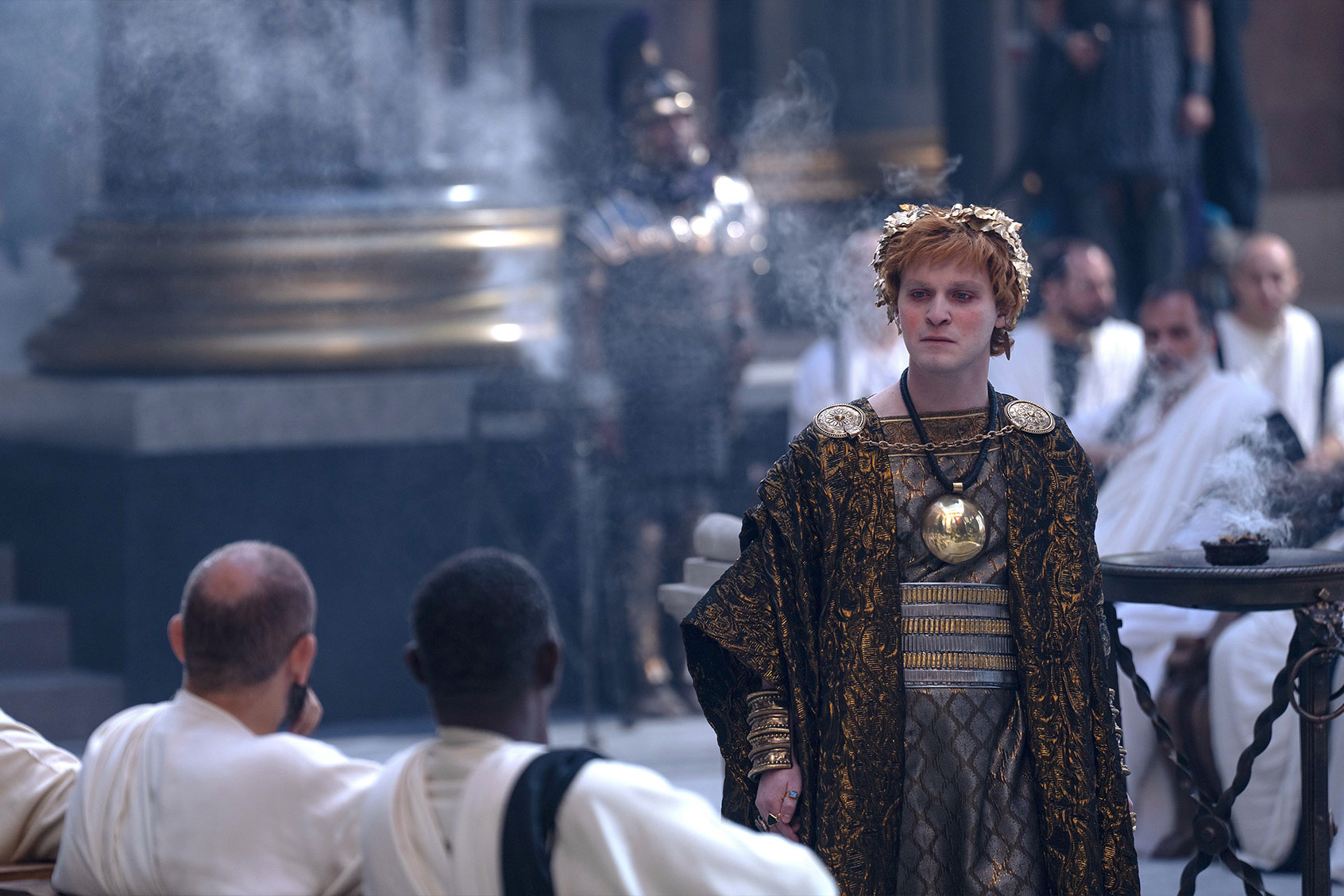
In the year 2024, MMDCCLXXVII ab urbe condita, this is the message that Ridley Scott chose for his movie: Rome has been taken over by a foppish, effeminate class of men in perfumed silks. They direct wars of conquest from the comforts of Palatine Hill rather than lead the men themselves like in the good old days of Caesar massacring the Gauls. Power must be returned, by force, to a few rugged, brawny heroes in armor who know how to commit violence with their own hands, and only then can matters be set aright and the dream of Rome restored (whatever that means).

We need your help to stay independent

But even this rather authoritarian message is incoherent, because the film does occasionally pay lip service to the idea that war is bad, or at least should be kept to appropriate limits, such as when Acacius ponders the destruction he has wrought. As such, "Gladiator II" tries to separate virtuous general from venal politician, "just" violence from "unjust" violence, without recognizing that in a society that worships the sword, extols the soldier who wields it, and bays lustily at the poor man who is forced to reenact his deeds in the arena – all of those become largely one and the same.

Gladiator IIFred Hechinger plays Emperor Caracalla in "Gladiator II" (Paramount Pictures)Ironically enough, the real-life Caracalla, described as a soldier's emperor who bore all the hardships of an enlisted legionary, might have been the perfect fit for what Scott seems to view as Rome's ideal savior. The abundance of art depicting him presents a rugged, scowling figure who resembles a meaner version of Acacius. It's a suitable image for the ruthless and hard-bitten son who inherited the emperor Septimius Severus' militarized regime and then spent his own reign taking to heart his father's advice: "Enrich the soldiers, and scorn all other men."

Meanwhile, it's difficult to know what Geta looked like because Caracalla killed him and then embarked on some historical erasure of his own. During his six-year reign as sole emperor, Caracalla waged a pointless war against Parthia, viciously sacked a Roman city over an offensive play, largely ignored his administrative duties and aggravated an inflation crisis by paying the army with devalued coinage. (He also, for various debated motives, granted citizenship to all free men in the empire.) All that would have provided promising material for a "Gladiator II" villain representing a rot in the body politic, but Scott surprised no one by scorning history and instead pursuing easier targets that are more caricature (and act utterly insane) than human. Instead of "Gladiator II" deconstructing the mythos of Rome, it's the real Caracalla who acts as a warning for what Scott seems to think Rome — and any of its modern reflections — needs in a leader. 

The missing history of women

Gladiator IIConnie Nielsen plays Lucilla in "Gladiator II" (Paramount Pictures)In an egregiously outdated move, "Gladiator II" excludes any female characters who have a purpose besides getting shot with arrows to make Lucius very angry. First up is his wife Arishat (Yuval Gonen) – a fighter in her own right – who suits up for battle alongside him, joins the fray but alas becomes one of the fallen thanks to the even mightier Acacius' wrath. This sets Lucius on his path back to Rome, following his wife's murderer intent on vengeance but then finding the goal of greater freedom for Rome more compelling along the way. Back in the city, he meets his erstwhile mother Lucilla (Connie Nielsen), who gave him up when he was a boy to save him, but even this reunion is short-lived as she also becomes fodder in the arena. If the decision to fridge Arishat and Lucilla seems lazy, the choice not to cast any of the actual women from the Severan dynasty is downright baffling.

Lucilla never has the chance to amount to anything, but Domna at her emotional depth would have fit perfectly with Scott's fixation on vengeance.

The most famous during that era – Geta and Caracalla's mother Julia Domna, her sister Julia Maesa and Maesa's daughter Julia Mamaea – wielded political influence. Domna in particular was the key figure and stabilizing force behind the two co-emperors, protecting the interests of her family and administering the empire during Caracalla's long military adventures. Unfortunately, she failed in her attempts to mediate between the emperors before Geta's assassination – in a dramatic tableau that could have been lifted from the pages of history and placed on the screen.

It seems that Caracalla had agreed to a meeting with Geta at Domna's behest, but it was just a ruse to eliminate his rival. As Caracalla's centurions rushed forwards with steel drawn, Cassius Dio records that Domna held a terrified Geta in her arms, getting so thoroughly covered in her son's blood that she failed to notice the blow inflicted on her hand. The murder of Geta is Domna at her most traumatized and guilt-stricken, and even by itself is far more riveting than the story of "Gladiator II's" tepid Lucilla who – in rough sequential order – plots ineffectually, cries ineffectually, gets chained to a pillar and suffers from a bad case of arrow to chest.

Gladiator IIConnie Nielsen plays Lucilla and Joseph Quinn plays Emperor Geta in "Gladiator II" (Paramount Pictures)Lucilla never has the chance to amount to anything, but Domna at her emotional depth would have fit perfectly with Scott's fixation on vengeance as fuel for narrative, mixed with a heavy dose of moral agony. Unable to mourn for Geta due to the official condemnation of his memory, Domna would have to bear Caracalla's rule with grudging correctness, privately nursing a resentment borne from the cruelties of the past and misrule of the present. Sure, Macrinus killing Caracalla in the film does make sense, and is historically accurate (ish), but some liberties would be welcome if they elevate the story. (And yes, this movie needs it.) Domna realizing that it is she who must perform or plan the deed would have done just that. She would have freed Rome from a terrible emperor, enacted justice for Geta and suffered from the horror of murdering another son born of her womb.

For reasons unknown, that's one historical divergence that Scott chose not to take.

Revolution without meaning

While it's embarrassing that Scott not only takes pointless liberties but also insists that he's right and knows more than historians, the rejection of history is not a terrible flaw in and of itself. When the ultimate creation is less interesting than what people like Scott deride as boring textbook material, however, the failure lies with the creator. Even so, "Gladiator II" still had another chance to redeem itself through its namesake, in plural: the enslaved or condemned (and occasionally, free) fighters who must slaughter each other not only to entertain the people of Rome, but also to distract Rome's poor from their own exploitation by the ruling class and moneyed elites.

Alas, it turns out that the singular form of "Gladiator II" is key, because only one gladiator is named, and he's the main character. The rest of them in the film are ciphers whose motives, dreams, suffering and rage remain unknown to us. There is no emotional connection to them, and so there is no emotional resonance in their last-minute bid for freedom. Among them, only Lucius truly exists, and it is only through him that the other gladiators suddenly realize they can reclaim their agency and promptly entrust it to the man who would lead them.

Gladiator IIDenzel Washington plays Macrinus in "Gladiator II" (Paramount Pictures)But even without elevating fellow gladiators alongside Lucius, the film had one character already in its stable who provided a meaningful way to interrogate the idea of freedom. In a rare moment of insight for the film, Macrinus (Denzel Washington) – a former slave who's now powerful and savvy enough to influence emperors – paraphrases Hegel to provide sharp commentary, telling Lucius that in their basest form of desire, "the slave dreams not of freedom, but of a slave to call his own." Although Macrinus is painted as an antagonist in the film, his very presence speaks to the long and arduous road that achieving freedom must take – not the more compressed ephiphany that Lucius has after becoming a gladiator.

But for the film's purposes, the challenge of igniting a rebellious spirit among a divided and deceived underclass falls on Lucius, and for the sake of the plot's momentum he must succeed, but only in a peculiar way that does not offer any tangible promise like civic rights or land redistribution. Even as the Roman people have taken over the streets, we hardly know their aims or what they want. Geta and Caracalla, we are told, rule tyrannically, and Lucius tells the people of the Colosseum that what happened to their political opponents can also happen to them. And so it is by the same means as the gladiators that the free men and women of Rome are incited, in the space of a few seconds by a vaguely obvious point and without any whiff of foreshadowing.

In Ridley Scott's theory of revolution, defiance is not born of gradual, conscious ferment among a collective people provoked by oppression, but bestowed to a formless mass by a single, heroic figure delivering a boring speech. By draining the people of agency, Scott may have joined forces with historical and modern precedent to unintentionally offer a most effective critique of his own theory: a meaningless impulse always leads to a meaningless revolution. In any case, it's neither convincing nor compelling as presented, and like Rome in its waning years, suffers more from aimless direction.

"Gladiator II" is currently in theaters nationwide.

What happens when Tesla, Intel CEOs lose their pay plans? They’re still super rich

By some measures — depending on how much caviar is in your diet — you might call it a tough week for a couple of America’s most prominent CEOs. The chief executives of Tesla and Intel lost out on massive stock payout packages: Tesla’s Elon Musk would've received $56 billion if a judge hadn't voided the plan, while Intel’s now former CEO Pat Gelsinger could’ve taken home an estimated $140 million if he had turned the company around.

But don’t fret — Musk, Gelsinger and the nation’s top CEOs are still very, very rich. Musk, who runs several other businesses, has an estimated net worth of $353 billion, according to the Bloomberg Billionaires Index, which lists him as the world's richest person. Gelsinger earned at least $46 million during his four years at Intel, according to a Fortune analysis. They’re in gilded company: The average top American CEO took home $22.2 million in 2023, according to data from the Economic Policy Institute. Meanwhile the average American earns roughly $59,228 per year, according to the Bureau of Labor Statistics. 

This is a reminder — or, perhaps, an education — of two things. First, those who don't meticulously track CEO compensation may be unaware that for many American chief executives, most of their pay comes in the form of stock payout packages that accompany their base salaries and bonuses. And second, even when they miss out on their packages, they’re still staggeringly wealthy, and their paydays dwarf the cash earnings their average employee will see.

Stocks account for most CEO pay

Payout packages can be mind-boggling for the average person who isn’t a member of their local yacht club. In 2023, stock awards — which can trigger millions of dollars in payouts to a CEO if their company’s stock price reaches a certain value — made up roughly 77% of the average CEO’s compensation, according to the Economic Policy Institute. For CEOs taking home $22.2 million per year, that means roughly $17 million of those earnings would come in the form of stock payout packages. (In 2023, the median value of a CEO’s stock awards package was roughly $9.4 million.)

One theory of why CEOs' compensation structure has shifted toward stock incentives is that it incentives the CEO to make business decisions geared toward raising the stock price, rather than betting on a long-term plan that may not immediately turn a profit.

We need your help to stay independent

Corporate decisions to downsize can also increase stock prices. A Bloomberg analysis in 2023 found that, on average, major American tech companies’ stock prices rose 5.6% in the month following layoff announcements. In 2023, after Google’s parent company Alphabet announced it would lay off 12,000 workers, its stock price rose 5%, according to The New York Times. Microsoft laid off 10,000 workers that year, too; its stock price rose roughly 6%

Those workers, typically, earn a miniscule fraction of what their CEO makes. In 2023, top CEOs earned 290 times as much as their average worker, according to the Economic Policy Institute. That means that at a company in which the average worker makes a $60,000 salary, its CEO would be taking home an average of $17.5 million. 

The earnings gap between CEOs and their workers wasn’t always this dramatic. In 1965, the average CEO made 21 times as much as one of their typical workers, per the Economic Policy Institute data. That’s still a steep discrepancy — hypothetically, $60,000 for the worker versus $1.26 million for the CEO. 

CEO pay soars above workers’ wage growth

Top executives' earnings serve as a stark illustration of corporate America’s wage inequality, which has become more severe over the last 40 years.

Between 1978 and 2023, top CEO compensation rose 1,805% while the average worker’s compensation rose 24% over that same time period

Between 1978 and 2023, top CEO compensation rose 1,805% while the average worker’s compensation rose 24% over that same time period, per the Economic Policy Institute.

To illustrate that difference: a $60,000 salary increasing by 24% would translate to $74,400, while that same salary growing by 1,805% would yield $1.1 million. Now, consider that the CEO’s compensation was likely starting at far above $60,000, and you’ve got a working understanding of just how wide the gulf has become between a company’s top executive and the workers who, in theory, are producing the product or service that earns the company its profits.

The Institute also found that top executives' base salaries, bonuses, stock awards and stock options fell 19.4% from 2022 to 2023 even though the stock market was up. But this doesn't necessarily mean that company boards are pulling back on CEO pay. 

'An activist posing as a judge'

On Dec. 1, a Delaware judge reaffirmed her ruling to void Musk’s colossal pay package — “the largest executive compensation award in the history of public markets,” as she described it in her ruling. The 10-year, performance-based plan didn't include a salary but would have given Musk additional Tesla shares the more the company grew, NPR reported. 

The pay package was worth $2.6 billion when it was granted by Tesla's board in 2018; by the time Chancellor Kathaleen McCormick initially voided it in January 2024, its value had swelled to $56 billion, per Bloomberg

McCormick called the pay package “deeply flawed,” observing that the board’s compensation committee “worked alongside [Musk], almost as an advisory body,” rather than negotiating with him. The ruling resulted from a 2019 lawsuit filed by a Tesla stockholder in which he claimed the pay package was approved without requiring Musk to focus solely on Tesla operations. (In addition to running Tesla, Musk also leads the social media platform X — formerly known as Twitter — along with SpaceX, Neuralink, The Boring Company and xAI.)

After her ruling, Musk posted a succinct tweet (Xeet?) on X: “Absolute corruption.” He later called McCormick “an activist posing as a judge" and said he planned to appeal. 

Also on Dec. 1, Intel announced the departure of Gelsinger, who took the helm in 2021 with big plans to rescue a company that has struggled in recent years against new chipmakers like Nvidia. Intel’s stock has fallen more than 50% this year, and a source told Fortune that Gelsinger’s efforts “were not showing results quickly enough.”

Gelsinger, who received $38.7 billion in salary, bonus, and vested stock and exercised stock options since his tenure began, is set to receive an additional $7 million to $10 million in severance as it ends, Fortune reported. He missed out on a larger payday in the form of performance-stock because Intel's stock plummeted amid its competitors' success, per Fortune. 

Welcome to the New Dark Ages

Donald Trump has moved at warp speed to nominate people to serve in his Cabinet and other important government posts who have chosen loyalty to him as their most important virtue, making a mockery of merit even as the nominees claim to uphold meritocracy.  

Moreover, like Trump himself, his nominees denigrate science and scientific expertise, subscribe to conspiracy theories, are eager to impose litmus tests in the arts and education and seem hostile to the world beyond America’s borders.

Elections have consequences, so the saying goes.

And if that wasn’t enough to remind us that elections have consequences, the president-elect announced that on the first day of his administration, he will order a mass deportation of millions of immigrants and impose stiff tariffs on this nation’s most important trading partners.

While much of the post-election commentary has focused on its implications for American democracy,  there is another side to what will unfold starting on Jan. 20. When he takes office, Trump, who promised to Make America Great Again, seems determined to lead America into a period of scientific, cultural, educational, and global retrenchment, which collectively might be called the new “Dark Ages.”

Some see Trump as reviving the so-called Gilded Age of the late 19th and early 20th centuries, an era of great prosperity as well as technological and industrial growth. It was an era dominated by corrupt "captains of industry" or "robber barons" whose corrupting influence also extended to government and politics. 

However, leaders in the Gilded Age did not reject science and rationality. Quite the contrary, they embraced both because they saw them as essential to the growth of capitalism. And they invested in culture and the arts, rather than trying to make them hue to a particular orthodoxy.

Yes, Trump’s era may ultimately have some attributes of the Gilded Age, I think it will be much worse. 

Trump and his MAGA followers reject the cultural legacy of the people who founded this nation. The people who led the American Revolution and wrote the Constitution were, deeply impressed by “the seventeenth-century Scientific Revolution and its emphasis on empiricism, objective observation, and using rationality over faith or tradition as the foundations of truthful knowledge.”  

They founded “an Enlightenment country” and borrowed from the Enlightenment hostility toward the “hierarchically ordered societies of Europe.” 

The president-elect seems determined to end all that. 

In 2017, Suzanne Nossel, the CEO of the writers group PEN America, warned of Trump’s “repudiation of the American ideals — grounded in the Enlightenment — of self-expression, knowledge, dissent, criticism, and truth.” What Nossel predicted then seems even more apt today. 

During the 2024 campaign and transition period, Trump and his cronies have broadcast their determination “to entrench within the machinery of the U.S. government… elemental disdain for intellectuals, analysts, and experts.” They regularly denigrate rationality and elevate superstition, tradition, and hierarchy. 

I call their program a recipe for the return of the "Dark Ages."

Though the term is now much disputed, the phrase “Dark Ages” is used by some historians to describe a “’ period of intellectual depression in Europe from… the fifth century to the revival of learning about the beginning of the fifteenth….’” During that time, Europe experienced “a decline in culture (and) learning…. and a shift towards a feudal society with limited literacy and widespread superstition.”

We need your help to stay independent

Petrarch, an Italian scholar who lived from 1304 to 1374, described the time when he lived as an era of “darkness and dense gloom.” As he put it, “My fate is to live among varied and confusing storms” and to experience the “sleep of forgetfulness.”

The era that Petrarch described was also marked by a deep skepticism about science and rationality, a personalistic form of politics marked by a clear division between “lords” and vassals,” religious domination over culture, and the collapse of trade networks among European nations. 

Sound familiar?

Let’s start with Trump‘s threat to impose stiff tariffs on goods coming into this country from Canada, Mexico, and China. As he put it in a Truth Social post, “On January 20th… I will sign all necessary documents to charge Mexico and Canada a 25% Tariff on ALL products coming into the United States.”  

This is no small matter. Reuters reports that “The U.S. accounted for more than 83% of exports from Mexico in 2023 and 75% of Canadian exports” and that “Trump's threatened new tariffs would appear to violate the terms of the U.S.-Mexico-Canada Agreement (USMCA) on trade” which guaranteed “largely duty-free trade between the three countries.” 

The president-elect also threatened China, promising the Chinese “an additional 10% Tariff, above any additional Tariffs, on all of their many products coming into the United States of America.”

Whether or not Trump follows through on his threats, they immediately sent shock waves through our trade networks and promise to ignite trade wars as countries respond to Trump’s tariffs by imposing their own tariffs.

As Reuters notes, “Trump's overall tariff plans… would push U.S. import duties back up to 1930s levels, stoke inflation, collapse U.S.-China trade, draw retaliation, and drastically reorder supply chains.” That would put the Dark Ages monarchs of Europe to shame.

If that is not enough to capture the Dark Ages vibe, consider what the new administration will do to education, the arts, and science.

On education, the incoming Trump Administration hopes to give free rein to “an army of far-right Christians” and attack “the very foundations of free, secular education.” Last week, Pete Hegseth, Trump’s nominee for Defense Secretary, called for “an ‘educational insurgency’ where ‘you build your army underground" of children, so they can grow up to be the next generation of fundamentalist culture warriors.’” 

For the arts, Trump’s first term was something of a disaster. As Judy Berman, television critic for Time, explained, “the arts and entertainment…suffered mightily as Trump held court in the White House….(H)is policies…made it harder to subsist as a creative professional…as he lashed out at the arts and their practitioners.” 

More damaging, she argued, were Trump’s “repeated attempts to defund already-strapped federal arts organizations such as the National Endowment for the Arts, the National Endowment for the Humanities, the Corporation for Public Broadcasting (which helps fund PBS and NPR) and the Institute of Museum and Library Services.” 

“Trump’s rhetoric, Berman concluded, “intensified an enmity between the arts community and the right… that dates back to Reagan-era censorship of transgressive artists…Put simply: Donald Trump was bad for art.”

Now, the country is facing “four more years of antagonist cultural policy (and the outright antagonism of people and places that do not align with Trump’s values).”


Want a daily wrap-up of all the news and commentary Salon has to offer? Subscribe to our morning newsletter, Crash Course.


Finally, consider what Smart News dubbed Trump’s "Cabinet of quacks and hacks." They are science skeptics, conspiracy theorists, and eager supplicants to their “lord,” Donald Trump.

Chief among these Dark Ages throwbacks is Robert F. Kennedy, Jr., Trump’s nominee for the position of Secretary of Health and Human Services.  Among other things, he has spoken out against “vaccines that have saved millions of lives.”  Showing his conspiratorial bona fides, Kennedy claims that “the COVID-19 virus was targeted so that Chinese and Jewish people are more immune.” And he has not just targeted the COVID vaccine. 

Kennedy and his allies in the incoming administration are deeply suspicious of “expert authority,” which they claim “hides elite power.” That is why US News predicts that they will lead “a radical antiestablishment medical movement with roots in past centuries… threatening the achievements of a science-based public health order painstakingly built since World War II.”

And if Kennedy is confirmed, he will have plenty of company in doing Trump’s bidding by pushing this country toward a new Dark Ages in medicine, health care, scientific research, education, and the arts. To avoid that fate, we must mount sustained and effective resistance in each of those domains.

Ultimately, we can only hope that what Petrarch said in his time is true in ours. “This sleep of forgetfulness,” he predicted, “will not last forever. When the darkness has been dispersed, our descendants can come again in…pure radiance."

“It’s going to create fear”: Idaho’s “abortion trafficking” law shows that free speech is a target

A federal appeals court this week permitted Idaho to enforce its "abortion trafficking" law, reviving most of a 2023 statute that criminalized recruiting, harboring or transporting a minor to help them access out-of-state abortion care without parental consent. While both parties to the lawsuit claimed a victory in the ruling, reproductive law scholars warned of the potential damage it could do to the fight for abortion rights across state lines.

Shortly after the "abortion trafficking" law was passed in 2023, lawyer and advocate Lourdes Matsumoto, alongside two pro-choice groups, filed a legal challenge opposing the statute and its penalty of two to five years in prison for any violation, per The Guardian. The challengers argued that the law violated their First Amendment right to free speech and that the potential of facing prosecution kept them from advising minors who sought abortion care. 

The Ninth Circuit Court of Appeals' ruling, issued Monday, held that "harboring" and "transporting" do not constitute First Amendment-protected expressive speech, partially reversing a district court order that blocked the law. Meanwhile, the court also asserted that it is not a crime for an Idaho resident to obtain an abortion in a state where it is legal. 

“Idaho’s asserted police powers do not properly extend to abortions legally performed outside of Idaho,” Judge M. Margaret McKeown wrote for the majority.

Rachel Rebouché, dean of Temple University's Beasley School of Law and a professor of reproductive health law, told Salon that while the Ninth Circuit's ruling was strong in declaring that Idaho couldn't bar its residents from seeking a legal abortion elsewhere, reviving it — even in part — will likely cause more harm. 

"Upholding the parts of the law that allow Idaho to criminalize and punish people who harbor or transport — that is going to have a chilling effect," she said in a phone interview. "It's going to create confusion, and it's going to create fear."

"You've already seen women having to get [airlifted] out of the state for emergency care because the Idaho ban is so narrow, and a law like this just exacerbates the problem if states start to try to keep people from leaving at all," Rebouché added.

Still, both the state and the challengers considered the ruling a victory, with Idaho Attorney General Raúl Labrador — the defendant in the lawsuit — dubbing the ruling "a tremendous victory" and proclaiming that the state "will not stop protecting life in Idaho." 

Wendy Heipt, an attorney for the challengers, called the ruling "a significant victory for the plaintiffs, as it frees Idahoans to talk with pregnant minors about abortion healthcare," according to a statement provided to The Guardian. 

In the decision, the appellate court dismissed the challengers' claim that the language of the 2023 law was too unconstitutionally vague for it to be enforced while determining that the challengers' free speech claim would likely hold against the "recruiting" prong of the law. Recruiting, the court said, could include "a large swath" of constitutionally protected speech, “from encouragement, counseling and emotional support; to education about available medical services and reproductive healthcare; to public advocacy promoting abortion care and abortion access.

“Encouragement, counseling and emotional support are plainly protected speech under supreme court precedent, including when offered in the difficult context of deciding whether to have an abortion," McKeown wrote. 

Rebouché said that, despite that concession, the opinion opens the door for similar laws to take hold in other states. The Ninth Circuit's ruling sets a precedent for other courts to allow such laws to stand in the face of similar legal challenges so long as they don't target the counseling of minors seeking information about abortion. 

We need your help to stay independent

Beyond keeping minors  — who are at greater risk of harm from pregnancy due to age — from obtaining an abortion, allowing the law to take effect can also slow if not halt the work of advocates who aren't willing to take the legal risk of assisting those seeking abortion care, argued Mary Ziegler, a U.C. Davis professor of law and an historian whose research focuses on reproduction, health care and conservatism. Other individuals and organizations may also not understand that the court permits "recruiting" and opt to do nothing out of fear of prosecution, such as no longer providing helpful information to those seeking abortion care.

That outcome would likely be the "biggest danger" the Ninth Circuit's decision poses, Ziegler told Salon, noting that the court is one of "the least conservative appellate circuits in the country."

"To the extent people are afraid of providing information, that's going to be a much bigger universe of people who are going to be impacted," she said in a phone interview. "There's also potentially more room for misinformation too, if people are afraid to provide accurate information."

Ziegler said that, through laws such as this, Republican-led states like Idaho are seizing on the legal gray area of crime-facilitating speech — language that isn't protected by the Constitution because of its role in enabling transgressions of the law — as a means of projecting their power across their borders.

"Ironically, I think one of the reasons the Ninth Circuit went the way it did was because Idaho tried to go after states where abortion is protected," she said. "It's much harder to say if you're facilitating a minor's travel to get an abortion in the state where abortion is a constitutional right, you're facilitating the crime because in the eyes of the state you're traveling to, you're just exercising a right." 

Ziegler also warned of the potential for the court's ruling to have reverberations for adults and lead to greater abortion restrictions. She noted the Idaho law's alignment with broader 2022 model legislation from the National Right to Life Committee, which the anti-choice organization describes as a "roadmap for the right-to-life movement" meant to protect "mothers and their children from the tragedy of abortion." Crime-facilitating speech, Ziegler predicted, will also be "fiercely fought over" in the nation's war over abortion rights. 

"There's every reason to think that this won't be the last of it," she said.

Idaho has one of the strictest abortion policies in the nation, only allowing abortions in the event of medical emergency and in cases of rape or incest that have been reported to police. The surrounding states — Washington, Oregon and Montana — have more permissive abortion laws. 

More than 20 Republican-led states have passed abortion bans or restrictions since the 2022 overturning of Roe v. Wade, which established a federal right to abortion care. Idaho has since become a key state in the nation's battle over abortion access, with the Supreme Court hearing arguments in a case around its abortion ban and a pending lawsuit in state court seeking to expand the ban's exceptions.  

Lawmakers in at least four other states have also introduced similar abortion transporting bans. Tennessee passed its "abortion trafficking" ban, but a court later blocked the law from taking effect. 

Coupled with the uncertainty around whether President-elect Donald Trump will uphold his campaign promise to leave abortion policy decisions to states or renew the anti-abortion record of his first term, the Ninth Circuit's decision brings into sharp focus the stakes for abortion access as the anti-abortion movement progresses nationally. 

Still, Ziegler said, "you can't take your eyes off of what's happening in the states, regardless of what [Trump] does." Ziegler said. 

Rebouché added she expects these types of laws to grow in number as the most conservative states become more aggressive in attempts to end abortion both within their borders and across the country.

"I think that's the ultimate goal of the pro-life movement, and these laws that chill travel and try to police people's behavior and keep them from helping others seek legal abortion out of state — that's the first step for that," she said.

Want to fight Trump? Then act now to strengthen democracy

While a post-election CBS News poll found majority support for Donald Trump’s promise to deport all undocumented immigrants, a more nuanced and less noticed poll from Data for Progress in late October showed exactly the opposite: Mass deportation is highly unpopular when you shift the question from an abstraction to specific details, such as asylum seekers or DACA recipients brought here by immigrant parents. Deporting members of these groups was opposed by more than three to one. 

Deporting the Haitian immigrants demonized by Trump, who have temporary protected status, was also overwhelmingly opposed, 62 to 21 percent. So standing up for those folks and pushing back, as Springfield’s Republican mayor did, was broadly popular as well as morally righteous. If the Harris campaign had been anywhere near as competent as its top operatives believed, they would have focused on this disconnect like Luke Skywalker on the Death Star.

That missed opportunity could have rescued the Democrats this year, but only temporarily, given the global trends and underlying forces I explored in my previous article on the Harris defeat. I bring that up here to make clear that even in our current perilous state progressives can find multiple paths forward, with enough fearlessness and determination.

We can’t turn the clock back and alter the 2024 outcome, but these contrasting polls reveal important truths. First, Donald Trump’s toxic ideas are far less popular than the media would have us believe, and should be combatted vigorously. Second, that in fighting the authoritarian threat Trump represents we need to strengthen democracy, to make facts matter, and to draw people into serious deliberation about the future.

The best-developed tool we have for that in America is the state initiative process, as highlighted in Amanda Marcotte’s recent article on “America's political discordance,” where she noted, "In state after state, voters backed both Trump and ballot initiatives that advanced and protected progressive goals." That partly reflected the failure of Kamala Harris’ campaign, but also a long-term disconnect that Democrats have never seriously dealt with. 

It doesn’t have to be that way. We can make democracy work much better than it now does, and that’s integral to fighting against the attacks a second Trump term will bring. One way we can do this represents a road not taken 30 years ago, one that could have helped us mitigate the climate crisis and avoid the crisis of democracy we find ourselves in today. 

In my earlier article, I referred to a "politics of care and deliberation." The first part of that phrase describes how Democrats responded to the Great Depression under FDR, how they tried to respond to the COVID and climate crises under Joe Biden (with only partial success) and how they could still reshape society, based on the lessons laid out in Jessica Calarco’s "Holding It Together: How Women Became America's Safety Net" (Author interview here.)

I’ll have more to say about the politics of care in my next article. But the "politics of deliberation" speaks to why Democrats only partly succeeded under Biden: They were pushing for policies that most people support, but were largely blocked or watered down due to the power of wealthy elites and special interests. When it comes to electing the candidates people want, democracy more or less succeeds. But when it comes to delivering the policies people want, it largely fails, further eroding the public's faith in democracy. 

That’s what we must fight to restore, alongside all the specific battles that lie ahead. To restore that faith we must advance new ways for democracy to deliver on its promises. Here are four such approaches, which cannot be realized overnight but provide a crucial framework of possibility.

Four forums for deliberative democracy

In my previous story, I wrote about citizens assemblies, which function similar to juries, but deal with making policy rather than civil or criminal law. Similar assemblies were at the core of Athenian democracy more than 2,000 years ago, and they’ve been revived recently across the world, mostly in Europe. These forums are run in a nonpartisan manner, even though more progressive parties have tended to propose them. Democrats and their allies could take the same approach here.  

But citizens assemblies aren't enough to address the deep deficit of public trust. People need more direct experience in public affairs, as well as a better-informed sense of the issues and how they can be addressed and resolved. We need to forge stronger connections between people’s everyday lives and the decisions that affect them. 

There are three other forums in which deliberation can be significantly strengthened: opinion polling, mainstream or public media and social media. Reforms to the first two draw on models that go back to 1992, when Ross Perot’s third-party candidacy exposed the same disconnect we struggle with today. 

When it comes to electing the candidates people want, democracy more or less succeeds. But when it comes to delivering the policies people want, it largely fails, which further erodes public faith in democracy. 

“Public interest polling,” a concept developed by Alan Kay, uses iterative and highly specific questions to clarify options and lead the way to hidden consensus. One 1994 poll found strong support for such polls in guiding congressional legislation. It would be sensible for Democrats and their progressive allies to push for using such polls in a nonpartisan manner, as Kay did originally.

Similarly, the “citizens agenda” approach to campaign journalism, pioneered by the Charlotte Observer in 1992, systematically uncovered voters’ key concerns and built the paper’s coverage around clarifying them and where candidates stood on them. This de-emphasized both horse-race journalism, which treats politics like a football game, and the related tendency to report from the position of insider strategy, rather than from the viewpoint of voters whose lives will be affected. 

Models for social media reform are more recent and still evolving, but build on observations about online interactions that go back decades, as well as traditions of public discourse stretching back to antiquity. Above all, they focus on fostering deliberative public engagement rather than rewarding performative conflict.

Taken together, we already possess the tools to begin solving the problem we face. We just need to develop our ability to use them. Let’s take a close look at each of these to figure out how and why it works. 

Citizens assemblies

Athenian-style citizens assemblies, which I wrote about in my previous story, provide the purest, richest and clearest example of high-quality deliberative democracy in action, and also serve as focal points for the other three examples to interact with and support. I’ve written previously about their use at a national level (here and here), as well as their global spread and a project to develop such an assembly in Los Angeles

Like juries, these assemblies comprise ordinary citizens called to a public duty, who tend to demonstrate a remarkable ability to reason together. They hear evidence, take expert testimony, are presented with alternative views and then, more often than not, come to significant consensus, often on issues where politicians have repeatedly failed. 

They have been introduced to deal with specific challenging issues: Abortion in Ireland (where it was completely banned for decades) was one prominent and consequential example. Climate assemblies have also proliferated at both national and local levels. Some permanent bodies are now being established, such as climate-specific assemblies in Brussels and Milan, and general-purpose ones in Paris and the German-speaking zone of eastern Belgium.

In the U.S., citizens assemblies could help fortify state and local governments in opposing Trump’s efforts to enforce harmful policies on them. For example, Los Angeles could benefit from a citizens assembly on immigration to reinforce its 40-plus-year tradition as a sanctuary city, going back to conservative police chief Daryl Gates. Public opinion in L.A. still supports that tradition, but the history and logic of the practice isn’t widely understood. 

A citizens assembly could redress that ignorance, resurfacing conservative arguments in favor of sanctuary while, of course, allowing those who feel harmed by it present their points of view. Everyone would benefit by hearing their views represented and responded to respectfully. The result of a well-publicized citizens’ assembly would carry the kind of weight that no elected politician or political body could match. If city government then decided to confront the Trump administration directly on the issue, it would have a body of representative citizens already staking out the position that elected leaders were defending.

Citizens assemblies could fortify state and local governments in opposing Trump’s efforts to enforce harmful policies. For example, L.A. could use a citizens assembly on immigration to reinforce its 40-year tradition as a sanctuary city.

It would be even better if multiple jurisdictions engaged in a similar process at the same time — and believe it or not, something similar happened more than 40 years ago. Early in the Reagan administration, there was open talk about fighting and winning a nuclear war against the Soviet Union. That sparked a massive grassroots backlash, fueled by public demonstrations and support in a series of New England town meetings. That led to a wave of state initiatives in 1982, which effectively shut down the warmongering. While that mobilization has been virtually wiped from public memory, it may well have altered the course of history. A similar coordinated effort, channeled through citizens assemblies in Democratic cities and states, could have a comparable impact. 

Abortion rights, the climate crisis and health care access would be other prime topics for citizens’ assemblies, especially since each city or state faces its own set of challenges in dealing with those issues. But immediate mobilization to combat the Trump administration is only the beginning of what’s possible. 

Ancient Athens developed a democratic system based on an entire ecosystem of assemblies devoted to different tasks, which essentially created a separation of powers such that no faction of the citizenry could take control over the whole.  A 2013 paper on the lessons of Athenian democracy, describes how that system worked could be adapted for the age of modern mass democracies today, describing six distinct functions that separate deliberative bodies could fulfill: setting the agenda, drafting bills and then reviewing them, voting on legislation, setting the overall rules of the process and, lastly, enforcing them. 

As the Trump administration intensifies its efforts attempts to impose a more authoritarian system on government at all levels, the best defense is not just more reactive defense of the flawed status quo. It’s a proactive counteroffensive, built on showing that democratic alternatives exist and can work both to identify and solve real problems, and to bring people together. 

Public interest polling

Another way to develop factually-informed consensus that goes beyond elite-dominated politics comes from the public interest polling practices developed and refined by Alan Kay in a series of more than 30 polls in the 1980s and ‘90s. I've written about this before:

As Kay explained the concept in 1999, “Public-interest polling is about issues — resolving community, regional, state, national and international problems. What is needed is governance that will help make the world, or our part of it, work with consensus support as easily realizable as a small town-meeting can find a consensus should it wish to.” Although it doesn't engage participants in back-and-forth discussions with one another, it does include methods for exposing people to different arguments and discovering if they significantly change people's views. And it doesn't require any higher levels of political sophistication or commitment. Like the jury system, it's open to one and all.

Public interest polling can work together with citizens assemblies, and can also be used to improve the quality of deliberation in existing legislative bodies, giving them a more precise and nuanced understanding of what the public actually wants.

This kind of deliberative polling can surface often-surprising bipartisan consensus on that’s directly opposed to existing elite consensus, which can sometimes be wildly out of touch with reality. 

Among the significant examples Kay found were a preference for multilateralism over unilateralism after the end of the Cold War, for investments in renewable energy over fossil fuels and nuclear energy and for proactive democratic reforms rather than business as usual. Two of of the most popular proposed reforms involved using public interest polling to inform congressional decision-making and developing a scorecard of GDP-like indicators to hold politicians responsible for their progress in meeting established goals. 

If the wider world had paid attention to these kinds of polls, we might have avoided the worst dangers of the climate crisis, decided not to invade Iraq after 9/11 (and perhaps avoided 9/11 altogether), and done a better job of persuading Americans that government could work to their benefit, thus avoiding the current crisis.

Public interest polling isn’t a substitute for citizens assemblies, and it can't provide the kinds of individual and group interactions that produce bonds of trust and understanding and develop unforeseen agreement. But the impact of both these deliberative innovations will depend, in large part, on rehabilitating the media.

A pro-democracy media

Media reform, and specifically reform that strengthens democracy and deliberation, is vital for the future. The current stenographic style of political reporting, followed up by fact-checking and inside-baseball analysis, is entirely at odds with the supposed purpose of journalism in a democracy, which is to make a society’s choices legible to itself. There are no easy answers about how to make such changes in reality, but guidelines and models exist. 

In the closing weeks of the 2016 campaign, NYU journalism professor Jay Rosen wrote a now-legendary article that listed six principles the press should adopt: in favor of participation, verification, deliberation and accountability; against opacity and demagoguery. 

If the world had paid attention to public interest polling, we might have avoided the worst dangers of the climate crisis, decided not to invade Iraq and done a better job persuading Americans that government can work.

Since the ‘90s, Rosen has been advocating for a model mentioned above: the “citizens agenda” approach to campaign journalism pioneered by the Charlotte Observer in 1992. In a 2010 article, Rosen lays out that approach in 10 key points, which can be summarized this way: Ask the electorate what they want candidates to discuss, using every possible form of outreach. Compose an initial draft of six to 10 questions of 50 words or less and, after feedback from advisers, publish them as a ranked list three months before the election. Repeat the feedback and advice process twice more, publishing a revised list a month later and a final list a month after that. 

Journalists then use the citizens agenda as the “working template and master narrative for election coverage,” to track what candidates say, pose questions and direct issue coverage. "Background pieces and in-depth reporting should build upon the citizens agenda. Decisions to make about where to put your resources? Consult the citizens agenda, a set of instructions for the design of campaign coverage in all its forms."

Coverage based on the citizens agenda should achieve “serious discussion” of the issues listed, and would succeed if it "raises awareness, clarity, knowledge and the overall quality of discourse around the various items on the citizens agenda." It fails, on the other hand, "when it permits confusion, ignorance, neglect, demagoguery and silence to prevail on those same items."


Want a daily wrap-up of all the news and commentary Salon has to offer? Subscribe to our morning newsletter, Crash Course.


This approach substitutes for the default agenda of horse-race journalism, not necessarily by eliminating all such coverage but decentering it. Journalists must be prepared for pushback and conflict with candidates and staffs, of course, but that comes with the job. Finally, Rosen says:

In order for the citizens agenda to work, you have to get it right. You have to be authoritative. The 6 to 10 items on the citizens agenda have to resonate with most voters, and actually reflect what’s on their minds…. The citizens agenda needs constant testing and adjustment until you are confident that you’ve nailed it. Even then, ways for minority concerns to be heard and for items not on voters minds but still important to their future have to be worked in. This is a pragmatic exercise, a sophisticated form of listening, adjusting and feeding back what is heard. 

This model can clearly be applied beyond coverage of political campaigns, for example, by combining it with public interest polling on important issues along the lines described above. Such polling can be done at national, regional, state or local levels and can be tailored to focus on the issues in the citizens agenda, which in turn can help shape the agenda for the next political campaign. Using all these deliberative tools synergistically will be the key to unlocking their greatest power. 

Restoring the "social" to social media

Social media reform is arguably the most challenging and difficult task on this list. Describing the problem is easy enough: Social media incentivizes performative conflict rather than deliberative dialogue, and that incentive structure is profoundly damaging to democracy. Such conflict favors the spread of disinformation, and even good-faith actors can fall prey to it when drawn into this dynamic.

As sociologist Chris Bail explained in his 2021 book "Breaking the Social Media Prism" (review and author interview here), the echo-chamber metaphor is misleading in understanding political polarization, which happens more in free-for-all debate spaces where performative conflicts escalate, while less polarized individuals fall silent or tune out. (Such conflicts are driven by "status-seeking extremists" rather than “strong partisans,” as Bail puts.).

Until the 2020 election, some degree of platform responsibility existed, but there was no active promotion of real deliberation. Bail pointed toward ways of enabling such deliberation, but many of the tools Bail and his team developed have been disabled in the Elon Musk era of X (formerly Twitter). Alll bets are off in most social media contexts, with the limited but notable exception of Bluesky. 

There’s a significant difference between the self-defined emerging Bluesky community and the top-down model Bail suggests for political discussion. But there’s a certain kinship in orientation, and it’s not necessary for such a platform to appeal to everyone. "Most people get their opinions about politics from friends, family members or colleagues” who proactively seek out information, engage with others and care deeply about issues, Bail writes. 

Perhaps an online platform devoted to political discussion could be built that creates synergy with citizens assemblies, public interest polling and journalism based on the citizens agenda model. Users could scale their participation to whatever areas most engage them. Civic assemblies could create online forums that allow the broader public to engage in the deliberative process. Media entities that develop citizens agendas can create complementary online forums and integrate them into the process. Public interest polls could use such forums in multiple ways, from generating ideas at the beginning of the process to sustaining ongoing dialogue after poll results are released. 

Summing up: Beginning to build the path

There are multiple pathways toward improving the quality of fact-based, solution-seeking deliberation, and opening it up to everyone in our society, not just the tiny slice of elected representatives and paid professionals who play such a disproportionate role today. Of course liberals and progressives will be forced to fight back against Trump and his allies in the years ahead. But we can also work to build a more vibrant, more inviting and more effective democracy, rather than defending a status quo that almost everyone agrees has been found wanting. There are dark days ahead — but that’s all the more reason to let in as much light as possible. I’ll have more to say about that in my next article.

Breaking down to not break down: This therapy technique splits the self. But does it actually help?

Some people who experience trauma in childhood go on to have a fear of authority figures in adulthood, as the association of this traumatic experience lingers and can be triggered when encountering someone in a leadership role. Nicole Zupich saw this manifest in her own life at her job as a data scientist: She found it hard to say no to colleagues and developed a habit of people pleasing.

In therapy, she learned to recognize these habits were based on a fear that developed in childhood and never fully went away. Separating this “part” of herself from her capital-S “Self,” allowed her to meet it with compassion and even thank it for protecting her against the threat it had identified in an authority figure.

“I have this toolbox of things, and it’s not that I don’t ever get triggered, but things are so much more manageable," Zupich told Salon in a phone interview. “They don’t feel like they’re going to just overtake me, and it gives me a little bit of a sense of control, in a healthy way.”

This therapeutic technique, Internal Family Systems (IFS) or “parts work,” has increased in popularity in recent years, with more than 6,000 practitioners registered since it was first developed by Dr. Richard Schwartz in the 1980s. Many therapies pull from the idea that the mind has various parts, including Sigmund Freud’s division of the id, ego and supergo. However, IFS incorporates a recognition of the self that is almost spiritual in nature — similar to the soul in Christianity or Atman in Hinduism.

“Remembering a time when you faced a dilemma, it’s likely you heard one part saying, ‘Go for it!’ and another saying, 'Don’t you dare!' Because we just consider that to be a matter of having conflicted thoughts, we don’t pay attention to the inner players behind the debate,” Schwartz wrote in his 2021 book “No Bad Parts.” “IFS helps you not only start to pay attention to them, but also become the active internal leader that your system of parts needs.”

"The amount that this is being discussed on social media by influencers and advertised seems quite disproportionate to the amount of research that is being done."

IFS has been shown to reduce symptoms of post-traumatic stress disorder (PTSD), depression, and pain and depression among people with rheumatoid arthritis in small studies. However, some are wary that the practice has gotten too popular without a sufficiently strong evidence base, especially for people with psychosis.

Dr. Lisa Brownstone, a Clinical Assistant Professor of Counseling Psychology at the University of Denver, said she has seen clients with psychotic experiences or difficulties establishing reality or a sense of self get confused and disorganized after using IFS with other providers. While this technique might work for some people, it's important to test it in larger randomized controlled studies to better understand how it works and compares to other therapies in the field, Brownstone said.

"The amount that this is being discussed on social media by influencers and advertised seems quite disproportionate to the amount of research that is being done," Brownstone told Salon in a phone interview. "That concerns me because I think the amount this is being proliferated on social media is affecting the public imagination of what psychotherapy is."

One of the appealing aspects of IFS is that it allows people to feel multiple things at once, which can be freeing for clients and is really at the root of many psychotherapy techniques, Brownstone said.

"I think it's probably mostly harmless for a lot of our clients, who generally are doing okay in life and and just need a little bit of support in the therapy space to integrate and better understand who they are and where they want to move in life," Brownstone said. "But for some it might be harmful."

Anecdotally, some report IFS to be effective even when other therapies aren’t. Zupich, who has complex post-traumatic stress disorder (CPTSD), didn’t feel like her symptoms were getting better with cognitive behavioral therapy (CBT) or other techniques.


Want more health and science stories in your inbox? Subscribe to Salon's weekly newsletter Lab Notes.


“Your goal is to unburden those parts, and once those parts are unburdened, what’s left is your true self, like who you are at your core,” Zupich said. “The more time you spend as your true self, the easier life is and the more authentically you can live.”

In practice, therapists using IFS help patients differentiate themselves from their parts and acknowledge these “parts,” sometimes by talking with them directly, said Dr. Martha Sweezy, an assistant professor at Harvard Medical School with more than 20 years of experience using IFS who has written books about its use in treating addiction, along with shame and guilt.  

“Many people are having strong negative emotions and they've been trying to avoid paying attention internally or have been on the run, kind of, from themselves,” Sweezy told Salon in a phone interview. “So we are asking something that can be challenging for people at first, but it’s also very novel and exciting once their parts start talking back to them and giving them information.”

The idea is that this space that is created between the self and the parts can allow the patient to observe where the part is coming from, such as a traumatic experience in childhood. The different parts in IFS work tend to fall under three categories: exiles, which carry the emotional memory of past experiences; managers, which keep the person functioning despite the emotional distress created by these emotional wounds; and firefighters, which use things like substance use to block overwhelming emotions. The latter two are also called “protectors” because they use coping mechanisms to protect the exiled parts.

We need your help to stay independent

These parts can hold onto the pain from trauma or mistreatment that happened in childhood or adulthood, said Dave Morin, a marriage and family therapist in Connecticut who has used parts work.

“Then there are these other parts that are sort of protective and they try to keep these other parts hidden away out of consciousness, or from being perceived by other people," Morin told Salon in a phone interview.

From a psychological point of view, these parts can cause suffering. IFS is a way to unburden the self and have a more integrated inner system, Morin said.

“IFS as a therapeutic paradigm basically gets the protectors to calm down a little bit and then get to those exiles, the wounded parts holding onto trauma, shame, or deep-seeded pain,” Morin said. “Once we have access to those parts of ourselves, that’s where healing can happen.” 

CBS asks for dismissal of Trump’s $10 billion “60 Minutes” lawsuit

CBS is asking for a dismissal of the $10 billion lawsuit that President-elect Donald Trump filed against the network in October.

In a filing on Friday, the network argued that Trump's suit was filed in a court that had no "personal jurisdiction" over CBS. Trump's team filed in the conservative-friendly Northern District of Texas. As CBS' operations are based in New York City, they argued that the Texas court was not the appropriate venue.

Trump sued the network in October after CBS ran different clips of a Kamala Harris interview on "60 Minutes" and "Face The Nation." Trump's attorneys alleged that the "60 Minutes" interview that was edited for clarity "damaged President Trump’s fundraising and support values by several billions of dollars, particularly in Texas."

CBS countered in their Friday filing that they did not "purposely direct its conduct at Texas specifically when producing, editing, and broadcasting the interview of Vice President Harris that aired on '60 Minutes,'" adding that there is no "affiliation between Texas, the substance of the challenged interview, or the harm felt by [Trump], a Florida resident."

"If this district has personal jurisdiction on the facts alleged, so too does every district court in the country," they wrote. "That is not the law." 

CBS went on to ask for a change of venue if the case were not dismissed outright. The network argued that the Southern District of New York — a district court that has a storied history with the president-elect — would make a much more sensible venue.