Spring Sale: Get 1 Year, Save 58%

Technology is breaking our concept of the self. It could help us heal the mind

When Arthur Tres put on the virtual reality headset, he became another person. The device was connected to a woman across the room, who inhabited his body in the swap. Their movements were synchronized with motion sensor technology, so that each time he moved an arm, it lifted her arm. Each time he turned his head, it turned her head. Not only did he experience the sensation of inhabiting the other person’s body, but he also saw himself from her eyes.

Tres knew he was tall, but from the point of view of the woman he shared the experience with, he saw his size in a different way.

“I saw myself as this extraneous body that was a bit threatening,” Tres told Salon in a phone interview. “I could really feel like I was looking up to myself, and that felt super odd.”

Tres is part of a collective called the Be Another Lab, which uses immersive technology to help people better understand what it is like to be someone else through virtual embodiment. It’s one of several projects that have emerged in recent years to examine how this technology can impact our psyche and our sense of self.

Whether we have a “self,” has been debated between philosophers for centuries. In Ancient Greece, Plato thought the self, or the soul, was immortal, while Aristotle saw it as something that was connected to the body. In the 17th century, René Descartes connected the idea of the self to consciousness when he famously stated, “I think, therefore I am.”

People tend to experience the world through the perception of a “self,” as if it were some sort of director steering the ship of our lives, making decisions and helping us carry out the everyday functions we need to survive.

Yet in philosophies like Buddhism, there is no fixed self. Rather, many believe that the innermost parts of being human are interconnected with all things and ever changing — that the self is an illusion, and overattachment to it is the source of suffering. 

"The self is a very complex system of mechanisms that serve as a way to bridge our physical, individual body to our social, cultural and physical world."

Finding out whether the self is real is likely to remain elusive, and it may be something that can never be proven one way or the other. Yet science can offer some clues about whether there is or is not a self in each of us.

“The self is a very complex system of mechanisms that serve as a way to bridge our physical, individual body to our social, cultural and physical world,” said Şerife Tekin, a mental health ethics researcher at SUNY Upstate Medical University and author of "Reclaiming the Self in Psychiatry." “I think it can be elusive because it is an extremely complex phenomenon.”

There are various elements of our sense of self. Part of the way we understand ourselves is by recognizing our physical body and how it moves through space in a process called proprioception. Virtual embodiment experiences like those used in the Be Another Lab work by sending the brain confusing signals about where it is, disrupting this process.

In the brain’s attempt to reconcile a coherent story of seeing, smelling and touching the environment around it from a new perspective, it draws the conclusion that it is experiencing the world from the body of another.

“It really triggers this override of perception,” Tres said. “The system kind of reroutes your perception to make you feel like you are somewhere else.”

These experiences build off of older studies that played similar tricks on the brain to alter perception. In 1998, scientists set up an experiment called the rubber hand illusion, in which they simultaneously stroked a rubber hand and one of the participants’ real hands to trick the brain into thinking that both of their hands were being stroked.


Want more health and science stories in your inbox? Subscribe to Salon's weekly newsletter Lab Notes.


When the brain is locating the physical self in its environment, the sensory cortex is activated. Research has shown that the premotor and posterior parietal cortices, along with the temporoparietal junction, are active in the brain when we are locating or thinking about ourselves. When these regions of the brain are disturbed through experiments like the rubber hand illusion, people report feeling out-of-body experiences. The anterior precuneus, situated between the brain’s two hemispheres, has also been linked to out-of-body experiences.

Bigna Lenggenhager, a neuroscientist at the University of Zurich, said these same regions of the brain were active when people had out-of-body experiences stimulated from virtual embodiment exercises. These same areas have also been shown to be triggered with meditation or psychedelic experiences, she added. This could be why many people who have taken psychedelics report things like “ego death,” in which their sense of self temporarily dissolves.

“The idea with the current knowledge we have would be that the brain is no longer able to integrate these inputs in a coherent way as it does generally,” Lenggenhager told Salon in a video call. “Using these technologies, it’s really something that the brain has not been prepared for.”

There are other aspects of the sense of self, too. We also have a self-concept of who we are, shaped by our beliefs, feelings and perceptions about ourselves. Some researchers are conducting experiments to see if virtual embodiment can change some of the characteristics we identify with.

"These aspects of ourselves are more like habits and with intentionality, we can actually experience a surprising amount of change."

Some ethical concerns have been raised about using this technology to conduct experiments due in part to the possibility that they could increase depersonalization, a feeling of detachment from oneself that has been described as “observing the world from behind glass.” However, studies have shown that these experiments can positively impact body image for people with eating disorders, reduce racial bias and increase empathy. Lenggenhager is currently working on experiments in which participants interact with a child version of themselves to see if this tool could be used in psychotherapy to work with the “inner child.”

“Much like they do in classical psychotherapy sessions, you would call the child or tell them whatever the child would have needed at that point,” Lenggenhager said. “Then you switch perspective and be this little child … and you see a big adult who tells you all of these things.”

Other studies have shown that aspects of our sense of self can be changed through other means. Personality traits like openness, mindfulness and empathy have been shown to increase after psychedelic experiences. In a review of several studies exploring the impact of feeling “awe,” participants reported feeling less entitled, were more generous and acted more ethically in experiments where they had the opportunity to cheat.

The authors concluded that these changes largely occurred because participants felt a diminished sense of self: “Our investigation indicates that awe, although often fleeting and hard to describe, serves a vital social function,” they wrote. “By diminishing the emphasis on the individual self, awe may encourage people to forego strict self-interest to improve the welfare of others.”

In another study conducted by Madeleine Gross, a postdoctoral researcher at the University of California, Santa Barbara Memory Emotion Thought Awareness lab, participants were able to change aspects of their personality, like curiosity, by using a mindfulness-based app.

“These aspects of ourselves are more like habits and with intentionality, we can actually experience a surprising amount of change,” Gross told Salon in a phone interview. “Self-awareness is a big part of people being able to change the self, which kind of makes intuitive sense.”

While there is evidence we can change some elements of our self-concept, other aspects of our sense of self are harder to access. The “self” many people identify with is not just our physical body or our psychological chatter, but a narrator to our life story, tying together all of our sensory experiences and memories in a throughline. The origins of this personal subjective consciousness have been eluding researchers for decades.

“The self is the story we tell ourselves about who we are,” said Michael Gazzaniga, a cognitive neuroscientist and emeritus professor of psychology at the University of California, Santa Barbara. “There's this thing that we all have called personal subjective consciousness, and that becomes hard to disentangle from the concept of self.”

Compared to our physical concept of self, this element of our sense of self is more difficult — or some would argue, impossible — to shake. In the 1960s, Gazzaniga began conducting experiments in split-brain patients whose corpus callosum, which connects the two hemispheres, was absent.

What he found through his experiments was that the left hemisphere was largely the “interpreter” making sense of sensory information that entered the brain. However, in patients with a split brain, the left-brain interpreter could still create a narrative based on information the right brain had received independently. In the experiments, patients did not report feeling like they had two narrators interpreting their experience — they felt like they had a unified sense of self.

“Consciousness is what the brain does, and the brain may do it very locally, but it only appears as this massive, unified system,” Gazzaniga told Salon in a phone interview. “That’s because over time, any expression of any one local action gets stitched together and gives us our sense of conscious wholeness that we all experience.”

The fact that our sense of self is inseparable from our subjective personal experience is enough evidence to convince some that the self does not exist. Thomas Metzinger, a philosopher and professor emeritus at Johannes Gutenberg University in Mainz, Germany, argues that we are instead operating under something called a transparent phenomenal self model, which is essentially a computational entity in our brains.

“It is a conscious whole organism model, which is so good that you, the organism, cannot recognize it as a model,” Metzinger told Salon in a video call. “That is why you, the organism, are kind of glued to it, fully attached to it or identify with it.”

Even psychedelic experiences or other out-of-body experiences ultimately boil down to signals in the brain that can be jarring when they disrupt the thought patterns or narrative that our “self” has been telling us, Metzinger explained. However, that doesn’t mean these cannot be powerful and therapeutic experiences.

We need your help to stay independent

Our sense of self helps us identify with others and form relationships. It helps us plan ahead. It can help navigate us through challenging thoughts or emotions. Many psychotherapy models rely on the sense of self to function, said Mark Leary, a psychology and neuroscience professor at Duke University. 

Still, associating too much with the self has been linked to psychiatric disorders like depression, where the mind ruminates on the self and the body can become oppressive. Conversely, too little identification with the self is linked to things like schizophrenia, in which people feel detached from themselves.

“So many of the things that people go to see counselors, psychologists and psychiatrists about are things that may be a real problem in their life, but they are making it worse by how they're thinking about it,” Leary told Salon in a phone interview. “When you dig down into what a lot of psychological therapies are doing, they are often trying to change either how much people are thinking about themselves or the content of what they are thinking about themselves.”

Metzinger is a life-long meditator himself and thinks processes like these have the power to bring deep insights and knowledge that help us understand internal models of our “selves.” To him, the process of uncovering the answer to the question of whether the self exists does not take away from that experience. He cited Richard Dawkins, an evolutionary biologist that talks about this phenomenon in his book, “Unweaving the Rainbow.”

“Dawkins always said that if you see a rainbow and then they tell you something about wavelength and electromagnetic variation, the rainbow isn't destroyed,” Metzinger said. “It's just as beautiful as it was before.”

“Emperor has no clothes!”: Paul’s problems with Trump’s “Beautiful” bill may spell trouble in Senate

House Speaker Mike Johnson barely whipped together the votes to push President Donald Trump's "big beautiful" bill through the lower chamber. On Sunday, Sen. Rand Paul foresaw a similar fight in the Senate. 

Speaking to "Fox News Sunday" host Shannon Bream, Paul worried that the bill that Republicans have been promoting as a cost-cutting measure would absolutely "explode" the deficit. Paul called the spending cuts in the bill "wimpy and anemic" and said the bill's "math doesn't add up."

"They’re going to explode the debt by — the House says $4 trillion, the Senate’s actually been talking about exploding the debt $5 trillion," said Paul.  "That’s just not conservative."

The concern about the bill's deficit-raising extends well beyond Paul's libertarian circles. Provisions in the bill could raise the deficit so high as to trigger mandatory cuts to Medicare, on top of planned cuts to Medicaid. 

Speaking to Bream, Paul worried that Americans would come to regret the bill in the near future.

“People are going to wake up in about two months and say, 'How come the deficit’s still $2.2 trillion?'” Paul said. “Where did the savings go? People are going be very disappointed…They’re not cutting spending. Somebody has to stand up and yell, the emperor has no clothes!"

Paul said he couldn't believe his fellow conservatives were falling in line behind the bill, just because it carries the gilded imprimatur.

"Everybody’s falling in lockstep on this. Pass the big, beautiful bill. Don’t question anything," Paul said. "Well, conservatives do need to stand up and have their voice heard!"

My kitchen needed ceramics. So did I

Perhaps it’s a little comical to admit that Nara Smith inspired my desire to take up ceramics, but that is indeed the truth. Allow me to explain: My first foray into TikTok’s favorite Mormon tradwife was an old video of her enjoying a late-night snack. “It’s just whipped cream with blackberries and raspberries on top and some coconut sugar,” Smith said while showing off her sweet treat. Though it looked delicious, her bougie berries and cream were the least of my concerns. I was fixated on her choice of tableware: a cream-colored bubble plate.

“Have you ever craved something you’ve never had before, but it sounds so good in your mind?” Smith asked in a separate video that has since become its own meme. For me, it was the bubble plate, which had become a newfound need rather than a want. I fantasized about eating an array of bubble plate-friendly foods: crudités, scoops of vanilla ice cream drizzled in olive oil and elaborate yogurt bowls topped with fancy granola, cut-up fruit and cacao nibs. Eating wouldn’t just feel good, it would look good too. And in our digital era — where taking photos of our food before actually eating it is now a major phenomenon across social media — my phone would be booked and busy, always “eating first,” as the popular internet saying goes.

But looking good always comes at a price. In my case, it was a rather hefty one, considering that the plates, courtesy of Gustaf Westman Objects, currently retail for 55 euros, or a little over $62 each. My desire to have those specific plates remained unwavering, however. So I thought, “If I couldn’t buy them, why not just make them myself?”

I knew it was ridiculous — a $62 plate leading me to spend hundreds more just to try and make one? But the idea lodged in my brain like a stone in my shoe: persistent, irrational, impossible to ignore. I’m a complete novice when it comes to ceramics. The last time I even touched clay was back in elementary school art class during a brief unit on hand-building. I also had no experience using a pottery wheel. And yet, here I was. Fueled by my motivation to own a singular bubble plate and my commitment to staying frugal (if I made even ten usable pieces, I reasoned, I’d come out ahead — plus, I’d gain a new skill along the way), I signed up for my very first wheel throwing class in April.

Call it naiveté or just plain stupidity, but I showed up to my first day of class overconfident. I had watched countless videos of ceramicists compressing and lifting cylinders of clay with ease, failing to realize that they’ve been practicing the craft for years, decades even. “How hard can it truly be?” I recalled thinking to myself. Well, incredibly hard, I soon learned. To start, my form was egregiously bad. In wheel throwing, it’s important to anchor your elbows to your hips, forearms to the splash pan and thighs to the outside of your wheel — I didn’t do any of that. I couldn’t center the clay on my wheel, causing it to wobble uncontrollably as I also struggled to control the wheel’s speed, oscillating between going too slow and too fast. In one instance, I spun the wheel so fast that it sent my freshly made piece flying as I tried to cut through the clay at its base. My piece enjoyed a few seconds of airtime before tragically plopping onto the floor with an audible “splat” for everyone in the studio to hear. 

I wanted to quit at that moment. “Maybe ceramics wasn’t for me,” the little voice in my head said as I recoiled from embarrassment. “And maybe, I wouldn’t be able to make a bubble plate after all.” 


Want more great food writing and recipes? Subscribe to Salon Food's newsletter, The Bite.


There aren’t many things in life that I’ve given up on — I can thank my stubbornness for that. Ceramics certainly wasn’t going to be one of them, especially after just one class. So, I persevered.

By the third class, I had established an unspoken understanding with the clay. It’s a bit difficult to describe when things started to finally work out. I could just feel it. With my elbows anchored, I compressed my mound of clay before coning it up and down like my instructor had shown me countless times. Wet clay dribbled down my palms as I used my thumbs to gently make a hollow cavity to form the base of my piece, then gently pulled up clay to create its walls. The studio smelled faintly of wet earth and glaze, and the rhythmic hum of spinning wheels made it feel almost meditative. I was focused, and before I knew it, I had made my very first piece: a bowl. It wasn’t perfect, but it was mine.

That’s the beauty of making things with your hands: You get to revel in the arduous process of making something from scratch and once it’s complete, you’re left with something that’s uniquely yours. Ceramics taught me about patience and perseverance — the same lessons I grew to appreciate when I first started cooking and baking on my own. It also taught me about the importance of finding beauty in imperfection. There’s something almost whimsical in enjoying breakfast out of one of my lopsided, handmade bowls. Or drinking coffee from a mug that isn’t perfectly straight.

I left my first semester of ceramics class with a handful of bowls, a mini mug and a flower vase. As for the bubble plate, it remains an ongoing project — and, hopefully, a possibility during round two of classes.

“We want those names and countries”: Trump rages over Harvard’s international student population

Donald Trump is losing his war against Harvard University. And, if a late-night post to Truth Social is any indication, he's not taking it very well. 

The Trump administration has gradually escalated attacks on America's oldest institution of higher learning in recent months after the school refused to bow to threats against its federal funding. Earlier this week, the Department of Homeland Security revoked Harvard's certification to enroll international students. A judge issued a temporary restraining order blocking the move after Harvard filed yet another lawsuit against the federal government. 

It's the third such attack to sputter and falter in the first few months of Trump's term. The president and Penn grad raged against the school on his personal social media platform overnight.

"Why isn’t Harvard saying that almost 31% of their students are from FOREIGN LANDS, and yet those countries, some not at all friendly to the United States, pay NOTHING toward their student’s education, nor do they ever intend to," he wrote. "Nobody told us that!"

Trump ominously asked for more information about Harvard's foreign-born student body, mischaracterizing his admin's attempted blanket ban on enrollment as a request for more data.

"We want to know who those foreign students are, a reasonable request since we give Harvard BILLIONS OF DOLLARS, but Harvard isn’t exactly forthcoming," he said. "We want those names and countries. Harvard has $52,000,000, use it, and stop asking for the Federal Government to continue GRANTING money to you!"

Trump's attacks on Harvard and the anti-immigrant tenor of his second term have left many current students wary of continuing their education at the prestigious school.

Speaking to CNN, Harvard student body co-president Abdullah Shahid Sial said that international students were "extremely afraid" of what the future holds.

"They’re literally like, teenagers, thousands of miles away from their hometowns having to deal with this situation, which lawyers often fear to engage in," Sial said. "As of right now, I’m not sure if I can attend the next semester or not."

The rent might not be too damn high this year

Rents have soared over the past few years, especially between 2021 and 2023 when COVID lockdowns lifted. During that time, rental demand surged, but the supply of available properties couldn't keep up. That pushed the national median asking rent from around $1,350 to $1,700, a jump of nearly 26%, according to Redfin data

Now, after years of steep increases, will 2025 finally give renters a break?

The answer isn’t so straightforward. Experts say the rental market is shifting, but just how much it favors renters will depend on factors like the economy, interest rates and how Trump's tariffs play out.  

Will 2025 be better for renters?

The short answer is that it depends. 

Some experts are cautiously optimistic. “Renters will likely experience more relief in 2025 than in the post-pandemic surge years of 2021 to 2023, primarily due to increased apartment construction reaching the market and a cooling economy,” said Stephen Clyde, certified residential specialist and realtor at Your Home Sold Guaranteed Realty. However, it may not be a renter’s market everywhere. He mentions that in high-demand areas with restricted inventory, like commuter suburbs or coastal towns, the supply-demand imbalance may still favor landlords. 

Donovan Reynolds, a real estate agent at Redfin, agrees. “I do think 2025 is shaping up to favor renters more than the past few years,” he said. He pointed to Atlanta as an example, where, according to Reynolds, over 15,000 new rental units were added in the last year alone. He explained that this apartment boom caused supply to outpace demand, which led to a leveling off in rent prices.

We need your help to stay independent

However, not everyone is convinced that it’ll be a renters’ market this year. 

“I do not anticipate 2025 will favor renters more than the past few years,” said Ari Harkov, a licensed associate real estate broker at Brown Harris Stevens. “If anything, higher rates and economic uncertainty are likely to push more prospective buyers to rent temporarily, creating even more competition in the rental market.”

Molly Boesel, principal economist at CoreLogic, agreed that economic uncertainty could actually increase rental demand. “If people are unsure if they will be employed in 2025, they will want to rent so they’ll have the flexibility to move if they should lose their jobs. This would then result in more rental demand, which could push up rents,” she explained. 

So, the bottom line is that though some renters will likely see a friendlier market than the post-pandemic surge years, economic uncertainty and local market dynamics will play a big role in how much relief renters actually feel.

The factors affecting prices 

Renters in some cities are finally seeing more choices and slightly lower prices due to a wave of new apartment construction that started back in 2022 and 2023. But Clyde believes that this increase in supply could be short-lived.

“Inflation has moderated, but prices for skilled labor, insurance and materials remain well above pre-2020 levels,” he said. “And due to high labor and materials costs, many developers are delaying or canceling future projects, which could constrain supply again in late 2025 and beyond.” 

"Many developers are delaying or canceling future projects, which could constrain supply again in late 2025 and beyond"

Tariffs are another factor renters need to watch. Tariffs on imported materials like steel, lumber and appliances could drive up building costs, making it more expensive to complete new rental projects. Higher construction costs often get passed on to renters through higher prices. In other words, if Trump’s current tariff policies persist, rental markets could continue to experience upward pressure on prices because of increased construction costs. 

And then there’s high interest rates. According to Freddie Mac data, the interest rate on a 30-year fixed-rate mortgage has ranged from 6.62% to 7.04% so far in 2025. This elevated mortgage rate is making homeownership out of reach, especially for younger households just starting out. “And as long as interest rates remain elevated, it will keep would-be homebuyers in the rental market longer, which could continue to apply pressure on rental demand,” Clyde explained. 

Tips for renting smarter in 2025

If you’re planning to rent this year, here are some strategies to follow to get the best deal. 

Start your search early. “The best rental opportunities are snapped up quickly, even in softening markets,” Clyde said. That’s why you should give yourself at least 60 days before the end of your current lease to find a new apartment. This will give you enough time to compare listings, negotiate better terms with the landlord, and avoid having to make a rushed decision. And if you’re planning an out-of-state move, you might want to start looking even earlier so you can research the neighborhoods and get a feel for the local rental market.

"You’ll typically have better luck negotiating in the winter, which tends to be the rental market's slower months"

Don’t be afraid to negotiate. In markets where vacancy rates are rising, landlords may be more open to offering concessions. Boesel suggests asking for perks like lower monthly rent, free utilities or even a month of free rent at signing. Reynolds also recommends looking at newly built complexes (“lease-ups”) where management companies are usually eager to fill units and may be pretty flexible on pricing. That said, timing is important when it comes to negotiating. You’ll typically have better luck negotiating in the winter, which tends to be the rental market's slower months, compared to the summertime. 

Lock in a longer lease if you find a deal. If you’re able to get a good deal, consider locking it in for more than 12 months if you plan on staying in the city for a few years. Especially if construction starts to slow down or new tariffs potentially drive up building costs, finding affordable rentals could become even harder in the near future. Plus, some landlords may offer a discount if you agree to a longer lease upfront. 

Be flexible on location. Sometimes moving just a few zip codes over can save you hundreds of dollars each month (and thousands of dollars over the course of a few years). Plus, less-hyped or up-and-coming neighborhoods often offer apartments with more space and similar amenities, without the premium price tag of trendier areas. So if you don’t mind expanding your search radius a bit, you might be able to find much more affordable options.

“White genocide” and white guilt: Donald Trump versus history

It’s pointless to announce, at any given moment, that the second Trump administration has hit a new low. There’s always next week, and the likelihood of deeper and ever more painful absurdities: Drinking straws are causing gender confusion; many Americans are declining COVID boosters and therefore no Americans may have them; the price of eggs has fallen so far so fast that the supermarket now pays you. As I wrote a few months ago, we now seem devoted as a nation to acting out the thesis of Leonard Cohen’s final hit single, “You Want It Darker,” released the day before Donald Trump’s election in 2016.

Furthermore, in the face of a widening campaign of abduction and deportation conducted by masked, armed paramilitaries with no identifiable uniforms, Trump’s theatrical displays in the Oval Office can justifiably be viewed as irrelevant distractions. But still: For the president of the United States to accuse the government of South Africa, in 2025, of conducting a racial genocide is so craven, so shameless, that beggars any rational description. 

We are no longer at the level of right-wing conspiracy theory invading the body politic or contaminating government policy — admittedly, that’s been true for years. Trump’s assault on South African President Cyril Ramaphosa last week, featuring an insultingly clumsy propaganda video about that nation’s alleged “white genocide,” represented the triumph of paranoid racist projection as official White House doctrine. To inflict these delusional internet memes and outright fabrications on the elected leader of the nation that made “apartheid” a household word goes light-years beyond historical irony — it’s like an Upright Citizens Brigade comedy sketch that was rejected as overly cynical.

Indeed, the bottomless cynicism of the White House “white genocide” teachable moment strikes me as its most salient characteristic. Trump’s deployment of this far-right fantasy, which emerged in South Africa’s domestic politics about a decade ago and was laundered for American consumption, of course, by former Fox News host Tucker Carlson, had nothing to do with its nonexistent truth value or with the internal realities of contemporary South Africa.

It’s only feeding the flames to engage with what-abouters who will suggest that, gosh, maybe there are shreds of plausibility to Trump’s claims. Objective reality doesn’t matter to our president or the rest of the “do your own research” crowd; they either believe that it doesn’t exist at all or that it can be reshaped according to their whims. We can observe, however, that the South African “white genocide” narrative is categorically similar to the widespread perception that New York City has experienced an explosion of violent crime, and that the city’s subways are an anarchic wasteland. 

The "white genocide" narrative resembles the equally false widespread perception that New York City has experienced an explosion of violent crime. That is, it's the product of media incompetence and public illiteracy.

In other words, it’s entirely false and largely the product of media incompetence and public illiteracy. In both cases, a handful of traumatic incidents have come to symbolize dire but nonexistent trends. Admittedly, the underlying facts are quite different: After a brief pandemic spike, crime rates in New York have returned to near-historic lows, and violence in the subways is exceptionally rare. 

South Africa is another story, for reasons stemming from its troubled history. It remains a deeply divided society with extreme inequality (even by American standards) and high rates of violent crime, most of which occurs within impoverished Black communities. One Afrikaner organization claims that more than 2,300 farmers have been murdered over the last 35 years, which sounds alarming until you realize there were 26,000 reported murders in South Africa last year alone. Anytime a white farm family is attacked it makes headlines, but Black people, and especially Black women, are far more likely to be victims of violent crime.

Donald Trump, to be sure, neither knows nor cares whether his allegations have any basis in reality. His video was essentially a deepfake, and not a skillful one: It included a supposed graveyard for 1,000 farmers that was actually a memorial for two farmers, and news images of dead bodies from a conflict thousands of miles away in the Democratic Republic of Congo. 

No doubt the opportunity to humiliate a visiting Black head of state was a massive bonus, and to Ramaphosa’s credit — even if reviews back home were mixed — he remained largely dignified and managed to avoid the full Zelenskyy treatment. But South Africa’s leader was nothing more than a bit player in this tableau, while the white Afrikaners under supposed threat of extermination didn’t even get speaking parts. They were more like pathetic background extras, or bizarro-world inversions of the starving children from charity ads of bygone years: You can save Farmer Piet from white genocide, or you can turn the page.

In an essay for the Intercept unpacking the tangled backstory of the five dozen or so Afrikaners recently welcomed as refugees by the U.S., Sisonke Msimang expresses some (understandably conditional) compassion for their plight. These unexpected immigrants "represent the bottom rung of the Afrikaner socioeconomic ladder," she writes, "those who have not been able to transition smoothly into post-apartheid South Africa without the protections that white skin privilege would have afforded them a generation ago." They are, she concludes, "the first beneficiaries of America’s new international affirmative action scheme for white people."

Trump’s true audience for this grotesque Oval Office charade was, as always, his own dismal horde of followers. This shabbily constructed myth about persecuted white people in a distant land was meant to serve as a “There! You see!” illustrative moment within a much larger narrative: The world has gone so badly off the rails that white people everywhere are disadvantaged, downtrodden and despised; needless to say, we have a great champion, and only he can fix it. What does it matter if the economy has been torpedoed by tariffs, the government has been demolished by wrecking ball and the supposedly sacred principles of the Constitution are blithely ignored? The white man is in big trouble!

The idea is if we don’t look out the white race will be — will be utterly submerged. It’s all scientific stuff; it’s been proved.

That isn’t Trump talking, or Elon Musk or any of the loyalists who spend their days praising and parroting them on X. It certainly could be, but those of a literary bent will recognize the words of Tom Buchanan, the racist former athlete and cuckolded husband in "The Great Gatsby," published just over 100 years ago. No advanced degree is required to perceive that Tom is a profoundly insecure person, disappointed with his life, anxious about his status and given to outbreaks of cruelty and violence. (Perhaps that reading is a product of the “woke mind virus”; then again, so is most of American literature.) 

However we define the profound sense of psychic injury that has rendered so many white Americans — and many other people of differing backgrounds scattered around the globe — so terrified of the contemporary world, so mesmerized by an imaginary past and so easily seduced by ludicrous fictions, it wasn’t invented this year or in this century. Tom’s anxiety about the future of “the white race” is articulated in the mid-1920s, very nearly the worst period of Jim Crow segregation and racism in America; two decades later, the Afrikaner-dominated National Party, inspired both by America’s example and the “race laws” of Nazi Germany, launched South Africa’s elaborate apartheid system.


Want a daily wrap-up of all the news and commentary Salon has to offer? Subscribe to our morning newsletter, Crash Course.


We can go a lot further back than Scott Fitzgerald without finding the lost golden age of mythological harmony and stability that Trumpist dreamers seem to imagine. Slaveowner statesmen of the antebellum South, like John C. Calhoun and Alexander Stephens, were plainly terrified of the racial apocalypse they feared might come with abolition, let alone any version of legal equality. 

Most of those who inhale Trump's "white genocide" lies wouldn't say flat-out that they want to reinstate apartheid or Jim Crow. Even with the death of wokeness, it's not OK to wish for such things openly.

Most of those who willingly inhale Trump’s “white genocide” lies wouldn't say flat-out that they want to reinstate apartheid or Jim Crow or slavery. (There are certainly exceptions.) Even with the death of wokeness, it’s not quite OK to wish for such things openly, perhaps because of a dim awareness that there’s no escape from the paralyzing dynamic of racial fear. The present is always understood as an impending catastrophe in which white people will be killed en masse or “utterly submerged,” but there’s no discoverable or recoverable past moment when such fears were absent.

This soul-gnawing anxiety is not original sin in the Christian sense, even if it functions in much the same way. White people are not born with corrupted souls, contrary to the Nation of Islam’s doctrines. It’s more like a legacy of collective guilt, something we have repeatedly been assured is not passed down by the sins of our ancestors. Of course the Tom Buchanans and Donald Trumps of the world cannot be held responsible for crimes committed by others in the past. But they are responsible for refusing to face the truth about the past and for telling outrageous lies about the present. They live in constant fear of judgment.

Return to Ceres: This dwarf planet could contain the clues to life’s origins

How do you build a planet, let alone one capable of sustaining and evolving life? The clues to the “recipe” can perhaps be found in the leftovers scattered around our solar system. Things like asteroids or Ceres, a dwarf planet like Pluto which orbits in the asteroid belt between Mars and Jupiter

A new study in Nature Communications says carbon appears to be blown into space when small rocks collide with each other, which has implications for understanding how planets like Earth "grew up" early in their history. Most scientists believe planets gradually got larger as pebbles and asteroids collided with each other; while a lot of material was lost in each crash, over time enough stuck around to make a small rock grow to planetary scale.

Ceres is an intriguing in-between world, when talking about planets and asteroids: it's a quarter of the size of Earth's moon, but has slightly more gravity than the average space rock. As such, worlds like Ceres can keep more carbon on their surface than asteroids. The study team argues that searching for this carbon means we should put a sample return mission together as soon as we can.

"I think that detailed analysis of return samples with microscopes [on Earth] — or something like that — is required," lead author Kosuke Kurosawa, who has affiliations both at Japan's Kobe University and Chiba Institute of Technology's planetary exploration research center, told Salon.

"In simple terms, this is an explosion."

The aim of the study was to discuss "shock metamorphism," which sounds like a band name but in reality describes what happens to a space rock after a cosmic crash. For decades, carbon has been quite the puzzle. It appears higher-speed impacts left behind less carbon than lower-speed impacts. In other words, one plausible explanation appeared to be that carbon only formed if the rocks crashed into each other relatively slowly — which always seemed strange to scientists.

Kurosawa's team recalled another study at Kobe 20 years ago, this one talking about another important building block of life in meteorites: water. That investigation suggested that as space rocks crash into each other, the impact threw water-enriched minerals into space — and therefore removed much of the evidence of water itself. Could the same be true for carbon?

The older study had limitations that Kurosawa felt needed to be addressed. For one thing, the authors didn't consider if water vapor would be produced in the collision. For another, some meteorites that include carbon — but don't include water-enriched minerals — still appear to be less shocked. Something more had to be responsible.


Want more health and science stories in your inbox? Subscribe to Salon's weekly newsletter Lab Notes.


Kurosawa's team created a two-stage light gas gun that was connected with a sample chamber. They fired pellets from the gun into different samples meant to represent meteorites. Afterwards, the researchers examined what gases were produced by the collision. Simply put, two types of meteorites were considered: those with carbon, and those without carbon.

The novel setup allowed the team to look at the gases produced, without contaminating the samples being blasted. This allowed them to spot something: as the pellets crashed into the sample meteorites, chemical reactions occurred that produced both hot carbon monoxide and hot carbon dioxide gases. 

"In simple terms, this is an explosion," Kurosawa said. Such a chemical reaction would wipe away the impact records on carbonaceous — or carbon-rich — asteroids as the explosion of organic materials took place, he added. It would therefore be difficult to find evidence of an ancient collision, because there would be little stuff left to examine. 

That was likely true of the Ryugu asteroid sample return mission undertaken by the Japanese mission Hayabusa2, noted Kurosawa, who was also a team member of a Ryugu sample analysis group led by Tomoki Nakamura. "The Ryugu rocks are virtually unshocked, as well as carbonaceous chondrites fallen on Earth."

Ceres is different, however: "shocked material on Ceres would re-accrete and accumulate on the surface of Ceres due to its strong gravity" compared to smaller space rocks, he said. But the evidence would still be hard to spot even from orbit. So NASA's Dawn mission, which studied Ceres from orbit between 2015 and 2018, couldn't see as much carbon as some future spacecraft on the surface.

So how soon could such a spacecraft arrive? In 2022, the National Academies Planetary Science Decadal Survey — essentially, a report representing the consensus of the planetary science community in the United States — recommended a Ceres sample return mission to search for organic materials. Giving urgency was Dawn's finding that Ceres likely has an ocean beneath the surface; that doesn't mean life on this airless world, but it has implications for finding life elsewhere.

Here is the rub, however — it depends on funding. In 2023, the space community learned the New Frontiers NASA program under which this (pretty expensive) spacecraft would run delayed their next proposal period by three years, to 2026. Budget issues were responsible for the wait, and these days NASA's funding is even more difficult to predict.

We need your help to stay independent

Earlier this month, the Trump administration's "skinny budget" proposal for NASA's fiscal 2026 suggested slashing agency programs by $6 billion, or roughly 25 percent, focusing especially on science work. The White House's proposal is just the opening volley in what will be months of budget negotiations with stakeholders and Congress, however.

Assuming funding and selection goes forward, the Ceres sample return mission focuses on the youngest region on the dwarf planet — Occator crater. The team is unclear whether the carbon-shocked material would be present there, said sample return proposal participant Julie Castillo-Rodriguez, a senior research scientist at NASA's Jet Propulsion Laboratory. (She also was deputy principal investigator for the Dawn mission.)

Castillo-Rodriguez said she hopes to connect with Kurosawa's team about Ceres, as she liked the approach of their study. "It's really cool. It's inclusive. And because they work with very tiny samples, it must have taken them a very long time to get all that material and all these results."

Land of unfreedom: Trump’s dystopian detainment policies have a long history

I don’t know about you, but the news continues to stress me out. Trump administration officials are using any excuse they can think of to detain and deport people whose points of view — or whose very existence on U.S. soil — seem to threaten their agenda.

In March, the U.S. government sent 238 men to a notorious Salvadoran mega-prison where they no longer have contact with family members or lawyers, and where overcrowding and cruel practices like solitary confinement, or far worse, seem to be commonplace. The Department of Homeland Security released few details about who the men were but, when pressed, DHS officials claimed that most of them were members of Tren de Aragua, a Venezuelan criminal gang.

Documents obtained by journalists, however, revealed that about 75% of the detainees — 179 of them — had no criminal records. They had, in essence, been kidnapped. Among them was a young Venezuelan makeup artist who was in U.S. custody while awaiting a political asylum hearing. After he made a legal border crossing into this country, immigration officials determined that he was being targeted because he was gay, and because of his political views. DHS officials claimed, however, that the man’s crown tattoos meant he was a member of Tren de Aragua. It mattered not at all that those crowns had his parents’ names underneath them, suggesting that his father and mother were his king and queen. As they have admitted, government officials are unable to substantiate why men like him were detained and deported without any legal process, though a spokeswoman for DHS claimed that many of them “are actually terrorists. … They just don’t have a rap sheet in the U.S.”

Among those now detained in El Salvador is much-publicized Maryland resident and construction worker Kilmar Ábrego García, who had lived in the U.S. since fleeing gang violence in his native El Salvador as a teenager. ICE agents arrested and detained him while he was driving with his five-year-old son in the backseat of his car. Trump administration officials finally conceded that he had been detained and deported due to an “administrative error,” but later backtracked, claiming (without evidence) that he belonged to the violent criminal gang MS-13. The case rose to national prominence thanks to protest demonstrations and federal court orders directing the Trump administration to “facilitate” his return. (No such luck, of course!)

I can’t help wondering just how many other immigrants and refugees like him are now languishing in Salvadoran prisons (or perhaps those of other countries) without the benefit of public pressure to challenge the conditions of their detention. We can all keep wondering unless the Trump administration offers such deportees due process so that the legal system can vet their identities and the reasons for seizing and imprisoning them.

Asylum seekers in Panama

These days, the horrors pile up so fast that it’s hard to keep track of them. It seems like ages ago, but only last February the administration sent 300 asylum seekers to Panama City under the Immigration and Nationality Act, which allows State Department officials to deport citizens of foreign countries whose presence they believe to be contrary to this country’s interests. After Panamanian authorities locked the migrants in a hotel without access to their families or outsiders, they told them they had to return to their countries of origin.

Most difficult for me to stomach is that those asylum seekers had fled to my country, assuming they would be protected by the rule of law and presumed innocent until proven guilty.

Many of them feared for their lives if they did so. Among them was a young Cameroonian woman who had fled her country because the government there had imprisoned and tortured her for weeks after soldiers in her town accused her of membership in a separatist political group, and a mother and daughter who had fled Turkey for fear of imprisonment after the mother had participated in peaceful protests there.

When 70 of the asylum seekers refused the government’s order to return to their countries of origin, Panamanian officials sent them to a jungle camp where they lacked adequate food, clean water or privacy of any sort. After an uproar from human rights activists, the detainees were finally released and left to find legal asylum elsewhere. Several told journalists that they were never even given the opportunity to apply for asylum upon entering the U.S., though American officials claimed — unlikely indeed! — that the migrants hadn’t told them that their lives were in danger.

Most difficult for me to stomach is the thought that those asylum seekers had fled to my country, assuming they would be protected by the rule of law and presumed innocent until proven guilty, not robbed of their freedom. At the rate we’re going, it’s conceivable that someday you or I might end up in their shoes — at a border crossing in some other country asking to be accepted there because we fear for our lives in our own land. I would hope that whomever we spoke to would at least be willing to hear our stories before deciding to ship us elsewhere.

We need your help to stay independent

In their ordinariness, some photos I’ve seen of those deported immigrant families remind me of my own family. In one, for instance, a mother is stroking the face of her distraught young son who, rather than just having a bad day at school as mine might have, was stuck in a foreign city without his belongings, friends or access to places to play. Many of us, especially military families like mine, know what it’s like to be stuck at a way station without our possessions and the various contraptions (cooking equipment, kid-sized furniture, cleaning products) that make having a family comfortable. Now, imagine that scenario with no end in sight and no one who even speaks your language to help you out. Imagine parenting through that!

Of course, give the Trump administration some credit. It hasn’t opposed all migrants fleeing persecution. In fact, the president recently invited Afrikaners, the white ethnic minority group in South Africa whose ancestors were the architects of that country’s apartheid system of racial segregation, to seek refugee status in the U.S. on the basis of supposed anti-white racial discrimination in their homeland. (At the same time, of course, Marco Rubio’s State Department expelled the South African ambassador from this country!)

Detaining student activists — and expelling U.S citizens

As the State Department revokes the green cards of hundreds of students in the U.S. for exercising their First Amendment rights, at least several — maybe more — have been detained indefinitely under the Immigration and Nationalities Act. Among them, pro-Palestinian student activist Mahmoud Khalil is being held at a remote detention facility in Louisiana, separated from his family in New York City, where his son was recently born while Khalil was in captivity. The government is considering sending him back to Syria where he grew up in a refugee camp, or to Algeria, where he is a citizen. The Trump administration wrote on social media that his was “the first arrest of many to come.”

During the first two decades after the attacks of 9/11, our government normalized extrajudicial detention and deportation as part of its global War on Terror under both Republican and Democratic administrations.

Apparently, the administration is casting a very wide net as it detains and deports people. In early April, the Washington Post reported that the authorities had detained at least seven U.S. citizens, among them children, including a 10-year-old who was being rushed to a hospital when immigration officers detained her family and sent them to Mexico, where they remain in hiding. More recently, the administration deported several U.S. citizens, including three children, one of whom, a 4-year-old, had late-stage cancer and was sent to Honduras without his medications. His mother was given no opportunity to consult with his father, who remained in the U.S.

I could go on, including with the recent news that the Trump administration has asked wartime Ukraine to take in deportees, and is now reportedly preparing to send migrants to Libya.

These people were all detained and deported without due process, not allowed to challenge their detention and deportation through the court system. Due process should afford anyone in this country, no matter their legal status, the right to know why they are being detained and adequate notice of their possible deportation, as well as access to legal counsel so they can challenge government decisions about their future.

Apparently, for the leaders of this administration, mere words and images — crown tattoos on alleged Venezuelan gang members, peaceful student protest or even, apparently, simply having brown skin — trigger fear and the impulse to detain and deport.

The legacies of America's War on Terror

None of this is entirely new. During the first two decades after the attacks of Sept. 11, 2001, our government normalized extrajudicial detention and deportation as part of its Global War on Terror under both Republican and Democratic administrations. Following the terrorist attacks on the World Trade Center and the Pentagon in 2001, Vice President Dick Cheney announced that the government would “need to work the dark side” and “use any means at our disposal” to eradicate terror. According to a joint report by the Costs of War Project and Human Rights Watch, the U.S. extrajudicially moved at least 119 foreign Muslims who were considered terror suspects to “black sites” (secret CIA prisons) in foreign countries with more lax human rights standards, including Afghanistan, Lithuania, Romania and Syria. There, U.S. detainees underwent torture and mistreatment, including solitary confinement, electrocution, rape, sleep deprivation and sometimes being hung upside down for hours at a time.

Even today, at Guantánamo Naval Base in Cuba, where the U.S. government set up an offshore prison in January 2002, the government continues to hold 15 terror suspects from those years without the opportunity to challenge their status. And though that base has not (as yet) not come to house the thousands of migrants President Trump initially imagined might be sent there, it has been one of the way stations through which the government has dispatched flights of Venezuelan migrants to El Salvador via Honduras.


Want a daily wrap-up of all the news and commentary Salon has to offer? Subscribe to our morning newsletter, Crash Course.


Though the U.S. formally ende its program of “extraordinary rendition” (that is, state-sponsored abductions), as the Costs of War Project and Human Rights Watch have suggested, such war on terror practices effectively “lowered the bar” for the way the U.S. and its allies would in the future treat all too many people.

A way forward?

And here we are in another nightmare moment. As historian Adam Hochschild has reminded us, America has indeed had “Trumpy” — maybe even “Trumpier” — moments in the past when the government empowered vigilantes to suppress peaceful dissent, censor media outlets and imprison people for exercising their First Amendment rights. Take the 1917 Espionage Act, for which President Woodrow Wilson successfully lobbied. It allowed prison terms of up to 20 years for anybody making “false reports” that might interfere with the government’s involvement in World War I or what were then considered “disloyal” or “abusive” statements about the U.S. government. In the years immediately following that law’s passage, dozens of peaceful Americans were sentenced to years of hard labor or detention in prisons.

During World War II, of course, the U.S. used the Alien Enemies Act of 1798 to detain tens of thousands of people of Japanese, German and Italian descent for no other reason than their cultural heritage.

Too many of us have been looking the other way while "our" government detains people it doesn't like in settings where it's ever easier to violate their human rights.

I cite such horrific examples not out of despair but from a strange sense of hopefulness. After all, in the end, this country did somehow manage to move past such horrors — even if, it seems, to turn to similar ones in the future. With that in mind, we must try to chart a better way forward today, so that you or I don’t end up behind bars, too. You’ve probably heard that Trump is even talking about rebuilding and reopening Alcatraz, that infamous prison in San Francisco Bay, a symbol of past mistreatment. (At least in his mind, Donald Trump’s archipelago of prisons is expanding fast.)

At a minimum, I think we need to recognize that all too many of us have been looking the other way while “our” government detains people it doesn’t like in settings where it’s ever easier to violate their human rights. And we need to acknowledge that the current administration is not simply an aberration but reflects past practices from periods in our history with which Americans were once comfortable. In other words, during certain eras, this country has proven to be all too Trumpy.

When I was a research fellow at Human Rights Watch, I was often asked to write press releases or short reports on violations of civil liberties in parts of Eastern Europe and Central Asia. Back then, however, I never imagined that I would witness my own government similarly depriving people of their rights to due process here in the United States — even though that was already happening at those all-American CIA “black sites” globally and at Guantánamo Bay.

If Americans don’t unite around basic principles like due process, equal application of the law, and open and fact-based debate and inquiry, count on one thing: we’re in for a rough three years and eight months — and probably longer.

Banned and branded: TikTok and tourism

TikTok is dangerous — until it's profitable. That’s the unspoken message from dozens of U.S. states that banned the app from government devices while still using it to sell sunshine and sightseeing through their tourism boards.

Since 2022, over 30 states, including Texas, Florida and Montana, restricted TikTok on official networks, citing national security concerns. Texas Gov. Greg Abbott called it a platform that "offers this trove of potentially sensitive information to the Chinese government."

Yet over at Visit Texas? Still dancing outside Buc-ee’s like the algorithm depends on it.

Florida passed similar restrictions under Gov. Ron DeSantis, but tourism accounts like @VisitCentralFL remain active on the platform, showcasing beaches and family attractions.

And the federal government took aim too. President Biden signed a bill in April 2024 requiring ByteDance to sell TikTok or face a nationwide ban, but the deadline passed months ago. TikTok wasn’t sold. The app is still up, running and increasingly central to tourism marketing across the country.

Despite these political maneuvers, TikTok's popularity continues to soar. In 2024, the platform added approximately 100 million new users, bringing its total to around 1.6 billion active users worldwide. In the United States alone, TikTok boasts over 135 million users, making it a vital tool for reaching younger demographics.

It’s a contradiction that showcases the disconnect between political messaging and economic interests. TikTok may be painted as a national security threat in Washington, but it’s still the go-to place to sell state parks and beach vacations to Gen Z.

Moral panic aside, governors know a good ad platform when they see one. Even if their official policy says otherwise.

Red states, blue laws: Summer booze rules

You’ve planned your summer trip, packed the cooler, and hit the road. It’s 92 degrees. You roll into a picturesque small town. Only to learn you can’t buy beer on a Sunday or can’t get wine at the grocery store. And if you want a margarita? Better hope the restaurant has a special license.

Welcome to the patchwork of America's blue laws — restrictions on alcohol sales that vary not just by state, but often by county or even city. Most states repealed their blue laws years ago, but they allow local jurisdictions to set their own rules, which can get confusing.

In Tennessee, for instance, bartenders are prohibited from serving alcohol between 3:00 a.m. and 10:00 a.m on Sundays, unless local governments have extended hours. Meanwhile, in Arkansas, 34 of its 75 counties are "dry," meaning the sale of alcohol is prohibited entirely.

Florida, a top tourist destination, allows alcohol sales starting at 7:00 a.m. on Sundays. However, some local ordinances can impose stricter regulations, leading to confusion for visitors.

These laws often clash with the expectations of modern travelers seeking relaxation and recreation. The irony is palpable: In some areas, it's easier to buy fireworks than a bottle of wine on a Sunday.

As summer tourism heats up, perhaps it's time to reevaluate these archaic restrictions that leave both visitors and local businesses parched.

Florida is hotter than your vacation

Tourists are flooding into Florida this Memorial Day weekend, headed to beaches, theme parks and local hotspots. Meanwhile, locals are staying inside to avoid a record-breaking heatwave that feels more like July 2045 than May 2025.

The holiday is considered the start of the summer. AAA’s latest report said over 45 million people will travel this weekend, most of them will brave a road trip, hitting up each Buc-ee’s along their way.

But it's really hot.

In 2001, the NRDC warned Florida about climate-driven catastrophe. Nearly 25 years later, those warnings read less like forecasts and more like headlines. This including a rise of sea levels and temperatures; damage to the Everglades, coral reefs, beaches and coastal ecosystems; lower yields to Florida agriculture like sugarcane, tomatoes and citrus fruits; and an increased risk of wildfires to forests, natural areas and homes. There is also a higher risk for heat stroke, especially among senior citizens.

Global warming presents Florida with serious challenges—challenges that threaten human health, economic prosperity, and treasured natural areas.

The research indicates that over several decades, changes in sea level, average temperature, and weather will damage coastal property and beaches, water resources, human health, agriculture and natural areas.

"Feeling the heat in Florida" — NRDC, October 2001

NOAA’s recent report included a forecast of increased activity for the 2025 Hurricane season, starting June 1. They predict 13-19 named storms and 3-4 major hurricanes, yet some parts of Florida are still coping with recovery from last year’s back-to-back hurricanes.

There are steps the state can take to mitigate this harm. The NRDC suggested that Floridians actively reduce pollution, using more efficient and clean energy and adapt. Yet two decades later, environmental measures in the Florida legislature aren’t moving in that direction, with no help from the current federal government.

But this doesn't stop the tourists, making tourism Florida's main industry.

Some advice for vacationers from a Floridian:

  • Make sure you pack lots of sunscreen, a sun hat and a portable rechargeable fan.
  • Seriously. Sunscreen. Wear lots of it during the day and try to stay out of direct sunlight. Even at the beach or pool. Northern winter skin cannot handle the UV levels in Florida. You will burn. It’s not the souvenir you want to take home from your trip.
  • Take a moment to rest somewhere cool at the hottest time of day (about 3:00 p.m.).
  • It will probably rain at some point during the day, usually in the afternoon.
  • Hurricanes are not just any other storm. If one is headed towards you, take it seriously. Florida is prone to flooding and storm debris, both of which kills more people than the actual storm.
  • Advice from Tampa’s celebrity meteorologist Denis Phillips: “Don’t freak out.” Be flexible and keep a positive attitude. Don’t let the weather be the reason you have for unpleasant vacation memories.

For tourists, Florida is still a playground. For locals, it’s becoming a cautionary tale.

Tom Cruise’s real “Mission: Impossible”: Save the movies, save the world

Tom Cruise is a lot of things: movie star, Scientologist, popcorn enthusiast, the worst nightmare of an IKEA living room section. But one thing he’s not, no matter how hard he tries to be, is God. Though you wouldn’t know that by watching “Mission: Impossible – The Final Reckoning,” the latest and potentially last film in the long-running “Mission: Impossible” franchise. 

For 35 years, Cruise’s super spy Ethan Hunt and his rotating, crackerjack team of rogue agents have been saving the world from annihilation time and time again, skirting death by a hair each time. Ethan’s ability to thwart his enemies at every turn through sheer will and cunning is bested only by his unyielding compassion. If he cares for someone, he will go to the far reaches of the Earth to save them. Sure, these movies might have plenty of silly, rubber masks and more explosions than you can count. But beyond all the visual shock and awe, it’s Ethan and his cohorts' bleeding-heart humanity that makes the “Mission: Impossible” films so affecting. Even at the end of the world, these characters will sacrifice themselves for — as the Impossible Mission Force slogan says — those they hold close and those they’ll never meet.

The “Mission: Impossible” films make us believe that our heroes, as human as they are, will always save the day. They can’t let us down. It would destroy every conviction we hold. The belief in our invisible savior, working tirelessly to defend our planet, is so sincere that it defies reason. It is a faith in a higher power.

Sitting down in a theater and watching “Mission: Impossible – The Final Reckoning,” one can’t help but realize Cruise and Ethan Hunt really aren’t so different. Cruise is an agent all his own, performing the impossible mission of trying to save cinema and unite a people divided. To do it, he’ll risk his life performing death-defying stunts just so their spectacle and authenticity can be part of the draw that gets butts in movie theater seats. We could sit around all day and debate the moral nature of the actor himself, but the fact is, Cruise’s intent is noble. He believes in the power of film and the strength we get from the communal aspect of worshipping at the movie house. He considers cinema to be religion, and the level of entertainment that something like a “Mission: Impossible” movie can provide to be biblical scripture. And in “The Final Reckoning,” Cruise positions Ethan Hunt as a Jesus figure, predestined from birth to save humanity through extreme personal sacrifice, mirroring the actor’s decades-long efforts to join together a broken world in the glow of the silver screen.

Maybe I wouldn’t be so tempted to evangelize if it weren’t for Cruise and director Chris McQuarrie’s ability to so presciently understand what the “Mission: Impossible” franchise can be. Throughout the last four films, this highly dynamic duo has transformed the series from frothy, high-flying, fast-running spy action to frothy, high-flying, fast-running, timely tales of social division. Decent cinematic espionage usually whips a collective cultural anxiety into a sugary sweet, fizzy concoction that sticks to its audience’s nerves like glue. We care so much about our heroes saving the day because they are the ones brave enough to go up against the forces of evil that keep us up at night. If they fail, we all lose. Hope is only as strong as a super spy’s resolve. When that wanes, what’s left for the rest of us?

Tom Cruise as Ethan Hunt in "Mission: Impossible – The Final Reckoning" (Paramount Pictures/Skydance). That trust is its own form of faith. The “Mission: Impossible” movies do such a fantastic job of humanizing the inhuman — both the indestructible Ethan Hunt and the block of lean muscle and silicone that is Cruise — that they stand apart from almost all of their contemporaries. James Bond is too cold and calculating; Jason Bourne too complicated; Sherlock Holmes too British. We can relate to Ethan Hunt because he’s a somewhat regular guy who was placed into impossible circumstances, given a choice by the government to join the IMF or face life in prison after being framed for the murder of his wife. He’s as put-upon as the rest of us. Ethan is the picture of imperfection, and in his flaws, we see ourselves. To recognize yourself onscreen is a powerful feeling that Cruise and McQuarrie innately understand how to manipulate. Every hazardous stunt takes our breath away because we can’t bear to think about what will happen if it doesn’t turn out okay. The “Mission: Impossible” films make us believe that our heroes, as human as they are, will always save the day. They can’t let us down, they couldn’t. It would destroy every conviction we hold. The belief in our invisible savior, working tirelessly to defend our planet, is so sincere that it defies reason. It is a faith in a higher power.
In “The Final Reckoning,” McQuarrie and Cruise wrestle with just how easily blind faith can be exploited and controlled. Some months after the events of 2023’s “Mission: Impossible – Dead Reckoning Part One,” the all-knowing, oracular artificial intelligence program called the Entity has all but taken the world into its digital grasp. The Entity can mass-manipulate truth on a global scale, gaining control over humanity by tricking them into believing its narratives, which are mapped to the detail and chosen based on their probability to successfully sow chaos. While most “Mission: Impossible” films depict the public unaware of the catastrophic events the IMF is preventing right under our noses, “Final Reckoning” finds society in the throes of collapse. Martial law is in effect, city streets are filled with dissension in favor of AI and the Entity is quickly gaining control of the world’s nuclear arsenal. Time is ticking down faster than ever, and in these films, the clock must never reach zero.

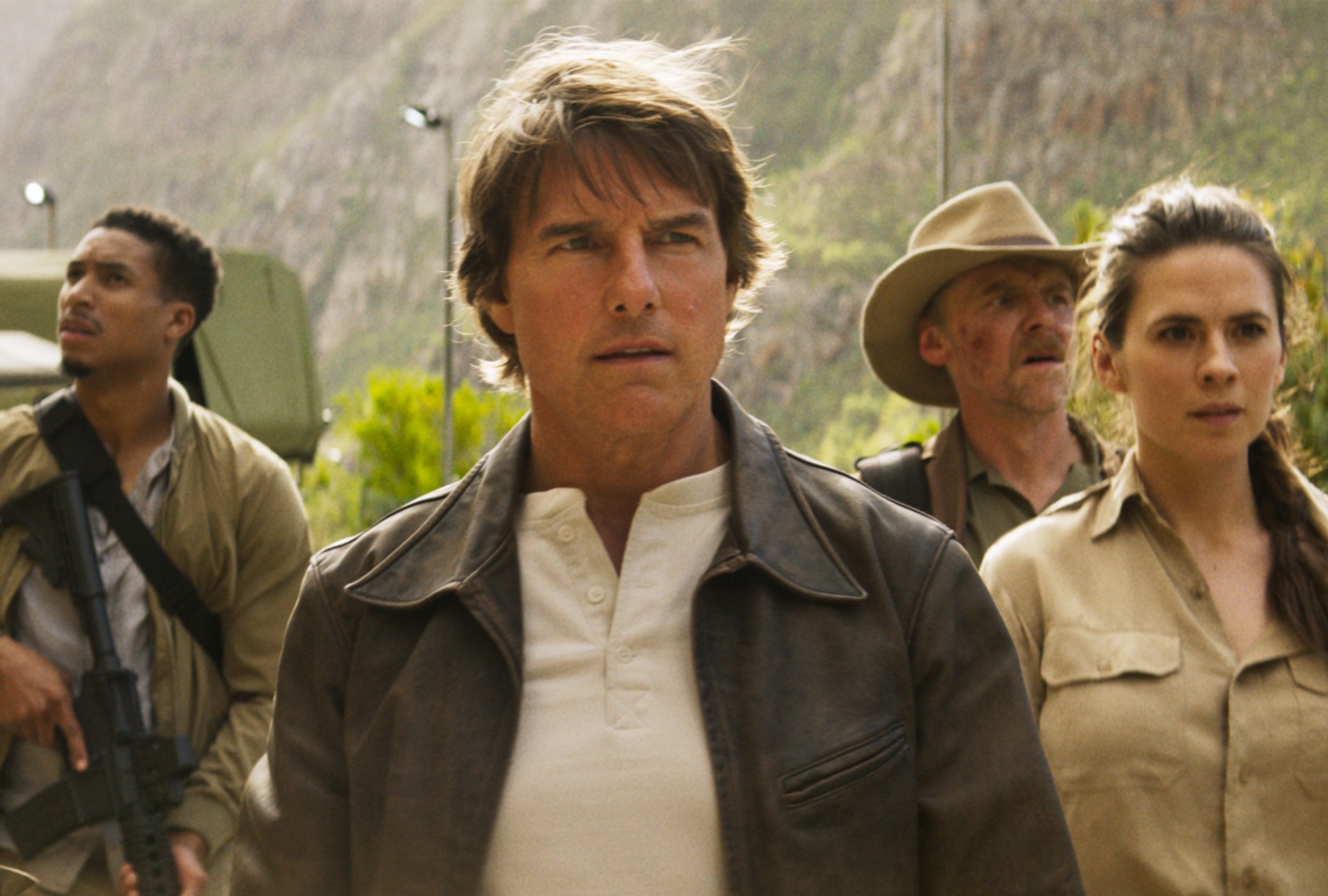
Tom Cruise as Ethan Hunt, Greg Tarzan Davis as Degas, Simon Pegg as Benji Dunn and Hayley Atwell as Grace in "Mission: Impossible – The Final Reckoning" (Paramount Pictures/Skydance)


Want a daily wrap-up of all the news and commentary Salon has to offer? Subscribe to our morning newsletter, Crash Course.


But this time around, things are different. McQuarrie and co-writer Erik Jendresen have built a world that looks frighteningly similar to our own, where ChatGPT is so prevalent in high schools and colleges that students’ ability to create and think for themselves is rapidly hemorrhaging. Google’s (often incorrect) AI overview is the first thing users see when they search online. People are already happy to let this technology think for them. And yes, the current versions of this AI are dubious, unreliable and artless. But is it so far-fetched to imagine a reality where they’ve become more refined? It’s not just that the tech is changing rapidly; it’s that there are those who want it to change even faster, who gain joy from the mere idea that AI could be such an inextricable part of our lives that anyone with a creative mind is put out of a job. Take a look at the social media replies of any journalist posting about being laid off, and you’ll find that their dejection is like a beacon to the vultures, waiting to pick at the remains of an already desolate media landscape. 

In its study of AI, “The Final Reckoning” is unapologetically bleak. McQuarrie and Jendresen have concocted a dour world where normally faceless AI devotees have become public proselytizers. They stand before news cameras, embracing armageddon, preaching about how the Entity will deliver humanity to redemption. In our modern dystopia, fire and brimstone have been replaced by ones and zeroes. Matters have become so dire that the president, Erika Sloane (Angela Bassett), is considering a tactical nuclear strike that will vaporize hundreds of thousands of souls around the world, just to get a jump on the Entity’s growing command of atomic forces. There is no winning unless Ethan and his team can retrieve the Entity’s source code from a submersible at the bottom of the sea and trap it inside a secure server, a mission more impossible than any that have come before it.

Nick Offerman, Charles Parnell, Angela Bassett, Mark Gatiss and Janet McTeer in "Mission: Impossible – The Final Reckoning" (Paramount Pictures/Skydance). Cruise’s ambitions might not be quite so perilous, but they are equally as daunting. How can you convince an audience with their phones hermetically sealed to their hands to put away their devices and care about this sprawling, capital-M movie playing in front of them? If so much of humanity is already content with AI, will the warnings of a “Mission: Impossible” so supremely critical of AI even track? 

How could you not be filled with the spirit, sitting in front of the big screen, watching what may be the last film of one of cinema’s greatest franchises strip itself of the silliness it has worn like a rubber mask from the beginning to get real with its audience?

But like the adage goes: If you build it, they will come. Sitting in a packed theater this week and watching all phone screens not just go dark, but stay dark for the nearly three-hour runtime of “Dead Reckoning” was a rare sight not lost on me. People want to be dazzled by the spectacle of a feature so grand that they can’t help but be awestruck by the magnificence of its existence. There is real magic to what Cruise and McQuarrie pull off with this film’s harrowing stunts, which include two of the franchise’s most jaw-dropping set pieces. Ethan’s journey to the bottom of the sea is arduous and filled with barriers. But by the time the dialogue-free, centerpiece underwater sequence brims with Max Aruj and Alfie Godfrey’s droning score, popcorn shuffling stopped. Soda sipping ceased. The occasional whisper subsided. It is, after all, rude to make noise during a worship service. 

Ethan’s noble quest to save humanity reflects Cruise’s genuine belief that humanity is united by the art they can see on the big screen. This decade alone, Cruise excitedly backed the limited, mid-pandemic theatrical release of “Tenet,” extolled the virtues of the theatrical experience in a pre-recorded message playing before “Top Gun: Maverick,” and made a PSA about the evils of motion-smoothing televisions. He’s a guy who wants people to experience the art of filmmaking as it was intended to be seen, every time. He delivers his sermons with such certitude that it’s easy to forget that his actual religious views might be a little precarious (to say the least). And in “The Final Reckoning,” Cruise even has a line about how this fight against AI — and, by extension, Cruise’s fight for the art of cinema through its most mainstream blockbuster form — has become free of ideologies and dogma. What matters is protecting a force like cinema that brings humans together, not emboldening the technology that keeps us apart. Sometimes, you’ve got to hammer that importance into someone — quite literally, in the case of Ethan clobbering a knife-wielding assailant defending the Entity, saying, “You spend too much time on the internet!”

Tom Cruise as Ethan Hunt in "Mission: Impossible – The Final Reckoning" (Paramount Pictures/Skydance). Though Cruise loves making movies, he doesn’t enjoy being their preordained salvation. (Jesus didn’t ask to be born into his fate either!) When questioned about his feelings on being deemed “the last movie star” by people who are nostalgic for a time when the kind of films Cruise makes were much more prevalent, Cruise responded, “I don’t want to be.” He’s not pleased about the fact that the industry is in such uncertain shape that it’s not entirely inconceivable that he could be the last great movie star. No one who really loves working in this business would be, no matter how devoted they are to the religion of cinema. Yet, Cruise feels he has no choice. He must jump off cliffs on a motorcycle. He simply has to hang from a plane in mid-air. He has taken up the mantle for our greater good, just as Ethan Hunt chose to. 
How could you not be filled with the spirit, sitting in front of the big screen, watching what may be the last film of one of cinema’s greatest franchises strip itself of the silliness it has worn like a rubber mask from the beginning to get real with its audience? The espionage terror the “Mission: Impossible” films have cooked up has come to reap. What was once far-fetched is now our reality. Tech will very well be our downfall one day. But under the dark of the theater, we’re afforded the rare chance to remove ourselves from that digital umbilical cord and experience a film as it’s meant to be seen, alongside people who want to do the same. Call it movie magic. Call it religion. Just don’t call it the end.

Trump to cadets: “We will not fail you.”

This year, the United States Army celebrates its 250th birthday. President Donald Trump kicked off his Memorial Day weekend by speaking at the graduation of the United States Military Academy at West Point. Wearing his signature “Make America Great Again” red hat and a clashing magenta tie, the Commander in Chief gave his sluggish, partly off-prompter keynote address to 1,002 cadets at Michie Stadium at West Point, N.Y.

Trump spent time praising the cadets before him, referring to them at one point as “a bunch of male models.” He brought up two cadets on stage to honor their contributions to the class of 2025. Cadet Bryson Daily led the Army’s Black Knights football team to a winning season, and Cadet Chris Verdugo set a new record on a 18.5-mile freezing winter night hike in just 2 hours and 30 minutes (beating the previous record by 13 minutes).

The USMA also made Peter Wang an honorary cadet. Wang was a junior ROTC cadet when he was killed six years ago at Marjory Stoneman Douglas High School in Parkland, Fla.

After praising the military in general, Trump boasted his recent success in securing increased military spending, including new stealth planes, tanks, ships, missiles and drones. All “Made in America,” of course. He brought up the “Golden Dome” missile defense shield to applause, promising to complete it before he left office. He discussed his immigration changes, like sending the army to help protect the southern border and ranting how he inherited a “terrible” immigration system of releasing “insane” people and violent criminals from jails.

After a brief detour through the same speech on how he won the election, he returned to immigration, claiming that he had closed the borders "99.999%," as Customs and Border Patrol (CBP) only allowed one sick person cross the border to get help. Border crossings are down, according to Trump’s own CBP by 94% since March 2024. They also note that illegal border crossing average 264 (out of 673 encounters) per day in March alone. No word on the status of the aforementioned sick border-crosser.

Trump focused much of his speech on how these decisions were to establish a better future for the military and for America. Then, suggesting that success comes from the “culture of winning,” he started the final segment of speech with some sound advice:

  1. “You have to do what you love. If you don’t love it, you won’t be successful. Follow your instincts to take the path that you love.”
  2. “Think big. If you’re going to do something, you might as well do it big.”
  3. “Brainpower, you have to have. Potential, you have to have. But if you really want to be successful, you have to work hard.”
  4. “Don’t lose your momentum.”
  5. “You have to have the courage to take risks and do things differently.”

“With leaders like the West Point class of 2025, the army will never fail,” said Trump to close his over one-hour speech. “We will never let you down.”


“Fear Street: Prom Queen” lacks the thrills and brains of its slasher predecessors

Prom and horror cinema share a rich enough relationship to sustain their own subgenre: “Carrie,” “Tragedy Girls,” “The Prowler,” Student Bodies,” “Texas Chainsaw Massacre: The Next Generation,” “Dance of the Dead” and, of course, the film wearing the crown, “Prom Night.” A customary end-of-year school dance makes a nice, chintzy locus for assembling a gang of characters in a single location, where they can each be picked off at the convenience of the night’s M.C. (master of carnage, in this case). As such, and given the source material, Netflix’s decision to follow up “Fear Street: 1666,” the concluding chapter of its “Fear Street” slasher series, with a party is sensible. 

But how the streamer and newcomer Matt Palmer approach “Fear Street: Prom Queen” makes no sense. “Prom Queen,” unlike the first three “Fear Street” movies – each distinguished annually, from “1994” to “1978” to “1666,” and each directed by Leigh Janiak – directly adapts the same-named book from author R.L. Stine’s bibliography, “The Prom Queen,” logline more or less intact: Shadyside High is revving up for the prom, and everyone’s excited, including a maniac decked out in a grim visaged mask and a crimson latex coat, stalking prom queen candidates in the school’s hallways with an ax. One by one, each would-be monarch loses her head, until the culprit is caught and exposed, “Scooby-Doo” style. 

The order of operations in R.L. Stine’s calculus results in a largely aseptic affair on the page, but Netflix takes the responsibility of choreographing kids’ murders much more seriously. If no single death scene in “Fear Street: Prom Queen” matches the level of the superlative bread slicer kill from “Fear Street: 1994,” the movie makes creative enough use of circular saws and paper cutters to suffice and sustain audience interest. Thin character development hobbles the film’s pacing during moments where giving any of them a shred of an identity would’ve helped pass the time between kills; it’s a letdown that each cast member — apart from the fantastic Lili Taylor as VP Dolores Brekenridge — reads so anonymously, considering how efficiently Janiak’s films give personalities even to their minor supporting characters. 

(L-R) India Fowler as Lori Granger, David Iacono as Tyler Torres and Suzanna Son as Megan Rogers in "Fear Street: Prom Queen." (Alan Markfield/Netflix)
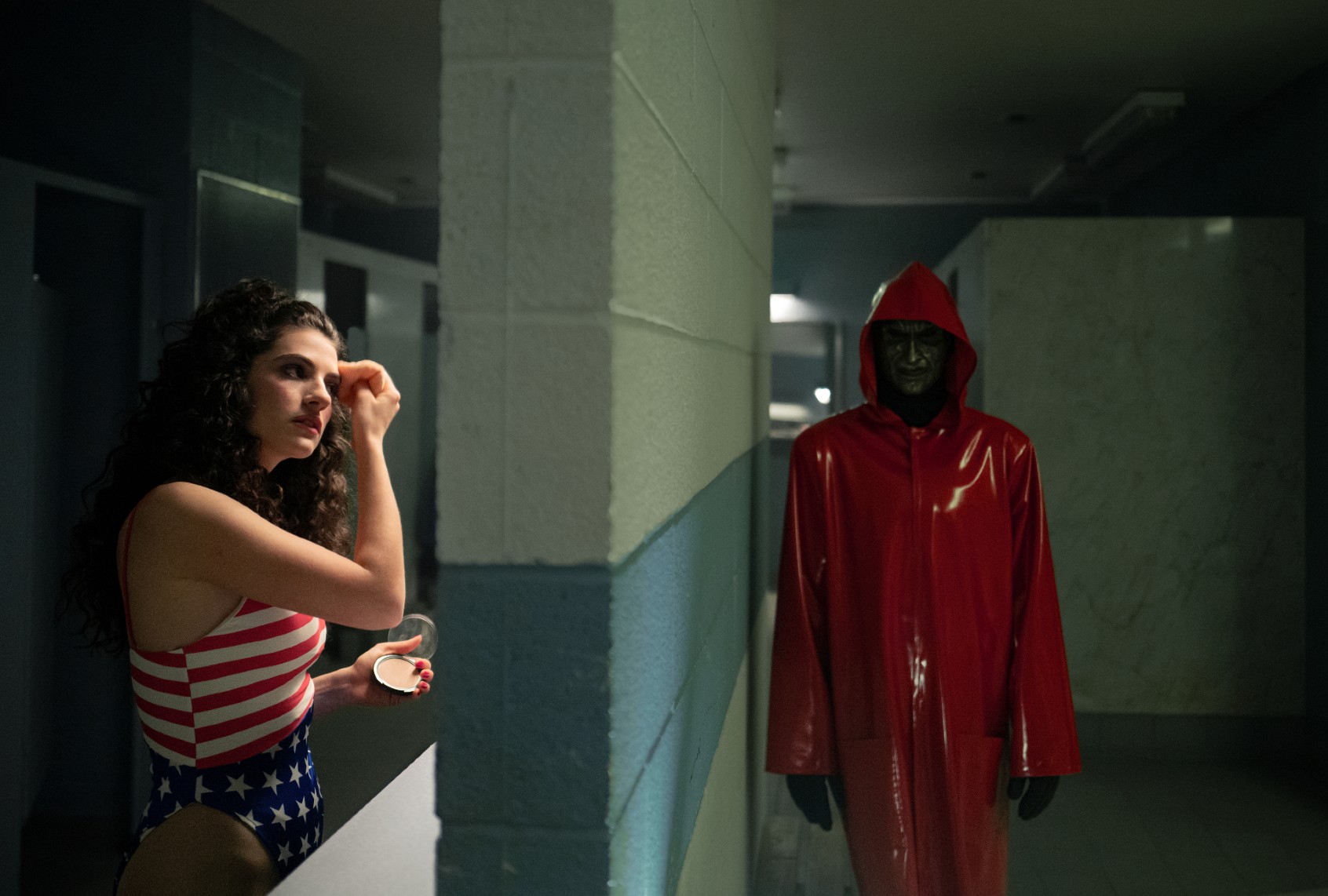
The movie makes creative enough use of circular saws and paper cutters to suffice and sustain audience interest.

But it’s the thought process driving Palmer’s themes and plot here that’s frustrating. In contrast to Janiak’s trilogy films, “Fear Street: Prom Queen” is a shockingly retrograde piece of work, with no significant thought given to ideas about, among other things, class and sexual orientation, key pillars of “Fear Street: 1994” and “Fear Street: 1666.” Frankly, the film has so little on its mind in general that if a butcher’s cleaver slammed through its skull, it would strike cotton candy instead of gray matter. 

Ella Rubin as Melissa in "Fear Street: Prom Queen" (Alan Markfield/Netflix)The story hinges on a classic contest between good and evil, where “good” is represented by Lori Granger (India Fowler), the prom queen underdog, and “evil” by Tiffany Falconer (Fina Strazza), the mean-girl shoe-in to win. Lori works at the local diner to pay for her own prom dress, while her mother (Joanne Boland), a former prom queen candidate herself, hustles grueling hours to make ends meet as the sole provider of their house; Tiffany, of course, has money, and “Fear Street: Prom Queen” contentedly rests on that sole motif for supporting subtextual worldbuilding. We know, we know: elites bad, working class good; cool kids bad, unpopular kids good. The fraying edges around the blueprint Palmer borrows from here wouldn’t matter half as much if the movie had anything insightful to say about what makes Tiffany’s beef with Lori remarkable. Instead, it’s simply assumed by the screenplay, which Palmer co-wrote with Donald McLeary, that we’ll root for Lori on principle. 
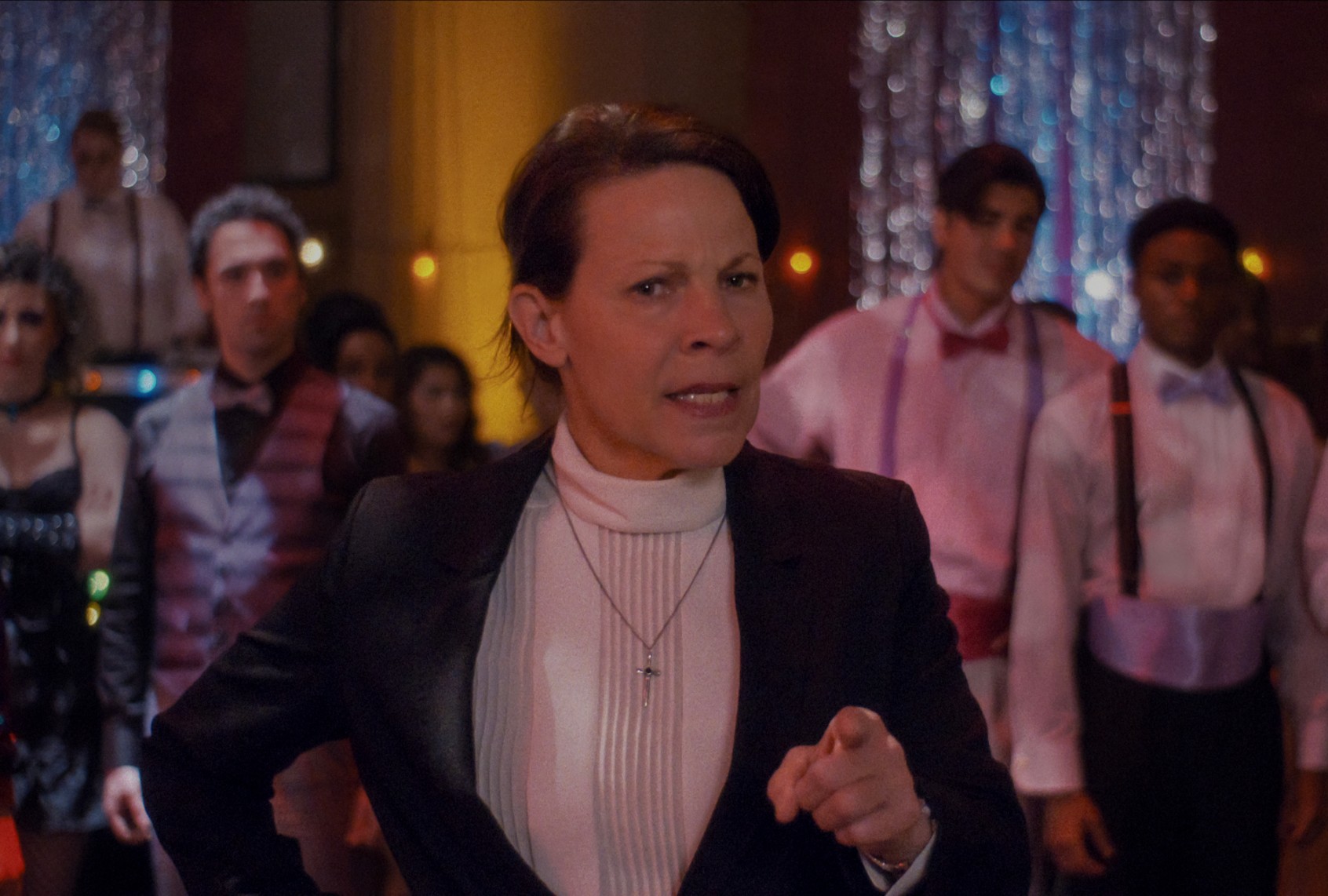
The cast embodies such clearly defined horror character tropes that the film’s context reinforces systemic strictures, sending it a dozen steps backward from the “Fear Street” trilogy.

And of course, we’re in Lori’s corner; she’s the final girl. There’s not much else there for the audience to cling to, though. We support Lori because that’s the basic expectation, and not because “Fear Street: Prom Queen” gives us a specific reason to, by way of even a shred of insight into her character. The movie promises nothing, and keeps the promise. At points peppered throughout its 90-minute running time, Palmer seems to suggest a substantive history between Lori and Tiffany, or that Megan (Suzanna Son), Lori’s best friend, harbors possible unrequited love for her, but these implications amount to no more than mere hints. These are dreadfully static characters, which would be fine if they were interesting, but the furthest the film gets with Tiffany is that she’s an elitist bully, and the furthest it gets Megan is that she likes horror movies, apparently because that’s the only way Palmer knows for separating outsiders from the “it” crowd. 

Lili Taylor as VP Dolores Brekenridge in "Fear Street: Prom Queen" (Netflix)


Want a daily wrap-up of all the news and commentary Salon has to offer? Subscribe to our morning newsletter, Crash Course.


Funneled into the framework of a prom slasher, the bungling of "Fear Street: Prom Queen" feels downright pernicious. It’s one sort of problem to litter the narrative with flat characters and airless performances; the cast must be suffocating from how little life they breathe into their roles. But each of them embodies such clearly defined horror character tropes that the film’s context reinforces systemic strictures, sending it a dozen steps backward from the “Fear Street” trilogy. Janiak pushed against, for example, heteronormativity, and patriarchal entitlement, the latter being the trio’s throughline. “Fear Street: Prom Queen” only rebukes upper-class greed in superficial ways that are necessary to the plot, then muddles its message by personalizing the killer’s motive beyond the ceaseless hunger for more that wealth instills in those who have it. 

Perhaps the problem is the timeline; “Fear Street: Prom Queen” takes place before the events of the first three “Fear Street” movies, where the Shadyside curse, responsible for turning everyday folks into psychotic killers, is ultimately broken. But “Fear Street: Prom Queen” treats the curse as an Easter egg and rests on a hazy formulation of human cruelty as its villain instead. Is this a story about the haves taking from the have-nots? Is it about the elites’ repressed insecurities over their merits? Palmer appears confident in the presumption that viewers will simply go along with it because that’s the pop culture compact of late, and while despising the rich is all fun and games, the exercise strikes as regressive when the routines are this rote. 

Dare to take cheese beyond cheesecake

Cheese is, unquestionably, my favorite food.

Often, though, it is too often assumed to be a savory food. Yes, there's cheesecake or cream cheese icing, but beyond these classics, cheese is typically relegated to savory compositions.

But who's to say that cheese's appeal and versatility should be contained? Why don't we see more cheese in desserts? Or even drinks?

Its salinity, mouthfeel and familiarity are secret weapons in desserts  and we're only just beginning to explore how. 

We should, of course, note that cheese platters in lieu of dessert are certainly ubiquitous  paired with sweet additions like goiabada, mostarda, jams, marmalades and more — but do they truly count as dessert?

There's s a storied history of sharp cheddar in desserts (like apple pie) or the aforementioned desserts made with cheeses like ricotta, goat or mascarpone. Obviously, a cheese like mozzarella or feta isn't often seen on a dessert menu.

But why not?

Chefs' exploring cheese-centric desserts

The last time I visited Washington, D.C., I ate at Lutece and tried Chef Isabel Coss's stupendous honey semifreddo with comte and honeycomb. It was astounding: complex, but with a salty, sharp note from the cheese that is so intrinsically cheese-y and couldn't be replicated with any other ingredient. When I spoke with Coss in 2023, she told me “The honeycomb semifreddo is a revisitation of a traditional French cheese plate with honey and cheese. We all know that combination, but now you can see it through my eyes, with a Mexican influence that adds a fun, delicious and new twist.

I also once had a burrata-centric dessert at a fantastic Korean restaurant in Manhattan called Atoboy that firmly wedged itself in my "favorite desserts" headspace for years to come. As I previously wrote, "It was, and remains, one of the single best desserts I’ve ever tasted. The cold granita, the crunch of the walnut, the smooth cheese, the tart yogurt, the differing temperatures, the way the granita melted on your tongue; it was truly something else."

We need your help to stay independent

I recently reached out to Chef Junghyun Park to ask about the dish. “The idea,” he explained, “was to use the subtle spice of Sujeonggwa—a traditional Korean dessert drink made with cinnamon and ginger—as a base, and balance it with the flavor and texture of cheese. Burrata brings a creamy, neutral profile that softens the bold flavors.”

Park added, “We also found it interesting to incorporate cheese into a Korean dessert, as it’s something we’re beginning to see more often in Korea. It felt like a playful yet thoughtful way to bridge traditional and contemporary elements.”

At Leu Leu, the new California restaurant from “Top Chef” alum Claudette Zepeda, the dessert menu reads like a dream. One standout sundae, cheekily titled No Mamey's, features Roasty + Toasty Ice Cream from Little Fox—made with toasted brioche cream, parmesan crisps, and a mascarpone swirl. Zepeda tops it with mamey curd, brown butter almond cake, and a pinole crumble. It’s a sundae built for swooning.

Making cheese-centric desserts at home

Of course, you don’t need a restaurant reservation to start experimenting with cheese-forward sweets.

In her remarkable cookbook “Bodega Bakes,” cookbook author and former Maydan pastry chef Paola Velez explores this exact idea. “Cheese is very versatile,” she told me via email. “I’ve put cheddar in a chocolate mousse before, parmesan in a strawberry tart, and other renditions of what I like to call savory-sweet bakes.”

When creating her stunning passionfruit and guava mascarpone tart, Velez used the cheese to “combat and mellow out” the common pitfalls of fruit-heavy desserts: “cloying sweetness and lip-puckering sourness.” She’s also a fan of flexibility: “If you don’t have cream cheese or don’t like the flavor of cream cheese [in baking], just use mozzarella.”

One cookie recipe in “Bodega Bakes” calls for queso Dominicano or halloumi. The inspiration? A classic Dominican pairing of guava and cheese with savory crackers, or gellletas. “What is a cookie,” she quipped, “if not a sweet cracker?”

What cheeses work well?

Practically all of them. Parmigiano Reggiano offers a craggy, crystalline bite and rich saltiness. Brie, with its smooth, buttery consistency, melts seamlessly into dessert applications. A salt-forward cheese like feta lends bright sharpness that plays beautifully with soft, sweet components like wine-poached pears or candied plums. Manchego is a personal favorite that shines in dessert contexts, and the same goes for aged gouda or even fontina.

I’ll never forget stumbling upon Gruyère caramels in a grocery store—yes, really. I was gobsmacked. What an incredible combination! The list goes on.

In the most recent season of Top Chef, Chef Cesar Murillo blended white chocolate with bleu cheese. The result was polarizing, but it’s exactly that kind of creative leap that can yield unforgettable, standout desserts.

Now it’s your turn

Cheese-forward desserts aren’t reserved for restaurants. Why not make one this weekend? Try letting cheese take the starring role at your next summer gathering — you’ll be the talk of the party.

Cheese is magnificent in every form. Don’t relegate it to a cheese plate or a passing sprinkle on a salad. Let it shine.

For too long, cheese has played second fiddle in the dessert world. Maybe now, it’s time we let it headline.

Pete Rose, Donald Trump and the corruption of literally everything

On May 13, the commissioner of Major League Baseball, Rob Manfred, issued a decision reinstating Hall of Fame eligibility of 17 deceased former players, all of whom had previously been permanently banned from possible inclusion.

BFD, you might say, and you would be right. Given climate change, the planet’s wars and the horrific last four months that sane Americans have had to endure, what difference does any of that make? You may think that professional sports are mere Roman circuses to keep the proles diverted from matters their rulers don’t want them to think about, except that unlike the circuses of the Roman Empire, which were free, the American varieties charge exorbitant admission prices (either directly or through cable and streaming charges).

Even more inviting of cynicism, Manfred’s reinstatement involves players who gambled on their own sport while they were actively competing. In light of the explosive growth of sports gambling ($13.7 billion in revenue in 2024) since it was legalized nationwide in 2018 — by the U.S. Supreme Court, eager to give a boost to a sleazy corporate enterprise that breeds addiction), isn’t it hypocrisy to care whether the players bet too?

Perhaps. But the commissioner’s action throws a revealing light on American politics and class sociology.

What the story is all about is not the other 16 players — all more or less forgotten today — but the potential Hall of Fame reinstatement of Pete Rose, Major League Baseball’s all-time leader in hits, who was disqualified for gambling on games as a player and a manager. I won’t belabor the biographical details except to note that from his debarment in 1989 till his death in 2024, Rose tirelessly lobbied for reinstatement, and each time, the commissioner refused. Manfred himself denied Rose’s petition several times – till now. So what’s different this time?

Manfred met with Donald Trump in the White House a couple of weeks before this decision. That is the only salient reason. Trump has said that he, as president, would grant Rose “a complete pardon”; since that cannot logically pertain to the Baseball Hall of Fame issue, it probably refers to Rose’s conviction on two charges of tax evasion, for which he was fined and briefly imprisoned.

As has been the case with virtually all Trump’s pardons, Pete Rose was exactly the sort of person with whom our president would feel a natural affinity.

That long-ago criminal case is irrelevant to Hall of Fame candidacy, as was the successful paternity suit lodged against Rose, and the statutory rape allegation, for which he was never charged but which he admitted (sort of), and which cost him his commentary gig at Fox Sports (part of a larger organization with a stratospherically high bar for personal misconduct).

Lots of sports stars have been less-than-stellar characters: we need only think of Ty Cobb and all the ’roided-up players who established suspicious home run records. But it seems reasonable to assume that Trump’s sudden obsession with Hall of Fame eligibility standards has to do not merely with Rose’s baseball infractions, but also with the ballplayer’s moral turpitude off the field.

As has been the case with virtually all Trump’s pardons, Rose is exactly the sort of person for whom our president would feel a natural affinity. If liars, cheaters and tax evaders can be exonerated, then Trump has symbolically defined our national deviancy down to his own level, and of course wins thereby. He displays a virtually demonic lust to corrupt everything he touches.

We must also understand this incident in its larger context, as one of a series of actions by the Trump regime to insert itself into every facet of American life: from effectively taking over private universities and dictating their curricula to banning books from the Naval Academy, dictating prices to retail businesses, attempting to change cartographic nomenclature like (“Gulf of America,” indeed) and vetting exhibits at the Smithsonian Institution, which is not formally a part of government and has had an independent policy on exhibits for the last 178 years). Finally, we get to sports. Ironically, these intrusions are enthusiastically supported by the same voters who whine incessantly about the nanny state.

Americans have seen a massive spike in the use of the word “authoritarian” in the last few years, but what we are now witnessing is the incipient stage of totalitarianism: a regime’s efforts to gain control of all aspects of life, not just the overtly political, and effectively to erase the distinction between the state and civil society.

In his eyewitness account of Nazi rule in Germany, William L. Shirer repeatedly emphasized the smothering control of the regime over everyday existence, which made it difficult even for those who wanted simply to retreat into private life to evade the constant barrage of propaganda, publicity stunts, parades and regimentation. Hitler believed the German people must never be allowed to “cool off”; on the contrary, they had to be subjected to a perpetual drumbeat.

Alexander Solzhenitsyn’s documentation of Stalinism strikes the same note: the elimination of a private existence away from politics, with the regime constantly forcing itself upon one’s attention, feeding each individual’s growing atomization and learned helplessness.

Americans have seen a massive spike in the use of the word “authoritarian” in the last few years, but what we are now witnessing is the incipient stage of totalitarianism: a regime’s efforts to gain control of all aspects of life.

The true goal of totalitarianism is not to turn all of us into enthusiastic believers, just as transforming Pete Rose into a retrospective hero will not convince the skeptical, and censoring books and museum exhibits will not persuade us that slavery never existed. Rather than brainwashing us, the objective of the totalitarian is to bludgeon us into apathy, resignation and passivity. If you’re fed up barely four months into the regime’s misrule, how will you feel 44 months from now?

Of course no such regime can impose itself on a society that is overwhelmingly unwilling to play along. I have already written about the profound streak of irrational thinking and resentment, and the nihilistic urge to “burn it all down,” felt by many ordinary Americans. Evidently, half the electorate grew bored, confused and uncomfortable living in a free country, however imperfect it may have been. In Rainer Werner Fassbinder’s film “Germany in Autumn,” a character explains German acceptance of Nazi rule: “Sometimes, people just want somebody to think for them.” That same attitude applies to millions of Americans.

But what is noteworthy about this attempted imposition of totalitarian control on activities hitherto exempt from government meddling is the behavior of many of our so-called elites, who don’t have the excuse of poor education or low income.

Rob Manfred, like so many politicians, corporate titans, university presidents and others, proves that the leaders of our society are laughably easy to compromise and corrupt. He is no different than Jeff Bezos; all it took was a phone call for the Amazon mogul to backtrack on breaking out the separate cost of Trump’s tariffs in the prices his company advertises, and then to pretend that he’d never intended to do such a thing.


Want a daily wrap-up of all the news and commentary Salon has to offer? Subscribe to our morning newsletter, Crash Course.


Likewise, Columbia University’s trustees caved in to Trump’s demands to dictate university policy rather than touch the university’s $14.8 billion endowment as a substitute for federal grants. Why did ABC News settle a lawsuit Trump had filed that the network was almost certain to win, and then pay him $15 million for the privilege? These craven handovers will have an entirely predictable result: They will only encourage further extortionate suits against news organizations.

Perhaps worst of all are the partners in the big law firms. Their entire business model, their whole inner nature, is predicated on hair-trigger litigiousness, predatory aggressiveness and a hunger to win at all costs. But when faced with Trump’s illegitimate ultimatum not only to cease serving clients he disapproves of, but to provide future legal services pro bono to clients or causes he prefers, they instantly consented to “agreements” that resemble the confessions signed by the defendants in Stalin’s show trials.

This disposition among America’s elites to bend the knee and betray their supposed principles did not first manifest itself at noon on Jan. 20; the rot in this country, the so-called land of the free and home of the brave, has been worsening for years, like termites slowly and patiently gnawing away at the wooden sills of a house, leading to inevitable collapse.

“Not with a bang, but a whimper”: Experts say charging NJ Democrat will backfire on Trump DOJ

The announcement of charges against a Democratic lawmaker earlier this month marks a dramatic escalation in the Trump administration’s clashes with other branches of government that legal experts say may not hold up in court. 

Rep. LaMonica McIver, D-N.J., stands accused of two counts of assaulting, resisting and impeding an Immigration and Customs Enforcement officer. U.S. Attorney Alina Habba, who previously served as President Donald Trump’s personal lawyer, announced the charges last Monday after what she described as an unsuccessful attempt to reach an arrangement with the lawmaker. The Democrat attended her first court hearing virtually last Wednesday. She insisted in a statement that the charges against her are “purely political” and “meant to criminalize and deter legislative oversight.”

“We’ve seen this administration come after and attack leaders for doing their jobs,” she told CNN Tuesday, referencing recent arrests of Newark Mayor Ras Baraka and a Wisconsin judge. “It’s political intimidation, and I will not be intimidated.”

McIver’s prosecution marks a rare occasion where a lawmaker faces charges for something other than a white-collar crime like fraud or bribery. It also further stresses the government’s separation of powers as Trump and his administration crack down on immigration. 

“I think it’s overreach,” former federal prosecutor Neama Rahmani told Salon, arguing that the early May scrum between lawmakers and DHS officials was “relatively minor.”

Neither McIver’s office nor the Justice Department responded to requests for comment.  

On May 9, McIver, along with fellow New Jersey Democratic Reps. Rob Menendez, Bonnie Watson Coleman and Baraka, visited the Delaney Hall detention center to inspect the new facility for oversight, which federal law allows members of Congress to conduct. The visit devolved into an altercation when they moved to arrest the Newark mayor, prompting McIver and Watson Coleman to attempt to shield him. The following day, Fox News posted a video provided by the Department of Homeland Security said to show McIver “shoving/elbowing her way past a DHS agent.” A video taken by NJ Spotlight News shows a federal officer shoving McIver around the same time as she attempted to reenter the facility, which aligns with McIver and Menendez’s account of the tussle.   

A group of 10 former Republican members of Congress, led by former Reps. Mickey Edwards, Okla., and Claudine Schneider, R.I., said they “unequivocally reject” the charges against McIver in a statement Thursday. 

“Rep. Mclver was present at the ICE facility as part of her official congressional duties,” the retired lawmakers said. “We believe this extreme response to the events of that day is unwarranted.”

In the criminal complaint against McIver, the government accuses her of objecting to Baraka’s arrest by yelling “Hell no!” and joining her colleagues in encircling the mayor in a “‘human shield’ effort to prevent [Homeland Security Investigations] from completing the arrest.” The complaint also alleges that McIver slammed her forearm into a uniformed HSI agent, attempted to restrain him and pushed an ICE officer.

Rahmani, now the president of personal injury firm West Coast Trial Lawyers, said that while he doesn’t believe the Justice Department should have filed the charges against McIver, the alleged offense does “fit within the four corners of the law.”

“It is a felony if there's any physical contact,” he said in a phone interview. “It's just not something that you typically see and, historically, there would be an exercise of prosecutorial discretion, not making a federal case out of something relatively minor.”

McIver also has a “pretty strong defense” in that she was conducting a legitimate oversight duty at the time of the altercation, Rahmani added.  

We need your help to stay independent

Federal law authorizes legislators conducting congressional oversight to access “any facility operated by or for the Department of Homeland Security used to detain or otherwise house aliens.” The Constitution’s “speech and debate clause” also protects members of Congress from criminal prosecution for actions taken as part of their official duties.

Rahmani said that she may be able to argue that the prosecution is selective or political, a point that Trump himself and Hunter Biden raised during their respective cases, but would need to show that the prosecution is “for a constitutionally prohibited reason.”

In the end, Rahmani said he doesn’t expect the case to actually head to trial before a jury, with the charges against McIver dropped either by the Justice Department itself or the presiding judge. 

But Barbara McQuade, a law professor at the University of Michigan and former federal prosecutor, told Salon that the best way to look at McIver’s prosecution is through the lens of the last four months of Trump’s presidency. Traditionally, the courts viewed the government with the presumption of regularity, the idea that the government acts in good faith and conformity with the law. In a moment when the administration is denying people due process and attempting to advance a theory that birthright citizenship does not apply to children with undocumented parents, the Justice Department is “losing that presumption of regularity,” she said.

“I think the Justice Department has earned the opposite of the benefit of the doubt,” she said in a phone interview. “It is cast with doubt, and that is because we have heard people like the head of the FBI, Kash Patel, and the president himself talk about how they're going to seek retribution and going to go after their rivals and their enemies.”

While McQuade said she believes the prosecution has “at least some appearance” of political motivation, she also sees McIver’s alleged encircling of the mayor and objection to his arrest as arising to probable cause that she violated the “impede portion” of the statute. Still, assessing the facts of what happened during the scrum is difficult because the available photos and videos depict the tussle after it began, she said.

On the other side, however, is the idea of “respect for other branches of government,” which the Public Integrity Section of the DOJ considers alongside uniformity and historical practice when deciding whether to file charges against public officials, McQuade said. The Justice Department is currently considering removing that check. 

In all, she said her first reaction to the charges is skepticism. Whether the prosecution is “lawless” is a question she doesn’t have a strong answer for. 

But the case is still “something to keep an eye on because it could very well be that this case ends … not with a bang, but a whimper,” McQuade added. Habba, for example, announced at the same time that the charges against Mayor Baraka had been dropped. “We will know whether they have the goods if they can show them at a jury trial.”

To manage your money, ditch your budget

A typical budget asks you to decide how you’re allowed to spend money in advance, then track every dollar you spend to make sure you follow the plan.

This tedium is less than ideal for most lifestyles, and it’s why study after study shows budgets to be unhelpful and unsustainable.

“Most people do not maintain a budget. Why would we?” financial educator and author of "Money for Couples” Ramit Sethi said in an email. “We have to assemble months of spending into a complicated spreadsheet in order to .. what? Feel bad about our spending?”

Sethi and other financial experts have pushed back against this typical “give every dollar a job” approach to money management and offered new ways to stay on top of your money without the stress and accounting of a budget.

Here are four ways to ditch your budget and manage money without resorting to restriction, shame or constantly counting pennies.

1. Set up an 80/20 plan (the original "anti-budget")

Paula Pant, writer and founder of the financial media company Afford Anything, coined the term “anti-budget” in 2013 when she offered a 80/20 money management plan she called “the easiest budget ever.”

We need your help to stay independent

Pant’s anti-budget plan is meant to help you set aside money for saving, investing and dealing with debt, without worrying about the rest of your spending. It includes two simple steps:

  1. Decide how much you want to save (she recommends at least 20% of your income but says you can start with as little as 1%).
  2. Pull this amount off the top.

Once your savings is set aside from each paycheck, Pant writes, “Relax about the rest.”

Pant’s simple anti-budget stands in stark opposition to the impracticality of budgeting advice. She created the 80/20 plan for the majority of people who will never stick with restriction and spend-tracking but still want to make progress on financial goals.

Since 2013, however, the costs of living have risen sharply compared with stagnating wages. That makes it harder for folks to save 20% of their paychecks and even harder to “relax about the rest” without a solid plan to make sure the bills are paid.

Subsequent financial experts have built on Pant’s anti-budget stance to build money management plans that keep stress low while tackling the realities of paying for life in 2025.

2. Use values-based spending

Jen Smith and Jill Sirianni, authors of “Buy What You Love Without Going Broke” and hosts of Frugal Friends Podcast, often quote Pant’s mantra, “You can afford anything, but not everything.”

Their book lays out the duo’s signature “values-based spending” approach, which eschews persnickety budgeting and helps you choose what to buy based on what you value most.

“This method doesn't start with the math but rather begins with the things that matter most to you with permission to spend!” Smith said in an email. “It's about saying better 'yes's' and easier 'no's' with our spending in a way that aligns with each person's needs.”

"It's about saying better yes's and easier no's with our spending in a way that aligns with each person's needs"

Smith and Sirianni compare traditional budgeting to yo-yo dieting: “full of restriction, deprivation, shame and messages about 'cutting', 'trimming', 'counting every tiny penny.'” Values-based spending, on the other hand, “emphasizes self understanding, individuality, and flexibility.”

In their book, they note the first step to “buying what you love” is to know what you love. They created a framework they call the four F's to help you name your highest values. The four F's represent the categories of things they’ve identified as those people value most: family, friends, faith and fulfilling work.

Using this framework, you can look at your spending urges and habits and identify the deeper needs you’re trying to meet: for example, maintaining family ties, spending time with your children, connecting with friends, exploring spirituality or succeeding in a job you care about.

“We prefer to focus on values before numbers,” said Smith. “When we can start with the things that matter most, identify how we want to spend (or not spend) on them, then we can identify simple categories for where our money is going each month, with room to make adjustments as needed.”

Once you identify that deeper need, you can decide whether or not it’s necessary to spend money to meet it. You might be buying holiday gifts to connect with family or expensive lunches to spend time with friends, for example. Are those purchases necessary, or can you meet the needs without the spending?

Determining the values you’re trying to honor and where spending is or is not necessary, Smith said, can help you “experience greater confidence and less guilt about spending [and] more creativity in the ways [you] save.”

3. Follow a conscious spending plan

Sethi, founder of the financial education platform I Will Teach You to Be Rich, encourages his hundreds of thousands of followers to “live your rich life outside the spreadsheet.”

“Tracking every dollar is a good idea in the same way that ‘tracking every minute of your day to become more productive’ is: It's nice advice that virtually nobody follows,” said Sethi in an email.

Sethi encourages people to “Focus on the $30,000 questions, not the $3 questions, by automating your investments and focusing on three-to-five key areas of spending.”

"Tracking every dollar is a good idea in the same way that ‘tracking every minute of your day to become more productive’ is: It's nice advice that virtually nobody follows"

To support that approach, he offers his Conscious Spending Plan, a method that guides saving and spending in four major categories:

  • Fixed costs (including bills, debt payments, groceries, clothes and other costs of living): 50% to 60% of take-home pay.
  • Investments, including retirement savings: 5% to 10% of take-home pay, “though more is better,” he added.
  • Savings for vacations, gifts, emergencies and more: 5% to 10% of take-home pay.
  • Guilt-free spending (untracked, on anything you want): 20% to 35%.

Similar to Pant’s approach, Sethi said, “You don't need to spend hours every month entering data into a spreadsheet. Just hit your four key numbers, and get on with your life.”

4. Create a money map

In my book, “You Don’t Need a Budget,” I recommend creating a “money map” to stay informed about your financial situation and spend without worry.

Similar to Sethi’s conscious-spending approach, a money map focuses on four pillars of your finances:

  • Resources: Money, assets, assistance and credit available to spend.
  • Commitments: Bills and expenses you’ve agreed to pay each month.
  • Goals: Savings and debt-payoff plans.
  • Spending: Amount available to spend on everything else.

A money map gives you visibility into your available resources (beyond just income) and the ways you want to use money. You can use this understanding to set up an automated anti-budgeting method to fund your commitments and goals, then spend freely from what’s left — which I call your “Yes Fund.”

Unlike Pant’s or Sethi’s plans, a money map doesn’t prioritize one way of using money over another or recommend any percentage of resources toward any category. Instead, it gives you visibility into how financial decisions impact your overall financial situation, so — similar to Smith and Sirianni’s values-based spending — you can use money in any way that works for you.

“Only the people can save the people”: As Trump guts harm reduction programs, activists fight back

Susan Ousterman remembers her son Tyler as quiet, curious and “with a smile that lit up the room.” He loved nature, skateboarding and was a talented percussionist. He also struggled with an opioid dependency, and by October 2020 was sleeping in his car.

“My son wanted more than anything to break free from his addiction, but we had no resources — none,” she told Salon. “He had just been robbed while sleeping in his car in Kensington [Philadelphia], and without a phone, he never got my message telling him to come home. Thankfully, he came anyway.”

On October 5, the pair shared a pizza in the yard, and promised to make a plan to put his life back together.

“It was one of the best conversations we ever had,” Ousterman, the executive director of the non-profit Vilomah Foundation, recalled.

Tyler then left for the corner store to buy cigarettes. After twenty minutes had gone by, Susan went to look for him, only to find him lifeless on the bathroom floor of a nearby gas station, having taken a cocktail of drugs including fentanyl. He was 24-years old.

After years of a seemingly unstoppable overdose onslaught, the tide finally seems to be turning in the opioid crisis: the Centers for Disease Control and Prevention reported drug fatalities plunged by a quarter between January and December 2024. While still leaving 80,000 people dead, it’s a remarkable improvement compared to the peak of two years ago when 114,000 Americans lost their lives.

It's not clear yet exactly why this trend has started to reverse. Perhaps law enforcement pressure diluted the potency of fentanyl, replaced by less-lethal (though still dangerous) concoctions such as xylazine, an animal tranquilizer. Or perhaps youngsters are shunning opioid intoxication while the most vulnerable demographics are already dead. 

"Arresting people for their suffering is not just ineffective, it’s inhumane."

But for harm reductionists like Chelsea Mudalagi, coordinator at the AmeriCorps Community Training for Overdose Rescue (ACT) program in Michigan, the reason is clear: the proliferation of the lifesaving antidote naloxone, which works by blocking the effects of heroin, fentanyl and other opioids.

“We get really excited when we hear things like in Michigan, the overdose death rate has decreased five times faster than that of the rest of the country,” she told Salon.

“I think the fact that we carpeted Metro Detroit in Narcan [naloxone] has helped quite a bit. We always like to compare Narcan to fire extinguishers: everyone should have a fire extinguisher in their house. If you're out in public, you know where the fire extinguisher is, or if you needed one, someone else could get it for you. And I think that more people are willing to think about that if they're encountering an emergency; they might say to themselves, ‘oh, this might be an overdose.’”

But now, that progress may be coming undone by the Trump administration, which is reinvigorating the war on drugs while cutting back public services faster than you can say DEI. 


Want more health and science stories in your inbox? Subscribe to Salon's weekly newsletter Lab Notes.


“Arresting people for their suffering is not just ineffective, it’s inhumane,” Susan stated. “Cutting health care while doubling down on punishment only deepens the crisis, especially for families like mine. We’ve already seen where that approach leads: more deaths, more stigma, and more people abandoned by the very systems meant to protect them.”

Harm reduction is the pragmatic principle that recognizes, whether we like it or not, human beings will engage in dangerous behavior. Rather than trying to force them into stopping, an often-futile exercise (especially if we haven’t addressed why they do what they do), we should minimize the potential damage this might cause. A great example would be designated drivers: getting you home safely without keeping you from your Bud Light. 

It's a principle Susan supports.

"Dead people can't recover, and overwhelmingly the research shows that there's no opposition between harm reduction and abstinence goals."

“I had not known the term while Tyler was alive, but we practiced it at times,” she reflected. “It meant loving Tyler where he was, without shame, without ultimatums. It gave us tools to keep him safe, and it affirmed that his life was worth protecting regardless of his decisions. Harm reduction isn’t the absence of care — it’s what love looks like in the face of an unjust system.”

But there are those who cry that by removing the consequences, you encourage more of this "bad" (from their point-of-view) behavior to occur.

“Dead people can't recover, and overwhelmingly the research shows that there's no opposition between harm reduction and abstinence goals, because when you look at what happens if people participate in harm reduction, they are more likely to participate in other forms of recovery, not less,” said Maia Szalavitz, author of “Undoing Drugs: The Untold Story of Harm Reduction."

“So for example, somebody who participates regularly in syringe exchange is more likely to enter treatment than someone who does not,” Szalavitz said. “And given that relapse is common in abstinence, you need harm reduction along with it.”

The term “harm reduction” was first coined in 1980s Liverpool, England, to describe the needle exchanges there, which themselves were based on a Dutch program. The idea was to contain HIV infections among heroin users sharing syringes.

The harm reduction movement also evolved out of the AIDS movement, which itself evolved out of the patients’ rights movement that began in the ‘70s. Although gay men were at the forefront of the AIDS movement, injecting drug users were fighting for their lives as well. In the 1980s Jon Parker, a former heroin user from Boston, founded the National AIDS Brigade and began distributing needles across the East Coast, earning him the nickname the “Johnny Appleseed of needles.” At the time, handing out syringes was banned, so Parker and his comrades risked their freedom as a public act of civil disobedience, inviting both the press and police, who arrested everyone involved. In 1991, at the Trial of the Needle Eight, a judge ruled that the AIDS emergency was grave enough to justify breaking the law to save lives. But a 1988 federal ban on funding syringe swaps remained in place for decades.

At first, naloxone was only available in hospitals and ambulances because of the usual panic around “enabling druggies.” But in the early 2000s, harm reduction pioneer Dan Bigg of Chicago persuaded physicians to prescribe it to him and his pals to start making it widely available on the street. It was thanks to Bigg’s efforts that naloxone became accepted nationwide. A big man, true to his name, dog lover, and a heroin user himself, Bigg sadly passed away in his apartment in 2018 from a cocktail of drugs including fentanyl. 

Meanwhile, underground syringe exchanges and shooting galleries spawned across the country, with sterile needles, Narcan, wipes and bins at hand, all in violation of the 1986 “crackhouse statute” which outlaws premises used for illicit drug-taking. (It was Joe Biden, then a U.S. senator, who crafted this law.) Nevertheless, in New York these interventions became gradually accepted by the state health department, which issued guidelines. 

"Harm reduction has pretty radical roots, and there’s always a tension when something on the fringe moves to the mainstream."

This eventually led to the opening of OnPoint, America’s first official supervised consumption facilities in two Manhattan neighborhoods, Harlem and Washington Heights, in 2021. Another idea adopted from European drug policy, supervised consumption sites allow people to use drugs under medical supervision. It can be incredibly dangerous taking drugs alone, with no one to help if something goes wrong, but at OnPoint anyone can be instantly revived. As of January, OnPoint has reversed over 1,700 overdoses as well as connecting clients with other health care and housing services. A similar facility recently opened on Rhode Island.

In 2021, President Biden appointed Dr. Rahul Gupta as drug czar, signaling a shift towards embracing harm reduction by promoting naloxone, sterile syringes and fentanyl test strips. Naloxone became so mainstream that in certain areas you could find vending machines dispensing it for free.

But for some, it was too little, too late. The pivot to harm reduction also sparked alarm in conservative circles, exemplified in a row about tax dollars being purportedly spent on “crack pipes.” 

“Harm reduction has pretty radical roots, and there’s always a tension when something on the fringe moves to the mainstream,” Szalavitz noted. “You're not an activist because you want things to stay the same; you want your ideas to influence the mainstream. But surely in going from people who are actually breaking the law to save lives to just civil servants or nonprofit employees doing their job, you will often end up with a loss of a radical spirit … It was great to see the Biden administration recognize that this is a critical aspect of public health … but they certainly didn't take the larger steps that people in the movement would have liked to see them do.”

Then in February, an executive order from Trump tasked DOGE, the Department of Government Efficiency, with “eliminating waste, bloat and insularity” in federal agencies. As the head of DOGE, which is not an official government department, billionaire oligarch Elon Musk (together with his teenage assistants with usernames like “Big Balls”) then set about taking a sledgehammer to the U.S. government, with seemingly little idea of what government actually does.

In March, the U.S. Department of Health and Human Services withdrew over $11 billion from the CDC, leaving many state and local level health initiatives without funding, effective immediately. Another $1 billion was slashed from the Substance Abuse and Mental Health Services Administration, a key agency in tackling the overdose crisis. 

Critics argued that SAMHSA failed in its mission and was overly enamoured with progressive causes. Indeed, some of SAMHSA’s cutbacks explicitly leaned into conservative criticisms, including scrapping harm reduction efforts referred to in one document as the “Biden crack pipe.” 

The impact was felt almost immediately. For instance, the Pennsylvania nonprofit Unity Recovery, which distributed 30,000 doses of naloxone last year, lost $1.2 million in federal grants, forcing them to shutter their site in Philadelphia and halve their working hours in Pittsburgh.  

While some of the cutbacks are being held up in court as dozens of states sue the federal government for imperiling their constituents’ health, a climate of uncertainty prevails and the Philly site has not reopened. 

Also affected was ACT in Michigan, which dispatched AmeriCorps members to train communities – for example, at churches, businesses and mosques – how to use naloxone, as well as distributing it through various channels. Mudalagi estimates over the past five years, ACT has trained 5,000 individuals what to do in case of an overdose emergency. 

But when DOGE cut AmeriCorps in April, laying off most of its staff and canceling its grants, ACT lost a central pillar of support.

“Thankfully, our program leadership had a really a really good defensive funding strategy and we've been able to cover this current [AmeriCorps cohort] through the end of July with other funds,” Mudalagi explained. “But moving forward, what my program is losing is that education component: teaching people what to do in those moments. And that's essentially lost because of this funding.”

Instead ACT, now rebranded Strategies and Tools for Overdose Prevention, will focus on restocking naloxone distribution points.

Republicans seem determined to slash hundreds of billions from Medicaid, which covers nearly 90% of opioid addiction treatment nationwide.

While the White House’s official drug strategy is to expand access to naloxone and fentanyl test strips, the administration’s own cutbacks undermine those very goals. A leaked budget proposal reveals plans to cut the First Responders-Comprehensive Addiction and Recovery Act program, which operates on a $56 million SAMHSA grant. In 2023, it distributed more than 101,000 overdose reversal kits. This proved vital in rural areas like Oklahoma’s Cherokee Nation Reservation, where local emergency services would not have been able to afford the lifesaving antidote.

Meanwhile, the feds have axed the National Survey on Drug Use and Health, the nation’s sole drug use survey, abruptly laying off all seventeen researchers on April 1. The survey tracked drug consumption, addiction and mental health among Americans aged twelve and over. It’s not clear how the data, essential for policymaking decisions, will be gathered now, if at all.

The impact of the cutbacks has been felt far overseas as well. The United States Agency for International Development is responsible for the American government’s foreign aid. Musk has bragged about “feeding USAID into the wood chipper.” While USAID has sometimes questionably been used to meddle in other countries’ affairs (for instance, attempting to foment discord via social media in Cuba), it’s also one of the largest humanitarian organizations on the globe. In March, 83% of USAID operations were canceled or drastically-scaled back, including HIV testing and treatment programs in Africa, where the virus spreads through injecting drugs and sex work. The U.N. and WHO warn that suspending these programs could be catastrophic, undoing two decades of progress and creating thousands of new infections each day.

Other dangers are looming. Republicans seem determined to slash hundreds of billions from Medicaid, which covers nearly 90% of opioid addiction treatment nationwide. The operator of an overdose prevention hotline told Salon, off-the-record, that the bulk of their funding comes through Medicaid, “which seems like a pretty major threat.”

Meanwhile OnPoint has been accused of being a magnet for crime and antisocial behavior. This is debatable: a 2023 study found no accompanying rise in complaints in the vicinity of OnPoint’s facilities, although the NYPD has since claimed otherwise. In any case, Congresswoman Nicole Malliotakis (R-NY), a Trump supporter, is calling on the state attorney general to shut OnPoint down.

We need your help to stay independent

The opening of another safe consumption site in Minnesota, the third state to follow New York and Rhode Island, has been stalled by local officials fearing further cutbacks and the unpredictable political climate.

So with all this happening, what’s the future of harm reduction? Could it return to its underground roots?

“I don't think it ever left that,” Szalavitz observed. “If you talk to anybody who does harm reduction in the South, it is basically under the same conditions that those of us in the North and the West were facing in the 1980s. We are seemingly as a country trying to go back to that law enforcement-heavy approach and more intense drug war. But to be fair, the drug war has never gone away.”

Meanwhile, harm reductionists pledge to continue even with dwindling resources.

Tamara Oyola-Santiago is the co-founder of Bronx Móvil, a mobile harm reduction and needle swap service.

“As a mutual aid collective that started with no funding but plenty of love and solidarity, we are committed to do this work regardless of funding streams,” she told Salon. “Harm reduction started by people who use and inject drugs, many of whom were people living with and/or impacted by HIV/AIDS. The same is true for us. There is a saying in Puerto Rico that reflects our commitment to this life work: ‘solo el pueblo salva al pueblo’ – only the people can save the people.’”

“We found a way to survive the cuts. Even if we're not happy about everything that we lost, we're going to keep going,” added Mudalagi. “Like I told my AmeriCorps members, we're going to be out here giving out Narcan and trying to make a difference until they literally lock us out of the building!”

Serve this no-bake Pink Lemonade Pie over Memorial Day Weekend

The day I found out pink lemonade was just regular lemonade with food coloring, I was shattered. It really hit me hard, but how could it not? I felt deceived. Even though no one ever explicitly told me otherwise, I grew up thinking pink lemonade was a flavor, something similar but different from regular

Had I been able to articulate it at so young an age, I would have guessed a blend of juices from pink berries were involved. I would have never thought what turned out to be the truth: my tastebuds were just romanced by the chemically-created rosy hue. I mean, honestly, what the heck? I was duped!  

My connection to pink lemonade and thinking it was something special started young. I remember the summers of my elementary school years, when my mom’s friend, Junie Bug, served it by the pitcherfuls at her pool parties. I will never know if hers was homemade, but probably not (it was the mid-1970’s after all). 

Her house sat up on a shady hill, the pool down below, and on a hot day after making the drive to her house and traversing through the uneven pine thicket that was her yard to finally get to her back gate, my mother and I were ready for something cold. The way she asked if we would like a glass of pink lemonade sounded so sophisticated to my young ears. After pouring our drinks, she would fish out a maraschino cherry to put on top and stir a swirl of sweet ruby red juice from the bottle of cherries. It was wonderful. And it was not lost on me that no one went to that sort of trouble for Kool-Aid. 

My pie gets its color from strawberries. No foolery, fakery, or artificial coloring. It is a most quintessential summer pie: deliciously tart and sweet, cold, and ice-creamy. It is easy enough to whip up for no occasion at all; in fact, I sometimes prepare it in a square pan and cut it into small pieces that I then place in a freezer bag for easy access, anytime bites. But it makes such a pretty pie you will want to include it in your summer get togethers or holiday celebrations.  

We need your help to stay independent

I tend to enjoy it most when it is more lemony than sweet. If you are of the same tartness persuasion, do as I do and use only about half a can of sweetened condensed milk. The whipped cream added to the filling will make up for any condensed milk you choose to leave out. You can make adjustments up until folding in the cream to get the balance just the way you want it. The same goes for the crust; choose plain or graham cracker according to your sweetness preference.

Our temperatures are on the rise, as is our humidity, so I have turned the page to my summer favorites. Pink Lemonade Pie was first on my list, and it is just as good as I remembered. You are going to love it!

Pink Lemonade Pie 
Yields
8 to 10 servings
Prep Time
30 minutes (plus chilling time)

Ingredients

1 graham cracker or regular pie crust, baked and cooled

6 ounces frozen lemonade concentrate, thawed, or make your own (see cook's notes) 

4 large strawberries or a handful of raspberries

8 ounces cream cheese

1 can sweetened condensed milk (may not use it all)

1 cup heavy/whipping cream

3 to 5 lemons on hand for juice, if needed


Lemon Sweetened Whipped Cream:

3/4 cup heavy/whipping cream

2 to 3 tablespoons powdered sugar

1 teaspoon to 1 tablespoon fresh lemon juice

Zest of two lemons


Directions

  1. Place a clean bowl in the freezer.

  2. Bake crust according to package directions and set aside to cool.

  3. Using a blender or food processor, blend berries with lemonade concentrate. 

  4. Whisk cream cheese, blended concentrate and sweetened condensed milk, adding up to 1/4 to 1/3 cup additional lemon juice to balance sweetness and tartness. Refrigerate while you whip the cream. 

  5. Whip cold cream in the clean, cold bowl from the freezer until stiff, then fold into refrigerated cream cheese mixture.

  6. Spoon into crust and freeze until firm, at least 4 hours. 

  7. Before serving, make lemon-sweetened whipped cream. 

  8. Whip cream. As it begins to thicken, add powdered sugar, then lemon juice and zest. Beat until fluffy but not stiff. Do not over beat.   

  9. To serve, spoon a dollop of whipped cream onto individual slices, or spread all over pie, and garnish with thin half-moon slices of lemon, quartered strawberries, or even cherries, and mint leaves if desired. 


Cook's Notes

-Make your own fresh lemonade concentrate:

Step 1: In a small saucepan, heat 1/2 cup water and 1/2 cup sugar plus the zest of 2 to 3 lemons. Heat and stir to dissolve all the sugar. Allow to cool then strain to remove zest.

Step 2: 1 cup of lemon juice. Optional: Add the juice of half a lime for extra flavor.

Step 3: Add 4 large strawberries or a handful of raspberries to squeezed juice and blend in a food processor or blender.

Step 4: Once simple syrup is cooled, add all or most to the blended juice according to sweetness preference.

-If you want a more vibrant shade of pink, add a teaspoon (or a tablespoon) of  fresh beet juice to the mix. You will not be able to taste it if that is a concern.

Stanley Tucci’s quiet sequel to “Big Night,” served for Sunday lunch

It’s Sunday lunch in the remote mountain village of Senarica, and chef Danilo Cortellini has invited Stanley Tucci to join his family for a traditional timballo feast. In the kitchen, Cortellini’s mother, Lucia, is at the stove, expertly pouring delicate crepes — or crespelle — into a pan. The dish was born of French influence, tweaked during the Napoleonic invasion with water in place of milk and olive oil instead of butter. But the real reason Lucia’s making them? “His mother, Lucia, doesn’t trust him with today’s lunch,” Tucci deadpans in the voiceover of his new National Geographic series, “Tucci in Italy.”

Which is saying something, given that Cortellini has been a chef for 25 years, including more than a decade as head chef at the Italian Embassy in London.

Tucci watches with equal parts reverence and amusement as Lucia builds the showstopper: layers of crespelle, ragù, tiny meatballs and cheese, each crepe brushed with egg wash so it soufflés ever so slightly in the oven.

“One of the reasons I wanted to do this story was because my family makes this — what we call timpano,” Tucci tells Cortellini. “It’s round. It has a dough on the outside, almost like a pizza dough, kind of like, ish, thing. Inside is pasta and meatballs and salami. And then baked. And then, like with this,” he pauses, gently turning his hands, “flipped.”

This is the opening scene of the “Abruzzo” episode — and a fitting emotional center for the series as a whole. “Tucci in Italy” is a five-part journey through breathtaking landscapes, rich culinary traditions and the intimate cultural histories that shape Italian identity, region by region. But when we spoke via Zoom ahead of the show’s release, this dish — and this moment — is what Tucci kept circling back to.

“I really felt connected to Danilo’s story,” he said. “He’s so articulate, in both Italian and English, and here’s a guy who still returns to his roots. He lives there. He spent years in London, was the chef at the Italian Embassy and yet he’s drawn back to his hometown. And he won’t even step on his mother’s toes when she makes the dish — he knows she won’t let him, and I love that.”

When asked what dish from filming the season he’d most like to recreate, he referred again to being in Danilo’s kitchen: “I liked that timballo they made in Abruzzo with the crepes,” he said. “I thought that was really interesting. I’d like to try that one myself.”

We need your help to stay independent

When watching, if this timballo moment feels a little cinematic, it’s because it is. Not in the sense of staging or performance, but in the way it completes a circle that began nearly three decades ago with “Big Night.”

In that 1996 cult classic — which Tucci co-wrote, co-directed, and starred in — a struggling Italian restaurant prepares a once-in-a-lifetime feast to impress a rumored VIP guest. At the center of that deliriously hopeful dinner is the aforementioned timpano: a hulking, drum-shaped marvel filled with layers of pasta, meatballs, salami, hard-boiled eggs, cheese and ragù. Its unveiling is a near-religious experience.

The dish became a symbol of love, ambition, and immigrant hunger — for both belonging and excellence. And over time, “Big Night’s” timpano grew into something larger: a pop culture touchstone, a Tucci family legend, a viral recipe.

But here in Senarica, that spirit returns in a quieter, more intimate register.

There’s no “Big Night” talk in the show. Tucci doesn’t bring it up. Not in the “Abruzzo” episode, not even in our interview. And that silence speaks volumes. About the kind of show Tucci in Italy is, yes, but also about the kind of celebrity host Tucci chooses to be.

“Big Night” is a cult classic among food lovers — a film that captures the ache and beauty of pre–Food Network restaurant life, before chefs were lauded, at least in some circles, as culinary rockstars. It’s about ambition, hunger, the art of feeding people who might not be able to name what they’ve just eaten. Fiction, but suffused with reverence. You can feel it in the food and in the way the camera holds on it.

Tucci could have indulged in a little nostalgia here. The film turns 30 next year, after all; no one would’ve blinked at a winking callback, a recreated timpano moment, even just a nostalgic insert shot. But he doesn’t take the bait. Instead, he holds the frame steady — and gives the moment to Danilo and Lucia. The timballo is served at Sunday lunch, unceremoniously. No big reveal. Just wine, layered crepes and a conversation about how cars didn’t reach this remote corner of Abruzzo until after World War II.

"It’s not about me. It’s about letting the stories tell themselves. The people have to tell their stories. I can’t impose anything. My job is to say, 'We found this story. We think it’s interesting. Now — tell us yours.'"

It’s a sharp contrast to the food media era we’re just now emerging from — one obsessed with celebrities who couldn’t cook, but cooked anyway. Ludacris had a show, fittingly called “Luda Can’t Cook.” So did Paris Hilton, whose short-lived Netflix series was spun from a pandemic YouTube channel where she made something called “Sliving Lasagna.” (A portmanteau of “slaying” and “living,” naturally.) Her tips veered toward glittery chaos: sunglasses in the kitchen, salt removed with a paper towel, garlic conspicuously absent. Camp-adjacent, sure. But mostly spectacle.

Tucci could have made this moment about him. He doesn’t. And in that restraint, something more generous takes shape — a quiet trust in the material, and in the people living it. Like the dish itself, the moment doesn’t demand applause. It simply offers itself.

“For me to tell these stories properly, it’s not about spectacle,” Tucci told me. “It’s not ‘Hey, let me show you Stanley trying to ride a horse or roll tortellini.’ Every now and then I’ll try something like that, but that’s not the point of the show. It’s not about me. It’s about letting the stories tell themselves. The people have to tell their stories. I can’t impose anything. My job is to say, ‘We found this story. We think it’s interesting. Now — tell us yours.’"

And in a quiet twist of fate, it was announced earlier this week that Tucci’s co-star and fictional brother from the film, Tony Shalhoub, is preparing to host his own food show, too. “Tony Shalhoub: Breaking Bread” will premiere this fall on CNN, centered around travel, hospitality and the comforting universality of — you guessed it — bread.

It’s impossible not to think of “Big Night’s” final scene: no music, no monologue, just the brothers in the kitchen, silently sharing a loaf and some eggs. It was a moment that said everything about hunger, forgiveness and love — without saying a word. Now, nearly three decades later, both men are still feeding us, still finding meaning in the simplest rituals. Still, somehow, breaking bread.

Roy Choi wants you to disrespect your vegetables

When Roy Choi talks about kitchens, he doesn’t start with knives or flames or even food. He starts with time. Or more precisely, the way you lose it. “It’s like a casino,” he says. “No clocks, no windows.” One minute you’re dicing daikon, the next you look up and it’s midnight. The world outside vanishes. In its place, a new reality forms — one built on precision, compulsion and a kind of underground devotion that most people never see.

This is the world Choi came up in. And it’s the world he’s been gently, fiercely reimagining ever since.

In his new book, “The Choi of Cooking,” co-written with Tien Nguyen and Natasha Phan, he writes with the same raw honesty he brings to his food. He talks about doomscrolling with snacks, about Red Vines and Spaghettios, about masculinity and shame and what it means to feed yourself like you matter. He makes the case for vegetables that “move in silence like a G,” and he builds bridges — for skaters, for kids, for anyone who’s never seen themselves reflected in the wellness aisle.

This isn’t your typical healthy cookbook.

It’s a magnum opus from the culinary icon behind Kogi, “L.A. Son,” and “The Chef Show” — a book built on balance and compassion. There are 100 flavor-packed recipes here, but also something deeper: a realistic, affirming way to approach eating well without going to extremes.

Yes, there’s a Kimchi Philly Cheesesteak. Yes, there’s Cold Bibim Noodle “Salad.” But there are also vegetable-forward hits like Calabrian Chile Broccoli Rabe and comfort bowls like Veggie on the Lo Mein Spaghetti. And when you’re ready, Choi  offers “Power Up” tweaks to make even the crispy mashed potatoes a little more nourishing.

“The Choi of Cooking” is about steps, not leaps. It’s about reaching for health without ditching joy. It’s about building a life that feeds you — body, heart, and soul.

I spoke to Choi about losing time, finding balance, disrespecting your vegetables and what it means to write a new menu for your younger self.

This conversation has been lightly edited for clarity and length. 

One thing that really stuck with me in your intro essay was how you describe working in a professional kitchen as kind of like being in a casino. It’s one of those places where you just lose time. I was hoping you could explain that a little more for folks who haven’t worked in kitchens — and maybe also talk about how that experience affects your physical and mental health?

Roy Choi: Yeah, I think it’s like any craft or hobby that fully absorbs you. Practicing in a band, working in a woodshop — there’s a similar feeling. The casino comparison comes in with the way time kind of disappears. No clocks, no windows. You’re almost subterranean, but not in a bad way. You choose to be there. That’s part of it —you’re voluntarily entering this underground vault where your entire focus is on the task in front of you.

When I talk about losing time, I mean that sense of being cut off from the world above ground. You get so immersed in what you're doing that it takes up all your senses, all your attention. You forget what time it is. You lose your thread to reality because, in a way, you’re building a new one. You start to live by different rules — new ethics, a new mandate — and that shift starts to feel normal.

It’s a little like gambling. In a casino, you start seeing patterns, telling yourself, If I just do this, then that’ll happen. You begin to set up this whole logic, even though it’s kind of a house of cards. It’s the same in the kitchen, except it’s not necessarily an addiction — it’s a compulsion driven by care and pride. You tell yourself, If I stay one more hour, I can finish this prep. I can’t leave this task undone. And suddenly, it’s been 12 hours, you haven’t seen daylight, and you’ve convinced yourself you’re the only one who can do it.

That’s where it can start to get a little destructive. You get into a mindset where you don’t trust anyone else to take over. You don’t delegate. You shoulder everything yourself. And that whirlpool — getting lost in your own head about being the only one who can pull it off — that’s where the danger lies. That’s when it starts to eat at your health, mentally and physically.

We need your help to stay independent

Also in that essay, you write really candidly about your relationship with food. From the Red Vines and Spaghettios days to the angry chef era, working through it in the kitchen. And I say this as someone who’s worked in food and struggled with food: I was curious, from your point of view, how you learned to differentiate between what your body was asking for and what, for lack of a better word, your demons were craving. Does that make sense?

Yeah. And I think that’s true for a lot of cooks — or anyone burning the candle at both ends. Not just chefs, but also doctors, journalists, creatives . . . people who don’t live on a 9-to-5 clock. Sometimes it’s not even a 12-hour clock — it just keeps going.

For me, that pace became unsustainable. I was holding it together with Scotch tape and paper clips. On the outside, I was a chef. During the day, I was prepping and tasting healthy stuff — green beans, spinach, buchu, daikon, snow peas, garlic, galangal. Constantly putting good food in my body, even if it was just a bite at a time. But the minute I punched out? Everything flipped. Red Vines. Frozen lasagna. Spaghettios. Taco Bell. I called it doomscrolling, but with food — eating my way down a dark hole.

I kept that up for years. This fragile balance. Eventually, my body broke down. And I started seeing the same thing in people around me — especially folks from my generation. We grew up on fast food, and now so many legends are dying at 50, 55.

Back then, we didn’t have the language, or the courage, to talk about it. No one wanted to hear it. It felt like telling a joke that didn’t land or lecturing people who didn’t want to be lectured. But now? We’re ready. Our communities are feeling it. And especially as a man, it was hard to confront. Because eating like crap was tied to masculinity. Pizza, beer, double bacon burgers. If you said, Hey, I don’t want that tonight, people looked at you sideways. But those chains are breaking. The food world’s more diverse. There’s more information, more tools. And we’ve got each other.

"Wellness can feel shame-y. Like if you’re not in yoga pants on day one, you’ve already failed. But that’s not real. What’s real is starting small. Baby steps. Building bridges — ways to start without giving up everything you love. "

I was living that unsustainable life, but I was able to confront it. And I know a lot of people still can’t. That’s part of why I made this book. It’s not just for folks already deep in wellness. It’s for people who haven’t even taken the first step.

Because wellness can feel shame-y. Like if you’re not in yoga pants on day one, you’ve already failed. But that’s not real. What’s real is starting small. Baby steps. Building bridges — ways to start without giving up everything you love. That’s what I needed. A bridge. A way to say: OK, I can still have a burger, pizza, a pint of ice cream. But little by little, I’ll move the line.

First it’s 70/30. Then 60/40. Maybe one day it’s 50/50. But the real goal? Just take the first step.

It's interesting that you talk about how you grew up. There was this line that really stood out to me: “I would have made these dishes if I was the one in charge of writing the food in my childhood script.” So I was curious, if you were cooking for a kid — or time-traveling and handing your younger self a recipe — what do you think you would have wanted to receive, and why?

Well, I see it firsthand now, because we don’t have kids’ menus at my restaurant and I cook the food that line is talking about. I cook food that’s full of flavor bombs but also packed with nutrients. I’m not a nutritionist or anything — I’m not looking at calories — but I am trying to walk a line that’s at least better than chicken tenders and French fries, you know what I mean? If something’s even a little bit better, then it’s better. We just have to shift our thinking around how we measure that.

So I cook with full heart, full flavor — lots of aromatics, herbs, chilies, hot sauces — all these flavor bombs. But when you eat it, it feels like comfort food. There’s no lecture, no nutritional breakdown. It’s all hidden between the lines. In a way, it’s like a reverse-Trojan horse.

The outside is this big, drippy, cheesy, craveable thing — but inside, it’s got all these good ingredients. Like the Cheesy Wheezy — that’s the perfect example. You look at it and think, this is wild. It eats like a pepperoni pizza, right? But if you break it down, it’s made with great sourdough, high-quality cheese and a sauce that’s got maybe 14 different fruits and vegetables in it. There’s banana in there! Good butter. Good everything.

So it hits like greasy, cheesy, crunchy fast food, but underneath, it’s all made with care. That’s the matrix, the math behind the joy of cooking, you know?

"The Choi of Cooking" (Clarkson Potter)I think it might’ve been the first “step-by-step essay” in the book, the one where you’re talking about cooking for some of the skaters you knew and how they kind of moved from “from vapes and Molly to grapes and cauli.” I think it says something really beautiful about how the food we make for ourselves — or even just what we put into our bodies — can actually change how we feel about ourselves. Is that something you’ve experienced?
Again, this is something I’ve seen firsthand. Not only did I live it, but I experienced it all over again when I opened Kogi.

Kogi was so democratic in how it served food. We embedded ourselves in neighborhoods, and it wasn’t just a privileged few who came to eat with us. We were like fireworks on the Fourth of July at a block party. Everyone was invited. Everyone participated. What I saw — especially in that teenage age range, like 14 to 19 — is that, when you’re growing up, especially going through puberty and navigating all these social obstacle courses, you put on a tough exterior. You can be standoffish. Sometimes you’re even ashamed of liking things that feel soft or good.

You know, it’s like that old stereotype of hiding your books under your pillow because you don’t want people to know you’re a reader? You’re reading under a blanket with a flashlight. And it’s like that with food too.

It’s not always “cool” to eat a bag of carrots. You’re supposed to eat the Crunchwrap, right? And adults assume that’s what kids want, so we lean into the lowest common denominator — which actually harms them, because those are the most important years for development.

That’s what that essay is really about. I was still really connected to that younger part of myself, and to actual young people. And I wasn’t afraid to say to them, Yo, you should try this. Because I knew that once they did, their world would open up. And the flavor, the experience — it would give them the confidence to step into that new space.

"You know, it’s like that old stereotype of hiding your books under your pillow because you don’t want people to know you’re a reader? You’re reading under a blanket with a flashlight. And it’s like that with food too."

A lot of times that confidence is missing not because someone is stubborn, but because they’ve never had the chance to experience something different.

I had that moment myself the first time I tasted real Parmesan cheese. Before that, I only knew the Kraft shaker bottle. And then I tasted real Parmigiano-Reggiano, and it blew my mind. It opened my world. I saw Italy differently. I understood cheese differently. I got aging, microbiology — the whole thing.

So now that I can share that with others, I do.

At the Kogi truck, I’d be introducing asparagus to a bunch of kids — skaters eating five-year aged cheddar. It opens their minds. And I know, as a chef, that once you taste that, you can’t go back. What would happen is, the first week, they’re standing across the parking lot, spitting loogies and saying, “I ain’t gonna try that. That’s for wussies.” But they try it. And the next week, they come back like, “Yo, you got any more of that asparagus?” And it’s like — it’s like a drug, in the best way.

That ties into another great line from the book, where you talk about vegetables that, quote, “move in silence like a G.” I was hoping you could talk more about your approach to working vegetables into your food in a way that doesn’t feel like a chore. Because honestly, the vegetable section in this book could get anyone excited to eat vegetables — even people who never thought they were “veggie people.”

First answer: get a blender. That’s step one. Blend everything — make it a sauce, a vinaigrette, a green juice, a soup, whatever. The second it’s blended, you stop seeing it as “cauliflower” or “that weird-ass leek you don’t know what to do with.” Once it’s in that form, you can steer it in any direction.

But here’s the deeper thing. I think, in a weird way, we’ve all been taught we have to respect vegetables. Like, it’s encoded in us.They're “healthy.” You “have to” eat your vegetables. They’ve got this angelic glow, right? They’re pristine. There’s this whole vibe of, “Let the vegetable shine.” You hear chefs say that all the time: “I’m a great chef because I don’t mess with the ingredients.” Like, f**k that, man. Go the opposite direction.

Disrespect the s**t out of vegetables. Beat them up. Blister them. Puree them. Add tons of chili, vinegars, sweet stuff. Throw in something ridiculous you love. You like pepperoni pizza? Cool, puree pepperoni with vegetables.

Totally cross the line.That’s what I mean when I say they move in silence like a G. Because right now, not enough people are eating vegetables and what do we do? We keep making them more precious. More protected. More . . . pompous. How are we ever gonna get people excited about vegetables if we keep treating them like some museum exhibit?

No, we need to move the line in the other direction. Make them taste like junk food. Make them craveable. Make them fun. And then maybe people will actually eat more of them.

“Disrespect your vegetables”— I like it. What I really appreciate about this book is that it’s not a detox book. It’s not a “clean eating” book in that weird, rigid way. It feels way more real. And honestly, way more lasting, especially for people who are new to this. So I’m wondering: big picture, what do you hope people take away from the book? Like, if there’s one message, what would it be?

That it’s a start. That’s all. If you’re looking for a start, this book is it. I want to be that friend with his hand out, saying: You can hold on to it. Like the first time you try to ride a skateboard, and you’re scared — but someone holds your hand and helps you get going. That’s what I hope this book can be. A hand to hold when you’re trying something that feels intimidating or brand-new.

That’s really the heart of it: just to start.

I think of the book as the beginning of a three-part series—even if I never write Part Two or Part Three. This one is Step One. Yeah, there are recipes in here that a health expert might look at and say, That’s not healthy. But you have to see the whole book as a composition.  And taken as a whole, I think it is healthy.

That’s how I designed it — something you can use as a first step. And then, if there was a second volume, it would take it further. By the third volume? It’d probably be full-on salt-free spa cooking, but still done in a new, flavor-forward way.

"Disrespect the s**t out of vegetables. Beat them up. Blister them. Puree them. Add tons of chili, vinegars, sweet stuff. Throw in something ridiculous you love. You like pepperoni pizza? Cool, puree pepperoni with vegetables."

So that’s the trajectory. And this book — this one right here —is the start of that arc. And I’ll be real with you, this is personal. My best friend died from a combination of obesity, malnutrition, heart failure. I’ve had other friends go through it, too. People who lost limbs, who lost their lives, because of diabetes or other complications tied to food.

And at the time, I wasn’t ready. I couldn’t help them, even though, in their own way, I think they were asking me to.I wasn’t the person I needed to be back then. But this book . . . this is my way of honoring them. I can’t go back in time and change what happened. But I can make something now — something that might help someone else.

That’s what this book is about.

That really comes through in the tone of the book. It’s not just a guide to flavor. It’s a . . . OK, this is gonna sound absolutely cheesy and I’m sorry — but to me, it feels like a book about being kind to yourself.

No, that’s exactly it. Sorry to jump in — but that’s the core message. To have the courage to be kind to yourself.

What does that look like for you these days? Being kind to yourself — in the kitchen and outside of it, if you're open to sharing.

Yeah, I’m down to talk about that. A lot of it comes down to my eating habits, honestly. It’s like going to the gym, right? You’ve got to work new muscles. For me, it’s about training those muscles around habits and cravings. Because it does take work. And being kind to yourself means doing that work. When you’re not being kind to yourself, it often shows up as not investing in yourself — physically, mentally, emotionally. For me, one of the easiest places that shows up is in snacking. Snacking is one of the fastest ways to be unkind to yourself —especially if you're just reaching for whatever.

So lately I’ve been shifting those habits. From chips to nuts. From candy to fruit. From soda to juice. From juice to green juice. Those little moves — that’s been a big part of my self-kindness.

And then outside the kitchen? It’s also about being OK with not being exactly where you want to be. That’s hard for me. I’m someone who wants to get everything done — and sometimes that gets in the way of really listening. To people. To the moment. To the universe, honestly.

When we’re unkind — to ourselves or others — it often starts with not listening. So I’m trying to give myself more space and time to absorb things. To take them in before reacting.

"The Choi of Cooking" is now available for purchase.

“Pee-wee as Himself” director says working with Paul Reubens was “contentious” and “thrilling”

In the candid, absorbing documentary, “Pee-wee as Himself,” the late Paul Reubens wants to set the record straight. While he kept a very private life — hiding his homosexuality as well as his cancer diagnosis from the public — he received much unwanted attention following an arrest for indecent exposure and additional legal trouble for a child pornography case that resulted in a misdemeanor obscenity charge.

Even as Reubens wanted to impact kids with TV the way it impacted him, he lost part of himself by having his alter ego pass as a real person. 

Director Matt Wolf shrewdly recounts Reubens’ life and his career as both Pee-wee and the "character" of himself in this revealing two-part documentary, in which Reubens talks about his childhood and his experiences at Cal Arts, as well as a same-sex relationship that ended so Reubens could have a career. Developing his comedy stylings at the Groundlings, Reubens is shown making a beeline towards fame, achieving it when “The Pee-wee Herman Show” became a hit on stage, then through a TV series and movies. The clips Wolf assembles from a phenomenal archive are thrilling to see. So too are the interview segments from the 40 hours Wolf recorded with Reubens. 

Even as Reubens wanted to impact kids with TV the way it impacted him — he was a big fan of “Howdy Doody” and other children’s shows — he lost part of himself by having his alter ego pass as a real person. His efforts to control his career and get recognition as Paul Reubens sometimes amounted to self-sabotage. 

In “Pee-wee as Himself,” Reubens wants people to see him as he really is. He tells his story to Wolf, creating disruptions at times because he is concerned about how he comes across. As a result, the documentary is both bittersweet and illuminating. 

Wolf spoke with Salon about making “Pee-wee as Himself” and collaborating with Paul Reubens.  

Paul Reubens sitting in Chairy (HBO/Pee-wee Herman Productions, Inc.)How did you get involved in this project and conceive of the documentary? 
I came of age on “Pee-wee’s Playhouse.” That was a touchstone for me. “Pee-wee’s Playhouse” was my first real encounter with art that I had a visceral, emotional reaction to. That stayed with me. I had a pull-string [Pee-wee] doll hanging above my bed, and I took a photo of the doll in my high school intro to photography class — that photo is still on my refrigerator. I was a fan. When you make documentaries, people always ask who your ideal subject would be, and I would say Paul Reubens. But I didn’t know much about him. I understood he had gone to Cal Arts in the conceptual art heyday of that school and that he was part of the Groundlings, an experimental theater group, but other than that, I didn’t know much.

There was a rumor in the trades that the Safdie Brothers were working with Paul on his long-rumored dark, autobiographical Pee-wee film. I approached them to ask if it was true and expressed my interest. It wasn’t true, but fortuitously, Paul had been wanting to make a documentary, and he approached Emma Koskoff, who would become my producer. Our first meeting was during the height of the COVID-19 lockdown. What he said was what he says in the beginning of the film: “I want to direct a documentary of myself, but people are advising me against it, and I don’t understand why.” I said I wanted to talk about having me direct a film, and why don’t we get to know each other and maybe conceive of a process to move through that. We had dozens of hours of conversations until Paul sort of begrudgingly agreed to proceed on the condition that I was on a trial period. [Laughs] 

During that trial period, I insisted we speak three times a week, so we were having six hours of conversations a week for a month. They were expansive, from hanging out and shooting the sh*t to really getting into the nitty gritty of his story and how I might tell it. I found these conversations to be thrilling and tricky. It was an obstacle course to choose my words wisely and put Paul at ease about my intentions. I wanted to do an affectionate portrait of him, but one with complexity and nuance. I wanted to dissect and interrogate the origin story of Pee-wee and the cultural backdrop in which this impish character emerged, while also contending with the personal choices Paul had made to separate himself from this alter ego. 

"We had dozens of hours of conversations until Paul sort of begrudgingly agreed to proceed on the condition that I was on a trial period."

There was obviously sensitivity around Paul’s arrest; he didn’t want that to be sensationalized. That wasn’t my interest, but he also knew we had to address it. But more significantly, Paul made the decision prior to doing the documentary that he wanted to come out. As you know, I am a gay filmmaker and have made films about other gay artists. That was a point of connection and tension between Paul and me. He wanted to come out, but he was ambivalent and anxious about it. I think he was concerned I would focus too much on that aspect of his story or try to frame him as some sort of gay icon when that wasn’t how he saw himself. I would insist to Paul that the film was going to be in his own words, so I would help him figure out how to describe and discuss his sexuality on his own terms, which he did. 

It was a long, long process of building a relationship that was a two-way street. I wasn’t just an observer. I was engaged in a complex relationship with Paul, and early on we decided that our dynamic could be an interesting dimension of the film. We recorded our private conversations. I moved to Los Angeles for a few months and filmed all the interviews that appear in the film, but Paul wasn’t sitting down to do his own interviews, and I was concerned that might never happen. Then one day he said, “I am ready, let’s just get on with it.” That would become an epic 10-day interview over the course of two different filming periods.  

Tim Burton and Pee-wee filming "Pee-wee's Big Adventure" at the Alamo (HBO/Pee-wee Herman Productions, Inc.)Did you, as Reubens suggests in the film, have an agenda here? 

"I think he was concerned I would focus too much on that aspect of his story or try to frame him as some sort of gay icon when that wasn’t how he saw himself."

I don’t really have an agenda when I make a film. It’s more about finding myself in the material and figuring out what I gravitate to emotionally, or what is intriguing to me. And this is the film I made where it was most obvious what my connection to it was. It was visceral. It was personal. We had stuff in common. I saw myself in Paul in many ways, and in other ways, we were entirely different — because of generational differences and because he was a celebrity who endured scrutiny and controversy. He carried around a certain amount of trauma, and I was sensitive to that. I wanted to make a portrait of an artist like other portraits I have done of visionaries who beg for reappraisal. That is my wheelhouse, and Paul fit right in, except he was an icon. The power dynamic was different because of Paul’s celebrity. But I was very, very intent on not making a conventional celebrity biopic and having a march of talking heads, many of them high profile, singing platitudes about the central subject, and having that person perform an exercise in introspection that is fairly superficial and controlled. I was always encouraging Paul to “not be simple.” Everyone knows you are complicated. Embrace your complexity. It’s OK. And I think he did. I had to convince Paul to show his full complexity and to move away from the traps of the celebrity documentary we are seeing dominate that genre and ecosystem.

What can you say about working or collaborating with Paul, as your interactions in the film are sometimes fraught? 

"I wanted to make a portrait of an artist like other portraits I have done of visionaries who beg for reappraisal."

There was a power struggle between us. There was a lot of mutual respect and affection between us and a lot of friction. I found working with Paul to be equal parts contentious and thrilling. I had final cut, and he had “meaningful consultation,” which is commonplace in documentaries these days, and it is an amorphous concept that he struggled to wrap his head around. It was confounding to him that a filmmaker could take his life as the raw material for their own work. He wanted to be collaborative, but he wanted to control every frame, and that was a source of tension we kept punting. I wanted to put Paul at ease so we could capture the material we needed to tell his story, but that friction was accelerating. All that said, there was a certain understanding between us that we shared the same goals. What I wanted was to get Paul to integrate different parts of himself that he had not integrated before. I think that was a very uncomfortable process. He felt vulnerable and out of control. He wanted to be vindicated and to have the opportunity and platform to set the facts straight as to what happened with the controversies surrounding him in the media, because it was unjust. That’s the easy part, because it is not the most interesting part of his story. The harder part was to show his full complexity, to show who he was, because he was ambivalent about sharing that with the world. He was complicated and intense and combative, and also sensitive and sweet and empathic, and wildly creative, imaginative and curious. I wanted to encompass that full scope of who he was and the big range of feelings of his story — the joy and humor and tragedy. In some ways, we had an amazing collaboration, and in some ways, we were at war with each other.


Want a daily wrap-up of all the news and commentary Salon has to offer? Subscribe to our morning newsletter, Crash Course.


Is Reubens an unreliable narrator in his own documentary? How much do you believe of what he told you? What surprised you?

"I didn’t know he was sick [with cancer]. That is a pretty big omission."

I think we’re all unreliable narrators of our own stories because there is a limit to how much we understand about ourselves. But more significantly, there is a limit to how much anyone can understand the inner life of someone else. Everyone is entitled to their own inner life, and that isn’t always accessible. There are many versions of Paul. I experienced more versions of him than others who knew him. He was someone who held his cards close to his chest. I didn’t know he was sick [with cancer]. That is a pretty big omission. Paul was a gifted storyteller and conceptualized a way to tell his own story. I interviewed other people for contrasting perspectives and to gain insight. But at the end of the day, this was a film in Paul’s words about the inner life Paul wanted to share, and on terms he felt comfortable with. But I think he surprised himself with the level of candor and vulnerability he was willing to share on camera. The curiosity is because he is such an insanely compelling person. But there will always be limits to how much we understand someone else. I had to grapple with that in a profound way when I learned that Paul was battling cancer after spending hundreds of hours speaking to him.

As with all your films, “Wild Combination,” “Teenage” and “Recorder” among them, you are skilled at using archival material to tell your stories. How did you decide what to use and what points to make about his life and career?

I build my films around the strength of the material. I have a team of people looking through the archives with me even before I start shooting interviews. I have a sense of what is the most compelling material that I am going to structure the film around. This film had extraordinary, revelatory material, almost all of which Paul had saved in a closet in his bedroom. He was an archivist himself. Paul’s life and career were meticulously documented. It is extraordinary that there is footage from his time at Cal Arts and photographs. In the late '70s, people weren’t filming those types of performance art workshops. There is very little footage of the Groundlings. That was a scrappy little group. They didn’t know that what they were doing would be of great historical significance. Most of the footage is from Paul’s Super-8 [recordings]. It was an embarrassment of riches. 

The film is about Reubens’ personality — both public and private. How did you balance between these two worlds, especially since Reubens kept much of his personal life secret?

There are three threads in the film — the story of Pee-wee, the story of Paul and the meta thread about his relationship with me and his ambivalence about being the subject. It was with my editor, Damian Rodriguez, a process of interweaving and braiding those three strands. I talk about doing a portrait by integrating different sides. That can be revelatory to the audience, but also to the subject in real time on camera. Paul made the choice to split into two different versions of himself, Paul and Pee-wee. Through the process of making the film and that tense interpersonal exchange between us, he’s grappling with integrating these two parts of himself. But in the actual filmmaking, I am mashing these things up together so that there is an ebb and flow that I hope is seamless and, in a way, I think, helps you oscillate between the mental states of this complex person.

Pee-wee’s Playhouse (HBO/Pee-wee Herman Productions, Inc.)What do you think were Reubens' hangups with separating life and work? He had self-hate and self-preservation; he craved fame and success, but he lost his anonymity. He was arrogant and self-sabotaging. Is this a cautionary tale of fame? 

"Paul would not have succeeded as an openly gay person in the context of children’s television entertainment."

It’s sort of Faustian. He makes this great sacrifice of having a personal life to make this great art and be this tremendous success, and it all backfires and comes tumbling down. That is a story that is not unusual for many celebrities, but it was uniquely devastating for Paul, who had been so vigilant about protecting his private life. I think of it not as a cautionary tale but a generational experience, particularly for gay people. Paul would not have succeeded as an openly gay person in the context of children’s television entertainment. I don’t think he went into the closet only to succeed professionally. I think he made personal decisions. He organized his life in a way that served him professionally and that worked for him personally for a long time, until it didn’t. When it didn’t, it was devastating for him because the world saw Paul through his scary mug shot. It is a very small club of people who have an alter ego that only exists in public and a totally distinct and separate private life. It’s who Paul was, and he had to reconcile some of those choices later in his life and come full circle to both accept himself and maintain his commitment to one of his earliest creations.

There are brief mentions of conflicts he had with folks he worked with. You don’t discuss his lawsuits. Can you talk about that focus? I appreciated that you kept some things private, but I feel there is more he is not telling us.

Fortunately, the archival material contained some of those contradictions and conflicts, and so did other people who knew him. I think that’s the value in contrasting perspectives and allowing the primary material to speak for itself. There were limits to how much Paul felt comfortable talking about his relationship with Phil Hartman, who died very tragically, and Paul was sensitive to not speaking ill of him. I think Phil betrayed Paul when he spoke so negatively about him on the “Howard Stern Show.” I’m sure that affected Paul. I didn’t have an opportunity to ask Paul about that, but it’s in the material. There are limitations to what people feel comfortable discussing, and there are boundaries that are healthy and realistic for people who have lived public lives — and I accept that. As documentary filmmakers, there is always more we can have, or a scene we missed, or a subject we wish our interview subject would cover, or there wasn’t enough time. I had limits in the sense that Paul passed away, but I had so much rich material in our 40 hours of conversation and 1,000 hours of archival material that I got a complete picture of who he was.

Did Paul get to see the doc before he died?

I showed Paul 45 minutes of a very early rough cut to convince him that what we were doing was in the spirit of what we always discussed. He was supportive. But that didn’t mean that the conflict between us was suddenly resolved. I am grateful he was able to see some of the film, because I think he knew that what I set out to do was what I was up to. 

What did you think of his post-Pee-wee performances? I find that chapter of his life the most interesting.

He’s a gifted character actor. A lot of people who knew Paul wish he had explored more sides of his incredible talent. I respect his laser focus and decision to entirely commit to one creation. It shows a significant amount of restraint to do that. But he didn’t have a choice. He had to reinvent himself, and in that opening, he had the opportunity to create a bunch of different characters that put his talent on full display. I only wish that Paul had an opportunity to play more and more characters. I know that his commitment to Pee-wee was enduring, and he felt an ongoing connection to that alter ego. That lasted for him, and it is rare and special that interest and curiosity about a character continues across decades. 

Can you ever look at “Pee-wee’s Playhouse” the same way again? 

When you make a film about something that you love, it becomes part of you. I like to make films not just out of an appreciation, but to turn the material into part of my own life experience. Pee-wee is a part of my life in a real way. Paul is someone I had a relationship with — a very complex and intense relationship. It is part of me, but it always had been part of me. I don’t think I will be watching “Pee-wee’s Playhouse” anytime soon, but I know that show in such a visceral way that it will always be part of the fabric of who I am. It was in the past, and now even more so.  

“Pee-wee as Himself” premieres May 23 on HBO and MAX

JD Vance isn’t even trying to align his politics with the Catholicism he chose

There's an old John Mulaney routine in which he imagines what one might say to persuade someone to convert to Catholicism. First, "Don't Google us," he suggests in an "SNL" monologue from 2019, before adding, "You know that strange look of shame and unhappiness I have in my eyes at all times, especially after sex, and it was all forced on me at birth? What if you voluntarily signed up for it?" Six years later, here we are with a vice president who's done exactly that. A man apparently so besotted with his faith, he managed to grab a few awkward minutes with Pope Francis before the poor guy could shuffle off the mortal coil. And as someone with an educational background in negotiation, I am endlessly fascinated by the mental gymnastics that JD Vance must have to put himself through every day to reconcile his political actions with the religion he chose to sign up for.

Anyone who's been a practicing Catholic has had to negotiate through the often conflicting imperatives of their personal morality, the particular flavor of Catholicism practiced in their home parish and the strict, no wiggle room allowed tenets of the Chuch. It's a tricky enough high wire to have the derogatory phrase "cafeteria Catholic," someone who selectively decides what parts of the faith to accept and what to reject. But as a former cafeteria Catholic myself, I know that's not really how it works. There's nuance and interpretation on many things, but there are certain infallible things you've just got to believe. You can have your own ideas about where unbaptized babies go when they die or carry on nuanced debates about same-sex unions, but either you know in your heart that the host and the wine are the literal body and blood of Christ, or you can GTFO. Metaphors are for Protestants. 

As someone with an educational background in negotiation, I am endlessly fascinated by the mental gymnastics that JD Vance must have to put himself through every day to reconcile his political actions with the religion he chose to sign up for.

It's in that space of theological certitude where Vance's apparent lack of spiritual struggle really stands out. Like other Catholic elected officials before him, Vance has had to consider the potential conflicts of his duty to his office and the obligations of his faith. 

So hardcore is the Catholic Church that John F. Kennedy's 1960 run for the White House was colored by serious concerns that he "could not remain independent of Church control." A generation later, New York governor Mario Cuomo found himself in similarly hot water over his Catholicism, but from a different direction, when he faced the threat of excommunication for his support for abortion rights.

We need your help to stay independent

The most powerful and persistent form of conflict negotiation in our lives is the kind we have to use on ourselves. And while there are entire branches of philosophy devoted to the conundrums from misaligned moral tenets and professional duties, negotiation offers some of the more creative approaches. The integrative process, for example, makes sense for individual conflict because its entire aim is a holistic solution that recognizes the value of compromise. It's not about one side winning, which is pretty important if you're walking around in one body with different entities you answer to, like God and your constituents. 

Actors like Nicola Coughlan and Melissa Barrera took some career hits when they made the moral decision to speak out in support of Palestine, but they've continued to work within an industry often at odds with their personal views. In their ongoing and messy break from the royal family, Prince Harry and Meghan Markle have grappled with the institution's notions of what "a life of public service" entails and reconsidered how their own ideas of service could be reframed in a different context. Good negotiation, whether with your colleagues or yourself, should leave you able to hold your head high.

Vance affirms, "I’m pro-life," while ignoring that the catechism of the religion he picked out for himself holds that the death penalty is inadmissible. 

The difference, then, between Joe Biden advocating for reproductive choice and JD Vance saying that drug dealers should be executed is the moral dissonance. Biden, who positioned himself as pro-reproductive choice, has continued to maintain consistently that he's still "not big on abortion," just as he's made his positions against capital punishment clear.

Vance, on the other hand, affirms, "I’m pro-life. I care about the rights of the unborn. That very much flows from my Christian perspective," while ignoring that the catechism of the religion he picked out for himself holds that the death penalty is "inadmissible." Maybe because those private prisons are a real moneymaker.

In a 2020 essay about his conversion, ironically called "How I joined the resistance," Vance embraced Catholicism as "protective of children and families and with the things necessary to ensure they thrive." So it's a little bit mind-boggling that the same guy who shrugs off school shootings as "a fact of life" and justifies the decimation of aid organizations by musing, "How did America get to the point where we’re sending hundreds of thousands of taxpayer dollars abroad to NGOs that are dedicated to spreading atheism all over the globe?" The man who wrote "If people die sooner in the midst of historic levels of consumption, then perhaps our focus on consumption is misguided," now asks, "God forbid, if your country goes to a war and your son or daughter is sent off to fight — would you like to know that the weapons that they have are good, American-made stuff?"


Want a daily wrap-up of all the news and commentary Salon has to offer? Subscribe to our morning newsletter, Crash Course.


Catholics can range from the Nancy Pelosi to the Marco Rubio variety, from Amy Coney Barrett to Sonia Sotomayor. But Vance is unique because he picked this. He had to go through a whole formal process of religious instruction and make a bunch of promises that most Catholics have made for them when they're babies. He knows the rules better than most baptized Catholics. He could have stuck with a vague, scripture-ignorant Christian whateverism that works well in the Church of MAGA. Instead, he launched his entire political career after joining a religion that famously does not like it when people push back against its doctrines. (Just ask Henry VIII.) So it's kind of funny that for his administration's callous policies, he has now found himself hip-checked by two pontiffs in a row.

Mario Cuomo understood the distinction between what one is required by the Church to regard as a sin and one's duty to uphold the law. As he explained in a speech on "Religious Belief and Public Morality" in 1984, the Catholic "who is elected to serve Jews and Muslims, atheists and Protestants, as well as Catholics — bears special responsibility… to help create conditions under which all can live with a maximum of dignity and with a reasonable degree of freedom." He was using integrative negotiation thinking there, recognizing the shared humanitarian ideals of Christianity and democracy to bridge his points of internal conflict. And he was expressing his compromise, acknowledging that a civil servant cannot conflate his personal values and behaviors with public policy. 

JD Vance, in contrast, wants to take communion on Sunday and separate families on Monday, because there's no sincere recognition in there of the teachings of Christ. He may have gone to catechism class, but he hasn't done his homework. And he hasn't brought his Catholicism and his political ambition to the table to hash out their differences in a meaningful way. Rationalization is not negotiation, and I can promise that you can't get into Catholic heaven disrespecting its fundamental rules.