Spring Sale: Get 1 Year, Save 58%

“Some f**king guy from f**king Podunk”: Depp trashes reality TV stars, influencers

Even though he admits he fell into his fame largely by accident, Johnny Depp has no time for reality TV stars and influencers who rocket to Hollywood success. 

In an interview with The Times of London, Depp examined his years in the wilderness following a defamation trial with ex-wife Amber Heard that was as nasty and bitter as it was public. As he looked forward to rejoining the movie star class, Depp spat some venom at trash TV sensations. 

Depp said reality TV had made it so that "some f**king guy from f**king Podunk, Iowa, can get his own show" without showing any obvious talent. He said that quick fame had degraded the idea of a celebrity to something nearly unrecognizable. 

“There was a quality of person — comedian, actor. They were unique, you know?” he said of bygone stars.

Given that many influencers made hay and built followings out of daily coverage of his defamation trial against Heard, it's fair to wonder if his animosity comes from somewhere other than worry about craft. He did find time to worry that the young and famous who rise rapidly might be abandoned once they've swum out too far. 

"Not necessarily all those kids stuck the landing particularly well," he said. 

Of his trial with Heard, Depp said he had no regrets. The actor said he was a "crash test dummy for MeToo" and that he knew the trial would air piles and piles of dirty laundry.

"I knew I’d have to semi-eviscerate myself. Everyone was saying, ‘It’ll go away!’ But I can’t trust that. What will go away? The fiction pawned around the f**king globe? No, it won’t. If I don’t try to represent the truth it will be like I’ve actually committed the acts I am accused of," he said. "I have no regrets about anything — because, truly, what can we do about last week’s dinner? Not a f***ing thing."

Should the billionaire be a fan fave? “The Gilded Age” says yes

Titans of industry use the bones of giants who came before to build their empires. “The Gilded Age” blares that message from its very first episode with the furnishings being hauled into the new home of George Russell (Morgan Spector) and his wife Bertha (Carrie Coon) on Manhattan’s 61st Street.

Their old-money neighbors find the enormous, gleaming structure to be garish. But series creator Julian Fellowes uses Bertha’s specific sweep of its household details to tell us more about the Russells than any exterior architectural expression could reveal. As she buzzes through their home, Bertha and her decorator blithely name-drop the provenance of chandeliers, rugs and paintings.

She enters George’s study for an affectionate fly-by, where George does something that, watching it now, translates as a defining gesture. He crosses one flamboyantly shod foot over another on his desk with churlish satisfaction and takes a deep draw on his cigar.

“Careful,” says Bertha. “That table belonged to King Ludwig of Bavaria.”

George grins. “He had it once, I’ve got it now.”

Props to the robber barons of yesteryear — at least they had style. Contrast this with “MAGA Mark,” as Meta founder Mark Zuckerberg is called in a new Financial Times profile by Hannah Murphy. “Hoodies have been swapped for shearling coats, gold chains and a $900,000 Greubel Forsey watch,” writes Murphy. “The military-grade haircut is gone, in favour of a luxuriant ginger mullet.” The sartorial messaging is that elegance is a sucker’s game. Real money announces itself by being the gaudiest in any room.

Elegance is a sucker’s game. Real money announces itself by being the gaudiest in any room.

Fellowes, who created “Downton Abbey,” knows his nobles. This makes me suspect that he didn’t choose the desk’s previous owner at random. Ludwig II of Bavaria was a zealous aesthete with enough personal wealth to treat part of what is now Germany as an architectural canvas. Expansive visions of lasting magnitude spur George, too, but the endgame is dominating all he surveys.

Even so, George is charming. Based on what little we know about how George obtained his wealth, he is one of those mythical “self-made” millionaires who keep most Americans hooked to the capitalist slot machine. Some may see him as the Donald Trump of his time, except George’s businesses are profitable, and his risks tend to pay off.

Bertha came from nothing in a very real way — she’s the daughter of potato farmers. Supposedly, the Russells are like us, making them the home team. Unlike “old money” aristocracy, they have an inkling of what it’s like to struggle. That doesn’t make either George or Bertha acutely sympathetic to the workers they ignore or exploit.

“The Gilded Age” embarks on its third season as America writhes in what many believe to be its death throes. While that’s yet to be definitively proven, we’re certainly at the end of a previous epoch in which upward mobility felt more achievable. What’s taking shape looks a lot like the places to which we’ve already been.

“The Gilded Age” embarks on its third season as America writhes in what many believe to be its death throes. While that’s yet to be definitively proven, we’re certainly at the end of a previous epoch in which upward mobility felt more achievable.

In 2025, the total net worth of all U.S. households is close to $160 trillion, according to Federal Reserve data analyzed by Visual Capitalist. The richest 50% of Americans own about 98% of that wealth, amounting to around $156 trillion. Of that number, the 1.3 million families that comprise the top 1% possess about $49 trillion — just shy of a third of our nation’s total.

Around 1882, when this series begins, around 4,000 families, or less than 1% of the population, held as much wealth as the other 11.6 million families combined. That statistic comes from the PBS documentary that shares its name with this show.

What that “Gilded Age” does that Fellowes’ drama shies from is look beyond the chandelier crystals and luxurious gowns to amply consider the desperate conditions lived by those propping up this conspicuous glamour.

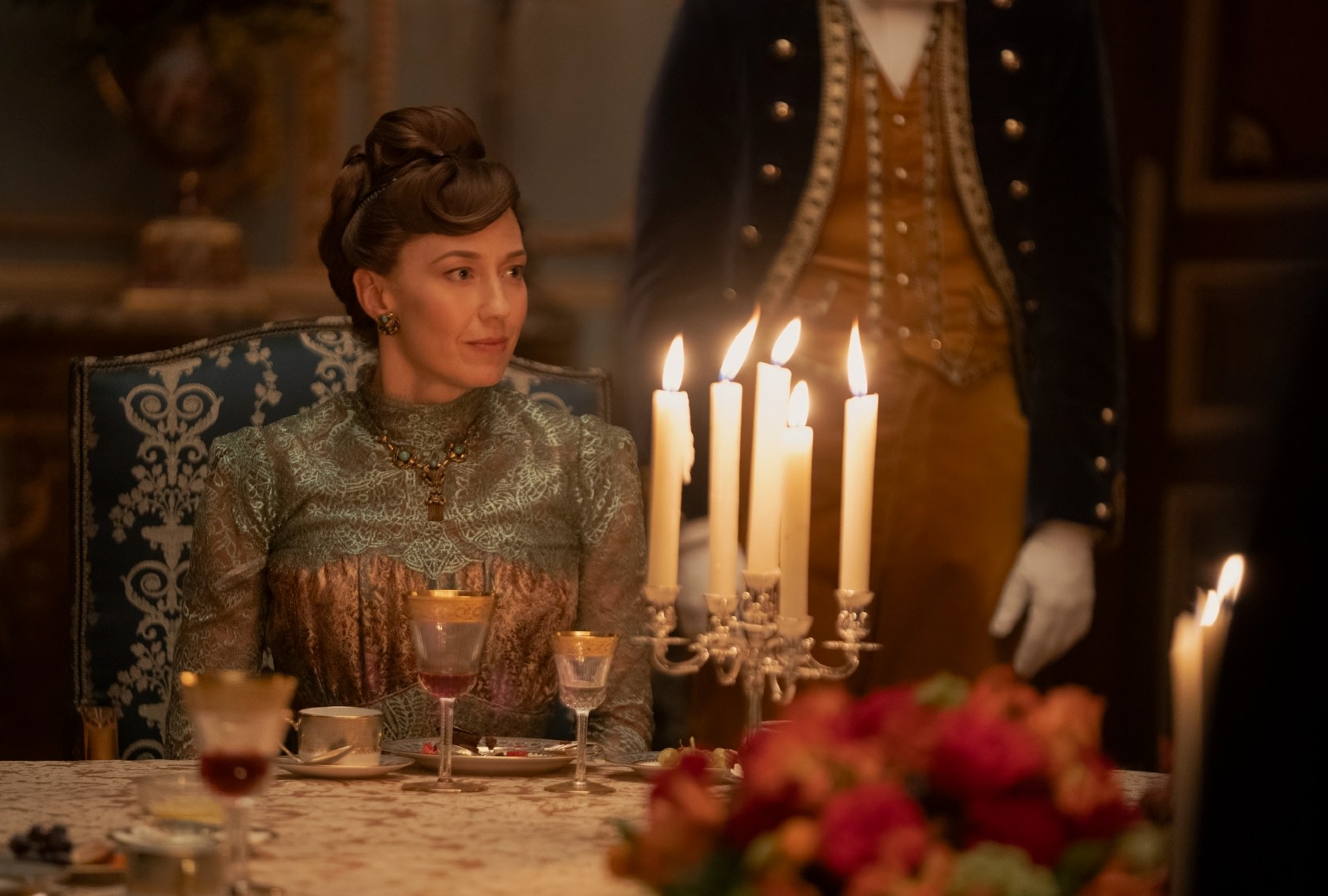
Carrie Coon in “The Gilded Age” (Karolina Wojtasik/HBO)
The counterpoint is that the good life is prettier. Nobody wants to be reminded of that detail or the frightening reality that many of us are a lot closer to being the people who work for the Russells than becoming George Russell. Would that be so bad? His servants’ uniforms are fancier than those of his neighbors.

Three seasons after George and Bertha carted their majestic plunder from Old Europe into their showy manse, they’ve laid claim to New York society. Bertha has her sights set on the English aristocracy next, with plans to marry her daughter Gladys (Taissa Farmiga) to a duke.

George, now firmly established himself as one of New York’s premier financial potentates, turns his gaze in the direction of the setting sun, aiming to cut a swath of influence to the other coast. In the 1880s, nothing west of New York belonged to any single person or corporation. Yet.

In the late 19th century, it was railroad men who laid claim to America’s future and its treasure. Today, Silicon Valley billionaires bleed us dry by siphoning wealth from the middle and working class through tax cuts. Both persuaded themselves and a sizable portion of their admirers that their greed was the rightful spoils of their genius.

If others deserved what they had, or have, they’d also have their fill instead of complaining about empty bellies.

We need your help to stay independent

History’s refrain echoes around us, whether we choose to heed or ignore the vibes. More of us are waking up to the present alarm, even if few are moved to consult a selection of books spelling out the similarities shared by modern technocrats and 19th-century robber barons. Of course, you could just start watching this show.

“The Gilded Age” has always plied high-toned melodrama as its chief asset, but Season 3 ripens the starched formality of previous episodes into succulence. Intertwining plots are rife with reversals of fortune, starting with the Russells’ neighbors across the street.

Season 2 closed with Agnes van Rhijn (Christine Baranski) losing her vast fortune in a scam due to her son, Oscar (Blake Ritson), falling prey to a scam. Fortunately, Agnes’ mousy sister Ada (Cynthia Nixon) married a secretly rich pastor who generously kicked the bucket, leaving her his fortune. That means she pays the bills these days.

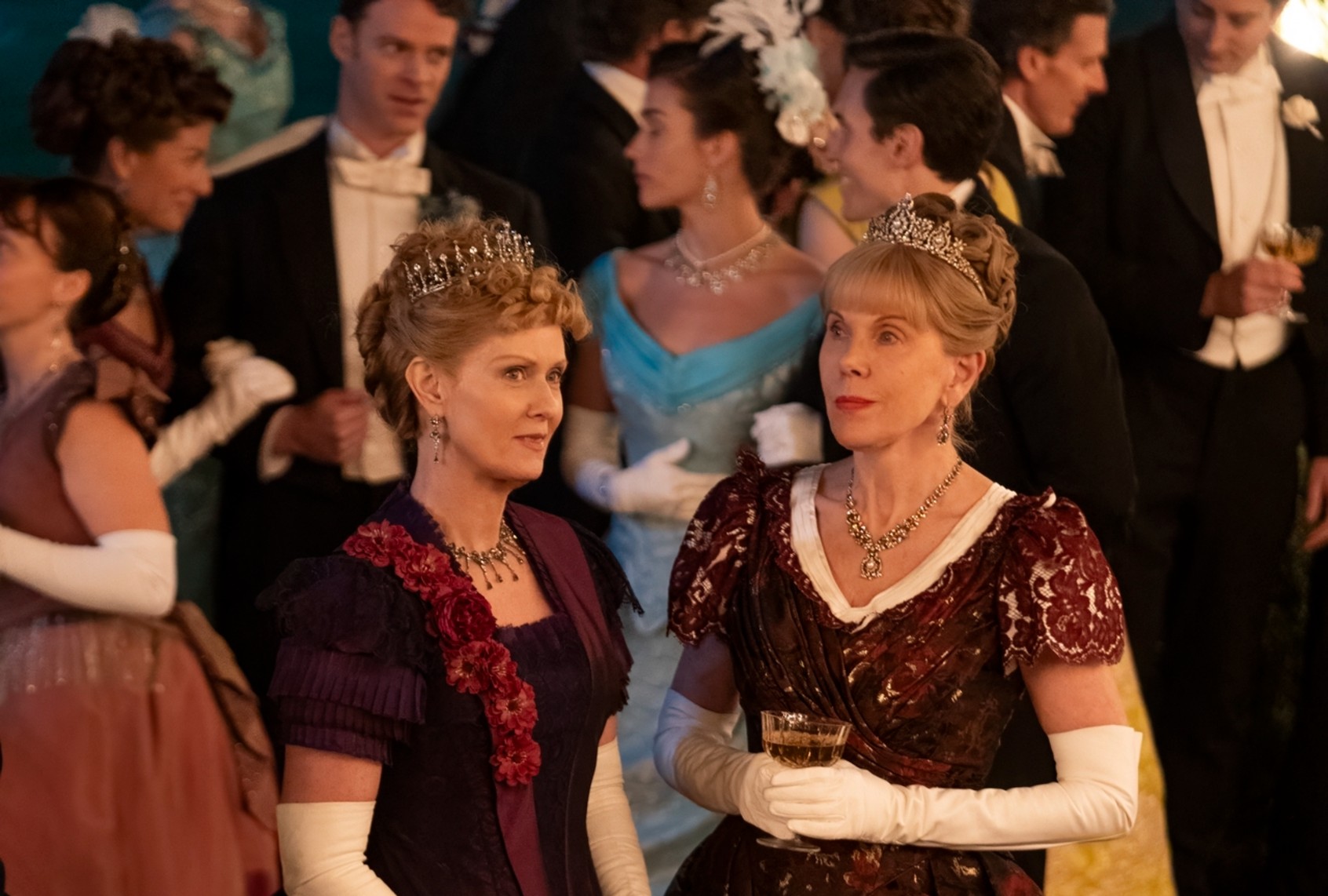
Cynthia Nixon and Christine Baranski in “The Gilded Age” (Karolina Wojtasik/HBO)
Other aspects of the Van Rhijn household might be changing, too. Their household’s footman, Jack (Ben Ahlers), has invented a new type of clock that he and the Russells’ son, Larry (Harry Richardson), are on the verge of bringing to the market. And in a fledgling courtship that would unite one of New York’s old money families with the new money clan at the top of the social pyramid, Larry has eyes for Agnes and Ada’s niece, Marian (Louisa Jacobson).

Fellowes and his fellow showrunner Sonja Warfield also broaden their view of social stratification with a look at Black society as Peggy Scott (Denée Benton) expands her sphere of influence as a writer.

As is the case in “Downton,” the rich protagonists and their servants in “The Gilded Age” are portrayed as one grand family, and people like Agnes and Ada as racially enlightened.

Peggy’s journalistic success is encouraged by her parents, Dorothy (Audra McDonald) and Arthur (John Douglas Thompson), members of New York’s Black elite. They are, nevertheless, looked down on by the likes of Mrs. Elizabeth Kirkland (Phylicia Rashad), who proudly reminds anyone within earshot that she comes from freemen.

It doesn’t take much (if any) searching to find the nobility in these figures, since they’re written with a natural sensitivity and, in the main, empathy for their neighbors and the people who work for them. This is in keeping with Fellowes’ penchant for purveying a fantasy of class relationships foregrounded by unforced comity and respect. As is the case in “Downton,” the rich protagonists and their servants in “The Gilded Age” are portrayed as one grand family, and people like Agnes and Ada as racially enlightened.

Using the same paint to render George and Bertha, however, yields a devious kind of portrait. In a season where a major subplot revolves around what women lose in high society divorces, George and Bertha look like romantic figures — affectionate with each other, and concerned about their children’s happiness. (This becomes a flashpoint later in the season.)

We’re constantly reminded that George’s heart is in the right place when it comes to family matters. Beyond his front door, however, he can be ruthless. To a point.

A subplot in Season 2 sees one of George’s steel mills grind to a halt when its workers go on strike, demanding eight-hour workdays and better living conditions. At first, George is ready to do anything to put down the labor stoppage, including gunning down his laborers. But seconds before the hired goons fire their rifles, George calls off his murderous threat. “These men have families!” he declares. What a great guy, right?

Soon after, we see him shrewdly float terms tainted with a racist poison pill designed to split his employees’ unity and weaken future negotiations.

Season 3 sees George set in motion designs to build a railroad line connecting the East and West coasts. Given recent events, we’d be right to view him as something other than a hero.


Start your day with essential news from Salon. Sign up for our free morning newsletter, Crash Course.


In the short term, George’s proposed cross-continental railway would decimate land and livelihoods, exploit the working class and crush any bodies standing in his way. Before he sits down to negotiate with the men who own the land he needs to purchase in Morenci, Arizona, George dismisses them as “stupid clodhoppers” and coolly declares he’ll pick them off one by one.

But in the long term, that railway line will bring a version of prosperity to people and places that couldn’t have dreamed of it otherwise. That’s George’s sales pitch, anyway. The obvious bonus of all this for him and his fellow investors is that success will make the Russells astronomically wealthier than they already are. Failure could ruin them.

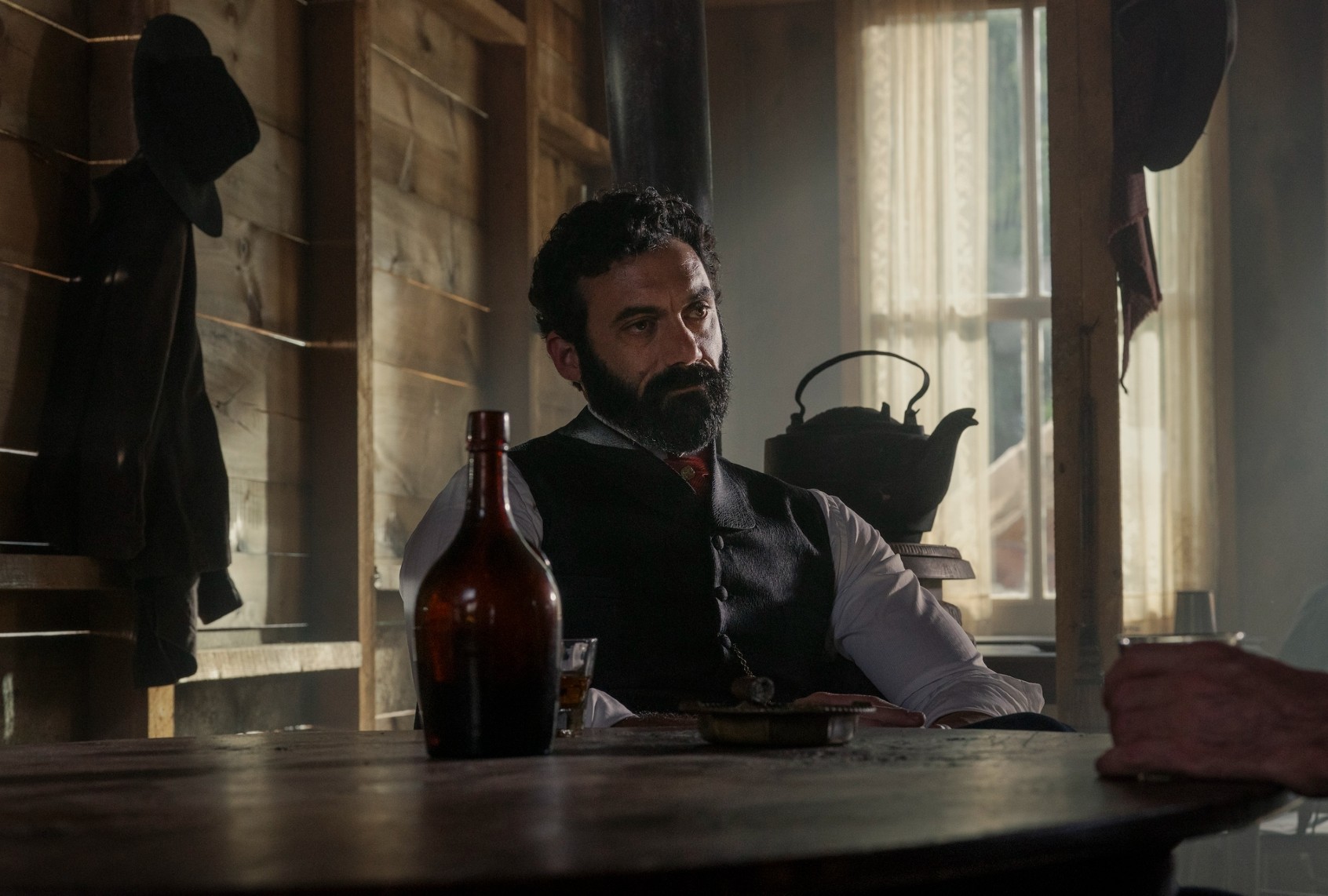
Morgan Spector in “The Gilded Age” (Jon Pack/HBO)
By now, though, “The Gilded Age” audience has been conditioned to want George to succeed. Returning to our old friend Ludwig for a moment, note that he was known as “Mad King Ludwig” to the people who wanted to depose him, starting with his courtiers.

But his subjects apparently adored the guy, which is part of the reason Ludwig was also known as “the Swan King” or “the Fairy-Tale King.” Both sobriquets stem from Ludwig’s penchant for building gargantuan displays of excess at a clip that placed him in massive debt. Ludwig’s signifiers were castles; George’s are factories, railways and a wife dedicated to ensuring his power is acknowledged throughout the city and across the Atlantic.

One day, a new class of men will eclipse the example set by industrialists like George Russell. They will build rockets and satellites from which they can gaze down on all the people who have less than they do. They will run roughshod over the taxpayer-funded safety net designed to help our most vulnerable and sneeringly refer to Americans who use federal benefits as members of the parasite class.

Maybe that’s why “The Gilded Age” still manages to make George and Bertha seem admirable. Disrespecting a king’s old desk doesn’t compare to stepping on an entire country. But every society’s rise and fall kicks off somehow.

Season 3 of “The Gilded Age” premieres at 9 p.m. Sunday, June 22 on HBO and streams on Max.

How “cereal milk” became a flavor

When making a bowl of cereal, what comes first? Is it the cereal or the milk?

The age-old question remains open-ended to this day, so much so that it has fueled a so-called “cereal debate” online. Last year, players of the Chicago Bears weighed in on their go-to way to make a bowl of cereal. Reddit threads — like this one, titled, “People who pour the milk before the cereal probably do a lot of other weird stuff we aren’t aware of” — have conducted deep dives into people’s cereal eating preferences. And think pieces on why pouring milk first is the only acceptable way to enjoy cereal have been written en masse.

Regardless, whether you prefer to pour the cereal or milk first, there’s no denying that the real treat of eating a bowl of cereal is cereal milk. Made by steeping milk with toasted cereal, cereal milk is leftovers at its finest. In recent years, cereal milk has been popularized as its own flavor and ingredient, thanks to James Beard Award-winning pastry chef Christina Tosi. In November 2008, Tosi opened the very first Milk Bar location in New York City's East Village, where she also debuted her trademarked “Cereal Milk” flavor. Tosi initially used cereal milk as an ingredient to make panna cotta while working at Momofuku. At Milk Bar, Cereal Milk has been incorporated into cookies, milkshakes, pies and, most famously, soft-serve.

“It took trial, error and more than a few taste tests to land on that hard to describe, but instantly familiar sorta sweet, sorta corny milk flavor at the bottom of your cereal bowl,” per Milk Bar’s official recipe for its Cereal Milk. The beverage and humble ingredient is made by lightly toasting 2 3/4 cups of cornflakes and steeping it in 3 3/4 cups of cold milk for 20 minutes. Once the mixture is strained, it’s whisked together with brown sugar and salt before it can be enjoyed.

“Cereal Milk was by no means the first recipe that came out of our kitchens, but it is far and away the most popular and what we are known best for,” Tosi told Gourmet Traveller in 2019. “Drink it straight, pour it over more cereal, add it to your coffee in the morning, or turn it into panna cotta or ice-cream as in this recipe.”

Tosi has spurred a cereal milk obsession that's embraced in a myriad of contemporary desserts. There’s Cereal Milk Tiramisu, which includes layers of ladyfingers soaked in homemade cereal milk and topped with cereal mascarpone cream. There’s Cereal Milk Cake, filled with cereal milk cheesecake mousse and frosted in a cereal milk frosting. And there’s Cereal-infused vodka sodas, which uses vodka in lieu of milk to create a sugary and playful drink. Starbucks also hopped on the cereal milk craze with its recipes for Cereal Milk Coffee​.

The beauty of cereal milk goes beyond its flavor. It’s about memory, ritual and the hyper-specific intimacy of breakfast. It’s about childhood memories and intrigue. It’s about the pleasure of savoring in sugary, processed goodness with youthful glee. It’s about indulging in that early morning sugar-high that provided fuel for the first few hours of school, college and, now in adulthood, work.

We need your help to stay independent

In a 2015 article for Food52, Leslie Stephens wrote about her great love for breakfast cereal, which was forbidden in her “all-good-processed-things-free” household growing up: “When offered a bowl at a friend’s house, I’d make the most of my sugary gift: I picked every semblance of a nutrient from my Lucky Charms — just happy spoonfuls of marshmallows for me — and the end of a bowl of Coco Puffs was celebrated with gulps of the leftover sugary, chocolate-spiked milk.”

Indeed, eating cereal is a visceral experience — which is a fact backed by science. After conducting an online survey in 2016, consulting firm Sensory Spectrum divided ready-to-eat cereal into four so-called “dimensions”: sensory delight, health and fiber, sensory diversity and contrast, and weight management and heart health. They found that flake cereals with fruit “played more into people’s need for sensory pleasure,” Food Business News reported

“So (consumers are) not just talking about the sensory properties that they perceive,” explained Gail Vance Civille, CEO of Sensory Spectrum, Inc. “They are talking about how the cereal makes them feel.” Consumers view flake cereals “as more exciting and interesting than puff cereals,” she said. Certain flavors may also be “calming and comforting.”


Want more great food writing and recipes? Sign up for Salon’s free food newsletter, The Bite.


Cereal’s status as a comfort food has taken on new meaning amid the pandemic, in which carbs have been increasingly utilized to subdue feelings of loneliness and anxiety. GlobalData, a London-based data and analytics company, anticipated ready-to-eat breakfast cereals to approach $12.1 billion in 2020, with sales hiking up 12 percent from 2019, according to Food Business News

“With so many people now working from home instead of commuting, many consumers are no longer eating on-the-go or foodservice breakfasts,” Ryan Whittaker, consumer analyst at GlobalData, told the outlet. “Instead, many consumers are falling back on a mixture of comforting and healthier options at home.” 

Whittaker continued, “To many US consumers, breakfast cereals offer a way for them to impose order and familiarity on the day. For many, this can mean a moment of indulgence, revisiting a favorite from their childhood, or opting for a healthier option. The reduced demand for out-of-home consumption, reduced need to commute and heightened focus on health has convinced Americans to return to breakfast cereals in the morning.”

At its crux, cereal is a reliable pantry-staple, always there when you need it most. Same with cereal milk, which is one of those food indulgences that’s just too hard to give up. Cereal milk is versatile. It’s surprising. And its emotional effects are everlasting.

“Back then we had dumb presidents”: Vance explains key difference in current Middle East war

Vice President J.D. Vance served in the Iraq War a full six years before troops were withdrawn. Because of that, you might expect some hesitancy from the veep as President Donald Trump waltzes his way into another Middle Eastern war. Instead, the second-in-command of the Trump admin can confidently say that this time will be different, because past presidents were "dumb."

Speaking to Kristen Welker on NBC's "Meet the Press," Vance parried concerns about another drawn-out war in the region with a novel "built different" defense. 

"I empathize with Americans who are exhausted after 25 years of foreign entanglements in the Middle East," he said, "I understand the concern, but the difference is that back then we had dumb presidents and now we have a president who actually knows how to accomplish America's national security objectives."

Vance bulldozed through his own "couldn't hit an elephant at this distance," saying that the strike on Iran would not lead to some "long, drawn-out thing" as lawmakers in that country voted to close the Straits of Hormuz. 

"We have no interest in a protracted conflict. We have no interest in boots on the ground," he said. "I don't fear that this is going to become a protracted conflict, because we have a president who knows what's in America's interest."

Vance's comments come after the Pentagon admitted they have no way of knowing if the strikes on Iran were successful in destroying Iran's nuclear capabilities. Defense Secretary Pete Hegseth praised the attacks as "bold and brilliant" on Sunday morning, even as the surprise bombing campaign is causing a growing rift in the Republican Party.

Watch Vance's interview below:

“Bold and brilliant”: Hegseth praises Iran attack as GOP splits on Trump’s war

Defense Secretary Pete Hegseth saw nothing but positives in President Donald Trump's surprise attack on Iran

In a Sunday morning news conference, former Fox News man and current head of the Pentagon said that Trump's strikes on Iranian nuclear facilities were "bold and brilliant."

“The order we received from our commander-in-chief was focused, it was powerful, and it was clear," Hegseth said. “Thanks to President Trump’s bold and visionary leadership and his commitment to peace through strength, Iran’s nuclear ambitions have been obliterated.”

U.S. intelligence has repeatedly and consistently claimed that Iran was not moving forward on the development of a nuclear weapon. Earlier this year, Director of National Intelligence Tulsi Gabbard testified to Congress that "Iran is not building a nuclear weapon." Gabbard walked back those statements as Trump saber-rattled his way into the Israel-Iran conflict. Gabbard's new assessment was heavy on hypotheticals, with the spy chief saying Iran could "produce a nuclear weapon within weeks to months, if they decide to finalize the assembly."

Hegseth paid no mind to the shaky ground he was standing on, trumpeting the bombing campaign as an unqualified success. 

"Many presidents have dreamed of delivering the final blow to Iran’s nuclear program, and none could until President Trump. The operation President Trump planned was bold and it was brilliant, showing the world that American deterrence is back," he said.

Hegseth's victory lap comes as many members of Trump's own party are turning on the president's actions. The bombing of Iran has legislators in the Republican party eyeing the War Powers Act for the first time in this century. 

Rep. Thomas Massie, R-Ky., made his opposition plain in a post to X. 

"This is not Constitutional," he wrote. 

Rep. Marjorie Taylor Greene, R-Ga., spent the days leading up to the attack warning the president away from war. In the wake of the bombings, she said that the conflict was "not our fight."

"Every time America is on the verge of greatness, we get involved in another foreign war," she wrote on X. "There would not be bombs falling on the people of Israel if Netanyahu had not dropped bombs on the people of Iran first."

Watch Hegseth's remarks below:

America slides into totalitarianism — and it won’t be easy to reverse

We’ve seen a spike over the last few years in the use of the word “authoritarianism.” This is the predictable result of the recent rise of authoritarian regimes which, to a greater or lesser extent, work to subvert and dismantle the institutions and practices of democracy and the rule of law. 

A survey of more than 500 political scientists found that they believe the United States is headed towards authoritarian rule. A majority of Americans, according to a PRRI poll, now believes Donald Trump is “a dangerous dictator.” (It remains an enduring mystery why this majority didn’t stumble onto this conclusion before the November election).  

Authoritarianism and totalitarianism

There is, of course, another term for modern dictatorial regimes, one that gained considerable currency during the Cold War after the 1951 publication of “The Origins of Totalitarianism” by Hannah Arendt, but which has somewhat fallen out of favor.

How does authoritarianism differ from totalitarianism? There is no precise description of either; like other political terms, they are subject to questionable definitions that often depend on the viewpoint of whoever is using them. Marxist writers shunned the word “totalitarian”; Nazi Germany was invariably referred to as “fascist,” while the Soviet Union was a “people’s democracy.” But “totalitarian” was a favorite term of anti-Communists throughout the Cold War.

Based on descriptions of dictatorial regimes over the past century, the distinction seems to be this: Totalitarianism is authoritarianism intensified. Whereas authoritarianism may leave society outside the political realm more or less intact, totalitarianism makes a total claim on civil society. In its most extreme form, as in North Korea, there is virtually no private sphere where persons can gather and exchange ideas outside the regime’s surveillance and control.

Another difference is that authoritarian regimes often have no developed ideology beyond hatred of the political opposition. Totalitarian ideology can be elaborate, if syncretic, and can incorporate disparate, even contradictory ideas (including convoluted and childish conspiracy theories) to produce a kind of comprehensive worldview or substitute religion.

Charismatics and true believers

Totalitarian leaders tend toward charismatic styles and have a genuine bond of loyalty with their followers, who often express extreme, exaggerated enthusiasm for the leader and his movement. The followers are in fact the key to totalitarian movements, without whom the charismatic leader would simply be a barroom bloviator. Whereas the typical authoritarian dictator often comes to power amid economic or political crisis, frequently by way of a coup, the charismatic leader is swept into power on a populist wave. 

The “crisis” he exploits is a deep-seated cultural one, but also a personal one in the life of the follower. As Eric Hoffer’s “The True Believer” (published the same year as Arendt’s book) observes, the disposition to follow a charismatic leader was “seeded in the minds” of his true believers long before he arrived on the scene. 

These followers may not constitute the majority of a population; indeed they rarely do. But if they reach 30 to 40 percent, their dogmatic persistence may successfully overcome the majority, many of whom are timid or apathetic, and set the political tone for a society. The famous line of William Butler Yeats, “The best lack all conviction, while the worst are full of passionate intensity” applies to political behavior.

Reaction versus totalitarianism

By contrast, many authoritarian leaders are colorless, possessing little or no charisma: Consider Francisco Franco, Antonio Salazar, the Greek colonels, Leopoldo Galtieri, Augusto Pinochet, Park Chung-hee. They often do not have any coherent or developed ideology, other than opposition to the left. They obtain key support from wealthy interests, but rather than a fervent mass following they count on a divided, apathetic or acquiescent population to gain and hold power.

Totalitarian leaders tend toward charismatic styles and have a genuine bond of loyalty with their followers, who often express extreme, exaggerated enthusiasm for the leader and his movement. 

In a sense, these are true reactionaries, whereas totalitarianism tends to have a revolutionary element. Authoritarians will of course use violence to preserve the status quo, and their rule over societies is repressive, but everything is designed to keep a lid on things. Whether from a calculation of how best to maintain the status quo or from simple lack of imagination, authoritarians generally do not  want to rock the boat. It is difficult to imagine most of them as objects of a personality cult.

This sort of authoritarianism also characterized the last decade or so of Communist rule in eastern Europe. As a student in Europe, I recall encountering Poles, Hungarians, Yugoslavs and other Eastern bloc nationals living in Western Europe — not as exiles, but as contract workers or students. These were not idealists building Communism; it was difficult  to be an idealist under the leadership of grey nonentities like Polish Gen. Wojciech Jaruzelski or East Germany’s Erich Honecker. Perhaps the lone exception in Eastern Europe  was Romania, where Nicolae Ceaușescu — who had broken with Moscow years earlier — maintained a rigid dictatorship and cult of personality up until he faced a firing squad.

On the other hand, the core of the totalitarian mindset is an alienation from the world, and particularly from one’s own society. This alienation breeds a twisted utopian mentality that not only rejects modernity, but also tradition and the actual past in favor of a cartoonish pastiche that misapprehends both the past and the present.

A crisis of modernization

As that description implies, totalitarianism is a crisis of modernization. In the early 20th century, totalitarianism was best known in countries that had superficially been modernized, but remained regressive in crucial ways. Italy and Russia offer textbook examples: Different as they were and are, both nations had rapidly advanced in some industrial sectors and metropolitan regions, while conditions in rural areas were primitive and there was considerable social discord and festering injustice. The horrendous bloodletting of World War I bloodletting removed all inhibitions against a total, violent resolution of social conflict.

Germany was in many ways the archetypal example: It was a world leader in industry (especially chemicals, metallurgy, and machinery), and by some distance at the forefront of scientific research. (Early in the 20th century, Germans were awarded more  Nobel Prizes for science than citizens of any other country.) Its universities were the best in the world. 

The core of the totalitarian mindset is an alienation from the world, and particularly from one’s own society. This alienation breeds a twisted utopian mentality that not only rejects modernity, but also tradition and the actual past.

Yet that impressive modernity was set against a politically powerful but backward agricultural sector, a rigid social structure left behind by petty feudal princedoms of the Holy Roman Empire and, above all, a retrograde political system. The Reichstag, or national parliament, was grossly gerrymandered in favor of the upper classes, and the government was not responsible to its lawmakers, but rather to a capricious monarch. 

With one foot at the leading edge of modernity and another in a mythical past, Germany could produce world-class physicists like Werner Heisenberg, but also agrarian-medievalists like the Artaman League, whose backward-looking, völkisch ideas were apparently so congenial to the Nazi party that the league was eventually absorbed it into Adolf Hitler’s movement.

One could fill a library with all that has been written about Hitler as the archetype of the charismatic totalitarian leader, full of violent hatred, reflexive deceit and a taste for destruction that eventually unmasked itself as an annihilating nihilism. But despite the morbid fascination he continues to evoke in our collective historical memory, Hitler is less interesting — and less important in the long run — than the people who voted for him, regarded him as a messianic national savior and fought to defend his rule till their country was in ruins.

Or for that matter, consider Josef Stalin, who was patently less charismatic than the German dictator, yet was worshipped by countless Russians — along with millions of foreigners who should have known better — and whose death occasioned a paroxysm of public weeping that, according to Alexander Solzhenitsyn, even extended to inmates of the Siberian gulag. To this day, an official cult of Stalin endures, deployed today  to motivate Russians to serve as cannon fodder in Vladimir Putin’s Ukraine war.

Countries like Germany and Russia suffered a crisis of industrial modernization, with wrenching change, uneven development and the atomization of the individual in a newly created mass society. I submit that the United States is undergoing a similar social process in its transition from an industrial society to a digital society, and is in danger of suffering an extended totalitarian experience rather than a brief bout of Constitution-flouting.  

The American paradox

America presents a paradox similar to that of early 20th-century Germany: It leads the world in science and technology (at least until this year), its elite universities are the finest anywhere, and its major cities are hubs of wealth and economic vitality. Yet much of the American interior, as any intelligent foreign visitor would notice, is economically and culturally backward: systematically underdeveloped, with decaying or inadequate infrastructure and limited educational opportunities. Its residents’ lifespans are comparable to people in developing or “Third World” countries.

What’s even more significant is the backward mindset of a significant proportion of the population. No developed country has anything close to America’s population of religious fundamentalists: believers in angels, demons, miracles and prophecies, all wrapped in a determined provincialism. Their perception of reality more closely resembles those of people in Iran or Nigeria than citizens of developed democracies.

America presents a paradox similar to early 20th-century Germany: It leads the world in science and technology, its universities are the finest anywhere, its cities are hubs of economic vitality. Yet much of the interior is economically and culturally backward.

This pronounced preference for the mystical and the supernatural, rather than observable fact, among so many Americans — which has enriched generations of televangelists — has rendered an electorally crucial segment of the population receptive to the fantastic promises, nonstop lies and relentless demonization integral to the totalitarian message. As Arendt observed about the supporters of earlier totalitarian systems:

The effectiveness of this kind of propaganda demonstrates one of the chief characteristics of modern masses. They do not believe in anything visible, in the reality of their own experience; they do not trust their eyes and ears but only their imaginations, which may be caught by anything that is at once universal and consistent in itself. What convinces masses are not facts, and not even invented facts, but only the consistency of the system of which they are presumably part.

The consistency of the system should not be confused with the consistency of the rules of logic; the only “consistency” is that the leader is always right. As I have previously described, millions of potential followers of totalitarianism in America have taken mental refuge in a shallow cynicism that is actually a disguise for extreme gullibility. This allowed Trump to take credit for having developed COVID vaccines, while at the same time encouraging his acolytes to embrace COVID denial and rejection of vaccines. Here is Arendt again:

In an ever-changing, incomprehensible world the masses had reached the point where they would, at the same time, believe everything and nothing, think that everything was possible and that nothing was true. Mass propaganda discovered that its audience was ready at all times to believe the worst, no matter how absurd, and did not particularly object to being deceived because it held every statement to be a lie anyhow. The totalitarian mass leaders based their propaganda on the correct psychological assumption that, under such conditions, one could make people believe the most fantastic statements one day, and trust that if the next day they were given irrefutable proof of their falsehood, they would take refuge in cynicism; instead of deserting the leaders who had lied to them, they would protest that they had known all along that the statement was a lie and would admire the leaders for their superior tactical cleverness.

The rotting of American institutions

What are the systemic factors that have resulted in so many people in the so-called leading country of the so-called free world being so vulnerable to totalitarianism? The short answer is that its institutions rotted from within. Contemporary America has operated under a Constitution that is well over 200 years old, has been substantially unchanged for over a century and under current circumstances is virtually unamendable. 

This Constitution has archaic features like the Electoral College — unheard of anywhere else since the dissolution of the Holy Roman Empire in 1806 — and grotesquely gerrymandered electoral districts (a hangover from the “rotten boroughs” of 18th-century England), as well as a Senate that privileges rural states, much as the rural Prussian junker class politically dominated imperial Germany. 

These anachronisms and inequities are further exacerbated by the unaccountable malefactors of the wealthiest classes, who are able to thwart any fundamental reforms that might weaken the popular urge for a radical or totalitarian solution. As has been frequently noted, the rise of social media (often controlled by these same malefactors) has operated as an informational Gresham’s Law, with genuine information systematically driven out of existence by disinformation, myth and mindless diversion. Just as earlier totalitarians dominated the first generation of electronic media, the current crop of dictators rule digital platforms.


Start your day with essential news from Salon. Sign up for our free morning newsletter, Crash Course.


A fundamental flaw in America’s early development was of course slavery, which functioned as a rigidly totalitarian state within a state. From the beginning, acute foreign observers like Alexis de Tocqueville noticed that beneath all the self-flattery about rugged individualism, Americans had a tendency towards conformity that could lead to a tyranny of the majority (or a sufficiently dogmatic minority). In the 1960s, political scientist Richard Hofstadter wrote that America had periodically been swept by waves of conformist anti-intellectualism:

One can trace … the emergence of what I would call the one-hundred per cent mentality –  a mind fully committed to the full range of dominant popular fatuities and determined that no one shall have the right to challenge them. This type of mentality is a relatively recent synthesis of fundamentalist religion and fundamentalist Americanism, very often with a heavy overlay of severe fundamentalist morality.

Blueprints for totalitarianism

Political absolutism has been a chronic temptation throughout American history. But its most recent extreme outbreak is unique in that the intellectual ground had been prepared by religious fundamentalist theocrats and white supremacists for more than four decades. This is reminiscent of the fact that while the German-speaking lands had had an authoritarian basis for centuries, the radical, violent nationalism of the Nazis was preceded by 40 or 50 years of writings by failed intellectuals like Paul de Lagarde, Julius Langbehn and Moeller van den Bruck (who coined the term “Third Reich”). They brought authoritarianism to a new and mystical level, paving the way for Hitler. 

Political absolutism has been a temptation throughout American history. But its most recent outbreak is unique; the intellectual ground had been prepared by religious fundamentalist theocrats and white supremacists for more than four decades.

An internet search of the most influential American political books of the last half-century will reveal such works as Noam Chomsky’s “Manufacturing Consent” or Naomi Klein’s “The Shock Doctrine.” But however accurate their depictions of politics and society, how influential were they? I submit that Tim LaHaye and Jerry Jenkins’ “Left Behind” series (which apparently traumatized a generation of adolescents), and William Luther Pierce’s “The Turner Diaries” (the Popular Mechanics of race-war incitement) were vastly more impactful, both politically and culturally. One could also mention Margaret Atwood’s “The Handmaid’s Tale,” although what Atwood intended as a warning has been embraced by America’s ayatollahs as a blueprint.

Crossing the Rubicon

With that ideational foundation already in place on the political right, the current descent into national madness began in the period between the Sept. 11, 2001, terrorist attacks and the early years of the military occupation of Iraq. 

The Bush administration’s false pretext for so-called preemptive war against Iraq was thoroughly in the tradition of Joseph Goebbels’ Big Lie or George Orwell’s Newspeak. What was notable, however, was not that the general public, which could hardly find Iraq on a map, readily fell for the Bush-Cheney lie campaign. Erstwhile flagships of liberal thought, like The New Yorker and The New Republic, swallowed the falsehoods like hungry barracudas, and self-styled public intellectuals like Christopher Hitchens sullied their reputations forever by writing propaganda questioning the patriotism and good faith of opponents of the war.

The true Rubicon that Americans crossed was on the question of torture, or “enhanced interrogation,” in the Bush administration’s Orwellian terminology. Torture is a barbaric practice condemned since the Enlightenment, proscribed even in our 18th-century Constitution and condemned in international law. But even after the wars in Iraq and Afghanistan demonstrated no evidence that torture “worked” in eliciting usable information, nearly two-thirds of Americans supported its use. Now that Trump has asked the Supreme Court to declare both the U.N. Convention Against Torture and its federal implementing statute void, we cannot assume that his position on the matter is unpopular.

The U.S. is now distinctly moving toward the principal goal of the totalitarian project: erasing the distinction between civil society and the state. The Trump regime is eagerly working to insert itself into every facet of American life, from effectively taking over private universities and dictating their curricula to banning books from the Naval Academy, dictating prices to retail businesses, attempting to change cartographic nomenclature (like “Gulf of America”) and vetting exhibits at the Smithsonian Institution, which is not formally a part of government and has had an independent policy on exhibits for the last 178 years.

The U.S. is now distinctly moving toward the principal goal of the totalitarian project: erasing the distinction between civil society and the state.

Another feature of totalitarianism is omnipresent surveillance. Since the 1970s, there have been numerous privacy laws enacted to protect ordinary citizens, and government databases are not systematically interlinked. But the Trump regime has contracted with the notorious tech firm Palantir to do just that. Palantir was of course co-founded by Silicon Valley oligarch Peter Thiel, a Trump supporter and co-conspirator with Elon Musk in the DOGE project. 

Some nonfederal entities, eager to curry favor with Trump, have gotten into the act. The University of Michigan hired thuggish private contractors to spy on and harass students (before reportedly retreating). How long will it be until a major university  bans the teaching of evolutionary biology, acting in the same spirit as German universities under Hitler, which proscribed “Jewish physics”?

Little Hitlers and little Trumps

Historian Ian Kershaw has written that Hitler had thousands of “little Hitlers,” Gauleiters, district leaders and block wardens throughout the German provinces who were not only happy  to do his bidding, but sought to anticipate his will with their own initiatives, a scheme called “working towards the Führer.” Trump has his little Trumps at the state and local level as well; I live in Virginia, a supposed purple state, where 121 books have been  banned in the school libraries of various counties. These include such racy and controversial fare as “The Adventures of Tom Sawyer” and “Romeo and Juliet,” as well as (irony alert) Orwell’s “1984.” At what point will this ban extend to public libraries, or to Barnes & Noble? 

The little Trumps are also present as interpreters for the journalists and social scientists who make the trek to Trump Country to understand the locals. Inquiring as to whether the Trump regime’s cuts to Medicaid and social services, along with the higher retail prices caused by tariffs, might lead overwhelmingly pro-Trump inhabitants of impoverished eastern Kentucky to think again, a visiting sociologist was told by a local mayor that their loyalty was unshakable.

"You know how proud and stoic Appalachians are,” the mayor told Arlie Russell Hochschild. “We know how to take a little pain. People may have to suffer now to help make America great later. Trump's tariffs could raise prices, but that will force companies to gradually relocate to the U.S.” In other words, he was saying that his own community was too stupid to understand their own material interests. A demographic notorious for voting according to the price of gasoline or eggs would gladly further impoverish itself for the sake of Trump’s vision, or so the mayor claimed. 

Feudalism sans noblesse oblige

Any well-read person is likely to consider the rise of the modern nation-state to be a distinctly mixed bag, as the history of the last two or three centuries has demonstrated. But it arose concurrently with the Enlightenment, and one of its less remarked-upon features was the idea of the state as an entity above the interest of individuals, a kind of neutral arbiter. There were of course nascent political parties in those days (usually called “factions”), and the usual horde of lobbyists, job-seekers and influence peddlers. But the state and its functions, like the post office, weights and measures, or even the nurturance of science and letters (as with the French Academy) were, at least in theory, above politics and venal ambition.

Only in such an atmosphere could anyone get the idea that the law should nominally treat all people equally (even as economics divided them into classes), or that an abstract notion called human rights might exist and apply to everyone. Only under a neutral state, above or beyond partisan conflict, could dreamers theorize about constitutions and parliaments representing the interests of the nation. Even English monarchs were not above the constitution (if it was an unwritten one), as James II and Edward VIII discovered.

What Trump and his gang are perpetrating is a regression from the modern nation-state to personal rule, in which the autocrat effectively owns everything in the territory he controls, clientelism runs rampant, and ordinary people are subjects rather than citizens. But there are significant differences between then and now: Under the feudal system, the lord had, in principle, certain obligations to peasants in addition to his right to command them. The modern totalitarian leader feels no such duty to law, custom or decency. He represents warlordism in a business suit instead of a thawb.

What Trump and his gang are perpetrating is a regression from the modern nation-state to personal rule, in which the autocrat effectively owns everything, clientelism runs rampant and ordinary people are subjects rather than citizens.

It has become conventional wisdom that America’s elite institutions – the entities with the most at stake in preserving what’s left of an open society, even one as flawed as ours — have surrendered to the Trump regime with breathtaking (and disgusting) alacrity. From law firms to elite universities like Columbia and Michigan to billion-dollar businesses damaged by Trump’s tariffs to major media organizations, they have chosen capitulation even when resistance seemed both more rational and more effective.

Virtuous Americans and their descent into murder

As I write this in the aftermath of the “No Kings” protests (the same weekend that Trump tried to stage a North Korea-style military parade to his own glorification), it has become equally conventional wisdom that ordinary people are resisting: in congressional town halls, spontaneous demonstrations and other forms of resistance. 

This is of course encouraging. But is it enough? For all the failures of our elites, they were not responsible for the 77 million votes Trump received last November. The battle for democracy will not be staged by the elites or against them, but at the mass level. The lesson of Trump’s first term was soon forgotten in the popular mind, and overcoming his second regime will be an order of magnitude more difficult, especially as his followers are more numerous, more deeply entrenched in the governmental system and radicalized to a far greater degree than they were the first time around. 

The battle for democracy will not be staged by the elites or against them, but at the mass level. The lesson of Trump's first term was soon forgotten; overcoming his second regime will be an order of magnitude more difficult.

Not long after I wrote the previous paragraph, I learned that a Minnesota state representative and her husband had been assassinated and a state senator critically wounded in a “targeted political attack.” We have accelerated from Trump’s perceived opponents receiving death threats to political murder. How long will it take our so-called thought leaders to recognize what has been staring them in the face since at least the Charlottesville neo-Nazi rally in 2017: Trump and his Republican followers and enablers are only symptoms of something much deeper?

Our national crisis will not be correctly perceived, let alone solved, until we recognize that the root of the problem lies in that supposed repository of virtue, the American people. The prestige media’s rote expeditions to rural diners in Iowa to discover the Real America are wearing distinctly thin at this juncture, because what lies at the core of Trump’s support is a not-insignificant fraction of would-be totalitarians who possess the same mentality as those who lynched Black people in the Jim Crow South, mobbed Jews during Kristallnacht and beheaded professors during Mao Zedong’s Cultural Revolution

It will be a long, hard road back to decency and sanity.

With strikes on Iran, Trump has chosen a path of insanity

There's nothing quite like the U.S. entering a war to drive home the risks involved in electing a mentally ill person president. Since Israel attacked Iran, Donald Trump, the clearest example of malignant narcissism most of us have ever seen or even heard of, has rampaged about Washington — and, earlier this week, the G7 in Canada — hunting the attention he craves. With Saturday night's attacks by the U.S. on three Iranian nuclear sites, it appears he has gotten it.

There are lots of good reasons for not psychoanalyzing politicians. But when a leader suffering a severe mental illness poses a grave risk to the nation and the world, we can’t just close our eyes. We are in such a moment now. 

His actions strongly suggest that his mental condition is driving his foreign policy, and that it has now drawn us into war, however limited he promises it will be, with Iran.

In the lead-up to last night's airstrikes, which Trump immediately declared a "spectacular military success" in a hyperbolic 3½ minute speech from the White House, his behavior has been marked by manic outbursts and abrupt changes of course. His actions strongly suggest that his mental condition is driving his foreign policy, and that it has now drawn us into war, however limited he promises it will be, with Iran.

With so much at stake, it's time we connect the political and psychiatric dots.

Narcissistic personality disorder is a condition recognized in the Diagnostic and Statistical Manual of the American Psychiatric Association. The manual lists nine "diagnostic criteria" and 50 related "diagnostic features." A person exhibiting five of the nine criteria is said to meet the diagnosis.  Trump checks every box. 

If you’re reluctant to label Trump, turn to page 760 of the manual — it’s available online — and ponder the listed criteria. The terms all apply to him: "pattern of grandiosity," "fantasies of unlimited success, power, brilliance," "lacks empathy," "requires excessive admiration." But they fail to capture the magnitude of his disorder. It's what earns his narcissism the modifier "malignant."

Trump needs attention like Dracula needs blood, and the Israel-Iran war, in which the U.S. has now become an active participant, struck at the worst possible time in his feeding cycle. On Saturday, June 14, he’d just staged a disastrous military parade — presumably to celebrate the 250th anniversary of the U.S. Army, but actually held in his own honor — at which there was no John Phillips Sousa, no red white and blue bunting and, worst of all, no adoring crowds. There were only camouflaged soldiers in a silent procession closer to the Stations of the Cross than a Fourth of July parade. 

Meanwhile, millions of his severest critics were throwing a raucous bash in honor of our democracy. The "No Kings" rallies may have been the biggest protest ever held in America. A palpably joyous celebration, it was everything Trump dreamed his parade would be, and just like his parade, it was all about him, only not in a good way. 

As a malignant narcissist, Trump experiences only two strong emotions: rage and embarrassment. Though immune to shame, he embarrasses easily. At his parade, you could tell from his face he felt humiliated, and was seething.  

He’d already been having a rough few weeks: adverse reactions to his mass deportations and step-by-step imposition of martial law, the slow crumbling of his foolhardy tariff regime, growing opposition to his "big beautiful bill." And now this. Anyone could see it was more than a man, especially a narcissist, could take.  

The next day he flew off to the Canadian Rockies. There he was subjected to the gross indignity of being treated as if he were no better than the six other world leaders gathered there to discuss policies in which he has scant interest. 

He was preening for the press, warming to another of his vicious, incoherent jeremiads when his Canadian host suggested he join the others in a bit of work. In the meeting, the president of France and the prime minister of Italy seemed to share a whispered joke at his expense. He doubtless saw purple. 

Starved for attention, Trump staged a second public "announcement" of a U.K. trade deal that hasn’t even been drafted. The alleged agreement he unceremoniously dropped at an open-air press conference with Prime Minister Keir Starmer was just a copy of his executive order memorializing U.S. concessions. The press didn’t notice. 

For Trump, it was as if the nightmare of his parade hadn’t ended. To make matters worse, as he sat cooling his heels in the 51st state, his dear frenemy Bibi Netanyahu was bestriding the world like a colossus due to his assault on Iran. 

Trump has long lusted after two quite different honors: a military parade and a Nobel Peace Prize. The parade was a bust. No one told him that the Nobel committee doesn’t give medals to people who exhibit no grasp of the underlying conflict and do nothing to resolve it. Then, just when Trump felt he needed it most, Netanyahu grabbed the attention of the whole world, attention that was Trump’s by right. That Netanyahu's "preemptive" strike violated international law only made him stand larger in Trump’s envious eyes. 

Trump wanted in, he needed in, and his compulsion has led us directly to where we are today: with U.S. war planes striking Iran and bringing the American military directly into Israel's war, and the president threatening that any retaliation would be "met with force far greater than what was witnessed tonight."

In Canada, he gladly abandoned the G7 summit, skipping out on a vital meeting with, of all people, Volodymir Zelensky. His press secretary said he did so “because of what’s going on in the Middle East.” 

Trump has long vowed to apply his mythical negotiating skills to the world’s thorniest problems. In Ukraine and Gaza, he failed utterly. Striking a nuclear deal with Iran was his last best chance to shine. Negotiations began in April, which to Trump was a lifetime ago. He needed a fix and would wait no longer.  

Last week, Trump proclaimed negotiations the right path to peace with Iran — but hey, things change. A bad parade, a boring G7 and Netanyahu's sudden stardom were all it took for Trump to drop everything he, or rather people in his employ, had worked for. Peace was out. War was in. His mission now was to take the reins from Netanyahu, or rather to foster the false impression he’d held them all along.

Until a book he didn’t write, and a TV show he didn’t conceive or produce, turned him from a celebrity punchline into someone truly famous. Before that, Trump had failed at everything he tried. Were he not lucky in bankruptcy, he’d have lost his entire inheritance. With "The Art of the Deal" and "The Apprentice" franchise, he at last found his calling: branding other people’s work with his name. 

Until last night's airstrikes, it's what he had been doing in Iran. Trump rushed home from the G7 not for an important meeting but to spend as much time as possible on TV, where he did nothing but try to steal Netanyahu's thunder. He told the people of Tehran to flee their homes to escape an attack he was not leading. He took it on himself to threaten to assassinate Ayatollah Ali Khamenei and to demand Iran’s "total surrender." He has bragged and bullied in a way that has shamed America, insulted Iran and embittered Muslims throughout the world. 

His words — and now, his actions — have made America less safe and peace more elusive. 

We need your help to stay independent

The myth of Trump the consummate dealmaker dies hard. Cable TV pundits still speculate about his grand strategies. What’s his game? Will he settle for cashiering Iran’s nuclear program, insist on its de facto demilitarization, demand "regime change?" Is he turning away from "America First" toward global engagement? What does he want?  

Trump brags that no one knows what he’s thinking and he never makes decisions till “the last second,” especially when there’s a war on. It’s scary to contemplate such derangement, but to understand his policies, we must view them in the context of the mental illness from which they emanate.  

In matters of policy, Trump has no future tense, only an ever-aching present need. His "strategy" is to do whatever he thinks will secure him instant adulation. His disease is progressive, in that he is ever more detached from reality. 

On Thursday, Fox News reported “the White House said” the use of tactical nuclear weapons in Iran was “on the table.” Any use of nuclear weapons would be illegal, immoral and utterly insane. Trump later said he might take “up to two weeks” to decide what to do, which usually means he doesn’t know what he’s doing or when, though rumors abounded that he has already chosen the path of insanity.  

Those rumors were proven true with last night's airstrikes. With the Middle East on a razor's edge, no one knows where all this is headed, if it will turn into a wider conflict. After the attacks, Iran pledged to continue its nuclear program and promised swift retaliation against the U.S. Targets could include military bases in the Middle East and the troops — around 40,000 of them — based there, embassies, diplomatic compounds and other American interests in the region. In his address, Trump warned "there are many targets left" and "future attacks would be far greater, and a lot easier."

What does Trump want? He wants attention so badly he’ll do insane things to get it. If you are looking for the method in his madness, start there.

Trump has made it even more dangerous to be pregnant

When we served as the Administrator of the Centers for Medicare & Medicaid Services (CMS) and CMS Senior Advisor during the Biden-Harris Administration, we heard from women all over the country who were denied emergency care during their pregnancies. In one case, a woman visited three emergency departments over two days, begging for care after her water broke too early and put her at risk for a life-threatening infection. In another, a woman in pain went to the emergency room and was found to have an ectopic pregnancy — a pregnancy growing outside of her uterus, endangering her life and future fertility. Instead of treating her, the hospital sent her home, and the fertilized egg later ruptured, requiring emergency surgery to remove part of her reproductive system. And these are two stories from women who lived – others were not so lucky. 

Unfortunately, the Trump Administration just made incidents like these more likely by throwing out the guidance reminding hospitals that federal law requires them to help patients, like these two women, who walk into the emergency department with an emergency medical condition. 

Unfortunately, the Trump Administration just made incidents like these more likely by throwing out the guidance reminding hospitals that federal law requires them to help patients, like these two women, who walk into the emergency department with an emergency medical condition. 

In 1986, Congress passed the Emergency Medical Treatment and Labor Act (EMTALA) to ensure that everyone can access emergency medical care, regardless of their ability to pay. EMTALA requires hospitals accepting Medicare and providing emergency medical services to provide a medical screening exam to anyone who requests care, provide treatment to stabilize anyone with an emergency medical condition and not transfer the person to another hospital unless the original facility doesn’t have the ability to provide the stabilizing treatment. 

CMS is the agency that enforces EMTALA and ensures that hospitals are complying with these requirements. After the Supreme Court overturned Roe v. Wade, hospitals and doctors from around the country reached out to CMS with questions about what the decision meant for emergency care. In June 2022, we released guidance reinforcing that if a woman walks into an emergency department with an emergency medical condition — for example, if she’s pregnant and her water breaks too soon, leaving her at high risk of a serious infection — doctors are required to give her the care she needs to stabilize her. This requirement applies even if the treatment she needs is an abortion and the state where she lives has banned the procedure. 

It’s not yet clear what CMS intends to change by rescinding this guidance. We hope that it changes nothing — legally, our guidance didn’t create EMTALA’s requirements, which existed long before the Biden-Harris administration and are still in effect today. But we do know that since Roe v. Wade was overturned, hospitals and doctors in states with harsh abortion restrictions have frequently found themselves caught in a web of legal nuance, unable to care for the patient in front of them. Many of these doctors have told us that they live in fear of being prosecuted for saving their patients’ lives. Others have changed specialties, or even moved to a different state, to avoid the stress of practicing medicine under a legal microscope. 

Rescinding the guidance creates enormous uncertainty. And where there’s uncertainty, providers will be far less likely to intervene — even when women’s lives hang in the balance. 

We need your help to stay independent

This isn’t theoretical. When we served at CMS, we were faced with specific cases every day — complaints from women who went to the emergency department in distress and despair, and who were turned away and denied the care they needed to regain their health and their future fertility. And we heard from doctors across the country, desperate for clear guidance that would protect medical professionals who were simply trying to do their jobs — to provide the care their patients needed. 

That’s why CMS’ choice to rescind the guidance we released in 2022 is so dangerous. Not because it changes the law; EMTALA is still in place. But absent clarity on how the law applies to emergencies, doctors won’t be able to provide the care their patients need. And once again, pregnant women and their families will pay the price. 

Trump calls Iran strike “very successful”

The United States has launched airstrikes on Iranian nuclear facilities, joining Israel’s military campaign, President Donald Trump said late Saturday on social media.

Trump announced that U.S. forces struck three sites — including Fordow, Natanz and Isfahan — using those stealth B‑2 bombers armed with “bunker-buster” munitions, calling the operation “very successful.” He confirmed that all aircraft exited Iranian airspace safely.

A Pentagon official, speaking anonymously to Reuters, confirmed the strikes were “limited and coordinated” with Israel. This marks the U.S. military’s first direct engagement in the campaign since Trump said he would decide on deeper involvement within two weeks.

Iranian state media acknowledged “explosions” near strategic military and nuclear sites but did not report casualties. Iran’s foreign minister warned that U.S. entry could “dramatically intensify” the conflict, while Supreme Leader Ayatollah Ali Khamenei called it a “crime” and warned of “serious irreparable consequences.”

Reaction among U.S. lawmakers is split: Senator Lindsey Graham praised Trump for acting decisively, while some Republican voices urged caution, warning of the risk of another Mideast war.

Officials will be keeping an eye on the anticipated sharp rise in crude oil prices. European allies have called for restraint and renewed nuclear talks, even as Iranian officials signaled readiness to negotiate only if military action ceases.

US moves B-2s to Guam to “dramatically intensify” pressure

The U.S. is dramatically escalating its military posture in the Middle East by repositioning its stealth B-2 bombers to Guam amid rising tensions between Israel and Iran, according to two U.S. officials who spoke to Reuters. President Trump is weighing whether to join Israel’s ongoing strikes against Iran, with a final decision expected within the next two weeks.

Officials declined to specify how many B-2 bombers are being moved but confirmed no orders have been issued to deploy them beyond Guam. These bombers can carry the 30,000-pound GBU-57 “Massive Ordnance Penetrator” bunker buster, a weapon experts say is uniquely designed to penetrate underground nuclear facilities like Iran’s Fordow site.

The move is part of a broader U.S. military buildup in the region. Additional tanker aircraft and fighter jets have been shifted closer to the Middle East, and a U.S. aircraft carrier previously stationed in the Indo-Pacific is now heading toward the area, signaling heightened readiness.

Trump said he has up to two weeks to decide on U.S. involvement, stating he wants to “see whether or not people come to their senses.” Meanwhile, Iran rejected Western peace proposals, with its foreign minister warning that U.S. entry into the conflict could “dramatically intensify” regional hostilities — a stark reminder of the high stakes at play.

“I’m lucky,” says teen struck by lightning in Central Park

Fifteen-year-old Yassin Khalifa was struck by lightning this week while sheltering under a tree during a sudden thunderstorm in Central Park’s East Meadow. He was unconscious for several minutes and later taken to New York‑Presbyterian/Weill Cornell Medical Center with second‑degree burns on his neck and leg, but he is expected to recover fully.

Khalifa told WABC-TV that he had leaned against the tree to ride out the storm, “which in hindsight might not have been the best idea.” A bolt hit the tree and traveled through the metal chain he wore, knocking him to the ground. “Apparently, I’m pretty lucky, because my spine was directly against the tree and no nerve damage happened,” he said.

The lightning strike came amid a broader severe-weather system sweeping the U.S. from the Greater Plains to the Northeast this week. Forecasters warned of wind gusts, hail, isolated tornadoes, and flash flooding. Today, much of the area is under an extreme heat warning that settled in after the storms.

Health officials caution that although only about 20 people die from lightning strikes yearly in the U.S., around 90 percent of people injured by a lightning bolt survive, according to the Centers for Disease Control and Prevention.

Khalifa’s survival has sparked relief and reflection: “I’m pretty happy about that,” he said, expressing gratitude for escaping more serious harm. Officials say the incident serves as a stark reminder to avoid trees during thunderstorms.

‘Dark day for truth’: Kari Lake slashes U.S. global media agency by 85%

Once a Cold War-era powerhouse for U.S. diplomacy, the U.S. Agency for Global Media has been gutted under a Trump executive order — slashing 1,400 jobs, or 85% of its workforce — in a move Kari Lake calls a win for taxpayers and critics warn is a death knell for press freedom.

Lake, senior adviser to the agency, said the cuts fulfill the March 14 directive from President Donald Trump to shrink the federal workforce and eliminate non-essential operations. “This is a decisive action to shrink the out-of-control federal bureaucracy,” Lake said Friday, calling USAGM “bloated, unaccountable” and plagued by “dysfunction, bias and waste.”

Only 250 employees remain across USAGM and its affiliates, including Voice of America, the Office of Cuba Broadcasting and Radio Free Asia. The latest round included 639 layoff notices, following earlier buyouts and retirements. No OCB employees were terminated, though staffing was capped.

Lake also terminated a $250 million lease for a Pennsylvania Avenue media facility, which the agency says lacked proper studio space. She is set to testify before the House Foreign Affairs Committee next week regarding what the agency describes as years of “self-dealing and national security failures.”

But journalists and press advocates say the move silences independent reporting and undermines U.S. credibility abroad. “This spells the death of 83 years of independent journalism,” said VOA White House bureau chief Patsy Widakuswara. Sen. Jeanne Shaheen, D-N.H., called it “a dark day for the truth.”

A federal judge earlier blocked parts of the agency’s dismantling, calling the moves “arbitrary and capricious.” Legal challenges are ongoing.

“Justice prevailed,” Khalil freed

Mahmoud Khalil, a Palestinian-born Columbia University graduate and activist, walked free Friday after a federal judge ordered his release from immigration detention.

Khalil was held for 104 days in a Louisiana facility under a rarely used section of immigration law, after participating in a pro-Palestinian demonstration at Columbia. Though he faced no criminal charges, his detention drew widespread criticism from civil liberties groups who said the government was targeting political speech.

U.S. District Judge Michael Farbiarz, presiding in New Jersey, ruled that the government presented no evidence Khalil posed a flight risk or public threat. He also issued an injunction to block Khalil’s deportation while his constitutional challenge proceeds.

“The government’s position is as thin legally as it is troubling politically,” Farbiarz wrote in the decision.

Khalil was greeted by supporters outside the facility, where he declared “justice prevailed” and said he looked forward to reuniting with his wife and newborn son in New York.

His release marks a growing series of court defeats for the Trump administration’s continued use of its policies aimed at foreign nationals tied to campus protests. Similar cases involving Mohsen Mahdawi and Rumeysa Ozturk also ended in court-ordered releases.

The Department of Homeland Security said it plans to appeal the decision, arguing that federal courts lack jurisdiction over certain detention matters. For now, Khalil remains free while his asylum and First Amendment case moves forward.

“Brokeback Mountain” broke hearts on the big screen, and it’s back to do it again

When Ang Lee’s seminal film (no pun intended, don’t even get me started) “Brokeback Mountain” hit theaters in the winter of 2005, its unanimous critical praise instantly pushed up against a wall of off-color jokes, Hollywood controversy and intense cultural debate. Depending on who you asked, the film was either one of the most moving love stories to play on the big screen in years, or it was “the gay cowboy movie,” where Jake Gyllenhaal and Heath Ledger were taking their chances on a diet of little more than water and canned beans. Funny the first time, maybe, but it gets a little tired after the zillionth, especially taking into consideration that the movie is relatively tame when it comes to its depictions of gay sex, but wild and sprawling in its portrayal of decades-spanning true love. The conversation surrounding the film was inextricable from the movie itself; one necessitated the other. “Brokeback Mountain” was an unstoppable force meeting an immovable object. But no matter how obnoxious all of the hullabaloo was, it was a blessing in disguise. The non-stop hand-wringing turned “Brokeback” into one of the most important love stories ever made, still as relevant today as it was 20 years ago. As one of its stars, Michelle Williams, so astutely put it when recently asked about the movie losing its best picture nomination to “Crash”: “I mean, what was ‘Crash’?”

Now, two decades after its initial release, “Brokeback Mountain” is returning to theaters across the country for a special slate of anniversary screenings through June 25, ready for its theatrical reappraisal. Plenty has changed in 20 years, too. It’s not so unlikely to see a theatrical release for a film about two men falling in love. Queer people even have their own rom-coms now, with their own dedicated spaces for jokes that don’t involve canned legumes! But despite gay love stories being (somewhat) more common, there is still nothing quite like “Brokeback,” especially on the silver screen.

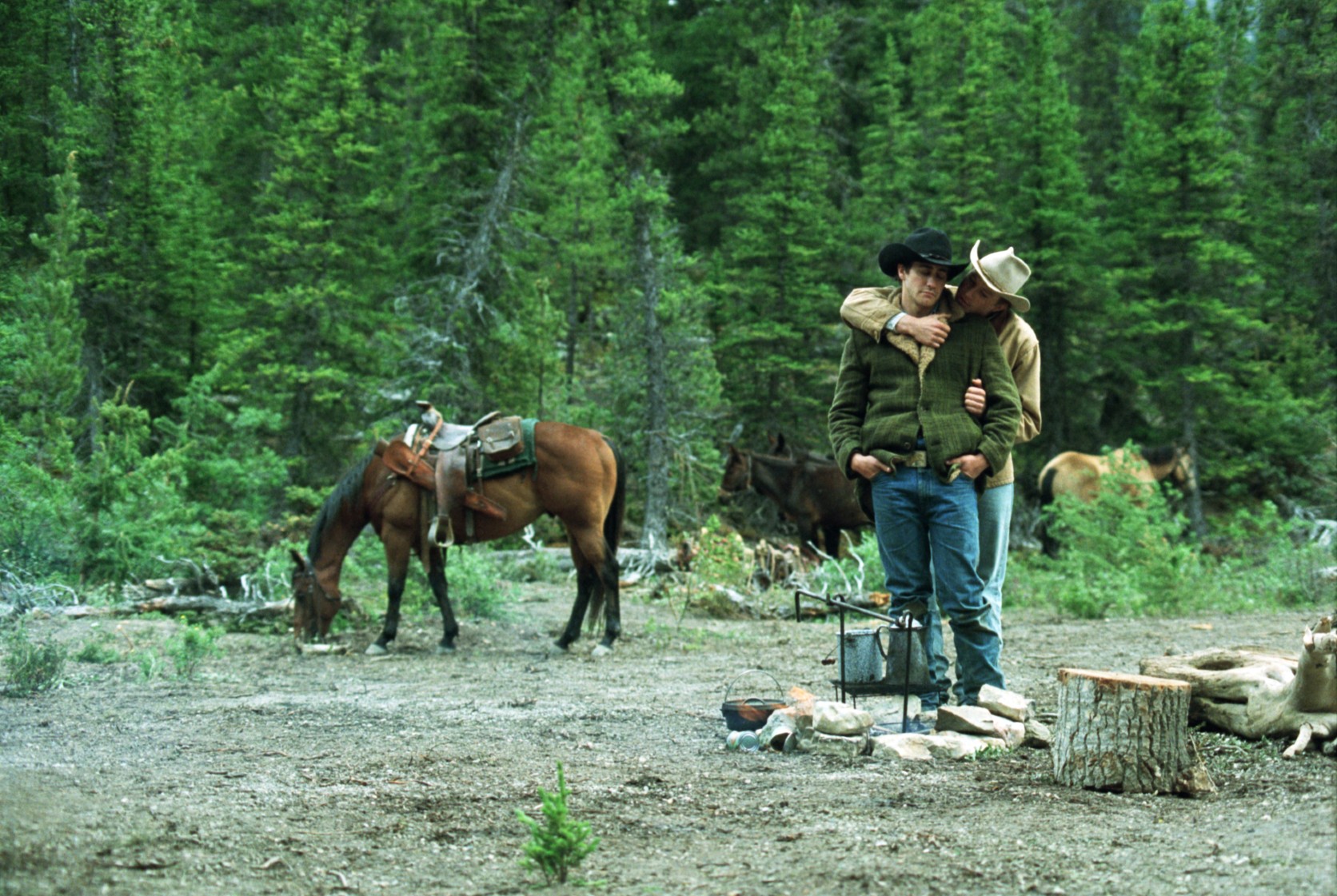
Jake Gyllenhaal as Jack Twist and Heath Ledger as Ennis Del Mar in "Brokeback Mountain" (Kimberly French/Focus Features)

“The theater was only a third full. People were very quiet. Normally, everyone’s talking to their neighbors. But I think everyone there was looking around, wondering, ‘Who’s here? Who do I have to be ready to explain to at church on Sunday that I was just checking ‘Brokeback’ out?’ You could tell that was what the vibe was: Who do I have to be prepared to make my excuses to?”

For David Clarke, a New York-based publicist who saw “Brokeback Mountain” during its original run at a small AMC theater in Texas, it was a singularly unforgettable experience. “I was closeted and engaged to a woman,” Clarke says, “and I was intrigued because it seemed like a really important moment was happening culturally.” Like many not-yet-out people in the early 2000s, including myself, Clarke positioned his curiosity as a form of allyship and was stunned by the tenderness he saw onscreen and the harsh realities that came with it. “At that time, the only real cinematic moments we had of queerness were like, ‘The Birdcage,’ ‘To Wong Foo…,’ ‘Priscilla, Queen of the Desert,” Clarke remembers. “But while the credits were rolling, people left the theater stunned. There wasn’t a lot of chatter. People walked out like, ‘What did I see?’ They thought they were going to see some version of [gay sex] in their face multiple times. But instead, they were forced to witness a hate crime. People didn’t really know what that looked like until they saw this movie.”

Clarke’s experience was patterned globally by people for whom “Brokeback” introduced an entirely different side of gayness. The film wasn’t poking fun at gay men, nor was it particularly raunchy. Instead, Lee’s film depicted the truth of the gay experience, which is that it’s just like the heterosexual one, with one big difference: At some point, no matter when you come out, your longing will have to happen in silence. This reality, painted with such quiet, heart-wrenching affection, is what gave “Brokeback” its lasting power through all the jokes and critiques; it’s what changed minds and opened hearts. And though it may be 20 years old, that essential generosity makes “Brokeback Mountain” the most pivotal film you can watch in theaters this summer. 

Being 11 years old in 2005, I was not part of the R-rated moviegoing public when “Brokeback” first hit theaters. Back then, I was slightly more focused on maintaining an air of straightness at all times, made all the more difficult by puberty pushing the already-gay timbre of my voice up one whole octave for the next two years. But I was keenly aware of how the film was being talked about, and savored every positive conversation about it, even if I couldn’t yet live authentically myself. A few years later, after coming out to nothing but love and acceptance, the air surrounding “Brokeback” still felt intimidating. What was this film going to show, and what was it going to do to me? One night, after my parents were asleep, I watched it alone in the basement, not knowing what to expect. After all of those quips and memes that made up the movie’s legacy, the last thing I anticipated was to feel completely hollowed out, sobbing into a throw pillow.

Michelle Williams as Alma in "Brokeback Mountain" (Kimberly French/Focus Features). But the element of surprise has always been the film’s strong suit. “Brokeback Mountain” is a slow-moving story of two cowboys, Ennis (Ledger) and Jack (Gyllenhaal), whose chance meeting while working together herding sheep as ranchhands one summer leads to a deeply felt, decades-spanning romance. As Jack and Ennis learn how to let their guards down around one another, the audience follows, led gently by Lee’s direction and Larry McMurtry and Diana Ossana’s screenplay into a love forged by recognition. Ennis and Jack understand one another. They see each other’s loneliness, fighting in the trenches of the ceaseless internal war that rages when trying to live in a world that hasn’t been built for you. In a sense, they are outlaws bound by their life on the run, and their love is more powerful than any distance.
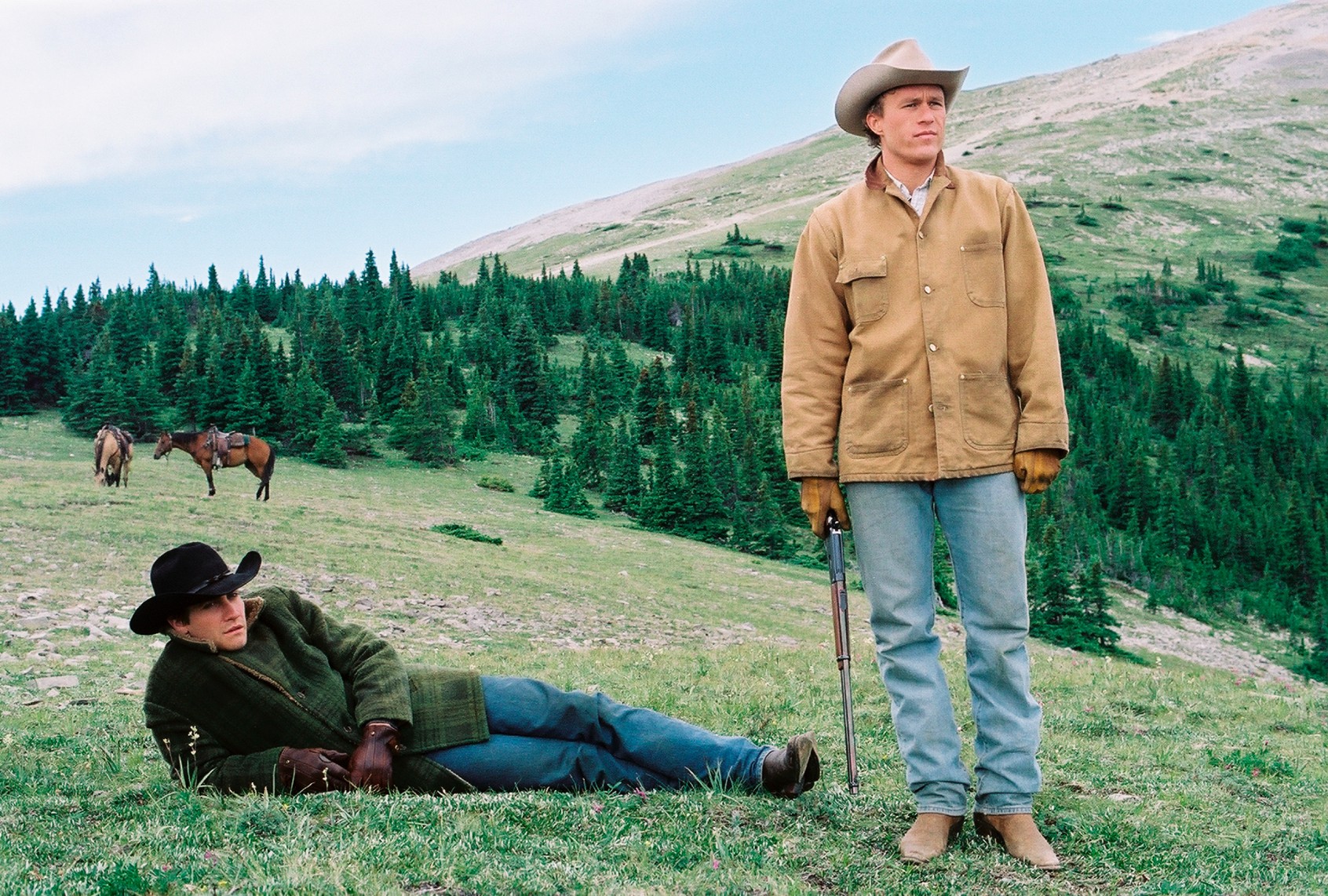
As Clarke describes it, “Brokeback Mountain” beautifully illustrates how so much gay yearning is done secretly, just out of pure necessity of safety. “Watching the movie, I saw embodiments of things I had gone through,” he says. “In seventh grade, there was a kid who lived up the street from me that I had a secret romance with. At school, we were straight-acting. But we would spend a lot of time together outside of school, and we had this very Ennis and Jack romance in a lot of ways. They were more adult than I was as a kid. But that longing that they had, the way that Jack would fantasize about them having a ranch in Mexico, I’d do that same thing with him: fantasizing about us together as adults, finding a way to make it work. I remember watching ‘Brokeback’ and just being like, ‘Holy sh*t.’ I was not expecting to see my life and things I felt on this screen.”


Start your day with essential news from Salon. Sign up for our free morning newsletter, Crash Course.


But what exactly to make of it at the time, Clarke wasn’t sure about, and neither was anyone else in his theater. “I was expecting it to be packed because there was so much buzz about the film,” he says. “But the theater was only a third full. People were very quiet, which is unusual. Normally, everyone’s talking to their neighbors. But I think everyone there was looking around, wondering, ‘Who’s here? Who’s seeing this movie? Who do I have to be ready to explain to at church on Sunday that I was just checking ‘Brokeback’ out? You could tell that was what the vibe was: Who do I have to be prepared to make my excuses to?”

“I don’t think I was expecting it to affect me as viscerally as it did. My gayness was not nascent at all at that point; I was already out. But I had never seen intimacy portrayed that way before, or a gay relationship explored with that depth before. I was like, ‘Oh, this does feel like I’ve been hit by a truck, emotionally.’”

Even in 2005, the words “Brokeback Mountain” had an instant connotation, different from person to person. And in the years since, so much emotion and reverence have been put upon the film that there’s almost too much to fit into the confines of a single reputation. Though it’s the paragon for gay romance films, the movie’s air of prestige has somewhat clouded its thematic resonance over the years. To a generation of queer people born around the time that “Brokeback” was first released, the movie’s name precedes its content.

“I knew it was the gay movie,” says Ethan Winograd, a musician and student at Chicago’s Loyola University. “I knew it was the gay cowboy movie. I knew somebody gets f*cked. I know it was historically significant. But other than that, I didn’t have any concept of what it was about. When ‘Call Me By Your Name’ came out, it really opened my eyes to the concept of gay cinema, and all of the stuff that came before it.” For Winograd, who saw the film during his freshman year of college, watching “Brokeback Mountain” didn’t come with the same trepidation that Clarke and everyone else at the local AMC had during their first viewing, but the reaction was the same. “I don’t think I was expecting it to affect me as viscerally as it did,” he says. “By the end, it definitely released something inside of me. My gayness was not nascent at all at that point; I was already out. But I had never seen intimacy portrayed that way before, or a gay relationship explored with that depth before. That was what really affected me. I was like, ‘Oh, this does feel like I’ve been hit by a truck, emotionally.’”

Jake Gyllenhaal as Jack Twist and Heath Ledger as Ennis Del Mar in "Brokeback Mountain" (Kimberly French/Focus Features). Issy Kagan, a student living between New York and North Carolina, feels similarly. Like Winograd, Kagan’s first time watching “Brokeback Mountain” was on a laptop. But the size of the screen did little to diminish her love for the film. “I just knew it as this great, tragic love story,” she says about her perception of the movie growing up. “I always had an awareness of it, but watching it, I just loved it. The whole movie is a standout, but the scenes where Ennis and Jack are physically close, wrapped in each other, I can’t handle. It’s so intimate.”
When the anniversary screenings were announced, Kagan jumped at the chance to see the movie for the first time in a theater, and says that she’s excited to drag as many people as she can to one of the showings. “I'm bringing two of my childhood friends, who I’ve known for 15 years, neither of whom has seen it yet,” she says. “I’m really excited to put them on. Watching a movie with someone is a form of intimacy in its own regard, and I love watching other people watch movies, that’s my favorite thing.”

Now two decades removed from the closeted college student he was when he first saw “Brokeback Mountain,” Clarke is happily experiencing a “Brokeback”-level intimacy himself in his own committed relationship, instead of merely watching it play out on the big screen. And while he doesn’t specifically credit the movie with his coming out, Clarke does say that “Brokeback Mountain” planted a seed. 

“When I saw the film as a 20-year-old, I was so terrified of seeing something so relatable that I didn’t want to touch it,” Clarke says. “It took a long time for me to come back to this movie. Once I finally found comfort with myself, I was able to revisit the film and appreciate it for what it was and what it is: So human and so beautiful.”

How ranked choice voting will shape the red-hot NYC mayoral race

Early voting is underway in New York City’s mayoral primary, with Election Day on June 24. Democrats will choose the party’s mayoral nominee from among 11 hopefuls, with irascible former governor Andrew Cuomo and youthful democratic socialist Zohran Mamdani seen as the leading contenders — although Brad Lander, the city comptroller, made his own headlines last week after being detained by ICE. (Incumbent Mayor Eric Adams, although his federal indictments have been dropped, is now running as an independent.) This election, even more than usual, has become the focus of national interest . And for just the second time, NYC voters will cast their ballot for mayor with ranked choice voting.

That’s a good thing: Without RCV, a field this crowded could result in a winner who receives as little as 12 percent of the vote.

Ranked choice voting means that whoever wins the primary will have a majority of voters behind them. It also means that voters can hear from all the candidates and choose from the entire field. There are no spoilers; unlike in the Democratic presidential primaries in 2020 or the GOP primaries in 2024, no one is hollering at candidates to drop out or divide the vote.

It’s different, yes. But it’s also much better – and makes your decision-making process easier.

Here are some questions you might have, along with the answers:

What is ranked choice voting?

Instead of having a single choice, voters in a ranked choice election can list their top candidates, in order. In New York, you can rank your top five choices.

If someone wins 50 percent of voters’ first choices, they win, as in any other election. If no one reaches 50 percent, the candidates at the bottom are eliminated, and their second-choice votes are distributed among the remaining candidates. As long as your first-choice candidate is still in the running, your vote stays with them. If and when that candidate is eliminated, your vote moves to your next choice. This process of elimination and vote-transfer continues until one candidate wins a majority.

Why is this a good idea?

Because majority winners are a good idea. RCV always produces one. Without it, someone could win with a very small percentage of the vote.

With ranked choice voting, there's no need for strategy. The basic principle is easy: Rank your favorite candidates, in order.

Voters  like to have lots of choices — but when the time comes to choose just one, things get complicated. What happens if polls show your favorite is likely to finish sixth or seventh out of 11? What do you do if there is one candidate you dislike, but three other options you do like who are polling, let’s say, second, third and fourth? That’s a difficult choice without RCV. You have to guess how your vote will be most effective. With RCV, it’s a lot simpler: You simply rank candidates in the order you like them.

Do I still need to vote strategically?

Not really. You’d have to be much more strategic without RCV. With RCV, the basic principle is easy: Rank your favorites. 

If you need a checklist, try this one: 

  • Pick your favorite first, your second-favorite No. 2 and so on. Rank as many as you like. 
  • Think of it this way: I love my first choice. I like my second choice. I could live with my third, fourth and fifth choices. 
  • If there’s a candidate you don’t like, don’t put them on your ballot. 
  • You don’t need to fill out all five rankings, but the more candidates you rank, the more power you have. 
  • You will never hurt your top choice by ranking additional candidates. 

OK, the basics: How does RCV work? When will my vote count for my first choice? When will it count for my fifth choice? 

As a voter, here’s the easiest way to think about it. As the RCV count goes on, lower-performing candidates are eliminated.

If your first choice stays in the race, your vote stays with them. If they’re eliminated, your vote transfers to your second choice. If that person is eliminated, your vote transfers to your third choice. And so on. 

Do I really need to rank five candidates? Can't I pick just one? 

You can rank as many candidates as you like: just one, all five or any number in between.. But remember, the more candidates you rank, the more power you have. 

In most elections, if your chosen candidate doesn’t do well, that’s it. You have no say when it comes to choosing between the stronger candidates who have a realistic chance to win. That’s why people worry about “wasting” their vote, or end up holding their nose and voting for the lesser of two evils. 

But with RCV, backup choices give you more power. If your first choice is eliminated early in the count, your vote moves to your second choice — and so on. If you only rank one person and they’re eliminated, your vote counts just as it would in a “pick-one” election — but you’re forfeiting the additional power that RCV gives you.

We need your help to stay independent

In most elections, I vote for a candidate with a realistic shot, so my vote is more likely to make an impact. Should I rank higher-polling candidates first? 

No! Just pick your favorites in honest order of preference. 

If you really love, say, Paperboy Love Prince but know they don’t have much chance to win, you can rank them first. Just be aware that your vote will almost certainly end up counting for a lower choice (unless Paperboy pulls out an epic upset).  

If the count gets winnowed down to just two candidates, your vote will count for whichever of them you ranked highest — even if you ranked one at No. 5, and didn’t rank the other at all. There is no strategic benefit to ranking  top-polling candidates higher on your ballot — unless, of course, you prefer them to other options! 

There are 11 candidates, and my gut says Paperboy Love Prince won't win. I don't care who does — as long as it's not Andrew Cuomo. Should I rank him last, or not rank him at all?

If you don’t want a candidate to win, don’t rank them. It’s that simple. RCV is like an instant runoff. The candidates at the bottom are eliminated, one by one, until two candidates remain. In this particular election, that’s very likely to be Cuomo and whichever progressive alternative is strongest. Your vote will count for whichever of those two you ranked higher on your ballot.  

Wait, what if I rank Cuomo last?

We answered this already! Essentially, you're still voting for him. If all the candidates you rank higher than Cuomo get eliminated during earlier rounds of counting, your vote ends up counting for Cuomo. 

What if I like Cuomo and want him to win?

Then rank him. If you like him best, rank him first. If there’s someone you like better, rank them first and Cuomo after that.


Start your day with essential news from Salon. Sign up for our free morning newsletter, Crash Course.


What’s with the "Don't rank Cuomo" strategy? Is that a legitimate use of ranked choice voting? I thought RCV made campaigns more positive.

See the answers above for why this strategy makes sense. Several more progressive candidates and groups are trying to draw a clear distinction by endorsing a slate, and encouraging voters not to rank Cuomo. This is an entirely legitimate campaign tactic — it’s not inherently “left" or “right” or “center.” Moderates could certainly launch a “Don’t rank Zohran” campaign aimed at keeping Mamdani from winning.  

This particular election is likely to come down to Andrew Cuomo and whichever progressive alternative is strongest. Your vote will count for whichever of those two you ranked higher.

Perhaps the most interesting aspect of this tactic is that all those candidates are staying in the race and building coalitions with each other — meaning that voters get to decide. In a traditional “pick-one” race, progressive candidates would likely have spent the past few months sniping at each other and trying to elbow each other out of the race. 

With RCV, we get a friendlier, more open process — the politicking happens in public instead of behind closed doors, and voters get more choices. 

Why are candidates "cross-endorsing" each other, as Mamdani and Lander recently did? What’s the value of that? 

In RCV elections, candidates benefit from being the backup choice of voters who rank another candidate first. If your favorite is eliminated, you might have listened to that candidate’s recommendation about who to rank second. 

That’s good for you as a voter — if it comes down to two candidates you did not rank first, you still get a say. It’s good for candidates too: If they’re eliminated, their supporters can still impact the outcome with their second or third choices. If they survive later into the count, they may pick up votes from aligned candidates who've been eliminated.

Formal “cross-endorsements” are one way to do this, and they can generate endearing content like this Lander-Mamdani joint campaign ad. But there are plenty of ways to campaign together in an RCV election, including asking voters who may be ranking another candidate first to rank you second because of your alignment on particular issues. 

Fear of “gay blood” and “confused minds”: Virginia Republican touts support from anti-gay preachers

Lt. Gov. Winsome Earle-Sears helped make history this week when she was named the Republican gubernatorial nominee, ensuring that no matter who wins in November, Virginia's next governor will be a woman. But that win is also drawing increased scrutiny to Earle-Sears, an ultraconservative Marine veteran, and her touting of endorsements from a slew of clergy who have espoused anti-LGBTQ+ views.

The state’s first Black and female lieutenant governor has listed on her campaign website, as well as boosted on social media, the endorsements of at least four Virginia clergymen who have made anti-LGBTQ+ remarks or whose religious institutions promote anti-LGBTQ+ beliefs. Earle-Sears herself has also come under fire for anti-LGBTQ+ comments carried out in the name of religious freedom and has had to apologize to a state lawmaker for misgendering her. With public opinion polls showing that the majority of Virginians support LGBTQ+ equality and freedoms, Earle-Sears' anti-LGBTQ+ stance raises questions about her viability in a general election campaign and how she would govern if she were to win.

Earle-Sears' campaign did not respond to emailed requests for comment.

Earle-Sears, now the state GOP's first Black and female nominee for governor, has since last fall touted endorsements from religious leaders in the state who espouse views on LGBTQ+ Americans that are out of step with the majority of Virginians. Craig “The Hatchet Man” Johnson, a self-described reverend, the founder and president of educational advocacy organization First Amendment, Inc, and the host of conservative radio program “The REALLY, Real, Deal,” is one such endorser. 

In a 2016 Facebook post, an account with the name Craig Johnson, and with his picture as the profile’s image, posted: "The gays and their defenders always claimed that it was unfair to lump them in with pedophiles, but the slippery slope that many warned of now has the psychology racket removing pedophilia from the list of mental disorders the same way they did for homosexuality years ago.”

In another post from 2015, that same account reposted an article arguing against allowing "gay blood" to be used for transfusions in hospitals following reports that the Food and Drug Administration lifted its lifetime ban on accepting those blood donations.

“Common Sense RIP,” the account wrote at the time. 

Johnson did not respond to emailed requests for comment. In the post Earle-Sears shared to X announcing his endorsement, he’s quoted as saying, “I've known Winsome for over 20 years. She still maintains the common touch. She's REAL.”

Another endorser named on Earle-Sears campaign website is Don Blake, president and chairman of the Virginia Christian Alliance. On Friday, Blake, from what appears to be his account, bemoaned in a Facebook post that “reality is no longer in fashion. The Culture says ‘ Be whatever you feel you are’ and be Proud.” He posted the comment in response to what’s described as a satirical video shared on the platform, in which a male character tells peers they want to be called Loretta and to be a woman. 

The same account, in a 2022 Facebook post about an article on Gov. Glenn Youngkin addressing the state’s LGBTQ+ advisory board, also suggested that LGBTQ+ community leaders have “confused minds” while criticizing LGBTQ+ Americans for what he described as self-identifying with who they have sex with.

“It's worth knowing what the LGBT community ‘ leaders ‘ are thinking and saying about Virginia's Governor [sic],” Blake wrote. “And, it will be interesting to see how our Governor responds to this group of radicals  who's whole self identity is who they have sex with. These people don't want to be identified as say a  ‘teacher’ but as ‘ gay teacher ‘ or as a ‘ gay athlete ‘ or as a ‘ gay artist ‘ or as a ‘ drag queen ‘ or as a ‘ Trans ‘. Whatever?” 

“And they want ‘ Special Rights’,” he continued. “I believe that God says Those who turn against Him, then they will be given confused minds. It's self evident that many have  ‘confused’ minds and that some have ‘ very confused minds’.”

Another post from 2013 saw the account call the country's National Cathedral a "national disgrace" for ringing its bells to celebrate the Supreme Court decision allowing for same-sex marriage. That post also questioned whether a church can be a Christian church if it "celebrates homosexuality marriage [sic]?"

Blake did not respond to emailed requests for comments.

We need your help to stay independent

Minister Bill Wines and Pastor Nate Clarke are also among Earle-Sears' listed clergy endorsements. Both clergymembers lead a church — The Gethsemane Church of Christ and Oasis Church, respectively — that condemns homosexuality and transgender identity in the belief statements on their websites.

The Gethsemane Church of Christ stated on its site that "rejection of one's biological sex is a rejection of the image of God within that person." It has included "homosexual behavior" and "bisexual conduct" in a list of acts it considers sexually immoral, "sinful and offensive to God" and has stated that it's "imperative that all persons employed by Gethsemane Church of Christ in any capacity, or who serve as volunteers, agree to and abide by this Statement on Marriage, Gender, and Sexuality."

Oasis Church’s belief statements have a similar message. Under "Biblical Marriage," the website says marriage “has only one meaning and is clearly defined in scripture as a covenant, a sacred bond uniting one man (born a man) and one woman (born a woman) in a single, exclusive union for life."

Clarke did not respond to emailed requests for comment. Wines told Salon that he would review the request but did not provide a response.

Earle-Sears shared posts lauding Clarke and Wines’ endorsements in September 2024. 

Earle-Sears’ own views on LGBTQ+ rights align with those of her endorsers. In May, she made headlines for including a handwritten note on a 2024 law making it unlawful to deny a couple a marriage license based on sex, gender or race, stating that she was “morally opposed” to the “contents of the bill.” As the president of the state Senate, her signature was required to show it had been passed into law. 

When asked last month about the note, Earle-Sears denied that her comment was an indication that she was opposed to the bill.

“No, it wasn’t that,” she told 8News' Tyler Englander. “I merely wanted everyone to understand that I want that someone of faith would not be forced to perform a marriage, but a civil union, fine.”

Most recently, Earle-Sears celebrated the Supreme Court’s Wednesday decision in U.S. v. Skrmetti, which allowed a Tennessee ban on gender-affirming care for minors to stand, as a “huge victory today for common sense.” 

Former U.S. Rep. Abigail Spanberger, Earle-Sears' Democratic rival for the governor's office, “wants to make the government your child’s parent instead of you—I won’t let that happen,” Earle-Sears wrote in a Wednesday post to X. “As Governor, I will protect parents’ rights, not infringe on them.”

Last year, Earle-Sears came under fire for misgendering Virginia state Sen. Danica Roem as “sir” during a legislative session in response to the lawmaker’s question about the number of votes needed to pass a bill with the emergency clause. Though she initially refused to, Earle-Sears later apologized after two recesses, according to The Guardian. She added, however, that she didn’t intend to upset anyone. 

In May, the Jamaica-born official also spoke at the commencement ceremonies of two Virginia schools whose policies or stated beliefs deride homosexuality: her alma mater, Regent University, from which she graduated in 2003, and Atlantic Shores Christian School. 


Start your day with essential news from Salon. Sign up for our free morning newsletter, Crash Course.


Regent University, per its student handbook, describes "homosexual conduct" as prohibited "sexual misconduct," which it also says includes "lewd, indecent, or obscene conduct or expression.” Atlantic Shores Christian School states on its website that it believes homosexuality and bisexuality are "sinful and prohibited."

For her part, Earle-Sears’ stance on same-sex marriage has been consistent throughout her career and spans decades. In a 2004 Daily Press op-ed, published during her campaign for Congress, she wrote that “society has gone immeasurably beyond almost all standards in accommodating the homosexual community over the last couple of decades” and called for a constitutional amendment “preserving the institution of marriage to be between a man and a woman.” 

Similarly, Earle-Sears staunchly opposes abortion, having written similar notes voicing moral opposition on two reproductive rights bills passed in 2024 and Virginia’s recently passed constitutional amendment enshrining reproductive freedom. She has also previously told reporters she considers abortion “genocide,” opposes it especially for Black Americans, and that she thought abortion should be illegal in all cases except to save the life of the pregnant person. 

Earle-Sears recently tried to distance herself from some of those views, denying in her interview with 8News that she said she wanted to limit access to reproductive care. 

For her part, Earle-Sears’ campaign also told News4 Washington in a May statement regarding her note on HB 174 that the lieutenant governor “has already shown she will always be a governor for all Virginians. She has always been open and honest with the people of Virginia about her values and her unwavering commitment to both respecting and upholding the law."

For sale by the GOP: Our public land — and our shared history

America’s public lands are back in the crosshairs as Senate Republicans work on their own version of Donald Trump’s “One Big Beautiful Bill Act,” which recently passed the House and encapsulates the president’s policy agenda. After legislators were forced to drop a provision from the House bill that sought to sell off half a million acres, GOP senators now intend to mandate the disposal of between 2 million and 3 million acres of land across 11 Western states belonging to the Bureau of Land Management and the U.S. Forest Service.

This is the latest effort by a group of Western legislators and lobbyists to sell off public lands to states and business interests, and increase the leasing of them for mining, drilling and logging. The provision has found a champion in Interior Secretary (and former North Dakota Gov.) Doug Burgum, and leaked documents from the agency have revealed the intention to exploit public lands as convenient, disposable assets. Experts and advocacy groups warn that land near Yosemite and Tahoe in California, Sabino Canyon and Mount Lemmon in Arizona and large parcels of Arapahoe, San Juan and Rio Grande National Forests in Colorado could potentially be threatened under the current bill’s very limited exemptions for wilderness areas and lands of environmental concern.

How societies manage their land has enduring consequences for everything from social and economic inequality to health and environmental quality. 

Americans should resist blanket public land sales and act to preserve the lands we have left. It is easy to overlook the centrality of land to the way societies work, even after a large portion of their populations move to cities. How societies manage their land has enduring consequences for everything from social and economic inequality to health and environmental quality. America’s public lands remain an unparalleled site of recreation for all, and a reservoir of biodiversity and natural resources that have defined our past and are critical to our shared future.

The privatization of land has often moved hand-in-hand with the marginalization and exclusion of some people — such as Native Americans in what became the United States, Black South Africans during apartheid and peasants removed from common lands in the United Kingdom and Italy during enclosure movements — for the benefit of a select few. It has also fostered severe environmental and ecosystem degradation. The uprooting of prairies across the Great Plains and the Dust Bowl could not have occurred without the massive settler movement triggered by the Homestead Act of 1862. These episodes show that reshuffling who owns the land can radically shift power dynamics and the trajectories of societies.

Public lands are a unique feature of the American West. While there is a small collection of public land in eastern states, slightly over half of all land in the West, comprising hundreds of millions of acres of land, is owned by the federal government. In some states, federal land is the overwhelming majority of all land. It covers some 85 percent of Nevada and nearly 70 percent of Utah.

This vast share in the West is a relic of its settlement. When the U.S. acquired these lands through the Louisiana Purchase, the Oregon Treaty and the Mexican-American War, there were no states in these areas to manage vast tracts of land. The federal government forcibly displaced Indigenous people from large swaths of land and handed it out to settlers. As they felled forests, threatened major species and exploited natural resources at an alarming scale, a growing conservation movement arose to preserve the landscapes and ecosystems that remained. Because of this history, the federal government held onto hundreds of millions of acres of land.

Since then, there has been an enduring standoff between the federal government and some Western states and interests over who should manage public lands. That standoff has flared up through events like the Sagebrush Rebellion of the 1970s and 1980s, and armed confrontations in 2014 and 2016 between militants and the federal government over the Bureau of Land Management.

The current effort to sell off public lands through legislation reflects this long-simmering discontent. Utah has been especially vocal in its effort to wrest land from the federal government and convert it into state-owned land that it could then use as it pleases. The state sued the government last year for control over tens of millions of acres. The Supreme Court recently denied this challenge.

We need your help to stay independent

Legislators like Utah GOP Sen. Mike Lee are now pursuing the sale or transfer of public lands, arguing that it would help address housing shortages, promote economic growth and align land use with local interests while filling the federal government’s depleted coffers. But only about 0.1% of federal land is situated in or adjacent to urban areas and is suitable for housing. And legislators have flagged far more lands for disposal, including popular recreation areas and land adjacent to national parks, conservation areas and Native American reservations.

Given the immense value of land and its tendency to appreciate in value, selling  public land to wealthy individuals and companies could fuel a further rise in inequality. It would almost certainly lead these areas to be cordoned off from public use, truncating shared spaces for recreation and nature access and the benefits that come with them. And if ecologically sensitive lands are targeted for development or resource extraction, it could lead to environmental damage while accelerating climate change and the loss of biodiversity, with repercussions for society as a whole.

The extent of public land in America is as unique as it is central to our shared history. Ceding that land to private interests or cashing out on it would be a mistake, the consequences of which would resound for generations.

“Not a danger to the community”: Judge order Mahmoud Khalil’s release from detention

A federal judge ruled on Friday that the Trump administration has to release Columbia University graduate student Mahmoud Khalil, who has been detained for three months over his activism protesting Israel’s war on Gaza.

Khalil, who was never charged with a crime, has been held in Louisiana since he was arrested entering his New York City apartment building in March. The Trump administration justified the detention by arguing that Khalil, a legal permanent resident whose wife is a U.S. citizen, posed a threat to American foreign policy.

Three other students who were detained on similar allegations have been released. According to The New York Times, Khalil is “the only high-profile pro-Palestinian demonstrator in the United States who remains in confinement.”

A Newark, New Jersey, judge earlier determined that the administration’s rationale was likely to be unconstitutional. However, he initially allowed the detention to continue after the government alleged that Khalil had lied on his green card application. This week, he ruled that these allegations did not require Khalil to continue to be detained. 

“It is highly, highly unusual to be seeking detention of a petitioner given the factual record of today,” Judge Michael Farbiarz said on Friday.

The judge also deemed that Khalil is not a flight risk and “is not a danger to the community. Period, full stop.”

Khalil’s wife and child — who was born during his father’s detention — are American citizens. His lawyers have argued that his detention is due to his views and part of a crackdown on free speech. How exactly his release will proceed is unclear. 

Hakeem Jeffries says “aggressive diplomacy,” not war, is the best way to deal with Iran

House Minority Leader Hakeem Jeffries, D-N.Y, called on President Donald Trump to refrain from using military force against Iran without explicit approval from Congress.

“The authority to declare war belongs solely to the United States Congress,” Jeffries wrote in a statement published Friday. “Aggressive diplomacy resulting in a longer and stronger agreement that permanently halts Iran’s nuclear aspirations is the most appropriate course of action at this time.”

Jeffries’ statement also calls Iran a “sworn enemy of the United States,” and says that it “can never be permitted to become a nuclear-capable power” and that American “commitment to Israel’s security remains ironclad.” 

Since Israel first attacked Iran last week, a debate has broken out in Washington about how to respond. Israel and Iran continued to exchange strikes this week, and President Donald Trump has heightened his rhetoric against the Islamic Republic, calling for an “unconditional surrender” and threatening to kill the country’s leader, Ayatollah Khamenei. On Thursday, the White House said that the president would decide whether or not to directly attack Iran within the next two weeks.

Jeffries and others in the Democratic leadership have been under pressure to take a stronger stand against military action. 

“Given the gravity of this moment, Democratic leaders should be holding news conferences, addressing mass protests, even bringing Congress to a standstill with all-night filibusters in order to prevent an unauthorized, unjustified war,” progressive journalist Peter Beinart wrote in The New York Times on Friday, hours before Jeffries issued his statement, noting that it was a potential winning issue for Democrats. “The public is deeply weary of conflict. And yet top Democrats are not boldly rallying them against the possibility of another.”

Since the outbreak of the war, there have been efforts in Congress to restrict the president’s ability to engage in hostilities, including a bipartisan War Powers Resolution in the House of Representatives. According to the most recent count, at least 37 lawmakers have signed onto the various resolutions.   

Anthony Bourdain didn’t say that (but we wish he did)

If you’re paying attention, you’ll start to notice them — little altars to chef Anthony Bourdain scattered across America’s restaurants, displayed with something close to religious conviction. A St. Tony votive tucked beside the register at a New York taqueria. A mural on the alleyside of a pub in southern Indiana. A framed black-and-white portrait — the now-iconic one where he faces the camera but looks away, eyes downcast — hung above a Chicago bar like a patron saint of appetite.

Social media is too fractured now to agree on much, but one thing you can still count on, especially in the days leading up to June 25, is a good Bourdain quote.

That day — his birthday — has become an unofficial holiday of sorts since Bourdain's death in 2018, a moment of reflection for those who admired the way he moved through the world: with curiosity, irreverence and a deep, abiding respect for culinary pleasure.

One quote, in particular, tends to surface around this time each year. You’ve probably seen it — shared in restaurant Instagram captions, posterized on Etsy and (according to a deep internet image search) as the basis for at least one tattoo: 

"Eat at a local restaurant tonight. Get the cream sauce. Have a cold pint at 4 o’clock in a mostly empty bar. Go somewhere you’ve never been. Listen to someone you think may have nothing in common with you. Order the steak rare. Eat an oyster. Have a negroni. Have two. Be open to a world where you may not understand or agree with the person next to you, but have a drink with them anyways. Eat slowly. Tip your server. Check in on your friends. Check in on yourself. Enjoy the ride."

It’s often attributed to Anthony Bourdain, and honestly, you understand why. It sounds like him—or at least, like the version of him people hold onto. Wry, romantic, unsentimental. A little drunk. Someone who believed in the pleasures of the table and the moral act of being curious.

I’ll admit: I fell for it, too.

Not in a big way, just — quietly, personally. It was an early summer afternoon, and I found myself at a local restaurant at exactly 4 o’clock, seated across from a man I adore. It was one of those old-school neighborhood pasta joints: maroon pleather booths, oak bar, white paper over sticky red-check tablecloths. I ordered the cream sauce, naturally. There was something about the light, the timing and the Negroni on the next table over. The quote flickered across my mind like a little internal monologue, uninvited, but oddly comforting. “When did he say that?” I wondered, days later.

We need your help to stay independent

I’d just reread “Kitchen Confidential” and couldn’t remember it tucked in there. It felt plausible as a voiceover from “Parts Unknown,” though I couldn’t conjure which episode.

Eventually — fortunately, and unfortunately for the guy with the tattoo — a little Googling cleared things up. Once you sift past the Reddit contingent who are certain they remember him saying it, the origin of the quote consistently points to a specific post that came long after Bourdain’s death.

It first appeared on June 27, 2021, in a thread on the WoodenBoat forum, a corner of the internet where fans had been trading reflections about Bourdain for years. The post came from a user named “Joe (SoCal),” who never claimed Bourdain said the words. He presented them as his own—a personal homage, an imagined set of instructions that might have sounded like Bourdain, had he lived to say them.

This, it seems, is the first known appearance of the passage online.

Upon closer examination, the quote starts to fall about a bit. One particularly dedicated Redditor, “WannaBeDeveloper92,” created a public nine-page Google Doc breaking down the entire misattributed quote line by line, comparing each element to confirmed excerpts from Bourdain’s work. The fan categorized each passage as “aligned” or “inconsistent,” citing contextual nuance and linguistic patterns like a literary scholar. The line “check in on your friends, check in on yourself” was flagged as suspect — a little too soft, a little too self-care. “More of a modern wellness trope,” the fan noted, than something Bourdain would’ve actually said.

But this isn’t a gotcha. I’m not here to shame anyone for getting swept up in something that feels true.There are real Bourdain quotes that echo this same note. “Your body is not a temple, it’s an amusement park. Enjoy the ride.” Or: “If I’m an advocate for anything, it’s to move. As far as you can, as much as you can… The extent to which you can walk in someone else’s shoes, or at least eat their food, it’s a plus for everybody.”

The fake quote, though invented, captures the rhythm of something Bourdain often returned to: the idea that pleasure, especially when shared with strangers, is a kind of ethic. That trying new things, listening closely, ordering the good stuff off the menu—these are not luxuries, but ways of being alive with intention.

The fake quote, though invented, captures the rhythm of something Bourdain often returned to: the idea that pleasure, especially when shared with strangers, is a kind of ethic.

Of course, this isn’t the first time we’ve found ourselves hungry for new Bourdain words, however we can get them.

In 2021, the documentary “Roadrunner” sparked some controversy for using an AI-generated version of Bourdain’s voice to narrate lines he had never actually spoken aloud. The moment unfolds quietly: the artist David Choe, a friend of Bourdain’s, begins reading an email from him—“Dude, this is a crazy thing to ask, but I’m curious…”—and then, without warning, the voice shifts. 

It becomes Bourdain’s. Or something close enough to fool you. “. . . and my life is sort of shit now. You are successful, and I am successful, and I’m wondering: Are you happy?”

Director Morgan Neville later explained to the New Yorker’s Helen Rosner that there were a few moments in the film where they wanted Bourdain’s voice but didn’t have the audio, so they made it. They fed hours of recordings — TV, radio, podcasts, audiobooks — into a software program and built an AI model of him.

On the softer side of that same impulse is comedian Jonathan Kite, who’s gone viral for his pitch-perfect Bourdain impression. In one clip, he uses it to deliver a gravelly, reverent takedown of Chuck E. Cheese: “A casino for the juice box crowd, where the ATM is your dad and the mouse always wins.”

Part of what makes all this hit so hard — this invented quote, the AI voice, the impersonations, the votives — is the fact that we’re living in a time of real social and political fracture. Tension simmers everywhere. Everyone seems mad: mad at the world, mad at each other. And in the midst of it, we’re watching our neighbors, the people who keep our neighborhood joints running, live in fear, especially amid a rise in ICE arrests and political scapegoating.


Want more great food writing and recipes? Sign up for Salon's free food newsletter, The Bite.


The mythos of Bourdain lands differently in a moment like this.

He was a complicated man, no doubt, but through “Parts Unknown,” “No Reservations” and his own writing, he modeled something rare and generous: a way to move through the world that was both deeply curious and politically aware. He understood that food doesn’t exist in a vacuum. That knowing where a dish came from—its colonial history, its cultural significance, the labor behind it—doesn’t ruin the experience. It enriches it.

“There is nothing more political,” he told CBC News in 2016. 

There’s one image of him I come back to often, one you’ve probably seen. Bourdain and President Barack Obama, seated on low electric blue plastic stools in a noodle shop in Vietnam, drinking cold beer and eating bun cha.

That photo is nearly a decade old now, but its resonance is immediate every time I walk through my neighborhood— Chicago’s Little Vietnam —where it hangs proudly in six or seven restaurant windows, displayed with the same kind of reverence you’d give a saint.

We feel very far away from that image now.

Bourdain probably would’ve rolled his eyes at the fake quote, maybe the candle, definitely the AI voice. But he also might’ve understood the impulse. We don’t need saints — we just need someone who reminds us to stay curious, order the cream sauce and tip well.

He never said those words. But he made us hungry for them.

“We are heartbroken”: Hospitalized lawmaker and wife recount assassination attempt

Minnesota state Senator John Hoffman and his wife Yvette have released their first statement since the June 14 shooting that left them both hospitalized.

The Hoffmans describe the events of that night in stark detail. After attending a Democratic Party event in Minneapolis on June 13, they returned home with their adult daughter. Around 2 a.m., a man identifying himself as a police officer knocked on their door. When they opened it, the man opened fire.

John Hoffman, who remains in critical but stable condition, was shot nine times. Yvette, released from the hospital on Thursday, was shot eight times as she managed to push the shooter back and close the door. Their daughter Hope locked the door and called 911.

The Hoffmans credit Hope’s quick thinking with alerting authorities. “Her brave actions and quick thinking triggered the notice to public safety officials that a politically-motivated act was potentially underway,” they wrote.

Minnesota Gov. Tim Walz thanked the family for their response in a press conference last week. “I’d like to say on behalf of the state of Minnesota, the heroic actions by the Hoffman family and their daughter, Hope, saved countless lives, and we are grateful,” he said.      

The couple also mourned the loss of Rep. Melissa Hortman and her husband, Mark, who were killed by the same shooter later that night. “We are heartbroken to know that our friends Melissa and Mark Hortman were assassinated.”  


Start your day with essential news from Salon. Sign up for our free morning newsletter, Crash Course.


The Hoffmans said they are now confronting the new reality that public service comes with heightened personal risk. “We must work together to return to a level of civility that allows us all to live peacefully,” the statement reads. “The future for our children depends on that. We will be praying for that work and appreciate all those who will join with us."

The suspect, 57-year-old Vance Boelter, was arrested Sunday night near his home in Sibley County after a 36-hour manhunt, which authorities have called the largest in state history. He faces six federal and four state charges. 

Read the full statement:

"Because we have been hospitalized and receiving medical care, we have not been able to provide much information regarding the horrible circumstances of June 14th, but would now like to provide a statement offering more clarity of what happened. 

"After having attended the Humphrey Mondale dinner on Friday, June 13th, we returned to our home, joined there by our adult daughter, Hope. At approximately 2:00 a.m., we were all awakened by the sounds of pounding on the front door and shouts of someone seeking entry, identifying himself as a police officer. When the door was opened, all three of us were in the entryway. John initially lunged at the gunman as the weapon was pointed directly at him, getting struck nine times. As John fell, Yvette reached out to push the man and shut the door, succeeding before she was also hit eight times by gunfire. Hope then rushed to shut the door and secured the lock; she got to the phone and shared with the 911 operator that Senator John Hoffman had been shot in his home. Her brave actions and quick thinking triggered the notice to public safety officials that a politically-motivated act was potentially underway. 

"As we continue to receive medical care, we are deeply grateful for those providers, for the first responders and for all those in law enforcement who worked so quickly, professionally and selflessly to safeguard others and to apprehend the shooter, starting with our own officers in Champlin and Brooklyn Park. We are heartbroken to know that our friends Melissa and Mark Hortman were assassinated. Our daughter Hope and Sophie Hortman went to school together, and we know that they – along with Colin Hortman – will have each other's support as we all work through the devastating consequences of that horrific night. We want to thank all those at Fernbrook School behind the GoFundMe account – you will be helping us pick up the broken pieces of our lives. We are uplifted by the prayers and support from so many across the state of Minnesota and the country: thank you.  

"Choosing to work in the public sector, even in as limited a way as John's career as a senator, has always meant sacrificing a level of privacy. But now we are grappling with the reality that we live in a world where public service carries such risks as being targeted because someone disagrees with you or doesn't like what you stand for. As a society, as a nation, as a community, we must work together to return to a level of civility that allows us all to live peacefully. The future for our children depends on that. We will be praying for that work and appreciate all those who will join with us."

Facing a decision on Iran, Trump is as befuddled as ever

If there's one thing we have learned about Donald J. Trump over the last decade, it's that he loves to talk big and carry a small stick. He's a man full of bluster and dominance displays, which he employs both impulsively and tactically against friend and foe alike. But he almost always fails to follow through if he suspects that it carries the slightest risk. 

Over the years, he's learned he can convince many people that he's the ultimate strongman. But in reality, he is weak and indecisive.

Trump sees himself as a hero, which I suppose is true for most people who run for high office. But since he was a young man, he has been obsessed with creating a macho image, inventing the persona of a high-flying playboy and king of the New York real estate world. The roots of his aggressive, tough guy demeanor are well documented, stretching back to at least the 1970s and 1980s when Roy Cohn, the nefarious former counsel to Joseph McCarthy's communist witch hunt committee, took Trump under his wing.

Cohn counseled Trump to never admit guilt or wrongdoing of any kind, to pretend to always be in the right, no matter what. This advice cost Trump a lot of money over the years, as his businesses repeatedly went bankrupt and as he failed at one venture after another. By the end of the 1990s, he was nearly broke. But Trump's obsessive pursuit of fame, and his insistence that he had never erred, convinced the public — and television executives at NBC — that he knew what he was doing anyway. It provided him a second act on television and, ultimately, the White House.

But all this doesn't mean that being a belligerent blowhard isn't the authentic Trump. In his first book "The Art of the Deal," he tells a (probably false) story about how, when he was in second grade, he hit one of his teachers. His classmates and the teacher had no recollection of this incident. But Trump was almost certainly a kid with a discipline problem. After all, his father sent him to military school. But he never lost his obstreperous disposition. 

There's actually very little evidence of him facing down a bully like himself. In fact, he reveres other strongmen on the world stage. In their presence, he shrinks into himself.

Still, when you think about it, the only people Trump has ever actually dominated on a personal level are all the women he's been credibly accused of assaulting. While he's certainly verbally insulted many men, he's always done so from the safety of his powerful position. There's actually very little evidence of him facing down a bully like himself. In fact, he reveres other strongmen on the world stage. In their presence, he shrinks into himself.

During his 2016 presidential campaign, Trump pretended he had been a big Iraq War critic as a way of presenting himself as smarter than the rest of the GOP field, particularly former Florida Gov. Jeb Bush, who was the frontrunner at the time. (There's no evidence that Trump was against the invasion.) By that time, Republican voters were embarrassed by the Iraq debacle and were happy to see someone promise that, rather than get into foreign quagmires, he would instead dominate the world by sheer force of his allegedly masterful negotiating prowess. 

Trump took office completely unprepared to make the kind of decisions a president is required to make. In that first term, his team included people who tried to tutor him. But they soon realized he was unteachable. He believed he knew everything he needed to know. It became clear that he was not only incapable of admitting otherwise, but also that he could not make a reasoned decision at all. 

This was a particularly acute problem when it came to foreign policy. He didn't understand any of the thorny complicated issues, so he mostly just did the opposite of his predecessor. Trump had long nursed a grudge against President Barack Obama, and he was intent on reversing anything associated with Obama, such as the Paris Climate Accords and the Iran nuclear deal. Trump dealt with U.S. allies as if they were our adversaries and our adversaries as if they were our allies. He trash-talked the North Atlantic Treaty Organization (NATO) and many of its member states, while cozying up to the likes of Russia and North Korea. He found it was easy to bully our friends. After all, they weren't going to require him to take some kind of action with unpredictable results like the adversaries would. 

Now, in his second term, nothing has changed and the stakes are considerably higher. Two major wars are raging — one of which he promised to end on his first day in office, apparently convinced that his good friend, Russian President Vladimir Putin, would be happy to do him a solid. That didn't work out. And after crowing that nobody has ever done as much for Israel as he has, Trump is now standing by helplessly as Benjamin Netanyahu thumbs his nose at the U.S. and carries out his long-standing dream of regime change in Iran. 

Once again, Trump doesn't know how to make hard decisions. He is dithering on whether to get in on the action and take credit for it, or avoid the risk of it all going sideways and being stuck with the consequences. When he saw how Fox News was celebrating the strategic genius of the Israeli strikes, his initial instinct was to join in. But then he got some blowback from his MAGA base and heard that the big bombs the Israelis want him to use to blow up Iran's underground nuclear facilities might not get the job done. At the same time, others have been pointing out that Iran is actually a formidable foe with 90 million people and a professional military that could close the Straits of Hormuz and disrupt the world's oil supply, hit some of the 40,000 troops stationed in the region or perhaps even attempt to stage a terrorist attack on U.S. soil — which the FBI might not be able to foil since its focus has been redeployed to focus on ousting undocumented workers instead of anti-terrorism.

We need your help to stay independent

This, of course, is the complicated calculus one faces as president. And Trump is undoubtedly more befuddled than ever.

Trump's former national security adviser — and hardcore Iran hawk — John Bolton told the New York Times that, in his experience, Trump is “frantic and agitated” in national security crises, which is very believable:

“He talks to a lot of people and he’s looking for somebody who will say the magic words,” Mr. Bolton said. “He’ll hear something and he’ll decide, ‘That’s right, that’s what I believe.’ Which lasts until he has the next conversation.”

So far, Trump's weakness and confusion in the face of authorizing military action has prevented him from acting on his strongman impulses. On Thursday, he punted a decision on Iran for the proverbial two weeks in the hopes that something will materialize and save him from having to do anything at all. Let's hope that's one thing he's right about.

MAGA’s narrative warfare gets all mixed up by Rupert Murdoch

It’s an unnerving feeling to find myself in agreement with Tucker Carlson, but it’s not unfamiliar. By my count, the last time was 2003 and the U.S. was embroiled in a Middle East quagmire. “I supported the war,” the conservative commentator, who was then chasing mainstream media success in a perch at CNN, told the New York Times of the 2002 US-led invasion of Iraq, “and I now feel foolish.” This time around, the U.S. is fully backing an unprovoked Israeli attack on Iran. And Fox News, Carlson said this week of his former employer, “is trying to lay the groundwork for American intervention.”

It’s how Donald Trump, a man who pledged no new wars on the campaign trail, has ended up on the verge of entering a new war less than six months into his presidency. According to reports, Trump’s heavy consumption of Fox News coverage is increasing his appetite for direct military engagement. Since my own obsession with Fox News might rival Trump’s, I've seen how the network’s one-sided coverage has unfolded from the beginning. 

According to reports, Trump’s heavy consumption of Fox News coverage is increasing his appetite for direct military engagement.

Twenty-two years ago, Carlson’s decision to break with the George W. Bush administration had ramifications. “I was absolutely hated for that by people I knew well and worked with and was friends with,” the popular right-wing media personality told Vox. At the time, the war drums resounded from conservative to mainstream media alike. In the aftermath of the Sept. 11 attacks, neocons in favor of military interventions dominated the Republican Party. Years later, even as the right was united in blasting former President Barack Obama’s 2015 deal with Iran, Carlson maintained his opposition to violent conflict. (Trump withdrew the U.S. from the deal during his first term.)

Donald Trump’s MAGA movement, for which Carlson has long been a leading booster, has since swayed the GOP into a “no endless wars” rhetorical stance, but it seems to be proving little match against entrenched bipartisan, pro-Israel hawks.

The week before Israel's attack, Trump was pushing diplomacy ahead of another round of planned denuclearization talks in Oman. Then, late on Thursday, June 12, Israel started bombing Iran. The following Sunday, Trump said that “it’s possible” the U.S. could get involved in Israel’s ongoing offensive against Iran. By the next day he was warning the roughly 10 million residents of Tehran, Iran's capital, to flee in the dead of night. In the meantime, the U.S. began shifting its military resources in the Middle East. On Wednesday, June 18, in true showman fashion, Trump ramped up the suspense of what actions the U.S. might take. “You don’t know that I’m going to even do it. I may do it. I may not do it. I mean, nobody knows what I’m going to do.” Yesterday he was more conciliatory, saying he would make a decision within two weeks.

From the outset, MAGA media has been split on the administration’s response. Rupert Murdoch, whose Fox News has long served as a key amplifier of Trump’s messages, has “privately complained to confidants about [Middle East envoy Steve] Witkoff’s efforts [to broker a nuclear deal],” Politico reported. Murdoch’s media outlets, which also includes the Wall Street Journal, have strongly supported Israel during a period of intense global scrutiny and spent the past week uncritically parroting the country’s claims that they initiated this conflict because Iran was on the brink of developing a nuclear weapon.

“These are people who chant ‘Death to America.’ They’ve tried to assassinate President Trump twice,” Israeli Prime Minister Benjamin Netanyahu told Fox News’ Bret Baier. 

“You just said Iran tried to assassinate President Trump twice,” Baier noted. “Do you have intel that the assassination attempts on President Trump were directly from Iran?”

“Through proxies, yes, through their intel, yes, they want to kill him,” Netanyahu again asserted, unchallenged. 

As CNN highlighted this week, Netanyahu has made the same case about Iran for decades. 

When he testified to Congress in 2002, Netanyahu offered a strikingly similar warning — but about a different regime. “There is no question whatsoever that Saddam [Hussein] is seeking, is working, is advancing towards the development of nuclear weapons… If you take out Saddam, Saddam’s regime, I guarantee you that it will have enormous positive reverberations on the region.” 

At the time, Fox News championed Netanyahu’s remarks and was the head cheerleader for our disastrous march to war in Iraq. After the U.S. invasion and years-long occupation, Iraq became a failed state. 

It’s remarkable how, in 23 years, some world leaders haven’t learned a single thing about geopolitics. And yet Tucker Carlson has. 

Over the past week, Fox News has hosted few, if any, Iranian voices or much in the way of opposition to Israel’s war. Instead, it has featured a steady stream of war boosters like Republican Sen. Lindsey Graham. “Be all-in, President Trump, in helping Israel eliminate the nuclear threat,” Graham, who has made multiple appearances on the network in the last week, urged the president during Sean Hannity’s show. As he addressed Trump, Graham made sure to look straight into the camera.

Notably, Vice President JD Vance — who, during the campaign, criticized wars launched by past U.S. presidents — snuck away to Montana earlier this month for a surprise meeting with the Murdochs at the patriarch’s ranch. This week, Vance fully backed his boss’ hawkish shift.

But Murdoch’s media outlets are not the only organizations propping up the Netanyahu narrative. A fair share of credit must also go to the right-wing think tank behind Trump’s domestic agenda.

But Murdoch’s media outlets are not the only organizations propping up the Netanyahu narrative. A fair share of credit must also go to the right-wing think tank behind Trump’s domestic agenda. The Heritage Foundation’s Project 2025 laid the policy framework for the president’s second term, and its six-page Iran brief appears to map out the administration’s approach to Iran, arguing that only a credible threat of military action can force Iranian concessions. Should that fail, it argues, a joint Israeli-American strike is necessary.

The same message is being primed for consumption through right-wing media outlets by administration officials including Defense Secretary Pete Hegseth, a former Fox News host, who told the Senate last week that “there have been plenty of indications” Iran has been “moving their way toward something that would look a lot like a nuclear weapon.”

But in comments that illustrate the MAGA divide over military action, Trump’s own intelligence director, the famously anti-war Tulsi Gabbard, recently offered a different assessment of Iran's intentions in Senate testimony. “The [Intelligence Community] continues to assess that Iran is not building a nuclear weapon," she said, "and Supreme Leader Khamenei has not authorized the nuclear weapons program he suspended in 2003.” Yet Gabbard would prove to be as quick to throw her anti-intervention reputation under the bus as her boss was to throw her under the war tanks. “I don't care what she said,” Trump told reporters on Tuesday of Gabbard's comments. “I think they were very close to having one.”

Trump has also lashed out at Carlson, who has long been one of his biggest boosters. “I don’t know what Tucker Carlson is saying. Let him go get a television network and say it so that people listen.” 

Those are MAGA fighting words, and they seem to have officially set off a GOP civil war.

Backing up Carlson is none other than Rep. Marjorie Taylor Greene (R-Ga.), who shot back at Trump: “Tucker Carlson is one of my favorite people. He fiercely loves his wife, children, and our country. Since being fired by the neocon network Fox News, he has more popularity and viewers than ever before… That’s not kooky. That’s what millions of Americans voted for. It’s what we believe is America First.” 

Greene also took to former Tea Party congressman (and current MAGA media personality) Matt Gaetz’s show on One America News to slam Fox News. “We have propaganda news on our side, just like the left does,” she said, “and the American people have been brainwashed into believing that America has to engage in these foreign wars in order for us to survive. And it’s absolutely not true.” 

For those keeping score: I am now in agreement with both Tucker Carlson and Marjorie Taylor Greene. Broken clocks and all. 

Of course, Fox News’ viewership dwarfs Carlson’s reach on YouTube. 

We need your help to stay independent

Politico has reported that Fox News personalities like Mark Levin are privately and publicly lobbying the president in a push for increased U.S. involvement in Israel’s offensive against Iran. Levin barked at his Fox News audience: “You’re either a patriotic American who is going to get behind the president, the commander in chief, or you’re not.” Previous war skeptics like Greg Gutfeld, Jesse Watters and Will Cain have put up little resistance. 

All this has led Turning Point USA's Charlie Kirk, a key influencer in Trump's online base, to admit that Israel's war has triggered “a major schism in the MAGA community.” For his part, Kirk attempted to divert attention from the unpopularity of a potential war with the MAGA base by fearmongering, claiming that supposed Democratic “open border” policies allowed Iranian “sleeper cells” into the country that might now execute terrorist attacks on U.S. soil. 

In the process, he made sure to reaffirm his undying commitment to Trump.

According to Steve Bannon, one of the loudest voices in the MAGA movement against U.S. involvement, the cult-like devotion to Trump is sure to win out over any newfound anti-war principles that may have formed on the right. “We don’t want any more forever wars. And if you look at the cheerleaders” like Fox News, “it is unacceptable,” Bannon told reporters on Thursday:  

If the president as commander-in-chief makes a decision to do this and comes forward and walks people through it, the MAGA movement — they’ll lose some — but the MAGA movement, the Marjorie Taylor Greenes, the Matt Gaetzes, we will fight it up to the end and make sure you get full information but if he has more intelligence and makes that case to the American people, the MAGA movement will support President Trump.

In a sign of just how upending Israel's actions have proven to the Trump coalition, former Fox News host Gretchen Carlson suggested to CNN’S Anderson Cooper that Laura Loomer, the far-right conspiracy theorist, may actually be the brains behind Trump’s decisions on bombing Iran. Then, on Thursday, Trump lashed out at a pair of Murdoch-owned outlets.

Trump's unpredictability and erratic shifts in rhetoric toward Iran continue to muddy the waters surrounding potential U.S. action. But what's clear is that Fox News, with its shameless push for another nation-building project, appears committed to testing his promise to be a harbinger of peace. We will soon see if Rupert Murdoch gets the war he so obviously wants.

We all have a rage virus now

In 2003, Danny Boyle’s revolutionary zombie movie “28 Days Later” introduced the world to the Rage virus, a bloodborne pathogen that infects its host in seconds and turns them into a raving, vicious, homicidal member of the walking dead. Once contaminated, a host loses their soul and forgets their humanity. Every memory of their existence prior is wiped; the infected know only anger and a visceral lust for carnage. Sound familiar?

Even if you’ve never seen the film, or its 2007 sequel, “28 Weeks Later,” those symptoms may ring with an eerie resonance. Whether it’s walking out your door to grab some milk, turning on the news, or cycling back to the same social media app we know will bring us nothing but strife, our modern variant of the Rage virus confronts us at every turn. The fury isn’t just quickly spreading, it’s already here, as unavoidable and contagious as zombiefied wrath in Boyle’s film — just with less frequent hemorrhaging. (Though, our contemporary version is liable to wreak some havoc on a blood vessel or two.) “28 Days Later” was a zombie movie that bucked the subgenre’s conventions. It prioritized style and emotion, favoring ghostly digital video production and uniquely complicated, human characters over jump scares and predictable gore. Boyle aimed to scare, yes, but also to create a world that looked so much like ours that it would feel all the more sinister to the viewer. Often, when tragedy strikes, everything around us looks exactly the same; it’s the feeling that has changed forever, and in this case, all it took was four weeks. 

Spike (Alfie Williams), Isla (Jodie Comer) and Dr. Kelson (Ralph Fiennes) in "28 Years Later" (Miya Mizuno/Sony Pictures)

Boyle’s experimental filmmaking bolsters some of that missing tension, but “28 Years Later” still feels too similar to the ways we try to quarantine ourselves from violence and rage daily, becoming an experience that skews more sadly redundant than terrifying.

In this franchise, the rapidity of change runs parallel to the infestation of anger. Both move at the same pace, possessing the same certainty, and that’s precisely why the highly anticipated third film in the series, “28 Years Later,” is both horrifying and not very scary at all. What once seemed apocalyptic now looks just left of reality, a fact that Boyle — returning to the series after sitting out the sequel — and screenwriter Alex Garland are keenly aware of, yet not entirely sure how to wrestle with. Their funhouse mirror looks less distorted than ever, showing the audience a reflection that is still grisly and depressing but no longer so difficult to look at. Boyle’s experimental filmmaking bolsters some of that missing tension, but “28 Years Later” still feels too similar to the ways we try to quarantine ourselves from violence and rage daily, becoming an experience that skews more sadly redundant than terrifying.

Like its title suggests, “28 Years Later” takes place nearly three decades after the initial outbreak of the Rage virus. What was once Great Britain is now a quarantined island, cut off from the mainland and protected by an armed causeway that can only be accessed during low tide. There, Jamie (Aaron Taylor-Johnson) and his son Spike (Alfie Williams) and wife Isla (Jodie Comer) live in semi-peace, along with a swath of others who have reverted to a largely analog existence. There are no phones (lucky!), no radio, and the uncontaminated society works together to provide schooling, social lives and extremely rudimentary medicine, which has left Isla suffering from an illness that can’t be properly diagnosed. When Spike turns 12, Jamie takes him to the mainland, where the infected roam freely — some gluttonous and crawling; others fast-moving and strong — to learn how to hunt and gather to provide for the island. This is, of course, where things start to go wrong.

Their brief mission extends to an overnight stay on the mainland when Jamie and Spike are discovered by a group of Alphas — zombies of the sprinting, ravenous and homicidal kind. Though Spike gets a few solid practice kills in on the slow-moving undead, his nerves get the best of him when it comes to the Alphas, wasting arrows that do little more than maim. The father and son team manage to successfully escape and hide, biding their time until the tide is low and they can sneak home. But what Jamie doesn’t know is that Spike’s crash course in modern living has already instilled a misplaced confidence in his son, encouraging his precociousness when they do finally make it back home. The duo only made a narrow escape, running from an Alpha in a heart-pounding chase sequence that boasts breathtaking experimental camerawork from Boyle. But as fearful as he is, Spike is undaunted. And when Isla starts to exhibit increasing signs of decline, Spike flees with his mother to the mainland to seek help from Dr. Kelson (Ralph Fiennes), a holdover whose decision to stay on the mainland led the uninfected to prattle rumors of his insanity.

An infected in "28 Years Later" (Miya Mizuno/Sony Pictures)

No matter which side of the increasingly dissonant political divide we sit on, rage emanates from either end. Often, it seems like there is no coming back, no antidote to procure and no way to heal this virus. It’s too fast-acting, too infectious; the only difference is that, for us, the rage is disseminated through X and TikTok, the same places we inevitably proliferate the sickness to everyone else.

The problem with dipping your toe into the dark pool of uninhibited rage is that its roiling waters are both horrific and fascinating. For all the viewer knows, Spike has never seen the true scope of the Rage virus, never experienced the extent of its victims’ wrath. To him, it’s almost like a video game — something he’s never heard of himself, given that most people probably forgot all about the joys of the PlayStation 2 the moment the virus hit — where violence is manageable and even a little satisfying. Spike’s curiosity is merely a latent part of his human nature, dredged up by the cyclone of adrenaline that comes with surviving near-death and wanting to experience that rush all over again. 

But anger is a nasty drug, as mutant and deceptive as any virus. Garland’s script touches on the ways anger turns into violent resentment more heavily in the film’s epilogue (which clunkily lands after a big would-be, here-come-the-credits ending), but in “28 Years Later” — the first film in a planned sequel trilogy — he’s only just starting to assess its effects. Spike is being fundamentally altered before the viewers’ eyes with every bit of brutality he witnesses or commits, and even small moments of hope found along the way aren’t enough to overpower the darkness. That’s true both for real life and for Garland’s screenplay, which is propped up significantly by Boyle’s stylistic prowess. Boyle’s directorial decisions and clever, mesmerizing editing are largely why the film can outrun its zombie genre conventions. But, whether intentional or not (and given his penchant for commentary, I’d guess intentional), Garland does ask some disarmingly honest questions about how we can protect our sanity and find joy in unrelenting bleakness. 


Start your day with essential news from Salon. Sign up for our free morning newsletter, Crash Course.


Those uninfected by the virus are quarantined to preserve their sound minds. Their heads are level. They experience sadness and exasperation, but not rage. But it’s only half of a life, uninformed by the reality of what sits beyond the walls of their haven. As Garland unexpectedly reveals in the second act, there is a world that stretches far beyond what used to be Great Britain, one that looks suspiciously close to what we know today. While this moment lends a great bit of comedic relief, it’s also a blistering look at how something that was once irrefutably a horror movie dystopia is not so different from the world we currently inhabit. No matter which side of the increasingly dissonant political divide we sit on, rage emanates from either end. Often, it seems like there is no coming back, no antidote to procure and no way to heal this virus. It’s too fast-acting, too infectious; the only difference is that, for us, the rage is disseminated through X and TikTok, the same places we inevitably proliferate the sickness to everyone else.

Quarantining ourselves isn’t a complete fix, just a temporary solution. But living steeped in rage will kill our souls even faster, turning us into zombies who do little more than crawl around, looking for the next piece of clickbait to feast on so we can spread our virus. “28 Years Later” offers no big, sweeping fix because, sadly, there isn’t one. And there are only so many disembowelings and spine-rippings that one can endure before their sense of fear is dulled. Destruction, chaos and hatred are such familiar sights that they no longer contain the same amount of terror. And while Boyle’s unmissable visual style is reason enough to catch “28 Years Later” in a theater, it’s far from an earth-shattering experience. Everything afterward will be the same: the pulsing summer sun, people shouting at each other on the street and a bunch of push notifications with bad news. Maybe quarantine isn’t such a bad solution after all.