Spring Offer: Get 1 Year, Save 58%

Kansas Supreme Court strikes down second-trimester abortion ban, affirms right to abortion

Kansas’s Supreme Court has thrown out two restrictive abortion bans, reaffirming the right to an abortion in a 5-1 ruling.

In a set of opinions penned by Democratic Governor-appointed justices Eric Rosen and Melissa Standridge, the court found that the Kansas constitution protected the right to an abortion, striking down the pair of laws.

Senate Bill 95, passed by Kansas Republicans, banned an abortion procedure used in many second-trimester pregnancies called dilation and evacuation.

“S.B. 95 does not further patient safety. It compromises patient safety,” Rosen wrote in the opinion, adding that the bill “eliminates a safe and common medical procedure and leaves patients subject to procedures that are rarely used, are untested, and are sometimes more dangerous or impossible.”

The five justices appointed by Democratic governors in the state joined in the majority, while one of the two Republican-appointed justices dissented.

Kansas, which has long allowed abortion through the 22nd week of pregnancy, saw a slew of anti-abortion bills introduced at the state level after the fall of the landmark Supreme Court case Roe v. Wade in 2022, though the state’s own top court says the right to reproductive care is enshrined in the state’s constitution.

“We stand by our conclusion that section 1 of the Kansas Constitution Bill of Rights protects a fundamental right to personal autonomy, which includes a pregnant person’s right to terminate a pregnancy,” Rosen wrote.

Outside Kansas, at least five states will consider the right to an abortion at the ballot box in November, while even more mull restrictive bans or legal protections in their legislatures.

At a federal level, President Joe Biden has called for a restoration of Roe v. Wade, while the Trump-backed Project 2025 calls for a national ban on mifepristone, a drug that is used in most medicated abortions.

Boebert’s “DEI hire” remark towards Karine Jean-Pierre causes blowback

Rep. Lauren Boebert (R-CO) is experiencing some blowback after calling White House Press Secretary Karine Jean-Pierre a “DEI hire” in a recent rant on social media, blasting the Biden spokesperson for doing her job: speaking to the press.

“I couldn’t care less about what @PressSec has to say today,” Boebert wrote in a post on X. “It’s between 10 am-4 pm which means “president” Joe Biden supposedly should be coherent enough to take a few questions from the press. Instead, Americans are supposed to listen to the discredited DEI hire.”

Jean-Pierre, whose daily press briefings are among her core responsibilities, has served since 2022 and was hired after a year-long stint as deputy press secretary under Jen Psaki.

“DEI hire,” which refers to corporate diversity, equity, and inclusion efforts, is one of the far-right’s newest racial attacks, critics say. It’s been lobbed at Baltimore Mayor Brandon Scott, former Harvard President Claudine Gay, and other prominent Black public figures by right-wing social media users.

X users immediately blasted the comments towards Jean-Pierre as racist, with some pointing out that Boebert is, on paper, much less qualified by comparison.

“DEI hire vs a GED hire. You have a lot of nerve nasty lady,” Florida Democratic candidate Mike Harvey wrote on X.

Boebert, who has faced allegations of being severely underqualified for her own post since she first ran, swapped House districts in Colorado after whittling down a GOP powerhouse seat into a near-toss-up in 2022.

Jean-Pierre, a Columbia University graduate with experience in Democratic communications dating back to 2004 and earlier, is the first Black and first openly LGBTQ+ person to serve in the role.

Boebert, who rattled off at least three tweets in as many days referring to a report citing one unnamed Biden aide claiming the president’s workday runs from 10 a.m. to 4 p.m., has yet to speak on rumors of her party’s candidate’s cognitive challenges.

Many popular tampon brands contain arsenic and lead: report

Fourteen popular brands of tampons sold in the U.S., U.K. and European Union have been found to contain toxic metals including lead, arsenic and cadmium, according to tests conducted by researchers at the University of California, Berkeley, and Columbia University. As reported by Newsweek on Thursday, 16 total types of toxic metals were found in the 30 products tested by public health researchers — but the scientists have not revealed which brands they tested, or which ones yielded the troubling results. Their findings were published Tuesday in the journal Environment International.

“Despite this large potential for public health concern, very little research has been done to measure chemicals in tampons,” said lead study author Jenni A. Shearston, in a university statement. “To our knowledge, this is the first paper to measure metals in tampons. Concerningly, we found concentrations of all metals we tested for, including toxic metals like arsenic and lead.”

The list of metals discovered includes arsenic, barium, calcium, cadmium, cobalt, chromium, copper, iron, manganese, mercury, nickel, lead, selenium, strontium, vanadium and zinc. Concentrations of the metals varied by country of purchase, whether a product was store-brand or name-brand, and whether the product was labelled organic or non-organic. Non-organic tampons contained higher concentrations of arsenic and lower levels of lead, while organic tampons had more lead and less arsenic. Researchers said the metals could have entered the products in any number of ways and that further testing is needed — but made clear that no amount of lead exposure is considered safe for human reproductive health, and none of the brands tested were notably lower than others in metal concentration. 

“I really hope that manufacturers are required to test their products for metals, especially for toxic metals,” Shearston said in the statement. “It would be exciting to see the public call for this, or to ask for better labeling on tampons and other menstrual products.”

These findings follow a 2023 study from the University of Notre Dame which found polyfluoroalkyl chemicals — or PFAs, also known as "forever chemicals" — in 123 menstrual products sold in the U.S. Similarly, a 2022 consumer watchdog study reviewed by Carnegie Mellon University researchers found that, out of 23 tampon brands tested, 22% contained PFAs, as did 48% of tested pads and liners. California lawmakers have tried at least twice to ban PFA use in tampons sold in the state.

Diddy accused of sex trafficking and sexual assault in new lawsuit

Sean "Diddy" Combs on Wednesday was hit with the latest in a series of lawsuits filed against him alleging sexual assault and sex trafficking. The suit marks the ninth the disgraced hip-hop mogul has faced since last year when his former partner Cassie Ventura sued him. 

In the suit filed in New York, former adult film star Adria English claimed that the rapper and former CEO of Bad Boy Entertainment forced her into prostitution and sex work with guests at his annual "white parties" in the Hamptons and Miami, according to Entertainment Weekly. English alleged that between 2006 and 2009, she was made to "engage in illicit narcotics and alcohol use while employed" by Combs. 

In a statement shared with Entertainment Weekly, Comb's attorney Jonathan Davis called English's allegations "baseless."

“No matter how many lawsuits are filed, it won't change the fact that Mr. Combs has never sexually assaulted or sex trafficked anyone," Davis said. "We live in a world where anyone can file a lawsuit for any reason and without any proof. Fortunately, a fair and impartial judicial process exists to find the truth and Mr. Combs is confident he will prevail against these and other baseless claims in court.”


“I won’t take sides on 9/11”: RFK Jr. promises transparency to conspiracists

Long-shot presidential hopeful Robert F. Kennedy vowed not to “take sides” on 9/11, promising transparency to his voters as he amplifies conspiracies.

The independent candidate, poising himself as a more moderate option between President Joe Biden and former President Donald Trump, validated doubters of the nature of the deadly terrorist attacks, in a rant on X.

“As president, I won't take sides on 9/11,” the candidate wrote, adding that he would release classified documents related to the infamous terrorist attacks perpetrated by Al Qaeda. 

For more than two decades, doubts have circulated amongst conspiracy theorists about the attack, including allegations that the U.S. government played a part in the deaths of the nearly 3,000 victims.

“It's hard to tell what is a conspiracy theory and what isn’t,” Kennedy told voters in the call for transparency. “But conspiracy theories flourish when the government routinely lies to the public.”

Kennedy — who has pushed dangerous conspiracy theories on vaccines, the media, and other topics — hasn’t been too vocal on the attacks before.

As he lags in the polls, and in support amongst members of his own family, the former environmental lawyer doubled down on appeals to conspiracists.

The comments come as part of a string of gaffes and serious allegations that have hampered the candidate’s performance against two unpopular opponents.

After a recent profile in Vanity Fair brought some unflattering revelations to light, including claims that he sexually assaulted a babysitter, ate a dog, and shared potentially nonconsensual pornography, Kennedy denied some allegations but stopped short of disputing the sexual assault.

Danny Trejo involved in Fourth of July fight sparked by thrown water balloon

Danny Trejo was involved in a brawl that took place at a Fourth of July parade in Los Angeles' Sunland-Tujunga neighborhood on Thursday.

The incident, which was captured on video and posted to social media, shows Trejo exiting a convertible he was driving after a individual threw a water balloon at him. The actor appears to disembark from the car before approaching a man and throwing a punch at him, per KTLA5. The man retaliated, and a struggled ensued, leading Trejo to be restrained by other paradegoers. 

https://www.instagram.com/reel/C9A1r_syUre/?utm_source=ig_embed&ig_rid=a09f3465-0708-414a-98e0-468e8173680c

Trejo told TMZ that the attack was unprovoked, calling it "childish" and slamming the people who started it as "cowards." Law enforcement told the outlet that the skirmish had effectively dispersed by the time officers arrived on scene, so no arrests were made. 

Trejo, known for his roles in films like "Machete," "From Dusk Til Dawn" and "Anaconda," was formerly incarcerated before pursuing acting later in life. 

Joy Reid: I’d “vote for Biden in a coma” to avoid “Hitler” in the White House

MSNBC host Joy Reid said she’d “vote for [President Joe] Biden in a coma” to avoid another term of Donald Trump, calling for unity within the party as some seek to push Biden off the ticket.

Speaking in a TikTok video on the public calls among some Democrats to replace their party’s leader on the top of the ticket, Reid said she’d vote for whoever the Democratic nominee winds up being, but advised the party to fall in line behind a candidate. 

“Tell me who the nominee is gonna be,” Reid told Democrats. “Let me know, when you guys are finished fighting amongst yourselves, who I gotta vote for in November to keep Hitler out the White House.”

As some Democrats, including at least one congressperson and top advisors like James Carville, demand a younger candidate with a better chance of defeating Trump, others note that switching tickets may not be electorally advantageous for Democrats.

“I think all those favoring another nominee grossly underestimate the political cost of switching horses in the middle of a stream,” Republican economic advisor Bruce Bartlett wrote on X.

Additionally, replacing Biden could mean legal complications, as the ​Heritage Foundation and other conservative groups vow to challenge any replacement’s spot on the ballot in court across the country, spelling out a costly fight.

Reid, who noted that she doesn’t “even really particularly like the guy,” stressed that while Republicans rally around their candidate despite felony convictions, sexual assault allegations, and massive unpopularity, Democrats can’t seem to keep partisan infighting private.

Other MSNBC personalities have toed the line of donor and pundit pressure on Biden, criticizing his debate performance and musing on air whether he’s fit for the job.

Biden, whose campaign insists he won’t be pushed out, sat down with ABC News’s George Stephanopoulos to dispel concerns over his age in a segment airing Friday night.

With these simple, quick fish tacos, “summer eating does not get any better”

“My” fish tacos became a supper staple back in 2007, the first year I spent with my (now) husband, Tom, and his daughter, Brinkley.

The summer of that year, the three of us moved down to the beach just days after Brinkley’s junior year of high school ended, and I overzealously took on the job of chief cook  though I really was not qualified. 

With no central air conditioning, no Wi-Fi, no television and only one bathroom, let’s just say the three of us spent lots of quality time together in our tiny cottage by the bay. I put lots of hours and effort into having something tasty and healthy for my new little family at the end of each day, but Fish Tacos with Mango Salsa — this recipe given to me by my friend and former roommate, Alicia — was the first big hit of the summer.

Alicia is a talented home cook, and over the twenty-plus years I have known her, she has given me some of my most treasured recipes and helped me become much more competent in the kitchen.   

Fish tacos are for anytime of the year, and they are a staple on the menus of most every beach cafe and restaurant around here, especially those you can get to by boat. But like margaritas and watermelon, fish tacos hit the spot even more once the summer heat is here to stay. If made properly, they are nourishing and clean with layers of flavor that leave you utterly satisfied. Warm fish wrapped in soft tortillas with spicy, sweet, crunchy, and creamy toppings; summer eating does not get any better. 


Want more great food writing and recipes? Subscribe to Salon Food's newsletter, The Bite.


Fresh fish is easy to come by where I live, with right-off-the-boat red snapper, cobia, grouper and so many other tasty varieties available. Make fish tacos with whatever is your favorite (and is the freshest), and they will most certainly be delicious.       

But back to the summer of 2007, when Tom, Brinkley and I had moved down to the cottage, and we ate our evening meals on the screened porch, seated around our aluminum pedestal style picnic table, circa 1972, in one of four matching vinyl strapped chairs (all miraculously still holding up fine to this day). There was a busy rhythm to our days, starting with the hustle and bustle of making breakfast and packing lunches. But suppertime on the porch was different. It was calm and slow, and we shared about our day while watching lightning bugs dart around the yard. 

In the background, we had the music of the ceiling fan: The lapping whir of it spinning at full speed, its short chain rhythmically tapping out time on its metal base. Over the course of our meal, the fan provided a sort of syncopated backbeat to the croaky, chirping mating calls of all the little spring peepers, our adorable, roughly two-inch long frogs that call this area home. Those little guys would all go off at once as though being waved in by an orchestra conductor. Soon the creaky-clicky, heavy vibrato of cicadas would add their dissonant harmonies to the mix.

It was a spectacular production, and the perfect backdrop to our summer nights eating our absolute favorite fish tacos.   

We need your help to stay independent

Fish Tacos with Mango Salsa
Yields
4 servings
Prep Time
20 minutes
Cook Time
10 minutes

Ingredients

2 pounds fresh fish filets, washed and patted dry

2 tablespoons olive oil

Salt & Pepper

2 to 3 teaspoons cumin

Garlic — fresh, bottled or powdered

4 tablespoons mayonaise 

2 to 3 limes

2 to 3 cups cabbage slaw mix, pre-packaged or prepared

1/4 small red onion, sliced wafer thin (or green onions)

Soft tortillas of choice, heated just before serving

Optional: fresh cilantro, chopped; cayenne pepper or additional chopped jalapeños; sour cream and/or any additional taco ingredients you like. 


Mango Salsa

Fresh mango, perfectly ripe and chopped (can substitute pineapple or peaches)

Tomato, chopped

Avocado, chopped

1/2 to 1 fresh lime, juiced, plus a little zest

Jalapeño pepper, deseeded and diced

1/4 small purple onion or green onions, chopped

Swirl of olive oil

1 teaspoon apple cider vinegar

Salt & pepper


Directions

  1. Make Cabbage Slaw: If you do not have a pre-made mix, in a bowl large enough to hold all, combine finely shredded cabbage, carrot and a little onion, plus any on-hand slaw ingredients you would like to add.

  2. Dress with a dollop of mayo (or a combo of sour cream and mayo) and the juice from 1/2 of lime, an optional swirl of olive oil and salt and pepper. Cover and refrigerate.

  3. Make Mango Salsa: Combine all ingredients, toss gently, cover, and refrigerate. **If you have extra avocado on hand, smash one with a fork to a guacamole consistency and gently incorporate into Mango Salsa or Cabbage Slaw.

  4. Prepare fish: Wash and dry fish filets and cut into 3/4” slices and place in bowl.

  5. Toss with olive oil, juice of one lime, cumin, salt and pepper. 

  6. Place each piece — separate and not touching  on a grill pan if cooking on the grill or on a lined baking sheet if using the oven. Make sure you can see the cumin on the fish. Use a heavy hand with both salt and cumin.    

  7. Whatever method you choose, use medium-high to high heat. You want little crispy edges, if possible.

  8. The fish should cook very fast — 4 to 6 minutes. It is done when it flakes with a fork. Do not overcook! 

  9. Serve immediately.  

Why David Duchovny wrote in his own nude scene at 63: “I find that funny”

“It's all failure to me,” says David Duchovny. The Golden Globe-winning actor has led the kind of life most people would regard as a home run — a Masters degree from Yale, a string of iconic television roles on series including “Twin Peaks,” “Californication” and “The X-Files,” a lengthy and creative resume as an author, director, producer, podcaster and musician. Yet from his podcast “Fail Better” to the new movie he wrote, directed, co-produced and stars in (based on his novel “Bucky F*cking Dent”) there’s something about losing that he’s drawn to. And what more fitting metaphor for it than the famed 86 year-long “curse” of Boston Red Sox?

In “Reverse the Curse,” (now streaming on Amazon Prime, YouTube and other platforms) Duchovny plays Marty, a terminally ill Sox fan trying to make peace with his adult son Ted (Logan Marshall-Green) with the help of a “death specialist” nurse (Stephanie Beatriz) over the course of one of the team’s most memorable seasons. During a recent “Salon Talks” conversation, Duchovny opened up about his “instinctual distaste for win at all costs mentality”— including Trump’s — the eternal appeal of “X-Files“ and why a man who has graced the cover of GQ wrote himself a nude scene that “I think we can laugh at."

This conversation has been edited and condensed for clarity.

This takes place in 1978, an historic year in baseball, and baseball forms the backdrop of this father-son story. Tell me about the curse. 

The literal curse in the movie is the curse of the Babe, which is when Red Sox owner Harry Frazee sold the rights to Babe Ruth to finance a Broadway play. He sold Ruth to the Yankees, and the Sox never won again. They hadn't won in 1978, when this movie takes place, when the book takes place. That's the curse of the Babe that needs to be reversed. 

More metaphorically, it's a curse between a father and a son, and reversing the curse in their life. One of the things I talk about in the book and in the movie is how we tell the stories of our lives. I know it's become popular in therapy recently, seizing the narrative of your life and recasting it in a certain way that's healthier, or more loving, or more fair in whatever way. Instead of being a victim, you're something else. Instead of being a hero, you're something else. That's really the reversal of the curse. Aside from the baseball backdrop is this curse between fathers and sons that I'm dealing with in the film.

I love seeing a story that is about how we parent adults. Our kids don't fly out of the nest the moment they turn 18 and then stop being our children and our responsibility. But what happens is the dynamics when you're both adults change, and this is a story that is very much about that, and the reversal is also caretaking. 

The son in the movie and the story starts to treat the father like a child in a way, because he's taming the world. He's lying about the world, because in the story, the father's health deteriorates every time the Red Sox lose. So the son takes it upon himself to fake certain outcomes and to keep that truth from his father. That's something you would normally associate with a parent for a child, to keep them in a bubble until they can handle the truth of what can happen in the world, or failure or disappointment or heartache.

It's his version of Santa Claus.

He's like the baseball Santa Claus. 

Speaking of reversals, I heard that this movie started as a movie, and then became the novel, and then reimagined itself again as a film. What happened? This seems like a long journey, because you originally saw yourself as the son. 

"It wasn't like people were knocking down my door and saying, 'Direct this film, because you have a magic touch.'"

Yeah, I did. I wrote the screenplay. And the first movie I did, didn't do great business. [2004's “House of D”] It wasn't like people were knocking down my door and saying, “Direct this film, because you have a magic touch.” I liked the film that I did, the first one. But it wasn't, quote, unquote, a box office success or anything like that. 

Once that happened, I had the script and I wanted to make it, and I couldn't make it. Then I got busy doing other things, mostly as an actor. Then five, six, 10 years later, I was raising my kids here in New York, and they were at school. They were now in middle school, high school. I had a lot of time during the day and I was like, s**t, I like the story. I want to get the story out there. I'm going to write it as a novel because I can control that. I can get that out. That’s how that happened. And then I was like, oh, that's a great story, I want to rewrite the script. I did that and tried to get it done, still with me as the son. It would have been terrible if I'd been able to get the money together with me in my mid-50s, trying to play early 30s. Luckily, it got postponed long enough that I could play the dad.

I saw an interview you did about the book, where you said that this is a story about losers, and about loving the losers. That's a recurring theme in your in your work in the last few years. You have a podcast called “Fail Better.” What is it about that side of of life, and the experiences that we all have, that you're so driven to talk about?

I just think it’s an instinctual distaste for win at all costs mentality. You point to somebody like Trump, who can't accept the loss of the election and the hysteria that's put the nation into when you have his backers who are also refusing to accept a loss. With Trump, it seems like a matter of life and death, not ever to lose. 

Even before that, George Steinbrenner turned the Yankees into a winner, but it was all about winner, winner, all this winner stuff. I played sports my whole life, and I like to win, I love to win. I was very competitive. But I loved the game more, and it was more about fair game, and hugging it out afterwards, hugging the person that beat you, and giving them respect. So I have been kind of horrified, even like in athletics, seeing people say, “Losing is not an option.” I'm like, you think so? Let's see.

I wanted to get at the heart of what I see as a sickness, literally. What's at the heart of that possibly humiliation or shame around the concept of losing, being beaten, coming in second, all this “America first” s**t that I just hate? I wanted to try to heal it. I wanted to try to open up a discussion around that. With a book and a movie like “Reverse the Curse,” I'm going at it very obliquely as an artist. The podcast is more going at it head on. I'm like, what's the problem with us? 

And it's warping our kids, because we're raising kids in a bubble where the idea of being less than perfect and less than No. 1 is unacceptable to parents. 

I feel the winning mentality is also a reaction against that “Everybody gets a trophy” mentality, which I am also not a fan of. Life does have winners and losers, but it all changes. You take the loss, and that doesn't define you. So, on the one hand, you've got “Everybody gets a trophy.” On the other hand, you've got “Only winners count.” And I'm like, there's another way. 

This movie is also very much an exploration of our terror of the idea of “losing” to disease or “losing” to age. Aging or sickness or death are seen as defeats in American culture. You are aged in this movie, you are sick in this movie. You don't look good. There’s a scene where you are nude, and you're talking about what it looks like to have an aging body. Tell me about that, and why that scene is so important.

"You can look at horrific things with a sense of humor."

You can turn it into humor. You can look at horrific things with a sense of humor, and the humor comes from the fact that it's going to happen to all of us. It’s not like some people age and some people don't, some people die and some people don't. If I've got one of my main characters — me — showing his his naked body to his son and saying, “It looks like a dead sparrow where my c**k should be,” I find that funny. I think we can laugh at that, and then hug it out. And he comments on his son's penis in a way that's funny. I'm laughing and I'm also moved in a way. 

You cast this movie with funny people. This is a funny movie. 

I think funny actors can do anything. Dramatic actors, I don't know if they can do funny or not. Sometimes they can and sometimes they can't. That's why I cast Stephanie Beatriz. I saw her on “Brooklyn Nine-Nine.” She brought so much depth to that. I just watched the movie again yesterday, I hadn't seen it for probably a year. And I was really struck by her performance more than anything. She's so deep and has such easy access to real pain, and in a facile way can show it. I'm just grateful that she did that in my movie. 

You've twice now returned to roles that you originally created 30 years ago. You did it on “Twin Peaks” with Denise, and of course, “X-Files.” I want to ask what it is like. Were you wondering what Denise had been up to and what Fox has been up to when you were presented with, “Here’s where these characters have gone”? You're a writer, you must be thinking about these their their storylines and their arcs.

I separate my my sense of myself as a writer from my job as an actor, unless I'm being enlisted. On “The X-Files,” I did write episodes, but I'm not enlisted as a writer in the room. That's not my job, I leave that to the experts in that I might have opinions or whatever. I'm not going to tell David Lynch, “Hey, I want to rewrite you.” I don't even have that door open in my mind. 

"How is Mulder 30 years later? I find that to be an interesting question."

But to answer your question, yes, that's exactly how I think of it. It’ll be interesting to visit this person 30 years later. That's an acting trick. You can't play it the same way. It's not the same reality, not just the outside world, but the person. Thirty years is a long time. A lot has happened. Your character maybe doesn't change, but other things do change. So how do you play that? It's subtle. It’s a pivot. You can't play a new character, because you don't want to break that bond with the audience. You can’t all of a sudden show up with a French accent because you want to work on your French accent for Mulder. But how is Mulder 30 years later? I find that to be an interesting kind of a question. Same with Denise. 

These two shows were adored, were monoculture phenomenons back in the day when we didn't have 100,000 other things competing for our attention. Now we do have 100,000 other things competing for attention and they are still such a huge part of my generation, but also our kids' generations. What do you think it is about those two series that is so indelible and enduring?

In the case of “Twin Peaks,” you have just a really singular artist behind it all with a vision that is unique. You can you can probably watch a minute of film and you’d go, “That's got to be David Lynch.” There’s not many people you could say that about. You could maybe say that about Paul Thomas Anderson or Scorsese maybe or Tarantino, but Lynch even moreso because he's such an odd and singular imagination. 

I think that just endures. One has a taste for it or one doesn't. But he's never bent in any way to try to be popular or anything. It always seems to be coming directly from his unconscious in many ways, and who does that? He does that, I think only.

With “X-Files,” I think Chris Carter just came up with an amazing frame, an amazing precedent of a show that could just spark off in so many different directions and spoke to a sense of wonder but also a sense of foreboding. I can't think of another show that has as much hope and fear in it. That'll always be a powerful mixture.

And humor. 

Well, we tried. That was something that grew. There was definitely an irreverence to the Mulder character from the beginning, and something that I was really interested in growing as we went along. We were lucky enough to have great, great writers who could also write comedy like Glen Morgan and James Wong, but also Vince Gilligan, who went on to do “Breaking Bad,” of course. Darin Morgan, Glen's brother, who's a very unique writer that people don't really know about. He wrote probably only eight episodes, but they're usually in the Top 20 of what people love about the show. [Darin’s credits includes the classics "Jose Chung's From Outer Space,” "Clyde Bruckman's Final Repose"and “Humbug.”]

In the midst of all of these other things that you're doing, you're going to be playing in London this summer. You are also a musician. I want to ask how the music fits into everything else that you're doing, and how your different creative projects kind of feed on each other. 

The music is different, because it wasn't something that I ever thought of. It was really picking up a guitar more than 10 years ago now and just trying to amuse myself, and then kind of finding that I could string chords together and maybe hear melodies. And I knew I could write words, so that just became an avenue that was opened to me that I didn't ever think about. What's interesting to me about that whole process was, even as I am older, I wasn't an old songwriter. If I wrote my first song when I was 53, in my mind, I was 17. Not lyrically, but the parts of my brain that were engaged were super new. It taught me something about life in a way, that it's about that mindset. They call it Zen mind, beginner's mind. On the one hand, we have Malcom Gladwell saying you’ve got to do a million hours. On the other hand, you’ve got Zen mind, beginner's mind. I'm both. I put in my hours as an actor, I got to a certain, I don't want to say mastery, but a certain kind of comfort in that area. Then all of a sudden, I had another avenue where I was completely in the dark and young, and it informed everything.

Another opportunity to fail better as a beginner.

It's all failure to me, because I'm just never going to be that good. You know, I'm never going to be a great player, because I started too late. I'm never going to be a great singer, because I just don't have the natural gift. But I'm still in there. And I'm trying to do something. I find that that failure, the failure of being able to do it great, can also make great music. Perfect music doesn't exist. So stumbling blindly in the dark, trying to make good songs, has a certain kind of energy that can work sometimes. 

Trump challenges Biden to a second debate: “No holds barred”

“I have the answer to the Crooked Joe Biden Incompetence Puzzle," Donald Trump claims in a new Truth Social post. "Let’s do another Debate."

Trump issued the challenge hours after he declared on the golf course that the president would drop out of the race for the White House, leaving Vice President Kamala Harris as Trump's opponent. “She’s so bad. She’s so pathetic," he said of Harris on the Fourth of July.

Later that evening, Trump walked back his prediction to egg on another duel against Biden. 

"This time," Trump said of a second debate, "no holds barred – An all on discussion, with just the two of us on stage, talking about the future of our Country.”  He continued: “The ratings were massive for the First Debate, record setting, in fact, but this one, because of the format, would blow everything away!”

“Likewise it would be yet another test for me. What a great evening it would be, just the two of us, one on one, in a good, old fashioned Debate, the way they used to be. ANYTIME, ANYWHERE, ANYPLACE!!!” the former president added.

The president has slid in public polling since last Thursday's CNN debate. More voters now than ever say they have an unfavorable opinion of the president, think he’s too old for the job and want someone else leading the Democratic ticket this fall.

Cup Noodles head-turning new flavor is inspired by a classic summer dessert

Cup Noodles's latest limited edition flavor is — s'mores,  making it the first "dessert option" from the company known for its cheap and simple ramen soups.

No, don't scroll up and check again, I assure you that you read that correctly.

While the notion of s'mores soup is most likely not making you bellow "yum," Nissin Foods and Cup Noodles said in a recent press release that in "combining two great classics, the original ramen maker presents the brand's campiest flavor yet — a gooey, sweet noodle experience available exclusively at Walmart."

"As enthusiasts seek new ways to get their s'mores fix beyond the great outdoors, we couldn't resist joining the campfire fun by transforming the classic flavor into a bold, unexpected experience that will capture the hearts and palates of consumers nationwide," said Priscila Stanton, Senior Vice President of Marketing for Nissin Foods USA, in a press release. 

The press release is light on details about the exact form of the product: Maybe plain noodles with graham cracker sauce, chocolate syrup and mini-marshmallows? While the initial thought might not be mouth-watering, the idea of dessert noodles with a sweet, rich sauce doesn't seem immediately off-putting. And who knows? Maybe those who are scoffing at the announcement will find themselves truly adoring the new, limited flavor. 


Thanks to the Supreme Court’s rulings “The Boys” dystopian America is closer to reality than ever

It’s been a long time since the Fourth of July meant anything besides the barebones version of what it is, which is a day off from work and a fine excuse to cook ribs. Holding your pet through their traumatized shuddering as neighbors set off illegal fireworks might also be in the cards, along with the traditional night-sky scanning (or TV viewing) for pyrotechnics.

Americans aren’t alone in reflexively observing holidays without contemplating their true origins or meaning.  

But the July 4th that followed the wide release of a seven-minute audio recording of wailing migrant children who were separated from their parents at the U.S.-Mexico border depressed anybody with a conscience.

Two weeks later the same country that enabled that inhumanity nationally televised its Independence Day celebrations. The show must always go on.

That wasn’t long ago  – 2018, a mere six years removed, but distant enough for us to land on what may be the last July 4 when the mildly privileged can claim that freedom is anything other than a buzzword.

Fox News pundits weaponized the word freedom eons ago while programmers on Rupert Murdoch’s broadcast division reveled in the creative latitude it gave them. Where would we be without the balm offered by “The Simpsons” and later, “Family Guy,” “American Dad” and Seth MacFarlane’s other portals to checking out mentally?

Disney owns those series now, and Marvel, the studio that altered the summer blockbuster landscape. Disney+ devotes a full vertical to mainstreamed comic book might-means-right fantasies of superpowered men and women fighting for truth and justice, terms that are synonymous with the American way.

You could spend a full holiday weekend marathoning Avengers adventures to feel better. Or, you could prepare yourself for the dark days ahead by absorbing the full gut punch of “The Boys”' fourth season so far.

The peak superhero era inspired Darick Robertson and Garth Ennis to invert Marvel’s and DC Comics’ icons in their comic books.

America’s steady perversion of freedom’s meaning informs Eric Kripke’s adaptation for Prime Video which, in its fourth season premiere, shows its speculative fiction version of America meeting up with our reality.

Homelander (Antony Starr), a physically invulnerable but psychologically thin-skinned Superman, is acquitted of laser-beaming a man’s head off in front of dozens of witnesses who cheer him for it.

He’s already seized control of Vought, the global corporation that created him in a lab as part of a massive act of societal engineering. Filling the world with superheroes and transforming them into celebrities trains the masses to embrace them, and the conglomerate they represent, as a public good guided by the highest moral standards.

TV and movies are critical to Vought’s brand supremacy – which is fine! That’s how capitalism works! Besides, heroes are exciting. In the right amount, i.e. complete overload, they can entertain us into embracing our destruction.

The BoysThe Boys (Prime Video)

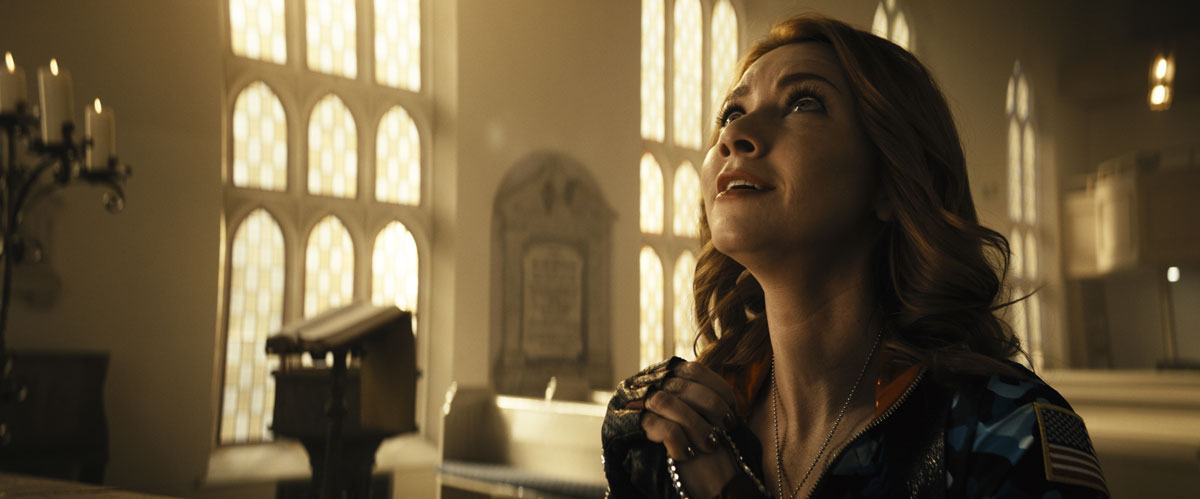
The newest member of The Seven, Firecracker (Valorie Curry), is an overt Christian fascist who becomes the star of Vought News overnight.

At the company’s version of Comic-Con she introduces her cinematic debut on Vought Faith, “Firecracker: The Lord’s Soldier” with a trailer that could double as an ad for the Epoch Times. On her Vought News primetime show, she transforms Starlight (Erin Moriarty), the face of this show’s protest movement, into an enemy of the state and calls for “open season” on her supporters.

But the unstable nuke lurking in “The Boys” since its start was the brazen comingling of Vought and its supers with American politics.

Sure, the United States gladly uses any assistance the Seven and Vought could provide in its foreign adventures. With domestic legislation, senators and congressional officials draw a line between the state and supers.

That’s pretty much been erased in the world of “The Boys,” and ours.

Kripke always designed the show as a critique of MAGA and Donald Trump, who would probably see it as a compliment that the show’s creator made Homelander his stand-in in all ways save for his superpower. Trump can’t shoot death rays from his eyeballs. Yet.

But thanks to his installed loyalists on the Supreme Court, he has absolute immunity to criminal prosecution for any crimes he committed while he was president or any he will certainly commit if he wins the office again, so long as those crimes are deemed “official” acts.

The Nation’s justice correspondent Elie Mystal breaks down what this means in his column “The President Can Now Assassinate You, Officially”:

[U]nlike other officials, presidents are now entitled to absolute immunity from criminal charges. Even a cop can be charged with, say, murder, even if they argue that killing people is part of their jobs. But not presidents. Presidents can murder, rape, steal, and pretty much do whatever they want, so long as they argue that murdering, raping, or stealing is part of the official job of the president of the United States. There is no crime that pierces the veil of absolute immunity.

And there is essentially nothing we can do to change it.

“The Boys” show that in practice and at its most extreme. Homelander kills his fans to use their bodies as props and murders low-level Vought employees as a matter of course. With him calling the shots and his team stacked with loyalists, Homelander’s fourth season arc is in near sync with ours, a thought that grows more frightening as the story progresses.

People will read this as hysteria, I’m sure.  “The Boys” is still a show that recently featured flying killer sheep and an octobunny. Put that aside and look at what the land’s top justices have done to our legal protections. 

The BoysThe Boys (Prime Video)

Let’s rewind to 2018 again, which was also the year the Republican Senate confirmed Brett Kavanaugh, tilting the Supreme Court definitively right. Kavanaugh assured Senators during his hearing that he considered Roe v. Wade to be “settled as a precedent of the Supreme Court,” which is exactly what conservatives thought would reassure the public.

Four years later he participated in overturning that precedent. In late June of this year he and the other conservatives on the bench, three of which were installed by Trump, overturned the doctrine established by 1984’s Chevron v. Natural Resources Defense Council that instructed justices to defer to the opinions of government agency experts when determining how best to enforce laws passed by Congress.

Heroes are exciting. In the right amount, they can entertain us into embracing our destruction.

The new ruling gives the judiciary branch the final say, superseding any expert input from agencies in charge of keeping our water drinkable or preventing the banking industry from diddling us into the next Great Recession.

In "The Boys" July 4 episode, “Dirty Business,” Claudia Doumit’s secretly superpowered vice president Victoria Neuman gathers a cabal of Federalist Society bigwigs in a mansion owned by fellow super Tek Knight (Derek Wilson). Knight brags about his family amassing its wealth through hunting enslaved people.

Now he maintains it by running a network of privatized prisons, which Homelander and Neuman plan to repurpose for their political needs. This is all part of a larger plan to unseat the president by invoking the 25th Amendment. He’s too much of “a doddering slave to the woke mob,” Homelander says.

The power brokers balk at this. "How do you propose to handle the Justice Department?” one asks. Homelander answers that they’ll be his appointees. What about the military's reaction, or OPEC’s? What happens if civil servants resign en masse?

When asked about their uncanny habit of predicting the future, fantasy and sci-fi writers often say they’re simply looking at the world as it exists and gaming out possibilities from there.  Based on what Neuman tells the naysayers, "The Boys" writers must have consulted the Heritage Foundation’s very real Project 2025 and the Trump campaign’s Agenda 47 for inspiration. They weren’t so much predicting the future as following proposals Trump advisers have already laid out.  

Corporate media isn’t sufficiently publicizing these plans, leaving it to the likes of, say, John Oliver to sound the alarm on “Last Week Tonight.”

“The Boys” doesn’t present a direct equivalent to these Orwellian-sounding proposals to end democracy. Smart. Doing so would give those downplaying the existential threat to the American experiment something to point at while calling millions of anxious Cassandras ridiculous.

Instead, the episode’s writer Anslem Richardson penned a power and funding pitch for Victoria that explains why Republicans are so gung-ho to install a king and hand him absolute power, as the Supreme Court did on Monday.


Want a daily wrap-up of all the news and commentary Salon has to offer? Subscribe to our morning newsletter, Crash Course.


“Truth is, America is not a democracy,” Neuman tells her would-be supporters.  “The word democracy makes people feel safe, but the Founders never trusted the masses, because the truth is the masses are . . . stupid. Anyone who owns a ‘Live, Laugh, Love’ mug shouldn't have a say in how our country is run.”

The BoysThe Boys (Prime Video)

On Trump’s Agenda 47 page he lists his plan to convene a White House task force called “Salute to America 250” on Day One – the only day he’ll act like a dictator, he promises!  Its sole responsibility will be to program a year of festivities leading up to a July 4, 2026, celebration centered on Iowa’s state fair.

This reads like a play for the "Live, Laugh, Love" crowd whose approval of wholesome things like butter sculptures and pie-eating contests might lead them to ignore his other plans to “root out” radical left-wing “vermin.”

History distant and near tells us what such dehumanizing language leads to especially when presented beside proposals that sound suspiciously like a modern recreation of Kraft durch Freude, the “Strength Through Joy” program that arose in 1933 to build popular support for another regime that consolidated power into one man.

So what are We, the People, to the rich who are running and ruining things? A labor force that needs “a kind but firm hand,” she says.  “Corporations are the real superpowers here. You should be able to operate without any regulation or restriction whatsoever. After all, you’re billionaires. You are smart enough to know what's best.”

Which means leaving it up to the system to take care of them, offering up the masses for work or slaughter in the bargain. That’s how it goes on “The Boys,” and the direction America is headed.

No matter what happens, though, it’s nice to know we’ll probably still get the day off.

New episodes of "The Boys" debut Thursdays on Prime Video.


A Republican revolt over Trump’s abortion flip-flop threatens to blow up the GOP convention

One of the more obvious signs that the Republican Party had devolved into a cult of personality came in 2020 when the party decided to abandon writing a platform in advance of the election. GOP officials said that whatever Donald Trump wanted to do was fine with them. I don't think that's ever happened before but in the MAGA-fied GOP that sort of thing certainly isn't unusual. This year, however, they're going back to the tradition of writing an actual platform— and it's causing some unexpected heartburn. 

After all, just because party members want a platform doesn't mean Trump does. Yet he and his campaign have acquiesced within certain parameters. The New York Times reported that Trump's campaign managers, Chris LaCivita and Susie Wiles, sent a memo ordering the platform committee and demanding they pare down the document “to ensure our policy commitments to the American people are clear, concise and easily digestible" because "publishing an unnecessarily verbose treatise will provide more fuel for our opponent’s fire of misinformation and misrepresentation to voters." They made it clear that while it's probably ok for the minions to have their little ideological exercise, it's still Dear Leader's "principled and popular vision for America’s future.” 

There are some grumblings in the ranks about this, mostly from anti-abortion activists who want to ensure that the party doesn't deviate from its long-held goal of banning abortion nationwide despite Trump's attempts to hide those intentions with his fatuous declarations that by overturning Roe v. Wade, he "sent it back to the states which is what everyone on both sides always wanted." One staunch anti-abortion activist, Marjorie Dannenfelser, president of Susan B. Anthony Pro-Life America, recently appeared on CNN and made it clear that she believes the GOP platform should remain what it has been for 40 years.

As Dannenfelser points out, the campaign actually blocked a pair of anti-abortion delegates from participating in this year's Republican National Convention and it's not sitting well with that faction of the party, as Politico reports:

According to the affidavits prepared for the RNC’s committee on contests, obtained by POLITICO, the Trump campaign and RNC staffers held a separate vote to elect a different slate of platform committee delegates. 

The documents allege that at least two GOP staffers who were formerly employed by the Trump campaign “[pressured] them to vote against” Ryggs and Connelly and tried to “circumvent” the official vote.

Gosh, I wonder where they ever got the idea to do something like that. 

Even big guns like Ralph Reed, founder and chair of the Faith & Freedom Coalition, are very concerned that this could demobilize the evangelical vote, as he told Politico:

I would strongly urge the leadership of the Republican National Committee and the Trump campaign to proceed with great caution on the platform and avoid doing anything that would discourage or in any way deflate the enthusiasm of pro-life and evangelical vote. Right now, sitting here today, they are prepared to crawl across broken glass, to do everything in their power to see President Trump re-elected. I don’t want to see anything happen that would change that current dynamic.

A similar warning came from Tim Chapman, incoming president of the social conservative group Advancing American Freedom, who told ABC News  that “the talk of changing the Republican party’s pro-life platform is deeply concerning for pro-life Americans across the country,”

Reed, for his part, is now leading what he calls the “Platform Integrity Project” in which he's calling on the faithful to weigh in and demand that the platform holds to its hard-line position. The New York Times reported that a coalition of 10 conservative groups, including the Family Research Council, Susan B. Anthony Pro-Life America and Concerned Women for America, have urged Trump to “make clear that you do not intend to weaken the pro-life plank" while also praising him as “the most pro-life president in American history.”

We need your help to stay independent

And it isn't just obfuscating the party's radical position on abortion that has them upset. They don't want anyone touching their other extremist policies either. As LGBTQ Nation reported, Suzanne Bowdey of the Family Research Council’s site is worried that the slimmed-down platform might not include their opposition to "extremism like same-sex marriage and transgenderism which is currently part of a long section "that accuses the Supreme Court of “rob[bing] 320 million Americans of their legitimate constitutional authority to define marriage as the union of one man and one woman.” They are all in on outlawing IVF and using the Comstock Law to ban contraception and pornography as well. 

They're just playing the roles of anti-abortion activists for their flocks to show that they haven't given up the fight.

Semafor reported that the campaign will attempt to keep this all under wraps by moving the writing of the platform behind closed doors, another break from tradition. Both parties have always written their platforms publicly for the delegates to see and offer input and they've allowed the press to have access and report on it. The meetings are usually aired on CSPAN. The Democrats plan to do that at their convention in August as they always have but the prospect of any kind of argument with the Trump campaign, or one suspects, the public airing of the campaign swatting down members of the rank and file will not be tolerated at the RNC. Keep the family squabbles behind closed doors at all costs. Their leader wants a united front. 

None of this is to say that Trump has actually moderated his views. The truth is that he doesn't really care about any of this culture war stuff but he is worried that overturning Roe v Wade is going to hurt him. He says at his rallies and in speeches, "you have to follow your heart but we need to win elections" which translates to, "don't worry, I'm just saying this to win over voters, I'll do whatever you want once I win the election." 

These folks shouldn't worry too much. The men in charge of the Platform Committee are dedicated, far-right extremists. One of the top drafters is Christian nationalist Russ Vought, who I wrote about here. Another is Trump loyalist Ed Martin, a longtime right-wing operative who is best remembered in the general public for being fired by CNN for racist comments. As it happens CNN's Kfiles turned up some footage of Martin that should come as a huge relief to the anti-choice activists: He's so extreme that he wants to jail women who get abortions and ban the procedure with no exceptions: 

These men are hardcore Christian nationalists who are involved in the planning for a second Trump term. And they are very practical about doing whatever it takes to regain power for that purpose. A little fudging on the platform, letting the Republicans pretend to the mainstream press that they aren't radical in order to win over some of those valuable suburban moms is just the price of doing business. And frankly, political professionals like Ralph Reed and Marjorie Dannenfelser know that as well. They're just playing the roles of anti-abortion activists for their flocks to show that they haven't given up the fight. I'm confident they'll all be on board the Trump train with full enthusiasm when the time comes.

How to survive a heat wave on a fixed income

Mone Choy is 68 and lives in the New York City neighborhood of Inwood, at the northern tip of Manhattan, on a fixed disability income of $1,901 per month. Her rent is frozen at $1,928. She lives with chronic health issues that render her unable to work. In addition to a few other intermittent gigs, Choy covers the rest of her expenses by collecting bottles from her building’s recycling and taking them to a nearby redemption center.

One luxury her budget doesn’t leave room for, even during a heat wave like the one that scorched the city last week — and remains ongoing around the world — is air conditioning. She has several AC units in her apartment (gifts from friends concerned about Choy’s health) but because she can’t afford to turn them on, they sit uninstalled.

“When I experience heat, my blood pressure shoots up and I get dizzy,” Choy said. To keep cool on hot days, Choy has to find air-conditioned spaces elsewhere in the city. To do so, she relies on a resource that the city government has touted as central to its response to extreme heat: the several hundred “cooling centers” that open across the city when a heat advisory is issued.  These are listed on a city website, with a map of accessible sites. Almost all of the cooling centers are in libraries and senior and community centers. The list also includes museums, Salvation Army locations, and Petco stores.

Last Friday, Choy woke up at 4:30 a.m., three hours before the heat would make her apartment unbearable, to pack everything she would need for her day’s journey into a shopping cart. She assembled her lunch, snacks, incontinence supplies, and an extra change of clothes in case of an unexpected lack of bathroom access. “I don’t have extra money to … buy something I forgot,” she said.

Next, she checked the weather report and transit system service alerts, and planned her route. “I take the cooling center information and put that together with my own personal knowledge of senior centers and the ones I think are better funded and less liable to have broken toilets — that happens because a lot of senior centers are located in NYCHA [public housing] buildings.”

Heat waves have put a spotlight on the waning fortunes of New York City libraries, which have become a cultural battlefront in municipal politics under the administration of the city’s mayor, Eric Adams.

She makes her choice of senior center based on its proximity to one of the city’s publicly listed Privately Owned Public Spaces, or POPS. These are spaces inside private buildings like corporate offices, and they are usually made accessible to the public by the site’s developer as part of a deal with the city, in exchange for zoning concessions. Choy says the cooling centers located at senior centers tend to close early for cleaning — “you’re pushed out by 4:00, 4:30 — 5:00 if you’re lucky, the hottest part of the day.” The privately owned centers generally stay open until 9:00 or 10:00. After she’d packed her bags on Friday, Choy left home at 6:00 to catch the bus to St. Peter’s Church in Midtown, where she planned to stay until it closed.

There were about five other people using the senior center as a respite from the heat, but more seniors came in at lunchtime for the free meal it offered. Normally, Choy is a very sociable person and likes to chat with the other visitors, but on Friday she didn’t feel up to conversation. She said she was “fatigued and resentful and just in a place of general low grade dread. I’m going, ‘It shouldn’t be like this in June, so I’m dreading what July and August will be like.’” At the cooling center, she passed her time reading the news on her phone and feeling increasingly dispirited.

One place she’d love to be on a hot day is a library — she loves to read, and it’s an environment where “you don’t have to put up with people giving off crazy energy you don’t wanna be around.” But in her neighborhood, Choy said, the library was closed to make way for a new apartment building. It’s been replaced with a temporary library that lacks a public bathroom.

Heat waves have put a spotlight on the waning fortunes of New York City libraries, which have become a cultural battlefront in municipal politics under the administration of the city’s mayor, Eric Adams. In November, Adams announced budget cuts to the library system that ended Sunday services at libraries citywide. During the negotiations for next year’s budget — for which the deadline is this Sunday — he proposed further cuts to the library system that would have had the likely effect of closing most libraries’ doors on Saturdays as well as an additional $125 million from the libraries’ capital budget, which is the source of funding for repairs to library HVAC systems.

The library cuts have been the source of protests and opposition from the City Council — and yesterday, the intense backlash appeared to bear fruit. In a dramatic eleventh-hour reversal, the mayor agreed to reverse last year’s library budget cuts, restoring funding that would likely allow Sunday service to resume at libraries citywide. It is not yet clear whether the new budget will include the $125 million in capital budget cuts from libraries.*

In a press conference before the heat wave, Adams said, “Global warming is real and we want to make sure that climate change and the heat that it brings with intensity, that people are aware of how to deal with it during a heat wave.” He touted the online map of cooling centers and mentioned that the sites included “many of our public libraries.” 

In a landmark 2002 book, “Heat Wave: A Social Autopsy of Disaster in Chicago,” about the 1995 heat wave that killed more than 700 people and prompted the formation of New York’s cooling centers, the sociologist Eric Klinenberg established that access to social infrastructure and public space helped determine which neighborhoods had the most deaths. He later served on a New York City climate planning commission called PlanYC, where, he told Grist, he “advocated for the city to supercharge its branch libraries … so that they could be updated with heat and air conditioning systems that worked reliably and converted into emergency relief centers during extreme weather.”

In his view, the city’s current approach is a far cry from that vision. “Mayor Adams has consistently shown that the library is not a priority when it comes to city services. And so as I see it, it’s hypocritical for his administration to tell New Yorkers they can rely on the library during a dangerous heat wave, when they’ve essentially made it impossible for New Yorkers to rely on the library in their daily lives,” Klinenberg said.

But the Adams administration has reacted touchily to criticisms that it’s undermining its own heat relief efforts with the library budget cuts. Last week, Brad Lander, the city’s comptroller, noted that, on the first day of the heat wave last week, all the city’s libraries — 41 percent of the cooling centers — were closed because Juneteenth was a federal holiday. Zachary Iscol, the commissioner of emergency management, who oversees the cooling centers, took to social media to call the comptroller’s comments “a pretty significant misrepresentation.”

Lander told Grist the figure came directly from the city’s data on its cooling centers, which his office analyzed in a 2022 report. That report also found that fully half of the cooling centers were listed as closed on Saturdays, and 83 percent were closed on Sundays. 

“We are not currently investing in the civic infrastructure that we need to keep people safe in the climate crisis anywhere near as much as we know we need to. The libraries are the biggest example of that,” Lander said.

Last Friday afternoon, Choy decided to leave the senior center to buy a bag of ice. As soon as she stepped outdoors, she said, “I just remember getting instantly sweaty. It was hard to breathe and I was so grateful that the little drugstore was right across the corner and I didnt have far to walk. I stayed in the store for 15 minutes before I made my purchase. I felt my heart starting to beat really fast; I didn’t want that to move into a lightheaded situation.”

She went back to the senior center and stayed there until 3:30, when the cleaning staff began spraying down the tables and she felt unwelcome. It was 94 degrees out, but because she had already bought the bag of ice to cool her down for the trip back to Inwood, Choy decided to ride the bus back uptown instead of walking to the nearby POPS. When she got there, she sat in the air-conditioned Manhattan Mini Storage locker she rents for around a dollar a day and stocks with books and bottled water.

Some 350 people die annually of heat-related causes in New York City. Only a handful of these cases are heat-stress deaths, or those directly caused by heat. In most cases, the heat exacerbates people’s existing illnesses and comorbidities. Among the most important risk factors, according to city data, is access to home air conditioning — and the funds to turn it on.

“Given that extreme heat is by far the deadliest impact of climate change already — and, sadly, very likely to be much more so in the years to come — we are nowhere near where we need to be in getting ready for it,” said Lander.

In what should ostensibly be a straightforward policy solution, the state offers low-income residents help with heating and cooling their homes through its Home Energy Assistance Program — but the assistance offered through this program heavily skews toward heating. The limited funds available for cooling assistance can only be used to buy an air conditioner, not to pay for running it — and what’s more, these funds tend to run out early every summer. Choy carefully monitors her power usage to ensure she doesn’t spend more than the low-income subsidy she receives from her power company, Con Edison. “If I go over, then I have to carry a balance, and then now you have to deal with the rules of ConEd. Do they want to do a payment arrangement? How long do they let you go with arrears,” she said.

Choy’s apartment takes a while to cool down, even after temperatures outside have subsided. So at around 8:30, once it had cooled down enough for Choy to feel comfortable outdoors, she left the storage center and sat on a bench in her neighborhood. At 11:30, she headed home and went to sleep, prepared to repeat the day’s journey in the morning.

New York City is only at the beginning of what is expected to be an unusually hot summer. Temperatures usually climb in July and August, and could also be increased by a La Niña weather cycle. For Choy, this means more trekking between cooling centers, and in her experience, she sees a signal of what’s in store for many more people — particularly the indigent, elderly, and disabled — as global temperatures rise.

“I don’t think a lot of people make this connection, but I’m purposefully claiming myself to be a climate refugee,” Choy said. “I feel like I’m a canary in the mine. The way I live every summer, it’s how a lot of people are going to have to live.”

*Update, June 28, 11:35 am: This article has been updated to reflect the latest developments in New York City’s 2025 budget negotiations.

This article originally appeared in Grist at https://grist.org/extreme-heat/how-to-survive-a-heat-wave-on-a-fixed-income/.

Grist is a nonprofit, independent media organization dedicated to telling stories of climate solutions and a just future. Learn more at Grist.org

Project 2025 was supposed to boost Donald Trump’s campaign — but it may be backfiring instead

When Project 2025 was released, a number of progressives expressed surprise that Donald Trump's army of authoritarian schemers would boldly publish their plan to destroy American government as we know it. The over 900-page document, commissioned by the people expected to run another Trump White House, is a laundry list of the far-right's most politically toxic ideas, from banning abortion nationwide to mass firing federal officials who believe in protecting public health and safety. One would think that Trump and his allies would try to keep their sinister plans out of public view. Instead, Team Trump published their fascistic blueprint on a website for anyone to read,. They even proudly display the menacing "Project 2025" label on the front page. 

But really, it's not that surprising. The MAGA right learned years ago the value of hiding their wicked plans in plain sight. Authoritarian thought leader Christopher Rufo is the most prominent example. He frequently speaks loudly of his machinations, such as boldly announcing on Twitter that the right is trying to take away birth control, claiming women should not have "recreational sex." Recently imprisoned Trump ally Steve Bannon gloated openly on his podcast about his schemes. Before going to prison, he bragged to the New York Times, "This is a military headquarters for a populist revolt." Kevin Roberts, whose group Heritage Foundation is helping run Project 2025, recently spoke about how Trump will use violence to force the MAGA agenda on the public. 


Want more Amanda Marcotte on politics? Subscribe to her newsletter Standing Room Only.


Trump himself regularly employs this strategy, giving speeches where he declares that his goal is "retribution" against political opponents, promises pardons for the January 6 insurrectionists, and characterizes anyone who objects as "vermin" who need to be eliminated. This strategy works because it depends on the fact that most Americans don't pay close attention to politics. They will never learn that Trump and his allies are saying such vile things. So the MAGA goal with this bad guy posturing is twofold: First, get the juices flowing in their base. Second, cause those progressives who are paying attention to panic. Trumpists then paint the people speaking out as a bunch of liberal crazies who are exaggerating the threat of MAGA.

I often liken it to a guy who pinches a woman's butt in a bar, and when she protests, laughs and insists she's just a crazy lady making it all up. We saw this strategy with the Supreme Court's recent presidential "immunity" decision. It's factually correct that it gives Trump a license to kill, but anyone who speaks this fact is accused of "Trump derangement syndrome" and "madness" by Republicans. 

The strategy largely works, because less politically engaged Americans assume that "both sides" engage in hyperbole. Low information people are ready to believe the false accusations that liberals are "deranged" when they warn of Trump's plans to be a dictator. Project 2025 seemed to be rolled out with this assumption that "normies" would never hear of it, and that the few who did hear would dismiss the fears as overheated nonsense. 

Instead, however, there are promising signs that people who aren't political junkies are starting to hear about Project 2025. Even better, those folks aren't immediately dismissing it as progressive theatrics but may be genuinely alarmed.

On Sunday, actress Taraji P. Henson took a break during the BET Awards, which she was hosting, to speak out about Project 2025. "The Project 2025 plan is not a game. Look it up!" she told viewers. "I’m talking to all the mad people that don’t want to vote. You’re going to be mad about a lot of things if you don’t vote."

The clip went viral, amplified by other celebrities like Mark Ruffalo. So the MAGA forces swung into action on social media, accusing Henson and Ruffalo and other progressives of making it all up. "Is Project 2025 in the room with you?" a blue-checked user sneered under Ruffalo's tweet. These efforts at gaslighting people run against a real problem, however: The drafters of Project 2025 seek to promote their authoritarian playbook. Thus, a simple Google search generates a slew of explainers from various news organizations, with even more coming out rapidly, as a response to the rising number of people asking, "What's Project 2025?"

"We received a flood of reader inquiries asking if Project 2025 was a real effort," the fact-checking team at Snopes wrote in their lengthy explainer published Tuesday. Google Trends confirms that the number of searches for "project 2025" has grown dramatically in recent days. 

Henson's speech juiced the search rate, but this data shows interest levels were rising before her speech last Sunday. Earlier this month, John Oliver did a segment about Project 2025 on his HBO show, though the boost of interest from that was modest. His audience tends to be people who are already politically engaged and have heard about the initiative from the news. Perhaps more importantly, President Joe Biden's campaign has started a big media push to raise awareness, starting with a website last week that offers "a taste of Trump’s Project 2025" with bullet points like, "Takes Away Reproductive Freedom Nationwide" and "Terminates the Constitution." The campaign projected a QR code around Atlanta Thursday that sends people to the site. 

We need your help to stay independent

There have also been a few TikTok videos garnering millions of views that break down what Project 2025 is, and what a threat it is to ordinary people.

@briantylercohen everything you need to know about Project 2025 #politics #project2025 ♬ original sound – briantylercohen

Perhaps one of the most telling signs that this is beginning to backfire on Trump, however, is the way the MAGA forces on social media are starting to freak out. As Democratic activist and researcher Will Stancill pointed out, the MAGA people who pretend to be leftists to sow confusion online are busy at work trying to pretend Project 2025 is, uh, a Biden thing. 

Perhaps the right's mistake was giving the initiative the name "Project 2025," which sounds like something out of a dystopian sci-fi novel. Trump's in-house team has the same urge, as they have "Agenda 47," a lighter-weight version of the same fascistic game plan. Trump's campaign likely went with scary-sounding names on purpose, both to thrill their sadistic foot soldiers and to cause liberals to react fearfully. But those monikers also make them memorable enough to break into the consciousness of people who aren't paying close attention. Swing voters and people who aren't sure yet if they're going to vote are starting to hear about this "Project 2025" — and they do not like it. 

That's now how this was supposed to work.

Even in early June, polling showed only a quarter of Americans had heard of Project 2025. It was, for a time, working as likely intended: To motivate hardcore MAGA people and alarm partisan Democrats, all without even being noticed by the everyday people who still haven't made a choice of who to vote for or whether to vote. 

There hasn't been new polling data yet, but this spike of interest suggests there's a strong chance that the sands are shifting. If the chatter about Project 2025 continues in both the press and social media, the knowledge of Trump's plans might start to influence the election — and in ways he will not like. Trump cannot win without a large percentage of voters backing him under the false belief he's "not so bad." The more they find out about what he intends to do in office, the more will have second thoughts about risking another Trump term. 

Who you gonna believe, Biden loyalists or your own eyes and ears?

During the week since President Joe Biden’s awful debate performance, spinners for his re-election campaign slowly began to admit what actually happened. Their desperate efforts to erase history could not blot out what 50 million viewers saw and heard. The conclusion is inescapable: Biden cannot be a credible candidate to defeat Donald Trump this fall.

Unfortunately, Biden’s ego has proven to be much more resilient than his cognition. His loved ones and sycophants, in concentric inner and outer circles, cling to talking points that are patently dishonest, often preposterous, and virulently dangerous for prospects of preventing a second Trump presidency. By whistling past the graveyard of Biden’s credibility as a viable candidate in 2024, the pretenders are doing a huge disservice to all who want to avert a full takeover of the U.S. government by the fascistic Republican Party.

Let’s start with the innermost circle — the first couple. The day after the debate, both sidestepped what it had shown, instead striving to make it about one man’s quest to show individual resilience.

I know like millions of Americans know — when you get knocked down, you get back up,” the president told rallygoers in North Carolina. Meeting in New York with donors, Jill Biden said: “When Joe gets knocked down, Joe gets back up, and that’s what we’re doing today.”

She resorted to hyperbole the next day at another fundraiser, saying: “Joe isn’t just the right person for the job. He’s the only person for the job.”

Jill Biden’s role goes far beyond the personal with her husband. After Biden became president, Vogue described his wife as “a key player in her husband’s administration, a West Wing surrogate and policy advocate.” But it’s worth asking what kind of “key player” could tell President Biden immediately after his disastrous debate performance, as Jill Biden did late Thursday night: “Joe, you did such a great job! You answered every question! You knew all the facts!”

A master class in evasion and obfuscation came moments after the debate ended when California Gov. Gavin Newsom went on MSNBC to exhibit his damage-control skills. The damage was beyond repair, but he did his best.

“On the signature issue the Democrats have, which is abortion, the president’s response was garbled and undirected at best,” a reporter pointed out. “Do you feel like he did what he needed to do on an issue that could motivate voters?”

“I think it’s significantly insignificant, because it’s de minimis, because the American people have made up their minds,” Newsom replied. “They don’t support the policies of Donald Trump” on abortion.

Newsom went on: “We have the opportunity to universally have the back of this president, who’s had our back. You don’t turn your back, you go home with the one that brought you to the dance. A hundred percent. All in. And I was very very proud that he was able to articulate the work that he has done, and lay a foundation of understanding of the lies and the deceit that continue to come out of Donald Trump’s mouth.”

The day after the debate, interviewed by Al Sharpton on MSNBC, the Democratic National Committee’s chair, Jamie Harrison — who serves at Biden’s pleasure — echoed Newsom’s carefully obtuse rhetoric, proclaiming that “Joe Biden has always had our back, and we’re gonna have his.”

Meanwhile, liberal mega-substacker Heather Cox Richardson absurdly extended her longstanding record as a scholarly shill for President Biden by writing: “Biden needed to demonstrate that his mental capacity is strong in order to push back on the Republicans’ insistence that he is incapable of being president. That, he did, thoroughly. Biden began with a weak start but hit his stride as the evening wore on. Indeed, he covered his bases too thoroughly, listing the many accomplishments of his administration in such a hurry that he was sometimes hard to understand.” 

But such intellectually disingenuous claims have suddenly worn thin in a wide range of media. Habitual supporters of Biden, such as Joe Scarborough at MSNBC and Thomas Friedman at the New York Times, responded to his abysmal effort in the debate by calling for him to drop out of the race. The Times editorial board did the same. A vast array of mainstream outlets featured urgent calls for Biden to withdraw as a candidate.

Yet party leadership was worse than dubious after the debate. Former President Barack Obama quickly and dismissively declared on X: “Bad debate nights happen.” Former House Speaker Nancy Pelosi said, “Let’s not make a judgment about a presidency on one debate.” House Democratic power broker Rep. James Clyburn of South Carolina intoned: “Let’s just stay the course. Chill out.”

By mid-week, Pelosi and Clyburn had changed their tune. Pelosi commented: “I think it’s a legitimate question to say, is this an episode or is this a condition?” And Clyburn shifted to promoting Kamala Harris: “This party should not in any way do anything to work around Miss Harris. We should do everything we can to bolster her, whether she’s in second place or at the top of the ticket.”

We need your help to stay independent

But the impulse to deny the obvious about Biden’s impairment remains strong. On Wednesday, after meeting with him at the White House, Democratic governors took turns blowing smoke. “President Joe Biden is in it to win it, and all of us said we pledged our support to him,” said New York’s Gov. Kathy Hochul. The Democratic Governors Association chair, Minnesota’s Gov. Tim Walz, proclaimed: “The governors have his back, and we’re working together just to make very, very clear on that.” 

Notably, prominent Democrats who’ve refused to acknowledge that Biden was catastrophic in the debate also refuse to acknowledge that he has been directly aiding the mass murder of Palestinians in Gaza. That’s what happens when deference to a leader substitutes fealty for truth. 

Last weekend, my colleague Sam Rosenthal wrote about his experience of flyering for RootsAction’s Step Aside Joe campaign at a meeting of the Democratic National Committee in early 2023: “How did DNC members, staffers, and media attendees react to our open display of dissent? About how you would expect — most ignored us, a few others mocked us, one or two even angrily confronted our ragtag group.” 

Days after the debate, USA Today described the results of a new poll: “72 percent of voters do not believe Biden has the mental or cognitive health to serve as president, as well as nearly half of his own party. That’s up seven points from the beginning of June.”

 But at the same time those poll results were released, former Biden White House chief of staff Ron Klain “said that it was 100 percent certain the president would stay in the race,” the New York Times reported. Fingers stuck firmly in his ears, Klain commented: “He is the choice of the Democratic voters. We are seeing record levels of support from grassroots donors. We had a bad debate night. But you win campaigns by fighting — not quitting — in the face of adversity.”

Now, to challenge such lockstep conformity among Democratic Party officials who continue to serve as Biden 2024 enablers despite his debate implosion, RootsAction has launched a campaign for constituents to send Democrats in Congress a direct message: “Tell Joe Biden — privately and publicly — that he should voluntarily be a one-term president. The debate shows clearly that he’s not up to the imperative task of defeating Trump in the fall.”

“Scarcity mindset”: As reproductive rights are eroded, abortion funds are running out of money

In 2024, the National Abortion Federation and Planned Parenthood’s Justice Fund had the largest budget in its history. Still, on July 1, the organizations had to make the difficult decision to slash their budgets from giving 50 percent assistance to people to 30 percent with no exceptions. This comes at a time when many abortion clinics in the north are seeing a surge in patients as a repercussion of Florida’s six-week abortion ban, and as Iowa’s six-week ban is expected to take effect later this month.

“We had to make this shift in funding because the need has skyrocketed with so many additional bans and people being forced to travel further care,” Brittany Fonteno, president and CEO of the National Abortion Federation, told Salon in a phone call. Fonteno added they’ve been spending approximately $6 million per month on procedural funding and upwards of $200,000 per month on travel funding.

“At the previous rate of funding, that $6 million mark, we would have run out of funds in the fall, leaving so many people without the vital support they need to access care," she said.

A decrease in funding per patient allows the organizations to stretch the fund and make sure they don’t turn anyone away for the rest of the year. The funds are usually used to cover procedures and travel costs. It’s estimated that only one in three Americans can comfortably cover a $400 emergency expense.

As Salon has previously reported, it’s easy to spend up to $1,500 or $2,000 on one person's travel expenses — and that doesn’t include the procedure itself, where the price varies based on the complexity of it. It’s also almost unheard of that insurance will cover the procedure when traveling from a state where there’s limited access to abortion care. 

It’s not sustainable for “philanthropy alone” to solve this crisis.

“Many health insurance plans refuse to cover abortion care, even though it is an essential part of reproductive health care,” Fonteno said, adding that with many people having health care tied to their work, it’s time for businesses to step up. “That means, of course, the potential to donate dollars, but also in-kind donations, like donating rideshare vouchers or airline miles, vouchers for food — all of these pieces that go into the puzzle of making sure that abortion access is truly available for people.” 

However, she emphasized it’s not sustainable for “philanthropy alone” to solve this crisis. On the ground, as another state gears up to shut its doors, Megan Jeyifo, executive director of Chicago Abortion Fund, told Salon abortion clinics across the country are scrambling to figure out how to make up for the loss in funds. 


Want more health and science stories in your inbox? Subscribe to Salon's weekly newsletter Lab Notes.


“The conversations I had all last week were not based on Florida or Iowa or managing the influx, it's how are we going to pay for it?” Jeyifo told Salon. “We immediately gave a pretty significant block grant to our largest clinic here in Chicago, to Family Planning Associates, because we are very concerned that they are going to have to turn people away who are no longer eligible for this funding.”

Jeyifo gave an example of how they are seeing the effects of the decline in funding on the ground. One patient, she said, who had an appointment last week had to reschedule for personal reasons. As the pledge to each patient has decreased 20 percent, the reduction in funds cost this patient “thousands of dollars,” Jeyifo said. “That is what we are primarily concerned about: funding, not appointment availability,” Jeyifo emphasized. 

"That is what we are primarily concerned about: funding, not appointment availability."

According to the Guttmacher Institute, there has been a rise in interstate travel for abortion care since Dobbs overturned Roe v. Wade in June 2022. The institute estimates one in five abortion patients traveled out of state for abortion care in 2023, compared to one in 10 who did so in 2020.

Earlier this year in Arizona, Kari Lake brushed off criticism of abortion bans in her state, saying "Even if we have a restrictive law here, you can go three hours that way, three hours that way, and you're going to be able to have an abortion.” But the reality is not so simple. The average support cost, such as for lodging, the Chicago Abortion Fund provides a patient is $380. The average voucher they provide for the procedure itself is $480. And that’s just an average.

Fonteno said she’s aware that the 20 percent reduction will significantly impact future patients.

“We know that even with our previous level of funding, it wasn't enough to truly meet all of the need that exists in the landscape right now, and so this will potentially have impacts on patients' ability to access the care that they need, it might impact patients ability to travel,” Fonteno said. “It might impact where they end up going for care, it’s not lost on all of us that this is a completely unfair and devastating situation.”

We need your help to stay independent

Alisha Dingus, the development director at the DC Abortion Fund, told Salon the decline in funding comes at a time when they’re experiencing a surge in patients from Florida. Since Florida’s six-week ban went into effect, their call rate from Floridians increased 200 percent in one month. For patients under 12 weeks of gestation in the DC region, they can usually cover almost all of the costs of abortion care. But with a reduction in funds, each week will be a struggle as they operate on a weekly budget. 

“We anticipate that we're probably going to start running out of money the second day or third day each week,” Dingus told Salon on Wednesday. “We've been operating on a weekly budget now for almost a year of $32,700 and just this week alone, the first week of cuts, we hit our budget yesterday.”

Dingus said “resources are drying up,” and that this will radically change “care across the country.”

“We know, unfortunately, it means some people won't get funding and will be forced to give birth,” she said, adding that it’s troubling to think about what the situation could look like in 2025. “There are only a handful of funders that support abortion funds right now in the country, and unless we see a shift, I think we're just all going to operate under kind of a scarcity mindset.”

Labour scores big win in UK: Keir Starmer takes over as prime minister

The British Labour Party, which has been out of power since 2010, has won a huge majority in the British Parliament — although the verdict of the electorate is not quite as overwhelming as the numerical results suggest. Keir Starmer, the moderate who has led Labour since the party's crushing defeat under left-wing legend Jeremy Corbyn in 2019, literally became prime minister overnight, after the resignation of Rishi Sunak, who has said he will also resign as leader of the Conservative Party after its devastating collapse at the polls. 

At least Sunak managed to hold his own seat in Parliament, although many ministers in his outgoing government were defeated. Sunak conceded defeat in a congratulatory phone call to Starmer at around 6 a.m. British time, and announced his resignation a few hours later in front of the prime minister's famous front door at 10 Downing Street in London. In other headline-shaping events, far-right dissident Nigel Farage won a seat in Parliament for the first time, and his anti-immigrant Reform U.K. party clearly played a major role in the Conservatives' epic defeat. The Scottish National Party, which in the last decade became the leading political force in Scotland, was nearly wiped off the electoral map, losing most of its seats to a Labour surge.

Yet despite the overwhelming scale of Labour's victory, its overall vote count is up only slightly from five years ago, and Labour lost several seats to independent candidates. One such case is especially ironic: Corbyn, the now-expelled former Labour leader, successfully defended his longtime London seat against his old party's official candidate.

Final results indicate that Labour won 412 seats in the 650-seat House of Commons, a net gain of 209. It's a nearly unprecedented electoral swing, creating one of the largest parliamentary majorities in British history (just five seats short of the majority won by Tony Blair's "New Labour" in 1997). Some commentators had suggested an even bigger win, along the lines of 450 to 500 seats, but no one in Starmer’s party will express disappointment at this historic turnaround.

But the big news here is the devastating defeat suffered by the Tories (i.e., Conservatives), historically the most successful center-right political party in any Western-style liberal democracy. They have suffered a net loss of 244 seats since 2019, and while most of those went to Labour this time, a few were won by Reform U.K. and a surprisingly large number to the centrist Liberal Democrats, who seemed nearly irrelevant after a series of electoral setbacks and political failures but have achieved their best result in decades. For the Tories, this election comes very close to a worst-case scenario, and their final count of 121 seats is the lowest in the party's 192-year history.

Minor-party results will also be a big part of this election's narrative. The Liberal Democrats gained 60 seats from their previous total of just 11. Farage's Reform U.K., a right-wing nationalist party founded in 2020, won just four seats — from a starting point of zero — but damaged the Tories immeasurably by draining off conservative-leaning voters in scores of parliamentary districts. The Scottish National Party, plagued by a series of internal scandals, has apparently lost all but nine of its previous 48 seats to Labour. Other small parties also made modest improvements, with the Greens and Plaid Cymru, the Welsh nationalist party, each winning four seats.

Although Northern Ireland technically remains part of the U.K., the major British parties do not generally contest seats there. This election marks a turning point in that province, with Sinn Féin, the largely Catholic republican party that advocates a united Ireland, emerging as the largest single party, winning seven of the 18 parliamentary seats. In fairness, that result partly reflects an internal schism among the Protestant-dominated unionist parties that want Northern Ireland to remain British. 

Sunak and Starmer both paid ritual visits to King Charles III at Buckingham Palace on Friday morning, British time — the former to tender his official resignation, and the latter to be "asked" by the monarch to form a new government, as tradition demands.

James Carville recommends freezing donations to Biden-supporting candidates

Once mega-powerful democratic advisor James Carville told donors to apply pressure on down-ballot candidates if they want to force Biden out of the race.

Per newspaper Semafor, Carville told top democratic donors on a Tuesday conference call that they should channel their worries about Biden’s age and refusal to drop out into the candidates that propped him up.

Seventy-two percent of people want something different,” Carville, who worked on the failing campaigns of John Kerry, Hillary Clinton, and Michael Bennet, said on the call. “Why not give it to them?”

When asked what donors could do to push for a change, the former Clinton aide told donors that they could push down-ballot candidates with their money.

“What I would say is, if we don’t do something about this, I’m going to put you on call block on my cell phone,” Carville reportedly said.

While a mere handful of democratic congresspeople and lawmakers nationally have called on Biden to exit the race, pressure is mounting from the donor class and some media outlets, including the New York Times editorial board.

Carville’s comment, said on the call to democratic advisors Paul Begal and Dmitri Mehlhorn, comes as top democratic party bosses and pundits try to push the 81-year-old president out of the race.

Melhorn, a staunch supporter of the Biden administration, pushed back on Carville during the call, per Semafor.

“Kamala Harris is more threatening to those swing voters than a dead Joe Biden . . . if Joe has to go, it’s gonna be Kamala. And if it’s Kamala, it’s gonna be harder,” Melhorn said.

Carville, who earlier this week claimed the Biden campaign used his name without permission in a fundraising text, told CNN’s Jake Tapper on Monday that Biden should leave the race.

Transcript: 2 years before deal, prosecutors knew about Epstein’s rape of teenage girls

A Florida judge dropped a bombshell 150-page transcript related to a 2006 grand jury investigation of Jeffrey Epstein, revealing that prosecutors held onto knowledge that Epstein sexually abused underaged girls.

Per the transcripts, the deal between Epstein and prosecutors came two years after they learned that Epstein raped teenage girls, and resulted in minimal punishments for the billionaire human trafficker, who went on to continue to sexually exploit children until his death in 2019.

"Details in the record will be outrageous to decent people,” Judge Luis Delgado wrote, releasing the filings after a 2024 Florida law made it legal to do so for transcripts related to Epstein.

The 2008 charges came down to a count of solicitation of prostitution from a minor, despite investigators’ knowledge of Epstein’s pattern of behavior, including numerous incidents of rape.

The filing, which itself further unveils prosecutorial missteps that enabled Epstein’s later conduct, came years after the lenient, and delayed, sentence was criticized.

“The story of how Jeffrey Epstein victimized some of Palm Beach County’s most vulnerable has been the subject of much anger and has at times diminished the public’s perception of the criminal justice system,” Delgado wrote.

As Florida’s Southern District Attorney, Alex Acosta, the former Secretary of Labor under Donald Trump, approved a non-prosecution agreement with Epstein in 2008, despite prosecutors’ knowledge of the rapes.

Acosta, who also served as a clerk for Samuel Alito, left the Trump administration in scandal after details emerged outlining his botched prosecution of the prolific trafficker.

At the time, then-President Trump emphasized that the decision “was him — not me.”

The former president is not named in the grand jury transcript, though his associations with Epstein are well documented.

“Drag is a protest”: How Chappell Roan’s fierce persona spells liberation for the queer community

"I'm your favorite artist's favorite artist," Chappell Roan said on the Coachella main stage singing to thousands in the California desert heat in April. On "The Tonight Show Starring Jimmy Fallon" in June, she explained, “That was a reference to ['RuPaul’s Drag Race' Season 15 winner] Sasha Colby. Sasha Colby said, ‘I’m your favorite drag queen’s favorite drag queen.’ And it just hit me through the heart."

If you know only one thing about rising music star Chappell Roan, let it be that the 26-year-old singer's music, aesthetic and fashion are all fully inspired by drag. She told People Magazine that her 2023 album, "The Rise and Fall of a Midwest Princess" is “just daydreams in drag.” 

"She's a real tiny little thing. Her energy of love was just bigger than her body size, if you will."

The openly queer artist is rapidly ascending into a level of pop stardom that even Roan herself didn't see coming. From viral performances at Coachella and the Governors Ball Music Festival to a heart-wrenching song about the girl you're in love with denying her sexuality, Roan's almost overnight success has fascinated listeners, prompting them to question who exactly she is.

I was in the crowd at New York City's Governors Ball when Roan came out painted head to toe in a rusty lime green, crown on top of her long green wig and a torch in one hand and a blunt in other. She was Lady Liberty, but with a twist. She denounced the White House's invitation to perform for Pride and fervently advocated for the rights of several groups.

"I am in drag of the biggest queen of all, but in case you had forgotten what's etched on my pretty little toes: 'Give me your tired, your poor; your huddled masses yearning to breathe free.' That means freedom and trans rights," she said. "That means freedom and women's rights, and it especially means freedom for all oppressed people in occupied territories."

Both Roan's passion for drag and progressive outspokenness has drawn the LGBTQ+ community to her. Salon spoke to Denver drag artist and co-chair of Black Pride in Denver, Juiccy Misdemeanor, who was asked to open for Roan's tour earlier this year. Juiccy described the crowd's energy as unexpectedly welcoming. "It was like I was hit by a wall," she said.

But mostly, Juiccy is in awe of the awareness Roan drew attention to at the Governors Ball. "I thought it was beautiful. I was like, work. This is a political platform that she was also utilizing as well. That look made so many statements. The Statue of Liberty is a political figure, it's a landmark, and it's a historic thing. For you to dress as her, but then also be who you are, support LGBTQ, say "F**k you," this whole message, up to that White House – it's so beautiful. You're using your line, your platform, to really just build something for this community and it's for people."

Read more of my interview with Juiccy Misdemeanor down below. 

The following interview has been edited for length and clarity. 

How did you get the opportunity to open for Chappell Roan in Denver? I know she had put out a tweet looking for drag artists to open for her on tour. 

I want to say tour manager, or someone in her crew, Instagram DMed me. It was random, and I thought it was a joke, but his name was Kyle Boland [of The ART] . . . But he had messaged me over for Chappell Roan and saying, her tour was looking for Queens or artists. I had to do a little recon, because I'm from the Midwest, but I didn't know. And I was like, "OK, this is real."

Can you speak to what that experience was like? Is this your first time opening for a mainstream artist? What was the energy and environment like at a Chappell concert?

This was my first time opening for a mainstream artist in capacity with drag. It was very humbling for sure. And at the Boulder Theater. First of all, the energy was already infectious outside because the line was so long. She has those themes, the dress code themes, and so everyone was in this, like psychedelic, futuristic moment. I walked up; they were screaming. And I was like, "Oh my god!" We get to the Boulder Theater and we get downstairs to our dressing rooms — amazing setup and an all-access pass. Chappell's doing yoga and stretching and getting her makeup done. All of a sudden, we get to meet her, and it's a whole moment. She's really sweet. She's a real tiny little thing. Her energy of love was just bigger than her body size, if you will.
Chappell RoanChappell Roan performs during the 2024 Kentucky Pride Festival at Waterfront Park on June 15, 2024 in Louisville, Kentucky. (Stephen J. Cohen/Getty Images)

Chappell has gathered inspiration from the Divine, wearing a look similar to her “Pink Flamingos” style of over-drawn lips, a mole and blue eyeshadow – what do you think of this homage? 

It's very intuitive. It's very smart. It's on brand. I feel like she always comes to that. She just said the other day, I watched her interview, she did the whole New York performance, and they were inviting her to perform at the White House. She was talking about how "until you do these things in my community, this is all you get." Her playing homage to Divine for instance in drag — it's like a simultaneous connection because drag is a protest. I feel like she's protesting in her own way through her music and her looks. It's smart the way she looks. I think it's very, deeply connected to how she feels, as far as her support and advocacy of LGBTQ. It's really like all personal protests. Also just a really beautiful thing that she's keeping an open space for the LGBTQ community.

What about icons like Divine are so universal to drag artists and to queer people? How do they inspire young people who are interested in the drag art form? 

"She really was just doing her music, saying her piece and wearing fierce looks, and the great community saw refuge in that."

You just said that universal connection and that universal reach. I think Divine really has a way of just — drag in general — bringing people together and making a safe space for everybody. Just being someone who makes space and hold space and makes themselves known as someone who is unapologetically themselves. If I saw that as someone who was just trying to be a drag artist, I would be most definitely inspired. If I see someone just doing what they want to do, and now they want to express themselves fully with no hesitation then I'm trying to do the same thing. I would immediately be inspired as I was with other drag artists who inspired me when I was growing up. So I think that Divine's presence is something that's gonna hopefully inspire and encourage those younger choosing drag to really, actually do what they want to. But also just seeing how they inspire Chappell and the music influence, I guess these small inspirations continue to thrive and also continue to help our community grow.

How does drag tell a story through fashion and makeup?

Just think about this way, if you see a drag artist and they didn't have any clothes and makeup . . .  It's like, we turn into our other selves, like an alter ego. We form a different persona through our expression of lipsyncing, acting, dancing. But also the clothes and makeup are more so the definitive of the personality itself. So like myself as Juiccy Misdemeanor: yes, my style of choice, yes, my style of drag, yes, my hair, makes me a certain type of drag artist. But when you see me and see me do things like wear makeup you better know who I am because I do my makeup, my clothes in a certain way. That certain way is to express my story of who I am in drag. So personally, I feel like I'm very inspired by old school Southern Belle pageantry drag, very high, glam and sparkly. Again, those things help convey the story of who you are as a drag artist.

As someone who's seen Chappell in person what do you feel like her fashion or her makeup says about her as an artist or as someone who's putting on a drag persona on stage? 

When I first saw her look, I thought avant-garde. I thought inside out. She expresses herself through her music and song outwardly. She's very outgoing. On top of that, with her clothes and her hair, making her look a complement of that. [She's] basically out of this world when she dresses. Then she asks the audience do the ["HOT TO GO!" dance] with her. She's out of this world but also fully connecting with the audience because you guys are wearing the same thing, I'm wearing the same thing, which is you supporting me. I love it. It makes me feel good. My energy starts out with costumes and looks. She's inviting us into her world and asking the audience to engage in the look. It's all one big party.

"I feel like the LGBTQ community is gonna take over the world."
Chappell RoanChappell Roan performs during the first day at the Coachella Valley Music and Arts Festival on Friday, April 12, 2024 in Indio, CA. (Dania Maxwell / Los Angeles Times via Getty Images)

Chappell has been quoted saying “I’m your favorite artists’ favorite artist” which she credited to her favorite drag queen Sasha Colby’s line, “I’m your favorite drag queens favorite drag queen." Why is it important to give homage and flowers to the people that came before?

It's a very direct point like a respect thing. A lot of people who love "Drag Race," "Bye, Bye Drag," or get any reference from drag, hopefully they recognize where drag came from, and where it started. I think that's just the biggest thing about being allowed to use some culture that you may or may not directly connected to, to be inspired by, which is fine. Please be inspired. She's amazing, right? If you're doing that, this is a space where, yes, she's a part of the family. But also it's like one of those things where she may not directly know what drag was, she may not have actually been a "drag queen," —  a drag drag queen. She's like, "I'm a drag queen." I love that because it's so niche and funny, and it's so cute. But also she does it respectfully. Respect is a big thing because it's like you are adopting or adopting a culture and living with it and expressing it and sharing it with the world. But also you respect that you know this is what inspired you. You always say that you give homage, you pay your respect to that. Not only are you allowing cities across the world to actually recognize this culture that is being targeted right now, you're also asking them to respect it and reflect. So I think that's beautiful as well. 

I was at her Governors Ball set when she came out as the Statue of Liberty, and while the statue is not necessarily a drag artist, Chappell called her a queen that represents liberation for all. What are your thoughts on the look?

This is the moment where I was saying that she had a political moment. I thought it was beautiful because she referencing the White House asking her to come and sing, and it went viral. She was like, "No, I won't do that because you set these people free." And I was like, work. This is a political platform that she was also utilizing as well. That look made so many statements. The Statue of Liberty it's a political figure, a landmark, and it's a historic thing. For you dress as the statue but then also be who you are, support LGBTQ, say, "F**k you," this whole message, up to the White House – it's so beautiful. And then she does it controversially, not just through her songs, again, but through her looks, through her references, through her things. All of that plays a really big part in our political process or activism.

What about the drag art form is liberating to you? And why do you think people resonated with Chappell’s speech calling for the rights of women and trans people?

I am a gay, queer, black male who does drag. So right after that, it resonated with me, because it's my life, who I am, it's my identity. It's so beautiful that someone who was a TikTok star, Instagram or whatever can blow up to be this linear model of protest — being an advocate and being somewhere in the front line of I want to go to a concert of thousands of people and say that kind of thing. For me, as a person who does drag in the LGBTQ community, and also someone who's a community leader in Colorado, I do a lot of things, organizations, Black Pride. As I'm trying to make space for people in my community, I see her doing these things — see her just going above and beyond. It's so inspiring to me to keep pushing and fighting for my community and for people who are in my life. My trans brothers and sisters who I have in my life, it's such a push. You think in your mind that, "Oh, my little voice doesn't matter." But remember she was just a little voice, and she blew up because of who she is. She blew up genuinely. She really was just doing her music, saying her piece and wearing fierce looks, and the great community saw refuge in that, and it's beautiful. She's so inspirational. I know she makes me want to do what I do. 

She also rejected performing at the White House for anti-war, transphobia and women's reproductive health. How do you feel about visibility in high-profile spaces like this?

It is nerve-wracking because you have to follow the bullet and be in the front line. Be as bold as you can. It is very necessary that we have exposure and people see LGBTQ people. Because there are so many historical and cultural things that come from the LGBTQ culture and history, and if they did not derive from that history, we would not have those cultural fads or those trends that we have now, and one of them, of course, being drag. Without just any kind of dressing up or impersonation, certain clothing style, certain showing of the bodies, a lot of these things were liberating things of the LGBTQ community that they have moved on to other people.

Without the community, and without that culture, a lot of things would not be present and prevalent today. So I'm like, yes, it's important. Yes, it's very prominent that we are recognized and build space. Because no shade I feel like the LGBTQ community is gonna take over the world. It's nerve-wracking because you have be careful of the surroundings. Anything can happen. Some people don't believe or agree with LGBTQ people and they're trying to take our rights away, and things are happening. Yes, it may be nerve-wracking, but if you have the ability and the courage to do so, as she is doing, then why the heck not?

I know you have performed at Black Pride Colorado. What about that excites you? 

For me, being one of the co-community members and founders of Black Pride Colorado I love community, first things first. I love to hold space for my culture. And I know that unfortunately,  I don't mean it's a bad way at all, but Colorado is not as diverse as I think it would be in certain parts. So when you are creating a pride event or a community celebration, creating space for a certain, either marginalized or less [prominent] community, it's like, how do you create a space and a week of events or things like that for community building and expression without being restricted to all?

Black Pride, yes, it's celebration, yes, it's a community engagement, yes, there will be some references you may not or may not know, but everyone's allowed to be there, because we want people to understand, so that you can be support. You can be someone who is a supportive of these cultures, these things, but also respect the spaces you're walking into because these are being made and curated for Black and brown people.

"This is the protest that we're protesting for our personal selves every day."

For example, this year, on June 14, I can for first time say that Colorado and Mayor Mike Johnston decreed that June proceeded to be Black Pride Day. For me, that was a really big accomplishment, because it had been years, and we had been fighting for this community. So it was just a beautiful thing that would recognize and give us a confirmation because we freaking deserve it. There's a lot of things that I know we have to get done, and there's a lot of things that you may face but it's those different moments like that, where you see this city sees, and the community sees that there is a need for this. There is work being done. There is a beauty in community and your culture.
Juiccy MisdemeanorJuiccy Misdemeanor (Eboni Coleman of EB PIXS Photography)

You come from the Midwest and have roots in the South but live in Colorado. I know that each scene is different from each other, but how does where you live inform the type of drag you do and how it's accepted?

I grew up in St Louis, Missouri. I went to school college in Kansas City, Missouri, but my family derived a little bit south so Georgia area, and a lot of that drag manifested in the South is very pageant influence – so very polished, lots of gowns, big earrings, big hair, fur. A lot of that drag comes from the old school term of FI or female impersonators. It was about looking like a woman. I said my drag sounds very sparkly, the same way I'm old-school drag. But then that can also very toxic because then it just limits those who can do drag. And it was very much like the binary: drag kings or drag queens, a man or woman.

I'm a professional dancer for a living. So I got a job here to dance with a dance company. I moved here and I was on tour, and as I was back in town, I would go out and see drag. In Colorado, there's so much drag, you know, there's drag kings, drag queens, drag they them, drag it, drag people, I don't know, they're just everything. And it's like, OK, so there is a world where there is for everyone.

A young, rising star like Chappell has really made it clear her music is for queer people who may feel isolated – how does her drag persona reflect that? What do you have to say to the people and young people looking for camaraderie and community during Pride and every month after Pride? 

One of the biggest reasons why I left the Midwest was because, first of all, I'm an artist. But at the time, it was like, the only way was either go to New York or LA. It was like, those are the Mecca art hubs. So it was like, you gotta get out because St. Louis is so small-minded. St. Louis is so closed off. There are no arts here. I was blessed enough to find my way to an art school, get a scholarship, maneuver. But for those who may not have access to those resources or been shown that one glimpse of hope or scholarship, or whatever, you feel a little isolated. If you want to be extra or out there or whatever, you have to wait until Pride to make that noticeable versus every day. I used to teach my summer campus kids rebel anthems. It's like I'm rebelling or like I feel my best self music which is your own form of rebellion.

She's making a lot of rebel answers for young kids and young people, because it's like, I can jump around in my room to this song, or in the car with my airpods on. My family may not approve and this may be a small town but I know that I feel good since I'm listening to this music and sing along to Chappell.

As far as Pride's concerned with people being themselves, and doing Pride and after Pride . . . I was talking to my friend of the day, they were like, "Happy Pride Month! How you feel on this Pride? How you feel on this Gay Day?"  And I was like, "Honey, I woke up every day gay." OK, so I think it's one of those things where someone was like, "Happy Juneteenth." I woke up Black. I went to sleep Black.

I can't separate my daily living from a month or a week or a weekend. I think that's why I'm so adamant about Pride and Black Pride and seeing queer youth. You are who you are. Every day you wake up, you brush your teeth, you do your living life, you go to bed, you wake up the same way, maybe more rested. But I digress. I find power and people knowing that yes, you are celebrating us now. Yes, you're doing all right now. Can you please do that every day of our lives so we feel safer, more comfortable, so we feel seen? So we feel like we have community? That's the thing that I want people to take away, not just from Chappell's music, but also the way she moves about Pride in general. This is a life, a livelihood, a life that we live every day. This is the protest that we're protesting for our personal selves every day.


“My days are so big”: Christina Applegate reveals bucket list amid battle with MS

Christina Applegate is sharing her bucket list as she plans the “days [she has] left” amidst a years-long battle with multiple sclerosis.

“There are things I want to do with the days I have left in life,” the “Married… with Children” star wrote in a post to X, candid about her career and personal goals amidst her fight.

At the top of her list, per the post, were “work with Shirley MacLaine” and “do shots with Cher.”

Applegate, who has previously expressed her admiration for MacLaine, 90, previously told Vanity Fair that she planned to scale back her on-camera appearances, though she remained open to voice work.

Applegate was diagnosed with multiple sclerosis in 2021, years after defeating breast cancer and advocating for early screening programs to curb the disease.

The Golden Globe nominee, for Netflix’s “Dead to Me,” started the “MeSsy” podcast with fellow multiple sclerosis patient Jamie-Lynn Sigler, and has been outspoken with her battle against the disease.

The podcast is the duo’s attempt to “self-reflect, learn, laugh, and grow through their own raw and often-times hilarious conversations,” per its site.

The bucket list comes as part of her journey to share her struggle, the downsides and the optimism that comes with it, with the public.

“And yes my days are so big. Just saying,” the actress wrote, capping off her post.

My family has a boundless appetite — and copious food allergies. Here’s how we celebrate holidays

It was the week of the Fourth of July, and "The Avengers" were going about their day — some at work, some at the beach, and some at the library — when they received the following message: “Menu will consist of: London broil, Beyond Burgers, corn on the cob, vegetarian baked beans, cole claw, potato salad, fireworks, Tito’s, wine, Etc…..”

This was the text blast my dad (who is, alas, not Nick Fury) sent to my family’s Marvel-named family group chat, alerting us to the upcoming holiday spread and giving us the green light to begin girding our loins in anticipation. 

If you know my family, this text comes as no surprise. Amongst friends, we are defined by many trademark qualities — our seven-person-heavy brood, our close-knit dynamic, and perhaps most notably, our boundless appetites. If you’re someone who typically researches the menu of a restaurant several days in advance to literally whet your appetite, or struggles to leave a plate unfinished, then you’re in good company with us. 

It’s more than a little ironic then, that a litany of allergies and modifications somewhat undercuts my family’s food fervor. Of the seven of us, four are gluten-allergic (myself and my three sisters) and three are vegetarian (my brother and my parents.) Two of “the gluten-frees,” as my parents collectively call us, like some deeply lame band name, have been diagnosed with celiac disease. It’s a chronic autoimmune condition that creates inflammation and atrophy in the lining of the small intestine, stymying it from absorbing nutrients properly. It’s why, before we knew that my youngest sister suffered from the illness, she was severely undersized. At age ten, she looked as though she were about six, which was confounding given that the rest of us have always soared well into the upper percentiles for height. 

Celiac begets a host of nasty long and short-term side effects aside from stunted growth. Fertility issues, neuropathy, iron deficiency anemia, lactose intolerance (one of “the celiacs” has this) and lymphoma are all potential problems that can manifest as a result of celiac. 

While I haven’t formally been tested for celiac, what I do know is that whenever I eat a bagel or pasta, my stomach swells to the size of a bowling ball and I become massively fatigued. Not to mention, gluten seems to trigger onsets of intense brain fog — a byproduct of my Lyme disease, a regrettable consequence of growing up in one the most deer-tick-populated areas of America. Suffice to say, I am forced to steer clear of some of the best foods out there in order to keep my health in check. 

We need your help to stay independent

When it comes to vegetarianism in my family, the fundamental reasons underpinning my parents and brother’s choice to abstain from meat can be effectively siloed into three categories: environmental awareness, animal welfare, and general health. My parents had dabbled in drawn-out periods of vegetarianism throughout the 30-plus years they’ve been together, before officially committing to the lifestyle full-time about five years ago. My brother boarded the meat-free bandwagon around the same time — as a clean energy mechanical engineer and spirited Bernie supporter, it only seemed right that he ditch the beef and its subsequent greenhouse gas emissions for tofu.

This all means that dinners on nights when we are all under the same roof are often incongruous — our table looks like it’s set for Thanksgiving or Christmas, every inch covered for seven disparate diets. 

The “holiday approach” is one my family has honed for years. When it comes to the Fourth of July, a traditionally meat and bread-heavy celebration, we will typically sniff out what’s on the planned menu (if we are attending a party) to deduce how much of our own food to supply. It’s also a common practice at family gatherings — where there are other gluten-frees — to label buffet dishes and desserts with Post-It notes to prevent the younger kids from squirreling away with our only options.

And, as with anything within the purview of internet soap boxers and social media writ large, eating gluten-free and vegetarian begets a certain amount of social stigma, especially in an era where food has become increasingly politicized. Some right-wing zealots have conflated carnivorous diets with masculinity, while vegetarianism and food allergies are deemed liberal fodder. Lab-grown meat found its place as cultural grist as soon as Florida’s staunchly conservative governor, Ron DeSantis, barred the sale of lab-grown meat in the state in an effort to “save our steaks!” And less than ten years ago, gluten was marketed as a bogeyman. The“gluten-free-craze,” which was co-opted by celebrities like Gwenyth Paltrow and her Goop-yness, drowned out the concerns faced by at least 2 million Americans genuinely allergic to the wheat protein. 

And while many eating establishments have become more allergen accessible, it’s difficult to quell the creeping anxiety of ordering with dietary restrictions without feeling like you’re inconveniencing someone. My sisters and I have weathered frustrated huffs, rolled eyes, and worst of all, the painstaking process of sending an order back to the kitchen because a critical mistake was made. No, we aren’t demanding Karens. We just don’t want our guts to be in shambles after eating our meal. 

Thankfully, conversations about food-related allergies, and the treatments for them, are steadily expanding. This is particularly important, given that autoimmune and allergic diseases are rising. It’s not just peanuts that kill, people! Along those lines, research underscoring the climate benefits of meat-less — and lessened — diets continue to dominate the broader sustainability discourse.

Still, implementing these dietary changes isn’t seamless, even in the long term. Though my family has spent years perfecting the art of using two separate serving utensils at the dinner table to avoid cross-contamination, and ensuring that there’s an option for everybody, recalling our motley assortment of dietary needs sometimes proves to be a challenge. 

“Sounds great!” my sister said in response to my dad’s text. “But please don’t forget to pick up a few packs of gluten-free hamburger buns!”

“She’s so pathetic”: In leaked video, Trump claims Biden “quit” and Kamala is beatable

Hours before the clock rolled around to July 4, Donald Trump was already setting off fireworks, casually bashing Joe Biden and Kamala Harris in one swing while seated in a golf cart, in a now widely circulated video leak.

In the clip, which was provided by a source to The Daily Beast, Trump is seen in all his patriotic glory, handing out a tip to who knows who while boasting intel that Biden "quit" and VP Harris will be the next in line to thwart — positioning her as an easy target.

“He just quit, you know—he’s quitting the race,” Trump says in the video. “I got him out . . . and that means we have Kamala.”

Commenting on last week's presidential debate, Trump goes on to refer to Biden as an "old, broken down pile of c*ap," while continuing to drag the VP through the mud.

“I think she’s gonna be better” as an opponent, he says. “She’s so bad. She’s so pathetic . . . She’s so f**king bad.”

Wheeling away toward another imagined victory, Trump is heard muttering one last piece of bravado regarding President Biden who, as of today, has expressed no intention of backing out of the race.

"They just announced he’s probably quitting. Just keep knocking him out, huh?”

Watch here: