Spring Offer: Get 1 Year, Save 58%

“She’s fine”: Trump brushes off questions about Melania during “Fox & Friends” interview

In a pre-taped interview which aired Sunday on Fox News' "Fox & Friends," Donald Trump seemed to shrug off the possibility that his July 11 sentencing could land him in prison. 

Painting himself as a hero who is fighting for the Constitution, freedom and his country, he railed against the Biden administration — as well as the justice system, or anyone else he views as an enemy — and he didn't pull any punches, per usual. 

“These people are sick,” he told the hosts. “They’re deranged.” Going on to claim that while the enemies from the outside are Russia and China — adversaries who he adds are “quite easily handled” if the president is “smart” — the enemy from within is far worse.

“They [seemingly the Biden administration] are doing damage to this country,” he said with a disapproving shake of the head. “They want to open borders, they want high interest rates, they now want to quadruple your taxes.” 

In terms of the hush money trial that found him guilty on all 34 counts of falsifying business records, Trump called the Manhattan courthouse a “tough venue,” as if he were a singer who had simply lost the interest of his adoring fans, and not the first former American president to be convicted of felony crimes. 

He blamed the inescapable “venue," New York — where “Republicans, not just [him], get virtually no votes” — and Judge Juan Merchan — who he continuously calls corrupt — for the verdict. One of the hosts pointed out that the former president had earlier said that the “venue” was one where even Mother Teresa couldn't be acquitted. 

Always managing to slip in a brag or two, Trump beamingly announced that, despite everything, “the poll numbers have gone up substantially” after the verdict, which is something he claims he can’t explain. 

When asked about the effect of his work on his family, Trump quickly brushed off questions pertaining to his wife, Melania Trump, who was nowhere to be seen during the six-week-long court proceedings. 

“I have a wonderful wife who has to listen to this stuff all the time,” he said. “She’s fine. I think it’s very tough on her, but she’s fine.”

The former president had a lot more to say about his 18-year-old son, Barron Trump, who was only a few months old when Trump allegedly cheated on his wife with Stormy Daniels.  

“He’s amazing, actually, in a certain way. He’s a tall, good looking guy. He’s a very good student. And he’s applied to colleges and gets into everywhere,” Trump gushed. “You know, he’s very sought after. He’s a very smart guy. Very tall guy. And he’s a great kid. He’s cool.”

Michael Cohen thinks “rogue” Trump deserves solitary confinement

Donald Trump’s former lawyer and fixer, Michael Cohen, spoke to Erin Burnett on CNN’s "Out Front" Saturday to discuss his thoughts and concerns regarding Trump’s guilty verdict. 

Cohen, who claims he went to prison in 2019 to protect Trump, told Burnett that "prison takes your soul," suggesting it's only fair that the roles be reversed now that the preemptive GOP nominee could be headed in that direction.

"I would like for him to experience what I felt,” Cohen said. “I would like for him to experience what 51 days of solitary confinement feels like."

Cohen went on to express more of his views on the matter, saying that “out of respect for the office of the presidency,” and based on his characterization of Judge Merchan as a “solomonian” judge, Trump’s punishment might not be wearing an orange jumpsuit while locked away behind impenetrable walls. 

Instead, he predicts that the former president will probably be put under “strict” home confinement, "where it’s the same as being there. You’re not going to have access to the internet, people don’t just come in-come out. The only difference is he’ll have his own food."

Cohen continued that his true concerns extend well beyond his desire to see Trump go to prison. He explained that the former president would often divulge information he wasn’t supposed to, including national security secrets, despite being warned against doing so during his four-year presidency. 

Burnett quickly pivoted from Cohen’s doomsday monologue and asked him if President Biden should pardon the former president, which Cohen vehemently disagreed with.  

“I think that the country deserves to know that no one is above the law,” Cohen said. “And that includes a rogue former president who has done everything, everything, to violate the constitution —the very document that is the foundation of our democracy.”

During his Saturday interview on MSNBC’s "The Weekend," Cohen reiterated the same fears he shared with Burnett, saying, "You have now a Republican-leading candidate who is a felon, who is going to be debriefed on national security issues, knowing how loosely lipped he is…”

“My concern is, in a prison situation, he's willing to give away these secrets for a bag of tuna or a book of stamps. And he will do it, because he doesn't care," Cohen says. "If America turns against him, he'd rather see America burn to the ground. And that's who Donald Trump is."

“She’s freaking cool”: “Idea of You” music supervisor talks St. Vincent, other perfect needle drops

Music heads love to curate vibes on playlists through a mixtape CD or Spotify or Apple Music playlist. 

That's what, music supervisor Frankie Pine does for movies and television shows like "Are You There God? It's Me, Margaret" the Emmy nominated "Daisy Jones & The Six" and now Prime Video's romantic comedy "The Idea of You," which drew nearly 50 million viewers in its premiere on May 2.

The movie, adapted from Robinne Lee's hit novel  of the same name, centers on the blossoming love story between Solène (Anne Hathaway) and Hayes (Nicholas Galitzine). Solène is a 39-year-old art gallery owner in Los Angeles who's also a recent divorcée. When she accompanies her teenage daughter to Coachella, she has an unexpected meet-cute with Hayes, the 24-year-old frontman to British boy band August Moon. Nothing in her life is the same after that.

"I don't think anybody wants to sit through two hours of non-stop pop music."

Music dominates "The Idea of You" — from the original music penned by pop music powerhouse songwriter, Savan Koetcha for the fictional band August Moon to Pine's curated needle drops and the characters' obsession with angry anthems.

In an interview with Salon, Pine told me that she knows she's nailed the perfect needle drop moment "when something affects me emotionally if I'm crying, or if it just brings such a big smile to my face, and I know that that's the right choice." Read more of our conversation below.

The following conversation has been lightly edited for clarity and length

Hot off of “Daisy Jones & the Six” and other great projects, how did “The Idea of You" come to you?

I think initially it was "Oh my god Frankie's gonna be done with 'Daisy Jones,''' which was an Amazon project. "Let's get her on this one as well." Just knowing the on-camera aspect of things. So yeah, I met with [producer] Cathy [Schulman], and I met with [director] Michael [Showalter] and done deal.

What were the conversations like regarding the tone of the film? Was there a certain sound sought, especially since this would be music that was NOT the pop, boy band stylings of August Moon?

A lot of things! We wanted to be able to surround the film with obviously the great music that Savan [Kotecha] was doing for August Moon but also making it feel like it was all a part of everyday music. We wanted to cover a wide range of genres and a wide range of eras because we didn't want to pigeonhole the movie that it was going to be all boy band pop music. We wanted to surround it, and just give it a richness with lots of different styles. Michael has such a great ear and he's a big music head himself. It was those moments where you throw spaghetti up against the wall and you see what sticks, introducing him to new stuff as well as him coming to me like, "Hey, what do you think about something like this?" It was a really great collaboration and how we came up with the overall sound and even all the needle drops.

The Idea of YouAnne Hathaway and Ella Rubin in "The Idea of You" (Alisha Wetheril/Prime Video)Who were the first artists that came to mind to pursue? There’s a line about “aggressively talented female singer/songwriters” in the film . . .

We definitely wanted to be female-driven in a lot of areas because we wanted to show the power of Annie's [Hathway's] character. But also, I think one of the very first playlists that we made was — these are some bands that you might see at two o'clock in the afternoon in the Gobi tent at Coachella and so we started with lots of newbies and then other more seasoned artists but still cool and kind of underground. That's where Maggie Rogers came from and obviously, where St Vincent came from. Just kind of like exploring those not-so-heavy radio-driven artists that are amazing and make such an impact musically right now that are making a huge impact right now

“The Idea of You” really highlights St. Vincent with Izzy’s diehard love for her. Why was she the artist that you assigned Izzy to be obsessed with after her August Moon phase?

You know what, it was on a playlist, and Michael was the one that reacted to it. But for me, why I put her on the list was because she's freaking cool. I wanted to dive into what would her daughter listen to versus what she would listen to versus what August Moon would be listening to versus what the 40-year-old birthday party is playing. So I wanted to show like that — that there was a vast variety of styles of music that maybe it's an introduction to somebody new that doesn't know St. Vincent, or maybe it's somebody that's never heard of Maggie Rogers before, or maybe somebody that has never heard of many Minnie Riperton before. So there's all these kinds of ideas that we bantered around, and we really came to the conclusion that "I don't think anybody wants to sit through two hours of non-stop pop music. Let's throw in a variety of things that people can connect to and help us connect and really, truly fall into the realistic aspect of their love story."

How did St. Vincent feel about being part of this movie? Did she get the vision that you were going for?

It was after the fact! I got something sent to me about her, and her Spotify numbers jumped. St. Vincent actually posted something. And then even Maggie Rogers posted something. The thing that I love about my job is I love artists and I love songwriters. I got into doing what I do because I want to promote that. So anybody that I can help promote, anybody that I can help — 50 million viewers have now seen this movie — to experience something they haven't heard before. I think I've done my job. It makes me happy. 

Mae Stephens’ “If We Ever Broke Up” is such an earworm from the past year, especially on TikTok. How do you feel the song’s inclusion added to the story? Is it a nod to Gen Z viewers as well?

Absolutely that was our goal! Look I have a teenage daughter, I wanted her to hear music that she loved and as well as myself, music that I would relate to being her mother. I wanted to try to make sure that we were bridging that relationship as well as mother-daughter. That we can all love each other's music and not think, "Oh, this is old" or "That's too new." I wanted to also just highlight that relationship. And I remember when we were trying to figure out like, in the scene when they're driving, I was like, "Gosh, let's put St Vincent back in that spot." Because then it shows the connection that these two people have, and I felt that was the perfect kind of end of the circle of the kind of relationship showing this mother-and-daughter relationship is as strong as it is. I think that put a good button on it.

Maggie Rogers is another artist who may appeal to Izzy. Were there any common traits when it came to the more contemporary artists you pursued?

We had playlists for each of our characters. The Fiona Apple is when Solène was in college. We wanted to show that influence of music because not only is it just for them in their relationship, but that also kind of shows us the desire that Hayes has to find his own sound. You hear his backstory of how they're not interested in hearing what the band has to write or what they have to say. But when you find out deep down inside that he does have a lot to say, I love being able to show that even when you hear the different versions of "Dance Before You Walk." You have that slower version in the recording studio and then you have the more poppy version, but doesn't go so far pop that it keeps him in a lane that he feels comfortable in.

A surprising addition is South Korean DJ Peggy Guo’s “I Go.” I wasn’t familiar with her. What can you tell me about including that track?

You know what, that was definitely one of those things where I couldn't even send that song to them. This is like a picture editor found it online somewhere, which happens in every project. I think that's what's so great about the gig is that it's a conglomeration of a bunch of people doing what we all have access to — music. That was in I think pretty much in the first cut.

What’s great is that the soundtrack also includes older artists, maybe those that Anne Hathaway’s Solene may have listened to like Fiona Apple. In fact, you even build into the story that Fiona Apple’s “Paper Bag” is the song that played when she met her friend Sarah in college. Why that song, and were there other Fiona Apple songs discussed?

There were a lot of different artists discussed and we ended up with Fiona. We just felt like sonically it felt the best in the space. It was reflective of the time period. And it's just a great such a great-a** song, you know. But we talked about a lot of different artists from that time period like Edie Brickell. We talked about a lot of different female-driven artists from that would have been around her college age.

The movie had other artists like the Bangles, Minnie Ripperton, Earth, Wind and Fire on the soundtrack. What was the thought process behind including them? 

Without disclosing my age, but being a mom of a teenager, I kind of related to this story. On top of the fact that my husband is much younger than I am. I wanted to show that love can happen at any age and that there isn't this barrier of having a number that is attached to you that should withhold you from finding that right person. So even some of the older stuff from like the '70s. So I wanted the women in their 60s or 70s to watch this and go, "Man, I wish that would happen to me right now. Like what if I met some guy that was 50 years old?" I wanted everyone to buy into that love can happen at any age.

The Idea of YouNicholas Galitzine and Anne Hathaway in "The Idea of You" (Alisha Wetheril/Prime Video)You create these perfect needle-drop moments, especially in those tense romantic scenes with Soléne and Hayes. How do you create those moments?

"If I'm crying, or if it just brings such a big smile to my face – then I know that that's the right choice."

A lot of it is trial and error, and then you find the one where it's like, "Oh, my God, I just love this moment." A lot of times, you get those moments, and you're like, "Oh my God, thank God." And then there are other times where, it's like, "Yeah, doesn't move me as much but it moves my director." That's just part of the job, is making sure that everybody's happy with all of the music. This job is so subjective in the sense that I'm not a picture editor, so I can't go in and technically make a picture edit but everybody has access to music. So everybody has an opinion about music and which of course makes our job much harder than I would say like a picture editor. Although, I would never want to even embark on picture editing. It just is finding those little those gems in those moments where it really just hits you. I get emotional about music. So when something affects me emotionally – if I'm crying, or if it just brings such a big smile to my face – then I know that that's the right choice.

What are some of the pressing challenges a music supervisor has to deal with on a movie like this that is so heavily reliant on music and original music? 

There's so many factors you've got you have the varying opinions, but you also have we have a budget, there's only so much money that you can spend on music. I always start with the important moments. Where is music going to make the biggest impact? And focus on those moments first, and then I try to fill in from there, because to me is where you want to spend your money in those bigger moments. A lot of times it's regardless of cost if something works, it just works. So it is finding those bigger moments, and making sure that you feel the impact in those moments, and then you can fill in to keep the momentum going.

How did it feel to see it all like all the hard work, put together, all the music come together?

The most joyous part for me is, because I was there, is when we started boy band camp for Nick and putting him through that process of teaching him to dance, getting the other guys in the room and creating this camaraderie to make them a truly believable boy band. When I see those moments, then I feel super accomplished like in the same way on "Daisy Jones,'" they worked to, in my mind, become a true band, and I feel the same way with August Moon. They are a true band because you can feel it and see it in the movie.

Who are you listening to? And who can you put us on to that you would like to share?

That's always so hard to answer because we're always pulled in so many different directions based on the project you're working on. So right now I'm deep into Americana, listening to a lot of Americana. I'm a huge fan of like, the Black Pumas. I'm a big fan of The War and Treaty and Allison Russell. I'm just kind of deep into Americana world right now with this new project. So that's my playlist right now.

Does what you listen to differ with every new project?

Oh, absolutely. At the time of "Daisy Jones," I was also doing "Are You There God? It's Me, Margaret," everything was all '70s. So all I listened to was late '60s and early '70s music, and they were happening at the same time. So I would make my list for "Daisy,' and then here's my more soft rock '70s for "Are You There? God, It's Me, Margaret."  I am a believer in keeping a constant love list of music. If I happen to land a project that could use that, then I know that I can go to my love list and find something on my playlist to start my process.

Cracker Barrel wants to become hip. Can it?

The average Cracker Barrel restaurant has 1,000 pieces of decor lining its Southern country-themed walls. Some of these are standard from location to location — like the traffic lights hung over the restroom doors or the barrels with  checkerboards in front of the fireplaces — while others differ based on the history of the surrounding community. 

For instance, Fort Payne, Alabama was known at the beginning of the 20th century as the “Sock Capital of the World” because its textile mills produced over half the socks and hosiery worn in the United States; as a result, the city’s local Cracker Barrel features an entire wall adorned with items like industrial sock stretchers, darning needles and knitting machines. Each of those items is authentic (there are, per the company, no set pieces or reproductions featured among the over 700,000 antiques featured in their stores) and comes from the Cracker Barrel Decor Warehouse, a 26,000 square-foot facility in Lebanon, Tennessee. 

For 50 years, the warehouse was overseen by one family, the Singletons. When Cracker Barrel founder Dan Evins began expanding across the country in 1969, he hired antique dealers Don and Kathleen Singleton to become full-time designers. A decade later, their son, Larry, became the company’s chief picker until his retirement in 2019. Every butter churn, yellowed photograph, mounted deer head and tin Coca-Cola sign on-display has been specifically chosen, collected, repaired, cleaned and restored for the 687-location chain. 

Despite the fact that Cracker Barrel is just over five decades old, there are hundreds of years of history hanging on its walls — some of which the company’s current chief executive officer,  Julie Felss Masino, has hinted may simply be a thing of the past as she feels the brand has “lost some of its shine.” 

Earlier this month, Masino announced several major changes to Cracker Barrel, including some menu updates and a $700 million makeover of its restaurants, with an estimated 30 of its locations receiving updates within the next fiscal year. “Historically, Cracker Barrel has made limited changes to our design aesthetic, and we've probably relied a little too much on what was perceived to be the timeless nature of our concept," Masino said in a May 16 conference call. 

Masino noted in the call that customer feedback to the changes — which involves using “a different different color palette, updating lighting, offering more comfortable seating and simplifying decor and fixtures” — has so far been positive. 

The chain isn’t alone in shifting towards a sleeker, more simplified style in recent years; in the fast-food realm, McDonald’s, Wendy’s and Taco Bell are all among the major players that have moved towards a more neutral, if decidedly homogenized, design scheme. 

However, Cracker Barrel is a brand for which its anachronism has long been a selling point, as well as a brand whose customer base reacts strongly to any whiff of change. As such, while Masino is eager to reach new customers to regain some of Cracker Barrel’s market share, there’s a question of whether the chain’s current customers will, in turn, embrace the new Cracker Barrel. 

We need your help to stay independent

"We're just not as relevant as we once were," Massino said during the conference call held to discuss her planned changes. 

Yet some of the chain’s past attempts at pursuing relevance — even small ones — haven’t always been met favorably by its current customers. For instance, in 2022, Cracker Barrel announced it would be adding vegan sausage to its menu with a simple Facebook post, reading: “Discover new meat frontiers. Experience the out of this world flavor of Impossible™ Sausage Made From Plants next time you Build Your Own Breakfast.” 

The backlash was almost immediate from a subset of the brand’s fans who viewed the move as, at best, incongruous with the old country store experience or, worse in their eyes, a sign Cracker Barrel had gone “woke.” 

"We don't eat in an old country store for woke burgers," one commenter wrote on Facebook regarding the announcement, while someone else added: "I just lost respect for a once great Tennessee company." 

While some of these comments were, potentially, tongue-in-cheek (for instance, “This is the future us leftists want. For the domain of all right winged red necks to turn on them and force veganism upon them”) the entire situation was a microcosm of the risks associated with making shifts as a brand whose customer base is more conservative, both culturally and politically. There are ample opportunities to alienate longtime regulars, especially when simple menu items get drafted into an increasingly one-sided culture war. 

However, from a financial perspective, it’s imperative that Cracker Barrel do something different. According to a report from CBS News, Cracker Barrel's sales have flatlined, with “revenue for its most recent quarter unchanged at $935.4 compared with a year earlier, while its stock has tumbled 40% so far in 2024.” Maybe a sleeker dining room is the first step to getting back on track. 


An appeal to heaven: Find Sam Alito another job

So in addition to the upside-down American flag displayed at his Virginia home, first reported by the New York Times, Supreme Court Justice Samuel Alito had that “Appeal to Heaven” flag aloft at his beach house on the New Jersey shore.

He blamed his wife for the first instance, but initially declined to comment about the second — before blaming his wife again. Didn’t Alito have someone else minding that house — a caretaker, or a cleaner — whom he could convince to take the fall?

On the other hand, why are we surprised? The Supreme Court’s so-called conservative justices have variously been vetted, feted and cosseted by the Federalist Society, along with other well-heeled enablers, to encourage unstinting partisanship. Alito should recuse himself from any cases involving insurrection and Donald Trump, but has already said he will not. True to form, he is aggrieved and defiant, rather than diplomatic or statesmanlike.

We know Alito’s insurrectionist flags are still aloft in his ever aggrieved mind, while also flapping wildly in the sullen gusts of wind inside Justice Clarence Thomas’ head.

Greg Olear recently wrote on Substack that the pro-insurrectionist upside-down American flag and the one beseeching God for relief from demonic Democrats should reopen questions about Alito’s alleged connections to the plan to overturn the 2020 election. Conspiracy theorist and former Trump team lawyer Sidney Powell, as Olear notes, has claimed that Alito was part of the plan to stop the electoral vote count. Was Alito aware of that?

Sam and Martha-Ann Alito have done us a favor, if only inadvertently, by highlighting once again that our Supreme Court is not only pretty darn comfortable with grifters like Alito and Thomas, but is also loaded with religious and ideological zealots.  

Providing an account of the history of Alito's second repurposed flag, Lindsay Beyerstein notes in Salon:

Many people are dimly aware that the Appeal to Heaven flag is connected to Trump and the insurrection, but what most don’t realize is that the banner is the calling card of a Christian supremacist movement seeking to impose theocracy on America. This non-denominational Christian tradition rooted in evangelism and Pentecostalism is known to scholars as the New Apostolic Reformation (NAR). Leaders teach that the group’s political enemies are possessed by demons.

Decades ago, right-wing political quacks like Newt Gingrich concluded that comity and compromise on the part of politicians made the government look too good, as if it could actually work. Therefore, their colleagues across the aisle had to be made into enemies by employing a Gingrichian lexicon against them that included words such as "cheat," "disgraceful," "sick" and "traitor." (The entire list is unsurprisingly full of projection.)

Sam and Martha-Ann Alito have done us a favor, inadvertently, by highlighting that our Supreme Court is not only pretty darn comfortable with grifters like Alito and Thomas, but is also loaded with religious and ideological zealots. 

Once you head down that road, it’s hard to find a way back. Add a few more decades of regular inoculations against reality with fervent politico-religious rhetoric amplified by Fox News, and a pathologically insecure megalomaniac like Donald Trump, and even the people on your own side of the aisle come under attack for disloyalty. Democrats have been rendered pedophiles who eat children. Literal "demons." The main candidate on the MAGA right calls the Democratic Party and their supporters "enemies" of America. He evidently thinks of nonwhite immigrants as "vermin."

Whew! When I was younger, we mostly disagreed with our Republican friends on the military budget and what constituted fair taxation. 

It’s no surprise that this purposeful political rancor infected the highest court in the land. Thanks to their Federalist Society and, in most cases, their hard-line Catholic pedigrees, the "conservative" justices of the Supreme Court are steeped in ideological and religious dogma. 

People talk about establishing ethics rules for the high court, but the country needs more than rules that can be ignored by justices who are confirmed as individuals and have notably weak leadership from Chief Justice John Roberts. As others have advocated, the court must be revamped to take politics and personality out of the equation. A rotating group of federal judges, drawn from circuit courts around the country, seems like a highly sensible option. At this point, I would prefer a court of randomly selected citizens without law degrees. 

Grooming judges through the Federalist Society would have to stop. Even under the current ethical rules that supposedly govern all judges, that should be the case. Radical-right politicians and pundits would protest, of course, that every college and law school is rife with liberal indoctrination and that’s why they started the society in the first place (landing on that remarkably misleading name). What can we even say when a broad secular education is decried as a socialist plot against America? 

It's true enough that most of America's founders were Christian, but many of those, like Thomas Paine, followed deism, which posits a detached supernatural creator who does not meddle in human affairs — and who doesn't care about our dogma and our prayers. One might point to the sheer variety of Christian sects present during the revolutionary period as evidence of the absolute need for separation of church and state. 

Trump, like many of his followers, barely even pretends to be a Christian. One could accurately label his faith system "meism." Alito and Thomas, it would appear, belong to the same sect. 

The founders would never have imagined that judges, called to be impartial above all else, would be groomed by partisans for ideological conformity. We should all remember that when the Federalist-approved justices piously pretend that they are not partisan hacks and lecture us on their séance-like “originalist" readings of the Constitution. They play-act peering into the minds and hearts of the founders while willfully missing the main points, about exercising judicial impartiality, disclosing potential conflicts of interest and honoring our cornerstone separation of church and state.


Want a daily wrap-up of all the news and commentary Salon has to offer? Subscribe to our morning newsletter, Crash Course.


I also suspect the founders would be troubled to see so many justices with strong religious beliefs. Of the nine on the Supreme Court, six are devout Roman Catholics while a seventh (Neil Gorsuch) was raised in the faith. One of those, Amy Coney Barrett, belongs to a right-wing Catholic group that's difficult to categorize but has been associated with the "tradwife" movement. If the court roughly represented America as a whole, there would be four or five Protestants, roughly two Catholics and at least a couple of judges with no particular religious faith. And in any case, their personal faith systems would be private and understood as largely irrelevant.

In his masterful book "Head and Heart: American Christianities," journalist and historian Garry Wills (himself a Catholic) writes that the disestablishment of the official church at America's founding "was a stunning innovation":

No other government had been launched without the protection of an official cult. This is the only original part of the Constitution. Everything else — federalism, three branches of government, two houses of the legislature, an independent judiciary — had been around for a long time, in theory and in practice. But Disestablishment was not a thing with precedents.

Lauren Boebert and Marjorie Taylor Greene would no doubt disagree strongly and loudly, but Wills has a point: Separation of church and state is the one true genius thing about our Constitution.

Is there a lesson here? There is: Live your religious beliefs! There are many to choose from. Flourish and multiply, if you can! But America’s founders made a rule, which is that the rest of us are not forced to live your faith.

If an individual, including some of those currently on our highest court, finds it difficult to serve as a judge because they cannot suppress their fervent ideological or religious beliefs, that person should do us all a favor and seek a new career. There may not be many jobs that call for such key skills as spitefulness, ignoring precedent, grifting from billionaire pals and blaming your spouse for a blatant political blunder. But isn't that what LinkedIn is for?

Shooting alone: How decades of war have reshaped America’s priorities

An acquaintance who hails from the same New Jersey town as I do spends his free weekends crawling through the woods on his stomach as part of a firearms training course, green camouflage paint on his face and a revolver in his hand. He considers this both a way to have fun in his free time and to prepare for the supposed threat from immigrants everywhere. (“You never know when something could happen,” he tells me.) He’s never gun-less. He brings his weapon to diners and dinners, to work meetings and always on walks in his quiet neighborhood, where he grumbles, “This is America!” whenever he hears Spanish spoken by neighbors or passersby. The implication, of course, is that the United States has become both less American and, to him, by definition, less safe in these years.

He spends his other weekends right-swiping on dating apps to try to find a new partner (he’s being divorced) and watching — yep, you guessed it! — Fox News. He can be counted among a growing population of white rural Americans who are lonely, lack people to count on as confidants and feel poorly understood, not to say excluded from this country (at least as they imagine it).

In 2019, even before the COVID pandemic made gatherings more dangerous, social scientists and public officials had already noted an uptick in Americans who would describe themselves as lonely — nearly three in five — many from rural areas and many of them older. Today, though schools, parks and businesses have reopened, things don’t seem much better. Surgeon General Vivek Murthy recently highlighted the problem, claiming that loneliness was as dangerous to our health as smoking 15 cigarettes a day. It increases the risk of various illnesses like heart disease and raises quality of life issues like addiction, depression, the urge to commit suicide and the odds of premature death.

Our poor relationships, in short, are killing us.

Loneliness and a lack of self-control

I’m a clinical social worker who treats Americans from all walks of life, including serving troops and veterans affected by our post-9/11 wars. Since I live in a rural area just outside Washington, D.C., I can work with both city dwellers and farmers in a single day and so get a sense of what seems to shape the wellness (or lack thereof) of an increasingly sweeping demographic. A key insight in my discipline is the value of human connection, particularly relationships with people who understand your experience and can reflect it back to you. I’ve seen the transformative power of just such relationships and how, when people feel supported and understood, they start to venture out more often, even volunteer in their communities, and cease having angry meltdowns in public. Empathy, in other words, leads to motivation and self-control.

Its underbelly, however, is alienation, loneliness and their close cousins, anger and fear. I’ve seen a lot of anger lately in people who, like my friend, rant about immigrants and carry guns on their errands in the name of self-defense, while all too often isolating themselves at home or in solitary activities. Both young adults and older ones tend to feel more isolated than the middle-aged, especially if they’re poor and live in rural areas like mine. And many of those who feel lonely and depressed are also angry.

Trump and his band of lonely followers

I’m hardly the only one who’s noticed that Donald Trump’s die-hard supporters tend to fall exactly into that crew of people who live in rural America, are poorer, older and (much like the Donald himself) socially isolated. As pollster Daniel Cox wrote shortly after the 2020 election, “The share of Americans who are more socially disconnected from society is on the rise. And these voters disproportionately support Trump.”

As Wall Street Journal reporter Michael Bender also noted, Trump rallies build a sense of community among “mostly older white men and women who lived paycheck to paycheck… retired or close to it, estranged from their families or otherwise without children… Trump had… made their lives richer.” He noted how Trump supporters came to share homes and transportation, form relationships and chant the same slogans (like “Build the wall”) in unison. I would add that those slogans can get so much uglier: “F**k those dirty beaners” and “F**k Islam” are anything but unheard of.

Donald Trump has provided a world in which isolated Americans can be alone together, and made the experience of being a resentful outcast a transcendent one.

Writing in the wake of the Nazi movement that murdered more than 6 million European Jews, philosopher Hannah Arendt noted that those people most likely to align themselves with totalitarian movements lack a sense of their own usefulness to society and feel excluded. In my own world, Arendt’s insight feels true when it comes to the Trump supporters I know in my family and community and know about in this country at large.

What Donald Trump and other MAGA leaders have done is take emotions like loneliness and channel them into a social movement. Key evangelical Christian figures like Trump’s former vice president, Mike Pence, or the Rev. Franklin Graham provided the initial ideological scaffolding by selling Trump as someone who could deliver policy wins on issues like abortion and prayer in schools.

Later, when Trump’s extramarital affairs and crude sexual remarks made clear that he was not exactly a shining example of Christian morality, they needed a different tack. As journalist Tim Alberta has pointed out, evangelical leaders then began selling Trump as one of a line of unlikely Biblical figures (if not Jesus himself) who led the Israelites out of peril. In other words, they saw him as powerful exactly because he was an outsider.

We need your help to stay independent

Donald Trump, in short, has provided a world in which isolated Americans can be — yes! — alone together, while embracing hate in an unabashed and distinctly public fashion. In doing so, he’s made the experience of being a resentful outcast a transcendent one in 21st-century America. Trump’s rallies are invariably both loud and distinctly angry, like the motorcycle gangs with Confederate flags that roar past me on the rural highway I often take, or church services with MAGA preachers. These sorts of gatherings seem to reflect what French sociologist Émile Durkheim once called collective effervescence, or shared emotional experiences that transform isolated people into something larger (if also, in this case, angrier) than life.

The anger of the MAGA movement is transcendent. When people act on it, their bodies trigger the release of adrenaline, which can alter behavior. I saw this outside my home once when a white male driver who had crashed his speeding car into a guardrail then threatened a group of Spanish-speaking drivers he’d just passed, calling them “beaners” and kicking and punching the side of their car, even though they’d stopped to help him. Reason and self-control prove elusive at such moments in a world infused with racial slurs as solace for peoples’ woes.

The most striking recent example of how anger can find collective social expression was, of course, the Jan. 6, 2021, insurrection in Washington that came all too close to giving us a new autocratic-style government founded on a sense of rootlessness, victimhood and rage.

Our loneliness epidemic

Ever since Donald Trump won the presidency in 2016, many of us have been scratching our heads, wondering how to explain what gave rise to his self-styled band of lonely followers. Are they the victims of global capitalism and university systems that all too few can afford? Are they a cultural movement responding to demographic shifts involving immigration and low birth rates among white families? Personally, I’d like to see more discussion about the decisions many American voters and our representatives in Washington have made to support endless foreign wars with trillions of our tax dollars, instead of investing them in protecting the places here at home that would make community more possible for more of us.

After all, even a relatively modest percentage of our wildly overblown annual “defense” budget, now heading for the trillion-dollar mark, would have funded many of the types of programs Americans need in order to work less and live in cleaner, safer environments. Military spending and where it goes can be hard to understand but, for instance, the Costs of War Project at Brown University, which I helped to start, has broken down our disastrous war expenses — all $8 trillion-plus of it — in this century. And now, as defense expert William Hartung points out, a significant part of the Pentagon budget is being spent to deter a hypothetical war with China, whose military isn’t configured to threaten American safety. Meanwhile, since 2018, at least tens of billions of dollars of classified defense contracts have been transferred to some of the world’s largest private tech companies like Amazon, Google and Microsoft, in addition to tech startups, to develop surveillance technologies, artificial intelligence and advanced weapons systems.


Want a daily wrap-up of all the news and commentary Salon has to offer? Subscribe to our morning newsletter, Crash Course.


President Biden’s original Build Back Better Act (voted down in the Senate in 2021) would have allocated $400 billion over six years to fund universal preschool, $150 billion to be applied to home care for elderly and disabled Americans, and $200 billion in child tax credits. So, for less than the amount we spend on defense in just one year, taxpayer dollars could have made it possible for Americans with children to stay at work (at a time when more than one in four of us have had to leave jobs or school to avoid soaring child care costs).

Today, the vast majority of nursing homes are short-staffed, but had we decided not to fund the disastrous global war on terror, we could have helped seniors get high-quality care in their own homes. And just think how much more money we would have been able to devote to cleaning up pollution, investing in safer public transportation and infrastructure, restoring state and national parks, and mitigating the worst effects of the COVID pandemic on schools, houses of worship and businesses — not to mention American lives. And if so, just think how much less isolation, loneliness and MAGAtivity there might have been.

Those 2,000-pound bombs our government has been sending to Israel to devastate Gaza should serve to remind us just how far afield our spending priorities have taken us from what we should truly value.

An incident I witnessed at my rural home last summer epitomized what it means for so many of us to lack the necessary resources to relax and enjoy life with one another in reasonably good health. While smoke from Canada’s wildfires engulfed the D.C. area last June, my children and I watched as the young Black grocery delivery driver we’d paid to bring us food arrived in his car. A child in a car seat squirmed in the back. He wore a tiny KN95 mask. Why wasn’t he at home or at a child care facility while his father worked? What kind of quality of life did he have, driving through hills and woods he would probably never have a chance to enjoy? I cringed with guilt. The quiet appearance of isolation and alienation in that car stood in marked contrast to the angry whites at Trump rallies, who looked a lot like me.

In such an ongoing climate of isolation, anger and underdevelopment, there seem few safe and accessible ways for Americans to gather peacefully anymore. Much has been made lately of antisemitic chants at the student protests against the Israel-Gaza war and the American weaponry eternally being shipped to Israel. As Columbia journalism professor Helen Benedict pointed out in the case of the protests at her university, a majority of the students couldn’t have been more peaceful and less MAGA-style angry as they advocated for a ceasefire and the release of Israeli hostages, even in the face of a disproportionate law enforcement response. Such protests say everything about the ability of disaffected young voters to claim space and connect around common values, even in the face of a militarized police response. And when you think of those 2,000-pound bombs our government has been sending to Israel to devastate Gaza, they should remind us just how far afield our spending priorities have taken us from what we should truly value.

I do try to claim space that’s positive and community-based in my world, but it isn’t easy. Even going to our church on a Sunday sometimes feels precarious to me. I find myself worrying about what I would do to protect my small children if someone as disturbed as many in my community of origin entered with a gun and started shooting the place up. (And though that doesn’t happen often, it certainly does happen.)

Even a modest percentage of our wildly overblown annual “defense” budget would fund many of the types of programs Americans need in order to work less and live in cleaner, safer environments.

I recently participated with a family friend in a race in deep blue Syracuse, New York, meant to benefit local community-based health care. As my young companion and I moved through the starting gate together, a large banner hung above us with a “Blue Lives Matter” flag on it, signaling support for law enforcement as a counter to Black Lives Matter.

As we ran, I couldn’t help noticing boarded-up public housing and abandoned schools, potholed roads and a visible (though supportive) armed police presence to help us make our way through city traffic. I wondered what it meant that an event as innocent as a race to benefit health care could just as easily have been mistaken for some sort of post-apocalyptic scene.

Yes, the degradation has been gradual, caused by the bleeding out of U.S. cities, thanks at least in part to the dozens of large and small armed conflicts we’ve fought so disastrously around the world in this century and our taxpayer dollars that have been funneled in that direction.

If only we were to reshape our priorities in enough time to vote in leaders who cared about peace, perhaps our democracy and the ideas that define it wouldn’t be coming apart at the MAGA seams. Wouldn’t it be great if we all could get out more and do so together?

Futuristic nuclear energy tech is here, but the risks of bombs and another Chernobyl remain

James Walker thinks it’s time to change the story we tell ourselves about nuclear energy in the United States.

“It’s got the worst public relations history of any form of energy really,” Walker tells me in a video call from his office. “If you take all methods of generating energy — whether it's wind, solar, gas, coal, everything — and if you want to look at deaths per gigawatt hour, nuclear beats out everything. It is the safest form of energy already. So that’s a good way to start.”

Walker is the CEO and head of reactor development at NANO Nuclear Energy. And he may have gotten his wish on Wednesday when President Joe Biden rolled out his administration’s multi-billion-dollar funding plan for U.S. nuclear energy projects, all aimed at meeting the country’s 2035 goal of a carbon-free power sector. The plan includes large plant development, like Georgia’s $36.8 billion Plant Vogtle expansion, as well as a fleet of cutting edge small-nuclear tech. 

NANO makes small modular reactors (SMRs) and microreactors. Basically, these are advanced nuclear power plants that can produce an astonishing 7.2 million kilowatt hours per day depending on the model, but can still fit inside the trailer of an 18-wheeler. While most microreactors can output up to 20 megawatts in order to reach that number, NANO’s models emphasize the micro — with output capped at about 5 megawatts of thermal energy for conversion to electric. 

For context, you can power between 400 and 900 homes per day on just 1 megawatt (MW.) Even at its lightest, an average military base has a hefty critical power load of about 20 MW daily. Data centers have even greater range, using between 10 and 200 MW to keep servers running for the apps we tirelessly doomscroll. Meanwhile, U.S. mining operations — like those digging 20,000 metric tons of zinc out of the Arctic each day — use up to 450 MW. Biden, along with industry barons and military-minded Republican allies in Congress, is banking on SMRs and microreactors to satisfy the colossal energy appetite of all four. 

“The way this began was actually a conversation with mining companies because their remote operations are heavily reliant on diesel. It needs sort of a daily importation of that and there are tens of thousands of mines that obviously produce the minerals that we all subsist on. But they're very energy intensive and they use a lot of diesel and that can kill the economics of the operation,” Walker explains. 

Though military SMR tinkering has occurred since at least 2008, the four industries together have driven a surge in nuclear development amid the climate crisis and oil-trade politicking of the past decade. Now, with its initial offering in May and a board that includes former New York Gov. Andrew Cuomo, NANO has become the first microreactor company in the U.S. to go public.

If you wanted to build a replica of the atomic bomb the U.S. dropped on Nagasaki, you would only need a chunk of plutonium about the size of an arcade Skee-Ball.

“There are five major companies we’re talking to. One of the big majors we're talking to is looking for microreactor solutions to power electric vehicles because they have decarbonizing mandates,” Walker said. “The process heat that a reactor generates could concentrate more, and in more remote locations, so you have to move less. So the amount of diesel they would save would be tremendous. They would really like to have a very beneficial impact on lowering overall emissions across the world if you were to replace all these systems.” 

Big Tech’s data center surge may be dwarfed by the mining companies that feed gadget-factory production lines, but not for long. There are around 30,000 data centers across the U.S. and Europe, and a February study from the International Energy Agency found that “electricity consumption from data centers, artificial intelligence and the cryptocurrency sector could double by 2026.”

Biden’s COP28 proposals have already faced criticism earlier this year from college Democrats and other climate-focused groups over the Willow Project, an Alaskan oil and gas drilling project. In his latest bid to “reestablish U.S. leadership” in nuclear energy, the president also included a hefty tax credit for it. Recent industry research from The Rhodium Group estimates that by 2035, these credits could result in a 29% to 46% cut in greenhouse gas emissions — or roughly 300 to 400 million toens — compared to no tax credits.

Biden’s playbook on climate change includes less risky green energy like wind and solar, seeming to position small-nuclear as a transitionary energy source in some areas. But if regulations are slipshod, a plutonium-producing gamble in a warhead-hungry world could lead to incalculable losses — at a speed far faster than that of our melting glaciers.

nuclear microreactor Zeus modelNANO Nuclear's solid-core battery reactor, Zeus, is portable and its heat-release design means it doesn't need coolant — a key concern for nuclear safety advocates. (NANO Nuclear Energy, Inc.)

Question: How does nuclear waste become a nuclear bomb?

At the heart of the controversy around retrofitting America for nuclear energy is a decades-old global bulwark against nuclear weapons proliferation: We manage spent nuclear reactor fuel with extreme surveillance and we don’t want everyone to commercially reprocess it because that’s how you get atomic bombs

As the Bulletin of Atomic Scientists put it in 2023, “effective nonproliferation must begin much earlier, not only by suppressing demand for nuclear weapons but also by restricting supplies of the fissionable materials necessary to build them in the first place.” 

When making fuel for nuclear reactors, the first step is to dig up a bunch of uranium ore and haul it to a processing outfit like the White Mesa Mill in Utah — our only such facility. There, the ore gets turned into uranium oxide or what is commonly known as “yellowcake” because of its bright lemony color.

The yellowcake is then converted for enrichment. Here, two roads diverge: you can either create highly-enriched weapons-grade yellowcake, or low-enrichment yellowcake for nuclear reactor fuel. Now that Biden has banned enriched uranium imports from Russia, his nuclear revival could mean a lot more mining of the stuff.

Walker says the enrichment and explosion risks of advanced nuclear reactors are far less than what they were in the Eisenhower era. He’s not worried about a terrorist trying to blow up a reactor. 

“A reactor can’t blow up is the first thing I would say. It's not enriched to a level where that could happen. Like you would need a weapons-grade material, at like 90-plus percent enrichment. Conventional reactors are enriched to like two to three percent. And even the advanced reactors that are enriched to 20%, if you were to fire or miss all of those things, they would not blow up,” Walker explained, pointing out that nuclear power is only generated by getting a critical mass of material together. “It actually becomes cooler and less dangerous, which is kind of ironic.”

“The uranium is not a problem actually in a dirty bomb. The initial homemade device that you built is the more dangerous thing,” Walker added. His experience working with submarines has put him in close enough contact to test this himself. 

“Uranium could be picked up, as an example, like fuel plates that go into submarines that are enriched to a much higher level,” he said. “You can handle those, and I've handled those things in the past.”

But even when you take the low-enrichment road, the risk isn’t over. About a fifth of U.S. energy is already being generated by 93 commercial nuclear plants. And those are adding 2,000 metric tons of spent nuclear fuel each year to the 88,000 metric tons of waste already being stored at 79 sites across 35 states. That’s not counting the additional load of low-level and intermediately radioactive waste the plants produce. 

Nuclear regulators' urgent reports about current spent-fuel safety risks feature images of the Titanic sinking and the letters “SOS.”

The compelling thing about spent fuel is it still has a lot of power that can be used. In some cases, a nuclear reactor uses only 10% of the potency in fuel, meaning some waste can still retain a tantalizing 90% of its original potency. Storing this waste is already a volatile and risky business. Transporting it for either storage or reprocessing — as one would need to for modular, moveable reactors — it is even riskier.  

Like plutonium. You get plutonium by separating it from spent reactor fuel. Excluding France and Russia, the U.S. has been successfully clamping down on nuclear proliferation ever since India used Canadian-gotten plutonium for its 1974 atomic bomb test. In 1977, then-President Jimmy Carter joined with Canada’s former Prime Minister Pierre Elliot Trudeau (yes, that’s Justin’s daddy) on a hard-won campaign to halt commercial spent-fuel processing across the globe. 

Now, SMR companies like Oklo — the nuclear energy company backed by OpenAI CEO Sam Altman — want to reprocess and recycle that used reactor fuel, deploying their commercial tech “on a global scale.” Biden’s nuclear renaissance, meanwhile, includes $87 million in funding for 30 projects in the Energy Department’s advanced nuclear research program “with the aims of lower capital costs, lower (operation and management) costs, and reducing spent fuel.”

For all the climate concerns expressed by the administration, the push for nuclear microreactors is also undeniably about fueling the Defense Department’s staggeringly large energy consumption more cheaply as relations with America’s oil suppliers remain uncertain. The DOD eats more than 10 million gallons of fuel per day and burns through more than 30 terawatt hours of electricity per year. And, as reported by Business Insider, the department projects that number to grow significantly over the next few years.

"Our results show that most small modular reactor designs will actually increase the volume of nuclear waste."

In January of this year, Republican lawmakers were already pushing the Pentagon’s U.S. Indo-Pacific Command admiral to ask for more nuclear microreactors in his 2025 budget request. 

Here, nuclear science calls for pause. It takes less than 20 pounds of plutonium to make a simple nuclear weapon. It’s so dense that if you wanted to build a replica of the atomic bomb the U.S. dropped on Nagasaki, you would only need a chunk of plutonium about the size of an arcade Skee-Ball

And based on the science we’re currently working with, the entire cycle of nuclear power creation from start to finish is still a hyper-sensitive process with razor thin safety margins. It currently relies on a web of federal infrastructure — from roads to waterways, to the vehicles and casks used to transport and store nuclear waste — whose regulation has been eroded by decades of Congressional starve-the-beast funding cuts and multi-industry lobbying efforts which have paid off in self-policing regulatory policies.

The nuclear reactor development of today is not taking place on freshly built New Deal highways and utility lines, but on a network of infrastructure worn threadbare in many places and currently teeming with an undiscoverable number of cyber-intruders. The science and safety have advanced, yes, but so has municipal deterioration and the surface area for new kinds of attacks. And plutonium is still plutonium.

nuclear microreactor Pylon modelThe Pylon microreactor from Ultra Safe is among four being carefully watched by the Energy Department, particularly for its possible use in lunar missions. (US Department of Energy)

Answer: Oversight

The problem with SMRs and Biden’s nuclear plant renaissance is not just that radioactive nuclear waste can be weaponized into plutonium. It’s also that nuclear waste has effectively already been weaponized against poor communities in the U.S. through the deathsome sprawl of federal superfund sites still poisoning both humans and ecosystems across the country. Another problem is that federal nuclear regulators have already been producing urgent reports about current spent-fuel safety risks — some of which even feature images of the Titanic sinking and the letters “SOS.” 

Biden’s nuclear energy rebranding effort brushes past SMR waste safety concerns by pointing to “stringent federal regulation that keeps nuclear plants and neighboring communities safe” under the Energy Department’s Nuclear Regulatory Commission. 

“Many advanced reactors plan to use advanced fuel designs that have the potential to further improve the safety and operation of nuclear plants,” the Office of Nuclear Safety said Wednesday in its new primer. The new fuels are “also expected to perform even better than current nuclear fuels and could extend the time between refueling, which would reduce the amount of spent fuel generated over the lifetime of a reactor.” 

Advanced reactor types range, the office said, but “one thing they share in common is the ability to achieve enhanced efficiency, safety, and versatility over conventional reactor designs.”

"This is a NOW problem. We cannot kick these ‘Chernobyl cans’ down the road any longer. Consequences are too high."

It’s true that some industry analysts claim SMRs produce less waste than traditional reactors, but the full slate of SMR models in the Biden plan haven’t been completely tested. A May 2022 study from Stanford researchers debunked a number of industry analyst claims, proving most models’ spent-fuel risks and hidden waste-reprocessing costs often far exceed those found in popular estimates. 

“Our results show that most small modular reactor designs will actually increase the volume of nuclear waste in need of management and disposal, by factors of 2 to 30 for the reactors in our case study,” said Stanford’s Lindsay Krall, the study’s lead author and a former MacArthur Postdoctoral Fellow. “These findings stand in sharp contrast to the cost and waste reduction benefits that advocates have claimed.”

On May 28, the U.S. Nuclear Waste Review Board echoed some of those concerns and pointed to risks still posed by older sites’ fuel management ahead of Biden’s newly planned slate of fuels. In an 11-page letter, Board Chair Nathan Siu cautioned the DOE that while current types of spent nuclear fuel can be transported and stored without compromising national safety standards, verifying safe storage for such a wide range of new spent-fuel types would require private companies to show their cards. 

“It is not yet clear that the results of the (spent fuel) Data Project testing for irradiated pressurized water reactor assemblies will bound all existing or new types of spent nuclear fuel … which will soon join the inventory,” Siu wrote, suggesting that safety-testing these new types could “include accessing commercial fuel vendor data.”

We need your help to stay independent

The same document points out that commercial plants have already been caught producing wastewater that fails safe-storage radiation standards by a significant margin. In one case, a damaged heap of commercial spent-fuel rods from Michigan’s Big Rock Point nuclear power plant were over-stuffed into some casks that were meant to be taken to a storage site via train. But it was discovered that the casks contained so much radioactive water that the whole transport operation had to be paused in 2001 — for years. 

“Eventually, the casks were approved for transportation by the NRC and were shipped by rail from the West Valley Demonstration Project to Idaho in July 2003,” Siu wrote, adding that “the Board notes that this is an extreme example, due to the large number of damaged [spent fuel] rods included in the two casks. Given these examples, there continues to be uncertainty.” 

Nuclear microreactorThis NASA prototype 1 kW nuclear reactor, nicknamed KRUSTY, stands just 6.5 feet tall and is designed to power space and planetary surface missions. (NASA)

Not a place of honor

Of greater concern is the DOE’s lack of technical data on dry waste storage conditions. They were most recently detailed in 2019 by the Nuclear Regulatory Commission in a 60-page report, accompanied by a damning slideshow from 2021 that opens with an image of the letters “SOS.” 

Above an illustration of the Titanic sinking, the report advises: “Transporting uninspected thin-wall canisters across the country will no more solve our nuclear waste problems than rearranging the deck chairs on the Titanic would have stopped it from sinking.”

“As long as NRC allows unsafe dry storage standards, quality vendors with quality products will have problems competing against inferior products,” the NRC says, noting the high risk of physical cracks in containers with already degraded conditions. Some of which are already 35 years old with 40-year licensing limits. 

The report says it is “unknown if normal train vibrations will cause fuel rod failure,” but that an interim plan to “return leaking canisters to senders” on America’s perilously degraded rail lines faces immediate problems for companies who have no means of safely handling the waste. The report also notes that there’s a “limit to how long a leaking canister can stay inside transport casks before overheating” but that the canisters may need “decades of cooling” before they can meet transport regulations. 

“One canister holds roughly the Cesium-137 released from [the] 1986 Chernobyl disaster,” the report warns. “This is a NOW problem. We cannot kick these ‘Chernobyl cans’ down the road any longer. Consequences are too high.”

The president and the swarm of private companies angling for new reactor contracts — whether micro or massive — face another reality-check in cities like St. Louis, which played a critical role in the Manhattan Project war effort. In July of last year, it took a three-outlet consortium of journalists from the Mississippi Independent, the Associated Press and MuckRock scouring reams of public records to expose federal regulators’ 75-year history of intentionally concealing the lethality of a superfund site.

“​​Presented with details of the newly-revealed documents, Dave McIntyre, a spokesperson for the NRC, said in a statement that the agency conducted numerous investigations and studies at the West Lake Landfill over a period of almost 20 years that were ‘extensively documented.’ It transferred authority to the EPA in 1995 and directed further questions to the agency,” reports the Missouri Independent’s Allison Kite. 

Even with these urgent risks exposed, and many unknowns lingering, nuclear energy proponents argue radioactive waste issues can’t be worse than fossil fuel hazards. Despite the whataboutism of the counter-accusation, they’ve got a point. Fossil fuel emissions in 2023 accounted for 36.8 billion metric tons of heat-trapping carbon dioxide, and are estimated to cause one in five deaths worldwide. 

In fact, the heaps of fly ash waste produced by coal-processing power plants are often just as — if not more radioactive — than nuclear waste sites. And few are corralled by the immense regulatory framework of nuclear waste management. Class action lawsuits have begun emerging in recent years as the evidence of toxic ash exposure in children mounts higher. 

“If you were to take all the hundreds of reactors that have been produced in the United States, from the inception of nuclear energy in the ‘50s — and that's all the submarines, aircraft carriers, all the nuclear power that's powered the country for 70 years or whatever it is — and you were to take all the waste from all of those, and put it in one place, it wouldn't fill a football field,” Walker said. 

“It's the safest form of energy,” he continued. “It generates the least amount of waste. And it's also a type of waste where it gets less dangerous over time, unlike other forms of waste that are generated by fossil fuels and hydrocarbon industry which are permanent — and permanently toxic. And the way of dealing with those things is relatively simple. It can go in concrete, it can sit there, and it just gets less dangerous over time. And there's not very much generated.”

Time, however, is relative. And waste that gets less dangerous over time will still be deadly for at least 10,000 years. In 1993, the Sandia National Laboratory compiled a series of messages and physical warning systems that might withstand the millenia to warn descendents away from the sites, preparing for all future outcomes, including one in which language is radically different from today.

“We considered ourselves to be a powerful culture,” the message reads. “This place is not a place of honor. No highly esteemed deed is commemorated here. Nothing valued is here. What is here was dangerous and repulsive to us. The danger is still present, in your time, as it was in ours.” 

“The danger is to the body, and it can kill,” it continues. “The form of the danger is an emanation of energy. The danger is unleashed only if you substantially disturb this place physically. This place is best shunned and left uninhabited.”

The designs included a salted-black landscape of thorns over rubble fields, oddly shaped spikes bursting through an incongruent grid of stone blocks, an unsettling off-pattern of roads which go nowhere, menacing symbols like lightning bolts visible from nearby high-ground — all meant to signal the most primitive, instinctual fear of danger in humans. All meant to terrify descendents with the wordless horror of blighted land and trigger the inexplicable rise of hairs on the backs of their neck. 

But as dark and apocalyptic as this vision is, it is indeed a hopeful act. To take such pains in composing from the past a message of immutable and timeless horror for the future is to have faith that there will be a future at all. Moreover, that there will be an audience. And that we can somehow convince them — for all our wrongs — we tried to save them too. 

John Waters reveals on “Real Time” the one shot of Trump he hopes to see post-sentencing

Director John Waters made an appearance on "Real Time with Bill Maher" at the start of the weekend and, naturally, he was asked to weigh-in on Trump in his felon era, which he seemed happy to do.

Recovered from a car accident that took place in Baltimore County in May, landing him in the hospital with bumps, bruises, but no major injuries, Waters was primarily there to promote the 4K UHD and Blu-ray release of his 1990 film "Cry-Baby," starring Johnny Depp, but pulled from his experience as a "trial groupie" to put his own unique spin on the former president's upcoming sentencing on July 11.

Having spent a lot of time in a courtroom, in support of his friend Leslie Van Houten — one-time Manson associate, who was paroled in 2023 after spending 53 years in prison — he doesn’t go to trials anymore, for fear of being recognized. He says he did watch Trump’s trial from home, however, and remarked that if he ends up getting house arrest at sentencing, Melania will scream so loudly that it will likely be heard all the way from Trump Tower to the White House.

When asked if he thinks Trump will go to prison, Waters says that he’s only interested in seeing one shot: Trump being loused down in the showers with “that one piece of hair hanging down there.” He jokes that in jail, prisoners usually pay guards to sneak in cell phones, but Trump will likely pay to have Just For Men brought in for him, in a shade that Waters suspects to be Honey Blond. Elsewhere in the chat, he comments that in all the details brought up in trial, they failed to mention Stormy Daniels' description of Trump’s appendage, which she’s previously described as looking like a tiny mushroom.

Maher, visibly uncomfortable discussing male genitalia, gayness and speaking to someone who is actually funny, brought up Waters casting Traci Lords in “Crybaby,” comparing her to porn star Daniels. 

“Well, the difference was, nothing happens good when you’re a porn star at underage. Those movies are all kiddie porn and she’s over that. She has a whole other life,” Waters says of Lords. “Stormy Daniels actually took credit. She produces her own movies.”

Dipping into the topic of Pride Month, Waters comments on the Pope’s stance on homosexuality, saying that what he should really be concerned about is child molesters.

“Beyond the gay thing, because it’s so accepted now, I want new minorities,” Waters says. “I want strags, straight guys who only sleep with fag hags. There’s also trag kings. That's trans who go further and get in drag as what they were before. I’m trying to come up with new perversions.”

“The Apprentice” long con persists today, even beyond its host’s many convictions

Fun though it may be to pretend Fox News host Jeanine Pirro guzzles a box of wine before “The Five” cameras go live, on Thursday’s episode she was soberly carrying her Orange Leader’s water.

Pirro was one of several experts the network called on for reactions to a Manhattan jury finding Donald Trump guilty on all 34 felony counts of falsifying business records related to the Stormy Daniels hush-money case. Fox contributor and George Washington University Law Professor Jonathan Turley was saddened by the glee New Yorkers took in Trump's guilt. “You know that if there's a tendency in our politics to not treat people as people,” he said. He went on to add, “Regardless of how you feel about this case, that's a sad moment for a country.”

Pirro’s feelings were, shall we say, less measured. “We went over a cliff!”

Several times Pirro called Daniels a “hooker" and insisted Manhattan District Attorney Alvin Bragg’s case was riddled with errors along with accusing him (yet again) of being funded by George Soros.

But the phrase she kept returning to her in her tirades was fascinating. To Pirro, nefarious liberal forces are using “their hunger for power, and their hunger to be in control to destroy a man who is the strongest man I've ever met, to put some halfwit in the White House!”

She raved on, “They had to do this because Donald Trump was winning with women, with minorities, with the underserved. He is the guy that America is relying on right now to stand up and say, ‘I can be strong for all of you.’”

She said it again after her other panelists on “The Five” offered their thoughts: “Donald Trump is the strongest man I've ever met!” she said again, not the napping, flatulent defendant described by other journalists. He is not a convicted felon who, among other cases against him, owes writer E. Jean Carroll $91 million after two civil juries found him liable for sexually abusing her and committing multiple acts of defamation. He is Atlas.

Or, Jesse Watters’ view, “This man's life is a Greek tragedy! From billionaire bankrupt, TV star, Hollywood Walk of Fame. Divorces, marriages, children. And that was even before he entered politics. And then you have investigations, and hoaxes, and a pandemic. And now they're trying to incarcerate this person! And the only way this act ends is if he is reelected.”

This was not the way some of us expected Thursday to end – not even New York County Supreme Court judge Juan Merchan, who presided over the trial and was on the verge of dismissing the jury for the day when their verdict came in. After all, the day began with a Slate exclusive written by  Bill Pruitt, a former story producer on “The Apprentice."

Pruitt’s first-person recollection of who Trump was before his NBC hit politically legitimized him may not have been entirely eye-opening, but he is the closest person yet to the heart of Mark Burnett’s production to have been privy to decisions and details contenders would not have witnessed. As for why it took him this long to burden himself, he shares that what he describes as an “expansive non-disclosure agreement” has expired.

Pirro might be pleased to know that his 20-year-old memory of Trump’s stature confirms part of Pirro’s, recalling his first pre-series premiere impression of Trump as “surprisingly tall" before describing what it was like to shake his hand. “His eye contact is limited but thorough. He is sizing me up. He looks like a wolf about to rip my throat out before turning away, offering me my first glimpse at the superstructure — his hairstyle — buttressed atop his head with what must be gallons of Aqua Net.”

Much of what Pruitt says supports what so many of us know, the most important being that the show gave Trump and his decrepit building a reputational glow-up. Pruitt described the “Before” state of Trump’s offices as “cramped, and a lot of the wood furniture is chipped or peeling.” The now-shuttered Trump Taj Mahal Casino in Atlantic City, where part of the finale was set, is recalled by Pruitt as a dump with stinking carpet.

But his job was to make viewers believe that whatever Trump touches turns to gold, part of what he calls “a long con [that] played out over a decade”:

No one involved in "The Apprentice" — from the production company or the network to the cast and crew — was involved in a con with malicious intent. It was a TV show, and it was made for entertainment. I still believe that. But we played fast and loose with the facts, particularly regarding Trump, and if you were one of the 28 million who tuned in, chances are you were conned.

Have you ever been pickpocketed? Fooled by a phone scam? Rare is the adult who hasn’t been hoodwinked by somebody somewhere. In most cases our pride takes the brunt of the sting; in the worst those violations are devastating.  Hopefully, we recover and our resilience kicks in. We tell ourselves it wasn’t so bad. We vow to be more careful in the future.

But with each successful take the con artists become bolder and more pervasive to the point that it’s not simply one flimflammer but a vast apparatus. "The Apprentice" was the conduit to Trump gaining entry to Fox News, the GOP and gullible voters who believed his fantasy of being an accomplished self-made master of capitalism. 

“The Apprentice” con continues through right-wing pundits currying Trump's favor by casting him as Goliath and David in one flesh, battling a justice system specifically weaponized against him. That sounds a lot better than taking the L for once, and in a criminal case decided by 12 everyday New Yorkers whose participation was agreed upon by the prosecutors and Trump’s legal team.

The most effective scams fool targets into thinking they’re in on the get-rich-quick scheme. One recent trend known as pig slaughtering persuades the unsuspecting to dump all their money in a cryptocurrency scam only to discover they've been left with nothing when they go to cash out an account that never existed. Pruitt likens the “Apprentice” deception to the classic “pig in a poke” con — a similar premise, only involving livestock — as he sets up the squealer near the end, revealing Trump used a racist term casually in his presence.

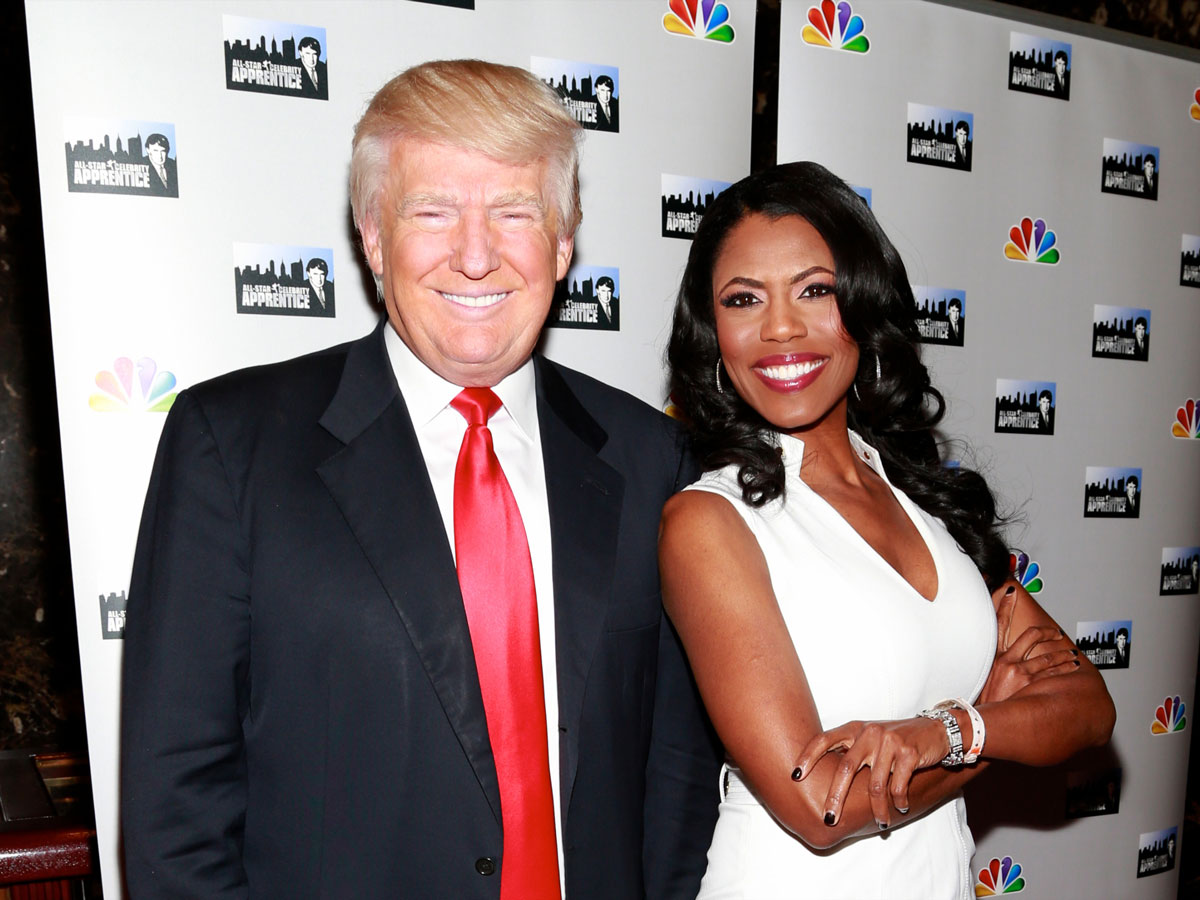
Donald Trump; Omarosa ManigaultBusinessman Donald Trump and actress Omarosa Manigault attend the "All-Star Celebrity Apprentice" Red Carpet Event at Trump Tower on April 1, 2013 in New York City. (Charles Eshelman/FilmMagic/Getty Images)Nobody should be shocked by this. Omarosa Manigault Newman made a similar claim in 2018 during her press tour for her cash-in/book “Unhinged.” At the time, Trump refuted Manigault Newman’s accusation by saying he “doesn’t have that word in [his] vocabulary.”

Pruitt begs to differ. He writes that was in the room as Trump’s advisers assessed the first season’s two finalists – Bill Rancic, a white entrepreneur from Chicago, and the Harvard-educated Goldman-Sachs broker Kwame Jackson. When first season “Apprentice” judge Carolyn Kepcher strongly advocated for Jackson to win, Pruitt recalls Trump saying, “Yeah, but, I mean, would America buy a [N word] winning?”

Adding a new spike to this long railroad track is Pruitt’s verification that this and other conversations between Trump and his advisers with producers present were recorded.

“The Apprentice” con continues through right-wing pundits currying Trump's favor by casting him as Goliath and David in one flesh.

The production did this out of caution, in case the Federal Communications Commission were to investigate any claims the producers influenced the outcome. That would have run afoul of regulations established in the wake of the famous 1950s quiz show scandals.

He also surmises tapes probably no longer exist or have been somehow lost; Manigault Newman says she heard the recording. Still, he’s the third person directly connected to “The Apprentice” to insist that Trump is a virulent racist.

Jackson declaratively sounded that warning before Trump won the presidential election in 2016, days after the audio of the “Access Hollywood” tape leaked. Other political careers were ended by less damning evidence. Trump won the Electoral College anyway.

On Thursday Pruitt’s insights further illuminated the rot at the core of sycophantic verdict reaction posts from the likes of Sen. Tim Scott, R-S.C. Scott, who invoked America’s “two-tier justice system” and accused Joe Biden of “weaponizing the justice system of the United States of America against a political opponent.”

The hush money trial is related to state charges, not federal – but Scott and others know Trump’s fandom doesn't care.

We need your help to stay independent

As MSNBC’s Joy Reid brought up Thursday, mentioning Scott alongside Marco Rubio, R.-Fla., and U.S. Rep. Byron Donalds, R-Fla., “They know damn well, who normally ends up at the bottom of this criminal justice system.”

She went on to offer, “They understand fully because they have lived in the bodies of Black men, those two Black men. And they're willing to sell themselves cheap. . . . For them it can be absolutely dirt cheap, free — that's the cheapest it can be — to sell your soul and the lives and memory of all of the Black men and women and brown men and women who have suffered in the criminal justice system . . . where they won't have any of the benefits that Donald Trump has used to kill every case but this one.

NBC and Mark Burnett’s illusionists created Trump out of a tarnished man buried in debt who even back then required heavy editing to appear competent.

“The one good thing that happened here,” Reid concluded, “is that this case was brought in a state that no Republican controls. . . .  Thank God for the state of New York, Donald Trump's home state, because there was no way for him to interfere with the process of justice.”

The con Pruitt describes is still bearing fruit in the form of a riven electorate and separate mediaspheres. Where pundits like Reid pointed out that this was evidence of the system working and praised the jurors for their bravery, the closed right-wing system complained the case was “rigged” and ripe for appeal.

But its potency also shows itself in the legend that the likes of Watters and other right-wing performers are feverishly gilding. Not by listing his merits or accomplishments – how could they? Instead, they wax rhapsodically about an unjustly dethroned Midas that, as Pruitt says, NBC and Burnett’s illusionists created out of a tarnished man buried in debt who even back then required heavy editing to appear competent.

This wasn't far from assessments CNN contributors made Friday morning following the ex-president and current felon's rambling jeremiad. “It was, I think, surprisingly incoherent, surprisingly all over the place,” said senior political reporter Nia-Malika Henderson.

“He wants to make this argument about age against Biden, but here he was looking, you know, kind of like an old man who was just ranting and raving in a self-involved way . . . this wasn’t a great outing for him.”

No matter. There’s always sequel potential. Once the magic wore off “The Apprentice,” we were served “The Celebrity Apprentice.” Already our cable networks have forgotten the price our democracy paid after handing Trump an estimated $5 billion in free media coverage back in 2016.


Want a daily wrap-up of all the news and commentary Salon has to offer? Subscribe to our morning newsletter, Crash Course.


We’ll never know if that might have been different, for better or worse, had Pruitt or others been free to caution us about the “Apprentice” long con.

All we can be sure of is that now, whether people believe them is secondary to the horror of knowing an unsettling number of Americans embrace Pirro’s strongman vision. They’re on board with unapologetic racism and misogyny and resent his being held accountable for a crime that isn’t related to some undefinable “woke” fantasy.

On Thursday, 12 ordinary New Yorkers created another Must-See Thursday by tearing 34 holes in the “might makes right” fantasy that informs the MAGA vision of their place in the world.

“This is something that we have to step back and say, ‘We are too good for this!'” Pirro ranted. She’s half-right. There’s always a chance to pause any grift, that kick of intuition that ignites our suspicion that something is wrong. Americans passed that break many seasons ago and have learned to ignore the blare of democracy’s emergency broadcast system. Moments like these make us pay attention if only to let us know that this is who we are.

“She was a fighter”: “The Life and Murder of Nicole Brown Simpson” reclaims a victim’s humanity

It took Melissa G. Moore a decade to convince Dominique, Denise and Tanya Brown — sisters to Nicole Brown Simpson, the ex-wife of former all-star NFL runningback and actor, O.J. Simpson — to make a documentary about their sister. Now, on the 30th anniversary of the day Nicole and her friend Ron Goldman were brutally murdered in 1994 outside Nicole's townhome in Brentwood, Calif., Moore says the sisters are "in the right space to actually tell the story."

Lifetime's "The Life and Murder of Nicole Brown Simpson," which airs in two parts on June 1 and 2, chronicles the tragic double homicide and the resulting media frenzy. However, and perhaps more importantly, the documentary shares Nicole's story, the "one key side" to the infamous crime and subsequent highly publicized trial that has "always been missing," per a press release from Lifetime.

Though O.J. Simpson was acquitted of the murders in 1995 and maintained innocence until his recent death from metastatic cancer in April, in 1997, he was found liable for both deaths in a civil lawsuit filed by the victims' families. The ex-athlete was ordered to pay $33.5 million in damages. 

While many filmmakers and journalists have endeavored to rehash the hugely sensationalized case, Moore's documentary stands out as particularly unique, not only for its focus on detailing Nicole's life but also for Moore's personal connection to the true crime genre. 

"The sisters were in a space to actually tell the story — enough time had passed."

Moore's father, Keith Hunter Jesperson, was a serial killer who assaulted and murdered at least eight women in the early 1990s. Known as the Happy Face Killer, Jesperson often drew smiley faces to confession letters he submitted to police and various media outlets. This experience profoundly shaped the trajectory of Moore's career as a true crime filmmaker and podcaster. For a time, it also stymied her ability to move on with her life without feeling sullied by, and inextricably connected to, her father's actions. In 2009, Moore published "Shattered Silence: The Untold Story of a Serial Killer's Daughter," a memoir that detailed her journey toward healing and self-love. 

Now, with her latest project, she hopes viewers will come to see the depths of Nicole Brown Simpson's strength. 

"She was a fighter," Moore said. "That's what I think people will be surprised about — the whole time she was fighting for her life."

Check out the full interview with Moore, in which she discusses Nicole as the documentary's North Star, the isolating experience of domestic abuse, and the idiosyncratic relationship she has with true crime stories.

The following interview has been edited for length and clarity. 

What does it mean for this project to be released so close to O.J.'s death?

We kind of planned it, but it didn't change anything at that point. We were done filming months ago, and we were in the final stages of editing the last hour of the documentary. One of our North Stars in this documentary was every act started and ended with Nicole. And so it didn't change anything in the sense that we were still going to end this documentary on Nicole and it wouldn't feel right to tell her story and then end it with his death — that would be a contradiction of our intention in all ways. So, we were just at the point where we were getting ready to submit, for legal reasons, all of the statements for O.J. to make a rebuttal or to comment. He passed away before that could happen.

This documentary notably features 50 participants, which is quite a lot. You have everyone from journalists to former LAPD to jury members. What was your process in reaching out to so many participants?

So starting out, the genesis of this whole documentary started 10 years ago on the 20th anniversary of Nicole's passing. Denise [Brown] and I had a connection because I'm a survivor of domestic violence, and she was a speaker. So I was raising funds for shelters as well — that's how Denise and I met. I would tell her, "Hey, we have to do something about Nicole. What about now on the 20th [anniversary of Nicole's murder]?"

She's like, "No, it's not time yet."

On the 25th — "How about now?"

"No."

And then as it approached 30 years and on Jan. 1 — it was New Year's Day, 2023 — she said, "All right, it's time. It's the 30-year anniversary. Let me talk to my sisters and see if we could make this happen." And so it was just the right timing to tell her story. Everything about it felt right, the sisters were in a space to actually tell the story — enough time had passed. And so they were the genesis. They were the start.

I asked them what was important to them, and they're like, "Well, we want people who've never spoken before to come forward." I'm like, "Yes, that's what I want too."

So they did a lot of the initial outreach to the people that were closest to Nicole. And then from there, we progressed on their outreach . . . But some of the LAPD that you see in this documentary, we made outreach not knowing what stories they were keeping. And when they sat down and did the interview, we were just gobsmacked. Like, wow, "You witnessed Marguerite's [O.J.'s first wife] domestic violence and Nicole's." So there's a lot of times that we were sitting in front of somebody interviewing them and were just surprised that none of this was ever known.
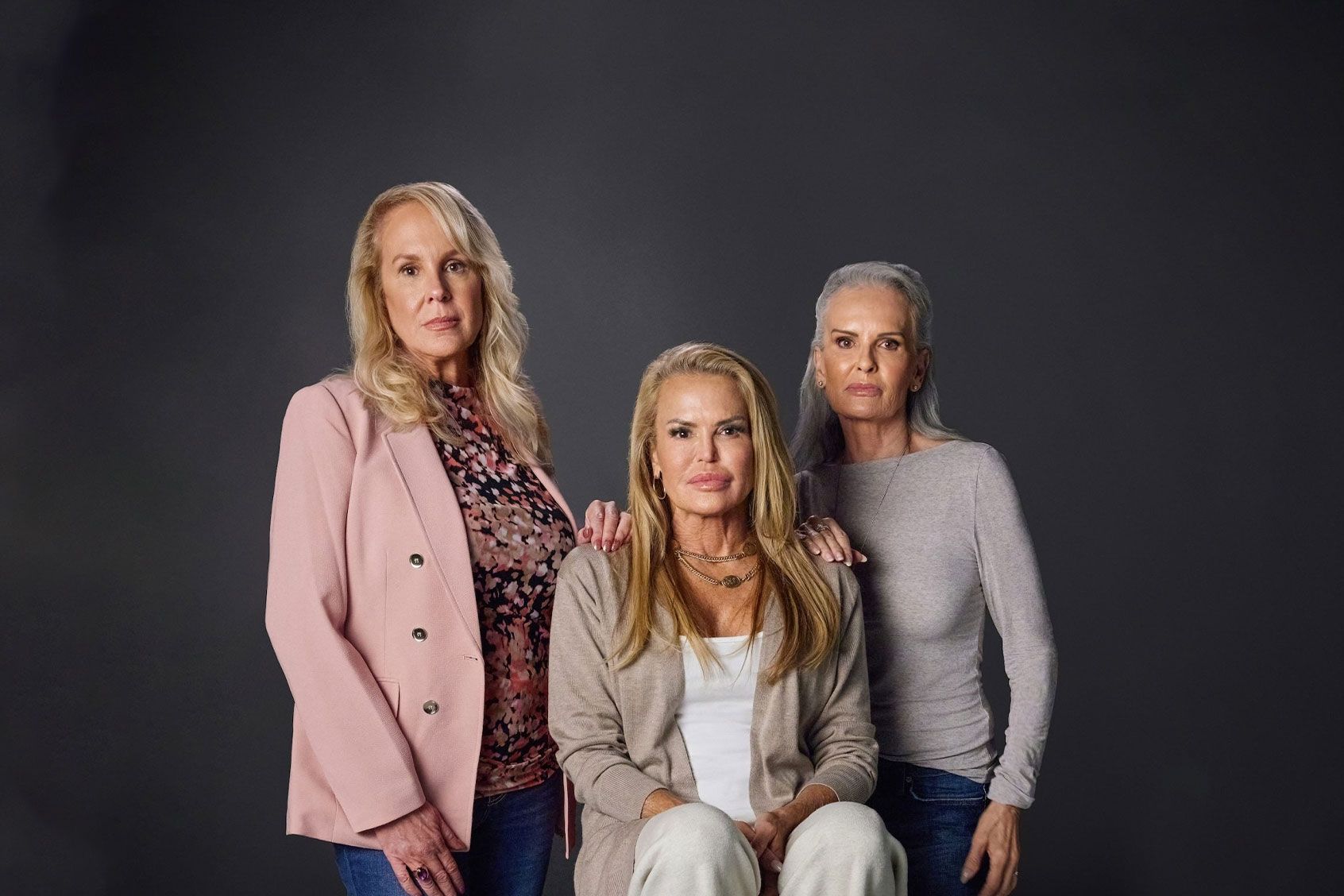
The Life and Murder of Nicole Brown SimpsonDominique Brown, Tanya Brown and Denise Brown. The Life and Murder of Nicole Brown Simpson. (Lifetime)What were the biggest challenges in making "The Life and Murder of Nicole Brown Simpson"?

The biggest factor was just giving enough time to each participant. And just that balancing act. I mean, there are so many stories, just happy memories of Nicole that while we would love to share them, we couldn't. 

There's a story that Denise shared about her sister [Nicole] loving this horse named Diablo that kicked her off. And her mom had this intuition that something was wrong with her daughter. And it was foreshadowing, basically, what happened the night Nicole was murdered. Her mother [Judith] "Dita" had this feeling that something was wrong with her daughter. Nicole was young — I think she was 13 years old when she was kicked off Diablo and was put in a coma or she was in critical condition. She had a scar on her forehead from that fall off the horse. But just how her mom had this feeling that something was wrong with Nicole and went to the stables and found her daughter unconscious on the ground. So while that was a really impactful story, it's just like, now we have to wait for the other stories and give enough time to each storyteller to share their memory of Nicole.

Did you ever consider including Nicole's kids Sydney and Justin Simpson in this project?

Oh, absolutely. Absolutely. Yeah, I met with them in 2016 and wanted to have them. A part of this was really about timing. One thing that people aren't aware of is that they started their own families. They were really young, new parents when we started making this documentary. And then their father passed away at the end of this documentary. So hopefully, my goal is that there will be a time when they feel ready to tell their story and it works for them. But unfortunately, the timing of this didn't work out for them. 

Some of the most heartbreaking scenes as a viewer were those moments when the Brown sisters and Nicole's friends described learning of Nicole's murder and the subsequent wake and funeral. Denise has this moment where she talks about purchasing a dress for Nicole's wake and funeral and having to ensure that it had a turtleneck because of how badly her neck had been cut. Is that something she was open about sharing with you at first? And did you allow the sisters to have time together to prepare for what I can only imagine was a hugely emotional process of sharing all of these really intense memories?

Yeah, while we interviewed them for hours, there were so many, countless hours of conversations over the years to get to that point where they could openly share these details. There were so many conversations. I mean, countless hours of conversations leading to even picking up the camera. And then there were days of filming with them when we did have the camera. So we just let them freely speak and share their stories.

And how did you decide how much pain to actually show without being exploitative?

That's a really good question. I don't feel like I censored their pain at all. I felt like that was the pathway through it — just to let them unleash their pain in real time. And let them share it and expose it because that's what it is. There is something vulnerable about that. There's something real about that. And so there was nothing that I felt like was left on the cutting floor about what their grief was. 

It certainly came through as a viewer. Much of the documentary was extremely heavy and harrowing, but seeing Nicole's sisters and family and friends recount how they felt in those moments only gave you the tiniest glimpse into what it could have been like. And even that was incredibly difficult to go through as a viewer.

I feel like one of the gifts about this documentary is that not only do you get to know Nicole — you get to know her sisters, you get to know their family, the Brown family. And to get to know the Brown family is to love them. And that makes it even more heart-wrenching when you find out what happens to them as a family. I feel like this documentary also highlights just what a wonderful family they were. And then they go through this horrific [situation] and it just makes it even sadder, I think.

One thing I was really curious about was the inclusion of Polaroids of Nicole looking extremely battered. It was interesting to see how those photos were animated, almost like a live photo on an iPhone. Can you talk about why you chose to do that?

"When you're a crime survivor, you lost control."

Well, because you see those images so stale — they didn't they don't show her life. And I feel like that was the whole purpose of who Nicole is. I think Denise said it best to me, and I don't know if she said on camera, but I'll never forget. She said, "Oh, my gosh, she's walking." When she saw the video of Nicole, it was like she was brought back to life. I felt like it was a really important factor — to bring Nicole back to life so that people could get to know her and hear her voice because if you close your eyes, you could probably picture or hear O.J.'s voice. He has this distinct voice. How do we not know what Nicole sounds like? And so to take her from two-dimensional to three-dimensional was always a goal. And thankfully, we have technology to do that, with her blinking. It really makes you feel something.
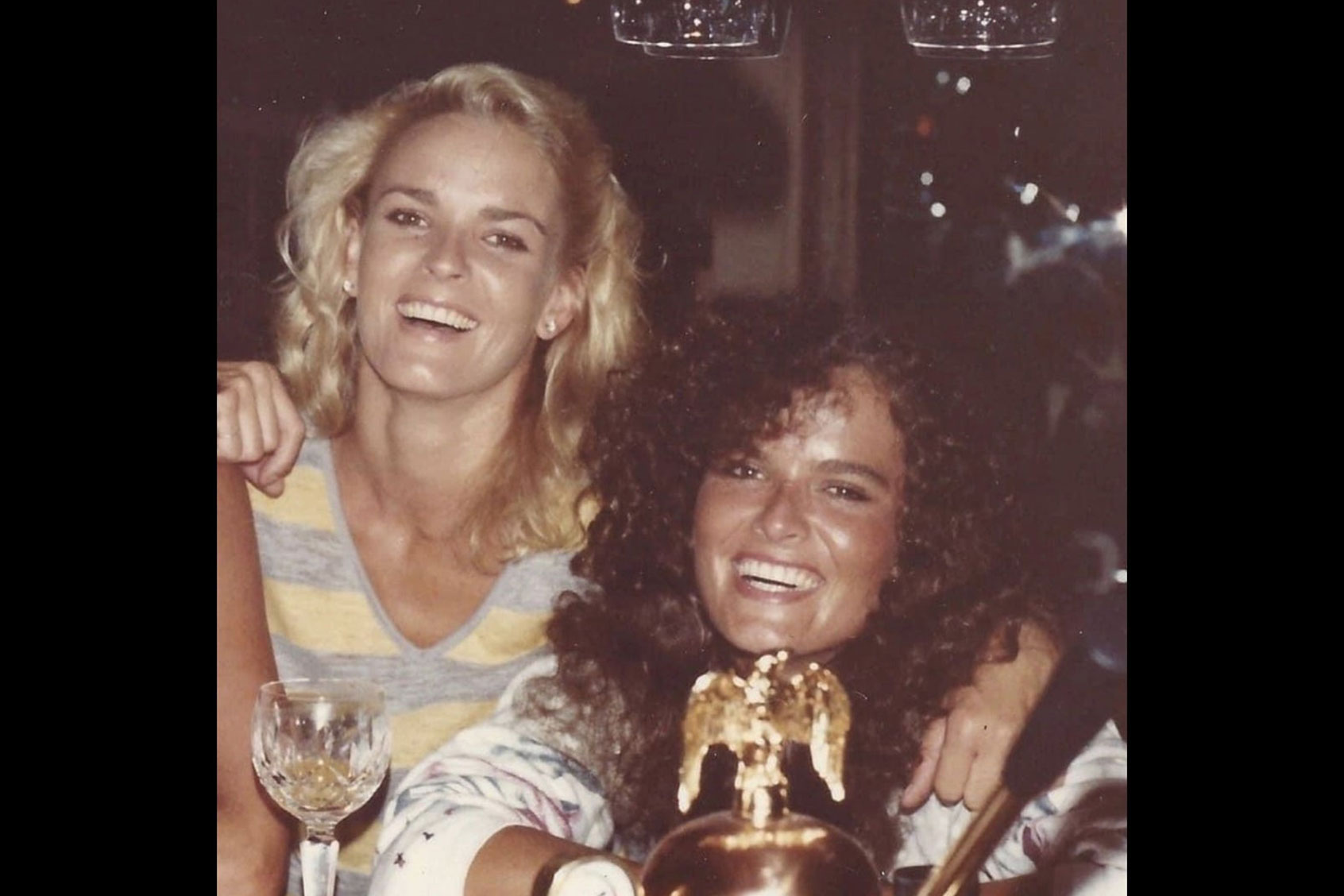
The Life and Murder of Nicole Brown SimpsonNicole Brown Simpson and Denise Brown. The Life and Murder of Nicole Brown Simpson. (The Brown Family)You just briefly touched on hearing Nicole's voice. I was going to talk about how we see lots of home video footage in the docuseries. We hear her voice. We see her as a child blowing out birthday candles, and riding on her bike. It was all extremely emotionally visceral. Were the Brown sisters very forthcoming with that content?

Yeah, that was one of the key parts of doing this documentary. It was like, "OK, so we're going to tell them a cool story. All right. But we need the materials to do it. We need videos."

The Browns were actually nervous that they didn't have enough. I pulled up to Orange County and they open up the garage door and there's tons of bins of home videos and photos. I was like, "Oh, there's plenty here. There's so much." But then there was the task of, "How do we digitize these very old, old reels?" I mean, they're fragile. They're brittle. They could break if you roll them. So while trying to preserve them, you could damage them. So that was an art in itself.

There is also a backstory that Denise told me about how some of that very early footage of Nicole when they were little babies was at the bottom of the ocean at one point in a container. When they [the Brown family] left Germany, their belongings were shipped in a container. And one of the containers fell into the ocean. They later revived it, like brought it back up. But that was also interesting to note that some of the footage could have been lost forever. But we get to see it because it was restored and brought back to the surface.

Why is it so important that we hear Nicole's voice and see her at different stages of her life?

So I let my curiosity about who she was as a person be the guide, and that was, "How do I get to know somebody who's no longer here and really understand what her personality, her spirit was like?" And the one way to really do that is to watch videos, to hear the stories from people. I mean, you're a stranger to me. If I wanted to know you, I would talk to your best friends, you know?

What I love too is that she was in her 30s, and so she had many layers of friends just like we all do. And so to tell the story of Nicole, you'd have to tell all of her generations of friends. So if I talk to your friends from high school, they would tell me a different story than your friends today.

And we do see that. We see Nicole's close friend Robin [Greer], and we see Kris Jenner. I love the photo of Nicole and her Ferrari that had the "L84AD8" ["late for a date"] license plate. And especially when she's in that era when she meets Ron and just is so happy. Of course, that comes shortly before the end.

Yeah. I love that. Dominique said that she's happy she got to see her sister have a good life before she was murdered, because her life was so hard and hellish before that with O.J., with the abuse. And so that gave some solace to Dominique. And I'm glad that she got to hear those stories from friends.

The sisters weren't producers in this at all. So while they did outreach, they didn't see any of the edits until the very end, when we had them sit and watch the four hours to see what they thought about it. And sitting there and watching them watch this for the first time — they were learning things that they never knew about before. They didn't know about Marguerite's abuse. They didn't know about the details from Robin, about the stories that Nicole was telling. In the series, she tells Robin that the kids broke the door, and then she's telling other people different ideas of what happened on Gretna Green [Way] that October night. So a lot of it was new to them. And it was the first time that all three sisters listened to the 911 call in its entirety.

What were their reactions to that call and everything else that they hadn't previously known about?

I think anger. Watching it, they just got angrier and angrier, because they knew. They knew, but then to see it in full conflict, to see everything in full picture — all the pieces were now whole. And that was only possible because of friends coming together to share their little fragments of their stories, and then it made a whole picture for them. I mean, a lot of the abuse was hidden from the sisters and from close family friends. And that was to protect them. Nicole was protecting people close to her. And that's what I hope that people actually get from this documentary: how lonely Nicole must have been, and how lonely and isolating it is to be a victim of domestic abuse because you can't really share with people that you love what's going on behind closed doors. Because they're going to tell you to leave, of course. And then they're not going to understand why you're staying. So you have to justify your actions to people you love.

In speaking about the intense media frenzy that followed Nicole's murder and O.J.'s trial, Dominique actually shared this really heavy anecdote about how she used to make this game out of being chased by the media helicopters basically to protect Sydney and Justin.

They'd be at the beach, and they would grab their towels and pretend to be superheroes, running down the beach. But it was a result of the fact that they had no privacy at that time and that they were being followed, under constant media surveillance. I was quite affected by that. I think the fact that these are little kids who no longer have a mother, and their family who's also in the process of grieving is now just trying to maintain a sense of normalcy for them. Why did you choose to include how the sensationalization of the case affected the Brown family and Sydney and Justin specifically?

"Every case that I work on, I have full consent of everybody working with it. Because to me, it is a consensual project."

Because that added another level of victimization to them. Because it was so sensational, there was a voyeuristic greed to it. And it came at every expense. There were no boundaries. And it was limitless, the access that they wanted, without consent. So these children have no rights, and the family circled them and protected them. But everybody wanted a piece because everything led to money. So if they got a scoop, it meant more money. When doing the research for this, there was a friend of Nicole's whose housekeeper stole one of the photos while cleaning the house and sold it to the tabloids. Everything was money. And so there was a level of greed that I think was important to show. I think it was an "Inside Edition" reporter who said that it became a business opportunity.

I also wanted to discuss your background. You've spoken extensively about your being a crime survivor, as well as your father's past. I'm curious to learn if you ever feel emotionally fatigued by being immersed in true crime work, especially given your background of having lived through it. I know I have a hard time watching too much true crime at once, and I certainly don't have as much of a close tie to it as you do.

I think it's one of the best questions I've ever been asked. I totally do. Thank you for asking that. There's a couple stories that will completely get me fatigued. Let me see how I can answer that, because I've never been asked that. I have a memory of when I was first working in true crime, and I met with Shasta Groene. Are you familiar with her case?

Yeah, I am.

Okay. That was a local case. And I sat down with her to do her interview. And as a crime survivor, she told her story uncensored. There are some horrors that this girl endured that were so shocking, and so horrific, that they stayed with me even to this day. I can't even repeat some of the things she told me. And I felt that she told me that because she knew I could hear it. But it doesn't make it easy to hear. And it haunts me to this day. I've just never been asked this. I'm trying to figure out how to answer it.

I feel like I go around in my life, and I have an association with a crime story. Like, everything. Some things I feel like I can share and some things I can't. I'll keep it as a thought to myself. So for example, if I'm driving and I see a tan beetle, a VW [Volkswagen] bug, I'll think of the Ted Bundy survivor. Other people will be saying "Slug bug!" [makes punching motion] and I'll be thinking of a Ted Bundy survivor. Or when somebody describes something, I'll have a flashback of another crime case. So I feel like I have a box of stories in my head for me to know.

That's incredibly interesting, and I kind of resonate in a completely different way. My mom is a 9/11 survivor, and I published something last September — it was a personal essay about how this intergenerational trauma has affected me, even though I wasn't even there. I was alive, obviously, but even now I'm getting an emotional reaction in my chest. And it is so interesting to think about the ways that things that either people in our family did or went through can have that really specific and lasting impact on us that maybe no one else, or maybe more people than we realize, relate to — as I learned when I wrote my own story. An experience can feel very isolating because it is so specific, especially in your case, which I can only begin to imagine.

And you don't want to inflict trauma on someone by telling them a story that they're not prepared to hear or have to live with because you know how it affects you — what you heard or what you witnessed. So it feels like it has to live in a capsule within you because to release it is to pass down something that shouldn't. You don't want to have that effect on a child or somebody that you love or your friend, you know.
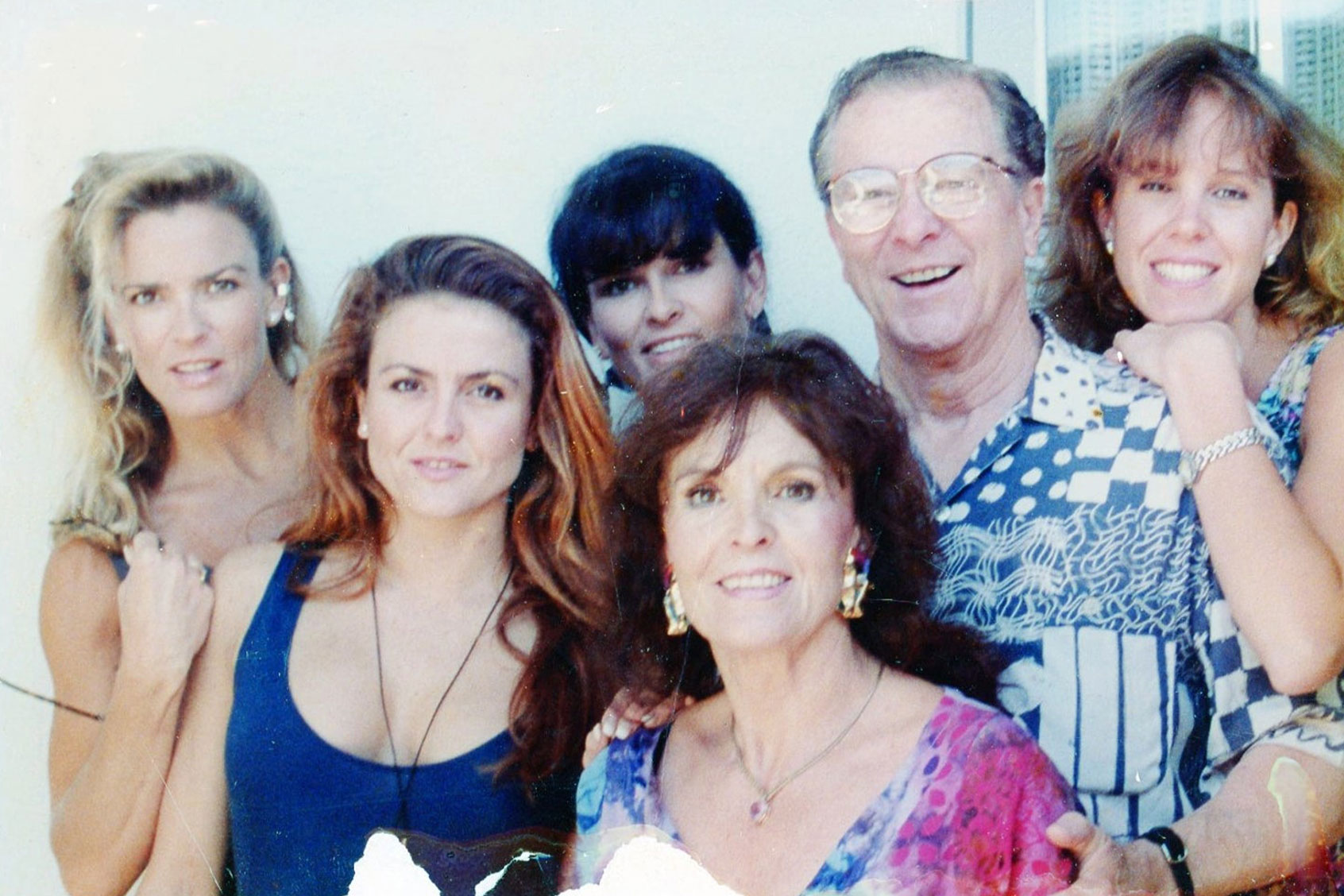
The Life and Murder of Nicole Brown SimpsonNicole Brown Simpson, Dominique Brown, Denise Brown, Juditha Brown, Louis Brown and Tanya Brown. The Life and Murder of Nicole Brown Simpson. (The Brown Family)Thank you for sharing that. That was an extremely powerful sentiment. My next question is sort of related. What do you feel that true crime storytellers should be focusing on? And where can true crime really improve? What is the genre missing right now, and how would you like to see it evolve?

I actually feel like true crime is going in the right direction. It felt like it was off course for a beat there. It was really focused and still tabloidy, and now I feel like with documentaries like "Quiet On Set" or these high-end, quality caliber documentaries are showing that people have an appetite for actually hearing survivors tell their story. And not just for a voyeuristic sense, but to really understand a survivor's experience. So I feel like true crime is going in the right direction. Whereas before it was really like — I don't want to like name names of shows — but it's just like fast food, you know? It was really poorly executed. And it was just about all the salacious details and none of the substance.

Right. And I think a lot of what I feel like I've seen of true crime in the past has been focused not on the victims and their families, but on the perpetrator of alleged crimes. And I think that can be a sticky territory to navigate as well, especially when we hear stories about victims' families not being notified about the production of a documentary, and we're talking about potentially re-traumatizing people all over again.

Well, one thing that I noticed about this, and being a crime survivor myself, is that when you're a crime survivor, you lost control. You had no control. If you're a rape survivor, things were taken from you. Either your voice was taken from you, your body, your story. And so I feel like what's important about honoring survivors is not to steal their story. So in every case that I work on, I have full consent of everybody working with it. Because to me, it is a consensual project. I would never feel good about myself making a work and exploiting someone's survivor story without their consent. That's just not how I operate. Whereas some productions do that. And then they're the last to be notified. But that to me is revictimizing the survivor because they didn't have control over the crime. And then now they don't have control over their own story.

This docuseries was made in collaboration with the National Domestic Violence Hotline. What do you hope people, specifically people who may find themselves in abusive relationships — especially in light of recent media developments — take away from this project?

Well, I hope they feel seen, because it is isolating to be a survivor of domestic violence. I hope they feel like they understand that they're not alone in their experience and that there are other people that have endured that. Unfortunately, it's such an epidemic — violence against women and domestic violence in general — but especially violence against women, that the likelihood that a viewer or somebody watching this knows somebody that is being abused [is high.] So I hope that they'll see how isolated the victim feels.

What do you hope that people come away with about Nicole after they've watched "The Life and Murder of Nicole Brown Simpson"?

She was a fighter. She was a fighter. That's what I think people will be surprised about — the whole time she was fighting for her life.

"The Life and Murder of Nicole Brown Simpson" airs at 8 p.m. ET on June 1 and 2 on Lifetime.

Hacker group puts data of 560 million Ticketmaster customers up for sale

Live Nation, Ticketmaster’s parent company, revealed in a Friday SEC filing to investors that hackers breached systems containing sensitive user data earlier in the month, and that it found that data for sale online.

The report confirms a hacking group’s claim that it obtained the names, phone numbers, addresses, transaction information and partial credit card information of 560 million Ticketmaster customers dating back to at least 2011. The group asked for $500,000 in exchange for the data on a dark web forum that had previously been shut down by the FBI, per the Australian Broadcasting Corporation.

The company has been slow to make a statement to customers, but cybersecurity experts suggest that those worried about breaches keep an eye on potentially leaked payment methods, and change passwords that could have been affected.

The ticketing giant was accused of holding an illegal monopoly on the American live events market by the Department of Justice last week, facing a massive antitrust lawsuit for its “unlawful, anticompetitive conduct.”

ShinyHunters, the group which posted the batch of data for sale, previously claimed to have stolen data from 70 million AT&T customers in 2021. They also claimed that, alongside Ticketmaster, they had obtained sensitive information from Santander Bank customers and employees.

Reports from cybersecurity firm Hudson Rock allege that cloud software provider Snowflake was the target of the attack, and that hackers claimed the ability to breach other Snowflake customers. The company lists clients including Pfizer, Ring, Bumble, DoorDash, and Mastercard on their website.

Live Nation said in its filing that it did not expect the breach to have a material impact on its own business, though it is unclear what support it is offering customers to secure their data in the interim. 

What exactly is a value meal these days?

Over the past decade, a growing number of consumers have been curbing their cravings for fast food. Rampant fast-flation — a portmanteau of fast food and inflation — has made even the simplest of fast foods unattainable for many Americans, compelling them to eat more meals at home instead of dining out.   

A recent LendingTree survey of more than 2,000 adults between the ages of 18 and 78 found that although Americans still love the taste of fast food, they no longer deem it an affordable meal option due to high food costs. Seventy-eight percent of consumers now consider fast food to be a “luxury,” per the survey. Additionally, 71 percent of lower-income Americans who make less than $30,000 a year, 58 percent of parents with young children, 58 percent of Gen-Zers and 53 percent of women say they consider fast food to be a “luxury” because they’re struggling financially.

The decrease in consumer demand has fueled an ongoing “value meal wars” between several major fast food chains. This month, McDonald’s said it will offer a limited-time combo meal that includes a choice of either a McChicken, a McDouble or four-piece chicken nuggets, small fries and a small drink — all for just $5. Wendy’s soon followed suit, dropping its $3 limited-time breakfast combo meal, which features a Bacon, Egg, & Cheese English Muffin or a Sausage, Egg, & Cheese English Muffin with a small order of Seasoned Potatoes. Wendy’s said it’s “doubling down on better breakfast with unmatched value and quality on the go” with its latest meal deal, according to Food & Wine.

Burger King is the latest fast food joint to join the competition. Earlier this week, the hamburger chain announced that it will bring back its $5 Your Way Meal. Burger King previously offered $5 Duo deals that came with a choice of any two items like BK’s Whopper, Big Fish, Original Chicken Sandwich, or Chicken Fries.

The concept of a value meal isn’t anything new. Amid the late 1980s, McDonald's, Wendy's, and Burger King were embroiled in a series of on-and-off advertising campaigns — known today as the “Burger Wars” — in an attempt to one-up one another within the booming fast food market. Each chain sought to pioneer its own unique marketing tactic that would entice a large crowd of hungry customers. Much of the focus, of course, was centered on specific menu items. At the time, Burger King’s signature Whopper and McDonald's signature Big Mac were typically available for just 99 cents. That low price was a menu standard sans any special promotions.

The value meal was first introduced by Wendy’s in October 1989. It contained nine items that ranged from a Junior Hamburger to a garden side salad to a small Frosty, all priced at 99 cents. In 1998, Burger King got on board with its very own value meal, also priced at 99 cents — equivalent to just $1.85 in 2023. Five years later, McDonald’s dropped its Dollar Menu, which included the McChicken sandwich, McValue-size french fries, soft drinks and dessert.

The value meal was initially believed to be too “radical” by many. “The environment was intense. If you weren’t doing 99 cents, you were doing heavy couponing,” Denny Lynch, former senior vice president of communications at Wendy’s International, told QSRweb back in 2010. “Pizza chains, for example, became so wedded to coupons, it got to the point that consumers didn’t need to pay full price, they just had to wait a few days for the coupons to come out.”


Want more great food writing and recipes? Subscribe to Salon Food's newsletter, The Bite.


Nevertheless, the meal persevered. Today’s value meals are nowhere near the 99 cent price tags of the past. But they still offer consumers some reprieve from pricier menu options. Earlier this year, McDonald’s sparked a national debate after a restaurant location in Darien, Connecticut, charged an astounding $18 for a Big Mac combo meal. The multinational chain once again received backlash in March, after a restaurant location in southern California was shown offering a $25.39 meal bundle that included a 40-piece Chicken McNuggets and two large orders of French fries. Compared to those astounding prices, a $5 meal offers more bang for one’s buck.

In addition to fast food chains, several fast casual chains are also reducing their menu prices in hopes of winning back budget-conscious customers. Buffalo Wild Wings recently threw shade at Red Lobster to tout its new all-you-can-eat boneless wings deal. Every Monday and Wednesday for a limited time only, customers can indulge in endless boneless wings alongside endless fries for $19.99. In April, Denny’s announced the return of its All-Day Diner Deals, which was first introduced in 2022. Customers can choose from six offerings, like the Scrambled Eggs & Cheddar Breakfast deal and the All You Can Eat Pancakes deal, that start at $5.99. Chili’s also launched its “3 for Me” deal which invites customers to enjoy an ice-cold beverage, appetizer, and full-size entree starting at $10.99.

Biden shines a light on safety and equality for LGBTQ+ community at start of Pride Month

Same as last year, the Biden administration is recognizing the month of June as Pride Month, releasing an official proclamation from the White House, focusing on safety and equality for the LGBTQI+ community that spans beyond the United States.

"During Pride Month, we celebrate the extraordinary courage and contributions of the Lesbian, Gay, Bisexual, Transgender, Queer, and Intersex (LGBTQI+) community," the proclamation reads.  "We reflect on the progress we have made so far in pursuit of equality, justice, and inclusion. We recommit ourselves to do more to support LGBTQI+ rights at home and around the world."

Elsewhere in the statement, "advancing equality for the LGBTQI+ community" is listed as being a top priority for Biden, who writes:

"I was proud to have ended the ban on transgender Americans serving in the United States military. I signed historic Executive Orders strengthening civil rights protections for housing, employment, health care, education, and the justice system.  We are also combating the dangerous and cruel practice of so-called “conversion therapy” and implementing a national strategy to end the HIV epidemic in this country.  We ended the disgraceful practice of banning gay and bisexual men from donating blood.  We are doing this work here at home and around the globe, where LGBTQI+ community members are fighting for recognition of their fundamental human rights and seeking to live full lives, free from hate-fueled violence and discrimination."

As The Washington Blade highlights, this proclamation comes on the heels of a new guide detailing federal resources, which a White House official said will cover “a number of key areas, including physical security, online safety, and targeted violence prevention” for the community.

Obamas pen touching tribute to Marian Robinson, Michelle’s mother

Marian Robinson, mother of former First Lady Michelle Obama and basketball executive Craig Robinson, passed away Friday at 86 years old. The Chicago-born woman worked as a secretary and executive assistant before moving to the White House with her daughter and son in-law. She built a reputation during Barack Obama’s presidential campaign as being a rock to the family. Often described as being humble and family oriented, the former president once called her “the least pretentious person I know.”

“She grew up one of seven children on the red-lined South Side of Chicago, the daughter of Purnell Shields and Rebecca Jumper,” a statement from Barack and Michelle Obama, Kelly and Craig Robinson, and the couples’ children, read. “She learned early that even in the face of hardship, there was music to be found.”

Craig and Michelle grew up in the same Chicago neighborhood, raised by Marian and her husband Fraser, a Democratic municipal official who passed in 1991.

“Every night, for years on end, she and Fraser would hold court at the dinner table, where they indulged all manner of questioning, teaching their children to believe in the power and worth of their own voices,” the statement read.

The two children were pushed to great heights by their mother, both attending Princeton University for their undergraduate degrees, with Michelle attending Harvard Law School.

“When Craig decided to leave a lucrative finance job to pursue his dream of coaching basketball, she was there with her wholehearted support,” the family said. Craig is currently the Executive Director of the National Association of Basketball Coaches, a body representing college men's basketball coaches.

“When Michelle married a guy crazy enough to go into politics, she was just as encouraging,” the statement said. “At every step, as our families went down paths none of us could have predicted, she remained our refuge from the storm, keeping our feet on solid ground.”

Robinson, who spent her 8-year stint in the White House taking care of First Daughters Sasha and Malia, rarely taking a public spotlight, moved back to Chicago in 2017, where she reconnected with old friends

Robinson watched earlier this month when the Obamas announced that an exhibit documenting the White House in the Obama Presidential Center Museum would be dedicated to her in a Mothers’ Day video.

“There was and will be only one Marian Robinson. In our sadness, we are lifted up by the extraordinary gift of her life. And we will spend the rest of ours trying to live up to her example,” the family wrote.

Read the full tribute here.

“I’ve never seen that”: Legal scholars say Trump has opening to turn to Supreme Court for help

Former President Donald Trump can only appeal his Manhattan felony conviction in New York state court, legal experts say, but he could turn to the U.S. Supreme Court to intervene on federal questions — including whether federal election law violations could be the basis for prosecution in state courts.

The Manhattan jury convicted Trump Thursday of all 34 felony counts of falsification of business records. Prosecutors alleged that Trump disguised $130,000 in hush money as a legal expense as part of a scheme to keep information about alleged extramarital sex from voters and unlawfully influence the 2016 presidential election.

On Friday, Trump vowed to appeal: "So we're going to be appealing this scam. We're going to appeal it on many different things – he wouldn't allow us to have witnesses, he wouldn't allow us to talk, he wouldn't allow us to do anything. The judge was a tyrant."

On Friday, House Speaker Mike Johnson, R-La., said on "Fox and Friends" that the "Supreme Court should step in" on any potential Trump appeal.

"I think that the justices on the court, I know many of them personally, I think they're deeply concerned about that as we are," Johnson said. "So I think they'll set this straight but it's going to take awhile."

Richard Hasen, an election law professor at UCLA, said that state courts in New York would first handle any state law questions. Trump's case would work up through the next two levels of the New York court system, with the state Court of Appeals being the highest court. 

At the Supreme Court, Trump could pose questions of constitutional rights and federal election law.

"Trump could raise various issues related to due process, such as the fairness of the proceedings, bias of the judge, et cetera," Hasen told Salon. "More likely, he would argue that the New York election law that he was prosecuted under to turn the false business records misdemeanors into felonies improperly relied upon alleged federal election law violations."

Trump was convicted of felony falsification of records — which prosecutors could raise from a felony to misdemeanor after proving an "intent to defraud."

The jury instructions said: "Under our law, a person is guilty of falsifying business records in the first degree when, with intent to defraud that includes an intent to commit another crime or to aid or conceal the commission thereof, that person: makes or causes a false entry in the business records of an enterprise."

Prosecutors alleged that Trump intended to commit, aid or conceal a violation of state election law section 17-152. 

That statute "provides that any two or more persons who conspire to promote or prevent the election of any person to a public office by unlawful means means and which conspiracy is acted upon by one or more of the parties thereto, shall be guilty of conspiracy to promote or prevent an election."

Judge Juan Merchan said jurors could consider three unlawful means under New York's election law conspiracy statute: a violation of the Federal Election Campaign Act, falsification of other business records or violation of tax laws. 

Bragg's office has provided data that it says shows the office's falsification of business records charges are common — but several legal experts say the prosecution of Trump raises unsettled questions.

"It is not clear if the federal election law violations could be the basis for prosecution in state court," Hasen said. "There is also an argument that Trump did not violate federal election law, for example, if his payments were personal and not campaign related."

Richard Pildes, law professor at New York University School of Law and an expert on constitutional law, said including the FECA violation as an "unlawful means" provided a federal question for Trump to bring to the Supreme Court.

"If the Trump team wants to argue that his actions do not amount to a violation of that federal law, the Supreme Court would have the power to decide on the proper meaning of FECA," Pildes told Salon. "Because it’s a federal law, the Supreme Court has the power to resolve the proper interpretation of that law."

We need your help to stay independent

Samuel Issacharoff, a fellow professor of constitutional law at New York University, said the Manhattan prosecutors' decision to raise misdemeanor falsification of business record charges to felonies raises several potential questions.

"First, was this a proper application of those laws?" he told Salon. "And second, are these laws that can be enforced by the states, or is there exclusively federal authority to enforce these laws?"

Issacharoff said at the state law level, there's a question about raising charges to a felony level to get around the statute of limitations. 

He said there's also the question of whether Trump's conduct is actionable under the federal elections law.

"The only well known example is the attempt to prosecute John Edwards for a failure to disclose private matters, payments of this sort, and it ended in acquittal, so it was never reviewed on appeal," he said. 

Issacharoff said the question of the Trump trial jurors being instructed to weigh whether he violated federal election law is a "subtle" area of law.

"The question is, can a state court jury be so instructed on a matter of federal law, that's an open question that I have to be quite honest, I've never seen that come up this way," he said. 


Want a daily wrap-up of all the news and commentary Salon has to offer? Subscribe to our morning newsletter, Crash Course.


Early on in the Manhattan proceedings, Trump tried to move the case to the federal court — but that request was denied.

"So now he has an adverse judgment in state court, and his only path is to exhaust his state court appeals, so he can go up the appellate chain of state courts," Issacharoff said. 

Clara Torres-Spelliscy, a Stetson Law professor and author of "Corporatocracy," said that the Supreme Court typically does not review courts' decisions interpreting state law. 

But there are exceptions, such as Bush v. Gore. 

In December 2000, the Florida State Supreme Court In that December 2000 opinion, the Supreme Court ordered to stop the recount of votes in Florida's 2000 presidential election.

George W. Bush and Dick Cheney filed an emergency application to stay that mandate, and the state Supreme Court granted that stay and ended up stopping the recount.

"If the Trump lawyers can articulate a constitutional harm, then they might get the Supreme Court to review the case," she told Salon. "This is less likely as it involves actions that primarily happened when Trump was a private citizen and involved his business. Ultimately the Supreme Court has the power to duck hearing this case like they ducked all of the post-2020 election litigation in 2020/2021."

Boston University School of Law professor Jed Shugerman said he expects the state courts to review New York state's election law conspiracy statute in Trump's likely state-level appeal.

He said the state court could look at statutory language that says the state law protects voters in all elections, local, state and federal. But he said the court could also scrutinize statutory language defining public officers as being state or local. 

Shugerman said there is little case law on New York's election conspiracy statute — meaning it's unclear how the state appellate courts will weigh in at the end of the day.

"For anyone who says this is clear, that's just based upon their reading of the statute," Shugerman said.

He said other issues Trump could raise and courts could examine include whether the "judge was clear enough about what a Federal Election Campaign Act violation was, and what constituted tax fraud."

The defense decided not to call their campaign finance expert as a witness after Merchan reaffirmed a pretrial ruling that would prevent the expert from interpreting election law.  The judge did so because rules prevent expert witnesses from interpreting the law.

"To me, there is a question of whether the judge, with such a complicated statute, gave the jury sufficient guidance," Shugerman said.

Shugerman said Trump could argue their witness would have been relevant.

Overall, Shugerman said he's concerned that the FECA's preemption law makes clear that it supersedes any state election law.

"There's never been a state prosecutor that has relied on the Federal Election Campaign Act before in the prosecution," he said. "So there's this bigger question: was it appropriate in a case of this political significance, with these questions about whether there was a political bias here, was this the appropriate time to be trying out all these untested and unprecedented uses of state and federal law? And the point is that not only are they unprecedented, but there are good reasons why prosecutors might lose those questions."

When asked whether state election agencies have any authority over how federal candidates run in their states, Shugerman said he would avoid weighing in on that specific issue.

"I'm just saying there is no precedent," he said. "So this is untested."

Trump's sentencing is set for July 11 — the same week as the Republican National Convention, when he's set to accept his party's nomination for president. 

Robert Peck, president of the D.C. law firm Center for Constitutional Litigation, said after sentencing, Trump has 30 days to file a notice of appeal and then "six months to actually file their full fledged appeal."

"They can easily wait until after the election to pursue that," Peck said. 

Peck said he doesn't think Trump would see success in raising questions about venue and his due process rights to the Supreme Court.

"My guess is that if they were to try to formulate an issue of federal constitutional dimension, they would claim that it was impossible for that end to get a fair trial in New York City," Peck said. "But that also runs up against the idea that if you think that you want to escape a conviction and commit a crime, you go to a city where you think you cannot get a fair trial, and that way you can never be prosecuted there."

Trump has called the judge biased and falsely claimed that Merchan’s daughter, Loren Merchan, used an image of him behind bars as a profile picture on X. But a court spokesperson said that X account had not belonged to Merchan since she deleted her handle a year earlier. 

Trump has also called his gag orders unconstitutional, and complained Friday about being fined $9,000 for his comments talking about jurors and referencing witnesses' participation in the trial. The gag order also restricted him from talking about family members of court staff, including Merchan's daughter.

"Of course, there is an obligation to protect witnesses and others involved in the criminal justice process, and so it makes sense for the judge to give what is really a very limited gag order," Peck said.

Peck doesn't think that any future Trump appeal over his gag orders or allegations of bias would go far.

"This was a very carefully done trial," he said.

Still, he added: "He's had a lot of success in getting cases that you would think might not reach the Supreme Court."

Here’s how machine learning can violate your privacy

Machine learning has pushed the boundaries in several fields, including personalized medicine, self-driving cars and customized advertisements. Research has shown, however, that these systems memorize aspects of the data they were trained with in order to learn patterns, which raises concerns for privacy.

In statistics and machine learning, the goal is to learn from past data to make new predictions or inferences about future data. In order to achieve this goal, the statistician or machine learning expert selects a model to capture the suspected patterns in the data. A model applies a simplifying structure to the data, which makes it possible to learn patterns and make predictions.

Complex machine learning models have some inherent pros and cons. On the positive side, they can learn much more complex patterns and work with richer datasets for tasks such as image recognition and predicting how a specific person will respond to a treatment.

However, they also have the risk of overfitting to the data. This means that they make accurate predictions about the data they were trained with but start to learn additional aspects of the data that are not directly related to the task at hand. This leads to models that aren’t generalized, meaning they perform poorly on new data that is the same type but not exactly the same as the training data.

While there are techniques to address the predictive error associated with overfitting, there are also privacy concerns from being able to learn so much from the data.

How machine learning algorithms make inferences

Each model has a certain number of parameters. A parameter is an element of a model that can be changed. Each parameter has a value, or setting, that the model derives from the training data. Parameters can be thought of as the different knobs that can be turned to affect the performance of the algorithm. While a straight-line pattern has only two knobs, the slope and intercept, machine learning models have a great many parameters. For example, the language model GPT-3, has 175 billion.

In order to choose the parameters, machine learning methods use training data with the goal of minimizing the predictive error on the training data. For example, if the goal is to predict whether a person would respond well to a certain medical treatment based on their medical history, the machine learning model would make predictions about the data where the model’s developers know whether someone responded well or poorly. The model is rewarded for predictions that are correct and penalized for incorrect predictions, which leads the algorithm to adjust its parameters – that is, turn some of the “knobs” – and try again.

The basics of machine learning explained.

To avoid overfitting the training data, machine learning models are checked against a validation dataset as well. The validation dataset is a separate dataset that is not used in the training process. By checking the machine learning model’s performance on this validation dataset, developers can ensure that the model is able to generalize its learning beyond the training data, avoiding overfitting.

While this process succeeds at ensuring good performance of the machine learning model, it does not directly prevent the machine learning model from memorizing information in the training data.

Privacy concerns

Because of the large number of parameters in machine learning models, there is a potential that the machine learning method memorizes some data it was trained on. In fact, this is a widespread phenomenon, and users can extract the memorized data from the machine learning model by using queries tailored to get the data.

If the training data contains sensitive information, such as medical or genomic data, then the privacy of the people whose data was used to train the model could be compromised. Recent research showed that it is actually necessary for machine learning models to memorize aspects of the training data in order to get optimal performance solving certain problems. This indicates that there may be a fundamental trade-off between the performance of a machine learning method and privacy.

Machine learning models also make it possible to predict sensitive information using seemingly nonsensitive data. For example, Target was able to predict which customers were likely pregnant by analyzing purchasing habits of customers who registered with the Target baby registry. Once the model was trained on this dataset, it was able to send pregnancy-related advertisements to customers it suspected were pregnant because they purchased items such as supplements or unscented lotions.

Is privacy protection even possible?

While there have been many proposed methods to reduce memorization in machine learning methods, most have been largely ineffective. Currently, the most promising solution to this problem is to ensure a mathematical limit on the privacy risk.

The state-of-the-art method for formal privacy protection is differential privacy. Differential privacy requires that a machine learning model does not change much if one individual’s data is changed in the training dataset. Differential privacy methods achieve this guarantee by introducing additional randomness into the algorithm learning that “covers up” the contribution of any particular individual. Once a method is protected with differential privacy, no possible attack can violate that privacy guarantee.

Even if a machine learning model is trained using differential privacy, however, that does not prevent it from making sensitive inferences such as in the Target example. To prevent these privacy violations, all data transmitted to the organization needs to be protected. This approach is called local differential privacy, and Apple and Google have implemented it.

Differential privacy is a method for protecting people’s privacy when their data is included in large datasets.

Because differential privacy limits how much the machine learning model can depend on one individual’s data, this prevents memorization. Unfortunately, it also limits the performance of the machine learning methods. Because of this trade-off, there are critiques on the usefulness of differential privacy, since it often results in a significant drop in performance.

Going forward

Due to the tension between inferential learning and privacy concerns, there is ultimately a societal question of which is more important in which contexts. When data does not contain sensitive information, it is easy to recommend using the most powerful machine learning methods available.

When working with sensitive data, however, it is important to weigh the consequences of privacy leaks, and it may be necessary to sacrifice some machine learning performance in order to protect the privacy of the people whose data trained the model.The Conversation

This article is republished from The Conversation under a Creative Commons license. Read the original article.

The chicken and egg problem of fighting another flu pandemic

Even a peep of news about a new flu pandemic is enough to set scientists clucking about eggs.

They worried about them in 2005, and in 2009, and they’re worrying now. That’s because millions of fertilized hen eggs are still the main ingredient in making vaccines that, hopefully, will protect people against the outbreak of a new flu strain.

“It’s almost comical to be using a 1940s technology for a 21st-century pandemic,” said Rick Bright, who led the Health and Human Services Department’s Biomedical Advanced Research and Development Authority (BARDA) during the Trump administration.

It’s not so funny, he said, when the currently stockpiled formulation against the H5N1 bird flu virus requires two shots and a whopping 90 micrograms of antigen, yet provides just middling immunity. “For the U.S. alone, it would take hens laying 900,000 eggs every single day for nine months,” Bright said.

And that’s only if the chickens don’t get infected.

The spread of an avian flu virus has decimated flocks of birds (and killed barn cats and other mammals). Cattle in at least nine states and at least three people in the U.S. have been infected, enough to bring public health attention once again to the potential for a global pandemic.

As of May 30, the only confirmed human cases of infection were dairy workers in Texas and Michigan, who experienced eye irritation. Two quickly recovered, while the third developed respiratory symptoms and was being treated with an antiviral drug at home. The virus’s spread into multiple species over a vast geographic area, however, raises the threat that further mutations could create a virus that spreads from human to human through airborne transmission.

If they do, prevention starts with the egg.

"Once those roosters and hens go down, you have no vaccine."

To make raw material for an influenza vaccine, virus is grown in millions of fertilized eggs. Sometimes it doesn’t grow well, or it mutates to a degree that the vaccine product stimulates antibodies that don’t neutralize the virus — or the wild virus mutates to an extent that the vaccine doesn’t work against it. And there’s always the frightening prospect that wild birds could carry the virus into the henhouses needed in vaccine production.

“Once those roosters and hens go down, you have no vaccine,” Bright said.

Since 2009, when an H1N1 swine flu pandemic swept around the world before vaccine production could get off the ground, researchers and governments have been looking for alternatives. Billions of dollars have been invested into vaccines produced in mammalian and insect cell lines that don’t pose the same risks as egg-based shots.

“Everyone knows the cell-based vaccines are better, more immunogenic, and offer better production,” said Amesh Adalja, an infectious disease specialist at Johns Hopkins University’s Center for Health Security. “But they are handicapped because of the clout of egg-based manufacturing.”

The companies that make the cell-based influenza vaccines, CSL Seqirus and Sanofi, also have billions invested in egg-based production lines that they aren’t eager to replace. And it’s hard to blame them, said Nicole Lurie, HHS’ assistant secretary for preparedness and response under President Barack Obama who is now an executive director of CEPI, the global epidemic-fighting nonprofit.

“Most vaccine companies that responded to an epidemic — Ebola, Zika, covid — ended up losing a lot of money on it,” Lurie said.

Exceptions were the mRNA vaccines created for covid, although even Pfizer and Moderna have had to destroy hundreds of millions of doses of unwanted vaccine as public interest waned.

Pfizer and Moderna are testing seasonal influenza vaccines made with mRNA, and the government is soliciting bids for mRNA pandemic flu vaccines, said David Boucher, director of infectious disease preparedness at HHS’ Administration for Strategic Preparedness and Response.

Bright, whose agency invested a billion dollars in a cell-based flu vaccine factory in Holly Springs, North Carolina, said there’s “no way in hell we can fight an H5N1 pandemic with an egg-based vaccine.” But for now, there’s little choice.

BARDA has stockpiled hundreds of thousands of doses of an H5N1-strain vaccine that stimulates the creation of antibodies that appear to neutralize the virus now circulating. It could produce millions more doses of the vaccine within weeks and up to 100 million doses in five months, Boucher told KFF Health News.

But the vaccines currently in the national stockpile are not a perfect match for the strain in question. Even with two shots containing six times as much vaccine substance as typical flu shots, the stockpiled vaccines were only partly effective against strains of the virus that circulated when those vaccines were made, Adalja said.

However, BARDA is currently supporting two clinical trials with a candidate vaccine virus that “is a good match for what we’ve found in cows,” Boucher said.

Flu vaccine makers are just starting to prepare this fall’s shots but, eventually, the federal government could request production be switched to a pandemic-targeted strain.

“We don’t have the capacity to do both,” Adalja said.

For now, ASPR has a stockpile of bulk pandemic vaccine and has identified manufacturing sites where 4.8 million doses could be bottled and finished without stopping production of seasonal flu vaccine, ASPR chief Dawn O’Connell said on May 22. U.S. officials began trying to diversify away from egg-based vaccines in 2005, when avian flu first gripped the world, and with added vigor after the 2009 fiasco. But “with the resources we have available, we get the best bang for our buck and best value to U.S. taxpayers when we leverage the seasonal infrastructure, and that’s still mostly egg-based,” Boucher said.

Flu vaccine companies “have a system that works well right now to accomplish their objectives in manufacturing the seasonal vaccine,” he said. And without a financial incentive, “we are going to be here with eggs for a while, I think.”

KFF Health News is a national newsroom that produces in-depth journalism about health issues and is one of the core operating programs at KFF—an independent source of health policy research, polling, and journalism. Learn more about KFF.

Subscribe to KFF Health News' free Morning Briefing.

The fallout from Trump’s conviction: Who pays for his guilt?

Early Thursday morning I was woken up by the screams of a neighbor who is mentally and emotionally unstable. This happens to her every so many months. She then dutifully apologizes. I eventually composed myself and quickly fell back asleep. Suddenly I was snapped out of a horrible dream in which I was stuck in Alex Garland’s new “Civil War” movie. I was jolted awake again – this time by some bad 1980s pop music hit that the maintenance worker was blaring on his radio as he painted the apartment next door. The song was by some forgettable female singer and was about love lost, yearning and the pain of heartbreak. I remembered that song from when it was first released. I was in elementary school. I didn’t like the song then. I most certainly do not like it now.

Based on how my day started, I reasoned it likely portended a really bad day ahead. One of my spiritual practices is taking long walks to meditate. So I decided to walk the bad morning away and sit by the lake to reset before coming back home to write. It was beautiful outside. A perfectly clear sky, clean air, and crisp — but warm in the sun. The birds were singing loudly because they were so happy. The day evoked a memory of another perfectly beautiful day, that morning in New York on September 11. We have still not recovered as a nation from where that bad day led.

“The jury has reached a verdict," a friend called to tell me as I was listening to Elvis Presley’s “If I Can Dream."

I sat on a nearby bench and tuned into coverage of the verdict in real-time. The people near me did the same thing. Two of them sat uncomfortably close to me, consciously or subconsciously seeking some community. The three of us held our collective breath. Several people who were jogging stopped and then ran in place while they listened to or watched the verdict on their phones. A man walked by and heard the announcement, a slightly discordant chorus of sorts from the different phones all tuned into the same thing being “sung” by different voices.

Trump was guilty on the first count and then down the list to number 34. The man near me was visibly disgusted and angry at the verdict. He must be a MAGA person. 

Donald Trump, a twice-impeached former president of the United States, coup plotter, sexual assaulter as confirmed by a court of law, and aspiring dictator is now a convicted felon. He may not be able to vote or own a gun anymore. But he can become president again. He remains tied with President Joe Biden in the polls. He is winning in the battleground states. He could potentially win the 2024 election while on parole or under house arrest.

I am happy. I am also sad.

Donald Trump is a human stain on the presidency who never should have been elevated to such a position of great power and authority. That Trump has more than a realistic chance – if not likelihood depending on the pollsters and analysts – of becoming the next president is also an indictment of the country’s moral character. However, that Donald Trump, a former president of the United States – and a very rich white man and one of the most powerful people in the country – could be convicted by a jury of 12 everyday people in New York is a sign that there is still much life in the American experiment and the rule of law upon which it depends.

I also laugh to keep from crying. That is one of the survival skills I developed in my more than eight years of chronicling the Age of Trump. The skill of laughing to keep from crying is also an earned birthright for those of us who are products of the Black Freedom Struggle and as Blues people.

To that point, the following made me laugh very hard.

“Queens man convicted," read the headline at the Queens Daily Eagle. Editor Jacob Caye wrote:

Former Jamaica Estates resident Donald Trump was convicted by a Manhattan jury on Thursday of 34 counts of falsifying business records in an effort to cover up a sex scandal he feared would ruin his chances of winning the 2016 presidential election.

The jury’s verdict, which came after only two days of deliberations, makes Trump the first president from Queens – or anywhere in the United States, for that matter – to become a felon.

I smiled and laughed.

Caye ends his news story with:

Despite the conviction, Trump was released on his own recognizance Thursday, being spared a trip to Rikers Island, the home of the city’s notorious jail complex which happens to be part of the same borough the former president was raised in.

I smiled and laughed even harder.

We need your help to stay independent

Please do not be confused or mistaken as you patriotically hoist too high the flag of American Exceptionalism and America’s inherent greatness in response to Trump’s conviction in the hush-money case and new status as a convicted felon.

Indeed, Donald Trump would not have been allowed a free and fair trial in the countries ruled by the tyrants, demagogues, and autocrats that he and his MAGA movement and the other neofascists admire abroad. But if America and is democracy and democratic culture were truly exceptional in the ways that so many Americans would like to believe and have convinced themselves, then Donald Trump would never have been elected president or be so close to taking over the White House again.

Like many other Americans, I am exhilarated and scared by Trump’s conviction and what may come next.

We must not ignore in our celebrations and relief how Donald Trump is a very violent man who leads a violent neo-fascist authoritarian political movement. Donald Trump and his propagandists know how to trigger the MAGA followers for maximum effect.

And what of That Man specifically? How did Donald Trump respond, a man who has shown himself to be an egomaniac and extreme narcissist who believes himself to be a god who is outside and above the law, to being convicted and hearing the verdict of “guilty” read 34 times? Trump did not sound like some roaring fascist lion or immortal strongman. He sounded very sad and beaten. He said he is "very innocent." I wondered: Does Trump even believe what he is saying right now as he is finally being confronted with real consequences for his bad behavior for the first time in his life?

Donald Trump is not complicated or a cipher. He is utterly predictable. On this, in a new essay at MSNBC, Molly Jong-Fast writes:

So what happens now? Now that we have a verdict in the case, there’s a good chance Trump will play it as being what he expected, and even wanted. We should expect him to go scorched-earth, because he so often does. We know he will try to weaponize this verdict and craft it into an assault on the rule of law, on the judge and the jury and on New York County District Attorney Alvin Bragg.

No matter what the outcome, Trump was always going to try to use candidate Trump to help defendant Trump. And any verdict was destined to be molded into his branded narrative of persecution, witch hunts and a fight against the political system. Of that we can be certain.


Want a daily wrap-up of all the news and commentary Salon has to offer? Subscribe to our morning newsletter, Crash Course.


Beyond Donald Trump, I am worried about the 12 jurors (and 6 alternates) who made the brave and honorable decision to follow the evidence to its logical conclusion and decide that the corrupt ex-president is guilty of his crimes in the hush-money case. Their lives will never be the same again. They may never know peace for many years. If Trump wins the 2024 election, these jurors should be terrified of what will likely happen to them. They already know this. 

I am also worried about Judge Juan Merchan. NBC News is reporting that Trump’s MAGA people are already threatening to assassinate him.

As Rachel Maddow pleaded on MSNBC, protecting the jurors, judges, and other members of law enforcement who are protecting American democracy by following through on their responsibilities and obligations as citizens and professionals is of paramount importance. They are under siege from Donald Trump and the American neofascist movement.

But I am most worried about “We the Americans” and what comes next. As I wrote on X (formerly known as Twitter) shortly after Trump’s guilty verdict was announced in New York:

Trump is just a man not a god. But be careful what you wish for as there is always action and reaction. Will he get his revenge? Or will he be broken by the weight of this? Be mindful of how evil people draw great power from that darkness and endure long past those who are good.

Donald Trump’s felony conviction in the hush-money trial is truly a historic event in what will be a historic time when the future of the country’s democracy and freedom will be decided. In such historic times when the ground is moving beneath our feet, sometimes slowly and almost imperceptibly, and at other times with great crashes where we feel like we are going to fall down, there are going to be great surprises ahead – both good and bad – that in hindsight will look utterly predictable.

In the end, the Age of Trump and this democracy crisis need to be repudiated in the voting booth on Election Day. Trump’s hush-money trial and conviction – and his three other criminal trials – will not do that work. Donald Trump and his MAGA people and other followers are now hellbent on revenge. He and they must be kept away from the presidency if American democracy is to endure. The American people are the only ones who can accomplish that goal. The long moral arc of the universe does not bend inexorably toward justice on its own. It is bent and shaped by us.

“That’s when judges hand down jail time”: Ex-NY prosecutors say Trump is daring judge with outburst

Donald Trump became the first former president to ever be convicted of a crime Thursday after a New York jury found him guilty of 34 felony counts of falsifying business records as part of a scheme to unlawfully influence the 2016 president election.

The presumptive GOP nominee's historic conviction has plunged the nation into uncharted territory as Americans ready for the November election and appears to hang heavily over Trump himself, who faces three other criminal trials — albeit none with set start dates — and sentencing on his New York offenses in just over a month. 

"He is edging closer every day to drowning in the cesspool he once denounced as the place for grifters, losers, and misfits," Bennett Gershman, a Pace University law professor and former New York prosecutor, told Salon, also highlighting findings of Trump's liability for frauddefamation and sexual abuse over the last year and subsequent multimillion-dollar judgments. "Now he is one of them and shares a dirty place with them."

The verdict followed just hours after the jury asked to hear testimony from the first witness, former National Enquirer publisher David Pecker, including his recounting of the 2015 Trump Tower meeting where he agreed to a catch-and-kill scheme publishing positive stories while buying and burying negative ones about Trump and his candidacy.

Jurors also asked to hear ex-Trump-lawyer-turned-vocal-Trump-critic Michael Cohen's testimony, which aligned with Peckers, according to The New York Times. Those testimonies, the outlet noted, very well could have been what sealed Trump's fate. 

While presiding Judge Juan Merchan will ultimately administer the former president's sentence at a hearing on July 11, just days before Trump is expected to be named the GOP presidential nominee at the Republican National Convention in Milwaukee, legal experts have a range of theories on what exactly the punishment will be and whether prison time will be a part of the equation.

"Frankly, in general, we like to see that convicted criminals get sentenced, serve that sentence and then move on in society. That is for the greater good and that people don't live with a lifetime stigma, when it comes to their job applications, of a conviction after they've served their sentence," Adam Pollock, a former assistant New York attorney general, told Salon. "I would expect that he will be sentenced, he will serve whatever sentence there is and he would move on in his future career endeavors, which obviously he's applying for a job." 

Prosecutors in the Manhattan district attorney's office accused Trump of writing off $130,000 in hush-money payments as a legal expense as part of a plot to keep voters from learning of an extramarital sexual encounter he allegedly had with an adult film actress in 2006. Manhattan D.A. Alvin Bragg announced Trump had been indicted by a grand jury on 34 felony counts of falsifying business records last April, and the trial began just over a year later following a last-minute delay. 

After six weeks of testimony and two days of deliberation, the jury of 12 of Trump's peers handed up the verdict, unanimously finding the former president guilty of each charge.  

Prior to his sentencing, the former president will go through the same court-system procedure as any other person convicted of a felony in New York, according to The Times. 

The New York City Department of probation will conduct an interview with Trump, in which the New York State Unified Court System says one can “try to make a good impression and explain why he or she deserves a lighter punishment." After that, the department will craft a sentencing recommendation for Merchan. 

We need your help to stay independent

The New York Supreme Court justice could sentence the former president to up to four years in prison and up to $5,000 in fines for each offense, but time served, conditional discharge, probation — which would require the former president to regularly report to an officer — and other "creative" sentences, like "participating in an anger management program" or doing community service are also options, said Eliza Orlins, a Manhattan public defender whose career spans nearly 15 years.

"I doubt we're gonna see him in city parks picking up trash, but I do think that they may come up with some creative sentence for him," Orlins told Salon.

Pollock said that a first time offender on class E felonies — which are the lowest level felony in the state — like Trump, typically faces "no universe" of ending up with jail time. Probation is the most likely sentence, with its terms including conditions such as maintaining or actively seeking employment, drug and alcohol testing, checking in with a probation officer whenever he needs to travel out-of-state and having international travel restrictions or a requirement to get permission to travel internationally. 

But because the former president is employed by the Trump Organization and pursuing the presidency, is famously sober by his own account and actively campaigning, "nothing about a probationary sentence would make sense in this instance," Pollock said, noting that travel requirements or restrictions would be "a lot to ask for" given Trump's candidacy.

A short period of home confinement could make sense, but anything too long may lead a lot of people to "view that as somehow fundamentally unfair" for this "level of offense" given Trump's candidacy, he continued. 

"On one hand, you almost never see a jail sentence for a class E felony, first time offender in New York. Never, never, never," Pollock added. "But the one time you might see that is in exactly this situation where the defendant continues to insult the judge, continues to insult the institution of justice, continues to display no remorse."

Shortly after his conviction Thursday, Trump took to the courthouse hallway to decry the verdict as a "disgrace," repeat his claims that the trial was "rigged" and deny his guilt.

The former president continued to lash out Friday morning, even going on to further deride Merchan as a "devil" during a press conference at Trump Tower. 


Want a daily wrap-up of all the news and commentary Salon has to offer? Subscribe to our morning newsletter, Crash Course.


Though these remarks certainly don't cement a prison sentence for Trump, the lack of remorse the comments show — coupled with his being found in contempt 10 times during trial and months-worth of attacks of the court, the judge, Bragg and others — increase the likelihood of one, experts said. 

"The statements on social media and his press conference this morning were outrageous," Pollock said. A convicted defendant should be able to say, "'although I disagreed, I respect the decision of the jury. I respect the court, and I am remorseful that I found myself in this situation,'" Pollock added. "You've got to be able to say something like that if you're going to plea for no jail time. If you come to the court and continue to disrespect the judge and continue to disrespect the institution of justice, that's when judges hand down jail time."

Still, Orlins and Pollock said the likelihood of Merchan sentencing Trump to time behind bars is slim. 

"For over a year ever since this indictment came out, I always said I did not believe that Trump would ever spend a single night incarcerated, that he wouldn't go to jail that he wouldn't go to prison," Orlins said, emphasizing she still believes "it is a near impossibility."

While some may oppose Trump evading prison time citing the "equal administration of justice," Pollock said "it doesn't make sense to put the defendant — a serious contender for president — in jail on this crime" in the middle of his campaign.

"I think that Justice Juan Merchan is also aware of that concern because we heard it in the contempt proceedings when Merchan said exactly that," he added.

Instead, Pollock said he expects Merchan to sentence Trump to a $170,000 criminal fine and three years of probation. Orlins voiced a similar opinion, telling Salon she expects Trump to receive a fine and "hopefully" have other conditions set as part of a conditional discharge. 

Gershman, however, said he expects Merchan to impose a "stiff prison sentence" of 18 to 24 months.

"Trump has escaped accountability his entire life. It seems that now, to use the time-worn phrase, the chickens are coming home to roost. He is finally being held accountable for his wrongful behavior," Gershman argued, pointing to Trump's unsavory conduct throughout the trial as "important" indicators for why he should be "punished severely."

Gershman added, "If we care about the rule of law, which most normal and responsible people do, then there must be some way of dramatically showing all people committed to protecting the rule of law that Donald Trump is not above the law, that he is not a special criminal defendant who deserves to be given special treatment, and despite his age, he should spend many months in a jail cell, even if his security detail needs to be inconvenienced."

Trump has indicated his plans to appeal the conviction, which could delay any punishment or resolution likely until after the November presidential election. 

Amid the Gaza crisis, liberal American Zionism hits a dead end

In 2014, we wrote an article titled “The Blind Alley of J Street and Liberal American Zionism.” At the time, Benjamin Netanyahu was in his sixth continuous year as Israel’s prime minister, while Barack Obama was well into his second term. And J Street, an emerging organization of Jews aligned with the Democratic administration, had momentum as “the political home for pro-Israel, pro-peace Americans.”

From the outset, ever since its founding in 2007, J Street has implicitly offered itself as a liberal alternative to the hardline American Israel Public Affairs Committee, which was established more than four decades earlier. An avowed purpose of J Street has been to seek a humane resolution of the Israeli-Palestinian conflict while maintaining fervent allegiance to Israel as “the Jewish state.” 

In the 10 years since our article, J Street — at pains to reconcile the contradictions between its “pro-Israel” bond and the increasing Israeli brutality toward Palestinians — has remained committed to the basic goal (or mirage) of a “Jewish and democratic” state. The war on Gaza since October has heightened those contradictions, thrusting into clearer view Israel’s actual creation-and-expansion story, illuminating the violent repression and expulsion of Palestinian people.

A significant number of American Jews are now willing to challenge the Zionist project while pointing out that it is inherently fated to suppress the human rights of non-Jews in Palestine. Speaking at a protest near Sen. Chuck Schumer’s home in Brooklyn, Naomi Klein said: “We don’t need or want the false idol of Zionism. We want freedom from the project that commits genocide in our name.”

Standard claims about “democratic Israel” have fallen into notable disrepute on U.S. college campuses, with both Jewish and non-Jewish students this spring protesting against the manifest torture and slaughter of Gaza’s population. Rumblings were audible a decade ago, when the Jewish student group Hillel was roiled with a dispute over whether its national leadership could ban Hillel chapters on college campuses from hosting strong critics of Israeli policies. That dispute, we wrote at the time, “emerged from a long history of pressure on American Jews to accept Zionism and a ‘Jewish state’ as integral to Judaism.” Back then, some Jewish students — “pushing to widen the bounds of acceptable discourse” — were “challenging powerful legacies of conformity.”

This year, in mid-February, J Street issued a statement addressed to President Biden that urged him to propose recognition of a “demilitarized” Palestinian state as a solution leading to acceptance of Israel by Saudi Arabia and other countries in the region. This is a rough equivalent of fiddling with the roof of a structure built on a grievously cracked foundation: the forced exile of non-Jews from much of Palestine — what is now Israel — and the refusal of their right of return, while maintaining a right of return (including to the occupied West Bank) for whoever can claim Jewish identity.

Whether Jewish or not, many Americans have come to question the arrogant absurdity of enabling an American in Brooklyn to claim Palestine while denying any such claim by ethnically cleansed Palestinians. In concordance with other Zionist groups, J Street presupposes that Palestinians should settle for areas designated by the Israeli colonizers (who must not be called colonizers), while they reserve a “right of return” only for themselves and their coreligionists.

J Street offers weak tea with its proposal for “a conflict-ending agreement in which Israel also ultimately recognizes Palestinian statehood.” Under such a scenario, Palestinians as a group would dedicate themselves to cooperation, non-resistance and — in effect, given the one-sided requirement of “demilitarization” — acceptance of Zionist rights to control Palestine.

J Street’s idea of a fix is that the U.S. government will initiate a plan for “specific steps Palestinians must take to revitalize and reinvent their government with new leadership committed to addressing corruption, demilitarization, renouncing terror and violence, and reaffirming recognition of Israel.” The plan includes “specific steps Israel must take to ease occupation and improve daily life on the West Bank, crack down on settler violence and address the humanitarian crisis in Gaza.” And Biden would offer “American recognition of Palestinian statehood, reaffirmation of the Arab Peace Initiative and security guarantees for all parties, commitments to supporting international law” — and finally, “a UN Security Council Resolution affirming global and unanimous support for the vision, the process and the parameters for negotiation leading to a final status agreement and admission of Palestine as a full member state in the United Nations.”

J Street's “comprehensive diplomatic initiative” proposal fails to acknowledge Israel’s taking of East Jerusalem and West Bank lands for Jewish settlement, dodging realities of a Palestine that is riven with settlements of Israeli citizens.

The J Street “comprehensive diplomatic initiative” proposal is remarkable for what it does not do. The proposal’s failure to acknowledge Israel’s taking of East Jerusalem and West Bank lands for Jewish settlement (even increasing since its war on Gaza began) dodges realities of a Palestine that is riven with settlements of Israeli citizens — a strategy since 1967 to fragment Palestinian populations into de facto Israeli versions of Bantustans.

The number of Israelis who have settled in East Jerusalem and occupied West Bank has increased by 35% — to 700,000 — since our article 10 years ago, making it that much harder to realistically imagine a “two-state solution.” There is nothing in J Street’s new “bold” vision that conceives of Israel ceding land it has taken in order to “Judaize” increasing portions of Palestine.

Liberal American Zionists and U.S. administrations have sometimes objected to the latest illegal and immoral “facts on the ground” imposed by Israel, only to later accept them as immutable facts that could not possibly be rolled back. And so, as the U.N. High Commissioner for Human Rights recently reported, a “drastic acceleration in settlement building is exacerbating long-standing patterns of oppression, violence and discrimination against Palestinians.”

The U.N. human rights official, Volker Türk, reported that “the policies of the current Israeli Government appear aligned, to an unprecedented extent, with the goals of the Israeli settler movement to expand long-term control over the West Bank, including East Jerusalem, and to steadily integrate this occupied territory into the State of Israel.”

Meanwhile, J Street’s proposal for a “demilitarized” Palestinian state matches Netanyahu’s plan for Israel to retain “security control” of all of Palestine to the Jordan River.

Israeli scholar David Shulman, in the midst of this latest crisis, writes: “The wave of anti-Israel feeling that is engulfing large numbers of people in the Western world has emerged not merely from the Gaza war, with its unbearable civilian casualties and now mass starvation. What that wave reflects, more profoundly, is the justified disgust with the ongoing occupation, its seemingly eternal and ever more brutal continuation, and the policies of massive theft and apartheid that are its very essence.”

We need your help to stay independent

The crux of our commentary 10 years ago holds even more terribly true today, after another decade of systemic, often-lethal cruelty toward Palestinian people: J Street continues its attempt to create a humane lobby group for Israel, without questioning the manifestly unjust — and thus perpetually unstable — settlement and expulsion project that created Israel in the first place and has sustained it ever since. In essence, while presenting itself as a caring alternative to Netanyahu-brand extremism, liberal Zionism’s yearning for “peace” assumes perpetuation of basic Israeli transgressions and gains over the last 75 years, while calling for acceptance and submission from a defeated and colonized people.

Ten years ago, we wrote of American Jews’ acquiescence to Jewish nationalism: “During the 1950s and later decades, the solution for avoiding an ugly rift was a kind of preventive surgery. Universalist, prophetic Judaism became a phantom limb of American Jewry, after an amputation in service of the ideology of an ethnic state in the Middle East. Pressures for conformity became overwhelming among American Jews, whose success had been predicated on the American ideal of equal rights regardless of ethnic group origin.”

Long story short, the dream of humanistic Zionism is collapsing, but — like other entrenched Jewish groups and a declining number of American Jews — J Street is desperate to keep the fantasy on life support. The nostrum of a two-state solution for the small tormented land of Palestine is more and more flimsy, but organizations like J Street and a large majority of elected Democrats refuse to concede that it has been made nonsensical by Israel’s ever-expanding settlements and escalating Jewish nationalism comfortable with inflicting genocide on Palestinian people.

The nostrum of a two-state solution for the small, tormented land of Palestine is more and more flimsy, but organizations like J Street and most elected Democrats refuse to concede that it has been made nonsensical.

We were touched, reading through successive J Street statements after the surprise and devastating Oct. 7 raid on “Gaza envelope” Israeli settlements, causing 1,200 deaths and 240 kidnapped. Their first responses were expressions of solidarity with stunned Israelis, beginning with “J Street Stands with Israelis Facing Hamas Terror Onslaught.” Anguish was evident as J Street statements changed their tone, when Israel escalated assaults on Palestinian civilians. Alarmed at the Israeli military’s blockade and devastation of Gaza, and also at intensifying paramilitary settler raids on Palestinian communities in the West Bank, J Street pleaded repeatedly that the U.S. restrain Israel — to rescue J Street's dream image of a humane and well-meaning Jewish state.

Unfortunately, these words that we wrote in 2014 have remained accurate, with steadily horrific consequences: “Every conceptual lane of J Street equates being ‘pro-Israel’ with maintaining the doctrine of a state where Jews are more equal than others. Looking to the past, that approach requires treating the historic Zionist conquest as somewhere between necessary and immaculate. Looking at the present and the future, that approach sees forthright opposition to the preeminence of Jewish rights as extreme or otherwise beyond the pale. And not ‘pro-Israel.’”

J Street’s current self-definition begins: “J Street organizes pro-Israel, pro-peace, pro-democracy Americans to promote U.S. policies that embody our deeply held Jewish and democratic values and that help secure the State of Israel as a democratic homeland for the Jewish people.”

In an unpublished autobiography, former Zionist Baltimore Rabbi Morris S. Lazaron wrote of political Zionism’s “nationalist philosophy expressed in this country under the guise of promoting ‘Jewishness,’ ‘Jewish unity,’ ‘Jewish education.’” And he summed up: “Finally I came to the conclusion that the Zionists were using Jewish need only to exploit their political goals. Every sacred feeling of the Jew, every instinct of humanity, every deep-rooted anxiety for family, every cherished memory became an instrument to be used for the promotion of the Zionist cause.”

Jews are going to have to make a painful reappraisal of the project that imposes a “Jewish” state in Palestine. Understanding our willful blindness and self-deception that facilitate the abuse of the non-Jews of Palestine will mean giving up the evasive palliative of pseudo-humanistic posturing from groups like J Street. The essential fight against antisemitism cannot mean ongoing degradation and suppression of another people. After 75-plus years of violently taking, while piously talking of a desire for peace, the disconnect between that ostensible peace-seeking and the assertion of Zionist control of the land will need to be resolved.


Want a daily wrap-up of all the news and commentary Salon has to offer? Subscribe to our morning newsletter, Crash Course.


No matter how much it might be paved with good intentions, J Street serves as a well-trafficked avenue for liberal American Zionism that continues to support the subjugation of Palestinian people, with steady patterns of deadly violence. J Street has rigorously lobbied for the U.S. aid that provides Israel with the weaponry to inflict mass casualties.

“Since we launched J Street 15 years ago, we’ve supported every dollar of every U.S. security package to Israel,” J Street’s longtime president Jeremy Ben-Ami wrote in a May 9 email to supporters. As usual in lockstep with the Democratic White House, Ben-Ami went on to reassure supporters: “The decision to hold back certain weapons shipments is one the President doesn’t take lightly. And neither do we.”

J Street’s support for continuing huge quantities of military aid to Israel belies the organization’s humane pose. “U.S. aid to Israel must not be a blank check,” Ben-Ami wrote. “The Israeli government should be held to the same standards of all aid recipients, including requirements to uphold international law and facilitate humanitarian aid.” But those words appeared in the same email pointing out that J Street has always “supported every dollar” of U.S. military aid. Given that Israel has been flagrantly violating “international law” for decades — and had lethally blocked “humanitarian aid” in Gaza for more than six months by the time Congress approved $17 billion in new military aid in late April — J Street’s blanket support for military aid to Israel epitomizes the extreme disjunctions in the organization’s doubletalk.

“Voices on the extreme left are slamming the President for failing to do enough and enabling a genocide, even if one might think they would consider this a step in the right direction,” Ben-Ami wrote — the implication being that it’s unreasonably extreme to demand an end to U.S. policies enabling genocide.

Jews are going to have to make a painful reappraisal of the project that imposes a “Jewish” state in Palestine. The essential fight against antisemitism cannot mean ongoing degradation and suppression of another people.

In 2024, “pro-Israel, pro-peace” is an oxymoron, with denial stretched to a breaking point. Israel is now what it is now, not a gaslit fantasy that backers of groups like J Street want to believe. To whistle past the graveyard of a humanistic Zionist dream requires holding onto the illusion that the problem is centered around Netanyahu and his even-farther-right government allies. But a country cannot be meaningfully separated from its society.

“Israel has hardened, and the signs of it are in plain view,” foreign correspondent Megan Stack wrote recently in an extraordinary New York Times opinion piece. “Dehumanizing language and promises of annihilation from military and political leaders. Polls that found wide support for the policies that have wreaked devastation and starvation in Gaza. Selfies of Israeli soldiers preening proudly in bomb-crushed Palestinian neighborhoods. A crackdown on even mild forms of dissent among Israelis.”

The social fabric is anything but a fringe in control of the prime minister’s office and war cabinet. As Stack explained:

Israel’s slaughter in Gaza, the creeping famine, the wholesale destruction of neighborhoods — this, polling suggests, is the war the Israeli public wanted. A January survey found that 94 percent of Jewish Israelis said the force being used against Gaza was appropriate or even insufficient. In February, a poll found that most Jewish Israelis opposed food and medicine getting into Gaza. It was not Mr. Netanyahu alone but also his war cabinet members (including Benny Gantz, often invoked as the moderate alternative to Mr. Netanyahu) who unanimously rejected a Hamas deal to free Israeli hostages and, instead, began an assault on the city of Rafah, overflowing with displaced civilians.

Meanwhile, Stack added, “If U.S. officials understand the state of Israeli politics, it doesn’t show. Biden administration officials keep talking about a Palestinian state. But the land earmarked for a state has been steadily covered in illegal Israeli settlements, and Israel itself has seldom stood so unabashedly opposed to Palestinian sovereignty.”

Likewise, if J Street officials understand the state of Israeli politics, it doesn’t show. The organization’s officials also keep talking about a Palestinian state. But in reality, the “two-state solution” has become only a talking-point solution for liberal American Zionists, elected Democrats and assorted pundits who keep trying to dodge what Israel has actually become.

Last week a founder of Human Rights Watch, Aryeh Neier, wrote: “I am now persuaded that Israel is engaged in genocide against Palestinians in Gaza.” It is a horrific truth that J Street’s leaders keep evading.

In 2024, the meaning of “pro-Israel, pro-peace” is macabre: J Street refuses to call for an end to U.S. military aid to Israel while that country continues to use American weapons and ammunition for mass murder and genocide.

Show of paws: Do dogs understand the hand-stacking TikTok trend?

Not every trend on TikTok is as horrific or annoying as drinking borax or pranking strangers — some memes are downright heartwarming. Take the so-called "hands in" challenge in which humans sit in a circle next to their dogs (and sometimes cats) and place their hands on top of each other, similar to how players on a sports team might initiate a "Go team!" cheer. In the best case scenarios — such as those chronicled by TikTok users (examples can be seen here and here) — the dog adds its paw on top of the humans' hands.

"It means nothing about how 'smart' a dog is or how much it loves/cares about its people/feels like part of the family."

People generally smile and cheer while the dogs look happy albeit confused — but it begs the question: do these pets really understand what's happening or are they just mimicking their human companions?

It's not entirely a trivial question, either and has interesting implications for canine intelligence, including the so-called theory of mind.

"The most plausible explanation is that the dogs who do this have already been trained to 'give paw or shake hands' and that they interpret the human gesture as a similar request," Dr. James Serpell, an animal behavior expert at the University of Pennsylvania, told Salon. "Several of them appear to think about it before responding, suggesting that they are a bit uncertain about the 'correct' response."

https://www.instagram.com/reel/C7P4paUv9k5/?utm_source=ig_web_copy_link&igsh=MzRlODBiNWFlZA==

Dr. Catherine Reeve, a lecturer on animal welfare and behavior at Queen's University Belfast's School of Psychology, agreed that the likeliest explanation for the dogs' actions is that it's a learned behavior. Reeve observed that the dogs in the videos may see their humans holding their hands in a way similar to that which they associate with a cue, and then react accordingly.

"If they’ve learned how to give a paw, they might be more likely to give this behavior," Reeve said. "If they have not learned how to give a paw, they may not engage in the behavior. If they have learned a paw, but the way the people are holding their hands does not resemble the usual physical cue for 'give a paw,' the dog may not provide the behavior. Lastly, if a dog has a history of being punished for trying behaviors or for giving the wrong behavior, they may not provide or try this particular behavior."

In short, there are many possible things that could be going through a dog's head when the animal is faced with a "hands in" challenge. One thing that you should not assume, however, is that a dog does not love its owner or is not smart because it fails the "hands in" challenge.

"There’s many many reasons a dog may not provide this behavior," Reeve said. "It means nothing about how 'smart' a dog is or how much it loves or cares about its people or feels like part of the family."

If anything, the "hands-in" challenge provides animal behavioral scientists with a possible goal. According to Dr. Monique Udell, a professor at Oregon State University, the public interest in the "hands-in" challenge means that people in general are more interested in what is going on inside canine brains while they behave this way. The solution is to perform more research, as it is "hard to say for sure what is going on without doing controlled research" to test for things like whether a dog received previous training, Udell told Salon.

"We would have to know the learning history of the dog, and the number of attempts prior to the dog doing the behavior while being filmed to start making good predictions about why some dogs behave this way," Udell said.


Want more health and science stories in your inbox? Subscribe to Salon's weekly newsletter Lab Notes.


"Some dogs respond to this type of training much more quickly than others."

Serpell offered insights into how that research might occur. In fact, Serpell argues that there is a broad body of knowledge that already exists about how to train dogs to engage in precisely the types of behaviors seen in the "hands in" challenge videos.

"There is now a reasonably well-established new paradigm in dog-training called 'do-as-I-do' that is about training dogs to copy the actions or demonstrations of their owners or handlers," Serpell said. "Some dogs respond to this type of training much more quickly than others, suggesting that they may have more insight regarding their owners’ intentions, as well as a greater willingness to cooperate."

As Serpell put it, the dogs are almost always eager to please their owners — they just need guidelines on how to do so.

We need your help to stay independent

"Either way, the behavior is immediately reinforced (consciously or unconsciously) by the behavior of the owners," Serpell said. "Imitation is, after all, the sincerest form of flattery."

And if the dog simply does not want to put in its paw? As Reeve explained, this never reflects on anything serious like your dog's ability to understand you or whether it feels like a part of your family.

"For example, my dog does not like having his paws touched or held very much because he has a history of allergies that bother his paws, making them very sensitive," Reeve said. "He would not likely give this behavior. But my dog does 'shake a paw' by having me put a foot out and he puts his little paw on top of my foot. I bet if I did this same activity with my dog using feet instead of hands, I’d get a similar response."

Jennifer Lopez cancels tour, citing time with family amid low sales and divorce rumors

Jennifer Lopez has abruptly pulled the plug on her “This is Me… Now” summer arena tour, which was set to bring her latest album and other hits to nearly 30 cities throughout the U.S. and Canada. 

Live Nation cited Lopez “taking time off to be with her children, family and close friends" as the reason for the tour’s cancellation. On her website, the 2-time Grammy nominee told fans that she was “completely heartsick and devastated” amid the cancellation. Some fans have pointed out that the tour, originally slated to go from late June to August, had already undergone some dramatic changes as ticket sales stalled.

The final six dates of the tour were canceled in March, reportedly due to low ticket sales. Meanwhile, remaining dates were being advertised as “greatest hits” shows rather than part of the album tour. A significant portion of tickets on every stop were still available before the tour’s cancellation, raising questions on whether slumping sales played a bigger role than she's letting on.

Ticket sales on the “This is Me… Now” tour reportedly met a similar fate to the album sharing the same name, which debuted at number 38 on the Billboard album charts before falling off the top 200 entirely weeks later. 

Low sales also struck the rock band The Black Keys. The Ohio act canceled their own arena tour and opted to downsize to more “intimate” venues earlier in the week after tickets, which reportedly ranged from $100 to $300, failed to move.

Speculations on the health of the "Let's Get Loud" singer’s marriage to actor Ben Affleck have swirled online as the pair have been reportedly separated for a number of weeks. On a recent stop on the promotional tour for her movie “Atlas,” which took the number one place on Netflix, she and her co-star Simu Liu shot down a reporter who asked about the rumors.

“OK, we’re not doing that,” Liu said.

Lopez fans will be automatically issued a refund if they purchased a ticket through Ticketmaster, Live Nation said.

“MoviePass, MovieCrash”: 5 takeaways from HBO’s doc about the famed movie service that imploded

“It was hard. All of this was part of a bigger story," says Stacy Spikes, co-founder and former CEO of MoviePass.

HBO's "MoviePass, MovieCrash" documentary chronicles the company's meteoric rise and fall, illuminating little-known information regarding how and why a once hugely popular and lucrative business fell apart in less than a year. The moviegoing subscription service, which Spikes launched alongside fellow entrepreneur Hamet Watt, allowed people to attend as many movies as they wanted per month for just under $10.

Though MoviePass saw considerable success at the outset, it struggled initially to sustain enough capital to be profitable. This led one of Spikes' top investors to bring Mitch Lowe on board as CEO, while data analytics company Helios and Matheson New York (HMNY) purchased a majority share of MoviePass. CEO of HMNY, Ted Farnsworth, subsequently joined forces with Lowe in a seeming effort to generate capital.

Through interviews with various journalists, former MoviePass board members and employees, and once-ardent fans of the subscription service, "MoviePass, MovieCrash" details how a reversal in power and intentionality in the company led to unfair ethical and financial losses, creating the conditions for the company's ultimate demise. 

Here are the central takeaways from "MoviePass, MovieCrash."

01
Spikes and Watt's vision was co-opted by two white men
Spikes and Watt, who are both Black, teamed up in 2011 to launch MoviePass, which was born out of Spikes' UrbanWorld Film Festival. Spikes created the festival in 1997 with the intention of amplifying films created by people of color by providing them a platform to showcase their work. The origin of MoviePass was derived from Spikes' idea to make UrbanWorld a subscription service. 
 
Spikes and Watt sought to disrupt the movie industry and organized a plan to make what they envisioned would be the largest moviegoing subscription business ever conceived; however, they were somewhat stymied by racial stereotypes in the business world, which partially led to the onboarding of Lowe and Farnsworth. “There are certain stereotypes that society has of what a successful entrepreneur looks like, and we didn’t look like that," said Spikes. “If you have a white male with more grey hair that could inspire other males with white hair to be more comfortable investing — it’s a factor that we considered through the entire entrepreneurial journey,” Watt said.
 
Not long after Lowe and Farnsworth joined the MoviePass team, the board structure shifted, and Spikes and Watt were given fewer seats before being ousted from the board entirely. Spikes and the new executives consistently butted heads over finances — while MoviePass' stock had increased exponentially, the company was still functioning on its non-profitable, cheap monthly subscription model.
 
“We’re learning how to build the plane in mid-flight and changing it from a crop duster to a 747,” Spikes recalls telling the CEOs in the documentary. “We were not prepared to keep running at that pace.”
 
Lowe eventually elected to fire Spikes, which was met with sadness by a number of MoviePass employees. “It broke my heart to see two Black founders create a company like we did, and then all of sudden there was an all-white board,” Spikes said. 
02
Ted Farnsworth's elaborate spending wreaks havoc on MoviePass
"MoviePass, MovieCrash" delves into Farnsworth's penchant for luxury and parties, which belied the staffers' meager existence at the office. From elaborate stints at the Coachella music festival (which cost MoviePass more than $1 million), to company culture focused on partying, Farnsworth and Lowe were out of touch with the people who were actually running MoviePass. The company, which was grossly understaffed, saw a stark discrepancy in its spending habits and what its employees actually reaped from all that burning cash. As one former staffer says in the documentary, "They had spent over a million dollars, meanwhile there weren’t extension cords to plug our computers into. I still had to go over to the bank to borrow pens or whatever. It was insane."
 
Farnsworth's quasi-obsession with having MoviePass be steeped in the world of A-list entertainment saw him test out some costly schemes, such as taking a stake in John Travolta's film "Gotti," which garnered a 0% on Rotten Tomatoes, and trying to launch a MoviePass plane company.
03
Spikes and Watt lose $80 million in ownership shares
Lowe and Farnsworth's egregious spending habits and mismanagement of the company led to the dissolution of millions that were owed to MoviePass' original founders. Though Spikes and Watt had high ownership value in MoviePass, they were prohibited from accessing and selling their shares because of a yearlong IPO lockup. Instead, they had to hope that MoviePass' new executives would steer the company into more lucrative waters while also growing its value. "You’re not behind the wheel. You’re not even close to the wheel," Watt said.
 
In 2017, Lowe and Farnsworth filed a public 10-K report, seeing as MoviePass' parent company, HMNY, was traded publicly. The filing revealed that in 2017 alone, MoviePass had lost more than $150 million. In contrast with the roughly $200,000 per month that was lost while Stacy was CEO, Lowe and Farnsworth were hemorrhaging cash, losing $30 million each month. MoviePass' investors grew nervous, and its stock began to plummet. In 2019, both HMNY and MoviePass filed for bankruptcy less than a year after Lowe and Farnsworth had assumed control. 
 

“I think the hardest part — if we had failed, and I use the collective 'we' of the MoviePass team — we tried a product, it didn’t succeed in the market, and we just failed. I think I could’ve lived with that," Spikes said. "But what was hard about what happened was that we had succeeded. We had built a brand over years, the brand had enormous value in the marketplace, we were disrupting the movie industry, we were changing everything, and it worked. And that made it harder. But I think losing all that money — it’s very disappointing. You worked more than a decade on something, you summit Everest, you literally make it, and then it’s gone within the amount of time that you as a founder can’t sell your stock. It just vanished.


“By the time MoviePass was no more, the stock value — around $80 million dollars that Hamet and I had — was worth pennies," Spikes added.


04
Lowe and Farnsworth are indicted for fraud
In 2020, Spikes was asked to sit down for interviews with several government agencies, including the FBI, the Federal Trade Commission (FTC) and the Attorney General's office, in connection to allegations of fraud by MoviePass against customers. Reportedly, the MoviePass tech team was instructed by Lowe and Farnsworth to block high-frequency users from accessing the app as a means of curbing the company's financial losses. "MoviePass, MovieCrash" provides supplementary evidence to corroborate these allegations, including a recording of Lowe saying the company would eliminate box office hits from the app for a few weeks, as well as internal correspondence about the scheme that indicated the potential for FTC involvement. 
 
In June of 2021, Lowe and Farnsworth reached an agreement to settle FTC accusations that they knowingly deceived their customers, neither admitting to nor denying any of the claims. In 2022, both men were indicted by the Department of Justice on one count of securities fraud and three counts of wire fraud. They are still awaiting trial as of May 2024. 
 
"People like Ted are not there to build a business," said John Fichthorn, a financial analyst and venture capitalist featured in "MoviePass, MovieCrash."
 
"They’re there to sell you stock. It is not different than making a play on Broadway. You need a star, you need a performance, and you need a problem.” 
 

"They’re putting on a play," Fichthorn added. "Instead of buying a ticket, you bought their stock. In both cases, you're left with nothing other than memories."

05
Spikes buys MoviePass back
Though much of "MoviePass, MovieCrash" serves to elucidate rather upsetting and unethical allegations, the documentary ends strongly on a positive note. 
 
"I was always inspired by stories like Steve Jobs leaving Apple and then coming back," Spikes said near the documentary's end. "I was inspired by Michael Dell leaving Dell computers and him coming back. And there are so many stories in the entrepreneurial ethos where the founders came back. I could never live with myself if I didn’t try.
 
"Two brothers built that," he observed. 
 
MoviePass' original founder reacquired the company out of bankruptcy, relaunching it into its second era. In 2023, MoviePass saw its first profitable year since the genesis of the company. 


“No president has ever been convicted more”: Kimmel’s quick re-write on Trump verdict monologue

Jimmy Kimmel sprang into action after jurors in Donald Trump’s criminal case came back with a verdict after 4:30 p.m. on Thursday, crafting a new monologue for the occasion in a crunch. Writers for "Jimmy Kimmel Live!," which shoots at 5 p.m. Pacific Time on the day of broadcast, had just three hours to nail down new material, but they pulled it off.

“We had to re-write the whole monologue. It was a mess,” Kimmel joked. “It was a big afternoon in New York and for the United States of America.”

“We have a verdict in the case of the people vs. O. J., I mean, D.J. Donald John Trump is guilty of 34 felony charges. After seven long weeks the courtroom is empty and Donald Trump‘s diaper is full,” the host said, poking at rumors that the convict spent his 7-week stint in Manhattan Criminal Court passing gas.

Enlisting comedian and frequent on-air talent Guillermo, Kimmel re-enacted the moment when the foreman delivered the decision on all 34 counts–guilty.

“You do have to hand it to him: no president has ever been convicted more than Donald Trump! How long until he starts bragging about this?” Kimmel said.

Reading out a tweet from “stupid Eric” that read, “May 30, 2024 might be remembered as the day Donald J. Trump won the 2024 election,” Kimmel joked that it may be alternatively remembered as “the day a jury in New York spanked your dad even harder than Stormy did with that Forbes magazine.”

The comedian and the former president have a history of criticizing each other, with Kimmel’s comments on Truth Social’s tumbling stock prices getting deep enough under Trump’s skin in April to warrant a rant on the platform. 

“Stupid Jimmy Kimmel,” he wrote.

But it wasn’t just Trump who earned a jab from the host.

“We should automatically make those jurors the new Supreme Court,” Kimmel said of the 12 unbiased jury members, who at the very least displayed fewer signs of treasonous affiliation than some of the nine members of the top Court.

Watch the full monologue here: