Spring Offer: Get 1 Year, Save 58%

Can “Queer Eye” survive a shake-up? Here’s where each of the Fab Five stand after toxic allegations

Watching "Queer Eye" has always felt like a warm hug or a toasty blanket wrapped around you. Bobby Berk would fix a hero's home while Karamo Brown would makeover their heart and Tan France elevate their fashion.

But for years, there have been rumblings that the Emmy-winning Fab Five were feuding. Then interior designer and home renovator, Berk, arguably the most important member of the group, announced his departure after the show's most recent eighth season late last year. Berk's unexpected departure ignited further rumors and theories about the alleged hostile relationship between Berk, the show and his castmates.

A new exposé from Rolling Stone alleges long-standing tension within the group that led to Berk's departure and  apparent "rage issues" with star Jonathan Van Ness, the show's grooming and hair specialist and arguably the most popular member of "Queer Eye." The article alleges that the happy portrayal of the Fab Five was a facade and that petty disputes and competition over who was the show's biggest star began to make its way to the public. Ultimately, the hostile and abusive workplace environment allegedly created by Van Ness was what led Berk to depart the series. 

The show's feel-good success banks on the audience buying that the Fab Five are all friends and therefore able to convey their warm and uplifting values to the heroes featured. Plus, given the environment outlined in the article, it's possible that Berk's departure may not be the last. Can "Queer Eye" continue as-is or are all these signs of the beginning of the end? Can each member survive outside the Fab Five?

Here's a look at what the Rolling Stone piece highlighted about each Fab Five member what side gigs they have:

Karamo Brown

Brown, who spends most of the series trying to emotionally connect to the featured hero – aka the person getting their life revamped – was the least mentioned member of the group in the article. He seems to be supportive of Berk, commenting on his Instagram, “We are #ForeverTheFab5 no matter what. I’m about to be at Netflix’s door & e-mails telling them you can’t leave! Who is coming with me? I love you!"

Outside of "Queer Eye," the article mentioned that Brown's syndicated talk show, "Karamo Show," garners about 600,000 viewers and its YouTube channel is mildly successful with episodes that range between 150,000-500,000 views on average. He has other ventures like his small skincare brand MANTL, which has fewer than 10,000 followers on Instagram. 

Bobby Berk

At the center of all the rumors is the interior designer expert Berk. Often he has the least amount of screen time in each episode because of the amount of work it takes to design and remodel each person's space, and therefore much of that takes place offscreen. But he always seemed happy to be there — even though it was a running joke that he disappeared halfway through each episode. However, this illusion ended when Berk abruptly left the show last year. 

When his departure was announced, it was presented as his decision. He said in a heartfelt statement on Instagram, "It’s with a heavy heart that I announce that season 8 will be my final season on 'Queer Eye.' It’s not been an easy decision to be at peace with, but a necessary one. Although my journey with 'Queer Eye' is over, my journey with you is not. You will be seeing more of me very soon."

https://www.instagram.com/p/CznTPjYupZV/?hl=en&img_index=1

However, according to undisclosed sources, Berk was "blindsided" with how things worked out. Sources told Rolling Stone that after seven seasons, "Berk was friendly and professional, he seemed to be checked out." So the Fab Five's most recent season in New Orleans felt like the perfect time to close out his run on the series. Berk also believed that it would be the end of the road for the show. He recently told Vanity Fair that the cast filmed season eight as a send-off. “We thought we were done,” he said. “Mentally and emotionally, I thought we all moved on. I know I did, and I started planning other things.”

According to Berk because of the SAG-AFTRA and WGA strikes last summer, Netflix needed more original programming and renewed "Queer Eye" in the fall. And their new contracts would extend another four seasons, but Berk declined.

Berk said, "All the plans that I had made when I thought we weren’t coming back, I just wasn’t willing to change those. I would have had to pump the brakes on multiple other projects that are already in process. We had mentally just prepared ourselves to move on — that’s why I left.” 

Also, he thought that the other members of the group were also on the fence about not returning and all five would have to agree to continue. However, the other members of the group changed their minds and renewed their contracts, leaving Berk shut out and alone. “There were definitely emotions,” Berk said. “But each one of us had our reasons why we did what we did. I can’t be mad — for a second I was.”

Post-"Queer Eye," Berk has released an interior design and mental wellness book and even talked to Salon about it.

Tan France

The British stylist who transforms each hero's wardrobe was said to be involved in the rumors of splintering in the group. Berk and France were allegedly butting heads while filming the eighth season, which led to the pair unfollowing each other on social media.

While France has not addressed the incident, Berk said in his Vanity Fair interview that “Tan and I had a moment,” he explained. “There was a situation, and that’s between Tan and I, and it has nothing to do with the show.

“Should I have unfollowed Tan? No,” Berk continued. “Maybe I should have just muted him. But that day, I was angry, and that’s the end of it. We became like siblings — and siblings are always going to fight."

Moreover, the Rolling Stone article stated that Antoni Porowski and France, who are closest friends in the group, plotted and campaigned to replace Berk with interior designer and friend Jeremiah Brent for Season 9 of the show. Sources called it “mean-girl antics.”

Outside of "Queer Eye," France recently manned the red carpet for Netflix's live SAG Awards telecast and has a fashion competition show with co-host and model Gigi Hadid called "Next in Fashion" on Netflix. The article said the show has stalled after two seasons on the streaming platform but France has recently launched his own production company.

Antoni Porowski

The chef and restaurateur spends "Queer Eye" episodes usually helping the hero to create balanced and flavorful meals. Alongside Brown, Porowski was also barely mentioned in the article besides his alleged aiding in campaigning to help Brent replace Berk after his departure.

Moreover, Porowski, who co-owns a pet supply company with Van Ness also recently announced a new docuseries with National Geographic. In 2022, he hosted the "Easy Bake Battle" cooking competition on Netflix and has appeared in a number of TV shows and movies, usually as himself. He also saw his co-owned restaurant in New York City before it went out of business in 2021 after only three years. 

Jonathan Van Ness

Van Ness is easily the biggest personality in the group and they are also the one facing the harshest allegations. The standout star with long flowy hair and shiny personality drew in viewers. However, behind the scenes, it was allegedly a different tone and "a contrast between the principles and the values that Jonathan stands for publicly." Production sources in the Rolling Stone article claimed Van Ness' emotionally "abusive" and "rage issues" made filming the show difficult.

Apparently, Van Ness' rising popularity exacerbated their bad behavior, with sources describing them as a “monster,” “nightmare” and “demeaning." The exposé detailed that the star would lash out at crew members and people who worked closely with Van Ness.

One source who worked with Van Ness said “[There’s] a real emotion of fear around them when they get angry. It’s almost like a cartoon where it oozes out of them. It’s intense and scary.” They estimated that during filming, Van Ness would have an outburst at least once a week. “He was a yeller,” they said. 

The alleged behavior caused a tense environment on set which resulted in splintering the Fab Five. Two sources said that it led to members of the group including Berk being apprehensive to shoot scenes with Van Ness.

“There was absolutely tension between everybody else, especially from Jonathan Van Ness,” said a production member. “He didn’t want to ever share the spotlight with anyone. There were times when we couldn’t even shoot scenes with certain members of the Fab Five together because it got so bad.” 

According to the article, Netflix executives had one meeting with Van Ness over their behavior and treatment of the crew. However, the meeting did nothing to change the workplace environment, sources said.

“The apparatus of [the show’s production company] ITV and Netflix promotes Jonathan and actively rewards them for their bad behavior,” a source said. “There’s no accountability at all,” another person who has worked with Van Ness said. Netflix and Van Ness declined to comment on the allegations.

And for Van Ness, outside of "Queer Eye," their popular podcast "Getting Curious" which was adapted to a docuseries on Netflix has stalled after its first season. Also, Van Ness' haircare line JVN Hair's main backer went bankrupt with the brand being sold for $1.25 million.

Cookie Monster is fed up with “shrinkflation” and the downsizing of his favorite cookies

Cookie Monster now has beef with the US economy. The beloved Sesame Street character took to X Monday to rant about “shrinkflation” — a portmanteau of the words shrink and inflation where items shrink in size or quantity, sometimes even quality, while their prices remain the same.

“Me hate shrinkflation! Me cookies are getting smaller,” Cookie Monster wrote. “Guess me going to have to eat double da cookies!”

The post elicited responses from politicians who are disappointed over the grocery shrink ray. Democratic Sen. Sherrod Brown of Ohio shared Cookie Monster’s sentiments, saying, “big corporations shrink the size of their products without shrinking their prices, all to pay for CEO bonuses.”

“People in my state of Ohio are fed up — they should get all the [cookies] they pay for,” he added.

Democratic Sen. Bob Casey of Pennsylvania responded by saying: “I’m on it.” Sen. Elizabeth Warren wrote that she and Casey “have a bill for that.”

President Biden may address shrinkflation in his annual State of the Union address to Congress on Thursday, according to media reports. Last month, Biden slammed shrinkflation ahead of the Super Bowl, calling on companies to “put a stop to this” as Americans purchased more snacks and drinks “The American public is tired of being played for suckers,” Biden said in a video posted on X.

Legal expert: Trump lawyer begging for “mercy” suggests he’s “having difficulty” coming up with bond

Former President Donald Trump’s lawyers asked a judge on Tuesday to delay enforcing the $83 million defamation penalty a jury handed down in writer E. Jean Carroll’s defamation trial.

Trump attorneys Alina Habba and John Sauer asked New York Judge Lewis Kaplan to extend the stay of the ruling, which is set to expire on Monday. Trump will have to pay Carroll or put up $91 million in cash bond needed to appeal the ruling.

In New York, a defendant must pay a cash bond of 110% of the judgment to appeal the ruling of a civil case.

"Requiring President Trump to post a bond or other security before this Court's ruling on his stay motion threatens to impose irreparable injury in the form of substantial costs (which may or may not be recoverable)," the attorneys wrote.

The letter asked the judge to extend the stay through at least Thursday.

“Habba is asking Judge Lew Kaplan — who has yet to rule on Trump's request to stay enforcement of the $83.3 million E. Jean Carroll judgment as his post-trial motions are resolved — for some mercy,” tweeted MSNBC legal analyst Lisa Rubin. “Specifically, she notes that the existing stay expires Monday and asks that if Kaplan does not rule by tomorrow, he should at least stay enforcement of the judgment for three business days after that ruling.”

Rubin added that the letter suggests “Trump could be having difficulty arranging for a bond of $91-plus million.”

“Expecting that Kaplan will deny his request for a longer stay, he is trying to buy himself time to obtain one or free up sufficient cash,” she wrote.

We need your help to stay independent

The New York Times’ Maggie Haberman told CNN on Thursday that the repeated requests for a delay suggest “there is clearly a problem so far in acquiring a bond.”

"It doesn't mean that they won't get there, but I'm not sure what a couple of more days delay is going to do. And the judge has already said no delay previously,” she said.

Habba previously argued in a filing that “requirement of a bond would be inappropriate … where the defendant’s ability to pay the judgment is so plain that the cost of the bond would be a waste of money.”


Want a daily wrap-up of all the news and commentary Salon has to offer? Subscribe to our morning newsletter, Crash Course.


E. Jean Carroll’s lawyer Roberta Kaplan rejected that argument in a letter to the judge.

“Trump offers no alternative means other than his own unsubstantiated say so that he will have $83.3 million available when Carroll prevails on appeal,” the attorney wrote.

Judge Kaplan issued an order on Monday stating that a ruling on the stay request will be “rendered as promptly as is reasonably possible.”

“Without implying what that decision will be or when it will be made, however, it will not come today,” he wrote.

Biden’s State of the Union speech is a historic challenge

Nikki is out. The race is on.

“We must forever conduct our struggle on the high plane of dignity and discipline.”—Martin Luther King Jr. 

For the second time in four years, it appears certain that Joe Biden will face Donald Trump in an election for the presidency. That’s right. Two senior citizens. One was impeached twice, faces 91 felony charges in four different jurisdictions and has been fined more than $500 million for fraudulent business practices and defamation. The other spearheaded the passage of a bipartisan trillion dollar infrastructure bill, but has sleep apnea and walks gingerly because he is recovering from a broken foot.  

At this moment it is a close race, which is a testament to the stupidity of the average American voter. Never in the modern era has a race been so seemingly pre-determined. Never have the stakes been higher.

So, stepping into Congress for the State of the Union Address tonight, Joe Biden faces a unique and inescapable moment in history. His speech may well be the most scrutinized, most important of any president in my lifetime. That’s not hyperbole. What he says has the potential of changing history for the next several lifetimes – and perhaps longer.

Polling data shows that democracies overseas are concerned if Biden were to lose his re-election bid they will see a rising threat from authoritarian rule, a lack of support for Ukraine and a lack of response to the existential threat of climate change.

Mark Zuckerberg, Elon Musk and Jeff Bezos cannot be the standard bearers of news.

Yet there are those who are just waiting for Joe Biden to stutter, mispronounce a name, and confuse a fact.

Just days after the Super Tuesday round of presidential primaries, Biden knows who his opponent will be this fall. He also knows that his appearance before Congress and everywhere going forward will be filled with MAGA supporters who preach hate. He faces a seemingly impossible task: unite a divisive nation and bring back into the fold an opposition party led by a man who claims that “Revenge is the Ultimate Victory” while at the same time claiming only he, Donald Trump, can unite the country – even as he tries to tear it apart. He can’t even be gracious to those in his own party who don’t agree with him. He’s called Nikki Haley a loser. As for his opposition, Donald Trump calls President Joe Biden “the enemy.” Not his opposition. Not a loyal American. Not the head of our government – but “the enemy.” This is the guy who claims only he had united us. He can’t even unite his own party. Only the members of the “MAGA” movement remain loyal to Trump. 

Biden further faces an opposition party that has demonized illegal immigrants, refuses to accept Trump’s loss in the 2020 election, and doesn’t want to continue backing Ukraine in its effort to remain free. At the same time Biden is also dealing with a dangerous war in the Middle East (that MAGA supporters blame him for) and an economy the GOP says is floundering – despite evidence to the contrary.

So Biden will stand tonight in front of Congress packed with the ultimate hecklers like the human stains of Marjorie Taylor Greene and Lauren Bobert. It should be a memorable encounter – considering the “relentless attacks” from Republican officials – according to Press Secretary Karine Jean Pierre, who said Wednesday that Biden is ready for the scrap.

On the economy, Biden has to explain that even though the numbers “look good,” why is it young people are finding it harder to buy a home and why does every household not only have to have two incomes, but a couple of side hustles to make ends meet?

We aren’t lazy, but we are tired. 

On other issues, Jean-Pierre reminded us Biden has taken on “Big Pharma” and has led the way in making sure the richest Americans “pay their fair share” in taxes. That has to be part of his speech.

On immigration, Biden needs to explain the historical problem, put the current “crisis” in perspective and continue to hammer away at people like House Speaker Mike  Johnson who have blocked bipartisan legislation needed to help fix the problem. More importantly, it appears he has to explain to the American people the art of “half a loaf” instead of the “I get everything I want, or I burn it all down” attitude of the MAGA party.

But somewhere Biden has to do something far more important, and far harder to convey to an American public that is battered, bruised and very angry.He must be convincingly hopeful

Right now in this country, an overwhelming majority of voters on the right and the left do not have faith in the federal government. Because we elected the fools who’ve torn down the foundations of our democracy, we are unable to understand how far we’ve fallen, how desperate times are and how much we need hope. We are like frogs who sit in a pot of water and boil to death because we cannot recognize the change in temperature. Biden has to not only turn down the heat but cool the waters enough to make people feel good about who they are even if they don’t agree with him. 

We need your help to stay independent

United we Stand. Divided we fall. It’s the motto of the Commonwealth of Kentucky and I grew up being taught this meant we had a great deal of tolerance for those who think differently than us because we were all in the same boat. Today that’s rather forward thinking.

Jean-Pierre told us Wednesday that in his speech President Biden will “look back at achievements and successes,” and push forward on important pieces of legislation he wants enacted after his re-election. She also said he would “talk about his vision – he’s an optimistic guy.” 

Yes, we’ve all heard the standard stump speech where he stresses that we are the United States of America and there’s nothing we can’t do if we put our minds to it. 

But that’s not enough. Biden needs to give people tangible and simple reasons to feel better about themselves and this country. We need to at least accept others who think differently than we do. 

And Biden desperately needs to address education and the media. 

Jean-Pierre has often said Biden will “meet Americans wherever they are,” – whether it’s Tik Tok, in a parking lot I suppose, or at an ice cream store. Where Biden fails to meet us is in the briefing room. Americans are there, too. Biden sounds disingenuous when he talks about being transparent and accessible when he’s neither.

I recently spoke with a Trump supporter who is also a moon landing denier. The man had no basic understanding of science, which he called “just voodoo” because “scientists are always changing their mind.” He didn’t understand the principle of scientific theory. He didn’t understand vaccinations. He told me that “Polio was made up. We never cured it.” And millions lack the crucial understanding of science, history and civics needed to participate in a government “of, by and for the people.” 

Many Trump supporters cannot define fascism, democracy, socialism or communism, but they spit the words at you as insults. 

Our mass communication system desperately needs overhauling. Mark Zuckerberg, Elon Musk and Jeff Bezos cannot be the standard bearers of news. There are three times the number of people on this planet as on the day I was born and a quarter of the number of reporters. Houston we have a problem.

In short, in order to defeat Donald Trump we have to have renewed faith and hope in the institutions we used to hold most dear – and helped build a national community. We need to have greater faith in government, public education, and our press. We also need to tax the rich and help the middle class and the poor – instead of using the poor, and especially illegal immigrants as a wedge to threaten the shrinking middle class.


Want a daily wrap-up of all the news and commentary Salon has to offer? Subscribe to our morning newsletter, Crash Course.


That’s a tall wall to climb, pun intended, for the president as he delivers the State of the Union.

But this is a time, more than any other, that calls for big thinking, big ideas, hope and strategy to reach our goals.

Think of John Kennedy in his inaugural address; “And so, my fellow Americans: Ask not what your country can do for you –  ask what you can do for your country.”

Think of Martin Luther King Jr. when he gave his “I have a Dream” speech; “Now is the time to make justice a reality for all of God's children. It would be fatal for the nation to overlook the urgency of the moment.”

We are there once again at a crucial point in time when the United States can either fall to despots or rise to meet the challenges of a new century filled with hope and promise.

The alternative to Biden is Donald Trump – who every day spouts nonsense, divisiveness hatred and revenge. Those who follow him cannot be cleaved from him with anger, for it is anger that drove them to him. Anger and fear are Donald Trump’s stock in trade. After a lifetime of grifting, it is all he has left. He is a gangrenous pustule of pain. 

If this is to be a battle between two old white men for the soul of the country, then make the lines clear. Hope vs. fear. Unity vs. divisiveness.

As Martin Luther King Jr. so aptly put it, “Now is the time to make real the promises of democracy.”

For better or worse, Biden’s speech and the next few months will define him for history.

Let’s pray it’s a good showing – for all of us. We all need to see hope and unity; not fear and divisiveness.

Nikki Haley never had a chance — as Republicans’ bonkers candidate for North Carolina governor shows

Wednesday morning, former South Carolina Gov. Nikki Haley did everyone a solid by being brief in her remarks as she dropped out of the Republican presidential primary race. She declined to endorse Donald Trump, who beat her handily once again on Super Tuesday, but did suggest that Trump could "earn the votes of those in our party and beyond it who did not support him."

The conciliatory tone was no surprise. A common gripe against Haley is that she started criticizing Trump directly far too late in the race. For most of 2023, Haley avoided calling Trump out for his deranged behavior, only making half-hearted assertions that she was a steadier hand. After he gave a speech where he, at length, confused Haley for former Speaker of the House Nancy Pelosi, D-Calif., she finally uncorked a little. She started offering more full-throated denunciations of the "chaos" Trump brings. Implicit was an electability argument: Her more reasonable-appearing demeanor meant she had a much better chance at defeating President Joe Biden in November. Many a pundit argued this pitch would have worked on Republican voters if she had only started making it sooner. 

Trump's chaos is what MAGA craves.

The big problem with this argument is it assumes that winning elections is a major priority for MAGA voters.

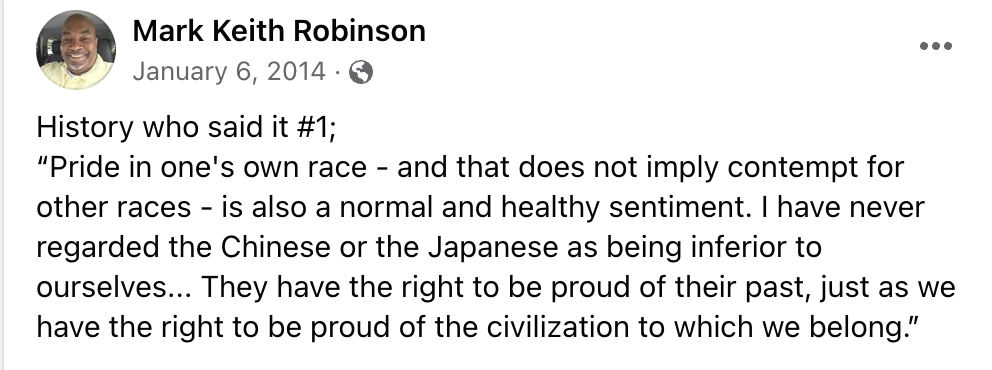
Trump's chaos is what MAGA craves — and it's far more important to them than winning elections. One has to look no further than Haley's neighboring state of North Carolina to show how much MAGA prioritizes fascist buffoonery over effective politics. There, Republicans nominated Lt. Gov. Mark Robinson as their nominee for governor despite the fact that Robinson calls gay people "maggots" and posted, seemingly approvingly, a quote from Adolph Hitler on his Facebook page. Robinson has denied that he was praising Hitler, but since it was echoing a common far-right refrain that it's not "racist" be "proud" of your own race, people are rightfully skeptical of his denials. 


Want more Amanda Marcotte on politics? Subscribe to her newsletter Standing Room Only.


Except for white Christian men, there doesn't appear to be a group that Robinson hasn't heaped hate upon. He's called for the arrest of trans people. He's accused women who get abortions of "murder." At a 2020 event before the Republican Women of Pitt County, he declared, "I absolutely want to go back to the America where women couldn’t vote." He has demanded that women be "led by men." He called school shooting survivors "prosti-tots." He endorses pretty much every conspiracy theory, but especially ones that are really racist against Black people: Barack Obama is a Marxist who faked his birth certificateBeyoncé is "satanic," and police shootings are a media hoax. He complained that "Black Panther" was "created by an agnostic Jew and put to film by satanic marxist." He's implied the Holocaust was faked. There's just so much hate that it's numbing to list it all. 

As Robinson's firehose of hate shows, the whole point of MAGA is to find self-esteem by denigrating everyone else.

Just as telling may be what Trump said when he endorsed Robinson. He declared that Robinson is "Martin Luther King on steroids" and "better than Martin Luther King." Trump, who enjoys dunking on people who publicly support him, sneered that Robinson didn't like the comparison. "I wasn’t sure was he angry because that’s a terrible thing to say or was he complimented." Robinson's displeasure was no doubt due, in part, to his hatred for the former civil rights leader, whom he calls a "communist." In part, it's likely because he recognized Trump wasn't complimenting him at all. The comparison was intended as an insult to King. It's part of a growing willingness on the MAGA right to trash King, such as Charlie Kirk at Turning Points USA saying King "was awful" and "not a good person." 

Trump deriding King really gets at the heart of what Haley doesn't get about MAGA voters: They aren't in this to make friends or build community. If they were, they wouldn't nominate someone like Robinson, who is bound to turn off swing voters. Instead, MAGA is a nihilistic movement focused on destruction. It's not even that they can argue against King's beliefs in any meaningful way. Attacking King is just about being as dickish as possible, for its own sake.  

Derek Thompson of the Atlantic recently wrote about the political science explaining how many voters, especially those in the MAGA movement, want chaos for its own sake. "[T]he need for chaos emerges from the interplay among 'dominance-oriented' traits (i.e., a preference for traditional social hierarchies), feelings of marginalization, and intense anger toward elites," he writes. This is all scientific jargon for the anger arising when white men, who were raised to believe they are entitled to more privileges than everyone else, see their unfair advantages challenged. 

One of the researchers Thompson interviewed compares it to someone playing a game that has always been rigged in their favor. When the rules become a little more fair, they start losing games. They could, of course, actually learn to play the game and get better at it, rather than simply expecting everyone else to let them cheat. Instead, as the researcher explained, "In a rage, you turn the whole table upside down, and the pieces scatter and shatter." They would rather destroy the game than play without unfair advantages. Or, as I often like to say, MAGA is a support group for mediocre white men. 

They would rather destroy the game than play without unfair advantages.

In her concession speech, Haley praised America as a land of opportunity and said, "At its best, politics is about bringing people into your cause, not turning them away." 

In practice, Haley rarely lived up to her own rhetoric. But one can see why she says such things, as these inclusive sentiments appeal to most people. But for the burn-it-all-down crowd that is MAGA, this is everything they reject. They don't want to bring people together. As Robinson's firehose of hate shows, the whole point of MAGA is to find self-esteem by denigrating everyone else. Nor do they love America, despite waving a bunch of flags around. In his victory speech, Trump described the United States as "a third world country" that's "overrun with migrant crime" and "choking to death."  He claimed the U.S. is so terrible that "the world is laughing at us" and "taking advantage of us." 

The relentless whining doesn't reflect reality, of course. In real America, crime is low, employment is high, and the world's respect was restored when Biden was elected. (Though we could lose that respect if Trump wins, bringing shame upon us once again.) Trump is a liar, of course. But his lies resonate with his audience not because they feel the U.S. is losing, but because he speaks to their more personal fears of being unable to keep up in a society where the boot on the neck of women and minorities is ever so slowly being lifted. Projecting their own anxieties onto the country also creates the rationale for what they ultimately want, which is to tear democracy down to the ground and replace it with a MAGA dictatorship that will restore their unearned privileges by fiat. 

Dr. John Gartner: The world is watching “a fundamental breakdown in Trump’s ability to use language”

It has become undeniably clear and obvious to any reasonable person that Donald Trump is experiencing increasing challenges with his speech, language, and memory during these last few weeks and months. Such a conclusion does not require a huge team of investigative journalists: a person only has to watch the corrupt ex-president’s speeches, interviews and other public behavior. For example, at a series of rallies and other events last weekend, Trump repeatedly confused one person with another. Like a broken computer in a science fiction movie, Trump appears to have moments where he cannot speak, appears lost in his thinking, and is more generally confused as he spouts nonsense words and non-sequiturs.

MediasTouch editor Ron Filipowski shared a montage online of 32 examples of Trump experiencing severe challenges during his recent speeches in Virginia and North Carolina last Saturday. 32 examples from just two speeches where the ex-president “mispronounced words, got confused, mixed up names, forgot names, and babbled insane nonsense.”

One of Donald Trump’s former advisors, Alyssa Farah Griffin of ABC's "The View", told CNN in an interview on Monday that Trump "is not as sharp as he was in 2016": 

I have said this before, he is not as sharp as he was in 2016 and not even as sharp as he was in 2020….Listen, he's never been a super articulate or eloquent person….But he's consistently missing up — uh, mixing up names of heads of state. He's mixing up names like Nancy Pelosi and Nikki Haley. I mean, this is it's gotten worse, it hasn't gotten better he's not nearly as sharp as he was.

Also on Monday, during an appearance on Morning Joe, MSNBC contributor Jonathan Lemire reported that Trump’s inner circle is aware of his apparent cognitive challenges and are trying to conceal them from the public:

We're seeing with more and more frequency, even as the media — and we talked about it earlier, how the weekend was full of polls and obsession about President Biden's age — it is this, Trump, who day after day is showing the signs of age but also pressure….because he is not getting as much of the share of the Republican vote as he'd like….Nikki Haley posting a win over the weekend. Pressure because of the money he now owes, nearly half a billion dollars in a couple cases in New York City, and pressure that his first criminal case, a case that could theoretically put him in prison, starts in just three weeks. We are seeing it night after night on the rally stage, where he seems to even just lose control of the English language. Mika [Brzezinski] cringes, I can't help it either at the end of that clip. His team knows, but they're just forging forward.”

Whatever one may think of Donald Trump the political leader, and all of the evil and vile things he has done in that capacity, he is a human being who appears to be in crisis. Moreover, that Donald Trump is leading President Biden in the polls and has a real chance of becoming the next president of the United States should be a source of great alarm for anyone who claims to care about the well-being of the country and its future.

"The shift is radical and ominous."

In a series of widely-read conversations with me here at Salon, Dr. John Gartner, a prominent psychologist and contributor to the bestselling book "The Dangerous Case of Donald Trump: 27 Psychiatrists and Mental Health Experts Assess a President,” has issued the following, almost prophetic warnings, about the ex-president’s behavior:

I had to speak out now because the 2024 election might turn on this issue of who is cognitively capable: Biden or Trump? It's a major issue that will affect some people's votes. Not enough people are sounding the alarm, that based on his behavior, and in my opinion, Donald Trump is dangerously demented. In fact, we are seeing the opposite among too many in the news media, the political leaders and among the public. There is also this focus on Biden's gaffes or other things that are well within the normal limits of aging. By comparison, Trump appears to be showing gross signs of dementia. This is a tale of two brains. Biden's brain is aging. Trump's brain is dementing.

Continuing with this ongoing conversation, I asked Dr. Gartner, and several other leading mental health and medical professionals via email for their thoughts and insights about Donald Trump’s deeply troubling behavior last weekend (and more generally), what they believe is happening based on the public evidence, and what advice they would give Trump and those who care about him.  

Dr. John Gartner is a psychologist and former professor at the Johns Hopkins University Medical School. 

"In the past six months, Trump's rallies are filled with strange lapses of logic."

This is becoming a weekly ritual: A round-up of the latest behaviors evidencing Trump’s apparent dementia. For the eighth time, Trump announced that he was running against Obama. No one believed it when he said he was joking the first seven times, and he keeps saying it, showing just how deeply disoriented he is and how advanced his apparent dementia has become.

Trump is continuing to show more of these phonemic aphasias: “Venezuero” instead of Venezuela. He is also demonstrating semantic aphasias: “steak mountain or steak hill,” instead of “Snake mountain.” Trump is continuing to slur words. What is even more troubling is how Trump sometimes can’t form words at all but just makes sounds. For example, “Saudi Arabia and Russia will…. bluh-ub-bll….”

We need your help to stay independent

And finally, there were more examples last week of a fundamental breakdown in Trump’s ability to use language, to think and to communicate. When Trump visited the border, he said: “Nobody [can] explain to me how allowing millions of people from places unknown, from countries unknown, who don’t speak languages — we have languages coming into our country, we have nobody that even speaks those languages. They are truly foreign languages. Nobody speaks them.” In my opinion, Donald Trump is getting worse as his cognitive state continues to degrade. If Trump were your relative, you’d be thinking about assisted care right now.

Harry Segal is a senior lecturer at Cornell University and Weill Cornell Medical School. He holds a Ph.D. in English Literature from Yale University and a Ph.D. in Clinical Psychology from the University of Michigan. He also conducts a part-time practice in Ithaca, New York, and has written extensively on personality disorders.

I see a dramatic change since he announced his candidacy in November 2022. That speech was more typical of Trump during his presidency – he relied on the teleprompter, but his digressions were easy to follow even if they were filled with lies. But over the past year, his appearances have been erratic. Sometimes, as with the CNN Town Hall, he made few gaffes. But in the past six months, Trump's rallies are filled with strange lapses of logic. He has confused Biden with Obama, spoke of World War II, and has lapsed into bewildering digressions that are hard to follow. Only this weekend he said: “We have languages coming into our country that no one can speak,” a strange grasping for meaning, bordering on neologism. At other times, he seems to get lost in the middle of a sentence.

Since this is an intermittent problem, it suggests that when Trump is especially stressed and exhausted, he suffers cognitive slippage that affects the way he associates words or their meaning. Note, though, that Trump’s pathological lying is itself a form of mental illness, so these cognitive lapses are literally sitting atop what appears to be an already compromised psychological functioning.

"Trump’s pathological lying is itself a form of mental illness, so these cognitive lapses are literally sitting atop what appears to be an already compromised psychological functioning."

There seems to be an emerging difficulty maintaining linguistic control that may well be caused by his incapacity to manage the stress caused by his multiple indictments, court appearances, and huge legal fines. In addition, his daughter and son-in-law are no longer supporting him, and his wife hasn’t appeared with him in public at any of his rallies or victory speeches. This lack of support may be contributing to what appears to be his intermittent cognitive disorganization.

First, I would recommend a full neuro-psychological assessment to identify the deficits in his cognitive functioning. Given those results, I would then recommend limiting his daily activity, scheduling tasks that require high-level cognition early in the day to avoid “sun-downing,” and psychotherapy to explore the sources of stress contributing to mental difficulties. I would certainly recommend that he immediately cease running for president.

Vincent Greenwood, Ph.D, is the founder and executive director of the Washington Center For Cognitive Therapy, a mental health program that provides clinical services in the Washington D.C. area. He has worked as a research associate and training leader at Johns Hopkins University and the National Institute of Health. In 2020, he launched DutyToInform.org to disseminate information about the intersection of psychology and our recent political turmoil. He is the author of The Open And Shut Case Of Donald Trump.

In the past week, we have seen Trump say the following things which could indicate a larger problem with speech and cognition: “Putin has so little respect for Obama…we have a fool for a president." This is an example of mixing up people, not just an occasional mix-up of a name. It is similar to his going on and on about Nikki Haley being responsible for security at the Capitol rather than Nancy Pelosi.

Trump has displayed this kind of confusion with increasing regularity over the past few years. It is meaningful because the confusion of people, in contrast to the occasional forgetting of names, is a sign of early dementia, as noted by the Dementia Care Society.

In his speech in North Carolina, Trump said “migrant cime” leaving out the “r”; and was unable to say “Venezuela” which came out sounding like “Venezwheregull.” These are examples of what we call phonemic paraphasia which is associated with underlying brain damage.


Want a daily wrap-up of all the news and commentary Salon has to offer? Subscribe to our morning newsletter, Crash Course.


(Aphasia is the term we use for disorders of communication. Aphasia is a symptom of some other underlying condition, such as dementia, stroke or head injury. A phoneme is the smallest unit of speech – often a letter or two – that distinguishes one word from another. For example, the letter “r” in the word “far” separates that word from “fad,” “fan,” and “fat.” Phonemic paraphasia is the inappropriate substitution of one sound for the other).

We all stumble over and mispronounce words occasionally. This is not what is going on with Trump. The incidence of these kinds of mistakes takes him into this realm of phonemic paraphasia, which is a sign of underlying brain damage, not just aging. Even when compared to his speech of a few years ago, you can observe a noticeable difference. When you compare it to his speech as a middle-aged man, the shift is radical and ominous.

"I would certainly recommend that he immediately cease running for president."

Trump has also been displaying another kind of paraphasia, called semantic paraphasia, also associated with cognitive deterioration. (Semantic paraphasia involves choosing incorrect words). Last week in his South Carolina speech, he said, “soup pie cane” when he meant to say “supply chain,” and “lady, lady, lady,” when he meant to say “later.” As a younger man Trump’s linguistic style might be characterized as glib but was not marked by the use of the substitution of incorrect words. Semantic paraphasia is a qualitative marker – not of aging -but of underlying disease.

Trump’s unscripted speech of late has also revealed other signs of likely dementia. These include mid-thought change of subject, repetition of words, the use of fillers (“well,” “um,” “so,”), trouble formulating complete sentences not to mention paragraphs, getting words in the wrong order, and simpler word choice.

Loss of vocabulary is not a correlate of normal aging. If anything, there appears to be a slight increase in vocabulary as one gets into their seventies and eighties. It is noteworthy that Trump exhibits a markedly declining vocabulary with overreliance on superlatives over the years. He has gone from what might be described as possessing a somewhat sophisticated vocabulary to one sorely lacking in suppleness.

The key question at the moment regarding Trump’s fitness is the following one. Is there a significant change in his cognitive baseline and are the changes markers of disease rather than normal decline linked to aging? In my professional opinion, the answer to that two-part question is yes. Trump has shown a noteworthy decline in his linguistic competency from his previous baseline, and the decline exposes clinical signs of disorder, not simply aging.

Over-the-counter birth control will soon hit pharmacies. But that doesn’t mean it will be accessible

This week brought a bright light to an otherwise darkening landscape in reproductive autonomy in the United States. For the first time in U.S. history, an oral contraceptive pill called Opill will be available to purchase over-the-counter. This means in less than two weeks, people will be able to go to their local pharmacies and buy an oral contraceptive without having to obtain a prescription from their doctor, or purchase it online.

“This is a landmark event for us in the United States,” Dr. Alison Edelman, professor and OB/GYN at Oregon Health & Science University, told Salon. “In general I’m really happy about that.”

Dozens of countries have had such options for decades. Indeed, the U.S. has been quite behind in this arena. In a global review of over-the-counter access to oral contraceptives, researchers found that oral contraceptives were informally available without a prescription in 38 percent of 147 countries surveyed, and legally without a prescription in 42 percent of countries surveyed. But Edelman, and other OB/GYNs Salon spoke with, anticipate a “bumpy” roll-out — and have some concerns around accessibility and access to care for some people.

There were many people who were hoping the pill would be free or under $5, as many other countries have contraceptive methods that are free and subsidized.

As Salon previously reported, over-the-counter availability is expected to improve accessibility to birth control. That’s why in July 2023, when the U.S. Food and Drug Administration (FDA) approved it to be sold over-the-counter, many doctors called the move “monumental.” It was also a victory for organizations like the American College of Obstetricians and Gynecologists (ACOG) and "Free the Pill" advocates who have long advocated for and supported over-the-counter birth control for decades.

At the time, some were skeptical about how accessible it would become — primarily due to much it would cost. On Monday, the manufacturer also announced a recommended retail price of $19.99 for a one-month supply, $49.99 for a three-month supply and $89.99 for a six-month supply. However, retailers can set their own prices, which may vary across stores and locations. 

Edelman said there were many people who were hoping the pill would be free or under $5, as many other countries have contraceptive methods that are free and subsidized.


Want more health and science stories in your inbox? Subscribe to Salon's weekly newsletter Lab Notes.


“But I think given how we develop drugs and how drugs are brought to market, these companies spend millions of dollars having to bring a product to market,” Edelman said. “To expect them without subsidy to not have a higher price point, so they can recoup some costs, is a little unrealistic and impractical.”

Dr. Anne-Marie Amies Oelschlager, a pediatric gynecologist and chair for the clinical consensus gynecology committee for ACOG, told Salon she expects the cost to be prohibitive to some people. And then for others, it will make more sense to get Opill over-the-counter than to pay out-of-pocket. 

“It’s still less costly than taking time off of work and having to drive or take public transportation to go to a doctor's office. The cost of just going to the doctor is going to be substantially higher,” Amies Oelschlager said. “I think people are going to do a head-to-head cost comparison with going to the physician to get a prescription for contraception versus just walking into the local pharmacy.”

According to a survey conducted by the Kaiser Family Foundation (KFF), only one-third of women between the ages of 18 and 49 — who said they would likely use over-the-counter oral contraception — would be willing to pay $20 a month for it.

"I think that you may be solving one problem and causing another."

While the barrier of a prescription has been removed, cost still could be an issue especially since health insurance isn’t required to cover non-prescription contraceptives. As it stands, seven states require state-regulated private health insurance plans to cover at least some methods of over-the-counter contraception and seven states use state funds to offer the same coverage for Medicaid enrollees. Currently, there is a coalition of Democratic governors and reproductive health advocacy groups pushing the Biden administration to expand the Affordable Care Act’s prescription contraception requirement to cover over-the-counter contraception without a prescription.

Edelman said one way to think about the price is that it’s comparable to other options on the market that are less effective. For example, condoms range in price between $6 and $35. 

Dr. Jen Ashton, a  board certified OB/GYN and Chief Medical Correspondent for Good Morning America, told Salon another way to look at the cost is “an unintended pregnancy is much more expensive.” 

“Whether it’s inexpensive, affordable or expensive is not for anyone to say but the woman purchasing the product,” she emphasized. “What might be affordable to one person could be expensive to someone else.” 

Ashton added that she is concerned about accessibility to follow-up care, in case someone doesn’t take the birth control pill correctly or has side effects. 

Opill, which has the generic name norgestrel, was first FDA-approved in 1973 as a progestin-only medication, referring to the class of drugs it falls under. Compared to combination oestrogen-progestin pills, norgestrel carries fewer risks, such as blood clots. It works by thinning the lining of the uterus, which can prevent sperm from reaching an egg by thickening mucus in the cervix — but it’s not 100 percent effective. According to the FDA, perfect-use effectiveness rate can be as high as 98 percent. But that requires that a woman is taking the pill every day. Ashton said by removing the barrier of seeing a doctor, that could become a missed opportunity for proper counseling. 

We need your help to stay independent

“What if you miss a period? What if you have irregular bleeding?” Ashton posited. “When you remove that kind of counseling, that kind of follow-up, that kind of relationship, which already is in critical condition in this country, I think that you may be solving one problem and causing another.”

That being said, all experts agreed that this is improving accessibility in general. A study published in The Journal of Health Politics, Policy and Law in 2021 found that low-income people and people of color are more likely to live in contraception deserts. By being able to order Opill online or go to a pharmacy without a prescription will certainly be helpful. But it won’t immediately improve the crisis of reproductive health and autonomy in the United States. As experts have said before, Opill is not a replacement for access to abortion.

“It’s important for a lot of women,” Ashton said. “But it's not going to miraculously repaint the whole landscape; it’s unfortunately way more complicated than that.”

Odds for alien life on Europa drop, as new study reveals Jupiter’s moon lacks much oxygen

As far as candidates for nearby worlds that may contain life, Jupiter's frosty moon Europa is one tantalizing place for scientists to look. Astrobiologists speculate that alien life forms could reside in Europa's icy crust and the massive ocean that churns underneath. Yet these prospects appear somewhat less likely in light of a recent study by the journal Nature Astronomy, which finds that Europa has much lower amounts of oxygen — an element essential to all known forms of complex life — than previously thought.

It all comes down to the question of Europa's atmosphere: How many pounds of molecular oxygen per second does it produce? Scientists had previously estimated that Europa created anywhere from a few to over 2,000 pounds per second. As it turns out, the amount of is a meager 26 pounds per second.

The data comes straight from Juno, a NASA probe that passed by the Jovian moon in September 2022 — within 220 miles, or so close that the spacecraft "directly sniffed" its Europan surroundings, explained lead author James Szalay of Princeton University to The Guardian. After crunching the numbers, experts in ice chemistry were surprised that there was so little oxygen available. "We didn't realize is that Juno's observations would give us such a tight constraint on the amount of oxygen produced in Europa's icy surface," Szalay added in a statement.

While the dearth of oxygen may bode poorly for complex life, there are bacteria and other microscopic organisms that can survive without oxygen and are therefore known as "anaerobic" life forms. Because an ocean is believed to exist for miles under Europa's crust, there could be vast ecosystems of microbes thriving just beneath humanity's peering gaze. We probably won't know more until after the Europa Clipper mission launches later in October 2024.

Prince William breaks his silence on Kate Middleton conspiracy theories regarding her health

Prince William has officially broken his silence on the many online conspiracy theories concerning his wife Kate Middleton’s health and conspicuous absence after getting some sort of surgery. Speaking to People for its Wednesday cover story, a spokesperson said on behalf of the prince, “His focus is on his work and not on social media.”

Kate’s well-being continues to be a major topic of concern, especially after William abruptly pulled out of a planned outing to his godfather King Constantine of Greece's memorial service on Feb. 27, People reported. On Jan. 17, Kensington Palace announced that the Princess of Wales underwent a “planned” abdominal procedure the previous day without giving further information on her health. They noted that her medical condition was non-cancerous and that Kate wasn't expected to return to public royal duties until after Easter. 

The uncertainty surrounding Kate’s health invited a myriad of conspiracy theories online, including Redditors speculating that Kate and William's relationship is on the rocks and the Spanish media speculating that Kate is in a coma.

The palace recently assured the public that the Princess of Wales “continues to be doing well” in her recovery. Kate was also spotted during a car ride with her mother, Carole Middleton, this week.

On Feb. 29, a spokesperson reiterated to People that Kate would not be resuming public engagements until after Easter: "We were very clear from the outset that the Princess of Wales was out until after Easter and Kensington Palace would only be providing updates when something was significant."

Syphilis is killing babies. The U.S. government Is failing to stop the disease from spreading

Karmin Strohfus, the lead nurse at a South Dakota jail, punched numbers into a phone like lives depended on it. She had in her care a pregnant woman with syphilis, a highly contagious, potentially fatal infection that can pass into the womb. A treatment could cure the woman and protect her fetus, but she couldn’t find it in stock at any pharmacy she called — not in Hughes County, not even anywhere within an hour’s drive.

Most people held at the jail where Strohfus works are released within a few days. “What happens if she gets out before I’m able to treat her?” she worried. Exasperated, Strohfus reached out to the state health department, which came through with one dose. The treatment required three. Officials told Strohfus to contact the federal Centers for Disease Control and Prevention for help, she said. The risks of harm to a developing baby from syphilis are so high that experts urge not to delay treatment, even by a day.

Nearly three weeks passed from when Strohfus started calling pharmacies to when she had the full treatment in hand, she said, and it barely arrived in time. The woman was released just days after she got her last shot.

Last June, Pfizer, the lone U.S. manufacturer of the injections, notified the Food and Drug Administration of an “impending stock out” that it anticipated would last a year. The company blamed “an increase in syphilis infection rates as well as competitive shortages.”

Across the country, physicians, clinic staff and public health experts say that the shortage is preventing them from reining in a surge of syphilis and that the federal government is downplaying the crisis. State and local public health authorities, which by law are responsible for controlling the spread of infectious diseases, report delays getting medicine to pregnant people with syphilis. This emergency was predictable: There have been shortages of this drug in eight of the last 20 years.

Yet federal health authorities have not prevented the drug shortages in the past and aren’t doing much to prevent them in the future.

Syphilis, which is typically spread during sex, can be devastating if it goes untreated in pregnancy: About 40% of babies born to women with untreated syphilis can be stillborn or die as newborns, according to the CDC. Infants that survive can suffer from deformed bones, excruciating pain or brain damage, and some struggle to hear, see or breathe. Since this is entirely preventable, a baby born with syphilis is a shameful sign of a failing public health system.

“The way people do it for Taylor Swift, that’s how I’ve been with the Bicillin shortage. Desperately checking the websites to see what I can snag.”

In 2022, the most recent year for which the CDC has data available, more than 3,700 babies were infected with syphilis, including nearly 300 who were stillborn or died as infants. More than 50% of these cases occurred because, even though the pregnant parent was diagnosed with syphilis, they were never properly treated.

That year, there were 200,000 cases identified in the U.S., a 79% increase from five years before. Infection rates among pregnant people and babies increased by more than 250% in that time; South Dakota, where Strohfus works, had the highest rates — including a more than 400% increase among pregnant women. Statewide, the rate of babies born with the disease, a condition known as congenital syphilis, jumped more than 40-fold in just five years.

And that was before the current shortage of shots.

In Mississippi, the state with the second highest rate of syphilis in pregnant women, Dr. Caroline Weinberg started having trouble this summer finding treatments for her clinic’s patients, most of whom are uninsured, live in poverty or lack transportation. She began spending hours each month scouring medicine suppliers’ websites for available doses of the shots, a form of penicillin sold under the brand name Bicillin L-A.

“The way people do it for Taylor Swift, that’s how I’ve been with the Bicillin shortage,” Weinberg said. “Desperately checking the websites to see what I can snag.”

The shortage is driving up infection rates even further.

In a November survey by the National Coalition of STD Directors, 68% of health departments that responded said the drug shortage will cause syphilis rates in their area to increase, further crushing the nation’s most disadvantaged populations.

“This is the most basic medicine,” said Meghan O’Connell, chief public health officer for the Great Plains Tribal Leaders’ Health Board, which represents 18 tribal communities in South Dakota and three other states. “We allow ourselves to continue to not have enough, and it impacts so many people.”

ProPublica examined what the federal government has done to manage the crisis and the ways in which experts say it has fallen short.

The government could pressure Pfizer to be more transparent

Twenty years ago, there were at least three manufacturers of the syphilis shot. Then Pfizer, one of the manufacturers, purchased the other two companies and became the lone U.S. supplier.

Pfizer’s supply has fallen short since then. In 2016, the company announced a shortage due to a manufacturing issue; it lasted two years. Even during times when Pfizer had not notified the FDA of an official shortage, clinics across the country told ProPublica, the shots were often hard to get.

Several health officials said they would like to see the government use its power as the largest purchaser of the drug to put pressure on Pfizer to produce adequate supplies and to be more transparent about how much of the drug they have on hand, when it will be widely available and how stable the supply will be going forward.

“This is the most basic medicine. We allow ourselves to continue to not have enough, and it impacts so many people.”

In response to questions, Pfizer said there are two reasons its supply is falling short. One, the company said, was a surge in use of the pediatric form of the drug after a shortage of a different antibiotic last winter. Pfizer also blamed a 70% increase in demand for the adult shots since last February, which it described as unexpected.

Public health experts say the increase in cases and subsequent rise in demand was easy to see coming. Officials have been raising the alarm about skyrocketing syphilis cases for years. “If Pfizer was truly caught completely off guard, it raises significant questions about the competency of the company to forecast obvious infectious disease trends,” a coalition of organizations wrote to the White House Drug Shortage Task Force in September.

Pfizer said it is consistently communicating with the CDC and FDA about its supply and that it has been transparent with public health groups and policymakers.

The FDA has a group dedicated to addressing drug shortages. But Valerie Jensen, associate director of that staff, said the FDA can’t force manufacturers to make more of a drug. “It is up to manufacturers to decide how to respond to that increased demand.” she said. “What we’re here to do is help with those plans.”

Pfizer said it had a target of increasing production by about 20% in 2023 but faced delays toward the end of the year. The company did not explain the reason for those delays.

The company said it has invested $38 million in the last five years in the Michigan facility where it makes the shots and that it is increasing production capacity. It also said it is adding evening shifts at the facility and actively recruiting and training new workers. Pfizer said it also reduced manufacturing time from 110 to 50 days. By the end of June, the company expects the supply to recover, which it described as having eight weeks of inventory based on its forecast demands with no disruptions in sight.

The government could manufacture the drug itself

Having only one supplier for a drug, especially one of public health importance, makes the country vulnerable to shortages. With just one manufacturer, any disruption — contamination at a plant, a shortage of raw materials, a severe weather event or a flawed prediction of demand — can put lives at risk. What’s ultimately needed, public health experts say, is another manufacturer.

Congressional Democrats recently introduced a bill that would authorize the U.S. Department of Health and Human Services to manufacture generic drugs in exactly this scenario, when there are few manufacturers and regular shortages. Called the Affordable Drug Manufacturing Act, it would also establish an office of drug manufacturing.

This same bill was introduced in 2018, but it didn’t have bipartisan support and was never taken up for a vote. Sen. Elizabeth Warren, the Massachusetts Democrat who introduced the bill in the Senate, said she’s hopeful this time will be different. Lawmakers from both parties understand the risks created by drug shortages, and COVID-19 helped everyone understand the role the government can play to boost manufacturing.

Still, it’s unlikely to be passed with the current gridlock in Congress.

The government could reserve syphilis drugs for infected patients.

Responding to the shortage of shots to treat the disease, the CDC in July asked health care providers nationwide to preserve the scarce remaining doses for people who are pregnant. The shots are considered the gold standard treatment for anyone with syphilis, faster and with fewer side effects than an alternative pill regimen. And for people who are pregnant, the pills are not an option; the shots are the only safe treatment.

“Until we think about public health the way we think about our military, we’re not going to see a difference.”

Despite that call, the military is giving shots to new recruits who don’t have syphilis, to prevent outbreaks of severe bacterial respiratory infections. The Army has long administered this treatment at boot camps held at Fort Leonard Wood, Fort Moore and Fort Sill. The Army has been unable to obtain the shots several times in the past few years, according to the U.S. Army Center for Initial Military Training. But the Defense Health Agency’s pharmacy operations center has been working with Pfizer to ensure military sites can get them, a spokesperson for the Defense Health Agency said.

“Until we think about public health the way we think about our military, we’re not going to see a difference,” said Dr. John Vanchiere, chief of pediatric infectious diseases at Louisiana State University Health Shreveport.

Some public health officials, including Alaska’s chief medical officer, Dr. Anne Zink, questioned whether the military should be using scarce shots for prevention.

“We should ask if that’s the best use,” she said.

Using antibiotics to prevent streptococcal outbreaks is a well-established, evidence-based public health practice that’s also used by other branches of the armed services, said Lt. Col. Randy Ready, a public affairs officer with the Army’s Initial Military Training center. “The Army continues to work with the CDC and the entire medical community in regards to public health while also taking into account the unique missions and training environments our Soldiers face,” including basic training, Ready said in a written statement.

The government isn’t stockpiling syphilis drugs.

In rare instances, the federal government has created stockpiles of drugs considered key to public health. In 2018, confronting shortages of various drugs to treat tuberculosis, the CDC created a small stockpile of them. And the federal Administration for Strategic Preparedness and Response keeps a national stockpile of supplies necessary for public health emergencies, including vaccines, medical supplies and antidotes needed in case of a chemical warfare attack.

In November, the Biden administration announced it was creating a new syphilis task force. When asked why the federal government doesn’t stockpile syphilis treatments, Adm. Rachel Levine, the HHS official who leads the task force, said officials don’t routinely stockpile drugs, because they have expiration dates.

In a written statement, an HHS spokesperson said that Bicillin has a shelf life of two years and that the Strategic National Stockpile “does not deploy products that are commercially available.” In general, the spokesperson wrote, stockpiles are most effective before a national shortage begins and can’t overcome the problems of limited suppliers or fragile supply chains. “There is also a risk that stockpiles can exacerbate shortages, particularly when supply is already low, by removing drugs from circulation that would have otherwise been available,” the spokesperson wrote.

Stephanie Pang, a senior director with the coalition of STD directors, said that given the critical role of this drug and the severe access concerns, she thinks a stockpile is necessary. “I don’t have another solution that actually gets drugs to patients,” Pang said.

The government could declare a federal emergency.

Some public health officials say the federal government needs to treat the syphilis crisis the way it did Ebola or monkeypox.

Declare a federal emergency, said Dr. Michael Dube, an infectious disease specialist for more than 30 years. That would free up money for more public health staff and fund more creative approaches that could lead to a long-term solution to the near-constant shortages, he said. “I’d hate to have to wait for some horrible anecdotes to get out there in order to get the public’s and the policymakers’ minds on it,” said Dube, who oversees medical care for AIDS Healthcare Foundation wellness clinics across the country.

Citing an alarming surge in syphilis cases, the Great Plains Tribes wrote to the HHS secretary last week asking that the agency declare a public health emergency in their areas. In the request, they asked HHS to work globally to find adequate syphilis treatment and send the needed medicine to the Great Plains region.

During the 2014 outbreak of Ebola in West Africa, Congress gave hundreds of millions of dollars to HHS to help develop new rapid tests and vaccines. Facing a global outbreak of monkeypox in 2022, a White House task force deployed more than a million vaccines, regularly briefed the public and sent extra resources to Pride parades and other places where people at risk were gathered.

Levine, leader of the federal syphilis task force, countered that declaring an emergency wouldn’t make much of a difference. The government, she said, already has a “dramatic and coordinated response” involving several agencies.

The FDA recently approved an emergency import of a similar syphilis treatment made by a French manufacturer that had plenty on hand. According to the company, Provepharm, the imported shots are enough to cover approximately one or two months of typical use by all people in the U.S. (The FDA would not say how many doses Provepharm sent, and the company said it was not allowed to reveal that number under the federal rules governing such emergency imports.)

Clinics applaud that development. But many of them can’t afford the imported shots.

The government could do more to rein in the cost

Clinics and hospitals that primarily serve low-income patients often qualify for a federal program that allows them to purchase drugs at steeply discounted prices. Pharmaceutical companies that want Medicaid to cover their outpatient drugs must participate in the program.

One factor in determining the discount price is whether a pharmaceutical company has raised the price of a drug by more than the rate of inflation. Because Pfizer has hiked the price of its Bicillin shots significantly over the years, the government requires that it be sold to qualifying clinics for just pennies a dose. Otherwise, a single Pfizer shot can retail for upwards of $500. The French shots are comparable in retail price and not eligible for the discount program.

Several clinic directors also said they worried that drug distributors were reserving the limited supply of the Pfizer shot for organizations that could pay full price. For several days in January, for example, the website of Henry Schein, a medical supplier, showed doses of the shot available at full price, while doses at the penny pricing were out of stock, according to screenshots shared with ProPublica. When asked whether it was only selling shots at full price, a spokesperson for Henry Schein did not respond to the question.

Local health departments that qualify for the discount program told ProPublica they’ve had to pay full price at other distributors, because it was the only stock available.

The Health Resources and Services Administration, the federal agency that regulates the discount program, said that a drug manufacturer is ultimately responsible for ensuring that when supplies are available, they are available at the discounted price. When asked about this, Pfizer said that it has “one inventory that is distributed to our trade partners” and that hospitals and clinics that qualify for the discount program are “responsible for ensuring compliance with the program and orders through the wholesaler accordingly.” The company added, “Pfizer plays no part in this process.”

In October, on Weinberg’s regular search for shots for her Mississippi clinic, she found doses of Bicillin for sale at the discounted price and purchased 40. “The idea that we’re supposed to be hoarding treatment is a horrific compact,” she said. Word got out that the clinic, called Plan A, has some shots, and other clinics began sending pregnant patients there.

The clinic’s supply is dwindling. Weinberg is happy to get the shots to patients who need them. But she’s not sure how much longer her reserve will last — or if she’ll be able to find more when they’re gone.

ProPublica is a Pulitzer Prize-winning investigative newsroom. Sign up for The Big Story newsletter to receive stories like this one in your inbox.

Legal experts warn Trump lawyers could face “criminal prosecution” if they knew ex-CFO lied

Former Trump Organization CFO Allen Weisselberg on Monday pleaded guilty to perjury, admitting to lying under oath to the New York attorney general’s office as it was investigating Donald Trump.

The repercussions of Weisselberg's plea agreement could have serious consequences for Trump's attorneys, including Alina Habba, Clifford Robert, and others, The Daily Beast reported

Judge Arthur Engoron considered Weisselberg an unreliable witness and questioned his ability to recall his position as the Trump Organization’s finance chief throughout the former president's civil fraud trial, in which Trump is accused of inflating valuations on financial statements for personal gain.

After the New York Times published a report detailing that Weisselberg had been involved in secret negotiations with prosecutors from the Manhattan District Attorney’s office, Engoron demanded that Trump’s lawyers provide answers. He asked that they submit letters “detailing to me anything you know about this that would not violate any of your professional ethics or obligations.” 

“I do not want to ignore anything in a case of this magnitude,” Engoron said.

Under the New York Rules of Professional Conduct, a lawyer “shall not knowingly: … offer or use evidence that the lawyer knows to be false.” If a lawyer becomes aware that their client or a witness called by the lawyer presents "material evidence" that is false, the lawyer is obligated to “take reasonable remedial measures, including, if necessary, disclosure to the tribunal.”

The rules go on to mention that a lawyer “who represents a client before a tribunal and who knows that a person intends to engage, is engaging or has engaged in criminal or fraudulent conduct related to the proceeding shall take reasonable remedial measures.”

In this case, if the Trump lawyers in the attorney general's case knew that Weisselberg lied in his testimony, they were required to take "reasonable remedial measures," Stephen Gillers, a professor of legal ethics at New York University School of Law, told Salon.

“They had to do this even if those measures required them to disclose a client's confidential information,” Gillers said. “Here those remedial measures would have required disclosure of the lie to the court. Perjury is ‘criminal’ and ‘fraudulent conduct’ under paragraph (b) [of the New York Rules of Professional Conduct].”

The disciplinary committee can start an investigation into the lawyer's conduct on its own or in response to a complaint, he added.

We need your help to stay independent

However, the key words are "knowingly use," pointed out Gregory Germain, a Syracuse University law professor. If the lawyers did not know that the testimony was false, even if they had doubts about the credibility of the evidence, they would not be in violation of the rules. If they had actual knowledge that the testimony was false, the lawyers would be subject to discipline for violating the rules, and the penalties could include “suspension or disbarment.”

“If the lawyers knew about and encouraged false testimony, the lawyers could face criminal prosecution under federal law (18 USC 1622), and similar NY criminal laws," Germain said. “But again, a prosecutor would have to prove that the lawyers had actual knowledge that the testimony was false beforehand. That's a difficult thing to prove without the assistance of the perjurer.”

Weisselberg, who was a key figure in both of Trump’s New York cases, and has been closely linked to Trump’s finances for decades, abruptly concluded his testimony in October, after a Forbes report suggested that he had lied under oath about his involvement in valuing Trump’s penthouse apartment.

Weisselberg claimed to have minimal knowledge of how Trump’s penthouse at Trump Tower came to be valued at $200 million on his financial statements, based on figures indicating it was three times its actual size.

The issue concerns the “false size” of Trump's apartment that was used to determine the value of the apartment in Trump's financial statement, Germain explained. Weisselberg has admitted to lying under oath when he claimed that he did not know of the error until after the statement was used. 


Want a daily wrap-up of all the news and commentary Salon has to offer? Subscribe to our morning newsletter, Crash Course.


“In admitting to perjury, he now admits that he knew and did not correct earlier than he claimed in his testimony under oath,” Germain said. “However, he has apparently not implicated others in the Trump organization in the fraud or perjury.”

Since Engoron already determined the falsity of the valuation and knew the truth when he issued his opinion, the perjury admission would not impact the civil case unless, of course, Weisselberg were to implicate others, he added.

"As attorneys, you have a duty to the court, your clients and to yourself to vet your case well before you step foot in court…” V. James DeSimone, a California civil rights attorney, told Salon. “You protect the truth, that’s due diligence.”

Even with rigorous vetting people can lie and clients and witnesses can mislead, DeSimone explained. Regardless of lawyers doing their due diligence, if false testimony comes into evidence without a lawyer’s knowledge, that lawyer should be protected from adverse consequences.

"In this case, Trump’s attorneys had evidence of contradictions between Weisselberg’s emails and what he claimed under oath,” DeSimone said. “Under the rules of professional conduct, they had an obligation to the court and to the justice system to persuade Weisselberg not to testify falsely and, if unsuccessful, must refuse to offer the false testimony."

“I’ve never cared about being loved”: Meghan McCain on not getting along with liberal “View” hosts

Meghan McCain is once again opening up about her tenure as co-host on “The View,” this time in a Tuesday episode of the conservative variety program "Ruthless Podcast." McCain sat down with podcast hosts Josh Holmes, Michael Duncan and John Ashbrook along with journalist Mary Katharine Ham to dish on the daytime talk show and her former co-workers. 

The television personality, columnist and author served as a co-host on “The View” from 2017 to 2021. She is one of the only co-hosts to leave on her own — without being fired — in the gab fest's history. In her latest memoir “Bad Republican,” McCain revealed that she had been “unhappy” at the show for a long time and described its environment as “toxic.”  

In her podcast appearance, McCain said she was cast as “the enemy” because the entire show is “leftists,” including those working in hair and makeup. “Maybe it’s different if you’re someone who wants to placate the show and be popular and be loved,” she said. “I’ve never cared about being loved, for better or for worse.”

McCain continued, saying her former co-hosts all “hate conservatives and men,” both on and off camera. She said she felt like she was “punished” for wanting to represent conservatives and give them a voice, especially in the wake of Trump’s presidency and the pandemic.

“I am told that it’s all utopian, beautiful, they all get along and there’s never any problems. I was the drama, I was the problem, the whole thing,” McCain said of "The View" dynamic. “Maybe that’s true. I don’t know. But for me, I don’t want to be friends with people I don’t respect. It’s too hard.”

Elsewhere in the podcast, McCain claimed the show never wanted to showcase “any real conservatives.” Strong and tough conservative women, McCain added, are also treated “like traitors to women” by the media.

https://www.instagram.com/reel/C4JskRGh9Fz/?igsh=MzRlODBiNWFlZA%3D%3D

Young people are losing sleep over energy drinks – but a ban won’t be enough to protect them

There's no calming the buzz around energy drinks. And it's not just because of their notoriously high caffeine content.

In the first few weeks of 2024, the UK Labour party proposed including a ban on energy drinks for under-16s in their election manifesto due to concerns about their health impact. Soldiers belonging to the Blues & Royals – part of the king's ceremonial bodyguards, the Household Cavalry – have also been ordered to stop consuming energy drinks.

Since then, one of Hollywood's highest paid actors, Dwayne "The Rock" Johnson has launched a new campaign for his "healthy" energy drink brand, Zoa. No doubt Johnson is hoping to capitalize on the thirst for energy drinks that helped Prime, a brand promoted by popular but controversial YouTube personalities KSI and Logan Paul, achieve cult status among school-aged children, especially boys.

But young people's consumption of energy drinks isn't likely to be completely driven by influencer trends. If we want to help young people suffering the health consequences of consuming energy drinks too often, regulation is no doubt part of the picture. But we also need to examine the root causes of young people's attraction to energy drinks.

Recent evidence suggests that in the UK up to a third of children and young adults consume energy drinks regularly. A 2016 systemic review of energy drink consumption by children and young people found boys are more likely to consume higher amounts than girls.

Energy drinks can contain as much as 505mg of caffeine per serving (equivalent to over fourteen cans of cola), with most containing around 160mg per can. For comparison, a typical 250ml cup of coffee contains about 90-140mg.

Owing to this high caffeine content, the consumption of energy drinks has been linked to poor sleep quality. Research has found that the drinks may also contribute to mental health issues among young people, including anxiety, stress, irritability and depression. All of which are almost certainly linked to disrupted sleep patterns.

So why are young people so keen on energy drinks? Academic research shows that reasons for consumption include enjoying the taste, as a measure to deal with fatigue and boost mood – and to improve mental and sporting performance.

Another common use for energy drink is as a mixer. Energy drinks are often combined with alcohol and consumed at parties to give an extra buzz. The energy drink counteracts the depressive effect of the alcohol so the drinker feels more alert than they might otherwise.

But this trend also has its dangers. People can end up drinking more alcohol than they realize because its effects are suppressed by the energy drinks.

Branding, marketing and peer influence encourage their use among young people, many of whom are unaware of possible harms of energy drink usage. A UK study conducted in 2022 found that only about half of children knew that energy drinks contained caffeine.
         

Young people lacking in sleep

Though some academic studies have reported a link between young people's use of energy drinks and a lack of sleep, the exact relationship between the two isn't clear.

Numerous factors such as night-time screen use and social media scrolling, academic pressures, and mismatches between school start times and natural sleep-wake rhythms conspire to see many of the world's young people falling short of recommended sleep targets.

Whatever the cause of young people's lack of sleep, energy drinks offer a fast and convenient way to counteract the effects of poor sleep on mood and day-to-day functioning. It's possible, then, that young people can become trapped in vicious cycles of energy drink use, poor sleep and deteriorating mental health.  

Energy drink use has also been linked to attention deficit hyperactivity disorder (ADHD). However, while some acute effects of energy drinks, such as increased activity, resemble ADHD symptoms, it is currently unclear whether there is any long term increased risk of developing ADHD as a result of energy drink consumption.

Young people with ADHD symptoms might also be more likely to use energy drinks as a form of "self-medication" or because they enjoy the feeling or lower impulse control. As young people with ADHD are already more likely to experience sleep difficulties, they might also be an especially vulnerable group for whom energy drink use could exacerbate pre-existing sleep issues.


Bans and regulation are only part of the answer

In light of the accumulating evidence for the harms of energy drinks, several countries have started to regulate or outright ban their sale minors. In Lithuania and Turkey, for example, sales of energy drinks to under 18s is not allowed.

In the UK, a 2018 social media campaign spearheaded by celebrity chef Jamie Oliver led to many supermarkets implementing a voluntary ban on sales to under-16s. The following year, the UK government said they would ban energy drinks for under-16s in England. But the ban has not been implemented.

Bans and regulation can help to change behavior, but they are usually not enough on their own. Equipping young people with the knowledge and skills to manage their sleep and energy cycles will play a crucial role in tackling the global shortage of sleep among young people.

Most crucial of all, we need to listen to young people and understand their motivations for using energy drinks so that we can design effective strategies to support them to reduce their consumption.

Aja Murray, Reader in Psychology, The University of Edinburgh and Ingrid Obsuth, Senior Lecturer in Clinical Psychology, The University of Edinburgh

This article is republished from The Conversation under a Creative Commons license. Read the original article.

Unlike Anthony Bourdain, Phil Rosenthal’s show is for people “afraid of everything,” like him

Phil Rosenthal is the Emmy Award-winning creator, writer and executive producer of the hit CBS sitcom "Everybody Loves Raymond." After the show ended in 2005, Rosenthal took his talents on the other side of the camera to host PBS’ "I'll Have What Phil's Having," which later became Netflix’s "Somebody Feed Phil," a travel food series that takes Rosenthal around the globe and outside of his culinary comfort zone. When I talked to Rosenthal recently about making that switch, he said, "I thought there must be a show for people like me who are even afraid to leave the house, who a step out of their comfort zone is getting off the couch."

In seven seasons of "Somebody Feed Phil," Rosenthal has moved far beyond his couch, enjoying a creative mix of fine dining, street cuisine and local dishes from places as close as Nashville to as far as Dubai. Season 7 offers more with trips to the nation's capital, Mumbai, Iceland and more, where we met with a colorful collection of culinary experts including Chef Kwame Onwuachi, learned the dishes that get CNN's Jack Tapper excited and traded jokes with the legendary, late television executive Norman Lear.

Food and travel documentaries can be intimidating for many because the hosts are usually fearless experts, who are willing to jog through warring countries just to take a bite of an exotic pig head. Rosenthal occupies a comfortable space because he's like one of us — just a guy out in the world, having fun and learning, while giving us the confidence to be as curious as we are fearful when we explore.

"The way I sold the show first to PBS and then to Netflix,” Phil explained, “I said one line. I said, 'I'm exactly like Anthony Bourdain, if he was afraid of everything.'"

Watch my "Salon Talks" episode with Phil Rosenthal here, or read a Q&A of our conversation below to hear more about why Kyoto is the one place he would love to revisit, what city has the best burger in the world and more on the new season of "Somebody Feed Phil."

This transcript has been lightly edited for length and clarity.

You’re a pretty fit guy, but you eat all this great food all the time. How much can you consume?

That's the number one question I get. You were nice about it. I do these shows where I go on tour and I talk to audiences and a little five-year-old girl got up to the mic and she said, "May I ask you a question?" And I said, "Of course, dear, what is it?" She goes, "How come you're not fat?" So I'll tell you what I tell her, which is, you know how they make a dog food commercial? They don't feed the dog until the commercial. So, I'm the dog.

You only eat for work. 

"Put a buffet in Congress because you can't hate somebody if you're eating with them."

I know it sounds crazy, but let's say we're in town for a week. That's how long it takes to shoot the show. One week in each place. You see me eating a lot, but that's all I ate that day, was that scene, and then right up against it is the next scene. So it looks like I just go from eating to eating to eating, but that's probably the next day. Maybe we do two scenes in a day. That's how I do it. The rest of the time I'm walking or working out. This doesn't happen by itself.

What happens if you eat something that is so good, but you know you have to save space?

I'm not good at that. You hit on something that's the other secret: I don't finish anything because I know a lot is coming. Unless it is the best thing I ever ate, I'm not finishing that. Plus by the way, the crew, they're looking at me while I'm eating these delicious things, so I share it with them.

The crew's always hungry.

But I love to share it with them. It's fun to share it with them. It's only good if you can share it. That's really a philosophy. [Before we started filming,] you talked about being alone in a restaurant, and yet you FaceTimed your wife because you wanted to at least share the experience with her. It's only good if you can share it.

It put me in a doghouse. We've been in New York like three times since then and we haven't been to Tatiana together.

All right. But right now here, I want you to tell your wife you're taking her.

I'm taking you to Tatiana. Phil's going to pay for it.

This season you go to D.C., which made me extremely happy because I live near D.C.

Yes.

You go to Iceland, Dubai, Mumbai, Kyoto, Scotland and more. Is there a common thread between these cities?

They all have amazing food. We even went to Orlando and I was not expecting much. I was expecting Epcot, but here's the thing about Disney: they've been there 50 years. They have employed tens of thousands of immigrants. The immigrants have set up their own communities, cultures and brought their food with them, their cuisines, and so it's like a mini New York or a mini LA where you have all these neighborhoods of different places from around the world. It's phenomenal. We're calling that the real Orlando and we don't set foot in the park.

You kind of do that in Dubai as well.

That's right because you expect you drive down the street in Dubai and you go, “Oh, this is what it would be like if Vegas had real money.” It’s so built up. It's so modern and spectacular. But I thought it was going to be all casino food or hotel food. Then there's old Dubai and that's a city of immigrants. It’s over 80% immigrants. [They have] amazing Indian food. Amazing. 

I had one of the most beautiful scenes I've ever had just in my life, was a meal with a Palestinian woman who made me food from her hands and gave it to me. I got emotional. This was before all the troubles, but I'm telling you, there was a real connection there, real like a spiritual almost. I'm not one of these woo-woo guys, but I felt something so powerful and we just, we're friends and that's how it can be and how it should be.

When you were in Mumbai, you experienced the market and you said something that was very interesting to me: "People said, I need to be able to experience all of life at once. Rich, poor, beautiful, crazy, overwhelming." I thought it was such a beautiful way to illustrate that part of the journey. I just wondered if you could elaborate on what you experienced there.

Mumbai, they call it maximum city because, we're sitting here in New York now. New York is maybe the center of the universe, but I swear to you, I'm from here, I never saw more hustle and bustle in my life. Imagine being dropped into Times Square at midnight, only it's summer and it's hot and every manner of transportation in the world is going through it at the same time that it's packed with people. And I mean everything from a tuk-tuk, to a scooter, to a bus, to a cow, to a rickshaw, to everything. Everyone is honking. It's absolutely overwhelming, and yet nobody's mad. Nobody's angry. They're honking just to say, “I'm here. I'm here.” There's no traffic lights.

No, that scene with those smiling faces was so beautiful. 

They're so friendly and sweet, no matter the stature of the person, meaning you'd see the same smile on a very poor person as you would with a very rich person. They're happy people. It's amazing. I was so worried about the poverty that I would see there. How do you do your light little fun travel show when people are suffering? But I didn't see suffering. I did see poor people, but I didn't see suffering. I see more suffering here. 

They're just gorgeous and friendly and outgoing. I tell you the best thing about travel is it changes your perspective. So here I was afraid to go. I didn't know how to show it, how to justify it. One way to justify it is when you go, you try to help a little bit. You try to make each place that you visit a tiny bit better than you found it. That's important to me. 

By the way, the other thing I was afraid of in Mumbai was everyone I know who went has gotten sick because we're not used to the water. We're not used to different stuff in the food.

Well, you're seven seasons in, so I imagine that your stomach has evolved.

"I'm a tiny bit braver than when we started."

I think my stomach can handle a lot, but everyone I knew got sick. So they said, "You got to be extra careful. You got to not only brush your teeth with bottled water, you have to rinse your toothbrush then in bottled water to make sure." I was super careful and didn't get sick. 

There was one place I got sick and the whole history of the show. You know where it was? San Francisco, and I don't even know from what because I ate a lot that day. I don't know what it was.

How have you changed as a person from eating in all these different places? What has this show done to Phil Rosenthal the man?

The way I sold the show first to PBS and then to Netflix, I said one line. I said, "I'm exactly like Anthony Bourdain, if he was afraid of everything." And I meant it. I mean that's not just funny. It's really, I would watch him . . .

Because he was fearless.

A superhero, right. The best. But I would watch him and I would go, “That's amazing. I'm never doing that.” I'm not doing that. I'm not going into a dune buggy. I'm not going to a country at war to get shot at. I'm not doing it. 

Then I thought there must be a show for people like me who are even afraid to leave the house, who a step out of their comfort zone is getting off the couch. Two-thirds of Americans don't even have a passport. Imagine that. They don't want to go anywhere. They don't want to try stuff, so I thought if I at least tried stuff, maybe that's a big step for other people.

How it changed me was the more I do it, the less afraid I am. Why? Because our biggest fear is the unknown. But if you do something that you were afraid of, now it's at least known to you. It doesn't mean I'm going to do it every time again, but I'm a tiny bit braver than when we started.

You were pretty convincing on the Dubai episode when you said this is the best burger you ever had and if you want a burger, you have to literally get on a plane and go to Dubai.

It is amazing how sometimes the outsider (he's not American, he didn't grow up with burgers) . . . sometimes that point of view from outside has the best view.

Of everywhere you went in season seven, if you got to go back to one city to re-eat your way through that city, which one would it be?

Kyoto.

Okay, that was easy for you to answer.

You ever been to Japan?

I've never been to Japan.

There's something about it. My wife is with me on four of these episodes of the eight. It's really nice. When we got to Kyoto, it was so beautiful, so serene. That's not a word I throw around a lot because we're talking about Mumbai and New York. These are not serene places. This, you go there and it is just like this. Japan was bombed during World War II. They bombed almost every city. Kyoto, they didn't touch, so there's over 2,000 ancient temples and shrines still there in Kyoto. 

"All we are is a collection of everything that's happened to us, filtered through the way we think."

Imagine walking around the city and finding not just a temple, but all the grounds of the temple, all the manicured beautiful trees and forests. It's a joke, but you go to a pharmacy in Japan and you buy a pack of gum, they wrap it for you as if it's for your 100th birthday. It's crazy the level of detail and care that's taken in every aspect of life, including the food. 

Let's say we want dumplings tonight. You don't just go to a restaurant that has dumplings. You go to the dumpling place with 10 seats. That's all they do. Are they the best dumplings you ever had in your life? Yes. You want noodles. What kind of noodles? You want the soba noodles or the udon noodles because that's going to determine which restaurant you go to. So we go to the soba noodle place. All they serve there is cold soba noodles with some dipping sauce. One of the best meals I ever had in my life.

So it's like after leaving a place like Mumbai, Kyoto might be the place to reset.

I'll say, or just reset from anywhere else in the world. There's nothing like it. On the first day, I was sad because I knew I only had a week there.

On the first day. Wow.

On the first day I go, “Wow, I'm going to hate to leave this place.”

You touched on this a little bit earlier, how food brings everyone together.

Yes. It's the great connector.

I think about how separated, how divisive our country is right now, and food is something that we all have in common, something that we all share. Is there a way for us to use food to heal us?

Did you see the D.C. episode yet?

I did see the D.C. episode.

So you know what happens at the end of that episode. It was something I had in mind. When we went to D.C., I said, "I wonder if I can make this happen."

Are we doing spoilers?

It's okay.

We'll just say we're getting Democrats and Republicans together at Maketto.

There you go. You got it. That was not easy. I couldn't find a Republican and a Democrat to come and sit and have a meal with me because they didn't want to be together. What the hell? But then I did.


"It's amazing to be this age and wake up and find yourself Taylor Swift."

Brian Fitzpatrick, who's a Republican congressman from Pennsylvania, and Pete Buttigieg, our Secretary of Transportation, and they sat and they were fantastic and they serve on a committee that I didn't know existed. It's called the Bipartisanship Committee. When I asked them what do you think is the biggest problem our country faces today? They said it was bipartisanship, and that makes total sense. I thought it would be guns or climate change or whatever. [There are] so many problems, but none of the problems will get fixed unless the two sides talk. And a good way to get people to talk is to sit down and eat something together.

Maybe next season you can get Mitch McConnell to play a game of basketball with Al Sharpton and you referee and then everybody eats together. I'll pay to see that.

I said put a buffet in Congress because you can't hate somebody if you're eating with them. I really don't think so because right away we're doing something that we all do that's known to us. Even if you hate them going in, I swear you'll feel a little better with them once you do something completely relatable with them. You can't help it. Oh look, we're at least, at the very least human beings who like to eat. And if the food is good, it puts you in a better mood. If you can share a smile or a laugh with the person, now we're friends and we might eat again. So to me, I'm not just using food as this fun thing. I actually think it's important.

You've had success in front of the camera and behind the camera. How does it feel about being in front of the camera at this phase of your career?

It's amazing to be this age and wake up and find yourself Taylor Swift.

You’re having a lot of fun with it.

Of course.

And you get to work with your wife and son, which is also amazing.

I do. And my daughter too. In fact, I wrote a kids' book with my daughter that's coming out this week called “Just Try It.” It's exactly what we're talking about. It's not just for little kids either. The book is about a dad who eats everything, this little girl who won't try anything, but how many adults do you know that won't try stuff?

It's too many.

Right. It's really about just having a little bit of an open mind. That's all it is. Wouldn't the world be better if we just tried new things or tried to talk to new people?

I definitely want to say rest in peace to Richard Lewis.

Oh, what a great guy.

We're big “Curb Your Enthusiasm” fans around here, and I do think our fans want to know what did you do to Larry David to the point where he wouldn't want to have lunch with you? 

"Right after “Raymond,” I tried to write a sitcom every year. Nobody wanted it. That's why I have to do this."

Hysterical. I love that. I didn't do anything to him, but he understands that we are opposite personalities. The name of my show would be “Why Curb Your Enthusiasm?” As someone positive and someone who loves other people, that could be annoying to a guy like Larry, so he doesn't want to sit with me. He's worried that I was going to ask him to be on my show. Of course the first thing I do when I see him is, "Hey, you got to do my show. You want to go to Ethiopia? Do you like coffee?" And he's like, “Ugh.”

He had this great bit on destination weddings. I hate destination weddings. He said, "For a wedding you shouldn't have to travel more than like 10 miles or you don't got to go."

I can't say that he's wrong. I was once invited to a bar mitzvah on an Alaskan cruise to Alaska. That's a week commitment. On a cruise ship.

As a memoirist, I write a whole lot about my life, what happened in the past, what's going on, projections in the future, and I heard you talk about how “Everybody Loves Raymond” was drawn from Ray Romano’s life and parts of your life. What are some of the key parts for you when building a story just around those personal things that happen to you and within your relationships?

I think it's the key to everything. I think you know this because you're a writer, don't you find that when you get really down to the specifics of a situation, something that happened to you and you describe it in your own personal way, that that's when you start connecting with people?

Absolutely.

Because even if your specifics aren't mine, I'm going to relate to it because I deal in specifics too. That's what gets us connected to each other, is those specifics, so that's really the secret. I tell everyone, "You all have a story in you." All we are is a collection of everything that's happened to us, filtered through the way we think, and that's what makes us each individual and each valuable story-wise.

Would you write another sitcom?

Sure I would. By the way, right after “Raymond,” I tried to write a sitcom every year. Nobody wanted it. That's why I have to do this.

“How humiliating”: Mitch McConnell endorses Trump despite years of attacks

Senate Minority Leader Mitch McConnell, R-Ky., said on Wednesday that he plans to support Donald Trump in the 2024 presidential election, despite several years of icy relations between the two. 

“It is abundantly clear that former President Trump has earned the requisite support of Republican voters to be our nominee for President of the United States,” McConnell said in a statement. “It should come as no surprise that as nominee, he will have my support.”

McConnell's endorsement of Trump follows monthslong chats between his confidant Josh Holmes and Trump campaign strategist Chris LaCivita about aligning each about U.S. Senate races, according to CNN.

McConnell's statement came directly on the heels of Republican challenger Nikki Haley's suspension of her GOP primary bid after only winning one of 15 Super Tuesday states. A source told CNN that McConnell, who has not spoken to Trump since 2020 and openly blamed him for the deadly Jan. 6 Capitol riot, did not communicate with the former president before making his statement. McConnell's support follows similar pro-Trump sentiment vocalized by Sen. John Thune, R-S.D., and Sen. John Cornyn, R-Texas, both of whom are vying to replace McConnell after he announced last week that he would step down as Senate GOP leader. 

"How humiliating for Mitch," tweeted Republican strategist Sarah Longwell, the founder of the Republican Accountability Project.

"It can’t be overstated how McConnell’s decision to not try to convict Trump in his January 6th impeachment trial opened the door for his comeback," wrote Jon Lemire, an MSNBC host and Politico's White House bureau chief.

“F**k off”: MTG rages at top British journalist over “Jewish space lasers” question

Far-right Rep. Marjorie Taylor Greene, R-Ga., cursed out prominent British journalist Emily Maitlis on Tuesday, telling her to "f**k off" when confronted about baseless conspiracy theories she's advanced.

Greene — a fervent supporter of former president Donald Trump — and Maitlis were conversing at Trump's Mar-a-Lago resort in Florida when the friction began. Maitlis, known for her prior journalistic work at the BBC, first asked Greene what message she had for Nikki Haley after Trump's victory on Super Tuesday. From there, Maitlis inquired about why "so many people who support Donald Trump love conspiracy theories, including yourself?”

“Let me tell you, you’re a conspiracy theorist," Greene retorted. "The left and the media spread more conspiracy theories. We like the truth, we like supporting our constitution, our freedoms and America first. We are all done here."

Before the conservative firebrand could walk away, Maitlis pressed, saying, "Tell us about the Jewish space lasers," a reference to Greene's widely panned conspiracy theory that the Jewish banking family, the Rothschilds, were responsible for the California fires in 2018.

In response, Greene jabbed a finger at Maitlis and said, "Why don’t you go talk about Jewish space lasers and why don’t you go f**k off?”

More than pierogis: The plant-based, global future of modern Polish cuisine

One glance at the index of Michael Korkosz’ “Polish’d: Modern Vegetarian Cooking from Global Poland” quickly dispels the tired stereotype that Polish cuisine is simply an endless potato-forward and meat-heavy parade of kielbasa and pierogies. The list of kaleidoscopically flavorful dishes include caramel plums with cinnamon, sour cream and candied hazelnuts; steamed leeks with sour cream; panko-coated egg and green; and roasted and sun-dried tomato dip with “Polish dukkah.” 

"Polish cuisine has been changing drastically over the last centuries,” Korkosz, a Warsaw-based cookbook author and food photographer, explained to me via email. 

This cookbook, which was published last fall, was originally born out of Korkosz’s master’s thesis, which he intended to write about cookbooks as a source of national identity. In the end, he ended up not pursuing the topic because there had been so much published on it, but he read much of the literature and realized that the cookbooks that are published today will be a source of research for future historians and sociologists analyzing 21st-century Polish cuisine. 

“My first cookbook ‘Fresh from Poland’ contains mostly traditional recipes from my grandma's kitchen but that’s not how Poles eat these days,” he said. “I realized that my new cookbooks should reflect modern trends in Polish cooking.” 

The result is a stunning compendium of recipes influenced by globalization, immigration and an increased interest in plant-based eating, all underpinned by traditional Polish culinary traditions like fermentation, dairy-farming (and, yes, pierogi-making).

Michał Korkosz headshotMichał Korkosz (Photo courtesy of Mateusz Grzelak)To understand how Polish cuisine has developed, it’s important to understand its flavor history. 

"Poland is famous for its meat dishes and products like kiełbasa but it’s even more rich in a wide range of vegetables, spices, wild mushrooms and distinctive herbs,” Korkosz said. “It is also characterized by its use of various kinds of pasta, grains, kasha and dairy such as farmers cheese twaróg, smoked cheeses, fermented drink kefir and butter." 

Beyond dishes and ingredients, though, Korkosz also acknowledges a very important flavor profile within Polish food: fermented foods and sweet-and-sour components. 

Polish'd CoverPolish'd Cover (Photo courtesy of The Experiment)

"It’s worth mentioning our long tradition of fermentation,” he said. “Fermented dill pickles and sauerkraut are stumbles of a very Polish household. I’d say the flavor profile of Polish cooking is sweet and sour. We love this combination using lots of fruits and honey in savory dishes. And we love soups! We have so many distinctive soups like rye sourdough soup żurek, chill beetroot soup or clear borscht."

Korkosz favorite classic Polish dishes and ingredients include farmer’s cheese (“because of its rich, refreshing taste”) and rye sourdough soup zurek, which he includes a recipe for in the cookbook with roasted mushrooms. “It’s a one-of-a-kind experience,” he explains. “You can even feel its taste in your feet.” 

He continued: “I also adore silesian potato dumplings which are very chewy and elastic like a high-end cushion. But you know how it is. My preferences change almost every month!" 


Want more great food writing and recipes? Subscribe to Salon Food's newsletter, The Bite.


Because of the country’s turbulent history, Korkosz explains that Polish cuisine shares many similarities with other national cuisines like French, Italian, German, Ruthenian, Jewish, Lithuanian, Turkish and Ukrainian, resulting in an eclectic mix of flavors and ingredients, some of the more surprising of which — like miso, grapes and pistachios — made their way into the pages of “Polish’d.” 

“Poland has always been a crossroads of global food influences,” he said. “That’s why I don’t consider these recipes as fusion, but I’d rather think of them as the natural integration of global flavors and ingredients into Polish cuisine that has come to pass over time. You can buy tahini, miso and soy sauce in almost all supermarkets, even in small cities. That’s why I think that these products became a significant part of our modern cooking.” 

Parowańce Steamed BunsParowańce Steamed Buns (Photo courtesy of Michal Korkosz/The Experiment)

I was fascinated by the use of certain ingredients that don't immediately strike you as Polish  such as miso  but Korkosz shuns the term fusion, stating that "Poland has always been a crossroads of global food influences that’s why I don’t consider these recipes as fusion, but I’d rather think of them as the natural integration of global flavors and ingredients into Polish cuisine that has come to pass over time. You can buy tahini, miso and soy sauce in almost all supermarkets, even in small cities. That’s why I think that these products became a significant part of our modern cooking."

Korkosz even referenced how some ingredients sometimes hail from one geographic area but become better known otherwise; "Taking an example from another country, pasta and coffee have come to Italy from other countries but they’re considered now as a part of Italian cuisine because they became so popular."

We need your help to stay independent

Building on this mixture of traditional Polish techniques and global flavors, some highlights in the book are the Caramelized Twaróg Basque Cheesecake, Parowańce Steamed Buns, Salted Szarlotka (Polish apple pie) and one of my personal favorites, Mushroom Schnitzel. Even just thumbing through the book is an exercise in indulgence, with the descriptions of various dishes sounding outrageously delicious. At the same time, though, Korkosz is a perfect epitome of the fact that "plant-based" doesn't have to be unexciting — it can even be akin to comfort food.

"This cooking is lighter, quicker, healthier, with a load of Polish flavor but understood in a new way — the global way,” he said. “It’s infused with flavors and ingredients brought to Poland by immigration and globalization throughout history. It’s so exciting you can't resist!” 

“Irresponsible”: Rachel Maddow slams MSNBC for airing Trump’s Super Tuesday victory speech “lies”

MSNBC host Rachel Maddow criticized her own network for airing former President Donald Trump's victory speech on Super Tuesday, calling the decision "irresponsible."

Maddow said the decision to broadcast Trump is one that "we revisit constantly in terms of the balance between allowing somebody to knowingly lie on your air about things they’ve lied about before and you can predict they are going to lie about."

"And so, therefore," she continued, "it is irresponsible to allow them to do that. It’s a balance between knowing that that’s irresponsible to broadcast and also knowing that as the de facto — soon to be de facto nominee of the Republican Party — this is not only the man who is likely to be the Republican candidate for president, but this is the way he’s running."

"Well, here’s how we balance it," responded co-host Stephanie Ruhle. "Why don’t we fact-check the hell out of him?

"Yes, and we do that after the fact and that is the best remedy that we’ve got," Maddow claimed. "It does not fix the fact that we broadcast it, honestly."

As noted by Mediaite, Maddow has previously explained why she is not a proponent of broadcasting the former president's live speeches. 

“We don’t consider that necessarily newsworthy and there’s a cost to us as a news organization of knowingly broadcasting untrue things,” she said last year.

In January, after Trump won the Iowa caucuses, Maddow cut away from the coverage. 

“The projected winner of the Iowa caucuses has just started giving his victory speech,” she said. “We will keep an eye on that as it happens, we will let you know if there’s any news made in that speech, anything noteworthy, anything substantive and important. The reason I’m saying this is, there’s a reason we and other news organizations have stopped giving an unfiltered live platform to former President Trump.”

We need your help to stay independent

“It is not out of spite,” Maddow continued. “It is not a decision that we relish, it is a decision that we regularly revisit, and honestly, earnestly, it is not an easy decision. But there is a cost to us as a news organization of knowingly broadcasting untrue things. His remarks will not air live here."

MSNBC "Morning Joe" host Joe Scarborough condemned Trump for arguing in his speech that the United States was, "in some ways," akin to a "third-world country" at its borders. 


Want a daily wrap-up of all the news and commentary Salon has to offer? Subscribe to our morning newsletter, Crash Course.


“To me, the most offensive is that we’re a third-world country, that our economy sucks, that our military sucks, that our democracy sucks, when in fact just the opposite is true,” Scarborough said. “We are the greatest in the world. I’m proud to be an American. This is the greatest country in the world, and yet Donald Trump wins votes.”

Speaking directly to MAGA supporters, Scarborough asked, “What is wrong with you people? Why do you hate America? Why do you vote for a guy that says America is terrible? That it is a third-world country when all the evidence is to the contrary.”

 “This is why they lose every year because they run campaigns dedicated to trashing the greatest country on the face of the earth," the MSNBC host added. 

Trump meets with Elon Musk as Biden dominates in fundraising: report

Donald Trump on Sunday met with tech magnate Elon Musk and several other wealthy Republican donors in Palm Beach, Florida, according to what three sources briefed on the meeting told the New York Times. It was not immediately clear from the Times report what the meeting was about; however, Trump is seeking to bolster his campaign funds by securing additional donors in the months ahead of the November presidential election.

Musk, who owns X/Twitter and heads SpaceX and Tesla, is one of the world's wealthiest men — as such, the Times reported, he could "potentially, almost single-handedly, erase what is expected to be Mr. Biden and his allies’ huge financial advantage over the former president." Biden entered February with $56 million in cash on hand compared to the Trump campaign's $30 million. 

In the past, Musk has stated he is independent in his views and beliefs, even encountering moments of overt tension with the former president. In July of 2022, Trump referred to the billionaire businessman as a "bulls**t artist" for saying he had never voted for a member of the GOP before that time.

“I don’t hate the man, but it’s time for Trump to hang up his hat & sail into the sunset,” Musk tweeted in response. “Dems should also call off the attack — don’t make it so that Trump’s only way to survive is to regain the Presidency.”

Recently, however, Musk has begun to express clear favoritism for conservatives, as well as a staunch aversion for President Joe Biden's immigration policies. He has harangued against the "woke" leftist agenda and on Tuesday, went so far as to claim on X/Twitter that Democrats are “ushering in vast numbers of illegals” as a means of "importing voters." The same day, he shared a border-related post that alleged "America will fall if it tries to absorb the world. That is why I am banging the drum so much about this issue."

According to the Times report, a person close to Musk indicated that Trump's views on immigration would be a central contributing factor for why he would consider pledging his support to the ex-president. And on Monday, in response to a clip of comedian Bill Maher saying he would vote for Biden over Trump in nearly any situation, Musk tweeted, "Trump Derangement Syndrome (TDS) is a very real disease."

The Times reported that neither Musk nor Trump's aides responded to a request for comment on the reported meeting. 

North Carolina Republicans just nominated a right-wing conspiracy theorist known for quoting Hitler

North Carolina Lt. Gov. Mark Robinson, a self-described conspiracy theorist known for quoting Adolf Hitler, secured a victory in the state's Republican gubernatorial primary Tuesday.

Robinson will now go head-to-head with Democratic Attorney General Josh Stein to become the elected successor of Democratic Gov. Roy Cooper, who has maxed out his term limit after two consecutive terms.

Robinson had been leading in the polls against his GOP challengers, state treasurer Dale Folwell and multimillionaire Bill Graham, for months. His campaign strategy — aligning himself with former president Donald Trump and hoping the GOP frontrunner's base would flock to support him — seemed to work in the primary, but winning the November contest in a presidential election year will prove more challenging, according to HuffPost.

The lieutenant governor will certainly spend the months ahead of the election attempting to appeal to mainstream voters, which is likely to butt up against his years of parroting sexist, transphobic, Islamophobic and antisemitic rhetoric alongside a number of harmful conspiracy theories. Meanwhile, his opponent and other Democrats are poised to make those remarks a sticking point. 

This year's general election is crucial for North Carolina's state lawmakers, HuffPost notes. If Robinson wins, the GOP will gain control of the House, Senate and governor's office. But if Stein wins, Democrats will at least have veto power over bills they don't support. North Carolina will also be a key swing state in the 2024 presidential election, following Trump's slim 2020 win in the state. 

The former president endorsed Robinson over the weekend during a North Carolina campaign event, lauding him and proclaiming that Robinson, who is Black, is “Martin Luther King on steroids.”

Robinson has previously derided the civil rights leader as an "ersatz pastor” and “communist,” and dismissed the Civil Rights Movement as “crap.”

Trump’s big con is a flop

As I watched the Super Tuesday returns last night I was struck by exit polls that showed the economy is the most important issue to many Republican voters. They believe Donald Trump will be better for them financially than President Biden. Considering how successfully Biden has managed a swift recovery from the economic catastrophe he inherited, I find that disturbing. Yet, according to the New York Times, a majority of the electorate is suffering from "collective amnesia" and don't remember why they ousted Trump back in 2020. Apparently, they are nostalgic for the golden days of a Trump administration that never existed. 

I don't know if that amnesia will be cured by facts and statistics, but even Fox News has to admit that the Biden economy is doing very well.

Nonetheless, Trump and all of his various henchmen spend their days insisting that the economy is on the verge of collapse. Last night, during his low-energy victory speech, Trump said it once again and as he told Lou Dobbs in an interview in January, he hopes the economy will crash within the next 12 months so that he won't be like Herbert Hoover. (Joe Biden correctly pointed out to Evan Osnos in the New Yorker, "He’s already Herbert Hoover. He’s the only President that ever lost jobs in a four-year period—other than Hoover.”)

Despite the fact that inflation has stopped rising at the same pace as a couple of years ago, people yearn for prices to go back down to where they were before the pandemic. And just as he promised back in 2016, Trump says that only he can fix it. But he's short on details about how he's going to do that except for some vague promises to dramatically raise tariffs and deport millions of undocumented workers which will actually ignite inflation. And he has said that he will fully fund Social Security and Medicare through "growth" and selling oil leases in Alaska which might as well be a promise to pay for it with diamond mines on Mars. 

He does have one other plan that he doesn't talk about quite as much, however. Here he is sharing it with a group of wealthy donors at Mar-a-Lago back in December. "You're all people that have a lot of money. You're rich as hell. We're gonna give you tax cuts," he told them.

Of course he is. And he's planning to cut corporate taxes too. He's a Republican and that's what they do.

Donald Trump's only legislative accomplishment in his first term was a massive tax cut bill for the rich. But that wasn't really his accomplishment, was it? That was the evergreen policy goal of the Republican Party, especially the blue-eyed dream boat Speaker of the House Paul Ryan, the Ayn Rand devotee who believed that rich men were heroes who needed to be allowed to run free and unencumbered by civic responsibility so that capitalism might save humanity. That the Republican tax cut personally benefited the new, wealthy president made it all the sweeter. 

Trump's determination to lower taxes for the rich is a given. Everything he does is first and foremost for himself and he won't even try to rationalize it. It's unlikely that the rest of the party can get away with that, so they'll no doubt return to their perennial excuse — the federal budget deficit as a reason to lower taxes, even though that makes no sense. 

We need your help to stay independent

That tired old saw goes back to the Reagan administration which popularized a quack theory called "supply side economics" championed by economist Arthur Laffer. He claimed that the more you cut taxes the greater the revenue to the government. Even then everyone knew it was ridiculous. Reagan's budget director, David Stockman, actually spilled the beans to journalist William Greider, telling him, "It's kind of hard to sell 'trickle down, so the supply-side formula was the only way to get a tax policy that was really 'trickle down.' Supply-side is 'trickle-down' theory." Trump gave Arthur Laffer the Presidential Medal of Freedom in 2019.

Today another supply side guru, Stephen Moore, formerly of the Club for Growth, has co-authored the Project 2025 economic plan to completely "reform" the U.S. Treasury. He's pushing to privatize Social Security which Trump has never explicitly ruled out and told The Guardian, “Yes, I am strongly in favor of cutting tax rates to make [the] American economy No 1.” And this would presumably be in addition to extending the Trump tax cuts from 2017 which are up for renewal next year. 

Just this week, we've received some important data on the effect of those tax cuts and I'm sure you won't be surprised to learn that they did not pay for themselves or deliver the thousands of dollars in increased wages to workers as promised. The New York Times reports:

Instead, they are adding more than $100 billion a year to America’s $34 trillion-and-growing national debt, according to the quartet of researchers from Princeton University, the University of Chicago, Harvard University and the Treasury Department.

The researchers found the cuts delivered wage gains that were “an order of magnitude below” what Trump officials predicted: about $750 per worker per year on average over the long run, compared to promises of $4,000 to $9,000 per worker.


Want a daily wrap-up of all the news and commentary Salon has to offer? Subscribe to our morning newsletter, Crash Course.


That trickle never seems to make it down from the wealthy's palatial palaces, as CBS News outlines further:

The new paper, by David Hope of the London School of Economics and Julian Limberg of King's College London, examines 18 developed countries — from Australia to the United States — over a 50-year period from 1965 to 2015. The study compared countries that passed tax cuts in a specific year, such as the U.S. in 1982 when President Ronald Reagan slashed taxes on the wealthy, with those that didn't, and then examined their economic outcomes. 

Per capita gross domestic product and unemployment rates were nearly identical after five years in countries that slashed taxes on the rich and in those that didn't, the study found. 

But the analysis discovered one major change: The incomes of the rich grew much faster in countries where tax rates were lowered. Instead of trickling down to the middle class, tax cuts for the rich may not accomplish much more than help the rich keep more of their riches and exacerbate income inequality, the research indicates.

This is nothing but a giveaway to their rich benefactors. It's a con that's been working beautifully for 50 years. 

Apparently, Trump just welcomed one of the two richest men in the world, Elon Musk, a major government contractor and social media influencer, to Mar-a-Lago to beg for money. Considering the batshit lunacy that Musk is posting to his X account these days, Trump can probably count on him for a billion dollars or so. Both of these men are shallow thinkers who have adopted the personas of populist demagogues speaking for the working man against the elites but in the end, they're just a couple of rich guys looking out for number one. Underneath all the MAGA bluster and BS, it's still the Republican Party — and the politicians will always cater to them that brung 'em.  

Nikki Haley dropping out after brutal Super Tuesday — and gives Trump a chance to “earn” her support

Former United Nations Ambassador Nikki Haley plans to suspend her Republican primary bid on Wednesday after winning just one of 15 Super Tuesday states, The Wall Street Journal reports.

The former South Carolina governor is expected to formally make her announcement in a speech in Charleston Wednesday morning.

Haley won’t announce an endorsement, the Journal reported, but will instead encourage former President Donald Trump to “earn the support of Republican and independent voters who backed her.”

Haley previously pledged to support the eventual nominee but has since walked that vow back.

Haley was the last major candidate standing in the primary battle against Trump but only managed to win primaries in Vermont and Washington D.C. Still, her campaign argued that Trump was a risky bet for the party in November as he faces 91 felony charges.

“Today, in state after state, there remains a large block of Republican primary voters who are expressing deep concerns about Donald Trump,” Haley’s campaign said in a statement on Tuesday. “That is not the unity our party needs for success.”

Haley of late increasingly warned voters that Trump threatens to raid the party’s finances to help pay for his mounting legal fees.

“This may be his survival mode to pay his legal fees and get out of some sort of legal peril, but this is like suicide for our country,” Haley warned last month. “We’ve got to realize that if we don’t have someone who can win a general election, all we are doing is caving to the socialist left.”

We need your help to stay independent

Haley’s appeal to a pre-Trump GOP gained little traction however as the former president won all but two primaries thus far and is on the verge of capturing enough delegates to clinch the Republican nomination. He won multiple state contests on Tuesday by 50 or more percentage points. Trump leads Haley 995 delegates to 89, according to the Associated Press.

On the Democratic side, President Joe Biden swept every Super Tuesday state but lost a narrow contest in American Samoa to unknown businessman Jason Palmer by a margin of 51 votes to 40.

Despite a successful night, Biden continued to face pressure from the left on Gaza amid a campaign to vote “uncommitted” in Democratic primary contests. Nearly one in five Minnesota Democrats voted “uncommitted” in Tuesday’s contest, more than twice as much as former home state Rep. Dean Phillips, D-Minn.


Want a daily wrap-up of all the news and commentary Salon has to offer? Subscribe to our morning newsletter, Crash Course.


The trend has not been confined to Midwestern states like Michigan and Minnesota — nearly 13% of North Carolina Democratic primary voters voted “no preference.”

“The President believes making your voice heard and participating in our democracy is fundamental to who we are as Americans,” senior Biden campaign spokesperson Lauren Hitt said in a statement to Politico. “He shares the goal for an end to the violence and a just, lasting peace in the Middle East. He's working tirelessly to that end."

Biden currently sits at 1,497 delegates of the 1,968 he needs to clinch the nomination. His campaign has sought to make the coming general election matchup a referendum on the threat Trump poses to democracy.

“My message to the country is this: Every generation of Americans will face a moment when it has to defend democracy. Stand up for our personal freedom. Stand up for the right to vote and our civil rights,” Biden said in a statement. “To every Democrat, Republican, and independent who believes in a free and fair America: This is our moment. This is our fight. Together, we will win.

The secret history of water on Mars: What ancient climate change tells us about the future on Earth

If you suddenly found yourself standing on the surface of Mars, it would feel like you’d been transported into a dusty space western. The arid soil lays a rocky palette of red powder across the horizon, where you’d see sprawling canyons and old volcanoes with edges whipped sharp by unforgiving wind storms. But, 4.5 billion years ago, this barren wasteland was home to a rich system of groundwater, vast oceans and galloping rivers. And in the the past month, a growing tide of scientific research has begun uncovering a hidden history of Mars’ once-rushing waters.

Evidence of an ancient planet-wide groundwater system, previously only theorized, was discovered in 2019. But only recently, in early February, a NASA spacecraft brought back exciting images of Mars’ surface which contained evidence the planet teemed with flowing water across an ancient spread of now-dry lake beds, channels, valleys and gullies. The same week, the European Space Agency’s Mars Express discovered ice buried under the equator, hinting at massive groundwater aquifers.

Unlocking the secret of how those aquifers recharge (or refill) is the next step in exploring a possible human future on Mars. Last November, a team of Chinese scientists found a way to create oxygen out of the water found on Mars. Now, researchers at the University of Texas at Austin have combined a number of methods — from new computer models to simple back-of-the-envelope calculations — to uncover something curious about how that ice came to be in the first place. Despite a climate full of surging rainstorms, the scientists said, early Martian soil simply didn’t absorb much of it. The groundwater systems refilled themselves, but we have no idea how. 

“Understanding groundwater flow can help inform where to find water today,” said lead study author Eric Hiatt, in a university release. “Whether you’re looking for signs of ancient life, trying to sustain human explorers, or making rocket fuel to get back home to Earth, it’s essential to know where the water would most likely be.”

"Understanding groundwater flow can help inform where to find water today."

The new findings, published in the journal Icarus, raise even more questions about how water systems work on Mars compared to those which exist on Earth today. And, because these groundwater systems likely fed Mars’ ancient network of lakes, finding out how long it took those lakes to fill up and overflow onto the surface could help us figure out whether, and where, life on Mars may have existed in the past. 

“The fact that the groundwater isn’t as big of a process could mean that other things are,” Hiatt said. “It might magnify the importance of runoff, or it could mean that it just didn’t rain as much on Mars. But it’s just fundamentally different from how we think about [water] on Earth.”

Much of the groundwater mystery centers on one of Mars’ most notable features, called “the great dichotomy.” The term describes the stark difference in land height between two of the planet’s regions — the northern lowlands and the southern highlands. This contrast in elevation is where we can see how groundwater aquifers surged up to the surface, creating markers and leaving a trail of evidence for scientists to follow today. 

Researchers said most of the liquid water that existed on Mars billions of years ago resided in a vast ocean in the northern lowlands. But when Hiatt’s team used their new combination of computer modeling techniques to analyze the great dichotomy, they were able to estimate how much groundwater recharge occurred in the Martian southern highlands. 


Want more health and science stories in your inbox? Subscribe to Salon's weekly newsletter Lab Notes.


The mystery deepened when researchers found the groundwater aquifers in the southern highlands on Mars only recharged about 0.03 millimeters (0.001 inches) per year. The Trinity and Edwards-Trinity Plateau aquifers — which provide water for the city of San Antonio — range between 2.5 to 50 millimeters (0.1 inches to 2 inches) per year. That’s 80 to 1600 times more annual recharge than Martian groundwater. 

“While other studies have simulated groundwater flow on Mars using similar techniques, this research by [Hiatt] published in [Icarus] is the first to incorporate the influence of the oceans that existed on Mars more than three billion years ago,”  in the Hellas, Argyre, and Borealis basins, the university said in a tweet. 

Even as the sharp differences between Mars and Earth’s water systems emerge in the team’s latest findings, research like this could also help us understand how to survive water and climate changes on our own planet. The technology we’re using to find water on Mars now, for instance, can also double in value for our own planet’s inhabitants. Using it to find leaks in public water systems has already proven to be a more effective and inexpensive than traditional methods. 

 "When we think about what Mars looked like 3.5 billion years ago, we probably should be thinking about an environment that in some ways looks a lot like Earth," said University of Texas Associate Professor Tim Goudge in a 2021 interview.

Mars’ atmosphere was thick and wet, with four times more pressure than Earth’s today and resulting raindrops that were so tiny they looked more like a dense fog and couldn’t even penetrate the soil. As that pressure waned, though, rainfall came down hard on the Red Planet’s surface, carving grooves and valleys. Just as floods on Earth carved out the Grand Canyon, catastrophic floods accounted for a quarter of Mars’ surface erosion, according to UTA researchers.

Then things changed. Mars lost its magnetic field, and with it the vast oceans which contained more water than contained in the Earth’s Artic Ocean today. A new theory from the University of Chicago emerged on Feb. 14 after a duo of scientists examined sediment and erosion evidence on Mars and noticed a pattern in the planet’s history. 

“Like Earth, which has over the past billion years experienced periods of global glaciations and hyperthermals, the climate history of early Mars may have been intermittent,” the study authors write in Nature Geosciences.

We need your help to stay independent

“We suggest that Mars did not undergo a single wet-to-dry transition, but rather experienced seven major climate transitions, with the planet intermittently under climates warm enough to support surface liquid water even after 3.0 billion years ago (Ga). However, there is evidence for long dry spells, with some locations fully dry after 3.6 Ga.”

The study also looks into the reasons driving these climate shifts — testing hypotheses about volcanic eruptions and changes in the planet’s axial tilt. This new wave of Martian water research is quickly expanding our base of knowledge about alien climates, and understanding how a procession of climate changes could dramatically shape Mars could give us key insight into the challenges Earth may face as it encounters its own climate upheaval.

Critically, though, the more we can figure out about the mystery of Martian water, the sooner we can figure out how human life on a new planet could work — and how, if ever, it worked in the past. 

Trump is degenerating before our eyes — MAGA voters don’t notice or don’t care

Despite the best efforts of the Beltway press to present him as a spry young man next to 81-year-old Joe Biden, it's getting harder by the day to ignore that 77-year-old Donald Trump is decompensating rapidly. He wasn't all that healthy or coherent to begin with but, lately, watching him speak has the feel of getting cornered by the weird creep at the nursing home. Around lunchtime on Monday, all three cable news networks cut to Trump awkwardly accepting the Supreme Court nullifying the 14th Amendment on his behalf. After a few semi-coherent, if gross, remarks about how he was "honored" by the ruling, Trump launched straight into a stream of paranoid jabber more appropriate for someone having a psychiatric episode on a city bus than for a major presidential candidate. 

He started rambling about how he wanted "immunity" for all his crimes, claiming that without that, "You really don’t have a president, because nobody that is serving in that office will have the courage to make, in many cases, what would be the right decision — or it could be the wrong decision." By the time he got to defining "migrant crime" as a "new category of crime," both MSNBC and CNN were cutting away. Not because it wasn't newsworthy, but I suspect it was more a reasonable worry that viewers would be driven away. It's much like the way folks avert their eyes when a delusional person on the sidewalk starts screaming at the demons he wishes to fight with "sticks and stones," to quote something Trump said about immigrants. 

His appearance got stranger after most networks had muted him. A bit later, he complained that it takes him 10 minutes to wash his hair, which he somehow blamed on Democrats instead of on the full bottle of hairspray he uses on his remaining locks every morning.  


Want more Amanda Marcotte on politics? Subscribe to her newsletter Standing Room Only.


Hard as it may be to believe, this lunchtime perfomance was less of a sundowning moment than his speech in Virginia on Saturday night. Trump repeatedly forgot what he was talking about, despite the Teleprompter, even drifting off at one point into literal babble. 

As he has done multiple times this campaign season, Trump also forgot that Barack Obama hasn't been president in nearly eight years. 

It's not even clear what the "ding boom" gibberish was about. 

It's gotten to the point where late-show hosts can't resist dunking on it. Even Jimmy Fallon, who tends to be cautious about mocking Trump, joked on Monday night, "It sounds like his brain got a flat," and suggested Trump's new campaign slogan should be "Trump 2024 WI-RI-BI-GYU … AHHH." Most people who hear Trump speak these days get uncomfortable "Grandpa needs a nap but I worry he's going to bite me" vibes. But that doesn't seem to be registering at all with most Republican voters, at least not the ones who show up at his rallies. He could be up there prattling on about how a whale and a windmill are to blame for "The Apprentice" getting low ratings, and they'd keep cheering like he was the reincarnation of George Washington and George Wallace at the same time. 

One commonly held theory is that Trump has always been a moron, creating an expectation of cognitive function so low that it's hard to notice he's failing to meet it. But even looking back at his dumbest White House moment — perhaps the suggestion that injecting bleach was a COVID-19 treatment — he didn't sound quite so out of it. His train of thought was idiotic, but it wasn't derailing into "ding boom" or baby talk. Of course he's always been an ignorant loudmouth, but you could largely follow the dumb things he was trying to say. Now he often sounds like a meth-head trying to explain the law of gravity to a dog. 

No, it's not just that Trump's own intellectual baseline is so low. It's that Republican voters have lost the ability to notice when someone isn't making sense, because they've fried their minds with right-wing propaganda. At best, these voters ingest a regular diet of Fox News fantasia, where millions of migrants are setting cities on fire in between casting illegal ballots. But the hardcore Trump fans, the ones who follow him around the country and buy merch at his rallies, go much deeper into the black hole. They live in a world where QAnoners announce the return of JFK Jr. as Trump's running mate and Newsmax hosts explain that Taylor Swift was making "Satanic hand gestures" at the Super Bowl.

Conservative arguments have long based on shoddy evidence, but once upon a time their exponents tried to pound them into a logic-shaped appearance. Now it's all just emotions, a series of post-verbal impulses to hate, fear, bullying and lashing out at phantoms. There's a real "Living Dead" component to it, except screaming "woooooooke," instead of "braaaaainnns." Watching the audience at a Trump rally, it's clear they're half-listening, at best. His speeches could be composed of a series of words pulled at random, but as long as he drops in the key terms that get their juices flowing — "migrant," "crime," "Pelosi," "retribution" — they cheer wildly. It's why there's a musical soundtrack under his speeches — to let the audiences know the moment is very dramatic, even if they have no idea what Trump is going on about. 

Even right-wing conspiracy theories aren't what they used to be. It was certainly hard to follow the "Benghazi" conspiracy theory, for instance, but you could tell that the people making that soap opera up were trying to create a storyline. With Trump's Big Lie, however, there's always been a remarkable lack of specifics about how the supposed theft of a national election even happened. There were a few half-baked efforts to falsify evidence, but more as an excuse to terrorize election workers like Shaye Moss and Ruby Freeman than to create a convincing narrative of causality. To this day, when reporters ask Big Lie proponents how the election was stolen, they dodge the question and just claim there was something "fishy" about the 2020 returns. 


Want more Amanda Marcotte on politics? Subscribe to her newsletter Standing Room Only.


MAGA voters occasionally notice that their god-emperor is missing a step these days. The audience got really quiet during the Virginia speech, when Trump mistook Biden for Obama. I suspect they're aware that the outside world is beginning to notice how often Trump mixes people up. Not only does he routinely say "Obama" when he's supposedly talking about Biden or Hillary Clinton, he also talked at some length, about how Nikki Haley was "in charge of security" at the U.S. Capitol on Jan. 6, 2021. Blaming the victims of the Capitol attack is part of his insurrection-apologia shtick, but he was mixing up his Republican opponent — whom he appointed as U.N. ambassador — with former House Speaker Nancy Pelosi. MAGA voters probably understand that not being able to tell completely different people apart could hurt him in a general election where a certain amount of normal people vote. You can almost hear them flinching whenever he does it again. 

Still, the culture of unintelligibility that defines the MAGA movement is so dense that most of them can't even perceive that Trump's verbal diarrhea is highly disconcerting to outsiders. Anyone who's watched comedian Jordan Klepper's interviews with Republican voters has witnessed that logic-free tone poetry is just the way Trump folks talk. Their views don't make sense, and they really don't care. Trump speeches may sound like listening to a four-year-old explain "The Lord of the Rings," but, in terms of lucidity, he's only a notch below your average MAGA dude tweeting misogynist invective at Alexandria Ocasio-Cortez.

Yeah, it's pretty depressing to watch millions of Americans scramble their own brains, just so they can avoid trying to explain why they vote the way they do. But this whole debacle offers a ray of hope: Trump's decay isn't likely to sit well with ordinary voters. Right now, Trump consistently leads Biden in the polls, due in large part to swing voters who have somehow forgotten how awful things were under Trump. Most of those people haven't heard him speak in years, since they lack the self-loathing necessary to turn up the volume when they see his face onscreen. They likely have no idea how much worse he sounds these days.

Many more voters are likely to tune in closer to Election Day, and many will be shocked by seeing what more politically conscious folks have seen over the last couple of years: A guy who didn't have a lot of mental resources to begin with shedding brain cells by the minute. There are lots of good reasons to vote against Trump, with his fascist impulses at the top of the list. But for those voters who are concerned about the candidates' ages, Donald Trump's obvious cognitive decline should matter.