Spring Offer: Get 1 Year, Save 58%

Is nuclear power a fix for climate change? Experts think it’s too dangerous

As the climate crisis grows worse every year, alternative energy options are increasingly important. Much recent debate has focused on nuclear energy, which has an understandably troubled reputation after the disasters at Chernobyl, Three Mile Island and Fukushima, and is further tarnished by its association with the devastating potential of nuclear weapons. Nuclear energy is definitely "cleaner" than fossil fuels in terms of carbon emissions, but most experts Salon contacted were skeptical that it can offer a path to climate salvation. 

Some climate activists "promote nuclear power as a possibility to battle climate change," said Nikolaus Muellner, a professor of safety and risk sciences at the University of Natural Resources and Life Sciences in Vienna. while others are eager "to avoid the risks associated with nuclear power."

M.V. Ramana, a physicist at the University of British Columbia’s School of Public Policy and Global Affairs and author of the upcoming book "Nuclear Is Not the Solution: The Folly of Atomic Power in the Age of Climate Change," made clear in an email response to Salon that he falls into the latter camp. "If one evaluates nuclear energy as a way to deal with climate change," Ramana said, it actually plays "a negative role in reducing emissions."

There are two reasons for that, he continued: "First, the money invested in nuclear energy — even in the case of keeping old and possibly dangerous plants operational — would save far more carbon dioxide if it were invested in renewables and associated technologies." So he sees "an economic opportunity cost to investing in nuclear energy." Furthermore, building new nuclear reactors can take years or decades, compounding the opportunity cost, because "the reduction in emissions from alternative investments would not only be greater, but also quicker."

Ramana also cited the "variety of risks and environmental impacts" associated with nuclear energy, including catastrophic accidents, the fact that fuel for nuclear power can be diverted to weapons programs, and the production of radioactive waste, which can remain hazardous to human health for thousands of years.

"Because of the inevitable production of long-lived radioactive wastes, nuclear power cannot be defined as sustainable," Ramana said. As for accidents, he believes they are "inevitable … even with newer reactor designs," and that the risk "is far higher than proponents of nuclear power admit."


Want more health and science stories in your inbox? Subscribe to Salon's weekly newsletter Lab Notes.


Also responding by email, Muellner offered a more nuanced and technical view, focusing on the much lower "calculated emission costs" of nuclear power generation compared to electricity generated with fossil fuels. Emissions over the life cycle of a nuclear plant, he said, "are of the same order of magnitude as life cycle emissions from renewable generated electricity."

Still, Muellner did not deny that the environmental downsides are significant. "Nuclear power plants generate power by splitting uranium atoms — or, more precisely, nuclei — and the fragments of the split uranium are highly radioactive" and generate heat, he explained. In a severe accident such as the infamous Chernobyl disaster, that intense heat and radioactivity could "destroy the barriers that are designed to contain those fission products, the fission products could be released and large areas of land could become inhabitable." Storing those dangerous fusion products, potentially for millennia into the future, ":is a highly challenging task."

Nuclear accidents are "inevitable … even with newer reactor designs," and the risk "is far higher than proponents of nuclear power admit."

Benjamin K. Sovacool, director of the Institute for Global Sustainability at Boston University, sounded a similar note of caution, warning that "nuclear power has high future costs, made more expensive by accidents" and that the nuclear industry "still doesn’t have a solution to its waste problem." Because the process of nuclear fission does not burn or oxidize anything, nearly all the fuel used in producing energy at nuclear plants becomes waste without reducing its mass.

"Typically, a single nuclear reactor will consume an average of 32,000 fuel rods over the course of its lifetime, and will also produce 20 to 30 tons of spent nuclear fuel per year," Sovacool told Salon. That equates to "about 2,200 metric tons annually for the entire U.S. nuclear fleet, and almost 10,000 metric tons of high-level spent nuclear fuel" around the world. Most of that waste, he observed, is not reprocessed, and ends up stored on site at nuclear power plants, "because no community wishes to host long-term nuclear storage facilities." Finding a final resting site for all that nuclear waste is "a pernicious problem in search of a solution," and plans to build a permanent underground storage repository at Yucca Mountain, Nevada, "have been indefinitely suspended."

It's no surprise that states, regions or communities are less than eager to host nuclear waste storage facilities, Sovacool noted. "The nuclear fuel cycle involves some of the most hazardous elements known to humankind, including more than 100 dangerous radionuclides and carcinogens," he said. "These are the same toxins found in the fallout from nuclear weapons." 

Finally, there are the security risks of nuclear energy, also mentioned by Ramana. Several countries "have tried or succeeded in developing nuclear weapons under the guise of civilian nuclear weapons programs," Sovacool said, quoting Nobel-winning physicist Hannes Alfven's observation that "Atoms for peace and atoms for war are Siamese twins." The four world nations with the largest nuclear reprocessing capacity, said Sovacool — those being Belgium, France, Germany and the U.K. — "have acknowledged that they possess at least 190 tons of separated plutonium," enough material to manufacture more than 20,000 nuclear weapons.

"If we double the number of nuclear reactors worldwide," Sovacool said, "we double the possibility that countries without nuclear weapons might obtain them. No other energy system has such an acute link to weapons of mass destruction."

VP Harris calls for immediate cease-fire in Gaza

While speaking in Selma, Alabama to commemorate the 59th anniversary of Bloody Sunday — the day Alabama law officers attacked Civil Rights demonstrators in support of voting rights as they attempted to cross the Edmund Pettus Bridge — Vice President Kamala Harris called for an “immediate cease-fire” in Gaza that would last for at least the next six weeks.

“This would allow us to build something more enduring to ensure Israel is secure and to respect the right of the Palestinian people to dignity, freedom and self determination,” Harris said.

Going on to say that since the initial attack on October 7, she's stood firm in the belief that Israel has the right to defend itself and that she and President Biden are unwavering in their commitment to Israel's security, she stressed that Hamas cannot control Gaza and that the threat that Hamas poses to the people of Israel must be eliminated.

"Given the immense scale of suffering in Gaza, there must be an immediate cease-fire," she said, receiving cheers from the crowd. “People in Gaza are starving, the conditions are inhumane and our common humanity compels us to act.” 

Watch here:


The Supreme Court may decide on Trump’s Colorado ballot eligibility before Super Tuesday

Reporters monitoring the Supreme Court's calendar noticed an item pop up for Monday hinting that they may be looking to decide on the matter of Trump's Colorado primary ballot eligibility, which will likely set a precedent for other states trying to boot him.

As The New York Times points out, the announcement said Monday’s opinion or opinions would be posted online starting at 10 a.m and that the court will not take the bench, which is unusual practice for a decision such as this one and a move likely influenced by the electoral calendar. 

Colorado was the first to propose that Trump should be ineligible to appear on their ballot under the basis that he "engaged in insurrection" and should therefore not be allowed to hold office. Following in the state's lead, Maine and Illinois made the same moves, which have also been hanging in the balance awaiting the Supreme Court's decision which, as of Sunday's news, seems to be right around the corner. 

This will be the first time since the Bush v. Gore decision of 2000 that the Supreme Court has had such direct involvement in an election.  


What keeps “The Walking Dead” moving forward? Showrunner Scott Gimple insists “love is the fuel”

Scott Gimple extends his apologies to everyone who abandoned "The Walking Dead" after the bloody seventh season premiere. He also mourned the demise of Steven Yeun's Glenn, the conscience and heart of Rick Grimes' band of survivors. What can he say, other than . . . hurt people hurt people.

"I really didn't mean to hurt you," he told me during a recent conversation we had in Pasadena, Calif., quickly adding, "but Robert [Kirkman] hurt me!"

Gimple was referring to Kirkman's long-running horror comic, where Glenn died on the page years before his fatal onscreen exit. But the audience's reaction and subsequent revolt taught him how powerfully we had connected to the franchise's most popular characters.

While the showrunner believes what he did was necessary, he still wishes "they would keep watching to see what happened and how that affected everyone and shaped the story."

Think of "The Walking Dead: The Ones Who Live" as Gimple's way of making amends. The limited series resumes the love story of Rick (Andrew Lincoln) and Michonne Grimes (Danai Gurira) following their years-long separation. Like the other two spin-offs that emerged after the main series ended, this novella lasts a short but meaty six episodes — a huge switch from the original show’s orders, which stretched to 24 episodes by its final season in 2021.

They also represent a change in the way that Gimple, the franchise's chief content officer, envisions "The Walking Dead" shambling forward. These six-episode "experiments," as he calls them, veer further afield from the mothership's "survival thriller" energy, blurring the definition of what genre these stories belong to.

First came "Dead City," pairing Glenn's hardboiled widow Maggie (Lauren Cohan) with Negan (Jeffrey Dean Morgan), the man who murdered him, in a quest to recover her child. "The Walking Dead: Daryl Dixon" drops Norman Reedus' kindhearted outlaw biker in France to navigate a story about faith at the end of the world. "That one can feel like a French indie movie," Gimple said to me.

Then, and now, Scott Gimple explains, "the fuel was love."

With "The Ones Who Live," Gimple is telling what he and Gurira recently described as an epic love story. "This is about . . . two people who are soul mates, but their souls have been a little beaten up by the world and a lot of time has passed," Gimple told reporters at the Television Critics Association’s winter press tour.

It also pulls back from the original series' tight focus on inhumanity and violence, which eventually overwhelmed the plot, favoring instead a close look at what keeps us alive after the world ends. Then, and now, Gimple explains, "the fuel was love."

The showrunner expanded on the theme of love during our recent conversation, and explained why such crucial and divisive events as the one that took a massive bite out of the original show’s audience formed the basis for these sequels. He also shared his thoughts on why they could never happen again in a TV landscape that favors brief episodic orders.

This interview transcript has been lightly edited for clarity and length.

Here's what struck me about "Daryl Dixon" and what I've seen of "The Ones Who Live" and "Dead City." There has been this tendency with the entire zombie genre to relate it to "The Walking Dead" as it was. Because "The Walking Dead" was such a dominant force, both creatively and in the ratings, everything that has come after, or is even slightly related to the genre, has been compared to it.

Of the ones that I've seen recently, including "Daryl" and "The Ones Who Live," they've been driven less by a sense of survival than a sense of hope. And this seems to be the case, particularly after the pandemic. I'm wondering if this notion influenced the shape that this show and "Daryl" have taken.

That's interesting. I feel that hope has been integral to the show all along. Granted, it was sort of, "We can find a safe place; we can actually live. We can do more than survive; we can live." But then you get pulled down by the things you have to do to survive.

It is interesting, what you're saying. With all these shows, they're seasoned survivors. They're not necessarily worried about, "Am I going to make it?" They know they are. They've made it . . . Absolutely, it could be a function of the pandemic in the back of our heads, but I think it was more of a function of a distinctness between the three of them.

"Dead City" is very interesting because I find it to be the grittiest one, the most hard-nosed. The people are a little bit more broken. The situation between Maggie and Negan — that's not going to get fixed. It might be slightly, slightly sanded down, but it's always going to have those rough edges.

With "Daryl," you know his core is good. You know what I mean? Like, he has these people around him who right off the bat, pretty quickly care about him — and he cares about them. And that is a little sweeter, that is a little more hopeful. It's still related to a cowboy who comes to town to help everybody but has to be on his way. But is he on his way?

We need your help to stay independent

With Rick and Michonne, love is the fuel. That's the point. When we talk about love stories, people might think, "Oh, it's so sweet, frothy and bubbly." I think it makes things much more intense because the stakes are much higher. In the show, there are these incredibly tender moments that are reversed with awful things, then back to the tenderness after the awful things.

I don't know — I find them to be very different. I find them to have various degrees of hope. And the last thing I'll say is having hope makes things much more resonant and difficult when it doesn't look like things are going to work out. It makes it that much more painful.

Full disclosure: I was one of the people who walked away from "The Walking Dead" after Negan killed Glenn.

I'm sorry. I wish I could speak to all of you.

What would you say to all of us? Because there's a lot of us.

I mean . . .

I'm quite serious. This is an opportunity, Scott! Speak through me.

I didn't mean to hurt you. I really didn't mean to hurt you, but Robert hurt me!

The audience, in my mind, was the other survivor on the show who was going through the same things and wanted that journey of all the things they went through. Because what happened to Glenn wasn't the end of hope. It wasn't the end of light. It wasn't the end of love.

"What happened to Glenn wasn't the end of hope. It wasn't the end of light. It wasn't the end of love."

It was awful, but it was what those characters had to go through in that stage of their lives in the world. And that's what I got from the comic.

Here's why I brought that up: I feel like what brought me back to these spin-offs was a curiosity to see what the stories would look like in the wake of that moment. Were any lessons taken from that juncture or others that may have informed your approach to them?

It was such an amazing moment in time. It was something that we were building to for years, you know what I mean? We were telling 16 episodes a year, and even the cadence with which people were watching, being at a time of appointment television, so that show is a part of your schedule on a regular basis for four months. It is a part of your weekend and, for some people, one of the highlights of their week.

The power of doing that over the years, making those connections with those characters, and then some of those connections being suddenly severed? It can't happen like that today, you know what I mean?

People don't have that same relationship. They don't have that same cadence of viewing. The power of those moments or the power of those relationships for the audience, the characters, isn't the same because it isn't as long and it isn't as regular.

It was a moment for you and others that simply won't ever be replicated in television — and it was incredible to see the power of it.

That is true. I’m going to slightly rephrase that question, though: How did those defining, significant turns like Glenn’s death or equivalent developments inform your approach to these latest spin-offs? Were there any kind of emotional lessons that you took from your time with the mothership and the viewers’ reactions to those explosive moments?

Well, it is actually what we talked about: It showed just the incredible connection with the audience and that they want to see more of these characters — and they want these characters to be a part of their lives. Especially with this wave of Maggie, Negan, Daryl, Rick and Michonne, we want to honor that incredibly intense and years-long relationship with the audience.

Again, it’s a relationship that was built up in a way that you cannot with characters in 2024. These people are family to them. We want to tell great stories with them that honor that relationship.


Want great food writing and recipes? Subscribe to Salon Food's newsletter, The Bite.


Are you surprised when people wonder what kind of genre “The Ones Who Live” belongs to? I don’t know if that question would have been asked 10 years ago.

It was never straight horror. It just wasn't . . . I mean, there are so many horrifying elements, but it isn't horror. I wouldn't call it an adventure story. And Rick and Michonne, that was the three of us in the room asking, what are we doing here? That's where "epic love story" came from.

But it was an interesting question because it was hard to pin down.

When you say "epic love story," people think of something like the "Odyssey." That was an epic love story about a man trying to return home to his wife.

Yes, and sweeping historical romances or historical epics. There's this big backdrop to this story and what they're doing, but right now, we're going with "epic love story." If we can dial it in even that much more and add a couple of adjectives, I think we're good.

What would you tell people about how "The Ones Who Live" speaks to where we are right now?

When love is the fuel to the things that are happening, or the challenges that we face, that can make us stronger. That can enable us to attempt to do impossible things.

I wore a shirt when we announced it that said "better together." And that's just it: We’re better together — all of us, you know. We're all split up in so many ways, but I'm certain we are all better when we're all together on things.

"The Walking Dead: The Ones Who Live" airs 9 p.m. Sundays on AMC and AMC+.

“Avatar: The Last Airbender’s” conflicted history of racial evolution doesn’t end here

Long ago, the fandom of the hit children’s series “Avatar: The Last Airbender” lived in harmony, but everything changed when the impulse to expand the series attacked. Since the animated show ran on Nickelodeon from 2005 to 2008, the franchise has expanded to include the much derided M. Night Shyamalan live action movie adaptation “The Last Airbender”; the animated sequel to the TV series “The Legend of Korra”; and now, Netflix's live-action adaptation of the original series with Albert Kim as showrunner. 

At the core of the heartwarming show lurks an even deeper, more extreme theme.

To understand why each new iteration has created such a furor, one must understand how it all began. In the original series, set in a fictional, vaguely Asian world that’s divided into four nations — Earth, Water, Fire, Air — gifted people in each nation can telekinetically “bend” one of these associated elements. Things are going great until one nation, Fire, decides to rule all others and eradicate the entire Air Nation save for one: the Aang who as the Avatar is destined to defeat the Fire Nation. The only problem: he’s vanished. The series begins 100 years after these events when siblings Katara and Sokka find Aang, who's mysteriously reappeared, and embark on a journey to defeat the enemy. 

Originally created by Bryan Konietzko and Michael Dante DiMartino children, “Avatar,” remains revered across generations nearly 20 years after it first premiered due to its careful and deft portrayal of fighting fascism. It managed to be both nuanced enough to respect its subject matter but humanistic and empathetic to cater to its young audience. Salon’s senior critic Melanie McFarland once dubbed the Peabody- and Primetime Emmy-winning series the “purest portrayals of fighting facism on modern TV.”    

Pure isn’t exactly how the new iteration can be described with Kim’s entry turning the dial up on violence. This may seem jarring to many fans of the series, but a closer examination of the various spin-offs shows that this is on trend for a franchise that continues to undermine the show’s original premise. To understand how to read this darker take on the show, it’s important to first trace how racial depictions and relations have evolved and broken down throughout the franchise.

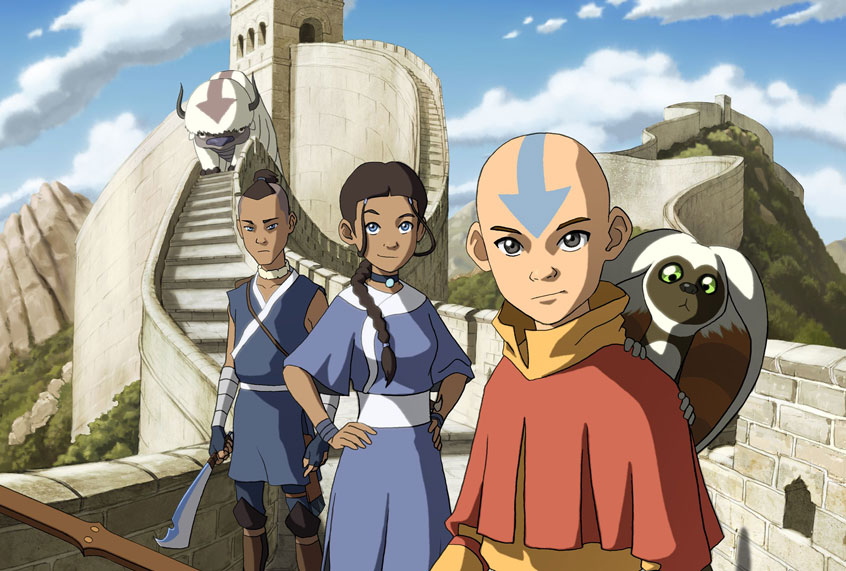
The original series’ radically Asian world

Avatar The Last AirbenderAvatar The Last Airbender (Nickelodeon)The four nations in the original series were informed by Asian and Indigenous history, including Japanese, Chinese, Indian and Inuit cultures. These translate to an implicitly Asian world, seen in the tai chi movements used in water bending, Chinese-style architecture, Buddhist-inspired beliefs in the Air Nation and Indigenous-style dress of the Water Nation. The characters were both visually designed and coded as Asian and Inuit. For the early aughts, this kind of representation was far from common, but even more progressively, these weren't stereotypical portrayals either. Though the show’s creators are white, and the majority of the Asian characters’ voice actors were white – the series is one of the few works that the masses deemed culturally appreciative, not appropriative at that time. 
The Asian influence felt even more impactful given the topic of colonialism. Many fans drew parallels between the imperialist Fire Nation and the Taishō Era in Japan, a time marked by increased militarization and industrialization driven by a desire to compete with and be reaffirmed by the West. This time is troubled by Japan’s colonalist enterprise to other Asian countries, similar to the Fire Nation’s intrusion upon the other Asian-eque nations. As Aang and friends embark on their odyssey visiting different tribes, they meet migrants, refugees, survivors: people who have all been affected by colonialism as the main characters have. They even encounter people who have more complicated relationships to this, like in Episode 42 when Aang learns that the Fire Nation children are taught a carefully manipulated version of history that mitigates and justifies their imperialist mission. Asiatic proximity isn’t just token aesthetics, but a meaningful lesson and layer to the show. The series, as The New York Times once described, “imagines a world free of whiteness.”

M. Night Shyamalan’s whitewashed movie

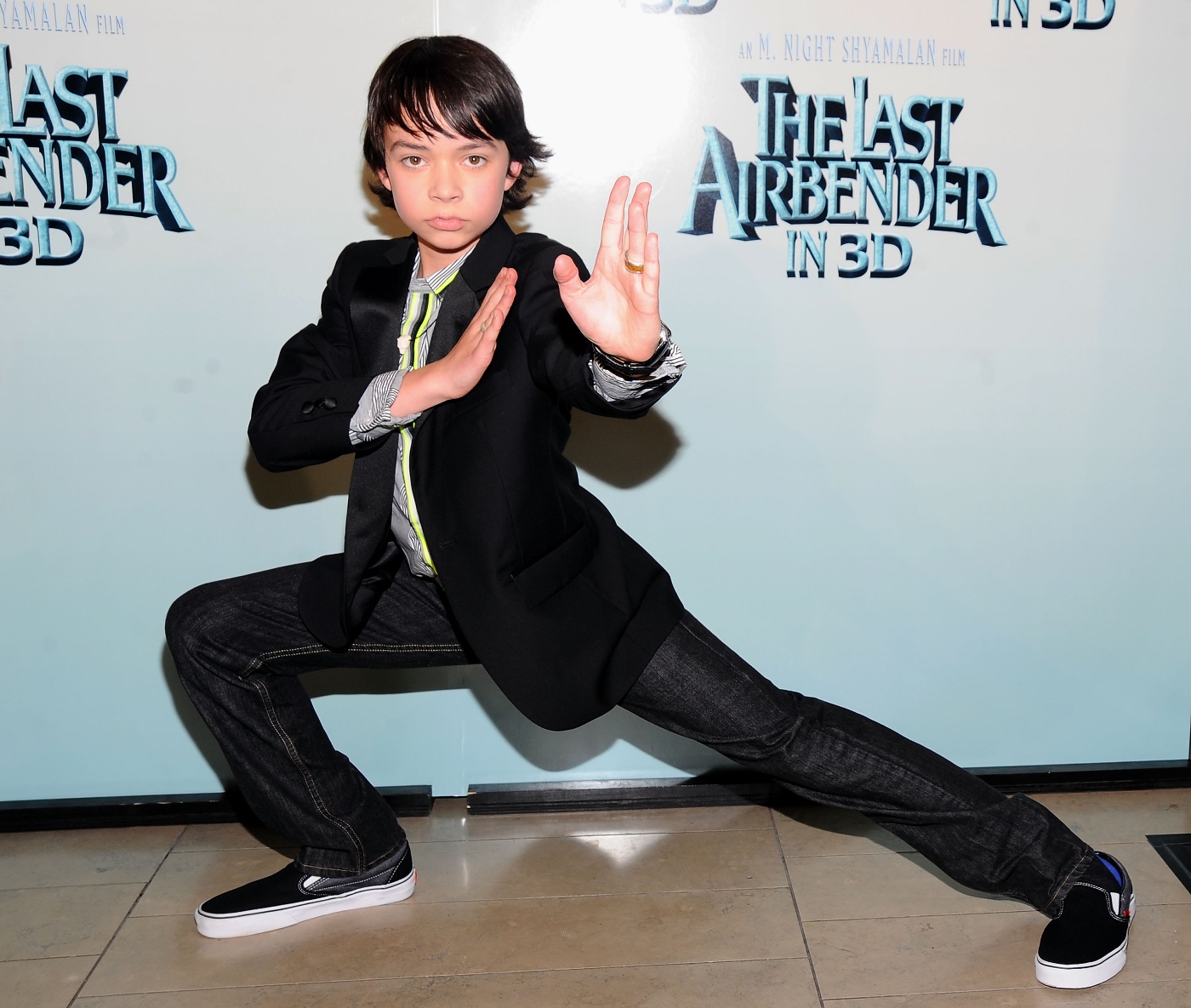
Actor Noah Ringer attends the premiere of "The Last Airbender" at Alice Tully Hall on June 30, 2010 in New York City (Jamie McCarthy/WireImage)That white-free world became much more white in M. Night Shyamalan’s 2010 “The Last Airbender.” While retaining the Asian setting, fighting and styles, the movie cast Asian characters with white actors. Therefore, 2010’s Aang is played by white actor Noah Ringer who still dons Tibet-inspired attire and is surrounded by the tribe of Asian supporting actors and actresses — yet the filmmaker chose to make the hero white. 

Not only does the movie whitewash the show, but it also does so in order to reaffirm racial binaries that white is good, while a person of color is to bad. Like Aang, the other heroic protagonists, Nichola Peltz’s Katara and Jackson Rathbone’s Sokka, are played by white actors despite the original characters being  tan-skinned and of possibly Asian or Indigenous descent. The few times where Asian actors are allowed a part in the film are notably when they are the enemy, like main protagonist Admiral Zhao who is played by Indian and British actor Aasif Mandvi and Aang’s rival Zuko played by Dev Patel. Such biased representation like this reinforces stereotypes: white people are saviors, and people of color are either followers or antagonists . . . and in this case, ironically the colonialists. It's no wonder that the white savior character has lately been met with backlash. “Such a representation is used to demonstrate the inferiority of characters of color even within their own cultural contexts. There is a frequently used demonstration of superiority observable in Hollywood films, where the white character comes to possess enough skill, mastery, and recognition to displace his or her counterpart of color,” notes journalist R.P. Aditya for Offscreen.

We need your help to stay independent

Even when addressing criticism about the movie, Shyamalan first tried to spin this whitewashing as a triumph of cultural diversity. But he later admitted how white hierarchy undermined the filming process. He told The Hollywood Reporter, he “made a genuine effort to join the system,” but the Indian American director got “tired of the fight and having to defend who [they] are.” The whitewashing was heavily censured with Time calling the project the “worst epic movie ever made.” 

Rather than continuing the initial inspiration and creating a modern Asian world, the creators decided to . . . colonize it.

The sequel’s series' abandonment of Asia

"Legend of Korra" cast and crew: John Michael Higgins, co-creator Bryan Konietzko, actor David Faustino, co-creator Michael Dante Dimartino, actress Janet Varney, actor Dee Bradley Baker and actress Mindy Sterling attend the Legend of Korra signing at 2014 Comic-Con (Tiffany Rose/Getty Images for Nickelodeon)Two years later, Konietzko and DiMartino released the sequel to their original series, “The Legend of Korra.” Things should be better in the original creators’' hands, right? Wrong. Once again, the series couldn’t avoid Westernization. The sequel, which originally ran on Nickelodeon before it was cast aside to stream exclusively on Nick’s website for its final season, takes place two generations after the first series left off, placing the show in a steampunk world. Rather than continuing the initial inspiration and creating a modern Asian world, the creators decided to . . . colonize it. The main city, Republic City, is a hodgepodge of Shanghai, Manhattan and Vancouver. The Asian references that once defined the world fade into the background or become altogether forgotten.
Instead, the distinctly American identifiers feel abrupt and incongruent. In the city, Korra (who is voiced by white actress Janet Varney despite her character being based on Inuit people) is the reincarnated version of the Avatar and moves to the city, spotting a statue of Aang in the style of the Statue of Liberty. In a series that established itself by creating Asian characters fighting colonialism, the choice to visually introduce Western aesthetics, the real-life symbols of colonialism, feels contradictory to the original’s premise. It also reveals the true colors of its creators, as it's undoubtedly a Western trait to assume that a progressing society looks like . . . America—even when that society was built on critiquing its entire enterprise. 

It’s no wonder that “Legend of Korra'' succeeded in alienating the Asian fan base its predecessor built its fame on. “It is obvious now when comparing it with ‘The Last Airbender’ that it just stopped really using cultural shorthands from other cultures as part of its storytelling,” critic Jeanette Ng told Vox. “['Korra'] makes me think that all the things I liked about ‘Airbender’ happened accidentally. It’s a sequel that retroactively makes the work that came before worse, because now I think, ‘Oh, all the things I thought were good are just . . . [accidental].’”

The politics in “Korra” similarly feel antithetical to the first series'. The sequel begins with Korra mediating between mounting tensions over the inequality between people who can bend the elements and those who can’t. Thes story’s stance on the subject can be encapsulated by the tale of Wan who stole firebending abilities to feed his poor friends and family. The moral of the story isn’t that people should not have been left to struggle in the first place, but that Wan should not have taken the power that doesn’t belong to him. The end of the sequel sees Korra and friends restoring peace by establishing a democratic republic (read: America), thereby siding with the colonialists and their hierarchies.


Want a daily wrap-up of all the news and commentary Salon has to offer? Subscribe to our morning newsletter, Crash Course.


The abandonment of Asian influences as well as the reinforcement of imperialist beliefs puts “Korra” at odds from the original. Beau Lee Gambold at PopMatters notes this disparity alongside the first series, saying, “While 'The Last Airbender' was nearly an anarchist meditation/fantasy about a way to be in the world, 'The Legend of Korra' is an example of how becoming mired in a capitalist system can inhibit your ability to imagine or to create.”

2024’s dark departure

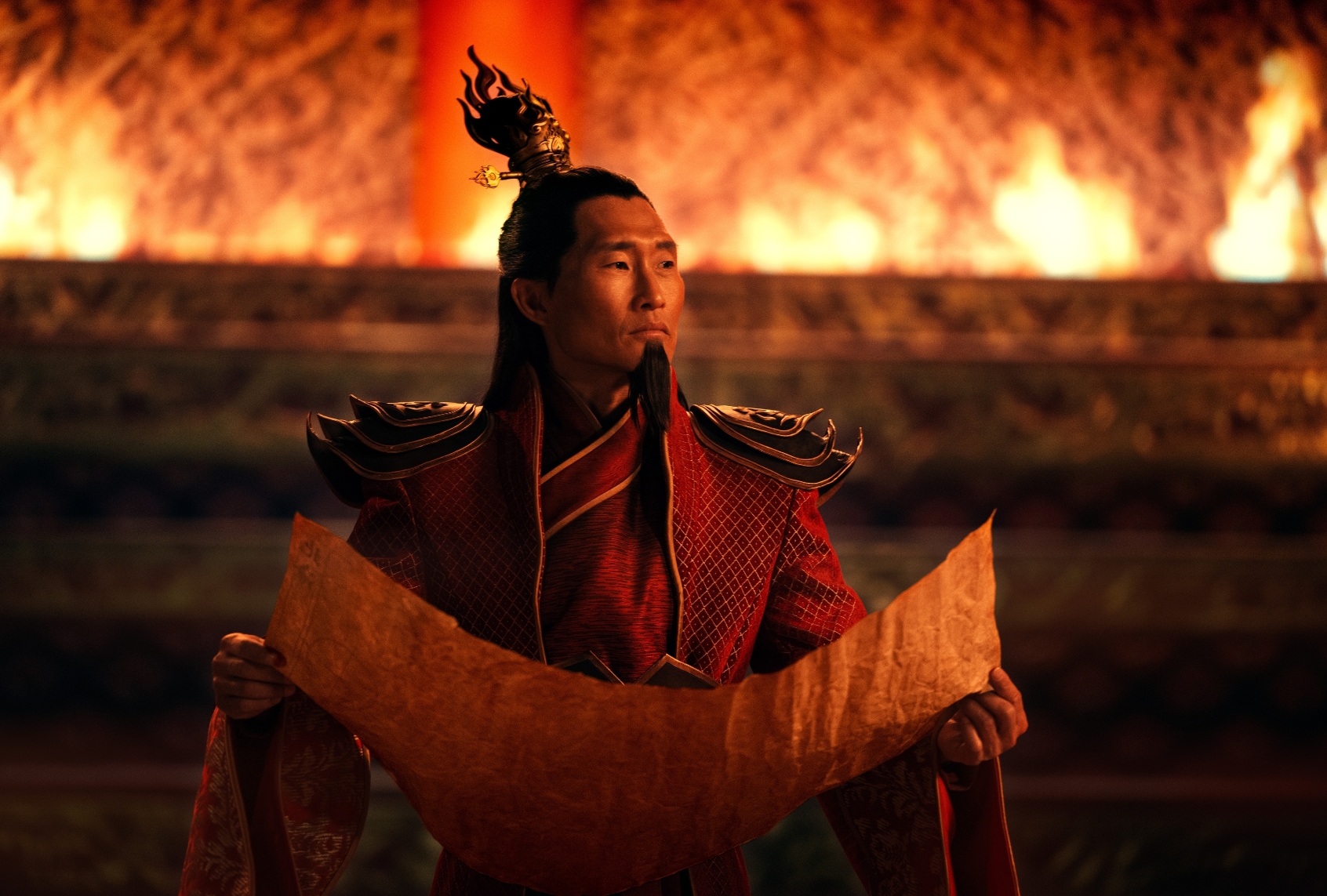
Daniel Dae Kim as Fire Lord Ozai in "Avatar: The Last Airbender" (Netfix)This is the legacy of evolution that the latest adaptation arises in. Unlike the previous iterations, the new edition succeeds at casting Asian and Indigenous actors for its associated characters: Indigenous actress Amber Midthunder plays Princess Yue, Canadian Mohawk actress Kiawentiio Tarbell plays Katara and Daniel Dae Kim is Fire Lord Ozai, among other recognizable faces. Gordon Cormier, who plays chosen one Aang, is of Filipino and European descent.
Notably, the new version was initially created with Konietzko and DiMartino but the two exited the show due to creative differences, saying via a joint statement, “Netflix said that it was committed to honoring our vision for this retelling and to supporting us on creating the series. [. . .] Unfortunately, things did not go as we had hoped.”

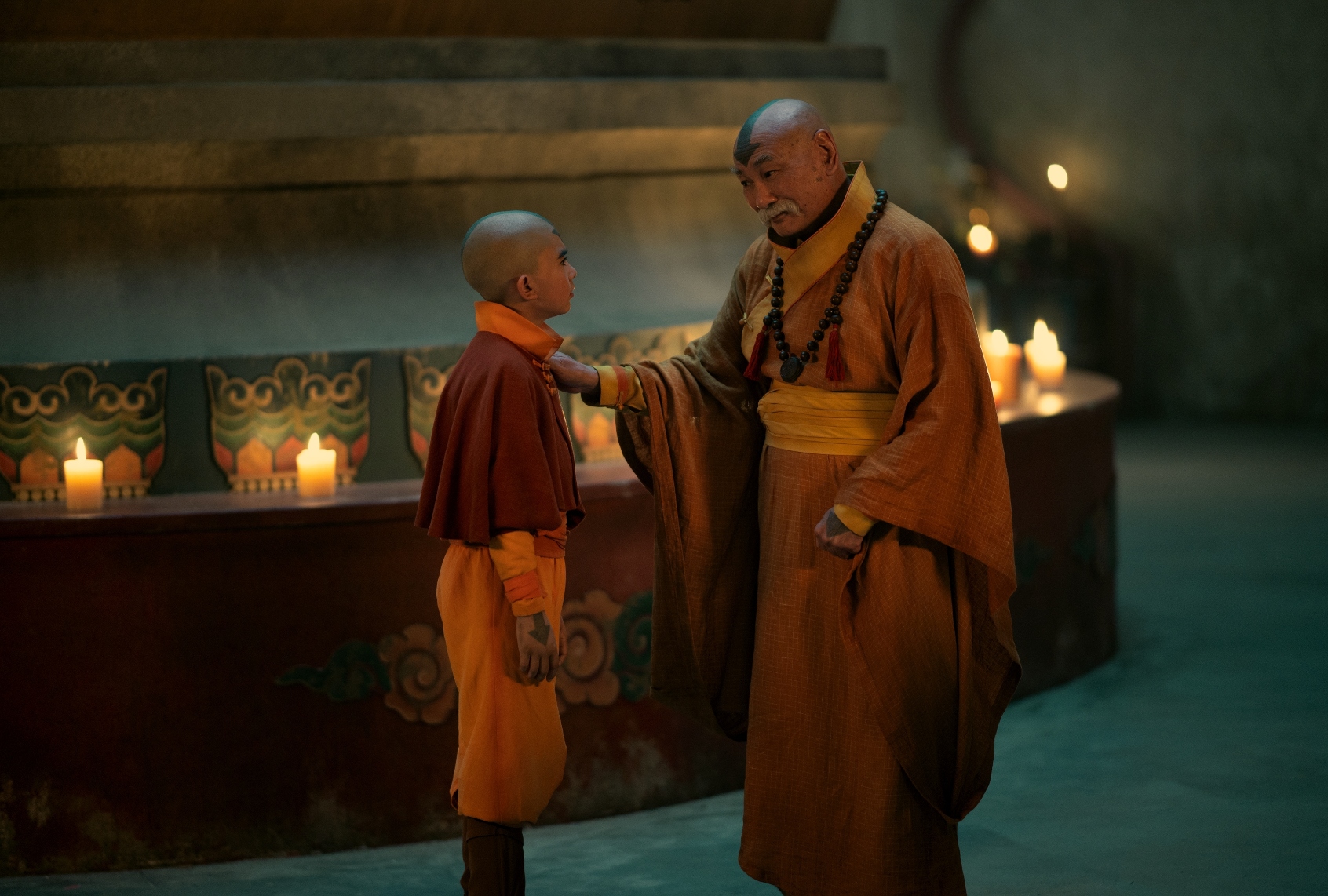
This could in part be due to the series’ darker take on the original. The adaptation starts with a man being burned to a crisp by the Fire lord before beginning its nearly six-minute sequence depicting the eradication of the Air Nation. Though it isn't gory in a bloody sense, the scene does show the total destruction of the land and the burning to death of Aang’s mentor Gyatso (Lim Kay Siu). It ends on a petrified group of huddled children right before the Fire Nation soldier advances. At this point the scene cuts out yet implies their deaths.

The original series references these events but they are not depicted. Still, its consequences haunt the show through Aang’s flashbacks to his upbringing in the Air Nation, the mourning of the loss of Air Nation culture and knowledge, and the constant reminders that Aang is the last Airbender in existence. This created a powerful message considering the racial makeup of the character: as the Airbenders lifestyle was based on Tibetan traditions, many drew parallels of the massacre to the The Republic of China’s 1949 occupation of Tibet. At the core of the heartwarming show lurks an even deeper, more extreme theme: genocide. 

It was a means of entertainment, a plot device and selling point for the capitalist industry.

Kim himself spoke about his decision to include explicit depictions of this harrowing, foundational event, telling Variety, “It wasn’t about aging it up. It was about setting the stakes for this world. One of the things we wanted to do was show how dangerous bending can be. Firebending should feel dangerous; it should feel [like] something that could hurt you.” The response misses the point of the original show: it’s not that firebending is evil, but that colonial fantasies, and specifically genocide, is. Nevermind the fact that Aang himself, as an Avatar who masters all four elements, also bends fire and has always bee  empathetic to others that do, too.

Konietzko and DiMartino knew that audiences didn’t need to see violence to understand its trauma, which is why much of the series focuses on person-to-person relationships as Aang and friends traveled around and encountered people on the ground who are affected by colonialism in different ways, even citizens who are meant to profit off of it. This is especially true of the animated series' Zuko (voiced by Dante Basco), who begins the series as a staunch believer in the Fire Nation’s propaganda and superiority, a belief that often leaves him lonely, but ends the show realizing this is false. “They don’t see our greatness; they hate us, and we deserve it,” he says.

Gordon Cormier as Aang and Lim Kay Siu as Gyatso in "Avatar: The Last Airbender" (Netflix)Unfortunately, the live-action series ramps up the violence without simultaneously emphasizing those same empathetic encounters. The show includes the desiccated corpse of Aang’s mentor when the boy Avatar returns to the sacked temple, three separate flashbacks of Katara’s mom burning to death, scenes of Earth Nation civilians screaming and bloody after being bombed, and the Fire Lord burning rebels as they speak mid-sentence. And here are critical scenes from the original series that were not included this time around: the team’s encounters with refugees of the Zhang tribe; Jeong Jeong, the legendary deserter of the Fire Nation who left after being disillusioned by the system and its violence; and Haru, an earthbender whose village was temporarily occupied by the Fire Nation and left the citizens demoralized.

Certainly, this new iteration does not have to be nor should be a one-to-one adaptation, but the dark departure doesn’t serve the central critique of the show either. The focus of warfare’s violence rather than its traumas detracts from the original nuanced examination of expansionist endeavors, which was further poignant given the show’s more authentic – and now dissonant – depiction of an Asian and Indigenous world and people. Burning characters to cinders does little but to flatten colonialism into a fiery spectacle.

Furthermore, there’s something particularly cruel and ironic in watching the adaptation’s miscalculated violent portrayal of genocide while real genocide is currently being committed in Palestine. As the franchise continues to expand – with another upcoming series about the adult version of the original characters – the devolution of the show’s main premise reveals that critiquing genocide in a meaningful way may never have been the true intent of the show. Rather, it was a means of entertainment, a plot device and selling point for the capitalist industry. Just as America profits off of genocide, so too does the franchise as it makes spinoffs to capitalize on the original genocidal premise. Perhaps it's time once again for the Avatar to vanish.

"Avatar: The Last Airbender" is now streaming on Netflix.

Nikki Haley avoids the topic of endorsing Trump because she’s focused on not losing to him

During an appearance on “Meet the Press,” Republican presidential hopeful and former U.N. Ambassador Nikki Haley brushed aways questions relating to whether or not she feels obligated to endorse Donald Trump should he emerge the victor at the end of this election year, saying she's not really thinking about that right now as she continues the endurance challenge of trying to beat him.

Speaking to moderator Kristen Welker, Haley said she'll make whatever decision she wants to make should the time come, but made it clear that her head isn't there yet, stressing, “if you talk about an endorsement, you’re talking about a loss. I don’t think like that.”

Pressed to weigh-in on whether or not she believed that voters had a right to know where she stands on the possibility of a Trump endorsement, Haley shot back a response that further clarified her initial point, saying, "When you all ask Donald Trump if he would support me, then I will talk about that. But right now, my focus is, ‘How do we touch as many voters? How do we win?’”

Watch here:

“Avatar: The Last Airbender” gets Katara all wrong to make amends with the show’s past sexism

As a child, I always saw myself in Katara from "Avatar: The Last Airbender." She was stubborn, loudmouthed, questioned authority, and had an overbearing, sexist brother who pushed her buttons. Oh yeah — she was also a badass water-bender who can manipulate water with her hands and mind.

Katara is one of the central characters in the Nickelodeon cartoon show that first aired in 2005. Netflix's new adaption tells the adventurous tale of the Southern Water tribe siblings Katara (Kiawentiio Tarbell) and Sokka (Ian Ousley) who stumble upon an iceberg that has frozen their world's last and lost Airbender, Avatar Aang,(Gordon Cormier) in time. In a world split into four nations — the Water Tribe, the Earth Kingdom, Fire Nation and the Air Nomads, each representing a natural element — a fascist Fire Nation regime threatens the balance. And the Avatar, master of all four elements, is the only one who can stop the imperial Fire Nation's plans to conquer the world.

The animated series' popularity dominated Nickelodeon for decades; so much so that this is actually the second time it is being adapted for live-action. The first was the insulting and white-washed 2010 M. Night Shyamalan film.

The 2024 Netflix adaption does a lot that film didn't do. For instance, like casting Indigenous and Asian actors from the wider diaspora who accurately portray the diverse characters and their backgrounds. So, it is definitely more favorable than its steaming-pile-of-garbage counterpart, but being slightly better than the universally panned film doesn't necessarily mean that the new adaption is without its faults, especially in its new characterization of Katara and her relationship with her brother.

In an Entertainment Weekly interview with Ousely and Tarbell, Tarbell specifically discusses how they removed some of the more sexist storylines surrounding Sokka. "I feel like there were a lot of moments in the original show that were iffy," she said. 

And while this may be the more politically comfortable step — there were countless moments in the original cartoon that were heavy-handed with misogyny from the chauvinistic Sokka — the result doesn't serve Katara as a character. 

Ultimately, the sexism in the cartoon existed as a way to expose just how ironic it was that a bumbling fool, like powerless Sokka, could have the audacity to make sexist digs at his dominant and naturally talented, younger sister. That version of Katara fought tooth and nail against the raging system of the patriarchy, even if it was just her annoying older brother. The new adaption, however, dims the fire behind her eyes while also dulling the power behind her self-taught bending, showing that "fixing" sexist writing with more sexist writing isn't an improvement — it's just a Band-Aid. 

In the cartoon, Katara is tasked with countless responsibilities as a teenage girl in her village. As such, she's almost always fed up with Sokka. In the pilot episode of that version, the siblings set out on a fishing expedition to get food, which erupts into a fight after Sokka makes the snide comment, "Leave it to a girl to screw things up." 

"The new adaption, however, dims the fire behind her eyes while also dulling the power behind her self-taught bending, showing that 'fixing' sexist writing with more sexist writing isn't an improvement — it's just a Band-Aid."

Katara explodes in response: "You are the most sexist, immature, nutbrained— I'm embarrassed to be related to you!" Unintentionally, she begins cracking the iceberg behind her with her water-bending. 

"Ever since mom died, I've been doing all the work around camp, while you've been off playing soldier," she continued. "I even wash all the clothes. Have you ever smelled your dirty socks? Let me tell you! Not pleasant!" And with the fall of her arms, the iceberg cracks open and a frozen Aang appears glowing in the ice. 

Comparatively, in the live-action, Katara has nothing to do with Aang's discovery and she isn't in a leadership position in their village — Sokka is, because he is the eldest boy whom his absent father has left in charge. She practices bending in secret, and diminishes her own powers when confronted by Sokka. "Besides there's nothing to see," she says defeatedly of her bending. "An otter penguin could bend more water than I could."

This demeanor is unlike the passionate, hothead ready to tell Sokka or any man off in the original.

This isn't the only instance where Katara seems meek in the face of conflict or her own self-discovery. Katara's self-taught bending is a major plot point for the character throughout the show, but her abilities can only go so far before she needs guidance. With the help of Aang, she steals a waterbending scroll from pirates.

However, in the live-action, Katara is simply gifted a waterbending scroll by her Gran Gran (Casey Camp-Horinket). In both versions, Katara struggled to bend at the beginning of her journey, but there was an extra sense of determination inherent to the cartoon that is not present in the live-action version. 

Not to mention when Katara does struggle to bend in the Netflix series it takes two dudes — Aang and a vigilante named Jet (Sebastian Amoruso), whom the group meets in their journey into the Earth Kingdom — and their unsolicited advice to home in on pain and memory of her late mother to bend. Jet admits to Katara that he "doesn't know anything about bending." 

"But I do know that you have to use everything inside you to help you fight," he continued. Soon thereafter, in the episode "Spirited Away," Katara breaks out new bending moves, shooting out ice shards against a whole team of firebenders, whereas two episodes ago she barely understood the power of her bending.

The end of the season promises an impending battle with the Fire Nation, who are trying to conquer the Northern Water Tribe. Team Avatar travels to the South Water Tribe to train. There, Katara meets Master Pakku (A. Martinez), one of the most powerful waterbenders of the tribe. In the cartoon, Pakku tells Katara that women aren't allowed to use waterbending for battle and she responds in fury, "I didn't cross the entire world so you could tell me no!" 

In the live-action version, Katara is instead told by a female healer, "I'm sorry women don't fight. We use our skills to heal, not to harm." She confronts Pakku and tells him she thinks the rule is "stupid and it's dumb." She challenges him to a fight and loses even though she puts up a valiant fight — but it's still not enough for her to be considered as a fighter.

We need your help to stay independent

In the cartoon, when Katara offends Pakku — and he drops teaching Aang as a result — she considers apologizing, but then tells him angrily, "No way I'm apologizing to a sour old man like you!" Instead, she challenges him to a duel, which she ultimately loses, but through which she earns Pakku's respect (and during which he realizes he has a connection to her Gran Gran). Inevitably, Pakku softens and begins training Katara to showcase her talents and strengths. This narrative in the original series shows that Katara isn't one to be underestimated and that she will always stand up for herself, through waterbending or just straight fury. 

This is why live-action Katara is unrecognizable. In her battle for autonomy in the season finale, "Legends," she still has to ask for Pakku's blessing to fight. The fearless and authority-evading Katara in the original would never ask for anyone's permission — let alone wait for a sexist old man's approval. Writing a female powerhouse waterbender in this way feels more regressive and patronizing than the original version, which used instances of sexism as teachable moments, making it clear that misogyny is a character flaw for both its male characters and young audiences.

Because of Katara's dedication and sheer ability to advocate for herself, she challenged the pig-headed men whom she encountered as a fighter. That friction resulted in growth and development for herself and the narrow-minded people around her. This sparked meaningful and authentic conversations about girls' real agency, capabilities and inner strengths, especially those that aren't just simply given, but are fought for, instead. 

The vasectomy boom: After Dobbs, younger men are stepping up

On the last day of July in 2023, Planned Parenthood performed its final abortion in the state of Indiana. It was the day before the state would begin enforcing a near-total abortion ban, with very narrow exceptions, after a year of legal battles that followed the U.S. Supreme Court’s decision to end the constitutional right to abortion in the Dobbs v. Jackson Women's Health Organization case. Before the Dobbs decision, which effectively allowed every state to set its own abortion laws, four Planned Parenthood clinics in Indiana provided abortion services once a week. Today, abortions are no longer an option. 

Deborah Nucatola, the chief medical officer of  Planned Parenthood Great Northwest Hawai‘i, Alaska, Indiana, Kentucky, told Salon the abortion ban was especially devastating. Indiana had briefly served as a haven for out-of-state patients, such as those from Kentucky, whose access to abortion services was immediately restricted after Dobbs. Indiana became a “surge state,” serving many patients who were traveling from elsewhere, even while providers knew they would eventually had to cease their services.

That was extremely difficult, Nucatola said. “We went from feeling like we were helping so many people from so many places to feeling like our hands were tied, and there wasn't a lot we could do. So we’re constantly evaluating ways that we can help support patients, whether it's helping facilitate them getting abortion services in other places to providing services that can prevent undesired pregnancies.” 

The next logical step, Indiana providers decided, was to focus on male reproductive health. In February, the Planned Parenthood affiliate announced it would offer vasectomy services at three locations across the state, including one in Fort Wayne, with plans to expand to Georgetown by late March. The affiliate also has plans to add additional vasectomy services in southern Indiana and Kentucky over the next six months. Nucatola said that by offering vasectomies, Planned Parenthood is adding to its contraceptive “toolbox” and offering more options to prevent unwanted pregnancies in a post-Dobbs world. 

“It’s just adding to the list of contraceptive services that we provide,” she said. “It's a small but important option for folks to have.” 

"We went from feeling like we were helping so many people from so many places to feeling like our hands were tied. So we’re constantly evaluating ways that we can help support patients [and] prevent undesired pregnancies."

After what she describes as a “very long year,” Nucatola said the expansion of vasectomy services has made the affiliate's staff feel as if they are better able to support Indiana families in making their own decisions about fertility and reproduction. 

“It’s kind of a ray of light” in an otherwise darkening landscape, she added. “We're still seeing patients who are seeking abortion care, and we're helping them navigate to those services, but it's challenging not being able to provide them directly at our health centers.”

This expansion of vasectomy services in Indiana speaks to a nationwide increase in interest in the procedure following the Dobbs decision. Immediately after the Supreme Court overturned Roe v. Wade, Google saw the highest volume of searches for “vasectomy” in the past five years. Last year, preliminary data found a significant uptick in vasectomy consultations. According to the International Journal of Impotence Research, there was a 35 percent increase in vasectomy consultation requests and a 22.4 percent increase in actual vasectomy consultations after the Dobbs decision. Notably, the men seeking vasectomies were younger than before, and a higher number of men without children requested information about the procedure.

At the moment, vasectomies are the only FDA-approved birth control option for men, and are regarded as easy and safe surgical procedures. During the operation, a doctor cuts or seals the tubes that carry a male’s sperm, which can permanently prevent pregnancy. Usually the procedure can be carried out under local anesthetic, meaning the person is awake, and takes only about 15 minutes. At the Indiana Planned Parenthood clinics, the procedure costs $800 out of pocket — but can also be covered by Medicaid and many private insurance plans. The national average cost for a vasectomy is $1,000, but depending on insurance coverage and whether it's performed in a doctor’s office or surgical center, can cost up to $3,000.

We need your help to stay independent

Planned Parenthood clinics in Indiana are by no means alone in seeking to make vasectomies more accessible in light of widespread restrictions on abortion. Under a new California law that took effect in January, state residents covered by Medi-Cal can get vasectomies with no charge. There have also been smaller, more localized, efforts. A mobile Planned Parenthood clinic offered free vasectomies in Missouri last year. When a Planned Parenthood clinic in Oklahoma offered free vasectomies, all the available spots were filled in less than 48 hours.

Dr. Sarah Vij, co-author of the data study published in the International Journal of Impotence Research and an assistant professor of urology at Cleveland Clinic, told Salon that vasectomies are widely accessible, at least in states with reasonable health care options. In most cases, the procedure is covered by health insurance, although there are exceptions — some faith-based organizations object to the procedure and won’t pay it. Since access may vary greatly from state to state, she said, it makes sense for Planned Parenthood clinics to offer vasectomies more widely. 


Want more health and science stories in your inbox? Subscribe to Salon's weekly newsletter Lab Notes.


“Wherever there's demand, we need to be sure that we're offering it, and we need to be sure that patients are properly educated,” Vij said. For people who are "done" having children or don't want them, "it's a reasonable option," she continued. "It's not for everybody, but it's at least an option that everybody should know exists.”

Nucatola, from the Planned Parenthood clinic in Indiana, said that adding a new contraceptive method to a clinic's services amounts to providing more autonomy to the community it serves. “The more tools you have in your toolbox, the more you're able to help people choose what's best for them and their families to build the families that they want to build,” she said. 

One benefit of making vasectomies more accessible is to ease the burden of birth control being placed on women. “Partners are realizing that women shouldn’t be the only ones with birth control in their cabinets, or in their bodies.”

Both doctors noted that one benefit of making vasectomies more accessible is to ease the burden of birth control being placed largely or entirely on women. 

“Partners are realizing that women shouldn’t be the only ones with birth control in their cabinets, or in their bodies,” Rebecca Gibron, CEO of the Planned Parenthood affiliate that includes Indiana, said in a media statement. “Many men concerned for their partners’ reproductive rights and health are finding vasectomy as a solution." 

Anecdotally, Vij told Salon this has been true in her own practice. She has personally seen an increased number of younger men without children seeking vasectomies. Before Dobbs, her typical patient was a man with kids who didn’t want more.

“Dobbs affected men and how they view reproduction,” Vij said. “I think the male is impacted, and I think that's often an ignored piece of this whole discussion when we talk about abortion care.” 

Today’s Supreme Court is a threat to democracy — but activists plan to fight back

The Supreme Court is a supreme threat to American democracy. That was Abraham Lincoln’s view in light of the Dred Scott decision, expressed in his First Inaugural Address. And it was vividly illustrated after Lincoln's assassination, when the Civil War amendments and civil rights legislation passed by Congress were effectively nullified by the Supreme Court, enabling former Confederates and other white supremacists to destroy the possibility of multiracial democracy for almost a century. “Our democracy suffers when an unelected group of lawyers take away our ability to govern ourselves,” as Harvard Law professor Nikolas Bowie wrote in 2021, based on his testimony before the do-nothing Presidential Commission on the Supreme Court of the United States.

Since then, the Court’s decision in Dobbs v. Jackson Women's Health, which overturned the precedent of Roe v. Wade, has brought Bowie’s point home with a vengeance. But it’s not just about abortion. On guns, environmental protection, discrimination, labor rights, affirmative action, student debt relief and numerous other issues, Mitch McConnell's court-packing scheme and Donald Trump's appointments have succeeded in dramatically undercutting Americans' people’s capacity for self-government and the promotion of “the general welfare” promised in the preamble to the U.S. Constitution. 

While the electoral backlash against Dobbs has been heartening, that's essentially a reaction to the most alarming and personally invasive Supreme Court decision, not a proactive effort to dismantle the source of the threat. That's why the new online lecture and discussion course, “What to Do About the Courts,” feels so important: It's an effort to begin laying the groundwork for fundamental court reform. It’s a collaboration between the Law and Political Economy Project and the People’s Parity Project which featured Bowie as its leadoff lecturer on Jan. 30. A second session, looking at the history of reform efforts, was held Feb. 20

“This is really core to what our organizations are doing and how we're thinking about the work that we need to be engaged in for many years to come,” PPP executive director Molly Coleman told Salon. The online venue, she said, made it possible to “open this up quite a bit more than if we had done this as an in-person meeting group on a law school campus.”  

The discussion component is critical, according to LPEP executive director Corinne Blalock: “It really does reflect our theory of change and how we understand how ideas move in the world.”

“We didn't want this to just be a lecture series," Coleman added. “Court reform should be something that's built by the people. Part of this project is thinking about how we end judicial supremacy, how we make sure that the people have power, and not just unelected, unaccountable judges. We would be remiss if that wasn't modeled in our programming.”

“Court reform should be something that's built by the people. Part of this project is thinking about how we end judicial supremacy, how we make sure that the people have power, not just unelected, unaccountable judges."

For generations, Americans have largely been blind to the Supreme Court’s profoundly anti-democratic character, because under former Chief Justice Earl Warren, the court was instrumental in reversing the post-Reconstruction destruction of democracy, most notably with the landmark ruling in Brown v. Board of Education, which officially ended school segregation. But however significant Brown was in cultural and historic terms, in reality it only reduced segregation and certainly did not restore multiracial democracy. Congress began to do that with the 1965 Voting Rights Act — but nearly 50 years later, in Shelby County v. Holder, the Supreme Court undid much of that law and once again began undermining democracy. 

The halo effect around the Supreme Court, resulting from the Brown decision and the Warren court's legacy more broadly — which continued into the 1970s with Roe v. Wade — was finally shattered for most attentive Americans by the Dobbs decision in 2022. Now, perhaps, Bowie’s unheeded warning a year before that may get the hearing it deserves, fleshed out by a range of possible court reforms that have been considered, implemented in the past (the subject of the course’s second session) or modeled elsewhere by healthier democracies (the subject of its upcoming third one).

“Really thinking about transforming the court felt politically inconceivable a few years ago," said Blalock. "There were certainly scholars who felt the urgency, but we needed the material stakes to really connect it to people's lives. With all the atrocious things that the Supreme Court has done recently, that piece has sort of been done for us. So our role is helping people connect that to a set of political ideas.”

There's another and perhaps larger concern, Blalock continued. “For everyone on the left or left of center who's thinking about transformative change, whether it's climate change, reproductive rights or labor, it feels like the Supreme Court is looming,” she said. “We felt that our two organizations were particularly well-suited to step in and help connect the dots.”

“Despite this moment where the Supreme Court is at the center of so many conversations, despite a lot of excitement and energy around the possibility of court reform, there is a lack of information about what court reform can look like,” Coleman added. “Even folks who are living and breathing this work in advocacy spaces might be talking about expansion or might be talking about ethics reform, but so many of these other reforms that have been tried in the past haven't entered the mainstream conversation. We felt there was an important void to fill, to take some of these ideas that are being discussed in the legal academy or by historians and bring them to the mainstream of progressive organizing spaces.”

The series began with Bowie addressing the foundation of the problem: the wildly disproportionate power of the Supreme Court, where five individuals can effectively thwart the will of 340 million citizens. Because judicial supremacy is so deeply ingrained in our system, people tend to assume it’s enshrined in the Constitution. It’s not. Lawyers are taught that it derives from the Supreme Court's legendary 1803 decision Marbury v. Madison, but they’re generally not taught the larger story that casts the decision in a questionable partisan light. One might describe it, in fact, as a judicial coup.

We need your help to stay independent

As Bowie recounted, when the Federalist government under President John Adams passed the wildly unconstitutional Alien and Sedition Acts in 1798, the opposing party led by Thomas Jefferson didn't turn to the courts. “Federal judges were just as partisan, just as committed to stamping out political opposition, as anyone else,” Bowie said. “So Jefferson's party ended up getting rid of this law not by going to court, but by winning an election.” 

In the lame-duck session that followed Jefferson's victory in the controversial election of 1800, Adams and the Federalists created a bunch of new federal courts and packed them with supportive judges. That included Adams' appointment of John Marshall, the outgoing secretary of state, as chief justice of the Supreme Court. After that, Bowie said, Jefferson's party proposed a bill to destroy or undo all these new courts, which led to fierce debate:

Federalists responded [that] federal courts need to have this power to strike down federal laws. If Congress can simply get rid of the courts, then federal courts won't have this power anymore. And for Jefferson's party in Congress, they thought the idea that federal courts would strike down federal laws was this crazy innovation. Just a really bad idea and obviously partisan in motivation. … They thought there was nothing in the Constitution that says a federal judge can strike down a federal law. It would be a really weird distribution of power to give federal judges this control. 

In the wake of that debate, Bowie said, Marshall authored the famous majority opinion in Marbury v. Madison, which "effectively just parroted the Federalist position from Congress.” In short, the position held by a minority in Congress became the law of the land — and not on some narrow legalistic point, but on the fundamental question of who is allowed to interpret the Constitution. 

Thomas Jefferson and Abraham Lincoln, revered today as the founders of our two major parties, vehemently rejected judicial supremacy. It's time for 21st-century Americans to seriously consider doing the same.

That remained a purely theoretical issue for more than 50 years. “Marshall didn't end up disagreeing with Congress about the constitutionality of any legislation for the remainder of his term,” Bowie said. Then came the 1857 Dred Scott decision, which struck down the Missouri Compromise and denied Congress the right to prohibit slavery in the nation’s territories. This became a defining issue for the newly-formed Republican Party, which didn’t just shrug and accept it. As Bowie put it, “They responded, 'What is the court doing? The court should not have this power,'” and ran on a platform “that repudiated the court's power to decide this constitutional question.” After Lincoln was elected in 1860, “he and Congress passed legislation that did precisely what the Supreme Court said Congress could not do.”

There was certainly much more to Bowie’s presentation — and much more Supreme Court mischief that undermined the rights of Black Americans for generations — but that should be sufficient to show that our meek modern-day acceptance of judicial supremacy rests upon a profound ignorance of our own history. Both Jefferson and Lincoln, revered today as the founders of our two major parties, vehemently rejected judicial supremacy. It's time for 21st-century Americans to seriously consider doing the same — or at the very least, to place significant limitations on it. The question, of course, is exactly how to limit or replace judicial supremacy, and what specific reforms can get us there. 


Want a daily wrap-up of all the news and commentary Salon has to offer? Subscribe to our morning newsletter, Crash Course.


The February session of "What to Do About the Courts" began to answer those questions, looking into the history of court-disempowering reforms and proposals, with professors Samuel Moyn of Yale and William Forbath of the University of Texas. Moyn cited a number of reform ideas:

  • Popular overrides of court decisions by referendum, as proposed by Theodore Roosevelt in his 1912 third-party presidential campaign. 
  • "Jurisdiction stripping," meaning laws that limit the court's jurisdiction over certain kinds of statutes. 
  • A supermajority requirement, meaning a bare majority of five justices could not invalidate laws passed by Congress, as proposed by progressive Sen. William Borah in 1923.
  • Congressional authority to override any Supreme Court decision by a two-thirds vote, as proposed by Sen. Robert La Follette Sr. in his 1924 third-party presidential campaign. 
  • Prohibiting federal court injunctions in labor disputes, as mandated by the 1932 Norris–La Guardia Act.

Forbath looked more closely at the history of labor law: how the growth of a national economy increased the use of secondary strikes and boycotts, how common law and the Sherman Anti-Trust Act were used to declare them illegal and how that, along with court-sanctioned state violence, “inspired a decades-long, high-profile campaign of official union defiance of anti-strike and anti-boycott decrees,” undergirded by “a richly elaborated moral and constitutional order, a rival order built on the First and 13th amendments.” That movement declared, Forbath said, that “courts were quite literally creating property rights in man and elevating property rights over human rights.” 

During the 1920s, Forbath continued, there were “constant calls and dozens of bills and proposals for laws and amendments to the Constitution that would enact what we call court reform. They brought movement constitutionalism to the halls of Congress,” resulting in the aforementioned Norris-La Guardia Act, even before FDR's New Deal. That came about in part, Forbath said, because the judiciary had “squander[ed] its own legitimacy. Too many working-class Americans had come to see the courts for what they were: They were the place where the ruling class went to rule, dispensing class-bound decisions in the name of the Constitution.” 

That kind of keen historical awareness, vigilance and activism may well be needed today. Arguably that shouldn’t be difficult to ignite, given the current radical Supreme Court and its recent actions. It may be much more difficult to create a unified movement with a clear vision for change. Divisions. to be sure, existed in earlier eras as well. “Back in the early 20th century, there was a rift between Black freedom organizations like the NAACP and labor and progressives who were most invested in labor reforms," Forbath said. While the latter groups wanted to disempower the courts, the Black freedom movement largely did not, because the courts — however inadequate they were — appeared to be its most reliable allies. 

By the Great Depression, "many working-class Americans had come to see the courts for what they were: The place where the ruling class went to rule, dispensing class-bound decisions in the name of the Constitution.” 

That particular division no longer applies, but there are undeniably different priorities for different constituencies that could fragment reform efforts. More broadly, Forbath asked: “Do we want movement justices and judges, as brash in their way as the right-wing movement justices today? Or do you want more technocratic judges, committed above all to judicial restraint and a fair reading of progressive statutes?” The answer is not immediately obvious.

The seminar's next session, Blalock said, will be "on the international and comparative perspective, which helps make this all feel so much more doable, particularly when for so long these have been treated like radically fringe ideas. After that, we're going to dig a little more into the weeds about what the options are [and] really walk through the specific nature of how the reform would work. The final session is going to be on how we build a movement around this. We're bringing in Astra Taylor from the Debt Collective, in conversation with Sabeel Rahman, who comes from more the government policy side, to talk about how we take these ideas forward beyond the reading group.”

So far, the feedback has been "alarmingly positive," Coleman said. “The biggest thing we're hearing is that even current law students aren't hearing these ideas on their campus. They really feel that they're getting something unique in this space [and] they're really excited to bring it back to broader communities." Beyond law school campuses, there are leaders in progressive organizations who “want every single person they work with to be at the next iteration of the reading group,” she said. “People want more folks to know what conversations are happening. That's been pretty exciting.”

While attorneys, law students and activists are important audiences for these ideas, there’s also a need for broader conceptual, narrative and communications work aimed at a general audience. The right has successfully unified under the rhetoric of constitutional “originalism,” regardless of how vacuous that idea is in practice (Salon stories here and here). Conservative power is grounded in conceptual simplicity, even though the right's ideas have proven inherently inadequate to the complexity of the modern world. To counter it, liberals and progressives must address that complexity — real history and real science, not myths — while heeding Einstein’s advice: “Everything should be made as simple as possible, but not simpler.” In short, the progressive movement needs a counternarrative of its own, although identifying just one narrative might prove impossible.  

One possible narrative, alluded to above, is to focus on the constitutional concept of "general welfare," articulated in terms of public goods, an underlying logic laid out in Donald Cohen and Allen Mikalean's 2022 book “The Privatization of Everything.” Another possibility is to focus on public health, which, as I argued in 2021, can “serve as a long-term, overarching framework to reframe our politics, to provide us with new common sense in addressing a wide range of diverse issues by highlighting common themes and connecting what works.” 

Other narratives are surely possible. But it's crucial that they encompass those four elements: common sense, a wide range of diverse issues, common themes and a pragmatic focus on what works. It’s no accident that the common law tradition encompasses those central themes. The promise of "What to Do About the Courts" is that history teaches us that change is possible and we can make it happen: Once legal scholars and activists on the left have fashioned the right framework, they believe they'll have the wind at their backs.

Iran’s troubling move into Africa — and the war in Sudan you haven’t noticed

Many Americans may understand that the theocratic regime in Iran has for several decades supported and supplied militant Islamist groups in the Arab world, including Hezbollah in Lebanon, Hamas in Gaza and the Houthis in Yemen. But very few have noticed that now Iran has moved into Africa, sending military supplies to the Islamist military government in Sudan, now struggling for survival in the face of a powerful militia and civilian movement that, in 2019, started a democratic revolution to end Islamist rule — with the support of the U.S. and the U.N.

After the militias took Khartoum, the Sudanese capital, last April, the Islamist generals moved to Port Sudan on the Red Sea, where Iranian planes loaded with weapons have been landing. That's not far from Yemen, where the pro-Iranian Houthis now control much of the nation and have recently interrupted international sea lanes, resulting in air strikes by U.S. and British planes.

Before the Houthis became a threat to Red Sea security, the Sudanese Islamist government, then on the U.S. list of "terrorist" states, had negotiated with Vladimir Putin's government in Russia, which was eager to establish a military base on the Red Sea. Iran, similarly eager to establish a Red Sea presence, was able to secure visitation rights for its navy vessels at Sudanese ports.

Recent American bombardment of pro-Iranian militias in Yemen, Syria and Iraq, which already seems to risk a wider Middle East war, could lead to efforts to obstruct the developing Iranian threat in Sudan, as well as Iran's recent influence-building efforts in other African countries.

The civil war in Sudan may be the first of its kind in one specific way: Two national armies, the established Sudanese Armed Forces and its auxiliary, known as the Rapid Support Forces, are fighting each other.

Among many historical ironies at work here, the RSF was established by Gen. Omar al-Bashir, the Islamist leader who led a 1989 coup that toppled a democratically-elected government, and then ruled the country for 30 years until the 2019 democratic revolution.

Fearing a potential military coup, al-Bashir adopted the RSF to defend his regime. But the group's leader, Gen. Mohammed Hamdan Dagalo (known in Sudan as "Hemedti"), quadrupled his forces within a few years to about 100,000 soldiers, roughly the same as the SAF.

The SAF leader, Gen. Abdul Fattah Burhan, a disciple of al-Bashir, has been reluctant to support the democratic revolution, seemingly to protect the military's extensive investments in the country’s economy, which are said to amount to 80 percent of the total. (A similar pattern pertains among the ruling generals in neighboring Egypt.)

One such investment is an entity called the Defense Industries System, sanctioned last year by the U.S. Treasury Department, which described it as “Sudan’s largest defense enterprise, generating an estimated $2 billion in revenue via hundreds of subsidiaries across various sectors of Sudan’s economy.”

We need your help to stay independent

During the current conflict, the RSF militia, while lacking air power, has continued to win battles on the ground in one town after another. It now controls about half the country, in western and central Sudan, and may soon move east toward the Red Sea, where Burhan and the Islamist generals have found refuge.

Hemedti, the RSF leader, has a long history of alleged ethnic cleansing and genocidal violence, both as an SAF ally in the past and now as its opponent. He recently adopted the slogan La lil Kaizan ("no to the Islamists"), and has awkwardly promised to support the goals of the 2019 democratic revolution.

He now sees Iran's military supplies to the Islamist generals not merely as a threat to his forces, but also to neighboring African countries — most with secular civilian governments — that have supported Hemedti's forces against the SAF.  

In Uganda, Iran's president appeared to endorse that nation's infamous anti-LGBTQ policies, saying that “Western countries try to identify homosexuality as an index of civilization.”

Last month, the Washington-based Atlantic Council published a report suggesting that Iran was sending its Mohajer-6 unmanned aerial vehicles, better known as drones, to the SAF. Those are the same Iranian drones Russian forces have been using in the Ukraine war. Recent videos on the internet purport to show RSF members with the wreckage of an Iranian drone they shot down.

Iran’s supplies to the Islamist generals in Sudan come as part of a campaign to build influence in other African countries. Last year, Iranian President Ebrahim Raisi visited numerous several African countries on something of a PR tour. In Kenya, he described Africa as a “continent of opportunities." In Zimbabwe, he criticized the U.S. for its sanctions against both that nation and Iran. In Uganda, he appeared to endorse that nation's infamous anti-LGBTQ policies, saying that “Western countries try to identify homosexuality as an index of civilization.” 

A 2023 report from Washington's Middle East Institute on “Iran’s renewed Africa policy" detailed the Islamic Republic's expanding intervention in Africa, not only at governmental levels but also through cultural, academic and religious networks. Iran hopes to "achieve a tenfold increase" in trade with Africa, the report found, largely based on a perception that Western influence (especially American influence) is fading dramatically.


Want a daily wrap-up of all the news and commentary Salon has to offer? Subscribe to our morning newsletter, Crash Course.


Iran's religious outreach has included peaceful campaigns to build schools and medical clinics, but also military support for Shia Muslim rebels in some West African countries. One prominent example is Sheikh Ibrahim Zakzaky, leader of an Islamist movement in Nigeria, who spent five years in prison after an armed clash with government forces in 2015.  

Iran’s military aid to Burhan's beleaguered Islamist army in Sudan was also preceded by cultural, academic and religious activities, but more importantly by military training. Thousands of Iran’s elite Revolutionary Guards went to Sudan to train SAF soldiers, Iran financed Sudan’s purchase of Chinese military aircraft, and Sudanese forces used Iranian planes in the civil war that ultimately led to the creation of the Republic of South Sudan in 2011. 

Iran's involvement in Sudan has meant that although Hemedti's forces now appear to be winning the war against Burhan's army, there is no end in sight. Iran presumably hopes that if the Islamist generals prevail, the payback will include Iranian access to the Red Sea. If the SAF faces defeat, on the other hand, the troubling question is whether Iran's Revolutionary Guard, or Islamist volunteers from Iraq, Syria, Lebanon and Yemen, may come to its aid.

A warped version of the Bible killed Nex Benedict

Nex Benedict – a nonbinary 16-year-old from Oklahoma who reportedly experienced relentless bullying for their gender identity – was involved in an altercation in the girls’ bathroom of their Owasso high school last month and suffered a blow to the head, requiring emergency care. The next day, they died. 

Their death was essentially written into the law. Like many states, Oklahoma has instituted policy after policy to demonize transgender and nonbinary people. These nefarious actions have spurred a wave of violence and discrimination. 

Make no mistake: None of these policies are about protecting people or bettering our nation. Undergirding these policies is a frighteningly righteous sense that some damning form of Christian justice is being upheld and enacted. And many policymakers hope to impose this far-right, twisted version of Christianity on every single person in this country.

But there is nothing in the Bible that would justify these laws and their violent consequences. That doesn’t require a graduate degree in Biblical studies to figure out; even a kindergarten Sunday School class could surmise as much. 

Contrary to what far-right Christians might claim, the text never – I repeat, never – explicitly mentions transgender or nonbinary people. The passage most commonly used to justify such bigoted policies is Deuteronomy 22:5: “A woman must not wear men's clothing, and a man must not wear women's clothing.” 

Really? That’s it? I wear pants to work as a seminary president almost every day, and no one has ever accused me of donning transgressive unscriptural attire. 

Like this passage, the Bible says plenty of peculiar things to which people, even the Christian Right, pays no mind. For example, the Bible warns against wearing clothing with two different fabrics. Most of us engage in this prohibited behavior on a daily basis, but no law has been passed to punish us, no biblically supported deaths justified by them. 

As a more general justification for their war against transgender and non-binary people, the religious right often claims that the very creation of “man and woman” indicates that there are strict gender boundaries we must uphold or be punished for violating. 

But that’s extrapolation – It says nothing about strict gender boundaries or the reality of transgender existence. 

To the contrary, gender identity in scripture is often fluid, even with reference to the Divine. God is generally referred to as “He,” yes. But, God is also described at various points with feminine terminology – for example, as a mother, a mother bear, and a mother eagle. God’s identity is expanded even beyond human images to include the world of the non-human. Why is this expansive understanding of the Divine not lifted up and celebrated? 

In sum, it should be deeply troubling to all Christians that any person would read the entire Bible and come away with the message that they should pour their energy into attacking trans and nonbinary people. 

And yet, that’s exactly what far-right Christians have decided to do. Some try to be covert – couching their policies under the guise of ‘parental rights’ or ‘protecting women.’ Others have made their intentions obvious. 

Consider the situation in Oklahoma, for example. Back in 2021, Oklahoma Gov. Stitt clearly stated that “People are created by God to be male or female. Period. There is no such thing as non-binary sex.” Then, in 2022, he signed a law requiring students at schools to use restrooms and locker rooms that match the sex listed on their birth certificates – allegedly to protect children. And last year, Gov. Stitt signed a so-called ‘Women’s Bill of Rights’ defining an individual’s sex as one’s “biological sex” at birth – essentially eliminating the possibility of nonbinary people.

Similar far-right religious policies are popping up in state legislatures everywhere – and they’re getting a major boost from groups with deeply Christian roots. 

We need your help to stay independent

Moms for Liberty, for example, has staunchly advocated for strict gender binaries under the premise of defending parents’ rights. But their policies are grounded in far-right Christianity – and they have received significant funding from groups with Christian agendas, like the Heritage Foundation and the George Jenkins Foundation. 

Meanwhile, the Alliance Defending Freedom – a self-proclaimed “alliance of Christian attorneys and like-minded organizations defending the right of people to freely live out their faith” – provides draft legislation and extensive parental resources to dismantle LGBTQ+ rights.

It is dangerous for us to obscure or in any way deny the truth behind Nex Benedict’s death. Far-right Christianity is at the heart of every single anti-trans and nonbinary policy – and empowered the violence that ended their life.  

I often wonder: How can Christians honestly believe that their faith supports such hatred and violence? 

Of this I am certain. The Jesus I follow and the God that loves all of humanity is not the God they conjure up. When Nex was being beaten, the God of love was not celebrating new hate-policies. She was weeping, aggrieved, and broken-hearted by the evil we do. To meet this God of love, just open the bible.

Kari Lake changes her tune on abortion

Arizona Senate candidate Kari Lake has, up until now, been known for her staunch Republican views on abortion but she seems to have changed her mind as of this week, with some wondering if her odds of getting elected in a modern political climate focused on reproductive rights factors into that flip-flop. 

In 2022, Lake made an appearance on KTAR News 92.3 FM’s "The Mike Broomhead Show" where she firmly stated her belief that "abortion is the ultimate sin," saying she aims to work to enact “pro-life legislation,” but in an interview with NBC News this week, she's "clarifying her stance," saying she believes Arizona will settle on a rule that offers access to abortion up to 15 to 24 weeks, a big change from the 6-week abortion ban she advocated for in years past. 

“The vast majority of Americans and Arizonans hold the view that abortion should be legal and that late-term abortion should not be legal,” she added, “with exceptions for rape, incest, and obviously the health of a mother.” 

In addition, Lake is also going against her previous support of Arizona’s controversial territorial rule, a near-total ban on abortion that is under dispute in the courts.

“What we need to do is really start supporting women and giving them true choices,” Lake said. “We need to prioritize. We talk about being pro-family, and it’s about time we put the money where our mouth is.”

In response to this, Senate Candidate for Arizona Ruben Gallego fired back in a post to X (formerly Twitter) writing, "Kari Lake will say anything to get elected but her actions are clear."

Bill Maher thinks Biden should lean into the slams on his old age like he’s leaning in eating soup

In yet another riff on Biden's age, Bill Maher devoted a segment of "Real Time" this week to offering advice to the president, suggesting that he stop fighting against criticisms that he's past his prime and lean into them instead, like he's leaning in eating soup.

"If the Democrats want to win the next presidential election, they need to find a way to make the Biden age issue work for them," Maher said, adding that Biden complaining about his age is getting old itself.

Pointing out that America hasn't exactly set a precedent for insisting that our commander in chief be smart anyway, he said Biden should just admit to being bad with names and walking like a toddler with a full diaper.

"Joe's problem is not a new one for Democrats," the host continued. "Not the age thing specifically, but the idea of letting the opposition intimidate you into being defensive about who you really are. Yes, that we've seen before. John Kerry, pretending to be a duck hunter. Hillary carrying hot sauce in her purse. Americans hate that s**t. Be yourself and, Joe, your self is old."

Elsewhere in the episode, guest Dr. Phil McGraw took an alternate approach to the matter of Biden's age, suggesting that he take a cognitive exam to prove that he's not declining mentally. 

Watch here:


Running in fear: Laken Riley’s murder echoes the perils of female runners everywhere

One autumn evening in 2017, while sitting in a packed psychology lecture at my undergraduate university, I received an unsettling email. 

“Greetings,” read the subject line, which had come from an account associated with the university. My mind immediately slotted it amongst the many generic salutations students often received from college deans, campus safety, dining halls and resident advisors — but then I began to read. 

The email was from a middle-aged man I’d spent the better part of the last few weeks blocking and re-blocking on Facebook after he persistently messaged me from different accounts to initiate communication. I knew his name — the same soldered to the email’s sign-off — and had a vague idea of what he looked like. What I didn’t know until that moment was that he was a university affiliate who claimed to have met me in several places around campus the year prior (a lie.) 

He wrote how he’d watched me outside the campus gym as I prepared to leave for a run. He told me that seeing I was a runner had prompted him to look me up online, before proceeding to rattle off ill-conceived praise about my athletic accomplishments.

As a member of my college’s cross country and track team, I typically ran through the red-bricked quad with a gaggle of other teammates. This was one of the saving graces of running through Manhattan as women, often clad in nothing more than sports bras and spandex shorts with the surface area of paper napkins: numbers. Men were less likely to leer or make vulgar comments when we ran in a homogenous mass of sinewy calves and swinging ponytails. 

Running alone, however, was a different story. 

At the time I received this man’s email, I was very much running alone. The majority of women in my designated training group were injured, meaning essentially all of my workouts — be they a light amble through Riverside Park or hill intervals near Henry Hudson Parkway — were done solo. In addition to that, our practices were at set times each weekday, easily memorizable for someone who wanted to track my daily whereabouts, the routes I took, and the most isolated parts of my journey. 

I’d never seen, more or less encountered this person in my life. I had no idea where he’d observed me from, or how often. His clandestine congratulations, imbued with a tone that was meant to make me feel flattered, had left me riddled with fear and anxiety. It felt like a portentous omen, a written warning that I would continue to be stalked and intimidated by the male gaze, maybe for the rest of my life. One man’s email was enough to make me feel utterly imperiled, to set my mind adrift in some quiet and cold void, indefinitely unmoored. I try not to let my mind unspool regarding his potential actions. 

My experience with this “watcher” happened when I was 19, around the same age as 22-year-old Laken Riley, the nursing student who was recently murdered while jogging near a lake at the University of Georgia in Athens. A 26-year-old man, Jose Antonio Ibarra, was charged with Riley’s murder last week. The motive remains unclear, but there is no justification to warrant the violence done to her — no explanation that will be sufficient to qualify the terror she must have felt in her final moments, while engaged in an act she presumably loved mere seconds before. 

We need your help to stay independent

Some conservatives, including Donald Trump, have already attempted to use Ibarra’s status as a Venezuelan immigrant who previously entered the U.S. illegally as political fodder, molding it to fit the GOP’s prior complaints about President Biden’s border policies. Not only do these sorts of claims advance racist rhetoric — a lá Trump’s “immigrants are poisoning the blood of our country” vitriol — but they detract from the more central issue of perpetuated male violence. 

Perhaps one of the most sobering aspects of Riley’s death is that it happened on a college campus, a space that should be a bastion of safety for young adults after leaving their parents’ homes. Previously an undergraduate student at UGA, Riley was enrolled in a nursing program at Athens University when she was killed. I’m certain the Lake Herrick Trail, where Riley was running at the time of her death, was one she frequented often. I’m sure she knew the dips and divots in the path, the sensation of her footfall treading a well-known circuit. I’m sure she had a favorite route, that she was familiar with the lake’s sounds and smells during each of the seasons. I’m sure she laughed and cried and contemplated her future there.

There’s something deeply disquieting about a latent threat lurking in the places we deem to be safe and secure. 

"Cities, suburbs, rural roads — male violence and harassment manifest ubiquitously, anywhere we run."

And yet, this is the reality of running as a woman. Cities, suburbs, rural roads — male violence and harassment manifest ubiquitously, anywhere we run. For female runners, Laken Riley’s death renews the grim reminder that at any moment of any day, it could be one of us. 

Some may recall the high-profile case of Eliza Fletcher, the schoolteacher and mother who was kidnapped and fatally shot while out for an early-morning run in Memphis, Tennessee in September of 2022. Or Mollie Tibbetts, the University of Iowa student who disappeared during an evening run in the summer of 2018, only to be found dead in a cornfield. Or Sydney Sutherland, a nurse from Arkansas who was on a jog when she was kidnapped in August of 2020 by a farmer before he raped and killed her. There are many, many more.

Unfortunately, missing women are not a novelty. Each of the aforementioned cases signifies a tragic loss of life, gratuitously cut short by a man who felt entitled to take and assault a woman. They’re also a stark reminder of how racial bias affects who we deem worth finding. 

Fletcher, Tibbetts, and Sutherland were all white women, playing into a media phenomenon — “Missing White Woman Syndrome” —  that spotlights such cases over those related to missing persons of color. In 2022, more than 546,000 missing persons were reported missing in the U.S. by the National Crime Information Center, including more than 271,000 women. Data from the NCIC showed that Black women and girls account for 18 percent of all missing persons cases, despite only making up 7 percent of the population. U.S. Native women are murdered at rates ten times the national average, according to PBS. For Latino communities, the way many major criminal justice databases amalgamate white and Hispanic people creates an additional issue. Within the NCIC, “​​Hispanic is only listed as an ethnicity, not a specific race, making it optional for police to include,” said Laura Barrón-López, the White House correspondent for PBS NewsHour. “Last year, of the more than 271,000 total entries under missing females, 21,759 women were categorized as Hispanic. But in the overall database, the optional ethnicity field was filled out in less than 20 percent of cases.”

Regardless of racial disparities, however, feeling unsafe while running is an indiscriminate experience that affects all women. Last March, sports company Adidas surveyed 9,000 women across nine countries to analyze men’s and women’s perceptions of safety while running. The survey found that 92% of women were concerned about their safety, with half stating they were worried about being physically attacked, compared to 28% of men. 

Over a third of women who participated in the survey indicated that they had experienced physical or verbal harassment, including being honked at, followed, or receiving sexual comments and sexual attention. And in 2017, a survey conducted by Runner’s World yielded similar findings, in which “60 percent of surveyed women of women reported to have been harassed when running, 25 percent said they had been regularly subjected to sexist comments or unwanted sexual advances, and six percent said they had felt threatened to such an extent by harassment while running that they feared for their lives.” 

Notably, and unsurprisingly, 90% of the women who responded to the survey indicated that the harassment had come from men. 

And yet, for many women, it’s not merely the fear of being physically attacked or sexually harassed for wearing form-fitting workout gear. The psychological toll inflicted by some men is an indisputable aspect of being a female runner. Adidas’ data confirmed that women were much more likely than men to suffer mental and physical side effects — over half of women experiencing anxiety in contrast to over a third of men. The study also saw that women had a loss of interest in running, in comparison to one in three men.

After my incident with the “watcher,” and during plenty of other instances in which I’ve received drive-by lechery, I’ve experienced intense anxiety. Often, I stop running outdoors for an indefinite period. Despite increasingly warmer, smoggier summers, I rarely shed my shirt to run in just my sports bra. I’ve started wearing baseball caps when I run alone — hiding my face feels like I’m inviting less attention. If all men can see of me is my body, and not my face, maybe that somehow suffuses the harassment, my illusory logic says, dispersing and dulling it. Maybe it will be easier to accept, to pretend to use my phone anytime I’m waiting at a stoplight, physically unable to run away from peering eyes until the light flashes green. Wearing headphones is great for drowning out the unending refrain of honking horns and lewd remarks, but it jeopardizes my being able to hear if someone is sneaking up behind me, poised to disfigure my skull, the way Laken Riley’s was. 

It’s gruesome and galling, yes. But women runners have acclimatized. It’s our lived reality. 


Habba theorizes that Biden is plotting to flood the country with “illegals” so they can vote for him

In a segment of Newsmax TV’s "Sunday Agenda," Trump attorney Alina Habba laid out a number of theories she has regarding Joe Biden's strategy for "cheating" in his campaign against Trump ramping up to the November election, saying she suspects he's relying on votes from non-citizens in hopes of yanking away a second term.  

Speaking to host Lidia Bastianich, Habba expressed her view that Biden is planning to flood the country with 10 million “illegals” and engineer it so they can vote for him, suggesting that's his only hope for beating Trump.

"This is all by design, and it’s not about keeping us safe. New Yorkers are not safe. America is not safe," Habba said on the topic of borders being a swinging door, in her eyes. "Joe Biden is more concerned with his polls, which he can’t win fair and square because the man can’t even walk. So he has to do this. He has to let you in."

Going on to say that Biden and his allies aren't concerned about "the fentanyl" or "the children," and are only concerned about one thing, which is figuring out a way to cheat, she credited this as motivating Trump to keep fighting.

"It’s really an atrocity. Our country is in deep trouble, and I don’t think November can come soon enough," Habba furthered. "As long as they don’t steal it. We should be in good shape as polls are amazing."

The empathy and artistry of Nas’ “Illmatic” and the mixtape that changed my life

In April, the rapper Nas' debut album "Illmatic" will turn 30. But those of us who participated in the 1990s DJ-mixtape economy knew what was about to drop months before the official drop date. And to my ear, it hasn't aged a day. "Illmatic" is much more than a classic rap album. It is a piece of art that changed the way we saw ourselves, our communities and the world we young street kids were set to enter.

Nasir "Nas" Jones exploded onto the scene a few years earlier with his breakout feature on the 1991 Main Source song "Live at the Barbeque," jumping on the track to spit, "Verbal assassin, my architect pleases/ When I was 12, I went to Hell for snuffin' Jesus/ Nasty Nas is a rebel to America/ Police murderer, I'm causin' hysteria". 

"Police murderer?" "Went to hell for snuffin Jesus?" Who was this guy? We had never heard anything like him. And no, we did not want to kill police; and no, we did not want to snuff Jesus. However, we were disenfranchised at the highest level — we felt like the system hated us and the church hated us, and if they were going to hate us, then we were going to hate them back. Everybody in the streets felt it but Nas had the heart to say it. He also delivered it with a perfect voice, as raspy as it was smooth, reminiscent of the blues or the ghetto hymns you had to travel up to the corner to hear. 


Everybody in the streets felt it but Nas had the heart to say it.

Thirty years ago when Nas was coming up, an artist couldn't just catch some momentum with a hot song and then capitalize on it by dropping a full album on streamers within weeks like they can today. The record label needed time to sign you, to trust you, to believe in you, to develop you into an artist ready to face mainstream America. A guy like Nas might disappear to most of America after a breakout feature while his label decided how to roll him out. But most of America didn't have access to Busy Bee like we did. 

Back before Soundcloud and YouTube, '90s kids knew the joy of receiving a mixtape from a DJ like Busy Bee whose sole purpose was to generate hype in the streets for the best unheard music. Busy Bee is a hip-hop legend, a founding pioneer of the genre. His name rings bells when you mention the 1983 hip-hop film "Wild Style," the legendary rap battles, and the Zulu Nation. I would have expected him to live in some New York mansion; after all, he was at the head of a billion-dollar genre. But many artists responsible for rap's beginnings didn't get a fair portion of the proceeds once it gained popularity. In the early '90s, Busy Bee was roaming the streets of east Baltimore selling the best mix CDs in the world. 

I never thought I would pop one of those tapes into my Walkman and hear a song that would change my life forever.

We were all headed back to school after Christmas break. It was January 1994 in Baltimore, and I bumped into Busy near the sandwich spot in Church Square. He had a small duffel full of goods, from which I grabbed a few items. One of the tapes I copped had unreleased tracks from Craig Mac, The Notorious B.I.G., and Nas. I never thought I would pop one of those tapes into my Walkman and hear a song that would change my life forever. The track was called "One Love."

"One Love" showcases Nas's natural storytelling style and features Q-Tip singing the catchy hook in a repetitive tone, unlike the Bob Marley and Whodini tracks of the same title. In verse one, Nas pens a letter to his incarcerated friend. He reports on everything happening in the neighborhood, including that he has a son who looks identical to him. Nas also tells his friend that his girlfriend is cheating on him, but not to worry about it because he'll get a fresh start when he comes home. He ends the letter and verse by telling his friend that he put something on his commissary and that he would be there by his side until he was released.

Sometimes, the smallest letter and the promise that you won't abandon someone can help them get through their jail bid and assure them they will one day come home. Many incarcerated people only make it through their sentence because of letters, photos from the outside, and the promise of a family to return to.

In verse two, Nas writes a letter to another incarcerated friend, his friend Born. Again, Nas reports everything happening on the streets, but he warns Born about some of the wild activities he's been hearing about in prison. He begs Born to stay calm, and stop fighting behind the wall: “So stay civilized, time flies/ Though incarcerated your mind dies." He encourages him to maintain his sanity so that they can fight for a better quality of life upon his release.

Incarceration doesn't just happen when you're behind a wall; sometimes, we feel locked up in our communities. Nas addresses this in his final verse. He catches a kid from the neighborhood called Shorty Wop who tells him about a shooting he was involved with. Nas pulls back and tells Shorty Wop that he'll be nowhere if he doesn't change his ways. The most important part of the verse is when he tells him, "'Cause when the pistol blows /The one that's murdered be the cool one." That rang true to me; that has been the case throughout my life. The slickest, flyest guys are always the ones who end up murdered, with their young, innocent faces then screenprinted on T-shirts we show up to the funeral wearing. It happened to my cousin Don Don, my cousin Damon and even my brother Bip. 


Want a daily wrap-up of all the news and commentary Salon has to offer? Subscribe to our morning newsletter, Crash Course.


"One Love" taught me how to deal with my family members who were incarcerated. It taught me to give them hope when we spoke; it taught me to write them, and it taught me to let them know that I would never forget them. And in exchange, many of them have let me know that my letters, my thoughts, and my love helped them survive situations that many don’t make it out of. 

"One Love" also left me with so many questions, like what happens to Black families when Black mothers and Black fathers are ripped away and forced to spend time in jail? In many situations, the sole provider is taken away from the family, leaving them stuck, and then when that sole provider comes back into the family after they are released, there may be limited opportunity for them to find employment, so they become a liability, putting extra strain on the family. And this sends them back to the streets, repeating the cycle. 

"One Love" taught me to consider the person incarcerated as much as the family dealing with that incarceration, and I know I'm not alone. Nas added empathy to the conversation around criminal justice by adding names and storylines to the stats pumped through the media. He helped me see how to love all my people harder. 

So many people comment on how messed up urban America is, even the people who found a way out. But Nas showed us that we need to go back, too. Through his words and his music, he reminded us with precision why we need to be in these spaces with the people, being the people we need and are needed to be. 

Fyre Festival 2.0: Everything to know about the less than stellar Willy Wonka “immersive experience”

A so-called Willy Wonka “immersive experience” in Glasgow, Scotland, was such an epic fail that it left children in tears and inspired angry ticket holders, who anticipated a good time for their families, to call the police. 

Called “Willy's Chocolate Experience,” the Willy Wonka-themed event, organized by the London-based House of Illuminati, used artificial intelligence to generate promotional images that promised “surprises at every turn” as part of “a celebration of chocolate in all its delightful forms.”

Based on the event’s website, attendees could expect the following: an "Enchanted Garden," complete with giant sweets, vibrant florals and delicious chocolate beans of all colors, shapes and sizes; an "Imagination Lab™," where “an adventure that will leave you spellbound” awaits; a "Twilight Tunnel™" that includes a heart-pounding experience through a dimly lit passage; and finally, captivating entertainment in “a paradise of sweet treats.”

Guests paid £35 (about $45) to attend Sunday’s event, according to SWNS and the BBC, but upon arrival, they were shocked to learn that the experience was nothing like it was described. Guests were met with a small bouncy castle, cheap-looking decorations and backdrops scattered throughout what one attendee described was an “abandoned, empty warehouse.” Others said the event, which claimed to last between 45 minutes to an hour, took only five minutes to walk through. Many kids started crying — and several furious parents even called law enforcement, who reportedly offered “advice.”

House of Illuminati canceled the experience midway through its opening day after receiving countless complaints, BBC reported. A cardboard sign announcing that the event had been called off was reportedly put up, angering many families who weren’t able to make it inside despite purchasing tickets. In a now-deleted social media post, House of Illuminati said, “We fully apologize for what has happened and will be giving full refunds to each and every person that purchased tickets.”

Attendees said they have yet to receive their refunds.

The company’s director, Billy Coull, formally apologized on STV News and explained that the botched effort was due to “holographic paper” that failed to arrive on time, preventing them from using the “absolutely fabulous technology” they had in store.

We need your help to stay independent

Families weren’t the only ones who were upset over the Willy Wonka hoopla. Actors who played roles from Roald Dahl's 1964 novel “Charlie and the Chocolate Factory," as well as other made-up characters, shared just how poorly-organized the whole thing was. Jenny Fogarty, who was hired to play an Oompa Loompa, allegedly received a 15-page script the night before the event, according to SWNS. Meanwhile, her costume was essentially a sexified-Oompa Loompa, not the classic, family-friendly version she anticipated.

Stand-up comedian Paul Connell, who impersonated Willy Wonka, told The Independent that he secured the role on a whim.

“I’m constantly applying for more acting jobs and comedy work, then I got a phone call on Thursday saying, ‘Congratulations you are going to play Willy Wonka, we will send you over the script and dress rehearsal is tomorrow’,” Connell said. “The script was 15 pages of AI-generated gibberish of me just monologuing these mad things.”

He continued, “The bit that got me was where I had to say, ‘There is a man we don’t know his name. We know him as the Unknown. This Unknown is an evil chocolate maker who lives in the walls.’ Viral videos from the event show the Unknown emerging from behind a floor mirror, much to the horror of a group of children.


Want more great food writing and recipes? Subscribe to Salon Food's newsletter, The Bite.


Connell said that after delivering his monologue, he was supposed to “suck up” the Unknown Man with a vacuum cleaner. “I asked them if they had a vacuum cleaner and they said, ‘yeah, we haven’t really got there yet, so just improvise,’” he explained. He added that the actors were told to give each children one jelly bean and a quarter cup of lemonade. A chocolate fountain was allegedly supposed to be at the event, but Connell said he never saw it.

Connell played Willy Wonka for three and a half hours straight, despite being told he would get a 15-minute break every 45 minutes. “I was losing my mind by that point," he said.

“We didn’t take any abuse, but we gave abuse to the people running it,” he continued. “The whole thing was disrespectful to the families and us as promising actors.It’s a night I’ll try to forget. Sadly, not only will I remember it, everyone I know will remember it too.”

Our thirst for pineapple may be causing mutations in Costa Rica’s sloths

For more than a decade, animal rescue centers in Central America have reported receiving a strangely high number of baby sloths with genetic mutations. Dr. Rebecca Cliffe was working on her Ph.D. near San Clemente at the Sloth Sanctuary of Costa Rica when she first began noticing sloths with misshapen limbs, missing appendages and albinism.

“They were often missing fingers and toes, sometimes the entire lower arm would be missing, sometimes the entire limb. The ears and the jaws were very prone to being deformed,” Cliffe said in an interview with Salon. Besides sloths with genetic mutations that have been taken into rescue centers, many others have been spotted in the wild. “Here in the South Caribbean, we regularly see sloths with missing arms, missing fingers and toes, still living in the wild, some of them as adults thriving,” Cliffe said.

Although some missing appendages are lost to predators or other injuries, genetic mutations are apparent from birth. In the time since her first observations in 2010, Dr. Cliffe hasn’t been the only researcher in the area to notice this phenomenon. Andrés Bräutigam is one of the veterinarians for the Toucan Rescue Ranch, another animal sanctuary in Costa Rica. 

“Most of the alterations I have seen are more related to internal organs. I've seen specifically congenital conditions associated with problems and development of lungs, problems and developments of hearts,” Bräutigam said, also mentioning problems associated with cognition and temperature regulation. “Mutations like the ones I have personally seen are often underdiagnosed because they require heavy medical exploration.”

"They were often missing fingers and toes, sometimes the entire lower arm would be missing, sometimes the entire limb."

Some deformities can make it impossible for sloths to live more than a few days after birth. “Even if it was a missing finger, then they would often not survive,” Cliffe added, explaining during later necropsies of the animals, researchers “would find there were a lot of internal abnormalities as well, so they were being born very unhealthy.”

Sloths are a national symbol of Costa Rica, a country home to an estimated 5 percent of all species in the world. Costa Rica has a higher density or biomass of sloths than any other mammal.

Besides its status as a hub of biodiversity, Costa Rica also produces more pineapple than anywhere else. Almost 50 percent of the pineapples in the world are exported from Costa Rica, including over 80 percent of pineapple consumed in the U.S.


Want more health and science stories in your inbox? Subscribe to Salon's weekly newsletter Lab Notes.


A few centuries ago, pineapples could rack up as much as today’s equivalent of $8,000, and were available to rent as centerpieces for fancy dinner parties in Colonial America. While pineapples were initially only available for purchase by extremely wealthy colonizers, international trade during the 1800s made the fruit affordable for working class folks. In 1857, English writer Charles Lamb described the taste of pineapple as, “almost too transcendent” and “a pleasure bordering on pain, from the fierceness and intensity of her relish.” As  one of the fruits with the highest amount of natural sugar, pineapple was a hit, and today is only growing in global popularity.

Quatro 4 claws close upAlthough sloths in Costa Rica naturally have 2 toes or 3 toes depending on the species, a sloth named Quatro by the Sloth Conservation Foundation was born with 4 digits on each paw. (Dr. Rebecca Cliffe/The Sloth Conservation Foundation)

Hawaii was the main source of U.S. pineapple for the first half of the 20th century, but by the post-World War II era production had mainly moved to newly-occupied territories like Thailand and the Philippines, where cheap labor further dropped production costs. Prices remained relatively the same for consumers, but an increased savings in production made the pineapple industry more profitable than ever.

Pineapple became a central ingredient in many popular mid-century foods, including pineapple upside-down cake, pineapple ham and, controversially, pineapple pizza. Costa Rica’s pineapple industry has grown to dominate the market in recent decades. However, nonprofit organizations campaigning for fair trade, such as Banana Link, have collected a range of labor and environmental allegations against Costa Rican farms associated with companies like Dole, Chiquita and Del Monte.

Some deformities can make it impossible for sloths to live more than a few days after birth.

Salon spoke with union organizer Didier Leitón Valverde about common practices on tropical fruit farms. Valverde has worked on banana plantations in Costa Rica for over 20 years, and still suffers from health conditions he believes were caused by pesticides sprayed on crops. Today he is the general secretary for the Sindicato de Trabajadores de Plantaciones Agrícolas (SITRAP), and represents agricultural workers throughout the country. Holly Woodward-Davey from Banana Link provided interpretation during the interview.

According to Valverde, workers on pineapple or banana plantations may conduct shifts up to 16 hours a day, earning roughly $23 for each 8 hour period. It is estimated 50 percent of agricultural workers in Costa Rica are paid even lower wages, many of them being undocumented immigrants from neighboring Nicaragua. Companies are legally required to pay workers an extra 50 percent beyond an 8-hour shift, but according to Valverde, such overtime isn’t usually paid out.

“A lawsuit for unpaid salaries can take up to 2 years to go through the courts,” Valverde said. Violations like these are among many ongoing allegations against Costa Rican pineapple farms, including a lack of reported workplace accidents.

“The fewer accidents you report, the lower your insurance premium,” Valverde said, explaining one of the reasons large fruit plantations may hide the impacts their farms have on workers or wildlife. “There's a financial incentive for them not to report their accidents.”

Although Dr. Cliffe has not been able to prove what might be causing mutations in sloths, she suspects they are the result of unregulated farming practices. Encar García is founder of the nearby Jaguar Rescue Center in Limón, and has seen the ecological impact of farming firsthand.

“In this province, there is less capacity to control what is happening,” García explained, listing “deforestation, illegal hunting and pesticides” among violations. García added that she thinks Costa Rica depends on people from the Caribbean to protect nature.

“I think what has been preserving nature is because of the Afro-Caribbeans,” García said. “The culture is to live in peace and love. They never cut the huge cacao trees and that's why we still have primary forests here.”

Cutting trees for farming operations is one way unregulated construction can fragment sloth habitats. The smaller sloth habitats become, the more the animals are crowded together into a single area.

The smaller sloth habitats become, the more the animals are crowded together into a single area.

“You can have upwards of six to seven sloths in one tree. If you go one kilometer down the road to an area where you’ve got more well-connected forest — that’s old growth. You don't see that,” Cliffe said. “When people talk about habitat fragmentation and loss, they're generally talking about it on a very big scale. What we're seeing is that habitats for sloths can be fragmented and sloths can be isolated by just a couple of roads.”

Besides habitat fragmentation caused by roads, farms and other construction, electrocution by power lines is another major threat to sloths. Every factor that further isolates the species reduces their ability to mate outside their own gene pool, causing inbreeding that could be the source of the mutations.

“They will disperse and form conjoining territories next to their mothers, and so if the animal is not able to disperse further, that can easily cause issues with inbreeding,” Bräutigam said.

Sam Trull is another sloth biologist working on the Pacific side of Costa Rica, where she hasn’t seen any of the genetic mutations found in the south Caribbean. She believes this may be a sign the mutations have a separate cause, noting that while habitats are being destroyed throughout Costa Rica, there are no fruit farms in her region.

“We don't have the banana plantations, but we do have the habitat fragmentation,” Trull explained. “The sloths have a lot of issues, but we don't see weird genetic malformations on the outside.”

The sloth mutations observed by Dr. Cliffe have been restricted to the Limón province of Costa Rica where she conducts her research. A lack of genetic mutations in sloths on the western side of Costa Rica could be an indicator the abnormalities are local to Limón.

A coastal province where the majority of pineapple plantations in the country are located, Limón is known for its Rastafarian culture, wildlife sanctuaries and late fall carnival celebrations. Home to many people originally from Jamaica, Bermuda, Trinidad and Tobego and other West Indies communities, local dishes include jerk chicken, oxtail and rice and beans made with coconut and cacao. Pineapple is present within cuisine, but as a relatively recent local industry that didn’t go into large-scale production until the late 1980s, it isn’t often used as an ingredient in traditional foods.

“It's because of the demand of the big hotels: everybody wants pineapple,” García said. As a common ingredient on pizzas, in cocktails and smoothies, pineapple is the fifth most popular fruit consumed in the U.S. While sloths in captivity are sometimes fed pineapple, as a high-sugar food that doesn’t grow in forest canopies, the fruit falls outside of their natural diet of fresh leaves.

To maintain the country’s leading number of pineapple exports, Costa Rica uses more pesticides per capita than anywhere else in the world, even China. A 2019 report by the Costa Rican Department of Agriculture shows 19.5% of produce sold by Costa Rica exceeded the maximum number of pesticides allowed by their own national regulations. Although in 2022 the United Nations alerted Costa Rica about the country’s high pesticide use, studying the impact on wildlife has been left up to researchers like Dr. Cliffe, who regularly see cropdusters spraying areas outside targeted pineapple and banana plantations.

“They don’t turn off the jets as they're crossing over, so they’re coming right over and they’ll spray the chemicals all over the forest, the people, everything that’s there,” Cliffe said. “The use of it is astronomical and it has to be impacting the sloths.”

Previous studies have shown how pesticides damage sloths' abilities to create enzymes necessary for digestion, leaving toxic residues embedded in their microbiomes and saliva. Separately in Costa Rica, pesticides have been linked to an increasing number of howler monkeys with yellow patches in their fur. Connections like these have led Dr. Cliffe to question whether there may be a similar cause for some of the other mutations she has observed.

Bromacil, a pesticide known to cause birth defects that was banned in Costa Rica in 2017, may be among several agrochemicals tropical fruit farms have continued to use illegally. The University of Costa Rica has found evidence of Bromacil and other banned pesticides in waterways near San José. However, Andrés Bräutigam has reservations about attributing mutations in sloths he has observed in that area to any single cause. 

“That is at a university in the middle of San José in a forest reserve that passes the most contaminated river in the country. Is it inbreeding? Is it contamination? Is it water runoff? I wouldn’t be able to tell you,” Bräutigam said.

"Is it inbreeding? Is it contamination? Is it water runoff? I wouldn’t be able to tell you."

The possibility that some farms may be using illegal pesticides makes it difficult to identify specific chemicals as causes of mutations. Pesticides being sprayed are often unknown even to workers, according to SITRAP secretary Valverde, who said workers “can't know the quality or the brand of the chemicals being applied.” Finding a specific pesticide that may cause a specific mutation in sloths would be expensive and time consuming.

“We’d have to sequence the genome of the deformed sloths, look at where the mutations are, and then link that with known mutations caused by the pesticides that are sprayed on the farms,” Dr. Cliffe explained.

Research like this could help prove some farms in Costa Rica are using banned pesticides. However, as a veterinarian working in an area fragmented by urban expansion, Bräutigam believes inbreeding is the simplest explanation for the mutations.

We need your help to stay independent

“Some of the animals I have received with very apparent mutations come from areas of the country where we know they are inbreeding,” Bräutigam said, who thinks habitat destruction may be causing similar mutations in sloths not only in the Limón province, but all around the world, adding, “I don't think it's localized. I think it's a global phenomenon.”

Bräutigam also explained sloths are more likely to inherit mutations than other animals. “The biology of sloths is really prone to create mutations and to sustain those mutations until birth,” Bräutigam said. “Because they have such a slow metabolism, they are very susceptible to the accumulation of mutations that are not weeded out of the system.”

This can cause a wider variety of genetic traits within the same species. For example, sloths can have a varying number of vertebrae in their necks depending on the individual.

Dr. Cliffe’s initial observations led her and other researchers to test 300 hair samples in order to identify 4 distinct genetic varieties of sloths in Costa Rica, but the specific cause of the abnormalities has yet to be determined. However, this research has been useful for maximizing genetic diversity when reintroducing sloths to the wild, which helps reduce inbreeding.

Sloths can live for up to 40 years. In less than one generation, the species has seen a complete change in habitat. Now the species itself is changing, and all currently available evidence indicates the fragmentation of tropical forests and heavy use of pesticides as potential causes. The impact of unregulated farming in Costa Rica on the future evolution and survival of the species continues to be studied by a small, dedicated range of wildlife biologists at animal rescue centers.

CORRECTION: The union was previously identified as SITREP, not SITRAP. The story has been updated.

“Better than Jesus”: How far will the cult of Trump go?

Donald Trump is a human chaos engine. It is a function of both his personality and his politics. He has shown himself to be what mental health professionals describe as “hypomanic”: He has what appears to be an endless amount of energy. 

Trump is an instinctive authoritarian and a demagogue. Although he has no real ideology beyond amassing raw corrupt power for his own purposes, Trump’s political project is fascist. He hates democracy, the rule of law, and any other restraints on his behavior and goal of being America’s first dictator. Such political strongmen and their movements use chaos, confusion, and destruction as one of their primary weapons to exhaust any resistance to them. As he has shown throughout the last eight years (at least), Donald Trump is a master of this strategy.

In all, it has been very difficult for the American people, the news media, and the country’s responsible political elites to stop Donald Trump and the larger neofascist movement precisely because he and they are launching so many attacks simultaneously on the country’s democracy, institutions, political culture and collective sense of reason – and reality itself.

The Supreme Court’s decision on Wednesday to hear Trump’s absurd case about Jan. 6, where he is arguing that while president, he had some type of immunity from the law like a king or emperor who can order his political rivals killed by the military or accept money for political favors, being the most recent example.

"Christians are aware of Biblical cautions to beware of false prophets, but political zealots could care less."

To that point, last week Donald Trump spoke at multiple events including the CPAC conference, the National Religious Broadcasters convention, and a gathering of black “conservatives” in South Carolina. At these events, Trump lied, engaged in gross distortions of facts and reality bordering on the delusional, made threats and promises of revenge and retribution against his “enemies”, and wallowed in his malignant narcissism and megalomania. Trump’s speech and memory also showed signs of what appears to be continuing cognitive decline.

Trump’s delusions of grandeur have been escalating as he continues to proclaim that he is some type of messiah-prophet, chosen by “god” and “Jesus Christ” to lead the MAGA movement in an epic End Times battle of good and evil against President Biden and the Democrats and “the left” to “save America” by winning the 2024 election. Trump is now also claiming that he is a “proud” Christian who is being persecuted – basically like Jesus Christ – by the courts and others who are daring to hold him accountable for his decades-long public crime spree.

None of this is normal despite how the mainstream news media as an institution, the other “guardians of democracy”, and too many everyday Americans have come to accept that it somehow is.

Of course, Donald Trump is not a king or somehow above the law. Trump most certainly is not divinely inspired or a messenger and tool of “god” and “Jesus Christ”. None of this should have to be stated, but we are not in normal times here in America. The Trumpocene is a time of collective confusion, disorientation, and shared pathology. Unfortunately, the American people are not as close to escaping the Trumpocene and its state of malignant normality as they and their leaders and other trusted voices would like to believe.

In an attempt to make better sense of Trump’s claims of personal divinity, his fascist plans and “Christianity”, power over the Christian right, and what may come next in the country’s democracy crisis, I recently asked a range of experts for their thoughts and insights.

Katherine Stewart is the author of “The Power Worshippers: Inside the Dangerous Rise of Religious Nationalism."

There’s a disconnect between the reality and the narrative framing that sticks to everything. For example, we continue to get horse race coverage that tells us about Trump’s “big win” in South Carolina as if this were just another normal election cycle. On the other hand, the combination of Trump’s legal jeopardy and his increasingly unhinged, overtly fascist rhetoric is indisputable evidence that what we are facing is anything but normal.

As for Trump’s claims about being a prophet or some type of messiah, I think we have here a convergence between what appears to be Trump’s mental disorder and the needs of a base that has been primed for fascism. The only surprising thing about Trump’s claims is he has not yet said he is better than Jesus. That is sure to come! 

It is what it is, and anybody who has been watching this unfortunate man for the past decades knows exactly what I’m talking about. It’s just sad. The more pressing problem is that fascism so often works through the cult of the leader. The leader is always one who suffers on behalf of the victim majority, but who nonetheless triumphs against the evil cosmopolitan elite. And Trump seems to understand this instinctively, which is why he insists that, in his legal struggles against a supposedly corrupt system of justice, he is standing up for the little guy. 

We can’t know the extent to which Trump believes his own lies. The more important point is that majorities of Republican voters believe him when he speaks. In last summer’s CBS News-YouGov survey, Trump supporters – astonishingly –tend to trust him more than they trust their family and friends, conservative media, or even their own religious leaders. We cannot overstate the role of conspiracism and disinformation in bringing us to the point we are in right now. Many MAGA voters have been drawn into a fear-filled, fact-free world. They continue to believe the Big Lie that the 2020 was stolen; they think Trump was the greatest president ever; they say that his indictments are just political persecution from a “weaponized” system of justice; and they have been persuaded that a global cabal is trying to strip away from them everything they hold dear – and that Trump is the savior who will face down the demons and set the world aright. 

Unfortunately, a cynical faction of affluent supporters don’t believe a word Trump says, but they support him anyway because they are under the impression that he will deliver economic policies that benefit them. I think of this as the tragedy of unenlightened self-interest – or the stupidity of greed. America’s economy under the Biden administration is actually doing very well, with many investments in infrastructure and local development delivering economic benefits to red states. But that message doesn’t seem to penetrate to the multi-millionaire and billionaire funders of the Christian nationalist movement, who want low taxes for the rich, minimal regulation of businesses, have no concern for the environment, and who seek to erode the rights of the workforce so that they can further increase their already substantial fortunes. To that end, they are investing their money in the destruction of democracy, and it’s a mystery to me why they think that will ultimately benefit them, their children and grandchildren, or anyone else.   

At this point the focus should be, first and foremost, to get out the democratic base of voters, as well as to engage those who feel politically disenfranchised. They are in the majority of this country, so voter mobilization is key. 

Second, we need to engage the “principles first” conservatives, the ones who for some reason can’t sign up for the rapist-insurrectionist-business fraudster and soon-to-be felon nominee. They are basically the latest iteration of the never-Trumpers, and if we can peel off a few percentage points of Trump support that can make a real difference in the election cycle. We need as big a tent as possible and should focus on what we have in common. 

We need your help to stay independent

As for the base of staunch Trump supporters, I’m sorry to say, but I think we should have very little hope of reaching them given the propaganda to which they have been subject over time. Many are locked into this idea that Democrats are baby killers, and anything is better than a baby killer. They have been successfully programmed into this type of very simplistic binary logic. 

Some of the newer messages focus on the fiction that Democrats want open borders in order to replace “real” Americans. It’s a lie, of course. A recent bipartisan Senate border security bill would have tightened the flow of daily crossings and made it easier to deport migrants. Trump tanked it because he didn’t want to hand the Biden administration a win; he wanted to keep campaigning on this issue. 

The one sliver of hope for reaching members of Trump’s fan base follows paradoxically from the fact that a large number of those folks live within very thick-walled information silos. In their world, everything Trump touches turns to gold. So that means a significant number have not assimilated basic facts about Trump’s predicament: that he is likely, at the end of the day, to be convicted of crimes and that he is indeed a huge national security risk. So, it’s just possible that a salient event, like a felony conviction, could penetrate the silo and change a few minds. But I still think the best use of energy right now is to create as big a tent as possible and to motivate all the people who want to make sure Trump is never near the White House again. 

Dr. David P. Gushee is a distinguished university professor of Christian ethics at Mercer University and chair of Christian social ethics at the Free University of Amsterdam. He is the author of several books including his most recent, “Defending Democracy From Its Christian Enemies.”

Trump is consolidating his grip on the GOP, though Nikki Haley has cut into his vote totals in a not insignificant way. I believe that Trump has a hardcore base that is with him no matter what; this base would not be enough to win an election, but if you add the partisanship factor in a general election, and the relative weakness of Joe Biden as a presidential candidate at this point in his career, Trump (unbelievably) has a serious chance to win. 

I hate to say it, but it sure looks like his notable appeal to the non-college white male is connected to a certain credulousness on the part of his base to Trump's increasingly outlandish religious appeals. And his supporters either don't know or don't care that he is articulating cruel positions on such matters as deporting undocumented immigrants and abandoning Ukraine and maybe Europe as a whole to the Russians. 

Idolatry is when a false god or no god is worshipped as God. Trump's narcissism enables him to see himself in idolatrous ways. Trump is using increasingly idolatrous language to describe himself. I think this may be because he actually believes it but it certainly is because he finds that the language works with a part of his base. 

The will-to-believe that we find in some of these followers is a classic precursor to idolatry. A lack of serious knowledge of the historic Christian faith is also a precursor to people being attracted to the use of religious symbols and language even when they should be repelled by what the faith itself would describe as an obvious misuse. e.g., just because someone uses religious language that does not mean they are a friend to faith or to believers. They may be a predator to faith and the faithful. But you have to actually know something about the religion to be able to tell the difference. Many scholars are trying to make sense of this, and here an internal Christian theological perspective is the most help. That is, we know that what Trump is doing religiously is parasitic on, rather than an expression of, vibrant and real Christian faith. 

Nothing I have seen to this point shows me that Trump's hardcore religious base can be pried away from him. Not even imprisonment is likely to make a difference with this base. Sometimes in politics, and in history, a malignant force must simply be defeated, and then defeated again, and then defeated again. That is where we are. 

Jared Yates Sexton is a journalist and author of the new book "The Midnight Kingdom: A History of Power, Paranoia, and the Coming Crisis."

The basis of striving for political power within the evangelical world is based on an entrenched sense of martyrdom and suffering. This, by design, means that every issue and every policy, every minute part of society, must be controlled by Christians or else persecution is a foregone conclusion. With this mindset, Donald Trump has been able to insert himself, through sheer shamelessness and an acute ability to message to the prejudices of white evangelicals, as a "divine agent," or a man sent by God to carry out his will on behalf of evangelicals. His continued insistence that he is the victim of persecution only activates that perceived persecutorial reality in the head of evangelicals and makes the bond grow and grow. Sadly enough, the evangelical mindset is ripe for manipulation. Hence why we've seen so many cult leaders who were able to destroy lives simply because they claimed to be a prophet or messiah. Trump's shamelessness is what seals the deal.


Want a daily wrap-up of all the news and commentary Salon has to offer? Subscribe to our morning newsletter, Crash Course.


David L. Altheide is the Regents' Professor Emeritus on the faculty of Justice and Social Inquiry in the School of Social Transformation at Arizona State University and author of the new book "Gonzo Governance: The Media Logic of Donald Trump."

Ray Bradbury’s novel cautions us about wishes and danger behind smoke and mirrors. Donald Trump’s fantasy has gotten more extreme in his positions to solidify his standing among followers. His agenda, aided by entertainment-oriented media awash in the politics of fear, appears to be capturing more attention, including fear of crime and immigrants.   He blames law enforcement and justice officials for enforcing the law against him, he demeans most authorities, etc. His buddies accuse librarians and educators of miseducation. What is most disconcerting is that his gonzo governance approach—essentially, attacking our major political, social, and legal institutions as illegitimate—is being supported by many Republican officials at the national, state, and local levels, including school boards. They oppose policies and projects that were established by Republican predecessors such as foreign policy and supporting allies, equal rights, voting rights, the Environmental Protection Agency, as well as education. The long-standing US tradition of supporting Amnesty is denigrated even by some Democrats, who shamelessly chase media talking points.

The media continually play the horse race theme and celebrate Trump by showing his impromptu statements each time he loses a legal challenge. Avoid being dominated by numerous polls and focus on issues and policies. Major media, with exceptions, do not separate political decisions from basic issues of human rights and U. S. citizens’ rights. His promise to deport people will impact American citizens, especially Hispanics. Audiences should be told this and shown many examples. Access to clean water, good education, and safety is not a political issue, not liberal or conservative, but a matter of basic human and Constitutional rights. The same with voting rights; this should not be cast as merely a political issue. Very little attention is given to how his legal defense expenses are eating up the Republican National Committee funds and the affect this could have on other Republican candidates.

There has been little systematic reporting what Trump’s proposed policies and budget cuts would mean for Americans.  There should be reports about the role of the Environmental Protection Agency and what it does. Journalists should explain what disbanding the Department of Education would mean for children, parents, and schools. Immigration has not been explained: All we see are crowds at the border! There should be daily reporting on the types of immigrants and their aims, including those wanting temporary work, and how the economy depends on—and benefits—from this.  But there is so much more that is missing and is replaced by disinformation: We get little systematic information about what the infrastructure funding means for local communities, including transportation, water, and clean air. False reporting about crime increases is trumped by sensational video coverage of theft. Coverage about right-wing holdup of Ukraine funding should emphasize the threat to the U. S. and especially those in the military. 

The disinformation about Trump’s defense of Christianity from leftists who want to tear down crosses is key to so-called Christian Nationalism. There is scant evidence that Christianity is under attack in the United States. But in true gonzo fashion, Trump creates a false image that appeals to extreme Evangelicals and Pentecostals. He is their savior. His effort to paint himself as a victim of political persecution plays to religious fundamentalists and others who have supported exclusionary and discriminatory policies. Many of his supporters fear ongoing rapid social change in our culture, including social media, the push for more rights by women, workers, and minority groups. And like Hitler, his sanctimonious appeal for strong resistance to guilty verdicts and criticisms of his racist policies is justified by the Divine, and that we all “answer to God in heaven.” When Trump refers to Jan. 6, 2021, insurrectionists as “persecuted Christians” he is following Hitler’s lead of defending racist policies with holy appeals. In 1936, Nazis claimed that God revealed himself “through our Fuehrer, to enable us to accomplish our great mission in the world.” Churches were tolerated as long they did not interfere with the state and did not oppose German racial ideals.   

Most of Trump’s rhetoric to religious zealots is intended to solidify their support. Trump’s minions are not likely to be dissuaded by anything since, in their support for a man who asks no forgiveness of numerous sins, they have already compromised many basic Christian ideals and standards of morality and conduct. Christians are aware of Biblical cautions to beware of false prophets, but political zealots could care less: They are political and will support anyone who advocates for their right-wing views of abortion, America as a white Christian nation, patriarchy, and discrimination against foreigners, most immigrants, and racial minorities. However, this extreme rhetoric can also create some discord with less radical Christians, who still believe in women’s rights and civil liberties. The recent Alabama court ruling about IVF is a case in point. Trump quickly distanced himself from this invitro crime since most Americans support this common fertility practice. It remains to be seen if his savior fantasy repels more sensible Americans. Let us hope.

Legal expert identifies “three very important clues” on how Supreme Court may rule on Trump immunity

The U.S. Supreme Court is set to hear oral arguments in April in a significant case determining whether former President Donald Trump is immune from federal criminal prosecution in the Jan. 6, 2021, election interference case against him.

The court agreed on Wednesday to consider the immunity claim, marking a short-term victory for the former president, who has attempted to delay the criminal case charging him with plotting to subvert the 2020 presidential election.

The trial, which was initially scheduled to begin in early March in Washington D.C., could be delayed until late summer or fall — or even after Election Day.

The Supreme Court indicated in a one-page order that during the week of April 22, it will address a legal question that has not been previously tested: "Whether and if so to what extent does a former President enjoy presidential immunity from criminal prosecution for conduct alleged to involve official acts during his tenure in office."

The question presented was “clearly heavily negotiated” among the justices, Norman Eisen, a senior fellow at the Brookings Institution and CNN legal analyst, told Salon. It's not the question that either of the parties presented.

“My reading is that there are three very important clues in the question presented that show that the justices are as skeptical about, frankly, the astonishing idea that a president can commit political assassinations as part of his official acts and escape accountability unless he's impeached and convicted, which has never happened to a president in American history,” Eisen said. 

The court adopted the circuit court's “narrowing principle” of only ruling on former presidents, simplifying the case's assessment against Trump because they don't have to reach the “harder question” of a sitting president with the “additional constitutional and other protections that a current president enjoys.”

They ask “whether” and “to what extent” the immunity applies to official acts, Eisen explained. When you have a situation like that, where the overwhelming balance of the acts is “clearly political, I read that to signal of if you have some extent of officiallness, but it doesn't predominate, that's not going to be enough," he said.

The third clue is the keyword “allegedly” as it points to the allegations in the case which are contained within the indictment, Eisen pointed out. This suggests that the justices can deliberate on this matter solely based on legal documentation, without the need for an evidentiary hearing. 

“Those are just clues,” he added. “We may be misreading the clues or learn something different later, but those are the clues embedded in the question presented.”

The court would need to take “the narrowest possible approach” to this question, Bennett Gershman, a former New York prosecutor and law professor at Pace University, told Salon. A “broad approach” would require the court to provide convincing reasons for cases with “terrifying implications” like immunity for ordering the assassination of a White House official about to expose Trump taking bribes for pardons, ordering the kidnapping of a senator about to vote on legislation Trump opposes and “many more of these horrendous hypotheticals.”

We need your help to stay independent

Since this is the first time a former president is facing criminal charges, this is a novel matter for the Supreme Court to consider. The final decision could establish guidelines not only for Trump but also for the conduct of any future president.

Trump and his attorneys have largely argued that his actions to overturn the 2020 election results were part of his presidential duties so subjecting him to a criminal trial would create concerns for future presidents about facing prosecution for their official actions. This could potentially limit their ability to issue decisions in the public's interest, his team argued.

Lower courts have dismissed Trump's assertion of immunity in this case. U.S. District Court Judge Tanya Chutkan, the judge in the federal election interference case, ruled that former presidents can face prosecution for "any criminal acts undertaken while in office."

The U.S. Court of Appeals for the District of Columbia Circuit ruled along similar lines last month, delivering a strong and unanimous opinion asserting that “Former President Trump has become citizen Trump, with all of the defenses of any other criminal defendant.”

This aligns with special counsel Jack Smith’s stance, whose office argues that there is no legal foundation for presidential immunity since the actions Trump is accused of are not considered part of a president's official responsibilities.


Want a daily wrap-up of all the news and commentary Salon has to offer? Subscribe to our morning newsletter, Crash Course.


Trump heavily relies on a 1982 ruling, Nixon v. Fitzgerald, which dealt with presidential immunity in a civil lawsuit involving Nixon, NBC News reported. In that case, the court ruled that presidents are immune when their conduct falls within the "outer perimeter" of their official duties. However, Smith contends that this ruling pertained to a civil case, not a criminal one, potentially limiting how it's applied.

The Court of Appeals “refused” to extend Fitzgerald to the actions surrounding January 6, arguing both that there is no absolute immunity and that the January 6 actions were not official acts, David Schultz, professor of political science at Hamline University, told Salon.

“I would be surprised if the Supreme Court actually reversed on this, but I would not be surprised if it throws the question back to a lower court,” Schultz said. “It may continue to say that there is no absolute immunity for nonofficial acts, but that whether January 6 constitutes an official act is a matter for a jury to decide.”

Such a decision might require a separate lower court decision or it could be incorporated into the criminal case and heard by the jury, he added. The latter might not cause too much delay and a trial could still happen late summer or early fall. 

While the Nixon v. Fitzgerald case will be considered, criminal cases are “vastly different” and are often seen as involving considerations concerning public safety and the rule of law that civil cases concerning "private grievances" do not address, Gershman explained. Most of the protections in the Bill of Rights involve criminal cases, not civil cases.

“If you grant complete insulation from criminal accountability … and that goes into the mix with all of these autocratic and even dictatorial aspirations that Trump and his allies are articulating, it has the potential to transform the rule of law in America and how it would act,” Eisen said. “So, it fits into a context of a much more dangerous pattern of threatened behavior. The Supreme Court must slam the door on that.”

First federal hate crime trial over gender identity shows glaring failure to protect LGBTQ+ victims

A man in South Carolina was convicted last week on federal charges for the 2019 killing of a Black transgender woman in the nation's first gender identity-based hate crime trial.

The historic prosecution nearly five years after Pebbles LaDime "Dime" Doe's death granted the woman and her loved ones, who celebrated the guilty verdict on social media, justice via the legal system that trans and gender non-conforming Americans don't often receive. But experts caution that, in the current social and cultural climate, the trial is not enough. 

Jurors found Daqua Lameek Ritter guilty last Friday of the 2019 hate crime murder of Doe after around four hours of deliberation, The Associated Press reported. Ritter, who now faces a maximum sentence of life in prison without parole, was also convicted of using a firearm in connection to the fatal crime and obstructing justice. His sentencing date has not yet been scheduled.

The guilty verdict arrived against a harrowing social backdrop colored in part by the growing prevalence of anti-LGBTQ, particularly anti-trans, rhetoric and conservative-led legislative efforts to limit the communities' freedoms. The FBI in 2022 also saw a 32.9 percent increase in gender-identity-based hate crimes from 2021, while the Human Rights Campaign, which declared a state of emergency for LGBTQ Americans last summer, in the last four years recorded a spike in the fatal violence against gender expansive Americans. Ritter's trial being the first of its kind raises concerns around how effectively the law the case was prosecuted under addresses the greater cause of the violence: widespread — and deepening — transphobia.  

"Of course, it's a win when anti-trans violence is recognized under the law, but there's just such a wave of hate-motivated both attacks verbally and physically against trans folks now that this type of violence needs to be recognized and addressed more often," said Jordan Woods, a University of Arizona professor of law who researches criminal justice issues affecting LGBTQ populations.

The lack of trials for violent hate crimes based on a victim's gender identity under an act that is more than a decade old, the 2009 Matthew Shepard and James Byrd Jr. Hate Crime Prevention Act, is also glaring, Woods added, noting the dozens of trans and gender expansive people who have likely been killed because of gender identity bias since that time.

The 15-year-old Hate Crime Prevention Act criminalized willfully causing bodily injury — or attempting to do so with a deadly weapon — when done because of the victim's sexual orientation or gender identity, among other protected categories.

The provision allows for more robust data collection on gender identity and sexual orientation-based hate crimes and grants the government authority to prosecute a wider range of those hate crimes that it did not previously have jurisdiction for, Woods explained. The law also allows the federal government to cooperate with and provide resources to a state or local hate crime investigation, particularly in states like South Carolina that do not have hate crime laws.

In those cases, the Department of Justice acts as a "second set of eyes" and determines whether the local or state jurisdiction conducted the most thorough and reasonable prosecution possible given the available evidence, according to David Stacy, the vice president of government affairs for the Human Rights Campaign.

"The other reason [for] having the U.S. DOJ there looking over their shoulder is there are prosecutors that we know in the past — and I'm sure in the present day — don't want to prosecute these crimes or want to under prosecute the crime because they don't care enough," Stacy told Salon.

According to the AP, federal officials have previously prosecuted gender identity-based hate crimes, but the cases never reached trial. Most, like other crimes, Woods said, end in plea deals. The first gender-identity-based hate crime prosecution and conviction under the act occurred in 2017 after a Mississippi man pleaded guilty to killing Mercedes Williamson, a 17-year-old transgender girl whom he had a sexual relationship with, in 2015, according to CBS News. The perpetrator, Joshua Vallum, who was 29 at the time of his sentencing, received a 49-year prison sentence from the federal government on top of a state-level life sentence. 

How data on these crimes are collected can also hinder the federal government's ability to intervene. FBI statistics are voluntarily reported, Stacy said, and the local police officer on the beat must accurately identify the crime as bias-motivated — rather than a regular assault or homicide — in order to get the reporting right from the start. Inaccurate identification of the victims as their sex assigned at birth or by a deadname further complicates the reporting process. 

While the documentation of hate crimes based on gender identity has improved with greater public awareness about the violence trans and gender-expansive people face, contributing in part to an increase in the number of reported cases, the total is likely much higher than what the government is able to record because of those early introduced inaccuracies, Shoshana Goldberg, the HRC's public education and research director, told Salon. 

"Another thing is, we are in a state of emergency," added Goldberg, who leads the campaign's fatal violence tracking efforts, citing an increase in anti-trans legislation, rhetoric and violence throughout the country.

"We're seeing just a large spike in this happening against a political system that is really perpetuating and legitimizing stigma against trans folks, while also increasingly trying to push them out the spaces of public life as well as confine the spaces in which a person can exist," she said.

The Human Rights Campaign has been tracking fatal violence against trans and gender non-conforming people since 2013, including both FBI-labelled hate crimes and other killings it identifies "where bias, hate and structural violence and stigma played a role," according to its 2023 report

The report found that half of all identified killings of trans and gender non-conforming people occurred in the last four years. It also saw that, of the 335 deaths the civil rights organization recorded since 2013, trans women comprised 83 percent of the victims, with trans women of color amounting to 75 percent of the victims. Black trans women, including Doe, specifically account for 62 percent of all known victims recorded since 2013. 

"There's multiple marginalization here. People are in a vulnerable spot economically, they're in a vulnerable spot in their relationships, or their families, they don't have the same support systems. All of these things combined result in a greater incidence," Stacy said, explaining why Black trans women and trans women of color are more impacted by the violence. 

"One of the things we see in a lot of bias-motivated crime, and is particularly true in relation to trans women, is they tend to be more violent," he added. "When violence results the violence tends to be more extreme and therefore more likely to result in more injury, more death because of the hatred involved. So, the dehumanization that comes with that — that's another factor that you layer on top."

We need your help to stay independent

Since 2013, guns have been involved in nearly 70 percent of all fatalities the HRC identified, the report said. Over half of all killings by an intimate partner, which amount to just over 20 percent of all the HRC-recorded cases, as in Doe's case, involved a gun. 

The trial over Doe's killing lasted four days and revolved around the secret relationship between her and Ritter, who was angered by the public exposure of their affair in Allendale, South Carolina, witness testimony and text messages obtained by the FBI indicated, according to the AP. Prosecutors alleged Ritter shot Doe three times with a .22 caliber handgun to prevent further disclosure of his relationship with a trans woman. 

Text messages obtained by the FBI show that Ritter wanted to keep their relationship a deep secret, prosecutors said. He reminded Doe to scrub their messages from her phone, and hundreds of texts from the month before her death were deleted.

Their conversations became strained shortly before her death, the AP reported. One message from July 29, 2019, saw Doe complain about Ritter's lack of reciprocity when it came to her generosity toward him. Ritter replied that he believed they both understood she didn't need the "extra stuff." Ritter also told Doe that his main girlfriend at the time had called him a homophobic slur after learning of their relationship. Doe, in a July 31 text, said she felt used and told Ritter he should never have let his girlfriend find out about their relationship.

A defense lawyer argued at trial that no physical evidence pointed to Ritter as the perpetrator, pointing to how state law enforcement never processed a gunshot residue test Ritter took voluntarily and arguing Ritter being seen in her car hours before her murder should be no surprise given their intimate relationship and frequent car rides. 

April Carrillo, an assistant professor of criminal justice at the University of South Dakota, sees the transphobia in Doe's murder overlapping with the circumstances around the recent death of Nex Benedict. Benedict, a 16-year-old trans nonbinary student in Oklahoma who used he/they pronouns, died in early February, a day after sustaining severe head injuries, according to local police, from a fight in a high school bathroom.

Benedict, who the Owasso Police Department said did not die due to head trauma based on preliminary autopsy results, told a school resource officer that, after pouring water on older students' heads for making fun of him and his friend, they had been jumped in the girl's restroom by older students, swept to the ground and beaten on the floor. A 2022 Oklahoma law prohibiting people from using a bathroom that didn't align with their sex assigned at birth had forced Benedict to use the girl's bathroom at their school. Their mother also told the media that they had been bullied since the beginning of the school year for their gender identity.

A final autopsy and toxicology reports are pending, and the police have not declared a cause of death at this time. The case is not currently being investigated as a hate crime, but police told independent news Substack Popular Information, murder charges are "on the table."


Want a daily wrap-up of all the news and commentary Salon has to offer? Subscribe to our morning newsletter, Crash Course.


Carrillo, a criminologist who focuses on LGBTQ people and the legal system, told Salon that they aren't convinced a hate crime law and any resulting convictions could really address the virulent transphobia at the root of these kinds of incidents.

"It's not like [the perpetrator is] going to go to prison and then also be educated about gender identity or queer people in general," Carrillo said, noting that the carceral system is not designed for reformation and adding: "We just blame this whole systemic issue of transphobia and violence on the singular person and wipe our hands of it in the legal system and go, 'Alright, we got 'em.'" 

Instead, Carrillo posits that, on a public level, improving youth engagement with trans, gender expansive and LGBTQ people through public events like drag queen story hours, LGBTQ history-inclusive school curricula and challenging bias in institutions of knowledge will broker broader acceptance that can undercut the impetus for these crimes.

For its part, the criminal justice system should create an atmosphere of cultural competence — where practitioners are aware of LGBTQ people and issues, trained on inclusive terminology and approach exchanges with gender-expansive people with nuance and respect, they continued, citing the textbook "Culture, Diversity and Criminal Justice."

Providing federal funding to programs that address other types of violence that  LGBTQ Americans face at equal or disproportionate rates — like sexual or domestic violence — would also serve to prevent violent incidents, Stacy explained, offering as an example funding for greater access to shelters for trans and LGBTQ people fleeing abuse. 

"When you put all those things together, you create a culturally safe environment," Carrillo added, emphasizing how officials' "really disgusting" rhetoric plays a role in the current climate. "When you create something culturally safe, it's almost a top-down thing. When you have members of the community, stakeholders, saying, 'Hey, we value these folks in our community. We find their identities valid. They're just human beings,' other people are more inclined to be like, 'Oh, yeah, sure, of course.'"

Protester thrown to the ground after calling Joe Manchin “a sick f**k” to his face

During a Harvard Institute of Politics event held on Friday morning, a man described by some outlets as a security guard and by others as an aide physically chucked a young protester out of the room after the individual confronted Sen. Joe Manchin, D-W.Va., calling him "a sick f**k."

In video of the incident posted to X (formerly Twitter) by a group called Climate Defiance, which the protester is a member of, they write, "BREAKING: we just called Joe Manchin a sick f**k. We humiliated him in front of a herd of Harvard elites. He squared up. We held firm. Barbaric murderer, hideous fiend, he torches humanity and laughs."

As witnessed in the clip, Manchin took visible offense to the protester's heated words, standing up from his chair in what looks to be a defensive stance just prior to the aide/security guard stepping in to handle the matter on his behalf, placing both hands on the protester and shoving him to the ground.

In coverage of the fracas by The Harvard Crimson, they relay first-hand accounts from the event, including one source who overheard Manchin’s daughter — business executive Heather Bresch — saying, "Doesn’t anybody monitor the doors here?"


Paramedic gets five years for his involvement in the death of Elijah McClain

Peter Cichuniec, one of two paramedics convicted of criminally negligent homicide in connection with Elijah McClain's death in 2019, was sentenced on Friday to five years in prison with a three-year period of parole.

Leading up to McClain's death — described in a revised statement by the coroner as being due to ketamine administration following forcible restraint — Cichuniec arrived at the scene where the 23-year-old had been stopped by three Colorado police officers responding to a call about a "suspicious person" as he was walking home from a convenience store and, acting to sedate him, Cichuniec administered "a dose of the powerful sedative ketamine appropriate for a 200-pound person, even though he weighed just 143 pounds," as described by CNN. En route to the hospital after this, McClain suffered a heart attack and ultimately died three days later.

“It is impossible to unremember the video and images of Elijah McClain’s suffering in the last minutes of his young life,” Adams County Judge Mark Warner said during the sentencing.

The second paramedic, Jeremy Cooper, is scheduled to be sentenced on April 26.


US military planning first airdrop of food and supplies into Gaza

Following the Israeli military attack on a crowd of Palestinians gathered near a convoy of aid trucks in Gaza City on Thursday, killing 100 people and injuring at least 700 others, President Joe Biden has announced plans for the first U.S. military airdrop of food and supplies into Gaza, which is set to take place in the coming days. 

"We need to do more and the United States will do more," Biden told reporters in a quote obtained from Reuters. "Aid flowing to Gaza is nowhere nearly enough . . . we should be getting hundreds of trucks in, not just several. We’re going to pull out every stop we can.”

Detailing the plan in motion, White House spokesperson John Kirby said that the first airdrop will likely include ready to eat meals (military MREs) and that the drops would become "a sustained effort" as the U.S. continues to push for an immediate cease-fire between Hamas and Israel.

"This isn’t going to be one and done," Kirby stressed.

Sen. Bernie Sanders (I-Vt.), who has been pushing Biden to make this call for awhile now, issued a statement on the planned drop saying, “While an airdrop will buy time and save lives, there is no substitute for sustained ground deliveries of what is needed to sustain life in Gaza. Israel MUST open the borders and allow the United Nations to deliver supplies in sufficient quantities."