Spring Sale: Get 1 Year, Save 58%

Now is the time for a COVID-19 synthesis

The first day of my undergraduate course on evolutionary medicine comes with a new disclaimer, presented just after we’ve surveyed the syllabus and discussed my policies on attendance, accommodations and other fine print: We will not spend a significant amount of time talking about COVID-19. This is a response to an observation supported by my interactions with people from many walks of life: We all suffer from a social syndrome that some call “Covid fatigue,” for which any mention of the pandemic crashes our human CPUs, and we immediately lose interest in the conversation. (This social version of Covid fatigue is a play on words, as the term can also describe the clinical consequences of long Covid for individuals.)

While I’ve given in to social Covid fatigue at the classroom level, I have now decided — more than five years after the SARS-CoV-2 virus reached U.S. shores — that we need to muster the energy to reflect on the pandemic and extract a few lasting messages to help us rethink many aspects of science, and the world.

My classroom announcement sounds unnecessary at best and is more likely a bad teaching strategy, because Covid-19 is one of the greatest examples of evolution-in-action in scientific history. But my avoidance of the topic is the product of a selective process of its own, dating back to when I taught microbial evolution in early 2020, the semester when society froze. Even then, before lockdown, I witnessed the glassy-eyed expressions — a mix of fear, confusion, and exhaustion — from students at every mention of the pandemic. And since the fall of 2021, when students mostly returned to in-person instruction, the syndrome has worsened. The students did not — and do not — want to talk about it. And neither do our peers. Nor our family members, book agents, or journal editors. We certainly didn’t forget what happened. But we act like we wish we could.

This response makes sense. It is hard to find someone whose life was not negatively affected by the pandemic. And many of the impacts didn’t involve the virus at all but instead the indirect, yet just as toxic, effects of the pandemic on society. We all witnessed the intersection between the pandemic and American politics, where government officials made claims that were in opposition to many public health experts (treating disease with hydroxychloroquine and ivermectin, for example). This revealed distrust in science, which appeared along with the rise of authoritarian politics around the world.

Lockdown served as a social stress test for many institutions. It affected workforces across sectors and the structure of prison populations, and it negatively impacted children’s educational outcomes. Whatever we feel about the necessity or effectiveness of large-scale social interventions in response to the pandemic, we should all agree that — from a collective quality-of-life perspective — they sucked.

The students did not — and do not — want to talk about it. And neither do our peers. Nor our family members, book agents, or journal editors. We certainly didn’t forget what happened. But we act like we wish we could.

Alongside the devastation associated with the pandemic and the public health response, Covid-19 produced many triumphs for virus research. Starting in early 2020, scientists around the world generated meaningful data and published studies at an astonishing pace. Scientists shared data and formed large collaboration networks across oceans.

On an almost daily basis, we learned about the shape of virus evolution, details of disease ecology, and previously unknown vagaries of human pathophysiology. Twenty years ago, I joked with immunobiologist friends that their field was defined by a laundry list of cytokines (proteins that control inflammation and other processes) and other rote facts. Though that was never really true, I can no longer even use it as humor. Since 2020, we learned new things about sterilizing immunity, immune memory, and other details of viral infections at a stunning level of detail. In just a few years, we discovered a ton. The importance of this cannot be overstated.

And yet, some five years after the first cases appeared in the United States, our collective fatigue has left us struggling to extract meaningful lessons from the ordeal, ones that we could apply both to other infectious disease scenarios and to larger ideas about science and society.

One arena in need of clarity regards our global picture of the rules of infectious disease dynamics. For one, we learned about the underappreciated effects of asymptomatic transmission in crafting the shape of epidemics. When diseases can spread quietly through those who are not ostensibly affected by symptoms, we can easily mis-approximate the size of epidemics, as the number of individuals with symptoms is a poor measure for how many people are infected.

The science of asymptomatic transmission is related to subtleties of the host-pathogen interaction and, in particular, to features that differ from one individual to another. Host heterogeneity has long been both a chief focus and a grand mystery in epidemiology. Why do different people have different experiences with a single disease? The question invokes all of the challenges in resolving complex traits, where many different genes and environments contribute to a phenotype (illness in this case). Could disease be the product of heritable genetic variation? How do demographic features such as age and sex drive this heterogeneity?

Relatedly, the Covid-19 pandemic was a referendum on the institution of disease modeling. Computational epidemiology has been, and forever will be, a critical part of the science of outbreaks. It allows us to make projections, simulate the impact of potential interventions, and directly inform public health decision-making.

But the pandemic also highlighted the challenges with these approaches. Much of this was encapsulated in the story behind a model developed by the Institute for Health Metrics and Evaluation, or IHME. The IHME is a large, well-trained, and highly respected collective that conducts public health research on various issues. Early in 2020, the group generated a mathematical model that described the shape of the Covid-19 pandemic and, most controversially, when it would end. The model made the bold prediction that there was a chance (with uncertainty) that cases would crash to near-zero in the United States by July 2020. Of course, this prediction was incorrect. However, rather than lambasting the IHME or its model, the controversy should serve as an opportunity to revisit the basic question about why and how we model diseases. Past successes and failures can inform brand new computational approaches that tell us something meaningful about disease dynamics.

In addition, we need a family huddle around the science of pandemic interventions, because there are questions about whether the ones we implemented made a big difference in health outcomes at all. Importantly, this is about the real-world effectiveness of the interventions, not whether they were rooted in solid science. (I strongly believe that they were.) As an infectious disease researcher, I struggle to accept the notion that what we did made no difference. But my feelings don’t matter. And neither do yours. We should continue to examine if and why interventions may not have mattered in some settings, and how we can improve them.

Lastly, along with the technical arenas outlined above, the pandemic also taught us that the most revealing lessons may have little to do with the SARS-CoV-2 virus or any details that deal with the basic science of infectious disease.

When delivering formal presentations on the pandemic, I often ask, “What was the bigger threat to society: the RNA virus that was the causative agent for disease, or the broken communication that undermined efforts to deliver responsible messaging to the citizen-science public?” The question is rhetorical, of course, but useful for setting up a discourse about what the problems were.

As an infectious disease researcher, I struggle to accept the notion that what we did made no difference. But my feelings don’t matter. And neither do yours.

Five years on, science skeptics now sit in the highest offices. Misinformation and conspiracy not only live on the YouTube channels of fringe characters but are now offered as legitimate alternatives to data generated by people who dedicate their lives to carefully studying the natural world through the scientific method. We now live in an era that can be safely summarized as the end of science's peacetime, and perhaps the end of the general eminence of once mighty institutions of higher learning.

Today we should be studying the pandemic at a level that is at least as rigorous as the early days. The reasons why are clear: A recent mpox outbreak, the resurgence of measles, and the risk of an influenza epidemic highlight why we need to coalesce our knowledge of pandemic science. But I am skeptical that we ever will, and I am somewhat sympathetic as to why. With public Covid-19 fatigue, the money has dried up and the glamour journals are rejecting our pandemic-related papers. In light of this, maybe it’s time to pivot to whatever newer topic will get us ahead. The response is unfortunate but makes sense given the incentive structure, whereby research dollars and high-impact manuscripts drive professional progress. What’s more, we are all distracted by political attacks that threaten the existence of the research enterprise. The scientific community either doesn’t know what to do or doesn’t think that doing the right thing is worth the effort. This is a sad reality.

What I have provided hardly qualifies as a synthesis but more as an abridged list of a few messages that may emerge if we stop and reflect. Now is the time for the next generation of Avengers who overcome their Covid-19 fatigue and apply their training to a new paradigm of pandemic science — one that teaches us how pathogens continue to wreak havoc over Homo sapiens and non-human species that we care about. But just as important, this synthesis should explore how scientists can navigate stormy political waters and improve our standing among a public that seems to have stopped caring, maybe understandably, about what we do.

This article was originally published on Undark. Read the original article.

Trump’s bankrupt empire

From childhood, I think I had some eerie sense of just how bad it could get in America. After all, in junior high and high school, I was riveted by this country’s Civil War. Among all my toy soldiers — cowboys and Indians, British marching troops in red jackets, and plastic Army-green World War II soldiers (from my father’s war) — and those Landmark Books on American history that I piled up on my floor to create hills and valleys where I could play out the cowboy and Indian ambushes and battles I had seen at local movie theaters, my favorites were always the blue and grey lead soldiers of the Union and Confederacy, including Commanding General Ulysses S. Grant on a horse. (He’s still in the saddle on a small shelf beside the computer where, almost 70 years later, I’m writing this.)

In those days, thanks to my parents, I also subscribed to the history magazine American Heritage, whose editor was Bruce Catton, while, in my spare time, I feverishly read the Civil War histories for which he won a Pulitzer Prize. (I still have my ancient copies of "Glory Road," "This Hallowed Ground," and "A Stillness at Appomattox.") At some point in those youthful years, my father even drove me to Gettysburg to see firsthand the site of perhaps the most crucial and devastating battle of that war.

Donald Trump may be overseeing and intensifying a planetary bankruptcy, a kind of decline and fall that hasn’t been part of the human experience until now.

I don’t think I ever truly imagined, though, what it might be like for this country to be at its own throat again, especially in the eerily strange way it is today. I never dreamed that the world I grew up in (despite Senator Joe McCarthy) could truly ever — yes, ever — begin to come apart at the seams. And yet, at this very moment, that very country, the United States of America, is at the edge of who really knows what, but nothing — I can guarantee you — that our children or grandchildren would be thrilled to play out on the floors of their rooms (or even their video screens). In truth, how in the world would you play Donald J. Trump and crew? To my surprise, I find that there are indeed Trump toys and an Elon Musk bobblehead, and even — can you believe it? — a Pete Hegseth action figure (or am I being conned?). Still, tell me how, on the floor of your childhood room, you would sort out Trumpworld and an America that appears to be coming apart at the seams, not in ancient history but right before our eyes on a planet where the same distinctly holds true.

“Drill, Baby, Drill”

I don’t know who the Bruce Catton of the future will be or what he or she (or, yes, in the age of Trump, they) might write, but I do know that there will be no Bull Run, no Gettysburg or Appomattox, no glory on that distinctly unglorious road to… well, who knows what. Count on one thing, though: it ain’t going to be pretty.

No, Donald Trump isn’t Jefferson Davis (and he certainly isn’t Abraham Lincoln), nor is he even, I suspect, a Benito Mussolini or Adolf Hitler in the making. He’s distinctly his own strange and strangely disturbed character. He’s the man who, until he was suddenly elevated to the presidency, was known mainly for being the host of the TV show, The Apprentice, in which contestants battled for jobs in his companies (“You’re fired!”), while he pulled in the dough; for a series of books written in his name by others; and, of course, for overseeing six companies that, with remarkable consistency, all went bankrupt before he was elected — yes! — president of the United States! Elected a second time no less, even after having been told “You’re fired!” by American voters in 2020. Under the circumstances, in the Trumpworld of this moment, no one should be surprised if bankruptcy once again becomes a subject of interest.

Think of him, in fact, as President Bankrupt. Though I have no way of knowing whether he’ll literally bankrupt this country as he and Elon Musk attempt to take it apart at the seams (while globally putting tariffs of all sorts on a striking variety of goods and sending the stock market plunging), there is indeed something distinctly bankrupt about the world he represents.

And in that sense of bankruptcy, he’s a far less singular figure than he so often seems. After all, in my grown-up lifetime, the way was prepared for Donald Trump in a striking fashion, whether you’re talking about making war on this planet (in this century, Afghanistan, Iraq, etc.) or all too literally making war on this planet. We’re talking, of course, about the man who won the presidency the second time around on the slogan “drill, baby, drill,” and whose representatives are now doing their damnedest to take apart the Environmental Protection Agency, not to speak of the environment itself. In the end, loud as he is, however incessantly he babbles on, he may be overseeing a future “stillness,” if not at Appomattox, then across this planet itself.

Like every American president since George W. Bush invaded Afghanistan in the wake of the 9/11 attacks, President Trump is now engaged in his own war (guaranteed to end in a fashion no better than the others of this century), this time in Yemen. He’s already sworn that the bombing campaign he recently launched there (though Joe Biden’s administration did some of the same) won’t end anytime soon. As he put it, “I can only say that the attacks every day, every night… have been very successful beyond our wildest expectations… We’re going to do it for a long time. We can keep it going for a long time.” A long time, indeed, before there is ever again a stillness in Yemen.

We need your help to stay independent

And sadly, when it comes to wars, that’s the least of it for Donald Trump (and the rest of us). After all, though it’s seldom thought of that way, he’s at war with the planet in a fashion that’s no less brutal than what he’s now doing in Yemen. Of course, to put him in a proper wartime context, humanity is now essentially engaged in World War III (though no one thinks of it that way) on this planet, at least as a livable place for us and so many other species. And in that war, President Trump is distinctly a warrior first-class of a devastating sort.

In fact, just imagine for a moment, on that toy floor in your brain, how Americans could twice elect (slim though those majorities were) a man whose most significant “plank” in the last election was indeed the phrase “drill, baby, drill” and the promise that he would essentially fight the slightest attempt to bring this already desperately overheating planet of ours under any sort of control. He would instead do his damnedest to dismantle the Environmental Protection Agency as a functional workplace, while “walking away from virtually every important climate policy on the books.” (After all, why would anyone want to protect the environment in which we all live???) He is, of course, also doing away with any efforts to deal with climate change, including almost instantly reversing some of Joe Biden’s relatively modest attempts to respond to global warming. Instead, he’s preparing to go all out to take the country that already produces more oil than any other on Earth (or in history), and also exports more natural gas than any other, into a blazing future.

Nothing is too remote for him to take a hammer to, not when it comes to the climate. His administration has even typically ended “a flagship foreign aid program to support renewable energy projects and increase electricity access across Africa” run by the now largely dismantled U.S. Agency for International Development. And all of what he’s done so far is only the beginning of what should be considered his climate war — which will also be a war against the rest of us and, above all else, against the future.

Despite the progress that has indeed been made globally when it comes to producing clean energy, the use of greenhouse-gas-producing fossil fuels remains on the rise on Planet Earth, even without Donald Trump in the White House. Now, of course, he’s intent in his own striking fashion and — the second time around this is indeed an appropriate word — tradition on bankrupting the planet itself as a livable place for the rest of us. And yes, he did indeed oversee those six bankruptcies earlier in his life, but historically they will prove to be nothing compared to the bankruptcy he’s likely to oversee in the next three years and nine months before he leaves office (if he does), while saying, “You’re fired!” to the American people and the world. In a country that distinctly seems to be coming apart at the seams — if not in a literal civil war, then in some kind of civil dissolution — think of him indeed as President Bankrupt (and that bankruptcy is going to play out on Planet Earth in a way that might once have been unimaginable).

Down, Down, Down

Not surprisingly, Donald Trump has already spent the first days of his second term in office, as Robert Reich put it recently, attempting “to intimidate lawyers, law firms, universities, the media, and every other institution of civil society.” And just to add one more thing to that list, he’s doing his best to devastate this planet.

The Earth is already feeling the heat. In 2024, the hottest year on record, according to the U.N.’s World Meteorological Organization (though these days you can say that of more or less any year, since the last 10 have been the hottest ever), there were a record 151 extreme weather events — heatwaves, floods, and storms — planet-wide that were worse than any previously recorded in whatever regions they hit. Take that in for a moment and then think about the fact that Donald Trump won the 2024 election by what may prove to be the most devastating 1.6% of the vote in history.


Want a daily wrap-up of all the news and commentary Salon has to offer? Subscribe to our morning newsletter, Crash Course.


Madness, right? Imagine what those extreme weather figures might look like three years and nine months from today, after ever more record heat. And then try to imagine what books your grandchildren (or mine) might be reading in their rooms some years from now: The Road to HellThis Damned EarthA Stillness at [you fill in the blank, but be sure to make it loud and terrifying]?

Think of Donald Trump, then, not only as President Bankrupt, but President Decline. After all, he’s the leader of the country that, only 30-odd years ago, after the collapse of the Soviet Union, was considered the “lone superpower” on planet Earth and now is anything but. In that sense, Donald Trump represents something that might be considered old hat in this world of ours: the decline of empire. After all, the country that once, all too long ago, was led by a crew that liked to think of themselves as “the best and the brightest” is now led by a crew that could certainly qualify as the worst and the dumbest, and seems intent on creating an America that will prove to be a bankruptcy first class.

Not that there’s anything strikingly new about that in the history of empires. What’s new, of course, is that Donald Trump may, in his own fashion, be overseeing and intensifying a planetary bankruptcy as well, a kind of decline and fall that until now hasn’t been part of the human experience.

Of course, it’s possible that public opinion might just be starting to turn against him and the Republicans. And the civil-war-style mood might even be toning down a bit (though I wouldn’t count on that). Nonetheless, it’s not happening faintly soon enough to matter on a planet already heating to the boiling point.

For the foreseeable future, unfortunately, we will all be living in a burn-baby-burn world whose climate will be set by that expert in bankruptcies, Donald J. Trump.

Fox News, desperate to defend Trump’s tariffs, exploits MAGA’s masculinity delusions

With the stock market plunging and the threat of hyper-inflation bearing down, the propagandists at Fox News are in quite a pickle. Their job is to paint every dumb decision made by Donald Trump as the work of a secret genius who is only pretending to be a half-literate idiot. But that's a tough sell, even to their delusional audiences, when Trump's tariffs are wiping out people's retirement accounts and threatening to raise the price of everything from groceries to cars. But Fox News knows there's one reliable way to get their audience to stop worrying about the real world and bury themselves even more deeply in fantasyland: make everything about MAGA's male insecurities. 

Unable to deny the economic ruin Trump is inflicting on the nation, the Fox News spinsters have moved to reframing financial privation as a good thing, because it will supposedly restore Americans' lost masculinity. And, in the spirit of the "prosperity gospel" grifters that have cleaved themselves to Trump, Fox pundits are insisting that there will be a great reward for all this fiscal sacrifice: the restoration of male dominance over women. "Suffer now, but have faith in Trump, and he will bestow upon thee a tradwife" is the basic pitch. 

"Could Trump's tariffs be the ultimate testosterone boost?" declared Greg Gutfeld on "The Five," immediately answering the question with a "yes." The propaganda team was boosted by a hamfisted chryon declaring that Trump's tariffs are "manly." 

lol come on

[image or embed]

— Andrew Lawrence (@ndrew.bsky.social) April 7, 2025 at 6:09 PM

For those unclear on how paying way more for bananas and blue jeans will boost your testosterone, well, the tortured justification they offer isn't helpful. Jesse Watters tried to argue that tariffs will somehow magically result in millions of jobs doing physical labor, for which there is no evidence. (In reality, it will hurt existing manufacturing by raising prices on materials, and hurt agriculture by shutting down markets farmers depend on.) Watters went on to argue that these fictional jobs will restore manhood stolen from men who, like Watters, have desk jobs. 


Want more Amanda Marcotte on politics? Subscribe to her newsletter Standing Room Only.


"When you sit behind a screen all day, it makes you a woman. Studies have shown this," said a still-male Watters as he sat behind the camera screen he stares at all day. This follows his lie from last week, when Watters promised tariffs would "turn the country into a place with thriving main streets and hometowns." This 1950s fantasy is the exact opposite of reality. The prosperity of the "Leave It To Beaver" era was kicked off because tariffs were dramatically lowered and taxes on the richest Americans reached historic highs — the opposite of Trump's economic plans. 

Trump's actual reasons for imposing tariffs are a combination of off-the-charts stupidity and malice. But his fans cannot admit their hero-god is wreaking havoc on their pocketbooks for no good reason. Instead, this is being spun into a story not unlike Job's trials at the hands of God.

Most right-wing propagandists aren't even trying to make argument-shaped pitches, but instead embracing the fascist method of portraying tariffs as a trial that will restore American manhood through pain. Sean Hannity scolded a caller who was angry about investment losses by telling him, "You don't have the stomach." MAGA influencer Benny Johnson mocked people worried about inflation by calling them "totally dependent and on our knees." He insisted losing money "builds quite a bit of character." Trump joined in by declaring Republican opponents of tariffs to be "Weak and Stupid people!" 

This is fascist rhetoric, in no small part because it's all emotion, no reason or logic. But it's feeding off a recent trend, fed by predatory social media influencers, that conflates masculinity with punishing self-discipline, the kind that rejects all pleasure and comfort as a feminizing — and thereby evil — force. This was most recently illustrated in a viral video by fitness influencer Ashton Hall, who unpersuasively insisted he rises before 4 AM for literal hours of working out and torturing himself with ice baths, while denouncing any form of self-indulgence. Eschewing sex and going to bed early is the key, he declares, to preventing "a weak mind, bad decisions or lack of productivity."

The manosphere has always had two conflicting messages of masculinity. There's the hedonistic one that often tips into sociopathy, where "real" men are supposed to spend money lavishly, have a lot of heterosex — with or without the woman's consent — and flaunt their playboy lifestyle for online admirers. Then there's the "hustle culture" guys, who instead insist that puritanical self-deprivation is the key to masculinity: strict diets, elaborate workouts, overtime schedules that leave no time for a social life. Some of the most popular influencers, like Andrew Tate, toggle between the two ideas, using flashy signifiers and high emotions to distract their followers from the contradictions. 

The "real men eschew comfort" mentality is quite convenient right now. Trump's actual reasons for imposing tariffs are a combination of off-the-charts stupidity and malice. But his fans cannot admit their hero-god is wreaking havoc on their pocketbooks for no good reason. Instead, this is being spun into a story not unlike Job's trials at the hands of God. But Trump-God isn't just testing their faith, but their manhood. And, to listen to Watters, if they hang in and prove their mettle, Trump will reward them with a 50s-era fantasy, complete with a submissive tradwife. 

"It will make you a man" is not quite enough to sell even MAGA men on the idea that it's a good thing to make everyone collectively poorer. The real key to selling this nonsense is not just to make it about being men, but also hating women. To pull it all together, MAGA influencers online are conflating fun with being female, which they believe is self-evidently the worst thing a person can be. Trump fans revived another viral video from last summer, nicknamed "Gen Z boss and a mini," which features young women dancing and half-teasing, half-celebrating themselves with chants like "5'3" and an attitude" and "itty-bitty titties and a bob." 

We need your help to stay independent

For MAGA, women being carefree is worse than genocide, so this video is being held out as evidence that Trump destroying the economy is necessary, if only to put these ladies in their place. One right-winger with 200,000 followers declared that these women are partying on "the ruins of bastions of masculinity that they just destroyed, sending millions into despair."

Another painted a woman who doesn't hate herself as a boss dominating oppressed men working in a factory.

Rogan O’Handley, a MAGA influencer with over 2 million X followers, offered a meltdown over this video that he eventually deleted, apparently out of embarrassment over how hard people were dunking on it. But the internet never forgets. 

The skeleton key to understanding reactionary conservatism is quite simple: they are scared, all the time, of everything.

[image or embed]

— David Roberts (@volts.wtf) April 8, 2025 at 1:04 PM

Another declared, "Tariffs or this? Tariffs."

This logic of "destroy us all to get those women" should be tough to defend. One does have to ask: Why stop at tariffs? If hurting these women justifies economic destruction, why stop there? Why not advocate for the nuclear annihilation of the entire planet? But none of this makes even a lick of sense.  It's just "women bad, men oppressed, Daddy Trump will save us, blergh!!!!" 

Ironically, it's all from men thinking they're tough guys, but of course, they melt down like snowflakes under a hair dryer at the mere sight of a woman smiling. Even more ironically, the narrative that pleasure is emasculating is being employed to defend Donald Trump, who has never endured a real hardship in his life, and who spent the day the stock market was crashing playing a golf game that was almost certainly fixed because he's way too fragile to admit he's not actually that good at the sport.

For MAGA, it's a sign of civilization-destroying decadence if a group of young women goofs off for two minutes. But the newfound cult of austerity-driven manhood is led by a spoiled brat who has never worked a hard day in his life and has a fleet of servants to make sure he never has to do ordinary tasks like grocery shop, cook, clean, or even walk more than 10 feet without a golf cart to carry him. But that's the beauty of fascism for its followers. It allows them to let go of all reason and live in nothing but a sea of incoherent but angry emotions, while what's left of their brains turns to rot.  

Arizona’s “privatization scam” is starving public schools. Trump wants to take it national

In 2022, Arizona lawmakers made a state school voucher program universal, just four years after voters shot down the proposal by a two-to-one margin. Now, at least 42 educators, counselors and other support staff in Mesa Public Schools, Arizona's largest school district, are feeling the hurt, receiving notice that they’re the victims of a reduction in force earlier this year.

Kelly Berg, an educator at Dobson High School and local union leader who’s spent nearly 30 years teaching in the state, told Salon that cuts like these will have dire consequences for public schools.

“Just slightly over half [of the 42 Mesa Public Schools employees] were counselors. So that's a big impact. We no longer are going to have full-time counselors in our elementary schools,”  Berg told Salon. “Having that extra layer of support for when a student needs some extra support is going to be detrimental because now that's gonna fall on the teachers.”

Berg, who is also concerned about losing federal funding as the Trump administration dismantles the Department of Education, says the impacts on students and faculty will be sweeping.

“It might be that we have fewer instructional assistants for those [special education] classrooms… [or] instead of having a dedicated instructional assistant for the classroom, they now have to share that person,” Berg said. “So it's gonna impact student behavior and the workload for the teacher. The students might not get one-on-one assistance like they used to get if we have to spread ourselves thinner and thinner.”

Programs like Arizona’s allow parents to claim more than $7,000 in vouchers for educational expenses – like private school tuition, homeschooling costs, even a piano or ski resort visit – if their kids exit the public school system. The purported goal is to give parents more flexibility over their students’ education and enable working-class families to attend non-public schools.

President Donald Trump signed an executive order in January prioritizing federal government support for “educational choice” initiatives in the states, many of which have taken action to create voucher programs since.

Project 2025, the Heritage Foundation’s policy manifesto for the second Trump term, called for the Trump administration to follow in the footsteps of Arizona’s education voucher program and pave a path for universal school choice, a policy the document calls “a goal all conservatives and conservative Presidents must pursue.”

But educators, advocates and officials in Arizona say the White House and other state governments should heed their warnings on the massive costs to taxpayers, students and public school employees that voucher programs can have.

Marisol Garcia, the president of the Arizona Education Association, the state’s labor union for public school teachers, told Salon in an interview that the state had become known as the “chemistry lab of terrible ideas.” 

“We hit a head last year when we got to spending almost $700 million out of the general fund to the universal voucher system,” she said. “That's money that could be going to not just education – because our general fund provides for education – but healthcare, transportation, housing, a lot of the money that goes to state-funded wildfire protection. The impact is now broader than just education and students, and it keeps getting bigger.”

In addition to the $900 million that the state paid out to support the voucher program in 2024, far surpassing the $64 million estimate from the state’s budget committee, Economic Policy Institute economist Hilary Wething told Salon there was another indirect cost plaguing public school students.

“It's the cost to public schools from students who were previously attending public school and then take up the voucher and leave and go to private school,” Wething said. “The cost of providing that same level of education to the remaining students in public school is this second indirect cost of vouchers.”

Certain school expenses – physical real estate, equipment, desks, even some staff – are difficult or impossible to scale back on a year-to-year basis, so planning ahead requires accurate headcounts of students for years into the future. However, voucher programs have made estimating enrollment more difficult.

“If you're not investing in salaries, investing in upkeep, investing in resources, the strain on the workforce, the strain on the district becomes untenable.”

“What we have continued to find is that a lot of students who do go to a charter school using the voucher monies may or may not find what they're looking for and then they'll return to the public schools,” Berg told Salon, adding that students in need of special resources are especially likely to make the switch back into public schools. “When there's a constant ebb and flow of students and parents moving in and out of the public school systems, it's incredibly challenging to come up with a budget.”

Wething agrees, adding that schools “can't effectively educate children if they can't plan.” 

“In the long run, all of these costs are variable, right? In the long run, you can actually close a building down,” she told Salon. The problems really stem from the short-run unpredictability of enrollment due to voucher programs.”

This uncertainty means that per-student variable expenses are often the first to get cut. For public school students, that means less equipment, fewer books and even larger class sizes as more districts are forced to make cuts to educator and support staffing and keep teacher pay stagnant.

“We're having to do more with the same amount of pay… if a position goes unfilled, someone has to pick up the work from that position,” Berg told Salon. 

“It’s not good for morale. It never is. As long as I’ve been teaching in Arizona – and next year, I’ll reach my 30th year of teaching in Arizona. – we have always been underpaid compared to the rest of the nation,” Berg said. “It's a labor of love that we do what we do, we would just like to be paid what we're worth.”

And while cuts could mean bigger class sizes, experts also worry the impacts are disproportionately harmful to lower-income Arizonans.

Studies conducted since the program went universal suggest that the vast majority of voucher beneficiaries are those who could already afford a private education. A Brookings Institute analysis last year found that those in the state’s highest-income ZIP codes were the most frequent voucher users, while the lowest-income areas were approximately a fourth as likely to make use of the program. 

With COVID-era federal funds drying up and a 2016 voter-approved funding measure expiring this summer, the state's public schools face an impending crisis, despite already ranking near last place in per-pupil spending.

“Public schools should be public for every single student,” Garcia told Salon. “Over 70% of the students that are utilizing the ESA voucher programs never attended a public school… We are now essentially giving these families a $7,000 almost tax break for sending their child to this private school.”

We need your help to stay independent

And while just about one-third of the recipients of vouchers are leaving public schools, reducing headcounts by a small margin, the funds exiting the public system can have a dramatic effect on education quality. 

“If I had a class size of 32, and it goes down to 29, I still have 29 kids in my classroom, so I still have to provide everything for those kids,” Garcia explained. “If you're not investing in salaries, investing in upkeep, investing in resources, the strain on the workforce, the strain on the district becomes untenable.”

While wealthier families can choose to opt out of a public school system with rapidly dwindling funding, not all students in the state can. Wething told Salon that “school choice” is a “false dichotomy” for many students in low-income neighborhoods or rural areas, who don’t have access to charter or private school options anyway.

“Public school students who are not enrolling in voucher programs, they are bearing the brunt of the cost in terms of, one, fewer dollars to spend on their educational needs,” Wething said. “Many students, particularly students in rural areas, public schools are the only option. So when a state invokes these voucher programs, they're getting stuck in terms of risking having fewer costs, fewer resources coming to their districts for a choice that doesn't exist for them.”

As for the private schools that students are moving to, advocates say they’re a black box. 

“Private schools have very little accountability, standards or transparency in how they provide education, who they provide education for, and what that looks like,” Wething told Salon. That lack of transparency doesn’t just hurt students, it makes long-term planning more difficult for public schools, too, she added. 


Want a daily wrap-up of all the news and commentary Salon has to offer? Subscribe to our morning newsletter, Crash Course.


Families receiving vouchers frequently jump back into the public school system, either because of disappointment with instruction quality or unexpected disruptions to their students’ enrollment. Wething says non-public schools in the state have “very low accountability and transparency on how they select students, how they keep students and how they retain students.”

Berg, too, worries that students outside of public schools are working with unvetted and unevaluated educators.

"A lot of charter schools and private schools that can now use the voucher money aren't held to the same standards that public schools are held to in terms of funding in terms of state testing that they have to take, so it's just not equitable," she said.

And there aren’t many guidelines for who can take state dollars and work with kids outside the public school system, either.

“There is a huge concern for the safety of these students. There is no mandatory reporting [for private entities],” Garcia said, warning that there aren’t any safety measures for voucher students. “Anyone who is around children under 18 and any sort of educational capacity, so receiving an ESA voucher, even a karate class, a bouncy house or Catholic church, they should all be fingerprinted. That's not happening.”

Garcia added that Governor Katie Hobbs’ proposals to add fingerprint requirements and tighten the rules on what expenses funds could be put towards in the last budget session went nowhere in the GOP-controlled legislature.

With momentum building in state legislatures across the country to implement their own voucher programs and an ongoing dismantling of the Department of Education, Garcia’s advice to Americans is to keep schools public.

“At least once a week I'm on the phone with leaders, public school champions throughout the country on why not to be Arizona,” Garcia told Salon. “This is a privatization scam. The intent of this is to help privatize public education.”

“They’re kissing my ass”: Trump says tariffs are going great, promises duty on pharmaceuticals

Donald Trump's tariff scheme has upended the stock market and cast the United States' diplomatic ties into doubt, but you wouldn't know it if you listened to the president

Neither hide nor hair of the roiling economy made it into Trump's speech before the National Republican Congressional Committee on Tuesday night. The president donned a tux to tell the GOP bigwigs his reciprocal tariff plan was going swimmingly.

After briefly calling the tit-for-tat over import duties a "war on the world," Trump repeatedly assured his party that everything was peachy. On the subject of peaches, he said that U.S. trade partners were waiting in line to pucker up. 

"I'm telling you these countries are calling us up, kissing my ass," he said. "They're dying to make a deal."

In his winding speech, the president called Adam Schiff a pencil-necked geek with a "watermelon head," repeatedly insinuated that the 2020 election was stolen and told the assembled small gov crowd that states were merely agents of the federal government. But few of Trump's discursive asides carried as much weight as the announcement that he planned to levy further tariffs on imported pharmaceuticals. 

"We're gonna tariff our pharmaceuticals and once we do that they're going to come rushing back," he said. "The advantage we have over everybody is that we're the big market. We're going to be announcing very shortly a major tariff on pharmaceuticals."

Trump also touted his 104% tariff on imported Chinese goods, refusing the framing that tariffs are taxes. (A tariff is, by definition, a tax.) He stuck to his talking point that America was being "ripped off" by countries that imported less from the U.S. than they exported to the U.S.

"They've ripped us off left and right, but now it's our turn to do the ripping," he shared, before saying that China would pay a "big number" to the Treasury. "Don't let them keep telling you that this is a tax on our people. I hate that."

“Constitution requires no less”: Judge orders White House to reinstate Associated Press’ access

A federal judge ordered the administration of President Donald Trump to reinstate the Associated Press to the White House press pool.

U.S. District Judge Trevor McFadden ruled on Tuesday that the wire service should be granted access to the Oval Office and Air Force One whenever other news organizations are allowed into those limited spaces. 

McFadden wrote that the Trump administration had done serious harm to the outlet, which relies on its ability to break news to sell its stories and photos to other publications. 

“If the AP’s wire reporters are not in the room when news happens, they can hardly be the first to break the news," McFadden wrote. "These disadvantages have poisoned the AP’s business model."

Outside of business concerns, the Trump-appointed judge found that the Associated Press had a strong case against the administration on First Amendment grounds. McFadden said that the White House can not "shut those doors" to an outlet just because it disagrees with President Trump.

"The Constitution requires no less,” he wrote.

The AP was booted from its slot within the press pool after feuding with Trump over his decision to rechristen the Gulf of Mexico. The outlet refused to go along with the new name of "Gulf of America."

Beyond filling up newspapers with wire stories for nearly 180 years, the AP also distributes a widely used style guide for American newspapers, meaning that their decision held sway across a wide swath of publications. 

"The Gulf of Mexico has carried that name for more than 400 years. The Associated Press will refer to it by its original name while acknowledging the new name Trump has chosen," they wrote at the time. "As a global news agency that disseminates news around the world, the AP must ensure that place names and geography are easily recognizable to all audiences." 

White House Deputy Chief of Staff Taylor Budowich called the decision "divisive" and "dishonest" while announcing that the publication would not be allowed into the Oval Office or Air Force One.

McFadden's ruling, which will take effect in five days if the admin does not appeal, ordered the Trump White House to put the AP on "an equal playing field as similarly situated outlets, despite the AP’s use of disfavored terminology." 

“Boys will be boys”: White House responds to rift in Trump admin after Musk calls Navarro “moron”

The feud between Donald Trump advisers Elon Musk and Peter Navarro has gone nuclear, but the White House isn't paying it much mind. 

That's the sense reporters got from White House Press Secretary Karoline Leavitt on Tuesday, who brushed off initial concerns about the growing rift with a "whatever" before taking a hands-off approach to their ongoing spat over Trump's tariffs.

Navarro and Musk have engaged in a days-long back-and-forth on television and social media, with Trump's top trade aide playing booster for tariffs and the DOGE head throwing a tantrum on X. Musk called Navarro a "moron" and suggested that his economics degree from Harvard was a net negative. In replies to stories about the counselor, Musk called Navarro "dumber than a sack of bricks" and the r-slur in multiple posts.

"These are obviously two individuals who have very different views on trade and on tariffs," Leavitt said of the squabbling. "Boys will be boys! And we will let their public sparring continue. And you guys should all be very grateful that we have the most transparent administration in history."

Navarro is clearly loyal to the president's brakes-off tariffs plan. No one could possibly question his devotion to Trump after he chose prison over testifying against the president in Congress. Still, former Trump admin members suggested that Navarro should be ousted from the White House for his public tiff with Trump's campaign financier.

"Peter is really tough to work with," former Trump Chief of Staff Mick Mulvaney shared on CNBC. "One of the things that makes him so difficult to work is that he pretends to speak for the president when he does not…That has a tremendous demoralizing effect on the White House, and it does tend to mislead markets."

Do we need to watch the final season of “The Handmaid’s Tale” when America’s writing its own?

In my 2017 review of “The Handmaid’s Tale,” I referenced the 1985 book’s chronicle of society’s collapse. Eight years later, as the show’s sixth and final season gets underway, Margaret Atwood’s guesswork has proven eerily accurate.

Buoying “The Handmaid’s Tale” in its first season, other than Elisabeth Moss’ wrenching performance as June, was the misguided idea that the show’s dystopia could never happen here, regardless of how bad things looked at the outset of Donald Trump’s first four-year term.

What comes next, according to Atwood’s vision, is a totalitarian society led by mediocre white men who believe themselves to be enacting God’s will.

Then again, the show premiered a year before his administration began separating the children of asylum seekers from their parents at the border. It also came to us five years before Roe v. Wade would be overturned, a ruling that brought red-robed cosplaying protesters out in force. In citing Atwood’s accuracy, however, I’m not referring to that.

Atwood also wrote about Congress being slaughtered and martial law being declared, neither of which has happened – although January 6, 2021, brought us precariously close to that first one. However, months into Trump’s second term, we've watched his administration ignore constitutional laws without facing any real consequences. Congress has proven to be a weak deterrent, as have self-censoring mainstream news organizations.

The government is meddling in gender markers on passports and other identifying documents. What comes next, according to Atwood’s vision, is a totalitarian society led by mediocre white men who believe themselves to be enacting God’s will. Their wives benefit from their power and visit cruelties on those forced to serve them, but they willingly trade their agency for those perks. These women intentionally resign themselves to a permanent state of ignorance.

Meanwhile, Gilead’s governing forces correlate everyone else’s worth to their fertility, utility and willingness to submit to their rule. To those men, as one commander’s wife blithely puts it in the sixth season, virility is power. Resistance to their whims, even in speech, gets critics carted off to the Colonies to be worked to death if they didn’t immediately catch a bullet.

In summary, we haven’t entirely crossed over to Gilead. It’s doubtful that those floor-length red robes and white-winged bonnets will ever become a thing, especially since the highest “liberation day” tariffs have been slapped on some of the world’s biggest textile producers.

Still, we are certainly barreling in the direction of a Christo-fascist, racist autocracy – which leads me to wonder what we’d get out of being reminded of that during our downtime.

Plenty of people must be watching “The Handmaid’s Tale” or it wouldn’t have made it to six seasons. I would feign shock or dismay at its popularity if I didn’t already know that we are a nation of self-serving masochists.

But we are also a nation of white lady worshippers, and in the show, Moss’ June has become a symbol. Regardless of Canada’s safety and awesomeness (seriously, have you tasted Old Dutch brand All-Dressed potato chips? Life-changing!), she keeps pulling us, her husband Luke (O-T Fagbenle) and best friend Moira (Samira Wiley) into her drama.

Yeah, sure, her first-born Hannah remains in Gilead, giving her a reason to keep going back and endangering her side piece Nick (Max Minghella), who fathered her toddler Nichole, and Commander Joseph Lawrence (Bradley Whitford), one of the rare self-hating architects of Gilead. But Hannah doesn’t even recognize her mother anymore; also, the woman was recently run down by a car and is now fleeing on a West Coast-bound train.

June. Girl. Aren’t you tired? Because we are.

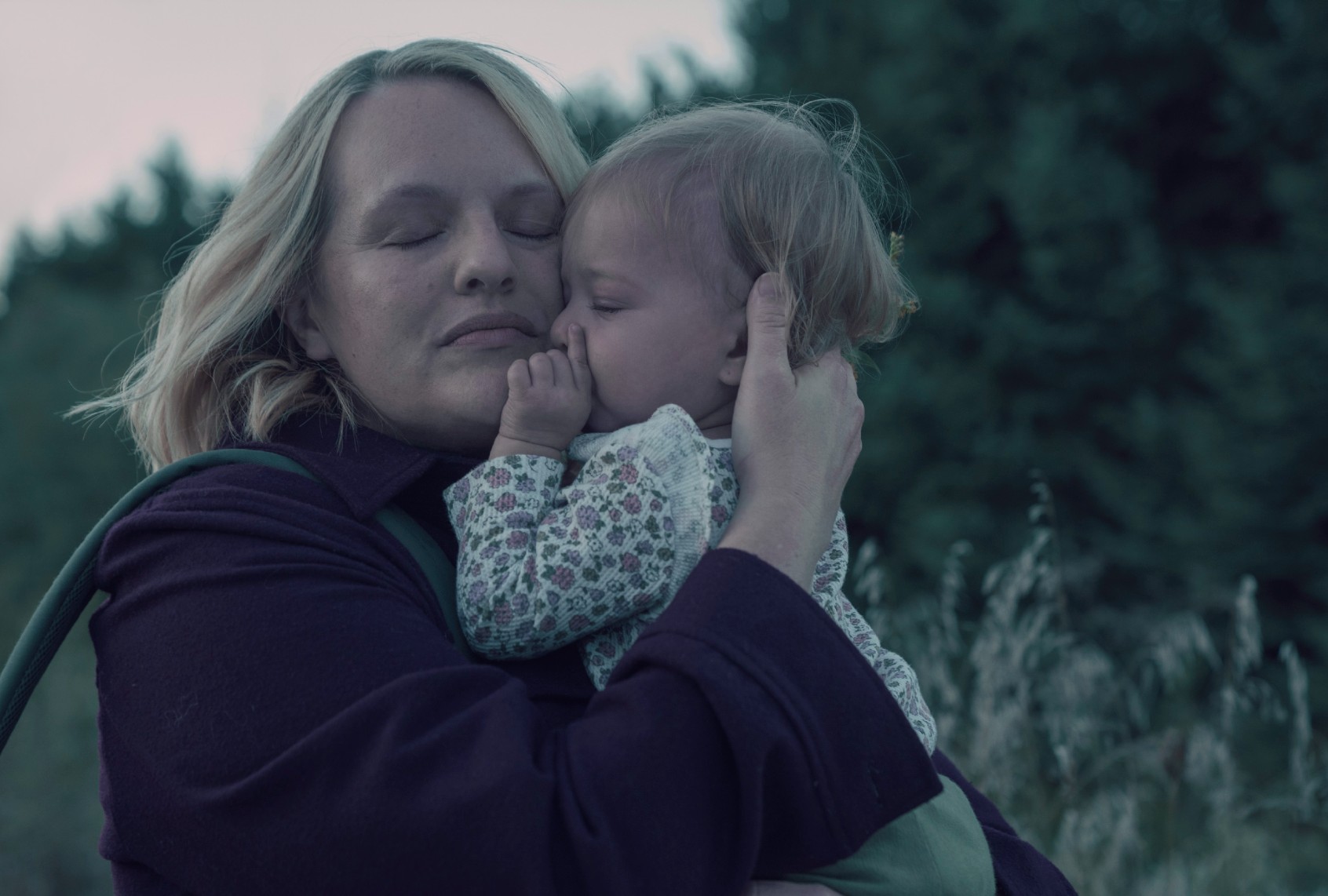
Elisabeth Moss in "The Handmaid's Tale" (Disney/Steve Wilkie)The continued existence of “The Handmaid’s Tale” can be explained if not entirely justified by its performances, especially Whitford’s, who excels at conveying dry-witted exhaustion, and Yvonne Strahovski’s dead-on portrayal of Serena Joy Waterford, June’s oppressive former mistress. New additions Josh Charles and Timothy Simons are also flawlessly cast in roles that, like Serena, are similar to repugnant figures who have been normalized, whether famous or simply common. 
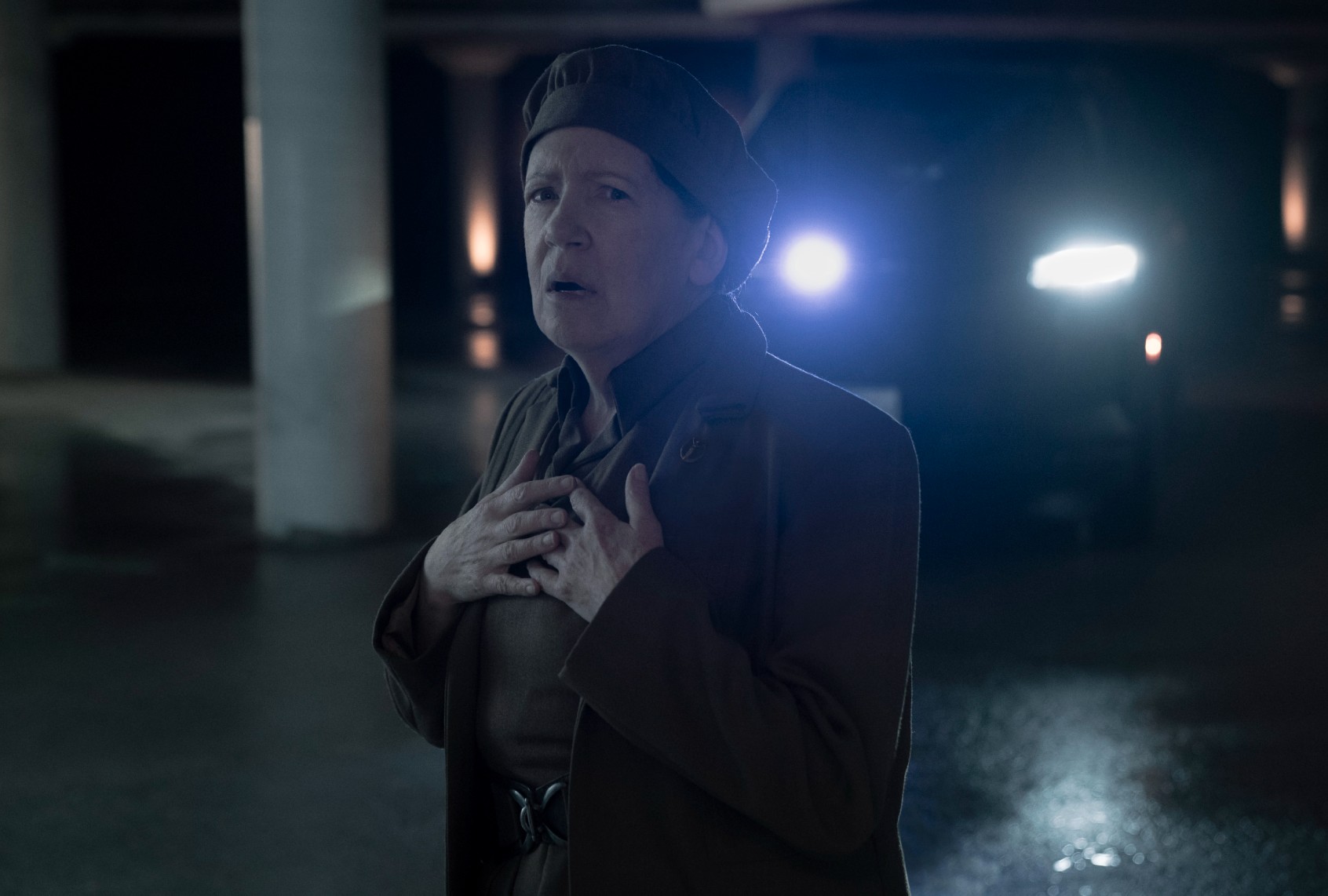
In another reality/fiction crossover, many noticed that Ivanka Trump’s inauguration outfit resembled Serena Joy’s tailored teal gowns. Fitting, since both women prop up repressive regimes from which they’d like to distance themselves when the public calls for heads to roll.

The continued existence of “The Handmaid’s Tale” can be explained if not entirely justified by its performances.

But where June embodies the soul-trying self-regard of crusading white feminists, Serena is the avatar of those women who weighed their interests and perceived comfort against the safety of non-white, queer and economically disadvantaged fellow citizens, and voted for a 34-count convicted felon who is now destroying their retirement accounts.

Strahovski excels at playing white woman privilege to the hilt, and never as much as when she finds herself back on top, ready to evangelize for women’s oppression yet again.

Serena wrote foundational texts that made life unbearable for millions, secure in knowing she would be among the few standing atop a mountain of corpses as high as Everest. Now that hasn’t worked out so well for her, Serena, the woman who forced June to be raped by her now-dead and abusive husband, wants to be June’s ally.

Believing that requires great strain, too. When we meet up with these two, June can barely stand being in Serena’s presence and is juggling a toddler while contending with a shattered arm. She had to leave her husband behind after he surrendered to Canadian authorities; the homicidal Gilead sympathizer from whom Luke defended June died of his wounds.

To Serena, physical distance from the place that caused their problems is all they need to start fresh. “Tomorrow, we can start to forget,” she whispers with a smile to June, the Pauline who can’t stop running back to peril.

I’ve already written about the enraging white feminism driving “The Handmaid’s Tale” along with June’s increasingly silly and unrealistic “there and back again” missions. The sixth season doesn’t cast aside either of these original sins; series creator Bruce Miller and his staff are too far down the road to pull off such a turn. This time, however, peppered throughout the script are small acknowledgments of how insufferable June can be.

This is also true of Serena Joy and the wives who rule the roost in New Bethlehem, Commander Lawrence’s progressive (for Gilead) gated community experiment located in what appears to be the theocracy's version of the Hamptons. But we already knew that.

We need your help to stay independent

June, though, finally gets a well-deserved earful from Luke and Moira, the Black folks propping her up like democracy itself. Hearing and watching them spell out how much her savior complex has depleted their patience in a few key scenes almost makes up for the tens of prior episodes flavored by their deference to her unstoppable will.

Additionally, the writers indict the perversions committed in the name of Christianity, whether in Gilead or these United States, in ways that have particular resonance in these concluding episodes.

On the train, when the endlessly devout Serena attributes every stroke of luck to “God’s grace,” another survivor who has endured horrors more excruciating than mere shame (OK, Serena’s amputated pinky wasn’t exactly a paper cut, but still) sets her straight. “God is just an excuse for men to use two things: c**ks and guns.” Don’t we know it.

Ann Dowd in The Handmaid's Tale (Disney/Steve Wilkie)A subsequent episode makes that explicit when two characters argue over who suffered more based on how often they were raped as Gilead’s subjects, only to be interrupted by a guy who, yes, tries to rape them.
As horrible as this is to witness, the situation also grimly verges on parody. The unnatural narrative mechanics leading to and resulting from that moment and others are a more significant crime. You may lose count of the number of times you ask yourself why June and everyone else are doing what they’re doing again and expecting a different result. Watching the definition of madness in action can be maddening.


Want a daily wrap-up of all the news and commentary Salon has to offer? Subscribe to our morning newsletter, Crash Course.


The three-installment kickoff to the “Handmaid’s” 10-episode finale run debuts one week after Hulu picked up its sequel, “The Testaments.” That announcement fell on April 1, so a person should be forgiven for checking to make sure Hulu wasn't punking us. But no, the news is real.

That means some powerful Disney man in a high tower gazed down at the smallfolk from their sky-level suite and decided that what we need are further adventures from our favorite depressing dystopia.

Watching the definition of madness in action can be maddening.

Goody for Moss, who is an executive producer, along with Atwood, who penned the novel serving as the spinoff’s basis, and cast carryover Ann Dowd. She’s set to reprise Aunt Lydia for the series, which picks up years after the events of the original series and follows Agnes, otherwise known as June Osborne’s daughter Hannah (played by "Presumed Innocent" star Chase Infiniti), as she navigates her life in Gilead.

If this news hadn’t already headlined an assortment of trade reports, this may count as a spoiler since Hannah is the purported reason that June keeps skipping across the border between Canada and the hell she barely escaped.

Then again, maybe not. About a year ago, “We won’t go back” became a battle cry, and look how that turned out. We shouldn’t be shocked that a kid raised in a regressive society somehow managed to remain there, whether by choice or one of her mother’s recurrent wrong turns and close calls.

Besides, backsliding is easier than making progress, especially if it means some of us get to remain comfortable while the rest of the world turns to ash. You can watch “The Handmaid’s Tale” pull into its terminal point and say to yourself, “This is fine,” knowing it isn’t, or you can look away towards virtually any other show and take a needed break from a world that is speedily tumbling Under His Eye.

The sixth and final season of "The Handmaid's Tale" premieres with three episodes Tuesday, April 8 on Hulu. 

“A firewall against erasure”: Jennifer Beals on “The L Word” book fans demanded

I knew that Jennifer Beals and I were going to have a fantastic conversation when, after connecting on Zoom and chatting for a bit, she asked if I would mind it if she turned off her camera because it helps her concentrate better. Opening up about being what she describes as “very shy,” she went on to describe her inspiration for pursuing a wide release of  “The L Word: A Photographic Journal,” a collection of photos she’d personally taken during the filming of the original “L Word” series, which she’d compiled into a book in 2010 to hand out to the cast and crew after they’d wrapped the show. Having bowed out of fan events due to a certain level of uncomfortability being in crowds of strangers, she was convinced by cast members Leisha Hailey and Kate Moennig to join them at an event taking place in the U.K. one year, and it was there that she learned that fans weren’t just interested in the photos she’d taken, they all but demanded greater access to them.

Opting for a physical book over something like a gallery show or simply sharing the photos online because, she says, "it’s nice sometimes to just have something to touch," she looks back at the act of taking them as not only a way to steady herself and calm her nerves on set, but to capture and preserve the "lightning in a bottle" show, as she describes it — and as fans see it — that is "The L Word," a show that ended it's original run 16 years ago and has still — even factoring in its three season continuation, "The L Word: Generation Q" — not been replaced in the hearts of fans, in terms of popularity and the offering of a weekly meeting place, on television, for the full spectrum of the LGBTQ+ community to see their lives reflected back at them with a whole cast of characters, and not just one or two. 

"I’m just hoping where there’s a will, there’s a way. And who knows how long it’ll take. I could be rolling up in my wheelchair," Beals said when asked about rumors of a new "L Word" series, possibly based in New York. 

Read our full conversation below to learn more about “The L Word: A Photographic Journal,” Beals' new media venture with "L Word" creator Ilene Chaiken and former longtime Condé Nast chief revenue officer Pamela Drucker Mann called Run-A-Muck, and what her "L Word" character, Bette, would have to say about all the arts de-funding taking place.

The following interview has been edited for length and clarity.

I feel like I’ve been hearing about this book for quite some time, catching exchanges between fans of “The L Word” on social media who snagged an earlier version of it during limited release drops and bragging of their copy as though it was a rare biblical text. How does this wide release version differ from the earlier one and what made 2025 feel like a good year to release it?

The only reason it’s out here now is because of the fans. I had originally made the book as sort of a personal remembrancer and as a gift for the cast and crew after our final year of shooting. And Kate and Leisha had invited me to an "L Word" convention in the U.K. — they had gone to several and I’d never been to one, and they said, "You’re really gonna love it, everybody’s so great," so I finally went. I didn’t go [previously] because I’m really shy and it’s hard for me to be in big groups of people that I don’t know, but in any case, it became clear to me how amazing our fans are and how they really wanted to immerse themselves in this world — it wasn’t just another TV show.

"There’s been a whole new generation that’s discovered the show. And so the book is sort of like this bridge for them.

And so I thought, oh, I should make the book available to them, I think they would appreciate it. So I did these interviews with the cast and I made the book available in a limited quantity for the fans, and then people started asking to bring back the book. And I think what’s so fascinating is that over time, there’s been a whole new generation that’s discovered the show. And so the book is sort of like this bridge for them, in a way. And bringing it back in 2025, there was no great strategy; it was just fans asking for the book, me being lazy, finally then not being lazy, and finding a publisher for the book. But I think it was kind of divine intervention because I think we’re at a really important point where the book has become more than just a bit of nostalgia for a show. It’s about remembering how far queer representation has come and hopefully inspiring future storytelling. It also has made me start thinking about collective memory and how photography contributes to collective memory and how collective memory can be a firewall against erasure. And we’re now at this point in the United States where there are people trying to legislate away the existence of people within the LGBTQ+ community, literally trying to erase them from statues. And it is critically important we remember the community and celebrate the community and I’m just so glad the book is out now.

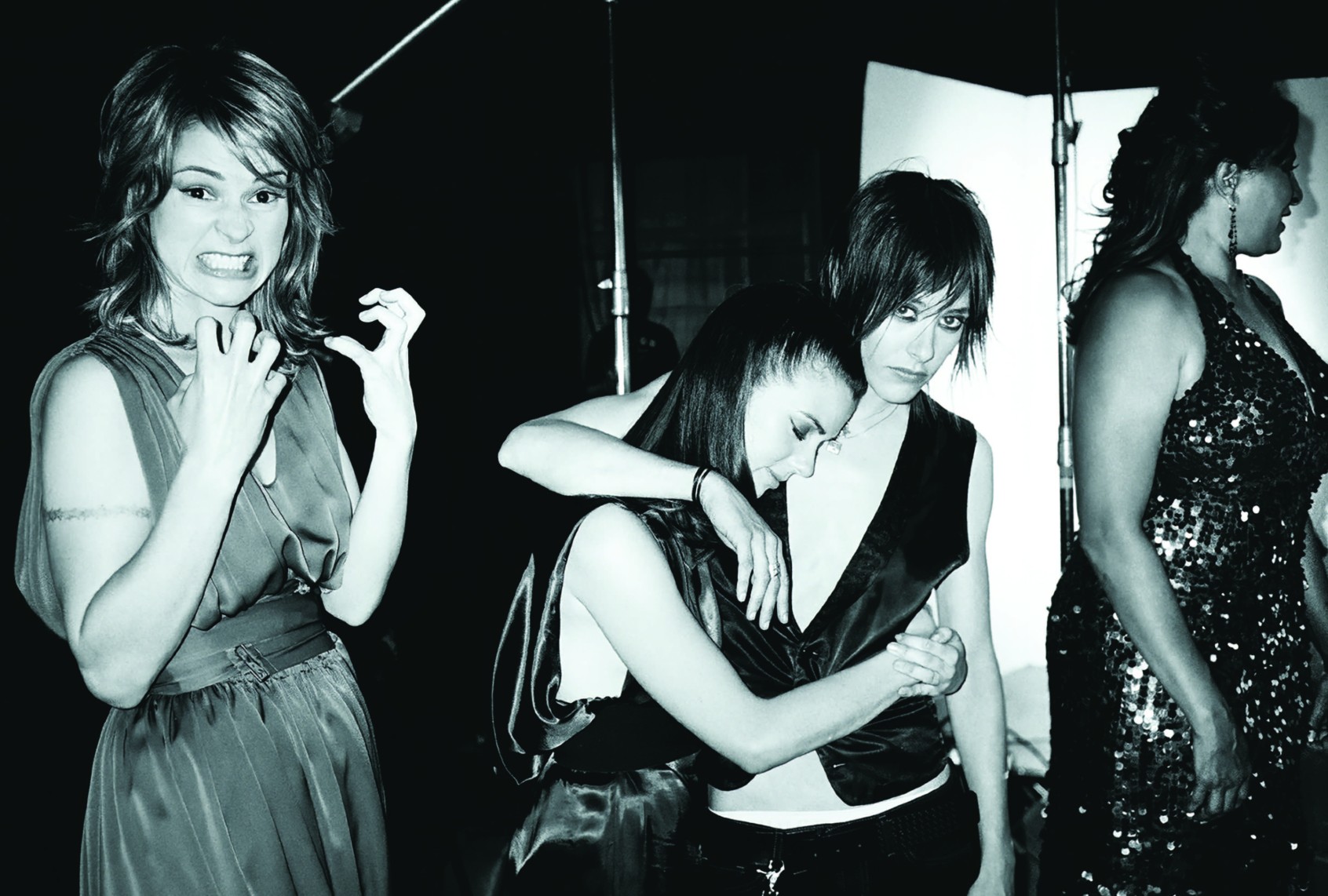
Leisha Hailey, Mia Kirshner, Kate Moennig and Pam Grier behind-the-scenes of "The L Word" (Courtesy of Weldon Owen/Jennifer Beals)When you look at the photos in this book, what are some thoughts and emotions that surface for you?
Well, it’s interesting because I put the book together in 2010. I always save all of my scripts anyway because it serves as a library if you’re mining a character for six years — you don’t know if it’s gonna be six years, or three years, or two years, or one year — but to save all the material, that helps to inform the character, for me anyway, that’s important. So I was saving all the scripts anyway, but I was also saving all the other bits of ephemera and, of course, taking photos every day. And in terms of what photographs were included, I broke the book down by seasons, although there is a whole section on dogs. And I think that’s partially because the circus, where all the trailers are — In Canada we call it the circus. I think they call it base camp in the U.S., which is a crucial difference between the United States and Canada. To document that life at the trailers was really important because that’s where we spent quite a bit of our time getting ready and having lunch and all manner of things, preparing for scenes, so I knew that it certainly was important to include those photos. But it was more instinctual.

"I love the idea of an object also helping to facilitate community."

But I really wanted to show how we were gathering in all of these other spaces that weren’t in front of the camera. And how all of that mayhem and mischief and joy that was going on beyond the camera was informing what was in front of the camera. It’s not a photography book, it’s a photographic journal. Because if I were making a photography book, there are lots of photos I wouldn’t include. Stuff where the focus is a little soft, or that I wouldn’t necessarily consider to be a successful photograph, but it’s a wonderful remembrancer for me, and for the cast, and hopefully the audience beyond the cast will sense some kind of meaning in the photographs. And certainly, in this day and age, I could have taken photos through AI and sharpened them. But I just thought, you know, then it doesn’t feel like a yummy mistep of an analogue photo, which speaks almost to the haziness of memory, in and of itself. 

And with AI, everyone would have had 13 fingers and two noses and stuff.

[Laughs] But with photography, you can put things through and it can sharpen things, but that’s not the sentiment of this book. The sentiment is that through these mistakes, through the error, through the messiness, the culmination of all of that is greater than the sum of its parts. 


Want a daily wrap-up of all the news and commentary Salon has to offer? Subscribe to our morning newsletter, Crash Course.


One of the many things I love about this book, aside from the fact that it provides such a great opportunity to go back and tap into memories of the show and spend time, in those memories, with the show’s characters, is that it’s a physical product. You can touch it. You can pull it off the shelf at any time and tap into this still very relevant world of "The L Word.” So you’re not only helping to keep those memories alive, but you’re helping to keep physical media alive. Was that a factor for you when coming up with the idea to release this book? The idea that photos and books themselves don’t have to exclusively exist on screens just because it’s the digital age?  

It did occur to me that it’s nice sometimes to just have something to touch. There’s an emotional layer to the photographs, and then there’s an emotional layer to the book itself, that all of these things are contained within this one object. And originally it was conceived as a notebook, like a real journal, and that’s why there’s that satin string in there. But this version is different than the original version. It’s much bigger, it’s much more luxurious, there’s a new forward, Kara Swisher has written a preface, and there’s a few extra photos in there. But yeah, I love the idea of an object also helping to facilitate community. 

For fans of the show, looking through these on-set and behind-the-scenes photos, we’re viewing the people in them primarily as characters, where you, having worked closely with them for so many years, you’re seeing them as people, as friends. But to what degree does your character come into play when looking at these? Like, does the Bette in you ever look at images of Mia Kirshner and think . . . Jenny?”

To the contrary! I look at pictures of Mia and I’m like . . . really one of the most extraordinary people I’ve ever met. One of the most extraordinary minds, an extraordinary actor, just an incredible, exquisite human being. And, you know, watching her, first of all, how she approached her character was just amazing to me. She wasn’t afraid of Jenny looking bad. She wasn’t afraid of not being liked. While she’s doing the show, she’s traveling to the border of Mexico and doing all of this work with refugees and she was working on this book called “I Live Here,” which dives into her activism. There’s a photo in there of her in her trailer in her snazzy costume, editing her book.

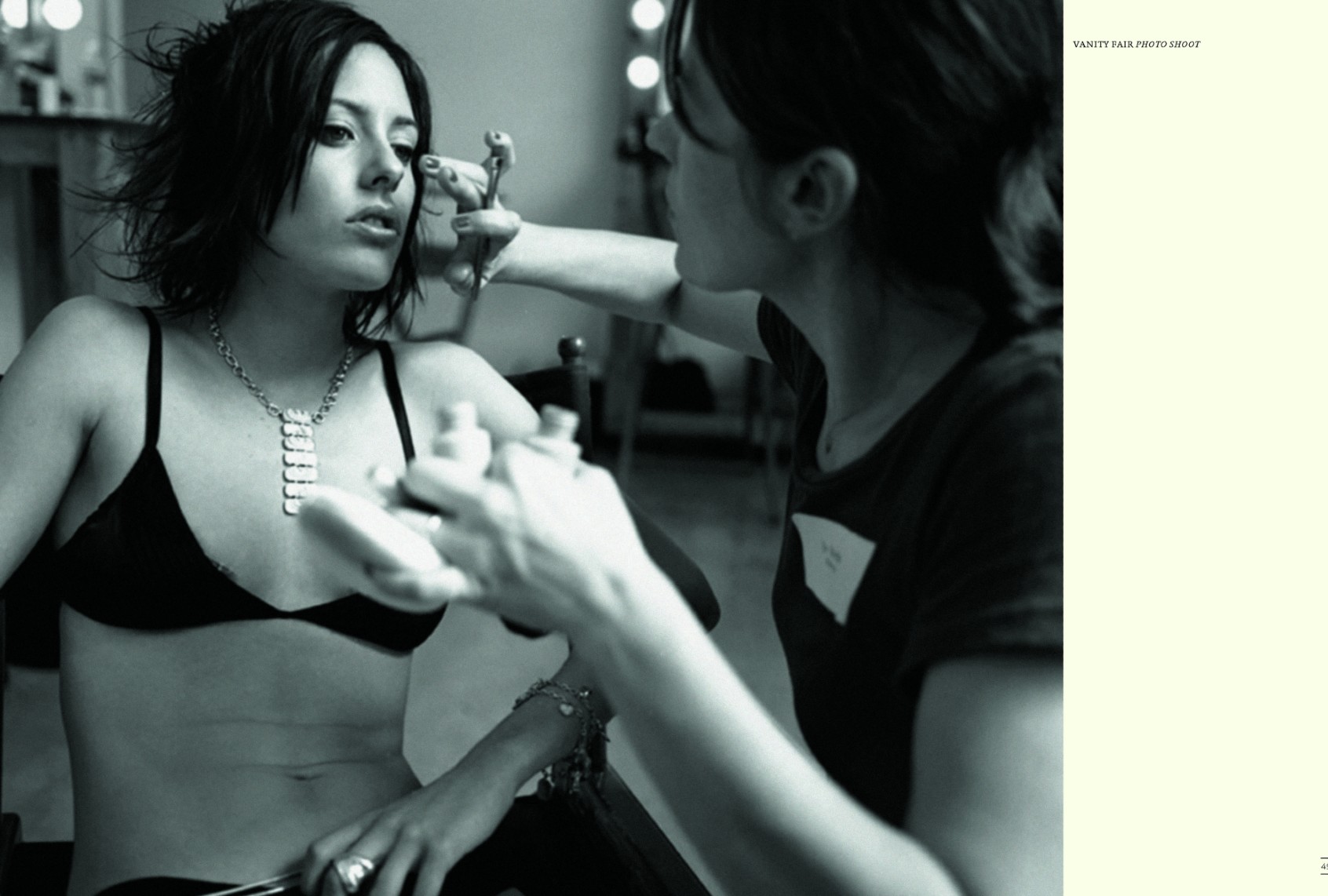
Kate Moennig behind-the-scenes of "The L Word" (Courtesy of Weldon Owen/Jennifer Beals)I have two favorite characters from the original “L Word,” one is Jenny and the other, and I’m not just saying this because I’m talking to you, is Bette. Because of the characters’ strength, but they also had the strongest lines and, oftentimes, the funniest lines. Funny in their intensity, if you know what I mean. So yeah, I’m a Jenny fan and a Bette fan.
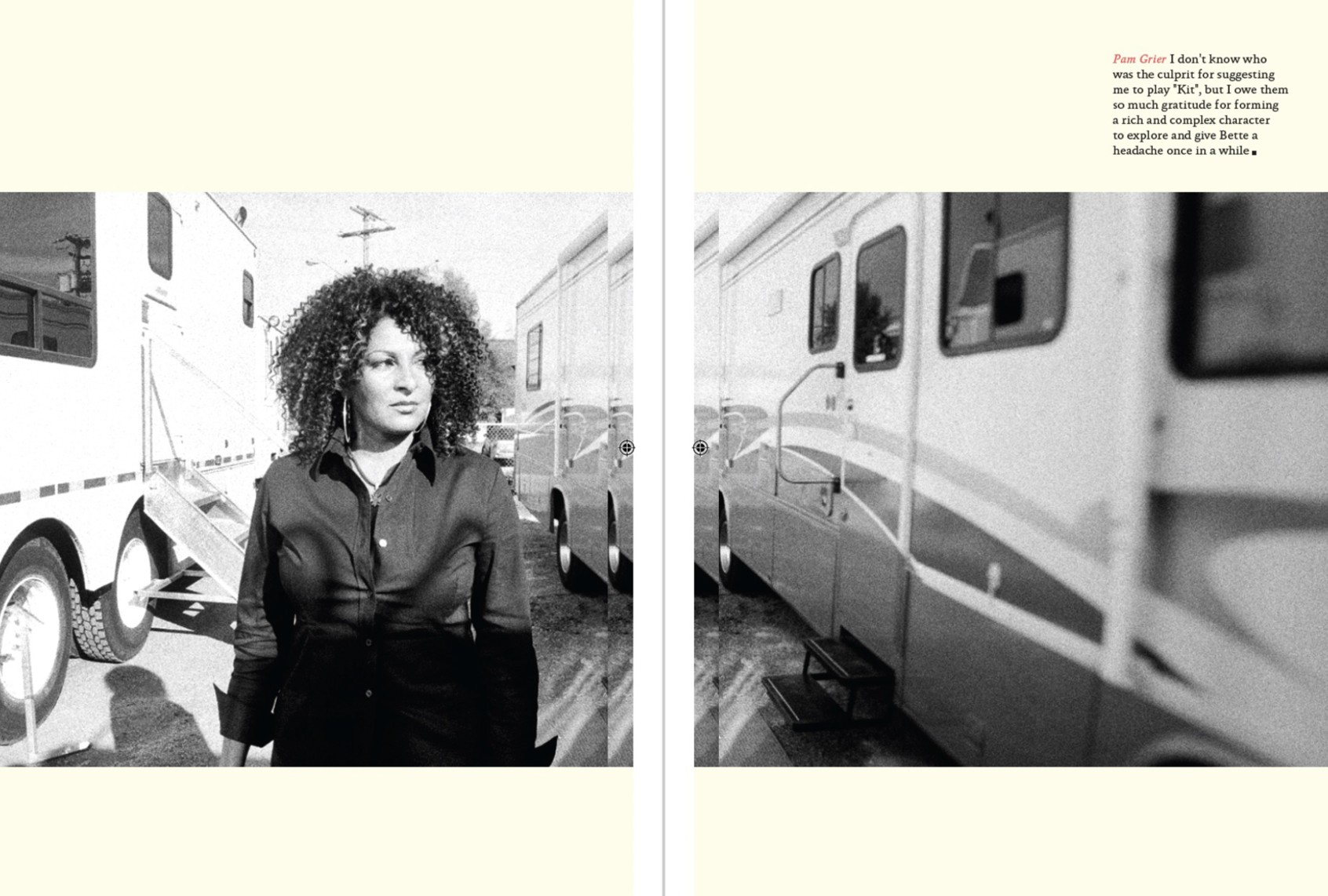
Thank you, thank you. And I’m gonna pass that along. I love Bette. I love how strong she was/is and how deeply vulnerable. I think we also talked about what it is to be biracial, and Bette’s experience with that, long before anybody was talking about that, in that way, and that was really interesting to me. When I met with Ilene, our first meeting, I asked if she would be open to the character being biracial and she said, “Absolutely.” And having Ossie Davis play Bette’s dad, oh my goodness. That’s a very dear picture to me, too. There’s a picture of Dan Minahan, Pam Grier and Ossie Davis at the Sutton Place Hotel rehearsing, and having that photo is very, very meaningful to me. 

Did you hear from anyone on the cast asking for any particular photos not to be included?

What I did was, I made my selects for each person, and then I sent them the selects and I just said, take out whichever ones you don’t want. Let me know what you don’t feel comfortable with, and that will not be in the book. And so they were a part of that process. I wanted people to be happy and comfortable with how they look. Like, there’s a picture of Erin (Daniels) with a cigarette, and I said, “I love this photograph, are you sure?” And she was like, “No, it’s fine, go ahead. I smoked.” I don’t think she smokes anymore.

The last time you spoke to Salon was in 2019, right as “Generation Q” was premiering, and you spoke of how the world needed that show then more than ever but, as it turned out, the network had other plans, with Showtime/Paramount not only canceling it, but pulling it from its streaming platform. But in the early 2000s, in what you’d think would have been less progressive times, the original "L Word" lasted on Showtime for six seasons, and that was without the benefit of the kind of social media push most shows get today. With “Gen Q” getting canceled and other fan favorites like “A League of Their Own” on Prime, why do you think that, even after all of these years, nothing has managed to get the level of support that the original “L Word” has? That show is, still, pretty much all that the queer community has.

"Every now and again, you’ll get lightning in a bottle. And I think that’s what the original 'L Word' was."

It’s a really interesting question. I don’t know, is the true answer. I really, really don’t know. It’s very hard to make a show. Period. And it’s very, very hard to make a good show. And every now and again, you’ll get lightning in a bottle. And I think that’s what the original “L Word” was. I don’t think it’s impossible to do it again. Ilene Chaiken and Pamela Drucker Mann and I have started a company called Run-A-Muck and one of the areas within the company is the L World, and we are hell-bent on creating stories under that umbrella that are sort of in the same purview as "The L Word" would have been, to address your point. Why aren’t there more stories out there? I mean, there are characters, but there’s not a friend group, as far as I’m aware of, so we’d like to address that, for sure. 

Pam Grier behind-the-scenes of "The L Word" (Weldon Owen/Jennifer Beals )I wanted to talk a bit more about Run-A-Muck Media. Being immersed in the “L Word” fanbase, I know that prior to the reveal of this venture, when there were rumblings of a big announcement coming from you and Ilene, there was a lot of speculation that it was going to be news of another “L Word” show, possibly set in New York. Were you aware of the anticipation there, and was that ever in the works? There are conflicting reports about it, with some major sites hinting at a 2025 release date for it, but on their “Pants” podcast, Leisha Hailey and Kate Moennig have said they were never spoken to about it, and it’s not a thing.
I was aware of that anticipation and I was hoping they wouldn’t be too disappointed by the announcement of the company, but I’m just really really excited about this endeavor and it’s certainly something that Ilene and I have been in a fever dream about for, I don’t know, gosh, twenty years or so. And part of it is that we wanted to create or work together to find compelling artist-led stories that invite an audience into a world that either shows them things that they’ve never seen before or re-introduces them to new things in a world that they thought they knew. And certainly, the mitochondria of Run-A-Muck is queerness. And also the company will address the change in our consumer habits. So much is being watched in short form, and so much is being watched on social media. People watch so much content on their phones or iPads. They’re not necessarily sitting on the living room couch like back in the day and tuning in to the next episode . . . I think that’s a smaller audience. And so, looking at a way to create worlds that can live in long form, short form and social media is an exciting idea.  

I have to kind of dip back a bit and ask this question because I know many people will be mad if I don’t. Is there going to be an “L Word: New York?” 

[Turns camera back on and motions that she’s zipping her lips.]

Well, that’s a better answer than “No.”

"Ilene has always said that she will be iterating ideas for the 'L Word' on her deathbed."

I would say that Ilene has always said that she will be iterating ideas for the “L Word” on her deathbed. And it just goes to the notion that it’s hard to make a good show. And if you’re gonna go out of the gate, you gotta make sure that it’s a great show. And who knows, Ilene has many, many projects that she’s doing, but I have great hope because she loves the story so much. She loves the characters so much. I’m just hoping where there’s a will, there’s a way. And who knows how long it’ll take. I could be rolling up in my wheelchair. But I can assure you, it has not been set aside into a dustbin. 

Compared to the cultural and political climate that existed when the original “L Word” came out in 2004, we are in an astonishingly much darker place that’s taken a toll not just on the queer community, but with marginalized people as a whole. And, in dealing with this on an everyday level, there’s often talk of the importance of being mindful, and we remind each other to “touch grass.” With your photography, and the photos in this book, I’m curious if that practice of capturing moments stuck out to you as a way to re-center and perhaps grab on to moments of happiness that we can, hopefully, all find again. 

"When I have a camera in my hand and I’m looking through that lens, I’m able to contextualize and structure my environment, and it’s my own little firewall, probably against nervousness."

For me, the process of photographing, honestly, I probably brought a camera with me to that first rehearsal because, for me, when I have a camera in my hand and I’m looking through that lens, I’m able to contextualize and structure my environment and it’s my own little firewall, probably against nervousness. You know, because I can understand where I am and what’s going on a little bit better. But there’s also something that happens when I’m photographing: I fall in love with the world over and over again. And I am reminded that even on its worst day, the world is still exquisitely beautiful. In the worst pain that you are in, the world is still exquisitely beautiful. And it’s much easier to experience that, for me, when I am looking through the lens.

When 9/11 happened, my husband and I were there, and I did not listen to my intuition, which told me to bring my cameras to New York on that trip, because I thought I’d only be there 48 hours and the cameras are quite heavy, they’re all analogue cameras. And of course then when 9/11 happened, within hours of it happening, I said to my husband, “I am walking downtown, I’m going to B&H Photo, I’m renting a camera, and I’m going to walk downtown as far as I possibly can and I’m going to be photographing all day because this is how I’m gonna get through the day.” And so I did. It was a way to process the world, and I saw beautiful things, too. I saw people helping each other. 

In past interviews, you’ve mentioned that when researching your role as Bette, you spent a lot of time learning the specifics of what it meant to be in the art world. With arts funding in dire jeopardy more than ever, does your past research further shape your feelings on how important it is to support the arts, and what would Bette have to say about all this? 

She would be absolutely raging. Raging. Raging so hard. Poor Tina. And then organizing. Because if you can’t go through the NEA, then you do it through your community. Going back to what you said before about touching grass, more important is to get together with other people. It is through relationships that things change, that things get made, that ideas come up to the surface. We are better together. You will find a way. It’s like water. You will find a way around the rock, and if you can’t find a way around the rock, you are going to change the rock with the constant pulsing of this water. It will change. 

Grab a copy of "The L Word: A Photographic Journal" when it's released on April 15.

Forget apps — strangers are meeting over shared plates again

Researchers, doctors and even Netflix have told us we’re lonelier than ever. Some claim it’s the latest epidemic plaguing society, but instead of masks and distancing, people are combating this one in a very different way. Post-pandemic, there’s been a surge in supper clubs around the world.

These intimate, exclusive dining experiences give people a chance to meet and bond with locals, travelers and chefs. The goal? Connecting and hopefully forming friendships over top-notch local food and drinks. 

Popular in the United States during the 1930s and 40s — coincidentally, after the country’s 1920 Spanish Flu epidemic — in reality, post-Prohibition sparked these social clubs where people came to eat, drink and let their hair down.

London is arguably the supper club scene's hotspot and has been for years. Supperclub.tube is one of the capital’s most quirky. Here, hungry commuters can gather inside a decommissioned 1960s tube train for a six-course Latin American menu made using local British ingredients.

At Vegetarian Brown Girls in north London, the mother-daughter duo serves home-cooked Gujarati food known to make diners' eyes well with memories. “For us, it’s about creating an experience where you feel part of our story, where every dish feels like you can start a conversation, while every bite brings you closer to home,” says Priya Bowry, co-founder and co-host of Vegetarian Brown Girls. “It’s where tradition meets cool, where food connects us all, and where the vibes are always just right.”

The tablescape at a Vegetarian Brown Girls supper club event (Vegetarian Brown Girls )In Ho Chi Minh City, Vietnam, food blogger Jovel Chan started Saigon Supperclub as a way to bring her online food community into the real world. “My first supper club kicked off on the rooftop of my own apartment with friends and followers featuring a local craft apricot liqueur. Since then, we’ve hosted nearly 30 dinners across Ho Chi Minh City—in farmhouses, wine cellars, and hidden venues—spotlighting Vietnam’s culinary side alongside local tastemakers and craft brands,” says Chan.
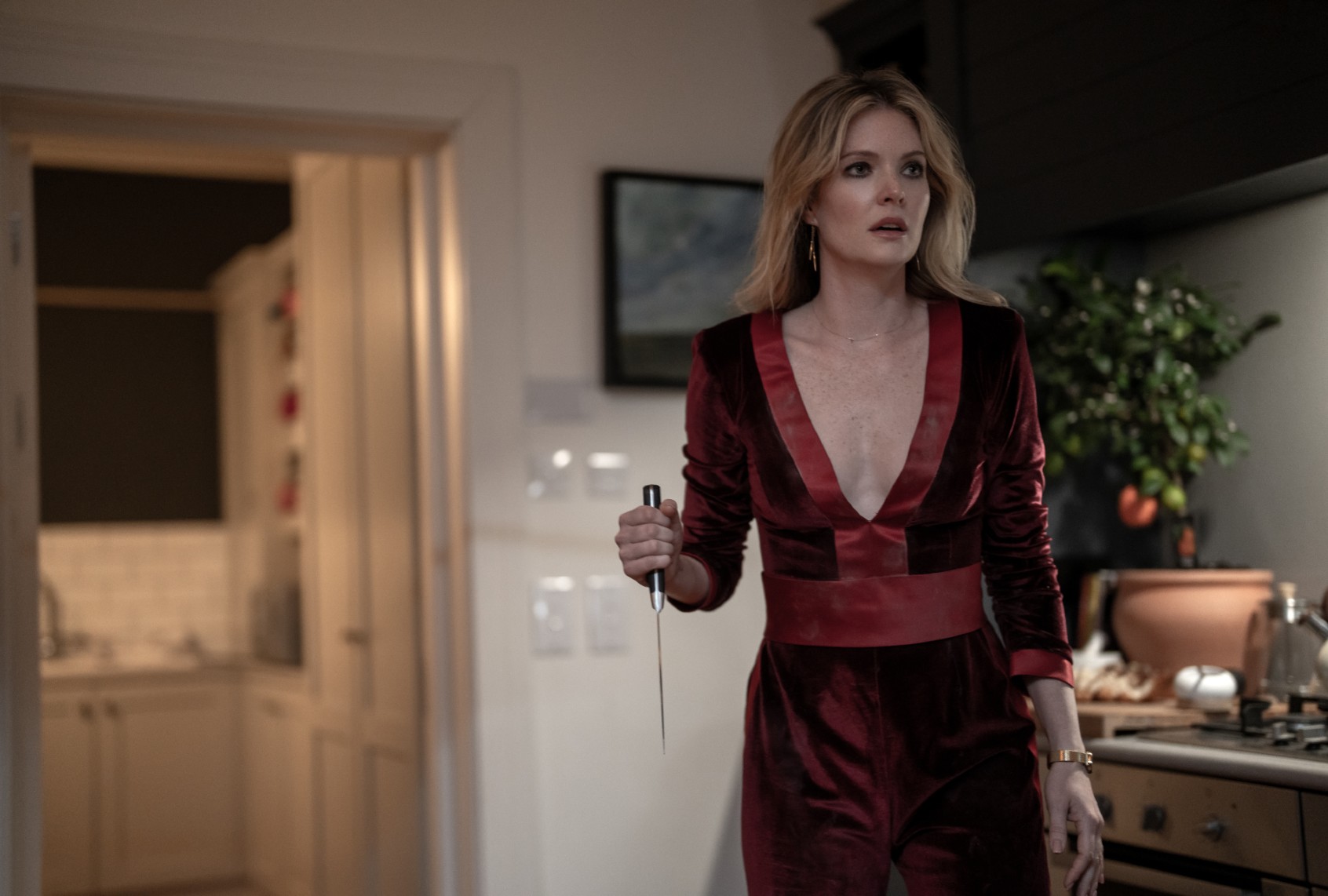
We need your help to stay independent

Saigon Supperclub seats people based on a questionnaire filled out pre-dinner. “I reckon in a world of constant movement, remote work and digital overload, supper clubs offer something refreshing change—a way to meet new people beyond hostel bars and tourist traps, whether you’re traveling or just looking for good conversation over a great meal,” she says.

One of the United States’ most beloved supper clubs is Mosquito Supper Club in New Orleans. This award-winning restaurant has been one of the toughest tickets in town since it opened in 2014. Sitting across from strangers sharing a plate of Louisiana crab cakes is a tourist hack to getting the best New Orleans recommendations from locals who come back over and over for chef Melissa Martin’s family recipes (I can personally attest to this).

“Mosquito offers a glimpse into what dining on the Bayou looks like. We serve "grandma cuisine" in a laid-back environment so that our guests feel as though they are stepping into our home,” says General Manager Emily Pilkington. “The food is as traditional as you can find without driving down to Chauvin, Louisiana, where Melissa grew up, with a hint of fine dining.”

Down under in Melbourne, Australia, Club Sup was born out of the city’s strict and lengthy COVID-19 lockdowns. Hosted in art galleries and artists’ apartments, it has morphed into something much bigger, with hundreds of events across Australia, and includes things like a Lunch Club and Book Swap. The original dinner in Melbourne still meets once a month at Cam’s Kiosk, a beloved neighborhood go-to for wine and a two-course dinner.

At a BYOB dining room in Bangkok, chef Dylan Eitharong cooks a wacky family-style Thai meal at the perennially busy HAAWM, a play off the word “home” and the Thai word meaning fragrant. It’s a fitting name, given its ever-changing array of punchy plates from Penang curry with salted beef and candlenut to grilled salted beef served with “daddy’s special sauce.”

“HAAWM offers a dining experience in Thailand where people can taste delicious and refined food without the pretentiousness of Michelin restaurants. It offers travelers a place and way to meet new people over a family-style meal,” says Eitharong. “Overall, I think supper clubs are a unique experience because diners get to not only connect with other diners on a personal level but the chef as well.”

Trump said cuts wouldn’t affect public safety. Then he fired workers who help fight wildfires

President Donald Trump’s executive orders shrinking the federal workforce make a notable exception for public safety staff, including those who fight wildland fires. But ongoing cuts, funding freezes and hiring pauses have weakened the nation’s already strained firefighting force by hitting support staff who play crucial roles in preventing and battling blazes.

Most notably, about 700 Forest Service employees terminated in mid-February’s “Valentine’s Day massacre” are red-card-carrying staffers, an agency spokesperson confirmed to ProPublica. These workers hold other full-time jobs in the agency, but they’ve been trained to aid firefighting crews, such as by providing logistical support during blazes. They also assist with prescribed burns, which reduce flammable vegetation and prevent bigger fires, but the burns can only move forward if there’s a certain number of staff available to contain them. (Non-firefighting employees without a red card cannot perform such tasks.)

Red-card-carrying employees are the “backbone” of the firefighting force, and their loss will have “a significant impact,” said Frank Beum, a board member of the National Association of Forest Service Retirees who spent more than four decades with the agency and ran the Rocky Mountain Region. “There are not enough primary firefighters to do the full job that needs to be done when we have a high fire season.”

ProPublica spoke to employees across the Forest Service — which manages an area of land nearly twice the size of California — including staff working in firefighting, facilities, timber sales and other roles, to learn how sweeping personnel changes are affecting the agency’s ability to function. The employees said cuts, which have hit the agency’s recreation, wildlife, IT and other divisions, show the Trump administration is shifting the agency’s focus away from environmental stewardship and toward industry and firefighting.

But notwithstanding Trump’s stated guardrails, the cuts have affected the Forest Service’s more than 10,000-person-strong firefighting force. Hiring has slowed as there are fewer employees to get new workers up to speed and people are confused about which job titles can be hired. Other cuts have led to the cancellation of some training programs and prescribed burns.

“It’s all really muddled in chaos, which is sort of the point,” one Forest Service employee told ProPublica.

“This agency is no longer serving its mission,” another added.

The employees asked not to be named for fear of retribution.

"This agency is no longer serving its mission."

The Forest Service did not respond to questions about the impact of cuts other than to clarify the number of terminated employees. The Forest Service spokesperson said about 2,000 probationary employees — typically new staff and those who were recently promoted, groups that have fewer workplace protections — were fired in February. Others with knowledge of the terminations, including a representative of a federal union and a Senate staffer, said the original number of terminated employees was 3,400 but that decreased, likely as workers were brought back in divisions such as timber sales.

The White House and a representative from the Department of Government Efficiency did not respond to requests for comment.

In early March, an independent federal board that reviews employees’ complaints compelled the Department of Agriculture, the Forest Service’s parent department, to reinstate more than 5,700 terminated probationary employees for 45 days. During their first weeks back on the payroll, many, including Forest Service personnel, were put on paid administrative leave and given no work.

The administration and DOGE continue working toward layoffs amid court challenges to their moves. Word circulated throughout the Forest Service in March that departmental leadership had compiled lists containing the names of thousands of additional Forest Service employees who could be soon laid off, according to some workers.

Additionally, understaffing in the agency’s information technology unit is threatening firefighting operations, according to an agency employee. In December, the branch chief overseeing IT for the agency’s fire and aviation division left the job. The Department of Agriculture posted the job opening, describing the division as providing “support to the interagency wildland fire community’s technical needs.” This includes overseeing software that firefighting crews use to request equipment — everything from fire-resistant clothing to hoses — from the agency’s warehouses so first responders have uninterrupted access to lifesaving equipment.

The day after Trump’s inauguration, the Department of Agriculture removed the IT job posting. The position remains unfilled, according to an employee with knowledge of the situation.

The hiring of new firefighters has also bogged down amid the deluge of sometimes-conflicting orders from the administration and DOGE, Forest Service staffers said.

“We are really, really behind onboarding our employees right now,” a Forest Service firefighter told ProPublica.

The staffing issues exacerbate challenges that predate the second Trump administration. To address a massive budget shortfall, the Forest Service under President Joe Biden last year paused the hiring of seasonal workers, except those working on wildfires. (Firefighters did see a permanent pay increase codified by Congress in its recently approved spending bill.)

Still, many permanent employees, including many firefighters, work on a seasonal basis and are placed on an unpaid status for several months each year when there is less work. Uncertainty within the federal government has led many of these employees to give up on government work and look elsewhere.

“Some of our people have taken other jobs,” one Forest Service employee told ProPublica. “People aren’t going to wait around.”

Cuts to the agency’s legal department will also curb its ability to care for the nation’s forests and fight wildfires, an employee told ProPublica. Large prescribed burns and other vegetation-removal projects require environmental review, a process that is often targeted with lawsuits, including by green groups concerned that the efforts go too far in removing trees.

A smaller legal staff could lead to fewer prescribed burns, increasing the risk of catastrophic fires, according to a lawyer for the Department of Agriculture who worked on Forest Service projects. The lawyer was fired in the mid-February purge of probationary employees.

“Every time we lose a case out West, it means the Forest Service can’t do a project, at least temporarily,” the lawyer said.

“They’re going to get sued more, and they’re going to lose more,” said the lawyer, who was reinstated in March following the board ruling that the Department of Agriculture’s mass firings were illegal.

The employee received back pay but was immediately put on administrative leave. Because of the cuts to support staff, it was several weeks before many of the returning employees were reissued government laptops and badges and allowed to do any work.

“Government efficiency at its finest,” the lawyer said.

ProPublica is a Pulitzer Prize-winning investigative newsroom. Sign up for The Big Story newsletter to receive stories like this one in your inbox.

America has a bad case of TDS

There are many different types of laughter. There is the good laughter caused by joy, surprise, happiness, or perhaps even ecstasy. There is laughter at the absurd when one cannot even make sense of what they are experiencing. There is also the laughter of rage and anger. There are laughs from emotional discomfort and anxiety. There is hysterical laughter in the face of death or other great peril when the danger is so extreme that you hear a person laughing and then realize it is you.

Some people laugh during funerals and other times of great grief and sorrow. I experienced this once at an Irish wake for a friend who took his own life. One person started laughing while telling a story about our departed friend, and then another person laughed, and the laughter spread around the table.

There has been a lot of laughter in America during the Age of Trump. With Trump’s return to power, almost every day there is some new shattering of norms, one of those “this should not be happening but somehow it is” moments where malignant normality and the spectacle somehow keep getting worse as the country collapses into autocracy and authoritarianism. The guardrails of democracy and “the institutions” and “the rule of law” have been laid bare and splayed open; they are so very weak. Germany’s democracy collapsed in 53 days; America’s democracy is still holding on, barely, but I am unsure it will make it to 90 days. As for the midterms in 2026? Good luck.

But for all the laughter that has happened (and is happening) during the long Trumpocene, little if any of it is truly funny. I suspect that much of this laughter has been to keep from crying because of the grand tragedy. Trying to gain a better perspective, I have repeatedly returned to physician Gabor Mate’s 2022 interview at Jacobin:

In a social sense, we have really lost the way. There are certain human needs that are not negotiable. We can’t negotiate them away. We can give up on them, but then we suffer when we do. When they’re not met, there’s going to be suffering and ill health in every sense of the word. They include having a purpose in life, having agency and authority in one’s own life, and being connected to other people. Meeting all of these needs is required for full health, full wholeness. On a social level, that means that all the institutions and political structures and ideologies that undermine those qualities need to be either jettisoned or transformed.

Both the Left and the Right have got these traumatic imprints that they enact. The Right very often consists of abused people who identify with power so they’ll never be hurt again. That’s basically it. You know, like a [Donald] Trump. Big Daddy will protect me so that I’ll never be hurt again, like I was hurt by my real daddy. And they hate vulnerability. They attack vulnerable people because they hate their own vulnerability. So that’s the thumbnail traumatic imprint of people on the Right very often.

People on the Left, on the other hand, also suffered in their childhoods, and they take that anger that’s not resolved in them and they project it into the politics, which makes them not very tolerant and much less effective. When they talk to people who just don’t see it their way, who are not aware or maybe more ignorant, or not in touch with the real issues, there’s a tendency to speak in a very hostile and very demeaning way. That’s unresolved trauma on the part of the people coming from the Left, as it was in my case. Self work, particularly for people who want to make a difference, is really important. To the degree that people don’t do it, they might attract some followers with a certain degree of charisma, but they will not convince anybody that doesn’t already see it their way.

We need your help to stay independent

Last month, five Minnesota Republican state senators introduced a bill declaring that “Trump Derangement Syndrome” exists and that it is a type of “mental illness.” As The Independent reports, "symptoms include 'Trump-induced general hysteria,' where a person struggles to distinguish between 'legitimate policy' and 'psychic pathology,' which is expressed with verbal hostility or acts of aggression against Trump and his MAGA supporters."

The proposed Trump Derangement Syndrome law in Minnesota is an example of how the Trump administration and its allies’ war on multiracial, pluralistic democracy and society is national. The states are being used as testing grounds and the leading edge of this revolutionary project.

This attempt to declare “Trump Derangement Syndrome” a mental illness per Minnesota law was widely met with mockery and derision. Minnesota Senate Majority Leader Erin Murphy described the bill as "wasteful, frivolous and shameful….possibly the worst bill in Minnesota history." Murphy continued, "If it is meant as a joke, it is a waste of staff time and taxpayer resources that trivializes serious mental health issues. If the authors are serious, it is an affront to free speech and an expression of a dangerous level of loyalty to an authoritarian president. The authors should be ashamed, and the citizens we're hearing from are rightfully outraged."

The liberal schadenfreude and mockery grew louder when one of the bill’s sponsors was recently arrested for allegedly committing a crime that further reveals the hypocrisy and absurdity of a Republican Party that claims to be the great defender of “family values” and “morality” in America. In reality, there is nothing funny or humorous about an Orwellian thought crime law that in effect punishes dissent by declaring critics of Donald Trump and the MAGA movement to be mentally or emotionally sick. This is a standard tactic of dictators and other authoritarians where those who are “mentally ill” and “sick” because of their incorrect thinking are removed from society and put in prisons, reeducation camps, “mental hospitals” or worse until they are “cured.”

To that point, Donald Trump repeatedly attacks and slurs his critics and perceived enemies, both as individuals and as a group, as being “sick“ “deranged,” “crazy,” “lunatics,” “mentally ill,” “mentally impaired,”  and/or “retarded.” Trump has also promised to purify and purge the “blood” of the nation from “the enemies within” and other human poison.

In all, the proposed Trump Derangement Syndrome law in Minnesota is an example of how the Trump administration and its allies’ war on multiracial, pluralistic democracy and society is national. The states are being used as testing grounds and the leading edge of this revolutionary project.

For example, among its many actions — some of which appear to be clearly illegal and violations of the Constitution and the Bill of Rights — the Trump administration has issued executive orders de facto declaring “DEI” and “gender ideology” and teaching the real and complex and challenging history of the United States to be a thought crime. The Trump administration is systematically targeting the country’s educational system, including private colleges and universities, if they do not agree to comply with this ideological regime. The Smithsonian museum system was recently ordered to purge exhibits and other material deemed to be “anti-American” (this echoes events in another country during one of the darkest times in human history when “politically incorrect” art, books, and other material were purged for being “degenerate”).

The Trump administration recently gutted funding for the country’s libraries and museums through the Institute of Museum and Library Services. Scientific and other research deemed not to be in accordance with the approved ideology of the Trump administration has also been terminated.

The Trump administration’s thought crime and larger anti-democracy program is an amplification of such laws and policies in Florida, for example, where “critical race theory” was banned and educators and institutions that taught “divisive” history and concepts were punished under the “Stop WOKE” Act and other laws. Georgia has also passed a law banning the teaching of “divisive concepts,” i.e., the truth and facts about racism and the color line and its enduring role in American society. Texas, Oklahoma, and other red states have enacted draconian laws that take away women’s reproductive rights and freedoms. These laws include making it illegal to help a woman leave the state to terminate a pregnancy and basically putting bounties on medical professionals and other people who help women to exercise their reproductive freedoms and rights. North Carolina, South Carolina, Georgia, and other parts of the former Confederacy and Jim Crow terror regime are engaged in systematic voter nullification and voter purges targeting the African-American community and other members of the Democratic Party’s base.

In a 2021 interview with historian Ruth Ben-Ghiat, attorney David Pepper explained the relationship between these state-level laboratories of autocracy and the larger national-level right-wing anti-democracy project:

I think it's a huge blind spot. If we looked at another country and we saw the combination of steps that are taking place in our states, what would we say? Here we have attacks on independent courts, rigged legislative elections, laws that make protests by the opposition harder, laws that create immunity for people who run over protestors with their car or attack independent election officials.

All of this adds up to a dramatic turn away from democracy towards autocracy. Some states don't meet almost any definition of a functional democracy at this point, and in places like Texas and Ohio, statehouses have a huge amount of power over national elections. These states resemble what we call "competitive autocracies":  they look and feel legitimate, even though the results of their elections are essentially predetermined and rigged….

Once you tear away at the protections and pillars of a democratic system, things can convert very quickly, and you start getting truly unhinged legislatures. Statewide elections in some states are still relatively competitive, although voter suppression and purging have taken a toll.

Yet in the statehouses there is a system that Vladimir Putin would be impressed with. For example, in Ohio, even if a majority of people voted for a Democrat, the Republicans would still be in the majority or super majority in the statehouse. When outcomes are guaranteed, there is zero accountability.

In total, Trump’s shock and awe campaign as detailed in Project 2025 and Agenda 47 is a revolutionary project to take control over all areas of American private and public life. The White Christian Nationalist “Seven Mountains” strategy is a parallel and complementary plan to remake American society into a White Christian Authoritarian theocracy by taking over government, the military, religion, education, family, business, the arts, entertainment and the media.

In a recent post on his Truth Social platform, Trump declared himself above the law like some type of Caesar or Napoleon. The United States Supreme Court has given Trump sufficient reason to confidently make such a declaration when it deemed him outside and above the law and able to do whatever he wants as long as he claims the cover of “presidential acts.”

The German word for this control over the entirety of society is “Gleichschaltung,” which means “synchronization” or “bringing into line.”

On this, historian Terrence Petty warns in a recent essay at the Forward:

 Now, it’s American democracy that is in peril. As Trump takes a sledgehammer to the rule of law, intimidates and bullies those who stand in his way, hacks away at press freedoms, guts government agencies, and continues to demonize those whom he sees as “woke,” who will dare to stand in his way?…

In Trump’s America, how far are we down the road to Gleichschaltung? Americans can still preserve the democracy we’ve enjoyed for 249 years, but only if we want to.

As has been widely reported, historian Timothy Snyder and philosopher Jason Stanley have both decided to leave Yale University and move to Canada where they have accepted professorships at the University of Toronto. Snyder and Stanley are leading scholars of authoritarianism and fascism who, since at least 2016, have been among the loudest public alarm-sounders and critics of Trumpism and the MAGA movement. They correctly warned that it is an existential threat to American democracy and society. Neither Snyder nor Stanley is sick with Trump Derangement Syndrome.

During a recent interview with PBS, Stanley summarized his reasons for leaving the United States as “I think the probabilities are not in the favor of U.S. democracy.”

When the likes of Timothy Snyder, Jason Stanley, and other leading experts of authoritarianism have concluded that it is time to leave the United States, all Americans should be very afraid. The American people have been warned. Again.

Don’t believe the hype: MAGA knows that RFK’s “endorsement” of vaccines is phony

Reading mainstream media headlines over the weekend, one would think that Health and Human Services Secretary Robert Kennedy has finally learned his lesson on vaccines. After a second child died in Texas due to a measles outbreak, Kennedy, a long-time opponent of the measles vaccine in particular, posted a statement on X declaring, "The most effective way to prevent the spread of measles is the MMR vaccine." This was enough to trigger a cascade of laudatory coverage of Kennedy for meeting the bare minimum of common sense. 

"Kennedy announces support for measles vaccine amid outbreak," declared Politico's headline. 

Kennedy "advocated for the measles, mumps and rubella (MMR) vaccine during a visit to West Texas on Sunday," Axios reported. 

"RFK Jr. after Texas visit: MMR vaccine 'most effective' way to prevent measles spread," blared the USA Today headline. 

"Health secretary RFK Jr. endorses the MMR vaccine," exclaimed the NPR headline, with the enticing promise that this is  "stoking fury among his supporters." 

Big, if true!

But while Kennedy — or someone working for him — technically wrote those words down, those paying closer attention will notice that is not the message sent to the MAGA base by Kennedy's visit to Texas. If one looks past Kennedy's rote words to his actions, a much different picture emerges, and it becomes clear that he thinks vaccines are for weak, lazy parents. Superior parents, Kennedy suggests, toughen kids up by putting them through the measles instead. For one thing, Kennedy spent most of his time in Texas celebrating parents who refuse to vaccinate, highlighting how many kids they have who didn't die. 


Want more Amanda Marcotte on politics? Subscribe to her newsletter Standing Room Only.


This follows efforts by Kennedy's anti-vaccine group, misnamed Children's Health Defense (CHD), to present parents of kids who die of measles as advocates for letting more kids die this way. After the first child died from this outbreak, CHD released an ad featuring the parents of the dead girl explaining why they're happy with their choices, because they believe "she’s better off where she is now" and falsely claiming the disease made their surviving children stronger. (In reality, measles weakens the bodies — and especially immune systems — of its victims.) Kennedy continued the message by arguing that the Mennonites who refuse vaccination are "resilient, hardworking, resourceful, and God-loving people," with the unsubtle implication that people who do vaccinate are less virtuous. Kennedy also spent the trip pushing "healers" as an alternative to prevention, even though the practitioners he cited use dangerous "treatments" that don't work — such as overdosing kids with vitamin A — but are instead sending kids to the hospital with liver damage

The MAGA audience understands that the pro-vaccine message is just what "they" are "forcing" Kennedy to say, and that his anti-vaccine gestures are his real message.

If this playbook sounds familiar, it should. Donald Trump, who appointed Kennedy to HHS, used the same two-faced strategy during the COVID-19 pandemic, and for the same purpose: to trigger headlines portraying him as a responsible steward of public health, while signaling to his followers that they should reject the advice of medical experts. For those who have memory-holed that traumatic period, a short recap: In official channels, such as the White House briefing room or during interviews with respectable news outlets, Trump would playact a science-respecting leader, urging Americans to follow social distancing guidelines and wear masks. But on social media and in his personal behavior, he would mock masks, tout fake "cures," celebrate people who refused to follow public health measures and throw indoor rallies and parties. When he inevitably contracted COVID-19 pre-vaccination, he lied about how sick he was and dramatically flung off his mask on camera. 

Trump is a profoundly stupid man, but he is clever at being two-faced — a lifetime of practicing fraud will improve anyone's skills — so his strategy worked. The press dutifully reprinted his empty repetitions of the public health advice from experts. Meanwhile, the MAGA base heard his real opinion loud and clear. They dutifully followed his implied instructions to refuse all precautions. Even after he left office, the GOP base continued to show loyalty to Trump by risking sickness, usually by rejecting vaccinations. 

There's a sinister and probably accidental genius of this say-one-thing-do-another messaging strategy. Mainstream media, especially the kind that fancies itself "objective," prefer words over actions. What someone says can be quoted directly. A person's actions, however, can often have some plausible ambiguity that bad faith actors can exploit to muddy the waters. Kennedy's Texas trip is a good example. MAGA spinsters will read this article, for instance, and insist that I'm falsely interpreting the message of Kennedy's visit with the family, ignoring the fact that MAGA spinsters are in the mentions of that same post, praising his anti-vaccination message. But his empty pro-vaccine quote can be reprinted without getting into a quibble-fest with dishonest actors, making it a lot easier for journalists seeking that gold ring of "objectivity." 

The two-faced strategy also provides the advantage of allowing the MAGA leader to paint himself as a brave truth-teller being suppressed by the mysterious but all-powerful "deep state" forces out to get him. The MAGA audience understands that the pro-vaccine message is just what "they" are "forcing" Kennedy to say, and that his anti-vaccine gestures are his real message. That gives the anti-vaccine message an allure of "forbidden" knowledge, making it even more powerful than if he just came right out and said what he really thinks. 

Kennedy's anti-vaccination actions aren't just about messaging, though that is bad enough. In his role at HHS, he's been waging war on decades of federal efforts to maintain and improve vaccination rates. Kennedy-aligned leaders at the Centers for Disease Control suppressed a report showing vaccine refusals are behind the current measles outbreak. Programs at the Food and Drug Administration to roll out new vaccines — including one to make COVID-19 vaccines less painful — were cut. And Kennedy has ordered a "study" into the long-debunked claim that vaccines cause autism to be headed by a disgraced scientist who has peddled lies about vaccines for decades. Kennedy may not be able to take vaccines away entirely, but he can use his power to make them much harder to get. 

Kennedy's Texas trip is a terrible reminder of what a skilled propagandist he is. The message behind the trip was not "get vaccinated," no matter what the headlines say. It was about romanticizing vaccine refusal as courageous resistance against decadent, weak liberalism, which is about as fascist a framing as one can find. It was about normalizing children's deaths as necessary sacrifices for the MAGA cause. Whatever the mainstream media reports, the MAGA base gets Kennedy's message: don't vaccinate. 

Trump’s circular “lawfare”: Justice Department targets its own lawyers for following the law

As a former Justice Department (DOJ) ethics attorney, I was ousted for saying no to something questionable the government wanted to do, namely a harsh interrogation of an American captured in Afghanistan after 9/11 without his counsel present. So it is distressing to now read that the department has placed one of its top immigration lawyers on leave for failing to follow questionable orders. 

The apparent infraction of the senior career attorney, Erez Reuveni, is that he truthfully conceded in court that the transfer of a Maryland man to an El Salvadoran gulag — despite a court order allowing the man to stay in the U.S. — was erroneous. Reuvani is among several recent high-level career officials who’ve suffered adverse personnel actions, including termination, for refusing to comply with a directive from Trump or his team to take an action the DOJ official determines to be illegal, unethical or both.

There are over 44,000 lawyers employed by the federal government, in every branch and at every level. Case law, statutes, and legal scholarship have long recognized that government attorneys have ethical obligations in addition to those placed on other lawyers. Additionally, although part of the executive branch, the Justice Department has long held the laudable, however imperfect, distinction of being independent. While there is no explicit codification of this independence, it is grounded in prosecutors’ use of institutional norms, internal DOJ regulations, and professional responsibility rules to maintain autonomy and impartiality. Todd Blanche, President Trump’s former criminal defense lawyer turned Deputy United States Attorney General (AG), accused Reuveni of “engaging in conduct prejudicial to your client.” This begs the question of whose interest the government lawyer serves: his or her section supervisor, branch chief, division head, the agency itself, its statutory mission, the government writ large, the people as a whole, the public interest, or some combination thereof. 

The problem with President Trump is that he has a different view of government lawyers’ obligations altogether: they are his personal attorneys. A prime example is Trump’s nominee for U.S. Attorney for the District of Columbia, Ed Martin, whose confirmation was just put on hold by a Congressman because Martin “consistently undermined the independence and abused the power of the US Attorney’s office.” Specifically, Martin, who was a proponent of “Stop the Steal,” openly threatened and intimidated political rivals, dismissed charges against criminal defendants he was still representing, fired public servants for their roles in legitimate investigations, used his office to crack down on dissent and free speech and made a number of controversial statements and decisions. On top of that, he has little prosecutorial experience, especially in running DC’s office, which is unique in the size and scope of its work because it serves as both the local and the federal prosecutor of the nation’s capital.

Neither Trump, nor Blanche nor Martin seems to grasp the difference between a private attorney and one in the public sector, despite serving as president, Deputy AG, and an interim U.S. Attorney, respectively. They are also unwilling or unable to abide by basic ethics rules that govern all lawyers, despite multiple Trump attorneys having been suspended, disbarred, or sentenced to prison (think Rudy Giuliani, Michael Cohen, Kenneth Chesebro, John Eastman, and Jenna Ellis) for the same failure. In fact, many lawyers believe that government attorneys owe a higher duty to the public. The government may sometimes have a valid legal argument, but citizens generally want their government to operate on a more elevated plane than the bare minimum of what the law requires. 

We need your help to stay independent

Justice Department attorneys have long stood up to presidents. AG Francis Biddle opposed the internment of Japanese-Americans during World War II. Special Prosecutor Archibald Cox refused to curtail the Watergate investigation against President Nixon’s wishes. Even attorneys in Trump’s prior administration have pushed back. AG Jeff Sessions recused himself from the Department’s inquiry into Russian meddling in the 2016 elections. Another Trump AG, Bill Barr, opposed Trump when he concluded that the Department had found no evidence of large-scale voter fraud that would overturn Biden’s victory in 2020.

Like Reuvini, I was a career civil servant. Like Reuvini, I had been praised by my supervisors and recently promoted. Like Reuvini, I dared to advise the department to confess its error to the court. For my actions, I was ultimately forced out of my job, referred to the state bars in which I am licensed as an attorney, and put on the “No-Fly List.” As a DOJ alum, an employment lawyer and someone who served on the D.C. Bar Legal Ethics Committee, I hope that the current Justice Department has the institutional wisdom and integrity to restore Reuveni to work with no adverse consequences to his career. He upheld his duty of candor to the tribunal and his obligation not to engage in conduct involving dishonesty, fraud, deceit or misrepresentation – which is more than I can say for the government lawyers who flouted a federal court order curtailing deportation on the flimsy excuse that it was initially issued orally rather than in writing.

The mistake here was wrongfully accusing a protected legal resident, Kilmar Abrego Garcia, of being a “convicted” “gang member” of “MS-13” “involved in human trafficking” (the government has issued no evidence in support of any of the allegations in scare quotes) and sending him to a notoriously violent prison in a country from which he was given sanctuary. I was old school in believing that, in the words of the Supreme Court, a government lawyer’s “interest in a criminal prosecution is not that it shall win a case, but that justice shall be done.” I hope this maxim still holds. 

“It’s sickening”: Trump order censoring Black history displays a “fundamental misunderstanding”

When entrepreneur Dawn V. Carr decided to donate tens of thousands of dollars to the then-forthcoming National Museum of African American History and Culture in the 2010s, she did so with the hope that within its walls she would see the stories of people who looked like her told in their totality, pulled from the sidelines and given the space they deserve.

"When you don't see yourself in these places, in these spaces, that often, you can feel like you're not part of it. You are on the side. You are relegated," she told Salon in a phone interview, adding: "It's just the point where you have a space where you can do that — that was always really important to me."

For Carr, the completed NMAAHC accomplished that. Nearly 10 years removed from its 2016 opening, she said she still feels the overwhelming sense of "appreciation" for her ancestors' strength and resilience when walking through the museum's "Door of No Return," meant to evoke the final stopping point on the West African coast before enslaved Africans began their forced journey across the Atlantic during the Middle Passage. But following an executive order from President Donald Trump targeting the Smithsonian Institution, Carr said she's disappointed that it now faces the prospect of having to change its telling of Black history to comply with a mandate that labels it divisive. 

"To somehow feel like there are parts of who we are as America that we somehow can't talk about, I think, is more of an insult to America than anything else," she said. 

"You can't make America great again if you don't acknowledge all the things that America is," Carr added. 

The NMAAHC was one of three Smithsonian Institution museums named in President Donald Trump's late March executive order seeking to curb the Institution's independence and eliminate what the president deems its improper inclusion of divisive ideologies, particularly around race. Supporters like Carr and museum visitors have rejected Trump's claims that the museums are divisive and anti-American. Some public historians, left reeling from DOGE-spearheaded cuts to federal humanities and arts funding, view the order as an affront to the scholarship and nuance that undergirds the institutions' evidence-based tellings of American history.

"It's sickening, it's terrifying, it's frustrating to have spent decades and [have] everything that my profession and my colleagues have understood and known as truth be attacked," Leah Glaser, a professor of history and public history at Central Connecticut State University, told Salon in a phone interview. 

The order, she argues, displays a "fundamental misunderstanding" of how museums operate and their purpose and represents an attack on people's ability to have a dialogue and think critically for themselves, without the influence of politicians and media. 

Glaser said she predicts she and other historians will have to watch their vocabulary going forward as the Trump administration continues to apply financial pressure on them to conform to his policies. Other than that, however, she said she can't see historians at the Smithsonian or elsewhere capitulate to the president's demands because of the breadth of scholarship and knowledge uncovered over the last fifty years alone, much of which flies in the face of the narrative the order seeks to push. 

"I still don't see how it's possible to return to something that never was," Glaser said.

"Myself and [my] colleagues, we're still trying to process and figure out how to go forward," she added. "But I think that the only way we can go forward is to do what we have been trained to do."

"I still don't see how it's possible to return to something that never was."

Called "Restoring Truth and Sanity to American History," Trump's order accuses the Smithsonian of having recently come "under the influence of a divisive, race-centered ideology." It instructs the vice president to make sure the institution adheres to the new policies, including by "seeking to remove improper ideology from such properties," and strips funding from exhibits or programs that "degrade shared American values, divide Americans based on race, or promote programs or ideologies inconsistent with Federal law and policy." 

The order singled out an exhibit in the Smithsonian American Art Museum, in part, for stating that race is a "human invention," referenced a long-since-removed graphic on aspects of "white culture" once included in the Nation Museum of African American History and Culture "Talking About Race" online portal, and mandated that the forthcoming American Women's History museum does not "recognize men as women in any respect" — a nod to Trump's crusade against transgender and gender non-conforming Americans.

But Jennifer Tucker, a professor of history at Wesleyan University in Connecticut, told Salon that the characterization of the institution and its museums in Trump's order does not reflect "an image of a museum that I recognize."

The Smithsonian museums and others, she said in a phone interview, create opportunities for richer and more inclusive dialogue by offering varied cultural, historical or artistic interpretations of the objects within them that don't just privilege the perspective of the elites — a quality she said is more valuable now than ever. She drew a distinction between their use of "memory" and "history," describing the former as a reflection of what people want the past to be — highlighting some stories while omitting others —  and the latter as an evidence-based recounting of events rooted in scholarship, critical analysis and accuracy, aiming to present the past as it happened.

Both, she said, work in tandem to provide museum visitors with a more nuanced understanding, "where history is grounded in factual reality, while memory offers insight into how those facts are lived, felt and remembered across time." The initiative behind the NMAAHC and other Smithsonian projects, for example, "was really fundamental to helping us understand the broader truth of the past," Tucker explained. 

We need your help to stay independent

But the order and budget cuts, she added, are part of a much broader effort to undermine the foundation of knowledge in the U.S.

"It's really about an erasure that is a great mistake, that undermines the foundation of knowledge, discovery and education, and I would say democracy or people's history," she said.

William S. Walker, a public historian and associate professor at SUNY-Oneonta in New York, told Salon that the Smithsonian has been swept up in culture war attacks on public history before, particularly in the 80s and 90s. The mid-1990s controversy over a nuanced exhibit around World War II and the Enola Gay, the bomber aircraft deployed in the United States' nuclear bombing of Hiroshima, Japan, that the Smithsonian later canceled is one such example. 

But the "scale and intensity" of the attacks on the Smithsonian at this moment, the "A Living Exhibition: The Smithsonian and the Transformation of the Universal Museum" author said, exceed those prior controversies because the attacks are coming from the executive branch rather than Congress or the broader public. 

That top-down pressure, coupled with ongoing cuts to funding streams from the National Endowment for the Humanities or the Institute of Museum and Library Services, leaves the Smithsonian and other museums vulnerable, Walker added.

"There is always the danger — when you have this kind of pressure — of self-censorship, and, you know, that's real," he said. "It is something that I think museums and other historical organizations are going to have to be vigilant against: not engaging in self-censorship preemptively but instead staying true to their principles, their professional practice as good public historians."


Want a daily wrap-up of all the news and commentary Salon has to offer? Subscribe to our morning newsletter, Crash Course.


Despite the uncertainty and the pressure coming from the executive branch both through policy and DOGE-recommended funding cuts, however, Walker said he remains confident that Smithsonian and other public historians will stay true to their principles: doing "good history" by reading and including multiple perspectives, collaborating with members of the community and consultations with other stakeholders. He recalled a recent trip to New York City with Cooperstown Graduate Program students to visit the array of historical institutions that helped him maintain faith in the industry.

"That was energizing and galvanizing," he said. "I saw people still doing good work. So it hasn't stopped. Good public history has not stopped, and it will continue."

The Smithsonian appears to share that sentiment. In an internal email obtained by Courthouse News last week, Secretary Lonnie Bunch told staffers that the institution would "remain steadfast" in its mission to bring history, science, education, research and the arts to all Americans.

“As always, our work will be shaped by the best scholarship, free of partisanship, to help the American public better understand our nation’s history, challenges and triumphs," Bunch wrote. 

The Smithsonian Institution did not respond to multiple requests for comment. 

Your boss might help you pay off that student loan

As the average student loan balance currently hovers around $40,000, some companies are helping employees pay down their balances through employer student loan assistance programs.

Like 401(k) matching programs, subsidized health insurance and paid time off, employer student loan assistance programs are another way for employers to attract valuable employees. They can also be a useful tool, especially if you have a substantial loan balance

Here are what employer student loan assistance program do, how they work and why their future is uncertain.

What are employer student loan assistance programs?

As part of the CARES Act and the Consolidated Appropriations Act, employers are allowed to contribute up to $5,250 toward an employee’s student loan balance with no tax consequences to the employee. If they contribute more, then that additional amount will be considered taxable income.

The amount paid can be put toward the loan’s principal and interest. Both federal and private student loans are eligible for this program. This is a huge shift because most student loan repayment or forgiveness programs are only available for borrowers with federal loans. 

This current benefit is set to expire Dec. 31, and some experts are unsure if it will continue under the Trump administration, which has signaled its opposition to expanding student loan forgiveness or repayment.

We need your help to stay independent

A 2023 survey from Paycor found that about 34% of employers provide some kind of student loan benefit, compared to just 17% in 2021. 

“As more employers provide LRAPs, it creates more competitive pressure on other employers,” said student loan expert Mark Kantrowitz, author of “How to Appeal for More College Financial Aid." “Employees with student loans have come to expect this kind of benefit and are disappointed when a prospective employer doesn't offer such a benefit.”

Employer student loan assistance programs can differ, depending on a company’s internal rules and policies.

For example, some programs require that employees contribute money to their company’s 401(k). The amount that they contribute to their 401(k) will be equal to the amount that the employer puts toward their student loans, often up to $5,250 per year. 

This program is designed to help young borrowers pay off their debt faster, as well as help companies recruit talented workers. It can also make employees more productive, since financial stress can seep into their day-to-day life. Having more productive and less distracted employees can ultimately help a company’s bottom line.

Will employer student loan assistance programs end?

It's unclear what will happen to employer student loan assistance programs. Because the tax-free benefit was set up as part of the CARES Act, it needs further legislation to keep going.

“Congress is likely to extend the Tax Cuts and Jobs Act of 2017 with only minor modifications, but possibly with several additions to address President Trump's campaign promises, such as eliminating taxes on tips and overtime,” Kantrowitz said.

Republicans have been opposed to student loan forgiveness and debt cancellation, and it remains to be seen if they or Trump will support this program

A bipartisan bill introduced in 2024 would extend this benefit, but it has yet to be ratified. Republicans have been opposed to student loan forgiveness and debt cancellation, and it remains to be seen if they or Trump will support this program.

“The expiration of the provision only means that the student loan payments will be taxable to the employee,” Kantrowitz said.

Look into tuition assistance programs

If you’re considering going back to school, your employer may have a tuition assistance program, which is separate from a student loan assistance program.

Tuition assistance programs can help cover some or all of your tuition if you return to school while you’re employed. Each company has its own rules on how to qualify for tuition assistance. Some may only pay for school-related expenses if the degree is related to your job. 

Many require that you maintain a minimum GPA or take a certain number of classes. Tuition assistance programs are also tax-free for both the employer and employee. 

“Employers will likely continue to offer these benefits because they are good employee recruitment and retention tools,” Kantrowitz said.

Some employers mandate that you must stay at the company for a certain amount of time after receiving tuition assistance. Otherwise, you may have to pay them back some or all of your tuition assistance. This is another way to increase staff loyalty and minimize potentially costly staff turnover.

“We should be better than this”: SCOTUS allows Trump to continue deportations on technicality

The Supreme Court sided with President Donald Trump on Monday night, lifting a judge's order barring the Trump admin from deporting Venezuelan migrants under the Alien Enemies Act of 1798.

In a 5-4 decision, the court vacated temporary restraining orders issued by D.C. District Court Judge James Boasberg. The unsigned order from SCOTUS did not weigh whether Trump had the authority to deport people under the wartime law, saying instead that the case against the Trump administration was filed in the wrong venue. 

The majority kept a straight face while they said that the D.C. District Court was an improper venue to challenge the actions of the sitting president's administration. In lifting the temporary bans on deportations, they advised plaintiffs to file future complaints in Texas. In a small victory for civil rights groups, they did note that deportees' cases are subject to judicial review.

"For all the rhetoric of the dissents, today’s order and per curiam confirm that the detainees subject to removal orders under the AEA are entitled to notice and an opportunity to challenge their removal," they wrote. "The only question is which court will resolve that challenge."

Grasping on to that idea in her dissent, Justice Sonia Sotomayor said the majority's reasoning should have led them to leave the order in place while a case was heard.

"Even the majority today agrees, and the Federal Government now admits, that individuals subject to removal under the Alien Enemies Act are entitled to adequate notice and judicial review before they can be removed. That should have been the end of the matter," she wrote in a dissent joined by Justices Elena Kagan, Kentanji Brown Jackson and, in part, Amy Coney Barrett.

Sotomayor worried about the "grave harm" the plaintiffs might face if they are deported to El Salvador before their case is heard, noting that the Trump administration has "attempt[ed] to subvert the judicial process throughout this litigation."

Calling the ruling "as inexplicable as it is dangerous," Sotomayor added that the majority was rewarding the White House for skirting the law.

"We, as a Nation and a court of law, should be better than this," she wrote. 

“Take the people and move them”: Trump suggests US control of Gaza’s “oceanfront property” again

President Donald Trump once again suggested that the United States should control Gaza after meeting with Israeli Prime Minister Benjamin Netanyahu on Monday.

Gaza is home to over 2.1 million people. The United Nations estimates nearly 7 in 10 of its buildings have been destroyed or damaged in the ongoing war between Israel and Hamas. Speaking to reporters, the president called the area "a great location that nobody wants to live in."

Trump floated removing all of the Palestinians from the area to create a "freedom zone," further suggesting that "plenty of countries" are willing to take in Palestinian refugees. 

“If you take the people, the Palestinians, and move them around to different countries — and you have plenty of countries that will do that — and you really have a freedom zone," he said. "You call it the freedom zone, a free zone, a zone where people aren’t going to be killed every day,”

Gaza has been an occupied territory under Israel since the end of the Six-Day War in 1967. The Palestinian Liberation Organization declared Gaza and the occupied West Bank to be the State of Palestine in 1988. In his speech, Trump wondered why Israel "gave" the seaside territory to Palestinians.

“They took oceanfront property and they gave it to people for peace. How did that work out?” he said.

Trump has repeatedly shared his vision to turn the territory into a resort-style destination. Representatives of Hamas, which serves as the government of Gaza, have resoundingly rejected any plans for relocation.

“Our people in Gaza will not allow for these plans to come to pass,” a Hamas spokesperson said in February. “What is needed is the end of the occupation and the aggression against our people, not expelling them from their land.”

Their response fell on deaf, spray-tanned ears as Trump went on to share an AI-generated video of his future Mediterranean resort.

From AirDrop anxiety to tapeworm fairytales: 4 faves from The Overlook Film Festival 2025

Although New Orleans is a frequent filming location for movies and television because it's cheaper to work in than other major cities — offering a tax incentive for productions that, after threat of being eliminated, has been secured at a lower cap of $125 million (down from $150 million) — it's a city that still gets passed over when it comes to major premiere events, except for when it comes to horror premieres, which is delightfully on the nose.

Since 2018, The Overlook Film Festival has set up base in New Orleans to showcase the best new horror films and shorts from around the world, with big-budget premieres thrown into the mix each year such as the world premiere of Universal Pictures' "Abigail" in 2024 and a pre-release screening of "Drop," starring Meghann Fahy, in 2025. As a transplant from New York by way of California by way of Illinois, I jump at the chance to attend the festival each spring as a way to remain tapped into the glitz and glamour that only a laminated press pass dangling from a lanyard can bring, bragging rights that create a tickle in my brain pushing me to shout, "I saw that before it came out!" whenever someone mentions a film I forced myself to leave the house to attend — making it feel like even more of an achievement — and the thrill of encountering a whole new ensemble of eccentrics from near and far who gather for the same purpose four days in row: watching as much horror as possible and reacting to things in the weirdest possible way they can, like the guy who was so afraid I was trying to cut in front of him in the line to enter the theater for "Drop" that he double-timed it in front of me with his arms out like a bird. 

Each year, I comb through the festival schedule the second its announced and make an ambitious list of everything I want to see, which gets shorter and shorter depending on how humid it is outside, if it's raining, if my dog looks like maybe she'd prefer I stay home, or if I just flat out decide to stay home and pray for a screener link to appear in my inbox. I managed to catch four films this year and, you know what, I think that's a nice round number. Next year, I may try to really push myself and go to one of the parties or special events the festival organizes around the screenings, like whatever event it is I keep seeing photos of where people find occasion to put spiders on their faces. That will be a fun one to add and then cross off my list. I'm already looking forward to wishing I had actually gone!

From the worst first date you can possibly imagine to a horror movie from the perspective of a dog, here's everything I caught this year and why you should make a point to catch them too.  

Meghann Fahy as Violet in "Drop" (Bernard Walsh/Universal Pictures)

"Drop"

You would think that a screening of a film that builds on the anxiety-inducing AirDrop function on Apple devices would be the perfect opportunity to pull pranks on the theater-goers around you by delivering photos of, I don't know, your cat throwing up or an image of your voter ballot from the 2024 primary election to unsuspecting people's phones, but I heard no gasps from anyone around me that weren't timed with what was playing out on the screen in front of us. But this may be the result of the warning we were issued prior to our pre-release viewing of Christopher Landon's thriller instructing us to leave our phones locked, lest Universal Pictures and Blumhouse Productions come for our heads. 

With a script written by Jillian Jacobs and Chris Roach, who share writing credits on the 2018 Blumhouse supernatural horror film, "Truth or Dare," "Drop" is one of those limited location films that uses setting to create a claustrophobic tension, making it so that whatever is happening, it feels like it's happening too close and you find yourself clocking possible emergency exits that do not exist, same as the actors onscreen as they try to strategize their way out of threats of danger and, in the case of this film, bad date etiquette.


Want a daily wrap-up of all the news and commentary Salon has to offer? Subscribe to our morning newsletter, Crash Course.


Viewer's are introduced to the film's main character, Violet (Meghann Fahy), by being thrown into her horrifying backstory in the first frame, as she's beaten and threatened at gunpoint by her abusive husband who also threatens to shoot their young son, in fits of tears as he watches the violence just feet away. Setting up the inner strength that we'll come to see more of in Violet as the film progresses, we see her put an end to the abuse and protect the life of her child by way of an off-screen bang that serves as an open-ended question: Did she kill her husband? Intended to be as such, this didn't feel very up for interpretation to me because she's referred to as a killer later on in the film and, yeah, she totally did that.

Flash to the not-too-distant future, Violet is now a single mom with a five-year-old who she's understandably nervous to part with for a few hours — even in the care of her sister, "Truth or Dare" star, Violett Beane — as she goes on a first date with a handsome photographer she's been chatting with online for several months named Henry (Brandon Sklenar). Before their hors d'oeuvres even arrive, Henry has the first of about 100 "What the hell is wrong with this lady?" moments when Violet becomes overly preoccupied with her phone, but for good reason. Someone is AirDropping her messages that start off just strange and then escalate to threatening, instructing her to kill her date or — if she refuses, signals for help, or leaves the high-rise Chicago restaurant they're in for any amount of time — her son and sister will be killed. 

Apart from comedic relief supplied by Jeffery Self as Violet and Henry's waiter, Matt — who makes their already calamitous first date worse by annoying them with his goofy banter and frequent reminders of how it's his first night working at the restaurant — the bulk of the film is a steady upward build of suspense as both Violet and the viewer puzzle through who is sending her these messages and how she's going to get out of this mess without having to kill a guy . . . again. Entertaining as it is, and effective in both pacing and story, what really sells it as a win is that rather than take the easy setup of Violet's date "saving the day," she steps up again, post trauma, to save herself. Well, sure, Henry does prevent her from falling to her death from a blown out window, but he needed to have his moment too. Aside from that one bit of action, momma was the hero here.

Watch the official trailer for "Drop" here, and see it when it hits theaters in the U.S. on April 11, distributed by Universal Pictures.

Vincent Cassel as Karsh and Guy Pearce as Maury in "The Shrouds" (Courtesy of Prospero Pictures/Saint Laurent Productions)
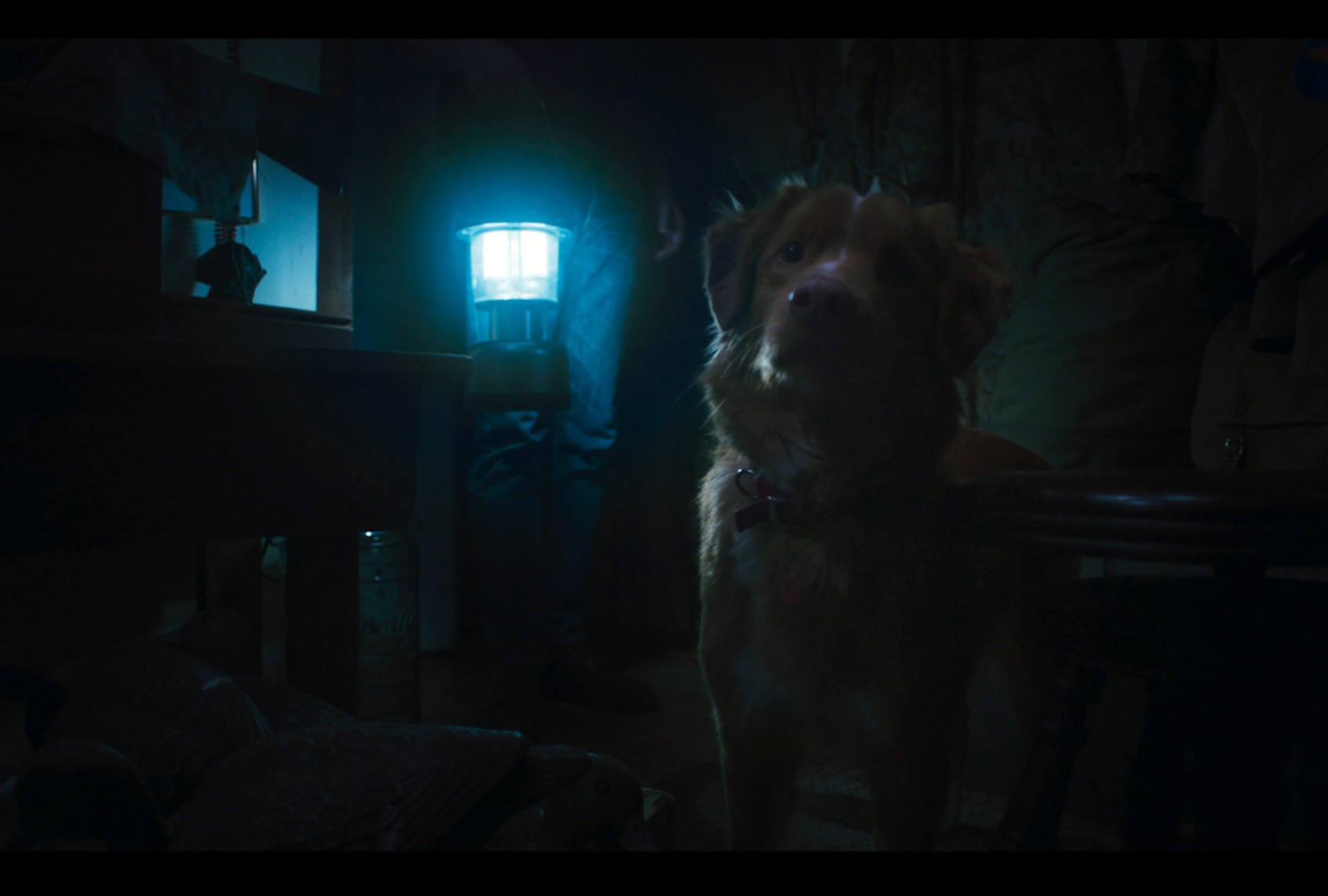
"The Shrouds"

If there's one thing David Cronenberg's gonna do, it's conure up the most upsetting scenario he can, and then be horny about it. A master at body horror, he has somehow managed to follow up symphorophilia (sexual arousal from watching car crashes), as seen in his 1996 film "Crash," with surgery pervs, evidenced in "Crimes of the Future" in 2022, and now this, "The Shrouds," which has all the makings of a riveting psycho-sexual veneration of the dead but, in actuality, comes across more like a really long Tesla commercial.

In 2017, Cronenberg lost his wife Carolyn to cancer and the effects of her loss are felt in this film, undoubtedly — making it a project to respectively sit with, even though it leaves something to be desired, what with all its mismanaged potential. Centering on a businessman named Karsh (Vincent Cassel) who, in his grief after the loss of his own wife, Becca (Diane Kruger), develops a chain of cemeteries equipped with technology that allows mourners to view the decaying corpses of their loved-ones on high-definition screens embedded in their tombstones, accessed via the GraveTech app on their phones, the message of the film gets tripped up by all the other elements hovering around it, clouding the narrative.

Karsh drives a white Tesla and it somehow becomes a key character in the film, off-puttingly so. He zips around in it, navigating from one location to the next. And in one scene, Maury (Guy Pearce), the ex-husband of Becca's twin sister, Terry (also Kruger), pre-programs a clandestine meeting location into Karsh's navigation, instructing him to let the car drive itself there — demonstrating one of Elon Musk's developments in a film that should be so far removed from even the thought of him it would take another whole feature-length film to detail all the reasons why. 

The synopsis of "The Shrouds" is the most interesting thing about it and the first 30 minutes or so are gripping enough that it's worth just seeing it through to the end, but if you carved away the bizarre Tesla drops, the crammed in conflict of a GraveTech hacking, and the slow build to a lackluster and almost silly ending, you'd be left with what this film should have been — a disturbingly heartbreaking 30-minute short about the inevitability of grief. 

Watch the official trailer for "The Shrouds" here, and see it when it hits theaters nationwide on April 25, distributed by Sideshow and Janus Films.

Indy in "Good Boy" (Courtesy of Good Boy )
"Good Boy"

Anytime I see an animal in a horror movie, it makes me incredibly nervous because, as a genre rule, it usually means something terrible is going to happen to them. But in "Good Boy," the feature directorial debut of Ben Leonberg, the dog is the only one out of two main characters to make it out relatively unscathed. 

A haunted house film from the perspective of a Nova Scotia Duck Tolling Retriever named Indy, who is not only a fantastic actor but a nepo baby (he's the director's dog), "Good Boy" tells a simple story by horror standards — there's a guy and his dog, something is clearly wrong with this guy, he makes things worse for himself by going to stay in a family-owned haunted cabin . . .  and then

Shot primarily knee-high, framing shots as a dog would see them, we follow Indy through various scenes of creeping and then crashing dread as though we're hanging from his collar. As Indy's owner in the film, Todd (Shane Jensen), falls further and further under the influence of the malevolent forces within the cabin, the fear we feel is Indy's fear at watching his favorite person unwell and inexplicably turning mean toward him.

Indy is put in harm's way by the person he loves most in the world, but rather than run to safety, he keeps returning to Todd's side, trying to help guard him from evil that only he can see. A good boy till the end, Indy leaves the cabin only when he knows his job is done there and that Todd can no longer be saved. As the credits roll, we watch Indy sniffing the breeze with his face turned toward the sun and can't help but feel heartbroken — not, as a whole, because of what takes place in the shocking ending, but because Indy did all that he could to keep evil at bay, but evil won out in the end. 

Keep an eye on the "Good Boy" website for an official trailer and distribution updates. 

"The Ugly Stepsister" (Marcel Zyskind/Shudder/IFC Films)
"The Ugly Stepsister" 

Writer and director Emilie Blichfeldt's gross-out masterpiece "The Ugly Stepsister" jumps off the premise: "What if the story of Cinderella was really really gross?"

In her director's note for the film, Blichfeldt writes, "I dreamed of being Cinderella, laughing at the stepsisters’ clumsiness. But rereading Grimm as an adult, particularly the scene where one stepsister cuts off her toes to fit the glass slipper, changed my view. For the first time, I empathized with her desperation. The mockery and cold laughter at her expense felt unjust. I, too, have longed to be chosen—whether by a prince or simply a boyfriend—and felt the sting of failing to fit impossible standards. No matter how hard I tried to conform, I could never fit into Cinderella’s shoe because I am a stepsister too."

A Norwegian body horror film shot in Norway, Poland, Sweden and Denmark, "The Ugly Stepsister" is uterly void of cartoon whimsy and helpful, singing mice, but it does have plenty of tapeworms and maggots. If the tapeworms and maggots had burst into song, I would not have been surprised because everything else in the world takes place in this film, but it didn't take anything away from the movie that they did not.

In this version of a fairy tale, Cinderella (Agnes), played by Thea Sofie Loch Næss, is a tramp and a brat, demoted to grunt work around the estate after being discovered having sex in the barn with a hired hand. Competing with her to win the affections of the local prince is Cinderella's "ugly" stepsister, Elvira (Lea Myren), who is encouraged by multiple women at the estate to undergo brutal surgeries to make herself more beautiful. She has cocaine shoved in her eyes to numb them while eyelashes are sewn into her skin, her nose is broken and molded into new shape with the help of a metal mask, and for her last ditch effort, she swallows a tapeworm egg that, in the finale, gets barfed back up five times it size. It's perfect. Just perfect. They should screen this film at high schools. 

Watch the official trailer for "The Ugly Stepsister" here, and see it when it's released in the U.S. on April 18, distributed by IFC.

Pumped, dumped and chumped: “Fake news” on tariffs causes stock market whiplash

After days of chaos, investors want to believe President Donald Trump will blink on his market-disrupting tariffs.

Their desire to staunch the bleeding was on full display early Monday when a single post of entirely fabricated news on X made the market rapidly jump up by as much as 10% before crashing down.

An account that goes by the handle "Walter Bloomberg" shared a snippet that reportedly came from National Economic Council Director Kevin Hassett. The since-deleted post said that Trump was considering a 90-day pause on his widespread tariffs that have upended the market

The frenzy around the post grew so strong that CNBC briefly ran a chyron reporting the news. However, the White House quickly denied the report and the stock market continued its downward slide.

White House Press Secretary Karoline Leavitt called the pause "fake news" in an interview with CNBC.

Hassett did speak on Trump's tariffs on Monday morning, telling the hosts of "Fox & Friends" that a pause would be entirely up to the president. 

"I think the president is gonna decide what the president is gonna decide," he said. "I would urge everyone…to ease of the rhetoric a little bit."

The market turmoil brings together several strands of needless meddling from Trump administration officials. The tariffs themselves come directly from the president, who has shown no desire to back away from his economic brinksmanship. However, the fake news could not have spread so quickly if Trump adviser Elon Musk had not torpedoed the verified user system of his social media platform in the hopes of turning a buck.

In its original form, the "blue check" on X denoted a user who was independently verified by the platform as a news source, celebrity or other notable figure. Musk ended that system in favor of a premium tier on the social media app while leaving the familiar checkmarks in place. The post that sent investors scrambling came from an account using the name Bloomberg in the house style of real breaking news accounts on the platform. A glance at the checkmark gave it an unfortunate air of legitimacy. 

It's not the first time that the platform's lack of verification guardrails has been used to sew chaos and spread misinformation. In 2022, a verified account took on the branding of pharmaceutical company Eli Lilly and sent out a message claiming "insulin is free now." The post caused the giant pharma company's stock to plummet and encouraged Lilly to pull its ads from the platform

Tony’s Chocolonely recalls bars over small stone contamination

Tony's Chocolonely has issued a voluntary recall of limited lots of two chocolate products distributed nationwide: Dark Almond Sea Salt and Everything Bars.

The company stated that a small number of consumers reported finding small stones in the products, which were not filtered during the third-party almond harvesting and processing.

The recalled products, distributed in February, include the following lot numbers: 163094, 162634, M162634, ML162634, 4327, 4330, 4331, M4331, ML4331, 162697, and 4332. If you have any of these items, the company advises against consuming them. Instead, return the product to the store where it was purchased for a refund or replacement, or dispose of it. Consumers who bought the products on Amazon can request a refund through the retailer.

The recall comes after 12 consumer reports and is prompted by the potential presence of small stones, according to the FDA.

“Hot Ones”: Saquon Barkley says he has to meet Kevin Hart’s real-life eagle that’s named after him

Saquon Barkley may have won AP NFL Offensive Player of the Year, but can the Philadelphia Eagles running back earn a spot on the “Hot Ones” Hall of Fame? Barkley joined host Sean Evans on the latest episode of First We Feast's popular YouTube series, which premiered on April 3. Barkley discussed the current state of sports media and the most fun celebrity Eagles fans all while putting his spice tolerance to the ultimate test.

When asked to share a stand-out moment he experienced when he first got drafted into the NFL, Barkley recalled what he described as the “most humbling moment of my life.” It involved former NFL All-Pro Julius Peppers.   

“My rookie year we had a play. I broke it outside and it kind of got blown dead. I think there was a flag on it. And he had me like right here, like by my shoulder pads. And I’m like he’s trying me,” Barkley told Evans. “I tried to hit his arm down and it didn’t move. And I tried to hit it again and it didn’t move and I’m looking at him like alright bro, like come on, like let me go. 

“And like that’s when I realized that there’s a difference between grown men strength and being strong in the weight room,” he continued. “That was probably my most humbling moment of my life, not just on the football field but as a man too.”

Barkley, while playing college football at Penn State, studied communications and broadcast journalism. He told Evans that he would give the current state of sports media a B+ grade: “Only because I think they’re doing a really good job of, you know, getting stories out there and communicating. But a lot of it’s just messy. And it’s something that when I go to that next step, I want to make sure I stay away from and make sure I’m not trying to say anything that’s clickbait.”

Barkley added, “I think it’s important especially if you’re in my profession of football, you use the opportunities to have fans get to learn and understand the game or maybe how free agency works, how trading works, the business of the NFL. Because the fans don’t see it that way and it is a crazy business.”

For most of his interview, Barkley maintained his composure and seemed unfazed by the increasingly spicy hot sauces. However, he did struggle with Wing No. 7, which had a Scoville level of 131,000.

Barkley told Evans that Bradley Cooper is a “diehard” Eagles fan and is always on the sidelines at games. Same with Gillie Da King, who became the team’s unofficial hype man during the 2024 season.


Want more great food writing and recipes? Subscribe to Salon Food's newsletter, The Bite.


Barkley said he enjoys seeing Philadelphia native Kevin Hart attend games from time to time. Evans noted that Hart reportedly spent millions of dollars on two real-life eagles, whom he named after Barkley and Eagles quarterback Jalen Hurts.

“I hope that’s just PR and he’s doing a really good job. I hope he did not spend that money on eagles,” Barkley said, to which Evans replied, “He [Hart] said they’re territorial and they’ve actually pulled him off the ground before.”

“Yeah, I mean he’s a small human being and the eagles are really strong animals so I really wouldn’t be surprised,” Barkley said. “But if that’s real, I think I got to go meet them. I think I got to spend some time with them. Got to take a picture with Saquon for sure.”

Toward the end of his interview, Barkley revealed that his favorite football movie is “Remember the Titans.” 

“I’m a weird crier with movies. Like I won’t cry after I won the Super Bowl. I didn't cry when my kids were born,” he said. “Kind of crazy to say out loud. But like if you give me a good movie, I’m a sucker for that.”

The best supermarket tinned fish that tastes fancy but isn’t

Last year, just a month after moving to New York City, I hopped on the tinned fish craze. I had attended a Fishwife pop-up in Manhattan, where I feasted on deviled eggs with smoked rainbow trout, butter & anchovy toast, salmon seaweed snacks and caviar bumps. I arrived a tinned fish skeptic and left a newfound fan — so much so, that I took home tins of Fishwife’s Cantabrian Anchovies in Extra Virgin Olive Oil and their Lemon Zest Salt.

Tinned fish has been around for centuries, dating all the way back to the late 1700s when canning and preserving foods were budding inventions. In recent years, the humble food has become an online trend — and a dinner staple, especially amongst younger consumers.

“Tinned fish is the ultimate hot girl food,” Fishwife founder Caroline Goldfarb told Nylon in a 2021 interview. “There is no food that will make you hotter than tinned fish. Straight up. Do you know a hot girl who doesn’t exist on protein? I don’t.”

Brands like Fishwife, Jose Gourmet and Luisa Paixao have “fancified” tinned fish by neatly packaging processed seafood in peel-back, often decorative tins. Restaurants, like Saltie Girl’s and New York’s Maiden Lane, also sell their own high-end tinned fish. That being said, tinned fish doesn’t have to — and shouldn’t — break your bank. There are plenty of supermarket alternatives that are both affordable and don’t skimp on quality or freshness.

“You want to make sure that brands are using higher quality oils in preserving when they're making the tinned fish,” said Barbara Rich, lead chef-instructor of Culinary Arts at the Institute of Culinary Education’s New York City campus. Most tinned fish are packed in olive oil or refined oils, like vegetable, sunflower and soybean oils. It’s best to avoid brands that use refined oils and, instead, opt for ones that incorporate olive oil or extra virgin olive oil.

According to Rich, the best supermarket tinned fish that tastes fancy but isn’t is found at Trader Joe’s. Specifically, it’s their Wild Caught Boneless Grilled Sardines in Olive Oil. The brand also sells Lightly Smoked Sardines in Olive Oil, but Rich said the plain alternative is her absolute favorite.

“The reason I really like Trader Joe's tinned fish is because everything is boneless,” Rich explained. “I mean, flavor aside, people tend to get a little squidgy when there’s bones in their fish. It’s kind of tough for people to deal with.”


Want more great food writing and recipes? Subscribe to Salon Food's newsletter, The Bite.


Rich also recommended Wild Planet’s canned fish, which includes tuna, sardines, salmon, mackerel, yellowtail and anchovies. Unlike Trader Joe’s, Wild Planet is more transparent about their fish’s sourcing information. The latter includes labels specifying that its fish is “responsibly harvested,” “scale free,” “sustainable” and “organic.”

Tinned fish can be enjoyed straight out of the tin or on top of crackers, potato chips and toasted sourdough bread. Rich recommended putting tinned fish on top of salads: “I make a big salad for lunch and I want a little bit of protein. Tinned fish is a perfect portion size.”

They can also be added to pasta, whether that’s with tomato sauce or olive oil, garlic and lemon. Alison Roman’s famous Caramelized Shallot Pasta calls for a tin of anchovy fillets. Tinned trout is also delicious mixed in with scrambled eggs or combined with egg yolks when making a filling for deviled eggs.

“Sounds really silly, but tinned fish mushed on crackers is really good,” Rich said. “Sometimes I'll put a little bit of it on top of avocado toast which is really nice."

“The White Lotus” finale paints a bleak, beautiful portrait of human failure

At the very top of "The White Lotus" season finale, a Buddhist monk tells viewers that, even though we wake with anxiety (raises hand), “It’s easier to be patient once we finally accept that there is no resolution.” The conclusion of the third season was certainly darker than the finales of the first two seasons of the social satire, and seeing as the show deals in human behavior and muddled motivation, there isn’t a resolution, as there’s a lot left to interpretation. The provocative images that creator, writer and director Mike White leaves viewers to consider provide a litmus test of our own hidden desires and twisted worldviews. These scenes usually underscore the denouement of a character’s development throughout a week of unsettling vacation time, and none of the outcomes are generally good, even if they might seem to be on the surface. 

The provocative images that Mike White leaves viewers to consider provide a litmus test of our own hidden desires and twisted worldviews.

Take Quinn Mossbacher (Fred Hechinger) from Season 1, for instance. As his preoccupied parents and self-absorbed sister boarded their plane back home, he joyously joined a group of local Hawaiian men rowing in the ocean. The image is a memorable one — a young kid finally free of the perceived trappings of his moneyed existence — but there are definitely other ways that scene can be understood. In addition, the memorable yet melancholy moment in which Daphne (Meghann Fahy) beckons Ethan (Will Sharpe) to join her in a tryst on a secluded island to get back at their spouses for potentially cheating on them is wide open for interpretation. (They totally did it, right? But we don’t know for sure!) 

In the Season 3 finale, several scenes stick out as the ones that we’ll be turning over in our minds over and over again as we wait to tear into the (already greenlit) fourth season of the show. 

Let’s start with the Ratliff family and the almost-accidental death of Lochlan Ratliff (Sam Nivola), the youngest and most naïve of the bunch. After his dad Timothy (Jason Isaacs) decides to abort his plan to poison his two eldest children and his wife with pong-pong-laced piña coladas, he stupidly leaves a blender with remnants of the elixir on the counter overnight. Being a disgusting teenage boy, Lochy finds the blender the next morning and doesn’t rinse it out before using it to whip up a protein smoothie, which his brother Saxon (Patrick Schwarzenegger) has been encouraging him to drink all week so he can become a “man.” Instead of becoming a man, Lochlan almost dies as a dumb boy who didn’t think to wash a blender before using it. This chain of events is almost as idiotic as Tanya (Jennifer Coolidge) killing all her would-be attackers in the Season 2 finale before frantically jumping over the side of the boat and dying the stupidest death ever. I swear, almost all of the "White Lotus" characters should be nominated for Darwin Awards.

Sam Nivola and Jason Isaacs in "The White Lotus" (Stefano Delia/HBO)As his heart rate slows and his body begins to shut down, Lochlan has a vision of himself drowning. Inky black water surrounds him as a blinding light focuses on his body, making his pale skin glow like a marble statue. As the poison takes hold, Lochlan looks up at the surface to see the silhouettes of his family members, which are then replaced by silhouettes of Buddhist monks. When he wakes up from his poison-induced coma, Lochlan finds himself in his father’s arms and declares that he’s seen God. 
Now, I’m not sure how the White Lotus works, but if they’re not using those pong-pong seeds in some sort of mystical, transcendent, come-to-God therapy at their Thailand location within the next few months, I’d consider that a missed opportunity. People pay big bucks for crazier things. And Lochlan seems to recover just fine without any sort of medical attention, so it’s all good, right? But as he travels home on the boat, shutting out the world with giant sunglasses and a baggy hoodie, Lochlan doesn’t really seem to have learned anything from his reverie. In fact, he seems to have regressed in some ways. Let’s just all hope that God wasn’t telling him to choose Duke


Want a daily wrap-up of all the news and commentary Salon has to offer? Subscribe to our morning newsletter, Crash Course.


One person who isn’t looking for spiritual transcendence is Laurie (Carrie Coon). In another unforgettable image from the finale, Laurie shows up to dinner with her friends after a day of staving off an alcohol-and-life-choices hangover. She gives a brief speech about how she never really found her passion and how every time she sees her old friend group, she gets sad because she’s constantly measuring herself up to them. But Laurie has an epiphany about her life. She says, “I don’t need religion or God to give it meaning because time gives it meaning.”

It's a great line, and a great line reading from Coon who is sure to be nominated for this bracing monologue come Emmy time in the fall. But then, Laurie goes on to say that she’s just happy to be at the table with these two women. This is certainly meant to be a moment that serves to solidify the bond between these old friends, but honestly, it also feels pretty tragic. All these women have done all week is snark at one another and talk behind each others’ backs, and now Laurie wants to tether her sense of self-worth to them? And, furthermore, she’s just happy to be with them? Shouldn’t she at least strive to be an equal in this tangled friendship triangle? 

Carrie Coon in "The White Lotus" (Courtesy of HBO)These are thoughts I will be having as images of an impassioned Coon dance in my head over the next few weeks. Sure, we can all interpret this scene — and the subsequent scene in which the three women are canoodling happily together on the boat ride home — as a happy ending, but there are certainly other ways to read into what’s happening here. None of the victory-lap blondes die, but they do witness a mass shooting on the way out of the resort. (For what it’s worth, Laurie is the fastest on her feet, to an almost hilarious degree, when the bullets start flying, so she’s got an edge on her two buddies there.) 
The imagery associated with the central tragic deaths of this season isn’t subtle at all, but it is indelible. We should have known that Chelsea (Aimee Lou Wood) was marked for death from the moment she started insisting upon the yin and yang of it all. She kept hitching her wagon to Rick (Walton Goggins), believing in his goodness and ability to change despite the fact that he left her alone at the resort for days on end while he pursued revenge. Love makes people do silly things, I guess. 

Walton Goggins and Aimee Lou Wood in "The White Lotus" (Fabio Lovino/HBO)Again, let’s circle back to the Darwin Awards, because returning to a resort owned by a very rich man you’ve just threatened is a pretty idiotic thing to do. And upon his return from Bangkok, Rick does just that. He and Chelsea get a sweet reunion moment on the beach before all hell breaks loose. Well, Rick breaks it. After Amrita (Shalini Peiris) denies him an impromptu wellness session, Rick spies his nemesis, Jim Hollinger (Scott Glenn). His rage boils up, and after he kills Hollinger in cold blood, a distraught Sritala (Patravadi Mejudhon) tells him that Hollinger was his father all along. A shoot-out between Rick and the bodyguards ensues, and the angelic Chelsea gets caught in the crossfire. 
The White Lotus continues to amass a giant PR problem.

Chelsea is clearly dead, but a distraught Rick scoops her up and attempts to bring her to safety. As he shuffles along the path, Gaitok (Tayme Thapthimthong) sees him, quickly gives up his Buddhist ways, and shoots an unarmed man carrying a dead woman in order to secure his financial and romantic future. (Damn you, Mook.) Rick tumbles into the moat, and the last frame we see of these two lovers is a yin and yang as they float, dead in the water, with the circle of blood blooming on Chelsea’s back serving as the very overt visual marker for the yin-yang comparison. 

The camera lingers on an overhead shot of Rick and Chelsea, giving us time to contemplate the ideological clash between the two. Opposites attract, and Chelsea surely had “I-can-save-him” syndrome with this one. The image recalls all sorts of things that Chelsea said to Rick throughout their relationship, most notably her plea for him to “Stop thinking about the love you didn’t get and think about the love you have.” This is good advice for anyone, right? But somehow, many of us cannot get over regret, resentment, or anger, and we lash out, causing harm to those who least deserve it. (See also Lochlan and his dad’s poison blender.) Rick and Chelsea had a tragic love story, complete with a final tableau that is sure to sit uncomfortably in the hearts and minds of viewers for a long time to come. I’d like to note that the two deaths in previous seasons were played for comedic effect, while this final one-two punch can only be read as tragically sad. Is Mike White okay? Should someone check on him? 

Natasha Rothwell and Nicholas Duvernay in "The White Lotus" (Fabio Lovino/HBO). The most disturbing image in the finale, though, comes courtesy of Belinda (Natasha Rothwell). Once she gets her windfall of cash from Gary/Greg (Jon Gries) for agreeing to never reveal what she knows about Tanya’s death, she skips out on the rest of her internship at the White Lotus. She also skips out on Pornchai (Dom Hetrakul). In a devastating scene, she lets him down about potentially starting a spa with him, using the same verbiage that Tanya used with her in Season 1. It’s such a cold moment that I needed to cuddle under an extra blanket while I watched. Later, Belinda sails away from The White Lotus, now minted as an affluent guest instead of a worker bee. She’ll likely never have to cater to an entitled person again, but it’s her terrible treatment of Pornchai that defines who she might become. 

In the end, one family left richer, one left poorer. As for deaths? One guilty man, one innocent woman and three a**holes died. And the White Lotus continues to amass a giant PR problem. Yet, the images that we’re left with encourage us to check in, over and over again, as this crazy show keeps us contemplating what it is to be fallible humans.