Spring Sale: Get 1 Year, Save 58%

House Freedom Caucus votes to kick out MTG after she blew up at Lauren Boebert: report

The House Freedom Caucus has voted to oust Rep. Marjorie Taylor Greene, R-Ga., a member of the conservative group confirmed to Politico Thursday.

“A vote was taken to remove Marjorie Taylor Greene from the House Freedom Caucus for some of the things she’s done,” Rep. Andy Harris, R-Md., told the outlet, which first reported last week that the caucus had voted on Greene’s fate following earlier reported plans to purge a member from its ranks

Though the Maryland representative declined to say how he voted, Harris, who noted he’s on the board for the group, called the decision to boot Greene “an appropriate action,” adding that the Georgia right-winger is formally out “as far as I know” upon being pressed for clarification.

Tensions were already rising within the caucus, but according to Harris, Greene’s spat with Rep. Lauren Boebert, R-Colo., details of which were leaked to reporters at the time, on the House floor didn’t help. 

“I think the way she referred to a fellow member was probably not the way we expect our members to refer to other fellow, especially female, members,” Harris said on Thursday, appearing to reference the June incident where Greene reportedly called Boebert a “little b*tch.”

When asked if Greene’s support of House Speaker Kevin McCarthy, R-Calif., and break from the group’s stance on his debt deal played a role in her removal, Harris told Politico that “all of that mattered.”

“I think the straw that broke the camel’s back was publicly saying things about another member in terms that no one should,” he said.

As a result of her ousting, Greene, who normally attended the caucus’ weekly off-campus strategy meetings, will no longer be able to attend because she’s no longer a member, Harris explained. 

Her removal is a first for the Freedom Caucus and follows then-Rep. Justin Amash’s departure from the group in 2019. Harris added that there was also “one other member a couple of years ago, who we probably would have asked to leave, but we just decided not to.”


Want a daily wrap-up of all the news and commentary Salon has to offer? Subscribe to our morning newsletter, Crash Course.


Members of the caucus have been McCarthy’s greatest challengers, especially after his recent fight to compromise on the debt ceiling deal. Though the members’ moves don’t unify the group, Harris said that the Greene vote left them with no other “large divisions.”

“This wasn’t even a speed bump,” Harris added.

A spokesperson for Greene did not respond to Politico’s request for comment, nor did a spokesperson for the Freedom Caucus immediately respond to the outlet’s request.

“They’re tired of explaining their own bodies”: Intersex folks counter right-wing hate and shaming

“The ‘I’ in LGBTQIA+ doesn’t stand for ‘invisible,'” advocate and author Alicia Roth Weigel says in director Julie Cohen’s thought-provoking new documentary, “Every Body,” in theaters now. Weigel, like roughly 200,000 other people living in the United States today, is intersex. And in a country that can be oppressive in its devotion to the binary, Weigel’s community has long had to fight just to be acknowledged at all.

“The reason that it hasn’t been talked about, and the reason that people think of intersex as being so rare and so anomalous,” Cohen explained on “Salon Talks,” “is that those who are born intersex or develop intersex traits are often subjected to unwanted surgeries and told to keep secret about it, like this is something shameful. Or,” she adds, “they’re not even told themselves.”

Cohen was nominated for an Oscar for her last film, “RBG,” about former Supreme Court Justice Ruth Bader Ginsberg. “Every Body,” which recently premiered at Tribeca, follows three contemporary intersex Americans as they grapple with the legacy of Dr. John Money, whose theories on gender shaped how doctors and families were instructed to treat intersex children for generations. 

Watch the “Salon Talks” episode with Julie Cohen here to hear more about what the intersex community is learning from other LGBTQIA+ movements and why she wanted to tell a story about “the power that people can have by standing up for their own rights.” “These are really upbeat, enthusiastic, hugely intelligent and inspiringly humorous and often joyous people,” Cohen said. “I think they’re all a little bit sick of feeling like they’re supposed to feel steeped in trauma.”

The following interview has been lightly edited for clarity and length.

While watching the film, I realized I truly didn’t know what it means to be intersex. Let’s start there. 

The importance, but also the challenge of making this film was the level of societal ignorance on this subject. Intersex people are people who have biological, anatomical and/or chromosome traits that put them not squarely in the male or female box that we’re all accustomed to. Just to use some examples from the film, maybe you have XY chromosomes — what we think of as male chromosomes — but present externally what we would think a woman is. Maybe it’s somebody who has external genitals that are female, but internally instead of ovaries, there’s actually internal testes. There’s a whole range. There are probably somewhere around 40 different conditions that might fall under this broad medical umbrella of intersex.

A lot of us grew up with the very outdated word “hermaphrodite,” which is not used anymore. 

There’s a logical place where that comes from. The term “hermaphrodite” is a term in the animal kingdom that you learn about when you’re in biology class. I remember learning about hermaphrodites in animals in junior high school. That is something that biologically exists in certain species that have full reproductive male and female organs, and as a result can reproduce without a mate. There are no people like that. That’s why the term “hermaphrodite,” which up until just a few decades ago was often used to describe intersex people, is problematic. It’s so misleading. 

“The power of people speaking up always really moves me.”

The numbers that the United Nations use for intersex most broadly defined, which could mean any intersex traits, is 1.7% of the population. When you’re looking at people whose intersex traits are a bit more pronounced, like those who we feature in the film, people who might be referred for surgery, that gets you to a smaller number. We calculated it at more than 200,000 Americans. This isn’t tiny. It’s not a really super rare condition. 

The reason that it hasn’t been talked about, and the reason that people think of intersex as being so rare and so anomalous is that those who are born intersex or develop intersex traits are often subjected to unwanted surgeries and told to keep secret about it, like this is something shameful. Or they’re not even told themselves. Their parents would consent to having surgery done on them in infancy or childhood and then just never really explain. There are all kinds of intersex adults who have some memory of, “I know I had some kind of surgery or series of surgeries and/or I was told to take hormones as a child.” They never exactly understood why. Sometimes they give a long complex medical term. The ignorance about being intersex often even applies to intersex people themselves when they’re young.

There is one person at the center of the way in which intersex people have been classified and treated for decades. He’s at the root of this story as well. Tell me about Dr. John Money.

Dr. John Money was a sexologist at Johns Hopkins University for many decades. He was at the forefront of studying anomalies in gender, and actually had some relatively – for the time in the ’50s, ’60s, ’70s, into the ’80s – prescient thoughts about gay and trans people. But he also really took an interest in intersex people, children particularly, and was key in developing this notion that gender is not fixed for the first two or three years of life. His theory was that if a child is born intersex, you just pick a gender, turn the child with surgery, hormones, whatever’s necessary into that gender and raise it in that gender. 

Most often what was happening is that intersex children were being raised as girls. The easy to understand, if a bit glib, phrase for understanding this is it’s easier to dig a hole than build a pole. For medical reasons, it was easier to turn intersex children into girls when they may or may not as they grew understood themselves to be girls. Dr. Money basically set out to prove that a child’s gender is malleable by taking a young boy who had had his penis severely injured in a botched circumcision and moving towards surgery and a program of counseling to turn this one hundred percent biological boy into a girl. [It was] with the thought that it would be better to be raised as a girl, even if you’re a boy, than to be a boy without a penis.

This story of David Reimer is absolutely heartbreaking. He was not born intersex. He was made into something he never signed up for without his consent, in many ways without his family understanding. Tell me about what happened to him, because it’s a tragedy.

He was injured in a botched circumcision. At around a year old, surgery was performed to entirely remove his penis, to castrate him, and he was told that he was a girl. His parents actually moved to another town for a while, so that nobody would remember. I should mention, and the reason that Dr. Money was so fascinated with his case, David was an identical twin. He had a twin brother named Brian. The idea was, “Oh, this will be a perfect test case. We’re going to raise this boy as a girl. Give the boy boy toys. Make David, whose name they had changed to Brenda, wear dresses. Give him girls toys to play with, tell everyone he was a girl. 

He never felt comfortable being a girl because even though he didn’t know his medical history, he understood himself to be the boy that he was. By the time he was a teenager, his parents told him the truth. He decided to go back to living as a boy. Reconstruction of his penis hadn’t been available when he was a baby in the ’60s, but later in life it was possible, so he began living as a male. He actually got married, adopted the children of his wife. But his case spread. Dr. Money was spreading his case through medical records and medical journals as a huge success because David was anonymous. Because nobody was named, there was really no way for people to check up when Dr. Money’s writing these reports like, “This is great. We raised a boy as a girl. He was happy as a clam.” Now, at a certain point, Dr. Money did stop writing. Dr. Money didn’t keep talking about it, but he didn’t retract what he had written.

Tell me about the three people at the heart of “Every Body,” the amazing activists who are really changing the conversation.

These are three people who all in some ways are the legacy of Dr. Money in that because they were born intersex and the program for them was surgery — surgery that in their three cases was not medically necessary — and secrecy. They did not understand fully their own conditions and they were told to be quiet about them. 

“There are probably somewhere around 40 different conditions that might fall under this broad medical umbrella of intersex.”

The amazing thing about these three relatively young people in their 30s and 40s now is how they’ve come through this. How with the help of the internet, frankly, where they started to learn that there were other people like them and that they weren’t some anomalous freak, but actually part of a substantial group of people who have intersex conditions.

They decided they were going to dispense with this whole idea of keeping their bodies a secret, talk about what had happened to them as a way to prevent it from happening to other people later and as a way to just shed the shame. All three of them are tremendously engaging, very successful people each in their own way.

River [Gallo], who identifies as non-binary now, is an actor in Los Angeles. Alicia [Roth Weigel], who was raised as a girl and identifies as a woman, is a writer. She’s just finishing a book called “Inverse Cowgirl” about her intersex life. But also is a political activist and incredibly involved in her community in Texas of all places of fighting for the rights of LGBTQIA people. And then Saifa [Wall], who is a PhD student now, he’s from the Bronx but lives in Northern England. 

In a sort of similar situation to David Reimer, Saifa was born ambiguous. Looking on his childhood medical records as we do in the film, you see that the doctors checked off a box that said ambiguous and then they crossed it off and wrote female because his genitals were somewhere in between. He said he would say to his mom all the time, “But I’m a boy,” and his mom would say, “No, no, you’re a girl,” because that’s kind of what she had been told by the doctors that she should do. It wasn’t until he was in college that he discovered what intersex people were. He understood, “Wait a second. That’s me. Now I kind of get my life, and I’m going to live as the man that I am.”

For people that have been through a lot of trauma, as you saw if you saw the film, these are really upbeat, enthusiastic, hugely intelligent, and inspiringly humorous and often joyous people. I think they’re all a little bit sick of feeling like they’re supposed to feel steeped in trauma. They’ve decided to come out as proud intersex people, very much inspired by the gay rights movement, by the trans movement. Watching them fighting the fights that they’re fighting and starting to form a community with other intersex people is a lot of what the film is about.

I was also shocked while watching this to learn that the kinds of procedures and therapies that are being fought against to help trans kids are being imposed involuntarily upon intersex kids. This was happening at my hospital in New York City, in a world-class facility. These kinds of procedures are being done on kids against their will. What does that look like? And in what ways is our understanding of gender informed by the trans movement and the LGBTQI+ movement?

I just want to make an interesting point. Often these surgeries are being done on babies and children who don’t have much of an opinion one way or the other. Their parents are consenting to the surgery often based on not clear understanding, but very much with the best interest of children at heart. 

The particular surgery we talk about in the film being done here in New York is for a particular condition where sometimes a child basically would be a girl with a very large clitoris, large enough that it would appear externally “abnormal” and the assumption has been like, “Well, you’d rather look ‘normal,’ right? A girl wants to look like other girls, doesn’t she?” The thought is, “Maybe if we just take care of this whole situation early in the baby’s life, and then she’ll never have to know about it. And she will be spared the trauma of feeling like a weirdo.” 

I’m a mom. If someone had said to me when my child was an infant, “There is a problem and we can fix it,” which is what a lot of these parents were told, I get that completely. 

I do want to get back to your very good analogy and interesting contrast with laws being imposed now on trans children and teens. A lot of states in this country are raising, and in many cases, passing laws that can penalize doctors and even parents for gender-affirming care for trans people. Mainly they’re talking about giving hormones because puberty-blocking hormones is something that’s happening sometimes for trans young people going into puberty. There’s a lot of talk about surgery, but for the most part, surgeries aren’t done on trans children, that would happen after the child reaches 18 or older. But there’s a lot of talk about stopping surgeries. Even in a lot of these cases, the laws are saying no psychological care that affirms the kids’ gender, which is really troubling considering we know about the high rates of suicide for trans kids and teens. 

“People want things to be very clear, so when things feel like they’re a little blurry, everyone freaks out.”

The incredible part where intersex people come into this conversation is the vast majority of those laws, those bills that are being debated, have these little provisions to them that say, “But for intersex kids . . .” and rather than using the word intersex, often they list a whole series of medical conditions that could count as intersex — they say, “But for intersex kids, basically knock yourself out, do whatever kind of surgery you feel is necessary.” 

Alicia, one of the participants in our film, makes the really strong point that the reasoning is like that the legislators bringing up these laws are saying, “Well, trans kids aren’t normal, so we need to not let them be trans. And intersex kids also aren’t normal.” So, we have to basically stuff them into the male and female box, so that everyone can feel like, “It’s normal, it’s fine. It’s all the gender expectations that we’ve all been given and have lived with since the beginning of time about what a girl is supposed to be and what a boy is supposed to be.” Boxes, by the way, that don’t work out so well for many men and women, regardless of whether they’re trans or intersex or not.

Misconceptions and truly dangerous information about gender and gender identity are being peddled in the media by people like Tucker Carlson and Steven Crowder. There’s a wonderful moment in the film where Alicia gets into a very articulate debate with Crowder. Tell me about how these people are perpetuating these really dangerous and completely medically misinformed ideologies about gender.

I think there’s just a lot of fear about anything that doesn’t fit expectations. I actually think that’s become such an issue in all kinds of contexts having to do particularly with gender and with race and with sexual orientation. People want things to be very clear, so when things feel like they’re a little blurry, everyone freaks out. 

As far as there’s this thought that the trans people are coming to get your children, I don’t really quite know what to say about that, but it’s an argument that has caught on the political right in recent years in the same way that a very similar argument having to do with gay adults was a factor going back to around the ’80s. I remember it from my childhood, the thought of, there’s going to be gay teachers in your school turning your child gay. Now there’s talk about trans people. 

As far as the intersex part of this, I think the biggest complaint and concern of the intersex people that are in my film and that I’ve come to know over the past couple of years is that they’re ignored entirely to the point of being invisible. I can now confirm that. We’ve put the trailer for our film out into the world, and while there’s so much support and love and admiration for people coming forward and telling their stories and speaking their truth, there is a minority opinion of people whose basic comments on social media towards the participants in the film are either like, “I hate you and you just should be quiet.” That’s one thing. But another thing is, “I don’t believe you exist.” And that’s actually not a tenable position. There are intersex people. To say, “I don’t think they exist,” just doesn’t make sense. Check it, look on TikTok, people are saying it.

Intersex people are roughly 2% of the population. That’s the same percent of the population that are identical twins and people with red hair. What brought you to this story? 

I was really drawn to this and gravitated to this story because of just an admiration for the power that people can have by standing up for their own rights, that I think just resonated with me and reminded me of other earlier activist movements. Whether you’re talking gay and trans rights or civil rights or the feminist movement, there’s always a period of you’ve been boxed down and you’ve been told you shouldn’t be speaking up. The power of people speaking up always really moves me. 

What brought me to the story specifically was a bit roundabout. About five years ago, my friends at NBC News, where I used to work, asked me to come back and look through their archives for stories that might make good jumping-off points for documentaries. I immediately gravitated to the David Reimer and Dr. Money story, and was just looking into what the modern-day relevance was. It became quite clear, first of all, that this case, even though it was completely debunked, had had an impact that still lasts to this day on how intersex people were treated. That led me to looking into the intersex rights movement, and I just actually couldn’t believe what a fascinating and blossoming movement this was considering how little attention it’s gotten.

Even though we’re talking about a small percentage of the population, we can all participate in and be allies for the movement, right?

Absolutely. I think that’s been true in so many movements. It takes the support of the larger community, for a smaller percentage, people who’ve struggled with something and are fighting for their own rights, our success is actually all interconnected. A lot of what intersex people have told me they want is just for people to explain what intersex is. They’re tired of explaining their own bodies. Saifa, one of the participants in the film, said to me the other day, “I’m tired of doing Intersex 101. I want some non-intersex people doing that for us, so that we can live our lives and fight for what we want to do without having to explain every single thing about your own genitals.”

Ex-prosecutor on “overwhelming” DOJ evidence: Nauta “will go to prison for years” if he doesn’t flip

The newly unsealed evidence that the Justice Department used to obtain a search warrant for former President Donald Trump’s Mar-a-Lago residence paints an “overwhelming” case against Trump and his close aide Walt Nauta, former U.S. attorney Joyce Vance told MSNBC’s Andrea Mitchell Thursday. Vance said that Nauta, who pleaded not guilty to six federal charges during his arraignment in a Miami federal court Thursday, and his new Florida lawyer, Sasha Dadan, have a lot of work ahead of them.

“There will be an enormous amount of pressure on Walt Nauta to cooperate with the government. If he does not, it’s almost a certainty he will go to prison for years, he is part of the obstruction of justice in this case and those penalties are very significant,” Vance told the host. She explained that, while the information indicated by the newly unsealed affidavit has already been presented in the indictment, it also confirms that the evidence prosecutors collected is “thorough, it is detailed, it is overwhelming” because of the nature of the physical evidence it unveils. The unredacted portions of the affidavit show dozens of boxes in the Mar-a-Lago resort club’s storage room and descriptions of surveillance footage, including a video showing Nauta moving boxes days before prosecutors came to receive any remaining documents Trump had last year. According to the document, Nauta removed about 64 boxes from the storage room but only returned around 25 to 30 of them. “That means Walter Nauta and Donald Trump tried to conceal them from the government,” Vance elaborated in the interview. “This new evidence only adds to the pressure that will mount on Walt Nauta at some point in these proceedings.”

How ‘drinkflation’ affects the price of beer

The cost of living crisis has seen the prices of many goods and services rise sharply in the past 18 months, but food and drink prices have been particularly hard hit.

Some food producers have responded by reducing the size of their products, while keeping prices the same — a phenomenon known as “shrinkflation“.

When several major brewers were reported to have reduced the strength of beers recently, including Fosters lager (cut from 4% alcohol by volume (ABV) to to 3.7%) and ales such as Old Speckled Hen and Spitfire, it led to accusations of “drinkflation” and short-changing of customers.

Duty on beer is levied on the basis of alcohol content, so a 0.3% reduction in ABV equates to a saving of around 4p on a pint. Brewers can pocket this if they keep the sales price the same. If this seems like small beer, consider the fact that we drink around 7.8 billion pints each year in the UK, meaning that a 0.3% cut across all beers would see industry revenue rise by £290 million a year.

Brewers and the British Beer and Pub Association have pointed to rising production costs and squeezed profit margins as the justification for these reductions in strength. But concerns remain that the great British pint is becoming another casualty of the cost of living crisis.

But this is not a new phenomenon. Brewers have been cutting the strength of major beer brands for well over a decade. In many cases this is done with minimal publicity and without many consumers even noticing.

HMRC collects alcohol taxes on behalf of the UK Treasury and requires all alcoholic products above 1.2% to advertise their alcoholic strength on the label. But beer producers are allowed a little wiggle room around this, provided the value on the label is within 0.5% of the true strength.

This is a concession to small producers who may find it hard to produce every batch to exactly the same ABV but don’t want to have to produce new labels with each small variation.

Molson Coors took advantage of this leeway in 2012 to reduce the strength of Carling from 4% to 3.7%, but continued to label and market it as 4%. This only came to light when HMRC took the company to court for paying duty at the lower rate. Ultimately Carling won the court case, but this calls the strength of the contents of your can or pint glass into question.


Changing tastes

It is also important to point out that long-term trends in alcohol consumption have not favored beer producers and so they may be looking for ways to recover lost revenues. In 1970, UK adults drank an average of 181 pints of beer per year. By 2021 that had fallen to 120. Over the same period, average wine consumption increased from 5 to 28 bottles per year.

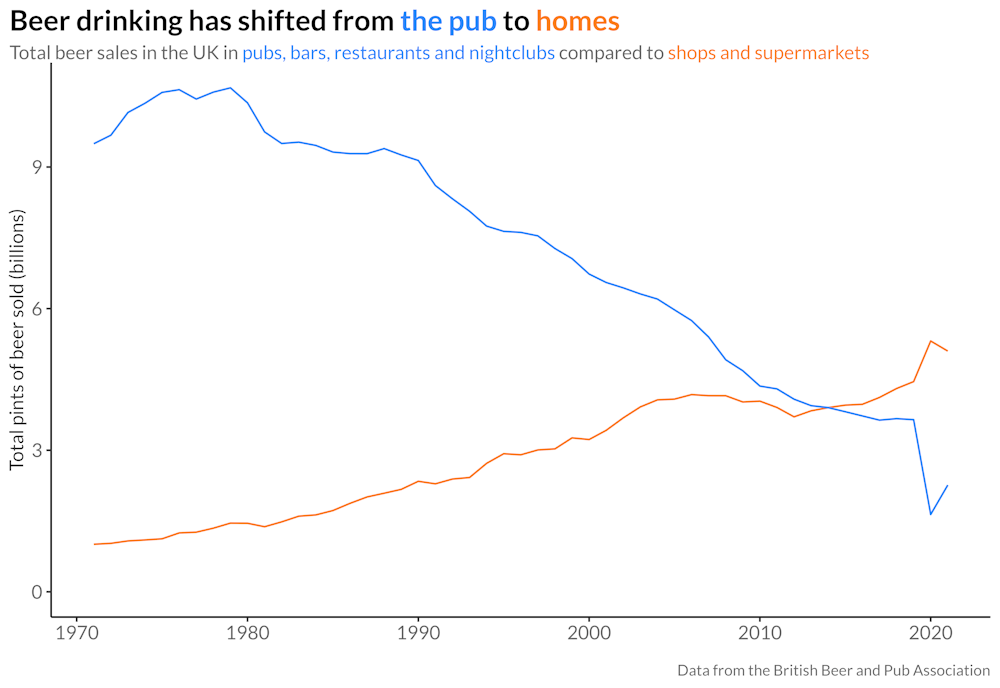
These changes in drinking patterns have run alongside a gradual shift away from drinking in the pub to drinking at home. A couple of decades ago we drank two-thirds of our beer in pubs and bars, according to data from the British Beer and Pub Association — today it’s less then one-third.

COVID lockdowns and the closure of pubs for much of the pandemic has only served to accelerate these trends, as has an ever-widening gap in the price of drinks in the pub compared to the supermarket.

            Line chart showing line for total pints of beer sold at pubs and line for total drunk at home converging over time.
Data from the British Beer and Pub Association, analysis by Colin Angus, Author provided
           

There has also been a massive shift in the age profile of drinkers. Alongside big falls in alcohol consumption among young people, who historically go to the pub far more, there have been corresponding increases in drinking by older age groups, who tend to favor drinking at home.

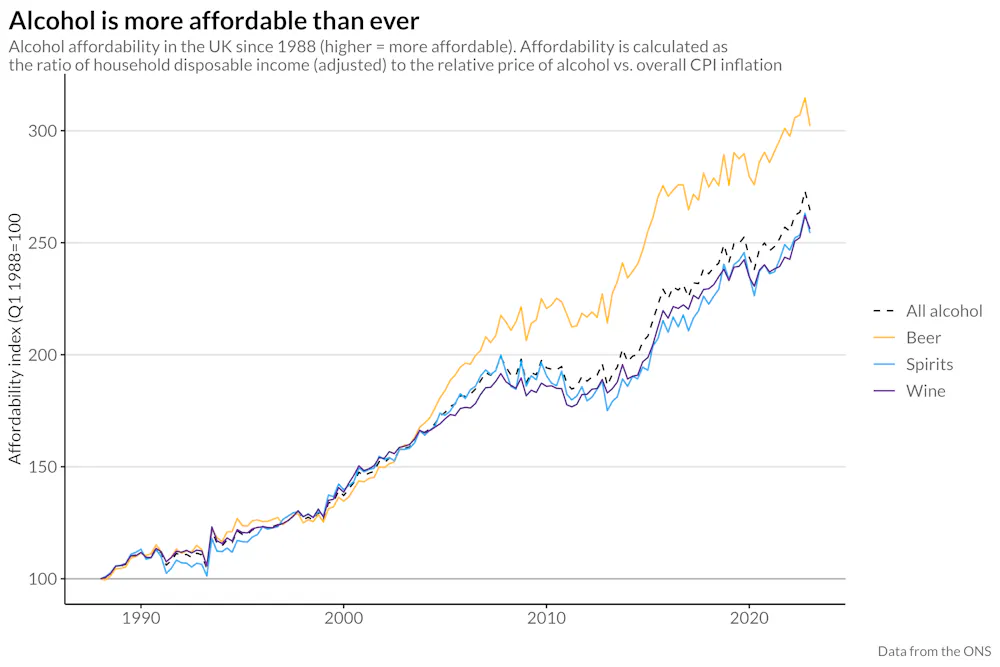
So the cost of living crisis has arrived at a tough time for the brewing industry. Yet, in spite of these challenging headwinds, the price of alcohol has risen much more slowly than other goods.

With overall inflation sitting at 20.5% since January 2021 and the price of common goods such as milk, cheese and eggs having risen by over 50%, the prices of beer, wine and spirits have risen by 13.1%, 7.2% and 8% respectively. This is less than any other food and drink category. And so, although average disposable income has fallen, alcohol is more affordable than at almost any point in the last 30 years.

            Line chart showing affordability of all alcohol, beer, wine and spirits increasing between 1990 and 2020.
Data from ONS, analysis by Colin Angus, Author provided
           

All of this means that it’s little surprise to see brewers looking for ways to increase their profits. Making small reductions in alcoholic strength is one way they can do this.

But are consumers being cheated? People’s perspective on this will depend on their motivations for drinking beer. With shrinkflation, consumers are paying the same amount for a chocolate bar or a bag of crisps, but getting less. With “drinkflation” consumers are still getting the same amount of beer, it just contains slightly less alcohol.

So, only people who are drinking for the specific purpose of getting drunk are being “short-changed”. For people who are drinking beer because they like the taste or who see beer as an important part of a social ritual, the lower alcohol content is more likely to be a positive, given that people consume less alcohol when drinking lower strength beer and the health benefits of reduced alcohol intake.

In line with this, the low alcohol and alcohol-free beer industry is growing. Most shops and many bars now offer at least one alcohol-free beer option. The UK market has also seen the launch of several lower-strength, carb and calorie versions of existing brands, such as Heineken Silver.

This puts us in an unusual situation. Reducing the alcoholic strength of beers is in the commercial interests of brewers, but it also aligns with trends in consumer demand and is likely to be a benefit to public health by reducing overall alcohol consumption.

It’s incredibly rare for these, usually competing, interests to be pulling in the same direction, so perhaps the current trend is something worth celebrating for almost everybody. Cheers to that.

Colin Angus, Senior Research Fellow in the Sheffield Alcohol Research Group, University of Sheffield

This article is republished from The Conversation under a Creative Commons license. Read the original article.

“Peaky Blinders” team slams Ron DeSantis over homophobic campaign video with Cillian Murphy footage

The producers behind British mob drama “Peaky Blinders” are not thrilled that Ron DeSantis used footage from their show to denounce the LGBTQ community in a bizarre presidential campaign video, reports Variety. Released on June 30 by DeSantis’ “rapid response operation” on Twitter, the video mocks rival 2024 presidential candidate Donald Trump for making statements in support of the LGBTQ community. It then cuts to clips of DeSantis alongside heroic shots of brooding and murderous characters in Hollywood, like Brad Pitt in “Troy,” Christian Bale in “American Psycho” and Cillian Murphy in “Peaky Blinders.” In one frame, DeSantis is seen sporting sunglasses above the headline: “DeSantis Signs ‘Most Extreme Slate of Anti-Trans Laws in Modern History.'” Another frame displays his TIME Magazine cover with the biting headline, “What Ron DeSantis means for America.”

“On behalf of the partners of ‘Peaky Blinders’ — Steven Knight, Cillian Murphy, Caryn Mandabach Productions, Tiger Aspect Productions and Banijay Rights — we confirm the footage of Tommy Shelby’s character used within the video posted by Ron DeSantis’ campaign was obtained without permission or official license,” the show’s cast and crew wrote in a statement shared on Twitter. “We do not support nor endorse the video’s narrative and strongly disapprove of the use of the content in this manner.”

This isn’t the first time the Florida governor and Republican presidential hopeful has butted heads with the entertainment industry. DeSantis is currently embroiled in a legal battle with Disney after he took away the mass media company’s ability to self-govern the 25,000-acre site of its Walt Disney World amusement parks in Orlando. Disney claimed the move was DeSantis’ effort to further target and retaliate against the company for disagreeing with his “Don’t Say Gay” bill, which bans education about sexual orientation and gender identity in some Florida classrooms.

“There’s no way”: Kayleigh McEnany rejects Trump’s baseless claim that WH cocaine was Hunter Biden’s

Former White House press secretary Kayleigh McEnany on Thursday dismissed the suggestion that the cocaine found at the White House over the holiday weekend belonged to the president’s son, Hunter Biden, The Hill reports.

“For it to be Hunter Biden, he left on Friday, he was at Camp David. There is no way, it is inconceivable to think cocaine could sit for a 72-hour period [at The White House], so I would rule him out at this point,” the Fox News host said Thursday morning on the network’s flagship program.

Various outlets reported earlier this week that a suspicious white powder was found on the premises during a routine sweep of the White House. After testing the substance, the Secret Service said, it was confirmed to be cocaine.

On Wednesday McEnany’s former boss, former President Donald Trump, slammed media coverage of the story and levied the suggestion that the cocaine belonged to Hunter Biden, who has been open with the public about his history of drug use.

“Does anybody really believe that the COCAINE found in the West Wing of the White House, very close to the Oval Office, is for the use of anyone other than Hunter & Joe Biden,” Trump wrote in a post to Truth Social.


Want a daily wrap-up of all the news and commentary Salon has to offer? Subscribe to our morning newsletter, Crash Course.


“But watch, the Fake News Media will soon start saying that the amount found was ‘very small,’ & it wasn’t really COCAINE, but rather common ground up Aspirin, & the story will vanish,” he concluded.

Trump also took aim at his former White House staffer in May, calling McEnany “milktoast” — a misspelling of “milquetoast” — over her commentary about Florida Gov. Ron DeSantis’ poll numbers in the 2024 race for the Republican nomination, in which DeSantis is Trump’s main opponent. 

Greta Thunberg charged with disobeying Swedish law enforcement during climate protest

Greta Thunberg — the internationally famous climate change activist who was awarded Time Magazine “Person of the Year” in 2019 —was arrested on Wednesday after Swedish law enforcement officials charged her with disobeying their orders. Prosecutors in Sweden allege that Thunberg and other activists stopped traffic at an oil terminal in the port in Malmö on June 19, according to the local newspaper Sydsvenskan. After the police instructed the protesters to stop what they were doing, authorities claim, a “young woman” and others “refused to comply with police orders to leave the scene.” Swedish Prosecution Authority spokeswoman Annika Collin later confirmed that the “young woman” described in the report was Thunberg. Sydsvenskan claims that Thunberg, will be called to trial at the end of July. If she is found guilty, prosecutor Charlotte Ottosen told Sydsvenskan that the punishment for her crime would most likely be fines.

This is not the first time the 20-year-old activist has had a brush with law enforcement in response to protesting for the planet. Earlier this year, she was detained by German police while protesting a coal mine expansion in Lützerath, a west German village which was slated to be cleared and demolished to make way for the nearby Garzweiler coal mine, as reported by NPR.

Thunberg has emerged as a polarizing figure in global politics, with detractors attacking her for her autism, temperament and in general for being a woman. She has consistently argued that her goal is to protect Earth for her generation and future generations from man-made climate change. The science, as she repeatedly and correctly points out, proves that carbon emissions from burning fossil fuels are trapping heat and unnaturally warming the planet.

“Just a big baby who isn’t very popular”: Australian minister mocks Don Jr. over dubious visa claim

Australian Home Minister Clare O’Neil on Thursday called out Donald Trump, Jr. online and dubbed him a “big baby” after the former president’s eldest son cancelled his scheduled speaking tour in the country. According to Reuters, the junior Trump, who had been slated to begin his three-day tour in Sydney on Sunday, cancelled the engagements on Wednesday with organizers citing potential issues with his visa as the cause. “It seems America isn’t the only country that makes it difficult for the Trumps,” the group Turning Point Australia, a self-described non-profit in favor of “free markets and limited government,” wrote in a Facebook post.

But O’Neil, a high-ranking minister in Australia’s center-left Labor government, said that Trump had been granted a visa and argued that low ticket sales were the likely reason for his cancellation. “Geez, Donald Trump Jr is a bit of sore loser,” O’Neil said in a series of tweets that have since been deleted. “Donald Trump Jr has been given a visa to come to Australia. He didn’t get cancelled. He’s just a big baby, who isn’t very popular.” 

Though O’Neil did not immediately respond to Reuters’ request for comment, Australian Prime Minister Anthony Albanese confirmed that Trump, Jr.’s visa had been granted and assured reporters that he had not been prevented from entering the country. “Donald Trump Jr’s visa was dealt with in the normal way. Like anyone else, he was entitled to come here. The deferral of his travel is a matter for him,” Albanese told reporters.

“A straightforward crime”: Experts expect charges after “extraordinarily significant” J6 testimony

Former Arizona House Speaker Rusty Bowers on Wednesday revealed that the FBI had interviewed him in its investigation into former President Donald Trump’s alleged scheme to overturn the results of the 2020 election.

“I am hesitant to talk about any subpoenas, et cetera. But I have been interviewed by the FBI,” he told CNN’s Kaitlin Collins when she asked whether he had been subpoenaed by special counsel Jack Smith.

Bowers testified before the House Jan. 6 committee last year, refuting in his testimony Trump’s recollection of a phone call between them during the 2020 election. Bowers told the committee that Trump and his former personal lawyer Rudy Giuliani pressured him to overturn President Joe Biden’s victory in Arizona. But, according to The Hill, before Bowers’ testimony, Trump claimed that Bowers had “told me that the election was rigged and that I won Arizona.”

Bowers told Collins Wednesday that the FBI interview lasted four hours and took place a few months ago. He said that there was “nothing new” in what he told the FBI that he had not said in his public testimony.

“They seem to have a good grasp on all of the testimony that I’ve given and all of the interviews that I had given to the Arizona Republic and The Washington Post,” he said.

“They were very aware of the Jan. 6th committee testimony that I gave,” he added. “There may have been something that I said that was of interest. But I don’t remember anything standing out that had not been mentioned before.”

After testifying publicly to the Jan. 6 committee, Bowers met severe backlash from his colleagues, being censured by the Arizona GOP and called a traitor by members of his party. He also lost his race for re-election to a Trump-backed candidate last August, a few months after he testified.

Immediately after Bowers’ appearance, CNN legal analyst Elie Honig told Collins that Bowers’ comments added “extraordinarily significant” context to the FBI’s probe, HuffPost reports.

“For four hours he’s met with the FBI. And this means that Jack Smith and his team are looking at Rusty Bowers as a witness. That would be what you would do with someone who’s not resisting you,” said Honig, a former assistant U.S. attorney.

“This tells us that this is about more than Georgia,” Honig added, pointing out that “this is the first and I think best indicator that Jack Smith is looking at this as a coordinated, multistate effort by Donald Trump” and his legal team.

Honig also dubbed Bowers a “really good witness.”

“He’s credible, he’s backed up by the other evidence, he’s relatable. So I imagine Jack Smith and his team are looking at him the same way,” Honig said.

The special counsel in recent weeks has increasingly focused on the fake elector plot, which longtime Trump adviser Boris Ephsteyn previously defended as “alternate electors” in the event that Congress blocked the certification of Biden’s win.

“It is not alternate electors. It is fraudulent electors,” former U.S. Attorney Harry Litman told MSNBC on Wednesday. “It’s people that sign pieces of paper saying, ‘My state, has made me an elector and I’m for Trump,’ when exactly the opposite has happened. So, Epshteyn has been a figure here and a very controversial one. He’s been responsible for a lot of lawyers abandoning ship.

“But, yeah, it seems clear from the state level and now to the sort of circle around Trump, that people were very earnest about having false electors,” he continued. “That is just a straightforward crime of defrauding the United States and probably a wire fraud as well. I agree, that is a very good statement for them to use if they call him to the stand.”


Want a daily wrap-up of all the news and commentary Salon has to offer? Subscribe to our morning newsletter, Crash Course.


Smith’s team has reportedly interviewed and subpoenaed a range of people in connection to the federal investigation, including Giuliani and election officials in Arizona and Georgia, where Fulton County District Attorney Fani Willis is investigating Trump and his allies’ alleged efforts to undermine the state’s election.

Former federal prosecutor Kristy Greenberg told MSNBC’s Chris Hayes on Wednesday that at least part of the special counsel’s timetable in the case “is informed by what Fani Willis is doing in Georgia,” noting that Willis has indicated that she will file charges in her investigation at “the end of July, early- to mid-August.”

“I think you can also look at the fact that they have amassed evidence from, really, Donald Trump’s inner circle,” Greenberg continued. “We know that his campaign officials, Gary Michael Brown has been in the grand jury, Michael Roman apparently is cooperating. He was the director of Election Day operations. State officials in all the background states. You’ve got, potentially, Mark Meadows, White House counsel, Mike Pence. You know, if you have this inner circle, you’re really, I think at that point, nearing the end of the investigation.”

“The Bear” showed us how easy it is to care for people, three eggs at a time

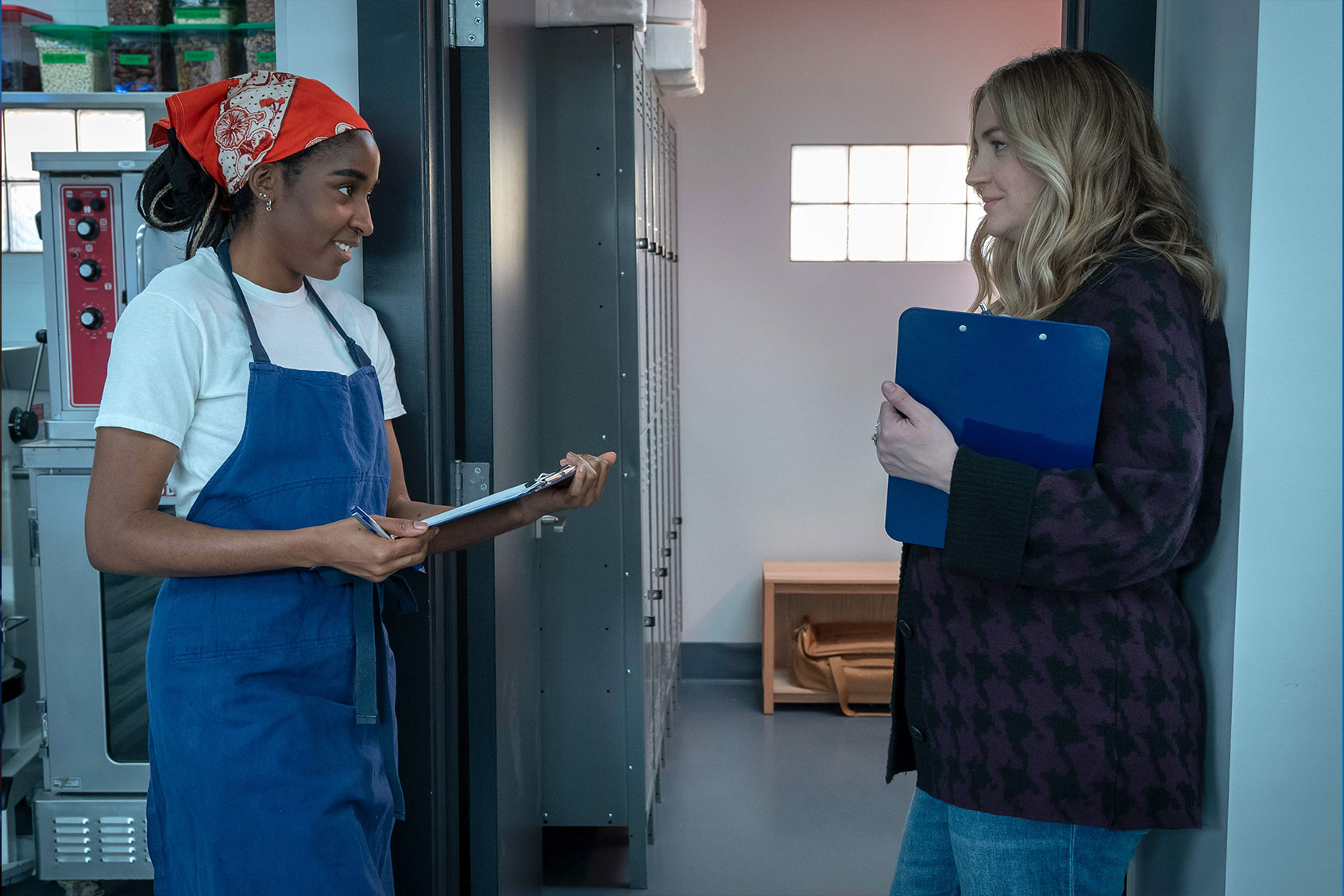
If you believe that food is a love language – and if you don’t, I’m not sure I want to know you – then you’ll recognize the “Omelette” episode of “The Bear” as an off-season valentine to culinary nurturers. The title, which uses the French spelling of the dish, hooks to a scene midway through the episode’s 39 minutes when Sydney (Ayo Edebiri) makes an omelet for Natalie (Abby Elliott).

As is true of every part of this show, the details involved in this exchange matter. With the restaurant due to open in a couple of hours, everyone is exhausted and anxious. Offscreen the call goes out that the family meal is ready but Nat, always the project manager, is chained to her desk. She looks ashen. “I just haven’t eaten,” she explains when Syd asks if she’s OK.

An equally busy Sydney responds without a second thought. “Let me make you something,” she insists. Natalie asks for an omelet.

To viewers, this request yields a chance to luxuriate in Sydney’s calm, assured effort as she whisks a trio of eggs in a sieve set over a bowl, then fires up a burner and throws a few generous tablespoons of butter into a pan.

The BearAyo Edebiri as Sydney Adamu and Abby Elliot as Natalie “Sugar” Berzatto in “The Bear” (Chuck Hodes/FX)

Series creator Christopher Storer’s direction ensures that every sensory pleasure comes through – the sizzle of a solid melting into oil, the shooshing of Sydney’s stir, the chives crunching as her knife chops through a bundle. Circumstances lead us to infer that Sydney is surrounded by hustling teammates but where she’s cooking is an oasis of quiet.

She plates the omelet, rubs a pat of butter across the top, and finishes it with the chopped chives and – here’s the fun part – sour cream and onion potato chips crumbled over the top along with a few grinds of fresh pepper.

She takes it to Natalie along with what looks like a glass of freshly squeezed orange juice combined with beet juice. And when Nat digs in for her first bite, she delivers her compliments to the chef by saying, “I could cry.”

Situating Sydney’s cooking scene at the heart of “Omelette” emphasizes the second season’s throughlines about service and focus. Ten minutes later, as she and her business partner Carmy (Jeremy Allen White) are fixing a table together, she tells him that making that omelet for Nat was “the best part of my day.”

“You love taking care of people,” he says with understanding. Professional chefs do what they do for many reasons but a common thread is a desire to nourish and satisfy through their cooking. “The Bear” performs a similar version of caretaking for its viewers with this sequence. Taking the simplest of ingredients – three eggs, some butter and a garnish you can score at your local convenience store in its most basic version – can yield something wonderful enough for the person who eats it to hail your genius.

Everything looks more effortless to pull off on TV than it is in reality. If you’ve made omelets before, you know that as easy as they are to make, they’re a challenge to master. The same can be said of just about any egg preparation: Carrie Bradshaw tries and fails to poach eggs in the second season of “And Just Like That” as part of what she thinks will be an easy entry into learning how to cook, only to fail and fail and fail again.

On the series premiere of “Julia,” Sarah Lancashire’s Julia Child whips up an omelet on a TV show using a hot plate in a matter of minutes, but the actual “The French Chef” episode devoted to omelets takes half an hour for the real Child to explain the techniques and tools required to make one correctly.

“The Bear” has culinary producer Courtney Storer, the creator’s sibling, coaching its cast to ensure their methods looks as flawless as the food they’re preparing (or pretending to prepare) tastes. But there’s no faking Sydney’s tour de main.


Want more great food writing and recipes? Subscribe to Salon Food’s newsletter, The Bite.


First, note that Sydney uses a fork to beat the eggs, not a whisk. This yields a fluffier texture. Using a sieve strains out the stringier part of the albumen to ensure consistency. She shakes the pan to coat the bottom while using a spatula to loosen the edges, throwing in more butter as necessary to ensure it doesn’t get stuck.

Edebiri’s performance in this sequence deserves a standing ovation: her omelet looks tender and creamy inside before she pipes a spine of Boursin cheese into its center. Its exterior is a delicate yellow that shows off the chives’ springtime green.

Then comes the potato chip finish, an inspired off-the-grocery-shelf detail that nods at the restaurant’s previous incarnation as a sandwich shop, and the kind of edible flourish home chefs can pull off without going broke.

The BearJeremy Allen White as Carmen “Carmy” Berzatto in “The Bear” (Chuck Hodes/FX)
Moreover, she makes preparing an omelet look meditative, conveying that its perfect execution is a product of full focus. That is the single ingredient lacking in her partnership with Carmy, which he admits during their under-the-table heart-to-heart.  “You deserve my full focus. My attention shouldn’t be split.”

It isn’t too much to ask when it comes to showing someone that you care, or when whisking a few good eggs into what could become the best part of your day. And if they don’t turn out as intended, don’t worry. Eggs are relatively inexpensive again, so practice as many times as necessary to get it right.

Omelet inspired by Sydney’s on “The Bear”

Yields
1 servings
Prep Time
10 minutes or less
Cook Time
5 minutes or less

Ingredients

3 eggs

A stick of butter (Julia Child believed a great omelet requires a great amount of butter)

3 to 5 tablespoons of Boursin cheese (I used the garlic and fine herbs variety)

Chives, to taste

A handful of sour cream and onion flavored potato chips, preferably with ridges

Whole black peppercorns in a grinder

A fork

A spatula


Directions

  1. Prepare your mise en place: finely chop your chives, have your potato chips at the ready and have your Boursin ready to go. If you choose to use Sydney’s method, place a little more cheese than you’ll need into a pastry bag fitted with large size plain style tip.
  2. Crack three eggs into a sieve or hand-held wire mesh strainer set over a bowl. Using a fork, beat the eggs until the mixture has mostly strained through the mesh, leaving behind the stringy parts of the egg white.
  3. Place your omelet pan over medium-low heat and melt at least three tablespoons of butter on the surface, swirling the pat to coat the bottom of the pan.
  4. Pour your eggs into the pan, gently shaking it back and forth across the heat source as they set. If the eggs setting too quickly, lift the pan away from the heat. Using the spatula, spread the excess eggs to the edges and  ensure they aren’t sticking. If they are, throw in some extra butter.
  5. Turn off the heat to prevent overcooking and allow the eggs to set.
  6. While the center is still creamy, add the Boursin. Place the cheese in a line off center so that when you unmold the omelet the filling lands toward the middle.
  7. Use your spatula to create a V-shape by folding in the borders on the side opposite the cheese, then roll the V toward the center.
  8. Unmold, or slide, the omelet onto a plate. It’s up to you whether to fold it like a half-moon or a burrito shape.
  9. Gently rub a pat of butter over the surface of the omelet. Then, sprinkle on your chives. After that, crumble your potato chips in your hands and sprinkle them over the top. Grind a bit of pepper over the top of that.
  10. Take a bite. Cry happily.


Armed Jan. 6 rioter arrested near Obama home on same day Trump posted alleged address: prosecutors

The accused Jan. 6 rioter who was arrested last week near the home of former President Barack Obama showed up at the residence the same day former President Donald Trump posted what he claimed to be the Obamas’ address on his social media platform, federal prosecutors said Wednesday while revealing more details about the case. Taylor Taranto, 37, kept two firearms and hundreds of rounds of ammunition in the van he had driven across the country and was living in, according to a motion from the Department of Justice aiming to keep him in custody. 

According to The Associated Press, prosecutors said that on the day of his arrest — June 29 — Taranto reposted the post from Trump on Truth Social. “We got these losers surrounded! See you in hell, Podesta’s and Obama’s,” Taranto wrote in a later post to Telegram, referencing the former chair of Hillary Clinton’s 2016 campaign, John Podesta. Prosecutors added that Taranto had also told viewers of his YouTube livestream that he was hoping to get a “good angle on a shot.” A federal defender for Taranto did not immediately return AP’s request for comment, but in a motion to have him released pending trial, the lawyer argued that Taranto was not a flight risk. The DOJ’s detention memo indicates that Taranto’s wife had told prosecutors that he had most recently come to Washington, D.C. because of House Speaker Kevin McCarthy’s, R-Calif., offer to produce unseen video of the Capitol attack, which Taranto faces four misdemeanor charges in relation to. Since the riot, Taranto has been active online posting a Facebook video of himself in the Capitol that day and sharing a conspiracy theory that the death of Ashli Babbitt — who was fatally shot by police when attempting to climb into the Speaker’s Lobby — was a hoax, prosecutors said

“Donald Trump, as I’ve been saying for many years, knows exactly what he is doing,” CNN National Security Analyst Juliette Kayyem said Wednesday about Trump posting an address in Obama’s neighborhood during a Wednesday appearance on the network, adding, “He’s not doing that for neighborly brotherhood. He’s doing that because his followers will do something with it. Most will ignore it. Most Trump supporters do not support violence, but he knows there’s some group of them that will do something.”

Wisconsin governor’s bizarre veto in GOP budget bill triggers 400 years of school funding

Wisconsin Gov. Tony Evers on Wednesday signed off on a two-year budget that, through a line-item veto, increased funding for K-12 public schools for more than 400 years after he significantly curtailed the Republican-proposed income tax cut, The Associated Press reports. Unless overturned by a future legislature and governor, the Democrat and former state education secretary’s move, accomplished by striking a hyphen and two numbers, will increase the amount of revenue schools can raise per student by $325 a year until 2425. Evers had proposed allowing revenue limits to rise with inflation, and under his veto, he said schools will now have “predictable long-term spending authority.”

Republicans assailed the vetoes, accusing Evers of violating an agreement they had reached. Republican Assembly Speaker Robin Vos said that the effectively eternal revenue limit increase could prompt “massive property tax increases” because schools have the power to raise those taxes if they’re unable to cover per-pupil costs with state aid. He added that skimming the tax cut, which would have used nearly half of Wisconsin’s $7 billion budget to cut income taxes across each bracket, also puts the state at an economic disadvantage when compared to nearby states with lower rates. Evers’ veto wiped the rate reductions for the two highest brackets, which would have received the largest cuts under the Republican plan, and directed the remaining $175 million to the lowest two tax brackets, paid by individuals earning less than $27,630 per year or households earning less than $36,840 per year. “Legislative Republicans worked tirelessly over the last few months to block Governor Evers’ liberal tax and spending agenda,” Vos said in a statement. “Unfortunately, because of his powerful veto authority, he reinstated some of it today.”

Evers was unable to veto the $32 million cut to the University of Wisconsin’s funding that he had previously threatened to veto the entire budget over and that Republicans projected would go toward diversity, equity and inclusion efforts and staff. However, Evers’ budget does allow the university to reclaim that funding later if it can prove it will go toward workforce development instead. Another of Evers’ strike downs removed a provision that would have prohibited Medicaid payments for gender-affirming care. The Democratic governor admonished the proposal, accusing Republicans of “perpetuating hateful, discriminatory, and anti-LGBTQ policies and rhetoric” through it. 

Drugs in the White House? Horrors! Guess what: It wouldn’t be the first time

Hold the phone, Batman! Someone found Colombian marching powder in the White House this weekend. 

Several reports have noted that a white powder that tested positive as cocaine was discovered two days after Hunter Biden visited the White House. With the use of Post hoc ergo propter hoc before you could snort that line, the president’s son was blamed for it. (Well, in certain quarters.) Just because one thing followed the other doesn’t mean the first thing caused the second, folks. Yet it’s politically expedient these days to knock people when they’re down and engage in logical fallacies in order to con large portions of the public into believing outrageous fictions.

That brings us the Supreme Court, which ruled last week that a web designer didn’t have to create a wedding site for a member of the LGBTQ community if doing so violated the designer’s beliefs. Only, as reported and confirmed, the case involved was pure fiction. The person who supposedly requested a website for a same-sex wedding is a straight man married to a woman, and is himself a web designer. But the decision rendered by the Supreme Court opens the door to refusing service to people based upon a myriad of reasons, perhaps including race and color.

See where this is going? Jim Crow, here we come.

Meanwhile, back to drugs (because at this point we may need them): Many who oppose Joe Biden have used the cocaine issue as evidence that his administration is corrupt and out to lunch — or worse. One MAGA supporter I’ve known for more than 40 years told me that Biden is “a corrupt drug lord ruining the country and taking us away from God.” I asked him where he himself figured into that narrative, since this guy was arrested for selling pot in a public park as a teenager. I got no answer to that.

This whole issue is much ado about nothing. First Lady Betty Ford admitted during her husband’s presidency that her sons got high, probably at the White House. Indeed, there is a long history of drug use in that storied building. As the comedian Bill Hicks once said, not only should marijuana be legal, it should be mandatory in certain contexts. That would definitely help with press briefings and news conferences. For the record, I’ve never seen rapid eye movements or anyone grinding their teeth or sniffing frequently — the telltale signs of cocaine use — from anyone in the Biden White House.

For all we know, the cocaine found there could be left over from Hunter S. Thompson’s visit years ago, not Hunter Biden’s of two days ago. If we find LSD as well, we’ll know for sure that Thompson has struck from beyond the grave. But he wasn’t the only person who has famously used drugs at the White House. Willie Nelson claimed he rolled and smoked a joint on the White House roof during the Carter administration.

I knew people in the George W. Bush administration who routinely boozed, smoked and snorted their way through the work day. With the pressures they faced sometimes, who could blame them?

Having covered both Republican and Democratic conventions, I can report with confidence that “both sides” do it — meaning low-level vice, recreational drugs and an array of associated visceral thrills.

During one of the last parties of Bill Clinton’s administration — a wondrous affair held in tents on the South Lawn — Tom Petty and his band walked through the West Wing reeking of weed, giggling so hard that it made me jealous I wasn’t part of the merriment. I also witnessed a very famous actor at that  party snorting white powder in one of the portable bathrooms on the South Lawn. Let’s just say it wasn’t anthrax or fentanyl. 

I knew a staffer during the Reagan administration who took so much speed his armpit stains were green. He claimed he had a prescription for the stuff, but I’m pretty sure the doctor didn’t intend for him to take a month’s worth in a week. For the record, I definitely saw that guy grind his jaws, blink rapidly and sniff frequently.

Laugh at this whole issue if you want; scream and rant and rave if you must — but you risk being the biggest hypocrite on the planet if you do. Truth is, politics and government are filled with those who find energy, courage, inspiration and the occasional escape through a wide variety of psychoactive drugs, including alcohol and even nicotine. Once, while I was covering the Iowa caucuses, I saw a Secret Service agent keep the bar open in the Drake Hotel by fetching a case of bourbon from the trunk of his bar after the bartender insisted he had to close.

Having covered both Republican and Democratic conventions, I can report with certainty that “both sides” do it — that is, they dabble in low-level vice, recreational drugs and associated visceral thrills while on the road. You haven’t lived until you’ve seen a politician who claims he supports “family values” burying his face in the chest of a cheap hooker while blind drunk and coked-up. Yes. That happened.

Sometimes the extracurricular activity is so egregious it makes national news by itself. The implosion of Gary Hart’s political career in 1984 comes to mind.


Want a daily wrap-up of all the news and commentary Salon has to offer? Subscribe to our morning newsletter, Crash Course.


Is any of this a cause for real concern? Yes and no. Yes, if it compromises a politician’s ability to do their job, and no, if it has nothing to do with their job and is merely their attempt at the pursuit of happiness, as outlined in the Declaration of Independence. But again, In the case of the supposed stash of maybe-cocaine found at the White House, we have no idea who left the stuff near where “guests are asked to leave their cell phones before proceeding into the West Wing,” as CNN and AP have described it.

I mean, who leaves their stash behind and forgets about it? That’s the first question any self-respecting drug user will ask. Well, that or “Why didn’t you snort it up before you got to the White House?” The only real concern is if someone managed to sneak anthrax, or some other toxic substance, into the White House. Otherwise, this so-called story is just a diversion from the real news this week. 

We celebrated our Declaration of Independence from Britain this week — or at least we tried to do that, through a number of mass shootings at various venues across the country. It was an exceedingly violent celebration. Shootings were reported in Lansing, Michigan; Akron, Ohio; Hayward, California; Washington D.C.; Edgewood, Maryland; and Shreveport, Louisiana. Ten died and 38 were wounded in mass shootings in Philadelphia, Baltimore and Fort Worth ahead of the holiday. Four died in the shooting in Shreveport. A 14-year-old was killed and six more people were injured in a shooting in Salisbury, Maryland, just after midnight. All of that barely made a dent in the news because mass shootings are a daily occurrence in this country — and because Donald Trump and the GOP were too busy trying to blame the Bidens for “CocaineGate.”

Meanwhile, celebrating Independence Day with fireworks has itself become a fraught issue. Dogs, notoriously, hate them. So do many people. I myself have mixed feelings. My dad loved them, and watching a fireworks display always reminds him. But the explosions and flashes also remind me of conflict zones I’ve visited. I guarantee you I wouldn’t be cheering if I were in certain parts of Africa today, or in the Middle East or Ukraine, and I heard those constant deep concussive booms or saw fireworks. I’d be running for cover.

In this country, however, we’re supposed to find that festive.

Finally, there is this: On Independence Day, it has become popular to deride the founders of our nation. After all, they were all rich white men, and most were slave owners. So pretending that they were patriots for the cause of equality, the argument goes, is just more American hypocrisy.

There’s a flaw to that reasoning. Those who refuse to celebrate the roots of our independence, or who call the founders corrupt, are missing the point. Indeed they were flawed individuals. We all are. But it’s unfair to compare them to ourselves because of the differences of history and culture, and doing so reflects a key misunderstanding of what they accomplished. They were progressive thinkers for their time. 

Calling our nation’s founders a bunch of corrupt rich white men is missing the point. They were flawed individuals, but they had a crucial insight into how to build a better mousetrap.

It is not that the founders thought themselves perfect, or that their revolution made them sacred. But they did have a crucial insight into how to build a better mousetrap. Their revolution was a template of ideals, not a list of achievements. No nation on earth had previously existed where the common man was held to be equal to those who ran government — and no one has ever said that better than in the Declaration of Independence: “We hold these truths to be self-evident, that all men are created equal, that they are endowed by their Creator with certain unalienable Rights, that among these are Life, Liberty and the pursuit of Happiness. That to secure these rights, Governments are instituted among Men, deriving their just powers from the consent of the governed. …” 

Life: We all have the right to live. Liberty: We all have the right to be free. And the pursuit of happiness? If you aren’t taking someone else’s life, freedom or happiness away, then you’re free to do what you will. 

It was Thomas Jefferson, John Adams, Benjamin Franklin, Robert R. Livingston and Roger Sherman, as the “Committee of Five,” who wrote that. It is the very essence of what our government is meant to be and what dictates our actions in the three branches of government, including the Supreme Court. Not only have modern-day politicians forgotten these ideals, it’s likely they never believed in them.

Professing to be the only person who can lead us to salvation is diametrically opposed to the principles of our nation. Pretending to be a patriot while also claiming to be a savior is a betrayal of the very cause such a politician claims to represent.

Holding any politician up as a savior defeats the purpose of a government that is meant to be of, by and for the people. Politicians work for us — they do not lead us, as a king would. We are not supposed to be ruled by their whims, desires or needs — they are supposed to be responsive to ours.

At its core, our government is about equal opportunity for everyone. It is also about equal accountability by everyone. Dismissing our founders for not living up to their ideals is one thing, but dismissing those ideals entirely is another. 

Taken in that light, the recent decisions by the Supreme Court are traitorous. As former federal prosecutor Michael Zeldin said on CNN and later on the podcast “Just Ask the Question,” the Supreme Court as it now exists “is the most activist court in history. The Republicans claimed they want strict interpretation of the Constitution, but they’re fine with the court actively legislating what they want.”

There are many politicians who will try anything to make sure you never notice that. Cocaine in the White House? That is just another effort to fuel pointless anger and keep Americans from concentrating on the real issues.

Snort that up. 

Ex-prosecutor: Redactions in unsealed Trump search warrant affidavit suggest “additional charges”

A federal magistrate judge on Wednesday unsealed some previously redacted portions of the affidavit the FBI used to obtain a search warrant for classified documents at former President Donald Trump’s Mar-a-Lago residence last year.

The unredacted sections of the document suggest that investigators sought the warrant after surveillance footage near a storage room in the Mar-a-Lago basement showed Walt Nauta, Trump’s personal valet and co-defendant, moving boxes days before federal prosecutors met with Trump lawyers at the resort to retrieve any remaining classified documents he had in his possession.

“It looks like DOJ knew, when they asked for the search warrant, that a significant number of boxes Trump took out of the WH weren’t included in the storage area he identified as the only repository of his materials,” tweeted former U.S. Attorney Joyce Vance. “Early evidence of significant obstruction of the investigation.”

The unsealing was ordered by Magistrate Judge Bruce Reinhart, who signed off on the warrant. The newly unsealed portions include photos of dozens of boxes in the Mar-a-Lago storage room and descriptions of the footage captured by security cameras.

“The door to the storage room was painted gold and had no other markings on it,” an FBI agent wrote in the affidavit. “The door to the storage room is located approximately midway up the wall and is reachable by several wooden stairs.”

The affidavit said Nauta took about 64 boxes of the room but only returned about 25 to 30 of them.

“Video footage reflects that evidence has been moved recently,” the affidavit said. “It cannot be seen on the video footage where the boxes were moved when they were taken from the storage room area, and accordingly, the current location of the boxes that were removed from the storage room area but not returned to it is unknown.”


Want a daily wrap-up of all the news and commentary Salon has to offer? Subscribe to our morning newsletter, Crash Course.


When prosecutors arrived, Trump attorney Evan Corcoran “stated he was advised all the records that came from the White House were stored in one location within Mar-a-Lago, the storage room, and the boxes of records in the storage room were ‘the remaining repository’ of records from the White House,” the affidavit says, adding that Corcoran said “he was not advised there were any records in any private office space or other location in Mar-a-Lago.”

Some portions of the affidavit remain under seal.

“I still think that the real story is what is left that is redacted,” former U.S. Attorney Barb McQuade, a University of Michigan law professor, told MSNBC on Wednesday. “And we know from other reporting that the grand jury is continuing to do its work. To continue to investigate. That means there could be additional charges. Or additional defendants who get charged.”

Recent reports revealed that the Florida grand jury that indicted Trump has issued new subpoenas in its ongoing investigation.

“So my guess is that that is the kind of material that they are trying to protect. Ordinarily public documents should be fully unredacted” unless there is “some legitimate law enforcement reason for it,” she explained.

“So there could be some witnesses that they are trying to protect,” she added. “Or some lines of inquiry they are trying to protect. Until they finalize and complete the remaining steps in that investigation, I am very curious to find it what it is.”

Fake “liberal” Twitter account exposed: We should worry less about AI and more about human stupidity

The funniest aspect of the “Erica Marsh” story is how obvious it was that this supposed hot girl #Resistance tweeter was not a real person.

Drew Harwell of the Washington Post wrote over the holiday about the recently suspended Twitter account of the alleged “proud Democrat” who supposedly had worked for both President Joe Biden and former President Barack Obama, even though there is absolutely no record of her, or that she’s even a registered voter.

Her account was wildly popular, with “more than 130,000 followers for her hyper-liberal, often melodramatic opinions,” Harwell wrote. Crucially, however, she wasn’t familiar to the flesh-and-blood Democratic voters of the real world. Instead, she’s “popular with conservatives, who promoted her as a perfect symbol of how overly theatrical and inane liberals can be.”

It also helped that her photos, which experts told Harwell are likely faked, portrayed a conventionally attractive young blonde woman. As anyone who watches Fox News regularly can attest, “hot girl liberal” is a favorite hate object offered up to their aging and largely male audience. The anger at women who disagree with them combines with their sexual insecurities to create a white-hot “how dare that bitch” rage. It’s like uncut cocaine straight to the MAGA brain. (One right-wing Redditor’s reaction: “The fact that she’s kind of hot makes me even more irritated with this.”)

This is more disinformation meant to keep conservatives in a rage doom loop that detaches them from reality. 

The real giveaway that this was a fake account, however, was the tweets themselves. They read as an over-the-top fantasy of what MAGA wishes liberals were like. For instance, the account tweeted last month that she wears “2 masks whenever I go out and support Ukraine.” The account responded to the Supreme Court ending college affirmative action with, “No Black person will be able to succeed in a merit-based system.” That one got more than 27 million views, mostly due to conservatives congratulating themselves over knowing liberals are the “real” racists. She also provided fuel for right-wing conspiracy theories by bragging about the supposed efforts to falsify votes for Democrats. 


Want more Amanda Marcotte on politics? Subscribe to her newsletter Standing Room Only.


One gets the sense that the person behind the account was testing if conservatives have a limit to how much B.S. they’ll swallow. This doesn’t diminish the possibility that the person behind it is also a right-winger. Longtime observers of the right will note that they view each other with total contempt, which is why the GOP is stuffed full of grifters and con artists who are always hustling their fellow travelers. But, of course, there is no such thing as shame on the right. The obvious fakery of the “Erica Marsh” account did little to stifle the willingness of Republicans to exploit the hoax to stoke hatred of liberals. Even Rep. Matt Gaetz, R-Fla., hyped the phony affirmative action tweet.

Did Gaetz believe this to be a real tweet? Doubtful. He’s a jerk, but he’s not a dumb man. He’s just using this fake account for his own engagement farming. Of course, it would be naive to think Gaetz’s followers were duped, either. Like much disinformation on the right, this is less about people genuinely falling for false information, and more about conservatives collectively play-acting belief as a show of tribal loyalty. “Erica Marsh is real” goes along with “Biden stole the 2020 election” and “Obama faked his birth certificate” in the bucket of things they don’t believe in the factual sense, but espouse as a marker of their MAGA identity. 

The reactions on MAGA Twitter to the exposure of the “Erica Marsh” were telling. They weren’t embarrassed, much less apologetic. Instead, there were a lot of “so what” reactions and people sticking to the lie that “Marsh” must be real. 

Another entirely predictable right-wing reaction: generating conspiracy theories, i.e. more disinformation meant to keep conservatives in a rage doom loop that detaches them from reality. 

Not that it’s hard to keep MAGA Americans suckling at the disinfo bottle. As the Fox News/Dominion lawsuit showed, the GOP base is addicted to lies. If they are exposed to real facts, they throw tantrums, screaming and crying until they are restored to their comfort zone, which is an ocean of nonsense.


Want more Amanda Marcotte on politics? Subscribe to her newsletter Standing Room Only.


“Artificial intelligence” is the current moral panic gripping the mainstream media. The “intelligence” part of AI is a misnomer. It’s actually a series of non-sentient computer programs that use statistical crunching to generate text or images meant to seem human. When people try to pass off AI content as human-created, however, it rarely passes the smell test. The vast majority of the time, the results are only impressive if one knows that an unthinking computer created them, as demonstrated by the fake viral photos of Donald Trump getting arrested that went viral before his actual, much less dramatic arraignments. 

Despite this, the press coverage is leading to fears that people — well, right-wingers, anyway — will be legitimately fooled by AI-generated text and images. To hear some journalists and tech hypemen, you’d think that the immediate future will be shaped by masses of people fooled by computer magic. Soon, we’re told, millions of people will be tricked by, say, a fake video of Biden eating infants or at least saying something politically damaging he didn’t actually say. 

The goal isn’t to fool people, so much as it is to deprive truth of all social value.

What this hand-wringing overlooks, however, is that right-wing America doesn’t need its lies to be plausible to buy into them. Every day, conservative social media is awash in urban legends, conspiracy theories, and images/texts that are clearly fake. No one seems to mind because the MAGA world gave up on the concept of “truth” long ago. If anything, the more obvious the hoax, the more popular it is. 

For a good example of how this works, look at Sen. Josh Hawley, R-Mo., tweeting out a fake quote on July 4th. “Patrick Henry: ‘It cannot be emphasized too strongly or too often that this great nation was founded, not by religionists, but by Christians; not on religions, but on the Gospel of Jesus Christ,” it reads.

As many, many liberals pointed out on Twitter, Patrick Henry said no such thing. Instead, the quote came from a 50s-era magazine that celebrated anti-semitism and racial segregation. 

It’s unlikely that Hawley or his staff were actually confused about the sourcing. Hawley graduated from Stanford University and Yale Law and is remembered by his professors as well-read even by the high standards of those schools. Moreover, he has not deleted the tweet or apologized for it since posting it, showing he is fully committed to this lie. Instead of apologizing, he’s gloating about how his lie “triggered” the liberals.

From a sociopathic point of view, this all makes sense. If Hawley had posted a real quote, it would have gone unnoticed. His fake quote, however, got huge amounts of engagement on social media and a cascade of press coverage. He was able to signal to his followers his affection for an openly racist publication while pretending it was an accident. It was a brilliant, though evil, way to promote white supremacy and hatred of non-Christians, and he weaponized liberal outrage to do it. 

The MAGA movement is not fooled by disinformation. They weaponize it. We saw it with Trump’s Big Lie, which is built on a series of conspiracy theories so flimsy it’s unlikely that many who espouse it have any actual belief in it. We see it in how Fox News only loses viewers when they tell them the truth. That’s why “Erica Marsh” was so successful, and likely would be again if “her” account is restored. Likely many people who retweeted “her” knew it was just a hateful MAGA fantasy. Others simply didn’t care if it was real or not, so long as it accomplished their goal of demonizing liberals. 

For Trumpist conservatives, it’s not even really so much about lying as it is waging war on the concept of truth itself. The goal isn’t to fool people, so much as it is to deprive truth of all social value. They want a world where what they want to believe is “true” and what is actually true is not relevant. 

Colleges must now fight back: Supreme Court’s attack on affirmative action is anti-freedom

For most of their history, colleges and universities in the United States served elites, and they did everything they could not to admit people from groups outside the mainstream. More recently, many of those same schools have changed course, trying to create diverse campuses that serve people of different races, ethnicities, and social classes. But now the Supreme Court has put a stop to some of these practices, ending affirmative action as we have known it. We in Higher Ed will adjust, but in making those adjustments, there are aspects of the past we should not forget. We should not forget that Black people in America, even when forced into slavery, have looked at education as a path to freedom – and that white supremacists, seeing education much the same way, have been bent on denying it to them. 

We should be inspired by the fact that Black people enslaved in America found ways to teach one another even in the bleakest of conditions. So-called pit schools, for example, were places hidden from the overseer’s gaze where slaves could teach one another reading and writing skills with whatever implements were at hand. Former slave and pioneering educator Harriet Jacobs underscored the connection between learning and freedom. In her Incidents in the Life of a Slave Girl (1861), she gave harrowing accounts of white militias going through slave quarters looking for signs of literacy.

The obvious fact that slaves could learn exposed the rhetoric of freedom celebrated by white supremacists as especially hollow even as it made the slave’s humanity painfully visible.

“Since many slaveholders believed that slave literacy begat slave insurrection, the only proof needed to condemn a slave was provocatively written materials,” she wrote. When Jacobs escaped from slavery, she continued to view education as the path to freedom. “The more my mind was enlightened,” she wrote, “the more difficult it was for me to consider myself an article for property.” She went on to found the Jacobs Free School in Virginia to provide a path to authentic freedom (and citizenship) for Black students hitherto forbidden to pursue an education. 


Want a daily wrap-up of all the news and commentary Salon has to offer? Subscribe to our morning newsletter, Crash Course.


The direct pathway to freedom was education, and nothing made that more apparent than attempts to block it. Freedom here meant much more than economic independence; it signified being recognized fully as a human being. For Frederick Douglass, the arc of his own life exemplified the link between learning and freedom. He knew that in the context of enforced white supremacy, learning to read was “running away with myself.” In a powerful 1852 speech denouncing America’s celebrations of the Fourth of July, he pointed out the national hypocrisy in celebrating freedom while defending slavery.

Those who fell back on talk of the natural supremacy of white people were even more base in their duplicity because of their efforts to keep black people from having access to an education. The obvious fact that slaves could learn exposed the rhetoric of freedom celebrated by white supremacists as especially hollow even as it made the slave’s humanity painfully visible. Black people had to be prevented from becoming students in order to keep them slaves. Indeed, noted Douglas, teaching slaves was illegal in the South exactly because their very educability was testimony to their rights to equality and freedom.

“It is admitted in the fact that Southern statute books are covered with enactments, forbidding, under severe fines and penalties, the teaching of the slave to read and write. When you can point to any such laws in reference to the beasts of the field,” Douglass admonished, “then I may consent to argue the manhood of the slave.”

As a young slave, Douglass had experienced the epiphany of education: by learning to learn he was already acquiring freedom. State legislatures in the South recognized this as well and through vicious subjugation were determined to prevent education from spreading. States in the North had more subtle mechanisms for this. We have them still.

In the 18th century Age of Enlightenment, connections between education and freedom were developed by a range of thinkers who began to see students as more than potential disseminators of doctrines or imitators of skillful masters. It would take many generations before the idea of the student as someone learning to be free would be accepted as applicable across all categories of gender, class, race, and ethnicity, but eventually the demand to learn, the right to be a student, would – as a principle – reach far and wide across the globe.

Today there are more subtle means of denying members of historically marginalized groups the opportunity to be students. Privileges of access abound for the wealthy; now, in the name of a phony meritocracy, these opportunities are shrinking for black and brown Americans. I trust that we in Higher-Ed will keep in mind the historic link between education and freedom and will find ways to broaden access to our institutions so that they will do more than replicate contemporary social hierarchies. The quality of education in America and the future of our democracy depend on it.

Climate change is driving earlier springtimes. For some birds, that could equal extinction: Study

By now, it’s well understood that a warming planet is slowly advancing the arrival of spring. Flowers, like the famous cherry blossoms, are experiencing record-early blooms. Bees and other pollinators are missing early blooms. This trend is alarming many ecologists and climate scientists as heat records are shattered and ocean temperatures soar.

Now, a new study published in Proceedings of the National Academy of Sciences takes a look at its impact on another beloved spring event — hatching songbird chicks — and what the potential consequences are for the future of birds.

The study, led by scientists at the University of California, Los Angeles, and Michigan State University, found that birds are producing fewer chicks when they start breeding too early or too late in the spring season. This type of research is known as phenology, or the study of periodic events in biological life cycles. As climate change results in earlier springlike weather, birds have been unable to adapt their reproductive readiness.

“Understanding the links between phenology and demographic processes is critical to predicting the future response of species to ongoing climatic change,” the study authors write. “For North American birds, many of which have undergone large-scale phenological shifts over the last several decades, this is a topic of particular concern.”

As the start of spring begins earlier and earlier, the researchers anticipate that this trend will only worsen, generating a large-scale impact on many bird populations that could even lead to extinction.

“By the end of the 21st century, spring is likely to arrive about 25 days earlier, with birds breeding only about 6.75 days earlier,” said the study’s first author, Casey Youngflesh, who led the research as a postdoctoral researcher at UCLA and is now a postdoctoral fellow at Michigan State University, in a statement. “Our results suggest that breeding productivity may decrease about 12% for the average songbird species.”

These findings are surprising because they contrast “what has been observed at the individual level, where the earliest breeding individuals in a given year for a given population tend to have higher breeding productivity,” the study authors report. That makes some sense — longer warmer seasons can mean more time for more clutches, a group of eggs fertilized at the same time. But this benefit weakened significantly at the population level. Nonetheless, some species did come out on top, including northern cardinal (Cardinalis cardinalis), Bewick’s wren (Thryomanes bewickii), and wrentit (Chamaea fasciata.)

Biologists have been trying to better understand the potential consequences of early spring on birds for a while. In an interview with Salon, Youngflesh emphasized that understanding the timing for songbird ecosystems is “very important,” but it’s not an easy task to do. For this study, researchers used data from a bird banding project called Monitoring Avian Productivity and Survivorship (MAPS) where people use mist nets to capture songbirds and place a lightweight, numbered aluminum leg band on their leg. The birds are later released, unharmed, but the band allows scientists to collect data that can be used to estimate key demographic parameters, including breeding patterns.

To compare this with spring’s arrival, the researchers used satellite imagery to literally measure when greenery is appearing. Plants are imperfect way of measuring this relationship but they do mean caterpillars, which are one of the primary food sources birds share with their young. As climate change worsens, pollinators are also affected, meaning less insect food for birds.

For every four days that vegetation appears earlier in the spring, birds are only breeding earlier by about one day

Based on their continent-wide analysis of 41 bird species, the researchers concluded that birds can’t keep up with the early arrival of spring and as a result, they’re raising fewer chicks when spring arrives early. Morgan Tingley, a UCLA associate professor of ecology and evolutionary biology and the study’s senior author, said the results of their work — which took six years to complete — importantly demonstrates that there is an optimal time for birds to reproduce.

“There actually is this period when birds are aligned in their timing of reproduction and with springtime, as determined by plants, that does lead to sort of the maximum reproductive success,” Tingley told Salon. “When you are asynchronous it leads to a mismatch, and so that if birds are too early, or if they are too late, then their reproductive success goes down.”

Tingley said that the general, long-term trend is that for every four days that vegetation appears earlier in the spring, birds are only breeding earlier by about one day.

“Over time, this can rack up to falling further and further behind,” Tingley said. “And so the final result we had was that because of this trend — and because we know that spring is going to keep on getting earlier on average over the course of this century, given ongoing trends of climate change — we estimate that by the end of the century this could lead to a decline in bird productivity somewhere around 5 to 12 percent.”

The higher end could be “catastrophic,” Tingley said.


Want more health and science stories in your inbox? Subscribe to Salon’s weekly newsletter The Vulgar Scientist.


Indeed, in 2019, a study published in Science estimated that North America has seen a net loss of 2.9 billion birds since 1970. At the time, the National Audobon Society declared the findings indicative of “a full-blown crisis that requires political leadership as well as mass individual action.” Taking this into account, coupled with the findings of the impact of early spring on breeding, scientists say there needs to be an immediate shift to doubling down on conservation efforts.

“They are kind of adapting, but they’re not doing it quickly enough, and that’s a concern.”

“It’s hard to predict for any given species what might happen,” Tingley said. “But the level of declines that we’re seeing are declines that could, if species has no other way to deal with it, could certainly lead to extinction.”

Tingley said as individuals we can’t stop climate change, but that there are small actions individuals can take to protect birds — like keeping outdoor cats inside.

But aren’t birds adaptable? They survived the dinosaur apocalypse, after all. Youngflesh said yes, they are adapting — it’s just not happening fast enough in the face of accelerating climate change. He added it’s especially tricky for migratory birds because they don’t have great information on what’s happening where they’ll arrive come warmer weather.

“Birds only breed about a third of a day earlier, so they basically need to be responding about three to four times faster, to actually be keeping pace,” Youngflesh said. “So yes, they are kind of adapting, but they’re not doing it quickly enough, and that’s a concern.”

CORRECTION: Due to a transcription error, a previous version of this article read “keeping bottle caps inside” could help protect birds. Tingley said “outdoor cats.”

Get to know these 9 types of mustard greens

There are certain star players in the greens game: Era-defining it-girls like arugulakale and radicchio; culinary staples like spinachcabbagecollard greens and chard; iceberg, romaine and other sandwich-standby lettuces.

But there’s a wide world of leafy vegetables out there — and we can think of at least one varied, versatile category that deserves to be a kitchen go-to. Its seeds have been used for millennia and remain, by volume, the most-traded spice in the world, destined to be pressed into oil, ground into paste or fried, pickled or powdered. It only makes sense that the mature plant would bring the flavor, too.

Behold: the endless possibilities of mustard greens.

Mustard greens are nothing new, to be sure. Many in the U.S. will know them as a fixture of soul food and the broader Southern cuisine shaped by the innovations of enslaved Africans. In 2020’s “Vegetable Kingdom,” chef and author Bryant Terry notes “how central mustard greens are to African American cuisine,” a slow-braised side (like collards or turnip greens) rounding out many a Sunday table. (Here’s a South African-inflected recipe from Terry’s previous cookbook, “Afro Vegan.”) Mustard greens are also popular across Asia, where they star in diverse dishes from gat-kimchi to sarson ka saag.

Southern Giant is probably the most common variety in U.S. grocery stores and you may also see East Asian varieties like mizuna and tatsoi. But there are actually dozens of types of mustard greens, many of which are cultivars of familiar species like Brassica juncea (brown mustard, also known as Chinese or Indian mustard) or Brassica rapa (sometimes called “field mustard”). All are united by a distinctive flavor profile that can stand on its own or add interest to salads, stir-fries, braises and more.

“I think mustard greens are a little powerhouse,” says Jenn Louis, chef and author of 2017’s “The Book of Greens.” And there’s almost no limit to how you can use them. “The young leaves are really nice in a salad to give some dimension,” Louis explains, as in a recipe from her cookbook that mixes in gouda, apple (or pear) and cashews. “I also love how you can fold them into something that you cook at the very end. The greens wilt quickly and add that punch of flavor.”

Home gardeners will find that mustard greens are reliably low-maintenance and high-reward. “They are easy to grow and often thrive in even challenging soil types,” explains farmer Darby Weaver, brand strategist and lead writer at High Mowing Organic Seeds. And the leaves aren’t the only thing worth harvesting: “When they do go to flower towards the end of their development, the flowers are edible and equally as spicy.”

The peak season for mustard greens is late spring and early summer — meaning they’ll be popping up in farmers’ markets and home gardens right about now. Below, our rundown of some common mustard green varieties, what makes them special and what you can do with them.

Southern Giant Curled

This large-growing variety is very popular among home gardeners for its cold resistance and reliably big yields. It’s considered the standard mustard green of the Southern U.S. and a staple of the Black culinary tradition, typically braised with onion and ham hock or other smoked meats.

Green Wave

Similar in appearance to Southern Giant Curled mustard but sharper and spicier in flavor, Green Wave is also hardy, well-adapted to U.S. climates and suitable for a fall harvest. It’s often collected early as microgreens; the leaves of the mature plant have more bite and become milder when cooked.

Mizuna

Closely related to turnips and napa cabbage, this mustard green is known for its use in Japanese cuisine. (In fact, certain heirloom varieties in Japan are protected by the government.) Mizuna comes in many forms of varying widths, lengths and colors, but generally has lacy leaves and a mild, peppery flavor. Try it as a quick pickle or garnish for soups and stews.

Ruby Streaks

Similar in appearance to mizuna but a different species entirely, Ruby Streaks are slender, lacy and visually appealing. Weaver notes that this variety is among High Mowing’s best-selling mustards and is “very popular among commercial growers for its high and reliable productivity and great flavor,” which is sweet and slightly pungent. 

Garnet Giant

This broadleaf variety is one of the darkest-colored mustard greens you’ll see, with wide, subtly scalloped leaves in an attractive deep maroon. Garnet Giant mustard can grow very large, but the beautiful color comes in early and the greens are often harvested in the baby stage for a subtler flavor.

Japanese Giant Red

Another larger variety with wavy leaves and crunchy stems, Japanese Giant Red mustard has a distinctive taste that some liken to horseradish (also a member of the Brassicaceae family) or even garlic. Because of its pungency and sturdiness, it’s favored for stir-frying or boiling.

Golden Frill

As the name suggests, this bright-green mustard variety can be very frilly — sometimes almost resembling frisée. The flavor is spicy and a little sweet, great for adding texture and zip to salads. A bonus: Some farmers have noted that this variety will occasionally produce a crisp, turnip-like root that can be used on its own.

Tatsoi

Tatsoi, common in Chinese cuisine and similar in texture and taste to bok choy, is also known as “spoon mustard” (a reference to its rounded, scoop-like leaves). Its flavor has been described as mild, nutty, sweet and even buttery; in 2020, Food52 declared it “the new spinach,” and it can be used much in the same way. At the farmers’ market, you’ll sometimes find it in whole intact heads.

Wasabina

You guessed it — these frilly, tender, lime-bright greens are “packed with wasabi flavor,” says Weaver, with a lightly sinus-clearing kick. This cold-tolerant variety “does well in early spring and as a late fall planting.” Harvest early or look for baby leaves at the farmers’ market to ensure it’s mild enough to eat raw; the mature leaves are generally cooked or processed before eating, in stir-fries, stews, braises or pickles.

Watch out, Rachel Maddow: CNN sets a premiere date for Kaitlan Collins’ primetime show “The Source”

CNN may be still finding its way after the tumultuous, short-lived reign of its former CEO Chris Licht, but the announced debut of Kaitlan Collins’ primetime show “The Source” can be taken as a sign that its schedule is stabilizing. Collins’ New York-based hour premieres at 9 p.m. ET on Monday, July 10, the network announced on Tuesday during its Fourth of July special broadcast, Variety reports.

Collins, who has been anchoring CNN’s nebulously titled “CNN Primetime” at 9 p.m. in recent weeks, moderated the network’s recent disastrous Donald Trump town hall experiment. Her show was originally announced in May as part of an internal memo to CNN employees. “The Source” underlines Collins’ status as CNN’s rising star.  The former White House correspondent briefly co-hosted the network’s revamped morning show with Poppy Harlow and Don Lemon, who Licht shifted from his longtime primetime berth to daytime. Soon after, CNN and Lemon parted ways over claims of the anchor’s sexism and rumored tensions between him and Collins off-camera, as reported in The Daily Beast in March.

“The Source” is the first anchor-led news program to be featured in the 9 o’clock slot since Chris Cuomo was fired from CNN in December 2021. Following Cuomo’s exit, the hour has been held down by a rotating stable of CNN anchors engaging in in-depth interviews and town halls. It also places Collins directly in competition with MSNBC star personality Rachel Maddow’s weekly show on Mondays and Fox News’ Jesse Watters, whose new primetime show is scheduled to make its 9 p.m. debut on Monday, July 17.

“Astonishingly low cash”: Trump’s election lies leave swing-state Republicans “effectively broke”

Major Republican donors to the Arizona and Michigan Republican Parties, who have each donated tens of thousands of dollars to the parties over the last six years, have ceased supplying funding because of Republican leaders’ attempts to overturn 2020 election results, their support of losing candidates who tout Trump’s election conspiracy theories and what they consider extreme views on issues like abortion, six benefactors told Reuters. “I question whether the state party has the necessary expertise to spend the money well,” real estate mogul Ron Weiser, one of the Michigan party’s biggest donors and a former chair of the party, told the outlet.

Despite Republicans’ efforts to ramp up support in order to win back the battleground states that could determine whether they regain political power in the 2024 election, Arizona and Michigan’s parties have been bleeding money in recent years, according to the outlet’s review of financial filings and interviews with the donors and three election campaign experts. Arizona’s Republican Party on March 31 had less than $50,000 in cash reserves in its state and federal bank accounts to spend on overhead expenses, compared to the $770,000 it had at the same point four years ago. And as of March 31, the total in the Michigan party’s federal account amounted to $116,000, down from the nearly $867,000 it had two years ago. “They are effectively broke, and I don’t see the clouds parting and the sun coming out on their fundraising abilities,” Jason Roe, the former head of the Michigan GOP, told the outlet.

Last year, the Arizona GOP spent more than $300,000 on unspecified “legal consulting” fees and more than $500,000 on an election night party and bus tour for statewide Trump-endorsed candidates, all of whom lost in November’s midterms, according to the party’s federal financial filings. Separate campaign and legal disclosures show money was also paid to lawyers who represented the former Arizona party chair Kelli Ward when the Justice Department subpoenaed her over her involvement in a scheme to falsely certify to Congress that Trump had won the election, and when a congressional committee subpoenaed her phone records. Ward, who resigned from the role in January after four years, told Reuters she and her team always had funds to cover expenses and had left her successor at least three months’ worth of funds to cover operation costs and a “robust fundraising operation.” Seth Masket, director of the non-partisan Center on American Politics at the University of Denver, told Reuters that both parties have “astonishingly low cash reserves,” meaning their “ability to help candidates is severely limited right now.”

Full of gags and gusto, “Joy Ride” is a provocative comedy that isn’t afraid to probe identity

If the road trip movie tends to literalize a traditional and familiar narrative structure — taking its merry band of characters from Point A to Point B — you could argue that “Joy Ride’s” contribution to the genre is, beyond being a near expert (if not wholly surprising) execution of its archetype, gently prodding the limits of that kind of movie.

“Joy Ride” is shiny and looks fresh, certainly amplified by the impressive performances from the ensemble.

Yes, “Joy Ride” is a breezy, delightful movie with an impressive joke density (thanks to a screenplay by Cherry Chevapravatdumrong and Teresa Hsiao); yes, it’s about friendship; yes, it aces the “specificity in story underlines universality in theme” test; yes, it lets its Asian men be sexy; yes, it addresses internalized racism; yes, it takes pride in sticking its tongue out at a kind of Asian (American) respectability politics and lets its ensemble “be messy,” as is so desirable in our various forms of representation discourse. But perhaps more compellingly, “Joy Ride” functions as an interesting example of Asian American cinema by its light toying with the nature of identity

There have been other movies, and ones in the road trip lineage, that have had their way with the self: “My Own Private Idaho,” “To Wong Foo, Thanks for Everything! Julie Newmar” and “Two for the Road” among them. But “Joy Ride’s” premise rests fairly explicitly on the idea of finding yourself: though ambitious lawyer Audrey (Ashley Park of “Emily in Paris”) is going to Beijing for a work trip with the promise of making partner at her all-white bro firm, another incentive lies before her. She could find her birth mother. Audrey was adopted to white parents, leaving her to be the only Asian girl in the town of White Hills, besides her best friend, slacker sex positive artist, Lolo (Sherry Cola, “Good Trouble”). And on their journey they are joined by Lolo’s cousin Deadeye (Sabrina Wu) and Audrey’s other best friend, successful actress Kat (Stephanie Hsu, “Everything Everywhere All at Once”). Hijinks ensue. 

Adele Lim, who worked as a screenwriter on “Crazy Rich Asians” and “Raya and the Last Dragon,” takes her feature film directorial debut by the hilt and, with editor Nena Erb, focuses on making sure that every setup, premise and absurdist gag is as tight as possible. It makes “Joy Ride’s” pace feel self-assured and the relationships between the characters dynamic, even if its insights into emotional displacement occasionally feel trimmed of welcome fat. 

But Lim has a good sense of space, both in terms of the actual environments she’s using, from Beijing to Seoul, from an airport walkway to a smaller, cramped home, feel textured and lived in, not only for the characters, but also for the sharpening of a joke. “Joy Ride” is shiny and looks fresh, certainly amplified by the impressive performances from the ensemble. And while its more directly provocative gags are delivered with gusto (props particularly to Sherry Cola and Stephanie Hsu, whose chillness and movie-star high maintenance, respectively, clash with delight), the deadpan buttons from Sabrina Wu, who flexes their ability to vacillate from blank to deeply emotional, are a thrilling, hilarious jolt. 

“Joy Ride” is hardly the first film to drive down the path of “child of adoption seeks birth parents” — such narratives may, in fact, dominate movies about adoption period, from Lion to “Philomena.” There’s a preponderance of stories emphatically implying that to find one’s biological family is to unlock all the secrets of one’s identity. And it’s something that feels like “Joy Ride” is also going to run with, particularly when Ronny Chieng‘s slick and powerful potential business partner character asks Audrey during a business drinking session, “If you do not know where you come from, how do you know who you are?” It is, frankly, a boring, essentialist point of view.

Joy RideStephanie Hsu as Kat, Sherry Cola as Lolo, Ashley Park as Audrey and Sabrina Wu as Deadeye in “Joy Ride” (Ed Araquel/Lionsgate)But there’s a whiff of self-awareness about the banality of that type of questioning. The scene is bookended by puke and social/professional humiliation, as the extremely Americanized Audrey struggles to keep down Thousand Year Egg shots, nevermind her guilt about being unable to adequately assimilate into Chinese culture. That Audrey is bluntly presented as a child of cross-racial adoption adds a clever element that reconfigures the movie’s approach to identity, especially in a genre where transformation is a key component to a narrative’s catharsis and success. How can a character be transformed into something easily legible, or simply boxed in when their concept of selfhood is already, for lack of a better word, problematized by the friction between race, culture and society? 

What is worthwhile about its approach, however, is that “Joy Ride” subverts and expands expectations of closure.

Lolo and Deadeye sneak some jabs in about Audrey being “basically white” (she loves The National and can name every character on “Succession”), and the film nods to the frustrating liminal space that cross-racial adoptees can feel like they occupy: clearly not white, but also seen as not Asian enough. It would have been nice to see how that uncertainty and those feelings of alienation shaped Audrey’s life not on this trip, besides the overachieving as her desire to prove herself to an unwelcome society, as well as the pitfalls of raising/being raised as a child from a different racial and cultural background, but the film compensates for that by having Audrey repeat through dialogue her feelings of displacement. But “Joy Ride” still manages to take Audrey’s state of flux seriously and does so with sensitivity. 

What is worthwhile about its approach, however, is that “Joy Ride” (without spoiling) subverts and expands expectations of closure. It is a neat movie, many of its ends tied up with a ribbon; but not all of them so neatly that these characters are radically transformed in the way that they might be in another kind of road trip movie. The characters are perhaps better versions of themselves, more honest and caring. But their maturation is less rooted in the essentialist DNA that tends to be embedded within these movies — that their journey to something will have fundamentally changed who they are — and more in refining and polishing who these characters were the whole time. 


Want a daily wrap-up of all the news and commentary Salon has to offer? Subscribe to our morning newsletter, Crash Course.


Perhaps the film could have leaned more into being headier, more emotional, have more going on. But it’s got diamond-cut jokes and it sticks the emotional landing, leaving just enough space for Audrey to rethink how she relates to her identity, not merely on a scale of the “enoughness” of her Asianness. “Joy Ride’s” sense of Asian Americanness is liberal and broad (not in a bad way, exactly), embracing a kind of smudgy, melted idea of culture, heritage and identity, strengthened by the community of loved ones, a kind of pan-Asian American camaraderie. 

With its own idiosyncratic sense of humor (that is electrified by the star wattage from its ensemble) that is purely uninterested in being compared to its other white gross-out comedy counterparts, “Joy Ride” cleverly embodies its primary thematic occupations: being the best version of its type. It’s the perfect trip for the summer.

“Joy Ride” opens nationwide Friday, July 7.

North Carolina lieutenant governor tells Moms for Liberty “it’s time” to start reading Hitler quotes

North Carolina Lt. Gov. Mark Robinson told a Philadelphia audience on Sunday that dictators like Hitler and Mao are being taken out of context and that their texts are worth reconsidering, The New Republic reports. Robinson was one of several speakers — including 2024 presidential candidates Donald Trump, Ron DeSantis, Vivek Ramaswamy and Nikki Haley — at the second annual summit for Moms for Liberty, a parents-rights group that the Southern Poverty Law Center recently deemed a political extremist organization.

“And here’s the thing: Whether you’re talking about Adolf Hitler; whether you’re talking about Chairman Mao; whether you’re talking about Stalin; whether you’re talking about Pol Pot; whether you’re talking about Castro in Cuba; or whether you’re talking about a dozen other despots all around the globe; it is time for us to get back and start reading some of those quotes,” Robinson, who has previously called communism a greater threat to the world than Nazism, said of the figures, most of whom were communists.

Robinson’s remarks are not the first time he or Moms for Liberty have cited Hitler. The North Carolina official, who assumed office in 2021, has a history of spewing antisemitic, anti-Black and homophobic rhetoric online. Talking Points Memo, in a deep report into the last seven years of Robinson’s Facebook activity, discovered he posted false claims about the 2020 election, conspiracy theories and Holocaust denialism. Two weeks ago, Moms for Liberty also came under fire after an Indiana chapter included a quote from Hitler in its newsletter. Though the group issued an apology and, at first, attempted to justify their inclusion of the quote by adding context, they removed it altogether after receiving a barrage of criticism.

“Huge opportunity”: Senate GOP fears anti-abortion push is going to cost them majority in midterms

Republican strategists are increasingly worried that abortion politics will cost the party a chance to regain a Senate majority after the GOP lost a seat in the chamber in 2022.

Senate Republicans, who only have 10 seats up for reelection in 2024 and no at-risk incumbents, believe they have a leg up over their Democratic counterparts who have to defend 23 seats, including those of vulnerable incumbents in Montana, Nevada, Arizona, Ohio, Pennsylvania and West Virginia. But as Democrats prepare to make abortion rights a key issue in 2024, Republican strategists told The Hill the issue was a major factor in the Democratic wins in the Georgia, Nevada and Pennsylvania Senate races that GOP senators should be cautious of.

“It’s true that abortion was the chief inhibiting factor for preventing Republicans from gaining an even bigger majority in the House, and of the Senate seats where we came up short last cycle the only way we can win this cycle is if we don’t let an issue like that pull voters away from our party,” one anonymous Republican Senate strategist told the outlet.

“In the Senate, Republicans have a huge opportunity to get the majority back, but suburban women voters will not vote for our candidates if they are turned off by what they feel are extreme views,” the source continued. 

“Any state where Republicans have trouble with suburban voters because of the Trump brand, they had double trouble with suburban voters because of abortion politics, and it was for no reason because there is no chance a federal ban on abortion happens, ever,” the strategist added.  

Senate Republicans, however, are as divided as ever on whether to leave decisions on abortion rights to the discretion of state legislatures, a stance held by Senate Republican Leader Mitch McConnel, Ky., or to rally behind the federal abortion ban that Sen. Lindsey Graham, R-S.C., argues 2024 Republican presidential candidates should embrace.

Graham, who maintains that abortion is “a human rights issue,” intends to reintroduce legislation that would ban abortions at the federal level at 15 weeks but still allow states to impose stricter provisions that would apply to earlier stages of pregnancy.

“Some Republicans say abortion is a states’ rights issue. I reject that,” Graham told The Post and Courier last month.  

“I think there’s a role in protecting the unborn in Washington,” he added, before comparing the abortion rights conversation to the debate over slavery in the 1800s.

In the lead-up to the 2024 election, Republican strategists are trying to dissuade Graham from pushing the 15-week ban back onto the national stage, arguing that debating abortion policies in Congress would play right into Senate Democrats’ political hand.

“I firmly believe that there is no position on abortion that will ever be accepted as legitimate in both Mississippi and Massachusetts, so I think the wiser course of action is to let the state legislatures decide, but that’s a debatable proposition,” Whit Ayres, a Republican pollster and strategist, told The Hill. 

“If they’re going to argue for one national position by Congress, it needs to be something close to consensus middle ground for the country. Seems like that’s somewhere around a ban after 15 or 16 weeks with exceptions for severe cases, like the life of the mother,” he said, adding that Graham’s proposal “wasn’t really a national 15-week ban” because of its allowances for states to tighten the restrictions at earlier stages of pregnancy.  


Want a daily wrap-up of all the news and commentary Salon has to offer? Subscribe to our morning newsletter, Crash Course.


Graham first revealed the abortion-ban proposal in September just weeks before the November midterm, a move Republican strategists at the time criticized.

“It was awful,” the anonymous strategist said of the proposal’s unveiling. “From a campaign practitioner’s standpoint, it was awful.”

Some of Graham’s Republican colleagues also disagree with his approach, arguing that it doesn’t allow candidates the room to assert their own beliefs on the matter.

“The idea that you’re going to say, ‘I’m going to find the national consensus’ and not give any hint about what the national consensus might be is not going to cut it. Democrats will wrap you around the axle. Try to say what you really believe,” Ayres said, encouraging GOP candidates to instead say, “let’s do what the Supreme Court allowed and that’s let the state legislatures to decide it.” 

A second anonymous strategist, however, shared the opposite opinion, arguing that Graham’s play is the right one.

“Lindsey Graham is right. Democrats are going to run on abortion no matter what, any Republican who wants to win needs to take a stand on the issue instead of letting Democrats define them,” the strategist said. 

The Democratic leaders last month on the anniversary of the Supreme Court’s Dobbs v. Jackson Women’s Health Center decision, which struck down the federal protection of the right to an abortion, sought unanimous agreement to pass four bills ensuring abortion and reproductive health rights. The first bill would protect the right to contraception, while the second would bolster the freedom to travel across state lines to obtain an abortion. The third would grant legal protection to doctors who provide abortion care to people who travel across state lines, and the fourth would prevent the use of their online health and location data against people who obtained an abortion.

The Dobbs decision had a “huge impact” on the 2022 midterm election, Celinda Lake, a Democratic pollster, told The Hill.

“It was a twofer — it mobilized record numbers of young people and record numbers of Democrats, particularly Democratic younger women, and then it also helped us set up these races as a choice rather than a referendum,” she said. 

To secure a win in 2024, “we need to make this a choice, not a referendum,” she added, noting the value of emphasizing candidates’ different stances on abortion.

Lake also noted that more than 20 states have limited access to abortions since the Dobbs decision last year. Fourteen states have banned most abortions, and some states, like Gov. Ron DeSantis’ Florida after he signed a six-week abortion ban, are embroiled in legal battles over the tighter restrictions on abortion they proposed.

With President Joe Biden’s approval rating hovering in the low 40s, Democrats are turning to the abortion issue to generate more enthusiasm among voters, a play Republican strategists recognize would also work in Democrats’ favor in the 2024 election.

“There’s two things Democrats need: Donald Trump and the abortion issue,” GOP strategist Brandon Scholz said, adding that abortion is a difficult issue for Republicans to handle because “it is an issue that stands alone” and that Republicans’ better polling issues can’t easily counter.

“Today I think Republicans still have to figure out how they’re going to address it because Republicans are split,” Scholz said. “Some want no action, some want exceptions, some want even tougher language. There’s no consensus among Republican Party members.”

Vietnam already wants to ban the “Barbie” movie. Will the Philippines follow?

Following Vietnam’s decision to ban Greta Gerwig’s upcoming “Barbie” movie, the Philippines is debating whether they’ll follow suit — or release the anticipated film with a few edits. In the same vein as Vietnam’s National Film Evaluation Council, film regulators in the Philippines took issue with the film’s depiction of a map that includes the “nine dash line,” a controversial U-shaped representation of China’s territorial claims in the South China Sea. The Philippines, alongside Vietnam, Brunei and Malaysia, have strongly opposed the line segments, claiming they violate their sovereignty.

“If the invalidated nine-dash line was indeed depicted in the movie ‘Barbie,’ then it is incumbent upon the Movie and Television Review and Classification Board (MTRCB) to ban the same as it denigrates Philippine sovereignty,” said Philippines Senator Francis Tolentino, vice chairman of the Senate foreign relations committee, per Variety. The MTRCB is currently reviewing the film, saying in a statement that “the assigned Committee on First Review is deliberating on the request of Warner Brothers F.E. Inc. for a Permit to Exhibit. Once available, a copy of the Permit to Exhibit or the Committee’s decision will be uploaded to the Agency’s official website.” Senators are also willing to ask Warner Bros. to edit out the questionable scene in “Barbie,” though it’s not yet known if the studio would agree to the request. This isn’t the first time Vietnam and the Philippines have banned films for showing China’s preferred map: Sony’s “Uncharted,” the action flick starring Tom Holland and Mark Wahlberg, was blocked in both countries for the same reason.

On Thursday, a spokesperson for the Warner Bros. Film Group told Variety that the “Barbie” map is “a child-like crayon drawing” that depicts “Barbie’s make-believe journey from Barbie Land to the ‘real world.'” Sources close to the film explained that the map is given to Margot Robbie’s Barbie by Kate McKinnon’s Weird Barbie, who encourages the former to go on a journey of self-discovery. Thus, the serial dashes on the map are described as “journey lines.” They are not meant to represent the nine-dash line; it’s worth mentioning that the “Barbie” map only features eight lines — and they are certainly not “intended to make any type of statement.”