Spring Sale: Get 1 Year, Save 58%

Ukraine crisis is a classic “security dilemma” — and it’s urgent we find a solution

On Dec. 27, both Russia and Ukraine issued calls for ending the war in Ukraine, but only on non-negotiable terms that they each know the other side will reject. 

Ukrainian Foreign Minister Dmytro Kuleba proposed a “peace summit” in February to be chaired by UN Secretary General António Guterres, but with the precondition that Russia must first face prosecution for war crimes in an international court. On the other side, Russian Foreign Minister Sergey Lavrov issued a chilling ultimatum that Ukraine must accept Russia’s terms for peace or “the issue will be decided by the Russian Army.”    

But what if there were a way of understanding this conflict and possible solutions that encompassed the views of all sides and could take us beyond one-sided narratives and proposals that serve only to fuel and escalate the war? The crisis in Ukraine is in fact a classic case of what International Relations scholars call a “security dilemma,” and this provides a more objective way of looking at it.

A security dilemma is a situation in which countries on each side take actions for their own defense that countries on the other side then see as a threat. Since offensive and defensive weapons and forces are often indistinguishable, one side’s defensive build-up can easily be seen as an offensive build-up by the other side. As each side responds to the actions of the other, the net result is a spiral of militarization and escalation, even though both sides insist, and may even believe, that their own actions are defensive. 

In the case of Ukraine, this has happened on different levels, both between Russia and national and regional governments in Ukraine, but also on a larger geopolitical scale between Russia, the United States and NATO.

The very essence of a security dilemma is the lack of trust between the parties. In the Cold War between the U.S. and the Soviet Union, the Cuban Missile Crisis of 1963 served as an alarm bell that forced both sides to start negotiating arms control treaties and safeguard mechanisms that would limit escalation, even as deep levels of mistrust remained. Both sides recognized that the other was not hellbent on destroying the world, and this provided the necessary minimum basis for negotiations and safeguards to try to ensure that did not come to pass.

After the end of the Cold War, both sides cooperated with major reductions in their nuclear arsenals, but the U.S. gradually withdrew from a succession of arms control treaties, violated its promises not to expand NATO into Eastern Europe, and used military force in ways that directly violated the UN Charter’s prohibition against the “threat or use of force.” U.S. leaders claimed that the conjunction of terrorism and the existence of nuclear, chemical and biological weapons gave them a new right to wage “preemptive war,” but neither the UN nor any other country ever agreed to that.

U.S. aggression in Iraq, Afghanistan and elsewhere was alarming to people all over the world, and even to many Americans, so it was no wonder Russian leaders were especially worried by America’s renewed post-Cold War militarism. As NATO incorporated more and more countries in Eastern Europe, a classic security dilemma began to play out. 


Want a daily wrap-up of all the news and commentary Salon has to offer? Subscribe to our morning newsletter, Crash Course.


President Vladimir Putin, who was first elected in 2000, began to use international forums to challenge NATO expansion and U.S. war-making, insisting that new diplomacy was needed to ensure the security of all countries in Europe, not only those invited to join NATO. 

Several of the former Communist countries in Eastern Europe joined NATO out of defensive concerns about possible Russian aggression, which also exacerbated Russia’s security concerns about the ambitious and aggressive military alliance gathering around its borders, especially as the U.S. and NATO refused to address those concerns. 

In this context, broken promises on NATO expansion, U.S. serial aggression in the greater Middle East and elsewhere, and absurd claims that U.S. missile defense batteries in Poland and Romania were to protect Europe from Iran, not Russia, set alarm bells ringing in Moscow. 

The U.S. withdrawal from nuclear arms control treaties and its refusal to alter its nuclear first-strike policy raised even greater fears that a new generation of U.S. nuclear weapons were being designed to give the U.S. a nuclear first-strike capability against Russia.

On the other side, Russia’s increasing assertiveness on the world stage, including its military actions to defend Russian enclaves in Georgia and its intervention in Syria to defend President Bashir Assad’s government, raised security concerns in other former Soviet republics and allies, including new NATO members. Where might Russia intervene next?

As the U.S. refused to diplomatically address Russia’s security concerns, each side took actions that ratcheted up the security dilemma. The U.S. backed the overthrow of President Viktor Yanukovych in Ukraine in 2014, which led to rebellions against the post-coup government in Crimea and Donbas. Russia responded by annexing Crimea and supporting the breakaway “people’s republics” of Donetsk and Luhansk. 

Even if all sides were acting in good faith and out of defensive concerns, in the absence of effective diplomacy they all assumed the worst about each other’s motives as the crisis spun further out of control, exactly as the “security dilemma” model predicts nations will do amid such rising tensions.

Of course, since mutual mistrust lies at the heart of any security dilemma, the situation is further complicated when any of the parties is seen to act in bad faith. Former German Chancellor Angela Merkel recently admitted that Western leaders had no intention of enforcing Ukraine’s compliance with the terms of the Minsk II agreement in 2015, and only agreed to it to buy time to build up Ukraine militarily.

All sides apparently now see advantages in a prolonged conflict in Ukraine, despite the deteriorating conditions for millions of civilians and the unthinkable dangers of full-scale war between NATO and Russia.

The breakdown of the Minsk II peace agreement and the continuing diplomatic impasse in the larger geopolitical conflict between the U.S., NATO and Russia plunged relations into a deepening crisis and led to the Russian invasion of Ukraine. Officials on all sides must have recognized the dynamics of the underlying security dilemma, yet failed to take the necessary diplomatic initiatives to resolve the crisis. 

Peaceful, diplomatic alternatives have always been available if the parties chose to pursue them, but they did not. Does that mean that all sides deliberately chose war over peace? They would all deny that. 

Yet all sides apparently now see advantages in a prolonged conflict, despite the relentless daily slaughter, dreadful and deteriorating conditions for millions of civilians, and the unthinkable dangers of full-scale war between NATO and Russia. All sides have convinced themselves they can or must win this war, and so keep escalating it, along with all its impacts and the risks that it will spin out of control. 

President Biden came to office promising a new era of American diplomacy, but has instead led the U.S. and the world nearly to the brink of World War III. 

Clearly, the only solution to a security dilemma like this is a ceasefire and a peace agreement to stop the carnage, followed by the kind of diplomacy that took place between the U.S. and the Soviet Union in the decades that followed the Cuban Missile Crisis in 1962, which led to the Partial Nuclear Test Ban Treaty in 1963 and successive arms control treaties. Former UN official Alfred de Zayas has also called for UN-administered referenda to determine the wishes of the people of Crimea, Donetsk and Luhansk.

It is not an endorsement of an adversary’s conduct or position to negotiate a path to peaceful coexistence. We are witnessing the absolutist alternative in Ukraine today. There is no moral high ground in relentless, open-ended mass slaughter that is managed, directed and in fact perpetrated by people in smart suits and military uniforms in imperial capitals thousands of miles from the crashing of shells, the cries of the wounded and the stench of death.

If proposals for peace talks are to be more than PR exercises, they must be grounded in an understanding of the security needs of all sides, and a willingness to compromise to see that those needs are met and that all the underlying conflicts are addressed.  
Why vaccines that don’t use needles could one day be the norm

Just about all of us appreciate the health benefits of vaccination, even if few enjoy the sensation of getting a jab. While children and animals are most notorious for expressing resistance to inoculation, adults don’t exactly look forward to the experience either. Yet despite the considerable recent advances made in vaccine platform technology — including the development of smaller, less painful needles — the trypanophobic among us might feel that there will never be a future in which “vaccine” and “ouchie” don’t automatically go together.

Yet for decades, a group of enterprising biomedical engineers have bene working to figure out the answer to this question: Can we design vaccines without needles, that still inoculate a patient with a serum that enters the bloodstream? 

The idea has been a mainstay of science fiction for years: Think of the so-called “hyposprays” on “Star Trek,” which inject with a quick hiss and without needles.

But the idea of a hypospray is no longer merely fiction. Indeed, needle-less vaccines do indeed exist, and they could be the future of vaccination. 

“A needle-free injection is, especially when the machine has been developed appropriately, a very good way to deliver the vaccine.”

Beyond inoculation, there are actually a wide range of vectors that can be used to administer vaccines in a needle-free manner. Drugs can be delivered through the skin using Lorentz force, which combines electric with magnetic forces to shoot through the vaccine into the body. Gas and electricity can be used to propel a vaccine through a patient’s skin, or shock waves can figuratively blast it into the body. Known in short as NFJIs (needle-free jet injectors), these can be administered within the skin, underneath the scene or directly into the muscle. In addition to psychological helping trypanophobic patients, NFJIs also have value when doctors need to engage in dose-sparing, or administering less than the recommended amount of a vaccine (which can happen due to anything from shortages to potential health issues with a specific patient).


Want more health and science stories in your inbox? Subscribe to Salon’s weekly newsletter The Vulgar Scientist.


Dr. William Haseltine, a biologist renowned for his work in confronting the HIV/AIDS epidemic, told Salon that the technologies at play here have “been around for quite some time.” They can be broadly lumped into several categories, both of them depending on the underlying mechanical principle being utilized.

“The first one is to, under pressure, create a liquid stream that penetrates the surface of the skin,” Haseltine explained, such as one that may use shock waves to propel a drug through the skin. He added that there are needleless COVID-19 vaccines in India and China of a somewhat different nature; a nasal COVID vaccine in India gets squirted through the nose, and a Chinese COVID vaccine is sprayed into the mouth — and, notably, it is unclear how effective either of those inoculations actually are. In the case of the Chinese version, they are only being given as boosters rather than as substitutes for an initial shot.

Similarly, Haseltine noted that when it comes to vaccines that use a machine to send the vaccine through the skin, there are questions about whether all of the drug winds up entering your body.

“People have worried under some circumstances that there is with a variety of different devices some leakage back into the machine once you blow the liquid into the arm,” Haseltine explained, adding that now “there are new devices that get around that.” He also noted that, when it comes to those NFJIs that propel a liquid into the user’s dermis (or skin), there could be an advantage because it is not going into the muscle.

“The dermis is a good place for the vaccine to be because you have a very well-developed immune system there.”

“The dermis is a good place for the vaccine to be because you have a very well-developed immune system there, rather than sticking into a muscle which doesn’t really have a well-developed antigen-detection system,” Haseltine pointed out. “It puts it right into the skin, which has probably one of the very, very best, if not the best protection, where you have them the most, with what are called dendritic and Langerhans cells.”

While muscles may not be the best place to inject from an immunological standpoint, there are reasons that nurses prefer them. Indeed, vaccines that are not injected in the muscle run the risk of hitting a blood vessel, which can cause adverse reactions.

“A needle-free injection is, especially when the machine has been developed appropriately, a very good way to deliver the vaccine,” Haseltine concluded.

Dr. Georges Benjamin, the executive director of the American Public Health Association, also told Salon by email that a lot of progress has been made in developing the technology behind NFJIs.

“Substantial progress has been made in animal (mouse) models,” Benjamin noted. “The mucosal vaccine generates strong humoral and cellular responses. It possibly generates sterilizing protection meaning it may prevent reinfection of vaccinated people; which if this occurs in humans would be superior to the current intramuscular vaccine.”

At the same time, Benjamin warned that there are still many hurdles that these vaccines will need to surmount, at least when it comes to the needleless COVID-19 vaccines.

“Substantial clinical trials in humans is needed with enough minorities, non-pregnant and pregnant women, and children included,” Benjamin wrote to Salon. “The fact that so many people are vaccinated or previously infected reduces the pool of people eligible for such studies so different study designed will be needed. Also robust safety studies will still be needed. The impact on long COVID is unknown “

In addition, some of the supposedly needle-less vaccines are not, well, technically needless. In the latter case, however, that may not be such a big deal.

“The second one may not be exactly needle free, but it uses microneedles, so you’d never know there is a needle there,” Haseltine told Salon. “It’s like a skin patch, but it has a series of very tiny needles that you don’t feel, and that goes also into the dermis. It’s a dermal patch with microneedles. They can just be put on a Band-Aid and the needles would be coded with the vaccine.”

Update: This article has been updated to use the correct version of the term “humoral.”

“Complete and utter fraud”: Democrats call for Rep.-elect George Santos to quit over false claims

Democrats are calling for Rep.-elect George Santos, a New York Republican who flipped a pivotal House seat on Long Island, to resign before even taking office after he admitted to lying extensively about his professional and educational background.

In interviews with the New York Post and WABC radio, Santos acknowledged that he had fabricated a number of claims about his work history and education during his two campaigns for Congress, describing his falsehoods as “having embellished his résumé.” 

Santos denied reporting in the New York Times, however, which suggested that he had been convicted of a crime in his native Brazil. “I am not a criminal,” Santos said in his interview with WABC radio host John Catsimatidis. “Not here, not abroad, in any jurisdiction in the world have I ever committed any crimes.”

“To get down to the nitty-gritty, I’m not a fraud,” Santos added. “I’m not a criminal who defrauded the entire country and made up this fictional character and ran for Congress. I’ve been around a long time. I mean, a lot of people know me. They know who I am. They’ve done business dealings with me.”

In fact, Santos has faced made numerous claims about his professional history that he has now admitted were false. In media interviews and campaign materials, he said he had worked for Goldman Sachs and Citigroup. He never worked for either firm in any capacity.

He also said he had earned a college degree from New York’s Baruch College and had attended New York University, neither of which was true. “I didn’t graduate from any institution of higher learning,” Santos told the Post. “I’m embarrassed and sorry for having embellished my résumé.”

He also admitted this week that he had “never worked directly” with Goldman Sachs or Citigroup, blaming the discrepancy on “a poor choice of words,” although his campaign biography prominently mentioned both firms as his prior employers. Santos said that he had actually worked for a company called LinkBridge Investors that had done business with those firms. The New York Times reported that LinkBridge did not respond to a request for further information.

Several Democrats have raised concerns that allowing Santos to serve in Congress after these admissions will set a dangerous precedent, paving the way for other candidates to falsify their backgrounds with little or no accountability.

“George Santos should resign as Congressman-elect,” Rep. Joaquin Castro, D-Texas, wrote on Twitter. “If he refuses, Congress should expel him. He should also be investigated by authorities. Just about every aspect of his life appears to be a lie. We’ve seen people fudge their resume but this is total fabrication.”

Rep. Eric Swalwell, D-Calif., also wrote on Twitter that Santos should to be banned from taking the oath of office next week after he “confessed to defrauding the voters of Long Island about his ENTIRE resume.”

Incoming House Democratic leader Rep. Hakeem Jeffries told reporters last week that Santos “appears to be a complete and utter fraud — his whole life story [is] made up,” suggesting that Santos had to answer a key question: “Did you perpetrate a fraud on the voters of the 3rd congressional district in New York?” 


Want a daily wrap-up of all the news and commentary Salon has to offer? Subscribe to our morning newsletter, Crash Course.


Santos finally came clean on Monday, days after the New York Times investigative report into his life and career highlighted numerous inconsistencies and apparent false claims in Santos’ claims about his background, as well as unanswered questions about how he funded his 2020 and 2022 congressional campaigns. Despite “a string of financial difficulties” that left Santos “owing thousands to landlords and creditors,” the Times reported, by 2022 “he was able to lend $700,000 to his congressional campaign.”

Santos told the New York Post that he “owned up” to what he called his “embellishments,” saying, “We do stupid things in life.” He was less clear, however, in answering questions about his claims of Jewish heritage, which have also come under criticism.

Santos has apologized for his résumé fakery — but so far not for the claim that his “grandparents survived the Holocaust,” which is almost certainly false as well.

In a campaign video, Santos said that his “grandparents survived the Holocaust.” He repeated a similar story while speaking to the Republican Jewish Coalition on Nov. 19, claiming that his grandfather had fled Ukraine for Belgium and then immigrated to Brazil, the Washington Post reported. Santos also included on his campaign’s now-deleted “About” page that his “grandparents fled Jewish persecution in Ukraine, settled in Belgium, and again fled persecution during WWII.”

Reports in both Jewish Insider and the Forward last week, however, have cast doubt on that story as well, citing genealogists who said their research indicated that both of Santos’ maternal grandparents were born in Brazil and had no evident Jewish ancestry.

“Because I learned my maternal family had a Jewish background I said I was ‘Jew-ish,'” Santos told the Post, while stating that he identifies as Catholic. He did not respond directly to the evidence that his story about his grandparents was untrue.

That particular claim could cause the congressman-elect considerable difficulty in a district with a substantial Jewish population. On Tuesday, the Republican Jewish Coalition condemned Santos and officially disinvited him from the group’s future events. He had accepted RJC invitations honoring him as one of two newly elected Jewish Republicans in Congress, which seems at odds with his statement this week that he never identified as Jewish.

“He deceived us and misrepresented his heritage,” the group said in a statement. “In public comments and to us personally he previously claimed to be Jewish. He has begun his tenure in Congress on a very wrong note. He will not be welcome at any future RJC event.”

Thin bodies weren’t always attractive: A brief history of culturally relative beauty standards

More than two out of every five American adults is obese, meaning that more of us are experiencing fat shaming to the extent that it’s become a mainstream topic of public discourse. In just the past week, this public discussion has fixated on Darren Aronofsky’s new film “The Whale,” which some see as fat-phobic; and the public bullying of plus-sized supermodel Ashley Graham, who was shamed for being “fat” by former Miss New Jersey Sameera Khan. Of course, most fat-shaming in the United States does not happen in discussion forums that millions read, but rather in quotidian moments in everyday people’s lives. And many may be surprised to know that it wasn’t always this way: beauty standards — along with which body sizes are seen as attractive — are nebulous, and have changed frequently throughout history and culture. Rather, we are socialized to desire a specific size. 

Opal Stacie is a wellness blogger and YouTuber who recalled to Salon that, although she struggled with her weight as a child, as a teenager she was regarded as thin and desirable. Instead of being ignored or rejected by the men that she liked, Stacie felt she had pretty privilege, a term for the social benefits that accrue to individuals widely regarded as physically attractive. She became, in her own words, “a party girl” — but when she gained more than 100 pounds after her pregnancy, her friends stopped inviting her out and men started ignoring her again. 

While many cultures and individuals still preferred slender women and muscular men, others idealized being “plump as a partridge” as indicative of both health and wealth.

“My friends would go to exclusive parties in South Beach [Miami] clubs and, as a larger woman, it’s a lot harder for those promoters to look past the fact that I’m ‘the big girl,'” Stacie told Salon. “They don’t want the big girl in the club. They want all the pretty skinny girls in the club.”

That Stacie used the terms “pretty” and “skinny” separately is apt, as “skinny” has not always been a social prerequisite to being regarded as “pretty.” Indeed, human cultural history is proof that our ideas of what constitutes beauty are ever-changing, and not tied to a specific weight. In other words, “pretty” is not hardwired into our DNA. Subjective social mores alone lead to “thinness” and “prettiness” being viewed as inextricably linked — and if that status quo ever changes, shifting social standards will be what changes it.

“If you look at beauty magazines, thin has been in for the last hundred years,” explained Dr. Stefanie K. Johnson, Director of the Doerr Institute and Professor at Rice University, who specializes in studying unconscious biases. At least as far as America is concerned, Johnson pointed out that the current preference for slender physiques traces back to the 19th century, when magazines and other disseminators of popular opinions started popularizing muscular men and slender women to the public. Before the age of mass media, sexual preferences were as varied as the cultures that held them. While many cultures and individuals still preferred slender women and muscular men, others idealized being “plump as a partridge” as indicative of both health and wealth. People were more flexible overall about what was considered “attractive,” both individually and collectively, because different body types lend themselves to different potentially favorable interpretations.

“I would say that the most ‘in’ thing is to look and be healthy, from a dating/evolutionary view,” Johnson wrote to Salon. “This means that curvy women should be preferred because they have greater fertility. Likewise, thinner or muscular bodies suggest you have lower risk of disease.” When people face stress, with a high risk of disease and low resources, they are inclined to prefer heavier people; by contrast, individuals with wealth and power may be more inclined to thinner bodies.


Want more health and science stories in your inbox? Subscribe to Salon’s weekly newsletter The Vulgar Scientist.


So why did mass media start imposing monolithic beauty standards on the public? While there was never any deliberate conspiracy specifically determined to hurt the self-esteem of obese men and women, it is undeniable that a small group of powerful people had distinctly conservative agendas for promoting that notion. In the 1840s, Presbyterian minister Sylvester Graham insisted that women who did not follow a plain and abstemious diet (which made them skinny) were immoral as well as unhealthy. In addition, with more and more people abandoning the countryside and moving to the city, sedentary lifestyles became common and, as a result, so did obesity. This made it easier for businesses and social critics to propagandize against fatness because, simply put, the existence of more fat people opened up potentially lucrative opportunities for doing so.

The Industrial Revolution played a major role. Because garment manufacturers created standardized clothing sizes in order to more efficiently sell their wares, men and women alike began defining their physical appearance by numbers created by other people. This, in turn, made it profitable for businesses to push certain looks as “right” and others as “wrong,” with undergarments like corsets becoming increasingly popular so that women would forcibly move their fat around to achieve the “attractive” look.

“People who are pretty receive a long list of benefits – people think they are smarter, more conscientious, kinder.” 

If all of this sounds like human beings coming up with new ways to create “winners” and “losers” in a realm where such designations may not have otherwise existed, you would be correct.

“The thin ideal isn’t new— look at Ancient Greece. Every culture throughout history has had rigid expectations about body size and beauty,” explains Virginia Sole-Smith, author of the forthcoming book “Fat Talk: Parenting in the Age of Diet Culture” and writer of the Substack newsletter Burnt Toast.

Sole-Smith said that white supremacy has also joined more commercial incentives for imposing a “thin ideal” on Americans. “Beauty ideals are always tools for upholding social hierarchies, so they are defined by whomever has the most power and privilege to lose. But we can trace the modern American thin ideal back to white supremacy and the end of slavery; Sabrina Strings explores this in her ground-breaking work, “Fearing The Black Body.” Idealizing thin, white bodies was a way to continue to other and discriminate against Black people.”

While Americans may argue that the racist, sexist and crassly commercial imperatives that fueled the modern version of the “thin ideal” have diminished, the privileges embedded in those ideals remain very strong.

“People who are pretty receive a long list of benefits – people think they are smarter, more conscientious, kinder,” Johnson told Salon. “They are hired more easily, receive higher starting salaries, more promotions. They are preferred in dating contexts and some evidence suggests they have happier marriages. The benefits tend to be stronger for men than women because pretty can carry a penalty for women.”

While it may seem counterintuitive for there to be a “penalty” for being pretty, as Johnson emphasized, being a “pretty” woman can also have disadvantages. Her own research has demonstrated that point.

“In certain cases pretty women are seen as less competent or a worse fit for masculine jobs given their femininity,” Johnson observed. “One study I did with a colleague showed pretty women are trusted less.” Just as “pretty” women have an advantage of being noticed, they can also be targeted for hostility by people who feel insecure around them or assume they have negative personality traits like cruelty or promiscuity. Although Johnson’s research suggests that women with pretty privilege tend to be aware that people are often nicer to them as a result of their attractiveness, they also encounter unflattering generalizations about their personality because of unfounded assumptions based on their looks.

Fortunately, body positivity movements are gradually chipping away at the assumptions that cause billions of people to hate their own physique.

“There is a lot more diversity in what is perceived as attractive now, thanks to more awareness about body positivity and inclusivity of all different body shapes,” explains Dr. Nicole Avena, an assistant professor of neuroscience at Mount Sinai Medical School and a visiting professor of health psychology at Princeton University. “Also the waif-y, super skinny ideal that may have been popular in the 1980s and early 1990s has been replaced with a curvier ideal for women. As to whether or not there are data that actually support this, I think it is hard to say because the definition of pretty varies over time, cultures and individual’s preferences.”

“You can be the most physically ideal man or woman out there, but if you are a jerk and no one can stand you, then you aren’t going to be viewed as ‘pretty’ for very long.”

Avena also pointed out that — while the phrase “true beauty is on the inside” may just seem like a meaningful sop to help the feelings of so-called “ugly people” — evidence suggests that a great personality can indeed compensate for a supposedly unattractive physical appearance.

“I personally think phrases like this [pretty privilege] put an unnecessary emphasis on physical appearance being the only thing that makes people attractive,” Avena wrote to Salon. “Personality, humor, values, etc all also play a role, and these are discounted when we focus purely on how someone looks. You can be the most physically ideal man or woman out there, but if you are a jerk and no one can stand you, then you aren’t going to be viewed as ‘pretty’ for very long.”

This observation is true, but it does not numb the sting of losing pretty privilege after gaining weight. Women’s empowerment health blogger Morgan May knows this firsthand as a 20-year-old when she stopped taking Adderall, developed a binge eating disorder and gained more than 40 pounds. Although she had previously been a “hot girl” according to “Eurocentric beauty standards,” she lost that and still remembers the disappointed face of a boy who saw her post-weight gain after being attracted to her pre-weight gain.

“This was the first time this had ever happened to me and I was shocked and confused,” May wrote “I had usually been the ‘prize’ men wanted to be with amongst other women, so this was mortifying and heartbreaking. I knew why it had happened, but because I had felt so out of control of my body, I blocked it out and moved on, not knowing what to do about it.” May says she was eventually able to shed her excess weight. Looking back, she has advice for people who fear they have lost pretty privilege — never give up on striving to be the best possible version of yourself.

“I don’t believe in ever submitting to our own victimhood and I think a large part of why I’ve successfully un-f**ked myself in various ways is because I will never ever give up the fight for my life and my goals, even if it takes years,” May observed. “I don’t believe other people should change their preferences to make me feel more comfortable and I don’t believe in redefining standards of beauty. I think if you have a problem in your life, you should fight tooth and nail — a plethora of approaches be they coaches, hypnotherapists, nutritionists, etc. to achieve the most powerful version of yourself possible, period.”

Opal Stacie, by contrast, witnessed firsthand how young children are socialized to believe that fatness and unattractiveness are synonymous.

“I just recently told my son who’s like five years old that pretty is not synonymous with fat, because he’s going through a little stage where he’s doing name-calling and he started telling me that I’m fat and ugly,” Stacie told Salon. “I said ‘Being fat is not synonymous with being ugly. You can call me fat if you want to, but you can’t call me ugly.'”

Year of the mushroom: Why 2022 was defined by fungi

Björk is in her mushroom period. The Icelandic singer-songwriter’s new album, “Fossora,” was guided by her “spirit fungus,” resulting in a studio album that alternates between lush and sparse instrumentation, knit together by the artist’s incisive, cutting and occasionally buoyant lyrics about connections, both human and mycological

“It always starts as a feeling for me. I want to get in contact with the earth. Take my shoes and socks off, put my toes in the soil and just like sit on the ground and like, ‘Mmmmm,” Björk told Pitchfork in an October interview about her inspiration for the album, which includes tracks like “Mycelia” and “Fungal City.” 

She went on to explain that during the pandemic, she stayed in her Icelandic cabin for two years and was really able to “put down roots,” resulting in what she has deemed her “mushroom root” album. 

“[A] ‘tree root album,’ if there is such an album, that would be quite severe and stoic,” she said. “But mushrooms, they’re fun, right? They’re psychedelic and they’re bubbly and they pop up everywhere. They’re mostly traveling through the whole forest.” 

Björk’s “Fossora,” which is her 10th album, isn’t the first time mushrooms have been thrust into the international spotlight over the last year. 

From the couture runway to underground dispensaries, home kitchens and the far corners of Etsy, all things fungus are having a moment. But why was 2022 seemingly the year of the mushroom — and will the mass mycophilia extend into the new year? 

* * *

The early days of the pandemic saw an increase in interest in the “cottagecore” aesthetic. As Rebbeca Jennings wrote for Vox in 2020, it is a particular brand of lifestyle content that positions pastoral landscapes and gentle homemaking activities as aspirational. She writes: 

It is doilies, snails, and DIY fairy spoons crafted from seashells. It is illustrations from Frog & Toad, stills from Miyazaki movies, two girls kissing in a forest in springtime. It is a laughably arduous tutorial on how to make homemade rosewater whispered to you in a British accent. It is eyelet blouses and soft cardigans and hair ribbons and too much blush. It is Beatrix Potter, The Secret Garden, Miss Honey from Matilda, the Shire.

Much of this sprang from or intersected with the resurgence of “urban homesteading” activities — such as raising backyard chickens, gardening, canning, quilting and baking — seen during the first wave of the pandemic as many Americans sought both a sense of self-reliance while existing social structures were upended and wholesome activities to pass time during stay-at-home orders. 

Foraging became particularly popular because it exists at the intersection of those desires. While supermarket shelves may have been bare because of supply chain disruptions, there are still ingredients to be collected from the forest floor (all the better if they are stored in an Instagrammable wicker basket). Foragers who shared their tips online, like the stylish and informative Alexis Nikole — known on social media as @blackforager — saw a dramatic spike in followers. 

“Everyone was afraid of going to the grocery store when I started my TikTok foraging videos in April 2020,” Nikole told Bon Appetit. “So I thought: Hey! Here are a few plants that are really common and probably growing in your neighborhood that you can gather, and maybe that’ll stretch your groceries a bit.” 

Nikole now has over 1 million followers on Instagram and nearly 4 million TikTok followers; earlier this year, she was awarded a James Beard award for best social media account. Her content is primarily educational, but there is definitely an element of escapism in her videos, which show her in floppy sun hats, stepping gently through sun-dappled fields. 

Mark “Merriwether” Vorderbruggen, who runs the website Foraging Texas from his suburban home outside Houston, told Business Insider in 2020 that he noticed some of the romanticization of foraging — especially from those who live in urban or suburban locales — occasionally has a slightly darker edge. 

“I still get emails from people that say, ‘I am done with society, done with humanity. I’m going to run off into the woods. What plants can I eat?'” Vorderbruggen said.

That’s where “goblincore” comes in. 

Amanda Brennan, former head of editorial at Tumblr, told Nylon that “goblincore finds beauty in traditionally undesirable aspects of nature like the dirt the mushrooms sprout from, the earthworms that call that soil home, and the crows that feed those earthworms to their babies.” 

Where cottagecore is fields of edible wildflowers, goblincore is darkened forest floors covered with slick mud, knotted moss — and, of course, mushrooms

Where cottagecore is fields of edible wild flowers, goblincore is darkened forest floors covered with slick mud, knotted moss — and, of course, mushrooms.

The term goblincore seems to have originated on Tumblr in the mid 2010s, but like cottagecore, interest in it really solidified during the pandemic. According to Etsy, an e-commerce company that focuses on handmade or vintage items, there was a 652% increase in searches for “goblincore” from June 2020 to June 2021. 

As of this month, that same search term returns 34,266 results, thousands of which are mushroom-themed items, ranging from Converse sneakers embroidered with red and white-spotted amanita muscaria to miniature terrariums that hold wispy little enoki mushrooms. 

* * *

Starting in early 2021, mushrooms began transferring from the crafty corners of Etsy to major fashion runways. In January of that year, Dutch couturier Iris Van Herpen looked to the “intricacy of fungi and the entanglement of life that breathes beneath our feet” for her new spring collection, according to the design house’s show notes

Later that year, designer Jonathan Anderson (who showed the New York Times in 2019 that his office desk is covered in “more than 27 late 19th- to early 20th-century French ceramic mushrooms that he bought at auction”) leaned into toadstool-inspired shapes for his ready-to-wear fall and winter collection. 

Alexander McQueen’s fall 2022 collection was less subtle in its mycological inspiration; as Vogue noted, “‘mushroom girl’ beauty ruled the runway” with mushroom-patterned knits and a mycelium-themed, crystal-encrusted mini dress. 

“Mycelium connects even the rooftop of the tallest skyscraper to the plants, to the grass, to the ground, to animals, and to human beings,” the show notes read. “Mycelium has the most profound, interconnecting power, relaying messages through a magical underground structure, allowing trees to reach out to each other when either they or their young need help or are sick. We exist as single, individual entities on one level, but we are far more powerful connected to each other, to our families, to our friends, to our community.”

Meanwhile, Stella McCartney’s spring 2022 show opened with the voice of American mycologist Paul Stamets. Over a bed of music created by taping and manipulating the sounds of mushrooms growing, Stamets matter-of-factly declared: “In fashion…mushrooms are the future.” 

In that show, as Refinery29 reported, McCartney debuted the label’s “first-ever bag made from Mylo™, a trademarked mycelium-based material created by the biotechnology company Bolt Threads, the show felt like an announcement of the material’s official arrival in the luxury fashion space.” 

The aesthetic appeal of mushrooms is undeniable; much like florals, there is ample inspiration from which fashion designers can draw, from the delicate light scarlet frills of the pink oyster mushroom (pleurotus djamor) to the gothic deep purple-to-onyx ombre of black trumpet mushrooms (craterellus cornucopioides). The superficial appeal of fungi is one of the reasons photographer Andrea Gentl looked to the  “diverse, healthy, adaptogenic magic mycelia of the fungi kingdom” when developing her 2022 cookbook “Cooking With Mushrooms: A Fungi Lover’s Guide to the World’s Most Versatile, Flavorful, Health-Boosting Ingredients” — and likely one of the reasons Vogue featured the book in October. 

As Vogue’s Lara Johnson-Wheeler reported, Gentl worked in collaboration with her husband Martin Hyers on the book’s photography. 

“The resultant imagery is vividly creative, playing with light and shape to highlight the distinction in texture and color between each variety of mushroom pictured,” Johnson-Wheeler wrote. “Gentl both shot with a food stylist and in a more casual setting at home, working with props from her collection of crockery and utensils to showcase her dishes in all their diversity.” 

* * *

Despite mushrooms’ inherent diversity — fully showcased in Gentl’s book in recipes like mushroom ragu and enoki Alfredo — they’ve caught a bad rap in American cooking for a very long time. 

In 2015, The Washington Post published a story about the “science of disgust” and cited a list of polarizing foods that included liver, cricket flour, cilantro, animal organs — and mushrooms. Two years prior, Buzzfeed published a list of the “18 reasons mushrooms are a garbage food,” which included reasons (a term I use loosely here) like “they are slimy weird bulb food!!!” and “Some of them LOOK LIKE BRAINS.”

For some, their texture is polarizing — like in that Buzzfeed article, the word “slimy” gets thrown around a lot. But I tend to agree with food writer Bettina Makalintal’s assessment that often mushrooms just aren’t prepared well. 

“I could eat mushrooms every day,” she wrote in a January article for Bon Appetit. “And when I plan my grocery shopping just right, I do. This affection is, at times, controversial; many people hate mushrooms, eagerly attributing their distaste to the fungus’s taste and texture. I’d argue it’s almost always a case of misplaced blame: Why beef with the mushroom when it was the cooking method that did you dirty?” 

Her preferred method? Squished in a very hot pan and sizzled until they have a “golden brown crust and frizzled crispy edges.” And while Makalintal writes that she learned this from the Sarno brothers, “the mushroom savants behind Wicked Healthy, who use it to turn big chunks of mushrooms into beautifully charred steaks,” her own TikTok posts showcasing this technique, as well as other mushroom preparations, are very popular. 

In large part, I think it’s because her recipes, including mushroom adobo, oyster mushroom tempura and crispy enoki mushrooms, showcase their inherent versatility, especially as the rise of plant-based eating over the last decade has seen many home cooks and chefs regarding mushrooms differently. 

Mushrooms have the distinct benefit of being earthy and umami-packed when seared or smoked, making them a viable meat substitute; they are subtle enough, though, that they can take on the flavor of other ingredients and spices beautifully. Additionally, over the past several years, mushrooms — and mushroom powders, which Gentl writes about specifically in her cookbook — have also been positioned increasingly as a “superfood.” 

Mushrooms have the distinct benefit of being earthy and umami-packed when seared or smoked, making them a viable meat substitute; they are subtle enough, though, that they can take on the flavor of other ingredients and spices beautifully

“I didn’t want to get too heavy-handed with the whole wellness trend,” Gentl told Vogue. “Everywhere you look, you see mushroom supplements and Chagacchinos.”

As I reported for Salon Food earlier this year, Chagacchinos (or “mushroom coffees”) are seeing a boost in popularity. These frothy, earthy beverages are typically made by blending coffee beans and mushrooms that are touted for their health benefits, including the reishi, lion’s mane, chaga and cordyceps varieties. 

While some of those claims haven’t been proven in a lab setting, the founders of Four Sigmatic, one of the most popular mushroom coffee brands, uses lion’s mane and chaga extract in their brew. The lion’s mane, they write, is the “brain’s best friend when you want to get stuff done,” while chaga has “also been used to support immune function for centuries.” 

Many adaptogens are also marketed as help for stress management. In an article for the journal Pharmaceuticals, researchers wrote that “adaptogens increase the state of nonspecific resistance in stress and decrease sensitivity to stressors, which results in stress protection.” 

Functional fungi aren’t just popping up in the coffee space. As Amy McCarthy reported for Eater earlier this month: 

There are now mushroom-infused sparkling teas, fancy chocolate bars, mocktails, coffee mixes, and granolas that claim to boost your brain, improve your mood, or help you live longer. Mud Wtr, a mushroom-based beverage that’s described as an adaptogenic coffee alternative, has dominated my Instagram and TikTok feeds for pretty much all of 2022, while shroom-focused supplements, like those made by vitamin brand Fungies, have exploded across store shelves and Instagram ads.

At the same time, psilocybin — the actual psychedelic “magic mushroom” — is gaining popularity in the medical community as a prospective treatment for numerous mental health issues including depression, anxiety and post-traumatic stress disorder. 

As Troy Farah reported for Salon, federally outlawed psychedelic fungi are suddenly springing up all over North America. The sudden burst of retail mushroom shops selling an illegal drug heralds a cultural and political shift in Americans’ attitudes towards psychedelic mushrooms, which were banned in 1970 in the U.S. and in Canada in 1975. 

“Functional fungi — that is, fungus with alleged health benefits — are increasingly the center of wellness trends,” Farah wrote. “But some so-called ‘magic’ mushrooms contain a drug called psilocybin, which is highly illegal in most places. That’s slowly changing, however, following laws passed in Oregon, Colorado and Washington, D.C., plus more than a dozen cities across the U.S. that have decriminalized the naturally-occurring psychedelic mushroom, and sometimes other natural psychedelics as well.” 

* * *

So what’s next for mushrooms in the new year? There aren’t any signs that the fungi’s surging popularity will slow down. 

While the road to psilocybin legalization promises to be a long and uncertain one, and while the co-opting of mushrooms by the wellness industry could turn some consumers off from the ingredient due to its potential ubiquity, both the aesthetic and culinary attributes of mushrooms are undeniable. 

For those reasons, IMARC, a market research firm, anticipates that the global mushroom market, which was valued at $58.8 billion last year will reach an estimated $86.5 billion by 2027. 

Forget the year of the mushroom. The next decade promises to be defined by fungi. 


“Unfounded attacks”: Kari Lake and her team may face sanctions over false election claims

Arizona’s Democratic governor-elect Katie Hobbs and officials in the state’s largest county asked a court to sanction defeated Republican gubernatorial candidate Kari Lake over her “unfounded attacks” against election officials.

Maricopa County Judge Peter Thompson on Saturday rejected Lake’s lawsuit that challenged the counting and certification of the November election in which Lake lost by roughly 17,000 votes. Lake had asked the court to throw out the election results and declare her the winner.

Out of 10 different claims about the election made by Lake’s campaign, only two actually made it to trial after a judge dismissed the rest. But Lake failed to offer any evidence to back her claims of widespread, intentional misconduct on Election Day in a two-day trial aimed at challenging her defeat by Hobbs. 

Lake also did not successfully prove her claim that printer problems at a number Maricopa County polling places were intentional acts that likely affected the race’s outcome, according to Abha Khanna, a lawyer representing Hobbs.

Judge Thompson ruled against Lake’s suit, saying that the former news anchor had failed to provide “clear and convincing” evidence of intentional misconduct by election officials.

Hobbs has now joined a motion by Maricopa County officials asking for sanctions against Lake and her attorneys. The county’s deputy attorney, Thomas Liddy, wrote that Lake filed a “groundless” lawsuit for a “frivolous pursuit,” according to court documents.

“Enough really is enough,” Maricopa County’s filing read. “It is past time to end unfounded attacks on elections and unwarranted accusations against elections officials. This matter was brought without any legitimate justification, let alone a substantial one.”

Maricopa County was the first for to file sanctions against Lake and her attorneys on Monday.

Lake and her legal team have repeatedly claimed that she actually won Arizona’s election by 400,000 to 500,000 votes, but have not provided any evidence to support their claim. 


Want a daily wrap-up of all the news and commentary Salon has to offer? Subscribe to our morning newsletter, Crash Course.


The Trump-backed candidate’s lawsuit also targeted Hobbs, claiming that “hundreds of thousands of illegal ballots” somehow introduced by Democrats had “infected the election” in Maricopa.

In a separate court filing, Hobbs also asked the Superior Court in Maricopa County to award her mor $600,000 to compensate for attorney fees and other expenses incurred in defending against Lake’s lawsuit.

“Before a single vote was counted in the 2022 general election, Kari Lake publicly stated that she would accept the results of the gubernatorial election only if she were the winning candidate,” read a statement from the county.

The statement also noted that Lake has not only failed to publicly acknowledge the election results, but had “filed a groundless, seventy-page election contest lawsuit against the Governor-Elect, the Secretary of State, and Maricopa County and several of its elected officials and employees (but no other county or its employees), thereby dragging them and this Court into this frivolous pursuit.” 

After narrowly losing the governor’s race to Hobbs in the November, Lake, who was one of the most prominent of this year’s Trump-aligned Republican candidates, refused to concede and repeatedly made unfounded claims about election improprieties on Twitter, posting a video claiming that the “broken election system” in Arizona had disenfranchised voters. 

Lake’s legal team responded to the demand for sanctions from Hobbs and Maricopa officials by arguing that the joint motion had “no basis in law or fact” because Lake had filed the suit “in good faith.”

“[Lake] put forth evidence in good faith that showed substantial support for her claims — claims which also remain of great public concern,” wrote attorney Bryan Blehm.

“Trust in the election process is not furthered by punishing those who bring legitimate claims as [Lake] did here,” Blehm continued. “In fact, sanctioning [Lake] would have the opposite effect.”

Best of 2022 | How Joe Rogan does what he does: My day with America’s most famous podcaster

It was a March Wednesday in 2019 and I was sitting in a green room in the San Fernando Valley. Across from me, a middle-aged man tapped at his phone. His face was tan and indistinct. In his lap he was holding a pile of red folders. We were both, it seemed, waiting for Joe Rogan.

Rogan’s podcast, on which I was scheduled to appear, was supposed to go live at noon. Already it was 12:10. 

“He’ll be here,” Jeff, the on-site manager, assured me. “Eventually.”

The studio was an enormous, multi-purpose facility. It opened back on itself, torus-shaped, to include an MMA gym, an indoor archery range and even a sensory deprivation tank. The entrance to the recording booth was positioned off to the side, opposite from where I sat. It was there, in a narrow, nondescript, soundproof space about the size of a small school bus, that “The Joe Rogan Experience” had grown over the last decade into the most popular show in the country.

Today, an average episode reaches an audience of nearly 11 million. More than 200 million users download the podcast each month. In 2019 alone, Rogan was reportedly paid $30 million, twice as much as his closest competitor, and that was before he signed on with Spotify, last May, for nearly $200 million over a four-year span. And while his listeners are predominantly male—as much as 71 percent of them — they’re also, according to a survey by Media Monitors, “largely representative of the majority of podcast listenership,” a demographic that also enjoys shows like  “Serial,” The Daily” and “This American Life.”

To some, Rogan is a conman, selling bigotry beneath an awe-shucks veneer. Or he represents the torrid heights of faux-intellectualism unleashed by Trumpism. Or, conversely, his fault is that he’s just too normal. Or the problem is that he means well but, in generously welcoming back the Alex Joneses of the world, he’s shed whatever capacity for empathy and moral judgment he once maintained. The takes go on and on — he’s the new Walter Cronkite! He’s an insurrectionist precipitating civil war! — with varying extremity.

But this essay isn’t about whether you should condemn or contextualize Joe Rogan. Instead, my goal is to try and convey, through a personal lens, what it is about Rogan as a podcaster that helps to explain why he’s so popular — something inherent to his style that goes beyond his demographic appeal. 

*  *  *

To some, Rogan is a conman, selling bigotry beneath an awe-shucks veneer.

I was there that afternoon to talk about my new book, “Freak Kingdom,” a chronicle of the countercultural journalist Hunter S. Thompson’s political writing and activism in the 1960s and early ’70s. Apparently, Rogan was a huge Thompson fan, and his show was the final stop on a months-long publicity tour I’d waged between weekdays and off-days from the university where I teach. I was exhausted, the book hadn’t done as well as I’d hoped, and my marriage of 15 years was coming to an end. 

I had listened to a few episodes to prepare, but what I knew about Joe Rogan was cursory. How different could he be from, say, Terry Gross?

The minutes ticked past noon with still no sign from the host. I tapped my foot. I counted the ceiling tiles. I was reminded of Joan Didion’s essay “The White Album,” in which she had resigned herself to counting the console knobs in a Sunset Boulevard recording studio while waiting, along with the rest of the Doors, for Jim Morrison. (“There were seventy-six.”)


Want a daily wrap-up of all the news and commentary Salon has to offer? Subscribe to our morning newsletter, Crash Course.


I counted the files in the lap of the stranger across from me. Why not? It seemed to help. I was first diagnosed with ADHD at the age of six and I’ve been receiving treatment for it, in one way or another, for as long as I can remember. Lately, moments like the one I was experiencing now had been coming on with startling frequency, and my usual approach at management, which included regular exercise, psychotherapy and medication, seemed woefully inadequate. 

I reached into my pocket and pulled out my phone, which was already powered down — the prospect of it going off in front of an audience of millions seemed all too plausible — and stared at the empty screen. A few more minutes passed. Now it was nearly 12:30. At last Joe Rogan arrived.

He walked into the green room, I stood up, and we quickly shook hands. Then he took a seat next to the man across from me, who passed him the stack of documents.

Rogan was stout and muscular, dressed in a tight long-sleeve shirt he’d unbuttoned at his neck. His balding head was cleanly shaved. His jaw was sharp with stubble. He read through the contents of the folders carefully, pen in hand. Every few pages he’d scribble something on the documents and pass them to the guy alongside, who’d do the same. His posture was like that of a student athlete, reminding me of a boxer.

But he wasn’t young. He was 51. There was a tightness to his squint that broke up the smoothness of his face. The hair at his temples, what was left of it, had grayed. Each time he moved the pen across a paper, the skin at the back of his hand corded and creased.

He finished signing papers. I was still watching him. He glanced at the man alongside, then at me, and shrugged. “He’s my notary,” he said. And he got up and headed to the recording room. There was no indication he wanted me to follow. I stood there not sure what to do. 

His notary gathered up the documents and departed. His manager Jeff wanted to know if I’d like anything to drink.

“Is it too early for whiskey?”

In the recording studio, as I tried to settle in, Jeff brought me a glass with ice and filled it to the top. Rogan was sitting opposite. Things were finally about to start.

But there was a technical issue. The software for the live video feed kept crashing.

As we waited for his producer to iron things out I tried to introduce myself. Coming in, I’d known that this was probably the largest audience I was likely to appear before in my lifetime, but now, the nervousness in my voice shocked me. I was speaking quickly but somehow I could barely get the words out.

Rogan held up a hand. “Let’s save it,” he said, “for the show.”

*  *  *

The episode we recorded that afternoon has been available to download for almost three years. Millions of people have done so in the time since. I’ve never been able to listen to it, let alone watch the video feed. It was only recently that I finally sat down and went through it again.

For an hour and a half, Rogan and I talked about, among other things, Hunter S. Thompson. Or to be more accurate, I talked. At a feverish pace. He hardly had a chance to break in. And when he did, I kept bringing everything back, without fail, to Donald Trump’s presidency; again and again I connected our current political moment to the past, regardless of context. I sounded like I’d been handed a set of talking points.

“Joe’s interviews are informal and conversational in nature,” his producer had emailed me beforehand, “and generally run between two and three hours in length.” Nevertheless, I’d gone in expecting an interview with questions prepared ahead of time.

Rogan wanted to discuss Thompson in a personal way. He talked about a visit he took to Woody Creek, the small town outside Aspen where Thompson had spent much of his life, with his children. And he told a story from his childhood — what it was like to watch his favorite athlete, Muhammad Ali, fight on television for the first time. “My parents were hippies,” he said. “My parents never watched TV, and they definitely never watched boxing. And they sat in front of the TV to watch that … I just remember thinking, I can’t believe my parents want to watch a boxing match. And that’s when it sunk in at an early age that this guy was not just this heavyweight boxer. He was a cultural icon. He was a storied figure.”

About an hour into our episode the conversation turned to stimulants. Hunter Thompson, during his most productive stretch of writing and reporting, had taken Dexedrine, which is similar to Adderall. 

“There’s a weird tradition in journalism right now to destroy your body while creating art,” Rogan said. “There’s a big problem with Adderall today. Have you done it?”

My first book, “Hyper,” was a memoir and cultural history of ADHD that included my personal experiences with different treatments for the disorder. It was published in 2014. I mentioned it to Rogan quickly, assuming he already knew about it. (He did not.) “I take 30 milligrams a day,” I said.” I also brought up, as an aside, a moment from the opening to “Hyper”: an extreme response I had to Ritalin at the age of six. This only seemed to confuse matters further.

“I mean,” he responded, “you don’t have an issue that you need to take it for?” 

“There’s a weird tradition in journalism right now to destroy your body while creating art,” Rogan said. “There’s a big problem with Adderall today. Have you done it?”

It was a straightforward question: He was asking me to clarify what I’d been talking about — an opportunity to discuss my ADHD and why I was prescribed stimulants. I literally wrote a book on the topic. But I froze. 

Five years earlier, after “Hyper” was released, I’d been invited by the council for Children and Adults with Attention-Deficit/Hyperactivity Disorder (CHADD) to talk about promotional opportunities. At their headquarters in Maryland I met with the executive board. I’d packed my pens and notebooks the night before. I arrived 30 minutes early. My shirt was pressed and tucked, my tie was straight. I was just another neurotypical, I told myself — I was together. I spoke slowly and did not move my hands. I tilted my head thoughtfully and listened when others spoke. Afterward, walking out, I was elated. Then I caught my reflection in the elevator door. My fly had been down the entire time. 

Here I was now, on the largest stage of my life; I’d been found out. Maybe the zipper to my pants wasn’t down, but I’d hijacked a freewheeling podcast and, at a rapid clip, gone from discussing Trump’s totalitarian impulses to inviting the show’s host to discuss my shortcomings — along with the psychotropic medication I was prescribed in order to deal with them. I wanted to get back to talking about other subjects — about Thompson, about politics, about America, about anything else — even though I understood that the way in which I was coming across on the show precluded the possibility of leaving this question behind. 

“The world,” I replied at last  to Rogan, “is incredibly painful.” That’s it. I refused to simply say: I have ADHD.

He shook his head. “Wow,” he said. “Fuck. It’s crazy that we’re talking about this.”

*  *  *

Rogan had asked a personal, difficult question. He was curious and engaging. It was up to me, however, to go further. I wouldn’t. I was the one making assumptions. We talked together for a half-hour longer before, mercifully, wrapping up. 

Rogan’s talent, during conversations with strangers like myself — with people who are often very different from him — is to isolate points of complexity without derailing the discussion in the service of correcting or contradicting.

That’s why, in my opinion at least, so many people listen. And that’s also at the heart of the recent controversy over COVID misinformation: Rogan’s failure to challenge his guest Robert Malone, in the moment, over the latter’s bogus vaccine claims. “If I were Joe Rogan,” John Oliver said in response, “I would employ a search department if I want to confidently say things and not just sit with a laptop next to me fucking Googling stuff as it occurs to me. I would be mortified if I passed on bad information.” 

But to expect him to correct his guests is to take away what makes the show — and makes him — so appealing.

Take my experience: By refusing at that moment to say that I had been diagnosed and was being treated for ADHD, I seemed to be admitting that I was consuming the drug illegally. Another host would no doubt have pursued that fact. (Some of his listeners certainly did, threatening in direct messages to report my “drug abuse” to my employer and law enforcement.) But Rogan let it stand.

My appearance would turn out to be one of the shortest in his catalog of episodes. By the time we finished up it was just after 2 p.m. I walked out of the small studio, buzzing from the whiskey, with the California sun brightening the windows along the wall.

Rogan was waiting to say goodbye. He smiled and, reaching out, shook my hand vigorously, a far cry from our introduction in the green room, when he’d walked in to find me panicked and restless with anticipation. 

“I hope you sell a million books,” he said, “and everyone is talking about what you wrote.”

Neither would turn out to be true. I had a feeling, at the time, that this was the case. Still, his gesture felt sincere.

“I really enjoyed our conversation,” he added. Despite all evidence to the contrary, I believed him. I still do. 

3 reasons local climate activism is more powerful than people realize

Global warming has increased the number of extreme weather events around the world by 400% since the 1980s. Countries know how to stop the damage from worsening: stop burning fossil fuels and shift to renewable energy, electrify transportation and industry, and reduce the carbon intensity of agriculture.

But none of this is happening fast enough to avoid warming on a catastrophic scale.

In my new book, “The Climate Crisis,” I lay out the mechanisms and impacts of the climate crisis and the reasons behind the lack of serious effort to combat it. One powerful reason is the influence that the fossil fuel industry, electric utilities and others with a vested interest in fossil fuels have over policymakers.

But there’s another reason for this inaction that everyone has the ability to change: response skepticism – the public doesn’t believe in its own political power enough or use it.

When people speak up and work together, they can spur powerful changes. You can see this in university students demanding that their chancellor retire the campus fossil fuel power plant and switch to renewable electricity. You can also see it in ranchers in Colorado pushing their governor to enact a clean electricity standard so that they can benefit from having wind turbines on their lands.

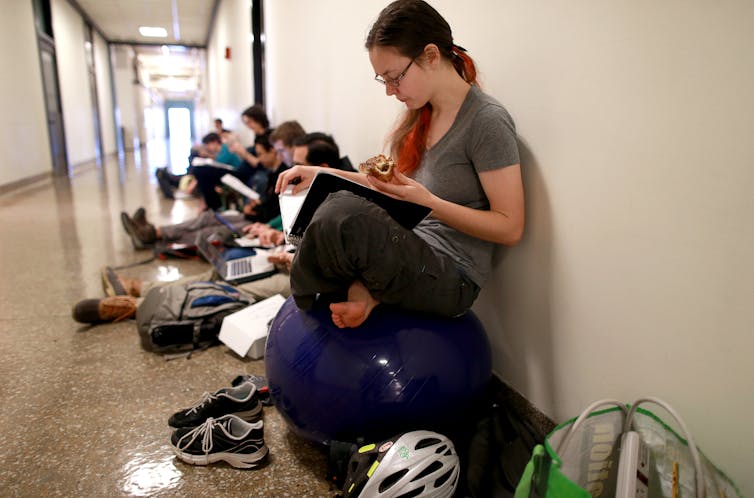
A female student sits on a yoga ball in a hallway reading a book. Other students are on laptops behind her.

MIT students study while staging a sit-in outside the university chancellor’s office in 2016 calling for the university to divest from fossil fuels. Photo by Jonathan Wiggs/The Boston Globe via Getty Images

Yet, while 70% of American adults describe climate change as an important concern, only 10% say they volunteered for an activity focused on addressing climate change or contacted an elected official about it in the previous year, according to a 2021 Pew Research Center poll.

Why do so few adults participate in actions to encourage governments and decision-makers to do more about climate change, even though surveys show they support doing so, and how can they overcome the skepticism holding them back?

What prevents people from speaking out

Polls show some people see how money from wealthy industries and individuals influences politicians and don’t believe politicians listen to the public.

Others are distracted by arguments that can tamp down engagement, such as campaigns that urge people to focus on individual recycling, or ask why the U.S. should do more if other countries aren’t, or argue that that there’s no need to rush because future technology will save humanity. Some believe that corporate and university promises to reach carbon neutrality in the future – often far in the future – are enough.

These narratives can be seductive. The focus on recycling, for example, offers a sense of satisfaction that one accomplished something. The arguments that China emits more greenhouse gases and that future technology will fix everything appear to exonerate people from having to take any steps now.

Studies have found that participating in local climate actions may require a constellation of values, attitudes and beliefs, including believing in one’s own ability, and the group’s, to get things done. Some of these beliefs can be developed through practice in organizing together, which is often downright fun, and has other psychological benefits that flow from increased solidarity in an often alienating society.

What I believe is particularly important is having a local theory of change – believing that, while human-caused climate change is a global problem, it is worthwhile taking local action.

3 reasons local activism matters

Research and history suggest that local action is more powerful than many people realize. Here are three key reasons:

First, much of the policy change that can affect climate change is local rather than national.

For example, replacing fossil fuel power plants with renewable energy technology can help lower greenhouse gas emissions. Much of this is under the control of state governments, which delegate the authority to public utility commissions. The public can pay attention to what utilities and public utility commissions do, and let their governors know that they are watching by writing letters and joining local groups that make their voices heard.

Cities can set policies to replace natural gas with electric appliances in homes and buildings, encourage homeowners to install efficient electric heat pumps and determine whether investments are made in public transit instead of freeways. When pressured, city officials do enact these policies.

Second, local wins can become contagious. In 1997, a handful of advocates in Massachusetts won their battle for a local policy under which a portion of electricity bill payments went to a not-for-profit agency that funneled money toward renewables. By 2022, this policy, known as community choice aggregation, was adopted by over 1,800 local governments across six states, affecting millions of people. Local action can also create learning curves for technology – pushing for more solar and wind turbines leads to increased manufacture and price drops.

Third, local action can trigger national policy, spread to other countries and ultimately trigger global agreements.

There are many historical examples, from the suffragette movement that won U.S. women the right to vote, to the fight for a 40-hour work week. Local action in the Southern U.S. catalyzed 1960s civil rights laws. Local action for same-sex marriage, starting in San Francisco, led to state laws and ultimately to federal legislation signed in December 2022 that prohibits states from refusing to recognize out-of-state marriages based on sex, race or ethnicity.

Environmental regulation in the 1970s is a striking case. It started with public alarm about cities clouded in smog, rivers catching fire from industrial waste and beaches fouled by oil spills. Citizens organized thousands of protest actions, and municipalities responded by implementing environmental enforcement.

The lawsuits that followed were very costly for corporate interests, which then supported federal intervention as a way to have predictable rules. It was President Richard Nixon who signed some of the furthest reaching legislation ever.

Youth successes in changing climate policy

In 2022, Congress passed the Inflation Reduction Act, which authorizes nearly $400 billion of climate-related spending over 10 years. I believe the youth-led Sunrise Movement can claim a major role in its success.

The group has relentlessly organized marches and demonstrations in dozens of cities since 2019 and pressured Democrats in Congress. While the result fell short of the group’s vision for a Green New Deal, it went further than any previous climate-related law.

Group action targeted at local decision-makers is a time-honored tradition – and I believe necessary in the current political environment for action on climate change.


Adam Aron, Professor of Psychology, University of California, San Diego

This article is republished from The Conversation under a Creative Commons license. Read the original article.

Still recovering from COVID-19, US public transit tries to get back on track

U.S. commuters take approximately 10 billion trips on public transit every year. SciLine asked Kari Watkins, an associate professor of civil and environmental engineering at the University of California, Davis, what cities can do to increase public transportation ridership and how people can make better use of this environmentally friendly mode of transportation.

Kari Watkins discusses why public transit matters to communities throughout the United States.

Below are some highlights from the discussion. Answers have been edited for brevity and clarity.

Why is transit a sustainable mode of transportation?

Kari Watkins: Economically, it’s easier on people’s pocketbooks. Environmentally, transit has less emissions per trip.

From an equity point of view, transit is more sustainable than other modes because you’re more able to serve all people. This service is out there – you don’t have to afford a vehicle in order to be able to take it.

How does public transit affect traffic congestion?

Kari Watkins: We save about 24% of our congestion levels by having transit in our 15 largest cities.

What has research shown us about transit’s safety?

Kari Watkins: Transit is the safest mode of transportation because of the professional drivers and because of the nature of how the services are provided. They’re often in their own corridors with really, really high factors of safety in how those corridors are designed.

When we look at cities where more people take transit as opposed to driving themselves, we always have lower crash rates, both internationally and across the U.S.

What are some trends of ridership on public transit systems in recent years?

Kari Watkins: Over the past approximately five years before COVID, we were seeing declines in both bus and rail in ways that we had not seen before and could not be attributed to things like population decreases or lower employment rates. We saw declines that could be largely attributed to the rideshare companies. Uber and Lyft were taking a pretty heavy toll on transit ridership.

In addition to this, before COVID, low gas prices were a factor. When gas prices go down, transit ridership is going to go down. And a little bit of increases in fares on transit systems was also hitting transit ridership.

And then COVID hit.

What happened during COVID was a lot of the people who rely on transit on a day-to-day basis – those critical workers, folks who were keeping our society going during the early parts of COVID – they still had to get to work. And many of those folks are bus riders as opposed to rail riders, because of the way we’ve set up these systems. And so we saw bus ridership decline, but it was still at significant portions of what it was before COVID.

Rail, on the other hand, was decimated, especially commuter rail.

Most commuter rail agencies are even still today nowhere close to what they were pre-COVID. In the early days of the pandemic, they were at 10% of the ridership levels that they once were.

We’re seeing some agencies, like Los Angeles Metro, where they’re predicting that in the next year or two, they’re going to be back up to the levels that they were pre-COVID. But there’s a lot of cities that have been permanently hit, such as San Francisco and New York.

Why are some transit agencies facing a ‘fiscal cliff’?

Kari Watkins: What happened during COVID was that many of these agencies were rescued through government programs where they got extra operating funds because the federal government and state governments knew that these agencies were going to be facing such dramatic declines in ridership that they wouldn’t be able to provide their services without some sort of extra support.

But all of that extra operating funding is disappearing over time. And with some agencies, they expect it’ll last another year, maybe two, but they’re not sure if their ridership is projected to be back at the same levels that it once was.

How could transit become more environmentally friendly?

Kari Watkins: There’s actually a lot that can be done to our system if we electrify transit further. For decades, we’ve had transit lines that had overhead systems to power it, or a third rail system, where it’s powered from underneath, like our subway systems.

All of those are really expensive to build. But battery technology that is coming around for our passenger vehicles is also coming around and improving greatly for larger-scale vehicles, such as trucks and buses. This gives us the ability to start to electrify routes that are running on pavement in streets. The hang-up is simply that we have to run these routes for an entire day and the window to charge them is just a small window overnight.

Watch the full interview to hear more about public transit.


SciLine is a free service based at the nonprofit American Association for the Advancement of Science that helps journalists include scientific evidence and experts in their news stories.

Kari Edison Watkins, Associate Professor of Civil and Environmental Engineering, University of California, Davis

This article is republished from The Conversation under a Creative Commons license. Read the original article.

Kevin McCarthy’s speaker bid in trouble as he reportedly loses more GOP votes

According to a report from CNN’s Lauren Fox, congressional allies of House Minority Leader Kevin McCarthy are afraid he is losing the support of some fellow House members who were previously backing his bid to become the new House speaker.

Republicans will hold a slim majority margin when they take control of the House in January after the midterm elections, and as has been previously reported, five members of McCarthy’s GOP caucus have already made it clear that they will vote against him.

Speaking with “CNN This Morning” hosts Kaitlan Collins and Poppy Harlow, Fox said McCarthy may have suffered more defections over the holiday break.

According to Harlow, “This morning, time is running short, not out yet, but short, for Minority Leader Kevin McCarthy to secure votes he needs to be elected House speaker. One week from today the newly-elected Congress will be sworn in, but several incoming Republicans have already said they will not vote for McCarthy’s bid to be speaker — but then the question is: who?”

“That is the question,” Fox replied. “Pressure is mounting on Kevin McCarthy to lock up those remaining votes. The state of play right now is there are five conservatives who have said that they will not support Kevin McCarthy for speaker without some kind of concession.”

“There could be more,” she added. “Some conservatives are arguing behind the scenes that there are more concerns growing — but the concern right now among moderates is the fact that … they could go into next week and there could be multiple ballots on the floor of the House of Representatives. … They could be in a position where this could take, not just a day, but multiple days to sort out.”


Want a daily wrap-up of all the news and commentary Salon has to offer? Subscribe to our morning newsletter, Crash Course.


“The concern is that, when they were elected in November, voters gave them the power to come to Washington, to do oversight of the Biden administration,” Fox concluded. “They could be in a position where that just can’t really get underway because they do not have the speaker,” she stated.

Watch below or at the link.

Twitter lifted its ban on COVID misinformation. Research shows this is a grave risk to public health

Twitter’s decision to no longer enforce its COVID-19 misinformation policy, quietly posted on the site’s rules page and listed as effective Nov. 23, 2022, has researchers and experts in public health seriously concerned about the possible repercussions.

Health misinformation is not new. A classic case is the misinformation about a purported but now disproven link between autism and the MMR vaccine based on a discredited study published in 1998. Such misinformation has severe consequences for public health. Countries that had stronger anti-vaccine movements against diphtheria-tetanus-pertussis (DTP) vaccines faced a higher incidence of pertussis in the late-20th century, for example.

As a researcher who studies social media, I believe that reducing content moderation is a significant step in the wrong direction, especially in light of the uphill battle social media platforms face in combating misinformation and disinformation. And the stakes are especially high in combating medical misinformation.

Misinformation on social media

There are three key differences between earlier forms of misinformation and misinformation spread on social media.

First, social media enables misinformation to spread at a much greater scale, speed and scope.

Second, content that is sensational and likely to trigger emotions is more likely to go viral on social media, making falsehoods easier to spread than the truth.

Third, digital platforms such as Twitter play a gatekeeping role in the way they aggregate, curate and amplify content. This means that misinformation on emotionally triggering topics such as vaccines can readily gain attention.

How to spot online misinformation.

The spread of misinformation during the pandemic has been dubbed an infodemic by the World Health Organization. There is considerable evidence that COVID-19-related misinformation on social media reduces vaccine uptake. Public health experts have cautioned that misinformation on social media seriously hampers progress toward herd immunity, weakening society’s ability to deal with new COVID-19 variants.

Misinformation on social media fuels public doubts about vaccine safety. Studies show that COVID-19 vaccine hesitancy is driven by a misunderstanding of herd immunity and beliefs in conspiracy theories.

Combating misinformation

The social media platforms’ content moderation policies and stances towards misinformation are crucial for combating misinformation. In the absence of strong content moderation policies on Twitter, algorithmic content curation and recommendation are likely to boost the spread of misinformation by increasing echo chamber effects, for example, exacerbating partisan differences in exposure to content. Algorithmic bias in recommendation systems could also further accentuate global healthcare disparities and racial disparities in vaccine uptake.

There is evidence that some less-regulated platforms such as Gab may amplify the impact of unreliable sources and increase COVID-19 misinformation. There is also evidence that the misinformation ecosystem can lure people who are on social media platforms that invest in content moderation to accept misinformation that originates on less moderated platforms.

The danger then is that not only will there be greater anti-vaccine discourse on Twitter, but that such toxic speech can spill over into other online platforms that may be investing in combating medical misinformation.

The Kaiser Family Foundation COVID-19 vaccine monitor reveals that public trust for COVID-19 information from authoritative sources such as governments has fallen significantly, with serious consequences for public health. For example, the share of Republicans who said they trust the Food and Drug Administration fell from 62% to 43% from December 2020 to October 2022.

In 2021, a U.S. Surgeon General’s advisory identified that social media platforms’ content moderation policies need to:

  • pay attention to the design of recommendation algorithms.
  • prioritize early detection of misinformation.
  • amplify information from credible sources of online health information.

These priorities require partnerships between healthcare organizations and social media platforms to develop best practice guidelines to address healthcare misinformation. Developing and enforcing effective content moderation policies takes planning and resources.

In light of what researchers know about COVID-19 misinformation on Twitter, I believe that the announcement that the company will no longer ban COVID-19-related misinformation is troubling, to say the least.


This article is republished from The Conversation under a Creative Commons license. Read the original article.

After years of pressure, 3M will stop making ‘forever chemicals’

In the face of continued legal action from states across the country, 3M, a Fortune 500 manufacturing company, will discontinue the use of “forever chemicals” by 2025.

3M makes Scotchgard and other water-repellent products which contain a class of chemicals known as per- and polyfluoroalkyl substances, or PFAS, that do not break down in the environment. PFAS has been found in nearly every state in the country and in everything from polar bears to fast food wrappers. Research has shown a link between these chemicals and public health concerns such as high blood pressure in mid-life women, stunted developmental growth, infertility, as well as kidney, liver, and testicular cancers.

In a statement, the St.Paul-based company said the decision comes on the heels of an “evolving external landscape,” which includes increased regulatory pressures. In the past year, the Environmental Protection Agency, or EPA, released a PFAS Strategic Roadmap, which plans to create new policies to protect public health and the environment while holding polluters accountable. In addition to the increased federal pressure, 3M has been the target of various lawsuits directed at PFAS manufacturers.

California announced a lawsuit in November that alleges 3M, DuPont, and other PFAS producers have caused far-reaching damage to public health and the environment by dealing in products laced with “forever chemicals.” The lawsuit is similar to a dozen others filed in states across the country. While the lawsuits are mounting, 3M’s awareness of their production problem has been festering for decades. 

As early as the 1970s, the manufacturing company knew that PFAS was accumulating in human bloodstreams. According to The Intercept, 3M was sued by its home state of Minnesota in 2010 and settled the suit for $850 million, which lead to a mountain of internal documents, memos, and research to be released by the state’s Attorney General’s Office, showing exactly what the company knew about the harm of the products it produced.

Minnesotans are still grappling with the potential health effects of PFAS, which has had devastating effects on the area’s youth. According to the Minnesota Reformer, a study of children who died between 2003 and 2015 in Oakdale, a Twin Cities suburb, found that a child who died there was 171% more likely to have had cancer than a child who died in the surrounding area. The state of Minnesota alleges that PFAS made its way into the area’s groundwater after decades of 3M discarding PFAS-contaminated waste products in unlined dump sites. 

The EPA announced in November that PFAS pollution from 3M had caused an “imminent and substantial endangerment” of the drinking water for nearly 300,000 people in the Quad Cities region of Illinois and Iowa and ordered an investigation into 3M’s role in the pollution. 

In 2000, 3M pledged to stop the use of two specific strains of PFAS chemicals in their production process, but the company argued, in its recent announcement, that the continued use of PFAS was “critical” to make products necessary for modern life, such as medical technology, phones, and automobiles. Legal experts estimate future litigation could cost the company upwards of $30 billion. 

In the wake of the announcement, environmental groups say the decision is long overdue and hope that the company is still responsible for decades of inaction and harm to the public.

“This is a big win for public health and the environment,” Mike Schade, a program director for the nonprofit Toxic-Free Future, told Grist. “3M historically has been one of the biggest PFAS polluters not only here in the US but globally, and for decades they have proceed and released massive amounts of PFAS that have contaminated communities, water supplies, fish and wildlife, all across the planet”

Schade said that this decision is part of a growing trend of major corporations abandoning PFAS in their manufacturing process. While the manufacturers are looking at a PFAS-free future, he noted that downstream businesses, like clothing companies that still trade in these chemicals, should stop the trail of toxic pollution. He said it’s likely that more companies will be looking for PFAS alternatives and the EPA and industry regulators should remain vigilant that the chemicals these companies replace PFAS with aren’t bound to create the same harms already documented by the forever chemicals. 

“In the years going forward, we’re going to be seeing hundreds of communities that have to clean up toxic chemicals, ” Schade said, “and 3M must be held financially liable for that pollution.”

Trump’s idiotic “trading cards” are the last straw for Republicans — but in God’s name, why?

Since Donald Trump’s “Major Announcement” the week before last turned out to be his attempt to sell ridiculous “digital trading cards” featuring his head photoshopped onto cartoon bodies he only wishes he had, Republicans have begun to abandon him. It is puzzling, to put it mildly, that this latest grift in a lifetime of grifting could be Trump’s bridge too far for many Republicans.

Let us consider a few of the things Donald Trump has done and said that were not enough to get his fellow Republicans to turn against him, and how his supporters apparently reacted: 

Taking more than $400 million (in today’s dollars) from his father and, during the decade between 1985 and 1994, losing more than a billion — more than anyone else in America — and declaring bankruptcy several times while claiming to be a great businessman?

Losing vast amounts of money while running a casino, a business where the house always wins?

Well, look at all those buildings with his name on them — and his private jet!

♦  ♦  ♦

Using fake names to pretend to be his own publicist and calling reporters to spread stories that he was having sex with many top celebrities? 

Everybody likes to blow their own horn!

Reacting to the collapse of the Twin Towers on 9/11 by claiming that the building he owned on Wall Street had been “the second-tallest building in downtown Manhattan — and now it’s the tallest“?

Gaining celebrity fame by telling people, “You’re fired”?

Declaring “I could stand in the middle of Fifth Avenue and shoot somebody, and I wouldn’t lose any voters.” 

He’s so smart — and so funny!

♦  ♦  ♦

Allegedly raping his first wife in a fit of rage and casually asking her the next morning, “Does it hurt”?

Describing Marla Maples his mistress at the time, as “nice tits, no brains”? 

Declaring, “You know, it really doesn’t matter what they write [about you] as long as you’ve got a young and beautiful piece of ass”? 

Bragging almost constantly about all the other women he had sex with while married?

Responding to a question about whether he’d ever had a “threesome” by claiming he had “slept with” three women at the same time?

Proclaiming, “I’d rather have a retarded hot woman than a slob who’s a doctor”?

Describing reporter Megyn Kelly, after she asked him difficult questions in a debate, as having “blood coming out of her wherever”? 

Calling women “bimbos, “fat pigs, “dogs,” “slobs” and “disgusting animals”?

Boasting, “I did try and fuck her. She was married, and I moved on her very heavily … I moved on her like a bitch!”? 

Saying, in the most famous hot-mic moment in history, that he likes to “grab ’em by the pussy”?

That’s just what men do!

♦  ♦  ♦

Boasting on worldwide television about the size of his penis?

Proclaiming at a dinner party during the 2016 campaign, “I don’t need Viagra. I need a pill to make my erection go down”

That’s just what men do!

♦  ♦  ♦

When asked if he had a lower age limit for women he’d have sex with, first responding, “No,” but then catching himself: “No, I have no age — I mean, I have an age limit. I don’t want to be … with, you know, 12-year-olds,” and then saying that 35 is “checkout time” for women, perhaps indicating that his preferred age range is between 13 to 35?


Want a daily wrap-up of all the news and commentary Salon has to offer? Subscribe to our morning newsletter, Crash Course.


Obviously lusting for his daughter, saying, “If Ivanka weren’t my daughter, perhaps I would be dating her. … Don’t you think my daughter’s hot? She’s hot, right. … She’s really something, and what a beauty, that one. If I weren’t happily married and, you know, her father ,” and then answering a question about what he has most in common with his daughter with. “Well, I was going to say sex …”

Democrats are groomers and pedophiles!

♦  ♦  ♦

Calling Mexicans drug dealers and rapists?

Admitting that his “university” was a scam?

Refusing to release his income tax returns?

Asking Russia to help him dig dirt on a political opponent?

Mocking a person with a disability?

Intentionally separating migrant children from their families and putting children in cages?

Huh. What’s the problem?

♦  ♦  ♦

Faking “bone spurs” to avoid being drafted and later saying he felt “like a great and very brave soldier” in his “personal Vietnam” of avoiding STDs from all the girls he had sex with while other men were overseas, because vaginas are “potential landmines”?

Saying of John McCain, “He’s not a war hero; I like people who weren’t captured”?

Referring to American service members killed in wars as “losers” and “suckers” and refusing to visit a military cemetery when it was raining because it might mess up his hair?

He is a true patriot and a true American!

♦  ♦  ♦

Hovering over Hillary Clinton like a stalker during a debate? 

But her emails!

♦  ♦  ♦

Insisting that his obviously small Inauguration crowd was the largest in history?

Introducing the concept of “alternative facts” (also known as lies)?

Inviting the Russian foreign minister and ambassador into the Oval Office, yucking it up with them and spilling some top secret intelligence?

Telling people that climate change is a Chinese hoax, and taking the United States out of the Paris climate accords?

Doing everything he could to undermine NATO and help Vladimir Putin?

Scuttling the Iran nuclear deal?

Calling Haiti and various African nations “shithole countries”?

Attempting to blackmail Ukraine to help him win in 2020? 

Benghazi! 

♦  ♦  ♦

Saying the Nazis who marched in Charlottesville in 2017 with torches and chanted, “Jews will not replace us” were “very fine people”?

Saying he wants to be president for life, like Xi Jinping, and have everyone stand when he enters a room?

“Falling in love” with Kim Jong-un, the world’s most evil and murderous dictator?

Trying to order a Fourth of July military parade through Washington, like the ones Putin, Xi and Kim get to have in Moscow, Beijing and Pyongyang? 

Calling Putin a “genius” for invading Ukraine?

Telling a gang of right-wing terrorist thugs to “Stand down, and stand by”?

Getting awfully close to overtly embracing QAnon insanity?

Openly consorting with Nazis, white nationalists and antisemites?

He’s unpredictable! He goes his own way!

♦  ♦  ♦

Thinking that Frederick Douglass, who died in 1895, “is being recognized more and more”?

Suggesting that the Continental Army “took over the airports” from the British during the War for Independence? 

History’s bunk, we’ve got no past!

♦  ♦  ♦

Telling more than 30,000 lies, an average of more than 20 a day, as “president”?

Using his position as president to enrich himself and his family?

Appointing right-wing extremists to the Supreme Court and ending women’s right to control their own bodies?

Deliberately hiding the severity of the COVID pandemic resulting in at least 200,000 unnecessary deaths?

Science is a hoax! Vaccines are evil! Doctors, nurses and “public health” officials are communists. Repeal the 19th Amendment! Freedom!

♦  ♦  ♦

Intentionally promoting the Big Lie that the 2020 election was stolen from him, further dividing the nation and endangering the survival of our republic? 

Plotting a coup to make himself dictator? 

Stealing top secret documents?

Calling for the termination of the Constitution and his “reinstatement” as president? 

Nobody cares! But this grotesque digital trading card scam? That’s too much — we have to draw the line somewhere!

A resolution for 2023: Time to say no to the “woke wars”

As a left-leaning journalist who spends substantial time online, I must confess that I find it increasingly difficult to take a side in the seemingly endless “woke wars.” On one hand, few people are more annoying than those forever aggrieved over the mostly mythical “cancel culture.” That obsession is certainly not limited to the right: Fear of “cancellation” has sunk its claws into legions of people who otherwise might view themselves as progressives. “Cancel culture” trolls like Bari Weiss make money not just off conservatives who refuse to own the label, but stalwart Democrats who never get tired of cancellation horror stories, most of which are false, or at least highly exaggerated.

Almost invariably, the supposed threat to “free speech” turns out to be little more than a boss discouraging a middle-aged white librarian from making a “rap video” about orientation. Or students complaining that limp cafeteria pulled pork is not actually “banh mi.” The epitome of this, of course, comes in the form of J.K. Rowling, Elon Musk and Dave Chappelle imagining themselves as the 21st-century equivalent of Rosa Luxemburg because people tell them that it’s gross to be transphobic.  

Those people suck. But if you’ve ever put a digital toe onto Twitter, it is also undeniable that woke bullies are not entirely figments of the reactionary imagination. Earlier this month, Vox reporter Rebecca Jennings wrote a searing article titled “Every ‘chronically online’ conversation is the same,” which documented some of the atrocities: A woman bombarded with accusations of elitism and singleton-shaming for saying she enjoys having coffee with her husband. A woman shamed for supposedly flaunting “privilege” because she used a grocery delivery service. A musician called “ableist” because she asked audiences to be present at her shows, rather than recording the whole thing on their phones. And, my favorite, “a 21-year-old Redditor being accused of ‘grooming’ her 20-year-old boyfriend.” It made me laugh, but also cry, because I’ve certainly been subject to this bullshit in the years I’ve been on Twitter. 

(That the overly woke prefer female victims is noteworthy, but a topic for another time.) 


Want more Amanda Marcotte on politics? Subscribe to her newsletter Standing Room Only.


Alas, there’s a lot of pressure to choose sides. In our social media-dominated age, nuance is not allowed, and certainly not when it comes to the woke wars. Either you deny there are bullies who use social justice as a fig leaf, or you agree that everyone is in imminent danger of social ruin for forgetting to indicate their pronouns. There’s no room for the boring truth, which is that both sides sometimes have a point and also that both sides are guilty of wild exaggeration. 

It’s probably just wishful thinking, but I’d love it if 2023 became the year that we finally say goodbye to all this. Let this be the year of letting go — both of the pressure to fly into a panic over “cancel culture” or to deny that Twitter is rife with jerks who hide their sadism behind a veneer of social justice. This idiotic merry-go-round exists in large part because social media profits handsomely from fights where nobody wins and everybody is wrong. But collectively, we have the power to disengage, and to deprive the woke wars of their power.  

I had this revelation watching Jennings discuss her article with Jon Favreau on the podcast “Offline,” as well as reading an essay Jennings recommended, “Fuck Puritanism” by P.E. Moskowitz. Both focused — accurately, in my view — on the psychology of woke bullies, depicting them as people driven by insecurity, hopelessness and social isolation. “[P]eople who have adopted this kind of newfangled religious obsession with perceived moral offense are in denial of what they actually want,” Moskowitz writes. Especially for people struggling with social anxiety or loneliness, browbeating others on Twitter feels like an easy way to get attention and feel powerful, without having to engage people authentically or, heaven forbid, actually leaving the house. 

That’s when it hit me, though: The chronic complainers about “cancel culture” are no different. It’s one thing to laugh at internet weirdos who think it’s “ableist” to read books or “classist” to rent an apartment with a washing machine. But the anti-woke faithful fold these stories into a self-righteous narrative in which they are the sole defenders of free speech, in the face of Stalinist terror. Never mind that in the real world, most people don’t know or care some rando on Twitter condemned Anne Frank for “white privilege.” The anti-wokers have a story about how they alone can defeat the censorious left — um, apparently by bitching about them online. 

This was driven home even more after I read the New York Times quiz purporting to discover “what a well-meaning person can say without offending someone.” The neologisms invoked were exclusively the ones the anti-woke crowd associate with leftist overreach, such as “chest-feeding,” “pregnant people,” or “primary bedroom” (that one is instead of “master bedroom”). Right-wing signaling phrases like “cancel culture,” “fake news” or “globalist elite” were ignored. The purpose here was clearly not a good-faith interrogation of shifting linguistic norms, but an attempt to provoke another round of “Has the left gone too far?”, driving outrage on both sides — and traffic to the New York Times. 


Want more Amanda Marcotte on politics? Subscribe to her newsletter Standing Room Only.


On “Offline,” Jennings flagged one of the most bizarre Twitter shitstorms, in which a woman (it’s almost always a woman!) was dogpiled for making a joke about a friend who didn’t know how to chop tomatoes. She was accused of elitism and ableism for assuming that knowing how to chop vegetables is a simple skill grown-ups ought to master. Then, of course, there was another cycle of outrage over the outrage, and things got uglier — while engagement soared.

While hearing Jennings recount this story, it occurred to me that most of these woke warriors were probably just jealous of the original tweeter — she has a close friend she feels comfortable enough with to tease about her lack of tomato chops. That made it a lot harder for me to feel mad at them. Instead, I felt sorry for them — I hope they get the help they need, and find friends of their own. By the same token, a lot of people who are super worked-up about “cancel culture” are also isolated and anxious about being left behind in a changing world. 

Both sides in the woke wars exaggerate the size and scope and impact of the other side, in order to tell a tale about their own martyrdom. It’s exhausting. But we all have the power to turn down the temperature. You don’t have to summon that much empathy to remember that a lot of annoying people are just acting out.

Not every provocation deserves a response. False accusations of bigotry and over-the-top hysterics about “cancel culture” can be met with an eyeroll or by pressing the “mute” button. Better yet, close the app or the browser window. Read an article — or maybe even a book! Take a walk. Have a real conversation with an actual human. Call a relative. You’ll soon find out that, freed from the algorithm that encourages sanctimonious posturing and pointless conflict, much of what seems so important on social media actually doesn’t matter at all. 

Modern capitalism has created an epidemic of isolation and loneliness, dramatically compounded by a pandemic that most of us, at least socially speaking, are still trying to recover from. The internet can too easily create an illusion of connection, when all it’s actually doing is drawing out our most suspicious and antisocial sides. On the right, this manifests in the widespread embrace of ever-stranger conspiracy theories like QAnon. But on lefty social media, we’re suffering through a crisis of empty piety, where people get attention by dunking on each other for being either too woke or not woke enough. Now that Elon Musk’s Twitter has made a point of showing users how many views a tweet gets from people who don’t engage, users may be even more inclined toward provocation and antagonism.

I was already scaling back on my Twitter time — or trying to, anyway — when Musk finalized his purchase on the company. Since then, I’ve put myself on a stricter Twitter diet. One major benefit is that the woke wars have begun to fade into the background. I get yelled at less for perceived excesses or deficits in my political correctness. Offline, I find that people are funnier, more relaxed and less worried about performing moral superiority. They are kinder, and more forgiving. It’s rare to identify a problem that literally goes away because you start ignoring it, but the online warfare over wokeness is one of them. 

Democracy depends on whistleblowers like Cassidy Hutchinson — flaws and all

On the last day of the Constitutional Convention in September 1787, the prominent Philadelphia socialite Elizabeth Willing Powel supposedly asked Benjamin Franklin whether the fledgling nation’s new constitution would create a monarchy or a republic. He famously answered: “A Republic, if you can keep it.”

In 2022, Cassidy Hutchinson, a former aide to Mark Meadows, Donald Trump’s final White House chief of staff, courageously played an outsized part in keeping it.

Franklin understood the fragility of democracy. Its survival requires the vigilance not only of an educated citizenry, but especially of those who serve in government. Yet the demands of loyalty and the lure of power are seductive countervailing forces. With any institution, whether a corporation or a presidency, rooting out corruption depends upon individuals who choose morality over loyalty.

In an all-too-familiar story, Hutchinson, like many whistleblowers, faced an agonizing dilemma: choosing between her moral convictions and allegiance to her former White House bosses. She understood the price that choosing morality entailed. As she told the House select committee on the Jan. 6 insurrection, “You know, I’d seen this world ruin people’s lives…. I’d seen how vicious they can be…. And I was scared of that.” 

As if the likelihood of retaliation were not enough, the choice between loyalty and moral responsibility often comes with extreme financial pressure. Hutchinson was out of work when the committee subpoenaed her. She lacked funds to pay a lawyer. She risked dramatically limiting her future career prospects if she stepped out of line.

Then there was the social and emotional pressure of parting company with her professional circle, including many of her friends, and being both politically and personally ostracized. Hutchinson initially accepted free representation from “Trump world,” as she called it. In preparation for her committee interview, her lawyer, Stefan Passantino, encouraged her to answer “I don’t recall,” even when she did recall.

She went along with that plan, at least until her conscience rebelled. At a break in her first interview, she told Passantino in a panic that she had claimed not to recollect things she actually remembered perfectly well. Passantino pressed her to stay the course, telling her in so many words that she wouldn’t get caught.

In turmoil, Hutchinson reached out to a Republican lawmaker she trusted who told her she had to live with the “mirror test”: Will you be able to live with yourself if you just move on or do you have to stand up and tell the truth?

She then found guidance in the history of Watergate’s most important whistleblowers, a former aide in the Nixon White House named Alexander Butterfield. In 1974, he exposed the fact that all of Richard Nixon’s Oval Office phone calls and meetings had been recorded. Over a weekend, Hutchinson read Butterfield’s book about his experience — not once, but three times. Without his truthful testimony, the American public would never have had the smoking gun that ended Nixon’s attempted cover-up and conspiracy against democracy.

Courage can be inspirational, even across generations. Hutchinson realized that, like Butterfield, she had to tell the whole truth. She found a new attorney willing to work pro bono and delivered her bombshell testimony before the committee, which changed the nation’s perceptions of Donald Trump, perhaps permanently


Want a daily wrap-up of all the news and commentary Salon has to offer? Subscribe to our morning newsletter, Crash Course.


The difficult choice that Hutchinson faced has a counterpart in the corporate world, where the promise of potential future prestige, power and financial gain, or even pure financial necessity, motivates many witnesses of wrongdoing to remain silent in a spirit of misguided loyalty. Even so, there are important difference between those who work in the private sector and those who serve in government. Public office is a public trust.

Cassidy Hutchinson found guidance in the history of Watergate’s most important whistleblowers, the former Nixon White House aide Alexander Butterfield.

Cassidy Hutchinson may not have been a perfect profile in courage. She was initially evasive with the committee. But whistleblowers are not required to be perfect people. In fact, they are “ordinary people under extraordinary pressure,” to quote a line delivered by Al Pacino as “60 Minutes” producer Lowell Bergman in the film “The Insider.” Pacino continues: “What the hell do you expect — grace and consistency?” 

Thanks to Hutchinson and others, we have a crucial window into Trump world, and it’s not a pretty picture. But an educated and committed citizenry can work to address it. Just last week thanks in no small part to activists pushing to protect our democracy against future assaults, Congress adopted the Electoral Count Act Reform Act. It closed loopholes in its 1887 predecessor that Trump sought to exploit to overturn the 2020 election.

Regrettably, this Congress did not adopt other important democracy-preserving measures, including the Whistleblower Protection Improvement Act. The incoming House majority will certainly not be supportive such reforms. Its leaders will likely be intent on protecting Trump and attacking their political enemies on every front.

But attempts to undermine our republic can be thwarted if those who care about it remain vigilant. Opposing the anti-democratic efforts of House Republicans over the next two years can help “keep the Republic” until 2024. America will then have the opportunity to elect a Congress willing to enact whistleblower protections and other measures to safeguard our freedom.

Cassidy Hutchinson’s courage reminds us never to underestimate each citizen’s power to effect positive change. We must follow her lead. Democracy depends upon it.

GOP Rep-elect George Santos vows “I will take office” after admitting to “résumé embellishment”

On Monday, The Daily Beast reported that Rep.-elect George Santos (R-NY) issued an apology for making up several aspects of his life story in his campaign — but still went out of his way to assail and threaten journalists at The New York Times for blowing the lid off his false claims.

“The 34-year-old called into a talk radio show for an interview with WABC to address the Times investigation,” reported Jake Lahut. “‘Well, the record is, I don’t know what my options are,’ Santos said when asked if he would sue the publication.”

Santos, a Brazilian immigrant, made several claims about himself in the course of his congressional campaign that have come under scrutiny. He claimed to have graduated from Baruch College and New York University, which have no records of his attendance, and that he went on to work for Goldman Sachs and Citigroup, which have no records of his employment. An openly gay man, he claims to have lost four coworkers from his company at the Pulse Nightclub shooting in Orlando, but none of the identified victims have a record at the firms mentioned in his biography. And he claimed to have run a charity called Friends of Pets United, which rescued thousands of dogs and cats — a charity that does not appear anywhere in IRS tax records.

Subsequent reporting revealed Santos may also have made up being part Jewish and his family having escaped the Holocaust. Even his claim to have come out as a gay man a decade ago doesn’t add up, as records show he was married to a woman until 2019.

“The Long Island Republican said he was going to be ‘quiet anyway’ for the past week because of the sixth anniversary of his mother’s death, but vowed to take his seat and be sworn in on January 3, when the new Congress will convene for the first time,” said the report. “‘I’m gonna look through and see everything, and just like they nitpicked at me, now it’s gonna be my time to nitpick at both journalists who made it their mission to slander me across this country and across the world, and let’s see what happens at the end,’ Santos said. ‘But the one thing is, I will be sworn in, I will take office, I will be able to be an effective member of the legislator [sic.] in the soon-to-be 118th Congress…'”

“He then went into a reworked version of his stump speech before one of the hosts asked if he gave his own money to his campaign,” said the report. “‘That is the money of, that I paid myself through my company, the Devolder Organization,’ Santos said. The hosts did not push back any further, and Santos thanked New Yorkers for their ‘tremendous amount of support.’ Santos also gave a vague apology ‘if I disappointed anyone by résumé embellishment,’ but did not elaborate beyond that.”

Harvard law prof: Trump’s Jan. 6 defense lawyers better be “getting their client to plead insanity”

After the January 6 Select Committee released its final report, former President Donald Trump responded with an angry video attacking the committee and defending his actions before and during the January 6, 2021 attack on the U.S. Capitol Building. Veteran Harvard University law professor Laurence Tribe has responded to Trump’s video, saying that his arguments in the video are so weak that he would be better off with an “insanity” defense if a prosecution comes about.

Trump, in the video, attacked members of the January 6 Committee as “very bad people” and claimed that they “did not produce a single shred of evidence” that he “intended or wanted violence at our Capitol.” The former president insisted that the Committee was spreading “a monstrous lie.”

Trump angrily declared, “We wanted security. We wanted safety. There was no insurrection, and there wasn’t going to be an insurrection. It was made up by these sick people. Nancy Pelosi and the DC mayor refused; if they’d listened to me, my recommendation, none of this would have happened. And you wouldn’t have heard about January 6 as we know it.”

On Christmas Day 2022, the Harvard Law School professor tweeted, “If this is the ‘defense’ at Trump’s forthcoming trial, I don’t envy the lawyers who agree to represent him. They’d better be psychiatrists expert at reflexive projection and capable of getting their client to plead insanity.”

Documentary spurs a new look at the case of the first gene-edited babies

In the four years since an experiment by disgraced scientist He Jiankui resulted in the birth of the first babies with edited genes, numerous articles, books and international commissions have reflected on whether and how heritable genome editing – that is, modifying genes that will be passed on to the next generation – should proceed. They’ve reinforced an international consensus that it’s premature to proceed with heritable genome editing. Yet, concern remains that some individuals might buck that consensus and recklessly forge ahead – just as He Jiankui did.

Some observers – myself included – have characterized He as a rogue. However, the new documentary “Make People Better,” directed by filmmaker Cody Sheehy, leans toward a different narrative. In its telling, He was a misguided centerpiece of a broader ecosystem that subtly and implicitly supported rapid advancement in gene editing and reproductive technologies. That same system threw He under the bus – and into prison – when it became evident that the global community strongly rejected his experiments.

Creation of the ‘CRISPR babies’

“Make People Better” outlines an already well-documented saga, tracing the path of He from a promising young scientist at Rice and Stanford to a driven researcher establishing a laboratory in China that secretly worked to make heritable genome editing a reality.

He’s experiment involved using the CRISPR-Cas9 technique. Sometimes compared to “molecular scissors,” this precision tool allows scientists to make very specific edits to DNA in living cells. He used CRISPR to alter the CCR5 gene in human embryos with the goal of conferring immunity to HIV. These embryos were brought to term, resulting in the birth of at least three children with altered DNA.

The revelation of the births of the first gene-edited babies in November 2018 resulted in an international uproar. A laundry list of ethical failings in He’s experiment quickly became evident. There was insufficient proof that editing embryos with CRISPR was safe enough to be done in humans. Appropriate regulatory approval had not been obtained. The parents’ consent was grossly inadequate. And the whole endeavor was shrouded in secrecy.

Trailer for the documentary ‘Make People Better.’

New context, same story

Three figures play a central role in “Make People Better”‘s study of He Jiankui. There’s Antonio Regalado, the reporter from MIT Technology Review who broke the original story. There’s Ben Hurlbut, an ethicist and confidante of He. And there’s Ryan (the documentary withholds his full identity), a public relations representative who worked with He to make gene editing palatable to the world. He Jiankui himself was not interviewed, though his voice permeates the documentary in previously unreleased recordings by Hurlbut.

Regalado and Hurlbut have already written a considerable amount on this saga, so the documentary’s most novel contribution comes from Ryan’s discussion of his public relations work with He. Ryan appears to be a true believer in He’s vision to literally “make people better” by using gene editing to prevent dreadful diseases.

But Ryan is aware that public backlash could torpedo this promising work. His reference point is the initial public hostility to GMO foods, and Ryan strove to avoid that outcome by gradually easing the public in to the heritable gene editing experiment.

This strategy turned out to be badly mistaken for a variety of reasons. He Jiankui was himself eager to publicize his work. Meanwhile, Regalado’s tenacious journalism led him to a clinical trials registry where He had quietly posted about the study.

But ultimately, those factors just affected the timing of revelation. Both Ryan and He failed to appreciate that they had very little ability to influence how the experiment would be received, nor how much condemnation would result.

Blind spots

While some documentaries strive to be flies on the wall, objectivity is elusive. Tone, framing, editing and choice of interview subjects all coalesce into a narrative with a perspective on the subject matter. A point of view is not itself objectionable, but it opens the documentary to critiques of its implicit stance.

On the one hand, the documentary gives substantial attention to Hurlbut and Ryan, who emphasize that He did not act alone. He discussed his plans with dozens of people in China and around the world, whose implicit support was essential to both the experiment and his confidence that he was doing nothing wrong.

On the other hand, the documentary focuses on understanding He’s background, motives and ultimate fate. Other figures who might have influenced He to take a different path fade into the background – sometimes quite literally, appearing for only seconds before the documentary moves on.

Indeed, as a biomedical ethicist, I believe there is good reason to put responsibility for the debacle squarely on He’s shoulders. Before the news broke in 2018, international panels of experts had already issued advisory statements that heritable gene editing was premature. Individuals like Hurlbut personally advised He as much. The secrecy of the experiment itself is a testament: He must have suspected the international community would reject the experiment if they knew what was going on.

If He had gone through proper, transparent channels – preregistering the trial and consulting publicly with international experts on his plans before he began – the whole saga could have been averted. He chose a different, more dangerous and secretive path from the vast majority of researchers working in reproductive biotechnology, which I suggest must be acknowledged.

The documentary does not reflect critically on its own title. The origin of the phrase “make people better” is surprising and the film’s most clever narrative moment, so I won’t spoil it. But does heritable gene editing really make people better? Perhaps instead, it makes better people.

The gene-edited babies were created via in vitro fertilization specifically as a part of He’s experiment. They would not have existed if He had never gotten involved in gene editing. So, some would argue, He did not save any individual from contracting HIV. Rather, he created new people potentially less likely to contract HIV than the general population.

I contend that this doesn’t mean gene editing is pointless. From a population health perspective, gene editing could save lives by reducing the incidence of certain diseases. But this perspective does change the moral tenor of gene editing, perhaps reducing its urgency.

What’s more, editing CCR5 is a dubious means to improve human well-being, since there are already effective ways to prevent HIV infection that are far less risky and uncertain than heritable gene editing. Scientific consensus suggests that the best first-in-human candidates for heritable gene editing are instead devastating genetic disorders that cannot be ameliorated in other ways.

The future for He Jiankui

Perhaps due to the timing of its filming, the documentary does not dwell on He being sentenced to three years in Chinese prison as a result of the experiment, nor mention that he was released early in 2022.

Evidently, He is not content to fade quietly into obscurity. He says he is slated in March 2023 to give a talk at the University of Oxford that may shed more light on his motives and actions. In the meantime, he has established a new biotech start-up focused on developing gene therapies. To be clear, this work does not involve editing embryos.

Still, it appears prison has not diminished He’s ambition. He claims that he could develop a cure for the degenerative genetic disease Duchenne muscular dystrophy – if he receives funding in excess of US$100 million.

To me, this ambition reflects a curious symmetry between Regalado and He in “Make People Better.” Both are driven to be first, to be at the forefront of their respective fields. Sometimes, as with Regalado, this initiative can be good – his intrepid reporting and instinct to publish quickly brought He’s unethical experiment to a rapid close. But in other cases, like He’s, that drive can lead to dangerous science that runs roughshod over ethics and good governance.

Perhaps, then, the best lesson a viewer can take from “Make People Better” is that ambition is a double-edged sword. In the years to come, it will be up to the international community to keep such ambition in check and ensure proper restrictions and oversight on heritable genome editing.The Conversation


G. Owen Schaefer, Assistant Professor in Biomedical Ethics, National University of Singapore

This article is republished from The Conversation under a Creative Commons license. Read the original article.

“We backslid”: Doctors talk about how abortion care changed in 2022

It came as a shock, in spite of everything. Halfway through the year, we knew it was coming. We knew from the years and years of laws systematically chipping away at abortion access. We knew from the closed clinics. We knew, weeks before, when the Supreme Court’s draft opinion was leaked in May. And yet, as I sat in the Salon studios on a Friday in June and a female colleague looked over and said, “They overturned Roe,” I felt the immediate sense of free fall terror. The impact was immediate and chilling.


Want more health and science stories in your inbox? Subscribe to Salon’s weekly newsletter The Vulgar Scientist.


In states with trigger laws, the sense of urgency among patients and providers kicked in right away. Rachel Lachenauer, the Director of Patient Experience at the National Abortion Federation, told Salon last June following the decision, “We’re getting absolutely inundated today with callers who are saying ‘I just got a call from my facility, or I just called them to check in and I’ve learned that I’m no longer able to access care in my state.”

“We backslid. That has been so intense, so painful, so alarming, especially as somebody who’s been in this field for my entire adult life.”  

As the days and weeks went on, the devastating repercussions of punitive and poorly thought out restrictions began to reveal themselves in harrowing headlines. And managing miscarriages and medical emergencies became new litmus tests for hospitals. “We backslid,” says Los Angeles OB-GYN and “Menopause Bootcamp” author Dr. Suzanne Gilberg-Lenz. “That has been so intense, so painful, so alarming, especially as somebody who’s been in this field for my entire adult life. It’s just depressing.” 

In Texas, a 26 year-old woman named Elizabeth Weller shared the story of how a desired pregnancy turned into a “dystopian nightmare” when a rare medical problem created a life-threatening emergency — and a hospital ethics committee had to determine if she was close enough to dying to warrant intervention. In Missouri, 41 year-old Mylissa Farmer went into the hospital when her water broke before she had reached 18 weeks into her pregnancy. Though the pregnancy was not viable and the risk of serious infection high, doctors told her they could not offer a D&C. 

And in Louisiana, 36 year-old Nancy Davis shared the story of how she traveled 2,500 miles round trip to New York City to terminate a pregnancy for a fetus with a fatal condition, because the staff at her own hospital refused to do it. “Basically,” she said in an August press conference, “they said I had to carry my baby to bury my baby.”

“There are people making decisions on clinical care who don’t have a clinical background. And that’s a dangerous, slippery slope.”

As access becomes more restricted and fragmented, states with stronger abortion protections face their own challenges. Dr. Kecia Gaither, a board-certified physician in OB-GYN and maternal fetal medicine in New York, tells Salon, “I’ve seen personally, there has been an influx of people coming to New York for reproductive services. That’s definitely been seen, and monies have been allocated to ensure that there’s adequacy of supplies and assistance. I have friends in other parts of the country who are concerned. They’re concerned as to their liability. The bottom line I personally think is, there are people making decisions on clinical care who don’t have a clinical background. And that’s a dangerous, slippery slope. Ectopics are an issue. Congenital anomalies are an issue, particularly congenital anomalies that are not compatible with life.”

The post-Dobbs reality has also potentially been a boom to at least one industry, with greater interest in and demand for medication abortions. They already account for roughly half of all pregnancy terminations in the US, and as access becomes more challenging, the demand for assistance in safely and privately self-managing abortion is likely to only become greater and greater.

Abortion is not just a healthcare issue. It’s a political one. It’s an economic one. It’s a business one. When large corporations like PayPal and Microsoft vowed to cover travel costs for employees seeking abortions, it seemed a burst of virtue signaling with zero thought-out strategy.

Workplace diversity expert and strategist Kim Crowder notes, “I think that there’s a conversation that is necessary to be had among women ourselves, particularly white women about what they really believe around this. What does access to this look like? What about the folks who can who don’t have access to not only travel, or childcare or time off of work? Where it’s not so simple?” She adds, “Unfortunately, women are still in the workplace often not supported, not heard, particularly when we talk about women of color. Black women are receiving still lower support in the workplace, and if they’re not being counted in that regard, they’re certainly not going to be counted in this regard.”

Yet the news has not all been demoralizing. The thwarted red wave of the 2022 midterm elections sent a clear signal that Americans still prioritize reproductive safety. As Amanda Marcotte reported in November, “Among Democratic voters this midterm, 48% said abortion was an important issue for them.” In California in November, voters approved Prop 1, adding abortion and contraception rights to the state constitution. Vermont and Michigan passed similar protections. 

And in smaller ways, the urgency of the crisis has emboldened advocacy.

“People do not recognize how dangerous a pregnancy can be.”

says Dr. Gilberg-Lenz, “and they need to get their acts together. Even those of us who are out there speaking publicly, we have to be very careful that we are letting people know that we are really are there for them. We have to stand up for our patients.” Dr. Faina Gelman-Nisanov a board-certified OB-GYN with licenses to practice medicine in New York and New Jersey, says, “I have seen pharmacists call me more often, and ask me how I prescribe these [abortion] medications we’re prescribing because they want to be supportive of patients, and educate themselves more.” 

When we look back on this year and what it has meant for reproductive rights, it’s the individual stories that stand out. Stories of frustrated doctors and concerned pregnant or potentially pregnant individuals, grappling for compassionate support and medical attention. Dr. Faina Gelman-Nisanov recounts a recent conversation with a client. “I had a patient this week with a desired pregnancy. She’s super happy about it,” she says. “She’s going to the Midwest. I asked her, ‘Where are you going? Who’s going to be there? Have you told anyone that you’re pregnant?’ My advice is to no longer tell anyone that you’re pregnant. Only you and your partner should know. She and I looked at the laws in that state. We looked at nearby hospitals. And for her, it’s actually more beneficial to drive to a hospital in California, because the providers in her state may or may not provide her with care. I had to explain to her that there’s no guarantee that if she has a hemorrhage, that she will be provided with life-saving treatment. What you keep hearing again and again is that hospitals are waiting for administrators, are waiting for their lawyers to give approval to give a transfusion and to perform a simple D&C to stop the bleeding. So now my patient has to be aware of who’s around her, what their political beliefs are, whether or not they know she’s pregnant, how they feel about her. And the closest hospital, for her this holiday season, is four hours away.” 

Why Disneyland is Coke and Vegas is Pepsi

I had never considered Vegas a town lacking in anything. I had come for a few days this past fall, dutifully overloading my senses and depleting my wallet every time I left my hotel room. But at a dinner one night with a large group of colleagues, I heard the first rumblings of discontent, and unfulfilled wishes. “You wouldn’t,” the woman next to me at our table asked the waiter gently, “just happen, by any chance, to have Coke?” He shook his head. She’d already guessed as much.

“Am I tripping or is everything here Pepsi products?”

Vegas is a Pepsi town — so much a Pepsi town that it’s one of the few places in the world that’s ever served Pepsi in some of its McDonald’s locations. If you go on travel forums, you will discover spirited discussions about how tricky it can be to find a Coke, or, as one Redditor put is earlier this year, “Am I tripping or is everything here Pepsi products?” And if you Google “Las Vegas Pepsi,” your results will produce the plaintive “Why is there no Coke in Las Vegas?”  Naturally, once I realized this, I wanted nothing else from Sin City but an icy bottle of the Real Thing.


Want more great food writing and recipes? Subscribe to Salon Food’s newsletter, The Bite.


There is, in fact, Coke to be found in Vegas, most notably in some higher-end properties like the Bellagio. There is even a Coca-Cola store on the Strip, so you won’t be deprived if that’s your preference. But as the Vital Vegas guide noted back in 2019, “The Strip is Pepsi dominated, as the big casino companies have deals with Pepsi.” Caesars properties, for instance, are Pepsi zones. And with Pepsi comes its suite of other beverages — handy to know if you’re a fan of Mountain Dew. But considering the deluge of advertising for Bacardi I encountered in my hotel, I did find myself wondering if my cocktail hour plans might have to include a rum and…. Pepsi. 

Pepsi’s relationship with the town shows up in other ways. In 2020, PepsiCo launched its Dig In initiative to support Black owned restaurants across the country, which just this fall featured a Restaurant Royalty Residency program to “bring signature dishes from Black-owned restaurants” to MGM properties in Las Vegas.

In hindsight, I can see how Pepsi, with its somewhat edgier brand identity, is a natural fit for Vegas. It likewise checks out that wholesome, all-American Coke, in contrast, dominates the happiest place on earth. 

The Disney relationship goes back to before there were even Disney theme parks. As Chelsea Burnett, Alliance Manager of Disney Corporate Alliances, wrote on the Disney Parks blog last year, “Our relationship with Coca-Cola started in 1942 when Walt Disney first appeared on the Coca-Cola radio program ‘The Pause That Refreshes on the Air.'” Coke was on the menu when Disneyland opened back in 1955, but it’s been the parks’ exclusive beverage provider since the 1980’s. Today, the company’s products are ubiquitous in Disney parks all around the world.

Theme parks and casinos are, of course, just a larger manifestation of the kind of corporate contracts that not so subtly guide our recreational consumption choices. Julian Goldie, CEO of the SEO link-building Goldie Agency notes, “A movie theater may enter into a partnership with a particular soda brand and exclusively serve that brand in their concessions or an amusement park may be sponsored by a particular snack food company, and feature their products throughout the park. Brands can often guide our choices through strategic product placement and promotional efforts. For example, a casino may prominently display certain brands of beverages near popular gaming areas, or a music venue may offer discounts on certain brands of drinks as part of a special promotion.” Or Caesars may choose, like it did this spring, the High Roller wheel as the perfect place to launch a Pepsi Nitro pop-up experience. The result, as Steven Zhang, founder of the tea culture blog TeaJust, notes, is that “these tactics create an association between the brand and the experience of enjoying a night out.”

If you’re very a brand-loyal traveler, you might want to do some advance work before you take off, so you’re not already ordering room service before you learn that Pepsi is the drink of choice in Marriott’s over 6,300 properties. And if you’re thirsty for the thing that refreshes you most, you might have to get out and stock up. Matt James of the travel blog Visitingly suggests, “If you are in a ‘Coke town’ and want a Pepsi, you can usually find one at a convenience store or grocery store. You may also be able to request a different brand of soda at restaurants or bars, although they may not always have it available.” When all else fails, you can always just order something else — but it wouldn’t be quite the same, right?

I am not enough of a soda consumer to usually care — or notice — the soft drink culture of a particular town or resort. (I have however been known to get feisty about the beer offerings at certain stadiums.) But the elusiveness of Coke in Vegas made it absolutely tantalizing to me. There, Coca-Cola glittered like an effervescent dream in my imagination, as out of reach as a row of cherries on a slot machine. I bought a bottle at my bodega when I got home. It was okay. But like so many things about Las Vegas, getting it wasn’t as good as wanting it had been.

California passed a milestone law to stop neighborhood drilling. Big Oil launched a counterattack

Environmental justice communities and advocates across California celebrated a major victory in August when state legislators passed a bill to ban new oil wells and phase out old ones within 3,200 feet of sensitive sites like homes, schools, and hospitals.

It was a win decades in the making. Activists had spent years fighting to protect communities from the toxic impacts of neighborhood oil drilling, which include higher risks of cancer, asthma, heart disease, preterm birth, and other reproductive issues. Democratic state Senator Monique Limón, who introduced the setbacks bill, known as SB 1137, called its passing, “a historic moment in California history.”

But last week, Big Oil struck back. The California Independent Petroleum Association, or CIPA, the trade group representing drillers in the state, announced it has gathered enough signatures to force a referendum onto the 2024 state ballot. If approved by voters, it would overturn the state legislature’s decision and dismantle the new setbacks law, leaving it to CalGEM, the state’s slow moving regulatory body for oil and gas, to implement protections on its own accord. 

CIPA originally filed the paperwork for the referendum just three days after Governor Gavin Newsom signed the oil setback bill into law in September, and has spent months collecting the more than 600,000 signatures needed for the initiative to be formally included on the 2024 ballot; Stop the Energy Shutdown, the CIPA-run committee sponsoring the referendum effort, has now collected over 978,000. Over the next few months, California’s secretary of state and county registrars will count and certify the signatures.

“What we’re seeing right now is the last gasp of a dying industry that is willing to do anything to get what they want,” said Kobi Naseck, a coalition coordinator with Voices in Solidarity Against Oil in Neighborhoods, or VISIÓN.

While 2024 seems far away, experts told Grist that the new referendum, by even qualifying for the ballot, could have consequences starting immediately. Instead of going into effect January 1, the protections established by SB 1137 will be delayed until after the vote, buying fossil fuel companies two more years to reap profits from their wells. “What we could see in the next two years is a big run on permits and a huge amount of drilling, in anticipation of a loss for Big Oil in 2024,” said Naseck.

In California, there are 2.7 million people who live within 3,200 feet, a little over a half mile, of active oil wells; Black and Brown residents account for 70 percent of that total. The biggest funders of Stop the Energy Shutdown are oil companies that operate in low-income neighborhoods and places where communities of color live and work.  

Sentinel Peak Resources, Signal Hill Petroleum, and E&B Natural Resources Management Corp., which together contributed over $10 million to the referendum campaign, have a combined 3,186 wells within the setback zones recommended by public health researchers and designated in the new bill. This past year, Signal and E&B received notices of violation for methane and noxious gas leaks that exceeded air safety standards; E&B made the news earlier this month for resisting excessive pressure warnings ahead of an oil well blowout in a residential area of Bakersfield that injured an employee. In total, the Stop the Energy Shutdown coalition of “small business owners, concerned taxpayers, local energy producers, and CIPA,” raised over $20 million as of December 2 to overturn the regulation that would protect people from these types of hazards.

In a statement to Grist, Rock Zierman, the chief executive officer of CIPA, said the legislative hearings on the bill did not adequately consider job losses, and that setback advocates “are trying to eliminate the cleanest oil production in the world, while destroying the rainforest and increasing greenhouse gas emissions by making California more dependent on foreign oil.” 

As Michael Hiltzik notes in the Los Angeles Times, nearly four-fifths of California’s oil already comes from overseas, and oil production in the state has been declining for years because the supply in the ground is depleting. In addition, at the senate hearing on SB 1137 in August, state Senator Henry Stern procured a statement from Nemonte Nenquimo, a Waorani leader involved in the tribe’s lawsuit to stop oil drilling in the Amazon due to its impacts on local people and ecosystems; Nenquimo expressed solidarity with the communities living near backyard oil wells in California. 

In the purest sense, getting an initiative or referendum on the state ballot is a way for residents to bring new laws directly to the public for vote. But in reality, it is an incredibly costly undertaking, referred to by detractors as a tool used mostly by special interest groups, such as industry, to get around legislation. In the case of the oil industry’s ballot push, residents and advocacy groups have reported numerous counts of petitioners sharing misleading information and outright lying about the purpose of the measure outside grocery stores across California. Inside Climate News reported on petitioners saying the oil-backed ballot measure would lower gas prices and that it would stop the practice of neighborhood drilling. It would in fact do the opposite.

“The office of the Secretary of State has received a large number of complaints,” said Hollin Kretzmann, an attorney focused on oil and gas issues with the Center for Biological Diversity. The Secretary of State has already launched an investigation, and advocates are calling for the state Attorney General to investigate the issue as well, said Naseck. 

Setback advocates expect to know the final status of the referendum effort and the validity of its signatures sometime between the end of February and April. 

If it does qualify, there is one last line of defense for communities. California’s regulatory body for oil and gas, CalGEM, was in the process of drafting a public health rule to create statewide buffer zones when SB 1137 was passed into law. According to advocates, CalGEM’s rulemaking process had been dragging on for years, and the bill was an attempt to force the agency to take swifter and more decisive action. 

“Even before SB 1137, we never needed a law on the books for CalGEM to do the right thing and regulate oil and gas operators near homes and schools,” said Naseck. Last year, the agency did deny a host of permits on the grounds of climate justice and public health. At the same time, they also permitted a set of new wells in Santa Clarita in Los Angeles County, leading to a lawsuit.

On Monday, the agency issued a notice of proposed emergency rulemaking action to implement setbacks, indicating that it plans to move forward with fulfilling its mandate under SB 1137. “If CalGEM wanted a permanent protection and safety buffer zone, they would continue with the draft rulemaking process that has been long delayed,” said Naseck. 

“All eyes will be on the agency to see what happens in the new year,” he added.

Adjusting the intensity of farming can help address climate change

We have little chance of tackling climate change and reducing biodiversity loss without a redesign of the world’s largest industry: agriculture and food.

While shifting to more plant-based diets and reducing food waste will be critical steps, what occurs at the farm level will matter more. There, it will be the choices made around technology and intensity that will matter.


Agricultural practices, like regenerative farming, can help address climate change.

Agricultural intensity

With crops grown in farm fields, more intensive management means a reduction in the diversity of crops grown, combined with increased application of nutrients and use of mechanical soil tillage on the farm.

In eastern Canada, cropping has intensified by becoming less diverse.

Common cash crops, such as soybean, leave very little residue (which is mostly carbon) to add to the soil to help reverse CO2 accumulation in the atmosphere. This intensification has led to a continuing decline in the amount of carbon in soil.

Canadian farmers, with support of federal and provincial programs, are responding to the climate change challenge with a host of cropping interventions, all of which fall under the umbrella of “nature-based climate change solutions.”

These new practices aim to improve soil health, return more carbon to soil, improve nitrogen efficiency and reduce greenhouse gas losses.

While zero-tillage (avoiding disturbing the soil for planting) does not enhance soil carbon in Eastern Canada — unlike in Western Canada — cover cropping, crop diversification and maintaining perennial pastures are recommended.

Cover crops — that help the soil recover — can also enhance cash crop productivity by supplying nutrients.

Maintaining ecosystem biodiversity

What about maintaining biodiversity? Should we maximize farming intensity and farm land efficiency to preserve more natural lands as reservoirs of biodiversity? Gauging a farming system on the basis of how productive it is alone, risks not sparing land from losses of soil carbon and soil.

Less intensive cropping systems can benefit biodiversity both above and below ground on farmed land. Opting for a productive but moderate range of farming intensity is thus ideal for preserving both soil, its carbon content and biodiversity.

As we have recently shown, a spectrum of intensity of cropping management is also found within regulated farming systems that follow an operating standard such as certified organic farming.

While organic farms are, in general, less intensive due to a greater diversity of crops grown and reduced nutrient application, they differ widely in the diversity of cropping and the level of nutrients added to the soil.

Managing nitrogen and carbon

Improving the retention of carbon and management of nitrogen are important, and there are various management approaches.

Led by the fertilizer industry, a 4-R approach to nitrogen fertilizer nutrient management uses the right fertilizer source, at the right rate, at the right time and at the right place. This approach is being widely promoted across Canadian agriculture with the goal of improving nitrogen use efficiency on farms and reducing nitrogen-derived greenhouse gas emissions.

But what about carbon? Half of the land on earth is now devoted to agriculture, and so reversing CO2 accumulation in the atmosphere through redesigning cropping systems is essential.

A recent standardized global framework for measuring and monitoring soil carbon on farms outlines the approaches needed for soil sampling and analyses to effectively measure what are often slow changes in soil carbon in response to improved cropping practices.

But for most farmers, closely managing soil carbon is a recent endeavor — and an unfamiliar element. It is now even possible to farm carbon as a source of revenue.

Other than broad recommendations to sustain organic matter in soil, which is 50 to 55% carbon, carbon seldom appears in long-established farm nutrient or resource management guidelines.

Changes in soil carbon are the net balance between carbon added (like crop residues and manures) minus carbon lost through organic matter decomposition. We can conceive a parallel 4Rs framework for its management that takes into account: rotation of crops, residue management, return of manure and rate of tillage intensity. Rotation refers to the sequence of crops and cover crops.

Residue management acknowledges that benefits to soil carbon of diverse crop rotations can be lost if most of the crop residues are removed. Type and frequency of disturbance through tillage determines how much added decomposition of soil organic matter occurs.

The role of agriculture

Agriculture plays a central role in employing nature-based solutions to climate change. Developing climate-smart agriculture requires understanding the intensity at which all farms operate. Innovative economic programs, incentives and credits are needed to support farms aligning their practices with climate-related goals.

Derek Lynch, Professor of Agronomy and Agroecology, Dalhousie University

This article is republished from The Conversation under a Creative Commons license.

How Harry Styles became an even bigger star – and the one we needed the most – in 2022

None of this would have happened without “Harry’s House” … [which] helped steer his career forward.

When Harry Styles is on tour, his Instagram feed tends to be a colorful array of photos showing off elaborate stage outfits, dramatic poses and cheeky glimpses into his backstage life. 

But in mid-December, he posted a more casual black-and-white photo of him in a tracksuit, ostensibly before a show, along with a reflective missive. “2022 changed my life,” he wrote. “I can’t begin to thank all of you who supported me through it, I’ll never forget it. I hope your end of year is filled with happiness and calm. Love you all.”

Styles’ breakout year was perhaps more a culmination of a whirlwind decade full of life-changing moments — a reflection of his intense ambition and diligent work ethic. The Redditch, Worcestershire, England, native first became a massive superstar in the early 2010s, when he filled stadiums with the effusive pop group One Direction. After the group went on hiatus, Styles went solo and immediately found success with his 2017 self-titled debut. He quickly followed this up with “Fine Line,” which recently celebrated its third anniversary, and then this year’s “Harry’s House.”

But Styles’ 2022 was so successful, it’s hard to pinpoint exactly what was so transformative. Was it that he landed prominent acting roles in the movies “Don’t Worry Darling” and “My Policeman”? Was it the 15 concerts he sold out at Madison Square Garden, as part of an ongoing tour that also saw him play 12 nights in Los Angeles and do extended residencies in Chicago and Austin? Or is it that he won Favorite Male Pop Artist and Favorite Pop Song at the American Music Awards, ahead of nabbing six Grammy nominations, including three in the most prestigious categories? How about coming in at No. 2 on Billboard‘s Greatest Pop Stars of 2022 list?

My PolicemanHarry Styles in “My Policeman” (Amazon Studios)

Styles is an avowed Elton John fan, and you can hear shades of John’s own early-career musical evolution in the eclectic music.

Save for the acting, none of this would have happened without “Harry’s House.” It can be difficult for pop artists to break the mold of what made them successful — in Styles’ case, a mix of upbeat pop bangers, heartfelt anthems and flashy rockers. “Harry’s House” more than anything helped steer his career forward, moving him away from the homages to ’70s glam and rock (and Fleetwood Mac) in favor of a funkier, soulful and more introspective vibe. 

“I think a big part of kinda [the] evolution of what music you make as well is, like, it doesn’t matter if people want you to be that thing that they always loved about you or they want you to be that person, because you’re not that person anymore,” Styles told Apple Music. “Everyone is changing, and I think there’s no reason to not approach music that way, and kind of let it change and turn out differently than you started.”

More specifically, Styles is an avowed Elton John fan, and you can hear shades of John’s own early-career musical evolution in the eclectic music. “Harry’s House” starts with a one-two opening punch of the horn-peppered strut “Music For a Sushi Restaurant” and the glittery “Late Night Talking” and extends to the album’s guests. Bass legend Pino Palladino contributes to two tracks, including “Daydreaming,” which also samples the Brothers Johnson’s “Ain’t We Funkin’ Now,” while Ben Harper adds the plaintive and disorienting guitar to the folkish, harmony-heavy “Boyfriends.” Dev Hynes, meanwhile, adds cello to “Matilda,” reinforcing the song’s somber themes. 

Lyrically, songs ruminate on past relationships and ephemeral romances, provide sharp character sketches of people trying to find their equilibrium — led by “Matilda,” featuring someone dealing with the fallout from a neglectful family — and describe hazy, late nights that provide both emotional clarity and intellectual obfuscation. 

Styles launched “Harry’s House” with the effervescent “As It Was,” which exuded the carefree vibe of summery ’80s pop through a modern production lens. Lyrically, however, it was moodier than past singles, acknowledging the quick pace of change and speaking to the power of restlessness. “In this world, it’s just us/You know it’s not the same as it was.”

“It’s about metamorphosis and embracing change, and former self and perspective shift, and all of that kind of stuff,” he told Audacy. “And it just felt like the thing I wanted to say, and the thing I wanted to be doing, and the kind of music I wanted to make coming back.” “As It Was” resonated, entering the charts at No. 1 in both the UK and U.S., and spent 15 weeks atop the Billboard Hot 100. (It also spawned one of the best mash-ups of the year, with a-Ha’s “Take On Me.”)  

Styles’ concerts are capital-E Events that encourage fans to don costumes, formalwear, high-fashion — whatever they feel called to wear on a given night.

Live, “Harry’s House” also transformed into something else entirely. Styles is known for a buzzing and energetic live presence — a very model of aerobic endurance — who commands a stage alongside his band. “Our job tonight is to entertain you — I promise you we’ll do our very best,” Styles said before “Grapejuice,” in an Apple TV concert that aired the day of “Harry House”‘s release. “Your job is to have as much fun as you possibly can. If you want to sing, if you want to dance. Please feel free to do whatever it is you want to do. Please feel free to be whoever it is you’ve always wanted to be.”

That’s not just lip service. Styles’ concerts are capital-E Events that encourage fans to don costumes, formalwear, high-fashion — whatever they feel called to wear on a given night. There are show rituals — notably line dancing during “Treat People with Kindness” and conga lines — and elevated banter. Styles has helped people come out, overseen baby gender reveals, and made room for marriage proposals. For years, Styles has worn various flags given to him by fans during certain moments of his shows — to name a few, the trans, pride, bisexual and lesbian flags. 

Fan rituals are a time-honored tradition that bond people together into permanent friendships, creating what can often feel like a secret language shared by only a few. When you’re going through rough times or seeking out your path in life, this aspect of fandom brings solace —something that anchors you and provides meaning.

But this welcoming environment especially speaks to why Styles’ music and presence are resonating. He provides an oasis of acceptance, and a come-as-you-are approach that’s deeply moving but also deeply important. 


Want a daily wrap-up of all the news and commentary Salon has to offer? Subscribe to our morning newsletter, Crash Course.


On the whole, the world at large can feel very unaccepting of differences today. We’re living in a time of anti-LGBTQ legislation and sentiment that’s led to book banning, nasty protests and gun violence and a time experiencing a sharp rise in antisemitism. We’re dealing with the misogyny, oppression and health challenges that go hand in hand with the overturn of Roe v. Wade, and having conversations about the ways racism and discrimination steer the country’s power dynamics. Ableism is still rampant. 

In light of this, it’s radical to say “treat people with kindness” (as Styles does in a signature tune) and encourage a space for unconditional acceptance, empathy and understanding. It’s not tacit approval — but loud, proud and galvanizing approval. Both live and on record, “Harry’s House” offers a window into what Styles has been through, but also serves as an invitation to embrace a lifestyle that’s more open and vulnerable. It’s clear Styles hit on something profound and successful in 2022 by following his own advice — it’s exciting to imagine where this might take him in the future.

Trump lashes out over report Ivanka and Jared Kushner are avoiding him as he stews at Mar-a-Lago

Donald Trump kept up his prolific posting on his Truth Social account on Monday after spending the Christmas holidays lashing out at his enemies and complaining that, without him in the Oval Office, the U.S. is going to hell.

Or as he put it on Christmas day: “The USA is dying from within!!!

After attacking Senate Minority Leader Mitch McConnell (R-KY) and his wife on Monday, the former president addressed a deep dive into his Mar-a-Lago life over the past 30 days, since he made his announcement that he would be running for president for a third time, written by New York Magazine’s Olivia Nuzzi after she interviewed him at his pricey Florida resort.

A great part of her reporting noted that the former president is pre-occupied with his legal problems and has basically holed up at Mar-a-Lago where close aides say he is just going through the motions of running again (“He just goes, plays golf, comes back, and f*cks off. He has retreated to the golf course and to Mar-a-Lago”), and that “The magic is gone” as one campaign adviser admitted.

In his interview with Nuzzi, Trump balked at the idea that — contrary to what his close aides are saying — he has almost become a shut-in, with the journalist writing, “Trump’s campaign schedule, described to me as ‘busy,’ involved 11 events over the course of the month. One event was the announcement itself. Five events took place at Mar-a-Lago. Four events were not events at all but taped videos that were aired at events where Trump was not physically present.”

Addressing that Truth Social on Monday Trump wrote, “So funny to read and hear the Fake News political pundits saying that “Trump isn’t working too hard on his campaign. This is not a good sign, maybe he’s giving up (even though I’m leading BIG in the Polls!). What they don’t say is that, ‘WE HAVE ALMOST TWO YEARS TO GO.’ The Rallies will be bigger and better than ever (because our Country is going to Hell), but it’s a little bit early, don’t you think?”

In her New York Magazine piece, Nuzzi also noted that the former president became “defensive” when asked about reports that his daughter Ivanka and her husband Jared Kushner balked at lending him a helping hand after his dinner with antisemite Kanye West and white nationalist Nick Fuentes turned into a firestorm that had Republicans heading for the hills, and that they have continued to keep their distance since the 2020 election loss.

On Monday Trump claimed, “Contrary to Fake News reporting, I never asked Jared or Ivanka to be part of the 2024 Campaign for President and, in fact, specifically asked them not to do it – too mean and nasty with the Fake & Corrupt News and having to deal with some absolutely horrendous SleazeBags in the world of politics, and beyond. There has never been anything like this ‘ride’ before, and they should not be further subjected to it. I ran twice, getting millions more Votes the second time (RIGGED), & am doing it again!”