Spring Sale: Get 1 Year, Save 58%

Starved of new talent: Young people are steering clear of oil jobs

In late May, António Guterres, the secretary-general of the United Nations, stood in blue graduation robes in front of a podium at Seton Hall University in South Orange, New Jersey. Looking out at the thousand-plus graduating seniors, Guterres told them that the world was facing a climate catastrophe — and it was up to them to stop it.

“As graduates, you hold the cards. Your talent is in demand from multinational companies and big financial institutions,” Guterres said in the commencement address. “But you will have plenty of opportunities to choose from, thanks to the excellence of your graduation. So my message to you is simple. Don’t work for climate wreckers. Use your talents to drive us towards a renewable future.”

If they hadn’t heard the advice from Guterres, they might have gotten the idea that digging up ancient oil deposits was not a promising career path from somewhere else. The billionaire Bill Gates recently predicted that oil companies “will be worth very little” in 30 years; CNBC’s loudest finance personality, Jim Cramer of Mad Money, has declared he’s “done” with fossil fuel stocks. 

It’s part of a larger social reckoning that threatens to make business harder for oil companies. Big Oil is becoming stigmatized as awareness grows that its environmentally-friendly messaging, full of beautiful landscapes and far-off promises to erase (some) of its emissions, doesn’t match its actions. Well over half of millennials say they would avoid working in an industry with a negative image, according to a survey in 2020, with oil and gas topping the list as the most unappealing. With floods, fires, and smoke growing noticeably worse, young people have plenty of reasons to avoid working for the brands that brought you climate change. 

This poses a hiring challenge for oil companies, with much of their current workforce getting closer to retirement. For years now, consulting firms have been warning the industry that it faces a “talent” gap and surveying young people to figure out how they might be convinced to take the open positions. 

Meanwhile, solar and wind power are booming and luring young people who want a job that fits with their values.  In 2021, according to the business group E2, 3.2 million Americans worked in clean energy industries like renewables, electric vehicles, and energy efficiency — 3.5 times the number that worked in fossil fuels. And this is likely just the beginning: Congress recently passed the Inflation Reduction Act, which is expected to cause an explosion of climate-related jobs.

“I do feel that there’s this big pincer movement coming for the fossil fuel industry — you know, they’re going to be pinched in lots of different directions,” said Caroline Dennett, a safety consultant who publicly quit working for Shell earlier this year because the company was expanding oil and gas extraction projects. “And that’s exactly what we need.”

‘Retention is a massive, massive problem’

If it weren’t for climate change, now might seem like the perfect time to drill for more oil. Russia’s invasion of Ukraine sent oil prices soaring this year, driving them up as high as $120 a barrel in June — the “boom” of the boom and bust cycle. The price has since dropped to $85, but could climb higher since OPEC, the oil cartel that includes Russia and Saudi Arabia, recently agreed to cut production by 2 million barrels a day

With prices this high, oil companies would normally begin digging up more wells to increase production. But the calculus has changed. After years of losses, investors want their dividends. “Now we’re in a situation where the oil and gas companies are making a lot of cash flow … but the investors who stuck with those companies are basically saying, ‘Well, I stuck it out with you, give me my money back,'” said Peter Tertzakian, an energy and investing analyst, on the podcast Odd Lots this summer. Added to that is the growing pressure for financial institutions to divest from fossil fuels. All this, along with the “end of oil narrative,” has made investors hesitant to back new drilling projects, Tertzakian explained.

And even if investors were interested in expanding drilling right away, many oil companies don’t have extra drilling equipment lying around ready to use, or extra people ready to operate it. Trained and knowledgeable workers are retiring or moving to other industries. The average oil and gas worker is 44 years old, a recent report from Deloitte found. The industry has mostly rehired the 15,000 workers it laid off during the 2020 crash, according to data from the U.S. Bureau of Statistics. But the workforce numbers have been on a long downward trend since 2015, when oil prices took a plunge after a supply glut. The volatility of the industry — the cycle of laying off and hiring people — is another factor that makes the jobs unappealing, the Deloitte report said.

“Half of oil and gas professionals, I believe, would gladly leave the oil and gas industry tomorrow if they could get a renewable energy job,” said Dar-Lon Chang, who worked as an engineer at ExxonMobil for 16 years before resigning in 2019 over concerns about climate change. A recent global survey by AirSwift found that 82 percent of current oil and gas workers would consider switching to another energy sector in the next three years, up from 79 percent last year and 73 percent in 2020. Fifty-four percent of those thinking about leaving picked the renewable industry as a preferred destination.

“Retention is a massive, massive problem,” Dennett said. “They’re losing their most expert, skilled, and experienced technicians, engineers, designers, operators, mechanics … I think they will be starved of new talent.”

When Big Oil comes up in the news, it’s usually something bad — oil spills, climate lawsuits, or other dirty business. The industry has drawn comparisons to Big Tobacco, and this image has started to affect workers. “We don’t want to be the bad guys,” said one anonymous participant in a study surveying oil workers’ opinions about climate change as part of a recent paper in the journal Energy Research and Social Science. 

Krista Haltunnen, the author of that study and an energy researcher at Imperial College London, said that many workers believe they can drive change within their company. “A lot of them think that they’re doing the best they can for climate change or for a better society, whether they’re right or not,” Haltunnen said. Dennett, for example, worked with Shell to make oil operations safer; Chang joined ExxonMobil after assurances from recruiters that the company was “seriously considering transitioning away from oil” and researching cleaner alternatives, and that he’d be working with natural gas — sold as the “bridge fuel” to a renewable future.

Bernard Looney, the CEO of BP, has acknowledged that Big Oil’s reputation is causing problems for companies like his. In an interview with the Times of London in 2020, Looney said that oil was becoming increasingly “socially challenged.” Employees at BP were having doubts about their line of work, he said, and some job candidates were reluctant to join the company. “There’s a view that this is a bad industry, and I understand that,” Looney said at the time.

A ‘permanent black mark’

The generation that’s been striking from school to protest government inaction on climate change isn’t exactly itching to join the oil workforce. A poll by the consulting firm EY in 2017 found that 62 percent of 16- to 19-year-olds in the United States found a career in oil and gas unappealing. More than two out of every three teenagers surveyed said that the industry causes problems instead of solving them. Young people tend to view oil careers as “unstable, blue-collar, difficult, dangerous and harmful to society,” the report said, perceptions that posed a “significant obstacle” toward attracting and retaining a highly skilled workforce.

And they’re making their qualms known. Last week, dozens of students at Harvard, MIT, and Brown disrupted on-campus recruiting events for ExxonMobil, protesting that the company was undermining their future.

College students are also steering clear of petroleum engineering programs, creating a gap as oil companies look to replace retiring Baby Boomers. Over the last five years, the number of people graduating from petroleum engineering programs has dropped from 2,300 to around 400, an 83 percent plunge, according to statistics from Lloyd Heinze, a Texas Tech University professor. Schools in America’s oil patch, such as Louisiana State University and the University of Houston, are seeing drastic declines in enrollment in petroleum engineering, and others are beginning to shut down their programs: The University of Calgary in Canada and Imperial College London both pressed pause on their oil and gas engineering majors last year.

The trend extends from fieldwork to the front office. From 2006 until 2020, the number of business school graduates who went into a career in the oil and gas industry fell by 40 percent, according to a survey of 3.5 million MBA students conducted by LinkedIn, while the number of students recruited into renewables rose.

“The dilemma is happening in every company, because if you’re involved in projects that you know are detrimental for the environment,” what you do every single day may “test your moral values,” said Manuel Salazar, an activist in Ireland who is working to help employees push their companies to protect the environment.

Oil companies require other services to stay running — and advertisers and lawyers may get harder to come by as they turn their backs on the industry. About 400 advertising and PR agencies have signed a pledge by the group Clean Creatives to cut ties with fossil fuel clients. And as oil companies face a mounting pile of climate-related lawsuits, some young lawyers may be reluctant to defend them. Two years ago, 600 lawyers in training signed a letter to the firm Paul Weiss pledging that they would not work at the company unless it dropped ExxonMobil as a client. (It has not.) An anonymous law student graduating with student debt recently wrote in to the New York Times’ ethics column to ask whether it was OK to defend polluting companies they were “ethically opposed to” in order to pay off their loans, worrying it could create a “permanent black mark” on their record. 

Chang thinks that his decade-plus as an engineer at ExxonMobil has gotten in the way of working in clean energy. He has applied for hundreds of clean energy positions since 2015 but has only gotten a few interviews. Eventually, he ended up creating his own job, a startup that’s trying to get funding to renovate people’s homes to get to net-zero emissions. 

“I think that people who go into renewable energy, they tend to be suspicious of people who are trying to leave the oil and gas industry,” Chang said. While there may be some “bad apples,” he thinks the majority of oil and gas employees “are legitimately trying to do the right thing” — and would leave if they could.

Trader Joe’s 13 best pizza ingredients to add to your shopping cart right now

When it comes to what kind of pizza reigns supreme, homemade always takes home the top prize in my book. Sure, delivery, frozen and takeout ‘zas have their fair share of perks. To name a few, they’re quick, simple and require little to no effort to prepare.

But making your own pizza from scratch allows you to customize it to your liking, experiment with new flavors and even have fun along the way. Today, I’m dreaming of a thin-crust pizza with both banana peppers and mushrooms.

Thankfully, making your own pizzas at home just got a whole lot easier with Trader Joe’s vast assortment of ingredients and toppings. From spicy cheeses and tangy sauces to a gluten-free crust and fresh veggies, here are 13 pizza ingredients to grab from Trader Joe’s right now.

This list adds to Salon Food’s growing library of supermarket guides. If you’re looking for an autumnal beverage to enjoy alongside your homemade pizza(s), check out the 6 beverages to add to your Trader Joe’s cart this fall.

01

Volpi Gourmet Uncured Pepperoni

Volpi Gourmet Uncured PepperoniVolpi Gourmet Uncured Pepperoni (Photo courtesy of Joseph Neese)

Volpi’s Gourmet Uncured Pepperoni is sold at TJ’s stores, even though it’s not the retailer’s own brand item. This sliced pepperoni is a popular pizza topping on Reddit, where loyal TJ’s shoppers have shared pictures of their favorite homemade pizzas.


A few fan-favorite recipes include Volpi’s Gourmet Uncured Pepperoni with store-bought plain pizza dough and TJ’s brand mozzarella cheese and pizza sauce. If you’re not a fan of store-bought pizza dough (or are running low on time to make pizza dough from scratch), you can use TJ’s Garlic Naan as the base and then add your choice of cheese, sauce and veggies alongside the pepperoni slices.


According to Reddit user u/night_owl, “I’m very fond of Volpi. They are based in the famous ‘The Hill’ district of St. Louis and have been gradually expanding their distribution across the USA…They produce the TJ’s branded wine-flavored salamis as well as having some of their own Volpi-branded products in store. My local TJ’s always has pre-sliced pepperoni in stock.”

02
Cheddar Cheese with Scotch Bonnet Chili Peppers
Trader Joe's Cheddar Cheese with Scotch Bonnet Chili PeppersTrader Joe’s Cheddar Cheese with Scotch Bonnet Chili Peppers (Photo courtesy of Joseph Neese)

A staple ingredient in Caribbean cuisine, Scotch bonnet chili peppers tout a subtle yet delicious sweet taste. In TJ’s Cheddar Cheese with Scotch Bonnet Chili Peppers, the chilies are incorporated into classic English cheddar to create a one-of-a-kind product that serves well in pizzas, grilled cheese, casseroles and dinner party charcuterie boards.


“A delight for heat-seekers and fromage fans of all stripes, this cheddar balances its blend of sweet, spicy, and creamy with remarkable grace,” TJ’s writes on its official website.

03
All Natural Fresh Mozzarella Cheese
Trader Joe's All Natural Fresh Mozzarella CheeseTrader Joe’s All Natural Fresh Mozzarella Cheese (Photo courtesy of Joseph Neese)

TJ’s choice adjective for its All Natural Fresh Mozzarella Cheese is “magical” — and we couldn’t agree more. This cheese, which is encased in a plastic package, is mild in flavor and flaunts the signature “bouncy” texture that is characteristic of fresh mozzarella. TJ’s All Natural Fresh Mozzarella Cheese is also made with milk from cows never treated with rBST, which makes it both a delicious and safe option for homemade pizzas.

04
Sliced Prosciutto
Trader Joe's Sliced ProsciuttoTrader Joe’s Sliced Prosciutto (Photo courtesy of Joseph Neese)

If you’re looking for a quality prosciutto to top on classic pizza bianca, look no further than TJ’s Sliced Prosciutto. Per TJ’s, it’s crafted by “a well-known, award-winning Italian salumeria here in the U.S.” The prosciutto is made from full hams that are “cured in the traditional Italian style” and then aged slowly for approximately 10 to 12 months.


“As the hams age, their flavor intensifies and their character builds, resulting in richly-flavored prosciutto that is outstanding on panini with arugula and asiago, a natural with melon for brunch or hors d’oeuvres and super on a pizza — try it with pesto or a cream-based sauce and inch-long cuts of asparagus,” the California-based retailer adds.

05
Quattro Formaggi
Trader Joe's Quattro FormaggiTrader Joe’s Quattro Formaggi (Photo courtesy of Joseph Neese)

As the name suggests, TJ’s Quattro Formaggi mixes four kinds of pre-shredded cheeses to create a tasty blend that pairs perfectly with fresh pizzas. The specific cheeses include Asiago (which TJ’s notes is the sharp cheese in the mix), fontina (the creamy one), Parmesan (the nutty one) and provolone (the mellow one).


Whether your heart desires red sauce or white sauce on homemade pizzas, TJ’s Quattro Formaggi is a versatile cheese option that boasts an intense aroma and an equally intense flavor.

06
Shredded Pizza Seasoned Toscano Cheese
Trader Joe's Shredded Pizza Seasoned Toscano CheeseTrader Joe’s Shredded Pizza Seasoned Toscano Cheese (Photo courtesy of Joseph Neese)

TJ’s Pizza Seasoned Shredded Toscano Cheese is obviously a great cheese to use in pizzas because it has the word “pizza” in its name. This unique cheese is made with wheels of carefully aged, creamy Toscano cheese that is hand-rubbed and generously seasoned with dried herbs, sea salt and spices. The final concoction is a fragrant cheese that is perfect on homemade pizzas, as well as pastas, potatoes and savory pies.


If you’re looking for ways to use TJ’s Shredded Pizza Seasoned Toscano Cheese, check out this recipe for a quick and easy Toscano pizza. All you need are a fresh French baguette, pizza sauce and the seasoned Toscano cheese.

07
Gluten Free Pizza Crusts
Trader Joe's Gluten Free Pizza CrustsTrader Joe’s Gluten Free Pizza Crusts (Photo courtesy of Joseph Neese)

TJ’s Gluten Free Pizza Crusts are made in Italy and include a list of premium ingredients, including cauliflower, chickpea flour, cornstarch and rice flour. To mimic the texture and look of regular pizza crust, this gluten-free crust is folded to create thin layers, which result in a deliciously crisp texture with the classic pizza “bubbles.”


For fans of vegan pizzas, TJ’s recommends pairing the Gluten Free Pizza Crusts with its Dairy Free Mozzarella Style Shreds Cashew Cheese Alternative, Campari Tomatoes and Organic Basil. If you’re gluten-free and have no other dietary restrictions, try topping the crusts with TJ’s Spicy Italian Sausage and Lite Shredded Mozzarella.

08
Ready to Bake Garlic & Herb Pizza Dough
Trader Joe's Ready to Bake Garlic & Herb Pizza DoughTrader Joe’s Ready to Bake Garlic & Herb Pizza Dough (Photo courtesy of Joseph Neese)

Priced at $1.49 per bag, TJ’s Ready to Bake Garlic & Herb Pizza Dough is inexpensive, quick and oh-so satisfying. Seasoned with garlic and a medley of herbs — including basil and oregano — this dough is perfect for meaty pizzas with spicy sausages and peppery tomato-based sauces.


In addition to making pizzas, the dough can be used to make mini pizza rolls, calzones and even breadsticks.

09
Organic Tomato Basil Marinara
Trader Joe's Organic Tomato Basil MarinaraTrader Joe’s Organic Tomato Basil Marinara (Photo courtesy of Joseph Neese)

This signature pasta sauce is great on pizzas, too. TJ’s Organic Tomato Basil Marinara includes tomato purée and chunky tomatoes that are seasoned with garlic and herbs, such as basil, oregano and parsley. This sauce is packed with flavor, but if you’re looking to spruce it up, consider adding butter and fresh chili flakes.


On Reddit, TJ’s Organic Tomato Basil Marinara is a must-have ingredient for both pastas and pizzas. User u/sharribarri wrote, “I usually make sauce but if I cannot, I buy the traditional tomato basil marinara. It’s $1.79. It is simple and lovely. We use it for pizzas, lasagnas or pasta dishes, again if I cannot make my own. I tend to like very simple tomato sauce, my own recipe includes tomatoes, oil, garlic and salt/pepper and a few other very simple additions.”

10
Pesto alla Genovese Basil Pesto
Trader Joe's Pesto alla Genovese Basil PestoTrader Joe’s Pesto alla Genovese Basil Pesto (Photo courtesy of Joseph Neese)
Another signature pasta sauce that is also great on pizzas, TJ’s Pesto alla Genovese Basil Pesto not only tastes great but also looks stunning. Made with basil, cashews, garlic, Grana Padano, Pecorino Romano and pine nuts, the sauce flaunts a salty and earthy flavor along with a vibrant green hue. Use this sauce to whip up a homemade pesto pizza topped with sun-dried tomatoes, buffalo mozzarella, arugula and artichoke hearts.
11
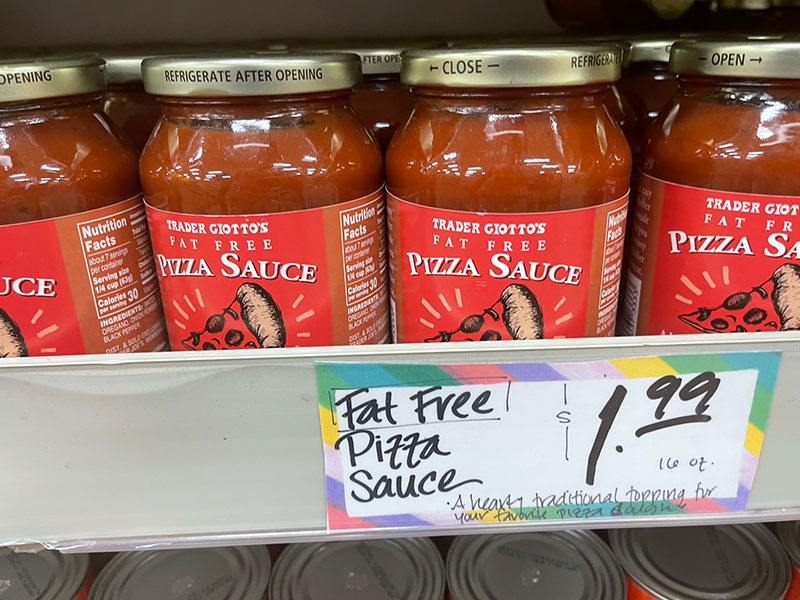
Fat Free Pizza Sauce
Trader Joe's Fat Free Pizza SauceTrader Joe’s Fat Free Pizza Sauce (Photo courtesy of Joseph Neese)
Described as a “hearty, traditional topping for your favorite pizza dough,” TJ’s Fat Free Pizza Sauce pairs well with fresh mozzarella, mushrooms and spicy sausages or small cubes of roasted garlic chicken. The sauce itself is made with a list of simple ingredients, including basil, black pepper, garlic powder, tomato paste, onion, oregano, salt and sugar. Use it as a pizza topper or a dipping sauce for pizza-flavored breadsticks and fresh calzones.
12
Pesto Rosso
Trader Joe's Pesto RossoTrader Joe’s Pesto Rosso (Photo courtesy of Joseph Neese)

TJ’s rendition of red, Sicilian pesto has remained a customer favorite for years — and it’s no surprise why. Made by the retailer’s Italian supplier, TJ’s Pesto Rosso features a tomato base that is mixed with sunflower oil, Parmesan cheese, garlic, cashews and basil (just enough to preserve the sauce’s bright red color). There’s also carrot purée, which adds a hint of sweetness to the sauce.


“Pesto Rosso has a saucy, spreadable texture that is great for topping a toasted baguette or a homemade pizza,” according to TJ’s. “Use some spoonfuls to enhance the flavor of your minestrone or vegetable soup. Of course, tossing this red pesto with your favorite hot pasta is a must!”

13
Heavenly Villagio Marzano Tomatoes
Trader Joe's Heavenly Villagio Marzano TomatoesTrader Joe’s Heavenly Villagio Marzano Tomatoes (Photo courtesy of Joseph Neese)
These bite-sized San Marzano tomatoes can be used to make fresh pizza sauce or adorn homemade pizzas before baking. They’re deliciously crisp, incredibly juicy and perfectly sweet. Each package of TJ’s Heavenly Villagio Marzano Tomatoes comes with a handful of tomatoes, allowing you to use any extras in pasta or salad dishes.

Kanye West, regurgitating a false drug war trope, blames George Floyd’s death on fentanyl

The artist formerly known as Kanye West has stirred controversy for claiming George Floyd died from a fentanyl overdose — not the fact that Officer Derek Chauvin kneeled on his neck for more than nine minutes while Floyd was handcuffed face-down on the asphalt.

West, who legally changed his name to Ye last year, appeared on the Drink Champs podcast on Sunday, where he claimed “They hit him [Floyd] with the fentanyl. If you look, the guy’s knee wasn’t even on his neck like that.” Fentanyl is an illicit opioid that has dramatically driven drug overdose deaths in the last decade. The episode has since been taken down, with the podcast hosts describing Ye’s comments as “false and hurtful.”

Ye has furthered a popular trope used by law enforcement: That drug use is an acceptable justification for killing someone.

Ye cited “The Greatest Lie Ever Sold: George Floyd and the Rise of BLM,” the recent Daily Wire documentary written by Candace Owens, as evidence for Floyd’s cause of death. This postulate has surrounded Floyd’s murder since the beginning, but has been debunked by the Hennepin County medical examiner’s office, which ruled in June 2020 that Floyd’s death was a homicide caused by “cardiopulmonary arrest while being restrained by law enforcement officer.”

propervideotag.push(function(){
propervideo_display(“salon_instream_1”, “salon”)
})

In the same report, Floyd’s use of illicit drugs (fentanyl and methamphetamine), as well as his history of heart disease, are listed as “other significant conditions,” but this does not undermine their conclusion that the manner of death was murder. A second autopsy report came to the same conclusion.

But in repeating this overdose myth, Ye has furthered a popular trope used by law enforcement: That drug use is an acceptable justification for killing someone. In fact, Chauvin’s defense leaned heavily on the idea that drugs killed Floyd, not the officer. It didn’t work. A jury convicted Chauvin of two counts of murder and one count of manslaughter.


Want more health and science stories in your inbox? Subscribe to Salon’s weekly newsletter The Vulgar Scientist.


In her book “Undoing Drugs,” author and drug war historian Maia Szalavitz notes that Officer Tou Thao, who stood by while Chauvin murdered Floyd, told bystanders, “This is why you don’t do drugs, kids.”

“Let that remark in those circumstances sink in for a minute,” Szalavitz wrote. “Without invoking explicit racism, Thao was attempting to rationalize Chauvin’s life-threatening violence, framing it as ‘anti-drug’ and therefore acceptable.”

“Implicit in this statement and others related to Floyd’s history of illegal drug use is the idea that it disqualifies him as a person—and that, as someone who took drugs, he deserved maltreatment, even death,” Szalavitz added.

This sort of conflation — drugs were involved, so lethal police violence was necessary — goes back at least a century. In 1914, The New York Times warned that “Negro cocaine fiends” were terrifying the American South, with the stimulant turning Black men into “peculiarly dangerous criminal[s]” that couldn’t be stopped even by multiple gunshots.

Dr. Carl Hart, an associate professor of psychology at Columbia University, rightly dismissed cocaine-powered

Hart described how this “tired gimmick” of drudging up a victim’s drug history was also used in the deaths Trayvon Martin, Terence Crutcher, Michael Brown, Laquan McDonald and many others.

superhuman strength as “preposterous,” but noted in The Nation that such superstitions have become a cornerstone of U.S. drug policy. “In some cases, suspicion of cocaine intoxication by blacks was reason enough to justify lynchings. Eventually, it helped influence legislation,” Hart wrote.

It’s not just cocaine or fentanyl, either. Meth, heroin, cannabis and PCP or “angel dust” have all been invoked as justifications when cops kill folks, especially people of color. To cite one example, Philando Castile was fatally shot by Officer Jeronimo Yanez during a traffic stop in 2016. Yanez used marijuana found in Castile’s vehicle as a justification for lethal self-defense, stating in an interview he feared for his life because Castile had the “audacity” to use cannabis in front of the other passengers in his car, including a five-year-old girl. Yanez was acquitted by a jury.

Writing in the journal Neuron in 2020, Hart described how this “tired gimmick” of drudging up a victim’s drug history was also used in the deaths Trayvon Martin, Terence Crutcher, Michael Brown, Laquan McDonald and many others.

“In each of these cases, the deceased’s toxicology findings, combined with his behavior, revealed drug levels that I believe were too low to have contributed to his death,” Hart wrote. “Drugs didn’t make them act so violently that lethal force was reasonable or necessary; nor did they cause some fatal medical condition. But it didn’t matter. By introducing drug use as a potential contributing factor, it creates a smokescreen for juries to find, almost always, white-identifying police and wannabes not guilty in the killing of Black people.”

There is no scientific evidence that drug use — any drug use — can cause changes in the brain that would cause violence justifying murder. Blaming Floyd’s death on his health and drug use is equally as dismissive and not backed by evidence.

“In the United States, where tacit racism is pervasive, it is unsurprising—and infuriating—that the fear of drugs, abetted by arguments poorly grounded in scientific evidence, is used to legitimize the massacre of Black people,” Hart writes.

This attitude fits into other prominent drug war myths, such as that fentanyl is so deadly it can kill with mere skin contact (it definitely cannot) or that diabolical drug dealers are lacing Halloween candy with “rainbow” fentanyl (also not happening). Nonetheless, these myths persist.

Perhaps there’s a more cynical motivation for Ye’s comments. He recently agreed to purchase Parler, the struggling right wing social media platform, which is owned by Candace Owens’ husband, George Farmer. It may be a result of his ongoing relationship with Owens: the two of him were recently pictured together wearing “White Lives Matter” t-shirts. It gets more confusing considering Ye has donated huge sums of money to the Floyd family.

Nonetheless, George Floyd’s family is allegedly considering a lawsuit against Ye, according to Lee Merritt, a civil rights attorney who has represented the Floyd family.

“While one cannot defame the dead,” Merritt tweeted Sunday. “Claiming Floyd died from fentanyl not the brutality established criminally and civilly undermines & diminishes the Floyd family’s fight.”

Update Oct. 18th 5:00 EST: The mother of George Floyd’s daughter has officially filed a $250 million lawsuit against Ye, according to Click 2 Houston.

FBI field agents complain about going after Jan. 6 rioters using Trumpy talking points: report

MSNBC host Nicolle Wallace started her show Monday with an exclusive bit of information that FBI field offices are staffed with agents miffed over the prosecutions of the Jan. 6 attackers, feeling that what they did was nothing more than misdemeanors. It was reported last week by NBC News that one former FBI official sent a letter to Paul Abbate, who is now the No. 2 official at the bureau.

According to the former official speaking to Wallace, the agents in field offices don’t think prosecuting the Jan. 6 defendants is all that important, but they’re doing it anyway.

“Resistance that does not amount to outright refusal, but rather complaining about the focus on Jan. 6th when many of the cases being prosecuted are misdemeanors,” she said of the official. “This official tells us they keep repeating talking points and that the violence from the Black Lives Matter protests is not being taken as seriously as the Jan. 6 attack.”

The Jan. 6 attack was a coordinated effort in states and in Washington, D.C. to attack the U.S. government, intimidate or kill elected officials and overthrow an election decided by Americans. Black Lives Matter burned down a Wendy’s and other businesses randomly.

Meanwhile, FBI Director Christopher Wray is being criticized for lying to Congress about what he knew of the threats ahead of Jan. 6 was revealed in the public hearing on Thursday that the FBI, Secret Service, U.S. Marshal’s Service and the White House were all informed about the violence being planned for Jan. 6.

Frank Figliuzzi, a former FBI official, has remained cautious about the FBI over the past year, waiting for all of the facts to be presented. That has ended in the past several weeks, as he’s highlighting the “crisis of credibility” under which the FBI director is suffering.

He also pointed out a kind of fear developing “that the senior most leaders of the FBI and even at other intel agencies as we continue to learn like every day, who knew what and when and that it was a lot more than we thought they knew at the time proceeding Jan. 6. I fear that those leaders are not grasping the gravity of this moment in terms of the future of their organizations. What I mean by this is it’s time for complete transparency. It’s time to come out and say we dropped this ball and here’s why.”

He noted that both Wray and the head of the Washington Field official told the public that they lacked specific intelligence ahead of Jan. 6. The reality is they not only knew but they were briefing the law enforcement community for as much as two hours on Jan. 5.

“So, which is it? You lack specificity or you had the intelligence to do something and somehow it didn’t happen?” asked Figliuzzi. “I think it’s going way up the chain here even to involve political suppression of anybody who might have wanted to take further actions to secure the Capitol. Those are the questions that need to be answered and they need to be answered now, not waiting for the committee to release a 1,000-page report, months from now.”

Figliuzzi went on to say he always pays close attention to Wray when he testifies and he doesn’t see the full, responsive answers that he expects from Wray.

“If the attorney general guidelines of conducting domestic terror investigations need to be changed, say it. But he hasn’t said it,” Figliuzzi continued. “If they dropped the ball because somebody at the White House told them don’t take action to enhance security at the Capitol. Don’t pound your fists on the table for capitol police to do something. Then say it. But we’re not hearing it yet and it’s eroding the credibility of the institution. That’s why so many agents are saying this is painful. We can’t take the beating every day and appear to be political, but yet they’ve become politicized.”

Former FBI counsel Andrew Weissmann said that the Jan. 6 response has been a stark contrast to the Black Lives Matter protests that happened over the summer of 2020, in which Wray, the deputy attorney general, and the attorney general all claimed: “they were all over it.”

“The deputy director of the FBI said that it’s the most significant domestic terrorism event facing the bureau,” Weissmann recalled. “That was the Black Lives Matter protest. And yet when January 6th happened, the FBI really was asleep at the switch and it wasn’t an intelligence failure. It was a failure to act on the intelligence that they had and I find that Chris Wray’s testimony was exactly what you do not want from public officials. It lacked candor and fulsomeness in saying what exactly they knew and where their failures were. How do you expect an institution to become better and to make sure this doesn’t happen again if you don’t have leaders who are going to be willing to acknowledge what went wrong and to figure out how to fix it?”

Wray has been flying under the radar and refusing to say anything about Jan. 6, even when it comes to the FBI itself and the sensitivities of the agents who are supportive of the attack.

Ironically, the agent’s association claimed that FBI agents are allowed to have their own opinions as long as they continue to enforce the law. Wallace asked Peter Strzok about it. He was removed after Donald Trump targeted him as being a supporter of Hillary Clinton in 2016.

Wallace said that it isn’t even what the concern is, it’s that Wray is failing to fill the vacuum and point the FBI ship in the direction of saying the insurrection is “bad.”

See the discussion below or at this link.

Ted Cruz campaign cuts him a $555,000 check — and he “has the Supreme Court to thank for it”

Documents from the Federal Election Commission (FEC) show that over the summer, Sen. Ted Cruz of Texas received a payment of $555,000 from his campaign. Reporter Bryan Metzger, in an article published by Business Insider on October 18, explains why Cruz “has the U.S. Supreme Court to thank for it.”

Cruz, Metzger notes, challenged part of a 2002 law that “set a $250,000 limit on the amount of money that candidates could raise after the election for the purpose of paying off personal loans to their campaign committee.” The case, Federal Election Commission v. Ted Cruz for Senate, went all the way to the U.S. Supreme Court — and the Court, in a 6-3 ruling, agreed with Cruz. Chief Justice John Roberts used some Citizens United-influenced language in the ruling, writing that Section 304 of the 2002 law “inhibits candidates from loaning money to their campaigns in the first place, burdening core speech.”

The 2002 law was the Bipartisan Campaign Reform Act, also known as the McCain/Feingold Act (as in Republican Sen. John McCain of Arizona and Democratic Sen. Russ Feingold of Wisconsin). The High Court’s ruling in Federal Election Commission v. Ted Cruz for Senate struck down Section 304

“When Cruz first ran for the United States Senate in 2012,” Metzger explains, “he loaned his campaign over $1 million of his own money amid a heated primary campaign against then-Lt. Gov. David Dewhurst of Texas. Cruz would go on to win a run-off against Dewhurst. However, the 2002 Bipartisan Campaign Reform Act — championed by the late Republican Sen. John McCain of Arizona — set a $250,000 limit on the amount of money that candidates could raise after the election for the purpose of paying off personal loans to their campaign committee. Thus, Cruz essentially lost $545,000 of his own money after the campaign, with the outstanding portion of the loans converted to an in-kind contribution.”

Metzger continues, “Six years later, facing an unexpectedly competitive reelection campaign against then-Rep. Beto O’Rourke in 2018, Cruz opted to challenge the law. He lent his campaign $260,000 — just $10,000 more than the limit — on November 5, just one day before the election. That allowed Cruz to initiate a lawsuit against the Federal Election Commission, which eventually made its way up to the Supreme Court.”

When six of the nine High Court justices found Section 304 of the 2002 law unconstitutional, Roberts’ reference to “burdening core speech” was right out of the Court’s 2010 ruling in Citizens United v. FEC — a decision that equated campaign spending with “speech.”

The three dissenters in Federal Election Commission v. Ted Cruz for Senate were all appointed by Democratic presidents: Justice Elena Kagan, Justice Sonia Sotomayor and then-Justice Stephen Breyer, who has since been replaced by President Joe Biden’s appointee, Justice Ketanji Brown Jackson.

In her dissent, Kagan wrote, “It takes no political genius to see the heightened risk of corruption — the danger of ‘I’ll make you richer and you’ll make me richer’ arrangements between donors and officeholders. In discarding the statute, the Court fuels non-public-serving, self-interested governance.”

“Wouldn’t she be great?”: Trump reportedly wants Jan. 6 “victim” Marjorie Taylor Greene for DOJ job

Former President Donald Trump has floated Rep. Marjorie Taylor Greene, R-Ga., for a top administration post ahead of a potential 2024 White House bid, according to Rolling Stone.

“Wouldn’t she be great?” one source recalled Trump saying while discussing Greene for a possible administration job. It’s unclear whether the former president had her in mind for a Cabinet position, agency appointment or senior White House role, the source told Rolling Stone, but “he loves MTG and would want her very close in a second term, that much was clear.”

Another source specifically said that Trump floated Greene for a possible senior Justice Department role, which confused the source.

“I don’t think she’s a lawyer,” the source told Rolling Stone.

It’s no surprise that Trump is drawn to Greene, who has been one of his most avid supporters in Congress. Greene has also made racist and anti-semitic statements and has embraced extreme views similar to those of the former president. In the past, she has signaled support for political violence, including the execution of Democrats

Like Trump, she has also promoted bizarre conspiracy theories supporting QAnon and unproven claims of widespread election fraud as well as fringe false claims about a space laser starting California wildfires and 9/11 trutherism.

Greene also frequents rallies supporting the former president and often pays visits to Trump properties, showcasing her allegiance to the Republican kingmaker. He has rewarded her loyalty by endorsing her candidacy and singing her praises at events.

Despite her extremist views, Greene is expected to be a significant player in the mainstream of the GOP. The congresswoman even has a “cozy working relationship” with House Republican leader Kevin McCarthy, R-Calif., multiple sources told Rolling Stone.

Greene is aware of her influence within Republican circles and plans to use that to her advantage. 

“I think that to be the best speaker of the House and to please the base, he’s going to give me a lot of power and a lot of leeway,” Greene said of McCarthy in a recent interview with The New York Times

“And if he doesn’t, they’re going to be very unhappy about it,” she added, referring to GOP supporters. “I think that’s the best way to read that. And that’s not in any way a threat at all. I just think that’s reality.”


Want a daily wrap-up of all the news and commentary Salon has to offer? Subscribe to our morning newsletter, Crash Course.


Since President Joe Biden took office, Greene and her colleagues have repeatedly filed articles of impeachment against him. Greene has filed articles of impeachment accusing Biden of abusing his power to benefit his son Hunter Biden’s business dealings in Ukraine when he was vice president. 

She said that McCarthy would have to adopt her “more aggressive” approach to punish Biden and other Democrats for conducting a “witch hunt” against Trump.

Greene, who began tweeting voter fraud conspiracy theories the day after the election, has often defended the former president’s role in inciting the Jan. 6 Capitol riot. But despite spreading falsehoods about a “stolen election”, Greene defended herself during a debate on Sunday night against Democratic challenger Marcus Flowers, who accused her of being partially responsible for the Jan. 6 attack on the Capitol.

“You cannot accuse me of insurrection. I was a victim of the January 6 riot as any other member of Congress,” Greene said. “That was the third day I had on the job. I had nothing to do with what happened there that day, and I will not have you accuse me of that. That is wrong of you to do. You are lying about me, and you will not defame my character in that manner.”

But for at least two months after the election, Greene promoted baseless conspiracy theories that widespread voter fraud helped put Biden in the White House. She was also quick to embrace the “stop the steal” narrative and has continued to promote conspiracy theories that allege high-profile leaders are pedophiles.

Video: Cops “almost apologetic” as they’re forced to carry out Ron DeSantis’ “voter fraud” arrests

On Tuesday, the Tampa Bay Times released body camera footage of local police carrying out one of the well-publicized arrests Gov. Ron DeSantis, R-Fla., ordered for “illegal” voting — and police themselves appearing unsure and “almost apologetic” as they explained to one voter, Tony Patterson, that he was under arrest.

“Body-worn camera footage recorded by local police captured the confusion and outrage of Hillsborough County residents who found themselves in handcuffs for casting a ballot following investigations by Gov. Ron DeSantis’ new Office of Election Crimes and Security,” writes the Tampa Bay Times.

In the video, Patterson can be seen protesting police for arresting him even though he received a notice from the state telling him he was eligible to vote despite his past felony conviction.

“‘What is wrong with this state, man?” Patterson said at one point. ‘Voter fraud? Y’all said anybody with a felony could vote, man.”

In another case, noted the report, “Romona Oliver, 55, was about to leave for work when police walked up her driveway at 6:52 a.m. and told her they had a warrant for her arrest… an officer told her she was being arrested for fraud, a third-degree felony, for voting illegally in 2020.”

“Voter fraud?” Oliver said in the video. “I voted, but I ain’t commit no fraud.”

The crackdown, part of DeSantis’ initiative to guarantee “election integrity” as the GOP was spreading conspiracies about the 2020 election being stolen, resulted in 20 arrests, which DeSantis triumphantly championed at a press conference in August — but questions immediately emerged about the project.

Florida’s Amendment 4, approved by voters in 2018, undid one of the strictest felony disenfranchisement regimes in the country, giving hundreds of thousands of people who had been permanently disenfranchised by a prior conviction their voting rights back — but some felonies like murder and sex offenses were excluded, and the GOP legislature subsequently narrowed the restoration even further by requiring rehabilitated ex-convicts pay back all fines and fees, even those that weren’t part of their initial sentence.

In theory, local officials should have simply stopped the 20 ex-convicts who were ineligible to vote from registering at all, preventing any election crime from happening. It later emerged that despite state election workers having a responsibility to advise people of whether they have a right to vote, most of these 20 people had no idea they weren’t eligible to vote. DeSantis’ elections chief specifically told local officials they bore “no fault” for not instructing them otherwise, even as the governor’s office publicly blamed them for the confusion.

Watch the footage below or at this link.

When does a political movement become a cult?

As George Washington prepared to leave the presidency, he issued a famous Farewell Address warning Americans about the dangers of partisanship. Washington — who famously refused to join a political party during his two terms — exhorted that if Americans cared more about whether their party “wins” than maintaining democratic structures, “a small but artful and enterprising minority of the community” could manipulate the masses through a demagogic leader “to subvert the power of the people and to usurp for themselves the reins of government, destroying afterwards the very engines which have lifted them to unjust dominion.”

In cults of personality like Bolsonaro’s there are “social-psychological associations that give adherents a sense of vicarious power through a heightened sense of destiny and purpose.”

While the term “cult of personality” did not exist when Washington and Treasury Secretary Alexander Hamilton wrote the Farewell Address in 1796, the two men seemed to have anticipated the ways in which partisanship can slip into cult-like worship of individual human beings. That, at least, was the conclusion reached by experts to whom Salon reached out about the difference between mere hyper-partisanship and cult-like worship of a political leader. 

Indeed, the past two decades of world history have made manifest numerous instances of politicians — in ostensibly democratic countries — whose followers exhibit idolatry towards them. Given what we know of the march of history, that might seem peculiar: shouldn’t the trend towards a more democratic world be linear, rather than regressive? And yet, as leaders like Brazil’s Jair Bolsonaro, Russia’s Vladimir Putin and America’s Donald Trump all attest, there is an undercurrent in contemporary politics that has devolved it into something more akin to sports fanaticism. Salon interviewed experts about the nature of this cult-like devotion towards politicians — what drives it, and what it means for the future of the democratic world. 

* * *

What is the difference between normal partisanship and a political cult? Experts say that, in the latter scenario, supporters hold their leader as infallible.

“Cult-like politicians and their supporters also hold deep commitments to ideological positions, but these commitments tend to reflect the personalistic whims of leaders, which involve the demonization of critical ‘others,'” Dr. Stephen A. Kent, a sociologist at the University of Alberta who studies new religious movements (NRMs) such as the Church of Scientology and the Children of God, told Salon by email. “These opponents are evil, not merely misguided or wrong.” Once a demagogue’s supporters have reached that conclusion, it is not difficult for the leader to manipulate the masses in the manner that Washington described.

In those situations, power in the political movement stems not from a set of ideas or shared interests, but from the personality and will of one individual. Even the most overzealous party follower will, if they are indeed merely partisan, ultimately abandon a leader when that individual betrays their core principles. This is why a politician with partisan appeal but no strong cult of personality can be reined in by their own side if they excessively abuse their power, like Richard Nixon during the Watergate scandal. When a leader has a cult of personality, however, their supporters will never abandon them, no matter their transgression.

“Partisan politicians and their adherents support, in principle, a group’s basic ideology concerning political and social policies, usually developed after adherents’ debates and rooted in traditions,” Kent continued. While partisans disagree with and even dislike their opponents because they are perceived as “misguided and wrong on crucial issues,” they do not engage in the behavior extremes of those whose political beliefs are more cultish.

For an example of a modern leader with a cult of personality, Kent pointed to Brazilian President Jair Bolsonaro.

“His racist, anti-feminist, and traditionalist family values have garnered him supposed among his country’s growing, conservative, Evangelical and Fundamentalist Christian communities, some of which see him as having a godly mandate for the imposition of authoritarian values in the country,” Kent explained. Kent noted that Bolsonaro has followed Trump’s example in claiming he can only lose his election if it is stolen, and in trying to control the nation’s judiciary.

Kent added that in cults of personality like Bolsonaro’s there are “social-psychological associations that give adherents a sense of vicarious power through a heightened sense of destiny and purpose. The figures who receive adherents’ adulation themselves feel validated and encouraged by their followers’ energy, which supplies narcissistic leaders with emotional validation and creates for them a body of potentially mobilized people enacting their directives and whims.”

Russian President Vladimir Putin and his followers also fulfill some of the cult rubric. This includes cultivating a hyper-macho public image and spreading his own “Big Lie” about Ukraine (claiming it needs to be de-Nazified). Indeed, one of Putin’s chiefs stated that Putin’s reason for invading Ukraine related to an esoteric belief, promulgated by Russian Orthodox Patriarch Kirill, that Russia has a historical and spiritual claim to the country. Since this is Putin’s view, supporters who do not necessarily share Putin’s obscure geopolitical philosophy but seem to be part of his cult of personality wind up repeating those nationalistic talking points.

As a former KGB officer, Putin is also intimately familiar with Russia’s history of creating both secular and metaphysical cults of personality for its leaders, one that traces all the way back to Vladimir Lenin and the rise of the Soviet Union. Yet like Trump, Putin wins support among his followers through his narcissistic traits. It is no coincidence that both Trump and Putin supporters find themselves in comparable social positions when compelled to stand up for their heroes: They’re championing leaders who behave like malignant narcissists.


Want more psychology and science stories in your inbox? Subscribe to Salon’s weekly newsletter The Vulgar Scientist.


“Both figures demonstrate numerous characteristics typical of malignant narcissists, involving inflated evaluations of self-worth, a need for adoration, high demands upon inner circle supporters and facilitators, and vengeful responses to perceived critics,” Kent said of Trump and Putin.

At the time of this writing, Trump has spent years focusing his cult of personality on promoting what has become known as the Big Lie — i.e., his claim that the 2020 election was stolen from him despite conclusive evidence to the contrary. Unlike a normal political issue which springs from authentic mass opinions (abortion rights, gun control, economic policy, etc.), the Big Lie exists because of the personality quirks of a man in charge of a political cult. It survives because, instead of being discredited by Trump’s years-long history of refusing to accept election results unless he wins and the fact that Trump’s arguments having been debunked, Trump supporters are trained to disregard any voice that dissents from their leader’s word.

“When you’re in a mind-control cult what the leader says goes, and that’s it. The power is concentrated from the top down.”

“People who are believing in the Big Lie have been indoctrinated for the most part into believing only this and into disbelieving any media that is critical of it,” explained Dr. Steven Hassan, one of the world’s foremost experts on mind control and cults, a former senior member of the Unification Church, founder/director of the Freedom of Mind Resource Center Inc. and author of the bestselling books “Freedom of Mind,” “Combating Cult Mind Control” and “The Cult of Trump.”

“When you’re in a mind-control cult what the leader says goes, and that’s it,” Hassan pointed out. “The power is concentrated from the top down. Anyone who raises a ruckus, like [former Attorney General William] Barr saying that the election wasn’t stolen, becomes persona non grata because they are not following the glorious leader.”

Unsurprisingly, narcissism is the glue that hold together political cults such as Trump’s — and not just the narcissism of the leader at the top, although in Trump’s case his narcissistic traits helped psychologists predict his violent response to losing the 2020 election. In a condition known as narcissism by proxy, individuals who fall under a narcissist’s sway will often mimic the narcissist’s behavior and act as extensions of the narcissist’s will. Even though the victims may not be narcissists themselves, and are often simply vulnerable to manipulation for a variety of personal reasons, they willingly serve as effective minions for the narcissist by entering their political cult.

Perhaps this is why even people who agree in the abstract about opposing cults become uncomfortable when observers notice cult-like behaviors among their preferred politicians. Hassan, for his part, told Salon about how he observed this when appearing as a guest on Joe Rogan’s right-wing podcast.

“I was on Joe Rogan’s show in 2015 regarding my first book ‘Combating Cult Mind Control,'” Hassan recalled. “He loved my work and invited me back. But then when I did ‘The Cult of Trump,’ he passed.”

In retrospect, it is unlikely that Rogan’s Trump-supportive listeners would have been sincerely interested in hearing that their political hero had indoctrinated them into a cult. It is a dark irony, since that very cult of personality empowered Trump to break the precedent of peaceful transitions of presidential power that was established by George Washington himself.

From Altoona to mountain pie, hyper-regional pizza styles are a source of deep pride

You may have heard of, or perhaps tasted, Indian pizza, the regional nonpareil hailing from California’s Bay Area. This somewhat elusive style — in which crisp-edged, New York-ish crust is topped with creamy masala and tandoori chicken, dal makhani or spinach and paneer — was created in the mid-1980s by Zante’s Pizzeria & Indian Cuisine owner Dalvinder “Tony” Multani. 

These days, you’ll find it at a handful of spots around San Francisco besides the canonical Zante’s, including Brothers Pizza and Al Hamra Indian Pizza & Curry — the latter being music writer and Bay Area native Daniel Bromfield’s go-to, given its convenient location near the Bay Area Rapid Transit station. 

“I didn’t realize Indian pizza was regional until very recently,” muses Bromfield, who’s the creator of the ascendant Regional American Foods Twitter account. He started it in January 2021; it now has more than 108,700 followers. “I wonder if that isn’t the case with a lot of folks who grow up with certain foods. They might not even realize that they don’t exist outside a certain radius.” 

“I don’t really wanna make fun of anybody, or say, ‘Look how gross this is.’ That’s not my intent. I’m more interested in the breadth of human experience and, you know, how these things remind me how big the universe is.”

All manner of regional food treasures grace the @RegionalUSfood feed, from Kool-Aid-soaked dill pickles (Mississippi Delta) to comically enormous pounded pork tenderloin sandwiches (Indiana). But the posts I’m most drawn to feature pizza — the practically universal American comfort food that we love to bastardize. At first, Bromfield mostly scoured Wikipedia to unearth such edible quirks as cheese-less Rhode Island pizza strips, heavily sauced and doled out at room temp (which you’ll find at bakeries, not pizzerias). He’d share them with his then-few dozen followers, who were mostly Bromfield’s friends. The account started drawing buzz this spring, as more people shared or tagged @RegionalUSfood in their own posts and started DMing Bromfield with suggestions. Before long, pop culture and food sites got wind of it. 

A few hundred followers swelled into the thousands by May 2021, and Bromfield suddenly found himself hesitant to tweet about Altoona pizza despite a slew of requests. This polarizing creation — with its signature American cheese topper — hails from its namesake town in Pennsylvania, where it began life as a culinary oddity of the Altoona Hotel, which has since burned down. An Altoona pizza starts with Sicilian-style (don’t @ me) crust, topped with tomato sauce, green bell peppers, salami, and finally, that yellowish square of cheese. 

“The thing is, I tend to get the most engagement on really weird, f**ked up, gross-looking foods,” Bromfield says of his initial hesitation to post it. “That’s not really why I started the page. I don’t really wanna make fun of anybody, or say, ‘Look how gross this is.’ That’s not my intent. I’m more interested in the breadth of human experience and, you know, how these things remind me how big the universe is.”

Regardless, Bromfield guesses 90% of the comments the feed gets are negative — people verbally gobsmacked by how the hell someone could stomach pizza topped with a bunched-up square of processed cheese, or pickles or crickets, like a certain pie found at the Oklahoma State Fair. Bromfield doesn’t let the negativity bother him; in fact, he anticipates it. When he hits a follower plateau, he’ll lean on weirder, more polarizing food to boost him to the next level. 

“It’s a consequence of being in a culture where everybody is trying to dunk on everybody else, trying to be superior,” he says.

More than anything, he and his tens of thousands of followers are amplifying these distinctly American hometown creations, from the prosaic to the bizarre — and building a living document of this endlessly diverse nation and its foodways.


Want more great food writing and recipes? Subscribe to Salon Food’s newsletter, The Bite.


Indeed, it’s thanks to the glorious hive mind of @RegionalUSfood that we all now know about Colorado-style pizza, a.k.a mountain pie: a gargantuan, deep dish-like creation with honey-sweetened crust that’s sold by the pound. And Ohio Valley-style, in which the finished pizza is showered with cold cheese and pepperoni so it resembles a Lunchable. And even pickle pizza, a fixture of the Indiana State Fair, in which dill ranch sauce, mozzarella cheese, dill seasoning and dill pickles top a homemade crust. 

“I think regionalism is really cool,” Bromfield says. “Unique cultural customs develop in places over time, through isolation or a certain recipe being shared, then they’re turned into something that’s part of that region’s heritage and lore. That’s really cool to know it’s out there in the world.”

Fox News execs “full-on freaked out” over who leaked Kanye West rant they tried to bury: report

On Monday, The Daily Beast reported that Fox News was thrown into turmoil by the leak of unaired footage of their interview of Trump-loving rapper Kanye West — and they are desperate to find the leaker.

“Fox News executives are ‘full-on freaked out’ about the leak of never-aired clips of Tucker Carlson’s interview with Kayne West, Confider has learned, and the network is closing in on the ‘mole’ who was the source of the embarrassing breach,” reported Lachlan Cartwright and Andrew Kirell. “A few weeks ago Carlson interviewed West, who now goes by the mononym Ye, and touted him as a brave truth-teller dismissed by liberal elites for his increasingly far-right beliefs and stunts like wearing a ‘White Lives Matter’ shirt to Paris Fashion Week.”

“Fox may be closing in on the leaker, but it’s now almost a week since Vice published the videos. This is a notable detail because in 2012, the last time the network dealt with a major video breach, it found and escorted the leaker — Bill O’Reilly’s then-associate producer Joe Muto — out of the building in less than 24 hours,” the report noted. “‘This new leaker learned from my mistakes,’ Muto told Confider. ‘The main reason I got caught is that I wasn’t covering my digital trail particularly well. They’re obviously doing a better job than I did if they haven’t been found yet.'”

As The Washington Post noted last week, Carlson broadcast a highly excerpted version of this interview, telling his audience, “Is West crazy? You can judge for yourself as you watch what we’re about to show you.”

“Even in what Carlson showed, there were questionable comments,” noted the Post‘s Philip Bump. “What was excluded, according to the footage from Vice, was more disconcerting. Ye claimed that he’d rather his kids learn about Hanukkah than Kwanzaa since ‘at least it would come with some financial engineering.’ His assertion that ‘professional actors’ had been ‘placed into my house to sexualize my kids.’ He said he trusted Latinos more than ‘certain other businessmen’ — a vague descriptor he used to ‘be safe.’ Ye also told Carlson that he had ‘visions that God gives me, just over and over, on community building and how to build these free energy, kinetic, fully kinetic energy communities.'”

This was leaked shortly after West took to Twitter to proclaim he was going “death con 3” on Jewish people, which led to his ban from the platform.

West has subsequently announced a move to buy the struggling right-wing Twitter alternative Parler, which would ironically make him a direct competitor to Trump, who already commands the other right-wing Twitter alternative Truth Social.

Trump finally served with $250M NY fraud suit after judge cracks down on weekslong effort to dodge

Donald Trump’s company and its executives have been served.

Trump’s attorney Alina Habba was served the 220-page New York lawsuit from Attorney General Letitia James after Trump Organization leaders Donald Trump Jr. and Eric Trump dodged process servers, wrote Business Insider.

The lawsuit is part of a years-long fraud investigation claiming that the Trump Org. had a practice of exaggerating the sizes of assets and artificially inflating their value to score capital and deflating them for tax breaks or refunds.

The attorney general sent emails to Habba and Eric Trump’s lawyer, Clifford Robert, but they never confirmed receipt, a court filing last week said. Donald Trump Jr. and Ivanka Trump had accepted service.

While the lawyers never responded, they did file a “notice of appearance” to the court around the same time.

“The apparent runaround led James’ office to accuse Trump’s side of ‘gamesmanship,'” wrote Insider. So, James asked the court if she could simply email the papers to Habba and Robert. The judge agreed.

Oct. 31 is the date set for the oral arguments.

Read the full report at Business Insider.

“I find it bizarre”: Experts think it’s fishy how Trump Judge Aileen Cannon landed Mar-a-Lago case

Legal experts raised questions about how Trump-appointed U.S. District Judge Aileen Cannon wound up overseeing his dispute over government documents seized from Mar-a-Lago after an investigation by The Daily Beast.

Cannon, who was confirmed days after former President Donald Trump’s election loss, has frequently raised questions from legal experts after repeatedly siding with Trump in the case. She appointed a special master in response to a request from Trump, barred the Justice Department from investigating documents marked classified and later overruled the special master she chose from Trump’s proposed list when he pressed the former president’s legal team to provide evidence of his claims that the documents may have been “planted” or “declassified.” An appeals court later overturned her order blocking the probe, agreeing with the DOJ that she abused her authority. The Supreme Court declined to intervene after an emergency request from Trump and some legal scholars now expect the entire special master order to be struck down after an appeal from the DOJ.

The Daily Beast’s Jose Pagliery notes that some “incredible coincidences” led to Cannon getting the case in the first place.

One of Trump’s lawyers took the rare step of filing the paperwork in person instead of electronically — and did so at a courthouse 44 miles from Mar-a-Lago. He ended up landing Cannon, who is both outside of West Palm Beach, where the FBI raid took place in August, and the district in which the paperwork was filed.

Trump’s lawyers blamed a “technical issue” that prevented them from filing electronically but The Daily Beast’s investigation found that the computer system was “working just fine for dozens of other lawyers making hundreds of filings that day.” Not only did Trump’s lawyers file the case in a different district than the raid but they failed to mark the case as “related” to any other litigation even though a magistrate judge in the correct jurisdiction signed off on the warrant.

“It’s clearly related. I don’t think there’s a plausible argument that it’s not related… it was related to another case in the district—in the same courthouse as a matter of fact,” Carl Tobias, a law professor at the University of Richmond, told the outlet.

“It was basically a home run to get her,” added Jessica Levinson, a professor at Loyola Law School. “They clearly made the correct calculation, because Judge Cannon’s rulings legally don’t make sense. They only make sense if you’re trying to help the former president.”

Levinson told the Daily Beast that Trump’s lawyers were clearly “judge shopping.”

“They did not want the magistrate judge to make this decision,” she said. “There was already a captain of this ship. They just didn’t like the direction this was taking.”

Trump did not take any legal action for two weeks after the raid until finally filing to request a special master to review documents even though the FBI already had a filter team screen them for potentially privileged information. Lindsey Halligan, a 33-year-old Florida insurance lawyer, went in person to file the paperwork in Fort Lauderdale. The move was so “peculiar,” Pagliery wrote, that Trump’s lawyers had to explain why they filed in person. Trump’s legal team said in a filing that a “technical issue” precluded them from filing electronically that day.

The Daily Beast reviewed the timestamps for all 1,370 court filings in the Southern District of Florida that day and interviewed attorneys who used the system that afternoon. Five attorneys said the system was working fine and showed timestamp receipts confirming their electronic filings. The district’s head clerk also confirmed that the system was working fine that day. Attorneys “responded with disbelief” at the Trump team’s claim, Pagliery wrote.

“I don’t know anybody who files in person. I didn’t even know you could do that anymore. It looks like this person was trying to select a particular judge,” one of the lawyers told the outlet, suggesting that a Trump attorney may have had “sway with a court employee.”

“I find it bizarre,” another lawyer said, adding that the only people who file in person are those that sue without the help of a lawyer.

“People don’t do this anymore. It’s extremely odd. I guess you could do this if you wanted to get a particular judge—or avoid getting a particular judge,” another attorney told the outlet.


Want a daily wrap-up of all the news and commentary Salon has to offer? Subscribe to our morning newsletter, Crash Course.


Legal experts have questioned for weeks how Trump’s team landed the case in front of Cannon.

“If there wasn’t at least the potential to judge shop why on g_d’s green earth would Trump have gone all the way to her district to file and do so physically, when he could have electronically filed at the court in his backyard?” wondered former federal prosecutor Andrew Weissmann, who served on special counsel Bob Mueller’s team.

One of the South Florida lawyers interviewed by the Daily Beast suggested that “somebody pulled a fast one in the clerk’s office to rotate it to a friendly judge.”

But court employees told the outlet that the case was placed into the federal court system’s automatic random judge “assignment wheel.” Cannon, one of nine judges in the district, had a one-in-nine chance of landing the case but The Daily Beast found that Cannon landed nine of the 29 new complaints filed that week. The system “still appears random,” Pagliery wrote, noting that another judge also landed cases from the assignment wheel as well.

A head clerk of federal courts in a different state told Pagliery that lawyers sometimes try to time their filings as if they were players at a casino.

“If you play cards and count the cards, I suppose they could say, ‘I’ll hold this here until I see if other judges got assignments,'” she said. “But it would be very risky because it’s random.”

Why Marjorie Taylor Greene is becoming “the most powerful woman” in Trump’s GOP

Donald Trump would not be powerful if he wasn’t enabled by the larger Republican Party. But a combination of cowardice, greed and unchecked ambition has led the GOP establishment to capitulate to a maniac who lies as easily as he breathes as well as to a rising authoritarian movement that justifies itself through bigotry and conspiracy theories. In his new book, “Weapons of Mass Delusion: When the Republican Party Lost Its Mind,” journalist Robert Draper carefully details how Trump and his fever swamp-dwelling lieutenants successfully remade the Republican Party over in their own image. In this deeply reported book, the New York Times Magazine contributor traces how the quisling leadership of the GOP, plus a voting base drunk on decades of right wing propaganda, brought us to where we are today — at the brink of democratic collapse. 

Salon spoke with Draper about his new book and how Rep. Marjorie Taylor Greene of Georgia is the true face of the 21st-century Republican Party. This interview has been edited for clarity and length. 

President Joe Biden gave a speech in Philadelphia a few weeks back where he warned Americans of the MAGA threat. He also said that many, if not most, Republicans aren’t MAGA. He ascribed the GOP fealty to Trump to fear. Your whole book is about Republican fealty to Trump. What is your take? Is Biden right?

Well, I land on President Biden being a voracious optimist. He prefers to see the upside to a political situation. It’s probably accurate that it isn’t a vast majority of Republicans who are MAGA through and through. But it’s a distinction, finally, without a difference, when so many people are too afraid to speak up, and essentially go along.

It’s certainly true, for example, that the majority of people who are Republicans and are now running in the general election for statewide office are election deniers, which is a fundamental tenant of Trumpism. Perhaps it’s right and proper for Biden to emphasize that there are plenty of sane Republicans. It’s nonetheless the case that they’re not the ones who run the party. Trump is without question the leader of the Republican Party. His lieutenants like Marjorie Taylor Greene hold an outsized amount of influence in the party.

Speaking of Marjorie Taylor Greene: In your book, you write about the Trumpist class of Republicans in Congress — the Madison Cawthorns and Paul Gosars — but you especially focus on Marjorie Taylor Greene. Why did you decide to make her such a central figure in your narrative? 

When I got the contract to do the book in December of 2020, I figured she merited some mention as the first QAnon adherent to be elected to Congress. But I didn’t think there’d be more to it than that. Frankly, I thought that she’d be kicked to the curb by the Republican establishment. I was wrong. A year and a half later, she is one of the top fundraisers among Republican House members. Over time, she began to gain influence within the Republican conference itself.

“She came out of nowhere with no political experience and can espouse the most extreme beliefs imaginable.”

There’s this notion that if you just pay no attention to Marjorie Taylor Greene, if you refuse to give her the attention that she so yearns for, then she’ll just kind of wither away. That hasn’t happened. She, really more than anybody else,  provides a kind of case study for the Republican Party in the Trump era. She came out of nowhere with no political experience and can espouse the most extreme beliefs imaginable. And far from being condemned by her party, she will, in fact rise to be maybe the most powerful woman in the Republican Party. Meanwhile, Liz Cheney can be effectively kicked out of the party. Marjorie Taylor Greene is a remarkable case study that warrants the amount of attention that I focused on here. 

A lot of people in the Beltway press are still not wanting to see this clearly: Trumpism isn’t about Trump. It is a legit political movement. What do you think is driving this? Why now? 

On a strategic, party-wide level, Trump provided an easier way for Republicans to do what they had attempted to do after Mitt Romney got beaten by Barack Obama in 2012: In essence, appeal to people who are turned off by the party. After that election, the Republican National Committee came up with Growth and Opportunity Project that was intended to expand the tent. But that’s a really difficult proposition for any political organization, to get people who dislike you to like you. Trump showed a different way. You don’t need to find people who aren’t naturally inclined to vote for you, and convince them to come to your side. All you have to do is find the people who are naturally in your camp, and excite them as much as possible. Perhaps on the side, suppress the votes of others.


Want more Amanda Marcotte on politics? Subscribe to her newsletter Standing Room Only.


I want to be clear on this point, though. Trump may have said he could shoot somebody on Fifth Avenue and not lose a vote. That may well be true. But the base would desert him if he said “I’m pro-choice” or “We need to enact gun control measures.” There was a right wing that was already preparing to seize power in the Republican Party. Trump just gave them the voice that they needed. There was clearly a fervor growing out of the Tea Party movement and during Barack Obama’s presidency. Trump picked up on that and ultimately convinced the party was the more expeditious way to go.

I don’t think a lot of liberals and non-Trumpy political observers get why his fans love him so much. That guy? He’s whiny. He’s narcissistic. His voice is grating. He’s weird looking. But you argue that stuff works to his advantage. You write, “the MAGA faithful adored their emperor without clothes.” Can you explain what you mean by that?

What they love most about Trump is that they share the same enemies. It wasn’t a natural fit for this Manhattan real estate developer to find love in places like Mississippi and South Carolina and Alabama. And yet he did, because he was calling out the politically correct, he was saying that they need to build a wall and make Mexico pay for it, and calling out American adversaries that this right wing base had already identified.

“What they love most about Trump is that they share the same enemies.”

Once they realized he was speaking their language, then they began to excuse away every mortal frailty of his. When he would complain all the time, and when he would say obnoxious things on Twitter, they would just see that as evidence that this is a guy who isn’t a typical politician. They say he will tell it like it is, and he isn’t afraid of the consequences. He’s willing to go up against the “woke mob.” Everything that we would ordinarily view as a vice they found to be to be virtuous. This culminated in October of 2016, with the infamous “grab them by the pussy” video. It became proof this man was a virile macho man.

We’re seeing the same story play out again, right now with Herschel Walker in Georgia, who was outed for paying for an abortion. The same people that forgave Trump are happy to forgive what they claim is murder.

I suppose the rationale is that the stakes are so great, that he’ll provide a crucial Senate vote against “murder” of any babies — other than his own, allegedly. It’s certainly a double standard. One could just chalk it up to run-of-the-mill political cynicism, but for the shrillness of the rhetoric. The so-called “pro-life” movement really does say anyone who participates in abortion should be cast out and condemned as a murderer.

Obviously, Trump’s Big Lie is, for him, a self-serving narrative, just like everything else in his life. But what makes it so appealing to Republican voters? Poll after poll shows that the majority of them endorse it, on some level. What role do you think that race and racism plays in the acceptance of the big lie?

It had been accepted wisdom in conservative circles, for decades and decades, that Democrats cheat. When they talk about Democrats, yes, occasionally, they’re talking about Mayor Daley of Chicago. But what they really mean by “Democratic machine” is urban areas where Black voters are concentrated. This has been said over and over. Karl Rove would talk about how urban Democratic areas were areas in which cheating frequently occurred, though he never offered any evidence to prove this. Part of it, too, is “We Republicans can’t possibly lose as patriotic God-fearing Americans.”

None of this should have been surprising. There had been an on-ramp to that claim for years and years. In 2016, Trump was already accusing Ted Cruz and others of stealing victories from him in the primaries. But the greater notion, as you’re alluding to, is that Democrats cheat to win. It’s very often people of color who are accused of running this game. It’s pretty basic to Republican dialogue.


Want more Amanda Marcotte on politics? Subscribe to her newsletter Standing Room Only.


Trump got his start in politics by peddling the birther conspiracy theory, which is this racist theory that Barack Obama wasn’t a legitimate U.S. citizen. The Big Lie is just more of the same, peddling the notion that black voters are not legitimate voters.

Right? They claim they’re not legitimate voters. They say they’re not using IDs, or that they shouldn’t be allowed to vote, because they’re ex-felons. Or that when they do vote, it’s only because someone pays them. It’s a pernicious notion that is betrayed by history. In fact, there were in the past gatekeepers to elections. They were almost exclusively white men favoring candidates of white European descent and trying to dilute Black voting power. 

I was struck by the opening of your book where you spoke about your father being a loyal Republican who loathed Trump. How do we square these two desires? It’s understandable to want a conservative political party that’s not promoting authoritarian racist nonsense. But the GOP has been heading down this path for a long, long time. 

“A lot of Republicans reject authoritarianism, and yet, they are meekly standing by while an authoritarian sentiment gradually takes over their party.”

On his literal deathbed in late 2019, my dad said he hoped that Joe Biden would become the nominee because he believed Biden could beat Trump and believed that Trump had to be beaten. But my dad also went to his grave believing, as a lot of Republicans I know do, that the party is still theirs. That they’re not leaving the party, or if the so-called “crazies” want to go form a third party, they’re welcome to, but the more mainstream Republicans intend to stick around.

The problem with this thinking is that it’s not altogether clear to me how they think all this ends. How it is that they retake the party? A pretty significant majority of Republicans believe the election was stolen. They believe Republicanism is whatever Donald Trump says it is. A lot of Republicans reject authoritarianism, and yet, they are meekly standing by while an authoritarian sentiment gradually takes over their party.

Their belief — and I’ve heard this time and again — is, “Look, you know, I’m not going to call out Donald Trump, I’m not going to call out these people. ‘Cause you know what will happen? If I do, I will lose, and I will be replaced by someone like Marjorie Taylor Greene.” They plan to hide under the desk while all of this shrill stuff is going on. Eventually, they think they will help restore sanity to the Republican Party.

It does not explain how they ultimately defeat Trumpism instead. It’s a passive voice construction, in which Trumpism somehow dies of its own extremism. There’s no plan.

Developers loom as Boy Scouts sell thousands of acres to compensate sexual assault victims

Maine’s Androscoggin Land Trust just achieved a goal some thought it wouldn’t be able to achieve: It purchased the 95-acre Camp Gustin, located about 30 miles southwest of the state capital, for $415,000. The Trust, which solicited public donations to conserve the land, was able to complete the acquisition after it secured a loan from nonprofit The Conservation Fund and a grant from the state.

Camp Gustin was named after Charles Gustin, who donated the land to the Boy Scouts of America’s Pine Tree Council in the 1940s after his sons attended a scouting camp on the coast. Gustin’s descendants made a public plea last year to preserve the property, which the Pine Tree Council planned to sell to the highest bidder to contribute to its share of the Boy Scouts of America’s $2.46 billion victim compensation fund tied to its now-infamous child sexual abuse cases.

“It’s a very proud moment for them because they were very scared that the Pine Tree Council was going to sell to developers,” says Aimee Dorval, the Androscoggin Land Trust’s executive director.

The acquisition is part of a larger effort by the Trust to conserve hundreds of acres of land in Maine at risk of development. Dorval says it plans to open the camp to the public for camping and other recreational activities — and will also continue to allow Boy Scouts to use the land.

The ability to preserve land like Camp Gustin remains a source of worry for many conservationists — not just in Maine but around the country.

The Boy Scouts of America and their local councils intend to sell thousands of acres of land — including properties where some of the abuse took place — to compensate sexual abuse victims.

This September a judge in Delaware allowed the national organization to exit Chapter 11 bankruptcy and continue operating while settling decades of claims by more than 80,000 men who allege they were abused by troop leaders as children. The Scouts filed for bankruptcy in February 2020 amid declining membership and mounting legal costs from the lawsuits.

To help pay for the compensation fund, the Boy Scouts’ local councils are legally required to contribute at least $515 million.

Scouting land

For more than a century, the Boy Scouts have acquired most of their land through gifts and charitable donations made by people who wanted these properties preserved.

It’s unclear how much land belongs to the national Boy Scouts, because some properties are owned and managed by the organization’s more than 250 local councils, which are separate nonprofits, “distinct and financially independent from the national organization,” the Boy Scouts of America says in a statement. By some estimates, the local Scout councils own 2,000 camp properties, worth billions of dollars.

Each local council receives a charter, much like a franchise agreement, from the national Boy Scouts organization. A local council’s charter can be revoked at any time by the national organization, according to the Boy Scouts bylaws.

Without a charter, a local council’s land would become the property of the national organization.

Environmental groups and government officials are trying to find ways to conserve this land before the Boy Scouts and councils sell it off to developers. They find themselves juggling the organization’s desires for quick turnover and maximum profit while also respecting the fact that some of these sites are places where horrific events took place.

If they succeed, it would further the better aspects of the Boy Scouts’ legacy: The Scouts have a long history of conserving land, some of which are highlighted in the organization’s Conservation Handbook.

Today the Boy Scouts’ conservation efforts are threatened by their own debt to the thousands of people they harmed. Critics say they’re selling off land to the highest bidder without consideration for the environment — or the tenants of the organization.

After months of emails and calls, Boy Scouts of America could not be reached for comment.

But other groups went on the record.

Close calls

Conservation groups across the country represent one of the primary efforts to buy land from the Scouts’ local councils.

They don’t always succeed.

In 2019 the Michigan Crossroads Council of Boy Scouts sold Silver Trails Scout Reservation, a 270-acre campground near Port Huron. A nonprofit called Thumb Land Conservancy tried to buy it but lost out when the Scouts sold it to a gravel-mining company for $1.8 million.

More recently, in June, Seneca Waterways Council in New York voted to sell Camp Babcock-Hovey, a 293-acre campground on the shore of Seneca Lake that opened in 1937. The buyer of this $8 million property has not been disclosed, and calls to the national Boy Scouts press office remain unanswered.

The council will continue to operate the camp until October.

“The loss of Camp Babcock-Hovey is painful, especially for those who have spent treasured weeks of their Scouting careers there, or more than that, have dedicated significant portions of their lifetimes caring for that beautiful camp and providing leadership for its staff and campers,” wrote the council’s executive committee in June, explaining its decision to close the camp.

Other councils in New York face similar choices.

Camp Barton, which operated as a Boy Scout camp for more than a century, is among those on the chopping block.

Fred Bonn, regional director of New York state parks in the Finger Lakes where Camp Barton is located, says the state is working with three municipalities to buy 96 of the 130 acres of the former camp.

While the state parks department will buy the land, Bonn says the property — which will become a public park — will ultimately be managed by the cities of Covert, Ulysses and Trumansburg.

The remaining 34 acres of Camp Barton have been sold, says Bonn, adding that he doesn’t know if the buyer plans to develop the land or not.

Developers came close to buying the Deer Lake Scout Reservation in Killingworth, Connecticut.

After a yearlong battle, the Connecticut Yankee Boy Scouts Council agreed in September to sell Deer Lake, which was named in a 2012 lawsuit as a site where abuse took place, to Pathfinders, Inc., a local nonprofit that says it will maintain the property as a camp.

Connecticut Senator Richard Blumenthal praised the move, writing on Twitter: “This precious natural treasure will be an enduring legacy for generations of nature lovers thanks to a great activist partnership. It’s a proud moment for the conservation movement.”

The council previously rejected Pathfinders’ offer to buy the land for $2.4 million.

Fearing the land would be lost to developers, Sen. Blumenthal told the press in June that he was looking into the possibility of using federal funds from the National Park Service’s Land and Water Conservation Fund to help buy Deer Lake and other Boy Scout properties that are up for sale around the country.

The federal role — and challenge

But getting the National Park Service involved in the purchase of Boy Scout properties can be “pretty complicated,” says Joel Lynch, who runs the agency’s state and local assistance programs, which includes the Land and Water Conservation Fund.

The federal program, funded primarily by revenue generated from offshore oil and gas leases, supports projects to protect natural resources across the country.

Lynch says the Fund is driven by state governments, which submit outdoor recreation plans to the National Park Service every five years to help fund projects that could include the purchase of former Boy Scouts properties.

“I do see all the projects, so I haven’t necessarily seen an uptick, but I’m almost expecting to see something,” he says.

The only way for the National Park Service to step in, Lynch says, is if the Boy Scout property is within the boundaries of land owned by the agency.

But no one knows how many properties the Boy Scouts and their local councils own in general, let alone the amount within National Park Service boundaries.

Even if there were a list, Lynch says, all state-submitted projects still must go through an approval process to receive money from the Land and Water Conservation Fund. That can often take so long that the property they want to purchase goes off the market.

A way around that, he says, is for a state to collaborate with a land conservancy. In some cases, these local organizations will purchase properties using their own funds because it’s simply faster.

Ironically, the Boy Scouts themselves historically worked with land conservancies, like The Trust for Public Land, to purchase properties across the country. This was the case for the William H. Pouch Scout Camp on Staten Island, which was nearly sold in 2010 when the Greater New York Councils of the Boy Scouts of America, the camp’s owner, could no longer afford to maintain it.

The Boy Scouts have also worked with the U.S. Forest Service to preserve land when they couldn’t.

Since as early as 1937, the Forest Service has acquired almost 9,000 acres of land from the Boy Scouts.

The last time the agency acquired land from the Boy Scouts was in 2016. It has no plans of acquiring more, a Forest Service spokesperson wrote in an email.

Historic atrocities

Some Boy Scouts property could be preserved from development thanks to a growing movement calling for the return of Native lands to Native nations so they can preserve it according to Tribal values. Most, if not all, of the property owned by the Boy Scouts and their local councils is on land stolen from Indigenous peoples.

“Landback is the literal reclamation of land of Indigenous peoples who’ve been forcibly removed from their lands on behalf of colonialism,” says Krystal Two Bulls, director of NDN Collective’s landback campaign. “But it’s also the reclamation of everything stolen from us.”

Two Bulls says Native nations are forming land conservancies to acquire ancestral lands. Many of these Native-led organizations don’t have the necessary funds to do this on their own, so they partner with government agencies or environmental groups to share costs — although even that is, in its own way, another element of colonization.

“I don’t think that we should have to purchase land that was stolen in the first place,” she says.

NDN Collective has a fund that lends money to tribes so they can buy their land back, including property currently owned by the Boy Scouts.

Because no one knows exactly how much property the Boy Scouts and their local councils own, it’s difficult to determine the land that’s been stolen and the Native nation it belongs to.

Reviewing records of treaties between the U.S. and Native nations is one way to try to find out, Two Bulls says.

“I think that’s how primarily we’ve been able to know that those are traditional territories, but I don’t underestimate Nations’ abilities to know through pre-colonial storytelling where they’re from because so many tribes have been displaced.”

At least one Native nation is trying to reclaim stolen land now for sale by the Boy Scouts.

The Esselen Tribe of Monterey County, in California, has put in a bid to buy Camp Pico Blanco in Big Sur from the Silicon Valley Monterey Bay Council.

When the land went up for sale, the nonprofit Western Rivers Conservancy agreed to pay for the property and transfer it to the Esselen Tribe.

But despite the Tribe’s deep ties to the land, the Silicon Valley Monterey Bay Council, as of September, has not yet chosen a buyer.

Eric Tarbox, the council’s deputy scout executive, told the Monterey Herald in April that Camp Pico Blanco was being sold not because of the sexual-assault judgments but due to damage caused by wildfires.

“Scouts are not able to use the camp and may not be able to for the foreseeable future,” Tarbox told the paper. “Most specifically, we are not selling it for financial need, but because Scouts can’t use it.”

Most of the listings for property owned by the Boy Scouts and their local councils, including Camp Pico Blanco, don’t mention anything about the land’s Indigenous history. They do, however, tout the organization’s conservation efforts at keeping the land pristine — although others dispute that characterization.

“These lands that national parks and public lands and conservation groups manage, they were not these untouched, pristine lands that need to be conserved,” says Two Bulls. “The reason they look the way that they do is because Native nations had been managing them and stewarding them since time immemorial. They are not untouched lands; they looked the way that they did because of us.”

The loss of Indigenous land led to the separation of families, loss of cultural identity, and genocide.

It’s only been since the end of the 20th century that Americans have started to confront the country’s violent history, says Amy Sodaro, author of the book “Exhibiting Atrocity: Memorial Museums and the Politics of Past Violence.”

“These sites of atrocity have meaning and need to be dealt with more carefully,” says Sodaro. “I think there is starting to be a shift here, but I think in many ways we’re kind of behind much of the rest of the world, because we’ve been powerful enough to not have to face our past and to be able to kind of ignore these sites.”

The Boy Scouts of America and their local councils can no longer ignore the fact that children were abused on some of their properties. Conservation groups, scouting advocates and victims have mixed feelings about what to do with this land. Whether properties continue to operate as campsites or if they’re sold — which happens on a regular basis around the country — these locations will now remain shrouded in the darkness of historic pain.

How cities are preparing for the ‘silent killer’ of extreme heat

In the northern United States, weatherizing programs have historically focused on the colder months of the year, and the word itself likely conjures thoughts of long and frigid winters.

But warming temperatures from climate change mean the concept increasingly pertains to the other end of the calendar too: the summer months, which are getting hotter and putting more people at risk of potentially deadly heat-related illnesses.

With even New England cities like Boston expected to see as many as 42 days a year when temperatures crest 90 degrees Fahrenheit by 2050, it and others around the world are developing new approaches and adapting old ones to help people cope.

The need is great.

Extreme heat kills more people each year than any other type of weather-related event. Last year when the Biden administration launched a federal plan to address the problem, White House climate advisor Gina McCarthy called extreme heat a “silent killer.” Statistics show that annual heat-related deaths in the United States surpass mortalities from tornadoes, hurricanes, flooding, and cold winter weather combined, though the problem gets much less attention.

Those risks can be amplified in “heat islands” — urban areas where temperatures can be 10 or 20 degrees Fahrenheit hotter than in other parts of the same city. Disasters of our own design, they occur in places with few shade-supplying trees and a lot of buildings and pavement.

Climate change is making heat islands worse. And it’s a problem that extends well beyond Boston and the Northeast.

“Urban heat islands are a phenomenon that we’re seeing occurring pretty much in every city across the globe,” says Yusuf Jameel, research manager at Project Drawdown, an international organization working on solutions to climate change.

The danger

Heat waves — and the concentrated effects of heat islands — pose grave health risks like dehydration, mental stress and even death. Last summer about 800 people died in Oregon, Washington and British Columbia when a heatwave hit the Pacific Northwest.

Experts say the true death rate associated with heat emergencies may in fact be even higher than reported, since exposure to heat extremes can precipitate medical emergencies in people with conditions including diabetes and heart, respiratory and kidney ailments. These health events aren’t always included in official statistics of heat-induced emergencies.

The very young and very old, pregnant women, and people who spend a lot of time in the heat — such as people who work outdoors, the unhoused, and people who can’t afford to cool their homes — also face higher risks than people who spend all their time in air-conditioned homes, offices and cars whenever temperatures spike.

“We have to take little breaks to get out of the sun,” says a building custodian in D.C.’s Columbia Heights neighborhood — one of the hottest places in the city — who asked to remain anonymous. “I get dizzy,” she adds. “Sometimes I feel like I’m going to vomit,” due to exposure to too much heat.

Some medications can also increase heat sensitivity, and extreme heat can amplify drug side effects. Exposure to heat can also diminish cognitive function, even in healthy young adults, according to researchers, which could cause life-long consequences by limiting academic and professional achievement and earnings potential.

It’s also an environmental justice issue.

A growing body of research shows worldwide urban heat islands are predominantly located in low-income neighborhoods. In the United States, those neighborhoods are overwhelmingly home to people of color and immigrants.

Compounding matters, these same low-income areas tend to have higher percentages of people with medical conditions that make them particularly susceptible to heat-related illness.

Research has also linked heat islands to the country’s history of discriminatory lending practices and a past federal housing policy known as “redlining,” which led to much less public and private investment and access to home loans in many communities of color over the last century.

While redlining was outlawed in 1968, the past policies, experts say, continue have negative consequences in these communities today. In the past few years, scientists have published multiple studies documenting the heat islands that exist today in formerly redlined areas of more than 100 U.S. cities, even while adjacent neighborhoods remain much cooler.

A global issue

It’s not just communities in the United States that are feeling the heat — or the inequity.

Poorer countries, says Jameel, have huge challenges for people living in heat islands, particularly those who work outdoors.

“The stakes are very, very high,” he says. For example, heat waves in India and Pakistan earlier this year saw temperatures as high as 122 degrees Fahrenheit and claimed at least 90 lives. “People were unable to work. There was a higher incidence of people being hospitalized. Kids were unable to go to school.”

He also notes that children going to school in consistently hot indoor spaces can end up with both health problems and long-term economic impacts if the heat impairs their ability to learn and function.

As heatwaves become more severe and more frequent with climate warming, the economic toll can be high, as well.

“Right now, it’s happening maybe two weeks a year, where the temperatures are so high that people are unable to work outside,” he says. “But in five to 10 years, if it becomes a month [per year], that will affect the economic growth of the country.”

Those days, however, may already be here. In Delhi, the heatwave this spring resulted in nearly 100 days with temperatures breaking 100 degrees Fahrenheit.

That’s why climate change — and the associated heat risks — are “fundamentally an issue of justice and equality,” he says. “Children born in sub-Saharan African countries in 2020 are projected to experience six times more extreme climate events compared to those born in the 1960s.”

The countries that will be hardest hit by climate change are also among those that have contributed least to the problem.

Finding solutions

Work has begun in some places to tackle the heat.

Ahmedabad, India has been leading this work in South Asia, with the first Heat Action Plan established in 2013. It includes a citywide Cool Roof program that uses light-colored roofing materials or paints to reflect the sun’s rays rather than absorb them.

Retrofitting solutions are good. But longer term, Jameel says, cities need to prioritize green space, not just more buildings.

Such urban-planning solutions are challenging in developing countries, he says, where new urban neighborhoods often spring up spontaneously, without formal planning.

Nevertheless, the Global South has one advantage over the North: long experience with the heat. One place to look for solutions, Jameel says, is local knowledge passed down for generations. For example, traditional building designs strategically placed windows to allow indoor heat to escape outdoors and encourage cross ventilation.

But while these types of traditional building designs may continue to get built one at a time, Jameel said such projects are not being built “at scale” by real estate developers, who could have a greater impact.

He and other experts say much more needs to be done to raise general awareness about heat and health, help vulnerable residents, and spark building-code changes to address the leading cause of weather-related deaths.

The U.S. response

In the United States, the federal government and some cities have begun to act, too.

In Boston’s Heat Resilience Solutions Plan, 90% of respondents to the city’s online survey said it’s too hot in their homes during very hot summer days. The plan, published in April after more than a year of citywide public consultations, also found that 42% of Black and 36% of Latino residents reported that it was “always” too hot at home, compared to 24% of white residents.

In response to these risks, government authorities are adapting programs originally created to help low-income residents keep the heat on during the winter months.

The Mayor’s Office on Housing is considering providing “income-qualified residents” not just with air-conditioning units, but with summer utility bill subsidies, too — similar to what’s already available to help heat homes in the winter. That proposal is an acknowledgment that paying the higher monthly bills for running those ACs has become a bigger barrier to household cooling than just acquiring an air conditioner.

Boston is not alone. After deadly heat waves last year in the Pacific Northwest, Oregon passed new legislation that will direct $5 million toward purchasing air-conditioning units for vulnerable residents.

At the national level, the Department of Health and Human Services this spring announced plans to send states an infusion of $385 million in new funds from the Low Income Home Energy Assistance Program. A portion of the funds were to cover utility payments, “including summer cooling” for households that need help catching up on unpaid bills.

City, state and federal governments are also starting to roll out new weatherizing assistance and interest-free home-improvement loan programs to help residents pay for adding or upgrading air conditioning.

A comprehensive approach

More air conditioning, however, is hardly a long-term solution, since the exhaust from indoor climate control heats up the air outside and the electricity needed to run them fuels more climate change. Experts say we need to redesign our homes, offices and entire cities, a costly undertaking that is still in its incipient stages even in the resource-rich Global North.

Some of that work is underway.

Many U.S. cities, such as New York, Chicago, Portland and Los Angeles, are adding “cool roof” or “green roof” programs to bring down indoor temperatures and decrease air-conditioning costs by using reflective roofing materials or planting vegetation on roofs.

Some cities are going even further. In 2018 Washington, D.C., passed tougher new standards to increase building energy performance in an effort to reduce greenhouse gas emissions and energy consumption by 50% by 2032.

Meanwhile Boston is spending $20 million on a retrofit pilot that focuses on providing owners of multifamily buildings with affordable help to upgrade their cooling and heating systems. The program is expected to fund “deep energy retrofits” designed to improve efficiency for about 300 “housing units” in public housing buildings or those otherwise deemed “affordable” by the city.

The city’s heat plan also calls for the formation of a task force to address the immediate problem, as well as developing “the broader heat relief strategy,” with long-term solutions.

Working with nonprofit partners, it’s providing households and small businesses in the city’s low-income areas with help paying for equipment upgrades and retrofits. The plan details 26 strategies it plans to implement, working through community organizations and directly with city residents. The strategies include grant programs to help building owners afford energy efficient heat pumps and cool roofs, as well as planting trees and adding awnings to provide shade at bus stops.

Assisted by new data analysis and mapping technology, many cities are homing in on urban heat islands to better understand the history and historic discrimination that has led to dramatically higher temperatures from neighborhood to neighborhood — and to tailor solutions to local realities.

King County Metro Transit, in the Seattle area, is using heat-mapping data to guide bus stop design and amenities with consideration to extreme weather — especially in communities most acutely affected by climate change.

And Chelsea, Massachusetts, has launched a “Cool Block” project that involves planting trees, repaving dark asphalt streets in lighter gray material, and revamping sidewalks with white concrete, porous pavers and planters.

It’s possible to address climate-related health threats and historic wrongs at the same time, says Jeremy Hoffman, the David and Jane Cohn scientist at the Science Museum of Virginia, who has lead heat islands studies in several U.S. cities and worked on research studies linking redlining and historic discrimination with the locations of today’s heat islands in cities across the country.

“These decisions that were made a century ago by a few people have affected a ton of people in the present day,” he says. “Collectively we still have a long way to go, but if communities and local governments work together, we can make decisions that will have positive impact for the next century or beyond.”

A gamma ray burst — possibly the brightest of all time — sweeps over Earth

Earth just got zapped. 

On Sunday a gamma-ray burst (GRB), the most powerful class of explosions in the universe, caused a wave of gamma rays and X-rays to sweep over Earth. It was also possibly the brightest explosion of its nature ever recorded. The event was reported in the Astronomers Telegram.

In a breathless press release, NASA emphasized that their detectors all over the planet picked up on this, including NASA’s Fermi Gamma-ray Space Telescope, the Neil Gehrels Swift Observatory, and the Wind spacecraft.

Gamma-ray bursts are some of the most powerful releases of energy in the universe. Their causes may vary slightly, but typically relate to black holes. Some may be caused when merging neutron stars create a black hole, or when a neutron star and a black hole merge. Because they are so energetic, even a gamma-ray burst that originates on the other side of the universe will often be detectable by astronomers on Earth. 

Gamma rays are the most energetic photons in the electromagnetic spectrum, far more powerful than x-rays, which can cause cancer if one is exposed to them at high levels. Outer space is full of gamma rays, though few make it all the way to Earth’s surface, as the atmosphere absorbs the vast majority before they can ever make it down to hurt us. 

However, a sufficiently large gamma-ray burst could theoretically strip the planet of its atmosphere and cause a mass extinction event. Indeed, it is widely believes that a gamma-ray burst caused the Ordovician extinction roughly 443 million years ago. Fortunately for contemporary humans, no GRBs in recent memory have been close enough to Earth to have that effect. Approximately 30 percent of them are short bursts that span only a couple seconds, while the bulk of the rest usually only last for a few minutes.

GRBs were first discovered by scientists accidentally in the 1960s, and even then they realized that these bursts generate as as much energy as our sun will during its entire 10 billion year lifetime. On this recent occasion, the explosive event — now officially dubbed GRB 221009A — traveled roughly 1.9 billion light years to reach Earth, originating as it did all the way from the direction of the constellation Sagitta. Coincidentally, it happened to arrive at the same moment when gamma-ray astronomers were gathered in the South African city of Johannesburg for the 10th Fermi Symposium. Needless to say, they were impressed by the symbolically rich timing.

Judy Racusin, a Fermi deputy project scientist at NASA’s Goddard Space Flight Center in Greenbelt, Md. who is attending the conference, said in a statement that “it’s safe to say this meeting really kicked off with a bang — everyone’s talking about this.”


Want more health and science stories in your inbox? Subscribe to Salon’s weekly newsletter The Vulgar Scientist.


Preliminary analysis indicates that the Fermi’s Large Area Telescope (LAT), a space telescope, managed to detect the radiation pulse for approximately 10 hours. Astronomers believe that the pulse originated in a new black hole being created as a massive star collapsed under its own weight. As a result, astronomers believe that the information obtained by measuring this radioactive pulse can provide new insights into how black holes are created and the dynamics involved in a star’s collapse, among many other things.

Because it is believed to have released 18 teraelectronvolts of energy, scientists are preparing to dub it as a precedent-setter, given that no previous gamma-ray burst is ever known to have surpassed 10 teraelectronvolts.

“This burst is much closer than typical GRBs, which is exciting because it allows us to detect many details that otherwise would be too faint to see,” Roberta Pillera, a Fermi LAT Collaboration member and doctoral student at the Polytechnic University of Bari, Italy in a press statement about the burst. “But it’s also among the most energetic and luminous bursts ever seen regardless of distance, making it doubly exciting.”

Several media outlets covering the explosion described it in historic terms. Because it is believed to have released 18 teraelectronvolts of energy, scientists are preparing to dub it as a precedent-setter, given that no previous gamma-ray burst is ever known to have surpassed 10 teraelectronvolts. Space.com described it as “the most powerful flash of light ever seen,” while Phys.org called it possibly the “most powerful explosion ever recorded.” Jillian Rastinejad, a graduate student at Northwestern University who led one of two independent teams that used the Chilean Gemini South telescope to study the event, described it as “the ‘BOAT,’ or Brightest Of All Time, because when you look at the thousands of bursts gamma-ray telescopes have been detecting since the 1990s, this one stands apart.”

Why the book bans and censorship? Those who rule want to crush knowledge — and freedom

August Wilson wrote 10 plays chronicling Black life in the 20th century. His favorite, “Joe Turner’s Come and Gone,” is set in 1911 in a boarding house in Pittsburgh’s Hill District. The play’s title comes from “Joe Turner’s Blues,” written in 1915 by W.C. Handy. That song refers to a man named Joe Turney, the brother of Peter Turney, who was the governor of Tennessee from 1893 to 1897. Joe Turney transported Black prisoners, chained in a coffle, along the roads from Memphis to the Tennessee State Penitentiary in Nashville. While en route, he handed over some of the convicts, for a commission, to white farmers. The prisoners he leased to the farmers worked for years in a system of convict leasing — slavery by another name.

In Wilson’s play, Herald Loomis, a convict who worked on Turner’s farm, arrives in Pittsburgh after seven years of bondage with his 11-year-old daughter, Zonia, in search of his wife. He struggles to cope with his trauma. At a boarding house, he meets a conjuror named Bynum Walker, who tells him that in order to face and overcome the demons that torment him, he must find his song.

It is your song, your voice, your history, Walker tells him, which gives you your identity and your freedom. And your song, Walker tells him, is what the white ruling class seeks to eradicate.

This denial of one’s song is instrumental to bondage. Black illiteracy was essential to white domination of the South. It was a criminal offense to teach enslaved people to read and write.

The poor, especially poor people of color , remain rigidly segregated within educational systems. The backlash against critical race theory (CRT), explorations of LGBTQ+ identities and the banning of books by historians such as Howard Zinn and writers such as Toni Morrison, are extensions of this attempt to deny the oppressed their song.

PEN America reports that proposed educational gag orders have increased 250 percent compared with those issued in 2021. Teachers and professors who violate these gag orders can be subject to fines, loss of state funding for their institutions, termination and even criminal charges. Ellen Schrecker, the leading historian of the McCarthy era’s widespread purge of the U.S. education system, calls these gag bills “worse than McCarthyism.” Schrecker, author of “No Ivory Tower: McCarthyism and the Universities,” “Many Are the Crimes: McCarthyism in America” and “The Lost Promise: American Universities in the 1960s,” writes:

The current campaign to limit what can be taught in high school and college classrooms is clearly designed to divert angry voters from the deeper structural problems that cloud their own personal futures. Yet it is also a new chapter in the decades-long campaign to roll back the changes that have brought the real world into those classrooms. In one state after another, reactionary and opportunistic politicians are joining that broader campaign to overturn the 1960s’ democratization of American life. By attacking the CRT bogeyman and demonizing contemporary academic culture and the critical perspectives that it can produce, the current limitations on what can be taught endanger teachers at every level, while the know-nothingism these measures encourage endangers us all.

The more social inequality grows, the more the ruling class seeks to keep the bulk of the population within the narrow confines of the American myth: the fantasy that we live in a democratic meritocracy and are a beacon of liberty and enlightenment to the rest of the world. Their goal is to keep the underclass illiterate, or barely literate, and feed them the junk food of mass culture and the virtues of white supremacy, including the deification of the white male slaveholders who founded this country. 

When books that give a voice to oppressed groups are banned, it adds to the sense of shame and unworthiness the dominant culture seeks to impart, especially to children.

When books that give a voice to oppressed groups are banned, it adds to the sense of shame and unworthiness the dominant culture seeks to impart, especially toward marginalized children. At the same time, bans mask the crimes carried out by the ruling class. The ruling class does not want us to know who we are. It does not want us to know of the struggles carried out by those who came before us, struggles that saw many people blacklisted, incarcerated, injured and killed to open democratic space and achieve basic civil liberties from the right to vote to union organizing. They know that the less we know about what has been done to us, the more malleable we become. If we are kept ignorant of what is happening beyond the narrow confines of our communities and trapped in an eternal present, if we lack access to our own history, let alone that of other societies and cultures, we are less able to critique and understand our own society and culture.

W.E.B. Du Bois argued that white society feared educated Blacks far more than they feared Black criminals. 

“They can deal with crime by chain-gang and lynch law, or at least they think they can, but the South can conceive neither machinery nor place for the educated, self-reliant, self-assertive black man,” he wrote.

Those, like Du Bois, who was blacklisted and driven into exile, who pull the veil from our eyes are especially targeted by the state. Rosa Luxemburg. Eugene V. Debs. Malcolm X. Martin Luther King Jr. Noam Chomsky. Ralph Nader. Cornel West. Julian Assange. Alice Walker. They speak a truth the powerful and the rich do not want heard. They, like Bynum, help us find our song.


Want a daily wrap-up of all the news and commentary Salon has to offer? Subscribe to our morning newsletter, Crash Course.


In the U.S., 21 percent of adults are illiterate and a staggering 54 percent have a literacy level below sixth grade. These numbers jump dramatically in the U.S. prison system, the largest in the world with an estimated 20 percent of the globe’s prison population, although we are less than 5 percent of the global population. In prison, 70 percent of inmates cannot read above a fourth-grade level, leaving them able to work at only the lowest-paid and most menial jobs upon their release.

You can watch a two-part discussion of my book “Our Class: Trauma and Transformation in an American Prison,” and the importance of prison education, here and here.

Like Loomis, those freed from bondage become pariahs, members of a criminal caste. They are unable to access public housing, barred from hundreds of jobs, especially any job that requires a license, and denied social services. The Bureau of Justice Statistics (BJS) estimates in a new report that 60 percent of the formerly incarcerated are jobless. Of more than 50,000 people released from federal prisons in 2010, the report found, 33 percent found no employment at all over four years, and at any given time, no more than 40 percent of the cohort was employed. This is by design. More than two-thirds are rearrested within three years of their release and at least half are reincarcerated. 

You can see a two-part discussion on the numerous obstacles placed before those released from prison with five of my former students from the NJ-STEP college degree program here and here.

White members of the working class, although often used as shock troops against minorities and the left, are equally manipulated and for the same reasons. They, too, are denied their song, fed myths of white exceptionalism and white supremacy to keep their antagonism directed at other oppressed groups, rather than the corporate forces and the billionaire class that have orchestrated their own misery.

White members of the working class are equally manipulated. They, too, are denied their song, fed myths of white exceptionalism and white supremacy to keep their antagonism directed at other oppressed groups.

Du Bois pointed out that poor whites, politically allied with rich Southern plantation owners, were complicit in their disenfranchisement. They received few material or political benefits from the alliance, but they reveled in the “psychological” feelings of superiority that came with being white. Race, he wrote, “drove such a wedge between white and black workers that there probably are not today in the world two groups of workers with practically identical interests who hate and fear each other so deeply and persistently and who are kept so far apart that neither sees anything of common interest.”

Little has changed.

The poor do not attend college, or, if they do, they incur massive student debt, which can take a lifetime to pay off. U.S. student loan debt, totaling nearly $1.75 trillion, is the second-largest source of consumer debt behind mortgages. Some 50 million people are in debt peonage to student loan companies. This debt peonage forces graduates to major in subjects useful to corporations and is part of the reason why the humanities are withering away. It limits career options because graduates must seek jobs that allow them to meet their hefty monthly loan payments. The average law school student debt of $130,000 intentionally sends most law school graduates into the arms of corporate law firms.

Meanwhile, fees to attend colleges and universities have skyrocketed. The average tuition and fees at private national universities have jumped 134 percent since 2002. Out-of-state tuition and fees at public national universities have risen 141 percent while in-state tuition and fees at public national universities have risen 175 percent.

The forces of repression, backed by corporate money, are challenging in court Biden’s executive order to cancel some student debt. A federal judge in Missouri heard arguments from six states attempting to block the plan. To qualify for the debt relief, individuals must make less than $125,000 a year or $250,000 for married couples and families. Eligible borrowers can receive up to $20,000 if they are Pell Grant recipients and up to $10,000 if they haven’t received a Pell Grant. 

Education should be subversive. It should give us the intellectual tools and vocabulary to question the reigning ideas and structures that buttress the powerful. It should make us autonomous and independent beings, capable of making our own judgments, capable of understanding and defying the “cultural hegemony,” to quote Antonio Gramsci, that keeps us in bondage. In Wilson’s play, Bynum teaches Loomis how to discover his song, and once Loomis finds his song, he is free.

These elections “are the most important in our lifetime”: Democracy advocate on America’s choice

In a series of public hearings that began last summer, the House Jan. 6 committee has developed a damning narrative, fueled by overwhelming and irrefutable evidence, that Donald Trump was the central figure in a nationwide criminal plot to end American democracy by nullifying the results of the 2020 presidential election.

Last Thursday, in its final scheduled hearing, the committee presented the following information, further confirming the scale of the Trump cabal’s attempted coup: 

  • Trump intended to travel to the Capitol himself, operating on the reasonable belief that his followers would have installed him in power like a conquering warlord or dictator.
  • Donald Trump was no bystander on Jan. 6, and was not caught by surprise. The terrorist attack by followers on the Capitol was no surprise either. Trump both facilitated and welcomed the violence. The Secret Service and other law enforcement agencies warned officials of the Trump regime days ahead of Jan. 6 that his followers were planning violence in Washington, and that some would be armed.
  • Trump had made clear he would never concede defeat in the 2020 election. He had decided weeks prior to claim victory regardless of the outcome.
  • Trump was told repeatedly by aides, advisers and law enforcement officials that he had lost the election and that his conspiracy theories about voter fraud had no basis in fact. He was not going to admit defeat or relinquish power voluntarily. 
  • Trump was apparently in communication with right-wing paramilitaries through his confidant Roger Stone. These groups played a key role in the terrorist attack on the Capitol and the attempt to hunt down Vice President Mike Pence and leading Democrats.
  • In an act of revenge after losing the election, Trump was attempting to order a full military withdrawal from Afghanistan and Somalia in order to create chaos for Joe Biden’s incoming administration. Senior civilian and military leaders resisted those orders. 

At the culmination of last Thursday’s hearing, the House Jan. 6 committee voted unanimously to subpoena Donald Trump to testify under oath. It is highly unlikely he will comply. 

But the nine House committee hearings, considered in total, amount to a de facto criminal referral to Attorney General Merrick Garland and the Department of Justice. What will happen next?

I recently discussed that question and much more with Brad Woodhouse, a longtime Democratic Party communications expert and strategist who is now co-chair of the Defend Democracy Project, an organization working to ensure that Donald Trump and the Republican Party’s “plot to overturn elections can’t go forward under the cover of darkness.”

Woodhouse is also executive director of Protect Our Care, a group working to defend the Affordable Care Act and Medicaid. He previously served as the president of the progressive advocacy organization Americans United for Change.

In our conversation, Woodhouse argues that the new information presented during last week’s hearing is further evidence that Donald Trump and the leaders of his coup plot must be investigated and prosecuted if we hope to ensure the future of American democracy. If they are not punished, he warns, that virtually guarantees another event like Jan. 6 and rising political violence all over the country on the state and local level.

He shares his concerns that too few Democratic voters will mobilize and turn out at the polls to prevent the Republican fascists from winning power, likely because they are angry or frustrated about the perceived policy shortcomings of President Biden and the Democrats in Congress. That, he cautions, would amount to a grave historical mistake. In fact, toward the end of this conversation, Woodhouse suggests that the upcoming midterms — which he does not see as a likely win for the Democrats, despite some overly optimistic predictions — may be the American people’s last chance to slay the “Trump MAGA Beast” and save democracy (at least for now).

Where do we go from here after the last Jan. 6 committee hearing?

We have to have real and certain accountability. We have to have prosecutions. We have to hold criminals and lawbreakers responsible. There is a percentage of the country that is never going to be convinced about anything related to Donald Trump’s wrongdoing and criminality. So be it. There are too many Americans who are completely lost to Trumpism. They are willing to do what happened on Jan. 6, to attack the Capitol and do anything they can to overturn an election so that they can win even if it means destroying democracy to do it. If America is going to continue to be a democracy, we have to make sure that another Jan. 6 and that attempt to overturn democracy does not happen again.

The people who were involved have to be held accountable. It can’t just be the foot soldiers who stormed the Capitol on Jan. 6. The people who planned the attack, incited it and fed the conspiracy theories that fueled that day’s events must also be held responsible. If Donald Trump is not held accountable in a court of law, there is no reason for him not to try to end American democracy again in the future. Moreover, there will be no reason for some future Trump-like figure, his autocratic successor, not to try another Jan. 6.  All the Republicans care about is power. The people who did this must be held accountable or another Jan. 6 will definitely happen.

Given your pro-democracy advocacy work and all the public warnings you have issued about Trump’s coup plot and the larger threat to the country, how are you managing your emotions right now?

All the Republicans care about is power. The people who did this must be held accountable, or another Jan. 6 will definitely happen.

I feel exhausted. Many other Americans likely feel that way too. That having been said, my exhaustion does not mean that I don’t have the energy to keep fighting for our democracy. I am deeply concerned that the crisis is not just coming from Donald Trump the individual or even Donald Trump as a cult leader. There’s a whole industry now on the right that wants to hold power no matter what it takes. There are election deniers running for office at every level, including governor, secretary of state, attorney general, the House and the Senate. Many of them will lose and they will follow Trump’s playbook. They will wreak havoc on our electoral process. They will make people question the legitimacy of our country’s elections. We know the playbook. In advance they may not accept the results or they may declare victory on election night whether they really won or not. They will file specious lawsuits to call the results into question if they lose. 

Trump has created a permission structure for these MAGA Trump Republicans to usurp democracy just like he tried to do on Jan. 6. The problem is even bigger than Trump and his Big Lie and the MAGA people. We now have a Supreme Court and the federal courts more generally to worry about. The Supreme Court is now a politically motivated radical right-wing court. Many of these right-wing justices lied their way on to the bench. Consider what they said during their confirmation hearings about Roe v. Wade being settled law, and then they vote to overturn it. Of course there is the Trump-appointed judge in Florida who is doing everything she can to rule in his favor in terms of the Espionage Act and the documents at Mar-a-Lago.

The Jan. 6 hearings have offered an irrefutable case that Trump and his cabal attempted a violent coup with the goal of keeping him in power against the will of the American people. The latest hearing offered even more details about Trump’s role in the plan. I am frustrated and angry on behalf of those of us who tried to tell the public about the obvious nature of Trump’s coup attempt. There is a decided lack of critical self-reflection by the mainstream news media. How do you feel about all that? What do you do with that energy?

I’m redoubling our efforts. I’m working as hard as I possibly can. I do political consulting; I do advocacy work. I’m putting lots of effort into the Defend Democracy Project. Before we get any accountability anywhere, we’ve got to get it at the ballot box. We’re not going to get it in the courtroom yet. Eventually we might get it in the courtroom, and Donald Trump may even be held accountable under the law. But if we don’t turn out in huge numbers to stop these election deniers, to deny them the opportunity to take office and to run our elections, we are in big trouble. Many of these election deniers are already committing to basically rigging the vote to make sure that they win.


Want a daily wrap-up of all the news and commentary Salon has to offer? Subscribe to our morning newsletter, Crash Course.


Americans who believe in democracy cannot do anything to expedite the legal cases against Trump or to make sure that justice is done. But the one thing we can do is to beat them at the polls; we must outvote them. There are some people who won’t vote because they’re upset that the Democrats didn’t get this done or Joe Biden didn’t accomplish what they wanted about student loans or some other policy. OK — you’ll never get your student loans forgiven or anything else that you want if your democracy is undermined and if the other side takes over by force or theft. Consider the following scenario: Republicans win the midterms and Trump’s candidates take control of key public offices where they get to decide the outcome of the next election. Trump immediately announces that he’s running for president again. He has the momentum because of the Republican victories. That is how high the stakes are in the upcoming elections. These elections truly are the most important in our lifetime.

Did anything strike you as particularly surprising or revelatory about last week’s hearing?

I thought the footage of Democratic and Republican leaders working together to get the military and law enforcement to the Capitol so that we could have a peaceful transfer of power was incredibly gripping. That was Trump’s job as commander in chief and he abandoned it. I found the Secret Service messages about the violence, and how they knew it was going to take place, to be very important. They knew 10 days ahead of time that Trump’s followers were plotting, that people were going to be armed.

OK, you’ll never get your student loans forgiven or anything else that you want if your democracy is undermined and if the other side takes over by force or theft.

On Jan. 6, the Secret Service and other law enforcement were identifying these armed people among the crowd. Some of them were confronted by law enforcement and even detained. Many were not. And we know that Trump’s followers who were armed refused to go through the metal detectors because they wanted to keep their weapons. We know from prior testimony that Trump was told that these people were armed. Trump still sent them to the Capitol and wanted to go there with them.

How the House committee weaved together that chronology and narrative was very powerful. The Secret Service is close to the president. They knew about the violence that was going to happen and that means Trump knew about that violence too. What happened on Jan. 6 is clear as day. Donald Trump planned to declare victory even if he lost. He was embarrassed that he lost and did not want to leave office or admit defeat. Ultimately, the only way for Trump to try to stay in office was to delay the certification of the Electoral College vote. When Pence wouldn’t do that on his own, the only way to accomplish that goal was to send in the mob to attack the Capitol.

The mainstream news media have mostly failed during the Age of Trump. They downplayed the obvious dangers. For the most part, they normalized Trump and his regime. Now they’re continuing with the same bad habits: horserace coverage, both-sides-ism and false equivalencies between the Republicans and the Democrats in the name of “balance” and “fairness.”

I don’t know how they sustained the narrative. We do know that the media in general relished talking about Trump, showing Trump and getting ratings off of Trump. We have seen this over time. It is hard to shame the media for their mistakes and overall hypocrisy. It is also hard to hold them accountable for not focusing on the threat represented by Trump and his autocratic tendencies and movement early on. There are media watchdog groups such as Media Matters who are trying to do that work, but I don’t have a perfect solution.

I do not believe the American people will ever know the full truth about what happened on Jan. 6. As others have suggested, it appears that some type of stand-down order was given, implicit or otherwise, to the military and the national security state. The evidence suggests that Trump put his agents in key positions in anticipation of his coup plot. Never mind the missing Secret Service text messages. Will we ever know the whole truth?

I have some hope. The final report of the Jan. 6 committee may have more revelations. I also hope that we’ll learn more about the entirety of Jan. 6 through the Justice Department investigation. But we must keep in mind that there are a lot of people who testified either reluctantly or didn’t testify at all. The committee also limited its questioning to areas where they thought they could prove criminality and intent. In the end, I do not think we will ever know what was in Trump’s mind, what he may have said to everyone at the Pentagon or DHS who he thought he could influence to his side.

I don’t think the American people will ever know the full truth. I believe this conspiracy goes further than we’ll ever know.

I agree with you: I don’t think the American people will ever know the full truth. I believe this conspiracy goes further than we’ll ever know. We need accountability at the very top of this conspiracy. Maybe we don’t find out every single thing that happened on Jan. 6 or about every single order that was given that day, but we must hold Donald Trump accountable or there will be another Jan. 6 conspiracy and another attempt to overthrow the country’s democracy and legitimate government.

What about accountability for the Republicans in Congress and the party itself for their role in supporting Trump in every possible way, including the coup attempt?

Trump has allies in key positions all over Congress who will literally say or do anything he commands. Some of these people were involved in the effort to stop the certification and to vote against it on Jan. 6. Sen. Ron Johnson tried to send fake electors to Vice President Pence to flip Wisconsin to Trump’s column. We know Kevin McCarthy is a weak, cowardly bootlicker for Donald Trump and would do anything to get Trump’s support so he can become speaker if Republicans take over the House. The Republican leadership in the House in particular, from top to bottom, are all MAGA Republicans. They believe in the wildest conspiracy theories. They’re full-fledged supporters of Donald Trump. The Senate has been only slightly different.

History teaches us that the people who are quiet are usually just as bad and complicit as the people who are vocal. The people who vocally support Trump in the House get cover when Mitch McConnell refuses to vote in support of convicting Trump during the impeachment. The Trump bootlickers and the silent ones are all complicit in the end.

To my eyes, the polls and other evidence suggest the Democrats are likely to lose the House and the Senate. Of course that’s an unpopular view and I hope that I am wrong. These races are tight, and the MAGA Big Lie candidates are doing much better than they should be. But even if the Democrats manage to keep control of Congress, Republicans do not believe in democracy and are rigging the system to destroy democracy from within. Even if Democrats “win,” the Republicans control the rules of the game. Too many Americans are not prepared for this reality.

I’m not going to dissuade you of that conclusion. Remember, before Donald Trump was a presence in our political lives the Republicans were already systematically trying to suppress and subvert the vote of Democratic voters, in particular Black voters. This involves many strategies that the Republicans have used for decades such as intimidation, voter suppression, voter purges and gerrymandering. Now, with Trump and the Big Lie, it is nonexistent voter fraud.

If Donald Trump’s coup attempt had been successful on Jan. 6, what would have happened afterward? What would America look like today?

I think Trump could still be president [if the coup had succeeded]. And versions of the armed assault on the Capitol would be taking place all over the country, trying to get state legislatures to do what Trump wants them to do.

Given all the variables involved, I am not sure, and I think it is unlikely, but I do think Trump could still be president. What I am sure of, and is much more likely, is that versions of the armed assault on the Capitol would be taking place all over the country, trying to get state legislatures to do what Trump wants them to do. There would be right-wing groups like the Oath Keepers and others doing battle with police departments and maybe even the National Guard and the U.S. military. It would be on a scale much larger than what we saw on Jan. 6. Yes, all hell broke loose at the Capitol. But I am convinced that if Trump had gotten his way on Jan. 6, and the violence convinced Pence to not certify, then all hell would have broken loose across the country.

The American people must decide if they want a real democracy or fake democracy controlled by an American Caesar or Mussolini. Do they want “one person, one vote”? Or do they want a country ruled by an authoritarian regime where right-wing militias and other enforcers tell them what to do? These are the questions that the House Jan. 6 committee brought into focus for me. 

On the one hand, I’m somewhat buoyed by the fact that public opinion polls show that the American people are concerned about the future of their democracy. Some polls even show that the health of our democracy is the No. 1 concern among many voters for the midterms. My concern is about structures, and how a small number of people, specifically MAGA supporters and other Republicans who believe in the Big Lie, can take control of enough election administration offices, such as secretary of state, attorney general and governor, to usurp democracy and the popular will.

The vast majority of Americans do not want to live in an autocracy. They don’t want to live in a dictatorship. They don’t want to live in a fascist state. They don’t want to live under a Mussolini or Hitler. Unfortunately, there are enough Trump Republicans in key states such as Arizona, Georgia and Wisconsin to make sure that no Democrat can ever get elected president again.

If the Republicans take control in the upcoming midterms, the 2024 election and beyond, what will America look like? What will this mean for the average American in terms of day-to-day life?

The future of the country’s democracy is at risk. If Trump and his election deniers win key positions across the country, especially if they win control of the Senate and House, then they upend democracy. This translates into the future of a woman’s right to choose being taken away by a national abortion ban. Other policies, such as holding corporations accountable for paying their fair share of taxes, will be undone. Protecting the environment will be reversed. There will be years of specious impeachment trials of Joe Biden’s Cabinet and then of Biden himself. His family will be targeted to win political points and curry favor with Trump and his supporters. This will be so dangerous. If we don’t tame this Trump MAGA beast in this next election, we may never tame it.

Oil, Russia and reckoning: OPEC’s price hike as a history lesson

There’s a certain irony to the U.S. government and media campaign against Saudi Arabia, now that the Organization of the Petroleum Exporting Countries (OPEC) has announced it plans to cut oil production by two billion barrels a day, likely driving up gas prices at the pump just before the midterm elections. Most of OPEC’s member nations have had tense relations with the U.S. for decades, while Saudi Arabia has positioned itself as a strong U.S. ally all along.

Of OPEC’s 13 member countries, five are in the Middle East and seven in Africa. Only one is in the Western Hemisphere: Venezuela. Since 2019, Venezuela has had no diplomatic relations with the U.S., a result of the failed coup in which the U.S. recognized opposition leader Juan Guaidó as president, rather than the actual president, Nicolás Maduro, who remains in power. Tensions between the two countries have steadily increased since 1999, when then-President Hugo Chávez (Maduro’s predecessor and mentor) declared himself to be socialist and “anti-imperialist.”

Three weeks before OPEC announced its decision to cut production, it celebrated its 62nd anniversary at a conference in Venezuela, where Maduro delivered the keynote address in the Republican Palace in Caracas. Maduro exchanged a warm handshake with OPEC’s new secretary general, Haitham al-Ghais, who is from Kuwait — another U.S. ally that voted to support OPEC’s production cut — which might not exist as an independent nation today if U.S. troops hadn’t liberated it from Iraqi occupation during the first Gulf War of 1991. 

Al-Ghais studied in the U.S., as did his predecessor as OPEC head, Mohammed Bakindo of Nigeria. So too did former OPEC  Secretary General Abdallah Salem Al-Badri of Libya, another country that for decades was on bad terms with the U.S. during the lengthy rule of Moammar Gadhafi, who was killed in 2011 as the result of a brief U.S.-led military intervention. (A year later, Libya was the site of the infamous and controversial “Benghazi attack,” in which four Americans died, including the U.S. ambassador.)

At least the U.S. military didn’t stay in Libya for long. The same cannot be said for Iraq, another OPEC member, which was occupied by U.S. troops for eight years after the initial military invasion in 2003. 

As for another prominent OPEC member nation, Iran, not much needs to be said. The two countries have had no diplomatic relations since 1980, when the Islamic Revolution toppled the shah, a U.S.-supported despot widely despised by his own people. 

So that’s the historical background. Now we get to Russia.

Last March, the UN General Assembly issued an overwhelming condemnation of the Russian invasion of Ukraine, with 141 countries supporting the resolution, five opposed and 47 either abstaining or absent. The abstainers included five of the 13 OPEC nations — Algeria, Angola, Equatorial Guinea, Iran and Iraq — while Venezuela was absent. (Ten other Arab and Muslim countries either voted no, abstained or were absent).


Want a daily wrap-up of all the news and commentary Salon has to offer? Subscribe to our morning newsletter, Crash Course.


A total of 25 African countries either abstained or were absent (three of those the OPEC members mentioned above), by far the highest proportion of dissenters from any continent. Many representatives who spoke before the General Assembly vote mentioned the support of Russia (or at least the Soviet Union) for the African liberation movements that fought for independence against Western colonial powers during the 1960s and ’70s.

In South Africa, which abstained from the UN vote on Ukraine, there has been heated public debate about the subject. The Nelson Mandela Foundation issued a remarkable statement at the time calling for a “cessation of hostilities” without specifically condemning the Russian invasion. It cited Mandela’s 2003 speech “angrily” criticizing the U.S. invasion of Iraq “in defiance of the United Nations.” The statement then asked, “Indeed, at what point is a country justified in invading another?”

One of the ironies of the public discourses swirling around the Ukraine invasion has been the outrage expressed by the United States, a country which for sometime has perfected the arts of invasion, occupation, and a contemptuous dismissal of international bodies. … Over months and years now we’ve listened to Putin’s representations of Russian and European history to justify Ukraine staying within that sphere [of influence]. Whatever we may think of this logic it informed the United States acting against Cuba in the 1960s and Grenada in the 1980s, who were within its perceived sphere of influence.

Current U.S. attacks on Saudi Arabia and the other OPEC members have connected the planned cut in oil production to the Russian invasion of Ukraine, considering the action as a de facto alliance with Russia.

But things aren’t quite that simple, and OPEC’s action didn’t come out of the blue.

Recently the word “reckoning” has become popular in the U.S. in relation to the legacy of racism. For OPEC members and other Arab, African and Muslim countries, another sort of reckoning is at work here, for the long U.S. history of punishing countries that decline to obey American policy dictates. Another concept that may be relevant here is pride: Many of these countries are implying that they now expect the U.S. to treat them with respect when it comes to discussion of differences.

“We are concerned first and foremost with the interests of the Kingdom of Saudi Arabia,” said Saudi Energy Minister Prince Abdulaziz bin Salman after the recent decision, adding that Saudi Arabia has “an interest in being part of the growth of the global economy.”

For OPEC members and other Arab, African and Muslim countries, a form of reckoning is at work here, for the long U.S. history of punishing countries that decline to obey American policy dictates.

America’s political leaders, on all sides, have begun talking about vengeance and punishment. “What Saudi Arabia did to help Putin continue to wage his despicable, vicious war against Ukraine will long be remembered by Americans,” tweeted Senate Majority Leader Chuck Schumer. Rep Tom Malinowski, D-N.J., said he would introduce legislation that would require the Biden administration to remove U.S. troops and missile defense systems from both Saudi Arabia and the United Arab Emirates.

The Saudi government is surely aware that the U.S. hopes to drive down the price of Russian oil and gas in order to damage the Russian economy and bankrupt Vladimir Putin’s war effort, and may well wonder what type of punishment the U.S. now has in mind for them. It was Donald Trump, an avowedly pro-Saudi president, who claimed at a 2019 rally in Mississippi that he had told King Salman: “King — we’re protecting you — you might not be there for two weeks without us — you have to pay for your military.”

Questions of reckoning were also on the minds of some African journalists during a webinar a few months ago with Molly Phee, the assistant secretary of state for African affairs, who was trying to rally African support for the U.S. campaign against Russia. Molly Phee who was marching the Africans to follow the US on Russia. A journalist from Botswana asked: “Why should African countries support the position of the U.S. to condemn Russia’s invasion of Ukraine when the U.S. supports the aggression in Israel against Palestinians?” (Phee responded that the situations were not parallel and the U.S. supported a two-state solution to the Palestinian question.)

Finally, the problem with historical U.S. punishment of countries that reject American policy prescriptions goes beyond the choice between military intervention and more peaceful solutions; it is also that the policies themselves sometimes change.

The Biden administration’s attitude toward Saudi Arabia, for instance, has been conflicted all along. As a candidate, Joe Biden described the desert kingdom as a “pariah” state after the murder of journalist Jamal Khashoggi; then he fist-bumped Crown Prince Mohammed bin Salman, the de facto Saudi ruler; now he’s eager to seek punitive measures for an oil-price maneuver that involved a dozen other countries.

There are also reports that the Biden administration is prepared to modulate its antagonistic relationship with “socialist” Venezuela, at least when it comes to restrictions on travel and trade. And after a near-freeze on any contact with Iran, the U.S. now appears close to negotiating a new version of the nuclear deal that was agreed to by Barack Obama and then dumped by Trump. OPEC nations can perhaps be forgiven for believing that whatever the U.S. policy may be today, it’s likely to be different tomorrow.

Rent going up? One company’s secret algorithm could be why

ProPublica is a Pulitzer Prize-winning investigative newsroom. Sign up for The Big Story newsletter to receive stories like this one in your inbox.


On a summer day last year, a group of real estate tech executives gathered at a conference hall in Nashville to boast about one of their company’s signature products: software that uses a mysterious algorithm to help landlords push the highest possible rents on tenants.

“Never before have we seen these numbers,” said Jay Parsons, a vice president of RealPage, as conventiongoers wandered by. Apartment rents had recently shot up by as much as 14.5%, he said in a video touting the company’s services. Turning to his colleague, Parsons asked: What role had the software played?

“I think it’s driving it, quite honestly,” answered Andrew Bowen, another RealPage executive. “As a property manager, very few of us would be willing to actually raise rents double digits within a single month by doing it manually.”

The celebratory remarks were more than swagger. For years, RealPage has sold software that uses data analytics to suggest daily prices for open units. Property managers across the United States have gushed about how the company’s algorithm boosts profits.

“The beauty of YieldStar is that it pushes you to go places that you wouldn’t have gone if you weren’t using it,” said Kortney Balas, director of revenue management at JVM Realty, referring to RealPage’s software in a testimonial video on the company’s website.

The nation’s largest property management firm, Greystar, found that even in one downturn, its buildings using YieldStar “outperformed their markets by 4.8%,” a significant premium above competitors, RealPage said in materials on its website. Greystar uses RealPage’s software to price tens of thousands of apartments.

RealPage became the nation’s dominant provider of such rent-setting software after federal regulators approved a controversial merger in 2017, a ProPublica investigation found, greatly expanding the company’s influence over apartment prices. The move helped the Texas-based company push the client base for its array of real estate tech services past 31,700 customers.

The impact is stark in some markets.

In one neighborhood in Seattle, ProPublica found, 70% of apartments were overseen by just 10 property managers, every single one of which used pricing software sold by RealPage.

To arrive at a recommended rent, the software deploys an algorithm — a set of mathematical rules — to analyze a trove of data RealPage gathers from clients, including private information on what nearby competitors charge.

For tenants, the system upends the practice of negotiating with apartment building staff. RealPage discourages bargaining with renters and has even recommended that landlords in some cases accept a lower occupancy rate in order to raise rents and make more money.

One of the algorithm’s developers told ProPublica that leasing agents had “too much empathy” compared to computer generated pricing.

Apartment managers can reject the software’s suggestions, but as many as 90% are adopted, according to former RealPage employees.

The software’s design and growing reach have raised questions among real estate and legal experts about whether RealPage has birthed a new kind of cartel that allows the nation’s largest landlords to indirectly coordinate pricing, potentially in violation of federal law.

Experts say RealPage and its clients invite scrutiny from antitrust enforcers for several reasons, including their use of private data on what competitors charge in rent. In particular, RealPage’s creation of work groups that meet privately and include landlords who are otherwise rivals could be a red flag of potential collusion, a former federal prosecutor said.

At a minimum, critics said, the software’s algorithm may be artificially inflating rents and stifling competition.

“Machines quickly learn the only way to win is to push prices above competitive levels,” said University of Tennessee law professor Maurice Stucke, a former prosecutor in the Justice Department’s antitrust division.

RealPage acknowledged that it feeds its clients’ internal rent data into its pricing software, giving landlords an aggregated, anonymous look at what their competitors nearby are charging.

A company representative said in an email that RealPage “uses aggregated market data from a variety of sources in a legally compliant manner.”

The company noted that landlords who use employees to manually set prices “typically” conduct phone surveys to check competitors’ rents, which the company says could result in anti-competitive behavior.

“RealPage’s revenue management solutions prioritize a property’s own internal supply/demand dynamics over external factors such as competitors’ rents,” a company statement said, “and therefore help eliminate the risk of collusion that could occur with manual pricing.”

The statement said RealPage’s software also helps prevent rents from reaching unaffordable levels because it detects drops in demand, like those that happen seasonally, and can respond to them by lowering rents.

RealPage did not make Parsons, Bowen or the company’s current CEO, Dana Jones, available for interviews. Balas and a Greystar representative declined to comment on the record about YieldStar. The National Multifamily Housing Council, an industry group, also declined to comment.

Proponents say the software is not distorting the market. RealPage’s CEO told investors five years ago that the company wouldn’t be big enough to harm competition even after the merger. The CEO of one of YieldStar’s earliest users, Ric Campo of Camden Property Trust, told ProPublica that the apartment market in his company’s home city alone is so big and diverse that “it would be hard to argue there was some kind of price fixing.”

What role RealPage’s software has played in soaring rents — which in the decade before the pandemic nearly doubled in some cities — is hard to discern. Inadequate new construction and the tight market for homebuyers have exacerbated an existing housing shortage.

But by RealPage’s own admission, its algorithm is helping drive rents higher.

“Find out how YieldStar can help you outperform the market 3% to 7%,” RealPage urges potential clients on its website.

Few tenants know that such software, owned by a privately held company, has had a hand in rent increases across the country.

In Boston, renter Kaylee Hutchinson said she was puzzled when her landlord — unbeknownst to her, a RealPage client — told her days into the first pandemic lockdowns that her rent was going up. Building staff insisted that the market rate for her apartment was 6.5% higher than she was paying, despite her protests that people were fleeing the city.

A few weeks later, she and her fiancé saw a newly vacant unit in their building advertised online for less. One of their landlord’s policies permitted moving to another unit owned by the company, so they did.

Hutchinson, who is an analyst for the police department, wondered if a computer algorithm was behind building staff’s inflexibility. “It was pretty obvious they should have been dropping prices,” she said. “They were digging their heels in.”

Hutchinson said she watched apartments in her building sit vacant at prices that didn’t make sense to her.

“A normal mom-and-pop landlord, they’re worried about having a good tenant and protecting their interest in the agreement,” Hutchinson said. “These companies, they’ll just replace you.”

The Origins of YieldStar

One of YieldStar’s main architects was a business executive who had personal experience with an antitrust prosecution.

A genial, self-described “numbers nerd,” Jeffrey Roper was Alaska Airlines’ director of revenue management when it and other major airlines began developing price-setting software in the 1980s.

Competing airlines began using common software to share planned routes and prices with each other before they became public. The technology helped head off price wars that would have lowered ticket prices, the Department of Justice said.

The department said the arrangement may have artificially inflated airfares, estimating the cost to consumers at more than a billion dollars between 1988 and 1992. The government eventually reached settlements or consent degrees for price fixing with eight airlines, including Alaska Airlines, all of which agreed to change how they used the technology.

At one point, federal agents removed a computer and documents from Roper’s office at the airline. He said he and other creators of the software weren’t aware of the antitrust implications. “We all got called up before the Department of Justice in the early 1980s because we were colluding,” he said. “We had no idea.”

When Roper returned to the United States in the early 2000s after a stint in central and eastern Europe, he said, he discovered the apartment rental industry was so far behind technologically that it resembled the emerging markets he’d just left.

Apartment managers were “basically pricing their product on a paper napkin,” said Roper, who eventually formed his own company.

Old computers and manual recordkeeping were mainstays of the industry. Leasing agents gauged how their buildings compared by calling up competitors. “This was just a ripe business,” with lots of money and lots of opportunities for technological improvement, Roper said.

RealPage hired Roper as its principal scientist in 2004 to improve software it had bought from Camden Property Trust, a large investor-backed owner and manager of apartment buildings.

Roper quickly realized he required data — a lot of data — to get the algorithm working properly. He began building a “master data warehouse” that pulled in client data from other RealPage applications, such as those for leasing managers.

A proof-of-concept version of the software had performed well in tests at townhouses Camden offered for rent in its home city of Houston.

At the time, the street behind Camden’s townhouses was shut down while a grocery store was being built. Leasing staff wanted to discount rent for the townhouses because of the nuisance, said Kip Zacharias, who worked with Camden as a consultant.

Instead, YieldStar suggested boosting rents. “We were like, ‘Guys, just try it,'” Zacharias said.

The units ended up renting for significantly more than staff had expected, he said. “That was kind of the eureka moment,” Zacharias said. “If you’d listened to your gut, you would have lowered your price.”

The practice of lowering rent to fill a vacancy was a reflex for many in the apartment industry. Letting units sit empty could be costly and nerve-wracking for leasing agents.

Such agents sometimes hesitated to push rents higher. Roper said they were often peers of the people they were renting to. “We said there’s way too much empathy going on here,” he said. “This is one of the reasons we wanted to get pricing off-site.”

Unimpeded by human worries, YieldStar’s price increases sometimes led to more tenants leaving.

Camden’s turnover rates increased about 15 percentage points in 2006 after it implemented YieldStar, Campo, the company’s CEO, told a trade publication a few years later. But that wasn’t a problem for the firm: Despite having to replace more renters, its revenue grew by 7.4%.

“The net effect of driving revenue and pushing people out was $10 million in income,” Campo said. “I think that shows keeping the heads in the beds above all else is not always the best strategy.”

(Reminded of that quote, Campo told ProPublica it “sounds awful” and doesn’t reflect how he or Camden views renters today. “We fundamentally believe our customers are the most important part of our business,” he said. “We’re not about pushing people out.”)

Hiking rents at the same time benefited all landlords, the industry learned. “A rising tide lifts all boats,” one real estate executive and revenue management proponent told the industry publication Yield Pro in 2007.

One of the greatest threats to a landlord’s profit, according to Roper and other executives, was other firms setting rents too low at nearby properties. “If you have idiots undervaluing, it costs the whole system,” Roper said.

Roper wasn’t the only technologist working on an apartment pricing algorithm. Donald Davidoff, the primary developer of rival software called Lease Rent Options, or LRO, said he designed his program differently, to head off any concerns about collusion.

Instead of relying on a digital warehouse that includes competitor data, Davidoff used a complex formula and public market data to steer LRO’s algorithm. The system relied on incremental price shifts to manage demand for apartments, said Davidoff, an MIT-educated former rocket engineer. “That’s not dissimilar to changing a trajectory of a rocket through inflection of a nozzle,” he said — making small changes that can dramatically alter something’s course over time.

Davidoff said he was careful to avoid features that might run counter not only to anti-discrimination laws, such as the Fair Housing Act, but also those that bar competitors from conspiring to set prices.

“I had many conversations with attorneys to understand where the boundaries are,” he said. “Anybody who’s building one of these systems or is involved in these should care a lot about fair housing and should care a lot about price collusion to avoid both.”

Roper told ProPublica that when he was developing the YieldStar software more than a decade ago, he was concerned about avoiding both issues. He also said he didn’t want to misuse private data in pricing.

“I was highly sensitized to: You just don’t do it,” Roper said.

Despite differences in the software’s design, RealPage acquired LRO in 2017 after months of scrutiny by the antitrust division of the justice department. Federal regulators review mergers above a certain size — right now, it is transactions valued at $101 million — and typically allow them to proceed after only a preliminary review. But some are flagged for a more extensive look. The government can challenge a merger in court if it believes it could substantially harm competition.

RealPage’s purchase of LRO received such a second look, but the DOJ allowed it to proceed in late 2017. The department did not respond to requests for comment.

The approval allowed RealPage to acquire its only significant competitor, Roper said, adding, “I was surprised the DOJ let that go through.”

RealPage was pricing 1.5 million units, and the acquisition of LRO would double that, Steve Winn, RealPage’s then-CEO, said at a mid-2017 investor conference. “I don’t think there’s any concentration, enough concentration, of buying or pricing power here” to warrant DOJ concerns, he said. A third company had a substantial footprint in the market, Winn said, but property managers’ own manual pricing processes or proprietary systems were RealPage’s largest competitor.

“We expect our combined platform to drive accelerated, sustained revenue growth,” Winn said in a media release announcing the deal.

RealPage’s influence was burgeoning. That year, the firm’s target market — multifamily buildings with five or more units — made up about 19 million of the nation’s 45 million rental units. A growing share of those buildings were owned by firms backed by Wall Street investors, who were among the most eager adopters of pricing software.

RealPage renamed its combined pricing software AI Revenue Management. By the end of 2020, the firm was reporting in a Securities and Exchange Commission filing that its clients used its services and products to manage 19.7 million rental units of all types, including single-family homes. The private equity firm Thoma Bravo bought the public company a few months later for $10.2 billion.

Winn, whose net worth Forbes estimates at $1.7 billion, stepped aside. He did not respond to requests for comment.

A spokesperson for Thoma Bravo declined to comment.

Who Uses the Software and How It Works

Somewhere around 2016, according to one trade group, the industry’s use of the pricing software began to achieve “critical mass.”

The more property managers who sign on to RealPage services, the more data flows into the company’s repository. That in turn aids its pricing service, which the company says “leverages multifamily’s largest lease transaction database.”

RealPage’s clients include some of the largest property managers in the country. Many favor cities where rent has been rising rapidly, according to a ProPublica analysis of five of the country’s top 10 property managers as of 2020. All five use RealPage pricing software in at least some buildings, and together they control thousands of apartments in metro areas such as Denver, Nashville, Atlanta and Seattle, where rents for a typical two-bedroom apartment rose 30% or more between 2014 and 2019.

Greystar and FPI Management each control hundreds of buildings in metro areas where rents have risen steeply in recent years. And Equity Residential, Lincoln Property Company and Mid-America Apartment Communities each manage dozens of buildings in high-growth markets.

In contrast, these same companies control fewer buildings in metro areas such as Philadelphia, Tampa and Chicago, where rents have increased more slowly, the analysis found.

Many factors may cause RealPage clients to cluster in high rent-growth markets. The company’s clients may gravitate toward such markets because those areas will bear more rent hikes and so offer an opportunity to make more money, for instance. But RealPage says its software steers pricing that beats the market in areas where it operates.

RealPage’s algorithm calculates how demand for apartments responds to changes in price — what’s known as price elasticity.

The algorithm takes into account characteristics of apartments, like the number of bedrooms. It also considers factors such as how many more of a complex’s apartments are likely to become available in the near future. Property managers can adjust settings according to their priorities — such as how full they want their buildings to be.

The software also analyzes rent prices in the broader market, the company said. That data can provide insight into how competitors’ buildings located near the client — such as within, say, a half-mile or mile radius — are being priced, said Ryan Kimura, a former RealPage executive.

One advantage RealPage’s data warehouse had was its access to actual lease transactions — giving it the true rents paid, instead of simply those a landlord advertised, RealPage said.

Property managers can’t look at the unpublished data any one rival is sharing with YieldStar, Roper and other former RealPage employees said.

Nicole Lott said that when the building where she worked as a property manager near Dallas started using YieldStar, the software determined that similar buildings in the area were charging more. It pushed for steep increases.

“It really jumped rates up,” Lott said. “Leasing slowed down to a crawl.”

She and other staff challenged the software, asking the division of her company that oversaw YieldStar for a review, she said. The landlord ended up raising rates more gradually, she said.

“We didn’t think we could get those rates,” she said. “In some cases we were right and in some cases we might have been wrong.”

Kimura, a former RealPage executive who worked at the firm for three years before leaving in 2021, said the company would typically see pushback from property staff on about 10%-20% of the software’s recommendations. It was part of the process. “If they are approving every rate and it’s 100% acceptance,” he said, “they basically have a blindfold on and are pushing a button.”

RealPage claims its software will increase revenue and decrease vacancies. But at times the company has appeared to urge apartment owners and managers to reduce supply while increasing price.

During an earnings call in 2017, Winn said one large property company, which managed more than 40,000 units, learned it could make more profit by operating at a lower occupancy level that “would have made management uncomfortable before,” he said.

The company had been seeking occupancy levels of 97% or 98% in markets where it was a leader, Winn said. But when it began using YieldStar, managers saw that raising rents and leaving some apartments vacant made more money.

“Initially, it was very hard for executives to accept that they could operate at 94% or 96% and achieve a higher NOI by increasing rents,” Winn said on the call, referring to net operating income. The company “began utilizing RealPage to operate at 95%, while seeing revenue increases of 3% to 4%.”

But the software’s supporters say it’s not driving the nation’s housing affordability problem.

Though soaring rent is giving the industry a “black eye,” Campo said, the culprit is a lot of demand and not enough supply — not revenue management software. The software just helps managers react to trends faster, he said.

“Would you rather do your work today on a typewriter or a computer?” he asked. “That’s what revenue management is.”

Using software like YieldStar is “taking what we used to do manually on a yellow pad and calling people on the phone and putting it on a codified system where you take the errors out of the pricing,” he said.

RealPage, Seattle and Rising Rents

To see how rent-setting software can make a difference, look no further than Seattle, where over the last few years rents have risen faster than almost anywhere in the country, some studies show.

Large apartment buildings in one ZIP code just north of downtown, sandwiched between the Space Needle and Pike Place Market, are overwhelmingly controlled by RealPage clients, ProPublica found.

The trendy Belltown neighborhood, with its live music venues and residential towers, had 9,066 market rate apartments in buildings with five or more units as of June, according to the data firm CoStar and Apartments.com. Property management was highly concentrated: The ZIP code’s 10 biggest management firms ran 70% of units, data showed.

All 10 used RealPage’s pricing software in at least some of their buildings, according to employees, press releases and articles in trade publications.

Expensive markets with high rents, like Seattle, tend to have “very high” rates of revenue management use by landlords, Roper said.

Two buildings in the ZIP code — one with revenue management software and the other without — reveal diverging approaches to pricing apartments.

The Fountain Court apartments, 320 units clustered around a courtyard with a fountain, are about a half-mile from Amazon’s corporate headquarters. The building is owned and managed by Essex Property Trust, whose executives told investors in a 2008 earnings call that they were implementing YieldStar in the trust’s apartment buildings.

At the Fountain Court, rent has risen 42% since 2012, CoStar data shows — steeper than the 33% average increase for similar downtown buildings.

Tenant Amanda Tolep and her husband were approaching the end of their lease for a one-bedroom at the six-story building near the end of 2021 when they learned rent would jump about $400, to $1,600. The increase amounted to 33% — in one year.

Tolep had been working as a barista and launching her own nutrition-related business. Her husband worked for a bank. They expected their rent to go up, knowing they had received a “COVID deal.” But the size of the jump, along with other nuisances — like stolen packages and noise from a nearby fire station — led them to look elsewhere.

After finding prices similar to their raised rent at several other neighborhood buildings, the couple decided to leave the city and move a half-hour’s drive north.

A spokesperson for Essex declined to comment. None of the other biggest property managers commented on the record about their use of revenue management.

About six blocks away, rent has not gone up as dramatically at The Humphrey Apartments, a historic six-story brick building with 74 units.

John Stepan, a writer for a tech company, moved into a studio in the 1923 building a little more than a year ago. It was small, but he liked the high ceilings, hardwood floors and farmhouse-style kitchen. He had secured a COVID deal, too: one month free, with rent of $1,295 a month after that.

A few months before his lease was up, the building notified him that rent would increase by $50, which amounted to about a 3.9% rise. “It was surprisingly low,” said Stepan, who left only because he found a condo to buy nearby.

Tami Drougas, the asset manager who oversees The Humphrey and two other Seattle-area buildings for the local real estate developer who owns them, said she doesn’t use a revenue management system.

“I don’t believe in them,” she said. “That’s great and fine for larger corporations. But I think it takes the humanity out of what we do.”

After 24 years in the industry, she said, she sees good relationships with tenants and vendors as the key to running a building successfully. She said The Humphrey has low costs related to vacancies.

The building’s rent has barely budged in recent years, she acknowledged. “We have a lot less turnover and I feel like that keeps expenses down,” Drougas said.

Seattle has been hit particularly hard by soaring rents. One report found the city had the steepest rent growth of any major city in the nation over the decade ending in 2019. Almost 46,000 Seattle households were spending more than half their incomes on housing, making them what federal standards call “severely cost-burdened,” according to a 2021 study the city commissioned. Many families have trouble paying for necessities like food and medical care when their rent eats up 30% or more of their income.

“Many others have been priced out of Seattle altogether due to rapidly rising rents and housing prices,” the study said.

It also found that people with higher incomes often “down rented,” choosing cheaper apartments that would otherwise have been available to people making less. Seattle should have had a surplus of 9,000 apartments affordable to people making 80% or less of the median income, the study found. But tenants’ down renting as prices rose turned that surplus into a deficit of 21,000.

As the availability of apartments has shrunk, so has the choice of landlords. The startling concentration of property management in Belltown mirrors a national trend.

The number of apartments controlled by the country’s 50 largest property managers has grown every year for 14 years, according to the National Multifamily Housing Council, which surveys buildings with five or more units.

Those firms oversaw about 1 in 6 such apartments nationwide in 2019, amounting to 3.6 million units. By 2021, the number had risen to almost 4.2 million.

James Nelson, a former bank examiner and loan broker, noticed the concentration of landlords when he and his partner moved to Seattle in 2018.

Troubled by astronomical home sale prices and high rents, Nelson began looking at what was happening in the broader market.

After some digging, he found that many if not most of the bigger apartment managers in Seattle appeared to be using price-setting software. “The name RealPage kept popping up,” said Nelson, who is retired and writing a book on his research. “I went in and looked at the technologies that they were using.”

He concluded the landlords were using tech to do exactly what RealPage advertised it could do — help them charge high rents and beat the market.

“There is no competition,” he said.

Concerns About Competition

RealPage’s software has gained traction at a time when the Biden administration, concerned about rising prices and corporate concentration, is looking to bolster enforcement of rules meant to ensure competition is flourishing.

To win cases, antitrust prosecutors have traditionally needed to show that competitors agreed among themselves to tamper with pricing. “If competitors agreed among themselves to use the same algorithm and to share information among themselves with the purpose of stabilizing pricing, that would be per se illegal,” said Stucke, the former antitrust prosecutor.

If they simply shared information without agreeing to manipulate pricing, the question of whether antitrust law was violated would be more complex, he said. Stucke said he knew of no cases where companies had been prosecuted for what’s known as tacit collusion while using the same algorithm to set prices.

But Maureen K. Ohlhausen, who was then the acting chair of the Federal Trade Commission, said in a 2017 talk that it could be problematic if a group of competitors all used the same outside firm’s algorithm to maximize prices across a market.

She suggested substituting “a guy named Bob” everywhere the word algorithm appears.

“Is it OK for a guy named Bob to collect confidential price strategy information from all the participants in a market and then tell everybody how they should price?” she said. “If it isn’t OK for a guy named Bob to do it, then it probably isn’t OK for an algorithm to do it either.”

Through a representative, Ohlhausen declined to comment on RealPage.

RealPage’s software raises multiple concerns, experts said.

Courts have frowned on sharing nonpublic data among competitors. Lease transaction data is not always public.

As far as RealPage’s claim on its website that it uses “disciplined analytics that balance supply and demand to maximize revenue growth,” Stucke said that businesses can’t usually control supply and demand on their own. “Normally that’s left to market forces,” he said.

The RealPage User Group — the forum for apartment managers who use the company’s products — encourages rivals to work together, something that has been challenged as anti-competitive in antitrust prosecutions, too. The company’s website says the group aims to “promote communications between users,” among other things.

Starting out with 10 members in 2003, the group has grown to more than 1,000 participants, according to the website. A dozen subcommittees, including two focused on revenue management, meet in invitation-only sessions at the company’s annual conference, RealWorld, and participate in a conference call each quarter.

Those sorts of collaborations, Stucke said, “could raise an antitrust red flag.”

If clients are tampering with market forces, their assertions in RealPage marketing videos that its software keeps prices and occupancy “more stable” could also become relevant in court, Stucke said. Similar comments have been used as evidence in previous antitrust cases.

And the exhortations by RealPage and real estate executives for companies to use YieldStar and let some units sit vacant to raise prices are reminiscent of a legal case in the early 1900s, he said, where lumber companies shared information and a directive to reduce supply in order to push up prices.

In an email to ProPublica, RealPage dismissed the notion that the company was using market data improperly.

The company said that using actual rents helps the company “capture a truer picture of price elasticity and affordability,” which reduces the odds a unit is overpriced. And the lease transaction data RealPage is using isn’t always private; sometimes such data is disclosed, the company said, such as when publicly traded real estate firms make reports.

The FTC, which has broad authority to bring enforcement cases against businesses for anti-competitive practices, said in 2021 that it was seeking a more active role in such cases.

A spokesperson for the FTC declined to comment on RealPage’s pricing software.

The agency has tangled with RealPage before: In 2018, the company agreed to pay $3 million to settle an FTC complaint that the company had failed to do enough to make sure personal information used in its tenant screening product was accurate. RealPage did not admit wrongdoing in the settlement.

Higher Rents Are Burdening More Tenants

Drama over rising rent costs — now a key driver of inflation — has been increasingly public. The year before the pandemic, roughly 46% of renters in the U.S. spent more than 30% of their income on rent and therefore met the definition of cost-burdened, Harvard University’s Joint Center for Housing Studies found.

In mid-September in Washington, D.C., angry protesters disrupted the normally sedate yearly conference held by the National Multifamily Housing Council. Before security ejected them, they seized the stage and recounted how their families had been harmed by an inability to find safe, affordable housing.

At the center of the acrimonious debate has been RealPage’s Jay Parsons.

Since RealPage’s own July conference, he’s repeated a statistic, compiled from a company data set of new lease transactions, that market-rate apartment renters are only spending around 23% of their income on rent.

“The reality is that rents can only rise as incomes rise,” Parsons told The New York Times last month. “If people can’t afford it, you can’t lease it.”

But his sunny view has drawn sharp rebukes.

This is demonstrably false,” wrote Ben Teresa, co-director of the RVA Eviction Lab at Virginia Commonwealth University, on Twitter. “One of the defining characteristics of housing markets in the last 40 years has been rents increasing faster than wages.

“The problem is quite precisely that people are paying rents they can’t afford,” he wrote.

What is Fog Reveal? Police use new app to track people without a warrant

Government agencies and private security companies in the U.S. have found a cost-effective way to engage in warrantless surveillance of individuals, groups and places: a pay-for-access web tool called Fog Reveal.

The tool enables law enforcement officers to see “patterns of life” – where and when people work and live, with whom they associate and what places they visit. The tool’s maker, Fog Data Science, claims to have billions of data points from over 250 million U.S. mobile devices.

Fog Reveal came to light when the Electronic Frontier Foundation (EFF), a nonprofit that advocates for online civil liberties, was investigating location data brokers and uncovered the program through a Freedom of Information Act request. EFF’s investigation found that Fog Reveal enables law enforcement and private companies to identify and track people and monitor specific places and events, like rallies, protests, places of worship and health care clinics. The Associated Press found that nearly two dozen government agencies across the country have contracted with Fog Data Science to use the tool.

Government use of Fog Reveal highlights a problematic difference between data privacy law and electronic surveillance law in the U.S. It is a difference that creates a sort of loophole, permitting enormous quantities of personal data to be collected, aggregated and used in ways that are not transparent to most persons. That difference is far more important in the wake of the Supreme Court’s Dobbs v. Jackson Women’s Health Organization decision, which revoked the constitutional right to an abortion. Dobbs puts the privacy of reproductive health information and related data points, including relevant location data, in significant jeopardy.

The trove of personal data Fog Data Science is selling, and government agencies are buying, exists because ever-advancing technologies in smart devices collect increasingly vast amounts of intimate data. Without meaningful choice or control on the user’s part, smart device and app makers collect, use and sell that data. It is a technological and legal dilemma that threatens individual privacy and liberty, and it is a problem I have worked on for years as a practicing lawyer, researcher and law professor.

Government surveillance

U.S. intelligence agencies have long used technology to engage in surveillance programs like PRISM, collecting data about individuals from tech companies like Google, particularly since 9/11 – ostensibly for national security reasons. These programs typically are authorized by and subject to the Foreign Intelligence Surveillance Act and the Patriot Act. While there is critical debate about the merits and abuses of these laws and programs, they operate under a modicum of court and congressional oversight.

Domestic law enforcement agencies also use technology for surveillance, but generally with greater restrictions. The U.S. Supreme Court has ruled that the Constitution’s Fourth Amendment, which protects against unreasonable search and seizure, and federal electronic surveillance law require domestic law enforcement agencies to obtain a warrant before tracking someone’s location using a GPS device or cell site location information.

Fog Reveal is something else entirely. The tool – made possible by smart device technology and that difference between data privacy and electronic surveillance law protections – allows domestic law enforcement and private entities to buy access to compiled data about most U.S. mobile phones, including location data. It enables tracking and monitoring of people on a massive scale without court oversight or public transparency. The company has made few public comments, but details of its technology have come out through the referenced EFF and AP investigations.

Fog Reveal’s data

Every smartphone has an advertising ID – a series of numbers that uniquely identifies the device. Supposedly, advertising IDs are anonymous and not linked directly to the subscriber’s name. In reality, that may not be the case.

Private companies and apps harness smartphones’ GPS capabilities, which provide detailed location data, and advertising IDs, so that wherever a smartphone goes and any time a user downloads an app or visits a website, it creates a trail. Fog Data Science says it obtains this “commercially available data” from data brokers, permitting the tool to follow devices through their advertising IDs. While these numbers do not contain the name of the phone’s user, they can easily be traced to homes and workplaces to help police identify the user and establish pattern-of-life analyses.

a screenshot showing a text box with a row of icons at the top over a satellite view of a neighborhood

Fog Reveal allows users to see that a specific mobile phone was at a specific place at a specific time. Electronic Frontier Foundation, CC BY


Law enforcement use of Fog Reveal puts a spotlight on that loophole between U.S. data privacy law and electronic surveillance law. The hole is so large that – despite Supreme Court rulings requiring a warrant for law enforcement to use GPS and cell site data to track persons – it is not clear whether law enforcement use of Fog Reveal is unlawful.

Electronic surveillance vs. data privacy

Electronic surveillance law protections and data privacy mean two very different things in the U.S. There are robust federal electronic surveillance laws governing domestic surveillance. The Electronic Communications Privacy Act regulates when and how domestic law enforcement and private entities can “wiretap,” i.e., intercept a person’s communications, or track a person’s location.

Coupled with Fourth Amendment protections, ECPA generally requires law enforcement agencies to get a warrant based on probable cause to intercept someone’s communications or track someone’s location using GPS and cell site location information. Also, ECPA permits an officer to get a warrant only when the officer is investigating certain crimes, so the law limits its own authority to permit surveillance of only serious crimes. Violation of ECPA is a crime.

The vast majority of states have laws that mirror ECPA, although some states, like Maryland, afford citizens more protections from unwanted surveillance.

The Fog Reveal tool raises enormous privacy and civil liberties concerns, yet what it is selling – the ability to track most persons at all times – may be permissible because the U.S. lacks a comprehensive federal data privacy law. ECPA permits interceptions and electronic surveillance when a person consents to that surveillance.

With little in the way of federal data privacy laws, once someone clicks “I agree” on a pop-up box, there are few limitations on private entities’ collection, use and aggregation of user data, including location data. This is the loophole between data privacy and electronic surveillance law protections, and it creates the framework that underpins the massive U.S. data sharing market.

AP investigative journalist Garance Burke explains how she and her colleagues uncovered law enforcement use of Fog Reveal.

The need for data privacy law

Without robust federal data privacy safeguards, smart device manufacturers, app makers and data brokers will continue, unfettered, to utilize smart devices’ sophisticated sensing technologies and GPS capabilities to collect and commercially aggregate vast quantities of intimate and revealing data. As it stands, that data trove may not be protected from law enforcement agencies. But the permitted commercial use of advertising IDs to track devices and users without meaningful notice and consent could change if the American Data Privacy Protection Act, approved by the U.S. House of Representatives Committee on Energy and Commerce by a vote of 53-2 on July 20, 2022, passes.

ADPPA’s future is uncertain. The app industry is strongly resisting any curtailment of its data collection practices, and some states are resisting ADPPA’s federal preemption provision, which could minimize the protections afforded via state data privacy laws. For example, Nancy Pelosi, speaker of the U.S. House of Representatives, has said lawmakers will need to address concerns from California that the bill overrides the state’s stronger protections before she will call for a vote on ADPPA.

The stakes are high. Recent law enforcement investigations highlight the real-world consequences that flow from the lack of robust data privacy protection. Given the Dobbs ruling, these situations will proliferate absent congressional action.


Anne Toomey McKenna, Visiting Professor of Law, University of Richmond

This article is republished from The Conversation under a Creative Commons license. Read the original article.

Election administrators are under attack — here’s what that means for the upcoming midterms

ProPublica is a Pulitzer Prize-winning investigative newsroom. Sign up for The Big Story newsletter to receive stories like this one in your inbox.


With the 2022 midterms less than a month away, election administrators in Texas and elsewhere continue to face a level of harassment and threats that experts say had never been experienced before the November 2020 presidential election.

In August, the entire staff of the elections office in Gillespie County, about 80 miles west of Austin, resigned, citing threats, “dangerous misinformation” and a lack of resources. The same month, Bexar County elections administrator Jacque Callanen told KSAT, a San Antonio news station, that her department was confronting similar challenges.

“We’re under attack,” Callanen said.”Threats, meanness, ugliness.” She added that staff members were drowning in frivolous open-records requests for mail ballots and applications. Texas is one of several states targeted by right-wing activists who are seeking to throw out voter registrations and ballots, according to The New York Times.

Last month, angry activists disrupted a routine event in which officials publicly test voting equipment outside of Austin, swarming the Hays County elections administrator and Texas Secretary of State John Scott, a Republican, while alleging unproven election law violations.

The instances follow reporting from ProPublica and The Texas Tribune, which last year detailed the case of Michele Carew, an elections administrator in Hood County, a staunchly Republican area an hour southwest of Fort Worth. Then-President Donald Trump received 81% of the vote in Hood County in 2020. But Trump loyalists mounted a monthslong effort to oust Carew, a Republican, alleging disloyalty and liberal bias. Carew defended herself from the attacks, surviving a motion to terminate her, before resigning from the position in October 2021.

Elections officials like Carew are increasingly feeling pressure to prioritize partisan interests over a fair democratic elections process, according to a study released last year by the nonpartisan Brennan Center for Justice and the Bipartisan Policy Center. The study, which interviewed more than three dozen elections administrators, found that 78% believe misinformation and disinformation spread on social media has made their jobs harder, with more than half saying the position has become more dangerous.

In Texas, about one-third of election administrators have left their jobs in the past two years, according to surveys conducted this year by the secretary of state’s office. State officials said data prior to 2020 is less reliable, making it difficult to compare the rates over time.

The levels of distrust that have come to dominate the political landscape in Texas, a state that Trump carried with relative ease, should be cause for concern, says David Becker, the founder and executive director of The Center for Election Innovation & Research, a nonprofit focused on ensuring accessible and secure elections for all eligible voters. He previously directed the elections program at Pew Charitable Trusts, where he led development of the Electronic Registration Information Center, which has helped 33 states, some led by Democrats and others by Republicans, update millions of out-of-date voter records. Before that, Becker helped oversee voting rights enforcement for the Department of Justice under Presidents Bill Clinton, a Democrat, and George W. Bush, a Republican.

I recently sat down with Becker, the coauthor of the book “The Big Truth: Upholding Democracy in the Age of the Big Lie,” to talk about the realities facing elections administrators in Texas and across the country ahead of the 2022 midterms.

When we talked a year ago about Michele Carew, you said Texas’ new voting restrictions, a push by GOP activists to seize control of local party precincts and efforts to delegitimize the elections process in places like Hood County could have a chilling effect that drives out a generation of independent elections administrators. Do you feel like that is coming to fruition?

I think the risk definitely is still there. It is very difficult to get hard quantitative data on this, mainly because the definition of an election administrator is not always consistent across the states. We won’t really get a good sense of that until after the [2022] election.

What I do know is, on a state-by-state basis, I’ve heard pretty good evidence that states like California, New York, North Carolina, Pennsylvania and several other states are seeing unprecedented departures of chief county election officials. In some cases, somewhere in the range of around 30% or 45% are leaving in a two-year period. That’s very, very high. I know from talking to election officials privately that many of them are considering whether or not they can stay in these jobs, because the harassment is so great.

Being an election official is not a path to fame and fortune. People don’t become election officials because they see something in it for them. In fact, if you ask most election officials how they got into being an election official, they’ll tell you it was by accident. They applied for a job, and it just looked like a pretty good job. And they stayed because they found a calling. That’s true of conservative Republicans, liberal Democrats and everything in between.

The best-case scenario for election officials on the Wednesday after an election is anonymity. No one’s talking about the election because everything went smoothly and everyone’s moved on.

We’ve been in a position where election officials actually achieved probably the greatest success in American democratic process in history [in 2020]. They somehow managed the highest turnout we’ve ever had, during a global pandemic, and withstood incredible scrutiny. And, despite that success, the exact opposite has been spread about them. They are suffering an enormous amount of stress and harassment and abuse, and in some cases threats. So it’s normal for them to ask, “Should I keep doing this? Can I do this to my family?”

We are seeing candidates who have denied the outcome of the 2020 election now running for secretary of state, attorney general and election management positions at the county and precinct level around the country. Are you concerned about what this could mean for elections in the future?

I think it’s important to assess where the risks actually are. It is difficult — not impossible, but difficult — to anoint the loser of an election as the winner. We saw that in 2020. Even under enormous stress, with the White House itself being behind a lot of it, the courts have held up.

We have a lot of paper ballots, we have a lot of transparency, and so there’s a lot of evidence. So it’s very hard to anoint the loser as the winner.

I don’t want to say I’m completely sanguine about that not happening, but I think it’s a lower concern for me than the concern of the rhetoric being used by someone in a position of power, as we saw with former President Trump.

If you have someone in a position of power who is spreading lies about an election, who’s trying to create an incendiary environment where the supporters of a losing candidate are going to get more upset, we could see a lot of little Jan. 6s all over the place. (This refers to the deadly Jan. 6 insurrection in the U.S. Capitol.)

You write in your book that election denialism and skepticism have only grown among some Republicans since 2020, despite evidence that the presidential election was not marred by widespread fraud. Why do you believe the sentiment increased?

This is about the outcome being dissatisfying to some, and then looking for some reason to distrust the process. Because there’s no other way to explain it other than the fact that the losing presidential candidate got 7 million fewer votes than the winning presidential candidate, which is in fact what did happen.

We are almost exactly 700 days since the November 2020 election, and the losing presidential candidate has had an opportunity to present and find as much evidence as possible. He had over 60 courts to do that in, including in front of judges appointed by himself. He has had months and months to collect evidence. In 700 days, they’ve gotten nothing. Literally, not a shred of evidence has been demonstrated to indicate the outcome was wrong.

Nevertheless, the doubts have persisted, if not grown. I think it comes from the fact that there is kind of a warped incentive structure where the losing presidential candidate is getting rich off of spreading the lies, so he’s going to keep doing it. And then the ecosystem of grifters that surround him are also getting rich; they’re lining their pockets with small donations from people who are sincerely disappointed about the outcome of the election.

I think that’s a really key point here. Seventy-four million people voted for the loser. Not all of them are insurrectionists. Not all of them are bad Americans. In fact, the vast majority of them are good Americans who just wanted a different outcome in the election.

Who among us hasn’t suffered a bitter electoral disappointment in the last decade? But they have been targeted and taken advantage of, exploited because they live largely in media silos where they’re only hearing the echo chamber that the election was stolen because that comforts them, and the grifters know that. And so they know they can keep them bitter and angry and divided and donating.

As long as that incentive structure continues, I think the lies are going to persist. We now live in a country where, for many, a secure election is defined only as an election in which my candidate has won. That’s ridiculous. We need to change that incentive structure so that people stop exploiting their own supporters in order to make a buck.

Given some of the nationwide turnover in election administrators, what’s your level of optimism that the 2022 midterms will be carried out without major issues?

I’m very worried, but I’m not pessimistic, if that makes sense. I don’t think we’re inevitably heading towards conflict. I don’t think we’re heading inevitably towards political violence. But all of the ingredients are there. The gasoline has been poured. The question is, is there going to be a spark? And if there is going to be a spark, are there going to be enough of us who will act as firemen?

Where I find optimism is in institutions that have withheld so far, like the judiciary. I also find the most inspiration from election officials and others who have stood for a sense of duty to the Constitution.

But make no mistake: We are in a precarious moment. And that precarious moment is not going to wait for November 2024. We are in the middle of it right now. What happens in November and December of 2022 could show what path we’re on.

Meme’s Oatmeal Cake is a buttery, autumnal treat for even the most beginner baker

This is my family’s favorite autumn cake! The warming spices of cinnamon and nutmeg, the hearty moistness of oatmeal, the simple yet decadent coconut-pecan topping—it is absolute perfection. 

My mother began making this cake for us in the 1980s, but the recipe originally came from a much-treasured, mom-and-pop restaurant in the southern part of Baldwin County (in coastal Alabama) called Meme’s on the Bon Secour River. Meme’s served perfectly prepared fresh seafood that came right off the daily fishing boats tied up just steps away from their front door. 

From the time it opened in 1953 to when it closed due to damage from Hurricane Frederick in 1979, Meme’s was the place for local seafood…..and for this cake!!

This is one of those desserts you will come to rely on. It always turns out, it is easy to make, it is a crowd pleaser and it stands up to every “special diet” substitution I have ever thrown at it. I have made it gluten-free, dairy-free and egg-free. You can even reduce the sugar or use alternative sweeteners like Swerve.  It is a remarkably good cake every time. I know it will become a holiday staple once you try it.

Meme’s oatmeal cake 
Yields
1 9″-by-13″ cake
Prep Time
15 minutes, plus cooling
Cook Time
45  minutes

Ingredients

1 cup regular oatmeal 

1 1/2 cups boiling water 

1 stick of butter

1 cup sugar

1 cup brown sugar

1 1/3 cups plain flour

1 tsp baking soda

1 tsp cinnamon

1/2 teaspoon nutmeg

2 eggs

Icing 

1/2 stick of butter, softened

1/4 cup cream

1 cup chopped pecans

1 cup brown sugar 

1/2 cup dried, shredded coconut


Directions

  1. In a large bowl, combine the oatmeal, boiling water and butter. Mix to combine and set aside until it is room temperature. 
  2. Meanwhile, mix the sugar, brown sugar, flour, baking soda, cinnamon and nutmeg, Add to the oatmeal mixture. 
  3. Fold the two eggs into the batter until the mixture is smooth and cohesive. 
  4. Place the batter in a buttered 9″-by-13″ cake tin or pan. Place that in an oven that has been pre-heated to 350 degrees. Bake for 35 to 40 minutes. Check doneness by inserting a toothpick into the center; it should come out clean. 
  5. While the cake is baking, make the icing. Combine the butter, cream, chopped pecans, brown sugar and dried, shredded coconut. 
  6. Remove the cake from the oven and place the icing on the hot cake. Place the cake under the broiler for 1 minute, just until the coconut and pecans are golden brown. 
  7. Remove and allow the cake to cool. 

Want more great food writing and recipes? Subscribe to Salon Food’s newsletter, The Bite.


Salon Food writes about stuff we think you’ll like. While our editorial team independently selected these products, Salon has affiliate partnerships, so making a purchase through our links may earn us a commission.

Abbott Laboratories has recalled certain baby formula products over faulty bottle caps

Abbott Laboratories has initiated a voluntary recall of certain lots of ready-to-feed liquid products for infants and children, including the brands Similac and Pedialyte Electrolyte Solution, due to faulty bottle caps, per a notice from the Food and Drug Administration (FDA).

Per the official recall, which was first announced on Oct. 14, less than 1% of the bottles in question may contain the defective caps. These bottles “may not have sealed completely, which could result in spoilage,” the company said in a statement, adding that spoiled products, if consumed, can cause gastrointestinal symptoms such as diarrhea and vomiting.

The products outlined in the recall were manufactured at Abbott’s Columbus, Ohio, manufacturing facility. They were distributed primarily to hospitals and to some doctors’ offices, distributors and retailers in the U.S. The company noted that a single lot of products were sent to Barbados, Bermuda, Colombia, the Dominican Republic, Haiti, Jamaica, St. Croix and St. Thomas; Two lots were sent to Canada, Curacao, Panama, and Trinidad and Tobago. 

“This recall does not include any other liquid or powder formula brands or other nutrition products produced in our Columbus facility or elsewhere within our global nutrition manufacturing network,” Abbott further specified. “It also does not include any amino acid-based formulas or metabolic nutrition formulas.”

The company continued, “This recall equates to less than one day’s worth of the total number of ounces of infant formula fed in the U.S. and is not expected to impact the overall U.S. infant formula supply.” Abbott is continuing production of Similac infant formula and liquid formula products for hospitals and healthcare providers’ offices on a different production line.


Want more great food writing and recipes? Subscribe to Salon Food’s newsletter, The Bite.


Abbott has advised all consumers to not use any of the products included in the recall.

For additional product questions, consumers should contact Abbott’s Consumer Relations hotlines. For health-related and feeding-related questions, consumers should contact their child’s healthcare provider or a healthcare professional.

“We take our responsibility to deliver high-quality products very seriously,” said Joe Manning, the executive vice president of nutritional products at Abbott, in the announcement. “We internally identified the issue, are addressing it, and will work with our customers to minimize inconvenience and get them the products they need.”