Spring Sale: Get 1 Year, Save 58%

New DOJ filing exposes Trump’s secret objections — and asks special master to call his bluff

The Justice Department, in a filing on Tuesday, revealed objections made by the Trump legal team that the ex-president’s lawyers had tried to keep under wraps.

Federal Judge Raymond Dearie, the special master tasked with reviewing thousands of documents seized from Trump’s Mar-a-Lago residence, earlier this month challenged Trump’s lawyers to assert whether or not they endorsed his public claim that the FBI may have “planted” evidence during the search and also to produce evidence for Trump’s claim that he had declassified secret national security documents before taking them home.

Trump’s team apparently responded with objections to Dearie’s plan for the special master review, but those were not made public until the Justice Department responded to them in a filing on Tuesday.

“Team Trump is filing complaints under seal for some reason, but DOJ is discussing it not under seal, so we can largely infer what Trump is upset about,” New York Times national security reporter Charlie Savage flagged on Twitter.

The filing revealed that Trump’s lawyers had objected to Dearie’s request that they verify that the search inventory filed by the DOJ is accurate, which would effectively negate Trump’s dubious claim that the FBI may have “planted” evidence. The DOJ affirmed that its inventory of items seized from Mar-a-Lago is complete and accurate and urged Dearie to require Trump’s lawyers to state for the record whether they agree.

Trump’s lawyers also objected to Dearie’s request that they explain whether they are claiming attorney-client privilege or executive privilege. Judge Aileen Cannon, the Trump appointee who ordered the special master review, failed to ask for a clear distinction.  

It’s unclear exactly what Trump’s third objection was.

“Team Trump doesn’t want to brief something that DOJ says is fine briefing. They don’t say what, but Dearie’s directive had discussed a briefing schedule for any eventual Rule 44 motion by Trump for return of property seized in the search, so it’s probably that,” Savage reported.

Trump’s lawyers previously declined to provide evidence of his claims that he “declassified” the documents, arguing that they may need to save any such evidence for a defense in a future hearing and a possible prosecution.

“Trump’s team objects to the Special Master’s order requiring them to state whether particular documents are privileged or declassified and provide evidence in support of any claim that a document was declassified,” tweeted former federal prosecutor Renato Mariotti. “They want to have their cake and eat it too. They won’t get that.”

Mariotti also questioned why Trump’s lawyers made the arguments under seal.

“That could be because their arguments are at odds with their public positions,” Mariotti wrote.


Want a daily wrap-up of all the news and commentary Salon has to offer? Subscribe to our morning newsletter, Crash Course.


The DOJ filing also revealed that Trump’s team had trouble finding a vendor to digitize the documents that were seized for the special master review.

Trump’s team “informed us this morning that none of the five document-review vendors proposed by the government” were “willing to be engaged” by Trump. The DOJ asked Dearie for an extra day to secure a vendor themselves. The DOJ expects Trump to “pay the vendor’s invoices promptly when rendered,” the filing said.

“This is absolutely hilarious,” tweeted conservative attorney George Conway.

Trump’s legal team has been in flux since the FBI raid in August, as he struggled to find an elite lawyer to represent him — and as some of his attorneys may face legal scrutiny themselves. Trump raised eyebrows earlier this month after he used donor money from his super PAC to pay a $3 million advance to attorney Chris Kise, a former Florida solicitor general who once represented an official in Venezuelan President Nicolás Maduro’s government. CNN reported on Tuesday that Kise has been “sidelined from the Mar-a-Lago documents investigation less than a month after he was brought on to represent Trump in the matter.” A Trump spokesman denied the report and Kise told the Washington Post that he will still work on the case.

“The infighting in this team,” tweeted New York Times reporter Maggie Haberman, “after one lawyer faced a search warrant and another two have gotten attention from DOJ over their statements to the feds on the documents, continues.”

Trans activist and author: In a fascist America, LGBTQ folk will be “systematically targeted”

Violence is central to fascism. It forms its origin myths and is one of the primary ways that fascism asserts itself. The power to engage in acts of violence against designated enemies with near-total impunity is one of the main reasons people join fascist movements. As history makes obvious, once fascists take control of a society they maintain and expand their power through violence.

In an era when the Republican Party, the “conservative” movement and the larger white right have de facto embraced fascism, political violence is a constant threat — and the “culture war” may no longer be largely rhetorical or categorical. Indeed, the struggle over cultural issues are a principal battlefield in the current struggle for American democracy.

There are still too many liberals and progressives who perceive the culture war and its focus on reproductive rights, LGBTQ equality, the role of religion in public life and “identity politics” as somehow being a distraction from “real politics” (largely meaning economic issues). So we repeatedly hear the claim that if the “white working class” understood its real economic interests, it would not support Donald Trump or the Republicans or white supremacy in general. This argument is reductive to the point of being functionally false.

By comparison, Republicans and the right wing at large correctly grasped years ago that culture-war issues are inseparable from “real politics.” Indeed, they are fundamental to politics, if we understand that term to mean obtaining and keeping power, authority and resources as a means to assert one’s will over others and society more generally. This disconnect is one of the primary reasons why the Democrats and “the left” respond so weakly to Republican culture-war attacks across a range of issues.

What was formerly implied or dog-whistled by the Republicans’ culture-war rhetoric — that there are un-American or anti-American enemies in our society who must be purged, oppressed, regulated or perhaps eliminated, as a threat to “real Americans” and “traditional values” — has become far more explicit. Now that the fascist wing of the Republican Party has become its mainstream, the desire for violence is right at the surface. We would be wise to take it seriously.

Brynn Tannehill is an author, a graduate of the U.S. Naval Academy, a former naval aviator and a senior defense analyst. She is also a leading trans activist. Her essays and other writing have been featured in the New York Times, USA Today, the New Republic, DAME magazine, the Advocate and HuffPost. Her books include “American Fascism: How the GOP Is Subverting Democracy” and “Everything You Ever Wanted to Know About Trans (But Were Afraid to Ask).”

In this conversation, Tannehill reflects on the experience of repeatedly warning the American people about the existential dangers embodied by Donald Trump and the Republican fascist movement, and consistently being ignored. It is now inarguable, she says, that today’s Republican Party and the larger conservative moment no longer care about democracy or the American people at large. They only care about winning and keeping unlimited power. Too many Americans, including most of the political class and the news media, remain in denial about that fact.

Tannehill argues that the escalating culture war against LGBTQ people — and trans people in particular — along with others deemed to be the enemy, will almost certainly result in escalating violence, such as a terrorist attack targeting a hospital or other health care provider.

Trump’s recent rally in Youngstown, Ohio, she says, offers further proof that the MAGA movement has fully merged with the QAnon conspiracy theory and Christian nationalism in an explosive mix that channels much of the language, symbolism, energy and logic of old-school European fascism and Nazism.

The moral panic directed against the LGBTQ community, Tannehill argues, is just a preview of the kind of violence and oppression that will be visited upon other groups in America — including, ultimately, white people in “Middle America” who believe themselves immune — if the Republican fascists and their allies solidify control over American society.

How are you feeling, given the country’s democracy crisis and the unrelenting rise of fascism? How are you making sense of all this?

I am experiencing a deep sense of unease. We’re watching America’s institutional guardrails being pushed to their limits. We are seeing the effects of what happens when one side can capture the referees. We are seeing this with how the right wing and the Republicans and Ron DeSantis are discriminating against trans people in Florida. We’re seeing it with Trump and Judge Aileen Cannon, with the espionage investigation. Masha Gessen warned us, in their famous essay “Autocracy: Rules for Survival,” that your institutions will not save you. Eventually the democratic and other societal institutions that you assume will protect you will be corrupted and collapse. 

You tried to warn the American people about what would happen if Trump and the Republicans took control. You have continued to issue such warnings, and few people listened. Even now, too many are in denial about the growing and severe danger. How are you managing that?

It’s not sour grapes, or that feeling of “I told you so.” But there is definitely a sense that this disaster with Trump and the Republican fascists and the larger movement was fairly predictable. One of the predictions I’m making now is that the Republicans will probably overturn the results of the Arizona vote in the presidential election in 2024. If a Democrat happens to win in 2024, the Republicans are going to do everything to stop the votes from being counted and to otherwise nullify the real election results. This is going to cause a constitutional crisis.


Want a daily wrap-up of all the news and commentary Salon has to offer? Subscribe to our morning newsletter, Crash Course.


With a Supreme Court dominated by Trump appointees and other “conservatives,” they will follow through on what the Republican elections deniers with their Big Lie want. What the Supreme Court says is constitutional is deemed to be so. At the end, it doesn’t really matter what the American people want or think. The Republican fascists have captured many of the country’s key institutions and are working to make that power absolute.

There are these hope-peddlers who keep telling the American people that everything will be fine in the end, that Trump is definitely going to jail, that “the walls are closing in” and he is done for. It never happens. I am interested in the psychology at work. How do you think they maintain that narrative? 

Those pundits and other political types who are saying that everything’s going to be fine usually aren’t Black people, gays and lesbians, queer people or disabled people. It’s the people who are going to catch hell that know it is not going to somehow be OK. Most of the people who are peddling that “hopium” are white, straight cisgender men who would consider themselves to be centrists or maybe center-left. They keep seeing what they believe are signs of hope and things looking up. There is a selective reading of polling data and other evidence to reach the conclusion that the American people really don’t support the Republicans, the Trumpists, the religious right and all their extremism. 

Those pundits who tell you that everything’s going to be fine usually aren’t Black people, gays and lesbians, queer people or disabled people.

What they fail to understand is that the Republican Party long ago ceased to care what the American public thinks. They’re going to seize power, and they are going to use it to benefit their base and give their base what they want. The base of the Republican Party is extreme. They are bug-nuts crazy. The Republican base wants to completely ban abortion. They want to ban gays from the military and end gay marriage rights. The Republican base wants to have the power to nullify elections if they don’t like the results. The Republican base truly wants Donald Trump to be their God King.

One of the dominant media narratives about the Trumpists and Republican fascists is that violence may be coming or is “on the horizon.” Again, that’s not true. The violence is here. Jan. 6 was just the beginning.

The right-wing propagandists and the others who are inciting violence will of course say that they are not responsible for it, or that it is all a hoax. That is the model of stochastic terrorism they are using. Incite the violence, then claim plausible deniability. The next massacre is imminent. Tucker Carlson and other right-wing personalities and leaders across cable news and now online are targeting hospitals and other places that provide care to trans youth. They are lying about trans youth.  

For example, there’s the ridiculous lie that children are being mutilated. It’s outright fear-mongering and hatred. The right-wing propagandists and hate-talkers are becoming ever more brazen about directly targeting specific people for violence. Eventually someone is going to walk into one of these hospitals or gender clinics, and they’re just going to start killing people. They’re going to kill as many people as quickly as they can. One of these terrorists is going to specifically target parents and medical providers. It is almost inevitable.

What did you see at Trump’s rally in Youngstown?

Trump was targeting the usual right-wing “enemies” with moral panic and fear-mongering — and of course he was using the QAnon conspiracy theory. QAnon is a cult. Using conspiracy theories to obtain and keep power is Fascism 101. The Nazis used the lie that Germany had been stabbed in the back [at the end of World War I]. For Republicans. It’s now the Big Lie that the 2020 election was stolen by the Democrats and their voters. One aspect of Trump’s speech in Youngstown — and this is language and a theme that Trump and his people have been using for some time — is the emphasis on “one nation and one people” and the flag and God. That is very close to what became the slogan used by the Nazis: “One people, one nation, one leader.”

What about the QAnon music and the raised one-finger salute?

One important aspect of Trump’s speech in Youngstown was the emphasis on “one nation and one people” and the flag and God. That is very close to the slogan used by the Nazis: “One people, one nation, one leader.”

It clearly echoes the Nazi salute. That may or may not be coincidental. Historians and other experts have repeatedly highlighted that fascism takes on the characteristics of the nation in which it springs forth. As such, American fascism would have distinctly American characteristics. Sinclair Lewis noted that American fascism would be biblical and Southern. What happened in Youngstown, and with today’s Republicans and the MAGA movement more generally, is an example of the way American fascism is overlapping with white evangelical culture. American fascism is wrapping itself in white Christian fundamentalism, and more specifically evangelical fundamentalism. That is what we saw in Youngstown.

What is the role of violence in the Republican fascists’ political imagination and actual plan?

There will be violence if Trump is indicted. Someone has arrested their God King. This possibility was always there on the right. Trumpism and this disaster were decades in the making. The Tea Party was the immediate precursor. Trump and his followers with their cult psychology is the Frankenstein monster that the GOP establishment created and then lost control of. Given how the Republicans are rigging the country’s electoral system, they really don’t have to worry about stopping that monster. They don’t care about democracy or consequences. All they care about is giving the base and the most extreme elements of the Republican Party and conservative movement what they want.

Tucker Carlson has literally been telling “neighborhood dads” to attack teachers if they dare to do their jobs by educating children about gender identity or human sexuality. What are the elements of the propaganda model that the right-wing opinion leaders are using?

This is what is known as the “firehose of falsehoods” model. It just needs to be high volume, repetitious and simple. What is being spread doesn’t even need to be particularly consistent. It only needs to be loosely associated with reality, if at all. You can just make up whatever you want people to believe, as long as it confirms their pre-existing beliefs. The targeting of gays and lesbians and trans people by the right wing is very similar to how the Nazis targeted Jewish people and other groups.

It’s my firm belief that given unlimited power and a political system that has descended into a single-party state, without limits from the Constitution and where the Supreme Court is a rubber stamp, trans people and other members of the LGBTQ community will be systematically targeted for violence and destruction here in America by the Republicans and neofascists.

Given unlimited power and a single-party state, trans people and other members of the LGBTQ community will be systematically targeted by Republicans for violence and destruction.

The Republicans and their allies have successfully branded trans people as a threat to women, children, humanity, Western civilization and the survival of the nation. They are groomers and pedophiles. They will do unspeakable things to children. When people ask how far the GOP would go, given zero constraints and nothing to hold them back and beholden only to their own base — that’s something I don’t like to think about.

The way that the news media and political class usually speak about and conceptualize the “culture wars” minimizes the real danger and violence. That language is imprecise. In many ways, it minimizes the violence and harm being done by the policies the right is advancing and enacting. How would you intervene?

It’s not really much of a culture war, in the sense that the Democrats are not particularly interested in fighting back against it. The Christian right, in particular, is winning. They have a huge numerical and resource advantage against the people they are targeting, specifically the LGBTQ community. They genuinely believe that gays and lesbians and trans people are a threat to their God and society.

Florida is the frontline laboratory for the Republican fascist war on democracy, freedom and civil rights. What do you see taking place there? 

No place in the United States is going to be safe for trans people or anyone else once Republicans control all three branches of the federal government. Republicans will override state laws and use federal power to target trans people and others they want to punish, including women who want to exercise their reproductive freedom and rights. Blue states are going to have to make a decision. Do they remain loyal to a federal government controlled by Republicans? The same Republicans who have stolen elections and seized illegitimate control of the country?  Or do they protect the citizens of their state from a rapacious federal government? Do we as a country and a people accept a slide into becoming one fascist nation under a white evangelical God? Or do we fracture apart?

Blue states will have to make a decision: Do they remain loyal to a federal government controlled by Republicans — the same Republicans who have stolen elections and seized illegitimate control of the country?

This kind of creeping fascism, illiberalism and corruption impacts everyone eventually. It will come after those people who believe they are immune. Let’s say that you’re a middle-aged white guy and your daughter has an ectopic pregnancy. She is bleeding out — she dies in screaming agony because she couldn’t get authorization to terminate the pregnancy in time from the hospital lawyers and the resident Catholic priest. Maybe you are a small business owner, and you need a license. OK, there had better be a couple of $100 bills underneath the application that you submit. When you look at places that have fallen to “competitive authoritarianism,” such as Hungary and Russia, corruption and graft are rampant. That’s just the way things are done.

What is your rebuttal to someone who says, “I’m not gay or queer or trans. I have nothing against them, but I don’t really care either way about their issues.” Or someone who sees what DeSantis did in sending refugees to Massachusetts and says, “Who cares? They shouldn’t have come here anyway.” What do you tell such people?

Everybody who watches a zombie movie assumes that they’re going to be part of the resistance and not part of the shambling, undead brain-eating horde. All these people assume that under a fascist system they are going to be among the winners. There are many more losers in a fascist system than winners. The winners make sure that their people get taken care of first, and if you’re not near the front of the line for the goodies you aren’t going to get them. The vast majority of Americans are not going to be rewarded by fascism.

There are also people on both sides of the political divide who will say that you are being an “alarmist” or “divisive,” and that none of these horrible things could possibly happen in America. What would you tell them?

It’s not meant to be divisive. It’s meant as a warning. Fascism is highly predictable. It is like a killer asteroid that is heading straight for the Earth. The only people it’s not blindingly obvious to are the ones who are deliberately keeping their eyes shut.

Is Donald Trump done for? Is he going to jail? What do you think happens next?

I think that more investigations are coming. An indictment is coming, and it is going to cause a lot of tumult. Donald Trump is seriously wounded politically. I believe Ron DeSantis is going to be the Republican nominee in 2024. Trump’s embrace of the QAnon craziness shores up his base, but it doesn’t help him with what’s left of the less crazy segments of the Republican Party. The model going forward is Trumpism without Trump. Justice takes a long time. I do not believe that Trump is going to be tried and convicted for some time, if ever. Trump may mount a third-party run or tell his base not to vote because the Republican nomination was rigged against him.

In the end, the Republicans and the other neofascists want to win by any means. They want it much more than the Democrats want to stop them. Yes, the right wing is delusional and out of touch with reality. But in a different way the Democrats are also delusional, because so many of their leaders and voters don’t want to accept that today’s Republican Party is intent on ending American democracy. Once the Republicans have full control of the government and power across the country, they will use it in unimaginable ways. The Democrats refuse to accept that fact. 

With midterms looming, House Democrats still eager to self-sabotage over stock trading

Progressives responded with indignation Tuesday after Rep. Steny Hoyer of Maryland, the second-ranking Democrat in the House, stated his opposition to popular legislation that aims to restrict widespread stock trading by members of Congress, their spouses and dependent children, senior government officials and federal judges, including those on the Supreme Court.

Hoyer, the House majority leader and No. 2 in the leadership after Speaker Nancy Pelosi, reportedly indicated during meetings with colleagues that he intends to vote against a bill that would reform the loophole-ridden STOCK Act when it is brought to the floor, which could happen as soon as this week.

“Shameful,” progressive champion Nina Turner, a former Ohio state senator and co-chair of Sen. Bernie Sanders’ 2020 presidential campaign, tweeted in response to the news.

As Punchbowl News reported Tuesday:

Lawmakers, judges, and all other government officials covered by the ban will have to choose between divesting their investment portfolios or putting their assets in a qualified blind trust. Members of the judicial branch will have to file more detailed financial disclosures.

The House is supposed to vote on the Democratic measure this week. But the text hasn’t been released yet. And we’re told there are serious concerns within leadership ranks about the proposal.

The House leadership doesn’t currently have the votes to pass the bill given the number of rank-and-file Democrats who are “actively opposed,” according to one source—especially in the face of what looks like solid GOP opposition. A lot could change between now and later this week, but that’s where things stand at this moment.

So there’s a question of whether this bill even comes to the floor. Several senior Democratic aides told us they’re skeptical the legislation will be voted upon during a three-day workweek right at the end of the fiscal year.

Hoyer’s office told the outlet’s managing editor Heather Caygle that “Leader Hoyer absolutely agrees insider trading must continue to be illegal and substantially penalized; he would like to see increased penalties for members of Congress who violate these laws including an ethics citation and potential expulsion from Congress for such violations.”


Want a daily wrap-up of all the news and commentary Salon has to offer? Subscribe to our morning newsletter, Crash Course.


“He has also not seen final legislation, and will reserve his official decision until that time,” Hoyer’s office added.

While the House Rules Committee is expected to review the bill when it meets to consider the continuing resolution to extend government funding and prevent a shutdown, time is running short. Lawmakers are set to leave Capitol Hill on Friday until Nov. 14, which means this week marks the last opportunity to vote on the measure before the midterm elections. 

House Speaker Nancy Pelosi — who only recently dropped her opposition to the bill that would likely rein in her husband’s suspiciously timed buying and selling of corporate shares — and other Democrats have “said several times recently that the House would vote on legislation to tighten trading rules by the end of September,” Punchbowl News noted. “Republicans will surely lambaste Democrats if they adjourned for the election without voting on the measure.”

As journalist Alex Sammon pointed out on social media, “Democratic House leadership [is] shooting down a wildly popular messaging bill right before the midterms.”

The legislation can be considered a messaging bill because, as Common Dreams reported two weeks ago, the Senate already announced that it is postponing a vote on its version of the stock trading ban until after the Nov. 8 elections.

“Across the entire federal government, there have been significant stories regarding financial conflicts of interest in relation to stock trading and ownership,” House Administration Committee Chair Zoe Lofgren, D-Calif., wrote last week in a letter to colleagues. “Collectively, these stories undermine the American people’s faith and trust in the integrity of public officials and our federal government.”

Getting “tough” with Iran won’t help the rising women’s movement — it may destroy it

On Sept. 16, Mahsa (Zhina) Amini, a 22-year-old Iranian woman of Kurdish ethnicity, was arrested by Iran’s “morality police” for violating the law that requires women to wear a headscarf (hijab). While Amini was in police custody, shocking images surfaced of her in a hospital bed, apparently bruised and battered. Hours later, she was dead.

Protests quickly erupted across 80 cities in the Islamic Republic of Iran. Demonstrators gathered to cut off their hair, burn their hijabs and seize control of their streets, if only temporarily. They chanted, “زن، زندگی، آزادی” — “Women, life, freedom.”

Days later, video of another woman went viral, showing 20-year-old Hadis Najafi chopping off her uncovered blonde hair in front of Iranian police. She was praised for her bravery online and became a symbol of the women’s uprising overnight. On Sept. 25, Najafi’s family released images from her funeral: She had been shot numerous times by Iranian security forces, through the neck, face, hand and heart.

There is no way to know how many lives have been lost since Amini’s killing. Amnesty International has reported at least 41 deaths, including at least four children, since the start of the protests, but no official numbers have been released. As with any news of civil unrest in Iran, the first response from Western governments has been sanctions. 

On Monday, EU foreign policy chief Josep Borrell condemned the Iranian state’s use of force and threatened further sanctions. “For the European Union and its member states, the widespread and disproportionate use of force against nonviolent protesters is unjustifiable and unacceptable,” he said.

Canadian Prime Minister Justin Trudeau also said that his nation will levy sanctions on Iran. “Today, I’m announcing that we will implement sanctions on dozens of individuals and entities, including Iran’s so-called morality police,” he said.

In the U.S., many Republicans are calling for an end to negotiations with Iran on renewing the nuclear deal, an international agreement made under the Obama administration from which Donald Trump withdrew in 2018. “The Iranian government murdered a woman for not wearing a headscarf,” wrote Sen. Marsha Blackburn, R-Tenn., on Twitter. “How can Joe Biden still be pushing for a nuclear deal with a terrorist regime?” Former Secretary of State Mike Pompeo echoed her response, calling for additional sanctions against Iran. 

These statements and actions are not unfamiliar to Iranians on the ground, since these are the typical responses from Western political leaders whenever there are signs of social and political change in their country. Sanctions are seen as the quick fix to any issues Europe or the U.S. may have with the Islamic Republic, but are perhaps better understood as a Band-Aid for a bullet hole. 


Want a daily wrap-up of all the news and commentary Salon has to offer? Subscribe to our morning newsletter, Crash Course.


U.S. administrations of both parties have long been fixated on playing “tough” with Iran — excepting the diplomatic breakthrough under Obama — but enforcing a sanctions regime is not a helpful way to respond to this moment of remarkable change on the ground. Sanctions are a brute-force instrument, likely to cause more harm to the people risking their lives for this movement. Furthermore, the endless call for more sanctions ignores the integral role of the U.S. and EU in creating economic circumstances that have allowed the morality police to hold power in the first place. 

Ever since the 1979 Iranian Revolution, and even more so after 9/11, U.S. presence in the region has offered extremist leaders in Iran and elsewhere an easy way to exploit populist outrage and gain more power. According to Iranian-American writer and activist Hoda Kotebi, the election of hard-line Iranian President Ebrahim Raisi was a byproduct of the Trump administration’s “maximum pressure sanctions.” 

As Kotebi also points out, this also allowed people connected to the government and the elite, including Iran’s Revolutionary Guards, to “seize an even bigger share of the national economy, concentrating wealth in their hands.”

Four years ago, Ali Vaez, the Iran project director at the International Crisis Group, warned that the Trump administration’s efforts to “deepen Iran’s domestic fault lines” were likely to cause the political élite in Iran to “close ranks and bring down the iron fist.” 

“Trying to appropriate Iranian women’s discontent to advance regime change,” Vaez concluded, “is a surefire way to undermine their cause.”

It would be one thing if the suffering created by sanctions were an unintended result of foreign policy — but U.S. officials have bragged about the pain inflicted on ordinary Iranians, calling it strategic.

Sanctions have created a dire economic situation in Iran, with citizens experiencing some of the worst inflation in their history. Historically, sanctions against nations in the global South have mainly harmed the most vulnerable members of society, such as women and ethnic minorities. A weaker local currency makes it impossible to afford imported goods, and inflation makes the cost of living skyrocket when unemployment is already at crisis levels. Someone like Mahsa Amini, a working-class woman from Iran’s Kurdish minority, would in all likelihood have been hit the hardest by these sanctions. 

Sanctions also often mean severely limited access to health care and essential medicines, like epilepsy drugs or chemotherapy; there is evidence that some poorer Iranians have even offered to sell their organs in the past.

It would be one thing if this suffering were an unintended result of foreign policy, where the theoretical ends justify the painful means. But American officials have often bragged about the pain inflicted upon ordinary Iranians, calling it intentional and strategic. “Things are much worse for the Iranian people [with the sanctions], and we are convinced that will lead the Iranian people to rise up and change the behavior of the regime,” Pompeo told CBS News in 2019. Even if we followed this flawed logic, the Iranian people have proven their discontent with their leadership repeatedly. How would sanctions conceivably benefit them in this specific situation? How do collective punishment and additional financial burdens aid the women’s liberation movement in the Middle East?

In fact, to call for sanctions now means specifically ignoring what Iranian women on the ground, the true leaders of this movement, have been fighting for. To best support this fight for female liberation, we must listen to their calls for the immediate lifting of sanctions — especially regarding free internet access — and protect their futures. 

The chant of the street protesters — “women, life, freedom” — is not simply a romantic slogan or a rallying cry: it spells out their exact demands, both from the Iranian regime and the larger world. There is no freedom for women who live under an oppressive, misogynistic government, the threat of foreign military invasion or crushing economic sanctions. Perhaps it’s finally time for people in America and all over the West to hear what Iranian women are asking for instead of relapsing into macho foreign policy clichés that simply don’t work.

Experts warn Brazil’s democracy is at risk after far-right Bolsonaro “weaponized Trump’s playbook”

Two very different Brazils could emerge after voters go the polls to elect a president on Oct. 2, 2022.

In one scenario, Jair Bolsonaro, Brazil’s current president, will manage to stay in power – by either winning the vote or illegally ignoring it – and continue to push the country down an authoritarian road.

Alternately, the country will begin the process of rebuilding its democratic institutions, which have been undermined during Bolsonaro’s four years in power. That project will be the task of a broad center-left coalition led by former President Luiz Inácio Lula da Silva of the Workers Party.

As experts on Brazilian politics and modern Latin American history, we have studied Brazil from the ground up. Seen from afar, the dynamics playing out in the Brazilian election are a clear example of the broader crisis of liberal democracy, with right-wing authoritarians in ascent globally. But the high-stakes choice confronting Brazilians in this election has also been shaped by complicated social and political experiences unique to Brazil.

Whatever happened to the ‘pink tide’?

In the first decade of the 21st century, Brazil led a regionwide “pink tide” in which Latin America, governed largely by leftist presidents, experienced unprecedented levels of inclusive growth through democratic politics. Lula’s economic and welfare policies, for example, brought 30 million people out of poverty and provided lower-income, mostly nonwhite Brazilians with new opportunities for upward mobility.

After 2012, however, as Brazil’s economy slowed, traditional elites mobilized in order to resist this progressive path. Their efforts gained ground with an explosive corruption scandal, called “Lava Jato,” or “Car Wash.” Though politicians across the spectrum were implicated, the operation targeted the Workers Party in particular and generated widespread anger toward the party.

Subsequent anti-left sentiment, led by privileged groups and deftly managed through social media campaigns, grew to include voters across the economic and political spectrum. This provided a perfect opening for Bolsonaro, a former military captain and undistinguished congressman, to seize right-wing momentum. Building on the deepened polarization generated by the illegitimate impeachment of Lula’s successor, Dilma Rousseff, Bolsonaro rebranded himself as an outsider poised to overturn a corrupt political establishment.

Bolsonaro, much like Donald Trump in the U.S. two years earlier, won 2018 elections by combining masterful spectacle with derogatory language. Bolsonaro’s campaign rhetoric was explicitly sexist, anti-Black and anti-LGBTQ. His victory was also tied to the fact that Lula, the front-runner then as now, was arrested on trumped-up charges and prevented from competing.

Repositioning Lula

The overturning of Lula’s corruption conviction in 2021 repositioned him as the most viable opposition candidate for the presidency, and he has consistently led Bolsonaro in the polls.

And while Lula is running as a leftist, he is perhaps more accurately seen in this election as the best chance to steer the country back to democratic norms.

As president, Bolsonaro has flaunted his authoritarian bent. He has praised Brazil’s 1964-1985 dictatorship, cultivated nostalgia for military rule – while filling his cabinet with retired and active-duty generals – and disparaged human rights, especially of minorities. Throughout his term in office, Bolsonaro has actively promoted the destruction of the Amazon forest and portrayed indigenous peoples and environmental groups as working against the interests of the nation.

He has also consistently attacked the country’s democratic institutions, particularly Brazil’s Supreme Court.

At the same time, Bolsonaro has made serious policy missteps that have dented his popularity, such as his egregious mishandling of the COVID-19 crisis and the rolling back of popular economic and social policies that improved the lives of ordinary Brazilians.

Around a third of Brazilians continue to support Bolsonaro’s bid for reelection. But the erosion in his polling numbers has opened the path for some moderate conservatives to join ranks with Lula to try to prevent Bolsonaro’s reelection.

Nostalgia for dictatorship … and traditional values

Despite party labels, this election is more complex than a conventional left-right optic would suggest.

Both sides of the political spectrum have become deeply embedded in Brazilian society in crosscutting ways that span religion, race, gender and sexuality, and class.

For example, some lower-income voters who benefited from Lula’s policies support Bolsonaro today, often out of outrage over past corruption scandals and the current economic precarity they themselves face. Meanwhile, nostalgia for a military dictatorship that most citizens never experienced influences some voters, particularly conservative ones.

Brazilians are also experiencing a period of social change marked by the advance of LGBTQ and women’s rights. While embraced by many, some Brazilians feel uncomfortable with new roles for women and with the queer identities increasingly prevalent among the younger generation. Spurred on by evangelical and charismatic Catholic movements, this distress has sparked longing for “traditional” values in family and community life, and has seen some Brazilians call for a return to dictatorship, claiming that life was more orderly and less violent then.

And after the election?

So where does this leave things going into the Oct. 2 election?

So far, Lula stands far ahead in the polls. Strategically choosing a centrist and past presidential candidate as his running mate, Lula has combined progressive commitments with promises to steer a mainstream economic course. In short, he is appealing both to the left and the center.

In turn, Bolsonaro has studied and weaponized Trump’s playbook, saying that he will accept defeat in the upcoming election only if he himself judges that they were fairly held. Many Brazilians worry that by attacking the results before polling day, Bolsonaro is preparing the way to try to stay in power illegally. There is also concern over how the Brazilian military might react should Bolsonaro refuse to accept the election results.

More than just the future of Brazil is at stake in these elections. The current return of the left across Latin America has renewed hopes that gains in cutting poverty, which took off 20 years ago, will resume. So far this year, leftists Gabriel Boric and Gustavo Petro have won elections in Chile and Colombia, respectively. Brazil now seems likely to join this group, swinging the region’s ideological pendulum to the left in an apparent revival of the “pink tide.”

But a Lula victory would do more than tip the left-right balance in Latin America. What links Lula, Boric and Petro is their commitment to progressive agendas and their willingness to negotiate in democratic contexts. Were Lula to win and take office in Brazil, the policies of these leaders could complement those of President Joe Biden in a hemisphere-wide effort to strengthen democracy.

The alternative – a Bolsonaro win, or worse, a coup – would dash these hopes.


Jeffrey W. Rubin, Associate Professor of History, Boston University and Rafael R. Ioris, Professor of Modern Latin America History, University of Denver

This article is republished from The Conversation under a Creative Commons license. Read the original article.

“It’s painful”: Book publisher reflects on burning books — or rather book companies

No one listened better than Studs.  For those of you old enough to remember, that’s Studs Terkel, of course. The most notable thing about him in person, though, was this: the greatest interviewer of his moment, perhaps of any moment, never stopped talking, except, of course, when he was listening to produce one of his memorable bestselling oral histories — he essentially created the form — ranging from Working and Hard Times to The Good War.

I still remember him calling my house. He was old, his hearing was going, and he couldn’t tell that my teenage son had rushed to answer the phone, hoping it was one of his friends. Instead, finding himself on with Studs talking a mile a minute, my son would begin yelling desperately, “Dad! Dad!” 

With that — and a recent publishing disaster — in mind this morning, I took my little stepladder to the back of my tiny study, put it in front of my bookcase and climbed up until I could reach the second to the top shelf, the one that still has Studs’s old volumes lined up on it. Among others, I pulled down one of his later oral histories, Will the Circle Be Unbroken?: Reflections on Death, Rebirth, and Hunger for a Faith.  In its acknowledgments, I found this: “Were it not for Tom Engelhardt, the nonpareil of editors, who was uncanny in cutting the fat from the lean (something I found impossible to do) and who gave this work much of its form, I’d still be in the woods.”

And that still makes me so proud. But let me rush to add that, in the years of his best-known work when I was at Pantheon Books (1976 to 1990), I was never his main editor. That honor was left to the remarkable André Schiffrin who started Studs, like so many other memorable authors, on his book career; ran that publishing house in his own unique way; found me in another life; and turned me into the editor he sensed I already naturally was. 

For me, those were remarkable years.  Even then, André was a genuinely rare figure in mainstream publishing — a man who wanted the world to change, a progressive who couldn’t have been a more adventurous publisher.  In fact, I first met him in the midst of the Vietnam War, at a time when I was still an Asian-scholar-to-be and involved in organizing a group, the Committee of Concerned Asian Scholars, that had produced an antiwar book, The Indochina Story, that André had decided to publish.

In my years at Pantheon, he transformed me into a book editor and gave me the leeway to find works I thought might, in some modest fashion, help alter our world (or rather the way we thought about it) for the better. Those included, among others, the rediscovery of Charlotte Perkins Gilman’s early-twentieth-century utopian masterpiece Herland; the publishing of Unforgettable Fire, Pictures Drawn by Atomic Bomb Survivors (not long before, in the early 1980s, an antinuclear movement in need of it would arise in this country); Nathan Huggins’s monumental Black Odyssey; Eduardo Galeano’s unique three-volume Memory of Fire history of the Americas; Eva Figes’s novel Light; John Berger’s Another Way of Telling; Orville Schell’s “Watch Out for the Foreign Guests!”: China Encounters the West; and even — my mother was a cartoonist — the Beginner’s comic book series, including Freud for BeginnersMarx for BeginnersDarwin for Beginners, and, of course, Art Spiegelman’s MAUS, to mention just a modest number of works I was responsible for ushering into existence here in America.

The Second Time Around

What a chance, in my own fashion and however modestly, to lend a hand in changing and improving our world. And then, in a flash, in 1990 it all came to an end.  In those years, publishing was already in the process (still ongoing) of conglomerating into ever fewer monster operations.  Si Newhouse, the owner of Condé Nast and no fan of progressive publishing, had by that time taken over Random House, the larger operation in which Pantheon was lodged and he would, in the end, get rid of André essentially because of his politics and the kind of books we published. 

We editors and most of the rest of the staff quit in protest, claiming we had been “Newhoused.” (Writers like Barbara Ehrenreich and Kurt Vonnegut would join us in that protest.) The next thing I knew, I was out on the street, both literally and figuratively, and my life as a scrambling freelancer began. Yes, Pantheon still existed in name, but not the place I had known and loved. It was a bitter moment indeed, both personally and politically, watching as something so meaningful, not just to me but to so many readers, was obliterated in that fashion. It seemed like a publishing version of capitalism run amok. 

And then, luck struck a second time. A few years later, one of my co-editors and friends at Pantheon, Sara Bershtel, launched a new publishing house, Metropolitan Books, at Henry Holt Publishers.  It seemed like a miracle to me then.  Suddenly, I found myself back in the heartland of mainstream publishing, a “consulting editor” left to do my damnedest, thanks to Sara (herself an inspired and inspiring editor). I was, so to speak, back in business. 

And as at Pantheon, it would prove an unforgettable experience.  I mean, honestly, where else in mainstream publishing would Steve Fraser and I have been able to spend years producing a line-up of books in a series we called, graphically enough, The American Empire Project?  (Hey, it even has a Wikipedia entry!)  In that same period, Sara would publish memorable book after memorable book like Barbara Ehrenreich’s Nickel and Dimed and Thomas Frank’s What‘s the Matter with Kansas?, some of which made it onto bestseller lists, while I was putting out volumes by authors whose names will be familiar indeed to the readers of TomDispatch, including Andrew BacevichJames Carroll, Noam Chomsky, Michael Klare, Chalmers Johnson, Alfred McCoy, Jonathan Schell, and Nick Turse.  And it felt comforting somehow to be back in a situation where I could at least ensure that books I thought might make some modest (or even immodest) difference in an ever more disturbed and disturbing America would see the light of day. 

I’ve written elsewhere about the strange moment when, for instance, I first decided that I had to publish what became Chalmers Johnson’s remarkable, deeply insightful, and influential book Blowback: The Costs and Consequences of American Empire on the future nightmares my country was then seeding into the rest of the planet. Think, for instance, of Osama bin Laden who, Johnson assured his readers well before 9/11 happened, we had hardly heard the last of. (Not surprisingly, only after 9/11 did that book become a bestseller!)  Or consider Noam Chomsky’s Hegemony or SurvivalAmerica’s Quest for Global Dominance, which I published in 2003. So many years later, its very title still sums up remarkably well the dilemma we face on a planet where what’s on the mind of top foreign policy officials in Washington these days is — god save us! — a new cold war with China. We’re talking, in other words, about a place where the two major greenhouse gas emitters on Planet Earth can’t agree on a thing or work together in any way.

The Second Time Around (Part 2)

But let me not linger on ancient history when, just the other day, it happened again. And by it I mean a new version of what happened to me at Pantheon Books.  It’s true that because, in my later years, TomDispatch has become my life’s work, I hadn’t done anything for Metropolitan for a while (other, of course, than read with deep fascination the books Sara published). Still, just two weeks ago I was shocked to hear that, like Pantheon, Metropolitan, a similarly progressive publishing house in the mainstream world, was consigned to the waves; its staff laid off; and the house itself left in the publishing version of hell.

Initially, that act of Holt’s, the consigning of Metropolitan to nowhere land, was reported by the trade publication Publisher’s Weekly, but count on one thing: more is sure to come as that house’s authors learn the news and respond.

After all, like Pantheon, at the moment of its demise, it was a lively, deeply progressive operation, churning out powerful new titles — until, that is, it was essentially shut down when Sara, a miraculous publisher like André, was shown the door along with her staff.  Bam!  What did it matter that, thanks to her, Metropolitan still occupied a space filled by no other house in mainstream publishing?  Nothing obviously, not to Holt, or assumedly Macmillan, the giant American publishing conglomerate of which it was a part, or the German Holtzbrinck Publishing Group that owns Macmillan. 

How strange that we’re in a world where two such publishing houses, among the best and most politically challenging around, could find that there simply was no place for them as progressive publishers in the mainstream.  André, who died in 2013, responded by launching an independent publishing house, The New Press, an admirable undertaking. In terms of the Dispatch Books I still put out from time to time, I find myself in a similar world, dealing with another adventurous independent publishing outfit, Haymarket Books.

Still, what an eerie mainstream we now inhabit, don’t we?

I mean, when it comes to what capitalism is doing on this planet of ours, book publishing is distinctly small (even if increasingly mashed) potatoes.  After all, we’re talking about a world where giant fossil-fuel companies with still-soaring profits are all too willing to gaslight the public while quite literally burning the place up — or perhaps I mean flooding the place out.  (Don’t you wonder sometimes what the CEOs of such companies are going to tell their grandchildren?)

So the consignment of Metropolitan Books to the trash heap of history is, you might say, a small matter indeed. Still, it’s painful to see what is and isn’t valued in this society of ours (and by whom).  It’s painful to see who has the ability to cancel out so much else that should truly matter. 

And believe me, just speaking personally, twice is twice too much.  Imagine two publishing houses that let me essentially find, edit, and publish what I most cared about, what I thought was most needed, books at least some of which might otherwise never have made it into our world.  (The proposal for MAUS, for instance, had been rejected by more or less every house in town before it even made it into my hands.)

Yes, two progressive publishing houses are a small thing indeed on this increasingly unnerving planet of ours. Still, think of this as the modern capitalist version of burning books, though as with those fossil-fuel companies, it is, in reality, more like burning the future.  Think of us as increasingly damaged goods on an increasingly damaged planet.

In another world, these might be considered truly terrible acts.  In ours, they simply happen, it seems, without much comment or commentary even though silence is ultimately the opposite of what any decent book or book publisher stands for. 

You know, it suddenly occurs to me. Somebody should write a book about all this, don’t you think?

Trump-backed PA GOP candidate Doug Mastriano pushed to charge women who get abortions with murder

A newly unearthed 2019 interview with Trump-backed Pennsylvania gubernatorial candidate Doug Mastriano reveals that he advocated charging women with murder if they get abortions.

NBC News reports that Mastriano told Pennsylvania radio station WTIF three years ago that he believed women who get abortions should face the same kinds of penalties that people get when they murder someone.

Mastriano was being asked about legislation he proposed that would bar abortions after a fetal heartbeat is first detected, which usually comes roughly six weeks into pregnancy.

“OK, let’s go back to the basic question there: Is that a human being?” Mastriano said of the fetus. “Is that a little boy or girl? If it is, it deserves equal protection under the law.”

He was then pressed if he was specifically calling for women who get abortions to be charged with murder.

“Yes, I am,” he replied.

In recent interviews, Mastriano has tried to downplay abortion as a central issue in his gubernatorial campaign, and has instead said it would be a matter for state legislatures to handle.

“My views are kind of irrelevant because I cannot rule by fiat or edict or executive order on the issue of life,” Mastriano told right-wing network Real America’s Voice.

Climate change is helping storms such as Hurricane Ian rapidly gain strength, experts say

Hurricane Ian was upgraded to a Category 3 hurricane early Tuesday morning ahead of making landfall in western Cuba. This distinction means that the powerful storm is producing winds with speeds between 111 and 129 miles per hour, according to the Saffir-Simpson Hurricane Wind Scale. Such speeds are strong enough to uproot trees and cause major infrastructure damage to buildings and roads, as well as electricity and water sources. And that’s not all. 

Ian is expected to be the first hurricane to make landfall in Tampa since 1946. In anticipation of this likely devastation, President Joe Biden has reached out to local officials in the Sunshine State. Meanwhile, Gov. Ron DeSantis, R-Fla., has warned residents to brace themselves for power outages, gasoline shortages and downed cell phone towers. He has also declared a statewide emergency, calling attention to the potential for “historic” flooding

“What we have here is really historic storm surge and flooding potential,” DeSantis said at a Tuesday morning news conference. “That storm surge can be life-threatening.”

Last year, DeSantis unveiled “Always Ready Florida,” a three-year plan to “enhance efforts to protect our coastlines, communities and shores.” Yahoo News senior editor David Knowles reported at the time that the governor had taken “pains to keep from framing the plan in terms of climate change mitigation.”

“What I’ve found is when people start talking about things like global warming, they typically use that as a pretext to do a bunch of left-wing things that they would want to do anyways,” DeSantis then said. “And so we’re not doing any left-wing stuff.”

However, a major factor contributing to the rapid intensification of Hurricane Ian is the same one that fueled other destructive storms before it, such as Hurricanes Florence and Maria in the Atlantic Ocean and Hurricane Agatha in the Pacific Ocean. “Rapid intensification” refers to the process in which a storm’s maximum sustained winds increase in speed by at least 35 mph in a 24-hour period. According to scientists who spoke with Salon, a significant factor contributing to this series of storms experiencing rapid intensification — if not indeed the main factor — is climate change.

“These storms are on average 20-30% more intense and destructive owing to the roughly 1C (2F) warming of the oceans that has taken place so far.”

“These storms are on average 20-30% more intense and destructive, owing to the roughly 1C (2F) warming of the oceans that has taken place so far,” Dr. Michael E. Mann, climate scientist and director of the Center for Science, Sustainability and the Media at the University of Pennsylvania, told Salon by email. “They also produce as much as 30% more flooding rainfall due to a combination of more evaporation from a warmer ocean surface and stronger winds that entrain more moisture into the storms.”

Susan Buchanan, a spokesperson for the National Weather Service, told Salon by email that when you consider the dynamics of climate change — specifically how it causes the surface ocean to warm, which then can be expected to fuel more powerful tropical storms — it suggests Americans are going to have a worsening problem with severe storms.

“The proportion of Category 4 and 5 tropical cyclones has increased, possibly due to climate change, and is projected to increase further,” Buchanan said, referring to storms with winds from 130 to 156 mph (Category 4) or in excess of 156 mph (Category 5). “In addition, the atmosphere is holding more moisture due to climate change, so these large storms are creating heavier rainfall. These torrential downpours are leading to more coastal and inland flash flooding and river floods.”

Buchanan also noted that rising sea levels, which are caused by climate change, cause stronger storm surges and increase flooding hazards in coastal communities. At the same time, she qualified her assessment by noting that “any single weather event needs to be studied after it’s over by climate scientists to make this determination.” 


Want more health and science stories in your inbox? Subscribe to Salon’s weekly newsletter The Vulgar Scientist.


To be clear, climate change is not alone in worsening the impact of superstorms such as Hurricane Ian. Kevin Trenberth of the National Center for Atmospheric Research (NCAR) told Salon by email that La Niña — a weather pattern that occurs naturally in the Pacific Ocean — is also playing a role here.

“The environment Ian is occurring in has definitely changed because of climate change,” Trenberth told Salon by email. “There is also a natural variability component, especially the La Niña in place. Sea surface temperatures are higher, ocean heat content is higher and sea level is higher.” As a result, Trenberth noted that there is now roughly 10 to 15% more moisture in the atmosphere, which becomes excess rainfall and worsens the storm.

In the case of Hurricane Ian, scientists and public officials agree that it will be necessary for Floridians to take certain safety precautions. Mann told Salon that much will depend on the storm’s exact path, which remains uncertain.

“Even people outside the immediate impact area could receive high winds and heavy rainfall.”

“A worst-case scenario is that the storm travels right past Tampa paralleling the coast, driving a storm surge of 12 feet or more,” Mann said. “Owing to the long shallow coastal shelf and extensive low-lying coastline, the storm surge combined with inland flooding from heavy rainfall could displace millions of people. I warned of such a scenario a few years ago in the Tampa Bay Times.”

Rather than waiting until a storm is bearing down, Buchanan would advise individuals to begin making preparations in advance of each hurricane season. When a storm approaches, it’s imperative to listen to emergency officials, including evacuating if necessary; staying off the roads during and after the storm; preparing emergency kits that include food, water, medications and other basic supplies; keeping electronic devices charged in case of lost power; and reviewing insurance policies, among other things.

“Even people outside the immediate impact area could receive high winds and heavy rainfall,” Buchanan pointed out, saying that even individuals in those areas can prepare by trimming large branches which could be knocked down, securing their outdoor property and checking on loves ones like elderly individuals and pets.

“You have to think about hope”: Author Silas House on democracy’s demise, climate refugees and dogs

Silas House is on the move.

The acclaimed novelist, creative nonfiction writer and professor is stepping in to teach some extra classes just after our call. Before then, there is a brief chase with an errant dog who has decided now is the time to make a break for it down a hill. 

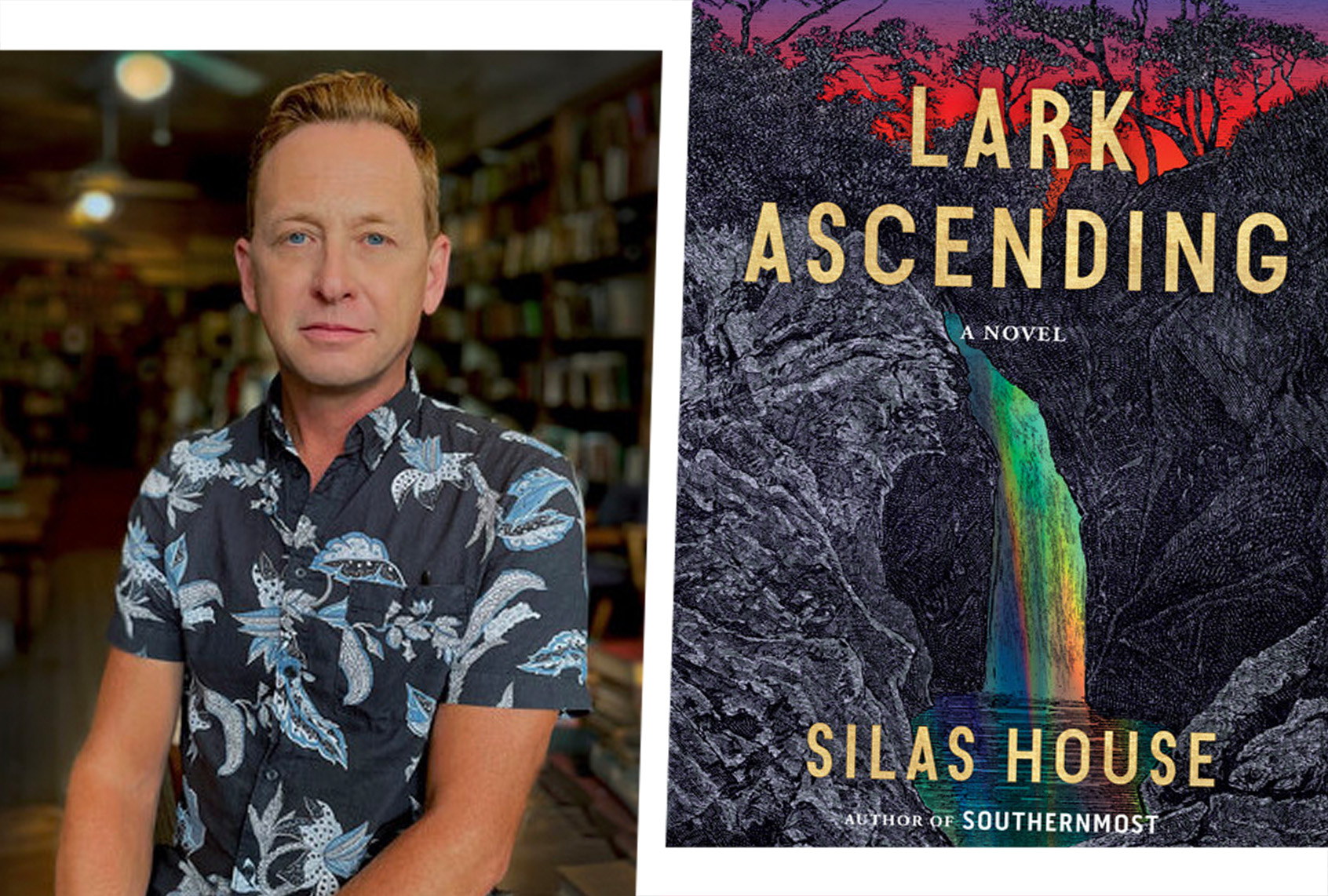
House’s characters are on the move too. The protagonist of his latest novel, “Lark Ascending” is a gay man in his early 20s named Lark who flees the United States with his family, seeking a safe haven in the wake of extreme climate change — and the extremism that has wracked the country, fundamentalism that makes Lark’s very existence as a queer man illegal. His family has their sights set on Ireland. But Lark is the only one to survive the difficult crossing. Destroyed by grief, in a destroyed world, Lark attempts to make a new life in the community of Glendalough, Ireland, and to assemble a family with a woman who has also lost deeply. And naturally his found family includes a beloved dog, a beagle named Seamus, too.

House is the author of six novels, most recently 2018’s “Southernmost,” as well as a book of creative nonfiction, “Something’s Rising,” co-authored with Jason Howard. He was an executive producer and one of the subjects of the film “Hillbilly,” a documentary that examines Appalachian stereotypes in media and culture and the exploitation of Appalachian people.

I have always written my way out of trouble. “

Salon talked with House about the new novel, climate change refugees, American now and the America of dystopian fiction.

This interview has been edited for length and clarity. 

How would you describe your new novel “Lark Ascending”?

I think of it as an adventure story. To me, it’s a real “Odyssey” story. It’s a short book. But I think it has an epic feel to it. Because it takes place in lots of different locales, and there’s a big journey involved. There’s this transatlantic crossing. It deals with pretty huge themes of climate change disaster and the demise of democracy. Thematically, I feel like the book is all about grief. The lead character has lost everything. He’s lost the love of his life. He’s lost his family. He’s lost his country. The whole book grows out of really personal grief and a really sort of global grief. I started this book shortly after I lost my aunt. I was very close to her. She was a grandmother and mother figure to me, really foundational to me, as a person and as a writer. And I was just overwhelmed and flattened by my grief for her. 

I have always written my way out of trouble. Anytime that I’m troubled or sad, I turned to writing. And so the novel, you know, I poured that grief out. At the same time. I mentioned a global sort of grief. I think over the last few years, a lot of us have felt that we’re losing our country, have felt like we’re witnessing the demise of democracy. I mean, from the time that I sold this novel until it would be published — women have fewer rights in that time span. I think that we can see how the country is changing. It’s not changing for the better and we’re mourning the loss of autonomy . . . Those things are definitely going on in the background. 

But what’s important is the human story, the relationships that are playing out against that background. I have this young gay man who’s sort of alone in the world. His existence has been outlawed in the United States because of this fundamentalist uprising. What I really want the reader to take away from it is: here’s this man who’s just trying his best to be the best person he can be and survive. It seems like everything is against him. He creates a family for himself, which is all you can do.

And this is a departure for you. You haven’t written necessarily a dystopia before. Did you set out to write a dystopian novel? Or did the story just naturally take this shape?

No, and, you know, I’m not offended by that description at all. The book has been described that way, and that’s fine with me, but I’ve never thought of it that way. I always just thought of it as a literary novel that happened to be set 20 years in the future. And I really like the idea of mixing genre. Call it climate fiction, or dystopian, or literary fiction, or an adventure story – I want it to be all of those things. I just want it to be a rich, storytelling experience. 

For most of the action of the book, Lark, the main character, is about 20 years old. But he’s telling this story as a very old man. I imagine him to be about 100 years old, telling it on his deathbed. For that reason, I think it does have a real storyteller quality to it. You definitely have been told a story. I wanted the narrative voice to have a timeless quality to it. Not exactly old-fashioned, but it doesn’t sound like a futuristic voice.

That’s interesting also, because it’s a journey narrative. And that’s a very traditional kind of story. Was it important for you to spend so much time on the journey?

Yes, I really wanted to write a book in which the characters are always in motion. And if I’ve done my job correctly, the reader feels that way too, so that the reader feels like it’s a real page-turner. I want it to be very literary and lyrical, but I also want it to move.

It is quite an epic journey that the characters take. Why did you choose Ireland as the place Lark would travel to? 

In writing a book that’s set in the near future, you do have to do quite a bit of world-building, and you have to figure out the scenarios, exactly what has happened. And you, as the writer, you have to know a lot more of that than shows up on the page. Because if too much of it shows up on the page, it’s lost its mystery, and you can tell too much. But I had to know all that. I felt like it made sense for Ireland to be the place because the impetus for the disaster is climate. I feel like Ireland would be a place that was safer from this sort of climate catastrophe. But then I figured out that even if it was safe from the climate catastrophe, it would not be safe from the rise of fascism that happens in the world as a result of this climate catastrophe. That made sense to me because Ireland has for so many centuries been a country fighting for its autonomy, for its unity. It’s sort of the reverse immigration story, because we know so much about the way Irish people emigrated to the United States in the 1800s. And here we have Americans seeking refuge in Ireland. 

One thing I really wanted to do in the book was make American readers or any reader think more, put themselves more in the shoes of refugees. I think we see news coverage of refugee crises in the world, and we’re sad about it, and we sort of shake our heads, and then we move on. And we feel pretty removed from it. I wanted to force us into their shoes more. To make the reader think about the refugee experience and how it feels to not [just] have only the clothes that are on your back, but also to not have a country. To have lost that as well.

(1) Author Silas House and (r) “Lark Ascending,” available now from Algonquin Books. (C. Williams/Algonquin Books)You talked a little bit about Lark, and I’d love to talk about him a bit more. He’s a 20-year-old gay man. You’ve written from the point of view of younger men before. Why is it important for you to write from this voice?

I wanted the narrator to be someone who couldn’t really remember the old world. He was a baby before everything collapsed, but he thinks back to this time right now that we’re living in. Those are the days of his infancy. I wanted him to be somewhat removed, and so he needed to be pretty young for that reason. I mean, I am a gay man. But I’ve written gay characters, main characters in plays and short stories — all of my writing except my novels. This is my seventh novel, but it’s my first gay protagonist.

“So often, love stories between men are rooted in violence.”

It just really made sense for this novel for him to be a young gay man. I feel like your main character should always be the one in trouble . . . I think so many gay stories have been told where the gay character is the person who’s in trouble. And this is the first one that felt new and different for me to tell that kind of story. For one thing, I don’t know of another adventure story that has a gay protagonist, at least in adult literature. I loved feeling like I was doing something new in that way. He’s on the run from these fundamentalist forces as a young gay man. 

I also wanted to write a tender gay love story. So often, love stories between men are rooted in violence. And the love story between Arlo and Lark is very tender . . . they’re removed from all the violence that’s going on in the world, and they can just have this kind of pure, tender romance. That was another thing that I think there’s a lack of in our literature, gay love stories that aren’t absolutely angst-ridden. And this romance stuff isn’t controlled by the culture. Now, having said that, the culture catches up with them, but they do get to have that time together. 

My editor would also probably be upset at me if I didn’t ask about the dog in the book. Why did you decide to have a dog and how did you create the character?

Couple reasons. Number one, I’m a dog person, and I have never not had a dog my entire life. The main reason though, is that this is a very dark, hopeless scenario, and having the dog gives the book a lot more joy. It gives it some light moments, and it inserts some life into the book. In fact, some of the chapters are told from the point of view of the dog. And so they’re in this really terrible situation, but the dog is a joyful creature, and the dog is full of wonder. The dog isn’t aware of its own mortality the way the human narrator is. And so it balances things out, I think, in a really pretty perfect way from my point of view, to where you don’t get so bogged down in the darkness.

The other thing is, I was reading a book about World War II, and I read that during the Blitz, people in London were told by the government that it would be more humane for their pets to put them down because they were so afraid there would be such widespread death, that the country would be full of cats and dogs just roaming everywhere, starving. So 750,000 pets were euthanized in the space of about a month, and I just thought what an eerie, incredibly sad thing that must be. I wanted to recreate that scenario in the book and just think about a world that was pretty much free of pets. And what a sad place that would be. But of course, this dog has survived by being really smart and joins up with Lark.

Lark finds company in unexpected places. Even in the destruction of this world, we can still find a friend.

Lark is in a situation where it’s very hard – it takes him almost the whole book to trust the woman that he encounters. But he trusts the dog right away. He needs somebody to love. And so the dog is that for him in the book.

Climate change is the impetus for the story. How do you think that writers or creative artists can help our understanding of climate change or underscore the importance of doing something about climate change?

“You can’t write a novel without being hopeful.”

It’s really hard to be a person in the world right now and not be thinking about that. It’s such a part of our lives now. You have to think about hope . . . We’re always saying, you know, “It’s too late. We can’t stop it now.” But at the same time, we have this notion that we can do some things to make it better for future generations. So on one hand, we know we’re going to have fight climate change, and there are going to be climate refugees. On the other hand, it’s not too late to try to make some dents in it. I guess the main thing is that I want people to read the book and think about what we can do, even if that just means to make somebody think about not leaving their water running all the time when they’re brushing their teeth or turning a light off. It can happen in small ways. I want people to be more conscious of all that. It’s something that I’m concerned with the same way I’m concerned with democracy. I tend to write about things that trouble me, that I care about.

And you never know where someone might be moved or changed or even learn something. Not everyone gets their news from the newspaper. You never know how you can reach someone.

For me, fiction has been more of a teacher than an entertainment to me. I mean, it’s been both, but I’ve learned so much from reading fiction. I always say that the book that has taught me more than any other is “The Color Purple” by Alice Walker. And that’s largely because it made me think about religion, it made me think about sexuality, gender, race, all this. I mean, everything that you can possibly think of, is covered in a book like “The Color Purple.”

Are there other writers that you return to, as kind of touchstones?

This book in particular was really inspired by adventure stories, like “Kidnapped” by Robert Louis Stevenson, “The Call of the Wild” by Jack London. This is a book that’s somewhat about the rise of fundamentalism. So, to be a person living in this world, if you’re a literate person, you can’t help but to have been influenced by “The Handmaid’s Tale” by Margaret Atwood. One thing I tried to do in the book is, since I’m also writing about the rise of fundamentalism, I tried to make sure I wasn’t doing the same things that Atwood had done, to make it a very different take on it.


Want a daily wrap-up of all the news and commentary Salon has to offer? Subscribe to our morning newsletter, Crash Course.


What’s next for you? Do you have a new book that you’re working on?

I always have three or four projects going at the same time. So I’m working on a murder mystery, which I’ve always wanted to write. I’m working on a book set in the early 1900s that’s somewhat of a family story about a relative of mine who was sent to an asylum, because he was a gay man in a time when that just was not possible for him to be in that time and place. I’m working on trying to put together a collection of short stories. And I’m working on a play. 

I feel, especially now in the times we live in, having a new project is always a way to keep hope going too. Always have something.

Exactly. I think that’s absolutely true. You can’t write a novel without being hopeful, because, at least if you write the way I do, you’re in it for years, so you have to have some hope of going forward.

Don’t have a cow, but there’s a major butter shortage

As we enter prime baking season, one essential ingredient may be harder to come by — and more expensive — than in years past: butter.

According to a recent report from The Wall Street Journal, the quantity of butter in cold storage recently hit its lowest level since 2017, thanks to a combination of worker shortages and lowered dairy outputs across U.S. farms. As a result, the price of butter has skyrocketed, climbing 24.6% in the last 12 months. As the demand for butter increases during the holiday baking season, these tight supplies (and their accompanying costs) aren’t going anywhere.

A recent Market News report from the USDA suggested similar trends. “In the Northeast and West, cream demand is strong and spot availability is limited. Butter makers in these regions say this is contributing to reduced butter production,” said the report.

Meanwhile, buyers who bring butter to the marketplace “are concerned that record high butter prices will cause retail demand to soften.”

With so many pies, cookies, and cakes to bake this season, how should home cooks prepare for these butter-related shortcomings? Start by increasing your butter’s lifespan by storing it in the freezer: Frozen butter will stay good for at least several months, if not a whole year.

Alternatively, you could always turn to recipes that, in lieu of butter, rely on a different type of fat — coconut oil, olive oil, and neutral-flavored vegetable oils are all strong contenders. From butter-free versions of pumpkin bread to gingerbread cookies, we promise it won’t take long to find a new holiday favorite.

This is why there’s a fish head on your Rosh Hashanah table

It was the moment we’d all been waiting for — or more accurately, slightly dreading: time to consume the fish heads. My mom picked them up from the fishmonger that morning, and they’d sat in a plastic, ice-filled bag on the counter, my siblings and I giving it a wide berth. Now, gleaming, silver-scaled and freshly cooked, they were being carried out on an intricate platter. With gaping mouths and glassy eyes, the fish heads took center place on our Rosh Hashanah table. “Dig in,” said my dad.

As a kid, I couldn’t quite get behind the practice of eating fish heads on Rosh Hashanah. I was awed and alarmed, unable to look away from the fish’s glassy eyeballs, loath to take a bite. Usually, I’d take just a tiny forkful to fulfill my obligations.

But as I got older, I started developing a deeper appreciation for this custom. Not only do I now love fish — whole, tinned, on the bone, and yes, fish heads, too — I’m also intrigued by the symbolism and mysticism surrounding this High Holiday ritual. I love traditions that combine food with meaning, and growing up, this one always felt especially meaningful. On a table filled with challahs, apples and honey, brisket and chicken soup, the platter of fish heads stood out, and somehow signified the entering of the High Holiday season in a way none of the other Rosh Hashanah dishes did. Which made me wonder: why are fish heads eaten on Rosh Hashanah? I did a little digging to find out how fish earned their spots on Rosh Hashanah tables worldwide, and it turns out the answers are varied, whimsical, and symbolic.

Rosh Hashanah translates to “head of the year.” Eating a fish head is a symbolic and literal way of bringing that to life. Welcoming in the Jewish New Year with fish heads is a way to start off the year on the right track and get a “head” of the game. When served, it’s customary to recite a blessing: “May we be heads, not tails.” Based on a verse in Deuteronomy, it’s a reminder to be like heads — leaders and changemakers — and not tails, or followers.

But it’s more than just a play on words; it has historical significance, too. In the ancient world — and especially in the Talmud, fish, which are famously fruitful, symbolized fertility, blessing, and abundance. In fact, many talmudic verses mention fish as an essential ingredient for holiday meals, due to their good-omen status. All the more so on Rosh Hashanah, when we ask for a blessing and pray for health and abundance. On the Jewish New Year, fish couldn’t be a more auspicious menu item.

While the basic premise of this tradition is the same, it changes from community to community. In my home, we were all encouraged to partake of the fish heads, regardless of our age. In some Greek Jewish homes, the head of the fish is reserved for the heads of the household. But not everyone uses fish heads. In Sephardic Jewish communities, a sheep’s head (which has to be sourced from specialty kosher butchers!) is often used, and serves as a reminder of the biblical story of the ram that saved Isaac’s life. And in Persian Jewish communities, it’s traditional to serve tongue. “I grew up in a household with Moroccan and Persian roots, so I had a wide range of flavors and spices around me during the High Holidays,” says Arielle Mamiye, culinary director of Jewish Food Society. “My mom’s Moroccan, so she’ll make Moroccan fish with peppers, cilantro, and paprika oil and add a fish head to the pot. And since my dad’s Persian, she serves cow’s tongue — braised with saffron and garlic — for the same symbolism.”

Like every good tradition, this one’s been customized and adapted. Some vegetarian Jews put their own spin on things and use a roasted head of cabbage, garlic, or a head of lettuce to partake in the tradition. Others, like blogger Chani Apfelbaum of Busy in Brooklyn, forgo the roasted fish heads altogether and just serve a whole fish. “Growing up, we always had a fish head on the table,” she tells me. “But everyone turned their nose up at it! I love the meaning behind the custom, so instead of purchasing a fish head on its own, I prefer to serve a whole roasted fish with the tail removed. It’s fresher, tastier, and a little less intimidating.”

I, too, love the idea of serving a whole fish. Today, I’ll serve a few whole branzinos; I stuff them with lemons, capers and tomatoes for a bright and simple take on the tradition. If I’m feeling nostalgic, I go the route I grew up with. I ask the fishmonger for 3-4 fish heads (look for ones with clear eyes, firm flesh and a mild, slightly briny scent) and poach them in white wine with herbs and onions. Another option? Grill them and serve with chimichurri. If you want to avoid bone-in fish entirely, try challah toasts spread with herby aioli and topped with salmon roe, or make a fish plate. I like herring, smoked salmon, and sardines with crackers, crudités, and a few dip options. It might not be not a fish head, but the message is just as powerful: a desire for blessing, heady energy and of course, good snacks, in the New Year.

A love letter to Chicago’s tavern pizza, interrupted

If you have ever called the Windy City home, you no doubt have strong feelings about which pizzas do (and don’t) deserve to be anointed bona fide Chicago-style. I’m not here to offer hot takes; I simply want to declare that the Chicago-born pie I hold dearest is tavern-style — a.k.a party cut, a.k.a the circular pizza with cracker-thin crust that’s inexplicably cut into small squares. 

When done right, it perfectly balances crackly crunch; stretchy, char-speckled mozzarella; and tangy-sweet red sauce. I can count on one hand the number of times I haven’t burnt the roof of my mouth on a tavern pizza; I’m always so impatient to dig in. 

Tavern pizza was the centerpiece of birthday parties throughout my childhood in the southwestern Chicago suburbs. But I came to really love it like many Chicagoans — when I was living in the city in my 20s, perennially broke and staying out far too late. Within walking distance from every Chicago apartment I ever lived in sits a timeworn joint called John’s Pizzeria Ristorante & Lounge on Western Ave., which stays open till 1 a.m. on Saturdays. 

I came to really love it like many Chicagoans — when I was living in the city in my 20s, perennially broke and staying out far too late.

I’d wander into that old, white-clapboard structure, nod at the inevitable table full of cops or firefighters seated at the front, then nab a booth along the wall — never remembering which two of them tilt until after sliding in. In more than a decade of eating there, my order rarely changed: garden salad with canned black olives and Italian dressing followed by a large, single-topped (crucial for square integrity) pizza, either with sausage nubs or half-pepperoni, half-giardiniera

I like that tavern pizza is thin enough to almost feel snackish. I like when it is ineptly cut, rendering at least one triangular corner with nothing more than an oven-dried smear of sauce. I like that sometimes the middle pieces ooze so relentlessly with cheese and sauce that they collapse into a stretchy heap that you have to shovel in, head thrown back, in one hedonistic go. 

“I just don’t get it,” interrupts my good friend John Manion, chef/owner of El Che Steakhouse & Bar in Chicago’s West Loop and a Chicago-area resident since 1995. This is probably the third time we’ve traded barbs over whether tavern pizza merits the coveted “Chicago-style” label. 

“It’s essentially mediocre bar food,” Manion continues. “Objectively, yes, it is good in that it’s melted cheese on bread, but let’s not pretend that this is something it isn’t.” 

As its name suggests, tavern-style pizza indeed originated in the city’s neighborhood bars as a hot and savory nosh for hungry blue-collar workers coming off long shifts — cheap (sometimes free with a beer) and salty enough to keep them drinking. The square cut made it easy to hold with a beer in the other hand, and shareable so a couple of patrons could split one and go home still hungry for dinner.

Detroit-native Manion’s first encounter with tavern style was similar to my origin love story — as a hungover and broke chef in his late 20s or early 30s ordering delivery.

“Not being from here, what I was hoping to receive at my hungover doorstep was a proper hungover pizza — in slices, mind you — and steaming hot in a cardboard box,” he recalls. “What I received instead was this cardboard, not box, but round, cardboard pizza, cut inexplicably into squares. On the edge there was nothing, maybe a little burnt sauce. Then the middle: I mean, do I get a spoon and scoop it? I found it to be a really unacceptable substitute for what I wanted.” 

Manion admits that solid examples of the style exist, like the iconic, cracker-thin pies at South Side institution Vito & Nick’s. Until recently, he was content to call bulls**t among his inner circles, like when El Che’s staff occasionally ordered tavern pizza for pre-shift comida. It was only within the past couple years — since this humble pie entered the national pizza discourse and became (to him, undeservedly) deified — that Manion’s disdain has become visceral. 

Through a little digging, we actually pinpoint that exact moment as July 22, 2019, when Bon Appetit published author and editor Jason Diamond’s love letter to tavern pizza. In it, Diamond heralded tavern style as Chicago’s real signature pie, as beloved by locals as it is underappreciated by tourists and national media. 

And then came the listicles.

“All of a sudden, tavern style is anointed the ‘real’ Chicago pizza, and you start seeing, like, ‘the 32 best tavern-style pizzas’ everywhere,'” Manion says. “And to that I was like, no sir. This is junk food. If you go to a tavern after working your shift breaking rocks or at the auto plant, and you get that cold, first brew and someone’s like, ‘Hey would you like a triangle of cheap, pizza-like substance?’ you go, ‘Hey, sure. That sounds good.’ But it’s an indictment of us as a society where we need to objectify and write tomes about things that are just OK.”

Whether it’s Popeye’s chicken sandwiches or Choco-Tacos, our clickbaity, trend-chasing culture loves hot takes on what’s considered lowbrow food — which we subsequently ravage from every possible angle till only the carcass and a few grease-stained napkins remain

Whether it’s Popeye’s chicken sandwiches or Choco-Tacos, our clickbaity, trend-chasing culture loves hot takes on what’s considered lowbrow food — which we subsequently ravage from every possible angle till only the carcass and a few grease-stained napkins remain. But what makes us lose our minds over tasty things that many wouldn’t deem “great” in the first place?

Nostalgia, Manion replies. “If tavern-style pizza is what you got as a kid — on a summer night coming home from the pool — that’s the best, that’s what you want,” he says. He admits to having a similar maudlin blindspot when it comes to Detroit’s Coney dogs — a beef frankfurter on a bun smothered in beanless chili, mustard, onions and shredded cheese. 

“I think that I espoused bullshit about that for many years, before I even accepted eating a proper Chicago-style hot dog,” he says of the Chicago-born, snappy all-beef frankfurter on a poppy seed bun with yellow mustard, neon-green sweet pickle relish, chopped onion, tomato slices, a dill pickle spear, pickled sport peppers and celery salt. “Then I did, and it was just this majestic balancing of textures and flavors. I’m like, OK, when done right, I understand this. This is what you should be writing f**king poems about.”


Want more great food writing and recipes? Subscribe to Salon Food’s newsletter.


Maybe you count among those who believe tavern-style pizza is capable of the same excellence as a Chicago-style hot dog; maybe you don’t. Regardless, there’s something profoundly satisfying about seeing the things we hold dear validated by the elites of our realms — however niche or mediocre that thing is. 

There’s my beloved tavern pizza, all dressed up and styled in the good lighting for Bon Appetit! Or there’s my cherished Chicago dog, getting a beautiful, blown-out feature in the New York Times dining section!

Because we knew and loved it long before its big break made it all distant and full of itself, we get to claim a piece of the credit. Then when someone comes to visit, we proudly take them to our hot dog stand or our tavern pizza joint, for our taste of bonafide Chicago. 

Near the end of the conversation, the evangelist in me can’t help but pipe up that Manion should come with me to John’s some time and try it for himself. His answer surprises me. 

“F**k yeah I’ll go!” he says. “I’m not a monster. It’s still pizza. And that’s the thing. If you love it, go for it. There are lots of things that aren’t awesome that are awesome.”

For my part, I’ll try to keep the poetry to a minimum.


Former GOP congressman: I “came to believe” some far-right colleagues had “serious cognitive issues”

In a new book by former Rep. Denver Riggleman, R-Va., in his last days serving in the House he admits he grew more and more disturbed by the wild ravings of two of his colleagues who were all too willing to believe any conspiracy rumor that came across their desks as they defended Donald Trump.

Riggleman, who left Congress and subsequently accepted a position as an investigator for the House select committee looking into the Jan 6 insurrection, has roiled members of the committee with the book, “The Breach: The Untold Story of the Investigation into January 6th,” which is being published today.

In an excerpt from the book, which the Guardian has obtained, Riggleman singles out Rep. Paul Gosar, R-Ariz. and Louis Gohmert, R-Texas, as two colleagues both of whom he has doubts about when it comes to their mental faculties.

In his book, Riggleman wrote that he signed up with the far-right Freedom Caucus in order to prove his conservative bonafides and it was during meetings with the members of the caucus that he saw the full extent of how conspiratorial some of them were.

He wrote that he “began to understand that some of my colleagues had fully bought into even the more unhinged conspiracy theories I had been seeing out on the campaign trail”.

The Guardian report, by Martin Pengelly, adds that “Riggleman describes one meeting in which Gohmert ‘promoted a conspiracy theory related to master algorithms,’ saying he ‘suspected there was a secret technology shadow-banning conservatives across all platforms,’ adding, “that others ‘nodded along’, though ‘of course, that’s crazy’. He says he said ‘something to that effect’ during the meeting in question.

Summing up, he added, Gohmert and Gosar “seemed to be joined at the brain stem when it came to their eagerness to believe wild, dramatic fantasies about Democrats, the media and big tech. I came to believe Gosar and Gohmert may have had serious cognitive issues.”

You can read more here.

“Moron who has no business running for president”: Trump-DeSantis cold war devolves into insults

Florida Gov. Ron DeSantis, who recently made headlines for flying 48 migrants to Martha’s Vineyard, was praised by Republicans for standing up against the Biden administration’s immigration policies, but his political stunt has angered one of his closest allies – former President Donald Trump. 

Trump has privately accused DeSantis of stealing his idea and taking the spotlight off of him so that DeSantis can generate a 2024 polling boost, according to Rolling Stone. Both of them are seen as potential rivals for the 2024 presidential nomination within the Republican Party, but one of them has out-fundraised the other. 

DeSantis raised $177 million within the first six months of the year, surpassing Trump and breaking the gubernatorial fundraising record, according to OpenSecrets

Neither of them has officially declared a 2024 presidential run, but DeSantis has toured swing states and headlined rallies for other Republicans on the ballot this November while Trump has quietly tracked his public appearances and polling numbers, according to his advisers

In private, he has made comments expressing his disdain for DeSantis, calling him a “phony.” “He’s ungrateful,” Trump’s privately complained, claiming that “I made him.” The recent comments are a stark contrast to Trump’s praise for DeSantis during his 2018 gubernatorial run, when the former president touted him as “my great friend” and “a tough, brilliant cookie.”

DeSantis has returned the hostility, reportedly calling Trump “a TV personality and a moron who has no business running for president,” according to a former DeSantis staffer. 

DeSantis also leads Trump by eight points in their shared home state, according to a USA Today/Suffolk University poll of registered Florida Republican voters.

In private, DeSantis has disclosed to donors that “the only way to beat Trump is to attack him head-on. He says he would turn to Trump during a debate and say, ‘Why didn’t you fire Fauci? You said you would build the wall, but there is no wall. Why is that?’ ”


Want a daily wrap-up of all the news and commentary Salon has to offer? Subscribe to our morning newsletter, Crash Course.


With overlapping social circles, the two are also competing for loyalty among donors – making their rivalry all the more complicated. 

Some of Trump’s donors have received phone calls from the former president urging them to stop giving money to DeSantis, who may plan to run against him, according to the Washington Post. Some of these donors also prefer DeSantis as a presidential candidate.

Major Trump donors like retired venture capitalist William Buckley and Illinois-based businessman and major GOP donor Richard Uihlein have each contributed at least a million dollars to back DeSantis. Billionaire businessman Phil Ruffin has given $100,000 to DeSantis’s political action committee. 

Even as Trump remains the kingmaker of the Republican Party and perhaps its most popular national figure, DeSantis’ similar brand has captured billionaire donors like Citadel founder Ken Griffin and Miami Dolphins owner Stephen Ross.

“DeSantis has caught a moment where he’s a stark contrast to Trump’s crazy governing style, and he’s doing it from a MAGA state,” a longtime Republican strategist Scott Reed told Vanity Fair. “He’s got two of the best assets: He can raise money and he has a message.” 

Ex-spokesman: Oath Keepers expected Trump to join on Jan. 6, would have acted “completely different”

Elmer Stewart Rhodes III goes to trial this week for his role in the Jan. 6 attack on Congress and the U.S. Capitol.

Jason Van Tatenhove, the former Oath Keepers spokesperson, told MSNBC that had Donald Trump walked down to the Capitol on Jan. 6 things would have gone a different way.

“I think they were absolutely serious. I think if things had gone just a little bit differently, we would be living in a different reality right now,” he told MSNBC’s Joy Reid. “You know, if you look at his words and his messaging he was putting out just the night before, at the speeches, with what has been released with the prosecution, the messaging that were [sic] happening, specifically on Signal and behind the scenes, I think that’s really where we see where his state of mind was. And you know, if things had just gone — if Trump had walked down to the Capitol building, I think Stewart’s actions would have been completely different.”

Former White House aide Cassidy Hutchinson relayed a story that deputy chief of staff Tony Ornato told her about Trump attempting to take the wheel of the SUV to drive up to the Capitol after his speech at the Ellipse. Trump said that it was impossible for him to reach the wheel.

Hutchinson also testified to the committee that White House Counsel Pat Cipollone told her that they had to do whatever it took to keep Trump from going to the Capitol and, that if he did, arrests among administration officials would quickly follow.

Van Tatenhove also said that he thinks there were lines of communication open between the militias and the White House and the Trump campaign.

“I think that they were actively trying to open those lines both from the militia side and from the White House side, from the campaign side,” he said. “I think that they probably connected up a while back. I think without that type of connection, you know, he may have shown up as like a protester, but nothing like he was there. Because it seemed like he was getting messaging like he was taking orders from Trump.”

He also agreed that the kind of attitude Roger Stone had about “shoot to kill” was the same as Rhodes’.

“I mean, he was talking about how we don’t get out of this without a Civil War,” said Van Tatenhove. “This is the messaging he’s been, you know, putting out there, time and time again since, you know, the early days. It’s just gotten more and more extreme and more and more violent. Before, he was talking about what would be termed a cold civil war. But really, he’s talking about a hot civil war now, and that’s part of the messaging. That messaging is ratcheted up over time, and we saw that with the culmination of Jan. 6th.”

See the full discussion below or at the link here:

Trump’s Truth Social merger partner changes address to a UPS store after investors pull $130 million

The company looking to take Trump Media and Technology Group public has changed its listed address to a UPS store in Miami, CNBC reports.

Digital World Acquisition Corp (DWAC) changed its address came with its regulatory filing on Friday disclosing its financing losses of $138.5 million of the $1 billion in financing it got from investors to fund Trump Media.

“One of the former private investors told CNBC that it pulled financing from DWAC because of the many legal obstacles facing the company. The investor, who declined to be named due to the sensitive nature of the matter, was also underwhelmed by the popularity of Trump Media’s Truth Social app as measured by Donald Trump’s follower counts,” CNBC’s reports stated.

“Trump had more than 80 million followers on Twitter. On Truth Social, which he founded after he was banned from Twitter following the Jan. 6, 2021 Capitol riot, he has 4.1 million. The app is also currently barred from the Google Play store.”

Trump Media and DWAC are currently under investigation by the Securities and Exchange Commission into whether negotiations between the companies before the merger violated securities laws.

Read the full report at CNBC.

Ken Paxton makes a run for it: Fleeing a subpoena, the Texas AG epitomizes cowardice of GOP bullies

Bullies are always the biggest cowards underneath their blustery exteriors, we know that. But it is satisfying nevertheless when some of the biggest jerks of the GOP prove the point. So it was Monday, when the Texas Tribune reported that Ken Paxton, the bellicose attorney general of Texas, fled a subpoena like it was a magical mirror that reflects the state of a viewer’s soul. All credit to the process server, Ernesto Herrera, for his plain-written but evocative affidavit describing the response he got from Paxton, who talks tough on Twitter but ran when facing a man simply asking if he could hand him a stack of papers. 

“As soon as he saw me and heard me call his name out, he turned around and RAN back inside the house through the same door in the garage,” Herrera describes. He then observed Paxton’s wife, state Sen. Angela Paxton, get in a black Chevy and leave the back door open while she started it. “A few minutes later I saw Mr. Paxton RAN from the door inside the garage towards the rear door behind the driver side,” he writes. At which point the couple peeled away from the house, leaving the subpoena on the driveway where Herrera had placed it. 


Want more Amanda Marcotte on politics? Subscribe to her newsletter Standing Room Only.


Paxton, who likes to issue threats about filing frivolous lawsuits against President Joe Biden, is trying to avoid a lawsuit from a group of abortion funds. The groups are defending their right to help patients who need to leave Texas, where abortion is banned, in order to get care. Under the Texas “bounty hunter” law, it’s not just illegal to perform an abortion, but anyone who helps a patient can be sued for “abetting” an abortion. This means abortion funds can’t give abortion patients money to leave the state without risking being sued by bitter ex-boyfriends, nosy mothers-in-law or sadistic bullies using the power of the Texas attorney general’s office. 

The law, the funds say, “violates Plaintiffs’ rights to freely travel, freely associate, freely speak, and freely support members of their communities through financial assistance.”

Showing up in court to deal with this lawsuit does not sound nearly as scary as, say, having to wait for your miscarriage to go septic before doctors are allowed to treat you, as Texas is forcing hospitals to do. It’s certainly not as scary as being told you must bear a rapist’s baby, as Texas does not have a rape exception in its law. It’s not even as scary as seeing that positive pregnancy test when you’re a sophomore in college, and you have no idea how you’re going to make it all the way to New Mexico to get an abortion. 

But Paxton, whose feelings were clearly hurt by the Texas Tribune reporting on the Great Chevy Escape, decided it was time to tweet through the shame. He claims that he feared for his life, seeing that man wave legal documents at him. 

“[T]hey’re attacking me for having the audacity to avoid a stranger lingering outside my home and showing concern about the safety and well-being of my family,” he whined on Twitter, after arguing that “conservatives have faced threats to their safety.”


Want more Amanda Marcotte on politics? Subscribe to her newsletter Standing Room Only.


According to the sworn affidavit filed by Herrara, Angela Paxton had opened the door when he knocked and “explained to her that I was trying to deliver important legal documents.” She told him her husband was on the phone, so Herrara waited. When Paxton finally made his run towards the Chevy, Herrara “loudly called him by his name and stated that I had court documents for him.”

Is it plausible that the top lawyer in Texas, a man with a law degree from the University of Virginia, does not understand what a subpoena is or that it is delivered by a process server? Of course not. These are just the mewling excuses of a man caught giving Missouri’s Sen. Josh “Running Man” Hawley stiff competition for the prize of Biggest Republican Wiener. 

Of course, Paxton isn’t just a standout when it comes to being lily-livered. He’s also an enormous bully, even by Republican standards. But like most cowardly bullies, he clearly prefers his victims to be as vulnerable as possible. It’s not just his sadistic posture towards pregnant patients seeking medical care. He also has it out for poor people who want health care, suing the Biden administration for trying to get them into Medicaid. He also loves punishing people of color for voting, by siccing teams of investigators on people who rarely have done anything more serious than accidentally filling out a form wrong. 

Paxton especially likes to pick on children. He’s been waging war on trans kids, calling gender affirmation care “so-called sex change procedures” and threatening to remove kids from their families for being trans. He and Republican Gov. Greg Abbott have been forcing Child Protective Services to harass families with trans kids, falsely claiming it’s “abuse” to accept a child’s gender identity. In doing so, Paxton simply makes up facts to justify his bigotry. 

The documents Paxton wrote to defend attacking trans kids “ignore established medical authorities and repeat discredited, outdated, and poor-quality information,” a team of medical experts from Yale and the University of Texas Southwestern Medical Center explained in May. The report is so bad and so full of disinformation they wrote, “it is difficult to believe that the opinion represents a good-faith effort” and “is, rather, motivated by bias and crafted to achieve a preordained goal: to deny gender-affirming care to transgender youth.”

Even before his 5-yard dash to avoid paperwork, Paxton epitomized the cowardly bully. He’s got a long and tawdry history of inflicting pain on vulnerable people, but always from afar so he doesn’t have to look in their eyes while he attempts to destroy their lives. He gets to write the paperwork. It’s other people he sends to arrest grandmothers for writing down an address wrong on a voter registration form, to deny a miscarrying woman treatment, or to tell parents they are under investigation for loving a trans kid. Still, these paperwork bullies of the GOP are so ubiquitous it’s easy to forget sometimes the depths of their pusillanimity. At least, that is, until some dude shows up waving a stack of papers at the Texas AG, and he runs like Jesus finally showed up to have a word about the cruelty he’s been passing off as Christian morality. 

“F**k the voting, let’s get right to the violence”: Damning Roger Stone Jan. 6 video leaks

Roger Stone, a long-time associate and ally of former President Donald Trump, previously told a camera crew he was ready for violence ahead of the 2020 presidential election.

According to CNN, the clip was filmed as part of a documentary titled “A Storm Foretold.”

Excerpts from the documentary, compiled by filmmakers Christoffer Guldbrandsen and Frederik Marbell, are reportedly expected to be included in the upcoming hearing to be conducted by the House Select Committee as they continue their investigation into the U.S. Capitol insurrection.

“F–k the voting, let’s get right to the violence,” Stone can be heard saying in a clip that CNN obtained from the filmmakers. “Shoot to kill. See an Antifa? Shoot to kill. F–k ’em. Done with this bulls–t.”

However, according to The Washington Post, Stone now insists he was “only kidding” when he made the remarks. “We renounce violence completely,” he said. “We totally renounce violence. The left is the only ones who engage in violence.”

Speaking to CNN’s Don Lemon, the filmmakers shared their reaction to Stone’s attempt to backpedal. According to them, Stone’s remarks seemed disingenuous as he appeared to offer his take with “more of a wink and a nod.”

Stone also argued that the clip obtained by CNN appeared to be “manipulated and selectively edited.”

Stone was previously sentenced to a maximum of 40 months behind bars back in 2020 for multiple felonies, “including witness tampering, lying to Congress and obstruction,” per the news outlet. However, he was one of many who received a pardon from Trump.

Watch the video below or at this link.

New texts show Meadows communicating with GOP operative who plotted to seize voting machines: report

After Donald Trump lost the 2020 presidential election to Joe Biden, then-White House Chief of Staff Mark Meadows was among the many MAGA Republicans who aggressively promoted the Big Lie — claiming that the election had been stolen from Trump and aggressively looking for possible ways to keep Trump in the White House. One of the fellow Trump supporters Meadows worked with during that period, according to CNN reporter Zachary Cohen, was Republican operative Phil Waldron.

“As allies of then-President Donald Trump made a final push to overturn the election in late-December 2020, one of the key operatives behind the effort briefed then-White House Chief of Staff Mark Meadows about his attempts to gain access to voting systems in key battleground states, starting with Arizona and Georgia, according to text messages obtained by CNN,” Cohen reports in an article published by CNN’s website on September 26. “Phil Waldron, an early proponent of various election-related conspiracy theories, texted Meadows on December 23 that an Arizona judge had dismissed a lawsuit filed by friendly GOP lawmakers there. The suit demanded state election officials hand over voting machines and other election equipment, as part of the hunt for evidence to support Trump’s baseless claims of voter fraud.”

Cohen continues, “In relaying the news to Meadows, Waldron said the decision would allow opponents to engage in ‘delay tactics’ preventing Waldron and his associates from immediately accessing machines. Waldron also characterized Arizona as ‘our lead domino we were counting on to start the cascade,’ referring to similar efforts in other states like Georgia. ‘Pathetic,’ Meadows responded.”

According to Cohen, those previously unreported text messages “shed new light on how Waldron’s reach extended into the highest levels of the White House and the extent to which Meadows was kept abreast of plans for accessing voting machines — a topic sources tell CNN, and court documents suggest, is of particular interest to state and federal prosecutors probing efforts to overturn the 2020 election.”

Cohen describes Waldron as a “retired” U.S. Army colonel with ties to former National Security Adviser Michael Flynn.

According to Cohen, Waldron has “emerged as a key figure in the broader scheme to overturn the election and was the architect of several extreme proposals for doing so” — including “a PowerPoint presentation.”

“Waldron also helped draft language for an executive order directing the Pentagon and Department of Homeland Security to seize voting machines on behalf of the White House,” Cohen reports. “Trump never signed the order, siding with White House lawyers who insisted the idea was legally perilous. But there is evidence that his closest allies, including Meadows, continued to entertain similar pitches from Waldron in the lead-up to January 6, (2021) as they sought to validate conspiracy theories about foreign election interference.”

“Unpopular view”: McConnell gushes over Sinema as she pushes to hand GOP even more filibuster power

Senate Minority Leader Mitch McConnell, R-Ky., heaped praise on Sen. Kyrsten Sinema, D-Ariz., Monday after she resisted her party’s calls to reform the filibuster and helped Republicans block much of President Joe Biden’s first-term agenda.

The Republican leader appeared alongside Sinema at the McConnell Center at the University of Louisville, touting the Democrat as “extraordinarily effective” and a “genuine moderate.”

At one point McConnell lauded her as “the most effective first-term senator I’ve seen in my time in the Senate.”

“She is today what we have too few of in the Democratic Party, a genuine, moderate, and a dealmaker,” McConnell said. “It took one hell of a lot of guts for Kyrsten Sinema to stand up and say, ‘I’m not going to break the institution in order to achieve a short-term goal.”

Sinema during her speech focused on what she described as bipartisanship and pragmatism.

“Despite our apparent differences, Sen. McConnell and I have forged a friendship, one that is rooted in our commonalities, including our pragmatic approach to legislating, our respect for the Senate as an institution,” she said. “In today’s partisan Washington, it might shock some that a Democratic would consider the Republican leader of the Senate her friend. But back home in Arizona, we don’t view life through a partisan lens. Arizonans understand that while we may not agree on every issue, we do share the same values.”

Sinema, whose defense of the filibuster rule helped prevent Democrats from advancing legislation protecting abortion rights, voting rights, labor rights and immigrants, also used her speech to call to strengthen the filibuster and give the Senate minority even more power. Sinema called to restore the 60-vote threshold to confirm federal judges and executive nominees, which McConnell and the GOP used to block many of former President Barack Obama’s nominees. Former Senate Majority Leader Harry Reid, D-Nev., and Senate Democrats scrapped the threshold in 2013. McConnell later went a step further in 2017, eliminating the threshold for Supreme Court nominees ahead of Justice Neil Gorsuch’s confirmation.

“Not only am I committed to the 60-vote threshold, I have an incredibly unpopular view. I actually think we should restore the 60-vote threshold for the areas in which it has been eliminated already. We should restore it,” Sinema said.

“Not everyone likes that,” she continued, “because it would make it harder for us to confirm judges and it would make it harder for us to confirm executive appointments in each administration, but I believe that if we did restore it, we would see more of that middle ground in all parts of our governance, which is what, I believe, our forefathers intended.”

Sinema argued that it is important to protect the filibuster given the volatility of the congressional majority, which she predicted her party would lose in the midterms.

“It’s likely to change again in just a few weeks,” she said. “While it is frustrating as a member of the minority in the United States Senate — and equally as frustrating in the majority, because you must have 60 votes to move forward, that frustration represents solely the short-term angst of not getting what you want. “We shouldn’t get everything we want in the moment because later, upon cooler reflection, you recognize that it has probably gone too far.”

Sinema’s comments did not sit well with some of her Democratic colleagues.

“Sen Sinema’s position is bad history, bad policy, and bad politics,” tweeted Rep. Brandon Boyle, D-Pa.

Rep. Ruben Gallego, D-Ariz., who has floated a possible primary challenge to Sinema, hit back at her prediction that Democrats would likely lose in November.


Want a daily wrap-up of all the news and commentary Salon has to offer? Subscribe to our morning newsletter, Crash Course.


“I mean you could be out there helping our candidates @SenatorSinema But my sense is that you would actually prefer the Dems lose control of the Senate and House,” he tweeted. “Now that I think of it. I have been traveling the state and country. Donating, raising funds and encouraging people to come out and vote and I have seen you nowhere @SenatorSinema.”

Political pundits also lashed out at Sinema.

“It is fundamentally undemocratic for an elected official in the United States to publicly advocate for minority rule and for overturning the wishes of the voters who sent them to DC,” wrote MSNBC host Mehdi Hasan.

“The Constitution does not say that Mitch McConnell shall prevent a nominated Supreme Court Justice from even being considered by the United States Senate for its consent as Mitch McConnell did to Merrick Garland in the last year of the Obama presidency,” argued fellow host Lawrence O’Donnell. “Today, Kyrsten Sinema traveled to Kentucky to celebrate Mitch McConnell’s constitutional vandalism, and her own relentless ignorance, by saying this about Mitch McConnell.”

Former MSNBC host Keith Olbermann bizarrely used the speech to claim that he had dated Sinema and questioned her political evolution.

“When we dated, in 2010-11, Kyrsten was a legit progressive, far to my left. Now she has embraced the Political Industry™️ where there is only process, not policy, and never people,” he tweeted, before taking a shot at MSNBC host Chuck Todd. “Perfect solution: she can be the next host of @MeetThePress.”

Prosecuting Boss Trump: Build a RICO case against his entire criminal empire

Even folks who support Donald Trump might agree that the former president is a con artist, a master gaslighter and a shrewd racketeer. As I argue in my book “Criminology on Trump,” the Houdini of white-collar crime and founder and CEO of the Trump Organization has effectively operated a criminal enterprise, beginning in 1980. He did so for the next 36 years before being elected president in November 2016. Throughout his presidency and afterward, Trump continued running, and even expanding, his criminal enterprise.   

Trump’s lifetime as an outlaw and a racketeer may finally be coming to an end after more than four decades of eluding the criminal law. He is currently encircled by at least six or seven significant civil or criminal investigations.. Most legal scholars or former U.S. prosecutors will likely approach these white-collar, corporate and state crimes evidently committed by Trump and his associates as disparate and unrelated litigating conflicts. 

I would contend, however, that when Trump’s fraudulent behavior is seen through the lenses of racketeering and the vantage point of a criminal enterprise, all his offenses or violations, whether civil or criminal, could be legally brought together and prosecuted under RICO, the Racketeer Influenced and Corrupt Organizations Act. 

Just as Trump and his allies could be prosecuted for sedition, obstruction of justice and election racketeering, in a classic “hub and spoke” multi-pronged criminal conspiracy, the illegal activities at issue in each of these individual investigations or lawsuits can be viewed over time as spokes of the same criminal enterprise.  

Trump is an outlaw, and I mean that literally. He habitually breaks laws of all kinds while remaining a free person. Trump is also a special type of outlaw, because he has no moral compass and no loyalty to anyone besides himself. In fact, he thinks and acts as an authentic sociopath.   

Trump is not an outlaw out of negligence, incompetence or ignorance of the illegalities of the marketplace, the civil and criminal laws or the Constitution of the United States. Quite the contrary. Trump knows the subtle differences between what is lawfully right and what is unlawfully wrong. Even more important, Trump is an expert on criminal intent — and the lack thereof. 

Trump is not an outlaw out of negligence, incompetence or ignorance. He understands the subtle differences between legal and illegal — and he’s an expert on criminal intent.

Moreover, Trump knows all about plausible deniability and has nurtured the idea that throughout his activities he was allegedly following or deferring to other people, such as lawyers, accountants, appraisers, etc. He also appreciates that the legal system is fluid in both theory and practice and is subject to valuation and interpretation. Finally, Trump understands that the administration of justice is malleable and subject to a high degree of internal and external discretionary power. 

As a racketeer or mobster, Trump has always intermingled his legitimate affairs of business with the illegitimate affairs of organized crime. As he told a panel at the Museum of Television and Radio in Los Angeles in 2004, shortly after he signed his first contract to do “The Apprentice,” he had been reluctant to sign on with the reality TV show because of all the mobsters that frequent his place of work: “I [didn’t] want to have cameras all over my office, dealing with contractors, politicians, mobsters and everyone else I have to deal with in my business.” More than a decade later as a presidential candidate, in one of his moments of public candor, he responded to a question about his friends in organized crime, “Winners team up with mobsters, losers don’t.”


Want a daily wrap-up of all the news and commentary Salon has to offer? Subscribe to our morning newsletter, Crash Course.


Days after Donald Trump became the president-elect in 2016, without any admission of wrongdoing, he settled three civil lawsuits against the defunct Trump University for $25 million, two from California and one from New York, which had been folded into one class-action lawsuit. 

One year after the Trump University settlement was approved by the court overseeing the Southern District of New York, Trump was ordered by the New York Supreme Court in November 2019 to pay “$2 million in damages for improperly using charitable assets to intervene in the 2016 presidential primaries and further his own political interests.” That award was part of New York Attorney General Letitia James’ lawsuit against the Donald J. Trump Foundation and its directors — Trump himself and his three adult children, Donald Jr., Ivanka and Eric.

As part of that settlement, the Trump Foundation was shut down and the funds that were illegally misused had to be restored. The foundation and its directors agreed to multiple stipulations in order to resolve the remaining claims in the lawsuit. Among these, Trump admitted to personally misusing funds at the Trump Foundation, and his adult children were subject to mandatory training requirements. Finally, if the Trump Organization tried to start a new charity, Trump agreed to restrictions on future charitable services and to ongoing reporting to the attorney general’s office. 

Flash forward from there to the 220-page complaint in the fraud lawsuit filed by James against Trump and those same three adult children last week in state Supreme Court.  Trump is accused of padding his net worth by some $2 billion, and James is seeking at least $250 million in damages, the estimated value derived from the alleged fraud between 2010 and 2021. 

Compared to $250 million, the Trump University and Trump Foundation fraud lawsuits now seem like chump change — especially because the resolution of this lawsuit may well mean the demise of the Trump Organization. Among other sanctions, James wants the Trump Organization to be placed under a stewardship and not to engage in any commercial real estate acquisitions for five years. She is also asking the court to ban Trump, Donald, Jr., Ivanka and Eric from ever again running a company based in New York.

When we recently learned that James’ office had “rebuffed an offer” from Trump’s attorneys to settle this civil lawsuit, I wanted to know — and still want to know — how much Trump was willing to pay (or do) to make the case go away, especially knowing that losing the case could mean the end of his family business.  

I still want to know how much Trump was willing to pay Letitia James to make the case go away, knowing it could mean the end of his family business.

At her news conference last Wednesday, James explained that the investigation not only “revealed that Donald Trump engaged in years of illegal conduct to inflate his worth, to deceive banks and the people of the great state of New York,” but also uncovered evidence of potential criminal violations, including insurance, bank and tax fraud. James has shared her findings with both the IRS and the Southern District, where these cases could be pursued as criminal rather than civil matters.

Meanwhile, from the big-picture criminological perspective, we also know the Justice Department has been investigating the fraudulent Save America PAC — Trump’s main fund-raising vehicle since he lost the 2020 election — which promotes baseless assertions about election fraud, and also played a role in trying to overturn the election and instigating the Jan. 6 assault on the Capitol.

There are also the ongoing DOJ criminal investigations into Trump’s seditious conspiracy and obstruction of justice related to the fake electors scheme and failed coup that followed the 2020 election, as well as the stolen or “borrowed” classified documents recovered from Mar-a-Lago this summer. 

As I opined in the Miami Herald last Wednesday, “When it comes to prosecuting Trump, it’s not a matter of ‘if,’ but ‘when'” the various lawsuits will materialize, and specifically what crimes he will be prosecuted for. After all, the racketeer in chief has literally engaged in decades of lawlessness and hundreds of potential violations spanning the years before, during and after his presidency.

I hedged my answers to these questions: 

Unless the DOJ finds a way to combine the crimes of seditious conspiracy and obstruction of justice pertaining to Jan. 6 and the crimes of espionage and obstruction of justice pertaining to Mar-a-Lago into one complicated case — highly unlikely, if not impossible — then look for the Justice Department to either prosecute its classified-documents case in the spring of 2023 or its seditious conspiracy case in the winter of 2024.

Before the June and July select committee hearings on Jan. 6, and the subsequent scandal that emerged surrounding the classified documents found at Mar-a-Lago, I was concerned that Trump would once again most likely escape criminal prosecution. But once it became obvious that the DOJ almost certainly could not refrain from prosecuting the former president for his obvious crimes, secondary concerns kicked in. 

I suspect we may see a hierarchy of discretionary prosecutions established, where the DOJ chooses to settle for one prosecution amid the myriad of possibilities, allowing Trump to escape accountability for most of his crimes. Even worse, there’s the possibility that Trump would cut a deal to avoid any criminal trials and imprisonment.   

This takes us back full circle to my unlikely proposition: The RICO statutes could and should be used as a means of bringing all the related civil and criminal charges from the various legal jurisdictions together, with the goal of prosecuting Donald Trump as a crime boss and his organization as a criminal enterprise.  

Why Trump went full QAnon: He’s desperate — and “those are the only people he’s got left”

During Donald Trump’s Sept. 17 rally in Youngstown, Ohio, members of the audience began to sway in time with the music playing over the loudspeakers and pointed their index fingers in the air as the former president talked about the supposed disintegration of the United States. That salute, as it turned out, is tied to the massive conspiracy theory QAnon (or, more specifically, with a QAnon offshoot movement called Negative48 that has spent much of the last year waiting for the resurrection of John F. Kennedy Jr.). The song was an instrumental track that did not originate with the QAnon movement but has become associated with it after being reposted online under the title “Wwg1wga” — the abbreviated movement slogan “Where we go one, we go all.” 

In the week after his Ohio rally, Trump went on a Q-curious spree, posting a video on his Truth Social page that featured multiple QAnon slogans and images of the ex-president holding a playing card with the letter “Q” on it or striding through the center of a giant upper-case Q with a flagpole over his shoulder. On Friday, at another rally in Wilmington, North Carolina, he seemed to invoke QAnon’s main themes and language — claiming that his own MAGA movement was “standing up against” “sick, sinister and evil people from within our own country” — even as the event’s security team tried to stop attendees from pointing their fingers in the air.

All of this amounts to a stunning escalation of Trump’s involvement with the conspiracy theory, after years of flirting with quasi-endorsements of it or coy claims that he had only barely heard of it. In that time, as journalist Mike Rothschild writes in “The Storm Is Upon Us: How QAnon Became a Movement, Cult, and Conspiracy Theory of Everything,” QAnon metastasized, absorbing old conspiracist claims, applying its logic to new developments and ultimately coloring huge swaths of mainstream Republican politics as well. In a new edition of the book released last month, Rothschild writes that QAnon is “no longer the cool, secret club that you had to speak the jargon to have a chance of getting into. It [is] just ‘conservatism’ now.” Rothschild spoke with Salon this week. 

In the last couple of weeks Donald Trump has been signaling to QAnon in far more explicit ways than he’s done before. What should we make of that? 

Trump started to retweet QAnon memes and tweets from QAnon people really early on, just a couple of weeks after the first Q drops. But it was dribs and drabs. He’d retweet something with a flaming Q, but then it would be a month before he did it again. It was never this binge where he’s sharing dozens of posts with outright explicit references to Q. And with most of the stuff he tweeted, you could say, well he maybe didn’t read anything else by this person. There was always some other reason. Now, at this point, there is no other reason. There is no other possibility than he is directly tipping his hat to QAnon and the people who follow it. 

Why is he doing it? Is this just desperation? 

I think it is desperation, and trying to keep faith with the people who have been in his corner the most fervently.  He’s losing support; people are walking away from this. They’re just sick of it. And you also have to remember that he’s doing this on Truth Social. This is not a widespread mainstream application; nobody’s using it other than Trump people. So he’s signaling to the people who are already in his corner — knowing that they love him, that they will do anything he asks them to do — because those are the only people he’s got left, really. 

What’s changed in the world of QAnon since the first edition of your book came out last year? 

The biggest change is certainly that Trump is no longer the president. This was a movement based on Donald Trump unleashing a purge of the deep state, and Trump is not the president anymore. So you have a movement that by its very nature has to be about something different. It can’t be about the “Storm” happening anymore. Now it has to be about all of the various things that conspired to get Trump out of office and all of the moves and countermoves that Trump is making to get back in office. 

But it’s also a movement that has become much less about the branding and iconography of QAnon. A lot of the really weird stuff has been left behind, but QAnon’s ideas are much more mainstream than they ever were before: The idea of an all-powerful government that conspired to keep Trump out of office, and staged COVID-19 just to make sure that there could be mail-in voting fraud, and then that the election was stolen. All of these things are now mainstream Republican tenets. You can’t be successful in the modern GOP if you think that the 2020 election was fair. And a lot of that comes from the normalizing of conspiracy theories that you got with QAnon. 

You talk about QAnon as “a conspiracy theory of everything.”

QAnon is like a lot of other past movements in that it takes in everything that’s going on around you and filters it through the lens of conspiracy theory. With QAnon, any event that happened in the world was actually part of this secret silent war, from a military plane crashing to James Comey tweeting a picture of his dog. 

With [the anonymous poster or posters known as] “Q” not really being active anymore, there aren’t any more Q drops. But there is so much happening in the news that it became really easy for QAnon believers to start pulling more and more things into their conspiracy: COVID-19, the COVID vaccine, the “cancel culture” hysteria. Everything that happened got pulled in and, after a while, those different silos merged. The “wellness”/alternative medicine conspiracy movement merged with the stolen election conspiracy movement. These things normally wouldn’t have much to do with each other. But with QAnon, it’s like everything is connected to everything else; everything is part of the conspiracy. 

Are newer narratives, like the “Great Reset” or the recent farm protests in the Netherlands, part of QAnon’s extended universe? 

That’s absolutely part of QAnon’s influence. I think the Great Reset idea is taking off because a lot of people have been conditioned to think there’s some vast plot that’s going on, and theories like that have been around a long time. In the book I write about things like the dinar scam — which promised there would be a great currency reset or a great economic collapse — but this was really fringe stuff, not stuff that mainstream politicians would talk about. You wouldn’t see massive events where thousands of people would show up to hear speeches about the global currency reset. That just didn’t happen. The idea that there is a vast, new world order, a deep-state plot to completely change the way we live our lives and to take all of our property and our rights, these things have existed in the right-wing conspiracy world for a long time, but they were never as mainstream as they are now. 

You also write that QAnon has always drawn on these older conspiracy theories, whether the New World Order or the Blood Libel. What does it mean for QAnon to be such a pastiche? 

A lot of these theories are very durable because they work. There’s always going to be people who feel there is a vast oppressive force keeping them down and manipulating politics and banking. That’s been called the New World Order, the Council on Foreign Relations, the Freemasons, the Illuminati. QAnon is just another iteration of all that. And it works because people genuinely want someone to blame for their own misfortunes. They want to point to something failing in their life and say, “Well, it’s not my fault. It’s the Freemasons.” Or “The Jews sank my business.” That stuff has always been popular because there’s always a human need to blame somebody. 


Want a daily wrap-up of all the news and commentary Salon has to offer? Subscribe to our morning newsletter, Crash Course.


What QAnon does that these other movements didn’t is it makes you part of the story. So you’ve got the blame aspect: So-and-so is keeping me down. But with QAnon, it’s also, “Now we’re going to fight back. We’re going to make memes, we’re going to make videos, we’re going to red-pill all our friends. We’re going to show them who is really in charge. And then, at the end, we’re going to get what we want because we all worked together.” 

You write that while some people dismiss QAnon as just a fascist fantasy, many people are drawn to it exactly because it’s a fascist fantasy.

I think it goes back to that idea of looking for someone to blame, that there are powerful enemies and someone should do something about them. That kind of grievance-mongering is a huge part of American politics. It’s what propelled Donald Trump to success. But there have always been candidates, demagogues, pundits and preachers who seized on ideas like that. 

QAnon combines them and puts the audience in the center of it, where they get to enact their daydreams of Hillary Clinton, Barack Obama and George Soros facing justice. Of course, that justice is a military tribunal carried out by soldiers at Guantánamo Bay, which is not how our justice system actually works. But these people are so desperate for their enemies to get “what’s coming to them” that they throw away our constitutional principles. And there’s something very fascist about that to me. 

You warn that QAnon will likely transform into something even worse than it is now, and that it has the possibility of inspiring acts of mass violence. 

It definitely has the capacity for mass violence. We’ve already seen individual incidents: murders, acts of vandalism. But I think what QAnon really has is adaptability. It survived its guru going silent for a year and a half, since there weren’t any Q drops from December 2020 to June 2022. And then when Q came back, it was like nothing and now Q is already gone again.

A lot of people came to QAnon without any knowledge of what the Q drops were, without any particular affinity for Donald Trump. They just knew something was wrong and somebody was lying to them.

So this is now a movement that has transcended the person or people who started it. It doesn’t need Q drops anymore. In fact, it’s arguably better if there are no more Q drops, because the Q drops tend to be cryptic and weird and they keep people away. If a movement really wants to grow, you don’t want anything like that. You want it to be very obvious, very approachable. You want anybody to be able to fall into it, and that really happened during the pandemic. A lot of people came to QAnon without any knowledge of what the Q drops were, without any particular affinity for Donald Trump. They just knew something was wrong and somebody was lying to them. So the biggest danger in QAnon is how adaptable it is to discarding its previous self and adapting into something new. 

For example, during the pandemic, certain lifestyle influencers were basically promoting parts of QAnon, seemingly unaware they were doing so.

Yeah, you had lifestyle influencers who had nothing to do with conservative politics or were apolitical on their Instagram feeds, but were really worried about 5G internet or vaccines or Bill Gates buying farmland or whatever. A lot of those people would talk about those things and say, “We’re just asking questions. What are they hiding from us?” And their fans would read this stuff and say, “I’m kind of concerned about 5G internet too,” or “I’ve heard some bad things about Bill Gates.” Then they start joining Facebook groups and getting turned on to other conspiracy theories, and at some point QAnon starts to filter in, because it fits in so well with these other conspiracy theories. It has the same distrust of experts, the same feeling that the world’s billionaires are out to get you and you’re just a lab experiment to them, and we’re going to ask the questions they don’t want us to know. So these movements that seem very different are actually all the same movement. 

You wrote a year ago that QAnon was still growing fast. Is that still true?

I think it is. There are more people getting turned on to QAnon and its conspiracy theories than we’ve ever seen before with these kinds of fringe movements. I look at the shooting that took place in Michigan a few weeks ago: This guy who shot his wife and his daughter had gotten turned on to QAnon after the 2020 election, when there were no more Q drops and the branding and iconography of the movement had really declined. But he found the stolen-election theory and then he found QAnon, and it completely took over his life. 

Also these ideas have now become so mainstream in the Republican Party that you can completely radicalize yourself into QAnon without ever having read a Q drop or knowing anything about Q. You just fit into this world and it turns you on to more and more conspiracy theories. 

In the book you write about the more recent break that occurred between the sliver of QAnon followers who got into the idea that JFK Jr. was going to come back from the dead, and then the much larger way that QAnon has basically become part and parcel of mainstream Republican politics. 

One reason I wanted to explore that double track is that there are multiple versions of this theory going around. The people who are really into JFK Jr. see themselves as the true believers. It’s like a fringe group within a fringe group. They’re still devoted to what QAnon used to be. 

People involved in the stolen-election industry, or who are running for office, are not talking about JFK Jr. That stuff is too weird and most mainstream Republican don’t want anything to do with that.

A lot of the people involved in the stolen election industry, or the people running for office who are really into QAnon, they’re not talking about JFK Jr. That stuff — the numerology and the worship of this one guy, Negative48 — is too weird and most mainstream Republicans don’t want anything to do with that. If you are turning a fringe movement mainstream, you don’t want anything that’s going to push people away. You don’t want anything that’s so weird that it’s a barrier to entry. You want to make it as accessible as possible.  

What does the existence of that latter, larger group, who are basically mainstreaming QAnon throughout the GOP, do to our politics? 

Well, it makes elections part of this secret war and it turns people’s votes into almost military actions. What it could also do, potentially, is put people in the position to certify elections who don’t believe that elections are run fairly anymore. You have people running for secretary of state offices, running for governor offices who have said they won’t certify a Democrat if they win in 2024. So much of that is based on QAnon, and this stolen election industry that intersects perfectly with QAnon. 

We’re now doubting the very basics of how democratic government works, and we weren’t doing that before QAnon came along; we weren’t doing that before the 2020 election and a whole industry of people who are making their living denying that this election was fair, and who are still talking about overturning 2020. That kind of stuff is absolutely toxic for representative democracy. It makes people think their vote doesn’t matter, that the election is just going to get stolen, and it inspires people to commit acts of violence.  

I think it’s very, very important to talk about that and make people aware of just how perilous everything is right now in terms of democracy: These are people who’ve deputized themselves to possibly pick who wins elections. 

What will be the impact of Trump’s public embrace of Q? 

I don’t think we know yet. It’s certainly driven a lot of coverage and it’s fired up the Q people. I’ve been checking out Q Telegram channels and they really feel like it’s Trump outwardly telling them he’s still in the fight, that everything’s going to be OK, that we’re going to get everything that we want. 

I don’t know how many people are slipping away from QAnon. If you’ve come this far, if your faith in the movement has survived Trump losing the election, it will probably survive anything.

I think he’s embracing it out of the feeling that his back is really against the wall. There are some real potential legal consequences to what’s going on with these top-secret documents, with the Georgia phone call. He’s in some actual jeopardy. I think when your back is against the wall, you turn to the people who’ve always been in your corner. And the people who have always been in his corner are the Q people.  

He’s not telling them, “If I get indicted, go out and shoot up an FBI office.” But some of them definitely will look at these signals and these tips of the hat and say, “He’s telling us what to do. He’s telling us to take action if he’s indicted.” That’s the way Trump’s always worked. It’s never been, “Go out and do this.” It’s always been, “Hey it’d be a real shame if something happened to this guy.” 

Is it the sort of thing that has the power to juice up the movement and draw back people who maybe were slipping away? 

At this point, I don’t know how many people really are slipping away from QAnon. If you’ve come this far, if your faith in the movement has survived Trump losing the election, all the election lawsuits going nowhere, Biden continuing to be in office, no mass arrests — if your faith survived that, it will probably survive anything. But he is signaling to the people who still believe in him, “Hey, I still believe in you. We’ve still got this. We’re going to win.” And that’s a really powerful affirmation. When everybody else is looking at you like you’re completely crazy, he’s the one guy looking at you and going, “No, they’re crazy.” 

You write powerfully about people who have lost loved ones to QAnon, or a few people who managed to find their way out of it. Is there any hope for the Republican Party as a whole being able to disentangle itself from QAnon?

I think there is hope, but it’s probably not going to happen as long as Donald Trump is an active part of American politics. If you look at the GOP in 1964, after Barry Goldwater, they did step back a little bit. For all Richard Nixon’s flaws, he was not the extremist that Goldwater was. But Goldwater had the sense to mostly walk away from the national spotlight after he lost his election. Trump is still out there. He’s still holding rallies. He’s still teasing whether he’s going to run in 2024. And if he runs in 2024, then we’re in for, bare minimum, another year and half of this. If Trump fades away from politics, then there’s some chance that more sensible people in the GOP will step up and say, “We can be conservative, we can have all these ideas, but we don’t need to so completely embrace the conspiracy movement and all of the antisemitism and violence that comes with it.” 

So I think that there is hope, but not as long as Donald Trump is still out there holding rallies once a week.

The return of fascism: Fueled by widening inequality and the bankruptcy of liberalism

Energy and food bills are soaring. Under the onslaught of inflation and prolonged wage stagnation, wages are in free fall. Billions of dollars are diverted by Western nations at a time of economic crisis and staggering income inequality to fund a proxy war in Ukraine. The liberal class, terrified by the rise of neofascism and demagogues such as Donald Trump, have thrown in their lot with discredited and reviled establishment politicians who slavishly do the bidding of the war industry, oligarchs and corporations.

The bankruptcy of the liberal class means that those who decry the folly of permanent war and NATO expansion, mercenary trade deals, exploitation of workers by globalization, austerity and neoliberalism come increasingly from the far right. This right-wing rage, dressed up in the United States as Christian fascism, has already made huge gains in Hungary, Poland, Sweden, ItalyBulgaria and France and may take power in the Czech Republic, where inflation and rising energy costs have seen the number of Czechs falling below the poverty line double.

By next spring, following a punishing winter of rolling blackouts and months when families struggle to pay for food and heat, what is left of our anemic Western democracy could be largely extinguished.

Extremism is the political cost of pronounced social inequality and political stagnation. Demagogues, who promise moral and economic renewal, vengeance against phantom enemies and a return to lost glory, rise out of the morass. Hatred and violence, already at the boiling point, are legitimized. A reviled ruling class, and the supposed civility and  democratic norms it espouses, are ridiculed.

It is not, as the philosopher Gabriel Rockhill points out, as if fascism ever went away. “The U.S. did not defeat fascism in WWII,” he writes, “it discretely internationalized it.” After World War II the U.S., U.K. and other Western governments collaborated with hundreds of former Nazis and Japanese war criminals, whom they integrated into Western intelligence services, as well as fascist regimes such as those in Spain and Portugal. They supported right-wing anti-communist forces in Greece during its civil war in 1946 to 1949, and then backed a right-wing military coup in 1967. NATO also had a secret policy of operating fascist terrorist groups. Operation Gladio, as the BBC detailed in a now-forgotten investigative series, created “secret armies,” networks of illegal stay-behind soldiers, who would remain behind enemy lines if the Soviet Union made a military move into Europe. In actuality, the “secret armies” carried-out assassinations, bombings, massacres and false-flag terror attacks against leftists, trade unionists and others throughout Europe.

See my interview with Stephen Kinzer here about the postwar activities of the CIA, including its recruitment of Nazi and Japanese war criminals and its creation of black sites where former Nazis were hired to interrogate, torture and murder suspected leftists, labor leaders and communists, detailed in his book “Poisoner in Chief: Sidney Gottlieb and the CIA Search for Mind Control.”

Fascism, which has always been with us, is again ascendant. The far-right politician Giorgia Meloni is expected to become Italy’s first female prime minister after elections on Sunday. In a coalition with two other far-right parties, Meloni is forecast to win more than 60 percent of the seats in Parliament, though the left-leaning 5-Star Movement may put a dent in those expectations.

Meloni got her start in politics as a 15-year-old activist for the youth wing of the Italian Social Movement, founded after World War II by supporters of Benito Mussolini. She calls EU bureaucrats agents of “nihilistic global elites driven by international finance.” She peddles the “Great Replacement” conspiracy theory that nonwhite immigrants are being permitted to enter Western nations as part of a plot to undermine or “replace” the political power and culture of white people. She has called on the Italian navy to turn back boats with immigrants, which the far-right Interior Minister Matteo Salvini did in 2018. Her Fratelli d’Italia party (Brothers of Italy) is a close ally of Hungary’s prime minister, Viktor Orbán. A European Parliament resolution recently declared that Hungary can no longer be defined as a democracy.


Want a daily wrap-up of all the news and commentary Salon has to offer? Subscribe to our morning newsletter, Crash Course.


Meloni and Orbán are not alone. Sweden Democrats, which took more than 20 percent of the vote in Sweden’s general election last week to become the country’s second largest political party, was formed in 1988 from a neo-Nazi group called BSS, or Keep Sweden Swedish. It has deep fascist roots. Of the party’s 30 founders, 18 had Nazi affiliations, including several who served in the Waffen SS, according to Tony Gustaffson, a historian and former Sweden Democrat member. France’s Marine Le Pen took better than 41 percent of the vote in April against Emmanuel Macron. In Spain, the hard-right Vox party is the third-largest party in Spain’s Parliament. The far-right German AfD or Alternative for Germany party took more than 12 percent in federal elections in 2017, making it the third-largest party, though it lost a few points in the 2021 elections. The U.S. has its own version of fascism, embodied in a Republican Party that coalesces in cult-like fashion around Donald Trump, embraces the magical thinking, misogyny, homophobia and white supremacy of the Christian Right and actively subverts the election process.

Giorgia Meloni and Viktor Orbán are not alone. There are also the Sweden Democrats, the Vox party in Spain, AfD in Germany and Marine Le Pen’s movement in France — not to mention the Trump cult.

Economic collapse was indispensable to the Nazis’ rise to power. In the 1928 elections in Germany, the Nazi party received less than 3 percent of the vote. Then came the global financial crash of 1929. By early 1932, 40 percent of the German insured workforce, six million people, was unemployed. That same year, the Nazis became the largest political party in the German parliament. The Weimar government, tone deaf and hostage to the big industrialists, prioritized paying bank loans and austerity rather than feeding and employing a desperate population. It foolishly imposed severe restrictions on who was eligible for unemployment insurance. Millions of Germans went hungry. Desperation and rage rippled through the population. Mass rallies, led by a collection of buffoonish Nazis in brown uniforms who would have felt at home at Mar-a-Lago, denounced Jews, Communists, intellectuals, artists and the ruling class as internal enemies. Hate was their main currency. It sold well. 

The evisceration of democratic procedures and institutions, however, preceded the Nazis’ ascension to power in 1933. The Reichstag, the German Parliament, was as dysfunctional as the U.S. Congress. The Socialist leader Friedrich Ebert, president from 1919 until 1925, and later Heinrich Brüning, chancellor from 1930 to 1932, relied on Article 48 of the Weimar Constitution to largely rule by decree to bypass the fractious Parliament. Article 48, which granted the president the right in an emergency to issue decrees, was “a trapdoor through which Germany could fall into dictatorship,” historian Benjamin Carter Hett writes.

Article 48 was the Weimar equivalent of the executive orders liberally used by Barack Obama, Donald Trump and Joe Biden to bypass our own legislative impasses. As in 1930s Germany, our courts  — especially the Supreme Court — have been seized by extremists. The press has bifurcated into antagonistic tribes where lies and truth are indistinguishable, and opposing sides are demonized. There is little dialogue or compromise, the twin pillars of a democratic system.

The two ruling parties slavishly serve the dictates of the war industry, global corporations and the oligarchy, to which they has given huge tax cuts. It has established the most pervasive and intrusive system of government surveillance in human history. It runs the largest prison system in the world. It has militarized the police. 

Democrats are as culpable as Republicans. Both ruling parties serve the dictates of the war industry, global corporations and the oligarchy, to which they have given huge tax cuts.

Democrats are as culpable as Republicans. The Obama administration interpreted the 2002 Authorization for Use of Military Force as giving the executive branch the right to erase due process and act as judge, jury and executioner in assassinating U.S. citizens, starting with radical cleric Anwar al-Awlaki. Two weeks later, a U.S. drone strike killed Abdulrahman al-Awlaki, Anwar’s 16-year-old son, who was never linked to terrorism, along with nine other teenagers at a cafe in Yemen. It was the Obama administration that signed into law Section 1021 of the National Defense Authorization Act, overturning the 1878 Posse Comitatus Act, which prohibits the use of the military as a domestic police force. It was the Obama administration that bailed out Wall Street and abandoned Wall Street’s victims. It was the Obama administration that repeatedly used the Espionage Act to criminalize those, such as Chelsea Manning and Edward Snowden, who exposed government lies, crimes and fraud. And it was the Obama administration that massively expanded the use of militarized drones.

The Nazis responded to the February 1933 burning of the Reichstag, which they likely staged, by employing Article 48 to push through the Decree for the Protection of the People and the State. The fascists instantly snuffed out the pretense of Weimar democracy. They legalized  imprisonment without trial for anyone considered a national security threat. They abolished independent labor unions, freedom of speech, freedom of association and freedom of the press, along with the privacy of postal and telephone communications.

The step from dysfunctional democracy to full-blown fascism was, and will again be, a small one. The hatred for the ruling class, embodied by the establishment Republican and Democratic parties, which have merged into one ruling party, is nearly universal. The public, battling inflation that is at a 40-year high and cost the average U.S. household an additional $717 a month in July alone, will increasingly see any political figure or political party willing to attack the traditional ruling elites as an ally. The more crude, irrational or vulgar the attack, the more the disenfranchised rejoice. These sentiments are true here and in Europe, where energy costs are expected to rise by as much as 80 percent this winter and an inflation rate of 10 percent is eating away at incomes.

The reconfiguration of society under neoliberalism to exclusively benefit the billionaire class, the slashing and privatization of public services, including schools, hospitals and utilities, along with deindustrialization, the profligate pouring of state funds and resources into the war industry, at the expense of the nation’s infrastructure and social services, and the building of the world’s largest prison system and militarization of police, have predictable results.

Fascist parties cater to emotional yearnings. They give vent to feelings of abandonment, worthlessness, despair and alienation — and promise vengeance against the ruling class.

At the heart of the problem is a loss of faith in traditional forms of government and democratic solutions. Fascism in the 1930s succeeded, as Peter Drucker observed, not because people believed its conspiracy theories and lies but in spite of the fact that they saw through them. Fascism thrived in the face of “a hostile press, a hostile radio, a hostile cinema, a hostile church, and a hostile government which untiringly pointed out the Nazi lies, the Nazi inconsistency, the unattainability of their promises, and the dangers and folly of their course.” He added, “nobody would have been a Nazi if rational belief in the Nazi promises had been a prerequisite.”

As in the past, these new fascist parties cater to emotional yearnings. They give vent to feelings of abandonment, worthlessness, despair and alienation. They promise unattainable miracles. They too peddle bizarre conspiracy theories, including QAnon. But most of all, they promise vengeance against a ruling class that betrayed the nation. 

Hett defines the Nazis as “a nationalist protest movement against globalization.” The rise of the new fascism has its roots in a similar exploitation by global corporations and oligarchs. More than anything else, people want to regain control over their lives, if only to punish those blamed and scapegoated for their misery. 

We have seen this movie before.

Expert: US has a “terrible system that’s ripe to be exploited” by Republicans seeking minority rule

Voters in Sweden this month gave a leading role to a far-right party with neo-Nazi roots. Italy is also on the cusp of putting a party in power that has fascist origins. And of course, in the United States, one party has increasingly embraced election denialism and attempted to undermine the legitimacy of the electoral process.

To try to understand what, exactly, is happening, I talked with Barbara Walter, a political scientist at the University of California San Diego who studies democracies across the world. Her book “How Civil Wars Start” has become a bestseller. Rather than talk about the prospects for political violence, we discussed why many democracies are retrenching and how the U.S. stands alone — and not in a good way.

This conversation has been edited for length and clarity.

Can you walk through the vital signs of democracy that you and other political scientists have been tracking and that are trending the wrong way in the U.S. and elsewhere?

So there are probably five big data sets that measure the quality of democracy and countries around the world. They all measure democracy slightly differently. But every single one of them has shown that democracies around the world are in decline. And not just the fledgling democracies, but sacrosanct liberal democracies in Sweden, the U.K. and the United States.

These indices are like vital signs, but instead of for your body, it’s for our body politic. What are the most important ones?

So, empirically, we can’t rank order them. But we know what the good things are, and if you start attacking them, you’re attacking the vital organs.

One is constraints on executive power. You want lots of checks and balances on the executive branch. Here in the United States, you want to make sure that the legislative branch is strong and independent and willing to check presidential power. You want to know that the judicial branch is the same. Another one would be rule of law. Is the rule of law actually respected? Is it uncorrupted? You don’t want a system where certain individuals are above the law. If you want to become, say, Orban 2.0, you place loyalists in the Justice Department who are beholden to you and not to the rule of law.

You also want a free and open press, so that your citizens get high-quality information and they can make good decisions. Another one is you really want a competitive political environment, so that there’s a level playing field for people who are competing for power. You could make a very uneven playing field by party. So you can restrict the vote, you can make voting more difficult.

So these are all vital: Do you have constraints on the executive? Do you have the rule of law, so that there’s accountability? Do you have a level playing field, so that there can really be popular participation?

Another warning sign you’ve talked about is when a party becomes less about policy and more about identity, a shift one can see in the Republican Party in recent years. Can you talk about it?

The Republicans have always had a challenge that they were the party of wealthy Americans and business. The problem is wealthy Americans will always be a very small minority of Americans. So for wealthy Americans, they have to convince at least some nonwealthy Americans to support their platform. How do you do that? Well, you do it with issues of identity, their sense of threat, their sense of fear, their sense of the world is changing and “I’m being left behind.” It’s very effective.

I want to get to why we see these dynamics playing out across so many countries. You cite three dynamics. One is that the dominant caste in many nations, white people, is trending toward minority status. Another is increasing wealth concentration, where rural areas are often losing out. And then there’s a new medium that has risen that is unregulated and unmediated: social media.

On No. 3, the new medium, I would state it stronger than that. It’s not that it’s unregulated per se. It’s that it’s being driven by algorithms that selectively push out the more extreme incendiary messages.

You also wrote about another concept that I hadn’t heard before: ethnic entrepreneurs. These are politicians like, say, Slobodan Milosevic, the former Serbian strongman, who recognize an opportunity in appealing to the fears of a particular group.

Yep. He was not a nationalist. He was a straight up Communist. And again, that gets back to the difference between a political party based on ideology and one based on ethnicity. He became the leader of the Serb party.

So he saw which way the wind was blowing and he put up a sail. And that’s what an ethnic entrepreneur does?

Yes, but it can also be more strategic than that. Milosevic really had a problem in that communism was over. And if he wanted to stay in power, he was going to have to compete in elections. How is he going to get elected? And then he’s like, “Oh, like the largest ethnic group, and in this country are Serbs. I’m Serb!” If I can convince the Serbs during this time of change and insecurity and uncertainty when everyone’s a little bit on edge that unless they support a Serb, the Croats are gonna kill them, then then I can catapult myself to power. That’s classic ethnic entrepreneurship.

I want to ask you a last question I’ve been thinking about a lot myself. Like a number of news organizations, we’ve created a team devoted to covering threats to democracy. But after I read your book, I stopped referring to it as that because it occurred to me that the term threats to democracy reinforces a story that we Americans tell ourselves: that we already have a true democracy, the best darn one in the world, and we just need to protect it.

Our American democracy, even when we were happy with it and thought it was doing really well, it already had a whole series of undemocratic natures that no other healthy liberal democracy has.

Our electoral college, nobody has that. That was a compromise to rural states. We have the fact that our elections are run by partisan agents. No other healthy liberal democracy has that. Canada, this enormous country, has an independent electoral commission that runs all of the elections. Every ballot is the same no matter if you vote in Prince Edward Island or the Yukon. Or that we allow so much money to be injected into our system. Nobody else has this.

So we have not only these undemocratic features but a whole number of vulnerabilities that if you really did want to somehow cement in minority rule, you could do this legally. So in many ways we have a terrible system that’s ripe to be exploited.