Spring Sale: Get 1 Year, Save 58%

Texas may use “racially gerrymandered” maps in 2022 and 2024 after GOP stonewalls court

Sign up for The Brief, our daily newsletter that keeps readers up to speed on the most essential Texas news.


The legal fight over the shape of Texas political representation for the next decade won’t be decided until next year after a federal panel agreed Tuesday to delay a trial over new political maps.

The federal three-judge panel hearing the case pushed the start of the trial, which was originally scheduled for Sept. 28, following a flurry of disputes over discovery that left both the state and the various plaintiff groups questioning whether they’d have enough time to prepare to make their cases in a federal court in El Paso.

The court said it would announce a new trial at a later time.

The maps passed by the Legislature in 2021 have already gone into effect and are being used for the first time in this year’s elections, but the litigation could decide whether those maps need to be changed to ensure that voters of color have a fair say in choosing their representatives in elections for years to come.

The state faces a broad catalog of challenges to its four political maps, including its congressional and statehouse maps, that could affect a litany of districts. The legal claims, stemming from nearly a dozen consolidated lawsuits, include allegations of intentional discrimination, vote dilution and racial gerrymandering. The Republican-drawn maps largely serve to bolster the party’s dominance, giving white voters greater control of political districts throughout the state.

At issue in the delay were ongoing fights to compel Gov. Greg Abbott, the Texas attorney general’s office and other Republican elected officials to turn over thousands of documents that the state has been fighting to keep concealed. With less than a month until the scheduled start of the trial, the state and the plaintiffs groups were also jostling over various depositions in which state lawmakers relied on asserting legislative privilege to avoid divulging information on how the maps were drafted.

Redistricting cases are complex, with plaintiffs carrying the burden of proving wrongdoing by the state. The release of the disputed documents, the plaintiffs argued, could reveal new facts that could require additional depositions.

“Were the September 28 trial setting to hold, the Court could rule in advance of the upcoming legislative session. This would have been a clear benefit to all parties. But a ruling on only partial evidence does justice for none,” some of the plaintiffs wrote in a joint advisory filed with the court last week.

But the delay is not without risk.

In the joint advisory, several plaintiff groups noted a rescheduled trial would need to ensure enough time to possibly redo the maps for the 2024 elections. While some of the plaintiffs proposed trial dates in November, spring or early summer, the state argued the trial should be set for the summer following the next regular legislative session, which starts in January.

A trial next summer would mean the three-judge panel’s eventual ruling — which would likely not come until months after a weekslong trial — could still be appealed to the U.S. Supreme Court in 2023.

That would narrow the window between a potential ruling and the start of candidate filing for the 2024 elections in December of next year. It would also open the possibility for the state to assert what’s known as the Purcell principle, a legal standard regularly cited to ward off legal challenges that would require electoral changes too close to an election.

In the joint advisory, state attorneys said last week that they would be prepared for trial but noted that “effective trial preparation may be impossible” if the court required the state to devote “significant resources” to additional discovery.

The Republican-controlled Legislature redrew the challenged maps last year to adjust for the massive population growth captured in the 2020 census, which recorded that 95% of the state’s growth was among people of color.

Although Latinos accounted for nearly half of the state’s growth of 4 million residents, none of the new maps offer Latino voters new opportunities to turn their growing numbers into political power. Texas Republicans also elaborately manipulated district lines to create district boundaries that diminished the influence of voters of color in areas where they were gaining political ground.

And although white population growth in Texas is relatively stagnant, white voters will largely determine who fills the two new Congressional seats the state gained by virtue of its overall growth.


The full program is now LIVE for the 2022 Texas Tribune Festival, happening Sept. 22-24 in Austin. Explore the schedule of 100+ mind-expanding conversations coming to TribFest, including the inside track on the 2022 elections and the 2023 legislative session, the state of public and higher ed at this stage in the pandemic, why Texas suburbs are booming, why broadband access matters, the legacy of slavery, what really happened in Uvalde and so much more. See the program.

This article originally appeared in The Texas Tribune at https://www.texastribune.org/2022/08/30/texas-redistricting-lawsuit/.

The Texas Tribune is a member-supported, nonpartisan newsroom informing and engaging Texans on state politics and policy. Learn more at texastribune.org.

Brian Kemp’s upcoming testimony in Georgia criminal probe could be bad news for Trump: legal experts

As former President Donald Trump faces multiple investigations in various states, one looming concern centers around Georgia Gov. Brian Kemp’s (R) upcoming testimony as part of the Fulton County, Ga., investigation into election tampering.

A new analysis written by Slate magazine’s Dennis Aftergut and Norman L. Eisen is explaining why Kemp’s testimony is of such great importance. The latest analysis comes just days after the Republican governor was criticized in response to his request to have the grand jury subpoena voided.

“According to Fulton County District Attorney Fani Willis’ office, which oversees the grand jury, Trump reached out to Kemp just after the 2020 election asking for help to change the result in Trump’s favor,” Aftergut and Eisen wrote. “The grand jury needs testimony from Kemp to know exactly what happened, and so Willis has subpoenaed him.”

In a six-page ruling, Fulton County Superior Court Judge Robert McBurney pushed back against Kemp’s claims of immunity. Despite Kemp’s arguments, the judge ordered him to shortly after the upcoming November midterm election.

They wrote, “Kemp’s main claim was that the doctrine of sovereign immunity bars him from being called to testify. McBurney rejected the claim a mere four days after hearing it argued on last week.”

Addressing the issue, McBurney wrote, “‘[The sovereign immunity] doctrine ‘forbids our courts to entertain a [civil] lawsuit against the State without its consent.’ … [B]efore [the court is] no civil proceeding,’ but rather a criminal investigation.”

McBurney also highlighted the problems with Kemp’s arguments.

“Demonstrating the inadequate legal quality of Kemp’s attempt to apply the doctrine in the criminal context, McBurney noted that every case Kemp’s lawyers cited involved civil litigation, and that ‘in a world in which sovereign immunity applied to criminal actions … police officers could flout subpoenas,'” Eisen and Aftergut wrote. “The judge concluded that ‘[t]he Governor must honor the subpoena—as have the Secretary of State and the Attorney General.'”

They also noted that “McBurney’s resolution was Solomonic. Willis gets her evidence after November 8, and the governor sidesteps the political season.”

It’s “difficult to curb his impulses”: “The Patient” star Domnhall Gleeson on a killer in therapy

From the opening episode of “The Patient,” the new limited series from Joel Fields and Joe Weisberg (“The Americans“), Domhnall Gleeson and Steve Carell play out every mental health professional’s nightmare. 

Carell’s psychotherapist Alan Strauss is a good doctor and a principled man whose clients don’t realize he’s struggling to maintain his equilibrium in the wake of his wife’s recent death. Certainly Gleeson’s Sam doesn’t care much about that, given the homicidal urges he’s stifling.

There’s more to Sam than merely the part of him that’s stuck on kill-kill-kill, understand. He loves superb food and Kenny Chesney, for example. His problem is with people who offend him in some way.

To Alan’s great misfortune, he proves effective in helping Sam, and as a result, Sam kidnaps Alan and chains him to a bed in a basement. That way, Alan will be available to Sam on demand.

As Sam’s urges intensify, Alan grows more desperate to maintain his sanity while preventing Sam from killing someone else – including his own therapist.  But Sam makes this exceedingly difficult, as Gleeson pointed out in a recent interview with Salon, for reasons other than the dishonesty of expecting effective therapy from someone who’s being held against his will.

“The Patient” arrives at a time in which mental heath concerns have been mainstreamed, necessitated by the pandemic and the escalating global stressors that preceded and accompanied it. Seeking therapy is considered to be a responsible act, and perversely this informs Sam’s drastic actions. And like so many of us, he doesn’t take his therapist’s mental well-being into account.

“I think it’s obviously part of what interested the writers of the show: the weight on the therapist and the expectation and the demands of the patient,” Gleeson observed. “Part of Sam’s problem is that he’s saying to Alan, ‘It’s your job to fix me. This is your job, this is what you do.’ The work that is to be done is to be done by Sam.”

Gleeson’s most widely recognized roles may be his short-tempered imperial officer from Episodes VII, VIII and IX of “Star Wars” and Bill Weasley from later “Harry Potter” films, but he’s played a version of this physical scenario before in Alex Garland‘s “Ex Machina,” in which he mainly shared scenes in small rooms with Alicia Vikander and Oscar Isaac. But his character in that film, Caleb, is sane.

Sam maddeningly lingers on the border between unassuming quiet and murderous rage, and that performance produces a sustained tension that carries the drama. We talked to the actor about what inspired that performance and what “The Patient” may be telling us about our view of talk therapy.

This interview has been edited for length and clarity.
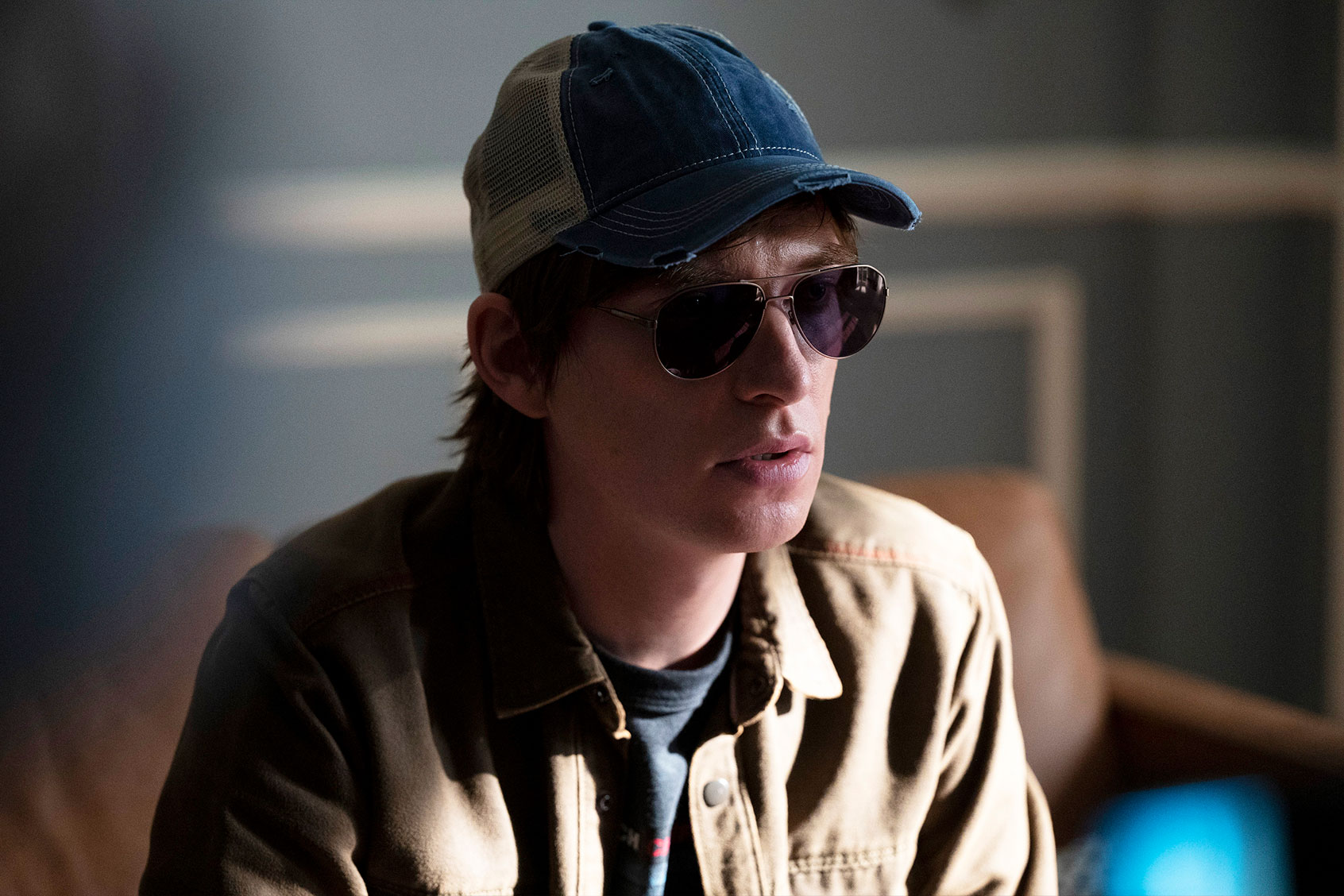
The PatientDomhnall Gleeson as Sam Fortner in “The Patient” (Suzanne Tenner/FX)

Your situation in “The Patient” is reminiscent of what your character in “Ex Machina” dealt with, in terms of being in an enclosed space and interacting with a limited number of people. Only in this story, the space is even more limited. Did you draw up on any of that experience as you were creating this role?

No, I never really thought about it. Well, that’s not true. A couple times it did come up, when we talked about just the notion of like, ‘Oh, my God, these are really long scenes. Have you ever done this many long scenes in a row before, with one other actor?’ They’re these really intense, not interrogations, but you know, manipulation and control, all that stuff going on. And “Ex Machina” was the only one that I had to compare it to.

“There’s a whole aspect of his personality which has naught to do with serial killing.”

But in terms of how it informed me, I’m not sure that it did. You have to know your lines inside out. They were similarly very, very well written and structured. So those long scenes really need to have an ebb and flow in the writing. And you need to stick to that, for it to sing. And on both jobs, I was working with pretty stunning actors. You know, Alicia was the one who I had a lot of longer scenes with in “Ex Machina,” those sit-down-across-from-somebody scenes. And Steve on this – Oscar as well, obviously. But yeah.  Working with great actors is the key to keeping those things alive.

And then of course, the characters you play in each have total opposite personalities.  Did you base Sam on anyone from real life? And I don’t mean, like, one of your friends.

Yeah, it would be so great if I said, “I based him on, like, my best friend growing up!” and you’re like, “Oh, God!”

No, I didn’t base him on anybody in particular. Really what I was looking for were the similarities with myself, I suppose. Because there’s a whole aspect of his personality which has naught to do with serial killing. Even if you just roll back from that slightly, about how he feels about himself, about how he feels about his place in the world, about the things that frustrate him, and how he reacts under those situations. Where you look to is to try and find a bridge across to somebody who is quite different from you, but not based on anybody.

I played a serial killer before in one scene, and in a film, and I found that really upsetting and difficult to do. But that was presenting the worst of that character from the beginning. Whereas I think in this one, there’s more time to get to know other aspects of him.

So did that make this feel worse or better?

That’s interesting. I don’t really know what it was, but I really enjoyed it. I really enjoyed the experience of finding the place where it felt like we were being responsible about how we’re presenting somebody like this. Not mythologizing a serial killer because there’s been a lot of that, and it’s just boring and not good for anybody, and presenting him as a messed-up person who feels that his own situation is pathetic and beneath him, and is acting out as a result.

What I find most interesting about the series, and about your character, is that he obviously has a refined palate, and an expertise that comes out in the way that, although he has Steve Carell’s character Alan as his captive, he’s bringing him some of the finest food in town.

I think a lot of that is about control as well, you know. It’s control of one’s self-image, but it’s also that he finds it difficult to curb his impulses generally. So if he likes a band, he’s just going to listen to that one band all the time, and go and see that one person play all the time. If he’s like that with food, he’s going to know all the right ways to pronounce everything. He’s going to look down on the people who don’t. He’s going to obsess over it. And, you know, I think a lot of that is relatable. I think everybody thinks that they are a good person who’s struggling, you know. He feels like he has done his best. And he feels like it’s somebody else’s fault that he’s like this. And I think we’ve probably all felt that way too, rightly or wrongly.
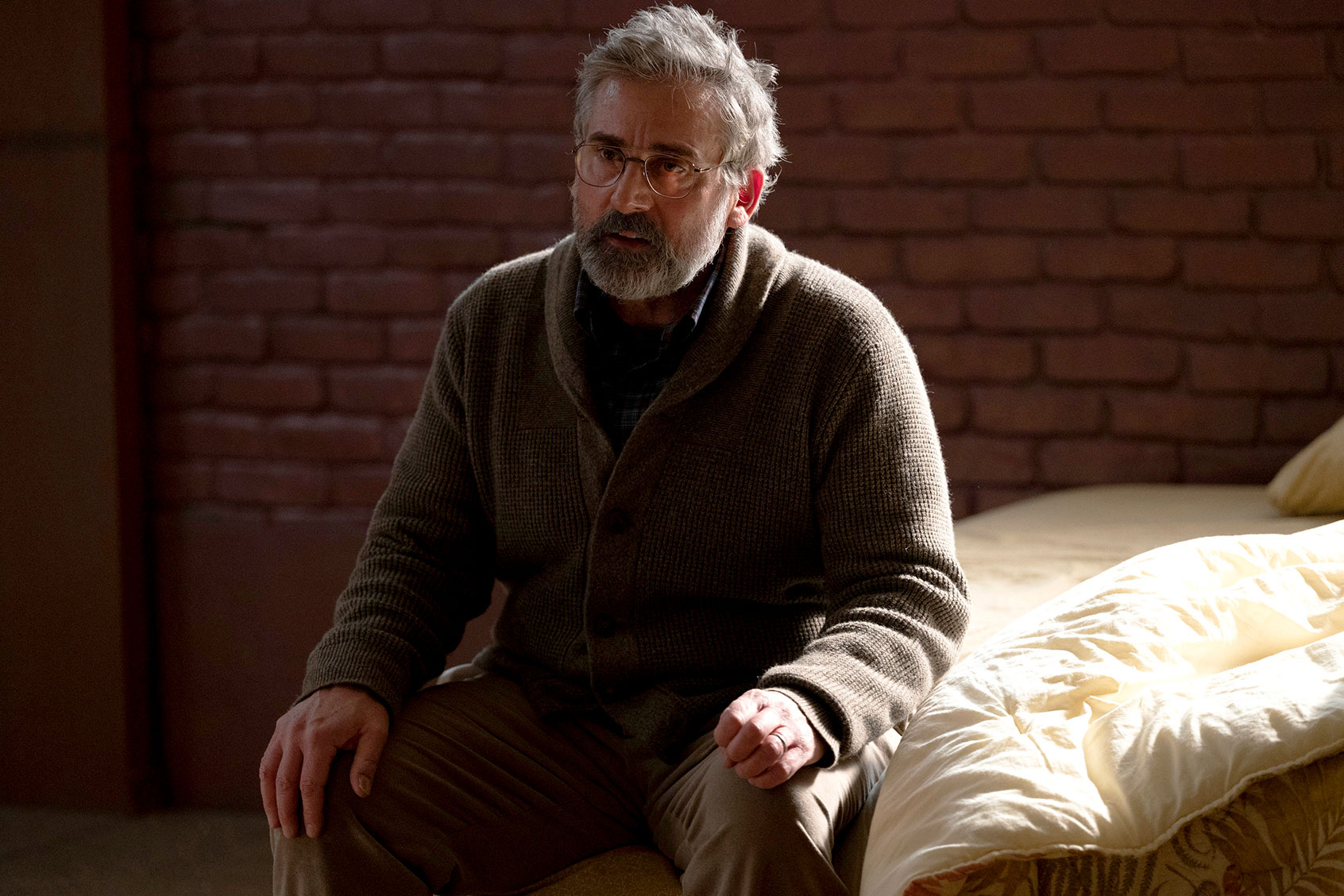
The PatientSteve Carell as Alan Strauss in “The Patient” (Suzanne Tenner/FX)

I’m asking this question of you based on the fact that you are from Ireland: Do you think that what you just described is a universal quality? Or do you think that it’s more of an American tendency? The reason I ask that is because our culture has a longstanding aversion to therapy.  Even Sam at some point was saying, “Everything’s about mothers.” I wonder if that’s just a very American-specific type of myopia.

I haven’t thought about it in those terms. You know, and I don’t know if it’s a real quote, but is it Freud that said the Irish were the only people incapable of psychoanalysis? That the Irish people are somehow impervious to it.

But what you’re talking about, in terms of the culture surrounding you and how that influences the way that you feel about yourself, I think that’s very, very true of Sam. And both when it comes to therapy, but also where he thinks about his position in things.

You know, he has a failed marriage behind him. He is living at home. He probably doesn’t have much money, he doesn’t feel respected by the world. He feels like he’s due more respect, and yet he hasn’t done anything to earn it. I think that what you’re promised on TV, or what you’re promised you deserve in advertising, does not line up with how much things cost and what is realistic for everybody to have. And I think the disparity between those two things can make a lot of people very angry. And they blame the world.

This leads into another question I’m sure you’ve probably gotten, and I don’t mean this to be prying: What is your relationship with therapy? Have you had any experience it? Are you a believer in it?

Yeah, I’m not really sure how to talk about that. I think anybody I know who’s ever talked about going to therapy or is considering it, the only thing I can say is Jesus Christ, you should absolutely do that. Because everybody I know who’s done it has benefited hugely from it. And there is still a stigma attached to it on some level, that you must be not well.

“The notion of being fixed is different than the notion of getting better.”

I heard somebody reasonably saying if somebody goes to the gym to make sure that they don’t lose the run of themselves physically, people consider that really healthy. The notion of doing it for your mind . . . should be exactly the same. It’s basically just upkeep and being responsible.

“The Patient” is arriving at this time where I think therapy has been discussed very openly in a way that I don’t think I’ve seen in a very long time. This is because of the pandemic, because of political turmoil, all of those things. And it arrives at a time where on one hand, it’s championing therapy in its own strange way.  But it’s also demonstrating the limitations of what we expect from therapy. That’s why I asked that question, because I am curious to know what your thoughts are on what the show is saying about the relationship that Sam and Alan share, in terms of therapist and patient. What do you think that it’s telling the audience?

I think the question that interests me, and I think it might be the same question is, how much are you willing to work to get better? The notion of being fixed is different than the notion of getting better. And the notion of doing the hard work of looking at yourself truly and clearly, and understanding your own problems, as well as the things that are good about you. That is, I think, the most interesting thing.

This series is a funny way of looking at it, because actually, the relationship that Alan has with his therapist, is much more true of what it can do and what it is and how it’s best used. I love that relationship with David Alan Grier. I think he’s wonderful. And I think he and Steve absolutely sing in those parts together. That is real therapy.

What Sam has entered into is a misunderstanding of what therapy is, because as Alan points out at various points, if the therapist is locked up and is in danger, and all of the control resides with the patient, that’s not therapy.


Want a daily wrap-up of all the news and commentary Salon has to offer? Subscribe to our morning newsletter, Crash Course.


What are you hoping that people will take away from watching “The Patient”?

I think it’ll be impossible not to be impressed by Steve’s performance.  I loved it. As it develops, it gets deeper. You find more about where Alan was at before this began, you find more about what he is struggling with in his head, and that aspect of things is what I just find so interesting and so well done. And it  really made me think about a lot of things in it, like about loss and suffering and grief and things that I wasn’t expecting to be dealing with when I started reading the series. I hope that’s what people are left with at the end of it. But I also hope they have a great time watching it and I hope they get a few laughs out of it too, because I thought it was really funny actually.

Do you wonder whether Kenny Chesney is going to watch?

I don’t know. I have no idea whether he would. Yeah, I have no idea how he will feel about it. But I will say you know, the Beatles wrote “Helter Skelter” and it’s not their fault that some imbecile used it incorrectly. So similarly, I think Kenny Chesney remains without blame in the whole situation of things. So if he watches it, I hope he enjoys it.

The first two episodes of “The Patient” premiere Tuesday, Aug. 30 on Hulu, with new episodes streaming weekly. Watch a trailer via YouTube.

“You never go into the upper kitchen, ever” and other survival tips from a waiter in Paris

It’s lunch and we’re short-staffed. An American woman stops me. Indignant that her filet de bœuf is not à point as requested, but most definitely saignant. The sliced-open, offending piece of meat’s rose centre stares up at me like an old wound. What she has is what French chefs would consider ‘medium’, I say politely, and perhaps she should try it first. Using terms more suited to the Pass, the lady thrusts the plate into my hand and tells me to get out of her sight. As a waiter, you quickly get used to the fact that people believe they can talk to you like a lower species. With no plateau to hand I pray to God I’m not caught by a manager. Carrying dirty plates on one’s hand is fine, but never something with food on. And when you do carry dirty plates you must carry as many as possible. It must look impressive. It’s part of the show.

At the Pass the timing couldn’t be worse. Almost all the waiters are there, and the atmosphere is toxic. Accusations flying, Nimsath shouting Tamil obscenities, and De Souza and Renaud in a stand-off officiated by Adrien. De Souza is saying something about Renaud stealing tips again. Nimsath flatly refuses to send the beef back. The other waiters agree and I’m pulled back from the Pass and thrust back towards the restaurant. I’ll have to take it to the upper kitchen myself, I decide. I’ve never been there before. We’re told to stay away. The caste system keeps us separate. It’s from the upper kitchen that all the important parts of each dish come: the meats and the fish. Sent down in the service lifts to join the rest of the dish that comes up from the lower kitchen. Where the Tamils piece them together into orders.

I imagine the upper kitchen to be quite a glamorous place, considering its importance, full of highly skilled people doing important culinary work on gleaming metal worksurfaces using fancy equipment. However, at the top of the steps I find a cockpit-sized room with flaming hobs on all sides cooking on full gas. The roar is deafening, a constant blast of extractor fans, sizzling meat, metal crashing against metal and shouting. There’s a tiny window above head height, which is closed. The intensity of the heat is indescribable. The black walls and ceiling are covered with huge globs of condensation. Manning the flames are five African men. Big men in sweat-drenched, soiled cook’s clothes. The place feels more like an iron forgery in a remote Roman outpost than a Parisian kitchen. I watch as pieces of searing meat and sizzling fish are scooped from pans and tossed onto plates to be sent down in the lifts after a quick wipe with a dirty towel.

Presiding over this terrestrial inferno is the Chef. The only white man in the entire kitchen. A Corsican, and a giant of a man who wields a knife so large it probably once belonged to Hercules himself.

Presiding over this terrestrial inferno is the Chef. The only white man in the entire kitchen. A Corsican, and a giant of a man who wields a knife so large it probably once belonged to Hercules himself. With this he points, prods, slicks, licks and hits metal surfaces. He’s a man full of frothing rage. Nothing is ever good enough. The little printer is constantly spitting out tickets which he rips off with such ferocity that it seems the machine will come off the wall. The orders he shouts violently into the ears of the cooks, as if he takes an intense pleasure from treating them with such disdain.

Deux poulets! Trois loups! Un filet – bien cuit!’ He leans right into their ears as he shouts: ‘Did you fucking hear me?’

Oui, chef!’ they cry back in trance-like unison. Not even bothering to wipe the spit from their cheeks. Their sweaty faces glowing in the flames. ‘Bon, espèce de connard. Encore! Deux magrets! Un loup! Trois saumons! Deux veaux! ‘

This is when he sees me. ‘Get-the-fuck-out!’

I stand there like an idiot with the plate outstretched. He charges me with the giant knife.

‘Did you not understand me? Va te faire foutre! Fils de pute! ‘

Under pressure, my French fails me and I stutter. He pushes me to shout. Louder and louder. I feel like I’m in the basic training scenes of a Vietnam War movie.

Dégage! This steak is medium. Your client is not special. She’s a pute!

He turns back to the cooks. For some reason, I stay where I am, on the threshold. Determined to get the meat cooked.

When he turns back and sees me still there with the plate of steak in my hand I glimpse the exact moment when he’s consumed by rage: pure, total hatred. Within an instant he has me up against the wall with his free hand on my throat and the point of the giant knife near my eye.

‘How dare you tell me how to cook!’ he screams.

I can’t breathe. His vice-like grip is crushing my trachea. Still holding my throat, he slams the knife down and pulls the plate from my hand. The steak slides into a pan with a piece of cooking lamb.

‘Cremate it!’ he shouts at the cook. ‘Oui, chef!’

Panic overcomes me as I still can’t breathe. I try in vain to remove his hand, which only angers him further, making him increase the pressure. His breath smells of cigarettes and cognac, and the wall smells of meat.

Time has never passed so slowly. I’m about to black out when… ‘Cramé, chef!’ shouts the cook nearest to us. Burnt.

The chef at last takes his hand from my throat, picks up the piece of meat with his bare hand, holds it to my face so it touches my nose, then slams it down onto the plate, which nearly falls from my hand. I turn and hurry down the steps. At the bottom I collect myself. I’m struggling to breathe, to pull enough oxygen into my lungs. After a few moments I check my appearance and smooth my hair back. I use a serviette that has been left on the side to wipe down the plate and then my face, then make my way back along the narrow corridors and into the restaurant.


Want more great food writing and recipes? Subscribe to Salon Food’s newsletter, The Bite.


In the dining room nothing has changed. I’ve been gone hardly a couple of minutes. There’s still the clattering of cutlery against plates, the hubbub of polite conversation and waiters flitting about like flies. I go straight to the table and put the meat down in front of the American lady. She doesn’t look at me, or thank me. She simply prods it with her fork, declares it OK and proceeds to eat. I make a beeline for the Pass, ignoring every diner and waiter who tries to solicit my attention. I shout at Nimsath for water, which I cough back up as I drink. Yulia, one of the less glamorous hostesses, and therefore more humane and more inclined to speak to us, hurries into the Pass.

‘What have you done?’ I turn. Panicked. ‘What?’

‘Your back!’

If I don’t have a jacket, I can’t work in the salle; if I can’t work, I’m sacked.

She spins me around and begins rubbing with a cloth. ‘It’s disgusting.’ The entire thing is covered in a layer of slime. The grease, sweat and condensation from the upper kitchen walls. My newly fitted jacket. Youssef’s work. Ruined. And it’s the middle of the service. If I don’t have a jacket, I can’t work in the salle; if I can’t work, I’m sacked. I hurry back down to the locker room beyond the lower kitchen. The cooks ignore me. I look through the unlocked lockers, hoping to God that one of the waiters not working has left a jacket somewhere. There’s nothing. Back upstairs and Yulia has gone, my offending jacket lies screwed up on the side. The swinging door bangs open; I look up, thinking it’s the Rat.

Fortunately, it’s Yulia; she has a jacket. ‘Here, try this.’

I slip it on. It’s huge. It would even be too big for Salvatore.

‘But it’s clean,’ Yulia says. ‘Keep it, until you can get yours cleaned.’ ‘But I don’t have a day off until next week.’

Lucien comes in and see me: ‘Either you’ve shrunk, or the clothes have grown.’

When I tell him how it happened, he’s adamant: ‘What did I tell you? Hey? You never go into the upper kitchen. Ever.’

This is an expert from Edward Chisholm’s “A Waiter in Paris: Adventures in the Dark Heart of the City” which was released on Aug. 9 by Pegasus Books.

Salon Food writes about stuff we think you’ll like. Salon has affiliate partnerships, so we may get a share of the revenue from your purchase. 

Who is Craghas Drahar the Crabfeeder on “House of the Dragon”?

We’re two episodes into “House of the Dragon” and we’re up to speed on most of the cast. There’s Rhaenrya Targaryen, the heir to the Iron Throne; her father King Viserys and her uncle Daemon. Then there’s Corlys Velaryon, the king’s master of ships; the richest lord in Westeros, he controls a huge navy and has money coming in from trade along the Narrow Sea.

At least, he did. In the first two episodes, he petitions the king to let him sail his navy to the Stepstones, a series of islands in the Narrow Sea, and take care of a guy named Craghas Drahar, aka the Crabfeeder. This guy is a prince admiral from the free city of Myr. After defeating pirates in the Stepstones (a move the lords of Westeros once cheered) he’s set up shop there and is charging egregiously high tolls for ships to pass through. It’s becoming a problem.

Myr has teamed up with the free cities of Lys and Tyrosh to form the Triarchy, an alliance that gives them a better foothold against the other free cities, and against Westeros. The Triarchy is supporting the Crabfeeder’s campaign in the Stepstones, and Corlys Velaryon has had enough.

“House of the Dragon”: Who is Craghas Drahar the Crabfeeder?

The Crabfeeder earned his nickname because of the way he deals with those he defeats in battle: he fixes them to posts and lets them be drowned by the incoming tides. The crabs have eaten well lately.

At the end of “The Rogue Prince,” after the king had yet again denied Corlys leave to attack the Crabfeeder for fear of starting a war with the free cities, the head of House Velaryon sought out the help of Daemon Targaryen, who’s looking for a way to get back in good with his older brother the king. The two are off to war! We’ll see how that goes in future episodes.

Joe Rogan does nothing to correct Aaron Rodgers as he trumpets COVID-19 misinformation

The medical community has a message for Green Bay Packers quarterback Aaron Rodgers: When it comes to vaccines and treatment regimens, he has no idea what he’s talking about.

Ever since Green Bay Packers quarterback Aaron Rodgers tested positive for COVID-19 in November, he has repeatedly expressed anti-vaccine views — while also repeatedly claiming, as he did during an appearance on comedian Joe Rogan’s popular podcast on Saturday, that he “never wanted to be a divisive, polarizing figure.”

“No one wanted to hear there was a way that you could get through it without being vaccinated and that you would recover very quickly,” Rogan affirmed.

In that same interview, Rodgers reiterated his longstanding approval of Joe Rogan’s pseudoscientific COVID-19 treatment regimen — which includes taking drugs like ivermectin, which has been shown to have no effect, or even deleterious effects, when taken to treat COVID-19. Rogan has also had guests on his show promoting hydroxychloroquine, another drug shown to have no effect on COVID-19. 

Rodgers previously described his Rogan-recommended regimen, as Insider reported:

“I’ve been doing a lot of the stuff that he [Rogan] recommended, in his podcasts and on the phone to me,” Rodgers said. “I’ve been taking monoclonal antibodies, ivermectin, zinc, vitamin C, D, and HCQ [hydroxychloroquine]… And I feel pretty incredible.”

Rodgers claimed that the former “The Man Show” host’s “game plan” helped him after he became sick with the oft-fatal disease. Rogan nodded in agreement as Rodgers described his experience. 

“No one wanted to hear there was a way that you could get through it without being vaccinated and that you would recover very quickly,” Rogan affirmed.

Rodgers also criticized the pandemic policies being implemented by California Gov. Gavin Newsom, complaining that the government closed beaches near Rodgers’ home in Malibu, and joking about a paddleboarder who was arrested for violating the stay-at-home order.

“He’s passing COVID to the dolphins or what?” Rodgers asked.

Salon reached out to a number of health experts, all of whom were horrified at Rodgers’ approval of pseudoscientific COVID-19 treatments like hydroxychloroquine and the horse de-wormer ivermectin.

Hydroxychloroquine has been studied in several large randomized controlled clinical trials and has not shown to be of any benefit (compared to placebo) among patients with COVID-19, either in those who are hospitalized or in preventing hospitalizations among outpatients with COVID-19,” Dr. Monica Gandhi, infectious disease doctor and professor of medicine at the University of California, San Francisco, told Salon by email. “In fact, these studies showed a higher risk of mild adverse events in those who received hydroxychloroquine.”

Gandhi was similarly emphatic about ivermectin’s inability to treat COVID-19.

“Ivermectin has also not shown to be of any benefit in improving outcomes among patients with COVID-19, either in the hospitalized or outpatient setting in terms of reducing symptoms,” Gandhi explained. “Therefore, although Mr. Rogan reports improvement in his symptoms, this may have happened anyway and neither drug has met the level of evidence needed in medicine to be recommended.”


Want more health and science stories in your inbox? Subscribe to Salon’s weekly newsletter The Vulgar Scientist.


Gandhi’s views were echoed by Dr. Georges Benjamin, executive director of the American Public Health Association.

“The preponderance of the scientific evidence shows that neither drug [hydroxychloroquine and ivermectin] has any clinical benefit in the treatment of COVID-19 and is not recommended as a treatment,” Benjamin wrote to Salon. “We know that the untreated clinical course for people with COVID can range from asymptomatic to severe disease. The time period he describes for his symptoms is consistent with a mild case of COVID that resolved on its own.”

When it comes to Rodgers’ claim that Rogan’s “game plan” helped him, Benjamin pointed out that in scientific reasoning “correlation is not causation. So while we are all glad he is better, there is no evidence that it was the hydroxychloroquine or the ivermectin that he took helped him.”

The experts were also scathing towards Rodgers’ claim that he had not misled people by telling people that he had been “immunized” instead of specifically saying whether or not he had been “vaccinated.” Indeed, previously, Rodgers made headlines in 2021 when it came to light that despite claiming that he had been “immunized,” the quarterback actually had taken a homeopathic treatment from his personal physician. 

Speaking to Rogan, Rodgers said that the burden fell on the journalists to ask follow up questions about what he meant when he said he had been “immunized.” Dr. Irwin Redlener, leader of Columbia University’s Pandemic Response Initiative, told Salon that Rodgers was “full of s**t.”

[Ahmed] noted that giving any credit to drugs like ivermectin is “like him saying, ‘Well, someone said you should take Jell-O to solve COVID. Oh, yeah, I took everything else too, but I think the Jell-O is what fixed it.’ That’s how ridiculous this whole situation is.”

“He has already discredited his own self by misrepresenting his vaccination status, which is incredibly irresponsible and endangered his teammates and people that he came in contact with,” Redlener said.

Although he expressed respect for Rodgers’ “extremely admirable statements on equality and racism and opportunity, and for that I really do respect him,” Redlener pointed out that the quarterback has “zero credibility as a medical prescriber.”

“It’s absurd and irresponsible for him to be pronouncing what he did for himself. There are plenty of people who get mildly ill and then just get better from it. I know hundreds of people who that has happened to. An individual anecdote doesn’t mean anything,” Redlener said.

Not only does Rodgers’ individual experience fail to vindicate the Rogan “game plan,” as the quarterback claimed. Considering that Rodgers displayed symptoms when he contracted COVID, it is entirely possible that his illness experience was worse because he refused to get vaccinated. Indeed, as many as 40 percent of COVID-19 cases are believed to be asymptomatic; having an asymptomatic or mild case is much more likely if someone is vaccinated.

“Any ‘plan’ will work when you are an athletic 36-year-old,” Dr. Alfred Sommer, dean emeritus and professor of epidemiology at Johns Hopkins Bloomberg School of Public Health, told Salon by email. “In fact, he was sicker than most 36-year-olds, who are usually totally asymptomatic! He took two (or more) drugs for which there is no evidence of benefit whatsoever – except that Trump (a recognized medical wizard who was hospitalized with COVID and certainly not given either of these treatments) recommended them. I don’t know why he didn’t follow Trump’s other advice: drink bleach and shove a light stick up your rectum.”

Medical experts are not alone in being alarmed by Rodgers’ comments. Salon also reached out to the anti-misinformation group Center for Countering Digital Hate (CCDH), who previously determined that a mere twelve online influencers were responsible for two-thirds of vaccine-related misinformation online.

“Aaron Rodgers has a significant following, many of whom hang on his every word and will no doubt be influenced by what he says,” Imran Ahmed, CEO of CCDH, told Salon. Describing Rodgers as a “muppet” (a British slang term for a stupid person), Ahmed noted that Rodgers’ observations betray a seeming obliviousness to his own economically privileged situation.

“He did receive the full NFL treatment regimen,” Ahmed pointed out. “The guy received monoclonal antibodies. I didn’t get those. Very few people got those. He received cutting edge therapies from scientists.” Ahmed noted that giving any credit to drugs like ivermectin is “like him saying, ‘Well, someone said you should take Jell-O to solve COVID. Oh, yeah, I took everything else too, but I think the Jell-O is what fixed it.’ That’s how ridiculous this whole situation is.”

In addition to being concerned about Rodgers spreading inaccurate medical information to millions of people, Ahmed singled out “one of the super spreaders of misinformation about vaccines.”

Spotify and Rogan have made an enormous amount of money due to the controversy associated with it,” Ahmed observed. Indeed, in 2020, music streaming company Spotify paid a reported $200 million to license Joe Rogan’s podcast exclusively on its service.

“It is worrying how misaligned the incentives are,” Ahmed continued, “Actually, it is to their advantage to spread [misinformation]. There is no means of recourse for those who may be harmed by the words spoken by Rogan and Rodgers, and broadcast on Spotify, for any harm that might be caused as a result.”

Health experts were not wholly critical of Rodgers. Gandhi told Salon that she believed Rodgers made valid points when criticizing Governor Newsom’s COVID-19 policies.

“I agree with their comments here that the strict policies of California and its many restrictions were not always effective,” Gandhi explained. “In fact, closing the outside (whether outside dining or beaches) is not considered an effective strategy for this virus since ventilation is very effective for combatting COVID-19 and closing the outside can actually drive the public indoors.” She pointed out that a 2020 study in Wuhan, China found that only a single infection event out of 7,324 that had been investigated could be linked to outdoor transmission.

“In another analysis of over 232,000 infections in Ireland, only one case of COVID-19 in every thousand was traced to outdoor transmission,” Gandhi told Salon. That study, which involved the University of Canterbury, concluded that outdoor transmission was “rare,” noting that “viral particles disperse effectively in the outside air.”

As such, Gandhi wrote that “I agree with Mr. Rogan and Mr. Rodgers discussion points on California closing outside dining and beaches.” Yet Gandhi expressed disapproval of Rodgers’ spreading vaccine misinformation.

“I am concerned about that, particularly when it comes Mr. Rodgers choice not to get vaccinated,” Gandhi explained. “The COVID vaccines are very effective in preventing severe disease and death. Even with omicron [variant], recent data from JAMA shows a very strong protective effect of a single booster against severe disease with BA.1 and BA.2 that continues to demonstrate the powerful cellular immunity (T and B cells) triggered by the vaccines. Therefore, I am concerned that this sports star may be influential in discouraging vaccination.”

Unlike Gandhi, Redlener told Salon that “the jury is still out” about Newsom’s policies, although “I think that California’s done really quite well.”

“Generally speaking, what specific thing makes a difference?” Redlener asked. “I think personally that mask-wearing is highly effective, and it has been proven highly effective. I think he was making the best political judgment about protecting the safety and health of residents of California that he could possibly make. It was based on what he was hearing from the CDC, and what scientists were saying.”

“At the end of the day, though, I think people are agreed that mask-wearing and distancing when the disease was raging were all very appropriate,” Redlener continued. “I am most respectful of governors anywhere, of city officials that are saying, ‘Okay, what do we actually know? What’s the CDC say? What is the data showing? And I’m going to try my best to make policies that reflect the current state’s knowledge.’ That’s pretty much all we’ve got. And as far as Gavin Newsom, his specific policies, I totally respect them and I think they’re fine.”

How to use corn in late summer desserts, from refreshing ice cream to seasonal fruit buckles

Corn is summer’s hottest produce item and its most versatile. The unique cultivar (which can be classified as either a vegetable or a grain, based on when it’s harvested) is oftentimes prepared in savory dishes, such as arroz rojo, elote or jalapeño cornbread. It can also be enjoyed in desserts, from cakes and puddings to ice cream and even truffles!

The beauty of corn is its slight saccharine flavor, which pairs nicely with butter, heavy cream, chocolate and other key ingredients used in desserts. And so is the texture of its soft, individual kernels. The kernels can be infused into any liquid of choice — milk, plant-based alternatives, alcohol, you name it! — to add a hint of corn in traditional recipes.

Here at Salon Food, we’re looking forward to closing out this season by eating a slew of corn-based goodies. To help us kickstart this endeavor, we spoke with Kathryn Gordon, chef-instructor of Pastry & Baking Arts at the Institute of Culinary Education (ICE). Gordon shares a slew of handy tips and tricks on how to showcase corn in everyday desserts: 

Fresh corn is the best corn

When asked what specific varieties of corn work best in sweets, Gordon said there’s no particular one. All that matters is that the corn you choose is fresh. Corn on the cob that’s fresh is also vibrant in color, sweet and juicy, making it perfect for preparing in summer desserts.

To spot a fresh ear of corn, look for a bright green husk that’s tightly wrapped around the corn and slightly damp to the touch. The corn itself should also feel firm — simply give the corn a light squeeze through the husk, but don’t peel back the husk and then check the corn kernels as that will spoil its beautiful hue and freshness.   

As for storing newly bought corn, Gordon recommends stashing them in the refrigerator so that they don’t dry out. Unhusked ears of corn can be kept loose in the vegetable crisper while husked corn should be kept in a plastic bag for extra protection. Keep in mind that refrigerated corn stays fresh for up to two days. Afterwards, the corn should be moved to the freezer.

“I love sweet corn best when it’s been recently picked and you can just eat it raw off the cob,” Gordon says. “If I was not eating or cooking the corn within 24 hours off the stalk, I would refrigerate the corn for storage but also, then tend to slice off the kernels and pan-sauté them before folding into a dessert.”


Want more great food writing and recipes? Subscribe to Salon Food’s newsletter.


Sometimes life gets hectic and prevents us from keeping track of our fresh corn. For “older” corn that’s dry and shriveled up, Gordon says she likes to “boil it briefly or try to coax more flavor out of the corn by lightly grilling it first, cooling it a bit and then slicing off the kernels.”

Corn-infused desserts

Corn is starchy, creamy and sweet, which is why it “adapts well to savory and sweet foods on a complimentary level,” Gordon explains. The starchy flavors, in particular, work exceptionally well with various fats, such as butter, coconut and cream. Desserts, like corn-infused pudding, crème brulee, panna cotta, ice cream, ganache or cheesecake, are just a few recipes Gordon suggests making. 

“Corn also does well being baked in a corn-flavored liquid,” she continues. “Personally, I like the texture, colors and fiber of corn so I often add some into the dessert as well, such as to fold in fresh corn kernels into corn ice cream or my waffle batter.”

Corn-flavored liquids, like “corn milk,” are made via an infusion. The resulting liquid is then used in lieu of regular milk or buttermilk in recipes for cupcakes, fruit buckles, pancakes, custards and puddings.   

To make an infusion, start by “scraping off the kernels from a cob and adding them into the liquid in a recipe (such as milk).” Gordon adds, “The infusion can be done with a bit of time and gentle heating then turning off the heat to steep the flavor of the corn into the liquid before straining out the corn.  Then re-measure the liquid and proceed with the recipe.”

If you’re running low on time, Gordon recommends blending the corn liquid (once cool) to speed up the corn flavor extraction process and allow the liquid to become more concentrated. The longer the liquid blends, the smoother the mixture becomes. However, additional straining may be required if you don’t like too much texture in your dessert.

Another corntastic dessert to try

For the more adventurous bakers and die-hard corn fans, Gordon suggests making a cornbread with corn-infused milk. Pieces of the bread can then be pan-toasted in butter and served warm alongside corn-infused ice cream (with fresh kernels folded in) and summer fruits (like sliced peaches, blackberries or figs) macerated with light brown sugar and vanilla. To top it all off, garnish the bread with some caramelized popcorn or fresh sprigs of mint!

Salon Food writes about stuff we think you’ll like. Salon has affiliate partnerships, so we may get a share of the revenue from your purchase.
 

The queer horror of “Dracula”

This year marks the 125th anniversary of Bram Stoker’s horror classic, “Dracula.” Today the story, and more specifically the character, has conjured up hundreds of interpretations; Dracula himself is the second most popular character put to film, second only to Sherlock Holmes. There are the (relatively) faithful adaptations, the stage plays, the parodies, the barely recognizable CGI-action spectacles (I’m looking at you “Dracula Untold”), and the cameos. But few have embraced the queer side of the character, with its LGBTQ+ origins being traced back to the author himself. 

While never as renowned a writer during his lifetime as many of his contemporaries, today Stoker is regarded as a literary titan for his thrilling imagination and his now-iconic characters. Even a titan of horror like Stoker has his own beginnings in writing. Prior to “Dracula,” the Irish-born author embraced stories he related to the most. 

Stoker himself was a closeted gay man who pined for affection from both his friends, mentors, and possible lovers Oscar Wilde and Walt Whitman.

His first book, “The Primrose Path,” follows an Irishman who moves to London seeking better work, much as Stoker himself was swept up into the London scene pursuing work in the theater. His second book, “The Snake’s Pass” becomes more fantastical, centering on the legend of Saint Patrick as he defeats the King of Snakes in Ireland. While both these books were quick endeavors for the author, they still exuded a quintessentially Stokerian Irish pride and sense of identity with hints of isolation. 

Neither are particularly deep reads, and both were produced far quicker than his seven-year-long odyssey to write “Dracula.” But it seems clear to me why it took so long for him to finish the bloody thing; it’s brimming with controversy and self-reflection. 

In reading “Dracula” … one might be surprised or even confused with the frequency that sex and sexual imagery are discussed.

Stoker himself was a closeted gay man who pined for affection from both his friends, mentors, and possible lovers Oscar Wilde and Walt Whitman — men who both garnered controversy for their own depictions of homosexuality. Most obvious and scandalous of all are not the depictions of death, the supernatural, or the occult, but the frank detail surrounding sexuality and sexual orientation. 

In reading “Dracula” (something I’ve done no less than half a dozen times in the past year), one might be surprised or even confused with the frequency that sex and sexual imagery are discussed. “Kiss” or “kisses” is used 42 times in the text, “lips” 62 with “voluptuous,” often referring to the vampire’s ruby red lips, coming up 12 times. 

Jonathan Harker, when trapped in Dracula’s castle and approached by a trio of vampires, remarks, “I felt in my heart a wicked, burning desire they would kiss me with those red lips” with one vampire laughing and saying, “There are kisses for us all.” Only then does Dracula himself emerge, irate, proclaiming, “This man belongs to me!” 

There are a myriad of themes here that echo throughout the rest of book. Domination and submission — played into and against gender stereotypes — polyamory and queer desires. Harker, on multiple occasions, takes notice in Dracula’s lips and how they could kiss his neck. And this isn’t even the wildest scene! Nearing the end of the book, Dracula breaks into the bedroom of the now married Harkers and . . . well . . . I’ll let Stoker describe the scene. 

On the bed beside the window lay Jonathan Harker, his face flushed and breathing heavily as though in a stupor. Kneeling on the near edge of the bed facing outward was the white-clad figure of his wife. By her side stood a tall, thin man, clad in black. His face was turned from us, but the instant we saw him we all recognised the Count — in every way, even to the scar on his forehead. With his left hand he held both Mrs. Harker’s hands, keeping them away with her arms at full tension; his right hand gripped her by the back of the neck, forcing her face down on his bosom. Her white nightdress was smeared with blood, and a thin stream trickled down the man’s bare breast which was shown by his torn-open dress. The attitude of the two had a terrible resemblance to a child forcing a kitten’s nose into a saucer of milk to compel it to drink.

I think in “The New Annotated Dracula,” Leslie S. Klinger put it best by writing, “What is going on here?” Leonard Wolf in “The Essential Dracula” writes that this extraordinary scene is “crammed with implications, nearly all of them sexual.” You have “a vengeful cuckoldry . . . a ménage à trois . . . mutual oral sexuality . . . [and] the impregnation of Mina.” Clive Leatherdale in “Dracula Unearthed” goes a step further to focus on the explicit reference of “milk” smeared on Mina’s face to imply a bodily fluid that’s not exactly blood. 

Bram StokerBram Stoker (1847-1912) the Irish writer, best known for his novel Dracula (1897). (Hulton-Deutsch Collection/CORBIS/Corbis via Getty Images)

Of course, none of this would hold as much impact or relevance without the author’s own complex relationship with desire. One of the prime written examples of Stoker’s own sexual orientation is a lengthy, confessional “love letter” he sent to Walt Whitman, whose famous “Calamus” poems contained explicit homoerotic imagery and musings. The 24-year-old Stoker wrote, “I have to thank you for many happy hours, for I have read your poems with my door locked late at night and I have read them on the seashore where I could look all around me and see no more sign of human life than the ships out at sea: and here I often found myself waking up from a reverie with the book lying open before me.” 

Stoker goes on to lament his conservative upbringing and environment, thanking Whitman for his escapism and clarity in prose making the young man’s “heart leap towards you across the Atlantic and his soul swelling at the words or rather the thoughts.” Another curious inclusion appears to invert gender roles as Stoker writes of his own “woman’s eyes” and professes to Whitman a hope to be “wife to his soul.” 

But Stoker’s infatuation with men was not limited to just Whitman. There has been speculation about Stoker’s boss, Sir Henry Irving, having his own influence in the iconography of “Dracula.” 

And then there is Oscar Wilde. 

Stoker and Wilde attended university together and both men would make their way to London to pursue the arts. In 1895, Wilde was tried and convicted of violating Buggery Laws, at the peak of Stoker’s writing of “Dracula.” It upset Stoker that his friend and presumably a lover of his was sentenced to two years’ imprisonment, but also terrifying that Wilde’s own fictional writings were used as “evidence” against him in the trial. What must Stoker have thought of this while writing his own sexually charged tale? Is that fear not horror in and of itself? 

But I haven’t even mentioned the most Freudian fact of all! Bram Stoker married Florence Balcombe in 1878, after she had previously been engaged to one other man . . . Oscar Wilde. Of course, there is no shortage of complicated relationships depicted in “Dracula,” either. 


Want a daily wrap-up of all the news and commentary Salon has to offer? Subscribe to our morning newsletter, Crash Course.


For me, it doesn’t require too deep a look at Stoker’s own life to see that the horrors of “Dracula” do not all come from blood-sucking creatures. They can just as easily come from within, the anxieties, shock, and confusion associated with gender, sexual identity and orientation. It’s a welcome change of pace that we have seen more recent vampiric works influenced by “Dracula” – such as the latest AMC adaptation of Anne Rice’s “Interview with the Vampire”  – showcase its queer origins, but more can be done. While “Interview” seems to show a willingness to depict this often forgotten aspect of the most pivotal vampiric creation, we need and should see this from the titular Count himself, as depicted not only in the original text itself, but from extrapolating information we know from Bram Stoker’s own life. For this 125th anniversary, I say it’s about time “Dracula” himself embraces his place in queer horror history. 

RNC cuts off Trump and makes him pay for his own lawyers in Mar-a-Lago documents mess: report

ABC News reporter Jonathan Karl wrote in his post-Donald Trump administration book that on Jan. 20, as Trump was flying from the White House for the final time, he spoke to the head of the Republican Party and threatened to start his own party. RNC chair Ronna Romney McDaniel reportedly told Trump that if he started a third party that the RNC would stop paying his legal bills, which were costing the party millions.

Politico reported Tuesday, however, that that decision has ended. According to the report, any legal fees having to do with Trump’s retention of government documents are not being paid by the RNC.

The report explained that Trump hired Chris Kise, a former Florida solicitor general, to represent him in the FBI search case, it was announced on Tuesday. Thus far, Trump has suffered with a legal team that is moving quickly to appear on television but not in filing a legal defense for their client.

Christina Bobb may be under her own legal problems after signing court documents saying that Trump had already turned over all of the documents. That turned out to be false.

Thus far, the legal team has argued that Trump isn’t bound by the laws about handling classified material or stealing government documents. Sources close to Trump revealed that on multiple occasions he shouted, “They’re mine!” That’s false. As with past presidents, the presidential library will be able to possess papers, but not until they go through the archiving process from the National Archives. The government agency manages the documents even if they’re in a presidential library, they explained in a press release dispelling Trump’s accusation that Barack Obama stole 30,000 documents.

Politico also reported that for his legal services, Kise will be paid by Trump, who regularly stiffs lawyers and business partners when it comes time to sign off on the bill.

“A person familiar with the matter confirmed that the Republican National Committee is not paying for Trump’s legal fees related to the FBI’s investigation and retrieval of documents at Mar-a-Lago,” Politico reported. “That’s a departure of sorts from the past. The RNC has, for example, paid for Trump’s legal bills involving New York Attorney General Tish James’ investigation into the former president’s private businesses. The committee would stop paying Trump’s legal fees should he formally declare his candidacy for president in the 2024 election — a step he has hinted at but has yet to take.”

In the past, Trump has said that he can’t announce for president “yet” because doing so would start a lot of campaign finance things in motion. In reality, what would be set in motion is that his legal fees couldn’t be covered by the RNC because he isn’t the GOP nominee. Declaring also means he would no longer be able to raise money into a super PAC. He would be restricted to only raising money into a presidential campaign.

Read the full report at Politico.

Anti-choice megachurch pastor steps down after being busted in “unhealthy” Instagram relationship

Matt Chandler, the lead pastor at the Village Church, which operates under the Southern Baptist Convention, announced this week that he’s resigning his position after having an Instagram relationship. Chandler, who is married with three children, told his flock, “I fell short.”

Christianity Today explained that the elders in the church were made aware Chandler’s online messages and reviewed some of the comments he’d made on the social media site. They found that the direct messages he exchanged “revealed something unhealthy.”

Chandler is an anti-abortion pastor who once compared rape victims to Hitler. His church also “disciplined” a female member for wanting to divorce her husband after she discovered he was watching adult videos sexually exploiting children. The man was later prosecuted by the FBI. After a huge backlash, the church issued an apology.

Calling the actions “unguarded and unwise,” Chandler said he agreed with the assessment from the elders and was grateful for their spiritual oversight.

“We cannot be a church where anyone is above the Scriptures and above the high heavenly call into Christ Jesus,” Chandler said. “The Word of God holds me to a certain standard. And I fell short.”

It all began when Chandler was approached by a woman who said she was disturbed by the way Chandler was talking to her friend on Instagram.

“He told the congregation he didn’t think he’d done anything wrong, and the DMing was not a secret. His wife knew. The woman’s husband knew. And yet the woman who approached Chandler did not think the online exchanges were appropriate,” said the report. He said he found the interaction “disorienting.” Once the elders were informed, a review was done and they took issue with the conversations. They’ve now hired a law firm to sift through all of Chandler’s social media.

Chandler has been a pastor at the church for 20 years. He has also served as president of the church-planting network Acts 29 for the past 10 years. CT notes that the gig was previously held by Mark Driscoll, but he was later disqualified due to his “personal character.” Driscoll helped found Mars Hill Church in Washington state, where he had a long history of misconduct.

CT noted that less than a year ago, Chandler told them pastors need to be “in the kind of community [where] they might be encouraged or challenged if you start getting red flags.”

Read the full report at Christianity Today.

Prosecute Trump — it will lower the heated political temperature

As shown by his efforts to steal the 2020 election, once he’s all out of lies and deflections, Donald Trump turns to blatant threats of violence.

The January 6 committee carefully laid it out. Trump called on his insurrectionist mob to attack the Capitol after every effort to steal the election through the courts and state legislatures fell apart. The use of terroristic violence didn’t work on that day, but, over a year and a half later, we can see Trump hasn’t abandoned the hope that it might work with the criminal investigation into why he stole state secrets and refused to give them back when caught. This time, Trump is deploying his typical strategies of nuisance lawsuits and favor-trading to evade justice.

Appealing to a judge he appointed, Trump is trying to gum up the works by demanding a “special master” to adjudicate the question of whether he gets to hang on to classified documents he illegally took from the government and refused to give back, triggering a raid by the FBI to retrieve them. It’s a tactic that relies less on any plain reading of the law and more on Trump’s usual tactics of delaying justice until he figures out a way to escape its grasp entirely. 

Trump is leveraging the fears of another January 6 — or worse — in hopes that it will intimidate law enforcement into backing down.

But, in a sign that he — and his ragtag team made up of the only lawyers left who will represent him — isn’t feeling super hot about his legal case, Trump has already turned towards prepping his army of well-armed burnouts to threaten violence if the feds don’t back down.

Lindsey Graham of South Carolina, Trump’s most thoroughly owned Republican senator, went on TV to make the threat, declaring, “there’ll be riots in the streets” if Trump is prosecuted. In this, he was just imitating Trump’s usual mob-style method of making threats by pretending they’re “predictions” instead of the obvious call to arms they actually are. Trump, of course, immediately endorsed the threat by posting the video on his likely soon-to-be-bankrupt Truth Social network. He even embedded the threat in a court motion by reiterating a threat made earlier this month to Attorney General Merrick Garland: “The heat is building up. The pressure is building up.”


Want more Amanda Marcotte on politics? Subscribe to her newsletter Standing Room Only.


Trump has also been turning up the temperature generally by returning to his claims that President Joe Biden should be ousted. His latest Truth Social demand is that he be illegally installed in the White House. Using some irrelevant right-wing conspiracy theory noise about Hunter Biden as a pretext, Trump demanded that someone “declare the 2020 Election irreparably compromised and have a new Election, immediately!” He then reposted a bunch of QAnon and anti-vaccination conspiracy theories, a signal to his most unhinged supporters that he’d like them to feel activated right about now. 

Trump’s gambit is about two things: Fundraising (always) and whipping his supporters into a violent rage. It all pushes in the same direction: Trump is leveraging the fears of another January 6 — or worse — in hopes that it will intimidate law enforcement into backing down and letting him commit crimes, even possible espionage, in peace. 

No one should be intimidated. On the contrary, this is all the more reason for the DOJ to go forward and prosecute Trump for his crimes. Not just because prosecuting Trump is the right thing to do. Not just because, as Jamelle Bouie of the New York Times points out, history shows that surrendering to the kind of white supremacist violence Trump is threatening tends to only encourage more domestic terrorism. But also because recent history gives us good reason to believe that actually holding Trump accountable tends to turn down the heat.

Over the weekend, one thing became evident, which is that the more facts we get about Trump’s behavior, the less appetite Republicans have for validating the bug-eyed conspiracy theories he promotes. If the federal government wants to disable Trump’s ability to summon violent mobs, the single best tool they have is to prosecute him and start getting a coherent, fact-based narrative about Trump’s criminality out there. 

As Heather “Digby” Parton wrote, “the Sunday news shows suddenly had trouble finding Republicans” to defend Trump after the DOJ released the affidavit underlying the warrant to search Mar-a-Lago for illegally held documents earlier this month. Despite the heavy redactions to protect witnesses and sensitive information, it was clear reading the document that Trump’s behavior is both a serious national security threat and indefensible. That is why no one wanted to go on TV to argue against those facts. 

Trump simply has a harder time promulgating his bullshit when there’s a countervailing narrative out there underpinned by facts. 

As shown by the January 6 insurrection, Trump’s ability to harness violence depends heavily on his ability to promulgate his lies and conspiracy theories. He has a much easier time of that in an information vacuum. Prior to the release of the warrant and the affidavit, Trump took full advantage of the DOJ’s closed-lip policy to fill the void with tales of being the victim of a deep state conspiracy, whipping his followers into such a rage that one of them did, in fact, die in an effort to lash out at the FBI. But, as soon as actual facts started to seep out, the various Republicans validating Trump’s lies backed down and the temperatures started to drop. As we now see, Trump is escalating his rhetoric to compensate for the lack of validators, a sign that even he understands that his ability to stoke violence is lessening in the face of facts. 


Want more Amanda Marcotte on politics? Subscribe to her newsletter Standing Room Only.


And that’s with a heavily redacted affidavit! Imagine what would happen in a proper prosecution, where there would be a steady stream of facts underscoring, in public, what a massive criminal Trump is. Sure, the QAnoners would rant and rave. There may be, as with the FBI attacker, some lone wolf violence. But Trump simply has a harder time promulgating his bullshit when there’s a countervailing narrative out there underpinned by facts. 

We’ve seen how this plays out with the January 6 committee. The committee got the facts out there and while it did little to get Republican voters to change their minds about backing Trump, it did deflate their enthusiasm. Making the usual arguments to minimize or deflect from January 6 has become more embarrassing, and fewer people are interested in doing it. Republicans would like to talk about anything else, except maybe abortion

One of the most important things to keep in mind about the kind of domestic terrorism that Trump is trying to provoke is that it depends heavily on the illusion of popular support for the terrorist point of view. The January 6 insurrectionists and others like them draw on a sense, which Trump works hard to perpetuate, that they are speaking for a “silent majority” that is being suppressed by a shadowy elite. Drumming up a narrative of aggrieved righteousness is far easier when there’s no counternarrative out there, especially one that’s backed up both by facts and the aggressive presentation of said facts. That’s why Republicans are flailing against the January 6 committee. It’s why they would flail in the face of a public court case where the evidence against Trump could be presented in a well-ordered and persuasive fashion. 

This is not really about changing minds, which is hard, and often impossible, to do. It’s about undermining Trump’s power to control the narrative. Trump supporters, but for a small delusional minority, don’t really think the man is innocent. They’re just entranced by his apparently bottomless power to rewrite reality and force others, including federal law enforcement, to kowtow to his lies. They want to back someone with that kind of power because they think that they get a piece of it by being with him. But that also means, as I argued in a recent newsletter, that Trump’s power is built on sand. Once his backers feel he’s lost his magical ability to impose his will over reality, they will stop being so into him. They may even start looking for the exits. 

There may, if Trump is prosecuted, be some violence, especially at the hands of his most deluded followers. But honestly, it’s most likely to be the impotent displays of the sort we saw in Cincinnati after a Trump supporter shot a nail gun at FBI offices before committing suicide by cop. Not great, but certainly not the sort of thing that can bring our democracy down on its own, especially if federal law enforcement refuses to be intimidated. The kind of organized, sustained violence that Trump needs to muster in order to really be a threat requires people who believe they have the wind at their backs. And that’s an illusion that’s much harder to create for Trump if his story has to compete with actual facts that would be brought forth in a prosecution. 

“They have no choice”: Expert details the true cost of traveling for abortion care

Abortion travel isn’t new. People have been crossing national and state borders to get abortion care since the 1960s, when air travel became more common and affordable.

The number of people who need to travel and the distances they must travel for care will increase following the U.S. Supreme Court’s ruling in Dobbs v. Jackson Women’s Health Organization, which overturned Roe v. Wade.

As a sociologist who studies gender, reproduction and health, I have interviewed hundreds of women who have sought abortions, many of whom had to travel for care. My recent study on the experiences of people who had to travel across state lines for abortion care can help people better understand what costs abortion patients face when they have to travel.

For those living in states that have restricted abortion, traveling for a procedure can be expensive, daunting and lonely.

1. Why do people travel for abortion care?

People travel for medical care for many reasons. In the case of abortion travel, they are typically traveling because abortion is either legally restricted or unavailable in their home area. To get an abortion, they have no choice but to travel.

As of late August 2022, about half of the states in the U.S. have already restricted or are expected to heavily restrict abortion. Abortion seekers in those states may opt to travel to another state where abortion remains legal, as many Texans did following the implementation of their state’s highly restrictive law in 2021.

2. What are the main costs of traveling for abortion care?

Most people rightly anticipate that abortion travel entails expenses like gas money or plane tickets and hotel charges. As research shows that most abortion patients are at or just above the federal poverty line, it is easy to see that these costs alone could represent a substantial burden.

But traveling for an abortion often also includes numerous other costs. For instance, most abortion patients are already parenting children, so they must figure out child care logistics when they have to travel for abortion care. People who do not have access to a reliable vehicle may need to rent a car to make a long-distance drive across state borders.

Abortion funds – nonprofit organizations that provide practical and financial support to people seeking abortion care – can help people who are financially struggling navigate some of these costs. But often this aid isn’t sufficient to cover all costs. There are also real questions about whether funds can meet the growing demand.

And then there is the issue of lost wages during the time a patient must spend traveling. For many people engaged in hourly work, when you don’t work, you don’t get paid.

Some companies, like Starbucks and Dick’s Sporting Goods, are offering financial support to employees who travel for an abortion.

Abortion travel can also entail emotional costs. I’m currently working on a new study based on interviews with 30 women from around the U.S. about the emotional impacts of having to travel out of state for abortion care. Based on these interviews, I’ve learned that having to travel for abortion care can mean the stress of having to navigate a new place. For some people, this could be their first time in that city or even away from home. It also means being removed from their usual support systems and the physical and emotional comforts of home. This, too, can take an emotional toll.

And, of course, having to travel means having to explain to others – including co-workers and family members – why they are traveling, which can also come at a high personal and emotional cost.

3. Are there any positives to traveling for abortion care?

There is not much work on this question to date. Most research on abortion travel has focused on its negative aspects. But in my research, some of the women who had to travel for abortion care talked about how much they appreciated the emotional support they received in their destination clinic – especially after the hostility to abortion they had experienced in their home communities.

Seeking out nonjudgmental, compassionate care might motivate someone to prefer to travel for abortion care. But in the post-Roe landscape, few will have that luxury. Rather, travel will be a necessity, not a choice. Even with the possibility of emotional benefits, travel for abortion care exacts clear and substantial costs.


Katrina Kimport, Professor of Sociology, University of California, San Francisco

This article is republished from The Conversation under a Creative Commons license. Read the original article.

How the “war on drugs” cost hundreds of thousands of Americans a chance at student loan relief

President Joe Biden’s Student Loan Debt Relief Plan has sparked a number of debates and conversations about how the outcome will impact different factions of borrowers.

Now, one analysis is shedding light on how the U.S. government’s ongoing war on drugs could subsequently have negative impacts on some borrowers’ abilities to have student debt forgiven.

“As part of the ‘war on drugs’ — a consequential, anti-crime legislative agenda that Biden championed as a U.S. senator — an estimated hundreds of thousands of convicted drug offenders had their access to federal financial aid delayed or denied, including Pell Grants and student loans,” WUSA9 reported on Tuesday. “If they wanted to go to college after their prison terms ended, these offenders had to take on larger, often predatory, private student loans.”

The report highlighted how the war on drugs has also impacted many students’ ability to obtain education due to federal requirements for drug record disclosure.

“Some were discouraged from seeking federal aid by a requirement to disclose their drug record on financial aid applications, while others put off attending college or dropped out entirely,” the DC CBS News affiliate revealed.

Because of the war on drugs’ disproportionate impact on underserved segments of the American population, many have been left behind.

“The people most harmed by these policies: Black and Latino men, thanks to drug laws in the 1990s with harsh punishments for crack cocaine and marijuana offenses,” WUSA9’s analysis found. “Incarceration rates for men of color skyrocketed. The policies remained in place for 25 years, until Congress repealed the Pell Grant ban in 2020.”

“Studies show that Pell Grants — one of the nation’s most effective financial aid programs — routinely help more than half of Black students and almost half of Hispanic students afford college,” WUSA9 added. “According to the White House, among the 43 million borrowers who are eligible for debt relief under Biden’s plan, more than 60% are Pell Grant recipients.”

While Biden’s student loan relief program will indeed help a substantial number of borrowers, criminal justice reform advocates have begun to argue otherwise. In fact, WUSA9 noted, some believe that “the president’s solutions to the student debt crisis must be as comprehensive as the anti-drug laws were.”

Melissa Moore, the Drug Policy Alliance’s civil systems reform director, weighed in with her perspective.

“I think there’s a particular onus on this administration and on this president to be part of the solution for issues that he was very deeply involved in,” said Moore. “For people who previously would have had to check that box, there should be some mechanism by which, if you were excluded in the past, you are prioritized now for relief.”

Making sense of regenerative labels

This past February, the International Food Information Council released the results of a study on consumer awareness about regenerative agriculture. Of 1,000 people surveyed, only 19 percent said they were familiar with the term, compared with 59 percent who were familiar with “organic.” Perhaps unsurprisingly, only 12 percent said they were highly likely to pay more for food raised regeneratively.

This low level of understanding about what regenerative agriculture is coincides with the arrival of “regenerative” labels on food packaging. Since each label has a different metric behind its claim, chances are high that they will only further confuse a lot of already ambivalent consumers. Begging the question: How can a general public that’s largely unaware of the existence of regenerative agriculture — let alone able to parse its wide-ranging practices — be expected to seek it out when they shop? “It’s like the Wild West out there,” says Kari Hamerschlag, deputy director of the Food and Agriculture Program at nonprofit Friends of the Earth.

What most expert proponents of regenerative agriculture agree is essential to the term is a commitment to progressively improving soil health, in order to raise plants and animals that are also healthier. But how to do this, and what practices should be allowable, is currently a matter of debate. As vocabulary and methodology get hashed out, large corporations are rushing in to apply the term to their products, potentially watering down the meaning. “Some companies are setting a low bar by making misleading regenerative claims based on one or two practices.  Truly regenerative means meeting a comprehensive set of principles and practices,” says FoodPrint chief scientist Urvashi Rangan. She and other researchers believe that regenerative needs to include a whole suite of practices: keeping soil covered at all times plus rotating a variety of crops plusnot tilling the land plus reducing chemical inputs plus including livestock, in part to replace synthetic fertilizers. Some regenerative advocates want regenerative labels to include social criteria that address inequities and injustices in the food system — something organic certification does not.

An example of a low bar might be international industrial agriculture corporation Cargill’s “support” for regenerative agriculture that still allows farmers to use chemical inputs. This support largely focuses on cover cropping and also a planting method known as no-till, which doesn’t rip up the soil but also might include the use of chemicals like Roundup for eradicating weeds.

Picking and choosing from among standards like this raises the hackles of Greg Gunthorp, a regenerative pastured livestock and poultry rancher in Lagrange, Indiana who remembers back to Whole Foods’ decision to implement GAP sustainability ratings for meat, with “5+” meaning an animal spent its whole life on one farm with every possible comfort and ecological benefit but very few 5+-rated options available at its butcher counter. With Whole Foods now reviewing and approving regenerative claims on products sold in its store (the company did not respond to a request to elucidate its confusingly worded commitment), Gunthorp predicts a similar future for this new scheme.

Highest-standard “level 5 is going to be what all of us think of as regenerative: integrating grazing animals with no-till and row crop production, building communities and local food — they’re going to have half a dozen of those” kinds of farmers, he predicts. But he thinks the vast majority of products will be “Level 1 [where you] simply have a no-till drill and a no-till corn planter and you throw some cover crops on the farm at some point, and it’s going to be a big scam.” He says small farmers like him are being left out of the regenerative conversation, and fears there will be no market for their superior, truly regenerative products because of the confusion the corporate capture of labeling schemes will sow.

So, how can consumers distinguish among the labels starting to appear out there? FoodPrint has added regenerative to its Food Label Guide guide, accessible here, and which can give you details on some of the basics. Following is a more in-depth analysis.

There are already two third-party certified regenerative labels appearing on supermarket shelves. The first is Regenerative Organic Certification (ROC). Using standards developed in conjunction with the Rodale Institute, it’s got the powerful corporate muscle of partners like Patagonia Provisions and Dr. Bronner’s behind it. Hamerschlag identifies the ROC label as a gold standard of what’s currently available because producers first have to be certified organic. This is a USDA-designated legal framework that ensures that consumers are getting a product that was achieved without the use of toxic pesticides, and no antibiotics or hormones were used if it’s an animal product. It is also the only program that mandates biological versus chemical (synthetic) fertilizers, which are a contributor to greenhouse gas emissions. “Friends of the Earth think that it’s problematic to apply a regenerative label to a product that was grown with toxic pesticides — that is not a regenerative practice,” says Hamerschlag. FoodPrint’s Rangan points out that “While you don’t have to be certified organic to be regenerative, those who practice truly regenerative principles do apply many organic principles.” In addition, ROC certification includes “social fairness” criteria like fair payments for farmers and good working conditions for farm workers. (Rodale offers a free online course for consumers who want to learn more about what ROC regenerative means.)

The Savory Institute, co-founded by Allan Savory (hailed by some as a “pioneer” of regenerative agriculture) is offering its Land to Market Verified Regenerative label, a part of its Land to Market program. Like ROC, the Land to Market Verified Regenerative label is committed to continually improving soil health; but it says it’s focused on outcomes rather than practices. Fred Iutzi, director of research and commercialization at the Savanna Institute, believes this is important (although he does not endorse any labeling scheme and believes the list of outcomes must be well-chosen, rigorous and credibly administered). When discussion focusses on practices, Iutzi believes, “nobody has any incentive to do more than that.” He also wishes certifications considered the utility of perennial crops (which stay in the ground for a few years at least, helping to build up soil health) over annual crops in regenerative systems.

As an outcomes-based label, products with certification come from farms that improve their soil and pasture quality, but according to FoodPrint policy and research analyst Ryan Nebeker, the Land to Market Verified Regenerative label “doesn’t have many stipulations about how farms achieve that outcome.” This means that consumers can have confidence about their purchase helping soil health, but they can’t be certain whether it was produced without synthetic chemicals, for example.

Brand new to the marketplace is a third certification scheme, A Greener World’s Certified Regenerative by AGW. This organization is considered by many to offer the highest standards in animal welfare and grassfed certifications. When it comes to regenerative, it also considers some unique metrics, like energy efficiency and on-farm biodiversity, the latter of which market outreach coordinator Katie Amos calls “one of the standout components of our approach, [with other] regenerative programs focus[ing] only on soil health, or even just organic matter.” AGW mandates health and safety provisions for workers, too, including PPE, potable drinking water, and access to medical care.

Unlike the Savory Institute, AGW restricts the use of glyphosate (the active ingredient in ubiquitous weedkiller Roundup) and goes a step further in requiring farms to eliminate nitrogen fertilizer, too. Amos believes these are important steps and that a baseline of organic such as ROC mandates makes regenerative certification inaccessible for most farmers. “Less than 1 percent of US farmland is certified organic, and yet the impact and interest [for regenerative] is so much greater,” she wrote in an email.

More regenerative labeling schemes will soon join these first three in the marketplace. Green America’s Soil Carbon Initiative — founded by Danone North America, Ben & Jerry’s, and other companies/farmers/ranchers — is currently piloting its own regenerative standards which, although strong, according to Hamerschlag, only mention “reducing synthetic inputs.” Some regenerative advocates want to “reach farmers who are generally still on this chemical treadmill — and … there are initiatives out there” that favor some improvement over no improvement, Hamerschlag says, echoing some of Amos’s argument. But others feel these partial certifications do more to confuse customers and greenwash low-effort moves by agribusiness. In cases like these, says Rangan, “products should make more specific claims about what they do to offer value over the conventional baseline but should not make regenerative claims.”

Gabe Brown, another longtime proponent of regenerative agriculture, is partly behind another company, called Regenified, that verifies practices using 13 tiers of regenerative standards. According to a spokesperson, the first certified labels are expected to appear in early fall 2022 (and therefore do not yet appear in the FoodPrint Label Guide).

Meanwhile, many researchers are still working to quantify the benefits of regenerative practices over conventional ones. Jonathan Lundgren of the Ecdysis Foundation, for example, is aiming to tally outcomes on 1,000 farms — from conventional to organic to regenerative — over the next 10 years. “We need to know whether these things work and the only way to do that is with … full systems inventories of different farms that show okay, it produces this much carbon, it produces this much water retention, it increases [soil] life by this much, it provides us much more nutrient density.”  Last summer he published a promising report comparing production systems in almonds.

Iutzi says there are currently several significant studies in process. “Once a well-designed standard system for measuring outcomes is in place, the foundation is laid for communicating to consumers the difference between food with significant but incremental environmental outcomes behind it, and food transformational outcomes behind it,” he wrote in an email. “And of course, the very same outcomes measurement system is enormously useful for policymakers and for ecosystem services markets, in addition to consumer-facing labeling.”

Trump brags he had “intelligence” about “illicit details” of French president’s sex life: report

Among the information that was seized at Mar-a-Lago was a document about French President Emmanuel Macron. And according to Donald Trump it was about his sex life, Rolling Stone reported on Monday evening.

The report cited two sources that Trump has had a “tawdry” interest in Macron for years and even bragged recently that he knew “illicit details about the love life” of Macron.

“The former president even claimed that he learned about some of this dirt through ‘intelligence’ he had seen or been briefed on,” these sources told Rolling Stone.

It’s unknown if any of that was among the documents taken from the FBI search at Mar-a-Lago, though on the list was something that involved information on the French president. It simply wasn’t specific about the details.

“But the mere revelation of its existence triggered a trans-Atlantic freakout,” sources told the magazine. It was enough for those who heard Trump talk about Macron to recall his brag about knowing the “naughty” ways of the world leader that “[not] very many people know”

The report explained that officials on both sides of the Atlantic were trying to figure out what Trump had on Macron. There are further questions about why Trump would steal such documents when he left the White House unless it was to use it.

“The officials in both nations wanted to know if this discovery signified some kind of national-security breach — or if it amounted to a frivolous, but stolen, keepsake,” said Rolling Stone.

See the full report at Rolling Stone.

“The timing is suspect”: Secret Service official who tried to torpedo Hutchinson testimony retires

Secret Service Deputy Director Tony Ornato abruptly retired on Monday just two days before he was scheduled to be interviewed by Jan. 6 investigators.

Ornato, who made the unprecedented transition from the Secret Service to the Trump White House as deputy chief of staff for operations, pushed back on former White House aide Cassidy Hutchinson’s testimony to the House Jan. 6 committee earlier this year, disputing her claim that former President Donald Trump lunged at a Secret Service agent after he was told he couldn’t accompany his supporters to the Capitol. Though anonymous agency sources told media outlets Ornato was willing to testify under oath, Ornato has yet to agree to an interview with the Jan. 6 committee and recently retained a private lawyer.

Ornato, who since returned to the Secret Service as its assistant director of the office of training, on Monday unexpectedly announced his retirement from the agency.

“I did retire today to pursue a career in the private sector. I retired from the U.S. Secret Service after more than 25 years of faithful service to my country, including serving the past five presidents. I long-planned to retire and have been planning this transition for more than a year,” he said in a statement to CNN.

Ornato denied that he had taken a job with Trump or any of his companies but did not name his new employer. Sources told CNN that Ornato had been eligible for retirement since earlier this summer and had discussed leaving the agency before Hutchinson’s testimony.

But Rep. Zoe Lofgren, D-Calif., a member of the Jan. 6 committee, told the outlet that the panel has “stressed their desire” to interview Ornato.

“It’s not clear whether Ornato will end up testifying” about Hutchinson’s claims, according to the report. Ornato previously met with the committee in January and March to discuss Trump’s knowledge of then-Vice President Mike Pence’s location on Jan. 6 and whether he could have done more to calm his supporters.

The Secret Service has also come under fire for deleting text messages from dozens of officials’ phones from the time period around Jan. 6. Department of Homeland Security investigators probing the text messages were scheduled to interview Ornato on Wednesday, according to The Intercept. DHS Secretary Alejandro Mayorkas, department lawyers and the department’s inspector general “had been attempting to interview Ornato since June 29 and spent all of July and much of August following up,” according to the outlet.

Ornato has “indicated that he still intends to attend” the interview, according to an email obtained by The Intercept, but since he will be a private citizen, investigators will not be able to subpoena his testimony to compel his cooperation in the probe.

Along with his pushback on Hutchinson’s testimony, Ornato also sought to move Pence to Joint Base Andrews during the riot, which could have delayed the certification of the presidential results, according to The Washington Post. Ornato through a spokesperson denied the report but some former administration officials and Jan. 6 committee members have questioned his credibility.

“Those of us who worked w/ Tony know where his loyalties lie,” former Pence aide Olivia Troye tweeted in June.


Want a daily wrap-up of all the news and commentary Salon has to offer? Subscribe to our morning newsletter, Crash Course.


Troye on Monday raised questions about Ornato’s unexpected retirement.

“I think the timing is suspect and interesting,” she told CNN. “I wonder what this means, he’ll be a private citizen, what does this mean going forward as the committee hearings start up again. I actually think it’s probably best for the Secret Service that Tony Ornato is leaving. He certainly brought a lot of disgrace and shame to the people who work there.”

Others have also raised questions about Ornato’s loyalties. Rep. Adam Kinzinger, R-Ill., alleged earlier this summer that Ornato “likes to lie.” Former White House spokeswoman Alyssa Farah accused Ornato of lying about Trump’s infamous photo-op at a church near Lafayette Square. Washington Post reporter Carol Leonnig, who wrote a book about the Secret Service, told MSNBC that Ornato was repeatedly accused of being one of Trump’s “enablers and yes men.”

“This is a person who worked as President Trump’s security detail leader, and the boss liked him so much he installed him in a political White House job,” Leonnig told the outlet in June. “That broke every Secret Service tradition in the book because he stayed as a Secret Service employee, but Trump essentially had him directing the Secret Service to make sure that all of its campaigns events, all of his photo ops, everything that he wanted to do to get re-elected went off without a hitch.”

Troye said she was particularly interested in who hired Ornato away from the Secret Service.

“I think it will be interesting to see how this plays out,” she told CNN, “and I’m also very curious to see where his future employment will be.”

Hospitals cut jobs and services as rising costs strain budgets

Bozeman Health had a problem, one that officials at the health system with hospitals and clinics in southwestern Montana said had been building for months.

It had made it through the covid-19 pandemic’s most difficult trials but lost employees and paid a premium for traveling workers to fill the void. Inflation had also driven up operating costs.

The system, which serves one of the state’s richest and fastest-growing areas, was losing money. It spent nearly $15 million more than it brought in from January to June of this year, President and CEO John Hill said. On Aug. 2, Hill announced that Bozeman Health had laid off 28 people in leadership positions and wouldn’t fill 25 open leadership jobs. The system has a workforce of about 2,400 and an approximately $450 million budget for the year.

The pandemic has intensified a long-running health care worker shortage that has hit especially hard in large, rural states like Montana, which have few candidates to replace workers who depart. Expensive stopgaps — including traveling nurses — caused hospitals’ costs to rise. Staffing shortages have also left patients with longer waits for treatment or fewer providers to care for them.

In addition to Montana, hospitals in California, Mississippi, New York, Oregon, and elsewhere laid off workers and scaled back services this summer. Health systems have pointed toward low surgery volumes, high equipment prices, sicker patients, and struggling investments. Parallel to those problems, hospitals’ largest expense — payroll — skyrocketed.

“If you talk with just about any hospital leader across the country, they would put workforce as their top one, two, and three priorities,” said Akin Demehin, senior director of quality and patient safety policy for the American Hospital Association.

Workers left the health care industry in droves during the pandemic, citing low pay and burnout. Nationwide, hospitals competed for contract workers to fill the void, which drove up prices. That left hospitals with an awkward balancing act: keep existing employees and fill essential roles while cutting costs.

Bozeman Health Chief Financial Officer Brad Ludford said the system went from spending less than $100,000 a month on short-term workers before the pandemic to $1.2 million a week last fall. That number is now closer to $1.4 million a month. Overall, the system’s labor costs are roughly $20 million a month, an increase of about 12% compared with this time last year.

Hill said the health system took other measures before cutting jobs: It stopped all out-of-state business travel, cut executive compensation, and readjusted workloads. Simultaneously, it tried to convert contract workers into full-time employees and to retain existing staffers though a minimum wage increase. Hill said the hospital system has had some success but it’s slow. As of mid-August, it had 487 vacancies for essential workers.

“It still has not been enough,” Hill said.

Vicky Byrd, a registered nurse and the CEO of the Montana Nurses Association, said nationwide shortages mean nurses are asked to do more with less help. She wants to see more hospitals offer longtime employees the kind of incentives they’ve used for recruitment, such as giving nurses premium pay for picking up additional shifts or bonuses for longevity.

“It’s not just about recruiting — you can get anybody in the door for $20,000 bonuses,” Byrd said. “But how are you going to keep them there for 10 or 20 years?”

Hospitals’ financial challenges have evolved since early in the pandemic, when concerns focused on covid response costs and revenue that didn’t come in because people delayed other care. In 2020, because of federal aid and a return to more normal service levels, many of the nation’s wealthy hospitals made money.

But hospital officials have said the financial picture shifted early in 2022. Some hospitals were hit hard by the omicron surge, as well as rising inflation and staffing challenges.

Hospitals received millions of dollars in pandemic relief from the government, but industry officials said that has dwindled. Bozeman Health, for example, received roughly $20 million in federal aid in 2020. It received $2.5 million last year and about $100,000 in 2022.

John Romley, a health economist and a senior fellow at the University of Southern California’s Schaeffer Center for Health Policy and Economics, said that with federal aid drying up and inflation taking off, some hospitals may now be losing money. But he cautioned that more data is needed to determine how hospitals overall have fared compared with previous years.

Providence, a health system with 52 hospitals across the West, reported a net operating loss of $510 million for the first three months of the year. In July, Providence announced it was putting in place a “leaner executive team.” The system operates one of Montana’s largest providers, Providence St. Patrick Hospital in Missoula.

Kirk Bodlovic, chief operating officer of Providence Montana, said the new structure hasn’t affected local positions yet, although he said hospital leaders are scrutinizing open jobs that aren’t essential to patient care. He said the hospital is trying to reduce its reliance on contract workers.

“Recruitment efforts are not keeping up with the demand,” Bodlovic said.

Hospital job cuts across the nation have pushed out some health care professionals who had stuck with their jobs during the stress of the pandemic. And the cuts have meant some patients have needed to travel further for treatment.

In Coos Bay, Oregon, the Bay Area Hospital faced community backlash after it announced it would cut the contracts of 56 travel workers and end its inpatient behavioral health services. Hospital officials cited the high cost of filling open positions quickly.

St. Charles Health System, headquartered in Bend, Oregon, laid off 105 workers and eliminated 76 vacant positions in May. The system’s CEO at the time, Joe Sluka, said in a news release that labor costs had “skyrocketed” largely because of the need to bring in contract clinical workers. He said the hospital ended April with a $21.8 million loss.

“It has taken us two pandemic years to get us into this situation, and it will take at least two years for us to recover,” Sluka said in the release.

In Montana, Bozeman Health hasn’t been able to offer inpatient dialysis at its largest hospital for months, so patients who need that service have been sent elsewhere. Hill said he expects some delays for services outside of critical care, such as lab testing. Ludford said the hope is that the system will begin breaking even in the second half of this year.

About 100 miles away, Shodair Children’s Hospital in Helena halved the number of patients it accepted because of staffing shortages. It’s the only inpatient psychiatric hospital for kids in Montana and is constructing a $66 million facility to expand bed capacity.

CEO Craig Aasved said the 74-bed hospital downsized roughly two years ago instead of adding contract workers so it could leave space for patients to quarantine in case of covid outbreaks. Aasved said he’s scrambling to get another unit open. Shodair, which historically hasn’t relied on travel workers, hired four traveling workers in recent months, he said.

“It’s a double whammy: We lost revenue because we’ve closed beds, and then you’ve got the additional expense for travelers on top of that,” Aasved said. “The goal is no layoffs, no furloughs, but we can’t stay in what we’ve been doing forever.”

He said the hospital increased pay for some employees and opened a nurse residency program roughly six months ago to bring in new people. But those steps haven’t delivered immediate help.

Nearby, the CEO of St. Peter’s Health, Wade Johnson, said the hospital closed part of its inpatient unit and scaled back hours for some services because of staffing shortages. Some beds remain out of use.

Administrators are exploring automation of more services — such as having patients order food by iPad instead of through a hospital employee. They also are allowing more flexible schedules to retain existing staffers.

“Now that we’ve adapted to life with covid in many regards in the clinical setting, we are dealing with the repercussions of how the pandemic impacted our staff and our communities as a whole,” Johnson said.


KHN (Kaiser Health News) is a national newsroom that produces in-depth journalism about health issues. Together with Policy Analysis and Polling, KHN is one of the three major operating programs at KFF (Kaiser Family Foundation). KFF is an endowed nonprofit organization providing information on health issues to the nation.

Subscribe to KHN’s free Morning Briefing.

A tsunami of dark money is flooding our justice system — and it’s only getting worse

“I don’t care too much for money,” sang the Beatles in a 1964 hit — “money can’t buy me love.” But if that well-known lyric suggests that money can’t buy what truly matters, a worrying trend in American politics suggests a different lesson. Vast sums of unregulated dark money are increasingly used to buy influence in the justice system, opening up a whole new world of possibilities for money to buy something that should be beyond price.

Revelations last week by the New York Times and ProPublica highlight the urgency of addressing this problem. As the Times reported, “A new conservative nonprofit group scored a $1.6 billion windfall last year via a little-known donor…The source of the money was Barre Seid, an electronics manufacturing mogul, and the donation is among the largest, if not the largest — single contributions ever made to a politically focused nonprofit.”

The beneficiary of that unprecedented sum is a newly-created political group controlled by Leonard Leo, a right-wing activist with deep connections to Republican donors and politicians, as well as conservative forces within the Roman Catholic Church. There is little question, as the Times puts it, that Leo has helped to “engineer the conservative dominance of the Supreme Court and to finance battles over abortion rights, voting rights and climate change policy.”

Justice is supposed to be blindfolded, not to hold her hand out for people to grease her palm with cash from dubious sources. But, as ProPublica reports, Leo has successfully used dark money to “influence the Supreme Court… and… shift the balance of power throughout the judiciary — in federal district and appellate courts, and state supreme courts, too.”

To say that Seid’s donation will allow Leo to double down on that effort may be an understatement. (Can one “quadruple down”?) The Times noted, moreover, that the source of these funds is “difficult to trace through public records.”

For this grotesque situation, we must thank Citizens United, the infamous Supreme Court decision that opened the way for the flood of unlimited amounts of money now coursing through the American political system.

Although the huge infusion of dark money to Leonard Leo’s group has no precedent, it’s just the latest example of a process that is corrupting or endangering judicial appointments at both the federal and state level.

Although the infusion of dark money to Leo’s group is unprecedented in scale, it is just the latest example of the application of dark-money funding to the judicial appointment process at the federal and state levels, which has become a well-financed and highly politicized process. To put it mildly, such a process threatens the independence and impartiality of judges who are the beneficiaries of such largess.

Sen. Sheldon Whitehouse, a Rhode Island Democrat who has long been a forceful critic of the corrupting role of dark money in the judicial process, warns: “Due to the rise in dark money spending in judicial nominating fights, judges can oversee cases involving litigants who spent millions to get them on the bench, creating the potential for serious conflicts of interest that undermine public confidence in the judicial system.”

If after Citizens United we cannot curb the use of dark money in our justice system, Congress and state legislatures at least should pass laws to bring it into the open. Citizens have a right to know who finances the nomination and election of the people who will sit in judgment of them. 

Let’s start with state judges.

State supreme court justices in 38 of the 50 states are chosen at the ballot box. In our federal system, those justices generally have the last word on matters of state law. A study conducted by political scientist Nicholas LaRowe found that “[s]ince approximately the last decade of the 20th century, judicial elections have come to resemble ‘political’ campaigns — they are increasingly expensive and competitive, and since 2002, they more often involve discussion and debate of legal policy and issues.”


Want a daily wrap-up of all the news and commentary Salon has to offer? Subscribe to our morning newsletter, Crash Course.


Outside groups from across the political spectrum have decided that spending money to promote favored candidates for state supreme court seats is a worthwhile investment. (Most of the money, to be fair, is coming from conservative sources, who tend to be better funded overall.)

LaRowe notes that “These ‘electoral spenders,’ both direct contributors and independent spenders, are strategic, adapting their spending to whatever campaign finance regime they encounter.” 

Where campaign financing laws are lax, he says, “they contribute money freely to candidates or parties. When facing regulations such as limits in direct contributions, such actors may spend their money independently of the candidate, or provide alternative means of support such as endorsements or soft-money donations.”

It is not surprising that expenditures by outside groups on state supreme court elections escalated after Citizens United. To offer but one example, according to a report from the Center for American Progress, “Recent elections for the Wisconsin Supreme Court have been overwhelmed by ‘independent’ ads funded by special interests that do not disclose their donors.”

In most states, outside groups can also spend money without having to disclose exactly how much money they spend or who their donors are.

“States have not yet adapted to the new campaign finance landscape,” as the Center for American Progress puts it. “North Dakota and Indiana, for example, have no rules requiring disclosure of independent spending. Michigan has rules governing independent spending, but they fall well short of full disclosure.”

At the federal level, Whitehouse has led the way in calling attention to the increasing role of political action committees (PACs) and dark money groups in financing ad campaigns supporting or opposing Supreme Court nominees.

In a 2019 brief filed with the Court in a Second Amendment case, Whitehouse wrote, “The Supreme Court is not well.” 

He laid the blame for the Court’s increased politicization and diminished public standing on the flow of big money into the confirmation process, noting that after Donald Trump nominated Brett Kavanaugh to the high court, the NRA “spent $1.2 million on television advertisements” urging his confirmation: One such ad claimed: “Four liberal justices oppose your right to self-defense, four justices support your right to self-defense. President Trump chose Brett Kavanaugh to break the tie. Your right to self-defense depends on this vote.”

Whitehouse highlighted the fact that what he called “an industrial-strength influence campaign aimed at [the] Court” has secured favorable results on behalf of “big funders, corporate influencers, and the political base of the Republican party.”

Republicans had little to say about dark money while Trump appointed three arch-conservatives, but loudly sounded the alarm after Ketanji Brown Jackson was nominated.

There is undeniably a partisan element to the critique of dark money in the Supreme Court confirmation process. Democrats warned of its corrupting influence on Republican nominees, especially after the Kavanaugh nomination, but fell silent when Joe Biden nominated Ketanji Brown Jackson, who was supported by liberal dark-money groups. Republicans, who had little to say about the problem when Trump put three arch-conservatives on the court, loudly sounded the alarm in her case.

After Jackson’s nomination, Sen. Chuck Grassley, R-Iowa, warned that she was “the favorite candidate of these left-wing, dark-money groups.” 

Senate Minority Leader Mitch McConnell, who Washington Post columnist Dana Milbank described as the individual “most responsible for the tsunami of unlimited, unregulated ‘dark’ money that has corrupted and consumed American politics,” issued a statement claiming he was “troubled” by “the intensity of Judge Jackson’s far-left dark-money fan club.” 

While there is little anyone can do about hypocrisy in political life, we can do much more to bring the role of dark money in the justice system into the light, no matter which side of the political fight it is arming.

In late July, Whitehouse testified before the Senate Rules Committee in support of his proposed DISCLOSE Act, legislation that would “require groups that spend money on ads supporting or opposing judicial nominees to disclose their donors… and would identify donors who fund advocacy campaigns aimed at confirming their favored nominees.” 

Passing that bill, along with similar legislation at the state level, would be an important step forward in addressing the threat that while money may not buy love, it can buy “justice.”

Don’t celebrate the Espionage Act — even applied to Donald Trump, it’s a dreadful law

It’s front-page news that FBI agents raided former Donald Trump’s Mar-a-Lago estate in connection with an investigation into the potential mishandling of classified documents. Even more jaw-dropping, the unsealed search warrant and partially redacted supporting affidavit show that Trump under investigation for removal or destruction of records, obstruction of justice and potential violations of the Espionage Act, a draconian law that criminalizes the unauthorized retention or disclosure of national defense information (whether classified or not) if it could be used to harm the United States or benefit a foreign nation. 

What truly blew my mind, however, is what Trump attorney Alina Habba told Newsmax: “In a hundred years, they have never used this statute. It’s antiquated, it’s old, it doesn’t exist for any purpose other than true espionage.”

Habba is either lying or alarmingly uninformed. I have spent the past 12 years defending former national security employees investigated or charged under the Espionage Act for alleged media leaks about some of the most secret and controversial government programs of this century. (My article about this for Salon was published 10 years ago in April.) That list includes Edward Snowden, Thomas Drake and William Binney, all of whom disclosed evidence regarding NSA’s mass domestic surveillance programs. It also includes John Kiriakou, who confirmed the CIA’s torture regime and use of waterboarding during the “war on terror.” Most recently, it includes Daniel Hale, who revealed key information about the targeted drone assassination program. As a result of their disclosures, these dark ops have been subjected to a modicum of congressional oversight and judicial review. Many were eventually declared illegal, unconstitutional or both. They were scaled back or scrapped altogether.

In Trump’s first year in office, probes of government leaks increased by 800%, according to the Justice Department. (Before that, there had been about a dozen such prosecutions in our nation’s entire history.) There’s an undeniable sense of schadenfreude and historical irony at work here, in that Trump is now under threat from the same draconian law he wielded against FBI whistleblower Terry Albury (who revealed surveillance of journalists and marginalized communities), Air Force veteran Reality Winner (who disclosed Russia’s attempts at election interference), and the aforementioned Daniel Hale, a veteran of the Afghanistan war (who exposed inaccurate targeting of drone strikes and under-reported civilian casualties.)

Despite Trump’s hypocrisy on leaks and his attorney’s blatantly false claim about the Espionage Act, deploying it to indict Trump would legitimize a vague, archaic and highly problematic law that the government has used almost exclusively to chill the free press and bludgeon public servants who dissent against government overreach. It has rarely been used to go after spies, as its name implies, but rather whistleblowers, sources and journalists. Pretrial proceedings in these cases transpire largely in secret due to the Classified Information Procedures Act, which permits the government to present information ex parte (without the other side present) and in camera (privately to the judge) to determine whether certain evidence is discoverable or admissible at trial.


Want a daily wrap-up of all the news and commentary Salon has to offer? Subscribe to our morning newsletter, Crash Course.


Moreover, the Espionage Act is a strict liability law, meaning that a defendant’s intent is irrelevant. It makes no difference whether someone discloses closely-held information to a hostile foreign nation for profit, or leaks it to the press because they believe the public has the right to know about government ineptitude and illegality. Finally, there is no First Amendment defense or “public interest defense” for those charged under the Espionage Act, meaning they cannot assert that public accountability is served by the disclosure. 

Trump didn’t have FBI agents banging down his front door before breakfast, as some whistleblowers have. He was not raided while his grandchildren were home, or pulled naked from his shower at gunpoint. 

Regardless of how Trump attempts to cast himself in his carousel of explanations, he is hardly a victim. Despite being raided under such a flawed statute, Trump has already received many privileges and courtesies that are not afforded to whistleblowers prosecuted under the Espionage Act. Trump and his lawyers were given months to negotiate the return of the documents by “less intrusive” methods prior to the FBI raid. Whistleblowers have had FBI agents banging down their front doors before breakfast with no advance warning, let alone months of “less intrusive” negotiations. Trump was not raided while he or his grandchildren were home. He was not pulled naked from his shower at gunpoint. The mainstream media was not tipped off ahead of time. His lawyer was even present for the search.

This points to a continued two-tiered system of justice. Current or former high-level officials — for example, retired Gen. David Petreaus and former Secretary of Defense Leon Panetta — are treated with kid gloves, and receive minor slaps on the wrist and no jail time for disclosing classified information for petty reasons. (In Petraeus’ case, to impress his girlfriend; in Panetta’s, to make a Hollywood film.) By contrast, the government has routinely sought decades in prison for whistleblowers accused of giving information to the press in order to inform the public and put the lie to government disinformation and cover-ups. 

If the end goal is to bring transparency, accountability and the rule of law to Trump’s conduct, we should not be using the Espionage Act, an opaque, inflexible and grossly politicized statute which now serves no legitimate ends. There is a legal maxim that hard cases make bad law — but great cases can also make bad law.

The wind has shifted: We can beat Republicans — and elect progressives — in November

Almost all the primaries are behind us now, and the outlook is still grim for the midterm elections this fall. The semi-fascist Republican Party is well-positioned to win control of the House and has a decent chance of also gaining a majority in the Senate. But demagoguery is not destiny. Progressives can help steer the future in a better direction over the next two months.

One important congressional primary remains — the battle for an open seat in Rhode Island — where renowned progressive activist David Segal is waging an uphill campaign against two well-funded corporate Democrats, Seth Magaziner and Sarah Morgenthau. For 20 years, Segal has been a highly talented organizer, from the local level to federal policy victories in Washington.

A recent profile in the American Prospect accurately described Segal as a “populist coalition builder.” After stints on the Providence City Council (where he won election at age 22) and in the state legislature (elected at 26), Segal co-founded the stellar online activist group Demand Progress in 2010. It soon gained national acclaim after successful organizing to defend an open internet against powerful corporate interests.

Whether in elected office or working as a determined activist, Segal has put together formidable grassroots efforts to expand economic justice, defend civil liberties, resist corporate greed and end destructive wars. We’ve worked with him in coalitions for nearly 20 years, and we’re fully confident that no one would be better at navigating the complexities and trapdoors of the House of Representatives. Election Day is Sept. 13.

Looking ahead to the fall, one race stands out in a “purple district” that could go either way. Progressive Michelle Vallejo narrowly won a Democratic primary in South Texas and is now running neck-and-neck against Monica De La Cruz, a lavishly funded, Trump-allied, anti-abortion-rights Republican.

Unlike many self-described progressive candidates this year, Vallejo has a campaign platform that includes forthright positions on foreign policy. “Combating climate change is very much dependent on changing our foreign policy to stop the disproportionate emission contributions from our military and trade deals,” she says. “And most importantly, enough with sending our young people to the frontlines fighting wars for defense contractors and big donors.”

Another notable candidate in a closely contested general election is Jamie McLeod-Skinner, running for a House seat in Oregon. She has already done the country a major service by delivering a primary defeat to Rep. Kurt Schrader, one of the worst corporate Democrats now in Congress.

McLeod-Skinner is facing a tough race against Republican Lori Chavez-DeRemer, whose website devotes more space to one issue above all others: “Oppose Critical Race Theory.” In sharp contrast to McLeod-Skinner, an activist who has relied heavily on small donations, Oregon Public Broadcasting reported that “the vast majority” of her opponent’s individual contributions “have been at or above $500 each.”


Want a daily wrap-up of all the news and commentary Salon has to offer? Subscribe to our morning newsletter, Crash Course.


Then there’s the Senate, where Mitch McConnell is licking his chops at the prospect of regaining his role as majority leader so he can thwart any measures toward decency. The latest polling indicates that the most pivotal Senate races are in Arizona, Georgia, Nevada, North Carolina, Ohio, Pennsylvania and Wisconsin.

In Georgia, Sen. Raphael Warnock is running slightly ahead of Trump-selected ex-football star Herschel Walker, thanks to the latter’s various scandalsmissteps and lies. Another African American will join Democrats in the Senate if Wisconsin Lt. Gov. Mandela Barnes can retire arch-reactionary Sen. Ron Johnson. Partly thanks to his serious messaging mishap at a supermarket in a campaign video, Trump-endorsed Dr. Mehmet Oz is running behind populist Lt. Gov. John Fetterman for Pennsylvania’s open Senate seat.

As progressives look toward November and aim to help out in the most strategic races, two tasks are imperative — to push back against the racist, anti-democratic Republicans, and to push forward for the full progressive agenda that’s popular with the broad electorate, even if much of it is viewed unfavorably by the corporatized Democratic establishment.

The dismal performance of the Democrats running the House and Senate should not be denied — but also should not be used as an excuse to stay out of the upcoming midterm elections. If the Republican Party wins control of Congress, political realities will surely get much worse, moving the United States closer to fascism. Stopping unhinged Republicans will require defeating them, even with often-deplorable Democrats. To pretend otherwise would be foolish in the extreme.

GOP AGs are already scheming with dark-money groups to derail student debt relief for millions

Republican attorneys general and corporate advocacy groups are exploring ways to sue the Biden administration over its newly announced plan to cancel $10,000 in federal student loan debt for most borrowers, hoping the conservative-packed U.S. judiciary will strike down the executive action and deny badly needed relief to around 40 million people.

Shortly after President Joe Biden announced his debt forgiveness plan, the Job Creators Network—a dark money organization representing business groups and executives—declared that it is “weighing its legal options to block President Biden’s illegal student loan bailout,” calling the move “executive overreach.”

Americans for Prosperity, an organization founded by billionaire Charles Koch and his late brother David, also expressed outrage at the Biden administration’s plan, wailing that “this shameless handout will only push education costs even higher, cause people to take out even bigger loans, and set a dangerous precedent that the government will just come along and erase their debt in the future.”

The key question vexing right-wing groups and officials, though, is whether any party actually has standing to sue over the debt relief plan, the product of years of sustained grassroots activism.

A widely cited Virginia Law Review article published in April argues that essentially no one—not taxpayers, not former borrowers, not state governments, not loan servicers, and not Congress—has standing under current law and legal precedent to challenge student debt cancellation in court.

Ken Paxton, the Republican attorney general of Texas and one of several GOP officials seeking ways to tank the debt relief plan, acknowledged the standing obstacle in an appearance on the right-wing channel Newsmax.

“I don’t think this is constitutional,” said Paxton. “We have to find a way in the state of Texas to find standing, or we need individuals to sue that have damages as a result of this. Because that, I think, is going to be the most effective way of getting at what I view as clearly something the president can’t authorize.”

Echoing Paxton, Missouri Attorney General Eric Schmitt told Fox News Digital that he is “actively looking into legal options to halt the Biden administration’s abuse of power.”

The White House decided to base its legal case for sweeping student debt relief on the 2003 Higher Education Relief Opportunities for Students (HEROES) Act, which gives the education secretary the authority to waive laws related to student aid programs in the case of “a war or other military operation or national emergency,” such as a global pandemic.

In a memo released last week, the Justice Department states that the HEROES Act “grants the secretary of education authority to reduce or eliminate the obligation to repay the principal balance of federal student loan debt, including on a class-wide basis in response to the Covid-19 pandemic, provided all other requirements of the statute are satisfied.”

Right-wing groups, GOP attorneys general, and centrist think tanks such as Third Way have claimed the administration’s legal justification is faulty, but Slate‘s Mark Joseph Stern argues that “Congress intended the HEROES Act to apply swiftly and widely.”

“The Trump and Biden administrations both used this law to freeze student loan payments during the pandemic,” Stern noted Thursday. “Going by the plain language of the law alone, Biden’s plan is likely legal.”

However, Stern cautioned that “certain key circuit courts and the Supreme Court seem to follow one standing rule: When a majority wants to decide a case on the merits, they find some justification to grant standing; when it doesn’t, they don’t.”

The so-called “major questions doctrine” is also a potential sticking point.

“The Biden administration should proceed on the assumption that the conservative jurists, and ultimately the justices themselves, will be eager to shred the new program, and will therefore find that somebody, somewhere has standing,” he wrote. “It should also consider its response when a Trump judge inevitably issues a nationwide injunction against debt cancellation and the Supreme Court’s conservatives uphold it. There are several paths to student debt relief, and even this partisan judiciary cannot block them all.”

One such path, Stern suggests, is for the Biden administration to announce “that any borrower affected by the pandemic can apply for relief” if the Supreme Court rules that the education secretary “must identify a more specific class of borrowers whose ability to pay off loans was demonstrably harmed by the pandemic.”

Trump hired attorney he saw on TV amid “trouble finding lawyers” to represent him

Former President Donald Trump reportedly hired one of his lawyers who’s defending him in the Mar-A-Lago search after seeing him on television.

The former president’s legal team has drawn criticism for their work on the case, and they were assembled hastily and unconventionally, with little regard for their experience in national security matters and other relevant topics, reported Insider.

“That’s part of the reason why the former president has trouble finding lawyers,” said former federal prosecutor Renato Mariotti, “because he demands that they file documents and take positions that have no legal support whatsoever.”

Two of the lawyers, Evan Corcoran and Jim Trusty, do have experience as federal prosecutors, but Corcoran was hired this spring after speaking to Trump on a conference call and Trusty was added after the former president saw him on television, according to the New York Times.

Corcoran was not vetted at all, according to a source close to Trump who spoke to the Washington Post, but he made clear during the call that he would take on a case that other advisers tried to avoid.

Trump’s other attorneys in the case are former One America New Network host Christina Bobb, Florida insurance lawyer Lindsey Halligan, and Alina Habba, who previously served as general counsel for a parking-garage firm.

“I already have excellent and experienced lawyers,” Trump said in a Truth Social post, in response to reports on his unconventional team. “Am very happy with them.”

Ex-Mueller prosecutor: Mar-a-Lago affidavit shows ex-Nunes aide Kash Patel is in “DOJ crosshairs”

The highly redacted 38-page Mar-a-Lago search warrant affidavit released by the Department of Justice on Friday suggests a former top aide to Donald Trump and California GOP Rep. Devin Nunes is in the crosshairs of the investigation, according to a former federal prosecutor.

On page 17, the affidavit details some of the documents recovered from Mar-a-Lago and says, “a preliminary triage of the documents with classification markings revealed the following approximate numbers: 184 unique documents bearing classification markings, including 67 documents marked as CONFIDENTIAL, 92 documents marked as SECRET, and 25 documents marked as TOP SECRET. Further, the FBI agents observed markings reflecting the following compartments/dissemination controls: HCS, FISA, ORCON, NOFORN, and SI.”

Two pages later, in paragraph 53, the affidavit noted a May 5, 2022 Breitbart article titled, “Documents at Mar-a-Lago marked ‘classified’ were already declassified, Kash Patel says.”

The affidavit says, “Patel alleged that such reports were misleading because [former president of the United States] had declassified the materials at issue.”

The next sentence is redacted. And then the entirety of the next seven paragraphs are redacted.

The next item not redacted is paragraph 61 when the affidavit says, “On June 8, 2022 DOJ counsel sent [Trump’s lawyer] a letter, which reiterated that the premises are not authorized to store classified information and requested the preservation of the storage room and boxes that had been moved from the White House to the premises.”

Mueller investigation chief prosecutor Andrew Weissmann, who also headed DOJ’s criminal fraud section, analyzed the importance of language and timeline.

“Note, the redacted affidavit makes clear DOJ is not buying Kash Patel story that Trump declassified the docs while POTUS,” Weissmann wrote. “After noting Kash 5/2022 claim, the affidavit continues to call the docs ‘classified… Import: Trump AND Kash are in DOJ crosshairs.'”

How old is Corlys Velaryon’s daughter Laena in “House of the Dragon”?

We’re now on to the second week of “House of the Dragon,” and coming off of that intense and impressive premiere, expectations are high for this new episode. In “The Rogue Prince,” Daemon Targaryen (Matt Smith) has a few tricks up his sleeve to try and get his brother’s attention, and Corlys Velaryon (Steve Toussaint) has a scheme of his own to get closer to the Iron Throne.

Warning: This article contains SPOILERS for “House of the Dragon” Episode 2!

Though the second episode is a bit slower than the premiere, a few really important things go down. One of which is when Corlys and his wife Rhaenys Targaryen (Eve Best) present a potential arrangement to King Viserys Targaryen (Paddy Considine). Because Viserys’ wife Aemma (Sian Brooke) passed away and Viserys only has one child, Princess Rhaenyra (Milly Alcock), Corlys thinks the crown looks vulnerable. He suggests Viserys marry again to produce more children, that way his line is stronger.

Of course, that’s not the only suggestion Corlys has. He and Rhaenys propose that their houses unite to show the realm that they are stronger than ever. In doing so, Viserys would marry their daughter, Laena (Nova Foueillis-Mosé). Okay, sounds reasonable enough. But while watching the episode, it didn’t take me long to wonder how young this Laena is. Is she younger than Rhaenyra?

As Viserys considers this proposal, he goes on a walk with Laena to get to know her a bit, and we see that she’s extremely young. Definitely younger than Rhaenyra. The scene is pretty strange given the context, and it gets even creepier when Laena tells Viserys that her mom told her she wouldn’t have to have sex with him until she was 14, if they do end up getting married.

How old is Laena Velaryon in “House of the Dragon” episode 2?

It’s later revealed in the episode that Laena is 12 years old, and I . . . have no comment for that one. Fortunately, Viserys decides against marrying the young girl and announces to the Small Council toward the end of the episode who he will be taking as his wife. There’s some suspense before he shares the news, telling everyone that he will marry Alicent Hightower (Emily Carey), Rhaenyra’s best friend.

Of course, this is not entirely shocking to us viewers, as Alicent’s father Otto (Rhys Ifans) had been secretly planning for this to happen since Aemma’s death. But everyone else is pretty surprised, including Rhaenyra, who storms out of the room when her father makes the announcement. Coryls, as expected, looks super angry.

So Viserys will not marry Laena, but expect her to be important as “House of the Dragon” goes on. Like other younger characters, she will be portrayed by multiple actresses as she gets older.

House of the Dragon” Episode 2 is now out on HBO and HBO Max.