Spring Sale: Get 1 Year, Save 58%

How to blind-bake pie crust like a pro

Alright, you’ve mastered the how-tos of mixing your pie crust. You’ve learned how to thoroughly incorporate the fat (buttershortening, or lard) with all-purpose flour. Once your dough is neatly formed, it’s time to roll it, shape it, and bake it. Now comes the pie-related question I am asked more often than any other: How do you blind bake pie crust? And what is par-baking, anyway?

Par-baking, also known as blind baking, is the process of baking a crust before filling it with fruit, custard, pudding, or ice cream. Sometimes it’s quick — around 15 minutes — just to ensure a crisp bottom crust before adding a filling and baking some more. Other times, the crust is fully baked in advance because the filling doesn’t need to be cooked in the oven (think coconut cream pie or lemon meringue pie). Par-baked pies are some of my favorites because they can take a lot less time to put together.

How and when you decide to blind bake your pie crust can depend on a whole host of variables, but read on for a few essential pie crust rules I like to live by.

Pie 101 

Start with cold dough

Start with cold dough. Yes, I sound like a broken record, since I’ve already mentioned this at least 10 times in previous recipes and articles about how to bake pie, but that’s how important it is. Chill your dough in the refrigerator (or you can make it way in advance and freeze it, then let it thaw) and then roll it out when it’s nice and cold. Once it’s rolled thin in the shape of a large circle, transfer it to your favorite pie dish. From here, chill it again, either in the fridge or freezer before you blind bake a pie. The temperature of the dough is crucial in getting a nice, flakey crust.

Use a glass pie plate 

I always recommend this for pie crust beginners or folks who still struggle with getting that crispy bottom crust. Glass conducts heat well and — best of all — you can see through it. Which means no more guessing if your crust is golden on the bottom. As pretty as French ceramic pie dishes are, a good ole glass pie dish is best when you are blind baking a crust.

Once your dough has chilled in the glass pie dish, pierce the base of the dough with a fork. I usually make 5 to 8 piercings; no need to go crazy. This will allow some steam to escape while the crust bakes, which helps the crust to cook evenly sans air bubbles.

Use pie weights

Pie weights are a baker’s best friend (in addition to a rolling pinmeasuring cups and spoonssilicone baking mats…you get the idea). When using pie weights, start by cutting out a square of parchment paper that is slightly larger than your pie plate. Place it, centered, over the dough, and fill the cavity with pie weights (ceramic reusable ones, a metal pie chain, or just plain old dried beans or rice). The weights should be strong enough to hold the parchment paper in place and prevent the crust from puffing up. When using beans or ceramic weights, I usually fill the cavity about half of the way. 

Bake at a high temperature

I start (and often finish) all of my pies at 425°F. This causes the water in the butter to evaporate, which creates steam, resulting in a light and flaky crust. If the oven is too cold, the fat in the butter just melts, making your crust bake and brown unevenly. It also causes that dreaded shrinkage that can occur when the crust droops down from the lip of the pie plate. That is a baker’s biggest enemy.

What color should you look for on the crust?  

Many pie beginners are so afraid of over-cooking or burning their pie that they under-bake it instead. But browning is good! A brown crust is a crispy, flaky crust. A pale crust is a soggy, chewy crust. We all know which type of crust your family and friends will want to eat on Thanksgiving.

If your pie crust is browning too quickly or too much, start it at a high temperature, then reduce the temperature to 375°F after 5 to 10 minutes. (This goes for all pies.) If just the top of the crust is getting too brown, you can tent it with foil.

If you’re still struggling to get a crisp bottom crust, try using a baking stone. Heat the oven with the baking stone in the center rack, then place your pie on the baking stone. The stone will help regulate your oven temperature and ensure the bottom of your pie crust is getting golden brown and crisp. If it’s browning too much, you can always move the pie to another rack to finish baking.

When do you par-bake a pie crust? 

Well, that depends, and the power is really in your hands. I tend to blind bake a lot of my pie crusts — even fruit pies with double crusts! I find that the initial baking time really helps ensure a crisp bottom crust. Now, if you are making 10 pies for Thanksgiving and you don’t have time for all that, that’s OK, too — this is about finding what works for you and how you like your crust to turn out. 

How to par-bake a crust that will be baked again later 

If you’re going to blind bake pie crust for an apple or cream pie, you may be wondering how long you bake a pie crust unfilled? To do this, preheat the oven to 425°F and bake until the crust just begins to brown (it will still be pale, but it should not look like raw dough). The cooking time may vary based on your oven and your pie plate, but should take around 15 to 20 minutes. Remove the parchment and pie weights, and cool the crust completely before adding the filling and returning the pie to the oven.

How to par-bake a crust that will not be baked again later 

You’ll find yourself needing to blind bake a pie crust in its entirety if you’re making a chiffon pieLemon Meringue PieKey Lime Pie, or any other type of pie where the filling does not need to be cooked in the oven. To fully blind bake pie crust, bake it at 425°F until the crust begins to turn golden, 17 to 20 minutes. Remove the parchment and pie weights, and continue to bake until the crust is evenly browned and looks crisp, which should take another 5 to 10 minutes. 

More par-baking tips 

If you want to make the best (and I mean BEST!) blind baked pie crust ever, I have a few more handy secrets for you.

Use an egg wash. An egg wash doesn’t just make a pie crust look like it’s been out sunbathing on a Florida beach (though it will do that, too). It also serves a functional purpose. This will keep your crust from getting soggy after you fill it. Simply brush the base of the crust lightly with an egg wash when it comes out of the oven, then return the pie to the oven just to set the egg, 30 seconds to 1 minute. Egg whites work best here because they don’t have the high fat content of yolks and therefore won’t brown, but I tend to have regular egg wash on hand, so I usually just use that.

For fruit pies that are made ahead of time, the crust can still get a little soggy as it sets (even if everything is followed perfectly). My best advice is to reheat the pie on a baking stone. Start it at 425°F, just to ensure the baking stone is hot, then lower the oven temperature to 375°F and bake until the pie is heated through. The baking stone will re-crisp the bottom crust just in time for you to slice that bad boy and top it with ice cream.

Once you’ve got a handle on par-baking, you can master the incredible ease of the cold-filling pie. My favorite examples are ganache, whipped cream, and some kind of seasonal fruit, or the ever-popular ice cream pie. 

Combinations to get started 

Vanilla pastry cream + sugared berries
Lime posset + whipped cream + pinch of salt
Raspberry ice cream + more raspberries on top 
Chocolate-hazelnut mousse + toasted, chopped hazelnuts
Crème fraîche panna cotta + your favorite jam 

5 pie recipes to use a par-baked crust 

Try one (or all!) of the five recipes below. Each one hinges on a crispy, buttery, par-baked crust.

1. Chocolate Cherry Pie

Remember this riffable template: par-baked crust, plus chocolate ganache, plus whipped cream, plus whatever fruit is in season right now. The chocolate can be dark or semisweet. As for the fruit, anything from cherries or strawberries to chopped plums or peaches is fair game.

2. Chocolate-Caramel Ice Cream Pie 

If you can make pie crust (say it with us, you can!), you’re more than halfway done. Ice cream — literally any ice cream, homemade or not — makes a great no-effort pie filling. This recipe uses chocolate, but try vanillacoffee, or peaches and sour cream.

3. Fresh Blueberry Pie

This fresh-as-heck recipe comes by way of Julie Barker at Helen’s Restaurant in Machias, Maine. Blueberry pies are often double-crusted and baked, but this one is the opposite: A par-baked crust is home to lots (and lots) of fresh blueberries, all bound together by a DIY blueberry gel. 

4. Fresh Strawberry Pie

Like the blueberry wonder above, this pie leans into the juicy brightness of fresh fruit. Baker Posie (Harwood) Brien found the recipe on the back of a Land O’ Lakes butter box: “In my quest to find excellent back-of-the-box recipes, I found this pie which is perfect for summer baking, as it cooks half the berries and leaves the other half fresh.”

5. Strawberries ‘N’ Cream Pie

Name a better combination than berries and cream — we’ll wait. In this case, cream refers to pastry cream, which is more or less vanilla pudding. Feel free to swap in another type of berry (say, blackberries or raspberries), or off-road with a mix.
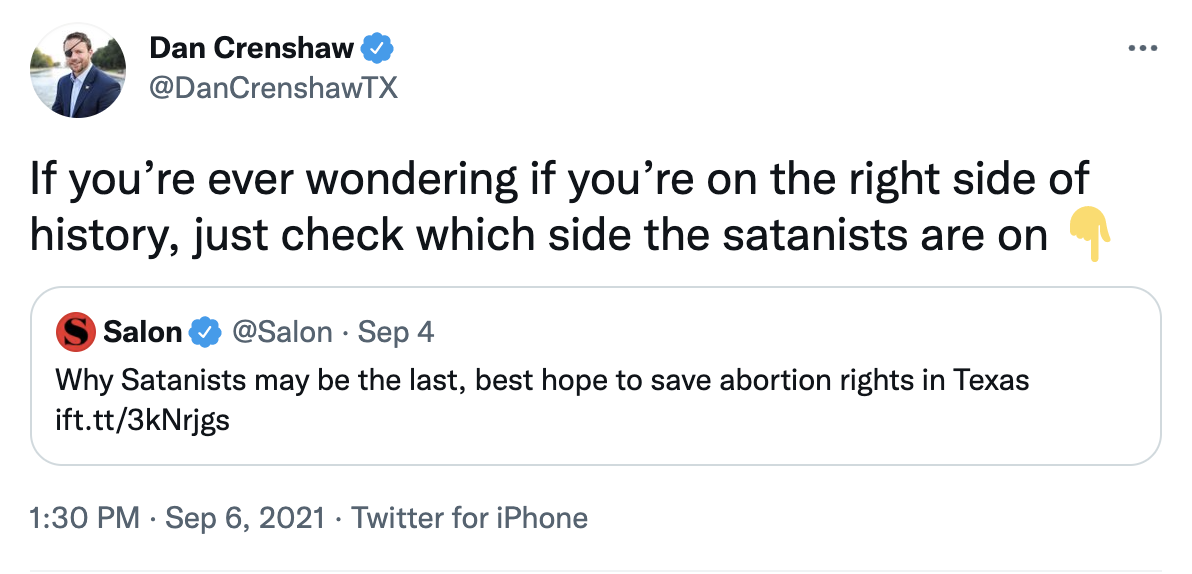
The Satanists are right: Texas’ abortion ban is a direct attack on freedom of religion

Trolling is largely associated with humor-impaired right-wing bullies, but there are still some on the left who know how to troll with wit and style while serving the forces of good instead of evil.

Take, for instance, the Satanic Temple of Salem, Massachusetts,  a perennial thorn in the side of Christian fundamentalists who try to pass off their theocratic impulses as “religious freedom.” The Temple, which is a pro-secular organization and does not literally worship Satan, routinely pulls stunts like suing states that display Christian imagery on public grounds to make them also display Satanic imagery. The group also stands for reproductive rights, and as Brett Bachman reports for Salon, is fighting the Texas abortion ban by declaring that abortion is one of their sacred rituals, making the ban a major imposition on their free expression of religion. 

The Satanists’ trolling worked. The move triggered all the right people, by which I mean misogynist prigs who have way too much interest in other people’s sex lives. 

Texas Republican Rep. Dan Crenshaw’s tweet was an immediate contender for the Self-Aware Wolves hall of fame. It’s the Satanists — whose mission is “to encourage benevolence and empathy among all people, reject tyrannical authority, advocate practical common sense, oppose injustice, and undertake noble pursuits” — and not Crenshaw who are clearly on the right side of history and human rights. 

But this move by the Satanic Temple serves a higher purpose than trolling forced-birth advocates like Crenshaw. The Satanists are highlighting an issue that often gets lost in the debate over reproductive rights: The anti-choice movement is just one part of a larger effort by Christian fundamentalists to covertly turn the U.S. into a more theocratic state. 


Want more Amanda Marcotte on politics? Subscribe to her newsletter Standing Room Only.


Anti-choice politics are driven by a small and shrinking group of hard-right white evangelicals who wish to foist their religious views on the majority, in violation of the First Amendment-enshrined value of free exercise of religion. The Texas abortion ban is tied to a larger agenda to undermine LGBTQ rights, replace science with religious dogma, and otherwise violate the constitutional prohibition of the establishment of religion. 

Conservatives go to great lengths to hide how much being anti-abortion is about forcing all Americans to live by the religious tenets of the white evangelical minority. Indeed, Republicans will often try to pretend “science” is motivating abortion bans, as former New Jersey governor Chris Christie did over the weekend on ABC, when he declared, “One of the reasons you’re seeing a decline in abortion is an increase in science and how much more people know about viability.” He then went on to baselessly claim that people are “much more appalled by the act of abortion than they were back in 1973.”

As with pretty much everything that’s said in defense of abortion bans, Christie spouts lies all the way down.

Support for abortion rights has remained steady since 1973 and strong majorities want Roe v. Wade to stay put. In 1973, scientists understood perfectly well how embryonic development worked and that understanding hasn’t meaningfully changed since then. Embryos are not “viable” two weeks after a missed period, which is when the Texas abortion ban kicks in. Indeed, the pretense for banning abortions so early — the “fetal heartbeat” — is also a lie. As actual medical scientists and doctors told NPR, there is neither a fetus nor a heart that early in pregnancy, but more “a grouping of cells that are initiating some electrical activity” that GOP legislators misleading call a “heartbeat.” 

Unfortunately, these kinds of lies about “science” are common among anti-choicers. As scientists Nicole M. Baran, Gretchen Goldman, and Jane Zelikova wrote in Scientific-American in 2019, GOP legislators “actively misrepresent the work of scientists, using rhetoric to deceive the public and stoke emotional outrage,” and the ideas animating abortion bans “are appallingly unscientific, and they are dangerous.”

We’ve all been accustomed to the cynical ease with which Republicans lie, but the anti-choice lies about “science” are ridiculous even by the basement-level standards conservatives live by. These are the same folks who reject the very real science of climate change and COVID-19 vaccination, even though their anti-science views are leading to mass death and destruction. (And then they lie and claim to be “pro-life.”) And it’s all to serve theocratic forces who really got this anti-science ball rolling by trying to force schools to teach Christian creation myths in lieu of evolutionary biology


Want more Amanda Marcotte on politics? Subscribe to her newsletter Standing Room Only.


It’s not science that fuels this assault on abortion rights, it’s religion — specifically the religion of white Christian fundamentalists.

A 2020 Associated Press-NORC Center for Public Affairs Research poll shows that 67% of white evangelicals want to ban abortion, compared to only 37% of Americans overall. Even the majority of Catholics support legal abortion, despite decades of church opposition to reproductive rights. A similar 2020 poll from Pew Research shows the same results. Strong majorities of Black Protestants, white non-evangelical Protestants, Catholics and the religiously unaffiliated all support Roe v. Wade. The only group where a majority opposes abortion rights is white evangelicals. 

The anti-abortion movement cannot be meaningfully separated from this theocratic movement of white evangelicals, or, for that matter, from white supremacy. It’s all one big bundle of intertwined ideas, and all the same people pushing it. These are folks resolutely opposed to a multiracial democracy, and instead have a vision of the U.S. as a white supremacist state where their far-right religious views shape the laws that everyone has to live by.  And despite the fact that Ten Commandments explicitly forbid bearing false witness, these theocrats lie and lie and lie — about science, about the law, about their intentions — because they know full well that their mission is anti-democratic and violates the constitutional precepts about freedom of religion. 

Abortion rights are often marginalized as a “woman’s issue” in American political discourse. That’s offensive in itself, as women are more than half the population and access to reproductive health care affects the lives of everyone, not just women. But truly, this Texas abortion ban goes beyond even these material questions about health care access. It cuts right to the heart of the struggle defining our era, between a secular, pro-democracy majority and an authoritarian minority who wants to force its racist, theocratic view of America on the rest of us.

The Satanists get it. No amount of right-wing lying about “science” will change the fact that this abortion ban is a direct attack on freedom of religion. 

Labor Day marked the end of COVID unemployment relief for millions of Americans

Federal unemployment benefits for more than 7 million laid-off workers expired on Labor Day, plunging tens of millions of households into uncertainty amid a surge in delta-variant COVID infections.

Three federal pandemic unemployment programs ended on Monday, cutting off all benefits to more than 7.5 million households and reducing benefits for another 2.7 million, according to an analysis by the Century Foundation, a nonpartisan think tank, though Labor Department numbers show that 9.2 million people are currently receiving benefits from the programs. Because the average household receiving benefits has about 3.8 people, the cuts could affect more than 35 million people, according to an analysis by the People’s Policy Project.

It’s a much earlier cut-off than in previous economic crises. After the 2008 Great Recession, various unemployment programs were extended through 2013 and only 1.3 million people were still on the rolls when they ended.

“Welcome to America, where lawmakers chose to kick 9 million jobless Americans off unemployment benefits on Labor Day, during a pandemic,” tweeted former Labor Secretary Robert Reich, calling for an extension of the programs.

Want a daily wrap-up of all the news and commentary Salon has to offer? Subscribe to our morning newsletter, Crash Course.


There has been no pushback by the Biden administration and few members of Congress have called for an extension of the benefits. The cuts come just weeks after congressional moderates killed a last-minute effort to extend the pandemic eviction moratorium. The Biden administration tried to unilaterally extend the eviction ban but was blocked by the Supreme Court, leaving more than 3.5 million households at risk of eviction, according to an estimate from Goldman Sachs.

The Biden administration reportedly sees the end of the unemployment benefits as part of its economic recovery plan in hopes that it sparks a wave of hiring. But the cuts come after the country recorded 4 million new Covid cases in just the last four weeks and experts believe the real number is much higher. Some states, particularly in the South, are facing alarming ICU shortages.

Many Southern Republican-led states already cut off unemployment benefits. Half of all states ended the weekly enhanced benefit over the summer, arguing that it would boost hiring. But those states have seen no increased job growth compared to states that maintained benefits until this month, according to a Wall Street Journal analysis. While economists believe that the enhanced benefits caused some people to not return to the labor market, they also point to child care responsibilities, fear of infection, and other factors for contributing to slow hiring. More than 5 million people say they’re not working because they are caring for a child who is not in school or day care, according to the most recent Census Bureau Household Survey, and another 3.2 million say they are worried about Covid spread.

Though there has been little desire among Congressional Democrats to extend the benefits, some progressives are calling for an extension to be included in the Democrats’ $3.5 trillion budget reconciliation bill that is expected to be completed this month.

“States that cut off federal unemployment benefits early did not see people return to work,” tweeted Rep. Cori Bush, D-Mo. “Why? Because we don’t guarantee child care. Because we don’t have a vaccine for kids under 12. Because we’re in a pandemic.”

While some in Washington hope that the expiration will help boost small businesses and grow the workforce, some research suggests that it could have the opposite effect by cutting consumer spending, at least at first. States that cut unemployment benefits early lost about $2 billion between June and August as consumer spending fell by 20%, according to a recent paper published by the National Bureau of Economic Research.

“There wasn’t a huge difference in the rate at which they returned to work,” Michael Stephner, an economist at the University of Toronto and one of the paper’s authors, told NPR. “There was a huge difference in the amount of benefits these workers received and the amount of money that they spent in their local economy… Taking away their benefits is not going to send them back to work. It’s really going to increase poverty and reduce people’s spending.”

The Biden administration said that individual states can use pandemic relief funds to extend unemployment benefits on their own but so far no state has announced plans to do so. Inside the administration, there was significant differences of opinion between Biden, who supports the expiration, and senior officials on the White House National Economic Council, the White House Council of Economic Advisers, the White House Office of Management and Budget, and the Labor Department, who believe the cut-off poses “a serious danger to millions of Americans who remain out of work,” according to the Washington Post. “There’s a lot of anxiety internally right now, particularly given delta [variant], about going over the cliff — much more than there was two months ago,” a senior administration official told the outlet.

Some lawmakers tried to push to extend two of the three expiring programs while allowing the main one to lapse.

“At the White House staff level, there’s a ton of support for focusing on at least trying to extend additional weeks for gig-workers and self-employed workers,” a senior congressional Democratic aide told the outlet last week. “But they’re not trying.”

The White House is instead focused on passing the Democratic spending bill, which would extend child tax credit benefits for families among other measures. And the administration has pointed to the 10 million job openings that currently exist.

“We think the jobs are there,” White House chief of staff Ron Klain told CNN on Sunday, “and we think the states have the resources they need to move people from unemployment to employment.”

But while growing wages and the child tax credit may offset some of the cuts, “the increases in various other categories of personal income will not be enough to offset the hit from jobless benefits going away,” said economists at Wells Fargo, estimating that the expiration will cause a $29 billion decline in personal income.

“It’s clear from the economic and health conditions on the ground that we shouldn’t be cutting off benefits now,” Senate Finance Committee Chairman Ron Wyden, D-Ore., said last week.

Federal policymakers were betting that the job market would return to normal over the summer but the latest disappointing jobs report, which missed its target by more than a half-million jobs, shows that the delta variant is “poised to threaten the pace of job growth,” warned Andrew Stettner, a senior fellow at the Century Foundation, urging Congress to extend the benefits at least in high-unemployment states.

“The unwillingness to extend emergency benefits—or even debate it,” he wrote, “shows how inured we’ve become to plight of the unemployed.”

The best substitutes for cake flour and self-rising flour in baking

A lot of us keep a gargantuan container of all-purpose flour in our pantry — a near-lifetime supply, if you’re anything like our test kitchen. All-purpose flour is the faithful old floury friend that we lean on for pancakesmuffins, and everything in between. More devoted bakers might even have a few wildcards in their baking arsenals, like whole wheat pastry flour or almond flour or spelt flour. But only in the most organized and well-stocked of home pantries have we found a bag of bread flour, ultra-soft cake flour, and self-rising flour resplendent in its old-school packaging.

If you don’t bake a whole lot, or didn’t plan quite so far ahead (*raises hand*), you might get tripped up on a recipe that calls for one of these somewhat uncommon, vaguely esoteric flours. Should you take another trip to the grocery store to pick them up? No, we say happily. As it turns out, both cake flour and self-rising flour can be easily faked at home, using ingredients that you most probably already have on hand. Here’s how to make a worthy substitute for cake flour and self-rising flour with everyday pantry staples. 

What is cake flour?

Before you freak out about the fact that you may not have cake flour on hand, you may start by asking yourself, “what is cake flour? Is cake flour the same thing as all-purpose flour?” For starters, no, it’s not the same product. Cake flour is a light, delicate, finely milled flour. It has a lower protein content (8%) than its all-purpose cousin (11%), which means any batter you make with it won’t develop very much gluten, and your finished product will be lighter and softer, with a finer crumb. If you’re whipping up an airy chiffon cake or feathery angel food cake, your recipe very likely calls for cake flour, and you’ll be glad for the tender, melt-in-your-mouth results. You wouldn’t want to use cake flour in something like a sturdy loaf of bread, however, as it requires stronger, higher-protein-content bread flour — but that’s another story.

Here’s the good news, though: Even if you don’t have cake flour immediately on hand, you, too, can have featherlight baked goods by using good old all-purpose flour. You can replicate cake flour by measuring out the same amount of all-purpose flour as the measure of cake flour called for. Then, remove two tablespoons of flour for every cup of all-purpose flour you’re using, and replace each of those tablespoons with cornstarchAnd in grams: 100 grams of sifted cake flour can be subbed with 85 grams sifted all-purpose flour plus 15 grams cornstarch.

So, if your recipe calls for 2 cups of cake flour, measure out 2 cups of AP flour, remove 4 tablespoons, and add 4 tablespoons of cornstarch. If your recipe calls for 3 1/2 cups of cake flour, you’ll remove 7 tablespoons, and so on and so forth.

Whisk together your flour and cornstarch, and then sift the mixture through a fine mesh sieve. A lot. About five times, actually. Since we’re aiming for lightness, you want your substitute for cake flour to be very-well aerated, with the corn starch completely integrated. Sorry for the inconvenience, but it wasn’t our idea — Alice said you have to.

And voilà, you have cake flour!

What is self-rising flour?

Another specialty type of flour that you may come across when baking is self-rising flour. Once again, self-rising flour is not the same thing as all-purpose flour nor is it the same thing as cake flour, bread flour, or pastry flour. Self-rising flour is almost exactly like all-purpose flour, but it has added salt and leavening mixed into it. Thus, recipes that call for this type of flour typically won’t require additional salt or leavening. Because of this, you should never substitute self-rising flour in place of all-purpose flour as the amount of leaveners (think: baking powder and baking soda), plus the amount of salt, will drastically alter your baked goods…and not for the better. Self-rising flour is a very big deal in Southern cooking, especially in biscuits. And if you don’t currently have it in your pantry, it’s also pretty simple to substitute with ingredients you do already have: all-purpose flour, salt, and baking powder. For every cup of self-rising flour that your recipe calls for, measure out one cup of all-purpose flour and add 1/4 teaspoon salt and 1 1/4 teaspoons baking powder. In grams: 100 grams of self-rising flour can be subbed with 100 grams of all-purpose flour, plus 5.5 grams baking powder and 1.13 grams salt. 

So, if your recipe calls for 2 cups of self-rising flour, you’ll measure out 2 cups of all-purpose flour, and add 1/2 teaspoon salt and 2 1/2 teaspoons baking powder.

Whisk everything together, and then sift once again using a fine mesh sieve. That’s right, about five times total, until it’s super, super light and fluffy. Aeration, you know. Alice’s orders.

Keep in mind, however, that certain cult-following brands of self-rising flour (such as White Lily and Presto, the latter of which is actually labeled as self-rising cake flour) are similar to cake flour in that they’re milled from softer wheat and have a lower protein content than all-purpose. If your recipe calls for one of these flours, or you feel like being a total overachiever (we see you), use your DIY cake flour instead of all-purpose in the above self-rising flour conversion; at the end of the day, you’ll be adding cornstarch, salt, and leavener in the correct proportions to basic all-purpose flour. And your unthinkably flaky, tender, mile-high biscuits will thank you. 

As for the kind of stuff you can make with cake flour and self-rising flour? Here are a few of our favorite recipes that use these two kinds of flour. 

Recipes with cake flour

Bavarian Banana Cake

This ultralight cake is a take on a classic, from Kienow’s Bohemian Bakery in Portland, OR. It features a silky, fluffy banana-based cake, which soaks up a banana-rum syrup, then gets topped with sliced bananas and vanilla mascarpone cream.

1-2-3-4 Cake with Raspberry Buttercream

This is a simple yellow cake with an easy-to-follow recipe: 4 eggs, 3 cups of sifted cake flour, 2 cups of sugar, 1 cup of butter and milk, each. Top with a fruity raspberry frosting and eat cheerfully. 

Jacques Torres’ Chocolate Chip Cookies

These beloved cookies, filled with thick pools of melty chocolate discs, are special also because of their use of cake flour — they end up with a chewy but not dense texture.

Effortless Angel’s Food Cake

We understand that we’ve already spent a good amount of time talking about the wonders of cake flour in cake. But no dessert demonstrates the delicate beauty of cake flour like an angel food cake. This cloud-like dessert is already ethereal, thanks to the use of a dozen whipped egg whites. But the light cake flour also contributes to the airy fine crumb that you’ll have to see to believe in a slice of this treat.

Recipes with self-rising flour

Sausage, Cheddar, and Chive Biscuit Bread

This simple, satisfying, super-flavorful bread will soon be a part of your brunch rotation. It’s got it all: sausage, chives, butter, and lots of cheese, along with cake flour to give it lift. Slather more butter on a warm slice, and nobody will be mad.

No-Measure Chocolate Cake

Here’s a one-bowl, no-measure, impossible-to-mess-up cake. You don’t even need extra leavener, because the cake’s self-rising flour does that job for you. 

3-Ingredient Bacon Biscuits

Remember how we mentioned that Southern home cooks rely heavily on self-rising flour for baked goods like biscuits? See how this specialty flour works its magic in these super simple drop biscuits. The only other ingredients that you need are buttermilk and really smoky, really flavorful, thick-cut bacon strips. 

Black cop shoots white woman: The saga of Michael Byrd and Ashli Babbitt

Like other forms of fascism, Donald Trump’s cult demands human sacrifice.

This can come in the form of those targeted for violence and pain as “the enemy.” The sacrifice can also come in the form of followers so committed to the movement that they are willing to kill and die for it. These rituals of violence bind the followers to the leader and one another, offering them meaning, a sense of community and a mythos built around their simultaneous “victimhood”, triumph and “heroism.” Ultimately, Trumpism and other forms of fascism are human destruction — both for their followers and society as a whole.

On Jan. 6, Donald Trump’s attack force overran the U.S. Capitol, committing at least 1,000 acts of violence against Capitol Police and other law enforcement officers. The goal of Trump’s attack force was to stop the certification of the Electoral College votes that would finalize the election of Joe Biden — and perhaps also to capture and execute Mike Pence, Nancy Pelosi, Alexandria Ocasio-Cortez and other Republicans and Democrats deemed to be “traitors.”

During the battle, Ashli Babbitt, a pro-Trump obsessive and extremist was shot and killed by a Capitol Police officer as she attempted to breach the doors of the House speaker’s chamber. Capitol Police investigated the shooting and concluded that it was justified and likely saved many lives. These facts, of course, do not matter to the right-wing propaganda machine.

The officer who shot Ashli Babbitt, Lt. Michael Byrd, has now come forward and identified himself, although at first his name was not disclosed because of safety concerns. Babbitt was immediately elevated into a martyr by the right-wing media. In their fictional world, she was the “victim” of overzealous police, who used “excessive force” against an unarmed “patriot.” As a white woman, Babbitt made a particularly compelling figure to the right-wing imagination, defined by her race and gender through the white racial frame as automatically being “innocent” and “vulnerable.”

Unsurprisingly, Donald Trump demanded to know the identity of the officer who shot Babbitt, and made veiled threats of violence against him. In TrumpWorld, it does not matter that Trump himself encouraged his followers to engage in the acts of right-wing terrorism and political violence that led to the tragic events of Jan. 6.


Want a daily wrap-up of all the news and commentary Salon has to offer? Subscribe to our morning newsletter, Crash Course.


In death, Babbitt has become a symbolic prop for the Big Lie that the 2020 election was “stolen” from Donald Trump and his followers. She is also part of a larger pantheon of “heroes” who have engaged in right-wing violence in service to the cause. These Trumpist martyrs and heroes serve as a powerful recruitment and fundraising tool

As Talia Lavin explains at New York magazine, “Every revolution runs on myths, its own heroes and martyrs filling the hearts of adherents with grievance and a wish for revenge. For the attempted revolution of January 6, Babbitt is the most visible of these figures.” Lavin continues:

Days after the storming of the Capitol on January 6, an image began spreading widely across the encrypted chat app Telegram and other bastions of right-wing digital conversation. It was a “battle flag” depicting Ashli Babbitt, a 35-year-old woman who was shot by a Capitol Police officer as she attempted to enter the building, as a spooky-looking white-on-black idealized feminine figure, not unlike a more martial version of the Starbucks logo. On the flag, a drop of blood dangles from Babbitt’s neck against a crimson Capitol dome.

Variations on this flag include the Capitol stamped with a Star of David, the word vengeance written below it in a gothic font. The Babbitt flag was used to advertise an abortive “Million Martyr March” scheduled for Inauguration Day. Ever since, white-supremacist groups like Revolt Through Tradition and the National Partisan Movement have used the same image of Babbitt in their recruitment propaganda, posting flyers on light poles and hanging banners that read “Her Name Was Ashley Babbitt” from Boston to Orlando.

Two Thursdays ago, Michael Byrd gave an exclusive interview to NBC News’ Lester Holt, discussing the struggle to protect the House chamber during the chaos of the Jan. 6 attack, as 60 to 80 House members and staffers remained inside:

As rioters rampaged through the Capitol, Byrd and a few other officers of the U.S. Capitol Police set up a wall of furniture outside the doors.

“Once we barricaded the doors, we were essentially trapped where we were,” Byrd said in an exclusive interview with NBC News’ Lester Holt, speaking publicly for the first time since the riot. “There was no way to retreat. No other way to get out.

“If they get through that door, they’re into the House chamber and upon the members of Congress,” added Byrd, who gave NBC News permission to use his name after authorities had declined to release it. …

What happened next was captured on video: Byrd fired one shot, striking Babbitt in the shoulder.

Babbitt, 35, an Air Force veteran and ardent supporter of former President Donald Trump, fell to the ground; she died from her injuries later.

The NBC News report observes that Trump falsely claimed that the officer who shot Babbitt had “worked for a high-ranking Democrat.” Byrd told Holt the incident had “turned his life upside down,” saying he had been in hiding after receiving “a flood of death threats and racist attacks that started when his name leaked onto right-wing websites.” He said he had no doubts about his decision to fire at Babbitt:

“I know that day I saved countless lives,” Byrd said. “I know members of Congress, as well as my fellow officers and staff, were in jeopardy and in serious danger. And that’s my job.” …

“I tried to wait as long as I could,” he told Holt. “I hoped and prayed no one tried to enter through those doors. But their failure to comply required me to take the appropriate action to save the lives of members of Congress and myself and my fellow officers.”

Byrd’s decision to shoot Babbitt — a Black police officer shooting an unarmed white woman — has taken on much greater meaning and power in the context of a nation stained by centuries of white-on-Black racial violence. This incident represents the ultimate transgression across the color line: A Black man granted the power of lethal violence by the state used it against a white woman.

The fact that a police officer was forced to kill a Trump invader — let alone a white woman — adds an exclamation mark to the meaning of Jan. 6.

On that day, Trump’s terrorists attacked the Capitol with the goal, consciously or otherwise, of overturning multiracial democracy and reasserting white people’s control over every aspect of American life.

Trump’s attack force carried Confederate flags and a white Christian nationalist cross. They also wore Nazi regalia and other white supremacist symbols. Right-wing paramilitaries and other street thugs played a central role in the attack on the Capitol. White freedom and white privilege made Trump’s attack force feel so safe that they made no effort to cover their faces. Evidently, they were not afraid of being identified and punished for their crimes.

Moreover, white freedom and white privilege convinced Trump’s followers that the police would not use lethal force against them. They were largely correct in that assumption: If Black or brown people or Muslims, or any group identified as “liberal” or “leftist,” had stormed the Capitol they would have been shot down in large numbers. Trump’s attack force also bombarded Black law enforcement agents with racial slurs.

In total, the events of Jan. 6 were but another reminder that white supremacy and its violence have not been fully exorcised from American society. At least 6,500 Black Americans were lynched by white people in the South and across the country during the 19th and 20th centuries. These men, women, boys and girls, old and young, were “guilty” of being Black and perhaps daring to request some basic level of human respect and dignity in a white supremacist society.

One of the most notable crimes that demanded the lynching tree was the particular crime of raping a white woman. Historians have documented few if any actual examples of Black men or boys committing such an act during slavery, Reconstruction, or the Jim Crow era in the South. Most accusations of rape by white women against Black men and boys during that time period were fabrications or outright lies intended to encourage collective white violence against the Black community.

In her essential book “Behind the Mask of Chivalry,” historian Nancy MacLean offers these insights into the South’s lynching culture, the Ku Klux Klan, and dynamics of race and gender:

All the Klan’s sexually related charges, in fact, focused on the men of other groups. The lack of corresponding fears about female African-Americans and Jews indicates that sexual jealousy was an important ingredient in white men’s racism, as W.E.B. DuBois had once suggested. … Klansmen viewed women at some level as property; they also viewed them as symbols of power. … Deeply conscious themselves of this tradition of using women as markers in symbolic power plays between men, Klansmen realized that other men could play the same game. The image of the black rapist was thus conjured out of Klansmen’s fears of a militant claim to equality by a social subordinate: he would prove his dignity with their property even if he had to risk his life to get it.

The elevation of Ashli Babbitt into a martyr fulfills a cultural script in which white men are supposed to “protect” white women (against nonwhites, especially men) as a type of property over whom they have final dominion.

Because of his cultural experience and living memory as a Black American, at some point Michael Byrd must have realized that by doing his duty as a police officer and patriot on Jan. 6, the full weight of white supremacy would come crashing down upon him. The other Black and brown police officers (and some white officers as well) likely felt some version of the same thing as they battled Trump’s attack force.

The Ku Klux Klan wears white robes in an attempt to intimidate Black people — the robes are supposed to represent Confederate war dead who have been summoned back to this plane of existence to seek vengeance on Black people. Many of those demons and ghosts in human form now wear business suits and ties, or khaki pants, polo shirts and MAGA hats.

In his book “Trouble in Mind,” historian Leon Litwack, described the state of siege that typified Black life in the South after the end of Reconstruction and the many decades of Jim Crow terrorism and white tyranny that followed:

The “war” black men and women were clearly losing; indeed, it had become a virtual rout. The other side owned the land, the law, the police, the courts, the government, the armed forces, and the press. The political system denied blacks a voice; the educational system denied them equal access and adequate resources; popular culture mocked their lives and aspirations; the economic system left them little room for ambition or hope; and the law and courts functioned effectively at every level to protect, reinforce, and deepen their political powerlessness, economic dependence, and social degradation. Those were formidable odds.

This was the world — a world of racist fantasies made real through unrestrained white freedom — that Trump’s terrorists and the Jim Crow Republicans hope to recreate in the 21st century.

When Lt. Michael Byrd and the other Black and brown police officers battled Trump’s attack force on Jan. 6, they committed an unpardonable sin against white racial authoritarianism and its believers and followers. Revenge and retaliation are inevitable.

Lt. Michael Byrd’s peril will continue into the foreseeable future. He is now more than a man. He is a symbol for the white right and other American fascists, who are likely to perceive him as an ultimate trophy, as well as a way of avenging the killing of Ashli Babbitt. The threats of violence will not be limited to him. For the white right and the American neofascist movement, all Black people are now, to varying degrees, Michael Byrd.

Mike Lindell claims spreading lies about Dominion Voting Systems is good for business

Last Thursday night, MyPillow CEO Mike Lindell made a surprising admission to his loyal followers, considering that he faces a defamation lawsuit by Dominion Voting Systems for $1.3 billion. Lindell said his company has profited from his repeated lies about the voting technology firm — enough that the pillow king has recently hired an additional 200 employees. 

“We hired 200 more employees because — 200 more employees,” the MyPillow guy stated on his streaming site, Lindell TV. “We had to hire more because we are busy. People have responded. They have responded out there. We are a USA company with — now we have 2,700 employees. They are hardworking people.” 

In fact, Dominion argued exactly this in the company’s initial Feb. 22 complaint against MyPillow and Lindell, alleging that the pillow tycoon had pushed unsubstantiated lies about the 2020 election and Dominion’s voting machines in order to generate more revenue for his pillow empire.

Describing Lindell as “a talented salesman and former professional card counter,” Dominion’s complaint alleged that he “sells the lie to this day because the lie sells pillows. MyPillow’s defamatory marketing campaign — with promo codes like ‘FightforTrump,’ ’45,’ ‘Proof,’ and ‘QAnon’ — has increased MyPillow sales by 30-40% and continues duping people into redirecting their election-lie outrage into pillow purchases.” 

Responding to those accusations in an April 19 memorandum accompanying a motion to dismiss the suit, Lindell’s legal team argued the opposite, contending that Dominion was wrong to claim Lindell’s company is thriving.


Want a daily wrap-up of all the news and commentary Salon has to offer? Subscribe to our morning newsletter, Crash Course.


“The Plaintiffs finally claim that Mr. Lindell’s statements about Dominion were nothing more than an attempt to sell pillows. Exhibit 230 demonstrates that Mr. Lindell’s principled stand resulted in a loss of business,” Lindell’s lawyers wrote. “Numerous retailers – including Bed Bath & Beyond, Kohl’s, Today’s Shopping Choice and Wayfair – dropped MyPillow products after Mr. Lindell’s public statements.”

While it’s true that several big-box and online retailers dropped Lindell’s signature pillow from their stores, Lindell now claims his business has generated enough increased revenue to hire more employees. 

A Dominion spokesperson declined to comment on the matter when reached by Salon. 

Experienced trial attorney Max Kennerly told Salon that Lindell’s admission that he has profited off the lies he’s been spreading might not be the soundest legal approach. 

“It’s quite rare for civil defendants in any case to admit a connection between the alleged wrongdoing and their income,” Kennerly said. “It’s particularly unusual for defamation defendants to draw a connection between their allegedly defamatory statements and their own wallet — typically, the plaintiff has to fight just to show that could have been part of the motivation. 

“By and large, defamation cases are an uphill battle, but it seems like Lindell is committed to making it a downhill slope for Dominion,” Kennerly concluded. 

After being dropped by retailers, MyPillow largely turned to TrumpWorld influencers and far-right figures, including Dan Bongino, Steve Bannon and Alex Jones, among others, to hawk products from dog beds to Giza dream sheets, relying on a mysterious profit-sharing agreement between the parties.

Former journalist and recent Duke Law School graduate Robert DeNault, in a conversation, with Salon, further discussed the contradictory statements made by Lindell and his team:

Any time a client publicly contradicts an assertion an attorney made in their defense, it’s not a great situation. Here it seems really problematic, because Lindell’s attorneys directly asserted he had taken a loss on his business in response to Dominion’s claim Lindell was defaming them to profit with MyPillow sales. But now Lindell appears to be out here suggesting his company is actually profiting and even growing based on media exposure he’s gotten from the situation. The big issue is that if you’re his lawyer, you might need to argue that he was embellishing or perhaps even lying when he said that MyPillow actually got busier and hired more people, in order to avoid accusations by Dominion that you’ve misrepresented facts to the court. But even that argument has pitfalls, because it involves admitting to conduct that strongly resembles the allegations Dominion is making against him, which is essentially that Lindell lies freely on TV and elsewhere. It’s not an enviable situation to be in.

As Salon reported last week, Lindell not only recently sold one of his private planes but has also paid out millions to his self-appointed cyber experts

The pillow maven didn’t return a Salon request for comment on this story. 

You can watch Lindell’s online comments below, via YouTube

Abortion bounty hunters in Texas aren’t “whistleblowers” — they’re vicious vigilantes

One of the many preposterous claims coming from supporters of the vicious new Texas law against abortion is that bounty hunters — who stand to gain a $10,000 reward from the state — will somehow be “whistleblowers.” The largest anti-abortion group in Texas is trying to attach the virtuous “whistleblower” label to predators who’ll file lawsuits against abortion providers and anyone who “aids or abets” a woman getting an abortion.

As a journalist and activist, I’ve worked with a range of genuine whistleblowers during the last several decades. Coming from diverse backgrounds, they ended up tangling with institutions ranging from the Pentagon and CIA to the National Security Agency and the Veterans Administration. Their personalities and outlooks varied greatly, but none of them were bullies. None of them wanted to threaten or harm powerless people in distress. On the contrary, the point of the whistleblowing was to hold powerful institutions accountable for violations of human rights.

What the Texas vigilantes will be seeking to do is quite the opposite. The targets will be women who want abortions as well as their allies — people under duress — with pursuers seeing a bullseye on their backs.

The whistleblowers I’ve known have all taken huge risks. Most lost their jobs. Many endured all-out prosecutions on bogus charges, like violating the Espionage Act for the “crime” of informing the public with vital information. Some went to prison. Almost all suffered large — often massive — losses that wrecked their personal finances.

In sharp contrast, the Texans trying to cash in on the new law will risk nothing. While collaborating with the state to spy on the lives of others, they will be striving to enrich themselves.


Want a daily wrap-up of all the news and commentary Salon has to offer? Subscribe to our morning newsletter, Crash Course.


“The state law created a so-called ‘private right of action’ to enforce the restriction,” in the words of a CNN report. “Essentially, the legislature deputized private citizens to bring civil litigation — with the threat of $10,000 or more in damages — against providers or even anyone who helped a woman access an abortion after six weeks.” 

Calling those who exploit this law “whistleblowers” is a way to turn the true meaning of whistleblowing on its head. We might as well have history books referring to enforcers of the Fugitive Slave Act as “good Samaritans,” or monitors of Jim Crow compliance as “civic activists.” 

It’s fitting — and revealing — that the professed “whistleblowing” website thrown up by the big Texas Right to Life organization was welcomed by an internet provider that specializes in hosting services for extreme far-right groups. Thanks to a provider called Epik, the Daily Beast reported, the site “found a new home alongside neo-Nazis and white supremacists.” The digital relocation came after the site was booted by GoDaddy on Friday. But before the end of the weekend, even Epik backed away.

One of the enormous dangers of the Texas abortion law is that a Stasi-like culture of betrayal and fear will evolve in the Lone Star State and copycat states, with long-lasting destructive effects. If a friend, neighbor or co-worker can turn someone in and gain a reward for doing so, the ripple effects are going to be corrosive, intensifying over time.

Aided by the U.S. Supreme Court, the state of Texas has now codified misogyny. The results will surely include ongoing deaths, making the coat hanger the state’s unofficial symbol. Real whistleblowing will expose those who profit from victimizing women under cover of this horrible new law.

“Get out now” — inside the White House on 9/11, according to the staffers who were there

I was the special assistant to the president for management and administration, and President George W. Bush was in Sarasota, Florida, promoting the No Child Left Behind legislation. The senior official in the White House was Vice President Dick Cheney. First lady Laura Bush was scheduled to travel to Capitol Hill to brief senators on early childhood education. On the South Lawn, tables were being set up for that evening’s congressional barbecue.

With the president away, I arrived later than usual that morning and headed to a breakfast in the small senior staff dining room known as the White House Mess, on the ground floor of the West Wing.

I was sitting at a table eating my toast and drinking coffee when a colleague came over and told us about news reports of a plane crashing into the World Trade Center in New York City. We thought it had to be a terrible accident. We left the Mess shortly thereafter, unaware of the impact of the second plane.

“Get out now”

This story began as an assignment from the White House Historical Association to write about that day for its 9/11 20th-anniversary edition of the White House History Quarterly. I interviewed a range of White House staffers, from Cabinet officials and aides assisting the vice president and the National Security Council to the interns from around the country who had begun their service at the White House that momentous day.

In the minutes after we heard about the plane crashing, there was a rush of activity in the ground-floor hallway. I was directed by the Secret Service to get West Wing staff out of their offices and into the windowless Mess, which was thought to be the safest place at the time.

But then, the agents, weapons drawn, ordered everyone to “get out now,” sending staffers racing through the iron gates that had been opened at both ends of West Executive Avenue outside the West Wing. Women were advised to kick off their heels and run for their lives. Tourists at the White House ran from the building, leaving strollers on the lawn.

Across the White House complex, the Secret Service ordered staff to evacuate as quickly as possible. In the five-story Old Executive Office Building next door, however, many staffers learned about these orders only by watching TV and seeing the chyron: “White House being evacuated.”

The frantic evacuation was a response to the urgent call the Secret Service had received from air traffic control at Ronald Reagan National Airport – in which Secret Service staffers were told, “There is an aircraft coming at you” and “What I am telling you, buddy, is that if you’ve got people, you better get them out of there. And I mean right goddamned now.”

Moments later, hijackers crashed American Airlines Flight 77 into the Pentagon. The vice president had been evacuated from his West Wing office to the president’s emergency operations center, also called “The Bunker.” An agent later said, “We had 56 seconds to move him.”

The “Dead List”

In the White House Situation Room, which served as the vital link for secure communications and information for the president, staff were told by their senior duty officer that “we have been ordered to evacuate … If you want to go, go now.”

But no one moved.

The communications technician transmitted the list of personnel who remained to the CIA Operations Center. The duty officers there called it the “Dead List.” Thankfully, their description was ultimately wrong.

I left the White House and joined staffers across the street in Lafayette Park. I instinctively sought to find a safer place to congregate and thought of the DaimlerChrysler office on H Street, a short walk away. My husband, Tim McBride, a former aide to President George H.W. Bush, was serving as director of government affairs for DaimlerChrysler in its Washington office.

I called Tim and asked if I could bring White House staff members there. Tim had already begun to send his staff home, and thought quickly to ask them to leave their computers on with their passwords written down, so that White House staffers would be able to work in the office.

Ultimately, more than 70 White House personnel from offices including speechwriting, scheduling, communications, Oval Office operations and legislative affairs worked from DaimlerChrysler on 9/11. I asked one of the first staff members to arrive to sit at the front desk and record everyone’s name and contact number and fax that list to the White House Situation Room, notifying them who was at this location.

“Bond deepened”

Speechwriters began researching for presidential remarks, communications staff were monitoring reports from around the country and keeping contact with the media, and senior staff took charge, giving directions to create a schedule of events for the president’s next few days, including going to New York and the Pentagon.

In horror and grief, we watched the news of the hijacked plane that went down in a field in Pennsylvania, but the mood in the DaimlerChrysler office was focused and determined. As one colleague said, “the culture of the White House stuck with people in the face of an emergency.”

Word reached us around 5 p.m. that West Wing staff should head back to the White House. The president was returning. Going room by room at the DaimlerChrysler office, I collected any documents that were left behind. These materials were now presidential records to be preserved at the National Archives.

Making my way back to the White House to get my car, I walked through Lafayette Park. The country was now at war, and everyone knew it was the start of a new chapter in our nation’s history. As one former colleague told me, “Working at the White House is a binding experience in itself, but the strengthening of that bond deepened after an experience like this.”

Anita McBride, Fellow in Residence, Center for Congressional and Presidential Studies, Department of Government, American University

This article is republished from The Conversation under a Creative Commons license.

When human life begins is a question of politics — not biology

A Texas law that aims to eliminate almost all abortions in the state is part of a long-standing nationwide movement to restrict the right to abortion. The Texas law went into effect on Sept. 1, 2021, and severely limits the right to have an abortion in that state.

But the anti-abortion movement is aiming more broadly than just Texas and placing its bets very strongly on a case expected to be argued this fall at the U.S. Supreme Court, known as Dobbs v. Jackson Women’s Health Organization. In that case, the state of Mississippi is asking the Supreme Court to decide on the constitutionality of any sort of prohibition on elective abortions before the fetus is viable outside the womb. If the court rules that those sorts of prohibitions are unconstitutional, that would overturn the long-standing decision in Roe v. Wade that women do have the right to have an abortion.

A recent friend-of-the-court filing in that case implicitly claims that biology – and therefore biologists – can tell when human life begins. The filing then goes on to claim explicitly that a vast majority of biologists agree on which particular point in fetal development actually marks the beginning of a human life.

Neither of those claims is true.

The role of science

As a biologist and philosopher, I have been watching players in the national abortion debate make claims about biology for many years.

Abortion rights opponents know that Americans have widely differing values and religious beliefs about abortion and the protection of human life. So they seek to use science as an absolute standard in any discussion of abortion’s constitutionality, setting a definition of human life that they hope will be immune to any counterargument.

While possibly well-intentioned, this appeal to scientific authority and evidence over discussions of people’s values is based on faulty reasoning. Philosophers such as the late Bernard Williams have long pointed out that understanding what it is to be human requires a lot more than biology. And scientists can’t establish when a fertilized cell or embryo or fetus becomes a human being.

Political claims about science

Public figures have, in recent years, prominently claimed that scientific knowledge on the topic of human life is definitive.

In 2012, for instance, former Arkansas Gov. Mike Huckabee, who was running for president, claimed on “The Daily Show with Jon Stewart: “Biologically, life begins at conception. That’s irrefutable from a biological standpoint.”

Similarly, in his 2015 presidential bid, Florida Sen. Marco Rubio declared, “I believe that science is clear … when there is conception that that is a human life in the early stages of its development.”

The most recent high-profile example of this claim is in that amicus brief filed with the Supreme Court in the Mississippi case.

The brief, coordinated by a University of Chicago graduate student in comparative human development, Steven Andrew Jacobs, is based on a problematic piece of research Jacobs conducted. He now seeks to enter it into the public record to influence U.S. law.

First, Jacobs carried out a survey, supposedly representative of all Americans, by seeking potential participants on the Amazon Mechanical Turk crowdsourcing marketplace and accepting all 2,979 respondents who agreed to participate. He found that most of these respondents trust biologists over others – including religious leaders, voters, philosophers and Supreme Court justices – to determine when human life begins.

Then, he sent 62,469 biologists who could be identified from institutional faculty and researcher lists a separate survey, offering several options for when, biologically, human life might begin. He got 5,502 responses; 95% of those self-selected respondents said that life began at fertilization, when a sperm and egg merge to form a single-celled zygote.

That result is not a proper survey method and does not carry any statistical or scientific weight. It is like asking 100 people about their favorite sport, finding out that only the 37 football fans bothered to answer, and declaring that 100% of Americans love football.

In the end, just 70 of those 60,000-plus biologists supported Jacobs’ legal argument enough to sign the amicus brief, which makes a companion argument to the main case. That may well be because there is neither scientific consensus on the matter of when human life actually begins nor agreement that it is a question that biologists can answer using their science.

Several possible options

Scott Gilbert, the Howard A. Schneiderman Professor of Biology emeritus at Swarthmore College, is the author of the standard textbook of developmental biology. He has identified as many as five developmental stages that, from a biological perspective, are all plausible beginning points for human life. Biology, as science knows it now, can tell these stages apart, but cannot determine at which one of these stages life begins.

The first of these stages is fertilization in the egg duct, when a zygote is formed with the full human genetic material. But almost every cell in everyone’s body contains that person’s complete DNA sequence. If genetic material alone makes a potential human being, then when we shed skin cells – as we do all the time – we are severing potential human beings.

The second plausible stage is called gastrulation, which happens about two weeks after fertilization. At that point, the embryo loses the ability to form identical twins – or triplets or more. The embryo therefore becomes a biological individual but not necessarily a human individual.

The third possible stage is at 24 to 27 weeks of pregnancy, when the characteristic human-specific brain-wave pattern emerges in the fetus’s brain. Disappearance of this pattern is part of the legal standard for human death; by symmetry, perhaps its appearance could be taken to mark the beginning of human life.

The fourth possible stage, which is the one endorsed in the Roe v. Wade decision legalizing abortion in the United States, is viability, when a fetus typically becomes viable outside the uterus with the help of available medical technology. With the technology that we have today, that stage is reached at about 24 weeks.

The final possibility is birth itself.

The overall point is that biology does not determine when human life begins. It is a question that can only be answered by appealing to our values, examining what we take to be human.

Perhaps biologists of the future will learn more. Until then, when human life begins during fetal developments is a question for philosophers and theologians. And policies based on an answer to that question will remain up to politicians – and judges.

Sahotra Sarkar, Professor of Philosophy and Integrative Biology, The University of Texas at Austin College of Liberal Arts

This article is republished from The Conversation under a Creative Commons license.

Rudy Giuliani rationalizes Biden impeachment over Trump’s

Former New York Mayor Rudy Giuliani explained on Monday why he believes President Joe Biden should face impeachment even though he opposed “weaponizing” the constitutional remedy against former President Donald Trump.

During an interview on Real America’s Voice, host Steve Bannon asked Giuliani why it was acceptable to target Biden with impeachment for “treason” over the U.S. military’s withdrawal in Afghanistan.

“You’re saying he aided and abetted our enemies and you’re saying it’s at least worthy of an investigation,” Bannon said. “I remember we would have you on [the show] many times and you warned the American people about the politicization and weaponization of the impeachment process.”

“You warned us about weaponizing the impeachment process for things just like this,” the host added. “How would you weigh and measure that, your warning about the weaponization and over-politicization of it versus your charges against Joe Biden?”

“I would rather not have an impeachment,” Giuliani insisted. “However, I think we’re dealing with a situation that just because the Democrats misused it, we can’t be denied the use of it when something is seriously harmful to the United States.”

“I think you have to do it,” he said of impeachment. “This is serious enough so that an American president who – maybe he’s doing it because he’s mentally incompetent but we don’t know that. And then he can defend himself that way.”

Watch the video below from Real America’s Voice.

Your COVID game plan: are stadiums safe?

The college football season is kicking into high gear, the National Football League season starts Sept. 9, and the baseball pennant races are heating up. For the first time since 2019, nearly all stadiums will be fully open to fans.

In the so-called Before Times, sitting shoulder to shoulder inside a stadium with tens of thousands of boisterous spectators — after a few hours of pregame tailgating — was a highlight of many fans’ autumn. But with covid-19 cases, hospitalizations and deaths soaring from the delta variant, many fans are wondering if that is a wise idea.

KHN talked to seven health experts to get their takes.

1. Is it safe to go to a packed stadium even if you are vaccinated?

Six out of the seven public health experts that KHN spoke to from big football states were adamant in their response: No way. Not now.

“I am a die-hard sports fan,” said Jason Salemi, an associate professor of epidemiology at the University of South Florida in Tampa. “But I would not go to these events right now.”

Salemi said that with covid cases at their highest level since late January — with the seven-day average case count rising to just over 149,000 as of Monday — and hospitals filling up around the country, there is too much risk even for people who have been fully vaccinated against covid.

While outdoor events are less likely to lead to infection because the air circulation is greater, sitting within just a few feet of 10 or 20 screaming fans watching football, baseball, soccer or an auto race at a stadium reduces that safety margin, he said.

Vaccines greatly lower your risk of being hospitalized or dying from covid, but the dominance of the more transmissible delta variant is leading to increasing numbers of breakthrough infections, some of which do cause uncomfortable symptoms. Getting infected also increases the likelihood of passing the infection to unvaccinated people, who could become seriously ill.

Even some vaccinated fans — especially those who are older and frail or people with chronic medical conditions — should also realize they face higher risk from an infection. The Centers for Disease Control and Prevention does not specifically have guidance about sporting events, but it recommends that anyone attending large gatherings in areas with high numbers of covid cases should “consider wearing a mask in crowded outdoor settings and for activities with close contact” with others who are not fully vaccinated.

“A packed football stadium now is not a good idea,” said Dr. Olveen Carrasquillo, a professor of medicine and public health sciences at the University of Miami’s medical school. “When there’s a lot of shouting and yelling” without masks, “it means they’re spraying the virus.”

Football stadiums, which are generally among the largest sporting venues in this country, are typically packed with fans cheering and high-fiving, making it impossible to physically distance from people who may be unvaccinated. Equally difficult is remaining apart from the unvaccinated in crowded concourses and restrooms.

Dr. Robert Siegel, a professor of microbiology and immunology at Stanford University, said that while the risk of dying or ending up in intensive care from covid after being vaccinated is “vanishingly small,” he would prefer to even avoid a milder case so he doesn’t have to worry about long-term consequences of the disease. “It’s not worth it to me, but if football is your life, you may have a different calculus,” he said.

2. What can I do to reduce my risk at the game?

The first line of defense is being fully vaccinated.

If unvaccinated, don’t go to the game, all seven experts strongly recommended.

Some colleges such as Louisiana State University are requiring fans to be vaccinated or to show a negative covid test to attend a game — and many players on teams are vaccinated to reduce their risk and stay in the game. But many stadiums will have no such restriction on fans.

Wear a mask except when eating or drinking.

Mask mandates vary by venue for both the NFL and college teams. Even if others around you are not wearing one, your mask will give you a level of protection from inhaling the virus. “It’s best if all parties are wearing a mask, but wearing a mask is better than not wearing a mask,” said Dr. Nasia Safdar, a specialist in infectious diseases at the University of Wisconsin School of Medicine and Public Health.

Dr. Dale Bratzler, Oklahoma University’s chief covid officer, said he would not tell vaccinated people to avoid going to football games. He does strongly advise, however, that fans consider double masking. He doesn’t plan to go to the OU games this fall, but it has nothing to do with covid. “It’s because of the traffic getting into and out of the stadium. I am fine watching at home on TV.”

If you want to protect others, consider taking a home covid test the day of the game. If the test results come back positive, or if you feel any symptoms, even a runny nose, mild headache, or cough, don’t go to a game, Safdar said.

And the experts said to pay attention to the level of covid cases in any city to which you are traveling. The incidence could be high, and that should factor into your decision about attending a game.

3. What about tailgating for hours with friends before the game?

Most of the experts agreed tailgating with a few friends outdoors is a less risky part of the football game experience. But that’s only if you know the people you are eating and drinking with are vaccinated.

“It’s also that party atmosphere, where people are generally not in a position to wear a mask and you are standing close to people,” Safdar said. “It’s still a risk.”

4. Millions of people have been attending baseball games, soccer games and other sports events all summer — without many outbreaks. Why worry now about football games?

There have been rare reports of outbreaks from major league baseball stadiums, which often pack in 40,000 fans. But that could be changing, too, because the more highly transmissible delta variant has been widespread only since July. Also, the experts said, it’s difficult to track how many fans get sick because the incubation period can last a week or more. People may not connect their illness to the game, especially if they assume outdoor activities are safe.

“Delta changed the entire equation of how we looked at the risk,” said Dr. William Schaffner, an infectious disease expert at Vanderbilt University School of Medicine in Nashville. “I do think there will be transmission” in stadiums.

Health experts point to the Sturgis Motorcycle Rally in South Dakota last month that has been linked to more than 100 infections.

5. Can I still get together with other vaccinated friends and family?

Even with the delta variant raging, health experts say people who are fully immunized can safely meet without masks with those they know are fully vaccinated.

“If you know with certainty that someone is vaccinated, you can safely get together for dinner and other activities,” said Dr. Joseph Gastaldo, a specialist in infectious diseases at Ohio Health, a large, multihospital system based in Columbus.

And the risk of spread can be minimized at events such as an outdoor wedding if organizers include requirements for vaccinations, wearing masks and physical distancing for vulnerable attendees, experts say.

The dark side of anti-depressants for dogs

Dogs have co-evolved with humans for so long that dogs can read our emotions and may even prefer our company to that of other dogs. Likewise, most human owners believe we can intuit when dogs are sad or happy, and naturally, most owners worry about their emotional health. While in earlier eras, a dog’s contentment might have been measured by access to food or play, at some point during the modern era of pharmaceuticals a new trend emerged: medicating one’s dog with psychotropic drugs.

Since antidepressants were discovered in the 1950s, the trend expanded among humans: one study found that between 2015 and 2018, 13.2 percent of American adults had taken an antidepressant medication within the previous 30 days. Given that psychiatric drugs can help people, it stands to reason that they can also help dogs. That is why we now see dogs being prescribed drugs like Buspirone, Alprazolam, Diazepam and Fluoxetine. And the trend is quite common among pet owners: a 2016 survey of small-animal veterinarians found that 83 percent had prescribed the antidepressant fluoxetine to either dogs or cats.

But the increase in mood-altering drug prescriptions for dogs (and other pets) comes with a dark side, too. While humans can articulate their feelings, and say aloud whether a prescription has negative side effects, animals cannot do the same. That appears to raise clear moral questions regarding consent.

Medicating pets with psychotropic drugs also brings up questions regarding whether such medications are more for the pet owners’ own comfort — or, perhaps, if they are being used as a “quick fix” to drug difficult pets into submission and bliss, rather train their pet to be calmer through training and attention.

Some experts see the psychotropic medication of pets as a major quandary. James A. Serpell, a professor of Ethics & Animal Welfare at the University of Pennsylvania, told Salon that we are increasingly moving toward a situation “where people just use these drugs routinely as a means of calming their animals down and stopping them being a nuisance.” 

“We don’t really know anything about the long-term effects of that on these animals,” he added. “There is value to using anti-anxiety drugs in highly anxious animals if only to facilitate other forms of treatment.”

Still, this does not mean that all psychotropic medications are to be avoided — rather, experts say there is merely a fine line. Temple Grandin, an autism spokesperson and professor of animal science at Colorado State University, illustrated her approach to medicating animals by comparing it to attitudes toward medicating autistic individuals. (Full disclosure: This journalist is actually autistic himself.) 

“I take an old anti-depressant called desipramine and it greatly reduced my anxiety,” Grandin told Salon by email, adding that she discussed this in her book “Thinking in Pictures.”

Yet Grandin did not think drugs should be a first line of defense on any animals, humans included.

“For both dogs and people, drugs should not be the first thing that is used. Many dogs need more exercise, time to play with other dogs, and explore the outside,” she noted. 

Grandin noted that many autistic people such as herself “greatly benefitted from medication,” and the same can be true for dogs.

That said, Grandin also does vigorous exercise every day to stay healthy. Dogs, likewise, need to be kept physically and socially active for their minds to remain in good shape.

This is why experts are concerned less about prescribing these drugs (although they acknowledge that there could be unforeseen long-term consequences) and more about how they are prescribed. The underlying dilemma is making sure that they are dispensed because an animal truly is in distress and needs a pharmacological solution.

“I don’t have an ethical concern related to the prescription of a drug itself,” Carlo Siracusa, associate professor of clinical animal behavior and welfare at PennVet at the University of Pennsylvania, explained to Salon. “I have an ethical concern related to the way in which it can be abused.”


Want more health and science stories in your inbox? Subscribe to Salon’s weekly newsletter The Vulgar Scientist.


He emphasized that, as with humans, the drugs should only be used when a qualified professional has identified a behavior pathology. Dog owners need to make sure that they are not simply medicating against normal dog behaviors such as frequent barking. The behavior has to be both abnormal and harmful, and only veterinarians who specialize in veterinary behavior (veterinary behaviorists) are capable of doing this.

Erica N. Feuerbacher, an associate professor at Virginia Tech’s Department of Animal & Poultry Science, told Salon by email that many studies show that psychiatric drugs can be effective in treating a variety of fear-related and separation-related problem behaviors. She added that have a moral imperative to try to do everything we can to help the well-being of animals that are in our care.

That said, in addition to not medicating against normal behavior, owners need to be wary that they are not medicating when non-medical solutions might exist.

“Owners need to recognize that prescribing meds does not absolve them of trying to help their pet in other ways — it should be seen as a supplement to other things they are doing to improve their pets’ lives,” Feuerbacher explained. Owners could hire a certified behavior specialist, rearrange their dog’s environment to remove chronic stressors, or work on more effectively training their dogs so they will be conditioned away from harmful actions.

Siracusa noted that, in at least one respect, prescribing medication to your dog might actually be safer than a popular alternative: Hiring a dog trainer.

“There is a system in place to control drug use, but there is no system in place to control training,” Siracusa explained. “Anybody without a credential can claim to be a trainer and they can do the most terrible things to dogs.”

Siracusa bemoaned how people who claim to know about training dogs will suspend their dog from a leash or engage in other harmful and abusive behaviors while claiming that they are actually helping. They may appear on TV or on YouTube, but the end result is the same.

“There is a stigma for drugs because they are associated with mental illness, but again, that’s a medical specialty that is regulated, while training is not regulated,” Siracusa explained.

As Serpell put it, perhaps the best approach to medicating your animals is to do so if necessary — but cautiously.

“My own view is on the side of caution,” Serpell explained. “Don’t use these drugs on animals unless it’s really necessary in order to calm the animal down and prevent the worst symptoms of anxiety, and try to think of it as a short-term thing, something that you would do for a while until you find a more satisfactory way of coping with the problem through behavior modification and things like that.”

Michael K. Williams, star of “The Wire” and “Boardwalk Empire,” found dead in NYC apartment

“The Wire” actor Michael K. Williams discovered dead in his New York City apartment on Monday, the NY Post reports.

Law enforcement sources told the tabloid that Williams was found unconscious of a suspected heroin overdose. There was “what appeared to be heroin on the kitchen table” the NY Post reported.

Wendell Pierce, his costar on “The Wire,” praised Williams in a Twitter thread.

“The depth of my love for this brother, can only be matched by the depth of my pain learning of his loss,” Pierce wrote.

“‘The Wire’ brought us together and immortalized Omar & Bunk in that “scene” on a park bench.But for us we aimed to take that moment in time together and say something about Black men. Our struggle with ourselves, internally, and each other. For me & Mike we had nothing but respect,” he explained. “So to you, my brother Mike, there is a small comfort that I know, you knew how much we loved you.”

Here is his full thread:

Isiah Whitlock, Jr. also praised Williams.

Soufflés aren’t scary — at least, not With Sohla by your side

Every month, in Off-Script With Sohla, pro chef and flavor whisperer Sohla El-Waylly will introduce you to a must-know cooking technique — and then teach you how to detour toward new adventures.

* * *

Soufflé recipes often seem like they’ve been written by an overbearing parent. Don’t open the oven door! Don’t deflate the egg whites! No loud music! And for goodness sake, stop dancing! I have a much more positive relationship with soufflés. And once you learn the fundamental techniques (and how to riff on them), you will too.

What is a soufflé, anyway?

All soufflés start with a thick, flavorful base that’s lightened and leavened with whipped egg whites. The result is a fluffy, savory, custardy treat. As with many traditional dishes, the specific origins are up in the air, with a few French chefs claiming ownership. However, the popularizing of the soufflé around the early 1920s can be attributed to none other than the first celebrity chef, Marie-Antoine Carême. He produced hundreds of extravagant soufflé recipes and developed the single-serving version we’ve come to know so well.

No, you don’t need a “soufflé dish.”

There is a wide range of vessels that you can use to bake a soufflé, and none of them need to be a “soufflé dish.” No, it won’t rise as perfectly as a fancy restaurant version, but you’re not cooking in a fancy restaurant, are you? First, decide whether you want individual portions or one honkin’ soufflé. Either way, you are looking for a tall, oven-safe container with straight sides. That’s it. I’ll use anything from a coffee mug to a saucepan.

Regardless of the vessel you choose, it is important to generously butter the sides and bottom. That butter is acts like glue, holding tight to whatever you sprinkle on. Traditional options are grated cheese or bread crumbs, but you can branch out and try crumbled bacon, smashed crackers, or ground toasted nuts. This will add flavor and texture. More importantly, it gives the batter something to hold onto as it rises, like a climber scaling a mountain.

Béchamel is easy! Really.

The base for a cheese soufflé is traditionally béchamel, which is milk thickened with flour and butter. You’ve probably made this before! It’s the same creamy stuff you use to make mac and cheese, queso, lasagna, and more.

Start by melting butter until foamy (this means the butter is ready to break up any flour lumps), then add flour and cook until blonde in color and smelling toasty. Don’t cook the flour so much that it gets brown, which reduces its thickening power. Add your milk a splash at a time and simmer until thick, creamy, and you can no longer taste the raw flour.

To change things up, instead of milk, I’ll use chicken or beef bone broth for a gravy base (check it out in my French Onion Soup-fflé). Anything goes as long as your base has enough body, because this is how a soufflé gets its creamy core.

Go heavy on the salt and light on the mix-ins. 

Now that your base is made, it is time to add the cheese (like Gruyère, aged cheddar, or manchego), seasonings (like black pepper, paprika, or garlic powder), and mix-ins (like minced herbs, shaved chiles, or sliced scallions). When seasoning, channel the cheerleaders from Bring It On and remember to “Be aggressive, be, be aggressive!” The whipped egg whites will significantly dilute the flavor of the base, so too-salty is actually a good thing here. Keep your mix-ins small and sparse, otherwise your soufflé might rise wonky, weird, or not at all. Just like when you’re choosing your carry-on luggage, think compact and light. The star is the soufflé batter, not the bacon chunks. Save that for a BLT.

Whip the egg whites by hand. 

This is the most temperamental step in the entire process — but once you get it down, your soufflés will be unstoppable. Because we are whipping egg whites without any sugar, they go from perfect to broken within seconds, so I always whip by hand. Aim for soft peaks: egg whites that look foamy, airy, and opaque, and gently curl back onto themselves when you lift the whisk. Stiff peaks max out the egg whites’ air-trapping capabilities; when the soufflé goes into the oven, the heat causes that trapped air to expand, and rather than rising, all those bubbles will burst. By whipping to a soft peak, we’ll give that hot air room to grow, expand, and ultimately, rise.

What the heck does “fold” mean? 

Folding is a valuable technique for many batters, most often when you want to incorporate something light into something dense. To prevent bursting too many bubbles, always fold in three steps:

  1. Add one-third of the egg whites to the base and mix it well.
  2. Gently fold in half of the remaining egg whites: Use a stiff rubber spatula to cut down the middle of the mixture, then lift the outside towards the inside while turning the bowl. Repeat this motion until the whites are well incorporated into the base. Just because whipped whites are delicate doesn’t mean you have a free pass to undermix.
  3. Repeat the above step with the last third of the egg whites.

Here’s what a done soufflé looks like. 

When baked, the top of the soufflé should be browned and the mixture stable with a bit of a wiggle. For a picture-perfect straight and tall soufflé, many recipes instruct you to attach a paper collar. I usually skip this step because, frankly, I don’t care. But you do you!

Go off-script.

Now that you’re fully versed in soufflé assembly, you are set free! First, try my French Onion Soup-fflé or Pimento Cheese Soufflé (or, better yet, both). Then play around: Make a béchamel base with low-moisture mozzarella, provolone, oregano, and cooked-down passata for a piz-fflé! (Or is it a souzza?) Or a blend of cheddar, Monterey jack, and chili powder served alongside tortilla chips as an excellent alternative to queso. Or turn your cheese plate into a soufflé with a Gruyère base and teeny diced roasted pears served alongside crackers with candied nuts and your favorite jam. You’re only limited by your imagination (and the heft of your mix-ins). So soufflé away!

How to put together an A+ antipasto platter

While ostentatious charcuterie boards may have become all the rage in recent years, the more self-effacing antipasti platter has remained a staple in Italian and Italian-American culture — just as it has for centuries within restaurants, households, formal events and casual get-togethers. While there is some overlap between charcuterie boards, antipasti platters and cheese plates, antipasti is a superbly calibrated confluence of flavors, colors, textures and temperatures that has been perfected over the years. 

As Martha Stewart notes, antipasto (the singular conjugation of antipasti) means “before the meal,” which sums up the ethos of the course. A simple, complete means of “whetting the appetite,” the origins of the antipasti platter date back to medieval times in Italy, according to Saveur. Antipasti began as a way to segue from cocktails into the heavier aspects of the meal, an ideal midpoint between the cocktail hour and the first formal course. Think of it as a way to get things going, but not overfill. 


Want more great food writing and recipes? Subscribe to Salon Food’s newsletter.


Antipasti originated in 16th century Italy as a take-off on the French hors d’oeuvres and Spanish tapas. For most, the centerpiece was typically a form of cured, sliced meat, such as prosciutto or pepperoni. Food Republic notes that another piece of origin for antipasti was that each family often had an entire pig in which to butcher and find ways to use the meat, so often it would be cured and served alongside homemade cheeses and preserved vegetables. 

In the present day, the ethos of antipasti endures; there is an inherent aspect of sharing and conviviality when it comes to antipasti, in that it’s rarely ever served for one person. 

There’s not as much of a “recipe” for antipasti as there are conceptual guidelines — the ideal platter hits certain flavor profiles, has diversified textural components and temperatures, offers something for everyone and is designed in an eye-catching display. It’s more so an architectural feat than it is “cooking;” it’s mainly just compiling items, to be quite honest. But it is especially delicious. 

Many online recipes purport to approximate the flavors of the classic antipasti platter in dishes like salads, sandwiches, pasta salads, dips and more, but the original is unimpeachable.

Kitchen Stories states that it’s best to pull all ingredients and components out of the fridge a good 20 minutes prior to serving to ensure room temperature antipasti. Use a large enough board, platter, or serving vehicle — made of stone, wood, ceramic, whatever — just make sure it’s large enough that you artfully display the antipasti and maybe add some fun little aesthetic touches to gussy up the whole affair. 

Be sure to slice or cut most ingredients, just to “start them off” and so that your guests don’t have to tire themselves out hacking away at a piece of difficult-to-slice cheese or sausage. Be sure to include small spoons or utensils for spreads, jams, jellies, olives and the like. 

Also, be sure to sprinkle some flaky sea salt on the majority of the components, just adding a final note to really amp up the flavors, and maybe a light drizzle of high quality olive oil. 

There should be distinction and diversity within the color, temperature, texture and flavor profiles of the ingredients presented. Fresh raw herbs can be a fun, verdant touch, but they’re mainly just decorative. Lastly, make sure to have some bread or crackers on hand to act as the vehicle to deliver the wonderful antipasti options, as well as condiments to act as a “glue.”

Here, we’ve outlined the myriad options to help you put together the world’s best antipasti platter. Choose a few options from each category, consider how those flavors might blend, and dig in! We bet your guests will love it. 

***

Antipasti Assembly
Choose several items from each category

The meats and proteins: prosciutto di parma, capicola, sardines, anchovies, pepperoni, pancetta, sopressata, salami, mortadella, dried sausages, smoked salmon, paté

The cheeses: parmigiano reggiano, pecorino romano, brie, taleggio, manchego, high-quality blue cheeses, provolone, fresh mozzarella, asiago, grana padano

The veggies: pepperoncini, chickpeas, mushrooms, marinated artichokes, pickled onions, giardiniera, oil-marinated zucchini, olives, radishes, thinly shaved raw fennel, fresh herbs, capers

The fruits: sun-dried tomatoes, marinated cherry/grape tomatoes, dried cranberries, currants, raisins, cantaloupe, cherries, apples, oranges, berries, grapes, bruschetta, figs, apricots

The condiments: honey, mostarda di frutta, Dijon mustard, jams, marmalades, chutneys, olive tapenade, pesto

The nuts: macadamia, pistachios, almonds, walnuts, chestnut, pecans, peanuts, cashews, hazelnut

The carbs: baguette, pumpernickel, crackers, crostini, flatbread, sourdough, focaccia, ciabatta, carta di musica, rye, peasant loaf

More by this author: 

Wikipedia has a language problem. Here’s how to fix it

Wikipedia doesn’t exactly enjoy a reputation as the most reliable source on the internet. But a report released in June by the Wikimedia Foundation, which operates Wikipedia, suggests that the digital encyclopedia’s misinformation woes may run even deeper than many of its English-speaking users realize.

In the report’s summary, the foundation acknowledged that a small network of volunteer administrators of the Croatian-language version of Wikipedia have been abusing their powers and distorting articles “in a way that matched the narratives of political organizations and groups that can broadly be defined as the Croatian radical right.” For almost a decade, the rogue administrators have been altering pages to whitewash crimes committed by Croatia’s Nazi-allied Ustasha regime during World War II and to promote a fascist worldview. For example, it was reported in 2018 that Auschwitz — which English Wikipedia unambiguously deems a concentration camp — was referred to on Croatian Wikipedia as a “collection camp,” a term that carries fewer negative connotations. The Jasenovac concentration camp, known as Croatia’s Auschwitz, was also referred to as a collection camp.

Croatian Wikipedia users have been calling attention to similar discrepancies since at least 2013, but the Wikimedia Foundation began taking action only last year. That the disinformation campaign went unchecked for so long speaks to a fundamental weakness of Wikipedia’s crowdsourced approach to quality control: It works only if the crowd is large, diverse, and independent enough to reliably weed out assertions that run counter to fact.

By and large, the English version of Wikipedia meets these criteria. As of August 2021, it has more than 120,000 editors who, thanks to the language’s status as a lingua franca, come from a diversity of geographic and cultural backgrounds. English Wikipedia is considered by many researchers to be almost, but still not quite as accurate as traditional encyclopedias. But Wikipedia exists in more than 300 languages, half of which have fewer than ten active contributors. These non-English versions of Wikipedia can be especially vulnerable to being manipulated by ideologically motivated networks.

I saw this for myself earlier this year, when I investigated disinformation on the Japanese edition of Wikipedia. Although the Japanese edition is second in popularity only to the English Wikipedia, it receives fewer than one sixth as many page views and is run by only a few dozen administrators. (The English-language site has nearly 1,100 administrators.) I discovered that on the Japanese Wikipedia, similarly to the Croatian version, politically motivated users were abusing their power and whitewashing war crimes committed by the Japanese military during World War II.

For instance, in 2010 the title of the page “The Nanjing Massacre” was changed to “The Nanjing Incident,” an edit that downplayed the atrocity. (Since then, the term “Nanjing Incident” has become mainstream in Japan.) When I spoke with Wikimedia Foundation representatives about this historical revisionism, they told me that while they’d had periodic contact with the Japanese Wikipedia community over the years, they weren’t aware of the problems I’d raised in an article I wrote for Slate. In one email, a representative wrote that with more than 300 different languages on Wikipedia, it can be difficult to discover these issues.

The fact is, many non-English editions of Wikipedia — particularly those with small, homogenous editing communities — need to be monitored to safeguard the quality and accuracy of their articles. But the Wikimedia Foundation has provided little support on that front, and not for lack of funds. The Daily Dot reported this year that the foundation’s total funds have risen to $300 million. Instead, the foundation noted in an email, because Wikipedia’s model is to uphold the editorial independence of each community, it “does not often get involved in issues related to the creation and maintenance of content on the site.” (While the foundation now says that their trust and safety team is working with a native Japanese speaker to evaluate the issues with Japanese Wikipedia, when I spoke to them in March they told me that Japanese Wikipedia wasn’t a priority.)

If the Wikimedia Foundation can’t ensure the quality of all of its various language versions, perhaps they should make just one Wikipedia.

The idea came to me recently while I watched an interview with the foundation’s former CEO Katherine Maher, speaking about Wikipedia’s efforts to fight misinformation. During the interview, Maher seemed to imply that for any given topic, there is just one page that’s viewed by “absolutely everyone across the globe.” But that’s not correct. Different language versions of the same page can vary substantially from one language to the next.

But what if we could ensure that everyone across the globe saw the same page? What if we could create one universal Wikipedia — one shared, authoritative volume of pages that users from around the world could all read and edit in the language of their choice?

This would be a technological feat, but probably not an impossible one. Machine translation has been quickly improving in recent years and has become a part of everyday life in many non-English-speaking countries. Some Japanese users, rather than read the Japanese version of Wikipedia, choose to translate the English Wikipedia using Google Translate because they know the English version will be more comprehensive and less biased. As translation technology continues to improve, it’s possible to imagine people from all over the world will want to do the same. 

Maher has previously stated that “higher trafficked articles tend to be the highest quality” — that the more relevant a piece of information is to the largest number of people, the higher the quality of its Wikipedia entry. It’s reasonable to expect, then, that if Wikipedia were to merge its various language editions into one global encyclopedia, each entry would see increased traffic and, as a result, improved quality.

In a prepared emailed statement, the Wikimedia Foundation said that a global Wikipedia would change Wikipedia’s current model significantly and pose many challenges. It also said, “with this option, it is also likely that language communities that are bigger and more established will dominate the narrative.”

But the Wikimedia Foundation has already launched one project aimed at consolidating information from around the globe: Wikidata, a collaborative, multilingual, and machine-readable database. The various language-editions of Wikipedia all pull information from the same version of Wikidata, creating consistency of content across the platform. But Mark Graham, a professor at the Oxford Internet Institute, has expressed concerns about the project. He cautioned that a universal database might disregard the opinions of marginalized groups, and he predicted that “worldviews of the dominant cultures in the Wikipedia community will win out.”

It’s a valid concern. But in many ways, the current Wikipedia already feels colonial. The site — operated by a foundation whose board of trustees are mostly American and European — has dominated the global internet ecosystem ever since Google began putting it at the top of search engine results.

Although Wikipedia may have managed, belatedly, to remove abusive editors from its Japanese and Croatian sites, the same thing could happen again; the problem is built into the system.

Creating a global Wikipedia would be challenging, but it would bring further transparency, accuracy, and accountability to a resource that has become one of the world’s go-to repositories of information. If the Wikimedia Foundation is to achieve its stated mission to “help everyone share in the sum of all knowledge,” they might first need to create the sum of all Wikipedias.

* * *

Yumiko Sato (@YumikoSatoMTBC) is an author, music therapist, and UX designer.

This article was originally published on Undark. Read the original article.

Surprise! Lifetime’s new “Harry & Meghan” movie isn’t a total joke, veering from kind to just weird

Laughing at the idea of Lifetime’s Harry and Meghan movies is much easier than laughing at them, provided you’re committed to giving them a fair shake. This is certainly the case with “Harry & Meghan: Escaping the Palace,” the third film in the network’s dramatized depictions of the Duke and Duchess of Sussex’s life and romance, and the one most likely to attract viewers who scoffed at the previous installments.

The reason for this is obvious and rests in the event where this film finds its ending – the famous Oprah interview. As is true of all the scenes before it, director Menhaj Huda and his stars Sydney Morton and Jordan Dean recreate this familiar moment and others with significant restraint.

Throughout the movie, in fact, one gets the sense that everyone involved is very concerned with doing right by their title subjects, as if they’re aware there’s a chance the actual Harry and Meghan might watch and hoping the royals won’t cringe too much.

William and Kate, on the other hand, are more than free to register their complaints through the proper channels.

Through their depiction we are reminded that “Harry & Meghan: Escaping the Palace” is still very much from the channel that brought you the likes of “Cocaine Godmother” and will soon gift us with a biopic about Wendy Williams.

Remember that when the film opens, shockingly, with the scene of a familiar car wreck being captured by paparazzi clicking away – except it isn’t Diana Spencer trapped within, but Meghan. Naturally this isn’t real – but it sets the mood for the living nightmare Harry (Dean) and Meghan (Morton) endure from the time shortly after Archie is born through everything that follows.

When Scarlett Lacey’s script begins, the Sussexes are already in rough emotional waters. The press is racist and relentless, and despite Harry’s pleas, William (a dastardly Jordan Whalen) refuses to stand up for his brother’s wife.

Lacey bases most of the action on public accounts and our assumptions that Prince William is a toad and Kate (Laura Mitchell) is a two-faced Karen. Really, though, it’s the royal cousins and friends who behave, how do we put this politely?. . . like rabid creatures on a day pass from the Westminster kennel.

Harry & Meghan: Escaping the PalaceHarry & Meghan: Escaping the Palace (Lifetime)

Our familiarity with the chronological breakdown of the Sussexes’ conscious decoupling from the rest of the Windsors requires Lacey and Huda to engage in more than a bit of dramatic license. The script handles the tabloid attacks and portrays the behind-the-scenes machinations to discredit Meghan with directness. Flashbacks get quite a workout, including a recreation of one of the memorable breakdowns Meghan recounts to Oprah.

In the main, though, they’re employed to show Princess Diana (Bonnie Soper) in psychologically harrowing moments that parallel Meghan’s struggles. Diana is significantly featured throughout, employed to evoking Harry’s fears of history and lend additional legitimacy to Meghan’s emotional plight.

Nevertheless, the overall weirdness of “Harry & Meghan: Escape from the Palace” trails it like a wedding gown train. This is through no fault of its actors, who do a commendable job delivering some truly terrible dialogue with straight faces.  The lion’s share goes to Keegan Connor Tracy, who plays the palace villain representative of The Firm named Victoria to the hilt.

Tasked with saying lines like, “We shall use what I believe is called ‘cancel culture,'” Tracy wears her out-of-touch disdain for Meghan like a dowager countess’s prized stole. The only prop missing from her costume is a monocle.

In a movie series that has replaced its title roles every single time, it become a challenge to distinguish each movie’s efforts to create pomp from camp. In previous films Meghan was played by Parisa Fitz-Henley and Tiffany Marie Smith, with Murray Fraser and Charlie Field portraying Prince Harry. The benefit of never casting the same people twice, besides enabling the actors to eventually hide this on their filmographies, is that the audience can treat them as singular and separate stories.

Harry & Meghan: Escaping the PalaceHarry & Meghan: Escaping the Palace (Lifetime)

The drawback is that each new iteration of Harry and Meghan seems as if they’re modeling some Party City costume version of the role’s previous occupant.

This is not to say Dean and Morton are unsuited for their parts, although when he’s not wearing Harry’s military dress a long-lost Dean looks like a long-lost Weasley brother. (Hat tip to Culture Editor Hanh Nguyen for that observation because now you won’t be able to unsee it; also, you’re welcome.) It’s simply a quirk that the movie never completely shakes off.

Not that it matters – if you’re committed to watching “Harry & Meghan: Escaping the Palace” you’re in for every bit of curiosity embroidered into its presentation. Even if you happen to stumble into it face-first, you may be pleasantly surprised at how easy it is to put aside your cynicism for 88 minutes or so and enjoy the efforts to place a tiara on a story with an ending isn’t necessarily happy but registers as satisfyingly resolute.

“Harry & Meghan: Escaping the Palace” premieres at  8 p.m. Monday, Sept. 6  on Lifetime, preceded by “Harry & Meghan: A Royal Romance” at 3 p.m. and “Harry & Meghan: Becoming Royal” at 5:30 p.m.

A mini Mount Rushmore with Trump’s face added? Kristi Noem’s “ego-stroking project”: report

Numerous critics of former President Donald Trump, from liberals and progressives to Never Trump conservatives, have described the MAGA movement as a “cult” — and a prime example of how cultish MAGA Republicans can be occurred when South Dakota Gov. Kristi Noem, according to the Daily Beast, hired sculptors to create a Mount Rushmore mini-replica with Trump added.

At Mount Rushmore in South Dakota, a 60-foot-high granite monument that was completed in 1941 depicts four U.S. presidents: George Washington, Thomas Jefferson, Abraham Lincoln and Theodore Roosevelt. Trump spoke at Mount Rushmore on July 3, 2020.

Beast reporter Tom Lawrence explains, “Trump reportedly wished that his mug could be added to the real thing, but Noem, of course, could not make that happen. Instead, she found donors to underwrite the smaller ego-stroking project.”

Noem’s office, Lawrence reports, contacted Dallerie Davis — an art agent based in Rapid City, South Dakota — to find out whether or not a mini-replica of the Mount Rushmore monument could be created in about a month that would depict Trump alongside Washington, Jefferson, Lincoln and Roosevelt.

According to Lawrence, “Davis told The Daily Beast she thought of Lee Leuning and Sherri Treeby, a South Dakota sculpting team with scores of pieces on display in the state and across the Midwest. . . . Leuning and Treeby were good, could work fast and, perhaps best of all, they were Trump supporters, Davis said. Employing what’s known as ‘lost wax’ casting — an ancient process that uses a clay model, hot wax and molten bronze — the duo grafted a bust of Trump in a suit and tie onto the mini-Rushmore. Three copies were created, Leuning and Treeby revealed recently, with one going to Trump, and the other two to the unidentified donors — the names of whom are unknown even to them.”

Lawrence notes that according to Leuning, the replica was 27″ wide, 12″ high, and 8 and ½” deep.

“The piece has never been publicly seen, and little was known about it beyond a disclosure filing with the Office of Government Ethics that indicated it cost $1,100, which Noem’s office said was paid for by private donors,” Lawrence explains. “But the Daily Beast has obtained a photo of the replica, which as the New York Times first reported, does indeed depict Trump carved into the Lakota people’s sacred Black Hills, right next to Lincoln’s face.”

Student debt is still awful. So why are we students still taking out loans?

Why on earth is this still happening? Here we are, in throes of a long overdue reckoning about the generation-ravaging scourge of student debt. Here we are, trying to figure a way out of a $1.7 trillion dollar mess that was already kneecapping the financial and professional ambitions, personal lives and mental health status of millions of former students. Here we are, with debt forgiveness a front and center issue for the Biden administration. And yet, here we are, with an entire population of current and prospective students are now going back to school and facing the same crushing, predatory situation.

Despite an ongoing pandemic that has made higher ed a still often virtual experience for many of us, tuition costs are rising. Meanwhile, a recent NerdWallet analysis from the National Center for Education Statistics reports that this year’s incoming students are taking out more loans than ever. While I can’t personally shake every parent and every member of the class of 2022 by the shoulders here, I will simply plead for you to turn back before it’s too late. We aging GenXers and our kids deserve a better future than this.

“Apply online for your undergraduate loan now. It’s fast and easy,” promises one well-known lender on its site. “Fill out some basic information and find out how much you qualify to borrow in just minutes.” Sure, that’s just what you do, right? What’s the worst that could happen?

As financial advisor Chris Kampitsis noted to Forbes earlier this year, “Short of winning the lottery, there is often no feasible alternative for students with limited means to pay for college.” These are your options, learners: Powerball or crippling debt. And for what, exactly? When we have all observed pretty clearly over the past year that you can get the same lecture you’d hear in those ivy-covered halls just fine while sitting in your bedroom on Zoom?


Want a daily wrap-up of all the news and commentary Salon has to offer? Subscribe to our morning newsletter, Crash Course.


“I’ll give the unpopular advice,” says Corey Noyes, founder of Balanced Capital Investments. “There is very little data to support that college choice has any impact on future income. Going to your dream school because of its prestige is likely a waste of money, at least as future income is concerned.” The evidence is indeed contradictory at best. CNBC reports that according to the State of Working America Data Library, “College degree earners make about 49.5% more than someone with only a high school diploma,” but, “This figure hasn’t grown much in recent years, even though student borrowers (and their families) are taking on 116% more in student loan debt than they were a decade ago.” And if you are among roughly the 2 out of 5 college students who will not graduate, you get to be in that vast population of American workers without a degree, but all the student debt of someone who does have one.

So if you’re thinking about college now, gaze past freshman convocation and into the future. According to a 2021 Harris Poll of adults aged 33 to 40, 68% of those who took out student loans are still paying them off, and 52% say their loans weren’t worth it. Debt, they say, has impacted their ability to buy a home, save for the future and make the geographic and career choices they wanted.

There are plenty of other paths. Particularly now, at this very strange and uncertain moment, it is the responsible thing to do to look into them. This week, a friend’s daughter is touring community colleges, inspired by the example of her older cousin, who is studying online in her second year of community college. A neighbors’s kid is currently living at home and going to a city college to save money. Another’s has decided to take a year off, and at least one of my daughter’s classmates is going into the military. They all may end their academic careers in different places, but for now, they’re being smart and cautious. They are a select group, for sure, but they and their families are looking at the big picture and deciding they don’t want to fall into the same traps their predecessors are still digging out from.

I knew, from the moment I sent my two children off to the nearby public school kindergarten, that this was likely not going to be a story that culminated with either of them at Harvard Law. Yet even tucked in our scruffy educational outpost, the drumbeats were deafening. Were we paying for SAT tutoring? Were the kids doing “enriching” activities that stood out on applications?

“You’ll know the right school when you visit it,” a college counselor told us when my firstborn was getting ready to graduate back in 2018. “She’ll walk on to the campus and fall in love.” The kind of love that $70,000 a year in tuition can get you.

My daughter applied to some big name, fancy schools and some less exciting but affordable ones. In the end, the financial aid offered from the fancy schools was mostly in the form of an “award” of a little money and a suggestion that a jobless, barely-18-year-old and her barely-middle class parents take out near unlimited loans, annually. She cried the day we told her we couldn’t make it work with any of the fall-in-love schools — that we, in fact, wouldn’t. She cried a long time.

Now, she’s in her final year at a humble, small-town state school she loves; and if all goes well, she will graduate this spring will zero debt. We have used the little savings we began socking away when she was an infant, worked whatever financial aid we could get, gone without a lot of home repairs. She has held down jobs, she has transferred the community college credits she diligently earned in high school. It’s been challenging. Has my daughter experienced the idyllic university experience of every romanticized tour she ever went on? Probably not. Has she made friends, learned things, gained work experience, and will now one day be a 35 year-old woman unbeholden to a student loan officer? That’s the dream. And as my younger daughter now begins her senior year of high school, that’s the dream for her as well.

How do we shake free of the toxic notion that loans are inevitable? It starts by flipping the script.

“When I was in high school, they drilled us with this whole idea that the first thing you do is focus on where you want to go to school, find the best colleges, and then figure out how to pay for it later,” says Corey Noyes. “You’re doomed from the beginning if that’s your mindset. That’s why we are where we are right now. I think you need to pick a budget first, and figure out what fits into there.”

I am not entirely against loans for certain individuals and certain circumstances. (I didn’t exactly buy my co-op with cash.) Depending on a student’s academic potential and the field of the student’s study, loans right now may well be a smart investment toward future earning potential. But it’s essential to be clear-eyed, practical and realistic. It’s wise to remember that college is not the best or the direct path for everyone anyway.

Jack Craig, a certified personal trainer with Inside Bodybuilding, offers an example. “Personal training requires a few certifications,” he says, “most of which can be done online or through some certification programs. There are actually many high school-based programs that can teach students how to become personal trainers.”

Bankruptcy attorney Lyle D. Solomon concurs. “Higher ed is evolving. More and more employers are willing to overlook the piece of paper if you still have experience and training. A lot of tech jobs do not care about the degree. They care if you can code, for example. If you can pull together some decent certifications, and show competency in the skills needed for the job, then a degree is overlooked. Graphic designers, video editors, website designers, sales, all don’t need degrees, they need competence.”

And with work experience and/or career readiness programs, a person can always decide to go to college later for a more advanced path in their field. There is nothing wrong with job training, especially compared with discovering that you hate your major after three years of paying university tuition.

And there are other considerations before signing on for loans. It is worth it to really scour for scholarships and financial aid, and then remember to negotiate.

“Do not accept an offer of admission to a school without first asking for additional merit scholarship money,” says Rachel Coleman of College Essay Editor. “It’s entirely possible that the answer is no, and that’s fine, but you lose your leverage if you accept the offer of admission without first asking for more money.”

I accidentally discovered this firsthand last year when I turned down the academic program I’d applied to, because of the costs. They opened up a conversation, and wound up giving me more scholarship money to make it happen.

None of this is easy. It is hard telling our kids we can’t afford things they may want, things it seems all their friends are getting. It is hard hustling for financial aid. It is hard taking a lengthier path to a degree, and working while studying. It is hard living at home instead of going away. And it is effortless — so terrifyingly effortless — to sign a form and get what feels like free money. It is effortless to assume that the money will magically be there later.

I recall the friend who, a few years back, had two kids in the same wildly exorbitant out-of-state university at the same time, both on loans. “The number doesn’t even seem real,” she’d said then. One of them is now on the path to a lucrative career. The other dropped out, and with no degree, is struggling to pay off those loans. You think you know your children? You think you know your own future? You want to take that gamble?

It is obscene that getting an education is so incredibly, stupidly difficult if you are not rich (or reckless). It is obscene that the system is so corrupt and broken in so many places. I can’t make it fair. All I can do is remind you that you are not helpless regarding choices that will directly affect the next few decades of your life. And that after everything that’s already happened from the awful cautionary tale of American higher education, we still have so, so much yet to learn.

10 musicians who refused to let “Weird Al” Yankovic parody their songs

For more than 40 years, “Weird Al” Yankovic has been making hit songs by putting his own, spoofy twist on chart-toppers like “Eat It,” “Like a Surgeon,” “White & Nerdy,” and “Amish Paradise.” While the First Amendment and fair use copyright laws mean that Yankovic doesn’t have to get permission from the original recording artists to record a parody song, out of courtesy and respect he always does. Which means that he has gotten the occasional “no,” as these examples prove.

1. Paul McCartney

Weird Al wanted to parody the Wings song “Live and Let Die,” but Paul McCartney turned him down. “I wanted to do ‘Chicken Pot Pie,’ and Paul was a good sport,” Yankovic explained. “He said, ‘I would love for you to do this, but could you not make it about chicken because I’m a vegetarian. I don’t want to condone the eating of animal flesh.'” But “It wouldn’t work with ‘Tofu Pot Pie.'”

Weird Al still plays bits and pieces of the parody song during his live performances, but he has yet to get permission from McCartney to record it.

2. Eminem

In 2003, Weird Al intended “Couch Potato” to be the first single off his then-new album, Poodle Hat. The song was a parody of Eminem’s Academy Award-winning song “Lose Yourself” from 8 Mile. While Eminem gave Weird Al permission to parody the song, the rapper denied him permission to use it as a single or make a music video. “Eminem was fine with me having the parody on my album but said he was afraid that a Weird Al video might detract from his legacy, that it would somehow make people take him less seriously as an important hip-hop artist,” Yankovic said in an interview.

In response, Interscope Records spokesman Dennis Dennehy said on Eminem’s behalf, “It’s an important personal piece of music for him, a piece of art. He doesn’t mind him doing the song, but he didn’t want to change kids’ visual perception on what that image was. He wanted to make sure the image would remain intact.”

3. Prince

Over the many decades of Weird Al’s career, Prince was the one recording artist who never let him parody one of his songs. It wasn’t for lacking of trying: Yankovic tried to do spoofs of “Kiss” and “1999” starting in the 1980s without success. “The only person who’s consistently said no has been Prince. I haven’t approached him in 20 years,” Yankovic told Access Hollywood in 2014. “He just wasn’t into the parody.”

4. Jimmy Page

While he’s a big fan of Weird Al’s music, guitarist Jimmy Page declined Yankovic permission to turn Led Zeppelin songs into a polka medley. However, Page did allow Weird Al to do an interpolation of “Black Dog” in Yankovic’s “Trapped in the Drive-Thru,” which is a parody of R. Kelly’s “Trapped in the Closet.”

Yankovic told the Toronto Sun, “It’s actually quite a coup that I was able to get Led Zeppelin to let me and my band do that little bit of ‘Black Dog’ in ‘Trapped In The Drive-Thru.’ They’re famous for not letting people do anything with their music.”

5. Coolio

Although Weird Al received permission from Interscope Records to parody “Gangsta’s Paradise,” rapper Coolio didn’t give Yankovic consent to write the parody “Amish Paradise.” After the Grammy Awards in 1995, Coolio spoke out against the parody, saying, “[I] ain’t with that … I think that my song was too serious … I really … don’t appreciate him desecrating the song like that … his record company asked for my permission, and I said no. But they did it anyway.”

According to Yankovic, it was all a misunderstanding: “Two separate people from my label told me that they had personally talked to Coolio … and that he told them that he was OK with the whole parody idea … Halfway into production, my record label told me that Coolio’s management had a problem with the parody, even though Coolio personally was okay with it. My label told me … they would iron things out—so I proceeded with the recording and finished the album.”

Since parody falls under fair use, “Amish Paradise” was recorded and became a smash hit in 1996. Years later, Coolio apologized to Weird Al about the misunderstanding surrounding the spoof. “I’ve since apologized to him,” the rapper said. “That was a stupid thing for me to do. That was one of the dumbest things I did in my career.”

6. Michael Jackson

Although Michael Jackson gave Weird Al permission to spoof “Bad” and “Beat It” into the parody songs “Fat” and “Eat It,” respectively, the King of Pop denied Yankovic consent to parody his 1991 song “Black or White.” “Michael wasn’t quite so into it, because he thought ‘Black or White’ was more of a message song, and he didn’t feel as comfortable with a parody of that one, which I completely understood,” Yankovic wrote in Rolling Stone. Though he never recorded the spoof “Snack All Night,” he does perform it live from time to time. (Michael Jackson actually shares a co-writing credit with Yankovic on “Eat It.”)

7. Weezer

In 1996, Weird Al included a number of popular alternative rock songs into one polka medley called “The Alternative Polka.” He originally included a snippet of Weezer’s “Buddy Holly,” but then the band reconsidered. “‘Buddy Holly’ by Weezer was originally in ‘The Alternative Polka,'” Yankovic said on his website. “In fact, it was completely recorded, and we were about to do the final mix when we got a call from Weezer’s management—apparently the song’s writer, Rivers Cuomo, decided for whatever reason that he didn’t want his song in my medley after all, so at the very last minute (after the ‘special thanks’ had already been printed on the CD and cassette booklets) we had to physically cut the song out of the medley. I’m still kind of bummed about it—it sounded really cool.”

Yankovic later released an unmixed and unmastered version of the 23-second section online for free.

8. Daniel Powter

In 2006, Weird Al wanted to spoof Daniel Powter’s “Bad Day” with the parody “You Had a Bad Date,” but the recording artist denied Yankovic permission to record it—at least at first. “And then literally the day before we went into the studio to record ‘White & Nerdy,’ we got a call saying he changed his mind and he wanted to do it after all,” Yankovic told the Toronto Sun. “And I had to inform him that the train had left the station.”

9. James Blunt’s record label

After receiving James Blunt’s blessing to parody his hit song “You’re Beautiful,” Weird Al recorded and planned to release the spoof “You’re Pitiful” as the first single from his 2006 album “Straight Outta Lynwood”—but Blunt’s label, Atlantic Records, stepped in and denied Yankovic any use of the parody because they felt it might hurt Blunt’s brand and public image. So Weird Al released “White & Nerdy,” a spoof of Chamillionaire’s “Ridin,'” as the first single instead—then released “You’re Pitiful” online for free.

“I have a long-standing history of respecting artists’ wishes,” Yankovic wrote to NPR. “So if James Blunt himself were objecting, I wouldn’t even offer my parody for free on my website. But since it’s a bunch of suits—who are actually going against their own artist’s wishes—I have absolutely no problem with it.”

10. Lady Gaga’s management team

In 2011, Weird Al jumped through a number of hoops in an effort to get approval to turn Lady Gaga’s hit “Born This Way” into a parody called “Perform This Way” for his 14th studio album: When her management team demanded to hear the track before granting permission, Yankovic wrote and sent them the lyrics. They responded, “She actually needs to hear it. Otherwise the answer is no.” Even though he thought Gaga should know what the song sounded like—because it was, after all, her song—Weird Al recorded the song and sent it over.

The answer, her camp told him, was no.

Yankovic posted the song on YouTube anyway. “After putting my Lady Gaga parody on YouTube this morning—and announcing that it wouldn’t be on my next album because Gaga didn’t approve it—there was a huge outpouring of disappointment from the Internet,” he wrote on his blog. “Apparently the fact that she didn’t approve it was news to Lady Gaga herself!” It turned out that Gaga’s manager had made the decision to say no, but Gaga loved the parody, which ended up on Yankovic’s album—with all of his proceeds from the song and music video going to the Human Rights Campaign. Gaga herself would later call the parody “empowering” and a “rite of passage.”

A version of this story ran in 2016; it has been updated for 2021

“Shang-Chi” crafted a fantastic, badass fighter – too bad the movie was all about her brother

For decades, the superhero genre hasn’t exactly been big on feminist overtures, saturated with male leads and the occasional, one-off, bikini-clad female sidekick. Of course, from Patty Jenkins’ “Wonder Woman” to the Marvel Cinematic Universe’s “Captain Marvel” and recent “Black Widow,” times are changing. Women are becoming the leads of superhero movies — not to mention mighty and iconic superheroes in their own right. Still, the numbers speak for themselves: Out of some 25 MCU movies, just two center female leads. 

Enter “Shang-Chi and the Legend of the Ten Rings.” 

This latest contribution to the MCU features its first ever Asian-American superhero, starring the Canadian Simu Liu as the martial arts master Shang-Chi. The movie feels like a glorious representational triumph for Asian audiences, who are used to being relegated to the role of nerdy superhero sidekick, at best, until now. But by shattering this barrier with a male Asian superhero, the presence of numerous iconic Asian women in Shang’s life raises questions of why they remain grounded as tertiary characters, just along for his ride.

Although Awkwafina has more big screen experience, she’s relegated to playing Shang’s best friend Katy, a glorified sidekick mainly there for comic relief, eventually learning to wield a bow and arrow. But it’s Shang’s long-lost sister Xialing (Meng’er Zhang) who feels cheated of the attention and respect she’s due the most in the film. As the siblings team up to stop their father Wenwu (Tony Leung) from his plan to unleash an ancient darkness on the world, the audience comes to realize that it’s Xialing’s journey that is arguably far more intriguing, not to mention challenging than Shang’s.

When Shang initially reconnects with his estranged sister, presumably to “protect” her from their father’s men, he finds she’s anything but helpless. In the years after being abandoned by her older brother, Xialing is running a wildly popular underground fighting ring, where she remains undefeated. Later, she reveals that she built it from the ground up at just 16, after running away from their father’s clandestine Ten Rings compound. Because the Ten Rings only trained boys and refused to train Xialing, she taught herself, and assembled the fighting ring on her own.


Want a daily wrap-up of all the news and commentary Salon has to offer? Subscribe to our morning newsletter, Crash Course.


So to recap: While Shang had all the advantages – formal training and the attention of his father – growing up, he ended up hiding out in the United States and became a valet. Meanwhile, Xialing achieved everything on her own, from her fighting prowess to her leadership and entrepreneurship. One only has to see who commands the most respect onscreen to realize that perhaps the audience is being told to pay attention to the wrong sibling.

Throughout the movie, Xialing’s graceful and deadly fighting skills, and her irreverence for the sexist customs meant to disempower her, are simultaneously enthralling and frustrating. Why is this not “Xialing and the Legend of the Ten Rings” again?

Of course, such a demand from a movie featuring the first Asian superhero — that it also be a triumph for gender representation, too — might seem selfish, or like “asking for too much.” But the movie’s emphasis on the sexist barriers that have shaped Xialing’s life explicitly highlight that Asian men and Asian women can have vastly different experiences. They, and all women of color, can also have vastly different experiences from white women, meaning the leading ladies of “Captain Marvel” and “Black Widow” may not particularly resonate for some audiences.

“Shang-Chi” is overall a tremendous step forward for the MCU. Yet, the relegation of Xialing to be an accompanying act, while being more compelling than her brother, the star, feels like a step backward. Right after the explicitly feminist heroics of the long overdue solo film “Black Widow,” watching badass, riveting female heroes assume peripheral roles feels like a callback to 2010’s “Iron Man 2,” when Natasha Romanoff (Scarlett Johansson) first entered the scene not as an Avenger, but a deadly if not hypersexualized secret agent with an unseen origin story that fans spent more than a decade waiting for.

Marvel’s growing roster of well-beloved, fearsome, female characters of color is undeniably exciting. Before Xialing, there were the women warriors of Wakanda, called the Dora Milaje. They first appeared in “Black Panther” but have since stolen the show as heroes of “Avengers: Infinity War” and “The Falcon and the Winter Soldier.” Under Okoye’s (Danai Gurira) leadership, Ayo (Florence Kasumba), Nomble (Janeshia Adams-Ginyard), Yama (Zola Williams) and others are the most formidable soldiers in Wakanda.

“Black Panther” also introduces us to Shuri (Letitia Wright), King T’Challa’s (Chadwick Boseman) sister and a genius scientist more inventive than Tony Stark and Bruce Banner, and Nakia (Lupita Nyong’o), a superspy and elite warrior who’s infinitely more than T’Challa’s lover. In “Thor: Ragnarok,” we meet the fan-favorite Valkyrie (Tessa Thompson), a drunken, bisexual, pegasus-riding elite warrior, who also plays a memorable role in “Endgame.” Beyond Valkyrie and the women of “Black Panther,” other female characters of color are sprinkled here and there, and by the end of “Black Widow,” the worldwide, notably diverse force of Widows are finally liberated.

These characters prove Marvel knows how to write and bring to life interesting women of color — that’s why it’s so frustrating they remain confined to the role of sidekicks. As we watch these characters repeatedly return to our screens and steal the show each time, you have to wonder if women of color are more or less being written in as experiments, who could — like Black Widow — someday earn their own solo projects if they become popular enough. One can’t help notice, however, that Thor, Captain America and Iron Man didn’t have to weather such audition processes to be rewarded with not just their own one-off solo films, but their own solo trilogies. 

Speaking of “experiment,” that’s the precise word used by Disney CEO Bob Chapek to refer to the exclusive theatrical release of “Shang-Chi” amid the pandemic (i.e. not a simultaneous streaming release like “Black Widow” received). “Eternals” and subsequent Marvel release dates later this year could reportedly be delayed or otherwise adjusted, pending the box office outcome of “Shang-Chi.” Simu Liu, who’s had a lot to say about media representation for Asian communities, has since criticized Chapek’s comments, saying, “We are not an experiment. We are the underdog; the underestimated. We are the ceiling-breakers. We are the celebration of culture and joy that will persevere after an embattled year.”

Liu isn’t wrong. All Hollywood projects that seemingly go against the grain, or present non-white or non-male leads, are frustratingly treated as referendums on whether any and all projects like this have value, whether stars of color or women superheroes are worth investing in for future projects. But on some level, all Marvel films featuring dynamic yet ultimately tertiary female characters, and especially those of color, are experiments, to gauge whether these characters are worth investing in.

Of course, “Shang-Chi” wouldn’t be a Marvel movie without a couple of bonus scenes during the end credits, and the second one in particular could offer justice for Xialing. After the final battle in which her father dies, Xialing is seen packing up her childhood bedroom that’s situated on the grounds of the Ten Rings compound. But it’s soon revealed that she’s taken over her father’s allies and brought on her fighting ring employees to continue the Ten Rings training . . . but for young girls and women. 

From one perspective, this could be promising. Xialing could create a formidible army to help fight off whatever big bad is coming in Phase 4, making her an essential force in the battle ahead. But then again, Marvel could be setting her up to oppose her brother, dipping back into that old tired well. And even worse, no matter what her role is next, she could still just end up being a kickass prop to some guy who gets all the glory and his name in the movie title. 

Marvel’s women and especially women of color should be more than just the cool, badass sidekicks to male heroes. And they should be more than an experiment. The MCU boasts one of the most active and diverse fandoms in the world, and they deserve to see themselves front and center in the movies they love; they deserve solo films and trilogies for Shuri, Xialing, Valkyrie, and more new, diverse characters. These onscreen characters aren’t an experiment — and neither are fans.

Beyond the crisis of democracy: Does anyone still believe in liberalism?

There’s been considerable chatter over the past few years about the crisis of democracy — sometimes more clinically described as a “democratic recession” or “democratic deficit.” And for good reason: When Donald Trump stripped the flesh off the American body politic, he revealed a disease that has become endemic throughout the so-called Western world.

Faith in the power and goodness of democratic self-governance, previously as unchallenged and ubiquitous as belief in God during the Middle Ages, has decayed into the empty, hopeful rituals of the Anglican Church. Even those who insist they still believe are clearly troubled: Supposedly democratic elections are too often won by overtly anti-democratic or authoritarian leaders, and too often result in governments that ignore what the public actually wants and pursue policies that blatantly favor the rich and powerful and make inequality worse. (As, in fairness, nearly all governments tend to do.) 

But the important question is not whether this is happening — the answer is obvious — but why. Trump and Vladimir Putin and Viktor Orbán and Jair Bolsonaro and Recep Tayyip Erdogan and Rodrigo Duterte and all the other pseudo-democratic usurpers around the world didn’t arise out of nothing. To suggest that they all simultaneously tapped into a current of know-nothing darkness and bigotry and moral weakness that has been there under the surface of society all along, like undiscovered crude oil, is not a remotely adequate historical or political explanation. 

To see so many marginal democracies tumble into the abyss — and a great many well-established ones tiptoe right to the edge — suggests that something else is going on, a deeper pattern we aren’t ready or willing to look at. That deeper pattern isn’t just a crisis of democracy in the narrow sense, meaning a system or mechanism for selecting hypothetically representative leaders, because that itself is a symptom or symbol. It’s about the failure of liberalism, which is an especially confusing word in the American context but in larger historical and philosophical terms describes the amorphous and often contradictory set of beliefs that supports democracy — and without which democracy becomes impossible or meaningless. 

Liberalism, in that broader sense, has dominated an increasing proportion of the world since the early 20th century and virtually the whole planet since the end of the Cold War. It’s a tradition that included (until very recently) both the conventional left and the conventional right in the United States and most other Western-style democratic nations. It’s not so much a coherent philosophy as a basket of principles, many of which are frequently in conflict: Free trade and the primacy of the capitalist “free market,” the expansion of civil rights and civil liberties, freedom of the press and artistic expression, universal equality before the law and a contested role for the state, which is sometimes highly interventionist and sometimes much more hands-off. 

To put it mildly, there’s been a lot of disagreement within the liberal tradition about which of those principles is most important. Old-school “classical liberals,” for example, eventually became known as conservatives or libertarians, while the “new liberals” divided into camps most often described today as moderates and progressives. In the wake of World War II and then the Cold War, liberalism writ large began to imagine itself as the end stage of human history, promising a world — in the infamous (and false) words of Thomas Friedman — in which no two countries with McDonald’s franchises would ever go to war. 

But as two important recent books about the liberal tradition — Pankaj Mishra’s “Bland Radicals” and Louis Menand’s “The Free World” — argue in different ways, that confidence was hubristic, and liberalism had already undermined itself at its moment of apparent total victory. The most generous thing we can say is that liberalism sometimes delivered on some of its promises (and only to some people), but never came close to fulfilling all of them. As for the liberal tradition’s willingness to accommodate heated internal debate, as well as to wrestle with its own errors and blind spots, that was seen (with some justice) as a defining virtue — and was also, from the beginning, a critical weakness. 

Most of the invigorating essays in Mishra’s collection revolve around the insight that the disastrous failures of liberal foreign policy — so vividly illustrated in Afghanistan over the last few weeks — cannot be understood as aberrations or even contradictions. From the beginning, the liberal promise of expansive civil rights and ever-increasing prosperity (for the citizens of liberal nations) relied on overseas imperialism and ruthless exploitation, what we might today call the outsourcing of inequality. Furthermore, imposing Western-style liberal democracy on other nations (who were understandably uncertain it was a good idea) — through coercion and bribery and outright force, if necessary — was built into the model all along, even if that became embarrassing in the 20th century and had to be described with euphemisms about “freedom” and “self-government.”

Menand’s book is a sprawling, ambitious study of Western (and mostly American) culture during the Cold War years — from the avant-garde to Elvis Presley, from academic literary criticism to “The Feminine Mystique” — which could fairly be described as the greatest accomplishment of the liberal era. One of the central threads running through his history is the way this amazing cultural explosion began to pull the postwar liberal consensus apart, such that by the end of the Vietnam War, most American writers, artists and intellectuals saw themselves as enemies (or at least critics) of the American state, especially in terms of its global-superpower role.

In other words, while the crisis of electoral democracy seems to have appeared suddenly in the Euro-American backyard over the last 5 to 10 years, like a nasty invasive weed — and is still viewed by many observers as an almost inexplicable phenomenon — the implosion of the liberal order has been a long time coming. It’s hard to see that clearly through the ideological haze, given that the media and political classes in the U.S. and most other Western nations (outside the far right and far left) remain steeped in a post-World War II worldview where some version of liberalism — however much amended, repaired and clarified — is the natural, inevitable and desirable order of things. 

If liberalism remains the only paradigm available to resist the rise of Trump-style autocracy, as generally seems to be the case, then we’re in deep trouble, and the dread so many of us feel about the inexorable erosion of democracy is fully justified. Does anyone today — literally anyone — possess the kind of universalist, upward-trending faith in liberal progress that drove the mythology of John F. Kennedy’s brief presidency or the moral clarity of the civil rights movement? 

In bizarre, upside-down fashion, Donald Trump’s entire “Make America Great Again” campaign can be understood as a half-conscious attempt to rekindle that kind of collective passion, if only as ghoulish racist parody — the liberal soul, transplanted to a fascist body. (Trump’s most insane followers in the QAnon cult briefly convinced themselves that John F. Kennedy Jr. was still alive and would return as Trump’s running mate or spirit animal or something.)

Only someone with a time machine could tell us whether it will be possible to redeem or renew the better aspects of the liberal tradition as a vibrant force against the rising tide of jingoism, tribalism and autocracy. What we can say right now is that every few years someone emerges on the world stage who is embraced by the media and political caste as the savior of liberalism — or, worse yet, as the “transformational figure” who will overcome political paralysis and division — and it never ends well. No doubt Bill Clinton and Tony Blair think it’s profoundly unfair that they have been consigned to the dustbin of history just because they made catastrophic compromises with the forces of evil. Emmanuel Macron actually believed he could make friends with Donald Trump, and that hubris may also pave the way for the far right’s return to power in France, for the first time since the Nazi occupation.

Let’s consider the most famous example, whose lessons “liberal” Americans (in all senses of the word) have not yet begun to understand. In the United States we have told ourselves a more sophisticated version of the above-mentioned narrative about how the current of ignorance and darkness running beneath our society has endangered democracy. It possesses some historical plausibility and, almost by accident, is a little bit true. In that story, the election of Barack Obama — which seemed to inaugurate a new era in American history and to symbolize a fulfillment of America’s democratic promise — triggered the benighted racists in flyover country so badly that they all flocked to the banner of a TV con man who ran for president on a platform of blatant white-supremacist fantasy. 

There’s something to that, as public opinion research makes clear: Overt racial hostility is the decisive marker between white people who voted for Trump and white people who didn’t. But to view that as a linear, limited cause-and-effect equation is the most mechanical and ahistorical kind of pop psychology, not to mention massively condescending. Like nearly all political analysis in our perishing republic, it’s focused on symbols and signifiers, and not at all on the actual substance of politics. Obama himself would surely tell you that if his presidency had been successful, it would not have provoked such intense antipathy among many working-class and middle-class white people in the heartland — groups among which he did reasonably well in the 2008 election. 

Obama came to office hoping to put an end to the era of red-blue political division and change the terms of American public discourse. Even his extensive post-presidential fanbase doesn’t talk about that too much now, because it makes his entire project sound hilarious and doomed, like King Canute trying to hold back the tide. His utter and complete failure to do those things — like all other failures of all other liberal politicians — usually gets blamed on Republican intransigence, entrenched public prejudice or his own lack of Beltway backroom negotiating prowess. (Or just on Joe Lieberman.) 

Biographers and political historians will chew on those factors for decades, no doubt. But to suggest that if this or that tactical or strategic decision had been made differently the Obama presidency might have had a different outcome — and a less gruesome aftermath — is to deliberately miss the deeper and more uncomfortable lesson. 

Barack Obama was the most charismatic and eloquent political leader most of us will ever see. He won a landslide election (over a widely respected conservative war hero) as the last great defender of liberalism. His presidency failed because he was the last great defender of liberalism — maybe, in retrospect, something like the Mikhail Gorbachev of liberalism —not because Mitch McConnell was mean to him or because Revolutionary War cosplayers terrorized members of Obama’s party into pretending they didn’t even know him. Or rather, all those things amount to the same thing: Obama believed he could make us believe in the promise of liberalism again, but he couldn’t because we don’t, and because none of these golden-boy savior-hero types can ever do that. He tried and we tried, and it was a nicer exercise in nostalgia than the one that came afterward. So at least there’s that.

How to take a cheese plate on the go

Whether you’re camping, road-tripping, picnicking, or spending time at the beach, a cheese plate by your side is always a welcome snack. I might be biased, but I love enjoying a plethora of great cheese and cured meat in any scenery, all year round. However, my typical, carefully designed plates aren’t exactly simple to transport, especially when planning to enjoy them on the go. To keep your beautiful, cheesy creations intact outside the confines of your home, here are six tips.

1. Pick a secure base

When you’re out and about, forget about fancy platters or boards. I like to build my cheese plate directly in a wide reusable container or to-go box (you can even find boxes made specifically for this use). This way, everything is packed in and ready to eat once you arrive at your destination. It takes some extra work to bring all of the items separately to build on the spot, so arranging the plate beforehand saves a lot of time and eliminates the need for excess supplies, like a cutting board, sharp knife, and extra food packaging.

2. Cut the cheese

The cheese is (obviously) the foundation of any great cheese plate. When you’re traveling, it’s helpful to make sure that you’re packing light. Cutting the cheese is a much easier option than bringing a knife and cutting board to slice on the spot. I like to cut semihard cheeses, like Havarti, aged cheddar, and Gouda, into triangles and cubes so they’re ready for grazing as soon as possible.

3. Plan the meat and produce

I like to prefold the slices of cured meats for easy access once grazing. Sweet soppressata, dried capicola, and prosciutto act as a lovely salty-savory complement to cheese. For produce, I like to reach for fruits and vegetables that provide something sweet and something refreshing, without being overly juicy or delicate — I like cucumbers, dried apricots, and cherries. I recommend staying away from items packed in a brine, like olives or cornichons (unless they’re packed separately), because they can be a bit messy. I’d also avoid tender fruit like berries and peaches, which might bruise in transit.

4. Keep crunchy things seperate

This is an important tip for any to-go cheese board. If you’re bringing only one container, always put crunchy items (nuts, crackers, bread, pretzels) on one side, or around the outer perimeter of the container. They may still get a bit soggy in transit with the fresh ingredients; to avoid this completely, pack all crunchy items in a separate container.

5. Cover any dips

If you’re packing a spread or dip like jam or honey, don’t risk a spill: I like to use small jars with lids to secure everything tightly. You can find a dip packaged in a 2-ounce jar, or purchase some small mason jars or another small airtight containers.

6. Keep things cool

When transporting the board, especially if you’re not planning to eat it for a few hours, make sure to pack it in a cooler bag with an ice pack. You want to keep the cheese and meat in particular as cold as possible in transit. If you’re just taking a short walk, keeping it cool isn’t as necessary, but for any long drives or hikes, it’ll help maintain freshness.

Beyond “girl gone mad melodrama” — reframing female anger in psychological thrillers

Along with Gillian Flynn’s “Gone Girl” (2012), Paula Hawkins’ “The Girl on the Train” (2015) helped establish the flawed anti-heroine as the rising star of psychological suspense fiction.

These novels are the most prominent examples of the growing genre of “domestic noir.” Focusing on the moral chaos of modern life, these psychological thrillers, written largely by — and for — women, expose the secrets, lies and betrayals at the heart of intimate relationships and family networks.

As a writer and a psychotherapist, I’m fascinated by human nature, and I love reading about the problems of ordinary women. But, too often, domestic noir fiction aligns female aggression with madness, death and terror.

“Gone Girl,” “The Girl on the Train” and many other books of the genre prioritise unhelpful stereotypes over more subtle psychological states. They fuel assumptions about the proximity of women to emotional breakdown, feeding the exploitative mythologising of women’s mental health problems in the name of entertainment.

Don’t get me wrong, I’m not asking for happy endings. I just prefer a more sophisticated scenario in which the dark fantasies and troubled emotions of heartbreak and trauma do not become the fuel for psychosis. A thriller where women don’t all hate each other; where the only way out isn’t to murder someone.

Surely there’s more to be done with a flawed anti-heroine than that?

The penny seems to have dropped for Hawkins. This month sees the publication of her latest book, “A Slow Fire Burning,” another twisty murder tale addressing the impact of trauma on women’s lives.

Like its predecessor, the book’s female protagonists are emotionally scarred and full of rage. But while “The Girl on the Train’s” Rachel Watson was defined by mental instability, Hawkins’ new characters are powerfully angry women whose fury leads them past the point of personal collapse.

Into the domestic noir

British author Julia Crouch coined the phrase “domestic noir” in 2013 to distinguish her own novels from the broader sweep of crime thrillers. These books are now big business in the publishing world.

“The Girl on the Train” has sold 23 million copies in over 50 countries, with “Gone Girl” keeping pace.

Film adaptations of both novels — together with prestige television productions of books such as “Little Fires Everywhere,” “Big Little Lies,” “The Undoing” and the forthcoming “Anatomy of a Scandal” — are all part of the genre’s success.

Flynn and Hawkins are joined by authors like Celeste Ng, Christobel Kent, Liane Moriarty and Jean Hanff Korelitz. These writers interrogate the false security of nuclear households and suburban communities, exploring the cultural conditions that lead people into difficult situations.

In their novels, women get angry. They stand up to abusive men and treacherous friends, they fight for their families and children, they challenge the law.

Struggling with dangerous environments, they take on the role of vigilante in the name of self-defence and self-preservation.

Occasionally, they kill.

In Moriarty’s “Big Little Lies” (2014), Bonnie saves her friend from a violent husband by inadvertently pushing him to his death. In Kent’s “What We Did” (2018), Bridget is trying to protect herself when she accidentally kills her former childhood abuser.

These women aren’t mad. They aren’t paranoid, sociopathic or delusional. They’re not drunk or on drugs. They have been violated and traumatised, and are triggered in the face of an oncoming threat. Some of them are terrified. All of them are angry.

The appeal of domestic noir’s anti-heroines lies in their bad behaviour. They don’t care about pleasing others or being nice.

But what happens when they lose their minds?

The women who go mad

Some of the novels in this genre might better be described as “girl gone mad” melodramas. In “Gone Girl,” Amy Elliott Dunne is a homicidal narcissist who frames her husband for her own murder and attacks herself with a broken bottle to make a false rape claim.

In “The Girl on the Train,” Rachel Watson is a compulsive liar and an alcoholic with a tenuous grasp on reality, who ends up driving a corkscrew into the neck of her abusive ex-husband.

After the release of these books, both characters divided opinions. The authors were criticised for portraying women as disempowered and destabilised by marital breakdown. Instead of becoming independent from their cruel and cheating husbands, Amy and Rachel each go thundering off the tracks.

In response to such critiques, Flynn told The Guardian she “doesn’t write psycho bitches”.

“The psycho bitch is just crazy — she has no motive, and so she’s a dismissible person because of her psycho-bitchiness,” she said.

But does a “motive” justify the damaging stereotype of Flynn’s depictions of crazed female fury?

Whether you see them as riotous feminist icons or pitifully reliant on men, one thing seems clear: the only way for Amy and Rachel to get angry is to forego their sanity.

It is all very well for Flynn to say her women aren’t “psycho bitches”, but in our society, anger is considered to be unfeminine and socially unacceptable. In “Rage Becomes Her: The Power of Women’s Anger” (2018), a journalistic exploration of the history of women’s fury, Soraya Chemaly argues the angry woman is perceived as “hostile, irritable, less competent, and unlikeable.”

No wonder so many girls learn to become passive aggressive when outbursts of female anger are judged as crazy. Arguably more damaging in the long term, it seems safer for women to quietly seethe.

Instead of challenging these ideas, “girl gone mad” dramas reinforce them.

The women who get mad

Some of the best domestic noir novels, in contrast, tackle the psycho bitch problem by dispensing with violence altogether.

Instead, their anti-heroines respond to what author Harriet Lane calls “the tiny little cruelties and apparently benign interactions that we so easily inflict on each other.”

Each of Lane’s own protagonists — Frances Thorpe in “Alys Always” (2012) and Nina Bremner in “Her” (2014) — is psychologically impacted by the stuff of dysfunctional family life. Frances is sick of being sidelined and uses a stranger’s death to better herself. Nina blames a teenage friend for her parents’ divorce and seizes an opportunity for revenge.

Both women are jealous and resentful, bitter and blaming. But instead of becoming unhinged by murderous obsessions, they execute careful and intricate plans without spilling a drop of blood.

Equally powerful, Sarah Vaughan’s bestselling legal thriller, “Anatomy of a Scandal” (2018), continues the #MeToo conversation by re-framing the victim as a gutsy agent in her own recovery. Deceitful, brave and morally questionable, sexual offence prosecutor Kate Woodcroft holds onto her mental clarity while risking her career — and her fragile emotional state — for an outcome she cannot predict.

These painful stories show how vulnerable women are prone to misdiagnosis, social neglect and sexual exploitation. They highlight the need for an improved understanding of trauma, especially within our medical and legal systems where the physical and psychological symptoms of such conditions can be overlooked or misdiagnosed and sufferers treated inappropriately.

In these books, women get mad but don’t go mad. Trauma is something they live with — often messily, often while making mistakes — and it shapes their flawed humanity.

A nuanced picture

Hawkins’ new novel, happily, is more aligned with this style of domestic noir narrative: presenting a nuanced picture of the female psyche.

A cleverly crafted whodunit beginning with a brutal killing, “A Slow Fire Burning” revolves around an interconnected cast of damaged individuals. Among these are Laura Kilbride, unpredictable and prone to aggressive outbursts; and Miriam Lewis, a mistrustful, eccentric 50-something who lives on the margins of society.

Both women are angry and disturbed, but instead of depicting them as “mad,” Hawkins uses their complicated situations to pose questions about society’s treatment of complex trauma.

For years, Laura has been told by psychologists her issues are due to brain damage from a hit-and-run accident when she was ten. But she’s smart enough to know the context and circumstances of the accident are just as much to blame.

Miriam, meanwhile, is ostracised and regarded with scorn, but her eccentric lifestyle lets her go under the radar. She cleverly uses this to claim retribution for the horrific assault she suffered in her teens.

Satisfyingly, Hawkins’ new characters refuse to be intimidated by authority, finding ways to be resourceful and aggressive instead of becoming compliant.

The pain of reflection

Troubled women don’t lend themselves to happy-ever-afters, and none of these more involved novels finish on a neat and tidy note. It wouldn’t be convincing if they did. Instead, the characters manage to navigate their way through psychological pain and emotional danger without descending into psycho-bitchiness.

They take control of their lives, seizing their opportunities and shaping their own destinies — even as they make terrible mistakes. They may be unlikeable and unreliable, but by staying sane they are also uncomfortably relatable.

As author Jill Alexander Essbaum says: “you may not like her, but you can’t look away because you recognise a little sliver of yourself in her.”

This cannot be said about Amy in “Gone Girl” or Rachel in “The Girl on the Train. “The best sellers of the genre, with their focus on the stereotypical “madwoman,” invite the reader to view misery salaciously from a distance.

The bystander appeal may be comforting — there but for the will of god — but it raises the spectre of schadenfreude. There’s something disturbing about a story that tracks a character’s mental and emotional decline for thrills.

When I turn to domestic noir, I hope to find an anti-heroine who doesn’t succumb to her predicament. I want her to transcend it. This kind of character isn’t a rampaging hysteric. She is a complicated, difficult, vengeful woman who gets angry without going mad. A hot, smart mess, readers can both identify with, and live through vicariously.

On the page, what could be more thrilling than that?

* * *

A Slow Fire Burning, out 31 August, is published by Penguin.

Liz Evans, PhD candidate; journalist; author; psychodynamic psychotherapist, University of Tasmania

This article is republished from The Conversation under a Creative Commons license.