Spring Sale: Get 1 Year, Save 58%

Trump’s Washington hotel struggles as MAGA crowd disappears: “I can’t imagine who goes there now”

According to a report from The Guardian, the Trump International Hotel in Washington, D.C. is starting to look like the “haunted hotel” in the film “The Shining” now that former President Donald Trump has decamped to his Mar-a-Lago luxury resort in Florida and the “Make America Great Again” crowd disappeared.

During the one-term president’s four-year tenure, the hotel used to be filled to the brim with lobbyists and supporters of the president hoping to get a glimpse of him if he showed up to sit at table 72 in the hotel’s steakhouse reserved only for him. Nowadays, the hotel looks like a ghost town — and it is not all COVID-related.

“On 20 January, Trump boarded the Marine One helicopter to start a new post-presidential life at his luxury Mar-a-Lago estate in Florida, depriving the hotel of one of its biggest draws. A week later, the New York Times reported that the lobby was largely vacant and the waiters and staff members outnumbered the customers.” The Guardian’s David Smith reported before noting that, during a recent visit, “Steel barriers surrounded the magnificent facade with its five U.S. flags and statue of first postmaster general Benjamin Franklin. A black-coated porter explained that, due to coronavirus restrictions, only people invited by guests are allowed in. When the Guardian called the front desk, a man who identified himself as the manager said, ‘I’d rather not comment. Thank you for your call,’ then hung up.”

According to the journalist, the hotel only took in $15.1 million last year — a 60% drop from the previous year — and that came before the ex -president’s 2020 re-election loss and the subsequent furor after he incited a mob to storm the Capitol on Jan. 6.

“There was little mourning in Washington itself, where Joe Biden secured 92% of the vote compared with Trump’s 5%. Beyond official duties, the 45th president was rarely seen around the city, hardly ever visiting museums or theatres and only ever dining out at the Trump hotel itself,” Smith wrote.

His assessment was echoed by longtime Washington, D.C. society observer Sally Quinn.

“It used to be the hub of Trump World but I can’t imagine who goes there now,” she explained. “We don’t even have tourists yet in Washington. I can’t imagine most people staying there when they come. I don’t know anybody who goes there or has gone there.”

The Trump family had put the hotel up for sale in 2019 — which is now on hold due to the impact COVID-19 has had on property values — and Quinn claims it will eventually be sold and every trace of Trump removed.

“I suspect that whoever does buy it will take down all the gilt and all of the trimmings and turn it into something else that’s very un-Trump-like,” she explained.

You can read more here.

Fox News host Jeanine Pirro wants the government to screen undocumented immigrants for alcohol abuse

Fox News personality Jeanine Pirro is nicknamed “Judge Box of Wine.” Pirro’s drinking was even a “Saturday Night Live” skit during former President Donald Trump’s first impeachment.

But on Saturday, Pirro pushed the government to investigate to find out who has an alcohol problem in her latest rant against immigration.

“Who has a drug problem? An alcohol problem? Who likes to drive drunk?” she shouted at the camera. “Who even gets insurance to drive? Who has no problem hauling drugs for the cartel?”

“And if you can prove that you’re not one of those people, tell me what you have to offer to us in the United States other than being part of the Democrats’ voting bloc?” she asked.

You can watch the video below via YouTube:

Women used to dominate the beer industry — until the witch accusations started pouring in

What do witches have to do with your favorite beer?

When I pose this question to students in my American literature and culture classes, I receive stunned silence or nervous laughs. The Sanderson sisters didn’t chug down bottles of Sam Adams in “Hocus Pocus.” But the history of beer points to a not-so-magical legacy of transatlantic slander and gender roles.

Up until the 1500s, brewing was primarily women’s work – that is, until a smear campaign accused women brewers of being witches. Much of the iconography we associate with witches today, from the pointy hat to the broom, emerged from their connection to female brewers.

A routine household task

Humans have been drinking beer for almost 7,000 years, and the original brewers were women. From the Vikings to the Egyptians, women brewed beer both for religious ceremonies and to make a practical, calorie-rich beverage for the home.

In fact, the nun Hildegard von Bingen, who lived in modern-day Germany, famously wrote about hops in the 12th century and added the ingredient to her beer recipe.

From the Stone Age to the 1700s, ale – and, later, beer – was a household staple for most families in England and other parts of Europe. The drink was an inexpensive way to consume and preserve grains. For the working class, beer provided an important source of nutrients, full of carbohydrates and proteins. Because the beverage was such a common part of the average person’s diet, fermenting was, for many women, one of their normal household tasks.

Some enterprising women took this household skill to the marketplace and began selling beer. Widows or unmarried women used their fermentation prowess to earn some extra money, while married women partnered with their husbands to run their beer business.

Exiling women from the industry

So if you traveled back in time to the Middle Ages or the Renaissance and went to a market in England, you’d probably see an oddly familiar sight: women wearing tall, pointy hats. In many instances, they’d be standing in front of big cauldrons.

But these women were no witches; they were brewers.

They wore the tall, pointy hats so that their customers could see them in the crowded marketplace. They transported their brew in cauldrons. And those who sold their beer out of stores had cats not as demon familiars, but to keep mice away from the grain.

Just as women were establishing their foothold in the beer markets of England, Ireland and the rest of Europe, the Inquisition began. The fundamentalist religious movement, which originated in the early 16th century, preached stricter gender norms and condemned witchcraft.

Male brewers saw an opportunity. To reduce their competition in the beer trade, these men accused female brewers of being witches and using their cauldrons to brew up magic potions instead of booze.

Unfortunately, the rumors took hold.

Over time, it became more dangerous for women to practice brewing and sell beer because they could be misidentified as witches. At the time, being accused of witchcraft wasn’t just a social faux pas; it could result in prosecution or a death sentence. Women accused of witchcraft were often ostracized in their communities, imprisoned or even killed.

Some men didn’t really believe that the women brewers were witches. However, many did believe that women shouldn’t be spending their time making beer. The process took time and dedication: hours to prepare the ale, sweep the floors clean and lift heavy bundles of rye and grain. If women couldn’t brew ale, they would have significantly more time at home to raise their children. In the 1500s some towns, such as Chester, England, actually made it illegal for most women to sell beer, worried that young alewives would grow up into old spinsters.

Men still run the show

The iconography of witches with their pointy hats and cauldrons has endured, as has men’s domination of the beer industry: The top 10 beer companies in the world are headed by male CEOs and have mostly male board members.

Major beer companies have tended to portray beer as a drink for men. Some scholars have even gone as far as calling beer ads “manuals on masculinity.”

This gender bias seems to persist in smaller craft breweries as well. A study at Stanford University found that while 17% of craft beer breweries have one female CEO, only 4% of these businesses employ a female brewmaster – the expert supervisor who oversees the brewing process.

It doesn’t have to be this way. For much of history, it wasn’t.

Laken Brooks, Doctoral Student of English, University of Florida

This article is republished from The Conversation under a Creative Commons license. Read the original article.

We can see the gender bias of all-boys’ schools by the books they study in English

“She’s more crazy than she is female.”

So declared a senior student in a furious critique of Sylvia Plath’s poetry. The classroom was entirely male, myself included. As the teacher, I mediated discussion but had come to expect opposition to conversations about gender in the all-boys’ Sydney private school.

My research into the presumptive biases of single-sex education has affirmed a culture of resistance to talking about gender in all-male schools. Comments like this one can’t be dismissed or excused as teenage bravado. They’re part of an enduring ethos that continues to protect male privilege in the private school system.

Single-sex schools across Sydney are reckoning with sexual violence disclosures in response to a heartbreaking petition from more than 3,000 women. Hundreds have shared their testimony in a document created by a former Kambala schoolgirl Chanel Contos demanding better education on sexual consent.

Contos also calls for a change to the pervasive misogyny of single-sex male schools. And here, we need to recognize the biases that infuse all aspects of school life, including classroom teaching.

https://twitter.com/RNBreakfast/status/1365039842581569539
 
My research has found the learning differences assumed by teachers and school leaders in gender-segregated schools impact both programming and practice. In an all-male context, this can marginalize women and galvanize destructive gender stereotypes.
 
Male schools favor male texts

Neuroscientific research has shown any disparities between male and female ways of thinking are irrelevant to the psychology of learning. In spite of this, studies demonstrate how assumptions about gender guide the type of content selected for study.A report from the University of Melbourne recognizes the enduring misconception among teachers and school leaders that

male – rather than female – authors and creators are more equipped to write about and imagine major social, political and cultural issues.

For the English classroom, where my work is focused, the most visible indicator of this belief is the choice of texts to study. In a single-sex male context there is a tendency to favor fiction deemed appropriately masculine, and literature written by male authors. The result is that gender becomes both invisible and irrelevant to classroom criticism.

This is contrasted in co-educational and single-sex female school settings, where text choice is less likely to be guided by “the inevitable privileges of being a boy.” In these contexts gender remains visible and valuable to classroom discussion, but does not directly inform content selection or curriculum programming.

In 2015 and 2016 I surveyed more than 130 English teachers and curriculum leaders across public and independent schools. I wanted to investigate whether teaching practices beyond content selection were influenced by gender assumptions in all-male environments.

The interviews were striking in their expectations of gender and student success. There was a near unanimous assumption by teachers I spoke to across all school systems that male students should be steered away from overtly gendered literary experiences.

The teachers I spoke to believed male students were more likely to be successful in assessments if they avoided analyses of gender, including their own. While there is no quantifiable data to support this claim, it is almost impossible to measure student achievement separate from the acknowledged biases of practice.

Many teachers speculated that students in all-male schools seldom had cause to recognize or reflect on gender entitlement. As such, they were likely to be limited in their capacity for literary discussion on this aspect of identity.

Female literature and male bias

The issue might suggest a simple solution. By including more literature by female authors and about female experiences, we could seemingly break the silence of gender in male single-sex schools. Unfortunately, the problem is more profound.

The teachers I interviewed from all-male schools spoke about gender being sidelined, even in female-focused texts. They noted in these lessons, discussion shifted to favor other textual concerns, or to prioritize a male perspective of the central female experience.

These observations again differ from research in all-girls schools and in co-educational schools. Here all students appear to benefit from the presence of female students and the lived female experience to which they are able to give voice.

My research has affirmed these outcomes in Australian classroom practice. As a case study, the HSC English Advanced syllabus prescribes a comparative analysis of Sylvia Plath’s “Ariel” and Ted Hughes’s “Birthday Letters.” Responses I collected from all-male schools showed they were inclined to marginalize Plath’s womanhood, and favor Hughes’s account of their violent marriage.

In contrast, responses from all-female and co-educational schools more often presented extensive discussion of Plath’s feminist identity, even when those responses were composed by male students.

More disturbingly, several female teachers I interviewed said they felt intimidated when asked to discuss constructions of gender in all-male school environments. They said a small but vocal portion of older adolescents would become aggressively oppositional, and assert such content was only included as “tokenism” towards a “feminist agenda.”

One senior English teacher based in Sydney’s east recalled a close study of Ophelia’s suicide in “Hamlet.” The discussion centered on the possibility Ophelia’s death was the ultimate act of passivity. As a woman, the responsibly that burdens Ophelia is too great, and suicide is her only escape. In the all-male class, a student argued he would only write about the sexual connotations of this reading if the teacher could promise his essay would be marked by a male member of staff.

It matters

These accounts are troubling. Dangerous learning assumptions indicate the need for reform across curriculum programming and teaching practice. But their innate influence also hints at a clear path for improvement.

Compelling scholarship shows fiction affects students’ social empathy. The English classroom can foster inclusion and develop appreciation for gender equity.

The need for our private school system to denounce the most conspicuous elements of misogyny is urgent, but we must also contend with the quietly profound role classroom learning plays in affirming or challenging an institutional culture of oppression.

Cody Reynolds, Researcher & Educator, University of Newcastle

This article is republished from The Conversation under a Creative Commons license. Read the original article.

Cult recovery experts explain how to “deprogram” QAnon adherents

No one in 2017 could have imagined that QAnon — an inscrutable right-wing conspiracy theory that alleges that an underground global elite of pedophilic Satan-worshippers plotted to take down President Donald Trump — would have found so many adherents. What started as a strange series of posts on anonymous forums in 2017 culminated in a violent riot in the U.S. Capitol nearly three years later.

Aside from its toxic effect on U.S. politics, the conspiracy theory’s other side effects are profoundly personal: marriages and families have been torn apart because of QAnon, as thousands of Americans have watched their loved ones fall into its madcap delusions. Many of those whose family members have fallen victim to QAnon have banded together in support groups. As Salon previously reported, a Reddit group called QAnonCasualties has become a haven for 136,000 people to commiserate over loved ones consumed by QAnon.

Recently, a “sister” Reddit group to QAnonCasualties, called ReQovery, was created not for family but for former believers themselves — ex-QAnon adherents looking to vent and provide emotional support. With a mere 8,100 followers, this new support group is not nearly as active as QAnonCasulaties. Still, the flurry of forum activity does show that people who have fallen for QAnon can recover — even if the path isn’t quite yet clear. 

But what makes “treating” QAnon tricky is that it technically doesn’t neatly fit into the idea of a cult, which can be a conundrum for therapists. While there is a well-defined routine for cult recovery, there isn’t quite the same for something like QAnon — which is in a gray area. Cults are usually defined by devotion toward a particular figure or object; whereas those who go down the QAnon rabbit hole find themselves sucked into a baseless conspiracy theory that Satan-worshipping pedophiles in the “deep state” are seeking to undermine former President Donald Trump. Likewise, nobody knows exactly who is the leader of QAnon, and there isn’t direct devotion to “Q.”

Still, there are a lot of similarities between QAnon followers and cultists. So while there’s a definitional debate around what QAnon is (and certainly some would argue it is a cult), there is a consensus that it’s destructive to many people’s lives. Once people get so far into it, they’re living a life that’s no longer grounded in reality and that can be destructive to themselves and the people around them.

In this context, approaching QAnon recovery like it is a cult is useful, experts say. Cult recovery experts — who are being inundated with calls from people desperate to help their loved ones — tell Salon recovery is possible, but not for everyone. That’s because for many victims, QAnon beliefs are tied to an undiagnosed mental health disorder like schizophrenia or bipolar disorder.


Want more psychology stories in your inbox? Subscribe to Salon’s weekly newsletter The Vulgar Scientist.


Rachel Bernstein, a Licensed Marriage and Family Therapist (LMFT) and host of the Indoctrination Podcast, said there are a couple of different “predictors” that will help determine whether or not a QAnon follower will be able to “bounce back.” The first is if they are willing to tolerate having a conversation about their loved ones’ concerns.

“That’s the first challenge,” Bernstein said. “There’s a pervasive defensiveness that actually gets transposed into offensiveness, and you can have a lot of aggression and a lack of tolerance for being what they think is being questioned or insulted.”

Bernstein said the first barrier is trying to defuse what is often a charged environment, and turn it into a safe and open forum. But if that happens, the next step is to better understand what motivates that individual to be part of QAnon — which is crucial to bringing them back from it.

“The key is to understand what about QAnon interests people, and why they believe it, and what their motivation is,” Bernstein said. “For some people, they really do believe it’s the way to save the children; for other people they think that it’s a way to feel like they’re doing something, some way to be taken seriously — they feel like they hadn’t been taken seriously before.”

Bernstein said she has talked to a number of ex-QAnoners who said they didn’t have a lot going on in their lives, and that they wanted to feel connected to something “greater than themselves.”

For those who followed QAnon because they were motivated by a promise to “save the children,” Bernstein said that the best approach is to commend their intentions, and then point them to the facts in a kind and understanding way. One of QAnon’s biggest baseless conspiracy theories dates back to Pizzagate.

“You can say ‘that’s a wonderful idea and there should be more people like you who care,’ but let’s look at the documents and see the numbers and stats,” Bernstein explained, adding that the idea is to show that QAnon isn’t helping children while directing them to organizations that actually are.

Bernstein said an indicator that someone is likely not to recover is if that person is prone to conspiratorial and paranoid thinking. This type of person will likely be drawn to the conspiracy du jour, she noted. 

Other experts approach QAnon recovery differently. Patrick Ryan, a cult intervention specialist, said he approaches his patients by seeking to understand what else is going in their life, starting with studying their family situation. Like Bernstein, Ryan has been working with families struggling to help loved ones who have become QAnon followers.

“We look at the entire family system, we look at the history of mental illness and families, and we look at, ‘what is going on in the people’s lives?'” Ryan explained. Incidentally, this is why he starts the process with extensive interviews with all family members involved.

Ryan recalled an incident with a family in which the QAnon adherent had previously been a Scientology follower; likewise, that patient’s mom was schizophrenic. These clues help therapists piece together a broader picture. 

Hence, recovery is a bespoke process, as Daniel Shaw, a psychoanalyst who specializes in cult recovery, attested.

“Coming out of delusional states is different for each person, how it happens, when it happens,” Shaw said. “And it really depends on the ways in which family and friends and loved ones are interacting with that person, expressing concern, listening, wanting to be involved, and understanding and hearing what they have to say— and those efforts may or may not be successful.”

Julia Turshen unites healthy and comfort in the kitchen: Delicious “does not have to be complicated”

This shouldn’t feel revolutionary, but it is: Beloved cookbook author Julia Turshen has written a healthy cookbook with no limitations. When I pointed this out to her, the culinary force behind “Simply Julia: 110 Recipes for Healthy Comfort Food” was both humbled and reflective.

“I both really appreciate hearing that, and I’m also so sad to hear that,” Turshen told me during our recent “Salon Talks” interview. “For so long, I know that I confused the words ‘healthy’ and ‘skinny.’ I thought they meant the same thing.”

Turshen wrote a healthy cookbook that celebrates comfort food — a genre often associated with feelings of guilt — and has absolutely nothing to do with weight loss. Instead of associating the word “healthy” with limitations, Turshen associates it with limitlessness.
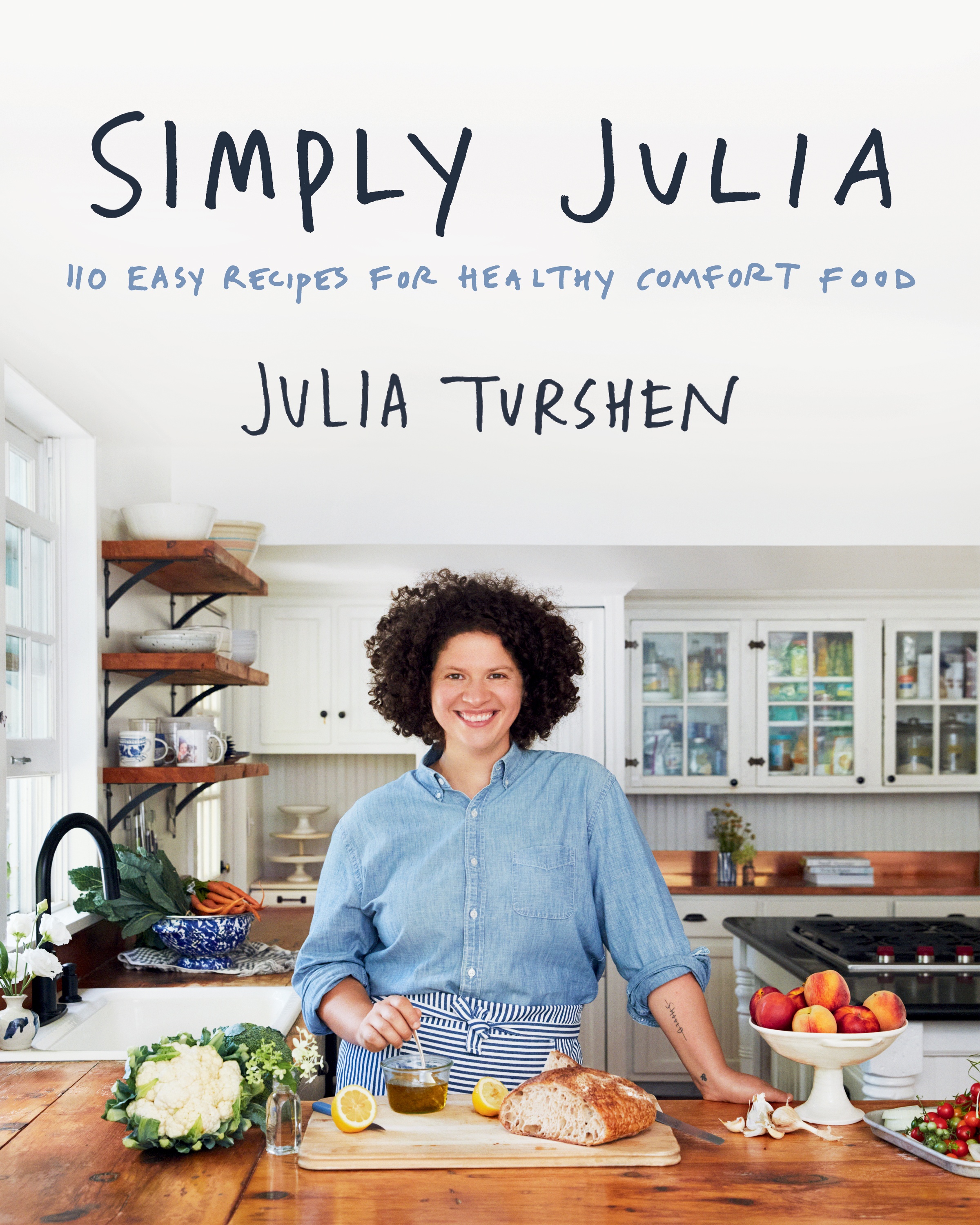
Simply Julia: 110 Easy Recipes For Healthy Comfort Food

“It has nothing to do with restriction. It has nothing to do with deprivation. There are no limitations in the book. And associating healthy with limitlessness, it does feel different to me,” she said. “I’m not the first person to have this thought or idea. I think I’m only able to have this thought and idea because other people have shown me what it looks like. But to put that in a mainstream cookbook feels really valuable and makes me feel just really happy it’s out there, and proud.”

It’s through this lens that Turshen defines comfort food, which can mean something different to each of us. Instead of something that divides us, comfort food can be a unifier.   

“I really, really like the place where healthy and comfort come together. Because when I feel my most comfortable, I feel my most healthy. When I feel my most healthy, I feel my most comfortable,” Turshen said. “And then bring in the word ‘easy’ — it’s like there’s an ease that comes with the feelings when I feel them at their best, like when I feel most comfortable in myself.”

The end result is a masterpiece of a modern cookbook that feels both nostalgic and innovative at once. “Simply Julia” provides us with healthier approaches to timeless comfort foods that are within every home cook’s grasp. Many of these recipes are guaranteed to become staples on your weeknight dinner rotation. 

“Delicious food does not have to be complicated,” Turshen writes in her cookbook. “Cooking, when it’s at its best, is a way to take care of each other, not compete with each other.”

When Turshen recently appeared on “Salon Talks,” we talked about how cooking at home can make us feel more present to our daily lives. Did you know that a great way to make a new friend is to invite them over for dinner? To learn more, read or watch our conversation below.

This interview has been lightly edited for clarity and length.

Julia, one of the things that we love the most about you at Salon is that you’re an expert, but you’re a home cook and your approach comes completely from a love for and the joy of cooking. You give us comfort food, but it’s always approachable and accessible.

I’m very happy to hear that, and I appreciate it. It’s funny — I very proudly identify as a home cook. Sometimes people, I don’t know, when I’ve had something written about my work or something, they’re like, “Chef Julia Turshen.” I’m like, “Who are they talking about?” That’s not a word I use. For me, that’s someone who works in a restaurant or runs a very professional kitchen. I run a home kitchen — and proudly so. So, yes, I appreciate what you said. It just reminded me of that.

And for that very reason, you’re one of the cooks who I turned to during the pandemic when I was craving comfort food that I could make at home that was delicious. One of the dishes that got my roommate and I through those early months was your turkey and ricotta meatballs, which you actually served your wife on your very first date. I was wondering if you could tell us a little bit about that.

The meatball recipe you are referring to is in my first solo cookbook, “Small Victories.” I think it’s easily the most popular recipe from that book, which is great for so many reasons. I mean, one, I think they’re delicious meatballs. They’re super easy to make. I’m so glad that you and your roommate have enjoyed them. It’s one of those dishes that is — I feel like the taste of it makes it seem like it was more complicated to make and also something that just gets better the longer it sits in the fridge. All of those qualities describe my ideal recipe.

It was the first thing that I ever cooked for my wife, Grace. It wasn’t our first date, but it was the first thing I cooked for her. Basically, we’re still on our first date. We went out to dinner and just never left each other’s side. But it was the first thing I cooked for her, so the fact that that recipe has become so popular and been cooked so many times is especially meaningful to me because it’s a recipe where I got to share this incredibly personal story. And also to do something that I’ve come to understand how meaningful it is to me, which is to just share a lot about my personal life, and specifically, my marriage and my work. I grew up loving cookbooks. I’m surrounded by some of the cookbooks I own.

That’s a wall of cookbooks.

This is a fraction. My life is surrounded by cookbooks. Growing up, I never read a cookbook that I know of that was written by an openly gay woman, let alone with basically love letters to her significant other woven throughout the recipes. That’s something I get to do, and I’m incredibly grateful to do and proud to do. So, yes, come for the meatballs, stay for the gay pride. Other way around? Whatever you want.

As an openly gay writer and editor, I obviously relate to it. But, that was my introduction, because you’ve sort of come full circle in the new cookbook. You give us “honeymoon chicken,” which I particularly loved because my grandmother is an immigrant from Mexico. Tortilla soup is something I grew up with as a kid, and it’s something that I instantly think of when I think of comfort food. I wanted to know a little bit about the honeymoon and this chicken dish.

I love the journey we’re going on here: Make the meatballs, get married, make the honeymoon chicken. Love it. Where in Mexico is your grandmother from?

She’s from the Yucatan. So I do want to ask you about your cochinita pibil . . .

Yes, I would love to talk to your grandmother about it. But, yes, that recipe for the honeymoon chicken. Basically, right after Grace and I got married, we spent a week actually staying in a friend’s home that is very near the home we now live in, the home I’m sitting in. We didn’t know we would end up here, but anyway, that’s where we spent our honeymoon. During the course of that week, we went to a restaurant, and we shared a bowl of tortilla soup. To me, sharing soup is not something most people do. That’s a very intimate thing — to share a bowl of soup. Anyway, it was just really delicious soup. It was this wonderful week, super happy memory and time. And just that flavor of chicken soup with chilies and tortillas in it is just — it’s a flavor I really, really love.

So in “Simply Julia,” which is right here, there’s a chapter of all chicken recipes. This book is very much the most personal book I’ve done, but it’s also the most practical. I think the chapters really respond to the questions I’ve been asked the most. And one is just like, “What is your favorite way to cook chicken?” Because I think a lot of people cook it, and they get bored. So this recipe — you basically have all the things you would put in a pot of tortilla soup in a roasting dish. So you roast pieces of chicken that you coat with some oil and spices, and you roast them on a bed of onions, and tomato, and garlic and some torn-up corn tortillas. It’s a great place to put if you have stale ones — you can put them there.

As the chicken cooks, all the juice from the chicken, all the delicious stuff gets into all that. And then you just put all the stuff from under the chicken into a blender, you blend it with some canned Chipotle chilies, smoked jalapeños, a little chicken stock. It makes the most magnificent sauce. You pour that on your chicken. Again, it tastes like something that took a lot more time and effort to make than it did, and it’s just so comforting and so good. It brings back a wonderful memory for me. You can also — I like to note — if you have leftover sauce, you can add more chicken stock to it, and you can have tortilla soup. It can just go full circle.

Full circle. So tortilla soups is something that I think of as a comfort food, and your new cookbook is about healthy comfort foods. It just so happens to be extra topical because of the pandemic, and during the pandemic, we’ve experienced this Renaissance of comfort food. People are talking about macaroni and cheese, meatloaf and similar things. But comfort food means different things to different people. For example, I grew up with my grandmother making me cochinita pibil, and I think of that. But that doesn’t fit everyone’s definition, so how do you approach the definition of comfort?

It’s such a good question, and the subtitle of the book is, “Easy Recipes for Healthy Comfort Food.” I spent a lot of time thinking about those three words: easy, healthy, comfort. What do they all mean? What do they mean when you combine them? I feel like I spend a lot of the book interrogating all of that in a really just sort of wonderful sort of curious way. It’s interesting: If you say comfort food to 10 different people, you’ll probably get 10 different answers. I think it speaks to the fact that all of these words are up for all of us to define for ourselves. For me, I really, really like the place where healthy and comfort come together. Because when I feel my most comfortable, I feel my most healthy. When I feel my most healthy, I feel my most comfortable. And then bring in the word easy — it’s like there’s an ease that comes with the feelings when I feel them at their best, like when I feel most comfortable in myself.

So for me, comfort food is food that is easy to make. Comfort food shouldn’t be a stressful thing to make. It should feel really good to eat, and for me that translates to feeling very deeply connected. So when I prepare that “honeymoon chicken” that we just talked about, making it is really easy. It feels very doable. I feel like feeling healthy, feeling comforted, feeling comfortable. All these things should be within our grasp, because I think they are. So, that’s the process of making it. Then, when I sit down to eat it, it brings up this wonderful memory and makes me feel very connected to my wife. It makes me feel connected to the ingredients I’ve used. I’ve been thoughtful about them and what I’m using, where I’m getting them.

All those things, that deep sense of connection, it just makes me feel — I don’t know — present and in the moment. And when I am feeling present, for me, that is absolutely when I feel both my healthiest and my most comforted and comfortable. Because when I’m present, I’m not anxious. I run quite anxious. There is an essay in the book about cooking and anxiety, and when I think about anxiety, I’m worrying about something that has happened or something I’m worried is going to happen. So, when I’m present, it’s very hard for me to be anxious, which is a really good thing for me. When I’m feeling connected, and in the moment and present, it makes me feel very calm — just collected and just here right now — which is just a really nice feeling. And cooking and eating give me access to that feeling on a daily basis. 

I know you described anxiety in the book as being like a grocery list. There’s that one item that you need, but you can’t find. You explore how cooking is where you really feel at home. But I love the anecdote that you mentioned, too — a great way to make a new friend is to invite them over for dinner. 

I think a lot about what food does when you put it on a table, and there’s people sitting around the table. It just  it changes everything. A joke I like to make, I don’t know if it’s that funny, but a table with people around it that has no food on it is a meeting — and nobody likes a meeting.

You put food on the table, and it just changes the way we interact with each other. It changes our body language. Things like, “Hey can you pass me the salt? Can you pass me the potatoes?” We’re crossing our hands, we’re using our bodies, so our bodies are occupied. Right now, I’m like, “What do I do with my hands while we’re talking. They’re flying over here.” If we were eating, I would have something to do with them. I think it just puts us at ease. It sort of makes us more human to one another. For me, I have the privilege and luxury of having a home and a kitchen that I’m extremely comfortable in and I want to welcome people into. That’s been, I would say for me, the hardest part of the last year is just not having my friends and family in my home all the time and sitting around my table — and let this be my biggest problem during the pandemic.

Yes, it’s something I deeply miss, and not having that for a long time has made me realize just how valuable it is. And I’m so grateful for technology. The fact that we can have this conversation right now — I can feel present and connected to you in this very moment — is amazing. It’s amazing I can see my five-year-old niece in Cleveland whenever I want via FaceTime. My best friend lives in London. I’m so so grateful for this right now, but I also wish we were sitting at a table and we were eating something, because I think it just opens up different stories we share with each other. It just kind of gives you moments to just sort of pass the time. Think about being in a restaurant with someone, and your food comes, and then you wait for the bill to come and then maybe you get a coffee and all this stuff. You can just extend this natural feeling, and sometimes being together can feel difficult. And I think food makes it feel easier. So, yes, I think it’s a great way to make friends, and even if, I don’t know, it doesn’t work out and you’re not friends, at least you had something good to eat.

At least you had great food together! That’s one of my favorite things to do, too. In terms of comfort food, I think there’s often a guilt associated with eating it. You explored this in a very touching essay in the book, which was reprinted in Bon Appetit. One day you realized that had two feelings: happy and fat. Can you tell us what that means?

What you’re referring to is an essay in the book that very much delves into just body image and diet culture, understanding what that is, attempting to dismantle it and . . . I’m saying this all in a vague way. This is a very personal reflection on these things, my feelings about all these things. And, to me, it’s the absolute most vulnerable part of the book, and therefore, I think the most important. In just being shared, as you mentioned, it’s already led to just so much connection. I have never heard from this many people, and I mean, I could start crying right now.

It’s been a very emotional process to put this out there, especially because . . . OK, I’ll back up, and say, I very much grew up in diet culture. I participated in it for a long time. I preached it while I practiced it. I don’t know, for anyone who’s listening who’s like, “What are you talking about?” To me, it’s the culture we all, for the most part, live in, especially in the U.S. It’s a culture that I think just prioritizes thinness over anything else and because of that sort of pits us against each other, encourages us to measure ourselves against ourselves. “I want to get back to this weight, or I want to get to this weight.” Encourages us to pit ourselves against each other, to compare each other. It’s just really miserable — at least it is in my experience. There are so many businesses attached to this that profit off of it.

I just basically didn’t know there were other options. And there are a lot of things that have happened in my life that have helped me get to a place that feels much more free, much more peaceful. That is really I think how I define healthy. It’s very much associated with freedom. One of the things that helped me get there — in addition to therapy and in addition changing who I follow on social media — to leaving diet culture and saying no thank you to it, feels to me a little bit like learning a new language. And the best way to do that is to immerse yourself in it, to listen to different podcasts and stuff.

One of the other things that really helped me was this kind of breakthrough moment where I realized that I felt like I had only ever felt two things in my life: happy or fat. Having that idea just cracked something open in me, because one, fat is not a feeling — it’s just not. Two, I had limited all my feelings to two very binary things, and there are so many feelings in the world. Three, I had totally associated anything other than happy with fat. I didn’t think those two things could exist at the same time. I had demonized fat in the way so many other people and the institutions have. The words I used in the essay were it felt like I splashed a big thing of cold water in my face, and I was like, “Woah.” And having that thought doesn’t mean that I never have that thought again, but it just helps me identify it more clearly. It helps me move through it and it helps me get in touch with so many other feelings.

I have a poster that’s actually right on the wall over here. It’s one of these posters that they have in a lot of kid’s classrooms . . . I wish I could show it to you, but I would have to move my whole set up here, which is a stack of books that my computer is on. It’s pictures of all the different emotions with kids having the facial gestures, but responses to it. For so long, whenever I felt what I had deemed fat, I made myself go stand in front of this poster and be like, “What are you feeling right now?” I was so out of touch with my feelings. I was out of touch with my body. And I know we’re here to talk about a cookbook, but this is very much part of it, because this cookbook which is about healthy comfort food, it’s not just about the recipes. It’s about how we feel when we cook and when we eat like we were talking about. I just really appreciate the opportunity to talk very openly and very honestly about that — not just in the book but in conversations like this one. So thank you for asking me.

Of course. I don’t know if it should feel so revolutionary — but it does — that you’re able to so honestly and openly talk about this in a cookbook that’s about healthy eating. There’s diet culture, and it’s an industry. But we’re having an open and honest conversation, and that’s something I’ve never really had when I’ve read a cookbook before.

I both really appreciate hearing that, and I’m also so sad to hear that. I just think for so long, I know that I confused the words “healthy” and “skinny.” I thought they meant the same thing. I wrote a healthy cookbook that has nothing to do with weight loss. It has nothing to do with restriction. It has nothing to do with deprivation. There are no limitations in the book. And associating healthy with limitlessness, it does feel different to me. I’m not the first person to have this thought or idea. I think I’m only able to have this thought and idea, because other people have shown me what it looks like. But to put that in a mainstream cookbook feels really valuable and makes me feel just really happy it’s out there and proud.

Going back to that cochinita pibil, I’m so excited to try your recipe. One of the reasons why I don’t make it a lot is because it’s a process. You’ve developed a sort of shortcut, and I think that speaks in general to a lot of your recipes. You’re not here to make us spend all day in the kitchen. If we can use one bowl, we can use one bowl instead of dirtying a lot of different bowls. Can you tell me a little bit about that recipe and how it speaks to your philosophy as a whole.

I love that you pulled this one out, because it’s so good and it’s so easy. As you just said, and as I said in the headnote to the recipe — the headnote is the industry term for the paragraph that comes before the recipe that just gives you the story, and the context and some helpful information — what I included in there is: This is not authentic. I am by no means an expert on this. I’m someone who loves this item of food, which is slow-cooked pork. I love it. I think it’s delicious, and I think a version of it is something we can all have in our kitchens whenever we want.

Basically, you cut up a delicious pork shoulder, you could use a pork butt or whatever — just a big muscle that has a good amount of fat in it. And you’re going to cook it really slowly so that fat just renders out. You basically put it all in a pot with some spices and some aromatics, including fresh oranges that cook really slowly with the pork. And it has all the flavors that I think happen in a pretty traditional cochinita pibil, but you cook it instead of digging a pit in the yard and wrapping it in banana leaves and stuff, which is amazing and I would love to do (and really love to be invited somewhere where someone’s doing that, and then I’m happy to wash every single dish).

This all happens just in a pot that you cover. You put in your oven. No, it is not the real thing, and that is OK. I think part of home cooking is that, I don’t know, I just have this belief that — this might sound like sort of a weird thing to say — I don’t think every meal we eat needs to be the best meal we’ve ever had. I think this recipe is incredibly good and very special, but I also think it’s extremely achievable and made of very affordable ingredients. It’s made with very little technique. You put the stuff in the pot, you cover it, you put it in the oven and the oven does all the work. You don’t have to be there. I mean, don’t leave your oven on if you’re not there, if that makes you uncomfortable, I understand that. But you can be doing a million other things.

I just really like recipes like that just make it very easy for you to provide something very delicious, very comforting and very versatile. That pork can be used in so many different things. You can eat it on its own with nothing except a fork — end of day, perfect. But it goes well with so many things. You can put it into a sandwich or a taco, whatever you want. I just love a recipe that really serves you.


When to toss Sriracha and what to do with tahini: “Saucy” answers your burning condiment questions

This week’s column is a little different. I asked Saucy readers to reveal your burning questions about condiments — and you really delivered. The result is part advice column, part food safety lesson and part musings on the versatility of tahini and XO Sauce. If you have any condiment questions of your own— from usage, to storage, to ideas to pep up pandemic meals — send them my way at astevens@salon.com

“Would three-year-old Sriracha be alright to consume? Being a fermented sauce, my heart wants it to be OK haha. Perhaps it’s like wine and ages and becomes better with time. My gut is telling me no way, though. What are your thoughts?” — Joshua

Alright, I apologize in advance, but this is going to be one of those “it depends” answers. Since Sriracha is a vinegar-based sauce, it takes a very long time for it to go bad. However, most hot sauce aficionados seem to agree that you may start noticing some changes in your bottle of Sriracha around the three-year mark. The color has likely deepened from a vibrant red to a dark, almost ruddy color, and the flavor will transition to more just pure heat as the ingredients sit. 

You can slow that process by refrigerating your Sriracha, though some folks don’t like how that impacts the consistency of the sauce straight out of the bottle. 

The biggest thing to keep an eye on is at the top of the bottle. You know how the Sriracha can dry around the squirt cap? That can result in a literal crust of bacteria, so give it a quick wipe down whenever you start to notice build-up. Also, this is likely self-evident, but if you notice any mold or if your bottle looks distended, it’s time for a new bottle. 

Remember the Golden Rule: When in doubt, toss it out.

“How to use tahini in creative ways for sauces/dressings? Seems I always have some but never use it in time.” — Catherine 

A couple of years ago, I was given a really lovely, really large (!) tub of tahini. We’re talking almost a half gallon, and even refrigerated, it had a shelf life of about six months. So for those six months, my menu was basically all-tahini-everything. 

In the realm of sauces and dressings, I have two stand-favorites. The first is Bon Appetit’s Tahini Ranch. It’s creamy, just the right amount of pungent and — unlike your average ranch — vegan. It’s a really nice accompaniment to salads, obviously, but it’s also a really flavorful sandwich spread. If you eat meat, use it as the base of a chicken salad or tuna salad sandwich; if you’re wanting something plant-based, go the ol’ chickpea salad route. (Also, this is probably sacrilegious, but I’ve totally made this subbing out the dried herbs for the Hidden Valley Ranch dried seasoning packet — and it’s pretty stellar.)

The second is a green tahini sauce, inspired by Yotam Ottelenghi. This is less a recipe and more a series of loose suggestions. Take whatever leftover green herbs or leafy things you have on hand — mint, parsley, cilantro, scallions, even carrot tops and celery leaves — and blend a good handful with 1/4 cup of tahini, 1/4 cup of olive oil, the juice of a lemon or lime, garlic, if you like, and a drizzle of honey. Once the sauce is totally smooth, season it with salt and pepper.

This sauce is really versatile. Serve it alongside hearty white fish and some grilled vegetables. Use it as a dipping sauce for falafel. Drizzle it over oven-roasted cauliflower steak. If you don’t feel like cooking, toss it on a snack plate. 

If you want to veer outside of sauces and dressings, tahini’s nuttiness makes it an ideal addition to baked goods and — brace yourself — coffee. Swirl 2 or 3 tablespoons of tahini into a pan of boxed brownie batter before you stick it in the oven to change things up a bit, or try some tahini shortbread. I personally like this basic recipe from The New York Times. If you’re feeling fancy, reserve some sesame seeds from the recipe, melt down a little dark chocolate and dip the cooled shortbread in said chocolate. Decorate it with the sesame seeds, and you’ve got a pretty fancy cookie sitch going on. 

Also, as I’ve written about before, I’ve been on a months-long mission to improve my at-home coffee game. One of the coffee house recipes I was eager to replicate from the comfort of my kitchen was an iced tahini latte, loosely inspired by a drink I once had at Slipstream in D.C., which still takes up an embarrassing amount of my brain space. 

Pull out the blender again — I promise it’s worth it — and blend 1 shot of espresso, 2 tablespoons of tahini, 1/4 cup of oat milk, maple syrup or honey to taste and pulse until combined. Toss it over ice, and garnish with a cinnamon stick. 

“Tell me what to do with this jar of XO Sauce, please.” — Erin 

You can do so many things! XO Sauce is a condiment that originated in Hong Kong, and it’s typically made with dried shrimp, dried scallops, chili peppers, Jinhua ham, garlic and canola oil — so basically it’s salty, spicy and packed with umami, meaning it can make most dishes immediately . . . well, better. Enough so that it’s getting a full condiment dedicated to it soon. 

In the meantime, I’ve been using it as a way to make my quarantine cooking feel a little less stale. It can be used as a marinade. For example, one of my go-to weeknight meals starts by whisking a few tablespoons of XO Sauce with a few tablespoons of neutral oil and a dash of soy sauce. 

Rough chop up some hearty vegetables — broccoli, Chinese eggplant, mushrooms — and soak them in the mixture for about 15 minutes, reserving the XO marinade that you don’ t use. Pop the vegetables on a prepared sheet pan, and roast until tender and a little blackened. Meanwhile, prepare some rice noodles according to the package instructions. Then combine the vegetables and noodles, dressing with whatever you have left of the XO marinade, and top with some scallions if you’re still growing them on your windowsill. (Is that too early pandemic to still be a thing?)

Recently, I made a few servings of fridge clean-out soup that ended up being a really loose version of tom kha gai, a Thai coconut soup that’s typically flavored with lime juice, coconut milk and fish sauce. I simmered some chicken stock and a handful of mushrooms in a small pot until they were softened, then added some shredded rotisserie chicken, a few tablespoons of coconut cream, XO sauce to taste — in place of the fish sauce — and a squeeze of lime. 

However, my current “I don’t really feel like cooking” meal is leftover steamed rice topped with a fried egg, an obscene amount of XO Sauce and scallions (again). 

“I read your recent column about condiment drawers, and I have a question about that. My boyfriend and I are moving in together — what’s the etiquette of a shared condiment drawer?” — Jace  

I love this question! Both partners should contribute to the drawer. Like any relationship, it’s never going to be exactly a 50/50 split of effort. One partner may end up rich in extra Taco Bell fire sauce one day, while the other may only have a few stray soy sauce packets to toss in — but, unless otherwise specified, the contents of the drawer are communal. 

Also, do yourselves a favor, and purchase a thin utensil tray to organize the packets in your condiment drawer. This will keep the arguments about chaotic drawers and clutter to a minimum. 

Read more Saucy:

The best lighting for maximum kitchen visibility

Shopping for light bulbs can be as simple or complex as you make it. My roommate and I, who spend an inordinate amount of money at the nearby corner store (because it’s right there!), tend to suffer through whatever light bulbs they’ve got in stock — more often than not they’re soft white 60-watt incandescents. I realize I should be embarrassed.

But in our living room, where there are four to five lamps lighting a space barely larger than a dog house, these hazy bulbs create a warm, layered blanket of light that we love in the evenings. In the kitchen, however, where we try to use them in lieu of our fluorescent ceiling fixture, they fail — in the kitchen, it turns out, you actually need to be able to see.

What every kitchen needs, as much as a sharp knife or a mixing bowl, is great light. The lighting experts at Batteries Plus Bulbs — specifically Jori Gohsman, one of their Senior Category Managers — were kind enough to set me straight:

Here’s what kind of light bulbs are good for your kitchen, and how to get plenty of cozy vibes while still lighting it up right. I won’t be offended if you skip to the end for their suggestions, but what follows is how we got there.

* * *

Color temperature

The first thing you need to know is that Kelvin is actually more important than wattage when it comes to selecting a light bulb; that’s what will tell you the color temperature of your bulb on a spectrum of cool (indicated by a higher Kelvin) to warm (lower Kelvin).

Cooler bulbs are easier to see by, so that’s what you want to rely on in the kitchen — whereas warmer bulbs give off that cozy, casual vibe that makes lounges and restaurants so inviting. Besides affecting visibility, the color of a bulb can also change the dynamic of a space just as any other element of decor can.

Here are the different options you can shop for, starting with the most kitchen-friendly:

  • Daylight (5000K): With a white, almost bluish light, daylight bulbs are meant to “resemble noon on a cloudless day” (I’m thinking this is what my fluorescents must be). Rather than using them everywhere in a kitchen, spring for them as accents where you do food prep or read recipes, for example. (Reading, Jori tells me, has actually been proven to be easier under daylight bulbs than any other.) Style-wise, they’ll make cool-colored decorations pop but will muddy any orangey decor.
  • Cool White (4100K): A great workhorse bulb for your kitchen and bathrooms (or for any room where the decor is blue or green rather than reddish in color), cool whites are crisp without feeling overly so.

And on the other end of the spectrum, best for rooms where knife work isn’t required, are the warmer options:

  • Soft White (2700 to 3000K): This is what classic incandescents emit: a gentle, yellowish, familiar light that’s warmer than a cool white bulb would give off. It will pull out the reds and oranges in your decor, so relegate them to rooms that aren’t too blue.
  • Warm White (2400K): The warmest color temperature, warm white bulbs more closely resemble candle light than a bulb at all. They’re all ambiance — so they do their best work in the living room, dining room, and bedroom.

* * *

Bulb types

I am sure that many of you froze in your seats when I mentioned traditional incandescents, which are known not just for their warmth (2700K) but for being known energy hogs (they put out more heat than light, according to National Geographic!). There are, fortunately, more energy-efficient and longer-lasting alternatives:

  • Halogens, which are available exclusively in a relatively warm 3000K, show 100% true color — something that a jeweler, for instance, might care about, and they’re inexpensive. But they’re now considered an old technology, and will actually dim as they warm.
  • CFL’s, which can be spiral-shaped as in the one pictured below, are basically mini-fluorescents meaning they can require some time to “warm up.” But while they can last ten times longer than traditional incandescents (I have one that I haven’t changed in three years!) and are available in any color temperature, they contain a small amount of mercury — so if you break one, the extensive cleanuprequired makes them less than convenient.
  • LEDs, which initially were known for their higher price point, have the lowest energy cost and are available in increasingly affordable and flexible technology. You can choose from directional, semi-directional, or omni-directional styles — the latter being the most diffused, best for lamps, and directional being best for spotlighting — and almost any color temperature. New warm LEDs (around 2400K) would be great for a chandelier or moodier lighting, and you can even find vintage-inspired Edison-style versions (2000K), if you’re hoping to add (efficient) ambiance to a living room.

But with so many ups and downs to each, the bulb style you choose is a personal (or even political) choice as much as an aesthetic one.

* * *

Adding ambience

I asked Jori if layering decorative bulbs, with their warm amber glow, in space that’s already outfitted with cool whites and daylights (like a kitchen) would ever be a good idea. “You can get away with having both,” she said — and I cheered! — but recommended instead installing a dimmer for more control over brightness, or even opting for color-changing LEDs so you can control the temperature (as you dim them, they’ll cool all the way from 3,000 to 2,200 Kelvin).

So the tiny lamp with a soft white bulb in my kitchen, which emits a soothing yellow light we simply cannot see by? It can stay! Plus, writes Alyssa Longobucco in her manifesto for kitchen table lamps, “in a room that typically only ever boasts overhead lighting, small-scale countertop lamps can be a great way to play around with scale and add charm. Not to mention, they’re an ideal way to upgrade the style of your space without spending a ton of money like you would have to with overhead fixtures.” Done.

* * *

Light fixtures (for lots of light) we love:

6-Bulb Sputnik Chandelier, $63

A sputnik-style chandelier (though it might not come immediately to mind when thinking about kitchen lighting) is actually a great option for a kitchen that’s low on junction boxes, since it funnels light into six separate bulbs.

PHOTO BY WALMART

Handmade MIMA Lamp, $175

Similar to a wall-mounted globe light in brightness, but gentle like a table lamp with a shade, this little handmade guy is the best of both lighting worlds.

PHOTO BY TY MECHAM

Swing-Arm Sconce, $129

Sconces are another great option for adding extra kitchen light. When mounted above a counter or stove, they provide maximum visibility for chopping, seasoning, and checking on a proper sear.

PHOTO BY WAYFAIR

Aretha Flush Mount, $698

This stunning light fixture might scream “dining room!” but for a grand kitchen, it’ll look right at home and provide plenty of overhead light.

PHOTO BY ANTHROPOLOGIE 

Clear Shade Farmhouse Lamp, $38

If you’re working with multiple junction boxes, you can definitely get away with one-bulb flush mount lights, like these. They’re kind of like an upgraded boob lamp, and the clear glass ensures the most light from the bulb shines through onto your work surface.

PHOTO BY AMAZON

Rattan Globe Pendant, $200

Who says the lighting over your kitchen table can’t spill into the work area? This pendant lamp provides warmth from the natural fibers, moodiness over the dining area, and the added benefit of more kitchen light. Win-win-win.

PHOTO BY WAYFAIR

Cosmos 6-Point Star Light, $250

This guy’s not as imposing as a sputnik, but just as many bulbs.

PHOTO BY LAMPS PLUS

Which kinds of bulbs do you prefer in your home? Tell us all about it below!

This post contains products independently chosen (and loved) by Food52 editors and writers. As an Amazon Associate and Skimlinks affiliate, Food52 earns a commission on qualifying purchases of the products they link to.

Donald Trump called Meghan Markle “no good” after Piers Morgan lost his job, aide says

In an interview on Steve Bannon’s podcast, one of Donald Trump’s closest remaining aides said the former president would like to weigh in on the bombshell interview between Meghan Markle and Oprah Winfrey but worries he could get the same kind of blowback his on-and-off friend Piers Morgan has received.

Morgan, who questioned Markle’s sincerity about feeling suicidal over her treatment by the royal family, ended up walking off the set of “Good Morning Britain” last week and will not be returning.

Speaking with former White House adviser Steve Bannon, current Trump aide Jason Miller claimed the ex-president took a potshot at Markle — extending his low-key feud with her that dates back to her marriage to Prince Harry.

According to the Daily Mail, Miller said on the podcast, “‘When I was talking to the president this morning . . . he’s like: ‘Yeah, [Meghan’s] no good. I said that and now everybody’s seeing it. But you realize if you say anything negative about Meghan Markle you get canceled. Look at Piers [Morgan].'”

The report notes that Trump once famously called the American actress “nasty” back in 2019, which he later tried to deny.

You can read more here.

Abbott suggests Democratic efforts to reform elections would lead to “using cocaine to buy votes”

Gov. Greg Abbott, R-Texas, suggested over the weekend that a Democratic effort to improve access to elections would lead to “using cocaine to buy votes.”

During her Sunday morning program, Fox News host Maria Bartiromo asked Abbott about legislation known as H.R. 1 that aims to improve election integrity.

“Before I was governor, I was the attorney general of Texas,” Abbott explained. “And when the Obama administration tried doing things like this, I filed 31 lawsuits against the Obama administration. The strongest tool that we have is the litigation tool.”

“And when you look at some of the things that they are talking about with regard to H.R. 1, they are trying to institutionalize voter fraud in the United States of America,” he continued. “They want to make mail-in ballots permanent. Everyone knows — including Democrats in Texas — have said that one of the easiest ways to cheat in elections is through these mail-in ballots.”

According to Abbott, Democrats want to “protect ballot harvesting.”

He then recounted an “amazing story” about people “using cocaine to buy votes” during his time as attorney general.

“It was Barack Obama himself who knew about the dangers of ballot harvesting in the state of Texas,” Abbott said, “because under his administration, he sent his U.S. attorney for the Southern District of Texas, as well as the FBI, to south Texas to arrest and to prosecute people who were involved in ballot harvesting that were using cocaine to buy votes through the ballot harvesting process in the state of Texas.”

“It is a way to commit voter fraud, and it cannot be allowed,” he concluded.

You can watch the video below via YouTube

“The Real World Homecoming: New York” is a beautiful suspension bridge between past and present

If you remember where you were when you got the news that Kurt Cobain died, or Tupac, or Biggie, then recent months have either bestowed a bounty of nostalgia on you or slapped you with a nightmarish reminder of your mortality . . . or maybe, you know, a bit of both? Why not both.

Between the “Punky Brewster” revival joining the reboot of “Saved By the Bell” on Peacock, the release of “Biggie: I Got a Story to Tell” on Netflix and Hulu’s “Kid 90” – Soleil Moon Frye’s home video time machine back to the Clinton decade – Generation X can finally tell the Boomers to move the hell over. We’ve been here for a while but only recently has TV brazenly pandered to our generation with such a flood of remembering when.

In one scene in “Kid 90” we hear Frye, a Hollywood kid, whispering about her crushes on a pair of hot guys named Johnny Depp and Charlie Sheen, and there are millions of women who still blush at that obsession even now that we know what kind of men they grew up to be.

Another moment shows Stephen Dorff poetically observing that the 1990s were “our ’60s,” which sounds so pompous coming from that guy and yet, he’s not wrong.

Each of these are echoes visiting us from a youth long departed. They have value, certainly, by reminding us of old passion and allowing us to laugh, with a touch of wincing, at the people and things we thought were so cool that time’s passage reveal to be temporary fancies or objects of hormonal stupidity. They don’t build a tangible bridge between then and now and wonder why nobody’s updated the slats although so many of them are rotten.

For that, there’s “The Real World Homecoming: New York,” which premiered on Paramount+ (the rebranded CBS All Access with a whole lot more) on March 5 and is rolling out new episodes each week. The New York season is the very first of the show that birthed the reality television revolution, which is a strange fact to contemplate when we look upon the original seven strangers picked to live together in a New York loft.

But Norman Korpi, Julie Gentry, Becky Blasband, Kevin Powell, Andre Comeau, Heather Gardner, and Eric Nies aren’t truly strangers anymore after three decades – not to each other and not to those of us who watched that first season and recognized them as they popped up again on other TV shows and magazines. Gardner, who goes by Heather B., has a steady presence on SiriusXM and Powell is a writer and activist who lectures around the world.

Comeau followed his dream to become a professional musician, and Eric Nies, a familiar face to old school MTV viewers, made a transformation from model to dance fitness instructor to wellness maven. Korpi, Gentry and Blasband haven’t led lives as public as the others, but returning to the loft is an effective leveler, bringing all of us back to the same headspace.

Well, everyone except for Nies, whose positive COVID test forces him to remain sequestered in his hotel room, participating via video conference. What a reminder that this is not 1992. But in case we didn’t get it, there’s the alteration of the timeless opener: “This is the true story, of seven former roommates, who returned to their original loft, to have their lives taped again, to find out what happens, when people stop being polite and start getting real.”

Here’s what happens in the first two episodes: “Homecoming” proves that there’s simply no going back to the way we were. That’s not entirely a bad thing, as the premiere demonstrates by reminding us of Kevin and Julie’s fervent sidewalk argument about race and racism. That spat has gotten plenty of play in “Real World” retrospectives along with the “Slap Heard ‘Round the World” from the Seattle season.

Here and now they are genuinely overcome with emotion to share space again, and Kevin is moved when Julie introduces her daughter during a nightly video call check-in, who shares that she’s a budding activist. He’s wowed, and soon after that moment we see him in silent rumination. He wonders aloud whether healing needs to happen in this group, and we know the answer is yes. That’s why they’ve reconnected.

Production on “Homecoming” took place over six days not too long ago, which echoes the short turnaround time the original production followed. It’s also edited as a tribute to the earliest days of the franchise to the point of using the classic producer card with Mary Ellis Bunim and Jonathan Murray’s names on it at its close.

Bunim died in 2004, and Murray continues to run the production company under the Bunim/Murray shingle, which, following “The Real World,” executive produces “Keeping Up With the Kardashians” and all of that show’s related titles. The analog producer credits card is a loving detail as well as a reminder of an entire genre’s humble beginnings.

Behind the familiar editing techniques and music cuts playing during transitional scenes designed to take us back – a slice from Tribe Called Quest’s “Can I Kick It” hit my heart in the second episode – hums a refrain that’s makes “Homecoming” heavier than other reunion shows, which is that along with the heartwarming feeling that the fundamental love the housemates had for each other is still there, so are the same societal divisions that ignited arguments.

When “The Real World” was a rarity in the TV space, the editing made these conversations feel genuine and urgent in a way that faded out as the unscripted became more ubiquitous and roommates grew more savvy about creating characters and spotlight-grabbing story arcs. Nearly 30 years later the New York cast marvels at the role as pioneers in this space while also recognizing the effect their conflicts had on the audience watching them. Powell’s emotional expressions during his debates with housemates were wrongly stereotyped, and his present-day self reflects on this with the other six with a measure of wisdom and patience. It seems as if time and maturity have at last brought everyone to a place where they could listen.

But this is before production plays a clip of a heated argument Powell and Blasband had in 1992, in which she refuses to acknowledge white feminism’s gains on the back of the civil rights movement without offering much in the way of political capital to Black people in the way of recompense.

In the present Powell observes, “It may seem like it was just us, but it was all the history of America in that conversation.” What he and everyone watching, whether in that room or in our homes, could not have predicted is that shortly afterward Blasband would, shall we say, not repeat history so much as remaster and remix it.

Since age has tempered the inferno that once showed easily in their exchanges, they’re both very calm, especially Powell, and somehow that makes watching Blasband talk over Powell and refuse to understand what he’s telling her excruciating to witness. And yet, where else on TV are we seeing a group of people in conflict that doesn’t immediately devolve into screaming and theatrical aggression? We’re early in the season yet, and that may yet happen. I’m uncertain enough of that to continue watching once a week and not simply watch but relate, not with an air of wistfulness but a curiosity about how far seven people brought together in modern television’s first social experiment have progressed.

Yes, we’ve all gotten older and wiser in some ways more than others. Acknowledging that through “Homecoming: New York” makes it a more worthwhile trip than any memory lane rewind can offer in 2021.

New episodes of “The Real World Homecoming: New York” air every Friday on Paramount+.

In the provocative “Miramar Murders,” a suspect is apprehended but justice still remains in question

True crime fans and armchair jurists will certainly appreciate the six-hour documentary series, “The Miramar Murders: The State vs Pablo Ibar,” which received its North American premiere at the Miami Film Festival on March 14. 

The case is certainly intriguing to warrant a deep dive. On June 26, 1994, Casimir Sucharski, owner of the popular establishment Casey’s Nickelodeon, was murdered in his nearby home along with two women, Marie Rogers and Sharon Anderson. The killings were done execution style. Jewelry was left on the victims, but Sucharski’s car was stolen. A neighbor, Gary Foy, witnessed Sucharski’s car being driven away by two men around the time of the murders. The crime scene evidence included a discarded t-shirt and a partial footprint. Anonymous informants told police about mobsters and money owed. 

As detectives investigated, they discovered a cache of videotapes that showed Sucharski had filmed himself in his home with 400 hours of footage featured him nude or in bed with various women. The surveillance cameras he set up in his home also, inadvertently captured the triple homicide. This led police to pull a still from the video of the two criminals. When Pablo Ibar and his friend Francisco Rincon were arrested after breaking into a home elsewhere, Ibar became the prime suspect in the Miramar murders. Another man, Seth Peñalver, was also suspected of the Sucharski triple homicide. Both were tried for the crime, convicted, and sentenced to death.

All that information is revealed in the first hour of the series, and it ends, as all good limited series do, with a cliffhanger. Seven years after Ibar has been incarcerated, a man comes forth claiming that Ibar is innocent; he knows who committed these crimes.

“Miramar Murders” briefly pursues the possibility that another man is guilty of the murders, but partial DNA evidence connects Ibar to the t-shirt found at the crime scene. Ibar works with the Spanish consulate to get citizenship as the European country, which is against the death penalty. Moreover a network of Spaniards seeks to raise the $1 million plus to hire lawyers so Ibar can have a retrial. This interesting idea of transnational justice goes largely unexplored in favor of the juicy retrial. 

The bulk of the episodes take viewers into the courtroom as the case is retried. Chuck Morton, who was the State prosecutor for the original conviction, returned, while Ibar was represented by four lawyers. There are twists of fate and setbacks that delay the retrial, which certainly creates plenty of drama for Ibar and his family members. Moreover, there is a concern that Judge Dennis Bailey, who is assigned to the case has ties to the prosecution. 

There is a brief sidebar on Peñalver, who in a separate retrial, was exonerated 18 years after originally being sentenced. The lawyer on that case was not secured for Pablo.

The lengthy courtroom scenes show how the incriminating t-shirt and DNA evidence, the shoeprints, along with the witnesses’ testimonies, help or hurt Ibar’s case. “Miramar Murders” invites viewers to make their own decisions about whether Ibar is innocent or guilty beyond a reasonable doubt.

But what the series does not do is pursue the motive behind the killing. (The informants who called authorities about mob ties is left dangling.) This may have viewers wondering how Ibar is linked to Sucharski. The victim’s adult daughter, Alexis Sucharski, questions this as well, stating that she may never know the truth behind her father’s murder. But the series suggests that lead detective Paul Manzella closed the case when he found someone who fit the profile, rather than the actual perpetrator of the crime. This is a key point worth discussing — that cops are inclined to resolve cases, not solve them — but it is only hinted at in the series. 

“Miramar Murders” certainly has shades of “innocence project” and “wrongful conviction” stories, but the purpose of this series is less about finding out the truth and more concerned with chronicling Ibar’s trial. This may frustrate true crime aficionados, because watching the series feels like being empaneled on jury duty.  

There is granular detail about cross-contamination of DNA evidence and considerable back and forth about past testimony that decades later is revealed to be lies. As each bit of evidence or testimony is rehashed, either condemning Ibar, or possibly clearing him, viewers may focus more on whether the strategy of Ibar not testifying, or his wife not providing an alibi for her husband was wise. 

The series does provide some interesting observations by Ibar’s lawyers about the case and how to try it, but the emotional component in the story stems from Ibar’s wife Tanya’s undying hope to have her husband declared innocent and released. In contrast, Sucharski’s daughter, Alexis, thinks Tanya has put herself in this position, and has little sympathy for her. Likewise, Deborah Bowie, sister of the murdered Sharon Anderson, makes some heartfelt remarks about the case, and feels justice was served in the first trial. The prismatic approach to the family members and survivors is useful, but scenes of Ibar’s children feel particularly manipulative.

As the nine-week trial concludes there is an incredible twist in its aftermath. It certainly will prompt viewers to recalibrate what they have seen and consider if justice was truly served. And as the jury decides Ibar’s fate, a substantial point about the criminal justice system is raised.

 “The Miramar Murders” may be a flawed telling of a flawed case, but, like the triple homicide it recounts, it is certainly provocative.

Did CDC delays in up-to-date masking advice cost health workers’ lives?

Since the start of the pandemic, the most terrifying task in health care was thought to be when a doctor put a breathing tube down the trachea of a critically ill covid patient.

Those performing such “aerosol-generating” procedures, often in an intensive care unit, got the best protective gear even if there wasn’t enough to go around, per Centers for Disease Control and Prevention guidelines. And for anyone else working with covid patients, until a month ago, a surgical mask was considered sufficient.

A new wave of research now shows that several of those procedures were not the most hazardous. Recent studies have determined that a basic cough produces about 20 times more particles than intubation, a procedure one doctor likened to the risk of being next to a nuclear reactor.

Other new studies show that patients with covid simply talking or breathing, even in a well-ventilated room, could make workers sick in the CDC-sanctioned surgical masks. The studies suggest that the highest overall risk of infection was among the front-line workers — many of them workers of color — who spent the most time with patients earlier in their illness and in sub-par protective gear, not those working in the covid ICU.

“The whole thing is upside down the way it is currently framed,” said Dr. Michael Klompas, a Harvard Medical School associate professor who called aerosol-generating procedures a “misnomer” in a recent paper in the Journal of the American Medical Association.

“It’s a huge mistake,” he said.

The growing body of studies showing aerosol spread of covid-19 during choir practice, on a bus, in a restaurant and at gyms have caught the eye of the public and led to widespread interest in better masks and ventilation.

Yet the topic has been highly controversial within the health care industry. For over a year, international and U.S. nurse union leaders have called for health workers caring for possible or confirmed covid patients to have the highest level of protection, including N95 masks.

But a widespread group of experts have long insisted that N95s be reserved for those performing aerosol-generating procedures and that it’s safe for front-line workers to care for covid patients wearing less-protective surgical masks.

Such skepticism about general aerosol exposure within the health care setting have driven CDC guidelines, supported by national and California hospital associations.

The guidelines still say a worker would not be considered “exposed” to covid-19 after caring for a sick covid patient while wearing a surgical mask. Yet in recent months, Klompas and researchers in Israel have documented that workers using a surgical mask and face shield have caught covid during routine patient care.

The CDC said in an email that N95 “respirators have remained preferred over facemasks when caring for patients or residents with suspected or confirmed” covid, “but unfortunately, respirators have not always been available to healthcare personnel due to supply shortages.”

New research by Harvard and Tulane scientists found that people who tend to be super-spreaders of covid — the 20% of people who emit 80% of the tiny particles — tend to be obese or older, a population more likely to live in elder care or be hospitalized.

When highly infectious, such patients emit three times more tiny aerosol particles (about a billion a day) than younger people. A sick super-spreader who is simply breathing can pose as much or more risk to health workers as a coughing patient, said David Edwards, a Harvard faculty associate in bioengineering and an author of the study.

Chad Roy, a co-author who studied primates with covid, said the emitted aerosols shrink in size when the monkeys are most contagious at about Day Six of infection. Those particles are more likely to hang in the air longer and are easier to inhale deep into the lungs, said Roy, a professor of microbiology and immunology at Tulane University School of Medicine.

The study clarifies the grave risks faced by nursing home workers, of whom more than 546,000 have gotten covid and 1,590 have died, per reports nursing homes filed to the Centers for Medicare & Medicaid since mid-May.

Taken together, the research suggests that health care workplace exposure was “much bigger” than what the CDC defined when it prioritized protecting those doing “aerosol-generating” procedures, said Dr. Donald Milton, who reviewed the studies but was not involved in any of them.

“The upshot is that it’s inhalation” of tiny airborne particles that leads to infection, said Milton, a professor at the University of Maryland School of Public Health who studies how respiratory viruses are spread, “which means loose-fitting surgical masks are not sufficient.”

On Feb. 10, the CDC updated its guidance to health care workers, deleting a suggestion that wearing a surgical mask while caring for covid patients was acceptable and urging workers to wear an N95 or a “well-fitting face mask,” which could include a snug cloth mask over a looser surgical mask.

Yet the update came after most of at least 3,500 U.S. health care workers had already died of covid, as documented by KHN and The Guardian in the Lost on the Frontline project.

The project is more comprehensive than any U.S. government tally of health worker fatalities. Current CDC data shows 1,391 health care worker deaths, which is 200 fewer than the total staff covid deaths nursing homes report to Medicare.

More than half of the deceased workers whose occupation was known were nurses or in health care support roles. Such staffers often have the most extensive patient contact, tending to their IVs and turning them in hospital beds; brushing their hair and sponge-bathing them in nursing homes. Many of them — 2 in 3 — were workers of color.

Two anesthetists in the United Kingdom — doctors who perform intubations in the ICU — saw data showing that non-ICU workers were dying at outsize rates and began to question the notion that “aerosol-generating” procedures were the riskiest.

Dr. Tim Cook, an anesthetist with the Royal United Hospitals Bath, said the guidelines singling out those procedures were based on research from the first SARS outbreak in 2003. That framework includes a widely cited 2012 study that warned that those earlier studies were “very low” quality and said there was a “significant research gap” that needed to be filled.

But the research never took place before covid-19 emerged, Cook said, and key differences emerged between SARS and covid-19. In the first SARS outbreak, patients were most contagious at the moment they arrived at a hospital needing intubation. Yet for this pandemic, he said, studies in early summer began to show that peak contagion occurred days earlier.

Cook and his colleagues dove in and discovered in October that the dreaded practice of intubation emitted about 20 times fewer aerosols than a cough, said Dr. Jules Brown, a U.K. anesthetist and another author of the study. Extubation, also considered an “aerosol-generating” procedure, generated slightly more aerosols but only because patients sometimes cough when the tube is removed.

Since then, researchers in Scotland and Australia have validated those findings in a paper pre-published on Feb. 10, showing that two other aerosol-generating procedures were not as hazardous as talking, heavy breathing or coughing.

Brown said initial supply shortages of PPE led to rationing and steered the best respiratory protection to anesthetists and intensivists like himself. Now that it is known emergency room and nursing home workers are also at extreme risk, he said, he can’t understand why the old guidelines largely stand.

“It was all a big house of cards,” he said. “The foundation was shaky and in my mind it’s all fallen down.”

Asked about the research, a CDC spokesperson said via email: “We are encouraged by the publication of new studies aiming to address this issue and better identify which procedures in healthcare settings may be aerosol generating. As studies accumulate and findings are replicated, CDC will update its list of which procedures are considered [aerosol-generating procedures].”

Cook also found that doctors who perform intubations and work in the ICU were at lower risk than those who worked on general medical floors and encountered patients at earlier stages of the disease.

In Israel, doctors at a children’s hospital documented viral spread from the mother of a 3-year-old patient to six staff members, although everyone was masked and distanced. The mother was pre-symptomatic and the authors said in the Jan. 27 study that the case is possible “evidence of airborne transmission.”

Klompas, of Harvard, made a similar finding after he led an in-depth investigation into a September outbreak among patients and staff at Brigham and Women’s Hospital in Boston.

There, a patient who was tested for covid two days in a row — with negative results — wound up developing the virus and infecting numerous staff members and patients. Among them were two patient care technicians who treated the patient while wearing surgical masks and face shields. Klompas and his team used genome sequencing to connect the sick workers and patients to the same outbreak.

CDC guidelines don’t consider caring for a covid patient in a surgical mask to be a source of “exposure,” so the technicians’ cases and others might have been dismissed as not work-related.

The guidelines’ heavy focus on the hazards of “aerosol-generating” procedures has meant that hospital administrators assumed that those in the ICU got sick at work and those working elsewhere were exposed in the community, said Tyler Kissinger, an organizer with the National Union of Healthcare Workers in Northern California.

“What plays out there is there is this disparity in whose exposures get taken seriously,” he said. “A phlebotomist or environmental services worker or nursing assistant who had patient contact — just wearing a surgical mask and not an N95 — weren’t being treated as having been exposed. They had to keep coming to work.”

Dr. Claire Rezba, an anesthesiologist, has scoured the web and tweeted out the accounts of health care workers who’ve died of covid for nearly a year. Many were workers of color. And fortunately, she said, she’s finding far fewer cases now that many workers have gotten the vaccine.

“I think it’s pretty obvious that we did a very poor job of recommending adequate PPE standards for all health care workers,” she said. “I think we missed the boat.”

California Healthline politics correspondent Samantha Young contributed to this report.

How to braise anything: A crash course with Sohla El-Waylly

Every month, in Off-Script With Sohla, pro chef and flavor whisperer Sohla El-Waylly will introduce you to a must-know cooking technique — and then teach you how to detour it toward new adventures.

* * *

What comes to mind when I say the word braise? A big, honkin’ piece of meat cooked until wiggly and tender. That’s because braising gets the most out of tough cuts like lamb shanks, short ribs, and chicken thighs. But don’t let those beefy hunks hog all your attention. This gentle method works wonders for hearty vegetables like carrots, mushrooms, and winter squash.

This month, I’m giving you a crash course on how to braise anything, from a collagen-streaked brisket to a snappy stalk of celery. Once you’ve gotten to know this essential technique, you’ll be able to take it off-script and bask in your own saucy, supple recipes.

What’s a braise anyway?

You can cook with dry heat, like roasting a chicken in the oven until the skin is burnished and crackling. Or you can give in to moist heat, like gently simmering a stew on the stovetop. But with those powers combined — the browning from dry heat and chill spa vibes from moist heat — you can braise.

The terms stew and braise are often used interchangeably, but there are critical differences between these techniques. In a stew, the stuff you’re stewing (whether it’s beef chuck or button mushrooms) are cut into small-ish pieces and fully covered in liquid. A stew is all about moist heat, resulting in something really saucy and spoonable.

On the other hand, braises involve hefty, burly chunks of meat or vegetable, like a bone-in lamb leg or head of cauliflower, which are only partially submerged in liquid. The braising liquid creates steam and provides moisture, breaking down tough connective tissue and tenderizing dense vegetables. At the same time, the half that’s uncovered can go to brown town. And the braising liquid reduces to a sauce, so you’ve got a glazy fork-and-knifer instead of soup.

Technically, you can toss a pork butt in a pot, add enough water to come halfway up its sides, and your braise is ready to roll. However, by following these simple steps, you can build even more flavor.

Start with a sear

Yes, some browning occurs while simmering, but I like to give my braise baby the best possible start to its life. By taking time to develop a rich sear (and even some char when it comes to vegetables), I know I can max out on flavor. When we brown food, we’re creating countless new flavors through the Maillard reaction. In this process, proteins and sugars reconfigure themselves into so many new tasty forms that scientists stopped trying to name them all. That browning can happen slowly through indirect heat or quickly with direct heat, the kind you employ to sear.

I like to use a Dutch oven or cast-iron pan with plenty of fat for the best sear. Next, I make sure the pan is preheated over medium-high — direct heat doesn’t mean high heat, which can often lead to an uneven sear and burning, so be patient and avoid cranking the dial. Then it’s just about giving the ingredient some time alone to develop color and flavor. If I’m searing something lightweight or wonky like a stalk of broccoli, I’ll weigh it down with a heavy skillet, press, or even a brick wrapped in foil. This ensures direct contact with the pan and proper browning.

How brown, you ask? Great question. Dark meats, such as lamb and beef, can grow a chocolate brown, while white meats, like pork and chicken, will have toasted nut vibes. Vegetables can really handle a char. Instead of becoming bitter and acrid, they grow nutty and sweet, so go ahead and push them past brown into blackened.

Build a fond-ation of flavor

Once you’ve seared your pork shoulder or cabbage wedge, set it aside and take a moment to appreciate the glorious layer of flavor you’ve built. Those brown bits stuck to the pan’s bottom are called fond, and they contain pure, concentrated flavor. You can keep it simple and deglaze the pan with a splash of water, using a sturdy wooden spoon to scrape up the fond. I prefer to build another layer of flavor with some aromatic vegetables.

This is where to add diced onions or shallots, carrots or celery, sliced scallions or garlic, and let them sweat. As they cook, they will release moisture, which will help you scrape up the fond. If you want to add spices, now is the time. As they sizzle, you’ll draw out the fat-soluble flavors, and the spices won’t taste gritty. Next, add a splash of wine, sake, vermouth, or even water with a spoonful of vinegar to dissolve any remaining fond and add a bright note to the dish.

Kick back and relax

Most of the hard work is done. Now it’s time to give the braise some time. I add enough liquid to come halfway up whatever I’m braising before bringing it to a simmer, covering, and transferring to the oven. The liquid can be plain water, my preferred choice for meats because they create their own stock as they simmer. You can also get crazy with bone broth, milk, or a whole bottle of wine. I opt for more flavorful choices when braising vegetables, like the cashew milk in my braised cabbage.

I’ve found 350 degrees Fahrenheit to be the sweet spot for almost any braise.It’s hot enough to keep the braising liquid simmering and promote gentle browning, but not so hot that the liquid evaporates too quickly and burns. If you’re scaling a recipe up or down, the temperature will remain the same, while the cook time will need adjusting.

Cabbage, is that you?! Just wow. (Photo by Rocky Luten. Prop stylist: Megan Hedgpeth. Food stylist: Anna Billingskog.)

Yes, you can cook a braise on the stovetop, but you will need to check it more often as the liquid can quickly simmer away before the braise is done. With the heat coming at it from all sides in the oven, the braise will cook more evenly, the liquid will reduce more slowly, and the top will have better browning.

When is the braise done? When everything is tender. Tough cuts of meat should easily shred with a fork, and vegetables should be spoon-tender. You can serve it right away, but I prefer to allow meaty braises to chill in the fridge overnight for best results. All the fat in the braising liquid will float to the top and congeal, so I can scoop it off the next day for a cleaner tasting dish.

Add a fresh finish

As your ingredients simmer away, they will develop deep and rich flavors — that’s why I like to finish the braise with a little something extra to add textural contrast and a pop of brightness. A squirt of fresh lemon juice or a handful of torn parsley can go far, but since I have all that downtime while the braise is doing its thing, this is my garnish moment.

To finish my braised pork shoulder: crackly gremolata bread crumbs. Gremolata is the traditional topper for osso buco, the Italian dish of braised cross-cut veal shanks. It’s a mixture of chopped parsley, lemon zest, and garlic that cuts through the gelatinous, fatty meat. I mix up that gremolata combo with olive oil–toasted panko — a garnish worth doubling up on because you’ll want it on everything.

For my braised cabbage: a quick cashew-chile crisp and lots of crispy shallots. Chile crisp is a spicy Sichuan condiment with crunchy bits of garlic, onion, and dried chiles in oil. I keep mine very simple with chile flakes and cashews sizzled in oil, but feel free to use your favorite hot sauce instead.

Take this time to have fun with different toppings. Think: brown butter–toasted nuts, a quick salsa, or even a citrus-dressed cabbage slaw.

Go off-script

Now you too can braise in three easy steps: sear, sweat, and simmer! Try my Garlic-Studded Pork Shoulder with Anchovies and Calabrian Chiles or my Cashew Milk–Braised Cabbage With Crunchy Chile Oil. Or go off-script with some of these ideas:

  • Lamb shanks braised in kefir with garam masala
  • Short ribs braised in beer with lots of garlic
  • Charred carrots braised in bone broth with shallots and thyme
  • Kabocha squash braised in milk with hot peppers
  • Cauliflower braised in coconut milk with ginger and scallions

Which will you try first?

Related recipes:

A new book asks whether capitalism is compatible with public health. (The answer is no)

Dr. Nicholas Freudenberg thinks that capitalism is damaging to both human health and to the planet. And after reading his new book, “At What Cost: Modern Capitalism and the Future of Health,” it is hard to disagree. The food we eat is filled with toxins. The planet is heating up uncontrollably. And that was true long before 2020: since last year, we have learned the hard way that liberal capitalist societies like ours are barely capable of addressing their most basic responsibility, protecting public health. 

Dr. Freudenberg, who is a public health professor at the City University of New York School, has written a riveting and inspiring call-to-arms. In his new book, he describes concrete ways that people can address the problems wrought by modern capitalism. Although our conversation occurred before President Joe Biden signed his COVID-19 stimulus relief package into law, it is relevant to both that event and future efforts at reform.

I spoke with Dr. Freudenberg over the phone about reforming capitalism and the relationship of capitalism to health; this interview has been lightly edited for clarity and context.

Tell me a little more about the thesis of your book.

I think there are two key features. The first is that, in the last few decades, capitalism — the political and economic system that is in place in our country and in much of the world — has changed in ways that I think make it more damaging to human health and the environment. In the book, I try to describe some of those changes and how they’ve played out. The second main thesis is that the current period — after the crises of the COVID pandemic, climate change, deaths of despair — provide an opportunity for our country to chart a different path around health and equity. I’m hoping that by analyzing what we’ve learned over the last few years about how we change damaging business and corporate practices, we could put together those people who’ve been working for a change, a more comprehensive approach to making those changes. I think those are the two main theses of the book.

You mentioned that you have six detailed ideas about how we should reform capitalism, as well as nine lessons for activists. What would those be?

Sure. The thinking behind developing these specific suggestions is to look for ways to bring together the streams of work that people who are concerned about healthcare, people who are concerned about food, people who are concerned about pharmaceuticals and healthcare, or climate change, can work together. I think the first of those is that, in many sectors in this country, we have a robust public sector that is already playing a role. Food is a good example, where through the food benefit programs like SNAP and WIC and school food, through the procurement standards that cities and states have, we’re spending taxpayer dollars on food. But there hasn’t been a coordinated strategy to use that public sector to advance public goals. And because of the power of the food industry, they’ve often used that public spending for their own benefit rather than for the wellbeing of the population.

So I think to define precisely what the role for the public sector should be in food, healthcare, education, etc. would be a way to articulate a common vision that could bring together the many streams of activism and progressive reform working for change.

I think a second cross-cutting theme, that again many people have been working on, is to level the playing field. There has been a rise of corporate power that has come about as a result of their increased capacity to lobby and make campaign contributions. The Citizens United Supreme Court decision gave corporations an outsize voice in shaping policy, giving them in the view of many scholars who are looking at this really veto power over so many aspects of policy, including those policies that affect well-being. And so I think campaign reform, lobbying restrictions, closing the revolving door, electoral reform are very much an issue these days. Those are all a second plank of a strategy to improve public health and, again, provide a cross cutting platform for those working for change.

When I think of capitalism’s issue, the big one that comes to mind is that it seems ecologically unsustainable — like you can’t have a planet that can support human life while we consume resources and pollute the environment as we currently do. That’s true whether you’re talking about the extinction of species, whether you’re talking about greenhouse gas emissions, or similar phenomena. What are long-term economic solutions to that problem?

I would just add that, in many cases, what makes the current business models of many sectors unsustainable also through other paths harms human health. There’s a double benefit — in the case of food, the ultra-processed diet of food that relies on industrially produced crops and big-scale agriculture that has produced a diet which have made diet-related diseases like diabetes, cancer, heart disease, the leading cause of premature death and preventable illness. That’s also the agricultural system that is contributing so significantly to carbon emissions and greenhouse gas emissions. And similarly the transportation system, which relies on individual cars, has created what some people call transportation apartheid, making mobility available to people who are better off, but increasingly unavailable to people of color and poor people. It’s that same transportation system that contributes again in very significant ways to carbon and greenhouse gas emissions. 

I think one of the insights I gained from working on this book is that our big health problems are connected. Our food problem and our climate problem, our susceptibility to the COVID pandemic, those are connected. The disasters we’ve seen in California and Texas and the Gulf Coast, those also show the cost to human health as well as the environment from the policies we’ve been following. I think the Green New Deal is an example of a policy package that puts the pieces together. And by emphasizing the message that making diminishing the climate emergency a priority, we also create new jobs. We also can give communities a bigger voice in shaping their economic future. I think we ought to be looking to similar policy packages around food, healthcare, transportation, etc. And those things will intersect and will also create the potential for a wide range of constituencies to support those measures. The corporate world and the conservative elected officials have demonized Green New Deal, but I think if you look at popular support, public opinion polls show that the majority supports taking action to reduce climate change supports action, to create new jobs using public support to do that. We need to find new ways to bring together those majorities to have an impact in Washington and in the corporate boardrooms.

I think that’s a very interesting point. I’d say the other major criticism that I and other people have of capitalism is the fact that it doesn’t really seem structurally possible for capitalism to not create massive income inequality. I know that there are social democrats out there who believe that regulated capitalism can be more effective, but it seems like when you have a democratic system, eventually those protections for people in the working class get eroded and reforms get rolled back. I was wondering what your thoughts were about that.

What I write about in the book is that, especially the ways that capitalism has changed since — I start in the 1970s with the response to the reforms of the 1960s and 1970s here in the United States — capitalism has changed in ways that make it increasingly contributing to income inequality. The dominance of the financial sector, the rise of debt, the heavy emphasis on quarterly returns for investors and corporations, those things have all increased inequality. Capitalism always generated inequality. The changes made after World War II reduced that tendency a little, but what’s happened in the last period is that that’s become increased. Now my thinking is that the vast majority of people in the United States and the world are harmed in some very direct ways by the current ways that capitalism operates. 

And we don’t need to immediately achieve consensus on what comes after the current form of capitalism. That’s a very complicated and controversial topic. Of course we need to talk about it, but I think that the thought that we need to agree on what brand of capitalism or democratic socialism or some alternative is the ultimate goal, I think that distracts us from what can we agree on now to stop the most harmful aspects, to stop the pandemics, to stop the climate emergency, or begin to reverse them. My recommendation is that all of us working to make this country and world healthier focused on what we can do together in the short and middle term. Through doing that, the longer term pathways will become clear. The long-term pathway isn’t decided by intellectuals or even activists debating with each other. It’s decided by what we do in practice and what works and then needs to be changed to work better. I think if those of us working for change could move towards that mindset, we’d be in a better position to make substantial progress, especially with the opportunities from the defeat of Trump, the emergency imposed by both climate change and the COVID pandemic. We have a real opportunity and I’m hoping we can seize it.
 

Candace Owens tells Fox’s Maria Bartiromo that schools are teaching kids “how to hate white people”

A Fox News segment on Sunday argued that parents should pull their children out of in-person learning at public schools because it teaches them “how to hate white people.”

Fox News host Maria Bartiromo hosted the segment on racial awareness curriculum with conservative activist Candace Owens.

“They’re assuming every [white] kid is a racist, Candace,” Bartiromo complained.

“I know that Megyn Kelly pulled her kids from school for similar reason,” Owens said. “I truly believe that it’s time for us to pull our kids out of school. And I know people say, ‘Not all of us can afford to do that,’ but the country wasn’t built on people having a lot of money when they were homeschooling.”

“It’s indoctrination that’s happening,” she continued. “They’re trying to fuel racism in this country. They’re trying to teach this Marxist ideology. And the bad thing is, Maria, that they’re replacing hard academics. These kids are not learning science, they’re not learning mathematics, they’re learning how to hate white people and they’re learning how to hate their country.”

Owens claimed that Democrats are trying to “guarantee that they have an ignorant group of people that vote based on emotion.”

“This has got to stop!” Bartiromo insisted. “How do we stop this, Candace? Real quick, you said take the kids out of school. How do you ensure that the curriculum is not biased the way it is right now?”

“It is biased!” Owens agreed. “I think parents need to start suing schools.”

You can watch the video below via YouTube.

Joy Reid’s truth-telling: The hidden wages of white supremacy and the N-word

Last week, MSNBC host Joy Reid caught some flak for this Twitter post:

I’ll say it again: people on the right would trade all the tax cuts for the ability to openly say the n-word like in ‘the good old days. To them, not being able to be openly racist and discriminatory without consequence is oppression. Trump is the avatar for this “freedom.”

For the most part, she is correct. White victimology is cacophonous. The usual suspects across the right-wing echo chamber responded to Reid’s observation with the howls of the guilty, much the same way that a criminal pleads his or her innocence while being arrested, or before the judge.

Beyond the predictable and distracting outrage, what did Reid really mean?

First: The connotative meaning 

White supremacy is a deep compulsion. It is seductive. At least since the 1960s and the “Southern strategy,” it has been central to the Republican Party and the “conservative” movement. For 21st-century Republicans, conservatism and racism are ultimately one and the same thing.

The evidence for this fact is overwhelming: Opinion polls show that Republicans (especially Trump supporters) are more likely to be racially resentful or outright racist towards Black and brown people than are white Democrats. Racism and overall hostility towards nonwhites was the most powerful variable driving support for Donald Trump. Republican policies cause disproportionate harm to Black and brown people. Now Republicans are actively trying to stop nonwhite people from voting, and to a large degree have embraced terrorism and other political violence as legitimate means of taking and holding power. Neo-Nazis, Klan members and other white supremacists, hate-group members and forces of the global right have embraced Donald Trump as their natural leader and symbolic figurehead.

As to the “N-word” — I would prefer to print it in full, but will respect editorial conventions here. It is more than just six letters that can be used as a noun, an adjective, an adverb or a verb. As one of the ugliest words in the English language, it represents a form of violence aimed at robbing Black people of their humanity as a way of legitimating oppression and death. By debasing Black people and their lives, humanity, dignity and fundamental right to exist, such language locates whiteness (and white people) as something inherently superior.

White people who wield that word — or who wish they could, as in Reid’s scenario — are using it as a cudgel, but also as an instrument that pays white people a type of psychological wage, even if their material circumstances are often pitiable and the unseen costs of whiteness have drained them of morality and virtue. (Although this is not my subject here, it must be remembered that racism also hurts white people.)

Because of the bloody and tragic weight of its history, the N-word is highly malleable, almost semiotic shape shifter. Arguably, the “birtherism” conspiracy theory directed against Barack Obama was a way of calling him and his followers the N-word. When the right wing targets prominent Black women for harassment they are combining sexism and racism in a gendered version of the N-word. White America’s hostility to the Black Lives Matter movement and reflexive invocation of “All Lives Matter” and “Blue Lives Matter” is another way to summon the word in today’s supposedly “post-racial” public discourse. When Trump’s followers launched their attack on the Capitol carrying Confederate flags, Christian nationalist banners and symbols, and a whole range of neo-Nazi and white supremacist regalia, in some cases chasing and attacking Black police officers, they too were channeling the logic and energy of the N-word.

And when Republicans in Congress continued their attempt to overturn the 2020 election — even after the deadly coup attack — they were showing their support for the white terrorists who attacked the Capitol in order to symbolically overthrow America’s multiracial democracy. In that moment, the Republican Party was calling tens of millions of Black Americans the N-word.

Second: The denotative meaning

Would Republicans and other members of the right wing actually trade trillions of dollars for the “privilege” of calling Black people the N-word without consequence? Honestly, here Reid is actually being overly hopeful and generous.

Yes, many Republicans and “conservatives” likely would do that — but they do not actually need to.

Many members of the White Right would welcome the “freedom” to use racial slurs in public, without consequence, because such a world is what they yearn for: making America “great again.” That imaginary freedom, in their dreamworld, would also signify that the “oppressive” bogeyman of “political correctness” had been slain.

Queens College professor Jeff Maskovsky explored this in an important 2017 article in HAU: Journal of Ethnographic Theory on what he termed “white nationalist postracialism”:

Trump’s excoriation of political correctness is the centerpiece to his political worldview and a cornerstone of his populist appeal. With it, he stokes white nationalist sentiments, mobilizing supporters to be outraged by PC-induced free speech violations and in defense of white cultural worlds that, in this formulation, are perceived to be under constant attack by liberal accusations of racial insensitivity. Freighted to his anti-PC stance is a politics of nostalgia for a fictitious industrial heyday when Americans were purportedly better off. Indeed, the solution for the precarious status of many Americans today is, for Trump, a return not to the 1970s and 80s, when white ethnicity was celebrated across the political spectrum, or to the 1990s, when the culture wars were at their peak, but to the mid-twentieth century, and to the industrial economy and welfare statism of that era. And this is an explicit desire to return to that era, as it actually existed, with its racist and sexist hierarchies wholly intact. 

There is also substantial research which shows that many white Americans frequently use anti-Black and other racist slurs in private, among their peers. In public, such slurs are processed through a kind of narrative laundering, in which overt white supremacist language is replaced with verbiage where the speaker says such things like, “Not to be racist, but …” or “It might not be politically correct, but …” or insists they are simply exercising their “freedom” or “telling the truth.”

In fact, a 2008 public opinion poll conducted by The Economist and YouGov showed that almost 80 percent of Trump’s voters would continue to support him if he used the N-word. A large percentage of Trump’s supporters also admitted to pollsters that they often use such language themselves.  

As for Reid’s crude equation of trading tax cuts for the N-word, political scientists and other researchers have actually shown that the Republican Party and other right-wing elites have used white racism and other forms of anti-Black and racial animus to advance a plutocratic agenda. This strategy goes at least as far back as the Reagan era, with talk about Black “welfare queens,” brown “illegal aliens” and the dangers of “big government.” Such language focuses the ire of racially resentful or overtly racist whites against nonwhite people (“the takers”) instead of on the ways right-wing elites are using racism and “culture war” appeals as camouflage while systematically dismantling the social safety net and then transferring billions of dollars upward to the richest and most powerful.

Reid’s comments about white supremacy and the right wing are an example of what the ancient Greeks described as “parrhesia“: at personal and professional risk she told an uncomfortable truth. Reid is standing on a knife while balancing on a tightrope. Such truth-telling, particularly by a Black woman who hosts a program on a major cable news network, is very brave. Viewers should enjoy Reid’s testimony while they can, because the real “cancel culture” in America is not targeting conservatives. In the world as it actually exists, Black and brown people who speak too much truth about race and white supremacy in America are at grave risk of being silenced or literally “canceled.”

For many royal watchers, allegations of racism have shaken their faith in the Anglophilic fairy tale

While entire swaths of the world were still losing their minds over The Interview — which is what my, and I’m sure many, group chats have dubbed Oprah Winfrey’s conversation with Prince Harry and Meghan Markle — I settled in to watch “Get Duked,” a 2019 British dark comedy that Amazon Prime had mysteriously pushed into my recommended watchlist (and judging by Twitter, I wasn’t the only one for whom that was the case this week).

In it, four teenage boys are dumped in the Scottitsh Highlands to compete for the Duke of Edinburgh award, which is presented as a Boy Scout-esque survival challenge focused on “teamwork, orienteering and foraging.” There are, of course, a couple of complications. While one of the boys has thoroughly prepared, the other three are completely ill-equipped for the task, as they spend most of their free time trying to score hash or, in the case of William (Viraj Juneja), launch his hip-hop career as DJ Beatroot. 

Early into the boys’ journey across the Highlands, they see a figure in the distance who looks a lot like the Duke of Edinburgh, aka Prince Philip (it’s Eddie Izzard in a really eerie rubber mask), who shoots at them, then again, all while rambling on about “culling the herd.” Eventually the Duke’s wife arrives, a rubber-masked “Queen Elizabeth,” who tries to behead them with a sword. Then come more murderous aristocrats in masks. 

What follows is an hour of escapes, lots of sheep, a trippy music video and a mission to unmask this bizarre royal family. It’s an apt, albeit absurdist, metaphor for much of what this last week has been about. 

That is, determining who exactly is behind the British royals’ almost impenetrable facade in the wake of accusations of racism (concerns about the darkness of baby Archie’s skin color) and an assertion from Meghan that, when she asked a senior royal about seeking inpatient mental health treatment due to persistent suicidal thoughts, she was denied because “it wouldn’t be good for the institution.” For many who view keeping up with the royals as a hobby, especially those based in the United States, the fallout from those revelations has left their fandom deflated, while others are unsure how if or how they’ll continue “royal watching.” 

* * *

“I was beginning my gender transition while the world was preparing for Kate and William’s wedding in 2011,” Jade Ethridge, a self-proclaimed “royal watcher” told Salon. “And I got really swept up in this almost fantasy version of ‘femininity’ that was being discussed with excitement all over the world.” 

According to Ethridge, she remembered watching movies like “The Princess Diaries” and “What A Girl Wants” — which both center on American young women discovering that they are actually European royalty or aristocracy — and wishing that she could have a similar realization. 

“There are pictures of me where I was 10 or 11 and it looks like, in the photo, a little boy in grubby t-shirts glued to princess movies on the TV set,” she said. “But I was really fantasizing about waking up and someone declaring me a princess, something that seemed doubly impossible because of how people perceived me. I just couldn’t put it into words at the time what I really wanted.” 

But as a result, Ethridge developed what she describes as “an obsession-lite” towards the British royal family. She would buy any tabloids she could find that featured stories, even just slim sidebars of a couple hundred words, about Kate Middleton and Prince William’s courtship. Her interest was reinvigorated during preparations for Harry and Meghan’s wedding. She joined message boards and social media groups to dissect fashion choices and made her own paper dolls to dress in similar outfits. When she had briefly toyed with the idea of doing drag, she contemplated creating a character who was a hybrid between Barbie and Queen Elizabeth. 

“I’ll admit, I was mostly interested in the superficial,” she said. “The clothes, the hats, the handbags. It was fun and fantastic, and there was a sense of community around those things. But the Harry and Meghan interview, that sort of brought me down to earth. A lot of the fashion groups I’m in are trying to ignore the racism stuff and are even banning people for mentioning it, but [the fashion] has lost some of its luster for me and I don’t know if it will be fun again.” 

There are hundreds of social media groups of varying sizes dedicated to various aspects of “royal watching” and at Ethridge’s suggestion, I joined several to see how members were responding to the allegations made in the interview. While some, as she said, were keen to ignore any criticism of the royal family — one group, for instance, moved to only posting historic photos related to the monarchy — many were filled with members who were tangled in arguments over who “knows” the royals best. 

One person would question the optics of Prince Charles’ recent photo op with Black healthcare workers, and another would respond with the 2005 photograph of Prince Harry dressed up as a Nazi. Someone would say that there’s no way Prince William could be racist, and then nested in the comments is a photo of him and Kate being carried in thrones by people of color during their 2012 trip to the Solomon Islands. People would trot out old news articles and tabloid spreads that feature members of the British royal family engaging with mental health organizations or mention the royal household’s diversity and inclusion initiative for staffing. 

In many ways, they mimic celebrity fan groups in the states, though instead of combing through Britney Spears’ Instagram captions for messages about her conservatorship or Taylor Swift’s lyrics for hints about her personal life, members are picking through tabloid gossip and terse public statements to piece together who they think the royals are. 

* * *

Mark Landler, a former White House correspondent and Hong Kong bureau chief for The New York Times, began reporting on the British monarchy when he became the London bureau chief in 2019. In a piece for the Times on Friday, he wrote about some of the challenges of covering the royal family, including the opaque nature of the institution.

“The biggest adjustment is understanding that this is not like covering the White House or any other government institution,” Landler said. “It is actually more akin to writing about the senior ranks of the Chinese Communist Party, where the machinations play out behind closed doors.”

He continued: “It’s not as if Queen Elizabeth holds news conferences or invites in reporters for background conversations. Much of the intrigue that dominates royal family coverage comes necessarily second-, third- or even fourth-hand.” 

As a result, these Facebook fandoms are, by necessity, a breeding ground for rumor and speculation — some of which actually center on potential racism in the royal family. Hannah Zimmerman, a marketing director for an 18th-century farm site just outside Louisville, Ky., said that she stays pretty up-to-date with the royals. She follows their social media accounts and fan accounts, does a weekly check-in on fan blogs, and set alerts on her phone for the arrival of the royal babies. 

But, she said, she was “shocked, but not surprised” about Meghan’s allegations of racism. 

“I was so excited when Meghan joined the Royal Family, and really hoped that her presence would help modernize the BRF [British Royal Family,” Zimmerman said. “I believe Harry and Meghan when they say they encountered incredible, devastating obstacles while navigating the last three years, and it was disheartening to have some of the internal whispers confirmed.” 

She said the interview gave her a lot to think about in terms of the royals and the way she engages with them as an American fan. 

“I think going forward my interest in them will still be there, but I want to make sure I’m thinking critically about them and holding them accountable for what they say and do like I would anyone else,” she said. 

Catherine Brereton, a British expat who has been living in the United States for years, said that the controversy over the interview has caused her to feel like a “chunk of [her] childhood has been destroyed.” 

“As a child, I loved the royals — most children do, to be honest,” she said. “And certainly in the ’70s, ’80s, and ’90s — the Diana Days — the Royals were beyond popular. I have all kinds of paraphernalia from those days. I had a Princess Diana waste bin in my bedroom, for goodness sake.” 

She said that while she no longer has that blind love for the royals, and even agrees with the criticisms, “all this fallout is like being told Santa isn’t real,” which brings sadness for her, and she imagines for the Queen, as well. 

“After all, this is her family, and I think that gets forgotten,” she said. “And sadness for the divisions that are only exacerbated by this. Nothing is healed, and I feel that we’re further from healing for anyone — most especially Meghan and Harry”


Elevate this year’s casual St. Patrick’s Day with a Jameson Mule — all you need are five ingredients

If Mardi Gras in New Orleans is our warm-up, St. Patrick’s Day is America’s official spring wake-up call. Time to shake off the winter hibernation and join together for a parade or a round or three. Even in a year as un-festive as this, Chicago surprised its residents by dying the river green after pledging it would skip the citywide party this year. St. Patrick’s Day has become its own mini-season, especially when it falls mid-week, too, stretching into the weekend before March 17 to maximize bar tabs. For a day, or four, everyone is “Irish” and nobody is sober. 

It’s fun until it isn’t. 

For all the wild possibility spring unleashes, drink options for a chill St. Patrick’s Day still feel oddly limited. There’s always beer, sure — Guinness is fine if you’re avoiding green-tinged lagers — or perhaps a wacky-themed cocktail, likely an Irish cream-infused liquid dessert that might as well have Lucky Charms floating on top. (Note to self: Experiment with cereal-inspired cocktails.) Is that all there is?

RELATED: You can bake these St. Patrick’s Day desserts using ingredients on hand in your pantry or bar cart

Why is a grown-up St. Patrick’s Day toast so hard to imagine? Celebrating this holiday as an American adult shouldn’t have to be a choice between an obnoxious public event or a demented solo living room reading of “The Lieutenant of Inishmore.” (Play the Pogues, hide the cat.) Here’s to making a round of cocktails for the adults in your household — or informal outdoor neighborhood gathering — for an elevated St. Patrick’s Day that can be both festive and free of suffering, especially on the taste and hangover fronts.

When I drink Irish whiskey, I drink Jameson, obnoxious as the apocryphal Irish-American sectarian whiskey divide might be. (Call it the McNulty Rule, if you’re a fan of “The Wire.”) But my personal repertoire of Irish whiskey cocktails is slim, so I called upon a Jameson expert — Pernod mixologist Jane Danger — to help out. She suggests this recipe for a Jameson Irish Mule, a “simple twist on the Moscow Mule” — only five ingredients, plus ice — “that will be sure to elevate this year’s casual St. Patrick’s Day.” 

“The bold flavor of the ginger beer perfectly complements the complex flavors found in Jameson Irish Whiskey,” Danger explains. “The balance of spicy, nutty and vanilla notes in Jameson Original are heightened with hints of sweet sherry and exceptional smoothness. The lime cuts the sweetness and adds a finishing touch of citrus to bring out the fresh Granny Smith apple notes.”

Ingredients:

Serving size: scales up or down

  • 1.5 parts Jameson Irish Whiskey
  • 0.25 parts Lime Juice
  • 0.25 parts Ginger Syrup (see below)
  • 3.25 parts Ginger beer
  • Wedge of lime
  • Cracked or crushed ice for serving

A note on ginger beer brands: I like Bundaberg and Fever Tree, but try Q if you’re looking for less sugar, especially with the addition of the ginger syrup. 

Ginger Syrup

  • 1 cup sugar
  • 1 cup water
  • 1/4 lb. ginger root, peeled and sliced thin

Bring all ingredients to a boil, then simmer for 30 minutes. Strain the ginger, set aside and allow syrup to come to room temperature or chill before using.

Gear:

You don’t need any specialty equipment to mix a simple cocktail. Improvise with what you have; take a hammer to a baggie of ice if you want. But here’s what I keep at hand:

Instructions:

Fill a shaker with ice. Add the Jameson, lime juice (fresh squeezed is best) and ginger syrup. Shake and strain into a copper mule mug over cracked ice. Top with ginger beer and a lime wedge for a flourish of green.

Variations:

The Mule, of course, is a versatile beast. Make it standard with vodka for a Moscow Mule; swap in an añejo rum or a spicy bourbon; even gin can get in on the Mule game. If you just want to make your Irish Mule a little fancier, Danger tells us, “this drink is so easy to change up and make your own with fresh herbs or fruit garnishes.”

More Oracle Pour:

Salon Food writes about stuff we think you’ll like. Salon has affiliate partnerships, so we may get a share of the revenue from your purchase.

Why professional wrestlers are more likely to die young

Long before the decades-long storylines and godlike battles of the Marvel Cinematic Universe, professional wrestling fulfilled the role of mythical stage play for mass culture. Yet unlike Hollywood actors, who have the benefit of special effects and stunt doubles to limit their exertion, pro wrestlers’ bodies suffer a severe physical toll for their career. Indeed, statistics show that wrestlers are far more likely to die young compared to their counterparts in other entertainment fields.

Why is this? The answer is a mix of medical reasons related to the sport, and ancillary reasons related to the lifestyle. Indeed, causes of death for wrestlers tend to center around suicide, drug overdose, or heart attacks. Concussions or traumatic brain injury are also commonplace.

Some of the psychological toll on wrestlers stems from the nature of life on the road. After the adoring crowd leaves the arena, wrestlers may find themselves sitting alone in a quiet hotel room, the third or fourth one of the week. Then, there’s the effects of the rollercoaster of celebrity: as with many famous people, drugs are often a substitute for the feelings of adoration and esteem that have long since passed.

But medically speaking, pro wrestlers have one major condition in common that often shortens their lives. It is at the center of the Venn diagram, the face beneath the cloak of the Grim Reaper. It is anabolic steroids.

Steroids, synthetic hormones that promote muscle growth, are near-ubiquitous among wrestlers, who use them to enhance both strength and physical appearance. In high school health class, many of us were treated to the stereotypes of anabolic stereoid usage — say, a a football player eager to be a star who turns to the needle, only to become a victim of “roid rage,” his face broken out with acne, his testicles shrunk.

While scientific evidence and popular media have often linked anabolic steroids to so-called ‘roid rage, it is actually one of the least common side effects of anabolic steroid abuse. More common (but less dramatic) side effects include cardiovascular disease and an enlarged heart. In a 2017 Massachusetts General study published in the American Heart Association’s journal Circulation, researchers used imaging tests to compare the hearts of anabolic steroid users to non-users. Echochardiograms showed that the steroid users had significantly weaker hearts than those who had never used steroids. And among the steroid users, the men that were current anabolic steroids users had significantly worse heart function than those who had stopped using steroids. The authors also found that steroid users had significantly more plaque build-up in their arteries than non-users. The longer the men reported taking steroids, the worse their arteries were.

A similar 2019 study by the European Society of Cardiology also found steroid users suffered from thickened heart walls and decreased ejection fractions, meaning less blood was being pumped out to the brain, the body, and back to the heart itself.

Even as far back as 2014, a study published by Eastern Michigan University determined that nearly 40% of premature deaths of professional wrestlers were from cardiovascular disease. This number did not include deaths from drug overdose.

That means that at baseline, wrestlers abusing steroids to look good for the cameras are laying a foundation for early-onset cardiovascular disease. Add in the potential for cocaine use associated with a rock-star lifestyle on tour over 300 days a year, and it’s a perfect recipe for a fatal heart attack. That’s because cocaine causes the heart to beat faster and blood pressure to rise. At the same time, it constricts the blood vessels that supply the muscles of the heart. As a result, the muscle cells of the heart begin to weaken and die. If those vessels are already beginning to clog from steroid use, it doesn’t take much to disrupt their blood flow.

There are psychological repercussions from steroids, too. Indeed, documented side effects or associations of anabolic steroid abuse include depression and mania. These mood disorders can have compounding effects on the previously described issues of cardiac disease. The emotional instability of steroid users may lead to drug abuse; that can mean cocaine-induced heart attacks in an already diseased heart, or mania from chronic marijuana use.

Depression or mania alone, even without drug abuse, can result in suicide. These mood disorders may be further exacerbated by brain injury secondary to repeated concussions. A recent 2019 study in rats also showed that mild traumatic brain injury can be worsened when concurrent anabolic steroid use is suddenly stopped. “Neuroendocrine whiplash” is how the authors described it — and it particularly affects the amygdala, an area of the brain associated with emotional regulation.


Want more science stories in your inbox? Subscribe to Salon’s weekly newsletter The Vulgar Scientist.


Because of ethical dilemmas, longitudinal scientific research studies on steroid use have not been completed. As a result, those who began using steroids in the 1980s and 1990s and have continued to use them are just now entering their fifties and sixties. As a result, we don’t fully know what is in store for them. Long-term cardiovascular disease, or even endocrine effects like cancer from uncontrolled testosterone and estrogen, may just be beginning to rear their ugly heads.

Charles Yesalis, a well-known steroid expert, tried three times to get funding for a long-term study into steroid use, and three times was denied. After the third strike, the Professor Emeritus at Pennsylvania State University quit trying. Yesalis previously defined “‘roid rage” as “spontaneous violent behavior of [a] magnitude that the law becomes involved.” Yet despite documented increased in aggression from testosterone and anabolic steroids, particularly in animal models, humans have social conditioning such that we are often able to rein in the heightened aggression that stems from steroid abuse — at least in public.

Yesalis also cautions that definitive connections are hard to make since, in his research, steroid users are also prone to drug and alcohol use. In this sense, it can be hard to separate the health effects of the different substances in this witch’s brew.

The tragedy of so many wrestlers is partly an economic one: they are the victim of a larger media machine, the corporations and big businesses that profit off their physiques and indirectly their steroid usage. The tragedy of wrestlers hasn’t become a mainstream political conversation: over the years there have been glimpses of lawsuits and congressional hearings, but the topics at hand are generally  competitive fairness or legality, not discussions of science or steroid usage.

This story is not unique to wrestling, and not all wrestlers fall into this trap; but unfortunately, professional wrestling seems to have a subjective death rate higher than other sports. Watch an old pro wrestling match from the 1980s or 1990s, and there’s a high chance that many of the athletes are dead; the same is not true for football or baseball games of the same era.

A year into the pandemic, the coronavirus is messing with our minds as well as our bodies

COVID-19 has hijacked people’s lives, families and work. And, it has hijacked their bodies and minds in ways that they may not even be aware of.

As we see it, SARS-CoV-2, the virus that causes COVID-19, is a sort of zombie virus, turning people not into the undead but rather into the unsick. By interfering with our bodies’ normal immune response and blocking pain, the virus keeps the infected on their feet, spreading the virus.

People typically think of zombies as the stuff of science fiction. But in the biological world, zombies are all over the place, from the Ophiocordyceps fungus that perpetuates itself by zombifying ants; to Toxoplasma gondii, a single-celled parasite that completes its life cycle by leading rodents into the jaws of predators. Zombie viruses are also a real thing, influencing their host’s behavior in ways that enhance the viruses’ evolutionary fitness.

One of us is a professor of psychology. The other is an emergency physician. Both of us are evolutionary medicine researchers. And we suggest to you that SARS-CoV-2, the virus that causes COVID-19, is yet another zombie virus, a master manipulator operating under the radar. This pandemic may have unleashed a horde of the unsick: infected and unwitting victims of a manipulative virus.

How the virus turns us into the unsick

It is the unsick who spread the virus most readily. About 40% of those with SARS-CoV-2 are asymptomatic spreaders, never showing symptoms at all. And those who do show symptoms are most contagious in the two days before symptoms appear. Why people don’t feel sick earlier – or sick at all – might be part of the evolutionary strategy of SARS-CoV-2.

A look under the hood of the virus reveals more about that manipulative machinery. SARS-CoV-2 interferes with a person’s immune response; this is why people don’t necessarily feel sick and withdrawn as they would in a typical viral infection. Instead, SARS-CoV-2 silences the body’s alarm signals that otherwise would orchestrate anti-viral defenses. It blocks interferons, a set of molecules that help fight viruses. Interferon activity makes people feel more depressed and socially withdrawn – so when the novel coronanvirus impedes interferon activity, mood is lifted, sociality is increased and you feel less sick.

The virus also decreases pain perception. Normally, pain motivates us to hunker down when we need to heal. But SARS-CoV-2 blocks this response by preventing the transmission of pain signals. This is why people feel fine even when they are teeming with virus before the onset of symptoms.

At the same time, SARS-CoV-2 dampens the body’s response to infection. It hinders pro-inflammatory cytokines, molecules that help spur the immune response. This too makes hosts feel better than they should. Typically, feeling sick helps our bodies prioritize healing by making us reduce our energy expenditure. With SARS-CoV-2, unsick hosts have the energy to do as much as they used to, maybe more.

3D Animation: SARS-CoV-2 virus transmission leading to COVID-19.

An evolutionary leg up

How SARS-CoV-2 evolved to manipulate humans is still speculation. The virus could have first evolved in other mammals, like pangolins. There, it may have acquired its immune-evading, manipulative machinery before jumping to humans.

No intent or thought is involved; SARS-CoV-2 is not scheming to take over your body. This is simply evolution at work, nothing personal. The virus evolves because of variation and selection. And in a pandemic involving hundreds of millions of infections and trillions of viral replications, plenty of genetic variants could give it an evolutionary leg up.

More research is needed to determine whether new variants make people feel unsick for longer. That, of course, would make it even easier for the virus spread during the asymptomatic phase. For example, a paper in the Journal of Transnational Medicine reported that the GZ69 variant is associated with high shedding rates in asymptomatic patients, meaning that people are highly contagious even when they are feeling fine.

It’s possible that SARS-CoV-2 might make people feel even better than they would without infection from the virus. One study found people did not reduce their time out in public even when they had COVID-19 symptoms. If anything, they went out more. Any variant that does this clearly has an evolutionary advantage when it comes to transmission. Using surveys and social media data, our research team is now testing whether people are more social during their most infectious days.

Things to consider

We must take seriously the possibility that the virus is zombifying us – altering our behavior in ways that help perpetuate it. By keeping people feeling good when they are capable of spreading the virus, SARS-CoV-2 spreads under the radar, more like a sexually transmitted disease than a respiratory virus.

Many of us have unwittingly acted as vehicles for its propagation, with stunning implications. Our behavior might not be in our own evolutionary interests. Instead, the unsick may be serving the virus.

Researchers often ignore the impact that viruses might have on our moods and behaviors. But like ants and rodents, humans are not exempt from the neural and behavioral hijacking that’s widespread in the natural world.

We believe that it is critical to consider the possible “anti-symptoms” of this virus: temporary reduction in pain, feeling more energetic than normal and perhaps even wanting to be around people more than usual. With all this in mind, here’s some advice, likely the most ironic you’ve heard in the last year: If you’ve been feeling surprisingly good the last few days, you might want to get a COVID-19 test.

Athena Aktipis, Associate Professor of Psychology, Center for Evolution and Medicine, Arizona State University and Joe Alcock, Professor of Emergency Medicine, University of New Mexico

This article is republished from The Conversation under a Creative Commons license.

The world’s oldest impact crater may not actually be a crater

Meteorites and comets have captured the public imagination for centuries. They inspire awe when we see them shoot across the night sky — and terror at the thought that maybe, just maybe, one of them will collide with our planet.

After all, scientists believe that a meteor or comet hitting Earth wiped out the dinosaurs 66 million years ago.

Yet that was far from the first large rock to collide with our world. Since 2012, some scholars have embraced the hypothesis published by scientists in the journal Earth and Planetary Science Letters that Earth’s oldest impact crater — the geological feature that forms when a smaller object from space collides with a larger one — was the 62-mile wide Maniitsoq structure in Greenland. If this supposition was accurate, that would mean that Earth suffered from an impact roughly 3 billion years ago.

A new study in Earth and Planetary Science Letters, however, refutes that possibility.

As the authors of the paper explain, many of the features of the Maniitsoq structure that early scientists thought meant it was an impact crater can be explained through other natural processes. For instance, the magnetic anomaly associated with the crater was originally believed to be evidence for a collision. They also argued that some of the rocks seemed to have been smashed by a major impact and that there were abnormal crystal structures.

The new paper notes, however, that the magnetic anomaly may be an illusion, and disappears when viewed at a larger scale. As for some of the other supposedly odd rock formations? One of the co-authors behind the paper believes they aren’t unusual at all.

“I try to keep an open mind about everything in science, especially until you see the rocks themselves,” Chris Yakymchuk, assistant geology professor at the University of Waterloo in Canada and a co-author of the paper, told Massive Science. “[But] after seeing the rocks, it was kind of ‘Huh? These don’t look that different from rocks I’ve seen elsewhere in the world.’ So either we missed impact structures everywhere on Earth or this wasn’t one.”

He also pointed out that there are features commonly associated with impact craters that are absent from the Greenland structure.

“All the normal criteria used for evaluating impact structures, especially the microstructures in zircon, all those were absent,” Yakymchuk explained. “You have to take everything together and say, okay, what is the simplest explanation for all the features we see? And the simplest explanation is that this is not an impact.”

Without the Greenland structure as a hypothetical candidate for oldest impact crater on Earth, the record now goes to the Yarrabubba structure in Western Australia. The Yarrabubba structure is believed to be 2.23 billion years old.

“To date, no diagnostic evidence of impact-related deformation has been presented, and moreover, the geologic features in the area are consistent with existing models of regional endogenic [non-impact] processes” the authors concluded in their paper.


Want more science stories in your inbox? Subscribe to Salon’s weekly newsletter The Vulgar Scientist.


Son of a QAnon believer details his mom’s tragic refusal to leave the conspiracy cult

The QAnon conspiracy theories surrounding former President Donald Trump have repeatedly been disconfirmed reality, but for those who believe in the cult-like cabal, factual reports are actually nothing more than false statements and “fake news.” Believers can always find a way to rationalize their failed predictions and concoct new myths in the face of unpleasant truth. To make matters worse, their family members are the ones left reeling over their behavior and bizarre beliefs. 

Now, one Buzzfeed writer is sharing his personal experience as he details his struggles with his mother, a devout believer in the far-right movement. In a new piece published on Friday, March 12, Albert Samaha revealed how the disturbing extent of how QAnon has transformed his relationship with his mother due to her mind-boggling beliefs. 

From the misinformation campaigns she has gravitated to online to the warnings she levels during their conversations, Samaha worries that her beliefs may be too far gone. The writer, who grew up in a religious environment, revealed his mother told him that she believes “the Holy Spirit” led her to QAnon “to discover the truth which is being suppressed.” 

“Otherwise, how would I be able to know the truth if the lamestream media suppresses the truth?” she texted her son. Although Samaha is a member of the mainstream press, which his mother describes as “the lamestream media,” he admits she has expressed concern about his own reporting as she believes he could become part of the “deep state.”

The only stories my mom found credible in what she called “the mainstream media” were the ones reported by her son — and even then, only when the subject matter didn’t attack her devotion to the Catholic faith and to Donald Trump. Over the years, she urged me not to write about politics and expressed her concerns that I was falling further into the deep state when I reported on kids repeating Trump’s racist rhetoric or the validity of the election results.

Samaha also shared additional text messages he received from his mother as she expressed concern about his reporting. In fact, she even asked if he would resign from his job. “I pray you will not be a journalist for the deep state,” Samaha’s mother texted. “It’s either you are protecting the deep state or Trump. I love you. If you are pressured by BFN to be part of the evil deep state, please resign.”

On another occasion, she texted a theory insisting prophets have deemed Trump to be anointed by God to the “evil doings” in the world, another theory commonly circulated by QAnon believers. “The prophets have said Trump is anointed. God is using him to finally end the evil doings of the cabal which has hurt humanity all these centuries. We are in a war between good & evil.”

Samaha detailed his tireless efforts to debunk some of the QAnon theories in hopes of his mother finally coming to grips with reality. Although many of the most bizarre claims are obviously false, he has not been successful in getting his point across.

Through the years, I’d battled against conspiracy theories my mom threw at me that were far more formidable than QAnon. I’d been stumped when she asked me to prove that Beyoncé wasn’t an Illuminati member, dumbfounded when research studies I sent her weren’t enough to reach an agreement on vaccine efficacy, and too worn down to say anything more than “that’s not true” when confronted with false allegations of murders committed by prominent politicians.

The theories spun from Q’s messages seemed much easier to disprove. Oprah Winfrey couldn’t have been detained during a wave of deep state arrests because we could still see her conducting live interviews on television. Trump’s 4th of July speech at Mount Rushmore came to an end without John F. Kennedy Jr. revealing he was alive and stepping in as the president’s new running mate. The widespread blackouts that her Patriot friend’s “source from the Pentagon” had warned about failed to materialize. And I could testify firsthand that the CIA had no control over my newsroom’s editorial decisions.

However, he admitted that he realized “what I had dismissed as damaging inconsistencies turned out to be the core strength of the [QAnon] belief system.” With all that has transpired over the last several months, Samaha has come to grips with the state of their relationship.

“I no longer inhabit the delusion that our divergence is temporary. Though I once feared our partnership was doomed unless I pulled my mom out of the current, I now understand our debates as marks of the very bond I thought was disintegrating,” he wrote. 

Samaha added, “No matter how far she believes I’ve fallen into the deep state, how hard I fight for the forces of evil, how imminent the grand plan’s rapture, my mom will be there on the other side of the line putting in a good word for me with the angels and saints, trying to save me from damnation. And those are the two realities we live in.”

A short history of the filibuster: Rarely a tool for good — and never a tool of democracy

It’s hard to imagine literally talking for an entire day, but that is what happened during the longest filibuster in Senate history. The year was 1957 and Strom Thurmond, a South Carolina white supremacist best known for running as a third-party presidential candidate nine years earlier, talked for 24 hours and 18 minutes to stall a major civil rights bill. It was the first major civil rights legislation since the 19th century, so Thurmond droned on and on and on. Nothing he said was particularly memorable, but he was determined to stop even the modest voting reforms contained in the proposed legislation.

On two occasions, however, Thurmond hit a snag: He had to go to the bathroom.

Fortunately for Thurmond, an Arizona senator named Barry Goldwater stepped in on those occasions to talk about a military pay bill so the staunch segregationist could relieve himself. (Goldwater later transformed the Republican Party into the far-right organization it is today through his 1964 presidential campaign.) Fortunately for America, the Civil Rights Act of 1957 wound up passing despite Thurmond’s obstructionism, laying the foundation for voting rights and creating both the U.S. Commission on Civil Rights and the Department of Justice Civil Rights Division.

Unfortunately for America, the filibuster still exists — and may still be used to strip people of their voting rights. In fact, the filibuster itself could be fairly described as the single worst feature of U.S. Senate procedure. It exists because of a thoughtless error and has only infrequently been used for positive ends.

It’s not an exaggeration to say that our Senate’s version of the filibuster was basically created by mistake. As Brookings Institution senior fellow Sarah A. Binder explained when testifying before the Senate in 2010, both the Senate and House of Representatives used rule books tracing back to 1789 that were virtually identical. These included a “previous question” motion that is today interpreted in the House as meaning a simple majority can cut off debate. The Senate no longer has that rule, however, because Vice President Aaron Burr suggested in 1805 that the Senate’s rulebook needed to be streamlined. It had not occurred to either chamber of Congress at the time that the rule could be used to cut off debate, so the Senate followed through on Burr’s suggestion in 1806. (All of this happened after Burr’s 1805 indictment for murdering Alexander Hamilton.)

Even so, it didn’t occur to senators to abuse this oversight by filibustering bills to death until 1837. After that, the filibuster was rarely used until the mid-19th century, when the Senate became more polarized and issues (often involving voting rights) heightened partisan passions. By the 1880s filibusters were common, frustrating presidents and politicians on both sides who found that a single senator could destroy legislation supported by overwhelming majorities if they were willing to be shamelessly voluble. In 1917, when a group of senators filibustered a bill to arm merchant ships during World War I, President Woodrow Wilson decided enough was enough. With his prodding, the Senate adopted Rule 22, which said that two-thirds of senators could forcibly end a filibuster and bring a bill to vote (a process known as cloture). That threshold was later reduced to three-fifths in 1975, meaning that today you need 60 senators to shut up a filibusterer.

Since the 1970s senators have been able to filibuster without even talking; all they have to do is say that they plan on launching a filibuster against a given bill or motion to grind the Senate to a screeching halt. While some senators still seize the opportunity to grandstand (Ted Cruz memorably did this when opposing the Affordable Care Act in 2013, speaking for more than 21 hours and at one point reciting Dr. Seuss’ “Green Eggs and Ham”), it isn’t required or essential. This made it easier for Mitch McConnell to obstruct much of Barack Obama’s agenda, even as minority leader in the Senate.

That brings us to the present. Even though President Biden’s COVID-19 stimulus relief package is wildly popular, not a single Republican senator voted for it. McConnell, it is obvious, plans on trying to thwart Biden’s agenda in the same way that he made life miserable for Democrats during the Obama era. While Democrats were able to push Biden’s bill through via the budget reconciliation process, they won’t be able to do so for most of the new president’s agenda. Their only option, if they hope to get anything meaningful done, is to repeal the filibuster entirely, much as Republicans repealed it in 2017 relating to the confirmation of Supreme Court justices.

But in a 50-50 Senate, with Vice President Kamala Harris serving as the tiebreaker, Democrats can only repeal the filibuster if every single Democratic senator votes to do so.

That is where a specific faction of the Democratic Party — let’s call them the “delusional centrists” — comes into play. That group mainly comprises two senators, West Virginia’s Joe Manchin and Arizona’s Kyrsten Sinema, who have repeatedly said that they love the filibuster and will never vote to ditch it. (Manchin suggested last weekend that he might be open to returning to a talking filibuster, then walked that back.) They claim that this is because they believe in the importance of bipartisanship and debate. It also seems likely that they say this because it further cements their status as swing votes in the Senate, forcing leaders from both parties to curry their favor.

Either way, by pretending that the filibuster serves some noble purpose, Manchin and Sinema ignore that its most conspicuous uses have been for evil causes.

American University historian Allan Lichtman provided Salon with a list of “harmful filibusters” by email. In 1946, “Southern Democrats successfully filibustered to stop consideration of a bill to create legislation to combat racial discrimination in employment,” he wrote, and that certainly wasn’t the beginning:

In 1846, Southern Senators successfully filibustered against an amendment to a bill for purchasing land from Mexico that prohibited slavery. Southern senators also used filibusters to stop anti-lynching bills in 1922, 1935, 1938, 1948 and 1949. Two filibusters during the Obama Administration blocked legislation to establish the DREAM Act for undocumented immigrants brought to the U.S. as children.

Eric Schickler, co-director of the Institute of Governmental Studies, wrote by email that “a lot of important legislation has been killed by the filibuster.” He cited as one example “a bill protecting voting rights for southern Black voters” that was defeated by filibuster in 1891, and a legendary 1935 filibuster by Huey Long of Louisiana, who spoke for more than 15 hours to stop Franklin D. Roosevelt from removing a provision that would require Senate approval of senior employees in the National Recovery Administration. Long’s goal was to stop his political enemies in Louisiana from obtaining powerful government jobs — to do so, Long even resorted to reciting his mother’s recipe for pot liquor.

It’s not true that the filibuster has always been used for bad causes, although the overall trend is certainly in that direction. 

“While the most prominent and important uses for much of its history was to uphold Jim Crow and white supremacy in the South,” Schickler said, “it has been used for other purposes as well — and now is used routinely by both parties. One of the early cases of it being used by liberals was to kill the Supersonic Transport plane project in 1970.”

Lichtman also cited occasions when the filibuster was used toward more benevolent ends, including when it “stopped 2003 legislation that would have limited class action suits,” when a 2005 filibuster of the Patriot Act resulted in “additional provisions to protect civil liberties,” when a 2006 filibuster blocked a bill that would have permanently repealed the inheritance tax and when a 2018 filibuster blocked a bill that would have made it illegal to perform an abortion after 20 weeks of pregnancy.

Yet while these examples suggest that the filibuster can occasionally be beneficial, its origins as a freakish mistake and its more common use as a tool for reactionary obstructionism — particularly to maintain white supremacy and stop voting rights — make it clear that it needs the old heave-ho. For one thing, Republicans are using Trump’s Big Lie about the 2020 election as an excuse to pass new voter suppression laws, with 253 restrictive bills already being considered in 43 states. Between that and the anticipated wave of Republican gerrymandering, the GOP is clearly hoping to distort and undermine future elections such that it holds national and state power for the foreseeable future, regardless of the people’s will. Democrats are trying to pass the For the People Act, which would ban partisan gerrymandering, establish automatic and same-day voter registration, allow people without voter ID to cast ballots as long as they swear on an affidavit and permit formerly incarcerated citizens to vote.

If this bill passes, elections will be much fairer and Republicans will have to win by actually earning more votes than their opponents (well, save in presidential elections, where the Electoral College still reigns). Naturally Republicans will filibuster this bill to death — and it boggles the mind that Manchin and Sinema, who would be just as vulnerable as every other Democrats to the erosion of democracy, appear ready to go along.

These are not the only important aspects of Biden’s agenda that are at stake. Raising the minimum wage, fighting climate change, combating racism, protecting women’s and LGBTQ rights, rebuilding infrastructure and enacting meaningful economic reform all depend on dumping the filibuster. Otherwise Republicans will make sure none of that happens.

If the filibuster were actually some venerable bulwark of democracy, enshrined in the Constitution and protecting good government, maybe a case for it could be made. None of that’s true: It was born of absent-mindedness and has mostly been used as a tool of oppression. To preserve democracy — and basic human decency — the filibuster has got to go.