Spring Sale: Get 1 Year, Save 58%

Clown coup: Trump’s effort to overthrow democracy as well-run as his business (and presidency)

Caveat: As I’m writing this on Thursday morning, I don’t know how this election will end. Joe Biden could be declared the winner today — but there remains a chance that Donald Trump can pull this out thanks to traditional Republican methods of vote suppression, rather than his ham-fisted coup attempt. 

On Wednesday afternoon, word went out on social media: A group of MAGA yahoos were outside the Philadelphia Convention Center. They were there to offer backdrop to Rudy Giuliani, Eric Trump and other members of Trump’s reality-TV Oberkommando. The authoritarian Klown Korps had been flown in to give speeches echoing Trump’s demands that the vote-counting happening inside be halted — not for any vaguely legitimate legal reason, but simply because he likes the numbers where they are.

But the plan hit a snag: The good people of Philadelphia, who also know how to read a press release and were not interested in letting the second-born failson and a martini-soaked former Lifelock spokesman do a photo-op menacing the dutiful election officials who are just trying to count the votes.

A crowd of protesters showed up, chanting “Count every vote!” Eric and company turned tail and ran to their safe space, to give their dumb speeches outside the charter plane section of the Philadelphia airport. 

In all the post-election chaos, that incident didn’t really register on the national news, but on the ground here in Philly, it felt like a perfect distillation of how Trump’s attempted coup is going: About as well Pinky and the Brain’s various schemes to take over the world.


Want more Amanda Marcotte on politics? Subscribe to her newsletter Standing Room Only.


It turns out that President Bleach-Injector’s ideas on how to depose democracy are — shall we say? — underdeveloped. His main weapons appear to be whining and making comically obtuse proclamations on Twitter, in the vain hope that someone mistakes them for law. 

It started at 2:30 a.m. on Wednesday, when Trump, reportedly against the advice of his campaign team, gave a speech baselessly declaring the election a “fraud” and declaring himself the winner. 

It didn’t take, resulting in a whole lot of online mockery and every reputable news source — plus Fox News, which is not one of those! — informing America that none of it was true. So he kept at it on Twitter, letting loose a series of conspiracy theories that Twitter immediately put behind content warnings

Apparently unclear on why democracy wasn’t ending simply on his say-so, Trump let loose with this partially-polished turd on Twitter: “We have claimed, for Electoral Vote purposes, the Commonwealth of Pennsylvania (which won’t allow legal observers) the State of Georgia, and the State of North Carolina, each one of which has a BIG Trump lead. Additionally, we hereby claim the State of Michigan, if, in fact,…..”

The result was another Twitter warning and the internet whiling away the hours dunking on President Hereby-Pants. 

It’s been widely understood for weeks, if not months, that Trump intended to stage a coup the second it looked like he might not win this election, mostly because he kept bragging about his plans. Many activists, politicians and journalists — including me — worried that he might pull it off.  

After all, Trump has considerable advantages when it comes to pulling off a coup. He has stocked the federal bureaucracy with cronies who were ready and eager to help him steal this election — including a postmaster general who barely bothers to hide that he’s trying to slow down the mail and an attorney general who has eagerly joined Trump’s efforts to delegitimize mail-in ballots. Trump also has a Republican Senate that has so far backed his every play, no matter how corrupt or even criminal, to hold on to power. He has hundreds of state-level Republican politicians willing to pull all sorts of strings to help him. (Which is one reason why Trump performed much better than expected in some states — voter suppression works.) And he has a 6-3 conservative majority on the Supreme Court, one that is hostile to the very concept of voting rights. To ice that particular cake, a number of those justices — including Trump appointee Brett Kavanaugh — have made it clear they were willing to entertain ludicrous legal arguments to throw out legitimate ballots. 


Want more Amanda Marcotte on politics? Subscribe to her newsletter Standing Room Only.


But Trump just can’t get out of the way of all the people ready and willing to help him steal this election. His stalwart belief that he knows better than the experts and that any problem can be met with more bluster and bullshit is, once again, breaking a system that, if he’d just left it alone, might have actually worked for him. 

This is how he kept failing at business. Trump was basically handed a billion dollars in free cash — first by his father and then through his time on “The Apprentice” — over the years. He could have stuffed that money in a mutual fund, spent the rest of his life playing golf, and been rich beyond most people’s wildest imagination. Instead, Trump insisted on burning through all that dough on a series of bad business decisions, putting him anywhere from $400 million to over $1 billion in debt.  

Similarly, if Trump had reacted to the coronavirus by stepping aside and letting the medical experts, some of whom still exist in the federal government, do their jobs, it’s likely that the pandemic would be far better controlled. He would have enjoyed a ratings boost that would have helped his re-election chances. Instead, Trump meddled every step of the way: undermining testing, insinuating that the whole thing was a hoax to hurt him, mocking people who wear masks, encouraging people to ignore social distancing and pushing snake-oil “miracle” cures, and even one point, pondering whether injecting oneself with household cleaning products might be the magic bullet

Thankfully, Trump’s insistence on mismanaging his affairs appears to be undermining his own efforts at a coup. The original plan was clearly to cough up some dense legal language that made it sound as if there were legitimate constitutional concerns that counting all the votes would somehow imperil our electoral systems. It would be total nonsense, of course, but the rebuttals would also come from lawyers talking legalese, causing most of the public to view the whole thing as an impenetrable legal dispute rather than an outright assault on democracy. 

Instead, Trump is out there tweeting stuff like this: 

That would seem to undercut any plausible deniability that this is about anything but Trump’s belief that the only votes that should count are votes for him. Even the biggest right-wing hacks in the judiciary like to keep up the pretense of being honest actors, and Trump chips away at that every time his stubby fingers grapple with the Twitter app.

Even the biggest doofuses out there are struggling to pretend there’s some legitimate argument behind Trump’s whining. Which explains how the pro-Trump protests so far seem like they got dumped directly out of the clown car: 

This isn’t over, to be sure. Trump still has a lot of powerful, intelligent and deeply evil people in his camp who have, at least until now, been shameless about saving this idiot from his own incompetence while running his corrupt schemes. (See: Trump, Donald, impeachment trial of.) But so far, Trump’s efforts to steal this election seem to be backfiring, in large part because he can’t hold it together well enough even to pretend he has a legitimate argument. His compulsive need to get in his own way and make everything worse for himself may end up saving our democracy. 
Justice Department tells prosecutors armed officers are permitted in ballot-counting centers: report

The Department of Justice claimed that it can deploy armed officers to police potential “voter fraud” at ballot-counting centers by reinterpreting a law barring armed federal officers at polling places on Election Day, according to The New York Times.

Federal law prohibits the use of armed federal officers “at any place where a general or special election is held.” But a top official at the department told federal prosecutors in a Wednesday email that the law allows them to send “armed federal officers to ballot-counting locations around the country to investigate potential voter fraud,” the Times reported, raising the “specter of the federal government intimidating local election officials or otherwise intervening in vote tallying” after President Donald Trump demanded to “stop the count.”

Richard Donoghue, the No. 2 official at the office of Deputy Attorney General Jeffrey Rosen, who was appointed by Attorney General William Barr in July, said the law “does not prevent armed federal law enforcement persons from responding to, investigate, or prevent federal crimes at closed polling places or at other locations where votes are being counted” in an email sent around 1:30 a.m., according to the report.

The Wednesday email came shortly before Trump falsely declared himself the winner of the election and demanded that “we want all voting to stop.”

Some election officials are already vowing to resist any “interference or intimidation efforts” by the Justice Department, according to The Times.

“Elections are a state matter, and we have authority as state officials over anyone trying to enter locations where ballots are being counted,” Massachusetts Attorney General Maura Healey told the outlet. “Anything else is a radical reinterpretation of the law. States can handle elections, and we will ensure the people decide the outcome.”

The move comes after Trump spent months laying the groundwork to dispute the results of the election by pushing baseless allegations of “fraud.” That effort was bolstered by Attorney General Bill Barr, who stoked unfounded fears of mail vote fraud despite admitting that he had no evidence to support his claims.

Vanita Gupta, who served as the acting head of the Justice Department’s Civil Rights Division under former President Barack Obama, told The Times that the latest directive appeared to be a “messaging tactic for the attorney general.”

“Lawfully, the Justice Department can’t interfere in the vote count, enter polling places or take ballots, even in the course of an investigation,” she said.

Some Trump supporters, clinging to the president’s statements, descended on a vote-counting center in Detroit to demand that officials “stop the count,” even though Biden currently leads in the state. Other Trump supporters in Phoenix forced police to escort county workers to safety on Wednesday amid demands that officials “count the votes” as Trump narrowly trailed in the count.

The Trump campaign is also demanding a recount in Wisconsin, though it is not expected to help it overcome a 20,000-plus-vote lead. Team Trump has filed multiple lawsuits challenging the vote counts in Pennsylvania, Michigan and Georgia.

Wendy Weiser, an elections specialist at the Brennan Center for Justice at New York University School of Law, said the Justice Department’s guidance raised concerns that “someone may be contemplating inappropriate actions that violate the statute” amid Trump’s legal push.

“This is wholly unseemly and wholly inappropriate,” she told Time magazine.

Rick Hasen, an election law expert at the University of California Irvine School of Law, agreed that “the timing is quite curious, especially given earlier concerns about the politicization of the Justice Department to aid in any effort by the Trump campaign to try to contest the vote.”

Legal experts largely concurred that any attempt by the Justice Department to circumvent the law would be met with legal challenges.

“It would require a lot of people to be willing to ignore the rule of law in order for a plot like that to succeed,” Weiser told Time. “Even if God forbid the FBI did it, then I think a court would step in to stop that.”

Jared Kushner reached out to Rupert Murdoch to demand Fox News retract Arizona call: report

President Donald Trump’s top adviser and son-in-law Jared Kushner reportedly reached out to Fox News owner Rupert Murdoch as the Trump campaign desperately pleaded for the network to retract its call in Arizona.

Kushner reached out to Murdoch as top Trump campaign adviser Jason Miller “frantically” pleaded for the network to retract its call, according to The New York Times. Kushner later made calls looking for someone whom he described as a “James Baker-like” figure who could head the campaign’s effort to contest the vote count in numerous states. Baker, an attorney who served as White House chief of staff to former President Ronald Reagan, led the 2000 recount push.

The campaign instead appears to have settled on Trump’s personal attorney Rudy Giuliani, who held a news conference with Eric Trump on Wednesday to push unspecified allegations of fraud. While seeking a recount in Wisconsin, the campaign has filed lawsuits contesting the vote counts in Pennsylvania, Michigan and Georgia.

Arizona, where Democratic nominee Joe Biden currently leads by about 68,000 votes with roughly 470,000 ballots left to count, has been at the heart of Republican conspiracy theories for days. Fox News was the first network to call the race for Biden on Tuesday, drawing complaints from Republicans that there were still many votes to tally, before the Associated Press also called the race.

Other news outlets have resisted calling the state. Trump supporters, some of whom were armed, descended on a vote-counting center in Phoenix to demand that officials “count the vote” — even as pro-Trump demonstrators in states like Michigan demanded that officials “stop the count.” Some of the protesters also chanted “Fox News sucks” in protest of the network’s call.

Some Trump supporters have also pushed a bizarre “Sharpiegate” conspiracy theory, which sought to raise questions over the validity of ballots at polling places cast using Sharpies or felt-tip pens. Their use was tested and approved by elections officials, who dismissed the complaints as “misinformation” and “unfounded.”

The complaints began on Tuesday night when the network’s call spoiled an otherwise optimistic mood at Trump’s election watch party at the White House, according to The Times. Arizona Gov. Doug Ducey insisted to administration officials that there were still enough outstanding votes to tip the state for Trump. Senior campaign adviser Jason Miller “frantically” called the network to ask it to retract its call but failed. Kushner contacted Murdoch but was apparently unsuccessful, as well.

Instead, Arnon Mishkin, the head of Fox News’ decision desk, came on the air to defend the call.

“The reality is that they’re likely to only get about 44% of the outstanding votes that are there,” Mishkin explained. “We’re right now sitting on a race that is about Biden at 53%, Trump at 46%. I’m sorry, the president is not going to be able to take over and win enough votes to eliminate that seven-point lead that the former vice president has.”

The AP called the race hours later.

Trump, who was glued to Fox News throughout much of Tuesday night and Wednesday, also called up Republican governors to quiz them on the possibility that fraud was being committed, according to The Times. 

Aides pleaded for Trump to make a public statement but failed to convince him before Biden spoke to his supporters and predicted victory. Though Trump followed that up by baselessly alleging Democrats were trying to “steal” the election and falsely declared victory, The Times noted that blame for the president’s projected loss in the state likely fell on him.

Advisers like Ronna McDaniel, the chairwoman of the Republican National Committee, and former campaign manager Brad Parscale tried to convince Trump to campaign more in Arizona. The president resisted, “in part because he did not like traveling west and spending the night on the road,” according to the report. Aides also failed to convince Trump to stop attacking the popular late Sen. John McCain, R-Ariz.

Instead, Trump and his campaign have alleged vote manipulation by election officials and predicted that they would win Arizona by about 30,000 votes. Armed protesters have intimidated election officials in Maricopa County, where police were forced to escort election workers to safety on Wednesday.

“They’re not going to steal this election from us,” Rep. Paul Gosar, R-Ariz., who attended the protest and has stoked conspiracy theories on Twitter, told the crowd.

Two county officials issued a bipartisan appeal disputing the misinformation spread by the Trump campaign and its allies.

“Everyone should want all the votes to be counted, whether they were mailed or cast in person,” Clint Hickman, the Republican chair of the Maricopa County Board of Supervisors, and Steve Gallardo, the Democratic supervisor, said in a statement. “An accurate vote takes time . . . This is evidence of democracy, not fraud.”

Trump refused pleas from Republicans to visit Arizona more because he hated “traveling west”: report

On Wednesday, The New York Times published a postmortem of how President Donald Trump’s campaign handled Arizona — which is still counting votes but currently shows a lead for Joe Biden — and outlined the reason why he did not visit the state more frequently.

“With Florida looking red early on Tuesday night, President Trump and his advisers thought they were witnessing a repeat of election night 2016, when a victory in Florida foreshadowed a victory over all,” reported Annie Karni and Maggie Haberman. “That mirage of victory was pierced when Fox News called Arizona for former Vice President Joseph R. Biden Jr. at 11:20 p.m., with just 73 percent of the state’s vote counted.”

The president’s immediate reaction, according to reports, was to call Fox News’ parent company owner Rupert Murdoch and demand that he make the network retract the call — which he refused to do.

“Some aides said that Mr. Trump had often resisted entreaties from Ronna McDaniel, chairwoman of the Republican National Committee, and Bradley Parscale, his former campaign manager, and others to spend more time in Arizona,” said the report. “But they said he had resisted in part because he did not like traveling west and spending the night on the road.”

According to the report, some aides also faulted Trump for spending so much time attacking the late Sen. John McCain, a beloved icon in the state, and for spending so much campaign money before the coronavirus pandemic exploded, leaving him with insufficient resources to contest close states.

You can read more here.

Rowdy crowds overwhelm local officials, try to stop vote counting in key swing states

A crowd of protesters demanding that vote counting in Detroit cease formed at the TCF Hall, a local election center, Steve Patterson of NBC News reported on Wednesday.

He posted video of the event where the protesters crowded around the entrance to a room where votes were being counted:

“Step back! Step back!” a law enforcement official yelled as he tried to leave the room. The crowd was press up against the door.

Another official identified himself as a member of the Detroit Health Department, drawing jeers from the crowd. He instructed the crowd to spread out if they’re going to be inside, presumably because of concerns about the spread of the coronavirus.

Other videos appeared to show the protesters at the center cheering “stop the count.” President Donald Trump has falsely declared victory in his re-election, despite the fact the official counts are not yet complete, and the odds seem to favor Joe Biden’s chances at this time. But the protesters demands were deeply ironic, because the current Michigan count has Biden leading — stopping the count now wouldn’t save Trump in the state.

This scenario — with Trump disputing the ballot counting, and his supporters trying to cause chaos at election centers — is exactly the circumstance that many political observers have warned could take place for months in the event of a tight race.

American democracy is in great danger — it’s the biggest news story of our time

I was so wrong. I was so naïve.

I thought that if mainstream journalists were simply more courageous about calling out Donald Trump for who he really is — and more assertive about confronting disinformation — then the American public would overwhelmingly reject him.

The journalism was disappointing. Reporters too often chose to normalize Trump’s conduct and covered the campaign more or less like any other, rather than one in which the choice was between a return to some version of democratic norms and a failed state. Their passive truth-telling was no match for the aggressive lies of Fox News and the right-wing media ecosystem.

But that doesn’t explain the fact that nearly half of the American public affirmatively voted for Donald Trump – way more voters, in fact, than in 2016 — and did it during the middle of a pandemic that he is disastrously mismanaging, for good measure.

Whether Joe Biden can eke out a win — as appears likely on Thursday morning — doesn’t change the fact that a large subset of the American electorate is that deluded, that racist and that eager to submit to a strongman.

So it’s no longer enough for journalists to simply do a better job.

We’ve got to take on some new jobs.

It’s no longer enough to passively and politely chronicle what’s happening.

We need to delve deeply into the pathology of this huge chunk of American voters.

Pluralism is a legitimate journalistic value, and it is under attack.

So we need to actively fight racism — starting by reporting much more vigorously about systemic oppression and white nationalism.

The role of the free press in the world’s leading democracy is not to sit by and watch as authoritarianism takes root.

We need to actively promote democratic values, remind people of the importance of constitutional checks and balances, support human rights, and advocate for a government that is responsive to the people’s needs.

The appropriate role of a journalist is not to sit by as the very notion of truth is undermined.

We need to crusade for reality. While Washington Post editor Marty Baron famously said, “We’re not at war, we’re at work,” we need to go to war — against disinformation.

We need to go to war against Fox News and a right-wing media ecosystem that traffics in partisan lies.

It’s us or them.

As Janine Zacharia, who teaches journalism at Stanford, tweeted on Wednesday: “We’re never ending polarization in this country or support for Trumpism unless we restore respect for credible, fact-based news and ensure every American gets quality information.”

The Diagnosis

The most important and urgent journalistic task — one that no one else can accomplish — is for us to properly diagnose the problem.

What upsets me most as a journalist is that even after a seemingly endless, four-year parade of articles about how Trump supporters still support Trump, we continue to lack anything like an accurate, widely agreed-upon consensus about what motivates them.

Those articles almost exclusively entail credulous stenography, passing along quotes from Trump supporters that, when you stop to think about them, do hardly anything to explain their support.

Much of the time, these supporters say things that simply aren’t true — like Kathleen Skeins, the Michigan voter who told the New York Times that over the past four years, Trump had been “straightening out” government corruption. Or like the Ohio construction worker who told the Economist that Trump “got health care done, which the Democrats could never do. He built the wall.” (More examples here.)

Profiling Trump supporters like this Nebraska farmer, reporters at the Times engage in euphemisms: writing about a “sense of Trumpian kinship,” for instance, rather than openly addressing white nationalist feelings of victimization.

Journalists need to stop buying transparently bogus explanations for why people support Trump and figure out what’s really going on.

As I’ve written before, this requires a different interviewing style, actually one that is more empathetic and certainly more time-consuming. It means taking a more sociological approach, asking about formative moments, about cultural background and value systems, about education and, perhaps most importantly, about media diets. It means diving deep into the “comforting simplicity of tribe,” as the Washington Post’s Margaret Sullivan put it.

And in addition to exploring and countering disinformation at the macro level, we need reporters to examine how disinformation infects individuals and groups, leading to what I call fact rejection. How does that manifest within our communities? How widespread is it, and how is it transmitted? Who is most susceptible, and why? How persistent is it? What effect does it have? And, perhaps most importantly: Is there any way for people to recover from it? We need to frame these questions, and answer them, in order to fix this problem.

I believe these are essential tasks for journalists in the coming years. I call on existing newsrooms and philanthropically-supported initiatives to field an army of reporters — God knows, enough of them are unemployed right now — and send them out to communities all over the country, to help us figure out what is happening to America.

The GOP is trying to prevent people from legally fixing errors on their ballots

Victoria Benedict, a stationery store owner in Atlanta who has been voting by mail for years, was surprised last month when she went to the Georgia secretary of state’s website and found her ballot had been rejected. A problem with her signature — the state said the one on her ballot did not match what it had on file — set her on a dayslong quest to make sure her vote would be counted.

County staff told her that she would either have to show up at the local election office to sign her ballot or vote in person on Election Day. Either option would risk her health during a pandemic. Instead, on the advice of a friend who volunteers with the state’s Democratic Party, she filled out a form known as a ballot cure affidavit. This time, her vote was accepted.

“I knew to press,” Benedict said. “It just worries me that other voters who didn’t may fall through the cracks.”

The blue wave widely predicted by pollsters never came Tuesday. Now, the unexpectedly thin margins in key states, combined with the vast increase in voting by mail, are highlighting the esoteric process of “curing” ballots, in which people whose mailed ballots are rejected because of signature or other problems are given a second chance. Since mailed ballots in most states tilt Democratic, curing them so that they can be counted is believed to help former Vice President Joe Biden.

“The cure process is going to be really important for a lot of close states,” said Amber McReynolds, CEO of the voting advocacy group Vote At Home, which tracks rejection rates and suggests best practices for states to cure rejected ballots.

Even a few thousand cured ballots could potentially affect the outcome in states still in play in the presidential race as well. As with other aspects of the mail voting process, curing is now the focus of attacks by the GOP. Republicans have already sued in Pennsylvania to block the counting of cured ballots. In many states, voters don’t have to submit their cured ballots until a week or more after Election Day, potentially delaying a final count. In the meantime, Biden campaign workers are engaged in a post-election get-out-the-vote effort, calling and texting these voters and encouraging them to cure their rejected ballots.

While the term may be new to many voters, the curing of rejected ballots has been part of the American electoral process for decades. “We need to let election administrators finish their work,” said Ben Hovland, the chair of the U.S. Election Assistance Commission. Hovland is a Democrat who was appointed by President Donald Trump. “The cure process is simply part of counting, as it always has been, and we need to allow the professionals to finalize the count and certify the results.”

Curing rules vary from one state to the next. In Wisconsin and Michigan, cured ballots must be returned on or before Election Day. In North Carolina and Nevada, ballots can be cured until a week or more after the election. In Michigan and Georgia, election officials must tell voters that their ballots have been rejected, providing an opportunity for curing; Michigan’s legislature added this requirement in fall, after hundreds of curable ballots were rejected in its August primary. In Wisconsin, notification is only encouraged, as was the case in North Carolina until August, when a federal judge ruled that the board of elections must provide a cure process.

In Nevada, 3,536 mail ballots have been rejected for signature problems as of Tuesday afternoon, according to the Nevada secretary of state. Those voters have until Nov. 12 to fix their ballots so they can count.

The number of rejected ballots in Nevada could grow because officials are still collecting mail ballots from drop boxes and the U.S. Postal Service. And whether they’re cured could matter because Biden’s current lead in the state is less than 8,000 votes. Officials said they’ll release more results on Wednesday night.

Counties make lists of voters whose ballots were rejected available to the parties. Democrats in Nevada are organizing hundreds of staff and volunteers to remind voters to cure their ballots before the deadline, according to state party spokeswoman Molly Forgey. Democrats have already successfully fixed 2,340 ballots, compared with 825 Republicans and 1,354 independents, according to data from the secretary of state.

The Nevada Republican Party didn’t respond to a request for comment. In a statement, the party complained it wasn’t being allowed to observe or challenge signature matches. The GOP has sued to stop counting mail ballots in Clark County, the state’s largest and most Democratic, but a judge rejected the Republicans’ motion for a temporary restraining order.

Republicans in Pennsylvania have challenged ballot curing in lawsuits in state and federal court.

In Pennsylvania, a voter whose ballot was rejected can’t mail in a new one. Instead, curing takes a different form. The secretary of state released guidance Oct. 21 that voters whose absentee or mail-in ballots were rejected by county boards of elections could be issued a provisional ballot on Election Day. The county board of elections would then determine later whether the ballot should be counted, according to the guidance.

On Tuesday night, Rep. Mike Kelly, a Republican who represents the northwestern corner of the state, and others sued the secretary of state over the policy in Commonwealth Court of Pennsylvania. The suit seeks to block rejected ballots from being cured by casting a provisional ballot.

It’s not clear how many such ballots there are, and a spokesperson for the secretary of state declined to comment, citing the pending litigation.

In a separate federal suit challenging 98 cured ballots in Montgomery County, a judge seemed unmoved by Republican lawyers’ arguments at a Wednesday morning hearing in Philadelphia. The case is still pending.

“Taken together, these lawsuits amount to an argument that boils down to: ‘Voters get one chance, and if they make a mistake, too bad,'” said Michelle Kanter Cohen, senior counsel at the nonpartisan Fair Elections Center. “This isn’t the way to approach our fundamental rights in a democracy.”

In Georgia, any voter whose ballot is rejected is notified by the county and then will have until Friday to submit a cure form that will allow their signature to be validated. The law requires count officials to reach out to voters by phone or by email, and they must send a letter with instructions if a voter’s contact information is unavailable. Gabriel Sterling, a state official who manages Georgia’s voting equipment, projected on Monday afternoon that the state would reject about 3,000 total ballots.

McReynolds said Vote At Home believes the Georgia outcome will come down to as few as 1,000 votes, making even a small number of rejected ballots crucial to the final result. Neither the Trump nor Biden campaigns have requested the names of voters whose ballots were rejected, but the state would do so if asked, said Jordan Fuchs, Georgia’s deputy secretary of state. North Carolina will be counting cured ballots as well as absentee ballots that were postmarked by Election Day until Nov. 12, an extended deadline that was affirmed by the U.S. Supreme Court in late October despite two separate attempts by Republicans to block the extension.

Data from the State Board of Elections on Tuesday indicated that 6,148 voters have cured their ballots so far, with an additional 6,947 voters whose ballots are “pending cure.” Barack Obama won the state in 2008 by 14,177 votes. The board has reported Trump leading by 76,701 votes, with 117,000 absentee ballots that were requested and have yet to be returned.

The Biden campaign has organized post-Election Day door knocking and phone-banking through Fight for NC to encourage voters to cure rejected ballots. Laurel Birch Kilgore, executive director of the Democratic Party chapter in Wake County, which is the most-populous county in the state, said she had planned to take the day after the election off but has instead been working to recruit volunteers for canvassing. Attempts to reach the North Carolina Republican Party for comment were unsuccessful.

Voters whose ballots need curing tend to be relatively young. Those voters are disproportionately more likely to have their signatures rejected because they have fewer examples on file with the state — either at the department of motor vehicles or the elections office — to check against. “On average, Coloradans have about eight signatures on file, but younger people might have zero or one or two,” said Jenna Griswold, secretary of state for Colorado. “So their rate of rejection is going to be higher — it can be as much as triple that of older voters, but as you get older the rate decreases.”

Izzy Bronstein, a national grassroots organizer for Common Cause, said curing is most prevalent where it’s easy, as in Florida, where it can mostly be done online. She added that curing can be especially impactful in state and local races: “In a presidential election, a single ballot sometimes isn’t going to change anything, but in a city council election it might.”

Five things to learn from Election Day 2020 in Texas

It’s finally Election Day.

After months of campaigning and prognosticating — all during a pandemic — Texas is playing host to a series of high-stakes contests up and down the ballot, from a presidential race that could be the state’s closest in a generation to the fight for the Texas House majority. And it is all coming after an early voting period that saw turnout exceed the number of votes for the entire 2016 election. After 9.7 million people voted early, some experts believe Texas might be on a path to potentially surpass 12 million voters when all is said and done.

Texas has attracted intense national interest in recent weeks, and in one sign of it, the chair of the Democratic National Committee, Tom Perez, spent the day before the election traveling the state.

“The road to the White House runs through Texas, and the road to a Senate majority runs straight through the great state of Texas, and that’s why I’m proud to be here, folks,” Perez said Monday morning in San Antonio.

Hours later, as he finished a six-day bus tour in Dripping Springs, U.S. Sen. John Cornyn recognized two of the factors making for a dramatic end to the general election in Texas: the massive early voting turnout and a late surge in outside Democratic spending against both him and President Donald Trump. Cornyn said the 9.7 million early voters are a “wonderful thing” but added that “about a million of them have never voted in a primary general election, so that’s going to be an interesting mystery.”

“We’ve never seen such an unprecedented amount of out-of-state money coming into Texas this election,” said Cornyn, speaking from the balcony of his campaign bus surrounded by down-ballot candidates. “Every single Republican up here is being outspent by our opposition.”

A reminder: The number of Texas voters casting absentee ballots has risen sharply due to the coronavirus pandemic, and the outcome of some key races may not be known Tuesday night as a result.

That being said, here are five of the biggest storylines to watch.

Can Joe Biden actually win Texas? 

A Democrat hasn’t won Texas’ electoral votes since 1976, but statewide polls show a highly competitive race.

If Biden can turn voters out and flip the state, it would be a massive event in state and American politics — and would almost certainly mean a Biden victory nationwide.

A Democratic win in Texas could hinge on Hispanic and suburban voters. On Friday, Biden’s running mate, U.S. Sen. Kamala Harris, made a last-minute stop in McAllen with Beto O’Rourke and Julián Castro. When asked by a reporter there why she was visiting the border city, Harris said it was “because there are people here who matter, people who are working hard, people who love their country, and we need to be here and be responsive to that.” (Trump hasn’t done any general-election campaigning in Texas, though national surveys have shown Trump improving among Hispanic voters compared with his 2016 standing.)

Texas’ fast-changing suburbs, meanwhile, have been steadily slipping out of Republicans’ grip over the last few election cycles. On Tuesday, Democrats are hoping to pick up several congressional and state House seats in these regions and build on the suburban strength they garnered in 2018 to undercut Trump’s advantage in rural areas of the state.

Of the 1.8 million newly registered voters the state gained between 2016 and 2020, most of them are in large urban and suburban counties. The big cities are dominated by Democrats. Meanwhile, traditionally Republican suburban counties like Denton, Williamson and Collin are trending more blue.

Will the Texas House flip?

After gaining 12 seats in 2018, Democrats are nine away from the majority in the Texas House. Flipping the chamber would unlock a major prize for the party: more influence in the 2021 redistricting process.

While Democrats have to defend the dozen seats they picked up, they are confident about those races and have cast a wide net on offense, designating as many as 22 pickup opportunities. At the core of that battlefield are the nine seats that O’Rourke won in 2018 that are still represented by Republicans.

The battle for the lower chamber has become a hugely expensive affair, attracting tens of millions of dollars from statewide and national groups. On the latest campaign finance reports alone, covering Sept. 25 through Oct. 24, candidates across 34 battleground districts combined to raise $39.4 million, including in-kind donations, and spend $22.3 million.

Gov. Greg Abbott, who is not up for reelection until 2022, has made the state House fight his top political priority this election cycle. His campaign has spent over $6 million on down-ballot races this fall, according to a memo sent Monday to state House Republicans.

Abbott has also visited a handful of battleground districts recently to knock doors. On Saturday, Abbott was in House District 121, where state Rep. Steve Allison, R-San Antonio, is fighting for reelection after winning the seat by 9 points just two years ago.

Still, Democratic optimism about capturing the House majority has only grown in the homestretch. In one sign that the party anticipates being in control come January, three Democratic members have announced in recent days that they are running for speaker.

How many U.S. House seats will Democrats pick up?

U.S. House Speaker Nancy Pelosi came to Texas in March 2019 and declared the state would be “ground zero” for Democrats in 2020. They have made good on her promise, at least when it comes to the congressional battlefield here.

The Democratic Congressional Campaign Committee has built a Texas target list that includes 10 GOP-held districts, more seats than the committee is working to flip anywhere else in the country. In all but two of the 10 districts, the DCCC has added the Democratic nominee to its Red to Blue program for top candidates.

National Republicans, meanwhile, have targeted the two seats they lost in 2018, those held by Democratic U.S. Reps. Colin Allred of Dallas and Lizzie Pannill Fletcher of Houston.

With Allred and Fletcher well positioned for reelection, most of the action has centered on the Democrats’ targets, and four of them in particular at this point: the 21st District, where Rep. Chip Roy, R-Austin, is up for reelection; the 22nd District, where Rep. Pete Olson, R-Sugar Land, is retiring; the 23rd District, where Rep. Will Hurd, R-Helotes, is not seeking reelection; and the 24th District, where Rep. Kenny Marchant, R-Coppell, is also vacating the seat.

That is not to say Democrats are not seeing promise in other targeted districts. As an example, they have grown optimistic in the homestretch about the 3rd District, where Rep. Van Taylor, R-Plano, is running for reelection in the kind of highly educated suburban district that has swung away from Trump.

Can John Cornyn dispatch a late Democratic spending blitz?

Cornyn, a Republican, has long had a polling lead — if small at times — in his reelection campaign. But the race is ending on a less certain note amid an 11th-hour spending spree by Democratic outside groups that even Cornyn admits is concerning.

Senate Majority PAC, Future Forward and EMILY’s List combined to dump eight figures into the contest during early voting, seeing a late opportunity to unseat Cornyn and elect his Democratic opponent, MJ Hegar. The president of EMILY’s List, Stephanie Schriock, told reporters Friday that the contest has become a “late-breaking race” and that with Texas’ huge early voting turnout, “we feel like we’ve got a real path here to victory.”

A pro-Cornyn super PAC has ratcheted up its spending in recent days, but it has not been able to match the Democratic coalition dollar for dollar.

Both Cornyn and Hegar hit the road hard in the lead-up to Tuesday. Hegar, the former Air Force helicopter pilot, joined Harris for her three stops Friday across Texas and then headed out on her own, visiting Austin, Del Rio, Laredo, San Antonio, Webster, Arlington and Dallas.

Cornyn, meanwhile, went on the bus tour, which began Wednesday. He swung through 21 cities through Monday, which included three stops that day with the state’s junior senator, Ted Cruz, who warned in Dripping Springs that the state is “under assault” and asked Republicans to “fight back the socialist horde that is attacking our state.”

How high can Texas turnout get — and when will all the votes be counted?

There were 9.7 million early voters in Texas, exceeding the 9 million who voted in the entire 2016 election. Now the question is this: Just how high will total turnout go Tuesday?

Many political observers are bracing for a turnout north of 12 million, which would be uncharted territory in Texas politics.

Just how uncharted? Consider this: A turnout of over 12 million would be more than two and a half times that of the last time Cornyn was on the ballot, in 2014.

Across the country, election officials are preparing for a longer-than-usual wait time for full results due to adjustments made as a result of the coronavirus pandemic. However, that could be less of a factor in Texas, which declined to expand mail-in voting and lets counties begin counting absentee ballots before Election Day.

Still, more down-ballot races are in play than in recent memory in Texas, and there is the possibility that multiple outcomes are not confidently known until every last ballot is counted. In Texas, absentee ballots count as long as they are postmarked by 7 p.m. on Election Day and received by the county elections office by 5 p.m. the next day. Counties can also accept overseas military ballots through Nov. 9.

The Texas Tribune is a nonprofit, nonpartisan media organization that informs Texans — and engages with them — about public policy, politics, government and statewide issues. 

The U.S. has left the Paris climate agreement. Outstanding mail-in ballots could get us back in

It’s the day after the 2020 presidential election, but Americans have no certainty about who will be their next president. Despite predictions of an easy win for Democratic nominee Joe Biden, it looks as though either he or President Trump will just barely cross the electoral college vote threshold needed to claim victory. Mail-in ballots in key battleground states like Michigan, Pennsylvania, Georgia, and Nevada are still being counted. These votes could well determine the victor, given the razor-thin margins in the half dozen swing states where the race is too close to call. No matter what, it’s going to be close.

One thing that is certain, however, is that as of today the U.S. is officially withdrawn from the 2016 Paris climate agreement. This makes the U.S. the first nation in the world to formally leave the pact, which commits more than 180 countries to taking steps to limit global warming to 2 degrees C (3.6 degrees F). The U.S. is now the only large country besides Iran and Turkey that is not a party to the agreement. That means that the United States’ share of carbon emissions — 15 percent of the global total — will be unaccounted for under the international framework.

The milestone demonstrates the sky-high stakes of the ongoing ballot-counting. Withdrawing from the accord is one of the signature policy achievements of President Trump, who lambasted the agreement while on the campaign trail in 2016. Shortly after being elected, Trump initiated the withdrawal process. If he is elected to serve four more years, it’s certain that the withdrawal will stick for at least that amount of time. If Biden is elected, however, he has promised to rejoin the accord on the first day of his new administration. (It would take about 30 days for such a move to become official.)

Environmental advocates say that U.S. participation in the agreement is more important than ever.

“The U.S. exit from the Paris Agreement is a shameful act and is especially cruel at a time when the world is reeling from devastating disasters worsened by climate change,” Rachel Cleetus, the policy director for climate and energy at the Union of Concerned Scientists, wrote in an email to Grist. “The decision to leave the Paris Agreement has left the United States globally isolated in its defiance of scientific realities, and will cause real harm to people, the planet and the economy.”

Cleetus argued that climate change cannot be effectively mitigated without strong leadership at the federal level, as well as global support.

“The nation’s youth, frontline communities, environmental activists, labor groups and scientists will continue to lead the fight for climate justice,” she told Grist. “But there is no doubt that without federal leadership, our nation’s efforts to address climate change will fall short.”

Many environmental advocates believe that the withdrawal is a symptom of the broad influence that fossil fuel interests have within the Trump administration.

“The U.S. departure from the Paris Agreement is a tragedy that highlights the fossil fuel industry’s obscene power over our political institutions,” said Jean Su, director of the Center for Biological Diversity’s energy justice program. “U.S. leaders can’t let powerful polluters continue to sabotage and subvert crucial efforts here and around the world to zero-out planet-warming emissions and put us on the path to ending oil, gas and coal extraction.”

It’s clear that the two presidential candidates have vastly different views on the necessity of lowering carbon emissions. What’s not yet clear is when we’ll know whose views will guide the next four years of policy.

An embarrassing failure for election pollsters

Election polling is facing yet another reckoning following its uneven-at-best performance in this year’s voting.

Although the outcome in the 2020 presidential race remained uncertain the next day, it was evident that polls collectively faltered, overall, in providing Americans with clear indications as to how the election would turn out.

And that misstep promises to resonate through the field of survey research, which was battered four years ago when Donald Trump carried states such as Wisconsin, Michigan and Pennsylvania, where polls indicated he had almost no chance of winning. Prominent, poll-based statistical forecasts also went off-target in 2016.

Those failings deepened the embarrassment for a field that has suffered through – but has survived – a variety of lapses and surprises since the mid-1930s. Many of those flubs and failings are described in my latest book, “Lost in a Gallup: Polling Failure in U.S. Presidential Elections.”

Criticism was intense in some quarters Wednesday. Politico’s widely followed “Playbook” newsletter was notably scathing. “The polling industry is a wreck,” it declared, “and should be blown up.”

Many surprises

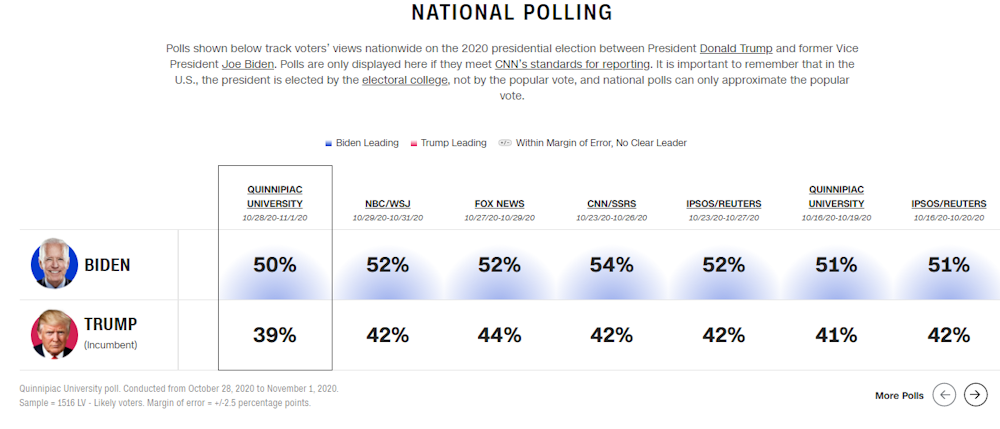
While that assessment seems extreme, especially given polling’s resiliency over the decades, the poll-driven expectation that former Vice President Joe Biden would lead Democrats in a sweeping “blue wave” went unfulfilled. Biden may still win the presidency, but it will not be in a landslide.

Biden’s overall polling lead, as compiled by RealClearPolitics.com, stood at 7.2 percentage points on the morning of Election Day. A little more than 24 hours later, his lead in the national popular vote was almost 3 percentage points.

A screenshot of pre-election presidential polling. These polls show Biden with a clear lead over Trump.

CNN posted national polls on the presidential race, taken between 10/16/20 and 11/1/20. Screenshot, CNN, CC BY

Pollsters often seek comfort, and protection, from critics in asserting that pre-election surveys are not predictions. But the nearer they are to the election, the more reliable polls ought to be. And a number of individual pre-election polls were embarrassingly wide of the mark.

A notable example was the final Washington Post/ABC News poll in Wisconsin, released last week, which gave Biden a stunning 17-point lead. The outcome there was still undecided Wednesday morning, but the margin surely will not be close to 17 points.

Indeed, the polling surprises were many and included Senate races such as those in Maine, where Republican Susan Collins appears to have fended off a well-financed challenger to win a fifth term, and South Carolina, where Republican Lindsey Graham rather easily won reelection despite polls that indicated a much closer race. Graham declared after his victory became clear, “To all the pollsters out there, you have no idea what you’re doing.”

It appears that Republicans will keep control of the U.S. Senate despite expectations, fueled by polls, that control of the upper house was likely to flip to the Democrats.

Polling problems not new

The 2020 election may represent another chapter in the controversies that have periodically surrounded election polls since George Gallup, Elmo Roper and Archibald Crossley initiated their sample surveys during the 1936 presidential campaign. The most dramatic polling failure in U.S. presidential elections came in 1948, when President Harry S. Truman defied the pollsters, the pundits and the press to win reelection over the heavily favored Republican nominee, Thomas E. Dewey.

The surprise this year is not remotely akin to the epic polling failure of 1948. But it is striking how polling missteps are so varied, and almost never the same – much as Leo Tolstoy said of unhappy families: each “is unhappy in its own way.”

Factors that gave rise to this year’s embarrassment may not be clear for weeks or months, but it is no secret that election polling has been confronted with several challenges difficult to resolve. Among them is the declining response rates to telephone surveys conducted by operators using random dialing techniques.

That technique used to be considered the gold standard of survey research. But response rates to telephone-based polls have been in decline for years, forcing polling organizations to look to, and experiment with, other sampling methods, including internet-based techniques. But none of them has emerged as polling’s new gold standard.

One of polling’s most notable innovators was Warren Mitofsky, who years ago reminded his counterparts that there’s “a lot of room for humility in polling. Every time you get cocky, you lose.”

Mitofsky died in 2006. His counsel rings true today.

W. Joseph Campbell, Professor of Communication Studies, American University School of Communication

This article is republished from The Conversation under a Creative Commons license.

Americans voted for major progress on climate crisis and clean energy — will they get it?

On Wednesday, one day after our closely contested presidential election, the United States stepped away from its adherence to the 2015 Paris Climate Agreement, a decision announced by President Trump back in June,2017 as the rhetorical centerpiece of his campaign to unleash the ferocity of an even more unstable climate on American communities in the name of “energy dominance.” 

Given the decision by a solid popular-vote verdict of American voters — and apparently also the needed majority in the Electoral College — to choose a change in direction on energy policy and other issues by entrusting the helm of the ship of state to Joe Biden, that retreat will constitute one of the most ephemeral episodes in foreign policy history. The U.S. will probably announce that it is rejoining Paris on the first day of the incoming Biden administration. Rejoining would then take effect in a month. Staff working for Biden’s provisional presidential transition have already been hard at work developing a forward-looking clean-energy strategy aimed at protecting U.S. citizens from the effects of climate change, a concern that exit polling showed was ranked as a serious issue by two-thirds of all voters, especially younger ones, whether they supported Trump or Biden.

As the process of counting up the voters who endorsed this major change in America’s climate and energy strategy continues, the greater Biden’s margin — at this writing, he leads by more than 3.5 million votes — the stronger his mandate. Making sure that every vote is counted is critical, since most of the remaining uncounted votes across the country come from cities like Pittsburgh, Philadelphia, Charlotte, Raleigh and Atlanta, which, in the face of relentless and irresponsible hostility from the Trump administration, pushed forward and kept the U.S. moving towards its Paris goal of a completely clean-energy economy by mid-century. 

Final results on many of the down-ballot candidates and issues that will help steer U.S. climate progress over the next several years are not yet clear. With an unprecedented volume of voter turnout relying on such a large volume of mail-in ballots, we must be patient for some of the outcomes.  

But Americans have definitely voted for change, and the change they voted for was moving forward toward the Paris goals and a clean-energy economy. They did not vote to retreat from climate partnership and progress by giving up, any more than Americans want to give up on the fight against the coronavirus, as President Trump, in what may be one of his last acts of folly, has effectively announced he is doing.

USPS confronted with possibility that thousands of mail-in ballots missed election deadlines

The United States Postal Service (USPS) is facing criticism over a report that almost seven percent of the ballots submitted by mail were not sent to election officials on time to be processed — although the situation may not be as ominous as some fear.

The federal agency filed data in federal court on Wednesday reporting that roughly 8,000 mail-in ballots were not processed on time on Tuesday, according to The Washington Post. While this only constitutes a small fraction of the  115,630 ballots that were processed on the same day (Election Day), it could have a significant impact in states in which a thin margin separates President Donald Trump and Democratic presidential candidate Joe Biden.

Adding another layer to the controversy is the fact that Judge Emmet G. Sullivan of the U.S. District Court in the Washington, D.C. had ordered the Postal Service earlier that day to sweep 12 postal processing facilities covering 15 states after it was revealed that more than 300,000 ballots throughout the nation could not be traced. These included ballots cast in key swing states like Florida, Pennsylvania, Arizona and Nevada. The agency admitted that it disregarded Sullivan’s directive and instead followed its own schedule for checking for ballots, even though voting rights advocates said that their schedule would occur too late in the day for ballots to arrive in time to be counted.

“Given the time constraints set by this court’s order, and the fact that Postal Inspectors operate on a nationwide basis, defendants were unable to accelerate the daily review process to run from 12:30pm to 3:00pm without significantly disrupting preexisting activities on the day of the election, something which defendants did not understand the court to invite or require,” the Postal Service wrote in a court filing, according to The Hill.

Sullivan told the Postal Service that “someone may have a price to pay” for the agency’s failure to follow his directive, saying that he would have considered other options if he knew his order would be hard to implement and adding that he believes the agency’s leaders are to blame, according to Politico.

Although the possibility of hundreds of thousands of missing ballots seems ominous, there could be an innocuous explanation.

“The USPS has been intentionally making its performance look worse than it is by removing ballots from the normal sorting and delivery process to deliver ballots faster,” reports Aaron Gordon of Vice. “What this means is the stats might look worse than they actually are, because in some cases postal workers have, for example, been manually postmarking the ballots and then passing them off for local same-or-next-day delivery, resulting in the ballots never being scanned into the system in the first place.”

He added, “Other measures, like sending ballots to the sorting facility but then removing them from the mail stream after they’ve been scanned and postmarked, means they are manually bypassing the rest of the process for expedited delivery and are thus scanned in and never scanned out.”

Maggie Koerth, a senior science writer at FiveThirtyEight, took a different tack, writing that “to be fair to the USPS, that’s a successful Election Day ballot processing rate of 93.3 percent. But given how close these races are, it’s still not a good look for the already politically beleaguered agency.”

One reason why so many people are suspicious of USPS is that Trump has spread misinformation about mail-in ballots being susceptible to fraud and used that to justify slashing the post office’s budget, as well as implement other policies that made the post office operate more slowly. Because there are many states where ballots are not counted as legitimate votes unless they arrive by a certain time on Election Day, voting rights advocates were concerned that Trump’s post office policies constituted an attempt to disenfranchise American voters, who were far more likely to vote by mail this year due to pandemic-related concerns over physical contact. 

Ironically, the post office as an institution was instrumental in helping America become a thriving democracy in its formative years.

As Richard John, a professor of journalism at Columbia Journalism School and author of “Spreading the News: The American Postal System from Franklin to Morse,” told Salon in August, the early post office allowed newspapers to be circulated at a low cost and helped connect a sprawling nation together through a common communications network. By 1828 it was the biggest information network in the world, with John noting that “the post office was so admired, lawmakers were calling [for] the government to take over Western Union and run it like the post office.”

Joe Biden on the brink of victory — after Michigan, Trump has almost no way to win

With electoral results in for all but a few battleground states, President Trump’s possible path to victory is now extremely narrow, according to projections from the Associated Press (AP).

As of Wednesday afternoon, former Vice President Joe Biden has 264 electoral votes following wins in the critical states of Wisconsin and Michigan, and needs only six electoral votes to reach the magic number of 270. Trump, who baselessly and falsely said he had won the election early on Wednesday morning, would need to win 56.

Of the remaining states, only Alaska, which has not voted for a Democrat since 1964 and where Trump holds a commanding lead, appears out of reach for Biden. If Trump wins Alaska, it would bring his total to 217, but would not affect Biden’s map.

Delegate-rich Pennsylvania would be a major prize for either candidate, and may not be called until later this week as counting of absentee ballots continues. Biden does not absolutely need its 20 votes to win. Trump, however, does.

With Michigan in his column, Biden can now secure the presidency with a victory in any remaining state, including Nevada, which has six electoral votes and where Biden holds a narrow lead with an estimated 83% of the vote counted.

To win re-election, Trump has to carry every state that hasn’t been called — not just Nevada and Pennsylvania, but the Southern battleground states of Georgia and North Carolina, where vote-counting continues and the final results are likely to be extremely close.

These narrow prospects have prompted the Trump campaign to do what many people feared — apply pressure in an effort to shut down the counting process.

Trump campaign manager Bill Stepien tried to claim victory in Pennsylvania on Wednesday, in a virtually unprecedented maneuver seemingly intended to placate his boss. A campaign has no authority to declare victory on its own, and more than a million votes remain to be counted in Pennsylvania, according to The New York Times. That declaration came after the campaign filed two lawsuits. One suit would temporarily stop vote counting in the state until Republican observers are given increased visibility over the process. The campaign is also seeking to intervene in a Supreme Court case that would block a decision to count mail-in ballots that are received by Friday but were postmarked by Election Day. 

On Wednesday evening, Pennsylvania Gov. Tom Wolf and Secretary of State Kathy Boockvar held a press conference to discuss the vote count, and said they would fight to ensure that every legal vote is counted. They also said that the late-arriving mail-in ballots potentially involved in the Supreme Court case amounted to a relatively small number, unlikely to change the overall results.

The Supreme Court declined to expedite the Republican case ahead of the election, but may still take it up.

Trump’s margin in Pennsylvania has been steadily shrinking as the vote count has continued. As of Wednesday evening, he led by less than 200,000 votes, after leading by nearly 500,000 earlier in the day. About 86% of the estimated vote has now been counted, and New York Times election analyst Nate Cohn has said he believes Biden may ultimately take the lead by the time the count is complete.  

Trump’s campaign has also filed a lawsuit to halt the voting in Michigan until Republican poll observers are given increased access. Since all major news outlets have called the state for Biden, that suit seems academic. The Trump campaign has also asked for a recount in Wisconsin, where Biden’s margin of victory was slightly more than 20,000 votes, around 0.6%. Trump’s campaign would have to pay for a recount, which would begin in about two weeks. A 2016 Wisconsin recount paid for by Green Party candidate Jill Stein made no difference in the result, increasing Trump’s margin by about 130 votes. 

The race in Georgia is too close to call, according to the AP. By Thursday morning, more than 51,000 ballots remained to be counted — most of that mail-in votes from two counties where Biden has done extremely well: Fulton County in Atlanta, and Chatham County, home to Savannah. With Trump holding a steadily-shrinking lead that now stands at less than 20,000 votes, the final margin is expected to be razor-thin. On Wednesday evening the Trump campaign filed yet another lawsuit to stop the counting of the votes, the AP reports. 

In North Carolina, all ballots that arrive by Nov. 12 will be counted, as long as they were postmarked by Election Day, which makes any estimate little more than guesswork. While Trump currently holds a 77,000-vote lead over Biden, according to the Times, that race is also not over: Election officials in the Tar Heel State report nearly 290,000 ballots outstanding, a large slice of them from the Triad metroplex, which, given historical trends, appear likely to favor Biden.

In Nevada, where Biden leads by fewer than 8,000 votes, about 194,000 votes have not been accounted for, the AP says. However, a large majority of those, about 150,000, are from Clark County, which is home to Las Vegas and votes heavily Democratic. Many Nevada ballots that were submitted or postmarked by Election Day have yet to be tallied, the AP reports.

If Biden wins Nevada — a result which could be announced Thursday morning, when the state’s two largest counties are scheduled to report results — he would hit 270 electoral votes precisely. No matter how much the Trump campaign might protest, major news organizations would declare Biden the winner of the 2020 presidential election at that point. Stay tuned.

Professional pollsters blew it again in 2020. Why?

Once again, we have an election in which the polls seem to have underestimated Donald Trump — with potentially significant consequences for how people may have voted.

If you’re a Democrat, you may still have PTSD from the prognostications for the 2016 election, in which polls heavily favored then-Democratic nominee Hillary Clinton over Trump, but were proved wrong on Election Day. While it remains to be seen who will emerge the victor in 2020, there is little question that the 2020 polling consensus held Biden to not only be a favorite, but a big favorite. Statistical aggregator FiveThirtyEight gave Biden an 89% chance of winning and estimated that he would win the popular vote by 8 percentage points as well as claim Florida, a state that ultimately went to Trump. The polls averaged by RealClearPolitics predicted that he would win the popular vote by 7.2 percentage points and listed as “toss ups” a number of states that wound up being solidly pro-Trump, including Florida, Ohio, Iowa and Texas.

Political analyst Charlie Cook epitomized the prevailing view when he wrote on Election Day that Biden’s “actual lead is more like 9 or 10 points, based on the higher-quality, live-telephone-interview national polls conducted since the first debate” and that his “path to 270 electoral votes seems pretty straightforward.”

At the time of this writing, Biden has only a two point lead in the popular vote over Trump, and even if that margin widens, it is mathematically impossible at this point for it to reach even half of what FiveThirtyEight, RealClearPolitics or Charlie Cook projected in terms of popular vote percentage margin. While Biden could still win in the Electoral College, it will be not in a predicted landslide but rather a squeaker, one made possible by razor-thin margins in states like Arizona, Michigan, Wisconsin and Pennsylvania… all of which were generally regarded by pollsters as being much, much more secure for Biden.

After the debacle that was 2016, pollsters spent years trying to hone their models to account for the errors that widely predicted a Clinton victory. The data suggests they did not succeed. 

So what gives?

“We won’t know for a few days exactly the degree to which the polls were off, but it appears that they (1) significantly underestimated Trump support in Florida and in the Rust-Belt (3-5 points), (2) slightly underestimated Biden support in the West (1-3 points), and (3) were pretty dead-on elsewhere,” Dr. David Barker, director of the Center for Congressional and Presidential Studies and a professor of government at American University, wrote to Salon. “This pattern is consistent with what was observed in both 2016 and 2018. Despite the fact that there were far fewer undecided voters this year, there were more ‘high quality’ polls conducted late in the race this year, and pollsters mostly corrected their error of failing to weight for education in 2016.”

He added, “It is not yet clear, then, what explains the errors.”

While Barker did not have a theory for the polling errors in the Rust Belt, he speculated that there be a “challenge in polling Hispanic voters—especially those who do not speak English fluently. Overweighting Hispanics who speak English fluently does not correct for the underrepresentation in surveys of Hispanics who do not—the latter of whom are much more disproportionately Democratic than the former in the West (largely Mexican Americans) but more disproportionately Republican in Florida (Cubans and Venezuelans). That might explain why results are more favorable to Republicans in [Florida], relative to the polls, and more favorable to Dems in the West, relative to the polls.”

Dr. Christopher Wlezien, a professor of government at the University of Texas in Austin, echoed this view.

“We still don’t have final results, but it looks pretty clear that national polls understated Trump’s share and that this occurred in many states as well, though there also is variation in performance there, as polls in some states predicted the outcomes better than others,” Wlezien wrote to Salon. “Given the patterns, it looks like part of the explanation is systematic, but what specifically they missed remains to be determined.”

Wlezien floated a few explanations, ranging from undecided voters breaking for Trump (as they did in 2016) and a surge in Republican turnout, to Democrats not voting because of overconfidence in a Biden victory. There’s also the idea (of which Wlezien said “there’s not much evidence in previous research”) that Trump voters did not want to admit their predilection to pollsters — the so-called Shy Trump Effect.

“There are other possibilities, including the effects of changes in voting and also vote counting,” Wlezien added. “We first need to get the final results and then start analyzing the polls and their performance, and so time will tell.”

Regardless of the reasons for the discrepancies, American University political scientist Dr. Allan Lichtman wrote to Salon that it is time for the American public to stop seeing polls as prophecy.

“Polls are snapshots, not predictors,” Lichtman explained. “Rather, they are abused as predictors. Also, the error margins in the polls are much greater than the pollsters would have you believe. For example, the commonly reported error of plus and minus 3 percent  is purely statistical, sampling error. It is the error that would be generated from drawing a sample of balls from a very large jar of red and green balls. The statistical error does not take into account response error or error from misestimating likely voters. I believe that this year the pollsters greatly underestimated the Trump turnout, although again specific study is required.”

He concluded, “I do believe it is time to stop horse race polls. This is the second presidential election in a row that they misled the American people. Possibly too, the polling errors affected turnout, both for Democrats perhaps who thought the election was won and perhaps for Republicans who thought they had no chance to win. Again, we won’t know without further study.”

Incidentally, Lichtman developed a system for successfully predicting presidential candidates that primarily bases its projection on the incumbent party’s perceived and actual performance. Based on Trump’s myriad scandals, mishandling of the pandemic, stewardship of a poor economy and other problems, Lichtman predicted that Biden would win in 2020. He expressed dismay at Trump’s premature declaration of victory and threats to stop legitimate vote counts in the currently undecided states.

“Trump’s rhetoric is contrary to all studies showing that whether for mail-in or in-person voting fraud is vanishingly small, much too small to affect a statewide outcome,” Lichtman told Salon. “Even the Republican National Lawyers Association, the Heritage Foundation, and Trump’s so-called fraud commission failed to uncover any widespread or systematic fraud in U.S. elections. FBI director reached the same conclusion. Trump’s self-serving rhetoric is aimed at claiming that if he loses he was cheated out of a win and at setting up court challenges to the vote.”

Twitter and Facebook slap warning labels on Trump’s baseless claims of voter fraud

Twitter users were very active on Tuesday night as people anxiously waited for the the poll to close and the votes to start rolling in, but there was one person noticeably missing among the action: President Donald Trump. But his unlikely silence didn’t last the night.

Around 12:30pm ET, Democratic Presidential candidate Joe Biden addressed supporters in his home state of Delaware. Biden gave a brief, cheerful address.

“As I’ve said all along, it’s not my place or Donald Trump’s place to declare who’s won this election,” Biden said. “That’s the decision of the American people. But I’m optimistic about this outcome.”

After Biden’s speech, President Donald Trump took to Twitter and Facebook and began to falsely claim that the Democrats were trying to “steal” the election and he was “up big.” (Trump deleted one of the tweets, then tweeted the same text again after removing a typo.) 

Twitter then slapped a label on the corrected tweet.

“Some or all of the content shared in this Tweet is disputed and might be misleading about an election or other civic process,” the warning state, linking to Twitter’s civic integrity policy.

The label prevents Twitter users from immediately viewing the tweet. Instead, users must click through the warning to see the content of the tweet. Users also can’t retweet the tweet without being prompted to learn more about how ballots are counted in the United the States. Twitter users can only retweet the tweet as a quote tweet; they cannot like or reply to the tweet.

On Facebook, the exact same message was also labeled, but with fewer sharing and commenting restrictions than Twitter.

“Once President Trump began making premature claims of victory, we started running notifications on Facebook and Instagram that votes are still being counted and a winner is not projected,” Facebook’s press team said on Twitter. “We’re also automatically applying labels to both candidates’ posts with this information.”

Major social media outlets have faced extreme scrutiny over the past four years, due to their misuse as weapons to spread propaganda in the 2016 election. In particular, Trump frequently employs Twitter to sow falsehoods and even threaten his opponents, sometimes with violence. As a result, both platforms have implemented forms of fact-checking for many posts by political figures and groups with large follower counts. 

Indeed, since September of this year, Twitter and Facebook adopted explicit policies on how to handle premature or false election victory claims, which they anticipated from Trump. According to Twitter’ policy, premature claims of victory make the tweets eligible for removal from moderators. Facebook’s policy is more tolerant of such claims; it will only label posts that include content about the election, and direct users to authoritative information.

The social media crackdown didn’t stop on Tuesday night. On Wednesday morning, Trump tweeted a false claim that he was “leading, often solidly, in many key States, in almost all instances Democrat run & controlled,” but then “one by one, they started to magically disappear as surprise ballot dumps were counted.” Twitter and Facebook placed their labels on the message on their respective platforms, too. 

Trump’s tweets aren’t the only ones being labeled with warnings for spreading misinformation. A reporter at the New York Times had his tweets labeled about a problem with printer ink in Wisconsin, which may have been in error.

Given their efforts and all the scrutiny over both platforms, has Twitter and Facebook’s attempt to stop the spread of misinformation worked? Hardly. It appears that many of Trump’s supporters found other ways to amplify his messages. A hashtag associated with the alleged Democratic theft of the election, #StopTheSteal, made the rounds on Twitter on Tuesday, largely driven by right-wing influencers. While Twitter has labeled some of the tweets that use the hashtag, many of them remain on the social media site unflagged.

The same hashtag trended baselessly during the 2018 midterm elections. Many experts and journalists fear that such false claims undermine many Americans’ faith in democracy.

“The #StopTheSteal hashtag, Fox’s misleading preemptive coverage, and Trump’s attempt to sow confusion about the legitimacy of uncounted ballots are part of a larger assault on democracy,” Parker Molloy wrote in Media Matters. “By working to create the false impression that Democrats were carrying out an illegal scheme to ‘steal’ the election in Pennsylvania, Trump and his allies are taking what they view as necessary steps to build public support for the Supreme Court showdown Trump craves.”

Sara Gideon concedes to Susan Collins, dealing a blow to Democratic hopes of regaining Senate

Democrat Sara Gideon on Wednesday conceded Maine’s hard-fought Senate race to Republican Susan Collins, sending the incumbent back to Washington for a fifth term. Gideon’s apparent loss dramatically increases the odds that the GOP will retain control of the upper chamber under Senate Majority Leader Mitch McConnell, R-Ky.

In a brief address outside of a Bangor hotel, Collins said she had received a concession call from Gideon as unofficial results showed the Republican up by a margin of 51% to 42%, with 85% of precincts reporting. If those numbers hold, Collins would avoid a ranked-choice runoff which could potentially shift the outcome of the race toward Gideon.

“To the people of Maine, thank you. Thank you,” Collins said in her remarks. “I will serve you with all of my heart, and I will work hard for you every day.”

In a concession speech, Gideon said, “While we came up short, I do believe Mainers in every corner of this state are ready to continue to work together to make a difference.”

The race attracted national attention before Gideon even launched her challenger bid. Collins’ controversial 2018 vote to confirm President Donald Trump’s Supreme Court nominee Brett Kavanaugh prompted a national fundraising campaign to unseat her and hurt her support among women voters in her state. The effort to unseat Collins attracted tens of millions in outside donations, and Democrats eyed the seat as a key to regaining control of the Senate.

Gideon, the speaker of the Maine House of Representatives, consistently polled ahead of Collins throughout the year, at times posting double digit margins. Election forecasters at the Cook Political Report accordingly shifted the race from “toss-up” to “lean Democrat.” However, the contest tightened to within a few points as Election Day neared.

Those polls were a shock for Collins, who won 70% of the vote in her previous race. This cycle, Collins had to claw back the confidence of her fellow Mainers. Like many of her vulnerable Republican colleagues, Collins struggled to sever her image from Trump, who rated deeply unpopular in the Pine Tree State. She never committed to voting for the president, even when asked directly during her final debate with Gideon. Instead, Collins focused her advertising on Maine issues — to varying degrees of success.

But Collins’ own record again stood in her way, most specifically her vote to acquit Trump on impeachment charges in February, as well as her association with the Trump administration’s heavily criticized response to the coronavirus pandemic — the latter of which Gideon hammered home in the campaign’s final stages.

Collins’ past popularity might have shielded her from scrutiny, as several stories alleging self-dealing broke late in the race, prompting a government watchdog to file a Senate ethics complaint.

In a concession statement on Wednesday, Gideon said that “while this election may be over, we can’t afford to stop organizing. So let’s get some rest, and then get back to work.”

A Rhode Island native, Gideon moved to Maine in 2004 after graduating from The George Washington University and interning for Sen. Claiborne Pell, D-R.I. She was elected to the state legislature about seven years later, where she rose to speakership in 2016. 

Gideon took advantage of the uncertainty around Collins to run the most liberal Democratic Senate campaign in the state’s history, especially in the realm of reproductive rights, where the Republican had lost significant ground. But liberalism is a hard line to walk in Maine.

Green Party progressive Lisa Savage criticized Gideon’s platform as “tepid and weak.” Gideon refused to embrace progressive planks like a Green New Deal and Medicare for All, instead advocating for aggressive but incremental climate change and a public healthcare option. While Savage voters could have tipped the state to Gideon’s favor in Maine’s ranked-choice system, Collins avoided such a scenario by posting more than 50% of the popular vote.

While Maine’s politics can be peculiar, the state has drifted toward Democrats in recent years. However, Collins, a nominally middle-of-the-road Republican, proved on Tuesday that she still commands a strong base in her home state.

The Associated Press on Tuesday declared Democratic nominee Joe Biden the winner of Maine’s statewide race, while Trump picked up an electoral vote in state’s 2nd District on Wednesday.

After 2020, we face an existential struggle: What does it mean to be an American?

I grew up in right-wing America, but I got out as soon as I could. No one was surprised. From an early age, it was clear my inclinations were what you might call “Weimar American” or what a lot of people around me called “weird”: More interested in reading than watching TV, invested in pop music trends, and intrigued rather than repulsed by the idea of meeting people who were different than me, or eating foods I hadn’t heard of before. 

“You’re a New Waver,” some kid snarled at me in class one day in, I kid you not, 1993. I didn’t have the heart to tell him that term was going out of style when he was a toddler. 

Now, as an adult, I shop at the farmer’s market. I’m middle-aged, but I know what “trap music” is. I have opinions on the newest seasons of “The Great British Baking Show,” versus the older ones. I lament the decline of bookstores, but still buy actual books online. I read mainstream newspapers and eat Vietnamese takeout. I’ve been to same-sex weddings and the Women’s March. I’ve uttered the phrase “the Golden Age of Television.”

I say these things not to congratulate myself for being hip, but quite the opposite. I’m not hip at all — I’m an extremely normal American. Sure, I’ve lived in liberal cities — first Austin, then Brooklyn and now Philadelphia — my whole adult life. Still, the America I know, where the movie “Get Out” was a huge hit and the Dixie Chicks did nothing wrong — is mainstream America.

Americans like me populate the small towns and suburbs too, as the summer of Black Lives Matter protests and Biden/Harris signs demonstrated. There are many flavors of us and many races, but the general values — appreciation for  diversity, acceptance of social change, cultural curiosity and empathy towards others — are the mainstream values of America.


Want more Amanda Marcotte on politics? Subscribe to her newsletter Standing Room Only.


Some of us are here as a matter of choice and some as a matter of circumstance, marginalized by immutable characteristics like race or gender identity or sexual orientation. Still, the fact that Democrats tend to win the popular vote in presidential elections over and over and over — with the 2020 result, that makes seven of the last eight — is evidence that the America that Donald Trump and his fans hate, the America they don’t even want to admit is American, is mainstream America. 

And frankly, Trump and his minions know it. Indeed, it’s exactly the mainstream nature of this more liberal, cosmopolitan strain of American culture that explains why we’re seeing such fierce, outsized anger from Trump voters. It’s the reason for the flag-festooned truck caravans, video tantrums about having to wear face masks in public places, lurid conspiracy theories painting Democrats as blood-drinking pedophiles and the “MAGA” slogan. It’s why they are willing to back a confessed sexual assailant who is obviously a sociopath, eagerly and enthusiastically. 

It’s because they see Trump as the vehicle to “take back” an American culture that they believe is being stolen by the rest of us, that is, the actual American majority. 

Win or lose in 2020, Trump has done remarkably well for a president who let 232,000 Americans die and is abandoning millions more to sickness or poverty. That may seem inexplicable to many people who despise him, but it’s ultimately because his voters see themselves locked in an existential battle with the rest of us over who gets to define what kinds of people and things are truly “American.” 

There’s a lot of resistance on the left to the idea that our national crisis is over identity and culture, and not over something that’s a little easier to get a handle on, like economics or ideology.

It’s often noted in progressive circles that if you poll Americans on policy issues like universal health care or free college, broad majorities of Americans — including a plurality of Republicans — support many left-leaning and often “radical” policies. This is often taken as evidence that Democrats are losing because they’re too timid, and that if they embraced a bolder, more progressive agenda, they would win. 

As much as my heart wants to believe that, however, it isn’t true. We know that because both Hillary Clinton and Joe Biden shifted toward the left — certainly in terms of recent Democratic politics — and it did nothing to improve their vote share.


Want more Amanda Marcotte on politics? Subscribe to her newsletter Standing Room Only.


Which isn’t to say Democrats shouldn’t embrace progressive economic policies. They should, because it’s the right thing to do. But there’s no reason to believe it will either help or hurt their electoral chances, because there’s no way to win over votes from Trump America. That 45% of the country, which has outsized power due to the Electoral College and the unfair Senate system, is simply more worried about culture-war issues than about policy. 

As Paul Campos at Lawyers, Guns, and Money wrote Wednesday morning, “the lesson of this election is it doesn’t matter at all what a Republican president does or doesn’t do — the people who vote for him literally don’t care, as long as he gives them enough of what they want, and what they want is authoritarian ethno-nationalism and Owning the Libs.”

There’s been some good protest music in the Trump years. What is striking about a lot of it — such as Childish Gambino’s “This Is America,” Janelle Monae’s “Americans” and RuPaul’s “American” — is how much it’s focused on this notion of what it means to be an American.

“I am American, American, just like you too,” are the blunt lyrics of the RuPaul song, which plays at the end of every episode of RuPaul’s show in recent seasons. 

I’d argue that RuPaul is, if anything, even more American. He’s a house musician, a drag queen and a game show host, all of which are American-born artistic traditions. That’s no surprise, since so many of the things that make this country’s culture interesting and unique and so beloved around the world come from the very people and subcultures that our authoritarian 45% resents so much: Queer subcultures, nonwhite communities, urban neighborhoods full of immigrants.

Even right wing America has a parasitic cultural relationship to the innovations of the same Americans they resent so much. From Trump fans dancing feebly to the Village People at his red-hat rallies to the way hip-hop beats are watered down and injected into crappy “bro country” songs by groups like the Florida-Georgia Line to whatever the hell Kid Rock is doing: The spirit of Pat Boone stays strong in this country, kept alive by people who want to steal artistic and cultural innovation from other Americans before they kick them in the face. 

I wish I had more answers to our problems. I wish our elections could be about boring but important issues like health care and tax policy, instead of being used as a clumsy weapon in the culture wars. I wish that the 45% of Americans who don’t get or don’t like the slightly hipper and definitely more diverse majority would just chill out and leave us alone. I wish there was no Fox News and no Rush Limbaugh and no white dudes with bad tattoos who channel their masculine insecurities into buying guns and longing for “tradwives” on social media.

But I don’t. It feels like an intractable problem, being held hostage by a resentful minority who only grow more toxic and bitter because they have way too much power over our electoral system. But it’s the problem we have, and we won’t even start to think of solutions until we look our problem directly in the face. 

Joe Biden wins Wisconsin as Trump campaign demands a “recount” and runs to the Supreme Court

Democratic presidential nominee Joe Biden appears to have a clearer path to victory as key swing states continued to count ballots on Wednesday. Meanwhile, President Donald Trump’s campaign will seek a recount in Wisconsin, where the Associated Press declared Biden the victor on Wednesday afternoon, and seek to stop vote counting in Michigan and Pennsylvania.

The AP called the Wisconsin race after election officials said earlier in the day that Biden had won the state by more than 20,000 votes with all ballots counted.

Trump campaign manager Bill Stepien said in a statement that the president would immediately seek a recount in the state, claiming without evidence that there were “irregularities” in several counties that “raise doubts over the validity of the results.” There has not been any evidence of irregularities which may have swung the race, though the president has repeatedly demanded that states stop counting valid votes submitted before polls closed.

Trump claimed on Twitter that poll workers were “finding Biden votes all over the place,” referring to the counting of valid votes. He also falsely and prematurely declared victory early on Wednesday morning, even as outstanding ballots in delegate-rich states like Pennsylvania and Michigan could put Biden on a path to clinching the 270 electoral votes he needs to win. Those two states, along with Wisconsin, were not allowed to start counting absentee ballots until just before or on Election Day, in no small part because of the actions of Republican-led state legislatures.

Former Wisconsin Gov. Scott Walker, a Republican, argued that the margin was a “high hurdle” to overcome as he recalled how a recount of the 2016 presidential race in the state sought by then-Green Party candidate Jill Stein moved only 131 votes. 

“20,697 is a small-enough margin for Trump to request a recount under Wisconsin law (he’s within 1% of Biden), but a big-enough margin where the recount has almost no meaningful probability of affecting the result,” Steve Vladeck, an election law expert at the University of Texas at Austin, wrote. “Florida in 2000, in contrast, ended up divided by 537 votes.”

The campaign also prematurely declared victory in Pennsylvania and said it is seeking a Supreme Court order to stop the counting of late-arriving mail ballots in the state.

“We are declaring a victory in Pennsylvania. This is not based on gut or feel. This is based on math,” Stepien said on a call with reporters even though well over 1 million votes cast before polls closed are left to be counted.

“Pennsylvania is still counting the mail-in ballots that arrived *on time.* The fight over whether it can count late-arriving ballots may not end up mattering,” Vladeck noted, adding that “they’re doing this because they’re losing.”

“There’s just no remotely plausible legal justification for stopping the count now,” he wrote. “Especially in a state like PA, most of the ballots that are left are the ones that came in *first.* Let them finish first; then go to court if need be.”

The campaign said it had also filed a lawsuit in Michigan to “halt counting” until “meaningful access” is granted to Trump campaign observers.

“We also demand to review those ballots which were opened and counted while we did not have meaningful access,” Stepien said in a statement.

Wisconsin lifted Biden to 248 electoral votes, meaning he would need only a couple of states to break his way after picking up the traditionally Republican stronghold of Arizona and three of Maine’s electoral votes, according to the AP. Trump, who currently has 214 electoral votes after picking up Florida and Maine’s Second Congressional District, maintains a narrow lead in Pennsylvania, North Carolina and Georgia.

Biden has won mail-in votes in Pennsylvania by an “overwhelming margin,” according to The New York Times’ Nate Cohn, who noted that the former vice president would “win the state” if current trends hold. Biden has won 78% of absentee voters in the state, and he would be on pace to surpass Trump if he maintains that margin. Only about half of the state’s 2.5 to 3 million ballots have been counted, according to Secretary of State Kathy Boockvar, including just a fraction of the outstanding ballots in the Democratic stronghold of Philadelphia.

Though Trump appeared ahead in Michigan on Tuesday night after the Election Day vote was counted, Biden has taken a 38,000 vote lead in the key battleground state. He also leads in Nevada, which is not expected to announce final results until Thursday. If those leads hold, Biden would net 270 electoral votes without having to win any other states.

There are hundreds of thousands of ballots left to be counted in Michigan’s largest cities, including Detroit, Flint, Grand Rapids and Warren, Secretary of State Jocelyn Benson said on Wednesday morning.

If Biden’s lead in Arizona holds, he could afford to lose one of the Rust Belt states. However, Republicans have claimed that the race was prematurely called by the AP and Fox News. At least 400,000 ballots are left to be counted in the state, according to The Arizona Republic. Biden’s lead stands at more than 90,000 votes.

Ballots in Georgia are still being counted after the vote count in an Atlanta area was disrupted by technological malfunctions and a broken pipe. There are tens of thousands of ballots left to be counted in Atlanta and its suburbs. The dreaded New York Times needle gives Biden a slight 0.4% edge in the state, which would further shrink Trump’s path to victory. Trump currently leads the official count by less than 90,000 votes.

The needle gives Trump a slight edge in North Carolina. The state will count ballots received up to nine days later with a postmarked of Nov. 3. There are more than 117,000 outstanding absentee ballots in the state, according to the Board of Elections. It is unclear how many of those were submitted in time. Trump’s lead has been cut to about 80,000 votes in the state.

Nevada is also expected to release an update on Thursday. Biden currently holds a narrow 10,000-vote lead with many mail-in votes outstanding.

“We believe we are on a clear path to victory by this afternoon,” Biden campaign manager Jen O’Malley Dillon told reporters on Wednesday. “I want to share with all of you that Joe Biden is on track to win this election, and he will be the next president of the United States”

Dillon said the campaign expected that it had already won Wisconsin and would win Nevada.

Biden campaign attorney Bob Bauer vowed to fight any litigation in court.

“We’re winning the election. We’ve won the election,” he said. “And we’re going to defend that election.”

Trump campaign manager Bill Stepien claimed that Trump would win if “all legally cast ballots” are counted. Trump, in remarks from the White House, baselessly alleged that Democrats were trying to cheat by having all of the outstanding votes counted.

Stepien predicted that the president would win in Pennsylvania, Nevada, Michigan, Georgia and even Arizona.

Top campaign adviser Jason Miller said the campaign was in a “full-court press to make sure we have all our legal teams that are in place.” Trump vowed that he was “going to the U.S. Supreme Court” during his remarks, though legal experts said the president does not have a case to bring.

“These are all legally cast votes, and the process of trying to toss them out for some reason would just I think be viewed by any court, including the Supreme Court, as just a massive disenfranchisement that would be frowned upon,” longtime Republican election lawyer Ben Ginsberg told CNN.

“It doesn’t work that way. The president doesn’t count these votes,” Pennsylvania Attorney General Josh Shapiro told ABC News. “The legal issues have largely been settled. And now it is time to count these votes and make sure that the will of the people is heard.”

Wheras Trump made false allegations of cheating and inaccurately claimed that he had won states where he trails, Biden urged patience among his supporters during remarks in Wilmington, Del.

“It’s not my place or Donald Trump’s place to declare who has won this election,” he said. “That’s the decision of the American people.”

Though Biden lost Texas, where some Democrats hoped to make inroads, and Florida, where polls showed him ahead before a surprisingly strong showing by Trump among Cuban-Americans, his projected win in Arizona greatly improved his chances. Biden also picked up Nebraska’s Second Congressional District, meaning he could win the presidency without having to win Pennsylvania.

Even if Biden comes out on top, the night was not what many Democrats had expected. Democrats appear to have little path to winning a majority in the Senate after losing in South Carolina and Iowa and trailing in Georgia, Maine, Michigan, and North Carolina. While the Democrats are expected to ratain control of the House, they lost at least a half-dozen seats on Tuesday.

Still, turnout in the election is estimated at over 66%, the highest number in 120 years, according to the U.S. Elections Project. FiveThirtyEight founder Nate Silver estimated that Biden will end up with the largest number of votes in presidential election history once all the ballots are counted.

I survived election night by not watching it

The ancient Greeks really understood election night news coverage. How else could they have told the story of Orpheus, who ruinously just had to get in one last look back on his way out of the underworld? What other explanation is there for their intimate grasp of the fates of those who gazed upon the Gorgons or who listened to the Sirens? Gather round, then, and attend the tale of a weary people who clutched in their hands glowing bricks that had the power to distress them, who beamed nightmares to themselves from their living room walls. And let me tell you how I survived that fateful night.

On the evening of Nov. 3 and into the early hours of the morning, I tied myself to the mast and managed to not watch TV or look at any of the real-time results and projections. I followed my colleagues’ updates in Slack, and exchanged supportive texts with my friends, but that was as far as I let myself go. And you know what? I cried and vomited a lot less than I did in 2016. 

That election was the first time I met the needle. I had naively believed all the oracles’ predictions; had earnestly assumed that night was the beginning of the end of the nightmare. Instead, I watched, hour by hour, as a channel surfer’s suicide squad of pundits grew increasingly shocked at what was unfolding. I couldn’t turn away as the New York Times forecast needle edged closer and closer and closer toward the scowl of Donald Trump. I did nothing but gorge on dire information until my eyeballs finally, rebelliously shut for a little while. Then I woke up in the morning and feasted miserably on a refreshed browser full of despair.

But that day was my birthday, and the gods gave me one small gift. I had morosely waved off my original plans for a celebratory, first female president night out, but late in the day my family talked me into burgers and fries at the bar down the street. The place was nearly empty, the mood still heavy from the grim watch party held there the night before. Wide-screen televisions on either end of the bar blasted dueling news networks. I asked our waitress if they could change the channel, for just a little while. They obliged. That was the night I learned you can change the channel. You can even turn it off entirely. And if Zeus gives you a box, you should really think twice about how badly you want to open it. I learned it all just in time.

I’ve spent the past four years trying to do as well as a person with an anxiety disorder can in the midst of one big global anxiety disorder. It doesn’t mean turning a blind eye to what’s going on. It means accepting that humans are not meant to ingest nightmares around the clock, and that constantly consuming suffering does not alleviate mine or, significantly, anyone else’s.

I made a choice that bleak 2016 birthday. I vowed to avoid watching and listening to that guy run his mouth as much as possible, even satirically and secondhand, and to strictly curate the amount of time I spend each day with the news. I eventually deleted my social media accounts, and I truly can’t overstate how much I don’t miss Facebook and Twitter and Instagram all they ways they messed with my mental health. Most of the time it’s not especially difficult to detach. At the peak of the pandemic here in New York, for example, I’d watch Cuomo’s daily briefings. Then I’d hyperventilate and swallow some Alka Seltzer, and move on with the rest of the day. 

But this election was tempting, I cannot lie. The needle called to me. It sang its seductive song from my laptop, luring me with the knowledge it was only as far away as my fingertips. The late-night incoming messages that first Biden, then Trump, were going live to speak to the American public were persuasive. Who could resist a show like that? Just a little peek, I’d think. Just a glance. Then I remembered that’s the sort of thing someone says before being turned to stone by a lady rocking a snake hairdo.

I don’t know what the next few days, let alone the next few years, will hold. I know I’m scared, mostly for my kids and their friends. But that I’ve done a lot of work, as the anxious and traumatized must, on balancing distress tolerance with radical acceptance and healthy distraction. I can promise from experience that keeping the voice of someone who harms you inside your head all day long is not a path to being okay in any form. I’m not accomplishing anything by enduring the blares from people whose mission in life is the make the libs cry, or for that matter the noise from those who misguidedly amplify their messages. Honestly, screw those guys. I don’t have anything to prove to any of them, and I know my strength doesn’t come from how much horror or abusive rhetoric I can take in.

We all have different thresholds. I can say that most productive thing I did yesterday was pick up my Wellbutrin refill, and the second was making brownies. Nothing but admiration for those who can wade in further and come out telling the truth with integrity and resolve. But we all need to lift up our eyes now and then. When I look at some of the criteria for psychological torture — isolation, sleep deprivation, natural light denial, threats, humiliation, sensory assault and sense of futility — it’s not difficult to see the circumstances we are all currently operating under. So I’m going to keep doing what I can to limit my exposure to those forms of torment, to the best of my often limited ability.

I believe I can be responsible and engaged and civic minded without voluntarily gobbling every morsel of bad news — especially the “rapidly changing” form of bad news — that comes my way. Some days, like today, the task feels Sisyphean. But the Greeks remind me that even when it feels like all the terrors have been unleashed at once, somewhere tucked away, one thing always endures. One thing always waits, and it’s not Wolf Blitzer. Hard as it is to do, it’s all I have to turn my mind toward today, yet again. Hope.

Fox News was in a “purple haze” on election night until Trump’s wild claims gave them clarity

In the midst of Fox News’ prime time Election Day coverage, network anchor Chris Wallace advised his colleagues to approach all reporting on vote returns with caution.

“The story of this night has not really been told yet,” he said, advising his colleagues to tread lightly before making definitive calls and political declarations about battleground states. Understand that this sobriety on a night of voting returns for a presidential election is relatively uncharacteristic for Fox, and to its credit the decision desk was relatively conservative in calling states for either candidate, waiting after a number of outlets before placing Florida into Donald Trump’s column.

Not to worry, because the network got back on track around 2:35 am ET, right after Trump did what he’s been hinting he’d do for weeks now: from the East Room of the White House, he declared victory in states that hadn’t been called at that point, including Georgia and North Carolina, and suggested that somebody had prematurely called Arizona for his opponent, former Vice President Joe Biden.

Conveniently enough, that somebody he was referring was . . . Fox News, the first news channel to declare Arizona for Biden despite angry pressure from Republicans insisting the call was wrong. Its decision desk editors, including chief editor Arnon Miskin, joined Wallace and his colleagues Bret Baier, Brit Hume, Martha MacCallum, Juan Williams and Dana Perino to explain several times that, indeed, their call was sound and they stood by it.

Ultimately that headline was bumped by Trump’s dictatorial claim that the emerging results via mail-in ballots were “a fraud on the American public,” adding: “We are going to the U.S. Supreme court. And we want the voting to stop.”

At last, Wallace and Fox News had its story. . . . and in typical fashion, treated it as normal political gamesmanship as opposed to a frontal attack on American democracy. The channel’s election night coverage was titled “Fox News Democracy 2020” – not “election,” not “vote,” democracy. Or more accurately, “democracy” – mark the quotes. One is a governing system, the other is hokey branding designed to create the illusion of fairness and greatness.

Until the man occupying 1600 Pennsylvania Avenue decides that’s no longer convenient then, according to Hume and the rest – it’s yet another twist in this game called politics. And it’s tough to discern which is more frightening – the fact that Trump did exactly everything he signaled he’d do, or the fact that Fox treated his authoritarian move as if it were just another Tuesday in America, or that watching it all unfold felt more exhausting than agitating. 

This is what happens when a person watches Fox News all day on one of the most fraught election days in our lifetime – even more so than in 2016. Back then, as Baier recalled, around 3 a.m. the network made the call for Trump, and at that point Hume and the rest were positively giddy. Hours before that Baier had read a shocked and dispirited statement from the French ambassador about “a world is collapsing before our eyes” and laughed.

Contrast this with now, when Wallace was moved to describe Trump’s dictatorial power move as “an extremely flammable situation the president has thrown a match into.” Williams could only claim bafflement, referring to Trump’s statement as confusing. In his defense, he also mistakenly referred to the blue wave or the blue shifts as a “purple haze.” Confusion is a theme with Williams, who met Trump’s early morning false claim of victory with the observation that this is “wild stuff.”

Haze, shift, wave, stuff – however you slice it, by that point the Fox neophyte was amply marinated in its version of Upside-Down. There had to be a lot of occasional Fox viewers tuning in Tuesday night. You could tell because network strategically limited the face time of its most incendiary prime time hosts, and when they did appear they toned down the rhetoric. That only goes so far for the likes of Laura Ingraham and Tucker Carlson and Sean Hannity, who can’t help but behave in any way other than completely obsequious when it comes to all things Trump.

Anyway, they didn’t need to be present with Hume on deck weighing in on cue about Biden’s purported memory problems and using coded language about potential unrest, predicting that if there is unrest and looting, it would be from “people who have caused trouble in urban areas” and not the Proud Boys.

In the afternoon Trump Communication Director Erin Perrine set up what happened later when she came on and replied to Biden and his campaign’s insistence that Trump cannot declare victory on election night with, “I’m really sorry for the American people that they have to listen to Joe Biden lie to them like that.”

Later contributor and legal analyst Jonathan Turley, speaking with Fox’s Harris Faulkner, explained that the 77% of people fearful of election day violence, has less to do with a lack of faith in the system than a lack of faith in each other. There’s a lot to unpack there but to be honest, the close vote despite everything Trump has done and failed to do –  mishandling the pandemic, enacting racist policies, emboldening white supremacists, being impeached and much, much more! – says Turley’s not wrong.

And Fox would likely say that is the fault of “professional panic peddlers” CNN and MSNBC, and liberals in general. “The liberal mindset is designed to crave power,” explained Jesse Watters on “The Five,” and he was echoed by Greg Gutfield, who characterized Trump voters as fun-loving and happy, as opposed to Biden voters, who are entirely obsessed with politics because they have nothing else. Well sure, not right now. 

Hume spent most of the evening looking bored at others, so eventually he took it upon himself to keep the viewership posted on the shifting betting odds in Vegas – because polls are dead! At 8:30 p.m. he was champing at the bit to call Texas and Georgia, even at one point throwing up his hands in frustration at the decision desk’s refusal to put those wins in the Trump column.

After Twitter labeled Trump’s tweet accusing Democrats of “trying to STEAL the Election” and alleging that votes were being cast after the polls were closed (there’s no evidence of that) as “disputed and possibly misleading,” Hume rolled his eyes and said the platform was overreacting. To Hume, if the incumbent in danger of losing by a close margin decided to declare victory and insist the vote count stop, that’s simply Trump engaging in political grandstanding and tossing red meat to his base, and not actively collapsing democratic norms. (CNN, it must be said, summed it up with a chyron that read “Trump Says He’ll Go To Supreme Court; Unclear Why” which is accurate and darkly funny at a time when we shouldn’t be laughing.)

So of course the Fox Election Night team’s reaction to Trump’s false and dangerous declaration of victory was irritation but qualification. Baier told audiences that Fox hasn’t called Georgia or Michigan or any of the states Trump claimed to have won while reacting with an even tenor that indicates they expected this move. 

“We are in full-scale voting litigation,” Wallace said with a tinge of vigor in his voice. White House correspondent John Roberts responded with, “Katy, bar the door: here we go!”

We were always going to be at some version of this hell place. Many suspected the polls were unreasonably optimistic, and as far as responsible journalists and news outlets could be, they counseled consumers that this was not going to end on Nov. 3 because of the overwhelming number of mail-in ballots and the scaled-back resources available to count them owing to the pandemic.

But it was unnerving watch a network adopt a wait-and-see attitude at the results, and then calmly fasten its seatbelts as months’ worth of Trump’s efforts to delegitimize the election via misinformation, voter suppression and intimidation and amplified by the network’s usual prime time hosts finally took the stage.

All of this was always possible, but none of it would have gotten this far had Trump’s corrupt strategies not been amplified without question by Fox pundits and without much of any pushback from its news team. It isn’t just them. Here’s the headline tweet that went out from the Associated Press, a trusted mainstream news source: “WASHINGTON (AP) — Trump touts wins in key states, says he will fight election in Supreme Court.” No mentions that this statement is false, or that it is an assault on the voting process. Nothing like that. Just . . . more of Trump being Trump.

And this is what the story has been for the last five years, to say nothing of Election Night and the days ahead. Perino summarized events by predicting that the election will not only go to the courts, but will be tried in the court of public opinion, “and Trump is better at dominating that.” Not without a lot of helpful airtime on her network, but no worries there.

Fox will make it happen.

Uber-backed Proposition 22 passes in California, limiting benefits for gig economy workers

In California, voters approved Proposition 22, an anti-labor measure funded by contractor-reliant tech companies like Uber and Lyft which basically cements gig workers’ employment status as independent contractors and prevents their access to the standard slate of benefits they would be entitled to as actual employees. The fight over Proposition 22 marked the most expensive ballot measure campaign in the history of the United States, largely due to spending by tech giants; because of the way it is written, it will require a seven-eighths majority of legislators be overturned, a near-insurmountable prospect, experts say.  

Uber’s shares rose 4.2 percent on Monday night, and Lyft’s shares rose 7.3 percent as investors expected California voters to pass Proposition 22.

The approval of the ballot measure comes after months of organizing by Uber and Lyft drivers and delivery drivers for Doordash and Postmates.

“We were up against the most expensive campaign in California’s history and we put up a strong fight,” said Cherri Murphy, an Oakland-based Lyft driver and organizer with Gig Workers Rising said in a statement. “Most of us believe that, no matter what we look like or where we live, we should all have an equal say in our democracy. But today, corporations won their greedy measure through dirty tactics and by lying to the people of California.”

As Salon previously reported, Proposition 22 was the most expensive ballot measure contest in California — and the United States — in history. Labor experts told Salon they feared that a “yes” victory would be a major setback for labor rights, as the language of Proposition 22 would likely keep drivers at these companies from unionizing, and will leave them without guaranteed paid sick and leave days. It will also prevent many gig workers from attaining health insurance benefits, despite promises from the tech companies funding the measure to the contrary. This is in part because drivers only qualify for the benefits based on their “engaged time” on the app, meaning the time between accepting a ride and completing the ride. This doesn’t factor the time a driver is waiting in between drives, which is often substantial.

The Uber and Lyft-funded ballot measure was the tech companies’ response to California’s Assembly Bill 5 (AB5), which went into effect on January 1, 2020. The impetus for Assembly Bill 5 was to make gig economy contract work more stable, reliable, and reduce worker exploitation. Driver-contractors, like those who work for Uber or Lyft, have never been guaranteed health care or any other benefits if they work more than 40 hours a week, as they are legally contractors rather than employees.

Assembly Bill 5 sought to turn gig workers into full-time employees by putting into place a “test” to determine whether someone is an independent contractor or employee. By changing many contractors’ employment status into full-time employees, millions of California gig workers would suddenly be guaranteed fair wages and benefits, lifting many out of poverty.

Since AB5 passed through California’s state legislature, Uber and Lyft have refused to comply with the measure; rather, they were able to get Proposition 22 on the November ballot, and then poured nearly $200 million into the astroturf campaign for Proposition 22. Similar gig worker–reliant companies, like Doordash and Instacart, have chipped into the campaign, too.

Most concerning is that this proposition will be very difficult to amend, since it would require a seven-eighths (87.5%) vote in each chamber of the California State Legislature. Rey Fuentes, Skadden Fellow at the Partnership for Working Families, previously told Salon that if passed, Proposition 22 would “lock in” a “permanent underclass of workers.” 

“All the historic workplace safety protections that California has enacted to protect workers, all of those things are still vitally necessary and even more so now during COVID-19,” Fuentes said. “From an abstract perspective, the idea that some of the richest companies in the world are passing a ballot initiative that would exempt their workers from basic labor protections is just, I think beyond the pale.”

Breathe, Democrats: Yes, the Trump trauma is severe — but there’s no reason to panic

Democratic voters are going to need serious therapy after this election is over. The trauma of 2016 has left a deep psychic wound that has the scab painfully torn off every two years, leaving us lying on the floor in the fetal position begging for mercy. I don’t have to recapitulate the shock of 2016 — we all know what happened. The nation has been living with the aftermath of that nightmare for the past four years.

But it’s worth reminding everyone that in 2018, when the polls were all very bullish for a big Democratic win, on election night it looked at first as though that big blue wave was going to be a tiny little trickle, almost entirely based on the disappointing gubernatorial results in Florida and Georgia. But after a number of recounts and long counts in various states, Democrats ended up with a 40-seat pick-up in the House of Representatives. It was a very big blue wave after all.

Election night 2020 follows the same pattern. Democrats entered the night with high expectations that were shattered in slow motion as they watched their dream of an easy and decisive victory over Donald Trump and the Republicans turn into an hour-by-hour torture session deep into the night. But the main reason it’s so agonizing is because we simply cannot believe that the country isn’t repudiating Donald Trump and the Republican Party in such overwhelming numbers that no one could possibly question the intent of the electorate.

As in 2016 and then 2018, and now 2020, we find ourselves stunned and shocked that so many people would vote — eagerly and enthusiastically! — for Trump and his enablers. It never stops feeling like the worst form of gaslighting one can imagine. And yet we have seen his approval rating remain at 42% to 46% throughout this most tumultuous presidency in history, which should have given us a clue that even though the majority of the country finds him appalling, Trump’s base of support is going to stay with him, come hell or high water. And as we saw in 2016, that minority may be all it takes to win the Electoral College.

We know this. And yet because everything in us recoils from the idea that everything Donald Trump has done has not shaken these people from their fealty to him, it’s still stunning when it actually happens. Trump’s fans have no problem with tearing children from their mother’s arms and putting them in cages, banning immigrants and visitors from Muslim countries, calling Nazis “very fine people,” apologizing for terrorists who plotted to kidnap and execute a governor, or a thousand other atrocities he’s committed, not the least of which is the mishandling of a devastating pandemic that has resulted in 230,000 deaths — most of which could have prevented if he had the slightest ability to do his job. They still trust him, despite the fact that the economy is in worse shape than at any time since the Great Depression because he treated the pandemic as a PR problem he could solve with spin and propaganda.

As I write this, the presidential race is still undecided. A number of battleground states still have many mail-in and early votes outstanding and most of the red states where polling was close enough to tease the chances of a Democratic blowout unsurprisingly tipped Republican in the end. The path to a Biden win remains. And it’s the same path we’ve been talking about incessantly for months: Win all the states Hillary Clinton won and flip the three states in the upper Midwest that Trump won by 77,000, votes and perhaps a couple of Sun Belt states that have been trending blue.

Sure they would have loved to win Florida and Texas and Iowa, but all you had to do was watch where Joe Biden has spent the last month to know that the campaign was focusing on winning Wisconsin, Michigan and Pennsylvania, with some hope for Georgia, North Carolina and Arizona. That was it. Biden now leads narrowly in Michigan and Wisconsin, and according to the AP has carried Arizona. The other states still hang in the balance, but that’s almost certainly enough for an Electoral College victory.

We also knew that there could well be a “blue mirage” in states where the early votes and mail-in votes are counted first, versus a “red mirage” in states where the votes cast on Election Day are tallied first. Everyone has counseled patience, and said we shouldn’t expect to know the final results for days. 

Yes, it’s nerve-wracking. When the election comes down to a few states that were close in 2016 and might be close this time as well, anyone can be excused for feeling like they’re living in a recurring nightmare. But that’s Trump’s America and there’s nothing new about that.

On Monday, before the election, I wrote about Trump’s plan to declare victory on election night if he was “ahead” and then immediately “send in the lawyers.” He denied that report when he was asked about it, but immediately started talking about how the Supreme Court had done a terrible thing by allowing Pennsylvania to accept ballots after Election Day and babbled on about the unfairness of the election not being decided on the night the polls close. He has made itclear many times that he expects “his” Supreme Court to deliver the election to him if it comes to that. I think many people thought that was just Trump being Trump.

At 2:30 in the morning, Trump stepped into the East Room of the White House before a cheering crowd, declared victory and said the Democrats were trying to steal the election. He rambled a bit about how he had it won and then “something happened,” and said he wanted to halt the counting of the votes and declared he would go to the Supreme Court to decide the election.

It was a dark, ugly moment in American history. In fairness, even some Republicans could see that:

Trump’s strategy, if you want to call it that, is to portray Biden as a loser who refuses to admit it and just wants to keep going until they “find” enough votes to flip the result. That might work in a recount scenario like Florida in 2000, but there are millions of votes still outstanding. It remains conceivable that Trump may even have won legitimately (although at this writing that seems improbable). Why go out in the middle of the night and throw this haymaker?

Who knows why Trump does anything? But this is exactly why Democrats have been driven so crazy by him over these last five years. It’s simply impossible to understand how 45% of our fellow Americans could actually admire and respect someone who would do such an inexplicably un-American thing. How could they possibly want such a person to lead this country? That’s the question that will haunt all of us for a very long time.

However the election ends, white supremacy has already won

As of the time of this writing, the outcome of the 2020 presidential election remains undecided. Joe Biden leads Donald Trump 238–213, per the Associated Press reports, in the Electoral College. The key battleground states of Michigan, Pennsylvania, Wisconsin and Georgia will not finish counting all of the ballots until perhaps as late as Friday of this week. Pennsylvania make take even longer. The Biden campaign remains optimistic that these outstanding ballots will be sufficient to secure victory.

Because he is a neo fascist American authoritarian, Donald Trump preemptively and falsely announced on Tuesday night that he won, and any ballots not yet counted in states where he is currently losing should be disqualified. Trump also said that he would go to the United States Supreme Court to stop votes from being counted past Election Day.

Republican attorneys and other right-wing experts on committing vote-rigging, voter suppression and electoral fraud will now take the next step in their plot to keep Donald Trump in power.

The 2020 presidential election will possibly be decided by the Supreme Court where Donald Trump’s handpicked justices will follow through on their quid pro quo bargain and give him the presidency, contrary to the will of the American people.

What is actually known with great certainty about the 2020 presidential election is that white supremacy and racism have been reaffirmed and not repudiated.

Despite hundreds of thousands of people dead in the United States from the coronavirus and Trump’s sabotage of the relief efforts, along with his cruelty, violence, tens of thousands of lies, treasonous behavior and destruction of the country’s economy; despite the many thousands of brown and Black migrants and refugees held in his concentration camps and other detention centers; despite his vast corruption, lawbreaking, racism, white supremacy, and nativism; despite his destruction of America’s and the world’s environment, thereby imperiling the survival of the human race; despite being credibly accused of rape and sexual assault by dozens of women; and despite his ignorance, stupidity and overall evil, Donald Trump remains remarkably popular in the United States.

Moreover, Donald Trump has the highest base level of support in the history of modern polling in the United States. His political cult members and other followers love Donald Trump precisely because of how horrible he is and not despite it. It is a form of political sadism. Trumpism and America’s current version of right-wing politics is a form of political religion binds its followers to the Great Leader and the movement in a deeply existential way.

More people have voted for Donald Trump so far than did in 2016.

What is also known about Donald Trump, the 2020 presidential campaign, and the results so far is that Trump’s enduring popularity and love from his followers can largely be explained as a function of white racism and white supremacy; “racial resentment”; “ethnic antagonism”; social dominance behavior; malignant reality; pathocracy; collective narcissism, existential white racial “anxiety”; the dark triad of sociopathic and psychopathic behavior; white identity politics; and racial authoritarianism, more generally.

How are the pundits and other members of the chattering class and mainstream American news media responding to Donald Trump being so close to victory over Joe Biden in a presidential race where the conventional wisdom predicted a crushing defeat for Trump?

There is shock and awe that the voting and prediction models, were again, as in 2016, so inaccurate.

There is also visible upset and pain that the consensus and traditional wisdom among the so-called “professional” politics watchers is shown again to be inadequate for deciphering events in the Age of Trump. In essence, the mainstream commentariat and political class are experiencing (or should) a legitimacy crisis.

But the most common thread in the reactions online and elsewhere by the mainstream news media to Donald Trump being so close to securing a second presidential term is “shock” and “surprise” at the power of racism, cruelty and intolerance in America.

In that chorus of voices, there are even the “hope peddlers” who are so bold as to actually be praising America’s “democratic spirit” because of record turn out as opposed to condemning how so many tens of millions of white Americans so enthusiastically voted for more white supremacy, social inequality and injustice.

So many members of the chattering class and commentariat have a deep and fundamental (and naïve) belief in the inherent goodness of America (White Americans in particular), that to admit such assumptions are incorrect is almost impossible for them. Why? It would cause too much emotional, psychological, intellectual and financial pain.

Most among them are also at a profound disadvantage in their analysis of Trumpism because most of them have refused to accurately describe Donald Trump as being a “fascist” and an “authoritarian” or to summon the moral language of “evil.”

As such, those voices now have little if any credibility when or if they try to do so now.

Historian Timothy Snyder, author of the bestselling book “On Tyranny,” recently explained to Salon:

Evil is a helpful word to use here. I have been using that language in my new book “Our Malady.” There is an almost taboo-like hesitation to move into truly ethical judgments in our discussions of Trump and his movement. As long as we are avoiding discussions of good and evil then his behavior is normalized. Avoiding that language of good and evil also leaves the public with a hope that this crisis will somehow turn back to normal.

There is a psychological dynamic at work here too. If a person did not name Trumpism as evil before, then it is hard to name it as such later on. If a political commentator or other observer did not see the danger of Trump and his movement back in 2016 then they are probably not getting it correct now even at this late point.

In all, to clearly state that Donald Trump, his Republican Party and movement are committed to keeping America a type of “white space” is verboten for most members of the Fourth Estate.

Contrary to what many liberals and progressives would like to assert, Trump’s white “working class” voters are not irrational. Instead, Trump’s “white working class” voters have made a different calculation about what is most important to them. Here, Whiteness and the psychological wages which come from it (especially the entitlement and privilege to cause nonwhite people pain and suffering without consequences) are more important for Trump’s white voters than their health, income or even lives.

As the United States and the world await the final results of the 2020 presidential election, what are some key lessons that the American news media should learn from how many tens of millions of White Americans have pledged again, as they did in 2016, their loyalty to Whiteness and white supremacy in the form of Trumpism?

Race and the color line are central to American society and life, not peripheral to it. To ignore the color line is to ignore reality. In the end, reality almost always wins.

Any discussion of politics in America which does not seriously consider the context of race and the color line is a priori inadequate and imprecise, if not irresponsible and a public disservice.

America’s news organizations should include more nonwhite people, especially those who are trained in the social sciences and humanities. By doing so, America’s news organizations will be better equipped to understand the realities and implications of race and the color line in this society and around the world.

At present, the white racial frame and how it blinds too many members of the Fourth Estate and political class more broadly to the truth is an extreme liability, one that undermines the overall credibility of the country’s news media.

The American news media should also include more true expert voices on questions of American politics, society, race and related topics, instead of the generalists who dominate the 24/7 cable news.

As the United States moves forward from Election Day 2020 to whatever may happen next, those members of the commentariat who are in shock, awe, denial, confusion pain, and experiencing other such emotions about Donald Trump’s electoral success — whether or not he succeeds in his legal maneuvers — should accept the realities of the color line and race in America, and then do better in their work as supposed “guardians of democracy.”

If Trump will stop at nothing, will nothing stop him?

As President Trump jetted to 17 rallies mostly at regional airports in swing states in his sprint to Election Day, he has campaigned as he has governed. Trump reeled off countless untruths about every topic — perhaps most importantly, about voting and counting votes this November.

At a rally in Philadelphia, Pennsylvania, where 437,000 voters had requested absentee ballots and nearly 80 percent have been returned as of November 2, and the rest could arrive in the mail as late as Friday and still be counted if postmarked by Election Day, Trump smeared the Democratic-led city government. “Are they going to mysteriously find more ballots” after polls close, he said. “Strange things have been known to happen, especially in Philadelphia.”

At a rally in Dubuque, Iowa, Trump said, “We should know the result of the election on Nov. 3, the evening of Nov. 3,” even though it routinely took some states days or weeks to certify their election results—before 2020’s record volume of absentee ballots. Still, he erroneously said, “That’s the way it’s been, and that’s the way it should be.”

And at a North Carolina rally, Trump told reporters on the sidelines that it didn’t matter what the preliminary vote counts were—even though they could come late on Tuesday night or after midnight on Wednesday for two key swing states, Florida and Arizona. “As soon as that election’s over, we’re going in with our lawyers,” Trump said.

The big question looming over these assertions is not whether a record number of voters will be heard after voting ends on November 3, but whether America’s electoral system — its state-run elections, state and federal courts, and elected leadership — can or will stand up to Trump. Bluntly, if Trump has shown he will stop at nothing to retain power, will nothing stop him?

“It happened in Kentucky and Mississippi and Florida and Pennsylvania, over hundreds of rallies in one arena after another,” wrote Carl Hoffman in Liar’s Circus, a new book profiling Trump’s rallies and his most loyal followers. “Every few days he would dangle [introduce] the politicians who could impeach him or threaten him in front of that hungry mob. If you wondered why no senator would challenge him, why no one would speak up, there it was.”

As the 2020 election moves from casting ballots to counting votes, well-founded fears are overshadowing what should otherwise be celebrated as pro-democracy achievements. More voters than ever have sought to be heard despite a pandemic. And election officials have made historic efforts to restructure the process to serve voters and accommodate this surge.

It is not just routine election jitters behind the current doubts. If a democracy is based more on a nation of laws than on a battle of wills, the simmering worry is that the rules of elections will not hold — as Trump repeatedly asserts that he is above these laws, unless or until he wins.

The way Trump’s narrative moves from the podium at rallies and from his late-night tweets into the electoral arena is via disinformation from his campaign and Republican publicists, and via the lawsuits that they have filed — many of which echo the same false or novel assertions.

There is no shortage of caustic rhetoric, starting with Trump’s false claim that the vote counting should stop on Tuesday night. Trump has also implied that federal agents would intervene on his behalf. The reality is that states, not the federal government, run elections. Their long-set procedures end when the tasks are done.

Moreover, the federal Justice Department cannot step in and reject or seize ballots as they are being counted. If anything, ever since the Supreme Court gutted the DOJ’s main enforcement tools in a 2013 decision, the DOJ has less power than it once had to intervene in elections. But these kinds of details are not widely known and get overshadowed by Trump’s propaganda.

What unfolds in court is another matter. Because the law never mirrors reality neatly, Trump’s campaign and Republican Party lawyers have conjured arguments that claim to invoke new and purportedly serious constitutional issues even though their purpose is to disqualify Democratic voting blocs. Behind these strategies is a hope that federal appellate courts, and possibly the Supreme Court, will step in and make seemingly narrow rulings that can flip swing states.

There have been several themes in the litigation thus far. Echoing the Supreme Court’s primary holding in Bush v. Gore, which awarded the presidency in 2000 to Republican George W. Bush, was the standard that like ballots have to be treated in a like manner. Where that ideal collides with reality is local election jurisdictions in many states—usually at the county level — do not have the same voting machinery, ballot-processing protocols, poll worker training, etc. Thus, Trump’s lawyers have filed many lawsuits asserting “equal protection” violations. Voters will shortly see if these claims will impede processing ballots and counting votes.

The next big claim is an ideological libertarian assertion cloaked as a constitutional law issue—that the U.S. Constitution only empowers state legislatures to set the rules for elections with federal candidates. This new notion has roiled the rules surrounding the last date that an absentee ballot can be received in the mail by local election officials and still count.

At the end of October, federal appeals courts and a majority of conservative justices on the U.S. Supreme Court have cited this novel doctrine in cases involving the ballot-return deadlines in Wisconsin, Pennsylvania, North Carolina and Minnesota. (In Pennsylvania and Minnesota, ballots arriving after Tuesday are being segregated, where legal challenges are expected. In North Carolina, the state election board has not taken that proactive step.)

This libertarian view of independent state legislative authority is also the argument cited by the Texas GOP to try to disqualify more than 100,000 ballots in Harris County — where Houston is located — cast at new drive-through voting centers. (That case began its federal court review on Monday after Texas’ Supreme Court would not disqualify the ballots. A district court rejected the GOP’s claims, but it is likely to be appealed. At issue there is not just the presidency, but also several Texas legislative seats that may end the GOP’s long-held state political majority.)

There’s another batch of Republican lawsuits that are not just fishing expeditions to unearth ballot-handling problems — which always occur, but usually don’t scale to affect results. These suits, such as a lawsuit filed on October 27 by the Republican National Committee, Trump campaign and Nevada Republican Party against officials in Clark County — which includes Las Vegas — broadly make hyped-up claims that seek to cast the entire voting process as illegitimate. But more strategically, they seek to disrupt ballot processing and vote counting, and put pro-GOP judges in charge.

The RNC lawsuit, for example, demands “[i]mage files, documents, records, and information showing (1) each voter’s signature on envelopes containing mail ballots and/or absentee ballots.” Those signatures, crucially, have never been public documents — they’re confidential like Social Security numbers. But the RNC wants them, as well as signatures “on record with the Clark County Election Department, the Registrar’s office, the Counting Board, and/or any other affiliated entity against which signatures on envelopes… are verified.”

What the GOP is seeking to do is challenge the results ahead of the official process in the swing county in a swing state. (On Monday, a Nevada state judge rejected a related lawsuit to, among other things, allow the GOP to independently videotape the “ballot process” [county officials were doing it] and give observers freer rein inside election offices. The ruling noted that the GOP presented “no evidence” of signature matching errors nor partisan bias with handling ballots.) The ruling will likely be appealed.

These kinds of procedural details are tailormade for litigation because the process of vetting absentee ballots and counting votes is intricate. Every step becomes a potential turning point where a molehill can be characterized as a mountainous failing. That disinformation dynamic had been modeled by President Trump and his handlers for months.

However, what is genuinely worrisome as the voting ends and the counting begins on Election Day is what role the federal courts might play to tilt outcomes — especially as Trump-appointed justices embrace novel legal theories that elevate constitutional abstractions about the real-world interests of record numbers of voters who cast ballots in a pandemic.

The bottom-line question is what forces will stand up to Trump and his enablers after he says on election night that he has won, no matter what the partial unofficial results may be.

During Election Day, there will be thousands of election protection legal volunteers seeking to help voters cast ballots and reporting unlawful intimidation. There will be legions of volunteers and numerous citizens’ groups taking pictures of poll tapes as local precincts close — to ensure the reported electronic results match. There will be groups taking screenshots of government websites reporting results to ensure that what’s reported is accurate or quickly flagged. State officials in swing states are also being encouraged to save the digital images of ballots created by their vote-counting scanners in case more evidence is needed to verify the results.

But hovering above what may emerge as an extensive independent evidence trail to counter Trump’s statements is the backbone of the electoral system itself. Will state election officials vociferously defend their process and show evidence of accurate counts? Will federal courts embrace legal theories that diminish 2020’s voters? Will the Supreme Court intervene in an election year where constitutional scholars have said that they have already erred? If Trump doesn’t win the election legitimately, who will stop him from seizing power illegitimately?

“The American system has never figured out quite how to respond to a president who gives the conspiracy theorists of QAnon a hearing at the White House,” wrote the New York Times’ Peter Baker in a Monday analysis. “[T]he Trump presidency has been a factory of falsehood from the start, churning out distortions, conspiracy theories and brazen lies at an assembly-line pace.”

This article was produced by Voting Booth, a project of the Independent Media Institute.