
Spring Sale: Get 1 Year, Save 58%

Harris leads Trump in two new polls thanks to strong support among women

Vice President Kamala Harris leads former President Donald Trump in two new polls released Sunday, with women voters propelling the vice president's lead.

In a CBS/YouGov Poll, Harris leads Trump by 1%, 50-49. But among women, Harris has a 12-point lead, an advantage that’s been consistent for months as she’s made reproductive rights a theme of her campaign. 

The CBS poll showed that 41% of women think efforts to promote gender equality haven’t gone far enough, the majority of those voters support Harris. 43% of men said those same efforts have gone too far, a group that overwhelmingly supports Trump. Men are also less likely to think Harris would be a strong leader compared to Trump, the poll showed.

The latest ABC News/Ipsos poll had similar findings based on gender, reflecting a broader national division among men and women when it comes to social issues. The poll shows Harris with a 4 point lead over Trump, 51-47, a 2% increase on her lead in the ABC News poll released earlier this month. She leads 56-42 among women voters, whereas Trump leads 51-45 among men.

Despite her lead, 48% of voters said they trust Trump more when it comes to the economy, compared to just 40% who said the same about Harris. The economy has been a top issue for voters since the spring and Trump has had a clear advantage with most voters on the issue.

In her closing arguments to voters, the vice president has doubled down on Trump's threat to democracy and women's rights, campaigning alongside former First Lady Michelle Obama and Republican Liz Cheney in the swing state of Michigan.

"To the men who love us, let me just try to paint a picture of what it will feel like if America, the wealthiest nation on earth, keeps revoking basic care from its women and how it will affect every single woman in your life," Obama said in a message to men on Saturday, before ripping into Trump's policies and how they will effect women.

Trump, meanwhile, has doubled down on his anti-immigration messaging in an extreme closing argument to voters, again promising a mass deportation to reverse an "immigrant invasion." 

“Must be stopped”: Philadelphia DA sues to stop Elon Musk’s “illegal lottery”

Philadelphia District Attorney Larry Krasner sued to halt billionaire Elon Musk’s $1 million daily giveaway to voters in Pennsylvania on Monday, calling it an “illegal lottery” in a new court filing.

“America PAC and Musk must be stopped, immediately, before the upcoming Presidential Election on Nov. 5,” Krasner wrote in his filing. “That is because America PAC and Musk hatched their illegal lottery scheme to influence voters in that election.

Last week, the X CEO and Tesla founder announced he would hand out $1 million daily in a lottery for registered voters in battleground states who signed a petition supporting free speech put out by Musk’s Super PAC “America PAC.” The billionaire has been an avid supporter of former President Donald Trump throughout the election season, often using his widespread reach to spread lies and misinformation about Democratic nominee Kamala Harris.

The lottery was heavily criticized by legal experts and politicians, who argue the giveaway is a financial incentive for voters and “clearly illegal.” The Department of Justice also warned that the billionaire’s giveaway is in violation of federal election law. Despite this, Musk has given away $9 million to several registered voters.

The lawsuit, which was filed in Philadelphia Common Plea Courts, is the first challenge to Musk’s bold undertaking. It argues that all lotteries must be administered by the state under Pennsylvania law, and that Musk’s does not adhere to these guidelines.

“America PAC and Musk are lulling Philadelphia citizens – and others in the Commonwealth (and other swing states in the upcoming election) – to give up their personal identifying information and make a political pledge in exchange for the chance to win $1 million,” the suit reads. “That is a lottery. And it is indisputably an unlawful lottery.”

Billionaires lay low and hedge their bets amid Trump’s threat of retribution

As the presidential election remains incredibly close and former President Donald Trump continues to promise retribution if elected, some billionaires are keeping their criticism of the Republican nominee at bay, The Washington Post reported Monday.

When Trump announced his latest candidacy in March 2023, the Republican nominee told prospective voters: “I am your warrior. I am your justice. And for those who have been wronged and betrayed: I am your retribution,” promising to seek revenge on what he claims was a stolen election in 2020.

Since then, Trump has repeatedly promised to go after his political enemies if elected, at times going so far as to suggest the military be used to go after “the enemies within,” referring to Democrats and others on the left.

But the threat extends beyond liberals. Corporate executives who were previously critical of Trump have deliberately kept their mouths shut in recent months, sources told the Post. Some have even chosen to remain entirely neutral in the election, revoking their prior support Democratic support in fear.

The Post’s report comes after their billionaire owner and founder of Amazon Jeff Bezos reportedly intervened to prevent the paper from endorsing Vice President Kamala Harris. The move sparked criticism and outrage among readers and staff. It came after Trump blamed Bezos for critical coverage of him,.

“Business Executives and Shareholder Representatives should be 100% behind Donald Trump! Anybody that’s not should be FIRED for incompetence!” Trump wrote in a Truth Social post over the summer. 

Two Trump campaign advisers told the Post that some CEOs have been reaching out in an eleventh-hour attempt to show their support. 

“I’ve told CEOs to engage as fast as possible because the clock is ticking … . If you’re somebody who has endorsed Harris, and we’ve never heard from you at any point until after the election, you’ve got an uphill battle,” the adviser told the Post. “People are back-channeling, looking at their networks — they’re talking to lobbyists to see what they can do to connect with the president and his team.”

“Mini-January 6”: Even Republicans are pushing back on the racism at Trump’s MSG “hate rally”

Donald Trump was unbothered by the litany of racist speech that preceded him on Sunday. The former president instead focused his ire on “the enemy from within,” which he described in conspiratorial terms as an “amorphous” “radical left machine” that secretly controls President Joe Biden and Vice President Kamala Harris.

"We're running against something far bigger than Joe or Kamala, and far more powerful than them. It is a massive, vicious, crooked radical-left machine that runs today's Democrat party," he said. "They're just vessels [for]… this amorphous group of people,” he continued, adding moments later: “They are indeed the enemy from within."

Trump made his remarks on the sixth anniversary of the Tree of Life shooting, when a right-wing extremist, motivated by hatred of immigrants and Jews, attacked and killed worshipers at a synagogue in Pittsburgh. He was also speaking at Madison Square Garden, the site of an infamous 1939 rally where American supporters of Nazi Germany likewise filled Midtown Manhattan with fascist sympathizers.

Before the Republican candidate even got on stage, the full ugliness of his movement was on open display.

Grant Cardone, a private equity manager and, for one night at least, a man of the people, described Harris as a prostitute whose “pimp handlers” would “destroy our country.”

David Rem, a personal friend of the Republican nominee, waved a crucifix and declared that Harris was actually “the antichrist.”

Tucker Carlson, the former Fox News anchor who last month hosted a Holocaust denier on his web show (describing him as the “most honest” historian in America), mocked Harris’ racial background while laying the groundwork for a second MAGA insurrection.

“It’s going to be pretty hard to look at us and say, ‘You know what? Kamala Harris, she’s just —she got 85 million votes because she’s just so impressive as the first Samoan-Malaysian, low IQ former California prosecutor ever to be elected president,” Carlson said, complementing his shrill remarks with manic hand gestures. “It was just a groundswell of popular support and anyone who thinks otherwise is just a freak and a criminal.”

It was, all told, “a carnival of grievances, misogyny and racism,” as The New York Times put it. After nine years of Trump’s non-stop campaigning for the White House, it is now normal in Republican politics to openly use racism as a cudgel against Democrats; it is also now normal to deny the outcome of a free and fair election. Those closest to the former president during his first term in office describe him as a "fascist" and what he put on at Madison Square Garden certainly looked like fascism.

But there are, apparently, still lines that cannot be crossed, at least not by a mere surrogate.

MAGA comedian Tony Hinchcliffe found that out when he extended his racism to U.S. citizens who live in battleground states. His racist jokes at the expense of Blacks and Latinos may have gone unremarked upon — this being the new normal for the Trump-era GOP — had he not also gone after Puerto Rico, a U.S. territory that he described as a “floating island of garbage.”

We need your help to stay independent

While Republicans are free to ignore Puerto Rico’s 3.2 million inhabitants, who are U.S. citizens deprived of the right to vote in a presidential general election, they are deeply concerned about the hundreds of thousands of Puerto Ricans who live in the United States, many in battlegrounds such as Pennsylvania, North Carolina and Wisconsin.

“This joke does not reflect the views of President Trump or the campaign,” a Trump adviser, Danielle Alvarez, assured reporters. Elected Republicans also chimed in: “This joke bombed or a reason. It’s not funny or true” Sen. Rick Scott, R-Fla., posted on X. “This rhetoric does not reflect GOP values,” Rep. María Elvira Salazar, R-Fla., added, accusing Hinchcliffe of making a “racist comment.”

Trump’s allies rarely describe anything at his rallies as “racist.” The difference this time was that the racism broke through to the masses: Puerto Rican musician Bad Bunny, perhaps the most popular recording artist in the world, responded to the attack on his homeland by backing Harris and sharing her plan for developing the island. So did Ricky Marin and Jennifer Lopez.

Media outlets that often treat Trump’s bigotry as old news this time put it on their front page.

“RACIST RALLY” was how the New York Daily News described the event on its cover. “Speakers supporting Trump at MSG event insult Puerto Ricans, Blacks, Jews and Harris.”

Although Trump long wanted to perform at Madison Square Garden, indulging this desire with just over a week to go before the election could prove damaging. Judging by the GOP response, Republicans do not think this was one of their more masterful displays of bigotry — one likely to make up for each voter it turns off by activating a couple white racists.

Perhaps it was hubris that allowed the Trump campaign to insult voters with just days to go in the race. Alternatively, perhaps the intent was not to win an election but to project confidence and convince the faithful that anything but a resounding victory will be evidence of another fraud. Carlson, for example, went on stage and did the opposite but assure Trump’s followers that he would win; it was an illegitimate loss that he was portraying as an inevitability ― one that they would have to rise up against.

Appearing Monday on MSNBC, Rep. Alexandria Ocasio-Cortez, D-N.Y., said Trump had held a “hate rally” in the heart of New York City. But it was more than that, she argued.

“This was not just a presidential rally. This was also not just a campaign rally,” she said. “I think it’s very important for people to understand that these are mini-January 6 rallies. These are mini-Stop the Steal rallies. These are rallies to prime an electorate into rejecting the results of an election if it doesn’t go the way that they want.”

Trump’s Madison Square Garden scandal: Is it too late to undo the damage?

After the 2016 election, once everyone recovered from the shock, the analyses of what happened started to gel into a conventional wisdom that argued Donald Trump won because a bunch of non-college-educated white people felt "economic anxiety." So we got thousands of stories and features from reporters sent out to rural Pennsylvania diners and Iowa church socials to figure out what Trump voters truly want. But the fact was that it was an extremely close Electoral College victory that could have gone either way with just a handful of votes in a couple of swing states. The main data guru at the time, Nate Silver, did a post-election analysis which showed that whenever there was an event, such as Hillary Clinton collapsing briefly at a 9/11 event or the Washington Post reporting of Donald Trump's gross commentary on the "Access Hollywood" tape, there would be a slight drop in the polls for the affected candidate but they would rebound to the usual stasis within a couple of weeks.

If there's a lesson from 2016 it's that a scandal that would normally blow over given enough time can be lethal in the final days of a campaign.

Trump was still struggling to recover from the "Access Hollywood" scandal at the end of October of 2016 and Clinton was ahead in the aggregated polling by about six points. Then FBI Director James Comey sent a letter to Congress announcing that the agency was following up on the Clinton email investigation, and the media once again went wild with the story that had captivated them for months. Clinton's polls immediately dropped and never had a chance to recover because Election Day was just too soon. The rest is history.

Silver gathered plenty of evidence to back up his theory that the Comey letter and the subsequent media frenzy so close to the election was decisive in Clinton's loss. Why do I bring that up now? Well, that event happened exactly eight years ago today. You may remember the famous New York Times front page the next morning:

The polls are a lot tighter today than they were in 2016. But as that year proved, any small misstep can matter greatly because there is no time to recover. And it's just possible that Trump made one yesterday with his horrifying rally at Madison Square Garden in New York.

We need your help to stay independent

The event was packed and it went on for many hours as his rallies are wont to do. The speakers were pretty much uniformly crude, extreme and insulting in one way or another. It got off to a roaring start with radio host Sid Rosenberg calling Second Gentleman Doug Emhoff a "crappy jew" and keeping it classy by saying, "She is some sick b***ard, that Hillary Clinton. What a sick son of a b**ch. The whole f***ng party. A bunch of degenerates. Lowlives, Jew-haters, and lowlives. Every one of 'em. Every one of 'em." So that was nice.

Another speaker, David Rem, supposedly a childhood friend of Trump's (apparently not truesaid, "Kamala Harris is the devil! She is the Antichrist!" A real estate expert (?) named Grant Cardone took to the podium to declare that the former California attorney general, senator and current vice president is "the least qualified person to ever run for any office in America" and claims that she has "pimp handlers," which I think has a pretty clear implication.

After Trump the day before had made a big pitch to American Muslims to vote for him, Rudy Giuliani showed up and slammed Palestinians:

The Palestinians are taught to kill us at two years old. They won’t let a Palestinian in Jordan.. in Egypt. And Harris wants to bring them to you.

Trump's transition chief, Howard Lutnick, yelled "we must crush Jihad!" and waxed on about the 1890s when America was great while Trump's top adviser Steven Miller really brought home the 1939 vibes with his declaration that "America is for Americans!" (It sounded better in the original German: Nur für Deutsche a genuine Nazi slogan.) RFK Jr. was there too, ranting about the "corruption at the CDC, the FDA, the NIH and the CIA." Trump later promised him, "I'm gonna let him go wild on health. I'm gonna let him go wild on the foods. I'm gonna let him go wild on the medicines." And Tucker Carlson took the stage to huge applause, laughing maniacally and delivering a crude racist insult toward Kamala Harris:

Those are just the highlights of some of the introductory speeches before Trump came on and did his usual shtick which had people leaving the venue in droves.


Want a daily wrap-up of all the news and commentary Salon has to offer? Subscribe to our morning newsletter, Crash Course.


But there was one very special speech given by a "comedian" at the start of the event. His name is Tony Hinchcliffe and he apparently has a very popular podcast. He got the whole event rolling with this line:

He also had a gag about hanging out with a Black friend and instead of carving pumpkins, they carved a watermelon. But this Puerto Rico "joke" caused a sensation and not for nothing. In this very tight race, Trump is depending on making inroads among Latino voters to make up for his losses among white college-educated suburbanites. The line immediately went viral.

As luck would have it, Kamala Harris happened to be in Pennsylvania at that very moment making a pitch to Puerto Rican voters (there are almost half a million of them in the state) when word of the insult hit the internet. Within a matter of minutes, we saw Puerto Rican megastar Bad Bunny, soon followed by Rickey Martin and J Lo, (with a combined 315 million followers on Instagram alone) all endorsing Harris and criticizing Trump. Florida politicians immediately began to denounce the comment. The Trump campaign was soon forced to come forward and announce it didn't reflect their position. All of this happened as the rally was still going on!

Is it just another tempest in a teapot? Could be. Trump is a master at eluding all accountability. He didn't say anything about it in his own speech but perhaps he'll address it today and that will be the end of it. But if there's a lesson from 2016 it's that a scandal that would normally blow over given enough time can be lethal in the final days of a campaign. In a tied race it's the last thing any campaign would want.

Of course, everything that was said in that rally should, by all rights, disqualify Trump in the minds of decent people everywhere. I'll never understand how any of that is considered normal political discourse now. But specifically insulting a group that's necessary for victory is just plain dumb even for them. All it takes is just a point or two in the right place and it could be the death blow. 

Ways to lower your mortgage payment

The real estate market crash of 2009 created a wake of chaos. People were laid off from their jobs and couldn’t afford their mortgages, which were now underwater. Interest rates decreased to help stabilize the market. They rose, then plummeted again in 2021, post-pandemic, to help stimulate borrowing.

That was a great time to buy a house. Let’s say you were able to purchase a $750,000 home with a 20% down payment of $150,000 and an interest rate of 3.885% for a 30-year loan. Your monthly payment would run you $2,825 a month, not including taxes, insurance and other fees. That same loan with a 6.885% interest rate would cost you $3,946.

The good news for borrowers is that the Fed’s recent interest-rate cut means it’s less expensive to borrow money. Staci Pratt is a California-based mortgage broker and real estate agent who says that the last time money was cheap, home prices skyrocketed. “It was really difficult for people to buy.” But she thinks this time it’s different. “I'm anticipating it's going to be a gradual reduction, but there's going to be a reduction.”

But for those who do have a mortgage payment currently, no matter when you purchased your homes, here are some steps to consider to lower your monthly bill.

Drop your mortgage insurance

I got a letter from my lender letting me know that the home I purchased in 2018 had gained value and it was possible to drop my PMI (private mortgage insurance), which had been running me $92 a month. After an appraisal, the bank deemed that my home had indeed appreciated to 80% or more of the loan value. That’s the magic number: if you put less than 20% down on a conventional 30-year-loan, you’ll also be saddled with PMI. I asked Pratt if PMI is a scam. After all, don’t they get my house if I default? 

Pratt explained: “What if you overpaid and went underwater?” That did happen, a lot, in 2009. PMI is a payment that helps the bank feel better if you default on an underwater mortgage. On the flip side, if you have a loan but not the 20% down, the PMI may be the difference between owning and not owning that home.

We need your help to stay independent

Credit Karma has a calculator to help you figure this out, and a better credit score means a lower PMI rate. You may have to do some math to figure out if you want to bank that extra to save for down payment on a home later on, or if owning a home that will likely appreciate is worth the extra money each month. This is a great conversation to have with your mortgage broker or finance professional.

Refinance

Yes, it can be expensive to refinance. If you’re planning to move in the next year or two, it might not be worth it. But if you’re planning to own the property for a long time, it may be a smart move. Look carefully at the numbers to see at what point you’ll recoup those costs and start saving.

Pratt suggests talking to a mortgage broker about options—even a percentage point or a point and a half can be a significant drop. Your PMI is also re-evaluated because a refinance involves a new appraisal.

Note that a refinance resets the clock. If you were planning to pay off your loan in 10 years, you’d have to start your timeline over, depending on the terms of your new mortgage.

Reverse mortgage

This is for older homeowners who want to leverage the value of their home without having to sell it—the mortgage company takes a lien and pays out the borrower in regular installments. The borrowers must be at least 62 years old and go through a screening process to make sure they understand how it works. If the borrower only lives a year or two after obtaining the reverse mortgage, there would likely still be equity in the home. But, Pratt says, if the borrower gets the loan at 70 and lives to, say, 120 collecting payments the entire time, the mortgage company takes the loss. This is also one of those deals you need to be absolutely clear about in case you were planning on leaving your home to your heirs.

Mortgage recast

Here’s an option for folks who have a chunk of money, either from savings, a windfall, or cashing out of another investment. Pratt uses the example of someone who takes an $800,000 loan for a new home before they’ve sold their current one. When that first home sells a few weeks later and the borrower has $300,000 in cash, they can pay that on their existing mortgage, making the new loan amount $500,000. At 6% for 30 years, the monthly payment would drop from $4,796 to $2,998.

Assess insurance and taxes

Many borrowers choose to include property taxes and home insurance rolled into their monthly payment. Check in with your insurance agent to make sure you’re getting the appropriate coverage at the best price. If property values have gone down, it may be worth appealing to your tax board for a lower assessment value; many people did this successfully during the 2009 crash. But know this can also backfire if the county reassesses your property for a higher value and you end up paying more in taxes.

Do low interest rates today mean we’re at the beginning of a downward trend?

A final thought

Do low interest rates today mean we’re at the beginning of a downward trend? You may want to take the wait-and-see approach, but never take anything for granted. “I wouldn't tell anyone to gamble and wait, because interest rates change every single day. And you can always re-fi in 6 months to a year again,” Pratt says.

Almost any purchase is a guess — will the price of eggs go down tomorrow? Will this car company offer a huge rebate next month? But the best way to go into moving any money is to learn as much as you can about how any changes will affect your situation before you sign a ream of papers. Math isn’t always fun, but it’s definitely your friend.


Trump campaign’s obsessive hate may not boost him, but it will cause long-term damage

In my swing state of Pennsylvania, it's common for people to joke about how exhausted they are by all the campaign ads. But this year, the jokes fail to capture the ongoing psychic damage Donald Trump and his allies are inflicting with their lie-laden appeals. While ads for Vice President Kamala Harris are largely soothing promises of middle-class tax cuts, every Trump spot is maximum-volume bile. We're routinely threatened with rape and murder at the hands of roving gangs of dark-skinned immigrants. Or we're subjected to wildly distorted tapes of Harris laughing as if she's a horror movie villain about to torture us in a basement. But what makes me cringe the hardest are the anti-trans ads.

Because all of the Trump ads are vicious garbage, I spent a lot of time pondering why the hatred against trans people stands out. It's the tagline: "Kamala is for they/them, Trump is for you." Whoever wrote this no doubt thinks it's a cutesy troll, but what's striking is that it's more blunt than any other ad in its zero-sum mentality. According to these ads, one can either be for trans people or cis people, but it is not possible to be for both. (Never mind that Harris is a cis woman herself.) The not-so-subtle implicit message is that the mere existence of trans people threatens cis people.

To be certain, this is the central message of the Trump campaign, regardless of topic: If any two people are different — whether due to gender, sexual orientation, skin color or background —  they must be in a locked battle for dominance, and there can only be one winner. If women gain, men automatically lose. If people immigrate here, it can only be at the expense of those who live here. But rarely is it stated so nakedly as in the anti-trans ads. We're told it is impossible that there's room enough for both cis and trans people in our communities. 


Want more Amanda Marcotte on politics? Subscribe to her newsletter Standing Room Only.


It's so obviously untrue, given a single moment's thought. Even for those who don't fully understand trans identities, this is a classic "mind your own business" matter. The correlation between someone else's gender identity and chromosomal arrangement does not affect you. The efforts to make someone else's gender identity relevant to a cis person's life are laughable in the level of stretching. Oh, you heard some 5th-grade soccer team has a trans kid on it? The person in the stall next to you might have different-looking genitals? You saw pronouns on a nametag? How empty must your life be, to even care? It affects you less than a moth's fart in China. It makes no sense, which is why Republicans have turned to QAnon-level lies — such as Trump's bizarre claim kids are being forced into sex change surgeries in the course of a school day — to give this nonsense juice. 

And yet, as Melissa Gira Grant wrote in the New Republic, anti-trans attacks "have become the 'closing message' from Trump and other Republican candidates to voters." Anyone living in a swing state can confirm. While Trump at his rallies talks more about his racism, calling immigrants of color "garbage" who "poison the blood" of the nation, the "they/them" ads dominate on TV.

It's gross, but it's also confusing. Research repeatedly shows that anti-trans messaging doesn't move the needle, electorally. Most voters hate these ads, calling them "shameful" and "mean-spirited." As Dave Weigel reported in Semafor, Republicans went all-in on anti-trans messaging in past elections, but the issue "hasn’t previously worked for GOP candidates in swing states." Weigel argues that the Republicans are ignoring all the data showing this issue falls flat, mostly on a gut sense that it will resonate this time. 

One certainly hopes they are wrong, and voters will continue to be puzzled as to why they're being told to be scared about the personal business of strangers. But even if this strategy fails another time for Republicans, there's every reason to be worried about the long-term impacts of blanketing the airwaves with such hateful rhetoric. The most immediate consequence is to further mainstream this unhinged hatred towards trans people. A lot of people, perhaps most, are under this illusion that a mysterious "they" wouldn't allow these ads on TV if the rhetoric was that bad. This isn't true, but this false assumption allows people to see these ads and believe that it's normal to be this fixated and angry over the gender identities of other people. That creates a permission structure for unstable people to wallow in their irrational hatreds. 

We can already see the impact of the previous election cycles, where Republicans dangled trans people out as a hate object for their followers. It didn't win them more elections, but it likely contributed to the alarming rise in hate crimes, most of which is due to a dramatic increase in attacks on people perceived to be trans. In the past, a person like Chaya Raichik would be widely regarded as needing medical interventions for her all-consuming preoccupation with trans strangers. Instead, she's a thought leader inside the GOP, despite the constant drumbeat of terrorism against people and schools she's targeted for being LGBTQ-friendly. The terror campaign is spreading internationally and against anyone the right deems somehow not fitting into their narrow gender roles. Cis Algerian boxer Imane Khelif was subject to an international harassment campaign — egged on by Trump and his running mate, Sen JD Vance of Ohio — after false claims she is a "biological male" because she beat a lighter-skinned woman in an Olympic match. 

The abuse and violence against trans people is reason enough to be concerned, but the attacks against Khelif illustrate how this dark cloud of hate is billowing out and consuming ever more people. It all goes back to the nasty "they/them" tagline in the Trump ads.  Implicit in those ads is a belief that any difference between people, no matter how inconsequential, creates a zero-sum conflict between them, even if there's no rational reason to think their differences should matter. That mentality breeds paranoia, alienation, and fighting between people who otherwise would be fine to live peacefully as neighbors, even friends. For people told to hate each other for irrational reasons, no good comes from it — just stress and pointless anger. The only people who benefit are scummy politicians like Trump, who ruin lives to gain votes and dance away from the social ruins the rest of us have to live in. 

The podcast election: Can legacy media still reach voters?

“It is crooked. But it is also they are diminishing themselves” exclaimed Joe Rogan on Friday's episode of his podcast "The Joe Rogan Experience." He was talking about the news media. His guest, Donald Trump, agreed, adding, “They are hurting themselves.” Rogan lamented of the mainstream media, “They are killing all their credibility and it is opening new media. It is opening up the credibility to new media."

Many news media outlets and personalities have referred to the 2024 election as the “podcasters election” to signify the growing importance of podcasts in electoral politics. Trump’s three-hour sit-down appearance was a pleasant surprise for Rogan’s audience. Rogan previously denied Trump would appear on his popular podcast. “Trump Cancels All His Events in Favor of One of the Worst People Ever,” read the New Republic's headline announcing the shift. The New Republic’s disdain for Rogan has been typical for legacy media. In 2020, Democratic Party leaders, including Joe Biden and many in legacy media chided then-presidential candidate Bernie Sanders, a candidate legacy news media had reported on negatively and inaccurately in previous two presidential election cycles, for appearing on Rogan and accepting his endorsement. Mainstream media accused him of legitimizing Rogan’s alleged misinformation. In 2022, Vox labeled Rogan a problem, arguing that "the problem of Joe Rogan is a problem of the modern internet." In 2024, an editor at the New York Times appeared on MSNBC to dismiss the Rogan audience as people in need of “therapy.” However, reducing Trump’s talk with Rogan to a conversation about Rogan misses the critical role that podcasting is playing in the 2024 election.

Both candidates have appeared on various podcasts throughout their campaign. For example, Trump has been interviewed by comedians Theo Von and Andrew Schulz, while Harris made an appearance on "Call Her Daddy," will appear on Shannon Sharpe’s "Club Shay Shay" podcast, and considered an appearance on Rogan before declining. There is much speculation around which voters these candidates are targeting — such as low-turnout voters or the coveted male voters (men make up the majority of Rogan’s audience), and Black male voters in particular — which Democrats fear will cost them the election. But regardless of the target demographic, their decision to appear demonstrates that those in electoral politics are coming around to see the power, utility, and opportunity of podcasting in a democracy. Podcasters have become key players in shaping public discussions around elections, and in the process, they compete with and often outperform legacy media outlets.

We need your help to stay independent

Podcasting is a way of creating and distributing audio or video content that people can access on demand over the internet. It evolved from radio and audio blogs from the 1980s and took its current form around 2003. Podcasters offer something different from legacy media—longer, more focused discussions, though often with lower production quality. They cover topics that mainstream media tends to ignore. Unlike legacy media, where similar outlets are viewed as competition, podcasters often treat each other as part of a larger community, or "clique."

Podcasting’s popularity is undeniable. An estimated 320 million people listen to podcasts globally, though it's hard to pinpoint exactly how many podcasts are active. In the U.S., about half of Americans listen to at least one podcast a month, making podcasting a $4 billion global industry.

News and political podcasts have started to rival traditional corporate media. Over the past decade, audiences have been leaving legacy news outlets—those established before the digital age, like ABC, CNN, Fox News, and MSNBC—in favor of podcasts such as "Bad Faith," "Breaking Points," "The VanGuard," "The Joe Rogan Experience," "The Jimmy Dore Show," "Empire Files," "Useful Idiots" and "The Realignment Podcast." Indeed, in October 2023, the Washington Post noted that podcasters' audience size was surpassing legacy media. Indeed, since the 2020 election, the decline in ratings for major news networks has been striking. The Trump presidency temporarily boosted legacy media viewership, but since President Biden’s inauguration, podcast audiences have remained steady or increased while networks like CNN, Fox News, and MSNBC saw a precipitous decline in their audience. 

Legacy media has attempted to counter this trend by discrediting figures like Joe Rogan, labeling him a source of disinformation. However, instead of undermining Rogan, whose audience continues to grow, the legacy media have discredited themselves as hypocrites. For example, CNN falsely claimed that Rogan took horse dewormer. Not to be outdone, fellow Rogan critic MSNBC edited a video to make it appear as though Rogan endorsed Harris, an action for which MSNBC has since corrected.


Want a daily wrap-up of all the news and commentary Salon has to offer? Subscribe to our morning newsletter, Crash Course.


One reason for podcasting’s growing appeal is the willingness to host guests and discuss topics that mainstream outlets won’t touch. Over the past five years, podcasters have openly criticized legacy media for mishandling major issues like COVID-19, elections, war, Biden’s cognitive decline, and misinformation. This has convinced some listeners that the truth is more likely to be found in new media spaces. While legacy media has long claimed that audiences have short attention spans or prefer polished, high-quality broadcasts, millions of people are tuning into lengthy, low-production podcasts on niche topics. In this sense, podcasters represent a challenge to the assumptions of traditional media.

While podcasts have existed for decades, the 2024 election is the first time presidential campaigns have treated podcasters and their audiences as essential. Trump, to his credit, recognized the power of this space as early as 2015, when he was a candidate appearing on alternative media and podcasts. At the time, he was mocked for being on the fringe of society. Interestingly, Trump reportedly wanted to be on Rogan’s podcast in 2020, but Rogan declined.

In 2024, as polls tightened and the race is in a “dead heat,” campaigns realized that appearing on podcasts could mobilize even small sectors of non-voters, which could be crucial in a close race. Both campaigns invested heavily in online influencers and podcast appearances. This shift signifies a growing recognition of podcasters as important figures in the political media landscape. If this trend continues and legacy media fails to regain its influence, podcasters might well become the future of political news and interviews. Regardless, this is a big year for podcasters as it portends how they will play an increasingly influential role in American democracy.

Why climate experts say this election could be our last chance for meaningful action

Climate change isn’t the number one issue on most people’s minds as they head to the polls for the 2024 election on Nov. 5. Instead, abortion, immigration and the economy are generally the major issues people put first for why they’re choosing a particular candidate, whether it’s former President Donald Trump, Vice President Kamala Harris or a third-party runner. Of course, there isn’t really a crisis that climate change isn’t making worse, whether it’s eroding reproductive rights, driving mass migration or accelerating inflation

Regardless, because of the way elections work in the United States, whoever wins will set the tone for at least the next four years when it comes to climate policy. And experts repeatedly remind us that time is running out when it comes to meaningful action that can reduce the worst outcomes of climate change — what some have warned is an ongoing “biological holocaust” that will result in “universal suicide.”

Experts who spoke with Salon about the 2024 presidential election all agreed on a key point: This election is a critical moment for the planet. And given his abysmal record on the environment, it’s clear that if Republican nominee Trump wins, it will be incredibly difficult to curb fossil fuel emissions. 

“If Trump wins, he will undoubtedly do his best to accelerate irreversible planetary overheating as rapidly as he can,” Dr. Peter Kalmus, a NASA climate scientist (who speaks only for himself), said. “He's completely out of touch with reality on planet Earth.”

“If Trump wins, very little will be done,” Dr. Mark Serreze, director of the National Snow and Ice Data Center (NSIDC), where he specializes in Earth’s cryosphere: the frozen areas like ice, snow and frozen ground. “Progress will be undone.”

Storm Hurricane Helene flooding North CarolinaHeavy rains from Hurricane Helene caused record flooding and damage on September 28, 2024 in Asheville, North Carolina. (Melissa Sue Gerrits/Getty Images)

Dr. Kevin Trenberth, a distinguished scholar at the National Center for Atmospheric Research, worked for the World Climate Research Programme (WCRP) and has published more than 600 articles on climatology, told Salon “all indications are that Trump would be a major disaster for dealing with [climate change] and just about everything else that requires international diplomacy.”

He added it’s “Not clear how much Harris will be a savior, but she is far and away better than Trump.”

"The choice couldn’t be more stark."

It is easy to see why Harris may be viewed as less than ideal on climate change. Although the Democratic nominee’s plan includes stronger emissions regulations and subsidizing clean energy, Harris also supports fossil fuels and fracking and would continue the climate change policies passed by the Inflation Reduction Act. Beyond that, she has been vague about her climate change plans, not mentioning the issue in her 82-page economic plan and only briefly alluding to it in her acceptance speech.

By contrast, Trump withdrew the U.S. from the Paris climate agreement, rolled back more than 100 environmental rules, expanded fossil fuel drilling and weakened ecologically-oriented business regulations in numerous ways. If elected again, he promises to reverse the Biden climate change policies (including again withdrawing America from the Paris climate agreement, which Biden reentered) and is linked to Project 2025, a policy blueprint for the next Republican administration largely written by former Trump staffers which promises to dismantle the National Oceanic and Atmospheric Administration and politicize the Environmental Protection Agency.


Want more health and science stories in your inbox? Subscribe to Salon's weekly newsletter Lab Notes.


Overall Trump can be expected to continue his previous practice of scrubbing reference to human-caused climate change from government documents and policy, then replacing it with misinformation.

“The problem is not misconception, rather, misinformation,” Serreze said, listing as examples the false claims that climate change is a hoax, that it’s caused by the sun instead of burning fossil fuels, is motivated by "fat government handouts,” is caused by volcanoes or is a government conspiracy. “The list goes on.”

Climate change is primarily caused by human activity, particularly that involved with our overuse of fossil fuels. From factory farms and energy industries to the forests we raze and the cars we drive, humans engage in a number of activities that emit greenhouse gasses that trap heat and cause the Earth to unnaturally warm beyond what can be explained by volcanoes or natural climate fluctuations.

There is at least one practice supported by both candidates that emits many of these greenhouse gasses — waging war.

We need your help to stay independent

“The biggest issue for [climate change] and everything are the wars and conflicts around the world,” Trenberth said, ticking off the conflicts in Russia, Iran, Gaza, Sudan and North Korea. “Wars are extremely bad for the environment, quite aside from all the other bad aspects.”

Even if America stops funding military campaigns from Europe to the Middle East, however,  University of Pennsylvania climate scientist Dr. Michael E. Mann observes that it will be absolutely necessary to wean humanity off of fossil fuels.

“It's actually pretty simple, we’ve got to get off fossil fuels as quickly as possible,” Mann said. “It’s hard to see that happening in the event of a Trump victory, which is why I’ve said before — and I’ll say again — a second Trump presidency is game over for meaningful climate action.”

He added, “The choice couldn’t be more stark. It is a choice between a path where we have hope of limiting climate damage and a choice where there is no such hope, at least for the critical decade of the 2020s.”

Trump expands his list of “enemies from within” at Madison Square Garden rally

Donald Trump may already be working on his enemies list.

The former president spent much of his speech at Madison Square Garden on Sunday railing against a now familiar bugbear: supposed "enemies from within" the United States. Trump brought up a long list of people who made his naughty list for the usual reasons the Republican nominee hits on a subject: the thought just popped into his head and he knows it makes his opponents upset. 

At James Dolan's palace to sub-.500 seasons, Trump expanded his already frighteningly loose definition of enemies to include journalists, political dissenters and an "amorphous" group of people that control the government through "vessels." 

"We're running against something far bigger than Joe or Kamala, and far more powerful than them. It is a massive, vicious, crooked radical-left machine that runs today's Democrat party," he said, before diving briefly into a shadow government conspiracy. "They're just vessels [for]… this amorphous group of people."

Trump again targeted the press, calling them "the real enemy of the people" while pointing them out in the crowd.

Trump's divisive and suspicious rhetoric has increasingly worried his opponents in recent weeks, and there's some reason to believe their right to sweat his growing list of targets. While Republicans have run cover for him in the days since trying to distance the candidate from his words, Trump did suggest calling in the military on political dissenters in the days after his election. 

Earlier this week, Vice President Kamala Harris warned against the petty and paranoiac second term Trump seemed to be promising, saying he would spend his time in office "stewing, plotting revenge, retribution [and] writing out his enemies list.”

“Jackwad”: Walz responds to racist joke about Puerto Rico at Trump MSG rally

Minnesota Governor Tim Walz responded to controversial comments about Puerto Rico from a comedian and podcast host who opened Donald Trump's rally at Madison Square Garden, calling the entertainer a "jackwad."

Comic Tony Hinchcliffe called the U.S. territory a "floating island of garbage" and made racist jokes about Latin Americans in the set ahead of Trump's appearance.

The vice presidential candidate's response came on a Twitch stream with Democratic Rep. Alexandria Ocasio-Cortez on Sunday. Walz also took the time to criticize Trump's handling of Hurricane Maria, which devastated the island in 2017.

“Does anybody remember how he responded to Maria in Puerto Rico? It was absolutely horrific, down there insulting people," Walz said. "Look, I know that the folks who are on here today understand this — people in Puerto Rico are citizens. They pay taxes and they serve in the military at almost a higher rate than anybody else.”

Hinchcliffe has already responded to the backlash to his set, saying that Walz and AOC "have no sense of humor."

"Wild that a vice presidential candidate would take time out of his 'busy schedule' to analyze a joke taken out of context to make it seem racist," he wrote on X. "I love Puerto Rico and vacation there."

“Terrorists”: Giuliani claims Palestinian toddlers are trained to kill Americans at Trump MSG rally

Rudy Giuliani claimed that Hamas trains toddlers to kill Americans during an unhinged speech in support of Donald Trump at Madison Square Garden on Sunday. 

The former mayor of New York City rambled through a speech that claimed Hamas, the governing authority of the Gaza Strip, has a particular hatred for the United States.

"Hamas isn't there for us," Giuliani said, suggesting without evidence that Democratic nominee Kamala Harris wants to resettle Gazan refugees in the U.S. "The Palestinians are taught to kill us at two-years old."

Giuliani's speech carried echoes of Trump's presidential run announcement, in which he rode down an escalator to call Mexicans "criminals" and "rapists" before adding that "some of them, I'm sure, are good people." Giuliani's broad-brush take on Palestinian preschoolers left him afraid of any possible refugee program, saying that Democrats are on the "side of the terrorists."

"She wants to bring them to you," Giuliani continued. "They may have good people. I'm sorry I don't take a risk with people who are taught to kill Americans at two."

Though Giuliani has faced extensive repercussions for playing fast and loose with the true, it didn't slow his ability to fabulize at the Garden. The lawyer has been disbarred twice for his attempts to interfere in the 2020 presidential election on behalf of Donald Trump. A massive defamation lawsuit that Georgia election workers won against Giuliani has forced him to turn over memorabilia and his NYC apartment to pay off outstanding debts.

Trump-supporting comedian opens MSG rally by calling Puerto Rico a “floating island of garbage”

Donald Trump rallies in the closing weeks of the campaign have been marked by overt racism and anti-immigrant sentiments and that didn't stop with the former president's hometown visit to Madison Square Garden. 

The rally in the home of the New York Knicks kicked off with a speech by podcaster and comedian Tony Hinchcliffe. The "Kill Tony" host fell in line with the Trump campaign's recent intensification of anti-migrant talking points, saying that "Latinos love making babies" and calling Puerto Rico a "floating island of garbage."

Hinchliffe's jokes are of a piece with Trump's wider disdain for Puerto Rico. During his term, he attempted to divert federal disaster aid from the U.S. territory to help build his border wall. A former Secretary of Homeland Security in the administration said that Trump asked if it would be possible for the U.S. to sell the island as it was recovering from Hurricane Maria.

The animosity toward Puerto Ricans, who are American citizens, echoes recent points made by Trump himself. The former president has promised the deportation of legal residents who have migrated to the United States and said that recent immigrants to the U.S. have turned the country into a "garbage can."

In addition to a Colorado rally where Trump spent hours roiling up concerns over immigrants from Latin America, the former president has repeatedly claimed that Haitian immigrants in Ohio are "eating cats" and other local pets. In spite of the claim being debunked by local authorities (and an admission by his running mate that the story was made up to support their narrative), Trump continues to push the idea of a frightening immigrant other. 

Many former members of the Trump administration have worried that he's an outright "fascist" and would govern like a dictator if allowed a second term. 

“He’s a loser”: Biden offers straight talk about Trump

In the closing days of campaign season, Joe Biden has moved beyond debating on policy. The president called Republican candidate Donald Trump is a "loser" with "no character" while stumping for Kamala Harris on Saturday.

"Donald Trump is a loser," Biden told a Pennsylvania rally crowd. "He's a loser as a candidate, and more importantly in my view, and I'm just going to say straight up, he's a loser as a man. He's a loser as a man."

Biden spent much of his speech following a tack set by Harris' campaign, where boosters and candidates alike compare their message of unity and positivity with Trump's fascist and bleak rhetoric. The president said that Trump's penchant for scapegoating immigrants and minorities showed a lack of moral fiber.

“It‘s about decency, it‘s about honor. Look, I’m going to say it—most controversial thing I may have said. Trump has no character,” he said. “I’ve never been this direct, but he’s about making sure he pushes people down. He thinks the way you get ahead is pushing people down.” 

The frank speech has been a staple of recent Biden appearances, even as he's seemingly been downplayed by the Harris campaign. He's been direct in his put-downs of Trump and his acolytes, calling the conspiracies of Marjorie Taylor Greene "stupid" during a briefing and again calling Trump a "loser" while stopping by "The View."

He turned that daytime visit into another micro-endorsement of Harris, saying his vice president was "smart as hell."

"She’s tough, she’s honorable, and the thing I like about her — and one thing to share in common — is that we have an optimistic view of the future,” he said.

“The Penguin”: The emancipating, entirely reasonable fury of Sofia Falcone

Gauging Sofia Falcone’s situational anger at any moment in “The Penguin” isn’t tough. Just look at her eyes — not simply the emotions flickering across them, but how she paints them. When Sofia (Cristin Milioti) is first introduced, her makeup is barely visible, and demure, as one would expect of a proper Gotham heiress. 

Her graceful subtle clothing, we assume, comes from the closet she was forced to leave behind before her decade-long stint in Arkham Asylum, and from an era when she was still Daddy’s Favorite. Ivanka Trump to Carmine Falcone’s Donald. Pre-Arkham Sofia twinkles brightly, knowing her father intends for her to take over the family business.

Then she makes the fatal mistake of figuring out Carmine murdered a string of women, including her mother Isabella, and badda-bing-badda-boom — Daddy pins his homicides on his little girl, allows the local media to brand her as The Hangman and locks her away with Gotham City’s worst. 

Ten years later, after Carmine (Mark Strong) and her brother Alberto (Michael Zegen) are dead, Sofia returns home to find her uncles seizing her birthright. That’s when her portentous warpaint emerges, a crisp black border drawn from tear duct to wing crowning a frigid, distrustful gaze.

Those who know fashion recognize this as the cat's eye. Those who know history may see shades of Hatshepsut, the woman pharaoh, in that look. Either way, at the peak of the pivotal episode titled “Cent’anni,” it announces she has no intention of silently accepting her reputational stains.

At a dinner celebrating her Uncle Luca’s improper ascension, she strides into the room, seats herself at the other end of the table, and interrupts his self-aggrandizing speech to address the family members who aided her father’s calumny. 

“I was genuinely surprised to see how many of you wrote letters to the judges, telling him I was mentally ill. Like my mother,” she said. “. .  . I trusted you. I loved you. And yet none of you tried to help me.” Admitting that she understands she no longer fits into the family anymore, she announces that the next day she’s starting a new life and offers a non-specific toast to new beginnings. 

The PenguinCristin Milioti in "The Penguin" (Macall Polay/HBO)Hours later, Sofia wipes out all but two people at that table. Not long after that, she announces to the remaining muscle that she and the family have a new name: Gigante. Her mother’s. 
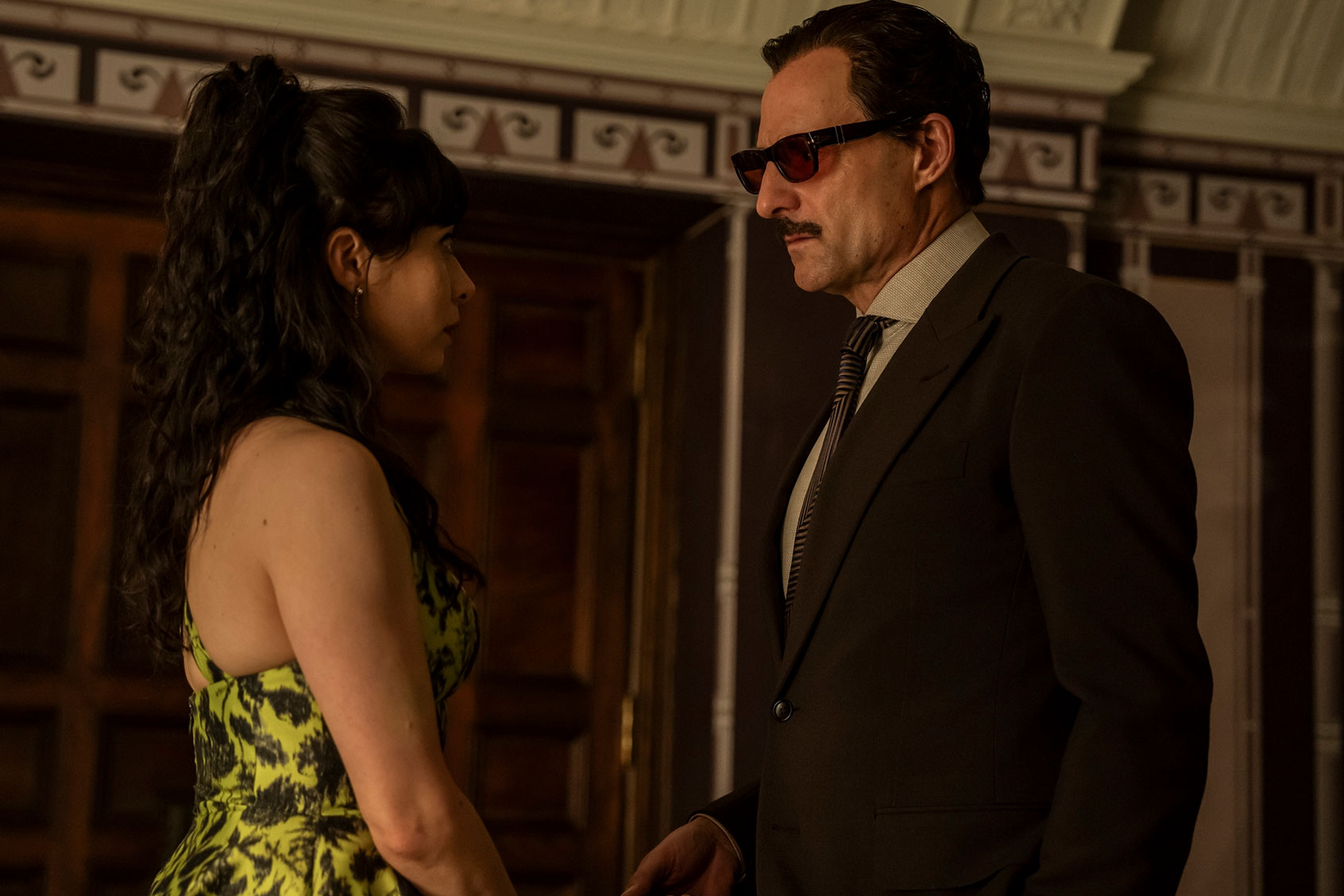
Sofia Falcone was introduced in 1997 in Tim Sale’s “Batman: The Long Halloween,” the text that explains the fall of the Falcone criminal dynasty, the same ground “The Penguin” covers. Her trajectory in those comic books influences her history in “The Penguin,” with one of the main departures being her appearance. 

Sale drew her as unattractive and jagged. The 2021 animated movie adaptation makes her more glamorous, but she’s still a zaftig giantess too heavy for Catwoman to hang onto as she’s dangling off the side of a building. 

“Gotham” introduced a sexier version of the character who, for a while, had a fling with James Gordon. Ergo, against this history Milioti’s physical attributes are entirely pertinent to how we perceive Sofia. The actor’s physique is one easily mistaken for the kind a ruthless heavy could break like a twig or silence by barking some reminder to know her place. The knives in her stare let them see the danger in that cocky misperception.

No matter what Sofia does or doesn’t do, her patriarchal criminal family refuses to afford her the respect she’s due. 

Milioti’s eyes often figure into critical appraisals of her work, which can’t be helped when evaluating someone with such a prominent and expressive feature. 

But it’s the way she employs her gaze in that Last Supper monologue and every moment of “The Penguin” that captures the extraordinariness of a little-known character in the “Batman” universe.

Sofia does not weep. Her eyes redden and her voice breaks with fury she’s earned, but she knows that even before an audience of the condemned, people who readily dismiss her as unhinged and unstable, she cannot appear to be anything less than solid in her resolve. 

In a tense second episode scene, the family’s goons refuse to hand her a gun when she demands it to execute one of the men she thinks has betrayed her. No matter what Sofia does or doesn’t do, her patriarchal criminal family refuses to afford her the respect she’s due – even when she has one, her uncle Johnny Viti (Michael Kelly), chained up for torture. 

Not long before that, Johnny threatens to do in his niece if she doesn’t disappear to Italy. After Sofia’s pulled a Frey mass murder leaving him alone and chained up in his underwear, negotiating for his life, he tries to shame her by saying, “What kind of person kills their own family?” 

You get the logic: Sofia, you see, doesn’t have the right to kill him – but he can kill her. She isn’t an equal in blood or status until it matters to the man trying to save his skin. 

“Daddy is dead,” she tells Oz Cobb over dirty martinis in the first episode, “and we are untamed.”

We need your help to stay independent

“The Penguin” is a window into a dark universe that, in the way of all “Batman” titles, bears plenty of resemblance to the nightmare version of our own. Its Gotham as a right-wing talking point come to life, hollowed out by federal disinvestment and abandoned to the whims of street gangs, mobsters and the benevolent grace of a gazillionaire industrialist named Bruce Wayne. 

The endless malleability of this part of the DC Comic universe is related to knowing that its hero and most of its core rogues’ gallery, even at their most fantastical, are subject to the laws of physics, including socioeconomic gravity.

With “The Penguin,” an outgrowth of Matt Reeves’ vision in 2022 for “The Batman,” series creator Lauren LeFranc overhauls what we know of the villain.

The PenguinCristin Milioti and Mark Strong in "The Penguin" (Macall Polay/HBO)Gone is Burgess Meredith’s pointy-nosed homage to Mr. Monopoly, with his top hat, tuxedo and monocle, replaced by Oz Cobb (Colin Farrell, entirely vanished under a mountain of naturalistic prosthetics), a sweaty street-level striver reminiscent of Tony Soprano, with a similarly unhealthy relationship with his mother, Deirdre O'Connell’s Francis Cobb. 

Bob Kane’s comics styled The Penguin, aka Oswald Cobblepot, as Bruce Wayne in negative – rich, but self-serving and eager to profit off the people’s pain instead of championing them. Where Wayne’s Batman is lithe and graceful, The Penguin is awkward and rotund; while Wayne is charismatic, the Penguin is a weirdo, a quack.

With Sofia, though, LeFranc demonstrates an understanding of an underlying frustration with how these stories depict female characters and a misogynistic culture's shrunken regard for female power. 

We love a villain like Sofia in theory because her outrageous impulses are the realization of every frustrated, angry and entirely sane woman’s darkest thoughts.

Any delight or inspiration Milioti’s gangland empress makes us feel is a natural response to our fatigue at this point in a campaign cycle leading up to an election that will double as a referendum on gender. Less than two weeks from now, we will find out whether Americans are more wedded to their internalized sexism than their democratic principles. 

We can sense where this is all headed, and so do "The Penguin" writers, because it's an old, old story: One of the show’s cleverest nods in direction is in a scene where Oz and his boy wonder Vic (Rhenzy Feliz) watch “Gilda” at his mom’s place and contemplate Rita Hayworth’s steamy rendition of “Put the Blame on Mame.”

“Who’s Mame?” Vic asks. “Don’t matter, kid,” Oz tells him. “That’s the thing. She’s just a scapegoat.”


Want a daily wrap-up of all the news and commentary Salon has to offer? Subscribe to our morning newsletter, Crash Course.


We love a villain like Sofia in theory because her outrageous impulses are the realization of every frustrated, angry and entirely sane woman’s darkest thoughts. She is not overly emotional or crazy; ironically, Arkham Asylum bled those perceived frailties out of her. Sofia is more capable than any of her family’s capos, something they’ll never accept because she doesn’t have a penis. Unlike her irresponsible and erratic-tempered brother, she’s calculating and stoic and knows that regardless of how she dresses or speaks or what she does, she’ll never be rid of that Hangman notoriety.

When Sofia takes her new name, she stands at the head of the table, announces she’s wiped out her family, shoots the last made man in the head when he tries to order her to settle down, and dumps a bag of cash on the table for the mafia’s pawns. Her eyeliner, by the way, has moved to her lower lid to outline her soul’s darkness. That's called the reverse cat’s eye . . . which may be coincidental, who can say?

Every major “Batman” villainess (or anti-heroine, in Catwoman’s case) exists in relationship to men or a specific man. Catwoman and Poison Ivy are held in high esteem because they’re seductresses. Harley Quinn, before her great emancipation, was the ultimate gangster moll existing at and for the pleasure of The Joker. 

Sofia, though, isn’t a diminutive girl or Carmela Soprano. She’s a force propelled by her own will, Arya Stark with Joan Jett’s haircut, a girl who takes her mother’s name and dresses in her armor. “The Penguin” may in name be concerned with the fall of Gotham’s organized crime underworld and Oz Cobb’s rise from a nobody to an immortal antagonist, but it’ll be a long time before Sofia Gigante's legend diminishes in our memory.

New episodes of "The Penguin" stream  at 9 p.m. Sundays on HBO Max.

“Disgruntled former employees”: Vance waves off “fascist” Trump claims in Tapper interview

JD Vance had a pat explanation for the worried remarks of several former Trump administration officials: they're still mad about being fired.

In an interview with CNN's Jake Tapper, Vance said that the multiple rejections of the former president from high-ranking advisers in Trump's first term are the work of "disgruntled former employees."

Vance told Tapper on Saturday that the sour grapes between Trump and figures like former Joint Chiefs of Staff Chair Gen. Mark Milley come down to Donald Trump's supposed commitment to keeping out of foreign entanglements. 

"It’s about policy, it’s not about personality,” Vance said.  They’ll say, well, he’s a dictator when what they really mean is they won’t listen… when they wanted him to start ridiculous conflicts."

Both Milley and former White House Chief of Staff John Kelly have characterized Trump as a fascist in recent days. Kelly also shared a troubling story in which he says Trump wished for "the kind of generals Hitler had." 

Tapper pressed Vance on the topic, wondering if the Ohio senator really believed Trump's Vice President Mike Pence declined to endorse his one-time ally because of an unwillingness to go to war. 

"Absolutely, that’s my argument,” Vance said, adding that other grousing was just resentment for being fired by Trump. 

It's worth nothing that Milley and Pence were not fired by Trump. Still, they've all worried openly about the prospect of a second term from a president who has threatened to turn the military on "enemies from within."

Vance balked at the idea that Trump meant his political opponents or citizens who disagree with him, in spite of his repeated use of the ominous phrase to refer directly to Democratic Party leaders like Adam Schiff and Nancy Pelosi.


 "He said he was going to send the military after the American people? Show me that quote where he said that." Vance asked.

Watch the full interview below:

With recalls on the rise, parents grapple with new anxieties around food safety

In the recent months, food recall alerts have started to feel like an increasingly common occurrence. This week, Treehouse Foods Inc., announced it was voluntarily recalling more than 600 varieties of frozen waffles — which were sold under various brand names, including Gather & Good, Kodiak Cakes and Great Value — due to the possibility of listeria contamination. 

Then last week, an ongoing listeria recall was reissued to include an additional nearly 2 million pounds of ready-to-eat meat and poultry items that may be contaminated, raising the recall to a total of nearly 12 million pounds of product. As Salon reported, the recalled foods, produced by the Oklahoma-based company BrucePac, were sold at major retailers nationwide, including Trader Joe's, Walmart, Aldi, Target, H-E-B, Giant Eagle and Kroger

Amid the recall alert, the U.S. Department of Agriculture's Food Safety and Inspection Service (FSIS) also specified that some of the potentially tainted products had been distributed to schools nationwide. 

This series of alarming food recalls has left many parents grappling with a growing sense of unease. Each notification serves as a stark reminder that the meals they prepare for their children — once deemed safe — can suddenly become potential sources of harm, as can school breakfasts and lunches. While food safety experts stress that the recall system functions primarily as a precaution, with only a small fraction of recalled products causing illness, the reality is that parents often bear the emotional toll of these alerts.

However, health and legal experts say there are also steps parents can take to feel more in control of their family’s food safety. 

Amie Alexander, a registered dietitian at Nutri Peak, said first and foremost, consumers shouldn’t feel like they have to panic whenever news of a recall hits the headlines. 

“It's overwhelming to think that something as straightforward as the food you're packing for your kids, something you expect to be safe and healthy, could make them sick,” Alexander said. “However, while serious, it's important to remember that the recall system exists as a precaution for consumers.” 

For example, it made headlines when, in June, it was reported that the Food and Drug Administration had already “removed over 100 food and beverage products from the market deemed in ‘violation’ of agency regulations.” 

It seems like a staggering number of recalls, but according to data reviewed by Newsweek, among the 108 food and beverage products recalled by the FDA from January to May, only eight caused “harm or disease to at least one consumer.” 

During the same time period last year, eight food and beverage products again—but out of only 98 recalled—were linked to illness or negative effects. 

Alexander continued: “Often, potential hazards are caught well in advance of anyone falling ill.” 

That said, for busy parents, even simply having to monitor the USDA and FDA for recall alerts can start to feel daunting. After all, there is already a lot of unseen labor involved in feeding a family, from the juggling act that is meal planning to accommodate for different tastes and needs to grocery shopping. Statistics also show, these tasks primarily fall to mothers. 

We need your help to stay independent

According to a 2019 time-use survey sponsored by the Bureau of Labor Statistics (BLS), in households with both female and male household leads and one or more children under the age of 18, “80% of mothers say they are the household member who usually prepares the meals.” 

That’s the same as the share who say they are the primary grocery shopper, according to a Pew Research Center analysis.

“For mothers specifically, it’s more of the emotional labor we have to take on because the vast majority of us —not me, though — are ‘food people,’” said Margaret Quinlan, a researcher at the University of North Carolina who studies the intersection between parenting and health. “We monitor what we don’t have, buy groceries, keep up with the kids' tastes and safe foods, etcetera.” 

According to Quinlan, children, particularly those with pre-existing medical conditions that lead to school absences, can face disciplinary actions at the district level if they become ill from food items — another stress that parents don’t need. 

“In my research partner's kids' school, they can lose their magnet spot if they are absent too much. My kids could be retained for missing too much school,” she explained. “Parents don’t need to worry about dealing with other bureaucracies because corporations can’t be bothered to follow the rules. They can afford to pay to make the problem disappear, but parents might have to do more to deal with it.” 

Quinlan continued: “It is stressful and I feel like a Victorian before food regulations and inspections.” 

Sylvia Smith, a relationship and parenting expert at Marriage.com, echoed Quinlan’s sentiments. 

“With each notification of yet another recall — whether it's contaminated prepackaged lunches or potentially unsafe food on the cafeteria menu — your alarm goes through the roof,” Smith wrote via email. “Food safety is one of those things that, as a parent, you just can't compromise on; and when recalls happen, sometimes it feels like the situation is beyond your control.” 

"It is stressful and I feel like a Victorian before food regulations and inspections."

The key, she said, lies in trying to balance vigilance with a pragmatic approach. 

“Recalls are usually issued as a precautionary measure, meaning there is a good chance the food in question may not have harmed anyone,” Smith said. “I do think it's important for parents to stay educated about potential risks by keeping an eye on official recall alerts from agencies like the FDA or USDA. The ways of dealing with it are the introduction of a food safety system in your home, like regularly checking product codes or batch numbers that will help you manage the stress and not be overwhelmed.” 

For parents who still find themselves weary from news of another recall, Smith said it may be time to rethink their approach to shopping for some grocery items. 

“On a practical level, you may limit your reliance on highly processed foods that are more likely to figure in a widespread recall,” Smith said. “I also encourage you to get to know local vendors or farmers who can help you feel more secure about the food you're serving.” 

It’s sensible advice, but Quinlan points out that some of it may not be realistic for every family, especially in the short-term. “There is judgment for parents who send their kids in with processed foods, but I have a picky eater, and if his safe foods are not safe, that is an issue for our family,” she said.

On a broader scale, many parents' anxieties about the recent surge in recalls stem from a sense of powerlessness when it comes to holding corporations — especially repeat offenders — accountable.. But Oliver Morrisey, the owner and director of Empower Wills & Estate Lawyers, believes that parents actually have more power in these situations than they realize.

"The goal here is to make sure that safety measures are strengthened across the board so that these recalls don’t become such a regular occurrence."

“Let’s talk about class action lawsuits for a second,” Morissey wrote via email. “If you’re seeing recalls from the same company or supplier repeatedly, it’s worth considering whether there’s negligence at play. Parents can come together to file a class action lawsuit, which is a way to hold these companies accountable on a larger scale.” 

According to Morissey, the idea is that if enough people take action together, it’s not just about compensating for any harm already done as a result of the recalled food, but about forcing companies to improve their safety measures. 

“It’s more than just reacting to recalls,” he continued. “It’s about preventing future ones by making it clear that these lapses aren’t acceptable. This kind of collective legal action is incredibly powerful and often pushes companies to address issues they might otherwise ignore.” 

Parents can also advocate for stricter oversight of the food provided to schools and other institutions that serve children. They can campaign for mandatory and more frequent food inspections, as well as push for harsher penalties for companies that fail to meet safety standards.

“This doesn’t have to be done individually,” Morissey wrote. “You can collaborate with other parents and legal experts to make a case to local governments or school boards. The goal here is to make sure that safety measures are strengthened across the board so that these recalls don’t become such a regular occurrence.” 

Does the president control the economy?

About 50% of Americans believe that the winner of the presidential election will affect their own finances, a recent survey from fintech company Empower found. And while the president can do a lot of things on their own — like invade a country or declare a state of emergency — their effect on the economy and the stock market is more nuanced. 

The economy isn’t just one thing — it’s influenced by multiple different factors and components.

Here’s what the presidential candidates have said about the following topics that could affect American's finances:

Tariffs 

One common political refrain is that the president can’t do anything without the support of Congress. And while that’s often true, there is a notable exception: tariffs.

A tariff is a tax on an imported good from another country, and federal law allows a president to impose them without Congress’ approval. Former President Donald Trump, who imposed several rounds of tariffs during his term, has said he will increase rates to stimulate American manufacturing, including a 60% tariff on all goods from China.

“This could be very harmful to the economy and would have a negative impact on the stock market,” said David Kass, clinical professor of finance at the Robert H. Smith School of Business at the University of Maryland.

When a country increases tariff rates, the cost difference is usually passed on to the consumer. This means higher prices for anything not made in America — which means most things.

“You're going to be poorer because everything you buy is going to be more expensive,” said Nicholas Creel, assistant professor of business law at Georgia College & State University.

Tax cuts

Major changes in the tax code await the next president, who will need support from Congress to make their plans a reality. Some cuts enacted by Trump in 2017 are set to end next year. 

Trump says he wants to cut taxes again, with most of the benefits going to corporations and those outside the middle class.

“His economic tax plan would be a significant boon to the wealth of the top 5%,” Creel said. “Pretty much everybody else is not going to be better off in the short term, and almost everybody would be worse off in the long term.”

Vice President Kamala Harris may meet resistance with her proposal to keep the 2017 tax cuts for people earning up to $400,000 per year and raise rates for people who earn more. 

We need your help to stay independent

Student loans 

Can a president cancel student loan debt? In 2023, the Supreme Court struck down President Joe Biden's initiative to cancel debt for 40 million borrowers, saying the plan needed approval from Congress. 

Trump has repeatedly said he wants to reduce spending on education, including less funding toward student loan relief programs. Harris is expected to continue efforts she and Biden have made to lower student loan debt, but analysts don't anticipate quick results.

“Any and all progress that has occurred would halt immediately under a Trump administration,” Creel said. “Under a Harris administration, it would trudge along. They’re still finding these piecemeal ways to go about it.”

Small businesses

Harris and Trump's proposals to help businesses would also need a friendly Congress. 

Harris wants to encourage people to start businesses and plans to offer a $50,000 tax credit for new business owners — a huge bump from the current $5,000 tax credit. This may make it easier for small businesses to succeed, especially those without family backing or other support.

“Success rates should go up rather significantly for small businesses,” Creel said. 

For larger businesses, Trump wants to offer additional tax cuts — possibly decreasing the corporate tax rate to 15%. He plans to pay for the cut by raising tariffs. 

Kass said many Wall Street experts believe that a Harris administration — with higher corporate tax rates — will hurt companies. Because company profits are likely to decrease due to higher tax rates, stocks may take a tumble.

Wall Street seems to prefer a divided government — with one party in charge of the presidency and the other in charge of Congress.

That's one reason why Kass says Wall Street seems to prefer a divided government — with one party in charge of the presidency and the other in charge of Congress. 

“That seems to be almost the consensus coming out of Wall Street,” Kass said.

Congressional races matter

While it’s important to look at a president's policies and budgets, it’s also crucial to remember another important factor: which party takes the House and Senate.

“Much of the power that the president will have will depend on who controls Congress,” Kass said.

If Harris wins but has a Republican House and Senate, it will be hard for her to pass many of her ideas. The same would be true for Trump with a Democratic Congress. 

Some people love to scare themselves in an already scary world

Fall for me as a teenager meant football games, homecoming dresses – and haunted houses. My friends organized group trips to the local fairground, where barn sheds were turned into halls of horror, and masked men nipped at our ankles with (chainless) chain saws as we waited in line, anticipating deeper frights to come once we were inside.

I’m not the only one who loves a good scare. Halloween attractions company America Haunts estimates Americans are spending upward of US$500 million annually on haunted house entrance fees simply for the privilege of being frightened. And lots of fright fans don’t limit their horror entertainment to spooky season, gorging horror movies, shows and books all year long.

To some people, this preoccupation with horror can seem tone deaf. School shootings, child abuse, war – the list of real-life horrors is endless. Why seek manufactured fear for entertainment when the world offers real terror in such large quantities?

As a developmental psychologist who writes dark thrillers on the side, I find the intersection of psychology and fear intriguing. To explain what drives this fascination with fear, I point to the theory that emotions evolved as a universal experience in humans because they help us survive. Creating fear in otherwise safe lives can be enjoyable – and is a way for people to practice and prepare for real-life dangers.

Fear can feel good

Controlled fear experiences – where you can click your remote, close the book, or walk out of the haunted house whenever you want – offer the physiological high that fear triggers, without any real risk.

When you perceive yourself under threat, adrenaline surges in your body and the evolutionary fight-or-flight response is activated. Your heart rate increases, you breathe deeper and faster, and your blood pressure goes up. Your body is preparing to defend itself against the danger or get away as fast as possible.

This physical reaction is crucial when facing a real threat. When experiencing controlled fear – like jump scares in a zombie TV show – you get to enjoy this energized sensation, similar to a runner’s high, without any risks. And then, once the threat is dealt with, your body releases the neurotransmitter dopamine, which provides sensations of pleasure and relief.

In one study, researchers found that people who visited a high-intensity haunted house as a controlled fear experience displayed less brain activity in response to stimuli and less anxiety post-exposure. This finding suggests that exposing yourself to horror films, scary stories or suspenseful video games can actually calm you afterward. The effect might also explain why my husband and I choose to relax by watching zombie shows after a busy day at work.

The ties that bind

An essential motivation for human beings is the sense of belonging to a social group. According to the surgeon general, Americans who miss those connections are caught up in an epidemic of loneliness, which leaves people at risk for mental and physical health issues.

Going through intense fear experiences together strengthens the bonds between individuals. Good examples include veterans who served together in combat, survivors of natural disasters, and the “families” created in groups of first responders.

I’m a volunteer firefighter, and the unique connection created through sharing intense threats, such as entering a burning building together, manifests in deep emotional bonds with my colleagues. After a significant fire call, we often note the improved morale and camaraderie of the firehouse. I feel a flood of positive emotions anytime I think of my firefighting partners, even when the events occurred months or years ago.

Controlled fear experiences artificially create similar opportunities for bonding. Exposure to stress triggers not only the fight-or-flight response, but in many situations it also initiates what psychologists call the “tend-and-befriend” system. A perceived threat prompts humans to tend to offspring and create social-emotional bonds for protection and comfort. This system is largely regulated by the so-called “love hormone” oxytocin.

The tend-and-befriend reaction is particularly likely when you experience stress around others with whom you have already established positive social connections. When you encounter stressors within your social network, your oxytocin levels rise to initiate social coping strategies. As a result, when you navigate a recreational fear experience like a haunted house with friends, you are setting the emotional stage to feel bonded with the people beside you.

Sitting in the dark with friends while you watch a scary movie or navigating a haunted corn maze with a date is good for your health, in that it helps you strengthen those social connections.

An ounce of prevention = a pound of cure

Controlled fear experiences can also be a way for you to prepare for the worst. Think of the early days of the COVID-19 pandemic, when the films “Contagion” and “Outbreaktrended on streaming platforms as people around the world sheltered at home. By watching threat scenarios play out in controlled ways through media, you can learn about your fears and emotionally prepare for future threats.

For example, researchers at Aarhus University’s Recreational Fear Lab in Denmark demonstrated in one study that people who regularly consumed horror media were more psychologically resilient during the COVID-19 pandemic than nonhorror fans. The scientists suggest that this resilience might be a result of a kind of training these fans went through – they practiced coping with the fear and anxiety provoked by their preferred form of entertainment. As a result, they were better prepared to manage the real fear triggered by the pandemic.

When I’m not teaching, I’m an avid reader of crime fiction. I also write psychological thrillers under the pen name Sarah K. Stephens. As both a reader and writer, I notice similar themes in the books I am drawn to, all of which tie into my own deep-rooted fears: mothers who fail their children somehow, women manipulated into subservience, lots of misogynist antagonists.

I enjoy writing and reading about my fears – and seeing the bad guys get their just desserts in the end – because it offers a way for me to control the story. Consuming these narratives lets me mentally rehearse how I would handle these kinds of circumstances if any were to manifest in my real life.

Survive and thrive

In the case of controlled fear experiences, scaring yourself is a pivotal technique to help you survive and adapt in a frightening world. By eliciting powerful, positive emotions, strengthening social networks and preparing you for your worst fears, you’re better able to embrace each day to its fullest.

So the next time you’re choosing between an upbeat comedy and a creepy thriller for your movie night, pick the dark side – it’s good for your health.The Conversation

Sarah Kollat, Teaching Professor of Psychology, Penn State

This article is republished from The Conversation under a Creative Commons license. Read the original article.

Kamala Harris’ real problem: Who are the Democrats, anyway?

To accuse Kamala Harris’ campaign of reflexively repeating the mistakes of Hillary Clinton’s 2016 campaign — as Jacobin’s Branko Marcetic did recently — may sound like drive-by leftist snark, carrying an unfortunate (and presumably unintended) undertone of sexism. But it also reflects a deeper and broader anxiety felt across the liberal-progressive spectrum: Polls are dead even, 10 days before what has been billed (fairly or not) as a world-historical presidential election. After the sugar-high of the Biden-to-Harris switch and the exhilaration of the Democratic convention, this is a difficult future to face.

Among the media and political classes, the operating assumption at the moment is that Donald Trump — by any normative standard, a disastrously undisciplined and erratic candidate — is likely to win that election, even without resorting to skulduggery or mob violence. That “gut feeling” has zero predictive value, to be clear, and may be nothing more than lingering PTSD from 2016. 

But liberal stress and bewilderment presumably isn't improved by seeing Democrats doing exactly what they always do in the latter stages of a national campaign: skewing sharply rightward to emphasize a commitment to national security and corporate profits, in the supposed pursuit of “persuadable” independents and wavering Republicans. (Or perhaps just in pursuit of the donor class, which is not technically the same thing.)

We have seen Harris out herself as a gun owner in a sit-down with Oprah, embrace Wall Street-friendly economic policies and campaign with former Republican congresswoman Liz Cheney, who supported literally every aspect of the Trump agenda before his overt attempt to subvert the 2020 election. All of this, of course, reflects conventional wisdom as imparted by highly-paid consultants, and it's not inherently illogical: Chiseling away even a handful of conservative voters who don’t much like Trump, but are reluctant to vote for someone they’ve been told is a radical socialist Black lady who wants to turn everyone trans, could make a crucial difference in several of the most important states. 

if the Harris campaign’s last-ditch Liz Cheney triangulation doesn’t work, and the underlying political and ideological assumptions of the Beltway’s elite caste are once again revealed as fatally flawed, the consequences will be ugly.

The leftist response is also logical, on its own terms: Democrats have tried this before, hamster-wheel style, without conclusively defeating the increasingly fash-flavored right. So maybe it’s time to stop doing the same thing that doesn't work over and over again — admittedly a radical notion — and try something else instead, such as leaning into broadly popular social-democratic policies on health care, taxation, student debt and green-energy transition, and hoping to win elections by driving high turnout among younger voters, people of color, LGBTQ voters and so on. (Let’s not get into canceling the blank check issued to Benjamin Netanyahu — but sure, maybe that too.)

I’m personally sympathetic to that road-not-taken argument, but to recycle another of the Democratic Party’s quadrennial hamster-wheel themes, none of that matters in the face of an existential emergency. In any case, nothing about the party’s exhausting, alarmist messaging or its murky self-image is going to change dramatically in the last week before a do-or-die national election. 

We need your help to stay independent

There are signs that the Harris campaign intends to go hard on abortion rights in the final days — a potentially decisive wedge issue — alongside the Cheney pivot and the strategic decision to directly label Trump with the F-word. But minor tactical adjustments in late October are hardly the point. The Democratic Party is what it is, a fundamentally unstable coalition of affluent metropolitan white folks and working-class people of color, whose interests are beginning to pull them in different directions. 

Right now the paramount question — for many people, understandably enough, it’s the only question — is whether the Democrats’ campaign strategy will work this time around, or at least work a little better than it did eight years ago. Lest we forget, Hillary Clinton got 2.8 million more votes than Donald Trump did in 2016, but the distribution of those votes turned out to be an insurmountable problem: If we subtract California, Illinois, Massachusetts and New York from the overall total, Trump won the rest of the country by 5 million votes.

Most of us in this business have been cured of making confident predictions based on “how things work,” because these days nothing works the way it used to, or works at all. Time runs in flat circles, scientific research has been subjugated to “doing your own research” and a presidential candidate can tell the nation, on live TV, that immigrants are eating their pets without suffering significant political damage. Neither you nor I nor anyone else has the slightest idea whether the Harris campaign’s scramble for the patriotic middle ground will reel in the potentially decisive electoral votes of Michigan or Arizona or North Carolina. (It’s safe to say that whichever candidate can win two of those three states is overwhelmingly likely to be the next president.)

But here's one thing I do know: Don't count on the confident pronouncements of supposedly hardheaded insiders whose Realpolitik bibles have been through the washing machine too many times. I read James Carville’s New York Times op-ed predicting a Harris victory this past week and felt a dim but distinct longing, somewhere inside, for a vanished world of reassuring wisdom. Then I felt a much deeper longing — a longing to spend the next two weeks drinking whiskey and watching old movies, because that guy hasn’t backed a winning Democrat in this century. If that wasn't the kiss of death, it was an awfully good simulation. 


Want a daily wrap-up of all the news and commentary Salon has to offer? Subscribe to our morning newsletter, Crash Course.


And one more thing I know for sure is that if the Harris campaign’s last-ditch Liz Cheney triangulation doesn’t work, and the underlying political and ideological assumptions of the Beltway’s elite caste are once again revealed as fatally flawed, the consequences will be ugly — for the Democratic Party, for the future of our so-called democracy and for the trajectory of the entire world in this century.

Not just because Donald Trump will win the election and become president, although that's bad enough. But because of how that happened and under what circumstances — and because the only American political party that pretends to stand for constitutional democracy, rational government and broader equality will once again blame its own voters, or the Russians, or the ignorance and bigotry of people it views with contempt, for the catastrophic consequences of its own incoherence and uncertainty, and for the fact that it could not prevent the entire system it claims to cherish from collapsing into clownish anarchy.

Trump’s main selling point turns toxic: Mass deportation is a polling loser

As we head into the final stretch of the cycle, Donald Trump, who has made his entire candidacy a referendum on immigration, will not discuss his mass deportation plans in detail—not in a recent Univision town hall nor his one debate with Kamala Harris. That’s a tell.

Since those debates, Trump has only leaned deeper into mass deportations, while Harris has aggressively made her case about how she will help Latinos economically, a telling reset to reach Latino voters in the final weeks of the election.

Trump knows that explaining what mass deportations entail would be a disaster for him. Yes, some polls show an alarming rise in support for mass deportations. However, when voters are made aware of how much it costs and the human toll it would take in terms of family separations and the removal of decades-long residents, mass deportation becomes politically toxic.

Mass deportations would be ugly; they would require local law enforcement to work with federal law enforcement to remove law-abiding residents, many of whom have woven their lives and livelihoods into the fabric of their communities. It would separate mixed-status families, leaving children who have been here their whole lives without their parents. We are still dealing with the aftermath of the last time the Trump administration separated families at our southern border—one of the ugliest moments in the modern history of our country. 

We need your help to stay independent

We must bring this story to life for voters: new research from Valiente Action Fund found that hard negative ads against Trump, showing how his policies would separate families, could increase support for Kamala Harris with a broad swath of voters, including men, white, black, Latino, liberal, Moderate-Liberal, and Moderate voters. That’s a compelling clean sweep that shores up the softer parts of the Democratic coalition while also improving Harris’s chances with suburban swing voters. 

"We have to tell that story and not let Trump define immigration for our country," Valiente Action Fund executive director Maria Rodriguez said. "When we identify the specifics of what Trump is proposing with mass deportations, as was done in the ad Playbook 2025, and tell the story of what he is planning on doing on immigration, it moves voters."  

Beyond the human cost, mass deportation would also have catastrophic economic costs. Not only would mass deportations not lower costs for average households, but they could potentially lead to raising taxes for most Americans. According to the nonpartisan American Immigration Council:

A mass deportation of 1 million people per year could cost $88 billion annually. It would require an unprecedented ramp-up of law enforcement staffing, detention capacity, immigration courtrooms, and flight capacity.

That amount of money does not currently exist in the federal budget. So to fund such a sweeping effort, Trump would likely have to either raise taxes on American households or possibly steal the funds from other social services coffers, such as Social Security or Medicare.


Want a daily wrap-up of all the news and commentary Salon has to offer? Subscribe to our morning newsletter, Crash Course.


Ironically, on the economy—the issue Trump purports would benefit from his mass deportation plan—Kamala Harris has a remarkable success story, with record-high job creation, small business growth, and healthcare coverage for Latinos. And what she plans to do in her first term as president is even more impressive.

Harris proposes creating opportunities for Latinos in the workforce through training programs, including doubling registered apprenticeships and eliminating unnecessary college degree requirements, which would benefit some 2 million workers. She supports veterans' readiness and employment programs. She will allow registered apprentices and construction workers to write off their tools and equipment expenses—a crucial savings for contractors and small business owners as they work to replenish the country’s housing stock and upgrade our aging infrastructure.

These are all actual economic policies that would help Latinos and the country, not fascist fantasies of mass deportations. 

If elected, Trump will slap tariffs on everything from food to gasoline, raising costs on the average Latino family by nearly $4,000. Cut support for Latino small businesses to give big tax breaks to his corporate buddies—gut the Affordable Care Act, Medicare, Medicaid, and Social Security, as well as separate families. 

On that last point, mass deportation, at its core, is not just politically toxic, it is wrong. Americans have fought in wars to stop these policies from being implemented, and we must help them remember the values that are foundational to our country. It helps that Trump’s fascist plan also cuts against our country’s economic interests. Voters can stop this from happening, but only if we show up and vote in November.

Palestinians can’t afford a protest vote: Muslim and Arab American voters must make their choice

With the struggles of Arab and Muslim people in sharp focus this year, we have a historic opportunity to exert political leverage over the U.S. presidential election. Some may understandably be reluctant to throw their support behind Kamala Harris out of sheer frustration and anger over the war on Gaza, and now Lebanon. But it must be clearly stated that electing Donald Trump would usher in a new era of racism and Islamaphobia in the U.S. while giving Benjamin Netanyahu a blank check to continue the war.

The killings are being investigated by the International Court of Justice as genocide. While living through this pain and dark moment in history, we must be clear-eyed about the choice in front of us. Only Donald Trump or Kamala Harris will become president. Our safety and the safety of our brothers and sisters in Palestine, Lebanon, and across the Middle East is on the line.  We must join in protecting the world against the clear and present danger of a second Trump presidency. 

Despite the immense pain and frustration our communities are experiencing, we have to support  Kamala Harris to advance our anti-war goals and prevent even worse policies at home and abroad. 

This year, Trump has increasingly demonized Arabs and Muslims through inflammatory rhetoric. He is now weaponizing our very identity, using "Palestinian" as a slur to mock and dismiss critics — including Senate Majority Leader Chuck Schumer — who dared to question Israel's unlimited right to bulldoze towns and cities and kill civilians. But it hardly needs to be said that Trump's antipathy toward Muslims is not new: his first term was a reign of white nationalism and Islamophobia.

The state-sanctioned discrimination of Trump's Muslim ban emboldened anti-Muslim rhetoric across the country, drove a sharp rise in anti-Muslim hate crimes, and stoked fear within our communities. Trump has committed to restoring and expanding the ban if elected to a second term. He proposed banning refugee resettlement. If elected, Trump’s Project 2025 agenda would dramatically roll back religious freedom and impose his dangerous Christian nationalist views on the rule of law.

We need your help to stay independent

A second Trump administration could end basic civil rights protections for Muslim and Arab people in America. Trump has already promised to deport people who support  Palestinian rights. His former ambassador to Israel, David Friedman, recently proposed that U.S. aid earmarked to help Palestinians should instead be redirected to fund Israel's annexation of the West Bank, ending Palestinian government on Palestinian land. Trump's open embrace of far-right donors who consider Israel untouchable, and powerful interest groups like AIPAC that hurl racist attacks, would mean catastrophic consequences if he wins.

And Trump's foreign policy in the Middle East was extremely harmful for people living in Arab and Muslim-majority countries. His decision to arbitrarily withdraw from the Iran nuclear deal was reckless. His support for the war in Yemen, without the consent of Congress, contributed to one of the worst humanitarian crises in recent history. He slashed U.S. refugee admissions to historic lows, stranding families attempting to escape danger in places like Syria and Iraq.

With fundamental democratic values in danger around the world, supporting Jill Stein or "abandoning Harris" is a decision many of us will come to regret. We cannot afford to sit this election out or exercise our vote for someone who will not win. If we do, we are giving our power away and getting nothing in return. Every vote for a third party will help deliver the presidency to Trump. Voting for Kamala Harris is the only way to keep Trump from returning to the White House.


Want a daily wrap-up of all the news and commentary Salon has to offer? Subscribe to our morning newsletter, Crash Course.


Harris has repeatedly called for a ceasefire in Gaza and expressed support for a two-state solution in resolving the violence against Palestinians. In August, she endorsed the rights of the Palestinian people, stating that they had "dignity, security, freedom and self-determination." Will she need to do more if elected president? Absolutely. 

Now, consider the alternative: A xenophobic Trump administration staffed with people who have vowed to lead mass deportation sweeps and make legal immigration almost impossible – openly aiming to exclude Muslims from the country and require Muslim Americans and their families to register as enemy aliens.

As a first-generation Arab and Muslim American, I understand that many of us are reluctant to support a candidate whose current administration is providing unconditional military support to a radical right-wing Israeli government. The question before us, however, is which candidate gives us the best path forward toward achieving our anti-war objectives while protecting our fundamental rights and freedoms. Given that the alternative this year is an angry, unhinged man who has been captured by the most appalling extremists in our society, the choice is clear: we must work to ensure Harris wins.

Unclaimed dead bodies are often “donated” to science — but it’s not always consensual

Working with cadavers in an anatomy lab is often a humbling and monumental moment in a doctor’s career. Students spend hours toiling over dead bodies with gratitude and reverence for the donation that allows them to practice and learn about human anatomy in their journey to become healers. Only, sometimes, these cadavers are not truly donated — and the dead person never consented to have their body dismembered.

When a dead person’s next of kin cannot be located or their family cannot afford a funeral, the responsibility of what to do with the remains falls to the state or county. In these cases, unclaimed bodies are sometimes sent to and accepted by medical schools, but several experts in the field object to the practice, raising ethical concerns that these people never consented to being dissected in life.

Writing in the New England Journal of Medicine in 2020, one medical student shared her experience finding out that her first patient was in fact an unclaimed body after she had already sliced into him with a scalpel. 

“I still grapple with the guilt of having dissected a man who may have wanted to rest in peace,” she wrote.

"The use of somebody's body, even after their death, without their consent is in tension with many of our commonly accepted norms of best ethical practices in medicine."

There is no central database to count how many unclaimed dead bodies are reported each year nationally, and practices vary depending on the state or county in question. Some states — including Hawaii, Minnesota, Vermont, Rhode Island, and New York — have prohibited the use of unclaimed bodies in medical education. But schools in other states continue to use them. In Texas, the proportion of unclaimed bodies accepted by medical schools increased from 2% to 14% between 2017 and 2021, according to a 2023 study in JAMA.

Eli Shupe, a medical ethicist at the University of Texas at Arlington and the author of the paper, said she was shocked to learn about this practice.

“The use of somebody's body, even after their death, without their consent is in tension with many of our commonly accepted norms of best ethical practices in medicine,” Shupe told Salon in a phone interview. 

Many in the field are concerned that medical institutions who are using unclaimed bodies are violating the deceased's fundamental right to consent. Furthermore, without being able to identify any of their relatives, there is no way for those doing the dissecting to know if the person came from a religious background or had spiritual beliefs that directly contradicted or prohibited body donation, said Joy Y. Balta, chair of the Human Body Donation Committee at the American Association for Anatomy (AAA).


Want more health and science stories in your inbox? Subscribe to Salon's weekly newsletter Lab Notes.


“Body donation is a noble, selfless gift, and an individual themselves makes that decision,” Balta told Salon in a phone interview. “It's not something that someone else enforces on them.”

In addition to the ethical concerns that affect the unclaimed individuals directly, this practice also harms families, Shupe said, citing a recent NBC investigation that found unclaimed bodies were not only sent to the North Texas Health Science Center without a family’s consent but sold to various other institutions for training purposes. Some families were still looking for their deceased relatives when the outlet contacted them for the story.

“In some cases, the deceased have next of kin who weren't located, either because they were very hard to find, or because whoever was responsible for finding them did a poor job or was negligent,” Shupe said. “Sometimes relatives emerge later and they learn that a loved one's remains have been donated without their knowledge, and this can and has caused really serious emotional distress.”

"This can and has caused really serious emotional distress."

Many programs have curbed the practice in recent years. In 2007, for example, Oregon stopped taking unclaimed bodies after a dead man’s sister and friends — who were not notified of his death and never consented to donating his body to the institution — tracked down his body at Oregon Health Sciences University. In Texas, the county subject to the NBC investigation changed its policy to provide burial or cremation for unclaimed bodies. The North Texas Health Science Center told Salon in an email that it has stopped using unclaimed bodies in its programs.

Still, other data suggests the practice continues to occur in various institutions across the country. In a 2018 study published in the journal of Anatomical Sciences Education, 12% of 146 medical schools who responded to a survey said they used unclaimed bodies in medical education, with many of the people who ran the programs reporting that they were neutral on the question of whether it was important to tell students about the origins of the body, said study author Dr. Matthew DeCamp, a general internist at John Hopkins University.

“We certainly observed in our research the full spectrum,” DeCamp told Salon in a phone interview. “Everything from institutions who knew they were using unclaimed bodies and decided not to tell students at all, to institutions that used it as a learning opportunity to help students develop what we would call their professional identity formation and … learn about social justice and inequalities in our country.”

The use of unclaimed bodies in medical schools was legalized in the 1800s as an attempt to stop grave robbing, where so-called “resurrectionists” dug up dead bodies and sold them to schools. However, some have argued this simply created a new pathway for medical schools to continue using bodies from disenfranchised communities.

There is not much research on the demographics of the unclaimed, but one 2020 study looking at trends in Los Angeles County found that they were more likely to be poor, unemployed, male and Black. Yet people of color are less likely to consensually donate their bodies to medical schools. This could be in part because medical institutions have a long and fraught history of exploiting Black bodies to “advance” science, from the Tuskegee syphilis study to the doctor who was once known as the “Father of Gynecology” practicing experimental medical procedures on enslaved Black women.

“If we know that unclaimed bodies are from a majority of people of color, and we know that very few people of color donate their bodies or want to donate their bodies, this is more of a reason for us not to send unclaimed bodies, especially from people of color, to be dissected,” Balta told Salon in a phone interview.

Many institutions justify the use of unclaimed bodies by saying they are necessary to fill the need for cadavers in a shortage, according to a brief on this topic from the American Medical Association released in May.

However, while some localities have reported not having enough donors to meet the needs of their medical institutions, others have reported more than enough. For-profit body brokers even collect enough bodies to ship thousands of body parts internationally each year. This industry does require consent, though family members have reported not being aware of the extreme distances the deceased would travel or what their bodies would be put through. Some family members, for example, have reported donating their loved ones' bodies to these body brokers thinking they will be used by medical institutions and they are instead sent to the U.S. Army to test explosives.

“This is where the lack of oversight is an issue, because if there was an entity that oversees this, then there could be a bank of donors, and individuals could be sent from one county to the other, or from one state to the other, rather than having to go outside of those ethical practices,” Balta said.

Apart from the Uniform Anatomical Gift Act passed in 1968, federal legislation regulating what is done with unclaimed bodies is lacking, said Thomas Champney, an anatomy professor at the University of Miami Miller School of Medicine. In the states that do not regulate unclaimed bodies, it is simply up to the institution and the county to decide what to do with them.

“I really would like there to be some federal legislation that would say that all unclaimed individuals' data need to be uploaded into a national database, where families could search to find their loved ones,” Champney told Salon in a phone interview. “But at present, there's little regulation and really no laws.”

Other countries have more centralized mechanisms of regulating unclaimed individuals, Balta said. In the U.K., for example, the HM Inspector of Anatomy has the authority to shut down programs if they do not follow federal regulations for body donation. 

The AAA created a task force to establish best practices in body donation in 2019, which Balta said should be published before the end of the year.

“We specifically say [in the guidelines] that body donation programs should not accept unclaimed or unidentified individuals into their programs as a matter of justice,” Balta said. 

We need your help to stay independent

Even next-of-kin who do choose to donate their deceased loved ones to medical schools might not be doing it out of a desire to further science. One 2022 study found the process of signing up for body donation is highly variable across the country, with many places that receive donors not informing families of all that the process entails. Unfortunately for some families, it might be the only affordable option to handle their kin’s remains, said Lauren K. Bagian, a body donation researcher at the Georgetown University School of Medicine.

“They may just be donating, because, as part of the donation, most of the time institutions will cover the costs of embalming, funeral expenses, preparation of the death certificate, or transportation of the body, which can be thousands of dollars,” Bagian told Salon in a phone interview. “That’s another interesting ethical question: Are we accepting these donations from next of kin even though they might be financially motivated when we are not requiring proof that this is what the individual might have wanted?”

For the county or state handling the remains, it’s cheaper to donate the body to science, too. Each burial or cremation can cost thousands of dollars, and the new policy in a single Texas county, for example, will cost it $675,000 a year. That, Shupe said, is the price to pay for the county to support its constituents in death — as much as in life.

“These are unclaimed bodies, so it's easy for them to be overlooked and forgotten,” Shupe said. “It's nice to see that people are finally paying attention to what's been happening and asking whether or not they don't owe stronger obligations to these people in death.”

Washington Post publisher takes blame for non-endorsement debacle

The publisher of the Washington Post is running defense for owner Jeff Bezos, after the paper's decision not to endorse a candidate in this year's presidential election caused an uproar.

Will Lewis took responsibility for the highly criticized decision to end the outlet's decades-long tradition of endorsement. In a Saturday morning statement to CNN, Lewis defended Bezos from reports that the billionaire interfered with the paper’s planned endorsement of Kamala Harris. 

“Reporting around the role of The Washington Post owner and the decision not to publish a presidential endorsement has been inaccurate,” Lewis said. “He was not sent, did not read and did not opine on any draft.”

The carefully worded statement notes only that Bezos' role was inaccurately described. The statement runs against one put out by the Post's union, which claimed  doesn't completely conflict with the Post’s own reporting, where sources with knowledge of the decision to not endorse laid the blame on Bezos. 

Lewis very specifically said that Bezos was not sent a draft of a planned endorsement, but did not say who made the decision to endorse neither candidate.

"As Publisher, I do not believe in presidential endorsements," Lewis concluded. "We are an independent newspaper and should support our readers’ ability to make up their own minds.”

The paper's decision to buck precedent  has been criticized by legendary investigative reporters Bob Woodward and Carl Bernstein — who broke the Watergate scandal while working for the Post — as well as many of the paper's current opinion columnists.