Help keep Salon independent

Cheating is a tale as old as sports

There’s a competition with a longer history in the Olympics than almost any other sport: the race between cheaters and authorities to outsmart the other in the hopes of obtaining a prize, or safeguarding its dignity. The 2024 Summer Olympics in Paris, the latest flashpoint, has featured familiar controversies like reports of doping by 23 Chinese swimmers, but also some more innovative tactics, such as the alleged use of drones by the Canadian women’s soccer team staff to spy on their rivals’ practice sessions.

Members of the New Zealand team spotted the drone and reported it to the French authorities, who then traced it back to Joseph Lombardi, a staff member of Canada Soccer. The team was docked six points and the offending staff members suspended, with some Canadians complaining that the treatment was unfair.

But the Canadian team got off lightly compared to those who were accused of cheating in the ancient Olympics. “At the games they give the runners who start too early a sound thrashing” with a rod, says a Corinthian general in Herodotus’ histories. The worst cheaters would have names carved beneath statues of Zeus near the Olympics venue, ensuring that they would live forever in infamy. Cheating wasn’t just a violation of the competitive spirit or a taint on their city’s honor, but a transgression against the gods, for whom the games were held in thanksgiving.

Some Greeks took the precaution of putting the fate of disfavored athletes in the hands of divine intervention, then, by inscribing curses in a strip of lead and then hiding it somewhere in the athletic facilities. Others used more direct means to gain an advantage, even when the rules were simple and permissive; one cup from 490 BC depicts a wrestler breaking the only two prohibitions in that sport by biting his opponent and attempting to gouge out his eyes. An official stands at the periphery, preparing to strike the offender with his rod.

City-states, hoping to win civic glory, sometimes schemed to bribe top athletes to falsely claim that city as their own. When one of those athletes ran for Syracuse instead of his home city of Croton, the government tore down his statue and confiscated his house, converting it into a public jail.

The Roman emperor Nero, who fancied himself a man for all seasons (or wanted to convince everyone else he was), participated in the 67 AD Olympics and won every single contest in which he was a competitor. During the 10-horse chariot race, he was thrown off his vehicle and had to leave the track to avoid being trampled, but he pressured the judges crown him anyway; Nero would have won the race if he was able to complete it, of course.

In the Olympics and other ancient sporting events, organizers got in on the act as well, pocketing bribes to rig the proceedings if they thought they could get away with it. For some people, spite was its own reward; the historian Procopius records that when the Persian king Khosrow I captured the Roman city of Apamea in 540 AD, he arranged a chariot race in which hippodrome attendants, following his orders, held up the charioteer from the Roman emperor’s favored Blue faction so that his rival Green competitor would pass him and win.

The Olympics and chariot racing declined as the Roman world fragmented, and knightly tournaments, which served to entertain and prepare its participants for war, emerged as the new popular spectacle. Tournaments began as rougher, less “gentlemanly” affairs in which competitors rode against each other with lances and then proceeded to fight with close-quarters weapons ahorse or on foot. Prizes were not given to the participants by the hosts, but taken from rival competitors after they were incapacitated in the form of his arms, armor or prized destrier; in many cases, a competitor himself was taken captive and ransomed for a hefty sum.

In the chaotic tangle of dust, horseflesh and steel, finding an unexpected advantage was not difficult for those unyoked from scruple. Count Philip of Flanders would often arrive at the lists with his retinue and publicly declare his intention to spectate rather than fight. Only after the ensuing mêlée had left his potential opponents “weary, disarrayed and disorganised” would Philip then sweep in with his knights and subdue the easy pickings.

Inasmuch as this resembled the use of a reserve force in battle in an activity meant to emulate battle (though Philip was not coming to the aid of anyone, like a reserve typically does), the knights and judges accepted the use of this tactic. As casualties mounted in the traditional mêlée and church officials expressed disapproval at the carnage, tournaments slowly became safer, more ritualized affairs, and jousting between two knights evolved from warm-up activity to main event, swapping roles with a tamer (and therefore more boring) version of the mêlée. Organizers published rulebooks that regulated everything from the actual combat (no aiming at unprotected parts!) to the dress code for participants and spectators alike. Prizes, finally, were given, rather than taken.

While chivalric honor may have been real for some knights, the allure of fame and wealth, or the simple rush of reckless adrenaline, was sometimes too great. One Polish knight who participated in the celebrated 1475 Landshut Wedding jousts was caught sneaking a piece of leather under his saddle to gain height and was expelled in disgrace, but politics saved a Bohemian knight in English service who struck his French opponent’s helmet with an “ugly sideways thrust” during a 1390 tournament near Calais. The chronicler Froissart records that both sides saw clearly the Bohemian was at fault, but the French, not desiring to provoke the English during a lull in the Hundred Years’ War, grudgingly excused his behavior.

Death, taxes and accusations of double standards in anti-cheating enforcement are still very much alive today. In 2021, U.S. sprinter Sha’Carri Richardson was barred from participating at the Tokyo Olympics — despite winning the 100-meter dash at the trials — after she tested positive for marijuana. But it wasn’t Richardson’s drug test that stoked the most considerable backlash. Switzerland’s Court of Arbitration for Sport (CAS) in 2021 found that 17-year-old Russian figure skater Kamila Valieva was guilty of an anti-doping violation after testing positive for the illegal drug trimetazidine. The incident drew claims of a double standard. Valieva’s punishment included a four-year ban on competition and the disqualification of her results since Christmas Day of 2021; however, she was still allowed to participate in Tokyo.

In Richardson’s own words, written as a comment under a post by USA Today of the news that Valieva would be permitted to compete, “The only difference I see is I'm a Black young lady."

With the advent of different entry standards in modern sporting events came new ways for athletes to cheat their way in. In the 2000 Sydney Paralympics, 10 of the 12 Spanish competitors from the country’s intellectually disabled basketball team — who won gold — were found to have feigned their disabilities, in a deeply shocking scandal that reverberated through the disabled community. As reported by USA Today, Games organizers elected to suspend the intellectual disability classification at the next two Paralympics. The two players with genuine disabilities face the same sanctions as their bogus teammates, and had to return their medals.

The 2000 Olympics in Sydney were likewise marred by cheating scandals. After a yearlong investigation, it was determined that Chinese gymnast Dong Fangxiao falsified her age. Fangxiao, a member of China’s bronze-medal winning team that year, was only 14 at the time she competed, which was two years younger than the minimum. Her Olympic results were subsequently nullified, and the third place honor was transferred to the U.S. women’s gymnastics team, per The New York Times. And Marion Jones, an American sprinter, forfeited five medals (including three gold) after admitting that she had dabbled in steroid usage ahead of the Sydney Games. The stunt — along with a separate check fraud case — also landed her six months in prison in 2008.

Nowadays, people don’t need to travel all the way to the Olympics to see cheaters' names inscribed in shame under the statues of Zeus. They’re available for everyone to view on the internet. The Olympics look very different from what they were in Classical Greece, and so does the cheating, a threat that continuously evolves with the organizers’ resources to crack down and maintain the competitive spirit. 

In Joe Rogan, Netflix continues mainstreaming misinformation and panic for laughs

Just like comedy fans replay their favorite routines every so often, I often find myself returning to a few journalistic pieces written about comedy to help me order my thoughts. One is Lindy West’s 2013 Jezebel piece she wrote in the wake of debating Jim Norton concerning comedy’s role in perpetuating rape culture on the canceled FX series “Totally Biased with W. Kamau Bell.

The aftershock is probably more memorable than the piece. The barrage of hatred that bombarded West moved her to record a YouTube video wherein she reads the litany of threats prompted by her daring to suggest that comedians be more thoughtful in their stand-up routines.

The essay she wrote about that experience plainly summarizes her reasonable stance. “I believe that the way we speak about things and the type of media we consume profoundly influences how we think about the world,” she wrote.

Emily Nussbaum’s 2017 New Yorker essay “How Jokes Won the Election,” a second repeat reader, is a kind of response to that call, taking a hard look at the far-right’s weaponizing of humor and cloaking threats in punchlines. This tactic helped Donald Trump, a most ridiculous candidate, sail to the White House.

“How do you fight an enemy who’s just kidding?” Nussbaum asked, a question we should be mulling each time Netflix triumphantly announces a new stand-up special from celebrities who can’t get enough of reducing queerness into a punchline.

One year before West debated Norton on TV, Joe Rogan’s NBC gig "Fear Factor” aired its last episode. He talks about his departure in his Netflix stand-up “Burn the Boats,” in which he revealed that the line he refused to cross was to challenge contestants to drink donkey semen.

“When I’m the voice of reason,” Rogan said, “you’ve got a really f***ed-up program.” You could reasonably apply that same note to Netflix, which recently debuted Rogan’s hour-plus special as a live comedy event.

Netflix is determined to maintain its claim as the top destination for stand-up specials, which it does by flooding the stream with choices. The Hollywood Reporter cites a source that counted the total number of comedy specials released in 2023 at more than 150, with most of those appearing on Netflix.

Amazon’s Prime Video is also a player, countering Netflix’s “anything goes” approach with a select stream of comics known for working clean like Nate Bargatze and Jim Gaffigan. Hulu is also beefing up its stand-up presence with 12 specials per year while one-time king HBO is going niche, matching Amazon’s eight-special ballpark.

This feels like light years from the era when a Comedy Central special was every ambitious comic’s goal – that, or getting a sitcom deal. Then HBO became the comic’s dream gig and, to a lesser extent, Showtime.

Now Netflix is the comedian’s golden ticket. Get a stand-up special there or a deal for multiple gigs, and the possibilities are endless. On the lower end, lesser-known comics can fill clubs or maybe larger theaters.

Mid-to-top range comics can fill arenas once they’re in with the service’s top executive Ted Sarandos. Taylor Tomlinson was a relative unknown when she signed on to do a few specials. Now she has a weeknight broadcast network gig, “After Midnight,” following “The Late Show with Stephen Colbert.”

Live events, however, are reserved for the top-level killers. Chris Rock’s followed nearly a year of silence about getting slapped at the Oscars, which also happened live. Katt Williams’ live special “Woke Foke” came after his post-New Year’s tea-spilling on Club Shay Shay.

Other live specials, including “The Roast of Tom Brady” and John Mulaney’s six-episode variety talk show “John Mulaney Presents: Everybody’s in L.A.” were exercises in brand establishment as much as entertainment events, although Mulaney’s was undeniably more of a creative high-wire act.

Rogan’s stand-up special, his first in six years, is a mutual exhibit of power and influence. He’s one of a very few entertainers whose presidential endorsement makes headlines. (He’s backing Robert F. Kennedy, Jr., as you may have guessed.)

He doesn’t need Netflix, but surely Netflix is happy to have him.

The Wall Street Journal reported that the new multiyear contract Spotify signed with Rogan in February to continue hosting his podcast could be worth as much as $250 million and is no longer exclusive to the streamer.

He’s also opened Comedy Mothership in Austin, drawing performers from around the country to the Texas city in a quest to create another stand-up epicenter driven by successful podcasters as opposed to New York's and Los Angeles’ comedy club pipeline.

We need your help to stay independent

And Rogan, who caused a furor in 2022 for spreading misinformation during the pandemic, is accepted as an inevitability of modern popular culture. A recent Bloomberg profile softened his reputation to just short of baby skin texture by describing his podcast as “[mixing] marathon interviews of prominent guests with a hefty dose of often conventional and sometimes iffy lifestyle advice — including diet tips, exercise routines and vitamin supplements.”

Some have moved their lives to Austin to be close to Rogan’s Mothership, including the likes of Tom Segura and Shane Gillis. Exerting his pull in the comedy world, which boasts a booming live performance market, only makes him more powerful. Pollstar says the Top 30 comedy tours grossed nearly $514 million in 2023.

Joe Rogan doesn’t need Netflix, but surely Netflix is happy to have him.

But what he and the other comics he boosts have in common, besides Netflix deals, is their penchant for anti-trans material and platforming far-right bigots in the name of “asking questions” and pursuing the “truth.” They also sell out arenas, cultivating their audiences online and forward some truly odious ideas in the name of yuks and supposed pondering.

Segura welcomed accused sex trafficker and vocal misogynist Andrew Tate as a guest on “Your Mom’s House, which he co-hosts with his wife Christina Pazsitzky. Gillis and Matt McCusker’s “Secret Podcast” is where listeners can hear more of the racist material that got Gillis fired from his “Saturday Night Live” gig before it began.

Rogan has hosted all these comics along with all types of conspiracy theorists, “free-thinkers” like Matt Walsh and Tucker Carlson, and worst of all, repeat Rogan guest Alex Jones.

Rogan goes on at length about Jones in “Burn the Boats,” calling him “right about a lot of things . . . he was wrong about that one thing, though. But he’s right — the wrong thing was a big one! But he’s right — that one thing was huge. But he’s often correct!”

That is quite a stance to take about a man who not only concocted the lie that the Sandy Hook massacre, that one thing he was wrong about, but recently opined that Trump should embrace Project 2025 instead of distancing himself from it. And not for the jokes.

Let’s not forget another significant event Jones made possible: he spearheaded the organization efforts that became the “Stop the Steal” rally on January 6, 2021. You know, the direct attack on democracy sane people refer to as an insurrection.

This is part of Rogan’s Netflix special, in which he also jokes, “We lost a lot of good people during the pandemic. Many of them are still alive.”

Ha! Kidding! Not about his admiration for Alex Jones, though.

The prevailing model in any business, showbiz included, is that success breeds success. A week after Rogan’s special premiered it’s still in the service's Top 10 most popular titles, sitting at No. 4 as of Friday.

Netflix’s average output of one special per week along with its other debuts means Rogan will eventually be washed down the stream along with the other comics. But his Netflix berth places him in front of many more people, including those who don’t follow his podcast.

Contemplating what all of this means returned me to West’s thoughts from 11 years ago because they apply here. "I do believe that comedy’s current permissiveness around cavalier, cruel, victim-targeting rape jokes contributes to (that’s contributes — not causes) a culture of young men who don’t understand what it means to take this stuff seriously,” she wrote.


Want a daily wrap-up of all the news and commentary Salon has to offer? Subscribe to our morning newsletter, Crash Course.


Indeed. Comedians who may have made light of sexual assault a decade ago have since moved on to joke about others more easily vilified than half the human population. Mainly transgender people.

Rogan is right there with them. And Netflix’s willingness to further elevate a performer whose entire schtick is slapping a smile on disinformation and normalizing trans panic should worry more of us, even if they’ve done it several times before.

A predictable rebuttal is that people don’t have to watch if they don’t want to, which is true. A lot of people watch Netflix, though; the service accounted for 8.4% of TV usage for June, according to Nielsen, a month during which 40.3% of time spent watching TV in June was attributable to streaming.

You can turn on Netflix and watch Hannah Gadsby or other progressive comedians who took a stand against the service’s promotion of Dave Chappelle’s anti-trans material. Besides, there’s a market for this stuff, as Spotify proved by standing by Rogan in 2022. The service lost subscribers and artists over Rogan’s conspiracy-mongering related to COVID and vaccines, but even Neil Young’s back now. If you can’t beat ‘em, et cetera, et cetera.

 “[A] joke can be another kind of Big Lie, shrunk to look like a toy,” Nussbaum wrote. “It’s the thrill of hyperbole, of treating the extreme as normal, the shock (and the joy) of seeing the normal get violated, fast.” Flood the stream with so many jokes like that and from a whole lot of mainstreamed mouthpieces to the point of making fringe nonsense into just another normal bit, and like Rogan said, you’ve got yourself a really f***ed-up program. 

“He’s very freakish”: Trump insults Walz at rally and refers to Harris supporters as “perverts”

On the same evening that Vice President Kamala Harris and Minnesota Governor Tim Walz led a campaign rally in Glendale, Arizona, speaking to a crowd of 20,000 supporters while still humbly referring to their campaign as “the underdog” in the race," Trump spoke to a smaller assembly in Bozeman — referred to as being in the "thousands" by Montana Public Radio — where he used the event intended to show his support of Republican U.S. Senate candidate Tim Sheehy to call Walz a "freak" who "orders tampons to be put in boys bathrooms." 

And in delivering that last bit about the tampons, it should be noted that Trump instructed the crowd to have any children in the room cover their ears, as to not be exposed to the word "tampon." 

Still very much taking issue with all the "weird" chatter surrounding his campaign and his newly tapped VP pick, JD Vance, Trump provided further proof that the effective strategy is getting to him by taking the low road, lashing out at his opponents with a tirade of insults and even referring to Harris supporters as "perverts."

“Tim Walz is the man who’s very freakish. He’s very freakish,” Trump said at the event on Friday. "If Comrade Walz and Comrade Harris win this November, the people cheering will be the pink-haired Marxists, the looters, the perverts, the flag-burners, Hamas supporters, drug dealers, gun grabbers and human traffickers." 

Tying a bow on this rant by referring to himself and Vance as "very solid people" and "the opposite of weird," Trump then continued down a path that would serve to prove otherwise, randomly dragging Montana Senator Jon Tester into the mess, making a whole production out of him having "the biggest stomach" he's ever seen.


“I’m not back. I’m better”: What this year’s Olympic comebacks tell us

If the Paris Olympics had a theme, it would be “comeback.” The sense of normalcy after Tokyo’s largely amended agenda in 2021, devoid of fans and laced with stringent pandemic-era restrictions. Celine Dion’s triumphant return to the stage, as she closed out the opening ceremony with a glittering and emotional rendition of Edith Piaf's "Hymne à l’amour.” Public health and artful performances aside, however, these Olympics marked the culmination of comeback campaigns for some of Team USA’s most prominent athletes.

Simone Biles, Sunisa Lee, Sha’Carri Richardson. Two gymnasts and a sprinter, each of whom has held a central role in our domestic success at the Olympics thus far (the U.S. currently leads with the most gold medals won) and in drawing a global audience to their screens. For all that distinguishes them athletically, there’s one commonality that Biles, Lee and Richardson share in earnest — their redemption tour.

Before they were Olympians, they were Simone, Sunisa and Sha’Carri.

Currently, each of these women is at the height of their physical performance, further cementing themselves as exemplars of their respective sports through their Olympic efforts. But how do we conceptualize them outside of this mold? Before the aerials, the back handsprings, the 100-meter dashes and relay handoffs, these seemingly otherworldly talents are still regular people. And regular people, as anyone can attest, are saddled with issues outside of their professional lives that still directly affect them. We can look then, to this trio's comeback stories and successes in Paris as a reminder that we should view people holistically, not merely through the lens of their chosen disciplines or what they most excel at. 

In Salon's recent interview for the Netflix documentary, “Simone Biles: Rising,” director Katie Walsh shared that Biles felt it was pivotal to “give people a window into her entire self.”

“We all see her on the floor as the G.O.A.T. and the greatest ever. But we all don't get to see and have the privilege of getting to know Simone, the human being,” Walsh said. “And I know for her, she wants to be looked at and viewed as a full human and not just this amazing gymnast you've come to really expect to be perfect at all times.”

Given that Biles, who recently became the most decorated American gymnast of all time, is widely regarded as an uncontested talent in the sport, a comeback isn't necessarily something that fans might have expected of her. What would she have to return to if she’s already at the top?

Walsh’s sentiments — and the documentary more broadly — follow a debilitating era in the Biles’ history in gymnastics. After suffering a bout of the “twisties,” a disorienting sensation that unmoored Biles’ body from her mind in Tokyo, she elected to withdraw from the Games. “I have to focus on my mental health,” Biles said at the time, per the BBC. “I don’t trust myself as much anymore.”

Simone Biles RisingSimone Biles Rising (Netflix)Evidently, neither did a number of others. Rather than being lauded for her bravery (and numerous medals from the Rio Games in 2016), her decision was widely panned by online critics who scrutinized her “abandonment” of her teammates. Media mudslinging abounded on various social media platforms. Journalist Tim Constantine swiftly authored an op-ed for The Washington Times titled, “Simone Biles is no hero. She is a quitter.” Coupled with her 2021 testimony before the U.S. Senate regarding sexual abuse she and other members of USA Gymnastics endured by former team doctor, Larry Nassar, Biles’ mental health quickly deteriorated. 

Three years later, Biles has flipped the script on the haters, outperforming even herself with three gold medals — all-around team, all-around individual, and vault — and one silver — for the floor event — to add to her collection. “Being in a good mental spot, seeing my therapist every Thursday is kind of religious for me. So that’s why I’m here today,” the phenom told NBC in a June interview, openly attributing consistent mental care to her sparkling return. 

Many Americans can and should look to Biles’ embracement of mental health services for inspiration. A 2021 report from the Mental Health Million Project found that 45 percent of individuals in the U.S. suffering from a clinical mental problem do not seek help. While the reasons behind why people forgo treatment are varied and often subjective, America’s cultural dismissal of therapy and general obstinance about prioritizing mental health gives credence to the intense backlash Biles faced post-Tokyo. 

For Lee, the issues plaguing her physical health found a nexus with her mental state. Her path to the Paris Games was stymied by a diagnosis in 2022. A chronic, incurable kidney disease left her with a litany of adverse symptoms. 

“It wasn’t something like I can just take a pill and be better; I was going to have to deal with this my whole life,” Lee, who earned a gold medal in the individual all-around in Tokyo, told the New York Times in an interview published last month.

While Lee hasn’t publicly shared the specifics of her condition “because it may change as her medical team learns more about her illness,” as noted by TODAY, abnormal swelling, hot flashes, cold spells and headaches forced her to modify her training and begin intensive physical therapy. It was an ironic situation in the fullest sense — her physical prowess, what her worth had hinged upon as far as society was concerned, was at bitter odds with her body.

“I was like, who is this person looking back at me?” Lee told The Times. “It was so scary. I didn’t know it then, but the old Suni was gone. And she would never be back.”

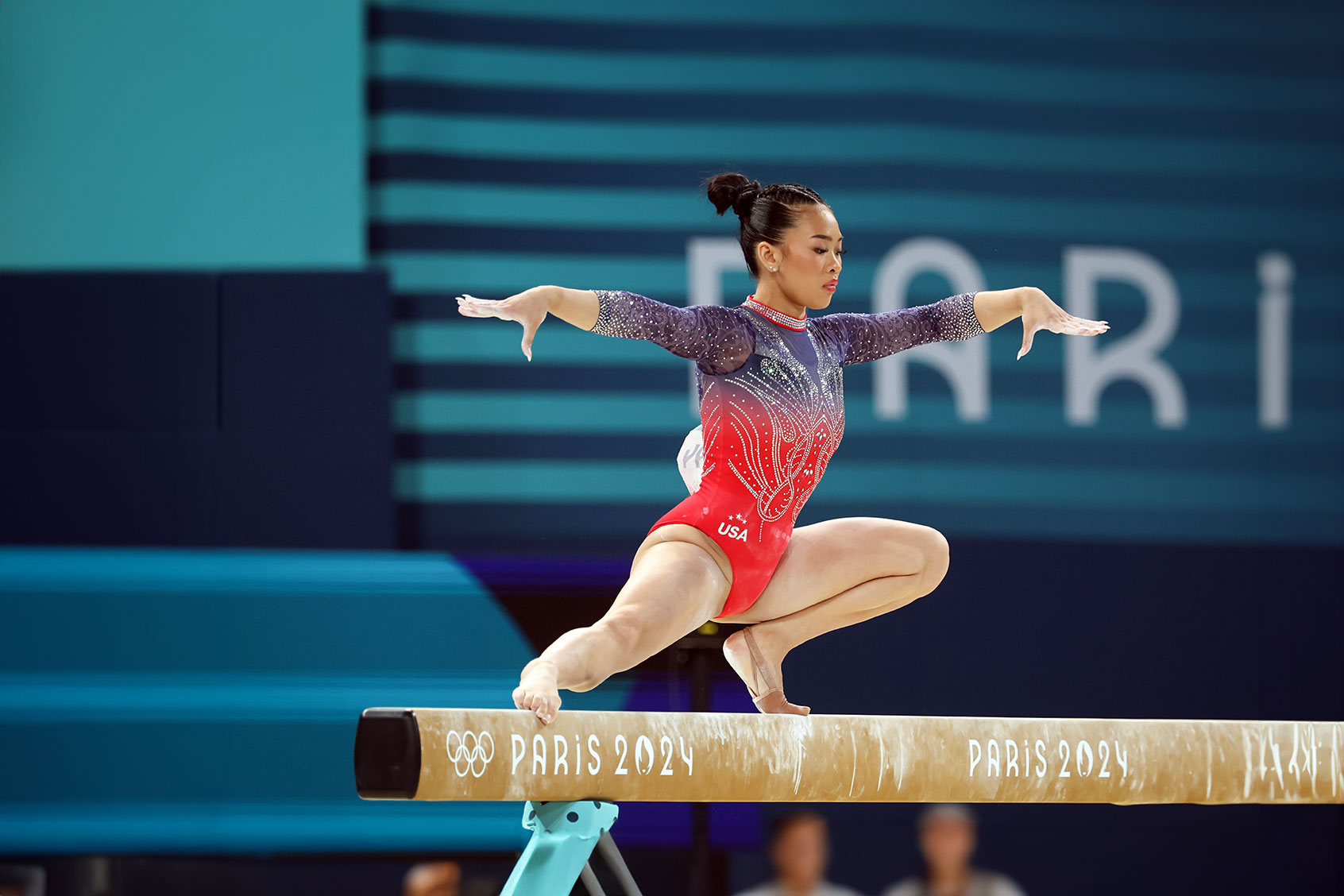
Sunisa LeeSunisa Lee of Team United States on Balance Beam competes during the women's Artistic Gymnastics All-Around Final on day six of the Olympic Games Paris 2024 at Bercy Arena on August 01, 2024 in Paris, France. (Stefan Matzke – sampics/Getty Images)

Champions are made, not by pandering to the noise, but by believing in the fullest version of oneself.

Lee’s case is only one instance of how invisible illnesses remain an unaddressed issue in athletics; oftentimes, interest and sympathy are only assigned to ailments that can be perceived outwardly. In a 2023 column for Slate, Fortesa Latifi writes, “Chronic illness forces you to make a choice: look at your body differently, as something that is imperfect, or spend your entire life mourning what has been left behind in the land of health. For chronically ill athletes, it can be a tightrope walk to figure out how to push their bodies while respecting the limits of their diseases.” Oftentimes, there’s a chasmic dissonance between the urge to fulfill societal expectations of the quintessential athlete and what can actually be accomplished while one’s health flounders. As a longtime competitive runner and chronically ill person, this is an experience I can speak to directly.

Lee however remained undeterred by her illness and summoned the gumption and self-confidence to return to the mat after a brief hiatus, brushing aside the narrowly construed frameworks of athleticism. “This comeback was so much more than my return to elite gymnastics,” she wrote in a 2023 Instagram post. “It was me proving to myself that I can overcome hard things, and to hopefully inspire others to never let life’s setbacks stop you from going after your dreams.”

https://www.instagram.com/p/CvnNv1TO648/?igshid=NTY1MGJiNDNiYw%3D%3D&img_index=1

“My doctor was telling me he didn’t think I’d be able to do gymnastics ever again,” Lee shared with TODAY. “So to even be here is an accomplishment in itself. And I’m super proud of myself.”

Then comes Richardson, the sprinting dynamo who saw her first shot at the Olympics dashed after testing positive for marijuana, leading to a 30-day suspension that saw her barred from Tokyo despite winning the 100-meter event at the trials. But to hear it in her own words, it was a  “nerve triggering” event that Richardson said sent her spiraling. Speaking to NBC around the time of her suspension, Richardson claimed she had used drugs to cope with learning of the death of her biological mother. “It sent me into a state of emotional panic,” she said. “I didn’t know how to control my emotions or deal with my emotions during that time.”

While Richardson did objectively violate rules set in place by U.S.A. Track & Field and International Olympic Committee, her penalty was cast into speculation when the Court of Arbitration for Sports (CAS) decided to permit Russian figure skater Kamila Valieva to compete after she tested positive for trimetazidine, a drug often used to treat heart conditions like angina.

"Can we get a solid answer on the difference of her situation and mines?" Richardson wrote on a USA Today post, sharing the news that Valieva would be allowed to compete. "My mother died, and I can't run and was also favored to place Top 3. The only difference I see is I'm a Black young lady."

Call it an ambition fueled by being dealt a shady hand, but Richardson’s experience seemed to have only emboldened her spirits as she sought to redeem her image. At the 2023 World Championships in Budapest, Richardson bested top Jamaican athletes Shericka Jackson and Shelly-Ann Fraser Pryce in the 100-meter dash, taking the win in a blistering 10.65 seconds. Afterward, she self-assuredly uttered the signature mantra she’s proclaimed repeatedly over the past year: “I’m not back. I’m better.”

Richardson elaborated on the saying in an interview with Vogue published last month. “I don’t just mean I’m a better runner,” she said. “It’s beyond that. I’m better at being Sha’Carri. I’m better at being myself.”

It’s easy to perceive Olympians as athletes. It’s what they are, it’s what they do, and boy do they do it well. But lest we forget that the whole is greater than the sum of its parts, or that the parts extend far beyond the confines of athleticism alone. These redemption narratives speak to their achievements, but they also function to challenge (if not altogether reframe) the notion of what it means to be a great athlete — before they were Olympians, they were Simone, Sunisa and Sha’Carri. 

This knowledge also allows us laypeople to find some comfort in compelling Olympic comeback tales. Perhaps the most honest yet hard-to-grapple-with truth about Olympians is that they’re quite like us — their inspiring stories serve as reminders of our own capabilities (albeit less coordinated ones), goading us to take the rarely invested time to reflect inward on what we’ve accomplished in our own lives. Perhaps, they might even encourage us to hold our hearts and minds in kinder regard, refuting society’s prevailing disregard for mental health. 

After winning the 100-meter dash final at the Stade de France, U.S. sprinter Noah Lyles published a candid tweet: “I have Asthma, allergies, dyslexia, ADD, anxiety, and Depression. But I will tell you that what you have does not define what you can become. Why Not You!” 

Lyles’ message quite cloudlessly encapsulates the crux of the multifaceted elements of an athlete, of a human being — to become the world’s fastest man, he had to nurture all of his needs, not simply fine-tune his physicality. 

His remarks are also a steady reminder of the way disability, despite being an ostensible impediment, can be worked with while being exceptionally athletic. When the Olympics end this Sunday, the Paralympics will follow, commencing in Paris on Aug. 28. And if there’s something we can all take from watching para-Olympians compete, it’s that champions are made, not by pandering to the noise, but by believing in the fullest version of oneself. 


“Probably going to sue”: Trump threatens New York Times over bizarre helicopter story

Former President Donald Trump is threatening to sue the New York Times for a helicopter-related fact-check and doubling down on his bizarre and disprovable claim at a Thursday press conference that he had almost died in a near-crash with former San Francisco Mayor Willie Brown.

The tall tale, first told in the rambling press conference when a reporter asked Trump a question implying Vice President Kamala Harris’ career was boosted by a relationship with Brown, was immediately disproven by a New York Times analysis, which concluded that Trump was talking about Jerry Brown, the former Governor of California, not Willie Brown.

Moreso, the trip Trump was seemingly referencing went without a hitch, California Governor Gavin Newsom, who was also a passenger, said.

But this set of events seemingly isn’t sitting right with the presidential candidate. Per the New York Times, Trump phoned in to express his grievances with the exposé. 

“We have the flight records of the helicopter,” Trump told the Times, claiming that he and Willie Brown had landed “in a field.”

Trump also shouted that he is “probably going to sue” over the Times article.

Asked to produce the records, the 78-year-old reportedly responded “mockingly, repeating the request in a sing-song voice.”

Trump, who survived a much more extensively documented brush with aeronautics issues on Friday evening ahead of a Montana rally, was dismissed directly by Brown, who told the Times on Thursday that he didn’t recall such an incident.

“You know me well enough to know that if I almost went down in a helicopter with anybody, you would have heard about it!” the former mayor said.

Greg Louganis beat calls to “tone the gay thing down” as an HIV-positive Olympian in the 1980s

Greg Louganis wasn’t supposed to compete at the 1988 Olympics. The superstar athlete, dubbed the “Baryshnikov of diving,” had originally planned on retiring after earning two gold medals in Los Angeles in 1984, to go along with the silver he won in Montreal in ’76. It didn't bode well in Seoul when, during a routine dive during the preliminaries, he hit his head on the board — a potentially catastrophic injury that killed a fellow diver five years before. He had also, unknown to the rest of the world, recently learned he was HIV-positive. Louganis was 28 years old and had every reason to believe he wouldn’t make it to 30.

“I was told, ‘Get your affairs in order, because chances are, you probably only have two more years to live,’” the now 64-year-old Louganis recalls during a lengthy recent conversation over Zoom. Even when speaking of serious things, Louganis remains boyishly energetic, smiling beneath a portrait of him with his dogs while the pets bark insistently for his attention.  But there’s a gravitas to him as well. He’s now lived far more years with his HIV diagnosis than he had before it, and he’s still learning what his lengthy second chance means.

In 1993, he held a birthday celebration that he assumed was his farewell party. Against the odds, he kept on surviving. Louganis officially came out at the Gay Games in 1994, and went public with his HIV status in 1995, with the release of his memoir “Breaking the Surface.” “It’s interesting,” he says now, “all these years later, I was prepared to die.” He pauses for a beat and adds, “I wasn't prepared to live.”
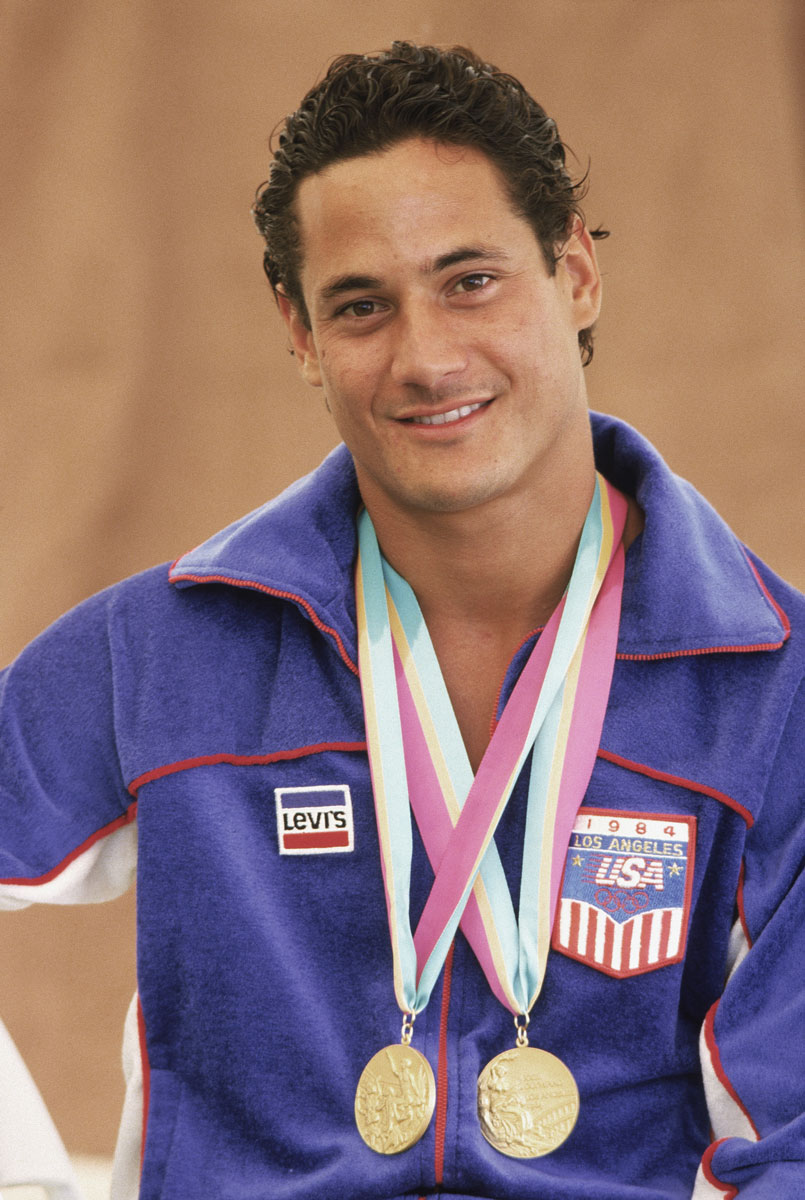
Greg LouganisGreg Louganis poses with his two gold medals during the Summer Olympics XXIII in 1984 in Los Angeles. (Focus on Sport via Getty Images)

To appreciate the magnitude of Louganis’ transformative impact, you need only look as far as those Paris Games. The Chinese team’s masterful domination of the diving competitions (six golds and counting), rooted in its unstoppable combination of precision and grace, has clear precedent in Louganis’ groundbreaking, gymnastic style. “They used me as a model in their diving program,” says Louganis, who trained as an acrobat and dancer as a child before moving to diving. “They pull the kids out when they're very, very young, and introduce them to dance and acrobatics."

"That type of balance and rhythm exposure,” he notes, “are the skill sets that you're going to use and need to become a good diver.”

Louganis’ influence extends far beyond the perimeter of the pool. At the Paris Games this year, there are nearly 200 LGBTQ+ athletes. Three decades ago, Louganis was among just a small handful of openly gay elite athletes in the world. He was also one of the first to disclose he was HIV-positive. As the New York Times grimly reported in 1995, “Louganis now has the dreadful distinction of being the world's most prominent athlete to say he contacted AIDS from homosexual activity.” Now, exactly 40 years after he earned his first gold, his distinctions would never be referred to as "dreadful." And he's back at the Olympics, as an ambassador for Pride House Paris, a space for athletes and fans from the LGBTQ+ community and their allies to celebrate this year's games and socialize.

How did this shy, adopted child, a kid bullied at school for his dark skin, his stutter, his dyslexia and his interest in — and uncanny aptitude for — “sissy” pursuits like gymnastics become one of the most visible and outspoken LGBTQ+ athletes in the world?  

Louganis first learned to dive in his family swimming pool. When knee problems ruled out his other athletic activities, diving became his primary focus. By the age of 16, just as he was coming to terms with his sexuality, he was competing in the Olympics. There he earned his first medal, a silver, for the 10-meter platform. The achievement made him instantly renowned. But he says that silver only made him feel like “the first loser.”

"We're riddled with guilt, as gay individuals, because we're told we're wrong."

He remembers the scene in Montreal in 1976. “At the time, I was training with [former Olympic champion] Dr. Sammy Lee. Klaus Dibiase from Italy was going for his third Olympic gold medal,” he says. “The training I was doing was all about beating Klaus, so my sole purpose on this planet was to prevent Klaus from winning that gold medal. I failed, and Dr. Lee let me know that I failed. That was pretty brutal.” 

Already prone to depression and suicidal ideation, Louganis’ post-Olympic victory lap was anything but. “I didn't understand when I went back to high school why everybody was celebrating me when I felt like such a failure,” he says. “I was almost a statistic. I tried to commit suicide. I thought the world would be a better place without me.”

There were also rumors about his sexuality, rumblings that occasionally manifested in slurs and offensive signs at his tournaments. The tactics didn't get under his skin, though. “It's easy to point to homophobia, the 'f*g buster' campaign,” he says. “But years later, and meeting up with a lot of these guys, it was more about jealousy. I was winning, and I get it — if you can't beat him on the boards, then you beat him off the boards. So I don't know that all of it was homophobia. I think that a lot of it was just jealousy.” 
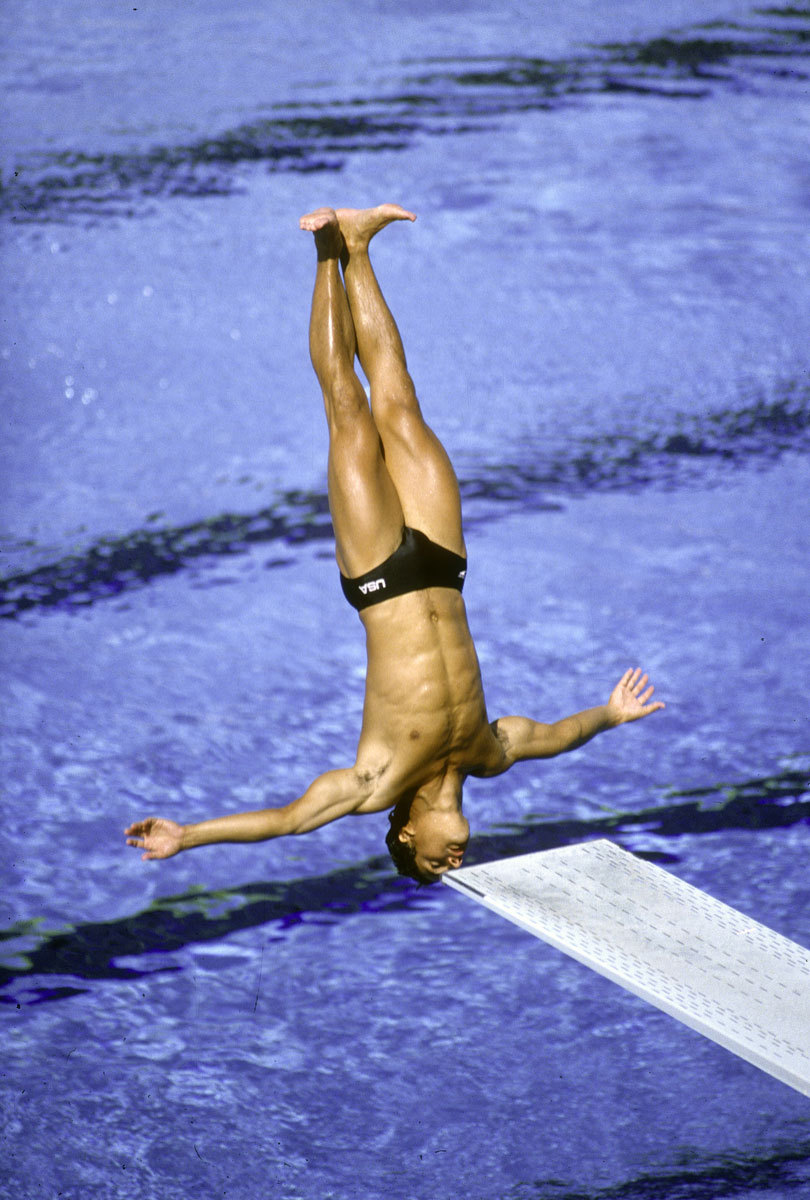
Greg LouganisGreg Louganis of the United States competes in the diving competition off the Springboard during the 1984 Summer Olympics in Los Angeles. (Focus on Sport/Getty Images)

After sitting out the 1980 Moscow Olympics because of the U.S. boycott, the El Cajon native returned to earn two golds on his home turf at the 1984 Games in Los Angeles. It was meant to be his farewell. Instead, it turned into one of his first acts of advocacy. 

“I was supposed to retire after 1984,” he says. “I got my two Olympic gold medals, broke 700 on the 10-meter platform. I went to the nationals and I broke Cynthia Potter's record for national championship titles. I was fully prepared to move on.”

"I was going to pack up my bags, go back to California, lock myself in my house and wait to die."

It didn’t quite work out that way. 

Eight years into his Olympic career, Louganis was — like many successful Olympians —a sought-after public figure. But because of International Olympic Committee rules at the time, there were strict guidelines around what they could do and how they could be paid, often leaving athletes financially strapped — an issue that persists 40 years later

Edwin Moses [the Olympic gold medalist hurdler] and I were pushing for trust funds for athletes that they can draw on, so they can do commercials, speaking and appearances. That goes into their trust fund, and they can utilize that money for their training and living expenses beyond college. I was a part of that. I was an athlete rep." (Notably, neither Moses nor Louganis received the typical Olympic champion honor of a Wheaties box placement until 2015.)

"After the nationals, I went to [USA diving president] Phil Boggs and said, ‘What's going on with trust funds?’ He said, ‘Well, the only one that it affects is you and you're retiring. So we don't have to spend the money on attorneys to get the trust funds to put it in place.’ I said, ‘Fine, I'm not retiring. Do your f**king homework.’” (The International Swimming Hall of Fame, meanwhile remembers Boggs as the person who “helped create the Athletes Trust fund.”

“I was really angry,” Louganis remembers. “My intent was to stay eligible until the trust funds were put into place, because I felt that was going to be my legacy. It took two years. In those two years, I found myself at the World Championships, and I won. My coach, Ron O’Brien, said, ‘What are you going to do? It's just two more years.’ That’s how Seoul happened. It wasn't supposed to happen for me.”
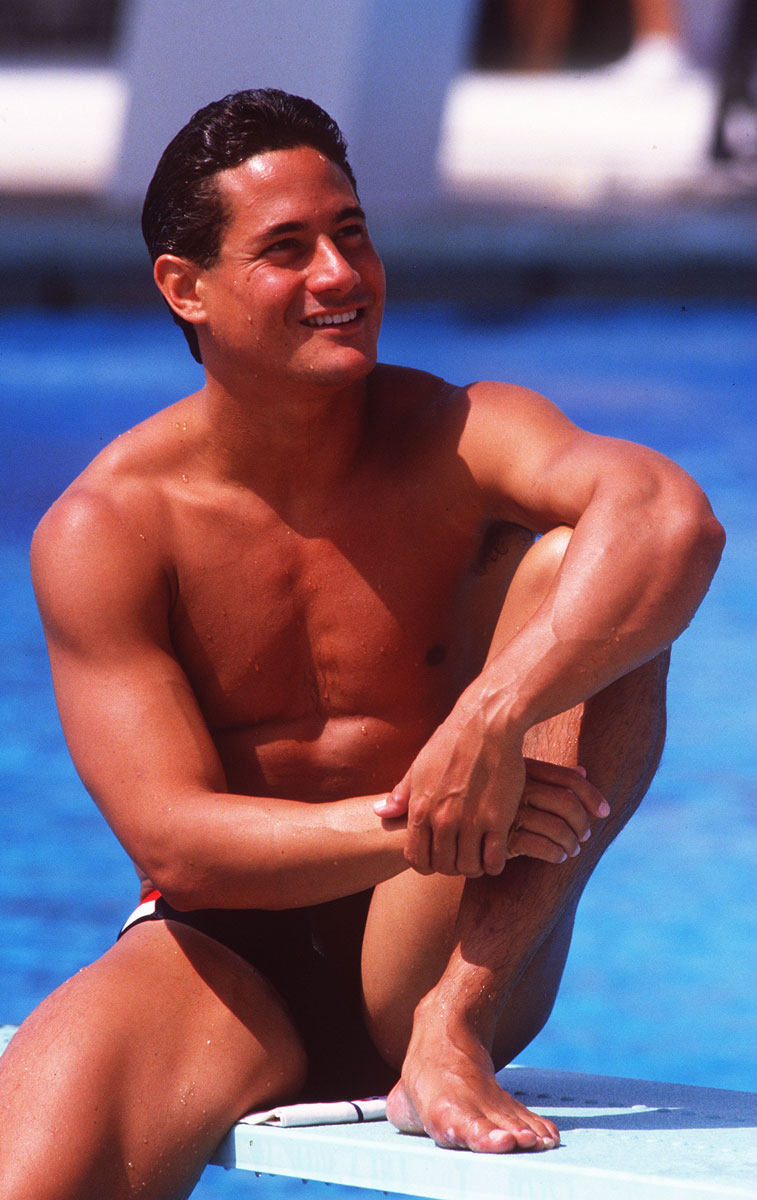
Greg LouganisGreg Louganis during the 1987 U.S. National Diving Championships (Getty Images/Tony Duffy/ALLSPORT)

By 1988, AIDS had become a full-blown public health crisis. Louganis had been training in Florida when he got the diagnosis, six months before the Seoul Games. “I was having something going on with my ear,” he says. “I went to the doctor, my cousin who was treating me. When I did the test, my thought was, if I'm positive, I was going to pack up my bags, go back to California, lock myself in my house and wait to die.”

“Because that's what we thought of HIV,” he says.

It’s difficult to express the profound terror and grief of the first several years of the AIDS crisis to those who didn’t endure them. Death felt omnipresent. In cities like New York and San Francisco, cadaverous young men with lesions on their arms and faces were a frequent sight. Sex with a new partner was often a fraught negotiation. And when there were so few treatment options and so much still unknown, when a ravaging virus was in some circles regarded as a convenient excuse for homophobia, disclosure of one’s HIV status could have devastating personal and professional consequences. 

"They did say, 'Tone the gay thing down.'"

“In 1988,” he remembers, “our friends in the gay community were dying. We had as many as six, seven, and eight memorials to go to on a weekend. It was crazy. And then, there were people saying, ‘It's killing the right people. It's killing gay men and IV drug users and prostitutes.’ There was a real judgment surrounding it, and also guilt. We're riddled with guilt, as gay individuals, because we're told we're wrong. We get that message, either directly or subliminally, in society.” Louganis would confide his status to only a select number of individuals for seven years.

Coming out to the world at the peak of the AIDS crisis marked a turning point in Louganis’ life. He had been famous since he was a teenager and a sex symbol for just as long, a tousled Californian with a movie star smile. He’d never been closeted, exactly, but he’d been quiet about his sexuality in his early career. And there was a subtle expectation on him to keep it that way. “When I signed on with William Morris Agency," he says, "They did say, ‘Tone the gay thing down."

“I was out to most friends and family,” he says. “My thinking back then was, well, everybody's entitled to a private life. So that was my private life.”

But that private life had an additional, darker dimension — Louganis had spent several years in an abusive relationship with the man who was also his manager, a man who had once raped him at knifepoint. “My view of the world was through the lenses of Jim,” he explains. “I wasn't allowed to go out, unless I had permission. Jim [the late James “Jim” Babbitt] would go, but I wasn't allowed. This is part of an abusive relationship, and also rape,” he notes. “It’s not about the sexual act, it's about control. It's about ultimate control.” 
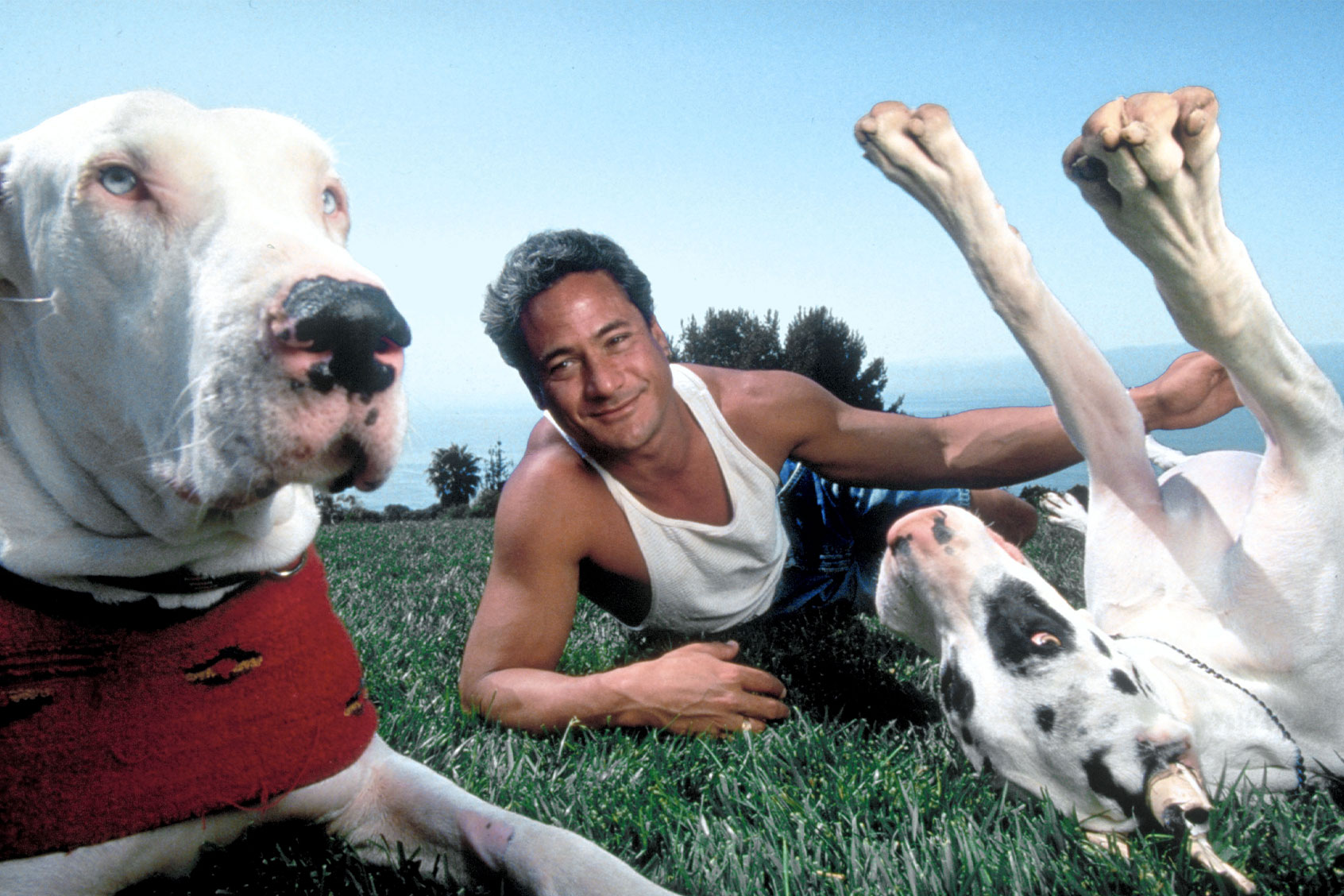
Greg Louganis with danesGreg Louganis petting his 2 Great Dane dogs while lying in grass in 1996. (John Storey/Getty Images)

Louganis’ decision to go public about his identity and his diagnosis were undeniable acts of bravery. They were entwined with one of emancipation. “When I was diagnosed HIV-positive, it was like, who else will ever touch me? I thought, OK, I'm stuck. This is it, I’ll make do.” Eventually, though, fed up Babbitt’s mistreatment and the discovery that he’d also been siphoning off most of his earnings, Louganis ended things. 

During their personal and professional breakup, Babbitt attempted one last abusive gambit — blackmail. He threatened to call a press conference on Louganis’ HIV status and claim that he was “throwing him out on the street.” As Louganis wrote in his memoir, “He said that people would see me for the selfish, uncaring slut I was.” Louganis had to seek a restraining order, claiming he “feared for his life”. They eventually reached a settlement. Babbitt died of AIDS complications in 1990. 

His HIV disclosure, on Louganis’ own terms and in his own time, was met at the time with an outpouring of support and praise around the world, along with some serious backlash. The fact that Louganis had cut himself when he hit his head in Seoul became a particular flashpoint. “It is really regrettable that he competed in the final round of the Olympics if he knew he was HIV-positive,” Seoul Olympic Organizing Committee chairman Park Seh-jik told Reuters in 1995. “It is not morally right, particularly because he was injured and bled.”

Louganis didn’t know the full extent of the controversy until years later. “When my now ex-husband said, ‘They tried to take your medals away,’ I said, ‘What?’’ he recalls. “And he's like, ‘Yeah, back then they tried to take your medals away, because they said you shouldn't have been in Seoul, because they had a travel ban for HIV.’” (Though there was some public discourse about it at the time, the Olympic Committee itself did not move to strip Louganis of his medals.)

"I felt like a throwaway child. […] I found out that she didn't hold me after I was born."

As he moved through his Olympic competition era and into the advocate and mentor phase of his life, Louganis reckoned with deeply rooted self-image issues. Growing up knowing that he’d been given up for adoption and spent his first nine months in foster care, Louganis says, “I felt like a throwaway child.” At 24, he met his birth father, launching a relationship with him, his half-siblings and extended family that he says over time “changed the trajectory of what's family to me.” 

He also worked on the anger he felt toward his birth mother. “I found out that she didn't hold me after I was born,” he says, sounding still wounded at the knowledge. “But her parents told her that I was already adopted by a mixed-race couple because they knew I was going to be dark, because my father was Samoan. They were, from the sounds of it, quite racist. She didn't know.” He says now he had "a lot of forgiving to do.”

“Through meditation practice, it came to me that she couldn't give what she so desperately wanted for herself. Then the tears started flowing, because she was scared. She was only 16 when she had me. Then I could feel some compassion and empathy for her. I think that's where a lot of forgiveness comes from. Meaningful forgiveness is to tap into the compassion and empathy,” he says.

He also found similar compassion for his former partner. “I could come to a place of forgiveness,” he says, “because hurt people hurt people. Obviously, there was a tremendous amount of hurt there. With Jim, I wasn't always sure what he said was true. But I think one of the truths that he shared is that he was as a child molested by his stepfather. Just imagine a young boy who didn't feel he had power, and then somebody dominating him like that. That must have been really, really difficult. You're supposed to be able to trust your parents. That trust was broken, so you can understand where it came from.”

He knows it doesn't excuse what Babbitt did to him; it just enables him to move forward from it. “I've also come to learn and accept and realize we can't change other people,” he says, “no matter how hard we try.”

When Louganis first learned he had HIV, he says, “I [sold] my life insurance policy so I could travel and do whatever, because I didn't expect to be here. All these years later, it's like, s**t, I’ve got to get a job. Now what do I do?”

Louganis' energy now is often now devoted to his coaching and speaking engagements, as well as his other career training canines. (In 1999, he published a pet owner's guidebook called "For the Life of Your Dog.") Last year, his put three of his Olympic medals up for auction, hoping to donate a portion of the proceeds to the HIV/AIDS organization Damien Center. “It was obviously a financial thing,” he says candidly, “and hoping to raise money to help the Damien Center so that they could do some good. But also help me out as well.”
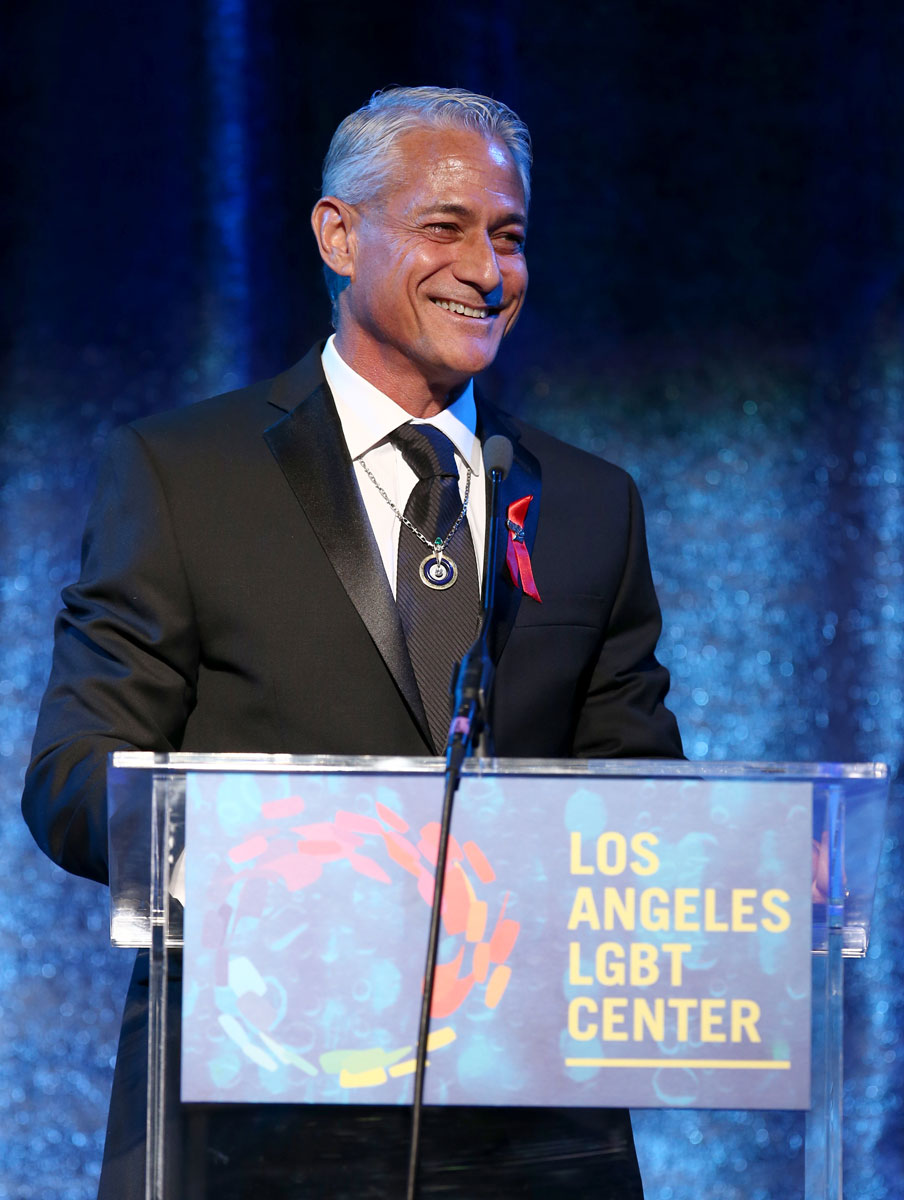
Greg LouganisGreg Louganis speaks onstage during the Los Angeles LGBT Center 47th Anniversary Gala Vanguard Awards at Pacific Design Center on September 24, 2016 in West Hollywood. (Joe Scarnici/Getty Images for Los Angeles LGBT Center)

He continues, soberly, “I've fought so many battles. I'm just tired. Tired of fighting. Haven't I accomplished enough? Haven't I made a big enough difference? Can't I just be done? It really is kind of a weird space that I'm in. People say, because I'm 64, 'midlife awakening or midlife crisis?' It certainly feels crisis-y more often than I'd like it to be.” 

Soon, however, he rouses himself. “That’s where I'm at now,” he admits. “I am questioning, and trying to figure some things out. Like I said, is this an awakening or crisis? It feels like a crisis so often, and it’s like, ‘Well, what do I do? How can I help others?’ We went to elementary schools that last couple of weeks for Olympic Day, and it was so great to connect with the kids. It's important to have that outreach, and make those outreach points much more available.”

When asked about what he believes will be his legacy, Louganis is reflective. “I think my perceived legacy is obviously diving. And if they remember me as a diver, I hope that I'm remembered as being strong and graceful,” he says. “But my legacy as a person, I would hope people would say I was kind. Making a difference, that's a lot, and it's also very subjective. But kind? You can always be kind.” 

"I want to see my records broken. I think that's awesome."

That imperative to kindness comes through in the way Louganis speaks, with a gentle southern California cadence and regular pauses to carefully collect his words. It’s there in the way he cites his dogs as inspiration. “They’re great teachers,” he says. “They don't hold on to resentments. They don't judge. They’re just grateful for whatever they have.”

Louganis is also conscious of his role as an elder statesman, for both the LGBTQ+ community and athletics. He acknowledges that he’s concerned about the threats to LGBTQ+ rights in America, but says, “You can't close up the Pandora's Box, once it's opened. We're not going to go backward. That's ridiculous.” He adds, however, “The divisiveness that it stirs up, and the anger or rage that comes with that, I don't understand it. Why would it threaten you? It's not really, truly affecting you. The thing that concerns me most is the visceral hate and anger, because that's so, so devastating. It's hard for me to understand.”

And when he contemplates this year's Olympics, Louganis offers a unique viewpoint, including his opinions on the current controversies over the use of performance-enhancing resources. “When I was 33, we didn't know what was going on with me,” he remembers. “I was wasting. Growth hormone was helpful to get my energy back up. A lot of the medications that helped me push through some of my treatments, they were actually lifesaving.” 
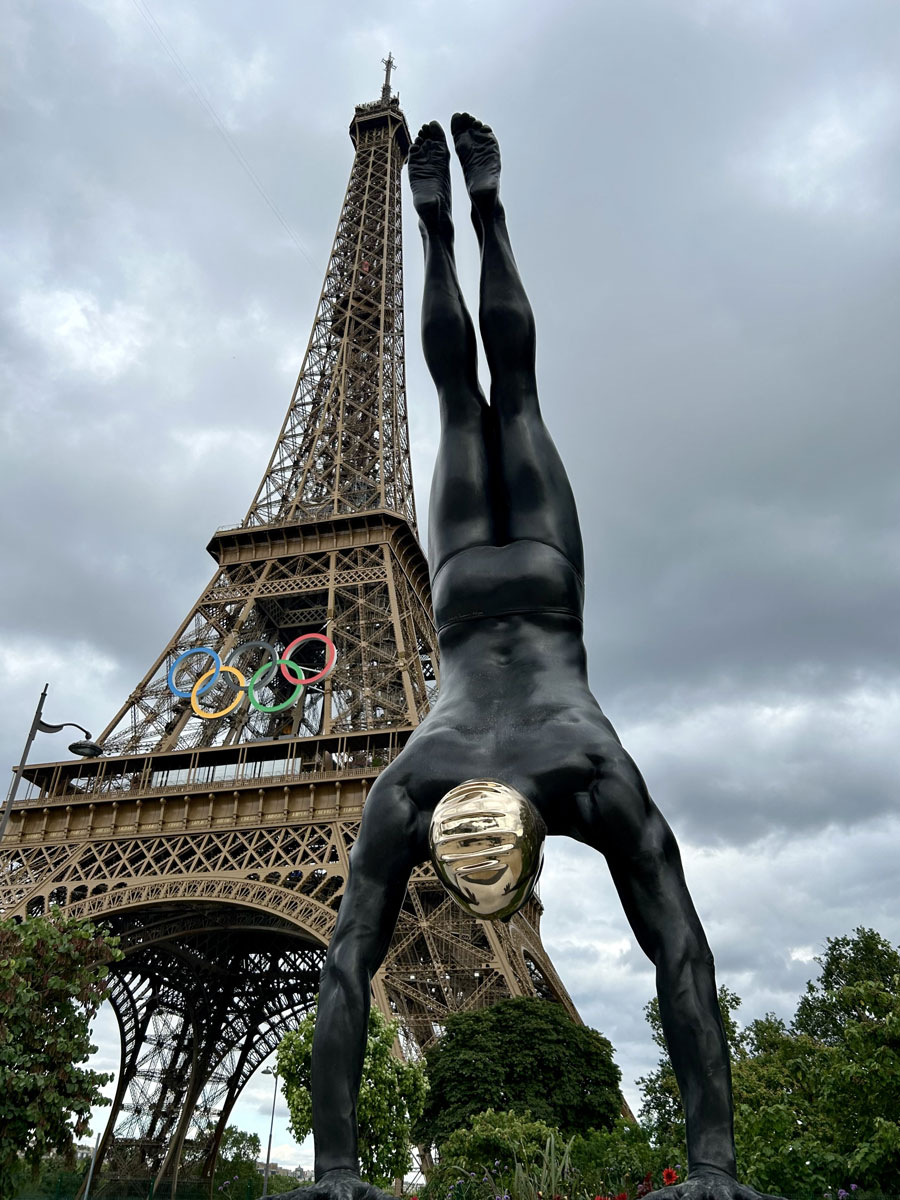
The Diver statue Greg LouganisThe Diver, a sculpture by U.S. artist Carole Feuerman on display in Paris on July 22, 2024, ahead of the 2024 Paris Olympic Games. Feuerman was inspired by U.S. diver Greg Louganis, a four-time Olympic medalist at the 1984 and 1988 Olympic Games. (Christophe DELATTRE / AFP)Louganis notes, “When somebody says, ‘What if your records are broken, and you find out that they're juicing, or taking something?’ I want to find out what they're taking! That's great. I want to see my records broken. Whether they do that aided by something, it wouldn't matter to me, personally, because I think that's awesome. Because then we find great information."  

Many in the field dissent with Louganis' view, particularly supporters of the World Anti-Doping Agency (WADA), an independent agency created to “fight against doping in sport,” a problem it describes as “a scourge.” But WADA has come under fire this summer, with pushback against its ruling over Chinese athletes revealing how far from black and white the metrics of testing, and ideas of what constitutes doping, can be.

Louganis says, "I'm not fully on board with the whole WADA thing. We’ve demonized it as cheating. Well, what if it wasn't cheating? The drugs aren't showing up to the training sessions; the athlete is putting the work in. I know it's not a popular stance, but it's just my own personal awareness. The key is, if we're talking about it, if we have open communication about it, then it can be safe. As long as we demonize it, and it's in the shadows, then that's where a lot of things can go awry, because they're trying to hide it. If we're truly open about it, and really helping each other, then it could be terrific information that we gather to help the quality of life of others.”

And while the current crop of very young competitors in Paris has raised questions about age limits and concern over pushing kids too hard too soon, Louganis likewise offers another perspective. For him, finding the diving board at an early age was salvation. 

“I think a lot of people try to convince me that I sacrificed my childhood. But one thing that my mother was always very clear with me is that we are a product of the decisions that we make, no matter how you come to make those choices. So I always took responsibility. I didn't lose out on a childhood. I did exactly what I wanted to do, was meant to do and was destined to do.”

The weird and sexist criticism of Kamala’s “cackle”: Decoding how Harris got the last laugh

Imagine how much you would have to hate life to castigate someone for laughing. It is important to dwell on the thought experiment before considering political ideology or feminist theory because the inevitable revelation produces profound political and cultural clarity.

Everyone has faced the challenge of navigating a conversation with a humorless scold. There is the teacher who punishes innocuous jokes; the minister of the variety depicted in the underrated film “Chocolat,” whose primary devotion is the prohibition of pleasure. and the socially maladjusted relative who struggles to form a smile at birthday celebrations, in holiday photos, or during joyous ceremonies, like weddings or baptisms. These are people who those in close proximity do all they can to avoid. If a coworker or kin finds herself cornered in a dour discussion with the malcontent, she will activate the most creative parts of her mind to engineer an excuse to exit the encounter. 

Kamala Harris does not “suppress her own excitement,” and as a consequence, makes many men uncomfortable.

As sad as the permanently morose seem, they do not even ridicule those who laugh, but those who find joy in their lives. They resign themselves to sitting at the end of the table, or standing in the background, looking pitiful for reasons no one can identify, usually provoking more sympathy than contempt. 

Misanthropy is now central to the American right, meaning that one of the most important, but incalculable elements of the presidential race is the weird factor. Having already exposed themselves as irredeemably weird (not to mention sexist), with Trump's running mate Sen. JD Vance’s derision of “childless cat ladies,” the Republican Party will only get more bizarre and only appear more estranged from American culture. One of the biggest triggers for their weird outbursts is laughter from Kamala Harris.

The leaders of the Republican Party, and their propagandists in right-wing media, are miserable to the extent that they have mocked and derided— for years —Harris because she is fond of laughing. While the typical person observes Harris’ effervescent guffaw, and thinks, “She seems fun!”, the contemporary right winger, so filled with darkness, objects. “How dare she enjoy life…”

The attacks on her laugh date back to 2020 when Joe Biden named her as his running mate. As the New York Times reported, “There was a time, early in her vice presidency, when Kamala Harris, aware of reams of conservative news coverage criticizing her laughter, privately wondered to confidants whether she should laugh, or show a sense of humor, at all.”

Lately, they’ve only increased. TV advertisements for Trump’s campaign zero in on the laugh, showing Harris’ face light up into a wide smile from different angles, often in slow motion, as if amusement is a crime. Trump himself has taken to calling the vice president, “Laughin’ Kamala.” During some speeches, he will refer to her as “Lyin’ Kamala.” Both nicknames land well with the audience, demonstrating that to Donald Trump, and his most fervent supporters, accusations of good humor and dishonesty are equally damaging. 

The Republican Party tweeted, from one of its official accounts, that “Kamala Harris brought her cackle to Milwaukee,” with a short clip of the Democratic nominee for president laughing in the middle of her remarks to an exuberant swing state audience. 

Sean Hannity has even suggested that “American enemies,” like Russia and China, would not take a President Kamala Harris seriously, because she laughs (!). 

During an April appearance on the “Drew Barrymore Show,” Harris said the following in response to attacks on her displays of joviality: “I have my mother’s laugh. I grew up around a bunch of women who laughed from the gut. They would sit around the kitchen, telling big stories with big laughs. I think it is important to remind each other, and our younger ones, don’t be confined to other people’s perception about how you should act…”

It is tempting to allow Harris’ words to close the conversation on her laughter. The Republican Party has become joyless, and Harris is emblematic of joy. It is a stark contrast. 

However, the reasons for opposition to the vice president’s laughter cut deep. 

We need your help to stay independent

Niobe Way, a professor of developmental psychology, often explains that American society has “privileged the hard over the soft,” referring to hard and soft characteristics of humanity. She gives the following examples: Stoicism over vulnerability, cognition over emotion, autonomy over connectedness, and money over people. In her new book, Rebels with a Cause: Reimagining Boys, Ourselves, and Our Culture, Way warns that America’s retrograde, and often reactionary, assumption that men possess only hard qualities, and women possess only soft qualities, hurts both girls and boys, because all human beings are a combination. 

She also writes that Americans, often subconsciously, associate “hard” characteristics with leadership, placing hurdles that women must overcome to win statewide and national elections. Donald Trump’s model of leadership, Way argues, “is all hard and dismissive of the soft.” 

When Kamala Harris laughs with riotous zeal, while occupying a position of leadership, she challenges the hard over soft hierarchy. Her laugh communicates that expression of emotion while making difficult decisions is not only possible but perhaps, commendable. The image of a laughing woman in a role of power is tough to tolerate if you believe that executive leadership demands a steely, inhuman, statue-like laconicism. 

Misanthropy is now central to the American right, meaning that one of the most important, but incalculable elements of the presidential race is the weird factor.

A keyword in the above sentence is “woman.” Hatred of Kamala Harris’ laughter demonstrates a vexing contradiction of challenges for women, the types of which America Ferrera articulates in her viral monologue from the film, “Barbie.” If women don’t display feeling, they have “resting bitch face,” which means they are coldhearted. Slanders of this variety were a right-wing favorite against Hillary Clinton, who also faced criticisms of being “shrill.” If they laugh, like Kamala Harris, Vladimir Putin and Xi Jinping won’t take them seriously. In the words of adjudicated sex offender, Donald Trump, the Kamala Harris laugh proves that she is “crazy.”

If one’s idea of normal human behavior resembles the King’s Guard outside Buckingham Palace, Kamala Harris might come off as crazy. As absurd as that line of thought sounds, it is, tragically, common among many Americans, especially those with a conservative mindset.

Avrum Weiss, a psychotherapist, summarizes the vast body of research on the emotional dynamics separating the average woman from the average man with the following: “Men often get uncomfortable when women have strong feelings. This is particularly true when women are upset, but men can also feel uncomfortable when women are excited, full of joy, or even really turned on. Women understand this and learned long ago to suppress their own excitement in order not to make men uncomfortable.” 

“In our culture,” Weiss adds, “men are taught not to feel.”

Kamala Harris does not “suppress her own excitement,” and as a consequence, makes many men uncomfortable. Men, contrarily, do not suffer under any expectation to suppress emotion, as long as that emotion is anger. Hillary Clinton, the last woman nominee for president, faced off against Bernie Sanders in the primary, and Donald Trump in the general election – two men whose preferred means of communication is screaming to the point of their faces turning red. The imagination of Greta Gerwig is not necessary to consider how the press, not to mention Republicans, would have reacted if Clinton bellowed like Sanders, or how they will react if Harris ever blusters, turning her cheeks the shade of a hideous red baseball cap, like Trump. 

Hillary Clinton had no choice but to navigate the complexities of sexism during her presidential campaign, and Harris will have the same arduous task. Things become more complicated for Harris because she is Black and Asian. On a census form, she checks three boxes of persecuted Americans. She belongs to three demographic categories who have endured, to varying degrees, oppression, exclusion, and predatory discrimination. 

Ralph Ellison described the conditions of Black Americans under the state-sponsored terrorism of Jim Crow as a choice between “living with music and dying with noise.” One of the writers most influenced by Ellison, Albert Murray, wrote in his classic treatise on blues and jazz, “Stomping the Blues,” that the musical performance, and the exhilaration it creates in the audience, gives the dispossessed the opportunity to beat their blues into the ground. Dancing, in that context, is not only a physical release but a means of emotional relief. 

With what could act as advice for Kamala Harris who is already facing attacks on her personality and dating history, Murray wrote, “Where there is bare-faced mockery the depth of the resistance goes without saying. And the same holds true in the case of malediction, or bad-mouthing, which in addition to loudmouthing, or damnation by diatribe and vilification also includes insinuation and scandalous innuendo. The main thing, whatever the form, is resistance if not hostility. Because the whole point is not to give in and let them get you down.”


Want a daily wrap-up of all the news and commentary Salon has to offer? Subscribe to our morning newsletter, Crash Course.


If Kamala Harris continues to display high spirits, she will show that the right-wing weirdos have not gotten her down, reaching back to a tradition of subversive joy that has always sustained oppressed people. Evidence of enjoyment of life directly rebuts the central proposition of the oppressor – namely, that the oppressed is inferior. 

It will also create a helpful juxtaposition for 2024 voters. The dreariness of the Trump versus Biden choice no longer hangs over society like a raincloud. Harris has injected vitality into a previously stale race, and her personality is the perfect complement to her influence over presidential politics. Her running mate, Minnesota governor, Tim Walz, complements Harris’ infectious enthusiasm, bringing his own gregarious energy to the campaign. During his first speech at the vice president’s side, he praised her “joyousness” as a leader, and told the audience, “don’t underestimate the power of that.”

In an essay in which he imagined Ernest Hemingway running for president, Norman Mailer wrote, “The American people tend to vote for the candidate who gives off the impression of having experienced some pleasure in his life.” It sounds silly, but the Mailer rule is accurate at an astounding rate. It is difficult to think of any exception to the Mailer rule not named, “Richard Nixon.” Karl Rove, chief strategist for the Bush campaigns of 2000 and 2004, reimagined the Mailer rule when he claimed, during private conversations with Bush, that voters would select the candidate that “they want to have a beer with.” 

Videos and memes, promoting Kamala Harris’ laughter, dance moves, and delightful verbal eccentricities, like the now beloved quote from her mother, complete with accompanying laughter, “You think you just fell out of a coconut tree?” have already lit the internet afire. 

Pop star, Charli XCX, declared Kamala Harris “brat,” a term of endearment for a woman who is “a little messy” but authentic and energetic. 

Kamala Harris appears to take great pleasure in life, enabling her to pass the Mailer test and meet the Rove standard. Millions and millions of Americans, especially women and young voters, would much rather sit down with Harris than Trump. A drink with Trump is, undoubtedly, a dark and dreadful affair – likely full of painful moments with the former president boasting about imaginary achievements, insulting immigrants, and looping from one macabre topic to the next. Sit JD Vance down at the table, and the average diner would probably ask the bartender for a shot of cyanide. 

The problem with the Mailer and Rove rule is that it is superficial, and can often encourage voters to make shallow choices. But in the case of Trump versus Harris, the superficial difference speaks to the election’s profound substantive decision.

Donald Trump and JD Vance are American fascists. Fascism is not only joyless but actively committed to the demolition of joy. Footage from any fascistic society underscores how sad, regimented, and dull the fascist envisions life. Uniformed men marching in lockstep while the leader, whether Benito Mussolini or Donald Trump’s friends, Vladimir Putin or King Jong Un, scowls overhead. There is no appreciation for literature, music, or visual art that does not serve a narrow, repressive agenda, and the masses confuse conformity with strength. 

Democracy, like Charli XCX’s brats, is messy. It is even, at times, inefficient. But it shields and advances freedom, and freedom enables creativity, authenticity, and joy. It is messy by design, with its three branches of government, checks and balances on unrestrained power, which Trump seeks to destroy, and various levels of governance, from the school board to the White House. But it is also ambitious, unpredictable, forward looking and moving, and as the vice presidency of a woman with a Jamaican father and Indian mother demonstrates, capable of profound self-correction. 

A smiling, accomplished biracial woman not only makes for a perfect symbol of the joyous mission of multiracial democracy, especially given that she has assumed the role of saving democracy. Her foil is a sour-faced criminal whining about how everything is “rigged” against him. 

Kamala Harris, and the believers in America’s experiment of self-governance who she now represents, may indeed have the last laugh.

Noah Lyles’ collapse underscores our collective COVID denial

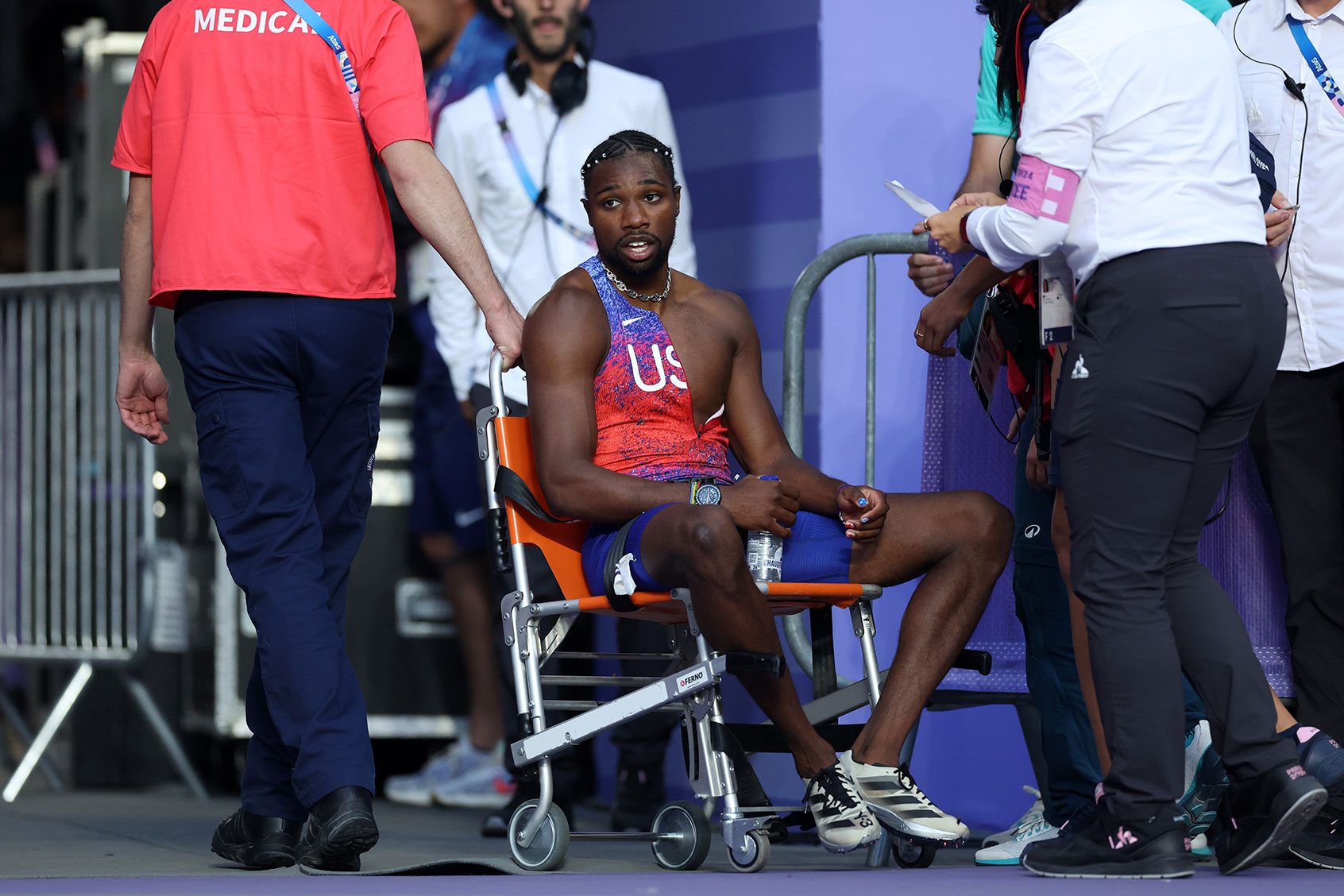
The 2024 Olympic Games are serving up some less-than-subtle metaphors for how poorly we handle public health. Just after winning a bronze medal in the much-anticipated men's 200-meter race, U.S. sprinter Noah Lyles collapsed on the track in exhaustion — not just because he’d completed a brutal run in just 19.7 seconds, finishing third, but also because he was sick with COVID-19, a diagnosis that he’d concealed from others. He had been favored to take home gold, as he did in the 100-meter race a few days earlier.

But seeing an American Olympic star sprawled out and gasping on the track, and then taken away in a wheelchair, was more than a shocking image. It also represented the general “mission accomplished” attitude toward SARS-CoV-2: We think we’ve won against this virus and we haven’t.

COVID isn’t just spreading like wildfire through the Olympic Village in Paris — we are undergoing surges across the globe, with the World Health Organization tracking steep rises in infections in 84 countries. After more than four years fighting this thing, it is still knocking us out.

In some parts of the U.S., the amount of COVID is so high that experts are claiming this summer surge is on par with winter waves of the virus. But none of this should be unexpected at this point. This is no longer the “novel” coronavirus that once terrified people with its unpredictability. We know how it behaves, with surges in both summer and winter, and we know how to fight against it — yet our apparent strategy at the moment is to pretend it doesn’t exist at all, even when it swipes us off our feet.

This is no longer the “novel” coronavirus that once terrified people because of how unpredictable it is.

It’s true that the pandemic is much different than it was in 2020. For one thing, in spite of this surge, deaths are relatively low, following trends since vaccines became available. In 2023, COVID dropped from the fourth leading cause of death in the U.S. to the 10th, according to recent provisional data from the Centers for Disease Control and Prevention. That's not great, but it does indicate that widespread immunity (from vaccines, previous infections or both) is giving us some level of protection. Though let’s not forget that at least 1.2 million Americans have died to date from COVID. It’s nothing to sneeze at.

Noah LylesBronze medalist Noah Lyles of Team United States is taken off from the track with a wheelchair after competing in the Men's 200m Final on day thirteen of the Olympic Games Paris 2024 at Stade de France on August 08, 2024 in Paris, France. (Christian Petersen/Getty Images)
Deaths aren’t the only concerning metric, of course. Sometimes a COVID infection is asymptomatic, while at other times, the symptoms last for months or years or never fully go away. Patients call this long COVID and public health experts have described it as a mass disabling event. Lyles isn’t just lucky he won a bronze medal — he’ll be lucky if he doesn’t experience months of headaches, lung issues or extreme fatigue that never goes away.

Yet long COVID is rarely factored into discussions about this pandemic, even when kids get it. Instead, it’s treated as if infections are merely a mild cold at this point. Just shake it off, as Taylor Swift might say, while her summer tour dates become superspreading events.


Want more health and science stories in your inbox? Subscribe to Salon's weekly newsletter Lab Notes.


Millions of patients can attest that COVID is anything but mild — and it's definitely not the flu. The SARS-CoV-2 virus can worm its way into nearly every part of our bodies, trashing our immune system and damaging our organs. We tend to think of the disease as a respiratory problem, given all the coughs and sniffles it produces, but it’s really more of a vascular disease, impacting any system that relies on blood vessels. That can include damage to the brain, which can manifest in symptoms like long-term cognitive impairment and Parkinson’s disease.

Yes, a virus that can literally cause brain damage is spreading at record levels and most people are acting like it’s just another wave. Just keep running.

But we’re not just paying the price with our bodies. The economy is also getting smacked by long COVID. A recent comprehensive review in the journal Nature Medicine found that the “cumulative global incidence of long COVID is around 400 million individuals, which is estimated to have an annual economic impact of approximately $1 trillion.” That's ignoring the long list of ways that long COVID wreaks havoc on the body, including, as the study notes, "viral persistence, immune dysregulation, mitochondrial dysfunction, complement dysregulation, endothelial inflammation and microbiome dysbiosis."

The fact that we are ignoring this extreme issue, at one of the most intense moments in the pandemic so far, is killing us, disabling us and costing us greatly.

So what can be done? We don’t need to fear the virus anymore, but we need to be conscious of the risks. We know how it works and how to protect ourselves. Taking precautions that will stop the virus from spreading will also give it fewer opportunities to mutate and evolve new ways of getting around our immunity.

We can surveil the virus better using regular testing, but the CDC stopped tracking cases last year (it still tracks hospitalizations, deaths and ER visits) and the Biden administration stopped mailing free tests months ago. Requirements for hospitals to report COVID data were also lifted in May, though that policy will be reversed later this month and will become mandatory come November. Still, that's a good chunk of time with incomplete or inadequate hospital data, and lacking that, it's hard to know what the pandemic really looks like.

Although it's not a perfect gauge, wastewater data remains one of the only consistent metrics throughout the pandemic, which is how we knew this surge was coming more than a month ago. That didn't translate into action at the federal level, and COVID is barely visible as an issue, if at all, in this year's presidential campaign.

We need your help to stay independent

We can mask in public, especially in crowds. It's never been fun to wear one, but masks really do work — though they’re a bit like condoms in the sense that their efficacy relies on being used correctly. A KN95 or N95 mask is best, and it needs to cover one's nose.

We can keep up-to-date with vaccinations, which prevent infections from becoming severe or deadly and lower the chances of developing long COVID, even with just a single dose. Yet only about 28% of Americans received the latest shots, a decline from 69% when the first round of vaccines were released. (The reasons why immunization wanes from certain vaccines are complicated, but COVID is far from the only disease that requires boosters.)

We're all suffering from pandemic fatigue after being put through the wringer over the past four years. But COVID doesn’t care how long we’ve been dealing with this crap. It doesn’t care if we’re bored or want to go to sports events or political rallies. It’s a virus, meaning it has no desires, no consciousness, no autonomy. It’s just a bunch of proteins that have been randomly selected through nature to easily and effectively hijack our immune systems.

We have plenty of tools to protect ourselves, but our strategy is instead denial, and it isn't working. The virus doesn't just take advantage of the ACE2 receptors in our bodies, it takes advantage of us, less directly, through conspiracy theories, misinformation, vaccine skepticism and regular old negligence and apathy. We all want to stop running this race against COVID. But to do that, we have to turn around and face it.

Legal experts say a fight over a Black teen’s dreadlocks shows how the law still enables racism

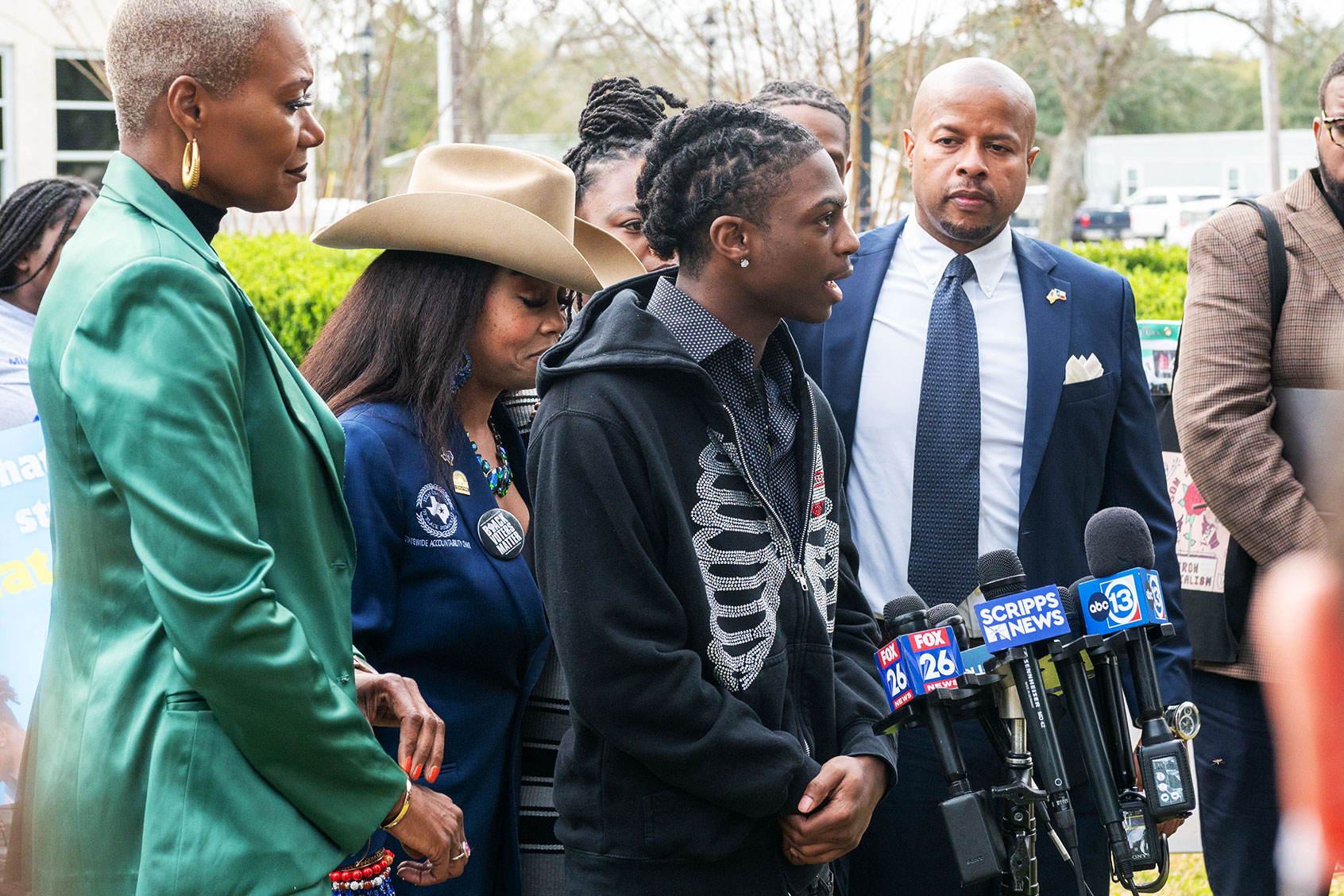
A federal judge this week dismissed a majority of the claims in a Black Texas high school student's lawsuit against his school district, which accused officials there of racial and gender discrimination for punishing him over his refusal to change his hairstyle. Legal experts told Salon that while the axed racial discrimination claim didn't have strong legs, thanks in part to a controversial Supreme Court doctrine of "colorblindness," the suit's remaining sex discrimination allegation has the potential to have major reverberations. 

The order dealt another blow to 18-year-old Darryl George, a state judge earlier this year having found his school district's hair-length policy did not violate a new state law that aimed to prohibit race-based hair discrimination.

The Houston-area Barbers Hill Independent School District has argued that it's policy restricting male student's hair length is meant to teach grooming and instill a respect for authority, according to The Associated Press. Its superintendent praised the recent court ruling in a statement, blaming "cancerous cancel culture" for accusations of racism.

In his order, U.S. District Judge Jeffrey Vincent Brown said he tossed George's claims of racial discrimination on the grounds that he had not sufficiently shown “a persistent, widespread practice of disparate, race-based enforcement of the policy."

“At most, the plaintiffs allege only two instances: the allegations underlying George’s case and those underlying the Arnold case also pending in this court,” Brown wrote in the 30-page order, referencing another case of a Black teen who was suspended over his hair. “But these two instances alone are insufficient to establish a pattern of conduct going on ‘for so long or so frequently’ that it evinces a ‘persistent, widespread practice.’”

Richard Thompson Ford, a Stanford University professor of anti-discrimination law, told Salon that he wasn't "all that surprised" the court dismissed the race discrimination claim because the school's policy on haircuts does not "formally discriminate on the basis of race."


"The Supreme Court's colorblindness doctrine tells us to ignore race – even if it is relevant"


"The claim of race discrimination requires one to accept that certain grooming practices are extraordinarily important to some racial groups — either because they are well suited to natural hair texture or because of their cultural significance," Ford, who's also the author of "Dress Codes: How the Laws of Fashion Made History," said. "These claims are controversial, and they’ve really only started to get traction over the last 10 or so years."

The dismissal is also consistent with a "widely criticized Supreme Court doctrine" that mandates that equal protection plaintiffs prove discriminatory intent, added Darren Hutchinson, an Emory University law professor who focuses on anti-discrimination law.

Without explicit reference to a category like race, sex or sexual orientation, he explained, courts will likely find policies like Barbers Hill's constitutional. While other courts have held that "disparate effects of the policy could stand as evidence of discriminatory intent," many have been "reluctant to apply this theory" even as it forms the basis of statutory reforms.

"I believe that this court missed the opportunity to think honestly about race as a social construct, rather than a biological fact," Hutchinson told Salon, noting that certain cultural norms and attitudes develop from shared experiences and ancestry.

"The Supreme Court's colorblindness doctrine tells us to ignore race – even if it is relevant," he said. "Based on this approach, courts have upheld English-only and grooming policies that disparately affect people of color in school and in the workplace. These are forms of racism in effect, regardless of intent."

We need your help to stay independent

For most of the 2023-24 academic year, George had been barred from attending his usual high school courses because the school district said his hair length violated its dress code. As a result of the discipline the district instituted, George spent his junior year either serving in-school suspension at Barbers Hill high school or at an off-site disciplinary program. 

The district has maintained that George's long hair — dreadlocks that he would typically wear to school twisted back and tucked — breached its policy for boys' hair length because, if let down, George's hair would fall below his earlobes, eyebrows or shirt collar. The district has said that other students with locs follow its hair-length rule.

George and his mother, Darresha George, filed the federal civil rights suit against the school district and its superintendent, his principal and assistant principal, Texas Gov. Greg Abbott and Attorney General Ken Paxton last fall.

They alleged that George being punished amounted to a violation of the CROWN Act, a state law that took effect last September that prohibits race-based hair discrimination; the measure bars employers and schools from penalizing people because of hair texture or protective hairstyles, including twists, locs, Afros and braids. The suit also argued the school district disparately enforced its hair policy on Black students and violated George's First Amendment rights to free speech and expression through the rule. 

In addition to dismissing George's claims of racial discrimination, Brown tossed the lawsuit's claim that the teen's First Amendment rights were breached, noting that George's lawyer could not provide any case law that held hair length "is protected as expressive conduct under the First Amendment."

Darryl GeorgeDarryl George, center, makes a comment during a press conference before a hearing regarding Georges punishment for violating school dress code policy because of his hair style, Feb. 22, 2024 at the Chambers County Courthouse. (Kirk Sides/Houston Chronicle via Getty Images)

A number of other claims arguing George's 14th Amendment rights to due process were being violated also received the ax, and the judge removed Abbott, Paxton, the district superintendent and other faculty from the case.

Brown, however, did retain George's claim of sex discrimination, citing the school district's lack of clearly defined reasoning for the "sex-based distinctions" in its dress code, such as allowing girl's to maintain long hair but not boys.

Ford and Hutchinson said that the sex discrimination claim was the strongest in George's lawsuit because the policy clearly discriminates on the basis of sex. Hutchinson noted that the school district, in defense of its "discriminatory policy," cited a 1972 case that's status as precedent has since been made moot in the wake of the Supreme Court holding that sex discrimination violated the constitution. "Modern doctrine," he said, "treats sex discrimination as presumptively unconstitutional."

"Although historically courts have allowed such policies, the legal justification for doing so has always been a bit murky: usually courts just say policies based on conventional norms are acceptable," Ford said, adding that the reason why is unclear. "Sexism itself is a conventional norm — but it is precisely what anti-discrimination laws are designed to combat."

An attorney for the George family, Allie Booker, told Salon that, despite others telling her she should be upset that the race discrimination claims were dismissed, she's instead "happy" that the case will now have a broader impact. 

"Now, this exclusive trip is all inclusive … all aboard, white, black, yellow, brown, green, blue, red … all aboard!" she said in a statement. "We will stand together against the injustice because this injustice affects all men, not just Black men."

Darresha George, expressed a similar sentiment, telling local news outlet Click 2 Houston that the family is continuing to pursue the case because it's about more than just her son.

“It’s about every male in this school district that’s born in the school district, that moves to this school district, that has to be in this school district. It’s about everyone in this school district. It’s not just about Darryl,” she said.

Judge Brown's order comes months after a state judge ruled in February that the punishment the school implemented over George's refusal to cut his hair in accordance with its policy did not constitute a violation of the CROWN Act. The district had filed the declaratory judgment suit last September seeking the court's opinion. 


Want a daily wrap-up of all the news and commentary Salon has to offer? Subscribe to our morning newsletter, Crash Course.


When approached for comment, a school district spokesperson directed Salon to a statement posted to its website in which Superintendent Greg Poole said the court's decision "validates what our district has maintained through this ordeal … [that] high expectations for all students in all things are not racist."

"Our policies and our procedures for 95 years have been established by our community via a locally elected board of trustees," Poole continued. "Our district will not succumb to a cancerous cancel culture that seeks to intimidate, falsely accuse and use race in a disingenuous way to serve a political end."

Barbers Hill's hair-length policy had previously been challenged in a May 2020 lawsuit from two other students. Both eventually withdrew from the high school, but one returned after a federal judge granted a temporary injunction because of the "substantial likelihood" that the the student's rights to free speech and protection from racial discrimination would be violated should he not be allowed to attend the school. That lawsuit, according to the AP, is still pending.

Hutchinson argued that George's case could become a "huge legal advancement" given that plaintiffs have spent decades attempting to challenge similar policies to no avail. Courts have "made questionable rulings that stretched reasoning to justify sex discrimination, including children have fewer rights in schools," Hutchinson said, an argument the district court rejected in this case. 

What the outcome of George and his family's legal challenge will ultimately be is hard to predict, Ford said. While legal precedent declaring hair-length restrictions on men and boys lawful exists — and the trial will offer the school district the opportunity to defend its policies — "times are changing and increasingly courts are scrutinizing such gender-specific policies more closely."

At the end of his ruling, Brown, the federal judge, questioned the utility of the school district's policy and whether it was more harmful than helpful, even if it proves to be lawful. He pointed to a 1970 case against a school district in El Paso, Texas, that tried to bar a male student from enrolling because his hair length violated district rules.

The judge's ruling, which was later overturned on appeal, had concluded that "the presence and enforcement of the hair-cut rule causes far more disruption of the classroom instructional process than the hair it seeks to prohibit."

“Regrettably, so too here,” Brown wrote, referring to George’s case.

Why so many Olympic athletes are into cupping therapy

If you’ve tuned into the summer Olympics in Paris, you may have watched gymnast Simone Biles add another medal to her resumé or swimmer Katie Ledecky snag four. If you’ve been paying particular attention to swimming, you’ve also likely noticed some of the athletes’ bodies are not only adorned with tattoos but also red and purple circular marks that look like bruises or very large hickeys. No, they weren’t attacked by bugs or animals, but instead, these marks result from a wellness therapy known as “cupping,” or myofascial decompression (MFD).

“Cupping is a common technique utilized to treat soft tissue injuries and increase flexibility,” Neal Stepp, senior athletic trainer at Orlando Health Jewett Orthopedic Institute Performance Health, told Salon, adding there are different techniques. “The most popular cupping technique utilizes a negative pressure soft tissue treatment using suction to manipulate the skin and underlying tissue.”

Other cupping techniques include utilizing a fire to remove oxygen from the cup causing suction and then utilizing a needle to puncture the skin, suction, and to allegedly release toxins from the punctured skin. Frequently, Stepp said, Olympics athletes experience soft tissue “irritation” or injuries, and one of the several treatments available for this is cupping. 

“Athletes who have utilized this technique find it produces great results,” Stepp said. “Other athletes may not find cupping as effective as other soft tissue treatment options.”

Ultimately, he said, the use of cupping depends on the athlete’s preferences in treatment along with “accomplishing treatment goals.”

"By pulling up, it loosens anything tight and stuck, and it draws blood to the area."

Many athletes swear by it, including Michael Phelps and Olympic gymnast Alex Naddour. It’s also been endorsed by celebrities like Gwneyth Paltrow and Jennifer Aniston. Despite being popular among celebrities and athletes, Gudrun Snyder, founder of Moon Rabbit Acupuncture, told Salon cupping isn’t a new health practice — it’s a traditional Chinese medicine practice that has been around for thousands of years.   

When cupping in the modern day, Snyder said practitioners usually take a plastic or glass cup as a suction. In more traditional practices, it is used with fire and bamboo cups, as Stepp explained. 

“It’s similar to massage, where massage pushes down, cupping pulls up on the muscle and the muscles and the fascia that connects the muscles and the connective tissue,” Snyder said. “By pulling up, it loosens anything tight and stuck, and it draws blood to the area.”

As a result of the increased blood flow, muscles get looser, and it can help with a range of mobility. “Swimmers often get a huge build of lactic acid right in their bodies, and they're super sore,” Snyder said. “Cupping helps the body to detox that lactic acid and get it moved out of the area so that soreness can be relieved.”


Want more health and science stories in your inbox? Subscribe to Salon's weekly newsletter Lab Notes.


Sounds interesting, but what about the bruising? And does it hurt? Snyder said when done right, it shouldn’t feel painful. But one might feel a bit of a “pinch.” It might feel “funny,” she added. As if you’re being “hugged by an octopus.” 

Despite anecdotal evidence from some of the world’s best athletes, it’s natural to wonder if it’s just a placebo effect or if there’s real science to support this wellness. One 2013 study published in the journal PLOS One examined 61 people, finding those with chronic neck pain reported reductions in pain after 12 weeks of treatment. When compared to a cohort of people who used a technique called Progressive Muscle Relaxation (PMR), the cupping group reported less pain in the affected area when pressure was applied. “Cupping massage may however be better than PMR in improving well-being and decreasing pressure pain sensitivity but more studies with larger samples and longer follow-up periods are needed to confirm these results,” the researchers concluded. 

In a separate 2012 study, researchers found that people who had arthritis in their knees and underwent cupping reported less pain in 16 weeks compared to those who didn’t receive any treatment. “In this exploratory study dry cupping with a pulsatile cupping device relieved symptoms of knee OA compared to no intervention,” the researchers said. “Further studies comparing cupping with active treatments are needed.”

Earlier this year, a systematic review in the journal Complementary Therapies in Medicine examined 11 studies related to cupping effectiveness and reported "high- to moderate-quality evidence that cupping significantly improves pain and disability." The authors even said "cupping surpasses medication and usual care in reducing pain."

We need your help to stay independent

Stepp said that there could also be mental health benefits, too, although there haven’t been any studies examining a direct correlation yet.

“The utilization of cupping to treat soft tissue pain and discomfort could make the athlete feel better,” Stepp said. “When the athlete feels like their body is being taken care of and is no longer feeling pain and discomfort, the relief of symptoms could have a positive impact on the athlete's mental health.”

Regarding downsides to cupping, Stepp said cupping is considered a “low-risk risk soft tissue treatment.” 

“The most common side effect of cupping is bruising, often located directly where the cup is placed,” Stepp said. “However, bruising is not always present. How much pressure is utilized along with soft tissue density and tone impact the possibility of bruising.”

Harris campaign rally draws massive crowd of 20,000 in Arizona

Vice President Kamala Harris and Minnesota Governor Tim Walz packed an Arizona arena to the rafters on Friday, in the largest swing-state rally since the vice president assumed the top of the ticket, calling attention to the massive building enthusiasm for the campaign.

Drawing nearly 20,000 Arizonans to the Glendale, Arizona stadium despite 105-degree weather, the rally was in sharp contrast to Donald Trump and JD Vance's recent crowds, which made for great social media fodder.

Walz, on the tail end of his first week on the campaign trail after visits to Michigan, Wisconsin, and Pennsylvania, told the crowd at one point that he had “been told, by the way, [that the rally] might be the largest political gathering in the history of Arizona.”

Trump, who falsely boasted on Thursday that his crowd on Jan. 6 was larger than Dr. Martin Luther King’s speech, was headlining his own rally in the deep-red state of Montana, his sole rally of the week.

The rally, addressed by Arizonan Democrats including Senator Mark Kelly, Rep. Ruben Gallego, and Attorney General Kris Mayes, as well as Mesa Mayor and Republicans for Harris chair John Giles, also marked the vice president’s first visit to Arizona as the Democratic presidential nominee.

Harris’ speech focused on policies like climate change and reproductive care, honing in on Trump’s wavering commitment to upholding mifepristone access.

Harris also celebrated the campaign’s progress but emphasized that despite polling and momentum, Democrats were “the underdog” in the race.

Having taken on some scrutiny for her sharp response to an interruption at a Michigan rally earlier this week, Harris at one point addressed pro-Palestinian disruptors by emphasizing the need for a ceasefire in Gaza.

“We are here to fight for our democracy, which includes respecting the voices that I think that we are hearing from,” she said, engaging with protestors. "Now is the time to get a ceasefire deal and get the hostage deal done . . . I respect your voices, but we are here to now talk about this race in 2024.”

Trump’s plane makes emergency landing, ahead of Montana rally

Former President Donald Trump’s plane made an emergency landing in Billings, Montana on Friday evening, more than 140 miles away from a planned rally in Bozeman, Montana.

Trump, scheduled to speak in Bozeman for his only rally of the week, in support of Senate candidate Tim Sheehy, posted a video to Truth Social sharing that he’d touched down, not acknowledging the emergency landing, which the Secret Service attributed to a mechanical failure.

"I just landed in a really beautiful place, Montana, so beautiful flying over, and you just look down, and that’s the way it’s supposed to be," Trump said in the video, over the drone of an engine.

The aviation issue was confirmed by the Secret Service, though no details on the specific mechanical failure were made available.

The rally, in the state which Trump carried by more than 16 points in 2020, is still set to continue as planned, with Trump taking another jet to his final destination.

It marks Trump’s second public appearance of the week, after a troubling press conference on Thursday in which he acknowledged a massive momentum swing towards Harris and said he didn’t plan to change his strategy, despite a massive polling swing.

In Arizona, Vice President Kamala Harris is set to headline her own rally, in a venue with nearly triple the capacity of the Brick Breeden Fieldhouse at Montana State University, where Trump is set to speak.

Harris’ historically Black sorority, Alpha Kappa Alpha, files to form a PAC

Kamala Harris appears to have one more group backing her campaign today, with which she has a deep history.

Alpha Kappa Alpha, the historically Black sorority Harris joined as a student at Howard University, filed paperwork with the Federal Elections Commission on Friday to launch a PAC, ahead of the 2024 race.

The sorority, which already boasts a voter mobilization operation filed to create the “AKA AKA 1908 PAC,” connected to the organization’s Chicago headquarters.

With over a thousand national chapters, Alpha Kappa Alpha is the largest of the Divine Nine members, a grouping of historically Black fraternities and sororities with 2.5 million members nationwide and a tradition of civic and political engagement.

Harris, a proud Alpha Kappa Alpha member, spoke last month at the group’s annual conference in Dallas to crowds donning the group’s signature salmon pink and apple green, and championing the sorority's impact on her career’s trajectory.

The powerful group, which raised hundreds of thousands of dollars and “Strolled to the Polls” for Harris in 2020, is in a position to mobilize millions of Black voters in key swing states across the country.

Black voters are enthusiastic about Harris’ candidacy, with a recent NPR/PBS/Marist poll showing an explosive gain from a 23-point lead in July amongst Black voters to a 54-point lead with Harris at the top of the ticket.

Still, despite her AKA membership and racial background, opponent Donald Trump has spent the last week accusing Harris of “turn[ing] Black,” a claim which many Black political figures pushed back against.

Here’s the “It Ends With Us” controversy people aren’t talking about

The internet can't stop talking about Blake Lively — and no, it's not because of her attention-grabbing "It Ends With Us" outfits she's been wearing while doing press. Instead, buzz and speculation are surrounding the behind-the-scenes relationship between Lively and her co-star and "It Ends With Us" director Justin Baldoni.

Whispers about the potential fraying of their working relationship began earlier this week as press for "It Ends With Us" ramped up ahead of the movie's release on Friday. It began on Aug. 6 during the movie's premiere when they didn't take photos together on the red carpet – which is expected of leading costars – and instead took photos separately with their friends and spouses, which included Lively's husband Ryan Reynolds, his "Deadpool & Wolverine" co-star Hugh Jackman. Fans also noticed that Lively, Reynolds, Hoover and the rest of the cast do not follow Baldoni on Instagram, even though he does follow them.

All this mystery reminds audiences of the fraught press tour surrounding Olivia Wilde's "Don't Worry Darling" where every new interview played out like a scene straight from the psychological thriller. During Venice Film Festival, audiences agonized over what Florence Pugh would say, do or wear next or if Harry Styles really spit on Chris Pine.

When it comes to "It Ends With Us" though, there are no clear answers to the internet's burning questions. But maybe that's for the best because this controversy is actually distracting from the real issue with the story: its controversial handling of domestic abuse and the lack of discourse around the polarizing subject matter.

The film is based on Colleen Hoover’s novel "It Ends With Us," which was released in 2016 and hit No. 1 on The New York Times paperback list in 2022, selling more than four million copies. It's also topped numerous other book lists and filled BookTok with creators raving about its romance.

"It Ends With Us" is about a florist, Lily (Lively) who falls in love with a neurosurgeon, Ryle (Baldoni) who turns out to be abusive. Both the book and movie, which are based on Hoover's parents' relationship, play out through Lily, who struggles to see herself as a victim of an abusive relationship and ultimately chooses to stay with Ryle and marry him. It's not until after she finds out she is pregnant with their child that she decides to leave him. Hoover's book has been criticized for romanticizing a relationship that is marked by domestic violence, and the film adaptation didn't necessarily improve on that impression.

The Associated Press critic Mark Kennedy wrote in his review, “The uneven movie adaptation of Colleen Hoover’s best-selling 2016 novel . . . tries to balance the realities of domestic violence inside a rom-com and a female-empowerment movie. All suffer in the process."

TIME critic Stephanie Zacharek wrote, "The movie is accurate and effective in this sense: for so many abused women, you never know how bad it can get, until it gets really bad. Yet none of that is enough to make you fully buy what the movie’s selling."

It seems that it's not the subject matter that is at fault – trying to call attention to the insidiousness of domestic violence – but rather its execution that misses the mark. This lack of awareness about how exactly to treat the heavy subject matter effectively can be seen in one of Hoover's most inappropriate decisions about her book.

It turns out that the author, seeking to capitalize on the popularity of her novel, had made plans to release an "It Ends With Us"-themed . . . coloring book. Yes, you read that right. A coloring book inspired by a domestic violence romance. After the backlash, Hoover publicly apologized and announced the plans for the coloring book were canceled.

The author posted on her social media, "The coloring book was developed with Lily’s strength in mind, but I can absolutely see how this was tone-deaf. I hear you guys and I agree with you. No excuses. No finger pointing. I have contacted the publisher to let them know I would prefer we don’t move forward with it. Thank you for the respectful discourse and accountability. Nothing but love."

We need your help to stay independent

It's evident that long before the controversy between Lively and Baldoni, the "It Ends With Us" problems were already present in the source material. The adaptation could have been a good way to reframe the story's central relationship and meaningfully delve into the topic. But instead, it appears that the movie has confused matters even more, offering a story that is light and fluffy like a romantic comedy while also tackling serious subject matter – creating a tonal dissonance.

Some speculate that the actors' supposed friction could be a sneaky way to create buzz for the film and get fans invested in a way that doesn't address the central issues. But that's not what we need. We need authentic conversations about the dangers of domestic violence and how we live in a culture that would rather dissect celebrity rifts than dig through to the core of why abuse makes audiences uncomfortable to discuss because it simply exists. And perhaps a better movie on the subject that isn't so easily overshadowed by celebrity beef.

Algerian boxer Imane Khelif, target of attacks on her gender, wins gold

Algerian boxer Imane Khelif is taking home a gold medal in the Paris Olympic Games, defeating China’s Yang Liu in the welterweight category after feverous attacks on her gender.

In the Friday match at the Roland Garros Stadium, Khelif came out on top five rounds to zero, to instant applause. The boxer gained notoriety when far-right conspiracy theories that Khelif was transgender circulated after she beat Italian Angela Carini in an embarrassing defeat. 

Carini, who brushed off a handshake with Khelif after the match, later apologized for her reaction, and for the treatment the Algerian faced in the wake of their face-off.

Citing the Russia-backed International Boxing Association’s now-discredited 2023 “gender test,” commentators and even U.S. newspapers like the Boston Globe falsely described Khelif as being transgender, unleashing a wave of conservative rage toward the Olympics.

The International Boxing Association and their assessment were banned by the International Olympic Committee, and Khelif’s gender was clarified, but not before the global panic took root.

Khelif, who last week told reporters that “the best response” to the attacks would be a gold medal, said the backlash “harms human dignity” and slammed the smear campaign.

Khelif’s win, Algeria’s second of the 2024 Games, was celebrated not only by her fellow Algerians and boxing fans, but by others who praised her for handling the frenzy with grace.

“I’m very happy, God made that (happen), that’s my dream!" Khelif said after the fight, according to NBC News. “I want to thank all the people here, and the people of Algeria to come support me, my coach and Team Algeria.”

Appeals court blocks Biden’s SAVE student loan plan

The Biden Administration’s SAVE student loan forgiveness program was struck with another massive legal blow on Friday when the Eighth Circuit Court of Appeals ruled to block its implementation.

The three-Republican-appointee panel deemed the effort to allow borrowers enrolled in the Saving on a Valuable Education, or SAVE, program to restructure their loan payments as unconstitutionally authorized.

In the ruling, justices argued that the SAVE plan “is an order of magnitude broader than anything that has come before,” and that the administration had falsely “discover[ed] in a long-extant statute an unheralded power to regulate a significant portion of the American economy.”

The court held that the Department of Education must stop pausing or relieving both principle and interest balances from the roughly 8 million borrowers utilizing the program, having previously issued a stay temporarily blocking the program.

The SAVE program, enacted after the Supreme Court struck down a more ambitious plan, was tailored to avoid the legal challenges that killed previous student debt relief attempts. But in the 10-page order, jurists suggest the Biden administration had made a “vast assertion of newfound power” in instituting relief, giving a win to the seven plaintiff Republican state attorneys general.

The injunction order likely sends the program to the Supreme Court, creating confusion for borrowers, who are already forced to navigate a series of assaults on the relief package. The SAVE plan came as part of a broad set of loan forgiveness plans, repayment tweaks, and other debt relief measures.

Judge grants delay in Trump Jan. 6 case, as special counsel navigates immunity decision

D.C. District Court Judge Tanya Chutkan granted a three-week delay on a status hearing for Donald Trump’s Jan. 6 election interference case, giving a green light on special counsel Jack Smith’s ask for more time to navigate proceedings, after the Supreme Court granted sweeping immunity to presidents.

Smith, who told prosecutors that he needed more time to understand the “new precedent set forth last month,” will have to be ready to lay out a schedule for an Aug. 30 hearing.

"Although those consultations are well underway, the government has not finalized its position on the most appropriate schedule for the parties to brief issues related to the decision," Smith's office said yesterday, of the motion to delay.

The ask, which went unopposed by Trump’s team, came a month after the Supreme Court ruled to give presidents immunity for official acts, a distinction they kicked back down to lower courts, further delaying the proceedings against Trump for his scheme to subvert the will of voters.

The indictment, into then-President Trump’s role in the Jan. 6 attacks and several state plots to send slates of fake electors to Congress, has run into multiple roadblocks since the special counsel brought it before the court, while another case prosecuted by Smith over Trump’s illegal holding of classified documents after his presidency was tossed by Florida federal judge Aileen Cannon

Despite the months-long delay imposed by the Supreme Court’s decision to take the case, and its ruling, which was widely criticized by legal scholars, the case may finally be allowed to proceed at the end of the month.

FBI briefs Trump on new shooter details in private meeting

In a private meeting last week, the FBI shared a detailed picture of the 20-year-old who shot former President Donald Trump, despite the slow trickle of information on Thomas Matthew Crooks from law enforcement to the public.

Per ABC News, in a more than 90-minute conversation, federal investigators described Crooks’ behavior pattern, educational record, and other details that hadn’t yet been revealed.

A motive for Crooks, a Pennsylvania resident who community members described as conservative, has not yet been identified, which the FBI also reportedly told Trump.

The meeting was initially scheduled as a “standard victim interview,” but crossed the threshold into a de-facto briefing on still-protected investigation details, with sources telling ABC News that Trump was allowed to ask Pittsburgh field office agents more questions than they had for him.

Trump reportedly also asked whether Crooks and the attack were connected to any foreign government, two weeks after he and Israeli Prime Minister Benjamin Netanyahu accused Iran of being involved in an assassination attempt.

The FBI, who told Trump that they’d gained access to three foreign email accounts that Crooks used to purchase weapons and ammunition, said there was no indication of foreign ties.

Trump, who regained classified intelligence briefings as a presidential candidate despite a history of improperly handling sensitive national security information, also reportedly pressed the FBI on false reports that Crooks had been spotted long before he shot at Trump.

“I’m a risk taker”: From “Riverdale” to riding motorcycles, KJ Apa embraces feeling “close to death”

KJ Apa may have made a name for himself as Archie on “Riverdale,” but this hot young actor plays a less wholesome character in writer/director Kelly Blatz’s Prime drama “One Fast Move.” Apa, who produced the film, is Wes Neal, a young man in the military who is first seen drag racing a motorcycle. The episode ends with Wes being chased by the police and put in jail. Cut to six months later when Wes is released. With few options available to him, Wes seeks out Dean (Eric Dane), the father he never knew, who is also a motorcycle racer. 

"I was hugely interested in forms of expression and certain sports, like motorcycle racing that are very dangerous and have this addictive quality."

As the young man ingratiates himself with his estranged father who trains him, he also meets Abel (Edward James Olmos), who comes to care for him, giving him work in his shop. In addition, Wes meets and falls for Camila (Maia Reficco), a waitress and nursing student. But Wes soon comes into conflict with all these new people in his life, prompting him to make some important life decisions. 

“One Fast Move” features three exciting racing scenes, but the film is less a competition drama than a character study of a young man looking for a path in life. Apa acquits himself quite well as Wes, displaying a tough exterior getting into verbal and physical fights, but also his sensitive side as he comes to realize who and what he cares about. 

Blatz’s film is a solid B-movie that showcases Apa well. The actor spoke with Salon about racing motorcycles and making “One Fast Move.” 

You were like spilled milk in “Riverdale,” but you play a bit of a bad boy in “One Fast Move.” Are you looking to change up your image? Why make this particular film and play Wes? 

I’m not trying to change my image. I just gravitate towards stories that present themselves to me in specific moments. This film came through my relationship with Kelly and that trust I had in him as a storyteller and as a friend. I knew that he, like me, is someone who pours his heart and soul into what he does, and I was willing to do that alongside him.

I believe you have become a motorcycle enthusiast. Have you raced and did you get to ride and race in the film? What is it about this experience that excites you? 

I am a motorcycle enthusiast now, but I did not ride before this movie. I began riding when I knew I would be working on this film. I started buying motorcycles on my own. I did a lot of riding — a lot of sketchy riding too. I was able to ride on a track a couple of time to feel what that was like. I was hugely interested in forms of expression and certain sports, like motorcycle racing that are very dangerous and have this addictive quality that adrenaline that makes you feel close to death. I love it though.

What, other than motorcycle riding, stimulates that adrenaline junkie in you?

Alpine climbing, sport climbing, and bouldering and stuff like that. It requires you to be intensely in the moment and focused on what you are doing. Usually, a lot of these sports have you in the elements and you are forced to go with what nature gives you. When you are an inch away from death at any moment you are forced into a different way of being. It’s almost meditative. 

One Fast MoveEric Dane as Dean Miller and KJ Apa as Wes Neal in "One Fast Move" (Frank Masi/Prime Video)

The film is about inchoate masculinity. Wes, like Dean, is still being formed; when he fights or lashes out at others, he is swallowing his fear and shame. Like Dean, he wants a second chance in life but is perhaps too stubborn to get out of his own way. What are your thoughts on Wes’ character? 

When we meet him, he has exhausted a lot of his options, and he’s getting to an age where he has to make something happen and stop getting into s***. He has been kicked out of the military, which was an attempt for him to infuse some kind of purpose into his life. I don’t think he had that much interest in the military. I don’t think he saw himself lasting there. He kind of self-sabotaged on purpose. But he gets to the point where he knows if he is going to do anything, it should be the one thing he is good at, which is motorcycle racing.   

"When you are an inch away from death at any moment you are forced into a different way of being."

He hides his desire to get to know his dad through his passion to succeed on the pro circuit. As he does that, he is able to witness who his father is, and through that, he is able to understand certain things about himself. Then he has Camila, who allows him to be himself and to share how he is feeling. And of course, Abel, who is the constant in his life — a father figure who offers Wes this unconditional love he never had. He realizes that his own dad never grew up. 

Wes and Dean actually share many qualities, like stubbornness. What do you think he hopes to get from his dad? Dean is not good for Wes, but Wes wants to believe he can make things work between them. What are your thoughts about their relationship? 

I always imaged what it would be like to not have a father. I have a great relationship with my dad, but I have friends who didn’t have that, and I talked to them about that. As Wes was growing up, he went through a mix of all these different feelings, like resentment, wonder, hope, all stemming from wondering who his dad is? What does it mean to be in room with Dean, or look him in the eye? Wes doesn’t know him. There’s a part of him, and everyone, that wants to know himself as deeply as he can. For Wes, getting to know his father allows him to unlock certain things about himself he wouldn’t otherwise. He is able to get closure for that side of his life. 

I do love father-son stories. They are my kryptonite.

Me too!

In addition to the racing, the film showcases your abs during a workout montage. You are being objectified and positioned as a bit of a sex symbol here. Do you think this enhances or detracts from your work?

I don’t think that’s why we did it. There are certain moments where you see a character and it is more real for him to have his shirt off. I don’t think it is as much of a choice as people think it is. I can’t change the fact that I have abs, unfortunately. [Laughs].

I can’t change the fact that I don’t have abs, unfortunately — and I do HIIT, spinning and lifting three to four times a week! 

[Apa laughs] We do our best with what we’ve got! 

Wes is told he’s got balls, but he also has discipline. Are you a risk taker or are you more of a control freak? Or to repeat a line in the film: What scares you? 

I’m a risk taker. I’d like to be more of a risk taker. But I would say at this point in my life, I’ve become less controlling and more open to the idea of things happening the way they should happen. I think it has taken me a long time for me to get there. Acceptance being the key.


Want a daily wrap-up of all the news and commentary Salon has to offer? Subscribe to our morning newsletter, Crash Course.


Is that why you are moving into producing? To pick projects that speak to you or move you in a particular direction.

The producing side of things comes naturally with certain projects. For this one, in particular, having the script at an early point and working with Kelly and talking with people I know to get the movie made, I find myself in that position. Since then, I’ve done it again. But it just happens organically. I find projects in the early process, but now I am in a position where I have resources that I can use to help these things get made. I want to do if it is a story I’d like to make.

Camila coaxes Wes to dance, and he is not as bad dancer as he claims to be. What is something you really are afraid to do?

I’m actually afraid of dancing. I wasn’t really dancing there. I was kind of dancing, but I am afraid to stand in the middle of the dance floor and give it. There is a vulnerability that comes with it that is scary.

But you sing. Maybe you’ll make a musical next?

Singing is scary too!

“One Fast Move” debuts on Prime Video on Aug. 8.

Julia Louis-Dreyfus champions abortion rights before election

“Veep” star Julia Louis-Dreyfus took to social media on Friday, drawing the attention of her fans to an abortion rights initiative she's backing, in an effort to protect reproductive access at the ballot box this election year. 

“Millions, yes, millions of Americans have lost access to abortion and other live-saving reproductive health care in the last couple years,” Louis-Dreyfus says in a video message

The actress has a long history of endorsing pro-choice candidates and platforms, speaking at the 2020 Democratic National Convention, and recently stated that she plans to be "extra involved" in Kamala Harris' presidential campaign.

“When voters get the chance to decide for themselves, they always choose reproductive rights and freedom in state after state, blue or red,” the “Seinfeld” actress furthers, tagging and promoting the Fairness Project’s Abortion Ballot Measure Fund, which seeks to promote pro-choice ballot initiatives across the country.

The Fairness Project has raised over $15 million to support abortion access initiatives in the upcoming election cycle in Arizona, Florida, Missouri, and Montana.

“It’s an honor to have a tireless advocate of reproductive rights endorse the Fairness Project’s Abortion Ballot Measure fund as an effective way for concerned Americans to make a big difference in the fights that matter this election cycle and beyond,” Fairness Project Executive Director Kelly Hall said in a statement.

The one-time make-believe veep also recently voiced her support on social media for the Democratic Vice Presidential nominee Tim Walz, who codified abortion rights into Minnesota’s state constitution.

The 11-time Emmy winner, who launched a TikTok account last month, provided a donation link in her account bio. 

The Perseid meteor shower will dazzle the sky this weekend. Here’s how to see it

The Perseid meteor shower is back for its annual display, dotting our skies with its signature bright, streaking trails at peak luminance.

The shower, which is slated to peak over the weekend, is made visible as debris from the Swift-Tuttle comet burns up in the atmosphere, appearing near the constellation Perseus.

Though the Perseids are active from July 14 to September 1 each year, the Global Meteor Network’s monitoring service projects the greatest intensity of visible meteor activity under ideal conditions to peak on Sunday around 3 a.m., lasting until Tuesday early in the morning.

Besides presenting us with a great show, the showers can give a fascinating insight into the universe above us. So what can we expect to see?

“It’ll be bright flashes across the sky that just have a tail on them,” University of Michigan astronomy professor Ted Bergin told the Washington Post. “Comets are some of the oldest material in the solar system. So you're seeing some of the oldest pieces of the solar system burning up in the atmosphere of the Earth.” 

As with other showers, peak viewing times are in the earliest hours of the day, before dawn, but the phenomenon can be spotted as early as 10 p.m. Meteors are most visible in clear weather, and can often be seen with the naked eye. Still, enlisting a long-exposure camera or dark mode setting on a phone camera can allow viewers to capture the moment.

Of the three major meteor showers of the year, the Perseids are unique in its summer seasonality. The Geminids and Quadrantids displays come around in December and January respectively. Unlike other astronomical phenomena, including eclipses and auroras, the shower will be visible around the world, though Northern Hemisphere residents will have the clearest view.

You can expect to see vibrant meteors whiz by at roughly 37 miles per second, with peak counts of nearly 100 meteors per hour, according to NASA.

Latino civil rights group LULAC offers first-ever presidential endorsement to Kamala Harris

The League of United Latin American Citizens, a 95-year-old Latino civil rights group, announced its first-ever presidential endorsement for Vice President Kamala Harris and Minnesota Gov. Tim Walz, marking a dramatic break from the group's history of neutrality, NBC reported.

The leaders of LULAC, a group formed in 1929 to protect the rights of Americans of Mexican descent, announced their endorsement through the group's political action committee. LULAC Adelante PAC, and said that they plan to join Harris and Walz at a rally in Las Vegas on Saturday.

“We are proud to endorse Kamala Harris and Tim Walz because of the real issues facing Latino communities and all Americans across the nation; we can trust them to do what is right for our community and the country,” chairman of LULAC Adelante PAC and LULAC’s immediate past president, Domingo Garcia, said Friday.

“The politics of hate-mongering and scapegoating Latinos and immigrants must be stopped,” Garcia continued. “Latinos understand how much is at stake in this election, for not only our community but our democracy."

The news of this endorsement comes just a couple of days after Harris-Walz released their debut ad, “Determination,” targeted at Latino voters in battleground states. The ad, which is scheduled to run in both English and Spanish, highlights Harris's own background as a child of immigrants — her mother is originally from India and her father was born in Jamaica — and highlights how she made it to the White House "in only one generation."

The GOP’s “border czar” attack on Kamala Harris misstates her role on immigration, expert says

When President Joe Biden charged Vice President Kamala Harris with addressing the roots of migration from countries such as Honduras and Guatemala, he made clear, speaking back in 2021, that he was asking her "to lead our diplomatic effort and work with those nations."

Republicans, however, are intent on misrepresenting Harris' task, labeling her the Biden administration's "border czar" and falsely claiming she was charged with fixing issues at the U.S.-Mexico border. In July, House Republicans, joined by a handful of Democrats, approved a resolution that repeats the claim and falsely asserts that the increasingly militarized southern border is "open."

“President Biden’s and Border Czar Harris’s far-left Democrat open border policies are to blame for this historic crisis,” the resolution stated.

In reality, Biden asked Harris not to fix longstanding problems at the U.S.-Mexico border, including staffing issues that have led to long delays in processing asylum claims, but to help Central American nations improve conditions so that none of their citizens felt the need to flee poverty and violence in the first place.

“The best way to keep people from coming is keep them from wanting to leave," Biden said at the time.

"I look forward to engaging in diplomacy," Harris herself said at the time.

Adriel D. Orozco, senior policy counsel at the American Immigration Council, told Salon that the "border czar" charge is a false claim that stems, in part, from sloppy reporting on Harris' job.

“There was a lot of confusion, I think, in the media, as well as from White House staff members, about what her role was,” Orozco told Salon. “But from the beginning, Vice President Harris's diplomatic campaign was supposed to be long-term. It wasn't really meant to address short-term border issues.”

Orozco explained that the vice president had two primary tasks: The first was to increase public and private investments in the Northern Triangle countries — Guatemala, Honduras, and El Salvador; second, try and address the violence, corruption, and other governance issues in those countries.

At the time, a majority of people entering the U.S. were from Mexico and the Northern Triangle countries, Orozco noted. That has since "changed dramatically," he said.

“Last year, for the first time, more than 50% of those folks who were apprehended at the border were from countries other than those four countries,” the senior policy counsel said. “So people are coming from more from further away, from vastly diverse countries, than at the outset of when Vice President Harris was given this assignment.”

We need your help to stay independent

In December 2023, 54% of people encountered at the U.S.-Mexico border came from Venezuela and China. The increase in Venezuelan migrants went up from 6,000 the year before to 47,000. Despite the distance between China and the U.S.-Mexico border, the Border Patrol reported about 6,000 encounters with Chinese citizens — a significant increase from the 900 in 2022, Pew Research reported

"We are living in a world where there are just historic levels of global displacement,” Orozco said.

The shift in the sources of migration to the U.S. came after Harris helped secure new economic assistance for the Americas. As NBC News reported, in June 2021 Harris traveled to Mexico to sign an agreement that would lead to a $4 million commitment in direct assistance and over $5.2 billion in private-public investments from the U.S. However, the article states that Harris hasn't visited the southern border or the countries to its south since January 2022.

In Guatemala, the vice president emphasized the bond between the nations and offered millions in aid and investment, while in Mexico she highlighted the "interdependence and interconnection" between the country and the U.S., the Washington Post reported. The article pointed out that Harris had a far sterner tone toward plausible migrants considering a trio to the U.S. border, saying "Do not come," during a news conference with Guatemala President Alejandro Giammattei.

“Do not come. You will be turned back," she said, the Washington Post reported. “It can be a very treacherous and dangerous trek.”

Since Biden's executive action in June, limiting asylum claims when there is a "surge" at ports of entry, the White House reported that the number of migrants apprehended at the border had dropped by 50% in July. Shelters on the southern U.S. border that were crowed with migrants a year ago have now been reported to be "drastically, drastically less," according to Tiffany Burrow of the Val Verde Humanitarian Border Coalition — dropping by as much as 60% in the last few months, NBC News reported.

Harris is aware that immigration is being used as an attack, a fact her campaign sought to address in one of its first television ads. The ad blames Trump for encouraging Republicans to kill a bipartisan immigration deal that would have ramped up security and staffing at the border while highlighting Harris' background as a prosecutor who went after transnational gangs.

“There’s two choices in this election: The one who will fix our broken immigration system,” the video states over a clip of Harris speaking at a podium. The ad then shows an image of Donald Trump: "And the one who is trying to stop her.”

From Snoop to Flavor Flav and breaking, American hip-hop is winning the Paris Olympics

The Olympic Games in Paris saw a major historical moment this past Monday when U.S. gymnasts Simone Biles and Jordan Chiles joined Brazil's Rebeca Andrade to create the first all-Black gymnastics medalist podium in the event's modern history.

Chiles, who won the bronze medal, and Biles, who took silver, flanked Andrade as she stepped to the gold medalist’s platform, bowing in coordination as she threw both hands in the air. Days after that image whipped around the world, little has bested it in the competition for defining photograph of these Summer Games.

NBC couldn’t have predicted that moment despite heavily promoting Biles’ comeback. But there were some things on which it could confidently place bets like the reliable virality of Snoop Dogg.

The hip-hop statesman gifted NBC one of the few ticks in the win column of its disastrous coverage of the 2021 summer games in Toyko when he and Kevin Hart freestyle riffed on clips from the day’s competition.

None were as memorable as Snoop’s outstanding reaction to the equestrian competition known as dressage, with its horses dancing rhythmically to music. It was love at first sight for the rap star.  “This horse is off the chain! I gotta get this [expletive] in a video,” adding that its sideward steps resembled his signature crip-walk.

“Horse crip-walking is officially in the Olympics!” Kevin Hart screamed.

Three years later I am sad to report it is not. But for the first time breaking is, and we’d be shocked if Snoop weren’t in the stands to cheer on the B-boys and B-girls. While Snoop is a West Coast hip-hop star, breaking began in New York, home to Public Enemy’s Flavor Flav – another popular Paris Olympics patron.

His and Snoop Dogg’s prominent facetime throughout a globally viewed and spiritually unifying TV event signals the influence hip-hop has in all corners of culture more than half a century after its founding, especially professional sports.

Hip-hop and professional basketball have been intertwined since the genre’s birth, and both raised some of their greatest talents in city parks as modes of expression. Sure enough, part of Snoop’s social media mission took him on the U.S. basketball team’s bus to hobnob with Steph Curry, Kevin Durant and other court superstars.

But it’s the sports that tend to receive lesser attention and have fewer non-white athletes (badminton being an exception) where their presence has garnered the most attention.

Snoop and his real-life friend and TV co-star Martha Stewart were on-hand for the Paris dressage competition kitted out in full equestrian gear. Later they sat down for a prime-time collaboration as the knowledgeable Stewart walked the audience through terms they probably don’t care about and Snoop, sitting beside her, respectfully imitated the sideward gait with a grin on his face.

Sequels to viral moments never perform as well as the original; besides, in 2024 Snoop has plenty of Olympics content to choose from. He swam with Michael Phelps, ran on the track and danced with Biles and Chiles from the stands. Do you want to watch the Doggfather meet a French bulldog . . . in France? Yeah, but this time around the clip everyone quotes shows Snoop commentating on the July 28  U.S.-China badminton match.

“As you see, it don’t stop ‘til the casket drop. They’re rockin’ and rollin’, back and forth, ‘Gimme that, No, I need that. Nope, over here. Nope, over there. What about over there . . . Nope, sit down. Wait a minute, hold on . . . Get out the way! Move! I told you, we need that.’”

Every Olympics is a celebrity playground, but summer in Paris has been a rich environment for free-range sighting of the famous. No shocker there; attracting the wealthy and famous doesn’t take much effort when the games are set in one of the world’s glamour capitals.

But Snoop’s omnipresence in this Olympics is intentional, with NBC having hired him as its broadcasts’ official mascot for a reported but not confirmed $500,000 a day. If that’s true, it’s fair to ask why NBC isn’t also paying the rent for American athletes under financial duress.

Compared to the black eye the broadcast networks and its streaming service Peacock sustained for its chatty and unfocused performance in 2021, and the extent to which Snoop’s charm offensive is succeeding, the investment is paying off.

We need your help to stay independent

Tokyo’s underwhelming viewership is attributable to multiple factors, many having to do with its telecast during the pandemic. Delayed by a year, the 2021 Games had no live audiences, and the Japanese government barred protests and other large gatherings.

It was also marred by NBC’s inability to figure out how to best deploy its production ground forces or bridge the massive time delay between live events and primetime telecasts. "Viewers have been able to see everything at any given moment (provided you have the Peacock streaming service) while understanding fundamentally nothing about what’s going on," Aaron Timms’ said in his 2021 analysis for The Guardian

Like Snoop, Flavor Flav is mainly there to pull in eyeballs.

Three years afterward the world is in a slightly better mood, and the time difference between New York and Paris is much briefer. U.S. audiences can watch live coverage on Peacock during the day and take in major competitions on-demand or view them in full during primetime. Its sportscasters are more judicious with their verbosity this time around too.

But it has been its star commentators who have stolen the show, led by Snoop and his endless supply of custom t-shirts emblazoned with the faces of his favorite Olympians, usually hidden under tracksuits until there’s a camera nearby to capture the reveal.

Flav’s enthusiasm is not as staged, making news-grabbing moves like his guarantee to help American discus thrower Veronica Fraley pay her rent come off as legitimately generous and in the Games’ spirit of comity.

Viewership for 12 days of primetime coverage on NBC, Peacock, and NBCUniversal’s cable channels is up 77% from the Tokyo Games, according to NBC’s report based on Nielsen and digital data from Adobe Analytics. Nielsen also indicates its primetime telecasts are topping 13 million viewers each night across NBC and USA Network.

Given the revived audience interest in live TV over the past year or two, NBC likely would have bested its Tokyo numbers quite easily without its Snoop Dogg partnership. But it doesn’t hurt.

Snoop, whose real name is Calvin Broadus, is as beloved around the world as hip-hop itself. Each time he appears in the Olympics stands is an event unto itself from the looks of it, but the greater publicity boon is in the attention he brings to certain sports and players.

Stranger and equally as wonderful are Flavor Flav’s enthusiastic shout-outs to the USA women's water polo Olympic team, part of a five-year sponsorship deal casting him as its official hype man as well as the booster for the men’s national teams.

Flav, born William Jonathan Drayton Jr., served that role in the seminal hip-hop group Public Enemy before emerging as a reality star in the aughts via Season 3 of “The Surreal Life,” from which spun off “Strange Love,” where he romanced Brigitte Nielsen, and MTV’s “Flavor of Love.” 


Want a daily wrap-up of all the news and commentary Salon has to offer? Subscribe to our morning newsletter, Crash Course.


Calling his fame trajectory weird in the 2000s was accurate, but his current support of the American water polo team is entirely wholesome — and although it has the appearance of an odd bedfellows situation, it happened quite organically. In May Flavor Flav saw an Instagram post from the team’s U.S. captain Maggie Steffens where she spoke about her team’s financial struggles despite their three gold medal victories before these games.

A communication ensued, and the result was a five-year sponsorship deal that includes his contributing a financial contribution whose total remains undisclosed, along with giving $1,000 to each member of the team as well as paying for a cruise vacation for them and their families.

https://www.instagram.com/p/C6j4IeUsLvY/?utm_source=ig_web_copy_link

Flavor Flav must have the resources to do this, but he’s probably not Jay-Z or Dr. Dre wealthy. To that point, like Snoop, he’s mainly there to pull in eyeballs, although Flav's stated goal is to bring attention to sports and athletes who aren’t natural public magnets.

This weekend’s face-off between b-boy and b-girl teams from countries around the world probably won’t have much difficulty with pulling in viewers, but having Snoop and Flav in the house can only make the spectacle that much hotter.

Their presence would also augment a spellbinding stop in a journey that dates back to 1982 when one of the first groups of breakers made their Paris debut.

Forty-two years later, and during a Games that began with Snoop Dogg carrying the Olympic torch, the best of the best will battle for medals, possibly with two godfathers of the music that moves them bearing witness. And we can’t wait to hear what they have to say about it.

The Paris Olympics breaking competition streams at 10 a.m. ET/7 a.m. PT on Friday, Aug. 9 and Saturday, Aug. 10 on Peacock and NBCOlympics.com.