Spring Offer: Get 1 Year, Save 58%

“Doesn’t feel like a coincidence”: John Oliver alarmed over right-wing efforts to censor libraries

John Oliver during Sunday evening's edition of  "Last Week Tonight" highlighted that libraries are "in trouble because they’ve become another front in the ongoing culture war."

"We’ve talked before about how conservatives have targeted school libraries, but those debates have now emphatically migrated over to public libraries as well," he said.

Oliver cited the growing number of community members and parents across the country who fear harmful and sexual books are available for their children to read at public libraries.

"The American Library Association documented efforts to censor over 4,200 unique book titles last year in schools and libraries, the highest level they’ve ever recorded, with the number of titles targeted for censorship at public libraries, in particular, rising by 92% from the previous year," he said.

Even librarians themselves have been at the receiving end of "nasty abuse," facing bomb threats on their workplace and accusations of pedophilia and grooming children.

The show highlighted a librarian who stated: "I can say unequivocally we’re not pedophiles or groomers, and I can say that on behalf of our staff. That– that is not why we go into public service or librarianship."

Oliver joked in response, "Yeah, of course not. That’s why you go into the clergy. Everybody knows that. We all know!"

However, Oliver added that book challenges and removals are the most pressing issues facing libraries alongside their budgets being slashed by local governments across the country.

"You can’t just demand a book be banned even if it is 'to protect the children.' But there’s an exception when it comes to obscenity which for minors is defined as material that appeals to their prurient interest, is offensive to prevailing standards about what is suitable for minors, and lacks serious literary, artistic, political or scientific value," he noted.

According to the show, places like Huntington Beach, Calif., mandated that library books with a sexual nature be moved away from minors, including books about the human body, puberty and even books about boats.

Oliver stated the reason why these book challenges are banning books that have nothing to do with harmful content for children is because they are "coming through highly organized groups– often conservative, and extremely religious."

"Up until 2021 the vast majority of challenges only sought to remove or restrict a single book. But now, 93% of them involve attempts to censor multiple titles, with more than half involving 100 or more," Oliver said. "And you do get the sense that people who want to censor these books can have no real idea of what’s inside them– or, indeed, if they’re even at the libraries they’re protesting at all."

We need your help to stay independent

But mostly, LGBTQ+ books are at the center of these new censorship bills and book bans. Oliver highlighted the book "Gender Queer" by Maia Kobabe as one of the most frequently challenged books in America for the last three years. The graphic novel is a memoir of Kobabe struggles with gender identity, "but it’s often reduced, out of context, to some of its most explicit passages."

While Oliver agreed the book isn't for children because of some of its sexually explicit content, he stressed that it is appropriate for teenagers who are curious about themselves and their identity.

"Frankly doesn’t feel like a coincidence so much of this conversation concerns LGBTQ+ themes– as it seems this is the latest way to try and push that community out of public spaces, to send a message that their lives and stories aren’t welcome, and by extension, to tell anyone growing up questioning that the answers are off-limits to them," Oliver emphasized.

He continued, "All of which is basically just a long way of saying: libraries need our support right now, so they can continue to serve the diverse needs of their communities, while also, of course, lending out air fryers, seeds, and copies of 'The Berensteam Cheetahs.'"

Last Week Tonight with John Oliver airs on Sundays at 11 p.m. ET on Max.


RNC purges election lawyer for saying Republicans shouldn’t dwell on “things that aren’t true”

Charlie Spies, a well-respected lawyer at the Republican Party, has resigned after angering Donald Trump by criticizing his false claims about the 2020 elections being rigged, The Washington Post reported

Spies was hired in March, with the former president’s approval, after Trump orchestrated a takeover of the Republican National Committee, under which prospective hires are generally required to say that the 2020 election was stolen before being offered a job. In Spies' case, Trump approved of the initial hiring but withdrew support after learning that the lawyer had been critical of his voter-fraud conspiracy theories.

At the 2021 Conservative Political Action Conference, Spies rebutted some of the false allegations surrounding voting machines in Michigan, in particular, and defended the recounts in Georgia that did not show any significant voter fraud in the 2020 election. Republicans should shift their attention away from “things that aren’t true,” Spies said, and focus instead on trying to win elections.

Spies had been hired to lead the RNC's legal spending and election integrity program after previously working for the likes of Florida Gov. Ron DeSantis and Utah Sen. Mitt Romney. He was "flabbergasted" by the controversy over his hiring, the Post reported, believing when he took the job that he enjoyed the backing of Trump and his aides.

In a statement issued on Saturday, the Trump campaign denied that Spies' departure had anything to do with him angering the former president. Instead, Danielle Alvarez, a campaign spokesperson, said Spiers was leaving to focus on his private legal practice.


“This court will have to consider a jail sentence”: Judge warns Trump after 10th gag order violation

Donald Trump has now hit double digits when it comes to times he's been found to have violated his gag order by attacking jurors and witnesses in his Manhattan criminal trial.

"I find you in criminal contempt for the 10th time," Judge Juan Merchan said Monday, per The Washington Post.

In particular, Merchan found Trump violated the gag order by asserting that the jury was "95% Democrats," NPR reported, a statement that prosecutors argued had created an "air of menace." As with his previous nine violations, Trump was ordered to pay a $1,000 fine.

But Merchan — who rejected prosecutors' arguments that other statements, including one attacking Michael Cohen, violated the gag order — warned Trump that he could be incarcerated if he continues to flout the rules, as much as the court would prefer to avoid the disruption that would cause to the trial proceedings.

“Going forward, this court will have to consider a jail sentence," Merchan said. But, the judge continued, he hopes it does not come to that. "The last thing I want to do is put you in jail. You are the former president of the United States and possibly the next president as well."

Kristi Noem claims liberal bias is why her interview on CBS went so poorly

When all else fails, blame the interviewer.

Kristi Noem, the Republican governor of South Dakota, is lashing out at Margaret Brennan, host of CBS’s Face the Nation, after a ruinous interview over the weekend.

Before her appearance on the show Sunday, Noem said on X that she was excited to promote her new book, "No Going Back," which she described as a “how-to guide for how Americans can help Make America Great Again!”

But Noem seemed unprepared for any questions about the most newsworthy claims in that book: that she shot and killed her dog, for example. "I wonder if you have regrets about sharing this story?" Brennan asked.

"This book is filled with vulnerable, painful moments in my life," Noem explained. "The reason that this story is in the book is because people need to understand who I am. This was a dangerous animal that was killing livestock and attacking people."

Noem took to X again after the interview to complain about the interviewer.

“This morning in our 15-minute interview, Margaret Brennan interrupted me 36 times — once every 25 seconds on average,” she complained, arguing that other guests, such as former House Speaker Nancy Pelosi, had an easier time.

What Noem describes as interruptions, however, were the CBS host's efforts to clarify details, more often than not giving Noem the last word. And the hard questions Noem faced were entirely a product of her own claims, which have attracted bipartisan condemnation. Besides describing how she killed her dog, Noem's book also includes an account of a meeting with North Korean dictator Kim Jong Un — a meeting that never happened, forcing the publisher to issue a correction.

But Noem, who refused to address the false anecdote or otherwise discuss her "many, many" interactions with foreign leaders, insists she is a victim.

“In the fake news media, there are two sets of rules, and conservative[s] are always treated differently,” she said. “That’s why Americans don’t trust the Fake News.”

Israel defies US, begins forced evacuation of Rafah as advocates warn there’s “nowhere safe to go”

Israel's army on Monday ordered roughly 100,000 people living in eastern Rafah to evacuate ahead of an imminent military assault on the area, terrifying families who have been forcibly displaced to the southern Gaza city in recent months and intensifying warnings of a bloodbath.

The Israel Defense Forces (IDF) dropped leaflets over Rafah ordering some of its 1.4 million residents to move to a strip along Gaza's coast, a signal that a long-feared ground assault on the overcrowded city is set to begin in the face of vocal opposition from the international community and humanitarian organizations.

The U.S., Israel's top arms supplier, has said it would oppose a Rafah assault without a credible plan to evacuate civilians from the city. Humanitarian groups and analysts have said such a plan is impossible because there is no genuinely safe place for Gazans to go. Israeli forces have repeatedly attacked so-called "safe zones" and designated routes Palestinians have used to flee in compliance with past IDF orders.

"Israel's military offensive in Rafah could lead to the deadliest phase of this conflict, inflicting horrific suffering on approximately 1.4 million displaced civilians in the area," said Jan Egeland, secretary-general of the Norwegian Refugee Council. "The relocation orders issued by Israel today to thousands of Gazans, directing them to move to Al-Mawasi, are beyond alarming. The area is already overstretched and devoid of vital services. It lacks the capacity to house the number of people currently seeking refuge in Rafah, with no assurances of safety, proper accommodation, or return once hostilities end for those forced to relocate."

"The absence of these fundamental guarantees of safety and return, as required by international humanitarian law, qualifies Israel's relocation directives as forcible transfer, amounting to a serious violation of international law," Egeland said. "Any Israeli military operation in Rafah—which has become the largest cluster of displacement camps in the world—will cause potential mass atrocities."

Israel reportedly notified the U.S. of the evacuation orders overnight, and CIA Director William Burns is set to arrive in Israel on Monday to discuss the operation in Rafah, a city along Gaza's border with Egypt that has become a critical point of entry for humanitarian aid. The new evacuation orders, expected to be just the first round of directives, include Rafah's largest medical facility.

The United Nations Relief and Works Agency for Palestine Refugees in the Near East (UNRWA), the main relief agency in Gaza, said in response to the IDF's orders that it would not leave Rafah.

"An Israeli offensive in Rafah would mean more civilian suffering and deaths. The consequences would be devastating for 1.4 million people," the organization wrote in a social media post. "UNRWA is not evacuating: The agency will maintain a presence in Rafah as long as possible and will continue providing lifesaving aid to people."

The far-right Israeli government, led by Prime Minister Benjamin Netanyahu, has been threatening a ground invasion of Rafah for months, characterizing the city as Hamas' last major stronghold. Avichay Adraee, an IDF lieutenant colonel, said Monday that the Israeli military would use "extreme force" in the evacuation areas and warned that "anyone who is close to terrorist organizations puts his life and the life of his family at risk."

According to the United Nations Children's Fund (UNICEF), around 600,000 children are currently sheltering in the city, including many who have been displaced multiple times since Israel's assault began in October following a Hamas-led attack.

"More than 200 days of war have taken an unimaginable toll on the lives of children," Catherine Russell, UNICEF's executive director, said Monday. "Rafah is now a city of children, who have nowhere safe to go in Gaza. If large-scale military operations start, not only will children be at risk from the violence, but also from chaos and panic, and at a time where their physical and mental states are already weakened.”

Omar Shakir, Israel and Palestine director at Human Rights Watch, called the IDF's evacuation push in Rafah "unlawful and catastrophic."

"There's nowhere safe to go in Gaza," Shakir added. "The international community should act to prevent further atrocities."

The IDF began issuing its evacuation orders in Rafah a day after the Netanyahu government voted to shut downAl Jazeera's operations in the country, a brazen attack on press freedom.

"The fact that Israel banned Al Jazeera hours before beginning its assault on Rafah is not a coincidence," said author and Middle East analyst Assal Rad. "After everything we’ve seen in the last seven months, imagine what they'll do when they think no one is watching."

“Really devastating”: Experts say Hope Hicks’ testimony was the beginning of the end for Trump

Hope Hicks was gushing in her praise of Donald Trump, the man she followed from the Trump Organization to the White House as part of his inner circle, describing the former president as a “hard worker” who ran his multi-billion dollar enterprise like a small family business.

It may have caused some eyes to roll, but Hicks’ commitment to the Trump brand is also what made her emotional testimony last week in the Republican candidate’s criminal trial all the more damning: here was a loyal aide – one who has never been the target of a late-night Truth Social rant – backing up the prosecution’s argument that a hush payment to an adult film star, unreported in campaign finance documents, was meant to influence the 2016 election.

“It’s really devastating,” as criminal defense attorney David Oscar Markus said on CNN over the weekend. “She's an ally of Trump and is seen as someone who still is loyal to Trump in many ways. So when she's up there and crying, it's really tough on the Trump team and it's much different than [Michael] Cohen who has an axe to grind, who will be coming up."

The defense team's argument is that Cohen is a disgruntled former employee out to smear a boss who never gave him a plum White House gig. It was Cohen, the argument goes, that took it upon himself to pay $130,000 to adult film actress Stormy Daniels for the right to bury her story: that she slept with a married Trump just a few months after his wife, Melania, gave birth.

But prosecutors say not only was Trump aware of the payment – they’ve introduced a recording of him discussing it with Cohen – but of the plot to cover it up by falsifying business records. Cohen himself was sentenced to three years in prison for his role in the alleged scheme, in which the cost of buying Daniels’ silence was listed as “legal expenses” in Trump Organization paperwork; if the intent was to help Trump’s presidential campaign, the payment should have been reported as a campaign expense and made public knowledge, prosecutors say.

In her testimony Friday, Hicks described a Trump campaign in “crisis,” rocked by the October 2016 release of the “Access Hollywood” tape, in which the candidate boasts of sexual assault, and a general feeling that it might not survive another scandal before the November election. It was after the “Access Hollywood” tape, and before voters headed to the polls, that the decision was made to pay off Daniels.

We need your help to stay independent

Hicks said she was first made aware of that payment in 2018, after the Wall Street Journal reported on the existence of an agreement with Daniels. At the time, she testified, the president told her that “Michael [Cohen] had paid this woman to protect him from a false allegation, and that Michael felt like it was his job to protect him and that’s what he was doing and he did it out of the kindness of his heart.”

But that doesn’t sound like Michael Cohen, Hicks admitted under questioning. “I’d say that would be out of character for Michael,” she said, adding: “I didn’t know Michael to be an especially charitable person or selfless person.” (David Pecker, former publisher of the National Enquirer, earlier testified that he had entered into a “catch-and-kill” arrangement with Trump and Cohen to buy up potentially damaging stories.)

Hicks’ testimony did help Trump’s defense in one sense: she said Trump was indeed concerned about his wife, Melania, learning about another allegation that he cheated on her with Playboy model Karen McDougal But she also made clear that was not his stated concern in 2018, when Daniels’ claim went public; then, she testified, Trump told her it was being talked about now because “it would have been bad to have that story come out before the election.”


Want a daily wrap-up of all the news and commentary Salon has to offer? Subscribe to our morning newsletter, Crash Course.


CNN legal analyst Norm Eisen said that Hicks’ testimony, speaking to Trump’s own political concerns, will make it difficult if not impossible to maintain the argument that he acted only to spare his wife from learning about affairs that he denies ever having.

"As a matter of law, if the prosecution can show that Trump had a mixed motive – but he would not have made these payments but for the campaign – legally, the judge is going to instruct the jury that's enough to establish the intent to commit a crime,” Eisen said.

Andrew Weissmann, a former federal prosecutor who worked for special counsel Robert Mueller, argued that Hicks’ testimony was more than just damaging to Trump’s defense; he said it could be game over.

"You can really see the end of this coming up fast and furious with the [district attorney] just closing it out on the actual reimbursement scheme, which is something that cannot really be denied credibly by Donald Trump's team," Weissmann said on MSNBC.

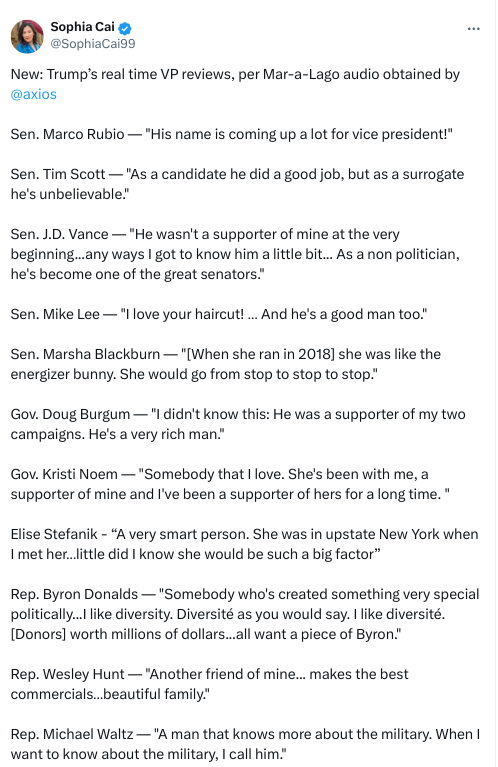
Trump’s Mar-a-Lago veepstakes: Is it Kristi, Tim or Doug?

Donald Trump whines constantly about not being able to campaign around the country because he's stuck in a New York courtroom facing trial on felony charges. Since court is only convened three or four days a week and Trump has his own plane, he could certainly be out on the campaign trail every week if he chose to. He held a couple of rallies last week in Wisconsin and Michigan, but on his days off he's usually playing golf at and angrily tweeting rather than glad-handing the MAGA crowd out on the stump. And, of course, he's holding a lot of fundraising events down at Mar-a-Lago.

This past weekend, rather than heading out to Arizona or even next door to Pennsylvania, Trump was back in Florida regaling 400 wealthy donors at a $40,000-a-ticket event with extended complaints about his legal problems and the stolen election of 2020, among other MAGA greatest hits. He also compared the Biden administration to the Gestapo and called special counsel Jack Smith a "f***ng a**hole." In other words, he was clearly enjoying himself.

The event was wrapped around an annual Republican retreat, also conveniently being held in Palm Beach — now the center of the GOP universe — where Trump's campaign staff and pollsters delivered a presentation to wealthy supporters explaining why their guy is a shoo-in in November. According to the New York Times, the presenters reported that there are only three real swing states, Wisconsin, Michigan and Pennsylvania. The others that everyone else usually puts on that list — such as Arizona, Nevada, Georgia and North Carolina — are already in the bag for Trump. They even went so far as to add Minnesota and Virginia as likely Trump pickups. None of this comports with any known reality in public polling which currently shows an extremely tight race in the six most important swing states. But this was really a pitch for money, so they wanted to sound optimistic.

Trump's team also reported that they had raised $76 million in April but we'll have to wait for the FEC reports later to see if that's correct. Since that would presumably include the $50 million he allegedly raised in one night, it would suggest that the rest of his fundraising effort is still pretty anemic. So these big-money events are more important than ever. It's possible that Team Trump has bled its bled its base dry after eight-plus years of constant haranguing for money. (This week, they even begged supporters to pay the $9,000 fine imposed on Trump by Judge Juan Merchan in his New York criminal trial.)

But the weekend's big event was the Mar-a-Lago luncheon that brought in a long list of vice-presidential contenders, whom Trump paraded before the assembled donors as if it were a Miss Universe pageant. Fortunately, we were all spared a swimsuit competition, although I'm sure the group would have been happy to oblige if Trump had demanded it. There is no apparent limit to what they might do to curry favor with Dear Leader.

Axios reported that Trump called each of the hopefuls up on stage, one by one:

Whatever he was trying to say about Byron Donalds and "diversité" — that's something else.

He also gave a big shout-out to House Speaker Mike Johnson, who was in attendance, which must have had Rep. Marjorie Taylor Greene fuming. One wonders if Greene will really go through with her threat to call a motion to depose Johnson this week, as promised, after hearing the party leader praise him so fulsomely. If she still had hopes of making the list of potential running mates, those were dashed this weekend. She wasn't invited.

We need your help to stay independent

Then five of the veep hopefuls went on the Sunday shows to display their sycophancy skills. We all know how important that is to him. The most stunning performance came from South Dakota Gov. Kristi Noem, who had left the luncheon early and didn't make it up on stage with the others. She's still trying to spin her way out of the self-inflicted mess she's created with her new book, which features an account of shooting a puppy and a blatant lie about meeting North Korean dictator Kim Jong-un. It's not going well.

She later posted that it was all fake news. You can see for yourself it was not.

Meanwhile, Sen. Tim Scott of South Carolina repeatedly refused to say whether he would accept the results of the election if Trump lost, insisting that Trump was going to win (one way or another).

North Dakota Gov. Doug Burgum, reportedly a billionaire wealthier than Trump, continued to practice his best Mike Pence impression — but ended up sounding more like Mitt Romney after taking umbrage at the term "wealthy donors":

Sen. Marco Rubio of Florida continued his self-abasement crusade, piggy-backing on Trump's outrageous comments about Democrats wanting to "abort" babies after they're born and demanding that non-citizens who protest in America be deported.

Rep. Elise Stefanik of New York, lately famous as the scourge of university presidents, stridently defended Donald Trump even more aggressively than the other groveling wannabes on the Sunday suck-up tour. He definitely likes that.

I believed Noem was the likeliest choice until Puppygate broke. Now I think Tim Scott is probably the frontrunner. He's got the Pence-ian adoration act down pat and I think Trump would enjoy having a Black man from the South in that subservient position. Why Scott, an accomplished man with a successful political career, would choose to subject himself to that is truly mystifying.

Trump really let down his hair at this luncheon, obviously feeling comfortable with the wealthy donors who were there to open their wallets. Indeed, aside from his usual rants about how nobody knows the trouble he's seen, he couldn't stop talking about money.


Want a daily wrap-up of all the news and commentary Salon has to offer? Subscribe to our morning newsletter, Crash Course.


The Washington Post reported that he complained about having to take selfies with donors, saying he wouldn't do it unless they forked over more cash. He said a wedding would get preference over the donors because the wedding guests were paying a higher rate per person. He also bragged extensively about his golf game, citing tournaments held at his own clubs that he ostensibly won. You might think that all these wealthy and successful individuals would be at least a little put off by all this inane braggadocio. Either they love his narcissism and pathological lying as much as the MAGA faithful do, or they've collectively decided to shut up and take it.

Hobnobbing with rich people begging to give him large sums of money must have come as a soothing balm to the once and possibly future president. But it couldn't last. On Monday he's back in that dingy, cold courtroom in Manhattan, being treated as just another criminal defendant — albeit one who comes with Secret Service protection. On days like this it must feel like Mar-a-Lago is a million miles away. Maybe that's why he closes his eyes and drifts off to sleep so often during the testimony. He wants to retreat to his fantasy world where he's more important than everyone in the room and nothing bad can touch him. The gritty reality of having to face accountability for his reckless criminality is just too much to bear. 

Trump’s lawyers are trying to use his trial to generate conspiracy theories — but it’s not working

Donald Trump's lawyers famously spend a lot of their time placating their client's narcissistic delusions, even at the expense of their purported priority of keeping him out of prison. It's not just the over-the-top belligerence that Trump demands from his lawyers, which runs the risk of angering both the judge and the jury, Trump wants his lawyers to stick to his preposterous claims that he's never done anything wrong. He wants to pretend that he's the most perfect man who ever lived and that anyone who says otherwise has some secret agenda to victimize him. 

As this trial goes on, the defense team has adopted Trump's favored tactic of floating conspiracy theories to explain away the mounting pile of evidence against him. In some cases, they may be trying to convince at least one juror the conspiracy theory is the same as reasonable doubt. But there appears to be another audience they're trying to reach: Trump's MAGA fans.

Telling such an obvious whopper to a jury seems like it will backfire by making them believe the defense attorneys are just liars.

MAGA has long relied on conspiracy theories to justify their odious political beliefs. For some reason, Trump seems to believe his followers need a story to tell to claim he's innocent of everything said about him during this trial, even though he very obviously isn't. So he's making his lawyers waste their time propagating the narrative instead of focusing their energies solely on the goal of confusing at least one juror to render a hung jury. 

But Trump's supporters don't seem to be biting. MAGA may not love that their leader is on trial, but the conspiracy theories he's floating are so asinine that even his most shameless hype men are shying away from repeating them. It turns out there are conspiracy theories that are too dumb for even the Trump base to embrace. This disconnect also suggests that Trump's self-absorption is causing him to lose sight of what, exactly, his followers want from him. 


Want more Amanda Marcotte on politics? Subscribe to her newsletter Standing Room Only.


The most obvious and frankly hilarious example: The defense team is sticking by Trump's story that he never had sex with Stormy Daniels. I can hear readers scoffing, but it's true, they're really going that route. Even in his opening statement, defense attorney Todd Blanche argued that Daniels' story is a "false claim of a sexual encounter" with Trump, one she made up as part of an extortion scheme. 

As a defense strategy in court, this seems ill-advised. As anyone who has seen Daniels in an interview can attest, she comes across as a credible person. Certainly much more so than Trump, who lies and dissembles every waking moment of the day. But also, it just doesn't make sense. As no other than Sen. Mitt Romney, R-Utah, told reporters recently, "You don’t pay someone $130,000 not to have sex with you." Plus, Trump's-then attorney (now turned state's witness) Michael Cohen was threatening Daniels to shut up years before the pay-off scheme, which wouldn't have been true if she made it all up to extort a presidential candidate in 2016. Plus, there's the other mistress, Karen McDougal, helping establish that Trump was not averse to adultery.

Telling such an obvious whopper to a jury seems like it will backfire by making them believe the defense attorneys are just liars. Trump's claims of sexual virtue seem more aimed at the outside audience, as if he hopes his supporters will start parroting his ridiculous notions that he's never done anything wrong. There were a couple of half-baked efforts to do this. The far-right network OAN even tried to float the conspiracy theory that it was Cohen, not Trump, who had sex with Daniels — but they were quickly forced to retract the story and apologize to Cohen. That's highly unusual for the network, which seems to exist primarily to spread right-wing disinformation. Part of this is because Cohen threatened to sue. But OAN didn't even bother to put up a fight. It suggests that even the folks at OAN are a bit embarrassed by this. 

Trump's lawyers are leaning into the narrative that he is a perfect angel who just keeps being targeted by vast conspiracies. During the cross-examination of lawyer Keith Davidson, who represented Daniels as Trump and Cohen paid her hush money, Trump attorney Emil Bove kept pushing the "extortion" conspiracy theory. He appeared to be arguing that Daniels and Davidson had concocted a shakedown scheme. But it doesn't pass the basic common sense test to argue that Trump would be so threatened by a false story that he'd pay her this much money. 

Things got even sillier on Thursday when Bove questioned forensics expert Douglas Daus. Daus was just there to verify that text messages and recordings from Cohen's phone were real. But Bove tore into the guy, repeatedly suggesting the information extracted from the phone was compromised or fabricated in some way as if the texts and recordings were the product of a "deep state" conspiracy. It's hard to imagine this is for a jury made up of people who were screened to make sure they aren't QAnon-style nuts. Likelier is the hope that this conspiracy theory will get traction in the right-wing propaganda machine, feeding Trump followers talking points they can use to dismiss it if the jury convicts. 

But what's fascinating is that the MAGA media doesn't seem to be biting. Instead of trying to discredit the allegations against Trump, the right-wing press has gone with a deflect-and-distract strategy. As Media Matters chronicled, Fox News is doing lots of "look over there!"-style segments making a big deal out of Trump's press events at bodegas, rather than grappling with what's going on inside the courtroom. The network is also pushing the idea that Trump should get "immunity" for all his crimes, which feels like a tacit admission of guilt. Even those who are trying to get conspiracy theories going, like Steve Bannon at War Room, are focused on attacking the prosecutors for having "political" motivations. Denying the truth of the allegations is not a priority, because even the MAGA audiences won't buy it. 

In the past, Trump has clearly understood that even his supporters don't buy the idea that he's a good person. If anything, his transgressions, both legal and criminal, are part of his appeal. He's an aspirational figure to people who wish they could also cheat on their wives and commit crimes, all without facing consequences. While they do have an astounding amount of tolerance for his endless whining, his appeal was never his "woe is me" victim act, but his impunity. 

It also shows he forgets what his supporters want from him: A figurehead for their fascist movement. They want a Trump who is focused on crushing people they hate and making bold promises to restore conservative white Christians to a place of unearned privilege they feel they've lost. They don't care about his "I never did it" conspiracy theories. Most never cared about what he gets up to in his personal life, or even really any crimes committed. The Trumpian conspiracy theories that gain traction are those that validate their culture war grievances. The Big Lie is beloved because it tells them a story where they aren't outnumbered by Americans who disagree with them. But why should they care if Trump breaks the law and cheats on his wife? That was always part of his appeal. That he would deny it at this late date is odd, and suggests he really is becoming unmoored not just from reality, but his own relationship to his base.


Trump’s hush-money trial: The personal is truly political

As a practical matter, Donald Trump’s hush-money trial is fundamentally about election interference and hiding information from the American people that could have influenced the outcome of the 2016 election. Legal experts generally agree that the testimony by witnesses for the prosecution — including David Pecker, former publisher of The National Enquirer, and Stormy Daniels’ former attorney Keith Davidson, as well as the bankers and assistants who had knowledge of Trump’s financial matters as they relate to the hush-money payments, have been very damaging to the ex-president's defense.  

To that point, a highlight (or low point, depending on one's point of view) of this trial came last Thursday when an audio recording of Trump speaking with his then-attorney Michael Cohen about buying the silence of Karen McDougal (one of Trump's alleged sexual partners) was played in court for the jurors. This evidence is critical to the prosecution's case because it establishes a pattern of behavior. 

In a dramatic moment on Friday, longtime Trump aide and confidante Hope Hicks testified for the prosecution. She explained how her former boss was pleased that the information about his alleged encounter with adult-film actress Stormy Daniels became public years before the 2020 election, when it would have potentially been much more damaging. Hicks began to cry as prosecutors questioned her, prompting Judge Juan Merchan to order a brief recess so she could compose herself. Hicks' testimony once again confirmed that the hush-money operation was fundamentally a political maneuver intended to keep damaging information from the American people.

Exasperated and frustrated in the pressure of the courtroom, Trump continues to show contempt for the court, the judge and the rule of law by repeatedly falling asleep, as well as by continually violating Merchan's gag order.

In his fundraising emails and other communications, Trump continues to amplify his lies that he is the victim of a “witch hunt” and “conspiracy” by Joe Biden, Barack Obama, the Democratic Party and anyone and everyone else who is trying to keep him from “Making America Great Again.”

Trump has also reportedly told members of his inner circle that he is upset with his attorneys for not defending him more “aggressively.” His combative strategy is likely to backfire. Last Tuesday, Judge Merchan fined Trump $9,000 for violating the gag order, warning the defendant that he risks being jailed if he continues to threaten or otherwise seek to intimidate and harass witnesses, jurors and others people involved in the case. On Thursday, prosecution requested that Merchan punish Trump again after his social-media comments about the jurors, David Pecker and Michael Cohen.

As “revealed” in a recent interview with Time magazine, Trump has real plans to be America’s first dictator. He is not being hyperbolic or just posturing. His public statements are consistent with the ways Trump has repeatedly shown that he is an obvious megalomaniac with a god complex, who believes that he is a type of prophet or messiah for the MAGA movement and American neofascism. In his speeches, campaigns ads and elsewhere, Trump has basically — and explicitly — said these things over and over again.

Donald Trump and his allies’ campaign to end America’s multiracial democracy has been emboldened by the right-wing justices on the U.S. Supreme Court, who now appear to be willing to grant Trump some amount of “presidential immunity.”

Any person with Trump’s personality and politics will inevitably feel enraged by the very idea that they could be held accountable by the courts and the rule of law, as if they were an ordinary citizen in a functioning democracy. As Trump’s hush-money trial continues, his behavior will in all probability get much worse and not better. If he is actually elected president again, he will, as promised, weaponize the Department of Justice and federal law enforcement to seek revenge and retribution on his “enemies,” including Joe Biden and other prominent Democrats and liberals. 

Ultimately, Trump’s criminal trials, his aspirations to become an American dictator and the antisocial, dangerous and destructive forces both swirling around him and being projected by him offer a study in how one man’s damaged personality can interact with mass politics in the worst ways possible.

We need your help to stay independent

Donald Trump’s niece Mary Trump is a trained psychologist. In a recent essay in her Substack newsletter, she connects her uncle’s pathological personality to the larger democracy crisis:

I’ve lost count of how many times he’s gotten away with the lies and fraud and alleged criminality and simply being a horrible human being. He’s a charlatan with nothing but snake oil to sell. His promises are empty, because he has nothing of substance to offer.

And his antisocial behavior is directly tied to his psychopathology — because he believes himself to be above the law and cannot fathom that he would ever be held to the same standard as us mere mortals.

The fraudulent financial statements he used to secure loans and build his real estate empire concealed the dark truth that his wealth was a mirage.

The 34 felony charges relate to his falsifying business records as a result of payments to suppress an embarrassing fling with a porn actor from voters at a crucial point before the 2016 election.

His inability to concede loss after the 2020 election — indeed, his inability to believe that he could lose at all — was behind the buildup to the January 6th insurrection, the calls to the Georgia attorney general to “find” votes in order to change that state’s results, and the fake elector scheme in multiple states, including Michigan and Arizona.

His theft of government documents reflects his continuing attempt to assert his sense of impunity, which, in all but one of his criminal cases, remains unchallenged.

She continues: 

His narcissism knows no bounds. He gazes into the mirror, sees a god, and expects us all to bow down. His ego is like a black hole, sucking in praise, adoration, and any semblance of humility. He surrounds himself with sycophants, those who nod and clap like trained seals. 

His self-love is a theatrical spectacle, a masquerade of grandeur. He revels in the spotlight, basking in the adoration of crowds.

Yet, this dance is a diversion — a sad waltz to distract from the void within. His mirror reflects an image he desperately wants to believe: the infallible titan, impervious to doubt.

But beneath the bravado lies a wounded child — the boy who yearned for approval, who hungered for his father’s love but never got it. His narcissism is a bandage, covering old scars.

His insecurity whispers: “You’re not enough. You’ll never be.”

And he’s right.

In a conversation with MSNBC's Nicolle Wallace, Mary Trump offered these suggestions about how to leverage her uncle's personality defects and bad character in order to defeat him in the 2024 election:   

He needs to be relentlessly mocked at every turn….We see in the courtroom he's not handling the circumstances well. He's not handling the confinement or the fact that he has no power in this space and that's why….So it would be so much better if he were just forced to wallow in the consequences of his actions,….We see him looking like he's falling asleep. Whether or not he's falling asleep — he's complaining about the temperature. It's something I don't see being paid attention to, but it's important. Donald Trump is there — trapped in that courtroom because of what he did. There are a lot of other people trapped in that courtroom because of what he did. He doesn't seem to care that they're also cold and tired and don't want to be there."

Mary Trump advised that pro-democracy Americans should "hammer away on his weakness and his frailty, and I mean that psychologically."

Nicole Wallace is also keenly aware of the existential danger that Donald Trump and his MAGA people and the larger anti-democracy movement pose to American democracy, freedom of the press, and to her personal safety and future. On last Monday's episode of her MSNBC show "Deadline: White House," Wallace shared her thoughts about what will likely happen if Donald Trump wins the 2024 election and follows through on his threats to become a de facto dictator:

[A]t this exact time next year, depending what happens in November seven months from now, we can’t say for certain that there would even be a White House Correspondents’ Dinner, or even a free press, or even a White House Press Corps….While our democracy wouldn’t exactly fall apart immediately without it, the real threat looms larger. A candidate with outward disdain, not just for a free press, but for all our freedoms and for the rule of law itself.

As I follow Donald Trump’s hush-money trial, I keep returning to the concept that sick societies produce sick leaders and how this is especially true in ailing democracies such as the United States in the Age of Trump. But I have also been meditating on how “the personal is political.” As originally deployed, that concept and slogan was popularized by liberal and left political thinkers, activists, and organizers as a way of explaining how questions of power and politics are not abstract, but instead are lived experiences that have a profoundly disproportionate impact on marginalized communities and people(s) deemed to be the other. By comparison, Donald Trump embodies a malignant version (and perversion) of how the personal is political. In that way, Donald Trump’s personal problems are a great political and societal problem for the United States and its democracy and people. Unfortunately, because those problems are so great they will persist even if Donald Trump is found guilty in his multiple criminal trials, defeated at the polls in the 2024 election, and disappears from public life. The Trumpocene is our collective malady.

Why restoring trust in science starts with art, history and education

For Dr. Frederic Bertley, there’s a subtle connectedness among the seemingly disparate in the world. That connectedness underpins both his own understanding of the sciences, and his strategy as a communicator and educator of them. Affectionately known as “Dr. B,” Bertley is the President and CEO of the Center of Science and Industry (COSI) in Columbus, Ohio, now celebrating its 60th year as a brick-and-mortar museum in the heartland. 

A Harvard-educated immunologist who spent his university days working on HIV and AIDS vaccines, recognition of Bertley's leadership in science education has extended to the White House and wider world. Amid a growing American distrust of science — fueled by partisan rhetoric around COVID-19 — Bertley’s approach to solving the science-trust problem is one of radical common sense, with a Renaissance spirit. 

In an interview with Salon, Bertley talked about his and COSI’s roadmap toward making scientific understanding more accessible to diverse groups. Bertley’s methods include connecting the arts and humanities to science communications aimed at the general public, rebuilding classroom practices and leveraging the natural intelligence of every age to show people how much they already know about seemingly complex topics.

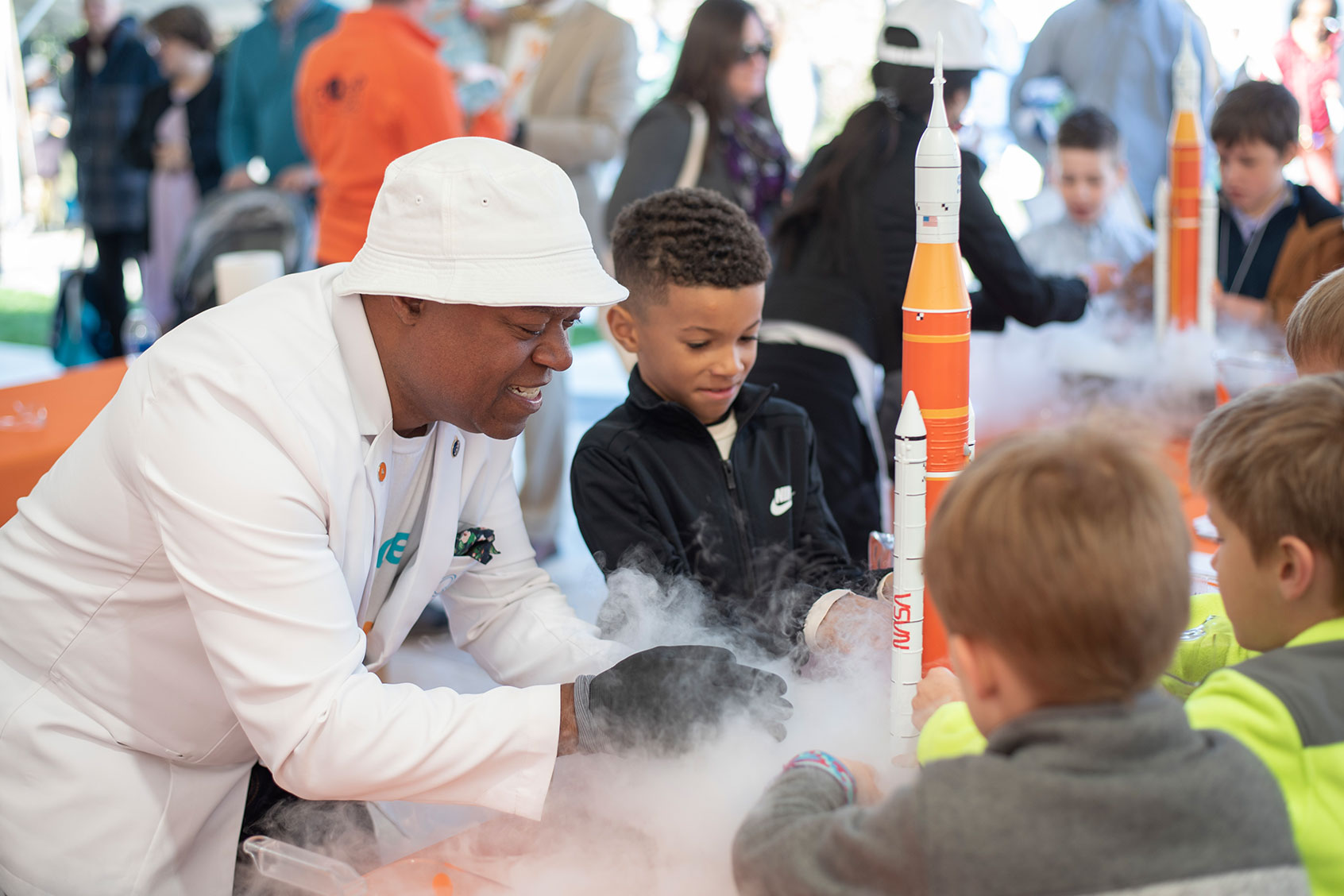
The White House Easter Egg Roll Rocket ScienceLeading science educator and communicator, Dr. Frederic Bertley, brings rocket science to young White House visitors during the 2023 annual Easter Egg Roll. (Anna Trankina / COSI)
Let’s talk STEAM — science, technology, engineering, art and mathematics. While the term is usually seen in youth-education contexts, bringing the A into science communications seems to make science more accessible for savvy adults too. For instance, when culturally attuned media audiences come into contact with hard sciences, there’s often a disconnect that can be bridged with an arts-focused lens. How does the A in STEAM have an impact on science accessibility on your side? 

First thing: communication. You've got to find a common vocabulary. So if you're a plasma physicist or an organic chemist, you're working on this weird small molecule that no one else understands. Great. That’s not going to work with the general public. Whether you have college degrees or PhDs in history — you’ve got to find a common vocabulary. 

"For us, they are intimately connected. The best scientists have been completely creative."

It's becoming in vogue now to move from STEM to STEAM. So you have a lot of people who are in that science-y kind of STEM space that just add the A because they want to get funded, or for other reasons. Then you’ve got the other side, people who are working harder to add the STE because they want to say they're connected. And some people do it well, don't get me wrong, but in general a lot of it's just kind of like "oh, polite nod to the other." And we don't approach it that way at COSI.

And why do we do science? Why do we have science and its cousin, engineering — and then make technology? 99.9% of time it's to ameliorate the human condition, right? Harnessing fire so we can cook food and live longer, coming up with medicines to save our loved ones, and these devices we have in our pockets — it’s the effort to move humanity forward, and bring us closer. Well, nothing does that more than the arts. 


Want more health and science stories in your inbox? Subscribe to Salon's weekly newsletter Lab Notes.


That's why you go look at a Gauguin, a Matisse, a Basquiat. That's why you want to understand fabrics and textures and colors, why you study history. For us, they are intimately connected. The best scientists have been completely creative, right? For us, STEAM is a real thing. That's how we navigate our universe. That's how we make it through every day. 

On the topic of COVID-19, we can say it obviously won't be the last pandemic we have. And we’ve seen so many flaws exposed in how science is communicated in fast-paced journalism and media. But scientists and communicators now face an even greater deficit in public trust, heavily fueled by political disinformation campaigns among the anti-science crowd. 

Science nihilism was a thing before the pandemic, existing at whatever percentage in whatever society you looked at. But the pandemic just took that science nihilism and added rocket fuel to it. And the reason why is that you had this weird time. We're coming out of Black Lives Matter movements, and other social movements are bubbling up. The pandemic shut the world down, things were tough, maybe you lost your job so you’re not feeling good, and things are getting politicized — it literally was a classic mash-up of just unbelievable things that all happened right at the same time.

"Science nihilism was a thing before the pandemic … But the pandemic just added rocket fuel to it."

So when you layer on politicization, then people are angry because they link it back to real life — and that's made that science denialism rise from anywhere from 5% to 15% of population to smack dab at 50%. For sure along partisan lines, and then even beyond that in other spaces.

But, in general, the medical and scientific community didn't step out front and say, “Hey, new bug — we don't have an understanding of it. We have no immunity for it. We are learning as we go. We are going to make mistakes. We are not going to be sure, but we promise you science is a process of accumulating data and getting closer to the truth.” We didn't do that. 

We need your help to stay independent

Can you talk to us about the path forward for creating more clear, helpful science communications — and for engaging the public, and even students, in a way that reestablishes trust?

Education is critical, but it's got to be education with a consistent drumbeat … So how do we have a consistent drumbeat around science and STEAM literacy? And then the final point is, which is we've got to teach it better. We've got to connect it to things that people can relate to.

So how do we teach all the complexities of our beautiful natural universe? In ways that can connect people to vocabulary they understand — to things that are meaningful to them, and that will help them feel much more comfortable about science, and therefore less afraid of those big black boxes of scientific data. 


Trump VP contender unbothered by him comparing Biden administration to the “Gestapo”

Potential vice president contender and North Dakota Governor, Doug Burgum, seems to brush-off questions that could portray former president Donald Trump in a bad light, including his recent remarks comparing the Biden administration to the “Gestapo.” 

In an interview with CNN’s Jake Tapper, the Republican governor weighed-in on Trump’s stance as a presumptive presidential nominee, after attending the Republican National Committee meeting at Mar-a-Lago Saturday night.

“Are you comfortable with the presumptive Republican presidential nominee comparing the Biden administration to the Gestapo?” Tapper asked.

Burgum, first dodging the question by praising Trump for delivering a 90-minute speech san teleprompter while remaining "upbeat," eventually landed at, “If the election was held today, Trump would be winning.”

“In relative to the reference you’re discussing, I mean, this was a short comment deep into the thing that wasn’t really central to what he was talking about,” he said. “I understand, and I think Americans understand. A majority of Americans feel like the trial that he is in right now was politically motivated.”

Burgum furthered that he understands why someone in Trump’s position, who is being “unfairly treated,” would be “frustrated” that they were being kept off the campaign trail.  

When Tapper asked him to explain how “a public trial with witnesses, a jury, and a defense counsel” is like the Nazi Secret Police, the governor repeated his belief that the former president wasn’t referring to his trial when he made that comment.

“I mean, I’m a business guy. This is a business filing case. If it was anybody other than a presidential candidate, this would be a misdemeanor. How it got turned into 34 felonies . . . they haven’t even convinced anybody there was a crime,” the governor said. 

He added that if it were a crime, it would be a Federal Election Commission crime that would be pursued by the federal courts, not by a county DA in New York. 

He went on to claim that the outcome of this trial doesn’t affect Americans, instead, what affects them is “Joe Biden’s policies” and the “insidious” inflation tax that has “come like a thief in the night.” He added that voters are looking at the policies, not the people, saying, “They were better off under President Trump’s policies.”

Watch here:

Kristi Noem’s animal cruelty is hurting the GOP financially

A May 4th Colorado GOP fundraiser, where Gov. Kristi Noem, R-S.D., was supposed to speak, was canceled due to threats sparked by her admission of killing her 14-month-old dog, Cricket.

Nancy Pallozzi, Jefferson County Republican Party Chair, said in a statement posted on social media that the group had initially thought the timing for the fundraiser was “perfect,” since the South Dakota governor’s book, "No Going Back," comes out soon. But attitudes have changed towards Noem, as examples of her cruelty towards animals continue to make headlines. 

“Numerous threats and/or death threats” have been made to the county organization, the Denver West Marriott where the fundraiser was being hosted, and to Noem herself, according to Pallozzi. 

“After a conversation with the Governor’s office late Wednesday, we mutually decided that safety was the most important concern for everyone involved,” Pallozzi wrote. 

Despite the threats to the Marriott, which received “alarming comments” worth “deep concern over the safety and security for those attending our event, other guests, and their staff,” Pallozi confirmed that the local GOP is “not taking a position on the public outcry on the governor’s book.”

However, she did add that the fundraiser had an adverse effect. “We lost money in this,” Pallozzi told NBC News. “This was meant to be a fundraiser, but now we’ve lost thousands of dollars.”

The consequences of what Noem describes in her book — which also details her murdering a “mean” and "smelly" goat — have impacted her political aspirations, no doubt.

After reports of her shooting her wirehaired pointer, whom she “hated” because the puppy didn’t take to her initial hunting training, the anecdote seems to have severely hurt her chances of being Trump’s running mate, as even he is giving her stink-eye over it. 

When Noem spoke at a Trump donor retreat at Mar-a-Lago on Saturday, she seemed less than apologetic about her actions, and far more concerned with how it would be yet another exercise to show her political contemporaries that she has what it takes to make it.


Want a daily wrap-up of all the news and commentary Salon has to offer? Subscribe to our morning newsletter, Crash Course.


"They’re just attacking me like crazy right now,” she said. "But listen, that’s a good thing. It’s a good thing because it makes you stronger, and it teaches you, really, what you’re up against. And it makes you recognize how much they lie. How much they will twist. How much they will manipulate. And you just have to be strong and be happy warriors.”

It seems as though Noem has even doubled down on her animal killing spree, and hints in her book that she’ll kill Biden’s dog, if an opportunity presents itself wherein she feels such an action would be necessary. 

In an interview with CBS, the interviewer confirms this: “At the end of the book, you say the very first thing you would do if you got to the White House, that was different from Biden, is you would make sure Biden's dog was nowhere on the grounds. 'Commander say hello to Cricket.' Are you trying to look tough?”

When asked if she still thinks she has a shot at being vice president, Noem, who has suddenly decided she is the equivalent to animal control, said, “Well, number one, Joe Biden’s dog has attacked 24 Secret Service people.” Staying on-brand, she ended with compliments to herself and her state of South Dakota being “happy and doing well.”

Bringing “Zillow Gone Wild” to HGTV proves the website has become addictive hit entertainment

What closed the “Zillow Gone Wild” sale for me was its X account’s 2022 listing of a four-bedroom, three-bathroom Onalaska, Wis., home. The cozy ranch greets you with a 1970s brown brick exterior and monochromatic Millennial grey décor, accessorized with homey mall-acquired comforts. 

A throw pillow that reads “Our Nest” rests on a side table. Hanging on the kitchen wall is a decorative cutting board commanding us to “EAT” in block letters. 

The pièce de résistance that made the feature go viral, however, is the framed sign above the main bedroom’s headboard that reads, “Welcome to Poundtown.”

“Zillow Gone Wild” creator Samir Mezrahi gamely characterizes the home’s staging as “a good example of what happens when your Michael’s obsession goes one sign too far,” a line that punches up a standard slideshow to a visual gag worthy of "Curb Your Enthusiasm." (Can you even imagine?)

Had it been offered up two years later, “Poundtown” might not have made the cut. The pop culture value of “Zillow Gone Wild,” like most closely watched Zestimates, has skyrocketed – and not only because HGTV adapted it into a series hosted by “30 Rock” star Jack McBrayer

“Zillow Gone Wild” and Zillow, broadly, are examples of the ways an Internet-based service designed for a commercial purpose ends up doubling as entertainment. Zillow doesn’t lack competition in the online real estate promotion business, but 18 years after it launched, it is a mood, a show, a soothing time waster, porn without the NSFW bits.

Also around 2006, HGTV was ascendent on basic cable; in 2007 its hit “Design Star” drew a larger audience than “Top Chef.” In 2024, with Zillow being the internet’s version of “House Hunters,” the network is responding to be more like Zillow. 

On the TV edition of “Zillow Gone Wild” eccentric design is not in itself enough to sustain the premise; the network already has several programming gewgaws celebrating opulent tackiness in home decor and overhauling interior design disasters.

The pop culture value of “Zillow Gone Wild” like has skyrocketed – and not only because HGTV adapted it into a series.

Besides, as anybody who has wasted precious time on either the Instagram account or its X counterpart knows, reading the comments is most of the fun . . . along with the scrolling, of course.

The TV show approximates that experience by imitating a March-madness bracket, pitting each week’s “wild” home against the others, and challenging viewers to correctly guess which one ultimately wins the honor of “Wildest House.” 

Zillow Gone WildZillow Gone Wild (HGTV)The Retta-hosted “Ugliest House in America” has run on a nearly identical formula for five seasons, although the ultimate prize sounds nicer on “Zillow Gone Wild,” offering a $25,000 pot to one viewer who correctly guesses the winning house. Still, "Ugliest House" also owes a debt to Zillow for the way it accelerated the gamification of online real estate shopping.

We need your help to stay independent

With homeownership increasingly out of reach for the average middle-class worker, Zillow is as much of an aspirational diversion as it is a real estate sales tool. It's popular among homeowners, people ready to move and permanent window shoppers, enjoying 217 million average monthly unique users and 2.3 billion total visits over the first quarter of 2024, it revealed in its recent earnings report.  

Surely entertainment analysts would take issue with efforts to compare its performance to cable and streaming content. They are different industries of course . . . unless one factors in the crossovers, and we’re not just referring to the many Barbiecore contenders on “Zillow Gone Wild.” 

In some ways, Zillow is better than TV. It doesn't require special equipment or a subscription. All you need is a phone.

The fictional “Glass Onion” compound featured in the “Knives Out” sequel enjoyed a listing for a time. More recently in the wake of Disney+ “Bluey” breaking our hearts with its 30-minute episode “The Sign,” Zillow hired Ryan Reynolds’ agency Maximum Effort to produce “A Moving Commercial,” using actual blue heelers to soothe parents into the idea that selling a home doesn’t need to traumatic. 

But Zillow has been aware of its pull on Millennials and Gen Z for some time, proven by the  Pop-Tarts listing of a 35-square-foot house in November 2022. Back then teens and 20-somethings hadn’t yet made Zillow surfing video reactions its own TikTok fad. That’s a thing now, especially late at night.

We get it. In some ways, Zillow is better than TV. It doesn't require special equipment or a subscription. All you need is a phone.  Where shows thrive or fizzle based on whether we enthusiastically welcome their characters into our living rooms, Zillow does the opposite, allowing us access to the lives and physical spaces of other people. The very online can not only tour the inside of their neighbors’ houses without their awareness or permission, but they can see how much they paid and view tax data. They can also covet or be judgy.

They can also dream, lust (the joke driving that 2021 “Saturday Night Live” skit with Dan Levy) and maybe set goals. Living in a big city is expensive and cramped, but if you’re willing to commute, and possibly live in a missile silo, a person might finetune their career blueprints to make that happen.

Zillow Gone WildZillow Gone Wild (HGTV)“Zillow Gone Wild” boasts 1.9 million Instagram followers today and 619,000 followers on X, an audience that grew rapidly owing to the account’s launch in December 2020 during the first and darkest winter of the COVID pandemic. Its opening act captured the angst of lockdown cabin fever with a famous Vermont listing that rolls out a series of very average-looking interiors before revealing the domicile’s quirkiest feature: rusty jail cells with rotting commodes. 
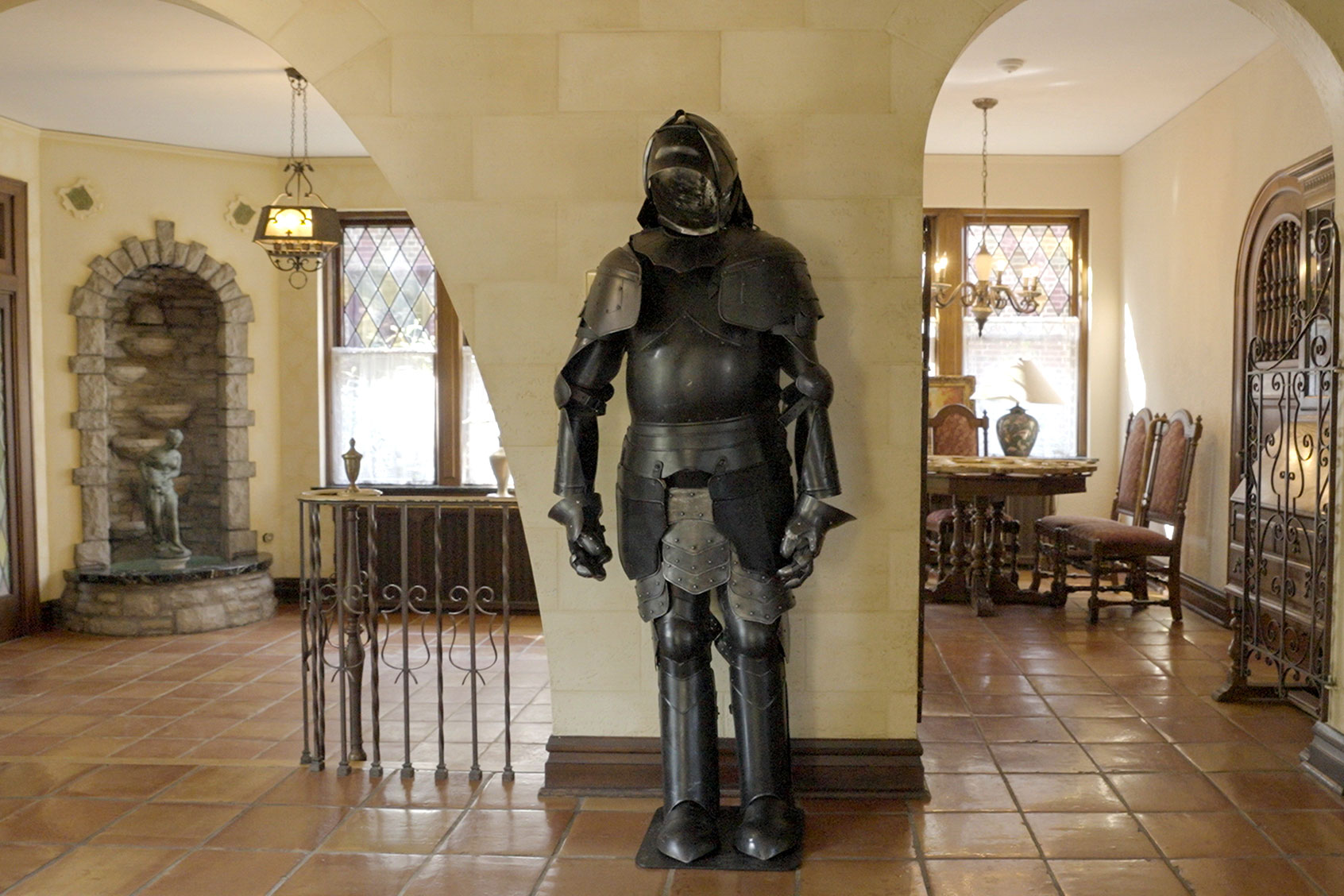
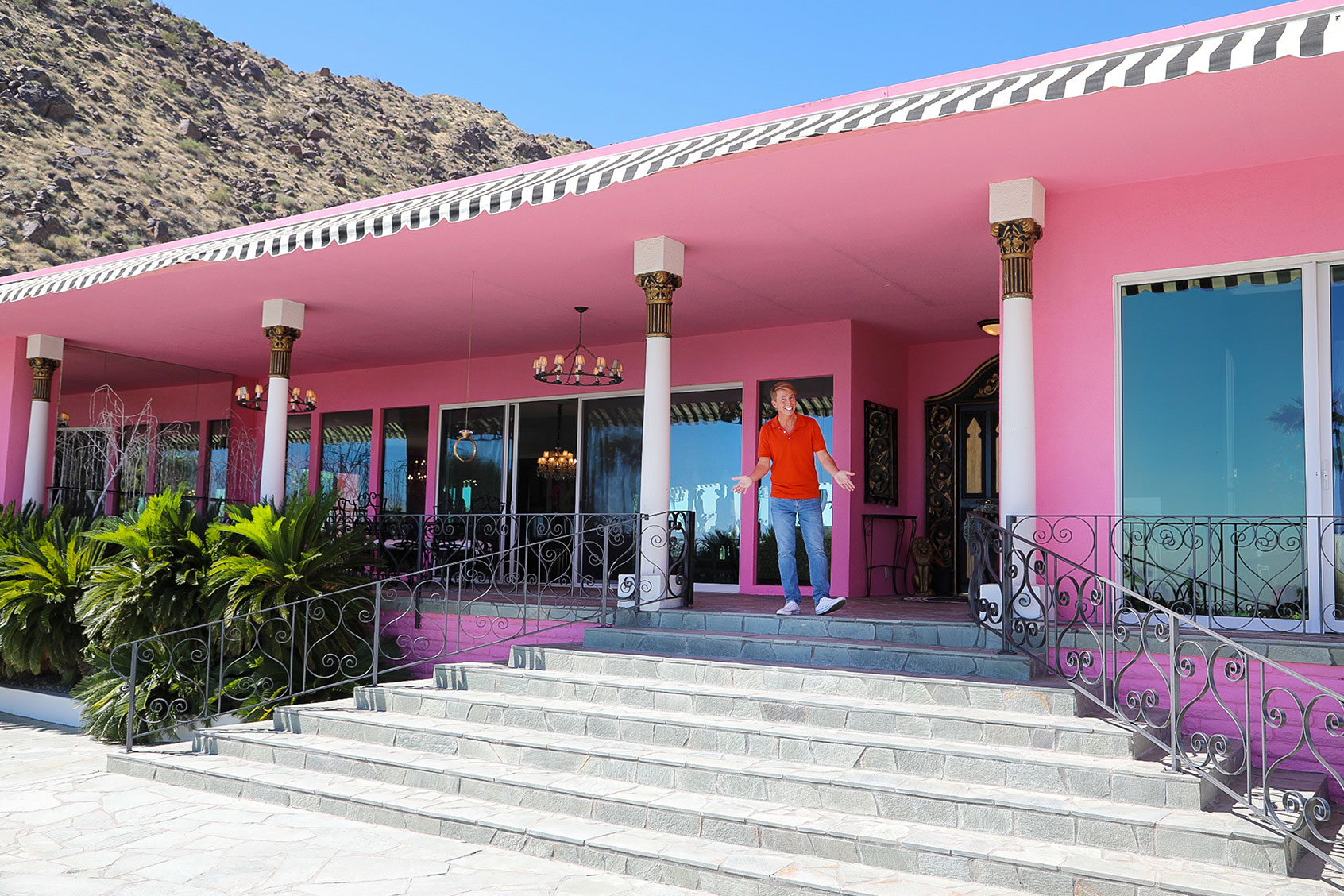
Many such jail houses have turned up on Zillow and its social feeds since, although more recently “Zillow Gone Wild” Instagram selections have tended to feature the uncommon and the baroque, the ridiculously expensive and the sublimely affordable. 


Want a daily wrap-up of all the news and commentary Salon has to offer? Subscribe to our morning newsletter, Crash Course.


Whether a home comes with acreage or is tiny but somehow unique, it’s both a real estate agent’s tool and a showcase of over-the-top creativity, like the colorfully painted but unassuming Las Vegas home that hides a pirate ship-themed interior that extensively commits to the mood. 

The pirate house made its Instagram debut last July as part of Mezrahi’s “You Never Know What’s Going On Inside a Home” theme on the account, and turns up on the show in an early episode. It’s one of an array of homes with some “wackadoo” feature or another as part of their owners committing to a bit, with the difference being the human element. 

Zillow Gone WildZillow Gone Wild (HGTV)

McBrayer exuberantly roams these places with their owners or a listing agent expressing wonder as he turns every corner, never making fun of the decor regardless of how garish or nonsensical they may be.  

He reminds us that these “wild” places sprung from the imaginations of creative individuals – real people attached to spaces they loved as opposed to unseen entities removed from the room. The space is the star regardless of how one prefers to tour “Zillow Gone Wild”; most will likely favor the host-free voyeuristic route Instagram and X afford. 

But if you prefer the personal touch by way of a guided tour, McBrayer has your invitation. 

https://www.instagram.com/reel/C6PIC2ouZ0X/?utm_source=ig_web_copy_link&igsh=MzRlODBiNWFlZA==


Without explicit sex scenes, “Challengers” is the horny movie Gen Z has been waiting for

For a movie about tennis, “Challengers” was anything but from its first look.

Last summer, the trailer for Luca Guadagnino’s scintillating sports drama dropped and immediately piqued our interest – not for Zendaya's tennis whites, but for her bright pink velour zip-up. More specifically, viewers seized upon the scene in which she’s wearing it: While seated on a bed, she beckons two young men clad in loose shirts and underwear to sidle up next to her. She kisses each boy, before brushing her long, undulating hair back and inviting them to her neck. The uptempo, rollicking cadence of Rihanna’s “S&M” threads through the background.

We all thought we knew what (and who) was about to go down. 

In this film, sex happens on the tennis court, through an ever-evolving love triangle.

Studies released earlier this year indicated that a subset of Gen Z has renounced their interest in onscreen sex. And yet, though we’re years past Christian Grey’s nipple clamps and "Game of Thrones" brothels, we’re still more or less inundated with libidinous, hedonistic content, some of which has teetered on the line of exploitative and grossly unethical (I’m looking at you, Sam Levinson).

While some naysayers might chalk up younger peoples' anti-sex stance in media as correlative to their waning sexual pursuits in real life, it really boils down to a desire for a reflection of more nuanced interactions. Gen Z doesn’t want film and television to undergo a puritanized overhaul, wholly devoid of any sexual content. They just want the spicier segments to be less gratuitous and more emotionally resonant.

Enter “Challengers.” 

It doesn't need to show explicit sex scenes to deliver a refreshingly horny plotline. In this film, sex happens on the tennis court, through an ever-evolving love triangle. 

Still, it’s telling that “Challengers” was effectively marketed around a scene we all assumed would be a threesome. It had all the makings of a clip from your most ethically sourced porn site: The narrative! The characters! The dingy hotel room!

Here's how it all goes down. After the best-friend duo Patrick Zweig and Art Donaldson (Josh O’Connor and Mike Faist) — known as Fire and Ice — win the boys’ junior doubles title at the U.S. Open in 2006, they meet up with emerging tennis prodigy Tashi Duncan (Zendaya) at an afterparty. Dumbstruck with sheer attraction and admiration, the boys invite Tashi to come to their hotel room, where they share a meager supply of beer while the boys regale her stories, including a rehashing of the time Patrick taught Art how to masturbate when they were adolescents. 

This conversation leads to further flirting (Art blithely refers to Tashi as being “everyone’s type,” as though it’s a universally known truth) before she invites Patrick and Art to join her on the bed. As the boys began to kiss Tashi, I was certain that they were all going to start clawing each other's clothes off. But that’s not what happens.

After a few minutes of making out, Tashi pulls away from the center, propping herself on her elbows as the camera gazes down at her from above: A satiated grin breaks across her face as she watches Patrick and Art kiss each other, seemingly in earnest (we’ll touch on “Challengers” generous dollop of homoeroticism later). Then she abruptly ends the tryst, leaving the boys – and the audience — hot, bothered, and saying, “Huh?”

This scene is early into the film’s more than two-hour runtime, informing us that our expectations regarding the sex scenes we thought we were going to get, like the love triangle between the three main characters, might be subverted. It also assures us that, while perhaps not our exact expectation, what’s to come won’t be any less hot.

The thwarted threesome isn’t the only aborted sex scene we see in “Challengers.” Several months after the U.S. Open, while visiting Tashi – now his girlfriend — at Stanford, Patrick meets with Art in the dining hall. Leaning into each other with their faces inches apart, the two chat about Tashi as they tear into rather suggestively shaped churros, with Art even taking a bite of Patrick’s at one point after brushing sugar off his cheek The physicality of the scene is incredibly sexually charged and buzzes with erotic undertones; however, we don’t get relief. They stand up from their chairs and the energy fizzles as their chemistry goes unconsummated. 

ChallengersMike Faist stars as Art and Josh O’Connor as Patrick in "Challengers" (Niko Tavernise / Metro Goldwyn Mayer Pictures)Later on, back in Tashi’s dorm room, she and Patrick begin to hook up. Once again, however, the film curtails its intimate content. In between groping and kissing Patrick, Tashi gives him unsolicited tennis tips about his professional tour, sparking a semi-nude kerfuffle. When he informs her that she is his peer, and not his coach, Tashi becomes frustrated, abandoning Patrick in bed to unfurl a yoga mat — she’s got to stretch for an upcoming match, after all. The argument facilitates the end of their (formal) relationship, which is wholly ruptured after Tashi sustains a devastating knee injury at said match. The irony contained here is quite obvious, as we already know from the film’s time jumps that Tashi goes on to marry and coach Art, allowing her to vicariously live through his athletic career.

Out of sight but never out of mind

In “Challengers,” sex is dichotomized into interactions that are as blunt as adult Tashi’s bob and acts that we know occur but don’t actually get to see. 

For example, at the 2011 Atlanta Open, Tashi and Patrick have a one-night stand, even though she’s engaged to Art. But rather than show us every slap, thrust and moan, “Challengers” tantalizes us with what precedes those moments — figurative foreplay, if you will.

Patrick, who is playing in the competition, serendipitously happens upon Tashi sitting in a hotel lounge. The camera cuts to them sitting alone at a table, and it couldn’t look more like a cocktail date. Tashi stares at her engagement ring, telling Patrick that “it’s his grandmother's.” When Art emerges from the elevator not long after, the table is empty, but the shimmering outlines of Tashi and Patrick’s bodies linger in the air. It’s clear where they’ve gone.

When I saw “Challengers” at Manhattan’s SAG-AFTRA Robin Williams Center, someone loudly gasped at this scene, eliciting pealing laughter from the rest of the theater. 

ChallengersZendaya as Tashi in "Challengers" (Niko Tavernise / Metro Goldwyn Mayer Pictures)Eight years later, the throuple finds themselves intertwined once more at the New Rochelle Challenger. Despite turning out to be a leading professional player, Art has slipped into his athletic nadir and yearns to retire – much to Tashi’s chagrin. 
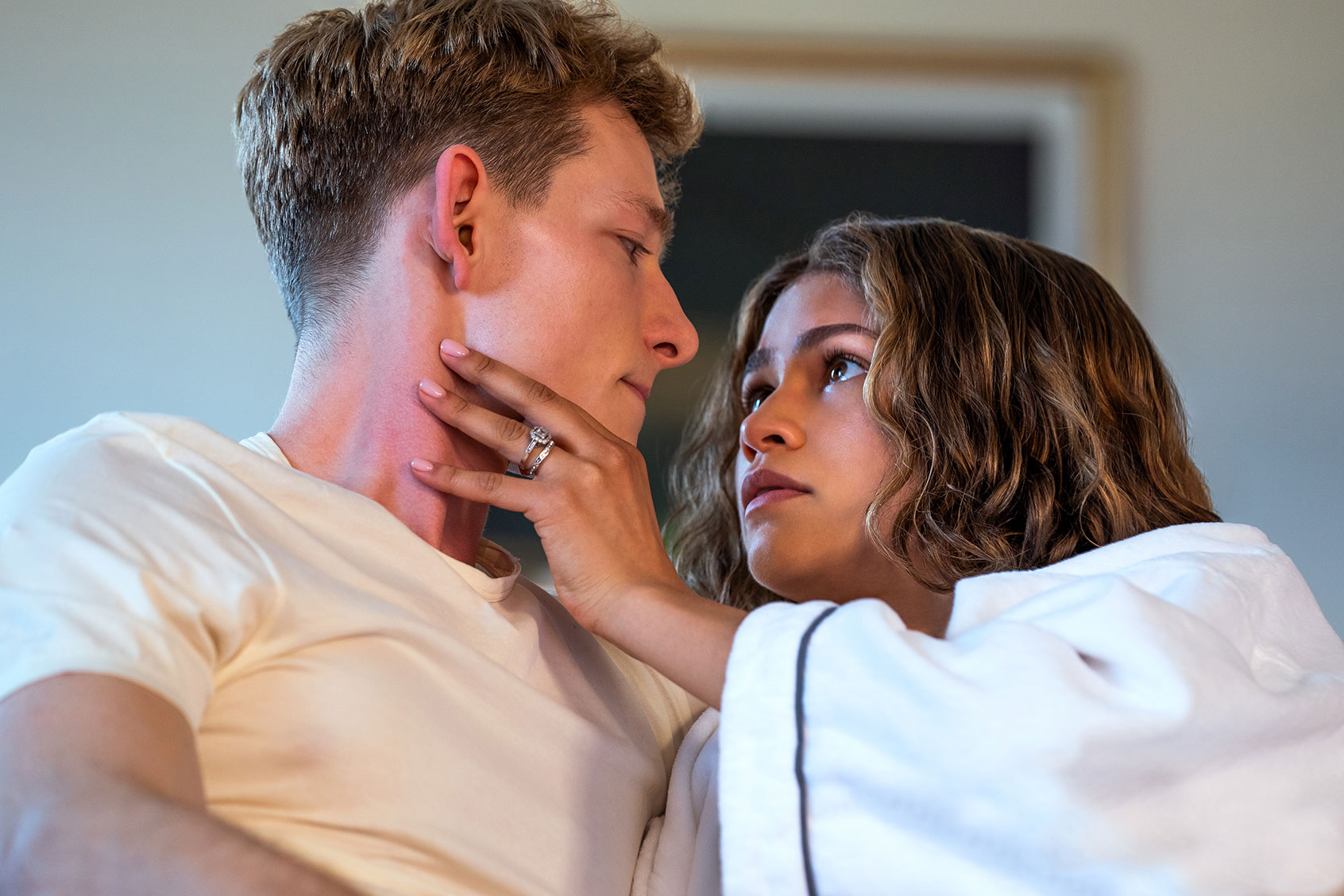
When they learn that Patrick and Art will square off in the final, Tashi meets with Patrick in secret the night before and asks him to throw the match to Art. They hurl high-voltage insults at each other as a windstorm rages around them, swirling trash into the air. Patrick and Tashi look at each other, their hair whipping across their faces — aglow under soft red light — as everything onscreen begins to slow. Pulsing, electronic music from Trent Reznor and Atticus Ross’ synthy setlist rolls in as Patrick gathers her wrists in his hands and pins her against his car. 

From the colors to the music, to the actors’ portrayals, this sequence is undeniably wrought with lust. And yet, we still don’t see it come to fruition onscreen. When Gaudagnino gives us a visual of Tashi and Patrick in the backseat of the car, postcoitus, it’s as though we are seeing them through Art’s eyes: the sexiness doesn’t feel fully realized until all three components of the triangle are integrated. 

Sex is all about "game, set, match"

So where does sex happen in “Challengers”? On the court. 

Early on, the film sets up the idea of tennis as a relationship, which is how Tashi describes it. At the junior ‘06 Open, Patrick and Art ogle at Tashi from the stands as she competes in a singles match. When she secures a point after a particularly electric rally in which she feels she and her opponent finally play real tennis, she belts out, “Come on!”

Once the trio formally meets later that night, they adjourn from the party to sit by a beach. When Art asks her why she yelled at that moment, Tashi likens the sport to a connection with another person — her second scream near the film's close cements the relationship between her, Patrick and Art, as does the interplay between the men at the New Rochelle final.

ChallengersMike Faist stars as Art and Zendaya as Tashi in "Challengers" (Niko Tavernise / Metro Goldwyn Mayer Pictures)
The snippets of sweat-slicked action from the challenger match that we see throughout the film culminate near the end, as Patrick, seemingly adhering to his deal with Tashi, purposefully double faults. The camerawork and score once again contribute to the breathless, excited atmosphere, as the music gallops in and out with little notice. Wide lens shots show the former best friends volleying the ball back and forth, as they land each thwack and thud with guttural grunts (dare I say, the same sounds they might make if they were doing it). In several other shots, the viewer takes on the ball’s point of view, whizzing around the court with dizzying rapidity. The crowd’s heads oscillate in collective motion – only Tashi’s remains affixed. The music, the camera movement, the challenger match, and the fluid love triangle all mirror each other seamlessly during this scene.

With "Challengers," it could be very viably argued that humans were divided into polyamorous thirds.

In a move that stays true to “Challengers” unspoken but omnipotent sensuality, Patrick suddenly places the ball in the neck of the racket: a reference from their youth to Art’s serving tic that also doubles as a way to signal that Patrick has slept with Tashi. Only Art knows its meaning, and it leaves him momentarily stunned. As they head into the break, the men are all tied up again, in every sense of the phrase. 

It’s not even a stretch to say that the final rally between Patrick and Art — and indirectly Tashi — amounts to an orgasmic climax. The rally proceeds with mounting intensity — it wasn’t merely the former Division I athlete in me speaking when I say that my chest was palpably aflutter with tight, twisted nerves. At match point, the men surge into the air before physically colliding and falling into a collapsed, smiling hug. From the stands, Tashi crows a primal, “Come on!”

It makes perfect sense that her utterance is cyclical — good tennis is what enlivens all three of them, turning them (and by extension, us) on more than any wild threesome ever could. Patrick and Art’s reunification is a return to their days of playing doubles as teenagers; through a final embrace wrapped in an unspoken telepathy, they’re finally back to playing the sport. 

For what it’s worth, “Challengers” doesn’t kiss and tell in this instance. We don’t see who won the final the same way we don’t get to see a fully formed sex scene. Neither of those things matters. The gestation of this decades-long, highly magnetized relationship — rife with erotic tension from all sides — is finally complete. 

In Plato’s “Symposium,” Ancient Greek playwright Aristophanes recounts the origins of love, claiming that the God Zeus, in an effort to weaken humans (who, in this account, had numerous limbs and faces) spliced them in two. 

“[Each] one longed for its other half, and so they would throw their arms about each other, weaving themselves together, wanting to grow together,” Aristophanes says. With "Challengers," it could be very viably argued that humans were divided into polyamorous thirds.

As screenwriter Justin Kuritzkes said at the film’s Los Angeles premiere, “What’s true about a love triangle is that every love triangle is, by its nature, queer. Whether you intend to be or not, you’re in an intimate relationship with two other people.”

Like graphic sex in media, and complicated by the drawbacks of dating in a digital world, I assume that a significant demographic of Gen Z would reject the triteness of an “other half” soulmate theory. But as “Challengers” well-received release shows, there’s a widespread receptiveness to new, ever-exhilarating takes on romance. In this story, we need all three points of the triangle, not to show their naked bodies, but to deliver a well-balanced story: The type of sexually substantive and utterly unique movie we’ve been waiting for.


“SNL” cold open tackles parents’ response to college protests

"Saturday Night Live" tackles the student protests at Columbia University over the conflict in Gaza, in this week's cold open, poking fun at what a parent who pays $68,000 a year for their kid's education would have to say in response. 

In the fictional world of "SNL," NY1’s Community Affairs host Ryan Abernathy (played by Michael Longfellow) asks his three guests — a New School parent, Doug Hoving (Mikey Day), a Hunter College parent, Sarah Himes (Heidi Gardner), and a Columbia University parent, Alphonse Roberts (Kenan Thompson) — how they feel about the protests.

While Himes clarifies that she supports free speech, she expresses concern over her daughter’s safety and seems generally confused as to what's happening.

I don’t understand what they think they’re accomplishing,” she says. “And that’s really putting a strain on me and my daughter’s relationship.”

“I want to let my son make his own choices. But to be honest, it’s a little scary. These protests are becoming way more aggressive,” Hoving adds.

“Well, I think it’s just great, you know, it’s wonderful. Nothing makes me prouder than young people using their voices to fight for what they believe in,” Thompson’s character weighs-in.

When interviewer Abernathy adds, “Your daughter must feel so supported when she’s out there,” Roberts has a shift in tone.

“What’s that now? When whose daughter is out there? No, no, no, no, man. You buggin'. Alexis Vanessa Roberts better have her butt in class.”

Watch here:


Rudy Giuliani fantasizes about a more racist “SNL” in bizarre rant

During a recent episode of Rudy Giuliani's podcast, "America’s Mayor Live," the former New York City mayor and Trump associate went on a tirade, decrying "Saturday Night Live" for turning away from “suggestively racist” humor.

In the episode, which aired on Tuesday, Giuliani alleges that "SNL" “got intimidated of saying anything that might be suggestively racist,” which, he says, is racist “in itself.”

Giuliani goes on to express his wish for comics to have thrown more racist humor at former President Barack Obama, saying, “If you’re not going to make fun of a Black president, well, then you’re a racist, aren’t you?”

The lawyer and former U.S. Attorney, who faces disbarment, also brought up "SNL" writer Colin Jost’s set at the White House correspondents’ dinner, struggling to get his name right.

“Colin Posti? What was his name? Colin Kosti? Coast-y? Coastin? (Yost) Yost Colin! Was that his name?” he said. A producer off-camera eventually fed him “Colin Yost,” still wrong. 

Giuliani, facing charges and co-conspirator labels in several plots to overturn the 2020 election, also described the brown and orange jacket he was wearing as “Ukrainian colors,” though their flag is blue and yellow. He then went on to insult the Ukrainian government.

“I’m in favor of the Ukrainian people. I just think it’s run by crooks. Like, don’t get insulted if you’re Ukrainian,” Giuliani said. 

Giuliani, who declared bankruptcy after a defamation ruling, also mused on the so-called persecution of Trump, accusing Trump’s critics of having “probably engaged in some of the biggest crimes in the history of America."

Walmart wants to be the new Trader Joe’s

A slim jar of pistachio butter, a bag of guacamole-flavored tortilla chips made with ground cassava, a bubblegum-pink can of strawberry sparkling water that, on first glance, looks strikingly like a trendy Olipop prebiotic soda — these are just some of the items from Walmart’s bettergoods line that will start to hit the retailer’s grocery aisles and website as soon as this week. 

Bettergoods is the largest store-label food brand to be launched by Walmart in about two decades and, according to a report from the Associated Press, is meant to appeal to “younger customers who are not loyal to grocery brands and want chef-inspired foods that are more affordably priced.” In a Tuesday release, Walmart said it expects to have more than 300 products in the line by fall and will focus on three categories: plant-based options, with items like dairy-free mozzarella shreds and oat milk-based desserts; organic and allergen-free products; and “culinary experiences,” a category comprised of products like mango chili salsa and pasta imported from Italy. 

Prices will range from under $2 to below $15, with the majority of products costing less than $5.

“Today’s customers expect more from the private brands they purchase. They want affordable, quality products to elevate their overall food experience. The launch of bettergoods delivers on that customer need in a meaningful way,” said Scott Morris, senior vice president, private brands, food and consumables, Walmart. “Bettergoods is more than just a new private brand. It’s a commitment to our customers that they can enjoy unique culinary flavors at the incredible value Walmart delivers.”

But why is Walmart, a retailer known more for “always low prices” than high-end nut butters, getting into the (slightly more) upscale grocery game? Well, this move comes at a time when inflation, and the looming possibility of a mega-merger between Kroger and Albertsons, two of America’s largest grocery chains, has prompted supermarkets across the country to invest more deeply in the production of their private label store brands. 

It also comes at a time when Trader Joe’s,  a grocery chain that is synonymous with its trendy private label products, is readying for another major expansion, leaving companies like Walmart eager to ensure the cult-favorite food brand doesn’t eat into their profits in new markets. 

Supermarkets started introducing private label brands in the late 19th century. In 1859, the Great Atlantic and Pacific Tea Company — soon shortened to A&P — introduced its “Eight O’Clock Coffee” label, before eventually launching more in-store brands like Jane Parker and Ann Page. The supermarket chain, the last location of which officially closed in 2016, was one of the pioneers of developing private labels as a means of offering customers good quality products at lower prices than national brands. 

We need your help to stay independent

Then, in 1883, Barney Kroger founded the first Kroger supermarket in Cincinnati, Ohio. According to the company’s history, shortly after opening the store, Barney Kroger bought a surplus of very cheap cabbage from farmers who rolled into town with a harvest bounty. He took that cabbage home to his mother, who in turn transformed it into sauerkraut which Kroger anticipated would sell well in the city which had a sizable community of German immigrants. He was right. 

“The little manufacturing effort born in Mrs. Kroger’s kitchen was the beginning of something big,” the company wrote. “Today, we’re the largest food manufacturing business in America. Kroger operates our 35 food manufacturing facilities that make everything from bread, cookies and milk to soda pop, ice cream and peanut butter.” 

Private label sales now account for over 20% of Kroger’s total dollar sales, which is on-par with Walmart’s private label sales, which accounted for about 23% of the company’s total dollar sales in 2022, according to the international research company Statista. It’s a sizable percentage of the company’s profits, but it’s nowhere near that of company’s like Trader Joe’s where store-brand products accounted for 59% of the company’s sales in 2022. This is because the way the company stocks and distributes products is fundamentally distinct from many supermarkets. 

“The store is our brand,” Jon Basalone, president of stores for Trader Joe’s said in the fourth episode of the Inside Trader Joe’s podcast

“People can’t understand, ‘Why aren’t you selling products online? How come you don’t just sell wholesale to China? They want a bunch of your products. Why don’t you just send truckloads and shiploads of products to other countries and make a bunch of money?’” he said. “It’s like, well, because that’s not what Trader Joe’s is, you know, for us the store is our brand and our products work the best when they’re sold as part of this overall customer experience experience within the store. And so we’re not ready to give that up. For us, the brand is too important, and the store is our brand.” 

Inside Trader Joe’s podcast co-host Tara Miller responded that more than 80% of the products sold at Trader Joe's are private label. “Keeping things in our label as opposed to the brand name label or a supplier’s label helps us keep our costs low,” Miller said. 

“We don’t have slotting fees,” Miller’s co-host, Matt Sloan said. “We don’t have the producers of the stuff that we sell, pay for the privilege of having space or any space in our stores.” 

“And that happens everywhere else, by the way,” Miller clarified. 

“Totally normal grocery stuff,” Sloan said. “It doesn’t make a lot of sense to me and yet there it is.” 

"Keeping things in our label as opposed to the brand name label or a supplier’s label helps us keep our costs low."

Trader Joe’s emphasis on private label products came early in the company’s history (the story goes that founder Joe Coulombe realized he had something special going in the mid-70s when he produced, packaged and sold specialty granola in his small, original stores) and has served as a case study for how brands can facilitate an emotional connection between customers and their products. Between the Fearless Flyer, the brand’s monthly printed catalog for upcoming goodies, and well-publicized seasonal drops and launches, Trader Joe’s emphasis remains soundly on food items that are created and sold exclusively in the Trader Joe’s cinematic universe. 

When the retailer was just a California-based shop for the “overeducated and underpaid,” as Coulombe once put it, it wasn’t a huge threat to national supermarkets, but then the company began to expand — as of this year, they have over 500 stores in 40-plus states — and they don’t plan on stopping. As Progressive Grocery reported in March, Trader Joe’s is planning 16 new stores in cities including Reno, Salt Lake City, Raleigh, Santa Clarita and Sugar Land. 

Marketing experts have observed for years how companies — ranging from grocery giants like Kroger with their Private Selection brand, to retailers who are newer to the grocery game, like Target with Good & Gather — have attempted to stoke the kind of breathless brand loyalty Trader Joe’s inspires by expanding their private label product offerings to include some of the items for which the retailer is known, like internationally-flavored pre-packaged meals, seasonal snacks and premium beverages. This strategy appears to finally be paying off. 

According to a report from Circana, private-label brand sales increased 6% year over year in the U.S. to $217 billion in 2023, and the private brands gained share from name brands, increasing from 24.7% of total unit sales in 2022 to 25.5% in 2023.

Walmart appears to be attempting to ride the same wave with bettergoods. It’s still very early days, so the relative success of the launch and its products remains to be seen. In the meantime, however, I wonder if Walmart will try to get in on the viral tote bag game, too


Who believes the most “taboo” conspiracy theories? It might not be who you think

Like Henry Ford before him, Elon Musk has emerged as America’s top conspiracy spreader. But he’s hardly alone. Robert F. Kennedy Jr. is the conspiracy-theory candidate for president, and as Paul Krugman observed last summer, was attracting “support from some of the biggest names in Silicon Valley”:

Jack Dorsey, who founded Twitter, has endorsed him, while some other prominent tech figures have been holding fund-raisers on his behalf. Elon Musk, who is in the process of destroying what Dorsey built, hosted him for a Twitter Spaces event.

Krugman didn't focus on conspiracy theory as such but on something closely related: distrust of experts and skepticism about widely accepted facts. He described this tendency as the “brain rotting drug” of reflexive contrarianism, quoting economist Adam Ozimek

That wasn’t exactly scientific, but a new paper entitled “The Status Foundations of Conspiracy Beliefs” by Saverio Roscigno, a PhD candidate at the University of California, Irvine, is. Its most eye-catching finding is the discovery of “a cluster of graduate-degree-holding white men who display a penchant for conspiracy beliefs” that are “distinctively taboo.”

Specifically, Roscigno writes, “approximately a quarter of those who hold a graduate degree agree or strongly agree” that school shootings like those at Sandy Hook and Parkland “are false flag attacks perpetrated by the government,” which is “around twice the rate of those without graduate degrees.” Results are similar for the proposition that the number of Jews killed in the Holocaust “has been exaggerated on purpose.”

These findings are striking for many reasons. Most obviously, they go against the common belief — long supported by research — that conspiracist beliefs are more common among lower-income and less-educated individuals. They also challenge the  formulation popularized by Joseph Uscinski that "conspiracy theories are for losers," and should be understood as “alarm systems and coping mechanisms to help deal with foreign threat and domestic power centers” that “tend to resonate when groups are suffering from loss, weakness, or disunity.”  

Roscigno’s findings don’t refute previous formulations so much as reframe them by adding greater nuance. For example, he finds that conspiracy beliefs are more common both among the less educated and less affluent, on the one hand, and the more educated and more affluent on the other. Secondly, he identifies the subjective group experience of threat as a key element, rather than objective “loser” status.

Even more important, his paper reveals how much more we have to learn about conspiracy theories from a rigorous social science approach. Conspiracy theory is much more mainstream, varied and ubiquitous than previously assumed, and there’s much more to be learned from studying it as an integral part of the sociological landscape. Like the recently published paper I previously covered here, this model breaks with dualistic approaches that in some sense mirror what we find troubling about conspiracism — that is, painting the world in black-and-white rather than in many shades of gray. I recently spoke with Roscigno by Zoom about his findings and where they might lead. This transcript has been edited for clarity and length.

Your paper has a dramatic finding regarding "a cluster of graduate-degree-holding white men” who tend to embrace conspiracy beliefs that are "distinctly taboo." But that's just the tip of the iceberg, because there's a whole host of questions that raises, including the role of sociology in this research, not just psychology. What led you to do the research behind this paper — what kind of questions, concerns or interests were driving you?

One of the things that motivated me was precisely the observation that sociologists hadn't really been part of the conversation. I've been interested in this topic for a while. I grew up spending a lot of time online, seeing a lot of conspiratorial stuff, having a lot of conversations with my friends about that kind of stuff. In the past couple of years, it seems like a lot of it has hit the mainstream. I remember when QAnon stuff first started fermenting online. I remember seeing posts where people were analyzing and trying to break down these “Q drops,” and sending them to my brother, like “What's what's going on here? This is something totally new.” 

When I got to grad school, I thought, well, there's got to be some sociologists doing work on this. I definitely found a cluster of cultural sociologists starting to do some really interesting stuff that inspired me a lot. I also found the work of people like Joseph Uscinski and others in political science who had been doing some work and some theorization that I thought could be pulled into building a sociological approach to this. 

What did you think you might learn in doing this study?

The basic question was just which groups of people tend to hold which conspiratorial beliefs. Maybe it seems like an overly basic question, but I was really struggling to find anybody in the literature that had engaged it. There's a lot of talk about who believes conspiracies in general, but there's less  attention to how different groups might be sympathetic to different claims. And I had observed in my time online that some conspiracy spaces are older or younger, in some there's more white people or more women, and I wanted to know what the variation was. That was the starting point, and then building a more sociological approach to the topic, looking at inequality and demographic variation, and then moving on to other questions.  

So what did you find that confirmed that basic sociological intuition that there were significant differences, and what did you find that surprised you? 

The belief "that school shootings like Sandy Hook and Parkland are false-flag attacks … and that the number of Jews killed by the Nazis has been exaggerated on purpose — these two particular claims are disproportionately held by white graduate-degree-holding men."

The one pattern I really highlight is, as you said, that there's this cluster of graduate-degree-holding white men who are more favorable towards almost all the beliefs that are listed. But there are some that they are much more favorable toward, where there's a larger gap between them and those without graduate degrees. I describe these as "taboo claims." Specifically, that school shootings like those at Sandy Hook and Parkland are false-flag attacks perpetrated by the government, and the other one is that the number of Jews killed by the Nazis during World War II has been exaggerated on purpose. These two particular claims are very disproportionately held by white graduate-degree-holding men.  

In addition, if you look a little bit deeper into some of the other survey research and even my own data, you can also see a concentration of medical-themed conspiracy beliefs among African-Americans, and among the less educated. Those were the two points of variation that I have been able to highlight. I suspect there are many more. But here the goal of the paper was just to demonstrate that variation exists. It wasn't to capture all of it. 

That second variation is unsurprising, given that African Americans have been very ill-treated by the medical establishment. If you told most white people about the Tuskegee experiment 20 or 30 years ago, they'd think that was a conspiracy theory. But the finding about this group of more educated white men was more surprising. What have you speculated the reasons might be?

The most convincing explanation I found is that essentially this is about access dynamics. The typical theoretical focus when it comes to conspiracy beliefs tends to be toward attitudes or dispositions. I think the role of attitudes is relevant here, and I think these attitudes are fueled by a perception of threat among graduate-degree-holding white men. Maybe they see social changes that are going on, they hear how the tone of certain conversations is changing, they see how the job market is changing. So there's a perception of threat. That's where you get the attitudes. 

Now the other side is the access. There's a couple of things that could be going on, but it's hard to believe that Sandy Hook was perpetrated by the government unless you've heard that claim made in some level of detail, not just seeing reporting about Alex Jones but hearing somebody really make that claim. It's even hard if you don't know what a false-flag attack is. So I suspect that graduate-degree-holding white men, particularly via online channels, are are more likely to encounter this information, more likely to run into it. We also know from scholarship on rumor that certain rumors tend to be concentrated in certain demographic networks. There's a rumor that will primarily be spread within white networks or Black networks, and that's what's going on here.

I think it's also important to take survey results about something as deep as beliefs with a grain of salt. A question I get a lot when I present this research is, “Oh, they don't really believe that, do they?” That's not really a question that a survey can necessarily answer. At the very least, we know they are checking off a survey box way more often. So if we read it with that interpretation, we can maybe say that this is kind of a transgressive act. They’re saying, “I know that I'm supposed to be checking off the other box, but I'm going to check off this one.” To me, it's demonstrating a kind of transgressive expertise, a special access to what Michael Barkun calls “stigmatized knowledge.”

So that sets off two things for me. One is the question of how you would go about digging deeper into that, testing if that's true. Related to that, it seems that survey research could be improved to ask people whether they have communicated these beliefs to others, are they deeply held beliefs that help them make sense of other things, questions like that. Have you given any thought to that?

"A question I get a lot when I present this research is, 'Oh, they don't really believe that, do they?' That's not a question that a survey can necessarily answer."

Some of those things can be ascertained through survey research. I like the idea of asking, "Have you ever spoken to somebody about this?" or "Is this something you hold privately?" But I'm wary that survey research will give us all the answers we need. If you really want to figure out if somebody really believes something, I think you have to talk to them. You have to learn about how they live their life. You have to learn about their social relationships. It’s just like if we were studying religious beliefs. I think you have to engage at a deeper level to figure out whether that is true belief.  

There's a lot of room for improvement on surveys, though. One of the biggest rooms for improvement in surveys is on the issue of prompt selection. It seems that this pattern that I noticed didn't get noticed before because nobody was asking these taboo questions on the surveys. Mostly they ask questions about COVID, and maybe a few other things. But if the prompts substantively change the findings of the survey, and nobody seems to be giving much conscious consideration about which prompts are included, there's definitely room for improvement. 

You also found similar, though less dramatic, gaps between the highly educated and less educated for four other unpopular beliefs. So there's seemingly a general predisposition to conspiracy beliefs there. What other factors do you think might be involved?

I've gone back and forth, but I think there’s something I've decided on. There's this question of whether it's that they prefer unpopular [beliefs], or is it a question of, like, these things are taboo? They know these things are transgressive, they know these things violate a deep social norm. I'm pretty sure it's the taboo. 

But this can be pretty easily tested. There are beliefs that are very unpopular but are not particularly taboo. If you ran a survey that included something like belief in a flat earth, if I'm right we wouldn't expect white grad-degree men to be high on that. When I say “taboo,” I basically mean that if you said something like this in public you would face some kind of social sanction. If I told my co-workers that I thought the earth was flat, they might laugh at me. If I told my co-workers that I thought the Holocaust was exaggerated, it would be a very different story. 

Do you have some thoughts on what research you might be able to do to make more sense of this? 

One thing that could be done is looking at a really wide variety of prompts and seeing what kinds of patterns are going on. In this one, I'm working with 15 claims and trying to draw a common thread. If you worked with a much larger set of prompts — I know some of those data sets exist — I think it would let you articulate that a little bit more clearly. 

But that's only one way to approach the issue of typology. You could start at the point of "there's a group of people that tends to hold these beliefs," and try to describe those particular claims. You could also start by looking at the claims and trying to find narrative threads between them. You could also define the claims by the relation to some authority, which is kind of what I'm doing with the taboo stuff. So I'm not quite sure how to address that yet. 

You also found roughly equivalent subsets of respondents who held both of those claims [about school shootings and the Holocaust] and who disagreed with both, providing a convenient comparison. They differed in terms of extremism and social media use. So what can you say about those differences and how they interrelated?

I already mentioned the question of access. I think social media use gets at that access question. Those who agree report higher levels of social media use by every platform, particularly by anonymous image boards like 4chan and 8chan. So at the very least, if we think about people stumbling into these beliefs kind of accidentally, if you're on 4chan more often you're a lot more likely to run into one of these. In addition, there's some interesting work being done on information-seeking strategies online, and some sociologists have pointed out that people with different social positions have different strategies that may lead to different results. So a possibility relative to social media is that white men with graduate degrees, when they're doing research, the steps they’re taking may be different from some other groups, so they're more likely to end up at a certain point. 

Relative to political extremism, that's a bit more complicated. There's definitely some exciting research that's going on about radical political beliefs and their relationship to conspiracy beliefs. Something I want to point out is that the white grad-degree men who agree are way more on the political edges, which maybe is to be expected. They're identifying as extremely liberal or extremely conservative way more often. We get this U-shape. These two taboo claims, at least according to this measure, are not right-wing phenomena. There is a big cluster of people that identify as very liberal and agree with these things as well. I suspect this measure isn't picking up on everything it could be. In the time that I've spent in politically radical spaces online and within the conspiracy milieu, the way people identify politically — there's a lot of variety to it, and “liberal” and “conservative” descriptors may not resonate with a lot of these people. But at the very least we know that people on the political fringes tend to be more charitable towards these claims. 

"White grad-degree men who agree [with 'taboo' claims] are way more on the political edges, which maybe is to be expected. They identify as extremely liberal or extremely conservative way more often. We get this U-shape."

Over time, erosion of social trust seems to be related to a rise in conspiratorial beliefs. It would make sense, just in terms of people who feel skeptical of the existing system, for that to show up more, regardless of whether they are left-wing or right-wing. Do you have any thoughts about that?

This is something else I think that sociologists have to bring to the table: What's with the structural context of these situations? There's some evidence that countries with higher levels of social inequality, higher levels of corruption, tend to demonstrate or report higher rates of these beliefs. We know that it's tied to structural conditions. The collapse of institutional trust is a huge piece of this. If you look at graphs of trust in the federal government over time, or trust in the press over time, they're really at historic lows. 

That has to play some role. Because when we talk about conspiracy beliefs, in the simple definition we’re talking about claims of elites doing something in private, but we’re also talking about something that counters the official narrative. So in a situation where historically few people trust the producers of the official narratives — in part the government, in part the press — we would expect people to be more doubtful of those things. 

But when we talk about social trust, I don't necessarily think belief in conspiracies means a low level of social trust in general. I think it means a low level of trust in particular institutions. But in order to believe a conspiracy you have to hear it. It's probably from somebody you know, and you have to trust them when they tell you that. There's a rumor scholar, Gary Fine, who says that when trust in institutions is questioned, trust in informal networks is revealed. So there is a social trust that exists. It's much more decentralized. It's not in a particular institution and it’s social trust, rather than institutional. 

One thing your paper suggested to me was looking at how beliefs in conspiracy theories co-vary, meaning what beliefs go together or tend to negate each other, and how that might change across status lines. I was specifically interested in those white male graduate-degree holders. Are there any beliefs that they accept less than other people? Do you have enough data to look at that yet? 

I think enough data exists that we can probably answer that, but I don't know for sure. In this particular data set, there are none that they were less likely to believe in. For very mainstream beliefs — the idea that “one percent” of economic elites control the government and economy, the idea that Jeffrey Epstein was murdered — these are beliefs held by 50% of the general population and also held by about 50% of white men with graduate degrees. In this data there wasn't a single belief that these white male graduate-degree holders were less interested in. That was stunning to me. I was actually very surprised by that. 


Want a daily wrap-up of all the news and commentary Salon has to offer? Subscribe to our morning newsletter, Crash Course.


But it's possible. We have these two types that I'm describing, the medical ones and the kind of taboo ones. It's possible there may be some medical ones that white men with graduate degrees are less likely to agree with. But it is hard to say, because this data clearly suggests that graduate degree holders are more into all of these claims. 

We spoke earlier about “prompt selection” and things that perhaps aren't being asked about. Do you have anything specific in mind?

There's a lot of things that aren't being asked, definitely more than are being asked.  At least in this paper, my starting point is the simple definition of the conspiracy belief which is, again, basically that a group of elites are plotting something in private. If that's our conceptualization, then the universe of possible things to ask about is massive. 

For instance, if that's our conceptualization, why don't we ever ask about institutionally verified conspiracies? For instance, Watergate fits that definition just fine, COINTELPRO fits that definition just fine, Tuskegee fits that definition just fine. To me there seems to be a mismatch, an unacknowledged element to the definition, which is that it has to counter some official narratives. But even if we include that second part in conceptualization, there’s still tons and tons of stuff. 

"Why don't we ever ask about institutionally verified conspiracies? For instance, Watergate fits that definition just fine, COINTELPRO fits that definition just fine, the Tuskegee experiment fits that definition just fine."

I read a very interesting paper this past week. This came out as a content analysis of TikTok, but it’s specifically about the conspiracy theory that Taylor Swift is secretly gay, and she's closeted and dropping all these hints in her tracks. Maybe people will say that isn't a politically consequential conspiracy theory, but it’s within the realm of conspiracy claims by any definition.

I've even heard that and I don't follow Taylor Swift news at all. It's clearly out there. 

Yeah, if I had to guess, if you polled the demographics it would disproportionately be women. So that makes me think, OK, a lot of studies emphasize that men are more into this stuff. Does that have something to do with the prompts that are selected for the surveys? How does that come into play? 

I bring up the Taylor Swift example to demonstrate that the realm of  things under this blanket is, like, so large that trying to generalize any kind of research findings to the entire world of claims about elites doing sneaky stuff ends up being very difficult. I suspect there are claims that graduate-degree holders are more into that we haven't quite figured out yet. I suspect there are claims that women are more into that we haven't really figured out. I'd like to see a lot more, a) alignment between the conceptualization and operationalization and b) experimentation within that. We have a big world of things that fit this conceptual framework. 

We’ve talked a bit about “collective identity” as a useful concept and you've said “it applies to all varieties of conspiracy cultures." Could you expand on that?

To be totally sociological, collective identity is useful in understanding all kinds of cultures more generally. Within conspiracy cultures, there's a couple things going on. If we talk about rumors, if I tell you some finding before it's published, it feels like you're in the know, it feels like you have a piece of secret information. It's exciting, it feels good. It also creates a bond between people that I think can be part of identity. So that's one level. 

There's also the level that gets to the question of institutional distrust. There's a general sense in this country that, you know, people like us — whatever “us” means — are being screwed over by elites in some faraway place. We can't really see what's happening over there, we're not in the rooms where these decisions are made. I think there's a very general sense of that. And who “people like us” ends up being defined by is, I think, very important, because different people are going to understand it in different ways. There’s a general sense that there's opaque power that's screwing us. We don't really know where it is, or what's happening. You hear that kind of sentiment a lot in this milieu. 

There's also collective identity more overtly. If I make the claim that white people are being replaced in this country — which to me is one of the more consequential conspiracy claims — I'm invoking a very specific identity, saying, “Hey, we collectively are under threat and need to do something about it!” So some conspiracy claims, even in the claim themselves, name the in-group or name the out-group. It will say who the “we” are, who the mysterious “they” is. Identity plays a key role there as well. 

What stands out for you as the next steps? What questions need answering that follow from what you've done so far? 

"A lot of people in the conspiracy milieu feel like they're being studied from afar by people that aren't talking to them at all. I think that absolutely adds to the resentment. If you were an expert in Amish culture, you'd probably want to spend time talking to Amish people."

To me, a lot of the most interesting questions are about how, when and why these beliefs matter, which I do think are better suited to qualitative methods. There's been very little in the way of qualitative inquiry into conspiracy cultures, with the big exception of Jaron Harambam, whose work has been very inspiring to me. Back to this matter of collective identity, something he points out that I find intriguing is that there are all kinds of conflicts over identity, even within the conspiracy milieu. There are people who understand themselves as aiming to get new converts to the movement, and other people who understand themselves as basically having given up and clocked out. There's all kinds of variation within the community. 

Also, part of my reasoning for wanting to do qualitative research is that I feel like a lot of people in the conspiracy milieu feel like they're being studied from afar by people that aren't talking to them at all. I think that absolutely adds to the resentment. 

I saw a tweet recently from somebody who is loosely in these circles that basically said, “How come none of these conspiracy theory experts are even talking to us?” If you are an expert in Amish culture, you'd probably want to spend a lot of time talking to Amish people. If I were studying the student movements that are going on right now, I'd probably be down at the encampments hanging out. It's not like believers in conspiracies are a small or fringe minority group that's super-hard to access. Some of these claims are totally mainstream, and even for the more taboo ones that you might envision would be hard to do qualitative research into, they're concentrated among graduate-degree holders. So in some sense those of us in academia are exceptionally well positioned to engage these communities at a closer level. So I definitely would like to do qualitative research in the coming years. 

Finally, what's the most important question I haven’t asked? And what's the answer? 

I can tell you a question that I get whenever I present my research to my undergraduates, but I'm not going to answer it. I give this whole presentation and at the end they’re like, “What are the ones that you believe in?” That's not my role as a sociologist. [Laughs.] So that’s my favorite question. 

In spite of abortion bans, self-managed abortions are safer than ever

As the U.S. Supreme Court overturned Roe v. Wade in the 2022 Dobbs decision, abortion rights protesters held signs adorned with wire coat hangers. The symbol evoked memories from a pre-Roe era, when the only option to terminate an unwanted pregnancy was unsafe and potentially deadly.

As detailed by one retired gynecologist in the New York Times in 2008, the symbol of a wire coat hanger was “in no way a myth.” He recalled a period between 1948 and 1953 when women would frequently arrive in his office with a coat hanger still trapped in the cervix — and it wasn’t just coat hangers. Crochet hooks, soda bottles, and darning needles were also used in attempts to end pregnancies. 

When Roe overturned in 2022, many thought the post-Roe world would look similar to those dark pre-Roe times. But as Dr. Carole Joffe, a professor in Advancing New Standards in Reproductive Health (ANSIRH) at the University of California–San Francisco, told Salon in 2022, a post-Roe landscape would likely have “less injuries” but "more surveillance" — in part because of medical advancements like the abortion pills.

“It is important to understand that self-managed abortion (SMA) looks very different now compared to the period before Roe v. Wade, largely due to the availability of medications, specifically misoprostol and mifepristone,” researchers confirmed in 2023. In an ever-shrinking landscape, experts want the public to know that medication is still an option. And that thanks to telehealth and medications like mifepristone and misoprostol, self-managed abortions, if done with medications, are safer than ever. 

“We have very safe and effective technologies in the form of abortion pills,” Elisa Wells, co-founder and co-director of Plan C, a non-profit abortion access group, told Salon in a phone interview. “We know that people are still using older methods of self-managing abortions, but by and large, it is much much safer now when people use abortion pills.”

Wells said the non-profit she co-founded, which provides educational resources and information to increase access to medication abortion in the United States, has seen a surge in interest in receiving abortion pills by mail. She cited the pandemic as a real turning point, when the the United States Food and Drug Administration (FDA) removed the in-person requirement to obtain abortion pills. 

"People have self-managed abortions since the beginning of time. People have always had abortions."

“Then with the Dobbs decision overturning Roe v. Wade, we saw a huge surge in interest to our website — just an unbelievable spike in the days following people looking for information and specifically, information about how to get pills if they live in a state that unjustly restricts their access to abortion care,” she said. “And then, with each new egregious action of courts or legislators, we do see spikes in people coming to our website.” 

Medication abortions typically occur by taking the brand name drug Mifeprex, which contains mifepristone and misoprostol. In the two-step process, a pregnant person first takes a mifepristone pill, then 24 to 48 hours later, a second pill containing another drug known as misoprostol. The two-step process works up to 70 days after the first day of a person's last period. 

ewz

By definition, a self-managed abortion “involves any action that is taken to end a pregnancy outside of the formal healthcare system.” It could include “self-sourcing” medications or using herbs, plants, vitamins or supplements — or using physical objects.

Lauren Ralph, an associate professor in the department of obstetrics, gynecology and reproductive sciences at the University of California, San Francisco, told Salon that in her research a self-managed abortion is “anything that a person does on their own without the supervision of a clinician to try to end a pregnancy.” In 2017, Ralph co-led research that found that 7 percent of U.S. self-identified women said they had done something on their own to try to end the pregnancy. 

“We know that it's something that was happening before Dobbs, but what's different now is that there's really been the increased availability of medication abortion for self-managed abortion,” Ralph said. “And we have a good deal of evidence that shows us that self-managed abortion with medications, with mifepristone and misoprostol or misoprostol only, is quite safe and effective, and as effective as medication abortion provided through the formal healthcare system.”

"That increased availability and increased awareness is mitigating some of the loss of access to clinic-based abortion or facility-based abortion post-Dobbs."

Earlier this year, researchers analyzed data between April 2021 and January 2022 from 6,000 patients who obtained abortion pills from telehealth clinics. They found there were no serious adverse effects 99.8 percent of the time and that 98 percent of the time no follow-up care was required. The data was similar to those who received medication abortion at a doctor’s office or abortion clinic. 

Before the Supreme Court overturned Roe v. Wade, an estimated 4 percent of abortions were done via telehealth. In data from April 2022 to September 2023, 16 percent of abortions in the U.S. were done via telehealth, according to data by the Society of Family Planning With those who had a telehealth medication abortion, 43 percent said that telehealth made it possible for them to have a timely abortion.

“That increased availability and increased awareness is mitigating some of the loss of access to clinic-based abortion or facility-based abortion post-Dobbs,” Ralph said. 

As more states like Florida implement near-total abortions bans, self-managed abortions are an important piece of maintaining some sort of access and options, especially as abortion funds and clinics in surge states become overwhelmed by the influx in patients. Megan Jeyifo, executive director of Chicago Abortion Fund, said self-managed abortions are a “critical” piece in this landscape. 

We need your help to stay independent

“People have self-managed abortions since the beginning of time. People have always had abortions,” Jeyifo told Salon. “People need to understand these medications are extremely safe, and these are options that were not available 60 years ago when we were thinking about back-alley abortions, those experiences were terrible, but that's not what modern abortion looks like now.”

And yet, accessibility to mifepristone is on the line as the U.S. Supreme Court weighs restricting access or not — a decision that’s expected to be made by late June. Until a decision is made, Wells from Plan C said it’s critical for people to know that abortion pills are available by mail in all 50 states right now.

“Even states with bans. The pills are very safe and very effective for early self-managed abortion,” Wells said. “And that there are resources available to help people understand where to get the pills, how to use the pills, to answer medical questions and also to answer any legal questions that people might have about using them in a restrictive state.”

“I was set up”: Britney Spears lashes out at mom over Chateau Marmont EMS call

Britney Spears, whose conservatorship ended in November 2021, had paramedics called on her during what's been framed as a "mental breakdown" at the historic Chateau Marmont in Los Angeles, sparking new concerns surrounding her mental health.

Responders arrived at the pop star’s room at the hotel Wednesday, when several guests heard a ruckus believed to have been caused by Spears and her boyfriend, Paul Soliz. But in a recent Instagram post, she believes this to have been a set up. 

 “I know my mom was involved!!! I haven’t talked to her in 6 months and she called right after it happened before the news being out!!! I was set up just like she did way back when,” Spears writes.

In another post, the Grammy Award winner slams paramedics, accusing them of “illegally show[ing] up at my door,” though adding that they didn’t enter the room.

The incident drew alarm on social media, and several people close to Spears have come forward since the event to express their belief that she should have been kept in a conservatorship. One individual told a gossip outlet that they feared she’s turned to substance abuse.

“The conservatorship — and the interventions prior to it — happened for a reason and it wasn’t because her dad wanted to make some nefarious money grab,” a source close to Spears told Page Six in a quote picked up by Yahoo News.

Spears, whose divorce with Sam Asghari finalized this week, was under the control of her father Jamie Spears for years before winning a public battle to end the arrangement. Also this week, a financial battle stemming from the conservatorship came to an end, when a judge ordered she pay $2 million for her dad’s legal fees and denied her financial relief.

My brother, Officer Brian Sicknick, died after January 6. Politics continued to pull my family apart

My brother, United States Capitol Police Officer Brian Sicknick, collapsed after defending the Capitol Building and everyone in it from pro-Trump insurrectionists on January 6, 2021, and died in the hospital the following day. He suffered two strokes, we learned. In the aftermath of his death, I thought my family would be united in our grief. I didn’t see until later that politics — some of the same on display at the Capitol the day Brian reported for what would be his last shift — were already dividing us.

After the Medical Examiner finally released his remains for burial, my family returned to Washington, D.C., to pay our final respects to my kid brother. Brian was one of the few American citizens to lay in honor at the United States Capitol Rotunda, the same building he gave his life to protect. After the public services, we met President Biden, who expressed heartfelt condolences for our loss. The President and his wife came without the press in tow, without photographers. Several other high-ranking officials also quietly paid their respects. Rep. Dan Crenshaw, a Republican from Texas and one of Brian’s favorite people on the Hill, gave the eulogy at Arlington National Cemetery the following day. 

That was the last time we were all together as a family. While I blamed Trump’s followers for the violent clashes that preceded Brian’s death, one of our relatives — I’ll call this person True Believer — blamed President Biden and his political allies, telling me after the ceremony that Biden and high-ranking Democrats were responsible.    

I was still in shock, from the overwhelming media attention on top of seeing Brian, a former Air National Guard Security Police officer and United States Capitol Police officer of 12  years, reduced to a small wooden box on top of an American Flag. True Believer’s words, while disturbing in the moment, did not sink in fully.

January 7, 2021, was the day everything changed. Between the relentless media pursuit that started before we even knew he was dead — punctuated by my little brother’s last breath — and the mind-numbing sense of grief that overwhelmed every member of our family, we went into our own little worlds. After, I could barely reconstruct the events between Brian’s death and his funeral, which now feels mostly forgotten by the country, including by some protected by Brian and his fellow officers at the Capitol.

After our family’s procession in the early morning hours of January 7, from the hospital where Brian died to the Medical Examiner’s office, I spent the night in Brian’s home with other family members. The next morning, in shock and realizing I could do nothing in D.C., I drove home to New Jersey, worried about my wife, who’d already had to deal with reporters camped out on our lawn, snapping pictures. They tried to interview her when she made the mistake of going outside to see what was going on.

At the time, I didn’t register how far apart we were in our understanding of what had just happened.

True Believer made the return trip with me. On the long ride to New Jersey, we discussed what we had seen in the hospital, how the events at the Capitol could have happened, and what the next steps might be, all through a fog of grief and pain. That conversation is when True Believer first recounted the various wild conspiracy theories, echoes of QAnon and other dark rabbit holes: Biden was a clone, Nancy Pelosi uses the blood of babies to stave off the aging process, even that Brian was not really dead, but would return after Trump reclaimed the White House. The riot was the fault of Antifa and Black Lives Matter activists working for the Bidens, according to True Believer. At the time, I didn’t register how far apart we were in our understanding of what had just happened. I simply couldn’t believe my brother, whom I remembered my parents bringing home from the hospital 42 years ago, was dead. I chalked the wild theories up to being in shock, as we all were.

Before Brian met his fate, we were a small but close-knit family who kept in touch with each other by email, text and phone. We are a non-traditional family, a blend of Jewish and Presbyterian, and I have fond memories of putting up a Christmas tree topped with a Star of David every holiday season. We had our occasional arguments, and rare temporary silences, sure. But my mother had a giving heart, my hard-working father his matter-of-fact practicality, my other brother a wry sense of humor and Jersey attitude. Brian, the youngest of us, had the most even temperament and was usually stoic, which helped him immensely with the stress of being a police officer. Despite our differences, we always listened to one another.  

True Believer was nothing like my parents, offering a distinct point of view that often helped us resolve sticky problems. If I needed advice on cooking, taking care of a social issue, or how to connect with one of their large networks of friends, I called my parents. But if I required an effective cure for a problematic colleague, for example, or a cantankerous neighbor, I used to call True Believer. As a family, our problems were never overwhelming before Brian’s death. We worked together to turn them into opportunities instead. 

After the funeral, every interaction became awkward. I spent the next few weeks alternating between a zoned-out state and a pained reality, trying to stay in touch with my family. That included True Believer. Our conversations were short, curt, and mostly focused on how Biden, Antifa, BLM and Pelosi were responsible for Brian’s death, and how I was apparently an idiot for being skeptical of these claims. True Believer’s rants became simultaneously more numerous, less believable, and more noticeable, and I began distancing myself. My parents went dark for a time. Despite our efforts, our once-reliable family communication system went dead.


Want a daily wrap-up of all the news and commentary Salon has to offer? Subscribe to our morning newsletter, Crash Course.


My wife Nicchi, who hails from a broken family and has experienced her share of treachery and loss, admitted she couldn’t understand what happened. Who can make sense of that insensitivity, I wondered?

“I dunno, people don’t act like themselves when they’re traumatized,” Nicchi tried. While looking for ways to help improve the situation, she kept her own distance but remained purposefully communicative about it, letting me and others know when the need for space was critical. 

This family rift made our tragedy that much worse; our hole of grief deeper, our road back to “normalcy”  — whatever that would be — that much longer now.

After one last rambling phone call from True Believer, I decided our relationship was over. I stopped taking the calls and stopped trying to explain it to others. I ignored requests by other family members to try to patch things up. I had mental healing of my own to do, and I didn’t have the energy. One by one, more rifts happened between True Believer and other family members. Looking back, the signs of True Believer’s beliefs were visible for years but were downplayed as quirks. After all, we were family. 

Since Brian’s death, I’ve learned to be careful of who I trust with my inner thoughts. They may not be the people I think they are. Engaging in cult-like behavior, like clinging to such outrageous theories in the face of mounting evidence, can ruin relationships. I am curious to see if True Believer reaches out to me after whatever fate finally takes Trump out of public life. As of now, I think my response will be silence. 

This family rift made our tragedy that much worse; our hole of grief deeper, our road back to “normalcy”  — whatever that would be — that much longer now. My family will never recover fully from losing Brian, but we will find a new balance.

I do not know if I can say the same for our nation. The smoke and debris have been cleared, the razor wire and fencing removed, and Brian rests now in Arlington National Cemetery, interred among heroes. But the political malaise remains strong. Some MAGA proponents call the people arrested for their roles in that day “political prisoners.” Some politicians who claim to support those convicted and imprisoned for their roles in the insurrection are likely using them as pawns in their own game. I have no sympathy for them. After a few years, most who were found guilty and sentenced will be released. My family will never see Brian’s smile again, or hear his voice, or read his texts.

Many have tried to discredit Brian, his fellow officers, and those who sought to find out the truth of how and why the riot at the Capitol occurred. Many still deny the overwhelming evidence that the insurrection was not simply a “peaceful protest.” But denial will not lead us to stability. If we refuse to denounce a movement that brought us to the very brink of our destruction as a representative republic, we will never recover as a nation. Can we heal the wounds inflicted on our nation on January 6? I hope so. But I have deep doubts now. 

What Star Wars creatures teach us about empathy

In a galaxy far, far, away, amid knights dueling with laser swords and droids spewing blaster fire and fractured galactic alliances, it can be difficult to focus on, well, anything but. 

The most superficial images that come to mind when I think of Star Wars are spinning blue and red lightsabers, the Skywalker home and Tatooine’s binary sunset dipping below the horizon, Darth Sidious’ drooping skin and of course, Princess Leia’s gold bikini.

These are all highly recognizable, definitive fixtures of the franchise — and yet, they never did it for me, emotionally speaking, the way the films’ creatures did. 

For years, one of my sisters and I have referred to each other as Salacious Crumb.

I’ll preface this commentary by saying that my familiarity with Star Wars doesn’t extend much further than the first six episodes. But the array of extraterrestrial creatures in those films alone was enough to instill a sense of empathy in me more than any celestial love story or father-son reunification ever could. In a fictional space realm, the largely unplumbed stories of Star Wars’ creatures give us something real and undeniably affecting to cling to. 

I was first introduced to the Star Wars universe in my youth by my mother. A child of the '70s, my mom had fallen in love with the first three films during their initial heyday, eventually pulling my dad into the fandom after they began dating in high school.

As a kid, I'd ogled my mom’s preteen scrapbooks in secret many times: laminated, yellowy paper pasted with images of Harrison Ford posing for photoshoots dressed as his character from Episodes IV, V and VI: the handsome and brash pirate-pilot, Han Solo. Soon enough, Episodes I-VI became canon in my household. We’d rotate the DVD copies of each film arbitrarily and consistently binge them during the Christmas break rot period, along with “Harry Potter” and “The Lord of the Rings.” Phrases like Admiral Ackbar’s throaty, “It’s a trap!” — uttered as star destroyers descend upon the Rebel Alliance outside the second Death Star in “Return of the Jedi” — were used colloquially amongst the seven of us long before it was flipped into a meme. To my adolescent annoyance, my mom often employed Yoda’s infamous, “Do. Or do not. There is no try,” when I whined about school or sports. And for years, one of my sisters and I have referred to each other as Salacious Crumb, Jabba the Hutt’s shrill-voiced and crusty little jester, whenever one of us looks particularly unseemly.

Jabba The Hutt and Princess Leia Madame TussaudsStar Wars characters Salacious Crumb, Jabba The Hutt and Princess Leia are pictured at the Star Wars At Madame Tussauds attraction in London on May 12, 2015. (JUSTIN TALLIS/AFP via Getty Images)My parents, vegetarians and bonafide rock concert junkies of the ‘90s, have also always been certified animal obsessives. Before majoring in English (and ultimately landing in New York’s financial district), my mom was on the pre-veterinarian track. She and my dad fostered countless cats and dogs, foisting them off to family and friends 
They inculcated my siblings and me with a deep love for living creatures of all kinds; my family home has never been without at least three or so pets. Coupled with their deep appreciation for George Lucas’ imaginative world, it’s no surprise that animals like the Rancor, featured in “Return of the Jedi,” engendered a strong sense of compassion in me. We recently saw the massive reptilian monster in Disney+’s spinoff series, “The Book of Boba Fett,” where he was given as a gift to the bounty hunter by The Twins, a villainous Hutt duo.

I was never put off by his lumpy, leathery body, nor his hooked claws. Jabba, in all his hulking space worminess, was far more detestable. The Rancor’s enclosure always seemed much too small for his size, too. I thought of him sympathetically whenever I saw a Great Dane or German Shepherd traipsing through the cramped stairwells of my first Manhattan apartment, wondering how on earth someone could subject such a large dog to such modest square footage. 

And sure, if Luke hadn’t killed the Rancor by launching a rock at the enclosure door, letting it slam down on the creature, he would have been eaten alive and the Hutt would still have Han cemented in carbonite/Leia as his dancing slave. But hearing the Rancor eke out a final last breath (which sounds unsettlingly like a canine whine) as his knobbed and gnarled claws drop to the ground, lifeless, is enough to make anyone’s eyes rim red. His pet-like aura is confirmed when a guard, presumably his master, rushes into the sand-floored pit to find the Rancor dead and immediately begins to cry. 

Luke Skywalker's Hoth Gear uniformLuke Skywalker's Hoth Gear uniform is displayed is displayed April 4, 2002 at the exhibit "Star Wars: The Magic of the Myth" at the Brooklyn Museum of Art in Brooklyn, New York. (Spencer Platt/Getty Images)Perhaps the most literally sacrificial creature in all of the first six movies is Luke Skywalker’s (Mark Hamill) ill-fated tauntaun, a horned lizard creature indigenous to the planet Hoth, where the rebels have established a base in “The Empire Strikes Back.” After escaping from the icy lair of the Wampa (a creature which I am confident was modeled off the “Bumble” abominable snow monster in “Rudolph the Red-Nosed Reindeer”), Luke nearly succumbs to hypothermia in a blizzard. While Han Solo gets all the credit for coming to his rescue, it’s really Luke’s tauntaun who keeps him alive: after it dies on the spot due to the frigid conditions, Han comically wields Luke’s lightsaber and slices the tauntaun’s stomach open, letting its translucent innards spill out so that he can shove Luke inside the carcass. 

“This may smell bad, kid. But it’ll keep you warm,” Han says to Luke, who is semi-consciously blabbering about the swampy Dagobah system, which Obi-Wan Kenobi’s Force spirit instructed him to go to. 

The tauntuan’s gentle face and braying cry definitely lend themselves to our responsiveness to it. However, this argument is harder won in the case of the Acklay, the Nexus, and the Reek, the three alien creatures Padme Amidala, Anakin Skywalker, and Obi-wan are made to square off against in an arena on the planet Geonosis after being captured at a droid factory. 

The whole setup is strongly reminiscent of a gladiator fight in ancient Rome’s Colosseum, which was known to have witnessed the deaths of thousands of lions, bears, elephants, panthers and leopards. This image makes the beasts’ deaths even more tragic, as they’re likely confused and fearful. They may even be tranquil in nature, but we wouldn’t know — winged, insectoid Geonsians poke and prod at them with electrified spears to incite their anger.

Our identification with the reek — which looks vaguely like a tri-horned rhino with a ruddy-colored face — specifically grows as the scene progresses. Anakin is able to use his chains to harness the beast, which permits him to ride it around the area throughout the Jedi-droid battle that ensues shortly after.

From the whimsical to the sacrificial, a number of Star Wars’ non-human creatures produce some of the most visceral sentiments contained within the films.

A sharp but necessary pivot from scales and talons brings me to Star Wars’ most adorable animals: Ewoks, the sweet, cherubic creatures that populate the forest moon of Endor in “Return of the Jedi.” As a toddler, one of my younger sisters had a furry brown coat affixed with tiny ears. Naturally, my family would often refer her as Baby Ewok whenever she wore it.

While it’s easy to infantilize these furry, arboreal critters — a key reason why audiences’ hearts have been moved by them for decades — their cuteness should never eclipse their importance, as the Ewok tribe holds a pivotal role in the destruction of the Death Star. After Emperor Palpatine’s Imperial forces apprehend the Rebels, the Ewoks launch a surprise counterattack that dismantles the clones and lets Han Solo’s squadron infiltrate the shield generator for the lethal, moon-sized space station.

While the Ewoks’ courageous move allows the rebels to clinch a crucial victory, it doesn’t come without some devastating losses. Ahead of the win, clone-controlled AT-DT artillery walkers prowl the forest on two spindly legs, blasting everything in their path. In what is one of the most heartrending scenes in the franchise, two Ewoks are struck by an explosion as they’re scurrying for shelter. Upon being hit, one of them emits what sounds nearly identical to a human baby’s cry. Its companion escapes unscathed and tries to rouse his friend to no avail. We’re left with a frame of the survivor leaning over his comrade, wailing in an obvious state of grief.

From the whimsical to the sacrificial, a number of Star Wars’ non-human creatures produce some of the most visceral sentiments contained within the films. Science fiction and fantasy aficionados may argue that, in the case of a space opera like Star Wars, highlighting these characters is hardly the point — that it’s about immersive visuals and the thought-provoking experience of contemplating alternate universes and hyper-advanced technologies.

While those are certainly viable and earnest reasons for the massive success of a multi-film franchise like Star Wars, all of which I share, the deep-seated connection I feel with the movies’ otherworldly animate beings is both indelible and far more profound. It may be the sensitive Pisces in me, but I’ll be thinking about tauntaun guts whenever I get around to watching “The Revenant.” 

Can you actually avoid “forever chemicals” in your diet?

It’s no secret that many of our favorite foods contain an array of chemicals that can lead to serious health risks. 

This month, Consumer Reports — the watchdog group that’s currently urging the Department of Agriculture to remove Lunchables from the National School Lunch Program — found that pesticide contamination was rampant in several produce items, both conventional and organic. Pesticides, the group said, “posed significant risks” in 20% of the foods they examined, including bell peppers, blueberries, green beans, potatoes, and strawberries. Green beans, in particular, contained residues of a pesticide that is prohibited from being used on the vegetable for over a decade. And imported produce, namely some from Mexico, was likely to carry especially high levels of pesticide residues.

In addition to pesticides, there’s been growing concerns about PFAS, short for per- and poly-fluoroalkyl substances. Dubbed “forever chemicals,” PFAS are a group of synthetic chemical compounds that have been used in industry and consumer products since the 1940s because of their ability to resist grease, oil, water, and heat. Although the chemicals are useful in food packaging and cookware, they are harmful to human health and our environment. PFAS take at least a century to break down in the human body, and even longer in the environment. Prolonged exposure and consumption of PFAS also contributes to a higher risk of cancer, autoimmune disease, thyroid problems and other health issues.

Unfortunately, PFAS are widespread in our foods — specifically some produce items, packaged foods and seafood — and even our drinking water. Today, more than 97% of the national population has PFAS in their bodies, according to the Centers for Disease Control and Prevention (CDC). To make matters worse, human exposure to PFAS has become increasingly difficult to assess with the creation of new substances in recent years. PFAS are almost impossible to avoid, many experts have said. Further research into the chemicals — both new and existing — is also ongoing.

In 2020, CR tested 47 bottled waters, including 35 noncarbonated and 12 carbonated ones, for four heavy metals (arsenic, cadmium, lead, and mercury) along with 30 PFAS chemicals. Most of the noncarbonated beverages had detectable levels of PFAS, but only two brands — Tourmaline Spring and Deer Park — exceeded the 1 part per trillion health guideline set by the Environmental Working Group (EWG). Both brands later refuted the findings: Tourmaline Spring said PFAS levels in its bottle water are below the levels set by the International Bottled Water Association, while Nestlé, which owns Deer Park, claimed a recent test on its brand of water revealed “undetectable levels” of PFAS.

Many of the carbonated beverages CR tested contained measurable amounts of PFAS. Perrier Natural Sparkling Mineral Water, La Croix Natural Sparkling Water, Canada Dry Lemon Lime Sparkling Seltzer Water, Poland Spring Zesty Lime Sparkling Water, Bubly Blackberry Sparkling Water, Polar Natural Seltzer Water, and Topo Chico Natural Mineral Water all had PFAS levels higher than 1 part per trillion.

Outside of bottled waters, PFAS have also plagued sports drinks. Prime Hydration, the contentious energy drink brand founded by internet personalities Logan Paul and KSI, was named in a 2023 class action lawsuit claiming the brand’s drinks contain PFAS. The suit, filed in the Northern District of California, alleged that the amount of PFAS found within Prime Hydration during independent testing was “three times the (EPA's) recommended lifetime health advisory for drinking water.” It also accused the brand of fraudulently marketing its drinks as healthy.

A motion to dismiss hearing was heard on April 18. In it, Prime Hydration argued that the plaintiff failed to allege “cognizable injury” along with “facts showing a concrete (and) imminent threat of future harm.”

We need your help to stay independent

Paul responded to the lawsuit in a three-minute-long TikTok video posted Wednesday.

“First off, anyone can sue anyone at any time that does not make the lawsuit true,” he said. “And in this case, it is not… one person conducted a random study and has provided zero evidence to substantiate any of their claims.”

"This ain't a rinky-dink operation. We use the top bottle manufacturers in the United States. All your favorite beverage brands… use these companies. If the product is served in plastic, they make a bottle for them.”

Paul claimed that Prime “follows Title 21 for the code of regulations for (polyethylene terephthalate) and all other types of bottles.” According to the U.S. Code, Title 21 “made it unlawful to manufacture adulterated or misbranded foods or drugs in Territories or District of Columbia and provided [a] penalty for violations.” Many national beverage companies use polyethylene terephthalate (PET) because it is a recyclable, “clear, durable and versatile” plastic, according to the American Beverage Association.


Want more great food writing and recipes? Subscribe to Salon Food's newsletter, The Bite.


Measures to limit PFAS pollution are slowly being issued as of recently. On April 10, the Biden-Harris Administration announced the first-ever national, legally enforceable drinking water standard that would protect communities from exposure to PFAS. That being said, the new regulations don’t apply to all public drinking water systems in the US and will take several years to go into full effect.

In the meantime, consumers can limit their intake of PFAS by testing their tap water with a home test kit obtained from a certified lab or through a local environmental agency, like EWG’s tap water database. It’s important to note that boiling or sanitizing water won’t rid it of “forever chemicals.” But using certain faucet filters and even a countertop filter and water pitcher filter certainly will.

As for how to reduce exposure of PFAS in food and home products, the PFAS-REACH (Research, Education, and Action for Community Health) project, funded by the National Institute of Environmental Health Sciences, offered guidance on their official website. A few notable tips include looking for the ingredient polytetrafluoroethylene (PTFE) or other “fluoro” ingredients on product labels, avoiding nonstick cookware and boycotting takeout containers.

Utah fields nearly 4,000 “bogus” reports in first week of trans bathroom ban

A form to report violations of Utah’s transgender bathroom ban has received almost 4,000 entries, none of which were deemed legitimate.

The form, launched on Wednesday by the state auditor’s office, allows anyone to file a report on a violation of the "Sex-Based Designations for Privacy, Anti-Bullying, and Women’s Opportunities" act with near-total anonymity.

The Utah law, passed in January, sets the definition of “female” and “male” to the sex assigned at birth or on their “unamended birth certificate,” restricting transgender individuals from accessing preferred bathrooms and locker rooms in government-owned buildings like public schools.

“We didn’t see anything that looks credible,” Utah Auditor John Dougall told the Salt Lake Tribune, adding that reports were “pretty easy” to screen. “For example, if they have my name as a complainant, you know, I’m not complaining.”

The form is still accepting responses, and is mandated by the act. The Utah State Auditor was specifically tasked with “establish[ing] a process to receive and investigate alleged violations” and referring violations to the state’s Attorney General, who could fine government violators up to $10,000 per violation per day.

The bill took full effect on Wednesday, months after it passed nearly along party lines, despite backlash from the ACLU of Utah and LGBTQ+ watchdog groups.

“I would assume the Legislature probably didn’t think through what kind of public backlash might happen,” Dougall told the Tribune.

Per 404 Media, the form also initially dumped submissions into an unprotected and easily accessible database before being password-protected.

Missouri decommissioned a similar form in 2023, which sought tips on gender affirming care in the state before being flooded with fake stories and bot-scripted spam.