Spring Sale: Get 1 Year, Save 58%

A win for Indigenous rights as Biden grants Grand Canyon area national monument status

Nearly 5 million people visit the Grand Canyon each year, but few are aware that the site has been sacred to Indigenous peoples in the region since time immemorial — and that the national park designation of the region essentially kicked them off their homelands a century ago. 

On Tuesday, President Biden recognized this history by designating the nearly one million-acre region including the Grand Canyon and its surrounding areas as the Baaj Nwaavjo I’tah Kukveni – Ancestral Footprints of the Grand Canyon National Monument in Arizona. The announcement follows a 15-year endeavor from a coalition of tribes to protect the region from uranium mining that has polluted the Colorado River. Baaj Nwaavjo means “where tribes roam” for the Havasupai Tribe, while I’tah Kukveni translates to “our ancestral footprints” in Hopi. 

“Establishing the Baaj Nwaavjo I’tah Kukveni – Ancestral Footprints of the Grand Canyon National Monument honors our solemn promise to Tribal Nations to respect sovereignty, preserves America’s iconic landscapes for future generations, and advances my commitment to protect and conserve at least 30% of our nation’s land and waters by 2030,” Biden said in a statement.

Former President Barack Obama previously banned new uranium mines in the Grand Canyon area in 2012, but his policy was set to expire later this year. This is the fifth new national monument established by the Biden administration to protect the country’s natural landscapes, following the designation of the Avi Kwa Ame national monument in Nevada earlier in 2023.

The new designation permanently protects the region from uranium mining, which Republican leaders were quick to oppose, sending a letter to Biden claiming ​​that the protections created for the Grand Canyon would cause the U.S. to over-rely on foreign countries like Russia for uranium. However, The Guardian reported that advocates say the region only contains some 1% of the country’s uranium reserves and that uranium is best mined elsewhere.

“The Grand Canyon is home to life of all kinds and is an ecosystem we must protect,” said Navajo Nation President Buu Nygren in a statement. “We know from firsthand experience the damage that can be caused by uranium mining and processing that contaminates our water and poisons our animals and our children.”

Riley Keough honored grandfather Elvis Presley with her baby daughter’s name

Riley Keough revealed in a cover story for Vanity Fair’s September issue that her baby daughter’s name pays tribute to Keough’s late grandfather, Elvis Presley, and her late brother, Benjamin Keough. “This is Tupelo,” she said before sharing Tupelo’s full name — Tupelo Storm Smith-Petersen, who arrived via surrogate in August 2022.

“It’s funny because we picked her name before the Elvis movie,” Keough continued. “I was like, ‘This is great because it’s not really a well-known word or name in relation to my family — it’s not like Memphis or something. Then when the Elvis movie came out, it was like, Tupelo this and Tupelo that. I was like, ‘Oh, no.’ But it’s fine.” Elvis Presley was born in Tupelo, Mississippi.

Tupelo also shares the same middle name Storm as Keough’s brother, who died by suicide at the age of 27.

Keough’s baby name reveal comes a few days after she was named the sole trustee of her late mother Lisa Marie Presley’s estate. On Aug. 4, a Los Angeles Superior Court judge approved a settlement proposed by Keough in June following a legal dispute with her grandmother Priscilla Presley. Keough will own Elvis Presley’s former estate Graceland in Memphis, Tennessee, a home he had passed down to Lisa Marie when he died in 1977. Keough will also preside over the sub-trusts of her 14-year-old half-sisters Finley and Harper Lockwood.

Computer science can help farmers explore alternative crops and sustainable farming methods

Humans have physically reconfigured half of the world’s land to grow just eight staple crops: maize (corn), soy, wheat, rice, cassava, sorghum, sweet potato and potato. They account for the vast majority of calories that people around the world consume. As global population rises, there’s pressure to expand production even further.

Many experts argue that further expanding modern industrialized agriculture — which relies heavily on synthetic fertilizer, chemical pesticides and high-yield seeds — isn’t the right way to feed a growing world population. In their view, this approach isn’t sustainable ecologically or economically and farmers and scientists alike feel trapped within this system.


Corn’s evolution into a global commodity shows how industrialized agriculture has transformed farming.

How can societies develop a food system that meets their needs and is also more healthy and diverse? It has proved hard to scale up alternative methods, such as organic farming, as broadly as industrial agriculture.

In a recent study, we considered this problem from our perspectives as a computer scientist and a crop scientist. We and our colleagues Bryan Runck, Adam Streed, Diane R. Wang and Patrick M. Ewing proposed a way to rethink how agricultural systems are designed and implemented, using a central idea from computer science — abstraction — that summarizes data and concepts and organizes them computationally, so we can analyze and act upon them without having to constantly examine their internal details.


Big output, big impacts

Modern agriculture intensified over just a few decades in the mid-20th century — a blink of an eye in human history. Technological improvements led the way, including the development of synthetic fertilizer and statistical methods that improved plant breeding.

These advances made it possible for farms to produce much larger quantities of food, but at the expense of the environment. Large-scale agriculture has helped drive climate change, polluted lakes and bays with nutrient runoff and accelerated species losses by turning natural landscapes into monoculture crop fields.

Many U.S. farmers and agricultural researchers would like to grow a wider range of crops and use more sustainable farming methods. But it’s hard for them to figure out what new systems could perform well, especially in a changing climate. Lower-impact farming systems often require deep local knowledge, plus an encyclopedic understanding of plants, weather and climate modeling, geology and more.

That’s where our new approach comes in.


Farms as state spaces

When computer scientists think about complex problems, they often use a concept called a state space. This approach mathematically represents all of the possible ways in which a system can be configured. Moving through the space entails making choices and those choices change the state of the system, for better or worse.

As an example, consider a game of chess with a board and two players. Each configuration of the board at a moment in time is a single state of the game. When a player makes a move, it shifts the game to another state.

The whole game can be described by its “state space” — all possible states the game could be in through valid moves the players make. During the game, each player is searching for states that are better for them.

We can think of an agricultural system as a state space in a particular ecosystem. A farm and its layout of plant species at any moment in time represent one state in that state space. The farmer is searching for better states and trying to avoid bad ones.

Both humans and nature shift the farm from one state to another. On any given day, the farmer might do a dozen different things on the land, such as tilling, planting, weeding, harvesting or adding fertilizer. Nature causes minor state transitions, such as plants growing and rain falling and much more dramatic state transitions during natural disasters such as floods or wildfires.


Climate change is altering the zones in which major crops like corn and wheat can be grown, reducing yields in some cases and increasing them in others.


Finding synergies

Viewing an agricultural system as a state space makes it possible to broaden choices for farmers beyond the limited options today’s farming systems offer.

Individual farmers don’t have the time or ability to do trial and error for years on their land. But a computing system can draw on agricultural knowledge from many different environments and schools of thought to play a metaphorical chess game with nature that helps farmers identify the best options for their land.

Conventional agriculture limits farmers to a few choices of plant species, farming methods and inputs. Our framework makes it possible to consider higher-level strategies, such as growing multiple crops together or finding management techniques that are best suited to a particular piece of land. Users can search the state space to consider what mix of methods, species and locales could achieve those goals.

For example, if a scientist wants to test five crop rotations — raising planned sequences of crops on the same fields — that each last four years, growing seven plant species, that represents 721 potential rotations. Our approach could use information from long-term ecological research to help find the best potential systems to test.

One area where we see great potential is intercropping — growing different plants in a mixture or close together. Many combinations of specific plants have long been known to grow well together, with each plant helping the others in some way.

The most familiar example is the “three sisters” — maize, squash and beans — developed by Indigenous farmers of the Americas. Corn stalks act as trellises for climbing bean vines, while squash leaves shade the ground, keeping it moist and preventing weeds from sprouting. Bacteria on the bean plants’ roots provide nitrogen, an essential nutrient, to all three plants.

Cultures throughout human history have had their own favored intercropping systems with similar synergies, such as tumeric and mango or millet, cowpea and ziziphus, commonly known as red date. And new work on agrivoltaics shows that combining solar panels and farming can work surprisingly well: The panels partially shade crops that grow underneath them and farmers earn extra income by producing renewable energy on their land.


Modeling alternative farm strategies

We are working to turn our framework into software that people can use to model agriculture as state spaces. The goal is to enable users to consider alternative designs based upon their intuition, minimizing the costly trial and error that’s now required to test out new ideas in farming.

Today’s approaches largely model and pursue optimizations of existing, often unsustainable systems of agriculture. Our framework enables discovery of new systems of agriculture and then optimization within those new systems.

Users also will be able to specify their objectives to an artificial intelligence-based agent that can perform a search of the farm state space, just as it might search the state space of a chessboard to pick winning moves.

Modern societies have access to many more plant species and much more information about how different species and environments interact than they did a century ago. In our view, agricultural systems aren’t doing enough to leverage all that knowledge. Combining it computationally could help make agriculture more productive, healthy and sustainable in a rapidly changing world.

Barath Raghavan, Associate Professor of Computer Science and Electrical and Computer Engineering, University of Southern California and Michael Kantar, Associate Professor of Tropical Plants & Soil Sciences, University of Hawaii

This article is republished from The Conversation under a Creative Commons license. Read the original article.

From “Suspiria” to Final Girls, “Reservation Dogs” director on putting a ’70s spin on Native horror

Among the many complex characters introduced throughout "Reservations Dogs," Deer Lady made the most substantial impression in the shortest amount of time. She's only appeared in one episode before the third season episode that bears her name – Season 1's "Come and Get Your Love," where we meet her in a flashback to the childhood of Lighthorseman Big (Zahn McClarnon).

Deer Lady, portrayed incomparably by Kaniehtiio Horn, is central to Big's self-image as a force of good. But whether a person views her thusly is a matter of perspective and circumstance. She's a spirit common to several Indigenous cultures, known as both an instrument of vengeance and a protector. Big's first encounter with Deer Lady comes after he's noticed her in connection to a missing person case and a bloodbath at the local grocery store. In both instances, the disappeared or dead are men who were up to no good.

That matches the character's reputation as a man killer. But as she tells Big, her targets aren't indiscriminate.

"I kill bad men," she says. "But you're not bad. You're good. So you ain't got nothing to worry about. Just stay that way."

She goes on to warn him that he's going to want to give up, "but um, just don't do that. . . . So I guess what I am saying is, be good."

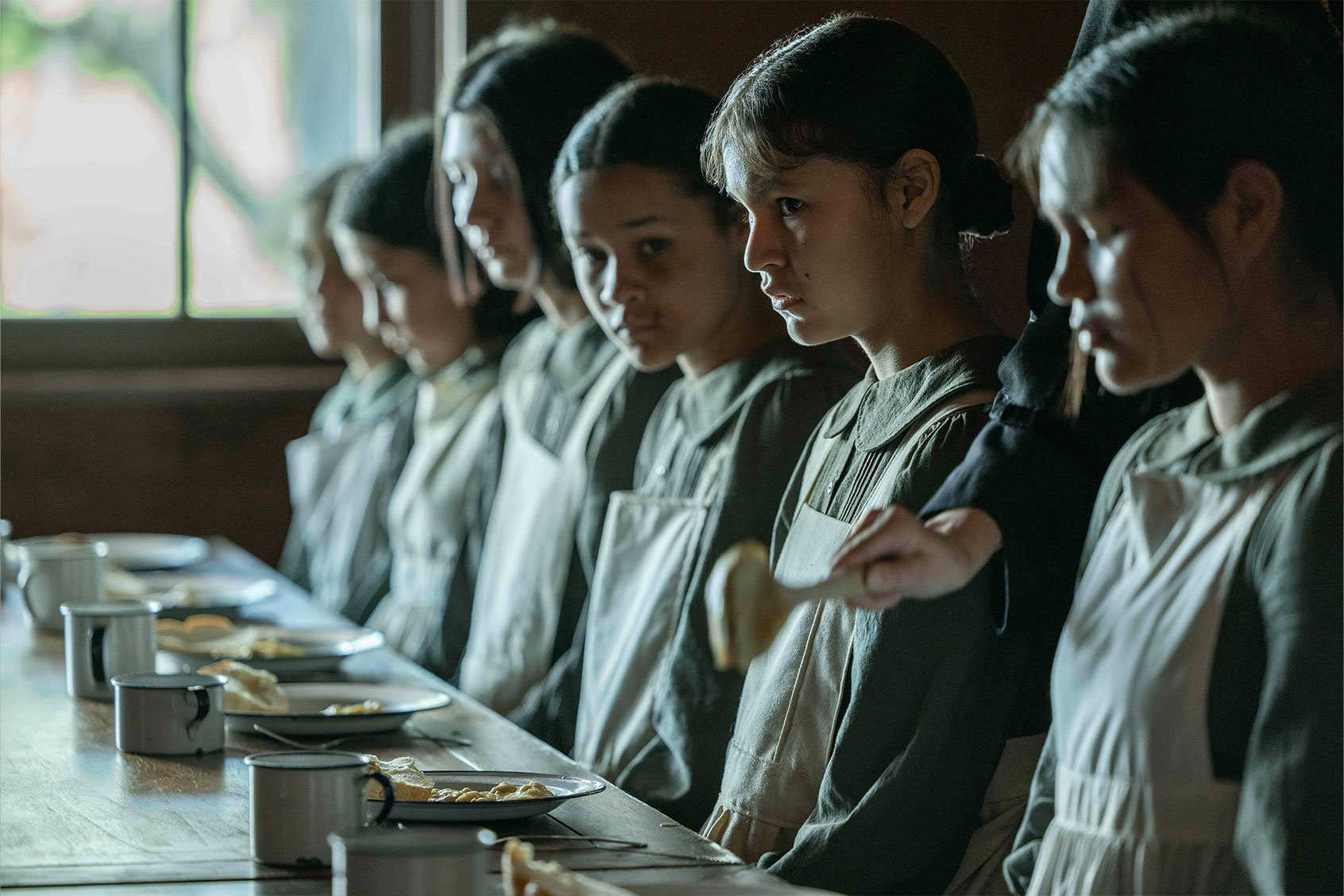
The show's audience certainly wanted to see more of Horn's cosmic vigilante, which director Danis Goulet answers with an episode that doubles as Deer Lady's origin story and an eye-opening look at the appalling history of government-sanctioned Native boarding schools.

Consistent with the show's homages to late 20th-century American cinema, "Deer Lady," written by series creator Sterlin Harjo, plays like a horror movie.

"In the indigenous community, we're very familiar with residential school history. It isn't news to us," Goulet, the Cree-Métis filmmaker, told Salon in a recent phone interview. "But immediately, you just think, 'This is a horror show.' What better genre to face the kind of terror of what it would be like, as a child, to be taken away from your family, having no idea what's going on, not being able to understand the context that you're being brought into?"

By placing her inside this history, "Deer Lady" enriches what we know about the character, making her the ultimate Final Girl.

Goulet, who also directed this season's premiere and Season 2's "Mabel," explained that the 2018 reboot of Dario Argento's '77 classic "Suspiria" was a stylistic reference point for "Deer Lady," "just because it takes place in a dance school, so has that kind of institutional feel with the aesthetics and the darkness, and it pulls from all of the '70s references."

Goulet's vision makes the children's days look as cold and dark as the evenings and centers the children's perspective. Their conversations are subtitled while those of their white captors, mainly abusing nuns, sound like alien gobbledygook. The gibberish, Goulet explains, adds a disorienting element that augments the terror.

"No one leaves," one of the children warns Young Deer Lady (Georgeanne Growingthunder), "unless you go to the cemetery."

Reservation DogsReservation Dogs (FX)But Deer Lady's harrowing experience at St. Nicholas Indian Training School appears to take place much earlier than the 1970s despite her preternaturally youthful looks.
This is in line with the terrible history of these places. A report released in 2022 as part of the Department of the Interior's investigation into federal boarding schools, cited in NPR coverage, indicates that between 1819 and 1969, the government operated more than 400 such institutions and supported more than 1,000 others, including schools affiliated with the Catholic church. It also counted 53 schools with marked and unmarked burial sites, a tally the department expected to increase as the investigation continues.

We need your help to stay independent

In 2021 Canadian authorities confirmed the unearthing of 215 children's remains at a burial site nearby what used to be an Indigenous residential school in British Columbia. Weeks later another 751 unmarked graves were discovered at another former boarding school in Saskatchewan, Canada.

As University of New Mexico professor Nick Estes explains in a High Country News report, these schools were designed as a means of both decimating Native culture and pressuring tribes into giving up their land by taking their children hostage.

As American citizens battle over the false rewriting and erasure of our history, these accounts along with so many others about and by marginalized communities are considered too emotionally taxing for white people to contend with. So what better way to crack the curiosity of the culturally intransigent than to make this history personal by way of someone whose primary superpower is captivation?

Reservation DogsReservation Dogs (FX)By placing her inside this history "Deer Lady" enriches what we know about the character, making her the ultimate Final Girl righting wrongs in a string of never-ending travesties wrought by sins insufficiently reckoned with. And Horn's rendering is essential — she makes Deer Lady an ageless woman who's both stylish and somehow stuck in the '70s and '80s, fashion-wise, favoring flared jeans, long skirts and a shearling coat — a look that's part hippie, part Manson Family member.
What better way to crack the curiosity of the culturally intransigent than to make this history personal by way of someone whose superpower is captivation?

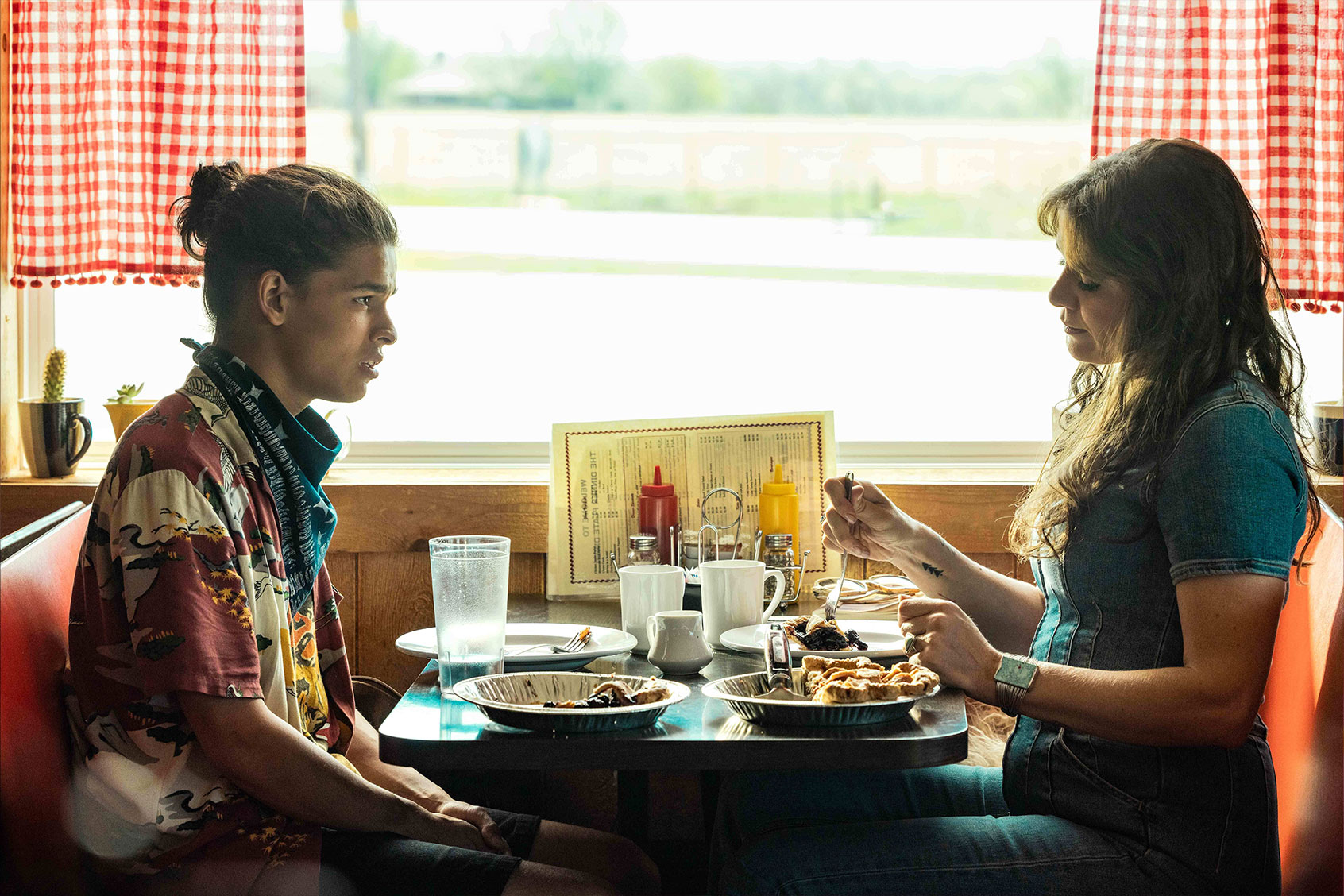
In her latest appearance, when she crosses paths with a very lost, wandering and hungry Bear (D'Pharaoh Woon-A-Tai), she sports a Penny Lane coat and huge glasses, channeling Kate Hudson's "Almost Famous" rocker girlfriend. (She's also reading "I Remember," a literary cult classic written by Oklahoma artist Joe Brainard, described in many accounts as one of the nicest guys they ever met.) These details solidify the impression of Deer Lady not as a murderous seductress but, rather, that cool aunt or older sister watching out for folks.

"Everyone loves and knows the badass heroine, you know, and we've seen her in other episodes righting wrongs and making sure that everyone's living according to the right values," Goulet seconded. "But I think this episode really allows you to get a deeper understanding of why she does what she does, and that it's incredibly personal.

"And Kaniehtiio Horn as an actor, I was blown away," Goulet added. "In so many moments, when we were shooting at how magnetic she is on screen, how watchable like you just cannot take your eyes off of her. . . . She's got so much dexterity as an actor, and range, and she really gives this character so much more dimension."

Goulet sees what "Reservation Dogs" has accomplished in its three seasons as a triumph but also a start, one that would not have been possible if not for Harjo and his co-creator Taika Waititi's relentless push to make it and grant opportunities to actors and writers who aren't often given a foot in the door. The ongoing strikes that the Writers Guild of America and SAG-AFTRA, the guild representing film and TV actors, are in part dedicated to ensuring that opportunities for newcomers expand instead of contract. (Salon's unionized employees are represented by the WGA East.)


Want a daily wrap-up of all the news and commentary Salon has to offer? Subscribe to our morning newsletter, Crash Course.


Goulet, who was able to speak with us as a member of the Directors Guild of America, which came to an agreement with the AMPTP weeks ago, emphasized her unconditional support for her colleagues.

"This show, when you think about its creation, it didn't start when Taika and Sterlin got together. It came off of decades of advocacy, by indigenous creatives in the industry saying, we deserve a chance to be at the helm of our own stories. And so when doors open and a show like this gets made, it's a really big deal. We know the talent's there, just open the door, and we'll show you what we can do. That's what the show has really done. And it's so important to honor it."

In its confluence of excellent directing writing and performances, with Horn's being a highlight, "Deer Lady" exemplifies the enriching cultural potential that can be achieved on TV when underrepresented voices are given space to tell their stories their way.

"Usually when I cross paths with someone," Deer Lady tells Bear, "There's a reason." This time her purpose is very clear, making sure we won't forget her, her story or the history that created her. "Fight evil," Deer Lady advises another child in a past episode. "You do that and you'll never, ever have to see me again." Oh, but we hope that's not true.

New episodes of "Reservation Dogs" premiere Wednesdays on Hulu.

Twitter fined $350K for not complying with Jack Smith subpoena because they wanted to tip off Trump

Special counsel Jack Smith’s team in January obtained a search warrant seeking records related to former President Donald Trump’s Twitter account, court documents released to the public Wednesday show. According to The Washington Post, the details of the document, which also reveal that a judge slapped the company with a $350,000 fine for delaying compliance, were outlined in a decision from a Washington federal appeals court rejecting Twitter’s claim that it should not have been sanctioned or held in contempt of court. The filing notes that prosecutors were granted the warrant after a court “found probable cause to search the Twitter account for evidence of criminal offenses.”

They also got a nondisclosure agreement barring Twitter from disclosing the search warrant to Trump because the court found that doing so ran the risk that Trump “would seriously jeopardize the ongoing investigation” by providing him with “an opportunity to destroy evidence, change patterns of behavior,” the filing said. Twitter, now known as X, challenged the nondisclosure agreement four days after the compliance deadline, saying that it would not turn over any of the account information, according to the decision. The judges wrote that the company, however, “did not question the validity of the search warrant” but argued instead that the nondisclosure agreement violated the First Amendment and asked the court to assess the legality of the agreement before it handed over information. The judges also affirmed that the district court did not overstep by issuing a $350,000 fine, which was imposed on the company in a “geometric” schedule to punish compliance delays by doubling the fine every day.

Experts: No judge has been willing to jail Trump for contempt “but that may change” with Chutkan

Donald Trump has continued to attack special counsel Jack Smith and vowed to keep talking about his criminal case over his efforts to overturn the 2020 election even as prosecutors seek a protective order to stop the former president and his team from publicly disclosing evidence.

Referring to Smith as a “thug prosecutor” and a “deranged guy,” the ex-president campaigned in New Hampshire on Tuesday, the Associated Press reported. His insults came just days after the Department of Justice asked a judge to approve an order limiting Trump from publicly disclosing evidence in the 2020 election case. 

“Trump’s personal attacks on prosecutors, on judges and on their families may play well with the core of his political base, but in the context of the cases against him and the judicial processes he faces, he is not doing himself any favors,” James Sample, a professor at Hofstra University’s School of Law, told Salon.

The judge presiding over the case has set a hearing regarding the protective order for Friday morning. Following his rally on Tuesday, Trump posted on his social media platform Truth Social, launching an attack on U.S. District Judge Tanya Chutkan.

“If a protective order is imposed, the judge will likely spell out the consequences for its violation in the order itself, and those consequences could include additional charges or even the possibility of being held in contempt,” Sample said. 

Judge Chutkan has a number of options if Trump violates the protective order, former federal prosecutor Neama Rahmani and president of Los Angeles-based West Coast Trial Lawyers told Salon. Her options range from fining him to holding him in contempt and even potentially putting him in jail. 

“But is a judge actually going to jail Donald Trump in the middle of a presidential campaign? Probably not,” Rahmani said. “Judge Chutkan will probably admonish Trump for violating her protective order, but she won’t really do anything about it… So far, no judge has been willing to hold Trump in contempt and jail him, but that may change if he continues to flout Judge Chutkan’s orders.”

Trump’s legal team has contended that the prospective order is too broad and instead requested that the judge put in place a version that is “less restrictive” so that the order doesn’t curtail his freedom of speech as protected by the First Amendment, a sentiment Trump reiterated during his Tuesday speech.

“I will address this matter,” Trump said at the rally. “They won’t infringe upon my First Amendment.” 

He said he needs to be able to answer reporters’ questions about the case and that failing to do so is “not good for votes” as he seeks to defeat Biden. 

The ex-president also cited the movie “2000 Mules,” which alleged widespread voter fraud in the last presidential election. Their claims of election fraud have been repeatedly debunked by election security experts.

We need your help to stay independent

“Trump’s First Amendment claims are preposterous,” Sample said. “We criminalize all manner of illegal activity. … Witness tampering and making threats against witnesses and jurists jeopardizes not only the safety of individuals, but the integrity of the judicial process. Trump wants the sweet – the protections afforded to criminal defendants – without the bitter, the commensurate obligations required for fair processes. He shouldn’t and won’t get to have it both ways.”

While Trump has First Amendment protections to speak about the case, especially when he is campaigning, that does not give him “free rein” to attack the judge, prosecutors or witnesses, Rahmani added. 

“In the context of this court case, documents aren’t speech, so Trump has no First Amendment rights to disseminate documents that are subject to a protective order,” he added. “We’re in uncharted waters. Never before has a leading candidate for president been under indictment. Trump will be given more freedom to speak publicly about the case than the typical criminal defendant.”


Want a daily wrap-up of all the news and commentary Salon has to offer? Subscribe to our morning newsletter, Crash Course.


Trump is also facing indictments in both New York state court and federal court in Florida. Additionally, there is a possibility of state charges in Georgia, where he attempted to challenge his loss in the 2020 election.

The former president has denied any wrongdoing in any of the cases against him and instead called for the DOJ to be prosecuted for misconduct. He has repeatedly attacked Smith on social media and referred to the ongoing probe as a witch hunt. 

“Trump is facing one more indictment to be filed any day now – with Georgia prosecutor Fani Willis coming after him,” Rahmani said. “Already, the wheels are coming off for Trump and his legal team as they handle three criminal cases and a couple of major civil trials coming up in New York. Trump and his lawyers aren’t always on the same page. His legal bills are ballooning, which should be concerning even for a man as wealthy as him. What happens when one more case out of Georgia gets added to the pile?”

“Weak dictator”: Ousted elected Dem prosecutors fire back at “small, scared man” Ron DeSantis

Florida Gov. Ron DeSantis on Wednesday announced he suspended State Attorney Monique Worrell, a Black Democrat and elected prosecutor for Orange and Osceola counties, on the grounds that she failed to pursue stronger charges in serious cases.

The 2024 presidential candidate took a brief break from his campaign to return to the Florida Capitol and announce Worrell’s suspension with Attorney General Ashley Moody and Florida Department of Law Enforcement Commissioner Mark Glass at his sides, according to the Tallahassee Democrat.

“Prosecutors have a duty to faithfully enforce the law,” DeSantis said in the announcement. “One’s political agenda cannot trump this solemn duty.” 

DeSantis declared that Federalist Society member Andrew Bain, an Orange County judge who is also Black, will serve as state attorney for the 9th Judicial Circuit in Worrell’s absence. 

Worrell in response vowed to challenge the move in court and run for re-election while addressing a crowd outside her office in Orlando.

“If we’re mourning anything this morning, it is the loss of democracy,” she said. “I am your duly elected state attorney for the 9th Judicial Circuit and nothing done by a weak dictator can change that.”

The attorney’s brief pause was filled with the applause and cheers of her audience.

“This is an outrage,” she added.

DeSantis took no questions following his announcement and was accompanied by Polk County Sheriff Grady Judd and Brevard County Sheriff Wayne Ivey, who bounced praise of the governor’s actions between pauses for applause from DeSantis supporters in attendance.

Judd went on to hold up a placard that splices an image of Worrell into a burning cartoon house saying, “This is fine,” a modification of a viral meme that instead features a cartoon dog. 

“None of this would have been possible if we didn’t have a governor, Gov. DeSantis, who said ‘I’m going to do what’s right,'” Judd said of the appointment of Bain.

Worrell has been the subject of Central Florida law enforcement criticism for declining to bring more serious charges against people in several high-profile shootings and other violent crime cases. In his announcement, DeSantis cited a series of cases over the past two years in Worrell’s circuit where individuals accused of gun crimes, drug-trafficking and other offenses received reduced sentences, lesser charges or had charges dismissed altogether.

During her press conference, however, Worrell pushed back, arguing that crime in her circuit has decreased.

In April, Worrell accused the governor of pursuing “this witch-hunt to establish a basis for the removal of another duly-elected prosecutor” after she learned that a Central Florida Republican Party official had sought prosecution data from her office in connection to human trafficking cases. 

DeSantis’ suspension of Worrell is “another illegal and unconstitutional attack on democracy by a small, scared man who is desperate to save his political career,” according to former Florida State Attorney Andrew Warren. DeSantis removed Warren, a twice-elected Democrat in Tampa, from his position last year after Warren signed pledges asserting he would not pursue criminal charges against people seeking or providing abortion or gender transition treatments, alongside policies that lower the chance of charges for certain low-level crimes.

Warren challenged his removal in a federal lawsuit in September. Though U.S. District Judge Robert Hinkle ruled in January that DeSantis’ move against the prosecutor violated the state’s and the country’s Constitutions, Hinkle said he lacked the authority to reinstate Warren.

Worrell was elected in 2020 with 67 percent of the vote in Orange and Osceola counties. On her office’s website, she outlines the office of the state attorney’s goals.

“While engaging in the day-to-day prosecutorial function, we likewise seek to reform and improve the criminal justice system by measuring success in the courtroom and the community,” the site said.

We need your help to stay independent

She succeeded Aramis Ayala, who had been Florida’s first Black state attorney. Ayala, a Democrat, had also been at odds with DeSantis’ predecessor, then-governor and now Sen. Rick Scott, over her refusal to pursue the death penalty in capital cases, prompting him to reassign more than two dozen cases. 

The Republican attorney general whom Ayala had unsuccessfully challenged last year, Moody, made a case against Worrell, saying that she had dismissed over 16,000 charges against defendants in the past year, more than any other Florida state attorney. She noted that those dismissals were significant in comparison to that in Palm Beach County, where Democrat Dave Aronberg serves, which had a quarter of the number of dismissals.

“Officers may arrest you, they risk their lives arresting you. But if you’re in the 9th Circuit, nearly half the time, the state attorney will not follow through,” Moody said. “That is incredibly dangerous to people in the 9th Circuit.” 

For DeSantis, Worrell’s suspension comes a day after he overhauled his presidential campaign, replacing his campaign manager with his governor’s office chief-of-staff as he continues his bid for the Oval Office. 

DeSantis appeared to have been building a case against Worrell for some time with his general counsel demanding at the end of February that Worrell turn over emails, reports and documents connected to a 19-year-old man accused of killing three people in Orlando.

The governor had decried her earlier prosecutions of the suspect, who had a record of arrests as a juvenile and was on probation when he allegedly committed a shooting spree. The general counsel wrote Worrell asking how the suspect was permitted to “remain on the streets after multiple arrests, including one your office has refused to prosecute.”

DeSantis described his Wednesday actions as an effort to bring prosecutions in the Democratic-leaning 9th Judicial District into compliance with state laws.

“Prosecutors do have a certain amount of discretion about which cases to bring and which not, but with what this state attorney has done is abuse that discretion and it effectively nullifies certain laws in the state of Florida,” DeSantis said.


Want a daily wrap-up of all the news and commentary Salon has to offer? Subscribe to our morning newsletter, Crash Course.


Florida State Rep. Anna V. Eskamani, a Democrat, decried DeSantis’ removal of Worrell as “another example of his extreme anti-Democratic stances” on X, formerly known as Twitter, emphasizing that Worrell was the only Black woman serving in that office in the entire state at this time.

Worrell’s “removal is a complete slap in the face to Orange and Osceola County residents and another example of Governor DeSantis eroding our local control and democracy,” Eskamani wrote in the statement. “This politically motivated action by the Governor in a predominantly democratic part of the state should alarm everyone.

“DeSantis is extreme, unfit to serve, and must be held accountable,” she concluded.

“Over 60% of voters in Orange County voted for Rent Stabilization and then Gov DeSantis essentially overturned it. Over 60% of voters in Orange/Osceola County vote @MoniqueHWorrell for State Attorney, then Gov DeSantis removes her from office,” U.S. Rep. Maxwell Alejandro Frost, D-Fla., tweeted. “Fascist Gov DeSantis hates Democracy.”

Sherrilyn Ifill, former president of the NAACP’s Legal Defense Fund, called DeSantis’ move “the new voter suppression.”

“He accuses this D.A. of neglect while he travels around the country collecting $ for his personal fantasy of being president – while still no solution to the housing insurance crisis, leprosy on the rise, teachers are leaving the profession, & residents [leaving] the state,” she added. “Disgrace.”

Experts: Leaked secret memo shows the “real architect” of Trump’s Jan. 6 “criminal scheme”

Kenneth Chesebro, a lawyer connected to then-President Donald Trump, first outlined a scheme to install false slates of electors to overturn the 2020 election in a previously secret internal campaign memo prosecutors have signaled forms a key segment in the timeline of the Trump team’s effort’s transformation into a criminal conspiracy.

The existence of the Dec. 6, 2020, memo was revealed in Trump’s latest criminal indictment last week, though details about its contents were unclear. The New York Times obtained a copy of the communication, which shows that Chesebro knew at the outset that he was presenting “a bold, controversial strategy” that the Supreme Court would “likely” reject in the grand scheme.

He argued that the plan would home in on claims of voter fraud and “buy the Trump campaign more time to win litigation that would deprive Biden of electoral votes and/or add to Trump’s column.” The strategy would have involved the false Trump electors going through the same motions in mid-December as real electors. On Jan. 6, Vice President Mike Pence could then count those slates of votes rather than the certified ones for President Joe Biden.

Though that basic plan was already known to the public, the prosecutor-described “fraudulent elector memo” details information about the plot’s origins and the discussion around it. Amid those new details is Chesebro’s suggested “messaging” strategy to explain pro-Trump electors’ meetings in states Biden won. That campaign would call that step “a routine measure that is necessary to ensure” Congress could count the correct electoral slate if legislatures or courts later found that Trump had actually won in those states.

The Dec. 6 memo showed that Chesebro suggested Pence could count purported Trump electors from a state as long as a lawsuit was already pending there challenging Biden’s declared victory. He also proposed informing the public that the Trump electors would be meeting on Dec. 14 as an added precaution.

“There is no requirement that they meet in public. It might be preferable for them to meet in private, to thwart the ability of protesters to disrupt the event,” he wrote, adding: “Even if held in private, perhaps print and even TV journalists would be invited to attend to cover the event.”

Chesebro had previously also proposed creating slates of alternate electors in November 2020 in Wisconsin to protect Trump’s rights in the event he later won a court battle and was deemed that state’s certified winner by Jan. 6 as had occurred with Hawaii in 1960.

The indictment, however, which describes Chesebro as Co-Conspirator 5, noted that his Dec. 6 memo was a “sharp departure” from the Wisconsin proposal, ultimately spearheading what prosecutors called a criminal scheme to concoct “a fake controversy that would derail the proper certification of Biden as president-elect.”

“I recognize that what I suggest is a bold, controversial strategy, and that there are many reasons why it might not end up being executed on Jan. 6,” Chesebro wrote. “But as long as it is one possible option, to preserve it as a possibility it is important that the Trump-Pence electors cast their electoral votes on Dec. 14.”

We need your help to stay independent

Three days later, Chesebro drafted specific instructions for how to create fraudulent electors in multiple states in another memo, which the Times first reported, along with the Nov. 18 communication, last year. 

“I believe that what can be achieved on Jan. 6 is not simply to keep Biden below 270 electoral votes,” Chesebro wrote in the newly revealed memo. “It seems feasible that the vote count can be conducted so that at no point will Trump be behind in the electoral vote count unless and until Biden can obtain a favorable decision from the Supreme Court upholding the Electoral Count Act as constitutional, or otherwise recognizing the power of Congress (and not the president of the Senate) to count the votes.”

Chesebro and his lawyer did not respond to the Times’ requests for comment, nor did a Trump spokesperson respond to an email request for comment.

“Read the memo written by unindicted co-conspirator Kenneth Chesebro laying out his plan to steal the election. He said he was ‘not necessarily advising’ adopting the ‘controversial’ plan,” former federal prosecutor Renato Mariotti tweeted. “A stain on the legal profession and a dark chapter in our history,”

“You know it’s a problem when your lawyer is not willing to say he’s advising you to follow the plan he’s proposing,” he added.


Want a daily wrap-up of all the news and commentary Salon has to offer? Subscribe to our morning newsletter, Crash Course.


Prosecutors are still hearing evidence in the investigation even after filing charges against the former president, sources told the Times. Last year, the House committee released emails obtained by its investigators that showed Chesebro had sent copies of the two previously reported memos to allies in the states participating in the fake electors plot. Chesebro, however, did not attach his Dec. 6 memo outlining the scheme to those messages.

“While John Eastman became a household name and hung out at the White House with Trump, the real architect of the fake elector strategy and the related ‘Pence can decide!’ theory was always Ken Chesebro,” MSNBC legal analyst Lisa Rubin wrote on X, the platform formerly known as Twitter.

Like in the November memo, Chesebro cited Harvard Law School professor Laurence Tribe’s writing to support his arguments that the deadlines and procedures outlined in the Electoral Count Act are unconstitutional and that state electoral votes do not have to be finalized until Congress’ Jan. 6 certification. Chesebro had worked as a research assistant for Tribe as a law student and went on to help him represent Vice President Al Gore in the 2000 election.

He called Tribe “a key Biden supporter and fervent Trump critic” in his descriptions of the professor’s legal views alongside writings from other liberals to buttress a messaging strategy. It would be “the height of hypocrisy for Democrats to resist Jan. 6 as the real deadline, or to suggest that Trump and Pence would be doing anything particularly controversial,” he wrote.

In an essay published Tuesday on legal website Just Security, Tribe pushed back against Chesebro’s “gross misrepresentation of my scholarship” in his Nov. 18 memo. Tribe asserted that, in quoting a clause from a law review article he wrote about Bush v. Gore to buttress the notion that the only real legal deadline is Jan. 6, Chesebro took his argument, which was only “discussing the specifics of Florida state law,” out of context. 

Tribe also countered Chesebro’s argument by citing a constitutional treatise where he wrote that a past Congress can’t restrict the actions of a later Congress, which Chesebro used to support his claim that parts of the Electoral Count Act are unconstitutional. Tribe clarified that he meant Congress can pass new legislation changing such a law.

“The 12/6 Memo repeats the same misrepresentation of [Tribe’s] work as did Chesebro’s 11/18 Memo. Chesebro knew better,” NYU Law professor Ryan Goodman, who once served as a special counsel to the general counsel in the Department of Defense, wrote on X. “Looks like he was creating a false sense of legal legitimacy – as part of the criminal scheme.”

“I’ve been tormented and terrorized”: Megan Thee Stallion responds to Tory Lanez’s sentencing

Prosecutors shared a pre-written statement from Megan thee Stallion ahead of Tory Lanez’s sentencing hearing on Monday, asserting that the rapper “must be forced to face the full consequences of his heinous actions and face justice.” Megan did not appear at the court hearing for Lanez, who was sentenced Tuesday to 10 years in prison for shooting her in the foot in July 2020 as they left a Hollywood Hills party at Kylie Jenner’s home.

“I struggle with being present. After everything that occurred I cannot bring myself back to being in the same room with Tory,” Megan wrote in the statement read by Los Angeles County Deputy District Attorney Kathy Ta. “I’ve been tormented and terrorized.”

“He paid bloggers to disseminate false information, he treated my trauma like a joke when I could’ve been dead,” she continued. “He blamed the system, he blamed the press, and as of late he is using his childhood trauma to justify his actions. Slowly but surely, I’m healing. But I’ll never be the same. His crime warrants the full weight of the law.”

Lanez was originally scheduled to be sentenced in February but his legal team filed a motion for a new trial in March that was ultimately denied, per Variety. Lanez has been in jail without bond since a jury found him guilty in December 2022 of three felony firearm counts. He was convicted on one felony count each of assault with a semiautomatic firearm, negligent discharge of a firearm and carrying a loaded, unregistered firearm in a vehicle.

Georgia’s peach crop loss is about more than just fruit

This summer, farmstands in the Peach State are missing a key crop: peaches. That’s not because the fleshy fruits have already been scooped up by chefs and home cooks to be made into jams and pies, although they would if they could. Rather, the peaches never got a chance to grow at all.

An abnormally warm winter caused peach trees to bloom earlier than usual this year. That was followed by intense freezes in late March that killed off many of those blooms, which are needed to produce fruit, as well as the fruits that had already begun developing. As a result, more than 90 percent of Georgia’s peach crop was wiped out.

It’s one of the worst peach harvests the state has seen in the past two decades. The loss was so significant that a natural disaster declaration was issued in 18 different counties, which will allow growers to receive much-needed loans from the U.S. Department of Agriculture (USDA).

But this year’s poor peach crop is not an anomaly. In fact, it was only six years ago, in 2017, that Georgia peaches were last affected by harsh weather. That year, peach growers lost a staggering 85 percent of their crop. And Georgia peaches aren’t the only regional product being threatened by a climate-related crisis.

In New Mexico, home of the Hatch green chile, extreme heat is stressing the pepper plants and reducing their yield. Florida’s citrus industry, already struggling after years of battling citrus greening disease, suffered another blow this year after Hurricane Ian struck the state, causing a 60 percent decline in production. Warming temperatures in New England are disrupting maple syrup harvests in Maine and Vermont, causing trees to start leaking sap before sugar levels are high enough. And California’s $40 billion wine industry is regularly threatened by persistent droughts and destructive wildfires that have wiped out vineyards and entire vintages in some regions.

We’ve long recognized that certain foods are special when they come from certain places. The wind coming off the sea is particularly cold here, maybe, or the soil particularly rich there — and a regional crop or catch can become part of not only a place’s economy, but also its culinary identity and a point of local pride. Whether it be a peach or a pepper, that ingredient often becomes the centerpiece of an emblematic dish, cementing its special place in the culture to which it belongs and to those who prepare it. Of course, good marketing also helps.

“The reputation was made before [the motto],” says William Thomas Okie, professor of history at Kennesaw State University and author of “The Georgia Peach: Culture, Agriculture, and Environment in the American South.” Even before the Peach State adopted its official nickname, the Georgia peach brand was strong. “A lot of it has to do with the produce markets in big cities of the North. They were not only the first peaches of the season, but Georgia peaches were the first fresh fruit of the season. They were always the earliest in the market,” often beating South Carolina’s more abundant, but later, supply.

Peaches also played an important role in helping Georgia rebrand itself after the Civil War. “It happened at a moment when the South was in search of a new identity,” says Okie. With the Southern economy in shambles, farmers were desperate to attract Northern customers. Cotton, which remained the state’s primary crop, was negatively associated with poverty and slavery. It also required a lot of labor (previously, mostly forced enslaved labor) and after the deadly hostilities, willing workers were in short supply. For many former cotton farmers, planting peach trees opened up new economic opportunities — and a fresh start.

Today, peaches are less important to Georgia’s agricultural industry. While the state might be most known for the stone fruit, they are nowhere close to being the top-earning one. In fact, peaches don’t even make it into the state’s top 10, by value. If Georgia were to be named for its top commodity today, it would be known as the Poultry State; it’s the nation’s number one broiler (chicken) producer and responsible for a significant portion of the country’s egg production.

Yet despite its dwindling importance to the state’s agricultural economy, loyalty to the Georgia peach remains — in the Peach State and beyond. “Peaches are not a huge crop in Georgia,” says Pam Knox, an agricultural climatologist at the University of Georgia. “But they are iconic.”

In recent years, peach growers in Georgia have had no choice but to work to mitigate the effects of climate change, which include increasing humidity levels and milder winters punctuated by unpredictable frosts. “We have been getting warmer winters as time has gone on,” says Knox. “In fact, winter is the season that’s warming the quickest in Georgia.”

And it’s those warm winters that are most threatening to the future of Georgia peaches. While they’re a summer fruit, peaches require a certain number of “chill hours” — time spent between 32 and 45 degrees Fahrenheit each winter, when the tree goes into dormancy. Without enough chill hours, the trees can experience delayed growth and reduced fruit production. Add an untimely late-spring frost to the mix, as was the case this year and you’ve got a recipe for disaster.

Some peach growers are responding by planting different varieties that require fewer chill hours. Peach varieties like the Elberta, a juicy peach that’s native to Georgia, might have historical importance, but its requirement of 850 chill hours means it might not be tenable for much longer. New varieties such as the Liberty Joy or Crimson Joy, requiring 650 and 700 chill hours, respectively, could play a crucial role in ensuring the future of the Georgia peach.

Knox doesn’t expect the industry to shrivel up anytime in the foreseeable future. Another poor year for the crop, however, is unfortunately always a possibility in the ever-changing climate. “It’s not spelling the end of peaches in Georgia yet,” she says. “Fifty years from now? Yeah, then we might have to think about that.”

What happens when a state or region loses its iconic crop? It’s a question we’ll likely be asking more in this era of climate crisis. There’s the economic fallout, of course: If the farms are no longer profitable, farmers may be tempted to sell their land for financial reasons, putting farmworkers out of work and causing a deficit in the food supply chain. For a place like Georgia, it would also mean yet another rebrand. After all, peaches appear everywhere from Georgia’s license plates to its Medicaid program for children, known as PeachCare.

But there’s also something more conceptual, with the loss of iconic foods a sort of allegory for climate change’s impact on intangible things like culture, how it’s shaped by our relationship to place. For Okie, who grew up in Georgia and whose father worked as a peach breeder for the USDA, the looming loss of the state’s symbolic fruit evokes a sort of weariness. “I can easily imagine Georgia remaining the Peach State decades after it’s no longer producing any peaches,” he says. “But that would be sad to me, to have lost the referent.”

Top shelf prices for booze-free drinks: Are nonalcoholic cocktails too expensive?

For a little over a year, I’ve abstained from alcohol. In that time, I’ve had some truly sensational non-alcoholic drinks at restaurants and bars, as well as enjoyed some zero-proof libations at home. This past weekend, for instance, I enjoyed a refreshing, not-too-sweet, peach-forward non-alcoholic drink while out to eat at a Mediterranean seafood restaurant, situated right on the banks of the Hudson River. 

Whenever I open a menu and see a few non-alcoholic options, typically at the bottom of the list, I can loosen my shoulders and feel a bit of reassurance. Yes, there are generally far fewer than their alcoholic counterparts, but that’s okay. I appreciate having options other than stale ginger ale or cranberry juice

No matter the reason, there are many people who aren’t drinking alcohol right now and the beverage industry is quickly catching up to that fact. Industry data from NielsenIQ, a data analytics company, the market for non-alcoholic beer, wine and spirits grew more than 20% last year and more than 120% over the last three years.

The market for mocktails, or “non-alcoholic cocktails” and “zero-proof beverages,” as industry professionals prefer they be called, has grown alongside the demand for alcohol-free spirits — and at $9, $10 and sometimes $14 a drink, it seems the prices for non-alcoholic cocktails have grown, too. In fact, when chatting with some friends and colleagues, I’ve heard a similar refrain: Why are non-alcoholic drinks so expensive? 

Now, it’s probably worth noting that I personally haven’t felt aggrieved by non-alcoholic cocktail pricing. I have spent inexplicable amounts of money on actual cocktails, so if a spirit-free drink is, let’s say $9, I have no qualms paying that when the alcoholic version elsewhere on the menu is $17. For example, this past weekend, my non-alcoholic drink was $10, while the alcoholic cocktails were all $18 and up. 

That’s the case for many bar programs, like the one at  Ruse Restaurant at the Wildset Hotel in Maryland. General Manager Tanner Collins told me that the restaurants’ cocktails are priced at $15 while their spirit-free beverages are priced at $9. “Which I think is a fair price break due to no alcohol being used in the drink,” he said. 

To me? That makes sense. Still, I get it. If you’re not getting the liquor in the first place, you might be cautious about dishing out nearly $10 for a concoction of juices, syrups, extracts, sparkling water and the like. But according to industry professionals, there are some hidden costs and extra labor associated with making non-alcoholic cocktails that help inform the ultimate menu price — and it all starts with non-alcoholic spirits.

We need your help to stay independent

“Non-alc drinks are often more expensive and time-consuming to produce than their alcoholic counterparts due to de-alcoholization technologies [and] the difficulties of shelf stability without alcohol,” Douglas Watters, the co-founder of Dry Atlas and Spirited Away, told me via email. 

However, according to Amanda Blue — the president and chief operating officer of the Tasting Alliance, an organization which hosts and conducts several international spirits competitions — these spirits aren’t just weak imitations of their alcoholic counterparts. 

“[They] cannot be ignored and need to be evaluated with a different lens than the average proof spirit,” Blue said in an email. “There are judges who now specialize in low and no alcohol and zero proof mixology, who we utilize to set the standards and benchmarks of evaluation.” 

Then on the bar or restaurant level, there’s a lot of craft that goes into making an interesting, nuanced beverage, whether it has alcohol or not. Will Patton is the beverage director of Bresca in Washington, D.C., where he says the restaurant’s “culinary cocktails” offer both accessibility and elevated flavor. 

“Instead of just making a mint lemonade, we want to add layers of complexity as well,” he said. “In our Mango Collins, we use a Bare NA Gin which has a peppery note to add an extra dimension to essentially a mango ginger highball.” 

(It’s also worth noting, perhaps, that a bottle of Bare NA Gin retails for around $40, while you can buy a bottle of Hendrick’s starting at around $35.) 

Chris Struck, beverage director at ilili NYC, puts a finer point on how non-alcoholic cocktails are priced. 

“No one should order anything that they’re uncomfortable with the price of,” he said. “This is why restaurants list the price of what they sell, so that everyone is empowered to make the choices right for them and their budget. This fact doesn’t change the costs of the goods and services that a restaurant sells in order to exist.” 

Elevated, intentional drinks require labor, skill and time — regardless of if they contain liquor or not — and the price point should obviously reflect that.


Want more great food writing and recipes? Subscribe to Salon Food’s newsletter, The Bite.


Underpinning the question of how much non-alcoholic cocktails should cost is an even thornier question: Should a drink’s value actually be determined by how much of a buzz it can give you? 

Many professionals who work in the non-alcoholic spirits and cocktail space suggest that it’s time for us as a culture to redefine what makes a beverage celebratory. 

“We’re conditioned to value spirits by their alcohol content, associating them with a certain buzz,” said Victoria Watters, the other co-founder of Dry Atlas and Spirited Away, via email.  “It’s about savoring complex flavors, enjoying shared experiences, marking the close of a long day, celebrating moments big and small and so much more. Non-alc spirits enable these rituals without the downsides of alcohol.” 

According to Blue, we’re already seeing spaces that foster this kind of enjoyment as specialized dry bars and restaurants, as well as zero proof retail outlets, continue to pop up around the country. 

“New generations of drinkers want to be able to experience the social aspect of having a drink without the deleterious health effects of too much alcohol,” she noted. For so many in the nonalcoholic realm, there’s something particular and meaningful that brought them there. As Douglas Watters remarked, “most brands in the space have a deep why that drives them.” 

So, no matter if you’re exploring the non-alcoholic world with gusto, sticking with your usual offerings or abstaining from both altogether, make the choices that make the most sense for you, whether that’s based on your personal preferences — vodka over rum, lime over lemon — or your bank account. Speaking from experience, the presence of these non-alcoholic drinks can be immensely important for many diners and bar-goers. So, if there’s a need to spend a bit of an upcharge to feel comfortable, it’s certainly worth it to me. 

“Show up to the debate and say it to my face”: Trump’s attack on Chris Christie’s weight backfires

GOP presidential candidate Chris Christie on Tuesday hit back at Donald Trump for comments the former president made about his weight by challenging Trump to show up to the debate. “If you had the guts, you would show up to the debate and say it to my face,” Christie tweeted, calling out Trump for dodging the first Republican primary debate.

“Christie, he’s eating right now. He can’t be bothered,” Trump said at a campaign event in New Hampshire on Tuesday. When an audience member seemingly jumped on Trump’s bandwagon of jeers, the ex-president said, “Sir, please do not call him a fat pig. That’s very disrespectful. Don’t call him — see, I’m trying to be nice. Don’t call him a fat pig. You can’t do it. You can’t do that. So now, because you’re not allowed to do that, and therefore we’re not going to do it, OK? We want to be very civil.” Christie, who has long struggled with his weight, has emerged as one of Trump’s most fervent critics since announcing his bid for the 2024 presidency. Trump has repeatedly mocked the former New Jersey governor for his physical appearance since the primary campaign began, also noting that he will not likely appear for the first round of Republican primary debates at the end of the month. 


My father’s bittersweet homecoming: A family visit to the institution that treated him for leprosy

We flew from New York City to New Orleans on November 28, 2016, my father, my mother, my husband, my two little girls and I. Our rental car followed the path of the Mississippi northward, snaking past suburbs and swamps, tin-roofed shacks and dirt roads until we reached the Gillis W. Long Hansen’s Disease Center, formerly known as the Louisiana Leper Home, in Carville where my dad had once been a patient.

In 1954, at the age of 16, my dad was living with my grandfather in the Bronx when he was diagnosed with Hansen’s Disease, the preferred designation for leprosy. He was sent to Carville where he stayed under federal quarantine for nine years, until he was cured and discharged in 1963. Fifty-three years later, he was going back for the first time.

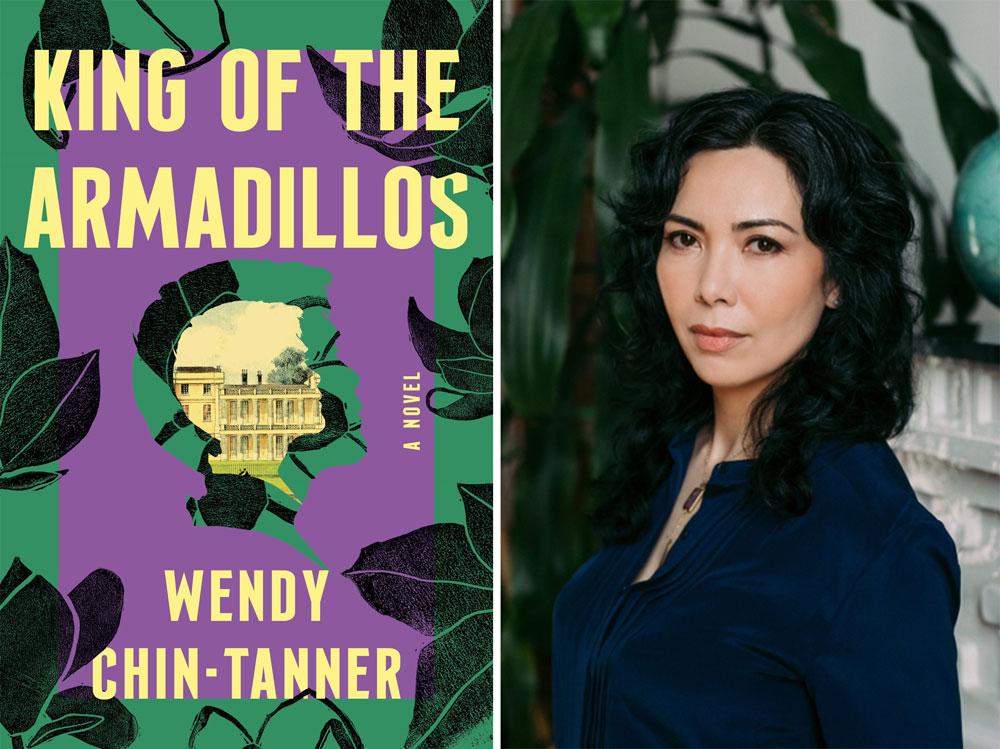
For my dad, our journey to Carville was a bittersweet homecoming. For me, it was both research trip and pilgrimage. I’d recently started writing my novel, “King of the Armadillos,” inspired by his experience, and he was helping me access material from the archives of the National Hansen’s Disease Museum. Located on the grounds of the former institution, which is now partially occupied by the National Guard, the museum invited my dad to record his oral history, so we decided to go.

My husband stopped the car in front of a set of high, iron gates. A guard in military uniform directed us past a white plantation house with sweeping balconies and Corinthian columns, through an avenue of live oaks, old and gnarled, and draped with Spanish moss, to the infirmary. It had been converted into military conference accommodation where we were staying.

Founded in 1894 on the grounds of an abandoned sugar plantation, the 330 acres of the institution were well-manicured with neatly mown lawns, flowering bushes, ornate gardens, a lake, a golf course, and sprawling fields amid the Victorian-style dorms, covered walkways, and numerous amenities that made Carville look more like a prep school than a leprosarium. But just as it had been when my dad was there, all that beauty was surrounded by a barbed wire fence.

As we approached the broad face of the 1930s federal building that had served as Carville’s hospital, I tried to catch my father’s eye, but I couldn’t read his face. He was looking down at my two-year-old daughter, guiding her up the concrete steps.

“Is it the same?” I asked him, opening the door. “It smells different.”

I thought he might have been talking about the pollution, the emissions from the nearby chemical plants that gave the air an unnerving metallic tang.

“No,” said my dad. “I mean it doesn’t smell like a hospital anymore.”

When he arrived at Carville on November 12, 1954, my dad had gone straight to the infirmary, too. After a two-day train ride from Grand Central Terminal to Union Station, he was as exhausted and terrified as “a poorly nourished, chronically ill looking Chinese boy” could be. Sister Victoria, one of the Daughters of Charity who did the majority of the nursing at the hospital, made that observation during my dad’s intake interview, which he was obliged to give before submitting to a battery of tests—X-rays, labs, a physical, and biopsies of his lesions.

In the interview, my dad told her that “his father served in the US Army. His grandfather who lived in New York returned to China and was killed by the Communists. This occurred because this man was known as a Chinese who had been in the United States for a long time, and therefore was likely to be a sympathizer with American political principles.”

You value personal and political stories

Everything he said was true, but I imagine he must have emphasized those details to make our family sound more patriotic.

“What name will you be taking?” Sister Victoria asked.

My dad was confused, and she explained that most new patients chose Carville names to spare their families from the stigma of their diagnosis. He chose to keep his own.

So many of my dad’s stories about his youth were set at Carville that I’d been imagining it for my entire life, but he never said much about his time in the infirmary. Once, when I was little, I asked point blank about the twin scars running up the insides of his arms like tire tracks on a sandy beach. As I traced one of them with my finger, he answered simply that he’d had an operation on his nerves. I let my hand fall to my lap. His words were matter-of-fact, but his tone made me feel like I shouldn’t have mentioned it.

In his admission work-up, Dr. Riordan wrote that my dad had “loss of sensation on the ulnar aspect of both hands… and he has had recurrent bouts of neuritis. I think he will benefit by having an ulnar nerve transposition.”

He must have been in excruciating pain, but he’s nothing if not stubborn.

“Dr. Riordan recommended surgery,” Sister Leonara wrote in an Interval Report, “but patient refused.”

Throughout his medical records, I can see glimpses of who my dad is, who he’s always been—a complex soul who can be both affable and combative, cooperative and recalcitrant, depending on his mood. Over the next few years, his nursing notes were peppered with remarks like:

“Called but did not come in for examination as requested.” “Remained in bed entire day. Still refuses to talk to anyone.”

“Does not try to answer questions even when normal and comfortable. Whether this is part of an anxiety syndrome associated with his illness or due to some outside social problem which he has not felt free to relate to myself or the staff, I can’t say at present.”

Three-and-a-half years after his initial examination, Dr. Riordan wrote on April 30, 1958, that “this patient still shows the involvement that he showed before… If he has changed his mind and wants to have the ulnar nerve transposition, I would suggest that it be done as soon as possible.”

My dad held out for almost another month, but on May 21, 1958, the operation was finally done.

Throughout his medical records, I can see glimpses of who my dad is, who he’s always been—a complex soul who can be both affable and combative, cooperative and recalcitrant, depending on his mood.

When he arrived as a minor, my dad had even fewer rights than the adult patients since my grandfather had signed release forms agreeing to whatever medical treatment the doctors deemed necessary. It strikes me as somewhat remarkable that my dad was able to delay his surgery by sheer force of will. Though he lacked agency, his intransigence proved to be an effective tool of resistance.

At the same time, the administration’s apparent tolerance for patient self-determination was a hard-won result of the patient campaign to change Carville’s institutional culture from that of a hospital to a community. The de facto leader of the movement was Stanley Stein, a former pharmacist from Texas, who founded The STAR, Carville’s patient-run magazine, shortly after his arrival in 1931. The magazine’s mission was to shine a light on the disease to humanize and restore dignity to its sufferers.

Though blind, claw-handed, and unable to walk without a cane, Stanley was an uncommonly charming man with a knack for befriending famous figures like Hollywood star Tallulah Bankhead, who became The STAR’s most zealous patron, badgering her industry friends to subscribe. The magazine grew from a two-page mimeographed hospital newsletter to a well-respected Hansen’s disease news venue read by people in over 130 countries around the world.

My dad met Stanley during his first stint at the infirmary.

“We shared a room,” he told me recently. “We talked about politics and history, like the fall of the Roman Empire. And musicals. He loved Broadway.”

When he was “discharged to the colony,” my dad joined Stanley’s roster of volunteers who read everything out loud to him from correspondence to proofs of articles. Soon, he started volunteering at The STAR office, too, where he learned to set linotype and work the printing press, churning out up to 92,000 copies.

Getting the issues out to subscribers was a laborious process, made even more so by the risk that they might be destroyed with the outgoing mail, which had to be “disinfected” in a lab with dry heat before leaving the institution. Occasionally, a technician would forget to turn off the machine and the bags of mail inside would be burnt to a crisp.

Once, in the mid-1950s, after multiple complaints, Stanley sent my dad to the lab to check on the outgoing issue. The stench of scorched paper, the good smell of the ink gone acrid, hit him before he saw the blackened remains of the magazine. He took one out of the bag, and it crumbled to ash in his hands.

There was no scientific reason for sterilizing the mail just as there was none for quarantining patients. More than 95 percent of all people have natural immunity to Hansen’s, which is only mildly communicable even to those with susceptibility, and since 1941, it has been entirely curable. The only possible reason was to assuage public fear, which further perpetuated misinformation and stigma around the disease. Nevertheless, the policy wasn’t abolished until the late 1960s.

At my dad’s exit interview, his counselor advised him to keep Carville a secret so he could avoid the stigma it carried and focus on his life ahead. And he did.

When we weren’t busy in the archives, my dad and I walked the grounds. At the dorms, he pointed out the window of his room in House 29, averting his eyes from the old cemetery at the center of the quadrangle. Its weather-worn headstones were a reminder of how, in the not-too-distant past, Hansen’s disease was a death sentence. I couldn’t look away.

When it began to rain, we ducked into the recreation center. Upstairs, he showed me the ballroom where they’d held all their dances.

“We had a lot of balls,” he said, “but the biggest one was on Mardi Gras.”

Along with all the other patients, my dad enthusiastically participated in the Mardi Gras celebrations, constructing floats for the parade, making masks, decorating the ballroom, and performing special numbers with his barbershop quartet.

One year, he was a duke of the royal court while his crush was Mardi Gras Queen.

Strings of twinkling Christmas lights hung from the ceiling between the stars he’d helped to cut out from silver paper. Waiting for the ceremony to begin, he watched the floats come in one by one. The last was a pirate ship.

“There was a treasure chest on the float,” my dad recalled. “All of the sudden, it burst open and ten, maybe 15 cats jumped out, running all over the place, under the tables, under the sisters’ skirts. Everybody went nuts. I was wearing a fancy Louis XIV-style costume. I didn’t want it to get clawed up, so I stayed on the stage. Afterwards, things got kind of rowdy. There was a lot of drinking. But that’s just what it was like on Mardi Gras.”

At my dad’s exit interview, his counselor advised him to keep Carville a secret so he could avoid the stigma it carried and focus on his life ahead. And he did. Unlike some former Hansen’s patients who didn’t want to live on the “outside,” my dad chose to leave Carville when he was cured, but Carville never left him or our family. Back in New York, he served in the AmeriCorps VISTA program before becoming a social worker, a printer, and a lab technician in the Art Department at NYC Technical College. In his spare time, he was a Boy Scout leader and remained politically active, marching for Civil Rights and against the Vietnam War. In 1967, he married my mother, and opened an art supply store with her in 1972. In 1976, I was born.

Without Carville, my dad wouldn’t be the man he is. And I wouldn’t be who I am either. When my dad was discharged, he went home alone, just as he’d arrived. But when he returned, it was with us, the family he made, the proof that while he was gone, he didn’t just survive, but lived.

King of the Armadillos by Wendy Chin TannerKing of the Armadillos by Wendy Chin Tanner (Flatiron Books/Sylvie Rosokoff)
“Might have to give those millions back”: Legal experts say Jack Smith could “seize” Trump PAC cash

Special counsel Jack Smith appears to be far from wrapping up his investigation into former President Donald Trump’s post-2020 election scheme and his team has held at least one interview this week related to the finances of the ex-president’s political action committee, according to Politico.

Smith’s team on Monday interviewed Bernie Keris, a former New York City police commissioner and longtime associate of former Trump lawyer Rudy Giuliani, according to the report. Prosecutors questioned Kerik in a “closed-door” interview about how the Save America PAC raked in huge amounts of cash between Election Day and the deadly Capitol insurrection. Kerik’s lawyer, Tim Parlatore, told Politico that prosecutors were shining a “laser focus from Election Day to Jan. 6.”

Parlatore also shared that prosecutors asked several questions about Boris Epshteyn, an attorney who currently works on Trump’s campaign and as his in-house counsel, as well as Justin Clark, who was the deputy campaign manager of Trump’s re-election. 

Though Trump’s election subversion indictment did not include any financial crimes, Politico reported that the interview with Kerik demonstrates, at the very least, “the clearest indication of Smith’s focus” since the special counsel handed down the indictment against Trump. 

Earlier this month, The New York Times reported that Save America’s funds were dwindling after Trump was forced to pay out numerous lawyers amid his seemingly-unending indictments and court cases — the PAC reported less than $4 million in its account after starting last year with more than $105 million. The floundering PAC was even forced to request a whopping $60 million dollar refund from pro-Trump super PAC, Make America Great Again Inc., with the New York Times reporting that the refund was issued to Save America in installments seemingly timed to Trump’s various legal woes. 

“I don’t know that calling it a refund changes the fundamental illegality,” Adav Noti, a former lawyer for the Federal Election Commission’s litigation division and leader of watchdog group, Campaign Legal Center, told The Times. As the report noted, “the pro-Trump super PAC and Trump-controlled PAC must be independent entities and are barred from any coordination on strategy.”

We need your help to stay independent

“So for the super PAC and the Trump PAC to be sending tens of millions of dollars back and forth depending upon who needs the money more strongly suggests unlawful financial coordination,” Noti added.

The New York Times also noted that, in the months after Trump left the White House, allies of Giuliani encouraged him to use Save America’s money to pay Giuliani for legal services following the election. Various legal experts have identified the former New York City mayor as one of six co-conspirators listed in Smith’s indictment of Trump. 

“This isn’t over yet,” tweeted Frank Figliuzzi, a former senior FBI official. “When you raise millions based on a fraudulent claim, you’ve committed a crime. And, you just might have to give those millions back.”


Want a daily wrap-up of all the news and commentary Salon has to offer? Subscribe to our morning newsletter, Crash Course.


Former federal prosecutor Andrew Weissmann, who served on special counsel Bob Mueller’s team, wrote that he is watching “for a criminal case about the Trump PAC and forfeiture allegations/seizures.” 

He added that the case would “not need to go all the way up to Trump before Jack charges folks and seizes assets.”

NPR reported last year that, per the House Jan. 6 committee’s findings, “the Trump campaign took $250 million in donations from supporters that it said would go to an election defense fund to pay for legal fees to overturn the 2020 presidential election results. But the fund was never actually created, Rep. Zoe Lofgren, D-Calif., one of the committee members, said … in the panel’s second public hearing.” 

“Instead, the money went to the Save America political action committee.”

Trump peddles unfounded lie that Georgia DA Fani Willis had an “affair” with a “gang member”

Former President Donald Trump on Tuesday baselessly accused the Fulton County, Ga. district attorney investigating his efforts to overturn the 2020 election in the state of once having an “affair” with a “gang member,” Rolling Stone reports. “They say there’s a young woman — a young racist in Atlanta — they say she was after a certain gang and she ended up having an affair with the head of the gang or a gang member. And this is a person who wants to indict me […] wants to indict me for a perfect phone call,” Trump alleged of Fani Willis during a New Hampshire campaign event. 

Trump’s accusations appear to be a wild misrepresentation of a 2019 case Willis handled. A video he posted to Truth Social dubbing Willis a member of a “fraud squad” of prosecutors politically targeting him featured over the claim the headline of Rolling Stone’s January interview with YSL Mondo, a co-founder of the Young Stoner Life (YSL) record label who Willis represented during a 2019 aggravated assault case. Willis would later prosecute YSL’s other co-founder alongside 13 other defendants in a RICO case accusing the music group of affiliations with gang violence around Atlanta. According to Mondo, Willis’ prosecution of Young Thug contradicted the impression he had of the prosecutor when she represented him. “I done had auntie-to-nephew, mother-to-son type of talks with her. I know this not her character,” he told Rolling Stone, alleging there were “other people that’s behind her pulling strings.”

Though Trump’s video included the claim, there’s no indication that Willis hid her representation of the rapper or that their relationship was romantic in nature. 

Donald Trump is winning the messaging wars over his indictments

In Little League baseball, the “mercy rule” allows truly lopsided games to be stopped in order to spare the losing team further humiliation. Over the last week, in the wake of his latest indictment, Americans have witnessed another truly lopsided contest as Donald Trump and his legal team have demonstrated their mastery of political messaging once again.

Whatever the legal merits of the various charges against the former president, he is succeeding in turning his legal woes into political benefit. Instead of turning off his supporters, the charges against Trump have further cemented the already tight bond between him and his followers. And, as a just-released CBS/YouGov poll suggests, the criminal prosecution now seems to be convincing some independent voters to see things Trump’s way.

A lesson from abroad

Americans are learning what other nations have also witnessed. Whether it is Silvio Berlusconi in Italy, Benjamin Netanyahu in Israel, or Trump, nothing helps an authoritarian leader as much as if they can pose as a martyr of a politically motivated prosecution and a protector of their people from hostile political forces arrayed against them. 

And that is exactly what Trump has been doing.

He has set himself up as all that stands between his people and the oppressive onslaught of the elitist and corrupt Biden administration. And he has framed what is going on in ways that are easily understood. Most importantly, he has positioned himself as the heroic defender of American values, like freedom of speech.

In June, after being indicted for illegally possessing classified documents, Trump used a speech at the Faith and Freedom Coalition Conference to say that the charges were not directed just against him, but were targeting the millions of Americans who support him. As an ABC News report noted, during his remarks, “Trump, as he often does, cast the criminal cases against him as an escalating campaign of political persecution.” He used that speech to turn the tables and offer his own indictment of President Biden. “Joe Biden has weaponized law enforcement to interfere in our elections, the greatest abuse of power that I’ve seen, that most of you have seen in the history of our country,” Trump said. “It’s a hoax.”

And he said that “Every time the radical left Democrats, Marxist, communists and fascists indict me, consider it a great badge of courage. I’m being indicted for you.” Trump added, “and I believe the ‘you’ is more than 200 million people that love our country that are out there, and they love our country. This is a continuation of the greatest witch hunt of all time.”

Trump’s “I am being indicted for you” claim has become a staple of his post-indictment political rhetoric. The former president repeated it in an appearance at a South Carolina fundraiser soon after Jack Smith’s August 1 indictment for his effort to overthrow the 2020 election results.

We need your help to stay independent

There he also insisted that the indictment was a cover for the Biden administration’s “outrageous criminalization of political speech. They’re trying to make it illegal to question the results of an election.”

A winning message

Last Sunday, Trump’s lawyer, John Lauro, went on five of the major morning news and gave a master class in political communication. 

Keep it simple. Use emotionally powerful catchphrases. Repeat and amplify the message. 

In none of his television appearances did Laurohe ever mention the special counsel. Instead, echoing Trump, he repeatedly referred to the Biden administration’s “persecution” of the former president. And when he was asked about the prospect of televising Trump’s trial, Lauro responded by following his client’s lead in framing the question as one of the Biden administration versus the American people, 

As he put it, “I’m convinced the Biden administration does not want the American people to see the truth.”

From one appearance to the next, Lauro reiterated that everything alleged in the August 1 indictment is “core, First Amendment protected speech.” He characterized Trump’s conduct as a “constitutional disagreement” and insisted that “never in our nation’s history have those kinds of disagreements been prosecuted criminally.

Lauro even turned the tables on his interviewers and said he was surprised that their networks were not joining him in opposing the Biden administration’s effort to get a protective order forbidding disclosure of any material the government turns over to the defense during the discovery process. 

He called that effort a threat to freedom of the press.

Listening to him I was almost convinced.

And so it seems are many Americans. As evidenced in the CBS/YouGov poll, the nation’s existing deep partisan divide best characterizes the reaction to Trump’s legal troubles. For example, while 88% of the respondents who identify as Democrats said that the investigations and indictments of Trump were necessary to uphold the rule of law, only 28% of Republicans concurred. And, while 31% of Democrats thought that the prosecutions were aimed at trying to stop the Trump campaign, 86% of Republicans held that view. A substantial number of Trump’s supporters are buying his assertions that the indictments are “an attack on people like them,” as 77% of what the poll labels MAGA Republicans agree with that statement, as do 42% of the non-MAGA Republicans.

If that were not enough to sound the alarm bells for Democrats that Trump is succeeding in following the playbook that other authoritarians have used when they have been accused of crimes and corruption, it is hard to see what would be.

Yet there is more.

The CBS/YouGov survey found that Trump’s messages may be resonating beyond his base. According to the survey, 37%, of independents do not believe that President Biden was the legitimate winner of the 2020 election. And even more of them, 41%, agree with Trump that Jack Smith’s indictment for Trump’s effort to overturn the 2020 election was “politically motivated.”

A needed intervention 

Long before Trump came on the scene, Republicans mastered the art of political communication for the media ageAfter all, the GOP popularized fear of the “death tax” in their campaign to end taxation of estates and pushed the lie that Obamacare would mean that “death panels” would be making life and death decisions for Americans. But Trump has taken that kind of messaging to new heights.

During his term in office Trump was a master of what political scientists Mikael Good and Philip Wallach call “the Emotive Presidency.” As they explain, “A seasoned entertainer, Trump unified his supporters by giving vent to their emotions. Employing cadences borrowed from stand-up comics and radio shock jocks, Trump transformed populist rage into a positive emotion: gleeful shared mockery of the politicians and elites who had betrayed the true Americans.”


Want a daily wrap-up of all the news and commentary Salon has to offer? Subscribe to our morning newsletter, Crash Course.


People don’t like Trump, Good and Wallach argue, because of his policy positions. They like him because of the feelings he evokes in them. He managed, they say, “to stir up the nebulous emotion of his base such that it became a political phenomenon with genuine unifying force.”

In response to the indictments, Trump is doubling down on that effort, and is, so far, succeeding.

Democrats can’t afford to ignore that fact.

But so far they have not figured out what to do. They worry that if they respond directly to Trump and defend the indictments, they will confirm his story of being victimized by a political prosecution. However, they cannot stand idly by much longer if they are to have any chance of winning the political battle that Trump’s indictments have unleashed. They need to quickly agree on their message, identify their most effective communicators, and start getting them out to the American public before the score is so lopsided that it will be necessary to invoke the political equivalent of Little League’s mercy rule.

Experts call out Trump lawyers’ “disrespectful” delay tactic — but Judge Chutkan isn’t having it

U.S. District Judge Tanya Chutkan, who is overseeing former President Donald Trump’s election conspiracy case in D.C., scheduled a Friday hearing to consider prosecutors’ request for a protective order blocking him from publicizing evidence in the case.

Prosecutors asked Chutkan, an Obama appointee who has issued the harshest Jan. 6 sentences, to issue a protective order to block Trump and his team from disclosing the government’s evidence turned over in discovery. Chutkan on Monday ordered both sides to set a date for a hearing to discuss the matter.

Special counsel Jack Smith’s team said in a filing on Tuesday that it was ready to attend a hearing Wednesday, Thursday or Friday but Trump’s team responded by seeking to delay the hearing until next week.

Smith’s filing said that Trump’s team told prosecutors that Trump would not appear at the hearing, after his appearance was waived by the judge, “however, he would like to have both his counsel John Lauro and Todd Blanche at the hearing.”

“Blanche is not available on Thursday, since he must appear for a court proceeding in the prosecution against the same defendant, President Trump, by the Special Counsel in [the Southern District of Florida],” the filing said. “Mr. Lauro is available on Thursday, with a preference for an afternoon setting. However, since we lost Friday as an option, we would respectfully request a setting on Monday (after 12:00 pm) or Tuesday (all day) to allow for both Mr. Blanche and Mr. Lauro to be present.”

Legal experts scratched their heads at the claim that Friday was “lost” and why Trump needed both lawyers to attend.

“Both of Trump’s counsel do not need to appear for this hearing. It’s yet another delay tactic,” tweeted MSNBC legal analyst Katie Phang, joking that “Trump’s lawyers apparently have implemented the ‘buddy system’ for court appearances in his case.”

Former federal prosecutor Andrew Weissmann, who served on special counsel Bob Mueller’s team, called the Trump’s team claim “so disrespectful.”

“A criminal case of the utmost seriousness and counsel has time for myriad television interviews. Now cannot find time before Friday for court?” Weissmann tweeted. “And why can’t Blanche appear by phone/Zoom on Thursday from FLA; and why do they say they ‘lost’ Friday?

This is simply goading the court to commit reversible error, fodder for recusal motion, and testing her backbone.”

Chutkan on Tuesday ignored the Trump team’s complaints and scheduled the hearing for 10 am on Friday.

We need your help to stay independent

“Notably, Judge Chutkan’s order doesn’t even mention Trump’s lawyers’ bid to delay the hearing. She just casually — and tacitly — rejects by setting the proceedings before the end of the week, as planned,” tweeted Adam Klasfield, a legal reporter at The Messenger.

“Trump counsel simply said Friday is ‘lost’ but did not say they were unavailable. Good for her; having none of their guff,” Weissmann wrote.


Want a daily wrap-up of all the news and commentary Salon has to offer? Subscribe to our morning newsletter, Crash Course.


“Judge Chutkan is in charge, and she is making sure everyone knows it. No one cited a Friday conflict, so Friday at 10 it is,” wrote MSNBC legal analyst Lisa Rubin.

Former U.S. Attorney Joyce Vance said she could not believe that “this much time is being spent on an order that’s used routinely.”

“I’m sure you get the point-Trump’s whole strategy is delay & distract,” she wrote. “The judge has done a masterful job of creating a record to establish this.”

A crisis of isolation is making heat waves more deadly

This story is part of Record High, a Grist series examining extreme heat and its impact on how — and where — we live.

When Donna Crawford didn’t hear back from her brother Lyle, she began to fear the worst. It was Monday, June 28, 2021, at the tail end of a blistering heat dome that had settled over the Pacific Northwest. Two days prior, daytime temperatures had soared to 108 degrees Fahrenheit in Gresham, Oregon, where Lyle lived alone in the small yellow house the siblings had grown up in. “I hope you’re doing OK in the heat,” she had said into his answering machine that day.

By the time Donna contacted the police, Lyle had already died alone in his house; a box fan was found swirling oven-hot air nearby. He was 62 years old. 

Lyle lived for most of his life in Gresham, a suburb outside Portland, spending his time hiking through the mountains and rivers of Oregon and caring for his mother before her death. Although he was friendly and enjoyed chatting with his barber and other acquaintances, he had few friends later in life and grew even more isolated during the pandemic. Donna, his only remaining family, lived 3,000 miles away in Richmond, Virginia. 

“He would have answered the door if someone knocked, and that might have done it. An actual human being,” Donna told county health officials. “But how can there be enough human beings to go to the door of every older person?” Lyle was one of at least 48 people living alone who died in Multnomah County, which includes Gresham and Portland, during the heat wave.

In May, the U.S. Surgeon General issued a warning that Americans are experiencing an “epidemic of loneliness and isolation.” The report lays out a worrying array of statistics showing that people are less socially connected than ever before. In 2021, almost half of Americans reported having fewer than four close friends, while only a quarter said the same in 1990. U.S. residents spent 24 more hours per month alone in 2020 than they did in 2003. Only 3 in 10 Americans know most of their neighbors. And people living alone now make up 29 percent of U.S. households, compared to 13 percent in 1960. 

The isolation crisis is compounding the dangers of deadly heat waves fueled by climate change. In the U.S. and many other countries, social isolation is a major risk factor for dying during a heat wave. Experts say that isolation is made worse by a shortage of social infrastructure like libraries, local businesses, green spaces, and public transit, leaving people who are older and live in disinvested neighborhoods most at risk from extreme heat. As heat waves become more frequent, cities are exploring strategies to build social connections and reach isolated individuals before it’s too late.

“We talk a lot about the emerging climate crisis, but far less about the social infrastructure crisis,” Eric Klinenberg, a sociology professor at New York University, told Grist.

In the U.S., up to 20,000 people died of heat-related causes between 2008 and 2017. At scorching temperatures, people can experience heat exhaustion, a condition that causes heavy sweating, nausea, and fainting. If left untreated, it can lead to heat stroke, a potentially fatal illness that causes delirium, a rapid heart rate, and eventually organ damage and shutdown. Many heat deaths are also caused by heart attacks and other cardiovascular issues made far more likely by exposure to extreme heat

Klinenberg and other experts stress that all heat-related deaths are preventable, including those that happen when a person is alone. During a heatwave, it’s possible to check in on neighbors and bring people air conditioning units or help move them to cooling centers. Analogous life-saving measures aren’t always possible during other extreme weather events, like hurricanes or floods.

“There’s been a long understanding of how heat affects your body and a long understanding of a range of interventions to get your core body temperature back down,” Kristie Ebi, a global health professor studying the impacts of climate change at the University of Washington, told Grist. “People don’t have to die.”

But without adequate outreach, it can be easy for isolated individuals “to get into trouble with the heat,” Ebi said. That’s because heat accumulates in the body gradually, so even a healthy person may not realize that their core temperature is reaching dangerous levels until it’s too late. 

For older adults, the risks of heat and isolation are especially acute. Older people are more likely to experience risk factors that can cause or exacerbate isolation, including living alone, chronic illness, and loss of family and friends. At least a quarter of Americans age 65 and older are considered socially isolated. At the same time, older adults are also more at risk during heat waves because they do not adjust as well as younger people to sudden changes in temperature. They are also more likely to have a chronic illness or take medication that affects their body’s ability to regulate temperature. 

Ebi notes that not only does isolation increase the risk of heat — heat can, in turn, increase isolation. Heat exhausts the body’s energy supply and can impact cognitive function, causing symptoms like confusion. Many people already not feeling up for socializing on a typical day due to chronic medical conditions may feel even less able to reach out during a heat wave.

Research has shown that due to sheer proximity, neighbors are among the most effective first responders during a natural disaster. In a well connected neighborhood, where residents trust their neighbors and participate in local activities and groups, people are more likely to share resources and help one another prepare for and recover from disaster events. As a result, communities with robust social networks tend to fare much better during extreme weather like heat waves.

Klinenberg first observed this pattern while studying the social and economic disparities that shaped a devastating 1995 heat wave in Chicago. Over the course of five days, more than 700 people died as temperatures climbed up to 106 degrees Fahrenheit. Residents who were poor, Black, and older died at disproportionately high rates. When comparing neighborhoods with similar levels of income and people living alone, he found that far fewer deaths happened in communities that were better connected than in more isolated areas. 

One aspect those neighborhoods had in common was an abundance of social infrastructure, or the physical places that enable interaction, Klinenberg found. It can be something as simple as a stoop or a park bench to pause on. At a larger scale, social infrastructure can look like a bustling sidewalk, a community garden, the subway, or a local library — anything that “gives people a place to gather and draws people out of their homes into contact with neighbors,” Klinenberg said. 

“The people who lived in depleted neighborhoods, places that had lost their social infrastructure, were far more likely to die alone than people who lived in neighborhoods with a rich social infrastructure,” he said — “for the simple reason that you’re more likely to wind up home alone.”

In Chicago and elsewhere in the U.S., access to those public spaces is highly unequal, owing to decades of disinvestment in historically redlined neighborhoods and other low-income communities. As a result of racist housing, lending, and transportation policies, predominantly Black communities and communities of color disproportionately live in neighborhoods that lack adequate housing, schools, transportation, parks, and other essential infrastructure. Previously redlined neighborhoods also tend to experience hotter temperatures due to the urban heat island effect, where a lack of green spaces and more paved roads and buildings lock in heat and raise temperatures up to 12.8 degrees Fahrenheit higher than non-redlined areas.

These inequalities have fatal consequences. According to the Centers for Disease Control and Prevention, Indigenous people and Black people had the highest rates of heat-related deaths in the U.S. between 2004 and 2018. In New York City, local officials reported that the heat-related death rate among Black people from 2011 to 2020 was more than twice as high as that of their white counterparts.

Bharat Venkat, a professor of society and genetics at UCLA and director of the UCLA Heat Lab, said the issue of infrastructure is just one way in which extreme heat lays bare the dangers of existing inequities.

“Those vulnerabilities are ones that are produced socially and politically,” he said. “And that’s what makes the heatwave so deadly and dangerous.”

Recognizing the risks of isolation, many cities have ramped up community outreach during heat waves. As part of early warning systems, cities like Baltimore, Chicago, and Philadelphia send out text alerts, connect with community and faith-based organizations, and conduct on-the-ground outreach to at-risk populations. Phoenix, Miami, and Los Angeles have gone a step further by appointing chief heat officers to coordinate citywide responses to heat emergencies. Those plans include measures like distributing maps to cooling centers and water bottles, calling residents directly, and raising awareness of heat risks through broadcasting on television, radio, social media, and billboard ads. 

In Philadelphia, 6,000 volunteer “block captains” serve as neighborhood leaders for residential blocks ranging from as few as four households to as many as 99 households. The initiative, which was created primarily to lead street clean-up efforts, has also proven an effective way of reaching residents during heat emergencies, according to Dawn Woods, administrator of the program. Block captains receive information on city services and resources from the city’s Office of Emergency Management and help share knowledge by hosting block meetings and connecting with folks one-on-one.

“For neighbors who are sick or can’t leave their home, we ask block captains to just constantly check in on them and make sure that they have phone numbers on hand, so that they can reach out to somebody in the event of an emergency,” Woods told Grist.

Klinenberg and Venkat said that although community outreach is important, cities should also work to address the broader issues that deepen isolation and heat risk. That includes addressing a national shortage of affordable housing that leaves more people unsheltered, less able to access cooling and community resources, and at greater risk of dying during a heat wave. It also means investing in neighborhoods to build and maintain the local businesses and public facilities that give people the chance to connect with their neighbors.

Venkat pointed to other pressing needs, such as making energy costs more affordable so that people don’t have to choose between putting food on the table and running air conditioning. Another is ensuring rights to cooling for renters and people living in public housing. In Phoenix, for example, a city ordinance requires landlords to provide air conditioning or other cooling systems for rental units. Venkat said cities should also step up efforts to plant trees in neighborhoods that lack green spaces, which provide vital shade and cooling in places where asphalt and concrete trap heat.

“It’s not that people die from heat waves,” Venkat said. “What they die from are social and political decisions about how we govern and take care of people.”

This article originally appeared in Grist at https://grist.org/extreme-heat/a-crisis-of-isolation-is-making-heat-waves-more-deadly/.

Grist is a nonprofit, independent media organization dedicated to telling stories of climate solutions and a just future. Learn more at Grist.org


Ancient filter-feeding reptile had a freaky similarity with modern whales

An ancient creature known as Hupehsuchus nanchangensis was not a tiny whale, but a person watching it feed could be forgiven if they mistook it for one. This three-foot long reptile was shaped like a chubby miniature whale, but with an elongated trunk, webbed feet and a long, narrow snout. There were no teeth on the inside of that snout, however — instead one would find rows of long strip-like keratin plates. Like baleen whales today, it used these plates to eat its prey through a process known as filter feeding.

“There is absolutely no evolutionary link between hupehsuchians and whales!”

This strange feeding behavior was illuminated in a recent study in the scientific journal BMC Ecology and Evolution. When comparing the skulls of the ancient beast H. nanchangensis with the skulls of baleen whales, a team of Chinese and British researchers realized that the two animals shared similar structures in their mouths. Indeed, this primitive reptile has a lot of anatomical similarities to their highly intelligent cetacean counterparts.

“The snout of Hupehsuchus is highly convergent with modern baleen whales,” the study concludes. Yet does that mean that whales are somehow descended from the noble Hupehsuchus? Not exactly.

“There is absolutely no evolutionary link between hupehsuchians and whales!” proclaimed Dr. Michael J. Benton, a co-author of the study from the University of Bristol’s School of Earth Sciences. Nonetheless, their study is significant because by drawing these links between the anatomy of an ancient animal and that of one we can study today, scientists ultimately learn more about creatures like the Hupehsuchus. In this case, because we know that baleen whales eat through filter feeding, the study demonstrates that H. nanchangensis did likewise.

Skulls of HupehsuchusSkulls of Hupehsuchus (left and centre) and the minke whale (right) showing similar long snout with narrow, loose bones, indicating attachment of expandable throat pouch. (Zi-Chen Fang et al)
“We were able to present two fantastic new specimens of Hupehsuchus with excellent preservation of the skull for the first time,” Benton wrote to Salon. “The skulls allowed us to find the specific anatomical details that indicate filter feeding (loosely attached bones of snout and jaws, long, narrow snout, no teeth but notches along jaw margin for attachment of some kind of baleen).”

While this may seem like a bizarre way to live if you’re a human — and are therefore used to enjoying food with two rows of sharp teeth — there is an evolutionary logic to life as a filter feeder.


Want more health and science stories in your inbox? Subscribe to Salon’s weekly newsletter The Vulgar Scientist.

“Filter feeding is a great way to acquire food because you simply engulf, filter and swallow.”


“Filter feeding is a great way to acquire food because you simply engulf, filter and swallow,” Benton told Salon by email. “It only works underwater of course, and only in areas of relatively rich food supply in terms of plankton and small plankton-eaters such as shrimps-krill.”

The only real downside to filter feeding is that “the food supply might be seasonal, and could be in low supply at some times of year — but that’s true for everything,” Benton said.

Hupehsuchus lived on Earth approximately 252 million years ago in what is now China, existing long before whales came on the scene a mere 50 million years ago. The reptile evolved in the shadow of a series of volcanic eruptions that led to so many mass extinctions that the subsequent event was known as “the Great Dying.” Although only 5 percent of all Earth’s life survived this apocalypse, Hupehsuchus later emerged from that cataclysmic event as one of Earth’s more successful creatures. The question of how they flourished, however, revolved around how they were even able to eat. Even though Hupehsuchus first entered the the fossil record around 1972, for more than half a century, these specimens were too incomplete to offer definitive answers on its diet. The new study is based on research of both a complete skeleton and of a clavicle, neck and head.

“When we first saw these specimens, we thought they were very strange,” Dr. Long Cheng, an author of the new paper, wrote to The New York Times in an email. “We thought that the snout shape of H. nanchangensis was similar to that in modern baleen whales.”

We need your help to stay independent

Cheng also noted that the new information about Hupehsuchus could shed light on more iconic animals like dinosaurs. After all, Hupehsuchus exists as a kind of bridge between two worlds — that is, between the ancient lifeforms that roamed the Earth before the Great Dying and the fierce reptiles that did so during the subsequent age of dinosaurs.

“It’s been amazing to discover how fast these large marine reptiles came on the scene and entirely changed marine ecosystems of the time,” Cheng told the Times.

Not just Trump: The Ohio abortion vote exposes the bitterness fueling the GOP war on democracy

For decades, Republicans had bamboozled the press into believing that the country was “bitterly divided” over abortion. Mainstream media misled Americans into believing that this was practically a 50/50 issue nationally and that abortion rights were deeply unpopular in the red states. Responsible pollsters kept trying to correct the narrative, pointing out that strong majorities of Americans believed it should be a right. But Republicans and their handmaidens in the “both sides”-obsessed press kept relying on shoddier polls that used ambiguous or misleading language to exaggerate the opposition to abortion. Republicans started to believe their own B.S., convincing themselves that the public, at least in red states, would be fine with abortion bans. 

Well, ever since the Supreme Court overturned Roe v. Wade, bringing a flood of state-level abortion bans, both Republicans and the press have quickly learned what the better pollsters had been trying to tell them: Americans do not like abortion bans. In every state where abortion rights have been put on the ballot, no matter how red, voters have turned out to protect their rights. As many pro-choicers have been saying for years, people may vaguely say they’re “against” abortion when the idea is abstract, but they sure as hell want the keep the option open in case they’re the ones facing an unwanted pregnancy. 

The press often treats the struggle over abortion rights and the struggle over voting rights as two discrete issues, but in ways large and small, they’re the same issue.

Instead of acceding to this reality, however, Republican leaders have decided that they will do whatever it takes to force abortion bans on resistant populations, even if the cost is dismantling democracy and grinding unrelated government functions to a halt. So it was in Ohio, when it became clear that pro-choice activists had already cleared the various high bars to put abortion rights on the ballot in November. The effort resulted in nearly half a million petition signatures in 55 counties, well above the number needed to get a proposed constitutional amendment protecting abortion rights before voters this fall. 

Republicans know they can’t win if it’s up to the voters to decide. So they aimed to take that right away, scheduling another ballot initiative in August to raise the bar from a simple majority to 60% for future ballot initiatives to pass. By scheduling the vote in August and making it about election technicalities, Republicans hoped to trick voters into voting against abortion rights. In a sign of how much voters are both aware of the stakes and ready to fight, however, it appears the GOP effort has yet again failed. Astonishingly, more than 3 millions voters turned out, a reminder that abortion rights aren’t just popular, but a highly motivating issue for voters. 

We need your help to stay independent


The GOP is the party of Donald Trump, so it will not surprise readers to learn that Republican talking points around this ballot initiative were dishonest in every conceivable way. Of course, they denied Issue 1, the ballot initiative on the ballot Tuesday, was about abortion. Instead, the Republican arguments were pure gaslighting, pretending that the only way to protect voter rights is to take away voter rights. Republican Sen. J.D. Vance coughed that bit of incoherence up Tuesday, on Twitter (which I refuse to call “X”). 

This is, of course, a flat out lie.

Letting Ohio voters vote on the state’s Constitution is not about “out of state special interests.” But even that understates the dishonesty on display by Vance here, because it’s an objective fact that the “out of state special interests” trying to manipulate this situation were mostly on the anti-choice side. As the Washington Post reported, “The coalition supporting the measure, called Protect Our Constitution, is funded almost entirely by billionaire Illinois business owner Richard Uihlein, who contributed $4 million of the campaign’s $4.8 million.” Meanwhile, the largest in-state contribution behind Issue 1 came from the Ohio Chamber of Commerce, and was only $150,000. 

Why, you might ask, was the Ohio Chamber of Commerce involved? Part of the reason is that, despite the bland-sounding name, the group is a far-right organization and has been for decades. But mostly it’s because the group saw Issue 1 as a way to insulate corporate power from any kind of public accountability, by making it harder for voters to pass laws protecting labor rights, the environment, or increasing taxes that cut into corporate profits. 

Indeed, it takes very little digging to see how the anti-democratic impulses behind this ballot initiative and the anti-abortion politics fueling it are so intertwined as to be inseparable. Uihlein isn’t footing the bill for Issue 1 just because he’s hostile to reproductive rights. He’s hostile to voters having the right to choose their own leaders and is a cheerleader for Trump’s efforts to overthrow democracy. As the Ohio Capital Journal reported in May:

Last July, the Chicago Tribune reported that he was a major contributor to the “March to Save America” rally that preceded the deadly attack on the U.S. Capitol on Jan. 6, 2021. The younger Uihlein also has given nearly $8 million since 2016 to the Tea Party Patriots, another group that was instrumental in putting on the Jan. 6 rally.

Uihlein has continued to support assaults on American democracy since. He gave support to Doug Mastriano, last year’s failed gubernatorial candidate from Pennsylvania who attended the Jan. 6 rally and who falsely claimed the 2020 election was stolen from former President Donald Trump. Uihlein also supported Jim Marchant, an election denier and conspiracy theorist who lost his 2022 bid to become Nevada’s top elections official.


Want more Amanda Marcotte on politics? Subscribe to her newsletter Standing Room Only.


The press often treats the struggle over abortion rights and the struggle over voting rights as two discrete issues, but in ways large and small, they’re the same issue. There’s the 10,000-foot view, where both are ultimately a question over autonomy and self-governance. Republicans don’t believe ordinary people should be allowed choices, whether it’s over the choice to reproduce or a choice at the ballot box. It’s also psychological. Conservative bitterness over abortion rights has come to justify their assaults on democracy. But, as these follow-the-money patterns show, it’s also that anti-democratic forces exploit the abortion issue to drum up support for anti-democratic initiatives that end up having negative impacts on every aspect of life, from worker rights to environmental regulation. 

What is remarkable about the abortion issue is how much it crystallizes voter attention on the larger issues of democracy. Even though the wording of Issue 1 was deliberately banal, voters knew full well what the result would be: Abortion bans, overriding the clear will of voters. So they turned out in astounding numbers, striking down a ballot initiative that would not just undermine abortion rights, but help dismantle the ability of voters to control their own governance. Turns out the people can and will rally for their rights. Sadly, that just means Republicans will get angrier and more determined to block the democratic process. 

Why Donald Trump and the right can’t leave women’s soccer alone

The United States Women’s National Team headed into this World Cup on a high. They had finally reached a deal with the U.S. Soccer Federation and won equal pay to the men’s team in 2022 after a six-year legal battle. They were defending champions, having won not only in 2019, but 2015 too, and hoped to become the first team to win three World Cups in a row for either gender. All of their momentum on and off the field made the U.S. an obvious team to watch, but they were eliminated from the tournament on Sunday, exiting with their worst outcome ever and inspiring a barrage of hate from the right. 

While Trump and conservatives were decisive with their response to the game, neither the media nor fans knew how to react. 

Ultimately, the U.S. fell to Sweden early Sunday morning after a still-scoreless overtime and penalty kicks that reached a sudden death round. It was their best game of the tournament yet . . . and a crushing defeat. Based on performance, the U.S. didn’t necessarily deserve to move past Portugal after their 0-0 tie in the group stage, but they deserved to beat Sweden. While the team still clearly had kinks to work out, they started to look like their old selves again, and maybe this was what set off alarm bells for conservatives who have a long history of crying over athletes who protest inequality and women who dye their hair blue. Trump rushed to Truth Social to celebrate his country’s loss. “WOKE EQUALS FAILURE,” he wrote. “Nice shot Megan, the USA is going to Hell!!!” 

Other conservative internet personalities and troll accounts alike continued to pile on online, specifically targeting Megan Rapinoe, who announced that she is retiring at the end of the National Women’s Soccer League season. “I’m thrilled they lost,” Megyn Kelly said on her SiriusXM show. “Good. I’m glad they went down. You don’t support America, I don’t support you.” Turning Point USA chief creative officer Benny Johnson mocked Rapinoe for missing a penalty kick and celebrated the “woke US Women’s Soccer Humiliation” while another conservative strategist called Rapinoe a “woke piece of trash” and said he roots for the United States in every sport except women’s soccer — showing that conservatives still rank women-hating above patriotism. Rapinoe, a gay woman who is outspoken across many social issues, first landed in the political conversation in 2017, when she began kneeling during the national anthem in solidarity with Colin Kaepernick, reminding us that the right-wing hate thrown at the USWNT is not just about gender. Another person tweeted a photo of her kneeling and wrote “This is why I was laughing my a** off yesterday #NiceShotMegan.” #NiceShotMegan is where a lot of this vitriol lives and where you can find conservatives celebrating the “woke choke” and the failure of their country on a global stage.

But, the United States did fail. Between injuries, retirements and a new group of next generation players, the team looked very different in their first tournament after achieving equal pay. Young 22-year-old players like Sophia Smith were expected to continue the legacy of veterans like Rapinoe, Alex Morgan and Kelley O’Hara — and they had all the brand deals and commercial spots to prove it. The team never really hit their stride, underperforming, struggling to finish and failing to look like the cohesive, dominant team that took down both the Netherlands and the patriarchy with their last World Cup appearance. While Trump and conservatives were decisive with their response to the game, neither the media nor fans knew how to react. 

We need your help to stay independent

Carli Lloyd – former USWNT member and the woman who scored a hat trick in the 2015 World Cup final versus Japan – received backlash when she criticized the team for celebrating with fans after their draw versus Portugal. “To be dancing, to be smiling?” she said. “The player of the match was that post. You are lucky to not be going home right now.” Lloyd, despite being an incredible player whose contributions to U.S. soccer will be remembered for a long time, is a little bit of an outcast when it comes to the team. She was often one of the few players not kneeling during the national anthem with the rest of her team. Now, since retiring and becoming a commentator for Fox Sports, Lloyd has been a critic of the “mentality change” she’s seen in the program, saying that players focus too much on what’s going on off the field.

To be a female athlete means that you’re often subject to exploitation, scrutiny and pile-ons.

While Lloyd has a complicated legacy in the context of the U.S. Women’s fight for equality, her comments in this particular instance shouldn’t have been so controversial. It was weird to watch players celebrating after an uncharacteristic and disappointing performance. But, we were in uncharted waters: the U.S. was playing badly. It was hard to figure out how to talk about a team who had been exceptional for over a decade, particularly since their exceptional level of play was tied to validating that they deserved at least equal pay. Lloyd’s words struck a chord and called into question how to navigate talking about women’s sports, which is fraught with so much meaning politically. 

Still, this tournament wasn’t nearly as political as previous ones. Though it looks like some players opted to not sing or put their hands on their hearts during the national anthem, this World Cup generally drew fewer headlines. There was no warm-up gear with “Black Lives Matter” printed on it, and there were no feuds between superstar forward Rapinoe and Trump about going to the White House. Rapinoe doesn’t even start anymore. Trump and the right-wing trolls were relatively quiet until the game versus Sweden, but they poked their heads out from their sad internet echo chamber just in time to make a few memes at Rapinoe’s expense and contradict their America-loving, patriotic images. We can’t be all too surprised, though. To be a female athlete means that you’re often subject to exploitation, scrutiny and pile-ons, and even more so if you speak up for yourself. Just ask Simone Biles and Naomi Osaka. Women’s soccer will never be free of haters or be able to exist outside of politics because the right knows what the USWNT is capable of, and there’s no saying what they’ll accomplish next, especially if they fire head coach Vlako Andonovski.

It was a disappointing loss and even more disappointing tournament for the United States, but that’s how sports go. We lost, but we’ll rebuild and be back better next time. In the meantime, another women’s soccer team is on its way to inspire another generation of young girls just like the USWNT did for me. For example, Jamaica made it to the knockout round after partly raising funds to make it to the tournament on GoFundMe, a Canadian player became the first out transgender person to compete in a World Cup, and a Moroccan player wore a hijab for the first time in the tournament too. The United States, Brazil and Germany have already been eliminated, and Colombia is making program history by reaching the quarterfinals. Anything can happen, and great soccer can be played by women not from the United States. While conservatives seem to be having fun at the USWNT’s expense online, Megan Rapinoe and the USWNT, with multiple World Cup wins, Olympic medals and millions of adoring fans — and their new, higher salary equal to that of the men — will always have the last laugh.

Here’s how to ban Trump — and other MAGA cultists — from holding public office

Donald Trump conceived and led an insurrection against the United States and must be banned from public office, per the 14th Amendment. The campaign to keep him off the ballot should start at the state level, and in some ways already has.

Georgia citizens tried to prevent Rep. Marjorie Taylor Greene from running for re-election and lost for lack of clear and convincing evidence, according to the Georgia judge, that she gave “aid and comfort” to the Jan. 6 insurrection. (Greene testified over 80 times during the proceeding that she “could not remember” details of her role in promoting the insurrection.)

But New Mexico citizens succeeded in removing Couy Griffin, founder of Cowboys for Trump, from his office as county commissioner after he was arrested at the Capitol in the midst of his attempt to overthrow our government.

Now it’s time to do the same with Trump, and to do it in as many states as possible.

The tool being used in both the above cases is Section 3 of the 14th Amendment, which reads:

No person shall be a Senator or Representative in Congress, or elector of President and Vice-President, or hold any office, civil or military, under the United States, or under any State, who, having previously taken an oath, … shall have engaged in insurrection or rebellion against the same, or given aid or comfort to the enemies thereof.

The dictionary definition of an insurrection is “a rising or rebellion of citizens against their government, usually manifested by acts of violence.” That’s exactly what Donald Trump called into being and led against our nation after he lost the popular vote by 7 million ballots and was crushed by a 306-232 margin in the Electoral College.

Even John Eastman, the attorney who wrote the infamous “coup memo” for Trump, claimed it was an insurrection along the lines of America’s separation from Britain, declared by Thomas Jefferson in 1776. In an interview last week, Eastman said:

Our Founders lay this case out. There’s actually a provision in the Declaration of Independence that a people will suffer abuses while they remain sufferable, tolerable while they remain tolerable. At some point abuses become so intolerable that it becomes not only their right but their duty to alter or abolish the existing government.

Yes, “altering or abolishing the existing government” is definitely an insurrection, and that’s exactly what Trump and Eastman tried to do by preventing the guy who won the election, Joe Biden, from taking his place as president of the United States.

The 14th Amendment was passed in the wake of the Civil War and the clear object of Section 3 was to prevent former Confederate insurrectionists from holding public office. At the time, the concern was that — particularly in the Southern states — enough former Confederates might be elected to public office that a brand-new secession or insurrection could take off.

Today, we face a similar threat. And, if anything, it’s increasing: At the website formerly known as The Donald, where much of Jan. 6 was organized, Trump cultists are already calling for death to people who oppose his efforts to recapture the White House in 2024.

Donald Trump led an attempt to overthrow the government of the United States — an attempted insurrection — which included his acolytes storming the U.S. Capitol with such violence that nine people, including four police officers, died.

But the evidence is also clear that, even if the Jan. 6 attack on the Capitol hadn’t happened, what Trump organized and tried to execute was an insurrection.

As the bipartisan Jan. 6 House select committee unanimously concluded:

Under Section 3 of the Constitution’s Fourteenth Amendment, an individual who previously took an oath to support the Constitution of the United States, but who has “engaged in an insurrection” against the same, or given “aid or comfort to the enemies of the Constitution” can be disqualified from holding future federal or state office. …

The Committee believes that those who took an oath to protect and defend the Constitution and then, on January 6th, engaged in insurrection can appropriately be disqualified and barred from holding government office — whether federal or state, civilian or military — absent at least two-thirds of Congress acting to remove the disability pursuant to Section 3 of the Fourteenth Amendment.

That same committee also referred Donald Trump to the Department of Justice for prosecution under 18 U.S.C. § 2383 for “assisting and providing aid and comfort to an insurrection.”

That law, sometimes referred to as the Rebellion and Insurrection Act, says :

Whoever incites, sets on foot, assists, or engages in any rebellion or insurrection against the authority of the United States or the laws thereof, or gives aid or comfort thereto, shall be fined under this title or imprisoned not more than ten years, or both; and shall be incapable of holding any office under the United States.

While Jack Smith has not charged Trump under this act (presumably because it would drag out a trial), a conviction in federal court is not necessary for a state court to remove him from the ballot in that state. This issue has been repeatedly litigated, as Free Speech for People (FSP) has outlined in an extensive legal brief, and it can even be handled by a local judge (who can be upheld or overruled by state appeals courts and supreme courts).

Just a few weeks ago, FSP submitted a request to the secretary of state here in Oregon, LaVonne Griffin-Valade, explicitly saying:

On January 20, 2017, Trump swore an oath to support the Constitution as an officer of the United States, i.e., as president. The events of January 6, 2021 constituted an “insurrection” within the meaning of Section Three of the Fourteenth Amendment, and Trump “engaged” in that insurrection within the meaning of Section Three. Consequently, he is disqualified from holding “any office” under the United States — including the presidency. As a result, he is ineligible to appear on the presidential primary ballot in Oregon.

Along with the Mi Familia Vota Education Fund, FSP has submitted similar demands to the secretaries of state in California, Colorado, Georgia, Michigan, Massachusetts, New York, North Carolina and Pennsylvania. So far, no state has responded with any meaningful action, but this is early days.


Want a daily wrap-up of all the news and commentary Salon has to offer? Subscribe to our morning newsletter, Crash Course.


MoveOn is running a national petition drive calling on federal legislators to pass a law explicitly saying that Trump incited and led an insurrection and is therefore ineligible to run for president. At the moment it has over 330,000 signers.

Citizens for Responsibility and Ethics in Washington has prepared an extensive report summarizing the legal and historical rationale for Trump being barred from the ballot in every state.

All it would take is a handful of swing states like Michigan, Wisconsin and Pennsylvania to ban Trump from the ballot, effectively preventing him from ever regaining the presidency.

Red states, of course, won’t go along with this, but all it would take is a handful of blue states — particularly swing states like Michigan, Wisconsin and Pennsylvania — to put a ballot ban into place, effectively preventing him from ever regaining the title and power he held and abused between Jan. 20, 2017, and that date in 2021.

This is a serious and legitimate effort. Even if Trump doesn’t end up the GOP’s nominee, it’s important to put this ban into place in multiple states to lay down a marker against future MAGA-type Republican demagogues who would similarly seek to overturn a fair and free election and thus end democracy in America.

And while the effort to keep Marjorie Taylor Greene off the ballot in Georgia failed, it’s worth trying again leading up to the 2024 election for the other members of Congress who are known to have, at the very least, given “aid and comfort” to the insurrection effort.

They could include Tommy Tuberville, Rick Scott, Roger Marshall, John Kennedy, Cindy Hyde-Smith, Josh Hawley and Ted Cruz in the Senate, and Andy Biggs, Scott Perry, Paul Gosar, Mo Brooks, Matt Gaetz, Louie Gohmert and Lauren Boebert in the House.

In each case the action can be taken at the state level, or even at the county level in the case of members of the House. It was at that level, after all, where Couy Griffin was disqualified from public office in a court of law.

Bats are driven away by solar farms, but fossil fuels are still far more harmful: study

To build a solar farm, one begins with a lot of sand. Thousands of grains are heated and purified into crystalline silicon, forming reflective silvery stones that are cut and shaped into recognizable solar panels. Once ordered into neat rows in solar farms, the blankets of panels will attract certain species and repel others. In 2010, scientists discovered some water insects like to lay eggs around these structures, perhaps because solar panels mirror the reflective nature of water where they normally spawn.

But other animals, like bats, seem to not want to touch solar farms with a 10-foot pole, at least according to a study published this week in the Journal of Applied Ecology. Among 19 solar farms studied in southwest England, bat activity for six out of eight species observed was halved among farms’ peripheries and reduced by two-thirds at their center compared to control farms without solar panels, said study author Gareth Jones, Ph.D., a professor of biological sciences at the University of Bristol in England. 

“Bats are important indicators of ecosystem health and provide valuable services such as suppression of insect pests,” Jones told Salon in an email. “The findings show that solar farms reduce bat activity, and that mitigation is necessary to offset this.”

“We know little about how bat populations are affected by solar farms, if at all,” he added.

“The findings show that solar farms reduce bat activity, and that mitigation is necessary to offset this.”

President Biden set the ambitious goal of transitioning to net zero emissions by 2050, investing in renewable energy instead of fossil fuels in order to slow global warming. Solar photovoltaic energy, which was the type of solar energy measured in the study, is the “fastest-growing source of renewable energy globally,” predicted to overtake natural gas by 2026 and coal by 2027, Jones said. As a cheaper and more efficient energy source, renewables can offset global warming — but they aren’t without their own environmental impacts. 

Illustration showing effect of solar farming on bat activityIllustration showing effect of solar farming on bat activity (Lizy Tinsley)

None of the bat species in this study were endangered or threatened. But concerns have been raised about negative environmental impacts associated with renewable energy, like birds and bats dying from impacts with wind turbines. (Whales, on the other hand, are not dying from wind turbines, despite misinformation about their impacts.) Yet sustaining human life on the planet requires energy to be sourced from somewhere — so how much do these environmental concerns stack up to other alternatives, namely fossil fuels?

Estimates vary, with one 2009 study projecting that fossil fuels are responsible for roughly 17 times more bird and bat deaths than wind farms. Another report estimated fossil fuel power stations were to blame for 34 times more avian deaths than wind facilities. Overall, the fossil fuel industry has been widely blamed for the climate crisis, with a 2017 report estimating 100 industry players were responsible for 70% of greenhouse gas emissions released since 1988. 


Want more health and science stories in your inbox? Subscribe to Salon’s weekly newsletter The Vulgar Scientist.


Changing wind speed and adding acoustic deterrents, for example, can reduce impacts with birds and bats substantially, Jones said. The bodies of birds and bats that did die on wind farms are even recycled for scientists to better understand how to design mitigation strategies. 

“Now that we know bats might be an issue, we can design a solar farm that is more supportive of bats’ habitat.”

When it comes to solar farms, however, the consequences are much less deadly. The Applied Ecology study shows that habitat disturbance rather than mortality seems to be the bigger challenge for bats and solar farms. Importantly, there are also ways to reduce the environmental impacts of renewable energy.

Avoiding habitat disruption with solar farms could mean relocating so they are instead on farmland or other locations that don’t disturb bat habitats, Jones said. Another possibility is to require solar farms to protect natural lands elsewhere and neutralize their overall impacts, said Dustin Mulvaney, Ph.D., an environmental studies professor at San José State University in California. 

“The developer might be required to go out and acquire or restore some habitat elsewhere,” Mulvaney told Salon in a phone interview. “It’s like a biodiversity offset.”

“Having these studies where they’re measuring activity is important because it’s basically the information we don’t have,” Mulvaney added.

We need your help to stay independent

Regardless of what shape mitigations take, this study puts bats on the radar for something to look out for as the country ramps up solar energy production, said Annick Anctil, Ph.D., an assistant professor of civil and environmental engineering at Michigan State University. 

“You can’t solve a problem you don’t know exists,” Anctil told Salon in a phone interview. “Now that we know bats might be an issue, we can design a solar farm that is more supportive of bats’ habitat.”

“The greatest fighting force in human history”: The perpetual wars you aren’t supposed to notice

In his message to the troops prior to the July 4th weekend, Secretary of Defense Lloyd Austin offered high praise indeed. “We have the greatest fighting force in human history,” he tweeted, connecting that claim to the U.S. having patriots of all colors, creeds, and backgrounds “who bravely volunteer to defend our country and our values.”

As a retired Air Force lieutenant colonel from a working-class background who volunteered to serve more than four decades ago, who am I to argue with Austin? Shouldn’t I just bask in the glow of his praise for today’s troops, reflecting on my own honorable service near the end of what now must be thought of as the First Cold War?

Yet I confess to having doubts. I’ve heard it all before. The hype. The hyperbole. I still remember how, soon after the 9/11 attacks, President George W. Bush boasted that this country had “the greatest force for human liberation the world has ever known.” I also remember how, in a pep talk given to U.S. troops in Afghanistan in 2010, President Barack Obama declared them “the finest fighting force that the world has ever known.” And yet, 15 years ago at TomDispatch, I was already wondering when Americans had first become so proud of, and insistent upon, declaring our military the world’s absolute best, a force beyond compare, and what that meant for a republic that once had viewed large standing armies and constant warfare as anathemas to freedom.

In retrospect, the answer is all too straightforward: we need something to boast about, don’t we? In the once-upon-a-time “exceptional nation,” what else is there to praise to the skies or consider our pride and joy these days except our heroes? After all, this country can no longer boast of having anything like the world’s best educational outcomes, or healthcare system, or the most advanced and safest infrastructure, or the best democratic politics, so we better damn well be able to boast about having “the greatest fighting force” ever.

Leaving that boast aside, Americans could certainly brag about one thing this country has beyond compare: the most expensive military around and possibly ever. No country even comes close to our commitment of funds to wars, weapons (including nuclear ones at the Department of Energy), and global dominance. Indeed, the Pentagon’s budget for “defense” in 2023 exceeds that of the next 10 countries (mostly allies!) combined.

And from all of this, it seems to me, two questions arise: Are we truly getting what we pay so dearly for — the bestest, finest, most exceptional military ever? And even if we are, should a self-proclaimed democracy really want such a thing?

The answer to both those questions is, of course, no. After all, America hasn’t won a war in a convincing fashion since 1945. If this country keeps losing wars routinely and often enough catastrophically, as it has in places like Vietnam, Afghanistan, and Iraq, how can we honestly say that we possess the world’s greatest fighting force? And if we nevertheless persist in such a boast, doesn’t that echo the rhetoric of militaristic empires of the past? (Remember when we used to think that only unhinged dictators like Adolf Hitler boasted of having peerless warriors in a megalomaniacal pursuit of global domination?)

Actually, I do believe the United States has the most exceptional military, just not in the way its boosters and cheerleaders like Austin, Bush, and Obama claimed. How is the U.S. military truly “exceptional”? Let me count the ways.

The Pentagon as a Budgetary Black Hole

In so many ways, the U.S. military is indeed exceptional. Let’s begin with its budget. At this very moment, Congress is debating a colossal “defense” budget of $886 billion for FY2024 (and all the debate is about issues that have little to do with the military). That defense spending bill, you may recall, was “only” $740 billion when President Joe Biden took office three years ago. In 2021, Biden withdrew U.S. forces from the disastrous war in Afghanistan, theoretically saving the taxpayer nearly $50 billion a year. Yet, in place of any sort of peace dividend, American taxpayers simply got an even higher bill as the Pentagon budget continued to soar.

Recall that, in his four years in office, Donald Trump increased military spending by 20%. Biden is now poised to achieve a similar 20% increase in just three years in office. And that increase largely doesn’t even include the cost of supporting Ukraine in its war with Russia — so far, somewhere between $120 billion and $200 billion and still rising.

Colossal budgets for weapons and war enjoy broad bipartisan support in Washington. It’s almost as if there were a military-industrial-congressional complex at work here! Where, in fact, did I ever hear a president warning us about that? Oh, perhaps I’m thinking of a certain farewell address by Dwight D. Eisenhower in 1961.

In all seriousness, there’s now a huge pentagonal-shaped black hole on the Potomac that’s devouring more than half of the federal discretionary budget annually. Even when Congress and the Pentagon allegedly try to enforce fiscal discipline, if not austerity elsewhere, the crushing gravitational pull of that hole just continues to suck in more money. Bet on that continuing as the Pentagon issues ever more warnings about a new cold war with China and Russia.

Given its money-sucking nature, perhaps you won’t be surprised to learn that the Pentagon is remarkably exceptional when it comes to failing fiscal audits — five of them in a row (the fifth failure being a “teachable moment,” according to its chief financial officer) — as its budget only continued to soar. Whether you’re talking about lost wars or failed audits, the Pentagon is eternally rewarded for its failures. Try running a “Mom and Pop” store on that basis and see how long you last.

Speaking of all those failed wars, perhaps you won’t be surprised to learn that they haven’t come cheaply. According to the Costs of War Project at Brown University, roughly 937,000 people have died since 9/11/2001 thanks to direct violence in this country’s “Global War on Terror” in Afghanistan, Iraq, Libya, and elsewhere. (And the deaths of another 3.6 to 3.7 million people may be indirectly attributable to those same post-9/11 conflicts.) The financial cost to the American taxpayer has been roughly $8 trillion and rising even as the U.S. military continues its counterterror preparations and activities in 85 countries.

No other nation in the world sees its military as (to borrow from a short-lived Navy slogan) “a global force for good.” No other nation divides the whole world into military commands like AFRICOM for Africa and CENTCOM for the Middle East and parts of Central and South Asia, headed up by four-star generals and admirals. No other nation has a network of 750 foreign bases scattered across the globe. No other nation strives for full-spectrum dominance through “all-domain operations,” meaning not only the control of traditional “domains” of combat — the land, sea, and air — but also of space and cyberspace. While other countries are focused mainly on national defense (or regional aggressions of one sort or another), the U.S. military strives for total global and spatial dominance. Truly exceptional!

Strangely, in this never-ending, unbounded pursuit of dominance, results simply don’t matter. The Afghan War? Bungled, botched, and lost. The Iraq War? Built on lies and lost. Libya? We came, we saw, Libya’s leader (and so many innocents) died. Yet no one at the Pentagon was punished for any of those failures. In fact, to this day, it remains an accountability-free zone, exempt from meaningful oversight. If you’re a “modern major general,” why not pursue wars when you know you’ll never be punished for losing them?

Indeed, the few “exceptions” within the military-industrial-congressional complex who stood up for accountability, people of principle like Daniel Hale, Chelsea Manning, and Edward Snowden, were imprisoned or exiled. In fact, the U.S. government has even conspired to imprison a foreign publisher and transparency activist, Julian Assange, who published the truth about the American war on terror, by using a World War I-era espionage clause that only applies to American citizens.

And the record is even grimmer than that. In our post-9/11 years at war, as President Barack Obama admitted, “We tortured some folks” — and the only person punished for that was another whistleblower, John Kiriakou, who did his best to bring those war crimes to our attention.

And speaking of war crimes, isn’t it “exceptional” that the U.S. military plans to spend upwards of $2 trillion in the coming decades on a new generation of genocidal nuclear weapons? Those include new stealth bombers and new intercontinental ballistic missiles (ICBMs) for the Air Force, as well as new nuclear-missile-firing submarines for the Navy. Worse yet, the U.S. continues to reserve the right to use nuclear weapons first, presumably in the name of protecting life, liberty, and the pursuit of happiness. And of course, despite the countries — nine! — that now possess nukes, the U.S. remains the only one to have used them in wartime, in the atomic bombings of Hiroshima and Nagasaki.

Finally, it turns out that the military is even immune from Supreme Court decisions! When SCOTUS recently overturned affirmative action for college admission, it carved out an exception for the military academies. Schools like West Point and Annapolis can still consider the race of their applicants, presumably to promote unit cohesion through proportional representation of minorities within the officer ranks, but our society at large apparently does not require racial equity for its cohesion.

A Most Exceptional Military Makes Its Wars and Their Ugliness Disappear

Here’s one of my favorite lines from the movie The Usual Suspects: “The greatest trick the devil ever pulled was convincing the world he did not exist.” The greatest trick the U.S. military ever pulled was essentially convincing us that its wars never existed. As Norman Solomon notes in his revealing book, War Made Invisible, the military-industrial-congressional complex has excelled at camouflaging the atrocious realities of war, rendering them almost entirely invisible to the American people. Call it the new American isolationism, only this time we’re isolated from the harrowing and horrific costs of war itself.

America is a nation perpetually at war, yet most of us live our lives with little or no perception of this. There is no longer a military draft. There are no war bond drives. You aren’t asked to make direct and personal sacrifices. You aren’t even asked to pay attention, let alone pay (except for those nearly trillion-dollar-a-year budgets and interest payments on a ballooning national debt, of course). You certainly aren’t asked for your permission for this country to fight its wars, as the Constitution demands. As President George W. Bush suggested after the 9/11 attacks, go visit Disneyworld! Enjoy life! Let America’s “best and brightest” handle the brutality, the degradation, and the ugliness of war, bright minds like former Vice President Dick (“So?“) Cheney and former Secretary of Defense Donald (“I don’t do quagmires“) Rumsfeld.

Did you hear something about the U.S. military being in Syria? In Somalia? Did you hear about the U.S. military supporting the Saudis in a brutal war of repression in Yemen? Did you notice how this country’s military interventions around the world kill, wound, and displace so many people of color, so much so that observers speak of the systemic racism of America’s wars? Is it truly progress that a more diverse military in terms of “color, creed, and background,” to use Secretary of Defense Austin’s words, has killed and is killing so many non-white peoples around the globe?

Praising the all-female-crewed flyover at the last Super Bowl or painting rainbow flags of inclusivity (or even blue and yellow flags for Ukraine) on cluster munitions won’t soften the blows or quiet the screams. As one reader of my blog Bracing Views so aptly put it: “The diversity the war parties [Democrats and Republicans] will not tolerate is diversity of thought.”

Of course, the U.S. military isn’t solely to blame here. Senior officers will claim their duty is not to make policy at all but to salute smartly as the president and Congress order them about. The reality, however, is different. The military is, in fact, at the core of America’s shadow government with enormous influence over policymaking. It’s not merely an instrument of power; it is power — and exceptionally powerful at that. And that form of power simply isn’t conducive to liberty and freedom, whether inside America’s borders or beyond them.

Wait! What am I saying? Stop thinking about all that! America is, after all, the exceptional nation and its military, a band of freedom fighters. In Iraq, where war and sanctions killed untold numbers of Iraqi children in the 1990s, the sacrifice was “worth it,” as former Secretary of State Madeleine Albright once reassured Americans on 60 Minutes.

Even when government actions kill children, lots of children, it’s for the greater good. If this troubles you, go to Disney and take your kids with you. You don’t like Disney? Then, hark back to that old marching song of World War I and “pack up your troubles in your old kit-bag, and smile, smile, smile.” Remember, America’s troops are freedom-delivering heroes and your job is to smile and support them without question.

Have I made my point? I hope so. And yes, the U.S. military is indeed exceptional and being so, being #1 (or claiming you are anyway) means never having to say you’re sorry, no matter how many innocents you kill or maim, how many lives you disrupt and destroy, how many lies you tell.

I must admit, though, that, despite the endless celebration of our military’s exceptionalism and “greatness,” a fragment of scripture from my Catholic upbringing haunts me still: Pride goeth before destruction and a haughty spirit before a fall.