Spring Sale: Get 1 Year, Save 58%

Attorney: Trump struggling to find lawyers because he’s a “uniquely difficult client”

Donald Trump could soon be facing a federal indictment for his role in attempting to overturn the 2020 election, but the former president is struggling to assemble a legal team that can defend him. 

One attorney, who spoke with Rolling Stone, said he declined the offer to represent the former president since Trump’s personal lawyers often find themselves in legal jeopardy while working for him. 

Others believe the defense is destined to lose the case in the nation’s capital, a jurisdiction where Jan. 6th rioters have been receiving convictions for months.

In recent weeks, some of Trump’s top legal and political advisers have even privately referred to the task of defending him against an indictment in the 2020 election case as a “suicide mission”, Rolling Stone reported. 

Other lawyers, who have been approached about joining Trump’s legal team and initially showed interest, later backed out after their colleagues raised concerns. Partners at their firms objected to representing Trump as a client, fearing the potential loss of other clients, according to Rolling Stone. 

“President Trump is struggling to find attorneys to defend him because he embodies the worst attributes of difficult clients: he is known to ignore legal advice; he will ask his lawyers to engage in ethically dubious behavior; he often refuses to pay his legal bills; and, he always thinks he knows best,” Temidayo Aganga-Williams, white-collar partner at Selendy Gay Elsberg and former senior investigative counsel for the House Jan. 6 committee, told Salon. 

“Although President Trump faces an uphill battle in his numerous criminal cases, his inability to find and keep quality legal counsel is not because his cases will be tough to defend,” Aganga-Williams said. “Lawyers take on hard cases all the time. President Trump is a uniquely difficult client.”

Even prominent lawyers who have been publicly defending Trump are refraining from taking on this particular case. Alan Dershowitz, the lawyer who defended Trump in his first Senate impeachment trial, told Insider last August that most reputable law firms are avoiding any association with Trump as his legal issues continue to escalate.

“All big-firm lawyers have told me that their firms won’t let them do it,” Dershowitz said in an interview. “The firms won’t let them go near any case involving Trump. These are firms that want to continue to have clients, and they know that if they represent Donald Trump, they’ll lose a lot of clients.”

The challenges in recruiting legal representation in a case of this historic magnitude is a unique one for Trump – who “revels in being a lightning rod for controversial and baseless positions,” Aganga-Williams pointed out.

“This may make for good politics for Trump, but for any serious lawyer, it is a recipe of reputational damage,” he added.

We need your help to stay independent

Even still, the ex-president is laser-focused on turning any potential trial into a spectacle to rehash his baseless election fraud theories. Privately, Trump has conveyed to members of his team that if prosecutors proceed with a Jan. 6-related case against him, he wants the trial to serve as a platform to promote his false claims of winning the 2020 election, two people told Rolling Stone. 

Trump has also said that during the trial — which he’s hoping will be televised — his lawyers should display “proof” of Trump’s lie that the 2020 election was stolen.

But a D.C. district court judge will have a “low tolerance” for the former president’s “antics outside the courtroom and a high expectation that he respect the orders that come from inside the courtroom,” Aganga-Williams said.


Want a daily wrap-up of all the news and commentary Salon has to offer? Subscribe to our morning newsletter, Crash Course.


He added that the jury pool will also not be favorable for Trump, having a “uniquely personal” understanding of the real-world impact of the attack on the U.S. Capitol.  

“Not many cases will have jurors that have likely visited and revered the very scene of the crime,” he said. 

But that doesn’t mean that Trump won’t receive a fair trial since the court system has a rigorous process to exclude jurors with overt political bias, and Trump’s legal team will also have a say during the jury selection process. At the same time though, the significant local support for Trump’s Democratic opponents indicates that he is unlikely to find much sympathy in the courtroom for his desperate efforts to try to overturn the election and claim that he is the target of a “witch hunt.”

Trump has already been indicted in New York on charges related to allegedly falsifying business records in connection with a hush money payment scheme as well as in the classified documents case in southern Florida.

Food safety policy neglects informal markets in developing countries — 3 ways this can change

The food industry in many low- and middle-income countries is dominated by the informal sector. Numerous micro and small businesses, which are not legally registered and mostly compete on the basis of price, handle much of the food that people eat. This includes meat, fish and fresh fruit and vegetables. Informal businesses also dominate when it comes to out-of-home eating.

Fresh foods are important vectors of food-borne diseases, chemical contaminants and other hazards. But in the informal sector there are widespread deficiencies in food safety awareness and in the way food is stored, prepared and handled. Hygiene is not always good at places where vendors work. Consumers are mainly focused on price and have limited ability to protect themselves from unsafe foods.

The informal sector therefore poses great challenges for food safety.

We recently published a report that looked at food safety risks in the informal sector of developing countries. Our report suggests that food sourced through informal markets accounts for 80% of cases of food-borne disease in low-income countries. In lower middle-income countries, the proportion is 65%.

There has been growing attention on food safety in low- and  middle-income countries by governments and international development agencies. Our report shows, however, there’s a big policy blind spot in this area. Most food safety initiatives focus on medium or larger food manufacturers, elements of the so-called “modern retail”, food exports and commercial farms or better organized smallholder producers. Also, most attention is given to upgrading national food safety regulations.

The informal sector is typically given minimal attention. There are exceptions. But most efforts to upgrade the food handling practices of informal food vendors have had only short-lived impacts and are not scalable. The need for traditional food markets to be upgraded and for the capacity of towns and cities to regulate informal food businesses are glaring omissions.

We conclude in our report that tackling the food safety problem in low- and middle-income countries requires a fundamental shift in thinking and practice. Actions towards improving food safety must be implemented by local governments and municipalities where informal markets are based. There must be synergies  with other goals and interventions, for example the provision of safe water and improved sanitation. And government agencies need to balance incentives and deterrents better when trying to get informal food businesses to use better food safety practices.


Informal markets

The continued dominance of the informal sector in low- and middle-income countries might be considered a transitional issue that will naturally go away with time. That is, food will become safer as economic development proceeds, food systems change and governments become better at food safety regulation.

Certainly, we have seen supermarkets and other “modern” forms of food distribution emerge in the major cities of these countries. However, food system formalization takes time. In poorer countries, in particular, informal markets and the traditional operators that work there will continue to dominate for many years. Further, diet and demographic changes in these countries are increasing consumer exposure to food safety hazards, especially as they eat more fresh foods.

On top of this, while significant resources have gone into strengthening national food safety agencies in some countries, the impact on the informal sector has been minimal. Central government agencies typically have little regular contact with the informal sector and even less influence over it.

The informal sector is often an afterthought when low- and middle-income countries look to upgrade their food safety controls. Worse, it is seen as a legacy of the past, not fitting with the national vision of a modern, competitive and resilient food system. Government officials ignore many informal food businesses. Or worse, they do what they can to make them go away, for example by disrupting their commerce or imposing draconian fines.


Tailored solutions

Much of the food safety problem is a natural consequence of the limited capacity and weak incentives of informal food businesses. Sustainable improvements are needed to address both issues simultaneously.

Local circumstances, including market and administrative structures and the state of physical infrastructure, vary greatly. There are also variations in the risk profile of different types of informal businesses, be they market sellers, micro food processors or street food vendors.  A “one size fits all” approach won’t do. Solutions need to be customized to local conditions and to the targeted players.

Three fundamental shifts are needed to achieve greater and more sustained progress towards safer food in low- and middle-income countries.

The epicenter of attention needs to shift from central to local governments. It is municipal governments that interact with informal food businesses and influence the conditions in which they operate. These include access to clean water and sanitation and the physical condition of markets. Municipalities lay down most of the controls on the activities of local food businesses. Central governments need to empower local governments to act, giving them the legal authority and resources they need and laying down frameworks for local action and for sharing experiences.

The focus should be on multisectoral interventions that could combine food safety with attention to animal health, environmental health, nutrition, safe water and sanitation. Stand-alone food safety projects and programs may not be the best way to mobilize and use resources in the informal sector.

Regulation of the informal sector by government agencies should be reset. It should aim to enable gradual and sustained improvements in food safety practices. Government officials should mainly provide advice and support services and be rewarded on the basis of incremental food safety improvements. Regulatory enforcement will still be needed, but should be the last resort.

Spencer Henson, Professor of Food Economics, University of Guelph and Steven Jaffee, Lecturer, University of Maryland

This article is republished from The Conversation under a Creative Commons license. Read the original article.

“Star Trek: Strange New Worlds” shows how war muddles the moral compass of two of its crew

Few franchises’ fans are pricklier about canon than Trekkers unless the contradictions or violations in question occur on a show deemed nearly beyond reproach — like “Star Trek: Strange New Worlds.”

As the prequel with the most direct link to the original series, “Strange New Worlds” is obligated to remain consistent with certain standards set by William Shatner’s Kirk and his crew. In large part, it has held up its part of that bargain by mimicking the weekly adventure format of the first series while challenging the notion of what is and is not truly “Trek.”

Better yet, it’s excellent at engaging in good old-fashioned fan service without pandering to the crowd.  A simple shot of Paul Wesley’s James T. Kirk sitting down at a table with Nyota Uhura (Celia Rose Gooding) and Spock (Ethan Peck) for the first time in a recent episode may have tugged at our heartstrings, but the writers meticulously set that table across many previous episodes.

Establishing that level of care earns the show a few gambles with the audience, which they’ve taken in Season 2 with two lesser-known established figures: Dr. Joseph M’Benga (Babs Olusanmokun) and Nurse Christine Chapel (Jess Bush).

Each appears in the original “Star Trek,” although Nurse Chapel is more widely known because she was played by Majel Barrett, who was once married to “Star Trek” creator Gene Roddenberry. Then and now M’Benga and Chapel followed in the tradition of previous “Star Trek” healers who generally didn’t see much combat. Gates McFadden complained about this, lamenting that her “Star Trek: The Next Generation” doctor Beverly Crusher was relegated to medical while her crewmates had a chance to boldly go lots of places. The writers of the swansong season of “Picard” remedied this by reintroducing Crusher as a sharp-shooting smuggler whose primary cargo was medical supplies, maintaining her adherence to her oath to do no harm.

“Strange New Worlds” tests this through M’Benga and Chapel in the second season’s premiere “The Broken Circle,” which references their shared backstory as veterans of the Federation-Klingon war. The action is set only a few years after the conflict, which was relatively brief but resulted in the slaughter of 100 million Federation-affiliated beings.

Great “Star Trek” episodes ignite debates about philosophical and moral quandaries.

Erica Ortegas (Melissa Navia) is also a veteran, but she wasn’t on the moon of J’gal where M’Benga and Chapel first worked together on both humans and Klingons. That front holds extensively traumatic memories for Chapel and M’Benga, and the latest episode “Under the Cloak of War” shows us why.

The Federation commands Captain Pike (Anson Mount) and the Enterprise crew to welcome a Klingon ambassador named Dak’Rah (Robert Wisdom) who has renounced his warmongering culture’s ways to seek a lasting peace by working on the Federation’s behalf.

What the Federation doesn’t adequately consider is Dak’Rah’s reputation as The Butcher of J’gal, a moniker earned by the battlefield rumor that he had his own men slaughtered to cover for his retreat. Ortegas despises Dak’Rah for that treachery alone.

M’Benga and Chapel have other reasons alluded to in “The Broken Circle,” where M’Benga references seeing enough blood in the air for the rain to turn red. That detail didn’t horrify some nearly as much as his and Chapel’s usage of a serum not yet seen before in “Star Trek.”

Star Trek: Strange New WorldJess Bush as Chapel and Babs Olusanmokun as Dr. M’Benga in “Star Trek: Strange New Worlds” (Michael Gibson/Paramount+)When the pair are kidnapped by a rogue group of Klingons intent on restarting the war, M’Benga reveals that he’s carrying a couple of glowing green vials on him. Injecting their contents grants him and Chapel tremendous strength, allowing them to beat their captors senseless.
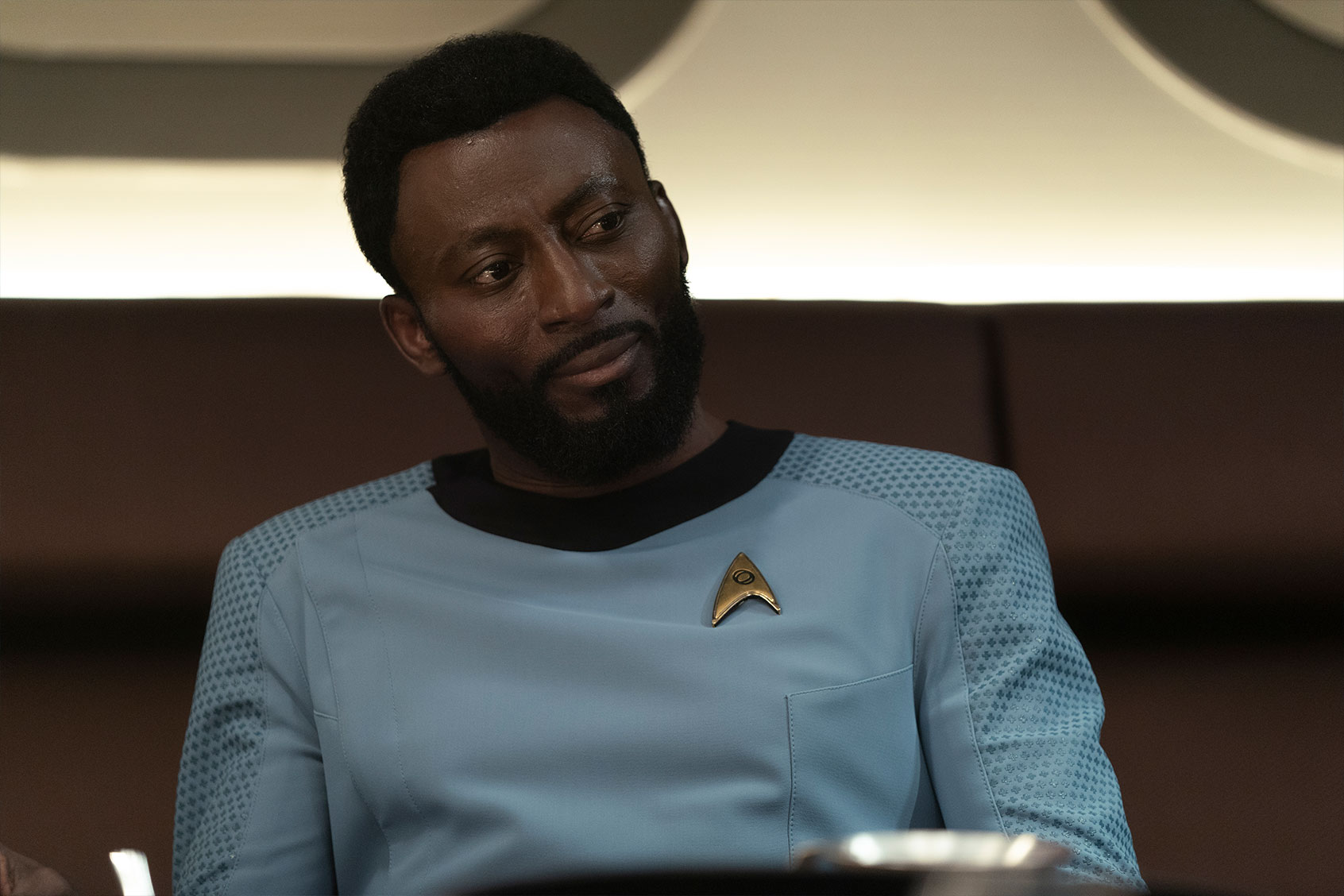
That serum became the source of as much post-show debate as the ongoing argument over whether hand-to-hand combat is out of place in this universe.

We need your help to stay independent

Classic “Star Trek” is a genre standard-bearer for solving conflicts creatively and peacefully. Plenty of away teams have found themselves amid situations that devolve into violence, but in general Starfleet captains and their personnel succeed using their wits and hearts, and the occasional zero-gravity dogfight, instead of their fists.

This inspired a central complaint about “Discovery,” which is set during wartime and transforms its titular vessel into a war machine. “Star Trek” is foremost a show about exploration, and that distinguishes the franchise from other intergalactic action movies and shows revolving around explosive space battles. Or, for that matter, super soldier serums that transform heretofore gentle scientists into a pair of Avengers.

Since the green stuff is new to this universe, people argued that it’s out of place, demanding the writers explain where it comes from sooner rather than later. “Under the Cloak of War” grants that wish in a flashback to a battlefront conversation with a Federation soldier that reveals the serum’s name (Protocol 12), what it does (it pumps subjects full of adrenaline and pain inhibitors) and why we haven’t seen it before: Starfleet discontinued its use but, handily, M’Benga designed it so he can make as much as he wants on the down low. 

As M’Benga tells Chapel when he produces them in “The Broken Circle,” he always has a few vials on him in case of emergencies like, say, being held captive by stronger humanoids who would happily kill them and all their friends. In that scenario they could claim self-defense. “Under the Cloak of War” introduces a different situation, where a nightmare intrudes upon the medical team’s peace and places them under psychological duress. This changes the nature of post-episode discussions since the violation isn’t related to canon but situational ethics.

On J’gal the soldier asking M’Benga about the serum alludes to his past as an operative with the most confirmed hand-to-hand combat kills. He urges the doctor to take up his knife one more time to end J’gal’s bloody conflict by lopping off the snake’s head: a Klingon general known as Dak’Rah. M’Benga declines.

Not long afterward Dak’Rah’s troops escalate the violence against civilians, Klingons and Federation alike, to the point that the med team, including Chapel, has to flee. M’Benga, on the other hand, silently hunts that snake and never tells anyone what he did. But Dak’Rah escapes, and outwardly M’Benga buries that past chapter as much as he can. Until a chance to finish what he began is delivered to him, causing a panic attack followed by alarming clarity.

The latest “Star Trek” series are at their best when they put Federation ideals through stress trials. Typically these play out in public stages. But this one pits the personal against the command. Pike informs his crew that a dictate from the highest level of Starfleet requires his crew to make Dak’Rah feel welcome, especially the war veterans.

The Federation values Dak’Rah for his political significance. He represents proof of comity’s power over conflict even in someone born into a culture that prizes war. He plays into their admiration by parading his message of peace before a public that needs to believe in second chances.

This turn also underlines the emphasis “Strange New Worlds” places on an individual’s humanity, for lack of a term that also covers non-humans.

But Starfleet’s insistence that the Enterprise crew show Dak’Rah deference doesn’t allow space for Chapel’s and M’Benga’s inner turmoil. It’s much easier to forgive someone who has committed wrongdoing against you and yours if they ask for forgiveness while acknowledging the pain they caused. Dak’Rah will only say he’s atoning for his past without taking responsibility for murdering innocents.

Until this episode, only Dak’Rah knew that someone else killed the other Klingon commanders while he escaped, not him. Unluckily for him, the mystery assassin was M’Benga, who finishes his off-books mission inside of Enterprise’s sickbay, killing Dak’Rah with a knife still crusted in the blood of his other commanders – a crime Chapel witnesses and then helps him to cover up.

Star Trek: Strange New WorldBabs Olusanmokun as M’Benga in “Star Trek: Strange New Worlds” (John Medland/Paramount+)Murder in cold blood is inexcusable in “Star Trek” unless it happens because, for example, a character’s faculties are hijacked by the Borg. M’Benga’s sole influence is a thirst to obtain justice for the wartime dead he couldn’t save as a doctor, something only Chapel understands.

How we view a man Olusanmokun portrays as serene, sober and wise is forever changed. Chapel’s complicity also injects a sliver of corruption into her otherwise benign persona, one with broader prominence in a future we’ve already seen.


Want a daily wrap-up of all the news and commentary Salon has to offer? Subscribe to our morning newsletter, Crash Course.


But this turn also underlines the emphasis “Strange New Worlds” places on an individual’s humanity, for lack of a term that also covers Vulcans and other non-humans. Season 2 is particularly emotionally driven, with several episodes focusing on Spock’s developing appreciation for his human side and his crush on Chapel, and Pike’s efforts to balance his personal relationship with his Enterprise duties.  

Great “Star Trek” episodes ignite debates about philosophical and moral quandaries. “Under the Cloak of War” qualifies by letting us bear witness to the ways that some people are more powerless against the traumatic rage within than whatever threatens to damage their Starship’s hull. That’s true of healers and killers, and the rare people history requires to be both.

The action transforms how we view a pair of popular characters to the extent that the serum explanation doesn’t matter. Maybe that juice will pop up again. If it does, we’ll probably care less about it because now we know the man who makes it carries a grimmer secret in his pocket.

“TMI”: GOP Rep. Nancy Mace tells prayer breakfast audience she turned down sex to be there

Rep. Nancy Mace, R-S.C., got “a little TMI” at the 13th annual South Carolina Prayer Breakfast hosted by Sen. Tim Scott’s, R-S.C., Wednesday morning when she cracked a joke about having sex with her fiancé. The South Carolina conservative mentioned having to delay sex with her partner, Patrick Bryant, in order to arrive at the event on time. 

“When I woke up this morning at seven, I was getting picked up at 7:45. Patrick, my fiancé, tried to pull me by my waist over this morning in bed and I was like, ‘No, baby, we don’t got time for that this morning. I got to get to the prayer breakfast and I got to be on time.’ A little TMI,” Mace told her fellow Christians, who typically oppose sex outside of marriage, at the breakfast. “I know he can wait. He’s got, we got — I’ll see him later tonight,” she added awkwardly as light laughter could be heard from the crowd. 

The Supreme Court approves controversial fossil fuel pipeline construction — with Biden’s support

The Supreme Court on Thursday ruled in favor of allowing construction of a gas pipeline that will further exacerbate climate change, which is largely caused by the greenhouse gases emitted by burning fossil fuels. Even though the Mountain Valley Pipeline is staunchly opposed by climate activists, the Supreme Court, without elaboration, granted an emergency request to begin construction from the pipeline’s backers with the support of Congress — and President Joe Biden himself.

Biden’s support of the Mountain Valley Pipeline is seemingly at odds with his larger climate change policy. Among other things, Biden has committed the United States to reducing greenhouse gas emissions by 50% to 52% below its 2005 levels by 2035, and then altogether by 2050. He has also advocated accelerating the development of green technology, and his Inflation Reduction Act spends more than $391 billion to reduce carbon emissions. Yet that latter piece of legislation helps explain Biden’s support for the Mountain Valley Pipeline; the key vote was cast by Sen. Joe Manchin of West Virginia, a Democrat who advocated for the pipeline. Because it will run from West Virginia’s Marcellus and Utica shale areas to Virginia, the 300-mile gas pipeline is expected to create jobs and stimulate industry in Manchin’s home state. It will also destroy national forest land and waterways in the process.

“The Supreme Court has spoken and this decision to let construction of the Mountain Valley Pipeline move forward again is the correct one,” Manchin’s office said in a statement. “I am relieved that the highest court in the land has upheld the law Congress passed and the President signed.”

Trump’s Truth Social rant about “productive meeting” with Jack Smith’s team quickly falls apart

Special counsel Jack Smith's team told former President Donald Trump's lawyers to expect an indictment in the Justice Department's investigation into the deadly Jan. 6 Capitol riot and efforts to overturn the election, according to multiple news outlets.

Trump confirmed the meeting in a post to Truth Social Thursday afternoon but disputed reports that his legal team received notice of a potential indictment and urged his followers to ignore the "Fake News" coverage of the session. "My attorneys had a productive meeting with the DOJ this morning, explaining in detail that I did nothing wrong, was advised by many lawyers, and that an Indictment of me would only further destroy our Country," Trump wrote. "No indication of notice was given during the meeting — Do not trust the Fake News on anything!"

Reporters pointed out that the target letter federal prosecutors sent to Trump's lawyers last week was his indication. "He says no notice of a pending indictment. (Though the target letter is essentially that)," tweeted CNN reporter Kaitlan Collins. "I'm pretty sure Trump's lawyers were on notice to expect an indictment when they got a target letter! Trump himself said the next step was likely arrest and indictment," tweeted Politico reporter Kyle Cheney.

Hexagon heaven: Scientists reveal bees and wasps use the same math to build their nests

Hexagons are mutually associated with bees and wasps, as both insect species build their nests using this humble six-sided shape. Anyone who stumbles upon a bee or wasp nest in nature will be greeted by rows and rows of dozens of tiny symmetrical hexagons. But these bug aesthetics are completely functional and used by the insects to store their food and raise their young. Yet for some species, the hexagon comes with a nasty catch: It isn’t one-size-fits-all. Consequently hexagons of various different sizes need to be built, and yet still fit neatly within the overall nest.

“To find that all of them fall on the same continuum when merging different sizes of hexagons together is really cool.”

How do wasps and insects solve this architectural problem? Thanks to an international team of scientists, humanity now knows the answer — and it will perhaps change the way we look at insects, and evolution, forever.

In a study published by the scientific journal PLOS Biology, scientists revealed the results of their research into five honeybee and five wasp species’ nests, analyzing the data on 22,745 individual cells. These come in two “dimorphic” sizes, “small worker cells and large reproductive cells, which forces the builders to join differently sized hexagons,” the authors explain. “Together, this inherent tiling problem creates a unique opportunity to investigate how similar architectural challenges are solved across independent evolutionary origins.”

Indeed, despite the similarities between wasps and bees, both being in the order hymenoptera (along with ants), they have been evolving independently for an estimated 179 million years — yet they’ve both arrived at the same conclusion to the same problem when it comes to building their homes.

Simply put, if the size difference between two hexagonal cells is small, the insects build medium-sized hexagonal cells in between; if the difference between two hexagonal cells is large, they use five-sided cells and seven-sided cells at the join. This is consistent with fundamental geometric rules, showing a level of intelligence humans consistently do not expect from insects. Incredibly, the smart little bugs figured out these principles regardless of the substances they were using to compose their nests.

According to corresponding author Dr. Michael Smith, who teaches at Auburn University’s Department of Biological Sciences, bees and wasps have developed remarkably similar methods for solving hexagon-based architectural problems. This discovery is significant because bees and wasps do not share any ancestors that built hexagons.

We need your help to stay independent

“I think the most interesting result is that we’re finding that collective systems come up with the same solutions for the same problems, despite being separated by millions of years of evolution,” Smith told Salon by email. Because they solve their hexagonal problems in the same way, “this is showing us that collective systems can arise at the same solutions to the same problems, even when it’s thousands of individuals that have to coordinate their behavior to come to those solutions.”

The most immediate implication of this study is that it could help humans with their own architectural problems. As Smith pointed out, “hexagons are in all sorts of building materials, and the bees and wasps are showing us a method that can be used to merged differently-sized hexagons together. To my knowledge, I don’t think we have a good way of doing that, and here we’ve got an excellent method that is scalable (i.e., depending on the difference in size between the hexagons, it’ll show you how and where to put those non-hexagonal shapes).”


Want more health and science stories in your inbox? Subscribe to Salon’s weekly newsletter The Vulgar Scientist.


“Collective systems can arise at the same solutions to the same problems, even when it’s thousands of individuals that have to coordinate their behavior to come to those solutions.”

Smith told Salon it’s likely useful for people to know that the hexagonal arrays built by bees and wasps are very different.

“The materials are different (wax in bees vs paper in wasps), the configurations are different (double-sided in bees vs single-sided in wasps), and the evolutionary origins are different,” Smith said. “To find that all of them fall on the same continuum when merging different sizes of hexagons together is really cool, because it shows that even when you have completely independent origins of a collective behavior, you can still come to the same solutions.”

Salon then asked Smith if he believed his findings reveal a sense of individuality among the insects that build these nests. After all, while the species may be operating based on instinct and collective intelligence, there must still be individuals within those collectives to execute orders and implement architectural plans.

“They are building architectural configurations that seem optimized. This is certainly the product of evolutionary forces over time.”

“Whether they’re driven by behavioral rules or cognitive process, it’s still impressive to see these repeatable and predictable architectural fixes, especially because it is a collective behavior (i.e. there’s no central controller driving the behavior of all the workers),” Smith explained. Therein lies the remaining mystery: To what extent are these bees and wasps actually “aware” of what they’re doing?

“Both bees and wasps build (and fix) their hexagonal cells with a collective — it’s hundreds to thousands of individuals that are participating in that building process,” Smith wrote to Salon. “While each individual might not have an ‘awareness’ of what they’re doing, at the colony-level, they are building architectural configurations that seem optimized. This is certainly the product of evolutionary forces over time. Even if the insects are following some set of instructions, we can still marvel that those instructions have gotten them to the same architectural fixes.”

“Smells like Benghazi”: Republicans reveal fury over Kevin McCarthy’s “impeachment theater”

House Speaker Kevin McCarthy, R-Calif., drew fire from inside his own party after floating the idea of launching an impeachment inquiry into President Joe Biden.

Former President Donald Trump and his right-wing allies have pushed an investigation into Hunter Biden and the president’s family that has thus far yielded little evidence but a lot of hype from the right. But after the Hunter Biden case nearly imploded this week — with the younger Biden pleading not guilty on Wednesday to tax and gun charges as his initial plea deal fell apart — some Republicans contemplated whether it was effective to continue going after the president’s son on the matter at all.

According to Politico, McCarthy himself dialed back his Tuesday comments that suggested an impeachment inquiry was on the horizon, clarifying instead that Republicans merely “could” move forward with the proceedings. 

Republican presidential candidates setting their sights on the party nomination are also avoiding Hunter Biden’s legal and personal issues on the trail, only commenting on them in passing and choosing to challenge the president on the economy and foreign policy.

“I think when we get home, the focus is the economy, the border, crime,” Rep. Richard Hudson, R-N.C., the chairman of the National Republican Congressional Committee, told Politico. “These are the issues that matter and these are the issues we’re talking about.”

Hunter Biden, he added, is only a “focus in D.C.,” not elsewhere.

Rep. Ken Buck, R-Colo., took a stronger stance on the matter, telling CNN’s Dana Bash on Wednesday that the GOP furor over the Bidens is “impeachment theater.” 

“This is impeachment theater. We right now are starting the appropriations process. And there is not consensus on the Republican side about what the numbers should be,” the Freedom Caucus member said.

“What [McCarthy is] doing is he’s saying there’s a shiny object over here and we’re really going to focus on that,” he added. “We just need to get all these things done so we can focus on the shiny object. Most of us are concerned about spending.”

Buck also accused the California Republican of breaking promises he made to other members of the GOP in order to win the speakership in January.

“Kevin McCarthy promised when he was running for speaker one set of numbers. Then he made an agreement with President Biden for the debt ceiling increase on another set of numbers. So right now, he has got to convince the public that he’s credible,” Buck told Bash.

He did not, however, dismiss the possibility of an impeachment inquiry entirely, saying that he believes “it’s absolutely Congress’ role to look at possible impeachment.” 

We need your help to stay independent

The recent headlines surrounding Hunter Biden have plowed a division through the GOP about how to handle his controversy ahead of the 2024 elections. Former President Donald Trump decried what he called the “traffic ticket instead of a death sentence” given to Hunter Biden, and several other pundits have joined him in calling for the president’s impeachment over allegations that the Trump-appointed U.S. attorney who investigated him gave him a light deal. Another portion of the party, however, appears to be approaching the matter with caution due to worries about focusing too much on political scandal and not pocketbook issues.

“If anybody deserves to be impeached, I believe it’s Biden for what he has done. At the same time, we’ve got to look to 2024,” Rep. Roger Williams, R-Texas, told Politico. “We’ve got to get this White House back. We’ve got to get the Senate back.”

“If I was running for president I would focus on what I can do for 2024 and get this economy going again,” he added.


Want a daily wrap-up of all the news and commentary Salon has to offer? Subscribe to our morning newsletter, Crash Course.


The Republican Party has debated over how intensely to take President Biden to task over his son’s legal battles. During a briefing with reporters Monday night, the president of the conservative Club for Growth, David McIntosh, reviewed polling the group had done this month that included a question about whether the president should acknowledge having a seventh grandchild. Hunter Biden had initially denied fathering the 4-year-old girl, who lives with her mother in Arkansas, before recently settling a child support case. The president has refused to acknowledge the child publicly.

McIntosh called the matter a “family issue,” explaining that the Club decided to “throw it in and see what people say.” The poll found that 69 percent of respondents believed President Biden should acknowledge the child, McIntosh said, and 63 percent indicated it was a problem that illegal drugs had turned up in the White House.

“I was a little surprised it was that high,” he told Politico.

McIntosh did not take a position on whether Republicans should be investing resources into messaging about Hunter Biden or the so-called “Biden Crime Family,” a term far-right influences and congressmen have adopted. 

But conservatives aren’t currently putting much money behind attacks of the younger Biden, a sign that strategists see other talking points as more important to voters.

A Politico review of on-air and digital political ads from the last three months found that only one 2024 presidential candidate, Vivek Ramaswamy, has spent money on jabs at Hunter Biden. His campaign spent just $907 for a digital ad in late June that criticized the plea deal, according to media tracking firm AdImpact. A separate Politico review of television and digital ads found that the only national conservative group paying for Hunter Biden messaging is Judicial Watch, which has spent less than $3,000 on a digital advertisement. 

GOP candidates and their aligned super PACs are instead taking aim at President Biden and Democrats’ handling of energy, the economy and education policies in their political messaging. They’ve spent a collective $57 million to date on television ads, none of which referenced the corruption alleged against the Biden family.

A June Ipsos/Reuters poll indicated that Republicans may have good reason to be cautious about harping on Hunter Biden. Though the poll found that half of Americans believed the younger Biden was receiving favorable treatment from federal prosecutors because of his father, 60 percent — including 59 percent who self-identified as independents — believe that the president is being a “good father” by supporting his son through his legal woes.

The current focus on Hunter Biden “just smells like Benghazi,” Republican strategist Mike Madrid told Politico, referencing the House GOP’s two-year, multi-million dollar investigation into the Benghazi attack and allegations of Hillary Clinton’s wrongdoing ahead of her 2016 bid for the presidency. The final report released several months before the November election found no evidence of Clinton’s misconduct.

“Republicans trying desperately to make a story. It’s always, ‘We’ve got a witness coming, we’ve got more coming.’ It’s always next week,” Madrid added. “It’s like a soap opera, ‘Tune in next week.'”

The obesity epidemic is fueled by biology, not lack of willpower

Since the time a human first used a tool to make life easier, increased weight has been inevitable.

From that day the amazing and rapid progress of human achievement has been on a parallel trajectory with the growing availability of calories and the health and social consequences — initially positive — that have come with it.

Through most of human history, our species has had to cope with food scarcity. Scrounging enough calories to stay alive was a struggle and our ability to compete and survive sometimes meant enduring long breaks between scarce meals.

When food was abundant, our bodies stored excess energy in the form of fat to draw upon when food was not available.


Ancient metabolism in a modern world

Human ingenuity allowed our predecessors to harness fire, create weapons for hunting and invent farming. Our brains enabled our species to develop an easier, more comfortable life and a steady supply of food to support population growth.

As human progress continued, our ancestors learned to domesticate and use animals. Later, they invented machines to move ourselves and our belongings from place to place and life became even easier.

Today, mountains of calorie-rich (and often nutritionally poor) food and lakes of sugary beverages are readily available in much of the world. It’s no longer necessary to leave home — or even stand up — to access this cornucopia.

Our biology has not yet caught up to our progress, though. Our metabolism remains calibrated for a hard, uncomfortable life where every bite had to be earned through strenuous physical effort and our brains are still telling us to eat more than we need.

Polygenic obesity — the inherited predisposition to consume and store calories — is the inevitable outcome of our primal instincts colliding with amazing, man-made abundance. It’s also what makes it so hard to lose excess fat and keep it off.


The brain’s role in obesity

From our clinical work and our research in obesity we know that while some people can carry extra weight and be truly healthy, others suffer serious health consequences, including diabetes, high blood pressure, cancer and arthritis.
For far too long society has treated obesity as a personal failing while in reality it’s a biological, physiological, environmental, chronic disease.

The fact is that for many, trying to lose excess fat is very difficult without help. The brain wants us to eat as much as we can because it thinks it’s helping us survive and it has the power to overwhelm our best intentions.

Despite the prevalent view that people with large bodies should simply eat less and move more, it’s nearly impossible to fight our genetic heritage or other factors that are not within our control.

Our body defends its weight vigorously. It changes levels of leptin and insulin, which regulate appetite. Whenever we lose weight by restricting calories, hormones compel our brains to signal increased hunger and decreased fullness and they slow our metabolism in an effort to retain body fat.

This makes it difficult to reduce weight and keep it off through diet and exercise alone.

In the meantime, another part of our brain, which regulates reward and pleasure, is also working to make us eat more.

The pleasure of eating food is driven by naturally occurring neurochemicals like dopamine, opioids and cannabinoids, to help with survival and energy storage. People living with obesity may have a genetic predisposition toward a heightened reward system associated with food. Glossy packaging, aggressive marketing (often targeting children), delicious but nutrient-poor foods, drive-through windows and online delivery services all enable this.


Effective treatment

Just as human progress brought us problematic obesity, it may also help resolve it.

That begins with accepting that polygenic obesity is a disease and not a matter of willpower. Rather than blaming and shaming one another for our size, we should be more understanding and educate ourselves about obesity, to help take stigma and judgment out of the equation.
Society sends damaging messages about weight, especially through popular culture, so we want to make this very clear: our weight doesn’t define who we are and it does not define how healthy we are.

It’s important to recognize that when obesity does impair one’s health, it needs treatment and effective treatment is available. Canada’s 2020 clinical practice guidelines are based on three pillars: bariatric surgery, medication and cognitive psychotherapy.    

Psychotherapy is critical to the effectiveness of surgery or medication, or both. Behavioral therapy can resolve questions such as: Why am I eating the way I do? What is my relationship with food? Where did that come from?

These pillars are the primary interventions that have been shown repeatedly to be able to help people with obesity improve their health while reducing their weight and keeping it off in the long run.

We need less judgment and more science. Progress is possible if we work for it.

Megha Poddar, Assistant (Adjunct) professor, Department of Internal Medicine, McMaster University and Sean Wharton, Adjunct professor, Department of Medicine, McMaster University

This article is republished from The Conversation under a Creative Commons license. Read the original article.

This 5-minute, rum-spiked fruit salad will transport you to a tropical island

This Summer Breeze Fruit Salad is a favorite of mine because it brings back memories of my first trip to the Bahamas, of when I began to appreciate rum and the permeating flavors of island cooking — ginger, coconut and RUM! And it all tracks back to when I met my husband, Tom . . . 

It wasn’t until I met my husband that I spent any real time on a boat. Although I always loved the water and had friends with boats over the years, I never learned to sail or spent nights anchored out before knowing Tom. I had also never traveled in a small airplane before, but like boating, that too became a normal part of life as I married both a “boat guy” and a pilot.  

Tom grew up on boats and spent much of his younger adult years sailing around in the Caribbean, racing sailboats and delivering boats through all sorts of weather and conditions. Thankfully, he respects my less adventuresome spirit when it comes to the water, so our adventures are usually only as wild as jumping in the boat to go to dinner. But we have taken a few lengthier trips along the Intracoastal Waterway, a 3,000 mile, mostly inland (meaning it keeps you out of the Gulf of Mexico) water route that actually runs in front of our house and extends along the Gulf Coast from Carrabelle, Florida to Brownsville, Texas.


Want more great food writing and recipes? Subscribe to Salon Food’s newsletter, The Bite.


But as beautiful as it is exploring around our local area, I was unprepared for the gorgeous, far-reaching, crystal-clear coastlines that I saw the first time when I flew with Tom to the Bahamas. Our destination was to be a little island called Staniel Cay and from the time we re-fueled his four-seater Cessna 182 and took off from Ft. Lauderdale heading out across the Atlantic, I stared out at the water below. It was mesmerizing from the start, but as we got closer to the island, the color of the water blossomed into the most breathtaking shades of sapphire-blue, turquoise and emerald-green I had ever seen. I was awe struck. 

Hidden, tucked away places — like Staniel Cay — which you can only get to via boat or airplane are Tom’s favorite. And if there is a runway alongside a body of water — be it a creek, a river, a marsh, an ocean, a bay or certainly on some remote island in the Caribbean, well . . . he’s landing there, regardless of pretty much anything. He is drawn to those airstrips like nothing I’ve ever seen and it is how many of our adventures have begun.

Staniel Cay is in the Exumas, an archipelago of hundreds of cays and islands in the outer Bahamas, beginning about thirty-five miles southeast of Nassau. And it was there that I began to understand Tom’s appreciation of rum and developed my own. It is absolutely the flavor of the islands and it tells the story of each island’s history, a unique and distinctive expression of its colonial background. Until going to Staniel Cay, I didn’t think much about rum at all. It was just the liquor used for fru-fru drinks, the ones usually artificially colored and often sickly sweet, served frozen out of big machines at local beach dives. The kind I usually avoid.  

I began to taste the subtleties of different rums in simple cocktails and began to see how special rum could be as a kitchen ingredient as well. By the time we departed for home, I had become well schooled on how rum is made, starting from the fermented sap of sugarcane aged in oak barrels and how it is truly a liquid spice that can be used just as broadly as wine for cooking. 

Light-bodied, white rum, which is colorless and clear, is only aged for one year. Golden rum is aged three years and dark rum five or more years. Once aged, rum is blended and may be darkened with caramel or molasses. According to the color of rum you choose, it will impart — on a scale from lighter to richer — a toasty, complex flavor. Used in everything from meats and seafood to desserts and, of course, cocktails; rum was just another thing I didn’t know I was missing.

I noticed when we went out to eat, at either of the two restaurants on the island, there was rum in nearly every single menu item, from main entrees to rum-soaked cakes to flambéed desserts. Aside from the ever-present conch fritters, [pidgeon] peas and rice and fried plantains, rum was listed proudly in most every item description on the menu. It seemed the breeze itself was scented with hints of ginger, coconut and rum, the quintessential flavors and aromas of the island.

Although this recipe has been around long before I ever visited the Bahamas, it brings it all back: Sunny days and lazy afternoons spent sun-soaked, reading and napping. Perfect after a light, fresh meal or as an afternoon pick-me-up with an iced coffee. It is wonderfully fresh and loaded with chunks of sweet, tropical fruits and lots of fresh grated ginger root. A real pleaser on a hot, sultry summer night, whether you’re anchored out under the stars or having just arrived on some far away island paradise . . . or settled in at home. Whatever the circumstances, the delightful flavors of this treat will bring the islands to you. 

We need your help to stay independent

Summer Breeze Fruit Salad
Yields
4 cups
Prep Time
5 minutes (plus refrigeration time)

Ingredients

1 1/2 packages cream cheese (11 to 12 oz) or a combination of cream cheese, Neufchatel and/or soft goat cheese

1 1/2 cups frozen whipped topping, partially thawed

1/4 cup condensed milk

2 to 4 tablespoons dark rum or rum of choice (or a bit more if desired)

Pinch of cinnamon

Pinch of nutmeg

1/2 to 1 small knob (or to taste) of fresh ginger, grated (You can also use dried, powdered ginger, but I prefer fresh)

2 cups of small, bite-sized mixed fruit, canned and/or fresh, if possible, include fresh pineapple chunks, mango and very ripe papaya.

Toasted, flaked coconut, for topping


Directions

  1. Beat cream cheese, whipped topping, condensed milk, rum and spices until smooth.

  2. Gently incorporate fruit by hand and refrigerate until ready to serve. 

  3. Top with toasted coconut, if desired.


Cook’s Notes

Alcohol: If you need to remove the alcohol from the rum, simply heat it to a low boil in a small saucepan or flambé it. Allow it to cool, then add for flavor.

Dairy: There is now canned coconut milk based condensed milk and frozen coconut whipped topping available. If you don’t see them in your local grocery store, you should be able to find them at a health food store or specialty shop. –Non-dairy cream cheese is becoming easier and easier to find as well.

We’ve always eaten processed foods — but here’s when they got unhealthy

In recent decades, the term “processed foods” has carried with it a negative connotation. So much so, that plenty of consumers shudder at the thought of consuming something riddled with artificial flavors, additives and synthetic ingredients that are too difficult to even pronounce.

Whether you love them or hate them, processed foods are here to stay. And they continue to dominate the food industry at an astounding rate. A recent assessment conducted by the Access to Nutrition Initiative found that about 70% of food products sold in the United States are unhealthy. In the same vein, new research from Northeastern University’s Network Science Institute indicated that 73% of the U.S. food supply is ultra-processed. And a recent study published in the American Journal of Preventive Medicine found that only a small number of U.S. policies target ultra-processed foods, underscoring how ingrained these foods are in a standard American diet.

It’s hard to imagine a time when processed foods were considered healthy. But that’s exactly how their origin story goes. It’s no secret that our ancestors were experts in food processing. They fermented to create alcohol and dairy. They milled and baked to produce breads and pasta. And they preserved to enjoy salted, brined meats and seafood. Such techniques allowed early humans to “travel further and survive cold winters or harsh famines,” per the BBC. They also enhanced the cooking process and made food consumption both nourishing and enjoyable, which is why food processing continues to persevere today. Cooking foods introduces new flavors and makes them more digestible. Fermenting helps introduce new nutrients (think kimchi and sauerkraut which are rich in probiotics). And pasteurization, pickling or brining all maximize the shelf-life of foods, allowing them to be enjoyed over longer periods of time.

Things, however, took a turn in the 18th century, when John Montagu, 4th Earl of Sandwich — the eponymous inventor of the sandwich — manufactured his own sparkling water with some help from chemist Joseph Priestley. The water was specifically made for Britain’s navy, who embarked on long sea journeys with limited supplies of fresh food and water. Fresh water could only be stored for a few months before it went stale or became too hazardous to drink. So, sparkling water was the best — and safest — option. 

Priestley produced a vessel of “water impregnated with fixed air [carbon dioxide],” he described in a 1772 pamphlet. He also believed the drink might prevent scurvy, saying, “In general the disease in which water impregnated with fixed air will most probably be serviceable are those of a putrid nature.”

Carbonated water failed to do that but it did inspire the creation of medicated water, or tonic water infused with quinine from the bark of the cinchona tree. That ultimately inspired the creation of caffeinated “cola” drinks in the 1890s, which were used as digestive aids. Made from kola nuts and coca leaves, the drink was advertised as an “ideal brain tonic” in the late 19th century.

The modern rendition of Coca-Cola is quite the opposite, considering that it’s filled with sugar, natural flavors and numerous synthetic chemicals. Amid the 1900s, WWII, the space race and an overall faster pace of life led to food processing as we know it today. The working middle class also grew in size, leading to a greater need for fast, long-lasting, ready-to-eat meals. Thus began spray drying, evaporation, freeze drying and the use of preservatives, which all made packaging and preserving foods much easier. Then came artificial sweeteners and colors which helped foods taste and look better. 


Want more great food writing and recipes? Subscribe to Salon Food’s newsletter, The Bite.


“The home oven, microwave, blender and other appliances provided an easy way to quickly prepare these meals. Factories and mass production techniques made it possible to quickly produce and package foods,” explained the Automated Process Equipment Corporation (AEPC). “These developments paved the way for globally popular foods like frozen dinners, instant noodle cups, baking mixes, and more.”

Those techniques are still prevalent in our current food industry. New technology and scientific innovations have also allowed for food to be modified in ways we couldn’t imagine before — concoctions of chemicals can now look, taste and feel like actual food. Overall, it’s important to be aware of the health consequences that come with consuming processed foods. Doesn’t mean they have to be nixed from your diet completely. A healthy balance is key to enjoying them in moderation.

Why I’m passing on the “Barbie” movie: My daughter already receives enough unintentional whiteness

My three-year-old daughter screamed “Barbie“! at the top of her little lungs, because somehow the film Margot Robbie stars in, directed by Greta Gerwig, made its way into her tiny toddler orbit. 

“A Barbie movie?” I said, picking my baby up. “That sounds so cute; we can pop out one of your little pink dresses and pull up.” 

“I can’t wait,” my Aunt Robin said, “I’ll be pulling out my pink dress too.” 

“Daddy can’t have a dress. You a boy,” my daughter giggled. At this tender age, she’s very into specific ideas about gender. The girl will only wear dresses. We were in my office building a week ago, and she had to use the potty. I wasn’t about to make the news as the big Black guy hanging in the women’s bathroom on a college campus, so I tried to take her into the men’s, and she lost it, pointing at the sign that read “MEN” next to the icon used to identify man on the door. Luckily, I was quick enough to bribe her with ice cream, before we swooped in and out. 

I vividly remember my older sister and cousin, born in the late ’70s, having white Barbie dolls.

The “Barbie” movie was a month or so out, and it didn’t really cross my mind until I found out Issa Rae would be in the flick. I’ve been an Issa Rae fan since the “Awkward Black Girl” web series days; as a matter of fact, I may have watched HBO’s “Insecure” more times than her, so I was beyond excited. Some personal nostalgia even kicked in for me. 

I vividly remember my older sister and cousin, born in the late ’70s, having white Barbie dolls. Having a Barbie was a big deal – we were living in the trenches, and toys were a luxury. Imagine living in a primarily Black neighborhood and being gifted a tall white, blonde doll with multiple outfits and career choices. Barbie could have been anything she wanted, from a supermodel to a doctor. My sister owned that, and maybe that ambition rubbed off on her. I still bit the heads off as I liked to bite the heads off of all her dolls. I also remember when my little cousin Tia, born in the ’80s like me, tore off the plastic wrap of a Black Barbie, and the sense of pride we all felt, knowing we all could be a part of the Barbie world too. Black Barbie looked like my sister, mom or aunt. It was amazing. I bit the head off of that Black Barbie too, as I was an equal-opportunity terrorist. 

Tia’s Black Barbie made it to us in the ’90s; however, the first Black Barbie was inspired by Diana Ross and introduced into the world back in 1980. It was designed by Louvenia “Kitty” Black Perkins and came in a box that read, “She’s black! She’s beautiful! She’s dynamite!”

It’s wild that the first Barbie doll dropped in 1959, and even though Black people were everywhere, we didn’t get a Black version until two decades later. But this is 2023, and the movie should be way more progressive than the company’s history, right? Wrong. I watched the trailer and was overwhelmed with whiteness

I never heard a white person say, “The representation was poor; I just don’t see myself in the art.”

Barbie, which does have a few nonwhite cast members, including Rae, America Ferrera, and Ncuti Gatwa, has one of the whitest trailers I ever saw in my life. And no, I’m not that guy; I genuinely believe that artists and filmmakers can create whatever they want, but I must be cautious of what I expose my daughter to. She’s too young to understand the complexities of gender, so how do you even begin to open the door to conversations about race and how movies and commercials in America act like white people have a monopoly on beauty? Google “attractive woman” and watch the page fill up with white faces. 

As a family, we must be intentional when we buy Black dolls, books with Black queens and princesses and allow her to watch cartoons like “Gracie’s Corner,” “OmoBerry” and “Karma’s World.” And no, we are not teaching her to only connect with Black art; it’s just that everything white is always available and at the forefront of everything. You don’t have to search for white content; it’s already in your face. 

I never heard a white person say, “The representation was poor; I just don’t see myself in the art,” yet Black people and people of color deal with this daily. America intentionally and unintentionally shoves whiteness down our throats every day, every minute, every second, and there’s not much we can do about it, other than thoughtfully curating a child’s experience. 

Dr. Kenneth Clark and Dr. Mamie Clark created the legendary doll test in the 1940s, asking Black children if they would prefer playing with a white or a Black doll. Most of the Black children chose white dolls because they were perceived as more friendly and beautiful. The Clarks’ findings led to them being expert witnesses in Briggs v. Elliott (1954), one of the five cases attached to Brown v. the Board of Education. What’s scarier is that about 60 years have passed, and Dr. Toni Sturdivant, an assistant professor at Texas A&M, conducted the same tests in 2021 and got nearly the same results. Black dolls weren’t good enough for Black children. 

The fact is, I can do everything in my power to keep my daughter away from the “white is always right” ideology and still may not be able to protect her from that way of thinking because our country is so fixed on that message. But that doesn’t exempt me from religiously teaching her that Black is beautiful, even though Hollywood is only willing to show it in small doses.  

Avoiding films like “Barbie” is a part of that teaching. 

“Perhaps even today”: Experts say “an indictment is incoming” after Trump lawyers meet Smith’s team

Attorneys for former President Donald Trump met on Thursday with prosecutors at special counsel Jack Smith’s office and were told to expect an indictment in connection with the Justice Department investigation into the deadly Jan. 6 Capitol riot and efforts to overturn the 2020 election, according to NBC News.

Trump attorneys John Lauro and Todd Blanche sought the meeting with Smith’s team after the former president received a letter informing him that he is a target in the investigation.

Trump had reportedly argued against the meeting between his legal team and federal prosecutors because he believed the indictment was already set in stone, two sources familiar with his thinking told CNN

Legal experts said the meeting suggests an indictment will come down imminently. 

“An indictment is incoming,” tweeted former federal prosecutor Andrew Weissmann, who was a member of special counsel Bob Mueller’s team, noting that similar meetings preceded Trump’s indictments in Manhattan and Florida.

“The meeting is a signal that indictment is near,” tweeted CNN legal analyst Norm Eisen, noting that there was a three-day lapse between Trump’s lawyers meeting with Smith’s team in the Mar-a-Lago documents case and the filing of charges.

“An indictment will follow in short order, perhaps even today,” predicted former U.S. Attorney Harry Litman.

We need your help to stay independent

The target letter, which was sent on July 16, includes three federal statutes: deprivation of rights under a civil rights statute, conspiracy to commit offense or defraud the United States, and tampering with a witness, victim or an informant, sources with knowledge of the matter told ABC News

Trump confirmed he received the letter in a post to Truth Social last week. He denies all wrongdoing in the case and has dismissed it, along with his indictment in the special counsel’s other probe into his handling of classified documents post-presidency, as a political “witch hunt.”

Former federal prosecutor Renato Mariotti wrote that the meeting suggests an indictment “won’t be returned today.”


Want a daily wrap-up of all the news and commentary Salon has to offer? Subscribe to our morning newsletter, Crash Course.


“Smith wouldn’t agree to meet to discuss a potential indictment while secretly indicting that day. But perhaps Trump’s team didn’t reach out until too late.  We don’t know,” he tweeted.

“If the indictment becomes public on the same day as the meeting with Trump’s team, that means that the meeting was more about logistics and other loose ends rather than about the decision to indict,” he added.

“Trump’s attorneys met with DOJ about the MAL docs on Monday, June 5th. He was indicted on Thursday, June 8th. While we could still see an indictment this afternoon, don’t be surprised if it pushes until next week,” agreed former FBI senior agent Peter Strzok, adding that it would come on the same week that Fulton County, Ga. District Attorney Fani Willis told her staff to work remotely ahead of a likely indictment in her probe of Trump’s efforts to overturn his 2020 election loss in the state.

McConnell fell and “face-planted” getting off a plane days before freezing at news conference: NBC

Senate Minority Leader Mitch McConnell, R-Ky., tripped and fell while exiting a plane at Ronald Reagan Washington National Airport this month, two sources with knowledge of the incident told NBC News. The 81-year-old was not hurt seriously, and the previously unreported fall occurred July 14 after the flight was cancelled with passengers on board. One person who was on the plane but did not witness McConnell’s fall described it as a “face plant,” adding that they spoke to another passenger who assisted McConnell afterward.

As a precaution, the Kentucky Republican has also been using a wheelchair to navigate busy airports, a source familiar with his practices told the outlet. McConnell, a polio survivor with a history of difficulty maneuvering on stairs and other obstacles, previously sustained a concussion and a cracked rib after a fall in Washington earlier this year, causing him to spend six weeks away from the Senate. He also fractured a shoulder in a 2019 fall in Kentucky, which required surgery.

The report comes after his nearly 20-second pause during a press conference Wednesday, which reignited concerns about his overall health. “He’s definitely slower with his gait,” an anonymous Republican senator told NBC News, adding that McConnell does not address health issues in their closed-door meetings. McConnell, however, assured reporters he was fine after the incident. “The president called to check on me. I told him I got sandbagged,” McConnell joked to reporters, referencing President Joe Biden’s explanation for his fall last month. 

Legal expert: Judge who blocked Hunter Biden deal was “only person” who “did her job properly”

A federal judge on Wednesday paused a proposed plea deal between Hunter Biden and the Justice Department that would have settled his tax and gun charges after confusion about the scope of the deal arose from both parties, The New York Times reports.

After nearly three hours of questioning either side about every detail of the agreement, U.S. District Judge Maryellen Noreika sent them back to the drawing board to address her concerns regarding the deal’s provision of broad immunity for Biden and requirement that she later determine whether Biden was meeting the terms related to his enrollment in a diversion program. “I cannot accept the plea agreement today,” said Judge Noreika, a Trump appointee that was backed by two Democratic senators, adding that she would not be a “rubber stamp” after prosecutors and Biden believed they had a deal in place.

“DOJ and Hunter Biden were unwise and a little sloppy to combine the diversion on the gun/drug charge with the agreement on the misdemeanor tax charges,” former U.S. Attorney Harry Litman wrote on Twitter. “They should have kept them entirely separate.” During the Thursday edition of “CNN This Morning,” former Assistant U.S. Attorney Elie Honig said that Noreika was “the only person in the courtroom yesterday who did her job properly,” slamming Biden’s legal team. “Clearly, they never had a direct conversation about this with prosecutors, which is not good practice by the defense,” he said, adding, “A plea agreement is your future, and the judge has to do her job there and make sure there is not going to be a dispute down the line about what this means.”

Jon Hamm wakes up “The Morning Show” as a “tech titan” in action

Looks like AppleTV+ is giving Jon Hamm juicy, central placement on the upcoming season of “The Morning Show” and its menu of backstabbing media power players.

A newly released trailer for Season 3 provides a first glimpse at Hamm’s Paul Marks making his grand entrance to what seems to be a cocktail party from a helicopter. The trailer implies that his character Paul Marks isn’t merely competition for Billy Crudup’s top UBA network executive Cory Ellison or network president Stella Bak (Greta Lee).

As “a tech titan [who] takes an interest in UBA,” Marks represents an existential crisis for the company and the news business. He also catches the eye of Jennifer Aniston‘s “Morning Show” co-anchor Alex Levy, which can’t be great for her tenuous and still healing bond with Reese Witherspoon‘s Bradley Jackson.

Hamm joins “The Morning Show” following an Apple TV+ ad campaign in which he mournfully wallows in the realization that every major star shows up on the streaming service but him. Casting him in its tentpole series playfully addresses that “oversight.”

It’s a fitting small screen return for an Emmy winner best known as “Mad Men” ad executive Don Draper and Reverend Richard Wayne Gary Wayne on “Unbreakable Kimmy Schmidt.”

Hamm also appears in the second season of Prime Video’s “Good Omens,” which streams Friday, July 28, and in the upcoming fifth season of FX’s “Fargo.” 

The third season of “The Morning Show” also introduces Nicole Beharie’s Christina Hunter as a new anchor, with Julianna Margulies, Natalie Morales, Stephen Fry and Tig Notaro returning. 

The two-episode season premiere streams Wednesday, Sept. 13.

Donald Trump unleashed a war against the U.S. government — and now he can’t control it

During one brief period of recent history in this country it looked like things were getting better:

It was the 1970s. The Jimmy Carter era.

Everyone walked around in platform shoes, flared pants, multi-colored ruffled shirts and wide ties. Even the white guys had Afros.

Or as the president of Boston’s Museum of Science, Tim Ritchie, told me recently, “It was a brief moment when we all recognized diversity as the best way for our nation. We took it for granted and while we all didn’t agree on how to get there, most of us understood inclusion and diversity was the way of the future.”

Then came Ronald Reagan and the dark times.

Now, more than 40 years later, the United States in 2023 actually resembles the United States in 1923 — with the additional prospects of nuclear annihilation and disastrous climate change thrown in.

Of course, there are those who don’t see it.

Those people are supposedly grown men, too busy playing with Barbie dolls — and burning them.

Listening to politicians, their rabid supporters and a few people in my industry, it seems obvious that many people stop maturing right after they shed their pull-ups. For some, it’s before that. 

This disintegration of the United States has led to screams of possible civil war, mostly coming from  Donald Trump’s supporters who vow violence or worse if Trump is indicted again, found guilty, locked up or denied the presidency for whatever reason in 2024.

This comes at a time, as National Security Council spokesman John Kirby explained to me this week, “when the need for America to represent stability and democracy has never been stronger.” Wars in Ukraine and Africa, missile tests in North Korea and disarray in the Middle East further sow the seeds of division. “American stability is important for international peace and survival,” Kirby explained.

Yet the MAGA world still screams about civil war. Norman Eisen of the Brookings Institution, also a legal analyst for CNN, says it is mostly just that – screaming. “Jan. 6 showed that insurrection won’t succeed,” he said, but while increased violence isn’t necessarily in the offing (this country is already exceedingly violent, with an average of two mass shootings per day this year), many of the states that joined the Confederate insurrection 160 years ago are still trying to undermine the federal government.

In Alabama it’s all about voting districts. In Texas it’s about our international border. In Florida it’s all about history class.

In Texas, the Justice Department filed a suit against the state and Gov. Greg Abbott on Monday, claiming violations of federal law after the state installed a floating barrier in the Rio Grande and the Texas state police said Abbott was having immigrants tossed back into the river, particularly small children.

John Fugelsang, a comedian, political pundit and Sirius XM radio host, believes that’s not very Christian of Abbott, who claims to be a devout believer. There’s “no Jesus-based defense” for the actions of Trump, Abbott and many others who claim to follow the teachings of Christ, Fugelsang said: “They’ve prostituted Christianity into a mean little cult.” 

In Florida, in one of the most insidious moves ever made by any legislature since the end of the Civil War, new laws demand that school children be taught that there were benefits to slavery. You know, skills. As if slavery was an extended trade school with room and board. 

Meanwhile, the U.S. Supreme Court struck down Alabama’s redistricting effort and demanded it redraw its legislative maps to include a second district with a Black majority. (At the moment, there’s one, represented by the state’s only congressional Democrat.) The state has refused to do so, and that case is headed to court. It could end up, Eisen suggested, with “U.S. marshals involved,” contempt charges against Alabama office-holders and the federal government drawing up the voting districts.

This is how the new civil war is being waged, with individual states defying the federal government and demanding to take action separately from the rest of the country. “We certainly haven’t seen this type of pushback since before the Civil War,” Eisen said. Thing is, the federal government cannot afford to look the other way, at risk of seeing the United States disintegrate. If the government loses even one such case, it will be severely weakened. Those sons and daughters of the South who’ve been taught propaganda about the noble “lost cause” of the Confederacy will get the last laugh.

Still, if you  fear such events, it’s useful to remember the mental acumen of those who want to defy the will of the people. Consider Sen. Tommy Tuberville of Alabama, the former Auburn football coach, who wants to limit our national defense readiness by refusing abortions to service members and their families. That hasn’t gone over well at the White House, and even some of his allies in Congress think he’s gone too far.

Then there are Kevin McCarthy, Lauren Boebert, Marjorie Taylor Greene, Jim Jordan and the usual gang of idiots, now including  Rep. James Comer of Kentucky,  who want to impeach Joe Biden without any evidence to justify it. These people are all mental flatlines.

This neo-Confederate movement in defiance of the federal government is a direct result of Trump’s appeal to those who have nurtured sadistic and misanthropic fantasies, many generations after the end of the Civil War.

Compare them to  people like Kirby, who has to deal with international problems including potential nuclear conflagration, UAPs and Russia’s bid for regional hegemony; Eisen, who was involved in prosecuting Trump’s first impeachment; Ritchie, a man of science who has to deal with climate-change deniers and those who consider the teaching of science evil; and Fugelsang, a comedian, actor and commentator — all of them remain hopeful for the future.

But they also recognize that the next year and a half will be a very bumpy road indeed, both domestically and internationally. 

Donald Trump began a process he can no longer control, though he’ll never admit it. He’s given politicians, and everyone else on the planet, leeway to embrace their darkest nature. The neo-Confederate movement in defiance of the federal government is a direct result of Trump’s appeal to those who have nurtured their sadistic and misanthropic fantasies many generations after the end of the Civil War.

But their success is limited, and ultimately they will fail. That’s reflected in Trump’s own actions. He is under two criminal indictments and faces at least two more — and one of those, in Georgia, can’t be erased by a presidential pardon should Trump regain the White House. Then there’s Rudy Giuliani. Like many of Trump’s minions, he’s facing potential indictment himself. And it doesn’t make things better for Rudy that this week he had to admit in a Georgia civil case that he lied about the actions of two election workers and grossly defamed them. It’s enough to make the hair dye run down his face. “If the devil was as incompetent as Giuliani, hell would be empty,” Eisen explained on the podcast “Just Ask the Question.”


Want a daily wrap-up of all the news and commentary Salon has to offer? Subscribe to our morning newsletter, Crash Course.


The challenges from individual states to the federal government will fail, ending whatever “civil war” the former Confederacy wishes to start — and Norm Eisen also believes Trump’s presidential campaign will fail. In fact, he shares my belief that Trump may not even be on the ballot next November. Trump may face four criminal trials between October and next July, when the Republicans meet to pick their candidate. “He can’t dodge that many bullets,” Eisen said. “He’s been good at dodging them before, but they’ve never come this quick and this hard. He could have two convictions by next July.”

That leads to the ultimate question for those following the long-running Trump melodrama. Will he go to prison? Michael Cohen hopes so, and Eisen thinks so: “This is going to be a presidential race for the record books,” he said.

There will be at least one substantial third-party challenge. The current president is 80 years old. Trump is only three years younger and in questionable health. Senate Minority Leader Mitch McConnell, who is older than both of them, suffered a “moment of lightheadedness” in the Capitol on Wednesday. Our leaders are aging. Our politics is badly divided. Our most recent former president seems hell-bent to tear it all down.

What does the future bring? Civil war? Or, perhaps, if you listened to a “whistleblower” who testified before Congress on Wednesday, an alien incursion?

Ritchie, the head of Boston’s science museum asks the ultimate question we all have to consider: “Are we courageous enough to greet reality as a friend?” 

A purported whistleblower told Congress on Wednesday that the U.S. government is in possession of alien technology. If we’re being observed by an advanced species, how foolish we must look.

On Wednesday afternoon, that purported whistleblower, a former intelligence agent named David Grusch, told a congressional committee that the U.S. government is in possession of alien technology and “biologics” that are “non-human.” If we are being observed by advanced species, how foolish we must seem to them.

Instead of cooperating, we compete. Instead of tolerating each other, we fight among ourselves. We divide ourselves by race, color, sex, religion, wealth, perceived slights and just about any means we can — to what end, we have no idea, although we think it’s all about control and power that we actually do not have and can never possess. 

The next year and a half will unveil our national character, and our national will.

I join others in being hopeful, but that hope is tempered by the realization that the moves made by Texas, Florida and Alabama portend a great upheaval that will only be settled when we all decide to embrace our better angels instead of our darker ones.

Barack Obama had a saying attributed to Martin Luther King Jr. stitched into the Oval Office rug: “The arc of the moral universe is long, but it bends toward justice.”

The key word is “long.” It will be at least 16 long months before we see whether the light at the end of the tunnel justifies our hope, or is just an oncoming freight train.

“Suicide mission”: Trump reportedly turned down by lawyers because his “case is a certain loser”

Former President Donald Trump is struggling to find enough lawyers to defend him in a mounting number of legal cases, according to Rolling Stone.

Trump, who has been indicted in connection to the 2016 campaign hush-money payments in Manhattan and the Mar-a-Lago documents case, faces potential indictments for his efforts to overturn his 2020 election loss in D.C. and Georgia. But Trump’s effort to recruit new lawyers to defend him has been “fraught,” in part because Trump is an “infamously difficult client,” sources told the outlet.

One attorney who turned down Trump told Rolling Stone they were dissuaded by the long track record of Trump’s lawyers finding themselves in their own legal jeopardy. Other attorneys who have discussed the case with Trump believe the Jan. 6 “case is a certain loser for the defense,” according to the report. Given that the trial would be held in deep-blue D.C., even some of Trump’s top legal and political advisers have privately called the job of defending Trump a “suicide mission,” the report added.

Other lawyers have approached the Trump team themselves and were “initially receptive” before “pulling out because of concerns from their peers,” according to the report, which added that partners at some firms objected to taking on the former president as a client because it could cost them other clients.

Even attorney Alan Dershowitz, who was part of Trump’s first impeachment defense team, has repeatedly declined offers to join Trump’s team, including as recently as last month.

Trump’s struggles began in June when several top attorneys handling the Mar-a-Lago case and a legal strategy for a possible Jan. 6-related indictment abruptly resigned.

Trump in private has also teased to his legal team that he wants to use any potential Jan. 6 trial to push his widely debunked election fraud claims and wants his lawyers to show “proof” that the election was stolen.

“We’ll have fun on the stand with all of these people that say the Presidential Election wasn’t Rigged and Stollen [sic],” Trump wrote on Truth Social Wednesday.

We need your help to stay independent

Trump last week did add attorney John Lauro, who previously represented Trump lawyers Christina Bobb and Alina Habba when they drew their own legal scrutiny. Lauro in an interview on Fox News quickly pushed claims that the target letter special counsel Jack Smith sent to Trump was timed to distract from the Republicans’ dubious bribery allegations against President Joe Biden. He also claimed that Trump’s effort to overturn the election was justified by “all of these election discrepancies and irregularities going on.”

Former federal prosecutor Andrew Weissmann, who served on special counsel Bob Mueller’s team, told MSNBC on Wednesday that Trump’s struggle to recruit attorneys is “one of his own making.”

“As a prosecutor and as a defense lawyer, I really believe every defendant is entitled to legal representation. They are entitled to have zealous advocacy,” he said, adding that Trump’s “exalted position” as former president would typically surround him with “the very cream of the crop in terms of the caliber of lawyering.”


Want a daily wrap-up of all the news and commentary Salon has to offer? Subscribe to our morning newsletter, Crash Course.


“The reason that you don’t see that with Donald Trump is because of his own making. If you are asking your lawyer to commit a crime, which is the allegation in the Mar-a-Lago documents case, that is not something that endears you to get to deciding, ‘oh, gee, this is someone I want to represent,’ at least normal defense lawyers,” Weissmann explained.

“All of that means that you’re buying just a heap of trouble when you have a client who doesn’t listen to your advice and just goes about doing his own business, up to and including continuing to commit crimes that he wants you to be a part of,” he added. “And so that is the reason that you find so many lawyers unwilling to represent him, even though he used to be the President of the United States, which is a very sad state.”

A brain-swelling illness spread by ticks is on the rise in Europe

Climate Connections is a collaboration between Grist and the Associated Press that explores how a changing climate is accelerating the spread of infectious diseases around the world, and how mitigation efforts demand a collective, global response. Read more here.


In 2022, doctors recorded the first confirmed case of tick-borne encephalitis virus acquired in the United Kingdom.

It began with a bike ride. 

A 50-year-old man was mountain biking in the North Yorkshire Moors, a national park in England known for its vast expanses of woodland and purple heather. At some point on his ride, at least one black-legged tick burrowed into his skin. Five days later, the mountain biker developed symptoms commonly associated with a viral infection: fatigue, muscle pain, fever. 

At first, he seemed to be on the mend, but about a week later, the man began to lose coordination. An MRI scan revealed he had developed encephalitis, or swelling of the brain. He had been infected with tick-borne encephalitis, or TBE, a potentially deadly disease that experts say is spreading into new regions due in large part to global warming. 

For the past 30 years, the U.K. has become roughly 1 degree Celsius warmer on average compared to the historical norm. Studies have shown that several tick-borne illnesses are becoming more prevalent because of climate change. Public health officials are particularly concerned about TBE, which is deadlier than more well-known tick diseases such as Lyme due to the way it has quickly jumped from country to country. 

Gábor Földvári, an expert at the Center for Ecological Research in Hungary, said the effects of climate change on TBE are unmistakable.

“It’s a really common problem that was absent 20 or 30 years ago.” 

Ticks can’t survive more than a couple of days in temperatures below zero, but they’re able to persevere in very warm conditions as long as there’s enough humidity in the environment. As Earth warms on average and winters become milder, ticks are becoming active earlier in the year. Climate change affects ticks at every stage of their life cycle — egg, six-legged larva, eight-legged nymph, and adult — by extending the length of time ticks actively feed on humans and animals. Even a fraction of a degree of global warming creates more opportunity for ticks to breed and spread disease.

“The number of overwintering ticks is increasing, and in spring there is high activity of ticks,” said Gerhard Dobler, a doctor who works at the German Center for Infection Research. “This may increase the contact between infected ticks and humans and cause more disease.”  

Since the virus was first discovered in the 1930s, it has mainly been found in Europe and parts of Asia, including Siberia and the northern regions of China. The same type of tick carries the disease in these areas, but the virus subtype — of which there are several — varies by region. In places where the virus is endemic, tick bites are the leading cause of encephalitis, though the virus can also be acquired by consuming raw milk from tick-infected cattle. TBE has not been found in the United States, though a few Americans have contracted the virus while traveling in Europe.

According to the World Health Organization, there are between 10,000 and 12,000 cases of the disease in Europe and northern Asia each year. The total number of cases worldwide is likely an undercount, as case counts are unreliable in countries where the population has low awareness of the disease and local health departments are not required to report cases to the government. But experts say there has been a clear uptick since the 1990s, especially in countries where the disease used to be uncommon.

Map showing increasing numbers of TBE in Europe

“We see an increasing trend of human cases,” Dobler said, citing rising cases in Austria, Germany, Estonia, Latvia, and other European countries.

TBE is not always life-threatening. On average, about 10 percent of infections develop into the severe form of the illness, which often requires hospitalization. Once severe symptoms develop, however, there is no cure for the disease. The death rate among those who develop severe symptoms ranges from 1 to 35 percent, depending on the virus subtype, with the far-eastern subtype being the deadliest. In Europe, for example, 16 deaths were recorded in 2020 out of roughly 3,700 confirmed cases.

Up to half of survivors of severe TBE have lingering neurological problems, such as sleeplessness and aggressiveness. Many infected people are asymptomatic or only develop mild symptoms, Dobler said, so the true caseload could be up to 10 times higher in some regions than reports estimate. 

While there are two TBE vaccines in circulation, vaccine uptake is low in regions where the virus is new. Neither vaccine covers all of the three most prevalent subtypes, and a 2020 study called for development of a new vaccine that offers higher protection against the virus. In Austria, for example, the TBE vaccine rate is near 85 percent, Dobler said, and yet the number of human cases continues to trend upward — a sign, in his opinion, of climate change’s influence on the disease.

[Read next: Mosquitos are moving to higher elevations — and so is malaria]

In Central and Northern Europe, where for the past decade average annual temperatures have been roughly 2 degrees Celsius above preindustrial times, documented cases of the virus have been rising in recent decades — evidence, some experts say, that rising global temperatures are conducive to more active ticks. The parasitic arachnids are also noted to be moving further north and higher in altitude as formerly inhospitable terrain warms to their preferred temperature range. Northern parts of Russia are a prime example of where TBE-infected ticks have moved in. And some previously tick-free mountains in Germany and Austria are reporting a 20-fold increase in cases over the past 10 years.  

The virus’s growing shadow across Europe, Asia, and now parts of the United Kingdom throws the dangers of tick-borne disease into sharp relief. The U.K. bicyclist who was the first domestically acquired case of the disease survived his bout with TBE, but the episode serves as a warning to the region: Though the virus is still rare, it may not stay that way for long.

This article originally appeared in Grist at https://grist.org/health/tick-borne-encephalitis-virus-europe-climate-change/.

Grist is a nonprofit, independent media organization dedicated to telling stories of climate solutions and a just future. Learn more at Grist.org

The gospel according to Sinéad O’Connor: She was right all along

My first thought when I heard about the tragic death of legendary singer Sinéad O’Connor was, “I’m going to deck the next right-wing mofo who claims he’s being ‘canceled’ because someone called him names on the internet.” 

OK, that’s not exactly true. My first thought wasn’t really a thought at all, just grief over this loss. At her best, O’Connor could equal Tori Amos in cutting through the sardonic Gen-X emotional defenses so many people around my age developed in our macramé-covered childhoods. Songs like “Troy,” “The Emperor’s New Clothes” and, of course, “Nothing Compares 2 U” revealed a singer with the rare power of heartbreak, which was especially rare in the cooler-than-thou college rock era when she was a platinum-selling artist. 

As every obituary of the 56-year-old groundbreaking Irish singer will no doubt mention, O’Connor is probably most famous for being the object of a worldwide misogynist temper tantrum, although she’s also famous for singing a killer Prince song better than he ever did. All of that is darkly fitting, somehow. O’Connor always framed her own personal tragedies in political terms in her music, drawing a line between her suffering and the suffering is inflicted on girls, women and other vulnerable people everywhere. Her death hits so hard because she so self-consciously drew us in, and made our pain hers and the other way around. 

Sinéad O’Connor is most famous for being the object of a worldwide misogynist temper tantrum — although she’s also famous for singing a Prince song better than he ever did.

No doubt most people reading this will remember this era-defining event, but let’s recount the details: O’Connor was the musical performer on a 1992 broadcast of “Saturday Night Live,” and she did an a capella version of Bob Marley’s song “War,” changing the lyrics to be about child abuse. At the end, while singing, “We have confidence in good over evil,” she pulled out a picture of Pope John Paul II and tore it up, saying, “Fight the real enemy.” The audience reacted with shocked silence. Describing it in words really isn’t enough: If you’ve never seen it, watch it. 

O’Connor was specifically protesting the Roman Catholic Church for its decades of covering up child abuse, an issue that was then coming to the fore in Ireland, America and around the world. But her statement was also deeply personal. According to O’Connor, the photo she ripped up belonged to her mother, with whom she’d had a painful and difficult relationship. “My intention had always been to destroy my mother’s photo of the pope,” she explained later. “It represented lies and liars and abuse.” Classic Sinéad: My pain is your pain. Together, through art, we can find catharsis. Maybe even a sprinkling of hope. 

Unfortunately, that hope was dashed. Instead of opening people’s eyes up to the church’s sex abuse problem, O’Connor became the target of a staggering amount of vitriol, including huge public protests. “SNL” invited actor Joe Pesci to host the next week’s show and in a disturbing monologue, Pesci said he would have given O’Connor “such a smack” and suggested, “I woulda grabbed her by her eyebrows.” The audience went wild. (Hat tip to my partner, Marc Faletti, for reminding me of Pesci’s behavior.) 

This wasn’t just about vast affection for that particular pope, especially since many of the people who claimed to be outraged with O’Connor weren’t even Catholic. In these situations, where the public targets a woman for a metaphorical stoning, it usually reflects years of seething over perceived uppity or unacceptable behavior. The Dixie Chicks (now just the Chicks) were abused for opposing the Iraq war, but long before then, many country fans hated them for outselling male artists and, oh yeah, for a song about the murder of a wife beater. Figure skater Tonya Harding, as Margot Robbie’s performance in “I, Tonya” suggests, was loathed for rejecting the hyper-feminine stereotype of her sport. People loved watching Britney Spears melt down because they resented how much power her brand of bubblegum pop had in youth culture. And poor Monica Lewinsky became the siphon for immense collective anger toward Gen-X young women, who were finally getting a taste of the equality so many earlier generations of feminists had fought for. 

O’Connor made men mad because she shaved her head. I mean, OK, it was more than that — but it was also just that. She was, of course, extraordinarily beautiful, with big doe eyes and the kind of bone structure no surgery can replicate. You didn’t need her to explain it in order to get her message: Her shaved head was a giant F-you to anyone who wanted to use her beauty to define and deride her as a silly pop starlet.

I was 12 years old when “Nothing Compares 2 U” came out, and I had to pray the video would only show up on MTV when no father, stepfather or uncle was in the room. I just wanted to wallow in Sinéad’s perfect, gorgeous song without hearing snide remarks about her (lack of) hair. It was only years later that I realized what they were so mad about: They resented the implication that a woman has a right to exist for a reason other than pleasing a man. 


Want more Amanda Marcotte on politics? Subscribe to her newsletter Standing Room Only.


She clearly and publicly struggled with her mental health for decades. I don’t want to dwell on that issue much, especially as it was all too often used as an excuse to dismiss her. It’s a miracle that more people who’ve been through what she went through don’t suffer as she did, and it was something of a miracle that she accomplished as much as she did despite that suffering. What matters the most now, at least to me, is that she was the preeminent Cassandra figure of the ’90s, the prophet who was ignored for far too long. Those of us who didn’t know the truth then absolutely know it now: Sinéad was right about the church — and right about the importance of fighting the real enemy.

There was never any public reckoning about how we had all judged O’Connor unfairly, like those we’ve seen with Britney Spears and Monica Lewinsky. I don’t know if she ever felt thanked, or loved, for what she did.

There was never any major public reckoning about how we had all judged her unfairly, like those we’ve seen with Britney Spears and Monica Lewinsky. I don’t know if she ever felt she was thanked, or loved, for what she did. She lost a lot in trying to tell us the truth. She still had a musical career, more or less and off and on, but we all know it’s not what she deserved, with that unbelievable charisma and that voice. 

It’s obviously too late to matter to her now, but I want to offer my thanks to Sinéad O’Connor, on behalf of all the girls like me who didn’t get to grow up with feminist texts at the library or a local record store hip enough to stock riot-grrrl ‘zines. She was on MTV, right there on basic cable where everyone could see her. Her message about how women didn’t need to live for men’s approval? It planted a seed in all those girls, like me, who had never heard that before. 

No wonder so many people wanted to destroy her. It sent a message to the rest of us about not getting too many notions about ourselves — but the good news is that it didn’t work. Ben Shapiro can set as many Barbies on fire as he wants, but whiny men are not finding much success right now canceling Greta Gerwig, Taylor Swift, Beyoncé or any other prominent female artists who refuse to apologize for their ornery feminist opinions. Even the abortion bans being enacted in state after state, as horrible as those are, are being met with a level of female fury that shows we won’t give up easily. This, too, is why O’Connor’s death is so gutting. I have to set aside my Gen-X impulses to play it cool, and say it: She was a martyr, and she paid the price so we can have this moment right now, more than 30 years later.  

O’Connor is most famous for being silenced, so I want to give her the last words, from a song she wrote and released two years before the “SNL” performance: “The Emperor’s New Clothes.” 

I will live by my own policies
I will sleep with a clear conscience
I will sleep in peace
Maybe it sounds mean
But I really don’t think so
You asked for the truth and I told you
Through their own words
They will be exposed
They’ve got a severe case of
The emperor’s new clothes

Norman Eisen: Why Trump must face trial before the 2024 election

Donald Trump was without question a historic president — but in the worst ways possible.

He was the first president to attempt a literal coup against the United States government as well as the first president to be impeached twice. No current or former president had ever previously been indicted on criminal charges, but Trump can now claim that “accomplishment” not once but twice, with a third indictment apparently imminent for alleged crimes connected to the coup attempt of Jan. 6, 2021

Trump’s third indictment will likely not be the last. Prosecutors in Georgia are reportedly preparing more criminal charges against Trump for his attempt to rig or overturn the results of the 2020 presidential election in that state. 

Responsible Americans who believe in democracy, the rule of law and the constitutional order largely want Donald Trump to disappear and for the seemingly interminable “Trumpocene” era to end at last. That yearning, however understandable, will not be magically translated into a real-world outcome. 

Trump remains the likely 2024 Republican presidential nominee, and we must not underestimate his chances of defeating Joe Biden. There is no obvious constitutional or legal impediment to Trump winning the 2024 election even if he is a convicted criminal — even if he is in prison — and then pardoning himself. If Trump manages to retake the White House, he has publicly threatened to centralize presidential power as much as possible and make himself a de facto dictator.

In an attempt to make sense of Trump’s multiple criminal trials and impending indictments, his apparently pathological behavior, and the larger issues of justice, law and the future of democracy, I recently spoke with Norman Eisen, who served as special counsel to the House Judiciary Committee during Donald Trump’s first impeachment trial. 

Eisen is now a senior fellow in governance at the Brookings Institution and a legal analyst at CNN. He is the author of several recent and highly relevant books, including “A Case for the American People: The United States v. Donald J. Trump” and “Overcoming Trumpery: How to Restore Ethics, the Rule of Law, and Democracy.” This interview has been edited for length and clarity.

Given all these developments in relatively rapid succession, with the recent and forthcoming indictments of Donald Trump for his alleged crimes against democracy, the rule of law and the American people, how do you feel? How are you managing your emotions? 

I feel gratified that the rule of law is finally catching up to the alleged wrongdoing of Donald Trump and his co-conspirators on and around Jan. 6, 2021, and indeed, the whole pattern of conduct that started immediately after the 2020 election. I also feel anxious, as we are now moving from the phase of anticipating accountability to that of litigating accountability. With two criminal trials currently on the books, I expect there will be charges and a date for a third and a fourth trial before the end of the summer. I believe and hope that our rule-of-law system will be up to the challenge. 

The news media continues to be reluctant to describe Trump’s obvious alleged coup plot, given all that we know about Jan. 6 and the nationwide attempt to end American democracy, as a conspiracy. This was not something in a movie or that happened in another country. It was a widespread, sophisticated conspiracy to end democracy in America. Donald Trump wants to be a dictator, and he’s unapologetic about it. Why is there reluctance by so many in the media, and among too many elites more generally, to use that language? 

We should be careful with our language here. This is an alleged conspiracy at this point. Whether there will be a legally actionable conspiracy will depend on how the courts respond to the charges that are soon to be filed, I believe, by special counsel Jack Smith and also by Fulton County District Attorney Fani Willis, both of whom appear to be targeting the Jan. 6 conspiracy.

“I feel gratified that the rule of law is finally catching up to the alleged wrongdoing of Donald Trump. … I also feel anxious, as we move from anticipating accountability to litigating accountability.”

I do think it is fair to say that some in the press have been more cautious with their language because they are waiting for prosecutors to file the conspiracy case. As of now, there’s only one criminal conspiracy case in connection with the 2020 election, and that is the one that Michigan Attorney General Dana Nessel brought last week against the alleged co-conspirators who signed fake electoral certificates in that state. I believe there is an unwarranted hesitation to describe Trump’s behavior on Jan. 6 and beyond, in relation to interfering with the 2020 election, as a type of conspiracy. The news media and others should simply use the qualifier “alleged,” but there is more than enough proof to make that claim. 

Where would we as a country be if Attorney General Merrick Garland and other law enforcement officials had moved faster in their investigations of Trump and his cabal? 

We would be in a better place if the speed had been brisker. But on the other hand, I do have to say that Merrick Garland inherited a Justice Department that was in disarray. Rightly or wrongly, he made a series of decisions, including the decision to not move with full determination on these issues, until he put his house in order. That took Garland about two years. There are news media reports that the Cassidy Hutchison testimony before the House Jan. 6 committee was the wake-up call for the Department of Justice. I do believe there was a strategy that involved rebuilding the DOJ before taking on these very controversial matters. I’ve known Merrick Garland for a very long time. He would likely never publicly discuss the timeline and decision making because he believes such considerations should be internal to department deliberations. 

How do we help the public to make sense of the timing of the Mar-a-Lago classified documents trial, which is now scheduled for May 2024 in Florida? What are the advantages and disadvantages of that timing? How could this play out? 

The most fundamental issue is how long it takes to try a case of this kind in fairness to the prosecution, the defense and the court. You should be able to do this in a year. I say that having tried cases for over 30 years and having worked on national security cases. I have also dealt with national security matters, both in my first government job for former President Obama in the White House counsel’s office and then as ambassador in the Czech Republic. 

There’s an additional fairness consideration, and that applies to the American people. They have a right to know, and the Republicans have a right to know, before they gather for their national convention in July 2024, whether Donald Trump, the leading candidate for the Republican nomination, is a convicted felon. 

There is also the fact that, should Trump win in 2024 and return to the presidency, he’ll have the power, at a minimum, to dismiss the case and perhaps try to pardon himself. I believe that Trump issuing himself a pardon is unconstitutional. But he may try, and who knows how it will turn out?

“There needs to be a trial and a jury verdict. … That way, if Trump wins the election and pardons himself, the American people and the world will know that a jury of his peers concluded that he committed a crime.”

Ultimately, there are a wide variety of ways in which we might end up never knowing the outcome of these cases. There needs to be a trial and a jury verdict so that there is a determination of what alleged crimes Trump did or did not commit. That way, if Trump wins the election and pardons himself, the American people and the world will know that a jury of his peers concluded that he committed a crime. Finally, if he’s innocent, all the voters also have the right to know that before they make their voting decisions. All these facts strongly favor trying the case before July of next year. 

How do you make sense of Donald Trump’s apparent inability to remain quiet? He continues to incriminate himself. It must be maddening for his attorneys and other advisers. 

In my opinion, Donald Trump is not a well man. If you want to understand his psychology, you need to start by taking a book on abnormal psychology off the shelf and reading it. Whether he’s a pathological narcissist, a sociopath or, as some mental health experts claim, a psychopath, something is not right with his mind and behavior. I do not believe that whatever is wrong with Trump qualifies for an insanity defense. Trump knows the difference between right and wrong, but he does have a disorder of some kind as manifested by how he cannot stop talking even when it implicates him. 

That said, talking about these cases sometimes helps him. Trump is rallying his supporters, raising money and getting emotional support from his followers. Moreover, his constant talk about these cases also helps to taint the jury pool. Do not overlook or minimize that point: There will be Trump supporters in the jury pool when this case is tried in the Southern District of Florida and the Fort Pierce division. But those “advantages” can be outweighed by the way Trump’s talking all the time, as we saw with his CNN town hall in May, ends up seemingly incriminating him. 


Want a daily wrap-up of all the news and commentary Salon has to offer? Subscribe to our morning newsletter, Crash Course.


Trump recently received a target letter from the Department of Justice indicating that he will be indicted for alleged crimes connected to Jan. 6. In fact, he personally announced that he will be indicted and “arrested” imminently. 

Trump is going to be indicted and arraigned sooner rather than later. Technically he’ll be arrested, but in reality, it will be an arraignment similar to what we saw with the Mar-a-Lago classified documents case, except that it will be in the District of Columbia. The police are not going to put handcuffs on Trump, whatever he may tell his followers. Once you get a target letter, charges are usually not far behind. Typically, we would have seen Trump’s lawyers go to the DOJ and hold a meeting with officials there to try to talk them out of charging him. That hasn’t happened yet, as far as we know. I’d be looking for that signal, unless for some reason the meeting is not happening. 

Smith’s target letter reportedly cites statutes that were used during Reconstruction in an attempt to protect Black Americans from the Ku Klux Klan and other racial terror groups. What does that indicate about Jack Smith and the DOJ;s overall strategy and approach to Trump’s alleged crimes on and around Jan. 6?

We analyze this extensively in an article on Section 241 that can be read over at Just Security. What Smith is trying to do is to find the right statutes that are a tight fit for the misconduct. Trump’s alleged crimes proceeded in three stages. 

First, he flailed about for months to try to overturn the election by spreading disinformation — the so-called Big Lie — pressing his own Department of Justice to intervene, pressing the states to intervene and getting the would-be electors that were pledged to him to sign electoral certificates even though he did not win.  

Second, after everything else failed by Jan. 2, 2021, Trump used those fake electoral certificates to apply intense pressure to Vice President Mike Pence, demanding that he compel Congress not to recognize Biden as the winner of the election.  

The third act of Trump’s alleged criminal plot was the violence on Jan. 6. 

“When you interfere with votes, that is a classic civil rights conspiracy. The statute [Section 241] exists just to stop such a thing from happening. It was passed during Reconstruction to protect the rights of African Americans.”

The statutes that are detailed in the target letter correspond to these three stages in the alleged plot. The first one is a scheme to defraud the United States through all of those wild plots, including the fake electors. The second is a plan to interfere with an official proceeding in Congress. The third is, when everything else failed, trying to interfere with the vote count in Congress through the violence of Jan. 6. This brings us to Section 241, the civil rights statute, because when you interfere with votes, that is a classic civil rights conspiracy. The statute exists just to stop such a thing from happening. It was passed during Reconstruction to protect the rights of African Americans from such conspiracies by the KKK and other Southern whites.  

Trump was trying to interfere with the counting of the votes of 81 million Americans who cast their ballots for Biden, as well as to interfere with the rights and privileges of Pence and the members of Congress in doing their jobs. 

Trump is facing multiple criminal trials for very serious alleged crimes. Odds are very strong that he will be convicted in at least one of those trials. What does justice look like then? What does our democracy need from this process? 

Justice looks like the investigations that have happened. Justice looks like the charges that have been brought so far against Trump, because there is such powerful evidence of wrongdoing. Justice also looks like the charges that are to come in the federal and Georgia investigations of the attempt to overthrow the 2020 election. Our country needs a resolution. We’ve made great progress in investigating and in charging or being on the cusp of charges. But now we need to have those cases resolved — and at least some of them have to be resolved before Trump is chosen, assuming that he is, to be the Republican Party’s presidential nominee, and a contender for the American people’s vote in November. 

Heart problems from vaccines are extremely rare. Heart problems from COVID itself are not

Elon Musk, owner of Twitter, the website rebranding as X, is facing heated criticism for spreading misinformation on his platform again. On Tuesday, Musk incorrectly linked COVID-19 vaccines to college basketball star LeBron “Bronny” James Jr. suffering a cardiac arrest during practice. In a tweet, Musk claimed that “we cannot ascribe everything to the vaccine, but, by the same token, we cannot ascribe nothing. Myocarditis is a known side-effect. The only question is whether it is rare or common.”

Because it has been repeatedly shown that this side effect is indeed rare, Twitter initially added a fact-check to the tweet. It was later removed, leaving the original misinformation standing without correction.

The CDC pointed out that there were only 635 cases of myocarditis diagnosed out of the 54.8 million doses of the mRNA vaccine given

Dr. Matthew Martinez, director of sports cardiology at the Atlantic Health System in New Jersey, told CNN in response to Musk’s tweet, “Myocarditis is definitely a cause of sudden death in young athletes, but not a common threat.” Martinez also pointed out that COVID infections themselves are far more likely to cause heart problems than myocarditis caused by COVID vaccines, which is an extremely rare side effect.

“Myocarditis occurred before COVID,” Martinez added. “Myocarditis will occur after COVID.”

Sports commentator Bob Costas, on the other hand, had harsh words for Musk, telling CNN’s Abby D. Phillip that “we live in a world now where anything you don’t want to be true, doesn’t have to be true … And, anything you do want to be true, you don’t need all that much evidence.”

The truth is that COVID infections are quite dangerous to the human heart. A study last year by the Department of Veterans Affairs found that people reinfected with COVID were twice as likely to either die or have a heart attack as people only infected once. Similarly, a different study last year from the scientific journal Immunology revealed that the SARS-CoV-2 virus (which causes COVID) damages cardiac muscle.

By contrast, the 2022 CMAJ study cited by conspiracy theorists who insist myocarditis is a common side effect of the vaccine ignore that it also clearly says “although observed rates of myocarditis were higher than expected, the benefits of vaccination against SARS-CoV-2 in reducing the severity of COVID, hospital admission and deaths far outweigh the risk of developing myocarditis.” (Emphasis added.)


Want more health and science stories in your inbox? Subscribe to Salon’s weekly newsletter The Vulgar Scientist.


“The benefits of vaccination far outweigh the risk of developing myocarditis.”

Indeed, in its coverage of Musk’s comment, the conservative-leaning New York Post quoted the Centers for Disease Control and Prevention (CDC) which says “any health problem that happens after vaccination is considered an adverse event. An adverse event can be caused by the vaccine or can be caused by a coincidental event not related to the vaccine.” Additionally, the CDC pointed out that there were only 635 cases of myocarditis diagnosed out of the 54.8 million doses of the mRNA vaccine given to children between the ages of 5 and 17 since May 2022.

This is not the first time that right-wing conspiracy theorists have exploited a high-profile athlete’s heart incident to spread vaccine misinformation. In January, after professional football player Damar Hamlin was struck hard in the chest during a game and suffered cardiac arrest, right-wingers like former Newsmax host Grant Stinchfield and Turning Point USA head Charlie Kirk (who also promoted anti-vaccine conspiracy theories after the James incident) began denying that the cause was commotio cordis.

Commotio cordis, which is what most medical experts speculated had happened, is a condition in which the heart’s rhythm is disrupted by a sharp blow to the region just above the chest during the T wave in a heartbeat. Then, there was Dominican professional basketball player Óscar Cabrera Adames, who was posthumously embraced by anti-vaccine advocates last month after he died during a heart stress test following a myocarditis diagnosis, one he blamed on the COVID vaccine.

Because nothing can be designed with 100 percent safety, it’s true that vaccines can sometimes cause injuries — but the side effects of COVID vaccines are extremely rare and often manageable. On the other hand, the virus itself is far more often linked to numerous conditions from diabetes, schizophrenia, Parkinson’s, the condition known as “long COVID” and of course, heart problems. It isn’t just about risk but relative risk. And the vaccines are far, far safer than the disease.

Michigan becomes 22nd state to ban the use of conversion therapy on LGBTQ+ minors

Michigan Gov. Gretchen Whitmer signed two bills into law on Wednesday, banning the use of conversion therapy on LGBTQ+ minors — both of which are set to take effect in 90 days. Per The Advocate, House Bill 4617 defines the practice itself as something that “seeks to change a person’s sexual orientation or gender identity,” while House Bill 4616, “bars licensed therapists from subjecting minors to the practice and lays out penalties for violation, including discipline by public health regulators.”

“Today, we are banning the horrific practice of conversion therapy in Michigan and ensuring this is a state where you can be who you are,” Whitmer said in a statement. “As a mom of a member of the community and a proud, lifelong ally, I am grateful that we are taking action to make Michigan a more welcoming, inclusive place.”

Both of these bills were approved by the Michigan Senate last month in a 21-15 vote, winning over Republican naysayers who worried that “the legislation could interfere with the work of mental health professionals,” Per AP News. Sarah Warbelow, vice president of legal at HRC, praised Whitmer for her work in protecting LGBTQ+ youth saying, “So-called conversion therapy is a dangerous and discredited practice that will hopefully never see the light of day again here in Michigan.”


The tragic death of Tafari Campbell, the Obamas’ personal chef, is QAnon’s latest conspiracy theory

According to a new report by Newsweek, the details surrounding the tragic death of the Obamas’ personal chef, Tafari Campbell, have become fodder for new conspiracy theories from some far-right conservatives and members of QAnon, a political conspiracy theory and movement that centers on fabricated claims made by an anonymous individual or individuals known as “Q.” 

Shortly before 10 a.m. on Monday, police divers recovered Campbell’s body from Edgartown Great Pond near the former president’s home on Martha’s Vineyard. The chef, who started as a sous chef at White House during the Obama administration, had been paddleboarding and drowned, according to authorities. However, a growing number of far-right commentators are challenging that sequence of events, despite having no concrete evidence to support another. 

For instance, Ian Miles Cheong — a prominent Malaysian pro-Trump conservative — commented on Twitter (now rebranding to X) that the death of a “trained swimmer who drowned in a shallow pond outside the Obama family home while paddle boarding, is strange.What do you think really happened?” As Nesweek reported, QAnon advocate Liz Cronkin, who “says that America is secretly being run by a cabal of satanic child molesters” then insinuated that Campbell perhaps knew too much. “What did he know?” she wrote. 

In a statement, the Obamas said that Campbell was “a warm, fun, extraordinarily kind person who made all of our lives a little brighter.”