Spring Sale: Get 1 Year, Save 58%

From Britney to Millie Bobby Brown, the media’s obsession with shaming young women endures

"Stranger Things" star Millie Bobby Brown is the latest young celebrity to come under tabloid media’s vicious scrutiny—but she refuses to back down. Instead of yielding to relentless attacks on her appearance, Brown is demanding to be allowed to simply grow up. 

During the 21-year-old actress’ press tour for her new Netflix film, "The Electric State," she has faced a flood of articles dissecting her face, hair and body. Several Daily Mail headlines have fixated on her appearance, asking, "Why are Gen Zers like Millie Bobby Brown aging so badly?" "What has Millie Bobby Brown done to her face?" 

In response to the endless, targeted commentary on her body, Brown posted a two-minute video on Instagram calling out the "disturbing coverage." Her experience underscores a troubling pattern in media: the relentless shaming of young women’s bodies as they grow up in the spotlight.

“I started in the industry when I was ten years old. I grew up in front of the world, and for some reason, people can’t seem to grow with me," Brown stated. "Instead, they act like I’m supposed to stay frozen in time, like I should still look the way I did on ‘Stranger Things’ season one. And because I don’t, I’m now a target . . . "

Brown highlighted that many of these tabloid articles are “written by people who are so desperate to tear young women down," purposefully identifying several journalists by name.

"This isn’t journalism. This is bullying," Brown emphasized. The fact that adult writers are spending their time dissecting my face, my body, my choices — it’s disturbing. The fact that some of these articles are written by women? Even worse.”

Brown's status as a former child star only intensifies the scrutiny and criticism that women already face in their daily lives. However, the relentless attacks on her body are not unique to her experience. Many former child stars have spoken out about the media's obsession with their bodies as they age.


Want a daily wrap-up of all the news and commentary Salon has to offer? Subscribe to our morning newsletter, Crash Course.


Former Disney Channel star, Demi Lovato, has been vocal about the toxicity she suffered as a child star and the media scrutiny of her body, which led to eating disorders and substance abuse during her young adulthood. 

For years, Lovato has pushed back on damaging headlines about her body. One particular headline in 2019 highlighted a then-26-year-old Lovato's "fuller figure."

"I’m angry that people think it’s okay to write headlines about people’s body shapes,” Lovato explained on Instagram. “Especially a woman who has been so open about being in recovery from an eating disorder. I’m not upset for myself but for anyone easily influenced by the diet culture.”

Before Lovato's rise to fame, '00s figureheads like Britney Spears, Lindsay Lohan and Amanda Bynes were at the center of tabloid fodder — unable to escape the tireless barrage of negative criticisms while they were merely teenagers.

In Spears' memoir, "The Woman in Me," she wrote that she noticed a double standard in the media while dating Justin Timberlake at 18.

“I couldn’t help but notice that the questions he got asked by talk show hosts were different from the ones they asked me," Spears wrote. “Everyone kept making strange comments about my breasts, wanting to know whether or not I’d had plastic surgery.”

In an interview between Spears and Diane Sawyer, the journalist immediately commented on a young Spears' body. Sawyer declared Spears' abs as the “most valuable square inch of real estate in the entertainment universe,” and then later criticized the star for her covers of Rolling Stone and Esquire, asking,“What happened to your clothes?”

More than 20 years after the awkward interview between Spears and Sawyer, female celebrities like Brown and Lovato have been empowered to openly address and call out the media for their participation in perpetuating body-shaming coverage. At just 21, Brown's post has been viewed millions of times across platforms like X and Instagram, with countless people online commending the actress for speaking up. 

Heena Khaled, a co-founder of a Muslim women's organization, stated on X, "So impressed with Millie Bobby Brown for calling out and naming journalists and addressing comments about her, her body and young girls and women in the media. We need to call this out more and the fact 3 out of 4 of those journos were women is even worse."

On the "Tamron Hall Show" Wednesday, former "Beverly Hills, 90210" actress, Jennie Garth, praised Brown for standing up for herself, having faced similar scrutiny as a young actress.

"I think she's really strong. That's what's so great about this new generation of young women, they know their worth and they're not going to let anybody put them in a corner," she said.

British actor Matt Lucas issued an apology to Brown on Instagram Monday for previously commenting about her appearance, writing, "I was mortified when the press wrote that I ‘slammed’ you, firstly because that’s not my style, and secondly because I think you’re brilliant. I would not have posted it if I had thought it would have upset you but I realize it has and for that I apologize." 

As Brown stated in her video, “I refuse to apologize for growing up," and she never should.

“You are dead”: Trump threatens to help Israel “finish the job” in Gaza following hostage meeting

Shortly after White House officials confirmed that the United States is in direct talks with Hamas, President Donald Trump threatened the Gaza Strip authority in a post to Truth Social

Trump said that he would help Israel "finish the job" in Gaza if Hamas did not turn over all remaining hostages held in the Israeli-occupied territory. 

"Release all of the Hostages now, not later, and immediately return all of the dead bodies of the people you murdered, or it is OVER for you. Only sick and twisted people keep bodies, and you are sick and twisted!" he wrote. "I am sending Israel everything it needs to finish the job, not a single Hamas member will be safe if you don’t do as I say."

The threat came after Trump met with freed hostages in the White House on Wednesday. The president warned residents of Gaza to leave and said there would be "hell to pay" if all hostages weren't released.

"This is your last warning! For the leadership, now is the time to leave Gaza, while you still have a chance," he wrote. "Also, to the People of Gaza: A beautiful Future awaits, but not if you hold Hostages. If you do, you are DEAD! Make a SMART decision. RELEASE THE HOSTAGES NOW, OR THERE WILL BE HELL TO PAY LATER!"

Trump has frequently suggested that Gaza should be cleared out, the Palestinians who live there relocated to Egypt and Jordan. He recently shared an AI-generated video that showed a Trump resort in Gaza, where the president lounged poolside with Israeli Prime Minister Benjamin Netanyahu

“When you do the work, you should get paid”: SCOTUS rejects Trump attempts to freeze foreign aid

A divided Supreme Court ruled that President Donald Trump can not freeze $2 billion in foreign aid payments, urging the administration to comply with orders to release the funds. 

In a brief 5-4 decision shared on Wednesday, the high court backed US District Judge Amir Ali, who had ordered the Trump administration to release billions in foreign aid frozen by a Trump executive order on the president's first day in office.

Ali issued a temporary restraining order on Feb. 13 that barred the administration from pausing appropriated aid payments. When the Trump administration appeared to flout that order, Ali issued another order on Feb. 25 demanding that the admin release the funds. The administration's attorneys filed an emergency request with the Supreme Court and were granted a temporary reprieve. Plaintiffs in cases opposing Trump's freeze filed a brief late last week that called the crisis an "emergency of [the government's] own making."

“By forcing thousands of American businesses and nonprofits to suspend their work, and by halting disbursements for work that they had already performed, even work that already had been reviewed by the government and cleared for payment, the government plunged respondents into financial turmoil,” they wrote.

The Supreme Court appeared to agree, ultimately deciding that Trump officials are beholden to Ali's orders. Justice Amy Coney Barrett broke ranks with her conservative counterparts to join the majority made up of Chief Justice John RobertsElena Kagan, Sonia Sotomayor and Ketanji Brown Jackson. The ruling was short and unsigned, laying out the precedent before requesting clarification from Ali on the administration's "obligations." 

Justice Samuel Alito wrote the dissent, joined by Clarence Thomas, Neil Gorsuch and Brett Kavanaugh, claiming that Ali was abusing the power of the judiciary and using "unchecked power to compel the government" to pay.

"The government must apparently pay the $2 billion posthaste — not because the law requires it, but simply because a district judge so ordered," Alito wrote. "As the nation’s highest court, we have a duty to ensure that the power entrusted to federal judges by the Constitution is not abused. Today, the court fails to carry out that responsibility."

The ruling was celebrated by Democratic legislators, who saw in the ruling an early indicator of how the court might handle Trump's attempts to snatch the pursestrings from Congress.

“I think it reinforces … that Congress has authorization to appropriate money, and that people rely on that authorization for those programs, and that when you do the work, you should get paid when it’s been authorized,” Rep. Pramila Jayapal, D-Wash., told CNN

Trump plans to gut Department of Veterans Affairs, eliminate more than 80,000 jobs

President Donald Trump’s administration is planning to cut more than 80,000 jobs from the Department of Veterans Affairs, according to a leaked internal memo.

The memo — penned by the department’s chief of staff, Christopher Syrek, and obtained by the Associated Press — says the administration plans to roll back staffing to 2019 levels, which would require eliminating tens of thousands of jobs..

The memo instructs top-level officials to prepare to “resize and tailor the workforce to the mission and revised structure” this August. It also suggests that officials work with billionaire Elon Musk and Department of Government Efficiency to "aggressively" pursue such cuts.

The move would represent yet another round of cuts to the Veterans Affairs department by Trump and his Republican allies, who claim that they will make the cuts without affecting benefits to veterans.

The memo comes after Trump dismissed the inspector general at the VA, Michael Missal. Over his tenure, Missal saw the department save some $45 billion through his oversight. 

Democrats in Congress have decried Trump’s planned cuts, with the House Democratic whip, Rep. Katherine Clark, D-Mass., saying at a news conference that “Democrats are here to say in unison we will not allow our veterans to be defined as government waste.”


Jay-Z sues woman who dropped rape lawsuit against him, accusing her of being “motivated by greed”

Shawn "Jay-Z" Carter has filed a defamation lawsuit against the unidentified woman who withdrew her rape lawsuit against the hip-hop mogul, alleging that the woman and her legal team made "false and malicious claims” to extort the rapper for financial gain.

Carter's lawsuit, which was filed on Monday in Alabama, accuses the woman and her attorneys, Tony Buzbee and David Fortney, of being "soullessly motivated by greed, in abject disregard of the truth and the most fundamental precepts of human decency," The New York Times reported.

The suit also states that because of the woman's claims, Carter has faced reputational harm, resulting in Roc Nation losing more than $20 million. 

"Doe has now voluntarily admitted directly to representatives of Mr. Carter that the story brought before the world in court and on global television was just that: a false, malicious story," the lawsuit reads.

"She has admitted that Mr. Carter did not assault her; and that indeed it was Buzbee himself . . . who pushed her to go forward with the false narrative of the assault by Mr. Carter in order to leverage a maximum payday," Carter said.

The woman originally sued Carter and Sean "Diddy" Combs for claims of a sexual assault that allegedly occurred when she was 13, following an after-party at the MTV Video Music Awards in 2000. After a recent interview with NBC News, the woman acknowledged some inconsistencies in her account, stating she had "made some mistakes" recalling the allegations.

After months of defending her claims, the woman's attorneys withdrew her complaint without an explanation. However, in a new declaration filed on Monday at the Los Angeles Superior Court as a response to another lawsuit Carter filed against her attorney, the woman stated she dropped the lawsuit because she was “frightened by the reaction of Jay-Z and his supporters.”

“Although I ultimately chose not to pursue them, I stand by my claims in the New York Action and believe that I had a meritorious claim against Jay-Z," she said.

In response to Carter's lawsuit, Buzbee said in a statement, "Shawn Carter’s investigators have repeatedly harassed, threatened and harangued this poor woman for weeks trying to intimidate her and make her recant her story. She hasn’t, and won’t. Instead, she has stated repeatedly she stands by her claims."

He continued, "This same group of investigators have been caught on tape offering to pay people to sue me and my firm. After speaking with Jane Doe today, it appears that the quotes attributed to her in the lawsuit are completely made up, or they spoke to someone who isn’t Jane Doe."

"This is just another attempt to intimidate and bully this poor woman that we will deal with in due course. We won’t be bullied or intimidated by frivolous cases," Buzbee concluded.

Andy Cohen questions Meghan McCain’s “previous allyship” amid Trump’s trans athlete ban

Things got tense between Andy Cohen and Meghan McCain this week after the pair traded jabs on X over the Trump Administration's controversial executive order to bar female trans athletes in sports.

The argument between the two began when McCain, a longtime Republican critical of President Donald Trump and a self-proclaimed LGBTQ+ ally, responded to a post on X from White House press secretary Karoline Leavitt regarding Payton McNabb, a 19-year-old who says she suffered a traumatic brain injury after a transgender woman spiked a volleyball into her face during a match in high school. McNabb was a guest during Trump's address to Congress on Tuesday evening. 

“I have had the pleasure of meeting Payton—she is incredibly smart, strong and brave. Both she and her family have been through the unthinkable,“ McCain wrote. "Democrats defending young women suffering from traumatic brain injuries as a result of trans athletes is why they will continue losing every election."

Cohen replied to McCain's post, "Surprised you’re buying into the vilification of the trans community given the real problems happening in this country, your previous ally-ship of the lgbtq community, and the fact that this non-issue affects about four people in this country."

"Surprised you’re okay with violence against female athletes," McCain responded. "You have my cell, always happy to talk privately or publicly on either of our shows because these conversations are reductive to hash out on social media."

McCain declined to comment further on the spat, Entertainment Weekly reported, but did state to the publication that she would elaborate on her opinions and the incident with Cohen on her personal and professional channels.

Cohen, the first openly gay male host of a late-night talk show, later shared an article by sports journalist Jemele Hill, critiquing the administration's ban. He captioned the post, "Protect women’s sports."

Following the executive order, the NCAA has announced it will restrict "competition in women's sports to student-athletes assigned female at birth only," the organization wrote in a statement.

"The policy permits student-athletes assigned male at birth to practice with women's teams and receive benefits such as medical care while practicing," the statement read.

The Human Rights Campaign has called the executive order "a cruel effort by anti-LGBTQ+ hate groups like the Alliance Defending Freedom to further stigmatize and discriminate against LGBTQ+ people across the country."

Meghan Markle doesn’t elevate how-to TV, giving the haters more to hate

Meghan, Duchess of Sussex, keeps bees. Sit with that information, then ask yourself how you feel about it. Is it enraging? Do you find the hobby cloying, or the woman doing it? If you, like me, are a connoisseur of ridiculous how-to TV, said pastime fits the profile of a woman of means with a backyard chicken coop and a Viking range. Dipping a pedicured toe into apiculture feels like the next logical step and is typical of the lifestyle programming “With Love, Meghan” recreates.

The duchess announces her entrance by speaking “in our bee voice,” a low volume meant to maintain calm as she and her beekeeper mentor collect honey from their hive. “Good vibes for good hives,” she whispers.

Despite what Netflix would have you believe, this show reimagines next to nothing.

Approaching “With Love, Meghan” devoid of feeling seems impossible if you subscribe to the tabloid interpretation of her existence, which many do. The duchess freights whatever products she releases with opinion and emotions, as we’ll soon see once her recently renamed, freshly launched brand As Ever gets up and running.

People detest her and Prince Harry for stepping back from their royal duties and even more so for going public about what life was like for them. Some can’t stand her for being a Black woman who candidly revealed the royal family’s racism or for being a Black woman with a series in a genre nearly exclusively dominated by white women.

And Meghan's telegenic presence is effortless. That “Suits” role didn’t materialize from the ether. Sadly, some people will consider that competency as more of a strike than the paucity of emotional resonance that places her show a step or two above a Williams-Sonoma catalogue. 

The main crime the duchess commits in “With Love, Meghan” is creating a middling show that is, at worst, inoffensive.

Despite what Netflix would have you believe, this show reimagines next to nothing. It’s more accurate to say that it channels the standard setters: the sun-soaked garden and foodie fantasy of “Martha Stewart Living,” the high-toned warmth of “The Barefoot Contessa,” the sensual glamor of Nigella Lawson lustily ripping into a chicken leg.

Meghan is a millionairess from humble beginnings, we’re frequently reminded. Sure, she married a British prince and lives in Montecito, CA. Yes, she has time to harvest honey from her hive, bake it into a cake and make beeswax candles. She makes preserves from berries she grows in her garden and gifts them to her friends. All others will soon be welcome to pay cash.

It’s a lovely landing for a latchkey kid who grew up eating Jack in the Box, and we’re not mad at it. She shares that trivia crumb with a celebrity friend who casually asks if she grew up on the kind of food she makes on her show, by the way.

Meghan arrives at the graceful living genre saddled with the public’s prejudices cemented in place, foremost being that a segment of its audience will despise whatever she does, chiding her for being rich and out of touch.

Except nothing in “With Love, Meghan” feels “by the way.” The celebrity formerly known as Meghan Markle, star of “Suits” – we’ll explain later – has engineered “With Love, Meghan” to burnish her hostess bona fides and amiability. Her food prep and craft-making inspire greeting card musings, as in a scene when she and a friend layer a cake with raspberry preserves and buttercream but leave it unfrosted on the sides.

“There’s something really satisfying about a cake that is bare on the outside, but she’s so beautiful on the inside,” Meghan observes later. “And you just don’t know how good she is until you go deep and you get to know her better.” So true. But wait — is she talking about the cake, or herself?

I’m being cynical, because Meghan is earnest about sincerity. The house featured in “With Love, Meghan” is not hers; she cops to that in the first episode. But the guest basket for her visiting friend, makeup artist Daniel Martin, is simple, hand-prepared and includes Trader Joe's peanut butter pretzels. 

Her temporary kitchen is gleaming white and appointed with items commonplace and ridiculous, but useful. She makes food for the crew and looks legitimately elated to watch one of them sink his teeth into a gooey breakfast sandwich. There are few occasions that don't call for edible flower sprinkles which, you guessed it, are among the items she's selling on her website. We're treated to frequent appearances by the Sussexes' sleepy beagle Guy, who died in January, but not before enjoying a lifetime of homemade dog biscuits Meghan prepares with leftover bacon.

With Love, MeghanMeghan, Duchess of Sussex in "With Love, Meghan" (Jenna Peffley/Netflix)

Multiple Emmy-winner Michael Steed, known for his work on “The Mind of a Chef” and “Anthony Bourdain: Parts Unknown,” directs these episodes, ensuring every food closeup makes you want to lick the screen or sniff it if he’s zooming in on lavender buds.

As for instructions on how to make those dishes delicious, those are sporadically offered. If Meghan told you how to do everything, you wouldn’t buy her housewares. Hence we did not learn how to make the donuts Meghan bakes for Chef Roy Choi in the third episode — one of the series’ best, because Meghan steps aside to let Choi teach us about simple Korean culinary techniques. She's a capable home cook, but the kind of apt, curious chef's assistant that makes the process fun to watch.

We did, however, learn that Harry likes his food salty. Yes, Meghan speaks lovingly of Harry and the kids in “With Love” but he only shows up in the finale's closing moments, while Archie and Lilibet are mentioned but never seen.

We need your help to stay independent

Most lifestyle programming is some combination of inspirational and aspirational as opposed to expressly instructional. That’s been true since Stewart banked on knowing that women who had rose gardens weren’t her target audience, squarely aiming at the many millions more who didn’t but dreamed of planting one outside a home they had yet to own. People didn’t hate her for this guiding principle at first because they didn’t know her. Resentment came later.

"With Love, Meghan" is like a Calm app episode with a host swaddled in creamy neutral tones.

In contrast, British media primed U.K. readers and American royalists to despise Meghan before she and Prince Harry decamped for Canada. Thus, she arrives at the graceful living genre saddled with the public’s prejudices cemented in place, foremost being that a segment of its audience will despise whatever she does, chiding her for being rich and out of touch.

Some of that can’t be helped. When Meghan says, “My friend Mindy is going to come by,” we know she’s not talking about any old rando. She’s hosting Mindy Kaling, identified as “Actress, Producer & Friend.” As Kaling settles in she casually refers to her hostess as Meghan Markle, and the duchess, with a giggle, gently reminds her that she goes by Sussex now. “You have kids, and you go, ‘No, I share my name with my children. . . it just means so much to go, ‘This is our family name. Our little family name.’”

Those in a mood to eat the rich might lurch for their knife drawer regardless of how plainspoken she is.

With Love, MeghanMeghan, Duchess of Sussex, and Mindy Kaling in "With Love, Meghan" (Justin Coit/Netflix)
Humility and practicality are rarely top of mind in shows like this although, with the right mold, anyone could pull off the frozen orange juice roses Meghan makes for brunch mimosas with her friends.

“I’ve always loved just taking something simple and elevating it,” Meghan shares in the fifth episode, “Surprise and Delight.” That quote got lots of play in the widely hated preview trailer for "With Love, Meghan" as evidence of the show’s lack of innovation or necessity.

According to another Meghan, McCain, dropping this show in our time of extreme economic uncertainty is tone-deaf. Never mind the hypocrisy of who’s expressing that opinion. Never mind the irony of a wealthy white woman insisting that a Black American royal should have made a show about "helping [to] bring fresh food to food deserts in low income neighborhoods" when, from what I can tell, she's not volunteering in that space.  

Anyway, these complaints misunderstood why homemaking shows are an evergreen draw. Lifestyle TV might as well be sedatives or anti-depressants, the medicine people want in tumultuous times.  


Want great food writing and recipes? Subscribe to Salon Food's newsletter, The Bite.


"With Love, Meghan" is like a Calm app episode with a host swaddled in creamy neutral tones. Meghan radiates serenity and smiles brightly as she writes her own menus in impeccable calligraphy, guided by renowned chef Alice Waters. In another episode, she slides pans of cake batter into her oven and blithely coos, “Good night, sweetheart.”

My husband wandered into the room during my “With Love, Meghan” viewing, took in a second or two of her presentation, and described Meghan's soothing manner of speech as the soundtrack to euthanasia.  

He's not wrong. What Patsy Stone said about morning television on “Absolutely Fabulous” decades ago applies here: “My God! If they could market that in pill form, Switzerland would be plunged into a recession.”

All of which is to say, "With Love, Meghan" is relaxing enough to slip into for hours without leaving much of a memory in its wake.

“The only thing better than eating food is making food for someone and watching them eat it with delight,” she says, and we believe her, although we don’t need “With Love, Meghan” to tell us that. Stewart, Ina Garten, Joanna Gaines, Julia Child and many others passed along similar wisdom before her. They just happened to come first, and from relatively anonymous beginnings.

Meghan was famous before she was a duchess and is figuring out whether her passion for the “elevated” and “delightful” can meet the public’s obsession with her, for good or ill. Her show makes it difficult to be furious at that attempt, and happens to be very easy to stream as the background buzz of daily life.

All episodes of "With Love, Meghan" are streaming on Netflix.

Sutton Stracke’s poignant reconciliation with her mother was “Real Housewives” at its very best

If Tennessee Williams were still alive, he’d be chainsmoking cigarettes and throwing crystal ashtrays at the wall, fuming with envy that he couldn’t manage to write a Southern family drama as gripping as the one airing on Season 14 of “The Real Housewives of Beverly Hills.” 

The trip flitted between hilariously absurd, you-couldn’t-write-this situational comedy and harrowing trauma excavation — the ideal formula for “Housewives.”

For a series that doesn’t often veer from the flashy and frothy lives of the women in one of America’s wealthiest zip codes, the multi-episode arc in the middle of this season was a welcome change of pace. Thorny family trauma has been a “Beverly Hills” staple since the franchise’s inaugural season in 2010. The first handful of seasons were replete with dark, twisted turns playing out in front of the camera. Cast members navigated onscreen blow-ups between two child star sisters and offscreen abuse that resulted in the death of one housewife’s husband after his cruelty was broadcast for millions to see. 

But in recent years, “RHOBH” has only occasionally dipped into these moments of genuine emotional gravity. Sure, there have been storylines about robberies (yes, multiple) and the headline-making fraud case against Erika Jayne’s ex-husband Tom Girardi. Tangible information about these instances was sparse, yet these plots were milked dry, stretching on for weeks as the “Beverly Hills” cast argued, screamed and cried about things that, frankly, not many viewers could relate to. Season 14 has been no exception, with most of the episodes consumed by Dorit Kemsley and Kyle Richards’ respective separation and divorce drama, which is, how do I put this nicely… ungodly boring. Loyal “Housewives” viewers have seen this flavor of domestic drama play out countless times in this franchise, and even adding a few million more dollars of net worth to the equation can’t change that.

But that won’t stop Sutton Stracke from trying! Since the boutique owner and uber-wealthy divorcée Stracke joined the show in Season 10, she’s injected “RHOBH” with a dose of squirrely unpredictability. Stracke is an old-fashioned, tell-it-like-it-is Southern woman, the kind of Housewife with personality coming out of her pores — an especially welcome change given that this cast has the most robotic lineup of any “Housewives” series. 

During a recent trip to Stracke’s hometown of Augusta, Georgia, viewers witnessed a much-needed shift in the drab dynamics of “Beverly Hills.” Stracke invited her bestie Garcelle Beauvais and Richards along with her to visit her 82-year-old mother, Reba, who is essentially a lab-made amalgamation of every Southern matriarch from a stage drama about buried family trauma. Stracke’s father, John, died by suicide in 2002, and his death caused a horrible fissure between the once-close mother and daughter that had yet to be formally addressed. Stracke told Beauvais and Richards that she felt it was time to make things right with Reba and asked them to come along with her for moral support. Stracke warned them that it would be a difficult trip, but like any good friends, Beauvais and Richards packed their bags and hopped on a flight. It was a display of altruistic loyalty that didn’t demand any caveats or discussions that stretched over six episodes, and the bonding and familial revelations that followed displayed the kind of depth that “Real Housewives of Beverly Hills” has been lacking for some time. 


Want a daily wrap-up of all the news and commentary Salon has to offer? Subscribe to our morning newsletter, Crash Course.


But because this is “Housewives,” a healthy amount of humor and inanity occurred when the trio landed in Georgia. They were off to the races once they arrived at Stracke’s massive home, where Reba lives in a swanky abode out back. The group greeted Reba with awkward hugs and stilted hellos. Trying to make conversation, Beauvais mentioned that she loved Reba’s “smart and sweet” grandchildren. “They are smart, James is kind of weird, but smart.” Reba’s dig at Stracke’s son was the sort of casual, unthinking barb that plenty of Southern mothers have perfected, tossed into a group conversation as nonchalantly as a request for sweet tea. Beauvais, the expert she is, played it off. “I got a weird one too,” she added, before the episode cut to her in a confessional throwing her hands up in confusion.

The introduction set the tone for the rest of the trip, which flitted between hilariously absurd, you-couldn’t-write-this situational comedy and harrowing trauma excavation — the ideal formula for “Housewives.” It was refreshing to watch Stracke, Richards and Beauvais try to navigate how they’d approach Reba, or when they’d dart in the other direction to avoid talking to her. These moments were lighthearted and genuinely fun, reminiscent of the antics seen in one of my favorite multi-episode arcs in “Housewives” history, when the ladies of “The Real Housewives of New York City” ran around Dorinda Medley’s Berkshires estate plotting and yelling for 24 hours straight in Season 8. 

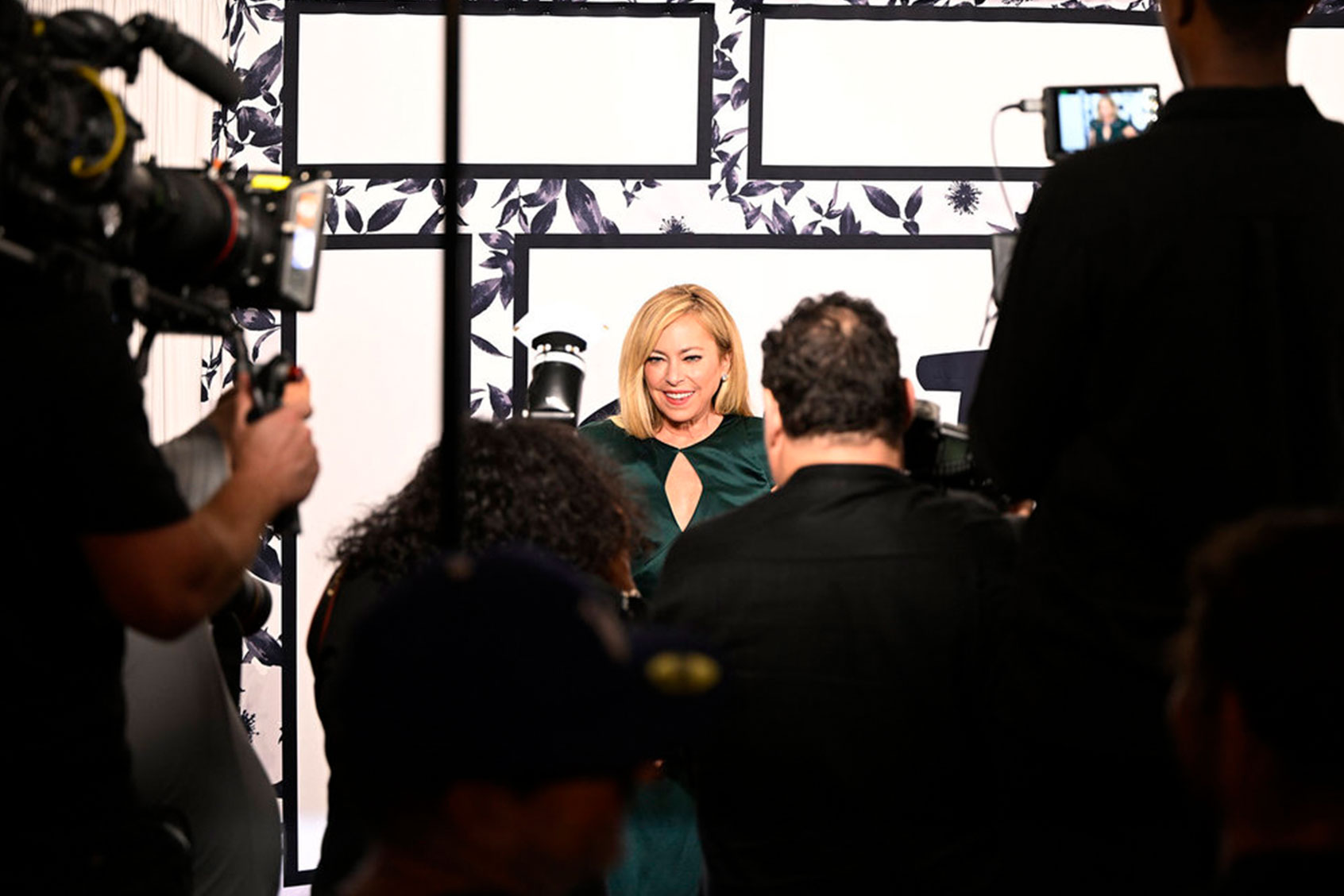
The Real Housewives of Beverly HillsSutton Stracke in "The Real Housewives of Beverly Hills" (Griffin Nagel/Bravo)But for as many silly moments as there were during the Augusta trip, there were just as many heartwrenching conversations, and the atmosphere could flip at a moment’s notice. This wasn’t just great reality television, it was great television period. 
Stracke’s strained relationship with her mother following her father’s death has been a sore spot since Stracke started on “RHOBH.” Stracke spoke of her father’s suicide multiple times throughout these last few seasons, and shared in Season 13 that after he died, their family never talked about it again. Clearly, this trip had been a long time coming, and the weight was not lost on Beauvais or Richards, who even agreed to come along as Stracke visited her childhood home nearby, where her father passed. As they walked around the house — which they were graciously allowed into by the current residents, a truly gobsmacking act of kindness — Stracke reminisced about all the memories she had from living there with her father. She showed her friends her childhood bedroom, the wood-burning stove where they’d make pancakes as a family, and described the scrambled egg sandwiches on white bread with mayonnaise that her dad would make. Stracke admitted that it sounded disgusting, but for her, it was a warm memory of her father, the kind of unique little quirk a child doesn’t realize they’ll miss until their parent is gone.

When the women entered John’s den, Stracke broke down remembering that it was the room where she last saw her father alive. In a confessional, Stracke said that, whenever she’d say goodbye, her dad would put his hand out for her to slap. It was their thing, another way to say, “I love you.” But she told Beauvais and Richards that her dad was so “out of it” the last day she saw him that he didn’t put his hand out for her as she left the room. “[It’s one of] those memories where you think, ‘I should’ve sat with him or something,’” Stracke said. “I wish I had sat down, even for five minutes, I feel really bad that I didn’t. That was so selfish of me.”

It’s frustrating to watch a show that features the word “real” in the title become so manufactured and unauthentic. But the incredible Augusta-set episodes of “RHOBH” suggest there is hope yet. 

It's stirring seeing Stracke realize these regrets as they wash over her in real-time. Her unedited, unfiltered feelings about her father’s death and all of the things she wishes that she would’ve done in the moment are so far removed from the superficial proceedings that viewers are used to seeing not just in “Beverly Hills,” but in most “Housewives” franchises. Producers, editors and cast members have all been hyper-aware of the need to create gripping drama and emotional storylines, so aware that their intention has done the opposite. We just watched “RHONY” flatline worse than it ever has, only two seasons after being rebooted, because its cast was too conscious of how they look on camera and what they do and don’t reveal. And while “Real Housewives of Potomac” just wrapped up a fresh new season, it lacked any concrete emotional throughline. (Though, for a series that managed to scrape its way back up the mountain after free-falling, that’s probably for the best.) 

The most recent season of “Real Housewives of Salt Lake City” did, however, feature an incredibly moving intervention scene that managed to avoid feeling exploitative. But until Stracke’s arc on “RHOBH,” anything sincerely poignant in contemporary “Housewives” felt more like an anomaly than a pattern. But between the “Salt Lake City” intervention and the “Beverly Hills” trauma revelations, “Real Housewives” is finally getting back to what made its nascent days so gripping. In the late aughts and early 2010s, cast members were far less concerned with editing themselves or avoiding details about their personal hardships. That candor is what made the show engaging. These days, most Housewives seem to be tight-lipped about damn near everything unless it’s about a fight between people in the same in-group. It’s frustrating to watch a show that features the word “real” in the title become so manufactured and unauthentic. But the incredible Augusta-set episodes of “RHOBH” suggest there is hope yet. 

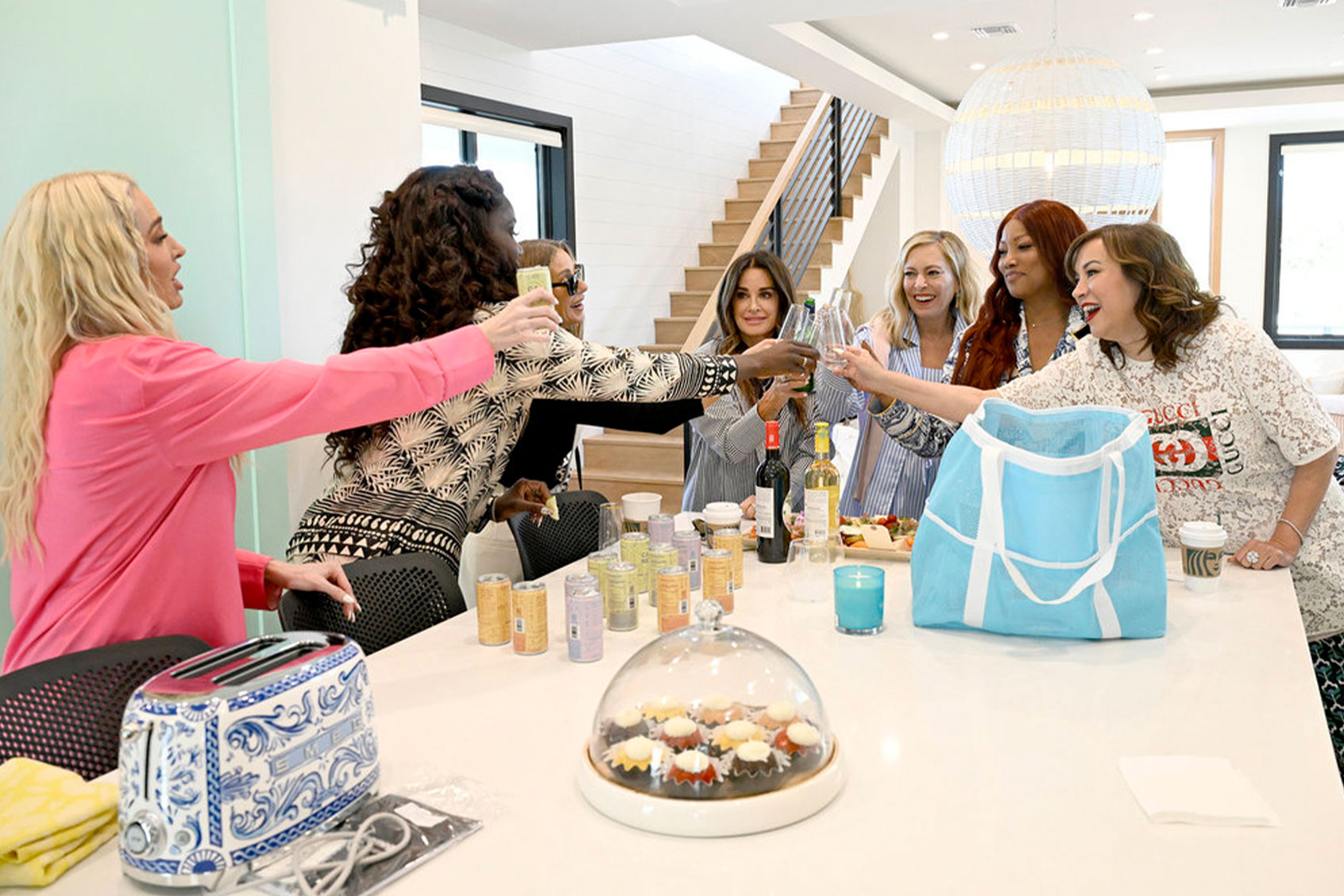
The Real Housewives of Beverly HillsErika Jayne, Bozoma Saint John, Dorit Kemsley, Kyle Richards, Sutton Stracke, Garcelle Beauvais and Jennifer Tilly in "The Real Housewives of Beverly Hills" (Griffin Nagel/Bravo)After all, these shows aren’t just about the individual women in their cast, they’re about how the cast members interact and bond. The Augusta trip gave viewers a chance to remember what actual camaraderie and love look like. There was nothing phony about Stracke, Beauvais and Richards’ intimacy. Beauvais even offered Stracke the kindness of sitting Reba down to explain why Stracke felt so disconnected from her mother. Granted, that conversation did begin with Reba saying, “I don’t think that’s any of your business." But Rebca eventually came around when Beauvais explained that all Stracke wants is for her mother to say she’s proud of her daughter. That chat begat the climactic talk between Stracke and Reba, one that went a lot more smoothly than she initially imagined — and featured an all-timer shot of Beauvais and Richards stealthily listening from the other room. 
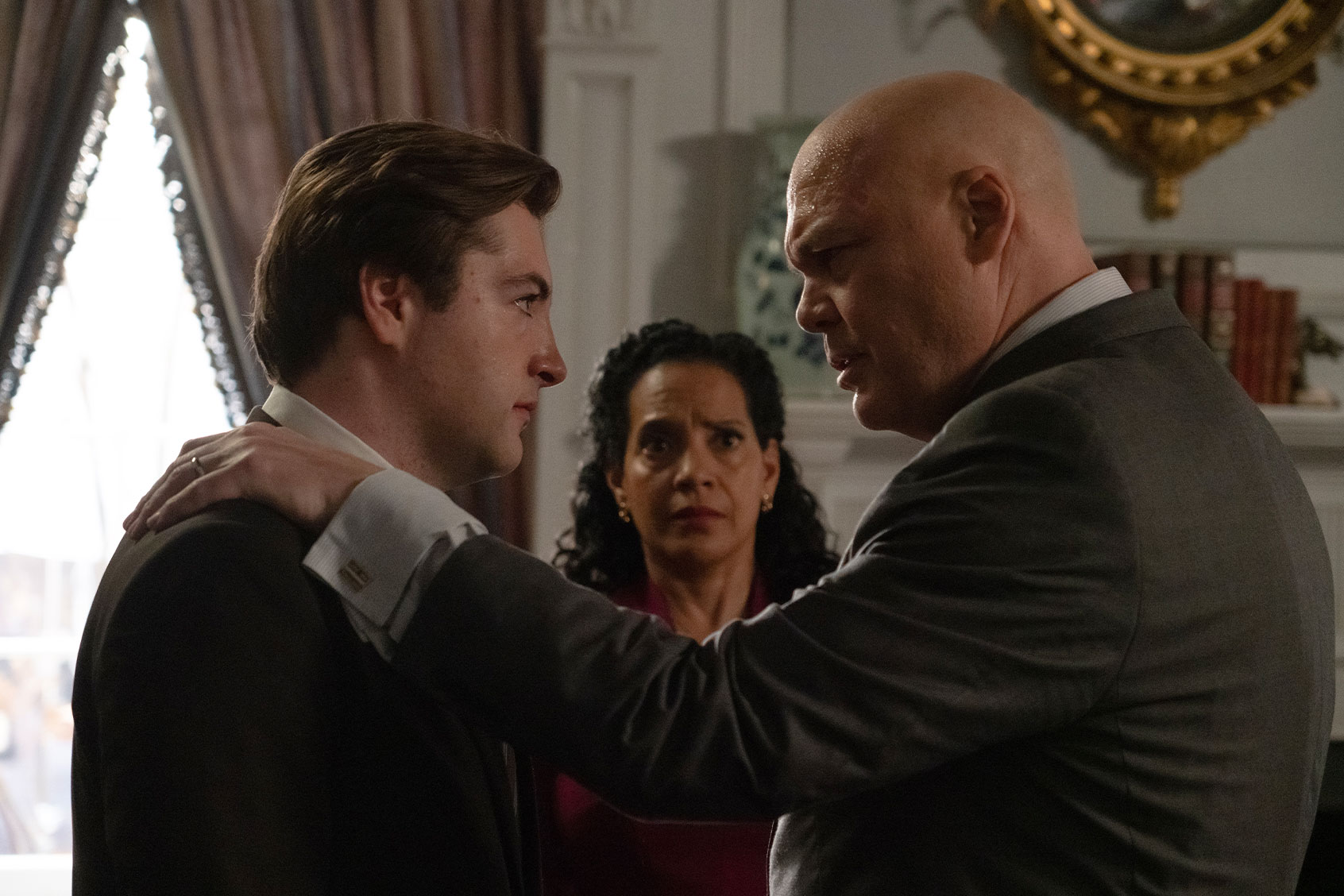
The mother-daughter talk was two decades in the making. And though it was only grease for the wheels, it was a start. Having their intimate, honest conversation captured on camera will no doubt resonate with viewers who have similarly tense relationships with a parent, or perhaps even parents struggling to bond with their children. Watching two women reach out to one another, across all of the time that has slowly pulled them apart, was nothing short of miraculous. Even if it was just the first of many important discussions between the two, it was the beginning of a new era for Stracke.

Hopefully, it signals a new era for “Housewives” as well. These shows are much more vital when the cast stops fighting or toiling in the same drama they’ve been mucked in for years. Sure, every bond will eventually be broken again, but sharing a history of intimate friendship allows those connections to be repaired. And though the fights and divorces are fun too, watching these women mend their friendships through those low points will raise “Housewives” back to its zenith.

Trump tariffs could raise prices of produce from Mexico, Target CEO Brian Cornell warns

Food prices, namely produce items, are expected to go up in the coming days due to President Donald Trump’s tariffs on Mexican imports, Target CEO Brian Cornell said Tuesday.

Cornell told CNBC that Target “relies heavily on Mexican produce during the winter months, and the tariffs could force the company to raise prices on fruits and vegetables as soon as this week,” Gabrielle Fonrouge and Jacob Pramuk reported.

“Those are categories where we’ll try to protect pricing, but the consumer will likely see price increases over the next couple of days,” Cornell said in an interview with the outlet after Target released its fiscal fourth-quarter earnings.

“If there’s a 25% tariff, those prices will go up,” he added.

Produce like strawberries, avocados and bananas are especially susceptible to price hikes, Cornell said. At this time, it’s still too early to provide a complete list of items that may increase in cost, chief commercial officer Rick Gomez specified during an investor day. That’s because “teams are working through it in real time” and Target has to examine pricing holistically, CNBC reported.

Cornell’s warning comes in the wake of Trump’s tariffs on goods from Mexico, Canada and China, which officially went into effect on Tuesday. Trump imposed 25% taxes on Mexican and Canadian imports. He also doubled the tax on Chinese products from 10% to now 20%.

“I’ll never vote for chaos”: Democrats split on a government shutdown over Trump-Musk lawlessness

All eyes are shifting to House Republicans as Democrats harden their opposition against passing a long-term continuing resolution, which could potentially legitimize some of billionaire Elon Musk and President Donald Trump’s efforts to seize spending power and impose unilateral cuts to government programs.

Earlier this month, negotiations between Democrats and Republicans in Congress broke down after Democrats demanded that any continuing resolution reaffirm Congress’s constitutionally delegated power of the purse. Republicans, meanwhile, waffled on whether a spending bill should include the changes to government agencies that Musk, a Republican mega-donor, has pushed through with Trump’s blessing. 

House Speaker Mike Johnson has described these cuts as “anomalies” that he might seek to have added to a so-called “clean” continuing resolution at different times. As it stands, it’s not clear whether a bill will or will not include all these “anomalies” because the text is not yet available (The Hill reports that Johnson hopes to make it available by Friday).

When talks between the two parties broke down, House Minority Leader Hakeem Jeffries said that Democrats remained willing to work with Republicans on a continuing resolution but wouldn’t support one “that fails to protect the quality of life of the American people, most importantly with respect to Social Security, Medicare and Medicaid.”

The continuing resolution would extend the current federal budget, potentially through the end of this fiscal year. The measure is traditionally used as a stopgap to allow more time for negotiations and is distinct from the normal budgetary process. The budget for fiscal year 2026, in which Republicans are angling to make drastic cuts to Medicaid and nutritional assistance, is moving in parallel to the continuing resolution negotiations and would still require a separate bill to fund the government under that budget.

Now it’s becoming clearer that, in real terms, the opposition espoused by Jeffries likely means that Democrats won’t support the sort of long-term continuing resolution that Republicans are currently pursuing because it could give Musk and Trump further discretion over the budget. Sen. Patty Murray, D-Wash., who serves as vice chair on the Senate Appropriations Committee, described this position in remarks on the floor of the Senate.

“We cannot stand by and accept a yearlong power grab CR that would help Elon take a chainsaw to programs that families rely on and agencies that keep our communities safe,” Murray said Tuesday. “I have heard my House Republican colleagues say they will not restrict a Republican president’s powers. I want to be clear: What I am asking for is to work together to make sure that as we write and negotiate these full-year spending bills, our laws get followed. I welcome, and I want everyone to know, I am open to any and all ideas on how we can work together to do that."

The top Republican on the Senate Appropriations Committee, Sen. Susan Collins, R-Maine, has expressed similar concerns over Musk and Trump’s power grab, saying in a February interview with Politico that “I think it's pretty clear that this violates Article One of the Constitution,” though later adding that it was up to the courts, not her, to do something about Trump and Musk’s undermining of congressional authority. Collins did not immediately respond to a request for comment from Salon.

Some Democrats, however, have indicated an openness to collaborating with Republicans on a long-term continuing resolution, despite its potential to further empower Trump and Musk. They include Sens. John Fetterman, D-Pa., Jeanne Shaheen, D-N.H. and Mark Warner, D-Va.

“I will never vote for or withhold my vote to shut the government down. That’s chaos and I’ll never vote for chaos,” Fetterman told Punchbowl News.

We need your help to stay independent

In terms of a path forward, Democrats like Murray have indicated that a short-term continuing resolution is something that they would support if it were a stepping stone to passing a full-year spending bill. Collins has said that she is also preparing a short-term bill in case the long-term one falls through.

Democratic staffers, however, point out that any negotiations depend on the outcome of Johnson’s expected attempt to push through a year-long continuing resolution along party lines. With the Republicans’ current 218 to 215 seat majority, the GOP can only afford to lose one vote if they want to pass a bill along party lines in the House. Rep. Don Bacon, R- Neb., has already expressed his opposition to a year-long continuing resolution, one more defection would then force Republicans to seek Democratic votes. Other Republicans have indicated that they have reservations about voting for anything except a “clean” continuing resolution, even as other members of their party look to add legislative riders to the bill. 

At the same timem Musk, who has emerged as a key Republican power broker, seems to support a government shutdown, posting last week on X that a March closure “sounds great.” One undercurrent pointed out by Democrats is that in the shutdown process, the Office of Management and Budget and the Justice Department have considerable influence over which government employees work through a shutdown and which employees are furloughed. For example, employees who cut checks for benefits programs have traditionally worked through a shutdown, though it’s the OMB and DOJ that ultimately decide what work is required by “necessary implication” of the law — and they could change that guidance.

“Front row seats to a coup”: Trump and Musk gut NOAA and EPA, raising alarm among scientists

On Friday, President Donald Trump announced mass layoffs at the National Oceanic and Atmospheric Administration, one of the world’s premier centers for studying climate science. The announcement was the culmination of Trump’s longstanding campaign against climate science as a field. Over the last several months, Salon spoke with dozens of climate scientists, who warned that the ongoing purge of scientific experts will make it more difficult for the U.S. government to effectively face a growing set of environmental threats.

In just a few short weeks, the Trump administration has completely upended the scientific community, thoroughly dismantling agencies like USAID, the Department of Education and the Environmental Protection Agency. At the EPA, Trump has already put more than 1,000 workers on notice that their jobs are in peril, and throughout the 2024 campaign he vowed to completely gut the agency. The president frames his policies as one-part economic stimulant, one-part war against a so-called “deep state” of bureaucrats that undermine his policies. The workers who spoke to Salon believe that Trump is inflicting devastating damage on our society’s ability to protect the rapidly changing environment.

Thousands of government workers in science-related fields have reason to believe they may soon be fired. As a number of government scientists on the frontlines have told Salon, the toll on both workers and the public interest is considerable, especially in an era of deadly pandemics, climate volatility and worsening pollution.

“We are sitting in front row seats to a coup,” said Terry, a highly-regarded scientist whose work directly addresses the impacts of climate change. (Terry is not this person’s real name; they requested anonymity to avoid reprisals.)

“While Donald Trump is technically our president, we are also dealing with a shadow president in Elon Musk, who now has installed a DOGE aide at EPA,” Terry explained. “So we are feeling a sense of dread, watching agencies like USAID get dismantled and wondering if we are next.”

"This time we are feeling under threat not only for the work we do, but simply as federal workers."

Speaking to Salon in December about conditions during Trump’s first term in office, EPA scientist Dan Costa recalled that government workers studying the health effects of air pollution ”had a bullseye on us” because of corporate opposition. Terry suggests that the situation has already gotten worse a month into Trump’s second term.

“While the last Trump presidency attacked our work, this time we are feeling under threat not only for the work we do, but simply as federal workers,” Terry said. “We’ve been made into a public enemy. Every day we are waiting for the next threatening, manipulative email from the Office of Personnel Management [which Musk now controls] or from the agency heads who are validating and reinforcing their messages. It is an atmosphere of psychological abuse.”

Dr. Kyla Bennett, the director of science policy for the Public Employees for Environmental Responsibility, is a professional advocate for workers facing exactly this type of mistreatment. Bennett previously worked at the EPA as wetlands enforcement coordinator in New England and says she is tuned into the work culture among environmental scientists. By her account, they are angry.


Want more health and science stories in your inbox? Subscribe to Salon's weekly newsletter Lab Notes.


“Career scientists at federal agencies are, first and foremost, pissed,” Bennett said. “Contrary to Trump and Musk's portrayal of government employees as lazy and low productivity, they are dedicated professionals who joined the government to protect the American people. Some of them are frightened because they are being attacked and targeted. But most of them are furious.”

Government workers also say that Trump’s recent appointees do not seem to understand the mission of the agencies they now steward.

Newly installed officials, Bennett said, “are removing climate data and references from federal web pages; revoking the U.S. International Climate Finance Plan; initiating a withdrawal from the Paris Climate Accords; withdrawing proposed PFAS effluent limits; weakening the Endangered Species Act ; slashing federal agencies, including EPA, National Park Service, and U.S. Fish and Wildlife Service; and eliminating protection” for communities “already overburdened by pollution.”

“The future of our planet? Bleak,” Bennett concluded. “I don't think we can come back from this full-on assault on the environment. When ExxonMobil is lamenting leaving the Paris Agreement, you know it's bad.”

Terry has observed the effects of this anti-environmental attitude firsthand.

“I worked at the EPA through the first Trump administration, and they came out the gate in 2017 with a very ideological purge of climate-related information from our websites,” Terry said. “This time around, the administration’s ideology has shifted to hatred of marginalized communities, packaged in ‘anti-DEI’ rhetoric … We have been seeing an aggressive and merciless attack on employees across agencies doing work related to equity and justice. If climate justice is scrubbed from our work, communities will suffer.”

"Career scientists at federal agencies are, first and foremost, pissed."

This dim view of the Trump and Musk policies is not limited to scientists and government employees. Christine Todd Whitman is a former EPA administrator who served under a Republican president, George W. Bush, after two terms as the Republican governor of New Jersey. Whitman says current EPA employees are “dispirited and frustrated.”

For many workers, Whitman said, the question now is whether to accept the government buyout they’ve been offered by Musk and leave their jobs. “Should they trust they will actually be paid or risk getting fired?” she asked. “People who have given their careers to serve the American people are now between a rock and a hard place because an unelected, unappointed, unconfirmed rich man with no security clearance is dismantling the federal government.”

These traumatic changes come at a dangerous moment, Whitman added. Fossil fuel emissions caused average global temperatures to reach 1.5º C above pre-industrial levels for the first time ever. As of 2024, the carbon dioxide concentration in Earth’s atmosphere was 424.6 ppm, a jump of more than 50% from levels before our species began relying on fossil fuels less than three centuries ago.

“Look at the intensity of storms, fires, floods — this isn’t normal and it will only get worse,” Whitman said. Society faces unprecedented struggle as “the air and water will be dirtier, people will be getting sick, kids will be getting asthma — a key driver of missed school days. Combine this with leaving the World Health Organization, and the dismantling of research at the National Institutes of Health, and more people are going to die.”

Whitman added, “It should grieve anyone who is paying attention.”

Top scientists share her alarm. Dr. Mark Serreze, the director of the National Snow and Ice Data Center, pointed to the recent reports that January 2025 was the hottest January in recorded history. Trump and his followers, Serreze said, are looking the other way.

“By failing to quickly address the growing problem of climate change, we are setting ourselves up for very tough times ahead,” Serreze said. “The number just came out for the January 2025 global average temperature and it's another record high. Will we ever wake up? Trump and his cohorts simply look at the short term and haven't even a vague grasp of the science.  They choose to ignore the obvious.”

We need your help to stay independent

Serreze urges citizens who want to make a difference to “do whatever you can do to make your voice heard. Our future is at stake.” His advice is echoed by Denae Ávila-Dickson, spokesperson for the climate change advocacy group Sunrise Movement.

“People have the power to fight back against Trump’s harmful policies by making it clear just how deeply unpopular they are,” Ávila-Dickson said. “It's critical to expose how his actions hurt ordinary people and the impact dismantling environmental protections or defunding essential services will have on their everyday lives. These cuts aren’t about putting money back in the hands of working families; they’re about lining the pockets of billionaires at our expense.”

Ávila-Dickson added, “Working people are the most powerful voices in this fight because they can speak to the real cost of Trump’s agenda.”

Whitman said that concerned citizens should “go to your elected representatives and don’t let them get away with ignoring it. Tell your representatives that you care, that your vote is going to matter and that you’ll be watching for the safety of your children and grandchildren. Officials who might act need to know they won’t be alone if they stand up to this nonsense.”

“EPA workers are vital to protecting our air and water resources, cleaning up after hurricanes and wildfires and working to build resilience against the next climate-caused disasters,” Terry said. “We protect you, and we need all hands on deck to protect us.”

US pauses intelligence sharing with Ukraine, kneecapping efforts to resist Russian invasion

CIA Director John Ratcliffe said Wednesday that the US has paused weapons and intelligence support to Ukraine, days after President Donald Trump and Vice President JD Vance accused Ukrainian president Volodymyr Zelensky of ungratefulness an prolonging the war in a combative Oval Office meeting.

“Trump had a real question about whether President Zelensky was committed to the peace process, and he said let’s pause,” Ratcliffe said in a Fox Business interview, adding that he thought the pause would eventually "go away" after a "chance to think."

“And I think we’ll work shoulder to shoulder with Ukraine as we have to push back on the aggression that’s there, put the world in a better place for these peace negotiations to move forward,” the CIA director continued.

The pause comes as Ukraine, facing manpower and supply shortages, struggles to fight off grinding and relentless enemy attacks two years after Russia launched a full-scale invasion of the country.

Despite key figures in the Trump transition team, including Ratcliffe, receiving briefs about the value of intelligence sharing with Ukraine, a senior U.S. military official told CNN that the U.S. had already instituted a rollback, including a reduction in intelligence, surveillance and reconnaissance flights that could impair Ukraine's ability to conduct both offensive and defensive operations. Those include air defense measures, since Ukraine depends on US intelligence to anticipate Russian movements.

National Security Advisor John Waltz also confirmed those reports Wednesday morning, saying that aid may be resotred if Ukraine makes progress on peace talks. The Trump administration has repeatedly insisted that giving Ukraine too much support would hamper a potential deal with Russia, while Zelenskyy and some of Ukraine's European allies have argued that Ukraine's survival as a coherent nation-state cannot be subject to bargaining.

Nevertheless, Zelenskyy has also said that he is open to a ceasefire and peace talks, as long as all the parties involved are acting in good faith. He also this week issued a statement praising Trump, which Ratcliffe suggested would help induce the president to resume intelligence sharing.

Trump admits that Elon Musk is the head of DOGE, contradicting DOJ denials in federal court

It took just a few seconds, but President Donald Trump's shout-out to Elon Musk during his long-winded and combative address to Congress may torpedo his own government's legal arguments in defense of DOGE, whose apparent leader, plaintiffs say, has no legitimate authority to ransack government agencies.

"I have created the brand new Department of Government Efficiency. DOGE — perhaps you’ve heard of it, perhaps — which is headed by Elon Musk, who is in the gallery tonight," Trump said in his Tuesday night State of the Union address, as Musk stood up and bowed.

GOP lawmakers greeted Trump's tribute with cheers and applause, though the remark was a gift to a group of Democratic state attorneys general, who have filed multiple lawsuits against Trump alleging that DOGE is a cypher of an agency that walks, talks and quacks like federal advisory committee but does not abide by the usual accountability requirements. Worse, plaintiffs say, DOGE uses its power far more permissively than an advisory committee should.

The Democratic AGs and government lawyers have clashed over Musk's actual role in the department, with an affadavit by the Trump administration claiming that Musk is “not an employee of the U.S. DOGE Service or the U.S. DOGE Service temporary organization," and was instead “an employee of the White House office,” with the title of “Senior Advisor to the President" and “no actual or formal authority to make government decisions.”

The actual head of DOGE, the government later said, was Amy Gleason, a senior adviser at U.S. Digital Services who was apparently caught off-guard while vacationing in Mexico. Judge Theodore Chuang had already expressed annoyance over government attorneys' inability to give a straight answer over who was in charge of DOGE — but Trump may have unintentionally put those frustrations at rest.

Trump's line about Musk "undermines the administration’s position in a few of its court cases against DOGE’s effort to access agency systems," wrote Kyle Cheney, Politico's senior legal affairs reporter. 

Later that evening, plaintiffs in one of the lawsuits alerted the court about Trump's speech as new evidence that Musk, not Gleason, actually runs DOGE.

Trump’s speech to Congress makes it clear: They’re coming for Social Security

If you were one of those people who have given up on the news since the election and decided to watch last night's presidential speech before a joint session of Congress (a State of the Union address in all but name) you had to come away a little bit shell-shocked by what you heard. President Donald Trump delivered what felt like an interminable litany of his alleged accomplishments over the course of an hour and 40 minutes that would make anyone's hair stand on end if they hadn't heard it all before.

To set the stage, you would have had to know that the congressional Democrats have been hand-wringing for days over how they were going to handle the speech, seeing as Trump has been systematically dismantling the federal government, destroying the economy and discarding the existing world order. It just seemed wrong to behave as if this is business as usual despite the trappings of a normal State of the Union address. (In fact, one representative, Melanie Stansbury of New Mexico, stood silently holding a sign that said "this is not normal" until a Republican ripped it from her hands and tore it up as Donald Trump walked down the aisle to the podium.) In the end, many decided not to attend while others wore matching pink clothing, held up signs that said "false" or "save Medicaid." Some walked out at different times during the speech after Congressman Al Green of Texas yelled out and was forcibly removed. (Interesting that the same rule was not applied to Marjorie Taylor Green and Lauren Boebert when they mercilessly heckled Joe Biden.)

Trump noticed that none of them would stand or applaud:

 I look at the Democrats in front of me and I realize there is absolutely nothing I can say to make them happy or to make them stand or smile or applaud. Nothing I can do. I could find a cure to the most devastating disease, a disease that would wipe out entire nations or announce the answers to greatest economy in history or the stoppage of crime to the lowest levels ever recorded, and these people sitting right here will not clap, will not stand, and certainly will not cheer for these astronomical achievements.

He was angry that they weren't clapping for the "astronomical achievements" he has not actually accomplished, failing to recognize that they were not clapping or standing for the execrable achievements he has.

If one hasn't been following these first chilling six weeks of Trump's term, they would have been stunned by the long list of depravities he has inflicted on the country already. He bragged that he had withdrawn from the Paris Climate accord, the World Health Organization and the UN Human Rights Council. He boasted that he ended environmental restrictions and the electric vehicle mandate (which didn't exist) ordered all federal workers to return to the office and stopped "weaponized government where, as an example, a sitting president is allowed to viciously prosecute his political opponent, like me." He said that he'd signed an order making English the official language of the United States. renamed the Gulf of Mexico the Gulf of America and restored the name of Mt. McKinley to Denali in Alaska.

All of this, and more, was announced with the usual Trumpian flourishes as one might expect. But the ecstatic response from the Republicans in the room to each and every one, replete with standing ovations and shouts of excitement was something to behold. Of course, nothing brought out the whoops and roars of that side of the room than the litany of attacks on people of color (aka DEI) and transgender Americans, particularly children. In fact, Trump spent more time on the subject of transgender people than on any other issue, returning to it more than once, even going so far as to feature several alleged victims in the gallery, telling their stories in lurid detail. It was horrifically reminiscent of historical examples of other minorities being targeted as enemies of society. I think we all know where that leads.

Interestingly, he didn't spend much time on the tariffs or Ukraine, the two subjects at the very center of the news cycle for the past week.

He also spent an inordinate amount of time listing examples of "waste, fraud and abuse" found by the DOGE team, which he said was "headed by Elon Musk," a fact they've been trying to obscure in court cases. At one point he proclaimed that "the days of rule by unelected bureaucrats are over," which elicited Democratic laughter and pointing at Musk, who had been ostentatiously introduced by Trump in the gallery.

Trump went on and on calling out USAID programs that he and the Republicans find entertaining to mock. He claimed they've found hundreds of billions of dollars in fraud, which is a monumental exaggeration. But then so much of what he said last night was complete fiction.

Another interminable litany of lies was a dull recitation of alleged fraud in the Social Security rolls in which he seemed to be saying that there are tens of millions of fraudulent recipients who are collecting the checks of dead people. (This is not true, it's been thoroughly debunked, even by the person Trump has elevated to commissioner.)

Trump made a great show of promising not to cut Social Security and Medicare in all of his campaigns, so there's a reason why he spent so much time degrading the system in this speech and it isn't good. The way he described it sounded very much like the way he described the supposed cheating in the 2020 election, which indicates they are working up a narrative to excuse the attack on the system that's already underway with massive personnel cuts and the closing of offices. They're coming for Social Security.

We need your help to stay independent

Interestingly, he didn't spend much time on the tariffs or Ukraine, the two subjects at the very center of the news cycle for the past week. He slammed Canada and Mexico with the usual nonsense about "subsidies" and announced that there are more tariffs on the horizon:

In new tariff news from this speech, Trump named the EU, China, Brazil, India, Mexico, Canada, and South Korea are the countries for possible April 2nd tariffs—that would cover the vast majority of US trade. He also reiterated he wants tariffs on food to start April 2nd.

— Joey Politano🏳️‍🌈 (@josephpolitano.bsky.social) March 4, 2025 at 10:20 PM

He mentioned in passing that all this will cause "a little disturbance but we're ok with that, it won't be much" so there's no need to worry our pretty little heads about it.


Want a daily wrap-up of all the news and commentary Salon has to offer? Subscribe to our morning newsletter, Crash Course.


As for Ukraine, he implied that President Zelenskyy had capitulated by reciting a letter in which the Ukrainian president said he was ready to come to the negotiating table and thanked the Americans for their support. (Zelenskyy had actually published this on X earlier, in which he proposed partial ceasefire terms and renewed his offer to sign the minerals deal.) Trump didn't sound particularly excited about any of that, I would guess because he has already checked out of any negotiation that requires Russia to concede anything.

All in all it was a pretty standard Trump speech. He pounded his chest, insulted the opposition, bragged about fantasy accomplishments and lied profusely.

And if you ever wondered exactly what is meant by "America First," Trump made that clear last night. He says he plans to "forge the freest, most advanced, most dynamic and most dominant civilization ever to exist on the face of this earth."

Pour one out for the new American Imperium. 

After DEI backlash, embracing new ideas for fairness in the workplace

Much has been made of the recent backlash to diversity, equity and inclusion across parts of corporate America. The parade of headlines seems endless: companies scaling back DEI programs, struggling DEI consultants closing down or pivoting their businesses and a court ruling against DEI considerations on the boards of Nasdaq-listed companies by a slim 9-8 majority. In the latest salvo, Meta CEO Mark Zuckerberg called for more “masculine energy” to counteract “neutered” corporate culture.

But what if the current moment represents an opportunity, rather than a setback, in our fundamental quest to create better and fairer workplaces?

It would be a tragedy to throw the proverbial baby out with the bathwater given that we are faced with an opportunity to actually make work better — for everyone. To move closer to the elusive ideal of a true meritocracy where the best of the best rise to the top, it’s time for an entirely new approach. Forget add-on events, one-off proclamations and trainings aimed at changing hearts and minds. The real work of making our workplaces fair entails tweaking our products, practices and procedures to embed fairness into the things we already do on a daily basis. Because fairness is not a program, but a way of doing things — and we all are on the hook to deliver.

As academic researchers, we study what works — and what doesn’t — to create organizations where everyone has an equal opportunity to perform at their best. For us, this means offering all employees a level playing field where some groups of people are not (dis)advantaged in a way they didn’t merit. The evidence is now clear that despite the best of intentions, the “corporate DEI” of the last several years has not been able to sustainably deliver on this vision. Put simply, we have misidentified the problem and invested in the wrong solutions. Fairness is not about what people think but about what they do. As such, solutions only work if they give people the tools they need to deliver on fairness.

Consider Astrid Linder, the research director of traffic safety at the Swedish National Road and Transport Research Institute, who aims to “make everyone in cars as well protected as possible.” Even though regulations only require crash tests using human dummies based on the average male body, Linder chose to make her own work more fair, and together with her team developed the world’s first female crash test dummies. Automakers like Volvo are extending these efforts to feature more people of all genders, ages, heights, shapes and weights in their safety tests. 

We need your help to stay independent

At British public broadcaster BBC, journalists seek to produce the highest quality journalism, which includes accurately representing the world they cover. However, some years ago presenter Ros Atkins realized that he did not have data available on the gender of the people he featured as experts on his own show. Atkins and his team decided to generate the data themselves by counting the gender of contributors — initially on Post-it notes. What began as a grassroots initiative in the newsroom has now grown into the global 50:50 The Equality Project, which is shifting journalistic norms toward fair representation.

At Google, what looked like a gender gap in retention turned out to be a “parent gap” upon closer examination of the numbers: When women became mothers, they were more likely than men to leave the company. Recognizing its responsibility to provide a level playing field for all employees, including parents of all genders, Google increased the amount of leave available for new parents from 12 to 18 weeks. This closed the gender gap in retention. The same motivation may have inspired the recent dramatic change in Tokyo, where the Metropolitan Government’s staff will work four days a week starting in April. “We will continue to review our work style in a flexible manner so that nobody has to sacrifice their career due to life events such as giving birth and caring for children,” Gov. Yuriko Koike explained.

The redesign of our workplace infrastructure should be at the core of our attempts to make work better and fairer. As Astrid Linder and Ros Atkins demonstrated, you do not need to be the CEO or an HR leader to do it. No matter our seniority, role or responsibilities, we all can make small, often low- or no-cost changes to the way we work. Just like you do not need to be a public relations or communications professional to write emails, speak up in meetings or create slide decks, you do not need to or want to be a “DEI expert” to make the everyday work you are already doing better, smarter and more fair.

Singer and entrepreneur Rihanna did exactly this when she founded her Fenty Beauty cosmetics line. Rihanna’s vision of “Beauty for All” was embedded into everything the company did from the get-go, and in 2017 Fenty Beauty launched with 40 (today, more than 50) shades of foundation to serve customers with all skin tones globally. Other beauty companies quickly followed suit and expanded their offerings to cater to more audiences.

The crucial truth about our workplaces is that the way we have designed them is not neutral

The crucial truth about our workplaces is that the way we have designed them is not neutral. Most of the practices and procedures organizations employ to attract, hire, develop, evaluate, promote and reward talent — as well as create products, identify new market opportunities and serve customers — help some people more than others. Most of these workplace systems and daily practices have been largely untouched by traditional DEI efforts. But they can, and should, be made better.

Take the all-powerful resume. When more than 9,000 firms participated in an experiment that redesigned the traditional resume format, they unearthed a simple way to attract more and better talent. Female and male applicants who presented their work experience by the number of years (“5 years: Assistant Manager, Sales”) instead of by specific dates of employment (“January 2018-December 2023: Assistant Manager, Sales”) were significantly more likely to be invited to an interview. Focusing on the amount of experience rather than specific dates allowed the hiring firms to see beyond career breaks, which many employers — and the algorithms they use to screen candidates — tend to penalize (though without much empirical evidence suggesting that such breaks are predictive of future performance). Thus, the traditional resume format disproportionately advantages applicants with a continuous job history (who are currently more likely to be men).

The promise of the paradigm shift we are proposing is a world where the right people get to do the right jobs in the right way and at the right time — and where our economy gets to benefit from 100% of the talent pool, customers have access to the products and services they need and companies thrive by tapping new markets (the BBC did, in fact, gain new viewers, and Fenty Beauty inspired a lasting change in how beauty companies attract new customers). Realizing this vision requires us not to abandon the fundamental ideal of fairness even though many recent corporate DEI efforts have failed. Instead, it requires us to shift gears and direct our limited resources, effort, attention and goodwill toward the types of structural, embedded solutions that have been proven to yield measurable results — and make work fair for all

The “Epstein files” and Melania’s “deepfake” testimony are attempts to hide Trump’s violent misogyny

Pam Bondi is still pretending she's on the verge of a big reveal about the crimes of deceased sex trafficker Jeffrey Epstein. Last week, Donald Trump's new attorney general and a clutch of grifty MAGA "influencers" pretended they had unearthed a trove of information about Epstein that they falsely claimed had been concealed by the previous administration. Within hours after the influencers stood outside the White House and waved binders specially made for the occasion labeled "Epstein Files," it was revealed that the stunt was as empty as the reality TV deitrius that inspired it. QAnon-drunk MAGA social media users believed they were going to get stories about prominent Democrats and major Hollywood stars engaging in child sacrifice. When all they received was confirmation of what was already known about Epstein's decades of abusing teenage girls — which is hardly considered a real crime in Trump's GOP — they couldn't hide their disappointment, whining that the "Epstein Files" must be "fake."

Bondi, however, has not given up stringing these people along with false hopes that all their QAnon fantasies are about to be proved true. She and Trump's newly appointed FBI director, Kash Patel, had a showy exchange on X, in which both pretended they would soon produce "a comprehensive report" with "no cover-ups, no missing documents, and no stone left unturned." Earlier this week, Bondi declared she now had a "truckload" of documents, insinuating, no doubt falsely, that there are huge revelations to come. 

The crimes they make up in their heads are so grotesque — child sexual abuse, cannibalism, murder — that it makes real accusations against Trump seem minor in comparison.

Most of the mainstream media ignored this, having recognized that Bondi is putting on a dog and pony show for the QAnon crowd, which believes in an international conspiracy of Democrats and Hollywood celebrities to molest and kill children, before consuming them in Satanic cannibalism rituals. But the right-wing press is still hyping Bondi's breathless promises. The timing of Bondi's transparent stunt is especially telling. All this is happening while misogynist influencer Andrew Tate, accused of sex trafficking and rape, has suddenly been released by the Romanian government to the United States, where he can hide from charges in both Romania and Great Britain for his alleged sex crimes

As the Financial Times reported last week, the Trump administration sent Richard Grenell to speak to Romanian officials about releasing Tate and his similarly charged brother, Tristan Tate, which Romania has confirmed. (They claim there was no "pressure," but come on.) Donald Trump Jr. is Tate's friend. Trump's lawyer, Alina Habba, calls herself a "big fan" of the man who was recorded taunting an alleged victim with, "The more you didn’t like it, the more I enjoyed it."


Want more Amanda Marcotte on politics? Subscribe to her newsletter Standing Room Only.


It's not a surprise that Trump embraces a man who says "I love raping" and who bragged about how he controls women with "bang out the machete, boom in her face and grip her by the neck." Trump himself is on tape crowing about how he likes to "grab them by" the genitals, and was found liable by a civil jury for sexually assaulting journalist E. Jean Carroll. As Michelle Goldberg wrote recently in the New York Times, Trump regards past accusations of sexual abuse as a resume-polisher for jobs in his administration, believing abuse highlights his values of "power, aggression, hierarchy and leader-worship." A staggering number of Trump's appointees and his shadow president, Elon Musk, have been accused of sexual abuse. 

But it's also true that it's still politically dangerous to be openly pro-rape. Even in hardcore MAGA circles, many people like to believe they are opposed to "legitimate" rape, as Todd Akin, a Missouri Republican who lost a Senate race in 2010, infamously said. Akin lost, but Trump's successes show that Republican voters crave permission to blame the vast majority of rapes on the victim, while telling themselves it's OK because they would find "exceptions" for victims who are "truly" innocent.

That's why QAnon exists. Trump voters don't like it when people correctly point out that they backed a man who bragged about committing sexual assault and who was found by a civil jury to have acted on that boast. It's not fun, being the bad guy! So a lot of them construct this elaborate fantasy where Trump isn't a sexual predator, but a hero secretly fighting the "real" sexual predators. And the crimes they make up in their heads are so grotesque — child sexual abuse, cannibalism, murder — that it makes real accusations against Trump seem minor in comparison. Trump is redeemed through this myth that he's taking on imaginary villains far worse than he is, and therefore, supporters can believe they are redeemed for backing him. 

That explains why Bondi is wasting more breath pretending she's about to release some shocking revelations about Epstein, who is helpfully dead, making it easier to manipulate his image for whatever ends the Trump administration needs. It's likely also why Melania Trump was deployed Monday to speak at a roundtable about a Senate bill meant to curb the spread of non-consensual nudes and AI "deepfake" sexual imagery online. No one outside the MAGA cult would mistake the First Lady for an advocate of justice for sexual abuse victims, but even within the context of her dishonest posturing, it was telling how she limited her definition of "victim." 

"It's heartbreaking to witness young teens, especially girls, grappling with the overwhelming challenges posed by malicious online content, like deepfakes," the third Mrs. Trump testified. Not only did she limit her scope to "children," but she also focused on fake content, generated by AI. Adult women targeted this way rated no real concern. Neither did anyone, underage or not, who had posed for real nude photos, only to see them be released against their will. 

This is a typical shell game that conservatives play. It allows them to claim opposition to sexual abuse, while turning a blind eye to most of it. Limiting concern only to victims who can be cast as "pure" and "virginal" makes it easier to write off all other victims as "asking for it." That's especially helpful for those who want moral absolution for voting for Trump, despite his disturbing history and open support for other men accused of abuse. The teen girl who had AI-generated fake nudes on the internet is a worthy victim. Adult women who drink alcohol, allow themselves to be alone with men, or who aren't virgins can be written off as fair game. 

Melania Trump's testimony doesn't just give cover for her husband's ugly views on sexual violence. As Will Oremus of the Washington Post reports, while her vision of who counts as a victim is highly constrained, the bill's scope is not. "Anyone that knows how to exploit the system can have any image they do not like removed, not just intimate images," legal expert Matt Lane told him. Every lawyer Oremus spoke to, including one who has advocated for other bills to remove non-consensual sexual imagery, agreed: The bill is so broadly written that it could be used by politicians and corporations to censor content that isn't sexual, but that they don't want the public to see. Both Elon Musk and Donald Trump are repeatedly threatening "a long prison sentence" for journalists who publish true but embarrassing information about them. This bill could give them a weapon to censor unsavory images, such as Musk's "salute" at an inauguration rally that looked to everyone with functioning eyeballs like the standard "seig heil." 

But mostly, Melania Trump and Pam Bondi are working overtime to muddy the waters over where the Trump administration stands on the issue of sexual violence. Going after dead rapists and deepfakes creates the illusion of "doing something" about sexual abuse, while shielding real-life abusers from consequences. Meanwhile, the administration's real-world actions, such as advocating for Tate's release or gutting Title IX protections at colleges and universities, send a signal to actual predators and abusers that they should go for it, with the full confidence that the Trump administration has their back. 

How Trump’s “bad manners undermine his geopolitics”

On a fundamental level, politics is a system of relationships and power. Donald Trump, who is America’s first elected autocrat, promised to disrupt and smash those relationships and norms in service to his revolutionary project to “Make America Great Again.”

Domestically, Trump has launched a shock and awe campaign against America’s democracy, its institutions, the Constitution and the rule of law. The relationships, norms, and consensus that has structured American politics and society since the 1940s and the New Deal through the 1960s and the Great Society and the civil rights movement to the Age of Trump are being tested and broken.

Internationally, for 80 years, the United States has been the leader of “the free world” and a global coalition and system of alliances and partnerships that emerged with the end of World War II and the beginning of the Cold War. The centerpiece of the American-led international order is NATO, one of the most successful organizations in modern world history.

"The bad manners of this administration are indications of the decadence and decline of the West in general."

Trump’s shock and awe campaign is global. He has been president for seven weeks and he is attempting to turn, quite literally, the international order upside down.

In a meeting last Friday at the White House, Trump tried to publicly humiliate Ukrainian President Volodymyr Zelenskyy by basically demanding that he beg for continued American assistance in that country’s freedom struggle against Russian aggression.

At The American Prospect, Robert Kuttner condemns Trump’s treatment of Zelenskyy as an act of political thuggery:

What actually occurred, of course, was that Trump and his henchmen made Zelensky a Mafia-style offer he couldn’t refuse. Give the U.S. rights to Ukraine’s minerals, and maybe the U.S. would guarantee Ukraine’s sovereignty, but maybe not. Zelensky was lured to Washington on the pretense that he was coming to negotiate the final details.

But that was a ruse. Instead, Trump put Zelensky in front of the cameras, the better to humiliate him. (When were delicate agreements ever negotiated in front of the media?) When Zelensky wouldn’t play, Trump and Vance accused him of disrespect.

As an earlier Don put it: "Now you come and say, ‘Don Corleone, give me justice.’ But you don’t ask with respect. You don’t offer friendship."

Does the current Don appreciate who he is channeling? Maybe so.

In her newsletter “Letters From an American”, historian Heather Cox Richardson located Friday’s events in the larger context of the Age of Trump and its assault on normalcy:

John Simpson of the BBC noted recently that “there are years when the world goes through some fundamental, convulsive change.” Seven weeks in, he suggested, 2025 is on track to be one of them: “a time when the basic assumptions about the way our world works are fed into the shredder.”…

The abandonment of democratic principles and the democratic institutions the U.S. helped to create is isolating the United States from nations that have been our allies, partners, and friends.

On Monday, Trump announced that military aid for Ukraine will be “temporarily” suspended. This is a way to force Ukraine to negotiate from a position of weakness with Russia.

At the Atlantic, David Frum states the obvious: “Trump and Vance have revealed to Americans and to America’s allies their alignment with Russia, and their animosity toward Ukraine in general and its president in particular. The truth is ugly, but it’s necessary to face it.”

Many politics experts are concerned that Trump’s dressing down of Zelenskyy and growing embrace and admiration of Putin and other autocrats signals how Trump may go so far as to withdraw the United States from NATO. Until very recently, such an action was deemed unimaginable by the “conventional wisdom.” Trump, like other authoritarian populists and demagogues, has no use for the “conventional wisdom” and other norms. Such leaders bend reality to fit their needs and wants.

In an attempt to gain some perspective on these disorienting and surreal events and a world that feels like it is increasingly teetering on the edge of war and other armed conflicts and general chaos, I recently spoke with Robert D. Kaplan. He is the bestselling author of 23 books on foreign affairs and travel translated into many languages, including "The Loom of Time," "The Good American," "The Revenge of Geography," "The Coming Anarchy" and "Balkan Ghosts." His new book is "Waste Land: A World in Permanent Crisis." Kaplan holds the Robert Strausz-Hupé Chair in Geopolitics at the Foreign Policy Research Institute. He reported on foreign affairs for The Atlantic for many years, and is a former member of the Pentagon's Defense Policy Board and the Chief of Naval Operations Executive Panel. 

Donald Trump recently “hosted” a White House meeting with Ukraine’s leader Volodymyr Zelenskyy. To describe what transpired as a disaster for global democracy and America’s leadership role in the world would be a great understatement. What did you see?

New York Times columnist Ross Douthat correctly labeled President Donald Trump as a leader who strips away pretenses. That was on full display when Trump and Vice President JD Vance humiliated Ukrainian leader Volodymyr Zelensky in front of the media during an Oval Office meeting. But as Douthat knows, some pretense is always necessary to grease the wheels of personal relations, especially of diplomacy. Just imagine how George H. W. Bush and James Baker, or to be bipartisan, how Bill Clinton and Al Gore would have handled such a meeting. They would have been all smiles before the television cameras, but then in private, would have administered to Zelenskyy some very tough love, all the while remaining respectful.

"A fairer society will also be the most militarily dynamic."

The Friday meeting demonstrated the Full Trump, a leader whose basic conception of geopolitics is defensible, but whose manners are deplorable. And the bad manners undermine his geopolitics. I would go further: the bad manners of this administration are indications of the decadence and decline of the West in general.

We need your help to stay independent

As for Zelensky’s dark outfit, which Trump felt the need to criticize as being “disrespectful,” it signifies that he leads a nation at war.

When we talk about a “global order” what do we mean?

The global order is an aspirational term. It doesn’t really exist. Basic order in each region is maintained by a balance of military and economic power. A rules-based order aspires to maintain peace through rules and negotiation. Like the American superpower or not, when it existed during the heyday of the postwar world it did not do a bad job in maintaining a semblance of order.

Your new book is “Waste Land: A World in Permanent Crisis.” Please elaborate on this “waste land.”

Waste Land is the title of my new book, which is based on the great modernist poem by T. S. Eliot, “The Waste Land,” published in 1922. It is a poem of abstract horror that deals in cultural and political fragmentation. I think it's bleak yet hopeful landscape captures well the turmoil of our world. Anarchy is the opposite of hierarchy. Without some form of hierarchy in our political and social relations, there is no order. And without order, there can be no freedom. That’s why we must always fear anarchy.

Are we experiencing a global paradigm shift? Is it that dramatic and not incremental?

Yes, we are experiencing a paradigm shift, from a postwar world defined by the political and military arrangements that followed World War II and which continued for some decades after the end of the Cold War. That paradigm featured a grand alliance between the United States and Europe. We may now be entering an era of regional hegemons: the United States, China, and Russia, in which Europe will be challenged by Russia without the United States providing the level of defense it used to.

Many experts on history, foreign affairs, international relations, military affairs, and politics more broadly are of the mind that the United States increasingly resembles Germany before its democracy fell in the early 1930s. Your thoughts?

The Weimar Republic, as I argue in my new book, was a far-flung world of permanent crisis, where little got resolved, just like our world today. The Weimar Republic ended with Hitler in power. Such a thing will not happen in our world, which is too big for a single sinister dictator. Weimar almost succeeded. It did not have to end the way it did. There was much hope in Weimar, as there still is in our world today. History is driven not only by vast impersonal forces like geography and economics but also by contingency, that is, the individual actions of men and women. That means moral responsibility. We must always keep that in mind.

How would you assess the relationship between the United States and NATO at present?

The relationship between the United States and NATO is worse than at any time since NATO was founded following World War II.


Want a daily wrap-up of all the news and commentary Salon has to offer? Subscribe to our morning newsletter, Crash Course.


After the Cold War ended, quite a few intellectuals assumed that NATO would disband. But it didn't, because it was a military alliance of many of the world's richest and most educated countries with incredible organization and protocols built up over decades. You don't throw such a thing overboard. It's too valuable. Yet that is what the Trump administration is, in effect, seeking to do. It's madness. Allies allow you to project power while husbanding your own resources. And a venerable allied military organization is the best of all worlds. NATO could come in very handy as a deterrent against Russia in the coming months and years, since any peace between Russia and Ukraine is going to be very tenuous and unstable. We are facing the most unstable period in European history since 1945, and NATO is the ultimate stabilizer.

If the world is teetering on a return of great power conflicts, how do the multinationals, the megacorporations, and other powerful and extremely wealthy and influential forces – who have their own private militaries or can hire them easily — play in the story?

Never has there been such a collusion of extreme wealth and political power as exists now in the Trump Administration. The great, late Harvard political scientist Samuel Huntington wrote that what ultimately makes America great is not its people or its geography, but its institutions, with their separation of powers. This collusion of wealth and power is now undermining the independence of regulatory agencies, and thus of our institutions. For decades going forward, historians will focus on the photo at Trump's second inauguration, with his family surrounded by the tech moguls: wealth and power, a picture is worth a thousand words.

I believe in real security, which means taking care of the domestic front first. This involves such things as expanding social democracy and protecting the country’s manufacturing and industrial base. Part of this real security also means nurturing and protecting pluralism and multiracial democracy so that the American Dream is real on both sides of the color line, which makes America stronger and more prosperous. As I see it, real security also means ensuring that the United States is the most powerful nation on the planet and can protect its interests and project power abroad — not just militarily — in a way that deters the rise of peer competitors and conflict. Is that an obsolete view?

What you are describing is basically the grand strategy of the United States for decades now. The argument has been over how best to achieve it. The American military has historically been the best in the world because it draws its officer corps, and particularly its NCOs (noncommissioned officers), from all classes and races of the country. A fairer society will also be the most militarily dynamic. So, there is no contradiction between a more liberal society at home and a more powerful country abroad. The two go together. And we will need both elements to navigate a more unstable, bleaker, anarchic world.

Public opinion polls and other research have consistently shown that the average American is very ignorant about global politics. Given your warnings about a "waste land” with its anarchy and chaos, how would this impact the average American when they are so preoccupied with basics such as inflation and the cost of eggs?

The world is more tightly wound and claustrophobic than ever. For example, a war in the Pacific would adversely affect the retirement accounts of all Americans, as it would involve the world’s largest economies in high-tech conflict. No American can afford to turn their head away from the outside world right now.

Plant and human immune systems are closer than we think, study finds

Few living things seem to have less in common than plants and animals, but that assumption is being increasingly challenged. Evolution, and the ways in which the kingdom of plants and the kingdom of animals that munch on them have grown up together, leave their traces even after hundreds and hundreds of millions of years. A study published last month in Nature Plants describes shared biochemical pathways involved in vitamin B6 levels that link human neurological health and plant immunity in ways that may teach us how plant immunity works — and how to better treat neurological conditions, like epilepsy, in humans.

“We’ve always been intrigued by overlap between plants and humans,” study coauthor Pradeep Kachroo, a botany professor at the University of Kentucky, told Salon in a video interview.

The last common ancestor of plants and animals was a little single-celled organism that lived around 1.5 billion of years ago. One descendant of our last common ancestor went on to engulf a photosynthetic bacterium, which would then toil away harnessing the power of the sun to fuel this progenitor of all plants. (The common ancestor had earlier engulfed a different bacterium that became the mitochondrion, an organelle that fuels both plant and animal cells). A different descendant of that common ancestor went on to give rise to all animals and fungi. It’s like a fairy tale: one brother goes off to found the kingdom of plants, and the other strikes his own bold path to become the first member of the kingdom of animals and fungi.

Today, the descendants of those evolutionary royals of old are very different indeed. Typically green, plants generally stay rooted, soaking up solar energy and converting it to chemical energy. The animals, meanwhile, depend on our evolutionary siblings: we either eat vegetation or something else that does, and thus generate our own energy by consuming theirs. Other than the dependence that results in one eating the other, we would seem to have basically nothing in common.

"We’ve always been intrigued by overlap between plants and humans."

Plants use an amino acid called lysine for many things, including as a part of their detection and response to pests. Kachroo’s lab was trying to understand what pipecolic acid does and how it functions, and also what role N-hydroxypipecolic acid plays in immunity. As part of this work, Huazhan Liu, Kachroo’s postdoctoral scholar and this study’s lead researcher, was trying to clarify how the amino acid lysine gets broken down and used in plants. Her subject was Arabidopsis thaliana, a mustard also known as mouse-ear cress, that has been described as a model plant for genome gnalysis.

One metabolite, or product, of lysine produced during this process is called pipecolic acid, and another, produced at a later step, is called N-hydroxypipecholic acid. Liu observed that these two amino acids were appearing at different concentrations. 

Kachroo, speaking from Kentucky, recounted the story to Salon in a video interview while Liu joined the call from China.

“Pipecolic acid was much more abundant than hydroxycholic acid,” Kachroo explained. If one thing (the substrate, in the language of chemical reactions) is being converted to another thing — the product, the amount of the substrate should almost equal to the product. Something couldn't be right.

“I have this much here. I have very little here.” Liu began to wonder if perhaps something else was using pipecolic acid as a substrate, using it up so that there was less left over for the expected production of N-hydroxypipecolic acid.

Now, lysine is found in all sorts of organisms, and the way it's catabolized is pretty well-understood in animals. In plants, some of the steps are less well understood. 

So in a striking act of scientific creativity, Liu turned to the animal kingdom and to human medical science to figure out what was going on.


Want more health and science stories in your inbox? Subscribe to Salon's weekly newsletter Lab Notes.


She realized that, while it’s not an essential amino acid for us, pipecolic acid is also present in humans.

As Liu learned, if you, a human, eat your distant vegetable brethren, you can get a lot of pipecolic acid in your diet: cucumbers, for example, are high in it. You can also consume lysine itself, as it's also found in plants or sold as supplements. Our gut bacteria breaks down that dietary lysine into pipecolic acid, and lysine may also be converted to pipecolic acid by an enzyme already present in the human body. 

Liu then wondered whether perhaps a similar enzyme exists in plants. She found it, characterized it biochemically, genetically and enzymatically, created plants that made too much of it… and then realized that this enzyme was not, in fact, unknown to science. But in plants, it was called sarcosine oxidase, because it was (incorrectly, as we now know) believed to break down a different chemical, sarcosine.

“We realized it has nothing to do with sarcosine, but it has everything to do with pipecolic acid,” Kachroo told Salon. This is what was using up the missing pipecolic acid, resulting in less N-hydroxypipecolic acid where more was expected.

In the plant, then, lysine gets converted to pipecolic acid, and then this enzyme converts it to P6C, or Δ1-piperideine-6-carboxylic acid, yet another step in the lysine catabolism pathway. But P6C is familiar to medical doctors who work with humans, not plants. That’s because there is a type of epilepsy that results when a mutation causes the body to increase P6C production until it accumulates in the body. The excessively high neurotransmission that results produces the symptoms we know as epilepsy. 

This kind of epilepsy is called pyridoxine-dependent epilepsy, because it’s treated by giving the patient heavy amounts of vitamin B6, or pyridoxine. The doctors use a form of B6 because it reacts chemically with P6C, taking up the excess P6C. In plants, overly high P6C levels likewise mess with vitamin B6 levels, disrupting the delicate balance of different types of B6 and causing neuropathology in the plants, just as it does in humans.

This study sheds light on evolution in two ways: we can see how biochemical pathways common to two entirely separate kingdoms of life, plants and animals, have been largely conserved through our long history apart. And we can see how we have evolved in tandem. Enzymes found in plants (and probably originally acquired by them through horizontal transfer of genes from bacteria: evolution is super messy) and animals have been repurposed to regulate the levels of vitamin B6 — which we humans can’t make ourselves but, supplements aside, only get from plants — in very similar ways.

We need your help to stay independent

“Why is it that humans ‘decided,’ over the course of evolution, to build a pathway which is based on a plant diet, to regulate their vitamins which they are, again, getting from a plant diet? Humans do not make vitamins; vitamin B6 we derive from a plant diet. So they are regulating two components which self-regulate each other. Why? It’s because you need a balance. Because if you have too [little] of vitamin B6 you cause problems. If you have too much of vitamin B6 you cause problems,” Kachroo told Salon.

And yet, vitamin B6 supplements are sold without prescription and without warning at every pharmacy or health food store or grocery, with no regard to the delicate balance by which we naturally regulate the amounts of this vitamin we get from our diets.

“When we are taking these medicines, we’re not realizing how much we are consuming,” Kachroo said, mentioning a woman in treatment for epilepsy who approached him in Mexico after he spoke at a conference there. She told him she was taking B vitamins. Indeed, the amount she was taking far exceeded daily requirements — and the Mexican diet already contains ample B6: avocado is one of the richest sources of it.

Like plants, which can develop neuropathological problems, becoming susceptible to invasion by pathogens, if their vitamin B levels are too high or too low, a patient like the one with whom Kachroo spoke could be at risk of epileptic symptoms simply because she’s supplementing a natural diet with additional B6. It can be risky messing with nature.

“We become,” Kachroo told Salon, “who we are based on the diet we consume.”

Homeownership is more important — and less accessible — than ever

When your pipe breaks, who do you call: a plumber, or a landlord? How younger Americans answer that question may be key to their financial fortunes.

Perhaps more than any generation up to this point, young Americans’ ability to build wealth may uniquely hinge on whether they can afford to own property. Their wages, while no doubt affording them a higher standard of living than other generations, still haven’t risen as quickly as inflation and the cost of living. And surging demand for housing has sent prices soaring to the degree that a home now represents one of the most valuable assets the non-wealthy can possess.

“If you sort Americans by wealth, and forget about the top 10% or 20%, most of our wealth is indeed in housing,” Albert Saiz, faculty director of the Urban Economics Lab at MIT, told Salon. 

Since 2000, Americans’ median household income “barely rose over the whole time period,” according to a report from the U.S. Treasury. Wages for the lowest 90% of earners have risen by 15% since 2000, according to the Economic Policy Institute, while hourly wages have risen around 22% over that period. 

Meanwhile, housing prices have risen so much over the past two decades — around 65%, per the Treasury — that those who were able to buy a home around the 2000s were made “relatively wealthy,” Saiz said. “But people who are coming into the economy don't have that wealth, and they have to save harder and work harder to get there,” he said.

You can see the stark impact of new homeownership on a demographic’s financial standing in a series of studies, published by the Federal Reserve Bank of St. Louis, that tracked how millennials’ wealth — cash and assets, minus any debt — compares to previous generations. The first study, published in 2016, found that millennials’ median wealth was around 38% less than expected, based on past generations at their age. Things got a bit better in 2019, when millennials’ wealth was around 9% lower than the norm for adults their age. But 2022 brought a stratospheric shift, with millennials suddenly possessing a median wealth 37% above expectations — a 46-point upswing.

We need your help to stay independent

So, what happened between 2019 and 2022? A lot of them became homeowners. In the three years leading up to 2022, the share of millennial homeowners skyrocketed, by roughly 9%. That’s a pretty dramatic leap for that time period — typically, homeownership rates change incrementally, rising or falling one or two percentage points a year. You’d normally wait around a decade or longer to watch them hike up 10 points.

But U.S. homeownership rates are “subject to volatility during major economic events,” as Bankrate notes. As many readers will remember, the coronavirus pandemic’s stay-at-home orders created a massive surge of housing demand from homebuyers of all kinds: city dwellers wanting more for less in their hometowns, apartment dwellers itching for a yard, young families suddenly feeling cramped in their first homes. This created a white-hot housing market — and one in which the highest-earning millennials were able to afford a piece of the pie.

This appears to have created a generation of haves and have nots, based largely but not exclusively on whether one can afford to buy, rather than rent. Millennials face the steepest wealth gap of any other demographic, according to a study from the University of Chicago, with the poorest millennials having less money than the poorest baby boomers and the richest millennials possessing more wealth than the richest boomers. 

That wealth gap is partly due to unequal wage growth in recent years. The top 1% of earners have seen their wages grow by 138% since 2000, while the lowest wages haven’t grown meaningfully over that period. And top millennial earners have seen their earnings increase far more dramatically than high-earning boomers’ wages grew during their prime working years. “Housing actually exacerbates a problem that would already be bad enough if it was only driven by the way in which the income distribution has become more unequal,” Saiz told Salon. 

Still, the gains in real estate value “drove most of the overall growth” in millennials’ median wealth gains in 2022, the Federal Reserve noted. And this suggests that the value of homes acquired during that period was significant enough to sway millennials’ overall economic standing against other generations at their age — even if a minority of millennials bought homes during that period. Millennial homeownership rates still lag behind other generations, with fewer millennials owning homes compared to boomers at their age.  

"Housing actually exacerbates a problem that would already be bad enough if it was only driven by the way in which the income distribution has become more unequal"

“This has been an issue for decades, and it's gotten worse, I suppose, because prices have been increasing,” Alex Schwartz, a professor of urban policy at The New School, told Salon. “But it's not like there was a halcyon time where home ownership was readily available for renters.” 

That also, of course, means homes have become increasingly unaffordable for the average American. Half of U.S. adults couldn’t afford to buy a $250,000 home, a National Association of Home Builders study found in 2024 — a particularly stunning figure when you learn that the average home sale last year exceeded $500,000.

So, what does this mean for younger Americans? Frankly, that something has to give, whether in workers’ wage growth or in making it easier for Americans to become homeowners. National policy hasn’t been too focused on boosting the number of young homeowners, save for then-presidential candidate Kamala Harris’ proposal to offer up to $25,000 in down payment assistance for first-time homebuyers last fall. 

Schwartz noted that critics of the proposal feared it would just inflate housing prices, but he disagrees with that take: “I actually think that would have helped, because having the resources for a down payment is a huge barrier,” he told Salon. 

Saiz also acknowledged the unique challenges of becoming a first-time homebuyer, especially considering that the average American has around $8,000 in liquid cash savings, compared to the median down payment currently standing at more than $60,000. “Obviously, getting that first home is the hardest of the steps,” Saiz said. “Because once you have a house, you can build collateral, and that equity is going to be helpful for you to buy a second home.”

This also points to the need for relief for renters, like national rent control, which the Biden administration urged Congress to pass legislation on last year. One-bedroom apartment rents rose around 2.9% last year, according to Zumper, an apartment rent tracking website, while two-bedrooms’ rent rose 3.7% annually.

“Daredevil” returns just in time to challenge America’s lawless love of supervillains

Voters love a supervillain. Comic book readers have long known this. Despite torturing Superman for decades, Lex Luthor won the presidency. In an alternate timeline, Gotham City’s citizens turned on Batman and let The Joker become its mayor.

In 2025, Wilson Fisk’s ascendance to New York City’s top office in “Daredevil: Born Again” is entirely plausible.

America’s addiction to fable over fact and common sense has brought us closer to the superhero’s unreality, minus the powered-up vigilantes. This partly explains why 77.3 million Americans chose to elect Donald Trump to a second term in the White House despite his felony conviction on 34 counts of fraud and being found liable for sexually abusing writer E. Jean Carroll

New York, where Vincent D’Onofrio’s crime boss reigns on Marvel’s pages, made Eric Adams its mayor. Federal prosecutors charged him with bribery, fraud and soliciting illegal foreign campaign contributions — allegations that may date back to when he was Brooklyn borough president.

America’s addiction to fable over fact and common sense has brought us closer to the superhero’s unreality, minus the powered-up vigilantes.

Trump’s Department of Justice lobbied to have the case against Adams tossed. Although a federal judge blocked that request, who knows if that ruling will hold? Normalized injustice is the trend, what with a billionaire and his bros upending the federal departments charged with maintaining our safety net and ignoring protests from congressional Democrats. Laws only work if they’re enforced.

That’s long been the tension buoying “Daredevil” and other street-level hero titles. The Avengers handle global threats, sometimes razing entire cities as they do — you know, omelets and eggs — but generic crimes like murders and muggings are generally left to the cops or, if they’re not around, The Devil of Hell’s Kitchen.

But Charlie Cox’s masked hero hasn’t been around much lately for reasons beyond the series transition from Netflix to Disney+, even if he turned up in “Spider-Man: No Way Home”  and “She-Hulk: Attorney at Law.” Matthew Murdock returns to us on a straighter path, choosing his daylight identity as a lawyer over his secret vigilante life. As much as he can, we should say; trouble always lures the man with paranormal hearing and an inability to ignore the click of gun hammers being cocked or victims pleading for mercy.

Matt’s faith rests in his assumption that constitutionally established justice cogs usually work as they should. When New York’s cops and courts fail its citizens, those are anomalies.

Fisk’s successful mayoral run tests his attorney’s faith in that theory. But even before that, a life-changing shock curbs his willingness to don his red suit and horned helmet.

Cox’s hero isn’t alone, as was established and quickly dropped in “The Defenders,” Daredevil’s team-up with Luke Cage, Iron Fist and Jessica Jones over on that other streaming service.

“Nothing about ‘The Defenders’ is more political than any of the series leading up to it,” I wrote when that show premiered in 2017. Maybe that was flawed thinking but consider the circumstances. “The Defenders” hit Netflix days after a torch-wielding mob of white supremacists descended on Charlottesville, VA., one of whom drove into a crowd of protesters, killing Heather Heyer and injuring 19 others.

That show also pre-dated the third and final season of “Daredevil” and the existence of Disney+, along with every TV title related to the Marvel Cinematic Universe. It could pretend that its New York reflected comic book canon.

“Daredevil: Born Again” is the product of a different era and an arc that came about during Trump’s first presidency. Writer Charles Soule introduced the storyline of Mayor Fisk in 2017, well after the country saw what type of leader Trump is.

Daredevil: Born AgainMichael Gandolfini (Daniel Blake), Zabryna Guevera (Sheila Rivera), and Wilson Fisk / Kingpin (Vincent D’Onofrio) in "Daredevil: Born Again" (Photo courtesy of Marvel Television/Giovanni Rufino)

Regardless of the extent to which showrunner Dario Scardapane patterns this season after its origin, there’s little question of the reference point to which the writers anchor the storyline. Production began before the 2024 presidential campaign heated up, but the man-on-the-street interviews from citizen journalist BB Urich (Genneya Walton) have echoes of familiarity.

When she asks one person about Fisk, the woman replies. “He’s an animal. That sort of person brings out the worst in other people as well . . . Why are we even talking about this? You know, supposedly he crushed a guy’s head.”

The next guy sings a different tune. To him, politicians and criminals are all the same. Why bother fussing about morality? Besides, he adds, “It’s a good rumor, crushed his head. I mean, I’d actually like to see that.”

Disney+ will likely brush aside any implications that D’Onofrio’s Fisk, better known as the Kingpin, is meant as a Trump proxy any more than Luthor or Harrison Ford’s Thaddeus Ross in “Captain America: Brave New World,” who transforms into a rampaging Red Hulk. None of these denials will hold water with MAGA culture warriors bent on attacking Disney’s supposed “wokeness.”

We need your help to stay independent

Of the two titles, “Daredevil: Born Again” has a more overt investment in using the title character’s popularity to make political and social statements about police corruption and criminalizing the poor. A brief subplot is wholly dedicated to the latter, in fact, as a matter of waking up Matt to the folly of his faith in systems.

Another poke comes in Jon Bernthal’s return as The Punisher, which demonstrates keen business sense on the part of Mouse House executives since both the character and actor are extremely popular on the left and the right. The writers also clap back at MAGA’s claim on Frank Castle’s signature.

Given the NYPD’s reputation for using excessive force and rampant stop-and-frisk violations, which climbed to their highest level in a decade since Adams was elected, it can’t exactly be a spoiler to say that a segment of the force is elated to have Kingpin calling the shots.

As in real life, those cops are especially enamored of the Punisher’s skull. But in the New York of “Daredevil,” Bernthal’s Castle lurks in the shadows and might have some thoughts about them appropriating his emblem.

Daredevil: Born AgainKaren Page (Deborah Ann Woll) in "Daredevil: Born Again" (Photo courtesy of Marvel Television/Giovanni Rufino)

Before getting too excited about that hint, know that these nine episodes of “Daredevil: Born Again” contain fewer of the athletic combat sequences that defined the original series. This is part of the return’s trading off pure suited-up action for character study, particularly as that pertains to Cox, D’Onofrio and Fisk’s wife and partner-in-crime Vanessa (Ayelet Zurer), who assumed his capo duties while he was off hunting the protégé who shot him the face.   

We’re talking “Echo,” the first mature-rated series Disney+ introduced to its Marvel line-up, and one that was only intermittently worth watching. Newcomers to “Daredevil” needn’t subject themselves to that series if they don’t want to, although it’s probably worth taking in the 2015 first season as a matter of tracking the story’s evolution.

Cox remains a magnetic lead, although perhaps less so than D’Onofrio who, for all the points discussed here, is the main reason to watch. Already masterwork in balancing gentility with explosive rage, the actor blends the spark of a political mover with the oleaginous menace of a mob boss.

Resurrecting Daredevil, Kingpin, The Punisher and other marquee figures provides Disney with a broad opportunity to blow through several character cameos and subplots that slightly veer “Born Again” away from accusations of moseying into political minefields.

Casting Michael Gandolfini as Fisk’s youthful lickspittle of a right-hand, Daniel Blake, further augments the heavy’s shadiness. Even if you didn’t know the kid in the office is played by Tony Soprano’s son, Gandolfini oozes with enough dumb DOGE-bro confidence to corrupt a room by being there.

The Disney+ version of “Daredevil” retained a few characters from the original, including Deborah Ann Woll’s Karen Page, who did double duty on “The Punisher” as the figure tasked with keeping the vigilantes in her life centered and human.

Those watching to enjoy fresh versions of bone-cracking fights and flying bullets may be left impatient by Scardapane’s emphasis on moral quandaries and tangles over tussles, especially when it comes to Matt’s personal life; Margarita Levieva joins the cast as Heather Glenn, a therapist who does not condone masked heroes. Levieva and Cox bubble with chemistry in a strong cast overall. Clark Johnson is another welcome face, here playing a retired cop who chooses to work with Matt.

Resurrecting Daredevil, Kingpin, The Punisher and other marquee figures provides Disney with a broad opportunity to blow through several character cameos and subplots that slightly veer “Born Again” away from accusations of moseying into political minefields. Social ones are unavoidable. Daredevil isn’t alone in his off-hours endeavors, and New York City is racially diverse.


Want a daily wrap-up of all the news and commentary Salon has to offer? Subscribe to our morning newsletter, Crash Course.


Still, the effort at variety gets messy and shortchanges a portion of whatever opportunity there may be to make a parable out of a popular hero’s adventures. That’s probably a good thing given Marvel’s role in pushing the myth that billionaire industrialists want to save us.

This is still a media conglomerate property invested in cementing its heroes as incarnations of the American story and using its TV titles as bridges. One episode in the middle of this season is just that, entirely meant to establish the titular hero as adjacent to another Marvel hero in the area – and otherwise inessential.

That shouldn’t be much of an obstacle to anyone enjoying this, especially those who missed the era Cox launched on Netflix. Ten years and many superhero TV shows following the debut of the first “Daredevil” have numbed us to the notion that comic book dramas can be gritty and might have daring things to say about systemic failures.

“Daredevil: Born Again” doesn’t fully commit to that, and most people wouldn’t expect it to, but it takes enough swings to win an investment in the next season already in production. Maybe in Matt Murdock’s America, his justice-devoted allies will prevail over their criminal mayor, although we know that’s only temporary. Some antagonists always find a way to prevail, even if it's only for a while. That keeps people hooked on this genre to a degree that sometimes, against common sense, we let the villains win – even in real life — just to see what happens.

"Daredevil: Born Again" debuts with two episodes Tuesday, March 4 at 6 p.m. PT/ 9 p.m. ET on Disney+. New episodes stream weekly on Tuesday.


Play along with Salon’s official bingo card while you watch Trump’s joint address to Congress

President Donald Trump will deliver the first joint address to Congress of his second term tonight — confusingly, it's not a State of the Union address. This speech will allow Trump to defend his first few hectic weeks in office and lay out the vision for his next four years in office, while Democrats will have the chance to push back against the current administration with an official response from Sen. Elissa Slotkin, D-Mich.

If you need the motivation to follow along during Trump's speech — which could be an hour-plus of manic self-aggrandizement and scattered references to immigration, government efficiency and the crushing price of eggs — look no further than Salon's official (Not) State of the Union bingo card. It offers scenarios that are both strangely possible ("Marjorie Taylor Greene gets too into the speech") and sadly predictable ("Trump spreads harmful anti-immigrant rhetoric").

A bingo card for the 2025 Joint Congressional Address by Donald Trump. (Illustration by Salon)

You can watch Trump's address tonight (Tuesday, March 4, 2025) at 9 p.m. EST (6 p.m. PST) on any major news channel, as well as for free on YouTube.

Learn more by watching the video below:

@salonofficial Play along during the #VPdebate ♬ original sound – Salon

Kroger CEO Rodney McMullen resigns following board’s investigation into his personal conduct

Rodney McMullen, the chairman and CEO of Kroger, has resigned after the grocery chain’s board led an internal investigation into his “personal conduct,” NPR reported

“The Kroger Co. (NYSE: KR) today announced that Chairman and Chief Executive Officer Rodney McMullen has resigned from the Company following a Board investigation of his personal conduct that, while unrelated to the business, was inconsistent with Kroger's Policy on Business Ethics,” Kroger announced on Monday. The company added that the board was “made aware of certain personal conduct” by McMullen on Feb. 21 and “immediately retained outside independent counsel to conduct an investigation.” McMullen’s conduct “is not related to the Company's financial performance, operations or reporting, and it did not involve any Kroger associates.”

Board member Ronald Sargent will serve as Chairman of the Board of Directors and interim Chief Executive Officer, effective immediately. The board also announced that Mark Sutton will serve as Kroger's lead independent director, effective immediately.

McMullen started working for Kroger in 1978 as a part-time stock clerk in Lexington, Kentucky, according to the company’s official website. Specifically, McMullen worked at the Eastland Shopping Center Kroger while attending the University of Kentucky. He eventually became chief financial officer in 1995 and chief operating officer in 2009. McMullen was officially Kroger’s CEO in 2014 and chairman in 2015.

“Can we just drop the pretense?”: Jon Stewart calls out Musk’s excuses for avoiding “Daily Show”

Jon Stewart is calling out Elon Musk for dancing around a joint interview the tech billionaire originally agreed to, after a week of trading jabs.

On Monday's episode of "The Daily Show," Stewart addressed the growing tension with Musk following Stewart's previous critiques of the Department of Government Efficiency (DOGE), in which Stewart condemned the agency’s cost-cutting measures, which have led to mass layoffs of federal workers and the dissolution of low-cost government programs. He also accused Musk, along with other billionaires and corporations, of exploiting taxpayers while reaping the benefits and enabling the corruption that sustains their wealth.

In response to Stewart's critique and a number of people online urging Musk to talk it out with Stewart on the show, Musk wrote on X, "I will do it if the show airs unedited."

The "Daily Show" accepted his offer, with Stewart stating in the opening segment, "After thinking about his offer, I thought, you know, hey, that's actually how the in-studio interviews normally are – it's unedited – so, sure. We'd be delighted"

“I’ll be honest, I don’t think this network makes any other programming, so we can do whatever the f**k we want as long as we wrap before the new season of 'South Park,' which comes out like May or June of 2026," Stewart joked.

"So I am game. I think it'll be an interesting conversation," Stewart said. "But then I checked X again and I saw another tweet from Elon because you can't not . . . "

Musk, who in the past said Stewart was "awesome," changed his tune after agreeing to the interview, referring to the comedy show host as "far left" and a "propagandist."

“Jon is too set in his ways. He used to be more bipartisan,” Musk wrote in an earlier post to X, making it look like this interview may not be actually happening. 

We need your help to stay independent

“The guy who custom-made his own dark MAGA hat that he wears to opine in the Oval Office with the president who he spent $270 million to elect thinks I’m just too partisan," Stewart fired back.

"I'm really not sure what he thinks 'bipartisan' means, but it's generally not, 'I support Donald Trump and also Germany's AFD party.' That's not bipartisan — that's just the same s**t," Stewart pointed out.

“Look, Elon, I do have some criticisms about DOGE," Stewart said. "I support, in general, the idea of efficiency and delivering better services to the American public in cheaper and more efficient ways."

He concluded, "If you want to come on and talk about it on the show, great. If you don’t want to, sure. But can we just drop the pretense that you won’t do it because I don’t measure up to the standards of neutral discourse that you demand and display at all times? Because, quite frankly, that’s bulls**t. You know it. I know it. Bulls**t."

"The Daily Show" airs Monday through Thursday at 11 p.m. ET on Comedy Central and streams on Paramount+.

“Radical turnabout”: Coinbase lawsuit to be dropped by SEC

The Securities and Exchange Commission has agreed to dismiss its case against cryptocurrency exchange platform Coinbase, signaling a shift toward federal deregulation and a key victory for the crypto industry since President Trump took office.

According to The New York Times, Coinbase said it had reached an agreement with the SEC to drop the lawsuit without financial penalty, describing the decision as “righting a major wrong” in a statement on its website. 

“We’ve always maintained that we were right on the facts and the law, and today’s announcement confirms that this case should never have been filed in the first place,” Paul Grewal, Coinbase’s chief legal officer, said in the statement. “This is a victory not just for Coinbase, but for our customers, the United States, and individual freedom.”

The SEC sued Coinbase in 2023 for offering unregistered securities — assets that are not registered with the SEC — which have fewer investor protections and could put consumers at risk. Coinbase said the lawsuit was politically motivated by the Biden administration, which took a more aggressive approach to regulating crypto. 

“To ensure innovation continues in America and a rogue regulator cannot weaponize the lack of clarity again, it is critical that we pass legislation which provides the long-term certainty needed for the US to lead in this industry,” Grewal said. Coinbase announced in late January that Trump's 2024 campaign manager Chris LaCivita and former Arizona Sen. Kyrsten Sinema will serve as advisers on its Global Advisory Council.

Trump, who said in his first administration that crypto's "value is highly volatile and based on thin air," reversed course last year and portrayed himself as the savior of an industry the Biden administration had cracked down on. Crypto donors spent over $130 million on Trump and other pro-crypto candidates' campaigns. 

Shortly after taking office, Trump signed an executive order to promote the development of crypto and on Sunday announced a federal crypto reserve for the government to purchase and hold digital assets. His nomination of crypto advocate Paul Atkins as SEC chair sent bitcoin prices soaring. 

The Trumps' investments in crypto have raised conflict of interest concerns. Trump and his sons are promoters of World Liberty Financial, a crypto trading business they started last fall with Steve Witkoff, a co-chair of Trump's inaugural committee and Middle East envoy. The Trumps are not owners or employees of the platform but can receive a cut of the sales of its cryptocurrency.

Days before his inauguration, Trump and wife Melania launched their own meme coins. The highly volatile digital currencies generated billions of dollars for the president, at least on paper, and prompted criticism from some in the crypto community who viewed them as a gimmick. The SEC said last week that meme coins are more like collectibles than securities, and won't face regulatory oversight.

Trump's social media company might need approval from his administration as it launches a financial services firm. Some of its financial products, such as bitcoin ETFs, need approval from the SEC before they can be created, listed and traded. 

Trump said he will host a "Crypto Summit" at the White House on Friday for industry leaders. The summit will be chaired by David Sacks, a venture capitalist Trump has named "crypto czar."

If the Coinbase case is dropped, after having previously been denied dismissal by a judge, it would represent a major shift from the SEC’s usual approach. The agency also recently moved to dismiss a civil fraud case against Justin Sun, a crypto entrepreneur who invested millions in Trump's World Liberty Financial and is an adviser to the business.

John Reed Stark, a former SEC enforcement official, said the SEC's new approach has affected morale. 

“This radical turnabout has never occurred,” Stark told The Times. “They have already cut the crypto unit in half. Every single person who has worked in this group is absolutely devastated.”