Spring Sale: Get 1 Year, Save 58%

COVID pawsitive: A pilot study successfully used dogs to sniff out COVID-19 in schoolchildren

Nobody likes having an oversized nasal swab shoved up their nose for a COVID-19 test  — especially kids.

Even as COVID-19 precautions fade in other sectors of society, K-12 schools are one realm where masking and testing is common. For some children, that means enduring uncomfortable nasal swabs multiple times a month. 

But what if instead of regular antigen COVID-19 testing, children in schools were initially screened by dogs?

It’s a wholesome idea that is actually a reality in some schools in California, where a pilot program was performed. According to a study published Monday in the journal JAMA Pediatrics, the pilot program was such a success that they recommend this strategy to be adopted in schools across the country — and possibly to be used to detect other diseases, too.

“While modifications are needed before widespread implementation, this study supports use of dogs for efficient and noninvasive COVID-19 screening and could be used for other pathogens,” the researchers stated.

In the paper, the researchers explained that their goal was to use dogs to screen for possible COVID-19 cases, and to only use antigen tests on kids whom the dogs screened as positive. The idea came to Dr. Carol A. Glaser, who works for the California Department of Public Health, when she and her colleagues kept bumping up against all the barriers schools faced to do routine COVID-19 antigen testing.

“It took a lot of personnel time to be able to do those tests because we often relied on teachers or their administrative staff to do it,” Glaser told Salon. “It would take the children out of school time, and there was a lot of biomedical waste that was generated.”

“So we began to think, ‘wouldn’t this be great if the dogs could do the initial screening of the students and the staff?'”

Meanwhile, they heard about how dogs could potentially detect COVID-19 in people. Indeed, when a person is infected with the COVID-19, or any disease, it causes metabolic changes that result in the production of something called volatile organic compounds (VOCs). VOCs are often associated with man-made chemicals, and are off-gassed from certain drying paints and lacquers. But volatile organic compounds also scent perfumes, and they are emitted by animals and plants as well. Certain VOCs are expelled from a person’s breath and sweat when they have COVID-19, and dogs can be trained to detect such scents.

“So we began to think, ‘wouldn’t this be great if the dogs could do the initial screening of the students and the staff?'” Glaser said. “And then you’d always want to back that up with a test such as an antigen or a PCR test.”

Unlike humans, dogs perceive the world primarily through their hyper-sensitive noses, which are estimated to be between 1,000 and 10,000 times more sensitive than ours, depending on the breed. While dogs like bloodhounds have long been used to track scents, only more recently have dogs been tested in a medical setting. In the early days of the pandemic, there were proposals to train dogs to do the same for COVID-19, and in 2021 dogs at the Miami airport were trained to do just that. 

This most recent pilot program in schools was also effective at reducing medical waste. According to the study authors, the pilot program reduced the volume of antigen tests performed by about 85 percent.

The dogs used in the pilot program were two yellow Labradors named Rizzo and Scarlett. Between April and May of 2022, they visited 27 schools in California to screen for COVID-19; in total, they completed more than 3,800 screening tests.


Want more health and science stories in your inbox? Subscribe to Salon’s weekly newsletter The Vulgar Scientist.


An in-person screening worked like this: students lined up six feet apart, and the dogs — led by handlers — sniffed the children’s ankles and feet. If the dogs detected a possible COVID-19 infection, they’d alert their handlers by sitting. When this happened, the children would then proceed to undergo a BinaxNOW (Abbott) antigen testing.

Within two months, the dogs’ success rate impressed the researchers, as they accurately ruled out 3,411 infections. However, according to the study, they inaccurately signaled an infection in 383 cases and missed 18 infections.

Still, the program was so successful that Glaser and her colleagues are now doing another program as well as piloting dogs to detect COVID-19 in nursing homes.

As Salon has previously reported, dogs can be trained to detect when a person with diabetes is experiencing low or high blood sugar, or when someone with a seizure disorder is going to have a seizure. They are able to sniff out several types of cancer in samples of blood, urine, sweat, saliva, and exhaled breaths.

“We do know from a lot of studies that there’s unique volatile organic compounds released by individuals that have influenza, so we’d like to be able to train them on influenza you know, at some point,” Glaser said. “And we also know that nursing homes, just like other places, have really explosive outbreaks with influenza, so we think that that would be a really good fit.”

“It’s a lie”: Ron DeSantis’ surgeon general accused of personally altering COVID vaccine study

Florida Surgeon General Joseph Ladapo altered a state study about COVID-19 vaccines to imply that some doses placed young men at high risk for cardiac deaths, according to Politico.

Ladapo’s changes, which were released as part of a public records request, claimed a higher risk of cardiac-related deaths than earlier versions of the study, according to the report.

The anti-vax ally of Florida Gov. Ron DeSantis claimed in October that young adult men from ages 18-39 should avoid taking the mRNA vaccines produced by Pfizer/BioNTech and Moderna, warning of an “abnormally high risk” of cardiac-related deaths. Ladapo only cited one piece of evidence for his findings — a brief state analysis without authors that had not been peer-reviewed. His statement, linked to in a tweet at the time, was removed by Twitter after being labeled misinformation. It was subsequently reposted by the social media platform. 

Ladapo’s seeming politicization of the pandemic did not go over well with medical experts at the time, and the Harvard-trained physician faced significant backlash from other experts.

The newly surfaced study, titled “Dr. L’s Edits,” show that Ladapo replaced initial statements in the documents that said there was no significant risk associated with the COVID-19 vaccines for young men. 

“Results from the stratified analysis for cardiac related death following vaccination suggests mRNA vaccination may be driving the increased risk in males, especially among males aged 18-39,” Ladapo’s edits read. “The risk associated with mRNA vaccination should be weighed against the risk associated with COVID-19 infection.”


Want a daily wrap-up of all the news and commentary Salon has to offer? Subscribe to our morning newsletter, Crash Course.


Speaking to Politico, Ladapo attempted to qualify the revisions by saying that they are standard practice when assessing surveillance data.

“To say that I ‘removed an analysis’ for a particular outcome is an implicit denial of the fact that the public has been the recipient of biased data and interpretations since the beginning of the mRNA COVID-19 vaccine campaign,” he said. “I have never been afraid of disagreement with peers or media.”

Ladapo added that he felt the study held significant importance since “the federal government and Big Pharma continue to misrepresent risks associated with these vaccines.”

“I think it’s a lie,” Matt Hitchings, an assistant professor of biostatistics at the University of Florida, told Politico of Ladapo’s study

“What’s clear from the previous analysis, and even more clear from Dr. L’s edits, is that absolutely there was a political motivation behind the final analysis that was produced,” Hitchings added. “Key information was withheld from the public that would have allowed them or other experts to interpret this in context.”

The report comes after an anonymous internal complaint made last year accusing Ladapo of “scientific fraud” for purportedly modifying the study. 

Is Mandalore actually Appalachia?

A pastoral place of rivers, sweeping cliffs, caves and rich resources. A people maligned and exploited, many forced to leave their homes. We could be talking about Appalachia, the place where I lived for most of my life, where my child was born and where I will always consider home, no matter what my driver’s license says. But it’s actually Mandalore, the fictional Outer Rim planet that is the once (and maybe future) home of the Mandalorians in a galaxy far, far away. 

How far away is it, though? Mandalore of Disney+’s “The Mandalorian” has a lot in common with the region of Appalachia. Both share a history of being used for resources and a tradition of banding together to flourish and fight back. Many Star Wars planets were based on real countries and locations, and the region of Appalachia may provide a blueprint of what happens when you exploit a place — and mistakenly count out its citizens.

The planet Mandalore, seen previously in the animated “The Clone Wars” and “Rebels,” takes a big role in Season 3 of “The Mandalorian.” It’s a character in itself. This season, among the many subplots, finds Din Djarin (Pedro Pascal) desperate to return to his abandoned home planet in order to cleanse himself after he took off his helmet to save Baby Yoda. The things we do for our kids! Only by bathing in the “living waters” of Mandalore can Mando be reborn — and cleansed enough to wear his helmet once more, as some (but not all) Mandalorians do. To Mandalore we go, a planet so allegedly toxic that Mando, who famously hates droids, hires one to be his canary in a coal mine

Mandalore has a history not only of violence, but of exploitation.

What happened here? People took and kept taking. Wars have been fought on Mandalore. Many Mandalorians were killed in the past, and many more driven from their ancestral planet, so the whole place has an aura of violence, tragedy and bad luck. Space.com describes the planet as “war-torn,” writing that its “history is long and troubled even if we limit ourselves to the post-Disney Star Wars canon, and explains why the Mandalorians we’ve met in the hit live-action show are so grumpy and tied to ancient tradition.” You’d be upset too if your home had been nearly bombed out of its existence, your family and ancestors killed during the Night of a Thousand Tears and you had to keep moving to survive. Mando isn’t even sure the place he’s told to go to still exists.   

It does, though.  

The MandalorianSurvivor Scout (Charles Baker), Survivor Captain (Charles Parnell), Koska Reeves (Mercedes Varnado) and Bo-Katan Kryze (Katee Sackhoff) in “The Mandalorian” (Disney+/Lucasfilm Ltd.)Mandalore has a history not only of violence, but of exploitation. The Empire didn’t just bomb the surface, they and others took from it, depleting the planet. In the penultimate episode of Season 3, after big bad Moff Gideon (Giancarlo Esposito) reappears, as we knew he would, he waxes poetic about the planet’s offerings in a classic villain explain speech, “Thanks to your planet’s rich resources, I have created the next generation Dark Trooper suit, forged from beskar alloy.” 

Beskar is also known as Mandalorian iron or Mandalorian steel. It’s the mithril of Star Wars, an incredibly strong alloy that can withstand high amounts of damage including, in its purest state, lightsabers and blasters. It’s valuable, and according to the Mandalorians, it belongs to them.  

Though their resources are priceless, the Mandalorians themselves are worth nothing to outsiders like Moff Gideon.

Mandalore has legendary mines. Sounds a lot like many parts of Appalachia and its complex relationship with coal. And like Appalachia, those from elsewhere realized the value of Mandalore’s natural material and took for their own gain while passing right over those who lived there, their ancestral claims and their very real need. “Your time has passed,” Moff Gideon mansplains. Though their resources are priceless, the Mandalorians themselves are worth nothing to outsiders like Moff Gideon. He insults them, slaughters them, and views them only in relation to their beskar. “Every society has something to offer,” he scoffs, “even the Mandalorians.”

They’re bounty hunters, but have they hired themselves away from home out of desperation? Are so many of the Mandalorians scattered to the far corners of the galaxy — where Bo-Katan (Katee Sackhoff) tries to retrieve them — by choice or because that’s the only choice left? So many people from rural and remote areas like Appalachia are forced to leave home due to lack of opportunities, lack of acceptance, lack. And the Mandalorians are certainly feared by some for their fierceness, but are they respected? 

The MandalorianThe Armorer (Emily Swallow), Din Djarin (Pedro Pascal) and Paz Vizsla (Tait Fletcher) in “The Mandalorian” (Disney+/Lucasfilm Ltd.)

“This is the way” is the oft-repeated mantra of the show, but it applies to multiple rituals, so many ways.

Beskar is used in Mandalorians’ armor of course, but it’s also used in a deliberate and meaningful way. From the beginning of “The Mandalorian,” so many of the Mandalorians’ actions have been seeped in ceremony and tradition. “This is the way” is the oft-repeated mantra of the show, but it applies to multiple rituals, so many ways. They’re a proud group, and in many aspects, an old one. Practices have meaning and are done deliberately. One might consider that antiquated, but for the Mandalorians, like many Appalachians, mutual aid is also a way of life, the idea of a community helping each other — an old idea but one that gained national prominence since the pandemic.

One of the most compelling things about Mandalorians is that they are an assembled people, a disparate group banded together by a common creed and essentially, a sense of community. They’re outcasts and they take in other outcasts — foundlings — and help them, raise them, accept them as their own. Grogu couldn’t have found himself in a better group. 


Want a daily wrap-up of all the news and commentary Salon has to offer? Subscribe to our morning newsletter, Crash Course.


The Mandalorians may be warriors, but they are also farmers. Like some people in Appalachia, with its richly fertile land and rich history of protest, they are both. (Think of labor uprisings like the Battle of Blair Mountain, or more recently, the West Virginia teacher strike.) Mandalorians fight. They fight back, and they also nurture. Beneath the ravaged surface but above the deep caves of Mandalore are fertile green lands, thickly-growing plants, hordes of butterflies. That’s deliberate. The survivors cultivated that life, which is one of their ways.

As the Captain of the survivors (Charles Parnell), who has stuck it out on Mandalore this whole time, tells an astonished Bo-Katan, “We planted farms. These are the old species indigenous to Mandalore . . . Life persists . . . All they need is room to grow.” The same may be said of Mandalorians. 

Neil Gorsuch caught selling property to head of law firm “involved in at least 22” SCOTUS cases

Supreme Court Justice Neil Gorsuch found a buyer for a 40-acre property he had been trying to sell for nearly two years, only nine days after being confirmed for a lifetime appointment to the Supreme Court, according to Politico.

Brian Duffy, the chief executive of top law firm Greenberg Traurig, bought the land co-owned by Gorsuch in Granby, Colorado in 2017. A deed in the county’s record system shows that Duffy and his wife closed on the home located on the plot of land for $1.825 million. Given that he had a 20% stake in the property, Gorsuch secured a profit between $250,001 and $500,000 from the sale.

Politico reported that Gorsuch failed to identify the buyer on his federal disclosure forms and, since the purchase, Greenberg Traurig has been involved in at least 22 cases before or presented to the court. Twelve cases in which Gorsuch’s opinion was recorded show that he sided with Greenberg Traurig clients eight times and against them four times.

Duffy stated that he does not know Gorsuch personally.

“I’ve never spoken to him. I’ve never met him,” he told Politico.

Duffy also said that he cleared the property sale with his firm’s ethics department upon learning that Gorsuch was a co-owner. 

Though members of SCOTUS are not barred from participating in financial dealings with people involved in court decisions, as Politico noted, “Gorsuch’s dealings with Duffy expose the weakness of the court’s disclosure procedures.”

“For instance,” the report added, “in reporting his Colorado income, Gorsuch listed as his source only the name that he and his two co-owners gave themselves, Walden Group, LLC. The report didn’t indicate that there had been a real estate sale or a purchaser.”

The court’s critics linked the sale to Supreme Court Justice Clarence Thomas’ failure to disclose luxury trips, gifts and a real estate deal involving billionaire GOP megadonor Harlan Crow.

“Well, it looks like the disease of corruption and secrecy at the court is contagious,” Take Back the Court Action Fund President Sarah Lipton-Lubet said in a statement. “At this point, it’s willfully ignorant to believe that self-interested partisans like Thomas and Gorsuch will ever hold themselves accountable. So it’s up to our elected leaders to do it. Congress needs to investigate the rot at the center of this Court before the institution is poisoned beyond the point of return.”

“Lord it’s so blatant,” marveled New York Times columnist Jamelle Bouie.

“The Roberts Court. A cesspool of corruption,” tweeted Norm Ornstein, an Emeritus scholar at the American Enterprise Institute.


Want a daily wrap-up of all the news and commentary Salon has to offer? Subscribe to our morning newsletter, Crash Course.


Just last month ProPublica released a bombshell report detailing how Thomas and his wife have for over two decades accepted luxury trips and other gifts from Crow. The trips “appeared nowhere on Thomas’ financial disclosures.” 

Following ProPublica’s revelation, Thomas took another public hit — the conservative justice repeatedly claimed rental income from a real estate firm that has been out of business since the early 2000s, according to a report from The Washington Post. For the past two decades, Thomas reported income that his family received from a firm called Ginger, Ltd., Partnership — a Nebraska real estate firm started by his wife, Ginni, and her family in 1982 — though the company shuttered in 2006, and was ultimately rolled into a new, separate firm called Ginger Holdings, LLC. 

However, since then, Thomas has allegedly continued to claim income — reported as “rent” — from Ginger, Ltd., Partnership, with recent years seeing him report between $50,000 and $100,000 annually, per financial disclosure reports. In sum, he has reported receiving between $270,000 to $750,000 from the firm since 2006.

Local food is not enough — we need a sustainable transition in the food system

Having highlighted the failures and fragility of a globalized food system, the COVID-19 pandemic created a sudden infatuation with local consumption, which was widely encouraged by the Québec government as a measure to mitigate the effects of the pandemic.  

On one hand, delays in the arrival of foreign workers and the disruption of slaughterhouse operations were among the greatest difficulties faced by Québec farmers. On the other hand, one of the biggest challenges for smaller-scale local ecological producers was to promptly satisfy an overwhelming demand for fresh, local food.  

However, this is not a trend that has lasted: While there was a sharp return to normal in 2021 (compared to 2020), some local farmers even reported a drop in demand for their products in 2022.  

Nevertheless, the Québec government has been redoubling its efforts to promote local food in the name of “food autonomy,” whether by increasing its support for Aliments du Québec (the organization responsible for branding food produced within the province) or by adopting its Stratégie nationale d’achats d’aliments québécois (a strategy for local food procurement within public institutions). The province is also investing heavily, albeit narrowly, in technologies such as greenhouses and food processing infrastructure.  

So how does one explain the decline in the popularity of local, ecologically grown food?  

As researchers in sustainable food systems, we would like to offer some considerations as to why politicians and citizens should be targeting changes that are far more ambitious than short-lived support for local food production and consumption.  


Food autonomy is insufficient

The main conclusion that we have drawn from the research we conducted with local farmers and others involved in alternative food initiatives is that “food autonomy,” as a framework for reorganizing the food system of Québec (and other provinces), is not enough. Instead, what is needed is a “just transition”.  

How is food autonomy insufficient? First of all, it does not adequately challenge dominant production models. Those of smaller-scale ecological producers, which can be very diverse in terms of on-farm practices, should be both prioritized and replicated.  

In the face of climate change in particular, the farmers we interviewed believe that greater biodiversity on smaller scales promotes the resilience of agricultural ecosystems. Conversely, conventional models, often “hyper-specialized” and dependent on a large quantity and variety of off-farm inputs, do not allow for such resilience.


The precarity of farming

However, regardless of the model of production, another blind spot of food autonomy is the considerable and ongoing precariousness experienced by the people growing our food. Our research confirmed what has been demonstrated in recent years: that the financial and mental burden that farmers are facing is worrisome and unsustainable.  

Contributing to this burden is the well-known shortage of domestic agricultural laborers, which is being compensated for by migrant workers whose living and working conditions are too often deplorable.  

In addition, smaller-scale farmers in particular must very often wear the hat of both food producers and marketing and distribution experts, while they receive very little support in either of these areas. The marketing and distribution side is particularly difficult for local ecological products.  

While smaller-scale farmers cannot meet the supply chain requirements of conventional supermarkets, such as a stable supply throughout the year or a long shelf life, direct marketing through farmers’ markets or Community Supported Agriculture (CSA) subscriptions, for example, can be both time-consuming and relatively inefficient.  

Moreover, the logistical and economic accessibility of these types of marketing is compromised by socio-economic factors that go well beyond the scope of food production; small-scale ecological growing is often incompatible with the fight against food insecurity. Connections between marginalized consumers and ecological farmers are therefore difficult and only occasionally realized through targeted initiatives.  

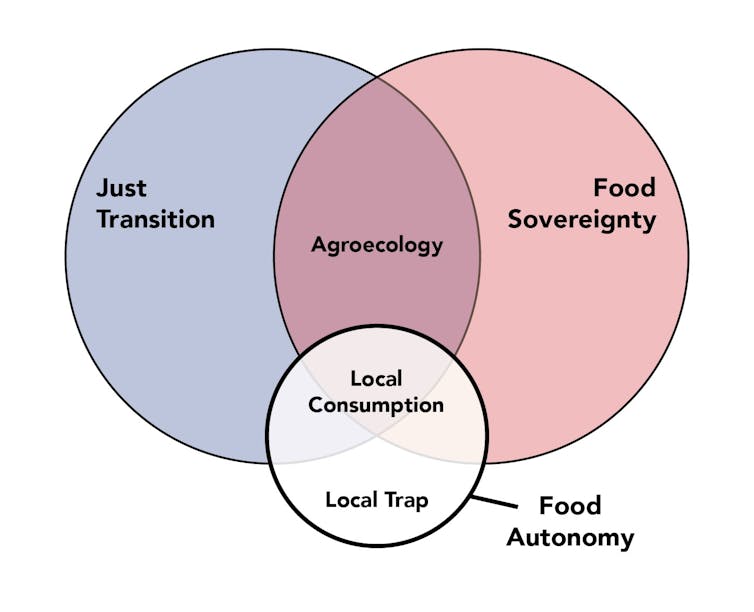
In sum, it is clear that food autonomy does not address all of these issues, which is why researchers refer to it as the “local trap” when it is promoted as a framework for action on its own. Local consumption alone does not address the majority of the more substantial problems that lie at the heart of our food system.


            Graphic showing the connections and distinctions between Food Autonomy, the Just Transition, Agroecology, and Food Sovereignty
Although local consumption is in line with food sovereignty, agroecology, and the just transition process, food autonomy alone inevitably leads to the ‘local trap,’ as it does not address the environmental and socio-economic issues that are inseparable from food systems. Graphic by Bryan Dale
           

Towards a just transition

The objective should not be simply to achieve food autonomy, but to undertake the process of a just transition towards a socially just and agroecological food system. This is an opportunity to actively rethink the current food model, which is currently designed to prevent such a transformation.  

It is important to note that this process must be structured in such a way that all agri-food stakeholders move towards a common goal: Environmentally friendly localized agriculture that produces healthy, accessible and inclusive food without compromise. In other words, a just transition is about inviting everyone to the table, from farmers to consumers, to think beyond established models and popular practices.  

To date, our research suggests that the development of an “infrastructure of the middle” would provide an effective physical and logistical structure for both smaller-scale farmers and consumers. Briefly, such infrastructure, both tangible and intangible (e.g., networks and resources) would allow for a sufficient mass of ecological farmers and other food producers and processors, on one hand and consumers, on the other, to overcome the difficulties of direct marketing as well as those associated with conventional supply chains.  

More specifically, the infrastructure of the middle would be adapted to local realities and can take the form of, for example, food hubs, community-based abattoirs or cooperative food markets.


A question of collective responsibility

Of course, it is possible to name such examples because they already exist. However, the current forms of product aggregation and co-operation between farms, organizations and consumers are marginal and need to be further supported. Our research has shown that such examples of infrastructure of the middle require a significantly increased contribution from outside the agricultural community.  

Currently, most alternative and collaborative marketing initiatives are carried out by third parties, often community-based food insecurity organizations and representatives from such organizations agree on an important fact: The development of an infrastructure of the middle requires substantial government support as well as deep public engagement. In other words, the establishment of new infrastructure and new initiatives in general must be taken up as part of the transition toward a more just and ecological food system.

Finally, the just transition as an action framework requires us to no longer ignore the blind spots of food autonomy that include the climate crisis, community well-being and social justice. Indeed, to engage with our food system is to realize that food is at the heart of our social fabric.

As homesteader, activist and author Dominic Lamontagne told us, “Since everyone benefits from the act of eating, everyone should be pitching in.”    

We all need a healthy and just food system. We all need to get involved in one way or another to shape not only the food system of the future, but healthy, resilient communities in which we will feel proud to be living.  

In fact, bringing about such changes is our collective responsibility.

Bryan Dale, Assistant Professor, Department of Environment and Geography, Bishop’s University; Marianne Granger, Auxiliaire de recherche en agriculture et systèmes alimentaires durables, Bishop’s University, and Mélodie Anderson, Auxiliaire de recherche en agriculture et systèmes alimentaires durables, Bishop’s University

This article is republished from The Conversation under a Creative Commons license. Read the original article.

“What a sad, muddled place this has become”: The madness of Twitter’s blue checkpocalypse

The Twitter accounts for Miss Piggy and Kermit the Frog have blue checks. Fellow Muppets ElmoCookie Monster and Big Bird do not.

Stephen King and LeBron James declared they wouldn’t pay for the blue check that comes with a Twitter Blue subscription, but Elon Musk gifted them with one anyway. Musk gave a gratis blue badge to Chrissy Teigen too, but she navigated her way out of it, only to have Twitter find her again and reassign it. 

It did the same to “Weird Twitter” notable @dril after he and other super-users mounted a campaign urging non-badged users – which currently refers to most who remain on the platform following the April 20 purge – to block accounts that have paid for Twitter Blue subscriptions.

But since Saturday, when reassigned/Elon-gifted blue checkmarks reappeared on many accounts with more than a million followers, differentiating between those paying $8 a month for Twitter Blue “verification” and those who didn’t is now a lot tougher.

Before the banishment of the legacy verification system, most users decided they wouldn’t be handing over $8 a month to a self-aggrandizing bigot.

Except, maybe, for the accounts associated with formerly “blue check official” and currently deceased stars Anthony Bourdain, Barbara Walters, Chadwick Boseman, Paul Walker and Kobe Bryant, among others. It is physically impossible for any of them to have subscribed to Twitter Blue since that would require having verified their phone number.

Unless Musk is beta testing some type of necromancy technology and got it to work – neither scenario is likely – that did not happen.

Before the banishment of the legacy verification system, most users decided they wouldn’t be handing over $8 a month to a self-aggrandizing bigot who took a platform that, despite its flaws, once served as a social hub and a connection to breaking news and innovative ideas, and turned it into a glitchy morass of terrible ads and unfettered trolls.

The billionaire also obviously underestimated the level of pushback he’d receive from stars who resent Twitter lying about their subscriber status. Currently, the boilerplate text describing the blue check reads, “This account is verified because they are subscribed to Twitter Blue and verified their phone number.”

“I did not pay for Twitter blue you f**king pig,” RuPaul’s Drag Race All Stars” winner Trixie Mattel tweeted on April 22.

“On my soul i didn’t pay for twitter blue, u will feel my wrath tesla man,” vowed Lil Nas X.

Others such as Neil Gaiman were more measured in expressing their dismay. “For the curious, I’m not subscribed to Twitter Blue,” he told his followers. “I haven’t given anyone my phone number. What a sad, muddled place this has become.”

Gaiman tweeted this after his response to Stephen King’s April 20 tweet in which he announced, “My Twitter account says I’ve subscribed to Twitter Blue. I haven’t. My Twitter account says I’ve given a phone number. I haven’t.”

“The Sandman” author replied to King’s tweet with, “Now we’re tickless! It’s sort of liberating,” only to have a “tick” appear next to his handle shortly afterward.

This development in the ongoing Twitter Blue debacle is the latest evidence of the ways Twitter continues to devolve. Someday this chapter may be viewed as fascinating for its obliviousness and, from a public relations standpoint, its recklessness.

Musk is trying the classic promotional strategy of giving free perks to rich people in exchange for their scintillating content.

The long-anticipated mass removal of blue checkmarks from legacy verified accounts arrived during a particularly unfortunate week for Musk and his companies. On April 19 Tesla’s subpar earnings report caused the stock to plummet. On the same day as the checkpocalyse, a SpaceX rocket exploded minutes after its launch.

Before these stumbles, Musk picked needless battles with public media, including NPR, PBS, the BBC and the Canadian Broadcasting Corporation, by slapping misleading labels on their Twitter accounts identifying them as “government-funded media.”

After NPR, PBS, and CBC suspended activity on their main Twitter accounts and affiliated ones, Twitter quietly removed those labels. As of Monday evening, none had resumed tweeting.

Associating celebrities with Twitter Blue subscriptions they didn’t pay for and may not want is quickly turning into another brand liability for the platform Musk reportedly plans to transform into an “everything” app.

Before Musk took over Twitter, its system of verifying accounts was aimed at protecting the integrity of the platform and its users. If an organization or an individual’s account had a blue checkmark, that meant they’d been vetted by Twitter’s staff, which confirmed that those accounts were being run by the entities they claimed to be.

This made it harder for trolls to spoof celebrity or organizational accounts or impersonate well-known users, including politicians, journalists, and other notable public figures, for malicious purposes.

It was also viewed as a status symbol, although if you ever had a blue check you know how little your life changed before and after its appearance and disappearance. Regardless, in November 2022 Musk deemed this old verification identifier to be the mark of a “lords & peasants system,” even though said system was enacted because actual “lords” complained about how easy it was for someone to impersonate them on the platform.

The manager of St. Louis Cardinals even sued Twitter in 2009 over that issue, leading them to introduce the account verification system.

Musk’s vow to democratize Twitter by offering verification to anyone willing to pay for a Twitter Blue subscription would rewind it back to that era, only now with the grand bonus of derision and blocking.

But Musk’s concept of what constitutes democracy is way off of what it is by definition, hence this classic “all animals are equal, but some animals are more equal than others” move.

Musk is trying the classic promotional strategy of giving free perks to rich people in exchange for their scintillating content. Similar to the way casinos offer access to V.I.P. tables if you purchase bottle service while actual V.I.P.s are ensconced in more exclusive areas without having to pay for that benefit, Musk may be under the misguided notion that providing free checkmark status to the famous will coax formerly verified commoners to pay for that once-sought-after sticker.

This fails to consider an important differentiator. Millions of people love Vegas or at the very least are willing to tolerate it, whereas the number of people who despise Musk with a white-hot passion is much larger than the cult that adores him.


Want a daily wrap-up of all the news and commentary Salon has to offer? Subscribe to our morning newsletter, Crash Course.


As for the “verified” dead, a few users have pointed out that some were badged anew without the consent of their estates or loved ones. “The privately-held Twitter corporation is claiming that @chadwickboseman and @normmacdonald, who died in 2020 and 2021 respectively, have paid for the subscription check mark service and supplied their phone numbers,” pointed out @southpaw on April 22. “I guess the Boseman Foundation which uses Chadwick’s account theoretically could’ve done it, but Norm’s account has been dormant since a few months before his passing.”

All of this shows how haphazardly these blue checkmarks have been distributed, along with the cattiness with which some of them have been applied. A few celebrities are elated to have their free verified status restored, such as Charlie Sheen.

Others like Teigen and @dril found themselves making an effort to outrun the platform’s attempt to cuff verification badges onto them despite their insistence that they didn’t want them.

Still others, along with legal experts, are wondering aloud whether Twitter’s false explanation about their subscriber status is illegal, citing statutes about false endorsement claims. But since many re-verified celebrities continue to use the platform without complaint, it may be difficult to make that case.

One famous user who had his verification status stripped was Pope Francis, who has since been assigned a gray check, distinguishing @Pontifex as “a government or multilateral organization account.” This may be one of the savvier moves Twitter has made of late. If there’s one influencer you don’t want to anger, it’s the man who millions believe has God’s ear. And this situation needs all the prayers it can get.

“Fox News has gone woke”: Knives out in TrumpWorld over Tucker Carlson’s ouster

Right-wingers on Monday lamented Tucker Carlson’s abrupt departure from Fox News — and some are calling to boycott the network entirely.

Former President Donald Trump said he was “shocked” during an interview with Newmax’s Greg Kelly immediately following the announcement.

“Well, I’m shocked. I’m surprised. He’s a very good person and a very good man, and very talented as you know. And he had very high ratings,” Trump said. “I don’t know if it was voluntary, or was it, somebody fired? But I think Tucker’s been terrific. He’s been – especially over the last year or so – he’s been terrific to me.”

“There’s a lot of turmoil over there, Fox,” Kelly said. “I mean, [$787.5 million] they just paid. Why would they get rid of a guy who’s performing – why would somebody do that to their business? Because they’re losing money right now. Their stock has gone down.”

Last month, a court filing as part of Dominion Voting Systems’ history-making defamation lawsuit against Fox News revealed texts showing that Carlson was looking forward to the end of Trump’s term in the days ahead of the Jan 6 Capitol riot.

“We are very, very close to being able to ignore Trump most nights. I truly can’t wait,” Carlson wrote to staffers. “I hate him passionately,” he added.

Former Fox News host Eric Bolling ripped into the conservative network for dropping Carlson, arguing on his Newsmax show that Fox was “moving to the center” and “casting a wider net” to “catch more fish,” including “liberals and leftists.” He added  that Newsmax would “remain steadfast and true to what Americans care about” and would “not waver.”

Bolling also argued that Carlson likely also held his view that Fox was falling “further and further away from the plot” and is “moving mainstream, CNN lite, as one of our Balance viewers called it.”

Bill O’Reilly, who lost his spot as a primetime host for Fox in 2017 over numerous sexual misconduct lawsuits, suggested that the ouster would result in declining ratings for the network.

“Tucker Carlson took over from me. For the first three years his ratings were soft. He lost about a million, maybe a little bit more of my audience, and then in 2020 he took a hard right turn,” O’Reilly said on radio station WABC on Monday. “Carlson basically programmed for a very hard right audience and his numbers came up.”

Other MAGA allies called out Fox over the ouster.

Eric Trump lamented that Fox had also cut ties with his wife and longtime pundit Dan Bongino.

“What is happening to Fox?” he questioned.

Speaking to conservative radio talk show host Charlie Kirk, Donald Trump Jr. said Carlson’s removal from the network  “changes things permanently,” as he was “an actual thought-leader in conservatism.”

“It’s mind-blowing,” Don Jr. added, claiming that Carlson as “a once-in-a-generation-type talent.”


Want a daily wrap-up of all the news and commentary Salon has to offer? Subscribe to our morning newsletter, Crash Course.


Conservative author and staunch Islamophobe Brigitte Gabriel accused Fox News of going “woke.”

“Fox News has gone woke. Now they must go broke,” she tweeted. 

Donald Trump spokesperson Liz Harrington wrote on Twitter that “Fox News is controlled opposition.”

Sen. J.D. Vance, R-Ohio, called Carlson the “most courageous person in America media,” while Florida GOP lawmaker Matt Gaetz posted a video thanking Carlson for his support.

Rep. Marjorie Taylor Greene, R-Ga., accused Fox of caving “to the woke mob.” 

“Americans no longer blindly watch the news like they did decades ago, they only watch the ones who have courage to tell the truth. Americans are about to quit watching,” she tweeted.

Newsmax CEO Chris Ruddy alleged that “For a while Fox News has been moving to become establishment media and Tucker Carlson’s removal is a big milestone in that effort.”

He added, “Millions of viewers who liked the old Fox News have made the switch to Newsmax and Tucker’s departure will only fuel that.”

Paul McCartney’s Wings album “Red Rose Speedway” is all the richer at 50 with a loving remaster

This past March, the Recording Industry Association of America (RIAA) announced that for the first time since 1987, vinyl outsold compact disc releases. In the U.S., some 41 million vinyl records were sold last year in comparison to 33 million CDs. It’s an incredible resurgence, fueled largely by an increase in younger demographics having discovered and fallen in love with the vinyl experience.

Released this month in celebration of Record Store Day, Paul McCartney and Wings‘ “Red Rose Speedway” offers a particular case in point. Recut at half-speed by Miles Showell at Abbey Road Studios, the album showcases why audiophiles adore vinyl so much. Thanks to numerous technological advances, this new 50th anniversary edition of “Red Rose Speedway” offers a vast improvement over previous editions, which felt muted and constrained —particularly in its compact-disc format. 

Originally released on April 30, 1973, “Red Rose Speedway” marked a key moment in Wings’ fledgling career. The band’s first album “Wild Life” had been lackluster by McCartney’s standards, exerting pressure on the group to deliver a bona fide hit. For Wings, the light at the end of the tunnel began to illuminate with “Hi, Hi, Hi,” which landed a hard-rocking autumn 1972 hit single. And things were about to get even better. Much better. 

McCartney had originally envisioned “Red Rose Speedway” to be a double-album that would highlight the band’s breadth, including vocals from Denny Laine and wife Linda. McCartney had amassed considerable material in the years since completing sessions associated with “Ram” (1971). But when it came to putting out a double-album, EMI wasn’t having it. Subsequent events would prove that the label was right, setting McCartney and Wings up for a renaissance of immense proportions with the streamlined, single-record version of “Red Rose Speedway.” 

The new half-speed remaster underscores the LP’s crisp dynamic range, overall warmth, and instrumental power and finesse. Take “Little Lamb Dragonfly,” the epic cut that closes the album’s first side. The song found its genesis at the McCartneys’ Scottish farm. “There was one lamb we were trying to save,” Paul recalled. “The young ones get out into the weather and collapse from exposure; you find them and bring them in. We stayed up all night and had him in front of the stove, but it was too late, and he just died. So I had the happy job of clearing it up. When they go dead, they kind of go like a stuffed toy . . . these little lambs. It was very early in the morning, and no one was up, and I had my guitar there, and I couldn’t really say much to this lamb. But I started, ‘I have no answer for you little lamb / I can help you out / but I cannot help you in.’ And it came from there. Just not being able to do anything about it was the idea of that song” (quoted from Allan Kozinn and Adrian Sinclair’s “The McCartney Legacy”).

The resulting song was a composition of breathtaking emotional depth. In Miles’ hands, the song enjoys an even richer sonic range. The same could be said for “My Love,” the chart-topping single that would pilot “Red Rose Speedway’s” course. The wistful romantic ballad was punctuated by a heartfelt guitar solo. McCartney had been ready to record it himself when Henry McCullough stepped up with an idea of his own. “He played the solo on ‘My Love,’ which came right out of the blue,” McCartney recalled in a 2010 interview. For McCullough, the “My Love” solo was “a stroke of luck, a gift from God really, and you get that in music.”


Want a daily wrap-up of all the news and commentary Salon has to offer? Subscribe to our morning newsletter, Crash Course.


Soaring on the wings of the “My Love” single, “Red Rose Speedway” scored a No. 1 hit. It’s difficult to imagine a higher-priced double-album accomplishing the same feat. That summer, the non-album single “Live and Let Die” also made its way to the upper echelons of the American charts. In Rolling Stone, Lenny Kaye wrote, “I find ‘Red Rose Speedway’ to be the most overall heartening product McCartney has given us since the demise of the Beatles. After much experimentation with how best to present himself, Paul has apparently begun a process of settling down, of working within a band framework that looks to remain stable for at least the next vehicular period.”

As he concluded his review, Kaye couldn’t help making a reference to “A Hard Day’s Night”: “As for the particulars of this latest album, suffice it to say that Paul’s grandfather would’ve liked it. It is, after all, very clean.” In its own way, the half-speed edition of “Red Rose Speedway” is not only very clean, but yields new sonic textures for a new generation of vinyl-loving listeners.

Ex-producer’s lawyer calls Carlson firing an “admission” of sexist bullying and “systemic lying”

Fox News announced on Monday the shocking departure of Tucker Carlson, its top-rated opinion host.

“Fox News Media and Tucker Carlson have agreed to part ways,” the network said in a press release statement. “We thank him for his service to the network as a host and prior to that as a contributor.” Carlson’s final show was this past Friday. 

Though Carlson’s leaving was undeniably abrupt, it may be a strategic legal move on behalf of the network. Sources told The Los Angeles Times that the move came from the top, with Fox Corp. Chairman Rupert Murdoch and other top executives — including his son Lachlan and Suzanne Scott, chief executive of Fox News Media — making the call to oust Carlson.

Carlson is facing a lawsuit from his former head of booking on “Tucker Carlson Tonight,” Abby Grossberg, who alleged that the network was rife with instances of a misogynistic workplace culture.

Grossberg’s complaint, filed in a New York federal court in March, claims that “Ms. Grossberg was isolated, overworked, undervalued, denied opportunities for promotion, and generally treated significantly worse than her male counterparts, even when those men were less qualified than her.”

When Grossberg began her tenure at Fox’s New York office last year, she found that the workspace was plastered with images of Rep. Nancy Pelosi, D-Calif., wearing a revealing bathing suit, the suit says.

The suit also claimed that Carlson and other members of his staff routinely exchanged vulgarities about women and Jewish people.  Ahead of an appearance on the show by Republican candidate for Michigan governor, Tudor Dixon, the staffers held a mock debate to determine whether they would prefer to have sex with Dixon or Gretchen Whitmer.


Want a daily wrap-up of all the news and commentary Salon has to offer? Subscribe to our morning newsletter, Crash Course.


Grossberg in her suit also claimed that Fox lawyers used a “coercive and intimidating manner” to persuade her to provide misleading information in Dominion Voting Systems’ defamation lawsuit against the network. She claimed that company attorneys tried to turn her and co-host Maria Bartiromo into the network’s scapegoats for repeatedly and knowingly spreading misinformation about election manipulation in 2020, according to The New York Times. 

Fox has disputed Grossberg’s claims.

“We will continue to vigorously defend Fox against Ms. Grossberg’s unmeritorious legal claims, which are riddled with false allegations against Fox and our employees,” a spokesperson said.

Tanvir Rahman, one of Grossberg’s attorneys, said in a Monday statement that Fox’s cutting ties with Carlson “is, in part, an admission of the systemic lying, bullying and conspiracy mongering claimed by our client.”

“This is a step towards accountability for the election lies and baseless conspiracy theories spread by Fox News, something I witnessed firsthand at the network, as well as for the abuse and harassment I endured while Head of Booking and Senior Producer for Tucker Carlson Tonight,” Grossberg said in a statement on Monday. “I think this is great for America! It’s a big win for viewers of cable news, not just those who watch Fox.”

“This is some justice for the American people and the Fox News viewers who’ve been manipulated and lied to for years,” she added, “all in an attempt to boost the channel’s ratings and revenue.”

Biden takes aim at “MAGA extremists” in official 2024 reelection bid announcement

President Joe Biden made his reelection campaign official Tuesday morning as he evoked the threat to foundational and hard-won rights and freedoms posed by the increasingly fascist Republican Party.

“Every generation has a moment where they have had to stand up for democracy. To stand up for their fundamental freedoms,” Biden declared in an early morning post to social media. “I believe this is ours.”

While Biden had long said he would seek another term, he states in his campaign’s kickoff video that the key to his run will be warding off any possible victory from the increasingly anti-democratic GOP, including his predecessor Donald Trump, the GOP’s leading contender, or other hopefuls like Nikki Haley, who launched her campaign in February, and Florida Governor Ron DeSantis, who is expected to throw his hat in the ring later this year.

Biden accused “MAGA extremists” around the country for their persistent assault against “bedrock freedoms” and liberal democracy while they also threaten cuts on Social Security, eviscerate reproductive choice and abortion care, ban books, attack the LGBTQI+ community, and actively work to make voting for Americans.

“When I ran for President four years ago, I said we were in the battle for the soul of America,” Biden says in the launch video. “And we still are.”

With the Republicans hungry to retake both Congress and the White House, Biden warns that now “is not time to be complacent” and that “this is our moment” to stand up to defend the nation and the values it claims to value.

Not wholly unchallenged on the Democratic side, Marianne Williamson and Robert F. Kennedy Jr. have launched presidential campaigns to offer an alternative to the incumbent. On the Republican side, Trump’s popularity—despite a recent criminal indictment and his role in triggering the January 6. insurrection effort on the U.S. government in 2021—remains the overall favorite to win the GOP nomination.

While the Democratic National Committee will clear a path for Biden, progressives disappointed in the president’s failures or shortcomings, including repeated failures to live up to his commitments on climate, say Biden cannot afford to ignore them if he hopes to beat Trump for a second time.

“If he wants to win,” said the youth-led Sunrise Movement on Tuesday, “he must energize the young voters who have been carrying the Democratic Party since 2018. He can’t take our generation for granted.”

In a statement, Sunrise’s executive director Varshini Prakash said: “Let’s be clear—President Biden ran and won in 2020 by mobilizing our generation on the promise of bold, Green New Deal-style climate plans, and it’s how Democrats won again in 2022 after passing the Inflation Reduction Act.”

“If President Biden is serious about defeating the fascists and right-wing nominee in 2024, he must run on a progressive platform and use the final year of this term to rack up more wins for our generation,” Prakash added. “The steps backward on policy that the administration has taken—especially on Willow and drilling projects—make our job of getting young people out to vote all the more difficult, and this is a fight we can’t afford to lose.”

According to Sean Eldridge, president and founder of the advocacy group Stand Up America, said Biden helped “save American democracy by defeating Donald Trump in 2020, and he did it again by opposing MAGA extremists in last year’s midterm elections.”

It’s very possible Biden could face off against Trump in the general election again, said Eldridge.

“The future of our democracy will once again be on the ballot in 2024,” he said. “As the Republican field is beginning to take shape, voters should be alarmed by the election deniers, January 6 enablers, and other anti-democratic politicians throwing their hats into the ring. Our community of nearly two million members is ready to mobilize in 2024 to support democracy defenders up and down the ballot.”

“Red-alert”: Legal experts say Georgia DA letter signals she’s likely getting ready to indict Trump

Fulton County, Ga. District Attorney Fani Willis said Monday that she is planning to announce any potential indictments in her probe of TrumpWorld attempts to overturn the state’s 2020 election over the summer.

Willis sent a letter to the county sheriff’s office warning of a need for “heightened security” ahead of the announcement over concerns of violence. The charges would be announced between July 11 and September 1, when the next grand jury meets, she said.

“In the near future, I will announce charging decisions resulting from the investigation my office has been conducting into possible criminal interference in the administration of Georgia’s 2020 General Election,” Willis wrote to Sheriff Patrick Labat. “I am providing this letter to bring to your attention the need for heightened security and preparedness in coming months due to this pending announcement.”

Willis warned that there could be violence in response to the announcement.

“Open-source intelligence has indicated the announcement of the decisions in this case may provoke a significant public reaction,” Willis wrote. “We have seen in recent years that some may go outside of public expressions of opinion that are protected by the First Amendment to engage in acts of violence that will endanger the safety of our community. As leaders, it is incumbent upon us to prepare.”

Willis said in January that charging decisions in the two-year probe would be “imminent” but her timetable has been delayed “in part because a number of witnesses have sought to cooperate as the investigation has neared an end,” according to The New York Times.

Willis launched the probe after the release of Trump’s call to Georgia Secretary of State Brad Raffensperger, asking him to “find” enough votes to overturn his loss. The probe has since expanded to other attempts by Trump’s allies to overturn his loss, including the fake elector plot.

A special grand jury that examined the evidence recommended charges against more than a dozen people, forewoman Emily Kohrs said in February. A regular grand jury will now examine the evidence.

Trump’s legal team filed a motion seeking to block any potential indictment, citing Kohrs’ media interviews.

“On behalf of President Trump, we filed a substantive legal challenge for which the DA’s Office has yet to respond,” Trump attorneys Drew Findling, Jennifer Little and Marissa Goldberg told the Atlanta Journal-Constitution, which first reported the letter. “We look forward to litigating that comprehensive motion which challenges the deeply flawed legal process and the ability of the conflicted DA’s Office to make any charging decisions at all.”

Legal experts say the letter suggests that Trump will be among those indicted.

“It obviously seems to imply the case against Trump will be presented to a grand jury,” former Republican Gwinnett County District Attorney Danny Porter told AJC. “I don’t think any of the other targets would raise that level of caution. I think that’s the obvious implication.”


Want a daily wrap-up of all the news and commentary Salon has to offer? Subscribe to our morning newsletter, Crash Course.


Norm Eisen, who served as a Democratic counsel in Trump’s first impeachment and authored a report on the Fulton probe, agreed that the letter is a signal that Willis is preparing to indict the former president.

“While she does not have the former president’s name in her letter, the evidence and the applicable law in Georgia point to the substantial likelihood that Donald Trump and his principal co-conspirators will be included when she follows through on the plans she confirms in this letter,” he told the outlet.

The delay comes amid reports that some of the alleged fake electors are “flipping on one another,” noted conservative anti-Trump attorney George Conway.

“That’s a big development. That’s something that’s worth her pursuing,” he told MSNBC.

Conway added on Twitter that if Willis is “putting out a red-alert all-hands-on-deck memo to law enforcement,” the top defendant is not going to be a Trump underling like former attorney Rudy Giuliani or former chief of staff Mark Meadows.

“The lead defendant will probably be someone else,” he wrote.

Former prosecutor Elie Honig, a CNN legal analyst, agreed that the letter is a “not-so-subtle indicator” that Willis has “every intention” to indict Trump but warned that the delay could damage the case.

“This should not have taken two and a half plus years. And now as a result of that, Donald Trump supporters are going to say, first of all, we didn’t see an indictment for two and a half years until after Donald Trump, A. announced candidacy and, B. is emerging as a frontrunner,” he said.

“They’re not going to get to a trial until the middle of 2024 at the earliest if we see a charge this summer,” he added. “There is discovery and appeals and motions, and is a state judge really going to hold a trial of a potential Republican frontrunner or nominee that close to an election? I’m not so sure. And I think Fani Willis bears responsibility for taking this long to do this.”

“He’s capable of anything”: Arrest and humiliation won’t stop Trump, says niece Mary Trump

Mary Trump, clinical psychologist, bestselling author and niece of Donald Trump, warned everyone about the threat her uncle posed to our republic well before his attempted coup and the Jan. 6 attack. She repeated those warnings this week on “Salon Talks,” while also criticizing Attorney General Merrick Garland for his failure to swiftly prosecute her uncle for his various alleged or likely crimes in connection with his efforts to overturn the 2020 election, as detailed in the House Jan. 6 committee’s final report. 

“Historians will look at Merrick Garland’s unwillingness to act in a timely fashion as a massive failure,” Mary Trump told me. If the former president is not ultimately held accountable by the Department of Justice, she added, “I think Merrick Garland will go down in history as the person who most failed America.”

Mary Trump, whose bestseller “Too Much and Never Enough” spilled many family secrets and made her uncle very unhappy, about her family, understands what Donald Trump is capable of, especially now that he has finally been charged with crimes. She warned that “as the stakes get higher for him, they get higher for us because … there is no bottom and there is nothing at which he will stop to get his way.” 

She’s especially worried because she believes Donald Trump will definitely be the 2024 Republican nominee, since he has given GOP voters and elected officials the “permission to be their worst selves.” As Mary stated when reflecting on the 2020 election, “I never thought that I would be saying three years later that this country is in worse shape now than it was then.” Nonetheless, that’s where she believes we find ourselves.  Watch the “Salon Talks” episode with Mary Trump here, or read our conversation below.

This conversation has been edited for clarity and length.

As someone who knew Donald Trump for years and interacted with him, what do you think his real reaction was to being indicted on 34 felony counts? How do you think he took that intellectually and emotionally, when he was alone in a room?

Badly. I think it’s something that, intellectually, Donald could never have possibly imagined. Why would he? Past is prologue. He’s never been held accountable for anything. He’s gotten away with so much wrongdoing and so much alleged criminality that there was literally no reason for him to think that anything would ever catch up with him. It’s been 76 years. 

I don’t understand why anybody for a second bought into his false bravado about how he would face the fact that he was suffering the deep humiliation of being arrested, being fingerprinted, and all those other things that happened. Being in a courtroom at the whim of a judge. Having absolutely no power or control over the situation you find yourself in. Having a door slammed in your face because, for the first time in your life, somebody didn’t hold the door for you. We can’t overstate how humiliating that situation was, and for Donald Trump, the absolute worst thing he can feel is humiliation. So it was a bad day for him and a good day for the rest of us.

We’ve talked about accountability for Donald Trump for years. What is your reaction?

A small step, but a step nonetheless.

We are two years and about three months since the Jan. 6 attack. What’s your reaction to the fact that it’s been this long? What’s the message sent by the Justice Department that they still have not charged Donald Trump, two years and three and a half months later? 

“Every day he is allowed to roam free, he gets more dangerous.”

It’s infuriating. It should worry all of us that the people in places of power who actually can do something about fixing this country and saving American democracy don’t seem to understand the threat facing us. No matter what happens — hopefully Jack Smith will get the evidence he needs to indict the right people and hopefully Merrick Garland will see the wisdom in letting that happen and allow things to play out — even if that happens, historians will look at Merrick Garland’s unwillingness to act in a timely fashion as a massive failure. If, however, we don’t succeed in holding those people accountable and we are not able to hang on to the American experiment, I think Merrick Garland will go down in history as the person who most failed America.

Do you think Garland‘s failure to charge Trump promptly has helped further normalize Trump’s actions?

It’s been quite the spectacle to see both Garland and the media do everything in their power to continue normalizing this man. Even when it became clear that to do so would be to endanger us further. There’s no explanation for what’s going on that I’m aware of that makes sense. Listen, he is not just running to be the Republican candidate for president. He is the Republican candidate for president. That’s insane. We have active seditionists continuing to serve in our government. That’s insane. If our system is incapable of protecting itself from those who seek to dismantle it, what’s the point of the system in the first place?

Trump is far and away the leader for the GOP nomination, but on some level doesn’t he perfectly sum up the Republican Party? A movement that’s embraced violence, white supremacy, cruelty, bigotry and hate, and now is trying to impose their religion as law. Even though Trump himself is not religious, he made this possible by appointing three Supreme Court justices who overturned Roe v. Wade and may well also throw out the abortion pill.

On religious grounds. You and I have been saying some version of this for a long time. Donald Trump didn’t change the Republican Party; he just revealed the Republican Party. The one unique thing he did was give them permission to be their worst selves. They’re not disappointing, are they? They have shown us exactly who they are and the lengths they will go to impose their Christian nationalism, their white supremacy and their tyranny of the minority, which is, again, why I’m still mystified that people in power, whether at the DOJ or in the Democratic Party, aren’t running around with their hair on fire.

Recently Congressman Jamaal Bowman was on CNN with Congressman Byron Donalds, who is a big-time Trump supporter. Donalds was talking about how he’s endorsing Trump and — on air, to his face — Bowman said, “You are endorsing an insurrectionist,” and he laid out the receipts. Why don’t we hear other Democrats doing that?

“For Donald Trump, the absolute worst thing he can feel is humiliation.”

Well, it’s a really good question. The other thing about Byron Donalds’ response is that at this point, he isn’t wrong. Because nobody who planned and incited the insurrection has been charged. So you can get away, at this point, with saying that Donald Trump is not an insurrectionist because he hasn’t been proven to be by the powers that be. So that’s disturbing enough and that adds to the normalization. Can Congressman Bowman give seminars to Democrats about how to handle this? I mean, these people are liars. They’re bullies and they’re anti-democratic, pro-autocratic fascists. Why is it so difficult to summon the courage to say that out loud in a way that is as blunt as Congressman Bowman? Again, it’s mystifying.

There’s a CBS poll from last year that found 51% of Republicans viewing Jan. 6 not as terrorism, but as an act of patriotism. That was up four points from six months before that. The trajectory is to further embrace Jan. 6. My frustration is, this is not about politics — it’s about keeping this democratic republic. Do you share the concern that this is an existential threat to democracy? 

It’s been an existential threat since 2016. I never thought, after the election was called for President Biden in November 2020, that I would be saying three years later that this country is in worse shape now than it was then. But, again, it’s down to the fact that Donald was allowed to run as a normal candidate in 2020 despite the fact that he’d been impeached twice and he had tanked the American economy. To that point, he was directly responsible for the deaths of over 250,000 Americans. OK so, I guess, what’s an insurrection? Why is that such a big deal? 

Here we are, and the danger increases because the longer these lies go unchallenged, the more it becomes part of their narrative. People start to believe the Big Lie. People start to believe that the insurrectionists were actually true patriots because Biden stole the election, and here we are. It’s not even mentioned when they’re talking about Donald and his style on the campaign trail. His crimes against this country, against the Constitution and against the American people aren’t even mentioned.

It seems as if some Democrats have just moved on as well, like, “Well, let’s talk about other issues.” 

“If he ever gets to the point where he feels like he’s going down, he will bring all of us down with him.”

It’s the same thing with COVID. Well, people are tired of it. Really? Maybe you’re not explaining it to them properly. Maybe there’s something missing in the narrative about these things. I think for Democrats to approach this politically and to deal with Republicans as if they’re honest brokers is a huge mistake. First of all, neither thing is true. This isn’t about politics. This is about the future of the country. Secondly, making common cause with Republicans at this point is to make common cause with fascists. You do not negotiate with hostage-takers, which is what they also are, if you think about with the debt ceiling insanity.

They are literally trying to impose a Christian nationalist minority rule on a country that rejects it. Vast majorities of American people reject most of the Republican Party’s agenda, but they don’t care because they’ve got gerrymandering, they’ve got the Electoral College and they’ve got the most corrupt Supreme Court, potentially ever, but certainly in modern history.

Clarence Thomas is redefining corruption. I mean it’s something we’ve never seen.

So is Chief Justice John Roberts, by refusing to do anything. A so is Dick Durbin [chair of the Senate Judiciary Committeee], who really needs to be replaced immediately along with … Well, let’s not go there. But Dick Durbin is not up to this task either.

If Donald Trump ends up getting charged in Fulton County and by the DOJ, he may understand that the only potential way to stay out of prison is to win the election in 2024. What do you think he’s capable of, and how dangerous has he become?

Every day he is allowed to roam free, he gets more dangerous. He gets more — not unhinged, I mean he’s never been hinged, but as the stakes get higher for him, they get higher for us. Because he will reveal to people who for some bizarre reason don’t believe it yet that he’s capable of anything, that there is no bottom and there is nothing at which he will stop either to get his way or, if he ever gets to the point where he feels like he’s going down, he will bring all of us down with him. There is no arguing that point. So in some ways it’s not just about the election or the future of democracy. It’s also about safety. Nobody’s safe as long as Donald has the power that he continues to be allowed to have because the Republican Party is afraid of his base.

Have you had conversation with friends who have begun exploring dual citizenship, if they’re eligible in other countries?

“These people who serve in our government hate our government. They care for nothing except raw power. … A lot of them are deeply stupid people.”

More of my friends are exploring that option than not, which should tell us something. Especially friends who are in communities that don’t have a lot of representation. My Jewish friends, my friends in the LGBTQ+ community, anybody who’s basically not a straight white Christian Republican at this point has every reason to be deeply concerned about what happens in 2024. I don’t think I would be able to stay here.

When you were writing your book, “Too Much and Never Enough: How My Family Created the World’s Most Dangerous Man,” did you think that this many years later we would still be talking about him? Did you think it could get this bad?

At first I didn’t, because I didn’t understand how far the Republican Party would be willing to go to accommodate Donald and then enable him. I still hung on to hope that if Biden won, there would be a shift. I thought, “Maybe I can write novels now.” Clearly this is not where we are.

You mentioned the debt ceiling.  Do you think that Republicans are going to hurt the economy on purpose so it damages Biden for 2024?

These people who serve in our government hate our government. They care for nothing except raw power. And in order to get power, they have to undermine the Democrats and President Biden at every single opportunity. A lot of them are deeply stupid people. They don’t understand that a constitutional republic is a form of democracy. I personally think that somebody representing this country should know what kind of government we have. They either don’t know or don’t care about the devastating consequences of defaulting on our debt. Even if it’s for five minutes, it has massive implications that are global. Again, I think most of them don’t know or don’t care. I think the only hope we have is we get a handful of somewhat sane Republicans in the House, to the extent that that’s even a thing anymore, who just are unwilling to go that far.

Jim Jordan is the chair of the House Judiciary Committee. He came here to New York to undermine the prosecution of Donald Trump. He was the most active member of Congress involved in Jan. 6. He has been called a significant player in the effort to overturn the election. Again, does this go back to DOJ and the fact that he’s emboldened by the fact that he’s not even rumored to be under investigation?


Want a daily wrap-up of all the news and commentary Salon has to offer? Subscribe to our morning newsletter, Crash Course.


Yeah. Honestly, I don’t know enough about how our government works to know what steps Democrats could have taken, but they at least should have been highlighting the issue and pointing it out at every turn. I think that’s one area where the Jan. 6 committee fell down, possibly because Liz Cheney and Adam Kinzinger didn’t allow certain avenues to be explored. I don’t know. But Republicans who actively participated in planning, inciting and carrying out the insurrection should have been name-checked every day from Jan. 7 on.

When I spoke to members of Congress, they would tell me the Democratic leadership had made a choice: “Let’s not focus on Jan. 6. Let’s focus on a vision forward on policy.” At the time we were in the midst of COVID, so it made sense. They were like, “Let’s deliver on COVID. America’s suffering. Americans are dying. DOJ will do whatever they’re going to do.” In retrospect, it was a horrific mistake. But at that time, when Joe Biden took office, thousands of people a day were dying. Unemployment was at around 7%. We were still struggling.

“I think for Democrats to approach this politically and to deal with Republicans as if they’re honest brokers is a huge mistake.”

Right. In January 2021, 5,000 Americans were dying every day, so it is understandable. If you think about what Biden inherited, it’s extraordinary what he’s been able to accomplish. That’s not an excuse, though, for Democrats in Congress not to see what their colleagues were up to. How long did it take for the Republicans in Congress who were as much victims as anybody else that day to turn around and start saying that either it was somebody else, like antifa or Black Lives Matter, who carried out the insurrection, or it was just a peaceful protest of regular tourists? That they let that slide may turn out to be one of the biggest mistakes ever made in American history.

Based on our knowledge of Republicans and Fox News and everything, if a Democratic president did exactly what Donald Trump had done and a Republican attorney general came into power weeks later, do you think two years and 100 days later, we’d be talking about, “How come those Republicans haven’t charged that former Democratic president yet?”

Dean, even if a Republican president picked a Democratic A.G., the Democratic president who had incited an insurrection would have been in prison within five minutes. It’s stunning. See, I’m speechless. I don’t even know what to say about it anymore because it’s not like any of it should have surprised us. Of course he was capable of that kind of thing. As soon as he realized that he was going to lose, a lot of us were saying, “It is going to get so much worse.” And it did. And everybody’s like, “Whoa, didn’t see that coming.” Why?

Which was bad enough, but then for the thing to have happened and to go unpunished, except for the people who actually participated that day, which by the way is great and they should be held accountable, but it’s not going to help us. It’s not going to help us if the real power players are still free either to incite another insurrection in the event Biden wins in 2024 or even more frightening, I think, just to make sure that Biden loses.

If somehow Donald Trump ends up not being around to run next year, what do you think of Ron DeSantis?  

“These people are liars. They’re bullies and they’re anti-democratic, pro-autocratic fascists.”

Yeah, look, poor little meatball, but he’s not somebody that we can dismiss entirely. I also want to say something really quickly. You and I didn’t even talk about the thousands of classified documents Donald stole. That’s another thing that is getting swept under the rug.

Ron DeSantis is an incredibly dangerous politician. He’s basically turning Florida into a closed fascist state. The only good news is that I don’t believe for a second that he could succeed nationally. I don’t want to leave anything to chance though. I think that if he announces a candidacy for 2024, he’s stupider than I thought. I mean, I hope he does, because it would basically destroy his political future, which is already in doubt, quite honestly. As long as Donald is leading and has the power, no Republican is safe running against him. I don’t know why anybody has enough hubris as to think they can escape the onslaught that Donald is going to unleash on them.

But we’ll see. I’m more worried that Florida is a test case for other states, and that DeSantis is drawing a roadmap for other states to follow. We might get to the point where there are so many Republican-led states who have supermajorities in the legislature that what happens nationally won’t really matter as much anymore.

Why did Fox News give Tucker Carlson the boot? The answer matters

So far, little is known about why, exactly, Tucker Carlson left his hosting gig at Fox News, except that the Monday morning announcement was startlingly abrupt. Not only was no mention made of it Friday, when Carlson hosted his last show at Fox, but the network was still promoting the scheduled guest line-up for this week’s “Tucker Carlson Tonight” right up until the news broke. Most commentators assumed the parting-of-ways is related to the recent settlement of $787 million that Fox News had to pay Dominion Voting Systems in a defamation case where damning texts from Carlson were a central factor. But, to be clear, there’s no confirmation of that, just speculation. 

Some theorized that Carlson was a sacrificial lamb to improve Fox’s leverage in a similar lawsuit filed by Smartmatic, which was also falsely accused by multiple Fox guests of stealing the 2020 election from Donald Trump. Some hypothesized that Carlson quit rather than be constrained by Fox lawyers from airing some of his more outlandish lies and bigoted fear-mongering. Some said it’s simply that Fox management is angry over private comments Carlson made that were revealed during the lawsuit. Some say it’s because he called Trump’s coup-era lawyer Sidney Powell the c-word. In the spirit of some of Carlson’s affection for conspiracy theories, I’m hoping to get a rumor started that President Joe Biden did this in order to shut down the boring cable news “debate” about whether he should run again. (Just kidding! Fox would never do what Biden wants them to do.)

Wanting to know why he’s gone isn’t just about the gossip. Carlson wasn’t just the highest-rated host at Fox, but the most aggressive about using his platform to mainstream some of the most odious conspiracy theories and white supremacist ideas pulled out of the fever swamps of right-wing social media. Why Carlson left could give us some serious insight into what he and the management at Fox both think the future of Republican propaganda is going to look like. 


Want more Amanda Marcotte on politics? Subscribe to her newsletter Standing Room Only.


Still, it’s important not to overrate what Carlson’s leaving means for Fox News. Fundamentally, nothing has really changed for the network. As we learned from the Dominion lawsuit, Fox’s profitability depends on pandering to a MAGA audience that’s drunk on the increasingly baroque conspiracy theories they pick up on social media. Carlson is an especially talented purveyor of disinformation, but his commitment to unadulterated nonsense is the norm on the network. With or without Carlson, Fox News will remain a fact-averse propaganda network for the far-right. 

Why Tucker Carlson left could give us some serious insight into what he and the management at Fox News both think the future of Republican propaganda is going to look like. 

Unfortunately, some people who really should know better got caught up in talking about Carlson’s departure like it could represent a meaningful shift in editorial strategy at Fox. CNN reporter Oliver Darcy, for instance, declared Monday morning that this is “huge in Republican politics as well as media, because Tucker Carlson exerted so much control and so much power and influence over the Republican Party base.” 

In reality, the opposite is true: The MAGA base controls Carlson.

If there was one big takeaway from the internal Fox communications that the Dominion lawsuit exposed to the world, it was that Carlson and all the leaders at Fox felt like they had no choice but to kowtow to an audience that demanded flattering lies, and who would stop watching altogether if Fox dared tell them the truth instead of regurgitate their favorite social media-based conspiracy theories. 

I have no doubt that Carlson was only too happy to air most of the grotesque lies and ugly bigotries he dredged up from the incels and white supremacists on social media who played the role of unofficial editorial directors. There was nothing fake about the glee in his eyes when Carlson would regurgitate the “great replacement” theory gathered from overt white nationalists, for instance, or when he claimed trans people were conspiring to murder Christians. The only honest facet of Carlson is how much of a straight-up fascist he is, and how excited he was to be the main validator and mainstreamer of the most repugnant ideas of the far-right. 


Want more Amanda Marcotte on politics? Subscribe to her newsletter Standing Room Only.


But the Dominion lawsuit showed clearly that Carlson is the handmaiden of the fascist movement, not its leader. Even when he had some concerns about the strategy of the larger movement, such as championing false claims about a “stolen” election, he would squelch those doubts and play the good soldier on air. Off-air, Carlson called Trump a “demonic force” and complained, “I hate him passionately.” But on-air, Carlson gave audiences exactly what they want: both of his lips firmly planted on Trump’s rumpled pants seat. 

With or without Carlson, Fox News will remain a fact-averse propaganda network for the far-right. 

Carlson’s fundamentally submissive pose wasn’t just about big ticket items like promoting the Big Lie. Watching “Tucker Carlson Tonight,” one occasionally sensed a weariness in Carlson about some of the stupider culture war flashpoints he pretended to care about. For instance, he broke character briefly during the recent faux outrage about “woke” M&Ms, sighing, “We’re gonna cover that, of course… Because that’s what we do.” I have little doubt that Carlson actually gives a single fig about whether or not cartoon candies wear sensible shoes or high heels. But the Fox business model depends on an endless stream of extremely silly grievance segments.

What MAGA wants, Fox News gives.

As Rep. James Comer, R-Ky, said when justifying his own devotion to conspiracy theories: “You know, the customer’s always right.”

None of those pressures have changed at Fox. As I wrote last week, even the terms of the settlement with Dominion show that Fox is sticking to the conspiracies-and-lies business model, which is likely why they were ready to pay out the nose rather than apologize. Carlson may be a sacrificial lamb to prop up the illusion that they’ve changed. Or maybe his ouster is about something else. Either way, the network won’t actually change. They’re already facing a bleak future, due to an aging audience, without younger people to replace them. They’re not going to run off the audience they still have by suddenly airing real news instead of a constant stream of bullshit. 

To be clear, Carlson isn’t just a cipher for the MAGA base. He does have real power — over the Republican party. As Darcy correctly pointed out on CNN, “You often saw lawmakers, like Ted Cruz, go on his show and grovel at his feet.” That’s because GOP politicians recognize that Carlson is channeling the darkest impulses of the MAGA base. In order to please those people, they needed to bow before an emissary of MAGA nation.  Carlson was happy to play that (extremely lucrative) role. 

So while Carlson may be out, the role he played in the MAGA ecosystem hasn’t changed. The redhats still demand that Fox News reflect their bitterness-driven political impulses. They still need the network to absorb the vile desires of the GOP base, put a shiny network gloss on them, and force Republican politicians to get on board. That’s still where the money is, and Fox is still a business. Other hosts are still doing variations on Carlson’s 8chan-to-cable schtick, even if they are slightly less skilled at it. They will continue to do so. It’s just a matter of time before someone fills Carlson’s place as the most famous face at a network that’s fully devoted to mainstreaming right-wing radicalism. (My money’s on Greg Gutfeld.)

@salonofficial Thanks for the memories, #TuckerCarlson ♬ original sound – Salon

Who is afraid of Ralph Yarl?

Negrophobia shortens the lives of Black people.

Sometimes this happens suddenly through interpersonal violence by the police, vigilantes, and others who feel empowered to take Black people’s lives with relative impunity. Most of the time, negrophobia kills en masse through “weathering” (or its related process “racial battle fatigue“), which is the emotional, physical, spiritual, and cognitive cost to Black people’s health and welfare that takes place over years and decades of living in a racist society. 

I know for a fact that I am being slowly killed by negrophobia.

America is sick with negrophobia; it’s one of the defining features of American society.

On the night of April 13, a 16-year-old Black boy named Ralph Yarl was nearly killed by an 84-year-old white man in Kansas City, MO. The shooter, Andrew Lester, appears to be possessed by negrophobia. Young Ralph made the innocent mistake of ringing Lester’s doorbell. He was looking for his two younger brothers. They were actually at another house several blocks away. Andrew Lester answered the door, came outside, and then shot Ralph Yarl several times with a pistol – including in his head. Yet Lester was not immediately arrested by the police. When he finally was, he was quickly allowed to return home.

Andrew Lester did not see another human being in need of help and deserving of respect. Instead, he, like so many other white people in American society, both past and present, saw a giant negro. To that point, Andrew Lester told police “He was scared to death” of Ralph Yarl because he was supposedly so big. The teen is five-foot-eight and weighs 140 pounds.

 Alternatively, perhaps Lester thought that Ralph Yarl had superpowers which is why he shot him while he was on the ground and bleeding out. If Lester actually believed that Ralph Yarl was superhuman, such a delusion would not be uncommon. Social psychologists have shown that a large percentage (if not majority) of white people – including doctors and other medical professionals – believe that Black people have a higher pain threshold than white people, and are faster, stronger, and may have other supernatural abilities.

There are multiple detailed third-person accounts and reports about what happened that horrible evening in Kansas City.

The Kansas City Star reports:

Andrew Lester believes that what he did to Ralph Yarl was reasonable:    

Lester told police during an interview that he had just lain down when he heard the doorbell ring. He picked up a revolver and opened the interior door. He saw a Black male pulling on the exterior door and said he thought someone was trying to break in. He fired two shots. No words were exchanged, according to Lester, who told police he was protecting himself and expressed concern for the victim. Ralph Yarl was shot and injured Thursday after going to the wrong house to pick up his siblings. Charges were filed against the shooter Monday. Police conducted an informal interview with Yarl at Children’s Mercy Hospital. The teen said he rang the doorbell, waited outside and did not pull on the door. A man opened the door holding a firearm. Yarl said he was immediately shot in the head and fell to the ground where he was shot a second time, this time in the right arm. Yarl told police the man said, “Don’t come around here.”

Klint Ludwig, who is Lester’s grandson, adds an additional layer of explanation for what happened that day: he told CNN that “The warning signs were there. I wasn’t shocked when I heard the news….I believe he held — holds — racist tendencies and beliefs.”

Ludwig explained that his grandfather was stoked by right-wing conspiracy theories and right-wing media that conditioned him with “fear and paranoia” and were “blaring in his living room.” He told CNN he was disturbed by racial comments made by his grandfather in the past, including about Black people. Ludwig concluded that “I think that stuff really kind of reinforces this negative view of minority groups.”

Ludwig continued, telling CNN that, “people get away with killing unarmed, innocent Black people….People need to speak out…not make any excuses for this kind of behavior and this violence.”

Lester’s ex-wife told Inside Edition that she does not believe he was fearful of the teenager he shot.

“That’s exactly why I wanted to talk to you,” Mary Clayton, who was married to Lester for 14 years, told Inside Edition. “I don’t want people feeling sorry for him.”

According to Clayton, Lester used violence against her during their marriage, and his father was convicted of murder. She said their three children remain estranged from Lester. 

“I think he should go to jail, I think he did it on purpose,” she said. “He knew what he was doing and he’s a danger. He could do it again.”


Want a daily wrap-up of all the news and commentary Salon has to offer? Subscribe to our morning newsletter, Crash Course.


As author and radio host Thom Hartmann sharply observed in a new essay, Fox News is like heroin to its public.

I would suggest another street drug: Fox “News” is like crack or meth mixed with some type of hallucinogen. Ultimately, the choice of narcotic does not matter because the result is the same: The “Fox “News” family” are hate addicts.

What does the victim Ralph Yarl have to say about his own experience? He has been grievously injured and traumatized. At some point perhaps he will speak to the public about what happened if he so chooses. Here is what Ralph Yarl’s uncle said on the GoFundMe page which was created to help with his nephew’s recovery and ongoing care:

Ralph is currently at home with the family. He can ambulate and communicate. A true miracle considering what he survived.

Each day is different. He has a long road ahead. However, we are very thankful that he is still here with us. I’ve been taking the time to read the emails and comments to Ralph. It warms our hearts to see him smile at all the kind words.

Thank you so much for loving Ralph

—————-

On Thursday, April 13, 2023, my nephew Ralph P Yarl was on his way to pick up his twin younger brothers from their friend’s house a few blocks away from his house. He didn’t have his phone. He mistakenly went to the wrong house, one block away from the house where his siblings were. He pulled into the driveway and rang the doorbell. The man in the home opened the door, looked my nephew in the eye, and shot him in the head. My nephew fell to the ground, and the man shot him again. Ralph was then able to get up and run to the neighbor’s house, looking for help.

Unfortunately, he had to run to 3 different homes before someone finally agreed to help him after he was told to lie on the ground with his hands up.

Ralph Paul Yarl is a fantastic kid, and I am not just saying this because he is my nephew. He truly is. At school, he is a member of the Technology Student Association and Science Olympia Team. Jazz and competition band. He is a section leader in the marching band; a scholar and one of the top bass clarinet players in Missouri. He recently earned Missouri All-State Band recognition with an honorable mention. He plays multiple instruments in the metropolitan youth orchestra. He is a 2022 Missouri scholar academy alumni. Ralph can often be found with a musical instrument. He loves them all.

Last summer, Ralph attended Missouri Scholar’s Academy, where he got a full college life experience. His goal is to attend Texas A&M to major in chemical Engineering. When asked how he plans to get into this university, he said, “Well, if they have a scholarship for music or academics, I know I can get it.”

Ralph’s teacher and friends describe him as “a kind soul,” “quiet,” “friendly,” “well-mannered,” “always willing to help,” “super smart,” and a “musical genius.”

Ralph was looking forward to graduating high school and finally getting the opportunity to visit West Africa before starting college.

Life looks a lot different right now. Even though he is doing well physically, he has a long road ahead mentally and emotionally. The trauma that he has to endure and survive is unimaginable. He is our miracle. We have heard these types of stories many times, and unfortunately, most Black boys are not alive to get another chance.

Ralph deserves to have the future that he has dreams about. He deserves to be the light that shows the world that LOVE wins and that humanity is still Good.

It is difficult to explain or otherwise convey the fear and anxiety you experience as a Black or brown person when you read such a statement. You know that such a horrible act of violence could befall you, your child, a friend, a neighbor or someone else you care about because they are Black or brown.

In an essay at the Atlantic, Imani Perry channels that collective dread:

We know that all the awareness and outrage in the world hasn’t changed things. Our need for action is a sorrowful distraction from the reality that even after the trial of the man charged in Ralph’s shooting has run its course (if there is one), this country will break our hearts again.

Nauseated, I think this: At least in Jim Crow–era sundown towns, there were ostensibly safe hours to be Black on the street. Now? Each day and every hour, we are balls bouncing along a roulette wheel. Remember back when we used to think we could offer protective advice to keep our children safe? Show your hands, no sudden movements, no running. We were so naive then, and hopeful.

I ask, how are the people in this nation so adjusted to Black folks suffering? And then I think: That, too, is naive. The Nashville school shooting just happened. Unquestionably, racism makes our experience as Black Americans more frightening, more dangerous. But they won’t even save their own children. All of our kids are coming of age in a society in crisis. And certain antisocial forces—the ones who make and sell and protect guns, the ones who reject knowledge, the ones who believe that their homes are castles but make terrible rules for other peoples’ bodies, the ones who believe that some of us are ordained to inferiority and vote that way—are trying their darndest to prevent all of our children from growing up and maturing into the kind of people who can make this democracy functional. And people keep putting them in power.

Thank God Ralph Yarl lives. I whispered it to myself as my own 16-year-old son drove us home from his school today.

I have no doubt that there are many millions of white people who reject anti-Black violence and the societal harms caused by negrophobia and white supremacy. We saw tens of millions of them march and protest in response to the killing of George Floyd by the Minneapolis police. The Black Freedom Struggle would not have had its many victories without white allies and white collaborators and other white people of conscience. Unfortunately, however, there are too few such people.  

Negrophobia and the harm it causes to Black and brown people will endure in American society so long as white people do not have real, meaningful, and equal human relationships across the color line.

Likewise, I have no doubt that there are many white journalists and other public voices who view negrophobia and other manifestations of white supremacy and racism as something wrong and unacceptable.

Here is the complication: social scientists have repeatedly documented how most white people in America do not have one Black (or other non-white) friend. By comparison, Black and brown people are much more likely to tell researchers that they have at least one white friend. This number increases among Black and brown strivers in the professional and managerial classes because they work in majority-white spaces.

A real friend does not include the Black person you only talk with at the water fountain at work or say hello to at the copy machine. In the age of virtual offices and workspaces, the Black person you only message or otherwise dialogue with on Slack is also not your friend.

A real friend is someone you talk about money with and your fears and anxieties about taking care of children or an aging parent or sick partner.

A real friend is someone you can tell that one of your greatest fears is being homeless if you lose your job and they respond by telling you, without pause, that won’t happen because you will always have a home with them.

A real friend is someone who goes with you to the funeral and sits with you during your moments of despair.

A real friend helps you take your sick pet to the veterinarian and offers to do whatever is necessary for your animal family member to get well. If your sick pet must cross the rainbow bridge a real friend will be with you and let you know that your animal friend is in a better place, and you did nothing wrong by freeing them of their suffering.

A real friend is someone who you call when you are on the way to the hospital or are lying in the hospital bed or waiting in the emergency room and you know their response will be What do you need? What can I do? or I will be there soon.

A real friend is someone who gives you money when they know you need it – and you don’t have to ask or embarrass yourself by asking.

A real friend is someone whose absence you feel acutely.

A real friend is someone you feel comfortable calling at any time of the day or night, and you know they will pick up the phone because it is you.

A real friend is also someone you feel comfortable with just being around and doing nothing. You can have real friends who you have never met in person and only know online. 

Real friendships are increasingly rare in American society (and Western societies more generally). Those types of relationships are even less common across the color line. This means that the Black people’s suffering is something mostly abstract even if such images are routinely shown by the mass media in what, too often, is a type of new age lynching photography.  

Absent real connections with Black people, the average white person in America can only understand the dread and existential terror of negrophobia through an act of radical empathy. Negrophobia and the harm it causes to Black and brown people will endure in American society so long as white people do not have real, meaningful, and equal human relationships across the color line. Even more importantly, negrophobia and white supremacy and the types of structures and institutions that enforce and spread it will endure as long as white people are collectively invested in protecting white privilege and other forms of unearned white advantages.

Ultimately, there will be many more Ralph Yarls because that is exactly how (White) America wants it.

For the first time, scientists detect seismic waves rippling through Mars’ core

From its signature red-colored soil to canyons, dead volcanoes and dry lake beds, the Martian landscape has intrigued humans for generations. Not only does it feature the largest mountain in our solar system and the deepest canyon, but evidence of past liquid water on the planet could indicate life once existed on this rocky world. What lies underneath Mars’ surface is equally fascinating — as Mars’ evolution by a planet is, like Earth, driven by the geologic behavior of what’s below. Hence, scientists have long wondered whether Mars has a core just like Earth’s, or something completely different.

The answer is getting much more clear thanks to new research that took advantage of seismic waves rippling through the Red Planet. The research, published in the Proceedings of the National Academy of Sciences on April 24, help confirm expert predictions of what Mars is like at its center. The result suggests Mars’ core is remarkably different from Earth. That could inform our ideas of what planets in other galaxies are like.

The data comes courtesy of the InSight mission, which stands for Interior Exploration using Seismic Investigations, Geodesy and Heat Transport. Launched five years ago, the mission dropped a seismometer, an instrument that can measure earthquakes and volcanic eruptions, onto Mars in late 2018. It somewhat resembles a hub cap that rests in the dirt.

While the mission technically ended last December, scientists are still interpreting the data from InSight — hence this new insight into the planet’s geology. The researchers analyzed readings from two different seismic events, marking the first direct observations ever made of another planet’s core. One temblor was caused by a marsquake — an earthquake on Mars, that is — while the other came from a large meteoroid impact. Both occurred on the opposite side of the planet from the InSight seismograph, which is useful for interpreting what exactly the energy waves were traveling through before it reached InSight.

“We needed both luck and skill to find, and then use, these quakes,” lead author Jessica Irving, an Earth scientist at the University of Bristol in the United Kingdom, said in a statement. “Farside quakes are intrinsically harder to detect because a great deal of energy is lost or diverted away as seismic waves travel through the planet.”


Want more health and science stories in your inbox? Subscribe to Salon’s weekly newsletter The Vulgar Scientist.


The results indicate Mars most likely has a completely liquid core. That would make it different from Earth, which has the combination of a liquid outer core and solid inner core. Additionally, based on how these seismic events rippled through the planet, it is possible to infer what this core is likely made of: carbon, sulfur, oxygen and hydrogen. But the bulk of it is liquid iron, which is similar to Earth’s core; however, on Mars, this isn’t enough for the planet to generate a strong magnetic field.

These geochemical analyses tell us a lot about how Mars formed and changed over time.

“You can think of it this way; the properties of a planet’s core can serve as a summary about how the planet formed and how it evolved dynamically over time. The end result of the formation and evolution processes can be either the generation or absence of life-sustaining conditions,” explained University of Maryland associate geology professor Nicholas Schmerr, another co-author of the paper. “The uniqueness of Earth’s core allows it to generate a magnetic field that protects us from solar winds, allowing us to keep water. Mars’ core does not generate this protective shield, and so the planet’s surface conditions are hostile to life.”

There is evidence that early Mars may have been a lot like Earth, with rivers and possibly even basic life. Planetary scientists believe that it turned into the barren world it is today for two reasons: first, that the planet periodically veered in its tilt compared to the sun, meaning that the seasons would be unpredictable or one side of the planet might never see light. And second, because of the decay of its strong magnetic field, which as Schmerr explained would mean the planet has less of a protective layer shielding it from solar winds.

Knowing the composition of the core also helps explains how the early solar system evolved, researchers say.

“Determining the amount of these elements in a planetary core is important for understanding the conditions in our solar system when planets were forming and how these conditions affected the planets that formed,” Doyeon Kim of ETH Zurich, one of the paper’s co-authors, added.

The lack of a magnetic field is one of many reasons that living on Mars would be extremely hostile for anything living, especially humans, if some of us were to ever migrate there. However, there is evidence in certain rocks that Mars once had a magnetic field, but it was lost over time. This increases the likelihood that life may have once existed on our neighboring planet, but if so, we still haven’t found direct evidence of this.

NASA has been trying to measure the seismic activity of Mars since the mid-’70s, with both the Viking 1 and Viking 2 landers. The first failed to work, and the second was muddied by conflicting data that may have been caused by the wind. Scientists have been waiting a long time to learn as much as we have about this planet’s interior, but it’s worth noting this is also just a model representing the best estimate of what’s really under the mantle on Mars. Deploying a multi-location network of seismometers (like we have on Earth) and other experimental data will be critical to fully unlocking the secrets of Mars’ inner workings.

Audio reveals top GOP lawyer’s 2024 strategy: Make it harder for college students to vote

A longtime Republican lawyer who aided former President Donald Trump’s effort to overturn the 2020 election told GOP donors that the party should be working to roll back voting on college campuses and other initiatives aimed at expanding ballot access, according to audio obtained by progressive journalist Lauren Windsor.

“What are these college campus locations?” Cleta Mitchell, a top GOP attorney and fundraiser asked during a presentation at the Republican National Committee’s donor retreat in Nashville last weekend.

“What is this young people effort that they do? They basically put the polling place next to the student dorm so they just have to roll out of bed, vote, and go back to bed,” lamented Mitchell, an avid voter suppression campaigner who has represented Republican organizations, individual lawmakers, and right-wing groups such as the National Rifle Association.

According to The Washington Post, which reviewed a copy of Mitchell’s Nashville presentation, the GOP attorney’s remarks “offered a window into a strategy that seems designed to reduce voter access and turnout among certain groups, including students and those who vote by mail, both of which tend to skew Democratic.”

“Mitchell focused on campus voting in five states — Arizona, Georgia, Nevada, Virginia, and Wisconsin — all of which are home to enormous public universities with large in-state student populations,” the Post reported Thursday. “Mitchell also targeted the preregistration of students, an apparent reference to the practice in some states of allowing 17-year-olds to register ahead of their 18th birthdays so they can vote as soon as they are eligible.”

Ben Wikler, the chair of the Wisconsin Democratic Party, noted in response to Mitchell’s presentation that “Wisconsin has 320,000 college students.”

“If the GOP had won the state Supreme Court race, they would’ve — as this speech makes clear — engineered a crackdown on student voter freedoms,” Wikler wrote on Twitter. “Instead, thanks in part to student turnout, democracy lives on in Wisconsin.”

“The Trump machine wants to disenfranchise students,” Wikler added. “We’re fighting them in WI. They’ve got their eye on our state, and NC and VA too.”

Republican lawmakers in dozens of states across the country have introduced at least 150 bills aimed at restricting ballot access this year, according to the Brennan Center for Justice.

“Two of the more radical proposals include a Texas bill that would allow presidential electors to disregard state election results and a Virginia bill that would empower a random selection of residents to void local election results,” the group observed.

In her speech to Republican donors, Mitchell said GOP lawmakers should be using their dominance in state legislatures to “combat” voting by college students and measures such as same-day voter registration.

Mitchell pointed specifically to North Carolina, where Republicans now have veto-proof majorities in both legislative chambers thanks to erstwhile Democratic state Rep. Tricia Cotham, who recently switched parties.

“Instead of fighting for the people or actually earning the votes, Republicans’ only plan is to try to ‘combat’ voting on college campuses and prevent students and young people from participating in our democracy,” Rep. Summer Lee, D-Pa., wrote Thursday. “They are SHAMELESSLY and DESPERATELY saying the quiet part out loud.”

The New York Times reported last month that Republicans, “alarmed over young people increasingly proving to be a force for Democrats at the ballot box,” have already been “trying to enact new obstacles to voting for college students” in recent weeks.

“In Idaho, Republicans used their power monopoly … to ban student ID cards as a form of voter identification,” the newspaper reported. “But so far this year, the new Idaho law is one of few successes for Republicans targeting young voters. Attempts to cordon off out-of-state students from voting in their campus towns or to roll back preregistration for teenagers have failed in New Hampshire and Virginia.”

“Even in Texas, where 2019 legislation shuttered early voting sites on many college campuses, a new proposal that would eliminate all college polling places seems to have an uncertain future,” the Times added.

The intensifying GOP campaign against youth voting comes after young people had a major impact on the 2022 midterms. As researchers noted in a recent analysis for the Brookings Institution, strong enthusiasm and turnout among young voters “enabled the Democrats to win almost every battleground statewide contest and increase their majority in the U.S. Senate.”

“To the GOP: I hope you’re afraid,” tweeted Olivia Julianna, director of politics and government affairs at Gen-Z for Change. “I hope you wake up every morning haunted by the chants of young voters protesting your attacks on our rights. You should be afraid. Because you’re going to lose power, one vote at a time.”

Texas Republicans pass bill to require Ten Commandments in every classroom

Republicans in the Texas state Senate have passed a bill that would require teachers to post the Ten Commandments in every public school classroom — a move that many legal experts have said is a blatant attack on constitutional standards on religious freedoms and protections.

Senate Bill 1515 would require all public elementary or secondary schools in the state to display “in a conspicuous place in each classroom of the school” a copy of the Ten Commandments — a set of rules that serves as the pillar of Christianity and Judaism.

The bill’s passage appears to be an attempt to instill Christian nationalist values in Texas schools. The bill’s author, Sen. Phil King, R, justified the passage of the bill by falsely claiming that such principles were espoused by the nation’s founders.

“[The bill] will remind students all across Texas of the importance of the fundamental foundation of America,” King said at a hearing on the bill earlier this month.

The bill now goes to the state House of Representatives for consideration. It’s unclear whether Republican Gov. Greg Abbott will sign it into law if it reaches his desk, though he has exhibited support for Christian nationalist viewpoints in the past.

Constitutional norms and precedents established by the Supreme Court in the 20th century have banned displays of religion in schools and other public settings, noting that they violate the First Amendment’s ban on governmental religious preference. But far right lawmakers — citing a recent ruling by the Court allowing a public school football coach to lead his players in prayer — are hopeful that the Court, which has taken a hard-right shift in recent years, will overturn those precedents.

Some Christian groups have spoken out against the bill. John Litzler, general counsel for the Texas Baptists Christian Life Commission, noted that the Ten Commandments contain themes that parents may not want their children exposed to, like adultery and “coveting” other people’s spouses.

“I should have the right to introduce my daughter to the concepts of adultery and coveting one’s spouse,” Litzler said. “It shouldn’t be one of the first things she learns to read in her kindergarten classroom.”

Other social media users opposed the legislation on the grounds that it clearly violates the separation between church and state, a standard that has existed (though it has not always been practiced) since the start of the U.S.

John Chawner, a computer programmer who lives in Texas, blasted the legislation on Twitter. “This is simply repulsive,” he said, adding that it will “easily be struck down as unconstitutional.”

“Shouldn’t parents teach their kids this stuff/convey their own beliefs, religious or otherwise, and not the state?” pop culture columnist Suzanne Halliburton said.

Author and political commentator Keith Boykin shared a 1980 Supreme Court ruling, “Stone v. Graham,” which forbade Kentucky lawmakers from imposing a similar requirement in schools.

“We conclude that Kentucky’s statute requiring the posting of the Ten Commandments in public school rooms has no secular legislative purpose, and is therefore unconstitutional,” Boykin wrote on Twitter.

In comments to “Truthout” via email, Steven Emmert, executive director of the Secular Coalition for America, said that the legislation was clearly unconstitutional.

“It is very unfortunate that many members of the Texas Legislature have never read the US Constitution, nor any history of our Founders’ beliefs in the separate roles for government and religion,” Emmert wrote. “This piece of legislation is in clear violation of the U.S. Supreme Court’s ruling in “Stone v. Graham.” This requirement, the Court ruled, violates the establishment clause of the First Amendment.”

“Religion should play no role in our public education,” Emmert concluded.

“Paging the FTC”: Experts warn Musk’s misleading celebrity Twitter blue checks are violation

Experts warned Sunday that the practice of Twitter adding official blue check marks to high-profile users on the social media platform without their consent could be a violation of FTC guidelines meant to prevent fraud.

The mysterious application of the blue checks — indicating that people had voluntarily paid to be members of the new Twitter Blue premium plan controversially launched by billionaire owner Elon Musk — was a source of endless online conversation over the weekend after living celebrities like basketball star LeBron James and novelist Stephen King as well as deceased people like food writer Anthony Bourdain and slain journalist Jamal Khashoggi had the checks applied to their accounts.

On Friday, Musk confirmed he was paying “personally” to keep the checks on at least some of these accounts.

The so-called “purge” began last week, when many institutions, organizations, and individuals discovered that the traditional “blue check” verifications they’d enjoyed for years — which indicated they were who they said they were and came at no cost — disappeared. (Full disclosure: Common Dreams, a nonprofit and independent news outlet, was stripped of its blue check verification last week.)

Over the weekend, others who said they did not sign up for the new Twitter Blue program started noticing new checks appearing on their accounts without warning.

According to Timothy Karr, senior director of strategy and communications for the media advocacy group Free Press, what Musk is doing with the blue checks is a violation of rules set up by the Federal Trade Commission (FTC).

“Musk has ‘gifted’ checks to celebrity Twitter accounts and other influencers without first seeking permission,” said Karr. But because the blue checks “act like endorsements of Twitter Blue,” the new paid program that charges $8 for premium access and status on the platform, this is where the violation comes in.

“False endorsements violate FTC rules, legally exposing Musk,” argued Karr.

Alejandra Caraballo, a clinical instructor at Harvard Law School’s Cyberlaw Clinic, backed up this legal assessment.

“Considering that the blue check states that someone is subscribed to and paying for a product, falsely adding that to large accounts may constitute a deceptive trade practice,” said Caraballo in an online post. “Paging the FTC.”

Unverified reports indicate that voluntary and paid signups for Twitter Blue have been meager, with estimates in the low double-digits or maybe several hundred. Either way, a far-cry from what would be needed to generate any meaningful profit from the program, which Musk indicated was the goal.

Writing for “Mashable” on Saturday, Chance Townsend detailed the mess of the whole episode:

“Musk appears to have mistaken the past prestige associated with ID verification for something that can be commodified. But it now looks like that bubble has burst. With legacy accounts having had their checkmarks removed, and the platform’s only ID verification system now saddled with stigma, the platform is facing a bad impersonation problem — a complication that spurred major advertisers to back out of Twitter in previous months.”

Meanwhile, with others online citing Section 43(a) of the Lanham Act, which covers rules about trademark and false endorsements, Caraballo argued that Stephen King or others who were “gifted” the check marks could bring legal challenges to Musk under the statute.

“Anyone given this without their approval could have grounds to bring a false endorsement claim,” she said. “That would be separate from a FTC investigation over deceptive trade practices.”

Earlier this month, one of Twitter’s top lawyers, Christian Dowell, who had been directly involved with the company’s ongoing discussions with the FTC over privacy and data issues, resigned.

In his Sunday thread on Twitter, Karr mentioned Dowell’s departure and then remarked, “Seems Musk never hired someone to fill that position.”

Lose weight, gain huge debt: NY provider has sued more than 300 patients who had bariatric surgery

Seven months after Lahavah Wallace’s weight loss operation, a New York bariatric surgery practice sued her, accusing her of “intentionally” failing to pay nearly $18,000 of her bill.

Long Island Minimally Invasive Surgery, which does business as the New York Bariatric Group, went on to accuse Wallace of “embezzlement,” alleging she kept insurance payments that should have been turned over to the practice.

Wallace denies the allegations, which the bariatric practice has leveled against patients in hundreds of debt-collection lawsuits filed over the past four years, court records in New York state show.

In about 60 cases, the lawsuits demanded $100,000 or more from patients. Some patients were found liable for tens of thousands of dollars in interest charges or wound up shackled with debt that could take a decade or more to shake. Others are facing the likely prospect of six-figure financial penalties, court records show.

Backed by a major private equity firm, the bariatric practice spends millions each year on advertisements featuring patients who have dropped 100 pounds or more after bariatric procedures, sometimes having had a portion of their stomachs removed. The ads have run on TV, online, and on New York City subway posters.

The online ads, often showcasing the slogan “Stop obesity for life,” appealed to Wallace, who lives in Brooklyn and works as a legal assistant for the state of New York. She said she turned over checks from her insurer to the bariatric group and was stunned when the medical practice hauled her into court citing an “out-of-network payment agreement” she had signed before her surgery.

“I really didn’t know what I was signing,” Wallace told KFF Health News. “I didn’t pay enough attention.”

Dr. Shawn Garber, a bariatric surgeon who founded the practice in 2000 on Long Island and serves as its CEO, said that “prior to rendering services” his office staff advises patients of the costs and their responsibility to pay the bill.

The bariatric group has cited these out-of-network payment agreements in at least 300 lawsuits filed against patients from January 2019 through 2022 demanding nearly $19 million to cover medical bills, interest charges, and attorney’s fees, a KFF Health News review of New York state court records found.

Danny De Voe, a partner at Sahn Ward Braff Koblenz law firm in Uniondale, New York, who filed many of those suits, declined to comment, citing attorney-client privilege.

In most cases, the medical practice had agreed to accept an insurance company’s out-of-network rate as full payment for its services — with caveats, according to court filings.

In the agreements they signed, patients promised to pay any coinsurance, meeting any deductible, and pass on to the medical practice any reimbursement checks they received from their health plans within seven days.

Patients who fail to do so “will be held responsible for the full amount charged for your surgery, plus the cost of legal fees,” the agreement states.

That “full amount” can be thousands of dollars higher than what insurers would likely pay, KFF Health News found — while legal fees and other costs can layer on thousands more.

Elisabeth Benjamin, a lawyer with the Community Service Society of New York, said conflicts can arise when insurers send checks to pay for out-of-network medical services to patients rather than reimbursing a medical provider directly.

“We would prefer to see regulators step in and stop that practice,” she said, adding it “causes tension between providers and patients.”

That’s certainly true for Wallace. The surgery practice sued her last August demanding $17,981 in fees it said remained unpaid after her January 2022 laparoscopic sleeve gastrectomy, an operation in which much of the stomach is removed to assist weight loss.

The lawsuit also tacked on a demand for $5,993 in attorney’s fees, court records show.

The suit alleges Wallace signed the contract even though she “had no intention” of paying her bills. The complaint goes on to accuse her of “committing embezzlement” by “willfully, intentionally, deliberately and maliciously” depositing checks from her health plan into her personal account.

The suit doesn’t include details to substantiate these claims, and Wallace said in her court response they are not true. Wallace said she turned over checks for the charges.

“They billed the insurance for everything they possibly could,” Wallace said.

In September, Wallace filed for bankruptcy, hoping to discharge the bariatric care debt along with about $4,700 in unrelated credit card charges.

The medical practice fired back in November by filing an “adversary complaint” in her Brooklyn bankruptcy court proceeding that argues her medical debt should not be forgiven because Wallace committed fraud.

The adversary complaint, which is pending in the bankruptcy case, accuses Wallace of “fraudulently” inducing the surgery center to perform “elective medical procedures” without requiring payment upfront.

Both the harsh wording and claims of wrongdoing have infuriated Wallace and her attorney, Jacob Silver, of Brooklyn.

Silver wants the medical practice to turn over records of the payments received from Wallace. “There is no fraud here,” he said. “This is frivolous. We are taking a no-settlement position.”

Gaining Debt

Few patients sued by the bariatric practice mount a defense in court and those who do fight often lose, court records show.

The medical practice won default judgments totaling nearly $6 million in about 90 of the 300 cases in the sample reviewed by KFF Health News. Default judgments are entered when the defendant fails to respond.

Many cases either are pending, or it is not clear from court filings how they were resolved.

Some patients tried to argue that the fees were too high or that they didn’t understand going in how much they could owe. One woman, trying to push back against a demand for more than $100,000, said in a legal filing that she “was given numerous papers to sign without anyone of the staff members explaining to me what it actually meant.” Another patient, who was sued for more than $40,000, wrote: “I don’t have the means to pay this bill.”

Among the cases described in court records:

  • A Westchester County, New York, woman was sued for $102,556 and settled for $72,000 in May 2021. She agreed to pay $7,500 upon signing the settlement and $500 a month from September 2021 through May 2032.
  • A Peekskill, New York, woman in a December 2019 judgment was held liable for $384,092, which included $94,047 in interest.
  • A Newburgh, New York, man was sued in 2021 for $252,309 in medical bills, 12% interest, and $84,103 in attorneys’ fees. The case is pending.

Robert Cohen, a longtime attorney for the bariatric practice, testified in a November 2021 hearing that the lawyers take “a contingency fee of one-third of our recovery” in these cases. In that case, Cohen had requested $13,578 based on his contingency fee arrangement. He testified that he spent 7.3 hours on the case and that his customary billing rate was $475 per hour, which came to $3,467.50. The judge awarded the lower amount, according to a transcript of the hearing.

Dr. Teresa LaMasters, president of the American Society for Metabolic and Bariatric Surgery, said suing patients for large sums “is not a common practice” among bariatric surgeons.

“This is not what the vast majority in the field would espouse,” she said.

But Garber, the NYBG’s chief executive, suggested patients deserve blame.

“These lawsuits stem from these patients stealing the insurance money rather than forwarding it onto NYBG as they are morally and contractually obligated to do,” Garber wrote in an email to KFF Health News.

Garber added: “The issue is not with what we bill, but rather with the fact that the insurance companies refuse to send payment directly to us.”

‘A Kooky System’

Defense attorneys argue that many patients don’t fully comprehend the perils of failing to pay on time — for whatever reason.

In a few cases, patients admitted pocketing checks they were obligated to turn over to the medical practice. But for the most part, court records don’t specify how many such checks were issued and for what amounts — or whether the patient improperly cashed them.

“It’s a kooky system,” said Paul Brite, an attorney who has faced off against the bariatric practice in court.

“You sign these documents that could cost you tons of money. It shouldn’t be that way,” he said. “This can ruin their financial life.”

New York lawmakers have acted to limit the damage from medical debt, including “surprise bills.”

In November, Democratic Gov. Kathy Hochul signed legislation that prohibits health care providers from slapping liens on a primary residence or garnishing wages.

But contracts with onerous repayment terms represent an “evolving area of law” and an alarming “new twist” on concerns over medical debt, said Benjamin, the community service society lawyer.

She said contract “accelerator clauses” that trigger severe penalties if patients miss payments should not be permitted for medical debt.

“If you default, the full amount is due,” she said. “This is really a bummer.”

‘Fair Market Value’

The debt collection lawsuits argue that weight loss patients had agreed to pay “fair market value” for services — and the doctors are only trying to secure money they are due.

But some prices far exceed typical insurance payments for obesity treatments across the country, according to a medical billing data registry. Surgeons performed about 200,000 bariatric operations in 2020, according to the bariatric surgery society.

Wallace, the Brooklyn legal assistant, was billed $60,500 for her lap sleeve gastrectomy, though how much her insurance actually paid remains to be hashed out in court.

Michael Arrigo, a California medical billing expert at No World Borders, called the prices “outrageous” and “unreasonable and, in fact, likely unconscionable.”

“I disagree that these are fair market charges,” he said.

LaMasters, the bariatric society president, called the gastrectomy price billed to Wallace “really expensive” and “a severe outlier.” While charges vary by region, she quoted a typical price of around $22,000.

Garber said NYBG “bills at usual and customary rates” determined by Fair Health, a New York City-based repository of insurance claims data. Fair Health “sets these rates based upon the acceptable price for our geographic location,” he said.

But Rachel Kent, Fair Health’s senior director of marketing, told KFF Health News that the group “does not set rates, nor determine or take any position on what constitutes ‘usual and customary rates.'” Instead, it reports the prices providers are charging in a given area.

Overall, Fair Health data shows huge price variations even in adjacent ZIP codes in the metro area. In Long Island’s Roslyn Heights neighborhood, where NYBG is based, Fair Health lists the out-of-network price charged by providers in the area as $60,500, the figure Wallace was billed.

But in several other New York City-area ZIP codes the price charged for the gastrectomy procedure hovers around $20,000, according to the databank. The price in Manhattan is $17,500, for instance, according to Fair Health.

Nationwide, the average cost in 2021 for bariatric surgery done in a hospital was $32,868, according to a KFF analysis of health insurance claims.

Private Equity Arrives

Garber said in a court affidavit in May 2022 that he founded the bariatric practice “with a singular focus: providing safe, effective care to patients suffering from obesity and its resulting complications.”

Under his leadership, the practice has “developed into New York’s elite institution for obesity treatment,” Garber said. He said the group’s surgeons are “highly sought after to train other bariatric surgeons throughout the country and are active in the development of new, cutting-edge bariatric surgery techniques.”

In 2017, Garber and his partners agreed on a business plan to help spur growth and “attract private equity investment,” according to the affidavit.

They formed a separate company to handle the bariatric practice’s business side. Known as management services organizations, or MSOs, such companies provide a way for private equity investors to circumvent laws in some states that prohibit non-physicians from owning a stake in a medical practice.

In August 2019, the private equity firm Sentinel Capital Partners bought 65% of the MSO for $156.5 million, according to Garber’s affidavit. The management company is now known as New You Bariatric Group. The private equity firm did not respond to requests for comment.

Garber, in a September 2021 American Society for Metabolic and Bariatric Surgery webinar viewable online, said the weight loss practice spends $6 million a year on media and marketing directly to patients — and is on a roll. Nationally, bariatric surgery is growing 6% annually, he said. NYBG boasts two dozen offices in the tri-state area of New York, New Jersey, and Connecticut and is poised to expand into more states.

“Since private equity, we’ve been growing at 30% to 40% year over year,” Garber said.


KFF Health News is a national newsroom that produces in-depth journalism about health issues and is one of the core operating programs at KFF—an independent source of health policy research, polling, and journalism. Learn more about KFF.

Subscribe to KFF Health News’ free Morning Briefing.

What is the FAA’s NOTAM? An aviation expert explains how the critical safety system works

Late in the evening of Jan. 10, 2023, an important digital system known as NOTAM run by the Federal Aviation Administration went offline. The FAA was able to continue getting necessary information to pilots overnight using a phone-based backup, but the stopgap couldn’t keep up with the morning rush of flights, and on Jan. 11, 2022, the FAA grounded all commercial flights in the U.S. In total, nearly 7,000 flights were canceled. Brian Strzempkowksi is the interim director of the Center for Aviation Studies at The Ohio State University and a commercial pilot, flight instructor and dispatcher. He explains what the NOTAM system is and why planes can’t fly if the system goes down.

What is NOTAM?

Aviation is full of acronyms, and Notice to Air Missions, or NOTAM, is one acronym that pilots learn early on in their training. A NOTAM is quite simply a message that is disseminated to flight crews of every aircraft in the U.S.

The NOTAM system is a computer network run by the Federal Aviation Administration that provides real-time updates to crews about situations relating to weather, infrastructure, ground conditions or anything else that may affect the safety of flight. Trained professionals – like air traffic controllers, airport managers, airport operations personnel and FAA personnel in charge of national airspace infrastructure – can access the system and enter any information they need to share broadly.

Pilots, air traffic controllers and anyone else who needs to know about flying conditions can access the NOTAM system and make appropriate changes to planned flights. It’s similar to checking the traffic on your phone or on the local news before you head to work in the morning. A traffic report will inform you of potential hazards or backups on the roadways that may lead you take a different route to work.

What’s in the NOTAM system and how is it used?

NOTAMs are issued for a wide range of reasons. Some of the notices are good to know but don’t affect a flight – such as personnel mowing grass alongside a runway or a crane working on a building next to the airport. Others are more critical, such as a runway being closed because of snow, ice or damage, forcing a plane to take off or land on a different runway. Changes in access to airspace are also logged with a NOTAM. For example, airspace is always closed above the president and when he or she travels; a NOTAM will alert pilots to changes in airspace closures.

Pilots review these NOTAMs during their preflight briefings. Generally this is done digitally using a computer, but pilots and air traffic controllers can also access the system by calling flight service briefers, who can share live weather and NOTAM information. Airline pilots also rely on their dispatchers to relay any relevant NOTAMs not only before but also during the flight.

The NOTAMs themselves use a lot of abbreviations and are often cryptic to nonaviation folks, but a small amount of text can carry a lot of information. Hundreds of different acronyms can convey a range of information, from taxiway closures to certain types of airport lighting being out of service to a notice that some pavement markings may be obscured.

But not all NOTAMs are straightforward. I remember once seeing a notice from an airport alerting pilots that a fire department was conducting a controlled burn of a house nearby.

Why can’t you fly if the NOTAM system is down?

The Federal Aviation Authority requires flight crews to review NOTAMs before every flight for safety reasons. Without access to this information, a plane cannot legally depart, because there may be an unknown hazard ahead.

As an example, a pilot departing Seattle to fly to Miami would need to know that the Miami airport is open, that the runways are clear and that all the navigational sources – like GPS signals and ground-based navigation antennas – that a pilot may use while in the air are working. Theoretically, they could call the Miami airport and ask, and then call the person who oversees every navigational aid on their route, but that would take a lot of time. A much more efficient way to gather this information before and during a flight is to use the NOTAM system.

At the end of the day, the NOTAM system is about safety. When the system is down, pilots can’t fly as safely. It is for good reason that planes don’t go anywhere unless the NOTAM system is up and running.The Conversation


Brian Strzempkowski, Interim Director, Center for Aviation Studies, The Ohio State University

This article is republished from The Conversation under a Creative Commons license. Read the original article.

“Goodbye!”: “The View” hosts cheer Tucker Carlson’s exit from Fox News by singing and doing the wave

The internet was abuzz on Monday with reactions from media personalities and political pundits after Fox News announced it would be parting ways with right-wing host Tucker Carlson.

“Fox News Media and Tucker Carlson have agreed to part ways,” the network said in a press release. “We thank him for his service to the network as a host and prior to that as a contributor.”

On “The View,” moderator Whoopi Goldberg read the news to the talk show’s live studio audience to a swell of applause — then led the guests in the wave along with her fellow hosts.

The celebrations didn’t end there.

Co-host Ana Navarro led the audience in a chorus of Steam’s 1969 “Na Na Hey Hey Kiss Him Goodbye.”

“He’s been the biggest purveyor of pro-Russian talking points,” said conservative co-host Alyssa Farah Griffin, “so it’s a good day for the Ukrainian people.”

Co-host Sunny Hostin punctuated the segment with a final note: “Karma doesn’t lose anyone’s address.”

Fox News said that “Tucker Carlson Tonight” would immediately be rebranded as “Fox News Tonight,” anchored by a rotating roster of interim hosts.

While the internet is already rife with speculation about the reasons for Carlson’s departure and his possible future plans, Carlson has so far made no comment.

You can watch the video below via Twitter:

“The evidence will be brutal”: Expert says Trump lawyer “getting totally outmaneuvered” in court

Former President Donald Trump’s legal team is trying — again — to nix the testimony of a woman who accused him of forcibly kissing her in his upcoming rape and defamation trial.

Judge Lewis Kaplan, who is overseeing E. Jean Carroll’s civil lawsuit against Trump, recently denied the former president’s request to block the testimony after Trump lawyer Joe Tacopina asked him to revisit whether Trump’s alleged forced kissing of Natasha Stoynoff after pushing her against a wall is enough to warrant her testimony.

She is one of several women who accused Trump of either forcibly kissing or physically assaulting her.

“You will recall that Ms Stoynoff testified in her deposition that Defendant escorted her into a room, and then grabbed her shoulders and pushed her against a wall and started kissing her. Then someone allegedly came into the room and the incident ceased. Defendant’s motion in limine sought to exclude this testimony under Federal Rule of Evidence 413(d). Your Honor denied our Motion; however, we request clarification with a proposed solution,” Tacopina wrote in the motion.

Carroll accused Trump of sexually assaulting her in the dressing room of Bergdorf Goodman in the mid-1990s. Trump, who has repeatedly denied Carroll’s allegation, has said that the writer was “totally lying.”

Carroll sued him for defamation in 2019 and later added a charge of battery under a recently adopted New York law that provides adult sexual assault victims the opportunity to file civil lawsuits, even if the statutes of limitations have long expired.

While Kaplan already dismissed Trump’s claim, Trump’s team sent another letter asking for “clarification” of the court’s decision. Despite the earlier rejection, the former president may be seeking a ruling to narrow the topics about which she may testify or to persuade the judge to reconsider his prior ruling, said former U.S. Attorney Barb McQuade, a law professor at the University of Michigan. 

“These kinds of motions are fairly typical just before trial starts,” McQuade told Salon. “They are called motions in limine, which means ‘at the threshold’. Such motions see clarity to make sure that everyone is on the same page before the trial starts.”

Carroll’s lawyers said that there is nothing that needs to be clarified.

“There is a reason why Trump does not style his request as one for reconsideration: he cannot satisfy any part of the applicable legal standard,” they said in a letter to the judge.

“Trump does not really seek clarification of that decision, which was perfectly clear in admitting Stoynoff’s testimony and rejecting Trump’s grounds for seeking to exclude it,” the letter said. “Instead, what Trump actually seeks is reconsideration of the Court’s ruling. But because he does so: (1) well after the reconsideration deadline lapsed; (2) in sole reliance on a document that he has possessed for over seven months; and (3) in disregard of the legal and factual grounds on which this Court admitted Stoynoff’s testimony, Trump’s motion should be denied.”


Want a daily wrap-up of all the news and commentary Salon has to offer? Subscribe to our morning newsletter, Crash Course.


Trump has long used legal tactics to delay his case. Just last week, Kaplan denied his request to delay the trial after Tacopina argued that his client needed a “cooling off” period after his recent indictment by a Manhattan grand jury in connection with an alleged hush money payment to adult film actress Stormy Daniels.

Trump pleaded not guilty earlier this month to 34 felony charges that he falsified business records to conceal reimbursement payments to his former lawyer Michael Cohen, who had paid off Stormy Daniels before the 2016 election. His lawyers unsuccessfully argued that the media coverage of Trump’s indictment and arraignment could taint the jury pool.

“Trump’s lawyer in E Jean Carroll case, Joe Tacopina, is getting totally outmaneuvered,” tweeted former U.S. Attorney Harry Litman. “He is trying to get judge to revisit ruling about one of the women who will testify that Trump assaulted them.  It’s too late for that though. And the evidence will be brutal.”

Finding God in a $30 box of cake mix

Recently, I had a chance meeting at the airport with a 70-something-year-old priest who had been childhood friends with my college poetry professor. During his two-hour layover, we talked about a lot of things: writing; his inability to care for houseplants; my woeful ignorance of jazz; and monk and mystic Thomas Merton’s famous epiphany, which, as we confirmed using Google Maps, took place just 6.2 miles from the Chili’s inside the B Terminal of the Louisville International Airport

I think through our discussion, the priest could tell I was searching for something, even if he, or even I, couldn’t quite put a finger on it. At one point — after he had stooped to grab his carry-on bag, but before he took a moment to straighten his starchy collar — he reached for my hand and gave my palm a quick press. 

He looked into my eyes as if he was about to deliver a sermon, then stopped himself short and simply said, “You know, anything can be a prayer if you make it one.” 

For the sake of both full disclosure and brevity, I’m a Sunday School graduate and seminary drop-out who can sum up my current relationship to faith as a bit of an uncomfortable mystery. I believe God is there, though — after a period of nursing a lot of tenderness following a life spent witnessing the often hateful underbelly of organized religion — I do appreciate spiritual breadcrumbs that may lead to a greater understanding of what exactly God being out there means. 

And for someone searching, that statement (you know, the one cryptically delivered by a priest before he hopped a flight to Topeka) felt like it might be one of those breadcrumbs. So, I spent some time gently assessing it against my everyday life. Is washing my hair a prayer? Is making my bed a prayer? Is staring at the raven nesting on my neighbor’s rooftop a prayer? 

Rather quickly, I realized that in practice, I was asking potentially the wrong question. If anything can be a prayer, then what are my prayers actually saying? Figuring out the answer to that question turned out to be a little tougher — and I wasn’t expecting to find it in a box of cake mix. 

Now, to be fair, this wasn’t your typical box of cake mix. It is, as I described it to both my partner and coworkers, a fancy cake mix from a company based here in Chicago called ELIA (which means “olive oil” in Greek). Fittingly, each box of specialized mix, developed by former bakery owner Candice Hunsinger, comes with a pre-portioned bottle of organic extra virgin olive oil sourced from Greece itself. Currently, the company sells three “core flavors”: vanilla with a hint of lemon; dark chocolate and espresso; and the “Grecian,” which is an almond and citrus cake. I went with the chocolate. 

I knew that I was probably going to write about this cake in some capacity and honestly thought that the throughline would be something like, “This box of cake mix retails for $30. Is it worth it?” Then, I semi-jokingly asked myself, “Is making a boxed cake a prayer — and if so, what is that prayer saying?” 

Like a lot of women who were raised in a conservative religious environment, I have some complicated feelings surrounding the intersection of domesticity and self-worth and, honestly, just self-worth in general. Something I’ve recently recognized about myself is that I chase perfection in inconsequential things as a way to assert a level of control in my life that I didn’t necessarily have growing up. 

Is staring at a cake a prayer? Is it less of a prayer if you didn’t make the whole thing yourself?

For that reason, totally normal things, like making cake from a box, can sometimes feel lazy or somehow less than if I were to schlep to the store, buy all the ingredients and spend an afternoon making and icing a dessert that (knowing my baking skills or lack thereof) still probably wouldn’t turn out as good as the stuff from the box. Because that’s the thing, the dark chocolate and espresso cake from ELIA is literally the nicest cake I have ever been able to make in my own kitchen. 

As soon as I took a bite of the batter, I knew that it was going to be; it was fudgy and a little bittersweet, with a beautiful floral, almost honeysuckle-like note from the olive oil. This was confirmed when I eventually turned it out of the cake pan onto a baby blue cake plate, dappled by late afternoon sunbeams. I decorated it with folds of whipped cream and some blueberries I fished out of the crisper drawer. 


Want more great food writing and recipes? Subscribe to Salon Food’s newsletter, The Bite.


Is staring at a cake a prayer? Is it less of a prayer if you didn’t make the whole thing yourself? At that moment, I didn’t care. I was just elated to have cake that made Monday feel like a celebration

Funnily enough, it was then that I realized that I was so focused on having something to say to God, that I had forgotten that prayer can be an opportunity to listen, too. While digging for a knife, I swear I heard someone say, “You deserve nice things and you shouldn’t make it so hard on yourself to have them.” 

I’m still looking for breadcrumbs to lead to answers for the big spiritual questions, but for now I’m content with the knowledge that God likes cake from a box

Meet 2 social clubs cultivating joyful communities in the wine industry

The wine industry has a history of exclusivity. Traditionally, consumers are told whether they’re tasting the “right” or “wrong” notes, wine labels are difficult to understand and information about wines and their producers is hard to come by. Upscale restaurants with extensive wine programs can often feel stuffy and uninviting and community events where folks outside of the industry are welcome are few and far between.

Beyond those barriers, a lack of diversity in the wine industry has been the elephant in the room for years, with an overwhelming lack of jobs available for those not “in the know.” At wine events, being one of just a few (if any) women, queer folks or people of color is not an uncommon occurrence. Today, many people are working to change the industry for the better by focusing on inclusivity through community building events and education.

Wine social clubs like Connecticut’s Palm Wine and New York City’s preshift are responding to the call for in-person connection and inclusivity, staging exuberant and casual events focused on serving people of color and the LGBTQ+ community.

By definition, wine social clubs are not the same as wine clubs. You don’t purchase your wine in advance, you don’t meet at the same location each time and you’re not beholden to membership fees. These open-to-the-public social clubs are focused on bringing people together around wine, popping up in different locations for each event and centering the safety and joy of those most often excluded from the wine scene. Social club founders Julianny Gómez of preshift and Onyeka Obiocha of Palm Wine are blending music and culture with natural wine as a way to unite communities who haven’t historically been as represented in the industry.

To be clear, queer people and people of color have always been part of the wine industry — whether they were winemakers, grape farmers, restaurant workers or wine lovers, they were kept out of the limelight. Centering those communities in wine events is an act of revolution and preshift and Palm Wine are feeling the love.

“The folks that we interact with on a daily basis — Black folk, people of color, queer folk — are all really interested in trying different beverages,” says Julianny, co-founder of preshift. “We wanted to break down those walls and foster a loving environment where folks can ask questions [and] where information about the wines is available in a way that works for them.” Julianny and their partner Dante Clark’s NYC-based events pop up in local restaurants, bars and shops like Krewe and Winona’s. Each event has custom playlists, uniquely curated natural wine lists and wine information accessed through a QR code.

Onyeka — one of the Palm Wine co-founders — crafts his events around fun and spontaneity, popping up around the globe to correspond with his travels in Paris, Barcelona, Montreal and at home in Connecticut. Often, most of the people there are folks he’s never met before. “We always have music, but it never turns into a dance party. It’s always just enough so people can get their head bobbing, but allows for genuine connection and conversation. [It’s] fun, inviting, zero pretension, maximum love and just a really good time trying some amazing wines.”

These pop-ups don’t exist to sell the wines or lecture about them, although they do create space for conversation about the wines and the issues that surround them. “While I don’t think that wine itself is going to change the world, I think it is a space that can allow for broader conversations than just the beverage”, says Julianny. “It can be an avenue to speak about land access, land practices, how people are being compensated and who the people harvesting our grapes are.” And during preshift events, those conversations often come up organically.

“The very ethos of Palm Wine is around building community and using great natural wine as a hook to get people in,” says Onyeka. “More and more, I get people who may have been intimidated or just excluded from the traditional wine world. Natural wine has the ability to speak to folks who aren’t wine drinkers.”

Both Julianny and Onyeka find it important to serve underrepresented communities at these events, as a way to help usher in a space that fosters acceptance and joy. “If we do it right, we can allow people to be themselves and we can have joyful moments and Lord knows that BIPOC folk and queer folk need moments in which we can shrug the world off for a couple of hours and find some joy,” says Julianny.